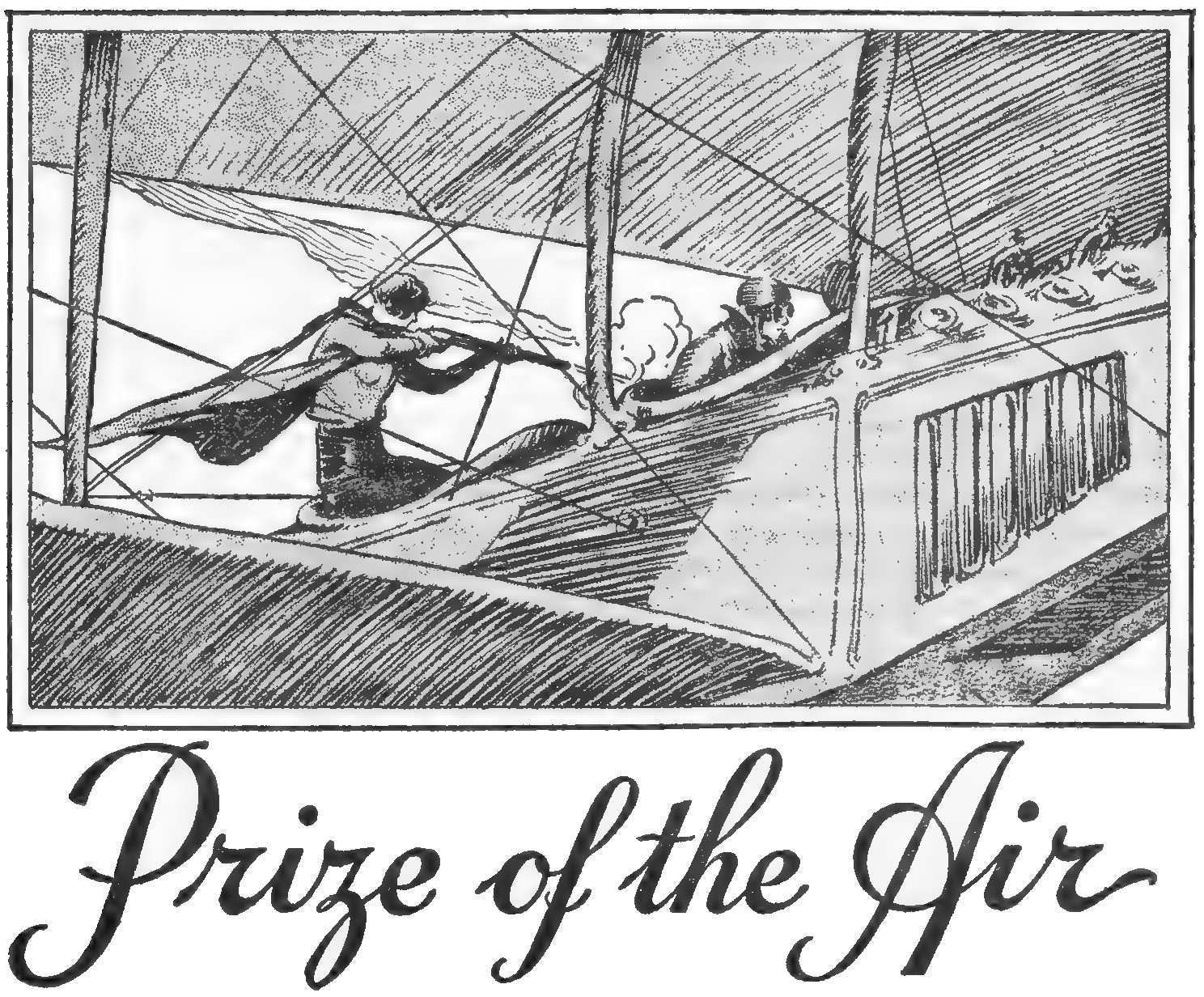
Bill flew straight north for awhile and had no difficulty picking up
the Trinidad road which wound about the foothills rimming Pampa to the
north. After he had skimmed over the hills he swung lower in order to
scout the highway thoroughly.
He passed over a couple of little settlements and climbed to a higher
altitude, for there was mountainous country ahead. It was after he had
climbed high and had sailed over the summit that he made out a
low-flying plane ahead.
He used his binoculars—the plane was the green De Haviland of
the night before, as he had suspected it would be. But the hawk would
wait for its prey in vain if Saxton’s telephone call had been in time.
And then, as he zoomed along, he saw that he was in for action.
A turreted car of the type used by banks to transport money and
bullion swept around a hairpin turn in the road that hugged a steep
bluff, and as soon as the car had swung into the straight road Bill saw
a grayish cloud shoot up just ahead of the car. It looked to him as if a
bomb had been dropped; and yet it did not seem possible from the
position of the green plane.
Bill Barlow put on all speed, and tilted his aërilons to climb. He
was planning to get above the green plane and keep it below and in front
of him where he would be safe from that machine gun nested in front of
the pilot.
In this manner he might be able to take the joy-stick between his
knees, get a pot-shot at the pilot, and send the green ship down out of
control. It was a long chance, but it was his only one, and Bill Barlow
had fought against long odds before.
He hardly believed he was seen as yet, and he nosed up steadily
toward a low-hanging cloud. And then, as he climbed, he noticed,
backgrounded against the cloud, another plane—a big blue-gray one,
that seemed almost to blend into the cloud. This, then, was probably the
explanation of that explosion that had taken place in front of the
armored car.
The second plane was far above him, and, although his own ship was a
good climber, Barlow realized that it would be useless now to try to get
above the blue-gray plane. He would have to take one chance and wait
until it dived.
The blue-gray plane had sighted him now, and he maneuvered as it
started down after him. The man at the machine gun was trying to get
Barlow from the rear; but that game was only too familiar to Bill.
His mind went back over ten years to glorious jousts above the lines,
and almost instinctively he changed his course by a sharp turn to the
right. The blue-gray plane followed him, its pilot still trying
feverishly to get Barlow in front of him—which is just what Bill
Barlow had no intention of letting him do.
Since he himself had no machine gun, there was no offensive advantage
in getting to the rear himself, but there was a strong advantage
defensively. If he kept on the tail of the other machine he would be
able to spike that machine gun.
Around and around circled the planes in this carousel of death, for
that was what it was, Bill Barlow knew, although just at present there
were no wars nor rumors of wars. Below them on the slopes cattle grazed
peacefully, but here in the air was the seed of death.
He must not let that gray plane take him from the rear. Both of the
ships were steadily losing altitude, but Bill knew the possibilities of
his own plane, and he might lure the enemy until it got too low to
maneuver, and it might crash.
He was pretty low himself now, as he circled about. He started to
dash and zig-zag—anything to get out of the path of that machine
gun. And yet he had to get out of the circle to climb. He’d try it.
It was a few minutes after this, just as he had reached a safer
altitude and once more tried to get on the tail of the gray, that a
spray of machine gun bullets pinged against the wires of his ship. But
he was in the strategic position that he wished now. With the joy-stick
between his knees, he flew slightly above the enemy plane and shouldered
his rifle. It spoke, and the pilot of the gray plane let go of the
joy-stick and placed his hands to his side. Then the gray plane seemed
to leap and swerve and turn, fell into a nose dive and went out of
control.
As he tried to bank and make now for the green ship, Bill Barlow
realized that he had not escaped unscathed. His own plane careened
sharply, and at first he feared that his control wires had been shot
away. Probably not, though—the ship still took direction, if
rather awkwardly.
He could still make a landing if he kept the ship’s nose up, although
he knew that now he had been put out of the engagement. Still keeping
the nose of his plane up, he sailed along over a little ridge and
managed to make a hazardous landing in a cleared space.
As he snapped out his pliers and feverishly tried to repair the
damaged wire braces, he was wondering what was happening over the ridge.
He heard a couple of explosions, and then the sharper report of rifle
shots, probably from the armored car. A few minutes later, while still
working on the damaged wire, he heard the roar of the green plane’s
engine, and, looking up, saw it passing over him, and a spray of machine
gun bullets splashed against the bowlder to his left.
Bill grabbed his rifle and ran to the shelter of the bowlder, but the
green plane paid no further attention to him. It sailed away to the
northeast. Evidently the men in its cockpit had made their haul from the
armored car and were making away with it, and had decided to leave well
enough alone.
With his wire braces repaired, Bill once more took off, circled and
climbed, and skimmed back over the ridge. The armored car, he could see
now, was toppled over on its side in the road.
A few rods from the spot the blue-gray plane was crumpled up like a
great wounded bird. Bill picked out a suitable landing place, throttled
his motor and volplaned down. Then he ran back to the road, passing the
gray plane on the way. The dead pilot of the gray plane sat half upright
in a weird position, his head to one side. The legs of another man
protruded from the wreckage. A little mustached man was beside the
plane, circling about it queerly and jabbering away and feeling his
head.
“Knocked goofy,” said Bill to himself. “Well, two of ’em are dead,
and that little bozo seems cuckoo. He can wait.”
He continued toward the sagging armored car. The uniformed bodies of
two men, evidently guards, lay sprawled beside the car. One of them
still had a rifle cradled in his arms.
The driver, although wounded, was trying to crawl down from the seat,
and a fourth figure, a blond young man, sent a charge from an automatic
whistling over Bill’s head, evidently believing that, since he came in a
plane, he was another of the stick-up men.
Bill threw himself to the ground.
“Hey! Lay off that!” he yelled. “I’m here to help you. I recognize
you from your father. You’re Ted Saxton, aren’t you?”
“Yes.” There was doubt in young Saxton’s voice.
“Well, I know your father. No use taking after that green plane now.
You and the driver there seem to be in bad shape. I’ll take you in my
ship to the sanatorium at Valmora, where you can get treatment. And one
of those birds in the gray wreck there seems to be moving. He does not
deserve it, but I’ll take him along.”
He crossed back to the wrecked gray plane. The small man with the
mustache was still circling about, jabbering in Spanish. He showed no
injury, but he had probably been creased badly by the fall.
He looked blankly out his black eyes when Barlow questioned him, and
Bill suddenly seized and shouldered him like a sack of barley, and
dumped him into the cockpit of his plane. A few moments later, with the
injured Saxton and the driver as comfortable as possible under the
circumstances, he was winging along toward the sanatorium at Valmora,
the peaked roof of which he could see in the distance.
He made a landing, left his cargo of casualties there, and speeded
back to Pampa.
“But Ted! Is he hurt badly?” asked Ruth, when he had told his
remarkable story.
“Oh, I know he’ll be all right, Miss Saxton. A fragment of a grenade
struck him in the head. The doctors at Valmora say they’ll patch him up
all right. I’m not sure about the driver. He stopped a bullet in the
side.”
“Oh, I must get to Ted!” Ruth exclaimed. “Come on, dad. We’ll fly to
Valmora with Mr. Barlow.”
Saxton put in a quick telephone call to the police to scour the hills
north of Pampa.
“I’m afraid they’ll have a tough time,” he said, as he pulled on a
cap and hurried toward the plane with Bill and his daughter. “That’s the
first time there’s been an air stick-up in New Mexico. But if Ted’s all
right, I don’t even mind about the bullion.”
Bill’s plane had proceeded about twelve miles in the direction of
Valmora when Ruth, gazing through the binoculars, made out a plane
coming from the mountains in the northwest.
“I’ll make a landing,” Bill suggested, “and let you out, Miss Saxton.
Then probably I can climb above it, and—”
But Miss Saxton was of quite another mind.
“Indeed, you will not!” she cut in. “I’m not a bit afraid. You get
above them, and I’ll keep below the cowl of the machine and pot those
murderers. If you could do it alone, I ought to be able to do something
now. I was on the rifle team at Vassar, you know.”
Bill climbed steadily, and as the green plane flew nearer, swooped
down to the rear and kept on its tail. As he passed within twenty feet
of it there was a report back of him, and then another report, and still
another.
The green plane seemed to stagger in the air. Its fuel tank had been
perforated by the bullets, and the pilot had turned to gesticulate
wildly to one of the men back of him.
It was then that, as Bill flew alongside, but a trifle in the rear to
keep out of range of the machine gun, that Ruth drew a steady bead and
fired again. The pilot threw up his hands.
A second member of the green plane started to reach for the
joy-stick. There was another report from Bill’s plane, and the great
green De Haviland spiraled down dizzily.
Ten minutes later Bill Barlow, with Ruth and her father, had made a
landing and were running toward the crushed green ship, Bill put out his
hand and barred Ruth’s progress. He knew that it was not a pretty sight
that would meet their eyes, for the ship had caught fire, and even as
they ran forward there was an explosion.
The three men of the green plane’s crew were dead, and two of them
were badly burned. There was no sign of the bullion. A box of grenades
had toppled out from the plane when it careened in the air, and had
miraculously not exploded.
Bill gathered them up and handed them to Saxton.
“We’d better keep ’em,” he said. “No telling but that they might come
in handy on a day like this. I think these birds must have a cache
somewhere up there in the mountains, and I have an idea. We’d better
hotfoot it to Valmora and get something out of that injured Mex if we
can. He didn’t seem badly hurt, but he might pop off.”
At Valmora, the Mexican, whose name proved to be Pedro Cesar, had
made a quick recovery. He was on his feet in the ward, but under
guard.
Bill drew him aside.
“There’s one chance for you, Cesar,” he said. “It’s up to you what
you want to do. You know your pals abandoned you this morning. They
could have taken you, couldn’t they? Now I want to get some information
out of you.”
The little Mexican surveyed him out of sullen black eyes.
“Me, I am no traitor,” he replied. “I fly weeth Villa. I am
gentleman.”
“Then your friends are traitors,” Bill informed him. “You know what
they did? They flew back over that crashed gray plane about an hour ago,
and fired into the bodies they found there. You know why? They thought
some of their pals might have been alive, and they didn’t want to share
that gold. And they probably thought that you were one of the ones
stopping their lead. Not very nice treatment, was it? But they have been
captured by the State patrol, and by coming clean you can get free.
You’d better come through. There was murder done there—and you’re
in on it.”
Pedro Cesar seemed to have fallen for the story. He broke into a
series of curses in Spanish.
“Por Dios! If they want to doubla cross me, eh? An’ go away weeth de
gol’—yes, so soon night come. How many you say they
arrest—de men in de green plane? Three? Ah—two more are in
de mountains weeth another hair-sheep. They doubla cross them too, eh?
They turn what you say State’s evidence?”
“That’s it,” Bill lied cheerfully. “They didn’t have the gold in the
green plane—but in another hour the authorities will know where
it’s cached in the mountains. Then you all get the works. Say, how did
you birds get hold of three airships?”
“Ah! That surprise you, eh?” Pedro Cesar laughed. “You have perhaps
heard of Pancho Lopez, eh—de beeg bandit chief of Sonora? Ah, I
theenk you have heard so much, yes? Pancho Lopez he have de sheeps from
de ol’ Villista army, an’ he hear of de gol’ being transport from
Trinidad. He ees poor now, ol’ Pancho, yes. He weesh to make de one haul
an’ take to de hills where no one ever find him. But Pancho he be very
mad now if he not get gol’.”
“I’m afraid your friend Pancho will have to stick mad and stay mad,”
Barlow told the Mexican. “But you show me where that other plane is
cached in the hills, and you’ll get out of plenty trouble.”
“You carry me in de hair-sheep,” Pedro promised, “an’ I show you we
gat them, ver’ queek.”
“O K,” said Bill. “But I’d like a third man along, with another
rifle.”
“What’s the matter with me? Am I a cripple?” Saxton interrupted. “And
don’t forget, that’s my plane you’re piloting,” he laughed.
“Maybe,” said Bill, chuckling back. “All right, get the guns, Saxton.
And we have the grenades. We’ll see if we can’t rout out those birds.
They must have the dough cached there.”
So, after a quick lunch at the sanatorium, Bill Barlow once more
hopped off, with Pedro Cesar and Saxton in the cockpit—hopped off
to the north, where Cesar claimed that his former confederates were
hidden.
Saxton had orders to watch Cesar, whom Bill did not entirely trust,
but the Mexican seemed to have been converted and chastened, and as they
neared the mountains and Bill increased his altitude, he directed the
pilot to veer to the right to avoid a machine gun mounted in the robber
camp as an anti-aircraft weapon.
“Believe me, these birds have a modern organization,” said Bill. “And
look, Saxton over to the right there. See that sky-blue monoplane? By
golly, they’re getting ready to take off. And with the dough, I’ll
bet.”
It seemed true enough. Here in a natural bowl made by a circular
plain and the rimming hills was a speedy-looking monoplane with its
engine already warming up. On the ground three men were gesticulating to
each other, and one of them pointed up toward Bill’s ship, whereupon all
of them ran for cover.
Bill swung over the plane and, taking precise aim, let go two of the
bombs he had taken from the wrecked gray ship. The second one seemed to
hit the monoplane squarely and tip it over on one wing.
Then Bill spiraled down in an effort to destroy the machine gun back
of the bowlder before it could be manned. Cesar pointed it out, and just
as he did so there came the quick rat-a-tat-a-tat of machine gun
bullets.
Bill throttled his motor and swung to the right, then circled and
made a landing at the far end of the field.
“That other plane’s out of commission,” he said. “We want to have one
left to get away in. Down on your bellies, men, and keep to shelter.
We’ll fight this action out right down here.”
He taxied his ship behind a spur of hill out of range of the machine
gun. Then, rifle in hand, he held a quick conference with Saxton and
Cesar.
“You folks keep in shelter behind these rocks here, and draw that
bozo’s fire,” he said. “They’ve got bad medicine there, but we may be
able to outmaneuver them.”
His plan was to creep up the side trail with his rifle, and try to
get the machine gunner from the rear. Cesar had said that the gun was
rigged on a swivel, but if one of the other three men turned it back in
his direction there were plenty of rocks and bowlders behind which to
take shelter, and Saxton and Cesar could then charge from the front.
Bill made his way cautiously up the mountain trail, circled to the
right and picked his way down the slope. He found a friendly bowlder
halfway down the slope, and to his delight could make out the hat of one
of the men about the machine gun. He took careful aim and fired.
The hat disappeared, and he believed he had got his man, for one of
the others took to his heels, running up the slope which led past the
bowlder at a distance of about a hundred yards. Evidently he had not
guessed that an enemy was behind the bowlder.
Bill drew a bead on the running man’s legs, and toppled him to the
ground. But the rat-a-tat-a-tat of the machine gun broke out
occasionally, proving that the machine gunner was alive and was trying
to get the men in front of him.
Bill himself had not been discovered. He crept farther back and over
to the right. Things were going nicely. Saxton and Cesar had a good
chance if they did not show themselves too clearly, and all he had to do
now was to get that gunner.
He took to his hands and knees and had topped a little rise that he
thought would give him command of the machine gun position, when far to
the right in the rear of the gun he saw another man creeping along. He
raised his rifle and was about to fire, but then the man raised his
head, and from the cap he wore Bill could see that it was Saxton.
He stood up and waved his hat at Saxton, so that the latter might not
make the same mistake that he had almost made—fire on a friend.
Saxton waved back, and hastened toward him.
The two of them crept back of a screen of rocks, and to their delight
saw the hunched figure of the machine gunner back of the bowlder in
front of them.
“We’ll fire together,” Bill suggested. “This is too easy. Then we’ll
never know which bullet killed him.”
They fired. The man at the gun slumped forward. They waited a moment,
but he did not move again.
“Well, that’s that,” said Bill. “I think we’ve won the field.”
He had hardly finished the sentence when a bullet spatted against a
rock back of them, and another kicked up the dust at their feet. Both
men threw themselves flat on the ground.
“I guess I spoke too soon,” said Bill. “I toppled a fellow a few
minutes ago. He was running back up the trail, and I think I got him in
the leg. He must have beat it back to some retreat for a rifle, and this
is the result. Don’t show yourself, Saxton. We’ll outwait him.”
They lay there on their stomachs back of the bowlder, their rifles
ready for the first sign of the remaining bandit.
But it seemed that it was always the unexpected that was happening on
this eventful day. There was the roar of a motor below in the field.
Bill unconsciously made himself an attractive target as he sat up and
looked at Saxton sharply.
“Holy sufferin’ Moses!” he said. “That must be my ship. Maybe the
third stick-up guy, or—”
He raced down straight toward the field, Saxton on his heels. As they
passed the machine gun and its dead gunner they were just in time to see
Barlow’s machine take to the air. At the joy-stick was Pedro Cesar.
Bill stopped and sent a rifle bullet at the plane, but the ship
sailed calmly through the air, and Cesar playfully tossed a grenade over
the side. It exploded a few yards away from the bewildered men on the
ground.
“I’ll bet ten to one he’s loaded the loot from that sky-blue one,”
shouted Bill.
He streaked over to the sagging monoplane, and found that his
prediction was only too true. Pedro had also taken the box of
grenades.
“My fault!” Saxton admitted. “What a dumb-bell! I should have stayed
and watched him. Now the little rat’s got away with everything.”
Saxton’s crestfallen penitence touched Bill rather humorously,
despite the circumstances.
“I guess it’s Pedro Cesar’s,” answered Saxton. “Cesar’s gold, Cesar’s
plane, and Cesar’s bank, for all I care. But believe me, if I could get
my hands on that little greaser it would be a case of ‘I’ve come to bury
Cesar,’ believe you me! What’s the matter, Bill? Something else
wrong?”
Bill Barlow was looking at the sky-blue monoplane as if it was
bewitched, and as if he himself was bewitched along with it.
“Why—why—” he started. “By golly, man,” he almost
shouted, “there’s not a thing wrong with this sky-blue ship except that
this control wire is snapped. Pedro didn’t stop to examine it, the
boob!” Already he was taking out his pliers. “We’ll be up in the air in
less than fifteen minutes.”
He fixed the wire in record time, he and Saxton straightened up the
plane, pushed it back toward the machine gun bowlder for a longer
take-off, and a few seconds later the motor was whirring.
“Just a minute,” called back Bill, as he disappeared behind the
bowlder. He returned with the machine gun and started to lift it into
the cockpit.
“It won’t be rigged up as snug as my old Browning,” he explained;
“but it can shoot, and there’s a drum in it already. And this ship looks
like a lulu. If I don’t overtake that grease ball before he gets to the
border my name isn’t Lucky Bill Barlow. This toy comet ought to be able
to do a hundred and a half going backward.”
At Valmora, on the way to the border, Bill throttled his motor and
began to volplane.
“What’s the idea?” asked Saxton.
“Wait!” Bill commanded. He made the landing.
“Get out, old pal,” he told the banker. “I’m alone this time, boy.
Cesar is alone, and this is my ship, and the war is solo from this
minute, until I come back with the dough.”
He stuck out his hand and patted Saxton on the shoulder.
“So long, old pal,” he said. Then he gave ’er the gun and the
sky-blue monoplane went roaring down the field.