HOME LETTERS.
The family letters which follow are some of a
religious character, while others turn on more
general topics.
Four letters written by Wilberforce to his
daughter Elizabeth, aged fifteen at the date the
correspondence begins, show the care with which
he instilled into her mind all that he considered
of most moment; also how he exercised "the
privilege of a friend," for such he considered himself
to his daughter, and "told her frankly all
her faults."
Mr. Wilberforce to his daughter Elizabeth.
"November 30, 1816.
"This is but a short letter to my dear Elizabeth.
When I do address my dear girl, I ought to consider
how I can best testify my friendship: for
friendship let there be between us; never can you
have a friend more warmly attached to you or
more interested in your welldoing and happiness
than myself. But if we are to be friends, you
must allow me the privilege of a friend, a privilege
by far the most valuable of all its excellencies.
So thought your dear Uncle Stephen,[42] when in the
very extreme bitterness of his grief, which was as
great as that of any one I ever witnessed, though he
is now able to control his feelings before company,
he said to me while enlarging on the various
particulars of my dear sister's extraordinary character,
'O, she was a friend to my soul! She
told me frankly all my faults,' an office in which,
I am obliged to confess, he charged me with having
been deficient. This has arisen, however, solely
from my scarcely ever having seen him alone,
when only I could converse with him confidentially.
But if I am to exercise this best prerogative, this
most sacred and indispensable duty of friendship,
it will be necessary for my dear Elizabeth to prepare
her mind and temper for receiving it properly,
and for deriving from it all the benefits it is capable
of imparting. Shall I be honest, and I must be
so or be silent; were I otherwise, the very sheet
which I am writing would rise up in judgment
against me at the last day; if then, I am frank
and honest, I must declare to you, that it is on
this quarter that it will be necessary for my dear
girl to guard herself with the utmost watchfulness,
and, still more, to prepare herself with conscientious
care. This is what St. Paul terms "exercising
herself to maintain a conscience void of offence
towards God and towards man": what the Book
of Proverbs styles, "keeping the heart with all
diligence:" for unless we have accustomed ourselves
to self-suspicion, if I may use such a phrase, we
never benefit as we might from the friendly
reproofs of a real friend. We may receive
his remarks with civility, and even give him
credit for his kind intentions, but we shall be
almost sure to let it appear to any acute
observer at least, that we rather tolerate his frankness
out of principle, or put up with it in consideration
of the friendly motives by which it has
been prompted, than that we listen to it with a
sincere desire of profiting from it, still less that
we welcome it as one of the most valuable services
in design, even when not in fact, that could be
rendered to us. The grand preparation that is
needed is, Humility: that sense of our own infirmities
and our own weakness, which is felt by
every true, at least by every flourishing Christian.
We read in the Scripture that 'our hearts are
deceitful above all things:' by which is meant,
that we are all prone to flatter ourselves, to form
too high an estimate of our own good qualities,
and too low an idea of our bad ones. Now it is
the first office of the Holy Spirit to teach us to
know ourselves, and immediately to suspect ourselves
as the first effect of that knowledge. Now
be honest with yourself, my very dear child.
Have you been accustomed to distrust the judgment
you have been in the habit of forming of
your own character, as you would have done if it
had been formed and stated to you by any one
whom you knew to be a notorious liar? Yet this
is really the way in which we ought to feel; I
know how difficult it is in practice from my own
experience; and because it is so difficult, it is
here that we need the special aid of the Holy
Spirit, and should earnestly pray for His blessed
influence to teach us to know ourselves. Be
earnest, then, in prayer, my very dear Elizabeth, and
frequent in self-examination on this very point.
I have often detected my own self-partiality and
self-deceit by observing how differently the same
fault, be it small or great, appears to me when
committed by myself, and when committed by
others, how much more ready I am with apologies
for it, or with extenuations for its guilt. If a
servant has done anything wrong, or omitted
some act of duty, I observe how it appears to me,
and if I have done much the same fault, or been
guilty of the same omission, how much less does it
impress itself on me, how much sooner do I forget
it. I assure you, I speak sincerely when I tell
you I find this the case with myself: now observe
whether you do; and if so, then it will be a subject
for humiliation before God, and a motive for
earnest prayer. Let my dearest Lizzie be particularly
watchful to improve the present season;
for as you have heard me say, Christ—as is
stated in Rev. iii.—'stands at the door and knocks,'
that is, He uses particular events and circumstances
of our lives, for impressing us with the importance
of spiritual things, and if the event and
the circumstances pass over without producing
their proper effect, there is always a positive bad
consequence. So much grace is, as it were
expended on us in vain. The heart becomes
harder and less favourably disposed on another
occasion. And though we must not limit the
grace and power of God, yet it is a great point
to know what the Scripture (2 Cor. vi.) terms
"our appointed time, our day of salvation." I
am sure you find your heart softened and affected
more than usual just now. O try, my beloved
girl, to render this permanently, let me say eternally,
useful to you. I understand you are reading
Doddridge's 'Rise and Progress.' You cannot
read a better book. I hope it was one of the means
of turning my heart to God. Certainly, there
are few books which have been so extensively
useful. Pray over some of the prayers at the
conclusion of the chapters; as, for instance, if I
remember right, that at the end of the chapter,
'After a state of spiritual decay.' But I have
not the book at hand, and cannot quote it from
memory. Don't read this till you have half an
hour's leisure."
Of the privilege of friendship alluded to in this
letter, Wilberforce also writes later to his daughter
Elizabeth: "You will never find telling Robert" (afterwards
Archdeacon Wilberforce), "of any fault offend
him, if you do it when you are tête à tête, and when he
sees from your manner and from the circumstances
that you can only have his happiness at heart, I
mean that this friendly regard can alone prompt
you to such a proof of real attachment."
Mr. Wilberforce to his daughter Elizabeth.
"Hastings,
"January 17, 1817.
"My dearest Lizzy,—Your letter to-day gives
me pleasure. We heard from Marianne (Thornton)
of her having paid you a visit. Her friendly attachment
to Barbara[43] and you, I account as one of the
special blessings of Providence; and there are many
particulars, though not all, in which I should be
very glad to have her the object of your imitation.
I am half asleep from not having had a good night,
and find myself occasionally writing one word instead
of another—a slip which I sometimes witness
in my dear Lizzy's case; I know not whether it be
from the same cause, I hope not. For my last
night's wakefulness arose in part from my thinking
on some subjects of deep interest from which, though
I made several efforts, I could not altogether withdraw
my thoughts. My mind obeyed me indeed
while I continued wide awake, but when dropping
half asleep, it started aside from the serious and
composing train of ideas to which I had forced it
up, and like a swerving horse, it chose to go its own
way rather than mine. It is a delightful consideration,
my dearest child, that there is a gracious and
tender Saviour who, in our sleeping as well as
waking hours, is watching over us for good, if we
are of the number of those who look to Him
habitually for consolation and peace, and such I
trust will be more and more the case of my dear
Elizabeth."
The next letter is in a more lively strain and
explains to Elizabeth the system of Bishop Berkeley.
Mr. Wilberforce to his daughter Elizabeth.
"Highwood Hill,
"July 13, 1830.
"My dear Lizzy,—If many intentions to write
could be admitted as making up one letter, you
would have to thank me for being so good a correspondent.
But I fear that this is a mode of calculation
that will only come into use, when the system
of good Bishop Berkeley has become established.
I cannot explain what this is so well as Robert
could, but its distinctive principle is that there are
no such things as substances. You may suppose
that you have had the pleasure of re-visiting a very
dear friend, called Miss Palmer, and you probably
would assure me, if I asked you whether they still
continued at the Hall any such vulgar practice as
that of eating, that the turkies and fowls were as
good and as freely bestowed as when I used to partake
of them in earlier years. All mere delusion.
All imagination. All ideal. There is no Elizabeth
(she only appeared to occupy an ideal place in an
ideal carriage, when she travelled down to Mosely
and Elmdon), there is no Miss Palmer, nor are the
fowls and turkies a whit more substantial than the
supposed eaters of them, I really am serious—such
is the system of one of the ablest and best of
men (he was spoken of by Pope as 'Having every
virtue under heaven'); he held that the Almighty
formed us so as to have impressions produced on
us as if these were realities, but that this was all.
I little intended when I took up my pen to give you
such a Lecture in Metaphysics. I am sure I have
had a Lecture, a practical one, on the duty of bearing
interruptions with good humour. This morning
(it is now 4 p.m. and dinner taking on the
table) I took up my pen at 10 o'clock, and my first
thoughts were naturally drawn to you. Scarcely had
I finished my first sentence when in came Knowles
(as queer he is as ever) and announced Lord Teignmouth.
Up I went to him in the drawing-room,
and as cordial a shake of the hand he received from
me as one friend can give to another. But I own I
began to wish I could be in two places at once. I
had secured as I thought, several hours of quiet,
and my eyes happened to be better than for sometime
past, and I was therefore hoping to pay away
a great part of my epistolary arrears, when in comes
my friend, and remains with me between three and
four hours, refusing to stay dinner, but not departing
till after the post had gone out. However, such
incidents are salutary, they accustom us to bear with
cheerfulness the little vexatious interruptions which
people sometimes bear with less equanimity than
more serious grievances. Here enter Uncle
Stephen——But with some pressing I have got him
to agree to stay till to-morrow morning, so I may
finish my letter. I must first tell you what I think
a remarkably well-expressed description of Lady
Raffles, contained in a letter from the Duchesse de
Broglie, to whom I gave Lady R. a letter of
introduction—'C'est une personne qui inspire un
profond interêt. Elle a tant de dignité et de
douceur.' The epithets appear to me very happy.
And now, my dear Lizzy, I must conclude my very
disjointed letter, written à plusiers reprises as the
French phrase it."
Elizabeth would seem to have written to her
father as to her solitariness of spirit in so confidential
a strain that his sympathy had been
thoroughly awakened. In his answer he excuses himself
for not having been more of a companion to her
on the ground that he had been so long engaged in
public business, and also that as he had been almost
an old bachelor before he married, he had got out
of the habit of tender attention to young women of
education and delicacy; but he assures her she will
always find in him unfeigned tenderness of spirit
for all her feelings, and all her infirmities. His
remedies for "solitariness of spirit" are most
practical.
Mr. Wilberforce to his daughter Elizabeth.
"Highwood Hill,
"July 26, 1830.
"My Very Dear Lizzy,—Though, owing to my
having been betrayed into forgetfulness of the
flight of time while sitting under the shade of the
lime tree it is now so late that I shall not be able to
write to you so fully as I wished and intended, I
must not be so unjust to myself or so unkind to you
as I certainly should be if I were not to reply to
your last interesting letter as soon as possible.
And yet, my dear girl, it could be only from nervous
sensibility that you could doubt of my putting the
right construction on your opening your heart to me
without disguise. I wish you could have seen the
whole interior of mine when I had read through it:
I am not ashamed to say that I melted into tears of
affectionate sympathy. Your letter really contained
nothing but what tended to call forth feelings of
esteem and regard for you. My dear Lizzy, I will
return your openness by a similar display of it. I
will confess to you that I have not seldom blamed
myself for not endeavouring more to cheer your
solitary hours, when you have had no friend of your
own sex to whom you could open your heart, and I
will try to amend of this fault. My not walking
with you more frequently has, however, been often
caused by the circumstance you mention, that at the
very hour at which I can get out, just when the
post has departed, you are yourself employed in a
way of which I always think with pleasure, and
which I doubt not will bring down a blessing on
your head. But there is another cause which may
have some effect in rendering me less tenderly
attentive than young women of education and
delicacy like persons to be, and must in some
measure find them, before they can open their
hearts to them with unreserved freedom. I allude
to my having been so long and so constantly engaged
in public business and having been almost an
old bachelor before I married. Let my dear child,
however, be assured that she will always experience
from me an unfeigned tenderness of spirit and a
kind consideration for all her feelings and even, shall
I say it, all her infirmities. Meanwhile let me advise
you, my dear child, whenever you do feel anything
of that solitariness of spirit of which you speak, to
endeavour to find an antidote for it in prayer.
There is often much of bodily nervousness in it. I
am ashamed to acknowledge that I am sometimes
conscious of it myself. Another method which I
would recommend to you for getting the better of
it, is to engage in some active exertion, teaching
some child, instructing some servant, comforting
some poor sufferer from poverty and sickness. I
deeply feel the Bishop and Mrs. Ryder's kindness
to you, but it is of a piece with all their conduct
towards me and mine. God bless them, I say
from the heart."
In 1814, Mr. Wilberforce at the age of fifty-five,
begins his correspondence with his son Samuel,
aged nine. The father is already seeking for a
proof of the grand change of conversion in his child.
Mr. Wilberforce to his son Samuel.
"September 13, 1814.
"I was shocked to hear that you are nine years
old; I thought it was eight. You must take great
pains to prove to me that you are nine not in years
only, but in head and heart and mind. Above all,
my dearest Samuel, I am anxious to see decisive
marks of your having begun to undergo the great
change. I come again and again to look to see if
it really be begun, just as a gardener walks up
again and again to examine his fruit trees and see
if his peaches are set; if they are swelling and
becoming larger, finally if they are becoming ripe
and rosy. I would willingly walk barefoot from
this place to Sandgate to see a clear proof of the
grand change being begun in my dear Samuel at
the end of my journey."[44]
"March 25, 1817.
"I do hope, my dear Samuel, like his great
namesake at a still earlier period of life, is beginning
to turn in earnest to his God. Oh, remember prayer
is the great means of spiritual improvement, and
guard as you would against a wild beast which was
lying in a bush by which you were to pass, ready
to spring upon you—guard in like manner, I say,
against wandering thoughts when you are at prayer
either by yourself or in the family.[45] Nothing
grieves the Spirit more than our willingly suffering
our thoughts to wander and fix themselves on any
object which happens at the time to interest us."
"June 5, 1817.
"My Dear Samuel,—Loving you as dearly as I do,
it might seem strange to some thoughtless people
that I am glad to hear you are unhappy. But as
it is about your soul, and as I know that a short
unhappiness of this kind often leads to lasting
happiness and peace and joy, I cannot but rejoice.
I trust, my dear boy, it is the Spirit of God knocking
at the door of your heart, as the Scripture
expresses it, and making you feel uneasy, that you
may be driven to find pardon and the sanctifying
influences of the Holy Spirit, and so be made one
of Christ's flock and be taken care of in this world
and be delivered from hell, and be taken when you
die, whether sooner or later, to everlasting happiness
in heaven. My dearest boy, whenever you
feel in this way, I beseech you, get alone and fall
on your knees, and pray as earnestly as you can to
God for Christ's sake to forgive you and to sanctify
you, and in short to make you to be born again, as
our Saviour expressed it to Nicodemus."
"July 19th.
"I will procure and send you Goldsmith's 'Grecian
History,' if you will read it attentively, though it is
by no means so good a history as Mitford's; it is
little better than an epitome. Let me tell you I
was pleased with your skeleton of Mr. Langston's
sermon, and I should be glad of such another bag
of bones. My dear boy, whenever you feel any
meltings of mind, any sorrow for sin, or any concern
about your soul, do not, I beg of you, stifle it or
turn away your thoughts to another subject, but get
alone and pray to God to hear and bless you, to
take away the stony heart and substitute a heart
of flesh in its place."
"August 15th, 1817.
"The great rule practically for pleasing our
Saviour in all the little events of the day is to be
thinking of Him occasionally and trying to please
Him, by not merely not doing evil, but by doing
good; not merely negatively trying not to be
unkind, not to be disobedient, not to give pain, but
trying positively, to be kind, to be obedient, to give
pleasure."
"November 1, 1817.
"My very dear Samuel,—Though some company
who are to dine with me are already in the
drawing-room, I must leave them to themselves for
two minutes while I express the very great pleasure
I have received from Mr. Marsh's account of both
my dear boys. Being a political economist, I cannot
but admit the beneficial effects which always flow
from the division of labour, and must therefore
rather commend than blame the instance of it which
is afforded by your writing the letter while Bob is
building the house. It is quite a drop of balm into
my heart when I hear of my dear boys going on
well."
"May 2, 1818.
"Could you both but look into my heart and
there see the tender and warm love I feel for you!
How my heart bleeds at the idea of your being
drawn into the paths of sin and bringing the grey
hairs of your poor old father with sorrow to the
grave—a most unlikely issue I do really hope; and,
on the other hand, could you witness the glow of
affection which is kindled by the prospect of your
becoming the consolation of my declining years,
you would want no more powerful motives to
Christian obedience."
"April 25, 1818.
"Our West Indian warfare is begun, and our
opponents are commencing in the way of some (I
won't add an epithet) classes of enemies by the
poisoned arrows of calumny and falsehood. But
how thankful should we be to live in a country in
which the law protects us from personal injury!"
"June 26, 1818.
"My dear children little think how often we
parents are ruminating about them when we are
absent from them, perhaps in very bustling scenes
like that from which I come. Mr. Babington is a
candidate for the county of Leicester, and I really
trust he will succeed; the two other candidates are
Lord Robert Manners, the Duke of Rutland's
brother, and Mr. Phillips, a country gentleman of
large property. My dear Samuel, keep going on
well. Prayer and self-denial, as you used to be
taught when a very little boy, are the grand
things."
"February 13, 1819.
"I am very glad that you like your new situation.
One of the grand secrets to be remembered, in
order to enable us to pass through life with comfort,
is not to expect too much from any new place or
plan, or from the accomplishment of any new
purpose."
"March 12, 1819.
"On the whole, Mr. Hodson's report of you is a
gratifying one. But there is one ground for doubts
and fears, and I hope my beloved child will endeavour
to brighten that quarter of my prospect.
I fear you do not apply to your business with
energy. This, remember, was your fault at Mr.
Marsh's, and you alleged, not without plausibility,
that this arose in a great degree from your wanting
spirits, in consequence of your having no play-fellows
for your hours of recreation, no schoolmates
for your season of business. A horse never goes
so cheerfully alone as when animated by the
presence of a companion, and a boy profits from
the same quickening principle. But my dearest
Samuel has not now this danger to plead at Mr.
Hodson's, and I hope he will now bear in mind
that this indisposition to work strenuously[46] is one of
his besetting sins."[47]
"May 22, 1819.
"I hear with pleasure of your goings on, and I
may add that we all thought our dear boy greatly
improved when he was last with us. How delightful
will it be to me in my declining years to hear
that my dearest Samuel is doing credit to his name
and family!"
"May 25, 1819.
"I do not like to write merely on the outside of
this cover, though I have time to insert very little
within, yet as when you were a little boy I used
to delight in taking a passing kiss of you, so now
it is quite gratifying to exchange a salutation with
you on paper, though but for a minute or two.
The sight of my handwriting will call forth in the
mind of my dear, affectionate Samuel all those
images of parental and family tenderness with
which the Almighty permits us to be refreshed
when children or parents are separated from each
other far asunder. You have a Heavenly Father,
too, my dearest boy, who loves you dearly, and who
has promised He will never leave you nor forsake
you if you will but devote yourself to His service
in His appointed way. And so I trust you are
resolved to do. I hope you got your parcel safe,
and that the lavender-water had not oozed out of
the bottle; the cork did not seem tight. Farewell,
my very dear Samuel."
"September 17, 1819.
"My Dear Boy,—It is a great pleasure to me
that you wish to know your faults. Even if we
are a little nettled when we first hear of them,
especially when they are such as we thought we
were free from, or such as we are ashamed that
others should discover, yet if we soon recover our
good-humour, and treat with kindness the person
who has told us of them, it is a very good sign.
It may help us to do this to reflect that such
persons are rendering us, even when they themselves
may not mean it, but may even only be
gratifying their own dislike of us, the greatest
almost of all services, perhaps may be helping us
to obtain an eternal increase of our happiness and
glory. For we never should forget that though
we are reconciled to God through the atoning
blood of Christ, altogether freely and of mere undeserved
mercy, yet when once reconciled, and
become the children of God, the degrees of happiness
and glory which He will grant to us will be
proportioned to the degree of holiness we have
obtained, the degree (in other words) in which
we have improved the talents committed to our
stewardship."
"Weymouth, September, 1820.
"I have this day learned for the first time that
there were to be oratorios at Gloucester, and that
some of the boys were to go to them. I will be
very honest with you. When I heard that the
cost was to be half a guinea, I greatly doubted
whether it would be warrantable to pay such a
sum for such a performance for such youth. This
last consideration has considerable weight with me,
both as it renders the pleasure of the entertainment
less, and as at your early age the sources of
pleasure are so numerous. But my difficulties were
all removed by finding that the money would not
merely be applied to the use of tweedledum and
tweedledee (though I write this, no one is fonder
than myself of music), but was to go to the relief
of the clergy widows and children. I say therefore
yes. Q.E.D."
"September 4, 1820.
"I am persuaded that my dear Samuel will
endeavour to keep his mind in such a right frame
as to enable him to enjoy the pleasures of the
scenes through which he is passing, and to be
cheered by the consciousness that he is now
carrying forward all the necessary agricultural processes
in order to his hereafter reaping a rich and
abundant harvest. Use yourself, dear boy, to take
time occasionally for reflection. Let this be done
especially before you engage in prayer, a duty
which I hope you always endeavour to perform
with all possible seriousness. As I have often told
you, it is the grand test by which the state of a
Christian may always be best estimated."
"Bath, September 23, 1820.
"Did you ever cross a river with a horse in a
ferry boat? If so, you must have observed, if
you are an observing creature, which if you are
not I beg you will become with all possible celerity,
that the said horse is perfectly quiet after he is
once fairly in the boat—a line of conduct in which
it would be well if this four-footed navigator were
imitated by some young bipeds I have known in
their aquatic exercitations. And so said animal
continues—the quadruped I mean, mind—perfectly
quiet until he begins to approach the opposite
shore. Then he begins to show manifest signs of
impatience by dancing and frisking sometimes to
such a degree as to overset the boat, to the no
small injury of others (for whom he very little
cares) as well as himself. This is what may be
well called making more haste than good speed.
None the less, though I am fully aware that the
same frisking quadruped is a very improper subject
of imitation, not only to an old biped but to an
experienced M.P. of forty years' standing, yet I
find myself in a state of mind exactly like that of
the horse above mentioned, though it has not the
same effects on my animal powers, and though,
being on dry land and in a parlour, not a boat, I
might frisk away if I chose with perfect impunity
to myself and others. But to quit metaphor which
I have fairly worn out, or, rather, rode to death,
when I was a hundred miles from my dear Samuel,
though my affection for him was as strong and my
sentiments and feelings as much employed in him
as now, yet these are now accompanied with an
impatient longing to extinguish the comparatively
little distance that is between us, and to have
my dearest boy not only in my heart but in my
arms, and yet on reflection this very feeling is
beneficial. I recollect that our separation is an
act of self-denial, and I offer it up to my Saviour
with a humble sense of His goodness, in subjecting
me to such few and those comparatively such easy
crosses. My dearest Samuel will remember to
have our blessed Lord continually in remembrance,
and by associating Him thus with all the little
circumstances of life, it is that we are to live in
His love and fear continually."
"November 20, 1820.
"We quite enjoyed your pleasure in Robert's
visit. In truth the gratification we parents derive
from our children's innocent, much more their
commendable, enjoyments is one of the greatest
of our pleasures."
"Bath, November 18, 1820.
"My dear Samuel.—I am sorry to hear that
your examination is, or part of it at least, disadvantageous
to you. Does not this arise in part
from your having stayed with us when your school-fellows
were at Maisemore? If so, the lesson is
one which, if my dear boy duly digests it and
bottles it up for future use, may be a most valuable
one for the rest of his life. It illustrates a remark
which I well remember in Bishop Butler's 'Analogy,'
that our faults often bring on some bad consequence
long after they have been committed, and
when they perhaps have been entirely banished
from our memory. Some self-indulgence perhaps
may have lost us an advantage, the benefit of
which might have extended through life. But it
is due to my dear Samuel to remark that, though
his stay was protracted a very little out of self-indulgence
(as much ours as his), yet it was chiefly
occasioned by the necessity of his going up to
London on account of his ancle. (By the way,
tell me in two words—ancle better or worse or
idem.) But my Samuel must not vex himself
with the idea of falling below the boy who has
commonly been his competitor, owing to his stay
having prevented his reading what is to be in
part the subject of the examination. It would
really be quite wrong to feel much on this account,
and that for several reasons. First, everybody
about you will know the disadvantages under
which you start, and will make allowances accordingly.
Next, if you do as well or better in the
parts you have read, you will show the probability
of your having done well in the other also, if you
had possessed with it the same advantage. And
what I wish my dearest boy seriously to consider
is, that any uneasiness he might feel on account of
this circumstance would deserve no better a name
than emulation, which the apostle enumerates as
one of the lusts of the flesh. You should do your
business and try to excel in it, to please your
Saviour, as a small return for all He has done for
you, but a return which He will by no means
despise. It is this which constitutes the character
of a real Christian: that, considering himself as
bought with a price—viz., that of the blood of
Jesus Christ—he regards it as his duty to try and
please his Saviour in everything. And to be
honest with you, my very dear boy, let me tell
you that it appears to me very probable that the
Heavenly Shepherd, whose tender care of His
people is, you must remember, described to us
as like that of a shepherd towards the tender lambs
of his flock, may have designed by this very incident
to discover to you that you were too much under
the influence of emulation, and to impress you
with a sense of the duty of rooting it out. Emulation
has a great tendency to lessen love. It is
scarcely possible to have a fellow-feeling (that is,
duly to sympathise) with anyone if we are thinking
much about, and setting our hearts on, getting
before him, or his not getting before us. This
disposition of mind, which includes in it an over-estimation
of the praise of our fellow-creatures, is
perhaps the most subtle and powerful of all our
corruptions, and that which costs a real Christian
the most trouble and pain; for he will never be
satisfied in his mind unless the chief motive in
his mind and feelings is the way to please his
Saviour. The best way to promote the right
temper of mind will be after earnest prayer to
God to bless your endeavours, to try to keep the
idea of Jesus Christ and of His sufferings, and of
the love which prompted Him willingly to undergo
them, in your mind continually, and especially
when you are going to do, occasionally when you
are doing, your business. And then recollect that
He has declared He will kindly accept as a tribute
of gratitude whatever we do to please Him, and
call to mind all His kindness, all His sacrifices;
what glory and happiness He left, what humiliation
and shame and agony He endured; and then reflect
that the only return He, who is then, remember, at
that very moment actually looking upon you, expects
from you, is that you should remember His
Heavenly Father who sent Him, and Him Himself,
and (as I said before) endeavour to please Him.
This He tells us is to be done by keeping God's
commandments. And my dear Samuel knows
that this obedience must be universal—all God's
commandments. Not that we shall be able actually
to do this; but then we must wish and desire to
do it. And when, from our natural corruption,
infirmities do break out we must sincerely lament
them, and try to guard against them in future.
Thus a true Christian endeavours to have the
idea of his Saviour continually present with him.
To do his business as the Scripture phrases it,
unto the Lord and not unto men. To enjoy his
gratifications as allowed to him by his merciful and
kind Saviour, who knows that we need recreations,
and when they are neither wrong in kind nor
excessive in degree they may and should be enjoyed
with a grateful recollection of Him who
intends for us still nobler and higher pleasures
hereafter. This is the very perfection of religion;
'Whether we eat or drink or whatever we do, do
all to the glory of God.'
"All I am now contending for is that my dearest
Samuel may at least endeavour to do his school
business with a recollection of his Saviour, and a
wish to please Him, and when he finds the feeling
of emulation taking the place of this right principle
look up and beg God's pardon for it, and implore
the Holy Spirit's help to enable you to feel as you
ought and wish to feel. But let me also ask my
dear Samuel to reflect if he did not stay too long
at home in the last holidays. Too much prosperity
and self-indulgence (and staying at home may be
said to be a young person's indulgence and prosperity)
are good neither for man nor boy, neither
for you nor for myself."[48]
"Downing Street, December 11, 1820.
"Three words, or, rather, five lines, just to
assure you that in the midst of all our Parliamentary
business I do not forget my very dear Samuel;
on the contrary, he is endeared to me by all the
turbulence of the element in which I commonly
breathe, as I thereby am led still more highly to
prize and, I hope, to be thankful to God for
domestic peace and love. Pray God bless you,
my dearest boy, and enable you to devote to
Him your various faculties and powers."
The mutual affection of father and son is touchingly
shown in many passages scattered through
their letters. Two may serve as specimens:—
"February 24, 1821.
"Perhaps at the very time of your being occupied
in reading my sentiments, I may be engaged in
calling you up before my mind's eye and recommending
you to the throne of grace."
"September 5.
"Probably at the very same time you will be
thinking of me and holding a conversation with
me."
"London, June 30, 1821.
"My very dear Boy,—I congratulate you cordially
on your success, and I rejoice to hear of
your literary progress. But I should have been
still more gratified, indeed beyond all comparison
more, had Mr. Hodson's certificate of your scholarship
been accompanied, as it formerly was, with
an assurance that you were advancing in the
still more important particulars of self-control, of
humility, of love—in short, in all the various forms
and phases, if I may so term them, which St.
Paul ascribes to it in his beautiful eulogium (1 Cor.
xiii.). Oh, my dear boy, I should be even an
unnatural father instead of what I trust I am, an
affectionate one, if, believing as I do, and bearing
in mind that you are an immortal being who must
be happy or miserable for ever, I were not, above
all things, anxious to see you manifest those buds
and shoots which alone are true indications of a
celestial plant, the fruits of which are the produce
of the Garden of God. My dear Samuel, be honest
with yourself; you have enjoyed and still enjoy
many advantages for which you are responsible.
Use them honestly; that is, according to their just
intention and fair employment and improvement.
Above all things, my dearest boy, cultivate a
spirit of prayer. Never hurry over your devotions,
still less omit them. Farewell, my dearest boy."
"1821.
"In speaking of the pros and cons of Maisemore,
you spoke of one great boy with whom you disagreed.
I always meant to ask you about the
nature, causes, and extent of your difference. And
the very idea of a standing feud is so opposite to
the Christian character that I can scarcely understand
it. I can, however, conceive a youth of such
crabbed and wayward temper that the only way of
going on with him is that of avoiding all intercourse
with him as much as possible. But, nine times out
of ten, if one of two parties be really intent on
healing the breach and preventing the renewal of it,
the thing may be done. Now, my dear Samuel,
may not you be partly in fault? If so, I beg of you
to strive to get the better of it. I have recently
had occasion to observe how much a frank and kind
demeanour, when we conceive we have really just
cause for complaint, disarms resentment and conciliates
regard. Remember, my dearest boy, that
you have enjoyed advantages which probably R. has
not, and that therefore more Christian kindness and
patience may be expected from you than from him.
Again, you would be glad, I am sure, to produce in
his mind an opinion favourable to true religion, and
not that he should say, 'I don't see what effect
Christianity has produced in Samuel Wilberforce.'
Oh, my dear Samuel, I love you most affectionately,
and I wish you could see how earnestly I long hereafter
(perhaps from the world of spirits) to witness
my dearest boy's progress into professional life that
of a growing Christian, 'shining more and more
into the perfect day.' My Samuel's conduct as it
respects his studies, and, what I value much more,
his disposition and behaviour, has been such
for some time as to draw on him Mr. Hodson's
eulogium, and so I trust he will continue doing."
"October 12, 1821.
"It is quite delightful to me to receive such an
account of you as is contained in the letter Mama
has this day had from Mr. Hodson. Oh that I may
continue to have such reports of my dear Samuel
wherever he may be. They quite warm his old
father's heart, and melt his mother's."
"February 20, 1822.
"You never can have a friend, your dear
affectionate mother alone excepted, whose interests
and sympathies are so identically the same. Yet I
have known instances in which, though children
have been convinced in their understandings of this
being the case between them and their parents, yet
from not having begun at an early period of life to
make a father a confidant, they could not bring
themselves to do it when they grew older, but felt a
strange shrinking back from opening their minds to
the parent they cordially loved, and of whose love
to them they were fully satisfied. I hope you will
continue, my dear Samuel, to speak to me without
constraint or concealment.
"The two chief questions you ask relate to
Repentance and to Predestination. As to the
former—sorrow for sin is certainly a part of it,
but the degree of the feelings of different people
will be as different as their various tempers and
dispositions. If the same person whose feelings
were very tender and susceptible on other topics
and occasions were very cold in religion, that
doubtless of itself is no good sign. But remember,
repentance in the Greek means a change of
heart, and the test of its sincerity is more its
rendering us serious and watchful in our endeavours
to abstain from sin and to practise known duty,
than its causing many tears to flow, which effect
may be produced in a susceptible nature with very
little solid impression on the heart and character.
The grand mark, I repeat it, of true repentance, is
its providing a dread of sin and a watchfulness
against it. As for Predestination, the subject is one
the depths of which no human intellect can fathom.
But even the most decided Predestinarians I have
ever known have acknowledged that the invitations
of God were made to all without exception, and
that it was men's own fault that they did not accept
these invitations. Again, does it not appear undeniably
from one end of Scripture to the other that
men's perishing, where they do perish, is always
represented as their own bringing on? Indeed the
passage in Ezekiel, 'As I live, saith the Lord, I
have no pleasure in the death of a sinner, but that
he should repent and live.' Again, do compare the
ninth of Romans, in which that awful passage is
contained: 'Hath not the potter power over the
clay to make one vessel to honour, and another to
dishonour? What if God,' &c., &c.; and compare
this with Jeremiah, I think xviiith, to which passage
St. Paul manifestly refers, and you will see there
that the executing or remitting a threatening
of vengeance is made to depend on the object
of the threats turning from his evil way or
continuing in it. This is very remarkable. Only
pray, my dearest boy, and all will be well; and strive
not to grieve the Holy Spirit. Before you actually
engage in prayer always pause a minute or two and
recollect yourself, and especially practise my rule of
endeavouring to imagine myself in the presence of
God, and to remember that to God all the bad
actions, bad tempers, bad words of my whole life
are all open in their entire freshness of circumstances
and colouring; and when I recollect how I
felt on the first committing of a wrong action, and
then call to mind that to God sin must appear in
itself far more hateful than to me, this reflection I
often find to produce in me a deep humiliation; and
then the promise is sure—the Lord is nigh to them
that are of a contrite heart, and will save such as be
of a humble spirit. I rejoice that it has pleased
God to touch your heart. May I live, if it please
God, to see you an honour to your family and a
blessing to your fellow-creatures."
"March 30, 1822.
"It is scarcely possible for children to have an
adequate conception of the delight it gives to a
parent's heart to receive a favourable report of a
dear child. And of late God has been very
gracious to me in this particular. I trust I shall
continue to enjoy such gratification, and that the
day will come when my dear Samuel will in his
turn become a parent and be solaced and cheered
with such accounts as he himself will now furnish.
And then, when I am dead and gone, he will remember
his old father, and the letter he had from
him on Sunday, 31st March, 1822."
"April, 1822.
"Though honestly my purse is in such a state
that I cannot buy books except very sparingly, I
beg you will buy Hume and Smollett, 13 vols. large
8vo, for £5 10s., and Gibbon's 'Rome' you may also
purchase, if you wish it, for £4 10s., 12 vols. But
you must take these two birthday presents for
Scotch pints—each double. Had I as much
money as I have good will you should wish for no
book that I would not get you."
"October 22, 1822.
"The train of your idea and feelings is precisely
that which I believe is commonly experienced at
the outset of a religious course. It was my own, I
am sure; I mean specially that painful apprehension
of which you speak, lest your sorrow for sin should
be less on account of its guilt than its danger, less
on account of its hatefulness in the sight of God, and
its ingratitude towards your Redeemer, than on that
of its subjecting you to the wrath and punishment
of God. But, my dear Samuel, blessed be God, we
serve a gracious Master, a merciful Sovereign, who
has denounced those threatenings for the very
purpose of exciting our fears; and thereby being
driven to flee from the wrath to come and lay hold
on eternal life. By degrees the humble hope of
your having obtained the pardon of your sins and
the possession of the Divine favour will enable you
to look up to God with feelings of filial confidence
and love, and to Christ as to an advocate and a
friend. The more you do this the better. Use
yourself, my dearest Samuel, to take now and then
a solitary walk, and in it to indulge in these spiritual
meditations. The disposition to do this will
gradually become a habit, and a habit of unspeakable
value. I have long considered it as a great misfortune,
or rather, I should say, as having been very
injurious to your brother William, that he never
courted solitude in his walks, or indeed at any time.
Some people are too much inclined to it, I grant;
they often thereby lose the inestimable benefit
which results from having a friend to whom we
open our hearts, one of the most valuable of all
possessions both for this world and the next.
When I was led into speaking of occasional
intervals of solitude ('when Isaac, like the solitary
saint, Walks forth to meditate at eventide,' you
remember the passage, I doubt not), I was mentioning
that holy, peaceful, childlike trust in the
fatherly love of our God and Saviour which
gradually diffuses itself through the soul and takes
possession of it, when we are habitually striving to
walk by faith under the influence of the Holy
Spirit. When we allow ourselves to slacken or be
indolent in our religious exercises, much more when
we fall into actual sin, or have not watched over
our tempers so as to be ashamed of looking our
Heavenly Father in the face (if I may so express
myself, I am sure with no irreverent meaning), then
this holy confidence lessens and its diminution is a
warning to us that we are going on ill. We must
then renew our repentance and supplications, and
endeavour to obtain a renewed supply of the blessed
influences of the divine Spirit; and then we shall
again enjoy the light of God's countenance. There
are two or three beautiful sections in Doddridge's
'Rise and Progress' on these heads, and I earnestly
recommend especially to you that, the subject of
which is, I think, the Christian under the hiding of
God's presence. I have been looking, and I find
the section, or rather chapter I allude to, is that
entitled, 'Case of spiritual decay and languor in
religion.' There is a following one on 'Case of a
relapse into known sin,' and I trust you have a
pretty good edition of this super-excellent book.
"I have a word to say on another topic—that, I
mean, of purity—the necessity of most scrupulous
guarding against the very first commencement or
even against the appearance of evil is in no
instance so just and so important as in the case of
all sins of this class. Many a man who would have
been restrained from the commission of sins of this
class by motives of worldly prudence or considerations
of humanity, has been hurried into sin by not
attending to this warning. I myself remember an
instance of this kind in two people, both of whom I
knew. And as Paley truly remarks that there is no
class of vices which so depraves the character as
illicit intercourse with the female sex, so he likewise
mentions it as a striking proof of the superior
excellence of Christ's moral precepts, that in the case
of chastity and purity it lays the restraint on the
heart and on the thoughts as the only way of
providing against the grossest acts of disobedience.
Oh, my dear Samuel, guard here with especial care,
and may God protect and keep you. Indeed, I
trust He will, and it is with exceeding pleasure that
I think of you, and humbly and hopefully look
forward on your advancing course in life. I did not
intend saying half so much, but when I enter into
conversation with my Samuel I know not how to
stop. 'With thee conversing I forget all course of
seasons and their change.'"
"October 26, 1822.
"I cannot to-day send you the account of time,
but I will transmit it to you. It was a very simple
business, and the chief object was to take precautions
against the disposition to waste time at breakfast
and other rendezvous, which I have found in myself
when with agreeable companions, and to prove to
myself by the decisive test of figures that I was
not working so hard as I should have supposed
from a general survey of my day. The grand point
is to maintain an habitual sense of responsibility and
to practise self-examination daily as to the past and
the future day."
"March 17, 1822.
"No man has perhaps more cause for gratitude
to God than myself. But of all the various
instances of His goodness, the greatest of all,
excepting only His Heavenly Grace, is the many
kind friends with whom a Gracious Providence has
blessed me. Oh remember, my dearest boy, to
form friendships with those only who love and serve
God, and when once you have formed them, then
preserve them as the most valuable of all possessions.
"One of my chief motives now for paying visits
is to cultivate the friendship of worthy people who,
I trust, will be kind to my dearest children when I
am no more. I hope you and the rest will never
act so as to be unworthy of the connections I have
formed."
"November 22, 1822.
"Robert Grant's[49] election has cost my eyes more
than they could well expend on such a business.
But both his hereditary, and his personal, claim to
all I could do was irresistible. Your mother, Elizabeth,
and I have of late been moving from place
to place, staying a few days with the Whitmores,
with the Gisbornes and Evans's, and from them
with a Mr. Smith Wright and his wife, Lady Sitwell.
She is a sensible, interesting woman. They
live in a residence, Okeover, which is in the most
beautiful part of Derbyshire, very near Dovedale,
close to Ilam, &c. My dear Samuel will one day, I
trust, delight himself in these beautiful and romantic
vallies. My chief object in these visits was to
provide future intimacies and I hope friendships for
you and your brothers. And how thankful ought
we to be, to be enabled thus to select for our
associates the best families in so many different
counties; best, I mean, in the true sense of the word,—men
of real worth, who, I am sure, will always
receive you with kindness for my sake. I often
look up with gratitude to the Giver of all good,
for the favour with men—which it would be affectation
not to confess where it is not improper to
mention such things, that He has graciously given
me, chiefly in the view of its ensuring for my
children the friendly regard and personal kindnesses
of many good people after I shall be laid low in the
grave.
"I could have made them acquainted with great
people, but I have always avoided it, from a
conviction that such connections would tend neither
to their temporal comfort in the long run, nor to the
advancement of their eternal interests. But it is
most gratifying to me to reflect that they will be
known to some of the very best people in the
kingdom, and to good people of other countries
also. Oh, my dear Samuel, how thankful should we
be to our Heavenly Father who has made our cup
to overflow with mercies. How rich will our
portion appear when compared with that of so
many of our fellow-creatures. It used, when I was
a bachelor especially, when I often spent my
Sundays alone, to be my frequent Sunday habit to
number up my blessings, and I assure you it is a
most useful practice; e.g., that I had been born in
Great Britain, in such a century, such a part of it,
such a rank in life, such a class and character of
parents, then my personal privileges. But I have
no time to-day for long conversation."
The next letter touches on topics of the day, and
then refers to the son's question, Why had not his
father a settled home? Evidently Samuel felt it
a desolate arrangement, but Wilberforce, as was
his wont, finds certain advantages in the very discomforts
of the plan.
"December 5, 1822.
"I believe I never answered your question who it
was that advised me to retire from Parliament. I
entirely forget. Your question, Will there be war?
I answer, I know no more than you do, but I am
inclined to believe the French will attack Spain,
very unadvisedly in my opinion, and I shall be
surprised if the French Government itself, however
priding itself on its policy, will not ultimately
have reason to form the same judgment....
Never was there before a country on earth, the
public affairs of which (for many years past at
least I may affirm it,) were administered with
such a simple and strong desire to promote the
public welfare as those of Great Britain. And
it is very remarkable that some of those very
measures which were brought forward and carried
through with the most general concurrence have
subsequently appeared most doubtful. The
present extreme distress of the agricultural class
throughout the whole kingdom, is admitted by
all to have been in some degree, by many to
have been entirely, caused by our ill-managed
if not ill-advised return to cash payments, in
which nearly the whole of both Houses concurred.
Surely this should teach us to be
diffident in our judgments of others, and to hold
our own opinions with moderation. In short, my
dear Samuel, the best preparation for being a
good politician, as well as a superior man in
every other line, is to be a truly religious man.
For this includes in it all those qualities which
fit men to pass through life with benefit to others
and with reputation to ourselves. Whatever
is to be the effect produced by the subordinate
machinery, the main-spring must be the desire
to please God, which, in a Christian, implies
faith in Christ and a grateful sense of the
mercies of God through a Redeemer, and an
aspiration after increasing holiness of heart and
life. And I am reminded (you will soon see
the connection of my ideas) of a passage in a
former letter of yours about a home, and I do
not deny that your remarks were very natural.
Yet every human situation has its advantages as
well as its evils. And if the want of a home
deprive us of the many and great pleasures
which arise out of the relations and associations,
especially in the case of a large family, with
which it is connected, yet there is an advantage,
and of a very high order, in our not having this
well-known anchoring ground, if I may so term
it. We are less likely to lose the consciousness
of our true condition in this life; less likely to
forget that while sailing in the ocean of life we
are always exposed to the buffeting of the
billows, nay, more, to the rock and the quicksand.
The very feeling of desolateness of which you
speak—for I do not deny having formerly
experienced some sensations of this kind, chiefly
when I used to be long an inmate of the houses
of friends who had wives and families to welcome
them home again after a temporary absence—this
very feeling led me, and taught me in some
measure habitually to look upwards to my permanent
and never failing inheritance, and to feel
that I was to consider myself here as a pilgrim
and a stranger who had no continuing city but
who sought one to come. Yet this very conviction
is by no means incompatible with the
attachment and enjoyment of home-born pleasures,
which doubtless are natural and virtuous pleasures,
such as it gratifies me and fills me with hope to
see that my very dear Sam relishes with such
vivid delight and that he looks forward to them
with such grateful anticipations.
"I have not time now to explain to you, as
otherwise I would, how it happened that I do
not possess a country house. But I may state
to you in general, that it arose from my not
having a large fortune, compared, I mean, with
my situation, and from the peculiar duties and
circumstances of my life."
"March 23, 1823.
"Above all remember the one thing needful. I
had far rather that you should be a true
Christian than a learned man, but I wish you
to become the latter through the influence of the
former. I had far rather see you unlearned than
learned from the impulse of the love of human
estimation as your main principle."
On the 15th of May Mr. F. Buxton moved this
resolution in the House of Commons: "That the
state of slavery is repugnant to the principles of
the British Constitution and of the Christian
Religion, and that it ought to be abolished gradually
throughout the British Colonies with as much expedition
as may be found consistent with a due
regard to the well-being of the parties concerned."
The main point was that all negro children born
after a certain day were to be free.
"May 17, 1823.
"The debate was by no means so interesting
as we expected. Buxton's opening speech was not
so good as his openings have before been. His
reply however, though short, was, not sweet
indeed, but excellent. I was myself placed
in very embarrassing circumstances from having
at once to decide, without consulting my friends,
on Mr. Canning's offers, if I may so term them.
However, I thank God, I judged rightly, that it
would not be wise to press for more on that night,
as subsequent conversation with our friends
rendered indubitably clear; and on the whole
we have done good service, I trust, by getting
Mr. Canning pledged to certain important reforms.
I should speak of our gain in still stronger terms
but for his (Canning's) chief friend being a West
Indian, Mr. Charles Ellis, a very gentlemanly,
humane man, but by no means free from the
prejudices of his caste.
"Dear Robert has just been prevailed on by
William's kind importunity to try to study for a
while at Brompton Grove. I am glad of it on
all accounts. It would add substantially to the
pleasures of my life, if my dear boys could
acquire firmness enough to study at home. I
would do my best to promote the success of the
experiment; but, believe me, it is a sad habit
that of being able to study only when you have
'all appliances and means to boot.'
"I just recollect this letter will reach you on
the Sunday. Allow me, therefore, to repeat my
emphatic valediction Remember. You will be in
my heart and in my prayers, and probably we
shall be celebrating about the same time the
memorial of our blessed Lord's suffering and the
bond of the mutual affection of His disciples
towards each other. The anniversaries which
have passed remind me forcibly of the rapid
flight of time. My course must be nearly run,
though perhaps it may please that God who
has hitherto caused goodness and mercy to follow
me all my days, to allow me to see my dear
boys entered into the exercise of their several
professions, if they are several. But how glad
shall I be if they all can conscientiously enter
into the ministry, that most useful and most
honourable of all human employments."[50]
"June 14.
"All may be done through prayer—almighty
prayer, I am ready to say; and why not? for
that it is almighty is only through the gracious
ordination of the God of love and truth. Oh
then, pray, pray, pray, my dearest boy. But
then remember to estimate your state on self-examination
not by your prayers, but by what
you find to be the effects of them on your
character, tempers, and life."
"July 12, 1823.
"It has often been a matter of grief to me
that both Henry and Robert have a sad habit
of appearing, if not of being, inattentive at
church. The former I have known turn half
or even quite round and stare (I use the word
designedly) into the opposite pew. I am not
aware whether you have the same disposition
(real or apparent) to inattention at public
worship. I trust I need not endeavour to
enforce on you that it is a practice to be
watched against with the utmost care. It is
not only a crime in ourselves, but it is a great
stumbling-block of offence to others. The late
Mr. Scott, though an excellent man, had contracted
a habit of staring in general while
reading the prayers of our excellent liturgy;
and he once told me himself he actually did
it most, when his mind was most intent on the
solemn service he was performing. But to others
he appeared looking at the congregation, especially
at any persons entering the chapel, and many
I fear were encouraged to a degree of distraction
and inattention in prayer by the unseemly habit
he had contracted. Now let me entreat you, my
dearest boy, to watch against every approach to
inattention in yourself, and to help dear Henry,
in whom I have remarked the practice, to get
the better of it. I have always found it a
great aid in keeping my thoughts from wandering
at church to repeat the prayers to myself,
either in a whisper or mentally, as the minister
has being going along, and I highly approve of
making responses, and always when you were
children tried to have you make them; but I
used to think your mother did not join me in this
when you were next to her, partly probably from
her own mind being more closely engaged in
the service—prayer being the grand means of
maintaining our communication with heaven, and
the life of religion in the soul claiming all
possible attention."
In the next letter Wilberforce mentions that he
had limited his personal expenditure so as to
have larger sums to give away. He says that
he had left off giving claret, then a costly wine,
and some other expensive articles still exhibited by
those of his rank. He speaks strongly against
gratifying all the cravings of fashion, thoughtlessness,
or caprice.
"Barmouth, October 14, 1823.
"My very dear Samuel,—I again take up my
pen to give you my sentiments on the important
subject on which I promised to write to you,
and on which you have kindly asked my advice.
But before I proceed to fulfil this engagement
let me mention what I had intended to state
in my last, but omitted, that I have reason to
believe dear Robert has suffered in the estimation
of some of my friends, whether rightly or wrongly
I really know not, from the idea that his associates
were not religious men (irreligious in its common
acceptation would convey more than I mean), and
therefore that he preferred that class of companions.
Now when people have once conceived
anything of a prejudice against another, on whatever
grounds, they are disposed to view all he
says and does with different eyes, and to draw
from it different conclusions from those which
would otherwise have been produced, and I suspect
dear Robert has suffered unjustly in this
way. However, he will, I doubt not, live through
it, and so long as all is really right, I care less
for such temporary misconceptions, though, by the
way, they may be very injurious to the temporal
interests, and to the acceptance of the subject
of them.
"But now let me state to you my sentiments
concerning your principles and conduct as to
society, and first I must say that if I were in
your case I should be very slow in forming new
acquaintances. Having already such good companions
in Robert, Sir G. Prevost, and I hope
Ryder, it would surely be wise to be satisfied
with them at the first, unless there were any in
whose instance I was sure I was on safe and
good ground. But now to your question itself.
There are two points of view in which this
subject of good associates must naturally be
regarded. The one in that which is the ordinary
object of social intercourse, that I mean of
recreation: for it certainly is one of the very
best recreations, and may be rendered indeed not
merely such, but conducive to higher and better
ends. On this first head, however, I trust I need
say nothing in your case, I will therefore pass it
by for the present. It would, I am persuaded, be
no recreation to you to be in a party which should
be disgraced by obscenity or profaneness. But
the second view is that which most belongs to
our present inquiry—that, I mean, of the society
in which it may appear necessary to take a
share on grounds of conformity (where there is
nothing wrong) to the ordinary customs of life,
and even on the principle of 'providing things
honest in the sight of all men' (honest in the
Greek is δἱκαιοϛ) and not suffering your good to
be evil spoken of. Now in considering this
question, I am persuaded I need not begin in
my dear Samuel's instance with arguing for,
but may assume the principle that there are no
indifferent actions properly speaking, I should
rather say none with which religion has nothing
to do. This however is the commonly received
doctrine of those who consider themselves as very
good Christians. Just as in Law it is an axiom,
'De minimis non curat lex.' On the contrary, a
true Christian holds, in obedience to the injunction,
'Whatever you do in word or deed' that the
desire to please his God and Saviour must be
universal. It is thus that the habit of living in
Christ, and to Christ is to be formed. And the
difference between real and nominal Christians is
more manifest on small occasions than on greater.
In the latter all who do not disclaim the authority
of Christ's commands must obey them, but in the
former only they will apply them who do make
religion their grand business, and pleasing their
God and Saviour, and pleasing, instead of grieving
the Spirit, their continual and habitual aim. We
are therefore to decide the question of the company
you should keep on Scriptural principles,
and the principle I lately quoted 'Provide things
honest,' &c. (There are several others of a like
import, and I think they are not always sufficiently
borne in mind by really good people, this of
course forbids all needless singularities, &c.) That
principle must doubtless be kept in view. But
again, you will not require me to prove that it
can only have any jurisdiction where there is
nothing wrong to be participated in or encouraged.
And therefore I am sure you will not deny that you
ought not to make a part of any society in which
you will be hearing what is indecent or profane.
I hope that there are not many of the Oriel
undergraduates from whom you would be likely to
hear obscenity or profaneness, and I trust that
you will not knowingly visit any such. As to the
wine parties, if I have a correct idea of them
they are the young men going after dinner to
each other's rooms to drink their wine, eat their
fruit, &c.; and with the qualification above specified,
I see no reason for your absenting yourself
from them, if your so doing would fairly subject
you to the charge of moroseness or any other evil
imputation. I understand there is no excess, and
that you separate after a short time. Its being
more agreeable to you to stay away I should not
deem a legitimate motive if alone. But in all
these questions the practical question often is, how
the expenditure of any given amount of time and
money (for the former I estimate full as highly
as the latter) can be made productive of the best
effect. There is one particular member of your
college with whom I hope you will form no
acquaintance. Would it make it more easy for
you to avoid this, if you were able to allege that I
had exacted from you a promise to that effect?
It was not from Robert, but from another person,
that I heard of him a particular instance of misconduct,
which I believe even in the more relaxed
discipline of Cambridge would have drawn on the
offender exemplary punishment. Such a man must,
I am sure, be a very dangerous companion. If
it be necessary for you to know him, of course
you will treat him like a gentleman; but further
than this I hope you will not go. From what
Robert said to me I have a notion that there is
a very foolish practice, to call it by the softest
name, of spending considerable sums in the fruit
and wine of these wine drinkings, where I understood
that there was no excess, every man also
being allowed to please himself as to the wine he
drinks. But for a young man, the son perhaps
of a clergyman who is straining to the utmost to
maintain him at college, stinting himself, his wife
and daughters in comforts necessary to their
health, for such a young man to be giving claret
and buying expensive fruit for his young companions
is absolutely criminal. And what is more,
I will say that young men are much altered if
any youth of spirit who should frankly declare,
'My father cannot afford such expensive indulgences,
and I will not deprive him or my brothers
and sisters for my own gratification,' would not be
respected for his manliness and right feeling.
Your situation is different, though, by the way,
your father has left off giving claret except in
some very special cases, and has entirely left off
several other expensive articles, which are still
exhibited by others of his rank. But then I know
this will not commonly be imputed to improper
parsimony in me. And if you or any other
Oxonian could lighten the pressure on young men
going to college, you would be rendering a highly
valuable service to the community, besides the too
little considered obligation of limiting our own
expenditure for our own indulgence as much as
we can, consistently with 'good report,' and with
not suffering our good to be evil spoken of. I
say this deliberately, that it is a duty not sufficiently
borne in mind even by real Christians,
when we read the strong passage in the 15th of
Deuteronomy, and still more when we remember
our Saviour's language in the 25th of St. Matthew,
we shall see reason to be astonished that the
generality of those who do fear God, and mean
in the main to please Him, can give away so
small a proportion of their fortunes, and so little
appear sensible of the obligation under which they
lie to economise as much as they can for the
purpose of having the funds for giving away
within their power. We serve a kind Master,
who will even accept the will for the deed when
the deed was not in our power. But this will not
be held to be the case when we can gratify all
the cravings of fashion and self-indulgence, or even
thoughtlessness or caprice. What pleasure will a
true Christian sometimes feel in sparing himself
some article which he would be glad to possess,
and putting the price instead into his charity
purse, looking up to his Saviour and in heart
offering it up to His use. Oh, my very dear
Samuel, be not satisfied with the name of
Christian. But strive to be a Christian 'in life
and in power and in the Holy Ghost.' I think a
solitary walk or ride now and then would afford
an excellent opportunity for cultivating spirituality
of mind, the grand characteristic of the thriving
Christian.
"But my feelings draw me off from the proper
subject I was writing upon—expense. And really,
when I consider it merely in the view of the
misery that may be alleviated, and the tears that
may be wiped away by a very little money judiciously
employed, I grow ashamed of myself for
not practising more self-denial that I may apply
my savings to such a purpose. Then think of
the benefits to be rendered to mankind by missionary
societies. Besides all this, I really believe
there is commonly a special blessing on the
liberal, even in this life, and on their children;
and I hesitate not to say to you that, as you will,
I hope, possess from me what, with the ordinary
emoluments of a profession, may afford you a
comfortable competence, I am persuaded I shall
leave you far more likely to be happy than if
you were to have inherited from me £10,000
more (and I say the same for your brothers also),
the fruits of my bachelor savings. In truth, it
would be so if the Word of God be true, for it is
full of declarations to that effect. Now all this is
general doctrine. I am aware of it. I can only
give you principles here. It must be for you to
apply them, and if you apply them with simplicity
of intention, all, I doubt not, will be well. But
again I cannot help intimating my persuasion that
you would do well to confine yourself at first to
the few friends you already have and on whom
you can depend. And also let me suggest that
it would be truly wise to be looking around you,
and if you should see anyone whose principles,
and character, and manners are such as suggest
the hope that he might be desirable even for a
friend, then to cultivate his acquaintance. May
our Heavenly Father direct and prosper you,
carry you safely through the ordeal into which
you are just about to enter, and at length receive
you into that blessed world where danger will be
over, and all will be love and peace and joy for
evermore.
"I am ever affectionately yours,
"W. Wilberforce."
"November 5, 1823.
"I trust I scarcely need assure you that I must
always wish to make you comfortable quoad money
matters, and on the other hand that the less the cost
of rendering you so, the more convenient to me.
My income is much diminished within the last few
years, while the expenses of my family have greatly
increased....
"What a comfort it is to know that our Heavenly
Father is ever ready to receive all who call upon
Him. He delighteth in mercy, and ever remember
that as you have heard me say, mercy is kindness to
the guilty, to those who deserve punishment. What
a delightful consideration it is that our Saviour loves
His people better than we love each other, than an
earthly parent loves his child."
"November 7, 1823.
"There is a vile and base sentiment current
among men of the world that, if you want to
preserve a friend you must guard against having
any pecuniary transactions with him. But it is
a caution altogether unworthy of a Christian
bosom. It is bottomed in the mistakenly supposed
superior value of money to every other object,
and in a very low estimate of human friendship.
I hope I do not undervalue my money, but I
prize my time at a still higher rate, and have
no fear that any money transaction can ever
lessen the mutual confidence and affection which
subsists between us and which I trust will never
be diminished. And let me take this opportunity
also of stating that you would give me real
pleasure by making me your friend and opening
your heart to me as much in every other particular.
I trust you would never find me abusing
your confidence. Even any indiscretions or faults,
if there should be any, if I can help to prevent
your being involved in difficulties by them. But
I hate to put such a case. It is no more than
what is due to my dear Samuel, to say that my
anticipations are of a very different sort. And
I can truly declare that the good conduct and
kindness of my children towards me is a source
of the purest and greatest pleasure I do or can
enjoy."[51]
"August 6, 1824.
"I can bear silence no longer, and I beg you will
in future send me or your dear mother a something,
be it ever so short, in the way of a letter once a week,
if it be merely a certificate of your existence. I have
been for some days thinking of writing to you, in
consequence of my having heard that your friend
Ryder and Sir George Prevost were reading classics
with Mr. Keble. Could you not have been allowed
to make it a triumvirate? Much as I value classical
scholarship, I prize still more highly the superior
benefit to be derived from associating with such
good young men as I trust the two gentlemen are
whose names I have mentioned, and I have the
satisfaction of knowing that you have the privilege
of calling them your friends. Is it yet too late?"
"September 10, 1824.
"As I was talking to your mother this morning on
money matters it shot across my mind that you had
desired me to send you a supply, which I had neglected
to do. I am truly sorry for my inadvertency,
and will send you the half of a £20 bank note which
I happen to possess, the other half following of course
to-morrow. Ask for what you want, and we will settle
when you are here. It gives me real pleasure to
believe that you are economical on principle, and it
is only by being so that one can be duly liberal.
Without self-denial every man, be his fortune what
it may, will find himself unable to act as he ought in
this particular, not that giving is always the best
charity, far from it; employing people is often a far
preferable mode of serving them. To you I may
say that if I have been able to be liberal not less
before my marriage than after it, it was from denying
myself many articles which persons in my own rank
of life and pecuniary circumstances almost universally
indulged in. Now when I find my income considerably
decreased on the one hand, and my expenses
(from my four sons) greatly increased on
the other, economy must even be made parsimony,
which, justly construed, does not in my meaning at
all exclude generosity."
This letter is here interrupted, he says, by "two
young widows—both of whom had recently lost their
husbands in India—with their four little children, all
in deep mourning. Yet the two widows have the
best of all supports in the assured persuasion that
their husbands were truly pious, and in the hope
that they themselves are so."
It is easy to imagine the reception given to the
"two young widows" by Wilberforce. He had
not yet learned the lesson of "economy or even
parsimony" as regarded his charities—even when he
had to reduce his expenses he spent £3,000[52] in one
year on charity.
"December 10, 1824.
"I have deemed it quite a duty on this delicious
day to prolong my country walk in a tête-à-tête with
your dear mother, a tête-à-tête, however, from which
our dear children's images are not excluded. I own
that those who are termed Methodists by the world
do give more liberally to the distressed than others,
yet that I think they do not in this duty come up to
the full demands of Scripture. The great mistake
that prevails as I conceive is, it's being thought
right that all persons who are received on the
footing of gentlemen are to live alike. And without
economy there cannot be sufficient liberality. I can
sincerely declare that my wish that my sons should
be economical, which is quite consistent with being
generous, nay, as I said before, is even necessary to
it, arises far more from my conviction of the effects
of economical habits on their minds and happiness
in future life, than on account of the money that
will be thereby saved. You have heard me, I
doubt not, praise Paley's excellent remark on the
degree in which a right constitution of the habits
tends to produce happiness, and you may proceed
with the train of ideas I have called up in your
mind."
"October 26, 1825.
"You ask me about your Uncle Stephen's having
been a newspaper reporter. He was. The case was
this. At the age of, I believe, eighteen, he came up to
town to study the law, when the sudden death of his
father not only stopped his supplies, but threw on
his hands the junior branches of the family, more
especially three or four sisters. Seeing no other
resource, he embraced an offer, made to him I
believe through or by Mr. Richardson, the friend of
poor Sheridan. Richardson afterwards came into
Parliament, and the fact respecting Stephen came
out thus, a few years ago. A regulation was proposed
by some of the benchers of Lincoln's Inn that
no one should be permitted to be called to the Bar
who ever had practised the reporting art. Sheridan
brought the question forward in the House of
Commons. Stephen, who was then in Parliament,
spoke to the question, and in arguing against the
illiberal and even cruel severity of the regulation, put
a supposed case, that the son of a gentleman, by a
father's sudden death was at once deprived of the
means of pursuing the legal profession on which he
was just entering, being also harassed in his mind
by the distressed state of some affectionate sisters.
Thus embarrassed, he received an offer of employment
as a reporter, and gladly accepted it and
discharged its duties, thereby being enabled to
prosecute his professional studies as well as to assist
his relatives. 'But,' added Stephen, 'the case I
have just stated is no imaginary one. It is the story
of a living individual. It is that, sir, of the individual
who has now the honour to address you.'
There is in all bodies of Englishmen a generous
feeling which is always called forth powerfully when
a man confesses, or rather boldly avows any circumstance
respecting himself which, according to the
false estimate of the world, might be supposed to
disparage him; as when Peel at the meeting for a
monument to James Watt declared that, 'owing all
his prosperity to the successful industry of a person
originally in the humble walks of life,' the applause
was overpowering. And I never remember a more
general or louder acclamation than immediately
broke out when Stephen had (indeed before he had
completely) closed his declaration."
"December 16, 1825.
"It is Henry Thornton[53] that was connected with
the house of Pole & Co. He became a partner
about five months ago. The storm through which
he has been passing has been indeed violent; but
the call for self-possession, temper, judgment, and
above all scrupulous, punctilious integrity has been
abundantly answered. He has behaved so as to
draw on him the universal applause of all who have
witnessed his conduct. Mr. Jno. Smith especially
speaks of it in the highest terms, and has been
acting towards him with corresponding generosity
and kindness. It has been very strikingly evidenced
that commercial transactions on a great scale enlarge
the mind, and the obedience which, with men of real
principle, is paid to the point of mercantile honour,
produces a habit of prompt, decisive integrity in circumstances
of embarrassment and distress. I am
happy to be able to tell you that there is reason to
believe that while Henry will gain great credit he
will lose no money. He has borne the trial with
the calmness of a veteran."
"Sunday, January 22, 1826.
"You may have heard me mention, that when in
my solitary bachelor state I was alone all day on
the Sunday, I used after dinner to call up before
me the images of my friends and acquaintances,
and to consider how I could benefit or gratify them.
And when the mind is scarcely awake, or, at least,
active enough for any superior purpose, this is no
bad employment for a part of the day, especially
if practised with religious associations and purposes.
The day is so raw here that I have yielded to your
mother's kind entreaties that I would not go to
church, where the greater part of the family now
is at afternoon service. So I am glad to spend
a part of my day with my dearest Samuel.
"I will remind you of an idea which I threw out
on the day preceding your departure—that I feared
I had scarcely enough endeavoured to impress on
my children the idea that they must as Christians be
a peculiar people. I am persuaded that you cannot
misunderstand me to mean that I wish you to affect
singularity in indifferent matters. The very contrary
is our duty. But from that very circumstance
of its being right that we should be like the rest of
the world in exterior, manners, &c., &c., results an
augmentation of the danger of our not maintaining
that diversity, nay, that contrast, which the Eye of
God ought to see in us to the worldly way of
thinking and feeling on all the various occasions of
life, and in relation to its various interests. The
man of the world considers religion as having
nothing to do with 99-100ths of the affairs of life,
considering it as a medicine and not as his food,
least of all as his refreshment and cordial. He
naturally takes no more of it than his health requires.
How opposite this to the apostle's admonition,
'Whatever ye do in word or deed, do all in the
name of the Lord Jesus, giving thanks to God the
Father through Him.' This is being spiritually-minded,
and being so is truly declared to be life and
peace. By the way, if you do not possess that
duodecimo volume, 'Owen on Spiritual Mindedness,'
let me beg you to get and read it carefully. There
are some obscure and mystic passages, but much that
I think is likely to be eminently useful; and may our
Heavenly Father bless to you the perusal of it...."
"February 27, 1826.
"Let me assure you that you give me great
pleasure by telling me unreservedly any doubts you
may entertain of the propriety of my principles or
conduct. I love your considering and treating me
as a friend, and I trust you will never have reason
to regret your having so done, either in relation to
your benefit or your comfort. In stating my
suspicions that I had not sufficiently endeavoured
to impress on my children, and that you were
scarcely enough aware of the force of the dictum
that Christians were to be a peculiar people, I
scarcely need assure you that I think the commands,
'Provide things honest in the sight of all men,
whatever things are lovely, whatsoever of good
report,' &c. (admirably illustrated and enforced by
St. Paul's account of his own principles of becoming
all things to all men), clearly prove that so far from
being needlessly singular, we never ought to be so,
but for some special and good reason. Again, I
am aware of what you suggest that, in our days, in
which the number of those who profess a stricter
kind of religion than the world of soi-disant Christians
in general, there is danger lest a party spirit
should creep in with its usual effects and evils.
Against this, therefore, we should be on the watch.
And yet, though not enlisting ourselves in a party,
we ought, as I think you will admit, to assign considerable
weight to any opinions or practices which
have been sanctioned by the authority of good men
in general. As again, you will I think admit, that
in any case in which the more advanced Christians
and the less advanced are both affected, the former
and their interests deserve more of our consideration
than the latter. For instance, it is alleged
in behalf of certain worldly compliances, that by
making them you will give a favourable idea,
produce a pleasing impression of your religious
principles, and dispose people the rather to adopt
them. But then, if you thereby are likely to
become an offence (in the Scripture sense) to
weaker Christians, (persons, with all their infirmities,
eminently dear to Christ,) you may do more harm
than good, and that to the class which had the
stronger claim to your kind offices. Let my dear
Samuel think over the topic to which I was about
next to proceed. I mean our Saviour's language
to the Laodicean Church expressing His abhorrence
and disgust at lukewarmness, and the danger
of damping the religious affections by such recreations
as He had in mind. Of course I don't
object to domestic dances. It is not the act, the
saltus, but the whole tone of an assembly."
"Clifton, May 27, 1826.
"I am very glad to think that you will be with
us. Your dear mother's spirits are not always the
most buoyant, and, coming first to reside in a large,
new house without having some of her children
around her, would be very likely to infuse a secret
melancholy which might sadden the whole scene,
and even produce, by permanent association, a
lasting impression of despondency. I finish this
letter after hearing an excellent sermon from
Robert Hall. It was not merely an exhibition of
powerful intellect, but of fervent and feeling piety,
especially impressing on his hearers to live by the
faith of the love of Christ daily, habitually looking
to Him in all His characters. Prayer, prayer, my
dear Samuel; let your religion consist much in
prayer. May you be enabled more and more to
walk by faith and not by sight, to feel habitually
as well as to recognise in all your more deliberate
calculations and plans, that the things that are seen
are temporal, but the things that are not seen are
eternal. Then you will live above the world, as one
who is waiting for the coming of the Lord Jesus
Christ."[54]
"April 20, 1826.
"I would gladly fill my sheet, yet I can prescribe
what may do almost as well. Shut your door and
muse until you fancy me by your side, and then
think what I should say to you, which I dare say
your own mind would supply."
"September 30.
"I am thankful to reflect that at the very moment
I am now thinking of you and addressing you; you
also are probably engaged in some religious exercise,
solitary or social (for I was much gratified by
learning from a passage in one of your letters to
your mother that you and Anderson went through
the service of our beautiful liturgy together). Perhaps
you are thinking of your poor old father, and,
my dear boy, I hope you often pray for me, and I
beg you will continue to do so.
"I am not sure whether or not I told you of our
having been for a week at Lea,[55] having been detained
there by my being slightly indisposed. But
it was worth while to be so, if it were only to
witness, or rather to experience, Lady Anderson's
exceeding kindness. I really do not recollect having
ever before known such high merits and accomplishments—the
pencil and music combined with such
unpretending humility, such true simplicity and
benevolence. With these last Sir Charles is also
eminently endowed. He reads his family prayers
with great feeling, and especially with a reverence
which is always particularly pleasing to me. There
is, in 'Jonathan Edwards on the Religious Affections,'
a book from which you will, I think, gain
much useful matter, a very striking passage, in
which he condemns with great severity, but not at
all too great, me judice, that familiarity with the
Supreme King which was affected by some of the
religionists of his day, as well as by Dr. Hawker
recently, and remarks very truly that Moses and
Elijah, and Abraham the friend of God (and all of
them honoured by such especial marks of the Divine
condescension), always manifested a holy awe and
reverence when in the Divine presence."
Samuel Wilberforce had written to his father
asking him what advice he should give to a friend
whose family was very irreligious. In the house
of this friend 'it was a common phrase accompanying
a shake of each other's hands on meeting,
"May we meet together in hell."' The answer to
the appeal for advice is as follows:—
"July 28, 1826.
"I will frankly confess to you that the clearness
and strength of the command of the apostle,
'Children, obey your parents in all things' (though
in one passage it is added, 'in the Lord') weighed
so strongly with me as to lead me, at first, to doubt
whether or not it did not overbalance all opposing
considerations and injunctions, yet more reflection
has brought me to the conclusion, to which almost
all those whom I consulted came still more promptly,
that it is the duty of your young friend to resist his
parents' injunction to go to the play or the opera.
That they are quite hotbeds of vice no one, I think,
can deny, for much more might be said against
them than is contained in my 'Practical View,' though
I own the considerations there stated appear to my
understanding such as must to anyone who means
to act on Christian principles be perfectly decisive.
One argument against the young man's giving
up the point in these instances, which has great
weight with me, is this, that he must either give
himself entirely up to his friends and suffer them at
least to dictate to him his course of conduct, or
make a stand somewhere. Now I know not what
ground he will be likely to find so strong as this
must be confessed to be, by all who will argue the
question with him on Scriptural principles, and more
especially on those I have suggested in my 'Practical
View' of the love of God, and I might have added,
that of the apostle's injunction, 'Whatever ye do
in word or deed, do all in the name of the Lord
Jesus, giving thanks to God and the Father through
Him.' I scarcely need remark that the refusal
should be rendered as unobjectionable as possible
by the modest and affectionate manner of urging it,
and by endeavouring to render the whole conduct
and demeanour doubly kind and assiduous. I well
remember that when first it pleased God to touch
my heart, now rather above forty years ago, it had
been reported of me that I was deranged, and various
other rumours were propagated to my disadvantage.
It was under the cloud of these prejudices that I
presented myself to some old friends, and spent
some time with them (after the close of the session)
at Scarborough. I conversed and behaved in the
spirit above recommended, and I was careful to
embrace any little opportunity of pleasing them
(little presents often have no small effects), and I
endeavoured to impress them with a persuasion that
I was not less happy than before. The consequence
was all I could desire, and I well recollect that the
late Mrs. Henry Thornton's mother, a woman of
very superior powers and of great influence in our
social circle, one day broke out to my mother—she
afterwards said to me something of the same kind,
not without tears—'Well, I can only say if he is
deranged I hope we all shall become so.' To your
young friend again I need not suggest the duty of
constant prayer for his nearest relatives. By degrees
they will become softened, and he will probably enjoy
the delight of finding them come over to the blessed
path he is himself pursuing. He will also find that
self-denial, and a disposition to subject himself to
any trouble or annoyance in order to promote his
friends' comfort, or exemption from some grievance,
will have a very powerful effect in conciliating his
friends. With all the courtesy that prevails in high
life, no one, I think, can associate with those who
move in it, without seeing how great a share selfishness
has in deciding their language and conduct,
saving themselves trouble or money, &c., &c.
Happily the objections of worldly parents to their
children becoming religious are considerably weakened
since it has pleased God to diffuse serious
religion so much through the higher ranks in society:
they no longer despair, as they once did, of their sons
and daughters not forming any eligible matrimonial
alliance or any respectable acquaintances or friendships.
The grand blessing of acting in the way I
recommend is the peace of conscience it is likely to
produce. There are, we know, occasions to which
our Saviour's words must apply, 'He that loveth
father and mother more than Me is not worthy of
Me,' and I doubt not that if your friend does the
violence to his natural feelings which the case supposes,
in the spirit of faith and prayer, he will be
rewarded even by a present enjoyment of spiritual
comfort. If I mistake not I wrote to you lately on
the topic of the joy which Christians ought to find
familiar to them, still more the peace; and the
course he would pursue would, I believe, be very
likely to ensure the possession of them. We have
been, and still are, highly gratified by finding true
religion establishing itself more and more widely.
Lord Mandeville, whose parent stock on both sides
must be confessed to be as unfavourable as could
be well imagined in this highly favoured country, is
truly in earnest. He, you may have forgot, married
Lady Olivia's only daughter. He is a man of very
good sense; though having been destined to the
Navy, which had been for generations a family
service, his education was probably not quite such
as one would wish. He is a man of the greatest
simplicity of character, only rather too quiet and
silent."
"Highwood Hill,
"November 27, 1826.
"I hope you are pleased, I assure you I am, with
the result of your B.A. course. And I scarcely
dare allow myself to wish that you may be in the
1st class, or at least to wish it with any degree of
earnestness or still less of anxiety. The Almighty
has been so signally kind to me even in my worldly
affairs, and so much more gracious than I deserved
in my domestic concerns, that it would indicate a
heart never to be satisfied were I not disposed in
all that concerns my children, to cast all my care on
Him: indeed, you pleased me not a little by stating
your persuasion that it might be better for you ultimately
not to have succeeded (to the utmost) on
this very occasion. And I rejoice the more in this
impression of yours, because I am sure it does not
in your instance arise from the want of feeling;
from that cold-blooded and torpid temperament
that often tends to indolence, and if it sometimes
saves its proprietor a disappointment, estranges him
from many who might otherwise attach themselves
to him, and shuts him out from many sources of
pure and virtuous pleasure.
"Your dear mother in all weather that is not bad
enough to drive the labourers within doors, is herself
sub dio, studying the grounds, giving directions
for new walks, new plantations, flower-beds, &c.
And I am thankful for being able to say that the
exposure to cold and dew hitherto has not hurt her—perhaps
it has been beneficial."
"August 25, 1827.
"I was lately looking into Wrangham's 'British
Biography,' and I was forcibly struck by observing
that by far the larger part of the worthies the work
commemorates were carried off before they reached
to the age I have attained to. And yet, as I think,
I must have told you, Dr. Warren, the first medical
authority of that day, declared in 1788 that I could
not then last above two or three weeks, not so much
from the violence of an illness from which I had
then suffered, as from the utter want of stamina.
Yet a gracious Providence has not only spared my
life, but permitted me to see several of my dear
children advancing into life, and you, my dear
Samuel, as well as Robert, about to enter into Holy
Orders so early that if it should please God to
spare my life for about a couple of years, which
according to my present state of health seems by no
means improbable, I may have the first and great
pleasure of witnessing your performance of the
sacred service of the Church. It is little in me—I
mean a very ordinary proof of my preference of
spiritual to earthly things, of my desiring to walk
rather by faith than by sight—that I rejoice in the
prospect of your becoming a clergyman rather than
a lawyer, which appeared the alternative in your
instance; but it is due to you, my dear Samuel, to
say that it is a very striking proof of your having
been enabled by, I humbly trust, the highest of all
influences, to form this decision, when from your
talents and qualifications it appeared by no means
improbable that in the legal line you might not
improbably rise into the enjoyment of rank and
affluence. It is but too true that my feelings would,
at your time of life, have been powerfully active in
another direction. Perhaps this very determination
may have been in part produced by that connection
to which you look forward. And may it please God,
my dear Samuel, to grant you the desire of your
heart in this particular and to render the union conducive
to your spiritual benefit and that of your
partner also, so that it may be looked back upon
with gratitude even in a better world, as that which
has tended not only to your mutual happiness during
the journey of life, but has contributed to bring you
both after its blessed termination to the enjoyment
of the rest that remaineth for the people of God."
This letter refers to Samuel Wilberforce's marriage
with Emily Sargent, as to which his father remarks:
"Viewed in a worldly light, the connection cannot
be deemed favourable to either of you."
"March 20, 1828.
"The cheerfulness, which at an earlier period of
my life might have been a copious spring supplying
my letters with a stream of pleasant sentiments and
feelings, has been chilled even to freezing by
advancing years, and yet, to do myself justice,
though this may have dulled the activity and liveliness
of my epistles, I think it has not cooled the
kindly warmth of heart with which I write to my
friends and least of all to my children."
"July 22, 1828.
"I am glad that any opportunity for your coming
forward as a public speaker has occurred, I mean an
opportunity proper for you to embrace, in which
you were rather a drawn (though not a pressed)
man and not a volunteer. We have had the great
pleasure of having dear Robert officiate twice, both
in the reading-desk and the pulpit. The apparent,
as well as real, simplicity of his whole performance
must have impressed every observant and feeling
hearer with a very favourable view of his character.
His language remarkably simple, much every way
in his sermon to esteem and love. It suggested
one or two important topics for consideration, which
I shall be glad to talk over with you hereafter, as
well as with Robert himself. One is, whether he
did not fall into what I have often thought an error
in the sermons of sound divines, and in those
perhaps of Oxonians more than Cantabs—that I
mean of addressing their congregations as being all
real Christians—children of God, &c.—who needed
(to use our Saviour's figure in John xiii.) only to
have their feet washed. Whatever may be the right
doctrinal opinion as to baptismal regeneration, all
really orthodox men will grant, I presume, that as
people grow up they may lose that privilege of
being children of God which we trust they who
were baptised in their infancy did enjoy, and would
have reaped the benefit of it had they died before,
by the gradual development of their mental powers,
they became moral agents capable of responsibility.
And if so, should not their particular sins of disposition,
temper, or conduct be used rather to
convince them of their being in a sinful state, and
as therefore requiring the converting grace of God,
than as merely wanting a little reformation?"
"November 20, 1828.
"Has Sargent[56] heard of the fresh explosion in
the British and Foreign Bible Society? I truly and
deeply regret it. It has proceeded from a proposal
to print the Septuagint. In the discussion that
took place on that topic it was perhaps unwarily
said there was no proper standard of the Holy
Scriptures. No standard!!!!! Then we have no
Bible! You see how a little Christian candour
would have prevented this rupture. Oh that they
would all remember that the end of the commandment
is Love. I fear this is not the test by which
in our days Christians are to be ascertained: may
we all cultivate in ourselves this blessed principle
and pray for it more earnestly. I am quite pleased
myself, Robert is delighted, by the appointment to
the Professorship (Hebrew) of Pusey—above £1,200
per annum. Pusey had opposition, and is appointed
by the Duke of Wellington, solely we suppose on
the ground of superior merit."
"February 20, 1829.
"Legh Richmond,[57] though an excellent man, was
not a man of refinement or of taste. I cannot deny
the justice of your remarks as far as I can fairly
allow myself to form a judgment without referring
to the book. I entirely concur in your censure of
Richmond's commonplace, I had almost termed it
profane, way in which he speaks of the Evil Spirit.
This falls under the condemnation justly pronounced
by Paley against levity in religion.
"When I can spare a little eyesight or time, I
feel myself warranted to indulge the pleasure I
always have in the exercise of the domestic affections,
and in gratifying you (as I hope it is not vanity to
think I do) in writing to you at a time when you are
in circumstances of more quiet than usual, though I
am aware that a man of your age, who is spending
his first year of married life with a partner, between
whom and himself there was great mutual attachment,
grounded on esteem, and a mutual acquaintance
with each other's characters and dispositions, can
never be so happy as when he is enjoying a tête-à-tête
with his bride. By the way, do you keep anything
in the nature of a journal? A commonplace
book I take it for granted you keep; and speaking
of books, let me strongly urge you to keep your
accounts regularly, and somewhat at least in the
mode in which we keep ours—under different heads.
If you have not the plan, tell me and I will send it
to you. Its excellence is that it enables you with
ease to see how your money goes; and remember
we live in days in which a single sovereign given by
an individual is often productive of great effects.
Where is it that a single drop (stalactite) from a roof,
falling into the ocean, is made to bemoan itself on
being lost in the abyss of waters, when afterwards
it became the seminal principle of the great pearl
that constituted the glory of the Great Mogul?
And now also, remember the Church Missionary
Society is so poor, that it will be compelled to quit
some fields whitening to the harvest, unless it can
have its funds considerably augmented."
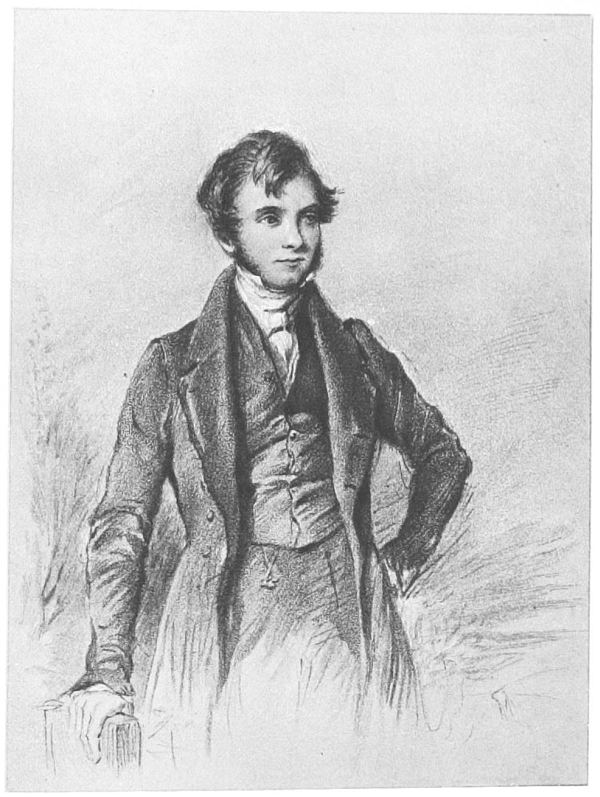
SAMUEL WILBERFORCE, Aged 29.
The next letter refers to the offer of the vicarage
of Ribchester, near Preston, in Lancashire, made
by the Bishop of Chester to Samuel Wilberforce.
"March 3, 1829.
"Whether regarded in relation to your bodily
strength, your spiritual interests, or to prudence in
affairs, I should be disposed to advise you to decline,
with a due sense of kindness, &c., the Bishop's offer.
Your constitution is not a strong one, and it is
highly desirable in that view alone that you should
for a time officiate in a small sphere, and if it may
be in a place where, as from your vicinity to Oxford,
you can have assistance when you are not equal
yourself to the whole duty. With such a scattered
population, there must be a call I conceive for great
bodily strength. Secondly, the situation appears to
me still less eligible considered on higher grounds.
It is no ground of blame to you that your studies
have not hitherto been of divinity. Supply all that
I should say under that head, were I not writing to
one who is capable himself of suggesting it to his
own mind. Again, you cannot have that acquaintance
with human nature, either in general, or in your
own self, which it would be desirable for any one to
possess who was to be placed in so wide and
populous a field, especially in one so circumstanced
as this particular place. Then you would be at a
distance from almost all your friends, which I mention
now in reference to the spiritual disadvantages
of the situation, not in relation to your comfort and
Emily's, in which, however, it may be fairly admitted
to some weight. Again, I should much regret your
being placed where you would naturally be called to
study controversial anti-Roman Catholic divinity,
rather than that which expects the cultivation of
personal holiness in yourself and your parishioners.
I could say much on this head. Thirdly, Mr.
Neale sees the objections on the ground of pecuniary
interest, as alone of so much weight, as to warrant
your refusing the offer—a vicarage. Its income is
commonly derived from small payments, and in that
district probably of poor people whom you would
not, could not squeeze, and yet without squeezing
from whom you probably would get nothing. Most
likely a curate would be indispensable."
On the same topic Wilberforce writes again:—
"March 17th, 1829.
"I ought to tell you that in the reasons I assigned
to the Bishop for declining his offer, one, and in
itself perhaps the strongest, (nay, certainly so, not
perhaps,) was my persuasion that for any one
educated and associated as you have been, it was
of very great importance with a view to your
spiritual state, (more especially for the cultivation
of devotional feelings and spirituality of mind,) that
he should in the outset of his ministerial course be
for some time in a quiet and retired situation, where
he could live in the enjoyment of domestic comfort,
of leisure for religious reading and meditation, and
devotional exercises; while, on the contrary, it was
very undesirable in lieu of these to be placed in
circumstances in which he would almost necessarily
be almost incessantly arguing for Protestant
principles—in short, would be occupied in the religion
of the head rather than of the heart. I own to
you in confidence (though I believe I shall make
the avowal to my dear Robert himself) that I am
sometimes uneasy on a ground somewhat congenial
with this, about the tutor of Oriel. For though I
doubt not the solidity of his religious character, yet
I fear his situation is far from favourable to the
growth in grace, and would, alas! need every help
we can have for the advancement of personal
religion within us, and can scarcely bear without
injury any circumstances that have an unfavourable
tendency. I trust my dear Samuel will himself
consider that he is now responsible for living in
circumstances peculiarly favourable to the growth
of personal piety, and therefore that he should use
his utmost endeavours to derive the benefits that
appear, (humanly speaking,) to be placed within his
reach. Oh, my dearest boy, we are all too sadly
lukewarm, sadly too little urging forward with the
earnestness that might justly be expected from
those that are contending for an incorruptible
crown. Did you ever read Owen on spiritual-mindedness?
There are some passages that to
me appear almost unintelligible (one at least), but
it is in the main, I think, a highly useful book. I
need not say how sorry we are to hear of Emily
being poorly. But our gourds must have something
to alloy their sweets. D. G. your mother
is recovering gradually, and now profits much from
a jumbling pony-chair; its shaking quality renders
its value to her double what it would be otherwise."[58]
"March 19, 1829.
"In speaking of Whately's book I ought to
have said that I had not got to the part in which
he speaks of imputed righteousness. I remember
it was an objection made to my 'Practical View'
by a certain strange head of a college that I was
silent on that point. The honest truth is, I never
considered it. I have always been disposed to
believe it to be in some sort true, but not to deem
it a matter of importance, if the doctrine of free
grace and justification by faith be held, which are,
I believe, of primary importance. Hooker, unless
I forget, is clearly for it; see his sermon on Justification.
I trust I need not fear your misconstruing
me, and supposing I can be advising you, either to
be roguish, or shabbily reserved. But really I do
think that you may produce an unfavourable and
false impression of your principles and professional
character, by talking unguardedly about Methodistical
persons and opinions. Mrs. R. may report you as
UNSOUND to the Bishop of Winchester, and he
imbibe a prejudice against you. Besides, my dear
Samuel, I am sure you will not fire when I say
that you may see reason on farther reading, and
reflection, and more experience to change or qualify
some of the opinions you may now hold. I own,
(I should not be honest if I did not say so,) that I
think I have myself witnessed occasions which have
strengthened with me the impression that you may
need this hint.... Have you any parishioners who
have been used to hear Methodists or Dissenters, or
have you any who appear to have had, or still to
have, much feeling of religion? I cannot help
suspecting that it is a mistaken notion that the
lower orders are to be chiefly instructed in the
ordinary practical duties of religion, whereas I own
I believe them to be quite capable of impressions
on their affections: on the infinite love of their
God and Redeemer, and of their corresponding
obligation to Love and Obedience. We found
peasants more open to attacks on their consciences,
on the score of being wanting in gratitude, than on
any other."
"April 3, 1829.
"Articles sent to Mr. Samuel—Bewick, Venn's
Sermons (2 vols.), White's 'Selborne' (2 vols.
bound in one), 2nd vol. of 'The Monastery.' A
lending library is, I think, likely to be considerably
beneficial. It cannot but have a tendency to
generate in the poor a disposition favourable to
domestic habits and pleasures, and to seek their
enjoyments at home rather than in the alehouse,
and it strikes me as likely to confirm this taste, to
encourage the poor people's children to read to
them. Send me a list of any books you will like
to have for your lending library, and I will by
degrees pick them up for you....
"We ought to be always making it our endeavour
to be experiencing peace and joy in believing, and
that we do not enjoy more of this sunshine of the
breast is, I fear, almost always our own fault. We
ought not to acquiesce quietly in the want of them,
whereas we are too apt to be satisfied if our consciences
do not reproach us with anything wrong,
if we can on good grounds entertain the persuasion
that we are safe; and we do not sufficiently consider
that we serve a gracious and kind master who is
willing that we should taste that He is gracious.
Both in St. John's first general Epistle, and in our
Lord's declaration in John xv., we are assured that
our Lord's object and the apostles' in telling us of
our having spiritual supplies and communion, is that
our joy may be full. It is a great comfort to me
to reflect that you are in circumstances peculiarly
favourable to your best interests. To be spiritually-minded
is both life and peace. How much happier
would your dear mother be if she were living the
quiet life you and Emily do, instead of being
cumbered about many things; yet she is in the
path of duty, and that is all in all."
"September 7, 1829.
"An admirable expedient has this moment
suggested itself to me, which will supersede the
necessity for my giving expression to sentiments
and feelings, for which you will give me full credit,
though unexpressed. It is that of following the
precedent set by a candidate for the City of Bristol
in conjunction with Mr. Burke. The latter had
addressed his electors in a fuller effusion of
eloquence than was used to flow even from his
lips, when his colleague, conscious that he should
appear to great disadvantage were he to attempt a
speech, very wisely confined himself to, 'Gentlemen,
you have heard Mr. Burke's excellent speech.
I say ditto to the whole of it.' Sure I am that
no language of mine could give you warmer or
more sincere assurances of parental affection than
you will have received in the letter of your dear
mother, which she has just put into my hands to
be inserted into my letter. To all she has said,
therefore, I say ditto. My dear Samuel, I must
tell you the pleasure with which I look back on
what I witnessed at Checkendon,[59] and how it
combines with, and augments the joyful gratulations
with which I welcome the 7th of September.[60] I
hope I am deeply thankful to the bountiful Giver
of all good for having granted me in you a son
to whose future course I can look with so much
humble hope, and even joyful confidence. It is
also with no little thankfulness that I reflect on
your domestic prospects, from the excellent qualities
of your, let me say our, dear Emily. I must stop,
the rest shall be prayer, prayer for both of you, that
your course in this life may be useful and honourable,
and that you may at length, accompanied by
a large assemblage of the sheep of Christ, whom
you have been the honoured instrument of bringing
to the fold of Christ, have an abundant entrance
into the everlasting kingdom of God."
"September 28, 1829.
"How much do they lose of comfort, as well as,
I believe, in incentives to gratitude and love, and if
it be not their own fault thereby in the means of
practical improvement, who do not accustom themselves
to watch the operations of the Divine Hand.
I have often thought that, had it not been for the
positive declarations of the Holy Scriptures concerning
the attention of the Almighty Governor of
the universe to our minutest comforts and interests
enforced by a comparison with the στοργἡ of parental
affection, we should not dare to be so presumptuous
as to believe, that He who rolls the spheres along,
would condescend thus to sympathise with our
feelings, and attend to our minutest interests. Here
also Dr. Chalmers' suggestions, derived from the
discoveries made to us through the microscope,
come in to confirm the same delightful persuasion.
I am persuaded that many true Christians lose
much pleasure they might otherwise enjoy from not
sufficiently watching the various events of their
lives, more especially in those little incidents, as
we rather unfitly term them; for, considering them
as links in the chain, they maintain the continuity,
as much as those which we are apt to regard as of
greater size and consequence."
"November 21, 1829.
"We have been for a few days at Battersea
Rise. But your mother will, I doubt not, have
told you the memorabilia of this visit, and especially
the inexhaustible conversational powers of Sir
James Mackintosh. I wish I may be able, some
time or other, to enable you to hear these powers
exerted. Poor fellow! he is, however, the victim
of his own social dispositions and excellences. For
I cannot but believe, that the superfluous hours
dissipated in these talks, might suffice for the
performance of a great work. They are to him,
what, alas! in some degree, my letters were to me
during my Parliamentary life, and even to this
day."
"December 17, 1829.
"We ought not to expect this life to flow on
smoothly without rubs or mortification. Indeed, it
is a sentiment which I often inculcate on myself
that, to use a familiar phrase, we here have more
than our bargain, as Christians, in the days in which
we live; for I apprehend the promise of the life
that now is, combined with that which is to come,
was meant to refer rather to mental peace and
comfort, than to temporal prosperity. My thoughts
have been of late often led into reflections on the
degree in which we are wanting to ourselves, in
relation to the rich and bright prospects set before
us as attainable in the Word of God. More
especially I refer to that of the Christian's hope
and peace and joy. Again and again we are
assured that joy is ordinarily and generally to be
the portion of the Christian. Yet how prone are
but too commonly those, whom we really believe
to be entitled to the name of Christians, disposed
to remain contented without the possession of this
delightful state of heart; and to regard it as the
privilege of some rarely gifted, and eminently
favoured Christians, rather than as the general
character of all, yet I believe that except for some
hypochondriacal affection, or state of spirits arising
from bodily ailments, every Christian ought to be
very distrustful of himself, and to call himself to
account, as it were, if he is not able to maintain a
settled frame of 'inward peace,' if not joy. It is
to be obtained through the Holy Spirit, and therefore
when St. Paul prays for the Roman Christians
that they may be filled with all peace and joy in
believing, and may abound in hope, it is added,
through the power of the Holy Ghost."
"Highwood Hill,
"December 31, 1829.
"My dear Children,—For to both of you I
address myself. An idea, which for so old a fellow
as myself you will allow somewhat to be deserving
the praise of brightness, has just struck my mind,
and I proceed to act upon it. Are you Yorkshireman
enough to know the article (an excellent one it
is) entitled a Christmas, or sometimes a goose or a
turkey pie? Its composition is this. Take first
the smallest of eatable birds, as a snipe, for instance,
then put it within its next neighbour of the feathered
race, I mean in point of size, the woodcock, insert
the two into a teal, the teal into a duck, the duck
and Co. into a fowl, the fowl into a goose, the goose
and Co. into a turkey. In imitation of this laudable
precedent, I propose, though with a variation, as our
Speaker would say, in the order of our proceeding,
that this large sheet which I have selected for the
purpose should contain the united epistles of all the
family circle, from the fullest grown if not largest in
dimensions, myself, to the most diminutive, little
William.[61] As the thought is my own, I will begin
the execution of it, and if any vacant space should
remain, I will fill it, just as any orifices left vacant
in said pie are supplied by the pouring in of the
jelly. But I begin to be ashamed of this jocoseness
when I call to mind on what day I am writing—the
day which, combined with the succeeding one, the
1st of January, I consider, except perhaps my birthday,
as the most important of the whole year. For
a long period (as long as I lived in the neighbourhood
of the Lock, or rather not far from it) I
used to receive the Sacrament, which was always
administered there on New Year's Day. And the
heart must be hard and cold, which that sacred
ordinance in such a relation, would not soften and
warm into religious sensibility and tenderness. I
was naturally led into looking backwards to the
past days of my life, and forward to the future; led to
consider in what pleasant places my lines were fallen,
how goodly was my heritage, that the bounds of
my life should be fixed in that little spot, in which, of
the whole earth, there has been the greatest measure
of temporal comforts, and of spiritual privileges.
That it should be also in the eighteenth century,
for where should I have been, a small, weakly man,
had I been born either among our painted or skin-clothed
ancestors, or in almost any other before or
after it? As they would have begun by exposing
me, there need be no more inquiry as to the sequel
of the piece. Next take my station in life, neither
so high as naturally to intoxicate me, nor so low as
to excite to envy or degradation. Take then the
other particulars of my condition, both personal and
circumstantial. But I need go no farther, but leave
it to you to supply the rest. And you will likewise,
I doubt not, pursue the same mental process in your
own instance also, and find, as may well be the case,
that the retrospect and prospect afford abundant
matter for gratitude and humiliation, (I am sure I
find the latter most powerfully called forth in my
heart by my own survey). Many thanks for your
last kind letter. You have precisely anticipated
what was said by the several dramatis personæ. It
is a real sacrifice for Emily and you to be absent
from my family circle. But the sacrifice is to duty,
and that is enough. And you have no small ground
for comfort, from your not having to go through
the 'experiment solitary,' as Lord Bacon terms it,
but to have one, to whom you may say that solitude
is sweet. But I must surrender the pen to your
dear mother."
The country was at that time extremely disturbed
by what were known as the "Swing Riots."[62] Bands
of rioters went about, burning ricks and threshing
machines, then newly introduced, and considered by
the labourers as depriving them of the winter
threshing work. Wilberforce seems to have shared
this feeling.
"Highwood Hill,
"November 25, 1830.
"Your mother suggests that a threshing machine
used to be kept in one of your barns. If so I really
think it should be removed. I should be very sorry
to have it stated that a threshing machine had been
burnt on the premises of the Rev. Samuel Wilberforce;
they take away one of the surest sources of
occupation for farmers in frost and snow times. In
what a dreadful state the country now is! Gisborne,
I find, has stated his opinion, that the present is the
period of pouring out the 7th Vial, when there was
to be general confusion, insubordination, and misery.
It really appears in the political world, like what
the abolition of some of the great elements in
the physical world would be; the extinction, for
instance, of the principle of gravity."
"December 9, 1830.
"I have been delaying the books that all might
go together. Mather's 'Magnalia'[63] shall be one
of them. There is a very curious passage in it
early in the volume, in which in Charles I's time,
he says, expenses have been increasing so much of
late years that men can no longer maintain their
rank in society. Assuredly this Government is
greatly to be preferred before the last. Brougham
better than Copley, and several highly respectable
besides, the Grants (Charles is in the Cabinet), Lord
Althorp, Sir James Graham, Lord Grey himself,
highly respectable as family men; Denman a very
honest fellow. The worst appointment is Holland,
Duchy of Lancaster; he has much church patronage
which, though I love the man, I cannot think
decorous. Lord Lansdowne, very decent, Lord
Goderich ditto. But your mother is worrying me
all this time to force me out, and Joseph declares
the letters will be too late. So farewell."
"December 17, 1830.
"I have always thought that your having a
strong virtuous attachment when you first went
to the University was a great security to you.
The blessed effects of this safeguard we shall one
day know. It will be a mutual augmentation of
attachment and happiness to find that those whom
we loved best had been rendered the instruments
more or less of our salvation....
"That religious feelings are contagious (if I may
use the word so), is undeniable, and there may be
temporary accesses of religious feeling, which may
produce a temporary effervescence, with little or none
of the real work of God on the heart. But you and
I, who are not Calvinists, believe that even where the
influence of the Holy Spirit was in the heart, that
Spirit may be grieved and quenched. The good
seed in the hearts of the stony-ground hearers is
just an instance in point. When my friend Terrot
was chaplain, of the Defence I think, great numbers
of the rough sailors were deeply affected by
his conversation and sermons, of whom, I think he
said, thirty only appeared in the sequel to be permanently
changed."
"January 4, 1831.
"You are now a man possessed of as much
leisure as you are ever likely to possess. What
think you of laying in materials for a Doctrinal and
practical History of Religion in England, in different
classes of society, and of males and females, from
the time of the Reformation to the present time or
perhaps to 1760. It was once my wish to write
such a work, but the state of my eyes long ago
rendered it impracticable. The sources from
whence the particulars for the work must be
derived are chiefly Lives and Memoirs. Numbers
of these have been published of late years, and the
object is one which would give opportunities for
exercising sagacity, as well as candour. There is
this also of good in it that, nullus dies sine lineâ, you
might be continually finding some fresh fact or hint,
which would afterwards be capable of being turned
to good account. The Annual Registers and the
different magazines and reviews would be rich mines
of raw material. Do meditate on these suggestions.
How very strong has dear Henry become both in
his opinions and his language! Really if he were
to go into the law, which Robert seems to think
not improbable, there would be considerable danger
of his getting into quarrels which might draw on him
challenges, the more probably because people might
suppose from his parentage, &c., that he most likely
would not answer a call to the field. I must say
that the becoming exempt, even in the world's
estimate, from the obligation to challenge or being
challenged may be no unfair principle of preference
of an ecclesiastical profession to any other. The
subject of duelling is one which I never saw well
treated; a very worthy and sensible man, a Scotchman
who was shipwrecked in Madagascar, I forget
his name (was it Duncan?) sent me one, his own
writing, but I thought it naught. And now my
very dear boy farewell."
Wilberforce writes to Mrs. Samuel Wilberforce
the day after his daughter Elizabeth's marriage.
Mr. Wilberforce to Mrs. Samuel Wilberforce.
"Highwood Hill,
"January 12, 1831.
"My dear Emily,—We had a delightful day
yesterday for our ceremony, and after the indissoluble
knot had been tied in due form, the parties
drove off about 12 o'clock to spend a few days at
Mr. Stephen's favourite residence of Healthy Hill,
as he terms it, Missenden. I really augur well of
this connection, having strong reasons for believing
Mr. James to be a truly amiable as well as pious man,
and my dear Lizzy is really well fitted for the office
of a parson's aider and comforter. It has given me
no little pleasure to have been assured by Mr. Dupré,
the curate of the parish, that she has been truly useful
to the poor cottagers around us. His expression
was, 'She has done more good than she knows of.'
This event, combined with the close of another year
and the anniversary of my own dear wife's birthday,
has called forth in me a lively sense of the goodness
of that gracious Being who has dealt so bountifully
with me during a long succession of years.
Dr. Warren, in 1788, as I was reminded when at
Brighstone, declared that for want of stamina there
would be an end of my feeble frame in two or
three weeks, and then I was a bachelor. After
this, near ten years after, I became a husband, and
now I have assured me full grown descendants,
and an offset in my Elizabeth. I have been receiving
many congratulations from being perhaps the
only living father of three first-class men, one
of them a double first and the two others in the
second also. Above all their literary acquirements
I value their having, as I verily believe, passed
through the fiery trial of an university, for such I
honestly account it, without injury. And it gives
me no little pleasure (as I think I have before
assured you), to add that I ascribe this in part to
the instrumentality of a certain young lady, who
was a sort of guardian angel hovering around him
in fancy and exerting a benign influence over the
sensibility and tenderness of his lively spirit. Farewell,
my dear Emily.
"Believe me, begging a kiss to baby,
"Ever affectionately yours,
"W. Wilberforce."
Mr. Wilberforce to the Rev. Samuel Wilberforce.
"February 8, 1831.
"My dear Samuel,—Pray both for your mother
and for poor William that they may be delivered
from μἑριμνα. The former, alas! lies awake for hours
in the morning, and cannot banish from her mind
the carking cares that haunt and worry her. We
profess to believe in the efficacy of prayer. Let us
prove the truth of our profession by at least not
acquiescing, without resistance, in such assailments.
It is more from natural temperament than from any
higher attainment that I am not the prey of these
corrosions. Something may be ascribed to the
habit of controlling my thoughts which I acquired
when in public life.... You might, I believe,
have shone in political life; but you have chosen
the better part. And if you can think so now when
in your younger blood, much more will you become
sensible of it by and by when you look back, if God
should so permit, on a long retrospect, studded with
records of the Divine blessing on your ministerial
exertions. Kindest remembrances to dear Emily,
and a kiss to little Emily, and the blessing of your
affectionate father,
"W. Wilberforce."
"Highwood Hill,
"March 4, 1831.
"I will frankly confess to you that I almost tremble
for the consequences of Lord Russell's plan of Reform
if it should be carried. I wish the qualification
had been higher. The addition to the County Representation
lessens the danger. Much in the judgments
we form on such practical questions depends
on our period of life. I find myself now at seventy-one
and a half far more timid and more indisposed
to great changes, and less inclined to promise myself
great benefit from political plans. I own I
scarcely can expect the plan to succeed, especially
in the House of Lords. We understand your
invitation to be for July and August. But I foretell
you plainly you shall not regularly walk with me, or
break off any habits which can in any degree interfere
with duty. We have not yet settled our plans.
Indeed, they may greatly depend on the convenience
of our friends. I well remember the Dean of
Carlisle used to say when invitations multiplied,
'Do you think that if you wanted a dinner there
would be so many disposed to give you one?' We
are now about to put this to the proof. I own now
that it comes to the point I am a little disposed to
exclaim, 'O happy hills! O pleasing shades!' &c.
But I should be ashamed were I to have any other
prevailing feeling than thankfulness. I feel most the
separation from my books. However, sursum corda."
Wilberforce writes to his friend Babington on
Lord Russell's propositions:—
Mr. Wilberforce to Mr. Babington.
"Highwood Hill,
"March 14, 1831.
"My dear Tom,—I fear you will be again
disposed to accuse me of treating you with neglect
(not, I hope, with unkindness) in suffering week after
week to pass away without returning answers to
your kind letters. I have really had as much
necessary writing on my hands, as even when I was
member for Yorkshire. But I cannot bear to think
that you are, day after day, looking out for my handwriting
(as you are opening your daily packets), and
looking out in vain. There have been many topics,
I assure you, on which I should have been glad to
communicate with you had I been able. I know
not how you have felt, but I must say I felt glad by
the consciousness that I was not now in a situation
to be compelled to approach, and act upon, the important
question of Lord John Russell's proposition.
On the whole, I think I should have been favourable
to it; chiefly, or rather most confidently, from
trusting that we shall do away with much vice and
much bribery which now prevail. I am persuaded
also that the change will be for the benefit, and
greatly so, of our poor West India clients.
I should like to know your sentiments on the
plan."
Mr. Wilberforce to the Rev. Samuel Wilberforce.
"April 8, 1831.
"And now, my dear Samuel, we have commenced
our wanderings. I write from Daniel Wilson's, who
treats us with the utmost kindness."
From this time Wilberforce had no house of his
own, but spent the remaining years of his life with
his sons and with his friends. In his own language,
he "became a wanderer without any certain dwelling-place."
"Kensington Gore,
"April 20th.
"It must be three weeks or more since Lord
Brougham, when on the woolsack, called Stephen,[64]
then attending the House of Lords, quasi master
(two of their description you perhaps know are
required to be always present; they take down their
Lordships' Bills to the House of Commons), and
after expressing in very strong language his concern
at having heard such an account as had reached
him of the state of my finances, and more particularly
of its being necessary for me to quit my own
house, and become a wanderer without any certain
dwelling-place, he stated that he had lately heard of
my having sons and a son-in-law in the Church, and
that he should be most happy to do what he could
for them. Lord Milton afterwards, as I understand
from Dan Sykes, expressed to Lord Brougham
some kind intentions towards me, and more especially
that he waived a claim or an application he had
been making for the living of Rawmarsh, as soon as
he learned that Lord Brougham had destined it to
me. Robert would not accept any living which
would not afford me a suitable residence."
"April 23, 1831.
"You cannot conceive how little time I appear to
have at my own command while passing our lives
in this vagarious mode, which, however, calls forth
emotions of gratitude to the Giver of all good, who
has raised up for me so many and so kind friends.
I ought not to forget, while a Gracious Providence
has granted me a good name which is better than
great riches, that many public men as upright as
myself have been the victims of calumny. I
myself indeed have had its envenomed shafts at
times directed against me. But on the whole
few men have suffered from them so little as myself."
"Bath, October 19, 1831.
"I am but poorly, and I am bothered (a vulgar
phrase, but having been used in the House of Lords
I may condescend to adopt it) with incessant visitors.
There is a person come over to this country from
the United States, of the Society of Quakers, for
the excellent purpose of obtaining popularity and
support for a society which has been in being for
nine or ten years—the American Colonisation
Society. I could not but assent to his proposal to
pay me a visit at this place. The time was when
such a visitor would have been no encumbrance to
me. But now that he takes me in hand when I
am already tired by others, (though it is only justice
to him to say no one can be less intrusive or more
obliging than he is), I do sink under it. My dear
Samuel, it is one of the bad consequences of the
plan you prescribed that I exhibit myself to you in
the state of mind in which I am at the moment,
though I should not otherwise have selected it for
that purpose.
"Friday, 12 o'clock, October 21st.
"Our American friend has left us this morning
But, alas! he has requested me to write in his album.
What a vile system is the album system! No, I do
not, I cannot think so, though I am somewhat
ruffled by being called on for my contingent, when
I have little or no supplies left to furnish it."
Wilberforce goes on to express his gratitude for
the safety of his daughter Elizabeth (Mrs. James),
who had been confined of a daughter.
"The mere circumstance that a new immortal
being is produced and committed to our keeping is a
consideration of extreme moment. Though I own
it sometimes tends to produce emotions of a saddening
character, to consider into what a world our new
grandchild has entered, what stormy seas she will
have to navigate. I will enclose an interesting
passage I have received from Tom Babington,
giving an account of Dr. Chalmer's speculations.
"I own I am sadly alarmed for the Church. There
is such a combination of noxious elements fermenting
together, that I am ready to exclaim, 'There is
death in the pot,' and there will be, I fear, no Elisha
granted to us to render the mess harmless. But
yet I am encouraged to hope that the same gracious
and longsuffering Being who would have spared
Sodom for ten, and Jerusalem even for one righteous
man's sake, may spare us to the prayers of the many
who do, I trust, sincerely sigh and cry in behalf of
our proud, ungrateful land. Yet, again, when I consider
what light we have enjoyed, what mercies we
have received, and how self-sufficient and ungrateful
we have been, I am again tempted to despond. I
wish I could be a less unprofitable servant. Yet I
must remember Milton's sonnet, 'They also serve
who only stand and wait.' Let us all be found in
our several stations doing therein the Lord's work
diligently and zealously. What do you think
of Shuttleworth's new translation of St. Paul's
Epistles? I have borrowed but not yet read them.
Affectionate remembrances to dear Emily, and a
kiss to sweet baby."
"Blaize Castle,[65]
"October 31, 1831.
"You will hear what dreadful work has been
going on at Bristol for the last eight and forty
hours. Sir Charles Wetherell[66] escaped from the
fury of the mob by first hiding himself in some
upper room in the Mansion House and then
passing, disguised in a sack jacket, from
the roof of the Mansion House to that of
another house, whence he got to a distant part
of the town, and in a chaise and four returned
in all haste, (they say) to London. He was, as
Recorder, to have opened the Commission and
tried all the prisoners to-day. However, the latter
are now all at work again in their accustomed
callings. Not a single gaol, I am assured, is
left undestroyed. The Bishop's Palace, (and
Deanery too I am told), burnt to the ground.
The Custom House ditto, Mansion House ditto.
Poor Pinney, the Mayor, I was assured, behaved
on Saturday with great presence of mind. The
populace, however, got into the Mansion House
before the corporation went to dinner; so all the
good things regaled the ὁι πολλοι. Strange to say,
(just as in the London riots), people were allowed
to walk the streets in peace, and last night half the
people in the square were looking on at the depredations
committing by the other half. Well-dressed
ladies walked about great part of the night
staring as at a raree show. The redness of the
sky from the conflagration was quite a dreadful
sight to us in the distance. It is said they are
endeavouring to organise a force for the defence
of the city. It is very strange that this has been
so long delayed. I'm assured pillage has latterly
been the grand object. The deputation, I am told,
were followed by a cart, in which, as they went
along, they stowed the plunder. I have not said
it to your mother, for fear of her becoming still
more nervous,[67] (which need not be), by her finding
me entertaining such cogitations, but if I perceive
any grumblings of the volcano at Bath, before the
lava bursts forth I shall hurry your mother to a
certain quiet parsonage—though, alas! I cannot but
fear for the Church in these days."
"Blaize Castle, November 2.
"The Bristol riots, though in some particulars
the accounts were as usual exaggerated, were
quite horrible, and the great events as reported.
But a striking instance was afforded how easily
perpetrations, if I may use the word, the most
horrible may be at once arrested by determined
opposition. On Monday morning early the mobs
were parading about without resistance. But on
that morning the troops, a small body of dragoons,
charged them repeatedly at full speed, and not
sparing either the momentum or the sharpness
of their swords, no attempt at making a head
afterwards appeared. Afterwards the day was
properly employed in appointing a great number
of special constables and other civil force, and
every night, as well as day, since has passed in
perfect quiet. A great part of the plunder has
been recovered, and numbers of criminals have
been seized—some of them sent to a gaol
about seven miles off; and happily the condemned
cells have escaped the fury of the mob,
and have afforded a stronghold for keeping the
prisoners. I need not tell you in what a ferment
the mind of our host was thrown, indeed with
great reason. He had been threatened with a
visit at this place, and the best pictures were
stowed away in safe custody. I am persuaded
it has become indispensably necessary to form in
all our great cities and neighbourhoods a civil
police, properly armed and drilled. And thus, as
usual, out of evil good may arise."
"Bath, November 13, 1831.
"I think you know Mr. Pearse of this place,
an excellent and very agreeable man, and master
of the Grammar School at this place, a large
and flourishing one. He is a very musical man,
an intimate and long attached friend of Dr.
Crotch. I will consult him about your organ.
I believe I told you that I scarcely ever remember
finding my time so little equal to the
claims on it as at this place, though were I
asked 'What are you doing?' I should, alas!
say 'Nothing'; and even, 'What have you
to do?' still the same reply, 'Nothing'. I
have one occupation of an interesting and in
some degree of an embarrassing nature. Soon
after our arrival, I learnt that the only other
inmate of our house was a gentleman who had
been confined to his sofa for many months
from the effects of a rheumatic fever. He had
no friends with him, only a family servant who
attended on him. Naturally feeling for the poor
man, he and ourselves being the only inmates, I
sent a message to him to say that, if agreeable,
I should be happy to wait on him for a few
minutes. He returned an assenting and courteous
reply. Accordingly I called, and found
a very civil and well-behaved man. I found
that he had been fond of game, and had expressed
his regret that he could not purchase it (this
was his servant's report). Accordingly I sent
him some now and then. I soon afterwards was
told that he was a Roman Catholic. He is by
profession a lawyer at Pontypool. I have since
had several conversations with him, and find
him a decided Roman Catholic, but a man apparently
of great candour and moderation. I was
not surprised to find him strongly prejudiced
against Blanco White.[68] 'Oh,' he cried, 'I assure
you, sir, that book is full of the grossest falsehood.'
But I was a good deal surprised to
receive from him an assurance that he had been
reading with great pleasure in a book of my
writing; and I found, to my surprise, that quite
unknown to me Kendal had lent him the book.
I durst not have done it, but the event has
taught me that we may sometimes be too timid
or delicate. Can you suggest any mode of
dealing with my fellow lodger? Hitherto I have
gone on the plan of cultivating his favourable
opinion by general kindness, sending him game,
&c., and endeavouring to press on him the most
important doctrines of true Christianity and of
showing where the case is really so, that he may
embrace those doctrines and still continue a good
Roman Catholic. There is in the Christian
Observer for September last a critique on Dr.
Whately's sermons by the Bishop of Chichester.
He is said, in the outset, to have stated in a
pamphlet on the Bible Society controversy, that
the only books in the Scriptures which were fit
or useful for general circulation were Genesis,
Exodus, Job, Psalms, Proverbs, I think Isaiah,
but am not sure, the four Gospels, Acts, 1st
Timothy, 1st Peter, 1st John and Jude; all the
rest likely to do more harm than good."
"Bath, December 6, 1831.
"I am unaffectedly sorry for having been apparently
so dilatory in complying with your request
for hymns and tunes. I use the word apparently,
because to any charge of suffering any opportunity
of executing the commission to pass by
unimproved, I may boldly plead not guilty.
There never, surely, was such a place as this for
the frittering away of time. Two visits before
breakfast to the Pump Room, and two again
from 2 to 3-1/4 o'clock in the afternoon, make such
a chasm in the day, that little before dinner
(about 4-3/4) is left for any rational occupation.
Then not being able, for many reasons, to receive
company at dinner, we often invite friends to
breakfast, and as we cannot begin the meal till
10-1/2 at the soonest, we seldom have a clear room
till after 12. Sometimes morning callers come
in before the breakfasters are gone (as has been
the case this morning, when my old friend
Bankes has entered, taking Bath in his way
from his son in North Wales into Dorsetshire).
You owe this account of expenditure of my time
to my feeling quite uncomfortable, from the idea
of neglecting a commission you wished to consign
to me for prompt execution. I will put down in
any letter I may write to you any hymns and
hymn tunes which I like ('Happy the heart
where graces reign,' Lock tune), and you may
add together the disjecta membra into one list.
But I have not hymn-books here except G.
Noel's. At Highwood I have a considerable
number. Your poor mother is worried to pieces
by company and business. I am fully persuaded,
my dear Samuel, that you wish to lighten the
pressure on me as much as possible, and on
the other hand I doubt not you give me full
credit for wishing to make you as comfortable
as I can, and I really hope I shall be able to
go on allowing my children what is necessary for
their comfort."
"January 19, 1832.
"St. John says, you will remember, 'I have no
greater joy than to know that my children walk
in the truth.' This he could declare concerning
his figurative children. And well, therefore, ought
we to be able, at least, to desire to feel similar
sensations on witnessing the graces of our true, real
children. And I am in a situation to feel this with
peculiar force. Indeed, I hope I can say with truth
that the more frequent, more continued and closer
opportunities of witnessing your conscientious and
diligent discharge of your pastoral duties—opportunities
which I probably should not have enjoyed
in the same degree had I still a residence of my
own—more than compensate all I suffer from the
want of a proper home. Indeed, there are but
two particulars that I at all feel, i.e., the absence
of my books, and the not being able to practise
hospitality; though that is rather a vulgar word
for expressing my meaning, which is, the pleasure
of receiving those we love under our own roof,
joining with them morning and night in family
prayers, shaking hands with them, and interchanging
continual intercourse of mutual affection.
Well, the time is short, even for those who are
far less advanced than myself in the journey of
life."
"Bath, June 14, 1832.
"I forget whether you know the Dean of Winchester[69]
or not. We have many a discussion
together, and I now and then stroke his plumage
the wrong way to make him set up his bristles.
He holds the great degeneracy of these times. I,
on the contrary, declared to him that, though I
acknowledged the more open prevalence of profaneness,
and of all the vices which grow out of
insubordination, yet that there had been also a
marked and a great increase of religion within
the last forty years. And as a proof I assigned
the numerous editions of almost all the publications
of family prayers, beginning with the
Rector of St. Botolph's (Bishop of London's)."
"July 12, 1832.
"Though I do not like to mention it to your
mother, I feel myself becoming more and more
stupid and inefficient. I think it is chiefly a bodily
disease, at least there, I hope, is the root of the
disease. I am so languid after breakfast that, if
I am read to, I infallibly subside into a drowsiness,
which, if not resisted by my getting up and
walking, or taking for a few minutes the book
Joseph may be reading to me, gradually slides
into a state of complete stupor. Yet it is downright
shocking in me to use language which may
at all subject me justly to the imputation of
repining. And to be just to myself, I do not
think I am fairly chargeable with that fault. I
hope that which might at first sight seem to have
somewhat of that appearance is rather the compunctious
visitings of my better part grieving
over my utter uselessness. I do not like to give
expression to these distressing risings, because I
may not unreasonably appear to be calling for
friendly assurances in return of my having
been an active labourer. Yet when I am pouring
forth the effusions of my heart to a child to whom
I may open myself with the freedom I may justly
practise towards you, I do not like to keep in
reserve my real feelings. My memory is continually
giving me fresh proofs of its decaying at
an accelerated rate of progress. But I will not
harass your affectionate feelings; and however I
may lament my unprofitableness, and at times
really feel depressed by it, yet my natural cheerfulness
of temper produces in my exterior such
an appearance of good spirits that I might be
supposed by my daily associates to be living in
an atmosphere of unclouded comfort. So you
need not be distressing yourself on my account."
The rest of this letter shows that Wilberforce
had asked the advice of Samuel as to the wisdom of
engaging a Roman Catholic tutor for his grandson
"dear little William."[70] Samuel's answer was couched
in decisive terms against this step. Wilberforce,
however, was reconciled to the idea by the knowledge
that "dear little William's mother will be
always on the spot, always on her guard, watchful
and ready to detect and proceed against any
attempt whatever which might be made to bias
William's mind into undervaluing the importance
of the difference between the Roman Catholic
and the Protestant system, or still more to infuse
into his pupil's mind any prejudices against our
principles or personages, or any palliations of the
Popish tenets."
In the concluding year of Wilberforce's life,
though he complains of "becoming more and more
stupid and inefficient," the feelings and thoughts
which animated his life appear in full vigour. His
watchful love for his children, his hospitality, the
steady, faithful looking forward to the life everlasting—all
are there. Nor, until he has made one
more effort to secure the freedom of the slaves, does
the weary, diligent hand finally "lay down the pen."
"December 18, 1832.
"Although we should use great modesty in
speculating on the invisible and eternal world, yet
we may reasonably presume from intimations
conveyed to us in the Holy Scriptures, and from
inferences which they fairly suggest, that we shall
retain of our earthly character and feelings in that
which is not sinful, and therefore we may expect
(this, I think, is very clear), to know each other,
and to think and talk over the various circumstances
of our lives, our several hopes and fears
and plans and speculations; and you and I, if it
please God, may talk over the incidents of our
respective lives, and connected with them, those
of our nearest and dearest relatives. And, then,
probably we shall be enabled to understand the
causes of various events which at the time had
appeared mysterious."
"December 28, 1832.
"I should wish to suggest to you an idea that
arises from a passage in a letter from William
Smith.[71] The idea is that it might have a very
good effect, for any of my reverend children to be
known to manifest their zeal in the great cause
of West Indian emancipation, and slaves' improvement.
And as I am on that topic let me tell you, I
need not say with how much pleasure, that I really
believe we are now going on admirably. The
slaves will, I trust, be immediately placed under
the government of the same laws as other
members of the community, instead of being
under the arbitrary commands of their masters,
and (perhaps after a year) they will be still more
completely emancipated. I was truly glad to find
in the evidence taken before the House of Commons'
Committee (which the indefatigable Zachary[72]
is analysing), highly honourable testimony to our
friend's (Wildman's) treatment of his slaves. But
I ought not to conceal from you the connection
in which W. Smith's suggestion of the great
benefit that would result from my sons taking a
forward part in befriending the attempts that would
be made to stir up a petitioning spirit in support
of our cause, (for he informed me that efforts
for that purpose would be made). He stated that
it had been observed almost everywhere that the
clergy had been shamefully lukewarm in our cause;
and of course this, which I fear cannot be denied,
has been used in many instances for the injury
of the Church. You and I see plainly how
this has happened: that the most active supporters
of our cause have too often been democrats, and
radicals, with whom the regular clergy could not
bring themselves to associate. Yet even when
subjected to such a painful alternative, to unite
with them, or to suffer the interests of justice and
humanity, and latterly of religion too, to be in
question without receiving any support from them,
or to do violence to, I will not say their prejudices,
but their natural repugnance to appearing to have
anything of a fellow-feeling with men who are
commonly fomenting vicious principles and propositions
of all sorts; when placed, I say, in such
distressing circumstances, they should remember
that their coming forward, in accordance with those
with whom they agree in no other particular, will
give additional weight to their exertions, and prove
still more clearly how strongly they feel the cause
of God, and the well-being of man to be implicated,
when they can consent to take part with those to
whom in general they have been opposed most
strongly. The conduct of the Jamaica people
towards the missionaries has shown of late, more
clearly than ever before, that the spiritual interests
of the slaves, no less than their civil rights, are at
stake. In such a case as this, it is not without
pain and almost shame that I urge any argument
grounded on the interests of the clergy; and yet
it would be wrong to keep considerations of this
sort altogether out of sight, because one sees how
malignantly and injuriously to the cause of religion
the apathy of the clergy may, and will, be used,
to the discredit of the Church, and its most attached
adherents. It is not a little vexatious to find people
so ignorant, as too many are, concerning the real
state of the slaves, notwithstanding all the pains
that have been taken to enlighten them. Stephen's
book in particular has, I fear, been very little read.
When we were at Lord Bathurst's I saw plainly
that the speeches of a Mr. Borthwick, who had
been going about giving lectures in favour of the
West Indians, had made a great impression on
Lady Georgiana. But I must lay down my pen."