Most of the convicts sentenced to the Straits Settlements for short
periods of transportation were, as we have said, usually retained in the
convict jail at Malacca. Amongst these, in the sixties, was a very
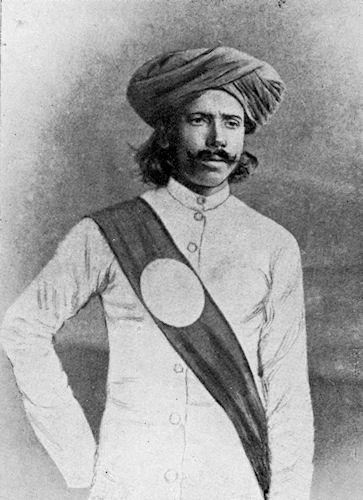
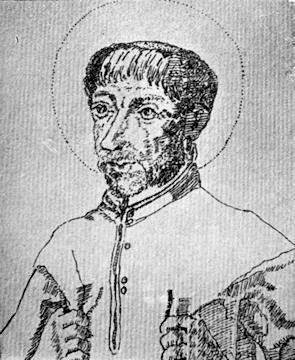
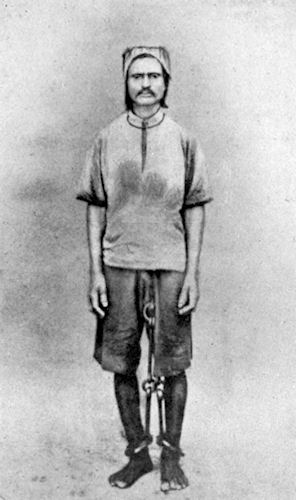
remarkable man, and known to both of us, of the name of "Tickery Banda,"
who was a native of Ceylon, and had received a sentence of seven years
in transportation for a crime committed in that island, though of which
he declared, like many of his congeners, he was perfectly innocent.
A story in connection with this man is given in Cameron's Tropical
Possessions in Malayan India, which is quite worthy of repetition here.
When the English took possession of Kandy, Tickery Banda and two or
three brothers, children of the first minister of the King of the
Kandians, were taken and educated in English by the then Governor of the
island. Tickery afterwards became manager of some coffee plantations,
and was so employed on the arrival of a Siamese mission of priests in
1845, who came to see Buddha's tooth. It seems that he met the mission
returning disconsolate, having spent some 5,000 rupees in presents and
bribes in a vain endeavour to obtain a sight of the relic. Tickery
learned their whole story, and at once ordered them to unload their
carts and wait for three days longer, and that he would in due time
obtain for them the desired view of the holy tooth. He had a cheque on a
bank for £200 in his hands at the time, and this he offered to leave
with the priests as a guarantee that he would fulfil his promise. He did
not say whether the cheque was his own or his master's, or whether it
was handed over or not; perhaps it was this cheque for the
misappropriation of which he found his way to the convict lines of
Malacca. The Siamese priests accepted his undertaking and unloaded their
baggage, agreeing to wait for the three days. Tickery immediately placed
himself in communication with the then Governor, and represented, as he
says, forcibly, the impositions that must have been practised upon the
King of Siam's holy mission, when they had expended all their gifts and
had not yet obtained the desired view of the tooth. The Governor, who,
Tickery says, was a great friend of his, appreciated the hardships of
the priests, and agreed that the relic should be shown to them with as
little delay as possible. It happened, however, that the keys of the
temple where the relic was preserved were in the keeping of the then
Resident Councillor, who was away some eight miles elephant shooting.
But this difficulty was not long allowed to remain in the way, for
Tickery immediately suggested that it was very improbable that the
Resident Councillor would have included these keys in his hunting kit,
and insisted that they must be in the Councillor's house. He therefore
asked the Governor's leave to call upon Mrs. ——, the Resident
Councillor's wife, and, presenting the Governor's compliments, to
request that a search be made for the keys. Tickery was deputed
accordingly, and by dint of his characteristic tact and force of
language, carried the keys triumphantly to the Governor.
The Kandy priests were immediately notified that their presence was
desired, as it was intended to exhibit the great relic, and that their
guardian officer would be necessary. Accordingly, on the third day, the
temple was opened, and in the building the Siamese priests and
worshippers were assembled, with Tickery on the one side, and the Kandy
or guardian priests on the other side, with the Governor and the
Recorder in the centre.
After making all due offerings to the tooth of the great Buddha, the
Siamese head priest, who had brought a golden jar filled with otto of
roses, desired to have a small piece of cotton with some of the otto
rubbed on the tooth, and then passed into the golden jar, thereby to
consecrate the whole of the contents. To this process the Kandy priests
objected, as being a liberty too great to be extended to foreigners. The
Siamese priests, however, persisted in their request; and the Governor
and Recorder, not knowing the cause of the altercation, asked Tickery to
explain. Tickery, who had fairly espoused the cause of the Siamese,
though knowing that in their request they had exceeded all precedent,
resolved quietly to gratify their wish; so, in answer to the Governor's
interrogatory, he took from the hands of the Siamese head priest a small
piece of cotton and the golden jar of the volatile oil. "This is what
they want, your Honour: they want to take this small piece of cotton,
so—; and having dipped it in this oil, so—, they wish to rub it on the
sacred tooth, so—; and having done this, to return it to the golden
jar, so; thereby, your Honour, to consecrate the whole of the contents
of the golden jar."
All the words of Tickery were accompanied by the corresponding action,
and of course the desired ceremony had been performed in affording
explanation. The whole thing was the work of a moment, and the Governor
and Recorder did not know how to interfere in time, though they knew
also that such a proceeding was against all precedent. The Kandy priests
were quite taken aback, while the Siamese priests, having obtained their
desired object, took from Tickery Banda's hands the now consecrated
golden jar with every demonstration of fervent gratitude. The Kandy
priests were, however, loud in their indignation, and subsequently the
Governor, patting Tickery on the back, said, "You have indeed settled
the question, and it is a pity you were not born in the precincts of St.
James', for you would have made a splendid political agent."
The next morning Tickery received a douceur of 1,000 rupees from the
Siamese priests, and has ever since been held in the highest esteem and
respect by the King of Siam and his Buddhist priests, being considered
quite a holy man, while periodically the King of Siam sends him
substantial tokens of the Royal favour.
* * * * *
It was remarkable what a wide difference there was between the accounts
given by the convicts themselves, of the circumstances which were the
cause of their transportation, and the summary of them given in the
warrants sent with them. Although many of them did not deny having
committed what the law looked upon as a crime, they, under the
circumstances, either considered that the act was justifiable, or
perhaps that it was the result of accident. Here is the case of a
convict who was sentenced to transportation for life for murder, given
as related by himself.
"In my Madras native village, I 'Rudrapah' was a planter (ryot). I was
possessed of several large paddy fields; some were near my house and
others were far off. At a little distance from my house a friend of mine
lived, 'Allagappen' by name. He also was a ryot, and possessed of paddy
fields. He often came to eat rice with me, and I often went to his
house; we were like brothers. At a village about six miles away, there
lived a man who was a breeder of cattle. He and his wife were very
partial to me, and it was arranged between us that I should marry their
daughter when she was old enough—she was then eleven years of age. All
went well for two years, and then I was married to the girl and took her
to my house. My friend, 'Allagappen,' used to come and visit us and eat
rice as before. Things went on very well for five or six years: my wife
and I were very happy together, and never quarrelled; we had only one
child. Having saved some money, I bought a bandy (a country vehicle) and
a pair of bulls, and used to hire them to any one travelling. Sometimes
my bandy would be engaged for a long journey, and I would be away from
my house for two or three days together, leaving my wife and child
alone. But now my trouble began. About six months after I bought my
bulls, one of them got sick and died. I had not then enough money to buy
another, and was on the point of selling the bandy and remaining bull,
when my wife proposed that we should ask her father to help us, as he
had plenty of bulls. I had not thought of this, and I said, 'Very
good.' We went and saw my father-in-law, and he agreed to let me have a
bull and pay for it as I earned money. Soon after that I hired my bandy
to a man to go to a town thirty miles away, expecting to be away some
days. I left my wife and child under the charge of a neighbour and his
wife, who promised to look after them. I and the man who hired my bandy
set out early in the morning, and reached the town about mid-day next
day. In the evening the man told me he was going to stay many days in
the town, and I could return to my house. He paid me, and I bought some
things I wanted. Early next morning, at daybreak, I set out on my
journey back to my village, and arrived there about 3 o'clock the next
morning; and after seeing to my bulls I went to my house and to my
surprise found the door unfastened. I entered without making any noise,
not knowing what could be the reason the door was not fastened. I went
quickly into my sleeping place, and there I saw my wife laying asleep,
and beside her was a man also asleep. On going close up to him that I
might see who it was, to my great sorrow I found that it was my friend,
'Allagappen.' It was my great misfortune that I had in my hands a
granite stone, or sort of muller, for grinding massalah (curry stuff)
which I had bought, and being so angered with my friend, and so overcome
with grief at finding my wife to be false, it made me tremble so much
that I let the stone fall from my hands, and quite unintentionally it
dropped on 'Allagappen's' head, and the stone being heavy it broke his
skull and killed him on the spot. My wife woke up, and seeing me, she
screamed and ran away from the house. She went to the neighbours' house
in whose charge I had left her. I followed her, and told them what I had
done: that morning I was taken by the police and locked up, and after
that I saw my house no more. I was tried by an English judge, and was
sentenced to be sent away from my country for as long as I lived: such
was my misfortune."
Here the tears came into the old criminal's eyes, and it was very
evident that there was still a soft place in his heart, showing a sign
of reclamation in spite of his convict life. This convict was pardoned
after serving twenty-five years.
* * * * *
As late as the year 1863 piracy had not been wholly suppressed in the
Straits of Malacca, and cases were by no means rare of native trading
craft being attacked by them. During this year a number of piratical
boats infested the mouths of the rivers Prye, Juroo, and Junjong on the
Malay Peninsula, and the South Channel between Penang Island and the
mainland of Province Wellesley; and many a tongkong belonging to Chinese
traders between Penang and Laroot was attacked by them and plundered,
and sometimes the crews were murdered.
Some of these pirates were in the habit of going about in Penang and
quietly ascertaining what tongkongs were about to sail, and all
particulars in regard to their cargo, crew, and so forth. Two of them
having discovered that a tongkong owned and manned by Chinese was about
to leave Penang for Laroot with some valuable cargo and $2,000 of specie
on board, disguised themselves as "hadjis," or Mohammedan pilgrims, and
engaged a passage in her. They arranged with some of their confederates
to have a prahu, or fast sailing boat, at a certain place off the Juroo
River, and when the tongkong in which they were passengers reached this
spot a signal was to be given, and the prahu was to run alongside the
tongkong; and after plundering her and gagging the crew, the pirates
intended sinking the tongkong and making off in the prahu. They carried
their villainous scheme into execution, but meeting with stouter
resistance from the crew of the tongkong than they had anticipated, they
killed, as they thought, every man on board, and were preparing to
scuttle the tong-kong, when a boat containing Indian convicts, and
employed in carrying coral for the Government lime kilns, and which,
unperceived by the pirates, had been rapidly approaching, came alongside
the tongkong, having been attracted by the yells and cries of the
victims. The pirates, recognizing that they were convicts, immediately
got into their prahu, and made sail as fast as they could; and she,
being a very fast sailer, was soon out of sight. The convict tindal in
charge of the boat, with one or two convict boatmen, went on board the
tongkong and found all the crew and passengers dead; but fancying they
heard groans they searched round the tongkong, and at last found one of
the Chinese boatmen clinging to the rudder. They lifted him on board,
and found that he was severely cut about, and covered with wounds. The
convict tindal in charge of the Government boat then shaped his course,
with the tongkong in tow, for Butterworth, in Province Wellesley, which
they reached early in the morning. The wounded Chinaman was taken to the
hospital, a report was made to the police of the pirates' attack, and
the tongkong was handed over to their charge. From the description of
the prahu given by the convict tindal, and the information gathered from
the Chinaman when he was able to talk, the police were enabled to trace
the prahu to Sunghie Rambay, where the pirates were arrested. The case
was tried at the Supreme Court, Penang; some of the pirates were hanged,
and the rest sentenced to penal servitude. The tindal of the Government
boat and the convict boatmen were highly commended by the judge for
their conduct, and were otherwise rewarded by the authorities.
* * * * *
We have referred elsewhere to the numerous races of India which went to
form the convict body in the old Singapore jail. We found this admixture
of castes and tribes a very valuable corrective against a possible
chance of insurrection, and for the discovery of plots of escape; and,
indeed, sometimes as a means of finding out any serious mischief that
might be brewing in the jail.
It seems to delight many a native of India to be a spy upon another; and
though intrigues were never encouraged, nor as a rule listened to, yet
now and again an informer would appear when the matter was of sufficient
importance to be reported to the authorities.
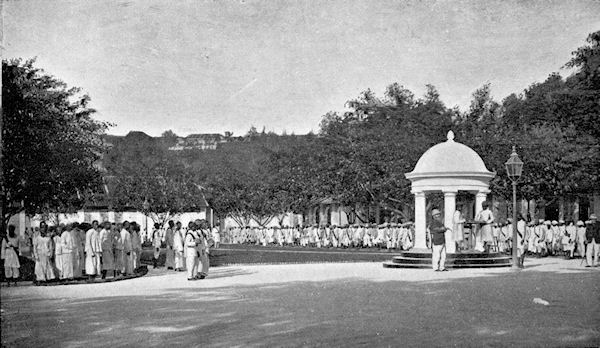
As an instance of this it may be recorded that on one occasion there was
a dispute between two Sikhs, one of the "Ramdasee" and the other of the
"Mazahbee" sect; and as they went from high words to blows they were
placed in confinement and brought before the Superintendent[15] in the
Inquiry room. After full investigation into the matter, the "Mazahbee"
Sikh was proved to have been the instigator of the quarrel, and he was
punished. The whole of his sect appear to have resented this judgment,
and determined amongst themselves to be avenged, and to inflict some
pain or injury upon the Superintendent. They began to plot and to scheme
as to the best way to carry out their design; and this plotting was not
lost on the observation of a clever Parsee convict, who, having traded
in Northern India, knew their language. He watched them closely, and had
decided when their plans were matured to inform the authorities.
The scheme was only ripe for execution, however, on the very morning of
the muster, so that there was no time for the Parsee convict to acquaint
the chief warder; and as a last resource, therefore, he made up his mind
to inform the Superintendent at the muster as to what was in store for
him. Creeping stealthily along the rear of the standing men, he timed
the arrival of the Superintendent going down the front on his
inspection; and, stooping down, he thrust his head between the legs of
the front rank men, and level with the ground, calling out only loud
enough for the Superintendent to hear, "Khabardar sahib Sikh kepas
tamancha hai"—"Look out, sir; a Sikh has a pistol." The Superintendent
took no notice of the warning until he had passed to about the middle of
that line, then he ordered the chief warder to take a dozen of the Sikhs
who were standing at the end of the line, and move them off into their
ward that he might inspect their boxes, and he added, "Search them
thoroughly."
As the Superintendent passed the end of the line, and was about to
inspect another line at right angles to it, no shot had been fired; so
he concluded that it was either a false alarm, or that the miscreant was
amongst the dozen men in the ward. And so it proved; for shortly
afterwards, the chief warder came to report that he had found a loaded
pistol on the person of one of the Sikh convicts, and had placed him in
a cell to await investigation.
After the muster an inquiry accordingly took place, and it turned out
that a fellow-tribesman had managed to pass the main gate with a pistol
secreted about his person, and had handed it to the man to whom the lot
had fallen to do the deed.
The would-be assassin was sentenced to heavy irons, and placed in the
refractory ward. The gang was eventually broken up, the ringleaders
being transferred to Penang, and the remainder kept in Singapore under
close observation. The Parsee convict, who checkmated the conspirators,
was advanced from the third to the second class, and otherwise rewarded.
The design on the life of the late Colonel Macpherson, the immediate
predecessor of the above, was also similarly frustrated by another
Parsee, who, on the evening before muster, observed a man burying a
knife in the sandy ground near which he had to stand for inspection.
Waiting his opportunity, he proceeded to the spot and withdrew the blade
from the knife, and replaced the handle just above the ground as he had
found it. When Colonel Macpherson passed the man on the morrow he
quickly seized the handle from the ground to make his stab, but only to
find that he was unexpectedly baulked in his villainous attempt to kill
his Superintendent.
* * * * *
His surname need not be mentioned, but he went by the name of "Funny
Joe." He was the son of a clergyman of the Church of England, sharp
witted, and well educated; but his moral character, from some cause or
another, became quite disorganised, and to the grief of his parents he
left his home and took to the sea. His education there stood him in good
stead, and under new surroundings he improved for the time, and
eventually rose to be chief mate of a ship. Had he persevered in this
good course, he would in all probability have succeeded well in the
mercantile service; but events proved otherwise, and on his second
voyage as mate he was, he said, wrongfully charged as being both
insolent and insubordinate to his commander, and on the arrival of the
vessel at the Cape of Good Hope he was discharged. Left with but small
means, and, to him, almost on foreign soil, he bethought himself of some
expedient for making money; so, getting hold of a sailor loafing at the
port, he talked matters over with him, and they decided upon clubbing
their resources, hiring a hall, and circulating posters that on a
certain night at "so much," and "so much" for entrance, a man might be
seen "walking on the ceiling like a fly." On the night advertised the
hall was crowded. "Funny Joe" then went to his companion, who was
collecting the money, and took from him the amount he had received, and
told him he might have all the rest that he could collect. He (Funny
Joe) then decamped, and was never heard of more in Cape Town. He was
next at Rangoon, where he got into the same plight for want of funds;
but his mother wit came to his aid again, and this time he posed before
the public as a naturalist who had discovered off the coast what he
pronounced could be nothing else than a "mermaid," and for the
exhibition of this marine creature, which he had cleverly constructed
from the head and breast of an ape and half the body of a fish, he
obtained a good round sum. We hear of him next at Singapore, where he
also advertised his "mermaid" as being on exhibition at a certain
boarding establishment. There, however, the "mermaid" did not succeed,
and his funds being exhausted he possessed himself of a watch and some
cash, the property of the people of the house with whom he lodged, and
for which he was sent to jail. Here he came under some strict discipline
and good wholesome advice, and it was in the Singapore jail that he told
the story of his life as given above.
When the term of his sentence had expired, and he was about to be
discharged, he warmly thanked the Superintendent for his counsel, and
declared very positively that he intended to turn over a new leaf.
We believe that he did so; at all events, the last heard of him was that
he had signed articles as mate of a ship; and he scrupulously returned
to the Superintendent (Major McNair) the money he had advanced to him
from his private purse to make a new start in life.
* * * * *
It is well known that the Cobra di Capello is one of the most deadly of
the snakes of India and the East. The palish yellow cobra of India is
perhaps more dangerous and surely fatal in its bite than the black
"cobra" or "kala samp," which is more frequently found in the Straits
Settlements, but neither of them is very pleasant to be in close
proximity to.
The Cobra.—As we have noticed elsewhere, some of the convicts were
very expert in catching these reptiles and extracting their fangs. The
following personal incident is given by a public works officer:—
"When the new cantonments were in progress at Tanglin I was placed
in charge of the works by Col. G. C. Collyer, R.E., the then Chief
Engineer of the Straits Settlements, and was permitted to occupy a
part of a large house on the estate. The bath rooms were on the
ground floor, and stairs from the bedrooms above led down to them.
One morning, just as I was sitting down to breakfast, my convict
orderly came running to me and said that a large 'cobra' had
crawled up the drain leading from the main drain at the back of the
house to the bath room. We went immediately to the bath room, and,
finding that the snake had not made his appearance inside, I
stopped up the opening into the drain with a towel, and the convict
orderly, who had gone round to the outer end of the drain, began
pushing a long bamboo up it. This drove the snake to the upper end.
The convict, then, with a pickaxe, loosened a brick from the
covering of the drain close to the wall of the house, while I
stirred up the bamboo rod. The convict then gently and by degrees
removed the brick, and in an instant the snake emerged fully from
the drain, raising its hood and hissing at us. It then retreated
back to the drain, when the convict dexterously seized it by the
tail, and, drawing it out, held it tight by the neck. The convict
then teased the snake with his coarse flannel 'kumblie,' or
blanket, and it struck at it several times with its fangs; when,
with a sudden jerk, the convict drew out the fangs in the blanket,
and the snake became perfectly harmless.
"The snake was afterwards sent on board H.M. surveying schooner
Saracen, and getting loose on board was summarily destroyed, for
none on board had been told that its fangs had been removed."
The Crocodile.—Govindhoo, a convict employed at the Pulo Obin
stone quarries, was admitted into hospital with a lacerated leg,
the foot being almost severed from the body. He was visited by one
of us, and told his story as follows:—
"I was walking along the sea beach close to the water, when I was
suddenly seized from behind, and I at once saw that I was in the
jaws of a crocodile. I had nothing in my hand but my 'roomāl,' or
handkerchief, with my keys tied in one corner. I hit at his head
with this, but it was of no use, and finding myself being dragged
into deeper water, I suddenly thought I could dig out both his
eyes,[16] and I did it, and very shortly afterwards he let me go,
and I half swam, half paddled back to the shore."
The convict's leg had to be amputated.
The Malays say that there are three descriptions of crocodiles, or,
as they call them, "buaya." The first is the "katak" or frog
crocodile, the second the "labu" or gourd crocodile, and the third
is the "tumbaga" or copper crocodile. The frog crocodile is the
most active, and we have often been told by Malay boatmen, when
going up a river, to keep our hands and shoulders well within the
boat, for fear of their sudden attack. There are, however, known
to our naturalists a dozen or more different forms of the crocodile
proper, and it is said that they have been found up to thirty feet
in length; but from eighteen feet to twenty feet is the longest
found in the Straits of Malacca. They may often be seen in the
Malay rivers, and on the coast, floating in the water, with the
snout well above the surface, on the look out for prey.
* * * * *
The Chinese have one superstition amongst many in regard to tigers. They
believe that when a person is killed by a tiger his "hantu," or ghost,
becomes the slave of the beast and attends upon it; that the spirit acts
the part of a jackal, as it were, and leads the tiger to his prey; and
so thoroughly subservient does the ghost become to his tigerish master,
that he not infrequently brings the tiger to the presence of his wife
and family, and calmly sees them devoured before his ghostly face.
A very ingenious tiger trap was invented by Mr. Frank Shaw, of Caledonia
sugar estate, in Province Wellesley, which is worth describing. It was
constructed at the foot of a small hill, about a mile away from the
estate, where there was a considerable area of secondary jungle and
gigantic bracken fern, a favourite resort of tigers. A trench, about
four or five feet wide, was opened in the sloping ground for a distance
of ten or twelve feet; stout stakes were driven in the trench close to
the sides, projecting some three or four feet above the ground, for
about two-thirds the length of the trench; the remaining one-third at
the upper end was converted into a strong cage, or pen. This pen
communicated with the other part of the trench by an opening in which a
gate in two flaps was fitted; a heavy cover, weighing ten or twelve cwt,
of round logs was made to fit the open part of the trench, and so
arranged in an inclined position, and connected by triggers with the two
flaps, that any attempt to open the latter released the upper end of the
heavy cover and allowed it to fall down in the trench. A couple of goats
were tied at the far end of the pen as a bait, and were kept there
constantly, food being taken to them by a convict coolie. After the trap
had been set for some time, the coolie who fed the goats came running to
the house one day with the news that a tiger was caught in the trap. Of
course every one set out immediately to secure the animal. The tiger had
evidently tried to push in between the two flaps to get at the goats:
this released the triggers, and the jerk and movement of the cover had
evidently alarmed the animal, who tried to back out; but the weight and
force of the falling cover on its back had pressed the beast down flat
on the ground and rendered him powerless. The difficulty now was to
dispatch the tiger. Only its hind quarters could be seen; and a revolver
shot was fired into the body. After a while the cover was raised a
little, and a bullet in the brain finished the work. The cover was then
entirely removed, and the carcase taken out of the trap; the fore and
hind feet were tied together, and it was slung on a pole in the usual
way, eight Kling convict coolies lifted the load and started for the
sugar mills. They, however, soon got tired. Half a dozen more convicts,
who were at work on the road, were then called in to assist, and at last
they reached their journey's end.
On arrival at the sugar mills it was skinned, the skin becoming the
property of the manager, and the natives disposed of the flesh. The
animal proved to be a tigress, and evidently had young cubs, as she had
a quantity of milk. This the Chinese coolies were very eager to secure,
as it is by them considered to be a valuable medicine. We never heard
whether any more tigers were caught in this trap.
The ordinary method, however, adopted for catching tigers is by means of
pits, which are dug from twelve to fifteen feet in depth, and somewhat
pyramidal in form. Sometimes pointed stakes are fixed in the bottom of
the pit. The mouth is covered over with light brushwood, and when
convenient, a tree is felled and laid a few feet from it across the
tiger's track, so that the animal in leaping off the tree adds impetus
to his own weight in falling into the trap.
The trouble of digging these pits is not so slight as might be
supposed, as the construction of a pit in the proper manner fully
occupies a couple of convicts a fortnight, besides the risk of being
interrupted in their labour by the tiger happening to encounter them,
and, naturally enough, on finding the work they were engaged upon,
testifying his displeasure at the treachery they were meditating against
him by making a meal of them.
An Indian sportsman wrote to the Singapore Free Press, at the time
when so many Chinese were being destroyed at Singapore, saying:—
"I have been accustomed to tiger hunting in India, but the same
mode could not be adopted here, the jungle being of a different
character. Indeed, the only plan which is likely to be attended
with success is by setting traps; and it is to be regretted that
the local Government did not long since take some pains to prove
this to the cultivators. Had this been done, many lives might have
been spared." The Chinese were evidently delighted at the interest
shown by the European gentlemen on the last occasion, and it is to
be hoped that they will exert themselves to rid the island of
tigers by this means.
While the ravages of tigers were destructive of human life on land,
crocodiles were almost equally as mischievous on the coast and in the
rivers, and many Chinese and other natives fell a prey to their
voracity. Sometimes bathers were attacked; at other times fishermen,
shrimp catchers, and oyster divers were carried off or attacked by them.
Some crocodiles, like some tigers, have a peculiar partiality to human
flesh, and often display remarkable ingenuity in gratifying their
appetites. Regular man-eater crocodiles existed in some of the rivers in
the Straits Settlements, notably in the rivers in Province Wellesley;
but many were found also in the rivers in Singapore and Malacca, as well
as on the sea coast. Some of these man-eaters were very bold, and would
attack natives in their canoes, sometimes getting under the canoe and
upsetting it in order to devour the occupants. Cases have been known of
persons being snatched out of boats. A case of this kind happened in the
Prye River, in Province Wellesley. The supervisor in charge of the
public works was proceeding in a ferry boat with some convicts to repair
the boundary pillar, situated some distance up the river, when suddenly
a splash was heard, and his convict orderly, who was squatting in the
bow of the sampan, or boat, uttering a cry, stood up, at the same time
pointing to the stern of the boat. Upon looking round, a Chinaman, who
had been seated in the stern of the boat, was found to be missing. A
crocodile had, as it were, shot up out of the water, and, seizing the
Chinaman by the waist, had drawn him down into the river, and nothing
more was seen of them at the time. Shortly afterwards, a canoe with a
Malay man and his wife in it was upset near the same spot by a
crocodile, and both of them disappeared. A little later a Kling, who had
been in the habit of diving for mud oysters near Qualla Prye Ferry for
many years, and had repeatedly been cautioned about his danger in doing
so, was missed, and it was ascertained that he had been seen diving for
oysters as usual, and had suddenly disappeared, and had not been seen to
come up again.
This sort of thing went on for some time, and the crocodiles could not
be caught. At last the convicts stationed at Prye town convict lines
succeeded in capturing a large crocodile, and this is how they managed
it. They prepared a bait by tying a strong hook underneath the body of a
pariah dog. One end of a piece of light iron chain[17] was fastened to
this hook; the other end was fastened to a log of very light wood as a
buoy. They then went in a boat to that part of the river where the
greater number of casualties had occurred. Here they drifted about, at
the same time pinching the dog's ears and otherwise tormenting him to
make him yelp. After watching the surface of the water for some time,
they descried the V mark on the water indicating the approach of a
crocodile; then, throwing the dog and buoy overboard, they pulled away
for some distance to watch the result.. They saw the crocodile rapidly
approaching the dog, who was swimming for his life. Suddenly there was a
howl, and the dog disappeared. Then they watched the buoy, which would
sometimes disappear under the water and then rise again to the surface;
and in this manner they traced the crocodile, and followed him into a
small creek, where he crawled on shore; and there they dispatched him
with musket balls. This crocodile measured fourteen feet from the tip of
his nose to the end of his tail, and was said to be the largest specimen
captured at that time, but they have been known to reach from eighteen
to twenty feet in length. Upon opening him a human leg and a pair of
Chinaman's trousers were discovered, and it was concluded that this was
one of the man-eaters.
As an illustration of the effect of shock upon the human system at the
sight of wild beasts, we may mention a case of a Malay fisherman who was
shrimping on the bar at the mouth of the Krian River (Province
Wellesley), when a crocodile approached him from behind and seized him
by the thigh. The Malay drew his parang and hacked away at the
creature's nose until he let go. Some convicts stationed at Nebong Tubal
and a Malay police peon saw what was happening and put off in a boat to
his assistance. They rescued the poor fellow, and the police conveyed
him at once by boat to the hospital at Butterworth, where his wounds,
which were not very serious, were attended to; but the shock to the
nervous system was so great that the man lost his reason, and would
constantly leave his cot and walk down the hospital ward, moving his
hands up and down, as if in the act of shrimping. He died shortly
after. A similar case of shock, and a well-known story in the Straits
Settlements, occurred in Province Wellesley, but this was from a tiger.
A Roman Catholic priest was returning to his house after breakfasting
with a planter at Alma, and when passing through some tall "lalang"
grass a tiger suddenly sprang out into the path a few yards in front of
him. The priest, with great presence of mind, suddenly opened his
Chinese umbrella in the face of the tiger; the animal gave a leap round
to one side, and the priest repeated the umbrella movement. The tiger
then gave another leap round to the other side, and the umbrella action
was again performed. This was renewed till the tiger, who evidently was
not hungry, and had taken alarm, made a disappointed growl and bounded
away into the high lalang grass, and the priest hastened on his way
home. On reaching his house he took a cold bath, to brace up his nerves
as he said; but the next day he was confined to his bed, and died a
fortnight after the event, due entirely, it was said, to the shock that
he had sustained.
* * * * *
As we have already intimated, the house of correction at Singapore was
under the management and control of the Convict Department; and there
were frequently from thirty to forty Europeans confined in this prison,
chiefly seamen on short sentences for neglect of duty on board ship.
When Sir Robert McClure was commanding a vessel of war[18] in Chinese
waters about 1859, his ship was on the Singapore station for some little
time; and upon his arrival he sent in to the house of correction a very
incorrigible man-of-war's man named John —— (we will not give his
surname, for he may be yet alive). This man had been several times
punished while the ship was in China, and had been twice sentenced to be
flogged. We heard all about him from the officer of the ship who had
brought him ashore.
His sentence was three weeks' imprisonment: the first week in solitary
confinement on bread and water, and congee or rice gruel diet. Upon his
receipt into the prison, after the usual routine, he was placed in one
of the penal cells, and bread and water set before him. Before the cell
door was closed, he looked hard at the chief warder, saying, "Take away
that filth; I won't eat it." The chief warder reported to the
Superintendent that the man in the cells was a dangerous-looking
character, and he was afraid we should have trouble with him, for he had
never seen a man with such a hang-dog look. The morning of the second
day he had touched neither bread nor water, though fresh had been given
him, and in a churlish manner he said to the chief warder, who had
remonstrated with him, "I'll eat the tail of my shirt first, before I
eat what you bring me." The doctor visited him, and made his report to
the Superintendent that he was a strong man, and in excellent health,
and that he might be safely left until hunger obliged him to eat, but
that he would see him twice a day.
Upon the afternoon of the second day the Superintendent himself, upon
his inspecting the prisoners in the penal cells, entered this prisoner's
cell, and the following dialogue ensued: "What is your name?" "What is
that to you?" "But I am the Superintendent of this jail, and I ask you a
simple question, and I want a simple answer." Then looking at the
Superintendent with a disrespectful air the prisoner said, "Look at my
warrant if you want to know it." "But I want to hear it from yourself."
"Well, if it is any satisfaction to you, my name is John ——" The
Superintendent then said, "Now I want to know what part of England you
come from." "Well, what do you want to know that for? but I say again,
if it is any satisfaction to you, I come from Saltash." "So you are a
Cornishman, are you?" replied the Superintendent. "I know Saltash very
well. It is a fine old place. And I know the Viaduct, and the cottages
over against it. I wonder if you were born there in one of those
cottages? Perhaps you were, and have a mother now living there; and if
you have, and she knew that her son was now in an Indian jail, you
would break that old woman's heart, that you would." This ended the
conversation, and the cell door was shut.
Late in the evening the chief warder sent a special messenger to the
Superintendent's quarters, asking him to visit the prison before
nightfall, for the prisoner in the cells from the man-of-war in the
harbour had something to communicate. So before it was yet very dark the
Superintendent went down, and the cell door being opened, and the
bull's-eye lantern turned upon the man, the Superintendent at once
noticed a change in the countenance of his prisoner, for the reckless,
devil-may-care expression had shifted, and as if by some good influence
within. "Well, you sent for me, and I have come; what do you want?" said
the Superintendent. Then in a faltering voice, and with tears in his
eyes, the prisoner said, "I only want to say, sir, before I go to sleep,
that you are the first man that has ever overcome me, for you spoke to
me of my 'mother'; and now, sir, you can do anything you like with me,
and I'll carry out my sentence properly, and go back aboard my ship and
do my duty as a British sailor ought to do."
And he did; and after his release went in the ship on to Bombay, from
whence the Superintendent heard from Sir Robert McClure that John
—— was as well behaved a man as he had on board, and that the treatment
he had received in the Singapore jail had quite altered his nature, and
he would like to know the prescription for it.
Very often, when a long course of positive punishment has ceased to have
its effect, a contrary treatment may lead to quite a change in the
character, and if anything will touch the heart of a vicious Briton, it
is to bring him to think upon the early counsels of a godly mother.