THE PRISON COMMISSARIAT.
The least that can be said of the prison sustenance is that it was
exceedingly slim. But while the per diem rations dealt out to an
Andersonville prisoner were too small for proper maintenance, and much of
the time inferior in quality, yet the thirty-two thousand to thirty-five
thousand men who had to be fed were as a rule promptly served.
To secure this result effective organization was necessary. It was
accomplished as follows: Groups of two hundred and seventy men were named
detachments and duly numbered. Every detachment was divided into the
first, second and third nineties, each of which was in charge of one of
our own sergeants. The nineties, in turn, were divided into the first,
second and third thirties, which also were in charge of a sergeant or
corporal.
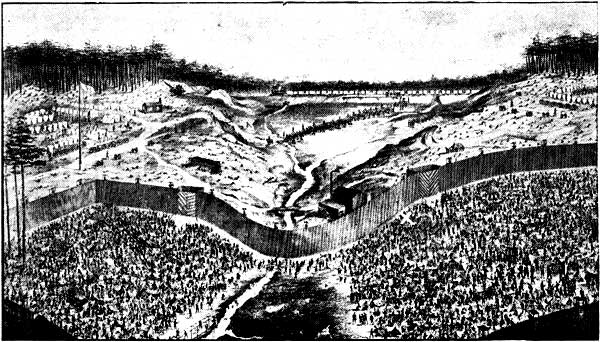
At ten o’clock every forenoon a drum call was beaten from the platform at
the south gate. At this signal the prisoners fell into line by
detachments, forming as best they could in the narrow paths that separated
the small tents, blanket shanties or dug-outs. At the same moment a
company of Confederate sergeants entered the two gates for the purpose of
counting and recording the number of the prisoners. To each of these
officers a certain number of detachments were assigned. The men,
unsheltered from the fierce sun-heat, had perforce to remain standing
during the entire count. If a number less than that of yesterday was in
evidence, the Federal sergeant had to account for the deficit. Sometimes a
number of men were too ill to stand up, so the line was held the longer
while the Confederate official viewed the sick where they lay.
The bodies of those who had died since the count of the previous day were
early in the morning carried to the south street and laid in a row until
the ration wagon could haul them to the burying trench. On a card attached
to the wrist of the deceased was written by the detachment sergeant, his
name, regiment and date of death. These names were taken by the
enumerator, who verified the record as the bodies were carried through the
gate. Such was the scarcity of clothing that garments of any value were
taken by comrades from the dead before interment.
In the early summer prisoners were occasionally detailed under guard to
carry the dead some distance from the gate. On the return they were
allowed to gather up chips which had accumulated from the hewing of
stockade timbers. The quantity a man, weakened by hunger and disease,
could bring in would sell for five dollars, U. S. currency. Competition to
get out on one of these details became so intense that the privilege was
discontinued.
At four o’clock in the afternoon rations of corn bread and bacon were
issued on the basis of the morning count of those who are able to stand
up. Two army wagons drawn by mules entered the north and south gates
simultaneously. They were piled high with bread, thin loaves of corn bread
or Johnny cake, made of coarse meal and water by our men who had been
paroled for that work.
A blanket was spread upon the ground and the quantity for a detachment was
placed thereon in three piles; one for every ninety, according to the
number of men able to eat. In like manner the sergeants of nineties
sub-divided the piles to the thirties.
The writer had charge of a division of thirty and distributed as follows:
His blanket was spread in front of his shelter tent and on it he spread
the bread in as many pieces as there were men counted in the morning.
Each man had his number and was intently watching the comparative size of
the portions. “Sergeant,” cries one, pointing to a cube of bread, “That
piece is smaller than the one next to it.” A crumb is taken from the one
and placed upon the other. The relative size of any piece may be
challenged by any member of the thirty, for his life is involved.
The equalization is finally completed to the satisfaction of all. The
sergeant then takes up a piece in his hand and says, “Whose is this?” A
designated comrade looking the other way calls a number. The owner steps
up and takes his portion. This process is repeated until all are served.
Some four or five pounds of bacon are then cut on a board into small
pieces and issued in like manner.
The cube of bread and morsel of meat constitute the ration for twenty-four
hours. One-half may be eaten at once; the remainder should be put in the
haversack for breakfast. If any one yields to his insatiable hunger and
eats the whole for supper he has to fast until the following evening and
must then deny himself and put away the portion for the next morning’s
breakfast. Experiment proved that strength was better sustained by taking
the scanty ration of food in two portions than by eating the whole at
once.
When the number of prisoners exceeded fifteen thousand, the facilities of
the cook-house were inadequate. Therefore raw rations were issued
alternately every two weeks to each side of the prison. In this form the
amount per capita daily was a scant pint of corn meal and a scrap of
uncooked bacon.
Occasionally boiled rice and cow beans were substituted for the meal, but
these were very difficult to issue in accurate portions. Sometimes a
quantity of this glutenous food was carried in a sleeve of a shirt or in
the trouser’s leg tied at the end.
The supply of fuel for cooking was wholly inadequate. Often the ration of
wood was ironically called a “toothpick.” It would be split into small
short splinters and two men would sometimes combine their portions. Water
in a quart tin cup setting on small blocks of clay could be brought to a
boil before the wood under it was consumed. Into this water meal was
stirred and, if the blaze could be yet further economized, partially
cooked mush was the outcome. The sick could not, however, do this work for
themselves. Many ate meal uncooked, but the experiment soon ended life.
It may be observed that many of the Andersonville prisoners were well
supplied with money. The Federal armies were reclothed and paid off in the
spring of 1864. The new recruits and re-enlisted veterans, in many
instances, had with them bounty money when captured. Greenbacks could be
pressed into the sole of a shoe, or placed inside a brass button. In
various ways money was concealed about the person.
The authorities at Andersonville allowed supplies to be sold to the
prisoners for Federal money. Numerous small restaurants flourished in the
stockade. From small clay ovens they supplied fresh bread and baked meats.
Irish and sweet potatoes, string beans, peas, tomatoes, melons, sweet
corn, and other garden products were abundantly offered for sale. New
arrivals were amazed to find these resources in the midst of utter
destitution and starvation.
As this sketch is of the nature of personal experiences, the writer might
tell how, in his case, the question of increasing the food supply was
solved. A ration of fresh beef received by his thirty consisted of a shank
bone on which a small amount of lean meat remained. This latter was cut
into portions about the size of a little finger. These were easily issued,
but what shall be done with the bone which towered on the meat board above
the diminutive strips of beef? No tools were available by which it could
be broken up. One and another cried out, “I don’t want the bone for a
ration.” “Count it out for me.” “I can’t gnaw a bone.” The writer knew
that a wealth of nutriment was contained in the rich marrow and oil-filled
joints, and in view of the unanimous rejection of the bone, said, “Well,
boys, if none of you want it, I will take it as my portion.” “Agreed,”
shouted the crowd, adding expressions like these, “Come, hurry up and
call off that meat; I’m hungry.” The strips were speedily issued, and, for
the most part, eaten at once.
The fortunate possessor of what was a large soup bone borrowed from a
comrade a kitchen knife with permission to cut on the back of the same
teeth, which were made with a file procured from a tent-mate. The steel of
the blade was exceedingly hard and by the time the teeth were finished the
file was worn nearly smooth. However, this fact insured that the teeth
would hold their edge. The bone was quickly cut in two and the marrow dug
out with a splinter. What remained was melted out with boiling water and a
marrow soup was prepared for six hungry patriots. Next, the joints were
sawed into slices and the rich oil extracted therefrom with hot water.
Thus for two meals a generous addition was made to our impoverished menu.
Soon after, while splitting wood by driving the knife into the end of a
stick, the blade was snapped off about one and one-half inches from the
handle. This disaster brought consternation, for the owner valued his
knife at five dollars. However, a settlement was effected by which the
user retained the broken parts and the worn-out file. The blade was set
into a split stick to be used as a saw, as circumstances might require.
The broken end of the shank was scraped on a brick to form a beveled edge
like a chisel. Later on, the fact was demonstrated that these tools were a
providential preparation. The face of the writer became diseased with the
much prevailing scurvy. A swollen cheek, inflamed and bleeding gums with
loosening teeth, indicated the fact that a hard fight for life must be put
up. How shall it be done? About this time a stockade was built on three
sides of an enclosure attached to the north end of the prison, thus making
more room for the thousands of additional prisoners who were constantly
arriving from many battle fields. The intervening wall was taken up and
most of the timber sold to the prisoners. From one who had purchased a
log, the writer obtained the wood sufficient to make three water pails;
working on a two-thirds share.
This material was delivered to the writer in split strips about three
inches thick and four feet long. With the knife-blade saw these sticks of
hard pine were slowly and laboriously cut into lengths for staves which
were split on a curve by driving together several sharp-pointed wedges
into a circular grain of the wood. Thus each stave was an arc of the
circumference of the tree. A day’s ration was traded for a board three
inches wide and thirty inches long. A mortise was cut through this to
receive the knife-chisel, which was held in place with a forked wedge
after the manner of a carpenter’s plane.
This was the jointer on which the edges of the staves were smoothed and
its upper end was placed on the knee of the writer, who sat tailor fashion
on the ground, and the lower end was placed in a hole in the earth. The
pieces for the bottom of the pail were split flat across the circular
grain of the tree, and the edges were also smoothed on the jointer. For
the want of truss hoops, the problem of setting up the staves seemed
insurmountable. A sleepless night was passed in thinking the matter
through. At four o’clock in the morning the inspiration came, and the
solution was: Dig a hole in the ground the form and slope of the
prospective pail. This was speedily done, and the staves were successfully
set half their length in this mold, and the last one driven home brought
the whole into shape. Two knapsack straps were passed around the top of
the pail and held it together. It was then carefully drawn out of the hole
and hoops made of split saplings were put in place, and the handle of like
material was made. Precious food was bartered for these split stems, and
the resultant fasting added to prevailing starvation nearly cost the
writer his life.
Pieces for the bottom were jointed, placed on the ground and on them the
pail was set. A pencil was run round on this bottom and the end of each
piece was cut with saw and chisel wherever the curved mark indicated.
Days of incessant labor with chisel and a borrowed jackknife sufficed to
produce from hard pitch pine the staves for the sides and bottom of a
water pail of the ordinary size.
When at last the pail was completed so imperfect were the joints that meal
could be sifted through. Derisive laughter greeted the apparent failure of
a pail to hold water, through the joints of which the light freely shone.
However, the maker depended on the dry wood of the staves swelling tight
if only the hoops proved strong enough to stand the immense pressure.
Happily, this resulted and in triumph the first made pail was handed over
to the owner of the log in payment for the wood from which three pails
could be made.
The second pail was more speedily made and sold for $1.50 with which the
proprietor bought vegetables which eaten raw cured the scurvy in his face.
During the following winter which was passed in the Confederate prison at
Florence, South Carolina, the shoes worn by the most of our group, owing
to defective machine stitching, peeled from the toe to the heel, causing
almost constantly damp feet, to the serious detriment of health.
Again the writer was obliged to make a fight for life. Recalling the
process of making his chisel, he scraped, on a brick, the shank of his
worn-out file into a point like a pegging awl. A gum tree knot served as a
handle. A two-inch nut from a car bolt was screwed to a handle for a shoe
hammer. A piece of soft pine was whittled into a last. With the knife-saw
maple chips were cut into right lengths for shoe pegs which were shaped
one by one. With this equipment the loosened soles were tightly pegged to
the uppers. The shoes thus made water tight contributed no little to our
chances of survival.
The writer afterwards mended shoes for one of the wood-chopping party who
secured, of field negroes, sweet potatoes which he brought with the
working squad into the prison at evening, and with them paid for the
mending. These were cooked by the writer and retailed to the prisoners
with large profit in U. S. fractional currency.
Confederate money was secretly purchased forty dollars for one, and with
this supplies could be lawfully bought of the prison sutler. Bread per
small loaf, flour per pound, and a fair-sized cabbage could be bought each
for ten dollars. We drove a flourishing trade in hot cabbage soup with men
who possessed any money; especially to those who, without shelter,
literally piled themselves together for mutual warmth during the piercing
cold and rain of a southern winter night.
The soup was made in the following manner: A cabbage consisted of a stalk
with a tuft of leaves on the upper end and a bunch of roots on the lower
end. The whole was washed clean and chopped up fine with the knife-chisel.
The sliced leaves, stem and roots were boiled in eight quarts of water
until made as tender as heat could do it. Into the green colored liquid
was stirred some flour thickening; the whole was salted and a minced red
pepper was added for pungency, while a whole pepper floated on the surface
as an advertisement.
For a soup dipper a piece of pail hoop was riveted to the side of a
condensed milk can, the two rivets being cut from a copper cent with the
chisel driven with the shoe hammer. For soup plates a canteen was melted
apart and the two halves formed each a plate. On [2]Market Square, down by
the swamp, four slender stakes were driven and thereon was placed a pine
shake, which formed the soup counter. The soup kettle was covered with a
piece of woolen shirt, which kept in the heat. Very early each morning we
opened up for business and a line of shivering men in rags and nearly
perished from exposure formed as the soup brigade. The price per plate
was a five-cent shinplaster of U. S. fractional currency. The poor fellow
who had no money must needs go without. As new prisoners ceased to arrive
the money supply was soon gathered up and the prison sutler went away and
trade was brought to an end.
A DREAM
Our last plate of soup was sold to a Maine soldier who paid for it his
last five cents. He was nearly naked and incessantly shivered from the
cold. The writer found him the following morning, after a night of rain,
to which he was exposed, with his knees drawn up to his chin in the
instinctive effort to bring the surfaces of his body together for warmth.
With difficulty his frame was straightened out for burial.
The profit of this business for several weeks gave to our group of six one
fairly good meal each day and made possible the survival of those of our
number who finally emerged from this awful prison life.