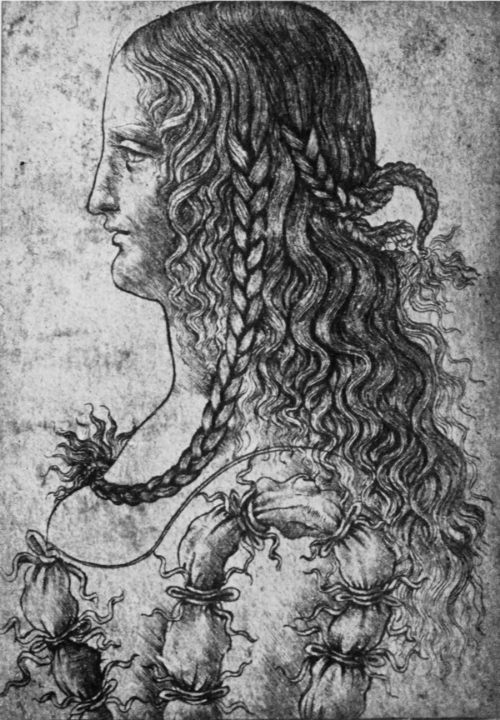
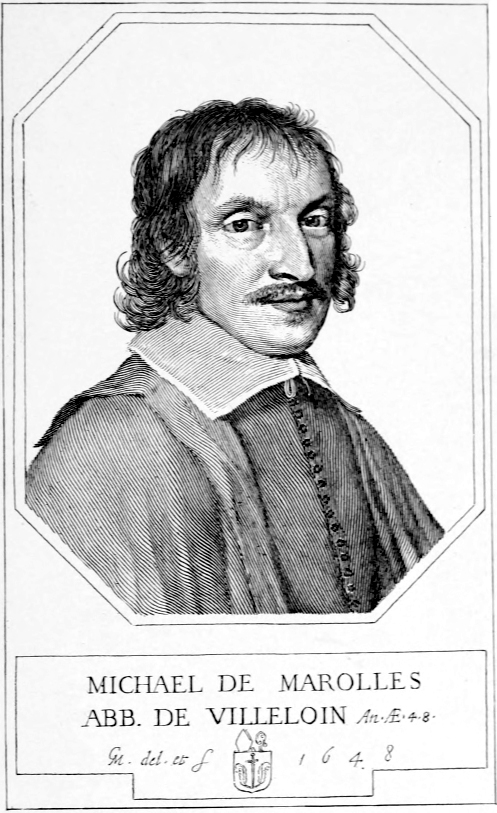
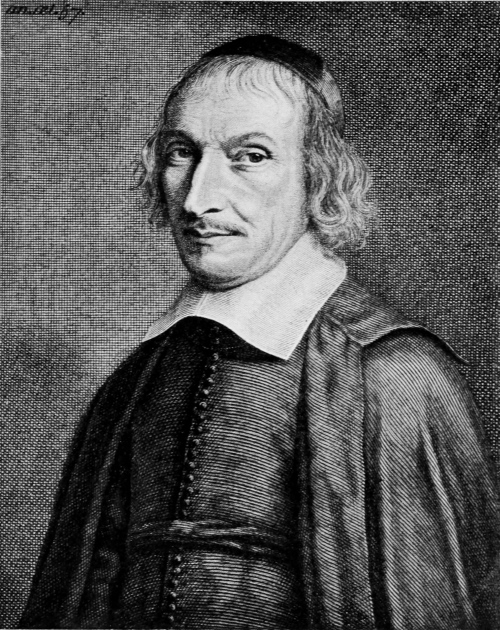
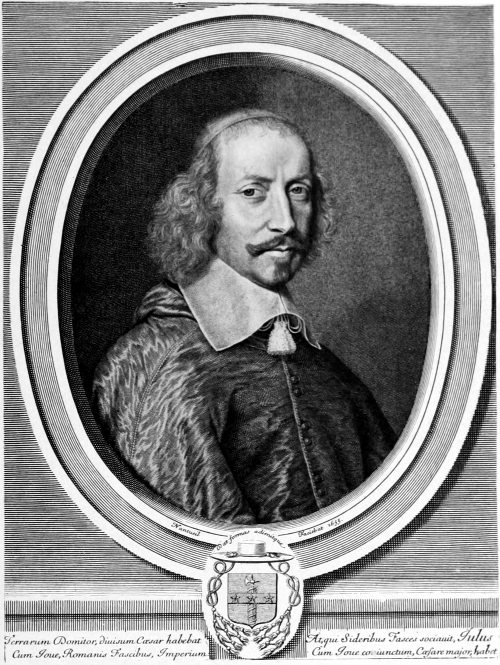
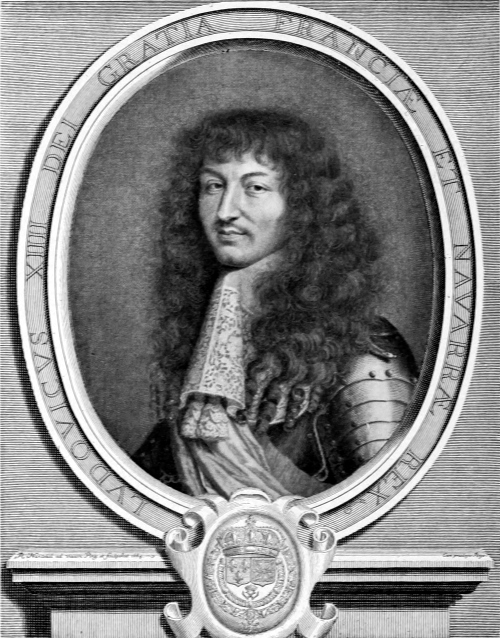
“Of the prints attributed to Leonardo, the fascinating Profile Bust of
a Young Woman stands out from the rest for the sensitive quality
of its outline, but even here I would be more ready to see the hand
of an engraver like Zoan Andrea.” Arthur M. Hind.
Reproduced from the unique impression in the British Museum
PRINTS
AND THEIR MAKERS
ESSAYS ON ENGRAVERS AND
ETCHERS OLD AND MODERN
EDITED BY FITZROY CARRINGTON EDITOR OF “THE PRINT-COLLECTOR’S QUARTERLY”
WITH 200 ILLUSTRATIONS
NEW YORK THE CENTURY CO.
1912
Copyright, 1912, by The Century Co.
————
Copyright, 1911, 1912, by Frederick Keppel & Co.
———— Published October, 1912
THE DE VINNE PRESS
TO FREDERICK KEPPEL IN MEMORY OF A FRIENDSHIP OF TWENTY
YEARS THIS BOOK IS DEDICATED BY THE EDITOR
Ionic Order of the Anteroom, with the rest of the Detail
of that Room at Sion House, the Seat of the Duke
of Northumberland in the County of Middlesex. Engraved
by Piranesi
“GOOD wine needs no bush,” and these essays need
no commendatory word from the Editor. The
plan of this book is a simple one. Certain lovers
of prints have been asked to write on the engravers,
etchers, or periods which chiefly interest them and upon
which they are best qualified to speak; and, furthermore,
to treat their special subjects in their own way.
So far as subject matter is concerned, the essays are
grouped approximately in chronological order, and the
reader may range from Italian engravers before the
time of Raphael and woodcuts by Albrecht Dürer to
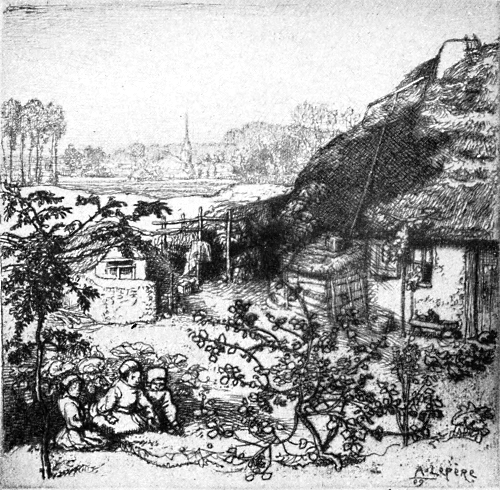
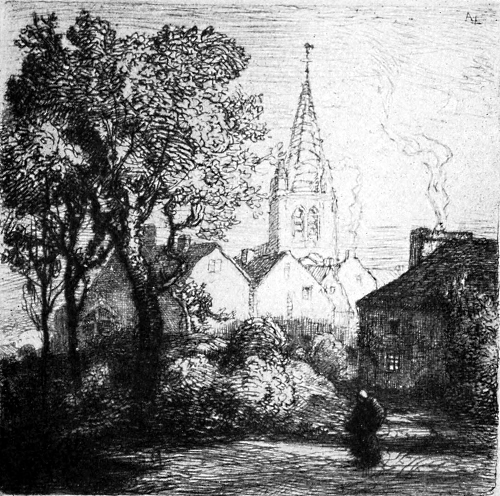
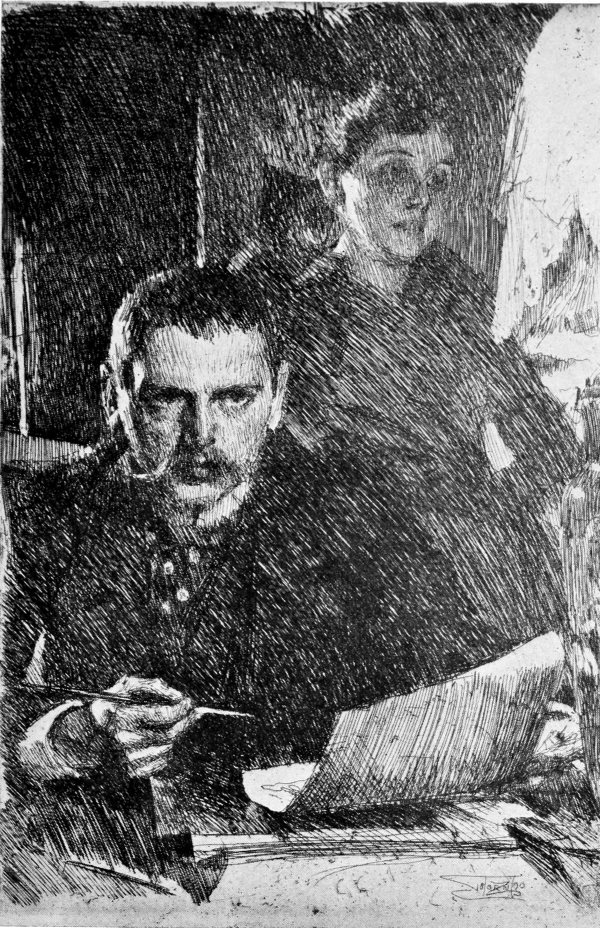
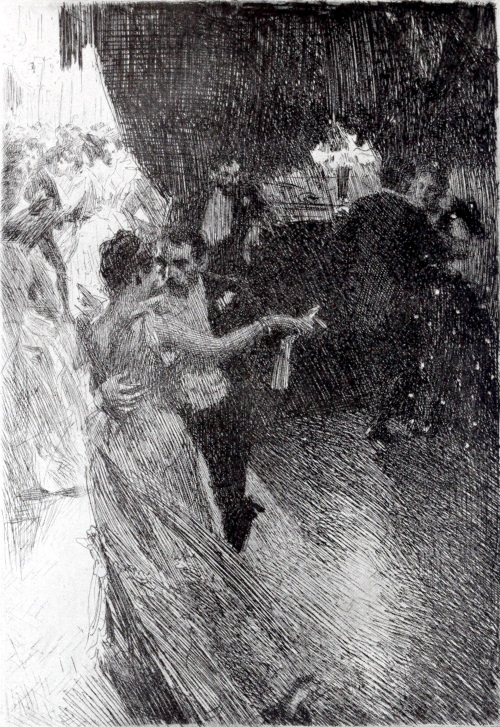
contemporary etchings by Zorn, Lepère, and Herman
A. Webster. Throughout the essays one dominant note
will be found—a sincere love of Prints and an interest
in their Makers.
FitzRoy Carrington.
New York,
September, 1912.
DÜRER’S WOODCUTS
By CAMPBELL DODGSON, M.A.
Keeper of Prints and Drawings in the British Museum
Author of the Catalogue of German and Flemish Woodcuts in the British
Museum and Honorary Secretary of the Dürer Society
THE first decade of the twentieth century lies
not very far behind us, but perhaps it is not
too soon to assert that one of its marked features,
in the retrospect of a print-lover, is a great
revival or extension of interest in every form of
engraving among cultivated people who are not specialists.
Increased attention has been paid, among
other things, to the German woodcuts of the fifteenth
and sixteenth centuries, which used to be rather
despised by the old-fashioned nineteenth-century collector,
with a few enlightened exceptions, as rough
and ugly old things which were curious as specimens
of antiquity or instructive as illustrations of
the life and religion of the generations that produced
them, but were not to be taken very seriously
as works of art. That estimate is being revised. A
generation no longer blinded to the merits of primitive
art by the worship of Raphael and the antique is
ever tapping fresh sources of delight and enriching
itself by the perception of beauty where its fathers
saw nought but the grotesque and quaint. It is not
surprising, indeed, that German art has made slower
progress than Italian on the road to popularity. Even
the primitives, on the south side of the Alps, shared in
the winning grace and suavity of the old Mediterranean
culture, while their brethren in the North, the
French excepted, were indisputably more rugged and
barbarous in draughtsmanship and painting, and few
of their engravers, except Schongauer, can vie with
the Florentines if their achievements are judged by
the test of formal beauty. But it is wonderful how,
in the North, now and again, art could suddenly blossom
and ripen under the creative impulse of an innovator,
whose successors, rather than the pioneer
himself, lay themselves open to the charge of angularity
and uncouthness. The perfection of the very
earliest printed books is a commonplace. Less generally
known, perhaps, is the great beauty to which
the earliest of all the German engravers known to us
at all as a personality, though not by name, was capable
of attaining. The “Master of the Playing-Cards,”
who was at work about 1430-40, produced work of
extraordinary charm, not only in some of the figures,
animals and flowers of the playing-cards themselves,
but especially in the large engraving of the Virgin
Mary with the human-headed serpent, or Lilith, beneath
her feet, which is one of the most splendid and
mature creations of the fifteenth century. Then, again,
the early book illustrators of Augsburg and Ulm, in
the seventies, when the use of blocks for such a purpose
had only recently come in, produced woodcuts
that were never surpassed by any successors in their
simple and direct vivacity and strength, with the utmost
economy of line. But the real beauty of some of
the much earlier single woodcuts, illustrating, chiefly,
the legends of Our Lady and the Saints, has been
much less generally appreciated. They are very rare,
and most of them repose, in a seclusion seldom disturbed,
in their boxes in the great European print-rooms
or even in monastic libraries. They are only
beginning to be reproduced, and they are rarely exhibited.
But such an exhibition of the earliest German
woodcuts as was held at Berlin in the summer of
1908 was truly a revelation. The soft and rounded
features, the flowing lines of the drapery, in the prints
of the generation before sharp, broken folds were introduced
under the influence of the Netherlands, have
something of the charm of Far Eastern art, and the
gay coloring with which most of the prints were finished
has often a delightfully decorative effect when
they are framed and hung at a proper distance from
the eye. Such praise is due, of course, only to some of
the choicer examples; there are plenty of fifteenth-century
woodcuts in which the line is merely clumsy
and the coloring merely gaudy, but these are more
often products of the last quarter of the century than
of its beginning or middle. It would not be true to
say that the advance of time brought with it progress
and perfection in the woodcutter’s art; on the contrary,
the first vital impulse spent itself all too soon,
and gave way to thoughtless and unintelligent imitation.
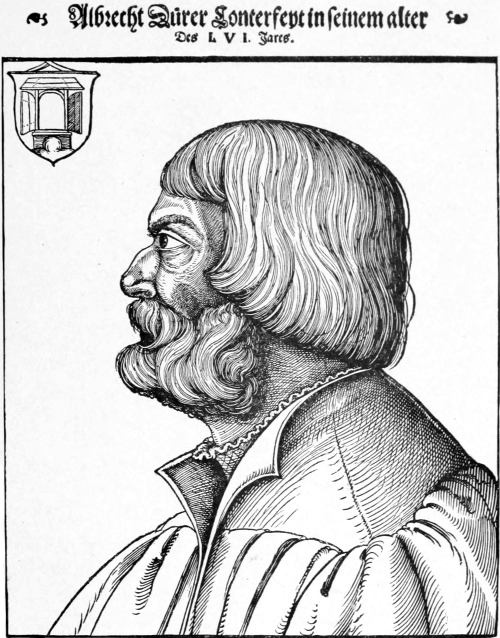
Albrecht Dürer Conterfeyt in seinem alter
Des L V I. Jares.
Dürer. Portrait of Albert Dürer, aged 56
The rare second state (of 3 states) before the monogram of
Dürer and the date 1527
Size of the original woodcut, 12¾ × 10 inches
Dürer. The Four Riders of the Apocalypse
From “The Apocalypse”
Size of the original woodcut, 15¼ × 11 inches
What was the state of things when Dürer appeared
upon the scene? He did so long before the close of the
fifteenth century, for his first authenticated woodcut
is an illustration to St. Jerome’s Epistles, printed at
Basle in 1492. Whether he or an unknown artist is
responsible for a large number of other illustrations
produced at Basle about 1493-95, is a question about
which no consensus of opinion has been formed, and
this is not the place to discuss it. All the woodcuts
that the world knows and esteems as Dürer’s were produced
at Nuremberg after his return from the first
Venetian journey (1495). Let us see, for a moment, how
they stand comparison with what had gone before
them. The older woodcuts are nearly all anonymous, and
if they bear any signature, it is that of a woodcutter
(Formschneider or Briefmaler) who was a craftsman
allied to the joiner, rather than the painter. Just before
Dürer’s time the painter begins to make his appearance
on the scene as a designer of woodcuts.
There are a few isolated cases in which the almost
universal rule of anonymity is broken, and we learn
from the preface to a book the name of the artist who
designed the illustrations. Breydenbach’s “Travels
to the Holy Land” (Mainz, 1486) was illustrated by
woodcuts after Erhard Reuwich, or Rewich, a native
of Utrecht, who had accompanied the author on his
journey, and the immense number of woodcuts in the
“Nuremberg Chronicle” by Hartmann Schedel (1493)
were the work of the painters Wohlgemuth and Pleydenwurff;
to whom the much finer illustrations of the
“Schatzbehalter” (1491) may also safely be attributed.
It is now almost universally believed that the “Master
of the Hausbuch,” one of Dürer’s most gifted predecessors
in the art of engraving on copper, was also
a prolific illustrator, the principal work assigned to
him being the numerous illustrations in the “Spiegel
der menschlichen Behaltnis” printed by Peter Drach
at Speyer about 1478-80. There are speculations,
more or less ill-founded, about the illustrators of a few
other woodcut books of the fifteenth century, but I believe
it is true that the first book after those already
named in which the artist’s name is settled beyond
doubt is Dürer’s “Apocalypse” of 1498.
Dürer. The Whore of Babylon, Seated upon the Beast with Seven
Heads and Ten Horns
From “The Apocalypse”
Size of the original woodcut, 15¼ × 11 inches
Dürer. Christ Bearing His Cross
From “The Great Passion”
Size of the original woodcut, 15¼ × 11⅛ inches
Dr. Naumann, the editor of a recent facsimile of the
cuts in the Speyer book just mentioned, claims for the
“Hausbuchmeister” that he was the first painter, or
painter-engraver, who attempted to get the most out
of the craftsmen employed in cutting blocks from his
designs. That is rather a speculative opinion, and the
woodcuts in question are not, from the technical point
of view, superior to many other contemporary illustrations.
But there can be no question that Dürer
effected an immense reform in this respect, and
carried the technique of wood-engraving to a perfection
unparalleled in its previous history. Not by his
own handiwork, for there is no reason to suppose that
Dürer ever cut his blocks himself. All the evidence
points, on the contrary, to his having followed the
universal practice of the time, according to which the
designer drew the composition in all detail upon the
wood block, and employed a professional engraver to
cut the block, preserving all the lines intact, and cutting
away the spaces between them, so that the result
was a facsimile of the drawing as accurate as the
craftsman was capable of making it. Dürer set his
engravers, we may be sure, a harder task than they
had ever had to grapple with before, and he must
have succeeded in gradually training a man, or
group of men, on whom he could rely to preserve
his drawing in all its delicacy and intricate complexity.
This was a work of time, and perfection
was not reached till after Dürer’s return from his
second journey to Venice, when a great increase
of refinement on the technical side becomes noticeable,
culminating in that extraordinary performance,
the Holy Trinity woodcut of 1511. But even
in the large fifteenth-century blocks, the “Apocalypse,”
the earlier portion of the “Great Passion”
and the contemporary single subjects, much cross-hatching
is used and the space is filled with detail to
an extent hitherto unknown. Without ever losing
sight of the general decorative effect, the telling pattern
of black and white, Dürer put in a vast amount
of interesting little things, with the conscientiousness
and care that characterized everything that he did,
and every detail of the leaves of a thistle or fern, or
of the elaborate ornament, birds and flowers and foliage
and rams’ heads, on the base of a Gothic candle-stick,
had to be reproduced so that the crisp clearness
of the original pen-drawing lost nothing of its precision.
The result was a work so perfectly complete
in black and white, as it stood, that nobody ever
thought of coloring it, and that in itself was a great
innovation and advance. The fifteenth-century “Illuminirer,”
or the patron who gave him his orders,
seems to have had an instinctive respect for excellent
and highly finished work in black and white, which
made him leave it alone. Line-engravings of the
fifteenth century are very frequently found colored,
but they are usually quite second-rate specimens, and
prints by the great men, such as the “Master E. S.” and
Schongauer, were respected and left alone. But such
consideration was not often shown to woodcuts, which
were frequently colored, especially when used as illustrations,
well into the sixteenth century. It was very
rarely, however, that any illuminator laid profane
hands on anything of Dürer’s, woodcut or engraving,
and when he did so the result is stupid and disagreeable,
for it is always the work of a later generation, out
of touch with Dürer’s genius.
Dürer. The Resurrection
From “The Great Passion”
Size of the original woodcut, 15⅜ × 10⅞ inches
Dürer. Samson and the Lion
Size of the original woodcut, 15 × 10⅞ inches
It may be said that if Dürer and his contemporaries
did not cut their own blocks, the woodcuts are not
original prints by the masters themselves. It must be
conceded that they are not original prints quite in the
same sense as engravings and etchings, in which the
whole work was carried out upon the plate by the
masters’ own hand, but it would be a mistake to describe
them as examples of reproductive engraving.
Such a thing as a reproductive engraving was, in fact,
unknown in the Germany of Dürer’s time. A design
originally projected in one medium might be reproduced
in another in a case where an engraving by
Schongauer, or Meckenen, or Dürer himself, was
copied by some inferior woodcutter, as an act of
piracy, for a bookseller who was too stingy to pay an
artist to draw him a new Virgin or Saint for his purpose.
But it would never have occurred to any one to
reproduce an engraving or woodcut, a picture or drawing,
done for its own sake, as a separate and complete
work of art. Reproductions of pictures scarcely exist
in German art of the sixteenth century; they are
commoner in the Venetian School, among the woodcutters
influenced by Titian, and Rubens established
the practice once for all by his encouragement of engraving
from his pictures, a century after Dürer’s
time. But when woodcutting was taken up by the
German painters, with Dürer as their leader, for the
purpose of circulating their compositions at a cheaper
price than they could charge for engravings of their
own, they always had a strictly legitimate object according
to the canons of graphic art. Rarely working
even from sketches, never from a work already
finished in another medium, they drew the subjects
intended for printing directly upon the block in a
technique adapted for the purpose, avoiding such
combinations of lines as the most skilful craftsmen
would be unable to cut. Their actual handiwork was
preserved upon the surface of the block, much as in
the modern original lithograph the artist’s actual
work survives upon the surface of the stone; if it was
in any way disfigured, as often, no doubt, it was, that
must be set down to failure on the cutter’s part. Anything
original that the cutter puts in, any swerving
that accident or clumsiness permits him to make from
the line fixed by the painter’s pen for him to follow,
is a blemish, and the best woodcuts of Dürer, Holbein,
Baldung, Cranach, Burgkmair and the rest of their
generation have no such blemishes. They are strictly
autographic: the lines that the artist’s pen has traced
remain and are immortalized by the printing-press;
the white spaces, also limited by his controlling will
and purpose, result from the mere mechanical cutting
away of blank wood that any neat-handed workman
can perform. So when we speak of the woodcuts of
Millais, Rossetti, Whistler, Walker, Pinwell, Sandys
and the rest of the “Men of the Sixties,” we know
that the blocks were cut by Dalziel or Swain, but
every good print is none the less what the designer
meant it to be, and what none but himself could have
made it.
Dürer. The Annunciation to Joachim
From “The Life of the Virgin”
Size of the original woodcut, 11⅝ × 8³/₁₆ inches
Dürer. The Annunciation
From “The Life of the Virgin”
Size of the original woodcut, 11⅝ × 8¼ inches
Of Dürer’s woodcutters, unluckily, we know nothing
till the comparatively late period when he had
been enlisted in the service of the Emperor Maximilian,
whose imposing, but somewhat ponderous and
pedantic, Triumphal Arch was cut from the designs
of Dürer and his school by Hieronymus Andreä.
There is much more information about the
Augsburg cutters than about those of Nuremberg, and
there is no single artist in the latter city whose work
is so strongly marked out by its excellence from that
of his contemporaries as was Lützelburger’s, who cut
Holbein’s “Dance of Death.”
To understand Dürer’s woodcuts aright, it is necessary
to get to know them in their chronological sequence.
In conservative collections, where they are
arranged by order of subject, on the system of
Bartsch, the student is continually confused by the
juxtaposition of quite incongruous pieces, placed together
merely because “Jérôme,” for instance, comes
in alphabetical order next after “Jean.” The British
Museum collection has been arranged for more than
ten years past in chronological order, which, in
Dürer’s case, is unusually easy to determine with approximate
accuracy, because his methodical turn of
mind caused him to be fond of dates, while the undated
pieces can be fitted in without much difficulty
by the evidence of style. The justification of the system
became all the more apparent when the woodcuts
were exhibited for a few months in 1909, and fell
naturally into consistent and coherent groups upon
the screens, while separated, as a matter of practical
convenience, from the engravings. Since then two even
more interesting experiments have been made, in exhibitions
held at Liverpool and Bremen, toward a
reconstruction of Dürer’s entire life-work in its
chronological sequence, his pictures, drawings, engravings
and woodcuts—represented mainly, of
course, by reproductions—being merged in a single
series. That is a timely warning against the risks of
excessive concentration upon one single side of his
many activities, but here we will not digress further
from the woodcuts, which are at present our theme.
Dürer. The Flight into Egypt
From “The Life of the Virgin”
Size of the original woodcut, 11⅝ × 8¼ inches
Dürer. The Assumption and Crowning of the Virgin
From “The Life of the Virgin”
Size of the original woodcut, 11½ × 8⅛ inches
The series opens magnificently with the group of
large and stately woodcuts, abounding in vitality and
dramatic invention, produced by Dürer between 1495
and 1500. These include the fifteen subjects of the
“Apocalypse,” the seven early subjects of the “Great
Passion” (not completed until 1510-11) and seven
detached pieces uniform with the two series already
named in dimensions and style, but independent of
them in subject. The blocks of the majority of these
single pieces are now, by the way, in an American
collection, that of Mr. Junius S. Morgan, but they
have suffered sadly from the ravages of the worm.
There is a certain exaggeration and over-emphasis of
gesture in the “Apocalypse” woodcuts, but Dürer
never invented anything more sublime than the celebrated
Four Riders or the St. Michael defeating the
Rebel Angels, which I regard as at least equal to the
subject more frequently praised. Superb, too, is the
group of Angels restraining the Four Winds. The
landscape at the foot of St. John’s Vision of the Four-and-twenty
Elders (B. 63) is a complete picture by
itself, and there is a rare early copy of this portion
alone, which is itself a beautiful print, and doubtless
the earliest pure landscape woodcut in existence.
Samson and the Lion, the mysteriously named Ercules
and the Knight and Man-at-arms, often described as
its companion, and the Martyrdom of St. Catherine
are among the finest of the single subjects. After this
tremendously impressive group, there is for a time a
certain relaxation of energy, or rather Dürer was
more bent on other things, especially engraving. To
the years 1500-04 belong a number of woodcuts of
Holy Families and Saints, much smaller than the
“Apocalypse,” and rather roughly cut. Some critics
have wished to dismiss one or another of them as
pupils’ work, but for this there is really no justification.
Then comes another very good period, that of
the “Life of the Virgin,” of which set Dürer had
finished seventeen subjects before he left for Venice
in 1505, while the Death of the Virgin and The Assumption
were added in 1510, and the frontispiece in
1511, when the whole work came out as a book, assuredly
one of the most desirable picture-books the
world has ever seen! It is impossible to weary of the
beautiful compositions, the details drawn with such
loving care, the tender and homely sentiment, the
humor, even, displayed in the accessory figures of
The Embrace of Joachim and Anne, the beer-drinking
gossips in the Birth of the Virgin, where the atmosphere
of St. Anne’s chamber is sweetened by an angelic
thurifer, and the merry group of angelic children
playing round Joseph, bent on his carpenter’s
business, while their elders keep solemn watch round
Mary at her distaff and the Holy Child in the cradle.
We find landscapes at least as beautiful as those in
Dürer’s best engravings in the pastoral background
of the Annunciation to Joachim and the mountainous
distance of the Visitation. The architectural setting
of the Presentation of Christ in the Temple, and the
tall cross held aloft, with the happiest effect on the
composition, by the Apostle kneeling on the left in
Mary’s death-chamber, are among the memorable
features of the set.
Beautiful again, especially in fine proofs, is the next
and latest of the long sets, the “Little Passion,” consisting
of thirty-six subjects and a title-page, begun
in 1509 and finished, like all the other books, in 1511.
But it has not the monumental grandeur of the earlier
religious sets, and there is an inevitable monotony
about the incessant recurrence of the figure of Our
Lord, when the history of the Passion is set forth in
such detail. The most original and impressive subjects,
in my opinion, are Christ Appearing to St.
Mary Magdalen and the next following it, The Supper
at Emmaus.
Dürer. St. Jerome in his Cell
Size of the original woodcut, 9¼ × 6¼ inches
Dürer. The Holy Family
St. Anne, attended by St. Joseph and St. Joachim, receiving from
His Mother the Infant Jesus
Size of the original woodcut, 9¼ × 6⅛ inches
The years 1510 and 1511 were the most prolific of
all, and witnessed the publication of other connected
pieces, the Beheading of John the Baptist and Salome
bringing the Baptist’s Head to Herod, and then the
three little woodcuts, Christ on the Cross, Death and
the Soldier, and The Schoolmaster, which Dürer
brought out on large sheets at the head of his own
verses, signed with a large monogram at the end of all.
The single sheets of 1511 include, besides the marvelous
Trinity already mentioned, the large Adoration
of the Magi, the Mass of St. Gregory, a St. Jerome
in his Cell, which is the best, after the celebrated engraving
of 1514, of Dürer’s repeated versions of that
delightful subject; the Cain and Abel, which is one
of the great rarities; two rather unattractive Holy
Families; and the beautiful square Saint Christopher,
of which many fine impressions are extant to bear witness
to its technical virtues. The average level of all
the work of the year 1511 is so astonishingly high, that
it must be regarded as the culminating period of the
woodcuts, just as a slightly later time, the years
1513-14, witnesses the climax of the engravings. In
the next few years Dürer’s time was much taken up
with carrying out the emperor’s important but rather
tiresome commissions for the Triumphal Arch and
two Triumphal Cars, the small one which forms part
of the Procession, and the much bigger affair, with the
twelve horses and allegorical retinue, which did not
appear till 1522. All this group offers a rich field of
research to the antiquary, but is simply unintelligible
without a learned commentary, and appeals much less
than the sacred subjects to the average collector and
lover of art, who cannot unearth the heaps of pedantic
Latin and German literature in which the motives by
which Dürer was inspired, if I may use the word, lie
buried. Inspiration certainly flagged under the influence
of Wilibald Pirkheimer and other learned
humanists who encouraged Maximilian in his penchant
for allegory, and compelled Dürer, probably
somewhat against his will, to use a multitude of symbols,
intelligible only to the learned, instead of speaking
directly to the populace in the familiar pictorial
language derived from old tradition but enriched and
ennobled by his own matchless art.
The later woodcuts are comparatively few in number.
They include a few that are primarily of scientific
interest, such as the celestial and terrestrial
globes and the armillary sphere, besides the numerous
illustrations to Dürer’s own works on Measurement,
Proportion, and Fortification. But among them are
the two splendid portraits made from drawings now
in the Albertina, the Emperor Maximilian of 1518 and
the Ulrich Varnbüler of 1522. Of the former several
varieties exist, from no less than four different blocks,
and it is now established that the only original version
is the very rare one in which the letters “ae” of
the word “Caesar” are distinct, not forming a diphthong,
and placed within the large “C.” The other
cuts are all copies, produced probably at Augsburg,
the fine large one, with an ornamental frame and the
imperial arms supported by griffins, being indisputably
the work of Hans Weiditz. Only three impressions
of the original are known, in the British Museum, the
Berlin Kupferstichkabinett, and the Hofbibliothek at
Vienna, in addition to which the École des Beaux-Arts
at Paris possesses a fragment damaged by fire at the
time of the Commune, when it was still in private
hands. It is more generally known that the handsome
chiaroscuro impressions of the Varnbüler date, like
those of the Rhinoceros, from the seventeenth century,
the color blocks having been added in Holland. The
brown and green varieties belong to different editions,
distinguished by the wording of the publisher’s address
at the foot, which in the majority of cases has
been cut off.
Dürer. Saint Christopher
Size of the original woodcut, 8⁵⁄₁₆ × 8¼ inches
Dürer. The Virgin with the many Angels
Size of the original woodcut, 11¹³/₁₆ × 8⅜ inches
The Virgin with the many Angels, of 1518, is one
of Dürer’s most accomplished woodcuts, and quite
good impressions of it are comparatively common to-day.
The latest of his compositions of this class, the
Holy Family with Angels, of 1526, is, on the other
hand, extremely rare. Some critics doubt its being an
authentic work of Dürer, but in spite of certain rather
eccentric and unpleasant peculiarities in the drawing,
I consider this scepticism unfounded. Quite at the
end of Dürer’s life comes that rather fascinating subject,
The Siege of a Fortress, unique among Dürer’s
woodcuts in the tiny scale on which its countless details
are drawn. Of the many heraldic woodcuts and
ex-libris attributed by Bartsch and others to Dürer,
very few can be regarded as his genuine work, and
most of these are very rare. The best authenticated
are his own coat of arms; the arms of Ferdinand I in
the book on Fortification; those of Michel Behaim, of
which the block is extant with a letter written by
Dürer on the back; the arms of Roggendorf, mentioned
in the Netherlands Journal, of which only one
impression is known, and the arms of Lorenz Staiber,
of which the original version is also unique. There
can be no doubt that the Ebner book-plate of 1516
is by Dürer; the much earlier Pirkheimer book-plate
is intimately connected with the illustrations to the
books by Celtes, and cannot be regarded as a certain
work of the master himself, while the arms of Johann
Tschertte are also doubted.
It is a fortunate circumstance for the museums and
collectors of to-day that Dürer’s prints have always
been esteemed, and his monogram was held in such
respect and so generally recognized as the mark of
something good that they have been preserved during
four centuries, while so much that was interesting was
allowed to perish because it was unsigned or its signature
was not recognized as the work of any one important.
It may be paradoxical to say that Dürers
are common; few of them are to be had at any particular
moment when one wants to get them; but they
are commoner than any other prints of their period,
and a large number of impressions of some subjects
must come into the market in the course of every ten
years. But the sort of Dürer the collector wants, the
really beautiful, fresh, clean impression, with the
right watermark and genuine, unbroken border-line,
is not, and never has been, common. It is surprising
how few, even of the famous museums of Europe,
have a really fine collection of the woodcuts, perhaps
because so many of them were formed some generations
ago in uncritical times, when people were apt to
think it enough if the subject was represented, in
whatever condition it might be. The first-rate proofs
are scarce, and getting scarcer every year; when they
are to be had, they should be grasped and treasured.
SOME EARLY ITALIAN ENGRAVERS BEFORE THE TIME OF MARCANTONIO
By ARTHUR M. HIND
Of the Department of Prints and Drawings, British Museum
Author of “Catalogue of Early Italian Engravings in the British Museum,”
“Short History of Engraving and Etching,” “Rembrandt’s Etchings:
an Essay and a Catalogue,” etc.
FIFTEENTH-CENTURY Italian engraving is
not an easy hunting-ground for the collector,
but it is one of the most fascinating not less
for its own sake than for the difficulty of securing
one’s prize.
From the time of Raphael onward Italian engraving
presents an overwhelmingly large proportion of
reproductions of pictures, and loses on that account
its primary interest. But in the fifteenth and the early
sixteenth century, the engravers, though for the most
part less accomplished craftsmen, were artists of real
independence. We may in some cases exaggerate this
independence through not knowing the sources which
they used, but the mere lack of that knowledge
adds a particular interest to their prints. Treated not
only in virtue of their special claim as engravings, but
merely as designs, we find something in them which
the paintings of the period do not offer us.
In general, the presence and influence of one of the
greater artistic personalities of the time may be recognized,
but seldom definitely enough for us to trace the
painter’s immediate direction. Mantegna is the most
brilliant exception of a painter of first rank who is
known to have handled the graver at this period. But
forgetting the great names it is remarkable how in the
early Renaissance in Italy even the secondary craftsmen
produced work of the same inexpressible charm
that pervades the great masterpieces.
One of the most beautiful examples I can cite is the
Triumph of Bacchus and Ariadne, which is known
only in the British Museum impression. It has all
the fascination of Botticelli’s style without being
quite Botticelli—unless the engraver himself is to account
for the coarsening in the drawing of individual
forms. Mr. Herbert P. Horne, the great authority on
Botticelli and his school, thinks it is by Bartolommeo
di Giovanni (Berenson’s “Alunno di Domenico”).
But whether immediately after Botticelli or after some
minor artist of the school, there is the same delightful
flow and rhythmic motion in the design that one
thinks of in relation to Botticelli’s Spring.
Triumph of Bacchus and Ariadne
After a design by a close follower of Botticelli, possibly by Bartolommeo di Giovanni
“But whether immediately after Botticelli or after some minor artist of the school, there is the same
delightful flow and rhythmic motion in the design that one thinks of in relation to Botticelli’s Spring....
We could ill afford to lose the charm of the early Florentine Triumph of Bacchus and Ariadne for all the
finished beauty of Marcantonio’s Lucretia, and it is still the youth of artistic development, with its naïve
joy and freshness of outlook, which holds us with the stronger spell.” Arthur M. Hind.
Reproduced from the unique impression in the British Museum
Size of the original engraving, 8⅛ × 22 inches
The Assumption of the Virgin
Florentine engraving, in the Broad Manner, after a design by Botticelli
“Most important of all the contemporary engravings after Botticelli
is the Assumption of the Virgin.... An original study by Botticelli
for the figure of St. Thomas, who is receiving the girdle of
the Virgin, is in Turin, and clinches the argument in favor of
Botticelli’s authorship. The view of Rome, a record of Botticelli’s
visit, is an interesting feature of the landscape.” Arthur M. Hind.
Size of the original engraving, 32⅝ × 22¼ inches
Botticelli was in early life under the immediate
inspiration, if not in the very service, of the great
goldsmith Pollaiuolo (witness his picture of Fortitude
in Florence). One almost expects in consequence that
he may at some period have tried his hand at engraving,
but there is no proof that he did anything besides
supplying the engravers with designs. His chief connection
with the engravers was in the series of plates
done for Landino’s edition of Dante’s “Divine Comedy”
(Florence, 1481). Altogether nineteen plates
(and a repetition of one subject) are known, but although
spaces are left throughout the whole edition
for an illustration to each canto, it is only in rare
copies that more than two or three are found. Even
the fine presentation copy to Lorenzo de’ Medici (now
in the National Library, Florence) is without a single
plate, showing perhaps the small regard that was paid
to engraving for book decoration at that period. This
lack of appreciation and the difficulties (or double
labor) the printers experienced in combining copperplate
impressions with type led soon after this and a
few other experiments of the period to the use of
woodcut as the regular mode of book illustration for
well over a century. Apart from the plates to this
edition, Botticelli’s devotion to Dante is shown in
the beautiful series of pen drawings—in the most
subtly expressive outline—preserved at Berlin and in
the Vatican. It seems on the whole probable that they
are later than the 1481 edition, so that we cannot point
to the original drawings for the prints.
Most important of all the contemporary engravings
after Botticelli is the Assumption of the Virgin, the
largest of all the prints of the period (printed from
two plates, and measuring altogether about 82.5 × 56
cm.). An original study by Botticelli for the figure
of St. Thomas, who is receiving the girdle of the Virgin,
is in Turin, and clinches the argument in favor of
Botticelli’s authorship. The view of Rome, a record
of Botticelli’s visit, is an interesting feature of the
landscape.
This engraving is produced in what has been called
the Broad Manner in contradistinction to the Fine
Manner, e.g. of the Dante prints. In the Broad Manner
the lines are laid chiefly in open parallels, and
generally the shading is emphasized with a lighter
return stroke laid at a small angle between the parallels.
Its aim is essentially the imitation of pen drawing
after the manner of such draughtsmen as Pollaiuolo
and Mantegna. The Fine Manner on the other
hand shows shading in close cross-hatching (somewhat
patchy and cloudy in effect in most of the early Florentine
prints), and gives the appearance of imitating
a wash drawing.
The two manners may be well compared in the
series of “Prophets and Sibyls,” which exists in two
versions, the earlier being in the Fine, and the later
in the Broad Manner. The first series shows a craftsman
who drew largely from German sources (putting
a St. John of the Master E. S. into the habit of the
Libyan Sibyl). In the second we have an artist who
discarded all the ugly and awkward features which
originated in the German originals, and showed
throughout a far truer feeling for beauty and a much
finer power of draughtsmanship than the earlier engraver.
Mr. Herbert Horne suspects, rightly I think,
that Botticelli himself directly inspired this transformation
of the “Prophets and Sibyls.”
Through our lack of knowledge of the engravers of
this early period in Florence we are driven to a rather
constant use of the somewhat unattractive distinctions
of the Fine and Broad Manners. We may claim,
however, to have advanced a little further in the elucidation
of questions of authorship, though the great
German authority on this period, Dr. Kristeller of
Berlin, would still keep practically all the early Florentine
engravings in an unassailable anonymity. This
is of course better than classing all the engravings of
the period and school, both in the Fine and Broad
Manners, under the name of Baccio Baldini, which has
long been the custom. A certain “Baccio, orafo” has
been found in documents as buried in 1487, but there
is practically nothing to connect his name with the
substance of our prints. We would not on that account
regard him as a myth, but are reduced at the moment
to Vasari’s statement that “Baldini, the successor of
Finiguerra in the Florentine school of engraving, having
little invention, worked chiefly after designs by
Botticelli.” Considering the fact that both Broad
and Fine Manners (in all probability the output of
two distinct workshops) show prints definitely after
Botticelli, we are still in entire darkness as to the position
of Baldini.
The Libyan Sibyl
From a series of the “Prophets and Sibyls,” engraved in the Fine
Manner of the Finiguerra School
Size of the original engraving, 7 × 4¼ inches
The Libyan Sibyl
From a series of the “Prophets and Sibyls,” engraved in the
Broad Manner of the Finiguerra School
Size of the original engraving, 7 × 4¼ inches
With regard to an important group of Fine Manner
prints, Sir Sidney Colvin has given strong reasons
for the attribution to Maso Finiguerra, made famous
by Vasari as the inventor of the art of engraving.
Considering Vasari’s evident error in regard to the
discovery of engraving (for there were engravings in
the north of Europe well before the earliest possible
example of Finiguerra), modern students have been
inclined to regard Finiguerra as much in the light of
a myth as Baldini. But there is no lack of evidence
as to his life and work, and without repeating the
arguments here, which are given in full in Sir Sidney
Colvin’s “Florentine Picture-Chronicle” (London,
1898), we would at least state our conviction that a
considerable number of the early Florentine engravings,
as well as an important group of nielli, must be
from his hand. Vasari speaks of him as the most
famous niello-worker in Florence, and he also speaks
of his drawings of “figures clothed and unclothed, and
histories” (the “figures” evidently the series traditionally
ascribed to Finiguerra in Florence, but now
for a large part labeled with an extreme of timidity
“school of Pollaiuolo”; the “histories,” probably the
“Picture-Chronicle” series, acquired from Mr. Ruskin
for the British Museum). Then considering Vasari’s
fuller statement that Finiguerra was also responsible
for larger engravings in the light of a group of Florentine
engravings which correspond closely in style
with many of the only important group of Florentine
nielli (chiefly in the collection of Baron Édouard de
Rothschild, Paris) as well as with the Uffizi drawings,
we can hardly escape the conviction that Vasari was
correct in his main thesis. A curiously entertaining
side-light is given by one of these engravings, the
Mercury for the series of “Planets.” Here we see
the representation of a goldsmith’s shop in the streets
of Florence, stocked just as we know from documents
Finiguerra’s to have been. And the goldsmith is
evidently engaged in engraving, not a niello, but a
large copperplate.
The Planet Mercury
Florentine engraving in the Fine Manner, attributed to
Maso Finiguerra, or his school
“A curiously entertaining side-light is given by one of these engravings,
the Mercury for the series of ‘Planets.’ Here we see the representation
of a goldsmith’s shop in the streets of Florence, stocked
just as we know from documents Finiguerra’s to have been. And the
goldsmith is evidently engaged in engraving, not a niello, but a large
copperplate.” Arthur M. Hind.
Size of the original engraving, 12¾ × 8⁹⁄₁₆ inches
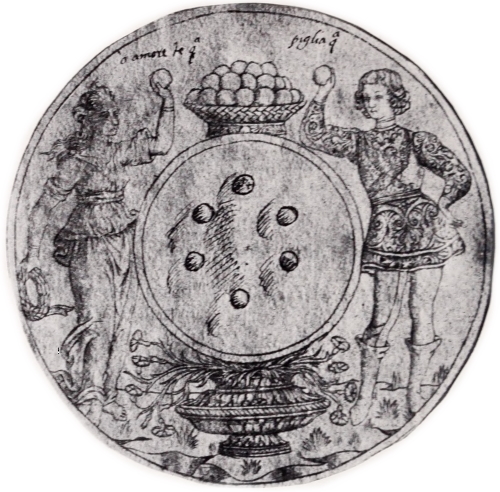
A Young Man and Woman Each Holding An Apple
A Florentine engraving in the Fine Manner, attributed
to the school of Finiguerra
“One of the “Otto Prints” (so called from the eighteenth-century collector
who possessed the majority of the series), A Young Man and
Woman Each Holding An Apple, is in the Gray Collection, Harvard,
and it is a charming example of the amatory subjects of the series,
prints such as the Florentine gallant might have pasted on the spice-box
to be presented to his inamorata. The badge of Medici (the
six “palle” with three lilies in the uppermost) added by a contemporary
hand in pen and ink suggests that this one may have been used by
the young Lorenzo himself between about 1465 and 1467, which
accords well with the probable date of the engravings.” Arthur M. Hind.
(The inscription above reads ò amore te qª (questa) and piglia qª: “O Love, this to you” and “Take this.”)
Size of the original engraving, 4¼ × 4¼ inches
The engravings most certainly by Finiguerra, such
as the Judgment Hall of Pilate (Gotha), the March to
Calvary and the Crucifixion (British Museum), Various
Wild Animals Hunting and Fighting (British
Museum), are of course rarities which most collectors
can never hope to possess. The same may also be said
of somewhat later prints in the same manner of engraving
(which may be the work of the heirs of Finiguerra’s
atelier, which is known to have been carried
on by members of his family until 1498), such as the
Fine Manner “Prophets and Sibyls” and the “Otto
Prints.” We will in consequence devote less space to
these rarities, possessed chiefly by a few European
collections, than their artistic interest would justify,
keeping our argument henceforward more to the engravings
that the American amateur has the chance of
seeing or acquiring at home.
One of the “Otto Prints” (so called from the eighteenth-century
collector who possessed the majority
of the series), A Young Man and Woman Each Holding
An Apple, is in the Gray Collection, Harvard, and
it is a charming example of the amatory subjects of
the series, prints such as the Florentine gallant might
have pasted on the spice-box to be presented to his
inamorata. The badge of Medici (the six “palle”
with three lilies in the uppermost) added by a contemporary
hand in pen and ink suggests that this one
may have been used by the young Lorenzo himself
between about 1465 and 1467, which accords well with
the probable date of the engravings.
The only known engraving by the goldsmith and
painter Antonio Pollaiuolo, the large Battle of Naked
Men, shows a far greater artist than his slightly elder
contemporary Finiguerra. They had both studied in
the same workshop and probably continued a sort of
partnership until Finiguerra’s death. Pollaiuolo’s
draughtsmanship evinces a grip and intensity that
Finiguerra entirely lacks in his somewhat torpid academic
drawings, and it is seen at its best in this magnificently
vigorous plate. An excellent impression,
surpassed by few in the museums of Europe, is, I
believe, in the collection of Mr. Francis Bullard of
Boston.
Before leaving Florence for north Italy we would
allude to that attractive engraver of the transition
period, Cristofano Robetta. His art has lost the finest
flavor of the primitive Florentine without having succeeded
to the sound technical system of the contemporaries
of Dürer, but it has a thoroughly individual
though delicate vein of fancy. The Adoration of the
Magi, one of his finest plates, is a free translation of
a picture by Filippino Lippi in the Uffizi, but the
group of singing angels is an addition of his own, and
done with a true sense for graceful composition. Fine
early impressions of this print are of course difficult
to get, but it is perhaps the best known of Robetta’s
works, because of the number of modern impressions
in the market. The original plate (with the Allegory
of the Power of Love engraved on the back) belonged
to the Vallardi Collection in the early nineteenth century,
and is now in the British Museum, happily safe
from the reprinter.
Among the greatest rarities of early engraving in
north Italy is the well-known series traditionally
called the “Tarocchi Cards of Mantegna”—somewhat
erroneously, for they are neither by Mantegna,
nor Tarocchi, nor playing-cards at all. As in the case
of the “Prophets and Sibyls,” there are two complete
series of the same subjects by two different engravers.
Each series consists of fifty subjects divided into five
sections and illustrating: (1) the Sorts and Conditions
of Men; (2) Apollo and the Muses; (3) the
Arts and Sciences; (4) the Genii and Virtues; (5) the
Planets and Spheres. A considerable number of the
earliest impressions known are still in contemporary
fifteenth-century binding, and it seems as if the series
was intended merely as an instructive or entertaining
picture-book for the young. There is the most absolute
divergence of opinion as to which is the original series,
and the student is encouraged to whet his critical acumen
on the problem by the excellent set of reproductions
which has recently been issued by the Graphische
Gesellschaft and edited by Dr. Kristeller. Unfortunately
Dr. Kristeller takes what seems to me an
entirely wrong view of the matter. I cannot but feel
that the more finely engraved series is at the same
time the more ancient, and almost certainly Ferrarese
in origin, so characteristic of Cossa is the type of these
figures with large heads, rounded forms, and bulging
drapery. The second series shows a more graceful
sense of composition and spacing (the heads and figures
being in better relation to the size of the print),
but its very naturalism is to me an indication of its
somewhat later origin. The less precise technical quality
of this second series is closely related to the Florentine
engravings in the Fine Manner, and I am
inclined to regard it as the work of a Florentine
engraver of about 1475 to 1480, i.e. about a decade
later than the original set.
Antonio Pollaiuolo. Battle of Naked Men
“The only known engraving by the goldsmith and painter Antonio Pollaiuolo, the large Battle of Naked
Men, shows a far greater artist than his slightly elder contemporary, Finiguerra. Pollaiuolo’s
draughtsmanship evinces a grip and intensity that Finiguerra entirely lacks in his somewhat torpid
academic drawings, and it is seen at its best in this magnificently vigorous plate.” Arthur M. Hind.
Reproduced from the impression in the Print Department, Museum of Fine Arts, Boston
Size of the original engraving, 15¹¹⁄₁₆ × 23⁷⁄₁₆ inches
Cristofano Robetta. The Adoration of the Magi
“Cristofano Robetta’s art has lost the finest flavor of the primitive
Florentine without having succeeded to the sound technical system
of the contemporaries of Dürer, but it has a thoroughly individual
though delicate vein of fancy. The Adoration of the Magi, one of his
finest plates, is a free translation of a picture by Filippino Lippi in
the Uffizi, but the group of singing angels is an addition of his own,
and done with a true sense for graceful composition.” Arthur M. Hind.
Size of the original engraving, 11⅝ × 11 inches
Leaving the pseudo-Mantegna for the master himself,
we are in the presence of the greatest of the
Italian engravers before Marcantonio—if not of all
time. Like the Florentines, Mantegna was an ardent
lover of antiquity, but his spirit was far more impassive,
far more like the antique marble itself. His classical
frame of mind was to some extent the offspring
of his education in the school of Squarcione and in
the academic atmosphere of Padua. His art has a
monumental dignity which the Florentines never possessed,
but it was without the freshness and inexpressible
charm that pervade Tuscan art. An engraving
like the Risen Christ between St. Andrew and St.
Longinus is an indication of the genius that might
have made one of the noblest sculptors, and one regrets
that he never carried to accomplishment the project
of a monument to Vergil in Mantua, which Isabella
d’Este wished him to undertake.
Seven of the engravings attributed to Mantegna
(including the Risen Christ) are so much above the
rest in subtle expressiveness, as well as in technical
quality, that we cannot but agree with Dr. Kristeller’s
conclusion that these alone are by Mantegna’s hand,
and the rest engraved after his drawings. They are
similar to Pollaiuolo’s Battle of Naked Men in style,
engraved chiefly in open parallel lines of shading
with a much more lightly engraved return stroke between
the parallels. It is this light return stroke,
exactly in the manner of Mantegna’s pen drawing,
which gives the wonderfully soft quality to the early
impressions. But it is so delicate that comparatively
few printings must have worn it down, and the majority
of impressions that come into the market show
little but the outline and the stronger lines of shading.
Even so these Mantegna prints do not lose the
splendidly vigorous character of their design, but it is
of course the fine early impressions which are the joy
and allure of the true connoisseur. The seven certainly
authentic Mantegna engravings are the Virgin
and Child, the two Bacchanals, the two Battles of the
Sea-Gods, the horizontal Entombment, and the Risen
Christ, already mentioned.
Andrea Mantegna. The Risen Christ between
St. Andrew and St. Longinus
“Of all the early Italian engravers, Andrea Mantegna is by far the
most powerful, though scarcely the most human. Like many of the
Florentines, he was an ardent lover of antiquity, but his spirit was
far more impassive than theirs, and far more like the antique marble
itself. His art has a monumental dignity which the Florentines
never possessed, but it lacks the freshness and inexpressible charm
that pervade Tuscan art. His was a genius that would have made
one of the noblest sculptors: the engraving of the Risen Christ shows
what he might have achieved in the field.” Arthur M. Hind.
Size of the original engraving, 15⁷⁄₁₆ × 12¹¹⁄₁₆ inches
Zoan Andrea(?). Four Women Dancing
This engraving, based on a study by Mantegna for a group in the Louvre picture of Parnassus,
is one of the most beautiful prints of the school of Mantegna. It is most probably by Zoan Andrea.
Size of the original engraving, 8⅞ × 13 inches
Nearest in quality to these comes the Triumph of
Caesar: the Elephants, after some study for the series
of cartoons now preserved at Hampton Court. But it
lacks Mantegna’s distinction in drawing, and Zoan
Andrea, who is probably the author of one of the
anonymous engravings of Four Women Dancing
(based on a study for a group in the Louvre picture of
Parnassus), one of the most beautiful prints of the
school, was certainly capable of this achievement.
Even Giovanni Antonio da Brescia, who did work of
a very third-rate order after migrating to Rome, produced
under Mantegna’s inspiration so excellent a
plate as the Holy Family.
Other prints attributed to Mantegna, such as the
Descent into Hell and the Scourging of Christ, possess
all Mantegna’s vigor of design, and reflect the
master’s work in the manner of the Eremitani frescos,
but we can hardly believe that they were engraved by
the same hand as the “seven,” even supposing a considerably
earlier date for their production.
Each of Mantegna’s known followers (Zoan Andrea
and G. A. da Brescia) entirely changed his manner of
engraving after leaving the master; in fact, except in
his immediate entourage, Mantegna’s style was continued
by few of the Italian engravers. For all its
dignified simplicity, it is more the manner of the
draughtsman transferred to copper, than of the engraver
brought up in the conventional use of the
burin. We see Mantegna’s open linear style reflected
in the earlier works of Nicoletto da Modena, and the
Vicentine, Benedetto Montagna, but each of these engravers
tended more and more in their later works to
imitate the more professional style of the German
engravers, and of Dürer in particular. Dürer was
constantly copied by the Italian engravers of the early
sixteenth century, and details from his plates (chiefly
in the landscape background) were even more consistently
plagiarized.
In the example of Nicoletto da Modena, the Adoration
of the Shepherds, which we reproduce, it is
Dürer’s immediate predecessor, Martin Schongauer,
from whom the chief elements in the subject are
copied. But in this example the background, with its
vista of lake with ships and a town, suggested no
doubt by one of the subalpine Italian lakes, is thoroughly
characteristic of the South, while Schongauer’s
Gothic architecture is embellished with classical details.
Isolated figures of saints or heathen deities
against a piece of classical architecture, set in an open
landscape, became the most frequent type of Nicoletto’s
later prints, which are practically all of small
dimensions.
Like Nicoletto da Modena, Benedetto Montagna
gradually developed throughout his life a more delicate
style of engraving, entirely giving up the large
dimensions and broad style of his Sacrifice of Abraham
for a series of finished compositions which from
their smaller compass would have been well adapted
for book illustration. Several of these, such as the
Apollo and Pan, illustrate incidents in Ovid’s “Metamorphoses,”
but there is no evidence for, and there is
even probability against, their having ever been used
in books. Several of the subjects are treated very similarly
in the woodcuts of the 1497 Venice edition of
Ovid in the vernacular. When engravings and woodcuts
thus repeat each other, the woodcutter is generally
the copyist, but in this case the reverse is almost
certainly the case, as the Ovid plates belong to Montagna’s
later period, and could hardly have preceded
1500.
Nicoletto da Modena. The Adoration of the Shepherds
“In the Adoration of the Shepherds it is Dürer’s immediate predecessor.
Martin Schongauer, from whom the chief elements in the
subject are copied. But in this example the background, with its
vista of lake with ships and a town, suggested no doubt by one of
the subalpine Italian lakes, is thoroughly characteristic of the South,
while Schongauer’s Gothic architecture is embellished with classical
details.” Arthur M. Hind.
Size of the original engraving, 9⅞ × 7¼ inches
Jacopo de’ Barbari. Apollo and Diana
“Jacopo de’ Barbari is of peculiar interest as a link between the styles
of Germany and the South. Whether of Northern extraction or
not is uncertain, but the earlier part of his life was passed in
Venice. Dürer was apparently much impressed by his art on his
first visit to Venice between 1495 and 1497, and ... even seems to
have taken an immediate suggestion for a composition from Barbari,
i.e. for his Apollo and Diana. Dürer’s version shows a far greater
virility and concentration of design, but for all its power it lacks
the breezier atmosphere of Barbari’s print.” Arthur M. Hind.
Size of the original engraving, 6¼ × 3⅞ inches
Apart from Mantegna, Leonardo and Bramante are
the two great names which have been connected with
engravings of the period. But I incline to doubt
whether either of them engraved the plates which have
been attributed to them. The large Interior of a
Ruined Church, splendid in design and reminiscent
of the architect’s work in the sacristy of S. Satiro,
Milan, might equally well have been engraved by a
Nicoletto da Modena, with whose earlier style it has
much in common. Of the prints attributed to Leonardo,
the fascinating Profile Bust of a Young Woman
(p. 252), unique impression in the British Museum,
stands out from the rest for the sensitive quality of
its outline, but even here I would be more ready to
see the hand of an engraver like Zoan Andrea, who
after leaving Mantua seems to have settled in Milan
and done work in a finer manner influenced by the
style of the Milanese miniaturists (such as the Master
of the Sforza Book of Hours in the British Museum).
In Venice Giovanni Bellini’s style is reflected in the
dignified engravings of Girolamo Mocetto, and in the
region of Bologna or Modena one meets the anonymous
master “I B (with the Bird),” whose few engraved
idyls are among the most alluring prints of
the lesser masters of north Italy.
More individual than Mocetto and far less dependent
on any other contemporary painter is Jacopo de’
Barbari, who is of peculiar interest as a link between
the styles of Germany and the South. Whether of
Northern extraction or not is uncertain, but the earlier
part of his life was passed in Venice. Dürer was apparently
much impressed by his art on his first visit to
Venice between 1495 and 1497, and his particular interest
in the study of a Canon of Human Proportions
was aroused by some figure-drawings which Barbari
had shown him. Dürer even seems to have taken an
immediate suggestion for a composition from Barbari,
i.e. for his Apollo and Diana. Dürer’s version shows
a far greater virility and concentration of design, but
for all its power it lacks the breezier atmosphere of
Barbari’s print; it is redolent of the study, while the
latter has the charm of an open Italian landscape.
There is a distinct femininity about Barbari; perhaps
this very feature and the languorous grace of his
treatment of line and the sinuous folds of drapery give
his prints their special allure.
I would close this article with some reference to
two other engravers of great individuality of style—Giulio
and Domenico Campagnola, of Padua.
Domenico’s activity as a painter continued until
after 1563, but the probable period of his line-engravings
(about 1517-18), and his close connection with
Giulio Campagnola (though the exact nature of the
relationship is unexplained), justify his treatment
among the precursors rather than in the wake of
Marcantonio.
Giulio Campagnola, like Giorgione, whose style he
so well interpreted, was a short-lived genius. He was
a young prodigy, famous at the tender age of thirteen
as a scholar of Latin, Greek, and Hebrew, besides
being accomplished as a musician and in the arts of
sculpture, miniature, and engraving. Little wonder
that he did not long survive his thirtieth year.
Probably his practice as an illuminator as well as his
particular aim of rendering the atmosphere of Giorgione’s
paintings led him to the method of using dots,
or rather short flicks, in his engraving, which is in a
sense an anticipation of the stipple process of the
eighteenth century, though of course without the use
of etching. Most of his prints are known in the two
states—in pure line, and after the dotted work had
been added.
Giulio Campagnola. St. John the Baptist
“One of the most splendid of his plates is the St. John the Baptist,
with a dignity of design whose origin may probably be traced back to
some drawing by Mantegna, though the landscape is of course thoroughly
Paduan or Venetian in its character.” Arthur M. Hind.
Reproduced from the impression in the Print Department,
Museum of Fine Arts, Boston
Size of the original engraving. 13⅝ × 9⁵⁄₁₆ inches
Giulio and Domenico Campagnola. Shepherds in a Landscape
“It is Giorgione again whom we see reflected in the Shepherds in a Landscape, a plate which seems to have
been left unfinished by Giulio and completed by Domenico Campagnola. There is a drawing in the Louvre
for the right half of the print, and there is every reason to think that this drawing as well as the
engraving of that portion of the landscape is by Giulio. But the group of figures and trees on the left is
entirely characteristic of the looser technical manner of Domenico.” Arthur M. Hind.
Size of the original engraving, 5⅜ × 10⅛ inches
One of the most splendid of his plates is the St.
John the Baptist, with a dignity of design whose origin
may probably be traced back to some drawing by
Mantegna, though the landscape is of course thoroughly
Paduan or Venetian in its character. More
completely characteristic, and the most purely Giorgionesque
of all his prints, is the Christ and the Woman
of Samaria, one of the most wonderfully beautiful
of all the engravings of this period.
It is Giorgione again whom we see reflected in the
Shepherds in a Landscape, a plate which seems to
have been left unfinished by Giulio and completed
by Domenico Campagnola. There is a drawing in
the Louvre for the right half of the print, and there
is every reason to think that this drawing as well as
the engraving of that portion of the landscape is by
Giulio. But the group of figures and trees on the left
is entirely characteristic of the looser technical manner
of Domenico. The existence of a copy of the right-hand
portion of the plate alone points to the existence
of an unfinished state of the original, though no such
impressions have been found. In any case it distinctly
supports the theory that the other part of the
original print was a later addition.
We may have to admit in conclusion that there is
nothing in Italian engraving before Marcantonio
quite on a level with the achievement of Albrecht
Dürer, but the indefinable allure that characterizes
so much of the work of the minor Italian artists of
the earlier Renaissance is more than enough compensation
for any lack of technical efficiency. With Marcantonio
we find this efficiency in its full development,
joined to a remarkable individuality in the interpretation
of sketches by Raphael and other painters. Yet
we could ill afford to lose the charm of the early Florentine
Triumph of Bacchus and Ariadne for all the
finished beauty of Marcantonio’s Lucretia, and it is
still the youth of artistic development, with its naïve
joy and freshness of outlook, which holds us with the
stronger spell.
A PRINCE OF PRINT-COLLECTORS: MICHEL DE MAROLLES, ABBÉ DE VILLELOIN (1600-1681)
By LOUIS R. METCALFE
THE French make a fine distinction between
three varieties of that very special individual
to whom we refer in a general way as “a collector.”
They have always been authorities on that
subject and one of them has said: “On est amateur
par goût, connaisseur par éducation, curieux par
vanité.” While another adds: “Ou par spéculation.”
By “collector” we simply mean a person who has
formed the habit of acquiring the things in which
he is particularly interested, and these in as many
varieties as possible. It implies neither an artistic
pursuit nor a deep knowledge of the subject. By
curieux, however, is meant, as a rule, an amateur, a
man of taste who collects things which pertain to art
exclusively; he is in most cases a connaisseur, and always
an enthusiast.
Paris, the home of taste, has never been that of the
curieux more so than at the present day, when, it
seems, every one who can afford a rent of over four
thousand francs has a hobby of some sort and is a mad
collector. A general history of the weakness for
things either beautiful or odd or rare, or merely fashionable,
would be both voluminous and chaotic, if a
distinction were not made between that which pertained
to art and that which did not. A complete
description of the latter, a hopelessly heterogeneous
mass, would make an amusing volume, for there is no
end to the variety of things in which vanity and folly
have caused human beings to become interested to the
point of collecting in large numbers.
George IV collected saddles; the Princess Charlotte
and many others, shells. Tulips were so madly sought
after in Holland that one root was exchanged for 460
florins, together with a new carriage, a pair of horses,
and a set of harness. Shop-bills and posters have been
the specialty of many, while thousands of persons have
collected postage-stamps and coins. A Mr. Morris had
so many snuff-boxes that it was said he never took two
pinches of snuff out of the same box. A Mr. Urquhart
collected the halters with which criminals had been
hanged; and another enthusiast, the masks of their
faces. Suett, a comedian, collected wigs, and another
specialist owned as many as fifteen hundred skulls,
Anglo-Saxon and Roman. If there have been men
who have shown a propensity to collect wives, Evelyn
tells us in his diary:
“In 1641 there was a lady in Haarlem who had been
married to her twenty-fifth husband, and, having been
left a widow, was prohibited from marrying in future;
yet it could not be proved that she had ever made any
of her husbands away, though the suspicion had
brought her divers times to trouble.”
Although we much regret that such an intensely
interesting work as a Comprehensive History of
Collecting has never been written, we realize that a
mere description of rare and beautiful objects would
be unsatisfactory as long as we did not know their
history and the way in which they had been gathered
together. It is the soul of the collector which we
should like to see laid bare. Was his work a labor of
vanity or one of love? Were his possessions mere
playthings, speculation, to him, or did they represent
treasures of happiness greater than all the gold in
Golconda?
Without a doubt, it is one thing to collect what is
highly prized on all sides, with large means at one’s
disposal, and the constant advice of experts, and quite
another to search patiently oneself for things which
the general public has not yet discovered, and then to
acquire them with difficulty.
Who shall know with what admirable zeal some collectors
have made themselves authorities on the things
which they loved? with what untiring energy they
have sifted for years masses of trash in the hope of
finding the hidden pearl? Who can tell the inner
history of the auction-room, the heart-beats of those
who were after the jewel which no one else seemed to
have noticed, the sacrifices which many with a slender
purse have made in order to secure the precious
“find,” and lastly the enjoyment which they ever
afterward derived from its possession? Many of the
great French collections of the last century were made
in this spirit: they were begun with a modest outlay
and devoted to things which, at that time, no one else
wanted. I know of one of the first collectors of Eastern
Art in the nineteenth century, who at one time
had greatly to reduce his household in order to satisfy
his passion for Japanese vases; and of another wealthy
enthusiast who would travel third-class to London to
secure an old Roman bronze. The history of such
collections becomes that of human beings for whom
life is nothing without beauty, and it is too personal to
be recorded. The collector will seldom believe that his
enthusiasm can be understood by others besides himself:
maybe, also, he would be unwilling to reveal the
more or less innocent subterfuges to which he had
recourse in order to acquire more than one of his
treasures.
The American chapter of such a history is the most
recent one, and the world is now watching its development
with bated breath. The art of the Old World is
being imported by the ship-load; fortunes are paid for
single paintings, while the paneled wainscots of French
châteaux, the ceilings of Italian palaces, the colonnades
of their gardens, and the tapestries of the Low
Countries, not to mention a hundred varieties of objets
d’art, are constantly wending their way to the
treasure-houses—still in course of construction—of
the New World. All this is taking place to the indignation
of Europeans and the æsthetes who consider
such a radical change of background a desecration,
and do not stop to think that this transplantation is
hardly more unnatural than the sight of the Elgin
marbles in foggy London, or the winged bulls of Ecbatana
in the halls of the Louvre.
So long as we as a nation will learn a much-needed
lesson and thereby greatly improve our taste, let all
honor and glory be given to those who have been responsible
for such valuable acquisitions. Our American
collections already contain many “gems of purest
ray serene,” and who will dare say that they are not
destined to become in time worthy successors of the
famous ones which have preceded them?
From the writings of Pliny and other classic historians,
and from several catalogues and rare documents
which have come down to us from the Middle
Ages and the Renaissance, we have abundant proof
that there never was a time when works of art were
not treasured. Cicero, Atticus, and Varro collected
writings, and the libraries of Aristotle, Theophrastus,
and that of Epaphroditus of Chæronea, which contained
thirty-two thousand manuscripts, were famous.
Hannibal was a lover of bronzes: it was he who owned
the little Hercules of Lysippus which the master himself
had presented to Alexander the Great and which
afterward became the property of Sulla.
Both Pompey and Julius Cæsar possessed splendid
masterpieces of that Greek art which was so highly
prized in Italy. The Venus of the Hermitage comes
from Cæsar’s gallery, and the Jupiter of the Louvre
from that of Antony; while the Faun with the Child,
and the Borghese vase, now treasured in the Louvre,
were once among the possessions of Sallust in his
palace on the Quirinal. Not only sculpture was collected
in those times, for we also hear of the tapestries
of Saurus, valued at twenty millions in the currency
of the day; the jewelry of Verres, reputed the finest in
existence; the priceless crystals of Pollio; and the two
thousand vases of precious stone owned by Mithridates,
King of Pontus.
Throughout the Middle Ages the trésor of the kings
and the most powerful nobles was in reality their collection.
That of Dagobert was the result of four
Italian conquests. The inventory of the jewels of the
Duc d’Anjou, son of John the Good, contains 796
numbers, while his brother, the Duc de Berry, had a
passion for reliquaries, old church ornaments, and
rare manuscripts which he caused to be mounted like
jewels. The library of Charles V and his trésor were
valued at twenty millions of francs, and the collection
of curiosities of Ysabeau de Bavière had not its equal.
It contained, among other things, an ivory box in
which was kept the cane with which Saint Louis used
to flagellate himself. The Dukes of Burgundy for
centuries were the greatest collectors of richly inlaid
armor. And what of the treasures of Jacques Cœur,
the great banker of Charles VII? With his fleet of
trading-vessels and his many banking-houses he secured
the pick of the market. We know that his silverware
was piled up to the ceiling in the vaults of his
palace at Bourges.
In the Gazette des Beaux-Arts for the year 1869
we read a description of the home of Jacques Duchié,
a famous art collector who flourished during the first
half of the fifteenth century. In the courtyard were
peacocks and a variety of rare birds. In the first room
was a collection of paintings and decorated signs; in
the second, all kinds of musical instruments—harps,
organs, viols, guitars, and psalterions. In the third
was a great number of games, cards and chessmen;
and in the adjoining chapel, rare missals on elaborately
carved stands. In the fourth room the walls
were covered with precious stones and sweet-smelling
spices, while on those of the next was hung a great
variety of furs. From these rooms one proceeded to
halls filled with rich furniture, carved tables, and
decorated armor.
Portrait of Michael de Marolles, Abbé de Villeloin
Engraved by Claude Mellan, from his own design from life, in 1648
Illustrissimi Viri L. H. Haberti Monmory libellorum
Supplicum Magistri, EPIGRAMMA in Effigiem
MICHAELIS DE MAROLLES Abbatis de Villeloin.
Nobilitas, Virtus, Pietas, Doctrina MAROLLI
Debuerant Sacrà cingere fronde comam. Nantüeil ad viuum faciebat 1657
The Renaissance was the Golden Age of Collectors.
What could have withstood the influence of that tremendous
movement? The art of Italy and the magnificence
of the nobility and the princes of the Church
shed, like the Augustan Age, a golden glamour over
civilization.
The Médicis set the example, and they were closely
followed by the Sforzas, the Farneses, and the Gonzagas.
The patronage of the Fine Arts was on such a
scale, and the rivalry among the collectors so keen,
that in 1515 there were in Rome thirty-nine cardinals
who had veritable museums for palaces. It was for
Agostino Chigi that Raphael decorated that Farnesina
Villa in which such treasures were stored, and for
whom, later, he designed those plates on which parrots’
tongues were served to Leo X.
What a rage for beauty there was when Baldassarre
Castiglione advised all the sons of noble families to
study painting, in order that they might become better
judges of architecture, sculpture, vases, medals,
intaglios, and cameos. What a madness for antiques,
when Cardinal San Giorgio sent back to Michelangelo
his “Amorino” because he considered it too modern.
Would that we could follow the vicissitudes through
which went the great collections of the day—the drawings
of Vasari, the books of Aldus and Pico della
Mirandola, the armor of Cellini, the portraits of Paolo
Giovio and the medals of Giulio Romano!
Certain is it that many of their treasures eventually
crossed the Alps. It was after Charles VIII had
shown to the élite of his nation “the remnants of
antiquity gilded by the sun of Naples and of Rome”
that the French Renaissance, already well on its way,
received new inspiration, and that the French collectors
renewed their activity. Judging by the fabulous
accounts given by the country-folk, the contents of
many a turreted castle on the Loire must have been
wonderful, indeed. Following the lead of Francis I,
who had his library, his pavillon d’armes, and his
cabinet de curiosités, and the example of Catherine
de Médicis, who had brought from Italy many of her
family’s treasures, the leading nobles, like Georges
d’Amboise in his Château de Gaillon, collected beautiful
things with admirable catholicity. It was not only
books in sumptuous bindings which were sought after
by Louis XII and the Valois, Diane de Poitiers, Queen
Margot, Amyot, and de Thou, but art in every form.
In the case of Grolier himself, are we not told by
Jacques Strada, in his “Epithome du Thrésor des
Curiositez,” that “great was the number of objects of
gold, silver, and copper in perfect condition, and remarkable
the variety of statues in bronze and marble,
which his agents were collecting for him all over the
world”?
Most significant is the inventory of the collection of
Florimond Robertet, the able treasurer of the royal
finances under Charles VIII, Louis XII, and Francis
I, which was made in 1532 by Michelle de Longjumeau,
his widow. Never was a catalogue such a labor
of love as this one. It is a detailed description of the
entire contents of a museum on which a great financier
spent his entire fortune; it is full of significant
touches concerning the customs of the time and the
origin and use of the objects described; and it bears
witness to the great enjoyment which both husband
and wife derived from their treasures throughout
their lifetime. There were many jewels and some
pear-shaped pearls of great size, silver andirons,
thirty sets of silks and tapestries, bronzes and ivories.
Among the paintings and sculpture were a canvas and
a statue by Michelangelo. The porcelain was the
first brought to France from China, and there was
much pottery from Turkish lands and Flanders,
French faïence, Italian majolica, church ornaments,
precious books, and four hundred pieces of Venetian
glass, “gentillisez des plus jolies gayetez que les verriers
sauraient inventer.”
It was the religious wars of the end of the century
which brought French collecting to a stop. Constant
strife and persecution discouraged the last artists of
the Renaissance, ruined many a noble family, and
scattered the contents of their palaces. Not until
years afterward, during the seventeenth century, was
it taken up again; then it was to reach great brilliancy
during the reign of Louis XIV. The leading families
of France began to rebuild their collections when
Henry IV and his favorite, Gabrielle d’Estrées, indulged
their fondness for medals, cameos, and intaglios,
and Marie de Médicis had brought from
Tuscany those paintings which she considered such
an indispensable luxury. In after years Louis XIII
collected armor; Anne of Austria, delicate bindings;
and Richelieu, finely chased silverware. And when
Louis XIV began to reign, Paris was the proud center
of the collecting world. From this time on we have
full records of the treasures amassed by many people
of taste and culture and we are able to follow them
into the following century, no matter how often they
change hands—this, thanks to specialists like Felibien
and Germain Brice and the thousand references to art
in the memoirs of the time. In 1673 there were in
Paris eighty-five important art collectors who owned
among them seventy-three libraries, and twenty years
later this number had increased to one hundred and
thirty-four, a remarkable development for such a
short space of time.
The greatest example was set by Cardinal Mazarin
and Fabri du Peiresc. The wily Italian who had succeeded
Richelieu gave as much time to his collections
as to the ship of state, and his fellow-grafter, Nicolas
Fouquet, treasurer of the kingdom, was allowed to
make himself the most powerful man in France just
as long as he was able to supply his Eminence with
the millions he was so constantly in need of for the
army and his gold-threaded tapestries and busts of
Roman emperors. Just before his death. Mazarin had
himself carried through a gallery lined with 400 marbles,
nearly 500 canvases (among them seven Raphaels),
and 50,000 volumes, while he kept weeping and
exclaiming: “Faudra-t-il quitter tout cela?” In the
south of France, Fabri du Peiresc, great savant and
collector, had agents in constant quest of rarities. It
is related that “no ship entered a port in France
without bringing for his collections some rare example
of the fauna and flora of a distant country, some antique
marble, a Coptic, Arab, Chinese, Greek, or
Hebrew manuscript, or some fragment excavated from
Asia or Greece.”
Nanteuil.Jules, Cardinal Mazarin
Engraved in 1655 when Mazarin was fifty-three years of age
Size of the original engraving, 12⅝ × 9½ inches
Nanteuil.Louis XIV
Engraved in 1664, from Nanteuil’s own drawing from life
Louis was twenty-six years of age when this
portrait was engraved
Size of the original engraving, 15⅜ × 12 inches
By this time there was a new fine art to be collected
seriously—that of Engraving. To the masterpieces
of Dürer, Lucas van Leyden, and Marcantonio, now
over a century old, had succeeded the spirited etchings
of Callot. It was he who first popularized the art in
France and paved the way for the enthusiastic appreciation
of Morin, Mellan, and Nanteuil. The school
of engravers established by Colbert at the Gobelins
made their art rank in importance with Painting and
Sculpture, and their work won such popular favor
that many engravers became publishers, and did a
great business selling their prints and those of their
pupils to the leading collectors. The first man of taste
to make a serious collection of engravings was Claude
Maugis, Abbé de Saint Ambroise, almoner to the
Queen, Marie de Médicis. He spent forty years making
a collection which at his death was sold to Charles
Delorme, that physician-in-ordinary to Henry IV and
Louis XIII of whom Callot has made such an interesting
little portrait. It was when the first part of the
Delorme Collection and that of a Sieur de Kervel had
been added to his own possessions by the Abbé de
Marolles that there was begun the greatest collection
of prints and drawings ever assembled.
Michel de Marolles, Abbé de Villeloin, was one of
the most picturesque figures of the seventeenth century.
He was born in Touraine in 1600, and died in
1681, the son of the gallant Claude de Marolles, maréchal
de camp in the army of Louis XIII, who had won
a famous duel fought in the presence of two armies in
the War of the Ligue. His life was indeed a peaceful
one. At the age of twenty-six, after having pursued
a complete course of studies, he was presented by
Richelieu with the abbey of Villeloin in Touraine, and
for the remainder of his days he drew its income,
cultivated the most interesting people in France,
translated the classics, wrote his memoirs, and collected
prints as no one ever did before him, or after.
Truly, an ideal existence!
Although he tells us that at the age of nine he decorated
the walls of his bedroom with prints given him
by a Carthusian monk, we know that for the first half
of his life the Abbé de Villeloin did little more than
collect friends. This must have given him little trouble,
for his rank gained him admission to the entire
nobility, and his appreciation of literature and the
fine arts enabled him to carry on a friendly intercourse
with the best-known artists and connoisseurs.
During this intercourse there was a constant exchange
of gifts; in fact, to receive presents seemed to have
been the Abbé’s object in life. In his “Memoirs”
there are one hundred and fifty pages devoted to a
complete enumeration of all the persons who have
presented him with a gift, or “honored him extraordinarily
by their civility,” and the list includes the
best-known personages of the day.
What did de Marolles give them in return, besides
the pleasure of his company and the charm of his appreciation?
A mass of bad translations of the classics:
that was the great weakness of the Abbé de
Villeloin. Chapelain, the poet, complained of it in a
curious letter to Heinsius, saying:
“That fellow has vowed to translate all the classic
authors, and has almost reached the end of his labors,
having spared neither Plautus nor Lucretius nor
Horace nor Virgil nor Juvenal nor Martial, nor many
others. Your Ovid and Seneca have as yet fought him
off, but I do not consider them saved, and all the
mercy they can expect is that of the Cyclops to Ulysses—to
be devoured last.” That Chapelain was not the
only one who did not appreciate the literary talent of
the Abbé, and that he often found difficulty in finding
publishers for his translations, is admitted by de
Marolles himself when, in his poem on “The City of
Paris,” he says:
“J’ai perdu des amis par un rare caprice
Quand je leur ai donné des livres que j’ai faits
Comme gens offensés, sans pardonner jamais
Bien qu’on n’ait point blessé leur méchant artifice.”
But it is not as a man of letters that de Marolles interests
us: it is as a great lover of the art of Engraving
and the greatest collector of prints in history. Not
until he had reached the age of forty-four did he begin
to collect them systematically. Then he purchased
the first part of the Delorme Collection for one thousand
louis d’or, the prints owned by Kervel, and those
of several other small collectors. His activity was so
great that nine years later, in his memoirs, he was able
to refer to this collection as follows:
“God has given me grace to devote myself to pictures
without superstition, and I have been able to
acquire a collection numbering more than 70,000 engravings
of all subjects. I began it in 1644, and have
continued it with so much zeal, and with such an expense
for one not wealthy, that I can claim to possess
some of the work of all the known masters, painters as
well as engravers, who number more than 400.”
He further adds:
“I have found that collecting such things was more
suited to my purse than collecting paintings, and
more serviceable to the building up of a library. Had
we in France a dozen such collectors among the nobility,
there would not be enough prints to satisfy them
all, and the works of Dürer, Lucas, and Marcantonio,
for which we now pay four and five hundred écus
when in perfect condition, would be worth three times
that amount.... It seems to me that princes and
noblemen who are collecting libraries should not neglect
works of this kind, as long as they contain so much
information on beautiful subjects; but I know of no
one who has undertaken to do this except for medals,
flowers, architecture, machines, and mathematics.”
The collection of the Abbé de Marolles had become
so famous by 1666, that Colbert, after having had it
examined and appraised by Felibien and Pierre
Mignard, advised Louis XIV to purchase it for the
royal library. The deed was signed in 1667, and in
the following year the Abbé de Villeloin received from
the royal treasury the sum of twenty-six thousand
livres ($25,000) for what was described in a seal-colored
document as “un grand nombre d’estampes des
plus grands maîtres de l’antiquité.” Let us see what
this meant.
De Marolles tells us himself, in his catalogue of
1666, that his collection consisted of 123,400 original
drawings and prints, the work of over 6000 artists,
and that it was contained in 400 large and 141 small
volumes. As to the variety of subjects represented, it
had no end: it included, for instance, landscapes,
views of cities, architecture, fountains, vases, statues,
flowers, gardens, jewelry, lacework, machines, grotesques,
animals, costumes, decoration, anatomy,
dances, comedies, jousts, heraldry, games, heroic
fables, religious subjects, massacres, tortures, and
over 10,000 portraits.
In describing his collection to Colbert, the Abbé
made especial note of his greatest treasures as follows:
“Leonardo da Vinci. His work is in 5 pieces.
“Anthony van Dyck. There are 210 plates after
his work, of which 14 are etched by his own hand.
“Marcantonio from Bologna, that excellent engraver
who has done such beautiful work after Dürer,
Mantegna, Raphael, and Michelangelo, is the greatest
of all engravers, and the one whose works are the most
sought after. I own 570 of them, in two volumes.
“Andrea and Benedetto Mantegna. The work of
the former is in 104 pieces, that of the latter in 74, all
rare, making 178 pieces in all, some of which are
engraved by Marcantonio.
“Lucas van Leyden, excellent painter and engraver,
of whom I have collected in one volume all the
works engraved both on copper and on wood, besides
25 drawings in pen and pencil from his own hand, all
very singular. I have 180 of these engravings, many
in duplicate, all of great beauty, among them the portrait
of Eulenspiegel, unique in France, the other
having been sold more than twelve years ago for 16
louis d’or. Among the woodcuts, the Kings of Israel
are here done in chiaroscuro, and unique in this state.
“Albert Dürer. One folio volume, bound in vellum,
contains 12 portraits of the artist by various masters;
15 drawings by his own hand, which are singular and
priceless; his three plates on brass [sic], his six etched
plates, and all his copper engravings in duplicate,
with three impressions of Maximilian’s sword-hilt, all
having been collected by the Abbé de Saint Ambroise,
almoner of Queen Marie de Médicis....
“Rhinbrand [sic]. The work of this Dutch painter
and etcher consists of many prints, of which I have
collected 224, among which are portraits and fancy
subjects most curious.”
He further adds that he possesses 192 original
crayon portraits by Lagneau, a successor of the
Clouets, and 50 by Dumonstier, and that the prints of
the old masters of Italy, Germany, and Flanders are
contained in 19 folio volumes.
After this enormous collection had passed into the
hands of the King, the Abbé de Marolles was engaged
to catalogue and classify it, and also to superintend
the binding of its 541 volumes. For this he received
on two occasions a payment of 1200 livres. The binding
was done in full levant morocco, decorated with
the royal arms, Louis’s monogram, and richly tooled
borders; for this purpose 500 green and 1200 crimson
skins had been specially imported from the East.
Our indefatigable collector had hardly parted with
the result of the labor of twenty-two years when he
began the formation of a second collection. To the
second part of the Delorme Collection which he then
purchased were added the prints of MM. Odespunck
and la Reynie, the collection of M. Petau, who had
made a specialty of portraits, and that of the Sieur de
la Noue, which contained a great number of original
drawings. We know very little about this second collection
of the Abbé de Marolles, except that when it
was catalogued in 1672 it was contained in 237 folios.
What became of it has never been ascertained; in all
probability it found its way into the print-cabinets of
the many amateurs of the end of the century. It is
evident that he wished to dispose of it, probably for
the purpose of starting a third collection, for we have
a letter on the subject addressed to M. Brisacier, secrétaire
des commandements de la Reine, of whom
Masson made that famous engraved plate known as
“The Gray-haired Man.” In it de Marolles describes
his second collection as being hardly less important
than the one he had previously sold to the King, and
as containing a great number of masterpieces which
were unique.
Not satisfied with such extensive researches in the
realm of art, the Abbé de Villeloin decided to record
all his information on the subject, and in the spring
of 1666 announced the title of a colossal work on
which he was engaged as: “Une histoire très ample
des peintres, sculpteurs, graveurs, architectes, ingenieurs,
maîtres-écrivains, orfèvres, menuisiers, brodeurs,
jardiniers et autres artisans industrieux, où il
est fait mention de plus de dix mille personnes, aussi
bien que d’un très grand nombre d’ouvrages considérables,
avec une description exacte et naīve des plus
belles estampes ou de celles qui peuvent servir à donner
beaucoup de connaissances qui seraient ignorées sans
cela.” This work was, unfortunately, never published,
and its manuscript has never been found; it
would have been a wonderful compendium of French
art during the seventeenth century, and would have
given us much precious information concerning a
number of prominent engravers of whom so little is
known to-day.
All that remains of it is the summary, written in
bad verse and published under the title of “Le livre
des peintres et des graveurs.” It is a curious little
book, containing little more than the names of thousands
of artists who were obscure in their day and who
are now completely forgotten. To many of them, however,
and particularly to the most prominent, are
affixed such descriptive little touches, that what would
otherwise have been a monotonous pattern becomes
an original piece of historical ornament.
As to the “Memoirs” of the Abbé de Marolles, they
possess the same defect as many other autobiographies
of the time: they were published too soon, and they
prove how anxious the author was to witness the sensation
he thought he would make. In this case they
were published in 1653, fourteen years before the
Abbé had sold his first collection, and they tell us
little more than that he possessed a very extended
circle of acquaintances who thought the world of him
on account of his patronage of the fine arts and his
literary talent. It is evident that he included himself
among his most sincere admirers, and that he regarded
the friendship of such a charming woman as Louise-Marie
de Gonzague, who later became Queen of Poland,
and the incense which all the engravers in France
ostentatiously scattered before him, as both natural
and deserved. Claude Mellan, Poilly, and Robert
Nanteuil were on particularly friendly terms with
him, each in turn engraving his portrait from life, the
last with such delicacy and finish that that plate ranks
among his most successful portraits. Mellan, furthermore,
engraved the portraits of his parents, Claude de
Marolles and Agatha Castiglione.
Agatha Castiglione
Wife of Claude de Marolles and mother of Michel de Marolles,
Abbé de Villeloin
Engraved by Claude Mellan from his own design
Size of the original engraving, 6¼ × 5 inches
Claude de Marolles
Father of Michel de Marolles, Abbé de Villeloin
Engraved by Claude Mellan from his own design
Size of the original engraving, 9¼ × 7⅜ inches
The tastes and the mania for collecting of the Abbé
de Villeloin were so well known that it is not impossible
that it was he of whom La Bruyère was thinking
when, in his famous “Caractères,” he gives the following
description of a collector:
“‘You wish to see my prints,’ says Democenes, and
he forthwith brings them out and sets them before
you. You see one which is neither dark nor clear nor
completely drawn, and better fit to decorate on a holiday
the walls of the Petit Pont or the Rue Neuve than
to be treasured in a famous collection. He admits
that it is engraved badly and drawn worse, but hastens
to inform you that it is the work of an Italian artist
who produced very little, and that the plate had
hardly any printing; that, moreover, it is the only one
of its kind in France; that he paid much for it, and
would not exchange it for something far better. ‘I
am,’ he adds, ‘in such a serious trouble that it will
prevent any further collecting. I have all of Callot
but one print, which is not only not one of his best
plates, but actually one of his worst; nevertheless, it
would complete my Callot. I have been looking for it
for twenty years, and, despairing of success, I find
life very hard, indeed.’”
This is admirably descriptive of a born collector;
and what would have been a ridiculous mania in a
philistine became a natural attitude on the part of
such a connaisseur as the Abbé de Marolles. In our
eyes his weaknesses were insignificant, and we forgive
him his bad translations, his unpublished history of
Art, and the rather monotonous self-sufficiency of his
Memoirs, for the encouragement which his honest enthusiasm
and indomitable collecting gave to the artists
who made the Golden Age of Engraving—for having
been the Prince of Print-collectors.
JEAN MORIN
1600-1666
By LOUIS R. METCALFE
THE Exhibitions of French Engraved Portraits
of the Seventeenth Century recently made at
the New York Public Library and at the Boston
Museum of Fine Arts, give one an excellent idea
of the vogue of the portrait and the excellence attained
by that remarkable school of engravers which
flourished under the auspices of Louis XIV. A
score of masters are represented, from Michael Lasne
to the superb Nanteuil, and their models, the most
representative personages of that grand century of
French history, whether plotters against Henry IV,
friends and foes of Richelieu or flatterers of Louis
XIV, stand proudly on parade for the twentieth-century
American, in all their glory of immense wigs,
armor and lace collars, or in the quieter garb of
prelates and counselors to the king. It is a remarkable
illustration to the history of a great period. The
nobility represented the survival of the fittest, for in
the early part of the century four thousand of them
had died in those street duels which Richelieu had
abolished only with the help of the executioner. As to
the clergy, no wonder that so many of those portly
prelates could afford to have their portraits painted
and engraved: the wealth of the church had never
been greater. Their example was followed by every
one of any importance in the public eye; he had his
portrait made with no more hesitation than one has
nowadays to sit to a photographer of recognized excellence.
It was the Golden Age of Portrait-painting, for
they were the days of Rubens, Van Dyck, Rembrandt
and that host of splendid Dutch artists for whom physiognomy
had no secrets. They in turn inspired Philippe
de Champaigne and, later, Lebrun and Mignard,
Rigaud and Largillière. Many of their glorious canvases
have long been public property and remain
to-day enshrined in national museums, but many more
have for years remained jealously guarded heirlooms
in private collections, and have been known only to
a few. Many of those which have not been destroyed
have become so altered by time and damaged by
faulty restoration that they hardly do justice to their
creators.
Thanks to the engraver, these portraits are just as
alive to-day as when they were painted, for in an
engraving there is no paint to fade or darken, no
values to become altered. A brilliant impression of an
early state remains to-day what it was when it emerged
from the master’s hand two and a half centuries ago.
Such collections as are now exhibited represent more
than brilliant examples of an art which is lost; they
are historical and artistic documents of great importance,
and the French Engravers of the Seventeenth
Century deserve infinite praise for having showed all
the possibilities of an art which, as Longhi claims in
his book La Calcografia, “publishes and immortalizes
the portraits of eminent men for the example of
present and future generations, better than any other
serving as the vehicle for the most extended and
remote propagation of deserved celebrity.”
Among the many artists who were responsible for
the Golden Age of Engraving, Jean Morin occupies
a unique position. He was born in 1600 and died in
1666. Morin has the distinction of having not only
immediately preceded and influenced the master of
them all, Nanteuil, but also of having produced fifty
portraits which, in contradistinction to all other reproductive
engravers, he etched instead of engraved
with the burin. It is difficult, however, to realize
what a strikingly original and personal artist he was,
without first considering in what stage of development
his first efforts had found the art.
When had engraved portraiture begun in France?
We must look for its first steps in the illustrations of
the books which were published during the second
half of the sixteenth century; they teem with carefully
executed small-sized portraits which, as a rule,
were framed in decorative cartouches and bore lengthy
inscriptions. Very few of them have been drawn from
life; the first engravers, not trusting their own powers,
were content to copy those exquisitely sensitive
and delicate drawings, the crayon portraits which the
Clouets made of royalty and the court at the time of
Francis I, Henry II, and Catherine de Medicis. They
are a wonderful pendant to Holbein’s drawings of the
courtiers of Henry VIII. The finest are now hanging
in the famous Gallery of Psyche at Chantilly. Nothing
can describe the subtlety with which the artist
has combined refinement and realism and drawn with
delicate color the features of the famous personages
of those tragic times.
Morin.Louis XIII, King of France
After the painting by Philippe de Champaigne
Size of the original engraving, 11⅜ × 9⅛ inches
Morin.Anne of Austria, Regent of France
Widow of Louis XIII and Mother of Louis XIV
After the painting by Philippe de Champaigne
Size of the original engraving, 11½ × 9¼ inches
Here is Henry IV as a careless youth next to the
terrible Catherine when she was an innocent-looking
young bride; further on are the baby daughter of
Francis I and the indomitable head of the house of
Guise. The sad Charles IX is represented here as a
mere boy; there, a week before his death, shaking with
fever and tortured by remorse for the fearful massacre
which he had instigated. The ill-fated Mary
Stuart wears becomingly her widow’s mourning, and
is surrounded by the chivalry and the beauty of the
court. The success of these drawings was so great that
every one desired complete sets of them, and the result
was that they were copied over and over again, first
by other artists, and finally by amateurs who were
not very faithful to their models. The work of the
Clouets was intelligently continued by several members
of the family of Dumonstier, and the vogue of
this exquisite form of portraiture lasted until the middle
of the following century.
It was these finished miniatures which the first engravers
attempted to reproduce on wood and copper;
their drawing was in most cases weak, and consequently
the resemblance was seldom faithful; their
knowledge of line-work was very meager, and therefore
the modeling was most primitive; but in spite of
this, their work is interesting for its exquisite finish
and its consistent effort to express the character of the
individual. Such very personal little portraits as
those of Philibert Delorme in his treatise on architecture,
Orlando di Lasso in a book of motets, and the
great Ambroise Paré in his treatise on the fractures of
the skull, shared the fame of those of Henry IV by
Thomas de Leu, and greatly increased the popularity
of engraving.
By the beginning of the seventeenth century it had
become extremely fashionable to dabble in engraving,
and painters, architects, goldsmiths, noblemen and
even ladies were busy gouging wood and cutting copper
with an enthusiasm which has bequeathed us a
mass of small illustrations, tail-pieces, grotesques,
mottos, emblems and other embellishments. Then
there appeared during the reign of Louis XIII a peculiar
genius in Claude Mellan. He adopted such an
original technique that he had practically no followers.
Considering cross-hatching rank heresy, Mellan
spent a great part of his life making facsimiles on
copper of more than four score charming pencil-drawings
which he had made from life, using distinct lines
which he made broader in the shadows. Although he
thereby succeeded in producing a set of very remarkable
plates, he was prevented by the exaggerated simplicity
of his system from securing all the detail, the
refinement of expression necessary to a real psychological
study, and he was unable to express any color,
texture or chiaroscuro whatever.
The most original artistic genius at that time was
Callot, who had introduced etching in France; he
delighted everybody with the facility and esprit with
which he handled the needle, and he produced a great
number of plates full of crisply drawn little figures
which possessed so much animation that nothing like
them had previously been seen. His two attempts at
portraiture, however, are far from being significant;
it may be said that he was not serious enough for
such work.
By that time portrait-engraving had become extinct
in Germany, and it was achieving little of importance
in Italy and Spain; in the Low Countries, however, it
was producing masterpieces. Even if Rembrandt and
Van Dyck had given the world nothing more than
their etched portraits, their fame would live forever.
In the former, the world found an artist who
painted as effectively with the needle as with the
brush, and an etcher who reveled in such powerful
and correct chiaroscuro that his portraits were a perfect
revelation. The glowing light with which he
illumined his faces and the boldness and freedom of
his line-work amazed the engravers of his time, for in
comparison they had worked only in outline, and
those who attempted to imitate him achieved very little
success. In the plates of Rembrandt the engraved
portrait reaches the last degree of warmth of expression
and life.
As to Anthony Van Dyck, he had followed the
example of Rubens and encouraged the leading engravers
of Antwerp to reproduce his portraits on copper.
The result was that noble work called his
“Iconography,” which contained over a hundred portraits
of the leading painters and art patrons of the
time, most brilliantly engraved by Soutman, the Bolswerts,
Vorstermann and Paul Pontius under the
master’s jealous supervision. In directing this work
Van Dyck developed such enthusiasm that he himself
etched eighteen portraits from life, in which the faces
are modeled with small dots; they are charming drawings
which exhibit such a wonderful knowledge of
physiognomy, and possess so much life and color in
spite of the simplicity of their treatment, that they
remain masterpieces for all times.
Through the genius of Rubens and Van Dyck the
art of engraving had become transformed; at last life
and color had come into it. No such brilliancy in the
treatment of flesh and varied texture had been attained
by pure line-work before the appearance of
Pontius’s portrait of Rubens, and with the exception
of the etchings of Rembrandt, nothing so human had
previously been seen as Van Dyck’s etching of Pontius
himself.
But in spite of the best achievements of the Flemish
engravers, there was still an important advance to be
made before the copperplate could give such a faithful
translation of a painting that besides the drawing
and the color, it could reproduce all the refinement of
detail, all the texture and chiaroscuro, all the painter-like
effect of the canvas. That interval could be
bridged only by a born draughtsman who had the soul
of a portrait-painter and by an artist who would devote
himself exclusively to the solution of that one
problem. For that final step of its development,
reproductive engraving had to go to France and to
the unique Jean Morin.
Morin.Cardinal Richelieu
After the painting by Philippe de Champaigne
Size of the original engraving, 11½ × 9¼ inches
Morin.Pierre Maugis des Granges
Maître-d’Hôtel of Louis XIII
After the painting by Philippe de Champaigne
Size of the original engraving, 11½ × 9⅛ inches
It is incredible that so little should be known about
an artist of his prominence, particularly as at that
time the best artists were constantly “en evidence”
and undertaking distant travels for the sake of their
education and in order to gain patrons. We must
assume that Morin lived a very quiet life and cared
little for recognition. Who were his first masters remains
a mystery; the references which are made to
him in the records of the time point only to the fact
that he was always held in high esteem for the excellence
of his work, and that everywhere his serious
character commanded respect. Two things are nevertheless
certain concerning him. One is that he had
begun by becoming a well-schooled painter, for his
etched work is of singularly uniform excellence; the
other is that he had been influenced exclusively by
the Flemish School. It was the etching of Van Dyck
which tempted him to give up the brush for the
graver, and it was his own peculiarly calm and conscientious
temperament which impelled him to carry
the original technique of that prince of portraiture to
the last degree of finish.
On the other hand, it was from another Flemish
artist, Philippe de Champaigne, who had made
France his home, that he received inspiration and
guidance throughout his life-work. In return for this
he devoted himself to the faithful reproduction of as
many of that master’s canvases as he could engrave
before his death.
Morin’s work consists of a few figure-subjects and
landscapes and fifty portraits. These are among the
finest that were engraved during the seventeenth century,
and they have the distinction of illustrating the
reign of Louis XIII and his minister Richelieu. As
an historical gallery they possess as much importance
as the portraits made later by the school of Nanteuil:
four of them are after Van Dyck, fourteen are from
the works of various painters, including Titian, and
all the rest, thirty-two in number, reproduce the dignified
canvases of Philippe de Champaigne. It was
natural for Morin to turn to the Flemish painter, not
only because the latter had soon after his arrival become
the painter of the court and the head of the
French School, but because his calm, precise art was
admirably suited to the engraver’s work.
The canvases of Philippe de Champaigne have little
of the power of Rubens, or the coloring and supreme
elegance of Van Dyck, nor do they possess the depth
and originality of the portraits of Rembrandt, but
they are characterized by an uncommon strength of
draughtsmanship and composition, and they unfailingly
exhibit such profound seriousness, restraint and
dignity as few masters can boast of. As in the case of
most of Morin’s portraits, it is hard to gaze upon
them without experiencing that peculiar sensation of
familiarity with the human being represented, without
being convinced that here is the bare truth just as
an intelligent and thoroughly sincere nature beheld it,
without feeling that some of the model’s soul has
passed into the canvas. It could not be otherwise
with the work of an artist who had toiled so earnestly
to follow an ideal, and who himself had been visited
by so much affliction. De Champaigne became at
the end of his life a Jansenist and a devoted Port
Royalist—that is, a member of a community of austere
human beings whose lives were so simple and whose
thoughts were so high that they were a perpetual
reproach to the selfish clergy of the day and the empty
butterflies who crowded the salons of Versailles.
He has never come into his own, principally because
he stood in such close proximity to more brilliant
lights, and also because so many of his scattered
paintings have become darkened with age. His work
as the painter of Richelieu established such a popularity
for the portrait as it had not known before and
as it has not known since. To-day, when his name is
mentioned, one shrugs his shoulders and says: “Oh,
well, but what was he compared to Rubens, Van Dyck
and Rembrandt?”, and then suddenly remembers that
it was he who painted Richelieu and that the full
length portrait which hangs in the Salon Carré of the
Louvre and the triple study of the head which is in
the National Gallery, London, will always rank with
the masterpieces of portrait-painting.
Such was the artist to whom Jean Morin went for
advice and for whom he developed such intense admiration
and devotion. The Flemish painter must
have readily seen how much the engraver’s temperament
had in common with his own, and immediately
understood that his faultless drawing and conscientious
nature would make of him an admirable interpreter
of his canvases. Certain it is that he lost no
time in encouraging him to develop his technique, and
that he cheerfully gave him his portraits to copy. The
friendship which ensued continued until death, and
Morin devoted his life to popularizing the portraits of
Philippe de Champaigne, later becoming himself affiliated
with the noble sect of Port Royalists.
* * * * *
The peculiar significance of Morin’s work, aside from
the fact that it has been the principal means of perpetuating
the work of a remarkable artist, is that it
represents the first effort in the history of Engraved
Portraiture to reproduce a painted portrait with all
its refinement of drawing and variety of tones. No
such trouble had previously been taken fully to represent
all the color and chiaroscuro of a picture. In
order to accomplish this the engraver had to develop
a painter’s technique, and that was something very
different from the precise and methodical line-work
of the engravers who had preceded him. The etched
work of Callot was mere line-work; Van Dyck supplemented
this with some delicate modeling made with
small dots; and Morin, developing this system to the
last degree of refinement, bent all his energy to the
absolutely faithful reproduction of the canvas in
every detail of line and gradation of light. His technique
is chiefly etching combined with burin work.
As a rule, his faces are modeled entirely with etched
dots, and he does this with such delicacy and refinement
that in many cases they have the quality of a fine
mezzotint. Only in a few of his plates does he use
line-work to deepen his shadows, and this is done over
the stippling. By means of this system he was able to
express the greatest variety of tones, from the very
light complexion of a blond Englishwoman to the
dark skin and blue-black hair of a southern Frenchman.
The hair he always etched with great care, with
a line admirable alike for its precision and freedom;
the frame alone seems to have been done with the
burin. It is, however, in the treatment of the costume
that Morin shows his independence of technical finish;
he makes little pretense at securing realism in his
expression of texture. Compared to the work of Nanteuil
the surface of his armor and his moiré silk cassocks
and rich lace collars often lack realism, while his
backgrounds possess little of that soft gradation which
enhances the beauty of so many later engravings.
Morin.Henri de Lorraine, Comte d’Harcourt
The Marshal-in-Chief of the Armies of Louis XIII
After the painting by Philippe de Champaigne
Size of the original engraving, 11¹¹⁄₁₆ × 9⅜ inches
Morin.Guido, Cardinal Bentivoglio
The Papal Nuncio to the Court of Louis XIII
After the painting by Anthony Van Dyck
Size of the original engraving, 11½ × 9⅛ inches
But it is this very freedom which makes his plates
so original and gives them such especial charm. Besides,
why should etching partake of the character of
slow and precise burin work? Morin’s chief preoccupation
is the rendering of the face and the preservation
of all the character of the original; it is
evident that he spares no pains to make his reproduction
an absolutely faithful one. As to the rest of the
picture, he does not consider it necessary to do more
than recall the picturesque effect of the original’s
ensemble, but if he treats it with freedom he is careful
to make every line serve a definite purpose; he is
never careless. It is to his great sympathy and
conscientiousness that Morin owed his success as a
reproductive engraver, and the fact that his plates
had a great influence on his contemporaries. Before
him no such delicate tones and deep velvety blacks
had been seen, no engraver had been so consistently
correct and expressive in his drawing; so much justice
had never been done to a painter.
The art of Morin was so personal that the efforts of
his pupils Alix, Plattemontagne and Boulanger to
follow his technique remained unsuccessful; he was
as inimitable in his brilliant effects of chiaroscuro as
Mellan with his fiendishly clever but exaggerated simplicity
of line.
Nevertheless, the lesson of thorough faithfulness he
had given was not lost; the seed fell on fertile ground
when Robert Nanteuil, at the outset of his career,
studied Morin’s work closely enough to imitate his
technique in such portraits as those of Pierre Dupuis,
the royal librarian, and the poet Gilles Menage. The
engraver from Rheims had doubtless profited by the
example of his own master Regnesson, whose work
had already shown Morin’s influence. Those clever
little portraits as well as a few others done in that
style show a marked advance on the previous ones, in
which he had followed that of Mellan, and the delicate
little dots with which their faces are modeled paved
the way for that system of close, short strokes with
which he eventually succeeded in imitating to perfection
the peculiar texture of skin. Nanteuil was to
inherit the best in all who had preceded him and
to combine all previous systems into one which would
carry the art of Engraved Portraiture to its greatest
development; but it was Morin who gave him the most
eloquent example and who pointed out to him the last
remaining step to technical perfection.
His Work
On looking through a complete collection of Morin’s
portraits one is immediately impressed by the small
number of plates which denote crude beginnings. As
none of them is dated, it is next to impossible to arrange
his works chronologically, all the more so as
the engraver perfected his technique and found his
manner very early in his career. We find only one
portrait which is really unsatisfactory, that of Louis
XI, copied possibly from an old miniature, and only
two which show any hardness of tone, the portraits of
Augustin and Christophe de Thou; they are undoubtedly
early works, the head of the dreaded hermit of
Plessis-les-Tours being probably Morin’s first effort.
Then we have that most Gallic of Frenchmen, Henry
IV, a quaint head drawn with much character; Marie
de Médicis, after Pourbus; and Henry II, after
Clouet. These last two are most excellent plates, the
first showing us that intriguing Italian princess
shortly after her arrival from Florence, in all the
glory of her wonderful complexion and golden hair;
the second recalling the exquisite art of Clouet in the
simplicity and delicacy of the treatment of the face
and the superb detail of the costume.[1] We are then
brought face to face with the great Philip II of Spain,
in one of Morin’s most serenely elegant plates after
Titian, and the portraits of the two great saints of the
time, Saint François de Sales and San Carlo Borromeo.
To the four portraits after Van Dyck we must give
special attention, for they contain Morin’s masterpieces,
the portrait of N. Chrystin, son of the Spanish
plenipotentiary at the Peace of Vervins, and that of
Cardinal Bentivoglio, the papal nuncio to the court of
Louis XIII. Here we have Morin in his grand manner,
transferring all the color of the original canvas to his
copperplate and interpreting his models with a boldness,
a softness, a clearness of purpose and a strength
of sympathy wholly admirable. In awarding the
palm, we hesitate between the deep tones, the velvety
finish in the head of the somber Spaniard and the
subtle modeling of the beautifully illumined, sensitive
Italian face. Either of these portraits alone would
have established Morin’s fame.
[1] Why such an authority as Robert-Dumesnil should have
classed the portrait of Henry IV’s queen among the doubtful
plates of Morin is a mystery. It is clearly the work of that
master, and although an early plate, it is one of his brilliant
ones.
The other two plates after Van Dyck represent
women, Margaret Lemon, beloved of the painter, and
the Countess of Caernarvon, a remarkable study in
high lights, and one of Morin’s most delicate plates.
The remainder of the gallery consists of his interpretation
of Philippe de Champaigne’s portraits, and
the array of celebrities there represented is a notable
one. What would we know of the features of that
eccentric monarch, the melancholic Louis XIII, if we
did not possess this striking etching of Morin? The
father of “le roi soleil” is here posing, ill at ease, and
probably wondering what Richelieu is going to make
him do next. An unsatisfactory human being was he
whose “principal merit was to have done what few
mediocre characters ever do, bow down to the superiority
of genius.” His queen, Anne of Austria, is here
shown both in the quiet garb of a widow (a delightfully
simple portrait) and in the more ceremonious
court mourning, while his prime minister, Richelieu,
is represented in a plate than which there is none more
interesting among Morin’s works. A comparison between
this impression of the great cardinal’s character
and that recorded in the superb engraving by
Nanteuil is a most interesting one. In the latter we
see the steersman of the ship of state in all his grandeur
of noble purpose and responsibility, and we feel
the immense will-power with which, in constant danger
of his life, he bore long with his enemies, and then,
driven to action, “went far, very far and covered
everything with his scarlet robe.” But in Morin’s interpretation
of the canvas of de Champaigne we see
quite another side of the great statesman. It is the
Richelieu whom we perceive through some memoirs of
the time (and not the least trustworthy ones), and in
the literary history of the early seventeenth century.
It is a man wholly lacking in a sense of humor, possessing
plenty of vanity and constantly yearning for recognition
as a literary light and a squire of dames.
Morin.Nicolas Chrystin
Son of the Plenipotentiary of King Philip IV of Spain to the
Peace of Vervins
After the painting by Anthony Van Dyck
Size of the original engraving, 11½ x 9¼ inches
Morin.Antoine Vitré
Printer to the King and the Clergy
After the painting by Philippe de Champaigne
Size of the original engraving, 12¼ x 8⅜ inches
Quite a different portrait is that of his nephew,
Vignerod, shown here in three-quarter figure as the
Abbé de Richelieu, a most attractive plate, and one of
the only two portraits of Morin’s in which the model
is shown otherwise than in the usual bust form. The
other one is that of Vitré, a famous printer of the
time; it is one of the lowest-toned engraved portraits
extant, and in its velvety blackness it is a most striking
production. A fine impression of it will turn one’s
thoughts to Rembrandt and show the full extent of
Morin’s originality.
The list contains many famous personages: Mazarin;
Michel Le Tellier; Charles de Valois, duc d’Angoulême,
son of Charles IX and the beautiful Marie
Touchet; the Maréchal d’Harcourt, the “Cadet à la
perle” of the more famous portrait by Masson and the
valorous head of the armies of Louis XIII; the charming
Comtesse de Bossu and her secretly married second
husband the Duc de Guise; the Maréchal de Villeroy,
preceptor of Louis XIV; Potier de Gesvres, also a warrior;
and the Chancellor Marillac, whose brother was
executed by Richelieu and who himself became the cardinal’s
victim, though in a less tragic way. All these
plates are an admirable interpretation of their models,
and show an absolute lack of mannerism. With their
brilliant contrasts of light and shade and the uncommon
amount of texture due to the freedom of the line-work
and the rich color of the ink employed, they have
a richness of tone and a decorative effect shared by few
of the portraits made later in the century. Some of
them are engraved in a rather high key and show a
simply modeled head against a light background, as
in the case of Brachet de la Milletière, the savant who
was first an intolerant Calvinist and then became a
militant Roman Catholic. In other portraits like that
of Maugis, the maître-d’hôtel of the king, the artist
seems to have reveled in the deepest tones of his inky
palette, and he renders the olive skin and the raven
hair of this strong-featured individual with a most
striking intensity.
Splendid likenesses of prominent ecclesiastical dignitaries
are to be found among the portraits which
complete this interesting gallery, but one there is
which we must pause to contemplate, and it is the
faithfully reproduced portrait of that extraordinary
human being, J. Paul de Gondi, better known as
the Cardinal de Retz. In a masterpiece of draughtsmanship,
Morin duplicates the art of de Champaigne
in expressing all the cleverness and daring, the ambition
and the sense of humor, of this born gambler,
whose genius for intrigue was at the bottom of the
war of the Fronde. One can see him, with his yellow,
oily face, unkempt and unshaven, limping through
the narrow streets of Paris, distributing largesses
among a populace which, the following hour, he would
betray to the nobles, and then again champion.
As a pendant we have the brilliantly executed head
of Omer Talon, avocat-général du Parlement, the
greatest pillar of French jurisprudence and a great
man in his day; it is a plate which Rembrandt would
have deigned to look at more than once.
Morin.Jean-François-Paul de Gondi
This personage is better known by his later title of Cardinal de Retz
After the painting by Philippe de Champaigne
Size of the original engraving, 11½ × 9⅛ inches
Morin. Omer Talon
Advocate-General of the Parliament of Paris
After the painting by Philippe de Champaigne
Size of the original engraving, 12¼ × 9⅛ inches
Finally the famous Port Royal is here represented
in the persons of Jansenius, Bishop of Ypres, who
raised such a storm in church circles of that time;
Arnauld d’Andilly, the head of the great family of
that name and the protector of Port Royal; and Jean
Du Verger de Houranne, abbé de Saint-Cyran, its confessor,
a man worthy of the first centuries of Christianity.
They were famous men in their day, and their
names were on everybody’s lips; their story spells the
most serious chapter of the history of their age, and
still they are all but forgotten in comparison with the
great personages of the court, and even their painted
portraits are relegated to obscurity.
In these masterly prints of Morin, however, they
appear to us just as they looked in their day, with
much of their strength and weakness, their aspirations
and their secret ambitions. So much animation is
there in their faces that it is no hard matter to feel
like the old monk in the Spanish monastery who, left
alone of all his brothers, said, as he looked on the new
pictures by Velasquez, “I sometimes think we are the
shadows.”
ROBERT NANTEUIL
1630-1678
By LOUIS R. METCALFE
IT is a curious fact that in these days of exhaustive
research in everything which concerns the fine
arts, Robert Nanteuil, the portrait-engraver of
Louis XIV, has remained until so recently both illustrious
and unknown. To be sure, his name has been
mentioned in all the histories of art, and in the
text-books of engraving he is dwelt upon at some
length and given a prominent place among the engravers
of his time; but he was never found worthy
of any especial study, of the least little brochure. His
name has been familiar only to the connoisseurs and
the print-collectors; to them it has always been
synonymous with the greatest excellence attained by
the lost art of line-engraving.
This silence was broken finally in the artist’s own
birthplace. In 1884 Mr. Charles Loriquet, curator of
the library of the city of Rheims, who had just completed
a collection of Nanteuil’s portraits for the city
museum, addressed the Academy at one of its public
sittings and eloquently pleaded with the authorities
to erect a monument to him whom he considered second
only to the great Colbert as the most illustrious
son of Rheims. His description of the artist and his
work created such enthusiasm that he was later induced
to publish it, together with some interesting
documents concerning Nanteuil. The unique little
book found its way into many libraries, private as
well as public, and has ever since been unfindable.
Many new books on engraving have appeared since
that day which have devoted as much as two or three
pages to this brilliant artist without, however, giving
his work more than a superficial criticism. It was
not until Mr. T. H. Thomas published his recent work
“French Portrait Engravers of the Seventeenth and
Eighteenth Centuries” that the artist received proper
recognition. Nanteuil is here frankly recognized as
one of the most admirable figures in the history of
art, and proclaimed not only prince of portrait-engravers
but also a great artist among the portrait-makers
of all times. The thirty pages which are
devoted to him constitute the most brilliant and thorough
criticism that has ever been made of a line-engraver,—they
are a splendid analysis of the artist’s
technique, his development, his influence on his contemporaries,
and the exalted position which he occupied
among them. Without doubt many readers of
that interesting work will wonder why they never
had before heard of such an important artist.
It was only four years ago that I for one made his
acquaintance. While I was looking through a large
collection of old engraved portraits, one head in particular
arrested my attention; it was drawn with such
rare precision, modeled with such maestria, it had
such expressive eyes and mouth, that it made all the
other portraits seem flat and lifeless. My admiration
turned into wonderment when I saw by the signature
that the artist had drawn it from life as well as engraved
it. I had known the work of only those showy
engravers who, in the time of Louis XV, were content
to copy the work of the leading painters of the day
and improve on it if they could. There was no traduttore
traditore about this expressive portrait; here
was something of a very different order. The artist
was a real portrait-maker, a student of character, a
worthy comrade of Holbein, a draughtsman whose
ambition it was first to represent the subject as he
really looked, then to make as fine an engraved plate
as possible.
The text-books on engraving which fell into my
hands informed me of the rank he had occupied in
that famous school of engraving established by Louis
XIV and of the great number of prominent people he
had drawn from life. That was enough to whet my
curiosity to the limit, for my interest in physiognomy
had become a passion, and whenever I had found in
the galleries of Europe a convincing portrait of a
well-known historical personage, my delight had been
keen. Holbeins, Van Dycks, Mierevelts and Quentin
de Latours had been for years the objects of my enthusiasm;
they were living documents, revelations of
personalities such as few memoirs provided. When
the catalogue of Robert-Dumesnil, the only complete
list of Nanteuil’s portraits, had informed me that
Nanteuil’s models had been in great part the men
who had given so much greatness to the reign of the
most splendid of modern potentates, I felt that the
collection must constitute an historical document of
no mean interest, if the likenesses of those celebrities
were as convincing as that of the obscure Louis Hesselin,
Président de la Chambre des Deniers, which I
now owned.
But it was not until I had pored over the contents
of six huge volumes containing his complete works, at
the Cabinet des Estampes of the Bibliothèque Nationale,
that I realized what a unique achievement
had been that of the engraver from Rheims. He had
made, it seems, a multitude of drawings from life of
his contemporaries, in pencil, silverpoint, crayons,
and pastels, from the King himself down to the humblest
curé of his parish, and had then engraved many
of them on copper, securing thereby so many impressions
that although almost all of his original drawings
have disappeared, his work has been perpetuated
for all times. (Whoever has said that a multitude of
sheets of paper scattered among the museums of the
world constituted a monument more enduring than
the pyramids, must have been a collector, for he realized
with how much jealousy a treasure can be
guarded.) Throughout all this work Nanteuil exhibited
such power as a draughtsman that his portraits
won international fame for their resemblance, and
moreover he engraved with such perfection that his
work and the influence he exerted over the great
school formed by Louis XIV mark the Golden Age of
Line-engraving.
It is therefore in a dual capacity that Nanteuil
must be admired, and this point has not been sufficiently
emphasized by his critics. He is an inspiring
example of a man who has set out to do only one thing
(for he never attempted anything but heads)—but
has learned to do it so well that he rises far above his
rivals and has made his name a synonym for supreme
excellence. To carry the engraved portrait to its
greatest possible perfection had been his ambition,
and he succeeded in this, for it is not possible to imagine
the burin producing more decided color, greater
fullness of tone, and finer finish than can be found in
a great many portraits by Nanteuil. It can be said
that he used the sharp metal point with the same freedom
as a great painter uses a brush; his technique
was so elastic and susceptible of modification that he
was enabled to test to the fullest extent the possibilities
of his medium and to determine its limitations.
When one is lucky enough to have the wonderful
collections of the Cabinet des Estampes at his disposal,
the next thing to do after having seen the works
of Nanteuil is to examine those of his contemporaries.
It becomes perfectly clear which artists have influenced
him, and to what extent; it will also be evident
at a glance that he influenced all the rest. This study,
however superficial, will take several days, for the
number of peintre-graveurs encouraged by Louis
XIV through the indefatigable Colbert was great,
and their work was enormous. Edelinck, who until
recently has been better known than Nanteuil, was
extremely prolific, and Pitau, the Poillys, Masson,
Lombart, and Van Schuppen, to say nothing of Mellan
and Morin among many others, produced a great
many portraits. What a collection! What a complete
iconography of le grand siècle! Here is everybody
who was at all prominent in the most civilized
country of the time. Is it possible not to develop a
love of portraiture, a strong interest in engraving and
a desire to collect engraved portraits, of all pictures
the most convenient, the most possible to acquire and
keep in large numbers?
I am reminded of John Evelyn and Samuel Pepys
as well as of the abbé Michel de Marolles, who were
the first great or systematic collectors of engraved
portraits, the Frenchman owning twenty thousand
prints and all the portraits extant. Evelyn wrote to
Pepys advising him to collect them, for, as he said,
“some are so well done to the life that they may
stand in competition with the best paintings.” He
then adds: “This were a cheaper and so much a more
useful curiosity as they seldom are without their
names, ages and eulogies of the persons whose portraits
they represent. I say you will be exceedingly
pleased to contemplate the effigies of those who have
made such a noise and bustle in the world, either by
their madness and folly, or a more conspicuous figure
by their wit and learning. They will greatly refresh
you in your study and by your fireside when you are
many years returned.” We later see him write in
his “Diary” that he had “sat to the great Nanteuil
who had been knighted by the king for his art” and
had considered himself “unworthy of being included
in that gallery of models whom Nanteuil’s art has
made famous.” We know by his own “Diary” that
Pepys became an enthusiastic collector and that he
went over to Paris to buy many prints by the great
engraver, at a later date commissioning his wife to
secure for him many more which he strongly desired.
Portrait-painting had at that time become a mania,
and there was no one of any prominence who did not
wish to leave to posterity a record of his physical appearance.
Richelieu in a single order had called for
an entire gallery full of portraits of celebrities. The
French peintre-graveurs proved how effectively color
could be translated into black and white, and by revealing
the true relation of engraving to painting
shared the fame of their contemporaries in the other
arts.
It is not possible for the lover of prints to glance
at this interminable gallery and not be amazed at the
number of portraits which show much originality in
their treatment and infinite skill in their execution,
but I defy the admirer of truth in art not to be
impressed by the small number of those by other engravers
which are distinguished by both simplicity
and conviction. The heads of Mellan, which were
drawn with as few lines as possible, remain absurdly
unique, and the etched portraits of Morin, who was
a faithful translator of Philippe de Champaigne, are
too personal for comparison. But the mass of the
peintre-graveurs give constant proofs of having been
influenced by Nanteuil’s method, and in the case of
Van Schuppen there is a very close following indeed
in the master’s footsteps. He is supposed to have
been his favorite pupil.
Nevertheless, Edelinck, brilliant colorist as he was
and a wonderfully clever artist with his burin, refused
to do any original work and too frequently attempted
to add vigor and brilliancy to the portraits
he copied. In modeling his faces he, in the opinion of
Nanteuil himself, broke his lines unnecessarily. The
work of Masson lacks quiet and balance, when his
faces are not out of drawing, while that of the rest of
the school displays that great vitality and style which
made it a model for all the artists of the following
century, without, however, combining these qualities
with the solidity, consummate science, and restraint
which characterize almost all Nanteuil’s portraits.
Nanteuil. Louis XIV
Engraved in 1666 from Nanteuil’s own drawing from life
Louis XIV was twenty-eight years of age when this portrait
was engraved
“In appearance Louis, though admirably proportioned, was slightly
below the middle height. His eyes were blue, his nose long and well
formed. His hair, which was remarkable for its abundance, was
allowed to fall over his shoulders. With his handsome features and
his serious—perhaps phlegmatic—expression he seemed admirably
fitted to play the part of a monarch.” Arthur Hassall. Louis XIV.
Size of the original engraving, 19¾ × 16¾ inches
Nanteuil. Anne of Austria, Queen of France
Engraved in 1666 from Nanteuil’s own design from life
Anne of Austria was the daughter of Philip III of Spain, wife of
Louis XIII of France and mother of Louis XIV. She was Regent
from 1643 to 1661.
Size of the original engraving, 19¾ × 16¾ inches
Nothing more admirable has been done in the realm
of engraving than these quiet prints in which there is
no affectation, no parade of technical brilliance, and
it is a question whether anything more sincere has
been accomplished in the history of portraiture. The
portraits of Nanteuil take their place with perfect
dignity alongside of the subtle crayon portraits of
the courtiers of Henry VIII at Windsor Castle, and
the exquisite drawings of the courtiers of Francis I
and Henry II, which alone would make Chantilly
worthy of a pilgrimage. Nanteuil’s drawing is perfect
and his massing of tones masterly; his expression
of texture has both realism and breadth, and his
indication of skin by means of a system of very close
and delicate short strokes is an admirable solution of
a problem which had been the despair of the entire
school.
The most superficial study of his modeling of that
side of the face which is in full light, for instance,
will reveal the supreme delicacy, the never-failing
tact, with which he carries out this most difficult part
of the work. His burin is as light as a feather, there
is not a line too many, and he knows the exact value
of each and every tone. It is interesting to note that,
according to one of his pupils, he had made a careful
study of the chiaroscuro of Leonardo, a master for
whom he had an especial admiration.
The great simplicity of his composition allowed
him to concentrate all the resources of his art on the
expression of character in the head. With an understanding
of character which was the most sympathetic
of his day, he strove to represent his model
with all the outward calm of nature which was possible
in an age when form reigned supreme and every
one was en parade. To secure this touch of life Nanteuil,
at the last sitting, would do everything in his
power to bring out in his sitter’s face that look of
amused attention which is so characteristic of his portraits,
with the result that, as a brilliant critic has
recently remarked, “instead of one vivid impression
his portrait is the sum of many impressions, a balanced
conclusion rather than a single piece of evidence.”
It is this which makes his work so interesting
as a historical document. Here we see in the
truest light the divine monarch, the arrogant noble,
the worldly prelate, the serious man-of-letters, and
the humble commoner who fill all the French memoirs
of the seventeenth century.
It is indeed high time that the artist who has been
called “the Louis XIV of engraving” came into his
own again, or that he at least be accorded some of the
immense popularity which he enjoyed during the
palmy days of the grand siècle. For two centuries he
has lain in an obscurity which it is not easy to understand,
in spite of the fact that his style of portraiture
went out of fashion long before the great monarch
died. It remained extremely unpopular throughout
the eighteenth century, for what could those
austere bust portraits against a plain dark background,
in the simplest of settings, have in common
with the decorative compositions of the days of Louis
XV, in which velvet and embroideries, ermine and
rich lace, inlaid armor, canopies and complicated furniture,
played such an important part? In comparison
with these decorative panels they seem cold and
uninteresting, but on the other hand they alone represent
real portraiture; they reflect the earnestness
of Port-Royal.
Nanteuil. Jules, Cardinal Mazarin
Engraved in 1656 from Nanteuil’s own drawing from life
This is one of the most interesting of the many portraits of the great
minister engraved by Nanteuil.
Size of the original engraving, 13½ × 10½ inches
Nanteuil. Bernard de Foix de la Valette, Duc d’Epernon
Engraved in 1650 from Nanteuil’s own drawing from life
“This man was the son of the Duc d’Epernon, who was seated in the
carriage with Henry IV at the time when the king was assassinated.
The Duc was suspected of complicity in the plot, but this never was
proved. Both the elder and the younger Espernon were extremely
haughty and arrogant men. Their possessions in Guienne were of an
almost royal character and they governed them practically independent
of the royal authority. Both were associated with the reactionary
party.” J. B. Perkins, France under Richelieu and Mazarin.
Size of the original engraving, 12⅝ × 10 inches
There cannot have been a time when they were not
admired by those who possessed true artistic perception,
but there is no indication that any special value
was attached to them or that they were collected.
Suffice it to say that at the Mariette sale, in 1775, the
complete works of Nanteuil, two hundred and eighty
proofs of two hundred and sixteen plates in choice
impressions, realized only a trifle over one hundred
dollars. More than five times that sum has recently
been paid for one single print. In 1825, at a famous
auction, record prices of twelve dollars and nine dollars
were paid respectively for the portraits of Pompone
de Bellièvre and Richelieu. Half a century later
their value was not much greater, and general interest
in them remained dormant until four years ago
when the collecting world suddenly realized their artistic
worth, and made a raid on the leading markets
of Europe.
It is said that Nanteuil kept a journal; if so, we
must greatly deplore the fact that it has not been preserved
to us, for we would have been treated to a delightful
account of the habits of painters in that time
and to many anecdotes connected with their sittings.
Who shall ever know the number of Nanteuil’s sitters?
His studio was found full of pastel portraits
many of which had never been engraved, and his pencil
and pen sketches seem to have been innumerable.
In spite of his reputation of bon vivant and his popularity
with both the bourgeoisie and the nobility, allusions
to Nanteuil in the memoirs of the day are fragmentary
and we know little about the man. We are
told, however, that he was born in Rheims about 1630
and that he drew so persistently during his school
years that his studies were sadly neglected. It was
only through the excellence of the frontispiece which
he engraved for his thesis that he succeeded in securing
his degree. The conscientious engraver Regnesson
taught him all he knew, gave him his sister in
marriage, and sent him to Paris, not to complete his
apprenticeship, for Nanteuil was already more famous
than his master, but in order to place him under
the influence of the court painters.
In the great city his wit and conviviality won him
many friends and his talent for securing an excellent
likeness secured him instant fame. It is said that he
received his first order by following some divinity
students to a wine-shop where they were wont to take
their meals. There, having chosen one of the portraits
he had brought from Rheims, he pretended to
look for a sitter whose name and address he had forgotten.
It is superfluous to add that the picture was
not recognized, but it was passed from hand to hand,
the price was asked, the artist was modest in his demands,
and before the end of the repast his career
had begun. He made so many portraits in a week
that he was advised by a famous connoisseur to limit
his production to four. At night he copied them in
pen-and-ink for the sake of familiarizing himself with
that burin work which later was to astonish Europe.
During many months he catered to the growing demand
for the portrait, with drawings in the style of
those of the Clouets and the Dumonstiers. One has
but to realize in what favor all portrait-makers were
in those days in order to understand how this peculiarly
gifted artist sprang into such sudden popularity.
The dignity of French portrait-painting was being
upheld by the noble Philippe de Champaigne, under
whose influence the painters of the time produced
a great number of portraits which, if not technically
brilliant, were presented with that serious dignity
which was characteristic of the early seventeenth century
and were drawn with admirable sincerity and
correctness. To him Nanteuil went for advice and
encouragement, and soon after presented the engraved
copy of the painter’s latest portrait; it met with
so much success that it can be said to have started the
tremendous vogue of the engraved portrait and the
formation of the great school which Colbert installed
at the Gobelins.
Meanwhile the artist, already a perfect draughtsman
and very proficient with pastels, had carefully
studied the technique of all the leading engravers,
and as soon as he had evolved a system of his own
bent all his efforts on revolutionizing the art. Nanteuil
made a picturesque début during that incredible
opera-bouffe, the War of the Fronde. He was
draughted into military service, but although frequently
active with a blunderbuss and wearing a false
beard in imitation of the dreaded Swiss mercenaries,
he succeeded in making a portrait of all the heroes of
the day. For him sat Condé and the Duc d’Epernon,
the last representative of feudalism in France; the
Ducs de Bouillon, de Mercœur, de Nemours, and de
Beaufort, who met in taverns to appoint the generals
of an army which did not exist; the Archbishop of
Paris, de Retz, who appeared in Parliament armed like
a pirate; that fat poet and peasant Loret, who sold on
street corners his “Muse Historique,” a daily satire
on the intriguing nobles “who were not afraid of
bullets but who were in deadly fear of winter mud,”
and lastly the indomitable prime minister, Cardinal
Mazarin, whom the populace twice drove from Paris
and then so madly welcomed back that many were
trampled to death in the riot. Of that wily Italian he
engraved as many as fourteen portraits.
During the few years which followed the civil war
he made his most interesting portraits.
It was then that he assiduously frequented the literary
salons of the capital where, a poetaster of some
renown, he was ever welcome and made that beautiful
pastel portrait of Madame de Sévigné which has been
preserved to us, and another of Mlle. de Scudéry, who
thanked him as follows:
Nanteuil en faisant mon image
A de son art divin signalé le pouvoir,
Je hais mes traits dans mon miroir,
Je les aime dans son ouvrage.
At this time he engraved the set of small-size portraits
which represents the high-water mark of his
talent. Can one possibly imagine anything more
exquisitely choice than his heads of Maridat the philosopher
and Hugues de Lionne the secretary for foreign
affairs? With equal excellence he made the portraits
of Chapelain, one of the founders of the French
Academy, who reported himself to the King as a
greater poet than Corneille, Scudéry, who signed the
popular novels written by his sister, the witty Marquis
de St. Brisson, the poets Loret and Sarrazin, the
genial Abbé de Marolles, savant and print-collector,
the learned octogenarian Le Vayer, and the ex-preceptor
of the King, the archbishop of Paris, Péréfixe
de Beaumont.
Nanteuil. Jean Loret
Engraved in 1668 from Nanteuil’s own drawing from life
Loret is chiefly remembered for his Gazette, written in vers libres,
which he began to issue in 1650, and continued until his death in
1666.
Size of the original engraving, 10⅛ × 7⅛ inches
Nanteuil. François de la Mothe le Vayer
Engraved in 1661 from Nanteuil’s own drawing from life
Few were Le Vayer’s equal either in wit or learning. His writings
were exceedingly numerous. Regarded as the Plutarch of his century
for his boundless erudition and his mode of reasoning. He died at
the age of eighty-six, in 1672, having enjoyed good health to the last
days of his life.
Size of the original engraving, 10¾ × 7½ inches
These portraits owe their size to the fact that they
had been used as frontispieces for the works of those
various personages, but the special care, the con
amore finish with which they are executed, is due to
the fact that the subjects were warm personal friends
of the artist. The portrait of John Evelyn was made
in the same way, although before the artist’s technique
had reached its fullest development.
Before the year 1660 Nanteuil made, besides
many portraits including those mentioned above
and several of Mazarin, four very remarkable ones
of a larger size. They are those of Cardinal de Coislin,
the young Duc de Bouillon, Marie de Bragelogne,
and the abbé Basile Fouquet. The prelate was a
Jesuit who became chaplain of Versailles; the youth,
as lord chamberlain of France, had the honor of
handing the King his nightshirt, an honor which he
forfeited forever when on two successive nights he
forgot his gloves. The woman was an old love of
Richelieu; the delicate modeling of her careworn face
is worthy of Holbein’s best manner and is executed
with a tact that baffles description. This plate reminds
us of the fact that out of two hundred and sixteen
portraits Nanteuil made only eight of women;
of these only two were made from life,—that of Anne
of Austria and the one mentioned above, but they are
gems of purest ray serene which make us sigh when
we think of what he could have done with Henrietta
of England and Mesdames de Lavallière, de Montespan,
and de Maintenon! As to the fourth portrait,
it is that of the brother of the great Surintendant des
Finances, Nicolas Fouquet; he was at that time the
head spy of Mazarin as well as the chancellor of the
orders of the King and the most accomplished rascal
who ever fished in troubled waters.
These four engraved portraits are masterpieces of
characterization, and exhibit in the most eloquent way
the master’s powerful draughtsmanship, his utter
lack of mannerisms, and the sympathetic way in
which he varied his entire technical treatment to suit
different subjects. Here is abundant proof that he was
primarily a portrait-maker, that, in spite of the fact
that he handled the burin with as much ease and sureness
as his pencil and chalks, he never strove after
effect and never allowed his skill to carry him away
and mar the unity of his perfectly balanced composition.
He is a psychologist who consistently strove to
brand his model’s soul on his countenance. Of no
other peintre-graveur can we say as much.
With the year 1660 came the royal marriage, and
a twelvemonth later the death of the despotic Mazarin
and the emancipation of the young King. Nanteuil’s
fame by this time was thoroughly established,
he was everywhere recognized as a past-master of his
art and was in a position to refuse as many orders as
he pleased. The leading men in the church, the parliament,
and the bourgeoisie, which always followed
the lead of the nobility, did not rest until they had
the artist from Rheims engrave their portraits and
strike off many hundred impressions, which were
quickly enough distributed among their families and
friends. Among them were the Maître d’Hôtel and
the physician of the King, Guenault, the quack who
looked after the health of the Queen, and Dreux d’Aubray,
who became the first victim of his daughter, the
famous murderess, the Marquise de Brinvilliers.
The two great protectors of Nanteuil at this time
were Michel Le Tellier and Nicolas Fouquet. Of
the former, who was then war minister and who as
chancellor of France died the day after signing the
fatal Revocation of the Edict of Nantes, we have ten
convincing portraits, as well as five of his son Charles
Maurice who became the worldliest of archbishops,
and one of his eldest son who became the dreaded war
minister Louvois. These sixteen portraits of the Le
Tellier family represent some of Nanteuil’s best work.
The portrait of Fouquet is a great historical document,
a piece of most subtle characterization done in
the artist’s best manner, and it is interesting to note
that it was made only a very short time before the
sensational fall of that then most powerful man in
the kingdom. Could we but know what thoughts ran
through the head of the Lord of Vaux as he sat for
his portrait with a quizzical smile! Nanteuil, by the
way, has left us the record of the appearance of practically
all the principal figures of that sensational
trial which lasted three years and the outcome of
which alone assured the complete independence of the
King.
Nanteuil had now patrons influential enough to insure
him a gracious welcome at court. His greatest
ambition had been to paint the young King and he
felt able to improve greatly on the efforts of both
Mignard and Lebrun. With this end in view he addressed
to the King a petition for a sitting in such
eloquent verse that the request was readily granted.
The first pastel portrait of the King seems to have
made a small sensation at court; “Come and look at
your husband in this portrait, madame,” said Anne
of Austria to the young Queen; “he fairly speaks.”
Still greater, however, was the King’s delight when
he saw the engraved copy of the portrait which Nanteuil
later presented to him. He rewarded with a
gift of 4000 livres the artist whom he had already
named court painter and engraver with a lodging at
the Gobelins, and at whose bidding he had raised the
status of engraving to a fine art.
There are in all eleven of these portraits of Louis
XIV and they give us an excellent idea of the haughty
appearance, the conceited expression of the demigod
during the happiest period of his life. What care we
for the old monarch who later was caricatured by the
pomp of Rigaud’s painting and the satire of Thackeray?
This is the young Alexander who has just
seized the reins of government and set up the most
brilliant court in history. In the earliest one he
is twenty-six years old, madly in love with Mlle. de
La Vallière, and building Versailles with feverish
haste; at the last sitting he is thirty-eight and hopelessly
under the sway of Madame de Montespan.
Here he bears our gaze with a contemptuous air, the
man who, “if he was not the greatest of kings, was the
greatest actor of majesty who ever filled a throne.”
These portraits were considered extraordinary in
point of resemblance. The great Bernini himself, who
had come from Italy to make a bust of the King,
warmly congratulated the engraver on “the best
portrait ever made of his Majesty,” and this before
the leading personages of the court.
Nanteuil. Nicolas Fouquet
Engraved in 1661 from Nanteuil’s own design from life
“Of the three ministers to whom Louis had openly given his confidence,
Lionne, Le Tellier, and Fouquet, the last named was the only
one who possessed the qualities necessary for a prime minister.
“‘It was generally believed,’ says Madame de La Fayette, ‘that the
Superintendent would be called upon to take the Government into his
hands.’ There is no doubt whatever that Fouquet himself expected
eventually to succeed Mazarin.” Arthur Hassall, Louis XIV.
Size of the original engraving, 13 × 10 inches
Nanteuil. Basile Fouquet
Engraved in 1658 from Nanteuil’s own drawing from life
Basile Fouquet, Abbé de Barbeaux and Rigny, Chancelier des
Ordres du Roi, was the brother of Nicolas Fouquet, the famous
Superintendent of Finance.
Size of the original engraving, 12¾ × 9¾ inches
An unusual feature of these royal portraits is that
seven of them are life-size, a feat which had not been
previously attempted.
It had become the fashion to hang these portraits
in rich frames at the top of the high wainscots used in
those days, and the very large size adopted by Nanteuil
made of them decorative panels which held their
own even in a roomful of paintings. Many of the
nobles must have owned complete sets. They met with
such favor that during the last four years of his life
the artist engraved entirely in that size, about twenty-two
inches by thirty, and had started a gallery of all
the great men of France; he had actually produced
as many as thirty-six before he died in 1678. The list
includes the portraits of the Queen Mother Anne of
Austria, decked out in all her finery a few weeks before
she died, that of the young Dauphin, the effeminate
brother of the King the Duc d’Orléans, Colbert,
Turenne, Louvois, Bossuet, the Duc de Chaulnes, and
several other celebrities. They are admirable plates
in which he secured broad masses and simple effects by
means of the same system he used in his small portraits.
In spite of the very large surface and what
seems like a million lines there is no confusion, not a
flaw in the unity of his composition. They had formed
the special admiration of the last Medici Duke of Tuscany
when, on a visit to France, he had insisted on
meeting Nanteuil. From him he purchased for the
Uffizi Gallery in Florence the portrait of the painter
himself and those of the King and Turenne. He moreover
obliged him to accept a pupil dans l’intimité, a
thing which Nanteuil had never done for he always
locked himself up when he engraved his plates. It was
that Domenico Tempesti who has left us such an interesting
record of the habits of the engraver and the
ideas he held on the subject of portraiture. It is from
him that we know that the master made all those delightful
pastel portraits in three sittings of exactly
two hours each. Would that we knew how long it took
him to engrave them! we can only form a vague idea
of this from the fact that in his most prolific year he
made fifteen engraved portraits. Robert-Dumesnil
limits to ten the portraits engraved entirely by Nanteuil;
the selection he makes is judicious, but the
number was certainly far greater. Of course the
purely mechanical draughting of the frame and the
filling of the background was the work of assistants,
and it is more than probable that in many of the less
important plates and in the life-size portraits, on account
of the great surface to be covered, the costume
was engraved by such pupils as Pitau and Van
Schuppen, for instance, as their cleverness for such
work almost equaled their master’s. But in all the
small portraits and those of Turenne and the Ducs de
Bouillon, for instance, we recognize everywhere the
vigorous yet tactful touch of Nanteuil himself.
Nanteuil. Jean Chapelain
Engraved in 1655 from Nanteuil’s own drawing from life
Jean Chapelain, born at Paris, December 4, 1595, died February 22,
1674. His mediocre poem “La Pucelle” brought him much more renown
than the “Iliad” brought to Homer. It was Chapelain who corrected
the first poems of Racine.
Size of the original engraving, 10⅝ × 7½ inches
Nanteuil. Pompone de Bellièvre
Engraved in 1657 (when Nanteuil was twenty-seven years of age)
after the painting by Charles Lebrun. By many authorities it has
been described as the most beautiful of all engraved portraits.
Size of the original engraving, 12¾ × 9¾ inches
Reproductive work was for Nanteuil an exception.
The plates which he engraved from the paintings of
other artists number thirty-eight; to each of them he
affixed the name of the painter with a fairness which
Edelinck, for one, seldom exhibited. It is natural that
these plates should show little of that inspiration and
originality which were distinctive of a born character
student like the artist from Rheims, but the majority
are supremely interesting and the finest are masterpieces.
It is evident that in the earliest ones, notably
in the head of Chavigny, reputed a son of Richelieu,
he was experimenting with technique and that several
others which were used as frontispieces were merely
potboilers. Even the portrait of Queen Christina of
Sweden and the much overrated one of the Dutch
lawyer van Steenberghen are nothing more than interesting
studies of simple linework and softness of
tone. In those of the two little sons of the Duchesse
de Longueville, the Comte de Dunois and the Comte
de Saint Paul, we see how easy it was for Nanteuil’s
technique to express the soft outline and the tender
complexion of youth with a charming effect.
After Lebrun he engraved with an admirable chiaroscuro
the head of the Chancellor Seguier, and that
well-known portrait of Pompone de Bellièvre, statesman
and philanthropist, which, if lacking in vigor,
represents the highest point reached by the intelligent
refinement of linework. But it is only with the sober
and precise work of his master Philippe de Champaigne
that Nanteuil had a positive affinity. The two
artists held identical views about portraiture and the
Flemish painter found in the engraver from Rheims
an interpreter who fairly breathed in unison with
him. It is not possible to imagine anything more admirable
than the engraved portraits of de Neufville,
bishop of Chartres, Richelieu, and Marshal Turenne.
They undoubtedly represent the last word on the
subject of line-engraving. The face of the Cardinal
is treated with all the subtlety of Velasquez and the
head of the greatest captain of his time is modeled
with a strength of coloring which Rembrandt himself
would have admired. This plate shows in the clearest
way Nanteuil’s ability to represent different textures:
the hair, skin, lace, silk, and steel armor are treated
with precision which is wholly satisfying and a
breadth which commands the highest admiration.
From the inventory made in his house the day after
his death we learn that Nanteuil had for years been
dissipating in extravagant living the large sums he
had earned with his work. His household goods, his
drawings, and the tools of his profession were sold
under the hammer, and it is amusing at the present
day to realize that a lot consisting of 2966 of his
prints, together with many reams of paper and his
printing-press, were valued at only seven hundred
dollars.
It is also explained why most of his portraits went
through so many different states; it was chiefly on
account of the “theses.” A curious fashion it was
by which wealthy students in law, philosophy, and
the arts formally dedicated their graduating theses
to one or another distinguished personage whose engraved
portrait they ordered from a peintre-graveur.
This, with a lengthy dedication, was then attached to
the printed thesis as a frontispiece and sent to the
patron and to many of his friends. It is thus that the
Chancellor d’Aligre commissioned Nanteuil, who had
the monopoly of such work, to engrave and strike off
twenty-five hundred proofs of a new and extra-large
portrait of the King measuring thirty inches by forty-two
for his son’s thesis; for this and the printing of
the thesis itself the engraver received the sum of
10,400 livres, or about $9000 of our money. The price
of an ordinary engraved portrait was $2000. Other
less wealthy postulants had to be content with ordering
a reimpression of a plate which had already been
used and which needed only a change of dedication.
In this way the portrait of the Dauphin for instance
went through fifteen states and one of the King went
through eleven; the plates were naturally often retouched
by the artist in order to enable them to withstand
so much use. Not to these theses alone, however,
must the great number of royal portraits which
were printed be attributed, for they had become immensely
popular throughout the kingdom and whoever
could afford it had one hanging in his house. In
1667 Cardinal de Bouillon ordered the portrait of the
King for his thesis, and some years later another student
selected for his patron the Cardinal himself. In
1675 it was the son of d’Artagnan, dear to all lovers
of romance, who was presented by his father with the
finest of the King’s portraits for his thesis.
Nanteuil.Henri de la Tour d’Auvergne, Vicomte de Turenne,
Maréchal de France
Engraved from the painting by Philippe de Champaigne
“It is not possible to imagine anything more admirable than the engraved
portraits of de Neufville, bishop of Chartres, Richelieu, and
Marshal Turenne. They undoubtedly represent the last word on the
subject of line-engraving.... The head of the greatest captain of
his time is modeled with a strength of coloring which Rembrandt
himself would have admired.” Louis R. Metcalfe.
Size of the original engraving, 15⅛ × 11⅜ inches
Nanteuil. Jean-Baptiste Colbert
Engraved in 1668 from Nanteuil’s own drawing from life
To Colbert Louis XIV was indebted for much, if not all, of the success
of his enterprises during the twenty-five years succeeding the death of
Cardinal Mazarin.
Size of the original engraving, 19¾ × 16¾ inches
Of course this custom does not account for all the
changes of state. When an archbishop became a cardinal
for instance, the engraver made the necessary
modification in the costume on the copper and provided
his patron with a new set of impressions; similarly
for a change in a title. In the case of Fouquet,
the second of five states of his portrait was made necessary
by a mistake in spelling in the dedication, the
others being undoubtedly due to the touching-up of
the plate on account of the great number of impressions
ordered by a powerful man the circle of whose
friends constituted the real court of that time. In
the case of Cardinal Mazarin, politics undoubtedly
played a great part in the use which was made of his
portraits.
It is not generally known that Nanteuil was himself
the author of most of the titles and dedications
both in prose and in verse, in Latin as well as in
French, which form such an attractive feature of his
prints. This was to be expected of the clever versifier
who had written such amusing sonnets to the royal
family and the leaders of the court in connection with
their sittings, and of the cheerful companion who had
known so intimately the beaux-esprits whom the hospitality
of Fouquet had so often convened at his château
of Vaux. To the Queen, who had a complexion
of marvelous whiteness, he wrote a poem thanking her
for the order for her portrait, which ended with this
line: “Mais prenons courage, on a peint le soleil
même avec un charbon!”
Nanteuil’s original drawings in pencil, crayons, and
pastels are fewer by far than those of the Clouets or
the pastellists of the eighteenth century which have
been preserved to us; probably not more than twenty
are now to be found in public collections. To my knowledge
the Louvre has two, the Museum of Rheims four,
the Chartres Museum one, Florence three, Chantilly
four, and Stafford House, London, six. They are supremely
interesting for that simplicity and sincerity,
that living truth, which make one feel as if he recognized
old acquaintances. As for his engravings, there
are splendid collections of them in Paris, Dresden,
and Chantilly, and there doesn’t exist a private collection
of any importance in the world which does not
contain some of the noble work of the past-master of
engraved portraiture, the painter of the most brilliant
period in modern history, the genial artist who
had said to his pupil: “Le temps et la peine ne font
pas tant les beaux ouvrages que la bonne humeur et
l’intelligence.”
REMBRANDT’S LANDSCAPE ETCHINGS
By LAURENCE BINYON
Assistant-Keeper of Prints and Drawings in the British Museum
Author of “Dutch Etchers,” “Painting in the Far East,” etc.
THE pioneers of landscape art, those who have
opened up new possibilities of design in landscape
themes, were, at least until the nineteenth
century, certain great masters of figure-painting.
Titian, Rubens, Velasquez, Rembrandt, each of
these gave a fresh impulse to the painting of landscape,
an impulse which even to-day has not lost its
inspiration; while the conventions established by
Claude, Ruysdael and Salvator Rosa seem by comparison
tame and more or less artificial or demoded.
Of these masters Rembrandt is the nearest to modern
feeling. The famous Mill, in which a landscape
motive is treated with a richness and depth of humanity
that hitherto had found expression only in figure-subjects,
stands in this respect as a monument in
European art.
Yet landscapes form a very small proportion of
Rembrandt’s paintings. Rembrandt as a painter
rarely seems to treat landscape for its own sake. He
composes for the most part arbitrarily, using broad
spaces of level and hill-masses with ruined towers as
the material elements of a scene for which some visionary
play of gleam and cloud seems the real motive in
his mind, the counterpart of the emotions he sought to
communicate and evoke.
We are now concerned with Rembrandt as an etcher.
Here again the proportion of landscape to figure-subjects
is small. There are seven and twenty out of a
total of some three hundred etchings.
We note at once that the etched landscapes present
a different aspect from the painted landscapes.
In his paintings Rembrandt shows none of the characteristics
of the national landscape school of Holland,
of those artists who relied on the features of their native
land,—its wide pastures, its canals, its seaports, its
sand-dunes, its farms, its great skies and immense
horizons,—and made of the plain portraiture of these
familiar scenes their pride and glory. Rather he took
hints from his traveled countrymen and the painters
who had sought the classic South. Landscape, whether
treated simply or as an adjunct to some scene from
Scriptural story, was to him a source of romantic appeal.
And just as Italian masters, like Botticelli,
have sometimes introduced as background foreign
scenes from the Rhineland suggested by the work of
Northern painters, so Rembrandt, to whom mountains
had all the fascination of strangeness and romance,
took from actual drawings of Titian’s school which he
may have possessed or seen, or from pictures by traveled
Dutchmen like Hercules Seghers, the features he
desired, fusing them into a world of his own imagination.
The etchings, on the contrary, are for the most part
pure Holland. Yet their inspiration is very different
from that of the typical Dutch painter or etcher.
They are not mere portraits of places. Even when
apparently simple transcripts from the scene before
the artist’s eyes, the composing spirit is at work in
them, rearranging and suppressing. And perhaps
just because of this absence of the literal topographical
spirit, they seem to contain the essential genius
and atmosphere of Dutch landscape.
Practically all Rembrandt’s landscape work belongs
to the middle period of his life. Some writers have
sought to account for this by supposing that he turned
to such subjects in some rural retreat to soothe his
overwhelming grief at the loss of his wife. The actual
dates hardly support this supposition. Saskia died in
the summer of 1642. But the landscapes begin a few
years before that date. The first ten years of the master’s
life at Amsterdam—the years of his prosperity—were,
we know, crowded with portrait commissions;
and landscape work would only have been a relaxation.
It was hardly more than this at any time, but
for some reason it interested him more during the ten
or twelve years after 1640 than in his youth or old
age.
The earliest date on a landscape etching is 1641; the
latest, 1652. The undated plates can be placed with
tolerable certainty within a year or so.
In 1634 Rembrandt had etched the large Annunciation
to the Shepherds, in which the landscape is of the
same visionary kind as appears in the paintings. The
general effect is of white on black, the supernatural
effulgence in the sky, which so startles the shepherds
and their flocks, calling out of the gloom mysterious
waving heights of foliage and obscure gleams of distance.
Rembrandt. The Windmill
“In the Windmill Rembrandt found a perfect subject. There is no adventitious impressiveness
lent by strong effect of light and shadow in this beautiful plate: all is plain and simply rendered....
We feel the stains of weather, the touch of time, on the structure; we feel the air
about it and the quiet light that rests on the far horizon as the eye travels over dike and
meadow....” Laurence Binyon.
Size of the original etching, 5¹¹⁄₁₆ × 8³⁄₁₆ inches
Rembrandt. View of Amsterdam
“In the little Amsterdam, as in nearly all these etchings, the sky is left absolutely clear and
empty. And how far more truly it suggests to us the brightness of a cloudless day than the
most successful of plein-air painting in vivid color, which stops the imagination instead of
leaving it free and active! This little plate is filled with air and sun.” Laurence Binyon.
Size of the original etching, 4⅜ × 6 inches
In none of the etchings of pure landscape does Rembrandt
adopt this method and conception. None of
them has that effect of illuminated gloom which is so
peculiarly associated with the master’s name. Their
effect is of black on white, and the line is given its full
value. One of the earliest, probably, is a small plate
(B. 207), sometimes called A Large Tree and a House.
I believe some critics have cast a doubt on it, but
it is unmistakably Rembrandt’s in conception and
“handwriting.” The little piece might well be called
Twilight. We seem to be near the shores of a lake;
light is fading out of the sky and scarcely permits
us to discern any details; the presence of a few figures
and a human dwelling is felt rather than seen.
All is gray and quiet; nothing stands out saliently.
It is the silvery evenness of tone which is the charm of
this tiny plate, in no way striking, yet indefinably
revealing a master’s hand. Usually Rembrandt would
make such quiet etched work, all of one biting, the
basis of a rich effect produced by dry-point. He may
have intended to have used the dry-point here, but
perhaps thought the scale was too small.
With the Windmill and the Cottage and Hay-barn,
both dated 1641, we come to a group of plates which
are typical of Rembrandt’s landscape manner in etching.
Close to these in date, presumably, are the little
Amsterdam and the Cottage and Large Tree. Mr.
Hind, in the latest catalogue of the etchings, follows
von Seidlitz in assigning the Amsterdam to 1640,
though Dr. Six maintains that the absence of a tower
not finished till 1638 proves it to be earlier than that
year. Rembrandt, however, was quite capable of
abolishing towers to suit his composition. The simplest
materials presented by the country-side are used
in these etchings. Though Rembrandt never seems to
have cared to make pictures of such subjects, he made
a great number of drawings of them. A wonderful
series of these sketches, once in the possession of his
pupil, Govert Flinck, is at Chatsworth; and numbers
of course in the great public collections. These summary
small drawings, made with a reed-pen and sepia,
and sometimes with a wash of sepia added, do not appeal
to every one, certainly not to those whose pleasure
is in the external aspect of things, the softness of verdure,
the glitter of trees; to say nothing of the want
of grandeur and impressiveness in the scenes themselves,
the absence of anything scenic, such as makes
the most obvious appeal, whether in nature or art.
But the more one studies drawings, and the more
one becomes familiar with the qualities which differentiate
the first-rate from the second, the higher one
inclines to rank these sketches. For one thing, they
are almost miraculous in the certainty with which the
reality of things is evoked, and the planes of recession
indicated. Slight as is the means employed, rough
and summary as is the stroke of the blunt pen, sometimes
even with what seems a superficial clumsiness or
carelessness, the things seen are there,—trees, buildings,
bridges and canals, men and women,—and not
only visible but, as it were, tangible. We can walk
in imagination into these little landscapes, and not
only do we breathe an infinite air but we are sure of
every step. And this is the great test of mastery in
such drawings. Take, for instance, the landscape
drawings of Domenico Campagnola, which are also in
reed-pen and sepia. These, with their broken foregrounds,
upland farms among trees of delicate foliage,
and distant mountain-ranges, are much more attractive
to the eye at first sight than the great Dutchman’s
sketches. But when in imagination we move into
these pleasant landscapes, we are disconcerted by unrealities;
our steps are uncertain, for they are not on
solid ground. And in fact a pleasant pattern of pen-strokes
remains a pattern and nothing else. But
Rembrandt’s rough strokes have somehow molded all
the ground with its saliences and depressions and
filled the whole with light and air.
It is the same with the etchings. But there is a
difference: the difference of the medium. True artist
as he is, Rembrandt conceives all he does in the terms
of the material used. His etchings are born as etchings
and nothing else; they are not drawings transferred
to copper.
There is a specific beauty of the etched line which is
quite different from the beauty of a line made by the
pen or chalk, or the line ploughed by a burin on copper.
If it is unsuited to the sweeping rhythms of large
movement in design, such as we associate with Rubens,
for instance, its want of modulation and even character
help a quiet dignity of draughtsmanship; and
the etcher has means of enhancing homeliness of detail
unrivaled in any other medium. Old buildings,
wharves, boats and shipping at a river-side or quay,—such
things as these naturally attract the etcher, for
they are congenial to his medium. And in the Windmill
(B. 233, dated 1641), Rembrandt found a perfect
subject.
There is no adventitious impressiveness lent by
strong effect of light and shadow in this beautiful
plate: all is plain and simply rendered. But we have
only to compare this etching with the etchings of some
of Rembrandt’s immediate predecessors, like Jan and
Esaias Van de Velde, to see the difference not only
between a great and an average artist, but between a
great and a commonplace etcher. The picturesque
tracery of a windmill’s sails and timber-work are seen
and enjoyed in the Van de Veldes’ plates, but how
much more than this is in Rembrandt’s Mill! We feel
the stains of weather, the touch of time, on the structure;
we feel the air about it and the quiet light that
rests on the far horizon as the eye travels over dike
and meadow; we are admitted to the subtlety and
sensitiveness of a sight transcending our own; and
even by some intangible means beyond analysis we
partake of something of Rembrandt’s actual mind and
feeling, his sense of what the old mill meant, not
merely as a picturesque object to be drawn, but as a
human element in the landscape, implying the daily
work of human hands and the association of man and
earth. Here is a classic in its kind which many generations
of etchers have found an inspiring model. An
accident in the biting apparently is the cause of an
aquatint-like broken tone of gray in the sky above the
mill; but it comes with congruous effect, and is rather
a beauty than a blemish.
In the little Amsterdam, as in nearly all these etchings,
the sky is left absolutely clear and empty. And
how far more truly it suggests to us the brightness of
a cloudless day than the most successful of plein-air
painting in vivid color, which stops the imagination
instead of leaving it free and active! This little plate
is filled with air and sun.
A first state of this etching belongs to my friend
Mr. Gustav Mayer in London, but is absolutely unknown
to all catalogues previous to that of Mr. Hind.
In it there is a hare running over the fields, but it is a
thought too big in scale, and Rembrandt doubtless
suppressed it as a distracting incident.
The Cottage and Hay-barn (B. 225) and the Cottage
and Large Tree (B. 226) seem companion plates;
and though the latter is not dated, it is natural to
assume for it the same date as that inscribed on the
former—1641. If the Cottage and Large Tree is the
finer of these two oblong plates in design, the Cottage
and Hay-barn is the more brilliant as an etching. The
cottage and shed which give the plate its name are in
the center of the design, and the dark mass, full of
tender shadows and reflections, emphasizes by contrast
the play of open light on the fields stretching
on either side, the river, the house nestling in a wood,
beyond, and the distant towers of Amsterdam. Though
all is treated in Rembrandt’s broad way, it is surprising
how full, how suggestive of intimate detail the
landscape is. As we look at it there comes over us the
sense of sleepy, bright air and sunshine, the quiet of
the fields, in which, though nothing outwardly is happening,
we are conscious of the stir of natural life, of
growing things, of flowers and grass and insects, and
peaceful human occupations going on unobtrusively;
of “all the live murmur of a summer’s day.” It is
interesting, in view of Rembrandt’s treatment of
topography, to note that Dr. Jan Six has shown that
the master has here combined two different views in a
single composition.
In the Cottage with White Palings (B. 232, dated
1642), effective use is made of the broad white planks
of the fence to enforce the pattern of black and white
in the design. Here again the subject is placed in the
center with views on either side, though the horizon is
higher than usual.
With the Three Trees (B. 212) of 1643, we come to
the most famous of Rembrandt’s etched landscapes.
This plate stands in the same sort of relation to the
rest as the Mill to the rest of his landscape paintings.
It is the grandest and most typical, most expressive
of the master’s temperament. Here the composition
is less accidental, and more (so to speak) architectural.
The group of three trees stands up darkly on
a bank of high ground at the right. At the left one
looks over the level fields to the horizon and a glimmer
of distant sea. A thunderstorm is passing away, with
contorted clouds piled in the upper sky and trailing
over the plain, and rods of violent rain slant across
the corner of the scene. For once Rembrandt builds
up a landscape design out of sky and earth; and the
something elemental which inspires it gives the etching
a pregnancy and significance which are absent
from the other landscapes, in themselves, at their best,
more intimately charming. There are those who object
to the straight, hard lines of the rain; but I do not
find them untrue, and they are of great value in the
design. Then, what beauties lurk in this etching,
wherever one looks into it! The return of the light
after rain, than which there is nothing more beautiful
in nature, gives a wet sparkle to the fields; and again
we notice how the trees in their dark relief give glory
to the space of luminous clearness beyond. The wagon
on the top of the high bank is moving toward the light,
and a painter sits by the roadside, sketching the passing
of the storm. An angler fishes in a pool; lovers,
hardly discerned, sit together, away from the world
in a thicket’s obscurity. All the plain, so solitary at
first sight, is filled with moving life. Of what particular
species the three trees are, it might be difficult,
as often with Rembrandt, to say with confidence; from
their shape and the sturdy growth of their boughs, I
suppose them to be oaks. There is no doubt, however,
about the willow in the Omval (B. 209). The gnarled,
seamed trunk of an old tree, with its rugged wrinkles
and smooth bosses, irresistibly invites the etcher’s
needle; and Rembrandt, like other etchers since, has
evidently found a great enjoyment in this willow-stem,
as in that other old willow to which he added,
not very felicitously, a St. Jerome reading, spectacles
on nose, and a perfunctory lion (B. 232, dated 1648).
The Omval shows a different kind of composition; the
willow at the edge of a thicket, in whose shadow two
lovers are embowered, divides the plate; the right and
larger part is all light and open—a river-bank on which
a man moves down to the ferry, and the broad sunny
stream, and houses, masts, and windmills across the
water—a picturesque river-side such as Whistler and
Haden loved to etch.
Rembrandt. The Three Trees
“With the Three Trees of 1643, we come to the most famous of Rembrandt’s etched
landscapes. This plate stands in the same sort of relation to the rest as the Mill to the
rest of his landscape paintings. It is the grandest and most typical, most expressive
of the master’s temperament.” Laurence Binyon.
Size of the original etching, 8⁵⁄₁₆ × 11 inches
Rembrandt. Six’s Bridge
“To the same year—1645—belongs the well-known Six’s Bridge, a plate in which the pure bitten line, with
no close hatching or shadow-effect, is given full play. Of its kind, this is a perfect etching.” Laurence Binyon.
Size of the original etching, 5¹⁄₁₆ × 8¹³⁄₁₆ inches
To the same year—1645—belongs the well-known
Six’s Bridge (B. 208), a plate in which the pure bitten
line, with no close hatching or shadow-effect, is given
full play. Of its kind, this is a perfect etching. Every
one knows the story of its being done while Six’s servant
went to fetch the mustard. But there is nothing
hasty or incomplete about it: the masterly economy of
lines is perfectly satisfying in its absolute directness
and simplicity. There is great pleasure in contemplating
a work like this, so clean, so free from any
superfluous element.
But from this time onward Rembrandt seems to
grow dissatisfied with pure etching. He grows more
and more fond of dry-point, using it very frequently
to enrich an etched plate, and in his later years preferring
often to dispense with the acid altogether.
Dry-point is employed in the delightful little plate,
the Boat-house (B. 231), to deepen the shadows of the
arch over the water; but in ordinary impressions this
has worn off and only the groundwork of bitten lines
remains. This is the kind of subject which most artists
would have drawn in delicate detail; but Rembrandt
is always rather remarkably indifferent to the
particular beauty and character of vegetation (probably
this was one of the reasons why he made so little
appeal to Ruskin); and it is surprising that with all
the indifference and roughness in the drawing of the
plant-forms on the river-bank, the little plate should
still have so intimate a character and suggest so much
of the beauty of dark, quiet water in which reflections
of flower and herbage are asleep.
In one or two of the plates of 1650 and thereabouts,
as if tired of level horizons, Rembrandt closes the view
with a mountain or range of hills. Such are the Canal
and Angler and the Boat in the Canal (B. 235 and
236), which, joined together, form one composition;
and one might add the Sportsman with Dogs (B.
211), though Mr. Hind assigns the completion, at any
rate, of this etching to a date of a few years later.
Rembrandt. Landscape with a Boat in the Canal
“In one or two of the plates of 1650 and thereabouts, as if tired of level horizons, Rembrandt
closes the view with a mountain or range of hills. Such are the Canal and
Angler and the Boat in the Canal.” Laurence Binyon.
Size of the original etching, 3¼ × 4¼ inches
Rembrandt. Farm with Trees and a Tower [Landscape with a Ruined Tower and Clear Foreground]
“... a long, oblong plate, of great beauty for its pattern of light and shade. Part of the sky is shadowed,
and the last light, before a shower pours over the trees, illuminates the foliage on one side.” Laurence Binyon.
Size of the original etching, 4⅞ × 12⅝ inches
The Hay-barn with Flock of Sheep (B. 224) is an
instance of a favorite feature in Rembrandt’s landscape—a
road seen in perspective at one side of the
design. The Landscape with a Cow Drinking (B.
237) is a beautiful etching in a rather slight manner,
with a suggestion of wind in the branches of trees, and
light coming with the wind. Even in the Three Trees,
though there is storm, there is little impression of
movement in the air; and it is characteristic of the
landscape etchings as a whole that they are serene
and still, and more often suggest a sunny day than
gray skies.
Dry-point becomes more emphatic in the Obelisk
(B. 227); indeed, in the earliest impressions of this
plate the black of the bur is too pronounced, and only
after it had been printed from till this effect had
merged and blended with the etched lines was the
right effect attained. Here the obelisk gives character
to the design; and in the Landscape with a Square
Tower (B. 218) a building dominates,—an old tower
of rather blunted outlines, such as Rembrandt loved to
crown dark hills with in the visionary landscapes of
his painting.
Another old tower occurs, less prominently, in the
Farm with Trees and a Tower (B. 223), a long, oblong
plate, of great beauty for its pattern of light and
shade. Part of the sky is shadowed, and the last light,
before a shower pours over the trees, illuminates the
foliage on one side. In the first two states there is a
small cupola on the tower; but Rembrandt, no doubt
rightly, judged that the design would be improved by
lopping it off. The change certainly subdues the local
character of the scene.
Another long oblong of perhaps greater beauty is
the Gold-weigher’s Field of 1651 (B. 234). This is all
air and sun and space, the etched lines light and open,
with dry-point adding a kind of gleam and vibration
to the fertile fields. It is a revelation of what a great
artist can do, unaided by tone or color, with a scene
that to the average eye would be tame enough. There
is a sense, too, of the riches of the earth, the farmer’s
pride in broad acres and growing crops, which gives
a human touch, never absent from Rembrandt’s work.
In contrast with this is another plate of the previous
year—the Three Gabled Cottages (B. 217)—where
the dry-point is freely used to give color and softness
to the thatched roofs, checkered with the shadow of an
old tree. But it is the gratefulness of shadow in the
noonday, not its gloom, which is the motive of the
etching.
The last group of landscapes are in pure dry-point.
It is interesting to compare one of the earlier bitten
plates with the Road by the Canal (B. 221), delicious
in its freshness and spontaneous effect, or the Clump
of Trees with a Vista (B. 222). Of this last there is
a first state with a mere indication of part of the design;
the trees, with the peep through the thicket,
seem to have been an afterthought.
The Wood over Palings (B. 364), the principal one
of several unfinished studies on one plate, has velvety
dry-point in the foliage. It is a plate that seems to
have served for inspiration to Andrew Geddes, the
Scotch artist who was one of the first to inaugurate
the revival of etching in the nineteenth century and to
realize once again—what had been so unaccountably
forgotten since Rembrandt’s time—the possibilities
and beauty of the dry-point method.
Rembrandt. The Gold-weigher’s Field
“This is all air and sun and space, the etched lines light and open, with dry-point adding a kind of gleam
and vibration to the fertile fields. It is a revelation of what a great artist can do, unaided by tone or color,
with a scene that to the average eye would be tame enough. There is a sense, too, of the riches of the
earth, the farmer’s pride in broad acres and growing crops, which gives a human touch, never absent from
Rembrandt’s work.” Laurence Binyon.
Size of the original etching, 4¾ × 12⅝ inches
Rembrandt. Landscape with a Milkman
This etching, like The Wood over Palings, has velvety dry-point in the foliage, and may have suggested to
Andrew Geddes, the Scotch artist who was one of the first to inaugurate the revival of etching in the nineteenth
century and to realize once again—what had been so unaccountably forgotten since Rembrandt’s time—the
possibilities and beauty of the dry-point method.
Size of the original etching, 2⁹⁄₁₆ × 6⅞ inches
And so the series comes to an end, and landscape
disappears from the master’s work, save as a background
to figure-compositions. One of these backgrounds
may be noticed for its special interest. About
1653 Rembrandt took up a copperplate already etched
by Hercules Seghers—a Tobias and the Angel (after
a composition of Elsheimer’s)—and transformed it
into a Flight into Egypt. Suppressing the two figures,
which were of very large size in proportion to
the design, he masked the traces of them by a mass of
trees, put in his own figures on a much smaller scale,
and by the most vigorous use of the dry-point wrought
the whole into harmony. The treatment of shadowy
masses of foliage reminds us how little there is of this
element of landscape in the etchings we have been
considering. There is nothing of that feeling for the
majesty and mystery of leafy forest-trees which
Claude expressed so beautifully in the Bouvier etching,
and still more in his sepia drawings. Critics have
also remarked on other limitations of landscape interest
in Rembrandt—the absence of seas and water in
movement, the comparative absence of wind and
weather, in his etchings.
For all that, when we think of the other Dutch
etchers of landscape, we realize how far he towers over
those who professed no other subject,—over Molyn.
Ruysdael, Everdingen, Waterloo, and Italianizers like
Both.
Hercules Seghers is the one who showed most variety
and temperament; and his work evidently had
a great interest for Rembrandt. He was a curious experimenter,
and though he rarely seems quite master
of his intentions, he was the antithesis of those landscape
artists, so frequent, who “take out a patent,”
as has been said, for some particular corner or aspect
of nature, and never do anything else but repeat their
favorite theme with variations.
With Rembrandt landscape was a kind of interlude
and holiday from more serious design. We feel it in
the sunny temper which pervades the majority of the
etchings. But how far superior he is to all the rest in
his sensitiveness to beauty! As we have seen, he is
not greatly interested in the details of landscape form.
We find scribbles and shapelessness in his foliage and
plants; but his grasp of essential truths overrides all
criticism of this kind, and always and everywhere we
feel his intense joy in expressing light. The etchings
of his contemporaries seem cold and hueless, without
air or sun, beside his.
I find it hard to express a preference among the
series. The Three Trees stands by itself, but there are
others which touch one with a more vivid charm.
Turning from one to another, I find each arresting the
eye with some particular beauty, though the set of
oblong plates, from the Cottage and Hay-barn to the
Gold-weigher’s Field, contain, I think, the most delight;
they are those in which all Holland seems to lie
before us, with its pastures and its many peaceful
waters.
The landscape of Holland, with its level distances
and low horizon, has inexhaustible attractions for the
painter of skies and atmosphere. To the born designer
it is less stimulating. One of the things that most
impress in any representative exhibition of Rembrandt’s
etchings is the extraordinary variety and
freshness of his designing. The proportions of the
plate, upright, square, or oblong; the relation of the
figures to the frame; the proportion of light to dark;
the use of tone and line;—all these show a constant
variety. Those who, when they think of Rembrandt,
call up the image of a dark panel with light concentrated
on a head or group in the middle of it, find a
series of the etchings quite subversive of their preconception.
Now to an inventive designer like Rembrandt the
resources of the Dutch landscape offered but little.
Where he blends landscape with figure, as in the infinitely
pathetic Burial of Christ, or the Woman of
Samaria, or the Christ Returning with His Parents
from the Temple, though the human types, as always,
are taken from the world around the artist, the landscape
is drawn from his imagination, or borrowed
from others. In the St. Jerome (B. 104) the background
is no doubt taken from a Venetian drawing.
Such methods were, indeed, inevitable, since one cannot
go on weaving designs of human forms and landscape
material where the typical form of this last is
little more than a straight line, or a series of straight
lines, across the field of sight.
One may wonder, perhaps with regret, why Rembrandt
did not for once etch a landscape of his inner
vision, like those paintings at Cassel and at Brunswick.
It may be that he felt that for such tone-effects
etching was not the appropriate medium. Had he
lived in a later day, he might have used mezzotint, as
Turner did in his Liber Studiorum; and certainly
that process should in his hands have yielded marvelous
results.
But we may well be content with these landscape
etchings which he has left us. They express the genius
of the Dutch country, the “virtue” of it, as Pater
would have said, as no other of his countrymen has
expressed it. The series of plates in which Legros has
expressed the genius of the country of Northern
France, with its poplar-bordered streams and sunny
pastures, has something of the same native quality.
Each of these masters seems to have seized an essence
which no one not born of the soil, however enamoured
of a land’s beauty, can quite possess and make his
own.
What is it that gives these landscapes their enduring
charm, and why do we rank them so high? Many
a later etcher has had equal skill with needle and acid;
some have had even greater. Whistler is more delicate,
perhaps, more exquisite, more unexpected in his
gift of spacing. Yet neither Whistler nor any other
master of etching has the secret power of Rembrandt.
I say “secret,” because we cannot argue about it or
explain it. It lay in what Rembrandt was: in the
depth and greatness of his humanity. When we have
wondered at the sensitive instrument of his eyesight,
when we have exalted his magical draughtsmanship,
when we have admired his instinctive fidelity to the
capacity and limitations of the medium used, when we
have recognized the profound integrity of his art,
there is still something left over, beyond analysis, and
that the rarest thing of all.
How it is we cannot say, but there has passed into
these little works an intangible presence, of which we
cannot choose but be conscious, though it was not consciously
expressed,—the spirit of one of the fullest,
deepest natures that ever breathed. Whatever Rembrandt
does, however slight, something of that spirit
escapes him, some tinge of his experience,—of those
thoughts, “too deep for tears,” which things meaner
than the meanest flowers could stir in him.
GIOVANNI BATTISTA PIRANESI
(1720-1778)
Part I
By BENJAMIN BURGES MOORE
THE life of Piranesi was eminently that of a
man of genius, characterized by all the peculiarities
ascribable to genius, perhaps as failures
of human nature, but also distinguished by that
which imparts to its possessor an imperishable renown.
Those peculiarities are worthy of notice,
as they bear so much on the character of his work;
but his works, wonderful as they are in point of
execution, are less to be admired for this than for the
interest of the subjects he chose, and that which he
imparted to them. In an age of frivolities, he boldly
and single-handed dared to strike out for himself a
new road to fame; and in dedicating his talents to the
recording and illustrating from ancient writers the
mouldering records of former times, he met with a
success as great as it was deserved, combining, as he
did, all that was beautiful in art with all that was
interesting in the remains of antiquity.”
These words were prefixed to an account of Piranesi’s
career published in London during the year
1831 in “The Library of the Fine Arts,” and based
upon a sketch of his life written by his son, Francesco,
but never published, although the manuscript at that
period had passed into the hands of the publishers,
Priestly and Weale, only to be subsequently lost or
destroyed.
Portrait of Giovanni Battista Piranesi
From the engraving by F. Polanzani, dated 1750
It is impossible to study this little known portrait without being convinced
of its accurate likeness. It certainly conveys an impression of
the man’s dæmonic force, which is not given by the more frequently
reproduced statue executed by Angelini.
Size of the original etching, 15¼ × 11¼ inches
Piranesi. Arch of Septimius Severus
A rendering almost as faithful as an architect’s drawing, which Piranesi’s unfailing genius
has transformed into an enchanting work of art. This arch stands in the Roman Forum.
It was dedicated 203 A.D. in commemoration of victories over the Parthians.
Size of the original etching, 18⅜ × 27¾ inches
Eighty years, therefore, have passed since this
evaluation of the great Italian etcher was written, yet
to-day he is no more appreciated at his full worth than
he was then. At all times it has been not uncommon for
an artist to attain a kind of wide and enduring renown,
although estimated at his true value and for
his real excellences by only a few; but of such a fate
it would be difficult to select a more striking or illustrious
example than Giovanni Battista Piranesi. Living
and dying in the Eternal City, Rome, to whose
august monuments his fame is inseparably linked, he
was the author of the prodigious number of over thirteen
hundred large plates, combining the arts of etching
and engraving, which, aside from their intrinsic
merit as works of art, are of incalculable value on account
of the inexhaustible supply of classic motives
which they offer to all designers, and to which they,
more than any other influence, have given currency.
These prints, in early and beautiful proofs, are still
to be bought at relatively low figures, while each year
sees the sale, by thousands, of impressions from the
steeled plates still existing at Rome in the Royal
Calcography;—impressions which, although in themselves
still sufficiently remarkable to be worth possessing,
are yet so debased as to constitute a libel upon
the real powers of Piranesi.
The wide diffusion of these ignoble prints, and
the fact that Piranesi’s output was so great as to place
his work within the reach of the slenderest purse, are
largely responsible for the failure of the general public
to apprehend his real greatness; for rarity calls
attention to merit, to which in fact it often gives a
value entirely fictitious, while there is always difficulty
in realizing that things seen frequently and in
quantities may have qualities far outweighing those
of work which has aroused interest by its scarcity.
This is why the fame of Piranesi is widely spread,
although his best and most characteristic work is almost
unknown, and his real genius generally unrecognized.
Born in Venice, October 4th, 1720, and named after
Saint John the Baptist, Piranesi was the son of a mason,
blind in one eye, and of Laura Lucchesi. His maternal
uncle was an architect and engineer,—for in those
days the same person frequently combined the two
professions,—who had executed various water-works
and at least one church. From his uncle the young
Giovanni Battista received his earliest instruction in
things artistic, for which he appears to have displayed
a conspicuously precocious aptitude. Before he was
seventeen he had attracted sufficient attention to assure
him success in his father’s profession, but Rome
had already fired his imagination, and aroused that
impetuous determination which marked his entire
career. His yearning after Rome report says to have
been first aroused by a young Roman girl whom he
loved, but, however that may be, he overcame the
determined opposition of his parents, and, in 1738, at
the age of eighteen, set out for the papal city to study
architecture, engraving, and in general the fine arts;
for even in those degenerate days there were left some
traces of that multiform talent which distinguished
the artists of the Renaissance. When he reached the
goal of his longing, the impression produced by the
immortal city on so fervid an imagination must have
been so deep, so overwhelming, as to annihilate all
material considerations, although they could not have
been other than harassing, since the allowance received
from his father was only six Spanish piastres a month,
or some six or seven lire of the Italian money of to-day.
By what expedients he managed to live we cannot
even conjecture, but it may be supposed that he
was boarded, apprentice-wise, by the masters under
whom he studied. These teachers were Scalfarotto
and Valeriani, a noted master of perspective and a
pupil of one Ricci of Belluno, who had acquired from
the great French painter and lover of Rome, Claude
Lorrain, the habit of painting highly imaginative pictures
composed of elements drawn from the ruins of
the Roman Campagna. This style was transmitted to
Piranesi by Valeriani, without doubt stimulating that
passionate appreciation of the melancholy grandeur
of ruined Rome already growing in his mind, and
afterward to fill his entire life and work.
Piranesi. Arch of Vespasian
In this, as in many of Piranesi’s compositions, the figures are frankly posing, but their
presence adds such charm to the scene that none could wish them absent.
Size of the original etching, 19 × 27⅜ inches
Piranesi. Arch of Trajan at Benevento, in the Kingdom of Naples
A fine rendering of that air of glory which the most dilapidated fragments of a Roman Arch of
Triumph never lose. The Arch of Trajan, one of the finest of ancient arches, was dedicated
A.D. 114. It is of white marble, 48 feet high and 30½ wide, with a single arch measuring 27 by
16½ feet. The arch is profusely sculptured with reliefs illustrating Trajan’s life and his Dacian
triumphs.
Size of the original etching, 18⅜ × 27½ inches
At the same time, he acquired a thorough knowledge
of etching and engraving under the Sicilian, Giuseppe
Vasi, whose etchings first aroused the great Goethe’s
longing for Italy. At the age of twenty, thinking,
probably not without foundation, that this master was
concealing from him the secret of the correct use of
acid in etching, Piranesi is reported, in his anger, to
have made an attempt to murder Vasi. Such an act
would not be out of keeping with the character of the
fiery Venetian, for, before leaving Venice, he had
already been described by a fellow-pupil as “stravagante,”
extravagant, or fantastic, a term not restricted
by Italians to a man’s handling of money, but applied
rather to character as a whole, in which connection it
usually denotes the less fortunate side of that complete
and magnificent surrender to an overwhelming
passion which aroused so lively an admiration of the
Italian nature in the great French writer, Stendhal.
When we, tame moderns, judge the “extravagance”
of such characters, it is only fair to recollect that,
with all their faults and crimes, these same unbridled
Italians were capable of heroic virtues, unknown to
our pale and timid age. Men like Cellini and Piranesi,
who had much in common, are simply incarnate
emotional force, a fact which is, at the same time, the
cause of their follies and the indispensable condition
of their genius.
After this quarrel Piranesi returned to Venice,
where he attempted to gain a livelihood by the practice
of architecture. There is reason to believe that
at this period he studied under Tiepolo; at any rate
there exist in his published works a few curious, rather
rococo plates entirely different from his usual manner,
and very markedly influenced by the style of Tiepolo’s
etching. He also studied painting with the Polanzani
who is responsible for that portrait of him which
forms the frontispiece to the first edition of “Le Antichità
Romane,” and gives so vivid an impression of
the dæmonic nature of the man. Meeting with little
success in Venice, he went to Naples, after returning
to Rome, attracted principally by archæological interests.
He stayed at Herculaneum, Pompeii, and Pæstum,
where at this time, undoubtedly, he made the
drawings of the temples afterward etched and published
by his son. The drawings for these etchings of
Pæstum, among the best known of the Piranesi plates,
are now in the Soane Museum in London.
Piranesi. The Basilica, Pæstum
Size of the original etching, 17¾ × 26⅝ inches
Piranesi. The Temple of Neptune at Pæstum
Size of the original etching, 19½ × 26⅜ inches
Having decided that he had no vocation for painting,
which he definitely abandoned at this time, Piranesi
returned to Rome, and settled there permanently.
His father now wished him to return to Venice, but
he was altogether unwilling to do so, and replied,
characteristically, that Rome being the seat of all his
affections it would be impossible for him to live separated
from her monuments. He intimated that in
preference to leaving, he would give up his allowance,
a suggestion upon which his father acted promptly by
stopping all remittances, so that, estranged from his
relatives, Piranesi was now entirely dependent upon
his own resources for a livelihood.
His poverty and suffering at this period were undoubtedly
great, but his indomitable nature could be
crippled by no material hardships. He devoted himself
entirely to etching and engraving, and, when
twenty-one, published his first composition. At this
time he was living in the Corso opposite the Doria-Pamphili
Palace, but even if the neighborhood was
illustrious, it is not pleasant to think what wretched
garret must have hidden the misery of his struggling
genius. His first important and dated work, the
“Antichità Romane de’ Tempi della Republica, etc.,”
was published in 1748, with a dedication to the noted
antiquary, Monsignore Bottari, chaplain to Pope
Benedict XIV. This work was received with great
favor, as the first successful attempt to engrave architecture
with taste, and from the day of its appearance
Piranesi may be said to have been famous. However,
he still experienced the utmost difficulty in finding the
money necessary to subsist and to procure the materials
requisite to his work. Yet, despite his terrible
poverty, his labor was unceasing and tireless to a
degree that we can now scarcely conceive. It must be
borne in mind that, in addition to etching and engraving,
he was engaged in the extensive study of archæology,
which led him to undertake many remarkable
researches. He became a noted archæologist of great
erudition, as is shown by numerous controversies with
famous antiquarians of the day. Some idea of the
copiousness of his knowledge can be gained from the
fact that his argument covers a hundred folio pages
in that controversy in which he upheld the originality
of Roman art against those who claimed it to be a
mere offshoot of Grecian genius. In the preface to one
of his books, he refers to it as the result of “what I
have been able to gather from the course of many
years of indefatigable and most exact observations,
excavations, and researches, things which have never
been undertaken in the past.” This statement is quite
true, and when we realize that the preparation of a
single plate, such as the plan of the Campus Martius,
would, in itself, have taken most men many years of
work, we can only feel uncomprehending amazement
at the capacity for work possessed by this man of
genius.
Piranesi. The Temple of Concord
From this plate it is possible to gain an idea of the greater beauty possessed by ruined Rome when
still shrouded in vegetation. The Arch of Septimius Severus is seen in the middle distance
Size of the original etching, 18⅛ × 27⅛ inches
Piranesi. Site of the Ancient Roman Forum
A very interesting historical document which makes it possible to realize an aspect of the Forum
at present difficult to conceive
Size of the original, 14⅞ × 23¼ inches
The very spirit of imperial Rome would seem to
have filled Piranesi, making him its own, so that the
vanished splendor was to him ever present and added
to the strange melancholy of the vine-grown ruins
which alone remained from the “grandeur that was
Rome.” In every age and in every province most
Italians have been animated by a lively sense of their
direct descent from classic Rome,—a feeling that its
fame was peculiarly their inheritance in a way true
of no other people, so that this glorious descent was
their greatest pride and claim to leadership. In the
darkest days of oppression and servitude, when Italy
sat neglected and disconsolate among her chains, there
were never lacking nobler souls who kept alive a sense
of what was fitting in the descendants of classic Rome,
and took therein a melancholy pride. But no Italian
was ever more completely an ancient Roman than
Piranesi, who certainly, in despite of his Venetian
birth, considered himself a “Roman citizen.” This
sentiment played an important part in, perhaps, the
most characteristic act of his whole life, namely, his
fantastic marriage, of which he himself left an account
not unworthy of Cellini.
He was drawing in the Forum one Sunday, when
his attention was attracted by a boy and girl, who
proved to be the children of the gardener to Prince
Corsini. The girl’s type of features instantly convinced
Piranesi that she was a direct descendant of
the ancient Romans, and so aroused his emotions that
on the spot he asked if it were possible for her to
marry him. Her exact reply is not recorded, although
it must have conveyed the fact that she was free, but
it can surprise no one to hear that the girl was thoroughly
frightened by such sudden and overpowering
determination. His hasty resolution was confirmed
when Piranesi afterward learned that she had a
dower of one hundred and fifty piastres, or some three
hundred lire of to-day, a fact certain to arouse a keen
realization both of his poverty and of the value of
money in those days. Without any delay, he proceeded
to ask the girl’s hand in marriage of her
parents, who, like the girl, appear to have been so terrified
and overwhelmed by the cyclonic nature of the
man as to be incapable of the slightest resistance.
Whatever may have been the motives of all the parties
concerned, the fact is that Piranesi was married to
the descendant of the ancient Romans exactly five
days after he first laid eyes on her classic features!
Immediately after the wedding, having placed side by
side his wife’s dowry and his own finished plates, together
with his unfinished designs, he informed his
presumably astonished bride that their entire fortune
was now before them, but that in three years’ time
her portion should be doubled; which proved to be no
boast but a promise that he actually fulfilled.
According to report, he told his friends that he
was marrying in order to obtain the money required
for the completion of his great book on Roman Antiquities.
However, even if he did marry for money,
he maintained all his life, to the poor woman’s great
discomfort, as jealous a watch over his wife as could
be expected of the most amorous of husbands; so his
affections as well as his vanity may, perhaps, have
been called into play by his marriage. At any rate,
his ideas as to family life were worthy of the most
severe Roman paterfamilias. His son, Francesco, born
in 1756, relates that, when absorbed in his studies, he
would quite forget the hours for meals, while his five
children, neither daring to interrupt him nor eat
without him, experienced all the miseries of hunger.
His domestic coercion and discipline were doubtless
extreme, but the family would seem to have lived not
too unhappily.
Piranesi. View of the “Campo Vaccino”
The Site of the Ancient Roman Forum showing the Arch of Septimius Severus, Columns
of the Temple of Jupiter Tonans and of the Temple of Concord and, in the distance,
the Arch of Titus, the Colosseum, etc., etc.
Size of the original etching, 16⅛ × 21½ inches
Piranesi. The Arch of Titus
In this plate can be seen a favorite device of Piranesi’s, which is to enhance the size and
stability of massive architecture by placing on some part of the ruin a human figure in active
motion. The Arch of Titus was built in commemoration of the taking of Jerusalem. The
vault is richly coffered and sculptured, and the interior faces of the piers display reliefs of
Titus in triumph, with the plunder of the temple at Jerusalem.
Size of the original etching, 18⅝ × 27¾ inches
Every two years, if not oftener, a monumental book
would make its appearance, to say nothing of separate
plates, and Piranesi was now a famous man. With
the exception of Winckelmann, he did more than any
one to spread a knowledge and love of classic art,
while his learning and his researches aroused a widespread
appreciation of the nobility of Roman ruins,
thereby largely contributing to their excavation and
protection. His exhaustive acquaintance with antiquity
and his impassioned admiration for its beauty,
combined with his singular and interesting character,
caused him to mingle with all that was most remarkable
in the world of arts and letters in Rome, at the
same time bringing him into relation with whatever
foreigners of distinction might visit the city. He was,
however, then and always a poor man, for his first
important work, “Le Antichità Romane,” sold in the
complete set for the ridiculous pittance of sixteen
paoli, or about seventeen lire, while later the Pope was
wont to pay him only a thousand lire for eighteen
gigantic volumes of etchings. The very fact that his
fertility was so enormous, lowered the price it was
possible to ask for his plates during his lifetime, just
as since his death it has militated against a correct
valuation of his talent. Forty years after he came to
Rome, he wrote to a correspondent that he had made,
on an average, some seven thousand lire of modern
money a year, out of which he had had to support his
family, pay for the materials required in his business,
and gather together that collection of antiquities
which was a part of his stock in trade.
The rapidity with which Piranesi worked, and the
number of plates, all of unusually large dimensions,
which he executed, are so extraordinary as to leave
one bewildered by the thought of such incomprehensible
industry. Competent authorities vary in their
statements as to the number of plates produced by
Piranesi, but accepting as correct the lowest figure,
which is thirteen hundred, it will be found that for
thirty-nine years he produced, on a rough average, one
plate every two weeks. Ordinarily, great productiveness
will be found to have damaged the quality of the
work accomplished, but this is not true in the case of
Piranesi. Although his work is of varying merit, like
that of all true artists, and even comprises examples
lacking his usual excellence, there is no plate which
betrays any signs of hurry or careless workmanship,
while in many the meticulous finish is remarkable.
Such an output is in itself phenomenal, yet in preparation
for these works he found the time to pursue
archæological researches and studies, in themselves
sufficiently exhaustive to have occupied the life of an
ordinary man. Moreover, in his capacity of architect,
he executed various important restorations, including
those of the Priorato di Malta, where he is buried, and
of Santa Maria del Popolo. Most of his restorations
were undertaken by command of the Venetian, Pope
Clement XIII, who bestowed on him the title of
Knight, or Cavaliere, a distinction of which he was
proud, as he was of his membership in the “Royal
Society of Antiquaries” in London, of which he was
made an honorary fellow in 1757.
Piranesi. The Arch of Titus
Showing the relief of the Triumph of Titus and the carrying away of the Seven-branched Candle-stick
from Jerusalem. A particularly beautiful and not very well-known plate, which clearly
shows Piranesi’s fine sense of composition, and his keen appreciation of that singularly picturesque
contrast between the ancient ruins and the more modern buildings in which they were
then embedded.
Size of the original etching, 15⅞ × 24¼ inches
Piranesi. Façade of St. John Lateran
Piranesi, almost without exception, placed a written description of the scene on every one of
his plates, using it as a decorative feature. In this case it proves an integral part of a group
which makes an interesting etching out of what otherwise would have been a simple architectural
drawing.
Size of the original etching, 18⅞ × 27½ inches
The question of how much assistance Piranesi received
in the execution of his plates is an interesting
one. In a few prints, the figures were etched by one
Jean Barbault, whose name sometimes appears on the
margins with that of Piranesi. The latter’s son,
Francesco, was taught design and architecture by his
father, whose manner he reproduced exactly, although
none of the numerous etchings which he left behind
him show any signs of those qualities which constitute
the greatness of his parent’s work. The daughter,
Laura, also etched in the manner of her father and
has left some views of Roman monuments. These two
children, together with one of his pupils, Piroli, undoubtedly
aided him, but their moderate skill is a
proof that their assistance could not have been carried
very far. That his pupils never formed a sort of
factory for the production of work passing under their
master’s name, as happened with some famous painters,
is made certain by the fact that he established no
school which caught his manner and produced work
reminiscent or imitative of his. His unparalleled output
must, therefore, be almost entirely a result of his
own unaided labor.
Piranesi died at Rome, surrounded by his family,
on the ninth of November, 1778, of a slight disorder
rendered serious by neglect. His body was first
buried in the church of St. Andrea della Fratte, but
was soon afterward removed to that Priory of Santa
Maria Aventina which he had himself restored. Here
his family erected a statue of him, carved by one
Angelini after the design of Piranesi’s pupil, Piroli.
Baron Stolberg writes in his “Travels”: “Here is a
fine statue of the architect Piranesi, as large as life,
placed there by his son. It is the work of a living
sculptor, Angelini, and though it certainly cannot be
compared with the best antiquities, it still possesses
real merit.”
The singular figure of Giovanni Battista Piranesi,
with his power, his fire, and his passionate love of
Roman grandeur, not unworthy of some great period
of rebirth, appears all the more phenomenal when
viewed in relation to his times and his surroundings.
The corruption of the pontifical city had been flagrant
since the days when it filled with scorn and loathing
the wonderful “Regrets” penned by the exiled
French poet, Joachim du Bellay, whose homesick
heart took less pleasure in the hard marble and audacious
fronts of Roman palaces than in the delicate
slate of the distant dwelling built by his Angevin ancestors,—but
its depravity had at least been replete
with virility and splendor. After the Council of
Trent, however, the Counter-Reformation spread over
the Roman prelacy a wave of external reform, which
left the inner rottenness untouched, but veiled it decently
with all the stifling and petty vices of hypocrisy,
until Roman life gradually grew to be that
curious androgynous existence which we see reflected
so clearly in Casanova’s memoirs. During the eighteenth
century, when Piranesi lived, the whole of
Italy had sunk to depths of degradation such as few
great races have ever known, not because the people
were hopelessly decayed, for their great spirit never
died, but lived to flame forth in 1848 and create that
marvelous present-day regeneration of Italy, which is
perhaps the most astonishing example of the rebirth
of a once great but apparently dead nation that the
world has yet seen. The debased condition of Italy at
that time was caused, rather, by centuries of priestly
and foreign oppression, which had stifled the entire
country until it had fallen into a state of torpor little
different to death. Any sign of intellectual or
political activity, however slight or innocent, had
long been ruthlessly repressed by Austria and the
petty tyrants who ruled the states of Italy. Since
men must find some occupation to fill their lives, or
else go mad, in a land where every noble and even
normal employment was forbidden, the Italian of the
day was forced to confine himself within the limits of
an idle inanity, concerned only with petty questions
and petty interests. It is difficult for people of to-day
to conceive the abject futility to which such oppression
and enforced inactivity can reduce an entire
nation. In France the comparative freedom enjoyed
under the old régime gave to the eighteenth century,
in its most frivolous and futile moments, a charming
grace utterly denied to enslaved and priest-ridden
Italy. To realize the situation, it is only necessary
to consider for a moment the institution of the cicisbeo,
and to read Parini’s “Il Giorno.” In this world
of little loveless lovers, of sonneteers and collector
academicians, the figure of Piranesi looms gigantic,
like a creature of another world. He had a purity
of taste in artistic matters quite unknown to his contemporaries,
while his originality, his passion, and his
vigor seem indeed those of some antique Roman suddenly
come to life to serve as pattern for a people
fallen on dire days.
Piranesi. View of the Ruins of the Golden House of Nero
Commonly Called the Temple of Peace
A striking image of the romantic desolation in Roman ruins long since removed
by modern research
Size of the original etching, 19¼ × 28 inches
Piranesi. Interior of the Pantheon, Rome
A good illustration of Piranesi’s originality in choosing a point of view
so curious as to give a novel air to the best known subjects
The Pantheon, completed by Agrippa B.C. 27, consecrated to the divine
ancestors of the Julian family, and now dedicated as the Church of Santa
Maria Rotonda, is 142½ feet in diameter and its height, to the apex of
the great hemispherical coffered dome, is the same. The lighting of the
interior is solely from an opening, 28 feet in diameter, at the summit of
the dome. The dome is practically solid concrete.
Size of the original etching, 18⅞ × 22¼ inches
Francesco Piranesi, after the death of his father,
sold the collection formed by him to Gustavus III of
Sweden in return for an annuity. He continued the
publication of etchings, many, although unacknowledged,
from drawings by his father, and was assisted
in his archæological research by Pope Pius VI. After
various rather dishonorable transactions, as spy to
the court of Sweden, he started for Paris by sea in
1798, having with him the plates of his father’s etchings,
and accompanied in all probability by his sister
Laura. The ship on which he traveled was captured
and all it contained taken as a prize by a British man-of-war,
England and France being then engaged in
hostilities. By some curious chance, the English admiral
knew the worth of Piranesi’s work, and persuaded
the officers who had made the capture to
restore the plates to his son, and in addition obtained,
by some still more curious chance, both the admission
of the plates into French territory free of duty, and
government protection of Francesco’s ownership. At
Paris, Francesco Piranesi and his brother, Pietro,
tried to found both an academy and a manufactory of
terra-cotta. He also republished his father’s etchings
and his own, thus creating the first French edition,
already inferior in quality to the original Roman impressions.
He died in Paris, in 1810, in straitened
circumstances. The plates of both the father’s and
the son’s work passed into the hands of the publishers
Firmin-Didot, who republished them once more. The
original plates, which at one time were rented for
almost nothing to any one who wished them for a
day’s printing, finally found a refuge, as before said,
in the Royal Calcography at Rome, where they have
been coated with steel and rebitten, so that it is now
possible to print as many copies every year as tourists
and architects may desire. It can, therefore, be seen
that, most unfortunately, the world is flooded with
countless impressions which, even if they have value
for an architect as documents, or still retain enough
character to give them some merit as pictures, are yet
so utterly changed and debased as to do the gravest
and most irreparable injustice to the reputation of
the genius who created them.
Piranesi. Piazza Navona, Rome
This plate shows how Piranesi could render a complicated view without confusion and, at
the same time, give an air of novelty to a well-known place
Size of the original etching, 18⅜ × 27⅝ inches
Piranesi. Interior of the Villa of Mæcenas, at Tivoli
An example of Piranesi’s skill in making a rather ordinary scene appear dramatic, and arousing
a sense of vastness greater than that imparted by the actual building
Size of the original etching, 16⅝ × 23⅝ inches
Part II
“LE CARCERI D’INVENZIONE” (THE PRISONS)
Any one who bestows even a passing inspection on
the etchings of Piranesi will be struck by the intensity
of imagination which they display, a quality
whose precise nature it will perhaps be useful to
analyze, since, despite the fact that we use the word
constantly, the thousand differing values which we
attach to it render our ideas of its true meaning in
general of the vaguest. Reduced to its ultimate essence,
imagination would appear to be the faculty of
picture-making; that is to say, the power of bringing
images before the mental eye with absolute exactitude,
and of clothing ideas with a definite form, so that
they have a reality quite as great as that which characterizes
the objects of the external world. So long
as ideas remain in the mind in the form of abstract
conceptions, they are food for reason, but have no
power to move us. It is only when, by means of the
imaginative faculty, the concept has presented itself
as a definite image, that it arouses our emotions and
becomes a motive of conduct. When, for example,
the idea of an injury to some one we love comes into
our sphere of consciousness, a concrete picture of that
injury presents itself in some form or other to our
inner vision, and is the cause of the emotion which
we experience. Our sympathy and understanding will
be proportionate to the varying distinctness with
which our imaginative power offers such images for
our contemplation. Imagination therefore connotes
the ability to conceive the emotions and experiences
of others, and is thus indissolubly connected with
sympathy and all the nobler qualities of human
nature.
Piranesi. The Temple of Apollo, near Tivoli
Size of the original etching, 18¾ × 24⅝ inches
Piranesi. The Falls at Tivoli
This etching illustrates a little known side of Piranesi’s talent, namely, his ability
to etch pure landscape
The Falls of the Teverone (the ancient Anio) at Tivoli are fifteen miles east-northeast of Rome.
Tivoli was the favorite place of residence of many Romans—Mæcenas, Augustus, Hadrian—and the
ruins of both Hadrian’s Villa and the Villa of Mæcenas are still to be seen.
Size of the original etching, 18⅞ × 28⅛ inches
The fact that our conduct is determined not by
concepts, but by mental images which motive emotion,
although at first it appear paradoxical, will certainly
be recognized by any one who is willing to study, if
only for a short time, his own mental experiences.
This truth was realized with such force as to be made
the base of their entire spiritual discipline by that
notable Spaniard, Ignatius Loyola, and his followers,
the Jesuit fathers, who have understood the complex
and subtle mechanism of the human soul more
profoundly and exhaustively than any other body of
men which has ever existed. In classic times Horace
was cognizant of this peculiarity of man’s mind when
he wrote that the emotions are aroused more slowly
by objects which are presented to consciousness by
hearing than by those made known by sight. Burke,
it is true, disputes this dictum of the Latin poet, on
the ground that, among the arts, poetry certainly
arouses emotions more intense than those derived from
painting. Although this is probably true, for reasons
which he details and which it would be wearisome
to reiterate here, it is certain that poetry moves
us exactly in ratio to the power it possesses of creating
vivid images for our contemplation, while it is certainly
doubtful whether any emotion excited through
hearing surpasses in vivacity that experienced on
suddenly seeing certain objects or situations.
All artists at all worthy of the name are, therefore,
possessed to a certain degree of imagination. It is
the gift which makes visible to them whatever they
embody in words, pictures, sounds, or sculpture. If
totally deprived of it, they could create nothing, for
no man can express what does not appear to him as
having a real existence for at least the moment of
creation. In the domain of art, imagination, in its
lower forms, is merely the power of recollecting and
reproducing things endowed with material existence;
but in its highest development, when handling the
conceptions and emotions of an original mind, it acquires
the power of actual creation, and is inseparably
attached to the loftiest acts of which man is capable.
Piranesi. The Falls at Tivoli
Among later works there are few better expressions of that feeling for nature in its wildest
aspects, which, practically unknown until the time of Rousseau, is now considered the speciality
of modern artists. That Piranesi appreciated this side of nature, and was able to express its
poetry and power, could be proved by this plate alone.
Size of the original etching, 18¾ × 28⅛ inches
Piranesi. St. Peter’s and the Vatican
This is perhaps the best example of Piranesi’s exaggerated perspective. It is quite justified,
in this case at least, by the success with which it creates an impression of vastness and of
grandeur which was certainly aimed at by the architects of St. Peter’s, but which the exterior
of the actual building, quite as certainly, fails to arouse.
Size of the original etching, 18 × 27¾ inches
Every plate etched by Piranesi betrays to even a
careless glance the presence of imagination in some
form, while in one series this noble faculty is revealed
with an amplitude almost unparalleled. If it be only
the presentment of fragments of Roman epitaphs, he
finds a way by some play of light or shade, or by
some trick of picturesque arrangement, to throw a
certain interest about them, relieving the dryness of
barren facts; if it be the etching of some sepulchral
vault, in itself devoid of any but antiquarian interest,
he introduces some human figure or some suggestive
implement to give a flash of imagination to the scene.
In those very plates where he depicts the actually
existing monuments of classic Rome, and in which it
was his expressed intention to save these august ruins
from further injury and preserve them forever in his
engravings, he created what he saw anew, and voiced
his own distinctive sentiment of the melancholy
grandeur of ruined Rome. To-day the word impressionism
has come to have a rather restricted meaning
in connection with a recent school of art, but Piranesi’s
work, like that of all really great artists, is in
the true sense of the word impressionistic. In passing,
it may be remarked that he was one of the rare
artists in earlier times who worked directly from
nature, a habit distinctive of our modern impressionism.
Piranesi is concerned with the expression of his
own peculiar impression of what he sees; for the
benefit of others and for his own delight he gives
form to his own particular vision of whatever he
treats. He certainly was desirous of, and successful
in, recording the existing forms of the buildings he
loved so well; it is also true that his etchings and engravings
are in many ways faithful renderings which
have immense historical and antiquarian value, since
they preserve an aspect of Rome none shall ever see
again, but together with the actual facts, and transcending
them, he offers the imaginative presentment
of his own creative emotion. What he draws is based
on nature, and is full of verisimilitude, but it is not
realistic in the base way that a photograph would be.
It contains while it surpasses reality, and is faithful
to the idea of what he sees, using that word in its
Platonic sense.
Taine, in what is probably the most lucid and exhaustive
definition of the nature of a work of art ever
given, starts from the statement that all great art is
based on an exact imitation of nature; then proceeds
to demonstrate how this imitation of nature must not
extend to every detail, but should, instead, confine
itself to the relations and mutual dependencies of the
parts; and finally states, as the condition essential to
creating a work of art, that the artist shall succeed, by
intentional and systematic variation of these relations,
in setting free, in expressing more clearly and completely
than in the real object, some essential characteristic
or predominating idea. This is wherein art
transcends nature, and a work of art is, therefore,
constituted by the fact that it expresses the essential
idea of some series of subjects, freed from the accidents
of individuality, in a form more harmoniously
entire than that attained by any object in nature.
Now this is precisely what Piranesi did. He is often
taken to task for his departure from a literal statement
of fact in his renderings of architectural subjects,
but, in so departing, he is varying the interrelation
of parts so as to disengage the characteristic
essence of what he depicts, and thus create a work of
art, not a historical document. If he lengthens Bernini’s
colonnade in front of St. Peter’s, he is only
composing with the same liberty accorded to Turner,
when, in one picture of St. Germain, he introduces
elements gathered from three separate parts of the
river Seine; and by so doing he expresses the idea of
limitless grandeur, latent in St. Peter’s, with a fullness
it does not possess in the actual building. In his
“Antiquities of Rome,” he disengages a sense of
devastation and of desolate majesty which is the
fundamental characteristic of Roman ruin, and one
that could have presented itself with such directness
and force only to the mind of an artist of genius. His
own vision of the inner truth of what he saw, stripped
of everything accidental, is what he gives to posterity,
and what lifts his work out of the field of simple
archæology into the proud realm of true art.
Piranesi. The Villa d’Este at Tivoli
It is interesting to note that at the time Piranesi etched this fine plate the avenue of Cypress
trees, which now adds so much to the picturesqueness of the Villa d’Este, was not even planted.
Size of the original etching, 18½ × 27⅝ inches
Piranesi. Title-page of “The Prisons”
From “Opere Varie di Architettura Prospettive Grotteschi Antichita
sul Gusto Degli Antichi Romani Inventate, ed Incise da Gio. Batista
Piranesi. Architetto Veneziano.” (Rome, 1750.)
Size of the original etching, 21¼ × 16¼ inches
Even in those plates where he etches actual scenes
with loving care, Piranesi passes nature, as it were,
through the alembic of his own personality, doing this
moreover in a way peculiar to him and to him alone.
His originality consists in this,—that his mind, when
considering an object, seized instinctively on certain
distinguishing features peculiar to that object, qualities
which his mind, and only his, was capable of extracting
from the rough ore of ordinary perception;
and that for the powerful impression which he thus
experienced, he was able to find an adequate and distinctive
expression. It was his good fortune to behold
Rome in a moment of pathetic and singular beauty,
irrevocably vanished, as one of the penalties to be
paid for the knowledge gained by modern excavation.
In those days the Roman ruins did not have that trim
air, as of skeletons ranged in a museum, which they
have taken on under our tireless cleansing and research.
For centuries the barbarians of Rome had
observed the precept: “Go ye upon her walls and
destroy; but make not a full end,” so that only the
uppermost fragments of temple columns protruded
through the earth where the cattle browsed straggling
shrubbery above the buried Forum, while goats and
swine herded among cabins in the filth and century-high
dirt which covered the streets that had been trod
by the pride of emperors. But that which, more than
anything else, helped to create an atmosphere of romantic
beauty none shall see again, was the indescribable
tangle of vine, shrub, and flower, which in those
days draped and hid under a mass of verdure the
mighty ruins of baths and halls that still stupefy by
their vastness when we see them now, devoid of their
ancient marble dressing, stripped clean like polished
bones. Shelley tells how even in his day the Baths of
Caracalla were covered with “flowery glades, and
thickets of odoriferous blossoming trees, which are
extended in ever-winding labyrinths.”
The sentiment of august grandeur inspired by the
indestructible mass of Roman ruins was, therefore, in
those days curiously complicated by the contrast between
them and the fantastic growth of ever-passing,
ever-renewed vegetation which wrapped them as in
a mantle. The poignancy of this beauty Piranesi
seized with a felicity and expressed with a plenitude
given to no one but to him. He was, both by nature
and by volition, profoundly classical, yet he enveloped
all that he handled, however classic it might be
in subject, with a sense of mysterious strangeness so
strong as to arouse the sensation called in later times
romantic. This contrast is one of the distinctive
phases of his originality.
It would be pleasant to think that Edmund Burke was
familiar with the creations of Giambattista Piranesi
when he wrote so searchingly of “The Sublime and
Beautiful”; but, if this be perhaps an idle fancy, it is certainly
true that it would not be easy to find concrete
examples demonstrating more clearly than the etchings
of Piranesi the truth of large parts of his
enquiry, and in particular of the following definition
of the sublime: “Whatever is fitted in any sort to
excite the ideas of pain and danger, that is to say,
whatever is in any sort terrible, or is conversant
about terrible objects, or operates in a manner analogous
to terror, is a source of the sublime; that is, it
is productive of the strongest emotion which the mind
is capable of feeling. When danger or pain press
too nearly, they are incapable of giving any delight,
and are simply terrible, but at certain distances, and
with certain modifications, they may be, and they are,
delightful, as we every day experience.”
Piranesi. The Prisons. Plate III
Size of the original etching, 21¼ × 16¼ inches
Piranesi. The Prisons. Plate IV
Size of the original etching, 21½ × 16¼ inches
The application of these words to the work of Piranesi
will probably surprise those persons acquainted
only with his etchings of classic ruins. However, even
these plates exemplify this definition in many ways
which it would be tedious to enumerate, while to
feel its full appositeness it is only necessary to study
Piranesi’s least-known and greatest achievement, commonly
called “The Prisons,” and known in Italian as
“Le Carceri d’Invenzione.” These sixteen fantasies,
executed at the age of twenty-two and published at
thirty, form a set of prints in which it is no exaggeration
to say that imagination is displayed with a power
and amplitude that have elsewhere never been surpassed
in etching or engraving, and only rarely in
other forms of pictorial art. Although scarcely known
to the public at large, they have always formed the
delight of those who feel the appeal of imaginative
fantasy, and notably of Coleridge and of De Quincey,
who has recorded his impression in golden words.
They are reputed to represent scenes which burned
themselves into the artist’s consciousness while delirious
with fever, and it is certain that they do possess
that terrible, vivid reality, so enormously amplified
as to lose the proportions of ordinary existence,
which characterizes all oppressive dreams and particularly
those induced by narcotics. They represent
interiors of vast and fantastic architecture, complete
yet unfinished, composed of an inexplicable complexity
of enormous arches springing from massive piers
built, like the arches they carry, of gigantic blocks
left rough-hewn. By a contrast that could only have
been conceived by genius these monstrous spaces are
traversed in every direction by frail scaffoldings,
together with ladders, bridges, and all manner of
works in wood; and are filled, at the same time, with
an inexhaustible succession of ropes, pulleys, and
engines, finely described by De Quincey as “expressive
of enormous power put forth or of resistance overcome.”
They are distinguished by one of Piranesi’s
greatest qualities, the power to express immensity as,
perhaps, no one else has ever done, and are flooded
with light which seems intense in its opposition to the
brilliant shadows, so that altogether it would be difficult
to understand their title of “Prisons,” were it
not for the presence of engines of torment, and of
mighty chains that twine over and depend from huge
beams, or sometimes bind fast the little bodies of
human beings. The unusual and inexplicable nature
of these “Prisons” gives to the beholder’s imagination
a mighty stimulus productive of strange excitement.
Piranesi. The Prisons. Plate V
Size of the original etching, 21¼ × 16¼ inches
Piranesi. The Prisons. Plate VI
Size of the original etching, 21¼ × 15¾ inches
The “English Opium-Eater” in likening his visions
to these pictures,—and what higher praise of their
imaginative force could there be?—speaks of their
“power of endless growth and self-reproduction.”
One of their distinguishing peculiarities is this repetition
of parts, as of things which grow out of themselves
unceasingly, reproducing their parts until the
brain reels at the idea of their endlessness. This
characteristic, together with that curious opposition
between their air of open immensity and their suggestion
of prison-horror, gives them that particular
appearance of absolute reality in the midst of impossibility,
which is a distinctive feature of dreams. In
this way they arouse a sense of infinitude in the mind
of the beholder; now, although size is in itself of no
importance, it is nevertheless true that, when combined
with other qualities of value, “greatness of
dimension is a powerful cause of the sublime.” This
greatness, both in conception and in material execution,
they possess, together with that opposition of
light to obscurity which “seems in general to be
necessary to make anything very terrible.” Indeed,
that these etchings reveal a more imaginative vigor
arouse a kind of awe in any one who gives them more
than a passing glance, while the horror which they
suggest is never physical so as to nauseate or “press
too nearly” and cause pain, but imparts, on the contrary,
a sense of danger and of terror that causes a
delightful excitement, certainly fulfilling the definition
of the sublime as given by Burke.
Although it does not follow that Piranesi is a
greater etcher than Rembrandt, it may still be true
that these etchings reveal a more imaginative vigor
than is shown in those of the great Dutchman. They
do not possess that subtle imagination which envelops
everything that Rembrandt ever touched in an air of
exquisite mystery, and gives to his least sketch an inexhaustible
fund of suggestion, nor can they be compared
to his etchings as consummate works of art;
yet they do have a titanic, irresistible force of sheer
imagination, which neither Rembrandt nor any other
etcher, however superior in other ways, possessed to
the same extent. Their preëminence in this one point
is certainly admissible, and as it has been shown,
presumably, that they are imaginative, original, and
sublime, is it too much to say that, at least in the expression
of certain intellectual qualities, Piranesi in
these plates carried the art of etching to the highest
point yet attained, so that no one who does not know
these plates can know quite all that etching is capable
of expressing?
“The Prisons” are also the most notable example
of that principle of opposition, or contrast, of which
Piranesi made so masterful a use in whatever he did.
The application of this law in the handling, and at
times in the abuse, of blacks and whites, is, of course,
apparent to even the most casual observer in all that
came from his hand. In the present series, however,
this law may be seen carried to its utmost limit. From
every stupendous vault there hangs a long, thin rope,
while up gigantic pillars of rough masonry climb
frail ladders of wood, and great voids between immense
piers are spanned by light bridges, also of
wood, bearing the slightest and most open of iron
railings. In his plates of Roman ruins, Piranesi introduces
the human figure dressed in the lovely costume
of the eighteenth century, in order to contrast
grace with force, and to oppose the living and the
fugitive to the inanimate and the enduring; but here
his use of the human figure rises to the truly dramatic.
In the midst of these vast and awful halls with their
air of stillness and of power, of “resistance overcome,”
he places men who seem the smallest and the
frailest among creatures. Grouped by twos or threes,
whether depicted in violent motion or standing with
significant gesture, they are always enigmatic in their
attitudes, so that their presence and obvious emotion
amid this immense and silent grandeur arouse a sense
of tragic action, a feeling of mysterious wonder and
curiosity that gives to all lovers of intellectual excitement
a pleasure as keen as unusual. Particularly in
one vision of a monstrous wheel of wood revolving in
space, no one knows how, above a fragment of rocky
architecture, while three human beings engaged in
animated converse are obviously unconscious of the
gigantic revolutions, the limits of fantasy are reached,
and the mind turns instinctively to those images of
the spheres rolling eternally in infinite space which
are found in Milton and all mystic poets.
Piranesi. The Prisons. Plate IX
Size of the original etching, 21½ × 16 inches
Piranesi. The Prisons. Plate VII
Size of the original etching, 21⅝ × 16⅛ inches
These plates are also interesting as a striking and
curious proof of Piranesi’s conscious mastery of his
art. They are filled with such a fury of imagination,
and are etched with such dash and boldness of execution
that it seems as though they must be, if not, as
was once said, the sane work of a madman, at least
burned directly on the plate by the force of a fever-stricken
mind. But not so; they are, however fevered
their original inspiration may have been, the result of
careful elaboration, and are but one more proof of
the saying of that other and still greater etcher,
Whistler, that a work of art is complete, and only
complete, when all traces have disappeared of the
means by which it was created. There exists in
the British Museum a unique, and until recently
unknown, series of first states of “The Prisons.”
Now, although these first states have the main
outline and, as it were, the germ of the published
states, these latter are so elaborated and, on the whole,
improved, as to make it at first incredible that they
could ever have grown out of, or had any relation to,
the earlier states. The idea of vast masses of masonry
is there, thrown on the paper with a simplicity
of decorative effect and a directness of touch which
have been lessened in the later work; but, on the
other hand, all those scaffolds, engines of torment,
and groups of men above described, are lacking, so
that the power of contrast and the sense of terror,
productive of the sublime, are entirely wanting, and
are, therefore, shown to be the result of conscious art
used by Piranesi in elaboration of an original inspiration.
Piranesi possessed a style so intensely individual
that every print he produced is recognizable as his by
any person who has ever looked at two or three of his
plates with moderate attention, yet this style never
degenerated into manner; that is to say, into an
imitation not of nature, but of the peculiarities of
other men or of one’s own earlier work. It became
a manner or process in the hands of his son, Francesco,
but with Giovanni Battista it always remained style,
which is the expression of an original intellect observing
nature before consciously varying the relations of
elements drawn by it from nature, to the end of producing
a work of art. This style, whose faults lie in
excessive contrasts of black and white, in inadequate
handling of skies, and, at times, in a certain general
hardness of aspect, is marked by great boldness,
breadth, and power, both in conception and in actual
execution, but it is never marred by crudity or roughness.
It is a remarkable fact that the immense force,
which first of all impresses one in Piranesi’s work,
does not exclude, but is, on the contrary, often combined
or contrasted with extreme elegance and fineness
of touch. To cite but one instance: in that
wonderful print which forms the title-page of “The
Prisons,”—the figure of the chained man, who imparts
such a sense of terror to the whole scene, is handled
with a grace and delicacy worthy of Moreau or any
of those French contemporaries who filled the land
with their exquisite creations for the endless delight
of later generations. It is this contrast, together with
his dramatic introduction and grouping of the human
figure, which gives to Piranesi’s style a character that
has been aptly qualified as scenic. An etching by
Piranesi produces very much the same curious effect
that a person experiences on entering a theater after
the curtain has risen, so that he receives from the stage
a sudden, sharp impression, not of a passing moment
of the play, but of one distinct, dramatic picture. His
etchings are never theatrical in the sense of something
factitious and exaggerated beyond likeness to nature,
but are always truly dramatic.
Piranesi. The Prisons. Plate VIII
Size of the original etching, 21½ × 15¾ inches
Piranesi. The Prisons. Plate XI
Size of the original etching, 16 × 21½ inches
It will have been noticed that plates by Piranesi
have been referred to both as etchings and engravings;
this is because he used both etching and engraving
in the same plate, a proceeding which, if
decried by theoretical writers, has none the less been
habitually employed by many of the greatest masters
of both means of expression. Despite his faults and
his Latin exuberance, Piranesi is technically one of
the great etchers, in whose hands, particularly in certain
plates in “The Prisons,” the etching-needle attained
a breadth of vigorous execution that no one
has surpassed. In judging an artist, the obvious precept,
to consider what he was aiming to do, is unfortunately
too often neglected. To expect of Piranesi
either the incomparable delicacy of Whistler, or the
unsurpassed crispness of Meryon would be futile, but
he does possess certain forceful qualities which are not
theirs. When he used the burin, he could handle it
with the greatest precision and skill. In such a plate
as the one known as The French Academy, the building
is engraved with a skill not at all unworthy of the
engravers who were at that time doing such wonderful
work in France, while the plate, as a whole, gains
a delightful quality,—that neither pure etching nor
pure engraving could have given,—from the contrast
which the sharp and delicately engraved lines make
with the figures that are etched with a consummate
freedom and dash worthy of Callot, who, one cannot
but think, must have influenced Piranesi.
In his valuable monograph on Piranesi, Mr. Arthur
Samuel makes the statement that “architectural etching
has culminated with him”; and it is certain that
in this field his work surpasses, both in architectural
correctness and in artistic merit, any that has been
done either before or since his day.
Piranesi. The Prisons. Plate XIII
Size of the original etching, 16 × 21¾ inches
Piranesi. The Prisons. Plate XIV
Size of the original etching, 16⅜ × 21½ inches
Part III
THE INFLUENCE OF PIRANESI ON DECORATION
IN THE XVIII CENTURY
There is still another side of Piranesi’s originality,
public ignorance of which may be said to be complete—namely,
his relation to architecture, and the very
great debt owed him by that art. That he was an
architect who signed himself as such on many plates
during his entire life is a fact ignored even by many
of those architects who are most indebted to him; but
this fact is negligible, together with the work which
he actually executed as an architect. The benefits
which he conferred were rendered in other ways.
His first, and perhaps greatest, service consisted in
the collection of materials. The classic motives which
he gathered and etched form an inexhaustible store of
ornament on which generation after generation of
architects has drawn, and will continue to draw. The
enormous quantity and variety of classic fragments of
the best quality that Piranesi brought together is in
itself astounding, but a fact of still greater importance
is that it was he who, more than any one else,
gave these motives currency. In his day no one, except
Winckelmann—now known chiefly by his influence
on Goethe, and by his tragic death—did as much
as Piranesi to foster appreciation and spread knowledge
of classic antiquity; while his plates, both by
their greater currency and higher artistic merit, did
wider and more enduring good than could ever be
accomplished by the work of a critic and connoisseur,
even of Winckelmann’s talent and prestige. His boundless
enthusiasm and his real learning aroused more
people than we shall ever know, at the same time that
his labors, so indefatigable as to be incredible, spread
abroad in prodigal profusion the reproductions of the
remains of classic buildings, statues, and ornament.
The greater part of these relics would have continued,
but for him, to be known to only a few collectors and
frequenters of museums; and it is certain that more
classic motives have come into use, directly or indirectly,
from the works of Piranesi than from any
other one source, with the possible exception of modern
photography.
In this connection it is impossible to insist too much
on his exquisite taste, which, although it had its
lapses, as in his designs for chimney-pieces, was on the
whole of the highest. This fact seems quite incredible
if the time and place of his life be considered. The
intellectual degradation of all Italy at this period has
already been alluded to, and, art being always a reflection
and expression of contemporary life, it follows
that the artistic degradation of Piranesi’s Italian contemporaries
was complete. It is difficult to conceive
the rococo horrors of eighteenth-century Italy. In
France the most contorted productions of the Louis
XV style, or the most far-fetched symbolic lucubrations
under Louis XVI, never reached such depths of
bad taste; for the French, in their most unfortunate
moments, can never divest themselves entirely of an
innate taste and a sense of measure which give some
redeeming grace to their worst follies. The lack of
tact, of a sense of limitations, which often characterizes
Spanish and Italian art, and at times makes
possible splendid flights never attempted by the
French, also permits them, when misguided, to sink
to abysmal depths. It would be hard to find much
good in the heavy contortions of the rococo work of
eighteenth-century Italy, which, starting from Bernini,
exaggerated all his faults and kept none of even
his perverted genius. Amid this riot of bad taste,
Piranesi, with his love of classic simplicity, his sense of
the noble, and his feeling for balance and distance,
stands out an inexplicable phenomenon.
In certain plates, Piranesi, while using elements
taken from antiquity, created a style of ornamental
composition which inspired or was copied in work
praised for its originality, and passing under the name
of other styles. No one dreams of speaking of a Piranesi
style, yet there is many a piece of decoration that
calls itself Louis XVI, or Adam, or anything else,
which comes directly from the work of this much-pilfered
Italian. He stands in relation to a great deal
of architectural decoration much as do, in science,
those profound and creative minds who discover a
great principle, but neglect its detailed application,
only to have it taken up by lesser inventors of a practical
trend, who put it to actual uses, the tangible
value of which excites so great an admiration that no
thought is taken of the man who discovered the very
principle at the base of it all. In such plates as those
dedicated to Robert Adam and Pope Clement XIII
there can be found, fully developed, the style we call
currently Louis XVI, although the greater part of it
was produced under Louis XV contemporaneously
with the work which goes by that name. The style in
question is there, with its exquisite detail copied from
the antique; we can see its inspiration taken from the
classic which it wished to reproduce, together with its
fortunate inability to do so, and its consequently successful
creation of something entirely original but yet
filled with classic spirit. That interruption of ornament,
that alternation of the decorated and the plain,
that sense of balance and of contrast, distinctive of
the Louis XVI style—all are here. To think that these
qualities came to Piranesi through French influence
would be ridiculous, for the style under discussion
obviously took for its model classic art, to which it was
an attempted return; and as Piranesi was all his life
in direct contact with the source of this inspiration,
he could scarcely have been formed by a derivation of
that which he knew directly.
If this be true, it may be asked why Piranesi’s work
did not create in Italy at least sporadic attempts at a
style analogous to that of Louis XVI. The reason for
this lies in the already mentioned condition of the
Italy of that day, for a work of art is absolutely conditioned
by, and a result of, the environment in which
it occurs. Here and there a work of art may, by some
phenomenon, occur in opposition, or without apparent
relation, to its surroundings; but in such circumstances
it will have no successors, just as an unusually
hardy orange-tree may thrive far to the north, but
will not bear fruit and propagate itself. A great critic
has said: “There is a reigning direction, which is that
of the century; those talents who try to grow in an
opposite direction find the issue closed; the pressure
of public spirit and of surrounding manners compresses
or turns them aside by imposing on them a
fixed flowering.” The torpor and bad taste engendered
in Italy by political and intellectual oppression
precluded the work of Piranesi from bearing any fruit
in his own country.
Statue of Piranesi, by Angelini, assisted by Piranesi’s son, and
erected in the Church of Santa Maria in Aventino (Rome). It faces
the great candelabra which Piranesi had designed to illuminate his
statue. This plate was engraved by Piranesi’s son, Francesco, in 1790.
Size of the original engraving, 19⅞ × 12¾ inches
Piranesi. Antique Marble Vase
From “Vasi. Candelabri. Cippi. Sarcofagi. Tripodi. Lucerne ed Ornamenti
Antichi Disegn. ed inc. dal Cav. Gio. Batta. Piranesi.” (1778)
Vol. II, plate No. 73. Piranesi’s dedication of this plate reads: “Al
Suo Carissimo Amico Il. Sig. Riccardo Hayward Scuttore Inglese.”
Size of the original etching, 24 × 16⅜ inches
To think, on the other hand, that Piranesi exerted
an influence on French art of his day is not so fanciful
as might at first be supposed. If it be true, as just
stated, that it is impossible for the work of an artist
to produce any result when his environment is hostile,
it is equally true that an artist, or a body of artists,
can exert an enormous influence when their surroundings
favor and the ground is ready to receive the seed
they sow. France was ripe for such seed as Piranesi
cast abroad vainly in Italy, and in the former country
an incalculable influence in the creation of the Louis
XVI style was exerted by those men who accompanied
Mme. de Pompadour’s brother, Abel Poisson, Marquis
de Marigny, on his travels in Italy. Three years previously
this great patron of art had caused her brother
to be appointed to the succession of the “Surintendance
des Beaux-Arts,” and after three years of apprenticeship,
in order to make himself worthy of this
important and exalted position, she sent him, in the
company of a numerous suite, to Italy in December,
1749, to complete his education by remaining there
until September, 1751. In his following were Soufflot,
the architect, and Charles Nicholas Cochin fils, the
celebrated engraver. On his return from Italy, M. de
Marigny directed all the works of art undertaken by
the government throughout France, while Soufflot
built the church of Ste. Geneviève, now known as the
Panthéon, and was one of the most conspicuous and
influential men in the world of art in his day. Cochin,
aside from being a great engraver, was intellectually
one of the most interesting artists of the day, and, as
M. de Marigny’s right-hand man, wielded an influence
almost incomprehensible to us of to-day. The latter
part of his life, he really ruled in M. de Marigny’s
stead, and his absolute dictatorship in all matters of
art in France can only be compared to that of Le
Brun under Louis XIV.
That his Italian travels were the decisive influence
of Cochin’s career is clearly shown in his own work,
and is expressly stated by Diderot, who says of him
that, “judge everywhere else, he was a scholar at
Rome.” Soufflot was only seven years older than Piranesi,
and Cochin but five. Now, when these distinguished
Frenchmen were in Rome, Piranesi was already
famous and frequented the most interesting
artistic circles. His talents and his remarkably impetuous
personality made him one of the curiosities
of Rome, so that it is scarcely credible that these visiting
foreigners should not have seen much of him. As
their express object was the study of antiquity, and
as no one in Rome knew more of the ruins or had so
lively an enthusiasm for them as Piranesi, it is certainly
probable that he influenced them deeply.
Section of one of the Sides of the Great Room, or Library, of Earl Mansfield’s Villa at Kenwood
Robert Adam, Architect, 1767. Engraved by J. Zucchi in 1774
From “The Works in Architecture of Robert and James Adam.”
(London, 1778)
Ionic Order of the Anteroom, with the rest of the Detail of that Room
at Sion House, the Seat of the Duke of Northumberland
in the County of Middlesex
Robert Adam, Architect, 1761. Engraved by Piranesi
From “The Works in Architecture of Robert and James Adam.”
(London, 1778)
Aside from these men, the list is long of famous
Frenchmen who studied in Rome during the height
of Piranesi’s artistic production, and must certainly
have felt his influence. It includes Augustin Pajou,
the sculptor, who went to the Villa Médicis as Prix
de Rome in 1748, at eighteen, and who afterward
decorated the opera built at Versailles by Ange Gabriel,
architect of the faultless buildings which ennoble
the Place de la Concorde; Jean Jacques Caffieri,
the sculptor, who was in Rome from 1749 to 1753;
Chalgrin, Prix de Rome in 1758, successor to Soufflot
as architect of the city of Paris, and architect of St.
Philippe du Roule and of the Arc de Triomphe; Jean
Antoine Houdon, the sculptor, Prix de Rome in 1761,
at twenty, who came to America with Franklin to execute
the statue of Washington now in Richmond; and
finally Claude François Michel, known as Clodion,
who gained the Prix de Rome for sculpture in 1763
and filled whatever he touched with unrivaled grace,
raising the art of terra-cotta figurines to a degree of
loveliness no one else ever attained. It must be remembered
that these architects and sculptors did not
confine themselves to architecture pure and simple,
as do our prouder and less talented contemporaries.
With the spirit which animates all periods of great
art, they considered no object too insignificant to be
made lovely by their talent. They decorated theaters
and houses, designing furniture, clocks, vases, and
every article of daily life; filling them all with the
consummate, delicate art that remains the despair of
all who have followed. If, therefore, as is to be supposed,
they underwent Piranesi’s influence while in
Rome, it would have made itself felt, through them,
in all the decorative arts of France.
If Piranesi’s influence in France be a subject for
hypothesis, in England it can be decisively proved in
the case of the so-called Adam style, a vulgar caricature
of which is at present so prevalent in New York.
Robert Adam, a Scotchman who studied in Rome, was
so delightfully original and adventurous as to fit out
an expedition to explore the then totally unknown
Palace of Diocletian at Spalato in Dalmatia. He was
also a friend of Piranesi, who dedicated his views of
the Campus Martius to “Robert Adam, a British
cultivator of architecture, as a proof of his affection.”
Now Adam, a man of unusually alert mind
and delicate taste, was a poor architect, with a
most defective sense of proportion in the composition
of a building as a whole, who nevertheless
possessed unusual and distinctive talent as a decorator.
His fine taste led him to cover his work with
detail executed and often conceived by remarkable
persons, so that much of the credit for originality and
delicacy given to him is due, as with so many an
architect, to the artists whom he had the cleverness
and good fortune to employ and the ability to direct.
In the preparation of his monumental book he was
assisted by “Eques J. B. Piranesi,” as he there signs
himself, who actually engraved three plates with his
own hand, while the rendering of every design in the
book shows his influence. Knowing this, it is impossible
to doubt that Adam’s taste and style were profoundly
influenced by, and indebted to, so original
and masterly a mind as that of Piranesi.
A comparison of Adam’s book with certain plates
by Piranesi will clearly show the debt, while a careful
study of only three of his compositions—namely, the
title-page before mentioned as dedicated to Adam and
the two plates inscribed with the name of Pope Clement
XIII—will in itself make clear that much decorative
work called either Louis XVI or Adam takes its
forms as well as its inspiration directly from the creations
of Giambattista Piranesi. Piranesi’s influence
can also be proved in the case of George Dance, architect
of old Newgate Prison; of Robert Mylne, architect
of old Blackfriars Bridge; of Sir John Soane, architect
of the Bank of England; and of many more. The
subject of Piranesi’s influence in England has been so
exhaustively treated by Mr. Arthur Samuels in his
monograph as to make useless any attempt to rehandle
the subject here.
Piranesi.Title-page to “Il Campo Marzio dell’ Antica Roma”
(Rome, 1762)
The dedication to Robert Adam is upon the column to the left
Size of the original etching, 19⅞ × 13¼ inches
Piranesi.Upper left-hand Portion, bearing a Dedication to Robert Adam, of Piranesi’s
etched plan of the Campus Martius
Size of the original etching (of which the above is a part only), 53 × 45½ inches
Still another example of Piranesi’s influence is to
be found in the sketches of the present-day German,
Otto Rieth, the originality of whose drawings is so
vaunted. Very talented and individual they certainly
are, but to any one thoroughly familiar with the architectural
fantasies of Piranesi, the source of inspiration
is so obvious as to make it impossible that Rieth should
not have known the work of his great Italian predecessor.
The influence which Piranesi exerts on the École des
Beaux-Arts, and consequently on the leading contemporary
architects of both France and the United
States, is enormous, if hard to define. The use of
detail which he furnishes is never-ceasing, but more
important than this is the constant inspiration sought
in a study of those architectural fantasies which he
has filled with the qualities of grandeur and immensity
so much valued by the French to-day. The buildings
of New York are covered with motives either inspired
by Piranesi or taken directly from his work—ornament
much of which would never have come into
vogue but for him; while a recent number of a leading
architectural periodical, without acknowledgment,
printed a design of his for its cover.
It is ardently to be hoped that a wider and more
just appreciation of Piranesi’s unique work may
gradually gain currency. Mere productiveness is, of
course, of no intrinsic value; but that any human
being should be capable of so vast a labor as Piranesi
must in itself excite in us a lively sense of wonder
and admiration. When, moreover, it is found that
his work, in addition to putting the art of architecture
under an enormous debt, is distinguished by
imagination, originality, sublimity, and immense skill
of execution,—a certain portion of it at least possessing
these qualities to a degree unsurpassed by any
artist using the particular medium employed,—it is
surely not unreasonable to attribute to their creator
the rare quality of original genius.
Note: I desire to acknowledge my indebtedness to Mr. Arthur
Samuel of London, both for material contained in his book and
for personal courtesy.
FRANCISCO GOYA Y LUCIENTES
By CHARLES H. CAFFIN
Author of “The Story of Spanish Painting,” “Old Spanish
Masters, Engraved by Timothy Cole,” etc., etc.
THE phenomenon of Goya is among the curiosities
of the history of art. For in the latter
half of the eighteenth century, when, under
the feeble Bourbon dynasty, Spain had reached the
lowest ebb of her national and artistic life, an artist
arose who represented more than any other her racial
characteristics and was destined to exert a world-wide
influence on the art of the succeeding century.
While the rest of Europe was seething with the
spirit of revolution, Goya, the man, was already
in revolt, and at the same time had discovered for
himself a revolutionary form of art, which anticipated
by half a century the consciousness elsewhere of the
need of a new method to fit the new point of view.
In a word, he drove an entering wedge into the contemporary
classicalism that was based upon a dry
imitation of Roman marbles and Raphaelesque compositions,
restored nature to art, and adapted his
vision of nature to the spirit of inquiry, observation,
and research that was in process of fermentation.
Finally, he adjusted to his vision of life a method of
composition, freer and more flexible than the older
ones: that was preoccupied less with the representation
of form than with the expression of movement
and character; its aim, in fact, being primarily expressional.
Thus he anticipated the motive of modern
impressionism and determined in advance the methods
of rendering it.
No less remarkable is the degree in which he was an
avatar of the mingled traits of his race. For ethnologically
the Spaniard is a Celt, who first was disciplined
by Roman civilization, then merged in the flood
of a Germanic wave, and later infused with the blood
and culture of the Arab and the Moor. A truly wonderful
amalgam—the ironic humor of the Celt; the
mysticism, vigor, and grotesque imagination of the
forest-bred Goth; the subtle inventiveness, sensuousness,
and abstraction of the Orient, and the uncouth
strain of the Black Man, whom to-day we are discovering
to be the flotsam of a far-off submerged civilization
in Darkest Africa. All these traits are recognizable
in the work of Goya that he did to please
himself: namely, in his painted figure-subjects, other
than portraits, and in his drawings and etchings.
* * * * *
Goya. Portrait of Goya, drawn and etched by himself
Size of the original etching, 5⁵⁄₁₆ × 4⅞ inches
Goya. The Dead Branch
From “The Proverbs” (Lefort No. 126)
A reference to the Spanish court, which rests on a dead branch over an abyss
Size of the original etching, 8⅜ × 12⁹⁄₁₆ inches
In the modern craze for making over biographies of
past worthies, so as to bring their lives into conformity
with the standards of respectability in the
present, there is a tendency to suggest that many of
the records of Goya’s career may be apocryphal. This
would rob the story of art of a very picturesque personality;
one, moreover, which seems to be quite convincingly
represented in his art. He was born in
1746, in the little town of Fuendetodos near Zaragoza
in the province of Aragón, his father being a small
farmer. Reared among the hills, he breathed independence,
throve mightily in bodily vigor, and proved
precociously disposed to art. Accordingly, at the age
of fourteen he was put under a teacher, Luzan, in
Zaragoza. But it was never Goya’s way to take instruction
from a spoon, and at this period he distinguished
himself less as a student than as a roistering
young fellow, apt for gallantry and brawls and ready
with his rapier. Having drawn on himself the attention
of the authorities of the Inquisition, he found it
convenient to proceed to Madrid. Here again his
escapades aroused notoriety, so that he abandoned the
capital and set forth for Rome, working his way to
the sea-board by practising as a bull-fighter. In Rome
he mainly nourished his artistic development by observation
of the old masterpieces, meanwhile indulging
in gallantries, which culminated in a plot to rescue
a young lady from a convent. This time he found
himself actually in the grip of the Inquisition and
was only released from it by the Spanish ambassador,
who undertook to ship him back to Spain. Arrived
the second time in Madrid he found a friend in the
painter Francisco Bayeu, who gave him his daughter,
Josefa, in marriage and introduced him to Mengs, the
arbiter of art at Court. Josefa bore him twenty children,
none of whom survived him, and patiently put
up with his infidelities. Mengs had been urged by the
king, Charles III, to revive the Tapestry Works of
Santa Barbara, and intrusted Goya with a series of
designs, which to-day may be seen in the basement
galleries of the Prado, while some of them, executed in
the weave, adorn the walls of a room in the Escoriál.
The vogue at the time was for Boucher’s pretty pastoral
ineptitudes, but Goya took a hint from Teniers
and represented the actual pastimes of the Spanish
people. He, however, far outstripped the Flemish artist
in the variety, naturalness, and vivacity of his subjects,
while in the matter of composition he showed
himself already a student of the harmonies of nature
rather than a perpetuator of studio traditions.
These designs secured his general popularity and
paved the way for his entrée into royal favor at the
accession of Charles IV in 1788. Goya, turned forty,
was already the darling of the populace and now
became the cynosure of the Court. He would pit his
prowess against the professional strong man in the
streets of Madrid and plunged with equal aplomb
and assurance into the gallantries of the royal circle,
which was a hotbed of intrigue under the lax
régime of Queen Maria Luisa, whose amours were
notorious. Foremost among her lovers was Manuel
Godoy, whom she raised from the rank of a guardsman
eventually to be prime minister. He embroiled
his country in a war with England, and finally ratted
to Napoleon, conniving at the invasion of the French
troops and the placing of Joseph Bonaparte on the
throne of Spain. Meanwhile, in the interval before
this débâcle, Goya, while dipping into intrigue, notably
with the beautiful Countess of Alba, and establishing
his position as an artist to whom every one who
would be anybody must sit for a portrait, maintained
an attitude of haughty mental exclusiveness. He was
the rebel, the insurgent, the nihilist; lashing with the
impartial whip of his satire the rottenness of the
Court and the shams and hypocrisies of the Middle
Class, the Church, Law, Medicine, and even Painting.
Also, like many devotees of sensual pleasures, he was
hot in his denunciation of lust, a terrible exponent of
its consequences in satiety and sapped vitality.
Goya. Back to His Ancestors!
“Poor animal! The genealogists and the kings of heraldry have
muddled his brain, and he is not the only one.”
Manuel Godoy, satirized in this print, had a long and fictitious
genealogy made for himself, according to which he was a
direct descendant of the ancient Gothic kings of Spain.
From “The Caprices” (Lefort No. 39).
Goya. “Birds of a Feather Flock Together”
“The question is often raised whether men or women are superior.
The vices of either proceed from bad upbringing; where
the men are depraved the women likewise are depraved.” From “The Caprices” (Lefort No. 5).
This last is the theme of one of his most horribly
arresting subjects in oils, an allegory of the Fates,
wherein lust and its accompanying exhaustion represent
the futility of man’s existence. It is painted in
colors of extreme neutrality that almost amount to
monochrome. Thus it illustrates a dictum of Goya’s
that color no more than line exists in nature; there
are only differences of light and shade. It accordingly
prepares one for an appreciation of his etchings, in
which aquatint plays so intrinsically important a rôle.
As a painter he had begun with positive hues—to
abandon them, as soon as he reached his maturity, for
a sparing use of color and a liberal differentiation of
color values. In this he was following Velasquez,
whom he admitted to be one of his teachers, the others
being Rembrandt and nature. It was Rembrandt,
unquestionably, who helped him to a vision of nature
that reduced itself to the principle of light and
dark; but from nature herself he gained corroboration
of the essential truth of such a vision. How true it is
the artist of the present day has learned from Goya.
Like the latter, he sees color in nature not as positive
hues, but as a complex weave of varying intensities of
light and shade that play over and transform the
hues. It is by the correlation of these varying values
that he builds up the structure and secures the planes
of his composition, and realizes a unity and harmony
of ensemble. And it is in Goya’s etchings that he finds
these principles of color in relation to composition
represented with most adequate reliance on simplification,
organization, and expression—the three watchwords
of contemporary artists who are working in the
latest modern spirit.
Expression is the keynote of Goya’s etchings, as it
is of his paintings. It is the quality of feeling rather
than of seeing that is interpreted. Thus, in the oil
painting of the Maja, Nude, it was Goya’s intent not
so much to represent the young form as to interpret
the expression of its youth through the play of light
and shadow on the supple torso and limbs; an expression
so exquisitely subtle and tender that it defies the
copyist’s attempted imitation and eludes the resources
of photographic reproduction. Similarly, in the splendid
impressionism of the group-portrait of Charles IV
and his family it is not the appearance of the jewels,
clustered on the breasts of the royal pair, but the
effect of their luster that he designed to render. And
so throughout his drawings and etchings the prime
purpose is not to represent the thing seen but to suggest
its effect upon the feelings.
* * * * *
Goya’s etched work, as catalogued in 1907 by Julius
Hofmann, comprises 268 pieces. These include 22
Various Subjects; 16 Studies after Velasquez; 83
Caprices; 21 Proverbs; 82 Disasters of War and 44
Tauromachies, or Scenes from the Bull-Fight. To this
list of engraved work are to be added 20 lithographs.
The best known of these groups is Los Caprichos,
etched in 1794-1798 but not published until 1803.
These Caprices represent the most spontaneous expression
of Goya’s temperament and of his attitude
toward the life and the society of his day. At the
same time, the designs, as in the case of all his
etchings and lithographs, were executed with due
deliberation, worked out previously in drawings in
which every effect was carefully calculated and assured.
With corresponding fidelity the drawings were
copied on the plate.
Goya. They have Kidnapped Her
“The woman who does not know how to guard herself is the
first to be attacked. And it is only when there is no longer time
to protect herself that she is astonished that she was carried off.” From “The Caprices” (Lefort No. 8).
Goya. “Bon Voyage!”
“Where go they across the shadows, this infernal cohort which
makes the air ring with their cries? If only there were daylight— ... Then
it would be another thing: because with a
gun we could bring them down.... But it is night and nobody
can see them.” From “The Caprices” (Lefort No. 64).
It is in this set that the creative quality of Goya’s
imagination is most demonstrated. He could not only
summon visions from the void, but clothe them in
convincing shape. Whether he stretched some human
type to the limit of caricature or invested it with
attributes of bird, beast, or reptile, or used some
familiar form of animal, or created a hybrid monster,
he had the faculty of giving it an actuality that makes
it seem reasonable. As to the meaning of the subjects,
the titles which he himself gave them furnish, except
in a few instances, an intelligible clue. Prints of this
set were brought to England by officers engaged in the
Peninsular War and later found their way to Paris
and exercised a very conscious influence upon Delacroix.
For they not only echoed the turbulence of his
own spirit, but helped him to give expression to his
own visions of the horrible and fantastic. The best
proofs are those of the first edition, many of which
were pulled by the artist himself.
The Proverbs, although engraved between 1800 and
1810, were not published until 1850. While their subjects
are often difficult to comprehend, they show generally
a marked technical advance over the previous
work. This is apparent not only in the character of
the drawing, but also in the increased simplification
and more highly organized arrangement of the composition.
Some of the latter, as for example in the case
of The Infuriated Stallion and The Bird-Men, present
designs of extraordinary distinction.
The last prints of La Tauromachie are dated 1815.
This series falls short of the others in esthetic interest,
being more conspicuously illustrative. It was,
indeed, designed to represent the various phases
through which the baiting of bulls in Spain had
passed. Beginning with the early hunting of the bull
in the open country, both on horseback and on foot,
it proceeds to the methods introduced by the Moors,
who are represented in the attire of Turks. Thence
it gradually traces the development of a precise
science and technique in the management of the sport
and incidentally commemorates the prowess of individual
bull-fighters, beginning with the Emperor
Charles V, and passing to well-known professional
toreadors. Contemporary proofs of Goya are very
rare; and it was not until 1855 that a complete set
was published in Madrid. A later issue, including
seven extra prints, was published by Loizelet in Paris.
Goya. The Infuriated Stallion
“The Proverbs” (Lefort No. 133)
Size of the original etching, 8⅜ × 12½ inches
Goya. The Bird-Men
From “The Proverbs” (Lefort No. 136)
Size of the original etching, 8⅝ × 12⅞ inches
Of the Disasters of War no prints exist prior to
those of the set published by the Academy of San
Fernando in 1863. Etched during 1810 and the succeeding
years of the Peninsular War, the Disasters
are regarded as the finest products of Goya’s needle.
Yet he was sixty-four years old when he commenced
them. Though he had subscribed to the Bonaparte
régime and still held the position of Court painter, he
lived apart from active affairs in the seclusion of his
country home. The prints are inspired by his country’s
sufferings, but he did not publish them. To do
so would have been to raise a protest against the crime
of the French invasion and to stir his countrymen to
increased patriotism. Under the circumstances of his
equivocal position Goya may have thought such a
course impolitic. Perhaps he felt the national condition
to be hopeless. At any rate, he closed himself
around in an atmosphere of profound pessimism.
“Was it for this they were born?” is the legend beneath
one of the prints which shows a heap of mangled
corpses. It is the note of the whole series—the criminal
horror of war, and its futility. Nowhere else is
the element of the macabre in his genius more fully
revealed. The designs are in no sense illustrative;
they are visions of his own brooding, projected against
darkness and emptiness. Yet, just as in the Caprices
he gave bone and flesh to the eery fabrics of his imagination,
so by the magic of his needle his abstract
imaginings of the enormity of war became visualized
into concrete actuality.
Of Goya’s lithographs it must suffice here to mention
the set of four prints, The Bulls of Bordeaux.
They were executed in that city in 1825. For after
the expulsion of the French by Wellington and the
restoration of the Bourbon dynasty in the person of
Ferdinand VII, Goya again turned his coat. “For
your treason you deserve to be hanged,” remarked
the new king, “but you are a great artist and I overlook
the past.” He was reappointed Court painter;
but, broken in health and spirits, so deaf that he could
no longer indulge his musical taste in playing, he
obtained the king’s permission to retire to Bordeaux,
where he was cared for by a Madame Weiss and her
daughter. It was during this time that he visited
Paris and was enthusiastically welcomed by Delacroix
and the other Romanticists. When he drew The Bullsof Bordeaux he was in his seventy-ninth year and able
to work only with the aid of a powerful magnifying-glass.
Yet the prints in their intense and vigorous
movement show no slackening of artistic power. He
died three years later, in 1828, and was buried in the
cemetery of Bordeaux. After lying there for seventy-one
years, his body was claimed by his country and
interred with honors in Madrid. For by this time
the modern world of art had recognized Goya’s greatness
and its own indebtedness to his genius.
* * * * *
Goya’s etchings reveal him a great master of design.
The versatility of his invention suggests the exuberance
of nature, yet calculated art determines each
composition. It is architectonic, organic, functional;
possessing the quality of a built-up structure, with
perfect correlation of its parts and absolute adjustment
of means to end. Moreover, it carries the final
mark of distinction in that it appears to have grown:
it has the vitality, movement, and character of a living
organism. It is discovered to be the product of a new
mating of nature and geometry, inspired by a wider
and more penetrating observation of the former and a
more extended and imaginative use of the latter.
Hence, at times it strangely anticipates what we are
now familiar with in Oriental composition.
Most remarkable also is the plastic quality, which is
realized not only in the ensemble but also in the component
parts. Goya’s compositions are no mere patterning
of surfaces, but an example of actual space-filling,
in the true sense that they occupy the third
dimension. The substance of his forms and their
position in space are so concretely realized that they
most actively excite the tactile sense. And yet, for all
their concreteness, they are permeated with a quality
of abstraction. Thus they fascinate alike by their
actuality and their suggestion of a vision. They are
frequently hideous, but in their capacity of sense-enhancement
and in their stimulus to the esthetic
intellectuality they are beautiful.
Goya. Good Advice
“And this advice is worthy of her who gives it. Worse yet is
the damsel who follows it to the letter, and misfortune to the first
one who accosts her!” From “The Caprices” (Lefort No. 15).
Goya. God Forgive Her—It’s Her Own Mother!
“The damsel while young left her native land, served her apprenticeship
in Cadiz, and is now returned to Madrid. She has
drawn a prize in the lottery, goes one day to the Prado, and is
accosted by an old and decrepit beggar—she repulses her; the
beggar woman insists. The beauty turns and recognizes her—this
poor old woman is her mother.” From “The Caprices” (Lefort No. 16).
And the beauty of these compositions is materially
increased by the sense of color which they suggest. In
consequence of Goya’s influence aquatint is coming
largely into vogue with modern etchers; but he with
this process, and his contemporary, Turner, with
mezzotint, were the first to explore fully the resources
of tint in combination with line. The English artist,
however, used it mainly as a convenient method of
representation. In Goya’s hand it became a medium
of intellectual and emotional expression, comparable
to tone in music. Goya, in fact, by his study of nature,
advanced the circle of his art, so that, on the one
hand, it embraced more of the universal geometry
and, on the other, intersected more freely the circles
of the other arts. Thus he anticipated the latest modern
thought, in its consciousness of the essential unity
of the arts and of the essential unity of art with life.
A NOTE ON GOYA
By WILLIAM M. IVINS, JR.
NO other artist in black and white has ever
exhibited such tremendous vitality as Goya.
Look back along the line, and there is no
maker of prints who has put into them the same
exuberant, full-blooded delight in life. For sheer
physical strength Mantegna only may be compared
with him. And, strangely, with this often almost
delirious overflow of animal spirits there is the most
remarkable sensitiveness to the significance of gesture.
Who, except Hokusai, has ever expressed, in black and
white, weight—the heaviness of tired bodies, the leaden
fall of an unconscious woman’s arm, or the buoyancy
of excitement—as this Spaniard? Who has ever made
motion so moving—made young limbs so supple, elastic,
and graceful? His every line is kinetic—he does
not relate motion, he exhibits it—and in art as elsewhere
deeds are worth more than words.
For sensitiveness to the beauty of the human body,
for curious research in the esthetic inversion, the
beauty of the hideous, Goya stands alone. No one, not
even Leonardo, has plumbed so deep in the hidden
shadowy parts. No one has so pictured fear—theatricalities
a plenty—but only here real terror.
Goya. Love and Death
“Here is a lover who, like those in Calderon, because he could
not refrain from mocking his rival, is dying in the arms of his
beloved, and by his temerity has lost all. It is not well to draw
the sword too often.” From “The Caprices” (Lefort No. 10).
Goya. Hunting for Teeth
“The teeth of those who have been hanged are very efficacious
in bringing luck. Without this ingredient nothing worth while
can be done. Is it not pitiful that the common folk believe such
foolishness?” From “The Caprices” (Lefort No. 12).
On the purely technical side—the broad massing of
sharply contrasted light and shade, the ability to tell
a tale with the simplest means, the instinctive choice
of the pictorially dramatic detail—Rembrandt and
Goya stand alone.
On another side that is purely technical, it should
be borne in mind that Goya is the only one who has
availed himself of all the possibilities of aquatint—the
only one who has used the medium with audacity and
resolution and success; the only one who has dared
use it to express powerful and fundamental things.
Goya, both in himself and for his influence, is one of
the greatest artists that the world has seen these last
hundred and fifty years—and his greatest work is his
black and white.
THE ETCHINGS OF FORTUNY
By ROYAL CORTISSOZ
Literary and Art Editor of the New York Tribune
THE etchings of Fortuny make an inviting
theme, inviting in itself and doubly sympathetic
because it provokes talk about Fortuny.
I have always had a weakness for that endearing personality
and I cannot, for the life of me, go with foot-rule
and a spirit of cold analysis through the twenty-five
or thirty plates—twenty-nine, to be exact—recorded
in the useful compendium of Beraldi. You
cannot be pedantic about an artist whose work has
meant to you an early enthusiasm and a lifelong sense
of gaiety and brilliance. The first work of art I ever
yearned to possess was a drawing by Fortuny. I did
not get it into my hands. The spell faded, but it was
revived, and long afterward it involved me in an
enchanting task. In Paris, one summer, the late
Philip Gilbert Hamerton asked me to write a memoir
of Fortuny and for two years I spent a good deal of
my leisure going hither and yon, collecting material.
The book never got itself written, for reasons which I
found both pathetic and comic. Too much of the
“material” aforesaid proved too heart-breakingly expensive.
Mr. Hamerton and I and his London publisher,
the late Mr. Seeley, ruefully concluded as we
counted up the figures, that, humorously speaking,
ruin stared us in the face. We turned to other things.
Fortuny. Arab watching beside the Dead Body of his Friend
(Beraldi No. 1)
Size of the original etching, 7½ × 15¼ inches
Fortuny. Idyll
(Beraldi No. 4)
Size of the original etching, 7⅝ × 5½ inches
That, as I have said, was years ago, but every now
and then I go back to Fortuny, for old sake’s sake if
for no other reason, though he was, of course, a remarkable
artist to whom one would be bound, anyway,
frequently to return. As a matter of fact, his genius
has needed, of late, to be restored to the public consciousness.
When the Impressionists came in, Fortuny,
or perhaps I should more specifically say, the
hypothesis for which he stood, went out. One of the
results of my understanding with Mr. Hamerton was
a series of visits to the palazzo in Venice which is still
the home of Fortuny’s family, and there you found a
contrast that was full of meaning. On the piano
nobile Fortuny’s art held its own in numerous unfinished
pictures, sketches, and the like. But, up-stairs,
in his son’s studio, all was changed. When young
Marianito sought inspiration as a painter, he did not
follow in his father’s footsteps, but went to Munich,
and on his walls I saw huge canvases illustrating
Wagnerian motives in a huge and splashy manner,
strongly suggestive of Franz Stuck and his followers.
I confess that at this distance of time I do not recall
very accurately just what they were all about; but I
can remember as though it were yesterday how extremely
different they were from the paintings down-stairs.
Of course no one could blame Marianito. An
artist must seek salvation in his own way. But it is
impossible not to feel a certain indignation over the
ignorance of those who have tried to wave Fortuny
aside as a painter of bric-a-brac.
We saw too much of that sort of thing when the
works of Sorolla and Zuloaga were shown at the Hispanic
Museum and people went into hysterics over
them, talking especially about how the first of these
painters was rejuvenating Spanish art. I used to
hear such talk in Madrid, some fifteen years ago,
amongst the younger men who were even then hailing
Sorolla as a pioneer. They were right, and it is right,
as I have argued elsewhere, to recognize in this painter’s
work an influence of the highest value to the
modern Spanish school. But there were great men
before Agamemnon, and it is stupid to ignore what
was done for Spanish painting by Fortuny long before
any one ever heard of Sorolla. I have great
respect and plenty of admiration for that accomplished
technician, and yet I think that he himself, if
pressed in the matter, would cheerfully admit that
nothing he ever painted could quite touch the portrait
in the Metropolitan Museum, A Spanish Lady,
which Fortuny painted in 1865. Outside of France
that was not a particularly good year amongst painters,
but Fortuny, then twenty-seven years old, was
proving himself not unworthy of Velasquez. He was
drawing with mastery and he was painting blacks
with amazing skill and taste, with amazing sensitiveness
to the beauties lying entangled in one of the most
difficult of a colorist’s problems. Indeed, I may note
in passing that this picture alone would show Fortuny
to have enforced lessons in tone which no Spaniard
since his time, not even the prodigiously clever Sorolla,
has begun to commence to prepare to equal.
Fortuny. The Serenade
(Beraldi No. 10)
Size of the original etching, 15½ × 12¼ inches
Fortuny. A Moroccan Seated
(Beraldi No. 19)
Size of the original etching, 5½ × 4 inches
There are many other paintings of his over which
it would be pleasant to linger, but, having the etchings
in view, I forbear. At the same time I have driven at
nothing irrelevant in speaking of Fortuny’s command
over the brush, for that is very closely related
to his command over the needle. It is important to
remember, in the first place, that he was a born
draughtsman. The fact was brought home to me
when I made a pilgrimage to Barcelona, to see the big
Moroccan battle-piece which he painted for the municipality
not long after he had won the Prix de
Rome. I saw in the spirited picture the Fortuny we
all know, but I saw also, in some earlier pieces, the
kind of academic work that he did under the influence
of old Soberano, his master at Reus, where he was
born in 1838. Yes, it was academic work, but it was
the work of a youngster of genius who had a flair for
form and drew it with astonishing adroitness. There,
to be sure, you have the essence of Fortuny, more
even than in the glitter of light and color conventionally
associated with his name. The artists and
critics who think that the history of painting began
with Manet are wont to damn Fortuny with faint
praise, talking about his dexterity as though that were
a very ordinary and perhaps specious gift. Well,
there is a dexterity, there is a sleight of hand, as
honest as anything that you will find in Manet, and
Fortuny had it. There are moments, no doubt, in
which it takes your breath away as though by some
deceptive stroke of conjuror’s work. But at bottom
there is a sterling sincerity about it, and this, I think,
is sharply perceptible in the etchings.
Paradoxically, these do not proclaim Fortuny what
the master of etching is wont to be—a lover of line for
its own sake, a user of it as a language possessing its
own special character and charm. Rembrandt’s
strength and Whistler’s exquisiteness were alike unknown
to him. The truth is that Fortuny employed
the needle somewhat as he employed the pen, simply
for purposes of swift and free expression. There are
some bewitching drawings of his, reproduced by the
Amand-Durand process in the memoir by Baron Davillier,
and there are others in the catalogue of the
great sale of his studio effects in 1875, which, for the
impression they leave, might almost be regarded as
etchings. The impression in either category is very
much one of “black-and-white.” Has not Fortuny
been the master of a generation of illustrators?
Nevertheless his drawings and his etchings are not
absolutely interchangeable. In the latter there is too
much of the painter for that; his figures are too
closely modeled and his backgrounds are too transparent.
Some of his plates, such as The Serenade,
The Anchorite, the Kabyle Mort, and The Farrier,
are wonderfully rich in color such as no pen draughtsman
could secure. He knew how to fill his backgrounds
with deep warm tone, and he could use the same
vivifying touch in his treatment of the figure. It is
worth while to go carefully through the little collection
of etchings that he left, looking more particularly
for those rather thin staccato effects which his imitators
affect—one is so delightfully disappointed. I
have spoken of his sincerity, his honesty. Amongst
all the plates there is only one, La Victoire, which
hints a contradiction. There is something factitious
about the composition, recalling the Sicilian nudities
hawked about by the photographers in Southern
Italy. But even this etching has undeniable brilliance
as a piece of technique, and, for the rest, Fortuny is
the quite artless connoisseur of picturesqueness, etching
his Moorish types and his portraits in the mood of
the serious observer of nature aiming at the truth.
On two or three occasions he appears to have let his
fancy rove. His Amateur de Jardin and his Méditation
both belong amongst those graceful studies of
costume and pseudo-romantic sentiment with which
his paintings have made us so familiar. And once he
turned poet in a small way, etching that charming
Idylle which may reflect no emotion whatever, but
has, at all events, a certain dainty elegance; but do not
think that Fortuny was really a poet. It was not in
his temperament. He was sensuous, mundane, in the
soul of him; the very man to enjoy just the career that
fell to his lot.
Fortuny. A Horse of Morocco
(Beraldi No. 20)
Size of the original etching, 4¼ × 6¼ inches
Fortuny. Interior of the Church of Saint Joseph, Madrid
(Beraldi No. 21)
Size of the original etching, 5⅜ × 9¼ inches
New Yorkers will recall the sale here of the collection
formed by the late W. H. Stewart in Paris, the
“Cher Monsieur Guillermo” of more than one of the
artist’s letters printed by Davillier. It was full of
Fortunys, which made a dazzling array when they
were put up at auction. But it was better to see them
scattered about in Mr. Stewart’s home by the Seine,
and there they breathed the atmosphere of a clearly
defined character. You did not think of Fortuny in
Spain, quietly painting at Granada; you did not think
of him on the more adventurous soil of Morocco, nor
did you dwell on thoughts of his days in Rome and
on the beach at Portici. You thought, instead, of the
Fortuny who took the collectors of Paris by storm,
who moved Théophile Gautier to jeweled eloquence,
who was young, successful, and happy, who had a
great gift and used it truly with a gaillard grace. He
was not the specious entertainer, bemusing his audience
with incredible tricks. All his wizardry, all
his diabolical cleverness, was quite natural to him,
springing from his heart and in no wise diminishing
his weight and seriousness as a student of nature.
Beraldi applauds his etchings for their originality.
Let us honor them too for their fidelity to life, for
their simple strength, as well as for their light,
vivacious charm.
PERSONAL CHARACTERISTICS OF SIR SEYMOUR HADEN, P.R.E.
Part I
By FREDERICK KEPPEL
MANY treatises have been published on Seymour
Haden the artist, but not one, as yet,
on Seymour Haden the man. This is as it
should be; because no one can write freely and
frankly on the personality of a famous man while
that man is still living, and Sir Seymour lived until
the year 1910, when he died at the great age of ninety-three.
I met him often every year for about thirty years,
and I first made his acquaintance when he lived in his
very handsome house in the aristocratic region known
as Mayfair, in the west end of London. His house
adjoined the residence of the Lord Chief Justice of
England.
The doctrine held by the ancients that the Goddess
of Fortune was stone-blind has much to warrant it.
Let us take the case of three contemporary nineteenth-century
etchers, all three being men of genius. I
mean the two French masters, Charles Meryon and
Jean-François Millet, and the Englishman Seymour
Haden. The two French etchers lived in dire poverty
and often had to go hungry because they had not the
means to pay for a meal; while, to their English
contemporary, “the lines were fallen in pleasant
places” and he never knew the wants that pinch the
poor.
Born in 1818, in his father’s fine house in Sloane
Street, London West, Francis Seymour Haden had
the advantage of coming of a good and well-known
family, in easy circumstances, and the further advantage
of having received an excellent university
education, so that he found himself, from the first,
the social equal of many of the best in the land, and
he never had to invade and overcome that formidable
social barrier which in England so sternly divides
the “somebodies” from the “nobodies”; and during
his long and active life he certainly did nothing to
diminish or discredit the high social standing to which
he was born and bred.
This being so, he remained to the end of his life
an ideal Tory aristocrat, a condition which might be
compared to that of the Bourbon kings, who “never
forgot anything and never learned anything.” In
maintaining any opinion which he had formed, or
inherited, he was as immovable as the rock of Gibraltar,
and it made no difference to him if later evidence
showed that his earlier opinions were wrong.
Portrait of Seymour Haden at the age of Sixty-Two
From the engraving by C. W. Sherborn
Size of the original engraving, 6 × 3½ inches
Portrait of Seymour Haden at the Age of Forty-four
From his etching from life, done in 1862
Size of the original print, 7¾ × 10⅝ inches
I well remember hearing that man of genius, Henry
Ward Beecher, say in a sermon: “Talk of the sin
of Pride—we haven’t half enough of it!” Be that
as it may, Seymour Haden was always a proud man,
and this innate pride sometimes rendered him intolerant
of the opinions of other good men whose ideas
were also entitled to due respect. Indeed, I have
never known a man who set a higher value on himself.
Nothing was too good for him—whether it might be
his collection of the best prints by older masters, his
house and its appointments great and small, or the
instruments which he used when he practised surgery,—everything
must be of the very best. This determination
of his was, within limits, a noble one, although
it sometimes made him intolerant of other
men who were unable to rise to his high ideals.
In this ingrained pride and self-esteem of Seymour
Haden’s he was far too proud to be vain. I do not
think he had any vanity at all. In this respect he
differed, “as far as the east is from the west,” from
his illustrious brother-in-law, Whistler. The latter’s
lifelong habit was to pose and to perform like an
actor on the stage—whether his audience consisted
of many auditors or of only one; while Haden, though
an eminently well-bred gentleman, cared nothing
whatever about the impression he might be making
on his auditors—so long as his actions were approved
by himself. On such occasions all went charmingly
until some other person uttered a heterodox opinion
on art, or politics, or any other subject; but when that
happened Sir Seymour’s indignation would burst
forth like a raging volcano.
On one such occasion, while I was a guest in his
country house, I infuriated him—though with no evil
intention. It was at the time when the patriot Charles
Stewart Parnell was making such a brave struggle in
the House of Commons on behalf of Home Rule for
Ireland, I expressed my admiration for Parnell, when
Sir Seymour got very angry and so made all the company
uncomfortable. Thus far I did not blame myself;
but a year later I certainly was ashamed of my
own indiscretion. I had quite forgotten about the
outbreak of the former year and I again expressed my
warm sympathy with the cause of Irish Home Rule.
It was just at the beginning of dinner at Sir Seymour’s
hospitable table, but no sooner had I mentioned
the subject than he flung down knife and fork,
marched out of the dining-room, banged the door behind
him, and tramped up-stairs to his bedroom. That
sweet woman, Lady Haden, said to me very quietly,
“We shall see no more of Sir Seymour to-night,” and
next morning, before my host appeared at breakfast,
his very tactful wife, laying her hand gently on my
arm, said to me, “Mr. Keppel, in conversing with my
husband, pray avoid the subject of Home Rule in
Ireland.” Most readers would think that the little
incident ended here; but it didn’t. Presently Sir
Seymour came down to breakfast and carried in his
hand a large and handsome book which he presented
to me. On the fly-leaf I read a long and most kindly
dedication written by himself; and so that was the
end of the incident. I remember that when I received
this amende honorable my first impulse was to recall
a characteristic Irish adage which says: “First cut my
head, an’ then give me a plasther!”
Sir Seymour Haden
From the drawing by Alphonse Legros, done in 1895
Woodcote Manor (the Home of Sir Seymour Haden)
From the etching by Percy Thomas
Size of the original etching, 6⅝ × 10½ inches
Lady Haden was, in a very quiet and refined way,
a remarkable woman. She was daughter of an American
army officer, Major Whistler, and she bore the
Puritan Christian names of Deborah Delano. In more
than one of Sir Seymour’s etchings her first name
is quieted down to “Dasha.” She was half-sister to
the great Whistler, who was the issue of her father’s
second marriage, and she clung to her “brother Jimmie”
to the end of her life. All the art which was
inherent in the Whistler family manifested itself in
Lady Haden’s music. She was a marvelous reader
of piano music, and when Sir Seymour got possession
of the fine old Elizabethan mansion of Woodcote
Manor in Hampshire, Lady Haden, perceiving that
there was no musical skill among the young men of
the neighboring village of Bramdean, organized a
band or orchestra for these rustics. To one she taught
the violin, to another the flute, to another the trombone,
etc. After about two years of drilling I had
the opportunity of hearing her band performing in
the school-house at Bramdean, and they played respectably
well, while the sweet old lady conducted
the music with her baton. Toward the end of her
life she became totally blind, and after that I never
was more affected in my life than when, at Woodcote
Manor, I saw her grope her way to her piano and
heard her play, superbly, some great compositions by
Beethoven and Chopin.
At Woodcote Manor Sir Seymour enjoyed his life
thoroughly (except when something went wrong and
made him angry). The mansion stood in its own
park and there was a beautiful old garden inclosed
with high stone walls. One summer when his long
hedge of sweet pea was in full bloom he took me to
see it and told me that he had thought out a new
and interesting botanical fact, on which he had written
a paper for the learned Royal Society, and that
he intended to send it to them in London and to invite
some eminent botanists of the Society to come to
Woodcote and see the phenomenon for themselves.
His theory was that garden flowers always had a tendency
to return to the original color of the same
blossoms in the wild plant, especially when the garden
plant grew tall, and then he showed me that, in his
hedge of sweet pea, the purple blossoms at the top were
much more numerous than the flowers of pink or
blue or white which were lower down, thus proving
that when a garden sweet pea grew tall the blossoms
returned to the original purple color of the wild pea.
I had always been somewhat of a horticulturist myself
and so I said to him: “It is evident that the
plants here bearing purple flowers grow taller than
the others; but you must remember that any single
plant of sweet pea can give you nothing but one and
the same color in its blossoms.” Sir Seymour sent
for his pig-headed old Hampshire gardener, put the
question to him, and although the old man was greatly
in awe of his master he gave his decision on my side
and against Sir Seymour. “You are a pair of fools,”
was the old gentleman’s angry answer, and he started
to leave us. But I overtook him and said: “Now, Sir
Seymour, it is not fair to me to leave this little scientific
question undecided. Pray come back for a few
minutes and let me cut two or three of your plants
at the roots, disentangle them from the hedge, and
show you that although they mingle when growing
close together yet you never get more than one colored
bloom from one plant.” To this he consented, and
of course my demonstration showed that his theory
was wrong; but his anger against me lasted till bedtime,
and it was only next morning that he said to
me: “Keppel, you made me angry yesterday about
those sweet peas,—but, all the same, I am glad you
saved me from making a damned fool of myself before
the Royal Society.”
Reproduction, in reduced size, of a page of Manuscript in the Handwriting
of Sir Seymour Haden
Facsimile, in reduced size, of the Certificate of Seymour Haden’s
Candidacy for Membership in the Athenæum Club
Sir Seymour’s anger on this occasion was mild
compared with the rage he flew into with his gardener
when, after the master had been absent for a day in
London, he returned and found that his man had
spent a laborious day in scraping off the beautiful
green moss which adorned the trunks and larger
branches of the old apple-trees in the garden. I was
with Sir Seymour when he made the distressing discovery
and I heard the furious sound of the vials of
wrath which he poured on the stupid old man’s head.
After Sir Seymour had gone the poor gardener said
to me: “And that’s my thanks for having worked
hard to make his old apple-trees look neat and tidy!”
Besides being a fellow of the Royal College of
Surgeons, Sir Seymour Haden was a member of the
most exclusive club in London—if not in the world—the
Athenæum. It generally took from fifteen to
twenty years for any candidate to be elected. Sir
Seymour had to wait eighteen years. The usage of
this club is to hang on the wall a large sheet of paper
setting forth the name and the qualities of the candidate,
and any member who approved of this candidate
would sign this paper. Whether many of these
eminent persons had much idea of the quality of a
fine etching is quite another matter, but Sir Seymour’s
nomination sheet at the club was crammed
with signatures of eminent men advocating his election.
Among these signatures are those of Robert
Browning, Anthony Trollope, Matthew Arnold, Dr.
Tait, Archbishop of Canterbury; Huxley, the great
scientist; Lord Chief Justice Coleridge, and Sir E. J.
Poynter, now President of the Royal Academy of
Arts. Besides the signatures of these famous men
who had “achieved greatness” other signers of this
Athenæum document had been “born great,” including
several hereditary peers; and—to finish Shakespeare’s
sentence—the gentleman chiefly concerned
never waited to have “greatness thrust upon him,” for
he was always quite willing to meet greatness half-way.
The Athenæum Club is so desperately exclusive
that no member can bring in an outsider except to
a little sentry-box inside the main portal, which room
is only large enough to accommodate two persons.
On one occasion when I was visiting Sir Seymour I
did one of the few deliberately wicked things that
ever I did in my life. As I stood in the little sentry-box
I perceived His Grace the Archbishop of York
entering with a friend at the front door of the club.
The two walked straight to the glass door of the little
sentry-box where I was, and the eminent prelate said
to his friend, in a loud authoritative voice: “We can
sign the documents here in a moment.” Then it was
that “Satan entered into me.” I knew that this was
my only chance ever to make a British archbishop
wait till I was “good and ready,” and so, although
I had finished my business with Sir Seymour, I began
talking and talking about his friends in Paris and
what they were doing, until I kept the very impatient
archbishop striding up and down before the little
door for more than ten minutes, and twice when I
caught his eye he looked at his watch, glared at me,
and exclaimed, “Dear me, how tiresome!” (It will
be remembered that in genteel English parlance the
word “tiresome” means “annoying” or “provoking.”)
At last, when I could talk no more, Sir Seymour
rose from his chair, opened the door, and met
the raging Dr. Maclagan outside. “Oh, Archbishop,”
said he, “I do hope we have not kept you waiting,”
and His Grace made answer in a very fretful voice,
“Well, in point of fact, Sir Seymour, you have!” I
cannot claim that this prank of mine did me any
credit, but in my boyhood days in England my family
and I had suffered from the pomposity of English
prelates.
Haden. Whistler’s House, Old Chelsea
Etched in 1863. On the left is Lindsay Row, in which Whistler’s house is indicated by a small stellated
mark above the chimney. To the right is old Chelsea Church and Battersea Bridge
Size of the original etching, 6⅞ × 13 inches
Haden. Battersea Reach
A view of the Thames at Battersea, etched in 1863, looking out of Whistler’s window
Size of the original etching, 5⅞ × 8⅞ inches
The feud between Seymour Haden and Whistler
was known throughout Europe. Whistler loathed
Haden and Haden detested Whistler. But Sir Seymour
drew a distinction between the man whom he
abominated and the artist whom he greatly admired.
This admiration led him to make a notable collection
of Whistler’s prints. On one occasion Sir Seymour
said to me that if he were forced to part with his
Rembrandt etchings or with his Whistlers he would
find it hard to determine which master’s works he
must let go. Later on I repeated this saying to
Whistler and that modest gentleman calmly remarked:
“Why, Haden should first part with his Rembrandts,
of course.”
Among the historic questions which can never be
definitely determined is the one—whether Seymour
Haden was the man who kicked Whistler down-stairs
or whether it was Whistler who administered this
violent treatment to Haden. I have heard the story
from both, and each of these eminent men stoutly
maintained that he had been the kicker and his adversary
the kicked one.
As president of the Royal Society of Painter-Etchers
Sir Seymour did a great work in maintaining
sound doctrine in etching. Nothing was admitted
which was “commercial” in character, and etchings
which were done after paintings by other hands were
rigorously ruled out.
The membership comprised foreign as well as British
artists, and membership was eagerly sought for,—so
much so that many famous etchers never were
elected, although they tried hard to be.
The members often had to complain of the masterful
ways of their president; he ruled them with a rod
of iron, but still the malcontents were forced to endure
it,—well knowing that no other man could give
to the Society the prestige and authority that Seymour
Haden gave to it.
In all other art exhibitions a good thing, done by an
outsider, is accepted and welcomed, but the Royal
Society of Painter-Etchers exhibits nothing except the
work of its own members.
We have seen that Sir Seymour Haden, in spite of
his good qualities—and his great qualities—was a man
of a domineering and disputatious nature. I know
of no figure in dramatic literature whom he resembled
so closely as Sheridan’s Sir Anthony Absolute. Both
of these Sirs were of a violent and masterful temper,
and yet both of them were good men.
Haden. Out of Study Window
Etched from an upper window in Mr. Haden’s house in Sloane Street. In the mid-distance is the suburb
of Brompton
Size of the original etching, 4¼ × 10¼ inches
Haden. Thomas Haden of Derby
“Thomas Haden of Derby, my grandfather, was, under a polished
exterior, one of the most determined men I have ever known, and one
of the bravest. He would have made a hero of romance if he had had
the chance. At the age of eighty-five he defended his home against
the whole mob of Derby, keeping them at bay all night.” Seymour Haden.
Size of the original etching, 13⅞ × 9⅜ inches
Besides Seymour Haden’s signal achievements as
etcher and as surgeon, and his zeal as an angler, he,
like some other good men, had a special hobby which
he rode for years, and which he often ventilated in
the London Times. His theory was that no corpse
should be buried in a solid wooden coffin, but that it
should be inclosed in a loose wicker case, where the
earth could come in direct contact with the dead body.
He contended that such contact would very quickly
turn “earth to earth.” One of his demonstrations
was practised on the dead body of a large old sow that
died in his farm-yard. (The animal’s name, I remember,
was Mary Jane.) Sir Seymour had Mary Jane
buried in the garden, in a shallow grave, and he had a
covering of not more than three inches of earth laid
over her. Then every visitor to Woodcote Manor had
to visit the grave and to use his olfactory organs over
it. I myself had to do this on two occasions and I
must say that I detected no foul odor whatever.
For more than twenty years I enjoyed a peculiar
privilege in connection with Woodcote Manor. The
old couple, used to the stir and bustle of London,
where they had “troops of friends,” sometimes found
themselves somewhat lonely in the solitude of Hampshire,
and so it happened that for more than twenty
years I was given carte blanche to invite to Woodcote
any person I pleased. I was very particular as to the
persons whom I thus invited; but the people so invited
were charmed with their visit, whether it lasted for
three days or for two weeks, and the English know
very well how to make a guest comfortable.
In the park at Woodcote Manor there is an etched
tablet, nailed to the trunk of an ancient hawthorn-tree.
It reads:
A loyal friend through weal and woe,
At last, stern death o’ertakes him:
Here sleeps my loving, wise old crow,
Till Gabriel’s trumpet wakes him.
I wrote this epitaph at Lady Seymour Haden’s request.
She gave to my dear old pet crow a resting-place
when he died. That crow was more like a friend
than a pet. On Atlantic steamers he would fly about
among the sea-gulls, and in London I used to open the
windows and he flew where he pleased, but I was
always sure that he would come back to me.
* * * * *
The present article is already so long that I must not
prolong it further; but in a later number of The
Print-Collector’s Quarterly I intend to give an account
of Sir Seymour Haden’s visit to the United
States.
Part II
SEYMOUR HADEN IN AMERICA
The former chapter of my article on Sir Seymour
Haden referred entirely to my experiences with him
in Europe; this second and concluding portion will
contain nothing except an account of his sayings and
doings during his visit to the United States in the year
1882. The purpose of his American visit was to expound
and vindicate the importance of original etching
as a fine art. This he did by delivering a series of
lectures on the subject, and these lectures, in the main,
were very well received.
Portrait of Seymour Haden
From a photograph from life: taken in New York in 1882
Champney. Portrait of Sir Seymour Haden
Sketched (unknown to him) in the Print Room of the British Museum
by J. Wells Champney of New York. Sir Seymour afterward
wrote on this sketch. “Excellent! S. H. 1899.”
Size of the original drawing, 9 × 8 inches
Being a born and case-hardened controversialist he
soon found out that in America no man’s unproved
ipse dixit, however eminent he might be, was dutifully
accepted as it would have been in one of the
older civilizations of Europe, and so it came about
that several unprofitable controversies were hotly
waged on both sides. Seymour Haden was by nature
pugnacious and “toplofty,” and such an attitude
went down badly in America. But, all the same, the
man himself was treated with distinguished consideration
here, and his lectures did genuine good to the
cause of true art. He lectured in all our principal
cities from New York to Chicago, and although when
he landed here I think he had very few personal
acquaintances (except myself), yet when he sailed
back to England he took with him the cordial friendship
and good will of many Americans of the right
sort.
His first lecture was delivered before a distinguished
audience in Chickering Hall, Fifth Avenue,
New York. He had plenty of voice to make his auditors
hear him; but his lecture dragged considerably—for
a peculiarly British reason: it is known to some
of us that in an Englishman’s public oration he is
not genteel or distinguished if he speaks freely and
fluently. No, no; he must befog and entangle his
words with all sorts of hesitations and amendments.
It is the same in the British House of Commons. I
do not mean such master orators as Gladstone was,
but the public speech of the average British member,—let
us call him Sir Huddleston Fuddleston—sounds
like this: “The honorable, hum—the honorable and
gallant member from—ha—hum—from Hull, has
been good enough to—a—um—to say—etc.”
Well, Seymour Haden modeled his oratory on this
preposterous but genteel British usage; and yet, in
private conversation, I have never known a man
who used more elegant and appropriate language than
he. On the day following that of the lecture, I received
a visit from my kind and valued friend the
Right Reverend Monsignor Doane, who was a genuine
lover of fine prints, and he said to me: “Well, I
heard your English friend last evening humming and
hawing through his lecture.” Soon afterward I had
the opportunity of bringing these two distinguished
men together, and after that, during his yearly visit
to England, the monsignor used to be a welcome and
honored guest of Sir Seymour and Lady Haden. The
artist’s lectures in Boston were listened to with
earnest attention and he was the guest of honor at
a reception given at the St. Botolph Club; but even
there storms and tempests arose. He quarreled with
the one eminent American whom, the rest of us would
think, nobody could quarrel with,—namely, Oliver
Wendell Holmes. It was all about a “fool” difference
of opinion on some question of medical ethics and
usages in America as compared with England.
Haden. Mytton Hall
“Mytton Hall is an old Henry the Seventh house which Mr. Haden was in the habit of staying at for the
purpose of his salmon fishing in the river Ribble (the Lancashire River) which runs past it.” Seymour Haden.
Size of the original dry-point, 4¾ × 10⅜ inches
Haden. On the Test
“This plate and A Water Meadow were done on the same day, one at noon, the other very
late in the evening. The Test (in Hampshire) is a famous trout stream.” Seymour Haden.
Size of the original dry-point, 6 × 8⅞ inches
Before the evening of his reception at the St.
Botolph Club, Seymour Haden procured a list of the
principal personages whom he was to meet there. He
brought it to me, and said: “Now, what should I know
about these people?” I wrote down for him as many
notes as I could, and when he met the Bostonians, I
was astonished to see how well he had coached himself
about them. On his return to New York, he received
a great number of letters. He was staying at the old
Hotel Brunswick, Fifth Avenue, and every morning
I had to go there and tell him “who was who” among
the writers of the letters. One day he was called
down to the parlor by a message that a lady wished to
see him. He went down and when he came back to
his room carrying a card in his hand, he said to me,
“Well, I certainly am in an extraordinary country.
That visitor, whom I never knew, is evidently a lady,
and she has invited me to come and spend a week
with her husband and herself at Yonkers.” Glancing
at the card, I read the name of Mrs. James B. Colgate,
and said to Seymour Haden, “I should certainly advise
you to accept,” and I went on to say that it was
easy enough for a stranger from England to see our
public show places, big hotels, etc., but not so easy to
get an entrée to the home of a really nice American
family. Seymour Haden accepted the invitation and
spent a week with Mr. and Mrs. Colgate. In those
years, I myself lived in Yonkers, and I called on him
at the Colgate house the day after his arrival there.
The eminent banker showed us into his library, and
leaving us alone he closed the door. The English
visitor, first looking around to see that there was no
other person present, said to me in a sort of whisper:
“I am very comfortable here, with but one serious
drawback. I have been in the habit, all my life, of
taking wine with my dinner; but last evening, what
do you suppose they gave me in the place of wine?—milk!”
This was about nine o’clock at night, and
when I got home I stated the case to my dear old
mother. She laughed a little wickedly, and said, “I
think I can help your friend in this case.” We happened
to have some very good sherry. The old lady
got a large flat bottle, filled it with the wine, corked it
and put it into an innocent-looking pasteboard box, telling
me to take it to him. Before leaving my home, I
wrote a brief note to Seymour Haden saying that the
package which I had to deliver to him must be opened
only in the privacy of his own chamber. The Colgates
were total abstainers of so pronounced a kind that when
Mr. Colgate rented any house of his in Yonkers, he
made a condition in the lease that no intoxicants of
any kind were ever to be received in that house.
Further than that, one of his principles was, not only
never to drink wine or spirits, but never to touch or
carry them. When I got back to Mr. Colgate’s house,
it was ten o’clock at night, and all the lights in the
big house were extinguished and the doors locked. I
rang and rang at the bell, and at last Mr. Colgate
himself, wearing trousers and slippers, opened the
door. I had to manufacture a small fiction, which
recalls Sir Walter Scott’s couplet:
Oh, what a tangled web we weave,
When first we practise to deceive.
Mr. Colgate said to me rather fretfully that all the
household had retired, and that Mr. Seymour Haden
must wait until the morning. I said to him in reply,
that he would do me a great favor, if when he was
passing his guest’s chamber door, he would knock at
it and deliver the package, and this Mr. Colgate consented
to do. Some days later a reception was given
to Seymour Haden at the Lotos Club, Fifth Avenue,
and I accompanied him from Yonkers to New York
on that occasion. When Mr. Haden found himself
safe in the train, he said to me: “I couldn’t have
slept a wink except for that excellent sherry that your
mother sent me, but I took deucéd good care to
carry away the empty bottle in my bag.” I remember
that from the train we saw the gorgeous sight of
the sun setting behind the Palisades, and mirrored in
the Hudson River, and Mr. Haden said to me, with
something like reproach in his voice: “Now, why have
I never been told of the beauty of all this?” Later
on, he said to me, looking about in the crowded train:
“Now, isn’t it melancholy to think that nobody among
all these people, except myself (and perhaps you),
has the slightest sense of the beauty of this magnificent
sunset!” I was tempted to say to him that he
had no right to assume such callous insensibility on
the part of the Americans, but though I thought it, I
did not say it. Seymour Haden’s reception at the
Lotos Club was a notable function. I remember that
the President, the Hon. Whitelaw Reid, made a very
graceful speech in honor of his guest, and I recall
vividly the marvelous cleverness of a very young man
who had been invited to entertain the company. One
of this young man’s monologues represented an intimate
talk between three Italian opera singers, the
soprano, the tenor, and the basso; the three continually
interrupting one another. The speaking of the
young man was in “fake” Italian, and the three
speaking voices were admirably differentiated. I inquired
who this young man was, and was told that he
was the son of the famous oratorio singer, Madame
Rudersdorf of Boston, that his name was Richard
Mansfield, and that he was studying for the stage. I
then uttered a prophecy that that young man would
be a great actor later on; and so he was.
Haden. A By-road in Tipperary
This magnificent plate was etched in 1860, in the park of Viscount Hawarden. All
things considered, it is the artist’s finest rendering of tree-forms
Size of the original etching, 7½ × 11¼ inches
Haden. A Sunset in Ireland
“This plate, and also A By-road in Tipperary, were done in the park of Viscount Hawarden,
in the most beautiful part of Tipperary.” Seymour Haden.
Size of the original dry-point, 5½ × 8½ inches
After his return from Boston, the artist spent
several weeks in New York, and while he was there,
I arranged for him the first public exhibition of his
etchings which was ever made in America. The New
York press took up the subject with enthusiasm,
and every important newspaper printed a long
review of the artist and his work. I collected all of
these very laudatory articles, and took them to Mr.
Haden at the Hotel Brunswick. Next day he said to
me, “Do you know that these reviews of the New
York press are distinctly abler and more intelligent
than if they had been written in London?” He
added, “I wish you would pay my particular compliments
to the gentleman who wrote the review in the
New York World; that article in particular I found
to be admirable.” He was surprised when he saw me
begin to laugh, but I explained to him that the “gentleman”
in question was a lady, and the article which
he so greatly admired was from the pen of Mrs.
Schuyler van Rensselaer.
One very seldom finds that the imaginative and
creative artist is also endowed with a logical and
judicial cast of mind. It was so with Seymour Haden.
He had brought from England a large collection of
excellent lantern-slides to illustrate these lectures by
means of a stereopticon, and in the lecturer’s zeal to
glorify original etching at the expense of prints done
by any other method, he had procured one lantern
slide of the beautiful little portrait which Rembrandt
had etched of himself, the complete print of which is
hardly bigger than a postage stamp. It was the
Rembrandt à trois moustaches. Alongside of this, Mr.
Haden had printed a morsel of the same size, taken
from a crude and unimportant part of the foreground
of William Sharp’s famous line-engraving of the Holy
Family, after the painting by Sir Joshua Reynolds.
Thus this special pleader, Haden, displayed an etching
in its entirety, and less than one-hundredth part
of a line-engraving of very large size. Wherever, during
his lectures, this illustration was exhibited by a
stereopticon, there was a universal outcry against the
unfairness of it. People all, with one accord, declared
that if the artist wanted to confront and contrast
etching with line-engraving, fairness would require
the lecturer to have chosen two prints of the same
size; but there was no “budging” Seymour Haden,
when he had formed an opinion.
Haden. A Lancashire River.
A well-known salmon pool on the Ribble. In Sir Seymour’s opinion this is one of his
very finest plates. It was awarded the Medal of Honor at the Paris Exposition of
1889.
Size of the original etching, 11 × 16 inches
Haden. Sawley Abbey
Sawley Abbey stands by a salmon river, the Ribble, which here is enlarged into a wide
pool. Seymour Haden often came here for his salmon fishing.
Size of the original etching, 10 × 14⅞ inches
While in New York, he visited the exhibition of
paintings at the National Academy of Design, and
was escorted through the galleries by the late James
D. Smillie, N.A. When his eye fell upon a certain
painting, he suddenly stopped as if he were paralyzed.
“Who did that picture?” “It is the work of one of
our New York artists, Miss So-and-So.” “Why do
you allow such dreadful things on your walls?”
“Well,” said Mr. Smillie, “we like to exemplify various
phases in art.” “Hum,” rejoined Seymour
Haden, while glaring at the picture; “she ought to
be disemboweled!”
Of at least one of our well-known American artists,
Seymour Haden expressed the strongest admiration.
This was the late John Lafarge, N.A., and he also
spoke with enthusiasm of the original American etchings
of thirty years ago, the work of such men as
Stephen Parrish, Charles A. Platt, Peter Moran, and
Joseph Pennell. On seeing a very large, intricate
plate by Mr. Parrish, Mr. Haden made the remark to
me, “That young man does not know what the sense
of fatigue in making a picture is.” Even at this
period, Seymour Haden was known throughout
Europe as being the judge par excellence of a fine
print, and he was also recognized as an admirable
judge of paintings.
While on this subject of Haden’s learned judgment
of pictures, I will record what he remarked to me after
he had visited Niagara for the first time. What he
said was: “No artist, except Turner, should have ever
dared to attempt making a picture of the Falls of
Niagara.”
One of Seymour Haden’s exceptionally good days
was the Sunday which he spent in visiting that famous
art collector and admirable man, James L.
Claghorn, of Philadelphia. On that occasion, I myself
was included as a sort of “make-weight.” The Englishman,
with genuine zeal, went through Mr. Claghorn’s
collection of prints, and he wrote with pencil
on several of them that they were exceptionally fine.
On another side Mr. Haden excelled as a judge, and
that was in the matter of first-class food and first-class
cooking. At lunch, our host treated us to a
delicious dish of terrapin. Seymour Haden found it
wonderfully good and declared that not only had he
never tasted terrapin before, but he had never heard
of the dish. “Oh, yes,” said I to him; “you certainly
have heard of terrapin; don’t you remember at
church on Sundays, when they sing the ‘Te Deum,’
they sing, ‘Terrapin and Seraphim.’” “Oh, tut,
tut,” said he, “I want to hear no irreverence.”
Seymour Haden had ranked as a very able physician.
An incident occurred while we were at Mr.
Claghorn’s house which shows how wise he was in
this respect: Mr. Claghorn was a huge and corpulent
man of about sixty, but he was full of force and
energy. While we were in his library he got up and
bustled out on some errand, and Seymour Haden said
to me: “Your friend will not live long, and when he
dies he will go off very suddenly.” I was shocked
on hearing such an unexpected prophecy, and I asked
Mr. Haden how long Mr. Claghorn was likely to live.
In answer he said, “Just about two years.” Two
years later, within ten days of the time Haden had
designated, Mr. Claghorn suddenly fell dead.
Haden. The breaking-up of the Agamemnon
Perhaps, all things considered, the artist’s masterpiece. Collectors differ as to the relative merits of the
various etchings by Seymour Haden, but all are agreed in ranking this as a masterpiece, Moreover, it was
the first etching to be treated in this particular manner, and it has become the model for many imitators.
This fine plate was etched on the Thames, at Greenwich, in 1870. Sir Seymour devoted the money obtained
from the sale of the proofs to the aid of the London Hospital for Incurables.
Size of the original etching, 7¾ × 16¼ inches
Haden. Calais Pier
Etched by Seymour Haden after the painting by J. M. W. Turner in the National
Gallery, London. This superb etching stands alone in the history of the art. The
scene could not be more strongly felt nor more vividly presented had the etcher been
working from nature instead of from a painting by another hand. When this etching
appeared, Seymour Haden received an enthusiastic letter from John Ruskin, in which
the latter exhorted him to devote the remainder of his life to etching the paintings of
Turner.
Size of the original print, 23½ × 33 inches
Still continuing the subject of Mr. Haden’s critical
judgment in dining. I may mention that wherever he
went, he would never partake, at a hotel, of a table
d’hôte meal. He insisted on selecting particular dishes
which he wished for, and he had them specially cooked
for him. On his return from Cincinnati, he told me
that while there he met my own dear friend, the late
Herman Goepper, and he had given him, at a club, the
very best, and best-served, dinner that he had ever
partaken of.
Seymour Haden’s course of lectures at Chicago was
a great success, and a very notable reception was
tendered to him. During the course of that reception,
a very influential Chicago lady marched up and said
in a loud voice: “Why don’t you educate your
women in England?” “I know what you mean,”
said the Englishman, “but we don’t like to have our
English women crammed with a lot of abstruse isms
and ologies.” Another lady, who thought the English
guest had been rather unfairly attacked, said to
him, “Now, Mr. Haden, can’t you attack her in return?”
“Well, yes,” said he: “in America, you
don’t know how to make tea, and your table knives
will not cut anything.” Another little dispute arose
in Detroit. Haden had arrived late at night, very
much fatigued, at the Russell House. At about eight
o’clock in the morning he was awakened from a much-needed
sleep by a sound of hammering and grinding
in the wall outside his window. He got up, raised the
window, and saw two men boring a hole into the
front wall of the hotel, for the purpose of inserting an
iron bar from which a sign was to be swung. Mr.
Haden remonstrated at being disturbed. The two
mechanics answered that they were “on that job” and
that they were going to do it. Then, as the Detroit
Free Press related the incident, the elderly gentleman,
dressed in night-clothes and a nightcap, had
pushed out both his arms, seized the offending and
disturbing crowbar, hauled it into his room and shut
down the window. Very soon after, the proprietor of
the hotel came, knocked at his guest’s door, and said
that the crowbar which had been seized was not his
property and that he would get into trouble if it
were not given up at once, but Seymour Haden before
giving it up stipulated that he was not to be disturbed
with any more noise until such time as he was
ready to leave his bed.
It will be noticed that, while in my former article
I called him Sir Seymour Haden, in the present one I
call him plain Mister. This was because it was after
his return from America to England that Queen Victoria
gave him his title, and although in London he
had a large medical practice he never was even Doctor
Haden. In England a surgeon, however eminent, is
never addressed as Doctor.
Haden. An Early Riser
Engraved in pure mezzotint in 1897. To this plate and Sir Seymour’s mezzotint
Grayling Fishing was awarded the Medal of Honor at the Paris Exposition
of 1900.
Size of the original mezzotint, 8⅞ × 11⅞ inches
Haden. Harlech
In Harlech the artist has first mezzotinted his composition and has then strengthened and
defined the outlines with etched lines. This is the reverse of the method employed by
Turner in the “Liber Studiorum.” Turner first etched the main lines of his composition
and then finished the plate in mezzotint.
Size of the original engraving, 8⅞ × 12½ inches
This change to a title of nobility reminds me of a
couplet in Thackeray’s fine Irish ballad, “Mr.
Molony’s Account of the Ball”:
There was Lord Crowhurst, I knew him first
When only Misther Pips he was.
During his stay in America he learned to like our
people greatly, and it was his intention to make us a
second visit and to bring his charming American wife
along with him; but this purpose of his was never
carried out.
Shortly before leaving our shores, he said to me:
“One thing alone would render it impossible for
me ever to reside permanently in the United States,
and that is the intolerable and brutal insolence of the
lower classes.” To this I made answer: “But, Mr.
Haden, in America we have no ‘lower classes.’ What
you suffered from these people was really your own
fault. It is all very well in England for a fine gentleman
to bully and denounce the cabman, the railway-porter,
and the servants at hotels, but it will not do
here, and no American, however eminent, ever
does it.”
When Seymour Haden returned to England he took
with him the genuine good will of many Americans,
and the lasting friendship of not a few.
THE WATER-COLORS AND DRAWINGS OF SIR SEYMOUR HADEN, P.R.E.
By H. NAZEBY HARRINGTON
Author of “The Engraved Work of Sir Francis
Seymour Haden, P.R.E.”
AS an etcher the work of Sir Seymour Haden
is known to all lovers of art the wide world
over, and not least in the United States, but
his general capacity as an artist in other forms of expression
is less well known, partly from lack of opportunity
and partly from the very limited amount
of material.
It must never be forgotten that art was not the
main business of his life; it was but an occasional and
fitful relaxation in a life devoted to another profession
and full of other and varied interests. The
wonder is, not that his artistic work was so limited,
but that it was so great and so successful.
When a medical student in Paris, instead of spending
his evenings in the usual frivolities of the Quartier
Latin, he attended the classes of the Government
School of Art, which were held in the same building
as the School of Medicine. This was done, not from
any positive love for art, but rather with the fixed idea
that such study would train his powers of observation
and make the hands more alert to obey the impulses
of the will, and in this way help him in his surgical
work. What he dissected he drew, what he drew he
modeled, and in this way obtained a remarkable knowledge
of anatomy and some facility in the technique
of graphic art.
In this way he got into the habit of using drawing
as a sort of shorthand, and so, when in 1844 he traveled
in Italy, his diaries were filled with sketches
rather than verbal descriptions—sketches that unfortunately
have been too generously scattered.
While in Italy he met, and spent some time in the
company of, Duval le Camus, a capable French artist
who painted a good deal in water-color, and from him
no doubt he picked up some knowledge of that medium.
In Naples and its neighborhood they spent
many happy days sketching together.
During the next fourteen or fifteen years Seymour
Haden had not much time for the practice of art.
His professional work took up all his time and vigor,
but he always took a great interest in art and artists
and counted many artists among his friends. He was
appointed Surgeon to the Department of Science and
Art at South Kensington, and became a collector of
etchings by the old masters, not merely for the sake
of acquisition but rather for the purpose of study and
comparison. He also became the possessor of many
pictures and water-color drawings, amongst others
of several by Turner; and so, when in 1858 his young
brother-in-law J. M. Whistler returned from France
with his recently etched plates and his inciting tales
of work in the Paris studios, Haden became readily infected
and took up etching again, with the result we
all know. Thenceforward, whenever a rare afternoon’s
holiday could be stolen, or a few moments
spared between the casts of the line during the annual
vacation devoted to fishing, or on the rarer
occasions of a continental holiday, the copper plate
or the sketching block was brought into use. And so
we find sketches done on the Thames and the Ribble,
the Teivy, the Test and the Spey; in Holland and in
Germany, in Spain and Madeira; at Chatsworth, in
the old towns of Rye and Winchelsea, and above all
in the fascinating Isle of Purbeck—sketches done for
his own pleasure or for his friends, with never a
thought of placing them before either the critic or the
purchaser.
The earliest sketch that I have seen is one dated
1841. It is in pen and sepia and represents an early
morning execution outside the Old Bailey. At a first
glance it might be mistaken for an etching by Cruikshank.
It measures only three and one half by two
and one fourth inches, but is masterly in its drawing,
and marvelous in its suggestiveness of a large crowd.
The drawings done in 1844 in France and Italy
vary from mere thumb-nail sketches to comparatively
finished drawings. Some of them in their carefulness
and decision resemble the early drawings of Turner.
Two or three figure sketches, notably portraits of
Duval le Camus and the Marquis de Belluno (two of
his companions), are very expressive and full of
character.
While in Rome, through the introduction of the
Marquis de Belluno, Haden had many interviews
with Pope Gregory XVI, and during two or three of
them he took the opportunity of sketching, on one of
his shirt cuffs, a somewhat elaborate portrait of His
Holiness. The Pope very kindly professed not to
notice what the artist was doing until the portrait
was finished. He then quietly remarked that he “now
understood why M. Haden had attended at three
audiences without a change of linen.” One would
give much to see this portrait (which Sir Seymour
always said was an excellent one), but it has disappeared,
having been lent to a friend and never returned.
Haden. Salmon Pool on the Spey
Size of the original charcoal drawing, 14 × 20 inches
Haden. Old Oaks, Chatsworth
Size of the original charcoal drawing, 14 × 20 inches
The drawings done after 1858 were much broader
in style than the early sketches, and vary in method,
being in lead pencil, pen and ink, chalk, charcoal, and
water-color. Thrown off in a moment of inspiration,
as a poet would throw off a lyric, he chose the material
which chanced to be at hand. Some are on
sheets of writing paper, and many valuable ones are
on perishable blotting paper. Here and there among
these “slight” sketches are specimens that in their
economy of line, their stamp of decision, and their
interpretative insight, suggest the work of his great
master Rembrandt. What strikes one above all is
their vigor and “bigness.” There is no dainty indecision
about them; they go straight for the heart of
the subject, giving the vigorous impression of a
vigorous mind. They do not give all that could be
said on the subject, but they give all that he feels is
best worth saying. They make an intellectual appeal
to the mind and do not tire with unnecessary platitudes.
The water-color drawings show a good but scarcely
a great colorist. They are in the “grand” manner
and the best of them have a fine atmospheric quality,
as in the Dinkley Ferry here, which reminds one of
a good De Wint. The Course of the Ribble is probably
one of the most finished drawings he ever did,
and shows to the highest degree of what he was
capable in this medium when time allowed and when
loving care was exercised. It is wonderfully mellow,
good in color, and true in drawing, but has less of the
white heat of inspiration:—I envy the fortunate possessor!
The Lancashire River, a drawing of the same
subject as the etching with the same title, is perhaps
his finest piece of color.
But it is in his large charcoal drawings of the end
of the seventies that he rises to his greatest heights,—in
the sketches done around Swanage in the south of
Dorsetshire, and at Chatsworth, and two or three
drawn from the stores of his memory. What a revelation
it was to me when—I scarcely like to count how
many years ago—I first passed into that peaceful
little “garden room” that looked out upon the old-time
bowling green at Woodcote Manor and saw
around its walls some four and twenty of these large
charcoal drawings! It was as though some new planet
swam into my ken! I had never seen so much suggested
with such simple means. Two or three hours’
work with a sheet of rough paper, a piece of charcoal,
and a mezzotint scraper! Heath and woodland, sea
cliff and river glen, radiant light and quivering mist,
houses sleeping in the sun and mysterious shadows
lurking in the corners of the quaint old kitchen or
the romantic ruin, or lying full length before the
giant boles of centuries-old oaks; all suggested with
equal ease and magic mastery! Many and many an
hour did I afterward spend in that little treasure-house,
ever finding fresh beauties revealed to me, and
learning through them to see in Nature much that had
previously been hidden from me. Haden’s etchings
had proved him to be a great master in line, these
drawings proved him to be almost equally great in
tone. What particularly strikes one is the variety
and transparency of his shadows. They are not black
patches, but receding planes of varying densities.
And what atmospheric quality they have! Driving
mist and slanting rain, and sun rays penetrating the
moisture-laden air, as though by a magician, are fixed
for us on paper.
Haden. Course of the Ribble below Preston
Size of the original water-color, 12½ × 19 inches
Haden. Dinkley Ferry
Size of the original water-color, 10¼ × 16½ inches
The origin of many of these drawings has been described
by Sir Seymour himself in an article written
some years ago in Harper’s Magazine, “On the Revival
of Mezzotint as a Painter’s Art.” With the
idea that he could use mezzotint as he had done etching,
face to face with Nature, he had taken a previously
grounded plate to the bank of the River Test
and attempted to scrape upon it what he saw before
him. The result was the plate numbered 234 in my
catalogue (The Test at Longparish No. 3), interesting,
but not wholly satisfactory and incomplete in
intention. This proved that, unlike etching, mezzotint
was too slow a process with which to work from
nature at a single sitting, and a return on a later day
only proved that the natural effect had changed, or
that the artist was in a different phase of mind or not
in the humor to complete the original impression. So
instead of taking a grounded plate out with him he
took a sheet of rough paper which had been rubbed
all over with charcoal, this black surface corresponding
to the mezzotint ground upon the copper plate, and
on this prepared surface he scraped away the lights.
As will be readily understood, this softer material
could be much more rapidly manipulated than the
harder copper, and so he found that in two or three
hours the desired effect could be obtained. His intention
was to reproduce in the studio and at his
leisure the effects of these studies upon the copper
plate. And so, with modifications, in several instances
he did—I say with modifications, for it was
almost impossible for him to closely copy even his
own work. The Salmon Pool on the Spey provided
the motif for the mezzotint plate with the same title
(H. 250), and more closely of the little Salmon River,
which served as a frontispiece to Dr. Hamilton’s book
on “Fly Fishing.” The Encombe Woods supplied
the subject for the two plates H. 218 and 219, which
were intended to be a combination of etching and
mezzotint, but the latter part of the project was never
carried out. This too was the case with Early Morning
(H. 244) and By the Waters of Babylon (H. 245),
Ars Longa, Vita Brevis (H. 210) and A Study of
Rocks (H. 211), all of which were etched or dry-pointed
from charcoal drawings. The only important
plates inspired by these drawings that were fully
completed, were Evening Fishing, Longparish (H.
239), An Early Riser (H. 240), Grayling Fishing
(H. 241), and The Pillar of Salt (H. 246); but they
are sufficient to prove what a series of masterpieces
we have lost through the dimming of the eye and
the numbing of the hand by relentless Age.
Haden. Encombe Woods
Size of the original charcoal drawing, 14 × 20 inches
Haden. An Elderly Couple, Chatsworth Park
Size of the original charcoal drawing, 13½ × 19½ inches
However, we must be thankful for what we have,
and the regret one has that these drawings should be
scattered in different directions, is tempered by the
hope that by one of the marvelous photographic processes
of to-day this wonderful series of visions may
be reproduced, and so again brought together for all
of us who love beautiful things, and who reverence
the master who produced them.
MERYON AND BAUDELAIRE
By WILLIAM ASPENWALL BRADLEY
ALL French poets of the middle part of the nineteenth
century were interested, theoretically
at least, in painting and the graphic arts,
which afforded them an ideal and an example of
objectivity for their own verbal representations of
reality. From Théophile Gautier, godfather of Parnassianism,
who reserved for his prose the full resources
of his superb Turneresque palate, to Verlaine,
creator of decadence, with his limpid and lovely aquarelles,
pictorial preoccupations were, on the whole,
paramount. Charles Baudelaire almost alone appears,
in part, an exception to this rule; but if, in his
work, the purely visual element is less pronounced
than in that of most of his contemporaries—if the
images of sight yield there in number and in clear
evocative power to those of sound and of scent,
thereby preluding the way for a new poetic dispensation—he
nevertheless fits into the late romantic tradition,
if only by reason of his keen æsthetic appreciation
of the arts of design, and of his association,
as a disinterested friend or sympathetic critic, with
many of the most illustrious artists of the age. Himself
a rebel and an outlaw in the domain of orthodox
taste, though with a distinct tinge of the traditional,
he was especially drawn to the insurgent leader, like
Delacroix, his championship of whom is as famous as
his espousal of the cause of Wagner’s music in Paris,
or to the solitary attardé of romanticism who, like
Constantin Guys, worked out his own salvation in his
own way. It is not that he did not welcome new
movements in all their collectivity of talents and temperaments;
but these, to find favor with him, must be
vouched for by unmistakable evidences of creative
vigor and originality in the individual artists, not
merely by plausible theories or pretentious dogmas
professed scholastically. Intellectual distinctions
counted but little with him in matters of art, and a
new way of rendering what was actually seen or felt
seemed to him of infinitely more importance than any
merely academic discussion as to what an artist
should or should not look for, deliberately, in order to
put it into or leave it out of his pictures.
Thus it was that while he shrugged his shoulders
at the realists who were not really observers, he
turned an attentive eye to the work of the group of
young painter-etchers who, about 1859, were beginning
to attract attention in the salons. Baudelaire
thought highly of etching because it afforded an opportunity
for “the most clean-cut possible translation
of the character of the artist,” and he was attracted
to those who were engaged in reviving this almost obsolete
medium, because they gave clear proof in their
work of that personal force and distinction which he
valued above all else, and which he was always on the
alert to discover in the productions of the new and
the unknown.
In his article, Peintres et Aqua-fortistes, included
in the volume of his collected works entitled
L’Art Romantique, Baudelaire mentions the following
etchers as among those through whose efforts
the medium was to recover its ancient vitality: Seymour
Haden, Manet, Legros, Bracquemond, Jongkind,
Meryon, Millet, Daubigny, Saint-Marcel, Jacquemart,
and Whistler. With at least two of these, on the evidence
of his published correspondence,[2] he had personal
relations: Bracquemond and Meryon. The name
of the former occurs frequently in the letters with reference
to a device which Baudelaire wished to adopt
as a frontispiece to the second edition of Fleurs du
Mal. The idea of this device came to him, as he writes
to Félix Nadar (May 16, 1859), while turning the
leaves of the Histoire des Danses Macabres, by Hyacinthe
Langlois. It was to be “an arborescent skeleton,
the legs and the ribs forming the trunk, the arms
extended in the form of a cross breaking into leaf and
shoot, and protecting several rows of poisonous plants
arranged in rising tiers of pots, as in a greenhouse.”
In casting about for an artist to execute this design,
Baudelaire mentions and dismisses Doré, Penguilly—whom
he afterward wished he had taken—and Célestin
Nanteuil. Finally, perhaps at the instance of his
publisher, Poulet-Malassis, he chose Bracquemond,—a
most unhappy selection as it turned out, for that
artist was either unable or unwilling to grasp the
poet’s conception, and the plate which he etched for
this purpose was not used. A few proofs were pulled,
however, and impressions in both the first and second
states of the plate are now in the Samuel P. Avery
collection in the New York Public Library.
[2] Charles Baudelaire: Lettres, 1841-1866. Paris, 1907.
Bracquemond. Frontispiece for “Les Fleurs du Mal” of Baudelaire
The seven plants symbolize the Seven Deadly Sins, and the outstretched
arms of the skeleton will support, later, the Fruits of Evil. This romantic
and remarkable frontispiece was never used. Baudelaire criticized
the drawing of the skeleton severely, as well as the spirit and
arrangement of the whole design.
Size of the original etching, 6¾ × 4⁵⁄₁₆ inches
Portrait of Charles Baudelaire
From the etching by Félix Bracquemond. Of the same
size as the original etching. Evidently an excellent likeness,
since it exactly renders that ecclesiastical aspect of
the poet which made one of his friends compare him to
a cardinal.
Baudelaire’s negotiations with the “terrible Bracquemond,”
as he came to call him, were carried on
for the most part through Poulet-Malassis, which perhaps
affords a partial explanation of the misunderstanding
concerning the macabre frontispiece. And,
although he speaks in one letter of having met the
artist and repeated verbally the instructions which he
had already given, with characteristically minute attention
to detail, in writing, no such special interest
attaches to this meeting, by no means unique, as to
that between Baudelaire and Meryon which occurred
about the same time, and to which we owe one of the
most vivid and fantastic presentments we possess of
that mad genius. In his Salon of 1859, Baudelaire
had written of Meryon with an enthusiasm which
awoke a responsive reverberation in the breast of
Victor Hugo.
“Since you know M. Meryon,” the latter wrote to
Baudelaire (April 29, 1860), “tell him that his splendid
etchings have dazzled me. Without color, with
nothing save shadow and light, chiaroscuro pure and
simple and left to itself: that is the problem of etching.
M. Meryon solves it magisterially. What he
does is superb. His plates live, radiate, and think.
He is worthy of the profound and luminous page with
which he has inspired you.”
This page, which Baudelaire afterward incorporated
in his Peintres et Aqua-fortistes, where he
speaks further of Meryon as “the true type of the
accomplished aqua-fortiste,” and praises the famous
perspective of San Francisco as his masterpiece, does,
indeed, betray the subtle penetration of the poet into
the very spirit of his fellow-artist: “By the severity,
the delicacy, and the certitude of his design, M. Meryon
recalls what is best in the old aqua-fortistes. I
have rarely seen represented with more poetry the
natural solemnity of a great capital. The majesties
of accumulated stone, the spires pointing a finger to
the skies, the obelisks of industry vomiting their thick
clouds of smoke heavenward, the prodigious scaffoldings
of monuments under repair, relieved against the
solid mass of architecture, their tracery of a filmy and
paradoxical beauty, the misty sky, charged with
wrath and with rancor, the depths of the perspectives
augmented by the thought of the dramas contained
therein,—none of the complex elements of which the
dolorous and glorious setting of civilization is composed
is here forgotten.”
Grateful for such recognition on the part of a distinguished
man of letters who was also accepted as
one of the leading art critics of the day in Paris, Meryon
evidently wrote to Baudelaire, thanking him,
and asking permission to call; for in his letter of
January 8, 1860, to Poulet-Malassis, the poet writes
as follows:
“What I write to-night,” he begins, “is worth the
trouble of writing: M. Meryon has sent me his card,
and we have met. He said to me: You live in a hotel
whose name must have attracted you, because of the
relation it bears, I presume, to your tastes.—Then I
looked at the envelope of his letter. On it was ‘Hôtel
de Thèbes,’ and yet his letter reached me.”
Portrait of Charles Meryon
From the etching by Félix Bracquemond, done in 1853
Size of the original etching, 8⁷/₁₆ × 6⅛ inches
Meryon. Le Pont au Change
“In one of his great plates, he has substituted for a little balloon a flight of birds of prey, and, when I
remarked to him that it was lacking in verisimilitude to put so many eagles into a Parisian sky, he replied
that what he had done was not devoid of foundation in fact, since ces gens-là [the imperial government]
had often released eagles so as to study the presages, according to the rite,—and that this had been printed
in the newspapers, even in Le Moniteur.” Charles Baudelaire in a letter to Poulet-Malassis (January 8, 1860).
It is necessary to interrupt the letter at this point
to explain what is obscure in the foregoing allusion
for one not familiar with Baudelaire’s haunts and
homes in Paris. He was living at this time, not in
the Hôtel Pimodan where he dwelt so long, and where
he held those famous meetings described by Gautier
in his introductory essay to Fleurs du Mal, but in
modest quarters in the Hotel de Dieppe, 22, rue
d’Amsterdam, whose principal advantage was its
proximity to the Gare de l’Ouest whence he took the
train for Honfleur on his frequent visits to his
mother. Thus, through a bizarre confusion between
the two words, Dieppe and Thèbes, is explained
Meryon’s curious mistake in addressing his letter to
Baudelaire.
The poet proceeds with the following report of
their conversation: “In one of his great plates,[3] he
[Meryon] has substituted for a little balloon a flight
of birds of prey, and, when I remarked to him that it
was lacking in verisimilitude to put so many eagles
into a Parisian sky, he replied that what he had done
was not devoid of foundation in fact, since ces gens-là
[the imperial government] had often released eagles
so as to study the presages, according to the rite,—and
that this had been printed in the newspapers,
even in Le Moniteur.
“I must tell you that he makes no attempt to conceal
his respect for all superstitions, but he explains
them badly, and he sees cabal everywhere.
“He drew my attention to the fact, in another of
his plates, that the shadows cast by one of the masonry
constructions of the Pont-Neuf[4] on the lateral
wall of the quay represented exactly the profile of a
sphinx; that this had been, on his part, quite involuntary,
and that he had only remarked this singularity
later, on recalling that this design had been made a
short time before the coup d’état. But the Prince is
the real person who, by his acts and his visage, bears
the closest resemblance to a sphinx.
[4] An error of Baudelaire’s. The plate is the Petit-Pont.
“He asked me if I had read the tales of a certain
Edgar Poe. I answered that I knew them better than
any one else, and for a good reason. He then asked
me in a very emphatic manner, if I believed in the
reality of this Edgar Poe. I naturally asked him to
whom he attributed all his tales. He replied: ‘To a
society of men of letters who are very clever, very
powerful, and who are in touch with everything.’
And here is one of his reasons: ‘The Rue Morgue. I
have made a design of the Morgue.—An Orang-ou-tang.
I have often been compared to a monkey.—This
monkey murders two women, a mother and her
daughter. I also have morally assassinated two women,
a mother and her daughter.—I have always
taken the story as an allusion to my misfortunes. You
would be doing me a great favor if you could find out
for me the date when Edgar Poe, supposing that he
was not helped by any one, composed this story, so
that I could see if the date coincided with my adventures.’
“He spoke to me, with admiration, of Michelet’s
book on Jeanne d’Arc, but he is convinced that this
book is not by Michelet.
“One of his great preoccupations is cabalistical
science, but he interprets it in a strange fashion that
would make a cabalist laugh.
Meryon. Le Petit Pont
“He drew my attention to the fact, in another of his plates, that the
shadows cast by one of the masonry constructions of the Pont-Neuf
on the lateral wall of the quay represented exactly the profile of a
sphinx; that this had been, on his part, quite involuntary, and that
he had only remarked this singularity later, on recalling that this
design had been made a short time before the coup d’état.” Charles Baudelaire in a letter to Poulet-Malassis (January 8, 1860).
Size of the original etching, 9⅝ × 7¼ inches
Portrait of Charles Meryon
From the drawing by Léopold Flameng, made in May, 1858, in Meryon’s room in the
rue des Fossés-Saint-Jacques, the night before Meryon became dangerously mad and
was taken by his friends, in a cab, to Charenton for the first time. Later he was discharged,
and took up his lodging in the rue Duperré, and in October, 1866, returned
to Charenton, where he died in February, 1868.
“Do not laugh at all this with méchants bougres.
For nothing in the world would I wish to injure a man
of talent....
“After he left me, I asked myself how it happened
that I, who have always had, in my mind and in my
nerves, all that was needed to make me mad, had not
become so. Seriously, I addressed to heaven the
thanksgivings of the Pharisee.”
* * * * *
It is not surprising that Baudelaire should have
been somewhat disconcerted by this interview which
confirmed so strikingly the reports of the mental
malady of his visitor to which he had alluded in his
Salon of 1859, and that he should soon have sought,
after some brief intercourse, to avoid personal and
private encounters which might have proved embarrassing.
He gave notice in ways the artist could not
long mistake, that he did not wish to continue the acquaintance
on a footing of intimacy, though, as Crépet,
in his Charles Baudelaire[5] points out, he by
no means ceased to interest himself in the artist, several
sets of whose Eaux-Fortes sur Paris he was
instrumental, with one or two other admirers of Meryon,
in having purchased by the Ministry. Poor
Meryon! With an incomplete realization of his own
condition which rendered him incapable of divining
the real truth, he felt he had offended Baudelaire in
some way, and finally addressed him the following
appeal, tragic in its note of noble and unconscious
pathos:
“Dear Sir: I called on you yesterday evening at the
Hôtel de Dieppe. I was informed that you had
changed your domicile. I wished, above all, to see
you, in order to learn from your own lips that you
were not angry with me, for I do not think I have
ever done anything to you which could serve as a motive
for your change of manner toward me. Only, as
the last letter which I wrote you has remained unanswered,
and as three times I have left my name at
your dwelling without my having had the slightest
word from you, I am entitled to believe that you have
some reason for breaking with me. I did not remind
you of your promise to write a newspaper article
about my work, because, quite frankly, I was sure that
you could make much better employment of your time
and of your literary skill. My etchings are known to
nearly all whom they could interest and rather too
much good has been said of them. As to the interruption
of our relations, which have been but of brief
duration and of slight importance, I agree to this
without a word if such is your desire, and I shall conserve,
none the less, the recollection of the eminent
services you have rendered me in coming to see me,
and in occupying yourself with me at a time when I
was utterly destitute.
“I have forwarded to M. Lavielle, whom I had the
advantage of meeting once with you, the set of my
views, reworked and a trifle modified; he has, perhaps,
shown them to you. I have had difficulty in
procuring the ten sets of them (the printer being very
busy at that time) that I have disposed of with sufficient
rapidity. I have no longer any left and I have
destroyed the Petit-Pont, which I propose to engrave
anew, after I have made in it some rather important
corrections.
“Adieu, dear sir, with all possible good wishes.
“I am your sincere and devoted friend,
“C. Meryon.
“20, rue Duperré.”
[5] Charles Baudelaire: Étude biographique d’Eugène Crépet
revue et mise au jour par Jacques Crépet. Paris, 1907.
The letter to which Meryon refers in the opening
paragraph of the foregoing as having remained unanswered
by Baudelaire is doubtless that bearing the
date of February 23, 1860, which is the only other one
given by Crépet in the appendix to his volume. This
is it:
“Dear Sir: I send you a set of my ‘Views of Paris.’[6]
As you can see, they are well printed, on Chinese tissue
mounted on laid paper, and consequently de
bonne tenue. It is on my part a feeble means of recognizing
the devotion you have shown on my behalf.
However, I dare hope that they will serve sometimes
to fix your imagination, curious of the things of the
past. I myself, who made them at an epoch, it is true,
when my naïve heart was still seized with sudden
aspirations toward a happiness which I believed I
could attain, look over some of these pieces with a
veritable pleasure. They may, then, be able to produce
nearly the same effect upon you who also love to
dream.
“I have not yet terminated the notes that I promised
to make in order to aid you in your work; at all
events, I shall go to see you soon to discuss the matter
with you further. As the publisher recoils before the
steps which would still have to be taken, he says, for
the placing of these prints, there is nothing pressing
about the affair. Thus, do not let this disturb you.
“Adieu, monsieur; I hope that before your departure,
I shall be able to profit by the kindly reception
that I have received from you.
“I am your very humble and very devoted servant.
“I am going to try to place sets with those persons
who have been so good, on your recommendation, as
to interest themselves in this work.
“Meryon.
“20, rue Duperré.”
[6] Baudelaire had already tried to obtain a set of these prints.
In writing to Charles Asselineau (February 20, 1859) he commissions
his friend to get from Édouard Houssaye “all the engravings
of Meryon (views of Paris), good proofs on Chinese
paper. Pour parer notre chambre, as Dorine says.” He was not
successful, however, at that time. In quoting Molière, Baudelaire
refers to Toinette’s speech in Le Malade Imaginaire (Act II
slc· v).
This letter renders sufficiently clear the kind of service
Baudelaire had rendered Meryon over and above
the public praise contained in his writings. What,
at the first glance, is less certain is the work on which
the poet was engaged at this time and for which Meryon,
on his own testimony, had promised to assist him
with notes. In a foot-note to this letter, M. Jacques
Crépet states that it was “doubtless L’eau-forte est à
la mode, an anonymous article published by the Revue
anecdotique in the latter half of April, 1862.”
Personally, I doubt the correctness of this conjecture.
One has but to turn to Baudelaire’s letters of the period
to see that there was then under discussion another
piece of work for which Meryon would have
been much more likely to give assistance in the form
of notes, since it directly concerned himself. Indeed,
the matter almost amounted to a project of collaboration
between Meryon and Baudelaire. The publisher
Delâtre had promised to bring out an album of the
“Vues de Paris,” and had asked the poet to prepare
some text for the plates. The first reference to this
tentative undertaking occurs in Baudelaire’s letter of
February 16, 1860 (just a week before Meryon’s), to
Poulet-Malassis:
“And then Meryon!”—he broaches the matter abruptly,
after having expressed his impatience at the
attitude of two other artists, Champfleury and Duranty,
friends of his, toward Constantin Guys, and at
a certain note of pedantry and dogmatism that was
stealing into art under the influence and sanction of
“realism”—“And then Meryon! Oh, as for him, it
is intolerable. Delâtre asks me to write some text for
the album. Good! there is an occasion to write some
reveries—ten lines, twenty or thirty lines—on beautiful
engravings, the philosophical reveries of a Parisian
flaneur. But Meryon, whose idea is different, objects.
I am to say: on the right you see this; on the left you
see that. I must say: here originally there were twelve
windows, reduced to six by the artist, and finally I
must go to the Hôtel de Ville to find out the exact
epoch of the demolitions. M. Meryon talks, his eyes
fixed on the ceiling, and without listening to any observation.”
Thus it was historical and antiquarian notes that,
in all probability, Meryon had promised to jot down
to facilitate the composition of a running commentary
on the etchings. Meryon’s reference to the reluctance
of the publisher in the very same paragraph in which
he speaks of these notes, serves to remove the least
doubt as to what is meant. When he tells Baudelaire
not to be disturbed, it is clearly as to the time at his
disposal for the preparation of his text. Baudelaire,
however, seems to have been less concerned about his
own share in the work than about the fate of the
project as a whole. Evidently he was not satisfied
at the prospects of the work with Delâtre, for, on
March 9, 1860, he wrote in a postscript to Poulet-Malassis:
“I turn my letter, to ask you, very seriously, if it
would not be advisable for you to be the publisher of
Meryon’s album (which will be augmented) and for
which I am to write the text. You know that, unfortunately,
this text will not be in accordance with my
wishes.
“I warn you that I have made overtures to the
house of Gide....
“This Meryon does not know how to go about
things; he knows nothing of life. He does not know
how to sell; he does not know how to find a publisher.
His work is readily salable.”
And again, on March 13, he writes, in response to
some proposition from his friend:
“Relative to Meryon, do you mean by buying the
plates to buy the metal plates, or rather the right of
selling an indefinite number of proofs from them? I
can conceive that you fear the conversations with
Meryon. You should carry on the negotiations by letter
(20, rue Duperré). I warn you that Meryon’s
great fear is lest the publisher should change the
format and the paper.... What you say to me of
Meryon does not affect what I write to you concerning
him.”
The excellent business sense, the note of prudence
and painstaking, that comes out in all this correspondence
on the part of Baudelaire, and which is scarcely
less notable than his unwearied devotion to the interests
of his friends, ought to go far toward discountenancing
the theory that a poet cannot be a good
man of affairs. Still again he writes on the same
subject, with recapitulations of what he had said before,
to the same correspondent:
“I am very much embarrassed, mon cher, to reply
to you relatively to the Meryon affair. I have no rights
in the matter whatsoever; M. Meryon has repulsed,
with a species of horror, the idea of a text composed
of a dozen little poems or sonnets; he has refused the
idea of poetic meditations in prose. So as not to
wound him, I have promised to write for him, in return
for three copies with the good proofs, a text in
the style of a guide or manual, unsigned. It is, therefore,
with him alone that you will have to treat....
The thing has presented itself to my mind very simply.
On one side, an unfortunate madman, who
does not know how to conduct his affairs, and who has
executed a beautiful work; on the other, you, on
whose list I want to see the best books possible. As
the journalists say, I have considered for you the
double pleasure of a good bit of business and of a good
act.” And he compares Meryon’s case with that of
Daumier, then without a publisher, to wind whom up,
“like a clock,” would also, he tells Poulet-Malassis, be
“a great and good bit of business.”
This is the last reference in any of the letters to
Meryon, or to the album, for which Baudelaire never
wrote his text, since no publisher was willing to publish
the work. Had Poulet-Malassis not failed in 1861,
it might have appeared, and then, in spite of the restrictions
imposed upon the restive spirit of the poet,
we might have had in Baudelaire’s text some literary
equivalent of Meryon’s etchings. How sympathetic
this would have been, is shown by the descriptive and
interpretative passage from the Salon de 1859 already
quoted, which, in a few sentences, completely defines
the form of Meryon’s imaginative genius, and reveals
the inmost source of its power to stir the emotions.
There was, indeed, much that was common to the
genius of Meryon and of Baudelaire. The work of
both was profoundly personal, and in both a powerful
and somber imagination was tinged with a subtle
fantasy supplied by a morbid exaggeration in the
senses, which did not, however, preclude an intense
and ardent preoccupation with formal perfection.
On the contrary, these two modern détraqués present
in their work a solidity of construction and an
absolute rectitude in the rendering of their moods
and dreams, that is scarcely to be found in the work
of even their best-balanced and sanest contemporaries.
The art of Baudelaire has been compared to
that of Racine, and, in the same way, Meryon’s design
has the complete economy and control of Robert
Nanteuil or of Callot. Men like these make us doubt
and reconsider our stock distinctions of “romantic”
and “classic.” The work of Meryon and of Baudelaire
answers equally to both descriptions, and assures
them a place apart in their generation. Thus,
while their paths crossed but for a moment, and while
they never shared with each other their secret
thoughts and aspirations, there is, nevertheless, no
small interest for the student in these slight and
fragmentary records of what, had it not been for a
cruel freak of fate, might have proved an enduring
and fruitful friendship.
FÉLIX BRACQUEMOND: AN ETCHER OF BIRDS
By FRANK WEITENKAMPF
Chief of the Department of Prints, New York Public Library
EVEN the artist of various interests actively
expressed,—the versatile artist, if that adjective
be used without the suspicion of superficiality
which is often its aftertaste—is very apt to
become associated in the public mind with some one
specialty.
Félix Bracquemond is known particularly well as
an etcher of birds. Yet he has done many things,
more than one well enough to have established a reputation.
At twenty he painted, and exhibited at the
Salon of 1853, a portrait of himself, in a manner
that carries you back to Holbein, that even faintly
suggests the spirit of Van Eyck in its precise and
detailed utterance. The portrait clearly indicates
his future activity, for he holds in his hand a bottle
of acid, while etching tools lie on a table near him.
His etched portraits are numerous, and include such
comparatively free productions as the ones of Legros
and of Meryon, and the large, minutely finished one
of Edmond de Goncourt. The last named is a characteristic
and typical example of Bracquemond’s art,
which, even when most painstaking, somehow or
other never seems labored. Bracquemond appears
as a peculiar and interesting mingling of Teutonic
thoroughness and Gallic esprit.
Bracquemond. Ducks at Play
Size of the original etching, 12¾ × 9⅜ inches
Bracquemond. A Flock of Teal Alighting
Size of the original etching, 12 × 9⅝ inches
The characteristic elements in his portraits—“robustness,
versatility and a resourceful mastery of
technique”—are peculiar to all his work. The same
artist who carefully and with honest and sympathetic
adaptation translated such different products
of painter’s personality as Millet’s Man with the Hoe
and Meissonier’s La Rixe, as well as canvases and
drawings by Holbein (the magisterial portrait of
Erasmus), Corot, Gustave Moreau, Gavarni and
Delacroix, also, under Japanese influence, etched
numerous designs for ceramic ware (he was for a
time a sort of artist director at the Haviland factory
at Limoges), fishes and birds in swirling, decorative
outline. In contrast to these last named are his numerous
well-finished pictures of birds and mammals.
His hares, moles and mice done with loving emphasis
on the texture of their furry pelts. (The vision of
happy days, seen by poor bunny suspended by one leg,
was reproduced as far afield as Poland, in Tygódnik
Illustrowány.) The birds, with the delightful and
strong modeling of their bodies felt under the sleek
surface of their feathery coverings.
A master craftsman, he has found delight, like
Buhot, Guérard and Mielatz, in technical experiments,
and his interest and skill in reproductive
methods are illustrated in etchings, dry-points, aquatints,
lithographs, photogravures retouched with
etching, engravings in color, and plates showing
combinations of processes. Burty once wrote: “He
contrives by repeated use of the acid on certain parts
of the plate to get a black which for depth and intensity
has never been equaled.” And Meryon
avowed of him: “I cannot etch. That one, there, he
is the true etcher.”
His active interests, and his all-embracing outlook
on the life about him, found expression in such occasional
productions as the etchings of figures modeled
in snow by French sculptors in Paris during the
Commune; the symbolical lithograph of France defending
himself against the Prussian eagle, while
strangling his own imperial bird; the ceramic
compliment to Uncle Sam: The Old World and
Young America, or the very large plate done as a
memorial tablet for Meryon’s coffin. His hand recorded
the placid, rural beauties of Bas Meudon and the
quick impression of a steamboat, amusingly described
by Beraldi (see No. 185). And a bit of woodland,
possibly in the Bois de Boulogne, in winter snows, in
combination with a gaunt wolf probably studied at
the Jardin d’Acclimatation (the Paris “Zoo”), gave
him opportunity for his effective Wolf in the Snow,
also known as Winter (Beraldi No. 180), which in
its spirit of desolation might be many hundred miles
from Paris.
And with all this, his etchings only have been
spoken of here,—and they are about 800 in number.
But the catalogue (issued in an edition of 220
copies) of his work exhibited at the Société Nationale
des Beaux-Arts (Salon) in 1907, includes not only
etchings, but paintings, water-colors, pastels and
designs executed in embroidered silk, ceramics, iron,
cloisonné enamel, jade, wood and bookbindings.
Bracquemond. Pheasants at Dawn: Morning Mists
Size of the original etching, 9 × 13⅜ inches
Bracquemond. The Bather (Canards Surpris)
Size of the original etching, 14 × 10½ inches
Yet the late Walter S. Carter of Brooklyn, a most
catholic print-collector, ventured fearlessly on the
inviting but not always safe sliding pond of analogy,
and proclaimed Bracquemond the “Michelangelo of
ducks.” Without regard to the manner of the statement,
we may accept the classification. For had
Bracquemond never etched anything but his bird
plates, he would have won his place in the annals
of the fascinating art of needle and acid. Perhaps
he realized that when he furnished a title-page design
for the third volume, devoted to himself, of
Beraldi’s “Graveurs du XIXᵉ Siècle,” consisting
solely of a duck and a portfolio of prints. Much
slighter in execution, but more significantly allegorical,
was his frontispiece (Beraldi No. 480) for
the catalogue of the second portion of the Burty collection.
It represented a stand holding an open
portfolio from which prints flying upward are
gradually evolved into cranes. Ducks, however, have
apparently been his special delight. He has pictured
them in action, as in the delightful oblong picture of
two ducks swimming (Beraldi No. 185) and in the
equally, and amusingly, lifelike one of five ducks
swimming hurriedly to a central point of common
interest. Or in allegorical attitude, as in the Canard
(Beraldi No. 116), the herald of “fake” news. He
has observed the teal along the riverside and the
Gambols of ducks (Beraldi No. 221), done with a
simple and sympathetic delight in the doings of these
water-fowl. Hardly ever, perhaps, has he better
characterized the useful bird whose call, onomatopoetically
imitated, has long served to characterize
medical charlatanry, than in the plate known as The
Bather or Canards surpris. The three birds, who
have come down to their accustomed swimming hole
only to find it already occupied by a comely young
woman, are alive and moving. The beholder can
fairly see and hear their wonder at the unwarranted
intrusion on their rights, and regards their wagging
tails with much of the fascination that Septimus and
Wiggleswick (in W. J. Locke’s “Septimus”) felt in
the same diversion.
While the duck apparently appealed most to him,
Bracquemond was attracted also by other members
of the family of Aves. The goose, cousin to the Anas,
he showed collectively in Geese in a Storm (The
Storm Cloud. Beraldi No. 219), which may be
studied in the Avery collection at the New York Public
Library, in a series of touched proofs in which the
fortuitous effect of gradually added work in the sky
gives somewhat the impression of a storm rising as
you look at the consecutive proofs. Ducks in a Marsh
also move under a lowering sky, and in It’s Raining
Pitchforks (Beraldi No. 212) the flood-gates of heaven
are fully opened, so that the water-fowl appear to
find themselves doubly in their element.
Bracquemond. Geese in a Storm
Size of the original etching, 9½ × 13⅜ inches
Bracquemond. Sea-gulls
Size of the original etching, 10¾ × 18 inches
Bracquemond sometimes labored through a number
of states on a plate. The large portrait of Edmond
de Goncourt was patiently carried through a
number of progressive proofs. And in the process
of thus searching for ultimate satisfactoriness he may
give us such pleasant surprises as the fourth state
of Morning Mists (Beraldi No. 779), a pheasant piece,
with its delightful background addition of trees—an
airy, light impression of early morning. He has done
several landscapes of a lightness which approaches
a Legros-like delicacy, so that it is perplexing to
compare them with such a faithfully studied but
somewhat hard plate as that of the duck perplexed
at sight of a turtle (L’Inconnu, Beraldi No. 174),
and to realize that the same hand did both. Venturing
still farther into the field of ornithology, he
depicted golden pheasants, partridges, swallows, with
sympathy for his subject and an open eye for its
artistic possibilities. The human element enters into
these pictures very rarely, and then only when absolutely
in place. So in At the Jardin d’Acclimatation
(Beraldi No. 214), in which two stylishly dressed
young ladies are looking at golden pheasants in an inclosure.
Once, at least, in Sea-gulls (Beraldi No. 782),
he felt and rendered the beautiful effect of a circling,
gliding flight of gulls over rolling waves, in a graceful
swirl of lines combining into a harmonious pattern.
The peculiar effect of this last named plate, with
its mingling of Japanese and other influences, is in
striking contrast to his early and most remarkable
Haut d’un battant de Porte (Beraldi No. 110, done
at the age of nineteen), in which the dead bodies of
three birds of prey and a bat are shown nailed to a
barn door, held up as a warning example in a not
too smoothly flowing quatrain. To his plates of
moralizing or emblematic intention, such as the one
just referred to, or the Canard (Beraldi No. 116),
he delighted in adding such inscriptions, generally in
rhyme. His verses in such cases partake a little of
the halting metre of those which poor Meryon attached
to certain of his plates. Such etched letterpress
additions appear also in Margot la Critique
(Beraldi No. 113) and in Le Corbeau. The last
named delineation of an old bow-legged crow presents
a creature so weird, so uncanny, that without adventitious
effects it appears as a symbol of some sinister
power, felt though not realized. But a still more
famous plate, because most strongly characteristic, is
The Old Cock (the original drawing for which is
owned by Samuel P. Avery), a masterly portrait of
chanticleer, in all the dignity and pomp of his mature
vigor and serene self-sufficiency. Here is the poem
for this:
Hé, vieux coq,
Vieux Don Juan,
Vieille voix, tu t’érailles,
Toi-même tu seras
La pierre du festin fait à tes funerailles
Et les convives, las
De livrer à ta chair de trop rudes batailles
Se reposeront des dents et des bras
Racontant à l’envie, tes amours, tes combats.
He japonized this magnificent fowl in a purely decorative
spirit, without the psychological element. And
on the occasion of the visit of the Russian fleet to
Toulon in 1893, he repeated and emphasized the theme
to the verge almost of the grotesque, in a representation
of the Gallic cock, a Hercules of his kind, with
the aggressiveness of conscious strength, trumpeting
forth his Vive le Tsar! with triumphant enthusiasm.
This emblematic use of ornithological specimens has
been already referred to in the case of the Canard. It
appears notably also in Margot la Critique. The critic
may note that Margot happens to be particularly unctuous
in the state before the verses, but will not be
otherwise adversely influenced by this etched philippic
against his brethren.
Bracquemond. The Old Cock
“But a still more famous plate, because most strongly characteristic,
is The Old Cock, a masterly portrait of chanticleer, in all the dignity
and pomp of his mature vigor and serene self-sufficiency.” Frank Weitenkampf, Félix Bracquemond: An Etcher of Birds.
Size of the original etching, 11¼ × 9⅞ inches
Bracquemond. Swallows in Flight
Size of the original etching, 12½ × 10½ inches
But besides these many realistic studies of bird
life there are just about as many of purely decorative
interest, showing strong Japanese influence, and
mostly executed for ceramic decoration. There are
also decorative combinations of Reeds and Teal,
Swallows flying in graceful curves and swirls, Lapwing
and Teal swimming and flying. Here again we
have an entirely different point of view. The loving
study of nature, sometimes expressed in an uncompromising
hardness in the reproduction of form or detail,
or elsewhere in an almost playful lightness of
touch in obedience to a passing mood, appears here
with quite different results. Seemingly endless changes
on the same theme of swirling, undulating curves of
flying, running, strutting, swimming bodies of birds
and fishes delight the eye with the rhythmic flow of
ever recurrent accent on the pure beauty of line.
And at the end, when you have gone through the
many portfolios of Bracquemond’s work, there occurs
to you his own statement quoted by Clement
Janin. It is to the effect that a work of graphic art
must bear on its face, undisguised, the characteristics
of the technique by which it was produced. A
lithograph must be a lithograph; a wood-engraving
a wood-engraving and not the imitation of an engraving
on copper or of a photograph. A review of
the arts of reproduction proves that this is not the
truism it may seem. It is a basic principle in all art,
and will bear earnest and repeated emphasis. And
the notable recognition of this fact by Bracquemond
is a prime factor in his success in the art that has
meant so much to him.
AUGUSTE LEPÈRE
By ELISABETH LUTHER CARY
Art Editor of the New York Times
IT is the fashion of the moment to specialize in art
as in other professions, and we no longer expect
to find the multiple tendencies and ambitions of
a Leonardo or a Dürer, or even of the self-contained
Rembrandt, in the modern artist. He is a painter or
a sculptor or a wood-engraver or an etcher. He is even
more closely classified as a portrait- or a landscape-painter,
an animalier or a decorator, a dry-point
engraver or a disciple of pure etching. If, as sometimes
happens, he escapes from the threads of the
Lilliputians and swings his arms in a wider sweep, it
is in the mood of deprecation or excuse, as a writer
may choose to whittle wood or hammer metal in order
to clear his word-fogged brain.
There is, however, a wholesome and growing impression
among thoughtful observers that extreme
limitation and restriction produce weakness rather
than strength, and when we find an artist who has
something of the ancient flexibility of mind and hand
it is worth our while to acclaim him.
Lepère. Rheims Cathedral
Size of the original etching, 14⅛ × 10¾ inches
Lepère. Belle Matinée. Automne
Size of the original etching, 7½ × 11¼ inches
Auguste Lepère has pursued a free course of development,
rounding his capacities, and forming himself
with balanced and reasonable attention to diversified
interests. He was born in Paris in 1849. His father
was the talented sculptor François Lepère, and he
got, no doubt, from his father something of the latter’s
taste for suggesting passion, even frenzy, in
small but monumental figures. While quite young he
studied with the English engraver Smeeon, and spent
his first professional years in the service of illustration
for Le Monde Illustré, L’Illustration, Le Magasin
Pittoresque, and La Revue Illustrée in Paris,
the Graphic and Black and White in London, and
Scribner’s and Harper’s in America.
Tiring of this field, he tried all things. He became
in turn a metal-chaser, a decorator of leathers, a ceramist,
an etcher, a wood-engraver and a painter. If
we consider him chiefly as an etcher, it must be with
the full appreciation that any craft mastered by him
is made subsidiary to the larger principles upon
which all works of art are based, whatever the medium
or process. He has consistently declined to
fritter away his admirable technique upon technicalities
undertaken for their own sake, and his work in
etching as in painting is the work of an intellect concerned
with the problems of rhythm and harmony,
color, tone and form, which assail artists in every field.
As an etcher he received his initiation from
Bracquemond, the most robust of temperaments and
at the same time the most fastidious of technicians.
Lepère has been worthy of his teaching. From the
first he has sought to render his impression, recorded
by a vision singularly prompt and synthetic, with
precise care, patiently assembling all the complex
virtues of his method to the task. To his slightest
plate he has brought conscience and sincerity, and
also a quality without which all the moral gifts with
which human nature may be endowed would have
availed him nothing as an artist: the rare capacity,
that is, for retaining the freshness of his vision
throughout a slow process of translation.
Before examining a few of his plates to discern
their significant qualities, it will be interesting to
consider his own words on the aim of the engraver:
notes written with reference to the change in methods
of reproduction from interpretation by means of the
engraver’s art to the use of photography and the
resultant processes. Even his notes on engraving for
the purpose of reproduction, though less closely allied
to the work of his riper years than the notes on engraving
from nature as an original art, are excellent
reading, since they throw a clear light upon his ideals
and definite convictions:
“Formerly,” he says, “when an engraver had a
work to reproduce, it was absolutely necessary for
him to see it. He could then study it, comprehend it,
and consequently extract its essential principle, simplify
it, adapt it to his mode of expression, engrave
it.
“If he had not the gift of composition, that of design
was necessary in order to make his transposition;
that of interpretation, in order to gather the idea of
the creator of his model. His work was almost the
equal of the work of an original engraver who usually
interprets a composition or a model given by nature.
“His art was that of transposition. He took color
or mass and made a song in a different key, keeping
only the relative values of the shadows and lights and
the contours of the objects.
Lepère. Vue du Port de la Meule
Size of the original etching, 8⅝ × 12½ inches
Lepère. Peupliers Tétards
Size of the original etching, 7⅞ × 9¾ inches
“Photography has come to change all that. It has
facilitated the task of the engraver, who, for the most
part, has not even seen the works he reproduces. The
science of design is almost reduced to knowing how
to trace; as for simplifying a photograph, it can only
make matters worse. Such as it is, a photograph
forms a perfect gamut in which nothing can be
changed without losing everything; to extract a line
from it is impossible, so indiscernible is the passage
from one object to another, a figure in the background,
etc., etc.
“Photography is a reproduction; it becomes a betrayal.
What is the copy interpreted by this betrayal?
How can one extract the character of anything if the
true model is not there?
“Here, then, is our engraver obliged to copy with
his precise art from something quite vague. Photography
sees the globs of color, the accidents of a picture,
with as much interest as the most beautiful
design. What will he put in the place of these accidents?
He traces, he copies; and as the photograph
is stupid, he copies a stupidity.
“He does this so thoroughly that he can be dispensed
with, the means of printing a photograph
having been discovered. What imitates a photograph
most completely if not a photogravure? This attains
to a degree of impersonality so great that the poor
engraver can no longer battle against it.
“For the engraver who possesses no faculty of composition
to do artistic work it is necessary that he be
an interpreter, a simplifier, with a very well-defined
idea of the necessities of his craft, and that he know
how to draw directly! He must renounce all attempts
to overstep the boundaries of his craft; he must not
try to express colors. One may, in an engraving,
express cold and heat; that is, indeed, the main thing.
But it is impossible to engrave red, yellow, or green.
These are researches that encroach upon the domain
of the painter and spoil everything.”
Of the original engraver more is exacted. As a
true artist he must respect both his craft and the
quality of his vision. He must synthetize, simplify,
express, avoid photographic vision and trivialities of
style; he must employ only the means forbidden to
photography: those well-affirmed indications of the
movements of the point which are the very foundation
of the beautiful technique of engraving.
And in one phrase is summed up the essential aim
of the engraver who treats his art with respect,
whether he uses it for purposes of reproduction or
for original work: “Not to imitate. To express.”
Lepère has followed his own doctrine to its logical
conclusion. Never servile, even in his most faithful
portraiture of a nature that enchants him, he works
with a plenitude of science, but also with unwearied
freshness of inspiration and a sympathetic feeling for
the character of his subject, whether it is a curve of
the river near Nôtre Dame where horses come down
to drink, or a poor man’s hut with climbing vines in
bloom, or the wide marshes of the Vendée. With the
passage of time his vision has grown larger and
calmer, his interpretations magisterial; but in his
most classic moments he does not forget to infuse into
his composition a strong feeling for this intimate
characterization. He is a true creator, living not only
above but in his conception. He is at once serene and
moved, in command of his intellectual instrument and
impelled by his personal interest.
The Journée d’Inventaire is a plate that shows
clearly this double action of the artist’s mind. The
composition is stately in both line and mass. In the
background rises the lofty architecture of the Amiens
Cathedral; in the foreground, in deep shadow, is a
group of figures diversely occupied. The upraised
arms of these figures lead naturally to the pointed
arches and ascending spires. In a similar fashion, the
strong darks of the foreground mount in diminishing
quantity through the heavy shadows in the recesses
of the doorways to the luminous blacks that mark the
slender openings in the towers. It is a beautiful upward
movement that repeats the song of the Gothic
spirit.
These wonderful darks have also another function.
Echoed as they are, in the small, sharp shadows of
the multitudinous detail, they send the light quivering
all through the picture. It pours down from a
sky empty of clouds, and causes the web of decorative
imagery with which the structure is draped to shimmer
like a fabric set with precious stones. Only a
true master of the subtleties possible to interwoven
dark and light could thus command his atmospheric
effect, and evoke from his slight and restricted materials
the grandeur of the immense pile of stone raised
by the hands of man, and the contrasting evanescence
of the passing sunshine caressing every boss and hollow
in the richly manipulated surfaces. It is perhaps
not too much to say that nothing more remarkable in
its kind has been done in the present century. The
element of drama is added by the turmoil of little
figures in shadow at the base of the cathedral, seen in
minute detail through the translucent darkness and
agitated by their human accidents and emotions. The
whole spirit of France, its imperishable monuments,
its sparkle of sunshine, its reasonable architecture, its
vivid life, may be inferred from this remarkable plate.
Very different in sentiment and less close to perfection
in the relation of the parts of the design to the
whole, is La Chûte de Ballon; yet this also is a beautiful
plate. As in the Journée d’Inventaire, the eye
is led upward by the gestures of the crowd in the
foreground to the point of interest, the balloon hung
poised above the trees and houses. There is the same
contrast of movement, too, in the agitated figures of
the foreground with the calm lines and clear light of
the distance. In this plate, however, is greater piquancy
of light and shade. The abrupt lines and
minor episodes are carried so far into the composition
as to dominate the general impression, leaving the
open distance to play a secondary instead of primary
part. Figures are hurrying in excitement toward the
scene of the aërial drama; tree branches are tossing,
there are little restless clouds passing rapidly
across the sky; the air is brisk, it is a bright day,
there is much to see and do, and interest is keen—that
is the story one carries away from the handsome,
stirring print, and also a subtle poetic suggestion that
beyond the town, as one follows the slow length of a
white cliff, to where it meets the horizon, is a very
great world that turns from night to day, from day to
night, interminably, unchecked and unspeeded by the
passing storms of human glee and human woe.
Lepère. Le Moulin des Chapelles
Size of the original etching, 4¾ × 5¾ inches
Lepère. A Gentilly
Size of the original etching, 7⅝ × 9¾ inches
Lepère. La Chaumière du Vieux Pecheur
Size of the original etching, 8½ × 15¼ inches
Lepère. Le Nid
Size of the original etching, 6¼ × 6⅜ inches
La Seine à l’Embouchure du Canal Saint-Martin
is more commonplace in subject, the river and its
barges having entered into the artistic life of nearly
all French etchers; but how few could pass with such
sureness of plan, such precision of execution, from
the dark bulk of the vessel in the lower left corner to
the snapping black of the tree-top in the upper right
corner, along a perfect diagonal, without a suspicion
of stiffness or formalism in the fluent arrangement of
innumerable details of pattern! This strong sense of
appropriate and austere design, supported by such
an easy grace of handling, is unusual in any age, and
especially in our own, when grace and austerity find
it almost impossible to live together in one man’s
work.
Turning away from these subjects, in which nature
presents a wide range to the artist and inspires him
to breadth and dignity of treatment, to the quaint
and touching subjects drawn from peasant life in the
Vendean homes, we find beneath the admirable form
of Lepère’s expression thoughts tender and merry
and filled with sympathy for common experience. His
work becomes picturesque and living, the mood of the
observer changes in response, and the pleasure given
is that inspired by simple things, although the treatment
of the given scene is often far from simple.
While all these plates are admirably expressive, one
in particular, Le Nid, seems to me filled with melody,
color and charm as well as with the efficient intelligence
always to be found in Lepère’s work. A little
solid house with thick walls stands in greenery. Children,
natural, happy, unconcerned, are playing in the
foreground. Beyond is a curve of low hill and a
glimpse of flat plain; and still beyond, a little town
with its spire. It is all very naïve and fresh; the outdoor
setting has much beauty; the types of the children
are unhackneyed; the gestures and positions unconventional
and spontaneous. A mere glance reveals
the felicity of the subject-matter, but longer acquaintance
is necessary before all the resources of the design
are appreciated. Even in this playful note of pleasant
summer pastime we get something of the gravity
and serious purpose indispensable to great etchers as
to great painters. It was this characteristic that led
Lepère to pull down all the detail of the middle distance
below the noble swinging line of the hillock, in
order to keep the severity of that magnificent curve.
It was this which led him to follow a repeating curve
in the arrangement and environment of the children,
apparently so carelessly disposed among their shrubs
and flowers. “Let all things play and bloom and
make holiday,” he seems to exclaim in this rare
plate, “so long as the power of my design is not
weakened by them.” The artist whose work says that
to us is sure of long life in our memories.
There are several of these subjects in which children
at play near their homes are the principal feature,
and it would be easy to find in each some special
note of gaiety and charm and quick Gallic wit. In
Les deux Bourrines, for example, the groups of little
ugly creatures, who form again a curved line of
beauty, are characterized with a frank acceptance of
their unclassic physiognomies that would have delighted
the heart of Daumier. Le Nid de Pauvres is
not less romantic in its Gothic avoidance of the ideal
type.
Lepère. Provins
Size of the original etching, 6 × 11¾ inches
Lepère. L’Eglise de Jouy le Moutier
Size of the original etching, 6⅜ × 6⅜ inches
Lepère. L’Enfant Prodigue
Size of the original etching, 9½ × 12⅝ inches
Classic Lepère can be, however, with a curiously
vital appreciation of what the living classic must have
been. He has an etching of a swineherd entering the
yard in which the beasts are penned. They move,
grunting, toward him. Outside is a cluster of great
trees with bushy foliage. The light is clear and warm.
The folds of the swineherd’s mantle and his gesture
are Greek. His figure might have passed across the
Athenian stage, one fancies, at the time of Sophoclean
drama. And the landscape has the deep repose immortalized
in classic verse—such songs as in his extreme
old age Sophocles made to do honor to his native
village:
Our home, Colonus, gleaming fair and white:
The nightingale still haunteth all our woods,
Green with the flush of spring;
And sweet, melodious floods
Of softest song through grove and thicket ring.
Lepère is not often found in this mood, however,
and the swineherd plate cannot be considered wholly
characteristic of his temper of mind. It seems to have
been one of those rare happenings when the mind is
lifted above its habitual plane, occasion serves, and
the trained hand obediently records a moment of peculiar
exaltation. He is perhaps most of all his daily
self in the little plate called Le Moulin des Chapelles.
Here he shows us the machinery of the mill and the
round white column of the structure as others have
done, but he also shows us what others seldom do—the
use of the mill. A patient horse is standing near, a
man is shifting the bags of flour to his back. It is not
a mere accident of landscape; it has a social and
utilitarian function; it is connected with human life.
This is the most characteristic attitude of mind for
an artist so alert to the significance of visible things;
and it is immensely to his credit as an artist that he
almost never permits this keen and throbbing interest
in the world about him to trespass upon his logical
use of his great instrument.
If organization of line and space, ability to establish
in each of his compositions a decorative scheme adequate
to support easily all the delightful episodes and
figures which he chooses to introduce, is the most
important element in Lepère’s artistic equipment, the
next in significance is the clarity and precision of his
utterance. There is no vapor in his imagination; he is
a poet as well as an artist, with a poet’s sensitiveness
to definition of form. All that he lacks is the intensity
of emotion that sweeps away interest in everything
but the personal feeling. We suspect that the world
for him will always be “full of a number of things,”
and that he will not be able to forget any of them in
the exaltation of profound self-absorption. But he
has a genius for infusing a rich suggestiveness into all
that he observes, and for giving his narrative an epic
character.
HERMAN A. WEBSTER
By MARTIN HARDIE
“DID you ever see a barber sharpen his razor?
That’s what it wants—the decision and the
smacks.” That is one of the many quaint
remarks that old John Varley used to hurl at the
pupils who came to him for lessons in the complete
art of painting in water-color. It is a remark very
appropriate to the vast quantity of etchings, mechanically
correct, but unimpassioned and uninteresting,
which are produced to-day. There are wonderfully
few etchers whose work strikes a note of imagination
and individuality, and appeals by its force and directness,
its decisions and its smacks. One of that small
company is Mr. Herman A. Webster.
An artist’s life is written in his work, and the cold
facts of his biography are of little real importance.
To some extent, however, they act as a commentary
upon his productions, and at the worst they serve to
satisfy the not unpardonable curiosity which impels
all of us to inquire into the age and life-history of any
man whose pictures or prints awaken our instant sympathy.
So I put here a few outlines of Mr. Webster’s
career, merely the mile-stones that mark the route
along which he has proceeded. It has been a career of
strenuous activity, for the artist who now prints his
finely-wrought plates in his studio in the Rue de Furstenberg
at Paris (the street of which Whistler made a
lithograph in 1894) has graduated at a famous university,
traveled round the world, spent two years in commercial
life, toiled as general reporter to a big daily
paper, worked in a coal-mine, and acted as assistant
cashier in a bank. And the tale of his years is only
just over thirty, for he was born in 1878. Need I add—for
an English reader it would be quite superfluous—that
Mr. Webster is an American, with New York
as his native city?
Mr. Webster came into the world with an innate
love of art. In his school-days, before he had received
any instruction in drawing, he made posters, that were
perhaps crude but not ineffective, for the school
games; and at Yale he was one of the editors and a
valued illustrator of the Yale Record. This love of
art was fostered by a visit to the 1900 Exposition at
Paris, where the genius loci has a stronger spell for
the young artist than anywhere else upon earth.
Studios and restaurants of the Quartier Latin are
fragrant with great memories, still haunted by the
mighty spirits of the past: Louvre and Luxembourg
are filled with the living realities that abide. Amid
the enchantment of this artistic atmosphere, with all
its traditions and associations, Mr. Webster lingered
for some months, and then set out on a trans-Siberian
tour to the Orient, staying long enough in Japan and
China for his natural instinct to be quickened by the
marvelous art which has exerted so strong an influence
on the Western world. On returning home his
desire to adopt art as his life-calling was checked by
family opposition. Here in England—for I write as
one of Mr. Webster’s English admirers—many a boy
artist has been thwarted by a foolish antipathy in the
home circle to art in the abstract, but for a parent in
the New World the conviction must be even more sincere
that business is the only lucrative profession,
while art is at least something precarious, if not a
downward road to poverty and starvation. And so,
at his father’s wish, Mr. Webster, in the office of the
Chicago Record-Herald and elsewhere, served two
years of bondage to commerce. Determination, however,
won its way at last, and in February, 1904, he
set out to Paris with the family consent to “try it for
a year.” That year is still continuing.
Webster. St. Ouen, Rouen
“His chief delight is in the nooks and corners of old-world thoroughfares
and culs-de-sac, where deep shadows lurk in the angles of
time-worn buildings, and sunlight ripples over crumbling walls,
seamy gables, and irregular tiled roofs.” Martin Hardie.
Size of the original etching, 5½ × 3⅞ inches
Webster. La Rue Grenier sur l’Eau, Paris
“A fourth plate, perhaps even finer than any of these in its
force, directness, and concentrated simplicity, is the Rue
Grenier sur l’Eau. There is much of Meryon in its clear,
crisp line-work.” Martin Hardie.
Size of the original etching, 8¾ × 4⅞ inches
Seven months during 1904 were spent at the Académie
Julien under Jean Paul Laurens, in study from
the nude; and that is the only academic instruction
which Mr. Webster has received. A few months after
his arrival in Paris, chance led him to the Bibliothèque
Nationale, where he saw some of Meryon’s etchings,
and fell instantly under the spell of the great artist
whose sinister needle first revealed the mysterious and
somber poetry of Paris and the Seine. From Meryon
and from books he forthwith taught himself to etch,
receiving no outside instruction, but evolving his own
methods till he attained mastery of the “teasing, temper-trying,
yet fascinating art”—a mastery the more
valuable and complete in that it was based on his own
experience. A first attempt was made from his studio
window in the Rue de Furstenberg, and some copperplates
went with him on his autumn holiday at Grez,
that “pretty and very melancholy village” in the
Forest of Fontainebleau, where Robert Louis Stevenson
met the romance of his life. As the first-fruits of
this holiday three little etchings won their way into
the next summer’s Salon—the Rue de l’Abbaye,
The Loing at Grez, and The Court, Bourron, the last
being the forerunner of several subjects of similar
type. At the Salon also was hung a large oil-painting
of still life, a study of fabrics and porcelain; but
though color will no doubt claim allegiance again,
Mr. Webster has been too closely held in thrall by
etching to essay further experiments in the painter’s
craft.
A pilgrimage to Spain in the spring of 1905 was the
source of several spontaneous and effective plates,
among them St. Martin’s Bridge, Toledo, and Mirada
de las Reinas, Alhambra. Up to this point Mr.
Webster’s work may be considered, in a large measure,
tentative and experimental, but from 1906 onward he
has found in Normandy—at Pont de l’Arche and
Rouen—at Bruges, and above all in Paris, the inspiration
for a series of plates noteworthy for their fine
craftsmanship and their expression of individuality.
They have won him the recognition of connoisseurs
and public without his passing through any period of
undeserved obscurity. At the Paris Salon, at the
Royal Academy, and in his native land, his etchings
have constantly been exhibited and admired. Nor
must I forget to add that in 1908 he was elected an
Associate of the Royal Society of Painter-Etchers,
which, under the presidency of its veteran founder,
Sir Francis Seymour Haden, has done so much to
foster the revived art of etching.
Webster. Quai Montebello
“Few etchers have ever preached the gospel of light with more truth
and earnestness than Webster himself in the Quai Montebello and
many other plates.” Martin Hardie.
Size of the original etching, 7⅞ × 5⅛ inches
Webster. Le Pont Neuf, Paris
“A fitting companion to this vision of Notre Dame is Le Pont Neuf, another of the etcher’s
largest and most distinguished plates. The stern solidity of the bridge, with its massive
masonry, its corbeled turrets, and its deeply shadowed arches, makes pleasing contrast with
the irregular sky-line of the sunlit houses that rise beyond.” Martin Hardie.
Size of the original etching, 8⅛ × 11¾ inches
It is of some of the chief works produced and exhibited
during the last three years that I have now to
speak, and in doing so may perhaps indicate a few
leading characteristics of the etcher’s work. His chief
delight is in the nooks and corners of old-world thoroughfares
and culs-de-sac, where deep shadows lurk
in the angles of time-worn buildings, and sunlight ripples
over crumbling walls, seamy gables, and irregular
tiled roofs. Of such is a series of subjects found in old
Rouen—the St. Ouen; the Rue du Hallage, where the
cathedral spire towers high above old timbered houses;
and that charming plate with the title Old Houses,
Rouen, a quaint corner of tenements whose high-pitched
roofs stand propped against one another for
all the world like a castle of cards. The etcher of this
and of the St. Ouen was welcomed with warm sympathy
by the Gazette des Beaux-Arts, which said that
“never before has there been so fervent and skilled an
interpreter of the bowed timber and crumbling plaster
of the old houses of Rouen, which line the street ending
in the cathedral with its pointed spire against the
open sky.” And so we pass to two courtyard scenes—belonging,
like the Rouen subjects, to the year 1906—the
Cour, Normandie, and Les Blanchisseuses. In
both we find the artist becoming more adept in using
broad and balanced disposition of light and shade to
give not merely chiaroscuro but the suggestion of actual
color, and more skilled in adding exquisiteness of
detail to refined truth of visual impression. Les Blanchisseuses,
in particular, with its rich mystery of
shadow, with its sunshine falling on white walls and
lighting the seamed interstices of plaster and timber,
has an indefinable charm that, for myself at any rate,
makes it a high-water mark in Mr. Webster’s art. Of
similar type is the Old Butter Market, Bruges, where
a cobbled street curves beneath a shadowed archway;
and then for variety you step from Bruges la Morte,
from the silent cobbles that centuries ago were a busy
thoroughfare for ringing feet, to the Bruges of to-day.
It is Bruges in a very different aspect, this free and
spirited study made on July 27, 1907, on the day of
the Fête de l’Arbre d’Or, giving a quick impression
of gay holiday crowds, of banners fluttering against
the open sky, and of the “belfry old and brown”
whose carillon inspired America’s poet, as its tall
form and fretted outline have inspired the American
etcher of whom I write. This Bruges en Fête, and
Paysanne, a clever and direct figure-study of an old
peasant at Marlotte, come as an episode of pleasing
variety in Mr. Webster’s work, and tend to show that,
though he has his preferences, he is not really fettered
by any limitation of subject or treatment.
Webster. La Rue Cardinale
“La Rue Cardinale has affinity of general treatment with Rue de la
Parcheminerie, and is not the less interesting for an amazing tour
de force in the rendering of color and texture in the striped blind
over a shop-front.” Martin Hardie.
Size of the original etching, 10⅞ × 7⅝ inches
Webster. La Rue de la Parcheminerie, Paris
“Closely akin to Rue Brise Miche in restful balance of composition
and in fine shadow effect is the Rue de la Parcheminerie—of special
value now, for the old street has disappeared largely since the
making of the plate.” Martin Hardie.
Size of the original etching, 11⅛ × 7 inches
It is but natural that an artist of Mr. Webster’s
temperament, a devoted admirer of Meryon, should
become absorbed in Paris herself and endeavor to put
upon copperplate the “poésie profonde et compliqué
d’une vaste capitale.” The Bruges and Rouen plates
showed Mr. Webster to be keenly susceptible to the
magnetism and charm of medieval tradition, but Paris,
steeped in sentiment even more than Rouen or Bruges,
was to rouse a still greater warmth and feeling. He
began by searching out those picturesque streets in
the old quarters that have survived the wholesale demolishment
of Baron Haussmann, a name hated by
artists as that of Granger by lovers of books. The
Rue Brise Miche found its way to the Royal Academy,
and was also honored by publication in the Gazette des
Beaux-Arts (July, 1907). Closely akin to it in restful
balance of composition and in fine shadow effect is the
Rue de la Parcheminerie—of special value now, for
the old street has disappeared largely since the making
of the plate. La Rue Cardinale has affinity of general
treatment, and is not the less interesting for an
amazing tour de force in the rendering of color and
texture in the striped blind over a shop-front. A
fourth plate, perhaps even finer than any of these in
its force, directness, and concentrated simplicity, is
the Rue Grenier sur l’Eau. There is much of Meryon
in its clear, crisp line-work. Some day perhaps these
loving studies of the old Paris of Balzac may be gathered
in a series illustrating the “Quartier Marais,” and
published in an édition de luxe with descriptive text
by the etcher. Let us hope that this may come to pass,
for the buildings that Mr. Webster depicts are far
more than a prosaic record of architectural features.
There is a spiritual and human suggestiveness behind
the mortar and bricks of his pictures: as a poet of his
own nation has it, they are “latent with unseen existences.”
He has appreciated the fact that etching—an
art hedged in by limitations and depending upon
power of suggestion—is the one art that can give at
once those delicate lines, those broad shadows, those
crumbling bits of texture. The lover of etching can
regard his subject with indifference, and take full joy
in the soft play of sunlight, the fine choice of line, the
effective massing of light and shade.
Another plate of this “Quartier Marais” series is a
noble representation of Notre Dame seen from an
unusual aspect. It is a drawing from near the
Hôtel de Ville and shows the splendid mass of the
cathedral rising above the irregular houses that face
the Quartier Marais and the Quai aux Fleurs. There
is freedom and charm in the treatment of the foreground,
where a little tug puffs along the river and
the big barges move cumbrously under the lee of the
near bank, and in the middle distance where the light
plays pleasantly over the old houses; but the roof of
the cathedral itself, put in with unpleasing rigidity of
line, comes like cold fact in the middle of romance.
It is as though Meryon here had imposed his weakness
as well as his strength upon Mr. Webster, for in the
Morgue, for instance, the one small blemish is the
ruled precision of the lines upon a roof. A fitting
companion to this vision of Notre Dame is Le Pont
Neuf, another of the etcher’s largest and most distinguished
plates. The stern solidity of the bridge, with
its massive masonry, its corbeled turrets, and its
deeply shadowed arches, makes pleasing contrast with
the irregular sky-line of the sunlit houses that rise
beyond.
It may be said of all Mr. Webster’s etchings—and
perhaps there could be no higher praise—that each
possesses the faculty of provoking fresh interest.
That is certainly the case with four of his most recent
plates. One is an interior of St. Saturnin, Toulouse,
majestic and stately, full of suggestive mystery in the
religious light that falls with soft touch upon the
pillars, throws into relief the dark masses of the choir-stalls,
and strives to penetrate the dim recesses of the
vaulted roof. St. Saturnin will be among the rariora
of the collector, for the plate unfortunately broke
when twelve proofs only had been printed.
The artist’s subtle perception of light and his refined
draughtsmanship have been used to singular advantage
in the Ancienne Faculté de Médecine, 1608.
One is grateful to him for his fine record of this
domed building that was a little gem of Renaissance
art, though there is a note of sadness in the substructure
of balks and struts set at its base by the ruthless
hand of the destroyer.
Webster. “St. Saturnin, Toulouse”
Size of the original etching, 10⅛ × 4¾ inches
Webster. Ancienne Faculté de Médecine, Paris
“The artist’s subtle perception of light and his refined draftsmanship
have been used to singular advantage in the Ancienne Faculté
de Médecine, 1608. One is grateful to him for his fine record of
this domed building that was a little gem of Renaissance art,
though there is a note of sadness in the substructure of balks and
struts set at its base by the ruthless hand of the destroyer.” Martin Hardie.
Size of the original etching, 11⅞ × 7⅞ inches
Gothic canopies and tracery are drawn with loving
care in the Porte des Marmousets, St. Ouen, Rouen,
but here again it is the mystery of shadow in the deep
porch that supplies the true theme. A church porch
has also supplied the subject of one of Mr. Webster’s
latest works, Notre Dame des Andelys. The ordinary
observer will delight in the print for its beautiful rendering
of a noble fragment of architecture. Those
who have real knowledge of etching will appreciate it
still more for its clever biting and for its subtle delicacy
of line so cunningly used for the indication of
stone, glass, and woodwork with their different surfaces
and textures.
That plate of Notre Dame des Andelys, though not
the most instantly engaging, is perhaps the most accomplished
which the artist has produced. It is in
this accomplishment that from the coldly critical point
of view I see an indication—a hint only—of possible
danger. Here, and to some extent in the Pont Neuf
and the Rue Grenier, the careful, tense, concentrated
work shows almost too disciplined a self-control.
Close study of these prints gives just a touch of the
irritation that comes from watching the monotonous
perfection of a first-class game-shot or golfer, bringing
a malicious desire for some mistake or piece of recklessness.
The true etching always appeals in some
degree by its spice of adventure, by some happiness of
accident, and so while the Pont Neuf and the Notre
Dame des Andelys rouse full admiration and respect
for their splendid artistry, the more haphazard methods
of the Rue Brise Miche and Les Blanchisseuses
touch a far deeper note of sympathy. They have in
them the breezy, natural oratory that is often so much
more stirring than the fluent, polished periods of the
accomplished speaker. But even where Mr. Webster
is most precise in his articulation, most resolute in his
adherence to familiar truths, he always combines with
this a personal aspect and a power of selection that,
disregarding the commonplace and petty, lends poetry
to the interpretation. His “careful” work is very far
removed from the cold and careful work of the ordinary
uninspired craftsman.
In studying the work of a young etcher—and Mr.
Webster is still young as an etcher—it is almost always
possible to trace certain influences which, quite
legitimately, have acted upon his choice of subject and
his technique. In one of his first etchings, The Court,
Bourron, the Whistler influence is frankly apparent.
Les Blanchisseuses is in no sense an imitative plate,
but I should have said it was the work of a man who
knew Whistler’s Unsafe Tenement by heart. And
there comes in the critic’s danger of leaping to rash
conclusions, for Mr. Webster tells me he never saw
that print by Whistler till long after his etching was
made. For the Meryon influence, which is clearly apparent
in much of his work, Mr. Webster makes no
apology. Nor need he do so; for if he reminds us,
here a little of Whistler, there a little of Meryon, there
is always a large measure of himself besides. The true
artist lights his torch from that of his predecessors: it
is his business to carry on great traditions. “I have
done my best simply to learn from him, not to steal”
—that is Mr. Webster’s own expressive way of putting
it.
Webster. Notre Dame des Andelys
“The ordinary observer will delight in Notre Dame des Andelys for its
beautiful rendering of a noble fragment of architecture. Those who
have real knowledge of etching will appreciate it still more for its
clever biting and for its subtle delicacy of line so cunningly used for
the indication of stone, glass, and woodwork with their different surfaces
and textures.” Martin Hardie.
Size of the original etching, 11 × 7⅛ inches
Webster. Porte des Marmousets, St. Ouen, Rouen
“Gothic canopies and tracery are drawn with loving care in the
Porte des Marmousets, St. Ouen, Rouen, but here again it is the
mystery of shadow in the deep porch that supplies the true theme.” Martin Hardie.
Size of the original etching, 10⅛ × 7 inches
Mr. Webster has not learned from Meryon at the
cost of his own individuality, and one reason for the
freshness that characterizes his work is that he is one
of those who like to transfer their first impressions of
nature direct to the plate in the open air. With very
few exceptions, that is how his etchings have been
made. A certain amount of work is necessarily done
afterward in the retirement of the studio, but the
straightforward method of rendering nature gives a
vividness and spontaneity that careful work from intermediate
studies in pencil or color can rarely produce.
This spontaneity is the very essence of good
etching, for with etching, as with water-color, its
highest charm is inevitably troubled by mechanical
labor; it is essentially a method of which one feels that
“if ’twere done, ’twere well done quickly.” The
etcher should no more be able to stay the quick gliding
of his needle in the middle of a line than the skater
to stand still upon the outside edge. And I think that
the etcher who works straight from nature is more apt
to search out the notes and accents of character and to
seize upon those structural lines which are a fundamental
necessity to his work.
Another chief excellence in Mr. Webster’s work lies
in the fact that from the first he has been his own
printer. He is no believer in the principle followed
by many other etchers of biting their plate and leaving
it to some one “with the palm of a duchess” to do the
rest. Patient acquisition of craftsmanship is bound
to tell, for the paid printer, be he never so skilled, cannot
hope to understand an artist’s intentions quite so
well as the artist himself. Mr. Webster, however, has
no need of any artifice; there is no trace in his etchings
of the meretricious printing which Whistler condemned
as “treacly.” Light and shade enter into
charming alliance in his prints, but line is always of
the confederacy, and it is to purity of line that the
shadows which tell so strongly owe their strength. In
the very depths of them there is always a luminous
gloom, never a trace of the harshness and opacity that
come from slurred workmanship and reliance upon
printer’s ink.
Perhaps I have said too much already, for Mr. Webster’s
work is well able to speak for itself. But there
is one noteworthy feature, common to all his plates,
that claims attention, and that is his power of rendering
sunlight. If he loves dark and dingy thoroughfares
with dilapidated roofs and moldering plaster, it
is for the sake of those quaint shadows that peep from
their recesses and climb the high walls, and still more
for the patches of brilliant, quivering sunlight to
which the shadows give so full a value. He seems to
hear, like Corot, the actual crash of the sun upon the
wall—“l’éclat du soleil qui frappe.”
Part II
It is difficult to clothe one’s speech in the detached
terms of a catalogue when writing of an artist whose
work always kindles fresh enthusiasm. And so I may
perhaps be pardoned if, in adding something to a
previous essay upon the etchings of Herman A.
Webster, I venture to strike a more personal note.
Webster. Vieilles Maisons, Rue Hautefeuille, Paris
“He loves dark and dingy thoroughfares with dilapidated
roofs and moldering plaster, ... for the
patches of brilliant, quivering sunlight to which the
shadows give so full a value.” Martin Hardie.
Size of the original etching, 11¼ × 5⅞ inches
Webster. La Route de Louviers
“In landscape, as in his architectural work, Webster sets his theme upon the plate with
fine skill of arrangement and with exquisite draughtsmanship.” Martin Hardie.
Size of the original etching, 6 × 8¼ inches
There can be few men to whom art is more of a
religion than to Webster. On two occasions when I
saw him during his hurried visits to London in the
spring of 1910, he spoke of his art with all the zeal of
a missionary and the fervor of a convert. He seemed
to be laboring in a slough of despond, beset with a
feeling that his past work was something worthless,
to be thrown aside like Christian’s bundle. He appeared
to be torn in sunder by divers doctrines, telling
me of the constant ebb and flow of argument in the
Paris cafés and studios between the parti métier and
the parti âme—those who maintained that finished
technique, the “cuisine” of the French student, was
the final aim, and those who held that the artist’s
own emotion, howsoever it might find expression, was
the greatest thing of all. Webster felt—and it was a
fact, indeed, at which I hinted in writing of his work
before—that he was sacrificing something of the âme
to the métier; and his own realization of that is already
becoming apparent in his outlook and his style.
Then, too, his talk was all of the attainment and suggestion
of light as the supreme quality in an etching;
and here I could reassure him, for few have ever
preached the gospel of light with more truth and
earnestness than Webster himself in the Quai Montebello
and many other plates.
Still, there matters stood more than a year ago, and
the plates that Webster had etched at Marseilles and
elsewhere lay rejected and unbitten in his studio.
Then he set out to America, where he spent the summer
of 1910, and, like Mr. Pennell, fell a victim to
the sky-scrapers of New York. “They are the most
marvelous things,” he wrote, “on the face of Mother
Earth to-day. It took me two months to begin to see
them, but then they began to glow, to take shape, and
to grow. Perhaps no work of human hands in all the
world offers such a stupendous picture as New York
seen from almost anywhere within the down-town district,
or from the river or the bay. There are cliffs
and cañons where sun and shadow work the weirdest
miracles, and soaring above them, between forty and
fifty stories from the ground, rise arched roofs and
pointed ones, gray and gold and brown, that one must
see with one’s own eyes to have the faintest conception
of. From across the Hudson in the afternoon
when the sun goes down you can watch the shadows
creep up the sides of these mountains of brick and
stone until you’d swear you were looking out on some
gigantic fairyland.”
His admiration of those sky-scrapers found expression
in a series of drawings made on behalf of The
Century Magazine, and in, at any rate, one etching—the
Cortlandt Street, New York. The subject will appeal
most, perhaps, to those who live beneath the
familiar shade of these monstrous habitations, with
their hundreds of staring eyes; but the ordinary man,
though he may find it strangely uninspiring and unromantic,
will at any rate admire the firm decision of
the drawing and welcome the slender filaments and
trembling gray spirals of smoke—so difficult to express
in line with a point of steel—that cast a veil
over the sordid reality of the scene. Though Webster
carried that one plate to a finish, he was still obsessed
by all sorts of doubts. Many drawings were torn up,
and many plates that he etched were wilfully destroyed.
Just as the golfer falls victim to too much
reading of theoretical works, so for Webster his eager
indulgence in theory and science put him “off his
game.” I say all this to account for what must seem
a small output during two years for a man whose sole
work is etching. It is all to the artist’s credit; but,
none the less, we have suffered, nous autres, for his
convictions. Now, however, Richard is himself again.
A month or more spent in Frankfort this summer
has produced a series of pencil-drawings and etchings
which should bring satisfaction and content both to
the artist and to all who admire his work.
Webster. Bendergasse, Frankfort
“Then there are the Street of the Three Kings, the Bendergasse,
and Sixteenth Century Houses, all of them felicitous in charm of
theme, in play of light and shade, and in the suggestion of life given
by the animated figures.” Martin Hardie.
Size of the original etching, 8 × 5¼ inches
Webster. Cortlandt Street
Size of the original etching, 12⅞ × 7½ inches
Before speaking of the Frankfort series of etchings,
a word may be said about Webster’s pencil-drawings.
I know of no other artist, save perhaps Mr.
Muirhead Bone, who can use the pencil-point with such
exquisite fineness and precision in the production of an
architectural drawing that, with all its accuracy, still
retains the freshness of a sketch. Finding in a portfolio
a drawing of Cortlandt Street and several others
that repeated the subjects of the Frankfort etchings,
I felt curious as to the exact relationship between
these drawings and the work on the copperplate.
This interest was largely, perhaps, that of a fellow-etcher,
keen to see “how the wheels go round,” but
Webster’s reply to a question on this subject may interest
others as well. “I determine my composition,”
he wrote, “in outline first. This outline I transfer to
the plate. Then I go out and carefully study in
pencil, on the original outline sketch, the subject I
want to do, so as to ‘get acquainted’ with it before beginning
the more exacting work upon the copperplate.
I never use a drawing to work from except
sometimes as an extra guide in the biting, where a
careful study can be very useful.” They are beautiful
things, these pencil-drawings of New York and
Frankfort, but there can be only one of each. The
etchings, fortunately, can be shared and enjoyed by
many possessors.
Frankfort has grown to be a large and very modern
town with broad thoroughfares and palatial buildings;
but it has its old quarter as well, and among the
houses that nestle in narrow streets round the cathedral,
Webster has found the same kind of subject that
fascinated him before in Bruges and Marseilles and
Paris. A brilliant draughtsman, he never seems to
hesitate or lose his way among the manifold intricacies
of the old-world buildings that he depicts. He aims
always at knitting his subjects into fine unity of composition
by broad massing of light and shade. “In the
last few months,” he writes, “I have grown never to
make an etching for etching’s sake, but for the means
it gives of studying closely the play of light across
my subject.” That is his main theme: the light that
travels now with cold curiosity as it did centuries
ago, glancing into open windows, throwing into relief
a corbel or a crocket, casting a shadow under
eave or window ledge, revealing, like a patch in some
tattered garment, the cracks and seams in moldering
plaster or time-worn timber. In depicting these storehouses
of human joys and aspirations, hopes and
despairs, he has none of Meryon’s gloom and morbidness.
It is true that behind many of the windows in
these poor homes of his pictures some Marie Claire
may be toiling in sad-eyed poverty; yet for Webster
the outside shall be sunny, little white curtains shall
veil the gloom, and flowers shall blossom on the window
ledge, though the sad worker may have watered
them with her tears. And if sunshine is still potent
in these new plates, there is also a fresh and joyous
note of life and movement in the streets. The introduction
of figures, well placed and full of character,
is a new development in Webster’s art. Bustling
workers, or happy groups of gossiping women, or the
dark mass of a distant crowd, are introduced with
consummate skill, and the picturesqueness of the old
streets gains new value from the suggestion of this
living stream of human traffic. The presence of modern
life enhances the gray and wrinkled age of the
buildings which have watched so many generations
come and go.
Webster. Lowenplätzchen, Frankfort
Size of the original etching, 8 × 6⁵⁄₁₆ inches
Webster. Der Langer Franz, Frankfort
“Der Langer Franz, a view of the Rathaus tower that took its
nickname from a tall burgomaster of the town, is a little gem, brilliant
with light and rich in the mystery of shadow.” Martin Hardie.
Size of the original etching. 4⅞ × 3⅜ inches
Among the new plates are four that deal with street
scenes in the Alt Stadt of Frankfort. Der Langer
Franz, a view of the Rathaus tower that took its nickname
from a tall burgomaster of the town, is the
smallest of all, but a little gem, brilliant with light
and rich in the mystery of shadow. Then there are
the Street of the Three Kings, the Bendergasse, and
Sixteenth-century Houses, all of them felicitous in
charm of theme, in play of light and shade, and in the
suggestion of life given by the animated figures.
There are admirable figures again in An Old Court,
one of the plates that the collector of future days will
most desire to possess. There is less in it of obvious
labor than in the street scenes; the etcher has overcome
a natural fear of blank spaces; and his reticence
and more summary execution have lent to this plate
much of the unconscious and unpremeditated charm
that is one of the finest qualities which an etching can
possess.
Two etchings of old bridges over the Main at Frankfort
must rank among the best work that Webster has
yet produced. One is a small and spirited plate showing
the tower of the cathedral and a row of houses,
most delicately drawn, rising with a beautiful sky-line
above the solid mass of the shadowed bridge with
its heavy buttresses. The other shows the old bridge
that spans the Main between Frankfort and Sachsenhausen.
Legend tells that in compensation for finishing
the building within a certain time the architect
made a vow to sacrifice to the devil the first living
being that crossed the bridge. Then, when the fatal
day arrived, he drove a cock across, and so cheated the
devil of his due. Much the same story of outwitting
the devil is told about the building of the cathedral at
Aix-la-Chapelle. Whether Webster ventured upon
any compact I do not know; but this plate, in its
building, in its well-constructed composition, in its
splendid effect of brilliant sunshine, is one of the
most successful tasks he has ever accomplished. The
group of figures on the near bank, happily placed like
those in Vermeer’s famous View of Delft, adds no
little to the charm of the scene. I would set this plate
beside Les Blanchisseuses and the Quai Montebello,
which Mr. Wedmore has found “modestly perfect,”
as representing the very summit of Webster’s art.
Webster. The Old Bridge, Frankfort
This old bridge spans the river Main between Frankfort and Sachsenhausen
“I would set this plate beside Les Blanchisseuses and Quai Montebello, which Mr. Wedmore has
found ‘modestly perfect,’ as representing the very summit of Webster’s art.” Martin Hardie.
Size of the original etching, 5½ × 8½ inches
Webster. La Rue St. Jacques, Paris
“... One of the best etchings he has ever made.... It is not merely
fine in its pattern of light and shade, but it has a direct force and
simplification that are rich with promise for the future.” Martin Hardie.
Size of the original etching, 8⅝ × 5⅞ inches
While he has surrendered for the time being to the
charm of Frankfort, Webster has not been unfaithful
to the Paris of his early love. Of Paris he might say,
like Montaigne, “That city has ever had my heart;
and it has fallen out to me, as of excellent things, that
the more of other fine cities I have seen since, the
more the beauty of this gains on my affections. I love
it tenderly, even with all its warts and blemishes.”
All the more for the warts and blemishes of its old
buildings Webster loves it, too; and while working on
his Frankfort plates he has completed another of La
Rue St. Jacques, Paris, which, I think, is one of the
best etchings he has ever made. At times, even in his
Frankfort plates, one still feels that his superb
draughtsmanship and his love of detail—ce superflu,
si nécessaire—have led him to a uniformity of finish
that is almost too “icily regular.” I do not mean
that Webster’s elaboration is the cold, almost meaningless,
elaboration of the line-engraver; nor do I forget
that the technique of Meryon, one of the greatest
masters of etchings, was, in Mr. Wedmore’s happy
phrasing, “one of unfaltering firmness and regularity,
one of undeterred deliberation.” All the same,
one wishes that Meryon had done a few more things
like the Rue des Mauvais Garçons, and wishes that
Webster also, in a similar way, were now and then
less sure of himself, were held sometimes by a trembling
hesitancy, or driven sometimes by the passion of
the moment to allow room for fortunate accident and
rapid suggestion. For that reason I welcome his Rue
St. Jacques. It is not merely fine in its pattern of
light and shade, but it has a direct force and simplification
that are rich with promise for the future.
Since writing the above, I have seen working-proofs
of two new etchings of landscape. And here, too,
there is high promise. They show, at least, that Webster
is not going to remain a man of one subject; that
he is opening his heart to the beauty and romance of
simple nature. He has sought his first themes in that
pleasant countryside where, between tall poplars, you
get peeps of Château Gaillard, nobly set upon its hill.
In landscape, as in his architectural work, Webster
sets his theme upon the plate with fine skill of arrangement
and with exquisite draughtsmanship.
These two plates, Château Gaillard and La Route de
Louviers, are exhilarating in their feeling of sunshine,
and they please by their absolute simplicity of statement.
They are honest, and without artifice. Printed
“as clean as a whistle,” without any of the doubtful
expedients that give a meretricious attractiveness to
so much modern etching, they appeal by their rightness
of pattern and precision of line. Those who see
high promise as well as present fulfilment in Webster’s
art, will not regret that he has left the town and
set out where
thro’ the green land,
Vistas of change and adventure,
The gray roads go beckoning and winding.
ANDERS ZORN—PAINTER-ETCHER
By J. NILSEN LAURVIK
BROADLY speaking there are but two kinds of
artists—innovators and imitators. The first
may be known by the opposition they arouse
in the sacred sanctums of mediocrity and by their
final but reluctant acceptance by the self-appointed
custodians of the Hall of Fame whose business it is to
exclude genius until Time shall have tempered all its
buoyant, youthful enthusiasms, which are the very
signs and tokens of those starry creatures whom the
gods have blessed. Youth and all its amazing prodigality
are of the very essence of genius, and it is by
virtue of this exuberant overflowing of the spirit that
the works of Anders Zorn make their vital appeal.
He celebrates with fervent, dramatic strokes the
pageant of the visible world, and all that his alert
eyes can see his nimble fingers depict with an unfailing
sense of the pictorial possibilities inherent in the
passing procession of contemporary life. There is
in his work something of childlike spontaneity,—a
healthy, natural enjoyment in the mere practice of his
art that is infectious. He has the same impartial love
for nature as it is as had Velasquez and Frans Hals,
and the same incomparable interdependence of head
and hand. His art is, in the best sense of the word,
purely objective, dedicated to a specific transcription
of the outward semblance of things. These bright,
vivacious plates are not evolved by any painful process
of mental cogitation, nor are they the result of
imaginative vagaries.
Zorn is concerned but little with abstract form or
involved compositions. But he cannot be accused of
evading difficulties through any fear of failure, as he
has so convincingly demonstrated in his vivid, sun-flecked
Interior of a Parisian Omnibus with its
sharply characterized passengers, and in his dramatically
effective Waltz with its assemblage of swaying
figures moving rhythmically through the spacious
ball-room, both marvels of discerning observation
recorded with an almost clairvoyant magic of line
that evoke the kaleidoscopic shimmer and brilliancy
of the scenes depicted. The difficulties presented by
these complex subjects are surmounted with the same
nonchalant ease and certainty that distinguish his
long series of individual portraits and figure pieces.
That the latter predominate in the hierarchy of his
etched work is a matter of choice rather than of
chance and may, I think, be taken as an indication of
his keen appreciation of the limitations as well as the
possibilities of this medium. No one, not even Whistler,
has realized more clearly than he that etching at
its best is essentially an impressionistic art, to be
practised only in the happiest moods, and his finest
plates are marvels of swift, stenographic notations
that have been scratched upon the copper direct from
nature in a white heat of enthusiasm.
Zorn. Portrait of the Artist and his Wife
Size of the original etching, 12½ × 8⅜ inches
Zorn. The Waltz
Size of the original etching, 13¼ × 9 inches
He calls etching his diversion, which accounts for
the uniformly high quality of this side of his art.
Done for the sheer love of it, as other men would ride
horseback or play golf, these plates are the product of
a joyousness that is the mother of all great art. It is
typical of him that he should have taken up the practice
of this exacting though elusive art merely as an
amusement, as he himself says, “with which to while
away odd hours, instead of sitting at home or going
about for entertainment.” This is characteristic of
his whole life and harks back to the genesis of his
artistic career when, as a mere lad, he carved in
birch-wood with his clasp-knife images of the flocks
he tended in the Dalecarlian forests. Even in those
early days this son of humble peasant folk revealed a
power of lifelike characterization that did not pass
unnoticed by these shrewd, clear-eyed peasantry
whose sole criterion in matters of art was whether or
not the counterfeit presentment looked like the original.
And in these small carved images of cows and
sheep they found a striking resemblance to their
models that aroused their keenest admiration. His
first patron was one of these peasant folk, a shepherd
friend of his, who bought from him a carved statuette
of an enraged cow for which Zorn received in payment
a sou and a little white loaf. To make his sculpture
more lifelike he used to imitate antique statuary
by tinting his work. His palette was the palm of his
hand, in which he mixed a composite of bilberry juice
and certain coloring substances obtained from little
forest flowers.
That was the beginning of a sturdy naturalism that
no subsequent academic training has been able to
nullify. Even in these first tentative attempts at personal
expression he revealed the essential qualities of
his genius,—his very powerful color sense and his
acute observation of natural phenomena. His work
betrays an almost savage delight in the truth of nature,
and if to be truthful is to be cruel, then Zorn
is often cruel. He employs no gentle gloss, and,
whether it be friend or casual sitter, each is treated
with unblushing frankness. A full-blooded art, somewhat
primitive and exulting in its crude strength, it
gives one a pulsating sense of reality. His work has
the natural daring of one who is on familiar terms
with all the secrets of his art. Conveying an appearance
of brilliant, almost reckless improvisation, it is
none the less the result of astute and penetrating observation
that has in each case recorded the face of
actuality as well as its deeper and abiding spirit.
Strongly opposed to all the conventionalities of the
studio, he abhors posing as much as he dislikes monogamy,
preferring to study his subjects under natural
conditions when they are off their guard and then to
transcribe his impressions very largely from memory,
after the essential lines have been noted. Thus have
come into being some of his most memorable plates,
such as the Renan, and the portrait of himself and his
wife, each executed in a few hours of concentrated
effort. The very swiftness with which these impressions
have been recorded has no doubt contributed
much toward giving them that convincing finality
which, paradoxically enough, are theirs in a preëminent
degree no matter how casual may appear the
means by which this effect has been achieved. That is
the impression left upon one by his illuminating portrait
of the pontifical-looking Renan, for example.
Zorn. Madame Simon
Size of the original etching, 9 × 6¼ inches
Zorn. Ernest Renan
Size of the original etching, 9⅜ × 13½ inches
Here is set down for all time in a few unerring lines
the soul and body of the man—the casuist and the
voluptuary of thought, the Balzacian bulk of him
physically and the bigness of him mentally. The
massive and apparently grotesque exterior of this
speculative dreamer, immersed in his own meditations,
conveys something of the same sense of aloofness with
which Rodin has invested his statue of Balzac. They
both appear to be dreaming of life and its mysteries
until the immense torso seems but an Olympian
pedestal supporting the domelike head. It is more
than a pocket-edition biography, this portrait. Executed
in one sitting in Renan’s study in April of
1892, nine years after his initiation into the mysteries
of etching, this plate may be said to epitomize the
whole art of Zorn,—his vigorous truthfulness, his
synthetic treatment of salient points of character, and
his love of dramatic contrasts of sharply juxtaposed
masses of black and white. Moreover, it furnishes a
striking exposition of the purely technical side of his
art in which he has created for himself a highly
original and personal method. No one has eschewed
more rigorously than he the “happy accidents” employed
as a convenient cloak by masquerading incompetents,
foisting their meaningless scrawls on a
bewildered public, to whom etching has become
synonymous with a pretty dilettantism that is within
the easy reach of every aspiring fledgling of art.
These parallel, slanting strokes that seem to cut and
divide the form into unrelated sections are really the
expression of an accurate and well-defined intention
that manifests itself in the extraordinary verisimilitude
of the figure and its adroitly suggested accessories.
It is like a fleeting glimpse in a mirror in
which the impalpable spirit of reality is reflected,
evoking by some mysterious incantation the most
fugitive nuances of expression and gesture with the
slightest inflection of his modeling.
It is the extreme refinement and subtility in this
seeming brutality that give to these plates their
unique value and interest. Seldom has a man suggested
his predecessors less than does Zorn in these
epigrammatic etchings. They are according to no
established formula. If he has looked upon Rembrandt,
as what practitioner of aqua fortis has not,
there is but slight evidence of it in these straightforward
vibrant plates. To be sure, he has the same love
of bold contrasts of light and shade as had the master
of Amsterdam, without the romantic glamour of the
dreamy Dutchman. This modern Swede is more direct,
more incisive, his line has something of the
penetrating and biting analysis of a page from Strindberg,
and not infrequently, as in the case of his
haunting portrait of the besotted poet Paul Verlaine,
there is discernible a sort of ironic humor that throws
a revealing light upon his sitter. With what discerning
and subtle insight he has portrayed that gentle
flavor of intellectual skepticism which is the chief
characteristic of Anatole France; while the head of
Rodin, laughing in his foaming beard, is highly indicative
of the immense creative energy of the author
of Le Penseur. In every instance he has successfully
summarized the essential and abiding characteristics
of his sitter, no less effectually accomplished in the
twenty-minute impromptu of Marcelin Berthelot than
in the more deliberately studied portrait of Marquand,
or the very succinctly realized version of
August Strindberg, the Swedish author. These portraits
of contemporary men and women are fascinating
records of repeated excursions into the realm
of character, which holds for Zorn the strongest appeal,
as it has ever for all men of the North, whose
supreme happiness is the realization of a clearly defined
individualism.
Zorn. August Strindberg
Size of the original etching, 11⅜ × 7⅝ inches
Zorn. Sunday Morning in Dalecarlia
Size of the original etching, 10¾ × 7¾ inches
While Zorn to-day occupies a position of unchallenged
supremacy in the difficult and exacting field of
portraiture—his portrait etchings would alone make
a notable Pantheon of contemporary worthies—it is
in his frank, unabashed nudes and in his delineations
of Swedish peasant types that we find the most personal
expression of his peculiar genius. Nowhere has
his faculty of instantaneous perception, his ability to
grasp at a glance and in its entirety either an isolated
individual or a group of figures, been employed to
greater advantage than in these brilliant, dazzling
nudes and in these veracious records of his beloved
Dalecarlian peasants. With a few swift, sure strokes
he gives us the soft contour, the undulating curves of
the fresh, firm flesh, of these strong-limbed Junos, as
well as the wrinkled, time-worn visages of the aged
tillers of the soil.
His interest in this type is not episodic, it is persistent.
They were his first subjects as well as his
first patrons, and throughout his career it is to them
that he has turned for rest and refreshment from the
social banalities of the mundane life in the great
capitals of the world where he is in constant demand
as a painter of exclusive society. At heart he remains
a peasant, retaining a strong love for the scenes of his
boyhood with all their simple associations. Here he
is at home, and here he has given untrammeled expression
to that paganism which is the dominant trait of
his character. He delights in portraying these sturdy,
flaxen-haired peasants in all the unconscious abandon
of their naïve natures, and the series of plates celebrating
the intimate life of these people are the most
authentic expressions of his art because the most
closely related to the mainsprings of his personality.
His love of the unstudied, unposed naturalness of
life has found its culminating expression in these
nudes of women and children as seen in the open air
in the free solitude of the shores of Dalecarlia. Zorn
regards nature with the eagerness of the primitive,
and these ruddy women are virile protests against the
anemic, hyperæsthetic refinements of the school-room
conventions. Stripped of all regard for the accepted
ideals of feminine beauty these women of Zorn repel
or appeal by the unfeigned candor of every look and
gesture. These big, blonde women, whose naked bodies
move with unrestrained freedom through the tonic,
balsam air are imbued with a superb, healthy animalism
such as has never been depicted in the whole
history of art. They spring from a strong artistic impulse
that has its roots in the subsoil of nature. To
see these frankly realistic versions of unsophisticated,
throbbing femininity is to feel that the nude has never
before been adequately portrayed—all other nudes
seem mere means toward some elaborately preconceived
end while those of Zorn are gloriously self-sufficing,
an end in themselves.
Zorn. The Bather, Seated
Size of the original etching, 6¼ × 4¾ inches
Zorn. Edo
“Edo” is the name of the Swedish island where Zorn etched
this beautiful plate
Size of the original etching, 7 × 4⅝ inches
An ardent sensuousness marks all these things, but
it is sane and wholesome, with no trace of doubtful submeaning.
That is strikingly exemplified in My Model
and my Boat, in which the exuberant, re-creating force
of life is presented in all its tantalizing seductiveness
of ample, quivering curves. The beauty of vigorous
symmetry, of inherent strength, overcome the somewhat
obvious coarseness of the type of woman depicted
here, and one can have nothing but admiration
for the underlying sincerity as well as the consummate
mastery revealed in every stroke of these plates.
But the purely physical allure of his nudes is by no
means always as insistent as in the foregoing. The
elusive and half-reticent feminine charm has not
escaped him, and there are some nudes out of doors,
in the lambent light of dawn and twilight, more delicate,
more subtly suggestive, than anything hitherto
accomplished in etching.
The nudes of Rembrandt would look singularly
coarse and heavy by comparison with these silvery,
exquisitely modeled Brunhildas of Zorn, who disport
themselves on the sunlit beach or emerge from the
enveloping shadow of some protruding cliff with a
childlike unconsciousness and a pagan naïveté that
disarms prudish prejudices. In its supple grace and
vibrant vitality the delicately modulated back of the
bending figure of The Bather—Evening is a pantheistic
hymn to the eternal efflorescence of life. She
pauses in the silvery twilight, before breaking the
surface of the mirror-like lake into a thousand jewels
of refracted light, and she is as much a part of the
enshrouding stillness as the aged rocks on which she
stands. Whistler never did anything more evanescent
than the landscape of this plate, which is printed
in a key as light and airy as the magically executed
lines, that give the softness of the figure’s contours as
well as the hardness of the rocks and the veiled
serenity of distant lake and woodland. It is a splendid
affirmation of the extremely delicate sensibilities
possessed by this most vigorous and brilliant of contemporary
etchers, whose art is one of the most
powerful and significant manifestations of the re-awakened
æsthetic impulse of the twentieth century.
Transcriber’s Notes:
Larger images of most plates can be obtained by clicking on them.
Variations in spelling and hyphenation are retained.