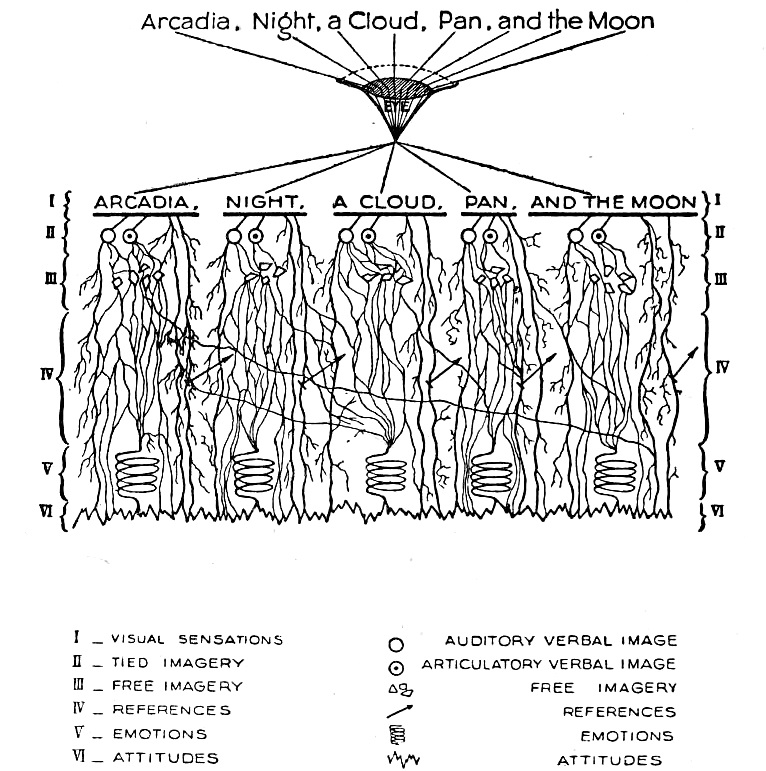
†
Hegel’s dictum, History of Philosophy, iii, 543.
†
Critique of Judgment, transl. by Meredith, p. 15.
*
Dr Bosanquet was one of the last adherents. See his Three
Lectures on Æsthetics.
†
E.g. Vernon Lee, The Beautiful.
*
E.g. Any choice for which the chooser cannot give his reasons
tends in the laboratory to be called an ‘æsthetic choice.’
*
Cf. Chapters X and XXXII, and Impersonality, Index.
†
Clive Bell, Art, p. 25.
†
A.C. Bradley, Oxford Lectures on Poetry, p. 5.
†
G. W. Mackail, Lectures on Poetry. Introduction.
*
We can diagrammatically represent the delusion as follows.
What actually occurs is that A, a work of art, causes E an effect
in us, which has the character b; A causes E[b].
We speak as though we perceived that A has the quality
B (Beauty); we are perceiving A[B]; and if we are not careful
we think so too. No one of our recent revolutions in thought
is more important than this progressive rediscovery of what we
are talking about. It is being inevitably followed by wide changes
in our attitudes to the world and to fellow-creatures. One current
in this change is towards tolerance, another towards scepticism,
a third towards far more secure founding of our motives of action.
The startling philosophical changes in the general outlook sometimes’
predicted for Relativity (or for popular ideas about it when
once they become widespread) appear likely, if they occur at
all, to be engulfed by these more unobtrusive but more domestic
changes
*
See Chapter XXIV.
*
This point will be discussed in Chapter XXIV.
*
Again the normality of the artist has to be considered.
*
As will be seen, I am not going to identify ‘beauty’ with
‘communicative efficacy’. This is a trap which it is easy to
fall into. A number of the exoteric followers of Croce may be
found in it, though not Croce himself.
*
Throughout this discussion ‘experience’ will be used in a
wide sense to stand for any occurrence in the mind. It is equivalent
to ‘mental state, or process.’ The term has often unfortunate
suggestions of passiveness and of consciousness, but many of
the ‘experiences’ here referred to would ordinarily be called
‘actions’ and have parts which are not conscious and not accessible
to introspection as important as those which are.
*
A chief advocate of this view is Dr G. E. Moore, whose Principia
Ethica and Ethics contain brilliant statements of
the position.
†
Cf. F. Brentano, The Origin of the Knowledge of Right
and Wrong, pp. 12, 46.
*
Cf. Russell, The Principles of Mathematics, p. 100.
“On this principle, from which I can see no escape, that every
genuine word must have some meaning, the is and than
must form part of ‘a is greater than b’, which
thus contains more than two terms and a relation. The is
seems to state that a has to greater the relation
of referent, while the than states similarly that b
has to greater the relation of relatum. But ‘a
exceeds b’ may be held to express solely the relation
of a to b, without including any of the implications
of further relations.” On the introspective comparison of judgments
The Meaning of Meaning, by C. K. Ogden and the writer,
may be consulted.
*
E.g., “The value of the object is its capacity of becoming
the object of feeling and desire through actualisation of dispositional
tendencies by acts of presumption, judgment, and assumption.”
Urban, Valuation, p. 53.
*
Or, of course, aversions. In what follows we shall take no
further note of aversions. To do so would introduce inessential
complications. The omission in no way affects the argument, since
for our present purposes they may be counted in with appetencies.
*
This view plainly has close connections with Utilitarianism.
In fact if Bentham’s editor is to be trusted in his interpretation
of his master’s doctrine, it would be what Bentham intended to
teach. “The term nearest to being synonymous with pleasure is
volition: what it pleases a man to do is simply what he
wills to do. . . . What a man wills to do, or what he pleases
to do, may be far from giving him enjoyment; yet shall we say
that in doing it, he is not following his own pleasure? .. .
A native of Japan, when he is offended, stabs himself to prove
the intensity of his feelings. It is difficult to prove enjoyment
in this case: yet the man obeyed his impulses.” John Hill Burton,
Jeremy Bentham’s Works, vol. 1, p. 22.
†
Cf. W. J. Perry, The Origin of Magic and Religion,
p. 15.
*
Both ‘enjoyment’ and ‘satisfaction’ are unsuitable terms
in this connection. An unfortunate linguistic gap must be recognised.
The full exercise of an activity is commonly its own ‘satisfaction’,
and, as we shall see later, what pleasure may accompany it is
derivative and incidental.
“Beatitudo non est virtutis premium, sed ipsa virtus.”
†
Works, Vol. X, p. 560.
*
Not necessarily ‘social workers.’ Only personal communication
can show who have the virtues here referred to.
†
What is Art? Section V.
†
What is Art? Section XVI.
*
“This story of the Cenci is indeed eminently fearful and
monstrous: anything like a dry exhibition of it on the stage
would be insupportable. The person who would treat such a subject
must increase the ideal, and diminish the actual horror of the
events.” From Shelley’s preface. The producers, however, were
of the contrary opinion.
*
It is true that in mechanics one might draw up a formidable
list of names and say “Opposed to all these appeared a certain
Einstein”, but the cases are not parallel. A scientific advance
is different from a change of fashion, and no new facts nor any
new hypothesis—no Michelson-Morley experiment, nor any widened
purview—led up to the separate value theory of art. Although
historians of æsthetics are sometimes pleased to present their
facts as though they represented a progress from cruder to more
refined opinion, from ignorance to wisdom, there is no sound
basis for the procedure. Aristotle was at least as clearly and
fully aware of the relevant facts and as adequate in his explanations
as any later inquirers. Æsthetics in fact has hardly yet reached
the scientific stage, in which succeeding investigators can start
where their predecessors left off.
†
An Essay on Style. The final paragraph.
*
See Chapters XVI, XVIII and XXXI.
†
Clive Bell, Art, p. 49.
†
A. C. Bradley, Oxford Lectures on Poetry, p. 5.
†
Eyeless Sight, p. 22.
†
Dedalus, or Science and the Future, by J. B. S. Haldane.
*
Compare Chapter XXXIV where the ways in which emotive factors
interfere with thought are considered.
†
Cf. Piéron, Thought and the Brain, Chapter I.
*
Many apparent questions which begin with the words ‘What’
and ‘Why’ are not questions at all, but requests for emotive
Satisfaction.
*
‘Willing’ is a bad word; I would use conation throughout
were it not so likely to increase unnecessarily the difficulty
which this chapter will unavoidably present to readers who are
not familiar with psychological jargon. The essential thing is
to think of willing (desiring, striving towards, trying) as an
unconscious as much as a conscious process.
*
This topic is discussed at length in The Meaning of Meaning.
*
Titchener, Text-book of Psychology, p. 248.
*
Into conjectures as to what these are, it seems as yet not
profitable to enter.
†
Problèmes de Psychologie affective, pp. 141-144.
*
It is probable that Wordsworth and certain that Coleridge
if writing to-day would use quite other terms in place of pleasure
for describing poetic values.
*
The fashion in which the term ‘feeling’ shifts about in psychology
is notorious as a source of confusion. It would be convenient
if it could be kept for pleasure-unpleasure, and used no longer
as a synonym for ‘emotion’, since emotions can much more easily
be regarded as built up from organic sensations.
*
“Tragedy is an imitation of an action... effecting through
Pity and Terror the correction and refinement (κάθαρςις)
of such passions.” Poetics, VI. Cf. p. 247, infra.
*
The description of images belongs to the first steps in psychology,
and it is often possible to judge the rank and standing of a
psychologist by the degree of importance which he attaches to
their peculiarities. On theoretical grounds it seems probable
that they are luxury products (cf. The Meaning of Meaning,
pp. 148-151) peculiarly connected with the reproduction of emotion.
For a discussion of some experimental investigations into their
utility, Spearman, The Nature of Intelligence, Ch. XII,
may be consulted.
*
Two kinds of onomatopœia should be distinguished. In one
the sound of the words (actual or imaginal) is like some natural
sound (the buzzing of bees, galloping horses, and so forth).
In the other it is not like any such sound but such as merely
to call up free auditory images of the sounds in question. The
second case is by far the more common.
†
Works, II, 171.
*
It is worth remarking that any application of critical principles
must be indirect. They are not any the less useful because this
is so. Misunderstanding on this point has often led artists to
accuse critics of wishing to make art a matter of rules, and
their objection to any such attempt is entirely justified.
*
This character of blue is the basis of the doctrine of Reynolds,
that blue is unsuitable in foregrounds, which led Gainsborough,
according to the well-known story, to paint The Blue Boy.
*
This account of harmony also applies to music. Few modern
authorities are content to regard harmony as an affair merely
of the physical relationships of notes.
†
D’Eugène Delacroix au Néo-Impressionisme, p. 39.
*
This remark applies equally strongly to the attempts which
are from time to time made to find formulæ for the proportions
of buildings. No one with an adequate idea of the complexity
of the factors which determine our responses is likely to attach
great importance to these investigations, interesting though
they are. The interpretation of the results is not within sight
of even the most optimistic of psychologists.
†
The Power of Sound, p. 176.
*
The very strange and important phenomena of apparent telepathy,
and the feats of some ‘psychometrists’ and ‘clairvoyants’, although
they may call for a great extension of our ideas as to how minds
influence one another, do not require any such desperate devices
as transference of, or participation in, identical experiences.
If they did, the possibility of investigating them by the only
technique with which anything has ever been successfully investigated
would be remote. On any ‘identity’ or ‘participation’ theory,
communication becomes an ineffable and irremovable mystery. There
may, of course, be any number of strange events occurring about
which we cannot know, but to discuss such events is unprofitable.
†
Henry Head, ‘The Conception of Nervous and Mental Energy’
in the British Journal of Psychology, Oct. 1923, Vol.
XIV, p. 126.
†
Vision and Design, p. 194.
†
What is Art, Sect. XV.
†
Biographia Literaria, Vol. 11, Ch. XIV, p. 12.
*
The degree of racial difference is peculiarly difficult to
estimate. In view of the extent of mixture which has taken place
it may be of great importance in considering even the art of
one culture or tradition alone. Cf. F. G. Crookshank, The
Mongol in our Midst.
*
These types if they must be admitted, have not yet been described
satisfactorily. The defects of such attempts as those of Jung,
for example, are shown by the fact that individuals change so
readily and so freely from ‘type’ to ‘type’, being extrovert
one hour and introvert the next, rationalist and intuitive from
moment to moment. This is of course denied by the Zurich School
but not by the majority of observers. To point it out is not
to overlook much that is valuable in these distinctions. A satisfactory
classification would doubtless be very complex, and perhaps of
the form: An individual of Type A is extrovert under these conditions,
introvert under those, etc.
*
Biographia Literaria, Ch. XIII. “The primary IMAGINATION
I hold to be the living Power and prime Agent of all human perception,
and as a repetition in the finite mind of the eternal act of
creation in the infinite I AM.” The luminous hints dropped by
Coleridge in the neighbourhood of this sentence would seem to
have dazzled succeeding speculators. How otherwise explain why
they have been overlooked.
*
Coleridge’s distinction between IMAGINATION and Fancy was
in part the same as this. But he introduced value considerations
also, Imagination being such combination or fusion of mental
elements as resulted in certain valuable states of mind, and
Fancy being a mere trivial playing with these elements. The discussion
of this distinction will be postponed to Chapter XXXII, where
the different uses of the term ‘imagination’ are separated.
*
It is useful in this discussion to distinguish between the
artist’s personality as involved in his work and such other parts
of it as are not involved. With these last we are not here concerned.
*
A weakness of the modern Irish school (even at its best,
in Mr Yeats) or of the exquisite poetry of Mr De la Mare, may
be that its sensibility is a development out of the main track.
It is this which seems to make it minor poetry in a sense in
which Mr Hardy’s best work or Mr Eliot’s The Waste Land
is major poetry.
*
A specimen: “The thoughtful man, the man on business bent,
wends his way to Wembley with definite purpose. He seeketh knowledge,
desireth increase of commerce or willeth to study new epoch-making
inventions.”—Official Advertisement.
*
For another instance see Browning, Parting at Morning.
†
The Keys of the Gates: To the Accuser who is the God of
this World.
*
We must, of course, distinguish art of this kind from the
Christmas party or magazine kind of production, in which the
author provides something (different and in a different place)
for everybody. The works of Dickens might be cited as examples.
*
Cf. Prometheus Unbound, Act 1:
‘the air around them
looks radiant as the air around a star’;
also Triumph of Life:
‘as veil by veil the silent splendour drops
From Lucifer’.
†
Paradise Lost, Bk. II, line 672.
*
A very interesting contemporary example in connection with
which the problem arises perhaps more acutely than ever before
is Mr Eliot’s The Waste Land already mentioned. The impatience
of so many critics and the fact that they have complained of
the presence and necessity of notes well illustrates the confusion
which prevails upon this question. A more reasonable complaint
would have been that Mr Eliot did not provide a larger apparatus
of elucidation. (See Appendix).
*
E.g. ‘When lovely woman stoops to folly,’ Heraclitus,
The Millers Daughter, Alexander Selkirk, and (its best known
parts at least) The Skylark.
*
Difficulties even here arise, e.g. the poet may be dissatisfied
without reason. Coleridge thought Kubla Khan merely ‘a
psychological curiosity’ without poetic merits, and may have
been justified in some degree. If he was not, it is his dream
experience which we should presumably have to take as our standard.
*
Even Coleridge was not exempt from this failing. Cf. his
comments on Gloster.
†
Essay on Casanova, in Affirmations, p. 115.
†
Affirmations, p. 115.
*
Coleridge’s debt here to Schelling has been over-estimated.
Such borrowings as he made were more hampering to him than helpful.
†
Biographia Literaria, II, pp. 12, 14.
*
It may perhaps be desirable to point out that this description
of the effects of art follows from the theory of value outlined
in Chapter VII. They are the most valuable experiences because
they are the least wasteful. Thus the place assigned to them
is not a mere personal expression of preference.
*
May I assume that references here will not distress the reader?
Tennyson, Scott, Landor, Shelley, Keats, Scott, Anon; Marvell,
Donne, Peacock. I am anxious to facilitate the actual detailed
comparison of these poems.
*
This topic is discussed from a slightly different angle in
The Foundations of Æsthetics (Allen and Unwin, 1922).
*
I will quote the familiar passage for the reader’s convenience:
I have felt
A presence that disturbs me with the joy
Of elevated thoughts: a sense sublime
Of something far more deeply interfused,
Whose dwelling is the light of setting suns,
And the round ocean and the living air,
And the blue sky, and in the mind of man:
A motion and a spirit that impels
All thinking things, all objects of all thought
And rolls through all things.
Not itself an instance of imaginative utterance, although some
instances can be found in the poem.
†
Shooting Niagara.
†
Sartor Resartus.
†
Essay on Style.
*
A discussion of Croce’s doctrines might seem advisable at
some point. But all that is strictly necessary has already been
said in The Foundations of Æsthetics. It may be repeated
here in the vigorous terms of Giovanni Papini (Four and Twenty
Minds): “If you disregard critical trivialities and didactic
accessories, the entire æsthetic system of Croce amounts merely
to a hunt for pseudonyms of the word ‘art’, and may indeed be
stated briefly and accurately in this formula: art = intuition
= expression = feeling = imagination = fancy = lyricism = beauty.
And you must be careful not to take these words with the shadings
and distinctions which they have in ordinary or scientific language.
Not a bit of it. Every word is merely a different series of syllables
signifying absolutely and completely the same thing.” When you
are not careful the amalgam of confusions and contradictions
which ensues is very remarkable. It is interesting to notice
that Croce’s appeal has been exclusively to those unfamiliar
with the subject, to the man of letters and the dilettante. He
has been ignored by serious students of the mind. How many of
those for example who have been impressed by his dicta as to
expression and language have been aware of how the problem has
been discussed before, or have ever heard of the ‘imageless thought’
controversy? Upon the ways in which Croce’s strategy has inveigled
the guileless into supposing him to be saying something, Papini
is excellent. ‘The Barabbas of art, the Thug of philosophy, the
Apache of culture’—Papini so describes himself—has here rendered
a notable service to those who have been depressed by the vogue
of ‘Expressionism’.
*
ὅμοιον. This word is variously translated ‘resemblance’
(Twining), and ‘truth to life’? (Butcher). Its usual meaning
in the Poetics is ‘the quality of being like ourselves’,
‘average humanity’.
*
Cf. Eastlake, Literature of the Fine Arts.
“The elephant with his objectionable legs and inexpressive hide
may still be supposed to be a very normal specimen and may accordingly
be a fit object for artistic imitation.”
†
Preface to Lyrical Ballads.
*
Compare Thomas Rymer, A Short View of Tragedy.
“A little preparation and forecast might do well now and then.
For his Desdemona’s Marriage, he might have helped out the probability
by figuring how that some way or other a Blackamoor woman had
been her nurse and suckled her; or that once upon a time some
Virtuoso had transfused into her veins the Blood of a
Black Sheep.” We may take it such are not the secret laws of
nature to which Goethe was alluding.
†
On Poesy or Art.
†
‘Literature and Religion’ in The Necessity of Art,
published by The Student Christian Movement, p. 155.
*
The reader who is a psychologist will notice many points
in this statement at which elaboration and qualifications are
required. For example, when we are ‘introspecting’ factors normally
belonging to the second set may enter the first. But he will
be able, if he grasps the general theory, to supply these complications
himself. I did not wish to burden the text with unnecessary intricacies.
*
Revelation Doctrines when once given a foothold tend to interfere
everywhere. They serve as a kind of omnipotent major premise
justifying any and every conclusion. A specimen: “Since the function
of Art is to pierce through to the Real World, then it follows
that the artist cannot be too definite in his outlines, and that
good drawing is the foundation of all good art.”—Charles Gardner,
Vision and Vesture, p. 54.
†
Essay on Style, p. 19.
†
Short View of Tragedy.
†
Cf. A. Clutton-Brock, The Times, 11th July 1922, p.
13.
*
No merit, that is, in this connection. There may be
some exceptions to this, cases in which the explicit recognition
of the truth of a statement as opposed to the simple acceptance
of it, is necessary to the full development of the further
response. But I believe that such cases will on careful examination
be found to be very rare with competent readers. Individual differences,
corresponding to the different degrees to which individuals have
their belief feelings, their references, and their attitudes
entangled, are to be expected. There are, of course, an immense
number of scientific beliefs present among the conditions of
every attitude. But since acceptances would do equally well in
their place they are not necessary to it.
*
In view of a possible misunderstanding at this point, compare
Chapter X, especially the final paragraph. If a belief in Retributive
Justice, for example, is fatal to Prometheus Unbound,
so in another way is the belief that the Millennium is at hand.
To steer an unperplexed path between these opposite dangers is
extremely difficult. The distinctions required are perhaps better
left to the reader’s reflection than laboured further in the
faulty terminology which alone at present is available.
*
Cf. Gurney, The Power of Sound, p. 126. “A splendid
melodic phrase seems continually not like an object of sense,
but like an affirmation; not so much prompting admiring ejaculation
as compelling passionate assent.” His explanation, through association
with speech, seems to me inadequate. He adds that the use of
terms such as “expressiveness and significance,
as opposed to meaninglessness and triviality, may be allowed,
without the implication of any reference to transcendental views
which one may fail to understand, or theories of interpretation
which one may entirely repudiate.”
†
Percy Dearmer, The Necessity of Art, p. 180.
†
A.W. Pollard, ibidem, p. 135.

 envisaged as a mystic,
ineffable virtue is a close relative of the ‘æsthetic mood’,
and may easily be pernicious in its effects, through the habits
of mind which, as an idea, it fosters, and to which, as a mystery,
it appeals.