There are many handicrafts in which a knowledge of the true principles
of ornamentation is almost essential to success, and there are few in
which a knowledge of decorative laws cannot be utilised. The man who
can form a bowl or a vase well is an artist, and so is the man who can
make a beautiful chair or table. These are truths; but the converse of
these facts is also true; for if a man be not an artist he cannot form
an elegant bowl, nor make a beautiful chair.
At the very outset we must recognise the fact that the beautiful has a
commercial or money value. We may even say that art can lend to an
object a value greater than that of the material of which it consists,
even when the object be formed of precious matter, as of rare marbles,
scarce woods, or silver or gold.
This being the case, it follows that the workman who can endow his
productions with those qualities or beauties which give value to his
works, must be more useful to his employer than the man who produces
objects devoid of such beauty, and his time must be of higher value
than that of his less skilful companion. If a man, who has been born
and brought up as a "son of toil," has that laudable ambition which
causes him to seek to rise above his fellows by fairly becoming their
superior, I would say to him that I know of no means of his so readily
doing so, as by his acquainting himself with the laws of beauty, and
studying till he learns to perceive the difference between the
beautiful and the ugly, the graceful and the deformed, the refined and
the coarse. To perceive delicate beauties is not by any means an easy
task to those who have not devoted themselves to the consideration of
the beautiful for a long period of time, and of this be assured, that
what now appears to you to be beautiful, you may shortly regard as
less so, and what now fails to attract you, may ultimately become
charming to your eye. In your study of the beautiful, do not be led
away by the false judgment of ignorant persons who may suppose
themselves possessed of good taste. It is common to assume that women
have better taste than men, and some women seem to consider themselves
the possessors of even authoritative taste from which there can be no
appeal. They may be right, only we must be pardoned for not accepting
such authority, for should there be any over-estimation of the
accuracy of this good taste, serious loss of progress in art-judgment
might result.
It may be taken as an invariable truth that knowledge, and knowledge
alone, can enable us to form an accurate judgment respecting the
beauty or want of beauty of an object, and he who has the greater
knowledge of art can judge best of the ornamental qualities of an
object. He who would judge rightly of art-works must have knowledge.
Let him who would judge of beauty apply himself, then, to earnest
study, for thereby he shall have wisdom, and by his wise reasonings he
will be led to perceive beauty, and thus have opened to him a new
source of pleasure.
Art-knowledge is of value to the individual and to the country at
large. To the individual it is riches and wealth, and to the nation it
saves impoverishment. Take, for example, clay as a natural material:
in the hands of one man this material becomes flower-pots, worth
eighteen-pence a "cast" (a number varying from sixty to twelve
according to size); in the hands of another it becomes a tazza, or a
vase, worth five pounds, or perhaps fifty. It is the art which gives
the value, and not the material. To the nation it saves
impoverishment.
A wise policy induces a country to draw to itself all the wealth that
it can, without parting with more of its natural material than is
absolutely necessary. If for every pound of clay that a nation parts
with, it can draw to itself that amount of gold which we value at five
pounds sterling, it is obviously better thus to part with but little
material and yet secure wealth, than it is to part with the material
at a low rate either in its native condition, or worked into coarse
vessels, thereby rendering a great impoverishment of the native
resources of the country necessary in order to its wealth.
Men of the lowest degree of intelligence can dig clay, iron, or
copper, or quarry stone; but these materials, if bearing the impress
of mind, are ennobled and rendered valuable, and the more strongly the
material is marked with this ennobling impress the more valuable it
becomes.
I must qualify my last statement, for there are possible cases in
which the impress of mind may degrade rather than exalt, and take from
rather than enhance, the value of a material. To ennoble, the mind
must be noble; if debased, it can only debase. Let the mind be refined
and pure, and the more fully it impresses itself upon a material, the
more lovely does the material become, for thereby it has received the
impress of refinement and purity; but if the mind be debased and
impure, the more does the matter to which its nature is transmitted
become degraded. Let me have a simple mass of clay as a candle-holder
rather than the earthen candlestick which only presents such a form as
is the natural outgoing of a degraded mind.
There is another reason why the material of which beautiful objects
are formed should be of little intrinsic value besides that arising
out of a consideration of the exhaustion of the country, and this
will lead us to see that it is desirable in all cases to form
beautiful objects as far as possible of an inexpensive material. Clay,
wood, iron, stone, are materials which may be fashioned into beautiful
forms, but beware of silver, and of gold, and of precious stones. The
most fragile material often endures for a long period of time, while
the almost incorrosible silver and gold rarely escape the ruthless
hand of the destroyer. "Beautiful though gold and silver are, and
worthy, even though they were the commonest of things, to be fashioned
into the most exquisite devices, their money value makes them a
perilous material for works of art. How many of the choicest relics of
antiquity are lost to us, because they tempted the thief to steal
them, and then to hide his theft by melting them! How many unique
designs in gold and silver have the vicissitudes of war reduced in
fierce haste into money-changers' nuggets! Where are Benvenuto
Cellini's vases, Lorenzo Ghiberti's cups, or the silver lamps of
Ghirlandajo? Gone almost as completely as Aaron's golden pot of manna,
of which, for another reason than that which kept St. Paul silent, 'we
cannot now speak particularly.' Nor is it only because this is a world
'where thieves break through and steal' that the fine gold becomes dim
and the silver perishes. This, too, is a world where 'love is strong
as death;' and what has not love—love of family, love of brother,
love of child, love of lover—prompted man and woman to do with the
costliest things, when they could be exchanged as mere bullion for the
lives of those who were beloved?"[1] Workmen! it is fortunate for us
that the best vehicles for art are the least costly materials.
Having made these general remarks, I may explain to my readers what I
am about to attempt in the little work which I have now commenced. My
primary aim will be to bring about refinement of mind in all who may
accompany me through my studies, so that they may individually be
enabled to judge correctly of the nature of any decorated object, and
enjoy its beauties—should it present any—and detect its faults, if
such be present. This refinement I shall attempt to bring about by
presenting to the mind considerations which it must digest and
assimilate, so that its new formations, if I may thus speak, may be of
knowledge. We shall carefully consider certain general principles,
which are either common to all fine arts or govern the production or
arrangement of ornamental forms: then we shall notice the laws which
regulate the combination of colours, and the application of colours to
objects; after which we shall review our various art-manufactures, and
consider art as associated with the manufacturing industries. We shall
thus be led to consider furniture, earthenware, table and window
glass, wall decorations, carpets, floor cloths, window-hangings, dress
fabrics, works in silver and gold, hardware, and whatever is a
combination of art and manufacture. I shall address myself, then, to
the carpenter, the cabinet-maker, potter, glass-blower, paper-stainer,
weaver and dyer, silversmith, blacksmith, gas-finisher, designer, and
all who are in any way engaged in the production of art-objects.
But before we commence our regular work, let me say that without
laborious study no satisfactory progress can be made. Labour is the
means whereby we raise ourselves above our fellows; labour is the
means by which we arrive at affluence. Think not that there is a royal
road to success—the road is through toil. Deceive not yourself with
the idea that you were born a genius—that you were born an artist. If
you are endowed with a love for art, remember that it is by labour
alone that you can get such knowledge as will enable you to present
your art-ideas in a manner acceptable to refined and educated people.
Be content, then, to labour. In the case of an individual, success
appears to me to depend upon the time which he devotes to the study of
that which he desires to master. One man works six hours a day;
another works eighteen. One has three days in one; and what is the
natural result? Simply this—that the one who works the eighteen hours
progresses with three times the rapidity of the one who only works six
hours. It is true that individuals differ in mental capacity, but my
experience has led me to believe that those who work the hardest
almost invariably succeed the best.
While I write, I have in my mind's eye one or two on whom Nature
appeared to have lavishly bestowed art-gifts; yet these have made but
little progress in life. I see, as it were, before me others who were
less gifted by Nature, but who industriously persevered in their
studies, and were content to labour for success; and these have
achieved positions which the natural genius has failed even to
approach. Workmen! I am a worker, and a believer in the efficacy of
work.
We will commence our systematic course by observing that good
ornament—good decorations of any character, have qualities which
appeal to the educated, but are silent to the ignorant, and that these
qualities make utterance of interesting facts; but before we can
rightly understand what I may term the hidden utterance of ornament,
we must inquire into the general revelation which the ornament of any
particular people, or of any historic age, makes to us, and also the
utterances of individual forms.
As an illustration of my meaning, let us take the ornament produced by
the Egyptians. In order to see this it may be necessary that we visit
a museum—say the British Museum—where we search out the mummy-cases;
but as most provincial museums boast one or more mummy-cases, we are
almost certain to find in the leading country towns illustrations that
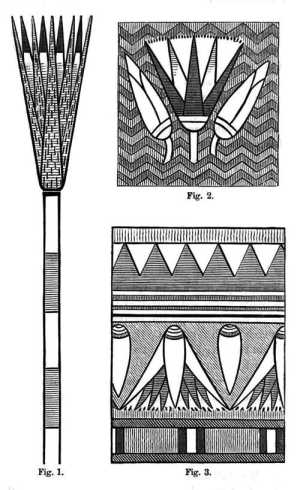
will serve our present purpose. On a mummy-case you may find a
singular ornament, which is a conventional drawing of the Egyptian
lotus, or blue water-lily
[2]
(see Figs. 1, 2, 3), and in all
probability you will find this ornamental device repeated over and
over again on the one mummy-case. Notice this peculiarity of the
drawing of the lotus—a peculiarity common to Egyptian ornaments—that
there is a severity, a rigidity of line, a sort of sternness about it.
This rigidity or severity of drawing is a great peculiarity or
characteristic of Egyptian drawing. But mark! with this severity there
is always coupled an amount of dignity, and in some cases this dignity
is very apparent. Length of line, firmness of drawing, severity of
form, and subtlety of curve are the great characteristics of Egyptian
ornamentation.
What does all this express? It expresses the character of the people
who created the ornaments. The ornaments of the ancient Egyptians were
all ordered by the priesthood, amongst whom the learning of this
people was stored. The priests were the dictators to the people not
only of religion, but of the forms which their ornaments were to
assume. Mark, then, the expression of the severity of character and
dignified bearing of the priesthood: in the very drawing of a simple
flower we have presented to us the character of the men who brought
about its production. But this is only what we are in the constant
habit of witnessing. A man of knowledge writes with power and force;
while the man of wavering opinions writes timidly and with feebleness.
The force of the one character (which character has been made forcible
by knowledge) and the weakness of the other is manifested by his
written words. So it is with ornaments: power or feebleness of
character is manifest by the forms produced.
The Egyptians were a severe people; they were hard task-masters. When
a great work had to be performed, a number of slaves were selected for
the work, and a portion of food allotted to each, which was to last
till the work was completed; and if the work was not finished when the
food was consumed, the slaves perished. We do not wonder at the
severity of Egyptian drawing. But the Egyptians were a noble
people—noble in knowledge of the arts, noble in the erection of vast
and massive buildings, noble in the greatness of their power. Hence we
have nobility of drawing—power and dignity mingled with severity in
every ornamental form which they produced.
We have thus noticed the general utterance or expression of Egyptian
drawing; but what specific communication does this particular lotus
make? Most of the ornaments of the Egyptians—whether the adornments
of sarcophagi, of water-vessels, or mere charms to be worn pendent
from the neck—were symbols of some truth or dogma inculcated by the
priests. Hence Egyptian ornament is said to be symbolic.
The fertility of the Nile valley was chiefly due to the river annually
overflowing its banks. In spreading over the land, the water carried
with it a quantity of rich alluvial earth, which gave fecundity to the
country on which it was deposited. When the water which had overspread
the surrounding land had nearly subsided, the corn which was to
produce the harvest was set by being cast upon the retiring water,
through which it sank into the rich alluvial earth. The water being
now well-nigh within the river-banks, the first flower that sprang up
was the lotus. This flower was to the Egyptians the harbinger of
coming plenty, for it symbolised the springing forth of the wheat. It
was the first flower of spring, or their primrose (first rose). The
priesthood, perceiving the interest with which this flower was viewed,
and the watchfulness manifested for its appearance, taught that in it
abode a god, and that it must be worshipped. The acknowledgment of
this flower as a fit and primary object of worship caused it to be
delineated on the mummy-cases, and sarcophagi, and on all sacred
edifices.
We shall have frequent occasion, while considering decorative art, to
notice symbolic forms; but we must not forget the fact that all good
ornaments make utterance. Let us in all cases, when beholding them,
give ear to their teachings!
Egyptian ornament is so full of forms which have interesting
significance that I cannot forbear giving one other illustration; and
of this I am sure, that not only does a knowledge of the intention of
each form employed in a decorative scheme cause the beholder to
receive a special amount of pleasure when viewing it, but also that
without such knowledge no one can rightly judge of the nature of any
ornamental work.
There is a device in Egyptian ornament which the most casual observer
cannot have failed to notice; it is what is termed the "winged globe,"
and consists of a small ball or globe, immediately at the sides of
which are two asps, and from which extend two wings, each wing being
in length about five to eight times that of the diameter of the ball
(Fig. 4). The drawing of this device is very grand. The force with
which the wings are delineated well represents the powerful character
of the protection which the kingdom of Egypt afforded, and which was
symbolised by the extended and overshadowing pinions.

I know of few instances where forms of an ornamental character have
been combined in a manner either more quaint or more interesting than
in the example before us. The composition presents a charm that few
ornaments do, and is worthy of careful consideration. But this
ornament derives a very special and unusual interest when we consider
its purpose, the blow which was once aimed at it, and the shock which
its producers must have received, upon finding it powerless to act as
they had taught, if not believed, it would.
The priesthood instructed the people that this was the symbol of
protection, and that it so effectually appealed to the preserving
spirits that no evil could enter where it was portrayed. With the view
of giving a secure protection to the inmates of Egyptian dwellings,
this device, or symbol of protection, was ordered to be placed on the
lintel (the post over the door) of every building of the Egyptians,
whether residence or temple.
It was to nullify this symbol, and to show the vain character of the
Egyptian gods, that Moses was commanded to have the blood of the lamb
slain at the passover placed upon the lintel, in the very position of
this winged globe. It was also enjoined as a further duty that the
blood be sprinkled on the door-post; but this was merely a new duty,
tending further to show that even in position, as well as in nature,
this winged globe was powerless to secure protection. This device,
then, is of special interest, both as a symbolic ornament and as
throwing light on Scripture history.
Besides the two ornamental forms mentioned—i.e., the lotus and the
winged globe—we might notice many others also of great interest, but
our space will not enable us to do so; further information may,
however, be got from the South Kensington Museum library,[3] where
several interesting works on Egyptian ornament may be seen;—from the
"Grammar of Ornament" by Mr. Owen Jones,—the works on Egypt by Sir
Gardiner Wilkinson; and, especially,—by a visit to the Egyptian Court
of the Crystal Palace at Sydenham, and by a careful perusal of the
hand-book to that court.[4] Much might also be said respecting
Egyptian architecture, but on this we can say little here; yet, as the
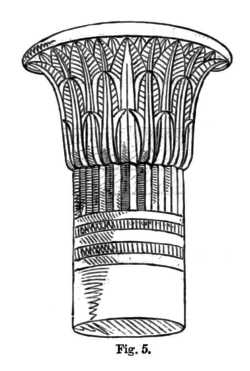
columns of the temples are of a very ornamental character, we may
notice that in most cases they were formed of a bundle of papyrus[5]
stems bound together by thongs or straps—the heads of the plant
forming the capital of the column, and the stems the shaft (Fig. 5).
In some cases the lotus was substituted for the papyrus; and in other
instances the palm-leaf was used in a similar way; these modifications
can be seen in the Egyptian Court at Sydenham with great advantage,
and many varieties of form resulting from the use of the one plant, as
of the papyrus, may also there be observed.
We have here an opportunity of noticing how the mode of building,
however simple or primitive in character, first employed by a nation
may become embodied in its ultimate architecture; for, undoubtedly,
the rude houses first erected in Egypt were formed largely of bundles
of the papyrus, which were gathered from the river-side—for wood was
rare in Egypt—and, ultimately, when buildings were formed of stone,
an attempt was made at imitating in the new material the form which
the old reeds presented. But mark, the imitation was no gross copy of
the original work, but a well-considered and perfectly idealised work,
substituting for the bundle of reeds a work having the true
architectural qualities of a noble-looking and useful column. We must
now pass from the ornament of the Egyptians to that of the Greeks, and
here we meet with decorative forms having a different object and
different aim from those already considered.
Egyptian ornament was symbolical in character. Its individual forms
had specific meanings—the purport of each shape being taught by the
priests—but we find no such thing as symbolism in Greek decoration.
The Greeks were a refined people, who sought not to express their
power by their art-works so much as their refinement. Before the
mental eye they always had a perfect ideal, and their most earnest
efforts were made at the realisation of the perfections of the mental
conception of absolute refinement. In one respect the Greeks resembled
the Egyptians, for they rarely created new forms. When once a form
became sacred to the Egyptians, it could not be altered; but with the
Greeks, while bound by no such law, the love of old forms was great;
yet the Greeks did not seek simply to reproduce what they had before
created, but laboured hard to improve and refine what they had before
done; and even through succeeding centuries they worked at the
refinement of simple forms and ornamental compositions, which have
become characteristic of them as a people.
The general expression of Greek art is that of refinement, and the
manner in which the delicately cultivated taste of some of the Greeks
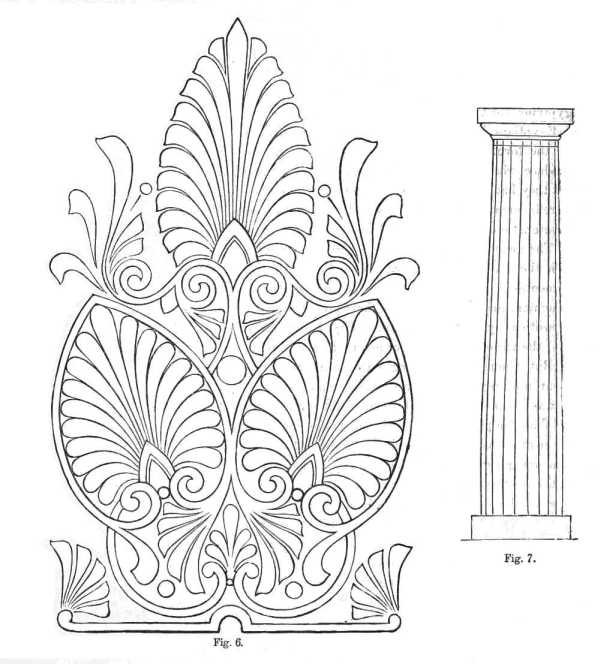
is expressed by their ornaments is astonishing. One decorative device,
which we term the Greek Anthemion, may be regarded as their principal
ornament—(the original ornamental composition by one of my pupils,
Fig. 6, consists primarily of three anthemions)—and the variety of
refined forms in which it appears is most interesting.
But it must not be thought that the Greek ornaments and architectural
forms present nothing but refinement made manifest in form, for this
is not the case. Great as is the refinement of some of these forms, we
yet notice that they speak of more than the perfected taste of their
producers, for they reveal to us this fact—that their creators had
great knowledge of natural forces and the laws by which natural forces
are governed. This becomes apparent in a marked degree when we inquire
into the manner in which they arranged the proportion of the various
parts of their works to the whole, and especially by a consideration
of the subtle nature of the curves which they employed both in
architectural members and in decorative forms; but into this we must
not now inquire. Yet, by way of throwing some faint light upon the
manner in which knowledge is embodied in Greek forms, I may refer to
the Doric column, such as was employed in the Parthenon at Athens[6]
(Fig. 7). The idea presented by this column is that of energetic
upward growth which has come in contact with some superposed mass, the
weight of which presses upon the column from above, while the energy
of the upward growth causes the column to appear fully equal to the
task of supporting the superincumbent structure. Mark this—that by
pressure from above, or weight, the shaft of the column is distended,
or bent out, about one-third of the distance from its base to its
apex (just where this distension would occur, were the column formed
of a slightly plastic material), and yet this distension of the shaft
is not such as to give any idea of weakness, for the column appears to
rise with the energy of such vigorous life as to be more than able to
bear the weight which it has to sustain.
Mark also the singularly delicate curve of the capital of the column,
which appears as a slightly plastic cushion intervening between the
shaft and the superincumbent mass which it has to support. The
delicacy and refinement of form presented by this capital is perhaps
greater than that of any other with which we are acquainted.
The same principle of life and energy coming in contact with
resistance or pressure from above is constantly met with in the
enrichments of Greek cornices and mouldings; but having called
attention to the fact, I must leave the student to observe, and think
upon, these interesting subjects for himself. Let me, however, say
that there are few classic buildings in England which will aid the
learner in his researches; there is but little poetry in our
architectural buildings, and but little refinement in the forms of the
parts, especially in our classic buildings; and, added to this, Greek
art without Greek colouring is dead, being almost as the marble statue
to the living form. For the purposes of my readers, the Greek Court at
the Crystal Palace will be the best example for study.
I might now review Roman ornament, and show that in the hour of pride
the materials of which the Roman works were formed were considered,
rather than the shapes which they assumed; and how we thus get little
worthy of praise from the all-conquering Romans—how the sunny climate
and religious superstitions of the East called forth the gorgeous and
beautiful developments of art which have existed, or still exist, with
the Persians, Indians, Turks, Moors, Chinese, and Japanese; but I have
not space to do so; yet all the forms of ornament which these people
have created are worthy of the most careful and exhaustive
consideration, as they present art-qualities of the highest kind. I
know of no ornament more intricately beautiful and mingled than the
Persian—no geometrical strapwork, or systems of interlacing lines, so
rich as those of the Moors (the Alhambraic)—no fabrics so gorgeous as
those of India—none so quaintly harmonious as those of China; and
Japan can supply the world with the most beautiful domestic articles
that we can anywhere procure.
We must pass on, however, to what we may term Christian art, or that
development of ornament which had its rise with the Christian
religion, and has associated itself in a special manner with
Christianity.
Neither the Egyptians nor early Greeks appear to have used the arch
structurally in their buildings; the Romans, however, had the round
arch as a primary structural element. This round arch was also used by
the Byzantines, and amongst their ornaments we find those combinations
of circles, or parts of circles, which so constantly recur in later
times in Gothic architecture and Gothic ornament. Norman buildings,
again, show us the round arch, and present us with such intersected
arcs as would naturally suggest the pointed arch of later times, with
which came the full development of Gothic or Christian architecture
and ornamentation. There was a very fine and marvellously clever
development of decorative art, enthusiastically worked at by the
Christian monks of the seventh and eighth centuries, called Celtic, of
which we have many beautiful examples in Professor Westwood's great
work on early illuminated manuscripts; but what is generally
understood by Christian or Gothic art had its finest development about
the thirteenth century.
Gothic ornament, like the Egyptian, is essentially symbolic. Its forms
have in many instances specific significance. Thus the common
equilateral triangle is in some cases used to symbolise the Holy
Trinity; so are the two entwined triangles. But there are many other
symbols employed in Gothic ornament which set forth the mystery of the
Unity of the Trinity. Thus in Fig. 8 we have three interlaced circles,
which beautifully express the eternal Unity of the Holy Trinity, for
the circle alone symbolises eternity, being without beginning and
without end, and the three parts point to the Three Persons of the
Godhead. A very curious and clever symbol of the Trinity is portrayed
in Fig. 9, where three faces are so combined as to form an ornamental
figure.
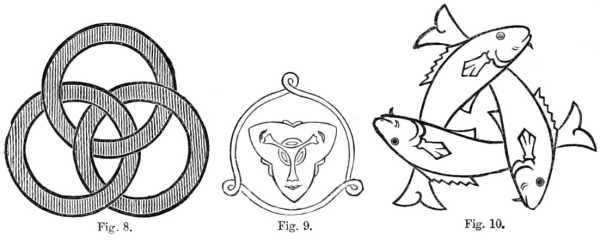
Baptism under the immediate sanction of the Divine Trinity was
represented by three fishes placed together in the manner of a
triangle (Fig. 10); but so numerous were Christian symbols after the
ninth century, that to enumerate them merely would occupy much space.
Every trefoil symbolised the Holy Trinity, every quatrefoil the four
evangelists, every cross the Crucifixion, or the martyrdom of some
saint. And into Gothic ornamentation the chalice, the crown of thorns,
the dice, the sop, the hammer and nails, the flagellum, and other
symbols of our Lord's passion have entered. But, besides these, we
have more purely architectural forms making gentle utterance: the
church spire points heavenwards, and the long lines of the clustered
columns of the cathedral direct the thoughts upwards to heaven and to
God.
Gothic ornament, having passed from its purity towards undue
elaboration, began to lose its hold on the people for whom it was
created, and the form of religion with which it had long been
associated had become old, when the great overthrow of old traditions
and usages occurred, commonly called the Reformation. With the
reformation of religion came a revival of classic learning, and a
general diffusion of knowledge, and thus the immediate necessity for
art-symbols was passing away, it being especially to an unlettered
people that an extended system of symbolism appeals. With this revival
of classic learning came the investigation of classic remains—the
exploration of Greek and Roman ruins; and while this was going on, a
dislike to whatever had been associated with the old form of religion
had sprung up, which dislike turned to hate as the struggle advanced,
till the feeling against Gothic architecture and ornament became so
strong that anything was preferred to it. Now arose Renaissance
architecture and ornament (revival work), which was based on the Roman
remains, but was yet remoulded, or formed anew; so that the ornament
of the Renaissance is not Roman ornament, but a new decorative scheme,
of the same genus as that of the Roman. Here, however, all my
sympathies end. I confess that all Renaissance ornament, whether
developed under the soft sky of Italy (Italian ornament), in more
northerly France (French Renaissance), or on our own soil
(Elizabethan, or English Renaissance), fails to awaken any feeling of
sympathy in my breast; and that it, on the contrary, chills and repels
me. I enjoy the power and vigour of Egyptian ornament, the refinement
of the Greek, the gorgeousness of the Alhambraic, the richness of the
Persian and Indian, the quaintness of the Chinese and Japanese, the
simple honesty and boldness of the Gothic; but with the coarse
Assyrian, the haughty Roman, and the cold Renaissance, I have no
kindred feeling—no sympathy. They strike notes which have no chords
in my nature: hence from them I instinctively fly. I must be pardoned
for this my feeling by those who differ from me in judgment, but my
continued studies of these styles only separate me further from them
in feeling.
It will be said that in my writings I mingle together ornament and
architecture, and that my sphere is ornament, and not building. I
cannot separate the two. The material at command, the religion of the
people, and the climate have, to a great extent, determined the
character of the architecture of all ages and nations; but they have,
to the same extent, determined the nature of the ornamentation of the
edifices raised. Ornament always has arisen out of architecture, or
been a mere reflex of the art-principles of the building decorated. We
cannot rightly consider ornament without architecture; but I will
promise to take no further notice of architecture than is absolutely
necessary to the proper understanding of our subject.
In my previous remarks I have attempted to set forth some of the first
principles of ornament, and to call attention to the purport or
intention of certain of the leading historic styles, and the manner in
which they make utterance to us of the faith or sentiments of their
producers.
But there are other utterances of ornament, and other general
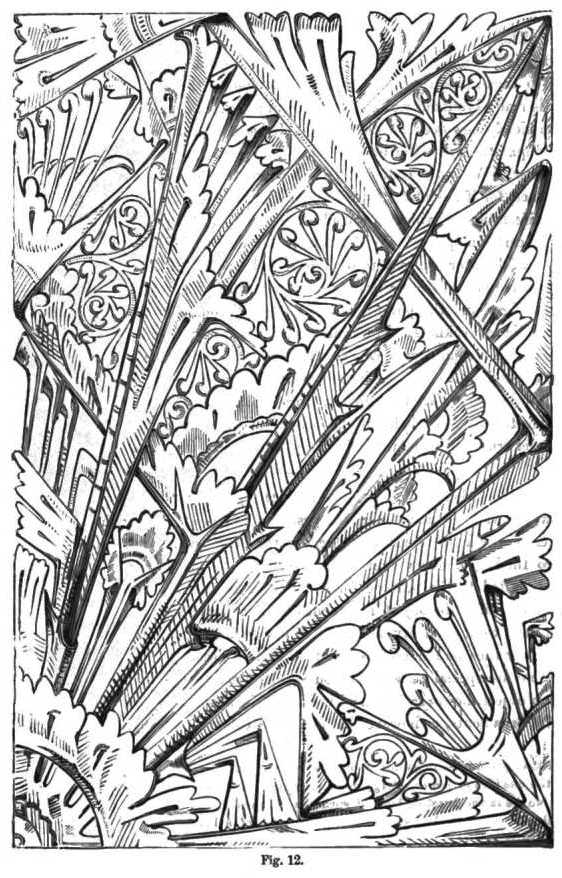
expressions which decorative forms convey to the mind. Thus sharp,
angular, or spiny forms are more or less exciting (Fig. 11); while
bold and broad forms are soothing, or tend to give repose.
Sharp or angular forms, where combined in ornament, act upon the
senses much as racy and pointed sayings do. Thus "cut" or angular
glass, spinose metal-work, as the pointed foliage of some wrought-iron
gates, and other works in which there is a prevalence of angles and
points, so act upon the mind as to stimulate it, and thus produce an
effect opposite to repose; while "breadth" of form and "largeness" of
treatment induce tranquillity and meditation.
Nothing can be more important to the ornamentist than the scientific
study of art. The metaphysical inquiry into cause and effect, as
relating to decorative ideas, is very important—indeed,
all-important—to the true decorator. He must constantly ask himself
what effect such and such forms have upon the mind—which effects are
soothing, which cheerful, which melancholy, which rich, which
ethereal, which gorgeous, which solid, which graceful, which lovable,
and so on; and in order to do this he must separate the various
elements of ornamental composition, and consider these apart, so as to
be sure that he is not mistaken as to what affects the mind in any
particular manner, and he must then combine these elements in various
proportions, and consider the effects of the various combinations on
his own mind and that of others, and thus he will discover what will
enable him to so act on the senses as to induce effects such as he may
desire to produce.
Are we to decorate a dining-room, let the decoration give the sense of
richness; a drawing-room, let it give cheerfulness; a library, let it
give worth; a bed-room, repose; but glitter must never occur in large
quantities, for that which excites can only be sparingly indulged
in—if too freely employed, it gives the sense of vulgarity.
In this chapter I have to speak primarily of Truth, Beauty, and
Power. Long since I was so fully impressed with the idea that true
art-principles are so perfectly manifested by these three words, that
I embodied them in an ornamental device which I painted on my study
door, so that all who entered might learn the principles which I
sought to manifest in my works.
There can be morality or immorality in art, the utterance of truth or
of falsehood; and by his art the ornamentist may exalt or debase a
nation.
Truth.—How noble, how beautiful; how righteous to utter it; and how
debasing is falsehood; yet we see falsehood preferred to truth—that
which debases to that which exalts, in art as well as morals; and I
fear that there is almost as much that is false, degrading, and untrue
in my beautiful art as there is of the noble, righteous, and exalting,
although art should only be practised by ennobling hands. It is this
grovelling art, this so-called ornamentation, which tends to debase
rather than exalt, to degrade rather than make noble, to foster a lie
rather than utter truth, which brings about the abasement of our
calling, and causes our art to fail in many instances in laying hold
of, and clinging to, the affections of the noble and the great.
Ornamentation is in the highest sense of the word a Fine Art; there is
no art more noble, none more exalted. It can cheer the sorrowing; it
can soothe the troubled; it can enhance the joys of those who make
merry; it can inculcate the doctrine of truth; it can refine, elevate,
purify, and point onward and upward to heaven and to God. It is a fine
art, for it embodies and expresses the feelings of the soul of
man—that inward spirit which was breathed by the Creator into the
lifeless clay as the image of his life—however noble, pure, or holy.
This being the case, those who ignore decoration cast aside a source
of refinement, and deprive themselves of what may induce their
elevation in virtue and morals. Such a neglect on the part of those
who can afford luxuries would be highly censurable, were it not that
the professors of the art are for the most part false pretenders,
knowing not what they practise, and men ignorant of the power which
they hold in their hands. The true artist is a rare creature; he is
often unknown, frequently misunderstood, or not understood at all, and
is not unfrequently lost to a people that prefer shallowness to deep
meaning, falsehood to truth, and glitter to repose.
We now see the utter folly of appealing simply to what is called
"taste" in matters of art, and the uselessness of yielding to the
caprice (falsely called taste) of the uneducated in such matters,
especially as this so-called taste is often of the most vulgar and
debased order. We also see the absurdity of persons who employ a true
artist interfering with his judgment and ideas. The true artist is a
noble teacher; shall he be told, then, what morals he shall
inculcate, and what lofty truths he shall embody in his works, or omit
from them? Do we tell the preacher what he shall say, and ask him to
withhold whatever is refining and elevating? We do not, and in art we
must leave the professors free to teach, and hold them responsible for
their teachings.
If I thought that I had now convinced my reader that decorative art
does not consist merely in the placing together of forms, however
beautiful they may be individually or collectively; nor in rendering
objects simply what is called pretty; but that it is a power for good
or evil; that it is what will elevate or debase—that which cannot be
neutral in its tendency—I would advance to consider its principles;
but I cannot teach, nor can I be understood, unless the reader feels
that he who practises art wields a vast power, for the rightful use of
which he must be held responsible.
All graining of wood is false, inasmuch as it attempts to deceive; the
effort being made at causing one material to look like another which
it is not. All "marbling" is false also: a floor-cloth made in
imitation of carpet or matting is false; a Brussels carpet that
imitates a Turkey carpet is false; so is a jug that imitates
wicker-work, a printed fabric that imitates one which is woven, a
gas-lamp that imitates an oil-lamp. These are all untruths in
expression, and are, besides, vulgar absurdities which are the more
lamentable, as the imitation is always less beautiful than the thing
imitated; and as each material has the power of expressing beauty
truthfully, thus the want of truth brings its own punishment. A deal
door is beautiful, but it will not keep clean; let it then be
varnished. It is now preserved, and its own characteristic features
are enhanced by the varnish, so that its individuality is emphasised,
and no untruth told. A floor-cloth can present a pattern with true and
beautiful curves—how absurd, then, to try and imitate the dotty
effect of a carpet; and the Brussels carpet can express truer curves
than the Turkey carpet, then why imitate the latter in the finer
material? But perhaps the most senseless of all these absurdities is
the making an earthen jug in imitation of wicker-work when if so
formed it would be useless as a water-vessel. I can imagine a fool in
his simplicity priding himself on such a bright thought as the
production of a vessel of this kind, but I cannot imagine any rightly
constituted mind producing or commending such an idea. Let the
expression of our art ever be truthful.
Beauty.—I will say little on this head, for decorative forms must
be beautiful. Shapes which are not beautiful are rarely decorative. I
will not now attempt to express what character forms should have in
order that they be considered beautiful, but will content myself by
saying that they must be truthful in expression, and graceful,
delicate, and refined in contour, manifesting no coarseness,
vulgarity, or obtrusiveness. My views of the beautiful must be
gathered from the series of chapters which will follow, but this I may
here say, that the beautiful manifests no want, no shortcoming. A
composition that is beautiful must have no parts which could be taken
from it and yet leave the remainder equally good or better. The
perfectly beautiful is that which admits of no improvement. The
beautiful is lovable, and, as that which is lovable, takes hold of the
affections and clings to them, binding itself firmer and firmer to
them as time rolls on. If an object is really beautiful we do not tire
of it; fashion does not induce us to change it; the merely new does
not displace it. It becomes as an old friend, more loved as its good
qualities are better understood.
Power.—We now come to consider an art-element or principle of great
importance, for if absent from any composition, feebleness or weakness
is the result, the manifestation of which is not pleasant. With what
power do the plants burst from the earth in spring! With what power do
the buds develop into branches! The powerful orator is a man to be
admired, the powerful thinker a man we esteem. Even the simple power,
or brute force, of animals we involuntarily approve—the powerful
tiger and the powerful horse call forth our commendation, for power is
antagonistic to weakness. Power also manifests earnestness; power
means energy; power implies a conqueror. Our compositions, then, must
be powerful.
But besides all this, we, the professors of decorative art, must
manifest power in our works, for we are teachers sent forth to
instruct, and ennoble, and elevate our fellow-creatures. We shall not
be believed if we do not utter our truths with power; let truth, then,
be uttered with power, and in the form of beauty.[7]
There are other principles governing the production and application of
ornament which we must now notice, the first of which is utility,
for the first aim of the designer of any article must be to render the
object which he produces useful. I may go further, and say that an
article must be made not only useful, but as perfectly suited to the
purpose for which it is intended as it can be. It matters not how
beautiful the object is intended to be, it must first be formed as
though it were a mere work of utility, and after it has been carefully
created with this end in view it may then be rendered as beautiful as
you please.
There are special reasons why our works should be useful as well as
beautiful, for if an object, however beautiful it may be in shape,
however richly covered with beautiful ornaments, or however
harmoniously coloured, be unpleasant to use, it will ultimately be
set aside, and that which is more convenient for use will replace it,
even if the latter be without beauty. As an illustration of this fact,
let us suppose the balustrade railings of a staircase very beautiful,
and yet furnished with such projections as render it almost impossible
that we walk up or down the stairs without tearing the dress, or
injuring the person, and how soon will our admiration of the beautiful
railing disappear, and even be replaced by hate! In like manner let
the handle of a door, or the head of a poker, be so formed as to hurt
the hand, and the simple round knob, or round head, will be preferred
to it, however ornamentally or beautifully formed.
In relation to this subject, Professor George Wilson has said: "The
conviction seems ineradicable from some minds, that a beautiful thing
cannot be a useful thing, and that the more you increase the beauty of
the necessary furniture or the implements of every-day life the more
you lessen their utility. Make the Queen's sceptre as beautiful as you
please, but don't try to beautify a poker, especially in cold weather.
My lady's vinaigrette carve and gild as you will, but leave untouched
my pewter ink-bottle. Put fine furniture, if you choose, into my
drawing-room; but I am a plain man, and like useful things in my
parlour, and so on. Good folks of this sort seem to labour under the
impression that the secret desire of art is to rob them of all
comfort. Its unconfessed but actual aim, they believe, is to realise
the faith of their childhood, when it was understood that a monarch
always wore his crown, held an orb in one hand and a sceptre in the
other, and a literal interpretation was put upon Shakespeare's words,
'Uneasy lies the head that wears a crown.'
Were art to prosper, farewell to fire-proof, shapeless slippers, which
bask like salamanders unharmed in the hottest blaze. An æsthetic pair,
modelled upon Cinderella's foot, and covered with snow-white
embroidery, must take their place, and dispense chilblains and
frost-bite to miserable toes. Farewell to shooting-coats out a little
at the elbows, to patched dressing-gowns, and hair-cloth sofas.
Nothing but full-dress, varnished boots, spider-legged chairs, white
satin chair-covers, alabaster ink-bottles, velvet door-mats, and
scrapers of silver or gold. It is astonishing how many people think
that a thing cannot be comfortable if it is beautiful. . . . If there
be one truth which the Author of all has taught us in his works more
clearly than another, it is the perfect compatibility of the highest
utility with the greatest beauty. I offer you one example. All are
familiar with the beautiful shell of the nautilus. Give the nautilus
itself to a mathematician, and he will show you that one secret of its
gracefulness lies in its following in its volute or whorl a particular
geometrical curve with rigid precision. Pass it from the mathematician
to the natural philosopher, and he will show you how the simple
superposition of a great number of very thin transparent plates, and
the close approximation of a multitude of very fine engraved lines,
are the cause of its exquisite pearly lustre. Pass it from the natural
philosopher to the engineer, and he will show you that this fairy
shell is a most perfect practical machine, at once a sailing vessel
and a diving-bell, in which its living possessor had, centuries before
Archimedes, applied to utilitarian ends the law of specific gravity,
and centuries before Halley had dived in his bell to the bottom of the
sea. Pass it from the engineer to the anatomist, and he will show you
how, without marring its beauty, it is occupied during its lifetime
with a most orderly system of rowing and sailing tackle, chambers for
food, pumps to keep blood circulating, ventilating apparatus, and
hands to control all, so that it is a model ship with a model mariner
on board. Pass it lastly from the anatomist to the chemist, and he
will show you that every part of the shell and the creature is
compounded of elements, the relative weights of which follow in each
individual nautilus the same numerically identical ratio.
"Such is the nautilus, a thing so graceful, that when we look at it we
are content to say with Keats—
'A thing of beauty is a joy for ever;'
and yet a thing so thoroughly utilitarian, and fulfilling with the
utmost perfection the purely practical aim of its construction, that
our shipbuilders would be only too thankful if, though sacrificing all
beauty, they could make their vessels fulfil their business ends half
so well."
Viewing our subject in another light, and with special reference to
architecture, we notice that unless a building is fitted for the
purpose intended, or, in other words, answers utilitarian ends, it
cannot be esteemed as it otherwise might be, even though it be of
great æsthetic beauty. In respect to this subject, Mr. Owen Jones has
said: "The nave and aisles of a Gothic church become absurd when
filled with pews for Protestant worship, where all are required to see
and hear. The columns of the nave which impede sight and sound, the
aisles for processions which no longer exist, rood screens, and deep
chancels for the concealment of mysteries, now no longer such, are all
so many useless reproductions which must be thrown aside." Further,
"As architecture, so all works of the decorative arts, should possess
fitness, proportion, harmony; the result of all which is repose." Sir
M. Digby Wyatt has said: "Infinite variety and unerring fitness govern
all forms in Nature." Vitruvius, that "The perfection of all works
depends on their fitness to answer the end proposed, and on principles
resulting from a consideration of Nature itself." Sir Charles L.
Eastlake, that "In every case in Nature where fitness or utility can
be traced, the characteristic quality, or relative beauty, is found
to be identical with that of fitness." A. W. Pugin (the father): "How
many objects of ordinary use are rendered monstrous and ridiculous
simply because the artist, instead of seeking the most convenient
form, and then decorating it, has embodied some extravagance to
conceal the real purpose for which the article has been made." And
with the view of pointing out how fitness for, or adaptation to, the
end proposed is manifested in the structure and disposition upon the
earth of plants, I have written in a little work now out of print:
"The trees which grow highest upon the mountains, and the plants which
grow upon the unsheltered plain, have usually long, narrow, and rigid
leaves, which, owing to their form, are enabled to bear the fury of
the tempest, to which they are exposed, without injury. This is seen
in the ease of the species of fir which grow at great altitudes, where
the leaves are more like needles than leaves such as commonly occur;
and also in the species of heath which grow upon exposed moors: in
both cases the plants are, owing to the form of the leaf, enabled to
defy the blast, while those with broad leaves would be shattered and
destroyed.
"Not only is the form of leaf such as fits these plants to dwell in
such inhospitable regions, but other circumstances also tend to this
result. The stems are in both cases woody and flexible, so that while
they bend to the wind they resist its destroying influence by their
strength and elasticity. In relation to the stem of the papyrus,"
which is a plant constantly met with in Egyptian ornaments, "the late
Sir W. J. Hooker mentions an interesting fact which manifests
adaptation to its position. This plant grows in water, and attaches
itself to the margins of rivers and streams, by sending forth roots
and evolving long underground stems in the alluvium of the sides of
the waters. Owing to its position it is exposed to the influences of
the current, which it has to withstand, and this it does, not only by
having its stems of a triangular form—a shape well adapted for
withstanding pressure—but also by having them so placed in relation
to the direction of the stream, that one angle always meets the
current, and thus separates the waters as does the bow of a modern
steam-ship."
I might multiply illustrations of this principle of fitness, or
adaptation to purpose, as manifested in plants, to an almost
indefinite extent; but when all had been said we should yet have but
the simple truth before us, that the chief end which we should have in
creating any object, is that of rendering it perfectly fitted to
answer the proposed end. If those works which are beautiful were but
invariably useful, as they should be; if those objects which are most
beautiful were also the most convenient—and there is no reason why
they should not be so—how the beautiful would become loved and sought
after! Cost would be of little moment, the price would not be
complained of, if beautiful objects were works of perfect utility.
But, alas! it is far otherwise: that which is useful is often ugly,
and that which is beautiful is often inconvenient to use. This very
fact has given rise to the highly absurd fashion of having a second
poker in a drawing-room set of fire-irons. The one poker is
ornamental, possibly, but it is to be looked at; the other is for use,
and as it is not to be looked at, it is hidden away in some corner, or
close within the fender. I do not wonder at the second poker being
required; for nineteen out of every twenty pokers of an ornamental
(?) character which I have seen during the last few years would hurt
the hand so insufferably if they were used to break a lump of coal
with, that it would be almost impossible to employ them constantly for
such a purpose. But why not abolish the detestable thing altogether?
If the poker is to be retained as an ornament, place it on the table
or chimney-piece of your drawing-room, and not down on the hearth,
where it is at such a distance from the eye that its beauties cannot
be discovered. It is no use saying it would be out of place in such a
position. If to poke the fire with, its place is within the fender; if
it is an ornament, it should be placed where it can be best seen—in a
glass case, if worthy of protection.
I hope that sufficient has now been said upon this all-important
necessity, that, if an object is to be beautiful it should also be
useful, to cause us to consider it as a primary principle of design
that all objects which we create must be useful. To this as a first
law we shall constantly have to refer. When we construct a chair we
shall ask, is it useful? is it strong? is it properly put together?
could it be stronger without using more, or another, material? and
then we should consider whether it is beautiful. When we design a
bottle we shall inquire, is it useful? is it all that a bottle should
be? could it be more useful? and then, is it beautiful? When we create
a gas-branch we shall ask, does it fulfil all requirements, and
perfectly answer the end for which it is intended? and then, is it
beautiful? And in relation to patterns merely we shall also have to
make similar inquiries. Thus, if drawing a carpet design, we shall
inquire, is this form of ornament suitable to a woven fabric? is it
suitable to the particular fabric for which it is intended? is the
particular treatment of the ornament which we have adopted the best
possible when we bear in mind that the carpet has to be walked over,
as it is to act in relation to our furniture as a background does to a
picture, and is to be viewed at some distance from the eye? and then,
is it beautiful? Such inquiries we shall put respecting any object the
formation of which we may suggest: hence, in all our inquiries, I
shall, as I love art, consider utility before beauty, in order that my
art may be fostered and not despised.
There are many subjects yet not named in these pages which we ought to
consider, but I must content myself by merely mentioning them, and you
must be willing to think of them, and consider them with such care as
their importance may demand. Some of them, however, we shall refer to
when considering the various manufactures.
A principle of great importance in respect to design is, that the
material of which an object is formed should be used in a manner
consistent with its own nature, and in that particular way in which it
can be most easily "worked."
Another principle of equal importance with that just set forth, is
this: that when an object is about to be formed, that material (or
those materials) which is (or are) most appropriate to its formation
should be sought and employed. These two propositions are of very
great importance, and the principles which they set forth should never
be lost sight of by the designer. They involve the first principles of
successful designing, for if ignored the work produced cannot be
satisfactory.
Curves will be found to be beautiful just as they are subtle in
character; those which are most subtle in character being most
beautiful.
The arc is the least beautiful of curves (I do not here speak of a
circle, but of the line, as a line, which bounds the circle); being
struck from one centre its origin is instantly detected, while the
mind requires that a line, the contemplation of which shall be
pleasurable, must be in advance of its knowledge, and call into
activity its powers of inquiry. The elliptic curve, or curve bounding
the ellipse, is more beautiful than the arc, for its origin is not so
strikingly apparent, being formed from two centres. The curve of the
egg is more beautiful still, being formed from three centres.[8] As
the number of centres necessary to the formation of a curve increases,
the difficulty of detecting its origin also becomes greater, and the
variety which the curve presents is also proportionally great; the
variety being obviously greater as the number of the centres from
which it is struck is increased.
Proportion, like the curve, must be of a subtle nature.
A surface must never be divided for the purpose of decoration into
halves. The proportion of 1 to 1 is bad. As proportion increases in
subtlety it also increases in beauty. The proportion of 2 to 1 is
little better; the proportion of 3 to 8, or of 5 to 8, or of 5 to 13,
is, however, good, the last named being the best of those which I have
adduced; for the pleasure derived from the contemplation of proportion
increases with the difficulty of detecting it. This principle is true
in relation to the division of a mass into primary segments, and of
primary segments into secondary forms, as well as in relation to the
grouping together of parts of various sizes; hence it is worthy of
special note.
A principle of order must prevail in every ornamental composition.
Confusion is the result of accident, while order results from thought
and care. The operation of mind cannot well be set forth in the
absence of this principle; at least, the presence of a principle of
order renders the operation of mind at once manifest.
The orderly repetition of parts frequently aids in the production of
ornamental effects.
The kaleidoscope affords a wonderful example of what repetition will
do. The mere fragments of glass which we view in this instrument would
altogether fail to please were they not repeated with regularity. Of
themselves repetition and order can do much. (Figs. 13 and 14.)
Alternation is a principle of primary importance in certain
ornamental compositions.
In the case of a flower (as the buttercup, or chickweed, for example)
the coloured leaves do not fall over the green leaves (the petals do
not fall over the sepals), but between them—they alternate with them.
This principle is not only manifested in plants, but also in many
ornaments produced in the best periods of art (Fig. 15).
If plants are employed as ornaments they must not be treated
imitatively, but must be conventionally treated, or rendered into
ornaments (Fig. 16).
A monkey can imitate, man can create.
These are the chief principles which we shall have to notice, as
involved in the production of ornamental designs.
Some other principles of a less noble character than those which we
have already noticed as entering into ornament yet remain to be
mentioned. Man will be amused as well as instructed; he must be
pleased as well as ennobled by what he sees. I hold it as a first
principle that ornamentation, as a true fine art, can administer to
man in all his varying moods, and under all phases of feeling.
Decoration, if properly understood, would at once be seen to be a high
art in the truest sense of the word, as it can teach, elevate, refine,
induce lofty aspirations, and allay sorrows; but we have now to notice
it as a fine art, administering to man in his various moods, rather
than as the handmaid to religion or morals.
Humour seems to be as much an attribute of our nature as love, and,
like it, varies in intensity with different individuals. There are few
in whom there is not a certain amount of humour, and in some this one
quality predominates over all others. It not unfrequently happens that
men who are great thinkers are also great humorists—great talent and
great humour being often combined in the one individual.
The feeling for humour is ministered to in ornament by the grotesque,
and the grotesque occurs in the works of almost all ages and all
peoples. The ancient Egyptians employed it, so did the Assyrians, the
Greeks, and the Romans; but none of these nations used it to the
extent of the artists of the Celtic, Byzantine, and "Gothic" periods.
Hideous "evil spirits" were portrayed on the outside of almost every
Christian edifice at one time, and much of the Celtic ornament
produced by the early monks consisted of an anastomosis, or network,
of grotesque creatures.
The old Irish crosses were enriched with this kind of
ornamentation,[9] and some of the decorative embellishments of these
works are of extraordinary interest; but those who have access to the
beautiful work of Professor Westwood on Celtic manuscripts will there
see this grotesque form of ornament to perfection. As regards the
Eastern nations, while nearly all have employed the grotesque as an
element of decorative art, the Chinese and Japanese have employed it
most largely, and for it they manifest a most decided partiality. The
drawings of dragons, celestial lions (always spotted), mythical birds,
beasts, fishes, insects, and other supposed inhabitants of the Elysian
plains, which these people produce, are most interesting and
extraordinary.
Without in any way going into a history of the grotesque, let us look
at the characteristic forms which it has assumed, and what is
necessary to its successful production. We have said that the
grotesque in ornament is the analogue of humour in literature. This is
the case; but the grotesque may represent the truly horrible or
repellent, and be simply repulsive. This form is so seldom required in
ornamentation that I shall not dwell upon it, and when required it
should always be associated with power; for if the horrible is feeble
it cannot be corrective, but only revolting, like a miserable deformed
animal.
I think it may be taken as a principle, that the further the grotesque
is removed from an imitation of a natural object the better it is,
provided that it be energetic and vigorous—lifelike. Nothing is worse
than a feeble joke, unless it be a feeble grotesque. The amusing must
appear to be earnest.
In connection with this subject I give here a series of grotesques,
with the view of illustrating my meaning, and I would fain give more,
but space will not permit me to do so.
The initial letter S, formed of a bird, is a characteristic Celtic
grotesque (Fig. 17). It is quaint and interesting, and is sufficiently
unlike a living creature to avoid giving any sense of pain to the
beholder, while it is yet in a most unnatural position. It is, in
truth, rather an ornament than a copy of a living creature, yet it is
so suggestive as to call forth the thought of a bird. It should be
noticed, in connection with this figure, that the interstices between
certain portions of the creature are filled by a knot. This is
well—the whole thing; being an ornament, and not a naturalistic
representation.
Fig. 18 is a Siamese grotesque head, and a fine sample it is of the
curious form of ornament which it represents. Mark, it is in no way a
copy of a human head, but is a true ornament, with its parts so
arranged as to call up the idea of a face, and nothing more. Notice
the volutes forming the chin; the grotesque, yet highly ornamental,
lines forming the mouth and the upper boundary of the forehead, and
the flambeauant ears; the whole thing is worthy of the most careful
study.
Fig. 19 is a Gothic foliated face; but here we have features which are
much too naturalistic. We have, indeed, only a hideous human face with
a marginal excrescence of leafage. This is a type to be avoided; it is
not droll, nor quaint; but is simply unpleasant to look upon.
Fig. 20 is a fish, with the feeling of the grotesques of the Middle
Ages. It is a good type, being truly ornamental, and yet sufficiently
suggestive.
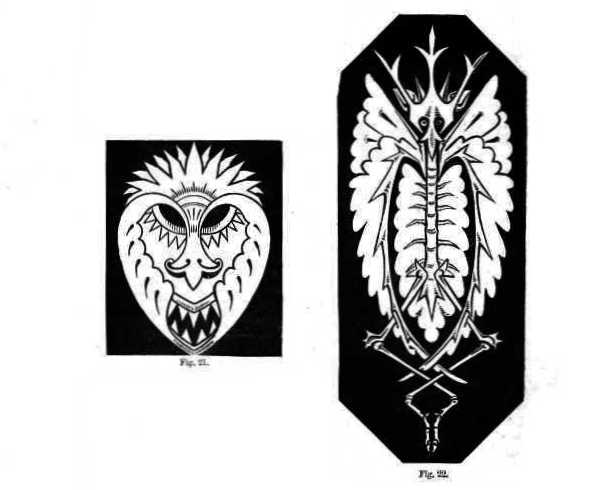
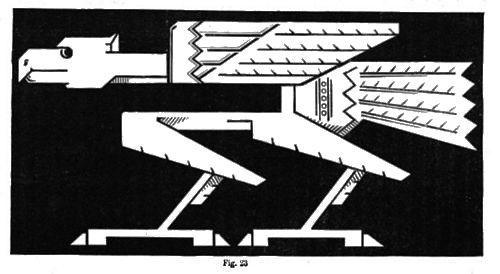
In order that I convey to the reader a fuller idea of my views
respecting the grotesque than I otherwise could, I have sketched one
or two original illustrations—Fig. 21 being suggestive of a face,
Fig. 22 of a skeleton (old bogey), and Fig. 23 of an impossible
animal. They are intentionally far from imitative. If naturalistic
some would awaken a sense of pain, as they are contorted into curious
positions, whereas that which induces no thought of feeling induces no
sense of pain.
Of all grotesques with which I am acquainted, the dragons of the
Chinese and Japanese are those which represent a combination of power,
vigour, energy, and passion most fully. This is to be accounted for by
the fact that these peoples are believers in dragons. When the sun or
moon is eclipsed they believe that the luminous orb has been swallowed
by some fierce monster, which they give form to in the dragon, and
upon the occurrence of such a phenomenon they, with cans and kettles,
make rough music, and thus cause the monster to disgorge the luminary,
the brilliancy of which it would otherwise have for ever extinguished.
I can understand a believer in dragons drawing these monsters with the
power and spirit that the Chinese and Japanese do; but I can scarcely
imagine that a disbeliever could do so—a man's very nature must be
saturated with a belief in their existence and mischievous power, in
order that he embody in his delineation such expression of the
assumed character of this imaginary creature as do the Chinese and
Japanese.
Although I am not now considering the structure of objects, I may say
that the grotesque should frequently be used where we meet with
naturalistic imitations. We not unfrequently see a figure, naturally
imitated, placed as a support to a superincumbent weight—a female
figure as an architectural pillar bearing the weight of the
entablature above, men crouched in the most painful positions
supporting the bowl of some colossal fountain. Naturalistic figures in
such positions are simply revolting, however perfect as works of
sculpture. If weight has to be supported by that which has a
resemblance to a living creature of any kind, the semblance should
only be suggested; and the more unreal and woodeny (if I may make such
a word) the support, if possessing the quaintness and humour of a true
grotesque, the better.
It is not the business of the ornamentist to produce that which shall
induce the feeling of continued pain, unless there is some exceptional
reason for his so doing, and such a reason is of rare occurrence.