PART FIRST. PRELIMINARY TREATMENT AND PHOSPHATES. — GENERAL ANALYTICAL PROCESSES. — COMPLETE ANALYSIS OF MINERAL PHOSPHATES. — GENERAL METHODS FOR ESTIMATING PHOSPHORIC ACID IN FERTILIZERS. — THE CITRATE METHOD. — BASIC PHOSPHATIC SLAGS. — VOLUMETRIC DETERMINATION OF PHOSPHORIC ACID. — URANIUM METHOD AS PRACTICED BY THE FRENCH CHEMISTS. — THE DETERMINATION OF PHOSPHORIC ACID BY TITRATION OF THE YELLOW PRECIPITATE. — TECHNICAL DETERMINATION OF PHOSPHORIC ACID. — MISCELLANEOUS NOTES ON PHOSPHATES AND PHOSPHATIC FERTILIZERS. — CHEMISTRY OF THE MANUFACTURE OF SUPERPHOSPHATES. — AUTHORITIES CITED IN PART FIRST.
VOLUME SECOND.
EXAMINATION OF FERTILIZING MATERIALS,
FERTILIZERS, AND MANURES.
1. Introduction.—In the first volume the principal plant foods
occurring in soils have been named and the methods of estimating them
described. As fertilizers are classed those materials which are added
to soils to supply supposed deficiencies in plant foods, or to render
more available the stores already present. There is little difference
between the terms fertilizer and manure. In common language the former
is applied to goods prepared for the farmer by the manufacturer or
mixer, while the latter is applied to the stores accumulated about the
stables or made elsewhere on the farm. Thus it is common to speak of a
barnyard or stall manure and of a commercial fertilizer.
One of the objects of the analysis of soils, as described in the first
volume of this work, is to determine the character of the fertilizer
which should be added to a field in order to secure its maximum
fertility.
One purpose of the present part is to determine the fitness of offered
fertilizing material to supply the deficiencies which may be revealed
by a proper study of the needs of the soil.
2. Natural Fertilizers.—In the succession of geologic epochs
which has marked the natural history of the earth there have been
brought together in deposits of greater or less magnitude the stores
of plant food unused by growing crops or which may once have been part
of vegetable and animal organisms. Some of these deposits have been
mentioned in the first volume, paragraphs 11, 12, and 18.
For a full description of the extent and origin of these deposits the
reader is referred to works on economic geology. These deposits are
the chief sources of the commercial fertilizers which are offered to
the farmers of to-day and to which the agricultural analyst is called
upon to devote much of his time and labor. The methods of determining
the chemical composition and agricultural value of these deposits, as
practiced by the leading chemists of this country and Europe, will be
fully set forth in the following pages.
3. Waste Matters as Fertilizing Materials.—In addition to the
natural products just mentioned the analyst will be called on also to
deal with a great variety of waste materials which, in the last few
years, have been saved from the débris of factories and abattoirs,
and prepared for use on the farm. Among these waste matters may be
mentioned, bones, horns, hoofs, hair, tankage, dried blood, fish scrap,
oil cakes, ashes, sewage, and sewage precipitates, offal of all kinds,
leather scraps, and organic débris in general.
It is important, before beginning an analysis, to know the origin of
the substances to be determined. As has already been pointed out in
volume first the process which would be accurate with a substance of
a mineral origin might lead to error if applied to the same element
in organic combination. This is particularly true of phosphorus and
potash. A simple microscopic examination will usually enable the
analyst to determine the nature of the sample. In this manner, in the
case of a phosphate, it would at once be determined whether it was
bone, mineral, or basic slag. The odor, color, and general consistence
will also aid in the determination.
4. Valuation of Fertilizing Ingredients.—Perhaps there are no
more numerous and perplexing questions propounded to the analyst than
those which relate to the value of fertilizing materials. There is none
harder to answer. As a rule these questions are asked by the farmer,
and refer to the fertilizers put down on his fields. In such cases
the cost of transportation is an important factor in the answer. The
farther the farmer is removed from the place of fertilizer manufacture
the greater, as a rule, will be the cost. Whether the transportation is
over land or by water also plays an important part in the final cost.
The discovery of new stores of fertilizing materials has also much to
do with the price. This fact is especially noticeable in this country,
where the price of crude phosphates at the mines has fallen in a few
years from nearly six dollars to three dollars and forty-three cents
per ton[1].
This decrease has been largely due to discoveries of vast
beds of phosphatic deposits in Florida, North Carolina, Tennessee, and
Virginia. The state of trade, magnitude of crops, and the vigor of
commerce also affect, in a marked degree, the cost of the raw materials
of commercial fertilizers.
5. Trade Values of Fertilizing Ingredients in Raw Materials
and Chemicals.—The values proposed by the Massachusetts Experiment
Station are given below.[2]
| |
Cents per
pound. |
| Nitrogen |
in |
ammonia salts, |
19 |
| “ |
“ |
nitrates, |
14½ |
| Organic |
nitrogen |
in |
dry and fine-ground fish, meat, blood, |
|
| |
|
|
and in high-grade mixed fertilizers, |
18½ |
| “ |
“ |
“ |
cottonseed meal, linseed meal, |
|
| |
|
|
and castor pomace, |
15 |
| “ |
“ |
“ |
fine-ground bone and tankage, |
16½ |
| “ |
“ |
“ |
fine-ground medium bone and tankage, |
15 |
| “ |
“ |
“ |
medium bone and tankage, |
12 |
| “ |
“ |
“ |
coarse bone and tankage, |
7 |
| “ |
“ |
“ |
hair, horn shavings, and coarse |
|
| |
|
|
fish scraps, |
7 |
| Phosphoric |
acid |
soluble in water, |
6 |
| “ |
“ |
soluble in ammonium citrate, |
5½ |
| “ |
“ |
in fine bone and tankage, |
5½ |
| “ |
“ |
in fine medium bone and tankage, |
4½ |
| “ |
“ |
in medium bone and tankage, |
3 |
| “ |
“ |
in coarse bone and tankage, |
2 |
| “ |
“ |
in fine-ground fish, cottonseed meal, |
|
| |
|
linseed meal, castor pomace, and wood-ashes, |
5 |
| “ |
“ |
insoluble (in ammonium citrate) in |
|
| |
|
mixed fertilizers, |
2 |
| Potash |
as |
high-grade sulfate, and in mixtures |
|
| |
|
free from muriate, |
5 |
| “ |
“ |
muriate, |
4½ |
The manurial constituents contained in feed stuffs are valued as follows:
| Organic nitrogen, |
15 |
| Phosphoric acid, |
5 |
| Potash, |
5 |
The organic nitrogen in superphosphates, special manures, and mixed
fertilizers of a high grade is usually valued at the highest figures
laid down in the trade values of fertilizing ingredients in raw
materials; namely, eighteen and one-half cents per pound, it being
assumed that the organic nitrogen is derived from the best sources;
viz., animal matter, as meat, blood, bones, or other equally
good forms, and not from leather, shoddy, hair, or any low-priced,
inferior form of vegetable matter, unless the contrary is evident. In
such materials the insoluble phosphoric acid is valued at two cents a
pound. These values change as the markets vary.
The scheme of valuation prepared by the Massachusetts station does not
include phosphoric acid in basic slags. By many experimenters the value
of the acid in this combination, tetracalcium phosphate, is fully equal
to that in superphosphates soluble in water and ammonium citrate. It
would perhaps be safe to assign that value to all the phosphoric acid
in basic slags soluble in a five per cent citric acid solution.
Untreated fine-ground phosphates, especially of the soft variety, so
abundant in many parts of Florida, have also a high manurial value when
applied to soils of an acid nature or rich in humus. On other soils
of a sandy nature, or rich in calcium carbonate, such a fertilizer
would have little value. The analyst in giving an opinion respecting
the commercial value of a fertilizer, must be guided not only by the
source of the material, its fineness or state of decomposition, and its
general physical qualities, but also by the nature of the crop which it
is to nourish and the kind of soil to which it is to be applied.
6. Taking Samples.—It is impracticable to give definite
directions for taking samples of fertilizers which will be applicable
to all kinds of material and in all circumstances. If the chemist
himself have charge of the taking of the sample, it will probably be
sufficient to say that it should accurately represent the total mass
of material sampled. Generally the samples which are brought to the
chemist have been taken without his advice or direction and he is
simply called upon to make an analysis of them.
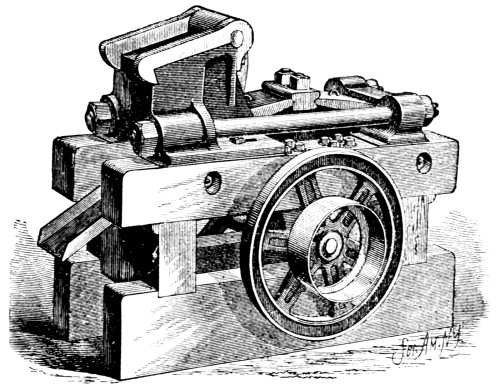
Figure. 1.
Apparatus for Crushing Mineral Fertilizers.
7. Minerals Containing Fertilizing Materials.—When possible,
the samples should be accompanied by a description of the mines where
they are procured and a statement of the geologic conditions in which
the deposits were made. As large a quantity of the material as can be
conveniently obtained and transported should be secured. Where a large
quantity of mineral matter is at hand it should first be put through a
crusher. Many forms of crusher, driven by hand and other power, are on
the market. Among these may be mentioned the Alden, Blake, Bisworth,
Forster, and Lipsay machines.[3]
They are all constructed essentially on the same principle, the
pieces of mineral being broken into small fragments between two heavy
vibrating steel plates. The general form of these instruments is seen
in Fig. 1.
The fragments coming from the crusher can be reduced to a coarse powder
by means of the iron plate and crusher shown in Fig. 2.
Where only a small quantity of mineral is at hand the apparatus just
mentioned may be used at once after breaking the sample into small
fragments by means of a hammer.
Finally the sample, if to be dissolved in an acid or soluble materials
only, is reduced to a powder in an iron mortar until it will pass a
sieve with a one or, better, one-half millimeter circular mesh. The
powder thus obtained must be stirred with a magnet to remove all iron
particles that may have been incorporated with the mass by abrasion of
the instruments employed.
If a complete mineral analysis of the sample is to be secured, the
material freed from iron, as above described, is to be rubbed to an
impalpable powder in an agate mortar.
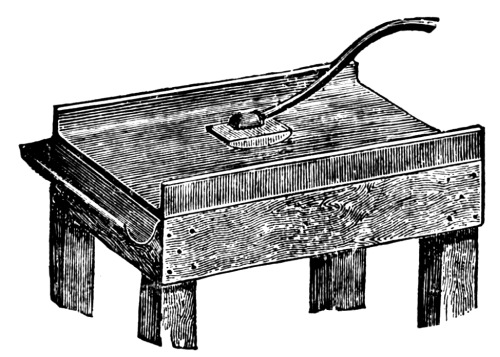
Figure. 2.
Plate Grinder for Minerals.
8. Mixed Fertilizers.—In fertilizing materials in bulk, the
first requisite is that they shall be thoroughly mixed so that a given
volume of the material may represent, practically, definite quantities
of the materials sampled. The finer the material is, in the original
state, and the more thoroughly it has been mixed, the better the sample
will be. If the sample be already in sacks it will be sufficient to
take portions by means of the ordinary trier, such as is used for
sampling sugar and other substances. This consists of a long metal
implement such as would be formed by a longitudinal section of a tube.
The end is pointed and suited for penetrating into the sack and the
materials contained therein. On withdrawing it, the semi-circular
concavity is found filled with the material sampled. Samples in this
way should be taken from various parts of the sack and these samples
well mixed together and a subsample of the amount necessary to be taken
to the laboratory can then be obtained.
9. Method of the French Experiment Stations.—In the method
employed by the French Experiment Stations it is directed that in no
case should stones or other foreign particles be removed from the
fertilizer sampled, but they should enter into the sample taken in, as
nearly as possible, the same proportions as they exist in the whole
mass.
In the case of stones or other solid masses which are to be sampled, as
many samples as possible should be taken from all parts of the heap and
these should be reduced to a coarse powder, thoroughly mixed together
and sampled.
In case the material is in the form of a paste, if it is homogeneous,
it will be sufficient to mix it well and take the sample directly; but
in case there is a tendency for the pasty mass to separate into two
parts, of which the one is a liquid and the other, more of a solid
consistence, it may be well to take samples from each in case they can
not be thoroughly incorporated by stirring.
10. Method of the French Association of Sugar Chemists.—The
method adopted by the French sugar chemists directs that the sample
should be taken from the fertilizer in bulk or from a portion used for
industrial purposes.[4]
The sample for analysis is to be taken from the above sample after it
has been sent to the laboratory. The method of taking should be varied
according to the condition of the substances to be analyzed.
The large sample selected from the goods delivered to commerce having
been delivered at the laboratory, the analytical sample is taken as
follows:
When the industrial sample, more or less voluminous, reaches the
laboratory, the chemist is to begin by taking a note of the marks,
labels, and descriptions found thereon, and of the nature and state of
the package which contains it, and the date of its arrival. All this
information should be entered upon the laboratory book and afterwards
transcribed on the paper containing the results of the analysis, as
well as the name of the person sending it. This having been done, the
sample is to be properly prepared in order that a portion may be taken
representing exactly the mean composition of the whole.
If it is in a state of fine powder, such as ground phosphates and
certain other fertilizers, it is sufficient to pass it two or three
times through a sieve with meshes one millimeter in diameter, taking
care to break up the material each time in order to mix it and
to pulverize the fragments which the sieve retains. The whole is
afterwards spread in a thin layer upon a large sheet of paper, and a
portion is taken here and there upon the point of a knife until about
twenty grains are removed, and from this the portion subjected to
analysis is afterwards taken.
If the sample comes in fragments, more or less voluminous, such as
phosphatic rocks or coarsely pulverized guanos containing agglomerated
particles, it is necessary first to reduce the whole to powder by
rubbing it in a mortar or in a small drug mill. It is next passed
through a sieve of the size mentioned above and that which remains upon
the sieve pulverized anew until all has passed through. This precaution
is very important, since the parts which resist the action of the
pestle the most have often a composition different from those which are
easily broken.
When the products to be analyzed contain organic materials, such as
horn, flesh, dry blood, etc., the pulverization is often a long and
difficult process, and results in a certain degree of heating which
drives off some of the moisture in such a way that the pulverized
product is at the last drier, and, consequently, richer than the
primitive sample. It is important to take account of this desiccation,
and since the pulverization of a mass so voluminous can not be made
without loss, the determination of the total weight of the sample
before and after pulverization does not give exact results.
In such a case it is indispensable to determine the moisture, both
before and after pulverizing, and to calculate the analytical results
obtained upon the pulverized sample back to the original sample.
In order to escape this necessity, as well as the difficulties
resulting from the variations in moisture during transportation, some
chemists have thought it better to always dry the commercial products
before submitting them to analysis, and to report their results in the
dry state, accompanied by a determination of the moisture, leaving
thus to the one interested the labor of calculating the richness in
the normal state, that is to say, in the real state in which the
merchandise was delivered.
In addition to the fact that this method allows numerous chances
of errors, many substances undergoing important changes in their
composition by drying alone, it has been productive of the most serious
consequences. The sellers have placed their wares on the market with
the analysis of the material in a dry state, and a great number of
purchasers have not perceived the fraud concealed under this expression
so innocent in appearance. It is thus that there has been met with in
the markets guano containing twenty-five per cent of water, which was
guaranteed to contain twelve per cent of phosphoric acid, when, in
reality, it contained only eight per cent in the moist state.
11. Barn-Yard Manures.—The sampling of stall and barnyard
manures is more difficult on account of the fact that the materials are
not homogeneous and that they are usually mixed with straw and other
débris from the feed trough, and only the greatest care and patience
will enable the operator to secure a fair sample.
In the case of liquid manures the liquid should be thoroughly stirred
before the sample is taken.
Frear points out the difficulty of securing representative samples of
stall manure and describes methods of removing it.[5]
The stall manure sampled had been piled in the cattle-yard for a time
and the cattle were allowed to run over the heaps for an hour or two
each day. Pigs were also allowed free access to the heaps in order to
insure a more perfect mixture of the ingredients.
Twenty-nine loads of 3,000 pounds each were taken from the exposed heap
and thirty-four loads of 2,000 pounds each were taken from the covered
heap. From each load were removed two carefully selected portions of
ten pounds each, which were placed in separate covered boxes numbered A
and B. When the sampling was completed these boxes were covered. After
being removed to the laboratory the boxes were weighed and the contents
thoroughly mixed. Two samples of twelve liters volume each, were drawn
from each box. One-third of this was chopped in a large meat chopper
and the other two-thirds taken into the laboratory without being cut.
These samples, on entering the laboratory, were weighed and dried at a
temperature of 60°. Smaller samples were then drawn from each of these
and ground in a drug mill for analysis. Duplicate samples taken in this
way, while they did not give absolutely concordant results, showed a
near approximation. A more careful sampling on the line proposed would,
in all probability, secure absolutely agreeing results in duplicate
samples.
12. Preparation of Sample in Laboratory.—The method of
preparing mineral fertilizers for analysis has been given under
directions for sampling. Many difficulties attend the proper
preparation of other samples, and the best approved methods of
procedure are given below:
According to the directions given by the Association of Official
Agricultural Chemists the sample should be well intermixed, finely
ground, and passed through a sieve having circular perforations one
millimeter in diameter.[6]
The processes of grinding and sifting should take place as rapidly as
possible so that there may be no gain or loss of moisture during the
operation.
13. Method of the French Agricultural Stations.—The manner
of proceeding recommended by the French stations varies with the
fertilizer.[7]
If it is not already in the form of a powder it is necessary to
pulverize it as finely as possible by rubbing it up in a mortar. In
certain cases, as with superphosphates, the material should be passed
through a sieve having apertures of one millimeter diameter, all the
larger parts being pulverized until they will pass this sieve.
When the matters are too pasty to be divided in the mortar they should
be divided by means of a knife or a spatula. They should then be
incorporated with a known weight of inert, pulverulent matter such as
fine sand, with which they should be thoroughly mixed and in subsequent
calculations the quantity of sand or other inert matter added must be
taken into consideration. Usually a pasty state of a fertilizer is due
to the humidity of the mixture. In this case a considerable volume of
the sample is taken and dried and then reduced to a pulverulent state.
In the subsequent calculations, however, the percentage of moisture
lost must be taken into consideration.
Before drying a sample it is necessary to take into consideration
whether or not the product will be modified by desiccation as would
be the case, for instance, with superphosphates. With these, which
are often in a state more or less agglomerated, it is recommended to
introduce into them, in order to divide them, a certain quantity of
calcium sulfate in order to obtain them in a pulverulent state.
In the case of animal débris they should be divided as finely as
possible with the aid of scissors and then passed through a drug mill
if dry enough. They are then mixed by hand and may finally be obtained
in a state of considerable homogeneity.
When fertilizers are in a pasty state more or less liquid, they are
dried at 100°, first introducing a little oxalic acid in case they
contain any volatile ammoniacal compounds. The product of desiccation
is then passed through a mill. Before treating in this way it is
necessary to be sure that the composition will not be altered by
drying. In the case of a mixture containing superphosphates and
nitrate, for instance, drying would eliminate the nitric acid. In
such a case the free phosphoric acid should be neutralized with a
base like lime. In the case of fertilizers containing both nitrates
and volatile ammoniacal compounds the addition of oxalic acid might
also set free nitric acid during the desiccation. In such a case it
is necessary to dry two samples; one with the addition of oxalic acid
for the purpose of estimating the ammonia, and the other without the
acid for the purpose of estimating the nitrate. A qualitative analysis
should precede all the operations so as to determine the nature of the
material to be operated on.
14. German Method.—In the method pursued by the German
experiment stations it is directed:[8]
(1) Dry samples of fertilizers must be passed through a sieve and
afterwards well mixed.
(2) With moist fertilizers, which can not be subjected to the above
process, the preparation should consist in a careful and thorough
mixing, without sieving.
(3) On the arrival of the samples in the laboratory their weight should
be determined. The half of the sample is prepared for analysis and
the other part, to the amount of a kilo, should be placed in a glass
vessel, closed air-tight, and placed in a cool place for at least a
quarter of a year from the time of its reception, in order that it may
be subjected to any subsequent investigations which may be demanded.
(4) In the case of raw phosphates and bone-black the amount of water
which they contain should be determined at from 105° to 110°. Samples
which in drying lose ammonia in any way, should have this ammonia
determined.
(5) Samples which are sent to other laboratories for control analyses,
should be sent securely packed in air-tight glass bottles.
(6) The weight of the samples sent should be entered in the
certificates of analysis.
(7) Samples which, on pulverizing, change their content of water,
must have the water content estimated in both the coarse and powdered
condition and the results of the analysis must be calculated to the
water content of the original coarse substance.
15. Special Cases.—Many cases arise of such a nature as to make
it impossible to lay down any rule which can be followed with success.
As in almost every other process in agricultural chemistry the analyst
in such cases must be guided by his judgment and experience. Keeping in
view the main object, viz., to secure in a few grams of material
a fair representation of large masses he will generally be able to
reach the required result by following the broad principles already
outlined. In many cases the details of the work and the adaptations
necessary to success must be left to his own determination.
16. Drying Samples of Fertilizers.—The determination of the
uncombined moisture in a sample of fertilizer is not an easy task.
In some cases, as in powdered minerals, drying to constant weight at
the temperature of boiling water is sufficient. In organic matters
containing volatile nitrogenous compounds, these must first be fixed by
oxalic or sulfuric acid, before the desiccation begins. If any excess
of sulfuric acid be added, however, drying at 100° becomes almost
impossible. Particular precautions must be observed in drying
superphosphates. In drying samples preparatory to grinding for
analysis, it is best to stop the process as soon as the materials can
be pulverized. In general, samples should be dried only to determine
water, and the analytical processes should be performed on the
undried portions. It is not necessary, as a rule, to dry samples of
fertilizers in an inert atmosphere, such as hydrogen or carbon dioxid.
Drying in vacuo may be practiced when it is desired to secure a speedy
desiccation or one at a low temperature.
17. Official Methods.—The Official Agricultural Chemists
direct, in the case of potash salts, sodium nitrate, and ammonium
sulfate, to heat from one to five grams in a flat platinum or aluminum
dish at 130° until the weight is constant.[9]
The loss in weight is taken to represent the water. In all other cases
heat two grams, or five grams if the sample be very coarse, for five
hours in a steam-bath.
In the German stations in the case of untreated phosphates and
bone-black the moisture is estimated at from 105° to 110°. Samples
which lose ammonia should have the weight of ammonia given off at that
temperature, determined separately.
For purposes of comparison it would be far better to have all contents
of moisture determined at the boiling-point of water. While this varies
with the altitude and barometric pressure yet it is quite certain that
the loss on drying to constant weight at all altitudes is practically
the same. Where the atmospheric pressure is diminished for any cause
the water escapes all the more easily. This, practically, is a complete
compensation for the diminished temperature at which water boils.
Where the samples contain no ingredient capable of attacking aluminum,
they can be conveniently dried, in circular dishes of this metal about
seven centimeters in diameter and one centimeter deep, to constant
weight, at the temperature of boiling water.
18. Moisture in Monocalcium Phosphates.—In certain fertilizers,
especially superphosphates, containing the monocalcium salt, the
estimation of water is a matter of extreme difficulty on account of the
presence of free acids and of progressive changes in the sample due to
different degrees of heat.
Stoklasa has studied these changes and reaches the following
results[10]:
A chemically pure monocalcium phosphate of the following composition,
viz.,
| CaO |
22.36 |
per |
cent. |
| P₂O₅ |
56.67 |
“ |
“ |
| H₂O |
21.53 |
“ |
“ |
was subjected to progressive dryings. The loss
of water after ten hours was 1.83 per cent; after twenty hours, 2.46
per cent; after thirty hours, 5.21 per cent; after forty hours,
6.32 per cent; after fifty hours, 6.43 per cent. This loss of water
remained constant at 6.43 per cent. This loss represents one molecule
of water as compared with the total molecular magnitude of the mass
treated. A calcium phosphate, therefore, of the following composition,
CaH₄(PO₄)₂·H₂O loses, after forty hours, drying at 100°, its water of
crystallization. The calcium phosphate produced by this method forms
opaque crystals which are not hygroscopic and which give, on analysis,
the following numbers:
| CaO |
24.02 |
per |
cent. |
| P₂O₅ |
16.74 |
“ |
“ |
| H₂O |
15.09 |
“ |
“ |
The temperature can be raised to 105° without marked change. If the
temperature be raised to 200° the decomposition of the molecule is
hastened according to the following formula:
4 CaH₄(PO₄)₂ = Ca₂P₂O₇ + Ca(PO₃)₂ + CaH₂P₂O₇ + 2 H₃PO₄ + 4 H₂O.
The chemical changes during the drying of monocalcium phosphates can be
represented as follows, temperature 200° for one hour:
8[CaH₄(PO₄)₂·H₂O] = 4CaH₄(PO₄)₂ + Ca(PO₃)₂ + Ca₂P₂O₇
+ CaH₂P₂O₇ + 2H₃PO₄ + 12H₂O.
The further drying at 200° produces the following decomposition:
4CaH₄(PO₄)₂ + Ca(PO₃)₂ + Ca₂P₂O₇ + CaH₂P₂O₇ + 2H₃PO₄
= 2Ca(PO₃)₂ + 4CaH₂P₂O₇ + Ca₂P₂O₇ + 2H₃PO₄ + 5H₂O.
2Ca(PO₃)₂ + 4CaH₂P₂O₇ + Ca₂PO₇ + 2H₃PO₄
= 6Ca(PO₃)₂ + 2CaH₂P₂O₇ + 5H₂O.
Finally, pyrophosphate at 210° is completely decomposed into
metaphosphate and water according to the following formula:
6Ca(PO₃)₂ + 2CaH₂P₂O₇ = 8Ca(PO₃)₂ + 2H₂O.
Provided the drying is made at once at 210° the
sum of the changes produced as indicated above, can be represented by
the following formula:
8[CaH₄(PO₄)₂·H₂O] = 8Ca(PO₃)₂ + 24H₂O.
19. Constituents to be Determined.—The most important point in
the analysis of mineral phosphates is to determine their content of
phosphoric acid. Of equal scientific interest, however, and often of
great commercial importance is the determination of the percentage of
other acids and bases present. The analyst is often called on, in the
examination of these bodies, to make known the content of water both
free and combined, of organic and volatile matter, of carbon dioxid,
sulfur, chlorin, fluorin, silica, iron, alumina, calcium, manganese,
magnesia, and the alkalies. The estimation of some of these bodies
presents problems of considerable difficulty, and it would be vain to
suppose that the best possible methods are now known. Especially is
this the case with the processes which relate to the estimation of the
fluorin, silica, iron, alumina, and lime. The phosphoric acid, however,
which is the chief constituent from a commercial point of view, it
is believed, can now be determined with a high degree of precision.
Often the estimation of some of the less important constituents is of
great interest in determining the origin of the deposits, especially
in the case of fluorin. While the merchant is content with knowing the
percentage of phosphoric acid and the manufacturer asks in addition
only some knowledge of the quantity of iron, alumina, and lime the
analyst in most cases is only content with a complete knowledge of the
constitution of the sample at his disposal.
20. Direct Estimation of the Phosphoric Acid.—It often happens,
in the case of a mineral phosphate, that the only determination desired
is of the phosphoric acid. In this instance the analyst may proceed as
follows: If the qualitative test shows the usual amount of phosphoric
acid, two grams of the sample passed through a sieve, with a millimeter
mesh, are placed in a beaker and thoroughly moistened with water. The
addition of water is to secure an even action of the hydrochloric acid
on the carbonates present. The beaker is covered with a watch-glass
and a little hydrochloric acid is added from time to time until all
effervescence has ceased. There are then added about thirty cubic
centimeters of aqua regia and the mixture raised to the boiling-point
on a sand-bath or over a lamp. The heating is continued until chlorin
is no longer given off and solution is complete. The volume of the
solution is then made up to 200 cubic centimeters without filtering,
filtered, and an aliquot part of the filtrate, usually fifty cubic
centimeters, representing half a gram of the original sample, taken
for the determination of the phosphoric acid according to the method
of the Official Agricultural Chemists. The small quantity of insoluble
material does not introduce any appreciable error into the process when
the volume is made up to 200 or 250 cubic centimeters.
21. Method of the Official Agricultural Chemists for
Total Phosphoric Acid.—To the hot solution, for every decigram of
phosphorus pentoxid which may be present, add fifty cubic centimeters
of the molybdic solution. Digest at 65° for an hour, filter, and
wash with water or ammonium nitrate solution[11].
Test the filtrate by renewed digestion with additional molybdate reagent.
Dissolve the precipitate on the filter with ammonia in hot water and wash
into a beaker, making the volume of filtrate and washings not more than 100
cubic centimeters. Nearly neutralize with hydrochloric acid, cool,
and add magnesia mixture from a burette at the rate of about one drop
a second, stirring vigorously, meanwhile. The quantity of magnesia
mixture to be added is not prescribed in the official method but
it should always be in excess of the amount necessary for complete
precipitation. For each decigram of phosphorus pentoxid, from eight to
ten cubic centimeters should be used. Fifteen minutes after the last of
the magnesia mixture has been stirred in, thirty cubic centimeters of
ammonia of 0.95 specific gravity are added and the beaker set aside for
two hours or longer. The ammonium magnesium phosphate is separated by
filtration, dried, ignited gently at first, and finally over a blast-lamp
and weighed as magnesium pyrophosphate. The factors for calculating
the phosphorus pentoxid and tricalcium phosphate from the weight of
pyrophosphate are given below on the two bases; viz., hydrogen
equals 1, and oxygen equals 16.
H = 1.
Mg₂P₂O₇ × 0.63976 = P₂O₅
Mg₂P₂O₇ × 1.3964 = Ca₃(PO₄)₂
P₂O₅ × 2.1827 = Ca₃(PO₄)₂
O = 16.
Mg₂P₂O₇ × 0.63792 = P₂O₅
Mg₂P₂O₇ × 1.3926 = Ca₃(PO₄)₂
P₂O₅ × 2.1831 = Ca₃(PO₄)₂
22. Preparation of Solutions.—Molybdic
Solution.—Dissolve 100 grams of molybdic acid in 400 grams or 417
cubic centimeters of ammonia, of 0.96 specific gravity, and pour the
solution thus obtained into 1,500 grams or 1,250 cubic centimeters of
nitric acid, of 1.20 specific gravity. Keep the mixture in a warm place
for several days, or until a portion heated to 40° deposits no yellow
precipitate of ammonium phosphomolybdate. Decant the solution from any
sediment and preserve in glass-stoppered vessels.
Magnesia Mixture.—Dissolve twenty-two grams of recently ignited
calcined magnesia in dilute hydrochloric acid, avoiding an excess of
the latter. Add a little calcined magnesia in excess, and boil a few
minutes to precipitate iron, alumina, and phosphoric acid; filter, add
280 grams of ammonium chlorid, 700 cubic centimeters of ammonia of
specific gravity 0.96, and water enough to make a volume of two liters.
Instead of the solution of twenty-two grams of calcined magnesia, 110
grams of crystallized magnesium chlorid may be used.
Dilute Ammonia for Washing.—One volume of ammonia, of 0.96
specific gravity, mixed with three volumes of water, or usually one
volume of concentrated ammonia with six volumes of water.
23. Use of Tartaric Acid in Phosphoric Acid Estimation.—In
the presence of iron the molybdate mixture is likely to carry down
some ferric oxid with the yellow precipitate. To prevent this, and
also hinder the separation of molybdic acid in the solution on long
standing, tartaric acid has been recommended.
Jüptner has found that the presence of tartaric acid does not interfere
with the separation of the yellow precipitate, as some authorities
assert.[12]
Even 100 grams of the acid in one liter of molybdate solution produce
no disturbing effect. Molybdate solution treated with tartaric acid
did not show any separation of molybdic acid when kept for a year at
room temperatures. The presence of tartaric acid, therefore, is highly
recommended by him to prevent the danger of obtaining both ferric oxid
and molybdic acid with the yellow precipitate.
24. Water and Organic Matters.—The sample, according to the
practice of Chatard, should be ground fine enough to leave no residue
on an eighty mesh sieve, and should be thoroughly mixed by passing it
three times through a forty mesh sieve[13].
Two grams are weighed into a tared platinum crucible. This, with
its lid, is placed in an air-bath at 105°, and heated for at least
three hours. The lid is then put on, and the crucible is placed in
a desiccator and weighed as soon as cold. The loss in weight is the
moisture.
Wyatt recommends that two grams of the fine material be heated in
ground watch-glasses, the edges of which are separated so as to allow
the escape of the moisture.[14] The heating is continued for three
hours at 110°, the watch-glasses then closed and held by the clip,
cooled in a desiccator, and weighed. This method is excellent for very
hygroscopic bodies, but where quick-acting balances are used, scarcely
necessary for a powdered mineral.
The residue from the moisture determination is gradually heated to
full redness over a bunsen, and then ignited over the blast-lamp.
This operation is repeated after weighing until a constant weight is
obtained. The loss (after deducting the percentage of carbon dioxid as
found in another portion) may be taken as water and organic matter.
This method is sufficient for all practical purposes; but when minerals
containing fluorin are strongly ignited, a part of the fluorin is
expelled; hence, if more accurate determinations are required, the loss
of fluorin must be taken into account. In this laboratory it has been
proved that a pure calcium fluorid undergoes progressive decomposition
at a bright red heat with formation of lime.
Wyatt directs that the combined water and organic matters be determined
in the residue from the moisture estimation as follows: The residue is
brushed into a weighed platinum crucible, which is heated over a small
bunsen for ten minutes and then brought to full heat of a blast-lamp
for five minutes. After cooling, the total loss is determined by
weighing. After deducting the carbon dioxid determined in a separate
portion, the residual loss is regarded as due to combined moisture and
organic matter.
25. Carbon Dioxid.—Many forms of compact apparatus have been
devised for this estimation, but none of them is satisfactory if
accurate results are desired.[15] Not to mention other objections, many
phosphates must be heated nearly to the boiling-point with dilute acid
to effect complete decomposition of the carbonates. The distillation
method described by Gooch[16] is excellent, and when once the apparatus
is set up, its work will be found to be rapid and satisfactory.
Wyatt regards the estimation of carbon dioxid as one of the most
important for factory use. The carbonates present in a sample indicate
the loss of an equivalent amount of acid in the process of conversion
into superphosphate.[17]
The apparatus employed for estimating carbon dioxid may be any one of
those in ordinary use for this purpose. The principle of the process
depends on the liberation of the gas with a mineral acid, its proper
desiccation, and subsequent absorption by a caustic alkali, best in
solution.
The apparatus of Knorr, described in volume first, page 338, may be
conveniently used. The weight of the sample to be used should be
regulated by the content of carbonate. When this is very high, from
one to two grams will be found sufficient; when low, a larger quantity
must be used. Hydrochloric is preferred as the solvent acid. Those
forms of apparatus which are weighed as a whole and the carbon dioxid
determined by reweighing after its expulsion, are not as reliable as
the absorption apparatus mentioned.
26. Soluble and Insoluble Matter.—Five grams of the fine
phosphate are put into a beaker, twenty-five cubic centimeters of
nitric acid, (specific gravity 1.20) and 12.5 cubic centimeters of
hydrochloric acid (specific gravity 1.12) are added. The beaker,
covered with a watch-glass, is placed upon the water-bath for thirty
minutes[18].
The contents of the beaker are well stirred from time to time, and at
the end of the period the beaker is removed from the bath, filled with
cold water, well stirred, and allowed to settle. The solution is next
filtered into a half liter flask, and the residue is thoroughly washed
with cold water, partially dried, and then ignited, (finishing with the
blast-lamp) and brought to constant weight. The figures thus obtained
will, however, be incorrect, because the fluorin liberated during
the solution of the phosphates dissolves a portion of the silica.
Hence, the results are too low. Nevertheless, as the same action
would occur in the manufacture of a superphosphate from the material,
the determination may be considered, as a fair approximation to
commercial practice. The ignited residue must be tested for phosphorus
pentoxid.
27. Preparation of the Solution.—The flask containing the
filtrate is filled to the mark with cold water, and the solution is
thoroughly mixed by twice pouring into a dry beaker and returning it
to the flask. Cold water is used for washing the residue, since if
hot water be used, the sesquichlorids are apt to become basic and
insoluble, and hence to remain in the residue and on the filter paper.
Besides, as the flask is to be filled to the mark, the contents must be
cold before any volumetric measurements can be made.
28. Silica and Insoluble Bodies.—Wyatt describes the following
method for determining the total insoluble or siliceous matters in a
mineral phosphate[19].
Five grams of the fine sample are placed in a porcelain dish with
about thirty cubic centimeters of aqua regia. The dish is covered
with a funnel, placed on a sand-bath and, after solution is complete,
evaporated to dryness with care to prevent sputtering. When dry the
residue is moistened with hydrochloric acid and again dried, rubbing
meanwhile to a fine powder. The heat of the bath is then increased
to 125° and maintained at this temperature for about ten minutes.
When cool, the residue is treated with fifty cubic centimeters of
hydrochloric acid for fifteen minutes. The acid is then diluted and
filtered on a gooch, which is washed with hot water until the filtrate
amounts to a quarter of a liter. The residue in the crucible is dried,
ignited, and weighed. This method, unless the solution be subsequently
boiled with nitric acid, may not retain all the phosphoric acid in the
ortho form.
It is difficult to estimate the total silica by the ordinary methods
of mineral analysis. This is due to the fact that in an acid solution
of a substance containing silicates and fluorids the whole of the
silica or the fluorin, as the case may be may escape as silicofluorid
on evaporation. Again, it is not easy to decompose calcium phosphate
by fusing with sodium carbonate. If an attempt be made to do this,
however, the process should be conducted as follows: A portion of the
sample is ground to an impalpable powder in an agate mortar. From one
to two grams of the substance are mixed with five times its weight
of sodium carbonate and fused with the precautions given in standard
works on quantitative analysis. The fused mass is digested in water,
boiled, and filtered, and the residue washed first with boiling water
and afterwards with ammonium carbonate. The filtrate contains all the
fluorin as sodium fluorid and, in addition to this, sodium carbonate,
silicate, and aluminate. Mix the filtrate with ammonium carbonate and
heat for some time, replacing the ammonium carbonate which evaporates.
Separate by filtration the silicic acid hydrate and aluminum hydroxid
which are formed and wash them with ammonium carbonate. To separate
the last portions of silica from the filtrate, add a solution of zinc
oxid in ammonia. Evaporate until no more ammonia escapes and separate,
by filtration, the zinc silicate and oxid. Determine the silica in
this precipitate by dissolving in nitric acid, evaporating to dryness,
taking up with nitric acid and separating the undissolved silica by
filtration. In the alkaline filtrate the fluorin may be estimated by
the usual method as calcium salt.
29. Estimation of Lime.—One hundred cubic centimeters of the
solution (containing one gram of the original substance) are evaporated
in a beaker to about fifty cubic centimeters; ten cubic centimeters of
dilute sulfuric acid (one to five) are added; and the evaporation is
continued on the water-bath until a considerable crop of crystals of
gypsum has formed[20].
The solution is then allowed to cool, when it generally becomes pasty,
owing to the separation of additional gypsum. When it is cold, 150
cubic centimeters of ninety-five per cent alcohol are slowly added,
with continual stirring, and the whole is allowed to stand for three
hours, being stirred from time to time. After three hours, it is
filtered, with the aid of a filter-pump, into a distillation flask, and
the beautifully crystalline precipitate, which does not adhere to the
beaker, is washed with ninety-five per cent alcohol. The filter, with
the precipitate, is gently removed from the funnel and inverted into a
platinum crucible, so that, by squeezing the point of the filter, the
precipitate is made to fall into the crucible, and the paper can be
pressed down smoothly upon it. On gentle heating of the crucible, the
remaining alcohol burns off, and when the paper has been completely
destroyed, the heat is raised to the full power of a bunsen for about
five minutes. After cooling in a desiccator the crucible containing the
calcium sulfate, is weighed. The filtration may also be accomplished on
asbestos felt.
30. The Ammonium Oxalate Method.—This method has been
extensively used in this country in commercial work, and is best
carried out as described by Wyatt.[21]
The total filtrates from the iron and alumina precipitates, secured
as described in paragraph 33, are well mixed
and concentrated to a volume of about 100 cubic centimeters. There are added
about twenty cubic centimeters of a saturated solution of ammonium oxalate,
and after stirring, the mixture is allowed to cool and remain at rest
for six hours. The supernatant liquid is poured through a filter, the
residue washed three times by decantation with hot water and brought
upon the filter. The beaker and precipitate are washed at least three
times. The precipitate is dried and ignited at low redness for ten
minutes. The temperature is then raised by a blast and the ignition
continued for five minutes longer, or until the lime is obtained as
oxid. The precipitate is likely to contain magnesia. The magnesia is
estimated in the filtrates from the lime determination by first mixing
them and concentrating to 100 cubic centimeters, which, after cooling,
are made strongly alkaline with ammonia. After allowing to stand for
twelve hours the ammonium magnesium phosphate is collected and reduced
to magnesium pyrophosphate by the usual processes. If one gram of the
original material has been used the pyrophosphate obtained, multiplied
by 0.36, will give the weight of magnesia contained therein.
31. Lime Method of Immendorff.—The tedious processes required
to determine the lime in the presence of iron, alumina, and large
quantities of phosphoric acid are well known to analysts. Immendorff
has published a method, accompanied by the necessary experimental
data, based on the comparative insolubility of calcium oxalate in very
dilute solution of hydrochloric acid. He has shown in the data given
that the lime is all precipitated in the conditions named and that the
precipitate, when properly prepared, is not contaminated with weighable
amounts of the other substances found in the original solution[22].
The ease with which oxalic acid can be determined volumetrically
with potassium permanganate solution aids greatly in the time-saving
advantages of the process.
In a hydrochloric acid solution of a mineral phosphate an aliquot
part of the filtrate representing about 250 milligrams of calcium
oxid, usually about twenty-five cubic centimeters, should be taken
for the analysis. Ammonia is added in slight excess and then the acid
reaction restored with hydrochloric until shown plainly by litmus. The
solution is then heated and the lime thrown down by adding a solution
of ammonium oxalate in excess. In order to secure a greater dilution
of the hydrochloric acid after the precipitation has been made, water
should be added until the volume is half a liter. Before filtering, the
whole should be cooled to room temperature. The precipitate should be
washed first with cold and afterwards with warm water. The well-washed
precipitate is dissolved in hot dilute sulfuric acid and the solution,
while hot, titrated with a standard solution of potassium permanganate
set by a solution of ammonio-ferrous sulfate.
If one cubic centimeter of the permanganate represent 0.005 gram of
iron it will correspond almost exactly to 0.0035 gram of calcium oxid.
Example.—Sample of rather poor mineral phosphate, five
grams in half a liter. Strength of potassium permanganate, one cubic
centimeter equivalent to 0.00697 gram of iron and to 0.003484 gram of
calcium oxid.
Twenty-five cubic centimeters of the solution, representing one
quarter of a gram, in which the lime was precipitated as above
described, required 9.6 cubic centimeters of the potassium permanganate
to saturate the oxalic acid. Then
9.6 × 0.003484 = 0.0334464 gram,
or 13.38 per cent of calcium oxid. The method is
also applicable to basic slags.
32. Estimation of Iron and Alumina in Mineral Phosphates.—When
mineral phosphates are to be used for the manufacture of
superphosphates by treatment with sulfuric acid their content of
iron and alumina becomes a matter of importance. By reason of the
poor drying qualities of the sulfates of these bases their presence
in any considerable excess of a few per cent becomes exceedingly
objectionable. The accurate estimation of these ingredients is not
only then a matter of scientific interest but one of great commercial
significance to the manufacturer.
The conventional methods so long in use depending on the precipitation
of the iron and alumina as phosphates in the presence of acetic acid
have been proved to be somewhat unreliable. Not only does the acetic
acid fail to prevent the precipitation of some of the lime, but it
also dissolves more or less of the iron and aluminum phosphates. The
solution of the precipitate and its reprecipitation by the addition of
ammonia, may free the second precipitate from lime, but it increases
the error due to the solubility of the aluminum salt. The methods
recently introduced for the estimation of iron and alumina in presence
of excess of lime and phosphoric acid are not entirely satisfactory,
but are the best which can now be offered.
33. The Acetate Method.—The principle of this process
is based on the fact that in a solution containing iron, alumina, lime, and
phosphoric acid the iron and aluminum phosphates can be thrown down
in a slightly acid solution by ammonium acetate while the calcium
phosphate remains in solution. The acidity in the older methods is due
to acetic and can be secured by making the solution slightly alkaline
with ammonia and adding acetic to slight acidity. One of the best
methods of conducting the operation is that of C. Glaser[23].
Glaser’s modification of the older processes is based on the assumption that at
70° the aluminum phosphate is quantitatively precipitated by ammonium
acetate in a dilute hydrochloric acid solution and that the mixed
precipitates of iron and aluminum phosphates obtained at this
temperature are free of lime. The operation is conducted in the
following manner:
The hydrochloric acid solution of the phosphate must contain no free
chlorin and is treated with a few drops of a methyl orange solution.
Ammonia is added until nearly neutral, but the acid reaction is
retained as shown by the indicator. A few cubic centimeters of ammonium
acetate are added, which produce a yellow coloration of the liquid and
also a complete precipitation of the iron and aluminum phosphates when
warmed to 70°. At this temperature the precipitation of any calcium
phosphate is avoided. A small quantity of the lime may be carried down
mechanically and therefore the precipitate should be dissolved in
hydrochloric acid and the precipitation again made as above after the
addition of some sodium phosphate. If the original solution contain
any free chlorin, as may be the case when aqua regia is employed as
solvent, before beginning the separation, ammonia should be added in
slight excess and the acidity restored by hydrochloric after adding
the indicator. In washing the precipitates, water of not over 70°
must be used. As has been shown by Hess in the work cited in the
next paragraph, the statement of C. Glaser to the effect that the
precipitates obtained as above are free of lime has not been proved to
be strictly correct. The process, however, is a distinct improvement
over the older methods and forms the basis of the amended process given
below, which appears to be sufficiently accurate to entitle the acetate
method to favorable consideration.
34. Method of Hess.—Hess has lately made a thorough
investigation of the standard methods of determining the iron and
aluminum oxids in the presence of phosphoric acid and has shown that
the assumption that the composition of the precipitate is represented
by the formula Al₂(PO₄)₂ + Fe₂(PO₄)₂ is
erroneous[24].
In the washing of the precipitated iron and aluminum phosphates there
is a progressive decomposition of the compound with the production of a
basic salt. The composition of the precipitate at the end is dependent
chiefly upon the way in which the washing takes place. It is quite
difficult to always secure a washing in exactly the same way and the
final composition of the precipitate varies with almost every
determination. It is not, therefore, an accurate proceeding to take
half the weight of the precipitate as phosphoric acid or as iron oxid
and alumina. In every case it is necessary to dissolve the precipitate
and determine the phosphoric acid in the regular way. Hess proposes the
following method for carrying out the acetate process of separation:
The mineral phosphate should be dissolved in hydrochloric acid and
the solution made up to such a volume as shall contain in each fifty
cubic centimeters, one gram of the original substance. This quantity
of the solution is diluted with two or three times its volume of
water to which a drop of methyl orange solution (1-100) is added, and
ammonia added with constant stirring until the solution is just colored
and still reacts slightly acid. Without taking any account of the
precipitate which is produced by this approximate neutralization of
the solution, there are added fifty cubic centimeters of acid ammonium
acetate which in one liter contains 250 grams of commercial ammonium
acetate. The acidity of the solution is due to an excess of acetic in
the commercial salt. The temperature is then carried to 70° and the
precipitate produced immediately separated by filtration, washed four
times with water below 70°, and again dissolved in dilute hydrochloric
acid. The dissolved precipitate is treated with ten cubic centimeters
of a ten per cent ammonium phosphate solution and again almost
neutralized as described above, twenty-five cubic centimeters of the
ammonium acetate solution added and warmed to 70°.
The precipitate obtained is once more dissolved and precipitated as
above described, and is then collected upon a filter, washed, ignited,
and weighed. The residue after ignition is dissolved in the crucible by
heating with a little concentrated hydrochloric acid, and washed into a
beaker. Any silicic acid present is separated by filtration, ignited,
and weighed, and subtracted from the total weight of the precipitate.
To the filtrate is added ammonia to diminish the acidity, but not
sufficient to produce a precipitate and the clear solution is treated
with thirty cubic centimeters of the ordinary ammoniacal citrate
solution and fifteen cubic centimeters of magnesium mixture, and the
precipitation of the ammonium magnesium phosphate hastened by stirring
with a glass rod.
It is advisable to always make the filtrate from the third
precipitation slightly ammoniacal and to boil it for a long time.
If the operation have been carried on correctly, there occurs only
a slight precipitate of Ca₃P₂O₈ amounting only to a few milligrams.
In some cases it may be necessary to dissolve the precipitate and
reprecipitate the iron and aluminum phosphates a fourth time.
The whole time required for the triple precipitation, according to
Hess, if all the operations be properly conducted, is from three to
four hours. It is therefore possible by this variation of the acetate
method to secure a determination of the iron and alumina as phosphates
in the same time which is occupied by the Glaser-Jones method when the
separation of lime is taken into account.
If the solution of the mineral phosphate employed contain any notable
quantity of organic material, it must be destroyed by boiling with
bromin or some other oxidation agent, before the precipitation by the
acetate method is commenced.
The presence of silicic acid need not be taken into special
consideration since this can be detected and determined in the
phosphate precipitates after they have been ignited and weighed. While
the determinations of the phosphoric acid in Hess’ method were made
by precipitation in the presence of citrate, he found that they agree
perfectly with the previous precipitations with molybdic solution.
35. Method of Glaser.—The principle on which this
method rests depends on the preliminary removal of the lime by conversion
into calcium sulfate and its precipitation in the presence of strong
alcohol.[25] It is conducted as follows:
Five grams of the phosphate are dissolved in a mixture of twenty-five
cubic centimeters of nitric acid of 1.2 specific gravity and about 12.5
cubic centimeters of hydrochloric acid of 1.12 specific gravity, and
made up to a volume of half a liter, and filtered. One hundred cubic
centimeters of the filtrate, equivalent to one gram of the substance,
are placed in a quarter liter flask and twenty-five cubic centimeters
of sulfuric acid of 1.84 specific gravity added. The flask is allowed
to stand for about five minutes and meanwhile shaken a few times. About
100 cubic centimeters of alcohol of ninety-five per cent are then
added and the flask filled with alcohol to the mark and well shaken.
A certain degree of concentration takes place and this is compensated
for by lifting the stopper and filling again with alcohol to the mark
and shaking a second time. After allowing to stand for half an hour
the contents of the flask are filtered, 100 cubic centimeters of the
filtrate being equal to four-tenths gram of the substance. This volume,
filtered, is evaporated in a platinum dish until the alcohol is driven
off. The alcohol-free residue is heated to boiling in a beaker with
about fifty cubic centimeters of water. Ammonia is added to alkaline
reaction, but in order to avoid strong effervescence it is not added
during the boiling. The excess of ammonia is evaporated, the flask
allowed to cool, the contents filtered, precipitate and filter washed
with warm water, ignited, and the phosphates of iron and alumina
weighed. Half of the weight of the precipitate represents the weight of
Fe₂O₃ + Al₂O₃. The estimation, as before indicated, should be carried
on without delay, the whole time required not exceeding from one and a
half to two hours.
36. Jones’ Variation.—The method of Glaser described above,
as practiced by the German chemists, has been found by Jones to be
inaccurate on account of the alcohol not being added in sufficient
quantity in the precipitation of calcium sulfate and for the additional
reason that the amount of sulfuric acid added is more than is actually
necessary[26].
Jones modifies the method as follows: Ten grams of the
material are dissolved in nitro-hydrochloric acid and the solution made
up to 500 cubic centimeters and filtered. Fifty cubic centimeters of
this solution, representing one gram, are evaporated to twenty-five
cubic centimeters and, while still hot, ten cubic centimeters of dilute
sulfuric acid (one to five) added. The mixture is then well stirred and
cooled. One hundred and fifty cubic centimeters of ninety-five per cent
alcohol are next added and after stirring, the solution is allowed to
stand three hours. The calcium sulfate is collected on a filter, washed
with alcohol, and the filtrate and washings collected in an erlenmeyer.
The washing is completed when the last ten drops, after dilution with
an equal volume of water, are not colored with a drop of methyl orange.
The moist calcium sulfate is transferred to a platinum crucible, the
filter placed on it, the alcohol burned off, the filter incinerated,
and the calcium sulfate ignited and weighed. The contents of the flask
are heated to expel the alcohol, the residue washed into a beaker, made
slightly alkaline with ammonia, and again heated till all the ammonia
is driven off. This treatment is necessary to prevent the precipitate
from being contaminated with magnesia. The precipitate is collected
on a filter, washed four times with hot water, or water containing
ammonium nitrate, dried, ignited, and weighed. One-half of the weight
of the precipitate represents the weight of the ferric and aluminic oxids.
37. Estimation of Iron and Alumina in Phosphates by Crispo’s
Method.—The phosphate of ferric iron is subject to a slight
decomposition in presence of both hot and cold water with a tendency
to the production of basic compounds. It is soluble to a slight extent
in hot and cold acetic acid, almost insoluble in ammonium acetate, and
quite insoluble in ammonium chlorid and nitrate. Aluminum phosphate
is likewise soluble, to a slight degree, in acetic acid and ammonium
acetate, and insoluble in ammonium chlorid and nitrate. The method of
Crispo for the separation of iron and alumina in phosphates is based
on the above properties.[27]
Five grams of the mineral phosphate are dissolved in fifty cubic
centimeters of aqua regia, composed of forty cubic centimeters of
hydrochloric acid of 1.10, and ten of nitric acid of 1.20 specific
gravity, and this solution is diluted to half a liter. To fifty cubic
centimeters of the filtered solution are added two of ammonia (0.96)
and fifty of a half saturated solution of ammonium chlorid, and the
whole boiled. The liquid should remain clear, but if it become cloudy
add a little dilute nitric acid, drop by drop, until the turbidity is
removed, and then ten cubic centimeters of a saturated solution of
ammonium acetate, and boil for three minutes, cool, and filter. The
precipitate is washed twice with a ten per cent solution of ammonium
chlorid and redissolved with two cubic centimeters of nitric acid, and
the filter washed with hot water. The phosphoric acid is separated by
forty cubic centimeters of molybdate solution, and the precipitate
washed three or four times with a one per cent nitric acid solution.
To the filtrate are added fifty cubic centimeters of a one-half
saturated ammonium chlorid solution, ammonia is added in slight excess
to produce precipitation and the mixture boiled for a few minutes.
After filtering, the precipitate is washed with hot water three or
four times, dissolved in two cubic centimeters of nitric acid, and the
filter washed with hot water. Again, fifty cubic centimeters of half
saturated ammonium chlorid are added and the precipitate thrown down
once more by ammonia in slight excess. The precipitate is washed with
hot water and finally ignited and weighed as iron and aluminum oxids.
According to Crispo, the original Glaser method, with its various
modifications, is not to be considered reliable, and the choice lies
between the molybdic method as usually practiced, and his own for
the accurate estimation of iron and alumina. Manganese disturbs the
accuracy of the results unless the directions given are carefully
followed. Manganese phosphate is soluble at all temperatures below
fifty. If then the mixture of the phosphates be allowed to cool before
filtering, the iron and aluminum salts are not contaminated with
manganese. This method of Crispo is somewhat tedious, but it is claimed
that these variations of the molybdic method render it exact in respect
of the determination of iron and alumina.
38. Method Employed in Geological Survey.—Chatard gives the
following directions for conducting the Glaser-Jones process[28]:
The distillation flask containing the alcoholic filtrate is connected with
its condenser and heated on a water-bath until no more alcohol comes
over. This distillate, if mixed with a little sodium carbonate and
redistilled over quicklime, can be used over and over again, so that
the expense for alcohol is really very slight, while in the use of the
Glaser method, with its large amount of sulfuric acid, all the alcohol
is lost.
When the distillation is ended the residue in the flask is washed into
a platinum dish and evaporated to a small bulk on the water-bath. The
dark brown color produced is due to the presence of organic matter and
this must be destroyed, as it prevents the complete precipitation of
the phosphate in the subsequent operation.
The organic matter is best destroyed by removing the dish from the
bath, adding a small quantity of pure sodium nitrate, and heating very
carefully over the naked flame, keeping the dish well covered with
a watch-glass to avoid spattering. The mass fuses to a colorless,
viscous liquid, becoming glassy when cooled and is readily soluble in
a hot very dilute solution of nitric acid. The solution transferred
to a beaker is made distinctly alkaline with ammonia and carefully
neutralized with acetic acid, diluted with hot water, boiled, and
the precipitate allowed to settle, after which it is separated by
filtration.
After the precipitate has been completely transferred to the filter,
the washing is completed with a dilute solution of ammonium nitrate.
The precipitate is dried, ignited, cooled, and weighed.
The determinations should be made in pairs, one portion being used
for the estimation of the phosphoric acid by fusing with a little
sodium carbonate, and the other, after fusion with sodium carbonate,
is dissolved with sulfuric acid and the iron reduced and titrated with
potassium permanganate solution. The filtrate from the iron and alumina
determination is evaporated to a small bulk, made strongly ammoniacal
and allowed to stand for some time when the magnesia present separates
as ammonium magnesium phosphate which is determined in the usual way.
If, during the evaporation of the filtrate, any flocculent matter
separate, it should be removed by filtration and examined before
precipitating the magnesia.
39. Variation of Marioni and Fasselli.—Glaser’s method has
been shown to be subject to errors by Marioni and Fasselli[29]
in the following respects:
1. The precipitation of a small quantity of calcium phosphate with the
ferric and aluminum phosphates.
2. The possible precipitation of basic phosphates if all the iron and
alumina are not combined with phosphoric acid in the mineral.
3. The partial solubility of ferric and aluminum phosphates in dilute
acetic acid.
4. The decomposition of ferric orthophosphate into soluble acid
phosphate and insoluble basic salt by boiling.
To avoid these errors the following procedure is proposed: From one to
five grams of the phosphate are boiled in a flask for ten minutes with
fifteen cubic centimeters of strong hydrochloric acid, and afterwards
diluted with a double volume of water. A few crystals of potassium
chlorate are added, and several drops of nitric acid, and the liquid
boiled to expel chlorin. It is then filtered and washed until the
volume of the filtered liquid amounts to 150 cubic centimeters. After
cooling, a half gram of ammonium phosphate in solution is added, and
two cubic centimeters of glacial acetic acid, followed by dilute
ammonia, drop by drop, until a slight precipitate persists on stirring.
Again the same quantity of acetic acid is added as above, well shaken,
and left for two hours. The precipitate is collected on a filter and
washed with a one per cent ammonium phosphate solution. The precipitate
is dissolved by a minimum quantity of hydrochloric acid and the
solution collected in the same vessel in which the precipitation took
place. A second precipitation is conducted just as described above.
The precipitate is washed as above described and ignited at a dull red
heat. Half the weight obtained represents the ferric oxid and alumina.
40. Method of Ogilvie.—For the separation of alumina from
phosphoric acid Ogilvie recommends that the filtrate from the
phosphomolybdate precipitate be neutralized with ammonia, the
precipitate thus formed redissolved in nitric acid, again precipitated
with ammonia, filtered, ignited, and weighed as aluminum oxid.[30]
If iron be present it will, of course, appear in the product. For use in
the examination of mineral phosphates the method can not have a wide
application without amendment.
41. Method of Krug and McElroy.—Krug and McElroy show
that when sufficient alcohol is added to precipitate all of the calcium
sulfate in the Glaser method, it will also cause a precipitation of a
considerable quantity of iron, by means of which the calcium sulfate
will be colored.[31]
The presence of potassium and ammonium salts also affects very notably
the precipitation of calcium. The method employed by them, in order to
avoid these sources of error, is as follows:
One hundred cubic centimeters, equivalent to one gram of the substance,
in a nitric acid solution, are placed in a half liter flask and a
solution of ammonium molybdate added until all the phosphoric acid
has been precipitated. The addition of ammonium nitrate will hasten
the separation of the ammonium phosphomolybdate. The liquid should be
allowed to stand for twelve hours. The flask is then filled to the
mark, the contents well shaken, filtered through a dry filter, and
duplicate samples of 200 cubic centimeters each of the filtrate taken
for analysis.
A small quantity of ammonium nitrate is dissolved in the liquid, and
ammonia cautiously added, keeping the solution as cool as possible. The
iron and alumina are precipitated as hydroxids. The mixed hydroxids are
collected on a filter, washed with water, the filtrate and washings
being collected in a beaker. The precipitate should be dissolved with a
small quantity of a solution of ammonium nitrate and nitric acid, again
precipitated with ammonia, filtered, washed, ignited, and weighed. This
treatment is for the purpose of excluding all possibility of error from
the presence of molybdic anhydrid. After weighing, the mixed oxids
should be fused with sodium bisulfate, the magma dissolved in water,
and the iron determined volumetrically with potassium permanganate
after reduction to the ferrous state.
McElroy has further shown by experiments in this laboratory that even
the molybdate method of separating the iron and alumina from phosphoric
acid with the improvements as first suggested by Krug and himself, may
not always give reliable results.[32]
In a solution containing ferrous iron equivalent to 56.4 milligrams of
ferric oxid, were placed enough of a solution of sodium phosphate to
correspond to 100 milligrams of phosphorus pentoxid. The precipitate
was dissolved by adding nitric acid, oxidized with bromin water, and
the phosphoric acid thrown out with ammonium molybdate. The precipitate
was washed with weak nitric acid and the combined filtrate and washings
neutralized with ammonia. The resultant precipitate was dissolved in
a solution of ammonium nitrate and nitric acid, filtered, and again
precipitated with ammonia. In two instances the quantities of material
recovered after ignition were 56.9 and 57.3 milligrams, respectively,
instead of the theoretical amount, viz., 56.4 milligrams.
When the work was repeated after the addition of 400 milligrams of
calcium oxid the weight of the precipitate recovered was 62.3 and 63.1
milligrams in duplicate determinations. Similar determinations were
made with a known weight, viz., 35.6 milligrams of alumina.
The treatment of the mixture was precisely as indicated above for
iron. The quantity of alumina finally obtained was 28.9 and 29.3
milligrams, respectively, in duplicate determinations. When the lime
was added, however, the weights of alumina, recovered, fell to 19.8 and
20.6 milligrams, respectively. These results show that the molybdate
method for the separation of iron and alumina in the presence of a
large excess of lime and phosphoric acid is subject to widely varying
results, but that the error due to the excess of iron in the weighed
product is partly corrected by the one due to deficiency of alumina.
42. Method of Wyatt.—A method largely used in this country,
both in private laboratories and by fertilizer factories, for
determining iron and alumina, is described by Wyatt[33].
It is claimed for this method that, while it may not be strictly
accurate, yet it is rapid and easy, and in the hands of trained
analysts yields concordant results. Fifty cubic centimeters of the
first solution of the sample in aqua regia, or an amount thereof
equivalent to one gram of the phosphate, in a beaker, are rendered
alkaline by ammonia. The resulting precipitate is first redissolved
by hydrochloric acid, and a slight alkalinity is again produced with
ammonia. Fifty cubic centimeters of strong acetic acid are next added,
the mixture stirred and placed in a cool place and left until cold.
The precipitate is then separated by filtration and washed twice
with boiling water. The vessel holding the filtrate is replaced by
the beaker in which the precipitation was made. The precipitate is
dissolved in a little fifty per cent hot hydrochloric acid and the
filter washed with hot water. After rendering slightly alkaline, as
in the first instance, the treatment with acetic acid is repeated
as described. The precipitate is washed this time, twice with cold
water containing a little acetic acid and three times with hot water.
The precipitate is dried, ignited, and weighed as iron and aluminum
phosphate. Half of this weight may be taken to represent the quantity
of iron and aluminum oxids.
To separate the iron and alumina the precipitate just described
is dissolved in hot hydrochloric acid, filtered into a 100 cubic
centimeter flask, and made up to the mark by hot wash-water.
The phosphoric acid is determined in one-half of the filtrate and in
the remaining half the iron is reduced with zinc and determined with
potassium permanganate in the usual way. The phosphoric acid and iron
having been thus determined the alumina is estimated by difference. The
chief objection to this process is in the excessive quantity of acetic
acid used and the danger of solution of the precipitated phosphates
caused thereby.
43. Estimation of the Lime and Magnesia.—The filtrate and
washings from the first precipitation, (paragraph 41,)
of iron and alumina in the method of Krug and McElroy, above described,
are collected and sufficient ammonium oxalate is added to precipitate
the calcium. The precipitated calcium is very fine and should be
collected on a gooch, under pressure. The filtrate and washings from
the calcium precipitate are again collected, and a solution of sodium
phosphate added to precipitate the magnesia. The solution must be kept
cool and slightly alkaline with ammonia during the above operations in
order to prevent the separation of molybdic anhydrid.
44. Estimation of Sulfuric Acid.—As a rule, sulfates are not
abundant in mineral phosphates. In case the samples are pyritiferous,
however, considerable quantities of sulfuric acid may be found after
treatment with aqua regia.
The acid is precipitated with barium chlorid, in the usual way, in an
aliquot portion of the filtrate first obtained. The precipitate of
barium sulfate is washed with hot water until clean, dried, ignited,
and weighed. If the portion of the filtrate taken represent half a gram
of the original material then the weight of barium sulfate obtained
multiplied by 0.6858 will give the quantity of sulfur trioxid in one
gram.
45. Estimation of Fluorin by the Method of Berzelius as Modified
by Chatard.—The method of estimating fluorin as proposed by
Berzelius, has been found quite satisfactory in the laboratory of the
Geological Survey, with the modifications given below.[34]
Two grams of the phosphate are intimately mixed in a large platinum
crucible with three grams of precipitated silica and twelve grams of
pure sodium carbonate, and the mixture is gradually brought to clear
fusion over the blast-lamp. When the fusion is complete the melt is
spread over the walls of the crucible, which is then rapidly cooled
(preferably by a blast of air). If this have been properly done, the
mass separates easily from the crucible, and the subsequent leaching is
hastened. The mass, detached from the crucible, is put into a platinum
dish into which whatever remains adhering to the crucible, or its lid,
is also washed with hot water. A reasonable amount of hot water is now
put into the dish, which is covered and digested on the water-bath
until the mass is thoroughly disintegrated. To hasten this, the
supernatant liquid may, after awhile, be poured off, the residue being
washed into a small porcelain mortar, ground up, returned to the dish
and boiled with fresh water until no hard grains are left. The total
liquid is then filtered, and the residue is washed with hot water.
The filtrate (which should amount to about half a liter) is nearly
neutralized with nitric acid (methyl orange being used as indicator),
some pure sodium bicarbonate is at once added, and the solution (in
a platinum dish, if one large enough is at disposal, otherwise in a
beaker) is placed on the water-bath, when it speedily becomes turbid
through separation of silica. As soon as the solution is warm it is
removed from the bath, stirred, allowed to stand for two or three
hours, and then filtered by means of the filter-pump and washed with
cold water.
The filtrate is concentrated to about a quarter of a liter and nearly
neutralized, as before, some sodium carbonate is added, and the
phosphoric acid is precipitated with silver nitrate in excess. The
precipitate is separated by filtration and washed with hot water, and
the excess of silver in the filtrate is removed with sodium chlorid.
The filtrate from the silver chlorid (after addition of some sodium
bicarbonate) is evaporated to its crystallizing point, then cooled and
diluted with cold water; still more sodium bicarbonate is added, and
the whole is allowed to stand, when additional silica will separate,
and this is to be removed by filtration.
This final solution is nearly neutralized, as before; a little sodium
carbonate solution is added; it is heated to boiling and an excess
of solution of calcium chlorid is added. The precipitate of calcium
fluorid and carbonate must be boiled for a few minutes, when it can
be easily filtered and washed with hot water. The precipitate is then
washed from the filter into a small platinum dish and evaporated to
dryness, while the filter, after being partially dried and used to wipe
off any particles of the precipitate adhering to the dish in which it
was formed, is burned, and the ash is added to the main precipitate.
This, when dry, is ignited, and allowed to cool; dilute acetic acid is
added in excess, and the whole is evaporated to dryness, being kept
on the water-bath until all odor of acetic acid has disappeared. The
residue is then treated with hot water, digested, filtered on a small
filter, washed with hot water, partially dried, put into a crucible,
carefully ignited, and weighed as calcium fluorid. The calcium fluorid
is then dissolved in sulfuric acid by gentle heating and agitation,
evaporated to dryness on a radiator, ignited at full red heat, and
weighed as calcium sulfate. From this weight the equivalent weight of
calcium fluorid should be calculated, and this should be very close
to that actually found as above, but should never exceed it. The
difference, which is generally about a milligram (sometimes more), is
due to silica precipitated with the fluorid. The percentage of fluorin
is, therefore, always calculated from the weight of the sulfate, and
not from that of the fluorid obtained.
The main improvements in this method are the use of sodium bicarbonate
to separate the silica, and the keeping of the earlier solutions as
dilute as possible, which can not be done, if ammonium carbonate be
used for the separation of the silica. These changes make the fluorin
estimation, although still tedious, far more rapid than before, and the
results are very satisfactory.
46. Modification of Wyatt.—By reason of the tediousness of the
method of Chatard given above, Wyatt has sought to shorten the process
by the following modification:[35]
Five grams of the finely ground phosphate are fused in a platinum dish
with fifteen grams of the mixed carbonates of sodium and potassium and
three grams of fine sand. After fusing very thoroughly with a strong
heat for a quarter of an hour, the dish is removed from the fire and
cooled. Its contents, dissolved in hot water, are then put into a half
liter flask, and a considerable excess of ammonium carbonate is added
to the liquid. All the soluble silica falls out of solution, and the
flask, after cooling, is made up to the mark with distilled water, well
shaken, and then set aside for twenty-four hours to settle. At the
end of this time 200 cubic centimeters are carefully decanted through
a filter; the filter is well washed, and the filtrate, after being
nearly neutralized with hydrochloric acid, is treated with an excess of
calcium chlorid solution.
The precipitate, consisting of phosphate, fluorid, and some calcium
carbonate, is allowed to settle, and is then carefully washed with
boiling water, first by decantation several times, and finally on
the filter. After being properly dried in the gas-oven, calcined,
and cooled, the residue is treated with acetic acid, placed upon the
water-bath, and evaporated to complete dryness.
The calcium acetate is now well washed out by several treatments
with boiling water, and the residue is brought upon a filter, dried,
calcined, and weighed. The weight represents the calcium phosphate
and fluorid contained in two grams of the original sample; and if the
calcium phosphate in the residue be determined, according to the
usual methods, the difference will be calcium fluorid and may be thus
estimated.
Example.—Assuming the calcined residue of calcium phosphate and
fluorid in two grains of the original sample to have amounted to one
and six-tenths gram and the calcium phosphate in this quantity to have
been determined as 1.540 gram, the calcium fluorid is thus proved to
be 0.060 gram, and, therefore, 2: 0.60::100: x = 3 per cent calcium
fluorid which, multiplied by 0.4897, gives 1.46 per cent of fluorin.
The above method, while shorter, is not to be preferred to the Chatard
process when great accuracy is desired. All the soluble silica may
not fall out of the solution as Wyatt says. Finally the fluorin
is calculated from small differences in the weight of very heavy
precipitates and all the error of the process may be found affecting
the numbers for fluorin. For commercial purposes, however, the method
is to be recommended for its comparative brevity.
47. Preliminary Considerations.—The chief sources of the
phosphoric acid in commercial fertilizers are the mineral phosphates
and bones. In respect of the analyses of mineral phosphates detailed
directions have been given in the preceding pages. Bones are valuable
for fertilizing materials, both because of their content of phosphoric
acid and of their organic nitrogen. The methods of treating bones
for their phosphoric acid will be found in the general methods for
fertilizing materials, and their nitrogen content can be determined
by the processes to be described hereafter. Other fertilizing
materials also contain phosphorus, as ashes, tankage, oil cakes, and
other organic products. In general, the methods for determining the
phosphoric acid is the same in all cases, but the means of destroying
the organic matter precedent to the analysis vary in different
cases. In most cases a simple ignition is sufficient, while, if the
phosphorus be found in certain organic products, the oxidation must be
accomplished by one of the methods described in the processes adopted
by the official chemists, or by the means described in volume first,
paragraph 378 or 382. In all cases of acid phosphates
and superphosphates, the water and ammonium citrate soluble phosphoric
acid is to be determined as well as the total. In basic slags the
amount soluble in ammonium citrate or dilute citric acid is also to be
ascertained.
In all cases where soluble or so-called reverted acid is to be
considered, the analysis must be performed without previous desiccation
or ignition. If water content or loss on ignition are to be considered,
the operation to determine them must be conducted on a separate part of
the sample.
The methods of analysis which have been adopted by associations of
chemists should be given the preference in the conduct of the work,
although it must be admitted that they may contain sources of error,
and may be in no respect superior to processes employed by chemists
in their private capacity. In this country the methods adopted by the
Association of Official Agricultural Chemists should be followed
as closely as possible. The great merit of other methods, however,
must not be denied. Especially those methods which shorten the time
required or diminish the labor and expense of the analysis are worthy
of careful consideration. In factory work, for instance, it is often
far more important for the chemist to be able to rapidly determine the
phosphoric acid in a great number of samples with approximate accuracy
than to confine his work to one with absolute precision. Some of the
shorter methods, moreover, notably the citrate process, appear to be
quite, if not altogether, as reliable as the molybdate method, while in
the case of the uranium volumetric process, it must not be forgotten
that it is almost the only one practiced in France. Other volumetric
processes are given in full, as, for instance, the one perfected
by Pemberton, but data are still lacking to justify their strong
recommendation. It should be remembered that this manual is not written
for the beginner but rather for the chemist already acquainted with
the principles and practice of general chemical analysis, and it is,
therefore, expected that each analyst will make intelligent use of the
data placed at his disposal.
48. Determination of Phosphoric Acid with Preliminary Precipitation
as Stannic Phosphate.—This method, once much in use and highly
recommended, is now almost unknown among the processes of fertilizer
control. It was first proposed and described by Girard, and rests on
the precipitation of the phosphoric acid in a nitric acid solution by
means of metallic tin.[36]
The stannic acid formed by the oxidation of the tin unites with
the phosphoric acid held in a free state by the nitric acid. The
precipitation of the phosphoric acid is said to be complete, but
a trace of it has been found in the iron and alumina subsequently
separated from the solution. The precipitate obtained is dissolved in
caustic potash, whereby soluble potassium metastannate and phosphate
are obtained. Following is the method of conducting the analysis as
described by Crookes:[37]
The phosphate should be dissolved in nitric acid, and any chlorin
present be expelled by repeated evaporations with the solvent. Finally,
to the evaporated mass the strongest nitric acid is added. Pure
tin-foil is added and heat applied. The phosphoric acid is precipitated
by the stannic acid formed. The quantity of tin used should be from six
to eight times as great as that of the phosphoric acid present.
The precipitate is collected on a filter, washed, and dissolved in
caustic potash. The solution is saturated with hydrogen sulfid, and
on adding acetic acid in slight excess the tin sulfid is separated
and removed by filtration. The whole of the phosphoric acid, supposed
to be almost free of tin, is now found in the filtrate. The filtrate
is concentrated to small bulk and any tin sulfid present separated by
filtering, and the phosphoric acid finally removed from the ammoniacal
filtrate by precipitation with magnesia mixture. The chief difficulties
of this method are to be found, on the one hand, in the retention
of some of the phosphoric acid by the iron and alumina which may be
present, and on the other, in the presence of some tin in the final
magnesium pyrophosphate. If the tin be all removed as sulfid, the
latter source of error will be avoided. It is difficult to secure pure
metallic tin, and this is another disturbing element in the process.
It can not be recommended for the work which agricultural analysts are
usually called on to perform.[38]
49. Water-Soluble Phosphoric Acid.—The method of procedure
recommended by the Association of Official Chemists is as follows:[39]
Place two grams of the sample in a nine centimeter filter; wash with
successive small portions of cold water, allowing each portion to pass
through before adding more, until the filtrate measures about 250 cubic
centimeters. If the filtrate be turbid, add a little nitric acid. Make
up to any convenient definite volume; mix well; take any convenient
portion and proceed as under total phosphoric acid.
50. Citrate-Insoluble Phosphoric Acid.—Heat 100 cubic
centimeters of strictly neutral ammonium citrate solution of 1.09
specific gravity to 65° in a flask placed in a bath of warm water,
keeping the flask loosely stoppered to prevent evaporation. When the
citrate solution in the flask has reached 65°, drop into it the filter
containing the washed residue from the water-soluble phosphoric acid
determination, close tightly with a smooth rubber stopper, and shake
violently until the filter paper is reduced to a pulp. Place the flask
back into the bath and maintain the water in the bath at such a
temperature that the contents of the flask will stand at exactly 65°.
Shake the flask every five minutes. At the expiration of exactly thirty
minutes from the time the filter and residue were introduced, remove
the flask from the bath and immediately filter as rapidly as possible.
It has been shown by Sanborn, in this laboratory, that the filtration
is greatly facilitated by adding asbestos pulp. Wash thoroughly with
water at 65°. Transfer the filter and its contents to a crucible,
ignite until all organic matter is destroyed, add from ten to fifteen
cubic centimeters of strong hydrochloric acid, and digest until all
phosphate is dissolved; or return the filter with contents to the
digestion flask, add from thirty to thirty-five cubic centimeters
of strong nitric, and from five to ten cubic centimeters of strong
hydrochloric acid, and boil until all the phosphate is dissolved.
Dilute the solution to 200 cubic centimeters. If desired, the filter
and its contents can be treated according to methods (1), (2), or (3),
under total phosphoric acid. Mix well; filter through a dry filter;
take a definite portion of the filtrate and proceed as under total
phosphoric acid.
In case a determination of citrate-insoluble phosphoric acid be
required in non-acidulated goods it is to be made by treating two
grams of the phosphatic material, without previous washing with water,
precisely in the way above described, except that in case the substance
contain much animal matter (bone, fish, etc.), the residue insoluble
in ammonium citrate is to be treated by one of the processes described
below under total phosphoric acid, (1), (2), or (3).
51. Total Phosphoric Acid.—In case of ignition the residual
material is to be dissolved in hydrochloric acid. The following methods
of treating the raw material, using two grams in each case, may be
employed: (1) Evaporate with five cubic centimeters of magnesium
nitrate, ignite, and dissolve in hydrochloric acid. (2) Boil in a
Kjeldahl flask graduated to 250 cubic centimeters, with from twenty
to thirty cubic centimeters of strong sulfuric acid, adding from two
to four grams of sodium or potassium nitrate at the beginning of the
digestion and a small quantity after the solution has become nearly
colorless; or adding the nitrate in small portions from time to time.
After the solution is colorless, add 150 cubic centimeters of water and
boil for a few minutes, cool, and make up to volume. (3) Digest with
strong sulfuric acid and such other reagents as are used in either the
plain or modified Kjeldahl or Gunning methods for estimating nitrogen.
Do not add any potassium permanganate, but after the solution has
become colorless add about 100 cubic centimeters of water and boil
for a few minutes, cool, and make up to a convenient volume; two
and five-tenths grams of substance and a digestion flask graduated
to 250 cubic centimeters are recommended. This method will be found
convenient when both the nitrogen and the total phosphoric acid are to
be determined in a fertilizer. In this case, after diluting the volume
and mixing, a part for the estimation of nitrogen, may be removed with
a pipette and the remainder then filtered through a dry filter and a
portion taken for the determination of the total phosphoric acid. (4)
Dissolve in thirty cubic centimeters of concentrated nitric acid and a
small quantity of hydrochloric acid. (5) Add thirty cubic centimeters
of concentrated hydrochloric acid, heat, and add cautiously, in small
quantities at a time, about five-tenths gram of finely-pulverized
potassium chlorate. (6) Dissolve in from fifteen to thirty cubic
centimeters of strong hydrochloric and from three to ten cubic
centimeters of nitric acid. This method is recommended for fertilizers
containing much iron or aluminum phosphate. Boil until all phosphates
are dissolved and all organic matter is destroyed; cool and dilute
to 200 or 250 cubic centimeters; mix and pass through a dry filter;
take an aliquot part of the filtrate corresponding to a quarter, half,
or one gram, neutralize with ammonia, and clear with a few drops of
nitric acid. In case hydrochloric or sulfuric acid have been used as a
solvent, add about fifteen grams of dry ammonium nitrate.
To the hot solutions, for every decigram of phosphorus pentoxid that is
present, add fifty cubic centimeters of molybdic solution. Digest at
about 65° for an hour, filter, and wash with water or ammonium nitrate
solution. Test the filtrate by renewed digestion and the addition of
more molybdic solution. Dissolve the precipitate on the filter with
ammonia and hot water and wash into a beaker to a bulk of not more than
100 cubic centimeters. Nearly neutralize with hydrochloric acid, cool,
and add magnesia mixture from a burette; add slowly (about one drop per
second), stirring vigorously. After fifteen minutes add thirty cubic
centimeters of ammonia solution of 0.95 density. Let stand for some
time; two hours are usually enough. Filter, wash with dilute ammonia,
ignite gently at first and then at white heat for ten minutes, and weigh.
For the quantity of magnesia mixture to be added
see paragraph 21.
52. Citrate-Soluble Phosphoric Acid.—The sum of the
water-soluble and citrate-insoluble subtracted from the total gives the
citrate-soluble phosphoric acid.
53. Preparation of Reagents.—(1) Ammonium Citrate
Solution.—(a) Mix 370 grams of commercial citric acid with
1,500 cubic centimeters of water, nearly neutralize with commercial
ammonia, cool, add ammonia until exactly neutral (testing with
saturated alcoholic solution of corallin) and bring to a volume of two
liters. Test the specific gravity, which should be 1.09 at 20°, before
using.
(b) Alternate Method.—To 370 grams of commercial citric
acid add commercial ammonia, of 0.96 specific gravity, until nearly
neutral; reduce the specific gravity to nearly 1.09 and proceed as
follows: Prepare a solution of fused calcium chlorid 200 grams to the
liter, and add four volumes of strong alcohol. Make the mixture exactly
neutral, using a small amount of freshly prepared corallin solution as
a preliminary indicator, and test finally by withdrawing a portion,
diluting with an equal volume of water, and testing with cochineal
solution. Fifty cubic centimeters of this solution will precipitate
the citric acid from ten cubic centimeters of the citrate solution. To
ten cubic centimeters of the nearly neutral citrate solution add fifty
cubic centimeters of the alcoholic calcium chlorid solution, stir well,
filter at once through a folded filter, dilute with an equal volume
of water, and test the reaction with neutral solution of cochineal.
If acid or alkaline, add ammonia or citric acid, as the case may be,
to the citrate solution, mix, and test again as before. Repeat this
process until a neutral reaction of the citrate solution is obtained.
At the end the specific gravity must be 1.09 at 20°.
(2) Molybdic Solution.—See paragraph 22.
(3) Ammonium Nitrate Solution.—Dissolve 200 grams of commercial
ammonium nitrate in water and bring to a volume of two liters.
(4) Magnesia Mixture.—See paragraph 22.
(5) Dilute Ammonia for Washing.—See paragraph 22.
(6) Magnesium Nitrate.—Dissolve 320 grams of calcined magnesia
in nitric acid, avoiding an excess of the latter; then add a little
calcined magnesia in excess, boil, filter from the excess of magnesia,
ferric oxid, etc., and bring to volume of two liters.
54. Official Methods with Norwegian Fertilizers.—The Director
of the Chemical Control Station of Norway, expresses the opinion, that
for Norwegian, Swedish, Danish, and German conditions, the American
methods for the determination of phosphoric acid, notwithstanding
their analytical exactness, are quite inapplicable.[40]
In those countries are found many, in part, poorly pulverized and badly mixed
manures, such as ammonium superphosphate, potassium superphosphate, and
potassium ammonium superphosphate, and these can not usually be so well
pulverized and mixed that one can take out a true average sample of
from two to two and five-tenths grams. Care in the analysis is useless
when the material employed does not represent the average condition of
the materials investigated. Therefore, in the countries named, often
from ten to twenty grams, and almost never less than five grams of
substance are taken in the preparation of the solutions, except for
instance, in the determination of nitrogen and reverted phosphoric acid.
55. The Molybdic Acid Method, as Practiced by Direction of the
Union of the German Experiment Stations.—The method adopted by
the German Experiment Stations is essentially that used at Halle.[41]
The samples are brought into solution in the following way: For
the estimation of phosphoric acid in bone-meal, fish-guano and raw
phosphates, and the total phosphoric acid in superphosphates, five
grams of the sample are dissolved in fifty cubic centimeters of aqua
regia, made of three parts of hydrochloric acid of 1.12 specific
gravity and one part of nitric acid of 1.25 specific gravity, or the
solution may be made of a mixture of twenty cubic centimeters of nitric
acid of 1.42 specific gravity and fifty cubic centimeters of sulfuric
acid of 1.8 specific gravity. The boiling should continue for half an
hour. The solution is made up to half a liter and filtered. Fifty cubic
centimeters of the filtrate containing the phosphoric acid, with double
superphosphates twenty-five cubic centimeters, are digested with 200
cubic centimeters of ammonium molybdate solution for three hours at
50° in a water-bath and, after cooling, filtered, so that as little as
possible of the precipitate is collected upon the filter, which is made
of strong paper.
The yellow precipitate is washed by decantation in the flask nine times
with twenty cubic centimeters of molybdic solution diluted with one
volume of water and the filter washed out once with the same quantity
of liquid. The funnel, with the filter, is immediately placed upon
the flask and the portion of the precipitate collected in the filter
dissolved in five per cent ammonia, which is easily accomplished by
throwing ammonia upon it from a wash-bottle. Afterwards the filter is
washed with a sufficient quantity of hot water and finally removed. The
contents of the flask are neutralized warm, with hydrochloric acid, the
acid being added until the precipitate first formed, after continued
shaking, is again dissolved in the liquid. The solution is then cooled
and treated, drop by drop, with constant stirring, with twenty cubic
centimeters of magnesia mixture. Finally twenty-five cubic centimeters
of dilute ammonia solution are added, the precipitate is not shaken,
and, after two hours, is filtered through a gooch.
For the filtering of the ammonium magnesium phosphate by the molybdic
method, freshly prepared felts are always employed since the remarkably
fine crystalline precipitates will pass through a filter which has once
been used. It is necessary also that special precautions be taken in
the ignition. The crucible should be heated in a platinum cap, which
has the purpose of protecting the contents of the crucible from the
access of reducing gases during the ignition. After redness has been
reached the cap can be removed and the crucible transferred to a blast
where it is strongly ignited for ten minutes before weighing. The
precipitate should be pure white.
The molybdic solution is prepared as follows: 150 grams of ammonium
molybdate are dissolved in a liter of water, and after the solution is
completely cooled, poured into a liter of nitric acid of 1.2 specific
gravity.
56. Estimation of Soluble Phosphoric Acid.—1. The extraction
of the superphosphates is made as follows: Twenty grams of the
superphosphates are placed in a liter flask with 800 cubic centimeters
of water and shaken continuously for thirty minutes. The flask is then
filled with water to the mark and the whole again thoroughly shaken
and filtered. For shaking, a machine is recommended, driven by hand or
water power. The normal rate of the machine is fixed at 150 turns per
minute.
2. The solution of the total superphosphates, obtained as above, must
be boiled with nitric acid before the precipitation of the phosphoric
acid in order to convert any phosphoric acid present as pyrophosphoric
into tribasic phosphoric acid. For each twenty-five cubic centimeters
of the superphosphate solution ten cubic centimeters of concentrated
nitric acid are added and the mixture boiled.
3. The precipitation of the phosphoric acid is conducted by the
molybdenum method as usually practiced.
4. For the estimation of iron and alumina in each of the
superphosphates the Glaser method is recommended provisionally.
57. Methods for Phosphoric Acid used in the Norway
Stations.[42]—1.
Description of the Method for Total Phosphoric Acid.—For
determining the phosphoric acid in bone-meal, fish-guano, and
superphosphates, five grams of the substance, with twenty cubic
centimeters of nitric acid of 1.42 specific gravity, and fifty cubic
centimeters of sulfuric acid of 1.8 specific gravity, are boiled half
an hour in a half liter flask, diluted with water, and after cooling,
made up to the mark. Fifty cubic centimeters of the filtrate are made
alkaline with ammonia, then acid with nitric acid, precipitated with
fifty cubic centimeters of molybdic solution for every one-tenth gram
of phosphorus pentoxid present, heated over the water-bath for one
hour, and allowed to stand twelve hours more, when the supernatant
liquid is separated by decantation the precipitate washed thoroughly
with dilute molybdate solution (1: 4) dissolved in warm dilute ammonia,
and the filter washed with hot water. The ammoniacal solution is
neutralized with hydrochloric acid, cooled, mixed, drop by drop,
with constant stirring, with from ten to twenty cubic centimeters
of magnesia mixture, and after a quarter of an hour one-third the
volume of ten per cent ammonia is added. This is allowed to stand
two hours, is filtered, washed with five per cent of ammonia until
the disappearance of the chlorin reaction, dried, burned in an open
crucible over a bunsen, and finally for a quarter of an hour, in a
covered crucible heated over the blast.
2. Water-Soluble Phosphoric Acid.—To twenty grams of the
substance in a liter flask, are added 800 cubic centimeters of water,
and shaken every fifteen minutes for two hours; the volume made up to
the mark and the phosphoric acid in fifty cubic centimeters of the
filtrate, equaling one gram substance, is determined as under total.
3. Reverted Citrate-Soluble Phosphoric Acid.—Two and
five-tenths grams substance are rubbed up with water, then washed
upon the filter with about 100 cubic centimeters of water, the
residue on the filter washed into a flask with a part of the measured
citrate solution, and digested one hour at 35° to 40° with 200 cubic
centimeters of Petermann’s citrate solution. The water and citrate
extracts are made up to a quarter of a liter each, and the phosphoric
acid determined in from twenty-five to fifty cubic centimeters,
according to the quantity present.
Solutions. 1. Molybdate Solution.—375 grams of ammonium
molybdate are dissolved in two and five-tenths liters of water, and the
solution poured into two and five-tenths liters of nitric acid of 1.20
specific gravity.
2. Magnesia Mixture.—275 grams of crystallized magnesium
chlorid and 350 grams of ammonium chlorid are dissolved in 3250 cubic
centimeters of water and filled up to five liters with ammonia of 0.96
specific gravity.
3. Petermann’s Solution.—One kilogram of citric acid is
dissolved in about two liters of water and 1350 cubic centimeters of
ammonia of 0.925 specific gravity and filled up with water to 5750
cubic centimeters. The solution then has a specific gravity of 1.09;
300 cubic centimeters of ammonia of 0.925 specific gravity are now added.
58. Swedish Official Method for Determination of Phosphoric
Acid.[43]—The
Swedish chemists determine phosphoric acid in fertilizers both by the
molybdate and the citrate methods. These methods carefully conducted
according to the directions given below, give very concordant results.
In doubtful cases the former method is taken as the deciding one, it
having proved by long practice to give very satisfactory results.
Reagents for the Molybdate Method.—1. Molybdic
Solution.—Prepared by dissolving 100 grams of finely powdered
molybdic acid with heat, in 400 grams of eight per cent ammonia of
0.967 specific gravity and pouring the solution into 1,500 grams
of nitric acid of one and two-tenths specific gravity; or else by
dissolving 150 grams ammonium molybdate in one liter of hot water, and
pouring the solution into one liter of nitric acid of 1.2 specific
gravity. Prepared in this way, the molybdic solution will contain, in
the former case five per cent, in the latter case from five to six per
cent of molybdic acid, and 100 cubic centimeters of it are required for
precipitating one-tenth gram of phosphorus pentoxid.
2. Magnesia Mixture.—Prepared from 110 grams of crystallized
magnesium chlorid, 140 grams ammonium chlorid, 700 grams of eight per
cent ammonia of 0.967 specific gravity and 1,300 grams of distilled
water. The mixture is filtered after a few days, if necessary; ten
cubic centimeters of the same are required for precipitating one-tenth
gram of phosphorus pentoxid.
3. Ten per cent ammonia of 0.959 specific gravity.
(a) Water-Soluble Phosphoric Acid.—1. Preparation of the
Aqueous Solution.—Of superphosphates and in general fertilizers
containing water-soluble phosphoric acid, a sample of twenty grams is
taken, and water poured over it in a mortar; lumps are crushed lightly,
but completely with the pestle without pulverizing it finer; the whole
mass is then washed into a graduated flask holding one liter, which
at once is filled up to the mark. The volume taken up by the residue
insoluble in water, is left out of consideration in the calculation.
The sample is left standing in the flask (which is occasionally shaken)
at the ordinary temperature of the room for two hours, and the solution
is then filtered.
2. The Determination.—Take twenty-five cubic centimeters of
the superphosphate solution thus prepared (when a twenty per cent
sample is taken equal to one-tenth gram phosphorus pentoxid); add a
quantity of molybdic solution sufficient for complete precipitation,
leave standing for four hours in a beaker covered with a watch-glass;
decant the solution through a small filter, wash the precipitate first
by decantation, then on filter, with a mixture containing 100 parts
molybdic solution, twenty parts nitric acid of 1.2 specific gravity,
and eighty parts water, until a few drops put into alcohol, to which
some dilute sulfuric acid has been added, does not, any longer, cause
turbidity. The molybdic precipitate is now washed with but little water
from the filter into a beaker, and particles adhering to the filter are
dissolved by a hot mixture of one part ammonia and three parts water,
which is allowed to flow into the beaker till the precipitate is,
finally, completely dissolved in it. To the clear solution, add dilute
hydrochloric acid while stirring, till the yellow precipitate formed
by the acid is no longer immediately dissolved; then add from six to
eight cubic centimeters of ammonia through the filter. The volume of
the solution is not to exceed seventy-five cubic centimeters. It is now
cooled completely and one cubic centimeter of magnesia mixture is added
from a burette for every centigram of phosphorus pentoxid which it is
expected to contain, and finally one-quarter of its volume of ammonia
is added. The precipitate may be filtered after four hours. This is
washed on the filter, preferably by means of suction, with a mixture of
one part ammonia and three parts water till the filtrate is entirely
free from chlorin. After drying, heat the precipitate, first gently,
then stronger, and finally with a blast for a few minutes and then
weigh it.
Treated with hydrochloric acid it must leave no insoluble residue
(SiO₂), nor should hydrogen sulfid cause any precipitation in the
solution thus formed (MoO₃).
(b) Total Phosphoric Acid.—1. In Superphosphates.—For
the determination of total phosphoric acid, treat a weighed quantity
of the superphosphate with nitric acid, if necessary to bring
a difficultly soluble residue into solution, with addition of
hydrochloric acid, or of potassium chlorate, to destroy organic matter
present. Dilute the solution to a definite volume, and determine the
phosphoric acid in a measured quantity of the same, as directed under
(a) 2; if hydrochloric acid or potassium chlorate, be applied in the
preparation of the solution, however, not till the measured quantity
has been repeatedly evaporated to dryness with concentrated nitric acid.
2. In Bone-meal.—Destroy organic matter in five grams of the
sample by ignition, dissolve the residue in nitric acid, filter from
the insoluble residue, dilute the filtrate to half a liter, take an
aliquot part containing about one-tenth gram phosphorus pentoxid and
determine the phosphoric acid as directed under (a) 2.
3. In Fish-guano (and other fertilizing materials of organic
origin).—The organic matter cannot here be removed by simple ignition,
as in this way a loss of phosphorus may take place; It is therefore
destroyed either in the wet way through nitric acid and potassium
chlorate or in the dry way by fusion with a mixture of potassium
nitrate and sodium carbonate, otherwise the procedure is as in (b) 1.
4. In Mineral Phosphates.—Determine the phosphoric acid in
a solution obtained by nitric acid; organic matter is destroyed
preferably in the wet way.
5. In Basic Slag.—Dissolve ten grams of powdered slag by
treating it with 100 cubic centimeters of fuming hydrochloric acid
with heat; wash the solution into a graduated half liter flask, fill
to the mark, shake well, and filter. Determine the phosphoric acid in
twenty-five cubic centimeters of the clear filtrate, according to (a)
2, after having first, however, evaporated the solution to dryness
and then at least three times evaporated the residue to dryness with
concentrated nitric acid.
59. Method Employed by the Royal Experiment Station of
Holland.—A. Soluble Phosphoric Acid.[44]—The
necessary reagents are:
(1) Molybdate solution, made by dissolving 150 grams of ammonium
molybdate in a liter of water and pouring the solution into a liter of
nitric acid of 1.20 specific gravity.
(2) A ten per cent solution of ammonium nitrate.
(3) Strong and dilute ammonia, the latter being between two and
five-tenths and three per cent of 0.988 specific gravity.
(4) Magnesia mixture made by dissolving 110 grams of crystallized
magnesium chlorid, 140 grams of ammonium chlorid, and 700 cubic
centimeters of ammonia of 0.96 specific gravity in water and bringing
the solution to two liters.
(5) Ammoniacal citrate solution, made by dissolving 500 grams of citric
acid in a liter of water, and mixing with four liters of ten per cent
ammonia of 0.96 specific gravity.
Manipulation.—Place twenty grams of substance in a mortar
together with some cold distilled water or pure rain water, stir, and
decant the water and suspended matters into a liter flask. After this
has been repeated several times, rub up the residual mass and wash it
all into the flask. Fill up to about 900 cubic centimeters and allow
to stand two hours (twenty-four hours in the case of double phosphates
with more than twenty-two per cent of soluble phosphoric acid),
shaking repeatedly; or shaking continuously, for half an hour. Fill
up to the liter mark and filter through a dry filter. Take portions
of twenty-five or fifty cubic centimeters for each determination, add
100 cubic centimeters of molybdate solution for each 100 milligrams of
phosphorus pentoxid present, warm to about 80° for an hour, filter, and
wash the precipitate with the ammonium nitrate solution. Add a little
molybdate solution to the filtrate, warm, and, if a fresh precipitate
be observed, it is to be added to the first. The precipitate is to
be dissolved in ammonia, and hydrochloric acid carefully added until
the precipitate caused by it only slowly redissolves on stirring. The
phosphoric acid is precipitated from the clear liquid which is still
ammoniacal with magnesia mixture, using ten cubic centimeters for each
100 milligrams of phosphorus pentoxid present. This is added, drop
by drop, and the liquid kept stirred during the addition. Allow it
to stand at least two hours, filter, wash with dilute ammonia, dry,
and ignite. This last is done at first with a very small flame but is
finished with the blast-lamp or in a Rössler furnace. To insure burning
to whiteness, nitric acid may be used, but not more than one or two drops.
B. Total Phosphoric Acid.—(1) For bone and flesh-meal,
fish-guano, and similar fertilizers the reagents necessary are the same
as before.
Carefully burn five grams to ash, boil the ash for half an hour with
nitric acid of 1.32 specific gravity, dilute with water, and, after
cooling, dilute to 500 cubic centimeters. Filter through a dry filter
and take fifty cubic centimeters of the filtrate. Add 100 cubic
centimeters of the molybdate solution for each 100 milligrams of
phosphorus pentoxid present. Treat further as before described.
(2) Phosphates, guanos, bone-black, etc.
One gram of substance, after powdering, and, if necessary, igniting,
is covered with four cubic centimeters of hydrochloric acid of 1.13
specific gravity and a little water and heated for an hour and a half.
Evaporate to dryness without filtration, making repeated additions of
nitric acid until no more vapors of hydrochloric acid are evolved. Boil
the residue with nitric acid, cool, make up to 100 cubic centimeters
with water, and shake. Filter and treat fifty cubic centimeters of
the resulting solution by the molybdate method and proceed further as
before described.
60. Sources of Error in the Molybdate Method.—When conducted
with proper care, the gravimetric molybdate method is one of the most
exact processes known to analytical chemistry.
There are, however, some sources of error in the process which should
be avoided as carefully as possible or taken into account.
1. Error Due to Occluded Silica.—When silica passes into
solution in the original sample, and this may be the case especially
with mineral phosphates, it may appear both in the yellow precipitate
and in the final magnesium pyrophosphate. In all such cases the
residue, after ignition, should be dissolved in hydrochloric acid, and
any insoluble residue weighed as silica and deducted from the first
weight. If the silica be removed by evaporating the solution of the
original material to dryness, and igniting to destroy organic matter,
care must be taken to reconvert all phosphoric acid into the ortho form
by long boiling with nitric acid before precipitation.
Another method of avoiding any trouble from silica consists in using
sulfuric and a little nitric acid as the solvent for the original
substance. Silica is not soluble in hot concentrated sulfuric acid. The
volume of the sulfuric should be about ten times that of the nitric
acid used, and the boiling be continued until sulfuric vapors are evolved.
2. Error Due to Arsenic.—Only in rare cases will arsenic
be found in phosphatic fertilizing materials. In case of pyritic
phosphates, the iron disulfid may carry arsenic. The solution in such
a case is best accomplished in hydrochloric acid. If aqua regia be
used, all nitric acid should be removed by repeated evaporation with
hydrochloric. The arsenic can then be precipitated in the hot dilute
hydrochloric acid solution by hydrogen sulfid.
3. Error Due to Occluded Magnesia.—The danger of contamination
of the yellow precipitate with magnesium oxid has been pointed out by
some authors. The re-solution of the precipitate followed by a second
precipitation is the usual remedy proposed. Lorenz states that this
source of error may be entirely avoided by the addition of two per cent
of citric acid to the phosphomolybdate solution.[45]
4. Error Due to Volatility of Phosphoric Acid.—This source of
error has been made the subject of a special study by Neubauer.[46]
From the results, a table has been constructed, the use of which is
recommended for phosphoric acid determinations. The source of error
in this method lies exclusively in the loss of phosphoric acid by
volatilization. The magnesia-covered crucible lid offers a very good
control of this error, and its use is recommended to the analyst. Of
course, the presence of sulfur in the gas used for ignition is liable
to disturb this check.
The following course of procedure in the determination of phosphoric
acid can be recommended to avoid or correct this error:
Separate the phosphoric acid in the form of the yellow precipitate
and wash this latter in the usual way. Too high a heat should not be
employed, nor should the solutions be allowed to stand too long lest
excess of molybdic acid separate. Dissolve the phosphomolybdate in 100
cubic centimeters of cold two and five-tenths per cent ammonia and add
as many cubic centimeters of the usual magnesia mixture (fifty-five
grams magnesium chlorid and seventy grams ammonium chlorid dissolved
in a liter of two and five-tenths per cent ammonia) as there are
centigrams of phosphorus pentoxid present. Addition should not be made
faster than ten cubic centimeters per minute. Stir during the addition.
After the precipitation, stir briskly once more and then allow to stand
at least three hours. Wash with two and five-tenths per cent ammonia
till the chlorin reaction disappears, dry the filter, and introduce
into a well-cleaned crucible which has been thoroughly ignited.
Place the lid at an angle, carbonize the filter, and gradually
raise the heat, though not higher than a medium red heat, till the
pyrophosphate becomes completely white. When this happens bring
the blast into action and ignite to constant weight. The weight
finally accepted must not change even after half an hour’s ignition.
Upon this requirement especial stress must be laid. Pure magnesium
pyrophosphate does not suffer any loss even after several hours’
ignition nor does a good platinum crucible. To the weighed amount of
pyrophosphate, add the correction given in the table. For example, if
the weight be 250 milligrams, the correction to be added is four and
two-tenths milligrams, and the correct weight is then 254.2 milligrams.
Multiplication of the sum by sixty-four gives the amount of phosphorus
pentoxid in the weight taken for analysis.
Correction for Phosphoric Acid Determination.
Found,
Mg₂P₂O₇
in grams. |
Lost,
milligrams
Mg₂P₂O₇ |
Found,
Mg₂P₂O₇
in grams. |
Lost,
milligrams
Mg₂P₂O₇ |
| 0.10 |
0.6 |
0.24 |
4.0 |
| 0.12 |
0.8 |
0.25 |
4.2 |
| 0.14 |
1.2 |
0.26 |
4.6 |
| 0.15 |
1.4 |
0.27 |
5.0 |
| 0.16 |
1.6 |
0.28 |
5.5 |
| 0.17 |
2.4 |
0.29 |
6.1 |
| 0.18 |
2.6 |
0.30 |
6.8 |
| 0.19 |
3.2 |
0.31 |
7.6 |
| 0.20 |
3.5 |
0.32 |
8.6 |
| 0.21 |
3.6 |
0.33 |
9.6 |
| 0.22 |
3.8 |
0.34 |
10.6 |
When phosphoric acid is to be estimated as pyrophosphate it must always
be first separated as molybdate, even when the original solution
contains no bases capable of forming insoluble phosphates, as otherwise
these corrections will not be applicable.
Using these corrections the estimation of phosphoric acid becomes one
of the most accurate of known analytical methods.
61. The Color of the Magnesium Pyrophosphate.—After the final
ignition of the magnesium pyrophosphate, whether secured by the citrate
or the molybdic method, a black or grayish tint is often noticed. This
may be due to traces of organic matter brought down by the precipitate
and especially to a lack of care in the initial ignition. Many devices
have been proposed for the purpose of avoiding this coloration,
although general experiments have shown that there is no appreciable
increase in the weight of the precipitate when colored in this way.
When the precipitation is carried on according to the citrate method,
Neubauer[47]
proposes to eliminate this coloration by the use of ammonium sulfate.
About seven cubic centimeters of a saturated solution of ammonium
sulfate should be added to the solution before the precipitation by
the magnesium mixture. With this precaution it is possible to obtain a
perfectly white precipitate after five minutes of ignition. The lively
glowing of the precipitate throughout the whole mass at the time of
changing into pyrophosphate, is much more easily observed by this
treatment than when the mass is gray or black. Even should the addition
of the ammonium sulfate solution to one containing a large amount of
lime produce a precipitate of crystalline calcium sulfate, it is of no
importance inasmuch as the ammonium citrate immediately dissolves large
quantities of the calcium salt.
In this laboratory a white pyrophosphate is easily obtained by treating
the precipitate on the gooch after washing free of chlorids with a drop
or two of ammonium nitrate. The ignition is commenced very gently at
first and afterwards when the mass is white the blast is used.
If the ignited residue be gray it may sometimes be whitened by
moistening with a drop or two of nitric acid, burning at a very low
temperature, followed by the blast. There is no appreciable difference
in weight between a gray and white pyrophosphate.
62. Determination of Phosphoric Acid and Nitrogen in the Same
Solution by Treatment with Sulfuric Acid and Mercury.—Fertilizing
materials which contain organic nitrogen and phosphoric acid, such as
bones, are of such a nature that it is often difficult to obtain a
fair sample of them in quantities suited to the direct determination;
viz., about one gram. Thus it often becomes important to take a
much larger quantity of the material, to bring it into solution and to
take an aliquot part thereof. It may also often happen that it is
important to determine the phosphoric acid in the same sample which has
been used for the determination of the nitrogen by moist combustion
with sulfuric acid and mercury. In this connection, however, it is
somewhat difficult to avoid the precipitation of some of the mercury
with the phosphoric acid.
The mercuric sulfate which is produced by the Kjeldahl method is
not precipitated in the presence of ammoniacal solution of ammonium
citrate, but there may be small quantities of mercurous salts present
or some finely divided metallic mercury which may contaminate
mechanically the phosphate precipitate. These disturbing influences may
be removed by previous treatment with sodium chlorid. If from fifty
to sixty cubic centimeters of sulfuric acid have been used for the
solution and oxidation and this be made up to half a liter, it will be
sufficiently dilute to permit an almost quantitative separation of the
mercurous chlorid produced by treatment with sodium chlorid.
Neubauer, who has proposed this method, finds that when sodium chlorid
is used previous to the precipitation of the phosphoric acid, a
precipitate of ordinary size contains, at most, only one milligram
of mercury, while without the use of sodium chlorid as much as four
milligrams may be found. The details of the method employed by Neubauer
are as follows:
Ten grams of the fertilizing material are placed in a half liter flask
with from fifty to sixty cubic centimeters of strong sulfuric acid,
two grams of mercury, and a little paraffin to prevent foaming. The
oxidation is carried on as usual in the Kjeldahl method. The liquid,
after cooling, is diluted with water and one cubic centimeter of a
citrate solution of sodium chlorid added, cooled, filled to the mark,
filtered, and fifty cubic centimeters taken for the determination of
the phosphoric acid, according to the citrate method and the same
quantity for the determination of the ammonia by distillation.
63. General Principles.—It has been seen that in the molybdic
method there is introduced a process at considerable cost, both of
reagents and time, having for its object the separation of the
phosphoric acid from all the other acids and bases which may have
been present in the original sample. The phosphorus is thus obtained
in composition with molybdenum and ammonium in a form easily soluble
in ammonia, from which it can be accurately separated by means of a
soluble salt of magnesia.
The citrate method has for its object the suppression of this
intermediate step and the determination of the phosphoric acid by
direct precipitation in presence of iron, lime, and alumina. The
principle on which it is based rests on the well-known power of an
alkaline ammonium citrate to hold in solution the salts of iron,
alumina, and lime, while at the same time it permits of the separation
of phosphoric acid, as ammonium magnesium phosphate. In no case can the
citrate method be regarded as an exact analytical process, but large
experience has shown that the errors of the method are compensatory and
that it affords a good and ready method for fertilizer control.
When phosphoric acid solutions which contain no iron, lime, alumina, or
manganese, are precipitated in presence of ammonium citrate the results
obtained vary markedly with the quantity of magnesia mixture employed.
Grupe and Tollens[48]
were the first to point out that a portion of the phosphoric acid might
remain in solution, but that the precipitate might contain a sufficient
excess of magnesia to compensate for the loss. It has been further
shown by Glaser[49]
that a portion of the phosphoric acid may be lost by volatilization in
the citrate method. When the ignition is carried on in a crucible where
the cover is coated with magnesia to intercept the volatilized acid, a
considerable quantity of it can be recovered by the molybdic method.
Where too little magnesia mixture is employed, therefore, two sources
of loss are to be guarded against; viz., a part of the
phosphoric acid may remain in solution and another part be volatilized
on ignition. The explanation of the volatilization is as follows: In
the presence of ammonium citrate, magnesium chlorid may be partly
converted into magnesium citrate and ammonium chlorid. There may be
a time, therefore, in the precipitation with not too great excess
of magnesia mixture, when proportionally there is little magnesium
chlorid and much ammonium chlorid present. The formation of a salt
represented by the formula Mg(NH₄)₄(PO₄)₂ may take place which, upon
ignition, breaks up into Mg(PO₃)₂ and finally passes into Mg₂P₂O₇
with loss of P₂O₅. This theoretical condition has but little weight,
however, practically in the analysis of fertilizers, since in these
cases a large quantity of lime is always present. But even in these
cases traces of volatile P₂O₅ may be discovered.
Wells[50]
has shown that the citrate method gives good results in certain
conditions but that this accuracy is reached by a fortunate
compensation of errors. The ammonium magnesium salt does not
precipitate all the phosphoric acid in this process, but contains
enough impurities to make up for this loss.
Johnson[51]
in conjunction with Osborne has shown that the results
by the citrate method practiced in accordance with the details
laid down by Vögel, are too low, but that this difficulty could be
overcome by using more and stronger magnesia mixture and a larger
quantity of strong ammonia solution. The citrate method was found to
give unsatisfactory results when iron and alumina were present in
any considerable quantity. In the examination of the final ignited
precipitate, which should be pure magnesium pyrophosphate, it was found
to consist of only 94.98 to 97.83 per cent of that salt. The chief
impurity found was calcium oxid, the percentage of which varied from
2.05 to 3.95 in six cases. There was also a considerable percentage of
loss due, probably, to magnesia and pyrophosphoric acid.
The presence of large quantities of iron and alumina also impairs the
accuracy of the molybdate method when the precipitation of the yellow
salt takes place at too high a temperature. When the temperature of
precipitation in the method is above 50° the results are likely to be
too high while a great excess of nitric acid in the reagent may produce
a contrary effect. In the latter case the filtrate from the yellow salt
should be mixed with additional quantities of molybdate solution until
no further precipitate takes place.
Many methods of conducting the citrate method have been proposed but
the best of them are based on the one elaborated at the experiment
station of Halle by Bühring, and which will be given in the next
paragraph, followed by some other methods in use in other localities.
64. Method of the Halle Agricultural Experiment
Station.[52]—The
citrate method, as described by Morgen, is the
one employed.[53]
The principle depends upon the direct precipitation of the phosphoric
acid by magnesia mixture. By the addition of a solution of
ammonium-citrate the precipitation of lime, iron, alumina, and other
bases, is prevented. The precipitate of ammonium magnesium phosphate
is converted by ignition into magnesium pyrophosphate and weighed as
such. By the use of this method a part of the phosphoric acid sometimes
escapes precipitation and a portion of the other bases is sometimes
thrown down with the precipitate. Experience has shown that by adhering
to certain precautions the weight of impurities in the precipitate may
be made to correspond exactly to the weight of the phosphoric acid
which escapes precipitation.
Figure. 3.
Shaking Apparatus for Superphosphates.
(1) Soluble Acid.—The soluble phosphates are first brought into
solution in such a way that one liter of water contains the soluble
phosphoric acid from twenty grams of the substance. Twenty grams are
rubbed in a porcelain mortar with water and through a wide-necked
funnel washed into a bottle-shaped flask in which a little water has
been previously placed. The flasks employed are made of thick glass
in order to withstand shaking. After the substance is washed, the
flasks are filled to the mark and closed with rubber stoppers. They are
then placed upon a shaking rack as indicated in Fig. 3,
which is also furnished with an apparatus for separating the fine meal
from basic slag.
On a table, as shown in the figure, is fastened
a movable horizontal board by means of hinges. At the left hand of this
movable board is placed an open wooden box in which is a perforated
shelf for the purpose of holding the flasks, so as to prevent their
striking together during the shaking.
For the best results the substance to be examined should be placed
in the flask in a dry state and then 800 cubic centimeters of water
added and shaken by means of the machine indicated for half an
hour. Afterwards the flasks are filled up to the mark, well shaken,
and filtered through double folded filters into ordinary flasks of
about 400 cubic centimeters capacity. Before any of the filtrate is
collected, the first that runs through should be well shaken in the
receiving flasks and rejected. Fifty cubic centimeters of the filtrate
thus collected, corresponding to one gram of the substance, should be
used for the determination.
(2) Total Acid.—For total phosphoric acid, including the
insoluble portions, the material is treated as follows: Five grams
of the substance are placed in a 500 cubic centimeter flask with
twenty cubic centimeters of nitric acid of 1.42 specific gravity,
and fifty cubic centimeters of pure concentrated sulfuric acid, and
boiled briskly for half an hour. With substances which contain much
organic material, a little paraffin is added to avoid frothing. Such
substances also require a larger quantity of nitric acid than that
above specified. The flasks are allowed to cool, water added, again
allowed to cool, and filled up to the mark at 17°.5. If hydrochloric
instead of sulfuric acid be used in making the above solution, when the
citrate method is employed, the results are always too high because the
precipitate contains lime and alumina in such quantities as to render
any compensation for them inaccurate. In addition to this the sulfuric
has this great advantage over the hydrochloric acid; viz., in
not separating silicic acid, inasmuch as the silicic acid is insoluble
in boiling sulfuric acid.
(3) Citrate-Soluble Acid.—Two grams of the sample are digested
with 100 cubic centimeters of citrate solution, 1.09 specific gravity,
for half an hour at 50° in a beaker. Afterwards the soluble matter is
separated by filtration with the aid of a filter-pump and the residue
washed with a solution of one part water and one part citrate solution
until all the dissolved phosphoric acid is removed from the filter.
Generally three or four washings are sufficient. The residue on the
filter is dried, ignited, and dissolved in a mixture of two cubic
centimeters of nitric and twenty cubic centimeters of sulfuric acid,
the solution made up to a volume of 200 cubic centimeters, filtered,
and 100 cubic centimeters of the filtrate taken for the determination.
The acid in the filtrate is nearly neutralized and fifty cubic
centimeters of citrate solution are added, and afterwards twenty-five
cubic centimeters of magnesia mixture and twenty cubic centimeters of
twenty-four per cent ammonia. After standing for forty-eight hours, the
precipitate is separated by filtration, ignited, and weighed in the
usual way. The difference between the total phosphoric acid and that in
the insoluble residue, after treatment with ammonium citrate, as above,
gives the quantity of phosphoric acid soluble in the citrate solution.
The difference between the total citrate-soluble and the water-soluble
gives the quantity of the reverted phosphoric acid.
The ammonium citrate solution used for the digestion is made as
follows: Two hundred and fifty grams of crystallized citric acid
are dissolved in half a liter of hot water, diluted with 550 cubic
centimeters of water, 276 cubic centimeters of twenty-four per cent
ammonia added, and finally, exactly neutralized by adding, little by
little, fifty per cent citric acid solution.
The Halle methods of separating the water and citrate-soluble acids
appear to be less complete and reliable than those in use by the
Official Agricultural Chemists of this country. The precipitation of
basic phosphates, when large quantities of water are used at once in
separating soluble acid, must tend to diminish the quantity obtained,
while the lack of care in assuring the neutrality of the citrate
solution might lead to varying results.
(4) Double Superphosphates.—In the case of double
superphosphates, which sometimes contain large quantities of
pyrophosphate, the solution is made in the usual way so that in 100
cubic centimeters there will be contained two grams of the substance.
Usually ten grains are taken and the volume made up to half a liter.
Twenty-five cubic centimeters of the filtrate are diluted with
seventy-five cubic centimeters of water and the pyro converted to
orthophosphoric acid by heating with ten cubic centimeters of strong
nitric acid on a sand-bath. The heating should be continued until the
volume be reduced to twenty-five cubic centimeters. The strongly acid
liquid is made alkaline with ammonia, and afterwards slightly acid with
nitric, and the rest of the process is carried on in the usual way.
(5) Phosphoric Acid in the Residue of Superphosphate
Manufacture.—In the mixture of superphosphates and gypsum, the
residue of the manufacture of double superphosphates, the phosphoric
acid is estimated in the following manner: Five grams of the substance
are placed in a dish, rubbed up with absolute alcohol, and washed
into a 250 cubic centimeter flask. The flask is filled with absolute
alcohol to the mark, closed with a stopper, and with frequent shaking,
allowed to stand for two hours; it is thereupon filtered as quickly
as possible; fifty cubic centimeters of the filtrate corresponding to
one gram of the substance, are taken for the estimation. This fifty
cubic centimeters is evaporated on a sand-bath to a sirupy consistence,
diluted with water, and treated, as in the case of the soluble
phosphates above mentioned. In all cases as described above, after
the solutions are obtained they are treated with the ammonium citrate
solution and the phosphoric acid estimated as in the first instance
given.
(6) Solutions Employed.—
(a) The citrate solution is made as follows: 1,500 grams of
citric acid are dissolved in water, treated with five liters
of twenty-four per cent ammonia, and made up to fifteen liters.
(b) The magnesia mixture is made as follows: 500 grams of
magnesium chlorid, 1,050 grams of ammonium chlorid, three
and five-tenths liters of twenty-four per cent ammonia, and
six and five-tenths liters of distilled water are used.
In the case of the superphosphates fifty cubic centimeters of the
citrate solution are employed and with the basic slags 100 cubic
centimeters; and in both cases twenty-five cubic centimeters of the
magnesia mixture.
(7) Details of the Manipulation.—On the addition of the citrate
solution there should be no permanent troubling of the liquid but there
should be a total clearing up thereof. In order to facilitate this,
after the addition of the citrate solution, the flasks should be gently
shaken in order to distribute the solution throughout the mass.
Solutions from bone-black superphosphates show sometimes, after the
addition of the citrate solution, a more or less strong opalescence,
but this opalescence does not influence the results. Should it
happen that with superphosphates which are made from raw material
containing large excesses of iron or clay, fifty cubic centimeters of
the citrate solution are not sufficient to prevent the other bases
from being precipitated, an additional quantity up to twenty-five
cubic centimeters may be added. The addition of the magnesia mixture
must follow as quickly as possible after the addition of the citrate
solution to avoid a separation of crystalline calcium phosphate. On the
addition of the citrate solution there is always a rise in temperature.
Inasmuch as the precipitation of the phosphoric acid with magnesia must
take place in the cold, the liquid must be cooled after the addition
of the citrate,[54]
and the cooling should take place as quickly as possible.
The above method was adopted by the chemical section of the
International Agricultural Congress held at Vienna, September, 1890.[55]
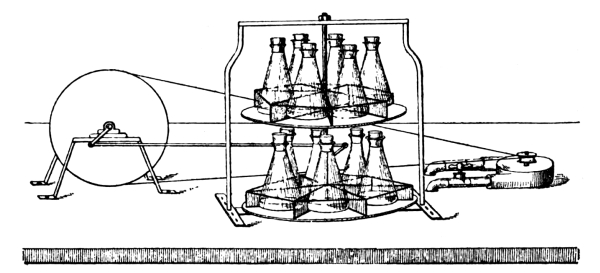
Figure. 4.
Shaking Machine for Ammonium Magnesium Phosphate.
In order to hasten the precipitation of the ammonium magnesium
phosphate and to prevent the fixation of the precipitate on the walls
of the erlenmeyer, the flask should be shaken for half an hour. For
this purpose the flasks should be closed with smooth well-fitting
rubber stoppers and placed in a shaking machine. The shaking machine
of the form given in Fig. 4, recommended by the
Halle station, is very conveniently used for this purpose.
On a vertical axis are carried two stages for holding the flasks.
The flasks are prevented from striking each other by means of the
partitions shown. The apparatus is conveniently driven by a small
water-motor, as indicated, which imparts to the stages a partial back
and forth revolution.
After shaking for half an hour, any precipitate adhering to the rubber
stoppers is carefully washed off with ammonia water into the flask. The
filtration can be made immediately after the shaking or after two or
three days; the results are the same.
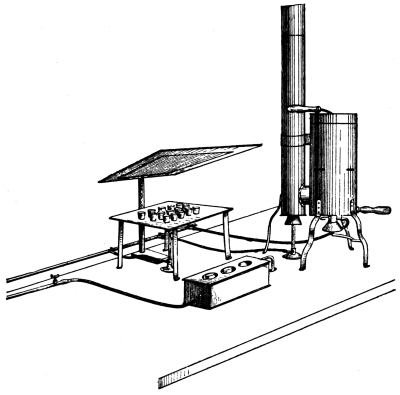
Figure. 5.
Rössler Ignition Furnace.
The filtration of the ammonium magnesium phosphate is made through
perforated crucibles. The asbestos felt is prepared in the following
way: The coarse fibers of asbestos are chopped up with a sharp knife on
a glass plate and boiled for two hours with strong hydrochloric acid;
afterwards, by repeated washing with distilled water they are freed
from acid and the too fine particles of asbestos which would tend to
make the filter too impervious. After the last wash-water is poured
off, the asbestos is suspended in water and used for making the felt on
the filter. The preparation of the crucible and the filtration under
pressure are accomplished in the usual way.
The ignition of the precipitate is accomplished in a Rössler
ignition oven, Fig. 5. When the muffle of the
furnace shows a white heat or a white-red heat it is at the proper
temperature for the estimation. At higher temperatures, the asbestos
felt is easily injured. Generally, an ignition of five minutes
is sufficient, but with double superphosphates, ten minutes are
required.
65. The Swedish Citrate Method.[56]—This method of determining
phosphoric acid is founded on the fact that phosphoric acid in the
presence of calcium salts, without it being necessary, previously, to
convert it into phosphomolybdate, is precipitated directly by magnesia
mixture from a solution, to which ammonium citrate has been added,
provided first, that the solution contain a sufficient quantity of
sulfuric acid, and second, that only as much citrate be added as is
required to keep the calcium salts in alkaline solution.[57]
Reagents. (1) Citric Acid Solution.—Prepared by
dissolving 500 grams of citric acid in water, and completing to a
volume of one liter.
(2) Ten Per Cent Ammonia of 0.959 specific gravity.
(3) Magnesia Mixture, of the usual composition.
The various processes are conducted as follows:
(a) Water-Soluble Phosphoric Acid.—Add twenty cubic
centimeters of citric acid solution to fifty cubic centimeters of the
water-soluble solution obtained according to the Swedish molybdenum
method, and then add thirty-three cubic centimeters of ammonia. When
the mixture has cooled, add slowly twenty-five cubic centimeters of the
magnesia mixture, and then forty-two cubic centimeters of the ammonia.
Keep the solution stirred by means of a closely clipped feather which
is pressed tightly against the sides of the beaker; by this process
the phosphate is precipitated after half an hour in pure condition and
completely, without, in the least, sticking to the wall of the beaker;
filter, wash, and ignite, as usually directed.
(b) Insoluble Phosphoric Add.—Moisten, in a porcelain
dish, ten grams of the powdered sample with water; add fifty cubic
centimeters of concentrated sulfuric acid, and heat for fifteen minutes
so high that fumes of sulfuric acid will escape. When the mass has
cooled, wash it into a half liter graduated flask, fill to the mark,
and shake well. After filtration, the clear filtrate may, after some
time, turn turbid by separation of calcium sulfate, but as the ammonium
citrate, which is afterwards added, again brings the precipitate into
solution, it is of no importance. Take fifty cubic centimeters of
the solution, corresponding to one gram of the powdered sample, add
twenty cubic centimeters of the citric acid solution, neutralize the
mixture approximately, but not exactly, by ammonia; after cooling,
add twenty-five cubic centimeters of magnesia mixture; stir the fluid
by means of a feather, as described above, till no more precipitate
is formed, and finally add thirty-three cubic centimeters of ammonia
while stirring for a couple of minutes more; after half an hour the
precipitate may be separated by filtration, washed, and ignited, as
usually directed.
The above process is essentially the one used with basic slags. When
much organic matter is present, by continuing the heating with sulfuric
acid for some time, it may be destroyed.
66. Methods Adopted by the Brussels Congress, 1894.—The report
of the committee on methods of analysis of phosphoric acid requires
the molybdate method to be used in all cases where the quantity to be
determined is very small. In other cases the citrate method may be
employed.[58]
(1) Soluble Phosphoric Acid.—The soluble phosphoric acid is
determined by the method adopted at Brussels in the following manner:
Five grams of the sample are rubbed to a powder in a mortar, and then
from fifty to sixty cubic centimeters of water added. After allowing
to settle for a few minutes the liquid portion is decanted upon a
filter. This operation is repeated three or four times. Finally the
solid portions are washed upon the filter, and the washing with water
is continued until the filtrate amounts to about three-quarters of a
liter. A few drops of hydrochloric acid are added until the filtrate
is perfectly clear, and the volume is then made up to one liter. Fifty
cubic centimeters of the solution are then treated with thirty cubic
centimeters of ammonium citrate solution and one-third as much ammonia.
Afterwards thirty cubic centimeters of magnesia mixture are added, drop
by drop, with constant stirring.
For superphosphates containing more than eighteen per cent of
phosphoric acid only one gram is taken, for ordinary superphosphates
two grams, and for compound fertilizers four grams. The sample is first
treated as above for soluble acid until the filtrate amounts to 200
cubic centimeters, then clarified with a drop of nitric acid, and made
up to a quarter of a liter.
(2) Reverted Phosphoric Acid.—The filter containing the residue
is then introduced into a quarter liter flask and treated with 100
cubic centimeters of Petermann’s alkaline ammonium citrate solution,
vigorously shaken, and left at room temperature for fifteen hours.
It is then digested for an hour at 40° and filtered. Fifty cubic
centimeters of the filtrate are placed in a flask and, with constant
shaking, thirty-five cubic centimeters of magnesia mixture added.
The aqueous solution is treated in the same way. The precipitate is
collected, ignited and weighed, and multiplied by 0.64 for phosphoric
acid. The total acid is determined in the usual way.
67. Dutch Method for Citrate-Soluble Phosphoric Acid.[59]—The
reagents necessary are:
(1) Citrate solution, prepared according to Petermann. Dissolve 165
grams of citric acid in 700 cubic centimeters of water, mix with 250
cubic centimeters of ammonia of 0.92 specific gravity, and, after
cooling, bring to the volume of one liter.
(2) Magnesia mixture prepared according to Petermann. Dissolve 400
grams of crystallized magnesium chlorid, 800 grams of ammonium chlorid,
and 1,600 cubic centimeters of ammonia of 0.96 specific gravity in
water, and dilute to five liters.
The quantity to be taken for the analysis is five grams where the
fertilizer contains less than six per cent of phosphoric acid (mixed
fertilizers); two grams where it contains more than six and less than
fifteen per cent (common superphosphates); and one gram where it
contains more than fifteen per cent (double superphosphates). Place the
weighed substance in a mortar and cover with 100 cubic centimeters of
citrate solution. Gently rub up, wash into a half liter flask, and
heat in a water-bath for an hour to a temperature between 35° and 38°.
Allow to cool, fill up to 500 cubic centimeters, and filter through a
dry double filter. If it is not clear at the first filtration, pour
through the filter again, repeating this till clearness is attained.
Measure 100 cubic centimeters and add seventy-five cubic centimeters
of magnesia mixture, allowing the latter to flow into the former very
slowly, and constantly stirring during the influx. Allow to stand
fifteen hours, filter, wash with ammonia of 0.96 specific gravity, dry,
ignite, and weigh.
The per cent of phosphoric acid, except where otherwise indicated, is
always to be given as per cent of anhydrous acid (P₂O₅).
68. Comparative Accuracy of the Citrate and Molybdate
Methods.—The general use of the citrate method of determining
phosphoric acid by the German chemists has led Johnson[60]
to review some trials of that method in the Yale laboratory made as early as
1880. These determinations have lately been repeated in comparison with
the ordinary molybdate methods with the result that in sixty-seven
determinations on bone-dust, superphosphate, cotton-hull ashes,
cottonseed-meal, tankage, bone-char, phosphatic guano, and phosphate
rock, only three citrate results differed from those obtained by
the molybdate method by more than three-tenths of one per cent. The
greatest discrepancy between the two methods was 0.41 per cent, and the
average difference was 0.09 per cent.
The citrate method was found to give poor results when iron and alumina
were present in considerable quantity. Ignited precipitates by the
citrate method were found to contain as high as four per cent of
lime, and iron and alumina in small quantities when these bodies were
abundant in the original substance.
In the molybdate method the rapid precipitation from solutions at 65°
was found to give unsatisfactory results and it was found necessary
to conduct the process at temperatures between 40° and 50°. With a
relative excess of nitric or a relative deficiency of molybdic acid
some phosphoric acid may easily escape precipitation. The chief
objection to precipitating at 65° is found in the fact that in presence
of considerable iron and alumina some of these bodies may be found
in the yellow precipitate, whence they pass to the final ammonium
magnesium phosphate.
The citrate method, therefore, only gives safe results by compensating
errors which in every class of phosphates must be empirically
determined.
The molybdate method gives results too high when iron and alumina are
present in considerable quantity and the yellow precipitate is obtained
at temperatures above 50°. On the other hand, if there, be a great
relative excess of nitric acid the results may be too low unless the
filtrates from the yellow precipitate be mixed with additional molybdic
solution and digested until no further precipitate is formed.
Comparative determinations made, by both methods, by the Association of
German Experiment Stations have led to the conclusion that both give
practically the same results when each one is conducted with the proper
precautions peculiar to it.[61]
In the latter part of 1892, at the general meeting of the Association,
it was declared that the citrate method, after having been subjected to
repeated tests, was found to be satisfactory, changing the composition
of the solution so that it might have 1,100 instead of 1,000 grams of
citric acid and four liters of twenty-four per cent ammonia to each ten
liters. The data afforded by the citrate method, when applied to an
artificial mixture of known composition, were more satisfactory than
those obtained by the molybdic process.
In this laboratory the citrate method has been found to give nearly
agreeing results with the old process. It is much shorter and less
expensive; and is recommended most favorably for practical use,
suggesting, however, that with every new kind of phosphate or
phosphatic fertilizer varying notably in composition from the standard,
the work should be checked at first by comparison with the molybdenum
method.
69. History and Manufacture.—The basic process for the
manufacture of Bessemer steel is known in Europe as the Thomas
or Thomas and Gilchrist process, and the slags rich in phosphate, one
of the waste products of the process, are known by the same name. In
this country all the phosphatic slags which have been made in the
manufacture of steel have been obtained working under the patents
of Reese, and, when prepared for the market, are known as odorless
phosphate. The only place where these slags have been made in this
country is Pottstown, Pennsylvania. In Europe they are extensively
manufactured, in England, France, and Germany, and their use for
agricultural purposes has increased until it is quite equal to that of
superphosphates.
The quantity of basic slag manufactured in Germany in 1893 was
750,000 tons; in England 160,000; in France 115,000, making the total
production of central Europe about 1,000,000, a quantity sufficient to
fertilize nearly 5,000,000 acres.
70. Process of Manufacture.—The principle of the process
depends upon the arrangement of the furnaces, by means of which the
phosphoric acid in the pig iron is caused to combine with the lime
which is used as a flux in the converters. A general outline of the
process is as follows:
The pigs, which contain from two to four per cent of phosphorus, are
melted and introduced into a Bessemer converter lined with dolomite
powder cemented with coal-tar, into which has previously been placed
a certain quantity of freshly-burned lime. For an average content of
three per cent of phosphorus in the pig iron, from fifteen to twenty
pounds of lime are used for each 100 pounds of pig iron. As soon as the
melted pig iron has been introduced into the converter, the air-blast
is started, the converter placed in an upright position, and the
purification of the mass begins. The manganese in the iron is converted
into oxid, the silicon into silica, the carbon into carbon dioxid and
oxid, and the phosphorus into phosphoric acid.
By reason of the oxidation processes, the whole mass suffers a rise of
temperature amounting in all to about 700° above the temperature of the
melted iron. At this temperature the lime which has been added, melts,
and, in this melted state, combines with the phosphoric acid, and the
liquid mass floats upon the top of the metallic portion, which has, by
this process, been converted into steel.
As soon as the process, which occupies only about fifteen minutes, is
completed, the fused slag is poured off into molds, allowed to cool,
broken up, and ground to a fine powder. For each five tons of steel
which are made in this way, about one ton of basic slag is produced.
In another process, in order to make a slag richer in phosphoric
acid, a lime is employed which contains a considerable percentage of
phosphate. Although the slag thus produced is richer in phosphoric
acid, it is doubtful whether it is any more available for plant growth
than that made in the usual way with lime free from phosphoric acid. In
other words, when a basic slag is made with a lime free from phosphoric
acid, nearly the whole of the phosphoric acid is combined as tetrabasic
calcium phosphate. On the other hand, when the lime employed contains
some of the ordinary mineral phosphate the basic slag produced becomes
a mixture of this mineral phosphate with the tetracalcium salt. The
mineral phosphate is probably not rendered any more available than it
was before.
It is easily seen from the above outline of the process of manufacture,
that basic slags can have a very widely divergent composition. When
made from pig iron poor in phosphorus, the slag will have a large
excess of uncombined lime and consequently the content of phosphoric
acid will be low. When made from pigs rich in phosphorus there may
be a comparative deficiency of lime, and in this case the content of
phosphoric acid would be unusually high.
It is found also that the content of iron in the slag varies widely. In
general, the greater the content of iron the harder the slag and the
more difficult to grind. If the pig iron contain sulfur, as is often
the case, this sulfur is found also in the slag in combination with the
lime, either as a sulfid or sulfate.
No certain formula can therefore be assigned to basic slags and the
availability of each one must be judged by its chemical composition.
71. Composition of Basic Slag.—The slags produced by the method
above outlined may be amorphous or crystalline. When large masses are
slowly cooled the interior often discloses a crystalline composition.
In some samples analyzed in this laboratory the crystals were found to
be of two forms; viz., acicular and tabular.[62]
They had the following composition:
Calculated Per Cents as
| |
CaO. |
Fe₂O₃. |
Al₂O₃. |
MgO. |
V₂O₂ . |
P₂O₅. |
SiO₂. |
| Acicular crystals |
42.69 |
20.98 |
3.71 |
0.49 |
0.18 |
27.06 |
4.96 |
| Tabular crystals |
53.61 |
9.64 |
0.91 |
0.08 |
—— |
33.92 |
1.75 |
These data show that the two sets of crystals belong to two distinct
mineral forms. The presence of vanadium in one of the samples is
worthy of remark, and leads to the suggestion that in the slags made
of phosphoriferous pigs may be found any of the rare metals which
may exist in the ores from which the pigs were made. The amorphous
portions may have a widely varying composition and consequent content
of phosphoric acid. In all good slags, however, whether in crystalline
form or as amorphous powder, the lime and phosphoric acid will be found
combined as tetracalcium phosphate (Ca₄P₂O₉).
72. Molecular Structure of Tetracalcium Phosphate.—Several
theories have been advanced in respect of the atomic arrangement of the
elements contained in a molecule of tetracalcium phosphate. It must
be confessed that so little is known concerning the reactions of this
body as to make theories of its constitution largely visionary. But the
existence in definite crystalline form of this salt shows that it is
not merely an intimate mechanical mixture, but a true molecular form.
As a type of the supposed arrangement of its particles the graphic
formula proposed by Kormann may be consulted; viz.,
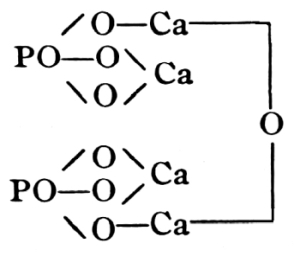
The crystals of this salt, as may be seen by inspection of the
analytical data, contain other bodies than calcium, oxygen, and
phosphorus. It would be of interest to push the investigation of their
constitution further and see if crystals of pure tetracalcium phosphate
could be obtained, and under what conditions they would be contaminated
by other metallic oxids. Usually, by the color of the crystals, it will
be easy to determine something of the nature, if not the extent of the
contamination.
73. Solubility of Phosphatic Slags.—The high agricultural value
of basic slags led to an early study of their solubility in ammonium
citrate, citric acid, and other organic solutions. Even finely ground
mineral phosphates and bones are soluble to some extent in ammonium
citrate, as was pointed out as long ago as 1882.[63]
The most common solvents used for basic slags are ammonium citrate
and citric acid. The ammonium citrate should be the same as that used
for the determination of reverted phosphoric acid and the citric
acid solution commonly used contains five grams in a hundred cubic
centimeters. The slags of different origin and even of different age
vary greatly in respect of the quantity of soluble matter they contain.
It is believed, however, that a very fair idea of the agricultural
value of a slag may be obtained by determining its degree of solubility
in one of the menstrua named.
74. Separation by Sifting.—The relative availability of a slag,
as in the case of a mineral phosphate, is determined by the percentage
of fine material it contains. Sieves of varying apertures are used
to determine this percentage. A one-half millimeter or a one-quarter
millimeter circular aperture is best, and the percentage of the total
material passing through is determined. A method used in Germany
consists in sifting the slag in a sieve twenty centimeters in diameter
the meshes of which are from 0.14 to 0.17 millimeter square and which
measure diagonally from 0.22 to 0.24 millimeter.
75. Solution of Phosphatic Slags.—Sulfuric acid has been
found to be an excellent solvent for basic slags preparatory to the
determination of phosphoric acid. There is, however, no unanimity of
opinion concerning the best method or means of solution. Aqua regia and
nitric acid are objected to because they may convert any phosphorus
in combination with the iron into phosphoric acid and thus increase
the quantity present.[64]
But iron phosphid is seldom or ever found in slags and therefore this
objection is not always tenable. Sulfuric acid has also been deemed
objectionable because the gypsum separated is likely to carry with it
some of the other substances to be determined.
Hydrochloric acid is also excluded by some from the list of solvents
because it dissolves so many of the foreign elements in the slag and
thus tends to complicate the subsequent determination, especially
of magnesia. Further than this a hydrochloric acid solution is not
suited to the use of the citrate method now so commonly employed.
When hydrochloric acid is used, moreover, the dissolved silica must
be removed and thus the time required for making a phosphoric acid
determination is much increased.
If the sample be sufficiently fine the occlusion of undissolved
phosphate particles by the gypsum formed when sulfuric acid is used
is not to be feared and the disturbance of volume by the gypsum is
pretty nearly constant and can be allowed for. When five grams of slag
are used the mean volume of gypsum in the solution is about two cubic
centimeters.
76. Estimation of Total Acid.—In the determination of total
phosphoric acid in a slag, twenty-five cubic centimeters of the
strongest sulfuric acid are placed in an erlenmeyer having a wide
neck, and with careful shaking five grams of the fine slag meal
gradually added. The flask is heated over a naked flame until solution
is complete. When the mass is cold it is washed into a quarter liter
flask; again allowed to cool, filled with water to the mark, and two
cubic centimeters of water corresponding to the volume of gypsum
undissolved, are added, well mixed, and filtered. In fifty cubic
centimeters of the filtrate the phosphoric acid is determined by either
the molybdic or citrate methods already described.
77. Alternate Method.—The following method may also be used:
Ten grams of the substance are heated with fifty cubic centimeters
of concentrated sulfuric acid until white vapors have been evolved
for some time. The operation lasts for about fifteen minutes and can
be carried on in a half liter flask or in a porcelain dish. Without
regarding the undissolved material the volume of the liquid is now
made up to half a liter and filtered. The filtered liquid becomes
turbid after some time through the separation of calcium sulfate, but
this turbidity should not be regarded. To fifty cubic centimeters of
the solution, corresponding to one gram of substance, twenty cubic
centimeters of citric acid solution (500 grams citric acid to the
liter) are added, and it is afterwards nearly neutralized by the
addition of ten per cent ammonia and the liquid, which is warmed
by this operation, cooled. There are now added twenty-five cubic
centimeters of the ordinary magnesium chlorid mixture and the solution
stirred until turbidity is produced, one-third of its volume of ten per
cent ammonia added, and again stirred for about a minute.
Instead of the addition of the citric acid and ammonia the ammonium
citrate prepared as follows, may be added: 1,500 grams of citric acid
are dissolved with water, made up to three liters and five liters of
twenty-four per cent ammonia and seven liters of water added. The rest
of the operation is carried on in the usual manner.
78. Halle Method for Basic Slag.—The total phosphoric acid is
estimated at the Halle Station by the following process:[65]
Ten grams of the substance are moistened in a porcelain dish with a
few drops of water and about five cubic centimeters of a one to one
solution of sulfuric acid added, and after the mass has hardened,
which takes place very soon, fifty cubic centimeters of concentrated
sulfuric acid are added and stirred with a glass rod until it is evenly
distributed throughout the whole mass. In stirring this mixture the
greatest care must be taken, otherwise the substance would remain
attached to the sides of the dish, which during later heating would
cause loss through spurting. The complete solution now takes place
after a few hours’ heating on a sand-bath. During the cooling the
jelly-like mass must be stirred with a glass rod, and after it is cool,
by means of a washing-bottle, gently along the sides of the dish,
water is added, and when the mixture becomes hot it is again cooled
and washed into a half liter flask, which is made up to the mark at a
temperature of 17°.5 and filtered. When the acid filtrate stands for
some time there is often a separation of gypsum which, however, does
not in any way influence the subsequent analysis, which is made in the
usual manner.
Fifty cubic centimeters of the filtrate, representing one gram of the
original substance, are placed in an erlenmeyer. In the case of double
superphosphates which often contain large quantities of pyrophosphates,
twenty-five cubic centimeters of the filtrate just obtained, equivalent
to five grams of the substance, are diluted with seventy-five cubic
centimeters of water, ten cubic centimeters of nitric acid of 1.42
specific gravity added, and heated on a sand-bath to convert the pyro
into orthophosphates. The heating should be continued until the liquid
is reduced to its original volume of twenty-five cubic centimeters. The
strongly acid liquid is saturated with ammonia and with the addition
of a drop of rosolic acid as an indicator, again acidified with nitric
acid, and treated as with superphosphates.
79. Dutch Method for Basic Slag.—Heat ten grams of the sample
with fifty cubic centimeters of sulfuric acid (1.84 specific gravity)
till white vapors are evolved, shaking or stirring constantly. After
cooling make the fluid up to 500 cubic centimeters with water, taking
no account of the undissolved substance. Filter, and to fifty cubic
centimeters of the filtrate add 100 cubic centimeters of the ammoniacal
citrate solution, and after cooling, twenty-five cubic centimeters of
magnesia mixture. Stir or shake for a sufficient time. After the lapse
of two hours the precipitate is to be separated by filtration and
treated in the usual manner.
80. Estimation of Citrate-Soluble Phosphoric Acid in Basic
Slag.—Experience has shown that the manurial value of basic slags
does not depend alone on their content of phosphoric acid. Slags may
contain tri- as well as tetracalcium phosphate, and even this latter
salt may exist in states of differing availability. In determining the
availability of basic slag for manurial purposes its solubility in
ammonium citrate is considered the best standard. But this solubility
will evidently be influenced by the basicity of the sample, or in other
words, by the quantity of lime present. A slag rich in calcium oxid
would deport itself differently with a given ammonium citrate solution
from one in which the lime had been chiefly converted into carbonate.
If possible, therefore, all samples should be reduced to the same state
of basicity before the action of any given solvent is determined.
Wagner proposes to neutralize the basicity of a slag in the following
manner:[66]
Five grams of the slag are placed in a half liter flask which is then
filled up to the mark with a one per cent solution of citric acid and
shaken for half an hour. After filtering, fifty cubic centimeters
are titrated with a standard soda solution using phenolphthalein
as indicator. This gives the quantity of citric acid necessary to
neutralize the slag. To a second portion of five grams of the sample
in a half liter flask are added 200 cubic centimeters of water and
enough five per cent citric acid solution to neutralize the lime and
then 200 cubic centimeters of acid ammonium citrate made as indicated
below. After filling to the mark with water it is shaken for half an
hour and filtered. To fifty cubic centimeters of the filtrate are added
100 cubic centimeters of molybdic solution and heated to 80°. After
cooling, the precipitate is filtered and the phosphoric acid estimated
in the usual way.
The acid ammonium citrate solution used is made as follows: Dissolve
160 grams of citric acid with enough ammonia to represent about
twenty-eight grams of nitrogen and make up with water to one liter. The
exact method is given in 82.
The molybdic solution is made by dissolving 125 grams of molybdic
acid in a slight excess of two and a half per cent of ammonia, adding
400 grams of ammonium nitrate, diluting to one liter and pouring the
solution into one liter of nitric acid having a specific gravity of
1.19. After allowing to stand at room temperature for one day the
mixture is filtered and is then ready for use.
81. Wagner’s Shaking Apparatus.—The latest directions given by
Wagner for determining the phosphoric acid in slags and raw phosphates
soluble in citrate solutions, are the following:[67]
Five grams of the material as it is sent into commerce without grinding or
sifting, are placed in a half liter flask and covered with nearly a quarter
liter of water, and then 200 cubic centimeters of citrate solution
added, prepared as described below. The flask is filled to the mark
with water. The flasks, which are of the shape shown in the figure,
are closed with rubber stoppers, and without delay placed for half an
hour in a rotating apparatus, (Fig. 6) which is turned on
its axis from thirty to forty times a minute. If a shaking apparatus be used
instead of the one mentioned, 200 cubic centimeters of the citrate solution
should be placed in a half liter flask, filled to the mark with water,
and the contents poured into a liter flask containing the phosphate.
This flask should be placed in a nearly horizontal position in the
apparatus and the agitation be continued for half an hour. On removal
from the apparatus the mixture is filtered and fifty cubic centimeters
thereof treated with double the quantity of molybdic solution at
80° and the precipitate separated after cooling. The precipitate is
carefully washed with one per cent nitric acid mixture, after which
the filter is broken and the precipitate washed into a beaker with two
per cent ammonia and the filter washed therewith until about 100 cubic
centimeters have been used. If the solution is turbid from the presence
of silicic acid it should be precipitated a second time by addition of
molybdic solution until the acid reaction is restored. The ammoniacal
solution of the yellow precipitate is treated, drop by drop, with
constant stirring, with fifteen cubic centimeters of magnesia mixture,
and set aside for two hours. The precipitate is collected, washed,
ignited, and weighed in the usual manner. The direct precipitation of
the phosphoric acid by the magnesia solution in presence of citrate is
not advisable because of the almost general presence of silicic acid
which would cause the results to be too high.
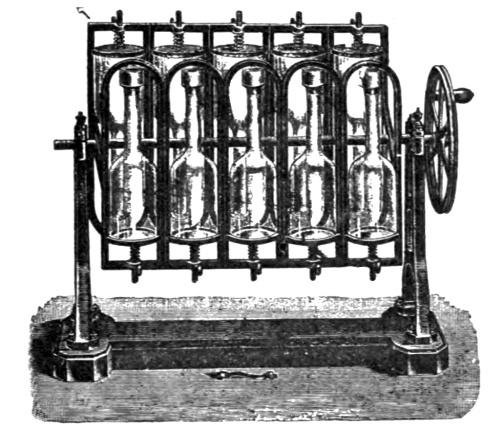
Figure. 6.
Wagner’s Digestion Apparatus for Slags.
The chief objection to this method of Wagner lies in the failure to
control the temperature at which the digestion with citrate solution
is made. Huston has shown, as will be described further on, that the
temperature exercises a great influence in digestion with citrate.
Since the laboratory temperature, especially in this country, may vary
between 10° and 35°, it is evident that on the same sample the Wagner
method would give very discordant results at different seasons of the year.
82. Solutions Employed in the Wagner Method.—1. Ammonium
Citrate.—In one liter there should be exactly 150 grams of citric
acid and 27.93 grams of ammonia, equivalent to twenty-three grams of
nitrogen. The following example illustrates the preparation of ten
liters of the solution: In two liters of water and three and a half
liters of eight per cent ammonia, 1,500 grams of citric acid are
dissolved and the cooled solution made up exactly to eight liters.
Dilute twenty-five cubic centimeters of this solution to 250 cubic
centimeters and treat twenty-five cubic centimeters of this with three
grams of calcined magnesia and distill into forty cubic centimeters
of half normal sulfuric acid. Suppose the ammonia nitrogen found
correspond to twenty cubic centimeters of fourth normal soda-lye. Then
in the eight liters are contained
- (20.0 × 0.0035 × 8000)
- ————————— = 224 grams
- 2.5
of ammonia nitrogen. Then in order to secure in
the ten liters the proper quantity of ammonia there must be added
two liters of water containing 230 - 224 = six grams of nitrogen or
seven and three-tenths grams ammonia; viz., ninety-four cubic
centimeters of 0.967 specific gravity.
2. Molybdate Solution.—Dissolve 125 grams of molybdic acid in
dilute two and five-tenths per cent ammonia, avoiding a large excess of
the solvent. Add 400 grams of ammonium nitrate, dilute with water to
one liter and pour the solution into one liter of nitric acid of 1.19
specific gravity. Allow the preparation to stand for twenty-four hours
at 35° and filter.
3. Magnesia Mixture.—Dissolve 110 grams of pure crystallized
magnesium chlorid and 140 grams of ammonium chlorid in 700 cubic
centimeters of eight per cent ammonia and 130 cubic centimeters of
water. Allow to stand several days and filter.
83. Estimation of Lime.—When the lime is to be determined in
basic slags some difficulty may be experienced by reason of danger
of contamination of the oxalate precipitate with iron and especially
manganese, which is often present in slags.
Holleman[68]
proposes to estimate the lime in basic slag by a modification of the
methods of Classen and Jones. The manipulation is as follows: Fifty
cubic centimeters of the solution of slag, equivalent to one gram of
substance, are evaporated to a small volume, twenty cubic centimeters
of neutral ammonium oxalate solution (one to three) added to the
residue and heated on a water-bath with frequent stirring, until the
precipitate is pure white and free from lumps. The time required is
usually about ten minutes. The precipitate is collected on a filter
and washed with hot water until the filtrate contains no oxalic acid.
The precipitated calcium oxalate must be snow-white. The filter is
broken and the calcium oxalate washed through, first with water
and finally with warm, dilute hydrochloric acid (one to one). The
calcium oxalate is dissolved by adding fifteen cubic centimeters of
concentrated hydrochloric acid, the solution evaporated to a volume
of about twenty-five cubic centimeters and ten cubic centimeters of
dilute sulfuric acid (one to five), and 150 cubic centimeters of
ninety-six per cent alcohol added. After standing three hours or more
the precipitate is separated by filtration and washed with ninety-six
per cent alcohol until the washings show no acid reaction with methyl
orange. The calcium sulfate precipitated is dried to constant weight.
This method gives a pure precipitate of calcium sulfate, containing
only traces of manganese.
84. Estimation of Caustic Lime.—The lime mechanically present
in basic slags is likely to be found as oxid or hydroxid, especially
when the sample is of recent manufacture. In the form of oxid the lime
may be determined by solution in sugar. In this process one gram of
the fine slag meal is shaken for some time with a solution of sugar,
as suggested by Stone and Scheuch.[69]
The dissolved lime is separated as oxalate by treatment of the solution
with the ammonium salt. The calcium oxalate may be determined by
ignition in the usual way or volumetrically by solution in sulfuric
acid and titration of the free oxalic acid with potassium permanganate
solutions. The standard solution of permanganate should be of such a
strength as to have one cubic centimeter equivalent to about 0.01 gram
of iron. The iron value of the permanganate used multiplied by 0.5 will
give the quantity of calcium oxid found.
85. Detection of Adulteration of Phosphatic Slags.—The high
agricultural value of phosphatic slags has led to their adulteration
and even to the substitution of other bodies. Several patents have also
been granted for the manufacture of artificial slags of a value said to
be an approximation to that of the by-products of the basic pig iron
process.
(1) Method of Blum.—One of the earliest methods of examining
basic slag for adulterations is the method of Blum.[70]
This method rests upon the principle of the determination of the carbon
dioxid in the sample. The basic phosphatic slag is supposed to contain
no carbon dioxid. This is true only in case it is freshly prepared. The
tetrabasic phosphate, after being kept for some time, gradually absorbs
carbon dioxid from the air. As high as nineteen per cent of carbon
dioxid have been found in slags which have been kept for a long while.
When the slag has absorbed so much of carbon dioxid and water from the
air as to be no longer profitable for market, it can be restored to its
original condition by ignition.
(2) Method of Richter-Forster.—One of the common adulterants
of tetrabasic phosphate is aluminum phosphate. The method of detecting
this when mixed with the slag is described by Richter-Forster.[71]
The method depends on the fact that soda-lye dissolves the aluminum
phosphate, although it does not dissolve any calcium phosphoric acid
from the slag. Two grams of the sample to be tested are treated with
ten cubic centimeters of soda-lye of from 7° to 8° C. in a small vessel
with frequent shaking for a few hours at room temperature. After
filtration the filtrate is made acid with hydrochloric and afterwards
slightly alkaline with ammonia. With pure basic slag there is a small
trace of precipitate produced, but this is due to a little silica which
can be dissolved in a slight excess of acetic acid. If, however, the
basic slag contain aluminum phosphate, a dense jelly-like precipitate
of aluminum phosphate is produced.
(3) Method of Jensch.—Edmund Jensch[72]
determines the tetrabasic phosphate in slags by solution in organic acids, and
prefers citric acid for this purpose. This method was also recommended by
Blum[73].
It is well known that the tetrabasic phosphate in slags is completely
soluble in citric acid while the tribasic phosphate is only slightly, if
at all, attacked. The neutral ammonium salts of organic acids do not at
first attack the tribasic phosphate at all, and they do not completely
dissolve the tetrabasic phosphate. The solution used by Jensch is made
as follows: Fifty grams of crystallized citric acid are dissolved in
one liter of water. A weaker acid dissolves the tetrabasic phosphate
too slowly and a stronger one attacks the tribasic phosphate present.
Schucht recommends the following method of procedure:[74]
One gram of the slag, finely ground, is treated in a beaker glass with about
150 cubic centimeters of Jensen’s citric acid solution and warmed for
twelve hours in an air-bath at from 50° to 70° with frequent shaking.
Afterwards it is diluted with 100 cubic centimeters of water, boiled
for one minute and filtered. The filter is washed thoroughly with hot
water and the phosphoric acid is estimated in the filtrate in the usual
way. With artificial mixtures of basic slags and other phosphates the
quantity of basic slag can be determined by the above method.
(4) Method of Wrampelmeyer.—According to Wrampelmeyer the most
convenient method for discovering the adulteration of basic slag is the
use of the microscope.[75]
All finely ground natural phosphates are light colored and with a
strong magnification appear as rounded masses. In basic slags the
particles are mostly black but there are often found red-colored
fragments having sharp angles which refract their light in a peculiar
way so that, with a very little experience, they can be recognized as
being distinctive marks of pure basic slag.
In artificial mixtures of these two phosphates, which we have made in
our laboratory, we have been able to detect with certainty as little as
one per cent of added mineral phosphate.
One form of adulterating natural mineral phosphates has been mixing
them with finely pulverized charcoal or soot to give them the black
appearance characteristic of the basic slags. This form of adulteration
is at once disclosed by simple ignition or by microscopic examination.
(5) Loss on Ignition.—If all doubts cannot be removed by the
use of the microscope, the loss on ignition should be estimated.
Natural phosphates all give a high loss on ignition, ranging from eight
to twenty-four per cent, while a basic slag gives only a very slight
loss on ignition, especially when fresh. A basic slag which has stood
for a long while and absorbed carbon dioxid and moisture, may give a
loss on ignition approximating, in a maximum case, the minimum loss on
ignition from a natural phosphate.
In experiments made in this laboratory in testing for loss on ignition,
we have uniformly found that natural mineral phosphates will lose from
nearly one to two and one-half times as much on ignition as a basic
slag which has been kept for two years. A basic slag in the laboratory
more than two years old gave, as loss on ignition, 4.12 per cent.
Several samples of finely ground Florida phosphates gave the following
percentages of loss on ignition, as compared with a sample of slag.
Odorless phosphate 4.12.
Florida phosphates 8.06, 6.90, 9.58, 6.40, 10.38, and 10.67
respectively.
There are some mineral phosphates, however, which are ignited before
being sent to the market. We have one such sample in our laboratory
from Florida which gave, on ignition, a loss of only one and
four-tenths per cent. In this case it is seen that the application of
the process of ignition would not discriminate between a basic slag and
a mineral phosphate.
It may often be of interest to know what part of the loss, on ignition,
is due to water in form of moisture. In such cases the sample should
first be dried to constant weight in a steam-bath and then ignited. In
the following data are found the results obtained here with samples
treated as above indicated and also ignited directly. Number one is a
basic slag two years old and the others Florida phosphates.
| |
Heated to 100° C. then ignited. |
Ignited directly. |
| |
Loss at
100° C. |
Loss on
ignition. |
Total
loss. |
Loss on
ignition. |
| No. 1 |
(Slag) |
2.57 |
1.77 |
4.34 |
4.12 |
| No. 2 |
(Rock) |
2.61 |
5.19 |
7.80 |
8.06 |
| No. 3 |
“ |
1.09 |
5.77 |
6.86 |
6.90 |
| No. 4 |
“ |
0.42 |
9.20 |
9.62 |
9.58 |
| No. 5 |
“ |
1.81 |
4.83 |
6.64 |
6.40 |
| No. 6 |
“ |
4.36 |
6.52 |
10.88 |
10.83 |
| No. 7 |
“ |
3.31 |
7.01 |
10.32 |
10.67 |
(6) Presence of Sulfids.—Another point noticed in this
laboratory is that the basic slags uniformly contain sulfids which are
decomposed upon the addition of an acid with an evolution of hydrogen sulfid.
(7) Presence of Fluorin.—In applying the test for fluorin, it
has been uniformly found here that the mineral phosphates respond to
the fluorin test while the basic slags, on the contrary, respond to the
hydrogen sulfid test. This test, however, was applied only to the few
samples we have had and may not be a uniform property.
The absence of fluorin might not prove the absence of adulteration,
but its presence would, I believe, certainly prove the fact of the
adulteration in that particular sample.
The fluorin test is applied by Böttcher in the following manner:[76]
From ten to fifteen grams of the slag are placed in a beaker ten
centimeters high and from five to six centimeters in diameter, with
fifteen cubic centimeters of concentrated sulfuric acid, stirred with a
glass rod, and covered with a watch-glass on the under side of which a
drop of water hangs. If there be formed upon the drop of water a white
murky rim, it is proof that a mineral phosphate containing fluorin has
been added. After from five to ten minutes you can notice on the clean
watch-glass the etching produced by the hydrofluoric acid. According to
Böttcher an adulteration of ten per cent of raw phosphate in slag can
be detected by this method.
(8) Solubility in Water.—Solubility in water is also a good
indication, natural phosphates being totally insoluble in water, while
a considerable quantity of the basic slag will be dissolved in water on
account of the calcium oxid or hydroxid which it contains. If the loss
on ignition is low, and the volume-weight and water-solubility high,
the analyst may be certain that the sample is a pure slag.
In comparative tests made in our laboratory with a sample of basic slag
and seven samples of Florida phosphate, the percentages of material
dissolved by water and by a five per cent solution of citric acid were
found to be as follows:
| |
Water-soluble.
Per cent. |
Sol. in
five per cent
citric acid.
Per cent. |
| |
| Odorless |
phosphate |
0.97 |
16.10 |
| Florida |
phosphate |
0.01 |
4.15 |
| “ |
“ |
0.09 |
4.66 |
| “ |
“ |
0.02 |
3.43 |
| “ |
“ |
0.08 |
3.61 |
| “ |
“ |
0.02 |
3.79 |
| “ |
“ |
0.05 |
4.46 |
| “ |
“ |
0.02 |
4.24 |
From the above data it is seen that the solvent action of water
especially would be of value inasmuch as it dissolves only a mere trace
of the mineral phosphates, approximating one per cent of the amount
dissolved from basic slag. In the case of the citric acid it is found
that the amount of materials soluble in this solvent for basic slag
is fully four times as great as for the mineral phosphates. Both of
these processes, therefore, have considerable value for discriminating
between the pure and adulterated article of basic slag.
(9) Specific Gravity.—The estimation of the volume specific
gravity is also a good indication for judging of the purity of the
slag. This is best done by weighing directly a given volume. Basic slag
will have a volume-weight of about one and nine-tenths, while natural
phosphates will have about one and six-tenths.
(10) Conclusions.—From the above résumé of the standard methods
which are in use for determining the adulteration of basic slag, it is
seen that there are many cases in which grave doubt might exist even
after the careful application of all the methods mentioned. If we had
only to consider the adulteration of basic slag with certain of the
mineral phosphates, that is, tricalcium phosphate, the problem would be
an easy one, but when we add to this the fact that iron and aluminum
phosphates are employed in the adulteration, and that artificial slags
may be so used, the question becomes more involved.
In doubtful cases one after another of the methods should be applied
until there is no doubt whatever of the judgment which should be
rendered.
86. Classification of Methods.—The time required for a
gravimetric determination of phosphoric acid has led analysts to try
the speedier if less accurate processes, depending on the use of
volumetric methods. The chief difficulty with these methods has been in
securing some sharp method of distinguishing the end reaction. In most
cases it has been found necessary to remove a portion of the titrated
solution and prepare it for final testing by subsidence or filtration.
As is well known, this method of determining the end reaction is less
accurate and more time-consuming than those processes depending on a
change of color in the whole mass. All the volumetric processes now
in general use may be divided into two classes; viz., (1) the
direct precipitation of phosphoric acid and the determination of the
end reaction by any appropriate means, and (2) the previous separation
of the phosphoric acid, usually by means of a citro-magnesium or
molybdenum mixture, and in the latter case the subsequent titration
of the yellow ammonium phosphomolybdate either directly or after
reduction to a lower form of oxidation. In respect of extent of
application by far the most important volumetric method is the one
depending on titration by a uranium salt after previous separation
by ammoniacal magnesium citrate. A promising method after previous
separation by molybdenum is the one proposed by Pemberton, but it has
not yet come into general use. For small quantities of phosphoric acid
or of phosphorus, such as are found in steels and irons, the method
of Emmerton, either as originally proposed or as modified by Dudley
and Noyes, is in frequent use. Where volumetric methods are applied
to products separated by molybdic solution, the essential feature of
the analytical work is to secure a yellow precipitate of constant
composition. If this could be uniformly done such methods would rival
the gravimetric processes in accuracy. Hence it is highly important in
these methods that the yellow precipitate should be secured as far as
possible, under constant conditions of strength of solution, duration
of time, and manner of precipitation. In these cases, and in such only,
can the quicker volumetric methods be depended on for accurate results.
The direct volumetric precipitation of the phosphoric acid by a uranium
salt or otherwise is practiced only when the acid is combined with the
alkalies and when iron and alumina are absent and only small quantities
of lime present. This method has therefore but little practical value
for agricultural purposes. In all volumetric analyses the accuracy of
the burettes, pipettes, and other graduated vessels should be proved by
careful calibration. Many of the disagreements in laboratories where
the analytical work is conducted equally well can be due to no other
cause than the inaccuracy of the graduated vessels which are found in
commerce. Burettes should not only be calibrated for the whole volume
but for at least every five cubic centimeters of the graduation.
87. The Uranium Method.—Since the phosphoric acid of practical
use for agricultural purposes is nearly always combined with lime,
alumina, and iron, its volumetric estimation by means of a standard
solution of a uranium salt is to be preceded by a preliminary
separation by means of an ammoniacal magnesium citrate solution.
The principle of the method was almost simultaneously published by
Sutton,[77]
Neubauer,[78]
and Pincus.[79]
The phosphoric acid may also be separated by means of molybdic solution or
by tin or bismuth.[80]
In practice, however, it has been found that when the uranium method is to
be used the magnesium citrate separation is the most convenient. Since
this is the method practiced almost universally in France, the method
there used will be given in detail. It is based essentially on the
process described by Joulie.[81]
88. Preparation of Sample.—(1) Incineration.—Since the
organic matters present in a phosphatic fertilizer often interfere with
the employment of uranium as a reagent, it is necessary to incinerate
the sample taken for analysis.[82]
(2) Solution of the Material.—All phosphates, with the
exception of certain aluminum phosphates, amblygonite for example, are
easily dissolved in nitric and hydrochloric acids more or less dilute,
especially on ebullition. The best solvent, however, for calcium
phosphates for the uranium method is incontestably hydrochloric acid
which also very easily dissolves the iron and aluminum phosphates,
which are often found present with calcium phosphates.
(3) Nitric Acid.—In many laboratories nitric acid is
preferred in order to avoid, in part, the solution of ferric oxid
which interferes with the determination of phosphoric acid in certain
processes. Since it does not act in this way for the citro-magnesium
uranium method, it is preferable to employ hydrochloric acid,
especially because it dissolves the iron completely and permits thus
the operator to judge of the success of the solvent action by the
completely white color of the residue.
(4) Pyritic Phosphates.—Certain phosphates contain pyrites
which hydrochloric acid does not dissolve, and there is left
consequently, a residue more or less colored. In this case it is
necessary to add some nitric acid and to prolong the boiling until
the pyrite has disappeared, since it might retain a small quantity of
phosphoric acid in the state of iron phosphate.
(5) Sulfuric Acid.—Some chemists decompose the phosphates by
means of dilute sulfuric acid. This method, which is certainly able
to give good results for certain products and for certain processes,
presents numerous inconveniences which tend to render its use
objectionable for volumetric purposes. The calcium sulfate which is
formed, requires prolonged washings which lead to chances of fatal
error.
If an aluminum phosphate be under examination, containing only very
little or no lime, sulfuric acid is to be preferred to hydrochloric and
nitric acids, since it attacks amblygonite, which, as has been before
stated, resists the action of the other two acids. But these are cases
which are met with very rarely, and which can always be treated by the
general method by previously fusing the material with a mixture of
sodium and potassium carbonate.
In the great majority of cases the decomposition by hydrochloric acid
is very easily accomplished by simply boiling in a glass vessel, and
without effecting the separation of the silica. This operation is only
necessary after the substance has been fused with alkaline carbonates,
or, in case of substances which contain decomposable silicates giving
gelatinous silica with hydrochloric acid.
There are two methods [see (6) and (7)] of securing a solution of
the sample taken which varies from one to five, and even ten grams,
according to the apparent homogeneity of the material to be analyzed.
(6) Solution by Filtration and Washing.—The ordinary method
can be employed consisting in decomposing the substance by an acid,
filtering, and washing the residue upon the filter, and combining all
the wash-waters to make a determinate volume. Afterwards an aliquot
fraction of the whole is taken for the precipitation. This method is
long, and presents some chances of error, when the insoluble residue is
voluminous and contains silica which obstructs the pores of the paper
and renders the filtration difficult.
(7) Volumetric Solution.—It is advisable to substitute
volumetric solution for solution by filtration and washing, which
is accomplished by decomposing the substances in a graduated flask,
the volume being afterwards made up to the mark with distilled water
after cooling. The solution is then filtered without washing, and by
means of a pipette an aliquot part of the original volume is taken for
precipitation. Thus all retardations in the process are avoided, and
likewise the chances of error from washing on the filter. It is true
that this method may lead to a certain error due to the volume of the
insoluble matter which is left undecomposed, but since this insoluble
matter is usually small in quantity, and since it is always possible to
diminish the error therefrom by increasing the volume of the solution,
this cause of error is much less to be feared than those due to the
difficulties which may occur in the other method. Let us suppose, in
order to illustrate the above, that we are dealing with a phosphate
containing fifty per cent of insoluble sand which may be considered as
an extreme limit. In working on four grams of the material in a flask
of 100 cubic centimeters capacity, there will be an insoluble residue
of two grams occupying a volume of about one cubic centimeter, the
density of the sand being generally nearly two. The one hundred cubic
centimeter flask will then contain only ninety-nine cubic centimeters
of the real solution, and the error at the most would be 0.01. This
error could be reduced to one-half by dissolving only two grams of the
material in place of four, or by making the volume up to 200 instead of
100 cubic centimeters.
In general it may be said that the errors which do not exceed 0.01 of
the total matter under treatment, are negligible for all industrial
products. The method of volumetric solution does not present any
further inconvenience. It deserves to be and has been generally adopted
by reason of its rapidity in all the laboratories where many analyses
are to be made. In the volumetric method great care should be taken not
to make up to the volume until after the cooling to room temperature,
which may be speedily secured by immersing the flask in cold water.
Care should also be exercised in taking the sample for analysis by
means of the pipette immediately after filtration, and filtration
should take place as soon as the volume is made up to the standard. By
operating in this way the possible variations from changes of volume
due to changes of temperature are avoided.
(8) Examination for Arsenic Acid.—When the sample examined
contains pyrites, arsenic is often present. When the decomposition has
been effected by means of nitric acid, arsenic acid may be produced.
This deports itself in all circumstances like phosphoric acid, and
if it is present in the matter under examination it will be found
united with the phosphoric acid and determined therewith afterwards.
It is easy to avoid this cause of error by passing first a current of
sulfurous acid through the solution, carrying it to the boiling-point
in order to drive out the excess of sulfurous acid, and afterwards
precipitating the arsenic by a current of hydrogen sulfid. After
filtration, the rest of the operation can be carried on as already
described.
89. Precipitation of the Phosphate by Magnesium Citrate.—By
means of an accurate pipette a quantity of the solution representing
from 0.125 to 0.250 gram or more is taken, according to the presumed
richness of the product to be examined. In order that the following
operations may go on well, it is necessary that the quantity of
phosphoric acid contained in the sample should be about fifty
milligrams. The sample being measured is run into a beaker, and there
are added, first, ten cubic centimeters of magnesium citrate solution,
and second, a large excess of ammonia. If the quantity of the magnesium
citrate solution be sufficient, the mixture should at first remain
perfectly limpid and only become turbid at the end of some moments and
especially after the mixture is stirred.
If there should be an immediate turbidity produced it is proof that the
quantity of magnesium citrate solution employed has been insufficient,
and it is necessary to begin again by doubling its amount. Good results
cannot be obtained by adding a second portion of the magnesium citrate
solution to the original, since the iron and aluminum phosphates which
are once formed are redissolved with difficulty. Many chemists at the
present time abstain from using the magnesium citrate solution and
replace it by a solution of citric acid and one of magnesium sulfate,
which they pour successively into the sample under examination. This
is a cause of grave errors which it is necessary to point out. Joulie
has indeed recognized the fact that the precipitation of the phosphoric
acid is not completed in presence of ammonium citrate except it is
employed in conjunction with a sufficient excess of magnesia. But the
foreign matters which accompany the phosphoric acid require different
quantities of ammonium citrate in order to keep them in solution, and
it is important to increase the magnesium solution at the time of
increasing the citric acid in order to maintain them always in the same
proportion. This is easily accomplished by measuring the two solutions,
but it is much more easily done by uniting them and adding them together.
90. The Magnesium Citrate Solution.—The formula originally
proposed by Joulie, and modified by Millot, and adopted by the French
Association of Chemists, is as follows: Citric acid, 400 grams; pure
magnesium carbonate, forty grams; caustic magnesia, twenty grams;
distilled water, half a liter. After solution, add enough of ammonia
to render strongly alkaline, requiring about 600 cubic centimeters.
Make the volume up with distilled water to one and a half liters. If
the solution be turbid, it is proof that the magnesia or the carbonate
employed contains some phosphoric acid which is to be separated by
filtration, and the solution can then be preserved indefinitely.
91. Time of Subsidence.—When the phosphoric acid is
precipitated by the mixture above mentioned, it is necessary to allow
it to subside for a certain time under a bell jar in order to avoid the
evaporation of the ammonia. In order to give plenty of time for this
subsidence, it is well to make the precipitations in the afternoon and
the filtrations the following morning. There are thus secured twelve to
fifteen hours of repose, which is time amply sufficient for all cases.
92. Filtration and Washing.—Filtration is performed easily and
rapidly upon a small filter without folds placed in a funnel with a long
stem of about two millimeters internal diameter. Placed in a series of
six or eight, they allow the filtration to take place in regular order
without loss of time, the first filter being always empty by the time
the last one is filled. The supernatant liquid from the precipitate
should first be decanted on the filter, avoiding the throwing of
the filtrate on the filter which would greatly retard the process,
especially if it should contain a little silica, as often happens.
When the clear liquid is thus decanted as completely as possible, the
rest of the precipitate is treated with water to which one-tenth of
its volume of ammonia has been added, and the washing is continued by
decantation as at first, and afterwards by washing upon the filter
until the filtered solution gives no precipitate with sodium phosphate.
Four washings are generally sufficient to attain this result.
If the operations which precede have been well-conducted, the total
phosphoric acid contained in the material under examination is
found upon the filter-paper, except the small portion which remains
adhering to the beaker in which the precipitation has been made.
The determination of the phosphoric acid comprises the following
operations: First, solution of the ammonium magnesium phosphate and
second, titration by means of a standard solution of uranium.
93. Solution of the Ammonium Magnesium Phosphate.—The phosphate
which has been collected upon the filter is dissolved by a ten per cent
solution of pure nitric acid. This solution is caused to pass into
the beaker in which the precipitation was made in order to dissolve
the particles of phosphate which remain adherent to its sides; and
this solution is then thrown upon the filter. The filtrate is then
received in a flask of about 150 cubic centimeters capacity, marked at
seventy-five cubic centimeters. After two or three washings with the
acidulated water, the filter itself is detached from the funnel and
introduced into the vessel which contains the solution.
The whole of the filtrate being collected in the flask it is saturated
by one-tenth ammoniacal water until a slight turbidity is produced. One
or two drops of dilute nitric acid are now added until the liquor
becomes limpid, and the flask is placed upon a sand-bath in order to
carry the liquid to the boiling-point. After ebullition there are added
five cubic centimeters of acid sodium acetate in order to cause the
free nitric acid to disappear and immediately the titration, by means
of a standard solution of uranium, is undertaken.
94. Acid Sodium Acetate.—The acid sodium acetate is prepared as
follows: Crystallized sodium acetate, 100 grams; glacial acetic acid,
fifty cubic centimeters; distilled water, enough to make one liter.
95. Standard Solution of Uranium.—A solution of uranium is to
be prepared as follows: Pure uranium nitrate, forty grams; distilled
water, about 800 cubic centimeters. Dissolve the uranium nitrate in the
distilled water and add a few drops of ammonia until a slight turbidity
is produced, and then a sufficient amount of acetic acid to cause this
turbidity to disappear. The volume is then completed to one liter with
distilled water.
The uranium nitrate often contains some uranium phosphate and some
ferric nitrate. It is important that it be freed from these foreign
substances. This is secured by dissolving it in distilled water and
precipitating it by sodium carbonate, which redissolves the uranium
oxid and precipitates the iron phosphate and oxid.
The filtered liquor is saturated with nitric acid, and the uranium oxid
reprecipitated by ammonia. It is then washed with distilled water by
decantation and redissolved in nitric acid, as exactly as possible,
evaporated, and crystallized.
The crystals are taken up with ether, which often leaves still a little
insoluble matter. The solution is filtered, and the ether evaporated.
The salt which remains is perfectly pure. It frequently happens when
the uranium nitrate has not been properly purified that the solution
prepared as has been indicated above, deposits a light precipitate of
phosphate which alters its strength and affords a cause of error. Only
those solutions should be employed which have been prepared some days
in advance, and which have remained perfectly limpid.
The solution of uranium thus obtained contains uranium nitrate, a
little ammonium nitrate, a very small quantity of uranium acetate, some
ammonium acetate, and a little free acetic acid. Its sensibility is the
more pronounced as the acetates present in it are less in quantity. It
is important, therefore, never to prepare the solution with uranium acetate.
96. Typical Solution of Phosphoric Acid.—In order to titrate
a solution of uranium, it is necessary to have a standard solution
of phosphoric acid; that is to say, a solution containing a precise
and known quantity of that acid in a given volume. This solution is
prepared by means of acid ammonium phosphate, a salt which is easily
obtained pure and dry. Sometimes as it may contain a small quantity
of neutral phosphate which modifies the relative proportions of
phosphoric acid and ammonia, and it is indispensable to have its
strength verified. The titer of the typical solution should be such
that it requires for the precipitation of the phosphoric acid which
it contains, a volume of the solution of uranium almost exactly equal
to its own, in order that the expansions or contractions which the
two liquors undergo, by reason of changes in the temperature of the
laboratory, should be without influence upon the results.
The solution of uranium prepared as has been indicated above,
precipitates almost exactly five milligrams of phosphoric acid per
cubic centimeter; the typical solution of phosphoric acid is prepared
with eight and one-tenth grams of acid ammonium phosphate pure and dry,
which is dissolved in a sufficient quantity of distilled water to make
one liter.
The acid ammonium phosphate containing 61.74 per cent of anhydrous
phosphoric acid, the quantity above gives exactly five grams of that
acid in a liter, or five milligrams in a cubic centimeter.
97. Verification of the Strength of the Standard Solution of
Phosphoric Acid.—The strength of the standard solution of
phosphoric acid is verified by evaporating a known volume, fifty cubic
centimeters for example, with a solution of ferric hydroxid containing
a known quantity of ferric oxid. The mass having been evaporated to
dryness, and ignited in a platinum crucible, gives an increase in
the weight of the iron oxid exactly equal to the amount of anhydrous
phosphoric acid contained therein, both the nitric acid and ammonia
being driven off by the heat.
To prepare the solution of ferric hydroxid, dissolve twenty grams of
iron filings in hydrochloric acid. The solution is filtered to separate
the carbon, and it is converted into ferric nitrate by nitric acid,
and the solution diluted with distilled water, and the ferric oxid
precipitated by a slight excess of ammonia. The precipitate, washed by
decantation with distilled water until the wash-water no longer gives a
precipitate with silver nitrate, is redissolved in nitric acid, and the
solution is concentrated or diluted, as the case may be, to bring the
volume to one liter.
In order to determine the quantity of ferric oxid which it contains,
fifty cubic centimeters are evaporated to dryness, ignited, and weighed.
A second operation like the above is carried on by adding fifty cubic
centimeters of the standard solution of phosphoric acid, and the
strength of the solution thus obtained is marked upon the flask.
If the operation have been properly carried on, three or four
duplicates will give exactly the same figures. If there are sensible
differences, the whole operation should be done over from the first.
98. Titration of the Solution of Uranium.—In a 150 cubic
centimeter flask marked at seventy-five cubic centimeters, are poured
ten cubic centimeters of the standard solution of phosphoric acid
measured with an exact pipette; five cubic centimeters of the acid
sodium acetate are added, and distilled water enough to make about
thirty cubic centimeters, and the whole carried to the boiling-point.
The titration is then carried on by allowing the solution of uranium to
fall into the flask from a graduated burette, thoroughly shaking after
each addition of the uranium, and trying a drop of the liquor with an
equal quantity of a ten per cent solution of potassium ferrocyanid
upon a greased white plate. Since the quantity of the uranium solution
present will be very nearly ten cubic centimeters at first, nine cubic
centimeters can be run in without testing. Afterwards, the operation is
continued by adding two or three drops at a time until the test upon
the white plate with the potassium ferrocyanid shows the end of the
reaction. When there is observed in the final test a slight change of
tint, the flask is filled up to the mark with boiling distilled water
and the process tried anew. If in the first part of the operation the
point of saturation have not been passed, it is still usually necessary
to add a drop or two of the uranium solution in order to produce the
characteristic reddish coloration, and this increase is rendered
necessary by the increase in the volume of the liquid. Proceeding
in this manner two or three times allows the attainment of extreme
precision, inasmuch as the analyst knows just when to look for the
point of saturation.
Correction.—The result of the preceding operation is not
absolutely exact. It is evident indeed that in addition to the quantity
of uranium necessary for the exact precipitation of the phosphoric
acid, it has been necessary to add an excess sufficient to produce the
reaction upon the potassium ferrocyanid.
This excess is rendered constant by the precaution of operating always
upon the same volume; namely, seventy-five cubic centimeters. It can be
determined then once for all by making a blank determination under the
same conditions but without using the phosphoric acid.
The result of this determination is that it renders possible the
correction which it is necessary to make by subtracting the quantity
used in the blank titration from the preceding result in order to
obtain the exact strength of the uranium solution.
The operation is carried on as follows: In a flat-bottomed flask of
about 150 cubic centimeters capacity and marked at seventy-five cubic
centimeters, by means of a pipette, are placed five cubic centimeters
of the solution of sodium acetate; some hot distilled water is added
until the flask is filled to the mark, and it is then placed upon a
sand-bath and heated to the boiling-point. It is taken from the fire,
the volume made up to seventy-five cubic centimeters with a little hot
distilled water, and one or two drops of the solution of uranium are
allowed to flow into the flask from a graduated burette previously
filled exactly to zero. After each drop of the solution of uranium
the flask is shaken and the liquid tried upon a drop of potassium
ferrocyanid, as has been previously indicated. For a skilled eye, four
to six drops are generally necessary to obtain the characteristic
coloration; that is from two-tenths to three-tenths of a cubic
centimeter. Beginners often use from five-tenths to six-tenths, and
sometimes even more.
The sole important point is to arrest the operation as soon as the
reddish tint is surely seen, for afterwards the intensity of the coloration
does not increase proportionally to the quantity of liquor employed.
It is well to note that at the end of some time the coloration becomes
more intense than at the moment when the solutions are mixed, so that
care must be taken not to pass the saturation-point. This slowness of
the reaction is the more marked as there is more sodium or ammonium
acetate in the standard solutions. This is the reason that it is
important to introduce always the same quantity; namely, five cubic
centimeters. This is also the reason why the uranium acetate should
not be employed in preparing the standard solution of uranium which
ought to contain the least possible amount of acetate in order that
the necessary quantity which is carried into each test should be as
small as possible and remain without appreciable influence. If it
were otherwise, the sensibility of the reaction would be diminished
in proportion as a larger quantity of uranium solution was employed,
giving rise to errors which would be as much more important as the
quantities of phosphoric acid to be determined were greater. The
correction for the uranium solution having been determined it is
written upon the label of the bottle containing it.
Causes of Errors.—In the work which has just been described,
some causes of error may occur to which the attention of analysts
should be called.
The first is the error which may arise from the consumption of the
small quantity of uranium phosphate which is taken with a stirring rod
when the liquid is tested with potassium ferrocyanid. It is very easy
to be assured that the end of the reaction has really been reached. For
this purpose it is only necessary to note the quantity of the solution
already employed and to add to it afterwards four drops; shake, and
make a new test with a drop of the potassium ferrocyanid placed near
the spot which the last one occupied. If a decidedly reddish tint
does not appear at the moment of removing the glass rod, it is to be
concluded that the first appearance was an illusion, and the addition
of uranium is to be continued. If, on the contrary, the coloration
appear of a decided tint, the preceding number may be taken for exact.
It is then always beneficial to close the titration by this test of
four supplementary drops which will exaggerate the coloration and
confirm the figure found.
The second cause of error, and one moreover which is the most
frequently met with, consists in passing the end of the reaction by
adding the uranium too rapidly. In place of giving then a coloration
scarcely perceptible, the test with the drop of potassium ferrocyanid
gives a very marked coloration. In this case the analysis can still
be saved. For this purpose the analyst has, at his disposal, a tenth
normal solution prepared with 100 cubic centimeters of the standard
solution of phosphoric acid diluted to one liter with distilled water.
Ten cubic centimeters of this tenth normal solution are added, and the
titration continued. At the end, the amount of additional phosphoric
acid used is subtracted from the total.
A third cause of error is found in the foam which is often found in
the liquid, due to the shaking. This foam may retain a portion of the
last drops of the solution of uranium which fall upon its surface and
prevent its mixture with the rest of the liquid. If the glass stirring
rod in being removed from the vessel pass through this froth charged
with uranium, the characteristic coloration is obtained before real
saturation is reached. Consequently it is necessary to avoid, as much
as possible, the formation of the foam, and especially to take care
never to take the drop for test after agitation except in the middle of
the liquid where the foam does not exist.
Suppose the titration has been made upon ten cubic centimeters of the
normal solution of phosphoric acid in the conditions which we have
just indicated, and the figure for the uranium obtained is 10.2 cubic
centimeters; if now the correction, which may be supposed to amount
to two-tenths cubic centimeter, be subtracted there will remain ten
cubic centimeters of the uranium solution which would have precipitated
exactly fifty milligrams of phosphoric acid.
The quantity of phosphoric acid which precipitates one cubic centimeter
of the solution will be consequently expressed by the proportion
⁵⁰/₁₀ = five milligrams, which is exactly the strength required. In
the example which has just been given, the inscription upon the flask
holding the standard solution would be as follows: Solution of uranium,
one cubic centimeter equals five milligrams of phosphorus pentoxid;
correction, two-tenths cubic centimeter.
99. Titration of the Sample.—The strength of the solution of
uranium having been exactly determined, by means of this solution the
strength of the sample in which the phosphoric acid has been previously
prepared as ammonium magnesium phosphate is ascertained. In this case
the quantity of phosphoric acid being unknown, it is necessary to
proceed slowly and to duplicate the tests in order not to pass beyond
the point of saturation. From this there necessarily results a certain
error in consequence of the removal of quite a number of drops of
the solution of the sample before the saturation is complete. It is
therefore necessary to make a second determination in which there is at
once added almost the quantity of the solution of uranium determined by
the first analysis. Afterwards the analysis is finished by additions of
very small quantities of uranium until saturation is reached. Suppose,
for instance, that the sample was that of a mineral phosphate, five
grams of which were dissolved in 100 cubic centimeters, and of which
ten cubic centimeters of the solution prepared as above required 15.3
cubic centimeters of the standard solution of uranium. We then would
have the following data:
Mineral phosphate, five grams of the material dissolved in
twenty cubic centimeters of hydrochloric acid.
Water, sufficient quantity to make 100 cubic centimeters.
Quantity taken, ten cubic centimeters = 0.50 gram of the
sample taken.
| Solution of uranium required |
15.3 |
cubic |
centimeters. |
| Correction |
0.2 |
“ |
“ |
| Actual quantity of uranium solution |
15.1 |
“ |
“ |
Strength of the solution of uranium, one cubic centimeter =
fivemilligrams P₂O₅.
Then P₂O₅ in 0.50 gram of the material = 5 × 15.1 = 75.50
milligrams.
| Then the per cent of P₂O₅ = |
75.5 x 100 |
= 15.10. |
| 50 |
The sample under examination ought always to be prepared in duplicate,
either by making a single precipitation and re-solution of the ammonium
magnesium phosphate which is made up to a certain volume and an
aliquot portion of which is taken for the analysis, or by making two
precipitations under the conditions previously described. When the
content of phosphoric acid in the material under examination is very
nearly known, the double operation may be avoided, especially if it be
required to have rapid and only approximate analyses, such as those
which are made for general control and for the conduct of manufacturing
operations. But when analyses are to be used to serve as the basis of
a law or for the control of a market, they should always be made in
duplicate, and the results ought not to be accepted when the numbers
obtained are widely different, since the agreement of the two numbers
will show that the work has been well executed.
This method of analysis, much longer to describe than to execute, gives
results perfectly exact and always concordant when it is well carried
out, provided that the standard solutions, upon which it rests for its
accuracy, are correctly prepared and frequently verified in the manner
indicated.
The strength of the solution of uranium ought to be verified every
three or four days. The strength of the standard solution of phosphoric
acid should be verified each time that the temperature of the
laboratory undergoes any important change. A solution prepared, for
example, in winter when the temperature of the laboratory is from 15°
to 18° would no longer be exact in summer when the temperature reaches
28° or 30°.
100. Condition of Phosphoric Acid in
Superphosphates.—Superphosphates are the products of the
decomposition of phosphates by sulfuric or hydrochloric acid. They
contain phosphoric acid combined with water, with lime, with magnesia,
and with iron and alumina in various proportions.
These combinations may be classed in three categories: First, those
compounds soluble in water; second, those insoluble in water, but
very soluble in ammoniacal salts of the organic acids such as the
citrate and oxalate; and third, phosphates not soluble in any of the
above-named reagents.
In the products soluble in water are met free phosphoric acid,
monocalcium phosphate, acid magnesium phosphate, and the iron and
aluminum phosphates dissolved in the excess of phosphoric acid. In
the products insoluble in water but soluble in the ammonium citrate
are found bicalcium phosphate and iron and aluminum phosphates, which
together constitute the phosphates called reverted.
These compounds reduced to a very fine state of division in the process
of manufacture are considered to contain phosphoric acid of the same
economic value.
101. Determination of the Total Phosphoric Acid in Superphosphates
and Fertilizers.—The process is carried on exactly as for an
ordinary phosphate, and with all the care indicated in connection with
the sampling, the incineration, the solution by means of hydrochloric
acid, and the separation of the phosphoric acid in the state of
ammonium magnesium phosphate, and finally in the titration by uranium.
102. Determination of Soluble and Reverted Phosphoric Acid.—To
make this determination a method unique and applicable to all cases
consists in extracting, at first, the soluble constituents in distilled
water, and following this operation by digestion in the ammonium
citrate. The products soluble in water can be determined either
separately or at the same time as the products soluble in the ammonium
citrate according to the taste of the people interested, without its
being necessary to modify very greatly the method of operation.
The determination of the soluble phosphoric acid comprises first, the
solution of the soluble constituents in distilled water; second, the
solution of the reverted phosphates in ammonium citrate; third, the
precipitation of the phosphoric acid dissolved in the two preceding
operations, and its determination.
103. Preparation of the Sample for Analysis.—The sample sent to
the chemical expert is prepared as has been indicated; that is to say,
it is poured on a sieve of which the meshes have a diameter of one
millimeter, and sifted upon a sheet of white paper. The parts which
do not pass the sieve are broken up either by the hand or in a mortar
and added, through the sieve, to the first portions. The product is
well mixed and, in this state, the mass presents all the homogeneity
desirable for analysis.
Some fertilizers are received in a pasty state which does not permit
of their being sifted. It is necessary in such a case to mix them
with their own weight either of precipitated calcium sulfate dried at
160° or with fine sand washed with hydrochloric acid and dried, which
divides the particles perfectly and permits of their being passed
through the meshes of the sieve.
104. Extraction of the Products Soluble in Distilled Water.—The
substance having been prepared as has just been indicated, one and a
half grams are placed in a glass mortar. Twenty cubic centimeters of
distilled water are added, and the substance gently suspended therein.
After standing for one minute, the supernatant part is decanted into a
small funnel provided with a filter-paper and placed in a flask marked
at 150 cubic centimeters. This operation is repeated five times and
is terminated by an intimate breaking up of the matter with distilled
water. When the volume of 100 cubic centimeters of the filtrate has
been obtained, the residue in the mortar is placed on the filter, and
the washing is continued until the total volume reaches 150 cubic
centimeters. The filtrate is shaken in order to render the liquor
homogeneous, and is transferred to a precipitating glass of about 300
cubic centimeters capacity.
105. Solution of the Reverted Phosphates by Ammonium
Citrate.—The filter from the above process is detached from the
funnel and is introduced into a flask marked at 150 cubic centimeters
together with sixty cubic centimeters of alkaline ammonium citrate
prepared in the following manner:
- Pure citric acid, 400 grams.
- Ammonia of 22°, 500 cubic centimeters.
The ammonia is poured upon the citric acid in the form of crystals in
a large dish. The mass becomes heated, and the solution takes place
rapidly. When it is complete and the solution is cold it is poured into
a flask of one liter capacity, and the flask is filled up to the mark
with strong ammonia. It is preserved for use in a well-stoppered
bottle. The solution must be strongly alkaline.
The flask in which the filter-paper is introduced, together with
the ammonium citrate, is stoppered and shaken violently in order to
disintegrate the filter-paper and put the reverted phosphates in
suspension. There are added then about sixty cubic centimeters of
distilled water, and the flask is shaken and left for twelve hours
at least, or at most for twenty-four hours. The volume is made up to
150 cubic centimeters with distilled water, and, after mixture, the
solution is filtered.
There are thus obtained two solutions which can be precipitated
together or separately according to circumstances. The most usual
process is to combine the two equal volumes of twenty-five, fifty, or
one hundred cubic centimeters, representing one-quarter, one-half,
or one gram of the material according to its presumed richness, in
a precipitating flask to which are added from ten to twenty cubic
centimeters of the solution of magnesia made up as follows:
| Magnesium carbonate, |
50 |
grams. |
|
| Ammonium chlorid, |
100 |
“ |
|
| Water, |
500 |
cubic |
centimeters. |
| Hydrochloric acid, |
120 |
“ |
“ |
After complete solution of the solid matters in the above, add 100
cubic centimeters of ammonia of 22° strength, and distilled water
enough to make one liter.
The solutions are thoroughly mixed in a precipitating glass, an excess
of ammonia added, and allowed to stand for twelve hours under a bell
jar. The phosphoric acid contained in the liquor is separated as
ammonium magnesium phosphate. It is collected upon a small filter,
washed with a little ammoniacal water, redissolved, and titrated with
the uranium solution in the manner already indicated.
Example: The following is an example of this kind of a
determination:
(1) One and one-half grams of the superphosphate and distilled water
enough to make 150 cubic centimeters.
(2) Filter-paper with reverted phosphates, sixty cubic centimeters of
ammonium citrate, and a sufficient quantity of distilled water to make
150 cubic centimeters.
| Aqueous solution |
(1) |
25 cc |
 |
= 0.25 grams of the sample. |
| Citrate solution |
(2) |
25 cc |
Add magnesium solution twenty cubic centimeters and ammonia in excess,
and allow from twelve to twenty-four hours of digestion, then filter
and wash, dissolve and titrate.
Required of solution of uranium 8.55 cubic centimeters (1 cubic
centimeter = 5 milligrams P₂O₅).
Correction 0.20.
Remainder 8.35 × 0.005 = 0.04175 gram P₂O₅ for 0.25 gram of the sample.
Then 0.04175 ÷ 0.25 = 16.7 per cent.
From the above data there would be 16.7 per cent of phosphoric acid
soluble in water and in ammonium citrate.
If it be desirable to have separately the phosphoric acid soluble in
water, a separate precipitation is made of the aqueous solution alone
by means of the magnesium citrate solution. The precipitate washed with
ammoniacal water is redissolved and titrated in the manner indicated.
In subtracting from the figures obtained with the two solutions
together the number obtained for the phosphoric acid soluble in water,
the number representing the phosphoric acid soluble in ammonium citrate
alone, is obtained.
It is to be noted that the determinations with uranium require always
two successive titrations. It would therefore be an advantage in all
operations to precipitate a weight of ammonium magnesium phosphate
sufficient for allowing this precipitate to be dissolved and made
up to 100 cubic centimeters on which amount it would be possible to
execute two, three, or four determinations, and thus to obtain a figure
absolutely incontestable.
106. Conclusions.—It has been seen from the above data that
the French chemists have worked out the uranium volumetric method with
great patience and attention to detail. Where many determinations are
to be made it is undoubtedly possible for an analyst to reach a high
degree of accuracy as well as to attain a desirable rapidity, by using
this method. For a few determinations, however, the labor of preparing
and setting the standard solutions required would be far greater than
the actual determinations either by the molybdate or citrate
gravimetric methods. For control work in factories and for routine
work connected with fertilizer inspection, the method has sufficient
merit to justify a comparison with the processes already in use by the
official chemists of this country.
The use of an alkaline ammoniacal citrate solution, however, for the
determination of reverted acid renders any comparison of the French
method with our own impossible. On the other hand the French method
for water-soluble acid is based on the same principle as our own;
viz., washing at first with successive small portions of water,
and thus avoiding the decomposition of the soluble phosphates, which
is, likely to occur when too great a volume of water is added at once.
In the matter of the temperature and time as affecting the solubility
of reverted acid, the French method is also distinctly inferior to our
own. The digestion is allowed to continue from twelve to twenty-four
hours, at the pleasure of the analyst, and meanwhile it is subjected to
room temperature. It is not difficult to see that this treatment in the
same sample would easily yield disagreeing results between twelve hours
at a winter temperature and twenty-four hours at summer heat.
107. Pemberton’s Volumetric Method.—In order to shorten the
work of determining the phosphoric acid, numerous attempts have
been made to execute the final determination directly on the yellow
precipitate obtained by treating a solution of a phosphate with
ammonium molybdate in nitric acid. The composition of this precipitate
appears to be somewhat variable, and this fact has cast doubt on
the methods of determination based on its weight. Its most probable
composition is expressed by the following formula, (NH₄)₃PO₄(MoO₃)₁₂.
For convenience in writing reactions this formula should usually
be doubled. Pemberton has described a volumetric determination of
phosphoric acid in the yellow precipitate which has the merit of being
rapid.[83]
In this laboratory the method has not given very satisfactory results
when compared with the molybdate gravimetric process. It has however
attracted so much attention from analysts as to merit description, and
the details of the process are therefore given.
108. The Process.—One gram of phosphate rock, or from two to
three grams of phosphatic fertilizer, are dissolved in nitric acid,
and, without evaporation, diluted to 250 cubic centimeters. Without
filtering, twenty-five cubic centimeters are placed in a four-ounce
beaker and ammonia added until a slight precipitate begins to form.
Five cubic centimeters of nitric acid of one and four-tenths specific
gravity are then added, and afterwards ten cubic centimeters of
saturated solution of ammonium nitrate and enough water to make the
volume about sixty-five cubic centimeters. The contents of the beaker
are boiled, and while still hot, five cubic centimeters of the aqueous
solution of ammonium molybdate added. Additional quantities of the
molybdate are added, if necessary, until the whole of the phosphorus
pentoxid is thrown-out.
After allowing to settle for a moment the contents of the beaker are
poured upon a filter seven centimeters in diameter. The precipitate is
thoroughly washed with water, both by decantation and on the filter.
The filter with its precipitate is transferred to a beaker and titrated
with standard alkali, in the presence of phenolphthalein. Each cubic
centimeter of alkali employed should correspond to one milligram of
phosphorus pentoxid, (P₂O₅).
The reagents employed have the composition indicated below:
Ammonium Molybdate.—Ninety grams of the crystals of ammonium
molybdate are placed in a large beaker and dissolved in a little less
than one liter of water. The beaker is allowed to stand over night
and the clear liquor decanted. Any undissolved acid is brought into
solution in a little ammonia water and added to the clear liquor. If a
trace of phosphoric acid be present a little magnesium sulfate is added
and enough ammonia to produce a slight alkaline reaction. The volume
of the solution is then made up to one liter. Each cubic centimeter
of this solution is capable of precipitating three milligrams of
phosphorus pentoxid.
Standard Potassium Hydroxid.—This solution is made of such
strength that one cubic centimeter is equivalent to one milligram of
phosphorus pentoxid. Treated with acid of normal strength, 100 cubic
centimeters are required to neutralize 32.37 cubic centimeters thereof.
Standard Acid.—This should have the same strength, volume for
volume, as the standard alkali solution. It is made by diluting 323.7
cubic centimeters of normal acid to one liter.
Indicator.—The indicator to be used is an alcoholic solution of
phenolphthalein, one gram in 100 cubic centimeters of sixty per cent
alcohol, and half a cubic centimeter of this should be used for each
titration.
Thomson has shown[84]
that of the three hydrogen atoms in phosphoric acid two must be
saturated with alkali before the reaction with phenolphthalein is
neutral. Therefore, when the yellow precipitate is broken up by an
alkali, according to the reaction to follow, only four of the six
molecules of ammonium are required to form a neutral ammonium phosphate
as determined by the indicator employed. The remaining two molecules of
ammonium unite with the molybdenum forming also a salt neutral to the indicator.
Phenolphthalein is preferred because, as has been shown by Long, its
results are reliable in the presence of ammonium salts unless they
be present in large quantity, and if the solution be cold and the
indicator be used in sufficient quantity.[85]
To prepare the indicator for this work, one gram of phenolphthalein
is dissolved in 100 cubic centimeters of sixty percent alcohol. At
least one-half of a cubic centimeter of the solution is used for each
titration.
The advantages claimed for the method are its speed and accuracy. Much
time is saved by avoiding the necessity for the removal of the silica
by evaporation. The results of analyses with and without the removal of
the silica are practically identical. When the silica is not removed it
is noticed that the filtrate from the yellow precipitate has a yellow tint.
The reaction is represented by the following formula:
(NH₄)₆(PO₄)₂(MoO₃)₂₄ + 46KOH = (NH₄)₄(HPO₄)₂ + (NH₄)₂MoO₄
+ 23K₂MoO₄ + 22H₂O.
From this reaction it is seen that the total available acidity of one
molecule of the yellow precipitate titrated against phenolphthalein is
equivalent to twenty-three molecules of potassium hydroxid.
Calculation of Results.—The standard alkali is of such strength
that one cubic centimeter is equal to one per cent of phosphoric acid
when one gram of material is employed and one-tenth of it taken for
each determination. In a given case one gram of a sample was taken
and one-tenth of the solution used. Fifty cubic centimeters of alkali
were added to the yellow precipitate. It required thirty-two cubic
centimeters of standard alkali to neutralize the excess.
The alkali consumed by the yellow precipitate was 50 - 32 = 18. The
sample therefore contained eighteen per cent of phosphoric acid.
Comparison with Official Method.—A comparison of the Pemberton
volumetric with the official method of the Association of Agricultural
Chemists has been made by Day and Bryant.[86]
The comparisons were made on samples containing from 1.45 to 37.28 per
cent of phosphoric acid and resulted as follows:
| |
Substance. |
Per cent
P₂O₅,
Official. |
Per cent
P₂O₅,
Pemberton. |
| No. 1. |
Florida |
rock |
1.45 |
1.32 |
| “ 2. |
“ |
“ |
4.40 |
4.53 |
| “ 3. |
Sodium |
phosphate |
19.78 |
19.99 |
| “ 4. |
“ |
“ |
19.72 |
19.73 |
| “ 5. |
Florida |
rock |
37.28 |
37.22 |
This near agreement shows the reliability of the method. The comparison
of the Pemberton volumetric method with the official gravimetric
method was investigated by the reporter of the Association of Official
Agricultural Chemists in 1894.[87]
The individual variations were found to be greater than in the regular
method but the average results were nearly identical therewith. The
method works far better with small percentages of phosphoric acid than
with large. Where the average of the results by the official methods
gave 12.25 per cent, the volumetric process gave 11.90 per cent,
whereas in the determination of a smaller percentage the results were
2.72 and 2.73 per cent, respectively. Kilgore proposes a variation of
the method which differs from the original in two principal points.[88]
First the temperature of precipitation in the Pemberton process
is 100°; but in the modified form from 55° to 60°. At the higher
temperature there is danger of depositing molybdic acid.
The second difference is in the composition of the molybdate solution
employed. The official molybdate solution contains about sixty grams
of molybdenum trioxid in a liter while the Pemberton solution contains
sixty-six grams. There is therefore not much difference in strength.
The absence of nitric acid, however, from the Pemberton solution favors
the deposition of the molybdic acid when heat is applied. Kilgore,
therefore, conducts the analysis as follows: The solution of the sample
is made according to the official nitric and hydrochloric acid method
for total phosphoric acid. For the determination, twenty or forty cubic
centimeters are taken, corresponding to two-tenths or four-tenths
gram of the sample. Ammonia is added until a slight precipitate is
produced and the volume is then made up, with water, to seventy-five
cubic centimeters. Add some ammonium nitrate solution, from ten to
fifteen cubic centimeters, but this addition is not necessary unless
much of the nitric acid has been driven off during solution. Heat in
water-bath to 60° and precipitate with some freshly filtered official
molybdate solution. Allow to stand for five minutes, filter as quickly
as possible, wash four times by decantation using from fifty to
seventy-five cubic centimeters of water each time, and then wash on a
filter until all acid is removed. The solution and titration of the
yellow precipitate are accomplished as in the Pemberton method. The
agreement of the results obtained by this modified method was much
closer with the official gravimetric method than those obtained by the
Pemberton process.
109. Estimation of Phosphoric Acid as a Lead Compound.—In the
volumetric lead method, as described by Wavelet, the phosphoric acid
is precipitated by the magnesium citrate solution as in the uranium
method of Joulie, as practiced by the French chemists, and the washing
of the precipitate and its solution in nitric acid are also conducted
as in that method.[89]
After solution in nitric acid ammonia is added to neutrality and
the solution is then made acid with acetic. The phosphoric acid is
precipitated in the acid solution by a standard solution of lead
nitrate, the precipitate having the formula P₂O₅3PbO.
The end reaction is determined by placing a drop of the titrated
mixture on a white greased dish in contact with a drop of a five per
cent solution of potassium iodid. When all the phosphoric acid is
precipitated the least excess of the lead salt is revealed by the
characteristic yellow precipitate of lead iodid.
The author of the process claims that the lead phosphate is insoluble
in the excess of acetic acid and that the phosphate itself does not
give any yellow coloration with potassium iodid. The process is quite
as exact as the uranium method and the end reaction is far sharper and
the standard reagents are easily made and preserved.[90]
The method described merits, at least, a comparative trial with the
uranium process, but cannot be recommended as exact until further
approved by experience.
The reagents employed have the following composition:
| (1) |
Disodium phosphate |
solution |
containing |
10.085 |
grams |
per |
liter |
| (2) |
Sodium acetate |
“ |
“ |
50.000 |
“ |
“ |
“ |
| (3) |
Lead nitrate |
“ |
“ |
40.000 |
“ |
“ |
“ |
| (4) |
Potassium iodid |
“ |
“ |
50.000 |
“ |
“ |
“ |
| |
The titrations should be conducted in the cold. |
110. Water-Soluble Phosphoric Acid.—Glaser has modified the
volumetric method of Kalmann and Meissels for the volumetric estimation
of water-soluble phosphoric acid so as to avoid the double titration
required by the original method.[91]
If methyl orange be used as an indicator in the original method,
the determination does not at once lead to the tricalcium salt, but
the liquid still contains, after neutralization, some monocalcium
phosphate, which is determined by a further titration with
phenolphthalein. In the modified method the total phosphoric acid is
estimated in one operation as a tricalcium salt. This is secured, by
adding, at the proper time, an excess of calcium chlorid. Two grams
of the superphosphate are shaken with water several times, and, after
settling, filtered, and the insoluble residue finally washed on the
filter until the total volume of the filtrate is a quarter of a liter.
Of this, fifty cubic centimeters are taken and titrated with tenth
normal soda-lye, with addition of two drops of methyl orange, until
the acid reaction has entirely disappeared. There is then added some
neutral calcium chlorid solution in excess. If iron and alumina be
present, a precipitate is produced of which no account need be made.
The acid reaction is thus restored. Five drops of the phenolphthalein
solution are added and the titration continued until the alkaline
reaction is noted throughout the whole mass. Each cubic centimeter of
the soda-lye corresponds, in the first titration, to 7.1, and in the
second to 3.55 milligrams of phosphoric acid.
111. Estimation of Phosphoric Acid in the Presence of a Large Excess
of Iron.—The method given below, due to Emmerton, depends upon
the precipitation of a phosphomolybdate, of constant composition, in
the presence of a large excess of iron, as in the analysis of iron and
steel and iron ores.[92]
The molybdenum trioxid obtained is reduced by zinc to Mo₁₂O₁₉.
The action of permanganate on this compound is shown in the following
equation:
5Mo₁₂O₁₉ + 17(K₂OMn₂O₇) = 60MoO₃ + 17K₂O + 34MnO.
Seventeen molecules of permanganate are equal to sixty molecules of
molybdenum trioxid. The iron or steel is dissolved in nitric acid,
evaporated to dryness, heated, and redissolved in hydrochloric acid,
then treated again with nitric acid and evaporated until a clear and
concentrated solution is obtained free from hydrochloric acid.
The solution obtained is diluted to forty cubic centimeters with water
and washed into a 400 cubic centimeter flask, making the total volume
about seventy-five cubic centimeters. Add strong ammonia, shaking
after each addition, until the mass sets to a thick jelly from the
ferric hydroxid. Add a few more cubic centimeters of ammonia and shake
thoroughly, being sure the ammonia is present in excess. Add next
nitric acid gradually, with shaking, until the precipitate has all
dissolved; add enough more nitric acid to make the solution a clear
amber color. The volume should now be about 250 cubic centimeters.
Bring the solution to 85° and add, at once, forty cubic centimeters
of molybdate solution of the following strength: Dissolve 100 grams
of molybdic acid in 300 cubic centimeters of strong ammonia and 100
cubic centimeters of water, and pour the solution into 1,250 cubic
centimeters of nitric acid (1.20); close the flask with a rubber
stopper, wrap it in a thick cloth, and shake violently for five
minutes. Collect the precipitate on a filter, using pump, and wash with
dilute nitric acid (1 HNO₃ : 50 H₂O). If a thin film of the precipitate
should adhere to the flask it can be removed by the ammonia in the next
operation. Wash the molybdate precipitate into a 500 cubic centimeter
flask with dilute ammonia (1 H₃N : 4 H₂O), using about thirty cubic
centimeters. Add hot dilute sulfuric acid (1 H₂SO₄ : 4 H₂O) and cover
the flask with a small funnel. Add ten grams of granulated zinc and heat
until rapid action begins, and then heat gently for five minutes. The
reduction is then complete. During the reduction the colors, pink,
plum, pale green, and dark green, are seen in the molybdate solution,
the latter color marking the end of the reaction.
To remove the zinc, pour through a large folded filter, wash with
cold water, and fill up the filter once with cold water. But little
oxidation takes place in this way. A port-wine color is seen on the
filter, but this does not indicate a sufficient oxidation to make an error.
In titrating, the wine color becomes fainter and finally the solution
is perfectly colorless and shows a single drop in excess of the
permanganate. The permanganate solution, for convenience, is made so
that one cubic centimeter is equal to 0.0001 gram of phosphorus. With
iron its value is one cubic centimeter equals 0.006141 gram of iron;
and one cubic centimeter equals 0.005574 gram of molybdenum trioxid.
112. Variation of Dudley and Noyes.—The method of
Emmerton to determine small quantities of phosphoric acid, or of phosphorus
in presence of a large excess of iron, has been modified by Dudley
and Pease,[93]
and by Noyes and Royse.[94]
As modified, the method is not intended for fertilizer analysis,
but the principle on which it rests may some time, with proper
modifications, find application in fertilizer work. The reduction is
accomplished in a Jones’ tube,[95]
much simplified, so as to render it suitable for common use. The
molybdic acid is reduced to a form, or series of forms, corresponding
to molybdenum sesquioxid, as in the Emmerton method, and subsequently
as in that method, titrated by a set solution of potassium permanganate.
The iron or steel filings, containing phosphorus, are brought into
solution by means of nitric acid. For this purpose two grams of them
are placed in a half liter flask together with fifty cubic centimeters
of nitric acid of 1.18 specific gravity. The mixture is boiled for one
minute, and ten cubic centimeters of permanganate solution of one and
a quarter per cent added. Boil again until the pink color disappears.
Ferrous sulfate solution is next to be carefully added, shaking
meanwhile, until the solution clears. Cool to 50° and add eight cubic
centimeters of ammonia of 0.90 specific gravity, stopper the flask, and
shake until any precipitate which may form is redissolved. Cool or warm,
as the case may be, until the solution is as many degrees above or
below 60° as the molybdic solution is above or below 27°. Add sixty
cubic centimeters of molybdic solution, stopper, and shake on a machine
or by hand for five minutes. After remaining at rest for five minutes
pour into a nine centimeter filter of fine texture and wash with the
acid ammonium sulfate solution in quantities of from five to ten cubic
centimeters each time. The filtrate and washings must be perfectly
bright. Continue the washings until the filtrate gives no color with
hydrogen sulfid.
Dissolve the yellow precipitate with twelve cubic centimeters of 0.96
ammonia diluted with an equal volume of water, and wash the filter
with 100 cubic centimeters of water. Finally add to the filtrate and
wash-water eighty cubic centimeters of water and ten of strong sulfuric
acid. Pass the mixture through the Jones’ reducing tube and follow it
with 200 cubic centimeters of water, taking care that no air enter the
tube during the operations. The solution collected in the flask should
be at once titrated with potassium permanganate.
Solutions used: (1) Nitric acid.—One part of nitric acid
of 1.42 specific gravity and two parts of water by volume. The specific
gravity of the mixture is about 1.18.
(2) Permanganate solution for oxidizing.—Dissolve 12.5 grams of
potassium permanganate in one liter of water.
(3) Ferrous sulfate.—Fresh crystals not effervesced and free
from phosphorus.
(4) Ammonia.—The strong ammonia used should have a specific
gravity of about 0.90 and the dilute of 0.96 at 15.5°.
(5) Molybdic Solution.—Dissolve 100 grams of molybdic anhydrid
in 400 cubic centimeters of ammonia of 0.96 specific gravity and pour
the solution slowly, with constant stirring, into one liter of nitric
acid of about 1.20 specific gravity. Heat the mixture to 45° and add
one cubic centimeter of a ten per cent solution of sodium phosphate,
stir vigorously, and allow to stand in a warm place for eighteen hours.
Filter before using.
(6) Add Ammonium Sulfate.—To half a liter of water add 27.5
cubic centimeters of 0.96 ammonia and twenty-four cubic centimeters of
strong sulfuric acid, and make the volume one liter with water.
(7) Potassium Permanganate for Titration.—Dissolve four grams
of potassium permanganate in two liters of water, heat nearly to
boiling for an hour, allow to stand for eighteen hours, and filter on
asbestos felt. The solution must not come in contact with rubber or
other organic matter. The solution may be standardized with thoroughly
air-dried ammonium oxalate in solution with a little dilute sulfuric
acid and with ammonium ferrous sulfate partly crystallized in small
crystals from a slightly acid solution. The crystals should be well
washed and quickly air-dried in a thin layer. The factors 1/1 1/4 2/2
and 1/7 should be used respectively to calculate the iron equivalent.
The phosphorus equivalent is obtained by multiplying the iron
equivalent by 31 ÷ (36 × 56) = 0.01538.
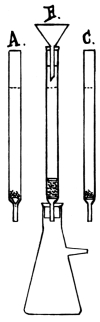
Figure. 7.
Jones’
Reduction
Tube.
Reduction Apparatus.—The reduction of the molybdic acid to
molybdenum trioxid is accomplished in a tube first proposed by Jones.
The apparatus is shown in Figure 7. A piece of moderately
heavy glass tubing thirty-five centimeters long with an internal diameter
of two centimeters is drawn out at the lower end so as to pass into
the stopper of a flask. A circular piece of perforated platinum or
porcelain rests on the constricted portion of the tube and this is
covered with an asbestos felt. The tube is then nearly filled with
powdered zinc which is washed, before using, with dilute sulfuric acid
(1 : 20). A, B, C represent different methods of filtering the molybdic
solution. In A a platinum cone is placed in the constricted portion of
the tube and the asbestos felt placed thereon and the tube then filled
with the granulated zinc. In B there is first inserted a perforated
disk then some very fine sand and this is covered with another disk. In
C there is a perforated disk which is covered with asbestos felt. The
filtering arrangement should be such as to prevent any zinc particles
from reaching the flask and yet permitting the filtration to go on
without much difficulty. A blank determination is first made by adding
to 180 cubic centimeters of water, twelve of 0.96 ammonia and ten of
strong sulfuric acid. This is poured through the reducing tube and
followed with 200 cubic centimeters of water taking care that no air
enter the apparatus. Hydrogen peroxid is formed if air enter. Even
after standing for a few moments the tube should be washed with dilute
sulfuric acid before again using it. The filtrate should be titrated
with the permanganate solution and the amount required deducted from
the following amounts obtained with the molybdic salt.
Calculations.—The calculations of the amount of phosphorus in
a given sample of iron or steel are made according to the following
data: In a given case let it be supposed that the permanganate solution
is set with a solution of piano wire and it is found that one cubic
centimeter of permanganate liquor is equal to 0.003466 gram of metallic
iron. It is found that 90.76 parts of molybdic acid will produce the
same effect on permanganate as 100 parts of iron. Hence one cubic
centimeter of permanganate solution is equivalent to 0.003466 × 0.9076
= 0.003145 gram of molybdic acid. In the yellow precipitate formed, in
the conditions named for the analysis it is found that the phosphorus
is one and nine-tenths per cent of the molybdic acid present. Therefore
one cubic centimeter of permanganate liquor is equal to 0.003145 ×
0.019 = 0.0000597 gram of phosphorus. If then, for example, in a sample
of iron or steel eight and six-tenths cubic centimeters of permanganate
solution, after correction, be found necessary to oxidize the molybdic
solution after passing through the Jones’ reducing tube, the amount of
phosphorus found is 0.0000597 × 8.6 = 0.051 per cent.
113. The Silver Method.—The separation of the phosphoric acid
by silver according to the method of Perrot has been investigated by
Spencer, who found the process unreliable.[96]
By a modification of the process, however, Spencer obtained fairly
satisfactory results. The principle of this method depends on the
separation of the phosphoric acid by silver carbonate and the
subsequent titration thereof with standard uranium solution after
the removal of the excess of silver. The operation is conducted as
follows: The fertilizer is first ignited until all organic matter and
residual carbon are destroyed. Solution is then accomplished by means
of nitric acid and the volume completed to a definite quantity. An
aliquot part is taken, after filtration, varying with the supposed
strength of the solution so as to contain about 100 milligrams of
phosphorus pentoxid. In the slightly nitric acid solution add freshly
prepared silver carbonate in excess, that is, sufficient to saturate
any free acid present and also to combine with all the phosphoric acid.
Wash thoroughly with hot water and then dissolve the mixed phosphate
and silver carbonate in nitric acid and remove the silver from the
solution with sodium chlorid. The phosphoric acid is determined in the
filtrate by means of a standard solution of uranium nitrate in the
manner already described. Spencer found that the separation of the
phosphoric acid by the silver method was more exact than by the Joulie
magnesium citrate process. With practice on the part of the analyst in
determining the end reaction the process is both rapid and accurate.
The method is also inexpensive, as both the silver and uranium are
easily recovered from the waste.
114. Volumetric Silver Method.—Holleman has proposed a
modification of the silver method for the volumetric determination of
phosphoric acid, which is conducted in the following manner:[97]
In a flask of 200 cubic centimeters capacity, are placed fifty cubic
centimeters of the liquid to be analyzed, which should not contain
more than two-tenths gram of phosphoric acid. The solution is treated
with ten cubic centimeters of a normal solution of sodium acetate and
afterwards with a slight excess of decinormal silver solution, four
and five-tenths cubic centimeters for each 0.01 gram of phosphoric
acid. The solution is then neutralized with tenth normal sodium
hydroxid, the amount required having been previously determined by
titrating ten cubic centimeters of the liquid to be analyzed, using
phenolphthalein as an indicator. Five times the quantity required for
the neutralization of the ten cubic centimeters is added, less one-half
cubic centimeter. By this treatment the phosphoric acid in the presence
of sodium acetate is completely precipitated as silver phosphate. The
excess of silver is determined by diluting the mixture to 200 cubic
centimeters, filtering, and titrating 100 cubic centimeters of the
filtrate with ammonium thiocyanate. The presence of sulfuric and nitric
acids does not interfere with the reaction, but of course hydrochloric
acid must be absent. Alkalies and alkaline earth metals may be present,
but not the heavy metals.
When iron and aluminum are present 100 cubic centimeters of the
solution are precipitated with thirty cubic centimeters of normal
sodium acetate, the phosphoric acid is determined in fifty cubic
centimeters of the filtrate, and the precipitate of iron and aluminum
phosphates is ignited and weighed, and its weight multiplied by 2.225
is added to the phosphoric anhydrid found volumetrically. If ammonia
be present it must be removed by boiling, as otherwise it affects the
titration with phenolphthalein.
For agricultural purposes this method can have but little value
inasmuch as the phosphates to be examined almost always have a certain
proportion of iron and aluminum. Inasmuch as the amount of these bases
has to be determined gravimetrically, there would be no gain in time
and no simplification of the processes by the use of the volumetric
method as proposed.
115. Desirability Of Methods.—In the preceding paragraphs, has
been given a statement of the principal methods now in use by chemists
and others connected with fertilizer control for the scientific and
agronomic determinations of phosphoric acid, and its agricultural value.
A résumé of the important methods, in a form suited to use in a factory
for preparing phosphatic fertilizers for the market, seems desirable.
In these factories the chemists have been accustomed to use their
own, or private methods, and there has not been a general disposition
among them to publish their methods and experience for the common
benefit. For factory processes, a method should be not only reasonably
accurate, but also simple and rapid. It is evident, therefore, that
the general principles already indicated must underlie any method
which would prove useful to factory work. Albert has made a résumé of
such methods applicable for factory control, and these are given here
for convenience, although they are, in many respects, but condensed
statements of methods already described.[98]
116. Reagents.—Molybdate Solution.—One hundred and ten
grams of pure molybdic acid are dissolved in ammonia of nine-tenths
specific gravity and diluted with water to one liter. The solution is
poured into one liter of nitric acid, of one and two-tenths specific
gravity, and, after standing a few days, filtered.
Concentrated Ammonium Nitrate Solution.—Seven hundred and fifty
grams of pure ammonium nitrate are dissolved in water and made up to
one liter.
Magnesia Mixture.—Fifty-five grams of magnesium chlorid;
seventy grams of ammonium chlorid; 130 cubic centimeters of ammonia of
nine-tenths specific gravity are dissolved and diluted with water to
one liter.
Two and One-Half Per Cent Ammonia.—One hundred cubic
centimeters of ammonia of nine-tenths specific gravity are diluted with
water to one liter.
Joulie’s Citrate Solution.—Four hundred grams of citric acid
are dissolved in ammonia of nine-tenths specific gravity and diluted to
one liter with ammonia of the same strength.
Wagner’s Citrate Solution.—One hundred and fifty grams of
citric acid are exactly neutralized with ammonia, then ten grams of
citric acid added and diluted to one liter with water.
Sodium Acetate Solution.—One hundred grams of sodium acetate,
crystallized, are dissolved in water, treated with 100 cubic
centimeters of acetic acid, and diluted to one liter with water.
Calcium Phosphate Solution.—About ten grams of dry, pure
tribasic calcium phosphate are dissolved in nitric acid and diluted
with water to one liter. In this solution the phosphoric acid is
determined gravimetrically by the molybdate or citrate method, and the
value of the solution marked on the flask containing it.
Titrated Uranium Solution.—Two hundred and fifty grams of
uranium nitrate are dissolved in water, twenty-five grams of sodium
acetate added, and the whole diluted to seven liters. One cubic
centimeter of this solution corresponds to about 0.005 gram of
phosphorus pentoxid. In order to determine its exact value proceed
as follows: Twenty-five cubic centimeters of the calcium phosphate
solution which, for example, has been found to contain 0.10317 gram of
phosphorus pentoxid, are neutralized in a porcelain dish with ammonia,
acidified with acetic, treated with ten cubic centimeters of sodium
acetate solution, and warmed. Through a burette as much uranium
solution is allowed to flow as is necessary to show in a drop of the
solution taken out of the dish, when treated with a drop of pure
potassium ferrocyanid, a slight brown color. In order to be certain,
this operation is repeated two or three times with new quantities of
twenty-five cubic centimeters of calcium phosphate solution. Example:
Twenty-five cubic centimeters of the calcium phosphate solution
containing 0.10317 gram of phosphorus pentoxid, gave as a mean of three
determinations 23.2 cubic centimeters of the uranium solution necessary
to produce the brown color with potassium ferrocyanid. Consequently
0.10317 ÷ 23.2 = 0.00445 gram of phosphorus pentoxid equivalent
to one cubic centimeter of uranium solution. If, for instance, a
quantity of fertilizer weighing exactly five grams, require ten cubic
centimeters of the uranium solution for the complete precipitation of
its phosphoric acid, then the quantity of phosphoric acid contained in
the fertilizer would be equivalent to 10 × 0.0045, equivalent to 0.0445
gram of phosphorus pentoxid. The fertilizer, therefore, contains eight
and nine-tenths per cent of phosphorus pentoxid.
Conduct of the Molybdenum Method.—This method rests upon the
precipitation of the phosphorus pentoxid by a solution of ammonium
molybdate in nitric acid, solution of the precipitate in ammonia, and
subsequent precipitation with magnesia.
Manipulation.—Twenty-five or fifty cubic centimeters of a
solution of the phosphate which has been made up to a standard volume
and containing about one-tenth gram of phosphorus pentoxid, are placed
in a beaker together with 100 cubic centimeters of the molybdate
solution and treated with as much ammonium nitrate solution as will be
sufficient to give the liquid a content of fifteen per cent of ammonium
nitrate. The contents of the beaker are well mixed and warmed for about
twenty minutes at from 60° to 80°. After cooling, they are filtered and
the precipitate washed on the filter with cold water until a drop of
the filtrate saturated with ammonia does not become opaque on treatment
with ammonium oxalate. The filtrate is then washed from the filter with
two and one-half per cent ammonia solution and precipitated slowly and
with constant stirring by the magnesia mixture. After standing for two
hours the ammonium magnesium phosphate is separated by filtration,
washed with two and one-half per cent ammonia until the filtrate
contains no more chlorin, and ignited.
Conduct of the Citrate Method.—The principle of this method
depends upon the fact that when a sufficient quantity of ammonium
citrate is added to phosphate solutions, iron, alumina, and lime are
retained in solution when, on the addition of the magnesia mixture
in the presence of free ammonia, the phosphoric acid is completely
precipitated as ammonium magnesium phosphate.
Manipulation.—From ten to fifty cubic centimeters of the
solution of the phosphate to be determined are treated with fifteen
cubic centimeters of the Joulie citrate solution avoiding warming. A
few pieces of filter-paper, the ash content of which is known, are
thrown in and, with stirring, fifteen cubic centimeters of magnesia
mixture slowly added and if necessary also some free ammonia. By the
small pieces of filter-paper the collection of the precipitate against
the sides of the vessel and on the stirring rod is prevented and in
this way the production of the precipitate hastened. After standing
from one-half an hour to two hours the mixture is filtered, ignited,
and weighed. If it be preferred to estimate the phosphoric acid by
titration, the precipitate is dissolved in a little nitric acid, made
slightly alkaline with ammonia, and then acid with acetic and then
afterwards titrated with the standard uranium solution.
Conduct of the Uranium Method.—The principle upon which this
method rests depends upon the fact that uranium nitrate or acetate
precipitates uranium phosphate from solutions containing phosphoric
acid and which contain no other free acid except acetic. In the
presence of ammonium salts the precipitate is uranium ammonium
phosphate having the formula PO₄NH₄UrO₂. The smallest excess of soluble
uranium salt is at once detected by the ordinary treatment with
potassium ferrocyanid.
Manipulation.—In all cases the solution is first made slightly
alkaline with ammonia and then acid by a few drops of acetic, so that
no free mineral acid may be present.
(1) With liquids free from iron:
If, on the addition of ammonium or sodium acetate, no turbidity be
produced, the liquid is free from iron and alumina. In this case
from ten to fifty cubic centimeters of the solution containing about
one-tenth gram of phosphorus pentoxid are treated with ten cubic
centimeters of sodium acetate, and afterwards with a quantity of
uranium solution corresponding, as nearly as possible, to its supposed
content of phosphorus pentoxid, and heated to boiling. From the heated
liquid by means of a glass rod, one or two drops are taken and placed
upon a porcelain plate and one drop of a freshly prepared solution of
potassium ferrocyanid allowed to flow on it. If no brown color be seen
at the point of contact of the two drops, additional quantities of
the uranium solution are added and, after boiling, again tested with
potassium ferrocyanid until a brown color is distinctly visible. The
quantity of the uranium solution thus having been determined, duplicate
analyses can be made and the whole quantity of the uranium solution added
at once with the exception of the last drops, which are added as before.
(2) Solutions containing iron and alumina.
The solution is treated with the ammonium citrate solution of Joulie,
the magnesia mixture added slowly, and the precipitate collected
on a filter and washed with two and one-half per cent ammonia. The
precipitate is then dissolved in nitric acid, made alkaline with
ammonia, and then acid with acetic. This solution is then treated with
ten cubic centimeters of sodium acetate and titrated with uranium, as
described in (1). As an alternative method, 200 cubic centimeters of
the superphosphate solution may be treated with fifty cubic centimeters
of sodium acetate, allowed to stand for some time, and filtered through
a filter of known ash content. In fifty cubic centimeters of the
filtrate, which correspond to forty cubic centimeters of the original
solution, phosphoric acid may be determined as described above. The
precipitate, consisting of iron and aluminum phosphates, is washed
three times on the filter with boiling water, dried, and ignited in a
platinum dish. The weight of ignited precipitate, diminished by the
weight of the ash contained in the filter and divided by two, gives the
quantity of phosphorus pentoxid which it is necessary to add to that
obtained by titration.
117. Determination of the Phosphoric Acid in all Phosphates and
Basic Slags.—
(1) Total phosphoric Acid:
Five grams of the fine phosphate meal, or slag meal, are moistened in
a flask of 500 cubic centimeters content with some water and boiled on
a sand-bath with forty cubic centimeters of hydrochloric acid of from
16° to 20° Beaumé. The boiling is continued until only a few cubic
centimeters of a thick jelly of silicic acid remain. After cooling,
some water is added and the phosphate shaken until the thick lumps
of silica are finely divided. The flask is then filled to 500 cubic
centimeters and its contents filtered. Fifty cubic centimeters of the
filtrate are treated with fifteen cubic centimeters of the Joulie
solution and treated in the manner described with magnesia mixture,
precipitated, ignited, and weighed. The precipitate can also be
dissolved and treated with uranium solution as described.
The method used by Oliveri may also be employed and it is carried out
as indicated in the following description:[99]
A weighed quantity of the slag is reduced to a fine powder. To five
grams of the sample is added three times its weight of potassium
chlorate and the whole is intimately mixed. The mixture is then placed
in a porcelain dish and hydrochloric acid is added, little by little,
until the potash salt is completely decomposed. It is evaporated until
the mass is dry. The material is then treated with fuming nitric
acid, and the determination of the phosphorus is made by the ordinary
gravimetric method.
By carrying on the operation as described above, a reduction of
phosphoric acid is avoided, and the presence of an abundant quantity
of potash prevents the formation of basic iron phosphate which is
insoluble in nitric acid.
(2) Citrate-Soluble Phosphoric Acid.—One gram of the basic slag
or phosphate is placed in a 100 cubic centimeter flask and covered
with Wagner’s acid citrate solution making the total volume up to 100
cubic centimeters. With frequent shaking the flask is kept at 40°
for an hour, or it may be allowed to stand for twelve hours at room
temperature with frequent shaking. In fifty cubic centimeters of the
filtrate from this flask the phosphoric acid is determined by the
magnesia mixture as described. Since, in the present case, the
precipitate of ammonium magnesium phosphate contains some silicic
acid it cannot be directly ignited but must be treated in the
following manner: The precipitate and the filter are thrown into a
porcelain dish, the filter-paper torn up into shreds with a glass
rod, the precipitate dissolved in nitric acid, neutralized with
ammonia, acidified with acetic, and treated with uranium solution.
The phosphoric acid may also be estimated by the gravimetric method
by dissolving the precipitate again in hydrochloric or nitric acid,
evaporating to dryness, and drying for one hour at from 110° to 120°,
dissolving again in hydrochloric acid, filtering, and washing the
precipitate well. The filtrate, which is now free from silica, can be
treated with Joulie’s solution, precipitated with magnesia mixture, the
precipitate washed, ignited, and weighed as described. The molybdenum
method is preferred in the estimation of citrate-soluble phosphoric
acid, especially in slags. For this purpose fifty cubic centimeters
of the filtrate from the solution of one gram of slag in 100 cubic
centimeters of Wagner’s citrate liquid are treated with 100 cubic
centimeters of molybdenum solution and thirty cubic centimeters of
ammonium nitrate solution, warmed for twenty minutes at 80°, filtered
after cooling, and the yellow precipitate washed with cold water. The
water will gradually dissolve all the silicic acid from the yellow
precipitate and carry it into the filtrate. The yellow precipitate
is then dissolved in two and one-half per cent liquid ammonia and
precipitated with magnesia mixture and the precipitate washed, ignited,
and weighed in the way described.
118. Determination of Phosphoric Acid in Superphosphates.—(1)
Citrate-Soluble Phosphoric Acid.—Five grams of the
superphosphate are rubbed with 100 cubic centimeters of Wagner’s acid
citrate solution in a mortar and washed into a flask of 500 cubic
centimeters content and diluted to 500 cubic centimeters with water.
With frequent shaking the flask is allowed to stand for twelve hours,
after which its contents are filtered. Fifty cubic centimeters of
the filtrate are treated with ten cubic centimeters of the Joulie
solution and fifteen cubic centimeters of the magnesia mixture and, if
necessary, made distinctly alkaline with ammonia, vigorously stirred,
and, after two hours, filtered. The precipitate is washed, ignited, and
weighed as described, or titrated, after solution in nitric acid and
the addition of sodium acetate, with uranium solution. Example:
The weighed precipitate has 0.1272 gram Mg₂P₂O₇
then the phosphate contains 12.72 × 2 × 0.64 = 16.28 per cent of citrate-soluble
P₂O₅.
(2) Water-Soluble Phosphoric Acid.—Twenty grams of
superphosphate are rubbed in a mortar and washed into a flask of one
liter content and made up to the mark with water. After two hours’
digestion with frequent shaking, the contents of the flask are filtered
through a folded filter. Twenty-five cubic centimeters of the filtrate
equivalent to five-tenths gram of the substance are precipitated with
magnesia mixture, the precipitate filtered, washed, ignited, and
weighed, or the moist filtrate may be dissolved upon the filter with
a little nitric acid, treated with sodium acetate, and titrated, as
described, with uranium solution.
Example: 14.5 cubic centimeters of the
uranium solution are required for the precipitate from twenty-five
cubic centimeters of the original solution = 0.5 gram superphosphate;
it contains then 14.5 × 0.00445 = 0.0645 gram P₂O₅. Consequently the
superphosphate contains 12.90 per cent of water-soluble P₂O₅.
Total Phosphoric Add.—Twenty grams of the superphosphate are
boiled with fifty cubic centimeters of hydrochloric acid of from
16° to 18° Beaumé for about ten minutes and, after cooling, made up
to one liter with water and filtered. Twenty-five cubic centimeters
of the filtrate are treated with ten cubic centimeters of Joulie’s
citrate solution, a few pieces of filter-paper thrown in, fifteen
cubic centimeters of magnesia mixture added, and the whole thoroughly
stirred. After standing two hours the contents of the flask are
filtered and the precipitate is washed with dilute ammonia and the
filter and the precipitate are placed in a platinum crucible. The
crucible is heated slowly until the moisture is driven off and the
filter burned. Then the temperature is gradually raised to a white
heat. The residue is cooled and weighed. Example:
The precipitate weighs, after the
subtraction of the filter ash, 0.1390 gram; then the superphosphate
contains 13.90 × 2 × 0.64 = 17.79 per cent phosphoric acid.
119. Time Required for Precipitation of Phosphoric Acid.—The
length of time required for the complete precipitation of the
phosphoric acid by molybdate mixture is perhaps much less than
generally supposed. At 65° the precipitation, as shown by de Roode,
is complete in five minutes.[100]
In a given case the weight of pyrophosphate obtained after five
minutes was 0.0676 gram, and exactly the same weight was found after
twenty-four hours. In view of these facts analysts would often be able
to save time by omitting the delay usually demanded by the setting
aside of the yellow precipitate for a few hours in order to secure
a complete separation of the phosphoric acid. In the method of the
official chemists it is directed that the digestion at 65° be continued
for one hour, and this time may possibly be shortened with advantage.
In all cases, however, where there is any doubt in regard to the
complete separation, some of the molybdate solution should be added to
the filtrate and, with renewed digestion, it should be noted whether
any additional precipitate be formed.
120. Examination of the Pyrophosphate.—In fertilizer control it
is not usually thought necessary to examine the magnesium pyrophosphate
for impurities. Among those most likely to be found is silica. It
is proper, in all cases where accuracy is required, to dissolve the
precipitate in nitric acid, boil for some time to convert the pyro-
into orthophosphate, and reprecipitate with molybdate and magnesia
mixture. This treatment will separate the silica which remains
practically insoluble after the first ignition. It has been observed
by some analysts that the results obtained by the official method are
a trifle too high and also that on re-solution the second precipitate
of pyrophosphate weighs less than the first.[101]
The difference in most cases is very little but it may become a
quantity of considerable magnitude in samples where soluble silica is
found in notable quantities. The danger of contamination with iron,
alumina, and arsenic has already been mentioned but it is not of
sufficient importance to warrant further attention.
121. Iodin in Phosphates.—The presence of iodin has been
detected in many natural phosphates and is of interest in the
discussion of the problem of their origin.[102]
A qualitative test for the detection of iodin may be applied in the
following manner: Some finely ground phosphate is mixed with strong
sulfuric acid and the gases arising from the reaction are aspired into
some carbon disulfid or chloroform. The violet coloration arising
indicates the presence of iodin. The gases carrying the iodin may also be
brought into contact with starch-paste producing the well-known blue color.
The quantity of iodin present in a phosphate is rarely more than one or
two-tenths of one per cent. It can be determined as a silver salt, in
the absence of chlorin or by any of the standard methods found in works
on qualitative analysis.
Iodin is quite a constant constituent of Florida phosphates.
For a quantitative determination, the sample is treated with an excess of
strong sulfuric acid in a closed flask and during the decomposition a
stream of air is aspired through the flask and caused to bubble through
absorption bulbs containing sodium hydroxid in solution.
The temperature of the decomposition may be raised to about 200°.
After the solution of the sample the sodium iodid formed is oxidized
by heating with potassium permanganate, acidulated and mixed with a
solution of potassium iodid to hold the free iodin in solution. The
free iodin is determined in the usual way by titration with standard
sodium thiosulfate solution. The reactions preparatory to the titration
are represented by the following formulas:
2KI + H₂SO₄ = K₂SO₄ + 2HI.
2HI + H₂SO₄ = 2H₂O + SO₂ + 2I.
6I + 6NaOH = NaIO₃ + 5NaI + 3H₂O.
NaI + 2KMnO₄ + H₂O = NaIO₃ + 2KOH + 2MnO₂.
HIO₃ + 5HI = 6I + 3H₂O.
The titration is represented by the following reaction:
2Na₂S₂O₂ + 2I = 2NaI + 2NaI + Na₂S₄O₄.
The decinormal solution of sodium thiosulfate may be used. Grind the
crystals of the salt to a fine powder, dry between blotting papers, and
use 24.8 grams of the dried salt per liter. The quantity of iodin found
in phosphates is so minute that it is hardly worth while to make a
quantitative determination of it.
122. Occurrence of Chromium in Phosphates.—In some phosphates
a small quantity of chromium has been found. In a sample of phosphate
from the Island of Los Roques in the Caribbean Sea, Gilbert found
three-fourths per cent of chromium oxid (Cr₂O₃). The phosphates
containing chromium have a greenish color and are characterized by
great insolubility in solutions containing organic acids. The chromium
is to be determined by the usual methods described in mineral analysis.
123. Estimation of Vanadium.—In the complete analysis of basic
slags it becomes necessary to determine the presence of vanadium and
its quantity. The method used in this laboratory for the purpose is
the volumetric process of Lindemann.[103]
It is conducted as follows: Dissolve four grams of the finely powdered
slag in sixty cubic centimeters of dilute sulfuric acid (1 : 4), boil
for a few minutes, cool, make the volume up to 100 cubic centimeters,
filter, and take an aliquot part for the determination. Add decinormal
potassium permanganate solution in slight excess to secure the
oxidation of the vanadium to vanadium pentoxid. Add, drop by drop, a
weak solution of ferrous sulfate until the pink color just disappears.
Prepare a ferrous sulfate solution by dissolving 2.183 grams of piano
wire in sulfuric acid and making the volume to one liter. Titrate the
vanadic mixture with this solution until a drop of the clear liquor
removed and brought in contact with potassium ferricyanid shows a
distinctive blue-green color.
One cubic centimeter of the ferrous sulfate solution is equivalent to
0.002 gram of vanadium, 0.002888 gram of vanadium dioxid, and 0.003648
gram of vanadium pentoxid. The ferrous sulfate solution may also be
made and standardized by any of the approved methods in common use.
The method described by Blair, designed especially for the estimation
of vanadium in iron and steel, is conducted in the following
manner:[104]
Five grams of the drillings are dissolved in fifty cubic
centimeters of nitric acid of 1.24 specific gravity. The solution is
evaporated to dryness in a porcelain dish and heated thereafter until
the nitrates are nearly decomposed. After cooling, the dried mass is
transferred to a mortar and finely ground with thirty grams of dry
sodium carbonate and three grams of sodium nitrate. The finely ground
materials are placed in a platinum dish and fused for an hour at a
high temperature. Spread the fused mass over the sides of the dish
while cooling, and afterwards dissolve in hot water, filter, and wash
until the volume is a little over half a liter. Add nitric acid to
decompose carbonates, but not completely, and boil to get rid of carbon
dioxid, being careful to keep the mass always slightly alkaline. Add
nitric acid, drop by drop, until slightly in excess, and then sodium
carbonate to marked alkalinity, boil, and filter. Add a slight excess
of nitric acid to the filtrate, and the development of a yellow color
will indicate the presence of vanadic acid. Add to the solution a
small quantity of mercurous nitrate and then an excess of mercuric
oxid, suspended in water to render the solution neutral and insure the
complete precipitation of mercurous vanadate. The mercurous salt also
precipitates phosphoric, chromic, tungstic, and molybdic acids which
may be present. Boil, filter, and wash the precipitate with hot water,
dry, and ignite. Fuse the residue with sodium carbonate and a little
nitrate. Dissolve the fused mass, after cooling, in a little water and
filter. Add to the filtrate, ammonium chlorid in excess, from three to
five grams for each 100 cubic centimeters of the solution, and allow
to stand, with occasional stirring, for some time. Ammonium vanadate,
insoluble in a saturated solution of ammonium chlorid, separates as
a white powder. It is necessary to keep the solution alkaline, and a
drop of ammonia should be added from time to time for this purpose. The
appearance of a yellowish tint at any time indicates that the solution
has become acid, and this acidity must be corrected, or else the
results will be too low. Separate the ammonium vanadate by filtration;
wash first with a saturated solution of ammonium chlorid containing a
little free ammonia, and then with alcohol. Dry, ignite, and moisten
with a few drops of nitric acid; again ignite to obtain the compound as
vanadium pentoxid. This compound contains 56.22 per cent of vanadium.
The method of Rosenheim and Holversheet may also be used.[105]
It is based on the preliminary precipitation of the vanadic acid as a
barium or lead salt. The substance supposed to contain vanadium is first
brought into solution in such a manner as to secure it as vanadic acid,
which is then precipitated with barium chlorid or lead acetate. The
precipitate is boiled with hydrochloric acid and potassium bromid, and
the liberated bromin determined by the quantity of iodin set free from
potassium iodid. In the absence of bodies, such as molybdic acid, which
are reduced by sulfurous acid or hydrogen sulfid, the vanadic acid
may also be determined by reducing it with one of these reagents and,
after removing the excess by boiling, titrating the vanadium tetroxid
with potassium permanganate. When vanadic and phosphoric acids occur
together the former may be first reduced to tetroxid with sulfurous
acid, and after expelling excess of this reagent, the phosphoric acid
may be separated with molybdate solution and removed by filtration.
When the amount of vanadic acid is large the phosphoric acid should
be separated rapidly at 55°-60°, using a considerable excess of the
molybdate; or the vanadic acid may first be determined in the solution
volumetrically by the bromin process above described, and afterwards
the phosphoric acid obtained by evaporating to dryness with a little
sulfuric acid, taking the residue up with water, reducing the vanadic
with sulfurous acid and precipitating the phosphoric acid with
molybdate solution as described above.
124. Fluorin in Bones.—Fluorin is not only a constituent of
mineral phosphates but also of bones. According to the researches of
Carnot there is often as much as one-half per cent of calcium fluorid
in bones and teeth.[106]
Gabriel has suggested a means of determining a minimum limit of fluorin
in bones and teeth by the development of etchings in comparison with
known quantities of pure calcium fluorid. The minimum quantity of
calcium fluorid necessary to produce a distinct etching, in known
conditions, having been determined, the test is applied to known
weights of ignited bone or teeth. He concludes from his results, that
the ash of bones and teeth often contains less than one-tenth per cent
of fluorin. Since, however, there is a loss of fluorin from calcium
fluorid, on ignition, the whole of the fluorin may not have been
available in the tests described.
125. Note on the Separation of Iron and Aluminum Phosphates from the
Calcium Compound.—There are many points of difference noted in
the descriptions given by authors of the deportment of the iron, and
aluminum phosphates in presence of a large excess of the calcium salt.
Especially is this true of the statements made by Hess and Glaser[107]
in paragraphs 34 and 35.
The subject is of such importance, from an analytical point of view, as
to merit a careful study.
In this laboratory a thorough investigation of the mutual deportment
of these three phosphates has been made by Brown with the following
results:[108]
When a mixture containing a known weight of the salts
was treated exactly as Hess directs, in no case was there a complete
separation of the iron aluminum phosphate from the calcium salt. In
order to discover the cause of the failure, pure solutions of calcium
and iron aluminum phosphates were treated under identical conditions
by the necessary reagents. Fifty cubic centimeters of a solution of
calcium phosphate, containing about one gram of the salt, were treated
with 100 cubic centimeters of water and fifty cubic centimeters of
the commercial ammonium acetate containing 150 grams of the salt in a
liter. An immediate precipitate was produced at ordinary temperature,
and on heating to 60° it became abundant. The addition of ammonium
chlorid, phosphate, and nitrate in successive portions, does not
prevent the precipitation. Making the solution more dilute lessens the
difficulty when twenty cubic centimeters of a ten per cent solution
of ammonium phosphate are first added, followed by the usual quantity
of ammonium acetate; a clear crystalline precipitate is sometimes
observed. Experience also shows that the trouble is not due to an
excess of the ammonium acetate.
In treating a solution of iron aluminum phosphate, in similar
circumstances, with the ammonium acetate, it is found that a complete
precipitation takes place.
Since diluting the solution of the calcium salt diminishes its tendency
to form a precipitate with the ammonium acetate the true method of
separation seems to lie in that direction. The calcium salt is held
completely in solution when the separation is made in the following way.
The solution containing the mixed phosphates is diluted so as to contain
not more than one gram thereof in half a liter. To this is added one
drop of dimethylanilin orange, and afterwards ammonium hydroxid, until
a very slight precipitate is formed. The mixture is heated to 70° and
from twenty to twenty-five cubic centimeters of a twenty-five per cent
solution of acid ammonium acetate are added, enough to change the
rose color of the indicator to orange. The iron aluminum phosphate is
separated by filtration and washed with a hot five per cent solution of
ammonium nitrate.
The washed precipitate shows no impurity due to calcium, as proved
by dissolving it, reprecipitating and filtering, adding ammonium
hydroxid to the filtrate, and heating for a long time. Sometimes a
slight troubling of the clear liquid may be observed which may be due
to a slight solubility of the iron aluminum phosphate in washing, an
accident that may occur if the temperature be allowed to fall below
70°, but no weighable amount of material is obtained. If due to
calcium phosphate, a greater dilution in the first precipitation will
remove even this mere trace of that salt. In the above conditions the
contamination of the iron aluminum precipitate with calcium phosphate
may be entirely avoided. We had also undertaken here the problem of
separating the phosphoric acid by the citrate method, followed by a
destruction of the citric acid in the filtrate by combustion with
sulfuric acid according to the kjeldahl process, and final separation
of the iron and alumina in the residues when our attention was called
to substantially the same process as described by Jean.[109]
The method merits a further critical examination.
126. Phosphoric Acid Soluble in Ammonium Citrate.—There is no
other point connected with the determination of phosphoric acid which
has excited so much discussion and about which there is such difference
of opinion as the solubility of phosphates in ammonium citrate. It was
clearly established by Huston, in 1882, that the ammonium citrate, as
used in fertilizer analysis, would attack normal tricalcium phosphate
as it exists in bones.[110]
In a raw bone, finely ground, containing 20.28 per cent of phosphoric
acid, the following quantities were found to be soluble in a neutral
ammonium citrate solution of 1.09 specific gravity.
| |
Time of digestion, thirty minutes. |
| Temperature |
30° |
40° |
50° |
60° |
| Per cent P₂O₅ dissolved |
2.76 |
4.01 |
3.39 |
5.88 |
From this it appears that the quantity of acid dissolved increases with
the temperature of digestion with the exception of the number obtained
at 50°. When the time of digestion was increased there was also found
a progressive increase in the amount of acid passing into solution. At
40° for forty-five minutes the per cent dissolved was 4.97, and at 40°
for one hour it was 5.92. These early determinations had the effect
of calling attention to the thoroughly empirical process which was in
use, in many modified forms, by agricultural chemists, the world over
for determining so-called reverted phosphoric acid in fertilizers.
Since the publication of the paper above named many investigations have
been undertaken by Huston and others relating to this matter.[111]
The general results of these studies, tabulated by Huston, are given
below.[112]
Influence of the Time of Digestion.
- (A) = Temperature, degrees C.
- (B) = Citrate-soluble phosphoric acid.
- (C) = Total phosphoric acid.
| Material. |
Authority. |
|
(A) |
Time of
digestion. |
(B)
Per cent. |
(C)
Per cent. |
| Bone meal, |
F. B. Dancy, |
 |
65 |
½ |
hour |
10.60 |
19.75 |
| 65 |
1 |
“ |
11.28 |
19.75 |
| Orchilla guano, |
F. B. Dancy, |
|
65 |
½ |
“ |
6.62 |
21.68 |
| 65 |
1 |
“ |
6.85 |
|
| Navassa rock, |
F. B. Dancy |
|
65 |
½ |
“ |
4.64 |
31.27 |
| 65 |
1 |
“ |
4.81 |
31.27 |
| Navassa |
F. B. Dancy, |
|
65 |
½ |
“ |
9.00 |
11.47 |
| superphos., |
65 |
1 |
“ |
9.21 |
11.47 |
| Bone meal, |
H. A. Huston, |
|
40 |
½ |
“ |
4.01 |
20.28 |
| 40 |
1 |
“ |
5.92 |
20.28 |
| Bone meal, |
H. A. Huston and |
 |
65 |
½ |
“ |
6.17 |
23.58 |
| raw, |
W. J. Jones, Jr., |
65 |
1 |
“ |
6.49 |
23.58 |
| |
|
65 |
2 |
hours |
8.22 |
23.58 |
| 65 |
5 |
“ |
9.31 |
23.58 |
| Steamed bone, |
H. A. Huston and |
 |
65 |
½ |
hour |
10.59 |
27.67 |
| W. J. Jones, Jr., |
65 |
1 |
“ |
12.21 |
|
| |
|
65 |
2 |
hours |
14.61 |
|
| 65 |
5 |
“ |
17.94 |
|
| 65 |
10 |
“ |
19.73 |
|
| Florida |
H. A. Huston and |
 |
65 |
½ |
hour |
0.56 |
19.75 |
| soft rock, |
W. J. Jones, Jr., |
65 |
2 |
hours |
1.69 |
|
| |
|
65 |
5 |
“ |
1.47 |
|
| Precipitated |
H. A. Huston and |
|
65 |
¼ |
hour |
26.72 |
33.34 |
| calcium |
W. J. Jones, Jr., |
65 |
½ |
“ |
27.26 |
|
| phosphate from |
|
65 |
1 |
“ |
27.28 |
|
| glue works |
65 |
2 |
hours |
27.29 |
|
| Pamunky |
H. A. Huston and |
|
65 |
½ |
hour |
4.43 |
13.84 |
| phosphate,[113] |
W. J. Jones, Jr., |
65 |
1 |
“ |
8.28 |
|
| |
|
65 |
2 |
hours |
10.34 |
|
| 65 |
5 |
“ |
11.80 |
|
| 65 |
10 |
“ |
12.58 |
|
| Calcined |
H. A. Huston and |
|
65 |
½ |
hour |
21.24 |
45.15 |
| Redonda, |
W. J. Jones, Jr., |
|
1 |
“ |
31.70 |
|
| |
|
|
2 |
hours |
36.92 |
|
| |
5 |
“ |
41.00 |
|
| |
10 |
“ |
42.70 |
|
| South |
H. A. Huston and |
|
65 |
½ |
hour |
2.82 |
25.51 |
| Carolina |
W. J. Jones, Jr., |
|
1 |
“ |
3.13 |
|
| rock, |
|
|
2 |
hours |
3.57 |
|
| |
|
5 |
“ |
3.88 |
|
Influence of Temperature.
- (A) = Temperature, degrees C.
- (B) = Citrate-soluble phosphoric acid.
- (C) = Total phosphoric acid.
| Material. |
Authority. |
|
Time of
digestion. |
(A) |
(B)
Per cent. |
(C)
Per cent. |
| Apatite |
T. S. Gladding[114] |
|
½ |
hour |
40 |
0.30 |
|
| Canadian, |
½ |
“ |
65 |
0.56 |
|
| Orchilla guano, |
T. S. Gladding, |
|
½ |
“ |
40 |
4.63 |
|
| ½ |
“ |
65 |
4.81 |
|
| South Carolina |
T. S. Gladding, |
|
½ |
“ |
40 |
1.09 |
|
| river rock, |
½ |
“ |
65 |
1.35 |
|
| Navassa rock, |
T. S. Gladding, |
|
½ |
“ |
40 |
2.73 |
|
| ½ |
“ |
65 |
2.53 |
|
| Grand |
T. S. Gladding, |
|
½ |
“ |
40 |
1.16 |
|
| Connetable, |
½ |
“ |
65 |
1.96 |
|
| Redonda, |
S. W. Johnson and |
|
½ |
“ |
40 |
1.70 |
36.68 |
| E. H. Farrington, |
½ |
“ |
65 |
1.85 |
|
| South Carolina |
S. W. Johnson and |
|
½ |
“ |
40 |
1.32 |
25.48 |
| rock, |
E. H. Farrington, |
½ |
“ |
65 |
1.65 |
|
| Orchilla guano, |
S. W. Johnson and |
|
½ |
“ |
40 |
4.92 |
21.05 |
| E. H. Farrington, |
½ |
“ |
65 |
5.85 |
|
| Navassa rock, |
S. W. Johnson and |
|
½ |
“ |
40 |
4.10 |
29.90 |
| E. H. Farrington, |
½ |
“ |
65 |
4.22 |
|
| Acid Navassa, |
S. W. Johnson and |
|
½ |
“ |
40 |
11.95 |
16.50 |
| E. H. Farrington, |
½ |
“ |
65 |
13.53 |
|
| Fine-ground |
S. W. Johnson and |
|
½ |
“ |
40 |
9.40 |
23.50 |
| bone, |
E. H. Farrington, |
½ |
“ |
65 |
12.90 |
|
| South Carolina |
C. V. Sheppard, Jr. |
|
½ |
“ |
40 |
1.72 |
24.50 |
| land rock, |
also H. C. White, |
½ |
“ |
65 |
2.11 |
|
| Orchilla guano, |
C. V. Sheppard, Jr. |
|
½ |
“ |
40 |
6.48 |
15.85 |
| also H. C. White, |
½ |
“ |
65 |
6.75 |
|
| Calcined |
C. V. Sheppard, Jr. |
|
½ |
“ |
40 |
5.70 |
44.85 |
| Redonda, |
also H. C. White, |
½ |
“ |
65 |
10.20 |
|
| Raw Redonda, |
C. V. Sheppard, Jr. |
|
½ |
“ |
40 |
4.49 |
43.79 |
| also H. C. White, |
½ |
“ |
65 |
7.92 |
|
| Acid phosphate, |
C. V. Sheppard, Jr. |
|
½ |
“ |
40 |
3.55 |
18.25 |
| S. C. 10.35 per cent |
also H. C. White, |
½ |
“ |
65 |
4.05 |
|
| water-soluble, |
|
|
| Acid Navassa, |
C. V. Sheppard, Jr. |
|
½ |
“ |
40 |
10.85 |
16.20 |
| 2.85 per cent |
also H. C. White, |
½ |
“ |
65 |
11.00 |
|
| water-soluble, |
|
|
| Bone, |
H. A. Huston, |
|
½ |
“ |
30 |
2.76 |
20.28 |
| ½ |
“ |
40 |
4.01 |
|
| ½ |
“ |
50 |
3.39 |
|
| ½ |
“ |
60 |
5.88 |
|
| Acid phosphate, |
Sheppard and |
|
½ |
“ |
40 |
3.46 |
15.95 |
| 11.41 per cent |
Robertson, |
½ |
“ |
60 |
3.82 |
|
| water-soluble, |
|
|
| Calcined |
H. A. Huston, |
|
½ |
“ |
40 |
2.18 |
45.46 |
| Redonda, |
½ |
“ |
50 |
5.52 |
| |
½ |
“ |
65 |
21.24 |
| ½ |
“ |
75 |
32.90 |
| ½ |
“ |
85 |
39.52 |
| Calcined |
H. A. Huston and |
|
5 |
hours |
40 |
26.78 |
42.90 |
| Redonda, |
W. J. Jones, Jr., |
5 |
“ |
65 |
38.19 |
|
| |
|
5 |
“ |
85 |
41.57 |
|
| Pamunky |
H. A. Huston and |
|
5 |
“ |
40 |
3.10 |
13.84 |
| phosphate, |
W. J. Jones, Jr., |
5 |
“ |
65 |
11.80 |
|
| |
|
5 |
“ |
85 |
12.82 |
|
| Raw bone, |
H. A. Huston and |
|
2 |
“ |
40 |
5.96 |
23.58 |
| W. J. Jones, Jr., |
2 |
“ |
65 |
8.22 |
|
| |
2 |
“ |
85 |
8.71 |
|
| Steamed bone, |
H. A. Huston and |
|
5 |
“ |
40 |
16.02 |
27.67 |
| W. J. Jones, Jr., |
5 |
“ |
65 |
20.22 |
|
| |
5 |
“ |
85 |
20.66 |
|
| Precipitated |
H. A. Huston and |
|
2 |
“ |
40 |
24.14 |
33.34 |
| calcium phosphate |
W. J. Jones, Jr., |
2 |
“ |
65 |
23.45 |
|
| from glue works, |
|
2 |
“ |
85 |
22.46 |
|
| Florida |
H. A. Huston and |
|
2 |
“ |
40 |
0.00 |
19.75 |
| soft rock, |
W. J. Jones, Jr., |
2 |
“ |
65 |
1.69 |
|
| |
|
2 |
“ |
85 |
1.99 |
|
Influence of Quantity of Material Used.
- (A) = Temperature, degrees C.
- (B) = Quantity of material used.
- (C) = Citrate-soluble phosphoric acid.
- (D) = Total phosphoric acid.
| Material. |
Authority. |
Time |
(A) |
(B)
Grams. |
(C)
Per cent. |
(D)
Per cent. |
| |
|
|
⅔ |
hour |
40 |
2.0 |
9.94 |
21.68 |
| Orchilla guano, |
F. B. Dancy, |
⅔ |
“ |
40 |
1.0 |
12.14 |
|
| ⅔ |
“ |
40 |
0.5 |
13.51 |
|
| ½ |
“ |
65 |
2.0 |
6.62 |
|
| ½ |
“ |
65 |
1.0 |
9.33 |
|
| Redonda, |
S. W. Johnson and |
|
½ |
“ |
40 |
2.0 |
1.70 |
36.68 |
| E. H. Farrington, |
½ |
“ |
40 |
0.4 |
3.46 |
|
| |
½ |
“ |
65 |
2.0 |
1.85 |
|
| |
½ |
“ |
65 |
0.4 |
5.26 |
|
| South Carolina |
S. W. Johnson and |
|
½ |
“ |
40 |
2.0 |
1.32 |
25.48 |
| rock, |
E. H. Farrington, |
½ |
“ |
40 |
0.4 |
1.33 |
|
| |
|
½ |
“ |
65 |
2.0 |
1.65 |
|
| |
|
½ |
“ |
65 |
0.4 |
3.36 |
|
| Orchilla guano, |
T. S. Gladding, |
|
½ |
“ |
65 |
2.0 |
5.87 |
|
| ½ |
“ |
65 |
0.4 |
13.05 |
|
| Calcined |
H. A. Huston, |
 |
½ |
“ |
65 |
0.5 |
16.80 |
45.46 |
| Redonda, |
|
½ |
“ |
65 |
1.0 |
18.26 |
|
| ½ |
“ |
65 |
2.0 |
21.24 |
|
| ½ |
“ |
65 |
3.0 |
23.22 |
|
| ½ |
“ |
65 |
5.0 |
24.66 |
|
| ½ |
“ |
65 |
10.0 |
28.64 |
|
| Calcined |
H. A. Huston, |
|
5 |
“ |
65 |
0.5 |
41.77 |
45.46 |
| Redonda, |
|
5 |
“ |
65 |
2.0 |
41.53 |
|
| 5 |
“ |
65 |
8.0 |
39.86 |
|
| Pamunky |
H. A. Huston and |
|
5 |
“ |
65 |
0.5 |
11.81 |
13.84 |
| phosphate, |
W. J. Jones, Jr., |
5 |
“ |
65 |
2.0 |
11.80 |
|
| |
5 |
“ |
65 |
4.0 |
11.44 |
|
| Raw bone, |
H. A. Huston and |
|
2 |
“ |
65 |
0.5 |
16.49 |
23.58 |
| W. J. Jones, Jr., |
2 |
“ |
65 |
2.0 |
8.22 |
|
| |
2 |
“ |
65 |
4.0 |
7.22 |
|
| Steamed bone, |
H. A. Huston and |
|
5 |
“ |
65 |
0.5 |
26.40 |
27.67 |
| W. J. Jones, Jr., |
5 |
“ |
65 |
2.0 |
17.94 |
|
| |
5 |
“ |
65 |
4.0 |
12.12 |
|
| Precipitated |
H. A. Huston and |
|
2 |
“ |
65 |
0.5 |
33.34 |
33.34 |
| calcium phosphate |
W. J. Jones, Jr., |
2 |
“ |
65 |
2.0 |
27.29 |
|
| from glue works, |
|
2 |
“ |
65 |
4.0 |
19.49 |
|
| Florida |
H. A. Huston and |
|
2 |
“ |
65 |
0.5 |
5.50 |
19.75 |
| soft rock, |
W. J. Jones, Jr., |
2 |
“ |
65 |
2.0 |
1.69 |
|
| |
|
2 |
“ |
65 |
4.0 |
1.27 |
|
Influence of Acidity and Alkalinity.
- (A) = Temperature, degrees C.
- (B) = 100 cc neutral citrate + citric acid.
- (C) = 100 cc neutral citrate + ammonia equivalent to citric acid.
- (D) = Per cent of phosphoric acid dissolved.
- (E) = Per cent total phosphoric acid.
| Material. |
Authority. |
Time |
(A) |
(B) |
|
(C) |
|
(D) |
(E) |
| |
| Navassa rock, |
T. S. Gladding[115] |
|
½ |
hour |
65 |
0.00 |
|
0.00 |
|
2.53 |
|
| ½ |
“ |
65 |
0.733 |
gm |
|
|
4.87 |
|
| ½ |
“ |
65 |
|
|
0.733 |
gm |
1.22 |
|
| South Carolina |
T. S. Gladding |
|
½ |
“ |
65 |
0.00 |
|
0.00 |
|
1.35 |
|
| rock, |
½ |
“ |
65 |
0.733 |
“ |
|
|
2.89 |
|
| |
½ |
“ |
65 |
|
|
0.733 |
“ |
1.06 |
|
| Grand |
T. S. Gladding, |
|
½ |
“ |
65 |
0.00 |
|
0.00 |
|
1.97 |
|
| connetable, |
½ |
“ |
65 |
0.733 |
“ |
|
|
1.12 |
|
| |
½ |
“ |
65 |
|
|
0.733 |
“ |
11.44 |
|
| Dissolved |
H. B. McDonnell, |
|
½ |
“ |
65 |
0.00 |
|
0.00 |
|
2.49 |
11.51 |
| bone-black and |
½ |
“ |
65 |
0.01 |
“ |
|
|
2.42 |
|
| cottonseed-meal, |
½ |
“ |
65 |
|
|
0.01 |
“ |
2.37 |
|
| Ground bone, |
H. B. McDonnell, |
|
½ |
“ |
65 |
0.00 |
|
0.00 |
|
8.66 |
26.62 |
| ½ |
“ |
65 |
0.01 |
“ |
|
|
9.18 |
|
| ½ |
“ |
65 |
|
|
0.01 |
“ |
8.00 |
|
| Calcined |
H. B. McDonnell, |
|
½ |
“ |
65 |
0.00 |
|
0.00 |
|
30.61 |
45.11 |
| Redonda, |
½ |
“ |
65 |
0.01 |
“ |
|
|
29.42 |
|
| |
½ |
“ |
65 |
|
|
0.01 |
“ |
32.47 |
|
| Dissolved |
H. A. Huston, |
|
½ |
“ |
65 |
0.00 |
|
0.00 |
|
2.24 |
11.32 |
| bone-black and |
½ |
“ |
65 |
1.00 |
“ |
|
|
2.24 |
|
| cottonseed-meal, |
½ |
“ |
65 |
|
|
1.00 |
“ |
2.21 |
|
| Ground bone, |
H. A. Huston and |
|
½ |
“ |
65 |
0.00 |
|
0.00 |
|
8.78 |
26.35 |
| W. J. Jones, Jr., |
½ |
“ |
65 |
1.00 |
“ |
|
|
13.48 |
|
| ½ |
“ |
65 |
|
|
1.00 |
“ |
5.35 |
|
| Calcined |
H. A. Huston and |
|
½ |
“ |
65 |
0.00 |
|
0.00 |
|
25.54 |
45.15 |
| Redonda, |
W. J. Jones, Jr., |
½ |
“ |
65 |
1.00 |
“ |
|
|
18.84 |
|
| |
½ |
“ |
65 |
|
|
1.00 |
“ |
35.20 |
|
| South Carolina |
H. A. Huston and |
|
½ |
“ |
65 |
0.00 |
|
0.00 |
|
1.81 |
27.67 |
| rock, |
W. J. Jones, Jr., |
½ |
“ |
65 |
1.00 |
“ |
|
|
4.59 |
|
| |
½ |
“ |
65 |
|
|
1.00 |
“ |
0.74 |
|
| Basic slag, |
H. A. Huston and |
|
½ |
“ |
65 |
0.00 |
|
0.00 |
|
6.98 |
19.42 |
| W. J. Jones, Jr., |
½ |
“ |
65 |
1.0 |
“ |
|
|
10.12 |
|
| ½ |
“ |
65 |
|
|
1.0 |
“ |
5.49 |
|
| Pamunky |
H. A. Huston and |
|
5 |
h’rs |
65 |
0.00 |
|
0.00 |
|
11.80 |
13.84 |
| phosphate, |
W. J. Jones, Jr., |
5 |
“ |
65 |
1.0 |
“ |
|
|
11.79 |
|
| |
5 |
“ |
65 |
|
|
1.0 |
“ |
12.28 |
|
| Raw bone, |
H. A. Huston and |
|
2 |
“ |
65 |
0.00 |
|
0.00 |
|
8.22 |
23.58 |
| W. J. Jones, Jr., |
2 |
“ |
65 |
1.0 |
“ |
|
|
11.20 |
|
| 2 |
“ |
65 |
|
|
1.0 |
“ |
4.02 |
|
| Steamed bone, |
H. A. Huston and |
|
5 |
“ |
65 |
0.00 |
|
0.00 |
|
17.94 |
27.67 |
| W. J. Jones, Jr., |
5 |
“ |
65 |
1.0 |
“ |
|
|
22.55 |
|
| 5 |
“ |
65 |
|
|
1.0 |
“ |
9.64 |
|
| Precipitated |
H. A. Huston and |
|
2 |
“ |
65 |
0.00 |
|
0.00 |
|
24.20 |
33.34 |
| calcium phosphate, |
W. J. Jones, Jr., |
2 |
“ |
65 |
1.0 |
“ |
|
|
30.70 |
|
| from glue works, |
2 |
“ |
65 |
|
|
1.0 |
“ |
20.67 |
|
| Florida soft |
H. A. Huston and |
|
2 |
“ |
65 |
0.00 |
|
0.00 |
|
1.69 |
19.75 |
| rock, |
W. J. Jones, Jr., |
2 |
“ |
65 |
1.0 |
“ |
|
|
3.37 |
|
| |
2 |
“ |
65 |
|
|
1.0 |
“ |
0.72 |
|
| Calcined |
H. A. Huston and |
|
5 |
“ |
65 |
0.00 |
|
0.00 |
|
40.64 |
44.30 |
| Redonda, |
W. J. Jones, Jr., |
5 |
“ |
65 |
1.0 |
“ |
|
|
40.05 |
|
| |
5 |
“ |
65 |
|
|
1.0 |
“ |
41.01 |
|
In the above tabulations no mention is made of the work of
Fresenius, Neubauer, and Luck, on whose researches the citrate method is
based, but an examination of their original paper shows that the temperature
conditions are not carefully enough controlled to justify us in
tabulating their results.[116]
An attempt has been made to include in the above tables, work made
under well-defined conditions, which will illustrate the various points
under consideration. While each authority of value upon the subject is
represented, no attempt has been made to include all the work done by
any of them. One element that seems to have been generally overlooked
in discussing the problem is that nearly all results have been obtained
from one-half hour’s treatment of the material. This means simply the
study of an incomplete reaction, and one which is interrupted while the
solution is very rapidly going on. This, of course, is only clearly
brought out by a comparison of long-time and short-time work in the
various tables. In the opinion of Huston very much more work will
have to be done before it can be assumed that we have any very clear
knowledge of this subject, and very likely the final result will be
that all kinds of goods cannot be examined by the same method. The
fact that half a gram of dicalcium phosphate is instantly soluble in
100 cubic centimeters of citrate solution, at ordinary temperatures,
while an equal amount of iron and aluminum phosphate is acted upon
very slowly at ordinary temperatures will probably have to be taken
into consideration, as well as the fact that dicalcium phosphate is
less soluble in hot solutions of ammonium citrate than it is in cold
solutions, while the reverse is true of the precipitated iron and
aluminum phosphate.
At present, the only conclusion that can be safely drawn from the work,
is that it would be unsafe to make any generalization upon the subject
until more facts are at hand, except that the present methods are
unscientific and, unsatisfactory. As the work progresses, new features
present themselves, and in such a way as to show that they must be
given careful consideration before drawing any final conclusions in the
matter.
127. Arbitrary Determination of Reverted Phosphoric Acid.—The
so-called reverted phosphoric acid, that is, the acid insoluble in
water and soluble in a solution of ammonium citrate, is the most
difficult constituent of commercial fertilizers from the point of
view of the scientific analyst. A review of all the standard methods
which have been given in the preceding pages for its determination
must convince every careful observer that, as a rule, each process is
based on arbitrary standards, and can give only concordant results when
carried out under strictly unvarying conditions. For this reason there
can be no just comparison between the results obtained by different
methods, which vary from each other only in slight particulars.
When, on the other hand, the processes are radically different, the
deviations in data become more pronounced.
In such a condition of affairs the analyst is left to choose between
methods. He must be guided in his choice not only by what seems to
be the most scientific and accurate process, but also, to a certain
extent, by the general practice of his professional brethren. For this
country, therefore, it is strongly urged that the methods adopted by
the Association of Official Agricultural Chemists, be followed in every detail.
By the phrase “reverted phosphoric acid,” was originally meant an acid
once soluble in water, as CaH₄(PO₄)₂, and afterwards changed to a form
insoluble in water, but soluble in ammonium citrate as Ca₂H₂(PO₄)₂. But
in practice this has never been the true signification of the term.
In the manufacture of acid and superphosphates there is formed, more
or less of the dicalcium phosphate, either directly or after a time,
and this salt which, in no sense can be called reverted, is entirely
soluble in ammonium citrate. The iron and aluminum phosphates are
also, to a certain degree, soluble in the same reagent. When an acid
phosphate, containing various forms of calcium phosphate, is applied to
a soil containing iron and alumina, the soluble parts of the compound
tend to become fixed by union with those bases, or by precipitation as
Ca₂H₂(PO₄)₂. But it is not alone reverted phosphate formed in this way,
which the analyst is called on to determine in a fertilizer, although
he may have occasion to treat it in soil analysis.
The expression “reverted phosphoric acid,” therefore, in practice not
only includes a dicalcium phosphate, which once may have been the
monocalcium salt, but also all of that salt originally existing in
the superphosphate, and formed directly during its manufacture, as
well as any iron and aluminum phosphates present which are soluble in
ammonium citrate. The expression “citrate-soluble” is, therefore, to be
preferred to “reverted” phosphoric acid.
In the reversion of the phosphoric acid in superphosphates the iron
plays a far more important role than the aluminum sulfate. It was
formerly supposed that the reversion took place as indicated in the
following formula: 2CaH₄(PO₄)₂ + Fe₂O₃ = 2(CaHPO₄, FePO₄) + 3H₂O, while
Wagner affirms that the reverted acid compounds consist of varying
quantities of ferric oxid, aluminum oxid, phosphorus pentoxid, and
calcium oxid, in various states of combination.[117]
The more probable reaction is the following: 3CaH₄(PO₄)₂ + Fe₂(SO₄)₃
+ 4H₂O = 2(FePO₄, 2H₃PO₄, 2H₂O) + 3CaSO₄. This reaction can be
demonstrated by adding to a superphosphate solution one of a ferric
salt. In addition to free phosphoric acid, iron phosphate is separated,
which gradually passes into an insoluble form by the abstraction of
water due to the crystallization of the gypsum. The alumina present
in a superphosphate seems to have no direct influence on the process
of reversion. Its phosphate salt is not acted on by the acid calcium
phosphate. Even when a superphosphate solution is treated with alum no
precipitation is produced, except on warming, and this disappears when
the mass is again cold.
It is therefore not necessary in the process of manufacture to separate
the alumina by digestion with a hot soda-lye before treating the mass
with sulfuric acid.
In order to avoid the reversion of the phosphoric acid several plans
have been proposed. One of the best is to use a little excess of
sulfuric acid in the manufacture. This tends to hold the phosphoric
acid in soluble form but is objectionable on account of drying,
handling, and shipping the fertilizer. During the digestion, moreover,
it is important that the temperature does not rise above 120°. Another
method consists in adding to the dissolved rock a quantity of common
salt chemically equivalent to its iron content. Ammonium sulfate also
helps to hold the phosphoric acid water-soluble.
128. Influence of Movement.—The influence of time and
temperature of digestion, and of variations in the composition of the
ammonium citrate on the quantity of phosphoric acid dissolved by that
reagent has been pointed out. Of great importance also in the process
is the character of the movement to which the materials are subjected
during the digestion. For this reason various mechanical devices have
been constructed to secure uniformity of solution. Inasmuch as the
temperature factor must also be faithfully observed, the best of these
devices are so arranged as to admit of a uniform motion within a bath
of water kept at the desired temperature which, by the Association
method, is 65°.
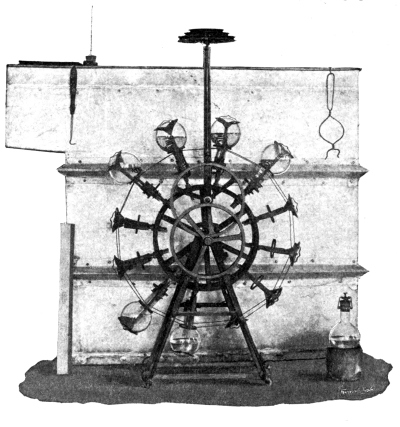
Figure. 8.
Huston’s Digesting Apparatus.
129. Digestion Apparatus for Reverted Phosphates.—The digestion
apparatus used by Huston consists of two wheels twenty-five centimeters
in diameter, mounted on the same axis, having a clear space of four and
one-half centimeters between them.[118]
In the periphery of each wheel are cut twelve notches, which are to
receive the posts bearing the rings through which the necks of the
flasks pass. The posts are held in place by nuts which are screwed
down on the faces of the wheel. Should it become necessary to take
the apparatus apart, it is only necessary to loosen the nuts and the
set screw holding one wheel to the shaft and all the parts can at
once be removed. The posts extend ten centimeters beyond the face of
the wheels, and the rings are four centimeters in internal diameter.
Perforated plates, bearing a cross-bar, and held in place by strong
spiral springs attached to the plate and the base of the posts, serve
to hold the flasks in place. Each plate has a number stenciled through
it for convenience in identifying the flasks when it is time to remove
them. Attached to the outside of each post, close to the outer end, is
a heavy wire which passes entirely around the apparatus, serving to
keep the plates in place after they are removed from the flasks.
The apparatus is mounted on a substantial framework, thirty-six
centimeters high and thirty centimeters wide at the base. The space
in which the wheel revolves is fourteen centimeters wide. The base
bars connecting the two sides are extended seven centimeters beyond
one side, and serve for the attachment of lateral bracing. At the top
of the framework, at one side, is attached a heavy bar forty-five
centimeters long, which serves to carry the cog gearing which transmits
the power. The upright shaft carries a cone pulley to provide for
varying the speed. The usual speed is two revolutions a minute for the
wheel carrying the flasks. The entire apparatus is made of brass. The
details of construction are shown in Fig. 8.
Round-bottomed flasks are used, and rubber stoppers are held in place
by tying or by a special clamp shown at the lower right-hand of the
figure.
When high temperatures are used, the plates and flasks are handled
by the hooks shown at the left and right-hand upper corners of the
figure.
When any other than room temperature is desired, the whole apparatus is
immersed in water contained in the large galvanized tank forming the
back-ground of the figures. The tank is seventy-five centimeters long,
seventy-five centimeters high, and thirty centimeters wide. At one end,
near the top, is an extension to provide space for heating the fluid in
the flasks before introducing the solid in such cases as may be desired.
The apparatus is held in place by angle irons soldered to the bottom
of the tank and a brace resting against the upright bar bearing the
gear-wheels.
The water in the tank is heated by injecting steam, or by burners under
the tank. As the tank holds about 300 pounds of water the work is not
subject to sudden changes of temperature, and little trouble has been
experienced in raising and maintaining the temperature of the water,
especially when steam is used.
An electric motor, or a small water-motor with only a very moderate
head of water, will furnish ample power.
130. Comparison of Results.—The following data show the
results obtained by the digester as compared with those furnished
by the official method, temperature and time of digestion
being the same in each instance.
Ammonium Citrate Solution on Phosphates.
Substance.
|
Time of
treatment. |
Total
phos. acid.
Per cent. |
Removed
by official
method.
Per cent. |
Removed
by digester.
Per cent. |
| Steamed bone, |
½ |
hour |
27.67 |
10.59 |
14.52 |
| 1 |
“ |
|
12.21 |
14.82 |
| 2 |
hours |
|
14.61 |
17.56 |
| 3½ |
“ |
|
16.48 |
18.53 |
| 5 |
“ |
|
17.94 |
20.22 |
| 7½ |
“ |
|
18.99 |
20.25 |
| 10 |
“ |
|
19.73 |
21.18 |
| Marl, |
½ |
hour |
13.86 |
4.43 |
4.11 |
| 1 |
“ |
|
8.28 |
6.82 |
| 2 |
hours |
|
10.34 |
9.76 |
| 3½ |
“ |
|
11.00 |
11.31 |
| 5 |
“ |
|
11.80 |
11.83 |
| 8 |
“ |
|
12.51 |
12.64 |
| 10 |
“ |
|
12.58 |
13.00 |
| Acidulated bone, |
½ |
hour |
19.38 |
12.09 |
12.28 |
| 1 |
“ |
|
12.47 |
12.40 |
| 2 |
hours |
|
12.20 |
12.43 |
| 3½ |
“ |
|
12.40 |
12.24 |
| 5 |
“ |
|
12.43 |
12.26 |
| Bone, |
½ |
hour |
21.40 |
6.97 |
8.48 |
| Ammoniated dissolved bone, |
½ |
“ |
18.22 |
9.28 |
10.63 |
| Cottonseed-meal and |
| castor pomace, |
½ |
“ |
2.52 |
0.23 |
0.25 |
| Phospho bone, |
¼ |
“ |
16.55 |
7.06 |
7.21 |
In comparing duplicates, the results from the use of
the digester are found to be subject to less variation than those from
the usual method.
131. Huston’s Mechanical Stirrer.—The stirring apparatus shown
in Fig. 9 differs from those which have heretofore
come into use, in requiring but a single belt to drive all the stirring
rods, and in having all the parts protected from the laboratory
fumes.[119]
The details of the belt system are shown in the small diagram in the lower
central part of the figure. The apparatus is mounted on a substantial
wooden box, 200 centimeters long, thirty centimeters high, and eighteen
centimeters wide. The driving pulleys, ten centimeters in diameter,
are enclosed in the upper part of the case. The shafts on which these
pulleys are mounted extend through the bottom of the enclosing box and
carry a wooden disk, eleven centimeters in diameter, to prevent
particles of foreign matter from falling into the beakers. The shafts
extend two centimeters below these disks, and to the end of the shafts
the bent stirring rods are attached by rubber tubing.
The board forming the support of the driving pulleys is extended two
centimeters in front of the apparatus, and in this extension twelve
notches are cut, in which are held the corks carrying the tubes which
contain the solution to be used in precipitating the material in the beakers.
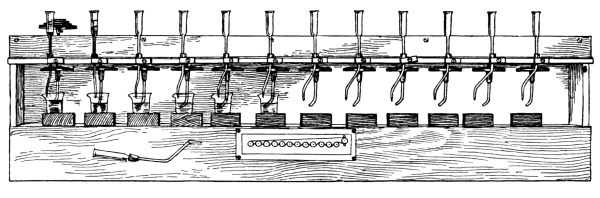
Figure. 9.
Huston’s Mechanical Stirrer.
The ends of these tubes are drawn out to a fine point so as to deliver
the liquid at the rate of about one drop per second.
The front of the apparatus is hinged and permits the whole to be closed
when not in use, or during the precipitation.
The apparatus has proven extremely satisfactory in the precipitation of
ammonium magnesium phosphate. The precipitate is very crystalline, and
where the stirring is continued for some minutes, after the magnesia
solution has all been added, no amorphous precipitate is observed on
longer standing.
132. The Citrate Method Applied to Samples with Small Content of
Phosphoric Acid.—It is well established that the citrate method
does not give satisfactory results when applied to samples containing
small percentages of phosphoric acid, especially when these are of
an organic nature, as for instance, cottonseed cake-meal. In this
laboratory attempts have been made to remedy this defect in the process
so as to render the use of the method possible even in such cases.[120]
Satisfactory results have been obtained by adding to the solution
of the cake-meal a definite volume of a phosphate solution of known
strength. Solutions of ordinary mineral phosphates are preferred for
this purpose. The following example will show the application of the
modified method:
In a sample of cake-meal, (cottonseed cake and castor pomace) the
content of phosphoric acid obtained by the molybdate method, was 2.52
per cent.
Determined directly by the citrate method, the following data were
obtained:
Allowing to stand thirty hours after adding magnesia mixture, 1.08 and
1.53 per cent in duplicates.
Allowing to stand seventy-two hours after adding magnesia mixture, 2.17
and 2.30 per cent in duplicates.
In each case fifty cubic centimeters of the solution were taken,
representing half a gram of the sample.
In another series of determinations twenty-five cubic centimeters of
the sample were mixed with an equal volume of a mineral phosphate
solution, the value of which had been previously determined by both
the molybdic and citrate methods. The fifty cubic centimeters thus
obtained represented a quarter of a gram each of the cake-meal and
mineral phosphates. The filtration followed eighteen hours after adding
the magnesia mixture. The following data show the results of the
determinations:
| |
Per cent P₂O₅
mineral
phosphate. |
Per cent P₂O₅
in organic
sample. |
Per cent P₂O₅
found in
mixture × 2. |
Per cent P₂O₅
in organic
sample. |
| 1 |
15.37 |
2.52 |
17.90 |
2.53 |
| 2 |
29.16 |
2.52 |
31.68 |
2.52 |
| 3 |
31.37 |
2.52 |
33.83 |
2.45 |
| 4 |
31.58 |
2.52 |
34.20 |
2.62 |
| |
Mean content of P₂O₅ in organic sample |
2.53 |
It is thus demonstrated that the citrate method can be applied with
safety even to the determination of the phosphoric acid in organic
compounds where the quantity present is less than three per cent. It is
further shown that solutions of mineral phosphates varying in content
of phosphoric acid from fifteen to thirty-two per cent may be safely
used for increasing the content of that acid to the proper degree for
complete precipitation. In cases where organic matters are present they
should be destroyed by moist combustion with sulfuric acid as in the
determination of nitrogen to be described in the next part.
133. Direct Precipitation of the Citrate-Soluble Phosphoric
Acid.—The direct determination of citrate-soluble phosphoric
acid by effecting the precipitation by means of magnesia mixture in
the solution obtained from the ammonium citrate digestion, has been
practiced for many years by numbers of European chemists, and the
process has even obtained a place in the official methods of some
European countries. Various objections have been urged, however,
against the general employment of this method in fertilizer analysis
on account of the inaccuracies in the results obtained in certain
cases, and it has, therefore, been used to but a very limited extent
in this country. Since it is impracticable to effect the precipitation
with ammonium molybdate in the presence of citric acid the previous
elimination or destruction of this substance has been recognized as
essential to the execution of a process involving the separation of the
phosphoric acid as phosphomolybdate.
It is evident from the data cited in the preceding paragraph, that
great accuracy may be secured in this process by adding a sufficient
quantity of a solution of a mineral phosphate and proceeding by the
citrate method.
Ross has also proposed to estimate the acid soluble in ammonium citrate
directly by first destroying the organic matter by moist combustion
with sulfuric acid.[121]
He recommends the following process:
After completion of the thirty minutes’ digestion of the sample with
citrate solution, twenty-five cubic centimeters are filtered at once
into a dry vessel. If the liquid be filtered directly into a dry
burette, twenty-five cubic centimeters can be readily transferred
to another vessel without dilution. After cooling, run twenty-five
cubic centimeters of the solution into a digestion flask of 250-300
cubic centimeters capacity, add about fifteen cubic centimeters of
concentrated sulfuric acid and place the flask on a piece of wire gauze
over a moderately brisk flame; in about eight minutes the contents of
the flask commence to darken and foaming begins, but this will occasion
no trouble, if an extremely high, or a very low flame be avoided. In
about twelve minutes the foaming ceases and the liquid in the flask
appears quite black; about one grain of mercuric oxid is now added and
the digestion is continued over a brisk flame. The operation can be
completed in less than half an hour with ease, and in many cases,
twenty-five minutes. After cooling, the contents of the flask are
washed into a beaker, ammonia is added in slight excess, the solution
is acidified with nitric, and after the addition of fifteen grams of
ammonium nitrate, the process is conducted as usual.
In case as large an aliquot as fifty cubic centimeters of the original
filtrate be used, ten cubic centimeters of sulfuric acid are added,
and the digestion is conducted in a flask of 300-500 cubic centimeters
capacity; after the liquid has blackened and foaming has progressed to
a considerable extent, the flask is removed from the flame, fifteen
cubic centimeters more of sulfuric acid are added, and the flask and
contents are heated at a moderate temperature for two or three minutes;
the mercuric oxid is then added and the operation completed as before
described.
Following are some of the advantages offered by the method described:
(1) It dispenses with the necessity of the execution of the frequently
tedious operation of bringing upon the filter and washing the residue
from the ammonium citrate digestion, while the ignition of this residue
together with the subsequent digestion with acid and filtration are
also avoided.
(2) It affords a means for the direct estimation of that form of
phosphoric acid which, together with the water-soluble, constitutes the
available phosphoric acid, thus enabling the latter to be determined by
making only two estimations.
(3) In connection with the advantages above mentioned it permits
of a considerable saving of time, as well as of labor required in
manipulation.
In addition to the tests with mercuric oxid, both potassium nitrate and
potassium sulfate were used in the digestion to facilitate oxidation.
With the former, several additions of the salt were necessary to secure
a satisfactory digestion, and even then the time required was longer
than with the mercury or mercuric oxid digestion. With potassium
sulfate, the excessive foaming which took place interfered greatly with
the execution of the digestion process.
134. Availability of Phosphatic Fertilizers.—There is perhaps no
one question more frequently put to analysts by practical farmers than
the one relating to the availability of fertilizing materials. The
object of the manufacturer should be to secure each of the valuable
ingredients of his goods in the most useful form. The ideal form in
which phosphoric acid should come to the soil is one soluble in water.
Even in localities where heavy rains may abound, there is not much
danger of loss of soluble acid by percolation. As has before been
indicated, the soluble acid tends to become fixed in all normal soils,
and to remain in a state accessible to the rootlets of plants, and yet
free from danger of leaching. For this reason, by most agronomists, the
water-soluble acid is not regarded as more available than that portion
insoluble in water, yet soluble in ammonium citrate.
In many of the States the statutes, or custom, prescribe that only the
water and citrate-soluble acid shall be reckoned as available, the
insoluble residue being allowed no place in the estimates of value.
In many instances such a custom may lead to considerable error, as
in the case of finely ground bones and some forms of soft and easily
decomposable tricalcium phosphates. There are also, on the markets,
phosphates composed largely of iron and aluminum salts, and these
appear to have an available value often in excess of the quantities
thereof soluble in ammonium citrate.
As a rule the apatites, when reduced to a fine powder and applied to
the soil, are the least available of the natural phosphates. Next in
order come the land rock and pebble phosphates which, in most soils,
have only a limited availability. The soft fine-ground phosphates,
especially in soils rich in humus, have an agricultural value,
almost, if not quite equal to a similar amount of acid in the acid
phosphates. Fine-ground bones also tend to give up their phosphoric
acid with a considerable degree of readiness in most soils. Natural
iron and aluminum phosphates, have also, as a rule, a high degree of
availability. In each case the analyst must consider all the factors of
the case before rendering a decision. Not only the relative solubility
of the different components of the offered fertilizer in different
menstrua must be taken into consideration, but also the character of
the soil to which it is to be applied, the time of application, and the
crop to be grown. By a diligent study of these conditions the analyst
may, in the end, reach an accurate judgment of the merits of the sample.
135. Direct Weighing of the Molybdenum Precipitate.—It has
already been stated that many attempts have, been made to determine
the phosphoric acid by direct weighing as well as by titration, as in
the Pemberton method. The point of prime importance in such a direct
determination is to secure an ammonium phosphomolybdate mixture of
constant composition. Unless this can be done no direct method, either
volumetric or gravimetric, can give reliable results. Hanamann[122]
proposes to secure this constant composition by varying somewhat the
composition of the molybdate mixture and precipitating the phosphoric
acid under definite conditions. The molybdate solution employed is
prepared as follows:
| Molybdic acid |
100 |
grams. |
| Ten per cent ammonia |
1.0 |
liter. |
| Nitric acid (1.246 sp. gr.) |
1.5 |
liters. |
The precipitation of the phosphoric acid is conducted in the cold
with constant stirring. It is complete in half an hour. The ammonium
phosphomolybdate is washed with a solution of ammonium nitrate and then
with dilute nitric acid, dried, and ignited at less than a red heat. It
should then have a bluish-black color throughout. Such a body contains
4.018 per cent of phosphoric anhydrid.
Twenty-five cubic centimeters of a sodium phosphate solution
containing fifty milligrams of phosphoric acid, treated as above, gave
a bluish-black precipitate weighing 1.249 grams, which, multiplied
by 0.041018, equaled 50.018 milligrams of phosphorus pentoxid. The
method should be tried on phosphates of various kinds and contents of
phosphorus pentoxid before a definite judgment of its merits is formed.
136. Reactions with Phosphates.—In this country the expressions
“acid” and “super” phosphates are used interchangeably. A more correct
use of the terms would designate by “acid” the phosphate formed
directly from tricalcium phosphate by the action of sulfuric acid,
while by “super” would be indicated a similar product formed by the
action of free phosphoric acid on the same materials. In Germany the
latter compound is called double phosphate.
The reaction which takes place in the first instance is represented by
the following formula:
3Ca₃(PO₄)₂ + 6H₂SO₄ + 12H₂O = 4H₃PO₄ + Ca₃(PO₄)₂ + 6(CaSO₄·2H₂O);
and 4H₃PO₄ + Ca₃(PO₄)₂ + 3H₂O = 3[CaH₄(PO₄)₂·H₂O].
A simpler form of the reaction is expressed as follows:
Ca₃(PO₄)₂ + 2H₂SO₄ + 5H₂O = CaH₄(PO₄)₂·H₂O + 2[CaSO₄·2H₂O].
If 310 parts, by weight, of fine-ground tricalcium phosphate be mixed
with 196 parts of sulfuric acid and ninety parts of water, and the
resulting jelly be quickly diluted with a large quantity of water, and
filtered, there will be found in the filtrate about three-quarters of
the total phosphoric as free acid. If, however, the jelly, at first,
formed as above, be left to become dry and hard, the filtrate, when the
mass is beaten up with water and filtered, will contain monocalcium
phosphate, CaH₄(PO₄)₂.
If the quantity of sulfuric acid used be not sufficient for complete
decomposition, the dicalcium salt is formed directly according to the
following reaction:
Ca₃(PO₄)₂ + H₂SO₄ + 6H₂O = Ca₂H₂(PO₄)₂·4H₂O + CaSO₄·2H₂O.
This arises, doubtless, by the formation, at first, of the regular
monocalcium salt and the further reaction of this with the tricalcium
compound, as follows:
CaH₄(PO₄)₂ + H₂O + Ca₃(PO₄)₂ + 7H₂O = 2[Ca₂H₂(PO₄)₂·4H₂O].
This reaction represents, theoretically, the so-called reversion of
the phosphoric acid. When there is an excess of sulfuric acid there is
a complete decomposition of the calcium salts with the production of
free phosphoric acid and gypsum. The reaction is represented by the
following formula:
Ca₃(PO₄)₂ + 3H₂SO₄ + 6H₂O = 2H₃PO₄ + 3[CaSO₄·2H₂O].
The crystallized gypsum absorbs the six molecules of water in its
molecular structure.
137. Reactions with Fluorids.—Since calcium fluorid is present
in nearly all mineral phosphates, the reactions of this compound must
be taken into consideration in a chemical study of the manufacture of
acid phosphates. When treated with sulfuric acid the first reaction
which takes place consists in the formation of hydrofluoric acid: CaF₂
+ H₂SO₄ = 2HF + CaSO₄. Since, however, there is generally some silica
in reach of the nascent acid, all, or a portion of it, combines at once
with this silica, forming silicon tetrafluorid: 4HF + SiO₂ = 2H₂O +
SiF₄. This compound, however, is decomposed at once in the presence of
water, forming hydrofluosilicic acid: 3SiF₄ + 2H₂O = SiO₂ + 2H₂SiF₆.
The presence of calcium fluorid in natural phosphates is extremely
objectionable from a technical point of view, both on account of the
increased consumption of oil of vitriol which it causes, but also by
reason of the injurious nature of gaseous fluorin compounds produced.
Each 100 pounds of calcium fluorid entails the consumption of 125.6
pounds of sulfuric acid.
138. Reaction with Carbonates.—Most mineral phosphates contain
calcium carbonate in varying quantities. This compound is decomposed on
treatment with sulfuric acid according to the reaction: CaCO₃ + H₂SO₄ =
CaSO₄ + H₂O + CO₂. When present in moderate amounts, calcium carbonate
is not an objectionable impurity in natural phosphates intended for
acid phosphate manufacture. The reaction with sulfuric acid which takes
place produces a proper rise in temperature throughout the mass, while
the escaping carbon dioxid permeates and lightens the whole mass,
assisting thus in completing the chemical reaction by leaving the
residual mass porous, and capable of being easily dried and pulverized.
Where large quantities of carbonate in proportion to the phosphate
are present the sulfuric acid used should be dilute enough to furnish
the necessary water of crystallization to the gypsum formed. For each
100 parts, by weight, of calcium carbonate, eighty parts of sulfuric
anhydrid are necessary, or 125 parts of acid of 1.710 specific gravity
= 60° Beaumé.
In some guanos a part of the calcium is found as pyrophosphate, and
this is acted upon by the sulfuric acid in the following way: Ca₂P₂O₇ +
H₂SO₄ = CaH₂P₂O₇ + CaSO₄.
139. Solution of the Iron and Alumina Compounds.—Iron may occur
in natural phosphates in many forms. It probably is most frequently met
with as ferric or ferrous phosphate, seldom as ferric oxid, and often
as pyrite, FeS₂. The iron also may sometimes exist as a silicate.
The alumina is found chiefly in combination with phosphoric acid, and
as silicate.
Where a little less sulfuric acid is employed, as is generally the
case, than is necessary for complete solution, the iron phosphate is
attacked as represented below:
3FePO₄ + 3H₂SO₄ = FePO₄·2H₂PO₄ + Fe₂(SO₄)₃.
When an excess of sulfuric acid is employed, the formula is
reduced to the simple one:
2FePO₄ + 3H₂SO₄ = 2H₃PO₄ + Fe₂(SO₄)₃.
A part of the iron sulfate formed reacts with the acid calcium
phosphate present to produce a permanent jelly-like compound, difficult
to dry and handle. As much as two per cent of iron phosphate, however,
may be present without serious interference with the commercial
handling of the product. By using more sulfuric acid as much as four
or five per cent of the iron phosphate can be held in solution. Larger
quantities are very troublesome from a commercial point of view. The
reaction of the ferric sulfate with monocalcium phosphate, is as follows:
3CaH(PO₄)₂ + Fe₂(SO₄)₃ + 4H₂O = 2(FePO₄·2H₃PO₄·2H₂O) + 3CaSO₄.
Pyrite and the silicates containing iron are not attacked by sulfuric
acid, and these compounds are therefore left, in the final product, in
a harmless state. If the pyritic iron is to be brought into solution
aqua regia should be employed.
With sufficient acid the aluminum phosphate is decomposed with the
formation of aluminum sulfate and free phosphoric acid:
AlPO₄ + 3H₂SO₄ = Al₂(SO₄)₃ + 2H₃PO₄.
140. Reaction with Magnesium Compounds.—The mineral phosphates,
as a rule, contain but little magnesia. When present it is probably
as an acid salt, MgHPO₄. Its decomposition takes place in slight
deficiency or excess of sulfuric acid respectively as follows:
2MgHP₄ + H₂SO₄ + 2H₂O = [MgH₄(PO₄)₂·2H₂O] + MgSO₄
and MgHPO₄ + H₂SO₄ = H₃PO₄ + MgSO₄.
The magnesia, when in the form of oxid, is capable of producing a
reversion of the monocalcium phosphate, as is shown below:
CaH₄(PO₄)₂ + MgO = CaMgH₂(PO₄)₂ + H₂O.
One part by weight of magnesia can render three and one-half parts of
soluble monocalcium phosphate insoluble.
141. Determination of Quantity of Sulfuric Acid Necessary for
Solution of a Mineral Phosphate.—The theoretical quantity of
sulfuric acid required for the proper treatment of any phosphate may be
calculated from its chemical analysis and by the formulas and reactions
already given. For the experimental determination the method of Rümpler
may be followed.[123]
Twenty grams of the fine phosphate are placed in a liter flask with a
greater quantity of accurately measured sulfuric acid than is necessary
for complete solution. The acid should have a specific gravity of 1.455
or 45° B. The mixture is allowed to stand for two hours at 50°. It is
then cooled, the flask filled with water to the mark, well shaken, and
the contents filtered. Fifty cubic centimeters of the filtrate are
treated with tenth normal soda-lye until basic phosphate begins to
separate. The excess of acid used is then calculated. Example: Twenty
grams of phosphate containing 28.3 per cent of phosphoric acid, 10.0
per cent of calcium carbonate, 5.5 per cent of calcium fluorid, and
2.4 per cent of calcium chlorid were treated as above with sixteen
cubic centimeters of sulfuric acid containing 10.24 grams of sulfur
trioxid. In titrating fifty cubic centimeters of the filtrate obtained
as described above, 10.4 cubic centimeters of tenth normal soda-lye
were used, equivalent to 0.0416 gram of sulfur trioxid. Then 10.24 × 50
÷ 1000 = 0.5120 = total sulfur trioxid in fifty cubic centimeters of
the filtrate, and 0.5120 - 0.0416 = 0.4704 gram, the amount of sulfur
trioxid consumed in the decomposition.
Therefore the sulfur trioxid required for decomposition is 47.04 per
cent of the weight of the phosphate employed. One hundred parts of the
phosphate would therefore require 47.04 parts of sulfur trioxid = to
73.6 parts of sulfuric acid of 1.710 specific gravity or 92.1 parts of
1.530 specific gravity.
A more convenient method than the one mentioned above consists in
treating a small quantity of the phosphate, from one-half to one
kilogram, in the laboratory, or fifty kilograms in a lead box, just
as would be practiced on a large scale. A few tests with these small
quantities, followed by drying and grinding will reveal to the skilled
operator the approximate quantity and strength of sulfuric acid to
be used in each case. The quantities of sulfuric acid as determined
by calculation from analyses and by actual laboratory tests agree
fairly well in most instances. There is, however, sometimes a marked
disagreement. The general rule of practice is to use always an amount
of sulfuric acid sufficient to produce and maintain water-soluble
phosphoric acid in the fertilizer, but the sulfuric acid must not be
used in such quantity as to interfere with the subsequent drying,
grinding, and marketing of the acid phosphate.
For convenience the following table may be used for calculating the
quantity of oil of vitriol needed for each unit of weight of material
noted:
One Part by Weight of Each Substance Below Requires:
| |
Sulfuric Acid by Same Unit of Weight. |
| At 48° B. |
At 50° B. |
At 52° B. |
At 54° B. |
At 55° B. |
| Tricalcium phosphate |
1.590 |
1.517 |
1.446 |
1.382 |
1.352 |
| Iron phosphate |
1.630 |
1.558 |
1.485 |
1.420 |
1.390 |
| Aluminum phosphate |
2.025 |
1.930 |
1.839 |
1.756 |
1.721 |
| Calcium carbonate |
1.640 |
1.565 |
1.495 |
1.428 |
1.411 |
| Calcium fluorid |
2.006 |
2.010 |
1.916 |
1.830 |
1.794 |
| Magnesium carbonate |
1.940 |
1.860 |
1.775 |
1.690 |
1.660 |
Example.—Suppose for example a phosphate of the following
composition is to be treated with sulfuric acid; viz.,[124]
| Moisture and organic |
4.00 |
per cent. |
| Calcium phosphate |
55.00 |
“ |
| Calcium carbonate |
3.00 |
“ |
| Iron and aluminum phosphate |
|
|
| nearly all alumina |
6.50 |
“ |
| Magnesium carbonate |
0.75 |
“ |
| Calcium fluorid |
2.25 |
“ |
| Insoluble |
28.00 |
“ |
Using sulfuric acid of 50° B., the following quantities will be
required for each 100 kilograms.
| |
Kilos of acid
required. |
| Calcium |
phosphate, fifty-five kilos |
83.44 |
| “ |
carbonate three and a half kilos |
5.48 |
| “ |
fluorid, two and a quarter “ |
4.52 |
| Aluminum and iron phosphate, six and a half kilos |
12.55 |
| Magnesium carbonate, three-quarters of a kilo |
1.40 |
| |
Total |
107.39 |
142. Phosphoric Acid Superphosphates.—If a mineral phosphate be
decomposed by free phosphoric in place of sulfuric acid the resulting
compound will contain about three times as much available phosphoric
acid as is found in the ordinary acid phosphate. The reaction takes
place according to the following formulas:
(1) Ca₃(PO₄)₂ + 4H₃PO₄ + 3H₂O = 3[CAH₄(PO₄)₂·H₂O].
(2) Ca₃(PO₄)₃ + 2H₃PO₄ + 12H₂O = 3[Ca₂H₂(PO₄)₂·4H₂O].
In each case the water in the final product is probably united as
crystal water with the calcium salts produced. The monocalcium salt
formed in the first reaction is soluble in water and the dicalcium salt
in the second reaction in ammonium citrate. Where fertilizers are to
be transported to great distances there is a considerable saving of
freight by the use of such a high-grade phosphate, which may, at times,
contain over forty per cent of available acid. The phosphoric acid used
is made directly from the mineral phosphate by treating it with an
excess of sulfuric acid.
PART SECOND. NITROGEN IN FERTILIZERS. — SOURCES OF NITROGENOUS FERTILIZERS. — METHODS OF ANALYSIS. — THE MOIST COMBUSTION PROCESS. — DETERMINATION OF NITROGEN IN DEFINITE FORMS OF COMBINATION. — SODIUM NITRATE. — AUTHORITIES CITED IN PART SECOND.
143. Kinds of Nitrogen in Fertilizers.—Nitrogen is the most
costly of the essential plant foods. It has been shown in the first
volume, paragraph 23, that the popular notion
regarding the relatively great abundance of nitrogen is erroneous.
It forms only 0.02 per cent of the matter forming and pertaining to
the earth’s crust. The great mass of nitrogen forming the bulk of the
atmosphere is inert and useless in respect of its adaptation to plant
food. It is not until it becomes oxidized by combustion, electrical
discharges, or the action of certain microorganisms that it assumes an
agricultural value.
Having already, in the first volume, described the relation of nitrogen
to the soil it remains the sole province of the present part to
study it as aggregated in a form suited to plant fertilization. In
this function nitrogen may claim the attention of the analyst in the
following forms:
1. In organic combination in animal or vegetable substances, forming a
large class of bodies, of which protein may be taken as the type. Dried
blood or cottonseed-meal illustrates this form of combination.
2. In the form of ammonia or combinations thereof, especially as
ammonium sulfate, or as amid nitrogen.
3. In a more highly oxidized form as nitrous or nitric acid usually
united with a base of which Chile saltpeter may be taken as a type.
The analyst has often to deal with single forms of nitrogenous
compounds, but in many instances may also find all the typical forms in
a single sample. Among the possible cases which may arise the following
are types:
a. The sample under examination may contain nitrogen in all
three forms mentioned above.
b. There may be present nitrogen in the organic form mixed with
nitric nitrogen.
c. Ammoniacal nitrogen may replace the nitric in the above
combination.
d. The sample may contain no organic but only nitric and
ammoniacal nitrogen.
e. Only nitric or ammoniacal nitrogen may be present.
144. Determination of the State of Combination.—Some of the
sample is mixed with a little powdered soda-lime. If ammoniacal
nitrogen be present free ammonia is evolved even in the cold and may be
detected either by its odor or by testing the escaping gas with litmus
or turmeric paper. A glass rod moistened with strong hydrochloric acid
will produce white fumes of ammonium chlorid when brought near the
escaping ammonia.
If the sample contain any notable amount of nitric acid it will
be revealed by treating an aqueous solution of it with a crystal
of ferrous sulfate and strong sulfuric acid. The iron salt should
be placed in a test-tube with a few drops of the solution of the
fertilizer and the sulfuric acid poured down the sides of the tube in
such a way as not to mix with the other liquids. The tube must be kept
cold. A dark brown ring will mark the disk of separation between the
sulfuric acid and the aqueous solution in case nitric acid be present.
If water produce a solution of the sample too highly colored to be used
as above, alcohol of eighty per cent strength may be substituted. The
coloration produced in this case is of a rose or purple tint.
Nitric nitrogen may also be detected by means of brucin. If a few drops
of an aqueous solution of brucin be mixed with the same quantity of an
aqueous extract of the sample under examination and strong sulfuric
acid be added, as described above, there will be developed at the disk
of contact between the acid and the mixed solutions a persistent rose
tint varying to yellow.
To detect the presence of organic albuminoid nitrogen the residue
insoluble in water, when heated with soda-lime, will give rise to
ammonia which may be detected as described above.
145. Microscopic Examination.—If the chemical test reveal the
presence of organic nitrogen the next point to be determined is the
nature of the substance containing it. Often this is revealed by simple
inspection, as in the case of cottonseed-meal. Frequently, however,
especially in cases of fine-ground mixed goods, the microscope must
be employed to determine the character of the organic matter. It is
important to know whether hair, horn, hoof, and other less valuable
forms of nitrogenous compounds have been substituted for dried blood,
tankage, and more valuable forms. In most cases the qualitative chemical,
and microscopic examination will be sufficient. There may be cases,
however, where the analyst will be under the necessity of using other
means of identification suggested by his skill and experience or the
circumstances connected with any particular instance. In such cases
the general appearance, odor, and consistence of the sample may afford
valuable indications which will aid in discovering the origin of the
nitrogenous materials.
146. Seeds and Seed Residues.—The proteid matters in seeds and
seed residues, after the extraction of the oil, are highly prized as
sources of nitrogenous fertilizers either for direct application or
for mixing. Typical of this class of substances is cottonseed-meal,
the residue left after the extraction of the oil which is accomplished
at the present time mostly by hydraulic pressure. The residual cakes
contain still some oil but nearly half their weight consists of
nitrogenous compounds. The following table gives the composition of a
sample of cottonseed-meal:
| Ash |
7.60 |
per cent. |
| Fiber |
4.90 |
“ |
| Oil |
10.01 |
“ |
| Protein |
51.12 |
“ |
| Digestible carbohydrates, etc. |
26.37 |
“ |
While the above shows the composition of a single sample of the meal
it should be remembered that there may be wide variations from this
standard due either to natural composition or to different degrees of
the extraction of the oil.
The composition of the ash is given below:
| Phosphoric acid, |
P₂O₅ |
31.01 |
per cent. |
| Potash, |
K₂O |
35.50 |
“ |
| Soda, |
Na₂O |
0.57 |
“ |
| Lime, |
CaO |
5.68 |
“ |
| Magnesia, |
MgO |
15.19 |
“ |
| Sulfuric acid, |
SO₃ |
3.90 |
“ |
| Insoluble, |
0.69 |
“ |
| Carbon dioxid and undetermined, |
7.46 |
“ |
The cakes left after the expression of the oil from flaxseed and
other oily seeds are also very rich in nitrogenous matters; but these
residues are chiefly used for cattle-feeding and only the undigested
portions of them pass into the manure. Cottonseed cake-meal is not so
well suited for cattle-feeding as the others mentioned, because of the
cholin and betaïn which it contains; often in sufficient quantities
to render its use dangerous to young animals. The danger in feeding
increases as the total quantity of the two bases and also as the
relative quantity of cholin to betaïn, the former base being more
poisonous than the latter. In a sample of the mixed bases prepared in
this laboratory from cottonseed cake-meal the cholin amounted to 17.5
and the betaïn to 82.5 per cent of the whole.[125]
The nitrogen contained in these bases is also included in the total
nitrogen found in the meal. The actual proteid value of the numbers
obtained for nitrogen is therefore less than that obtained for the
whole of the nitrogen by the quantity present as nitrogenous bases.
In the United States cottonseed cake-meal is used in large quantities
as a direct fertilizer but not so extensively for mixing as some of
the other sources of nitrogen. Its delicate yellow color serves to
distinguish it at once from the other bodies used for similar purposes.
No special mention need be made of other oil-cake residues. They are
quite similar in their composition and uses, and manner of treatment
and analysis to the cottonseed product.
147. Fish Scrap.—Certain species of fish, such as the menhaden,
are valued more highly for their oil and refuse than for food purposes.
But even where fish in large quantities are prepared for human food,
there is a considerable quantity of waste matter which is valuable for
fertilizing purposes. The residue of fish from which the fat and oil
have been extracted, is dried and ground for fertilizing uses. The fish
scrap thus obtained is used extensively, especially on the Atlantic
border of the United States, for furnishing the nitrogenous ingredient
in mixed fertilizers, and also for direct application to the fields. In
fish flesh deprived of oil and water, the content of phosphoric acid is
about two and one-half per cent, while the proteid matter may amount to
three-quarters of the whole.[126]
The use of fish for fertilizing purposes is not new. As early as 1621
the settlers at Plymouth were taught to fertilize their maize fields by
Squanto, an Indian. According to Goode, the value of nitrogen derived
from the menhaden alone was two million dollars in 1875.[127]
In 1878 it is estimated that 200,000 tons of these fish were captured between
Cape Henry and the Bay of Fundy. The use of fish scrap for nitrogenous
fertilizing has, since then, become an established industry, and the
analyst may well examine his samples for this source of nitrogen when
they are manufactured at points on the Atlantic coast, in proximity to
great fishing centers.
148. Dried Blood and Tankage.—The blood and débris from
abattoirs afford abundant sources of nitrogen in a form easily oxidized
by the microorganisms of the soil. Blood is prepared for use by simple
drying and grinding. The intestines, scraps, and fragments of flesh
resulting from trimming and cutting, are placed in tanks and steamed
under pressure to remove the fat. The residue is dried and ground,
forming the tankage of commerce. Dried blood is richer in proteid
matter than any other substance in common use for fertilizing purposes.
When in a perfectly dry state, it may contain as much as fourteen
per cent of nitrogen, equivalent to nearly eighty-eight per cent of
proteid or albuminoid matter. Tankage is less rich in nitrogen than
dried blood, but still contains enough to make it a highly desirable
constituent of manures. Naturally, it would vary more in its nitrogen
content than dried blood.
149. Horn, Hoof, and Hair.—These bodies, although quite
rich in nitrogen, are not well suited to fertilizing purposes on account of the
extreme slowness of their decomposition. Their presence, therefore,
should be regarded in the nature of a fraud, because by the usual
methods of analysis they show a high percentage of nitrogen, and
therefore acquire a fictitious value. The relative value of the
nitrogen in these bodies as compared with the more desirable forms, is
given in paragraph 5.
150. Ammoniacal Nitrogen.—In ammonia compounds, nitrogen is
used chiefly for fertilizing purposes as sulfate. The ideal nitrogenous
fertilizer would be a combination of the ammoniacal and nitric nitrogen
found in ammonium nitrate. The high cost of this substance excludes its
use except for experimental purposes.
151. Nitrogen in Guanos.—The nitrogen in guanos may be found
partly as organic, partly as ammoniacal, and partly as nitric nitrogen.
The high manurial value of guanos and bat deposits in caves, is due not
only to their phosphoric acid, but also to the fact that part of the
nitrogen is immediately available, while a part becomes assimilable
by nitrification during the growing season. The content of nitrogen
in guanos is extremely variable, and depends largely on the climatic
conditions to which the deposit has been subjected. The state in which
it exists is also a variable one, but with a constant tendency to
assume finally the nitric condition.
The well-known habits of birds in congregating in rookeries during
the nights, and at certain seasons of the year, tend to bring into a
common receptacle the nitrogenous matters which they have gathered
and which are deposited in their excrement and in the decay of their
bodies. The feathers of birds are particularly rich in nitrogen, and
the nitrogenous content of the flesh of fowls is also high. The decay
therefore, of remains of birds, especially if it take place largely
excluded from the leaching of water, tends to accumulate vast deposits
of nitrogenous matter. If the conditions in such deposits be favorable
to the processes of nitrification, the whole of the nitrogen, or at
least the larger part of it, which has been collected in this débris,
becomes finally converted into nitric acid, and is found combined with
appropriate bases as deposits of nitrates. The nitrates of the guano
deposits, and of the deposits in caves, arise in this way. If these
deposits be subject to moderate leaching, the nitrate may become
infiltered into the surrounding soil, making it very rich in this form
of nitrogen. The beds and surrounding soils of caves are often found
highly impregnated with nitrates.
While for our purpose, deposits of nitrates only are to be considered
which are of sufficient value to bear transportation, yet much interest
attaches to the formation of nitrates in the soil even when they are
not of commercial importance.
In many soils of tropical regions not subject to heavy rainfalls, the
accumulation of these nitrates is very great. Müntz and Marcano[128]
have investigated many of these soils, to which attention was called
first by Humboldt and Boussingault. They state that these soils are
incomparably more rich in nitrates than the most fertile soils of
Europe. The samples which they examined were collected from different
parts of Venezuela and from the valleys of the Orinoco, as well as on
the shore of the Sea of Antilles. The nitrated soils are very abundant
in this region of South America, where they cover large surfaces. Their
composition is variable, but in all of them calcium carbonate and
phosphate are met with, and organic nitrogenous material. The nitric
acid is found always combined with lime. In some of the soils as high
as thirty per cent of calcium nitrate have been found. Nitrification
of organic material takes place very rapidly the year round in this
tropical region. These nitrated soils are everywhere abundant around
caves, as described by Humboldt, which serve as the refuge of birds and
bats. The nitrogenous matters, which come from the decay of the remains
of these animals, form true deposits of guano, which are gradually
spread around, and which, in contact with the limestone and with access
of air, suffer complete nitrification with the fixation of the nitric
acid by the lime.
Large quantities of this guano are also due to the débris of insects,
fragments of elytra, scales of the wings of butterflies, etc., which
are brought together in those places by the millions of cubic meters.
The nitrification, which takes place in these deposits, has been found
to extend its products to a distance of several kilometers through the
soil. In some places the quantity of calcium nitrate is so great in the
soils that they are converted into a plastic paste by this deliquescent salt.
152. Nitric Nitrogen.—In its purer forms, and suited to
manurial purposes, nitric acid exists in combination with sodium as a
compound commonly known as Chile saltpeter.
The existence of these nitrate deposits has long been known.[129]
The old Indian laws originally prohibited the collection of the salt, but
nevertheless it was secretly collected and sold. Up to the year 1821,
soda saltpeter was not known in Europe except as a laboratory product.
About this time the naturalist, Mariano de Rivero, found on the Pacific
coast, in the Province of Tarapacà, immense new deposits of the salt.
Later the salt was found in equal abundance in the Territory of
Antofagasta, and further to the south in the desert of Atacama, which
forms the Department of Taltal.
At the present time the collection and export of saltpeter from Chile
is a business of great importance. The largest export which has ever
taken place in one year was in 1890, when the amount exported was
927,290,430 kilograms; of this quantity 642,506,985 kilograms were
sent to England and 86,124,870 kilograms to the United States. Since that
time the imports of this salt into the United States have largely increased.
According to Pissis[130]
these deposits are of very ancient origin. This geologist is of the
opinion that the nitrate deposits are the result of the decomposition
of feldspathic rocks, the bases thus produced gradually becoming united
with the nitric acid provided from the air.
According to the theory of Nöllner[131]
the deposits are of more modern origin, and due to the decomposition
of marine vegetation. Continuous solution of soils beneath the sea
gives rise to the formation of great lakes of saturated water, in which
occurs the development of much marine vegetation. On the evaporation of
this water, due to geologic isolation, the decomposition of nitrogenous
organic matter causes generation of nitric acid, which, coming in
contact with the calcareous rocks, attacks them, forming calcium
nitrate, which, in presence of sodium sulfate, gives rise to a double
decomposition into sodium nitrate and calcium sulfate.
The fact that iodin is found in greater or less quantity in Chile
saltpeter is one of the chief supports of this hypothesis of marine
origin, inasmuch as iodin is always found in sea plants, and not
in terrestrial plants. Further than this, it must be taken into
consideration that these deposits of sodium nitrate contain neither
shells nor fossils, nor do they contain any calcium phosphate. The
theory, therefore, that they are due to animal origin is scarcely
tenable.
Lately extensive nitrate deposits have been discovered in the U. S.
of Columbia.[132]
These deposits have been found extending over thirty square miles and
vary in thickness from one to ten feet. The visible supply is estimated
at 7,372,800,000 tons, containing from 1.0 to 13.5 percent of nitrate.
The deposits consist of a mixture of sodium nitrate, sodium chlorid,
calcium sulfate, aluminum sulfate, and insoluble silica. It is thought
that the amount of these deposits will almost equal those in Chile and Peru.
153. Classification of Methods.—In general there are three
direct methods of determining the nitrogen content of fertilizers.
First the nitrogen may be secured in a gaseous form and the volume
thereof, under standard conditions, measured and the weight of
nitrogen computed. This process is commonly known as the absolute
method. Practically it has passed out of use in fertilizer work,
or is practiced only as a check against new and untried methods,
or on certain nitrogenous compounds which do not readily yield all
their nitrogen by the other methods. The process, first perfected by
Dumas, who has also given it his name, consists in the combustion
of the nitrogenous body in an environment of copper oxid by which
the nitrogen, by reason of its inertness, is left in a gaseous state
after the oxidation of the other constituents; viz., carbon and
hydrogen, originally present.
In the second class of methods the nitrogen is converted into ammonia
which is absorbed by an excess of standard acid, the residue of which
is determined by subsequent titration with a standard alkali. There are
two distinct processes belonging to this class, in one of which ammonia
is directly produced by dry combustion of an organic nitrogenous
compound with an alkali, and in the other ammonium sulfate is produced
by moist combustion with sulfuric acid, and the salt thus formed is
subsequently distilled with an alkali, and the free ammonia thus formed
estimated as above described. Nitric nitrogen may also be reduced to
ammonia by nascent hydrogen either in an acid or alkaline solution as
described in volume first.
In the third class of determinations is included the estimation of
nitric nitrogen by colorimetric methods as described in the first
volume. These processes have little practical value in connection with
the analyses of commercial fertilizers, but find their chief use in the
detection and estimation of extremely minute quantities of nitrites
and nitrates. In the following paragraphs will be given the standard
methods for the determination of nitrogen in practical work with
fertilizing materials and fertilizers.
154. Official Methods.—The methods adopted by the Association
of Official Agricultural Chemists have been developed by more than ten
years of co-operative work on the part of the leading agricultural
chemists of the United States. These methods should be strictly
followed in all essential points by all analysts in cases where
comparison with other data are concerned. Future experience will
doubtless improve the processes both in respect of accuracy and
simplicity, but it must be granted that, as at present practiced, they
give essentially accurate results.
155. Volumetric Estimation by Combustion with Copper Oxid.—This
classical method of analysis is based on the supposition that by the
combustion of a substance containing nitrogen in copper oxid and
conducting the products of the oxidation over red-hot copper oxid and
metallic copper, all of the nitrogen present in whatever form will be
obtained in a free state and can subsequently be measured as a gas.
The air originally present in all parts of the apparatus must first
be removed either by a mercury pump or by carbon dioxid or by both
together, the residual carbon dioxid being absorbed by a solution of
caustic alkali. Great delicacy of manipulation is necessary to secure
a perfect vacuum and as a rule a small quantity of gas may be measured
other than nitrogen so that the results of the analyses are often a
trifle too high. The presence of another element associated with
nitrogen, or the possible allotropic existence of that element, may
also prove to be a disturbing factor in this long-practiced analytical
process. For instance, if nitrogen be contaminated with another
element, e. g., argon, of a greater density the commonly
accepted weight of a liter of nitrogen is too great and tables of
calculation based on that weight would give results too high.
First will be given the official method for this process, followed by a
few simple variations thereof, as practiced in this laboratory.
156. The Official Volumetric Method.—This process may be used
for nitrogen in any form of combination.[133]
The apparatus and reagents needed are as follows:
Combustion tube of best hard Bohemian glass, about sixty-six
centimeters long and 12.7 millimeters internal diameter.
Azotometer of at least 100 cubic centimeters capacity,
accurately calibrated.
Sprengel mercury air-pump.
Small paper scoop, easily made from stiff writing paper.
Coarse cupric oxid.—To be ignited and cooled before using.
Fine cupric oxid.—Prepared by pounding ordinary cupric oxid in
a mortar.
Metallic copper.—Granulated copper, or fine copper gauze,
reduced and cooled in a current of hydrogen.
Sodium bicarbonate.—Free from organic matter.
Caustic potash solution.—Make a supersaturated solution of
caustic potash in hot water. When absorption of carbon dioxid, during
the combustion, ceases to be prompt, the solution must be discarded.
Filling the tube.—Of ordinary commercial fertilizers take from
one to two grams for analysis. In the case of highly nitrogenized
substances the amount to be taken must be regulated by the amount of
nitrogen estimated to be present. Fill the tube as follows: (1) About
five centimeters of coarse cupric oxid: (2) Place on the small paper
scoop enough of the fine cupric oxid to fill, after having been mixed
with the substance to be analyzed, about ten centimeters of the tube;
pour on this the substance, rinsing the watch-glass with a little of
the fine oxid, and mix thoroughly with a spatula; pour into the tube,
rinsing the scoop with a little fine oxid: (3) About thirty centimeters
of coarse cupric oxid: (4) About seven centimeters of metallic copper:
(5) About six centimeters of coarse cupric oxid (anterior layer):
(6) A small plug of asbestos: (7) From eight-tenths to one gram of
sodium bicarbonate: (8) A large, loose plug of asbestos; place the
tube in the furnace, leaving about two and five-tenths centimeters of
it projecting; connect with the pump by a rubber stopper smeared with
glycerol, taking care to make the connection perfectly tight.
Operation.—Exhaust the air from the tube by means of the
pump. When a vacuum has been obtained allow the flow of mercury to
continue; light the gas under that part of the tube containing the
metallic copper, the anterior layer of cupric oxid (see (5) above),
and the sodium bicarbonate. As soon as the vacuum is destroyed and the
apparatus filled with carbon dioxid, shut off the flow of mercury and
at once introduce the delivery-tube of the pump into the receiving arm
of the azotometer just below the surface of the mercury seal, so that
the escaping bubbles will pass into the air and not into the tube, thus
avoiding the useless saturation of the caustic potash solution.
Set the pump in motion and when the flow of carbon dioxid has very
nearly or completely ceased, pass the delivery-tube down into the
receiving arm, so that the bubbles will escape into the azotometer.
Light the gas under the thirty centimeter layer of oxid, heat gently
for a few moments to drive out any moisture that may be present, and
bring to a red heat. Heat gradually the mixture of substance and oxid,
lighting one jet at a time. Avoid a too rapid evolution of bubbles,
which should be allowed to escape at the rate of about one per second
or a little faster.
When the jets under the mixture have all been turned on, light the gas
under the layer of oxid at the end of the tube. When the evolution of
gas has ceased, turn out all the lights except those under the metallic
copper and anterior layer of oxid, and allow to cool for a few moments.
Exhaust with the pump and remove the azotometer before the flow of
mercury is stopped. Break the connection of the tube with the pump, stop
the flow of mercury, and extinguish the lights. Allow the azotometer
to stand for at least an hour, or cool with a stream of water until a
permanent volume and temperature have been reached.
Adjust accurately the level of the potash solution in the bulb to that
in the azotometer; note the volume of gas, temperature, and height of
barometer; make calculation as usual, or read results from tables.
156. Note on Official Volumetric Method.—The determination
of nitrogen in its gaseous state by combustion with copper oxid, has
practically gone out of use as an analytical method. The official
chemists rarely use it even for control work on samples sent out for
comparative analysis. The method recommended differs considerably from
the process of Jenkins and Johnson, on which it is based. The only
source of oxygen in the official method is in the copper oxid. Hence it
is necessary that the oxid in immediate contact with the organic matter
be in a sufficiently fine state of subdivision, and that the substance
itself be very finely powdered and intimately mixed with the oxidizing
material. Failure to attend to these precautions will be followed by
an incomplete combustion and a consequent deficit in the volume of
nitrogen obtained.
The copper oxid before using is ignited, and is best filled into the
tube while still warm by means of a long pointed metal scoop, or other
convenient method. The copper spiral, after use, is reduced at a red
heat in a current of hydrogen, and may thus be used many times.
157. The Pump.—Any form of mercury pump which will secure a
complete vacuum may be used. A most excellent one can be arranged
in any laboratory at a very small expense. The pump used in this
laboratory for many years answers every purpose, and costs practically
nothing, being made out of old material not very valuable for other use.
The construction of the pump and its use in connection with the
combustion tube will be clearly understood from the following description:
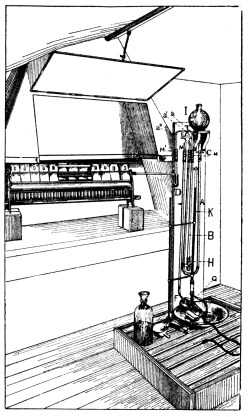
Figure. 10.
Mercury Pump and
Azotometer.
A glass bulb I is attached, by means of a heavy rubber tube carrying
a screw clamp, to the glass tube A, having heavy walls and a small
internal diameter, and being one meter or more in length. The tube A
is continued in the form of a U, the two arms being joined by
very heavy rubber tubing securely wired. The ends of the glass tubes in
the rubber should be bent so that they come near together and form the
bend of the U, the rubber simply holding them in place. This is
better then to have the tube continuous, avoiding danger of breaking. A
tee tube, T, made of the same kind of glass as A, is connected by one
arm, a, with the manometer B, by a heavy rubber union well wired. The
union is made perfectly air-tight by the tube filled with mercury held
by a rubber stopper. The middle arm of the tee, a′, is expanded into
a bulb, E, branching into two arms, one of which is connected with A
and the other with the delivery-tube F, by the mercury-rubber unions,
MM′, just described. The interior of the bulb E should be of such a
shape as to allow each drop of mercury to fall at once into F without
accumulating in large quantity and being discharged in mass. The third
arm of the tee a″ is bent upwards at the end and passes into a mercury
sealing tube, D, where it is connected by means of a rubber tube
with the delivery-tube from the furnace. The flow of the mercury is
regulated by the clamp C, and care should be taken that the supply does
not get so low in I as to permit air bubbles to enter A. The manometer B
dips into the tube of mercury H. A pump thus constructed is simple,
flexible, and perfectly tight. The only part which needs to be
specially made is the tee and the one in use here was blown in our own
laboratory. The bent end of the delivery-tube F may also be united to
the main tube by a rubber joint thus aiding in inserting it into the
V-shaped nozzle of the azotometer.
The azotometer used is the one devised by Schiff and modified by
Johnson and Jenkins.[134]
We prefer to get the V nozzles separately and join them to any good
burette by a rubber tube. The water-jacket is not necessary, but the
apparatus can be left exposed until it reaches room temperature.
Any form of mercury pump capable of securing a vacuum may be used,
but the one just described is commended by simplicity, economy,
effectiveness, and long use.
158. The Pump and Combustion Furnace.—The pump and combustion
furnace, as used in the laboratory, are shown in Fig. 10.
The pump is constructed as just described, and rests in a wooden tray
which catches and holds any mercury which may be spilled. The furnace
is placed under a hood which carries off the products of the burning
lamps and the hot air. A well-ventilated hood is an important accessory
to this process, especially when it is carried on in summer. A small
mercury pneumatic trough catches the overflow from the pump and also
serves to immerse the end of the delivery-tube during the exhaustion of
the combustion tube.
The other details of the arrangement and connections have been
sufficiently shown in the previous paragraph.
159. Volumetric Method in this Laboratory.—It has been found
convenient here to vary slightly the method of the official chemists
in the following respects: The tube used for the combustion is made of
hard refractory glass, which will keep its shape at a high red heat. It
is drawn out and sealed at one end after being well cleaned and dried.
It should be about eighty centimeters in length and from twelve to
fourteen millimeters in internal diameter. The relative lengths of the
spaces occupied by the several contents of the tube are approximately
as follows: Sodium bicarbonate, two; asbestos, three; coarse copper
oxid, eight; fine copper oxid, containing sample, sixteen; coarse
copper oxid, twenty-five; spiral copper gauze, ten to fifteen; copper
oxid, eight; and asbestos plug, five centimeters, respectively.
The copper oxid should be heated for a considerable time to redness in
a muffle with free access of air before using and the copper gauze be
reduced to pure metallic copper in a current of hydrogen at a low red
heat. The anterior layer of copper oxid serves to oxidize any hydrogen
that may have been occluded by the copper. When a sample is burned
containing all or a considerable part of the nitrogen as nitrates, the
longer piece of copper gauze is used.
160. The Combustion.—The tube having been charged and connected
with the pump it is first freed from air by running the pump until
the mercury no longer rises in the manometer. The end of the tube
containing the sodium bicarbonate is then gently heated so that the
evolution of carbon dioxid will be at such a rate as to slowly depress
the mercury in the manometer, but never fast enough to exceed the
capacity of the pump to remove it. The lamp is extinguished under the
sodium carbonate and the carbon dioxid completely removed by means of
the pump. The delivery-tube is then connected with the azotometer, and
the combustion tube carefully heated from the front end backwards, the
copper gauze and coarse copper oxid being raised to a red heat before
the part containing the sample is reached. When the nitrogen begins to
come off, its flow should be so regulated by means of the lamps under
the tube, as to be regular and not too rapid. From half an hour to
an hour should be employed in completing the combustion. Since most
samples of fertilizer contain organic matter, the nitrogen will be
mixed with aqueous vapor and carbon dioxid. The former is condensed
before reaching the azotometer, and the latter is absorbed by the
potassium hydroxid. When the sample is wholly of a mineral nature it
should be mixed with some pure sugar, about half a gram, before being
placed in the tube. When bubbles of gas no longer come over, the heat
should be carried back until there is a gradual evolution of carbon
dioxid under the conditions above noted. Finally the gas is turned off
and the pump kept in operation until the manometer again shows a
perfect vacuum when the operation may be considered finished. In the
manipulation our chief variation from the official method consists in
connecting the combustion apparatus with the measuring tube before
the heat is applied to the front end of the combustion tube. Any
particles of the sample which may have stuck to the sides of the tube
on filling will thus be subject to combustion and the gases produced
measured. Where it is certain that no such adhesion has taken place it
is somewhat safer on account of the possible presence of occluded gases
to heat the front end of the tube before connecting the combustion
apparatus with the azotometer.
161. Method of Johnson and Jenkins.—In the method of Johnson
and Jenkins the principal variation from the process described consists
in introducing into the combustion tube a source of oxygen whereby
any difficultly combustible carbon may be easily oxidized and all the
nitrogen be more certainly set free.[135]
The potassium chlorate used for this purpose is placed in the posterior
part of the tube, which is bent at slight angle to receive it. The
sodium bicarbonate is placed in the anterior end of the tube. The
combustion goes on as already described, and at its close the potassium
chlorate is heated to evolve the oxygen. The free oxygen is absorbed
by the reduced copper oxid, or consumed by the unburned carbon. Any
excess of oxygen is recognized at once by its action on the copper
spiral. As soon as this shows signs of oxidation the evolution of the
gas is stopped. Care must be taken not to allow the oxygen to come
off so rapidly as to escape entire absorption by the contents of the
combustion tube. In such a case the nitrogen in the measuring tube
would be contaminated.
It is rarely necessary in fertilizer analysis to have need of more
oxygen than is contained in the copper oxid powder in contact with the
sample during the progress of combustion.
162. Calculation of Results.—The nitrogen originally present
in a definite weight of any substance having been obtained in a
gaseous form its volume is read directly in the burette in which it
is collected. This instrument may be of many forms but the essential
feature of its construction is that it should be accurately calibrated;
and the divisions so graduated as to permit of the reading of the
volume accurately to a tenth of a cubic centimeter. For this purpose
it is best that the internal diameter of the measuring tube be rather
small so that at least each ten cubic centimeters occupies a space
ten centimeters long. The volume occupied by any gas varies directly
with the temperature and inversely with the pressure to which it
is subjected. The quantity of aqueous vapor which a moist gas may
contain is also a factor to be considered. Inasmuch as the nitrogen
in the above process of analysis is collected over a strong solution
of potassium hydroxid capable of practically keeping the gas in a dry
state the tension of the aqueous vapor may be neglected.
163. Reading the Barometer.—Nearly all the barometers in use
in this country have the scale divided in inches and the thermometers
thereunto attached are graduated in Fahrenheit degrees. This is
especially true of the barometers of the Weather Bureau which are
the most reliable and most easy of access to analysts. It is not
necessary to correct the reading of the barometer for altitude, but
it is important to take account of the temperature at the time of
observation. There is not space here to give minute directions for
using a barometer. Such directions have been prepared by the Weather
Bureau and those desiring it can get copies of the circular.[136]
The temperature of a barometer affects its accuracy in two ways. First
the metal scale expands and contracts with changing temperatures:
Second, the mercury expands and contracts also at a much greater rate
than the scale. If a barometer tube hold thirty cubic inches of mercury
the contents will be one ounce lighter at 80° F. than at 32° F. The
true pressure of the air is therefore not shown by the observed height
of the mercurial column unless the temperature of the scale and of the
mercurial column be considered.
Tables of correction for temperature are computed by simple formulas
based on the known coefficients of expansion of mercury and brass. For
barometers with brass scales the following formula is used for making
the correction:
| C = -h |
t - 28.63 |
. |
| 1.113t + 10978 |
In this formula t = temperature in degrees Fahrenheit
and h = observed reading of the barometer in inches.
Example:—Temperature observed 72°.5
Barometer reading observed, 29.415 inches,
from which C = 0.1165, and this number, according
to the conditions of the formula, is to be subtracted from the observed
reading. The true reading in the case given is, therefore,
| 29.298 inches or |
744.2 |
millimeters. |
| The observed reading |
747.1 |
“ |
| And the correction |
2.9 |
“ |
Unless extremely accurate work be required the correction for
temperature is of very little importance in nitrogen determinations
in fertilizers. Each instrument sent out by the Weather Bureau is
accompanied by a special card of corrections therefor, but these are of
small importance in fertilizer work. In order then to get the correct
weight of the gas from its volume the reading of the thermometer and
barometer at the time of measurement must be carefully noted. However,
after the end of the combustion, the azotometer should be carried into
another room which has not been affected by the combustion and allowed
to stand until it has reached the room temperature.
Every true gas changes its volume under varying temperatures at the
same rate and this rate is the coefficient of gaseous expansion.
For one degree of temperature it amounts to 0.003665 of its volume.
Representing the coefficient of expansion by K the volume of the gas as
read by V, the volume desired at any temperature by V′, the temperature
at which the volume is read by t and the desired temperature
by t′, the change in volume may be calculated by the following
formula:
V′ = V[1 + K(t′ - t)].
Example.—Let the volume of nitrogen obtained by combustion be
thirty-five cubic centimeters, and the temperature of observation 22°.
What would be the volume of the gas at 0°?
Making the proper substitutions in the formula the equation is reduced
to the form below:
V′ = 35[1 + 0.003665(0°-22°)]
or V′ = 35(1 - 0.08063) = 32.18.
Thirty-five cubic centimeters of nitrogen therefore measured at 22°
become 32.18 cubic centimeters when measured at 0°.
When gases are to be converted into weight after having been determined
by volume, their volume at 0° must first be determined; but this
volume must also be calculated to some definite barometric pressure.
By common consent this pressure has been taken as that exerted by a
column of mercury 760 millimeters in height. Since the volume of a gas
is inversely proportional to the pressure to which it is subjected, the
calculation is made according to that simple formula. Let the reading
of the barometer, at the time of taking the volume of gas, be H, and
any other pressure desired H′. Then we have the general formula:
| V : V′ = H′ : H; and V′ = |
HV |
. |
| H′ |
Example: Let the corrected reading of the barometer at the
time of noting the volume of the gas be 740 millimeters, and the
volume of the gas reduced to 0° be 32.18 cubic centimeters. What
will this volume be at a pressure of 760 millimeters?
Substituting the proper values in the formula, we have:
| V′ = |
(32.18 × 740) |
= 31.33 |
| 760 |
Therefore, a volume of nitrogen which occupies a space of thirty-five
cubic centimeters at a temperature of 22°, and at a barometric pressure
of 740 millimeters, becomes 31.33 cubic centimeters at a temperature of
0° and a pressure of 760 millimeters.
One liter of nitrogen at 0° and 760 millimeters pressure weighs 1.25456
grams; and one cubic centimeter therefore 0.00125456 gram. To find the
weight of gas obtained in the above supposed analysis, it will only be
necessary to multiply this number by the volume of nitrogen expressed
in cubic centimeters under the standard conditions; viz.,
0.0125456 × 31.33 = 0.039305 gram. If the sample taken for analysis
weighed half a gram, the percentage of nitrogen found would be 7.85.
164. Tension of the Aqueous Vapor.—It has been shown by
experience that when a gas is collected over a potash solution
containing fifty per cent of potassium hydroxid, the tension of the
aqueous vapor is so far diminished as to be of no perceptible influence
on the final result. To correct the volume of a gas, therefore, so
collected for this tension, would involve an unnecessary calculation
for practical purposes. If a gas thus collected should be transferred
to a burette over mercury, on which some water floats, then the
correction should be made.
At 0° the tension of aqueous vapor will support a column of mercury
4.525 millimeters high, and at 40° one of 54.969 millimeters.
The following table gives the tension of aqueous vapors in millimeters
of a mercurial column for each degree of temperature from zero to forty.
| Temperature. |
Tension of
vapor in
millimeters. |
Temperature. |
Tension of
vapor in
millimeters. |
| 0° |
4.525 |
21° |
18.505 |
| 1° |
4.867 |
22° |
19.675 |
| 2° |
5.231 |
23° |
20.909 |
| 3° |
5.619 |
24° |
22.211 |
| 4° |
6.032 |
25° |
23.582 |
| 5° |
6.471 |
26° |
25.026 |
| 6° |
6.939 |
27° |
26.547 |
| 7° |
7.436 |
28° |
28.148 |
| 8° |
7.964 |
29° |
29.832 |
| 9° |
8.525 |
30° |
31.602 |
| 10° |
9.126 |
31° |
33.464 |
| 11° |
9.751 |
32° |
35.419 |
| 12° |
10.421 |
33° |
37.473 |
| 13° |
11.130 |
34° |
39.630 |
| 14° |
11.882 |
35° |
41.893 |
| 15° |
12.677 |
36° |
44.268 |
| 16° |
13.519 |
37° |
46.758 |
| 17° |
14.409 |
38° |
49.368 |
| 18° |
15.351 |
39° |
52.103 |
| 19° |
16.345 |
40° |
54.969 |
| 20° |
17.396 |
|
|
When a gas is in contact with water the aqueous vapor is diffused
throughout the mass, and the pressure to which the mixture is
subjected, is partly neutralized by the tension of the water vapor.
The real pressure to which the gas, whose volume is to be determined
is subjected, is therefore diminished by that tension. If for instance
a gas in contact with water show a volume of thirty-five cubic
centimeters at 22° and 740 millimeters barometric pressure its volume
is really greater than if it were perfectly dry. How much greater can
be determined by inspecting the table, for at 22° the tension of water
vapor is 19.675 millimeters of mercury. The real pressure to which
the volume of gas is subjected is therefore 740 - 19.675 = 720.325 millimeters.
If, therefore, in the example given, the nitrogen were in contact
with water, the calculation would proceed as follows:
| V′ = |
32.18 × 720.325 |
= 30.5 |
| 760 |
and 30.5 × 1.25456 = 38.26.
Hence, 38.26 milligrams of nitrogen correspond to 7.65 per cent, when
half a gram of substance is taken for the combustion.
165. Aqueous Tension in Solutions of Potassium Hydroxid.—Even
in strong solutions of potassium hydroxid the tension of aqueous vapor
is not destroyed, but is reduced to a minimum, which is negligible
in the calculation of the percentage by weight of the nitrogen in a
sample of fertilizer. When dilute solutions of a caustic alkali are
used however, the neglect of the tension of the aqueous vapor may
cause an error of some magnitude. In such cases the strength of the
solution should be known and correction made according to the following
table:[137]
| |
Millimeters tension of aqueous vapor for KOH solutions of |
| Temperature. |
9.09
per cent. |
16.66
per cent. |
23.08
per cent. |
28.57
per cent. |
32.89
per cent. |
| 10°.00 |
8.62 |
8.01 |
7.31 |
6.50 |
5.62 |
| 11°.00 |
9.21 |
8.56 |
7.82 |
6.95 |
6.01 |
| 12°.10 |
9.90 |
9.21 |
8.41 |
7.47 |
6.46 |
| 13°.00 |
10.50 |
9.77 |
8.92 |
7.93 |
6.86 |
| 13°.95 |
11.17 |
10.39 |
9.49 |
8.44 |
7.30 |
| 15°.15 |
12.06 |
11.22 |
10.25 |
9.11 |
7.86 |
| 16°.00 |
12.74 |
11.85 |
10.82 |
9.62 |
8.33 |
| 17°.00 |
13.57 |
12.63 |
11.54 |
10.26 |
8.88 |
| 18°.00 |
14.46 |
13.45 |
12.29 |
10.93 |
9.47 |
| 19°.00 |
15.39 |
14.33 |
13.09 |
11.65 |
10.09 |
| 20°.00 |
16.38 |
15.25 |
13.93 |
12.40 |
10.75 |
| 21°.00 |
17.42 |
16.22 |
14.82 |
13.20 |
11.44 |
| 21°.82 |
18.32 |
17.06 |
15.59 |
13.88 |
12.04 |
| 23°.00 |
19.68 |
18.32 |
16.75 |
14.92 |
12.94 |
| 24°.00 |
20.92 |
19.47 |
17.80 |
15.86 |
13.76 |
| 25°.00 |
22.19 |
20.67 |
18.91 |
16.85 |
14.62 |
| 26°.00 |
23.55 |
21.94 |
20.07 |
17.89 |
15.53 |
| 26°.98 |
24.95 |
23.25 |
21.27 |
18.96 |
16.46 |
| 27°.93 |
26.38 |
24.59 |
22.51 |
20.07 |
17.45 |
| 29°.00 |
28.08 |
26.18 |
23.96 |
21.38 |
18.59 |
| 30°.00 |
29.76 |
27.74 |
25.40 |
22.67 |
19.72 |
| 31°.00 |
31.51 |
29.38 |
26.91 |
24.03 |
20.91 |
| 32°.13 |
33.61 |
31.34 |
28.72 |
25.65 |
22.34 |
| 33°.00 |
35.30 |
32.93 |
30.18 |
26.97 |
23.50 |
| 34°.00 |
37.34 |
34.84 |
31.94 |
28.56 |
24.89 |
166. Use of Volumetric Method.—For practical purposes it may
be said that the volumetric determination of nitrogen in fertilizer
analysis has gone entirely out of use. For control and comparison it
is still occasionally practiced but it has had to give way to the
more speedy and fully as accurate processes of moist combustion with
sulfuric acid which have come into general use in the last decade. The
student and analyst however should not fail to master its details and
become skilled in its use. There are certain nitrogenous substances
such as the alkaloids which are quite refractory when subjected to
moist combustion. While such bodies may not occur in fertilizers it is
well to have at hand a means of accurately determining their nitrogen
content.
167. Tables for Calculating Results.—Where many analyses are
to be made by the copper oxid process it has proved convenient to
shorten the work of calculating analyses by taking the data given in
computation tables.[138]
Before using these tables it must be known whether they are calculated
on the supposition that the gas is measured in a moist state, partly
moist, or wholly dry. Where the nitrogen is collected over water a
table must be used in which allowance has been made for the tension of
aqueous vapor. In case a saturated solution of a caustic alkali be used
in the azotometer it is customary to take no account of the tension
and the table employed must be constructed on this supposition. In
point of fact even in the strongest alkali solution there is a certain
amount of tension but this is so slight as only to affect the results
in the second place of percentage decimals. Since, as a rule, only a
few analyses are made by this method it will be found safer to use a
caustic alkali solution of given strength and to calculate the results
from the tables of aqueous tensions given above.
168. The Soda-Lime Process.—This process originally perfected
by Varrentrap and Will, and improved by Peligot, was used almost
exclusively by analysts until within the last decade for the
determination of nitrogen not existing in the nitric form. It is based
on the principle that when nitrogen exists as a salt of ammonia, or as
an amid, or as proteid matter, it is converted into gaseous ammonia
by combustion with an alkali. This ammonia can be carried into a set
solution of acid by a stream of gas free of ammonia and the excess of
acid remaining after the combustion is complete can be determined by
titration against a standard alkali solution. The results under proper
conditions are accurate even when a small quantity of nitric nitrogen
is present. When, however, there is any considerable quantity of this
compound in the sample the method becomes inapplicable by reason of
non-reduction of some of the nitrogen oxids produced by the combustion.
In bodies very rich in nitrogen such as urea all the nitrogen is
not transformed directly into ammonia at the commencement of the
combustion. A portion of it may unite with a part of the carbon to form
cyanogen, which may unite with the soda to form sodium cyanid. With an
excess of alkali, however, and prolonged combustion this product will
be finally decomposed and all the nitrogen be secured as ammonia.
The nascent hydrogen which unites with the nascent nitrogen during
the combustion is also derived from the organic matter which always
contains enough carbon to decompose the water formed in order to
be oxidized to carbon dioxid. While at first, therefore, during
combustion, the hydrogen may unite with the oxygen, it becomes again
free by the oxidation of the carbon and in this condition unites with
the nascent nitrogen to form ammonia. In addition to carbon dioxid,
ammonia, and free hydrogen there may also be found among the products
of combustion marsh and olefiant gases and other hydrocarbon compounds
which dilute, to a greater or less extent, the ammonia formed and help
to carry it out of the combustion tube and into the standard acid.
169. The Official Method.—Reagents and Apparatus.—(1)
Standard solutions and indicator the same as for the kjeldahl method:
(2) Dry granulated soda-lime, fine enough to pass a 2.5 millimeter
sieve:
(3) Soda-lime, fine enough to pass a 1.25 millimeter sieve.[139]
Soda-lime may be easily and cheaply prepared by slaking two and
one-half parts of quicklime with a strong solution of one part of
commercial caustic soda, care being taken that there is enough water in
the solution to slake the lime. The mixture is then dried and heated in
an iron pot to incipient fusion, and, when cold, ground and sifted as above.
Instead of soda-lime Johnson’s mixture of sodium and calcium carbonate,
or slaked lime may be used. Slaked lime may be granulated by mixing
it with a little water to form a thick mass, which is dried in the
water-oven until hard and brittle. It is then ground and sifted as
above. Slaked lime is much easier to work with than soda-lime, and
gives excellent results, though it is probable that more of it should
be used in proportion to the substance to be analyzed than is the case
with soda-lime.
(4) Asbestos, which has been ignited and kept in a glass-stoppered
bottle.
(5) Combustion tubes about forty centimeters long and twelve
millimeters internal diameter, drawn out to a closed point at one end.
(6) Large-bulbed U tubes with glass stop-cock, or Will’s tubes
with four bulbs.
Manipulation.—The substance to be analyzed should be powdered
finely enough to pass through a sieve of one millimeter mesh; from
seven-tenths to one and four-tenths grams, according to the amount of
nitrogen present, are taken for the determination. Into the closed
end of the combustion tube, put a small loose plug of asbestos, and
upon it about four centimeters of fine soda-lime. In a porcelain dish
or mortar, mix the substance to be analyzed, thoroughly but quickly,
with enough fine soda-lime to fill about sixteen centimeters of the
tube, or about forty times as much soda-lime as substance, and put the
mixture into the combustion tube as quickly as possible by means of
a wide-necked funnel, rinsing out the dish and funnel with a little
more fine soda-lime, which is to be put in on top of the mixture. Fill
the rest of the tube to within about five centimeters of the end with
granulated soda-lime, making it as compact as possible by tapping
the tube gently while held in a nearly upright position during the
filling. The layer of granulated soda-lime should not be less than
twelve centimeters long. Lastly, put in a plug of asbestos about two
centimeters long, pressed rather tightly, and wipe out the end of the
tube to free it from adhering soda-lime.
Connect the tube by means of a well-fitting rubber stopper or cork with
the U tube or Will’s bulbs, containing ten cubic centimeters of
standard acid, and adjust it in the combustion furnace so that the
end of the tube projects about four centimeters from the furnace,
supporting the U tube or Will’s bulb suitably. Heat the
portion of the tube containing the granulated soda-lime to a moderate
redness, and when this is attained extend the heat gradually through
the portion containing the substance, so as to keep up a moderate and
regular flow of gases through the bulbs, maintaining the heat of the
first part until the whole tube is heated uniformly to the same degree.
Continue the combustion until gases have ceased bubbling through
the acid in the bulbs, and the mixture of substance and soda-lime
has become white, or nearly so, which shows that the combustion is
finished. The process should occupy about three-quarters of an hour, or
not more than one hour. Remove the heat, and when the tube has cooled
below redness break off the closed tip and aspirate air slowly through
the apparatus for two or three minutes to bring all the ammonia into
the acid. Disconnect the tube, wash the acid into a beaker or flask,
and titrate with the standard alkali.
During the combustion the end of the tube projecting from the furnace
must be kept heated sufficiently to prevent the condensation of
moisture, yet not enough to char the stopper. The heat may be regulated
by a shield of tin slipped over the projecting end of the combustion tube.
It is found very advantageous to attach a bunsen valve to the exit
tube, allowing the evolved gases to pass out freely, but preventing a
violent sucking back in case of a sudden condensation of steam in the
bulbs.
170. The Official French Method.—The French chemists prefer to
drive out the traces of ammonia remaining in the combustion tube by
means of the gases arising from the decomposition of oxalic acid.[140]
The operation is conducted by mixing about one gram of oxalic acid with
enough of dry granular soda-lime to form a layer of four centimeters
in length at the bottom of the tube. The rest of the tube is then
charged substantially as directed above. At the end of the combustion
the oxalic acid is decomposed by heat furnishing sufficient hydrogen to
remove from the tube all traces of ammonia which it may contain. The
French chemists employ, for titration, either normal acids and alkalies
or some decimal thereof or else an acid of such strength as to have
each cubic centimeter thereof correspond to ten milligrams of nitrogen,
thus making the computation of results exceedingly simple. Such an
acid is secured when one liter thereof contains thirty-five grams of
pure monohydric sulfuric acid or forty-five grams of pure crystallized
oxalic acid. The corresponding alkaline reagent should contain, in each
liter, forty grams of pure potassium hydroxid.
171. The Hydrogen Method.—Thibault and Wagner recommend
that the combustion with soda-lime be conducted in an atmosphere of
hydrogen,[141]
and Loges replaces this by common illuminating gas freed from
ammonia by conducting it through a tube filled with glass balls
moistened with dilute sulfuric acid.[142]
In these cases the combustion tube is left open at both ends and the
materials under the tube confined to the proper position by asbestos
plugs. The gases used act in a merely mechanical manner and their use
affords so few advantages over the method of aspirating air at the end
of the combustion as to render it unadvisable.
172. Coloration of the Product.—It often happens, especially in
the combustion of animal products, such as tankage and fish scrap, that
the acid securing the ammonia is deeply colored by the condensation of
some of the other products of combustion. This coloration interferes in
a very serious way with the delicacy of the indicator used to determine
the end of the reaction. In this case the liquid may be mixed with an
alkali and distilled and the ammonia secured in a fresh portion of
the standard acid as in the moist combustion process to be hereafter
described.
173. General Considerations.—(1) Preparation of
Sample.—In the soda-lime method it is of great importance that the
organic substances be in a fine state of subdivision so as to admit of
intimate mixture with the alkali. In cases where fragments of hoof,
horn, hair, or similar substances are to be prepared for combustion it
is advisable to first decompose them by heating with a small quantity
of sulfuric acid. The excess of acid may be neutralized with marble
dust and the resulting mixture dried, rubbed to a fine powder, and
mixed with the soda-lime in the usual way. Care must be taken not to
lose any of the ammonia from the sulfate which may be formed in mixing
with the soda-lime in filling the tube.
(2) Purity of Soda-Lime.—The soda-lime employed must be
entirely free of nitrogenous compounds and some blank combustions
should be made in proof of its purity.
(3) Temperature.—The temperature of the combustion should not
be allowed to exceed low redness. At very high temperatures there would
be danger of decomposing the ammonia.
(4) Aspiration of Air.—Before aspiring a current of air through
the tube to remove the last traces of ammonia the gas should be put
out under the furnace and the tube be allowed to cool below redness to
avoid any danger of acting on the nitrogen in the air.
174. The Ruffle Soda-Lime Method.—Many attempts have been made
to adapt the soda-lime method to the determination of nitric nitrogen.
Of these the process devised by Ruffle is the only one which has proved
successful.[143]
The method is founded on the action of sulfurous vapors on the nitrogen
oxids produced during the combustion whereby sulfuric acid is formed
and the nascent nitrogen is joined with hydrogen to form ammonia.
By this process all the nitrogen contained in the sample, even if
in the nitric form, is finally obtained as ammonia. In the original
method the reagents employed were a mixture of sodium thiosulfate and
soda-lime and a mixture of charcoal, sulfur, and granulated soda-lime.
Subsequently the official chemists substituted sugar for the
charcoal.[144]
The method was used for a long time by the official chemists and came
into general favor until displaced by the simpler and cheaper processes
of the moist combustion method adapted to nitric nitrogen. As finally
modified and used by the official chemists the process was conducted as
described below.
175. The Official Ruffle Method.—[145]Reagents.—(1)
Standard solutions and indicator the same as for the kjeldahl method.
(2) A mixture of equal parts by weight of fine-slaked lime and finely
powdered sodium thiosulfate dried at 100°:
(3) A mixture of equal parts of weight of finely powdered granulated
sugar and flowers of sulfur:
(4) Granulated soda-lime, as described under the soda-lime method:
(5) Combustion tubes of hard Bohemian glass seventy centimeters long
and one and three-tenths centimeters in diameter:
(6) Bulbed U tubes or Will’s bulbs, as described under the
soda-lime method:
Manipulation.—(a) Clean the U tube and introduce ten
cubic centimeters of standard acid.
(b) Fit the cork and glass connecting tube. Fill the tube as follows:
(1) A loosely fitting plug of asbestos, previously ignited, and then
two and five-tenths to three and five-tenths centimeters of the
thiosulfate mixture: (2) The weighed portion of the substance to
be analyzed is intimately mixed with from five to ten grams of the
sugar and sulfur mixture: (3) Pour on a piece of glazed paper or in
a porcelain mortar a sufficient quantity of thiosulfate mixture to
fill about twenty-five centimeters of the tube; then add the substance
to be analyzed, as previously prepared, mix carefully, and pour into
the tube; shake down the contents of the tube; rinse off the paper or
mortar with a small quantity of the thiosulfate mixture and pour into
the tube; then fill up with soda-lime to within five centimeters of the
end of the tube: (4) Place another plug of ignited asbestos at the end
of the tube and close with a cork: (5) Hold the tube in a horizontal
position and tap on the table until there is a gas-channel along the
top of the tube: (6) Make connection with the U tube containing
the acid; aspirate and see that the apparatus is tight.
The Combustion.—Place the prepared combustion tube in the
furnace, letting the open end project a little, so as not to burn the
cork. Commence by heating the soda-lime portion until it is brought to
a full red heat. Then turn on slowly jet after jet toward the outer end
of the tube, so that the bubbles come off two or three a second. When
the whole tube is red hot and the evolution of the gas has ceased and
the liquid in the U tube begins to recede toward the furnace,
attach the aspirator to the other limb of the U tube, break
off the end of the tube, and draw a current of air through for a few
minutes. Detach the U tube and wash the contents into a beaker
or porcelain dish; add a few drops of the cochineal solution, and titrate.
176. Observations.—In our experience we have found it much more
satisfactory to adhere to the earlier directions for preparing the
mixture of thiosulfate and alkali. We much prefer to make the mixture
with soda-lime and without the previous drying of the sodium salt.
Ruffle himself says that the sodium thiosulfate should be dry but not
deprived of its water of crystallization.[146]
The best method to dry the crystal powder without depriving it
of its crystal water is to press it between blotting papers. The
official method also contains a typographical error in prescribing
that the combustion tube should have a length of thirty centimeters
where evidently thirty inches were meant. Ruffle’s original tube was
twenty-two inches in length.
As is seen from the above description the method is essentially a
reduction process by the action of a powerful deoxidizer in the
presence of an alkali. The crystals of the thiosulfate salt cannot be
brought into direct contact with a pure alkali, like soda or potash,
without forming at once a wet mass which would tend to cake and
obstruct the tube. The soda-lime is therefore a mechanical device to
prevent this fusion. Where many analyses are to be made an iron tube,
for economical reasons, may be substituted for the glass; but the glass
tube permits a more intelligent observation of the progress of the
analysis.
Since charcoal has very high absorbent powers it will be found always
to contain a little nitrogen which may be in a form to generate ammonia
during the combustion. The charcoal used should therefore be previously
boiled with caustic soda or potash solution, dried, powdered, and
preserved in well-stoppered bottles. Although pure sugar is practically
free of nitrogen, even when it is used, it is advisable to occasionally
make a blank determination and thus ascertain the correction to be made
for possible contamination.
177. Boyer’s Modification of Ruffle’s Method.—The principle
of the method rests on the observation that if nitrates be heated
in a combustion tube with calcium oxalate and soda-lime, not more
than two-thirds of the total nitrogen appear as ammonia; but if a
certain proportion of sulfur be added the whole of the nitrogen
is recovered.[23] The process may be divided into two reactions;
viz.:
(1) Action of the calcium oxalate upon the sodium nitrate in presence
of soda-lime:
(2) The action of sulfurous acid and of calcium oxalate upon the sodium
nitrate in presence of soda-lime.
The analysis is conducted as follows: Dry and pulverize one-half gram
of nitrate (Na or K) and mix it intimately with fifty grams of the
reducing compound containing approximately ten per cent sulfur, 22.5
per cent neutral calcium oxalate, and 67.5 per cent soda-lime. The
combustion tube is charged as follows:
Length of tube fifty-five centimeters:
Diameter of tube seventeen millimeters:
Add first two grams pulverized calcium oxalate:
Add next ten grams pulverized soda-lime:
“ “ ten grams of the reducing compound:
“ “ the nitrate incorporated with fifty grams of the reducing mixture:
Add next ten grams of the reducing mixture:
“ “ ten grams pulverized soda-lime:
The tube is then lightly closed with an asbestos plug.
The tube is heated gradually from the front backwards, the calcium
oxalate furnishing finally the gas necessary to drive out the
last traces of ammonia. The process is equally applicable to the
determination of nitrogen in all its forms or to mixtures thereof.
The method has also been applied to the mixture of ammoniacal and
organic nitrogen and to the mixture of ammoniacal, nitric, and organic
nitrogen, the combustions having been made both in an iron and a glass
tube. The amounts of material to be used vary from one-half gram to a
gram, according to its richness in nitrogen.
The combustion should be terminated in forty minutes.
When a combustion is terminated, the acid containing the ammonia is
placed in a beaker and boiled for two or three minutes to drive off the
sulfurous and carbonic acids. The titration is then conducted in the
usual manner.
The combustion can be carried on just as well in an iron tube as
in a glass one. The reagents employed, especially soda-lime, being
hygroscopic, a little water is disengaged in heating, which is
condensed at the cold extremity of the tube, and which may absorb
a little ammonia, unless special precautions are taken to have the
materials dry.
178. Historical.—As long ago as 1868 Wanklyn proposed to
conduct the combustion of organic bodies in a wet way, using potassium
permanganate as the oxidizing body.[147]
About ten years after this he attempted to extend the method so as
to estimate the quantity of proteid matter in a sample by treatment
with an alkaline solution in presence of the permanganate salt. One
gram of the finely pulverized sample was treated in a liter flask with
one-tenth normal potash lye. After digestion for some time, from ten to
twenty cubic centimeters were taken for the determination. According
to the supposition of Wanklyn, pure albuminoid matters thus treated
yielded one-tenth of their weight of ammonia, or about fifty per cent
of the total nitrogen appeared as ammonia. The ammonia content of the
sample was determined by the colorimetric process devised by Nessler.
It is needless to add that the process of Wanklyn proved to be of no
practical use whatever, acting differently on different albuminoid
matters, and even on the same substance. No other attempt was made to
perfect the moist combustion process until Kjeldahl[148]
introduced the sulfuric acid method in 1883. The simplicity, economy,
and adaptability of this method have brought it into general use. At
first the process was only applied to organic nitrogenous compounds in
the absence of nitrates, but especially by the modifications proposed
by Asboth, Jodlbaur, and Scovell, it has been made applicable to all
cases, with the possible exception of a few alkaloidal and allied
bodies. The moist combustion process for determining nitrogen is
now generally employed by chemists in all countries, not only for
fertilizer control, but also for general work.
179. The Method of Kjeldahl.—The process originally proposed
by Kjeldahl is applicable only to nitrogenous bodies free of nitric
nitrogen. The principle of the process is based on the action of
concentrated sulfuric acid at the boiling-point in decomposing
nitrogenous compounds without producing volatile combinations and
the subsequent completion of the oxidation by means of potassium
permanganate. The original process has been modified by many analysts
but the basic principle of it has remained unchanged. It will therefore
prove useful here to describe the process as originally given.[149]
The weighed substance is placed in a small flask. With solid bodies
this is a very simple operation, but with liquids more difficult.
Liquids which are not decomposed, on heating, should be evaporated in
a thin glass dish which can be ground up and placed in the digestion
flask with the desiccated sample. The strongest sulfuric acid is added
in sufficient quantity to secure complete decomposition, not less than
ten cubic centimeters in any case. The acid must be free of ammonia and
be kept in such a way as not to absorb ammonia from the atmosphere of
the laboratory. To guard against danger of error from such an impurity
frequent control determinations should be made. In control experiments
one or two grams of pure sugar should be used as the organic matter. If
the acid employed contain traces of ammonia the necessary corrections
should be made in each analysis. The flask having been charged is
placed on a wire gauze over a small flame. The organic matter becomes
black and tar-like and soon there is a rapid decomposition attended
with the evolution of gaseous products among which sulfur dioxid is
found. To avoid danger from spurting, the digestion flask should be
placed in an oblique position. The flask should have, at least, a
capacity of 100 cubic centimeters and a long neck and be made of a
kind of glass capable of withstanding the action of the boiling acid.
Particles of the carbonized organic matter left on the sides of the
flask by the foaming of the mass at first are gradually dissolved by
the vapors of the boiling acid as the digestion proceeds. The action
of the sulfuric acid is not entirely finished when gases cease to be
given off but the digestion should be continued until the liquid in the
flask is clear and colorless or nearly so. Usually about two hours are
required to secure this result. When aided by the means mentioned below
the time of digestion can be very materially shortened. By adding some
fuming sulfuric acid, or glacial phosphoric acid, the dilution caused
by the formation of water in the combustion of the organic matter, can
be avoided. For albuminoid bodies it is hardly necessary to continue
the combustion until all carbonaceous matter is destroyed. The full
complement of ammonia is usually obtained after an hour’s combustion
even if the liquid be still black or brown, but with other nitrogenous
bodies the case is different so that upon the whole it is safest to
secure complete decoloration.
The temperature must be maintained at the boiling-point of the acid
or near thereto since at a lower temperature, for instance from 100°
to 150°, the formation of ammonia is incomplete. Since all organic
substances of whatever kind are dissolved by the boiling acid the
previous pulverization of the material need be carried only far enough
to secure a fair sample. Many substances give up practically all
their nitrogen as ammonium sulfate when heated with sulfuric acid as,
for instance, urea, asparagin, and the glutens. In most of the other
organic bodies fully ninety per cent of the nitrogen are likewise
secured as the ammonium salt. In the aromatic compounds, or even in
the form of amid in anilin salts, the nitrogen is more resistant to
the action of sulfuric acid. In the alkaloids where the nitrogen is
probably a real component of the benzol skeleton the formation of
ammonia is very incomplete. But even in the cases where the conversion
of the nitrogen into ammonia is practically perfect it is advisable
to finish the process by completing the oxidation with potassium
permanganate. The permanganate should be used in a dry powdered form
and added little by little to the hot contents of the digestion flask,
the latter being held in an upright position and removed meanwhile
from the lamp. When carefully performed there is no danger of loss
of ammonia although the oxidation is, at times, so vigorous as to be
attended with evolution of light. The permanganate must always be added
in excess and until a permanent green color is produced. The flask is
then gently heated for from five to ten minutes over a small flame, but
this is not important. The heating must not be too strong or else a
strong evolution of oxygen will take place with a consequent reduction
of the manganese compound. When this happens the liquid again becomes
clear and there is a loss of ammonia.
After cooling, the contents of the flask are diluted with water, the
green color giving place to a brown with a rise of temperature. After
cooling a second time the whole is brought into a distillation flask of
about three-quarters of a liter capacity and attached to a condenser
which ends in a vessel containing titrated sulfuric acid. About forty
cubic centimeters of sodium hydroxid solution of one and three-tenths
specific gravity are added and the stopper at once inserted to prevent
any loss of ammonia. To prevent bumping during the distillation some
zinc dust is added securing an evolution of hydrogen during the
progress of the distillation. In this case the bumping is prevented
until near the end of the operation when it begins anew, probably by
reason of the separation of solid sodium sulfate. After the end of
the distillation, the excess of acid remaining in the receiver is
determined by a set alkali solution and thus the quantity of ammonia
obtained easily calculated. Kjeldahl, however, preferred to titrate the
solution after adding potassium iodate and iodid, a mixture which in
the presence of a strong acid sets free a quantity of iodin equivalent
to the free acid present. The iodin thus set free is titrated by a set
solution of sodium thiosulfate using starch as an indicator. The merits
of this method are sharpness of the end reaction and the possibility of
using only a small quantity of the nitrogenous body for the combustion.
The sulfuric acid used in the receiver is made of the same strength
as the thiosulfate solution; viz., about one-twentieth normal.
Thirty cubic centimeters of this were found to be the proper amount
for use with substances taken in such quantities as to produce ammonia
enough to neutralize about half of it. The titration is carried on as
follows: A few crystals of potassium iodid are dissolved in the acid
mixture obtained after the distillation is completed, then a few drops
of the starch-paste and finally a few drops of a four per cent solution
of potassium iodate. The iodin set free is then oxidized by the
addition of the one-twentieth normal sodium thiosulfate solution until
the blue color disappears.
| Example: Sulfuric acid used, |
30 |
cc. |
|
|
| Equivalent to sodium thiosulfate, |
30 |
cc. |
|
|
| Blank combustion required, |
29.8 |
cc. |
thiosulfate |
solution. |
| Combustion of 0.645 gram of barley required, |
14.5 |
cc. |
“ |
“ |
| Thiosulfate corresponding to barley, |
15.3 |
cc. |
|
|
In the computation it is more simple to multiply the corresponding
number of cubic centimeters of thiosulfate by seven, half the atomic
weight of nitrogen, and divide the product by the weight of the
substance taken, which will give the per cent of nitrogen therein.
| Then |
15.3 × 7 |
× 100 = 1.66 = per cent of nitrogen in sample taken. |
| 0.645 |
A more detailed description of the method of making the titration
follows: After the distillation is finished the condensing-tube is
rinsed with a little water, after which the sulfuric acid unneutralized
in the receiver is determined. It is advisable first to test the
reaction of the distillate with litmus paper before going any further;
for if at any time all the acid should be found neutralized it will
be necessary to add a sufficient quantity of one-twentieth normal
sulfuric acid before adding the potassium iodid, etc., otherwise the
determination will be irreparably lost. Add to the contents of the
flask ten cubic centimeters of the potassium iodid and two cubic
centimeters of the potassium iodate solutions, described further on,
and the sodium thiosulfate is then run in from a burette till the
fluid, which is constantly kept agitated by shaking the flask, shows
only a bare trace of yellow coloration from the iodin still present.
Starch solution is then added, and the blue color obtained is at once
removed by additional thiosulfate solution. When some experience has
been gained, the eye is able to discern, with great certainty, even the
slight coloration caused by only a small trace of free iodin.
In regard to the sensitiveness of the end reaction and the accuracy
of the result, this method of titration leaves nothing to be wished
for. The strength of the thiosulfate solution is determined in exactly
the same manner, and with starch as an indicator. For this purpose,
measure ten cubic centimeters of one-twentieth normal sulfuric acid
into an erlenmeyer, add 120 cubic centimeters of ammonia-free water,
ten cubic centimeters of potassium iodid solution, and two cubic
centimeters of iodate solution; add thiosulfate solution till the fluid
shows only the above-mentioned light yellow tint, then add starch, and
finally thiosulfate. In this way the strength of the thiosulfate is
ascertained, which of course must be occasionally re-determined,
under exactly the same conditions as with the nitrogen determinations
themselves, and every possible error is thereby excluded. That the
solution once decolorized within a short time again assumes a deep blue
color, is a matter of no concern, inasmuch as both solutions are added
in such a manner that the end reaction lies exactly at the point when
the starch iodid reaction distinctly disappears.
180. Theory of the Reactions.—As has been seen above the final
product of heating a nitrogenous organic compound with sulfuric acid
and an oxidizing body is ammonium sulfate. The various steps by which
this is obtained have been traced by Dafert:[150]
(1) The sulfuric acid abstracts from the organic matter the elements of
water:
(2) The sulfur dioxid produced by the action of the residual carbon on
sulfuric acid exercises a reducing effect on the nitrogenous bodies
present:
(3) From the nitrogenous bodies produced by the above reduction ammonia
is formed by the action of an oxidizing body:
(4) The ammonia formed is at once fixed by the acid as ammonium
sulfate. According to the theory of Asboth the hydrogen which is formed
during the action of sulfuric acid on organic matter, when in a nascent
state, also aids greatly in the production of ammonia. This idea is
based on the fact that with those bodies which afford a deficit of
hydrogen the formation of ammonia is imperfect.[151]
181. Preparation of Reagents.—(1) Pure Sulfuric
Acid.—As is well known the so-called pure sulfuric acid in the
market usually contains ammonia, a fact which compelled Kjeldahl to
determine the quantity of nitrogen in the acid in every instance, and
to make correction for the same in the analysis. An acid absolutely
free from this impurity may, however, easily be prepared by the
distillation of the commercial article in a small glass retort holding
easily about 400 cubic centimeters. To conduct this operation without
danger it is only necessary to arrange the apparatus so that the heavy
fluid is heated to boiling, not from the bottom of the retort, but from
its sides, and that the upper portion of the body and neck is kept
sufficiently warm so that the sulfuric acid fumes are not allowed
to condense and flow back into the retort. Both these ends are
attained simply by surrounding the retort with a piece of sheet iron,
cylinder-shaped beneath, and with an oval upper part, having an opening
of about one centimeter in diameter for the neck of the retort. To
conduct the distillation a burner is used with an arrangement for
spreading the flame. To avoid with certainty all bumping of the
sulfuric acid and the resulting danger therefrom, the lamp is so
arranged that only the products of combustion go up between the retort
and its iron hood, without allowing the flame itself to come into
contact with the glass vessel. The retort should be filled about half
full, or with 200 cubic centimeters of acid. By this device, without
any danger whatever, about one liter of sulfuric acid may be distilled
in a day. The retort will stand numerous distillations. Once begun,
the distillation takes care of itself; it is necessary to discontinue
it when only the bottom of the retort is covered with sulfuric acid,
and to fill fresh acid through a funnel when the retort has cooled
off. The first twenty cubic centimeters of the distillate going over
are collected by themselves and rejected. What comes over later is, as
shown by experience, absolutely ammonia-free, and can be used without
any correction, for the nitrogen determinations according to Kjeldahl.
The acid is kept in a stoppered bottle in a place not reached by
ammonia fumes. The ten cubic centimeter pipette used for measuring the
quantity of sulfuric acid required for each determination, is fastened
in the perforated rubber stopper with which the bottle is kept closed,
and is itself closed above by a small rubber tube with a plug of glass
wool in it.
(2) Potassium Permanganate.—Crystals of this salt are crushed
(not pulverized) with a pestle into small pieces of about one-half
millimeter size, which are kept in a long glass tube of about ten
millimeters diameter, closed with a stopper.
(3) Ammonia-free Water.—Common distilled water cannot be
used in the determination of nitrogen according to Kjeldahl, since
it contains ammonia. It may be obtained free from the same by
redistillation in a large glass retort with the addition of a few drops
of sulfuric acid. All vessels used in the determination are rinsed out
beforehand with this water.
(4) Ammonia-free Soda-lye is most conveniently prepared by
adding 270 grams of common sodium hydroxid in sticks, little by little,
to one liter of distilled water which is kept continually boiling, by
means of a small flame, in a good-sized silver dish. The dish is kept
covered with a glass plate. Care has to be exercised not to add the
alkali too rapidly, nor in too large quantities at a time for in this
case the fluid will boil too violently at every addition of the alkali.
After the operation is finished the lye is at once siphoned into a
glass flask, and when cold, is poured into a glass-stoppered bottle.
(5) One-twentieth Normal Sulfuric Acid is prepared from sulfuric
acid and water both absolutely ammonia-free, and is kept in a place
where no fumes of ammonia can reach it, in a well-stoppered glass
bottle, the stopper being smeared with vaseline.
(6) Sodium Thiosulfate Solution.—This should be of the same
strength as the one-twentieth normal sulfuric acid. It is prepared by
dissolving the salt in ammonia-free water, and is compared with the
acid, to which has been added potassium iodid and iodate, using starch
as an indicator, in the manner described above. The solution is kept in
a well-stoppered bottle, in the dark. When the salt and water used are
perfectly pure, it will keep unchanged for a long time.
(7) Potassium Iodid.—Dissolve five grams of chemically pure
potassium iodid in ammonia-free water and make the volume 100 cubic
centimeters. Ten cubic centimeters of this solution are used for each
determination; keep the solution in the dark and in a well-stoppered
bottle.
(8) Potassium Iodate.—Dissolve four grams of chemically pure
potassium iodate in ammonia-free water and make the volume 100 cubic
centimeters. Use two cubic centimeters of this solution for each
determination.
(9) Starch Solution.—Digest pure starch for about a week
with dilute hydrochloric acid, wash perfectly free from chlorin by
decantation, and finally dry it between filter-paper. The starch is
then dissolved in water with the aid of heat. Such a solution will keep
for an indefinite time, if it be saturated with common salt. Ten grams
of this starch are dissolved in 1,000 cubic centimeters of ammonia-free
water; use one or two cubic centimeters for each determination.
182. Kjeldahl Method as Practiced by the Holland Royal Experiment
Station.—Necessary Reagents: 1. Phosphosulfuric acid, made
by mixing a liter of sulfuric acid of specific gravity 1.84 with 200
grams of phosphoric anhydrid:
2. Alkaline sodium sulfid solution, made by dissolving 500 grams of
sodium hydroxid and six grams of sodium sulfid or eight and one-half
grams of potassium sulfid, in a liter of water:
3. Mercury:
4. Paraffin in small pieces:
5. Dilute sulfuric acid and dilute potash solution, both of known
strength:
6. Pieces of previously ignited pumice stone or of granulated zinc:
7. Neutral solution of rosolic acid or litmus.
Apparatus: The apparatus necessary consists of oxidation flasks
of about 200 cubic centimeters capacity and distillation flasks of
about 500 cubic centimeters capacity, both of bohemian glass. Copper
may be used for the distillation flasks.[152]
The Process: A gram of the sample to be analyzed is placed
in an oxidation flask together with twenty cubic centimeters of
phosphosulfuric acid and a drop of mercury, about 600 milligrams,
and heated till the fluid becomes colorless. After cooling, dilute
and wash the contents of the flask into a distillation flask. The
resulting volume should be about 300 cubic centimeters. Add 100 cubic
centimeters of the alkaline sodium sulfid solution and some pieces of
ignited pumice stone or granulated zinc. Distill the ammonia, receiving
the distillate in a flask containing a known volume of the standard
sulfuric acid. Titrate with tenth-normal potash, using litmus or
rosolic acid as indicator.
183. The Kjeldahl Method as Practiced at the Halle Station.—The
method at present in vogue in the German stations of conducting the
moist combustion process is well illustrated by the method of procedure
followed at Halle.[29] From seven-tenths to one and five-tenths grams
of the sample are taken for analysis according to its richness in
nitrogen. Because of the fact that so small a quantity of the sample is
taken it is of the highest importance that it be perfectly homogeneous
throughout its entire mass. Otherwise, grave errors may arise. From the
sample, as sent to the laboratory, the analyst should take a subsample
and this should be rubbed to a fine powder and the part used for
analysis carefully taken therefrom. If the sample be moist it may
be rubbed up with an equal weight of gypsum, in which case a double
quantity is taken for the determination. Substances like bone-meal,
which do not keep well mixed, especially when occasionally shaken,
should be intimately mixed before each weighing. The sample taken for
analysis is placed in a glass flask of about 150 cubic centimeters
capacity. The flasks should be made of a special glass to withstand
the tension of the combustion. Those made by Kavalier at Sazava, in
Bohemia, have proved to be the most lasting. A globule of mercury
weighing a little less than one gram is placed in the flask and also
twenty cubic centimeters of pure sulfuric acid of 1.845 specific
gravity. The mercury is conveniently measured by an apparatus suggested
by Wrampelmayer. It consists of an iron tube holding mercury, and is
conveniently filled, from time to time, from a supply vessel placed
in a higher position and joined by means of a heavy glass tube and
rubber tube connections. The lower end of the iron tube is provided
with a movable iron stopper having a pocket just large enough to hold
a globule of mercury, weighing a little less than a gram. On turning
the stopper the pocket is brought opposite a discharge orifice and the
measured globule of mercury is discharged. With substances which tend
to produce a strong foaming a little paraffin is used. The flasks after
they are charged are placed on circular digesting ovens under a hood as
shown in figure 11.
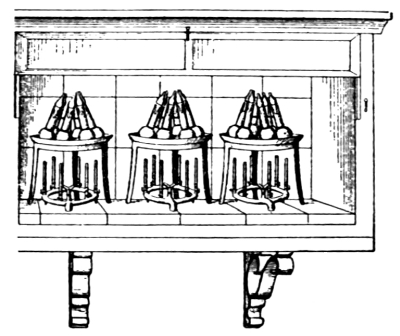
Figure. 11.
Moist Combustion Apparatus of the
Halle Agricultural Laboratory.
At first the tripodal support of the flasks is so turned as to bring
them between the lamps and in this way a too rapid reaction is at first
avoided. After half an hour the tripods are so turned as to bring each
flask directly over the lamp, the flame of which is allowed to impinge
directly against the glass. The flame is so regulated that after the
evolution of the sulfur dioxid has nearly ceased the contents of the
flask are brought into gentle ebullition. The boiling is continued
until the contents of the flask are colorless, usually about two
hours. As a rule such substances as cottonseed-meal and dried blood
will take a longer time for complete combustion than other fertilizing
materials. During the combustion the flasks are closed with an
oblong loose-fitting unground glass stopper. When the oxidation is
finished the contents of the flasks are allowed to cool, the stoppers
are removed, and enough water is added to fill the flasks about
three-quarters full. The flasks are gently shaken, and the possibility
of breaking, from the heat developed, must not be overlooked. To avoid
confusion the flasks are all numbered before beginning the work, and
the numbers noted by the analyst in connection with the samples. The
contents of each one are next poured into the distillation flask and
the digestion vessels are washed with 100 cubic centimeters of water in
three portions, and the wash-water added to the liquid. Sometimes in
washing out the digestion flask yellow basic mercury compounds separate
on its walls, but this does not, in any way, influence the accuracy
of the results. The distillation flasks should have about 600 cubic
centimeters capacity. To avoid the transfer the digestion may take
place in the distillation flask in which case the latter must be made
of special glass as indicated.
To the liquid thus transferred are added seventy-five cubic centimeters
of soda-lye containing one and one-half times as much potassium sulfid
as is necessary to combine with the mercuric sulfate present. The lye
is of such a strength that sixty cubic centimeters are sufficient to
neutralize the acid present. It has a specific gravity of 1.375 and
contains thirty-three grams of potassium sulfid in a liter.
In order to avoid the bumping which may take place during the
distillation, some granulated zinc should be added.
The distillation flask is closed with a rubber stopper carrying a
bulb-tube which ends above in a glass tube about three-quarters of a
meter long, bent at an acute angle, and passing obliquely downward on
a convenient support. This tube is connected by a rubber, with the end
tube bent nearly at a right angle and dipping into the standardized
acid in the erlenmeyer receiver. The general arrangement of the
distilling apparatus is shown in figure 12.
Since the contents of the vessel are warmed by mixing with the
soda-lye, the flame can be turned on at full head at once at the
commencement of the operation. In about a quarter of an hour the liquid
in the receiver will be at the boiling-point, and the boiling should
be continued for five minutes more, making twenty minutes in all for
the completion of the distillation. By this boiling the contents of
the receiver are not charged with carbon dioxid, as might happen if a
condenser were used. The receiver contains twenty cubic centimeters of
a standardized sulfuric acid solution and about fifty cubic centimeters
of water.
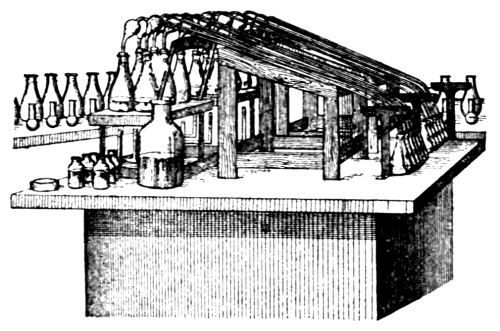
Figure. 12.
Distillation Apparatus of
Halle Agricultural Laboratory.
The acid used should contain 38.1 grams of sulfuric acid of 1.845
specific gravity in a liter; and it should be set by titration with
chemically pure sodium carbonate. For this purpose seven-tenths gram of
sodium carbonate is heated in a platinum crucible for two hours over a
small flame, weighed, and placed in an erlenmeyer together with twenty
cubic centimeters of the sulfuric acid, care being taken to avoid loss
from the vigorous evolution of carbon dioxid. After boiling for ten
minutes all the carbon dioxid is removed from solution. After cooling,
the excess of acid is determined by titration with a standardized
barium hydroxid solution, using rosolic acid as indicator.
The solution of barium hydroxid is made as follows: Digest, with warm
water, 260 grams of caustic baryta, Ba(OH)₂, until it is nearly all
dissolved, filter, and make up to a volume of ten liters and keep in
a flask free of carbon dioxid. A solution of barium hydroxid is to be
preferred to the corresponding sodium compound for titration. If traces
of carbonate be formed in the two liquids, the sodium salt will remain in
solution while the barium compound will settle at the bottom of the flask.
The Indicator.—The indicator used to determine the end of
the reaction is made by dissolving one gram of rosolic acid in fifty
cubic centimeters of alcohol. From one to two drops are enough for
each titration. The color reaction is less definite as the quantity of
ammonia in the liquid increases. When the titration solutions have been
prepared as above described it is found to require about ninety of the
barium hydroxid to neutralize twenty cubic centimeters of the sulfuric acid.
By direct titration with sodium carbonate it is ascertained how many
grams of nitrogen the twenty cubic centimeters of sulfuric acid represent.
Example.—Suppose the weight of the dried sodium carbonate
prepared as above directed is 0.6989 gram.
| |
|
½Na₂CO₃, |
|
|
½N₂ |
| Then 0.6989 |
: |
53 |
= x |
: |
14 |
Whence x = 0.184615 gram of nitrogen.
Suppose further that twenty cubic centimeters of sulfuric acid solution
require ninety-four cubic centimeters of barium hydroxid for complete
saturation and after treatment with the above amount of sodium
carbonate, ten and a half cubic centimeters of the barium solution to
neutralize the remaining acid.
Then 94 - 10.5 = 83.5
And 0.184615: 83.5 = x: 94.
Whence x = 0.207830 gram of nitrogen corresponding to twenty cubic
centimeters of the sulfuric acid used.
Then 0.20783 ÷ 94 = 0.002211 gram of nitrogen corresponding to one
cubic centimeter of the barium hydroxid solution.
If then in the analysis of a fertilizer it is found that 60.5 cubic
centimeters are required to neutralize the excess of sulfuric acid
after distillation the percentage of nitrogen in the sample is found as
follows:
60.5 × 0.002211 = 0.13377.
0.20783 - 0.13377 = 0.07406.
0.07406 × 100 = 7.406 = per cent nitrogen in sample
when one gram is taken for the combustion.
184. The Official Kjeldahl Method. Not Applicable in the Presence
of Nitrates.[153]—Reagents.—(1)
Acids.—(a) Standard hydrochloric acid the
absolute strength of which has been determined by precipitating with
silver nitrate, and weighing the silver chlorid as follows:
To any convenient quantity of the acid to be standardized, add solution
of silver nitrate in slight excess, and two cubic centimeters of pure
nitric acid, of specific gravity 1.2. Heat to boiling-point, and
keep at this temperature for some minutes without allowing violent
ebullition, constantly stirring until the precipitate assumes the
granular form. Allow to cool somewhat, and then pass the fluid
through the asbestos. Wash the precipitate by decantation, with 200
cubic centimeters of very hot water, to which have been added eight
cubic centimeters of nitric acid and two cubic centimeters of dilute
solution of silver nitrate containing one gram of the salt in 100 cubic
centimeters of water. The washing by decantation is performed by adding
the hot mixture in small quantities at a time, and beating up the
precipitate well with a thin glass rod after each addition. The pump is
kept in action all the time, but to keep out dust during the washing
the cover is only removed from the crucible when the fluid is to be added.
Put the vessels containing the precipitate aside, return the washings
once through the asbestos so as to obtain them quite clear, remove
them from the receiver, and set aside to recover the excess of silver.
Rinse the receiver and complete the washing of the precipitate with
about 200 cubic centimeters of cold water. Half of this is used to
wash by decantation and the remainder to transfer the precipitate to
the crucible with the aid of a trimmed feather. Finish washing in the
crucible, the lumps of silver chlorid being broken down with a glass
rod. Remove the second filtrate from the receiver and pass about
twenty cubic centimeters of ninety-eight per cent alcohol through the
precipitate. Dry at from 140° to 150°. Exposure for half an hour is
found more than sufficient, at this temperature, to dry the precipitate
thoroughly.
(b) Standard sulfuric acid, the absolute strength of
which has been determined by precipitation with barium chlorid and
weighing the resulting barium sulfate:
For ordinary work half normal acid is recommended, i. e.,
containing 18.2285 grams of hydrochloric or 24.5185 grams sulfuric acid
to the liter; for work in determining very small amounts of nitrogen,
one-tenth normal acid is recommended. In titrating mineral acids
against ammonia solutions, use cochineal as indicator.
(c) Sulfuric acid, specific gravity 1.84, free of
nitrates and also of ammonium sulfate, which is sometimes added in the
process of manufacture to destroy nitrogen oxids:
(2) Standard alkali, the strength of which, relative to the
acid, has been accurately determined. One-tenth normal ammonia
solution, i. e., containing 1.7051 grams of ammonia to the
liter, is recommended for accurate work:
(3) Metallic mercury or mercuric oxid, prepared in the wet way:
That prepared from mercuric nitrate can not be safely used.
(4) Potassium permanganate finely pulverized:
(5) Granulated zinc, pumice stone, or one-half gram of zinc dust
is to be added to the contents of the flasks in distillation, when
found necessary, in order to prevent bumping:
(6) Potassium sulfid.—A solution of forty grams of commercial
potassium sulfid in one liter of water:
(7) Soda.—A saturated solution of sodium hydroxid free of
nitrates:
(8) Indicator.—Solution of cochineal prepared as follows:
Tincture of cochineal is prepared by digesting for a day or two,
at ordinary temperatures, and frequently agitating, three grams of
pulverized cochineal in a mixture of fifty cubic centimeters of strong
alcohol with 200 cubic centimeters of distilled water. The solution is
decanted or filtered through Swedish paper.
Apparatus.—(1) Kjeldahl digestion flasks of hard,
moderately thick, well-annealed glass: These flasks are about
twenty-two centimeters long, with a round, pear-shaped bottom, having
a maximum diameter of six centimeters and tapering out gradually in a
long neck, which is two centimeters in diameter at the narrowest part,
and flared a little at the edge. The total capacity is from 225 to 250
cubic centimeters.
(2) Distillation flasks of ordinary shape, of 550 cubic
centimeters capacity, or preferably flasks of well-annealed glass, of
the same capacity, of pear-shaped bottom, for both digestion and
distillation, fitted with a rubber stopper and a bulb-tube above
to prevent the possibility of sodium hydroxid being carried over
mechanically during distillation: The bulbs are about three centimeters
in diameter, the tubes being of the same diameter as the condenser and
cut off obliquely at the lower end. This is adjusted to the tube of the
condenser by a rubber tube.
Manipulation.—(1) The Digestion.—From seven-tenths to
three and five-tenths grams of the substance to be analyzed, according
to its proportion of nitrogen, are brought into a digestion flask with
approximately seven-tenths gram of mercuric oxid or its equivalent
in metallic mercury and twenty cubic centimeters of sulfuric acid.
The flask is placed in an inclined position, and heated below the
boiling-point of the acid for from five to fifteen minutes or until
frothing has ceased. If the mixture froth badly, a small piece of
paraffin may be added to prevent it. The heat is then raised until the
acid boils briskly. No further attention is required until the contents
of the flask have become a clear liquid, which is colorless or at least
has only a very pale straw color. The flask is then removed from the
frame, held upright, and while still hot, potassium permanganate is
dropped in carefully and in small quantities at a time until, after
shaking, the liquid remains of a green or purple color.
(2) The distillation.—After cooling, the contents of the
flask are transferred to the distilling flask with about 200 cubic
centimeters of water, a few pieces of granulated zinc, pumice stone, or
one-half gram of zinc dust when found necessary to keep the contents of
the flask from bumping, and twenty-five cubic centimeters of potassium
sulfid solution are added, shaking the flask to mix its contents. Next
add fifty cubic centimeters of the soda solution, or sufficient to make
the reaction strongly alkaline, pouring it down the sides of the flask
so that it does not mix at once with the acid solution. Connect the
flask with the condenser, mix the contents by shaking, and distil until
all ammonia has passed over into the standard acid. The first 150 cubic
centimeters of the distillate will generally contain all the ammonia.
This operation usually requires from forty minutes to one hour and a
half. The distillate is then titrated with standard alkali.
The use of mercuric oxid in this operation greatly shortens the time
necessary for digestion, which is rarely over an hour and a half in
case of substances most difficult to oxidize, and is more commonly
less than an hour. In most cases the use of potassium permanganate is
quite unnecessary, but it is believed that in exceptional cases it is
required for complete oxidation, and in view of the uncertainty it is
always used. The potassium sulfid removes all the mercury from the
solution, and so prevents the formation of mercurammonium compounds
which are not completely decomposed by soda solution. The addition
of zinc gives rise to an evolution of hydrogen and prevents violent
bumping. Previous to use, the reagents should be tested by a blank
experiment with sugar, which will partially reduce any nitrates that
are present, which might otherwise escape notice.
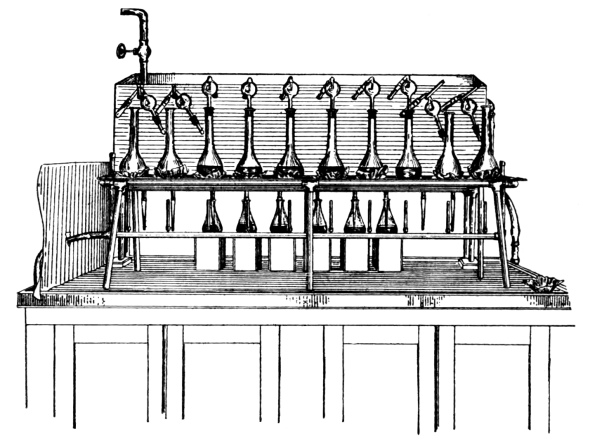
Figure. 13.
Distilling Apparatus.
185. The Distillation Apparatus in Use in the Laboratory of the
Department of Agriculture.—In this laboratory the distilling
apparatus is arranged as shown in Figure 13. The flasks
are the same as are used in the digestion. They are connected to the block
tin condensers by the bulb and rubber tubes, shown hanging on the
projecting ends of the block tin condensers on the right and left of
the figure. The condensers are contained in a trough
through which cold water flows during the distillation. The bulb above
the flask carries an emergent tube which extends to near the center of
the bulb and is bent laterally to avoid any danger of carrying over any
alkali that may be projected into the bulb during boiling. The boiling
is continued usually for nearly an hour or until bumping begins. The
table on which the apparatus is placed is so arranged as to permit of
easy access on all sides. The standard acid is held in erlenmeyers
placed on wooden blocks so that the end of the condenser which is a
drawn-out glass tube, dips beneath the surface of the acid.
186. Patrick’s Distilling Flask.—To avoid the expense and
annoyance attending the breaking of the distilling flasks Patrick has
proposed to make them of copper.[154]
The size, about half a liter, made for the evolution of oxygen for
experimental purposes, may be used. A little excess of potassium
sulfid is used to make up for any of it which might be consumed by
the copper. About twenty-five cubic centimeters of this solution are
recommended. No zinc or pumice stone is required to prevent bumping and
the distillation may be finished within thirty minutes, thus securing
a saving of time. There will doubtless be a slight corrosion of the
flasks by the sulfid employed but where the gunning oxidation process
is practiced this danger would be avoided.
187. Modifications of the Kjeldahl Process.—It would be
impracticable here to give even a summary of the many unimportant
changes which the moist combustion process has undergone since the
first papers of its author were published. These changes may be divided
into three classes; viz., 1. Those changes which refer solely
to the quantities of substance taken for analysis, to the composition
of the acid mixture, to the duration of the digestion, to the form and
size of the flasks, both for digestion and distillation, and to the
manner of distillation and of titration. For references to the papers
on these subjects the reader may consult the periodic journals.[155]
The most important of these minor changes are the following: Instead of the
titration by means of separated iodin most chemists have had recourse to
the simpler method of direct titration of the excess of acid by a set
solution of an alkali. Barium, sodium, and potassium hydroxids are the
alkaline solutions most employed. This process permits of a larger
quantity of the sample being taken for combustion and of the use of a
larger quantity of acid in the receiver. It also implies the use of
a larger digestion flask. In fact it is now quite common to make the
digestion in a special glass flask large enough to be used also for the
distillation. This saves one transfer of the material with the possible
danger of loss attending it.
In the distillation it is a common practice, especially in Germany, to
do away with the condensing worm and to carry a long glass tube from
the distilling flask directly into the acid on the receiver. The only
inconvenience in this method is the heating of the contents of the
receiving flask, but this is attended with no danger of loss of ammonia
and the distillate, on account of the high temperature it acquires, is
left free of carbon dioxid. Many of these minor changes have tended to
simplify the process, but without affecting the principle of the method
in the least.
2. In the second place a class of changes may be mentioned in which
there is a marked difference in the method of effecting the oxidation
secured by the introduction of a substance, usually a metal, during
the digestion for the purpose of accelerating the oxidation. In
the original process the only aid to oxidation was applied at the
end of the digestion in the use of potassium permanganate. In the
modifications now under consideration a metallic oxid or metal is
applied at the beginning of the digestion. Copper and mercury are the
metals usually employed. A separate paragraph will be given to the
description of this modification known as the process of Wilfarth.
3. The third class of changes is even more radical in its nature,
having for its object the adaptation of the moist combustion method
to oxidized or mineral nitrogen. The chief feature of this class
of changes consists in the introduction of a substance rich in
hydrocarbons, and capable of easily forming nitro compounds, for the
purpose of holding the oxids of nitrogen which are formed during the
combustion and helping finally to reduce them to the form of ammonia.
The chief varieties of this class of changes were proposed by Asboth,
Jodlbaur, and Scovell, and will be fully set forth in separate
paragraphs.
188. Method of Wilfarth.—The basis of this modification as
already noted rests on the fact that certain metallic oxids have the
power of carrying oxygen, and thus assisting in a katalytic way in
the combustion of organic matter.[156]
The copper and mercury oxids are best adapted for this purpose and
experience has shown that mercuric oxid, or even metallic mercury
gives the best results. The manipulation is carried out as follows:
From one to three grams of the sample, according to its richness in
nitrogen, are heated with a mixture of twenty cubic centimeters of acid
containing two-fifths fuming and three-fifths ordinary sulfuric acid.
To this is added about seven-tenths gram of mercuric oxid prepared
in the wet way from a mercury salt free of nitrogen. The combustion
takes place in the usual kjeldahl flask. If the boiling be continued
until the liquid is entirely colorless, final oxidation with potassium
permanganate is unnecessary. To save time the combustion may be
stopped when a light amber color is reached, and then the oxidation
finished with permanganate. Before distilling, a sufficient quantity
of potassium sulfid is added to precipitate all the mercury as sulfid
and thus prevent the formation of mercurammonium compounds which would
produce a deficit of ammonia. A convenient strength of the sulfid
solution is obtained by dissolving forty grams of potassium sulfid
in one liter of water. Bumping at the end of the distillation is not
usual, especially if potash-lye be used, but should it occur it may be
stopped by the addition of zinc dust.
Only when a large excess of potassium sulfid is used is there an
evolution of hydrogen sulfid, the presence of which, however, does not
influence the accuracy of the results.
The presence of mercuric sulfid in the solution tends to prevent
bumping during the distillation, but it is advisable, nevertheless, to
use a little zinc dust. Other minor modifications consist of forming
the acid mixture with equal volumes of concentrated and fuming sulfuric
acid containing in one liter 100 grams of phosphoric acid anhydrid,[157]
and using metallic mercury instead of mercuric oxid; or a mixture of
half a gram of copper sulfate and one gram of metallic mercury,[158]
or half a gram of copper oxid and a few drops of platinic chlorid solution
containing 0.04 gram of platinum in a cubic centimeter.[159]
189. Modification of Asboth.—In order to adapt the
moist combustion process to nitric nitrogen Asboth proposed the use of
benzoic acid.[160] For half a gram of saltpeter 1.75 grams of benzoic
acid should be used. At the end of the combustion the residual benzoic
acid is oxidized by means of potassium permanganate with a subsequent
reheating. If the nitrogen be present as an oxid or as cyanid, one gram
of sugar is added. The metallic element added is half a gram of copper
oxid. Asboth also recommends that the soda-lye used in the distillation
be mixed with sodium potassium tartrate for the purpose of holding the
copper and manganese oxids in solution and thus preventing bumping. The
alkaline liquor contains in one liter 350 grams of the double tartrate
and 300 grams of sodium hydroxid.
The principle on which the use of benzoic acid rests is found in the
fact that it easily yields nitro-compounds and thus prevents the loss
of the nitrogen oxids, these readily combining with the benzoic acid.
The nitro-compounds can be subsequently converted into ammonia by
treatment with potassium permanganate.
The pyridin and chinolin groups of bodies do not yield all their
nitrogen as ammonia by the above treatment.
The conclusions drawn by Asboth from the analytical data obtained were:
(1) Sugar should be used in the ordinary kjeldahl process in those
cases where the nitrogen in the organic substance is present as oxids
or as cyanogen.
(2) In the case of nitrates good results may be secured with benzoic
acid but permanganate must be added at the end.
(3) The kjeldahl-wilfarth process can be applied with substances
difficultly decomposed, e. g., alkaloidal bodies.
190. Variation of Jodlbaur.—The benzoic acid method, although a
step forward, is not entirely satisfactory in the treatment of nitrates
by moist combustion. Jodlbaur has proposed to substitute for the
benzoic, phenolsulfuric acid.[161]
From two to five-tenths gram of a nitrate are treated with twenty cubic
centimeters of concentrated sulfuric and two and a half of
phenolsulfuric acid, together with three grams of zinc dust and five
drops of a solution of platinic chlorid of the strength mentioned
above. The phenolsulfuric acid is prepared by dissolving fifty grams of
phenol in 100 cubic centimeters of strong sulfuric acid. The combustion
is continued until the solution is colorless, which may take as much as
five hours. If phosphoric acid anhydrid be used as recommended above,
the time of the combustion may be diminished by one-half, but in such
a case the glass of the combustion flask is strongly attacked and is
quite likely to break.
With substances very rich in nitrates it is advisable to rub them first
with dry gypsum.
The theory of the process rests on the fact that by a careful
admixture of a nitrogenous substance diluted with land plaster, with
phenolsulfuric acid, it is possible to change the nitric acid into
nitro-phenol, and by the reducing action of zinc dust to change the
nitro-product formed into amido-phenol. This afterwards is transformed
into ammonium sulfate by heating with sulfuric acid, by which process,
at the same time, all other nitrogenous compounds present in the
substance, as with Kjeldahl’s method, likewise form ammonium sulfate,
only with the difference that addition of mercury is here absolutely
necessary for the complete transformation of the slowly decomposed
amido-phenol which again brings about the necessity of decomposing
the nitrogenous mercury compounds formed in the solution by potassium
sulfid, which is added after or with the soda-lye.
191. The Dutch Jodlbaur Method.—The Royal Experiment Station of
Holland directs that the jodlbaur process be carried out as indicated
below.[162]
The reagents necessary are:
1. Phenolsulfuric acid, prepared by dissolving 100 grams of pure
crystallized phenol in pure sulfuric acid (1.84) and making up the
solution to a liter with the same sulfuric acid:
2. Zinc, carefully washed and thoroughly dried:
3. Sodium hydroxid solution, the same as is used in the kjeldahl
method:
4. Potassium sulfid solution, made by dissolving 355 grams of
potassium sulfid (K₂S), or sodium sulfid solution, made by dissolving
250 grams of sodium sulfid (Na₂S) in a liter of water.
As apparatus, are necessary oxidation flasks holding about 200
cubic centimeters, and distillation flasks holding about 750 cubic
centimeters, both of bohemian glass.
Manipulation.—Weigh one gram of substance, moisten it with
water, dry, and introduce into an oxidation flask. Cover with fifteen
cubic centimeters of phenolsulfuric acid and, after cooling, thoroughly
mix by gently shaking. After five minutes add from two to three grams
of zinc in small proportions, keeping the flask cool, then twenty cubic
centimeters of sulfuric acid, and finally two drops of mercury. Boil
the mixture till the fluid is colorless. Cool and dilute. Wash into
a distillation flask and add an excess of sodium hydroxid solution
and twenty-five cubic centimeters of the sodium (or potassium) sulfid
solution. Distil and titrate as in the kjeldahl method.
192. The Halle-Jodlbaur Method.—At the Halle station it
is the uniform practice to mix the nitrate with gypsum before the
combustion.[163]
In the case of Chile phosphates ten grams are rubbed with an equal
amount of gypsum, and two grams of the mixture, equal to one gram of
the nitrate, taken for the determination. In the case of saltpeter
mixtures which contain over eight per cent of nitrogen, one gram of
the mixture with gypsum is taken, of guanos one and a half grams, and
of lower forms of nitrates or mixtures thereof, from three to five grams.
The sample, as prepared above, is treated with thirty cubic centimeters
of a mixture of phenolsulfuric acid and phosphoric acid anhydrid.
The mixture is prepared by dissolving sixty-six grams of phenol and
250 grams of phosphoric anhydrid in strong sulfuric acid, and, after
cooling, mixing the two solutions and making the volume up to 1,650
cubic centimeters with pure sulfuric acid. The mixture contains, in
thirty cubic centimeters, one and two-tenths grams of phenol and four
grams of phosphoric anhydrid. In the use of phenolsulfuric acid the
the presence of phosphoric anhydrid is indispensable in keeping the
sulfuric acid water-free and in absorbing the water produced by the
combustion.
The phenolsulfuric acid used contains only enough phenol to reduce half
a gram of saltpeter.
The sample and acid mixture having been put in the combustion flask the
latter is shaken, at intervals, for an hour, and the contents cooled.
The conversion of the nitrates into nitro-phenol compounds is finished
in this time, and the next step consists in reducing these bodies to
the amido-phenol group. This is accomplished in the cold by nascent
hydrogen produced by the addition of zinc dust to the mixture. From one
to three grams of the dust are to be used in proportion to the quantity
of nitrates originally present.
The flask should be placed in a cooling mixture and the zinc dust added
in small portions to prevent a too violent evolution of hydrogen.
After the reduction is ended the flask is allowed to stand for two
hours, after which the combustion, distillation, and titration are
accomplished in the usual way. On cooling, after the end of the
combustion, the contents of the flask become solid. They may be brought
again into liquid state by shaking and gentle warming.
193. The Official Kjeldahl Method for Nitric Nitrogen.—As has
already been stated, the presence of certain organic compounds, rich in
hydrocarbons, permits the reduction of nitric nitrogen to ammonia by
combustion with sulfuric acid. Benzol, phenol, and salicylic acid have
all been used for this purpose. The official chemists have adopted for
their method the salicylic acid process first proposed by Scovell.[164]
Besides the reagents and apparatus given under the Kjeldahl method
there will be needed:
(1) Zinc dust: This should be an impalpable powder; granulated
zinc or zinc filings will not answer.
(2) Sodium thiosulfate:
(3) Commercial salicylic acid:
It is found most convenient to prepare a solution of 33.3 grams of
salicylic acid in one liter of the strongest sulfuric acid, and keep
it for use rather than to mix it for each combustion. We prefer the
thiosulfate process first mentioned below. In the zinc dust method
there has been noticed a tendency for the distillation flask to break
just at the end of the process.
The Manipulation.—Place from seven-tenths to three and
five-tenths grams of the substance to be analyzed in a kjeldahl
digesting flask, add sixty cubic centimeters of sulfuric acid containing
one gram of salicylic acid, and shake until thoroughly mixed, then add
five grams of crystallized sodium thiosulfate; or add to the substance
thirty cubic centimeters of sulfuric acid containing two grams of
salicylic acid, then add gradually two grams of zinc dust, shaking the
contents of the flask at the same time. Finally place the flask on
the stand for holding the digestion flasks, where it is heated over a
low flame until all danger from frothing has passed. The heat is then
raised until the acid boils briskly and the boiling continued until
white fumes no longer pour out of the flask. This requires about five
or ten minutes. Add now approximately seven-tenths gram of mercuric
oxid or its equivalent in metallic mercury, and continue the boiling
until the liquid in the flask is colorless or nearly so. In case the
contents of the flask are likely to become solid before this point is
reached add ten cubic centimeters more of sulfuric acid. Complete the
oxidation with a little potassium permanganate in the usual way, and
proceed with the distillation as described in the kjeldahl method. The
reagents should be tested by blank experiments.
194. The Gunning Moist Combustion Process.—The modification
proposed by Gunning was based upon the observation that in the ordinary
kjeldahl process the excess of sulfur trioxid in the beginning of
the operation soon escapes or unites with water in a form not easily
decomposed.[165]
During the progress of the combustion the acid diminishes in strength
until it is below the concentration represented by the formula H₂SO₄,
and in this diluted condition the oxidation takes place more slowly.
Gunning proposes to avoid this difficulty by mixing potassium sulfate
with the sulfuric acid. This salt forms with the sulfuric acid, acid
salts which, by heating, lose water easier than acid and as is well
known, they not only act as decomposing and oxidizing media as well as
sulfuric acid, but even in a higher degree, resembling the action of
sulfuric acid at high temperatures and under pressure.
By heating this mixture of sulfuric acid and potassium sulfate with
organic matters in an open vessel, not only the water originally
present, but that which is formed during the oxidation is driven off
without loss of acid. For this reason instead of the oxidizing mixture
becoming weaker, the acid becomes stronger, the boiling-point rises and
this, combined with the fluidity of the mass favors the decomposition
and oxidation of the organic matter in a constantly increasing ratio.
The original mixture used by Gunning had the following composition;
viz., one part of potassium sulfate and two parts of strong
sulfuric acid. The substances are united by heat and, on cooling, are
in a semi-solid state, melting, however, easily on the application
of heat and assuming a condition to be easily poured from vessel to
vessel. The quantity of the sample taken should vary in proportion to
its nitrogenous content from half a gram to a gram. The combustion
takes place in flasks entirely similar to those used in the ordinary
kjeldahl process. In the case of liquids, they should be previously
evaporated to dryness before the addition of the oxidizing mixture. At
the beginning of the combustion there is a violent foaming attended
with evolution of some acid and much water, and afterwards of stronger
acid. This loss of acid should not be allowed to go far enough to
produce too great concentration of the material in the flask. One of
the best ways to avoid it is to place a funnel in the flask covered
with a watch-glass which will permit of the condensation and return
of the escaping acid. As soon as the foaming ceases, the flame should
be so regulated as to permit of the volatilized acid being condensed
upon the sides of the flask. In the end a colorless mass is obtained
in which no metallic oxids are present, and this mass can at once be
diluted with water, treated with alkali, and distilled. According to
the nature of the substance from half an hour to an hour and a half are
required for the complete combustion.
Modifications of the Gunning Method.—As in the case of the
kjeldahl method, numerous minor modifications of the gunning method
have been made, the most important of which relate to its application
to substances containing nitrates. In general the same processes are
employed in this case as with the kjeldahl method. One of the best
modifications consists in the use of the mixture of salicylic and
sulfuric acids followed by the addition of sodium thiosulfate or of
potassium sulfate or sulfid. These modifications will be given in
detail under the official methods.
195. Reactions of the Gunning Process.—The various reactions
which take place during the combustion according to the gunning method
have been tabulated by Van Slyke.[166]
The first reaction to take place is the union of sulfuric acid and
potassium sulfate to form potassium acid sulfate in accordance with the
following equation:
(1) K₂SO₄ + H₂SO₄ = 2KHSO₄.
When heated, the potassium acid sulfate
decomposes, forming potassium disulfate and water, thus:
(2) 2KHSO₄ = K₂S₂O₇ + H₂O.
The potassium disulfate at a higher temperature
decomposes, forming normal potassium sulfate and sulfur trioxid, thus:
(3) K₂S₂O₇ = K₂SO₄ + SO₃.
At a sufficiently high temperature the two
preceding reactions may take place in one, thus:
2KHSO₄ = K₂SO₄ + H₂O + SO₃.
At the temperature at which these reactions take place, the water
that is set free does not recombine with the sulfur trioxid nor with
the sulfuric acid that is present in excess, but is expelled from
the mixture; hence the mixture becomes more concentrated during the
digestion. The sulfur trioxid set free acts upon the organic matter in
the powerful manner peculiar to it, and the potassium sulfate formed
in the last reaction above unites with another molecule of sulfuric
acid, and the same round of reactions is repeated continuously so long
as there is an excess of free sulfuric acid present in the mixture.
As the liquid becomes more concentrated with the continuation of the
digestion, the boiling-point increases so that the effect is the same
as heating under pressure. The danger of too great concentration and
risk of consequent loss of nitrogen is avoided by using increased
proportions of sulfuric acid.
As compared with the kjeldahl the gunning method presents the following
advantages:
(1) The gunning method requires fewer reagents. As no form of mercury
is used no potassium sulfid is needed, and there is no risk of loss
from the presence of mercurammonium compounds.
(2) The solution to which caustic soda is added is clear, so that in
neutralizing, it is an easy matter to avoid great excess of alkali, and
so, in most cases, to avoid foaming and bumping in distillation.
(3) In the blank determinations less nitrogen is found in the reagents
used in the gunning method. In only one case was more nitrogen reported
in a blank by this method; in all the others the amount averaged
considerably less.
196. The Official Gunning Method.—In a digestion flask holding
from 250 to 500 cubic centimeters place from seven-tenths to two and
eight-tenths grams of the substance to be analyzed, according to its
proportion of nitrogen. Then add ten grams of powdered potassium
sulfate and from fifteen to twenty-five cubic centimeters (ordinarily
about twenty cubic centimeters) of concentrated sulfuric acid. Conduct
the digestion as in the kjeldahl process, starting with a temperature
below boiling-point and increasing the heat gradually until frothing
ceases. Digest until colorless or nearly so. Do not add either
potassium permanganate or potassium sulfid. Dilute, neutralize, and
distil as in the kjeldahl method. In neutralizing, it is convenient
to add a few drops of phenolphthalein indicator, by which one can
tell when the acid is completely neutralized, remembering that the
pink color, which indicates an alkaline reaction, is destroyed by
a considerable excess of strong fixed alkali. The distillation and
titration are conducted as in the kjeldahl method. In distilling,
the use of zinc or of any substance to prevent bumping or foaming
is generally unnecessary, if too great an excess of fixed alkali be
avoided. The amount of sulfuric acid recommended by Gunning is two
grams for each gram of potassium sulfate; but Voorhees has found that
this mixture is so viscous as to cause troublesome foaming frequently,
and after cooling it cakes in a hard mass, which may be difficult
to redissolve.[167]
To avoid foaming and caking, he has found it an effective means to
increase the amount of sulfuric acid used, taking instead of two grams
to one of potassium sulfate three or four grams of acid to one of
potassium sulfate. It is, therefore, suggested in carrying out the
work, to use from five to twenty-five cubic centimeters (ordinarily
about twenty cubic centimeters) of sulfuric acid for ten grams of
potassium sulfate. In case the potassium sulfate is not free from
nitrogen compounds, one or two recrystallizations will make it pure.
197. Gunning Method Adapted to Nitrates.—The essential
features of this modification are due to Winton and Voorhees.[168] The
modifications of the kjeldahl method, for similar purposes, furnished
the material details for the gunning modified process. Winton reports
good results from digesting for two hours, from half a gram to a gram
of the sample with thirty cubic centimeters of sulfuric containing
two grams of salicylic acid, in a flask of half a liter capacity. Two
grams of zinc dust are then slowly added, with constant shaking, and
the flask heated, at first gently, until, after a few minutes boiling,
dense fumes are no longer emitted. Three grams of potassium sulfate are
next added and the boiling continued until the solution is colorless,
or if iron be present, until a light straw color is produced. On
cooling, when the mixture begins to solidify, water is added with
caution, and afterwards sodium hydroxid, and the ammonia is obtained by
distillation.
In the process, as conducted by Voorhees, about one gram of the sample
is digested with ten grams of potassium sulfate and thirty cubic
centimeters of sulfuric containing one gram of salicylic acid, and
three grains of zinc sulfid. The heat is kept down until frothing
ceases, and then the mass kept in gentle ebullition until clear. The
distillation is accomplished with the usual precautions. The voorhees
process is superior to that recommended by Winton in adding the
potassium sulfate at the beginning of the combustion.
198. Official Gunning Method Modified to Include the Nitrogen of
Nitrates.—In a digestion flask holding from 250 to 500 cubic
centimeters, place from seven-tenths to three and five-tenths grams
of the substance to be analyzed, according to the amount of nitrogen
present. Add from thirty to thirty-five cubic centimeters of salicylic
acid mixture, namely, thirty cubic centimeters of sulfuric to one gram
of salicylic acid, shake until thoroughly mixed, and allow to stand
from five to ten minutes, with frequent shaking; then add five grams of
sodium thiosulfate and ten grams of potassium sulfate. Heat very gently
until frothing ceases, then strongly until nearly colorless. Dilute,
neutralize, and distil the same as in the gunning method.
199. Introductory Considerations.—In the foregoing pages has
been given a summary of the methods most in vogue for the estimation
of nitrogen in fertilizers and fertilizing materials. There are many
cases in which the analyst may have to deal with a definite chemical
compound, and where a modified or shorter method may be used. There
are other cases in which the nitrogen may be present in two or three
definite forms, as in artificially mixed fertilizers, and where it
is desirable to show the proportions in which the various forms are
present. For these reasons it is necessary to be able to use methods by
which the percentage of nitrogen in its various forms may be relatively
as well as absolutely determined. Such a case would be presented for
instance, in that of a fertilizer containing dried blood, sodium
nitrate, and ammonium sulfate. It is evident here that the total
nitrogen could be determined by the volumetric method by combustion
with copper oxid, or by the moist combustion process adapted to
nitric nitrogen, but the method of determining the percentage of each
constituent has not yet been described.
We have to deal here with a case entirely similar to that of phosphoric
acid in a superphosphate. There is no doubt whatever of the uneven
assimilability of the different forms of nitrogen. A nitrate, for
instance, is already in condition for assimilation by plants. An
ammoniacal salt is only partly changed to a state suited to plant
nutrition while organic nitrogen is forced to undergo a complete
transformation before it becomes available to supply the needs of the
growing plant. It is important, therefore, equally to the analyst,
the merchant, and the agronomist, to know definitely the forms of
combination in which the nitrogen exists and the relative proportion of
the different combinations.
200. Nitrogen as Ammonia.—The most frequent form in which
nitrogen as ammonia is used for fertilizing is as sulfate. The method
of determination to be described is, however, equally applicable to all
ammonia salts. When no other form of nitrogenous compound is present
the ammonia can be easily and directly determined by distillation
with soda- or potash-lye, as described in the final part of the moist
combustion process.
To one gram of the ammonia salt add from 200 to 300 cubic centimeters
of water and thirty grams of the soda-lye used in the moist combustion
process; distil, collect the ammonia, and titrate the excess of
sulfuric acid exactly as there described.
Fresenius recommends that the ammonia expelled by distillation be taken
up by one-fifth normal sulfuric acid, the excess of which is titrated
with one-fifth normal soda, using phenolphthalein as an indicator.
If the distillate, on examination, be found to contain thiocyanate,
soda-lye cannot be used for the expulsion of ammonia, but, in its
place, caustic magnesia is applied.
In all cases where organic matter containing nitrogen is present,
caustic magnesia must be substituted for the soda solution. The
magnesia must be added in sufficient excess and the distillation
continued a little longer than is necessary when soda-lye is used.
Otherwise the details of the operation are the same.
In a mixed fertilizer containing organic nitrogen and ammonia salts,
the total nitrogen can be determined by the moist combustion process,
and the ammoniacal nitrogen by distillation with magnesia. The
difference between the two results will give the nitrogen due to the
organic matter.
To avoid any danger whatever of decomposing organic nitrogenous
compounds, the ammonia may be determined in the cold by treatment with
soda-lye, under a bell-jar containing some set sulfuric acid. The
operation must be allowed to continue for many days. Even at the end
of a long time it will be found that some ammonia is still escaping.
It may therefore be finally inferred that all the nitrogen as ammonia
is not obtained by this process, or that even magnesia may gradually
convert other nitrogenous compounds into ammonia. In this connection
the methods of determining ammonia in soils 406, 407, and
408 of volume one may be consulted.
201. Method of Boussingault.—The official French method
is essentially the original method of Boussingault with slight
modifications. It is conducted as follows:[169] In case the sample is
ammonium sulfate about half a gram is placed in a flask of half a liter
capacity, together with 300 cubic centimeters of distilled water and
two grams of caustic magnesia. The flask is connected with a condenser
of glass or metal which ends in a tube drawn out to a point and dipping
beneath the set acid in the receiver in the usual way. The acid is
colored with litmus or lacmoid tincture. The distillation is continued
until about 100 cubic centimeters have gone over. The receiver is then
removed with the usual precautions and the residual acid titrated.
Suppose twenty cubic centimeters of normal acid have been employed and
twelve and a half cubic centimeters of normal alkali be necessary to
neutralize the excess of the acid. Then the nitrogen is found by the
following equations: 20.0 - 12.5 = 7.5 and 7.5 × 0.014 = 0.105 gram =
weight of nitrogen found. Then 0.105 × 100 ÷ 5 = 21.00 = per cent of
nitrogen found.
The distilling apparatus of Aubin is preferred by the French chemists,
an apparatus so arranged with a reflux partial condenser, that nearly
all the aqueous vapor is returned in a condensed state to the flask
while the ammonia, on account of its great volatility, is carried
over into the receiver. To avoid the regurgitation which might be
caused by the concentrated ammonia gas coming in contact with the acid
the separable part of the condensing tube is expanded into a bulb
large enough to hold all the acid which lies above its mouth. By the
means of this apparatus the ammonia is all collected in the standard
acid without greatly increasing its volume and the titration is thus
rendered sharper. The employment of caustic magnesia has the advantage
of not decomposing any organic matters or cyanids that may be present.
If the sample under examination hold part of its ammonia as ammonium
magnesium phosphate it will be necessary first to treat it with
sulfuric acid in order to set the ammonia free and then to use enough
of the magnesium oxid to neutralize the excess of the sulfuric acid and
still supply the two grams necessary for the distillation. When the
sample contains a considerable quantity of organic matter it sometimes
tends to become frothy towards the end of the distillation. This
trouble can be avoided by introducing into the flask one or two grams
of paraffin.
Where carbon dioxid is given off during the distillation the contents
of the receiver must be boiled before titration, or else lacmoid must
be used as an indicator instead of litmus.
202. Determination of Thiocyanates in Ammoniacal
Fertilizers.—The extended use of ammonium sulfate as a fertilizer
renders it important to determine the actual constituents which may
be present in samples of this material. The following bodies have
been found in commercial ammonium sulfates: Sulfuric acid, chlorin,
ammonia, thiocyanic acid, potash, soda, lime and iron oxid. These are
found in the soluble portions. In the insoluble portions have been
found silica, sulfuric acid, lime, magnesia and iron oxid. A sample of
commercial ammonium sulfate analyzed by Jumeau contained the following
substances:[170]
| |
Per cent. |
| Moisture |
10.5109 |
| Ammonium sulfate |
67.8453 |
| Ammonium thiocyanate |
9.3935 |
| Sodium sulfate |
9.2429 |
| Potassium sulfate |
0.9774 |
| Calcium sulfate |
0.6800 |
| Iron thiocyanate |
0.5000 |
| Magnesium chlorid |
traces |
| Silica |
0.0830 |
| Undetermined |
0.7670 |
The determination of the thiocyanic acid in the thiocyanate is
generally made by the oxidation of the sulfur to sulfuric acid and its
subsequent weighing in the form of barium sulfate. Jumeau has modified
the method by determining the amount of the thiocyanate by means of a
titrated liquid. The method is practiced as follows:
A solution of ammonium thiocyanate is prepared, containing eight
grams of this salt per liter, and its exact content of thiocyanate is
rigorously determined by titration with silver nitrate or by the weight
of the barium sulfate produced after the oxidation of the sulfur. Ten
cubic centimeters of the titrated liquor are taken and diluted with
water to about 100 cubic centimeters and ten cubic centimeters of pure
sulfuric acid added. Afterward, drop by drop, a solution of potassium
permanganate is added, containing about ten grams of that salt per
liter. The permanganate is instantly decolorized. There is an evolution
of hydrocyanic acid as the thiocyanate passes to the state of sulfuric
acid. A single drop in excess gives to the mixture the well-known rose
coloration of the permanganate solution which persists for several
hours. The number of cubic centimeters necessary to produce the
persistent rose tint is noted and the same operation is carried on
with from one-half to one gram of the unknown product which is to be
assayed. A simple proportion indicates the content of the thiocyanate
in the unknown body. The process is of great exactitude and permits the
rapid determination of thiocyanic acid in the presence of chlorids,
cyanids, etc., which remain without action upon the permanganate. In
case chlorids and cyanids are absent the thiocyanate can be determined
directly by silver nitrate either by weighing the precipitate or by
the process of Volhardt based upon the precipitation of the silver by
thiocyanate in the presence of a ferric salt. The end of the reaction
is indicated by the red coloration which the liquid shows when the
thiocyanate is in excess.
203. Separation of Albuminoid from Amid and Other Forms of Nitrogen
in Organic Fertilizers.—It may be of interest to the dealer,
farmer, and analyst, to discriminate between the albuminoid and
other nitrogen in fertilizers, such as oil-cakes. The final value
of the nitrogen for plant nourishment is not greatly different, but
the immediate availability for nitrification is a matter of some
importance. The most convenient process in such a case is the copper
hydroxid separation process as improved by Stutzer.[171]
The process is conveniently carried out in accordance with the method
prescribed by the official chemists.[172]
Total Crude Protein.—Determine nitrogen as directed for nitrogen
in fertilizers and multiply the result by 6.25 for the crude protein.
Determination of Albuminoid Nitrogen.—To from seven-tenths
to eight-tenths gram of the substance in a beaker add 100 cubic
centimeters of water, heat to boiling, or in the case of substances
rich in starch, heat on the water-bath ten minutes, and add a quantity
of cupric hydroxid mixture containing from one-half to six-tenths
gram of the hydroxid; stir thoroughly, filter when cold, wash with
cold water, and put the filter and its contents into the concentrated
sulfuric acid for the determination of nitrogen. The filter-papers used
must be practically free of nitrogen. Add sufficient potassium sulfid
solution to completely precipitate all copper and mercury, and proceed
as in the moist combustion process for nitrogen. If the substance
examined consist of seed of any kind, or residues of seeds, such as
oil-cake or anything else rich in alkaline phosphates, add a few cubic
centimeters of a concentrated solution of alum just before adding the
cupric hydroxid, and mix well by stirring. This serves to decompose
the alkaline phosphates. If this be not done cupric phosphate and free
alkali may be formed, and the protein-copper may be partially dissolved
in the alkaline liquid.
Cupric Hydroxid.—Prepare the cupric hydroxid as follows:
Dissolve 100 grams of pure cupric sulfate in five liters of water,
and add twenty-five cubic centimeters of glycerol; add a dilute
solution of sodium hydroxid until the liquid is alkaline; filter, rub
the precipitate up with water containing five cubic centimeters of
glycerol per liter, and then wash by decantation or filtration until
the washings are no longer alkaline. Rub the precipitate up again in a
mortar with water containing ten per cent of glycerol, thus preparing
a uniform gelatinous mass that can be measured out with a pipette.
Determine the quantity of cupric hydroxid per cubic centimeter of this
mixture.
Amid Nitrogen.—The albuminoid nitrogen determined as above
subtracted from the total, gives that part of the organic nitrogen
existing in the sample as amids and in other allied forms.
204. Separation of Nitric and Ammoniacal from Organic
Nitrogen.—The nitrogen being present in three forms, viz.,
organic, ammoniacal, and nitric, the separation of the latter two
may be accomplished by the following procedure:[173]
One gram of the fertilizer is exhausted on a small filter with a two per
cent solution of tannin, using from thirty to forty cubic centimeters in
small portions. This is sufficient to dissolve all the nitrates and
the greater portion of the ammoniacal salts, while the tannin renders
insoluble all the organic nitrogenous compounds. The filter and its
contents are treated for nitrogen by the kjeldahl process. When the
distillation and titration are completed the solution obtained by the
aqueous tannin is added to the distilling flask and the operation
continued. This represents the ammoniacal nitrogen.
The nitric acid is estimated by the ferrous iron or other appropriate
method in another portion of the substance.
This method can be used even when the fertilizer contains ammonium
magnesium phosphate. In this case digest one gram for fifteen hours in
dilute soda-lye solution, which easily dissolves the ammonium magnesium
phosphate. Filter and wash the insoluble part with the tannin solution.
The residue is treated as above. The filtered solution distilled with
soda-lye furnishes the ammonia. The nitrates are estimated by one of
the methods above mentioned.
205. Nitric Nitrogen.—The methods of estimating nitric
nitrogen, both when present in weighable quantities and as mere traces
have been sufficiently described in the first volume. For convenience,
however, the standard methods of procedure will be given here. The
moist combustion methods adapted to nitrates and the volumetric copper
oxid process have already been described. Of the reduction methods
the process of Ulsch is one of the easiest of application and also
reliable. As practiced by the official chemists the manipulation is
conducted as described in the first volume, page 539.
206. Ulsch Method, Applicable to Mixed Fertilizers.—The method
of Ulsch which is found to give good results with pure nitrates or with
nitrates in the absence of other forms of nitrogen may also be adapted
to mixed fertilizers containing nitrogen in more than one form. Street
has developed such a method and shown, by analytical data, that it is
applicable in a great number of cases.[174]
The process is based on the substitution of magnesia for soda in the
distillation and is carried on as follows:
Place one gram of the sample in a half liter flat-bottomed flask. Add
about thirty cubic centimeters of water, one gram of reduced iron, and
ten cubic centimeters of sulfuric acid diluted with an equal volume
of water, shake well, and allow to stand for a short time. This will
remove the danger of an explosion caused by the otherwise violent
action which takes place. Close the neck of the flask with a rubber
stopper through which passes a glass dropping-bulb filled with water.
The flask having been stoppered, place it on a slab to which a moderate
heat is applied. Allow the solution to come slowly to a boil and then
boil for five minutes and cool. Add about 100 cubic centimeters of
water, a little paraffin, and about five grams of magnesium oxid. Boil
for forty minutes, after which time all the ammonia will be distilled,
and collect the ammonia in set acid.
The magnesia causes a slight frothing, which can easily be controlled
by adding a little paraffin and by bringing to a boil very gradually.
Fully forty minutes are necessary to distil all the ammonia. Tests were
made after thirty minutes boiling and traces of ammonia were still
found; after forty minutes these traces entirely disappeared.
The method is a quick one. One man can easily do six determinations at
a time, and these six determinations can be made in but a little over
an hour. Magnesia gives results closely agreeing with theory and causes
a very slight frothing, which can be easily controlled. One gram of
reduced iron is sufficient in all ordinary complete fertilizers.
Magnesia is preferred to caustic soda in the distillation because it
produces less frothing and by reason of the danger of some of the
soda-lye being carried over mechanically and thus tending to produce
an error of a plus nature. In the use of magnesia, assurance must be
had that it is strongly in excess. Being less active in its effects
a longer time for the distillation must be taken than when soda-lye
is used. The modified ulsch method just described is recommended
provisionally and with the expectation that each analyst will ascertain
its true merits before allowing it to displace longer approved
processes.
207. Method of Schlösing-Wagner.—The Schlösing-Wagner method
for estimating nitrogen in the nitrates of fertilizers is carried out
at the Halle Experiment Station as follows:[175]
A flask, figure 14, of about 250 cubic centimeters
capacity, is provided with a rubber stopper with two holes. Through one of
them is passed the stem of a funnel carrying a glass stop-cock. The other
carries a delivery-tube leading to the receiving vessel. The end of
the delivery tube is bent so as to pass easily under the mouth of the
measuring burette and is covered with a piece of rubber tubing.
Fifty cubic centimeters of saturated ferrous chlorid solution and the
same quantity of ten per cent hydrochloric acid are placed in the flask.
The ferrous chlorid solution is obtained by dissolving nails or other
small pieces of iron in hot hydrochloric acid and it is kept in
glass stoppered flasks, of about fifty cubic centimeters capacity,
entirely filled. The content of one flask is enough for about twelve
determinations and by using the whole content of a flask as soon as
possible after opening, any danger of oxidation which would take place
in a large flask frequently opened is avoided.
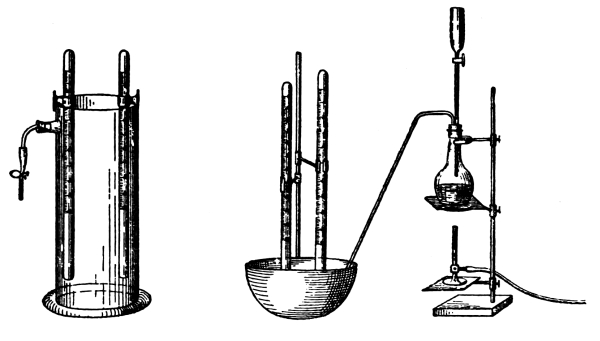
Figure. 14.
Schlösing-Wagner Apparatus.
The contents of the flask are boiled until all the air is driven off.
The delivery-tube is then placed under the measuring-tube, which is
filled with forty per cent potash-lye. The measuring-tube is previously
almost filled with potash-lye and then a few drops of water added and
the tube covered with a piece of filter-paper. By a careful and quick
inversion the measuring-tube can be brought into the vessel receiving
it without any danger of air entering. The boiling is continued for
some time and when no more air escapes, the end of the delivery-tube is
brought into another freshly filled measuring-tube and the estimation
is commenced.
Ten cubic centimeters of a normal saltpeter solution, containing two
and a half grams of pure sodium nitrate in 100 cubic centimeters are
placed in the funnel and, with continued boiling, allowed to pass, drop
by drop, into the flask. When almost all has run out the funnel is
washed three times with ten cubic centimeters of ten per cent
hydrochloric acid and this is allowed to pass, drop by drop, into
the flask. When no more nitric oxid is evolved the measuring-tube is
transferred to a large jar filled with distilled water.
The solution of the substance to be examined should be taken in
such quantity as will give about the same quantity of gas as is
furnished by the ten cubic centimeters test nitrate solution before
described; viz., about seventy cubic centimeters. Eight or ten
determinations can be made, one following the other, and at the end
another determination with normal sodium nitrate solution should be
made as a check. At the end of the operation all of the measuring-tubes
are in the large jar filled with distilled water. The temperature of
the surrounding water will soon be imparted to the contents of each
tube and the volume of nitric oxid is read by bringing the level within
and without the measuring-tube to the same point. The percentages are
calculated for the given temperature and barometer pressure in the
usual way; or to avoid computation the volume can be compared directly
with the volume furnished by a normal nitrate solution, which is a much
simpler method.
208. Schmitt’s Modified Method.—The method is a modification
of that already described by the author in which a mixture of powdered
zinc and iron is used as a reducing agent.[176]
The process is carried out as follows: Ten grams of the nitrate are
dissolved and the volume made up to half a liter. Ten cubic centimeters
of glacial acetic acid and ten grams of the fine metallic powder, iron
and zinc, are placed in a flask of a capacity of about three-quarters
of a liter and twenty-five cubic centimeters of the solution of the
nitrate added. The flask is covered during the reduction to prevent
loss by spraying, and after the solution is complete, which is the case
in about ten minutes, the contents of the flask are diluted with from
200 to 300 cubic centimeters of water, thirty cubic centimeters of
caustic soda of 1.25 specific gravity added, and the whole distilled
as in the kjeldahl process. It must be noted that it is essential that
the iron be finely divided; it is mixed with the powdered zinc in equal
parts. The total nitrogen can be determined in guanos and nitrate
mixtures by the following simple alteration in procedure: One gram of
the substance is dissolved in water, five cubic centimeters of glacial
acetic acid, and from two to three grams of the mixed metallic powder
added, and the whole gently heated for ten or fifteen minutes. After
the contents of the flask have cooled, twenty-five cubic centimeters of
sulfuric acid are cautiously added in small portions, undue frothing
being restrained by the addition of a fragment of paraffin wax. The
acetic acid is then driven off by heating, and the remaining contents
of the flask boiled until the organic matter is completely decomposed,
as in the kjeldahl process. About two hours boiling is required.
Neutralization and distillation are then practiced as in the ordinary
manner. The method is also applicable to the determination of nitrates
in drinking water, provided nitrites and ammonia be absent.
209. Krüger’s Method for Nitric Acid.—About three-tenths
gram of the substance dissolved in water is mixed with twenty cubic
centimeters of a hydrochloric acid solution of stannous chlorid holding
150 grams of tin per liter.[177]
One and a half grams of spongy tin prepared by the action of zinc on
stannous chlorid are added. The flask containing the mixture is heated
until the tin is dissolved, by which time the nitric acid is completely
reduced. The subsequent distillation and titration are accomplished as
usual. In the case of nitro and nitroso compounds, after the solution
of the tin, twenty cubic centimeters of sulfuric acid are added
and heated until sulfuric vapors escape. After cooling, the amido
substances formed are oxidized by potassium bichromate before the
distillation takes place.
Krüger also estimates the nitrogen in benzol, pyridin, and chinolin
derivatives by dissolving them in sulfuric acid, using from two-tenths
to eight-tenths of a gram of the alkaloidal bodies and, after
cooling the solution, oxidizing by adding finely powdered potassium
bichromate.[178]
About half a gram more of the potassium bichromate should be used than
is necessary for the oxidation of the substances in solution. The entire
oxidation does not consume more than from fifteen to thirty minutes.
210. Functions of Sodium Nitrate.—Practically the only form of
oxidized nitrogen which is of importance from an agronomic point of view
is sodium nitrate, often known in commerce by the name Chile saltpeter.
Applied to a growing crop it at once becomes dissolved at the first
rainfall or by the natural moisture of the soil. It carries thus to the
rootlets of plants a supply of nitrogen in the most highly available
state. There is perhaps no other kind of plant food which is offered
to the living vegetable in a more completely predigested state, and
none to which a quicker response will be given. By reason of its high
availability, however, it must be used with care. A too free use of
such a stimulating food may have, in the end, an injurious effect upon
the crop, and is quite certain to lead to the waste of a considerable
portion of expensive material. For this reason sodium nitrate should be
applied with extreme care, in small quantities at a time and only when
it is needed by the growing crop. It would be useless, for instance,
to apply this fertilizer in the autumn with the expectation of its
benefitting the crop to a maximum degree the following spring. Again,
if the application of this salt should be made just previous to a heavy
rain almost or quite the whole of it would be removed beyond the reach
of the absorbing organs of the plant.
When once the nitric acid has been absorbed by the living rootlet it
is held with great tenacity. Living plants macerated in water give up
only a trace of nitric acid, but if they be previously killed with
chloroform the nitric acid they contain is easily leached out.
The molecule of sodium nitrate is decomposed in the process of the
absorption of the nitric acid. The acid enters the plant organism and
the soda is excreted and left to combine with the soil acids. The
nascent soda may thus play a role of some importance in decomposing
particles of minerals containing potash or phosphoric acid. It is
probable that the decomposition of the sodium nitrate takes place
in the cells of the absorbing plant organs for it is difficult to
understand how it could be accomplished externally. While the soda
therefore is of no importance as a direct plant food it can hardly be
dismissed as of no value whatever in the process of fertilization.
Many of the salts of soda as, for instance, common salt, are quite
hygroscopic and serve to attract moisture from the air and thus become
carriers of water between the plant and the air in seasons of drought;
and sodium nitrate itself is so hygroscopic as not to be suited to the
manufacture of gunpowder.
To recapitulate: The chief functions of sodium nitrate are to give
to the plant a supply of oxidized nitrogen ready for absorption into
its tissues and incidentally to aid, by the residual soda, in the
decomposition of silt particles containing potash or phosphoric acid
and in supplying to the soil salts of a more or less deliquescent nature.
211. Commercial Forms of Chile Saltpeter.—The Chile saltpeter
of commerce may reach the farmer or analyst in the lumpy state in
which it is shipped or as finely ground and ready for application to
the fields. Unless the farmer is provided with means for grinding, the
latter condition is much to be preferred. It permits of a more even
distribution of the salt and thus encourages economy in its use. For
the chemist also it is advantageous to have the finely ground material,
which condition permits more easily a perfect sampling, a process
which, with the unground salt, is attended with no little difficulty.
212. Percentage of Nitrogen in Chile Saltpeter.—Chemically
pure sodium nitrate contains 16.49 per cent of nitrogen. The salt of
commerce is never pure. It contains moisture, potash, magnesia, lime,
sulfur, chlorin, iodin, silica and insoluble materials, and traces of
other bodies. The value of the salt depends, therefore, not only on the
market value of nitrogen at the time of sale, but also on its content
of nitrogen. The nitrate of commerce varies greatly in its nitrogen
content and is sold on a guaranty of its purity. The best grades
range in nitrogen from fifteen to sixteen per cent. The content of
nitrogen has long been estimated in the trade by determining the other
constituents and counting the rest as nitrogen. This practice arose
in former times when no convenient method was at hand for determining
nitric nitrogen. The process is tiresome and unreliable because all
errors of every kind are accumulated in the nitrogen content, but
inasmuch as the method is still required by many merchants, the analyst
should be acquainted with it, and it is therefore given further along.
The usual methods for determining nitric nitrogen may be applied in all
cases where samples of sodium nitrate are under examination, but some
special processes are added for convenience.
213. Adulteration of Chile Saltpeter.—The analyst is the
only protector of the farmer in guarding against the practice of
adulteration of sodium nitrate aside from the honesty of the dealer.
Even the honest dealer is compelled to protect himself against fraud,
and therefore, the world over, commerce in this fertilizer is now
conducted solely on the analyst’s certificate. Happily, therefore,
adulteration is almost unknown because it is certain to be detected.
Formerly, the saltpeter was adulterated with common salt, or low grade
salts from the potash mines; but it is an extremely rare thing now to
find any impurities in the salts other than those naturally present.
In every case the analyst may grow suspicious when he finds the content
of nitrogen in a sample to fall below thirteen per cent. It must not be
forgotten, however, that some potassium nitrate may be present in the
sample, and since that salt contains only 13.87 per cent of nitrogen
its presence would tend to lower the value of the fertilizer; but
although the potash itself is a fertilizer of value it is not worth
more than one-third as much as nitrogen. In all cases of suspected
adulteration, it is advisable to make a complete analysis. The results
of this work will, as a rule, lead the analyst to a correct judgment.
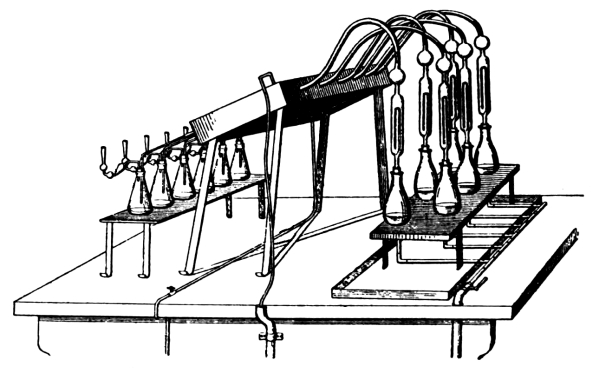
Figure. 15.
Halle Nitric Acid Apparatus.
214. The Halle Zinc-Iron Method.—For determining the nitrogen
in Chile saltpeter the reduction method is conducted at the Halle
Station as follows:[179]
Ten grams of the nitrate are dissolved in one liter and fifty cubic
centimeters of the solution corresponding to half a gram of the sample,
taken for each determination. The apparatus employed is shown in Fig.
15. A mixture of five grams of zinc dust and an equal weight of iron
filings is employed as the source of hydrogen. The reduction takes
place in an alkaline medium secured by adding to the other materials
mentioned, eighty cubic centimeters of soda-lye of 1.30 specific
gravity. The respective quantities of iron and zinc may be measured
instead of weighed, as exact proportions are not required. After the
addition of all the materials the flask is allowed to stand for an hour
at room temperature. The distillation is then commenced and continued
until at least 100 cubic centimeters of distillate have been collected.
The receiving flasks are ordinary erlenmeyers, each of which contains
twenty cubic centimeters of set sulfuric acid, as in the usual kjeldahl
process. The flasks are sealed with a few drops of water by the
device shown in the figure. After the end of the
operation the water in each one is washed back into its proper flask
with freshly boiled water. During the vigorous evolution of hydrogen,
at the beginning of the operation, some kind of a safety arrangement
is necessary to prevent the particles of soda-lye being carried over
by the bubbles of that gas. The siphon bulb shown in the figure is
found effective for this purpose. In this operation better results are
obtained by condensing the escaping steam, and for this reason the
block tin tubes are conducted through a tank supplied with a current
of cold water. The ends of the tubes should not dip below the surface
of the liquid in the receivers. When the condensed liquid collects
in considerable quantities in the safety tube the lamp should be
extinguished under the flask, which permits the return of the liquid
to the flask by means of the siphon. This should be done two or three
times during the progress of the distillation to prevent a too high
concentration of the soda-lye, thus endangering the flask. The excess
of the acid in the receiver is determined by titration, as in the
regular kjeldahl method. Blank determinations should be made, from time
to time, and corrections made in harmony therewith.
215. Method of the French Sugar Chemists.—The nitrogen in Chile
saltpeter is estimated by the French chemists according to the method
of Schlösing, described in the first volume, page 500. In order to
avoid the trouble of calculating the results from the volume of nitric
oxid obtained, a determination is first made with a pure salt, sodium
or potassium nitrate. The volume of gas obtained is read directly
without correction and taken for direct comparison. The comparison is
made as follows:
The solutions of the pure salts and of the sample to be analyzed
are made of such a strength as to contain sixty-six grams of sodium
nitrate, or eighty grams of potassium nitrate, in a liter. Five cubic
centimeters of such a solution will yield a little less than 100 cubic
centimeters of nitric oxid under usual conditions. Let the volume of
gas obtained with the pure salt be v; and that with the sample
be v′. The calculation is then made from the equation:
Example: Let ninety-five cubic centimeters be the volume of
gas from five cubic centimeters of the pure salt (sodium nitrate), and
91.5 cubic centimeters be the volume of gas from five cubic centimeters
of the sample; then
| 91.5 |
= |
x |
, whence x = 96.31. |
| 95 |
100 |
Hence the sample analyzed contains 96.31 per cent of sodium nitrate.
Since the pure sodium nitrate contains 16.47 per cent of nitrogen the
sample under examination would contain
| 16.47 × 96.31 |
= 15.86 per cent. |
| 100 |
It is evident that this comparative method is quite easy of application
when the sample under examination has no other nitrate in it except
that combined with the one base.
216. Volumetric Method of Gantter.—The process proposed
by Gantter for determining the nitrogen, volumetrically, in Chile
saltpeter and other nitrates is based on the following principles:[180]
(1) If a nitrate be heated in contact with sulfuric and phosphorous
acids, nitrous acid will be formed.
(2) If nitrous acid be boiled with ammonium chlorid, nitrogen will
be quantitatively evolved from both compounds. These processes are
illustrated by the following formulas:
(a) N₂O₅ + P₂O₃ = N₂O₃ + P₂O₅.
(b) N₂O₃ + 2NH₄Cl = 2N₂ + 3H₂O + 2HCl.
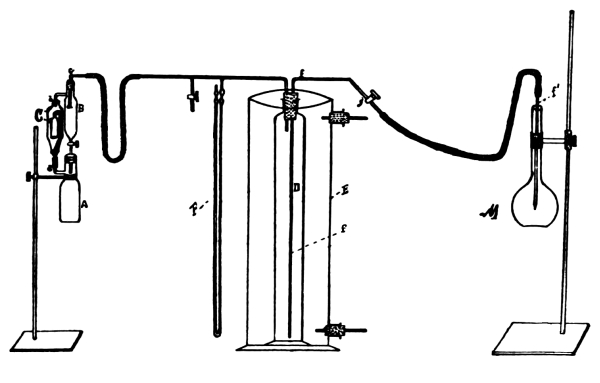
Figure. 16.
Gantter’s Nitrogen Apparatus.
It is seen from the above that the nitrate will give, by this
treatment, double the volume of nitrogen which it contains. In
practice, the two reactions may be secured in one operation by warming
the nitrate solution slowly with sulfuric and phosphorous acids and
ammonium chlorid. The nitric acid, as it becomes free, gives a part
of its oxygen to the phosphorous compound, and the nitrous acid, in
a nascent state, is at once reduced by the ammonium chlorid. There
are two sources of error which must be guarded against in the work; a
portion of the nitrogen may escape reduction to the elementary state,
or some of the nitrate may fail to be decomposed. These errors are
easily avoided if the reaction be begun slowly, so that the evolution
of gas may be gradual. The temperatures at first should, therefore,
be kept as low as possible. The development of red fumes, showing the
presence of undecomposed nitrogen oxids, shows that the results will be
too low. It is necessary, also, to provide for the absorption of the
hydrochloric acid which is formed. The reaction is very conveniently
conducted in the apparatus shown in Fig. 16. The
decomposition takes place in the flask A and the mixed gases pass into the
absorption bulb C. The delivery-tube is very much expanded, as shown in the figure, so
that no soda-lye can enter A during the cooling of the flask. The
absorption bulb is connected with A and B by the tubes a and b as
shown. The tube d connects the apparatus with the gasvolumeter.[181]
The bulb B serves as a pipette for the introduction of the decomposing
acid. The operation is conducted as follows: Three cubic centimeters
of the nitrate solution, containing no more than 300 milligrams
of substance, are placed in the flask A with half a gram each of
crystallized ammonium chlorid and phosphorous acid. In the bulb B are
placed seven cubic centimeters of sulfuric acid to which has been
added one-third its volume of water. Two cubic centimeters of acid are
allowed to flow from B into A. The apparatus is brought to a constant
temperature by being immersed in a large cylinder, E, containing water
at a temperature which can easily be controlled. When this constant
temperature has been reached the apparatus is taken from the cooling
cylinder which contains also a smaller cylinder, D, nearly filled
with water and connected through f′ with the measuring apparatus M.
The barometer-tube F is half filled with colored water so that the
pressure may be equalized before and after the operation. The flask A
is warmed very gently at first, and the nitrogen evolved is conducted
into D driving an equivalent volume of water into M. The evolution of
the gas must be carefully controlled and the heat at once removed if it
become too rapid. The appearance of a red color shows the evolution of
oxids of nitrogen rendering the analysis inexact. When the evolution of
nitrogen has nearly ceased the lamp is removed and some more sulfuric
acid allowed to flow into A from B, after which A is again heated, this
time to the boiling-point. All vapors of hydrochloric acid produced are
absorbed by the soda-lye in C. The boiling is continued a few minutes,
but not long enough to darken the liquid in A. After replacing the
apparatus in the cylinder E and bringing both temperature and pressure
to the same point as before the beginning of the operation, the volume
of nitrogen evolved is determined by measuring the water in M.
The apparatus is first set by using pure potassium or sodium nitrate.
Since the temperature and pressure do not vary much within an hour or
two the volume of water obtained with a sample of white saltpeter can be
compared directly with that given off by the same weight of a pure
potassium or sodium nitrate without correction.
Example.—Two hundred and fifty milligrams of potassium nitrate,
containing 34.625 milligrams of nitrogen, displaced in a given case
sixty cubic centimeters of water; therefore one cubic centimeter
of water equals 0.578 milligram of nitrogen. If 289 instead of 250
milligrams be taken then the number of cubic centimeters of water
displaced divided by five will give the per cent of nitrogen.
217. Method of Difference.—In the analysis of Chile saltpeter
by the direct method a variation of 0.25 per cent in the content of
nitrogen is allowed from the dealers’ guaranty. This would allow a
total variation in the content of sodium nitrate of 1.52 per cent.
Dealers and shippers have always been accustomed to estimate the
quantity of sodium nitrate in a sample by difference; i. e.,
by estimating the constituents not sodium nitrate and subtracting
the sum of the results from 100. Chile saltpeter usually contains
sodium nitrate, water, insoluble ferruginous matters, sodium chlorid,
sodium sulfate, magnesium chlorid, sodium iodate, calcium sulfate and
sometimes small quantities of potassium nitrate.
When the total sodium nitrate is to be estimated by difference the
following procedure, arranged by Crispo,[182]
may be followed:
Water.—Dry ten grams of the finely powdered sample to constant
weight at 150°-160°.
Chlorin.—The residue, after drying, is dissolved and the volume
made up to one-fourth liter with water and the chlorin determined in
one-fifth thereof and calculated as sodium chlorid.
Insoluble.—Twenty grams are treated with water until all
soluble matter has disappeared, filtered on a tared gooch, and the
filtrate dried to constant weight.
Sulfuric Acid.—The sulfuric acid is precipitated by barium
chlorid in the slightly acid filtrate from the insoluble matter. The
acidity is produced by a few drops of nitric acid. The rest of the
process is conducted in the usual way.
Magnesia.—This is precipitated by ammonium sodium phosphate,
filtered, ignited, and weighed as pyrophosphate. The magnesium is then
calculated as chlorid. Magnesia is rarely found in excess of one-fourth
per cent. When this amount is not exceeded the estimation of it may be
neglected without any great error. As has already been said the chlorin
is all calculated as sodium chlorid. If a part of it be combined with
one-fourth per cent of magnesia it would represent 0.59 per cent of
magnesium chlorid instead of 0.73 per cent sodium chlorid. In omitting
the estimation of the magnesia therefore the importer is only damaged
to the extent of 0.14 per cent of sodium nitrate.
Sodium Iodate.—This body, present only in small quantities,
may also be neglected. In case the content of this body should reach
one-fourth per cent the estimation of chlorin by titration using
potassium chromate as indicator is impracticable. Such an instance,
however, is rarely known.
Approximate Results.—When the determinations outlined above
have been carefully made it is claimed that the result obtained by
subtraction from 100 will not vary more than from two-tenths to
three-tenths per cent from the true content of sodium nitrate. The
method, however, cannot be considered strictly scientific and is much
more tedious and chronophagous than the direct determination. In the
direct determination, however, the analyst must assure himself that
potassium is present in only appreciable quantities otherwise the per
cent of sodium nitrate will be too low.
The presence of potassium nitrate is a detriment in this respect only;
viz., that it contains a less percentage of nitrogen than
the corresponding sodium salt. As a fertilizer, the value of Chile
saltpeter may be increased by its content of potassium.
218. The Application of Chile Saltpeter to the Soil.—The
analyst is often asked to determine the desirability of the use of
sodium nitrate as a fertilizer and the methods and times of applying
it. These are questions which are scarcely germane to the purpose of
this work but which, nevertheless, for the sake of convenience may be
briefly discussed. In the first place it may be said that the data of
a chance chemical analysis will not afford a sufficiently broad basis
for an answer. A given soil may be very rich in nitrogen as revealed
by chemical analysis, and yet poor in an available supply. This is
frequently the case with vegetable soils, containing, as they do, large
quantities of nitrogen but holding it in practically an inert state.
I have found such soils very rich in nitrogen, yet almost entirely
devoid of nitrifying organisms. It is necessary therefore in reaching a
judgment on this subject from analytical data to consider the different
states in which the nitrogen may exist in a soil and above all the
nitrifying power of the soil if the nitrogen be chiefly present in
an organic state. Culture solutions should therefore be seeded with
samples of the soil under examination and the beginning and rapidity
of the nitrification carefully noted. In conjunction with this the
nitrogen present in the soil in a nitric or ammoniacal form should be
accurately determined. These determinations should be made according to
the directions given in the first volume, pp. 448-548.
For the determination of nitrifying power we prefer the following
method:
219. Taking Samples of Soil in Sterilized Tubes.—Brass tubes
are prepared twenty centimeters in length and one and a half in
diameter. One end is ground to a beveled edge and compressed in a mold
so as to make the cutting edge slightly smaller in diameter than the
internal diameter of the tube. It is then ground or filed until smooth
and sharp. The blunt end of the tube is stoppered loosely with cotton
and it is then sterilized by heating for an hour to 150°. Rubber caps
are provided and each one has placed at the bottom a rubber ball to
prevent the rubber from being cut by the edges of the brass tube. The
caps should be of two distinct colors. Half of the rubber caps are
sterilized by being boiled for an hour in water for three successive
days. The caps cannot be heated to 150° dry heat with safety. On
removing the brass tube from the sterilizing oven as soon as it is cool
enough to handle, a sterilized rubber cap is slipped over its cutting
end. An unsterilized cap is then slipped over the other end containing
the cotton plug. Inasmuch as the cotton plug is never removed it is not
necessary to sterilize the cap covering it. Large numbers of the tubes
can thus be prepared for use and they can be safely transmitted to a
distance by express or mail. For convenience, each tube is encased in a
small cloth bag, which is tied with a cord carrying a tag on which the
necessary data can be recorded at the time of taking the sample.
The tubes and their rubber caps thus carefully sterilized should not
be removed from their cloth envelopes until the moment of taking each
sample. After the sample has been taken and the cap replaced on the
tube the latter should be immediately enclosed in the cloth sack and
labeled with one of the tags therewith enclosed. The sample should
be taken in two kinds of soil, in one instance in a cultivated soil,
which is most characteristic of the locality, and in the second place
a virgin soil of the same type. The virgin soil may be either soil
which has been covered with grass or in forest. The spots at which the
samples are to be taken having been previously selected, the tags for
each tube should be prepared beforehand so as to avoid delay at the
time of sampling. A pit with straight walls should be dug, the sides of
which are at least two feet wide and even three feet would be better.
The pit should be about forty-two inches deep. One of the sides having
been made perfectly smooth and without allowing the loose fragments
from the top to fall down and adhere to the walls below, the spots at
which the samples are to be taken should be marked with a tape line
at the following points; viz., three, fifteen, twenty-seven,
and thirty-nine inches, respectively, below the surface. Beginning at
the bottom point, carefully scrape off the surface of the wall over an
area slightly larger than that of the end of the sample tube by means
of a spatula, which, just previous to use, has been held for a moment
or two in the flame of an alcohol or other convenient lamp. The sample
tube having been removed from its sack, it will be noted that the end
covered with black rubber is the one which is to be held in the hand,
and this black rubber cap should be first removed being careful not to
extract the plug of sterilized cotton which closes the end of the tube.
Holding the tube firmly by the end, the fingers extending only about
two inches from the end, remove the light-colored cap and push the
tube with a turning motion into the side of the pit at the point where
the surface has been removed with the sterilized spatula. When this is
properly done the tube will be filled with a cylinder of soil equal to
the length of the part of the tube penetrating the wall of the pit.
The tube is then withdrawn, the light rubber cap first replaced, and
then the black one. The light rubber cap should be held in the hand
during the process in such a way that no dust or particles of soil are
permitted to contaminate its inner walls. For this purpose the open
end of the cap should be held downward. For the same reason after the
removal of the light rubber cap the brass tube should be carefully
preserved from dust or fragments, the open end, that is the cutting
end, being held downward until ready for use. After one tube has been
filled, capped, replaced in the sack and labeled, the spatula should be
again sterilized and samples taken in regular order until the top one
is finished.
220. Directions for Taking Bulk Samples.—From the sides of the
pit described above, bulk samples should be taken as follows:
By means of a spade the soil should be removed from the four sides to
the depth of six or nine inches or until the change of color between
the soil and subsoil is noted; in all enough to make about 150 pounds
of the air-dried soil. In the same way take a sample of the subsoil to
the depth of nine additional inches. Remove all stones, large pebbles,
sticks, roots, etc., and spread the samples in a sheltered place where
they can be air-dried as rapidly as possible. The bulk samples should
be taken both from the cultivated and virgin soils. In selecting the
cultivated soil, preference should be given to those soils which have
not been fertilized within a few years. If recent fertilization have
been practiced the character and amount of it should be noted.
221. The Nitrifiable Solution.—The solution to test the
nitrifying power of the samples collected as above described is
conveniently made as follows:
- Potassium phosphate, one gram per liter.
- Magnesium sulfate, half a gram per liter.
- Calcium chlorid, a trace.
- Ammonium sulfate, 200 milligrams of nitrogen per liter.
- Calcium carbonate, in excess.
One liter of the above solution is enough for ten samples, each of 100
cubic centimeters. This quantity is placed in an erlenmeyer, which is
stoppered with cotton and sterilized by being kept at 100° for an
hour on three successive days. The erlenmeyer should be sterilized
beforehand by heating for an hour at 150°. The freshly precipitated and
washed calcium carbonate should be sterilized separately and added to
each erlenmeyer at the time of seeding. Enough should always be used
to be in excess of the nitrous and nitric acids found. The seeding is
accomplished by filling a sterilized spoon which holds approximately
half a gram of the soil, from the contents of one of the brass tubes,
lifting the plug in the erlenmeyer and transferring quickly to the
flask. This should be done in a perfectly still room, preferably
as high above the ground as possible and in a place free from dust
and under cover. The cotton plug being replaced the erlenmeyer is
shaken until the sample of soil added is thoroughly disintegrated
and intimately mixed with its contents. With care and experience
the seeding is easily accomplished without danger of accidental
contamination.
At the end of each period of five days the beginning and progress of
nitrification should be determined by some of the methods described in
volume first. Either the ammonia can be determined by nesslerizing or
the nitrous and nitric acids estimated. For nitrous acid we prefer the
method described in volume first, paragraph 504, and for nitric
the one in same volume paragraphs 497 and 498.
By supplementing the analysis of a soil by the above described
experiments in nitrification the analyst will be able to judge with
sufficient accuracy of its needs for nitric nitrogen.
222. Quantity of Chile Saltpeter to be Applied.—The quantities
of Chile saltpeter which should be applied per acre vary with so many
conditions as to make any definite statement impossible. On account
of the great solubility of this salt no more should be used than is
necessary for the nutrition of the crop. For each 100 pounds used,
from fourteen to fifteen pounds of nitrogen will be added to the soil.
Field crops, as a rule, will require less of the salt than garden
crops. There is an economic limit to the application which should not
be passed. As a rule 250 pounds per acre will prove to be a maximum
dressing. The character of the crop must also be considered. Different
amounts are required for sugar beets, tobacco, wheat, and other standard
crops. It is rarely the case that a crop demands a dressing of Chile
saltpeter alone. It will give the best effects, as a rule, when applied
with phosphoric acid or potash. But this is a branch of the subject
which cannot be entered into at greater length in this manual. The
reader is referred to Stutzer’s work on Chile saltpeter for further
information.[183]
223. Consumption of Chile Saltpeter.—The entire consumption of
sodium nitrate for manurial purposes in the whole world for 1894 was
992,150 metric tons, valued at $41,000,000. For the several countries
using it the consumption was distributed as follows:
| Germany |
397,200 |
tons. |
| France |
187,100 |
“ |
| England |
117,000 |
“ |
| Belgium |
123,000 |
“ |
| United States |
100,000 |
“ |
| Holland |
56,700 |
“ |
| Italy and Spain |
5,200 |
“ |
| Other countries |
5,950 |
“ |
| Total |
992,150 |
“ |
The above figures represent the actual commerce of each country in
Chile saltpeter, and may not give the exact consumption.[184]
For instance, Germany exports sodium nitrate to Russia and Austria, but
it imports this salt from Holland and Belgium. Belgium imports from
France, but its exportation is greater than its importations from that
country, so that its actual consumption on the farm probably falls
considerably below that given on the table. Holland also exports larger
quantities than are imported from neighboring states. The exports from
England are inconsiderable compared with the quantities received,
amounting only to about 5,000 tons a year, while the exportations from
France reach nearly 10,000 tons.
Sodium nitrate has a moderate value at the factories where it is
prepared for shipment in Chile. Its chief value at the ports where it
is delivered for consumption comes from freights and profits of the
syndicate. The factories, where it is prepared for the market, are at
or near the deposits, and the freights thence to the sea coast are very
high. The rail roads which have been constructed to the high plateaux
which contain the deposits, have been built at a very great cost,
and the freights charged are correspondingly high. There is also a
tax of $1.20 levied on each ton exported. Deducting all costs of
transportation and export duties the actual value of sodium nitrate at
the factory, ready for shipment, is about sixteen dollars in gold a ton.