PART FIRST. INTRODUCTION. — PROPERTIES OF THE ELEMENTS. — THE MINERALS OCCURRING IN ROCKS. — ROCKS AND ROCK DECAY. — AUTHORITIES CITED IN PART FIRST.
1
1. Definitions.—The term soil, in its broadest sense, is used to
designate that portion of the surface of the earth which has
resulted from the disintegration of rocks and the decay of plants
and animals, and which is suited, under proper conditions of
moisture and temperature, to the growth of plants. It consists,
therefore, chiefly of mineral substances, together with some
products of organic life, and of certain living organisms whose
activity may influence vegetable growth either favorably or
otherwise. The soil also holds varying quantities of gaseous
matter and of water, which are important factors in its functions.
2. Origin Of Soil.—Agriculturally considered, the soil proper
is the older and more thoroughly disintegrated superficial layer of
the earth, which has been longest exposed to weathering and the
influences of organic life. It is usually from six to twelve inches,
but occasionally several feet in depth. The subsoil, which lies
directly under this, is not as a rule so thoroughly disintegrated,
since it is protected in a measure by the overlying soil. It
usually contains less organic matter than the soil. There is a
freer circulation of air in the soil than in the subsoil, and the
metallic elements usually exist therein as higher oxids. There
is usually a notable difference in color between the soil and
subsoil, and frequently a very sharp color line separating the
two.
Geologically considered, the soil is that portion of the
earth’s crust which has been more or less thoroughly disintegrated
by weathering and other forces from the original
2rock formations, or from the sedimentary rocks, or from the
unconsolidated sedimentary material. The soil has, therefore,
the same essential constitution as the general mass of the earth,
except that this débris has been subjected to the solvent action
of water and the influence of vegetable growth.
Preliminary to the proper understanding of the methods of
the analysis of soils, there should be some definite knowledge
concerning the composition of the earth’s crust, so that the
analyst may understand more thoroughly the origin and nature
of the material he has to deal with, and thereby be better
equipped for his work.
3. The Chemical Elements Present in the Soil.—The chemical
elements present in the soil are naturally some or all of those
which were present in the original rocks. For analytical purposes
relating to agriculture, it is not necessary to take into
account the rare elements which may occur in the soil, but only
those need be considered which are present in some quantity
and which enter as an important factor into plant growth. Of
the whole number of chemical elements less than twenty are
of any importance in soil analysis. These elements may be
grouped into two classes, the non-metals, and the metals as
follows:
| Non-metals. |
Metals. |
| Oxygen, |
Aluminum, |
| Silicon, |
Calcium, |
| Carbon, |
Magnesium, |
| Sulfur, |
Potassium, |
| Hydrogen, |
Sodium, |
| Chlorin, |
Iron, |
| Phosphorus, |
Manganese, |
| Nitrogen, |
Barium. |
| Fluorin, |
|
| Boron. |
|
4. Atomic Masses.—For the purpose of facilitating the calculation
of results the latest revised table of atomic masses is given
below. All the known elements are included in this table for
the convenience of analysts who may have to study some of the
rarer elements in the course of their work.
This table represents the latest and most trustworthy results reduced to a uniform
basis of comparison with oxygen = 16 as starting point of the system. No decimal
places representing large uncertainties are used. When values vary, with equal probability
on both sides, so far as our present knowledge goes, as in the case of cadmium
(111.8 and 112.2), the mean value is given in the table.
| 3 |
| Table of Atomic Masses of the Elements. |
|---|
| Revised by F. W. Clarke, Chief Chemist of the United States Geological Survey, to January 1st, 1894. |
|---|
| Name. |
Symbol. |
Atomic mass. |
| Aluminum |
Al |
27 |
| Antimony |
Sb |
120 |
| Arsenic |
As |
75 |
| Barium |
Ba |
137.43 |
| Bismuth |
Bi |
208.9 |
| Boron |
B |
11 |
| Bromin |
Br |
79.95 |
| Cadmium |
Cd |
112 |
| Cesium |
Cs |
132.9 |
| Calcium |
Ca |
40 |
| Carbon |
C |
12 |
| Cerium |
Ce |
140.2 |
| Chlorin |
Cl |
35.45 |
| Chromium |
Cr |
52.1 |
| Cobalt |
Co |
59 |
| Columbium[A] |
Cb[Nb] |
94 |
| Copper |
Cu |
63.6 |
| Erbium |
Er |
166.3 |
| Fluorin |
F |
19 |
| Gadolinium |
Gd |
156.1 |
| Gallium |
Ga |
69 |
| Germanium |
Ge |
72.3 |
| Glucinum[B] |
Gl[Be] |
9 |
| Gold |
Au |
197.3 |
| Hydrogen |
H |
1.008 |
| Indium |
In |
113.7 |
| Iodin |
I |
126.85 |
| Iridium |
Ir |
193.1 |
| Iron |
Fe |
56 |
| Lanthanum |
La |
138.2 |
| Lead |
Pb |
206.95 |
| Lithium |
Li |
7.02 |
| Magnesium |
Mg |
24.3 |
| Manganese |
Mn |
55 |
| Mercury |
Hg |
200 |
| Molybdenum |
Mo |
96 |
| Neodymium |
Nd |
140.5 |
| Nickel |
Ni |
58.7 |
| Nitrogen |
N |
14.03 |
| Osmium |
Os |
190.8 |
| Oxygen[C] |
O |
16 |
| Palladium |
Pd |
106.6 |
| Phosphorus |
P |
31 |
| Platinum |
Pt |
195 |
| Potassium |
K |
39.11 |
| Praseodymium |
Pr |
143.5 |
| Rhodium |
Rh |
103 |
| Rubidium |
Rb |
85.5 |
| Ruthenium |
Ru |
101.6 |
| Samarium |
Sm |
150 |
| Scandium |
Sc |
44 |
| Selenium |
Se |
79 |
| Silicon |
Si |
28.4 |
| Silver |
Ag |
107.92 |
| Sodium |
Na |
23.05 |
| Strontium |
Sr |
87.6 |
| Sulfur |
S |
32.06 |
| Tantalum |
Ta |
182.6 |
| Tellurium |
Te |
125 |
| Terbium |
Tb |
160.0 |
| Thallium |
Tl |
204.18 |
| Thorium |
Th |
232.6 |
| Thulium |
Tu |
170.7 |
| Tin |
Sn |
119 |
| Titanium |
Ti |
48 |
| Tungsten |
W |
184 |
| Uranium |
U |
239.6 |
| Vanadium |
V |
51.4 |
| Ytterbium |
Yb |
173 |
| Yttrium |
Yt |
89.1 |
| Zinc |
Zn |
65.3 |
| Zirconium |
Zr |
90.6 |
Following is a brief description of the most important elements
occurring in the earth’s crust in respect of their relations to agriculture.
5. Oxygen exists in the free gaseous state in the atmosphere of
which it constitutes about one-fifth by bulk, whilst in combination
with other elements it forms nearly half the weight of the
solid earth, and eight-ninths by weight of water. It enters into
combination with all the other elements, except fluorin, forming
what are known as oxids, and with many of the elements it
unites in several proportions, forming oxids of different composition.
Combined with silicon, carbon, sulfur, and phosphorus,
it forms an essential part of the silicates, carbonates,
4sulfates, and phosphates, most of which are very abundant and
all of which are very widely distributed in the earth’s crust. In
this form it is exceedingly stable and is rarely set free. With
the exception of the oxids of silicon these oxids seldom occur
uncombined with the metals as constituents of rocks or soils.
The oxids of iron very commonly occur as such in rocks and
soils, and play a very important part in organic life. The several
oxids of iron very frequently determine the color of soils;
as the iron in a soil is more or less oxidized, or as it is exposed
more or less to access of air, the color of the soil changes. These
oxids of iron also play an important part in the absorption
capacities of soils for moisture and other physical conditions
of soils, and also in the oxidation of organic matters in the
soil. Many organic substances, and even the roots of growing
plants when deprived of free access of air, can readily secure
oxygen from the iron oxid, thus reducing the iron to a lower
form of oxidation, the oxygen being used for the oxidation
of the organic matter or for the needs of the growing plant;
while the lower oxid of iron can more readily take up oxygen of
the air and again be converted into a higher oxid, ready again
to give up a part of its oxygen and thus serve as a carrier.
6. Silicon never occurs in the free state, but combined with oxygen
it forms silica, which constitutes more than one-half of the
earth’s crust. The oxid of silicon occurs in the very common
form of quartz, and likewise, as silicate of alumina, lime or magnesia.
Silicon forms an essential part of many minerals, such
as the feldspars, amphiboles, pyroxenes, and the micas, besides
being an essential ingredient of many other minerals. Silica is
relatively very slightly affected by the ordinary forces concerned
in the decay of rocks, and even after the crystals of feldspars,
micas, and other common minerals occurring in rocks have been
disintegrated the silica remains as hard grains of sand, forming
the bulk of most soils. By far the larger part of silicon in soils
is in the form of grains of quartz or silica. This form, however,
is probably chemically inert in regard to plant growth, but it
plays a very important part in the physical structure of soils and
in the physical relation of soils to plant growth.
57. Carbon as an elementary substance occurs as diamond
and graphite and in an impure form as anthracite and
bituminous coals. In peats and mucks carbon is the chief constituent.
This substance is also contained in the organic matters
of the soil known as humus, and the relation of the carbon
to nitrogen often throws important light upon the amount and
character of the nitrogenous matters. In composition with oxygen
it forms the chief food of growing plants, the carbon of the
carbon dioxid of the air being elaborated into the tissue of the
plants and the oxygen returned to the atmosphere. The content
of carbon dioxid in the air is from three to five parts per thousand
by volume. As carbonates this element helps to form some
of the most important ingredients of the earth’s crust, namely,
limestones, marbles, dolomites, etc., and in an organic form it is
found in the shells of the crustaceans. The calcareous matter
of the soil, that is, the carbonates of the earths therein found, are
of the highest importance from an agricultural point of view.
The carbonates in the soil not only favor the process of converting
nitrogenous bodies into forms suitable for plant food, but also
exert a most potent influence on the physical state of the soil and
its capacity for holding water and permitting its flow to and from
the rootlets of the plant.
8. Sulfur occurs in nature in both the free and combined
state. In the free state it is found in volcanic regions such
as Sicily, Iceland, and the western United States. Its usual
form of occurrence is in combination with the metals to form sulfids,
or with oxygen and a metal to form sulfates. Sulfur and
iron combine to form iron pyrites or iron disulfid (FeS₂), while
sulfur, oxygen, and calcium are found in gypsum, an important
fertilizing compound.
Sulfur plays an important part in the nourishment of plants,
being found in them both as sulfuric acid and in organic compounds.
Methods for estimating the sulfur in both forms will
be found in another part of this manual.
9. Hydrogen is a colorless, invisible gas, without taste
or smell. It occurs free in small proportions in certain
volcanic gases, and in natural gas, but its most common form is
6in combination with oxygen as water (H₂O), of which it
forms 11.13 per cent by weight. It also occurs in combination
with carbon to form the hydrocarbons, such as the mineral oils
(petroleum, etc.) and gases. Hydrogen is of no importance to
agriculture in a free state, but water is the most important of
all plant foods.
10. Chlorin occurs free in nature only in limited amounts
and in volcanic vents. Its most common form is in combination
with hydrogen, forming hydrochloric acid, or with the metals to
form chlorids. It combines with sodium to form sodium chlorid
or common salt (NaCl), which is the most abundant mineral ingredient
in sea water and which can usually be detected in rain
and ordinary terrestrial waters. In this form, also, it exists as
extensive beds of rock salt, which is mined for commercial purposes.
Chlorin is found uniformly in plants and must be regarded as
an essential constituent thereof. Common salt applied to a soil
modifies its power of attracting and holding water.
11. Phosphorus never occurs in nature in a free state
but exists in combination in greater or less quantities in all
soils. Its combinations are also found in large deposits of minerals
known as phosphorite and apatite and as so-called pebble
deposit and phosphate rock. Phosphorus in some sort of combination
is one of the most essential elements in animal and plant
food. In animals its compounds form almost all of the mineral
matter of the bones, and in plants they are the chief constituents
of the ash of seeds.
The mineral deposits of phosphorus, as well as bones, are
chiefly tri-calcium phosphate, while the slag compound resulting
from the basic treatment of iron ores rich in phosphorus is
a tetra-calcium salt.
The pebble deposits and some rock phosphates are supposed
to be of organic origin, derived from the remains of marine, terrestrial,
and aerial animals.
Cereal crops remove about twenty pounds of phosphoric acid
per acre from the soil annually and grass crops about twelve
pounds. The total phosphoric acid removed annually by the cereal
and grass crops in the United States is nearly four billion pounds.
7Gautier[1] calls attention to the fact that the oldest phosphates
are met with in the igneous rocks such as basalt, trachyte, etc.,
and even in granite and gneiss. It is from these inorganic
sources, therefore, that all phosphatic plant food must have been
drawn. In the second order in age Gautier places the phosphates
of hydro-mineral origin. This class not only embraces
the crystalline apatites but also those phosphates of later formation
formed from hot mineral waters in the jurassic, cretaceous,
and tertiary deposits. These deposits are not directly suited to
nourish plants.
The third group of phosphates in order of age and assimilability
embraces the true phosphorites containing generally some
organic matter. They are all of organic origin. In caves where
animal remains are deposited there is an accumulation of
nitrates and phosphates.
Not only do the bones of animals furnish phosphates but they
are also formed in considerable quantities by the decomposition
of substituted glycerids such as lecithin. The ammonia produced
by the nitrification of the albuminoid bodies combines
with the free phosphoric acid thus produced, forming ammonium
or diammonium phosphates. The presence of ammonium phosphates
in guanos was first noticed by Chevreul more than half a
century ago.
If such deposits overlay a pervious stratum of calcium carbonate,
such as chalk, and are subject to leaching a double decomposition
takes place as the lye percolates through the chalk.
Acid calcium phosphate and ammonium carbonate are produced.
By further nitrification the latter becomes finally converted
into calcium nitrate. In like manner aluminum phosphates
are formed by the action of decomposing organic matter on
clay.
Davidson,[2] explains the origin of the Florida phosphates by suggesting
that they arose chiefly through the influx of animals
driven southward during the glacial period. According to his
supposition the waters of the ocean, during the cenozoic period
contained more phosphorus than at the present time. The
waters of the ocean over Florida were shallow and the shell fish
existing therein may have secreted phosphate as well as carbonate
8of lime. This supposition is supported by an analysis of
a shell of lingula ovalis, quoted by Dana, in which there were
85.79 per cent of lime phosphate. In these waters were also
many fishes of all kinds and their débris served to increase the
amount of phosphatic material. As the land emerged from the sea
came the great glacial epoch driving all terrestrial animals southward.
There was, therefore, a great mammal horde in the
swamps and estuaries of Florida. The bones of these animals
contributed largely to the phosphatic deposits. In addition to
this, the shallow sea contained innumerable sharks, manatees,
whales, and other inhabitants of tropical waters, and the remains
of these animals added to the phosphatic store.
While these changes were taking place in the quaternary
period, the Florida Peninsula was gradually rising, and as soon
as it reached a considerable height the process of denudation by
the action of water commenced. Then there was a subsidence
and the peninsula again passed under the sea and was covered
with successive layers of sand. The limestones during this
process had been leached by rain water containing an excess of
carbon dioxid. In this way the limestones were gradually dissolved
while the insoluble phosphate of lime was left in suspension.
During this time the bones of the animals before mentioned
by their decomposition added to the phosphate of lime
present in the underlying strata, while some were transformed
into fossils of phosphate of lime just as they are found to-day in
vast quantities.
Wyatt,[3] explains the phosphate deposits somewhat differently.
According to him, during the miocene submergence there was
deposited upon the upper eocene limestones, more especially in
the cracks and fissures resulting from their drying up, a soft,
finely disintegrated calcareous sediment or mud. The estuaries
formed during this period were swarming with animal and vegetable
life, and from this organic life the phosphates were formed
by decomposition and metamorphism due to the gases and acids
with which the waters were charged.
After the disappearance of the miocene sea there were great
disturbances of the strata. Then followed the pliocene and tertiary
periods and quaternary seas with their deposits and drifts
9of shells, sands, clays, marls, bowlders, and other transported
materials supervening in an era when there were great fluctuations
of cold and heat.
By reason of these disturbances the masses of the phosphate
deposits which had not been infiltrated in the limestones became
broken up and mingled with the other débris and were thus deposited
in various mounds or depressions. The general result
of the forces which have been briefly outlined, was the formation
of bowlders, phosphatic débris, etc. Wyatt therefore classifies
the deposits as follows:
1. Original pockets or cavities in the limestone filled with hard
and soft rock phosphates and débris.
2. Mounds or beaches, rolled up on the elevated points, and
chiefly consisting of huge bowlders of phosphate rock.
3. Drift or disintegrated rock, covering immense areas, chiefly
in Polk and Hillsboro counties, and underlying Peace River and
its tributaries.
Darton,[4] ascribes the phosphate beds of Florida to the transformation
of guano. According to this author two processes
of decomposition have taken place. One of these is
the more or less complete replacement of the carbonate by the
phosphate of lime. The other is a general stalactitic coating
of phosphatic material. Darton further calls attention to the
relation of the distribution of the phosphate deposits as affecting
the theory of their origin, but does not find any peculiar significance
in the restriction of these deposits to the western ridge of
the Florida peninsula.
As this region evidently constituted a long narrow peninsula
during early miocene time it is a reasonably tentative hypothesis
that during this period guanos were deposited from which
was derived the material for the phosphatization of the limestone
either at the same time or soon after.
Darton closes his paper by saying that the phosphate deposits
in Florida will require careful, detailed geologic exploration before
their relations and history will be fully understood.
According to Dr. N. A. Pratt the rock or bowlder phosphate
had its immediate origin in animal life and to his view
the phosphate bowlder is a true fossil. He supposes the existence
10of some species in former times in which the shell excreted
was chiefly phosphate of lime. The fossil bowlder, therefore,
becomes the remains of a huge foraminifer which had identical
composition in its skeleton with true bone deposits or of organic
matter.
Perhaps the most complete exposition of the theory of the recovery
of waste phosphates, with especial reference to their deposit
in Florida, has been given by Eldridge.[5] He calls attention
to the universal presence of phosphates in sea water
and to the probability that in earlier times, as during the
miocene and eocene geologic periods, the waters of the
ocean contained a great deal more phosphate in solution than at
the present time. He cites the observations of Bischof, which
show the solubility of different phosphates in waters saturated
with carbon dioxid. According to these observations apatite
is the most insoluble form of lime phosphate, while artificial
basic phosphate is the most soluble. Among the very soluble
phosphates, however, are the bones of animals, both fresh and
old. Burnt bones, however, are more soluble than bones still
containing organic matter. Not only are the organic phosphates
extremely soluble in water saturated with carbon dioxid,
but also in water which contains common salt or chlorid of ammonium.
The presence of large quantities of common salt in
sea water would, therefore, tend to increase its power of absorbing
lime phosphates of organic origin. It is not at all incredible,
therefore, to suppose that at some remote period the waters of
the ocean, as indicated by these theories, were much more
highly charged with phosphates in solution than at the present
time.
According to Eldridge, the formation of the hard-rock and
soft phosphates may be ascribed to three periods: First, that in
which the primary rock was formed; second, that of secondary
deposition in the cavities of the primary rock; third, that in
which the deposits thus formed were broken up and the resulting
fragments and comminuted material were redeposited as
they now occur.
“The first of these stages began probably not later than the
close of the older miocene, and within the eocene area it may
11have begun much earlier. Whether the primary phosphate resulted
from a superficial and heavy deposit of soluble guanos,
covering the limestones, or from the concentration of phosphate
of lime already widely and uniformly distributed throughout the
mass of the original rock, or from both, is a difficult question.
In any event, the evidence indicates the effect of the percolation
of surface waters, highly charged with carbonic and earth acids,
and thus enabled to carry down into the mass of the limestone
dissolved phosphate of lime, to be redeposited under conditions
favorable to its separation. Such conditions might have been
brought about by the simple interchange of bases between the
phosphate and carbonate of lime thus brought together, or by
the lowering of the solvent power of the waters through loss of
carbonic acid. The latter would happen whenever the acid was
required for the solution of additional carbonate of lime, or
when, through aeration, it should escape from the water. The
zone of phosphate deposition was evidently one of double
concentration, resulting from the removal of the soluble carbonate
thus raising the percentage of the less soluble phosphate,
and from the acquirement of additional phosphate of lime from
the overlying portions of the deposits.”
“The thickness of the zone of phosphatization in the eocene
area is unknown, but it is doubtful if it was over twenty feet.
In the miocene area the depth has been proved from the phosphates
in situ to have been between six and twelve feet.”
The deposits of secondary origin, according to Eldridge,
are due chiefly to sedimentation, although some of them may
have been due to precipitation from water. This secondary deposition
was kept up for a long period, until stopped by some
climatic or geologic change. The deposits of phosphates thus
formed in the Florida peninsula are remarkably free from iron
and aluminum, in comparison with many of the phosphates of
the West Indies.
The third period in the genesis of the hard rock deposits embraces
the time of formation of the original deposits and their
transportation and storage as they are found at the present time.
The geologic time at which this occurred is somewhat uncertain
but it was probably during the last submergence of the peninsula.
12In all cases the peculiar formation of the Florida limestone
must be considered. This limestone is extremely porous and
therefore easily penetrated by the waters of percolation. A
good illustration of this is seen on the southwestern and southern
edges of Lake Okeechobee. In following down the drainage
canal which has been cut into the southwest shore of the lake
the edge of the basin, which is composed of this porous material
may be seen. The appearance of the limestone would indicate
that large portions of it have already given way to the process
of solution. The remaining portions are extremely friable, easily
crushed, and much of it can be removed by the ordinary
dredging machines. Such a limestone as this is peculiarly
suited to the accumulation of phosphatic materials, due to the
percolation of the water containing them. The solution of the
limestone and consequent deposit of the phosphate of lime is
easily understood when the character of this limestone is considered.
Shaler, as quoted by Eldridge in the work already referred to,
refers to this characteristic of the limestone and says that the
best conditions for the accumulation of valuable deposits of lime
phosphate in residual débris appear to occur where the phosphatic
lime marls are of a rather soft character; the separate beds
having no such solidity as will resist the percolation of water
through innumerable incipient joints such as commonly pervade
stratified materials, even when they are of a very soft nature.
Eldridge is also of the opinion that the remains of birds are
not sufficient to account for the whole of the phosphatic deposits
in Florida. He ascribes them to the joint action of the remains
of birds, of land and marine animals and to the deposition of
the phosphatic materials in the waters in the successive subsidences
of the surface below the water line.
12. Nitrogen as a mineral constituent of soils, is found
chiefly in the form of nitrates, but, owing to their solubility,
they can not accumulate in soils exposed to heavy rain-falls.
The gaseous nitrogen in the soil is also of some importance,
since it is in this material that the anaerobic organisms
which accumulate on the rootlets of some plants probably
act in the process of the fixation of atmospheric nitrogen in a
13form accessible to plants. Nitrogen in the free state, it is
believed, is not directly absorbed into the tissues of plants.
It is necessary that it be oxidized in some way to nitric acid
before it can be assimilated. The importance of nitrogen as
a plant food can not be too highly estimated. It is as necessary
to plant growth and development as water, phosphoric acid,
lime, and potash, and far more costly. While a large quantity
of nitrogen exists in the air in an uncombined state, it is,
nevertheless, one of the least abundant of the elements of high
importance in plant nutrition.
The conservation and increase of the stores of available nitrogen
in the soil is one of the chief problems occupying the
attention of agricultural chemistry. Nitrogen, which is not
immediately available for the growth of plants, is conserved and
restored by natural processes in various ways.
The waste nitrogen finds its way sooner or later to the sea,
and is restored therefrom in many forms. Sea-weeds of all kinds
are rich in recovered nitrogen. Many years ago Forchhammer[6]
pointed out the agricultural value of certain fucoids. Many
other chemists have contributed important data in regard to the
composition of these bodies.
Jenkins[7] has shown from the analyses of several varieties of
sea-weeds that in the green state they are quite equal in fertilizing
value to stall manure, and are sold at the rate of five cents
per bushel. These data are fully corroborated by Goessmann.[8]
Wheeler and Hartwell[9] give the fullest and most systematic
discussion which has been published of the agricultural value of
sea-weeds. Sea-weed was used as a fertilizer as early as the
fourth century, and its importance for this purpose has been
recognized more and more in modern days, especially since
chemical investigations have shown the great value of the food
materials contained therein.
To show the commercial importance of sea-weed, it is only
necessary to call attention to the fact that in 1885 its value as a
fertilizer in the State of Rhode Island was $65,044, while the
value of all other commercial fertilizers was $164,133. While
sea-weed, in a sense, can only be successfully applied to littoral
agriculture, yet the extent of agricultural lands bordering on
14the sea is so great as to render its commercial importance of
the highest degree of interest.
A large amount of nitrogen is also recovered from the sea in
fishes. It is shown by Atwater[10] that the edible part of fishes
has an unusually high percentage of protein. In round numbers,
about seventy-five per cent of the water free edible parts
of fish are composed of albuminoids. Some kinds of fish are
taken chiefly for their oil and fertilizing value, as the menhaden.
Squanto,[11] an American Indian, first taught the early New England
settlers the manurial value of fish.
Immense quantities of waste nitrogen are further secured,
both from sea and land, by the various genera of birds. The
well-known habit of birds in congregating in rookeries during
the night and at certain seasons of the year tends to bring into
a common receptacle the nitrogenous matters which they have
gathered and which are deposited in their excrement and in the
decay of their bodies. The feathers of birds are particularly
rich in nitrogen, and the nitrogenous content of the flesh of
fowls is also high. The decay of remains of birds, especially
if it take place largely excluded from the leaching of water,
tends to accumulate vast deposits of nitrogenous matter. If the
conditions in such deposits be favorable to the processes of
nitrification, the whole of the nitrogen, or at least the larger
part of it, which has been collected in this débris, becomes
finally converted into nitric acid and is found combined with
appropriate bases as deposits of nitrates. The nitrates of the
guano deposits and of the deposits in caves arise in this way.
If these deposits be subject to moderate leaching the nitrate
may become infiltered into the surrounding soil, making it very
rich in this form of nitrogen. The bottoms and surrounding soils
of caves are often found highly impregnated with nitrates.
While for our purpose, deposits of nitrates only are to be
considered which are of sufficient value to bear transportation,
yet much interest attaches to the formation of nitrates in the
soil even when they are not of commercial importance.
In many of the soils of tropical regions not subject to heavy
rain-falls, the accumulation of these nitrates is very great.
Müntz and Marcano[12] have investigated many of these soils to
15which attention was called first by Humboldt and Boussingault.
They state that these soils are incomparably more rich in
nitrates than the most fertile soils of Europe. The samples
which they examined were collected from different parts of
Venezuela and from the valleys of the Orinoco as well as on
the shore of the Sea of Antilles. The nitrated soils are very
abundant in this region of South America where they cover
large surfaces. Their composition is variable, but in all of
them carbonate and phosphate of lime are met with and organic
nitrogenous material. The nitric acid is found always combined
with lime. In some of the soils as high as thirty per
cent of nitrate of lime have been found. Nitrification of
organic material takes place very rapidly the year round in
this tropical region. These nitrated soils are everywhere
abundant around caves, as described by Humboldt, caves
which serve as the refuge of birds and bats. The nitrogenous
matters, which come from the decay of the remains of
these animals, form true deposits of guano which is gradually
spread around, and which, in contact with the limestone and
with access of air, suffers complete nitrification with the fixation
of the nitric acid by the lime.
Large quantities of this guano are also due to the débris of
insects, fragments of elytra, scales of the wings of butterflies,
etc., which are brought together in those places by the millions
of cubic meters. The nitrification, which takes place in these
deposits, has been found to extend its products to a distance of
several kilometers through the soil. In some places the quantity
of the nitrate of lime is so great in the soils that they are
converted into a plastic paste by this deliquescent salt.
The theory of Müntz and Marcano in regard to the nitrates of
soils, especially in the neighborhood of caves, is probably a
correct one, but there are many objections to accepting it to
explain the great deposits of nitrate of soda which occur in
many parts of Chile. Another point, which must be considered
also, is this: That the processes of nitrification can not now be
considered as going on with the same vigor as formerly. Some
moisture is necessary to nitrification, inasmuch as the nitrifying
ferment does not act in perfectly dry soil, and in many localities
16in Chile where the nitrates are found it is too dry to suppose
that any active nitrification could now take place.
The existence of these nitrate deposits has long been known.[13]
The old Indian laws originally prohibited the collection of the
salt, but nevertheless it was secretly collected and sold. Up to
the year 1821, soda saltpeter was not known in Europe except
as a laboratory product. About this time the naturalist, Mariano
de Rivero, found on the Pacific coast, in the Province of
Tarapacá, immense new deposits of the salt. Later the salt was
found in equal abundance in the Territory of Antofogasta and
further to the south in the desert of Atacama, which forms the
Department of Taltal.
At the present time the collection and export of saltpeter
from Chile is a business of great importance. The largest export
which has ever taken place in one year was in 1890, when
the amount exported was 927,290,430 kilograms; of this quantity
642,506,985 kilograms were sent to England and 86,124,870
kilograms to the United States. Since that time the imports of
this salt into the United States have largely increased.
According to Pissis[14] these deposits are of very ancient origin.
This geologist is of the opinion that the nitrate deposits are the
result of the decomposition of feldspathic rocks; the bases thus
produced gradually becoming united with the nitric acid provided
from the air.
According to the theory of Nöllner[15] the deposits are of more
modern origin and due to the decomposition of marine vegetation.
Continuous solution of soils, gives rise to the formation
of great lakes of saturated water, in which occurs the development
of much marine vegetation. On the evaporation
of this water, due to geologic isolation, the decomposition
of nitrogenous organic matter causes generation of nitric
acid, which, coming in contact with the calcareous rocks,
attacks them, forming nitrate of calcium, which, in presence of
sulfate of sodium, gives rise to a double decomposition into
nitrate of sodium and sulfate of calcium.
The fact that iodin is found in greater or less quantity in
Chile saltpeter is one of the chief supports of this hypothesis of
marine origin, inasmuch as iodin is always found in sea
17and not in terrestrial plants. Further than this, it must be taken
into consideration that these deposits of nitrate of soda contain
neither shells nor fossils, nor do they contain any phosphate of
lime. The theory, therefore, that they were due to animal
origin is scarcely tenable.
13. Boron occurs chiefly in volcanic regions, but is much
more widely distributed in the soil than formerly believed. It
is a regular constituent of the ash of many plants,[16] and is,
therefore, thought to be a true plant food. It is one of the
least abundant of the elements, not occurring in sufficient quantity
to find a place in the table showing their relative abundance,
which is to follow. Boracic acid is used to some extent as a
preservative.
14. Fluorin does not occur free in nature, but it exists chiefly
in combination with calcium, forming fluorspar, and traces of
it are found in sea water. It occurs in bone, teeth, blood, and
the milk of mammals. It is the only element that does not
combine with oxygen, and it can be isolated only with the
greatest difficulty. Only very small traces of it are found
ordinarily and it is usually not considered in the chemical
analysis of soils. Fluorin is found, however, in considerable
quantities in certain phosphate deposits.
15. Aluminum is, probably, next to oxygen and silicon,
the most abundant element of the earth’s crust, of which
it is estimated to form about one-twelfth. It has never been
found, in nature, in the free state, but commonly occurs in
combination with silicon and oxygen, in which form it is an
abundant constituent of feldspar, mica, kaolin, clay, slate, and
many other rocks and minerals.
By the weathering of feldspar, mica, and other minerals
containing aluminum, kaolin or true clay is formed, which is
of the greatest importance in the constitution of the soil. The
compounds of aluminum are not so important as plant food as
they are as the constituents of the soil, forming a large part
of its bulk, and modifying in the most profound degree its
physical properties. It is the custom of some authors to use
the word clay to designate the fine particles of soil which have
18in general the same relations to moisture and tilth as the particles
of weathered feldspar, etc. In a strict chemical sense,
however, the term clay is applied only to the hydrated silicate
of alumina formed as indicated above. The fertility of a soil
is largely dependent on the quantity of clay which it contains,
its relations to moisture and amenability to culture being chiefly
conditioned by its clay content. The determination of the percentage
of clay in soils is an operation of the highest utility in
forming an opinion of the value of a soil on analytical data
alone.
16. Calcium is one of the commonest and most important
elements of the earth’s crust, of which it has been estimated
to compose about one-sixteenth. It does not occur free in
nature, but its most common form is in combination with
carbon dioxid, forming the mineral calcite, marble, and the
very abundant limestone rocks. In this form it is slightly
soluble in water containing carbon dioxid, and hence lime has
become a universal component of all soils and is very generally
found in natural waters, in which it furnishes the chief ingredient
necessary for the formation of the shells and skeletons of
the various tribes of mollusca and corals. In combination with
sulfuric acid calcium forms the rock gypsum. Lime is not
only a necessary plant food, but influences in a marked degree
the physical condition of the soil and the progress of nitrification.
Many stiff clay soils are rendered porous and pulverulent
by an application of lime, and thus made far more productive.
On account of its great abundance and low price, it has not
commanded the degree of attention from farmers and agricultural
chemists which its merits deserve. It forms an essential
ingredient of plants and animals, in the latter being collected
chiefly in the bones, while in plants it is rather uniformly
distributed throughout all the tissues.
17. Magnesium occurs chiefly in combination with carbon
dioxid or with lime and carbon dioxid in the mineral
dolomite. It is intimately associated with calcium and a trace
of it is nearly always found where lime occurs in any considerable
quantity. The bitter taste of sea water and some mineral
waters is due to the presence of salts of magnesia. In combination
19with silica it forms an essential part of such rocks as
serpentine, soapstone, and talc. Magnesia is not of much
importance as a plant food nor as a fertilizing material.
18. Potassium combined with silica is an important element
in many mineral silicates as, for instance, orthoclase.
Granitic rocks usually contain considerable quantities of potassium,
and on their decomposition this becomes available for
plant food. In the form of chlorid, potassium is found in small
quantities in sea water, and as a nitrate it forms the valuable
salt known as niter or saltpeter. Potassium, as is the case
with phosphorus, is universally distributed in soils, and forms
one of the great essential elements of plant food. Under the
form of kainite and other minerals large quantities of potassium
are used for fertilizing and for the manufacture of pure
salts for commercial and pharmaceutical purposes. The ordinary
potassium salts are very soluble and for this reason they can
not accumulate in large quantities in soils exposed to heavy rain-fall.
In the form of carbonate, potassium forms one of the chief
ingredients of hard wood ashes, and in this form of combination is
especially valuable for fertilizing purposes. Potash salts, being
extremely soluble, are likely to be held longest in solution. Some
of them, are recovered in animal and vegetable life, but the great
mass of potash carried into the sea still remains unaccounted
for. The recovery of the waste of potash is chiefly secured by
the isolation of sea waters containing large quantities of this
salt and their subsequent evaporation. Such isolation of sea
waters takes place by means of geologic changes in the level of
the land and sea. In the raising of an area above the water
level there is almost certain to be an enclosure, of greater or less
extent, of the sea water in the form of a lake. This enclosure
may be complete or only partial, the enclosed water area being
still in communication with the main body of the sea by means
of small estuaries. If this body of water be exposed to rapid
evaporation, as was doubtless the case in past geologic ages,
there will be a continual influx of additional sea water through
these estuaries to take the place of that evaporated. The
waters may thus become more and more charged with saline
constituents. Finally a point is reached in the evaporation
20when the less soluble of the saline constituents begin to be
deposited. In this way the various formations of mineral matter,
produced by the drying up of enclosed waters, take place.
The most extensive potash deposits known are those in the
neighborhood of Stassfurt, in Germany. The following description
probably represents the method of formation of these
deposits:[17]
“The Stassfurt salt and potash deposits had their origin,
thousands of years ago, in a sea or ocean, the waters of which
gradually receded, leaving near the coast, lakes which still retained
communication with the great ocean by means of small
channels. In that part of Europe the climate was then tropical,
and the waters of these lakes rapidly evaporated but were constantly
replenished through these small channels connecting
them with the main body. Decade after decade this continued,
until by evaporation and crystallization, the various salts present
in the sea water were deposited in solid form. The less
soluble material, such as sulfate of lime or ‘anhydrite,’ solidified
first and formed the lowest stratum. Then came common
rock salt with a slowly thickening layer which ultimately
reached 3000 feet, and is estimated to have been 13,000 years
in formation. This rock salt deposit is interspersed with lamellar
deposits of ‘anhydrite,’ which gradually diminish towards
the top and are finally replaced by the mineral ‘polyhalite,’
which is composed of sulfate of lime, sulfate of potash, and
sulfate of magnesia. The situation in which this polyhalite
predominates is called the ‘polyhalite region’ and after it
comes the ‘kieserite region,’ in which, between the rock salt
strata, kieserite (sulfate of magnesia) is imbedded. Above
the kieserite lies the ‘potash region,’ consisting mainly of
deposits of carnallite, a mineral compound of muriate of potash
and chlorid of magnesia. The carnallite deposit is from 50 to
130 feet thick and yields the most important of the crude
potash salts and that from which are manufactured most of
the concentrated articles, including muriate of potash.”
“Overlying this region is a layer of impervious clay which
acts as a water-tight roof to protect and preserve the very soluble
potash and magnesia salts, which, had it not been for the
21very protection of this overlying stratum, would have been long
ages ago washed away and lost by the action of the water percolating
from above. Above this clay roof is a stratum, of varying
thickness of anhydrite, and still above this a second salt
deposit, probably formed under more recent climatic and
atmospheric influences or possibly by chemical changes in
dissolving and subsequent precipitation. This salt deposit contains
ninety-eight per cent (often more) of pure salt, a degree of
purity rarely elsewhere found. Finally, above this are strata of
gypsum, tenacious clay, sand, and limestone, which crop out at
the surface.”
“The perpendicular distance from the lowest to the upper
surface of the Stassfurt salt deposits is about 5000 feet (a little
less than a mile), while the horizontal extent of the bed is from
the Harz Mountains to the Elbe River in one direction, and
from the city of Madgeburg to the town of Bernburg in the
other.”
According to Fuchs and DeLauny[18] the saline formation near
Stassfurt is situated at the bottom of a vast triassic deposit surrounding
Madgeburg. The quantity of sea water which was
evaporated to produce saline deposits of more than 500 meters in
thickness must have been enormous and the rate of evaporation
great. It appears that a temperature of 100° would have been
quite necessary, acting for a long time, to produce this result.
These authors therefore admit that all the theories so far advanced
to explain the magnitude of these deposits are attended
with certain difficulties. What, for instance, could have caused
a temperature of 100°? The most reasonable source of this
high temperature must be sought for in the violent chemical
action produced by the double decompositions of such vast
quantities of salts of different kinds. There may also have been
at the bottom of this basin some subterranean heat such as is
found in certain localities where boric acid is deposited.
Whatever be the explanation of the source of the heat it will
be admitted that at the end of the permian period there was
thrown up to the northeast of the present saline deposits a ridge
extending from Helgoland to Westphalia. This dam established
throughout the whole of North Germany saline lagoons
22in which evaporation was at once established, and these lagoons
were constantly fed from the sea.
There was then deposited by evaporation, first of all a layer
of gypsum and afterwards rock salt, covering with few exceptions
the whole of the area of North Germany.
But around Stassfurt there occurred at this time geologic displacements,
the saline basin was permanently closed and then by
continued evaporation the more deliquescent salts, such as polyhalite,
kieserite, and carnallite, were deposited.
These theories account with sufficient ease for the deposition
of the saline masses, but do not explain why in those days the
sea water was so rich in potash and why potash is not found in
other localities where vast quantities of gypsum and common
salt have been deposited. It may be that the rocks composing
the shores of these lagoons were exceptionally rich in potash
and that this salt was, therefore, in a certain degree, a local
contribution to the products of concentration.
19. Sodium is never found free in nature, but its most
common form is in combination with chlorin as common
salt, an important ingredient of sea water. Combined with
silica sodium is an important element in many silicates.
Sodium, although closely related to potassium chemically, cannot
in any case be substituted therefor in plant nutrition.
In combination with nitrogen it forms soda or Chile saltpeter
which is a valuable fertilizer on account of its content of nitric
acid.
20. Iron is the most abundant of the heavy metals, and
occurs in nature both free and combined with other elements.
In the free state it is found only to a limited extent in basaltic
rocks and meteorites, but in combination with oxygen it is one
of the most widely diffused of metals, and forms the coloring
matter of a large number of rocks and minerals. In this form,
too, it exists as the valuable ores of iron known as magnetite and
hematite. In combination with sulfur it forms the mineral pyrite,
FeS₂. The yellow and red colors of soils are due chiefly to
iron oxids. It is an important plant food, although not taken
up in any great quantity by the tissues of plants.
2321. Manganese, next to iron, is the most abundant of the
heavy metals. It occurs in nature only in combination with
oxygen, in which form it is associated in minute quantities
with iron in igneous rocks or in the forms known mineralogically
as pyrolusite, psilomelane and wad. As the peroxid of
manganese it occurs in concretionary forms scattered abundantly
over the bottom of the deep sea. It is found in the ash of some
plants but is not believed to be an essential to plant growth.
22. Barium occurs in nature combined with sulfuric acid,
forming the mineral barite, or heavy spar, or with carbon
dioxid forming the mineral witherite. It is of small importance
from an agricultural standpoint.
23. Relative Abundance of the More Important Chemical
Elements.—It will be of interest to the agricultural analyst
to know as nearly as possible the relative abundance of the more
important chemical elements. This subject has been carefully
studied by Prof. F. W. Clarke in a paper read before the Philosophical
Society of Washington.[19] The materials considered in
these calculations are the atmosphere, the water, and the solid
crust of the earth to the depth of ten miles below the sea level.
Of these materials the relative quantities of the three constituents
named are as follows:
|
Per cent. |
| Atmosphere |
0.03 |
| Water |
7.08 |
| Solid crust of the earth to the depth of ten miles |
92.89 |
According to these calculations the relative abundance of the
important elements composing the atmosphere, the water of the
ocean and the solid crust of the earth to the depth given is as
follows:
|
Solid crust, ninety-three per cent. |
Ocean, seven per cent. |
Mean, including air. |
| Oxygen |
47.29 |
per cent. |
85.79 |
per cent. |
49.98 |
per cent. |
| Silicon |
27.21 |
„ „ |
|
„ „ |
25.30 |
„ „ |
| Aluminum |
7.81 |
„ „ |
|
„ „ |
7.26 |
„ „ |
| Iron |
5.46 |
„ „ |
|
„ „ |
5.08 |
„ „ |
| Calcium |
3.77 |
„ „ |
0.05 |
„ „ |
3.51 |
„ „ |
| Magnesium |
2.68 |
„ „ |
0.14 |
„ „ |
2.50 |
„ „ |
| Sodium |
2.36 |
„ „ |
1.14 |
„ „ |
2.28 |
„ „ |
| 24Potassium |
2.40 |
„ „ |
0.04 |
„ „ |
2.23 |
„ „ |
| Hydrogen |
0.21 |
„ „ |
10.67 |
„ „ |
0.94 |
„ „ |
| Titanium |
0.33 |
„ „ |
|
„ „ |
0.30 |
„ „ |
| Carbon |
0.22 |
„ „ |
0.002 |
„ „ |
0.21 |
„ „ |
| Chlorin |
0.01 |
„ „ |
2.07 } |
„ „ |
0.15 |
„ „ |
| Bromin |
|
„ „ |
0.008} |
„ „ |
| Phosphorus |
0.10 |
„ „ |
|
„ „ |
0.09 |
„ „ |
| Manganese |
0.08 |
„ „ |
|
„ „ |
0.07 |
„ „ |
| Sulfur |
0.03+ |
„ „ |
0.09 |
„ „ |
0.04+ |
„ „ |
| Barium |
0.03 |
„ „ |
|
„ „ |
0.03 |
„ „ |
| Nitrogen |
|
„ „ |
|
„ „ |
0.02 |
„ „ |
| Chromium |
0.01 |
„ „ |
|
„ „ |
0.01 |
„ „ |
| |
|
|
|
|
|
|
| |
100.00 |
„ „ |
100.000 |
„ „ |
100.00 |
„ „ |
24. Fluorin is not mentioned in this table but it is stated that
its probable percentage is 0.02 to 0.03 making it thus slightly
more abundant than nitrogen.
One of the chief points of interest in connection with this table
is that the nitrogen which is regarded by most persons as one of
the most abundant of the elements is almost the least abundant
of those mentioned.
25. The Soil, as before stated, being comprised almost exclusively
of decayed rocks, its characteristics would naturally
be determined by the character of the minerals contained in
the rocks.
A rock may be composed of a single mineral or an aggregation
of several minerals.
According to the authority of the National Museum[20] it may
occur, either in the form of stratified beds, eruptive masses,
sheets or dikes, or as veins and other chemical deposits of comparatively
little importance as regards size and extent. The
mineral composition of rocks is greatly simplified by the wide
range of conditions under which the commonest minerals can be
formed. Thus quartz, feldspar, mica, the minerals of the hornblende,
or pyroxene group, can be formed from a mass cooling
from a state of fusion; they may be crystallized from solution,
or be formed from volatilized products. They are therefore the
25commonest of minerals and are rarely excluded from rocks of any
class, since there is no process of rock formation which determines
their absence.
Most of the common minerals, like the feldspars, micas, hornblendes,
pyroxenes, and the alkaline carbonates possess the
capacity of adapting themselves to a very considerable range of
compositions. In the feldspars, for example, lime, soda, or
potash may replace one another almost indefinitely, and it is now
commonly assumed that true species do not exist, but all are but
isomorphous admixtures passing into one another by all gradations,
and the names albite, oligoclase, anorthite, etc., are to
be used only as indicating convenient stopping and starting
points in the series. Hornblende or pyroxene, further, may be
pure silicate of lime and magnesia, or iron and manganese may
partially replace these substances. Lime carbonate may be pure,
or magnesia may replace the lime in any proportion.
These illustrations are sufficient to show the reason for the great
simplicity of rock masses as regards their chief mineral constituents.
Whatever may be the conditions of the origin of a rock mass,
the probabilities are that it will be formed essentially of one or
more of a half a dozen minerals in some of their varieties.
But however great the adaptability of these few minerals may
be they are, nevertheless, subject to very definite laws of chemical
equivalence. There are elements which they cannot take
into their composition, and there are circumstances which retard
their formation while other minerals may be crystallizing. In a
mass of rock of more or less accidental composition formed
under these widely varying conditions it may, therefore, be
expected that other minerals will form, in considerable numbers,
but minute quantities. It is customary to speak of those minerals
which form the chief ingredients of any rock, and which
may be regarded as characteristic of any particular variety, as
the essential constituents, while those which occur in but small
quantities, and whose presence or absence does not fundamentally
affect its character, are called accessory constituents. The
accessory mineral which predominates, and which is, as a rule,
present in such quantities as to be recognizable by the unaided
26eye, is the characterizing accessory. Thus a biotite granite is a
stone composed of the essential minerals quartz and potash feldspar,
but in which the accessory mineral biotite occurs in such
quantities as to give a definite character to the rock.
26. Classification Of Minerals.—The minerals of rocks may
also be conveniently divided into two groups, according as they
are products of the first consolidation of the mass or of subsequent
changes. This is the system here adopted. We thus have:
(1) The original or primary constituents, those which formed
upon its first consolidation. All the essential constituents are
original, but on the other hand all the original constituents are
not essential. Thus, in granite, quartz and orthoclase are both
original and essential, while beryl and zircon or apatite, though
original, are not essential.
(2) The secondary constituents are those which result from
changes in a rock subsequent to its first consolidation, changes
which are due in great part to the chemical action of percolating
water. Such are the calcite, chalcedony, quartz, and zeolite
deposits which form in the druses and amygdaloidal cavities, of
traps and other rocks.
Below is given a list of the more common, original and
secondary minerals occurring in rocks. It will be observed
that the same mineral may, in certain cases, occur in both
original and secondary forms. The tables following were prepared
by Dr. George P. Merrill.
- 1.
- Quartz, SiO₂.
- 2.
- The Feldspars:
| 2a. |
Orthoclase. |
Anhydrous silicate of alumina with varying amounts of lime, potash, or soda and rarely barium. |
| 2b. |
Microcline. |
| 2c. |
Albite. |
| 2d. |
Oligoclase. |
| 2e. |
Andesite. |
| 2f. |
Labradorite. |
| 2g. |
Bytownite. |
| 2h. |
Anorthite. |
- 3.
- The Amphiboles:
| 3a. |
Hornblende. |
Anhydrous silicates of lime and magnesia with iron and alumina in the dark varieties. |
| 3b. |
Tremolite. |
| 3c. |
Actinolite. |
| 3d. |
Arfvedsonite. |
| 3e. |
Glaucophane. |
| 3f. |
Smaragdite. |
- 4.
- The Monoclinic Pyroxenes:
| 4a. |
Malacolite. |
Anhydrous silicates of magnesia and lime with alumina and iron in the dark varieties. |
| 4b. |
Diallage. |
| 4c. |
Augite. |
| 4d. |
Acmite. |
| 4c. |
Aegerite. |
- 5.
- The Rhombic Pyroxenes:
| 5a. |
Enstatite (bronzite). |
Silicates of magnesia and iron. |
| 5b. |
Hypersthene. |
- 6.
- The Micas:
| 6a. |
Muscovite. |
Anhydrous silicates of alumina with potash, soda, and iron. |
| 6b. |
Biotite. |
| 6c. |
Phlogopite. |
- 7.
- Calcite,
- 8.
- Dolomite.
- 9.
- Gypsum.
- 10.
- Olivine.
- 11.
- Beryl.
- 12.
- Tourmaline.
- 13.
- Garnet, variable common form.
- 14.
- Vesuvianite.
- 15.
- Epidote.
- 16.
- Zoisite.
- 17.
- Allanite.
- 18.
- Andalusite.
- 19.
- Staurolite.
27
- 20.
- Fibrolite.
- 21.
- Cyanite.
- 22.
- Scapolite.
- 23.
- Apatite.
- 24.
- Elaeolite and Nepheline.
- 25.
- Leucite.
- 26.
- Cancrinite.
- 27.
- The Sodalite Group:
- 27a.
- Sodalite.
- 27b.
- Haüyn (noseau).
- 28.
- Zircon.
- 29.
- Chondrodite.
- 30.
- Cordierite.
- 31.
- Topaz.
- 32.
- Corundum.
- 33.
- Titanite (sphene).
- 34.
- Rutile.
- 35.
- Menaccanite.
- 36.
- Magnetite.
- 37.
- Hematite.
- 38.
- Chromite.
- 39.
- The Spinels:
- 39a.
- Pleonast.
- 39b.
- Picotite.
- 40.
- Pyrolusite.
- 41.
- Halite (common salt).
- 42.
- Fluorite.
- 43.
- The Elements:
- 43a.
- Graphite.
- 43b.
- Carbon.
- 43c.
- Iron.
- 43d.
- Copper.
- 44.
- The Metallic Sulfids:
- 44a.
- Galena.
- 44b.
- Sphalerite.
- 44c.
- Pyrrhotite.
- 44d.
- Marcasite.
- 44e.
- Pyrite.
- 44f.
- Chalcopyrite.
- 44g.
- Arsenopyrite.
- 1.
- Quartz:
- 1a.
- Chalcedony.
- 1b.
- Opal.
- 1c.
- Tridymite.
- 2.
- Albite.
- 3.
- The Amphibole Group:
- 3a.
- Hornblende.
- 3b.
- Tremolite.
- 3c.
- Actinolite.
- 3d.
- Uralite.
- 4.
- Muscovite (sericite).
- 5.
- The Chlorites:
- 5a.
- Jefferisite.
- 5b.
- Ripidolite.
- 5c.
- Penninite.
- 5d.
- Prochlorite.
- 6.
- Calcite (and aragonite).
- 7.
- Wollastonite.
- 8.
- Scapolite.
- 9.
- Garnet.
- 10.
- Epidote.
- 11.
- Zoisite.
- 12.
- Serpentine.
- 13.
- Talc.
- 14.
- Kaolin.
- 15.
- The Zeolites:
- 15a.
- Pectolite.
- 15b.
- Laumontite.
- 15c.
- Prehnite.
- 15d.
- Thomsonite.
- 15e.
- Natrolite.
- 15f.
- Analcite.
- 15g.
- Datolite.
- 15h.
- Chabazite.
- 15i.
- Stilbite,
- 15k.
- Heulandite.
- 15l.
- Harmotome.
- 16.
- Magnetite.
- 17.
- Hematite.
- 18.
- Limonite.
- 19.
- Siderite.
- 20.
- Pyrite.
- 21.
- Pyrrhotite.
28
27. Types Of Rocks.—Rocks may be divided in reference to
their structure into four types: First, crystalline; second,
vitreous; third, colloidal; fourth, fragmental.
Of these classes there may be selected, as types of the first
order, granite and crystalline limestone.
The second class is typically represented by obsidian. Rocks
of this kind are confined to a volcanic origin.
The third class of rocks is completely amorphous in its structure
and is less common than the others. It is found only in
rocks of chemical origin. Types of this class are the siliceous
sinters, opals, flint nodules, and many serpentines.
Of the fourth class of rocks, sandstone is typical, being comprised
wholly of fragments of rocks pre-existing. The particles
may be held together either by cohesion or by a cement composed
of silica, iron oxids, carbonate of lime or clayey matter.
28. The Microscopical Structure of Rocks.—A great deal
more light is thrown upon the nature of rock materials by microscopical
study than by their study in bulk. The requisites for a
microscopical study of rock are that the material should be cut
into extremely thin laminae with parallel sides and polished so
as to transmit the light freely. The study of the crystalline
structure of the material is then conducted by means of a microscope
furnished with polarizing and analyzing appliances. The
light before passing through the mineral film is polarized by
a Nicol prism. After passing through the film it is analyzed
by a second Nicol prism. In this way the crystalline structure
of the rock as affecting polarized light is distinctly brought out.
The thickness of the films examined should be from ¹⁄₅₀₀ to ¹⁄₆₀₀
of an inch.
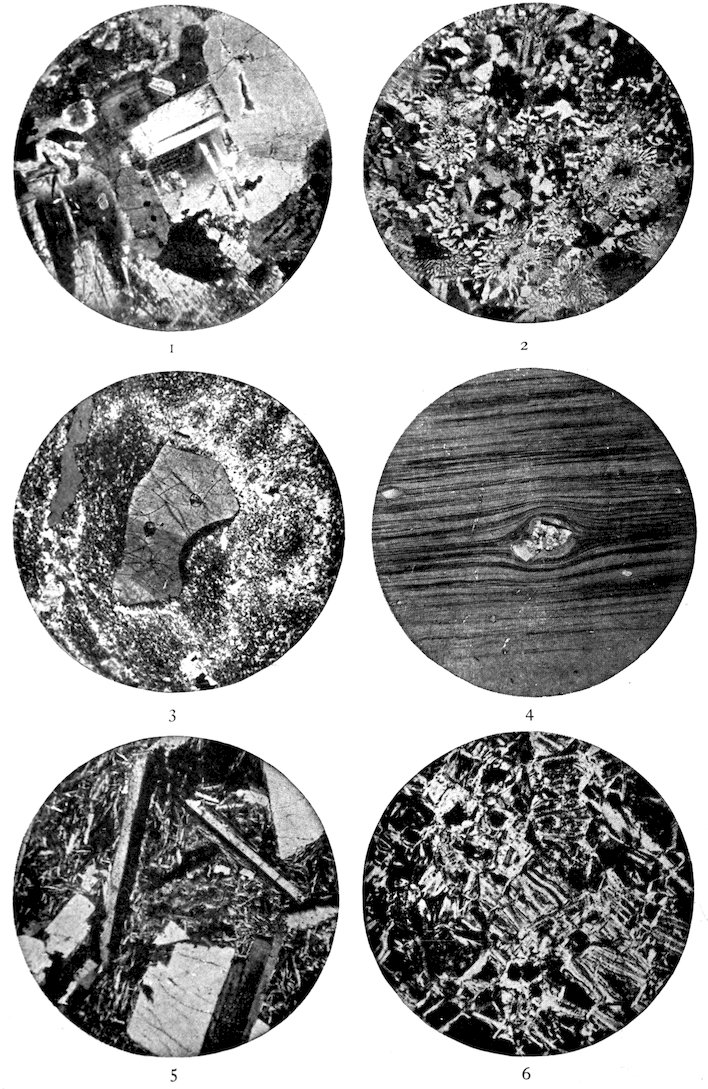
Fig. 1. Microstructure of granite.
Fig. 2. Microstructure of micropegmatite.
Fig. 3. Microstructure of quartz porphyry.
Fig. 4. Microstructure of porphyritic obsidian.
Fig. 5. Microstructure of trachyte.
Fig. 6. Microstructure of serpentine.
29The method of rock study by thin microscopic sections is one
of comparatively recent origin. It is scarcely more than a
dozen years since the process was fairly adopted by mineralogists.
The value of the method is based upon the fact that
every crystalline mineral has certain definite optical properties.
Therefore, when a crystalline mineral is distorted or misshapen
so as to be incapable of identification by the ordinary method,
it can be at once identified by its optical examination in the
manner just described. In this way not only can one mineral
be distinguished from another, but the crystalline system to
which it belongs can be accurately pointed out. The value
of the method is well summed up by Merrill,[21] who says
that it is not merely an aid in determining the mineralogical
composition of a rock, but also, which is often much more
important, its structure and the various changes which have
taken place in it since its first consolidation. Rocks are not the
definite and unchangeable mineral compounds they were once
considered, but are rather ever varying aggregates of minerals
which even in themselves undergo structural and chemical
changes almost without number.
Another valuable result of such a study is illustrated by
the discovery that the structural features of a rock are not
dependent upon its chemical composition or geologic age, but
upon the conditions under which it cooled from the molten
magma. Portions of the same rock may vary all the way
from a wholly crystalline to a pure vitreous form.
Some typical microstructures of crystalline rocks are shown
in the accompanying figures 1–6.[22]
Although this method of study has thus far been confined
mainly to crystalline rocks, its efficiency is by no means limited
to them. The fragmental rocks and their decomposed débris to
which the name soil is given are equally worthy of study by
this method. Indeed, the full value of a chemical analysis of
any rock or soil can not be ascertained unless such an analysis
is accompanied by a microscopic examination. It is desirable to
know not merely what there is in any soil, but in what form
these compounds exist. To this latter question the chemical
analysis as ordinarily made will give no clew. In Germany a
beginning has been made in this line of work, and American
scientists are beginning to realize its importance. An outline of
this method of analysis will be given in the proper place.
3029. Specific Gravity.—Much information in regard to the properties
of a rock, or mineral constituent thereof, may be derived
from its specific gravity.
The internal structure of a rock may have much to do with
its apparent specific gravity. As an instance of this, it may be
stated that an obsidian pumice will float upon water, buoyed up
by the air contained in its vesicles, while a compact obsidian
of the same composition will sink immediately. A careful
discrimination must, therefore, be made between apparent and
true specific gravity. In general it may be said that crystalline
rocks have a higher specific gravity than those of a
vitreous nature. The specific gravity is, therefore, largely
dependent upon chemical and crystallographic properties; for
instance, among siliceous rocks those which contain the largest
amount of silica are the lightest, while those with a comparatively
small amount, but rich in iron, lime, and magnesia, are
heaviest.
30. Chemical Composition of Rocks.—Rocks are often
classified with respect to the chief mineral constituent which
they contain. Rocks which are composed largely of lime are
termed calcareous; of silica, siliceous; of iron, ferruginous;
and of clay, argillaceous. In respect of eruptive rocks, it is
customary to speak of those which show above sixty per cent
of silica as acidic, while those containing less than fifty per
cent of silica and a correspondingly larger amount of iron,
lime, and magnesia, are spoken of as basic. Illustrations of the
classification of rocks on the above principles are given below.[23]
| Stratified Rocks. |
|---|
| Kind. |
Specific Gravity. |
Composition. |
| Calcareous: |
|
|
| |
Compact limestone |
2.6 to 2.8 |
Carbonate of lime. |
| |
Crystalline limestone |
| |
|
|
|
| |
Compact dolomite |
2.8 to 2.95 |
Carbonate of lime and magnesia. |
| |
Crystalline dolomite |
| |
|
|
|
| Siliceous: |
|
|
| |
Gneiss |
2.6 to 2.7 |
Same as granite. |
| |
Siliceous sandstone |
2.6 |
Mainly silica. |
| |
Schist |
2.6 to 2.8 |
60 to 80 per cent silica. |
| |
|
|
|
| Argillaceous: |
|
|
| |
Clay slate (argillite) |
2.5 |
Mainly silicate of alumina. |
| 31 |
|
|
|
| Eruptive Rocks. |
|---|
|
|
Specific Gravity. |
Per cent silica. |
| Acidic Group: |
|
|
| |
Granite |
2.58 to 2.73 |
77.65 to 62.90 |
| |
Liparite |
2.53 to 2.70 |
76.06 to 67.61 |
| |
Obsidian |
2.26 to 2.41 |
82.80 to 71.19 |
| |
Obsidian pumice |
Floats on water. |
82.80 to 71.19 |
| |
|
|
|
| Intermediate Group: |
|
|
| |
Syenite |
2.73 to 2.86 |
72.20 to 54.65 |
| |
Trachyte |
2.70 to 2.80 |
64.00 to 60.00 |
| |
Hyalotrachyte |
2.4 to 2.5 |
64.00 to 60.00 |
| |
Andesite |
2.54 to 2.79 |
66.75 to 54.73 |
| |
|
|
|
| Basic Group: |
|
|
| |
Diabase |
2.66 to 2.88 |
50.00 to 48.00 |
| |
Basalt |
2.90 to 3.10 |
50.59 to 40.74 |
| |
Peridotite |
3.22 to 3.29 |
42.65 to 33.73 |
| |
Peridotite (iron rich) |
3.86 |
23.00 |
| |
Peridotite (meteorite) |
3.51 |
37.70 |
31. Color Of Rocks.—The color of rocks is determined chiefly
by the oxids of metals which they contain and the degree of
oxidation of the mineral in each particular case. There are,
however, many colors of rocks which seem to depend not upon
any particular mineral ingredient which they contain, but upon
some particular crystalline structure or physical condition.
The chief coloring matters in minerals are those which form
colored bases such as iron, manganese, chromium, etc. The
yellow, brown, and red colors, common to fragmental rocks,
are due almost wholly to free oxids of iron. The gray, green,
dull brown, and even black colors of crystalline rocks are due
to the presence of free iron oxids or to the prevalence of
silicate mineral rich in iron, as augite, hornblende, or black
mica. Rarely copper and other metallic oxids than those of
iron are present in sufficient abundance to impart their characteristic
hues. As a rule, a white or light-gray color denotes an
absence of an appreciable amount of iron in any of its forms.
The bluish and black colors of many rocks, particularly the
limestones and slates, are due to the presence of carbonaceous
matter.
In still other cases, and particularly the feldspar-bearing
rocks, the color may be due in part to the physical condition of
the feldspar.
Inasmuch as the color of rocks is due so largely to metallic
32oxids, it is easy to see that they may undergo changes
when exposed to weathering, or the degree of oxidation may
change, and either, together with changes in the physical structure
of the rock, may cause a distinct change in color. Luster
is often considered in connection with color, and is due
almost exclusively to physical conditions.
32. Kinds of Rocks.—The rocks which form any essential
part of the earth’s crust are grouped under four main heads,
the distinction being based upon their origin and structure.[24]
Each of the main divisions may be subdivided into groups or
families, the distinction being based mainly upon chemical composition,
structure, and mode of occurrence. The four chief
families are:
First, aqueous rocks, formed mainly through the agency of
water as chemical precipitates or as sedimentary beds.
Second, aeolian rocks formed from wind-drifted materials.
Third, metamorphic rocks, changed from their original condition
through dynamic or chemical agencies, and which may
have been partly of aqueous and partly of igneous origin.
Fourth, igneous or eruptive rocks, which have been brought
up from below in a molten condition, and which owe their
present structural peculiarities to variations in composition
and conditions of solidification.
33. Aqueous Rocks.—Aqueous rocks may be divided into
the following general classes:
First, rocks formed as chemical precipitates.
Second, rocks formed as sedimentary deposits and fragmental
in structure. The second class may again be subdivided into
rocks formed by mechanical agencies and mainly of inorganic
materials; and second, rocks composed mainly of the débris of
plant and animal life.
In regard to the first form of aqueous rocks, namely, those
formed as chemical precipitates, it may be said that while their
quantity is not large they are yet of considerable importance
from an agricultural point of view. They embrace those substances
which, having once been in a condition of vapor or
aqueous solution, have been deposited or precipitated, either by
33cooling or by the evaporation of the liquor holding them in
solution, or by coming in contact with chemical substances
capable of precipitating them. The influence of water as a
solvent is perhaps not fully appreciated. Its solvent influence
will be noted particularly under the head of weathering or
decay of rocks. Its importance, however, in producing stratified
rocks has been very great. Water, especially when under
great pressure and at a high temperature, has the power of
dissolving many minerals. This power is often greatly increased
by the mineral matter previously in solution in the
water or by the gases which it may contain. As an illustration
of the latter property, the solvent action of water charged
with carbon dioxid on limestone may be cited.
When mineral matters have been dissolved by the water in
the ways mentioned and carried with the water beyond the
condition where the solution has taken place, new conditions
are found favorable to the precipitation of the dissolved matters.
The water, which before may have been very hot, may reach a
place where it cools, and being a supersaturated solution, the
excess of the material is thrown down as the water cools.
On the other hand, if the solution be due to the presence of
carbon dioxid and the water reach a place where it is exposed
to the air or where the pressure under which the abundance
of the gas has been due is diminished, the carbon dioxid will
escape and the mineral matters which have been dissolved
thereby will be precipitated.
The incrustations which often appear round the mouth of
springs and the occurrence of stalagmites and stalactites in
caves are illustrations of this action.
In respect of the formation of rocks as precipitates from a state
of vapor we have scarcely any illustrations excepting in volcanic
regions. Rocky materials with which we are generally acquainted
are practically non-volatile at the highest temperature
which can be secured on the earth’s surface, but it is possible
that in the interior of the earth the temperature may be so high
as to maintain many substances in a state of vapor.
They may, in this case, become disassociated so that the
34compounds or elements exist distinctly in a vaporous condition.
Such a vapor transported to regions of diminished temperature
would first of all on cooling permit a union of the chemical
elements forming new compounds less volatile, which, of course,
would be at once precipitated.
The rocks and minerals formed in this way which are of some
agricultural importance may be classified as follows:
Oxids, carbonates, silicates, sulfur, sulfids, sulfates, phosphates,
chlorids, and hydrocarbon compounds, the most important
from an agricultural point of view being the phosphates.
The second group of rocks, namely those formed as sedimentary
deposits, differ from those just described in that they
are comprised mainly of fragmental materials derived from the
breaking down of pre-existing rocks. The formation of fragmental
rocks includes, therefore, the same processes as are
active in the formation of arable soil. They are deposited from
water, and are as a rule distinctly stratified.
Through the action of pressure and the heat thereby generated,
or simply through the chemical action of percolating
solutions, such rocks pass over into the crystalline sedimentary
forms known as metamorphic. All metamorphic rocks,
however, are not of a sedimentary origin. For instance, by
pressure, heat, and the chemical changes thereby induced,
granite may be changed into gneiss and the latter would then
be a metamorphic rock.
This group of sedimentary rocks and of sedimentary material,
either unchanged or metamorphosed, is of vast extent and
includes materials of widely varying chemical and mineralogical
nature. They form by far the greater portion of the present
surface of the earth, even the mountain ranges being composed
mainly of this sedimentary material. Indeed, in the whole of
this country there is only a comparatively very small extent of
igneous or irruptive rocks. They are of great importance from
a purely scientific, as well as agricultural standpoint, since they
contain the fossil records of past geologic ages. From them
it is possible to study the variations in climate, the meteorological
conditions in circumstances and periods far remote, and thus
form some idea of the process by which the crust of the earth
35has been modified by natural forces from its original form to the
present time.
The sedimentary rocks may be divided, with sufficient accuracy
for our purposes, into two great classes: First, rocks formed by
mechanical agencies and mainly of inorganic materials. These
are subdivided again as follows:
(a) The arenaceous group.
(b) The argillaceous group.
(c) The volcanic group.
The second class of sedimentary rocks is formed largely, or
in part at least, by mechanical agencies, but is comprised
chiefly of the débris of plant and animal life. It may be
subdivided as follows:
(a) The siliceous group, such as infusorial earth.
(b) The calcareous group, fossiliferous formations, limestone,
etc.
(c) The carbonaceous group, such as peat, lignite, coals, etc.
The different classes of rock described above are distinguished
by special qualities represented largely by the name. The
first division, the arenaceous group, is composed mainly of the
siliceous or coarsely granular materials derived from the disintegration
of older crystalline rocks, which have been rearranged
in beds of varying thickness through the mechanical agency of
water. They are, in short, consolidated or unconsolidated beds
of sand and gravel. In composition and texture they vary
almost indefinitely. Many of them having suffered little during
the process of disintegration and transportation are composed
essentially of the same materials as the rocks from which they
were derived.
The sandstones, which are the type of these rocks, vary
greatly in structure as well as in composition, in some the grains
being rounded while in others they are sharply angular.
The microscopic structure of sandstone is shown in figure 7.[24]
The material by which the individual grains of a sandstone
are bound together is usually the material of some of the other
classes. The calcareous, ferruginous, and siliceous cements being
the chief ones. This cementing substance is deposited
among the granules forming the sandstone by percolating water.
36The colors of sandstone are dependent usually upon iron
oxids. Especially is this true of the red, brown, and yellow
colors. In some of the light grey varieties, the color is that of
the minerals comprising the stone. Some of the darker colored
sandstones contain organic matter.
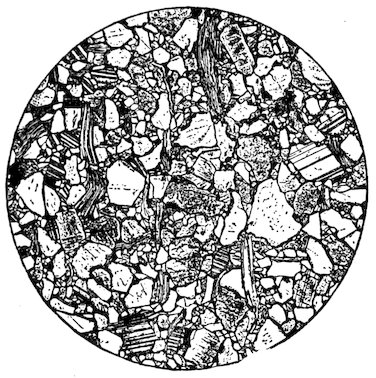
Fig. 7.
Microscopic Structure of Sandstone.
The rocks of the argillaceous group are composed essentially
of a hydrous silicate of alumina, which is the basis of common
clay, and varying amounts of free silica, oxids of iron and
manganese, carbonates of lime and magnesia, and small quantities
of organic matter. They may have originated in situ from the
decomposition of feldspars or as deposits of fine mud or silt at the
bottom of large bodies of water. The older formations of these
rocks are known as shales, argillites, and slates and the fissile
structure which enables this to be split into thin sheets is probably
due to the conditions under which they have been formed
and not to any properties of the clays themselves.
One of the purest forms of this rock is kaolin, which is almost
a pure hydrous silicate of alumina formed from the decomposition
of feldspathic rocks from which the alkalies, iron oxids and
other soluble constituents have been removed by water.
Under the volcanic group are included the materials ejected
37from volcanic vents in a more or less finely comminuted condition
and which through the drifting power of atmospheric currents
may be scattered over many miles of territory. Various
names are applied to such products, names dependent in large
part upon their state of subdivision. Volcanic dust and sand, or
ashes, includes the finer dust-like or sand-like materials, and
lapilli, or rapilli the coarser. The general name tuff includes
the more or less compacted and stratified beds of this material,
while trass, peperino, and pozzuolano are local varietal names
given to similar materials occurring in European volcanic regions.
The second division, namely sedimentary rocks composed of
the débris of plant and animal life includes many forms of great
agricultural importance.
The first subdivision of this group is the infusorial or diatomaceous
earth. It forms a fine white or yellowish pulverulent rock
composed mainly of minute shells, or tests of diatoms, and is
often so soft and pliable as to crumble readily between the thumb
and fingers. According to Whitney the beds are of comparatively
limited extent and for this reason are of little agricultural value,
although the weathering of this diatomaceous material gives rise
to a light yellow clay forming very fertile agricultural lands.
The second subdivision of this group includes the rocks of a
calcareous nature derived from animal life; that is to say, what
are properly called limestones. They vary in color, structure,
and texture almost indefinitely, and include all possible grades of
materials from those which can be used only as a flux, or for
lime burning, through ordinary building materials to the finest
marbles. These rocks are world-wide in their distribution and
limited to no one particular geologic horizon, but are found in
stratified beds among rocks of all ages from the most ancient
to the most recent.
Owing to the fact that their chief constituent, carbonate of
lime, is soluble in ordinary meteoric waters, the rocks have undergone
extensive decomposition, their lime being removed,
while their less soluble constituents or impurities remain to form
soil. A single ton of residual soil represents not infrequently a
loss of 100 tons of original rock matter. As this mass of lime
38carbonate is removed by solution the residual soil settles, and as
the limestone rocks are more soluble than the adjacent
rock formations limestone formations usually form valley lands
with ridges on either side. Caves are frequently found in such
formations. Furthermore, as the lime is almost all in the
form of the easily soluble lime carbonate it can be very completely
removed and the fertile “limestone soils” are often very
deficient in lime and respond readily to an application of burnt
lime, which, not infrequently, is quarried from the same field.
From an agricultural standpoint this group is of very great interest
and importance.
The third subdivision of this group, namely, that of vegetable
origin, includes peat, lignite, coals, etc. Rocks of this group are
made up of more or less fragmental remains of plants. In many
of them, as the peats and lignites, the traces of plant structure
are still apparent. In others, as the anthracite coals, these
structures have been wholly obliterated by metamorphisms.
Plants when decomposing on the surface of the ground give off
their carbon to the atmosphere in the shape of carbon dioxid gas
leaving only the strictly inorganic or mineral matter behind.
When, however, they are protected from the oxidizing influence
of the air, by water or by other plant growth, decomposition is
greatly retarded, and a large portion of the carbonaceous and
volatile matters is retained, and by this means together with
pressure from the overlying mass, the material becomes slowly
converted into coal. When this process goes on near the surface
of the earth, and without much pressure, peat or muck is
the product.
The fourth subdivision of this group, the phosphatic, forms a
class of rocks limited in extent but of the greatest economic importance.
Guano, coprolites, and phosphatic rocks (the phosphorites)
come under this head.
34. Aeolian Rocks.—This class of rocks is of less importance
than the others, either geologically or agriculturally.
It is formed from materials drifted by the winds and this
material has various degrees of compactness. Usually the
components of these drifts form rocks or deposits of a friable texture
and of a fragmental nature. The very extensive deposits of
39loess in China, forming their most fertile lands, are admitted
now to have been formed in this way, but it is now generally
admitted that similar deposits in this country are of subaqueous
origin.
Chief among these rocks, are the volcanic ashes which are
often carried to a long distance by the wind before they are
deposited and consolidated into rock masses. Many loose soils
may be carried to great distances by the wind, the deposits
forming new aggregates. This is particularly the case in arid
regions.
35. Metamorphic Rocks.—This class of rocks includes all
sedimentary or eruptive rocks, which, after their deposition and
agglomeration, have been changed in their nature through the
action of heat, pressure, or by chemical means. Sometimes these
changes are so complete that no indication of the character of
the original rocks remains. At other times the changes may be
found in all the stages of progress, so that they can be traced
from the original fragmental or irruptive to the completely
metamorphosed deposit. This is especially true of rocks containing
large quantities of lime. In those containing silica,
the changes are less readily traced.
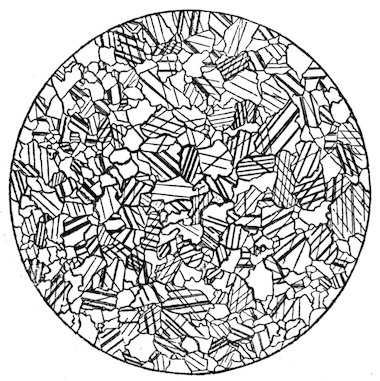
Fig. 8.
Microstructure of Crystalline Limestone.
(West Rutland, Vermont.)
40The metamorphic rocks may be divided into two subclasses,
namely, stratified or bedded, and foliated or schistose.
The rocks of the first class are represented by the crystalline
limestones and dolomites. The microstructure of a crystalline
limestone is shown in Fig. 8.[25] When lime and magnesia occur
together in combination with carbon dioxid, the substance is
known as dolomite. The chemical nature of these rocks and
their soil-forming properties are the same as those of the ordinary,
non-metamorphosed limestones and dolomites to which
reference has already been made. The subject need not, therefore,
be further dwelt upon here.
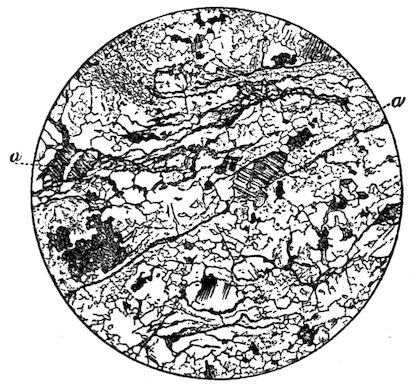
Fig. 9.
Microstructure of Gneiss.
(West Andover, Massachusetts.)
At a a are shown plagioclase crystals broken and rounded by the sheering force producing the foliation.
The second variety of metamorphic rocks is represented by
the gneisses and crystalline schists. Gneiss has essentially the
same composition as granite and can frequently hardly be distinguished
from it, except by a microscopic study of its sections,
and even thus it is sometimes difficult to determine. Frequently
a number of new minerals is formed in the metamorphic changes.
The microstructure of a gneiss is shown in Fig. 9.[26] The schists
include an extremely variable class of rocks, of which quartz
41is the prevailing constituent, and which, as a rule, are deficient
in potash and other important ingredients.
36. Rocks Formed Through Igneous Agencies, or Eruptive
Rocks.—This group includes all those rocks, which, having
been at some time in a state of igneous fusion, have been solidified
into their present form by a process of cooling. It may be
stated, as a general principle, that the greater the pressure
under which a rock solidifies and the slower and more gradual
the cooling the more perfect will be found the crystalline structure.
Hence, it follows that the older and more deep-seated
rocks which are forced up in the form of dikes, bosses, or
intrusive sheets, into the overlying masses, and which have
become exposed only through erosion and removal of the overlying
rocks, are the more highly crystalline.
The eruptive rocks are divided into two main groups, viz.:
(a) Intrusive or plutonic rocks, and
(b) Effusive or volcanic rocks.
Among the more important of the first division of the plutonic
form, from an agricultural point of view, are the granites. The
essential constituents of granite are quartz, potash feldspar, and
plagioclase. One or more minerals of the mica, amphibole
or pyroxene groups are also commonly present, and in microscopic
proportions apatite and particles of magnetic iron. The
more valuable constituents, from an agricultural standpoint, are
the minerals potash feldspar, and apatite, which furnish by
their decomposition the essential potash and phosphoric
acid.
In addition to the granites, which have already been mentioned,
the group includes the syenites, the nepheline syenites,
the diorites, the gabbros, the diabases, the theralites, the peridotites,
and the pyroxenites.
The second group, the effusive or volcanic rocks, includes
those igneous rocks, which, like the first group, have been
forced up through the overlying rocks, but which were brought
to the surface, flowing out as lavas. These, therefore, represent,
in many cases, only the upper or surface portions of the
first group, differing from them structurally, because they have
42cooled under little pressure more rapidly, and hence are not so
distinctly crystalline. These comprise the following groups:
-
- (a) Quartz porphyries. (b) Liparites. (c) Quartz-free porphyries. (d) Trachytes. (e)
Phonolites. (f) Porphyrites. (g) Andesites. (h) Melaphyrs and augite porphyrites. (i)
Basalts. (j) Tephrites and Basanites. (k) Picrite porphyrites. (l) Limburgites and
augitites. (m) Leucite rocks. (n) Nepheline rocks. (o) Melilite rocks.
It is, in most cases, impossible to state which of the above
classes is of most importance from an agricultural standpoint,
since, in the process of soil formation, both chemical and physical
processes are involved, whereby the character of the resultant
soil is so modified as to but remotely resemble its parent
rock. In most soils, the prevailing constituent is but the least
soluble one of the rock mass from which it was derived. Thus
a limestone soil may contain upwards of ninety per cent of
silica and alumina, while the original limestone itself may not
have carried more than one or two per cent of these substances.
Of course, if a rock mass contains none of the constituents
essential to plant growth, its resultant soil must by itself alone
be quite barren. It does not absolutely follow, however, that
those rocks containing the highest percentages of valuable constituents
will yield the most fertile soils, since much depends on
the manner in which they have been formed, the amount of
leaching, etc., they may have undergone. Nevertheless, the
study of the composition of the rocks in their relation to soils,
is an extremely interesting and by no means unimportant one.
A comparative table of rock compositions is here given. It
will be observed that there is a considerable range of variation
even among rocks of the same class, a fact due to the varying
abundance of their mineral constituents. The figures given are
43not those of actual analyses on any one particular rock, but are
selected from a number of comparatively typical cases; and, it
is thought, fairly well represent the composition of the class of
rocks indicated.
| Composition of Rocks.—The Figures Indicate Parts per Hundred. |
|---|
|
SiO₂. |
Al₂O₃. |
Fe₂O₃.
FeO. |
MgO. |
CaO. |
Na₂O. |
K₂O. |
P₂O₅. |
Granite
Quartz poryhyries}
Liparite |
63–78 |
10–15 |
2–3 |
0.3–0.5 |
1–2 |
2–3 |
4–5 |
0.05–0.15 |
| |
|
|
|
|
|
|
|
|
Syenite
Orthoclase porphyries}
Trachyte |
55–73 |
12–16 |
5–7 |
2–6 |
3–5 |
2–6 |
4–7 |
trace. |
| |
|
|
|
|
|
|
|
|
Nepheline syenites}
Phonolites |
54–56 |
16–22 |
4–6 |
0.4–0.88 |
2–4 |
3–7 |
4–6 |
0.15 |
| |
|
|
|
|
|
|
|
|
Diorites
Porphyrites}
Andesites |
52–65 |
16–20 |
7–10 |
5–7 |
5–7 |
2–4 |
1–2 |
0.1–0.3 |
| |
|
|
|
|
|
|
|
|
Gabbros
Norites}
Melaphyrs |
48–55 |
12–20 |
8–15 |
2–7 |
6–10 |
2–4 |
0.5–2 |
0.1–0.33 |
| |
|
|
|
|
|
|
|
|
Theralites
Tephrites}
Basanites |
43–47 |
15–23 |
9–18 |
1–6 |
6–10 |
5–7 |
2–4 |
trace. |
| |
|
|
|
|
|
|
|
|
Peridotites
Picrite porphyrites}
Limburgites |
23–43 |
1–10 |
10–15 |
15–45 |
1–4 |
0–4 |
trace. |
0.0 |
| |
|
|
|
|
|
|
|
|
Pyroxenites}
Augitites |
50–55 |
0.5–4 |
4–10 |
20–25 |
8–15 |
|
|
|
| |
|
|
|
|
|
|
|
|
| Leucite rocks |
48–50 |
15–20 |
7–10 |
1–2 |
5–10 |
3–5 |
5–7 |
0.5–2 |
| |
|
|
|
|
|
|
|
|
| Nepheline rocks |
40–45 |
8–20 |
10–20 |
1–13 |
4–10 |
4–8 |
1–3 |
0.2 |
37. Origin of Soils.—The soils in which crops grow and
which form the subject of the analytical processes to be hereinafter
described have been formed under the combined influences
of rock decay and plant and organic growth. The mineral
matters of soils have had their origin in the decay of rocks,
while the humic and other organic constituents have been
derived from living bodies. It is not the object of this treatise
to discuss in detail the processes of soil formation, but only to
give such general outlines as may bear particularly on the
proper conceptions of the principles of soil investigation.
38. The Decay of Rocks.—The origin and composition of
rocks are fully set forth in works on geology and mineralogy.
Only a brief summary of those points of interest to agriculture
has been given in the preceding pages. The soil analyst should
be acquainted with these principles, but for practical purposes
he has only to understand the chief factors active in securing
the decay of rocks and in preparing the débris for plant growth.
44The following outline is based on the generally accepted
theories respecting the formation of soils.[7]
The forces ordinarily concerned in the decay of rocks are:
-
- 1. Changes of temperature, including the ordinary daily and monthly changes, and the
conditions of freezing and thawing.
-
- 2. Moving water or ice.
-
- 3. Chemical action of water and air.
-
- 4. Influence of vegetable and animal life:
-
- (a) Shades the rock or soil surface.
-
- (b) Penetrates the rock or soil material with its roots, thus admitting air.
-
- (c) Solvent action of roots.
-
- (d) Chemical action of decaying organic matter.
-
- 5. Earth worms.
-
- 6. Bacteria.
39. The Action of Freezing and Thawing.—In those
parts of a rock stratum exposed near the surface of the earth
the processes of freezing and thawing have perhaps had considerable
influence in rock decay. The expansive force of freezing
water is well known. Ice occupies a larger volume than
the water from which it was formed. The force with which this
expansion takes place is almost irresistible. The phenomenon
of bursted water pipes which have been exposed to a freezing
temperature is not an uncommon one. While the increase in
volume is not large, yet it is entirely sufficient to produce serious
results. The way in which freezing affects exposed rock is
easily understood. The effect is unnoticeable if the rock be
dry. If, on the other hand, it be saturated with water, the disintegrating
effect of a freeze must be of considerable magnitude.
This effect becomes more pronounced if the intervals of freezing
and thawing be of short duration. The whole affected portion
of the rock may thus become thoroughly decayed. But even in
the most favorable conditions this form of disintegration must
be confined to a thin superficial area. Even in very cold climates
the frost only penetrates a few feet below the surface, and
therefore the action of ice cannot in any way be connected with
those changes at great depths, to which attention has already
45been called. Nevertheless, certain building stones seem very
sensitive to this sort of weathering, and the crumbling of the
stone in the Houses of Parliament is due chiefly to this cause.
On the whole it appears that the action of ice in producing
rock decay has been somewhat overrated, although its power
must not by any means be denied. But on the other hand
a freeze extending over a long time tends to preserve the
rocks, and it therefore appears that the entire absence of frost
would promote the process of rock decay.
At best it must be admitted that frost has affected the earth’s
crust only to an insignificant depth, but its influence in modifying
the arable part of the soil is of the utmost importance to
agriculture.
40. The Action of Glaciers.—The action of ice in soil formation
is not confined alone to the processes just described. At a
period not very remote geologically, a great part of our Northern
States was covered with a vast field of moving ice. These
seas of ice crept down upon us from more northern latitudes and
swept before them every vestige of animal and vegetable life.
In their movement they leveled and destroyed the crests of hills
and filled the valleys with the débris. They crushed and comminuted
the strata of rocks which opposed their flow and carried
huge boulders of granite hundreds of miles from their homes.
On melting they left vast moraines of rocks and pebbles which
will mark for all time the termini of these empires of ice. When
the ice of these vast glaciers finally melted the surface which
they had leveled presented the appearance of an extended plain.
No estimate can be made of the enormous quantities of rock
material which were ground to finest powder by these glaciers.
This rock powder forms to-day no inconsiderable part of those
fertile soils which are composed of glacial drift. The rich
materials of these soils probably bear a more intimate relation
to the rocks from which they were formed than of any other
kinds of soil in the world. The rocks were literally ground
into a fine powder, and this powder was intimately mixed
with the soils which had already been formed in situ.
The melting ice also left exposed to disintegrating forces
large surfaces of unprotected rocks in which decay would go
46on much more rapidly than when covered with the débris
which protected them before the advent of the ice. The
area of glacial action extended over nearly all of New England
and over the whole area of the northern tier of States. It extended
southward almost to the Ohio river, and in some places
crossed it. The effect of the ice age in producing and modifying
our soil must never be forgotten in a study of soil genesis.
It is not a part of our purpose here to study the causes which
produced the age of ice. Even a brief reference to some of the
more probable ones might be entirely out of place. Before
the glacial period it is certain that a tropical climate extended
almost, if not quite, to the North Pole. The fossil remains of
tropical plants and animals which have been found in high
northern latitudes are abundant proofs of this fact.
In the opinion of Sterry Hunt,[27] rock decay has taken place
largely in preglacial and pretertiary times. The decay of crystalline
rocks is a process of great antiquity. It is also a universal
phenomenon. The fact that the rocks of the southern
part of this country seem to be covered with a deeper débris than
those further north is probably due to the mechanical translation
of the eroded particles towards the south. The decay and softening
of the material were processes necessarily preceding the
erosion by aqueous and glacial action.
It is possible that a climate may have existed in the earlier
geologic ages more favorable to the decay of rocks than that
of the present time.
41. Progress of Decay as Affected by Latitude.—Extensive
investigations carried on along the Atlantic side of the country
show wide differences in the rate of decay in the same kind of
rocks in different latitudes. In general, the progress of decay
is more marked toward the south. The same fact is observed
in the great interior valleys of the country; at least, everywhere
except in the arid and semi-arid regions. Wherever there is a
deficiency of water the processes of decay have been arrested.
Where the rock strata have been displaced from a horizontal
position the progress of decay has been more rapid. This is
easily understood. The percolation of water is more easy as
the displacement approaches a vertical position.
47A most remarkable example of this is seen in the rocks of
North Carolina.[28] A kind of rock known as trap is found in
layers called dikes in the Newark system of rocks in that State.
These dikes have been so completely displaced from the horizontal
position they at first occupied as to have an almost
vertical dip. The edges thus exposed vary from a few feet to
nearly 100 feet in thickness. The trap rock in those localities
is composed almost exclusively of the mineral dolerite, which
is so hard and elastic in a fresh state as to ring like a piece of
metal when struck with a hammer. In building a railroad
through this region these dikes were in some places uncovered
to a depth of forty feet and more. At this depth they were
found completely decomposed and with no indications of having
reached the lower limit of disintegration. The original hard
bluish dolerite has been transformed into a yellowish clay-like
mass that can be molded in the fingers and cut like putty.
Similar geologic formations in New Jersey and further North
do not exhibit anything like so great a degree of decomposition,
thus illustrating in a marked degree the fact that freezing
weather for a part of the year is a protection against rock
decay. The ice of winter at least protects the rocks from
surface infiltration, although it can not stop the subterranean
solution which must go on continuously.
Other things being equal, therefore, it appears that as the
region of winter frost is passed the decay of the rocks has been
more rapid than in the North, because the chief disintegrating
forces act more constantly.
42. The Solvent Action of Water.—The water of springs
and wells is not pure. It contains in solution mineral matters
and often a trace of organic matter. The organic matter comes
from contact with vegetable matter and other organic materials
near the surface of the earth. The mineral matter is derived from
the solvent action of the water and its contents on the soil and rocks.
The expressions “hard” and “soft” applied to water indicate
that it has much or little mineral matter in suspension, as
the case may be. When surface and spring waters are collected
into streams and rivers they still contain in solution the greater
part of the mineral matters which they at first carried.
48When well or spring waters have more than forty grains of
mineral matter per gallon they are not suitable for drinking
waters. Mineral waters, so called, are those which carry large
quantities of mineral matter, or which contain certain comparatively
rare mineral substances which are valued for their medicinal
effects.
The analysis of spring, well, or river waters will always give
some indication of the character of the rocks over which they have
passed.[29] The vast quantities of mineral matters carried into
oceans and seas are gradually deposited as the water is evaporated.
If, however, these matters be very soluble, such as common salt,
sulfate of magnesia, etc., they become concentrated, as is seen
with common salt in sea waters. In small bodies of waters, such
as inland seas, which have no outlet, this concentration may proceed
to a much greater extent than in the ocean. As an instance
of this, it may be noted that the waters of the Dead Sea and
Great Salt Lake are impregnated to a far greater degree with
soluble salts than the water of the ocean. The solvent action
of water on rocks is greatly increased by the traces of organic
or carbonic acids which it may contain. When surface water
comes in contact with vegetable matter it may become partially
charged with the organic acids which the growing vegetable
may contain or decaying vegetable matter produce. Such acids
coming in contact with limestone under pressure will set free
carbon dioxid. Water charged with carbon dioxid acts vigorously
on limestone and other mineral aggregates. If such solutions
penetrate deeply below the surface of the earth their
activity as solvents may be greatly increased by the higher temperature
to which they are subjected. Hence, all these forces
combine to disintegrate the rocks, and through such agencies
vast deposits of original and secondary rocks have been completely
decomposed.
The gradual passing of the firm rock into an arable soil is
beautifully shown in Fig. 10, a print from a negative taken by
Mr. Geo. P. Merrill, near Washington, D. C.
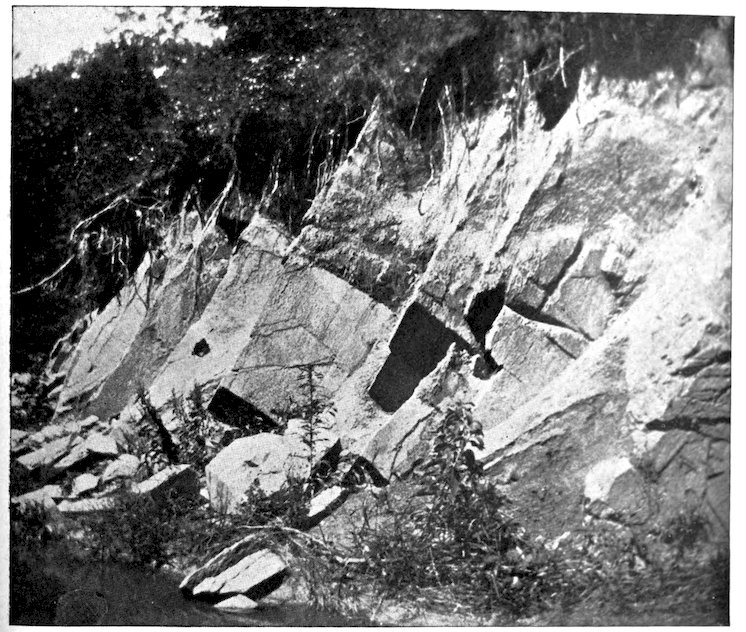
Figure 10.
View on the Broad Branch of Rock Creek, Washington, D. C.
The fresh but badly decomposed granitic rock is shown passing upward into material more and more decomposed until it becomes sufficiently pulverulent and soluble to support plant life. The roots showing in the upper part of the picture formerly penetrated the decomposed rock, but have been exposed through quarrying operations. Photograph by George P. Merrill, 1891.
4943. Action Of Vegetable Life.—The preliminary condition to
vegetation is the formation of soil, but once started, vegetation
aids greatly in the decomposition of rocks. Some forms of
vegetation, as the lichens, have apparently the faculty of growing
on the bare surface of rocks, but the higher order
requires at least a little soil. The vegetation acts by
shading the surface and thus rendering the action of water
more effective, by mechanically separating the rock particles by
means of its penetrating roots and by the positive solvent action
of the root juices. The rootlets of plants in contact with limestone
or marble dissolve large portions of these substances, and
while their action on more refractory rocks is slower, it must
be of considerable importance. The organic matter introduced
into the soil by vegetation also promotes decay still further both
directly and by the formation of acids of the humic series. This
matter also furnishes a considerable portion of carbon dioxid
which is carried by the water to assist in its solvent action.
44. Action of Earth-Worms.—Of animal organisms those
most active in the formation of soil are earth-worms. The
work of earth-worms has been exhaustively studied by
Darwin.[30] The worms not only modify the soil by bringing
to the surface portions of the subsoil, but also influence
its physical state by making it more porous and pulverulent.
According to Darwin the intestinal content of worms has
an acid reaction, and this has an effect on those portions
of the soil passing through their alimentary canal. The
acids, which are formed in the upper part of the digestive
canal are neutralized by the carbonate of lime secreted by the
calciferous glands of the worms thus neutralizing the free acid
and changing the reaction to alkaline in the lower part of the
canal. There is a fair presumption that the acids of the worm
are of a humic nature.
The worms further modify the composition of the soil by
drawing leaves and other organic matter into their holes, and
leaving therein a portion of such matter which is gradually
converted into humus. Stockbridge[31] gives a striking illustration
of this process due to an experiment by von Hensen.
Darwin estimates that about eleven tons of organic matter per
acre are annually added to the soil in regions where worms
abound. A considerable portion of the ammonia in the soil at
50any given time may also be due to the action of worms, as
much as 0.18 per cent of this substance having been found in
their excrement. It is probable that nearly the whole of the
vegetable matter in the soil passes sooner or later through the
alimentary canals of these ceaseless soil builders, and is converted
into the form of humus.
45. Action of Bacteria.—The intimate relations which
have been found to subsist between certain minute organisms
and the chemical reactions which take place in the soil is a sufficient
excuse for noting the effect of other similar organisms in
the formation of soils.
In addition to the usual forces active in decomposing rocks
Müntz[32] has described the effects of a nitrifying bacillus contributing
to the same purpose.
According to him the bare rock usually furnishes a purely
mineral environment where organisms cannot be developed
unless they are able to draw their nourishment directly from
the air. Some nitrifying organisms belong to this class. It
has been shown that these bodies can be developed by absorbing
from the ambient atmosphere carbonate of ammonia and vapors
of alcohol, the presence of which has been determined in the
air. According to the observations of Winogradsky, they assimilate
even the carbon of the carbon dioxid just as vegetables
do which contain chlorophyl. Thus even in the denuded
rocks of high mountains the conditions for the development of
all these inferior organisms exist. In examining the particles
produced by attrition, it is easily established that they are uniformly
covered by a layer of organic matter evidently formed
by microscopic vegetations. Thus we see, in the very first
products of attrition, appearing upon the rocky particles the
characteristic element of vegetable soil, viz., humus, the proportion
of which increases rapidly with the products of disaggregation
collected at the foot of declivities until finally they
become covered with chlorophyliferous plants.
In a similar manner the presence of nitrifying organisms has
been noted upon rocky particles received in sterilized tubes, and
cultivated in an appropriate environment where they soon produce
51nitrification. The naked rocks of the Alps, the Pyrenees,
the Auvergnes and the Vosges, comprise mineralogical types of
the most varied nature, viz., granite, porphyry, gneiss, micaschist
volcanic rocks and limestones and all these have shown
themselves to be covered with the nitrifying ferment. It is
known that below a certain temperature these organisms
are not active; their action upon the rock is, therefore,
limited to the summer period. During the cold season their
life is suspended but they do not perish, inasmuch as they have
been found living and ready to resume all their activity after an
indefinite sleep on the ice of the glaciers where the temperature
is never elevated above zero.
The nitrifying ferment is exercised on a much larger scale in
the normal conditions of the lower levels where the rock is covered
with earth. This activity is not limited to the mass of
rock but is continued upon the fragments of the most diverse
size scattered through the soil and it gradually reduces them to
a state of fine particles. It is therefore a phenomenon of the
widest extension.
The action of these micro-organisms according to Müntz is
not confined to the surface but extends to the most interior particles
of the rocky mass. Where, however, there is nothing of
a nitrogenous nature, to nitrify such an organism must live in a
state of suspended animation.
When the extreme minuteness of these phenomena is considered
there may be a tendency to despise their importance,
but their continuity and their generality in the opinion of
Müntz place them among the geologic causes to which the
crust of the earth owes a part of its actual physiognomy and
which particularly have contributed to the formation of the deposits
of the comminuted elements constituting arable soil.
The general action of nitrifying organisms in the soil, the
nature of these bodies, and the method of isolating and
identifying them will be fully discussed in another part of this
work.
46. Action of the Air.—The air itself takes an active part
in rock decay. Wherever rocks are exposed to decay, there air
52is found or, at least, the active principle of air, viz., oxygen.
The air not only penetrates to a great depth in the earth, but is
also carried to much greater depths by water which always
holds a greater or less quantity of air in solution. The oxygen
of the air is thus brought into intimate contact with the disintegrating
materials and in a condition to assist wherever possible
in the decomposing processes.
The oxygen acts vigorously on the lower oxids of iron, converting
them into peroxids, and thus tends to produce decay.
There are other constituents of rocks which oxygen affects injuriously
and thus helps to their final breaking up. It is true
that, as a rule, the constituents of rocks are already oxidized to
nearly as high a degree as possible, and on these constituents of
course the air would have no effect. But on others, especially
when helped by water with the other substances it carries in
solution, the air may greatly help in the work of destruction.
In a general view, the action of the air in soil formation may
be regarded as of secondary importance, and to depend chiefly
on the oxidation of the lower to the higher basic forms. These
processes, while they seem of little value, have, nevertheless,
been of considerable importance in the production of that residue
of rock disintegration which constitutes the soil.
47. Classification of Soils According to Deposition.—In
regard to their deposition soils are divided into five classes:
1. Those which are formed from the decomposition of crystalline
or sedimentary rocks or of unconsolidated sedimentary
material in situ.
2. Those which have been moved by water from the place
of their original formation and deposited by subsidence (bottom
lands, alluvial soils, lacustrine deposits, etc.).
3. Those which have been deposited as débris from moving
masses of ice (glacial drift).
4. Soils formed from volcanic ashes or from materials moved
by the wind and deposited in low places or in hills or ridges.
5. Those formed chiefly from the decay of vegetable matter,
(tule, peat, muck).
48. Qualities of Soils.—In respect of quality, soils have
53been arbitrarily divided into many kinds. Some of the more
important of these divisions are as follows:
1. Sand. Soils consisting almost exclusively of sand.
2. Sandy Loams. Soils containing some humus and clay
but an excess of sand.
3. Loams. Soils inclining neither to sand nor clay and containing
some considerable portions of vegetable mold, being very
pulverulent and easily broken up into loose and porous masses.
4. Clays. Stiff soils in which the silicate of alumina and
other fine mineral particles are present in large quantity.
5. Marls. Deposits containing an unusual proportion of
carbonate of lime, with often some potash or phosphoric acid
resulting from the remains of sea-animals and plants.
6. Alkaline. Soils containing carbonate and sulfate of
soda, or an excess of these alkaline and other soluble mineral
substances.
7. Adobe. A fine grained porous earth of peculiar properties
hereinafter described.
8. Vegetable. Soils containing much vegetable débris in an
advanced state of decomposition. When such matter predominates
or exists in large proportion in a soil the term tule, peat
or muck is applied to it.
With the exception of numbers six, seven and eight these
types of soil are so well-known as to require no further
description for analytical purposes. The alkaline, adobe and
vegetable soils on the contrary demand further study.
49. Alkaline Soils.—The importance of a more extended
notice of this class of soils for analytical purposes is emphasized
by their large extent in the United States.
Chiefly through the researches of Hilgard attention has been
called to the true character of these soils which are found
throughout a large part of the Western United States and which
are known by the common name of alkali. The following
description of the origin of these soils is compiled chiefly from
Hilgard’s papers on this subject. Wherever the rain-fall is
scanty, and especially where the rains do not come at any one
time with sufficient force to thoroughly saturate the soil and
54carry down through the subsoil and off through the drainage
waters the alkali contained therein, favorable conditions exist
for the production of the alkaline soil mentioned above. The
peculiar characteristic of this soil is the efflorescence which
occurs upon its surface and which is due to the raising of soluble
salts in the soil by the water rising through capillary
attraction and evaporating from the surface, leaving the salts as
an efflorescence.
Soils which contain a large amount of alkali are usually very
rich in mineral plant food, and if the excess of soluble salt could
be removed, these lands under favorable conditions of moisture
would produce large crops.
The formation of the alkali may be briefly described as
follows: By the decomposition of the native rocks, certain salts
soluble in water are formed. These salts in the present matter
are chiefly sodium and potassium sulfates, chlorids and carbonates.
The salts of potash together with those of lime are
more tenaciously held by the soil than the soluble salts of soda,
and the result of this natural affinity of the soil for soluble potash,
lime and magnesian salts is seen in the formation at the
surface of the earth, by the process of evaporation above described,
of a crust of alkaline material which is chiefly composed
of the soluble salts of soda. In countries which have a sufficient
amount of rain-fall, these soluble salts are carried away either by
the surface drainage or by the percolation of water through the
soil, and the sodium chlorid is accumulated in this way in the
waters of the ocean. But where a sufficient amount of rain-fall
does not occur, these soluble salts carried down by each shower
only to a certain depth rise again on the evaporation of the
water, reinforced by any additional soluble material which may
be found in the soil itself. The three most important ingredients
of the alkali of the lands referred to are sodium chlorid, sulfate,
and carbonate. When the latter salt, namely, sodium
carbonate, is present in predominant quantity, it gives rise to
what is popularly known as black alkali. This black color is
due to the dark colored solution which sodium carbonate
makes with the organic matters or humus of the soil.
The black alkali is far more injurious to growing vegetation
55than the white alkali composed chiefly of sodium sulfate and
chlorid.
This black alkali has been very successfully treated by Hilgard[33]
by the application of gypsum which reacting with the
sodium carbonate produces calcium carbonate and sodium sulfate,
thus converting the black into the white alkali and adding
an ingredient in the shape of lime carbonate to stiff soils which
tends to make them more pulverulent and easy of tillage.
This method of treatment, however, as can be easily seen, is
only palliative, the whole amount of the alkaline substances
being still left in the soil, only in a less injurious form.
The only perfect remedy for alkaline soils, as has been pointed
out by Hilgard, is in the introduction of underdrainage in connection
with irrigation. The partial irrigation of alkaline
soils, affording enough moisture to carry the alkali down to and
perhaps partially through the subsoil, can produce only a temporary
alleviation of the difficulties produced by the alkali.
Subsequent evaporation may thus increase the amount of surface
incrustation. For this reason in many cases the practice of
irrigation without underdrainage may completely ruin an otherwise
fertile soil by slowly increasing the amount of alkali in the
soil by the total amount of the alkaline material added in the
waters of irrigation.
As Hilgard has pointed out, if a soil can be practically freed
from alkali by underdrainage connected with a thorough saturation
by irrigation, it may be centuries before the alkali will
accumulate in that soil again when ordinary irrigation only is
practiced. It may thus become possible to reclaim large extents
of alkaline soil little by little by treating them with an excess of
irrigation water in connection with thorough underdrainage.
The composition of the alkali on the surface of the soil due to
the causes above set forth is thoroughly illustrated by the
analyses of Hilgard and Weber, which follow:
56
| Table Showing Composition of Alkali Salts in San Joaquin Valley. |
|---|
|
FRESNO COUNTY. |
|
Sections 13 and 24 T. 14 S. R. 19 E., 4 miles S. W. from Fresno. |
Miss Austin’s Ranch, Central Colony. |
N.W. Cor. N ½ Sec. 20 T. 14 S. R. 21 E. |
Easton. |
Emigr’nt Ditch. |
|
Alkali soil, 1888. |
Alkali Spot, 1889. |
Surface soil, No. 1. |
Surface soil, No. 2. |
Surface soil. |
Surface soil. |
|
1 inch surface. |
18 inches bel. surface. |
26 inches bel. surface. |
42 inches hardpan. |
| Soluble salts in 100 parts soil |
|
0.76 |
0.20 |
0.18 |
0.16 |
3.54 |
1.90 |
1.20 |
2.69 |
|
|
| Potassium sulfate |
|
|
|
|
|
small |
moderate |
|
|
|
|
| [D]Potassium nitrate |
|
|
|
|
|
|
small |
|
|
|
|
| Potassium carbonate (Saleratus) |
|
|
|
|
|
|
|
|
|
|
|
| Sodium sulfate (Glauber’s salt) |
large |
small |
small |
very slight |
very slight |
large |
large |
much |
moderate |
large |
|
| Sodium carbonate (Sal-soda) |
very slight |
large |
small |
large |
large |
small |
chiefly |
small |
small |
|
chiefly |
| Sodium chlorid (Common salt) |
chiefly |
moderate |
chiefly |
moderate |
moderate |
chiefly |
large |
chiefly |
chiefly |
large |
little |
| [D]Sodium phosphate |
|
|
|
|
|
|
|
|
|
|
|
| Calcium sulfate (Gypsum) |
moderate |
small |
very slight |
very slight |
very slight |
small |
moderate |
small |
small |
much |
|
| Magnesium sulfate (Epsom salt) |
|
|
|
|
|
|
small |
|
|
much |
|
| Organic matter |
|
|
|
|
|
|
|
|
|
|
|
|
TULARE COUNTY. |
|
Goshen |
Peopl’s Ditch |
Near Lake Tulare |
Visalia |
Lemoore |
Tulare Exp’t Station |
|
Surf’ce soil |
Alkali crust |
Surf’ce soil |
Surf’ce soil |
Alkali crust |
Alkali crust |
| Soluble salts in 100 parts soil |
1.40 |
|
0.83 |
1.26 |
|
|
| Potassium sulfate |
|
|
|
|
|
small |
| [E]Potassium nitrate |
|
|
|
|
|
small |
| Potassium carbonate (Saleratus) |
|
|
|
18.80 |
|
|
| Sodium sulfate (Glauber’s salt) |
44.24 |
1.22 |
31.30[F] |
13.4 |
chiefly |
32.8 |
| Sodium carbonate (Sal-soda) |
32.98 |
88.09 |
18.2 |
45.3 |
|
36.16 |
| Sodium chlorid (Common salt) |
16.74 |
1.00 |
|
4.4 |
little |
31.16 |
| [E]Sodium phosphate |
1.97 |
|
0.22 |
10.4 |
|
|
| Calcium sulfate (Gypsum) |
|
|
|
|
little |
|
| Magnesium sulfate (Epsom salt) |
|
|
|
8.1 |
moderate |
|
| Organic matter |
1.59 |
9.21 |
7.5 |
|
|
5.37 |
|
KERN COUNTY. |
|
Alkali crusts from the Smyrna artesian belt. Townships 25 and 26 R. 23 E. W. S. W. from Delano, S. P. R. R. |
Summer. |
Kern Island |
|
No. 1 |
No. 2 |
No. 3 |
No. 4 |
No. 5 |
No. 6 |
No. 7 |
No. 8 |
Alkali crust |
Alkali crust |
| Soluble salts in 100 parts soil |
|
|
|
|
|
|
|
|
|
|
| Potassium sulfate |
|
|
|
|
|
|
|
|
|
4.72 |
| [E]Potassium nitrate |
|
|
|
|
|
|
|
|
|
|
| Potassium carbonate (Saleratus) |
|
|
|
|
|
|
|
|
|
|
| Sodium sulfate (Glauber’s salt) |
small |
moderate |
moderate |
moderate |
large |
small |
small |
small |
19.20 |
70.61 |
| Sodium carbonate (Sal-soda) |
|
|
|
|
|
|
|
|
|
14.82 |
| Sodium chlorid (Common salt) |
large |
moderate |
large |
large |
small |
large |
small |
large |
37.14 |
4.13 |
| [E]Sodium phosphate |
|
|
|
|
|
|
|
|
|
|
| Calcium sulfate (Gypsum) |
small |
small |
small |
small |
small |
small |
small |
small |
0.96 |
0.08 |
| Magnesium sulfate (Epsom salt) |
small |
small |
small |
small |
small |
small |
small |
small |
18.31 |
|
| Organic matter |
|
|
|
|
|
|
|
|
20.87 |
|
5750. Adobe Soils.—In many parts of the arid regions of this
country which can be recovered for agricultural purposes by irrigation
the soil has peculiar characteristics.
The name adobe as commonly used applies to both the sundried
bricks of the arid regions of the West and Southwest,
and to the materials of which they are composed. The
material is described by Russell[34] as a fine grained porous earth,
varying in color through many shades of gray and yellow,
which crumbles between the fingers, but separates most readily
in a vertical direction. The coherency of the material is so
great that vertical scarps will stand for many years without
forming a noticeable talus slope.
Distribution.—The area over which adobe forms a large part of
the surface has not been accurately mapped, but enough is
known to indicate that it is essentially co-extensive with the
more arid portions of this country. In a very general way it
may be considered as being limited to the region in which the
mean annual rain-fall is less than twenty inches. It forms the
surface over large portions of Colorado, New Mexico, Western
Texas, Arizona, Southern California, Nevada, Utah, Southern
Oregon, Southern Idaho, and Wyoming. Adobe occurs also in
Mexico and may there reach a greater development than in
the United States, but observations concerning it south of the
Rio Grande are wanting.
In the United States it occurs from near the sea-level in Arizona,
and even below the sea-level in Southern California, up to an
elevation of at least six or eight thousand feet, along the eastern
border of the Rocky Mountains, and in the elevated valleys
of New Mexico, Colorado, and Wyoming. It occupies depressions
of all sizes up to valleys having an area of hundreds of
square miles. Although occurring throughout the arid region,
it can be studied to best advantage in the drainless and lakeless
basins in Nevada, Utah, and Arizona.
Composition.—When examined under the microscope, the
adobe is seen to be composed of irregular, unassorted flakes and
grains, principally quartz, but fragments of other minerals are
also present. An exhaustive microscopic study has not been
made, but the samples examined from widely-separated localities
58were very similar. The principal characteristics observed were
the extreme angularity of the particles composing the deposit
and the undecomposed condition of the various minerals entering
into its composition. It is to be inferred from this that the
material was not exposed even to a very moderate degree of
friction, and had not undergone subaerial decay before being
deposited. Adobe collected, at typical localities is so fine in
texture that no grit can be felt when it is rubbed between the
fingers; in other instances it contains angular rock fragments of
appreciable size.
The composition of the material is illustrated by the following
analyses:
| Analyses of Adobe. |
|---|
| |
|
|
|
|
| By L. G. Eakins. |
|---|
| |
|
|
|
|
| Constituents. |
No. 1.
Sante Fe, New Mexico. |
No. 2.
Fort Wingate, New Mexico. |
No. 3.
Humboldt, Nevada. |
No. 4.
Salt Lake City, Utah. |
| SiO₂ |
66.69 |
26.67 |
44.64 |
19.24 |
| Al₂O₃ |
14.16 |
0.91 |
13.19 |
3.26 |
| Fe₂O₃ |
4.38 |
0.64 |
5.12 |
1.09 |
| MnO |
0.09 |
trace |
0.13 |
trace |
| CaO |
2.49 |
36.40 |
13.91 |
38.94 |
| MgO |
1.28 |
0.51 |
2.96 |
2.75 |
| K₂O |
1.21 |
trace |
1.71 |
trace |
| Na₂O |
0.67 |
trace |
0.59 |
trace |
| CO₂ |
0.77 |
25.84 |
8.55 |
29.57 |
| P₂O₅ |
0.29 |
0.75 |
0.94 |
0.23 |
| SO₃ |
0.41 |
0.82 |
0.64 |
0.53 |
| Cl |
0.34 |
0.07 |
0.14 |
0.11 |
| H₂O |
4.94 |
2.26 |
3.84 |
1.67 |
| Organic matter |
2.00 |
5.10 |
3.43 |
2.96 |
| |
|
|
|
|
| |
99.72 |
99.97 |
99.84 |
100.35 |
51. Vegetable Soils.—The heavy soils whose origin has been
described are essentially of a mineral nature. The quantity of organic
matter in such soils may vary from a mere trace to a few
per cent, but they never lose their mineral predominance. When
a soil on the other hand is composed almost exclusively of vegetable
mold it belongs to quite another type. Such soils are
called tule, peat or muck. In this country there are thousands of
acres of peat or muck soils; the largest contiguous deposits being
found in Southern Florida. The origin of these soils is
59easily understood. Whenever rank vegetation grows in such a
location as to secure for the organic matter formed a slow decay
there is a tendency to the accumulation of vegetable mold in
shallow water or on marshy ground and where conditions are
favorable to such accumulations. In Florida the muck soils
have been accumulated about the margins of lakes. During the
rainy season the marshes bordering these are partly covered with
water, but the vegetation is very luxuriant. The water protects
the vegetable matter from being destroyed by fire. It therefore
accumulates from year to year and is gradually compacted into
quite a uniform mass of vegetable mold.
The composition of the muck is illustrated in the following table
which shows the character of the layers at one, two and three feet
in depth:[35]
|
Carbon. |
Hydrogen. |
Nitrogen. |
Volatile matter. |
| 1 foot |
57.67 |
per cent |
4.48 |
per cent |
2.24 |
per cent |
90.60 |
per cent |
| 2 feet |
47.07 |
„ |
5.15 |
„ |
1.40 |
„ |
72.00 |
„ |
| 3 feet |
8.52 |
„ |
0.53 |
„ |
0.31 |
„ |
15.00 |
„ |
In this sample, No. 3, the muck was only three feet deep, resting
on pure sand. As the bottom of the deposit is approached the admixture
of sand becomes greater and the percentage of organic
matter less.
No reliable estimate of the time which has been required to
form these deposits can be given, but in the Okeechobee region
in Florida the deposit of vegetable mold in some places exceeds
ten feet in depth.
The purest muck or peat soils contain only small quantities of
potash and phosphoric acid, and especially is this true of the
Florida mucks which have been formed of vegetable growth containing
very little mineral matter.
It is not at all probable that the flora now growing on any
particular area of virgin peat contains all the plants that have
contributed to its formation. The principal vegetable growths
now going to make up the muck soils of Florida are the following:
| Common names. |
Botanical names. |
| Saw grass |
Cladium effusum |
| Yellow pond lily |
Nymphea flava |
| Maiden cane grass |
Panicum Curtisii |
| Alligator Wampee |
Pontederia cordata |
| 60Sedge |
Cyperus species |
| Fern brake |
Osmunda „ |
| Mallow |
Malva „ |
| Broom sedge |
Andropogon „ |
| Arrow weed |
Sagittaria „ |
The above are only the plants growing in the greatest profusion
and do not include all which are now contributing to increase
the store of vegetable débris.
52. Humus.—The active principle of vegetable mold is called
humus, a term used to designate in general the products of the
decomposition of vegetable matter as they are found in soils. In
peat and muck are found a mixture of humus with undecomposed
or partially decomposed vegetation.
According to Kostytchoff[36] vegetable matter decays under the
influence of molds and bacteria. Molds alone produce the dark
colored matters which give soils rich in vegetable matter, their
color. One chief characteristic of humus is its richness in nitrogen.
Black Russian soil contains from 4 to 6.65 per cent of
nitrogen. This soil is estimated to contain sixty million organisms
per gram and much of the nitrogen which it holds must
be in the form of proteids. The first development in decaying
vegetable matter is of bacteria and there is a tendency of the decaying
matter to become acid. This causes a decay of the bacteria
and the ammonia produced by this neutralizes the acid.
The various kinds of mold grow when the reaction becomes neutral.
Afterwards the bacteria and the molds develop together.
This statement of Kostytchoff is not a very satisfactory explanation
of even our limited knowledge of the decomposition of organic
matters in the soil. Ammonia and ammonia salts are
formed not by the decay of some forms of bacteria but by the
activities of other forms. Warington found that in nitrification
there were three distinct forms of bacteria concerned in the final
products of ammonia, nitrites, and nitrates. Humus always
contains easily decomposable matter and consequently the rate
of decay at any observed periods is nearly the same. In humus
which is produced above the water-level Kostytchoff states that
all trace of the vegetable structure is destroyed by the leaves being
gnawed and passed through the bodies of caterpillars and
61wire-worms. Under the water-level the vegetable structure is
preserved and peat results. The decay of humus is most rapid
in drained and open soils. For this reason the presence of clay in
a soil promotes the accumulation of humus. Inferior organisms
are the means of diffusing organic matter through the soil. The
mycelia of fungi grow on a dead root for instance, ramify laterally
and thus carry organic matter outward and succeeding organisms
extend this action and the soil becomes darkened in proportion.
Humic acid in black soil is almost exclusively in combination
with lime.
A more common view of the difference between the formation
of humus above and below the water-level is that above the water-level
there is a very free access of air and even the harder parts
of the leaf skeleton can be oxidized through the agency of bacteria,
while under the water-level there is a very limited supply
of air and this oxidation cannot proceed as rapidly. The
harder parts of the leaf skeleton are preserved, and from the
freer access of air humus is oxidized more readily in drained
and open soils, and accumulates in clay soils where there is
less circulation of air.
The real composition of humus is a matter which has never
been definitely determined. Composed of many different but
closely related substances it has been difficult to isolate and determine
them.
Stockbridge[37] gives the following composition of the bodies
which form the larger part of humus:
| Ulmin and Ulmic Acid. |
|---|
| Carbon |
67.1 |
per cent |
Corresponding to C₄₀H₂₈O₁₂ + H₂O. |
| Hydrogen |
4.2 |
„ |
| Oxygen |
8.7 |
„ |
| |
|
|
|
| Humin and Humic Acid. |
|---|
| |
|
|
|
| Carbon |
64.4 |
per cent |
Corresponding to C₂₁H₂₄_O₁₂ + 3H₂O |
| Hydrogen |
4.3 |
„ |
| Oxygen |
31.3 |
„ |
| |
|
|
|
| Crenic Acid. |
|---|
| |
|
|
|
| Carbon |
44.0 |
per cent |
Corresponding to C₁₂H₁₂O₈? |
| Hydrogen |
5.5 |
„ |
| Nitrogen |
3.9 |
„ |
| Oxygen |
46.6 |
„ |
| 62 |
|
|
|
| Apocrenic Acid. |
|---|
| |
|
|
|
| Carbon |
34.4 |
per cent |
Corresponding to C₂₄H₂₄O₁₂? |
| Hydrogen |
3.5 |
„ |
| Nitrogen |
3.0 |
„ |
| Oxygen |
39.1 |
„ |
He further states that there are, aside from these humus compounds,
others still less known and the action of which is not
yet understood; among them xylic acid, C₂₄H₃₀O₁₇, saccharic
acid, C₁₄H₁₈O₁₁, glucinic acid, C₁₂H₂₂O₁₂, besides a brown humus
acid containing carbon, 65.8 per cent, and hydrogen, 6.25 per
cent, and a black humus acid yielding carbon, 71.5 per cent, and
hydrogen, 5.8 per cent.
According to Mulder humic acid has the following composition,
C₆₀H₅₄O₂₇, while Thenard[38] ascribes to it the formula,
C₂₄H₁₀O₁₀.
At the present time we can only regard the various forms of
humus bodies as mixtures of many substances mostly of an acid
nature and resulting from a gradual decomposition of organic
matter under conditions which partially exclude free access of
oxygen.
For analytical purposes it is only necessary to separate these
bodies by the best approved processes. A further knowledge of
their composition can then be derived by determining the percentages
of carbon dioxid and water which they yield on combustion.
53. Soil and Subsoil.—Many subdivisions have been made
of the above varieties of soil, but they have little value for
analytical purposes. For convenience in description for agricultural
purposes, the soil, however, is further divided into
soil and subsoil. In this sense the soil comprises that portion
of the surface of the ground, usually from four to nine inches
deep, containing most of the organic remains of plants and animals
and in which air circulates more or less freely for the
proper humification of the organic matter, which usually gives
a darker color to the soil than to the subsoil. The subsoil
proper lies below this, and has usually more characteristic properties,
especially in respect of color and texture, as it has been
less influenced by artificial conditions of cultivation and the remains
of vegetation.
63The subsoil extends to an indefinite depth and is limited
usually by deposits of undecomposed or partly decomposed rock
matter, or by layers of clay, sand or gravel.
Inasmuch, however, as the influence of the subsoil on growing
crops is of little importance below the depth of eighteen
inches the analysis of samples from a greater depth has more of
a geologic than agricultural value.
Hilgard regards as subsoil whatever lies beneath the line of
change, or below the minimum depth of six inches. But should
the change of color occur at a greater depth than twelve inches,
the soil specimen should nevertheless be taken to the depth of
twelve inches only, which is the limit of ordinary tillage; then
another specimen from that depth down to the line of change,
and then the subsoil specimens beneath that line. The depth
to which the last should be taken will depend upon circumstances.
It is always desirable to know what constitutes
the foundation of a soil to the depth of three feet at least,
since the question of drainage, resistance to drought, etc., will
depend essentially upon the nature of the substratum. But in
ordinary cases ten or twelve inches of subsoil will be sufficient.
The sample should be taken in other respects precisely
like that of the surface soil, while that of the material underlying
this subsoil may be taken with less exactness, perhaps at
some ditch or other easily accessible point, and should not be
broken up like the other specimens.
In the method of soil sampling adopted by the Royal Agricultural
College of England, the soil is regarded as that portion of
the surface of the ground which is reached by ordinary tillage
operations, generally being from six to nine inches deep; the
subsoil is that portion which is ordinarily not touched in plowing.
PART SECOND. TAKING SAMPLES OF SOIL FOR ANALYSIS. — TREATMENT OF SAMPLE IN THE LABORATORY. — AUTHORITIES CITED IN PART SECOND.
65
54. General Principles.—It would be unwise to attempt to
give any single method of taking soil samples as the only one to be
practiced in all circumstances. In the methods which follow it
is believed will be found directions for every probable case.
The particular method to be followed will in each case have to
be determined by circumstances.
The sole object in taking a sample of soil should be to have it
representative of the type of soils to which it belongs. Every
precaution should be observed to have each sample measure up to
that standard.
The physical and chemical analyses of soils are long and
tedious processes and are entirely too costly to be applied to
samples which represent nothing but themselves.
The particular place selected for taking the samples as well as
the method employed are also largely determined by the point of
view of the investigations. The collection of samples to illustrate
the geologic or mineralogical relations of soils is quite a
different matter from gathering portions to represent their agricultural
possibilities. In a given area the sum of plant food in
the soil would only be determined by the analyses of samples
from that particular field, while samples illustrating geologic relations
could or should be taken at widely distant points. Again
the chemist is content with a sample of a few grams in weight
while the physicist would require a much larger quantity. Much
popular ignorance exists respecting the importance of the collection
66of soil samples. As an illustration of this may be cited
a recent instance in which a sample of soil was received by the
author with a request for a complete analysis and a statement of
the kinds of crops it was suited to grow. No data relating to
the locality in which the sample was taken accompanied this request.
The sample itself, which weighed a little less than 3.6
grams, was not a soil at all in an agricultural sense but a highly
ferruginous sand.
The collector of samples who understands the purpose for
which he is working will find among the approved methods
which follow some one or some combination of methods, by
means of which his work can be made successful. In these
cases it is the collector rather than the method on which reliance
must be placed to secure properly representative samples.
55. General Directions for Sampling.—The locality having
been selected which presents as nearly as possible the mean
composition of the field a square hole is dug with a sharp spade
to the depth of eighteen inches. The walls of this hole should
be smooth and perpendicular. The soil to the depth of six to
nine inches is then removed from the sides of the hole in a slice
about four inches thick; or the sample of soil may be taken to
the depth indicated by a change of color. Any particles which
fall into the bottom of the hole are carefully collected and added
to the parts adhering to the spade. The whole is thrown into
a suitable vessel for removal to the laboratory. The sample of
soil having been thus secured, the subsoil is taken in the same
way. To insure uniformity in the samples, it is well to take
several of them from the same field. Where more than one sample
is taken it is advisable to mix all the sub-samples in the field,
remove large sticks, stones, roots, etc., and take a general sample
of from three to five kilograms. The character of the débris,
etc., removed should be carefully noted.
It is sometimes desirable to take samples of the subsoil to a
greater depth than eighteen inches. A post-hole auger or large
wood auger will be found very useful for this purpose. It is
rarely necessary to take samples of subsoil to a greater depth
than six feet. In taking samples the geologic formation and
67the general topography of the field should be noted, also the
character of the previous crops, kind and amount of fertilizers
employed, character of drainage and any other data of a nature
to give a more accurate idea of the forces which have determined
the physical and chemical properties of the sample.
56. Method Of Hilgard.—Hilgard[39] recommends that samples
should not be taken indiscriminately from any locality you may
chance to be interested in, but that you should consider what
are the two or three chief varieties of soil which, with their intermixtures,
make up the cultivable area of your region, and carefully
sample these first of all.
As a rule, and whenever possible, samples should be taken only
from spots that have not been cultivated, or are otherwise
likely to have been changed from their original condition of
virgin soils and not from ground frequently trodden over such as
roadsides, cattle paths, or small pastures, squirrel holes, stumps,
or even the foot of trees, or spots that have been washed by
rains or streams, so as to have experienced a noticeable change,
and not be a fair representative of their kind. He further suggests
that the normal vegetation, trees, herbs, grass, etc., should
be carefully observed and recorded, and spots showing unusual
growth be avoided whether in kind or quality, as such are likely
to have received some animal manure or other outside addition.
Specimens should be taken from more than one spot judged to
be a fair representative of the soil intended to be examined as
an additional guarantee of a fair average.
After selecting a proper spot pull up the plants growing on it,
and scrape off the surface lightly with a sharp tool to remove
half-decayed vegetable matter not forming part of the soil.
Dig a vertical hole, like a post-hole, at least 20 inches
deep. Scrape the sides clean so as to see at what depth the
change of tint occurs which marks the downward limit of the
surface soil, and record it. Take at least half a bushel of the
earth above this limit, and on a cloth (jute bagging should not
be used for this purpose, as its fibers, etc., become intermixed
with the soil) or paper break it up and mix thoroughly, and put
up at least a pint of it in a sack or package for examination.
68This specimen will, ordinarily, constitute the soil. Should
the change of color occur at a less depth than six inches the fact
should be noted, but the specimen taken to that depth nevertheless,
since it is the least to which rational cultures can be supposed
to reach.
In case the difference in the character of a shallow surface
soil and its subsoil should be unusually great, as may be the
case in tule or other alluvial lands or in rocky districts, a separate
example of that surface soil should be taken, besides the
one to the depth of six inches.
Specimens of salty or alkali soils should, as a rule, be taken
only toward the end of the dry season, when they will contain
the maximum amount of the injurious ingredients which it may
be necessary to neutralize.
Whatever lies beneath the line of change, or below the
minimum depth of six inches, will constitute the subsoil.
Should the change of color occur at a greater depth than twelve
inches the soil specimen should nevertheless be taken to the
depth of twelve inches only, which is the limit of ordinary tillage;
then another specimen from that depth down to the line
of change, and then the subsoil specimen beneath that line.
Hilgard justly calls attention to the fact that all peculiarities of
the soil and subsoil, their behavior in wet and dry seasons, their
location, position and every circumstance in fact, which can
throw any light on their agricultural qualities or peculiarities
should be carefully noted and the notes sent with the samples.
Unless accompanied by such information, samples can not ordinarily
be considered as justifying the amount of labor involved
in their examination.
57. Whitney[40] suggests that a geologic map of the region to
be sampled should always be at hand and that all samples
should be rejected from spots showing local discrepancies, washings
or other disturbances.
The kind of analyses to which a sample is to be subjected also
largely determines the method to be pursued in selecting it:
For instance, a sample to be used for determining the size of the
particles therein, may be taken in quite a different manner from
that designed only for the determination of moisture.
6958. In the directions collated by Richards[41] and which have
been largely followed by the correspondents of the Department
of Agriculture, it is recommended to select in a field, four or five
places, at least, per acre, taking care that these places have an
homogeneous aspect, and represent as far as possible the general
character of the whole ground. If the field, however, present
notable differences, either in regard to its aspect or its fertility,
the samples gathered from the different parts must be kept separate.
The sampling of arable soil should be made only after the
raising of the crop and before it has received any new manure.
In other soils the sample should be taken only from spots that
have not been cultivated.
59. In the method of soil sampling adopted by the German
Experiment Stations[42] it is directed that the samples of soil should
be taken according to the extent of the surface to be sampled, in
three, five, nine, twelve or more places at equal distances from
each other. They should be taken in perpendicular sections to
the depth turned by the plow; and for some studies of the subsoil
to a depth of sixty to ninety centimeters. The single
samples can be either examined separately or carefully mixed
and an average portion of the mixture taken.
60. Method of the Official French Commission.—The official
French commission[43] emphasizes the fact that the sample of
soil taken for analysis, should represent a layer of equal thickness
through the total depth of its arable part. An analysis of
the subsoil taken in the same way, will often be useful to complete
the data of the soil study.
First of all, according to this authority, it is necessary to determine
the point of view from which the sample is to be taken.
If the object is a general study, having for its aim the determination
of the general composition of the soils of a definite geologic
formation, the sample should be taken in such a way that
the different characteristics of the soil alone should enter into
consideration without paying any attention to its accidental
components, which have been determined by local causes, such
as are produced by continued high cultivation, the application
70of abundant fertilizers, or the practice of a particular line of
agriculture. The samples of soil therefore, with such an object
in view, should be taken on parts of the earth which are beyond
the reach of the causes mentioned above and which tend to
modify the nature of the primitive soil. In such a case it is the
soil which has not been modified, or better still, virgin soil, such
as is found in the woodlands and prairies, which should be taken
for a sample, choosing those places in which the geologic formation
is most perfectly characterized. In such a case a soil taken
in one spot corresponding to the conditions before mentioned,
would be the best for the purposes in view. The sample would
thus represent a true type to be studied, not one of a mean composition
got by taking samples from different localities and mixing
them into a homogeneous parcel. This last method of proceeding
could introduce into the sample earth modified by culture
or by influences purely accidental. However, it would be
wise, in a region characterized by the same geologic formation,
to take a certain number of samples in different localities,
and examine singly each one of them in order to be assured that
there is a uniformity of composition in the whole of the soils.
If, on the contrary, it is the purpose of the investigation to
furnish information to the cultivator concerning the fields which
are worked, it is necessary to approach the problem from a different
point of view. In this case the earth which is under cultivation
should be first of all considered with all the modifications
which nature causes or practical culture has caused, in it.
But it often happens that upon the same farm the natural soil is
variable, caused either by the washings from the adjacent soils,
by the accumulation at certain points of deposits formed from
standing water, or from other reasons. In such a case it would
be necessary to take samples from every part of the field which
exhibited any variation from the general type, in order to get a
complete mean sample of the whole. It is necessary to be on
guard against making a mixture of these different lots which
would neither represent the different soils constituting the farm
nor their mean composition. It would be better to examine each
of these samples alone and then from those parts which appear
71to have a similar composition, to take a general sample for the
mean analysis.
Most often it is necessary to confine our studies to the really
important part of the farm the composition of which would have
a practical interest. The aspect of the spontaneous vegetation
in such a case, will often serve as a guide to determine the parts
of the farms which are similar in nature. The sample should
represent the arable layer, properly so-called, that is, that part
of it which is stirred by the agricultural implements in use and
in which the root system of the plant takes its greatest development
and which is the true reservoir of the fertilizing materials.
When a trench is dug in the soil it is easy to distinguish the
arable layer from the subsoil. In the first place, its color is different,
generally being modified by vegetable débris which forms
the supply of humus. The depth of the arable layer is variable,
but it is most frequently between 200 and 300 millimeters. In the
analysis the depth and layers should be indicated since the chemical
composition of the earth varies according as the sample is
taken to a greater or less depth. As an example of this it may
be said that the quantity of nitrogen decreases in general in proportion
as the depth of the layer is increased. The sample,
therefore, should be limited exactly to the arable layer of soil.
61. Caldwell[44] advises that according to the purpose of the
analysis samples be taken:
a, from one or from several spots in the field, in order to subject
each sample to a separate analysis; or
b, for an average representation of the soil of the whole field;
in this case, several portions of earth are taken from points distributed
in a regular manner over the field, all of which are
most carefully mixed together, and 4–6 kilograms of the mixture,
free from any large stones, are preserved as the average sample.
An excavation in the soil 30–50 centimeters deep, or through to
the subsoil, and 30–50 centimeters square, with one side as nearly
vertical as possible is made and a slice taken from this side of
uniform thickness throughout, weighing 4–5 kilograms. If the
subsoil is to be examined, a sample of it should be taken out in the
same manner as directed for the upper soil, to the depth of about
60 centimeters.
72If the character of the soil varies materially in different parts
of the field, samples from several spots should be analyzed
separately.
A small portion of the sample should be put at once in a well-stoppered
bottle; the remainder may be allowed to become air-dried,
by exposing it in a thin layer, in summer, to the common
temperature in the shade, or, in winter, to that of a warm room,
or a moderately warm drying-chamber, heated to 30°–40°; in
either case it should be carefully protected from dust.
At the time of taking the sample of the soil, observations
should be made in regard to the following points:
a. The geognostic origin of the soil.
b. The nature of the underlying strata, to the depth of 1–2
meters, if practicable.
c. The meteorology of the locality, by consulting meteorological
records, if possible; otherwise, by the general opinion of
the neighborhood; in this connection, the height of the locality
above the level of the sea should be noted also.
d. The management and rotation of crops in previous years.
e. The character of the customary manuring.
f. The amount of the crops removed in the preceding year,
and, if possible, the average amount of each of the more important
crops yielded by the field.
g. The practical judgment of neighboring farmers in regard to
the field.
Caldwel’s method is practically identical with that of Wolff[45]
which was one of the earliest of the systematic schemes for taking
soil samples.
62. Wahnschaffe[46] insists on rather a fuller preliminary statement
to accompany soil samples but gives essentially the method
of Wolff with some unimportant variations which add little to
the value of the process.
63. Method Of Peligot.—According to Peligot[47] the taking of
samples of soil of which the physical and chemical properties
are to be determined is a delicate operation.
These samples should represent as nearly as possible both the
good and bad qualities of a soil.
73In the field selected are chosen a certain number of places at
least four or five per hectare. The spots selected should have a
homogeneous appearance—resembling as nearly as possible the
general aspect of the field.
By means of a spade a few kilograms of earth are removed to
the depth of the subsoil being careful to include in the sample
no accidental detritus which the upper part of the soil especially
may contain.
The samples should be taken immediately after the crop is
harvested and before any fresh fertilizer is applied. The samples
are carefully mixed and placed in a glass bottle or flask.
The sample of subsoil is obtained in the same manner. If the
field presents notable differences in surface or fertility all the
samples taken should be examined separately.
64. Method of Whitney.[48]—An ordinary wood auger, 2½
inches in diameter is so arranged as to admit of additions to
the stem to enable the operator to take samples at different
depths. It may be fitted with a short piece of gas pipe for a
handle and the several pieces of which it is composed may be
taken apart and carried in a knapsack.
In taking a soil sample the boring is continued until a change
in color shows that the subsoil has been reached. The auger
cuts a very clean sample save in excessively sandy soil. After
the soil sample is secured the hole is cleaned out and the sample
of subsoil taken by the same instrument. The soil is conveniently
preserved in heavy cloth bags of which the usual size
is 6 by 8½ inches. Where larger samples are required the size of
the bag is correspondingly increased. Each bag is to be tagged
or labeled to correspond with the entry in the note book.
Samples to determine the amount of empty space in a soil are
taken as follows: The sampler is a piece of brass cylinder about
nine inches long and about 1½ inches in diameter. A piece of
clock spring is soldered in one end and sharpened to give a
good cutting edge. This arrangement permits the sample to
pass into the cylinder without much friction. The area enclosed
by the clock spring is accurately determined and a mark
is placed in the cylinder six inches from the cutting edge. The
74cylinder is driven into the soil to a depth of six inches, a steel
cap being used to prevent the hammer from injuring the cylinder.
The earth is next removed from about the cylinder with a
trowel, and the separated cylinder of earth is cut smoothly off
by a sharp knife and removed together with its brass envelope.
The sample is taken to the laboratory in a cloth bag, dried and
weighed.
65. Taking Samples for Moisture Determination.—A number
of brass tubes is provided nine inches long and ¾ inch in
diameter and with a mark six inches from the bottom.
The tube is pushed down into the soil to the mark and the
sample of soil removed with the tube. There is but little danger
of the sample dropping out of the tube even in sandy soils.
When the tube is withdrawn each end is capped with a rubber
finger tip making a perfectly air tight joint. The tubes containing
the samples can be kept several days with no fear of
losing moisture. This method is especially useful in having
samples taken by observers in different localities who can enclose
the tubes in a cloth sack and send them to the laboratory by
mail daily or at stated intervals. A tube of the size given holds
about fifty grams of soil.
66. Taking Samples to Determine the Permeability of
Soil to Water or Air.—Whitney[49] determines the permeability
of soil or subsoil to water or air in the following manner:
An excavation two feet square and eighteen inches deep is
made in the soil. On one side of this hole the sample of soil or
subsoil is taken by means of a narrow saw blade and a sharp
carving knife. The sample of soil taken should be two inches
square and 3½ to 4 inches long.
It is placed in a brass cylinder three inches long and 3¼ inches
in diameter. The open space in the cylinder is filled with
paraffin heated just to its melting point. As the paraffin cools
the upper surface should be kept stirred to prevent the mass
when set from receding from the square column of soil. Care
must be taken to keep the paraffin from the ends of the soil
columns and these should be left, as far as possible in their
natural condition.
75The rate of percolation of the water may be determined at the
time the sample is taken. For this purpose an additional section
of brass tube two inches deep is secured to the one holding
the sample by a rubber band. An iron rod is driven into
the earth carrying a retort stand ring supporting a funnel filled
with fine gravel. The lower end of the soil column in the brass
cylinder is placed on this gravel. Water is next carefully poured
upon the top of the sample of soil being careful not to disturb
the surface. The surface of the sample may be protected with
a little fine sand. The water should be poured on the paraffin
thus affording an additional protection to the soil surface.
When the water begins to drop from the funnel a graduated
glass is set under it and the time required for a given volume to
pass through under an initial pressure of two inches is noted.
The volume required represents one inch in depth over the four
square inches of soil surface, viz.: four cubic inches.
67. Sampling of Soil for Staple Crops.—Some variations
from the usual methods are recommended by Whitney when the
samples are taken from fields growing staple crops.
The immediate object of the work, for which these samples
are desired, is to make a thorough study of the physical and
chemical properties of a number of typical soils adapted to the
different staple crops, such as grass, wheat, truck, and the different
types of tobacco. They should be taken for a careful
study of the texture of the soils, the relative amount and arrangement
of sand and clay, the relation of the soils to moisture
and heat, and the ease with which they can maintain a proper
water supply for the different staple crops under existing climatic
and cultural conditions. The ultimate object of such a
study is to see how these conditions can be changed so as to make
the soils more productive, and make them yield a better quality
of crop, or to change the conditions in other soils, which differ
from these, so that the culture of the different staple crops can
be extended over wider areas by improved methods of cultivation
and manuring.
The soil selected for sampling for these investigations should
be typical, should represent fairly well a considerable area
76of land. It should represent either the very best type of land
for the staple crop or crops of the locality, or the very poorest
lands for these same crops. Both of these extremes are desired
for contrast. For example, if the staple crop of the locality is
wheat or a certain type of tobacco, select the soil best adapted to
this staple crop, and another soil, if possible, in the same locality,
representing considerable area of land upon which this staple
crop cannot be successfully grown on account of the inferior
yield, quality, or the time of ripening of the crop. The soil
sampled should be, or should recently have been, under actual
cultivation in the crop or crops best adapted to it, so that the
real agricultural value of the land can be accurately known.
The samples should be taken inside the field, some distance
away from fences, roads, or trees. If there are plants growing
in the field, the sample should be taken about midway between
two plants. The samples should be taken where they will typify
fairly well the average soil of the field and of the large area of
land which they are to represent.
The samples are taken in some one of the ways described
herein. Each sample should be carefully labelled at the
time of taking. The following blank form will be found convenient
for this purpose:
| |
Locality: |
| LABORATORY No.: |
|
| No. of sack: |
Description: (virgin or cultivated).
(a) Natural herbage:
(b) Crops best adapted to land (grass, wheat, tobacco, truck, barren). |
| |
|
| Date: |
| |
|
| Collector: |
| |
|
|
Depth of sample:
(Soil or Subsoil?)
... in. to ... inches. |
Geologic formation: |
68. Method of the Royal Agricultural Society.[50]—Have a
wooden box made, six inches long and wide, and from nine to
twelve inches deep, according to the depth of soil and subsoil in
the field. At one of the selected places mark out a space of
77twelve inches square; dig around it in a slanting direction a
trench, so as to leave undisturbed a block of soil, with its subsoil,
from nine to twelve inches deep; trim this block to make it
fit into the wooden box, invert the open box over it, press down
firmly, then pass a spade under the box and lift it up and gently
turn it over.
In the case of very light, sandy, and porous soils, the wooden
box may be at once inverted over the soil and forced down by
pressure, and then dug out.
Proceed in the same way for collecting the samples from all
the selected places in the field, taking care that the subsoil is
not mixed with the surface soil. The former should be sampled
separately.
In preparing the plot for the gathering of the sample, take
care to have it lightly scraped so as to remove any débris which
may be accidentally found there.
The different samples thus procured are emptied on a clean,
boarded surface, and thoroughly mixed, so as to incorporate the
different samples of the same field together. The heap is then
divided into four divisions, and the opposite quarters are put
aside, taking care to leave the two remaining ones undisturbed;
these are thoroughly mixed together, the heap divided into
quarters, and the opposite ones taken away as before. This
operation of mixing, dividing into quarters and taking away the
opposite quarter is continued until a sample is left weighing
about ten or twelve pounds.
Thus is obtained the average sample of the soil. Of course
where only a single sample is taken from the field this method
of quartering is not resorted to, but the bottom of the box is
nailed directly on and sent to the laboratory, where the soil is to
be analyzed.
69. Grandeau[51] suggests that in taking soil samples there are
two cases to be considered; first a homogeneous soil and second,
a soil variable in its appearance and composition. First, if the
soil is homogeneous, being of the same geologic formation it
will be sufficient to take a mean sample in accordance with the
following directions:
78The field is first divided by diagonals or by transverse lines
the direction of which need not be fixed in advance but as inspection
of the form and configuration of the field may indicate.
In the ordinary conditions, of homogeniety (marly, granite, argillaceous
or silicious soils) it will be sufficient to select about
five points per hectare from which the samples are to be taken.
These points having been determined the surface is cleaned in
such a way as to remove from it the detritus which may accidentally
cover it; such as dry leaves, fragments of wood, foreign
bodies, etc. The surface having been prepared, (five to six
square meters) a hole is dug four-tenths of a meter long and as
wide as the spade employed. The sides should be as nearly vertical
as possible. As to depth it varies with the usage of the
country in regard to tillage. The layer of arable earth is what
in effect properly constitutes the soil. It ought not to be mixed
with any fragments of the subsoil. When the hole is properly
cleaned the samples are secured with a spade from the sides of
the excavations. About five kilograms are taken. The soil
is placed in a proper receptacle as it is removed from the hole.
This operation is repeated on as many points as may be necessary
to obtain a mean sample of the soil of the whole field.
All the samples are now collected on a table sufficiently large,
and intimately mixed together. Two samples, each of about
five kilograms, are then taken from the mixed material. One
sample is immediately placed in bottles and carefully stoppered
and sealed; the other is dried in the sun or on the hearth of a
furnace. When sufficiently dry the second sample is also placed
in bottles and well stoppered. While mixing the samples,
pebbles, etc., of the size of a nut and larger are removed, the
weight of the rejected matter being determined. The nature of
the pebbles should also be noted; whether silicates, limestone,
etc.
The sample of subsoil is taken in exactly the same manner,
using the same holes from which the samples of soil were taken.
The nature, the arrangement and the appearance of the strata
will indicate the depth to which the subsoil should be taken. In
general, a depth equal to that of the sample of soil will be sufficient.
The depth to which the roots of cultivated plants reach
79is also a good indication in taking a sample of the subsoil. In
forests the sample of subsoil should be taken from four to five-tenths
of a meter below the surface.
If the soil in respect of its geologic formation, its fertility or
its physical aspect presents great differences, special samples
should be taken in each part in accordance with the directions
given above.
70. Method of the Official Agricultural Chemists.—In
the directions given by the Association of Official Agricultural
Chemists[52] it is stated that the soil selected should be as far as
possible in its natural condition, not modified by recent applications
of manure, or changed by the transporting action of water
or wind. Surface accumulations of decaying leaves, etc., should
be removed before taking the sample.
To eliminate accidental variations in the soil, select specimens
from five or six places in the field which seem to be fair averages
of the soil, remove two or three pounds of the soil, taking it
down to the depth of nine or ten inches[53] so as to include the
whole depth. Mix these soils intimately, remove any stones,
shake out all roots and foreign matter, and dry the soil until
it-becomes friable.[54] Break down any lumps in a mortar
with a wooden pestle, but avoid pulverizing any mineral fragments;
pass eight to ten pounds of the soil through a sieve, having
circular perforations one twenty-fifth of an inch in diameter,
rejecting all pebbles and materials too coarse to pass through the
sieve. Once more mix intimately the sifted soil. Expose in
thin layers in a warm room till thoroughly air dry (or dry it in
an air-bath at a temperature of 40°), place six to eight pounds
in a clean bottle, with label of locality and date, and cork the
bottle containing the soil, for analysis.
The soil is rapidly dried to arrest nitrification; it is not heated
above 40° lest there should be dissipation of ammonia compounds,
or a change in solubility. The normal limit to which
the soil may be heated in place by the sun’s rays should not be
exceeded in preparing a sample for an agricultural chemical
analysis.
80The relative amount of fragments too coarse to pass through
the sieve should be made a matter of record. They are soil material,
but not yet soil, so far as agricultural purposes are concerned.
71. Method of Lawes.—In a late method of sampling proposed
by Sir J. B. Lawes[55] a steel frame ten by twelve inches,
and nine inches deep open at top and bottom is driven into the
earth until its upper edge is level with the surface of the soil. All
above-ground vegetation is then cut off as closely as possible with
scissors. The soil within the frame is then removed exactly to
the depth of the frame, and immediately weighed. It is then
partially dried, and mechanically separated by a series of sieves,
all visible vegetable matter being at the same time picked out.
The stones and roots and the remaining soil are thus separated,
and the determinations of dry matter, nitrogen, etc., are made in
the separated soil after being finely powdered. The loss of
water at each stage of preparation and on drying the samples as
analyzed is also carefully determined. This method, which requires
the soil to be taken to an arbitrary depth of nine inches,
could not be used when samples of strictly arable soil are to be
taken.
72. In taking a sample by the French commission[56] method it
is necessary to remove from the surface, the living and dead
vegetation which covers the soil. With a spade a square hole is
then dug to the depth of about 500 millimeters; in other words,
to a depth considerably exceeding that of the arable layer. Afterwards
on each of the four sides of the hole there is removed
by the spade, a prismatic layer of the arable portion of a thickness
equal to its depth. The samples thus obtained are united
together and carefully mixed for the purpose of forming a sample
for analysis. If there are large stones they are removed by
hand and their proportion by weight determined.
In all cases it would prove useful to take a sample of the subsoil
which is far from playing a secondary rôle. The rootlets
bury themselves deeply in it and seek there a part of their nourishment.
The subsoil, therefore, furnishes an important addition
to the alimentation of the plants. For taking a sample
81of the subsoil a ditch is dug of sufficient depth, say one
meter, and the arable soil carefully removed from the top portion.
Afterwards pieces are taken from the four sides of the hole at
variable depths, which should always be indicated, and which
should extend in general, from six to eight-tenths of a meter below
the arable soil since it is demonstrated that the roots of nearly
all plants go at least to this depth. The analysis of the subsoil,
however, is less important than that of the soil, properly
so-called, because the agronomist does not act directly upon it
and takes no thought of modifying it and enriching it as he
does the layer of arable soil. But the composition of the subsoil
is a source of information capable of explaining certain cultural
results and capable sometimes, of leading to the correct
way of improving the soil, as in cases where the subsoil can be
advantageously mixed with the superficial layer.
73. Wolff[57] suggests that a hole thirty centimeters square be
dug perpendicularly and a section from one of the sides taken
for the sample. To the depth of thirty centimeters the sample
shall be taken as soil and to the additional depth of thirty centimeters
as subsoil. The thickness of the section taken may vary
according to the quantity of the sample desired. For analytical
purposes, five kilograms will usually be sufficient. When culture
experiments are also contemplated a larger quantity will be
required.
74. Method of Wahnschaffe.—The method of sampling advised
by Wahnschaffe[58] is but little different from that of Wolff
already mentioned.
A square sample hole is dug with a spade having its sides
perpendicular to the horizon. The soil which is removed is
thrown on a cloth and carefully mixed. From the whole mass
a convenient amount is next removed care being taken not to
include any roots. In a similar manner it is directed to proceed
for the sample of subsoil. At first the subsoil should be removed
to a depth of two to three decimeters. The number and depth
of subsequent samples will depend chiefly upon the character of
the soil. Where samples are taken to the depth of two meters
the use of a post-hole auger is recommended.
82The samples taken should not be too small. In general from
two to three kilograms should remain after all preliminary
sampling is finished.
75. Method of König.—The directions given by König[59] for
taking soil samples are almost identical with those prescribed by
Wahnschaffe and do not require any further illustration.
76. Special Instruments Employed in Taking Samples.—In
general a sharp spade or post-hole auger is quite sufficient
for all ordinary sampling but for certain special purposes other
apparatus may be used.
The instrument which is used by King[60] consists of a thin
metal tube of a size and length suited to the special object in
view, provided with a point which enables it to cut a core of soil
smaller than the internal bore of the tube and at the same time
make a hole in the ground larger than its outside diameter. Its
construction is shown in figure 11, in which A B represent a
soil tube intended to take samples down to a depth of four feet.
A′ is a cross-section of the cutting end of the tube, which is
made by soldering a heavy tin collar, about three inches wide,
to the outside of a large tube allowing its lower end to project
about one-half an inch. Into this collar a second one is soldered
with one edge projecting about one-quarter of an inch and the
other abutting directly against the end of the soil tube. Still
inside of this collar is a third about one-half an inch wide which
projects beyond the second and forms the cutting edge of the
instrument.
The construction of the head of the tube is shown at B′. It
is formed by turning a flange on the upper end of the tube and
then wrapping it closely with thick wire for a distance of about
83three inches, the wire being securely fixed by soldering. The
soil tube should be of as light weight as possible not to buckle
when being forced into the ground, and the cutting edge thin.
The brass tubing used by gas fitters in covering their pipes has
been found very satisfactory for ordinary sampling. With a one
inch soil tube four feet long it is possible to get a clear continuous
sample of soil to that depth by simply forcing the tube into
the ground with the hand and withdrawing it, or the sample
may be taken in sections of any intermediate length. Later in
the season when the soil becomes dryer it is necessary to use a
heavy wooden mallet to force the tube, and this should be done
with light blows.
The closeness with which it is possible to duplicate the samples
in weight by this method will be seen below, where from
each of four localities three samples were taken from the surface
to a depth of four feet.
Showing Variations in the Dry Weight of Triplicate
Samples of Soil.
|
|
A. |
B. |
C. |
| I. |
Surface to four feet |
716.6 gms. |
715.5 gms. |
710.3 gms. |
| II. |
Surface to four feet |
715.4 gms. |
687.1 gms. |
731.2 gms. |
| III. |
Surface to four feet |
654.0 gms. |
688.3 gms. |
709.0 gms. |
| IV. |
Surface to four feet |
714.0 gms. |
687.8 gms. |
719.3 gms. |
These four series of samples were taken at the four corners of
a square twelve feet on a side and serve to show how much
samples may vary in that distance. The large difference shown
in III, A is due to the fact that the soil tube penetrated a hole
left by the decay of a rather large root as shown by the bark in
the sample.
77. Auger for Taking Samples.—It has already been said
that the ordinary auger used for boring fence post-holes may be
used to advantage in taking soil samples. Large wood augers
can also be used to advantage for the same purpose. For
special purposes, however, other forms of augers may be used.
Norwacki and Borchardt[61] have described a new auger for
taking samples of soil for analytical purposes.
In figure 12, A, B and C show the general exterior and interior
form of the instrument. The handle is hollow and made
of iron gas pipe covered with leather. On the inside of this, in
the middle, is fixed
a wooden plug a,
which leaves two
compartments, one
in each end for holding
the brass plug
bb,’ and the wicker
lubricating wad
cc.’ The stem of
the auger a, is
heavy and made of
eight-sided steel
and the under end
is strengthened
with a heavy casting
fitting into the
auger guide g g. The end of the auger I I′ is triangular and
hardened. The auger guide g g, is made out of a single piece
of drawn steel tubing. Above it is strengthened by a ring-shaped
piece of iron or copper and its lower end is furnished
with saw teeth as shown in K and is hardened. The fixing key
e, is bent in the form of a hook and can be passed through the
two holes o o, of the auger stem and through the one hole o′ in
the strengthened part of the auger guide. It permits the auger
guide to be fixed upon the auger stem in two different positions,
higher and lower. On one end it is cut squarely across and on
the other provided with a conical hole drilled into it. It fits on
the one hand exactly in the auger guide and on the other loosely
plays in the cavity of the handle at b, designed to hold it
when not in use. The cap d′ is made of heavy sheet brass and
is fastened upon the end of the handle at c c′ after the manner
of a bayonet. The wicker cartridge is made of rolled and
sewed wicker-work. At the upper end it is provided with a
metallic button and before use it is saturated with paraffin
oil. It fits on the one side firmly in the auger guide and
on the other in the cavity, of the handle c where it is kept
when not in use. The union h is made of a brass tube which
84below is closed with a piece of solid brass upon the inside of
which a hole is bored. In this hole rests the end of the auger
stem when the union is placed firmly upon the auger guide.
The auger is placed together as is shown in A B, the union h
is taken off and it is driven with gentle blows, turning it back
and forth, to the proper depth into the soil. After the key is
loosened the auger is lifted high enough so that the second hole
appears and then it is fixed in position by the key. Then the
boring is continued, turning the auger to the right, by which
the auger, eating its way with its saw teeth, presses deeper into
the ground and withdraws the material for analysis. After the
auger guide has been filled through any desired length, say five
to ten centimeters with the sample of soil, the whole auger is
drawn out of the soil, the key removed, the auger stem withdrawn
from the auger guide, the apparatus opened by turning
the bayonet fastening of the stopper on the handle, the brass
plug placed in the end and then with the smooth part forward,
from above, it is allowed to fall into the auger guide until it
reaches the soil. The auger stem is then put back, the point of
it fitting into the hole of the plug and the sample of soil shoved
out of the auger guide. The auger guide is again fixed on the
auger stem by the key and then the apparatus is ready for a
second operation. When the borings cease the wicker cartridge
is drawn out of the handle and shoved, the soft end forward, from
above, into the auger guide and the brass plug after it and
pushed through with the auger stem. By this process the
wicker cartridge gives up a sufficient amount of paraffin oil to
completely grease the inside of the auger guide and to protect it
from rust. After use the instrument should be cleaned on the
outside by means of a cloth, the plug and wicker wad replaced
in their proper positions, the cap fixed on the handle and the
union on the point of the instrument.
The length of the whole apparatus may reach one meter or
more; the internal diameter sixteen millimeters. The apparatus
weighs with a length of one meter, together with all its
belongings, about two kilograms. For the investigation of peat
and muck soils as well as sand, instead of the steel auger guide
85one of brass or copper can be used. For this purpose the length
of the apparatus may reach three to four meters.
In comparison with other apparatus which are used for taking
samples, it appears without doubt that with the one just
described a better and less mixed portion of the soil can be
obtained at great depths. The apparatus is said to have many
advantages over a similar one known as Fraenkel’s, and is
much more easy to clean. The advantages of the apparatus
are said to be the following: The farmer with this piece of
apparatus in a short time can go over his whole farm taking
samples to the depth of ninety centimeters since a single boring
does not take more than one minute. Geologists and others interested
in the soil at greater depths can use an apparatus three to
four meters in length and obtain unmixed samples from these
lower depths. These are also interesting from a bacteriologic
point of view. The entire apparatus is especially valuable for
the investigation of the lower parts of peat and muck soils. The
apparatus has been tried in the collection of samples for the
laboratory of the Department of Agriculture and is too complicated
to be recommended for ordinary use. When however
samples are to be taken at great depths as in peat soils it is
highly satisfactory.
78. Soil Sampling depends for its success more on the judgment
and knowledge of the collector than on the method employed
and the apparatus used. One skilled in the art and having
correct knowledge of the purpose of the work will be able to
get a fair sample with a splinter or a jack-knife while another
with the most elaborate outfit might fail entirely in collecting
anything of representative value.
There are some special kinds of soil sampling, however, which
cannot be left to the method of the individual and it is believed
that with the descriptions given above nearly all purposes for
which samples are desired may be served.
For the study of nitrifying organisms, however, special precautions
are required and these will be noted in a more appropriate
place.
In taking samples for moisture determinations the method of
86Whitney is recommended as the best. For the general physical
and chemical analytical work the standard methods are all essentially
the same. The principles laid down by Hilgard will be
found a sufficient guide in most cases.
79. The Sample, or mixed sample, taken by one of the
methods above described, is placed on a hard smooth board,
broken up by gentle pressure into as fine particles as possible and
all pieces of stone and gravel carefully removed and weighed;
all roots, particles of vegetable matter, worms, etc., are also to
be weighed and thrown out. This can be done very well by
using a sieve of from one to two millimeter mesh. Care should
be taken that the soil be made to pass through, which can be accomplished
by subjecting the lumps to renewed pressure with a
rubber-tipped pestle. In the above operation the soil should be
dry enough to prevent sticking. The relative weights of the
pebbles, roots, etc., and the soil should be determined.
80. Order of Preliminary Examination.—Hilgard[62] commences
the examination of a soil sample by washing about ten
grams of it into a beaker with a water current of definite velocity,
stirring meanwhile actively the part carried into the vessel.
The residue not carried by the current is examined macro- and
microscopically to determine the minerals which may be present,
and the condition in which the fragments exist—whether sharp
or rounded edges, etc.
This examination will give some general idea of the parent
rocks from which the sample has been derived and of the distance
the particles have been transported. Next follows the
hand test, viz., rubbing the soil between the thumb and fingers
first in the dry state and afterwards kneading it with water
and observing its plasticity. Following this should come a test
of the relations of the sample to water, viz., its capacity for
absorbing and retaining moisture. Finally the separation of the
soil into particles of definite hydraulic value and a chemical examination
of the different classes of soil concludes the analytical
work.
8781. Air Drying.—The sifted soil should be thoroughly mixed
and about one kilogram spread on paper and left for several
days exposed in a room with free circulation of air and
without artificial heat. The part of the sample to be used for
the determination of nitrates should be dried more quickly as
described in another place. The sample is then placed in a
clean, dry glass bottle, corked, sealed, and labeled. The label
or note book should indicate the locality where the sample was
taken, the kind of soil, the number of places sampled, and other
information necessary to proper description and identification.
82. Caldwell[63] directs that having taken the sample to the
laboratory, the stones and larger pebbles should be separated
from the finer parts by the hand, or by sifting with a very coarse
sieve, and examined with reference to their mineralogical character,
weight and size, making note, in this last respect, of the
number that are as large as the fist or larger, the number as
large as an egg, a walnut, hazel-nut, and pea, or give the percentage
of each by weight.
Pulverize the air-dried soil in a mortar with a wooden pestle,
and separate the fine earth by a sieve with meshes three millimeters
wide; this sieve should have a tightly fitting cover of sheepskin
stretched over a loop, and it should be covered in the same
manner underneath, so that no dust can escape during the process
of sifting.
Wash the pebbles and vegetable fibers remaining on the sieve
with water, dry and weigh the residue; the water with which
this gravel was washed should be evaporated to dryness at a
temperature not exceeding 50° towards the close of the evaporation,
and the residue mixed with what passed through the dry
sieve.
The sifted fine earth is reserved for all the processes hereinafter
described, and is kept in well-stoppered bottles, marked
air-dried fine earth. The sieve mentioned above is too coarse
for the more modern methods of analysis.
83. Wolff[64] directs that the air-dried earth (in summer dried
in thin layers at room temperature, in winter in ovens at 30° to
50°) be freed from all stones, the latter washed, dried, and
88weighed. The soil is next passed through a three millimeter
mesh sieve, the residual pebbles and fiber washed, dried and
weighed. The fine earth passing the sieve is used for all subsequent
examinations. It is air-dried at moderate temperatures
and preserved in stoppered glass vessels.
84. The French[65] commission calls especial attention to the
method of subsampling, and prescribes that the sample of earth
which has been taken in the manner indicated, and of which the
weight should be greater as the material is less homogeneous
should not be analyzed as a whole. It should be divided into
two parts. The first includes the finer particles constituting the
earth, properly so-called, with the elements which alone enter into
play in vegetable nutrition and on which it is necessary to carry
out the analysis. The second embraces the coarser particles to
which only a superficial examination should be given and which
may have a certain importance from a physical point of view
but which cannot take any part from a chemical point of view,
in the nutrition of plants. It is, however, useful to examine
its mineralogical constitution and to look for the useful elements
such as lime, potash, etc., which it may be able to furnish to the
earth, and in proportion as it is decomposed, finer particles which
may be useful in plant nutrition.
How are we to distinguish between the fine and coarse elements?
All grades of fineness are observed in the soil, from the
particles of hydrated silica so small that with the largest magnifying
power of the microscope it is scarcely possible to distinguish
them, up to grains of sand which are of palpable size and
visible to the naked eye, and extending to pebbles of varying
sizes. All intermediate stages are found between these and if it
should be asked what is the precise limit at which it is necessary
to stop in distinguishing the fine from the coarse elements
of the soil, the answer is that this can only be determined by a
common understanding among analysts. In general, it may be
said, that the mark of distinction should be the separation which
can be secured with a sieve having ten meshes per centimeter.
85. Loose Soils.—Having agreed upon a sieve of the above
size, the process of separation in loose soils is as follows: The
89earth is exposed to the air and when the touch shows that it is
sufficiently dry the conglomerated particles should be simply
divided without breaking the rocky material which exists in a
state of undivided fragments. There are some special precautions
to be taken. Rubbing in a mortar must be forbidden since
it reduces the earth to particles which are unnatural in size, by
securing the breaking up of the fragments consisting of the débris
of rocks. When it is possible the earth should be rubbed
simply in the hand and after having separated that which passes
the sieve, the large particles which have not passed should be
again rubbed with the hand, until all the particles which can
be loosened by this simple treatment have passed the sieve.
The separation should be as complete as possible in order that
a sample of the particles passing the sieve should represent as
nearly as possible, a correct sample of the fine particles of the
soil.
In regard to the pebbles, they should be washed with water
upon the sieve in order to carry through the last of the particles
of earth adhering to them. They are then dried and their
weight taken. The fine part of the earth is also weighed. On
an aliquot part, say 100 grams, the moisture is determined and
then by simple calculation the whole sample of the air-dry soil
can be calculated to the dry state. The sample is then placed
in a glass flask.
The pebbles are examined with a view of determining their
mineralogical constitution; as for instance, on being touched
with a little hydrochloric acid it can be determined whether or
not they are carbonate of lime. The nature of the rock from
which they have been derived is often to be determined by a
simple inspection.
86. Compact Soils.—If the soils are not sufficiently loose to
be treated as before described, it is necessary to have recourse
to other means of division, which should not, however, be sufficiently
energetic to reduce the rocky elements to fine particles.
For this purpose the earth may be broken by means of a wooden
mallet, striking it lightly and separating the fine elements from
time to time by sifting. A wooden roller may also be used with
90a little pressure, for breaking up the particles or a roller made
out of a large glass bottle. These methods will permit of a sufficiently
fine division of the soil without breaking up any of the
pebbles. Sometimes, however, a soil can not be broken up by
such treatment. It is then necessary to have recourse to the following
process: The soil is thoroughly moistened and afterwards
rubbed up with water. The paste which is thus formed, is
poured upon the sieve and washed with a stream of water until
all the fine particles are removed. The wash water and the fine
particles are left standing until the silt is thoroughly deposited
when the supernatant water is poured off and the deposited moist
earth is transferred into a large dish and dried on a sand or water-bath.
In this way a firm paste is formed which can be worked
up with the hand until rendered homogeneous and afterwards
an aliquot portion be taken to determine moisture.
87. Method of Peligot.—The method recommended by
Peligot[66] for the preparatory treatment of the sample is essentially
that already described. The sample is at first dried in
the air and then in an oven at 120°. When dry and friable 100
grams are placed in a mortar and rubbed with a wooden pestle.
It is then passed through a sieve of ten meshes per centimeter.
The largest particles which remain in the sieve should have about
the dimensions of a pin’s head. The stones are separated
by hand. They should be shaken with water in order to
detach any pulverulent particles adhering thereto. The turbid
water resulting from this treatment is added to that which is
used in separating the sand from the impalpable part of the soil.
88. Wahnschaffe prescribes[67] in the further preparation of
the sample for analysis that the coarse pieces up to the size of a
walnut be separated in the field where the sample is taken and
their relative weight and mineralogical character determined.
The soil sample is then to be placed in linen or strong paper
bags and carefully labelled. In order to avoid any danger of
loss of label the description or number of the sample should be
put on the cloth or paper directly.
The sample when brought to the laboratory should be spread
out to dry, in a room free of dust. In the winter the room
91should be heated to the usual temperature. The air drying
should continue until there is no sensible loss of weight. The
samples then are to be placed in dry, glass-stoppered glass bottles
where they are kept until ready for examination. This
method of keeping the samples avoids contact with ammonia
or acid fumes with which a laboratory is often contaminated.
89. The Swedish chemists[68] direct that samples which are to
be used for chemical examination in the manner described
below, are most conveniently brought to such a condition of
looseness and humidity that the soil feels moist when pressed
between the fingers without, however, sticking to the skin. To
prepare the sample in this manner, spread it in a large porcelain
dish or on a glass plate in a place where it is not reached by the
laboratory atmosphere; stir it frequently till it assumes the mentioned
humidity (if the sample when sent is too dry, moisten it
with distilled water till its condition is as indicated); then pulverize
carefully between the fingers and finally sift through a sieve
with five millimeter holes. In this way free the sample from
stones, undecayed roots and similar parts of plants, pieces of
wood, and other matter strange to the soil, which remain on the
sieve; mix the sample carefully and put it into a glass bottle provided
with a stopper well ground in; keep it in a cool place.
Samples prepared in this way will usually contain 20–30 per cent
moisture; boggy soils 60–80 per cent and peat soils 50 per
cent.
90. Petermann[69] follows the method below in preparing
samples of soil for analysis.
The soil is gently broken up by a soft pestle and all débris if
of organic nature, cut fine with scissors. About 2500 grams of
this soil are passed through a one millimeter mesh sieve. The
organic débris is removed by forceps, washed free of adhering
earth dried at 120° and weighed. The nature of the organic
débris should be noted as carefully as possible.
The pebbles and mineral débris not passing the sieve are
worked in a large quantity of water by decantation. They are
also dried at 120° and weighed. This débris is examined mineralogically
and thus some idea of the origin of the soil obtained.
9291. The various methods for the preliminary treatment as
practiced by the best authorities have been somewhat fully set
forth in the foregoing résumé. The common object of all these
procedures is to get the soil into a proper shape for further
physical and chemical examination and to determine the comparative
weights of foreign bodies contained therein.
The essential conditions to be observed are the proper sifting
of the material and avoidance of mechanical communition of
the solid particles too large to pass the meshes of the sieve. If
possible the material should be passed through a sieve of one
millimeter mesh. In cases where this is impracticable a larger
mesh may be used, but as small as will secure the necessary
separation. Before final chemical analysis a half millimeter mesh
sieve should be employed if the soil be of a nature which will
permit its use. Over-heating of the sample should be avoided.
Rapid drying is advisable when the samples are to be examined
for nitrates.
The method recommended by the French commissions seems
well adapted to the general treatment of samples, but the
analyst must be guided by circumstances in any particular
soil.
PART THIRD. PHYSICAL PROPERTIES OF SOILS. — DETERMINATION OF PHYSICAL PROPERTIES. — RELATION OF THE SOIL TO HEAT. — DETERMINATION OF SPECIFIC HEAT. — SOIL THERMOMETRY. — APPLICATIONS OF SOIL THERMOMETRY. — COHESION AND ADHESION OF SOILS. — THE ABSORPTIVE POWER OF SOILS FOR SALTS IN SOLUTION. — POROSITY AND ITS RELATIONS TO MOISTURE. — MOVEMENT OF WATER THROUGH SOILS: LYSIMETRY. — AUTHORITIES CITED IN PART THIRD.
94
92. The Soil as a Mass.—The soil constituted as indicated in
the preceding pages, is now brought to the analyst for investigation.
The properties with which he first becomes acquainted
are those which impress his senses as mass characteristics.
There is a perception of color, consistence, weight and other
features which the soil possesses as a whole. The several
constituents of the soil must first be considered as molecular
and mole aggregates. In other words, the soil in its natural
state is a mechanical mixture of particles which must first be
considered as a whole. The physical properties of the soil, therefore,
should engage the attention of the analyst before he proceeds
to the investigation of the properties of its several constituents
as classified by the relative size or hydraulic value of the particles
of which they are composed, or to a chemical determination
of the compounds or elements therein contained.
93. Color.—The color of a soil depends chiefly upon the proportion
of organic matter and iron compounds which it contains
and the state of subdivision of its particles. When a soil contains
a large amount of organic matter, especially when this
organic matter is in an advanced state of decay, it assumes more
or less a black color when moist. This black color is to be
distinguished from the black alkali tint which is produced by
95the action of carbonate of soda on organic matter. The naturally
black color of a soil containing a large amount of organic
matter depends, however, either upon the action of mineral
matters upon this organic matter, as in the case of the black
alkali mentioned, or upon the blackish color of carbon resulting
from the slow combustion of the organic matter during the
period of decay.
The presence of a large amount of ferric oxid in soil gives the
well-known red color so well-marked in the soils of southwestern
Kentucky and other portions of the United States. The preponderance
of sand in a soil tends to produce a light yellow or
whitish tint, while certain kinds of clay have a bluish tint
probably due to the presence of ferrous salts. The influence of
the color of the soil upon the color of the vegetation is also well-marked,
the black soils as a rule producing a much deeper green
tint of foliage than the light colored soils. This effect should
not be attributed to color alone for as a matter of fact highly
colored soils are usually very close and very retentive of moisture,
which is one reason, probably, for their not being more highly
oxidized. Such soils will produce a more vigorous and ranker
growth of vegetation, but it is the texture of the soil and the
more moist condition which it maintains, rather than the color,
which produce the deeper green tint of foliage.
The color of a soil is also used as an index of its fertility, the
black and red soils being usually the most fertile.
It may be well to add here the probable reason as given by
Whitney for this, viz., that the deeper color shows that the oxids
of iron and the organic compounds have less oxygen and indicate
that the soils are quite retentive of moisture and rather tend to
the exclusion of air, so that part of the oxygen of the iron compounds
and of the organic matters has been used up in the oxidation
processes within the soil. It is known, for example, that
wood oxidizes much more rapidly around a rusty nail than where
it is simply exposed to the air, the iron oxid acting as a carrier
between the oxygen of the air and the organic matter. In a
sandy soil, on the contrary, where there is usually less moisture
and much freer circulation of air, the iron compounds have more
oxygen and usually have a light yellow color. If this sand is
96heated, however, with the exclusion of air, and especially in the
presence of organic matters, part of this oxygen will be given off
and there will be the same red color as in the heavier clay soils.
It is frequently noticed, also, in compact clays that where air
gains access through cracks or root-holes, the color is altogether
modified.
94. Determination of Color.—There is no process which
will give experimentally and accurately the color of a soil sample.
The changes which the color of a soil undergoes in passing
from a saturated to an anhydrous state are well-marked. The
analyst will have to be content with giving as nearly as possible
a description of the color of the sample when taken and the
changes which it undergoes in air drying or on heating in a bath
to 100°–110°, or in heating to redness with or without exclusion
of the air. These changes in color will give some indication of
the character of the organic and mineral matters present.
95. Odoriferous Matters in Soil.—It is known that the soil
emits a peculiar odor which is not disagreeable except when it
has been recently wet, for instance, after a short rain. Several
attempts have been made to discover the nature of this odor.
These researches have established the fact that the essential
principle of this odor resides in an organic compound of a neutral
nature of the aromatic family and which is carried by the vapor
of water after the manner of a body possessing a feeble tension.
The odor is penetrating, almost piquant, and analogous to that
of camphorated and quite distinct from other known substances.
In regard to the quantity of this substance, it is extremely
minute and can be regarded as being only a few millionths of a
per cent.
According to Berthelot and André[70] this new principle is
neither an acid nor an alkali nor even a normal aldehyd. It is,
in a concentrated aqueous solution, precipitable by potassium
carbonate with the production of a resinous substance.
Heated with potash it develops a sharp odor similar to the aldehyde
resin. It does not reduce the ammoniacal nitrate of silver.
Treated with potash and iodin it gives an abundant formation
of iodoform, which, however, is a property common to a great
97number of substances. For the qualitative and quantitative estimation
of the odoriferous matter the following process is
employed:
About three kilograms of the soil are mixed with sand containing
a small amount of carbonate of lime and some humic substance;
after having freed it from all organic débris which is
visible, it is placed in a glass alembic. The soil should contain
from ten to twelve per cent of water at least. The alembic is
placed in a sand bath and is kept at 60° for several hours. The
water evaporated is condensed until about seventy-five cubic centimeters
are distilled over. This distilled water is again rectified
so as to obtain in all about twenty cubic centimeters. The odoriferous
matter appears to be nearly all contained in this twenty
cubic centimeters. The liquid thus obtained shows an alkaline
reaction; it contains some ammonia and reduces ammoniacal
silver nitrate. This last reaction is due to some pyridic alkali
or analogue thereof, and is cause for it to be distilled anew with
a trace of sulfuric acid which gives a neutral liquor deprived
of all reducing action but which preserves the odor peculiar to
the soil. The twenty cubic centimeters obtained as before are
subjected to two additional distillations and in the final one only
one cubic centimeter of liquid is distilled over.
The peculiar odor is intensified proportionately as the volume
of the liquid is decreased. To this one cubic centimeter, is added
some pure crystallized potassium carbonate. The liquor is
immediately troubled and some hours are required for it to
become clear again. Meanwhile there is formed upon its surface
a resinous ring almost invisible, amounting at most to from ten
to twenty milligrams of a matter which has not been identified
with any known principle. The reactions described above,
however, permit of its general character being known. This
resinous matter contains the odoriferous principle, the composition
of which is not yet definitely known.
96. Specific Gravity.—The density of a soil depends on its
composition, the fineness of its particles and upon the packing
which it has received. It has in other words an apparent and a
real specific gravity. It is easy to see that a soil in good tilth
98would weigh less per cubic foot than one which had been pressed
closely together, as in a road or well-pastured field. Ordinary
soils in good tilth have an apparent specific gravity of about 1.2,
and when entirely free from air, a real specific gravity of about
2.5. If the apparent specific gravity of a soil sample were 1.2
and the air were removed, leaving a vacuum in the interstices of
the soil, the apparent specific gravity would not be sensibly increased.
The figure 1.2 is the apparent specific gravity of a mixture
of soil material which is about 2½ times heavier than water,
and of an extremely small proportion by weight of air which is
about 1000 times lighter than water. The figure 2.5 is about the
true specific gravity of the real soil material, and shows that this
material is about 2½ times heavier than an equal volume of
water.
The weights of a cubic foot of different kinds of soil as given
by Schübler[71] are as follows;
|
Pounds. |
| Sand |
110 |
| Sand and clay |
96 |
| Common arable soil |
80 to 90 |
| Heavy clay |
75 |
| Vegetable mold |
78 |
| Peat |
30 to 50 |
In general the specific gravity of soil decreases inversely as
its content of humus.
97. Determination of Specific Gravity.—The ordinary
method of proceeding to determine the true specific gravity is
by means of a pyknometer. The pyknometer should have a
capacity of from twenty-five to fifty cubic centimeters.
From ten to fifteen grams of earth dried to constant weight at
100° are taken, boiled for a time with a few cubic centimeters of
water to remove air and poured into the pyknometer. All soil
particles are washed out of the vessel in which the boiling took
place into the pyknometer with freshly boiled distilled water and
after cooling to the temperature at which the calibration took
place, the pyknometer is filled with distilled water at the given
temperature and weighed. If the soil contain materials soluble
in water, alcohol of definitely known specific gravity may be employed
99and the number thus obtained calculated to a water
basis.
The calculations when water is used are made as follows:
| |
|
Grams. |
| Weight of |
pyknometer |
13.4789 |
| „ „ |
pyknometer full of distilled water at 20° |
62.8934 |
| „ „ |
water in pyknometer |
49.4145 |
| „ „ |
dry soil taken |
10.0000 |
| „ „ |
pyknometer + dry soil + filled with water at 20° |
67.9834 |
| „ „ |
soil and water |
54.5045 |
| „ „ |
water |
44.5045 |
| „ „ |
water displaced by ten grams soil |
4.9100 |
Then specific gravity = 10.000 ÷ 4.9100 = 2.04.
98. Specific Gravity of Undried Soils.—It is often desirable
to determine the specific gravity of an undried portion of the
soil. For this purpose a portion of the sample is dried at 100°
to determine its percentage of moisture. The specific gravity
is then determined on a ten gram sample of the undried soil as
just given. The actual weight of soil taken is calculated from
the percentage of moisture obtained in the first instance. In
the case given if the percentage of moisture at 100° be ten then
the actual weight of dry soil taken is nine grams. This number
is therefore used in making the calculations. In all statements
of specific gravity taken in the manner described the temperature
at which the pyknometer is calibrated should be stated
and all weighings where water is involved made at that degree.
99. Volume of Soil.—If it be desired to calculate the volume
occupied by a soil it is easily done by dividing the weight of
water displaced by the weight of one cubic centimeter of water
of the temperature at which the determination took place.
In the case given one cubic centimeter of water at 20° weighs
0.998259. Then 4.9100 ÷ 0.998259 = 4.9186 cubic centimeters
= volume occupied by ten grams of dry soil excluding interstitial
spaces between particles.
100. Volumetric Methods.—The water displaced by a given
weight of soil may also be measured volumetrically by the
method of Knop.[72]
Place 200 grams of the soil in a flask of from three to five hundred
100cubic centimeters capacity. Add a measured quantity
of water, and shake thoroughly to eliminate air, and fill up to
the mark from a burette. The quantity of water required to
complete the volume subtracted from the number expressing
the volume of the flask will give the volume of water displaced
by the earth.
Another method consists in thoroughly shaking about thirty
grams of the soil in a graduated cylinder with fifty cubic centimeters
of water containing a little ammonium chlorid and after
twenty-four hours recording the volume occupied by the whole.
The increase in volume over fifty cubic centimeters shows the
quantity of water displaced. This method may also be used to
determine the volume occupied by a soil when saturated with
water. The above methods are only to be used when approximately
correct results are all that are desired.
101. Apparent Specific Gravity.—The apparent specific
gravity of a soil is obtained by dividing its volume, interstitial
spaces included, by the weight of an equal volume of water.
The real and apparent specific gravities of six samples of soil
are given below.[73]
| Real specific gravity |
2.5445, |
2.6315, |
2.6508, |
2.6400, |
2.7325, |
2.6603 |
| Apparent specific gravity of air-dried soil |
1.0940, |
1.1710, |
1.3570, |
1.2810, |
1.4060, |
1.2730 |
| Apparent specific gravity of soil dried at 125° |
1.0990, |
1.1770, |
1.3750, |
1.2910, |
1.4640, |
1.2850 |
It is to be noted that in computing the apparent specific
gravity of a soil dried at 125° the volume occupied by the water
is assumed to occupy the same space as if it existed in a free
state. The volume of this water is therefore to be subtracted
from the contents of the flask before proceeding with the computations.
102. Determination of Apparent Specific Gravity.—Place
in small quantity portions of the air-dried sample properly prepared,
into an open glass cylinder, holding one liter, and about
170 millimeters high (if the height is exactly the mentioned one,
the diameter of the cylinder will be 86.6 millimeters); pack the
sample by striking the bottom of the cylinder hard against the
palm of the hand after each new filling; close the cylinder thus
101filled by a glass plate and weigh on a balance sensitive to 0.1
gram; deduct the weight of the cylinder and glass plate, and the
weight of one liter of soil in approximately similar conditions as
it is found on the dry land prepared for cultivation, is thus ascertained.
The weight of one liter of the soil in grams multiplied
by 2000 will give in kilograms the weight of the surface
soil from a hectare (2.47 acres) of the field from which the sample
is taken when the depth of this is calculated at twenty
centimeters.[74]
103. Sources of Soil Heat.—The heat of the soil comes from
three sources, viz.: solar heat, as the sun’s rays, heat of chemical
and vital action within the soil, and the original heat of the
earth’s interior. The latter is sensibly a constant quantity, and of
great value to plants. The heat of chemical and vital action is not
great in amount except in a few special cases but is often, as in
germination, of the greatest importance to plant growth. The
sun, therefore, remains the greatest source of heat of practical
importance in relation to the production of crops. Dark-colored
soils, absorbing most and radiating the fewest rays, must attain
the highest temperature. Schübler’s classical researches on soil
temperatures, show that there is at times a difference of over 7°
in temperature between white and black soils, all other conditions
being alike. Schübler’s researches, being made on dry soils
in the laboratory, do not, however, apply wholly to conditions in
the field.
104. Influence of Specific Heat.—The heat which a soil receives
and retains is largely due to the specific heat of the soil.
The specific heat of a body is expressed by a number which
shows the amount of heat necessary to raise a given weight of
the body 1° of temperature, as compared with the amount
necessary to raise the same weight of water 1°. The specific
heat of the soil is usually between 0.20 and 0.25, while that
of water taken as the standard is unity.
105. Influence of Moisture.—The moisture of the soil possesses
102great influence on the soil temperature, so much so that
a dry, light-colored soil may attain a greater degree of warmth
than a moist, dark-colored one. The action of water in reducing
soil temperature is easily explained. In our latitude, we
see the water in all its forms, solid, liquid, and gaseous, and we
know that these forms are the direct result of temperature. The
changing of water from the solid to the liquid or gaseous form
is performed at the expense of heat; the more water evaporated
from the soil the more heat must be used for the evaporation.
Therefore, the more water contained in the soil at any given
time the lower must be its temperature during subsequent exposure
to sun heat because of the greater evaporation. The experiments
of Liebenberg, Pattner, Schübler and Dickenson have
practically settled all the questions of soil temperatures. The
radiation of heat from the soil, and the consequent cooling propensity
of the latter, are directly proportional to the absorptive
power of the soil. Two soils of like absorptive power towards
heat possess, as a rule, equal radiating power.
In a general way, it can be said the greater the heating capacity
and conductivity of a soil the more readily and rapidly does it
give off its heat and become cooled.
106. Absorption of Solar Heat.—The quantity of heat absorbed
from the sun by the earth is an important factor in the
growth of vegetation. As has been established in the physics
of heat, a black surface, other things being equal, will absorb a
larger amount of heat than one of any other color; so, other
things being equal in the physical and chemical composition of
a soil, variations in the amount of organic matter producing
greater or less black coloration will affect the heat absorption.
Thus, black soils, in the conditions above mentioned, will absorb
more heat than lighter colored soils. As a result, the vegetation
in such soils gets an earlier start in the Spring and matures more
rapidly. As an illustration of this it may be noted that the
black prairie soils of Iowa produce uniformly crops of maize
which are matured before the early frosts, while crops grown on
lighter soils much farther South often suffer injury from that
source.
103
107. General Principles.—The quantity of heat stored in
any given weight of soil is capable of being measured and compared
with the quantity stored in an equal weight of water at the
same temperature. The ease, however, with which disturbing influences
operate during the determination makes the manipulation
somewhat difficult. The specific heat of the containing vessels
must be carefully determined. Fortunately this has been
done for most materials and the data thus obtained are recorded
in standard works on physics. The material operated on must
be protected from thermal influences from sources not controlled
by the experiment and even the heat of the operator’s body may
often disturb the conduct of the work. The general conditions
which should control the experiment as well as the details thereof
are given in the following method which, however, the ingenious
analyst may profitably simplify.
108. Method of Pfaundler.—The process of estimating the
specific heat of soils by the method of mixture, is essentially
that of Regnault and is described as follows by Pfaundler[75].
The apparatus used is illustrated in Fig. 13.
A and A′ show the heating apparatus. It consists of a vessel
of sheet iron in which a test tube E is fixed by means of a cork.
The test tube holds the soil whose specific heat is to be determined.
The apparatus contains water, which is brought to the
boiling point by means of a lamp, and the excess of steam is
conducted away, as indicated in the figure, through one of the
axes of the apparatus; the opposite axis is, of course, closed.
It requires about thirty-five minutes boiling to bring the contents
of the test tube to the temperature of the aqueous vapor. The
exact temperature at which the water boils is determined by
observing the barometer at the time and consulting a table of
the boiling temperature of water at different barometric
pressures.
The calorimeter is shown in the figures B and B′. It consists
of a wooden box closed on one side by a glass plate G and on
the other to the heighth F by a small board on which a calorimeter
of ordinary construction is placed. The cylinder of the
calorimeter is seventy millimeters high and forty-seven millimeters
in diameter.
Figure 13.
Regnault’s Apparatus for Determining the Specific Heat of Soils.
104This part of the apparatus is supported by triangular pieces of
cork. A delicate thermometer is fastened to the top of the box
of the calorimeter and the value of the degrees is so arranged
that about twelve of them correspond to about one degree C.
The scale of the instrument can be arbitrarily fixed and the
temperature of any part of it determined by comparison with a
delicately graduated thermometer.
Near the thermometer in the calorimeter is a stirrer made of a
very thin copper disk with a bent rim. This stirrer is operated
by means of a silk cord moved by appropriate machinery.
The reading of the thermometer is made through a glass plate
and this should be protected from the heat of the body of the
observer by a paper screen.
The test tube E is first filled with the substance, whose
specific heat is to be determined, and weighed. It is then
placed in the water bath until constant weight is reached. After
constant weight has been obtained the apparatus is again dried
and the exact weight of the moisture lost thus determined. The
test tube is then placed in the apparatus A closed with a well-fitted
cork, the top covered with cotton and heated in the aqueous
vapor for about one hour. The heating apparatus should
be far removed from the calorimeter so that the temperature of
the latter cannot be influenced thereby. Meanwhile the calorimeter
is filled with water which has stood in the room for a long
time until it has acquired, as nearly as possible, the room temperature.
The quantity of water is such that the water value of the
whole of the calorimeter together with the immersed portions of
the thermometer and stirrer shall amount to exactly 100 grams.
A few minutes before bringing the substance into the calorimeter,
the stirring apparatus is put in motion and the temperature
observations are commenced. These should be at intervals
of twenty seconds and should be continued until ten observations
have been made. Meanwhile the height of the barometer is also
read. A few seconds before the tenth interval the apparatus A
is brought quickly to the calorimeter and its contents emptied
105into it at the moment of the tenth interval. The apparatus A
should be removed as quickly as possible after its contents are
emptied.
After the introduction of the substance and its thorough incorporation
with the water of the calorimeter by the stirring apparatus,
the thermometer is again read, at intervals of twenty
seconds, until its maximum has been reached and as much
longer thereafter as may be necessary to show that an appreciable
fall of temperature has taken place. The test tube, in
which the substance was heated is weighed and the exact quantity
of the added substance thus determined.
In order that the sample of soil may be easily removed from
the test tube in which it is heated, it is best to have it molded
into appropriate forms before being placed in the heating tube.
This is easily accomplished by pressing it into molds of convenient
shape and of a size so that six or eight pieces (best of
cylindrical shape) will be necessary to give the quantity sufficient
for the experiment. Since some soils will not retain their
shape after molding, the molds may be made of zinc foil whose
water values in the calorimeter are previously determined and
they can be placed with their contents in the calorimeter thus
securing the total immersion of all the particles of soil in the
water. With very dusty materials, it is necessary that these
little cylinders should be closed with pieces of foil at the ends in
order to prevent the particles of dust from escaping and rising to
the surface of the water.
Another source of error consists in the solution of the soluble
salts which the soil may contain. This is avoided by the use of
turpentine instead of water. If the cylinder containing the soil
be made water-tight, this danger from the solubility of the salts
in water is avoided. Another method of correcting these errors
is in making a blank experiment in which a quantity of the
earth taken is kept at the temperature of the water in the calorimeter
until both are of the same temperature. The earth is
then mixed with the water and the change of temperature produced
noted. In this way the corrections made necessary by
the solution of the salts in water and other causes are determined.
106109. Method of Calculating Results.—Let t represent the
mean temperature of the beginning period of the experiment,
and v equal the loss in heat per interval. Let t′ and v′ represent
the same values for the end period. Let θ₁, θ₂, θ₃, etc., represent
the temperature at the end of the first, second and third
intervals of the middle period and θ₀ the temperature at the
beginning of the middle period and θₙ the end temperature of
of the middle period. Let τ₁, τ₂, τ₃, ... τₙ, represent the
mean temperature of the single intervals; then τ₁ = Θ₀ + Θ₁
2; τ₂ =
Θ₁ + Θ₂
2, and τₙ = Θn–1 + Θₙ
2. The constant C represents the correction
which must be applied in order to determine the true
increase of temperature in the calorimetric system. The expression
θₙ − θ₀ + C represents the true temperature increase of the
calorimetric system which we may represent by Δθ and θₙ + C
represents the true maximum, that is, the end temperature,
which by exclusion of external influences is reached. The correction
C, as already indicated, is to be added to θₙ − θ₀ when it
is positive and is to be subtracted therefrom when it is negative.
The numerical value of C is usually very small, and, in the
experiments indicated, varied between zero and one division of
the thermometer employed, that is it seldom exceeded one degree.
110. Illustration.—The method of determining value of
specific heat is best illustrated by an example:
In one determination the water value of the calorimetric
system, including stirrer and thermometer was 2.50 grams, the
weight of water added was 97.50 grams and the total water value
of the system 100 grams. The substance was dried at 100° and
weighed in five envelopes:
| Total weight |
31.423 |
grams. |
| The envelopes alone weighed |
10.654 |
„ |
| Weight of the soil taken |
20.769 |
„ |
The envelopes holding the soil were made of brass with zinc
ends, the specific heat of which is 0.0939 and the water value of
the whole of the envelopes was 1.0004 grams. Since, however,
the ends were soldered on with zinc the true water value was
somewhat smaller being equal to 0.8692 gram. The data of the
observations were as follows:
| Corrected height of barometer |
699.6 millimeters. |
| Intervals between the observations |
20 seconds. |
| 107 |
|
No. of Observations. |
Temperature on the arbitrary scale of the thermometer. |
|
| First Period |
{ 0 |
162°.6 |
|
| {10 |
162°.9 |
= θ₀ (Moment of immersion.) |
| |
|
|
|
| Second Period |
{11 |
185°.0 |
|
| {12 |
200°.0 |
|
| {13 |
206°.1 |
|
| {14 |
209°.5 |
|
| {15 |
210°.7 |
|
| {16 |
211°.3 |
|
| {17 |
211°.5 |
Differences. |
| {18 |
211°.5 |
0 |
| {19 |
211°.5 |
0 |
| {20 |
211°.5 |
0 |
| {21 |
211°.5 |
0 |
| {22 |
211°.4 |
–0°.1 |
| |
|
|
= θₙ |
| |
|
|
–0°.1 |
| |
|
|
–0°.1 |
| Third Period |
{23 |
211°.3 |
|
| {24 |
211°.2 |
–0°.1 |
| {25 |
211°.1 |
–0°.1 |
| {26 |
211°.0 |
–0°.1 |
| {27 |
210°.9 |
–0°.1 |
| {28 |
210°.8 |
–0°.1 |
| {29 |
210°.6 |
–0°.2 |
| {30 |
210°.5 |
–0°.1 |
From the twenty-second interval, the regular fall of temperature
begins and 211°.4 is therefore taken as θₙ. The mean
temperature of the beginning period is therefore 162°.6 + 162°.9
2 =
162°.75 = t. The value of v is 162°.6 − 162°.9
10 = –0°.03. For the
end period the value of t′ is 211°.4 + 210°.5
2 = 210°.95 and the value of
v′ is 211.4 − 210.5
8 = + 0.11. Then the sum of the observations from
eleven to twenty-one inclusive = Σ′n–1θ = 2280.1
θ₀ + θₙ
2 = |
187.15 |
|
| The sum = |
2467.25 |
|
| nt = |
1953.00 |
|
| Difference |
514.25 |
|
| This difference multiplied by v − v′ = |
0.14 |
|
| gives a product equal to |
71.995 |
|
| This product divided by t′ − t = |
48.20 |
|
| gives a quotient equal to |
1.49 |
|
| nv = |
–0.36 |
|
| The sum = |
1.13 |
= C |
108Then Δθ = θₙ − θ₀ + C = 211°.4 − 162°.9 + 1°.13 = 49°.63.
The true end temperature = θₙ + C = 212°.53. The zero point
of the thermometer = 24°.70, and the actual rise of temperature
= 187°.83. The rise of temperature due to the proximity of the
warming apparatus at the beginning was found by experiment
to be equal to 0°.1 of the division of the scale. On comparing
the thermometer used with a standard centigrade scale it was
found that one division of the calorimetric thermometer was
equal to 0°.0858. Converting these numbers into expressions of
the centigrade scale we have the following summary:
| The true rise of temperature, Δθ = |
4°.25 |
| The true end temperature, θₙ + C = |
16°.10 |
| The temperature of the steam, as determined by the height of the barometer, was equal to |
97°.70 |
From these data the specific heat is calculated according to
the following formula:
Σ = 1
20.769 × (100 × 4.25
97.70 − 16.10 − 0.8692) = 0.2089.
From this formula the following rule for calculating specific
heat is deduced:
Multiply the water value of the calorimetric system by the
true rise in temperature in degrees Celsius and divide the product
by the difference between the temperature of boiling water
under the conditions of the experiment and the true end temperature.
From the quotient subtract the water value of the
envelopes holding the soil sample. Divide the remainder by
the weight of soil taken.
111. Variations in Specific Heat.—Different soils deport
themselves very differently in respect of specific heat. In a
large number of soils examined by Pfaundler, the specific heats
were found to vary from 0.19 to 0.51. The highest specific heat
was observed in the case of a peaty soil. Next to peaty soils
came those soils which were highest in humus, and in general it
was found that the specific heat varied directly with the humus
content.
109
112. General Principles.—The measurement of the temperature
of the soil at stated depths is often of use in analytical
processes connected with agricultural chemistry and physics.
The general principles on which the process rests, depend on
bringing the bulb of the thermometer into as intimate contact as
possible with the particles of soil at the depth required, disturbing
as little as possible the normal state of the soil particles.
In the thermometer chiefly used for this purpose in this country,
the stem is strong and carries the degrees figured on the glass.
The whole is inclosed in a wooden case which is cut away to
expose the face of the scale. The scale is about eleven inches
long. The part which enters the soil is of varying lengths,
according to the depth at which the temperature is desired.
113. Method of Procedure.—An excellent method of determining
soil temperatures and of recording results is well illustrated
by Frear.[76]
The thermometers are set in niches cut in a trench, the earth
being afterwards carefully tamped about the bulbs to secure a
good contact, the trench being filled at the same time. The
surface of the soil is freed from vegetation and kept in good tilth.
The depths at which observations are made are at the surface
and one, three, six, twelve, and twenty-four inches. The soil
tested was moderately dark and loamy to a depth of seven inches
and below that a stiff clay. Solid rock existed at from five to
seven feet below the surface. Readings were made three times
a day.
114. Method of Stating Results.—The individual readings
of the thermometers should be entered at the time they are made.
At the end of each month the mean of the readings should be
determined, together with the maxima and minima, and a comparison
made between the mean readings of the temperature of
the air and maxima and minima. As a sample of the method of
stating these mean results the data are given for the month of
May, 1891, for the atmosphere, surface, and for the depths
mentioned above:
| 110 |
| MAY. |
|---|
|
|
T° Fahrenheit. |
| Atmosphere. |
|
| |
Monthly mean |
57.1 |
| |
Maximum |
85.0 |
| |
Minimum |
31.0 |
| |
Mean daily range |
22.5 |
| |
Greatest daily range |
32.0 |
| |
Least daily range |
8.0 |
| Surface. |
|
| |
Monthly mean |
56.7 |
| Extremes. |
|
| |
Maximum (10th of month) |
77.0 |
| |
Minimum (5th) |
36.0 |
| |
Mean maximum |
65.2 |
| |
Mean minimum |
49.9 |
| Range. |
|
| |
Monthly |
41.0 |
| |
Mean daily |
14.9 |
| |
Greatest daily (19th) |
25.0 |
| |
Least daily (21st) |
4.0 |
| One Inch. |
|
| |
Monthly mean |
56.8 |
| Extremes. |
|
| |
Maximum (10th) |
74.5 |
| |
Minimum (5th) |
36.5 |
| |
Mean maximum |
62.9 |
| |
Mean minimum |
49.5 |
| Range. |
|
| |
Monthly |
38.0 |
| |
Mean daily |
11.9 |
| |
Greatest daily (10 and 19) |
20.0 |
| |
Least daily (23rd) |
1.0 |
| Three Inches. |
|
| |
Monthly mean |
56.7 |
| Extremes. |
|
| |
Maximum (31st) |
71.0 |
| |
Minimum (6th) |
40.0 |
| |
Mean maximum |
60.9 |
| |
Mean minimum |
49.7 |
| Range. |
|
| |
Monthly |
31.0 |
| |
Mean daily |
9.3 |
| |
Greatest daily (19th) |
15.5 |
| |
Least daily (23rd) |
1.5 |
| Six Inches. |
|
| |
Monthly mean |
56.3 |
| Extremes. |
|
| |
Maximum (31st) |
66.0 |
| |
Minimum (6th and 7th) |
43.0 |
| |
Mean maximum |
56.7 |
| |
Mean minimum |
53.2 |
| Range. |
|
| |
Monthly |
23.0 |
| |
Mean daily |
4.65 |
| |
Greatest daily (8 and 19) |
8.5 |
| |
Least Daily (5th) |
1.0 |
| Twelve Inches. |
|
| |
Monthly mean |
55.6 |
| Extremes. |
|
| |
Maximum (31st) |
64.0 |
| |
Minimum (6th and 7th) |
46.0 |
| |
Mean maximum |
56.6 |
| |
Mean minimum |
54.4 |
| Range. |
|
| |
Monthly |
18.0 |
| |
Mean daily |
2.18 |
| |
Greatest daily (8th) |
4.5 |
| |
Least daily (3rd and 20th) |
0.0 |
| Twenty-Four Inches. |
|
| |
Monthly mean |
53.1 |
| Extremes. |
|
| |
Maximum (31st) |
58.0 |
| |
Minimum (6th and 8th) |
48.0 |
| |
Mean maximum |
53.4 |
| |
Mean minimum |
52.8 |
| Range. |
|
| |
Monthly |
10.0 |
| |
Mean daily |
0.48 |
| |
Greatest daily (23rd) |
2.0 |
| |
Least daily (on 12 days) |
0.0 |
Fig. 14. Soil Thermometer—Whitney and Marvin.
115. Method of Whitney and Marvin.[77]—The thermometer
devised by Whitney and Marvin is shown in Fig. 14. The
principle on which this modification depends is as follows:
A mercurial thermometer of the
ordinary construction is liable to give
wrong indications of the temperature
because it is difficult to determine the
temperature of the column of mercury
from the bulb to the surface of the
ground. To avoid this source of
error the thermometer figured was
constructed.
The bulb of the thermometer is
made quite small and a slender portion
of the stem extends into its
spherical portion. The top portion
of the thermometer stem does not
differ in any essential respect from
the stem of an ordinary thermometer.
The bulb is almost wholly filled
with alcohol, which acts as the principal
thermometric fluid and has the
advantages of a high coefficient of
expansion. The thermometer bulb
and the stem of the thermometer up
to a point convenient for graduation,
are filled with mercury. In the drawing
the mercury is represented by the
heavy black marking in and just
above the small bulb. The peculiar
construction at this point is for the
purpose of retaining the mercury
about the point of the slender capillary
stem inside the bulb and preventing
the entrance of alcohol into the stem
when the thermometer is horizontal.
In order to register the maximum
and minimum temperatures a short
column of alcohol is placed in the
upper portion of the stem, above the
mercury, and within this are arranged
two small steel indexes, so constructed
that they will not slide in the tube of
their own weight, but are easily pushed
upward by the mercury column or
pulled downward by the top meniscus
111of the alcohol column. The indexes are set by means of a small
magnet, the one being drawn down upon the top of the mercurial
column and the other raised up against the meniscus
of the alcohol column.
The rise of the mercury carries its index upward, leaving it to
register the highest point reached, while the alcohol meniscus
withdraws the other index and leaves it at a point representing
the minimum temperature. It remains only to mention that the
graduations are fixed in the usual way, having reference
only to the positions of the mercurial column. Beyond the
highest point supposed to be reached by the mercury, say about
120°, the graduations are extended in an arbitrary manner. The
scale numbers represent temperatures by the mercurial column
and are continued in regular sequence beyond the 120°. On
this plan the readings for minimum temperatures are on a purely
arbitrary scale and are converted into true degrees of temperature
by use of a table prepared for each thermometer, which table
embodies as well all the corrections for instrumental error.
The arrangement of the alcohol columns above the mercurial
column and the indexes are shown enlarged at one side of the
illustration. The readings of the maximum temperature are
made from the bottom end of the index next to the mercurial
column. The minimum temperature is the reading of the top
of the uppermost index. Thus in the figure the maximum temperature
indicated is 76.5°, and the minimum 125.7°, which, by
reference to the table of correction for this thermometer, No. 10,
is found to be 53.3°.
The use of mercury in the stem of the thermometer not only
admits of the use of the index for registering the maximum temperature,
but possesses the additional advantage of reducing the
error due to uncertain temperature of the stem to about one-sixth
what it would be if alcohol were used. Moreover, if necessary,
as in the case with thermometers for greater depths than
that figured, the ungraduated portion of the stem can be made
of very much finer bore than the graduated portion, the effect of
which is to diminish the objectionable error to a comparatively
unimportant quantity.
The chief objection to thermometers of this construction is the
112liability of alcohol getting from the bulb into the stem during
the processes of construction, graduation and subsequent handling,
and the difficulty of safely shipping them.
When once set up, however, there seems to be little or no
possibility of derangement and the error common to mercurial
thermometers due to rise of the freezing point with age does not
apply owing to the high coefficient of expansion of the alcohol
used in the bulb.
116. Estimation of the Absorption of Heat by Soils.—A
cubical zinc box, six centimeters square, is filled with the sifted
air dried soil. The box, one side of which is left open, is
encased snugly in a wooden cover, exposing only the open end,
and placed for a few hours in the direct rays of the sun. The temperature
is then taken at a given depth. The box may be provided
with thermometers at different depths, the bulbs thereof
extending to the center. In this case the box should be covered
with thick felt instead of wood. The temperature of the layers
of soils of different depths can thus be read off directly. The air
temperature directly above the box should be accurately noted
while the experiment continues.
Any other kind of box well protected against all heat save the
direct sunlight on the open surface of the soil will answer as well
as the one described.
To determine the action of moist earth in similar conditions
the soil may be previously moistened; the per cent of moisture
being determined in a separate portion of the soil or the amount
of water added to the air-dried soil being noted.
117. Estimation of the Conductivity of Soils for Heat.—The
bulb of a thermometer is placed in the middle of a mass of
fine earth which is then exposed, best in a metallic box painted
with lamp black, in a warm place. The time required for the
thermometer to reach a certain degree is noted. By reversing
the experiment and placing the mass of earth heated to a given
degree in a cool place the conductivity can be determined by
113the time required for the mercury in the thermometer to fall to
any given point.
The experiment may also be made by packing the soil by gently
jolting it in a glass tube six to eight centimeters in diameter. One
end of the tube is closed with a piece of metal or fine wire gauze
painted with lamp black and is exposed to the source of heat.
The bulb of a thermometer is placed at a given distance from
the end of the tube and the time for the mercury to be affected
observed.
118. Behavior of Soil After Wetting.—The deportment of
a soil when thoroughly wet in respect of its physical state on
drying out is a matter of great practical concern to the agronomist.
Some soils on becoming dry fall into a pulverulent state
and are easily brought into proper tilth; others become hard
and tenacious, breaking into clods and resisting ordinary methods
of pulverization. The physical laws which determine these
conditions depend largely on the principles of flocculation soon
to be described. The present task is to describe briefly some of
the methods of estimating the force of cohesion and adhesion.
119. General Method.—The fine earth, air-dried, is mixed
with enough water to make a paste and molded into forms suitable
for trial in a machine for testing strength of cement, etc.
The forms most used are cakes three to five centimeters in length
and one to two centimeters thick. These are used for determining
crushing power. For longitudinal adhesion the paste may be
molded in prismatic or cylindrical shape.[78] The prisms should
show one to two centimeters in cross section or the cylinder be
one to two centimeters in diameter. Before use they are to be
exposed for several days until thoroughly air-dried. The force
required to separate or crush these prepared pieces will measure
the adhesive or cohesive property of the sample. A great number
of trials should be made and the mean taken.
120. Method of Heinrich.[79]—This process consists in mixing
the air-dried earth with water until its aqueous content is fifty per
114cent of the highest water capacity determined by experiment.
The sample is next placed between two pieces of sheet iron of ten
centimeters square, each of which in its middle point is provided
with a hook. The thickness of the layer between the two pieces
of iron should be about five to ten centimeters. The exuding particles
of soil are cut off with a knife. The upper piece of sheet
iron is next suspended by a cord in such a way that the iron piece
occupies a horizontal position. A small basket is attached to the
lower surface and sand added thereto, little by little, until the
column of earth is separated. The sand basket and iron plate are
weighed, and the total weight gives the power necessary to separate
a column of soil ten centimeters square in cross section.
The iron plates may be roughened so that the adhesion thereto
of the soil is greater than its cohesive force.
121. Adhesion of Soil to Wood, Iron, Etc.—The adhesive
power of moist soil for wood, iron, etc., is measured by Heinrich[80]
in the following way: The soil is mixed with water, as
above, until it contains just fifty per cent of its total water-holding
content. It is then placed in a large vessel and the upper
surface made as smooth as possible. A plate of wood, iron, etc.,
of ten centimeters square is then pressed on the surface until a
complete contact is secured. This plate, by means of a hook and
cord passing over a pulley, is then subjected to stress by weighting
the cord which carries a basket for that purpose. The basket
should be of the same weight as the plate in contact with the
soil. The weight added to the basket necessary to separate the
plate from the soil is taken to represent the cohesive force. The
author of the method appears to take no account of the pressure
of the air on the plate caused by the exclusion of the air from
its under surface.
122. General Principles.[81]—It is a fact of every-day observation
that soils have a particular property of absorbing certain
materials with which they come in contact. If it were not for
this property all our wells would soon become unwholesome
115from the reception of decayed animal and vegetable matter carried
to them in the drainage water from the surface. It is also
a well-known fact that burying dead bodies prevents the gaseous
products of decomposition from reaching and vitiating the atmosphere.
Besides this well-known power of soils to absorb the decomposition
products of animal and vegetable matter, they also possess
a property which is of far greater importance in plant economy;
that is, the power of withdrawing and retaining certain mineral
constituents from their solutions.
As far back as the sixteenth century mention is made by Lord
Bacon of a process for obtaining pure water on the seashore by
simply digging a hole in the sand and allowing it to fill with filtered
sea water, which by this means is deprived of its salt.
Although certain facts were observed by some of the earlier
writers in regard to soil absorption, no systematic researches
were conducted with a view of demonstrating the extent and
cause of this power until within a comparatively few years.
In 1850 Prof. Way published in the Journal of the Royal
Agricultural Society of England, the results of a thorough and
most excellent investigation of the subject. Since then many
distinguished chemists, such as Henneberg, Stohmann, Peters,
Heiden, Knop, Ullik, Pillitz, Biedermann, Tuxen, and others
have given their attention to this matter.
123. Summary of Data.—If a solution of a soluble sulfate,
chloride or nitrate of an alkali or an alkaline-earth metal
be placed in contact with a soil, the result is that the soil takes
up a part of the base but none of the acid. This absorption of
base is attended with the liberation of some other base from the
soil which combines with the acid of the solution. Any alkali
or alkaline earth base has the power of replacing any other such
base. However, if soluble phosphates and silicates of these
bases be placed in contact with the soil both the base and the
acid are removed from the solution.
Peters[82] has shown that the amount of absorption depends
upon the concentration of the solution, the relation between the
quantity of solution and the soil and the kind of salt used. He
116treated 100 grams of earth with 250 cubic centimeters of solutions
of different potash salts with the following results:
| Strength of solution. |
⅒ Normal.
Grams |
¹⁄₂₀ Normal.
Grams |
| Salt Used |
K₂O absorbed. |
K₂O absorbed. |
| KCl |
0.3124 |
0.1990 |
| K₂SO₄ |
0.3362 |
0.2098 |
| K₂CO₃ |
0.5747 |
0.3154 |
Biedermann[83] proves that, for phosphoric acid at least, the
absorption increases with the temperature.
It has also been found that the amount of absorption depends
upon the time of contact between the soil and solution. Way
found that the absorption of ammonia was complete in half an
hour, while Henneberg and Stohmann[84] noticed that the phosphoric
acid continued to be fixed after the expiration of twenty-four
hours.
It is a very important fact that the absorption of a base is
never complete; no matter how dilute the solution it will still
carry a small portion of the base with it. Peters states that it
requires about 28,000 parts of water to remove one part of absorbed
potash and Stohmann found that it required about 10,000 parts
of water to remove one part of absorbed ammonia. With phosphoric
acid, the resulting compound seems to be much more insoluble.
According to Tuxen[85] the presence of salts of soda and potash
in solution decreases the power of a soil to absorb ammonia compounds
and the presence of sodium salts decreases the power of
a soil to absorb potash. On the other hand the presence
of potassium compounds considerably increases the absorption
of phosphoric acid. He further affirms that the compounds
of potash, phosphoric acid, etc., formed in the soil, are
decidedly more soluble in sodium salts than in pure water.
124. Cause of Absorption.—The withdrawing and fixing of
phosphoric acid from solutions by the soil is not very difficult to
understand as this acid forms insoluble compounds of iron, lime,
and magnesium, some or all of which are present in all soils.
As to the absorption of the alkalies, the explanation is far more
117difficult as nearly all of their ordinary compounds are readily
soluble in water.
As lime is usually found combined with the acid part of an
alkali salt, from which the base has been absorbed by the soil,
it might naturally be supposed that the absorptive power of the
soil would depend upon the amount of lime present. Way
found, however, that the addition of chalk in no way influenced
the absorption of ammonia by a soil which contained but a small
amount of lime. This fact was also confirmed by Knop[86] who
found that chalk exerted no influence on the absorption of ammonia
salts. These facts would seem to point to the conclusion
that lime was present in sufficient quantity in these experiments,
or that it is not essential to the phenomena of absorption.
However, as any alkali or alkaline-earth base can replace any
other such base, the presence of lime in the filtrate is probably
more of an accidental occurrence, owing to the comparatively
large amount of that substance in most soils, than a necessary
condition, as any other base would doubtless answer in the
absence of lime.
125. Warington[87] has shown that hydrated oxides of iron
and aluminum, and especially the former, are capable of absorbing
potash and ammonia, and as more or less of these hydrates
exist in nearly all soils, a part, at least, of absorptive phenomena
is to be ascribed to them.
126. Way tried to determine which of the constituents of a soil
exercised chiefly the absorptive power. He passed a solution of
ammonia through tubes containing pure sand and found that it
came through apparently unaltered from the first, while a soil
treated in the same way removed the ammonia for a considerable
time. He concluded from this that the absorptive power does
not exist in the sand. He next oxidized the organic matter in
a soil with nitric acid and then treated it with ammonia in the
same way. The first portions of the filtrate showed no ammonia
in any form, hence he concluded that organic matter is not
essential to the act of absorption. He further showed that clay
alone is capable of causing absorption phenomena, by treating
powdered clay tobacco pipes with ammonia.
118Having shown that clay was the main constituent in a soil
which caused the absorption of alkalies, he tried next to trace
out the particular compound which caused the absorption. Having
tried various natural silicates he at last succeeded in producing
a hydrated silicate of aluminum and soda which exhibited
displacement and absorptive properties very similar to those
shown by the soil.
As Way had succeeded in producing an artificial hydrated
silicate possessing absorptive properties, Eichorn[88] thought of
trying natural hydrated silicates or zeolites and found that they
exhibited the same power as Way’s artificial preparation. It
has also been shown by Biedermann,[89] Rautlenberg,[90] and
Heiden[91] that the absorptive power bears a close relation to
the amount of soluble silicates present.
In view of these facts it is now generally accepted that the
absorption of salts of the alkalies, accompanied by the change of
base, is due chiefly to the presence of decomposed zeolite minerals
in the soil.
Besides the purely chemical absorption of salts by the soil, we
have a physical absorption of various substances similar to the
action of charcoal when used as a filter.
127. Conclusions of Armsby.—The data connected with the
absorption of bases by a soil have also been reviewed by Armsby.[92]
He shows that the absorption is accompanied by a chemical
reaction between the salt whose base is absorbed and some constituent
of the soil, and this change seems to be due particularly
to certain zeolitic silicates, although Liebig and others were
disposed to credit this absorption largely to physical causes.
Knop advances the idea that the soil has the power of disintegrating
salts in the presence of some substances like calcium carbonate
which can unite with the acid. In experiments made with
hydrous silicates it was shown that the absorption resembled in
all cases like phenomena in the soil; hence the supposition
already advanced in regard to the influence of such silicates is
doubtless true.
In respect of absorption in general, the following conclusions
were reached:
1191. The absorption of combined bases by the soil consists in an
exchange of bases between the salt and the hydrous silicates of
the soil.
2. This exchange, which is primarily chemical, is only partial,
its extent varying
(a) with the concentration of the solution, and
(b) with the ratio between the volume of the solution and the
quality of soil used.
3. The cause of these variations is probably the action of
mass or the tendency of resulting compounds to re-form the original
bodies, the absorption actually found in any case marking
the point where the two forces are in equilibrium.
128. Selective Absorption of Potash.—As a rule more
potash is absorbed from the sulfate than from the chlorid. This
fact would seem to point to the advisability of using sulfate as a
fertilizer in preference to chlorid. However, as with the exception
of nitrates, the absorptive power of a soil, for the salts used
as fertilizers, is many times greater than it is ever called upon
to exert in fixing applied fertilizers, we need not trouble ourselves
in regard to the absorption of phosphoric acid, potash or
ammonia, in so far as the practical side of the matter is concerned.
For example, an acre of soil to the depth of nine
inches weighs about 900 tons. Now it has been found by
Huston,[93] that 100 parts of a soil experimented upon absorbed
over 0.25 part of P₂O₅, hence 900 parts would absorb over 2.25
parts of P₂O₅; or an acre of this soil to the depth of nine inches
would absorb over two and one-fourth tons of phosphoric acid.
500 pounds per acre is a large dressing of a phosphatic fertilizer
for field crops and 500 pounds of a high grade fertilizer would
contain about 100 pounds of P₂O₅; hence the power of such a soil
to absorb phosphoric acid is more than forty-five times as great as
it is ever likely to be called upon to exert in fixing the phosphoric
acid added to it as a fertilizer.
Huston has further shown that an acre of soil nine inches deep
will absorb more than 2.7 tons of potash (K₂O) from potassium
chlorid from which salt less potash is absorbed than
from the sulfate. Now one-tenth ton of potassium chlorid
120per acre would be a large dressing of potash, hence this
soil possesses the power of absorbing more than twenty-seven
times as much potash as is ever likely to be applied as a fertilizer.
In like manner it may be shown that the power of an acre of
soil nine inches deep to absorb ammonia from ammonium sulfate
is more than thirty-two times as great as it would be called upon to
exert in fixing the ammonia from a dressing of one-quarter ton of
ammonium sulfate per acre.
With sodium nitrate, however, there is no absorption; hence
great care is necessary in the application of nitrogen as a nitrate,
for, if it be put on in large quantities, at a season when the plant
is not prepared to assimilate it, or during a period of heavy
rains, there must unavoidably result loss from drainage. The
best time to apply a nitrate is evidently during the active growing
season.
129. Whitney[94] places great emphasis on the surface area of
soil particles in respect to their power to absorb solutions of salts.
The approximate surface area of a cubic foot of each of the different
typical soils of Maryland is as follows:
| Pine barrens |
23,940 |
square |
feet. |
| Truck lands |
74,130 |
„ |
„ |
| Tobacco lands |
84,850 |
„ |
„ |
| Wheat lands |
94,540 |
„ |
„ |
| River terrace |
106,260 |
„ |
„ |
| Limestone subsoil |
202,600 |
„ |
„ |
It will be seen that there are about 24,000 square feet of surface
area in a cubic foot of the subsoil of the pine barrens, no less
then 100,000 square feet or two and three-tenths acres of surface
area in a cubic foot of the subsoil of the river terrace, and
200,000 square feet of surface area in a cubic foot of the limestone
subsoil.
These figures seem vast, but they are probably below rather
than above the true values, on account of the wide range of the
diameters of the clay group. This great extent of surface and
of surface attraction, which has been described as potential, gives
the soil great power to absorb moisture from the air, and to
absorb and hold back mineral matters from solution. A smooth
surface of glass will attract and hold, by this surface attraction,
121an appreciable amount of moisture from the surrounding air. A
cubic foot of soil, having 100,000 square feet of surface, should
be able to attract and hold a considerably larger amount of
moisture.
It might have been added that if the potential of the surface,
separating the solution from the soil, be greater than the potential
in the interior of the liquid mass, there will be a tendency
to concentrate the liquid on this surface of separation. It has
been shown that certain fluids have greater density on a surface
separating the fluid from a solid. On the other hand, if the
potential were low there might be no tendency for this concentration,
and even the reverse conditions would prevail and the
soluble substance could be readily washed out of the soil.
130. Removal of Organic Matters.—It is probably largely
due to this straining power that organic matters are removed
from solutions in percolating through the soil. Whitney[95] has
observed that the organic matter may be coagulated and precipitated
from solution by the soil constituents, and held in the
soil in loose flocculent masses, while the liquid passes through
nearly free of organic matter.
131. Importance of Soil Absorption.—The importance of
the absorptive power of the soil can hardly be overestimated.
By means of this power those mineral ingredients of plant food,
of which most soils contain but little, are held too closely to
allow of rapid loss by drainage, and still sufficiently available to
answer the needs of vegetation, provided the store is large enough.
The only important plant food liable to be deficient in the soil
which does not come under the influence of absorption is nitrogen
in the form of salts of nitric acid, and nature has made a wide
provision for this element by binding it in the form of organic
bodies which nitrify but slowly, and by supplying each year a
small quantity from the atmosphere.
By means of the absorptive power of soils the farmer, if he
puts on an excess of potash or phosphoric acid as a fertilizer,
does not lose it but is able to reap some benefits from it in the
next and even in succeeding crops. If it were not for this power
the best method for applying fertilizers would be a much more
122complicated problem than it is at present; and it would be necessary
to apply them at just the proper season and in nicely regulated
amounts to insure against loss.
132. Method of Determining Absorption of Chemical
Salts.—The soil which is to be used for this experiment should
be treated as has been indicated and passed through a sieve the
meshes of which do not exceed half a millimeter in size. From
twenty-five to fifty grams of the fine earth may be used for each
experiment.
The fine earth should be placed in a flask with 100 to 200
cubic centimeters of the one-tenth to one-hundredth normal solution
of the substance to be absorbed. The flask should be well
shaken and allowed to stand with frequent shaking twenty-four
to forty-eight hours at ordinary temperatures. The whole is
then to be thrown upon a folded filter and an aliquot part of the
filtrate taken for the estimation. The methods of determining
the quantities of the substances used will be found in other parts
of this manual. It is recommended to conduct a blank experiment
with water under the same conditions in order to determine
the amount of the material under consideration abstracted from
the soil by the water alone. The difference in the strength of
the solution as filtered from the soil, corrected by the amount indicated
by the blank experiment, and the original solution will
give the absorptive power of the soil for the particular substance
under consideration.
If it should be desired to determine the absorptive power of
the soil for all the ordinary chemical fertilizing materials at the
same time, a larger quantity of the sample should be taken corresponding
to the increased amount of the standard solutions used.
About 500 cubic centimeters of the mixed salt solution should
be shaken with 125 grams of the earth and the process carried
on in general as indicated above. The absorption coefficient of an
earth for any given salt according to Fesca,[96] is the quantity of
the absorbed material expressed in milligrams calculated to a
unit of 100 grams of the soil.
133. Method of Pillitz and Zalomanoff.—It is recommended
by Pillitz and Zalomanoff[25] to reject the old method, viz., shaking
123the soil with the solution in a flask, and substitute the filtration
method both because it gives a more natural process and because
the results are more constant. The apparatus is shown in
Fig. 15.
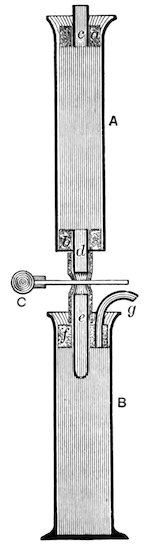
Figure 15.
Zalomanoff’s Apparatus for Determining Absorption of Salts by Soils.
Two cylinders are placed vertically, one over the other. The
lower cylinder is graduated in cubic centimeters, the upper cylinder
is closed at each end by perforated rubber
stoppers A and B through the openings of which
the glass tubes c and d pass. Within the
cylinder A the opening of the small tube d is
closed with a disk of Swedish filter paper. The
lower part of the small tube is d connected by
means of a rubber tube carrying a pinch-cock C,
with another small tube e which passes through
the stopper f. In carrying out the process the
weighed quantity of soil is placed in the upper
cylinder and afterwards the measured quantity
of the solution, the whole thoroughly mixed
and the cylinder closed. The valve C is then
opened, a given quantity of the solution, but not
all, is made to drop into the lower cylinder and
the valve C is then closed. The liquid which
has passed into the lower cylinder as well as
that which remains in the upper cylinder, is
thoroughly stirred and the quantity of the
material remaining in both liquids determined
and the absorbing power of the soil estimated
from their difference. It does not appear that
this method of estimation of the absorption
power possesses any special advantages over
the old and far simpler method of shaking in a flask.
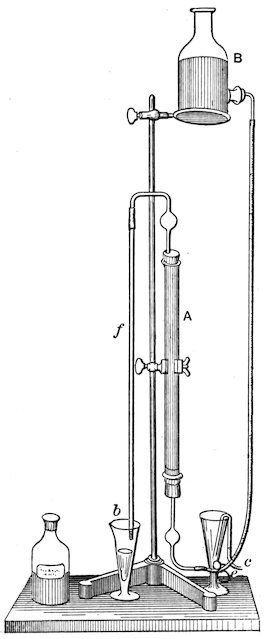
Figure 16.
Müller’s Apparatus to Show Absorption of Salts by Soils.
134. Method of Müller.—The method of Müller[97] for illustrating
absorption is carried out by means of the apparatus shown
in Fig. 16. A glass cylinder A about 750 centimeters long and
four to five centimeters wide is closed at each end with rubber
stoppers with a single perforation. The cylinder A is for the reception
of the soil with which the experiment is to be made.
Before using, the lower part of it is filled with glass pearls or
broken glass and above this a layer of glass wool is placed about
one centimeter thick. The object of this is to prevent the soil
from passing into the small tube
below. As soon as the soil has all
been placed in the cylinder A the
upper part of the tube is also
filled with glass wool. The cylinder
A is connected with the
pressure bottle B by means of a
rubber tube and the small glass
bulb tube shown in the figure.
The bottle B should have a content
of about two liters. It is filled with
the standard solution of the material
of which the absorption coefficient
is to be determined. At c the
rubber tube is connected with a
glass T one arm of which is provided
with a piece of rubber tubing
which can be closed by means
of a pinch-cock. At c a screw
pinch-cock is placed which can be
used to regulate the flow of the
solution from B to A. By opening
the pinch-cock at e on the short
arm of the T piece, a sample of the
original liquid can be taken and
this can be compared with the part
which runs to b. If it is desired
for instance, to show that potassium carbonate has been
absorbed by the soil the two bulbs shown on the small glass
tubes connecting with A can be filled with red litmus paper.
This paper will at once be turned blue in the lower bulb while
in the upper one it will retain its original color because the
liquid in passing through the soil will have lost its alkaline reaction.
The solutions used should be very dilute. The apparatus
124is designed for lecture experiments and not for quantitative
determinations.
135. Method of Knop.—For rapid determination of the
absorption coefficient of the soil Knop’s method may be used.[98]
The fine earth which is employed is that which passes a sieve
with meshes of half a millimeter. From 50 to 100 grams of
this soil are mixed with from five to ten grams of powdered chalk
and with about twice the weight of ammonium chlorid solution
of known strength, viz., from 100 to 200 cubic centimeters. The
ammonia solution should be of such a concentration that the
ammonia by its decomposition for each cubic centimeter of the
liquid evolves exactly one cubic centimeter of nitrogen. This
solution is prepared by dissolving in 208 cubic centimeters of
water one gram of ammonium chlorid. With frequent shaking
the solution is allowed to stand in contact with the soil for forty-eight
hours. The whole is now allowed to settle and the supernatant
clear liquid is poured through a dry filter. From the
filtrate twenty to forty cubic centimeters are removed by a
pipette, and evaporated to dryness in a small porcelain dish, with
the addition of a drop of pure hydrochloric acid. The ammonium
chlorid remaining in the porcelain dish is washed with ten
cubic centimeters of water into one of the compartments of the
evolution flask of the Knop-Wagner azotometer. It is decomposed
with fifty cubic centimeters of bromin lye and the nitrogen
estimated volumetrically. The difference between the amount
of nitrogen in this material and that of the original material will
give the amount of absorption exercised by the fine earth. This
number, without any further calculation, can be taken as the
coefficient of absorption.
136. Method of Huston.—The salt solutions recommended
by Huston[99] are sodium phosphate (Na₂HPO₄), potassium chlorid,
potassium sulfate, ammonium sulfate and sodium nitrate.
The solutions should be approximately tenth normal, the
actual strength in each case being determined by analysis. The
phosphorus is determined as magnesium pyrophosphate in the
usual way, the potash as potassium platinochlorid, the ammonia
by collecting the distillate from soda in half normal hydrochloric
125acid and titrating with standard alkali, and the nitrate by
Warington’s modification of Schlösing’s method for gas analysis.
The details of these methods of determination will be given later.
One hundred grams of the sifted, air-dried soil are placed in a
rubber stopped bottle and treated with 250 cubic centimeters of
the solution to be tested. The digestion is continued for forty-eight
hours in each case, the bottles being thoroughly shaken at
the end of twenty-four hours. At the end of the treatment the
solutions are filtered and the salts determined in aliquot
portions. The details of this method are essentially those
already described.
137. Statement of Results.—Duplicate analyses should be
made and the tabulation of the data is illustrated in the following
analyses by Huston:
| Na₂HPO₄ cubic centimeters filtrate taken. |
Weight of Mg₂P₂O₇ in twenty-five cubic centimeters of the solution. |
Weight of Mg₂P₂O₇ in filtrate. |
P₂O₅ absorbed by 100 grams soil. |
Salt removed per cent. |
| (a) 25 |
0.1368 gram |
0.0962 gram |
|
|
| (b) 25 |
|
0.0963 „ |
0.2589 gram |
29.6 |
| |
|
|
|
|
| |
Mean |
0.0963 „ |
|
|
| |
|
|
|
|
| KCl cubic centimeters filtrate taken. |
Weight of K₂PtCl₆ in twenty-five cubic centimeters of solution. |
Weight of K₂PtCl₆. |
K₂O absorbed by 100 grams soil. |
Salt removed per cent. |
| (a) 25 |
0.6154 gram |
0.4505 gram |
|
|
| (b) 25 |
|
0.4540 „ |
0.3161 gram |
26.5 |
| |
|
|
|
|
| |
Mean |
0.4523 „ |
|
|
| |
|
|
|
|
| K₂SO₄ cubic centimeters filtrate taken. |
Weight of K₂PtCl₆ in twenty-five cubic centimeters of solution. |
Weight of K₂PtCl₆. |
K₂O absorbed by 100 grams soil. |
Salt removed per cent. |
| (a) 25 |
0.6113 gram |
0.4426 gram |
|
|
| (b) 25 |
|
0.4371 „ |
0.3324 gram |
28.0 |
| |
|
|
|
|
| |
Mean |
0.4399 „ |
|
|
| |
|
|
|
|
| (NH₄)₂SO₄ cubic centimeters filtrate taken. |
Number cubic centimeters one-half normal acid neutralized by fifty cubic centimeters of solution. |
Half normal acid neutralized. |
N absorbed by 100 grams soil. |
Salt absorbed per cent. |
| (a) 50 |
10.00 |
7.25 grams |
|
|
| (b) 50 |
|
7.25 „ |
0.0964 gram |
27.5 |
| |
|
|
|
|
| |
Mean |
7.25 „ |
|
|
| 126 |
|
|
|
|
| NaNO₃ cubic centimeters filtrate taken. |
Number cubic centimeters N₂O₂ afforded by ten cubic centimeters of solution at 0° and 1000 millimeters pressure. |
Cubic centimeter N₂O₂ at 0° and 1000 millimeters. |
N absorbed by 100 grams soil. |
Salt absorbed per cent. |
| (a) 10 |
16.63 |
16.77 grams |
|
|
| (b) 10 |
|
16.70 „ |
none |
00.00 |
| |
|
|
|
|
| |
Mean |
16.73 „ |
|
|
Upon comparing the figures it will be found that the absorption,
passing from the greatest to the least, is as follows: phosphoric
acid (P₂O₆), potassium sulfate, ammonium sulfate,
potassium chlorid and sodium nitrate.
It will be seen that there was no absorption in the case
of the nitrate, while with each of the other salts there
was quite a marked absorption. It will also be noticed
that the percentages of absorption are not very different,
and especially is this true of the potassium and ammonium
salts, the P₂O₅ being somewhat higher. Whether this fact is
merely an accidental occurrence or is due to the law of
combination by equivalents could hardly be predicted from the
single soil experimented upon; but taking into consideration the
possibility of difference in solubility of the resulting compounds
in the saline solutions used, and of other varying conditions, the
percentages are evidently not far enough apart to exclude the
possibility of the bases uniting in equivalent proportions.
138. Preparation of Salts for Absorption.—The salts
employed in the foregoing determinations are conveniently prepared,
in fractional normal strength.
In grams per liter the following quantities in grams are recommended,
viz., 5.35 g NH₄Cl; 10.11 g KNO₃; 16.40 g Ca(NO₃)₂;
24.60 g MgSO₄ + 7H₂O; 23.4 g CaH₄(PO₄)₂, etc.
The ammonium chlorid, potassium nitrate and magnesium
sulfate can be weighed as chemically pure salts and the
standard solution be directly made up. Calcium nitrate is so
hygroscopic that a stronger solution must be made up, the calcium
determined and the proper volume taken and diluted to
one liter.
Monocalcium phosphate is prepared as follows:
127A solution of sodium phosphate is treated with glacial acetic
acid and precipitated with a solution of calcium chlorid. It is
then washed with water until all chlorin is removed. The
fresh precipitate is saturated with pure, cold phosphoric acid of
known strength. After filtering the solution is placed in a warm
room and left for two or three weeks until crystallization takes
place.
The crystals are pressed between blotting papers and finally
dried over sulfuric acid and washed with water-free ether, and
again dried. Since this salt is decomposed in strong solutions it
should be used only in one hundredth normal strength, viz., 2.34
grams per liter.
139. Porosity.—The porosity of a soil depends upon the state
of divisibility and arrangement of its particles, and upon the
amount of interstitial space within the soil. If a soil be cemented
together into a homogeneous mass, its porosity sinks to a minimum;
if it be composed, however, of numerous fine particles,
each preserving its own physical condition, the porosity of the
soil will rise to a maximum. The porosity of a soil may be
judged very closely by the percentage of fine particles it yields
by the process of silt analysis to be described further on. In
general, the more finely divided the particles of a soil, the greater
its fertility. This arises from various causes; in the first place,
such a soil has a high capacity for absorbing moisture and holding
it; thus the dangers of excessive rain-falls are diminished,
and the evil effects of prolonged drought mitigated. In the
second place, a porous soil permits a freer circulation of the gases
found in the soil. The influence of lime in securing the proper
degree of porosity of a soil is very great, especially in alluvial
deposits and other stiff soils. It prevents the impaction which
will necessarily follow in a soil which is too finely divided. In
general, the porosity of the soil may be said to depend on three
factors, viz.: 1. Upon the state of divisibility or the number of
particles per unit volume; 2. Upon the nature and arrangement
128of these particles; 3. Upon how much interstitial space there is
in the soil.
140. Influence of Drainage.—Good underdrainage increases
the porosity of a soil by removing the excess of water during wet
seasons and rendering the soil more suitable to capillary attraction
which will supply moisture during dry seasons. The influence
of tile drainage on the production of floods has been carefully
studied by Kedzie,[100] who shows that surface ditching in
conjunction with deforesting may increase floods and contribute
to droughts, and that tile-draining may increase flood at the
break-up in spring, when the water accumulated in the surface
soil by the joint action of frost and soil capillarity during the
winter, and the surface accumulations in the form of snow are
suddenly set free by a rapid thaw.
He also points out that during the warm months tile-draining
tends to prevent flood by enabling the soil to take up the excessive
rain-fall and hold it in capillary form, keeping back the
sudden flow that would pass over the surface of the soil if not
absorbed by it, and it mitigates summer drought by increased
capacity of the soil to hold water in capillary form and to draw
upon the subsoil water supply.
141. Soil Moisture.—The capacity of a soil to absorb moisture
and retain it depends on its porosity and is an important
characteristic in relation to its agricultural value.
The following general principles relating to soil moisture are
adapted from Stockbridge:[101]
During dry weather plants require a soil which is absorptive
and retentive of atmospheric moisture. The amount of this
retention is generally in direct ratio to two factors, viz., the amount
of organic matter and its state of division. The capillary water
of the soil is very closely related to its percolating power, since
all waters in the soil are governed in their movements by what
is known as capillary force. Liebenberg has shown that this
movement may be either upwards or downwards, according as
the atmosphere is dry or supplies soil-saturating rain. The water
absorbed by the roots passes into the plant circulation, and the
greater part is evaporated from the leaves. Where the supply of
129water is insufficient, the plant wilts, and if the evaporation long
continue in excess of the supply obtained from the soil, the plant
must die. The experiments of Hellriegel have shown that any
soil can supply plants with all the water they need, and as fast
as they need it, so long as the moisture within the soil is not
reduced below one-third of the whole amount that it can hold.
The quantity of water required and evaporated by different agricultural
plants during the period of growth has been found to be
as follows:
| One |
acre |
of |
wheat |
exhales |
409,832 |
pounds |
of |
water. |
| „ |
„ |
„ |
clover |
„ |
1,096,234 |
„ |
„ |
„ |
| „ |
„ |
„ |
sunflowers |
„ |
12,585,994 |
„ |
„ |
„ |
| „ |
„ |
„ |
cabbage |
„ |
5,049,194 |
„ |
„ |
„ |
| „ |
„ |
„ |
grape-vines |
„ |
730,733 |
„ |
„ |
„ |
| „ |
„ |
„ |
hops |
„ |
4,445,021 |
„ |
„ |
„ |
Dietrich estimates the amount of water exhaled by the foliage
of plants to be from 250 to 400 times the weight of dry organic
matter formed during the same time. Cultivation conserves soil
moisture. It must be remembered that this water contains soil
ingredients in solution. Hoffmann has estimated that the quantity
of matter dissolved from the soil by water varies from 0.242
to 0.0205 per cent of the dried earth. The experiments of
Humphrey and Abbott have shown that about one-sixth of the
total sediment of the Mississippi river is soluble in water.
142. Determination of the Porosity of the Soil.—The
porosity of the soil is fixed by the relative volume of the solid
particles as compared with the interstitial space. It is most
easily determined by dividing the apparent by the real specific
gravity.
Let the real specific gravity of a soil be 2.5445 and the apparent
specific gravity of the same soil be 1.0990.
The porosity is then calculated according to the following
ratios, viz.:
Whence X = 43.2 = per cent volume occupied by the solid
particles of the soil.
The per cent volume occupied by the interstitial space is
therefore 56.8.
130143. Method of Whitney.—The total volume of interstitial
space within the soil, in which water and air can enter, is best
determined by calculation from the specific gravity and the
weight of a known volume of soil. To determine this in the soil
in its natural position in the field, a sample is taken in the following
way: A brass tube, about two inches in diameter and
nine inches long, has a clock spring securely soldered into one
end, and this end turned off in a lathe to give a good cutting
edge of steel. The area enclosed by this steel edge is accurately
determined, and a mark is placed on the side of the tube exactly
six inches from the cutting edge. A steel cap fits on top of the
brass cylinder to receive the blows of a heavy hammer or wooden
mallet. The cylinder is driven into the ground until the six-inch
mark is just level with the surface. The whole is then dug
out, care being taken to slip a broad piece of steel under the
cylinder before it is removed, so as to prevent the soil which it
contains from falling out. The cylinder is then carefully laid
over on its side, and the soil is cut off flush with the cutting edge
of steel. The soil is then removed from the cylinder, carried to
the laboratory and properly dried and weighed. The object of
the steel inserted in one end of the cylinder is to reduce the friction
on the inside of the tube to a minimum, and thus prevent
the soil inside the cylinder being forced down below the level of
the surrounding earth. The volume of the soil removed with
this sampler can readily be determined by calculation, as the
area of the end of the tube is known and the sample is six inches
deep. In a sampler, such as described here, this volume is
about 300 cubic centimeters. From the weight of soil and the
volume of the sample, the volume of interstitial space may be
found by the following formula:
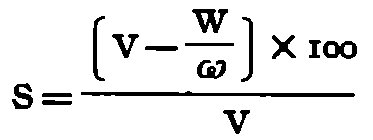
S is the per cent by volume of interstitial space, V is the volume
of the tube in cubic centimeters, W is the weight of soil
in grams, and ω is the specific gravity of the soil. The specific
gravity can be determined for each soil, or the factor 2.65 can
be used, which is sufficiently accurate for most work.
131The per cent by volume of interstitial space in the undisturbed
subsoil is found to range from about thirty-five for sandy land,
to sixty-five or seventy for stiff clay lands.
For the determination of the amount of water an air-dried soil
will hold, if all the space within it is completely filled with water,
an eight-inch straight argand lamp chimney, with a diameter of
about two inches, can be conveniently used. A mark is placed
on the side of the tube, six inches from one end, and the volume
of the tube up to this mark is found by covering the end with a
piece of thin rubber cloth, or by pressing the chimney down
firmly on a glass plate, and making a water-tight joint with
paraffin or wax. Water is then poured into the tube up to the
six-inch mark, and the weight or volume of water determined.
The tube can then be dried, a piece of muslin tied tightly over
the top and the whole then weighed. Soil is carefully poured
in and the tube gently tapped on a soft support until the soil is
six inches deep in the tube, and has the desired degree of compactness.
The weight and volume of the soil can thus be determined,
and the volume of the interstitial space from the formula
already given. This can also be determined directly by introducing
water from above, or by immersing the cylinder of soil
up to the six-inch mark in water, and allowing the water to
enter the soil from below. With such a short depth of soil, very
little water will flow out when the cylinder is suspended in the
air. The amount which will flow out when the cylinder is thus
suspended, will depend both upon the texture and the depth of
soil. It is impossible, however, by this method, to completely
remove the air or to completely fill the space within the soil with
water; for as the water enters the soil, a considerable amount of
air becomes entangled in the capillary spaces, and this could not
be removed except by boiling and vigorous stirring, which would
altogether change the texture of the soil. The amount of water
held by the soil, or the amount of space within the soil into
which water and air can enter, will evidently depend upon the
compactness of the soil, and this is best expressed in per cent
by volume of space.
144. Capacity of the Fine Soil for Holding Moisture.—The
132soil, as it is taken from the field, may have quite a different
water coefficient from the same soil after it has been passed
through a fine sieve or been dried at air temperatures or at 100°
or 110°. The method of determination which depends upon
adding excess of water to a given weight of fine earth, and afterwards
eliminating the excess by percolation or filtration, is apt
to give misleading results. If, however, the results are obtained
by working on the same weight of soil, and in the same conditions,
they may have value in a comparative way. The comparison
between soils must be made with equal weights, in like
apparatus and with the same manipulation, to have any value.
These determinations, however, cannot have the same practical
value as those made in the samples in a natural condition as
has just been described.
145. Method of Wolff Modified by Wahnschaffe.[102]—A cylindrical
zinc tube (Fig. 17), sixteen centimeters long and four
centimeters internal diameter, is used, the cubical capacity of
which is 200 cubic centimeters.
The cylinder is graduated by placing the moist linen disk on
the gauze and tying a piece of rubber cloth over the bottom.
Water is now poured in until the level is even with the gauze
bottom. Add then exactly 200 cubic centimeters of water, mark
its surface on the zinc, throw out the water, and file the zinc down
to the mark.
The bottom of the tube is closed with a fine nickel-wire gauze.
Below this a piece of zinc tubing, of the size of the main tube,
is soldered; pierced laterally with a number of holes.
Before using, the gauze bottom of the cylinder is covered with
a moist, close fitting linen disk, and the whole apparatus weighed.
It is then filled with the fine earth, little by little, jolting the
cylinder on a soft substance after each addition of soil to secure
an even filling. When filled even full the whole is weighed, the
increase in weight giving the weight of soil taken.
Figure 17.
Capacity of the Fine Soil for Holding Moisture. Method of Wolff Modified by Wahnschaffe.
133A large number of cylinders can be filled at once and placed
in a large glass crystallizing dish containing water and covered
with a bell jar (Fig. 17). The water should cover the gauze bottoms
of the cylinders to the depth of five to ten millimeters.
More water should be added from time to time as absorption
takes place. The cylinders should be left in the water until
when weighed at intervals of an hour no appreciable increase in
weight takes place. The temperature and barometer reading
should be noted in connection with each determination. With
increasing temperature the water coefficient is diminished.
The method of Wolff, as practiced in the laboratory of the
Chemical Division of the U. S. Department of Agriculture, has
given very concordant results. Five determinations were made
on a sample of vegetable soil with the Wolff cylinders, which
were weighed at intervals of ten, twenty, and thirty days, with
the following results:
| No. |
1. |
Water |
absorbed |
after |
ten |
days |
106.25 |
per |
cent |
| „ |
2. |
„ |
„ |
„ |
„ |
„ |
105.68 |
„ |
„ |
| „ |
3. |
„ |
„ |
„ |
„ |
„ |
105.86 |
„ |
„ |
| „ |
4. |
„ |
„ |
„ |
„ |
„ |
106.11 |
„ |
„ |
| „ |
5. |
„ |
„ |
„ |
„ |
„ |
105.83 |
„ |
„ |
| |
|
|
|
|
|
|
|
|
|
| Mean |
105.95 |
„ |
„ |
| |
|
|
|
|
|
|
|
|
|
| No. |
1. |
Water |
absorbed |
after |
twenty |
days |
106.44 |
per |
cent |
| „ |
2. |
„ |
„ |
„ |
„ |
„ |
105.98 |
„ |
„ |
| „ |
3. |
„ |
„ |
„ |
„ |
„ |
106.56 |
„ |
„ |
| „ |
4. |
„ |
„ |
„ |
„ |
„ |
106.52 |
„ |
„ |
| „ |
5. |
„ |
„ |
„ |
„ |
„ |
106.38 |
„ |
„ |
| |
|
|
|
|
|
|
|
|
|
| Mean |
106.38 |
„ |
„ |
| |
|
|
|
|
|
|
|
|
|
| No. |
1. |
Water |
absorbed |
after |
thirty |
days |
108.35 |
per |
cent |
| „ |
2. |
„ |
„ |
„ |
„ |
„ |
107.60 |
„ |
„ |
| „ |
3. |
„ |
„ |
„ |
„ |
„ |
108.32 |
„ |
„ |
| „ |
4. |
„ |
„ |
„ |
„ |
„ |
107.86 |
„ |
„ |
| „ |
5. |
„ |
„ |
„ |
„ |
„ |
107.87 |
„ |
„ |
| |
|
|
|
|
|
|
|
|
|
| Mean |
108.00 |
„ |
„ |
The data obtained show that there was a very slight increase
in the amount of moisture absorbed after the tenth day.
As will be seen, however, from the following data, the soil
within the cylinder does not contain in all parts the same percentage
of moisture, the lower portions of the cylinder containing
notably larger proportions than the upper parts. The cylindrical
soil column was divided into four equal parts and the moisture
determined in each part. Beginning with the top quarter the
percentages of moisture were as follows:
| 134 |
| First |
quarter |
97.52 |
per |
cent |
| Second |
„ |
105.91 |
„ |
„ |
| Third |
„ |
112.83 |
„ |
„ |
| Fourth |
„ |
116.48 |
„ |
„ |
146. Method of Petermann.[103]—The method of Wolff as
practiced by the Belgian Experiment Station, at Gembloux, is
essentially the same as described above.
Petermann recommends the use of tared cylinders twenty to
twenty-five centimeters long and six to eight centimeters in
diameter. The cylinder is to be filled with the fine earth, little
by little, with gentle tapping after each addition. The bottom
of the cylinder is closed with a perforated rubber stopper on which
is spread a moistened disk of linen. The cylinder, thus prepared
and filled, is weighed and afterwards placed in a vessel
containing distilled water, to such a depth as to secure a water
level about two centimeters above the lower surface of the soil
in the cylinder. The level of the water is kept constant as the
contents of the cylinder are moistened by capillarity. When the
earth appears to be thoroughly moistened, as can be told by
the appearance of the upper surface, maintain the contact with
water for about five or six hours.
The cylinder is then removed, the upper surface covered to
avoid evaporation, allowed to drain for a few hours, wiped and
weighed. The cylinder is again placed in water to see if any
increase in weight takes place. The weight of the fine earth
and of the absorbed water being known, the percentage of
absorption is easily calculated.
147. Method of A. Mayer.[104]—A glass tube, one and seven-tenths
centimeters in diameter, composed of two pieces, seventy-five
centimeters and twenty-five centimeters in length, is united
by a piece of rubber tubing. The lower free end of the seventy-five
centimeter piece is closed with a piece of linen. The tube
is filled, with gentle jolting, to the depth of one meter with fine
earth, the earth column thus extending twenty-five centimeters
above the point of union of the two pieces. Thus prepared, a
quantity of water is poured into the upper tube sufficient to temporarily
saturate the whole of the soil.
During the sinking of the water in the tube there is thus
135effected a moistening of the material before it is wholly filled
with water. After waiting until the water poured on top has
disappeared the tube is separated at the rubber tube connection
and a sample of the moist soil taken at that point. This is at
once weighed and then dried at 100°. The loss in weight gives
the water absorbed.
The number thus obtained is calculated to the standard by
volume, by use of the number representing the apparent specific
gravity of the fine earth.
For sand of different degrees of fineness the following numbers
were found:
| Degree of fineness |
2 |
3 |
4 |
| Per cent water absorbed |
7.0 |
13.7 |
44.6 |
The numbers thus obtained are taken to represent the absolute
water capacity of a mineral substance in powder.
The full water capacity, i. e., the power of holding water when
the powder is immersed in water, the excess of which is then
allowed to flow away is much greater than the absolute number.
This difference is shown in the following data:
|
Quartz, size three. |
Clay, size three. |
| Full water capacity |
49.0 |
per cent |
46.8 |
per cent |
| Absolute water capacity |
13.7 |
„ „ |
24.5 |
„ „ |
In general the absolute is markedly inferior to the full water
capacity. Only in the finest dust do the two numbers approach
each other.
148. Volumetric Determination.—A convenient apparatus
for this determination has been devised by Mr. J. L. Fuelling,
of the Chemical Division, Department of Agriculture. It is shown
in Fig. 18.
It consists of an ordinary percolator the diameter of which
decreases slightly towards the lower end, a thick-wall rubber
tube and an ordinary burette, divided in tenths. A rubber stopper
is fitted to the mouth of the percolator and perforated twice—in
the middle and at the side, the former for a small tube provided
with pinch-cock and the latter for the neck of a small
funnel. The whole is supported on a convenient stand, the
clamp holding the percolator being placed above that supporting
the burette, both clamps arranged to slide on the stand-rod.
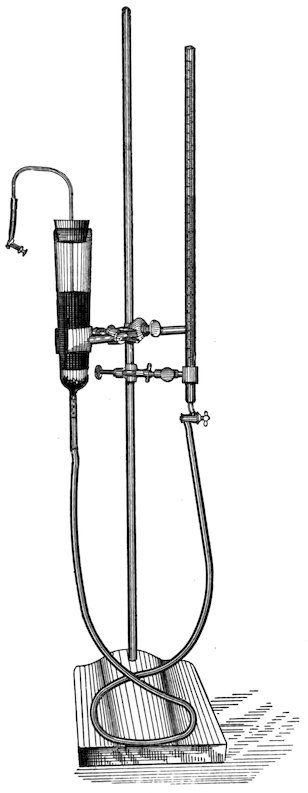
Figure 18.
Fuelling’s Apparatus.
The method is as follows:
A mark is placed upon the projecting tube at the lower end
of the percolator, and the tube at this point may be drawn out
sufficiently to decrease the width
of meniscus to one-eighth inch.
Into the percolator is first introduced
a small disk of wire gauze
or perforated porcelain, with
heavy wire pendant in the tube.
Through the rubber stopper a
small glass tube is passed and
its lower end pressed firmly upon
the wire or porcelain disk, its
upper end being curved and
supplied with a pinch-cock.
Into the percolator is now poured
one inch of fine shot (No. 20)
and then one inch of fine sand
which has been previously digested
with hydrochloric acid
and well cleaned of dust by
washing.
The zero.—After the shot and
sand have been shaken even,
the burette is filled with water
and raised above the level of the
sand, wetting the percolator for
four inches of its length. The
burette is lowered and the shot
and sand bed allowed to drain
by opening the pinch-cock of
the inner tube.
The burette is raised and the shot-sand flooded repeatedly
until, by lowering the burette until the zero mark
of the percolator tube is reached, a uniform reading on the
136burette is secured. Thus the shot-sand bed is completely
charged with water. The water level is now made zero on the
percolator stem, the burette filled to its zero mark and the apparatus
is prepared for introduction of the soil.
The Determination.—From 100 to 200 grams of soil, previously
dried free of moisture, are weighed, the burette raised until the
water level is three inches above the sand, and the soil gently
dropped through a funnel into the water. When the soil has
been introduced and wetted completely the water level is raised
above the soil and allowed to remain thus two hours. The
burette is then lowered and the water allowed to drain from the
wetted soil. Four to six hours are usually given the draining,
the reading taken on the burette after establishing the zero on
the percolator stem, the volume of absorbed water thus ascertained
and divided by the weight of soil multiplied by 100; the
result expresses the water absorbed per hundred of soil.
Example:
| Water required to saturate disk, etc. |
0.50 |
cubic centimeter. |
| Weight of air-dried soil taken |
20.00 |
grams. |
| Moisture at 105° therein |
14.25 |
per cent. |
| Weight water in soil |
2.85 |
grams. |
| Reading of burette after saturation |
10.75 |
cubic centimeters. |
| Less water required for disk, etc |
9.25 |
„ „ |
| Temperature |
20°.00 |
|
| Weight of 9.25 cubic centimeters H₂O at 20° |
9.22 |
grams. |
| Total weight of water retained by soil |
12.07 |
„ |
| Per cent water retained by soil |
60.35 |
per cent. |
For general analytical work the correction for variations in the
weight of water for different temperatures is of no practical
importance.
149. Accuracy of Results.—A sample of soil from the beet
sugar station, in Nebraska, gave the following duplicate results:
| First trial |
45.75 |
per |
cent |
water. |
| Second trial |
44.85 |
„ |
„ |
„ |
Muck soils from Florida, containing varying proportions of
sand, gave the following numbers:
Soil number one, 144.85 per cent, and 145.43 per cent; soil number
two, 109.13 per cent, and 107.93 per cent; soil number three (very sandy),
46.86 per cent, and 46.51 per cent.
137150. Method of Wollny.[105]—A zinc tube, ninety centimeters
long and four centimeters internal diameter, carries at each end,
at right angles to the axis, a flattened rim 1.5 centimeters
broad. The lower end of the tube is closed with a strong piece
of coarse linen. The soil to be examined is then filled in little
by little, with gentle tamping.
On the upper end two glass tubes are placed, each ten centimeters
long and four centimeters internal diameter. These tubes
are furnished at each end with cemented brass cylinders which
are expanded to a circular, evenly ground rim, 1.5 centimeters
wide, also at right angles to the axis of the main tube. These
rims are greased and placed together, one on the other, and held
together by wooden clamps.
The glass tube in immediate connection with the zinc tube is
also firmly filled with the soil sample, while the second tube is
only partly filled, so that any settling which may take place in
the soil on the addition of water may still find the first glass tube
full of the sample.
The empty part of the upper glass tube is now filled with water
and additional quantities of water are added from time to time
until the soil is saturated. In order to be able to observe when
this takes place there is a slit at the lower end of the zinc tube
which is closed with a piece of glass. This slit should be about
two centimeters broad and ten centimeters long. The lower end
of the zinc tube is set on a glass plate to prevent evaporation.
As soon as the water shows itself at the lower end of the zinc
tube, the excess of water in the upper glass tube is at once
removed by a pipette and a stopper inserted through which a
glass tube passes drawn out into a fine point above. The object
of this is to avoid evaporation on the upper surface. The
apparatus is then left at rest for thirty-six hours.
At the end of this time the clamps are removed and the column
of moist earth cut with a piece of platinum foil, and the two
ends of the glass tube, next to the zinc tube, covered with glass
plates. It is then weighed and the weight of moist earth determined
by deducting the weight of the tube and its glass covers.
The moist earth is carefully removed to a large porcelain dish
and dried at 100°. Before weighing it is allowed to stand twenty-four
138hours in the air. The data obtained are used to calculate
the water content to volume per cent.
The volume of the glass tubes should be determined by
careful calibration.
151. Method of Heinrich.[106]—The soil to the depth turned
by the plow is dug out and in the hole a lead vessel without bottom,
twenty centimeters in diameter and forty centimeters high,
is placed. The soil is then thrown back around and outside the
lead vessel until the latter appears buried in the fragments.
The rest of the soil is passed into the lead vessel, through a
sieve having four meshes to the centimeter, using for this purpose
enough water to thoroughly moisten it. Care should be
taken not to use enough water to cause any separation of the
fine from the coarse particles.
By this process all coarse stones, sticks, etc., are separated.
In sandy soils the flask is left for a few hours while in clay soils
a much longer time is necessary. When the excess of water has
disappeared the lead cylinder is removed, and a piece cut out of
the center of it placed in a weighed drying flask and dried at
100°.
152. Effect of Pressure on Water Capacity.[107]—The increasing
capacity of soil to hold water developed by shaking or pressure,
is determined by Henrici in the following way:
Into a glass cylinder of twenty millimeters internal diameter
are poured twenty cubic centimeters of water. A given quantity
of soil is next added, and after standing until thoroughly
saturated, the residual water is measured by pouring off, or
better, by graduations on the side of the tube. The increase in
the volume of the clear water is also measured, after shaking, in
the same way. The data of a determination made as above
described follow:
| Water in cylinder |
30 |
cubic |
centimeters. |
| Water and saturated soil |
40 |
„ |
„ |
| Volume of unsaturated soil = e = |
10 |
„ |
„ |
| Volume of saturated soil = e + w = |
20.5 |
„ |
„ |
| Water contained therein = w = |
10.5 |
„ |
„ |
By repeated shaking the volume of e + w, the content of w
therein, and the relative values of e
w were found to be as follows:
| 139 |
|
Cubic
centimeters. |
Cubic
centimeters. |
Cubic
centimeters. |
Cubic
centimeters. |
| e + w |
20.5 |
16.0 |
15.7 |
15.0 |
| w |
10.5 |
6.0 |
5.7 |
5.0 |
w
e |
1.05 |
0.60 |
0.57 |
0.50 |
If e′ represent the volume of the saturated soil then e′ = e + w,
and this gives the relation to the volume of dry earth represented
by the equation e′
e = 1 + w
e. This indicates that the relative
volume of the saturated soil is equal to unity increased by the
relative content of water.
153. Coefficient of Evaporation.—At an ordinary room temperature
in the shade, samples of soil, if they are subjected to
experiment in tolerably thin layers have nearly an equal coefficient
of evaporation. That is, the absolute quantity of water
evaporated in a given time is almost entirely conditioned upon
the magnitude of the surface exposed and the temperature of
the surrounding air. Only when exposed in conditions as nearly
as possible natural in thin layers to the action of the sunlight
and shade do the soils show their peculiarities in respect of the
evaporation of moisture. In order to see these peculiarities,
samples of soil which have been previously examined must be
subjected to examination at the same time with the soil whose
properties are to be determined.
The zinc box, before described, should be protected with a
well fitting cover of thick paper, and the different samples of soil
which are to be tested placed therein. This should now be
placed in a wooden box, the top of which is exactly even with
the top of the zinc vessel. This box containing the vessel should
be exposed to the sunlight. After twenty-four hours the
zinc boxes can be taken away from position and their loss in
moisture determined, and these weighings, according to the condition
of the atmosphere, can be continued from fourteen days
to three weeks, the temperature of the air of course being carefully
determined at each time. At first, all the different soils
being saturated with moisture, it will be observed that the loss
of moisture is proportionately the same for all. Soon, however,
the rapidity of the evaporation in the samples of soil rich in
humus and clay will be decreased as compared with the sandy
140soils, and in general, those which possess a high capillary power
capable of bringing the moisture rapidly from the deeper layers
to the surface. There soon comes a point when the difference
in evaporation is at its greatest; and then there will be a gradual
diminution until the samples lose no further moisture. This
point, for the different soils, can be determined by frequent
weighings of the vessel.
154. Determination of Capillary Attraction.—Long glass
tubes graduated in centimeters may be used for this determination,
or plain tubes so arranged as to admit of easy measurements with
a rule. The tubes may be from one to two centimeters internal
diameter and about one meter long. The fine earth should be
evenly filled in little by little, with gentle jolting. The lower end
of each tube, before filling, is closed with a piece of linen.
The tubes, after filling, are supported in an upright position
by a frame AE, Fig. 19, in a vessel B containing water in which
the linen covered
ends D dip
to the depth of
two centimeters.
The height of
the water in
the several tubes
should be read
or measured at
stated intervals.
The water contained
in the
supply vessel
should be kept
at a constant
height by a
Mariotte bottle.
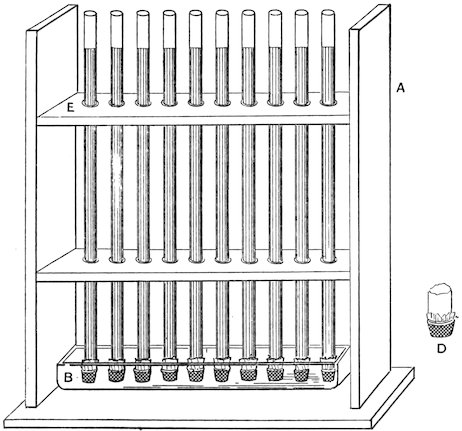
Figure 19.
Apparatus to show Capillary Attraction of Soils for Water.
The observations
may be discontinued after one hundred and twenty hours,
but even then the water will not have reached its maximum
height.
It is recommended by some experimenters to cut the tubes,
141after the above determination is completed, into pieces ten centimeters
in length, and to determine the per cent of water in each
portion.
155. Statement of Results.—The following table illustrates
a convenient method of tabulating the observed data as given
by König.[108]
| Number of sample |
|
|
1 |
2 |
3 |
4 |
5 |
6 |
|
| Height of moisture column after: |
24 |
hours. |
27.3 |
38.0 |
16.7 |
36.4 |
8.0 |
28.8 |
centimeters. |
| 48 |
„ |
35.9 |
50.8 |
24.5 |
49.2 |
11.9 |
40.5 |
„ |
| 72 |
„ |
41.5 |
59.5 |
30.0 |
57.9 |
15.2 |
49.1 |
„ |
| 96 |
„ |
44.4 |
66.2 |
33.5 |
63.8 |
17.5 |
55.2 |
„ |
| 120 |
„ |
46.7 |
70.0 |
36.3 |
68.5 |
19.2 |
60.5 |
„ |
156. Inverse Capillarity.—In tubes filled with fine earth, as
described in paragraph 154, water is quickly poured, the
same quantity into each tube of the same diameter, or such
quantities in tubes of different diameters as would form a water
column of the same depth over the surface of the sample. The
rate at which the water column descends in each tube, the time
of the disappearance of the water at the surface and the final
depth to which it reaches, are the data to be entered.
157. Statement of Results.—The points to be observed in
the determination of inverse capillarity are the number of hours
required for the total absorption of a column of water of a
given height, the depth of the moisture column at that moment,
and the total depth to which the moisture column finally
reaches. The data of observations with six samples with a
water column four centimeters high are given by König[109] as
follows:
| Number of sample |
1 |
2 |
3 |
4 |
5 |
6 |
|
| Number of hours required for water to disappear |
4.3 |
1.8 |
10.3 |
3.0 |
21.0 |
4.3 |
|
| Depth of moisture at time of disappearance of water |
11.0 |
12.0 |
11.4 |
13.3 |
11.7 |
12.0 |
centimeters. |
| Total depth of moisture |
13.0 |
18.1 |
13.0 |
19.0 |
12.0 |
16.5 |
„ |
158. Determination of the Coefficient of Evaporation.—The
coefficient of evaporation is the number of milligrams of
water evaporated from a square centimeter of soil surface in a
142given unit of time. It is evident that this number will vary with
the physical state of the soil, the velocity of the wind, the saturation
of the air with aqueous vapor and the temperature. In all
statements of analyses these factors should appear.
The process may be carried on first (a) with soil samples kept
continually saturated with water and (b) with samples in which
the water is allowed to gradually dry out.
Method a.—The determination may be made in the shade or
sunlight.
In the Shade.—A zinc cylinder (Z Fig. 20), fifteen centimeters
in diameter and 7.5 centimeters high, with a rim one centimeter
wide and one centimeter from top, is covered at one end with
linen or cotton cloth and filled with fine earth, with gentle jolting,
until even with the top. It is then placed in a zinc holder
H, into the circular opening of which it snugly fits as in
A. This holder is twenty centimeters in diameter and
7.5 centimeters deep. It has an opening at O through which
water can be added until it is filled so as to wet the bottom
of Z when in place. As the water is absorbed by the soil
more is added and, the top being covered, the apparatus is
allowed to stand for twenty-four hours. At the end of this time
the soil in the zinc cylinder is saturated with water to the fullest
capillary extent.
The whole apparatus, after putting a stopper in O, is now
weighed on a large analytical balance and placed in an open
room, with free-air circulation, for twenty-four hours. At the
end of this time it is again weighed and the loss of weight calculated
to milligrams per square centimeter. Where large and
delicate balances can not be had, the apparatus can be constructed
on a smaller scale suitable for use with a balance of the ordinary
size.
In the Sunlight.—The apparatus described above is enclosed
in a wooden box having a circular opening the size of the soil-zinc
cylinder. In the determination of the rate of evaporation,
the apparatus, charged and weighed as above described, is
exposed to the sun for a given period of time, say one hour. On
the second weighing the loss represents the water evaporated.
The time of year, time of day, velocity of wind and temperature,
143and degree of saturation of the air with aqueous vapor, should
be noted. The data obtained can then be calculated to milligrams
of water per square centimeter of surface for the unit of
time.
Method b.—As in method a the determination may be made in
the shade or in the sunlight. The rate of evaporation is, in this
method, a diminishing one and depends largely on the reserve
store of water in the sample at any given moment.
The same piece of apparatus may be used as in the determinations
just described. After charging the sample with moisture
all excess of water in the outer zinc vessel is removed and the
rate of evaporation determined by exposure in an open room or
in the sunlight, as is done in the operations already described.
Alternate Method.—The zinc cylinders used in determining
saturation coefficient, paragraph 145, may also be employed in
determining the rate of evaporation. Each cylinder should be
wrapped with heavy paper or placed in a thick cardboard receptacle,
and all placed in a wooden box, the cover of which is provided
with circular perforations, just admitting the tops of the
cylinders, which should be flush with the upper surface of the
cover.
Arranged in this way the cylinders previously weighed are
exposed in the shade or to direct sunlight and reweighed after
a stated interval. On account of the small surface here exposed
in comparison with the total quantity of soil and moisture it is
recommended to weigh the cylinders once only in twenty-four
hours. The weighings may be continued for a fortnight or even
a month.
In soils fully saturated with water the rate of evaporation is at
first nearly the same on account of the surface being practically
that of water alone. As the evaporation continues, however,
the rate changes markedly with the character of the soil.
159. Rapid Method of Wolff.—In order to expose a
larger surface to evaporation and to secure the results in a shorter
period of time, Wolff[110] fills square boxes, having wire-gauze bottoms,
with fine earth, and after saturating with moisture weighs
and suspends them in the open air. The wire-gauze bottoms
are previously covered with filter paper to prevent loss of soil.
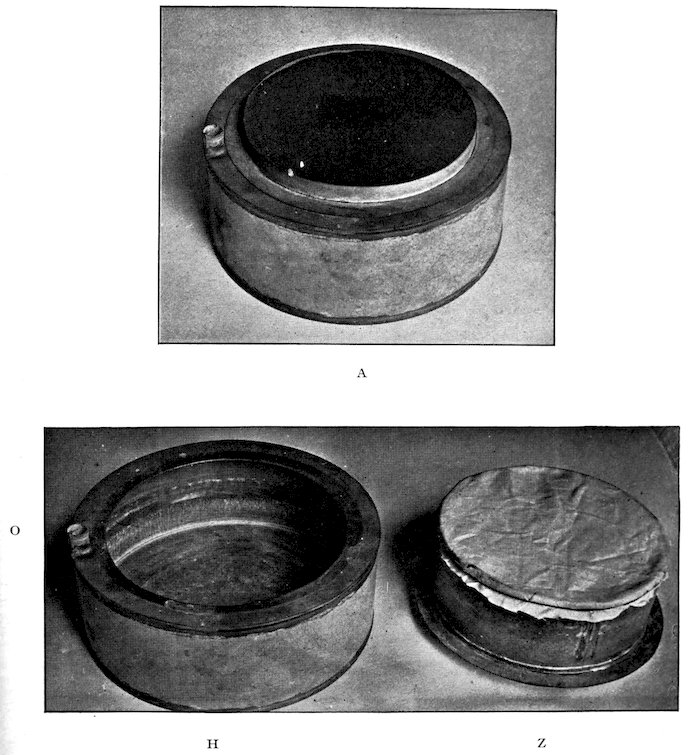
Figure 20.
Apparatus for Determining Coefficient of Evaporation.
144160. Estimation of Water Given up in a Water-Free
Atmosphere.—The air-dried sample, in quantities of from
five to ten grams in a thin layer on glass, is placed over a vessel
containing strong sulfuric acid. It is then placed on a ground
glass plate and covered with a bell jar. The sample is weighed
at intervals of five days until the weight is practically constant.
This method is valuable in giving the actual hygroscopic
power of a soil depending on its structure alone.
161. Estimation of the Porosity of the Soil for the Passage
of Gases.—Some further notion of the physical state of
the soil known as porosity, may also be derived by a study of
the rate at which it will admit of the transmission of gases. A
method for estimating this has been devised by Ammon.[111]
Air is compressed in two gas holders by means of a column of
water of proper height to give the pressure required.
The tubes through which the air passes out of the gas holders
are each furnished with a stop-cock and united with a glass tube
having a side tube set in at right angles for carrying off the air.
The use of two holders makes it possible to carry on the
experiment as long as may be desired, one holder being filled
with air while the other is emptying.
The common conducting tube is joined with a meter which is
capable of measuring, to 0.01, the volume of air passing through
it. The pressure is regulated by means of the stop-cocks. The
air passing from the meter is received in a drying tube filled with
calcium chlorid.
From the drying tube the air enters a drying flask filled below
with concentrated sulfuric acid and above with pumice stone
saturated therewith. Next the dried air passes through a worm,
eight meters long, surrounded with water at a given temperature.
The dried air of known temperature next enters the experimental
tube. This tube is made of sheet zinc 125 centimeters
in length and five centimeters in internal diameter. It is placed
in an upright position, and about six centimeters from its
upper end carries a small tube at right angles to the main one
for connection with a water-filled manometer.
The upper and lower ends of the tube are closed with perforated
rubber stoppers carrying tubes for the entrance and exit
of the air.
145In the inside of the zinc tube are found two close-fitting but
movable disks, of the finest brass wire gauze, between which the
material to be experimented upon is held.
The layer of fine soil is held between these disks and may be
of such a depth as is required for the proper progress of the experiment.
With soils of firm texture opposing a great resistance
to the passage of the air the column of earth tested should be
shorter than with light and very permeable soils. The experimental
tube is surrounded with a water jacket, which may also
be made of sheet zinc, carrying small tubes directed upwards
for holding thermometers. The water jacket should be kept at
the same temperature as the air which is used in the experiment.
The process of filling the tube, the amount of pressure to be
used and the air and soil temperature, will naturally vary in
different determinations.
The volume of air at a given pressure and temperature which
passes a column of soil of a given length in a unit of time will
give the coefficient of permeability.
162. Determination of Permeability in the Open Field.—A
method for determining the rate of transmission of a gas
through the soil in the field has been devised by Heinrich.[112]
A box C (Fig. 21) is made
of strong sheet iron and has an
opening below, ten centimeters
square, and a height of
about twenty centimeters. At
exactly ten centimeters from
the bottom, the box has a rim
at right angles to its length
so that it can be placed only
ten centimeters deep in the
soil. The box holds a volume
of earth equal to 1,000 cubic
centimeters.
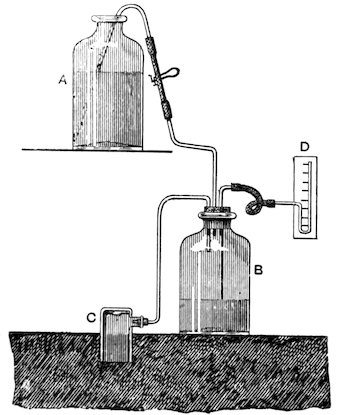
Figure 21.
Method of Heinrich.
The part of the box above
ground is connected with the
bottle B by a glass tube as indicated
in the figure. The
146bottle B should have a capacity of about ten liters. The air in B is
forced out through C by water running in from the supply A and
the pressure in B is recorded by the manometer D. The experiment
should be tried on a soil thoroughly moist.
In measuring the pressure in B the water pressure should be
cut off by the pinch-cock between A and B, and the pressure on
the manometer observed after the lapse of one to two minutes.
163. Porosity in Relation to Water Movement.—The intimate
relation which water movement in a soil bears to fertility
makes highly important the analytical study of this feature of
porosity. A soil deficient in plant food, in so far as chemical
analysis is concerned, will produce far better crops when the
flow of moisture is favorable than a highly fertile soil in which
the water may be in deficiency or excess.
Aside from the actual rain-fall the texture of the soil, in other
words its porosity, is the most important factor in determining
the proper supply of moisture to the rootlets of plants. Even
where the rain-fall is little, a properly porous soil in contact with
a moist subsoil will furnish the moisture necessary to plant
growth. This fact is well illustrated by the beet fields in Chino
Valley, California. In this locality most excellent crops of sugar
beets are produced without irrigation and almost without rain.
164. Methods of Water Movement—The translocation of
soil water is occasioned in at least two ways; namely,
1. By changing the porosity of a given stratum of soil.
2. By changing the amount of water a given stratum contains.
The following experiment by King[113] illustrates a convenient
method of studying this movement of water:
On a rich fallow ground of light clay soil, underlaid at a depth
of eighteen inches by a medium-grained sand, water, to the
amount of two pounds per square foot on an area of eight by eight
feet, was slowly added with a sprinkler, samples of soil having
been previously taken in six-inch sections down to a depth of
147three feet. The samples were taken along a diagonal of the
square under experiment and one foot apart. The middle sample
of the line being from the center of the area. The sampling
and wetting occurred between one and three P. M., on July 22,
and on the evening of the 23 a corresponding series of samples was
taken along a line parallel to the first but eight inches distant.
The changes in the percentages of water in the soil are given
in the following table, showing the translocation of water in soil
due to wetting the surface:
|
PER CENT OF WATER. |
DIFFERENCE. |
| Inches. |
Before wetting. |
After wetting. |
In per cent. |
In pounds per cu. ft. |
| 0–6 |
14.00 |
22.23 |
+8.23 |
+2.873 |
| 6–12 |
15.14 |
15.71 |
+0.57 |
+0.199 |
| 12–18 |
16.23 |
15.75 |
–0.48 |
–0.213 |
| 18–24 |
17.70 |
16.92 |
–0.78 |
–0.347 |
| 24–30 |
16.76 |
14.41 |
–2.35 |
–1.032 |
| 30–36 |
15.51 |
15.21 |
–0.30 |
–0.132 |
The figures given in the last column of the table are computed
from the absolute dry weights of the upper three feet of soil as
determined in a locality some rods from the place of experiment,
and are therefore only approximations, but the error due to this
cause is certainly small. It will be seen that while only two
pounds of water to the square foot were added to the surface, the
upper six inches contained 2.87 pounds per square foot more
than before the water was added, and the second six inches contained
0.199 pound more, and this too in the face of the fact that
the evaporation per square foot from a tray sitting on a pair of
scales close by, was 0.428 pound during the interval under consideration.
Similar experiments were made by taking the samples
of soil at 5.30 P. M. in one-foot sections down to four feet, at
four equally distant places along the diagonal of a square, six by
six feet, and having the ground sprinkled. At the same time
four similar sets of samples were taken on lines vertical to each
of the sides of the square but four feet distant from them. The
amount of water the soil contained was then determined, and at
11.30 A. M., nineteen hours later, another series of samples was
taken at points about four inches distant from the last and the
amount of water determined with the result given below.
| 148 |
| Translation of Water Occasioned by Wetting the Surface. |
|---|
| Depth of samples. |
WET AREA. |
AREA NOT WET. |
| Before wetting. |
After wetting. |
First samples. |
Second samples. |
| Per cent of water. |
Pounds of water per cubic foot. |
Per cent of water. |
Pounds of water per cubic foot. |
Per cent of water. |
Pounds of water per cubic foot. |
Per cent of water. |
Pounds of water per cubic foot. |
| 0–12 inches |
16.86 |
11.78 |
20.15 |
14.06 |
17.72 |
12.38 |
18.27 |
12.75 |
| 12–24 „ |
17.76 |
15.79 |
19.71 |
17.52 |
19.18 |
17.05 |
19.94 |
17.72 |
| 24–36 „ |
16.76 |
14.73 |
17.72 |
15.58 |
16.97 |
14.92 |
17.52 |
15.40 |
| 36–48 „ |
15.01 |
14.03 |
16.47 |
15.40 |
15.49 |
14.48 |
15.16 |
14.17 |
| Averages |
16.59 |
14.08 |
18.51 |
15.64 |
17.34 |
14.71 |
17.71 |
15.01 |
| |
|
|
|
|
|
|
|
|
| Total amount of water |
|
56.33 |
|
62.56 |
|
58.83 |
|
60.04 |
| Amount of change |
|
|
|
+6.23 |
|
|
|
+1.21 |
The above data show sufficiently well the method of investigation
to be pursued in studies of this kind.
165. Capillary Movement of Water.—The method of
investigation proposed by King[114] consists in taking samples of
soil at intervals of one, two, three, or four feet in depth, and
determining the amount of moisture in each in connection with
the amount of rain-fall during the period. The quantity of
water contained in a given soil, at various depths and on different
dates, is shown in the following table:
| Depth in feet. |
Date. |
Per cent water. |
Pounds per cubic foot. |
Increase or decrease.
Pounds per cubic foot. |
| 1 |
March 8th |
24.33 |
16.98 |
|
| 1 |
April 18th |
22.37 |
15.61 |
–1.37 |
| 2 |
March 8th |
15.80 |
14.05 |
|
| 2 |
April 18th |
21.64 |
19.24 |
+5.19 |
| 3 |
March 8th |
11.16 |
9.81 |
|
| 3 |
April 18th |
16.24 |
14.27 |
+4.46 |
| 4 |
March 8th |
7.87 |
7.36 |
|
| 4 |
April 18th |
11.19 |
10.46 |
+3.10 |
The rain-fall during the interval was 4.18 inches, equal to
21.77 pounds per square foot.
166. Lateral Capillary Flow.—To determine the lateral
capillary flow of water in a soil the following method, used by
King[115] may be employed:
A zinc lined tray, six by six feet in area and eight inches deep,
149is filled with a soil well packed. In one corner of this tray a
section of five inches of unglazed drainage tile, having its lower
end broken and jagged, is set and the dirt well filled in round
it. By means of a Mariotte bottle water is constantly maintained
in the bottom of this tile, three-quarters of an inch deep, so that
it will flow laterally by capillary action into the adjacent soil, the
object being to determine the extent and rate of capillary flow
laterally.
The water content of the soil is determined at the time of
starting the experiment, on the circumferences of circles described
with the tile as a center, the distance between the circles being
one foot. At stated periods, usually at intervals of one day, the
content of moisture is again determined at the same points. The
investigations show that the lateral movement of water in the
soil is not rapid enough to extend much beyond three feet in
thirty-one days, for beyond that distance the soil was found to
be drier than at the beginning of the experiment. A record is
to be kept of the amount of water delivered to the soil by weighing
the supply bottle at intervals, and the rates given at which
the soil takes up the water in grams per hour and pounds per
day. Also the amount of flow per square foot of soil section
together with the mean daily evaporation should be noted.
The mean flow per foot of soil section is computed on the assumption
that the outer face of the zone of completely saturated soil
is the delivering surface. In King’s work this point, as nearly
as could be determined, was twelve inches from the corner of the
tray and hence the figures at best can only be regarded as
approximations. The method of stating results is shown in the
following table:
| Showing the Rate of Lateral Capillary Flow of Water in Clay Loam. |
|---|
| |
|
|
|
|
|
| Date. |
No. of days. |
Total mean, hourly flow, grams. |
Total mean, daily flow, pounds. |
Mean daily flow per square foot, pounds. |
Mean daily evaporation, pounds. |
| Jan. 28 to Feb. 2 |
5 |
70.70 |
3.73 |
2.38 |
|
| Feb. 2–7 |
5 |
85.98 |
4.54 |
2.91 |
|
| Feb. 7–12 |
5 |
79.33 |
4.19 |
2.64 |
|
| Feb. 12–17 |
5 |
79.41 |
4.19 |
2.64 |
0.598 |
| Feb. 17–22 |
5 |
70.79 |
3.74 |
2.38 |
0.534 |
| Feb. 22–28 |
6 |
59.89 |
3.16 |
2.01 |
0.451 |
| Feb. 28 to March 6 |
6 |
60.74 |
3.21 |
2.04 |
0.458 |
| Mar. 6–13 |
7 |
60.37 |
3.14 |
2.00 |
0.448 |
| Means |
|
|
|
2.38 |
0.498 |
150From this table it will be seen that the flow of water in the
soil varied in rate, being slower during the first five days than
in the succeeding fifteen days. After twenty days the flow
dropped again to the beginning rate and then fell below, but
remained quite constant during the following nineteen days.
For the sake of uniformity in units of measure the daily quantity
of flow should be given in kilograms when the hourly flow is
given in grams.
167. Causes of Water Movement in the Soil.—The movement
of water in a soil as explained by Whitney[116] is due to
two forces, viz., gravitation and surface tension.
The force of gravitation in a given locality is always uniform,
both in direction and magnitude per unit volume of water.
Surface tension is the tendency of any exposed water surface
to pull itself together. It may act in any direction, according to
circumstances, and may thus sometimes help and sometimes
antagonize the force of gravitation.
According to the law of surface tension any particle of moisture
tends to assume the smallest possible area. This tendency
is a constant definite force per unit of surface at a given temperature.
In the soil this constant strain on the free surface of water
particles serves, in a high degree, to move them from place to
place, in harmony with the requirements of the different portions
of the field.
When a soil is only slightly moist the water clings to its grains
in the form of a thin film. When these soil particles are brought
together the films of water surrounding them unite, one surface
being in contact with the soil particles and the other exposed
to the air. If more water enter the soil the film thickens until
finally, when the point of saturation is reached, all the space
between the soil particles becomes filled with water, and surface
tension within the soil is thus reduced to zero. Gravity then
alone acts on the water and with a maximum force.
In a cubic foot of ordinary soil the total surface of the soil
particles will be at least 50,000 square feet. It follows that
when the soil is only slightly moist the exposed water
surface of the films surrounding the soil particles approximates
that of the particles themselves. If such a mass of
151slightly moist soil be brought in contact with a like mass saturated
with water, the films of water at the point of contact
will begin to thicken in the nearly dry soil at the expense of the
water content of the saturated mass. The water will thus be
moved in any direction.
During evaporation the surface tension near the surface of the
soil is increased, and water is thus drawn from below. In like
manner, when rain falls on a somewhat dry soil, the surface tension
is diminished and the greater surface tension below pulls
the moisture down even when gravitation would not be sufficient
for that purpose.
Certain fertilizers have the faculty of modifying surface tension
and thus change the power of the soil in its attraction for moisture.
In this way such fertilizers act favorably on plant growth,
both by providing plant food and by supplying needed moisture.
168. Surface Tension of Fertilizers.—Whitney gives the
following data in respect of the surface tension of aqueous solutions
of some of the more common fertilizing materials. It is
expressed in gram meters per square meter, i. e., on a square
meter of liquid surface there is sufficient energy to lift the given
number of grams to the height of one meter.
| Surface Tension of Various Fertilizing Solutions. |
|---|
| |
|
|
| Solution of— |
Specific gravity. |
Gram meters per square meter. |
| Salt |
1.070 |
7.975 |
| Kainite |
1.053 |
7.900 |
| Lime |
1.002 |
7.696 |
| Water |
1.000 |
7.668 |
| Acid phosphate |
1.005 |
7.656 |
| Plaster |
1.000 |
7.638 |
| Ammonia |
0.960 |
6.869 |
| Urine |
1.026 |
6.615 |
| Magnesium chlorid |
1.1000 |
7.964 |
| Basic slag |
1.0012 |
7.890 |
| Marl |
1.0013 |
7.855 |
| Potassium chlorid |
1.1000 |
7.853 |
| Ammonium sulfate |
1.1000 |
7.834 |
| Dried blood |
1.0001 |
7.764 |
| Ground bone |
1.0007 |
7.749 |
| Sodium nitrate |
1.1000 |
7.730 |
| Sodium sulfate |
1.1000 |
7.730 |
| 152Wood ashes |
1.0038 |
7.674 |
| Potassium nitrate |
1.1000 |
7.661 |
| Potassium sulfate |
1.0830 |
7.658 |
| Ammonium nitrate |
1.1000 |
7.656 |
| Dried fish |
1.0026 |
7.594 |
| Stable manure |
1.0013 |
7.464 |
| Cotton-seed meal |
1.0054 |
6.534 |
| Tankage |
1.0169 |
4.844 |
| Cotton seed |
1.0070 |
4.788 |
| Surface Tension of Soil Extracts. |
|---|
| |
|
|
| Kind of Soil. |
Specific gravity. |
Surface tension. |
| Kentucky blue grass |
1.000 |
7.244 |
| Triassic red sandstone |
1.000 |
7.244 |
| Wheat soil |
1.000 |
7.098 |
| Garden soil |
1.000 |
7.089 |
169. Method of Estimating Surface Tension.—The determination
of surface tension is made by measuring the rise of the
liquid in a capillary tube. A short piece of thermometer tubing
is used, the diameter of the bore being determined by careful
microscopic measurements with a micrometer eyepiece. The
diameter of the tube should be about 0.5578 millimeter. The
tube is very thoroughly cleaned after each observation, or set of
observations, with a strong caustic potash solution, and, after
washing, is allowed to stand for some time in a saturated solution
of potassium bichromate in strong sulfuric acid. The
height of the rise in the capillary tube is measured with a
cathetometer.
The following formula is used for the calculation of the results:
T = h d ω
4 cos. a
Where T is the surface tension, d is the diameter of the tube
in centimeters; h the height to which the liquid rises in the
capillary tube in centimeters; ω is the specific gravity of the
solution; and 4 cos. a refers to the angle of the liquid with the
sides of the glass tube. For a tube of the size given above, 5° 24′
is the value of this edge angle. In regard to saline solutions,
Quincke[117] says, that the edge angle appears to increase a little
with augmenting concentration of the saline solution, but otherwise
153to differ only inconsiderably from the edge angle of pure
water.
170. Effect of the Solutions on Surface Tension.—The
mineral fertilizers, as a rule, increase the surface tension of water,
while organic matters in solution decrease it. But it must not
be forgotten in this connection that but little of the organic
matter in the fertilizers employed for the experiment passes into
solution. Moreover, with these substances, the accuracy of the
work is impaired somewhat by the increased viscosity. In general,
the results of the experiment are in harmony with the well-known
effect of magnesium, sodium, and potassium chlorids, and
sodium nitrate, to make the soil more moist in dry weather, and
the opposite effect produced by the application of organic matter.
171. Method of Preparing Soil Extracts.—The soil extracts
used in determining the surface tension, as given in the above
table, are prepared as follows:
Ten grams of the soil are rubbed up with fifteen to twenty
cubic centimeters of distilled water and allowed to stand for
twenty-four hours with frequent stirring. Any fine particles not
removable by a filter are neglected, although they may give a
turbid appearance to the solution.
172. Lysimetry.—The process of measuring the capacity
of a soil to permit the passage of water and of collecting
and determining the amount of flow
and determining soluble matters therein
is known as lysimetry.
In general, the rate at which water will pass through a
soil depends on the fineness and approximation of its particles.
Water will pass through coarse sand almost as rapidly
as through a tube, while a fine clay may be almost impervious.
The study of the phenomena of filtration through soil, and the
methods of quantitatively estimating them, are therefore closely
related to porosity.
Two cases are to be considered, viz.: First, percolation through
samples of soil prepared for analysis, and second, the passage
of the water through soil in situ, whether it be virgin or
cultivated.
The determination of the rate of flow through a soil in laboratory
154samples, gives valuable information in respect of its physical
properties, while the same determination made on the soil in
situ, has practical relations to the supply of moisture, to growing
plants, and the waste of valuable plant food in the drainage
waters. The determination of the rate of flow of water through
a small sample, disturbed as little as possible in its natural condition,
is classed with the first divisions of the work, inasmuch
as the removal of a sample of soil from a field, and its transfer
to the laboratory, subjects it to artificial conditions, even if its
texture be but little disturbed by the removal.
173. Calculation of the Relative Rate of Flow of Water
Through Soils.—There will evidently be one space, or opening,
into the soil for every surface grain, as pointed out by Whitney,[118]
and the approximate number of grains, or of openings, on a unit
area of surface may be found by the following formula:
N = (√(M × W
V)⅔
where N is the number of grains, or openings, on one square
centimeter of surface, M is the approximate number of grains in
one gram of soil, W is the weight of soil, V is the total volume
of the soil grains and the empty space.
If the grains are assumed to be symmetrically arranged and
the spaces between them cylindrical in form, the radii of the
spaces can be found by the following formula:
r = √V₁
πNL
where r is the radius of a single space, V is the total volume
of the empty space, N is the number of grains or spaces on one
square centimeter of surface, and L is the depth of the soil.
If the space within the soil is completely filled with water the
relative rate of flow of water through the soil will be according
to the fourth power of the radius of a single space multiplied by
the number of spaces on the unit area of surface, as shown by
the following formula:
T₁ = N(r)⁴T
N₁(r₁)⁴
where N-N₁ are the numbers of spaces, and r-r₁ are the radii
155of single spaces in the respective soils, and T-T₁ the times
required for a unit volume of water to flow through the soils
under the same head or pressure.
The space within the soil is rarely filled with water in agricultural
lands, and the most favorable amount of water for the soil
to hold, as Hellriegel and others have shown, is from thirty to
fifty per cent of the total amount of water the soil can hold if
all the space within it were filled.
If the space within the soil be only partly filled with water, as
in most arable lands, the water will move in a thin film surrounding
the soil grains and according to the fourth power of
the thickness of the film. The mean thickness of the film surrounding
the soil grains may be theoretically determined by the
following formula, which is based on the conception that the
film is cylindrical and of uniform size throughout:
t = r(1 − √s
s + p)
where s is the per cent by weight of water which the soil will
hold when the empty space is filled with water, p the per cent of
water actually contained in the soil, r the radius of a single
space, and t the mean thickness of the film surrounding the soil
grains.
The relative rate of flow of water through the soils will then
be according to the following formula:
T₁ = N(t)⁴T
N₁(t)₁⁴)
It must be remembered that these formulæ give only approximate
and comparative values for comparing one soil with another.
The structure of the soil is altogether too intricate to expect ever
to obtain absolute values.
If the observed rate of flow varies widely from the relative rate
calculated from the mechanical analysis, it will indicate a difference
in the arrangement of the soil grains, or in the amount
or condition of the organic matter in the soils. In the older
agricultural regions of the United States, south of the influence
of the glacial action, the great soil areas appear to have sensibly
similar arrangements of the soil grains, and sensibly uniform
156conditions of organic matter, save where these have been modified
by local conditions.
174. Measurement of Rate of Percolation in a Soil Sample.—In
order to measure the power of the soil for permitting
the passage of water, a box, about twenty-five centimeters high
and having a cross section of about three centimeters square, is
used. Below, this box has a funnel-shaped end with a narrow
outlet tube, which at its lower end is closed with cotton, in such
a way that a portion of the cotton extends through the stem of the
funnel. A little coarse quartz sand is scattered over the cotton
and afterwards the funnel part of the apparatus filled with it.
The sand and the cotton are saturated with water and the apparatus
weighed. The box is then filled with the fine sample of
earth, with light tapping, until the depth of earth has reached
about sixteen centimeters. The apparatus, after the addition of
the air-dried earth, is again weighed to determine the amount of
earth added, and the soil is then saturated by the careful addition
of water. After the excess of water has run down the funnel,
the total quantity of absorbed water is determined by reweighing
the apparatus and the total water-holding power of the soil is
determined. There is carefully added, without stirring up the
surface of the soil, a column of water eight centimeters high,
making in all from sixty to seventy grams. The time is observed
until the water ceases to drip from the funnel. The dripping
begins immediately after the water is poured on and ceases as
soon as the liquid on the surface of the soil has completely disappeared.
On the repetition of this operation a longer time
for the passage of the water is almost always required than at the
first time. The experiment, therefore, must be tried three or
four times and the mean taken.
175. Method of Welitschowsky.[119]—The soil is placed in the
vessel a, Fig. 22, which is cylindrical in shape and five centimeters
in diameter. The lower end of the cylinder is closed
with a fine wire-gauze disk and the upper end is provided with
an enlargement for the reception of the tube b, which is connected
to a with a wide rubber band. The lower end of the tube b is
also closed with a wire-gauze disk. These tubes may be conveniently
made of sheet zinc. The tube b carries on the side,
157at distances of ten centimeters, small tubes
of fifteen millimeters diameter. On the
opposite side it is provided with a glass
tube set into a side tube near the bottom for
the purpose of showing the height of the
water. The side tube carrying the water
meter is provided with a stop-cock as
shown in the figure.
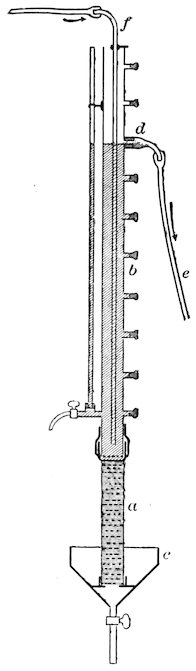
Figure 22.
Method of Welitschowsky.
In conducting the experiment, after the
apparatus has been arranged as described,
the small lateral tubes are, with one exception,
closed with stoppers. On the open
one, d, a rubber tube is fixed for the purpose
of removing the water. The required
water pressure is secured by taking the
lateral opening corresponding to the pressure
required. Water is introduced into the
apparatus slowly through the glass tube f.
The water rises to d and then any excess
flows off through e. By a proper regulation
of the water supply the pressure is
kept constant at d. The water flowing off
through a is collected by the funnel and
delivered to graduated flasks where its
quantity can be measured for any given
unit of time. Since the rate of flow at
first shows variations, the measurement
should not be commenced until after the flow becomes constant.
In general, the experiments should last ten hours, and, beginning
with a water pressure of 100 centimeters, be repeated successively
with pressures of eighty, sixty, forty, and twenty,
centimeters, etc. In coarse soils, or with sand, one hour is long
enough for the experiment.
176. Statement Of Results.—In the following tables the
results for ninety centimeters, seventy centimeters, etc., are
calculated from the analytical data obtained for 100 centimeters,
eighty centimeters, etc.
| 158 |
| Material—Quartz Sand. |
|---|
| |
|
|
|
|
|
|
|
|
Liters of Water Passing in Ten Hours. |
| No. of Exp. |
Diameter of sand particles in |
Water pressure in |
Thickness of Soil Layer. |
|
mm. |
cm. |
10 cm. |
20 cm. |
30 cm. |
| 1. |
0.01–0.71 |
10 |
0.244 |
0.187 |
0.151 |
| 20 |
0.282 |
0.198 |
0.154 |
| 30 |
0.320 |
0.209 |
0.158 |
| 40 |
0.358 |
0.220 |
0.161 |
| 50 |
0.396 |
0.231 |
0.165 |
| 60 |
0.434 |
0.242 |
0.168 |
| 70 |
0.472 |
0.253 |
0.172 |
| 80 |
0.510 |
0.264 |
0.175 |
| 90 |
0.548 |
0.275 |
0.179 |
| 100 |
0.586 |
0.286 |
0.182 |
| |
| 2. |
0.071–0.114 |
10 |
2.194 |
1.724 |
1.425 |
| 20 |
2.898 |
2.012 |
1.578 |
| 30 |
3.602 |
2.300 |
1.731 |
| 40 |
4.306 |
2.588 |
1.884 |
| 50 |
5.010 |
2.876 |
2.037 |
| 60 |
5.714 |
3.164 |
2.190 |
| 70 |
6.418 |
3.452 |
2.343 |
| 80 |
7.122 |
3.740 |
2.496 |
| 90 |
7.826 |
4.028 |
2.649 |
| 100 |
8.530 |
4.316 |
2.802 |
Similar sets of data have been collected with powdered limestone,
clay and humus.
The general conclusions from the experiments are as follows:
1. Clay (kaolin) and humus (peat) are almost impermeable
for water, and fine quartz and limestone dust are also very
impermeable.
2. The permeability of a soil for water increases as the particles
of the soil increase in size, and when particles of different
sizes are mixed together the permeability approaches that of the
finer particles.
3. The quantity of water passing through a given thickness of
soil increases with the water pressure but is not proportional
thereto, increasing less rapidly than the pressure.
4. The quantity of water passing under a given pressure is
inversely proportional to the thickness of the soil layer when the
particles are very fine and the pressure high.
177. Method of Whitney.—To determine the permeability
159of the soil or subsoil to water or air, in its natural position in the
field, the following method, due to Whitney, can be recommended:
A hole should be dug, and the soil and subsoil on one side
removed to the depth at which the observation is to be made. A
column of the soil or subsoil, two inches or more square, and four
or five inches deep, is then to be carved out with a broad bladed
knife, or a small saw can be conveniently used for cutting this
out. A glass or metal frame, a little larger than the sample and
three or four inches deep, is slipped over the column of soil, and
melted paraffin is run in slowly to fill up the space between the
soil and the frame. The soil is then struck off even with the
top and bottom of the frame, preferably with a saw, or at any
rate taking care not to smooth it over with a knife, which would
disturb the surface and affect the rate of flow. The frame is
then placed upon some coarse sand or gravel, contained in a
funnel, to prevent the soil from falling out and to provide good
drainage for the water to pass through. Another similar frame
can then be placed on top and secured by a wide rubber band.
A little coarse sand, which has been thoroughly washed and
dried, is then placed on the soil, and water carefully poured on
until it is level with the top of the frame. When the water
begins to drop from the funnel more water must be added to the
top, so as to have the initial depth of water over the soil the
same in all the experiments. A graduated glass is then pushed
under the funnel, and the time noted which is required for a
quantity of water to pass through the soil. The quantity usually
taken for measurement is equivalent to one inch in depth over
the soil surface. In taking the sample, root and worm-holes
are to be avoided, and these are particularly troublesome in clay
lands.
178. Measurement of Percolation through the Soil in
Situ.—If lateral translocation could be prevented, the measurement
of the quantity of water descending in the soil through a
given area would be a matter of simplicity. But to secure
accurate results all lateral communication of a given body of
soil with adjacent portions must be cut off. Various devices
have been adopted to secure this result. An elaborate system
160of lysimetric measurements is illustrated by the apparatus erected
by the Agricultural Experiment Station, of Indiana.
The plan and section of the apparatus are shown in Fig. 23.
Each lysimeter box, when finished, resembles somewhat a
hogshead with one head out. The sides, however, are perfectly
straight inside, having a slight thickening in the center, on the
outside, for making them stronger. The sides and bottom of
the apparatus are constructed of oak and lined with sheet
copper carefully soldered so as to be water-tight. Six inches
above, and parallel to the bottom of each of the boxes, is a
perforated copper tube, which extends entirely across the
lysimeter, and passing through one of the sides connects the box
with an underground vault in which the observations are taken.
These tubes give an outlet to the drainage water, as described
further on. The lysimeters are made of any required depth, the
two which are shown in section being three and two-thirds and
six and two-thirds feet deep, respectively.
The following method is employed for filling them with soil:
There are first placed in the bottom of each lysimeter six inches
of fine sand, sifted and washed, which fills them up to the level
of the drainage tubes. The lysimeters are then filled with fine,
sifted surface soil, to the depth of three and six feet, respectively,
making a complete pair of lysimeters, and leaving two inches of
the lysimeter boxes projecting above the surface of the soil so
that each one will receive exactly its proper share of the rain-fall.
The lysimeters of the other pair, which are the same size as
the first, are filled in a different way. The lysimeters are
first constructed and placed over vertical columns of soil in situ,
which are obtained by digging away all the surrounding soil
and leaving the columns standing. The shorter lysimeter is
sunk in this way to within two inches of its entire length. It
is then tipped over carrying the column of soil with it. Six
inches of the subsoil are then removed, when the drainage tube
and sand are put in, as in the first pair, and the bottom of the
tube soldered in place. The lysimeter is thus filled with the
natural soil in place. The longer box is in the same way
filled, as far as possible, with the soil in place, but a gravelly
nature of the soil may render it impossible to do the filling with a
single column unbroken, so the gravel and sand from the lower
portion of the soil are to be filled in separately. The drainage
tube and bottom of sand are placed in the longer lysimeter in
the same way as in the shorter.
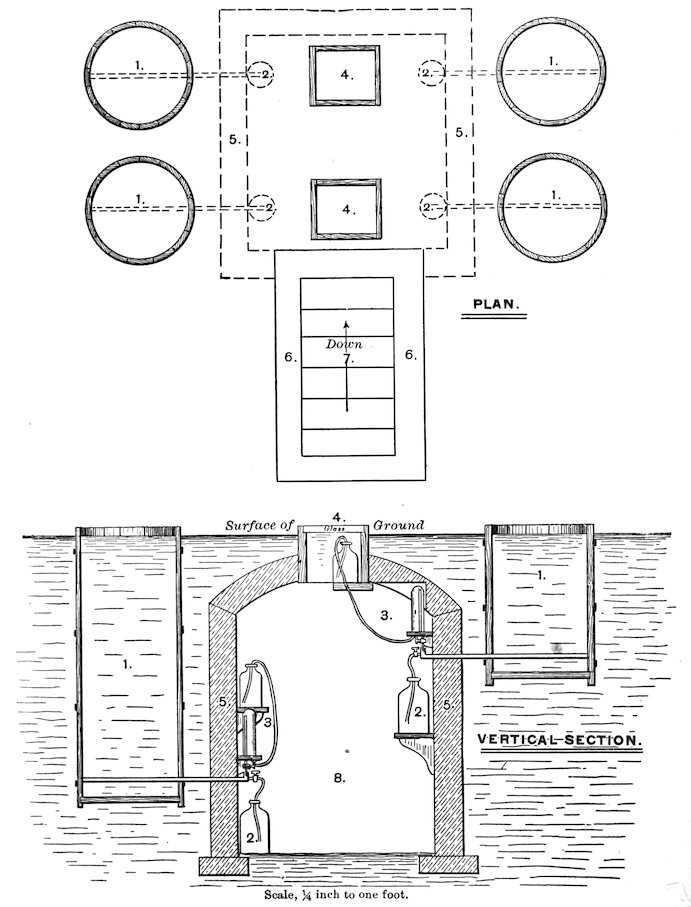
Figure 23.
Ground Plan and Vertical Section of Lysimeters and Vaults Showing Position of the Apparatus.
1, 1, 1, 1, Lysimeters.
2, 2, 2, 2, Receiving bottles.
3, 3, Supplying apparatus.
4, 4, Skylights.
5, 5, 5, 5, Wall of vault.
6, 6, Brick walls.
7, Entrance Steps.
8, Vault.
161The purpose of placing sand at the bottom of each lysimeter
is to offer a porous stratum in which free water may collect and
rise to the level of the perforated copper tube, which would prevent
any further rise by conveying the surplus above into the
vault as drainage water. The soil above the tube will therefore
be constantly drained and the sand below constantly saturated,
unless the water be drawn up by the capillary action of the soil
as the result of evaporation from the surface.
By means of a proper arrangement within the vault, of a kind
of Mariotte’s bottle, the water may be caused to flow back
through the drainage tube into the lysimeter to take the place of
that lost by evaporation, and thus maintain the level of free
water just below the drainage tube. The water flowing back to
the lysimeter, and the amount of drainage water, are carefully
measured by a system of graduated tubes.
The lysimeters thus constructed represent tile-drained land;
in one case the tile being three feet below the surface and in the
other six feet below. The drainage waters collected in the
receiving bottles can be measured and analyzed from time to
time, as occasion may require, to determine the amount of plant
food which is removed.
179. Improved Method of Deherain.[120]—Deherain’s earlier
experiments were made in pots containing about sixty kilos of
soil. These vases serve very well for some kinds of plants, but
there are other kinds which do not grow at all normally when
their roots are imprisoned. For instance, in pots, even of the
largest size, wheat is always poor, beets irregular, maize never
acquires its full development, and the conclusions which can
be drawn from the experiments can not be predicated of the
action of the plant under conditions entirely normal.
It is necessary therefore to carry on the work in an entirely
different way, and to construct boxes so large as to make the
conditions of growth entirely normal. The arrangement of these
boxes is shown in Fig. 24.
162They are placed in a large trench, two meters wide, one meter
deep, and forty meters long. There are twenty boxes in this
trench, the upper surface of each containing four square meters
area. The boxes are one meter deep, and therefore can contain
four cubic meters of soil. The sides and bottoms of the boxes
are made of iron lattice work, covered with a cement which
renders them impervious to water.
The bottom inclines from the sides towards the middle, and
from the back to the front, thus forming a gutter which permits
of the easy collection of the drainage. The drainage water is
conveyed, by means of a pipe and a funnel, into a demijohn
placed in the ditch in front of the apparatus, as shown in the
figure. These receptacles stand in niches under the front of the
cases, and are separated by the brick foundations. Access to
them is gained by means of the inclined plane shown in the figure,
and this plane permits the demijohns in which the drainage
water is collected, to be removed with a wheelbarrow for the
purpose of weighing. This apparatus is especially suitable for
a study of the distribution of the nitrogen to the crop, the soil
and the drainage waters. The loss in drainage waters of potash
and phosphoric acid is insignificant in comparison with the loss
in nitrogen.
The cases having been placed in position they are filled with
the natural soil, which is taken to the depth of one meter, in
such a way that the relative positions of the soil and subsoil are
not changed.
While the soil is transferring to the cases it is carefully sampled
in order to have a portion representing accurately the composition
of both the soil and subsoil. These samples are subjected
to analysis and the quantities of nitrogen, phosphoric acid,
and potash contained therein carefully noted.
One or two cases should be left without crop or fertilizer to
determine the relations of the soil and subsoil to the rain-fall.
Three or four cases should be kept free of vegetation and
receive treatment with different fertilizer, in order to determine
the influences of these on the deportment of the soil to rain-fall.
The rest of the cases should be seeded with plants representing
the predominant field culture of the locality, and some of them
should be fertilized with the usual manures used in farm culture.
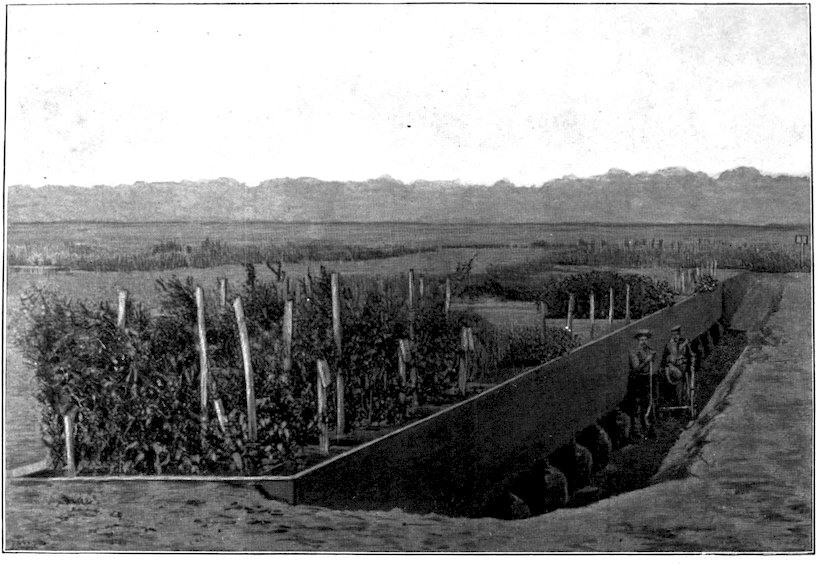
Figure 24.
Deherain’s Apparatus for Collecting Drainage Water.
163
PART FOURTH. MECHANICAL ANALYSIS OF SOILS. — THE FLOCCULATION OF SOIL PARTICLES. — SEPARATION OF THE EARTH PARTICLES BY A LIQUID. — SEPARATION OF THE SOIL PARTICLES BY A LIQUID IN MOTION. — AUTHORITIES CITED IN PART FOURTH.
165
180. Relation of Flocculation to Mechanical Analysis.—The
tendency of the fine particles of silt to form aggregates,
which act as distinct particles of matter, is the chief difficulty
connected with the separation of the soil into portions of equal
hydraulic value by the silt method of analysis. This tendency
has been discussed fully by Johnson[121] and Hilgard.[122]
181. Illustration of Flocculation.—A sediment, consisting
of particles of a hydraulic value, equal to one millimeter per second,
is introduced into an ordinary conical elutriating tube
placed vertically, in which the current of water entering below
performs all the stirring which the particles receive.
A current of water corresponding to a velocity below one millimeter
per second will, of course, not carry any of the particles
out at the top of the cylindrical tube, but will keep them moving
through the conical portion of the tube. If now the current be
increased until its velocity is greater than one millimeter per
second after having run at the slower velocity for fifteen or
twenty minutes, very little of the sediment will pass over,
although theoretically the whole of it should. Even at a velocity
of five millimeters per second, much of the sediment will remain
in the tube. This, of course, is due to the coagulation of the
particles into molecular aggregates having a higher hydraulic
value even than five millimeters per second. These aggregates
can be broken up by violent stirring or moderate boiling, and
the sediment reduced again to its proper value. The conclusions
which Hilgard derives from a study of the above phenomena are
as follows:
1. The tendency to coagulation is, roughly, in an inverse ratio
to the size of the particles. With quartz grains it practically
166ceases when their diameter exceeds about two-tenths of a millimeter
having a hydraulic value of eight millimeters per second.
The size of the aggregates formed follows practically the same
law as above. Sediment of 0.25 millimeter hydraulic value will
sometimes form large masses like snow-flakes on the sides of the
elutriator tube.
2. The degree of agitation which will resolve the aggregates
into single grains is inversely as the size of the particles; or,
more properly perhaps, inversely as their hydraulic value.
3. The tendency to flocculation varies inversely as the temperature.
So much so is this the case that Hilgard at one time
contemplated the use of water at the boiling point in the mechanical
analysis of soils, in place of mechanical stirring.
4. The presence of alcohol, ether, and of caustic or carbonated
alkalies, diminishes the tendency to flocculation, while the presence
of acids and neutral salts increases it.
5. As between sediments of equal hydraulic value, but different
densities, the tendency to flocculation seems to be greater
with the less dense particles.
In regard to the mechanical actions which take place between
the particles, Hilgard considers them as irregular spheroids,
each of which can at best come in contact at three points with
any other particle. The cause of aggregation cannot therefore
be mere surface adhesion independent of the liquid, and the particles
being submerged there is no meniscus to create an adhesive
tension.
Since experiment shows that the flocculative tendency is measurably
increased by the cohesion coefficient of the liquid, it seems
necessary to assume that capillary films of the latter interposed
between the surfaces of solids create a considerable adhesive
tension even in the absence of a meniscus.
182. Effect of Potential of Surface Particles.—Whitney
suggests that this is due to the potential of the surface particles
of solids and liquids.[123] The potential of a single water particle
is the work which would be required to pull it away from
the surrounding water particles and remove it beyond their
sphere of attraction. For simplicity, it may be described as the
total force of attraction between a single particle and all other
167particles which surround it. With this definition, it will be seen
that the potential of a particle on an exposed surface of water is
only one-half of the potential in the interior of the mass, as half
of the particles which formerly surrounded and attracted it were
removed when the other exposed surface of water was separated
from it. A particle on an exposed surface of water, being under
a low potential, will therefore tend to move toward the center of
the mass where the potential, i. e., the total attraction, is greater,
and the surface will tend to contract so as to leave the fewest
possible number of particles on the surface. This is surface
tension.
If, instead of air, there is a solid substance in contact with the
water, the potential will be greater than on an exposed surface
of the liquid, for the much greater number of solid particles will
have a greater attraction for the water particles than the air particles
had. They may have so great an attraction that the water
particle on this surface, separating the solid and liquid, may be
under greater potential than prevails in the interior of the liquid
mass. Then the surface will tend to expand as much as possible,
for the particles in the interior of the mass of liquid will try
to get out on the surface. This is the reverse of surface tension.
It is surface pressure, which may exist on a surface
separating a solid and liquid.
Muddy water may remain turbid for an indefinite time, but
if a trace of lime or salt be added to the water the grains of clay
flocculate, that is, they come together in loose, light flocks, like
curdled milk, and settle quickly to the bottom, leaving the liquid
above them clear. Ammonia and some other substances tend
to prevent this and to keep the grains apart if flocculation has
already taken place.
If two small grains of clay, suspended in water, come close
together they may be attracted to each other or not, according
to the potential of the water particles on the surface of the clay.
If the potential of the surface particle of water is less than that
of the particle in the interior of the mass of liquid, there will be
surface tension, and the two grains will come together and be
held with some force, as their close contact will diminish the
number of surface particles in the liquid. If, on the other hand,
168the potential of the particle on the surface of the liquid is greater
than of the particle in the interior of the mass, the water surface
around the grains will tend to enlarge, as there will be greater
attraction for the water particles there than in the interior of the
mass of liquid, and the grains of clay will not come close together
and will even be held apart, as their close contact would diminish
the number of surface particles in the liquid around them.
183. Influence of Surface Tension.—Hilgard supposes that
the surface tension which is assumed to exist between two liquid
surfaces must exert a corresponding influence between the surfaces
of solids and liquids, apart from any meniscal action.
It is then to be expected that the adhesion of the particles
constituting one of these floccules will be very materially increased
whenever the formation of menisci between them becomes possible
by the removal of the general liquid mass. Suppose one of
the floccules to be stranded, it will, in the first place, remain
immersed in a sensibly spherical drop of liquid. As this liquid
evaporates, the spherical surface will become pitted with menisci
forming between the single projecting particles, and as these
menisci diminish their radius by still further evaporation, the force
with which they hold the particles together will increase until it
reaches a maximum. As the evaporation progresses beyond
this point of maximum, the adhesion of the constituent particles
must diminish by reason of the disappearance of the smaller
menisci, and when finally the point is reached when liquid water
ceases to exist between the surfaces, the slightest touch, or sometimes
even the weight of the particles themselves, will cause a
complete dissolution of the floccule, which then flattens down
into a pile of single granules.
In regard to natural deposits from water, Hilgard supposes
that they are always precipitated in a flocculated state. The
particles of less than two-tenths millimeter diameter are carried
down with those of a larger diameter having much higher
hydraulic value. Thus the deposition of a pure clay can take
place under only very exceptionable circumstances.
Whitney, on the other hand, suggests that grains of sand and
clay carry down mechanically the particles of fine silt and clay
as they settle in a turbid liquid in a beaker; and it is often difficult
169to wash out a trace of fine material from a large amount of
coarse particles, for this reason, although there may be no trace
whatever of flocculation.
184. Destruction of Floccules.—The destruction of the natural
floccules is seen in the ordinary process of puddling earth
or clay. It is also the result of violent agitation of water or of
kneading or boiling, or, finally, to a certain extent, of freezing.
All these agencies are employed by the workers in clay for the
purpose of increasing the plasticity which depends essentially
upon the finest possible condition of the material to be worked.
As an illustration of this, Hilgard cites the fact that any clay or
soil which is worked into a plastic paste with water, and dried,
will form a mass of almost stony hardness. If, however, to such
a substance one-half per cent of caustic lime be added, a substance
which possesses in an eminent degree the property of
coagulating clay, the diminution of plasticity will be obvious at
once, even when in a wet condition. If now the mass be dried,
as in the previous case, it is easily pulverized. This is an illustration
of the effect of lime upon stiff lands, rendering them more
readily pulverulent and tillable. The conversion of the lime
into a carbonate in the above experiment by passing bubbles of
carbonic acid through the mass while still suspended in water
does not restore the original plasticity, thus illustrating experimentally
the fact known to all farmers that the effect of lime on
stiff soil lasts for many years, although the whole of the lime in
that time has been converted into carbonate.
185. Practical Applications.—The practical application of
this is, according to Hilgard, that the loosely flocculated aggregation
of the soil particles is what constitutes good tilth. For
this reason the perfect rest of a soil, if it is protected from the
tamping influence of rains and the tramping of cattle, may produce
a condition of tilth which cannot be secured by any mechanical
cultivation. As an illustration of this, the pulverulent
condition of virgin soils protected in a forest by the heavy coating
of leaves may be cited. On the contrary, as pointed out by
Hilgard, there are some kinds of soil in which a condition of
rest may produce the same effect as tamping. These are soils
which consist of siliceous silt without enough clay to maintain
170them in position after drying. In such a case, the masses of
floccules collapse by their own weight or by the least shaking,
and fall closely together, producing an impaction of the soil.
This takes place in some river sediment soils in which the
curious phenomenon is presented of injurious effects produced
by plowing when too dry, which is the direct opposite of soils
containing a sufficient amount of clay and which are injured by
plowing too wet.
It is further observed that the longer a soil has been maintained
in good tilth, the less it is injured by wet plowing. This
is doubtless, according to Hilgard, due to the gradual cementation
of the floccules by the soil water which fixes them more or
less permanently.
Whitney believes that the arrangement of the grains, or the
condition of flocculation in the soil, or the distance apart of the
soil grains, is determined, to a large extent, by the potential on
the surface of the grains; and he suggests that by changing
this the exceedingly fine grains of silt and clay can be pulled
together or can be pushed further apart, and so alter the whole
texture of the land.
The action of alkaline carbonates in preventing flocculation,
and thus rendering tillage difficult or impossible, is pointed out by
Hilgard in the case of certain alkali soils of California. The soils
which are impregnated with alkaline carbonates are recognized
by their extreme compactness. The suggestion of Hilgard to
use gypsum on such soils has been followed by the happiest
results. This gypsum renders any phosphates present insoluble,
and thus prevents loss by drainage, and yet leaves the plant food
in a sufficiently fine state as to be perfectly available for vegetation.
186. Suspension of Clay in Water.—The suspension of clay
in water and the methods of producing or retarding flocculation
and precipitation have also been studied by Durham.[124] His
experiment is made as follows:
In a number of tall glass jars fine clay is stirred with water,
and the results of precipitation watched. In all cases it will be
noticed that the clay rapidly separates into two portions, the
greater part quickly settling down to the bottom of the jars, and
the smaller part remaining suspended for a greater or less length
of time.
171The power which water possesses of sustaining clay is gradually
destroyed by the addition of an acid or salt; a very small
quantity, for instance, of sulfuric acid, is sufficient to precipitate
the clay with great rapidity. In solutions of sulfuric acid and
sodium chlorid of varying strengths, suspended clay is precipitated
in the order of the specific gravity of the solutions, the
densest solutions being the last to clear up. This may be due
to the greater viscosity of the denser liquids.
The power which water possesses of sustaining clay is gradually
decreased by the addition of small quantities of certain salts
and of lime.
187. Effect of Chemical Action—Brewer[125] emphasizes the
importance of chemical action in the flocculation of clays. As
expressed by him the chemical aspects of the phenomena of sedimentation
have either been lightly considered or entirely ignored.
Brewer is led to believe that the action of clay thus suspended
is analogous to that of a colloidal body. Like a colloid, when
diffused in water, the bulk of the mass is very great, shrinking
enormously on drying. He therefore concludes that clays probably
exist in suspension as a series of hydrous silicates feebly
holding different proportions of water in combination and having
different properties so far as their behavior to water is concerned.
Some of them he supposes swell up in water much as boiled
starch does, and are diffusible in it with different degrees of
facility, and that the strata observed on long standing of jars of
suspended clay represent different members of this series of
chemical compounds which hold their different proportions of
combined water very feebly and are stable under a very limited
range of conditions.
These compounds are probably destroyed or changed in the
presence of acids, salts and various other substances, and are
stable only under certain conditions of temperature, those which
exist at one temperature being destroyed or changed to other
compounds at a different temperature.
188. Theory of Barus.—Brewer’s hypothesis, however, is
not in harmony with the demonstration of Barus, who proves that
a given particle of clay has the same density in ether as in water.
172The physical and mathematical aspects of sedimentation have
also been carefully studied by Barus.[126] The mathematical
conditions of a fine particle suspended in a liquid and free from
the influences of flocculation are described by Barus in the following
equations.
If P be the resistance encountered by a solid spherule of radius
r, moving through a viscous liquid at the rate x, and if k be the
frictional coefficient, then P = 6πkrx. Again, the effective part
of the weight of the particle is P´ = ⁴⁄₃πr³ (ρ-ρ´)g, where g is
the acceleration of gravity and ρ and ρ´ the density of solid particle
and liquid, respectively. In case of uniform motion P = P´.
Hence x = 2
9kr² (ρ-ρ´)g ... (1).
In any given case of thoroughly triturated material the particles
vary in size from a very small to a relatively large value;
but by far the greater number approach a certain mean figure
and dimension. An example of this condition of things
may be formulated. To avoid mathematical entanglement let
y = Ax³⁄₂e-x² ... (2) where y is the probable occurrence
of the rate of subsidence x. If now the turbidity of the liquid
(avoiding optical considerations) be defined as proportional to the
mass of solid material particles suspended in unit of volume of liquid,
then the degree of turbidity which the given ydx particles add
to the liquid is, caeteris paribus, proportional to r³ydx, where r is
the mean radius. Hence the turbidity, T, at the outset of the experiment
(immediately after shaking), is T = T₀∫₀∞r³ydx = T₀, where
equations (1) and (2) have been incorporated.
If the plane at a depth d below the surface of the liquid be
regarded, then at a time after shaking the residual turbidity is
The equation describes the observed occurrences fairly well.
The phenomena of stratification observed by Brewer are
explained by Barus from the above formula: In proportion as
the time of subsidence is greater, the tube shows opacity at the
bottom, shading off gradually upward, through translucency,
into clearness at the top. If, instead of equation (2), there be
173introduced the condition of a more abrupt maximum, if, in other
words, the particles be very nearly of the same size, then subsidence
must take place in unbroken column capped by a plane
surface which at the time zero coincided with the free surface of
the liquid. Again, suppose one-half of the particles of this column
differ in some way uniformly from the other half. Then at
the outset there are two continuous columns coinciding, or, as it
were, interpenetrating throughout their extent. But the rate
of subsidence of these two columns is necessarily different, since
the particles, each for each, differ in density, radius and frictional
qualities, by given fixed amounts. Hence the two surfaces of
demarcation at the time zero coincided with the free surface.
In general, if there be n groups of particles uniformly distributed,
then at the time zero n continuous columns interpenetrate and
coincide throughout their extent. At the time t, the free surface
will be represented by n consecutive surfaces of demarcation
below it, each of which caps a column, the particles of which
form a distinct group.
From a further discussion of the mathematical condition under
which the subsidence of the particles takes place, Barus is of
the opinion that Durham’s theory of suspension being only a
lower limit of solution is rapidly gaining ground, yet without
being attended with concise experimental evidence which will
account for the differences in the rate of subsidence. On the
contrary, Brewer’s hypothesis of colloidal hydrates is more easily
subjected to experimental proof. The test shows that the particles
retain their normal density, no matter how they are suspended
or circumstanced.
Further, in the explanation of the phenomenon of sedimentation,
the following principle may be regarded as determined;
namely, if particles of a comminuted solid are shaken up in a
liquid, the distribution of parts after shaking will tend to take
place in such a way that the potential energy of the system of
solid particles and liquid, at every stage of subsidence, is the
minimum compatible with the given conditions.
According to Barus it is necessary, in order to pass judgment
on the validity of any of the given hypotheses, to have in hand
better statistics of the size of the particles relatively to the water
174molecule, than are now available. Inasmuch as the particles in
pure water are individualized and granular, it is apparently at
once permissible to infer the size of the particles from the
observed rates of subsidence. His observations show that the
said rate decreases in marked degree with the turbidity of the
mixture. Hence the known formulæ for single particles are not
rigorously applicable, though it cannot be asserted whether the
cause of discrepancy is physical or mathematical in kind. It
follows that special deductions must be made for the subsidence
of stated groups of particles before an estimate of their mean size
can fairly be obtained.
Rowland[127] reaches a closer approximation for the fall of a
single particle by showing that the liquid, even at a large
distance from the particle, is not at rest.
In the case of water, however, it is noticed that despite the
large surface energy of the liquid, subsidence takes place in such
a way that for a given mass of suspended sediment the surfaces
of separation are a maximum. On the other hand, in case of
subsidence in ether or in salt solutions, the solid particles behave
much like the capillary spherules of a heavy liquid shaken up
in a lighter liquid with which it does not mix. In other words,
the tendency here is to reduce surfaces of separation to the least
possible value, large particles growing in mass and bulk mechanically
at the expense of smaller particles; in other words,
exhibiting the phenomenon of flocculation.
189. Physical Explanation of Subsidence.—Whitney[128]
thinks that the phenomena of the suspension of clay in water
may be explained on purely physical principles, and that neither
the partial solution nor hydration hypotheses are necessary, or
will explain the suspension of clay in water, for the solution, or
hydrated substance, would still have a higher specific gravity
than the surrounding liquid. He calls attention in the first place
to the fact, that in a turbid liquid, which has been standing for
weeks and which is only faintly opalescent, the grains in suspension
are still of measurable size, if properly stained as in
bacteriological examinations and viewed through an oil emersion
objective. He gives a value of 0.0001 millimeter, as the lower
limit of the diameters of these particles of “clay,” which are
175usually met with in agricultural soils. He refers to the fact that
fine dust and ashes, and even filings of metals, may remain in
suspension in the air for days and even months in very apparent
clouds, or haze, although they may be a thousand times heavier
than the surrounding air. Particles of clay, no smaller than the
limits which have been assigned, should remain in suspension
in the much heavier fluid, water, for an indefinite time, for the
volume or weight of the particles (⁴⁄₃)(πr³) decreases so much more
rapidly in proportion than the surface (4πr²), that there is, relatively,
a larger amount of surface area in these fine clay particles,
and a great deal of surface friction in their movement
through a medium, and they would settle very slowly. Under
ordinary conditions, however, the mean daily range of temperature
is about twenty degrees, the mean monthly range is fifty
degrees, and the yearly range 100° F., and the ordinary convection
currents, induced by the normal change of temperature,
would be sufficient of itself to keep these fine particles in suspension
in the liquid for an indefinite time, as it is known that currents
of air keep fine particles of dust and ashes in suspension.
If the volume or weight of a fine gravel, having a diameter of
one and five-tenth millimeters, be taken as unity, then for a
particle, having a diameter of 0.00255 millimeter, which is the
mean diameter for Whitney’s clay group, the volume decreases
in the ratio 1:0.000000004853, and the surface decreases only in
the ratio 1:0.000286.
190. Practical Applications.—The action of mineral substances
in promoting flocculence has been taken advantage of in
later times in the construction of filters for purifying waters
holding silt in solution. In these filters the introduction of a
small quantity of alum, or some similar substance, into the water
usually precedes the mechanical separation of the flocculent
material. In the same way the action of iron and other salts on
sewage waters has been made use of in their purification and in
the collection of the sewage material for fertilizing purposes.
191. Separation of the Soil Into Particles of Standard
Size.—The agronomic value of a soil depends largely on the
relative size of the particles composing it. The finer the particles,
176within a certain limit, the better the soil. The size of
the particles may be estimated in three ways: (1) by passing
through sieves of different degrees of fineness; (2) by allowing
them to subside for a given time in water at rest; (3) by separating
them in water moving at a given rate of speed. The
first method is a crude one and is used to prepare in a rough way,
the material for the second and third processes.
192. Separation in a Sieve.—The soil should be dry enough
to avoid sticking to the fingers or to prevent agglutination into
masses when subjected to pressure. It should not, however, be
too dry to prevent the easy separation of any agglutinated particles
under the pressure of the thumb or of a rubber pestle.
The sieve should have circular holes punched in a sheet of
metal of convenient thickness to give it the requisite degree of
strength. Sieves made of wire gauze are not so desirable but it is
difficult to get the finer meshes as circular perforations. Such
sieves cannot give a uniform product on account of the greater
diagonal diameter of the meshes and the ease with which the
separating wires can be displaced. It is convenient to have the
sieves arranged en batterie; say in sets of three. Such a set
should have the holes in the three sieves of the following dimensions;
viz.,
| 1st |
sieve |
2 |
millimeters |
diameter. |
| 2nd |
„ |
1 |
millimeter |
„ |
| 3rd |
„ |
0.5 |
„ |
„ |
Coarser single sieves may be used to separate the fragments
above two millimeters diameter if such a further classification
be desired. Each sieve fits into the next finer one and the separation
of a sample into three classes of particles may be effected
by a single operation. In most cases, however, it is better to conduct
each operation separately in order to promote the passage of
agglutinated particles by gentle pressure with the thumb or with
a rubber pestle. In no case should a hard pestle be used and
the pressure should never be violent enough to disintegrate mineral
particles.
There is much difference of opinion concerning the smallest
size of particles which should be obtained by the sieve.
Most analytical processes prescribe particles passing a sieve of
177one millimeter mesh (¹⁄₂₅ inch). There is little doubt, however,
of the fact that a finer particle would be better fitted for subsequent
analysis by the hydraulic method.
For this purpose a sieve of 0.5 millimeter circular mesh is
preferred.
193. Sifting with Water.—In soils where the particles adhere
firmly the sifting should be done with the help of water. In
such cases the soil is gently rubbed with a soft steple or the
finger in water. It is then transferred to the sieve or battery of
sieves which are held in the water, and rubbed through each of
the sieves successively until the separation is complete. After
the filtrate has stood for a few minutes the supernatant muddy
liquor is poured off, the part remaining on the sieve is added to
it and the process repeated until only clean particles larger
than 0.5 millimeter are left on the sieve. These particles can
be dried and weighed and entered on the note book as sand.
The filtrate should be evaporated to dryness at a gentle temperature
and when sufficiently dry be rubbed up into a homogeneous
mass by a rubber pestle.
The sieve recommended by the Association of Official Agricultural
Chemists[129] for the preparation of fine earth for chemical
analysis has circular openings ¹⁄₂₅ inch (one millimeter) in
diameter.
Wahnschaffe[130] directs that a sieve of two millimeters mesh be
used in preparing the sample for silt analysis and that the residue
after the silt analysis is finished, which has not been carried
over by a velocity of twenty-five millimeters per second, be separated
in sieves of one millimeter and 0.5 millimeter meshes
respectively.
Hilgard objects to leaving this coarse material in the sample
during the process of churn elutriation on account of the attrition
which it exerts and therefore directs that it be separated by
sieve analysis before the elutriation begins.
194. Method of the German Experiment Stations.[131]—In
the method recommended for the German Agricultural Stations
an attempt is made to secure even a finer sieve separation than
that already mentioned.
178Sieves having the following dimensions are employed; sieve
No. 1, square meshes 0.09 millimeter in size, diagonal measure
0.11 millimeter; sieve No. 2, square meshes 0.14 to 0.17 millimeter
in diameter, diagonal measure 0.22 to 0.24 millimeter;
sieve No. 3, square meshes 0.35 to 0.39 millimeter in diameter,
diagonal measure 0.45 to 0.50 millimeter; finally a series of sieves
one, two and three millimeters circular perforations.
Five hundred grams of the soil (in the Halle Station only
250) are placed in a porcelain dish with about one liter of water
and allowed to stand for some time with frequent stirring, on a
water bath. After about two hours, when the soil is sufficiently
softened so that with the help of a pestle it can be washed
through the sieves, the process of sifting is undertaken in the
following manner: Sieve No. 3 is placed over a dish containing
water, the moistened soil placed therein and the sieve depressed
a few centimeters under the water and the soil stirred by means
of a pestle until particles no longer pass through. After the
operation is ended the residue in the sieve is washed with pure
water and dried. The part passing the sieve is thoroughly
stirred and then washed with water into sieve No. 2 and treated
as before. The product obtained in this way is brought into
sieve No. 1 and carefully washed. All the products remaining
on each of the sieves are dried at 100° and weighed. The portion
passing sieve No. 1 is either dried with its wash water or
estimated by loss by deducting from the total weight taken, the
sum of the other weights obtained. If a more perfect separation
of the first sieve residue be desired it can be obtained by passing
it through sieves of the last series which may have meshes
varying in size, viz.: one, two, or three millimeters in diameter.
Each sieve of the same class should have holes uniformly of the
same size.
The sieve products are characterized as follows: The part
passing a three millimeter sieve is called fine earth, while the part
remaining is called gravel. The fine earth is separated into
the following products: The part that passes through the three
millimeters opening and is left by the two millimeters opening is
called steinkies. The product from the two millimeters opening
and the residue from the one millimeter opening is called
179grobkies. The product from the one millimeter opening and the
residue on the sieve No. 3 is called feinkies. The product from
the sieve No. 3 and the residue from the sieve No. 2 is called
coarse sand. The product from sieve No. 2 and the residue
from sieve No. 1 is called fine sand. The product from sieve
No. 1 is called dust. The dust can be further separated into
sand, dust, and clay. For the examination of the clay the
Kühn silt cylinder as modified by Wagner, is recommended.
The cylinder has a diameter of eight centimeters and a height
of thirty centimeters, and is furnished with a movable exit tube
reaching to its bottom.
195. General Classification of the Soil by Sieve Analysis.—The
classification recommended by the German chemists is
satisfactory but the following one is more simple. All pebbles,
pieces of rock, etc., should first be separated by a two millimeters
circular mesh sieve, dried at 105° and weighed. The result
should be entered as pebbles and coarse sand.
The finer sand may be separated with a sieve of one millimeter
circular openings.
The still finer sand is next separated with the sieve of 0.5
millimeter circular openings as indicated above.
The sample may now be classified as follows:
- 1.
- Coarse pebbles, sticks, roots, etc., separated by hand.
- 2.
- Pebbles and coarse sand not passing a two millimeters sieve.
- 3.
- Sand not passing a one millimeter sieve.
- 4.
- Fine sand not passing a 0.5 millimeter sieve.
- 5.
- Fine earth passing a 0.5 millimeter sieve.
196. Classification of Orth.[132]—As fine silt are reckoned
those particles which range from 0.02 to 0.05 millimeter; as
fine sand the groups from 0.05 to 0.2 millimeter; as medium sized
sand those ranging from 0.2 to 0.5 millimeter and for large grained
sand those particles ranging from 0.5 to 2 millimeters in diameter.
Particles over two millimeters form the last classification.
197. Methods of Silt Analysis.—The further classification
of the particles of a soil passing a fine sieve can best be effected
by separation in water. The velocity with which the current
180moves or with which the particles subside will cause a separation
of the particles into varying sizes. The slower the velocity the
smaller the particles which are separated. There is, however,
a large and important constituent of a soil which remains suspended
in water, or in a state of seeming solution. This suspended
matter would still be carried over by a current of water
moving at a rate so slow as to make a subclassification of it
impossible. This suspended matter passing off at a given velocity
may be classed as clay, and it consists in fact chiefly of the
hydrated silicate of alumina, or other particles of equal fineness.
The laws which govern its deposit have already been discussed.
The apparatus which have been used for silt analysis may be
grouped into four classes.
(1) Apparatus depending on the rate of descent of the particles
of a soil through water at rest. The apparatus for decanting
from a cylinder or a beaker belong to this class.
(2) Apparatus which determine the rate of flow by passing
the liquid through a vessel of conical shape. The system of
Nöbel is a good illustration of this kind of apparatus.
(3) Apparatus in which the elutriating vessel is cylindrical
and the rate of flow determined by a stop-cock or pressure feed
apparatus. The system of Schöne represents this type.
(4) Apparatus in which the above system is combined with a
device for mechanically separating the particles and bringing
them in a free state into the elutriating current. The system of
Hilgard is the type of this kind of apparatus.
In practice the use of cylindrical apparatus with or without mechanical
stirring and the method by decantation have proved to be
the most reliable and satisfactory procedures. Between the
beaker and churn methods, of separation there is little choice in
regard to accuracy. Which is the superior method, is a question
on which the opinions of experienced analysts are divided. The
various processes will be described in the order already mentioned.
198. Methods Depending on Subsidence of Soil Particles.—The
simplest method of effecting the further separation of the
soil particles is without doubt that process which permits them
to fall freely in a liquid sensibly at rest. The practical difficulties
181of this method consist in the trouble of securing a perfect
separation of the particles, in preventing flocculation after
division and in avoiding currents in the liquid of separation.
For the separation of the soil particles for this method boiling
and wet pestling are the only means employed. The flocculation
of the separated particles may be partially prevented by
adding a little ammonia to the water employed. The author
has also tried dilute alcohol as the separating liquid but the
results of this method are not yet sufficiently definite to find a
place in this manual. Evidently the practical impossibility of
avoiding convection currents prevents the use of water at a high
temperature for this separation, although the tendency to flocculation
almost disappears as the temperature approaches 100°.
The general method of avoiding the errors due to flocculation
in the subsidence method consists in repestling the deposited
particles and thus subjecting them as often as may be necessary
to resedimentation. These principles are well set forth by
Osborne,[133] who states that when a soil is completely suspended in
water by vigorous agitation, particles of all the sizes present are
to be found throughout the entire mass of liquid. When subsidence
takes place, the larger particles will go down more
rapidly than the smaller ones, but some of the small particles
that are near the bottom will be deposited sooner than some of
the larger ones which have a much greater distance to travel.
Thus, independently of the fact that the larger particles in
their descent are somewhat impeded by the smaller, the smaller
being at the same time somewhat hastened by the larger, the sediment
that reaches the bottom at any moment is a more or less
complex mixture of all the mechanical elements of the soil. The
liquid, however, above this sediment at the same moment will
have completely deposited all particles exceeding certain dimensions
of hydraulic value, determined mainly by the time of
subsidence.
If now the aforesaid first sediment be suspended in pure water,
and allowed to subside for the same time as before, the larger
part of it will be again deposited, but some will remain in suspension,
consisting of a considerable part of the finer matter of
the first sediment. By pouring off these suspended particles
182with the water and agitating the sediment again with clear
water as before, another portion of fine particles will be suspended
and may be decanted from it. On continuing this process
of repeated decantations it will soon be found that the soil
has been separated into two grades.
It is evident that in this way a separation can be made, but
it is perhaps not so clear that such a separation would be sharp
enough for the purposes of a mechanical soil analysis. If, for
instance, the separation is to be made at 0.05 millimeter diameter,
it is evident that by repeated decantations all below 0.01
millimeter can be washed out of that above 0.05 millimeter, but
it may not appear so probable that all below 0.045 millimeter can
be removed without removing some above 0.055 millimeter.
Such a result may be easily attained, however, if the following
principle be adhered to:
Make the duration of the subsidence such that the liquid
decanted the first few times shall contain nothing larger than
the desired diameter. Then decant into another vessel, timing
the subsidence so that the sediment shall contain nothing
smaller than the chosen diameter. This can not be done without
decanting much that is larger than the chosen diameter, but the
greater part of the particles greater and less than the chosen
diameter can be removed and an intermediate product obtained,
the diameters of whose particles are not very far from that
desired.
If this intermediate portion be again subjected to the same
process, two fractions may be separated from it, one containing
particles larger than the chosen diameter and another containing
particles smaller than this diameter, while a new intermediate
product will remain which is less in amount than that resulting
from the first operation. By frequent repetitions of this process
this intermediate product can be reduced to a very small amount
of substance the particles of which have diameters lying close
to the chosen limit and may then be divided between the two
fractions.
The principles of the separation described by Osborne set
forth with sufficient clearness the purposes to be achieved by
the analysis. The chief methods of manipulation practiced will
be found below.
183199. Kühn’s Silt Cylinder.—A simple form of apparatus for
the determination of silt by the sedimentation process is the one
described by Kühn.[134]
The cylinder should be about twenty-eight centimeters high
with a diameter of 8.5 centimeters. At the lower end of the
cylinder five centimeters from the bottom it carries a tube 1.5
centimeter in diameter furnished with a pinch-cock and held in
position by a rubber stopper.
In carrying out the process thirty grams of sifted soil (two
millimeters mesh sieve) are boiled with water for an hour and
after cooling the soil and water are washed into the separating
cylinder. The cylinder is then filled with water with constant
shaking.
After standing for ten minutes the stop-cock is opened and
the water with its suspended matter allowed to flow into a porcelain
dish.
The cylinder is then again filled with water and the process
is continued until the water drawn off is practically clear.
The fine particles having been separated in this way the next
coarser grade of particles is separated by repeating the process
at intervals of five minutes.
By these two operations it is considered that the clay is entirely
removed. The residue remaining in the cylinder is dried
and weighed. The relative proportions of clay and residue in
the sample are thus determined.
The residue is then separated into two portions by sieves of
one millimeter and 0.5 millimeter mesh.
The soil is thus separated into the following parts:
- 1.
- By the first sifting coarse quartz larger than two millimeters diameter.
- 2.
- Fine quartz two millimeters, to one millimeter diameter.
- 3.
- Coarse sand one millimeter, to 0.5 millimeter diameter.
- 4.
- Fine sand finer than 0.5 millimeter diameter.
- 5.
- Silt, clay, humus, etc., separated by the water.
200. Knop’s Silt Cylinder.—The cylinder recommended by
Knop[135] is essentially that of Kühn being furnished with four
lateral tubes instead of one (Fig. 25).
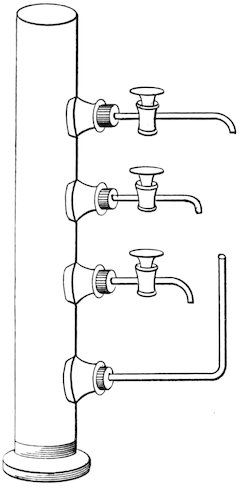
Figure 25.
Knop’s Silt Cylinder.
The sample of soil, twenty-five to
thirty grams, after passing a two
millimeters mesh sieve, and long boiling,
is washed through a series of
sieves of the following diameters of
mesh respectively; viz., one millimeter,
0.5 millimeter, 0.25 millimeter,
and 0.1 millimeter. The part which
passes the finest sieve is placed in
a Knop’s cylinder, the cylinder filled
with water one decimeter above upper
tube and well shaken. The cylinder
is allowed to rest for five minutes
when the upper cock is opened and
the water drawn off. After five minutes
more the next tube is opened and so
on with equal intervals for the three
upper tubes. The operation is repeated
with fresh water until the
water drawn off is clear. Finally the
lowest tube is opened and all the water poured off of the sandy
residue. The space between each tube is one decimeter. The
dust remaining is dried and weighed and the weight of material
carried over as silt determined by difference.
201. Siphon Silt Cylinder.—Instead of the tubulated cylinder
one furnished with a siphon can be employed[136] (Fig. 26).
It should be about forty centimeters high and six centimeters
internal diameter. The cylinder first receives twenty-five to
thirty grams of the well boiled fine earth and then water until
there is but a small space between it and the stopper when the
latter is inserted.
The cylinder is marked exactly 200 millimeters below the
surface of the water with a narrow strip of paper at a,
stoppered, inverted and well shaken. The cylinder being
again placed in normal position the soil particles under
the influence of gravity tend to sink with greater or less rapidity
according to their size. The siphon a b c is filled with water,
the cock at c closed and the opened end a placed in the cylinder
184A just at the mark 200 millimeters below the surface of the
water, and the water thus transferred to B when desired. If the
suspended matter is allowed to stand for 100 seconds the particles
of more than two millimeters hydraulic value will have fallen
below the open end of the siphon. If allowed to stand 1,000
seconds the silt value of the particles will be 0.2 millimeter per
second. Whatever the number of seconds may be, the operation
is continued until the water removed is practically clear. The
open end of the siphon a should be bent upwards so that no disturbing
current may bring the particles below the line into the
liquid discharged into B.
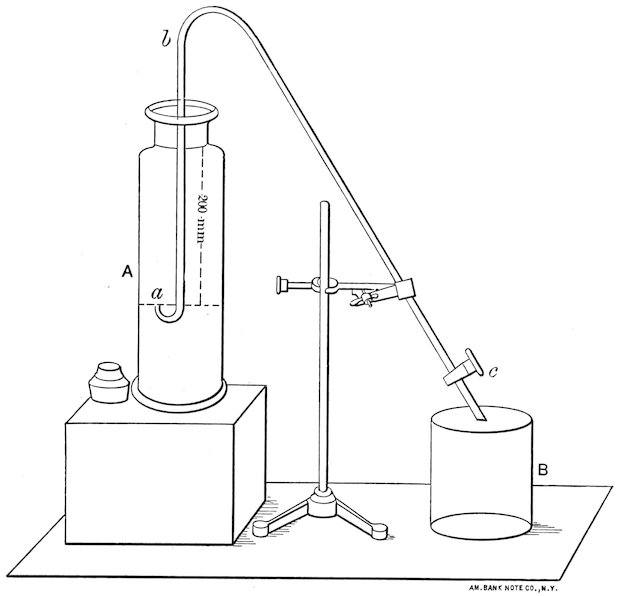
Figure 26.
Siphon Cylinder for Silt Analysis.
While the results obtained by this method are satisfactory as
compared with other similar processes it cannot be highly
recommended because of the time and trouble required to get a
185complete separation and by reason of the difficulty of collecting
the separated silt.
202. Wolff’s Method.[137]—As modified by Wolff the Knop process
is conducted as follows: Fifty grams of fine earth are boiled
with water and then the entire mixture is passed through three
sieves with openings of one millimeter, 0.5 millimeter, and 0.25
millimeter in diameter, respectively. The finest part is mixed
with water to a height of eighteen centimeters in a bottle
twenty centimeters high and having a capacity of one liter
and thoroughly agitated, after which it is left to rest, and finally
the turbid liquid is drawn off with a siphon, the bottle refilled
with water, agitated, and left to rest, and the process repeated
as long as the water carries any suspended matter after a definite
time.
Wolff proposes for the first three periods of rest one hour, for
the second three, a half an hour, for the third three, a quarter of
an hour, and for the fourth three, five minutes.
203. Moore’s Modification of Knop’s Method.[138]—The sample
of soil is first passed through a sieve having round perforations
three millimeters in diameter. The weight of the particles
remaining on the sieve is then determined, and likewise that of
the portion passing through, which is known as fine earth. The
last named portion constitutes the material for all subsequent
operations of mechanical and chemical analysis.
Thirty grams of the fine earth are boiled rapidly with water
until the lumps are disintegrated and clayey portions separated
from the sand. The material is then successively washed
through perforated metal sieves, the holes of which are respectively
1, 0.5, and 0.25 millimeter in diameter. The portions
retained on the sieves are severally dried, ignited and weighed,
and the finest portion, or that passing through the 0.25 millimeter
sieve, is then submitted to the following process of
separation:
The sediment and water passing through the 0.25 millimeter
sieve are placed in a glass cylinder fifty centimeters long and
thirty-seven millimeters in internal diameter. The cylinder is
closed at the bottom and is provided with a lateral tube inserted
186six centimeters above the bottom. Three other lateral tubes are
inserted at intervals of ten centimeters above the first tube,
and a ring is etched into the cylinder ten centimeters above the
uppermost tube. The lateral tubes are closed with rubber tubes
compressed by spring clips. The sediment being placed in the
cylinder, water is added to the mark or ring, the cylinder closed
with a rubber stopper, and vigorously shaken until the contents
are thoroughly mixed. It is then placed upright, the stopper
removed, and after standing undisturbed for five minutes the
clip on the uppermost tube is opened and the water allowed to
flow into a beaker. After five minutes further standing, the
second clip is opened and the water drawn off into the same
beaker; in the same manner the water is drawn off from the
other tubes at intervals of five minutes until the level of the lowest
tube is reached. The cylinder is then refilled with water to
the mark, thoroughly shaken after inserting the stopper and the
water again drawn off at intervals of five minutes, as before; the
operation being repeated until the water drawn off is almost
free from turbidity. The sediment remaining in the cylinder
from this process of washing by subsidence is termed by Knop,
fine sand, the material flowing off in suspension in the wash
waters, dust, and the process of separation by Knop’s original
method ends here.
In order to remedy the imperfect separation into definite particles
secured by the above method, Moore proposes the following
device:
The fine sand from the first series of subsidences is placed in
a separate vessel, the washings are allowed to remain undisturbed
for twelve hours, the turbid liquid decanted and the
sediment returned to the cylinder. Water is then added to the
mark, the whole shaken, and the liquid drawn off at intervals
of five minutes, as in the first series. The sediment from this
operation is placed in a separate beaker, the washings returned
to the cylinder, and again allowed to subside as before; the sediment
from this second subsidence is added to that from the preceding
operation, and the washings again returned to the cylinder,
the operation being repeated as long as any sediment can
be obtained from renewed treatment of the washings; the final
187washings are then placed in a separate vessel for subsequent
microscopic measurements.
The collective sediments from the last series of operations are
then returned to the cylinder and allowed to subside with fresh
additions of water, as in the case of the first series; the fine sand
thus obtained being added to that from the first series, and the
washings being collected in a large beaker. The latter are left
at rest for twelve hours, and the sediment returned to the cylinder
and treated as before until no further separation can be
effected. The fine sand resulting from all of these operations is
then dried, ignited and weighed; the weight of the portion
removed by the washing being determined by difference, as it
is, owing to its excessively slow rate of subsidence, found
impracticable to collect it for direct weighing. The size of the
particles of fine sand is then determined by micrometric measurement.
Similar measurements are made on the material
obtained by long subsidence from the washings from the foregoing
operations. The average diameter of the largest particles
should not exceed 0.01 millimeter.
204. Statement of Results.—The results of the analyses on
three soils from the localities indicated in the table, and the
method of stating them, are given in the following table:
|
New Milford, Conn., per cent. |
Clarksville, Tenn., per cent. |
Granville, N. C., per cent. |
| Particles larger in diameter than 3.0 millimeters |
8.55 |
0.32 |
0.23 |
| Particles of diameter from 3.0 millimeters to 1.0 millimeter |
4.96 |
0.45 |
15.04 |
| Particles of diameter from 1.0 millimeter to 0.5 millimeter |
4.43 |
0.96 |
33.43 |
| Particles of diameter from 0.5 millimeter to 0.25 millimeter |
11.86 |
1.25 |
18.82 |
| Particles of diameter from 0.25 millimeter to 0.01 millimeter |
60.54 |
61.58 |
23.59 |
| Particles smaller in diameter than 0.01 millimeter |
9.66 |
35.44 |
8.89 |
| Total |
100.00 |
100.00 |
100.00 |
205. Method of Bennigsen.—The silt flasks recommended by
Bennigsen[139] are shown in Fig. 27.
188The glass flask b carries a long cylindrical neck a the upper
part of which is graduated
in cubic centimeters. Ten
grams of the fine soil are
shaken with water in the
flask, the neck of which is
closed with a rubber stopper.
The flask is then
inverted bringing the soil
and water into the neck.
The flask is hung up and
sedimentation is assisted
by imparting a pendulous
motion to the neck for ten
minutes. After an hour
the soil particles have separated
into a coarse layer
below and a fine layer
above. The relative volumes
of the two layers are
then read off in cubic centimeters.
While this
method may be useful in
helping to form a speedy judgment concerning the character
of a soil it can lay no claim to being an accurate method of silt
separation.
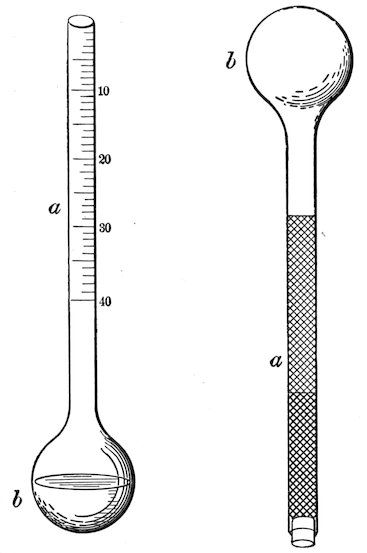
Figure 27.
Bennigsen’s Silt Flasks.
206. Method of Gasparin.—The method of Gasparin only
gives a very primitive separation of the various components of
the earth according to their fineness. It is conducted as follows:
Ten grams of sifted earth are put into a beaker, water is
added and strongly agitated; after five minutes the water is
decanted into another vessel, the first vessel is filled anew with
water, agitated, decanted, and this process is repeated until the
liquid remains perfectly clear. Only two portions are weighed,
i. e., the pebbles which remain in the sieve and the coarse sand
which remains in the beaker; while the argillaceous portion
drawn off with the water is determined by the difference.
207. The Italian Method.—The following modification of
189Gasparin’s process is practiced by the Italian chemists:[140]
Twenty grams of earth are passed through a sieve having
openings of one millimeter in diameter, then the sifted part is
mixed with 100 cubic centimeters of water in a 200 cubic centimeters
beaker and left to rest for some hours, then strongly agitated
and after ten seconds the turbid liquid is poured into another
vessel of half a liter capacity. This manipulation is repeated
until the liquid is clear.
The decanted liquid is thoroughly agitated, then left to stand
until the movement shall be completely arrested, after which the
supernatant liquid is poured into another vessel holding two
liters. To the residuum is added more water; it is agitated,
decanted, and this process is repeated until the water is no
longer turbid.
208. Method of Osborne.—In the foregoing paragraphs the
methods of silt separation by subsidence as practiced in different
countries have been outlined. The good points of the various
methods are combined in the process as carried out by Osborne.[141]
The details of this method will be given with sufficient minuteness
to make its practice possible by all analysts.
Selecting the Sample.—Several pounds of air-dried, fine earth
are secured by passing the soil through a sieve, the holes of
which are three millimeters in diameter.
Sifting.—Thirty grams of the above fine earth are stirred
with 300 to 400 cubic centimeters of water and then thrown successively
upon sieves with circular holes of 1, 0.5, and 0.25 millimeter
diameter respectively. By means of successive additions
of water and the use of a camel’s hair brush, all the fine material
is made to pass through the sieves and these at the last are agitated
under water in a shallow dish in such a way that the soil is
immersed. The finest sieve should be well wet with water on its
lower surface just before using. The finest particles which render
the water turbid are easily washed through. The turbid
water is kept separated from the clear water which comes off
with the last portions that pass the sieves. The turbid water
usually does not amount to more than one liter.
Elutriation.—The elutriation should be carried on so as to
secure three grades of silt; the diameters of the particles ranging
190in the first grades from 0.25 to 0.05 millimeter, in the second
grade from 0.05 to 0.01 millimeter, and in the third grade from
0.01 millimeter to the impalpable powder. The term sand is
applied to the first grade, silt to the second, and dust to the
third. After the turbid liquid from the sifting has stood a short
time it is decanted from the sediment and after standing until a
slight deposit is formed, is again decanted and the sediment examined
with a microscope. If sand be present, the subsidence
of the turbid liquid is continued until no more sand is deposited.
As the sand subsides rapidly there is no difficulty in altogether
freeing the liquid first decanted from this grade of particles.
The sediment thus obtained contains all the sand, a part of
the dust and much silt. As only dust and the finest silt render
the water turbid the sediment is stirred a few times with a
fresh quantity of water and decanted after standing long enough
to let all the sand settle. When the water decanted is free from
turbidity, the last portions of the soil passing through the sieve
with clear water are added to the sediment and the decantations
continued so as to remove most of the silt. When no more silt
can be easily removed from the sediment without decanting sand,
the decantations are made into a different vessel and the subsidences
so timed as to remove as much of the silt as possible.
By using a little care, at least three-quarters of the sand are thus
obtained free from silt. The rest of the sand is mixed with the
greater part of the silt which has been decanted into the second
vessel. The size of the smallest particles in this vessel is determined
with the microscope, to make sure that its contents are
free from dust as they usually will be if, after settling for a few
moments, they leave the water free from turbidity.
The soil is thus separated into three portions, one containing
sand, one sand and silt, and the other silt, dust, and clay. The
sand and silt are separated from each other by repeating the
subsidences and decantations in the manner just described.
In this way there is removed from the sediment, on the one
hand, a portion of silt free from sand and dust, and on the other
hand a portion of sand free from silt. Thus is obtained a second
intermediate portion consisting of sand and silt, but less in
amount than the first and containing particles of diameters much
191more nearly approaching 0.05 millimeter. By repeating this
process a few times, this intermediate portion will be reduced to
particles whose diameters are very near 0.05 millimeter and
which may be divided between sand and silt, according to judgment.
The amount of this is usually very small. As soon as
portions are separated, which the microscope shows to be pure
sand or pure silt, they are added to the chief portions of these
grades already obtained.
The same process is applied to the separation of silt from
dust. When all the silt has been removed from the dust and
clay, the turbid water containing the dust and clay is set aside
and allowed to settle in a cylindrical vessel for twenty-four
hours. The vessel is filled to a height of 200 millimeters.
According to Hilgard, the separation of the dust from clay during
a subsidence of twenty-four hours, will give results of sufficient
accuracy, although the clay then remaining suspended will
not be entirely free from measurable fine particles up to 0.001 or
0.002 millimeter diameter.
Small beakers and small quantities of distilled water are used
at first for the decantations, as thus the duration of subsidence
is less and more decantations can be made in a given time than
when larger quantities of water are employed. Beakers of
about 100 cubic centimeters capacity are convenient for the
coarser grades, but it is necessary to use larger vessels for the
fine sediments from which turbid water accumulates that cannot
be thrown away, as may be done with the clear water, from
which the coarse sediments settle out completely in a short time.
It is best to keep the amount of water as small as possible in
working out the dust since loss is incurred in using too large
quantities.
It is also necessary in most cases to subject the various fractions
obtained during elutriation, to careful kneading with a
soft rubber pestle so that the fine lumps of clay may be broken
up and caused to remain suspended in the water. This treatment
with the pestle should be done in such a way as to avoid
as far as possible all grinding of the particles, the object being
merely to pulverize the minute aggregations of clay and extremely
fine particles which always form on drying a sample of soil after
removing it from the ground.
192Measurement of the Particles.—To determine the size of particles
in suspension, a small glass tube is applied to the surface
of the liquid in such a way as to take up a single drop which is
transferred to a glass slide. This drop will contain the smallest
particles in the liquid.
To obtain a sample of the coarsest particles the liquid is
allowed to stand long enough to form a very slight sediment and
a portion of this sediment is collected with a glass tube.
To determine the diameter of the particles in a sediment it is
stirred vigorously with a little water and the pipette at once
applied to the surface of the water. On decanting the greater
part of the sediment, the large particles remain at the bottom of
the beaker and may be easily examined.
Time.—The time required to make the separations, above
described, is about two hours for each, so that an analysis including
the sittings, is made in five or six hours, exclusive of the
time necessary for collecting the dust and separating the clay,
for which a subsidence of twenty-four hours is allowed.
Weighing the Sediments.—The sediments are prepared for
weighing by allowing them to subside completely, decanting the
clear water as far as possible, rinsing them into a weighed
platinum dish and igniting. The dish is cooled in a desiccator.
Effect of Boiling.—The analyses show a very decided increase
in the particles smaller than 0.01 millimeter diameter at the
expense of coarser particles as the result of boiling. The surfaces
of the coarser particles are seen to be polished and of a
lighter color than those not boiled. The surfaces of the unboiled
particles are coated with a film of fine material probably
cemented to them by clay. When these coarse particles which
have not been boiled, are violently stirred with water for a
short time, no fine particles are detached from them; and a careful
examination under the microscope fails to reveal in any of
the sediments more than an occasional grain exceeding the 0.05
millimeter limit by so much as 0.01 millimeter, or the 0.01 limit
by as much as 0.005 millimeter. It would, therefore, appear that
these small particles thus set free by long boiling are really a
part of the larger ones and should be treated as such in a
mechanical analysis of these soils.
193209. The French Method.—The Schloesing method[142] as
practiced by the French agricultural chemists[143] differs essentially
from those already described in attempting to first free the silt
from carbonates and organic matter. It is conducted as follows:
One kilogram of the soil previously dried in the air, is taken
and passed through a sieve of which the meshes are five millimeters.
The agglomerated particles of earth are broken up by
the hand. The pebbles are also taken out and weighed. The
pebbles are then treated with hydrochloric acid until all effervescence
is over. The insoluble part is dried and again
weighed. The difference in weight gives the quantity of calcium
carbonate contained on the external surface of the pebbles.
The earth which passes the sieve of five millimeters mesh is
next passed through a sieve having ten meshes to the centimeter.
The masses on the sieve are broken up with the hand or
with a pestle, in such a manner as to separate the fine agglomerated
particles. The material which remains upon the sieve
after being dried at 100°, is weighed. This gives the coarse
sand. This is treated with hydrochloric acid as were the pebbles
before, washed and the residue dried and weighed. The
difference in weight gives the quantity of calcium carbonate
adhering to the surface of the coarse sand.
The mechanical analysis is continued with the matter which
has passed the sieve with ten meshes to the centimeter and
which consists of the soil, properly so-called. Ten grams of this
are taken, dried at 100° until no further loss takes place and the
moisture thus determined. Another ten grams are taken and
placed in a capsule with a flat bottom, and from nine to ten
centimeters in diameter. This is moistened with a small quantity
of water in such a way as to make a paste. This paste is
rubbed with the finger in fifteen cubic centimeters of water.
Ten seconds after the stirring is completed the supernatant
liquid is poured into a precipitating jar of about 250 cubic centimeters
capacity, taking great care not to allow any particles to
pass over which have been deposited during that time. This
operation is repeated in the same way waiting about ten seconds
each time before decanting, until the decanted liquor is almost
perfectly clear. In this way the particles of different fineness
194are separated. The decanted portions contain the fine sand and
clay. The remaining portion contains the sand and particles of
medium fineness. This last part is dried, being kept at 100°
until it has a constant weight. It is afterwards treated with
dilute nitric acid to dissolve the calcium carbonate. When the
carbonate is abundant, it is sufficient to determine it by difference
which is done by washing the material, drying and weighing.
But when the proportion of carbonate is very small and in
consequence when its exact determination acquires a greater
importance, it is better to determine the lime directly. For this
purpose the part soluble in dilute nitric acid is collected, treated
with ammonia and acetic acid and precipitated with ammonium
oxalate. Details of this operation will be given in another
part of this manual.
In regard to the matter which is insoluble in nitric acid, it is
composed chiefly of silica or silicates, and sometimes also of
vegetable débris. The vegetable matter is determined by the
incineration of the material which has been previously dried.
The loss of weight gives the proportion of vegetable or organic
débris contained in the soil and of combined water.
The portion which has been decanted, the volume of which
should not exceed 500 cubic centimeters, is treated with nitric
acid until effervescence ceases. It is then left to digest for
some time, in order to permit the whole of the carbonate to dissolve.
It is next thrown upon a smooth filter about one decimeter
in diameter. After filtration it is washed to secure the
complete elimination of the soluble lime salts. The lime is
determined in the filtered liquid.
The insoluble portion contains the fine sand, the clay and
humus bodies. In order to separate the three elements the precipitate
which was received upon the filter, is rubbed with
water, the filter is broken and all its contents washed through.
The volume of wash water is made up to 200 cubic centimeters;
two or three cubic centimeters of ammonia are added and the
whole left to digest for two or three hours. The volume of the
liquid is then made up to one liter with distilled water, vigorously
shaking in such a way as to put all the matter in suspension.
It is then left to settle for twenty-four hours. At the
195end of this time the supernatant liquid is decanted by the aid of
a siphon. To the residue are added two cubic centimeters of
ammonia and one liter of water. The matter is again brought
into suspension and allowed to settle for twenty-four hours.
The supernatant liquid is again decanted with a siphon, and
added to the liquid previously removed. For ordinary soils two
decantations are generally sufficient but when the soils contain
a large quantity of clay it is convenient to decant three or four
times. By an examination of the supernatant liquid it is easy
to tell if the washings have been sufficiently prolonged. The
decanted liquors contain the organic matter and that which it
is convenient to call clay, which is constituted of very fine particles
of sand and colloidal clay which play, in arable soil, a
rôle somewhat like that of cement.
These matters are estimated in the following manner: The
liquor is first treated with nitric acid and the clay and the
humic matters are precipitated together. They are collected
upon a smooth filter one decimeter in diameter and washed with
water. By means of a washing bottle all the solid matters which
have stuck to the sides of the filter are finally collected in the
bottom of it. Since the last washings pass the filter very slowly,
they can be removed after the complete deposition of the matter
they contain, by means of a pipette. When all the liquid is
removed the filter is placed upon blotting paper, great care
being taken to avoid desiccation, having in view only the
elimination of the excess of humidity. The folds in the filter
are then carefully smoothed out with the finger. The matter
which has collected upon the filter is then removed completely
with a washing bottle, placed in a dish and dried at 100° and
weighed. After weighing, the mass is incinerated in a muffle in
order to destroy the humic bodies. The difference in weight
before and after incineration, gives the total weight of the humic
bodies and since the diminution in weight comprises not only
the weight of the humic bodies, but also the weight of the combined
water which is lost during the process of incineration,
there should be subtracted from the total loss of weight ten per
cent of the weight of the residual mineral matter, which represents
the water of composition of the hydrated silicate.
196210. Statement of the Analysis.—Schloesing in his original
paper[144] recommends that the analysis be commenced with 1,000
grams of soil. The data of the analysis and the method of
arrangement are illustrated by the following example.
The physical examination of the earth having been completed
as above, the results can be tabulated as follows: taken, 1,000
grams of dry earth, digested in water, thoroughly worked by
hand, sifted, and passed through the meshes of the sieve by a
stream of water, the meshes having a diameter of one millimeter.
| Dry residue, fifty-five grams, contains |
Pebbles |
21 |
grams. |
| Gravel |
33 |
„ |
| Organic débris |
1 |
„ |
| |
| Sifted earth by difference, 1000 − 55 = |
|
945 |
„ |
| |
|
|
|
| |
|
1000 |
grams. |
Humidity of the homogeneous paste, twenty-seven per cent.
Then 945 grams of the dry sifted earth correspond to 945
1.00 − .27 =
1294.5 of paste.
The analysis, therefore, should be carried on upon this weight
or some aliquot part say 0.01 thereof; viz., 12.945 grams.
| 12.945 grams of the paste after successive kneadings and decantations furnish dry: |
1st.—Coarse sand dry giving by treatment with acid and ignition. |
Noncalcareous sand |
3.05 |
grams. |
| Calcareous sand |
1.19 |
„ |
| Organic débris |
0.08 |
„ |
| 2nd.—Fine elements decanted with the water, their weight calculated by difference, 9.45 − 4.32 = 5.13 grams. |
Treatment of the Fine Elements.—Treated by nitric acid until
a complete decomposition of the calcareous matter is secured, filtered,
washed, the residual matter collected upon a filter, and the
liquid received in a two-liter flask, a little ammonia added,
allowed to digest, the flask filled with distilled water, left for
twenty-four hours at repose, and decanted:
| The decantation furnishes |
1st.—A deposit of fine calcareous sand weighing dry |
3.14 grams. |
| 2nd.—Clayey liquid giving after coagulation by acid, filtration and drying 0.85 grams of clay. |
| |
|
|
|
| Then: Total fine elements |
5.13 grams. |
| Fine elements determined directly. |
Fine calcareous sand |
3.14 |
3.99 „ |
| Clay |
0.85 |
| |
|
|
|
| Fine calcareous sand by difference |
1.14 „ |
197Calculating these results to the original quantity of 1,000
grams the following data are obtained:
One thousand grams of dry earth contain:
| Pebbles |
21 |
grams. |
| Gravel |
33 |
„ |
| Organic débris |
1 |
gram. |
| Fine earth |
945 |
grams. |
| |
|
|
| Total |
1000 |
„ |
| 945 grams of fine earth contain: |
Coarse sand 432 gms. |
Noncalcareous sand |
305 |
gms. |
| Calcareous sand |
119 |
„ |
| Organic débris |
8 |
„ |
| |
| Fine elements 513 gms. |
Fine, noncalcareous sand |
314 |
gms. |
| Clay |
85 |
„ |
| Fine calcareous sand |
114 |
„ |
| |
|
|
|
|
| |
|
Total |
1000 |
„ |
There are counted as clay all the elements which have
remained in suspension in the water after a period of repose of
twenty-four hours. In fact, these elements comprise a notable
proportion of very fine sand which is not deposited during that
time. In order that the liquid should become entirely freed from
this sand it would be necessary to wait several weeks and even
several months. Such a prolongation of the analysis is evidently
inadmissible. The period of twenty-four hours of repose therefore
has been adopted. This is merely conventional, in the
same way that the period of ten seconds adopted for the precipitation
of the gravel is conventional. But this convention is
justified by the fact that the substance which is called clay presents,
when it has a proper degree of humidity and cohesion, a
plasticity entirely analogous to that property of natural clay.
Moreover, as has already been said, that which is chiefly important
in these analyses is the employment of processes always
comparable among themselves in their results and generally
followed.
211. The Belgian Method.—The method of estimating the
percentage of sand and clay practiced at the Gembloux Station[145]
is essentially that recommended by Schloesing with a few minor
modifications.
With the ball of the thumb or with the finger, 100 grams of
198fine earth are rubbed with water in a porcelain capsule
or mortar with a capacity of about 250 cubic centimeters.
The suspended particles are poured off with the wash water and
the process repeated five or six times, using in all about 200
cubic centimeters of water.
The water containing the sediment is rendered slightly acid
(hydrochloric acid) adding the acid in minute particles with constant
stirring for about an hour in order to dissolve all the carbonate
and to separate the organic acids from the bases with
which they are combined.
The liquid is allowed to remain at rest for five or six hours and
a part of the liquor decanted to remove any supernatant particles
of organic matter which may have passed the sieve in the original
preparations of the sample. Filter through a smooth filter
about twelve centimeters in diameter, wash until the chlorin has
disappeared, and throw the filtrate away.
Break the filter paper over the vessel in which the soil was
treated with hydrochloric acid and wash all the contents of the
filter into this vessel with as little water as possible (about 100
cubic centimeters), add five cubic centimeters of strong ammonia
water, allow to stand for three hours, shaking from time to time
and with distilled water make the volume up to 250 cubic centimeters.
Stir vigorously with a glass rod or spatula, take
this out and wash any adhering particles back, leave at rest for
twenty-four hours, siphon the turbid liquid into a two-liter
vessel. Make the volume up again to 250 cubic centimeters and
treat as above described and repeat the operation until the water
becomes clear after standing for twenty-four hours. Usually
eight or ten washings are necessary. Wash the residual sand
into a weighed dish, evaporate to dryness, ignite and weigh.
The weight obtained divided by the weight of the original sample
gives the per cent of sand. The sand is separated by sieves of
varying fineness into coarse, fine, and pulverulent sand.
Add to the ammoniacal liquor collected in the two-liter flask
some powdered potassium chlorid (five grams per liter) to
hasten the coagulation and rapid deposit of the clay.
After twenty-four hours siphon the clear liquor, collect the
deposited clay in a smaller vessel, allow to remain at rest and
199decant as much of the clear liquor as possible. Pass through a
plain tared filter about nine centimeters in diameter, dry at 150°
and weigh the clay.
212. The Italian Method.—Schloesing’s method as carried
out by the Italian chemists[146] is as follows:
A kilo of earth dried in the air is passed through a sieve the
threads of which are separated a distance of five millimeters; and
with this the small pebbles are separated.
With another sieve having spaces of one millimeter, the coarse
sand is separated. The pebbles and sand are dried, weighed,
treated with hydrochloric acid and again weighed in order to
find the quantity of calcareous matter contained in them. In
ten grams of this fine earth the humidity is determined by drying
at 100°.
Ten grams are mixed in a capsule with fifteen to twenty cubic
centimeters of water and after eight to ten seconds the supernatant
liquid is poured into a beaker having a capacity of 250
cubic centimeters. The same operation is repeated until there
are contained in the beaker the fine sand and the clay, while
the coarser sand remains in the capsule.
This last is then dried and weighed and the quantity of calcium
carbonate determined by treating it with diluted nitric acid.
By means of calcination the organic matter is determined. The
liquid decanted in the beaker, the volume of which must not
surpass 200 to 250 cubic centimeters, is treated with nitric acid,
filtered after some time, washed and the calcium is directly
determined by precipitating the solution with ammonium
oxalate.
The part in the filter which contains the fine sand, the clay,
and the humus material is mixed with water to a volume of
about 200 cubic centimeters; there are then added to it two to
three cubic centimeters of ammonia and after two or three hours
it is diluted to a liter and strongly agitated.
After twenty-four hours of rest it is decanted and the residuum
is treated a second time with diluted ammonia, decanting after
twenty-four hours. Ordinarily these two treatments suffice, if,
however, the earth is very argillaceous, this operation should be
repeated three and even four times.
200The clay which is found in the liquid suspended in colloidal
form coagulates and is precipitated by adding thirty to forty
cubic centimeters of a saturated solution of potassium chlorid,
while the humus substance, under the influence of the ammonia
remains dissolved.
Sestini found that the method of Schloesing was the only one
which indicated exactly the quantity of clay in the soil. He modified
this method by reducing the time of rest from twenty-four
hours, as proposed by Schloesing, to only twelve hours, a reduction
which in his opinion does not in the least impair the exactness
of the method.
Sestini also proposes twelve treatments instead of six.
213. General Principles.—The laws, already discussed,
applying to the subsidence of a solid particle in a liquid, are
equally applicable to the separation of the particle by imparting
a motion to the liquid at a given rate. If a solid particle subside
in a given liquid at the rate of one millimeter per second it
follows that this particle will remain at rest if the liquid be set
in motion upward with a like velocity. If the velocity be greater
the particle will be carried upward and eventually out of the
containing vessel. Such a particle is said to have a hydraulic
value of one millimeter per second. If there be a perfect separation
of a soil into its constituent particles and no subsequent
flocculation, all the particles of one millimeter hydraulic value and
less will be separated by a current of the velocity mentioned.
The general principles on which the separation rests, therefore,
are the securing of the proper granulation of the sample and
the maintenance of a fixed velocity of the current until the
separation is finished. The separation must be commenced with
a period of subsidence so as to remove first of all the suspended
clay or impalpable particles. The velocity can then be
increased in a certain fixed ratio to secure a separation into particles
of any required hydraulic value.
214. Nöbel’s Apparatus.—One of the earliest methods of
201separating the soil particles by a moving liquid is that of
Nöbel.[147] The apparatus is shown in Fig. 28. The four separating
vessels 1,
2, 3, 4 are of glass,
pear shaped, and
have a relative
capacity of 1³, 2³,
3³, 4³, or 1 : 8 : 27 : 64.
No. 4 has an outlet
tube leading to the
beaker B, of such a
capacity as to allow
the passage of just
nine liters of water
in forty minutes,
constant pressure
being maintained
by means of a
Mariotte’s bottle or of the constant level apparatus A, a, b, which
is connected with the main water supply through the tube a
by means of a rubber hose. The reservoir C should hold about
ten liters. The sample of soil to be separated should be previously
boiled and passed through a sieve having circular openings
one millimeter in diameter. The flask in which the sample
is boiled is allowed to stand for some time when the muddy supernatant
liquid is poured into elutriator No. 2 and the remaining
sediment washed into No. 1. No. 1 is filled with water by connecting
it with the water supply and opening the pinch-cock p.
The water is carefully admitted until the air is all driven out
and Nos. 1 and 2 connected. The cock p is then opened and
the vessels all filled, and the water allowed to run into B for forty
minutes, the level being maintained uniformly at A.
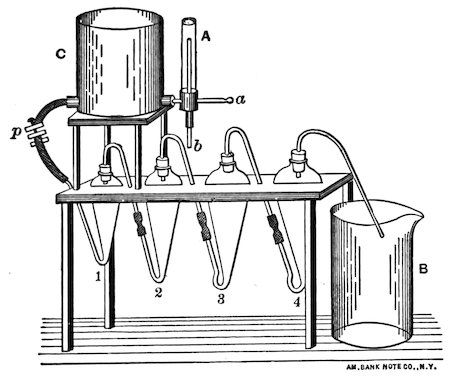
Figure 28.
Nöbel’s Elutriator.
Of the water used, four liters are found in the elutriating vessels
and nine liters in the receiving vessel No. 5. The apparatus
is left standing for an hour until the liquid in the elutriators
is clear and the portions in each vessel are received on weighed
filters dried at 125°, and the weight of each portion determined.
It is recommended that the loss on ignition of each part be
202also determined. The separated particles thus secured are classified
as follows:
No. 1. Débris and gravel. No. 2. Coarse sand. No. 3. Fine
sand. No. 4. Clayey sand. No. 5. Finest parts or clay.
Although the method of Nöbel has been much used, the results
which it gives are entirely misleading. The convection currents
produced in the conical vessels by the passing water and the
flocculation of the soil particles prevent any sharp separation
into classes of distinct hydraulic value. The process may be
useful for a qualitative test, but its chief claim to a place in this
manual is in its historic interest arising from its use in the first
attempts at silt analysis.
215. Method of Dietrich.[148]—The difficulties attending the
silt separation by the Nöbel method, led Dietrich to construct an
apparatus in which the sides of the elutriating vessels were parallel,
but these vessels, with the exception of the first, were not
set in an upright position.
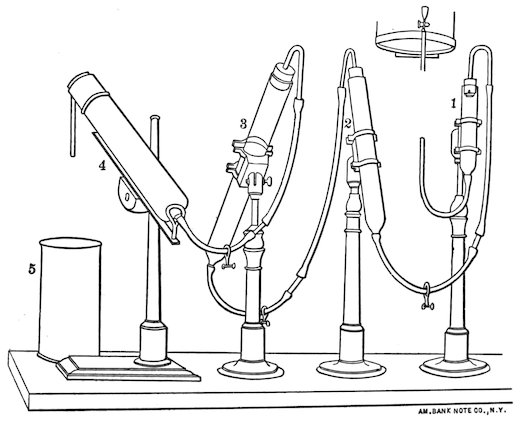
Figure 29.
Dietrich’s Elutriator.
The apparatus (Fig. 29) consists of a series of cylindrical
vessels connected by rubber tubing.
203The elutriators are of the following dimensions:
No. 1. Seventeen centimeters long, 2.8 centimeters in diameter, position
upright.
No. 2. Thirty-four centimeters long, four centimeters in diameter,
inclined 67°.5.
No. 3. Fifty-one centimeters long, 5.2 centimeters in diameter, inclined
45°.
No. 4. Sixty-eight centimeters long, 6.4 centimeters in diameter, inclined
22°.5.
The rubber tubes passing from one vessel to the other are
furnished with pinch-cocks so that each one of the elutriating
vessels can be shut off from the others and independently
removed from the circuit.
The stream of water is made to pass through the apparatus
under a constant pressure of one meter.
Only the fine earth, boiled with water or hydrochloric acid, is
to be placed in the apparatus. The part coming through a sieve
with a mesh 0.67 millimeters is to be used and placed in No. 1.
About thirty grams of soil, are employed for each elutriation.
Before adding the soil, the air is completely removed from all
parts of the apparatus by connecting it with the water supply
and allowing it to be filled with water.
The rate of flow is controlled by the orifice of the last effluent
tube and the analyst is directed to continue the operation until
the effluent water collected in the beaker glass (5) is clear. The
particles then remaining in each of the vessels are collected
separately.
The author of the method claims that in respect of likeness of
particles the results are especially gratifying and that duplicate
analyses give results fully comparable. The process, however,
has not commended itself to analysts, but it marks a distinct
progress toward the principles of later investigators. Had each
of the elutriating vessels been placed upright and the rate of flow
determined, the apparatus of Dietrich would have served, to a
certain extent, for the more rigid investigations of his successors.
216. Method of Masure.—The sifted earth, from ten to fifteen
grams, is carefully mixed with 200 cubic centimeters of water.
204It is then introduced into a doubly conical elutriator B, Fig. 30,
of about 250 cubic
centimeters capacity.
A current of
distilled water is
allowed to flow from
a Mariotte’s bottle,
A, which secures
a regular and constant
flow. The
bottle A is joined
to the elutriator B
by means of a rubber
tube and the
vertical glass tube
D, the top of which
is expanded into a
funnel for the purpose
of receiving
the water from the
Mariotte flask. The
current of water flowing upward through the elutriator B carries
in suspension the most finely divided particles of clay, and
these are collected with the emergent water in the receiver C.
The sand and coarser particles of clay remain in the elutriator.
The water flows out by the tube F, the diameter of which should
be less than that of D. When the emergent water becomes
limpid the operation is terminated. After the apparatus is disconnected,
the water is decanted from the sand in the elutriator,
and the whole residue is weighed after drying for two hours at
110°.
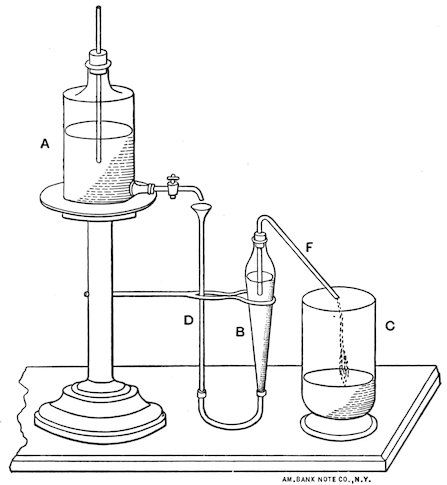
Figure 30.
Masure’s Silt Apparatus.
The fine soil collected in C may also be separated and
weighed, for control, after drying as above.
The pebbles and coarse sand separated by the sieves should
also be weighed. By this process the soil is separated into four
portions; viz.,
(1) Pebbles. (2) Coarse sand. (3) Fine sand and other
materials not carried off by the current of water. (4) Fine soil,
carried into the receiver C.
205217. Method of Schöne.—The method of Schöne[149] is based
on the combination of a cylindrical and conical separatory tube
through which the flow of water is regulated by a
piezometer.
If, in the process of silt separation, the water move
perpendicularly upward with a given velocity, e.g. = v
the separation is dependent:
(1) On the volume of the silt particles, (2) On
their specific gravity, and, (3) On their state of
disintegration.
If it be assumed that the silt particle is a sphere
with a diameter = d, then according to Newton’s law
of gravity, the following formula would be applied:
d = v² (3Z
4g (S − 1)).
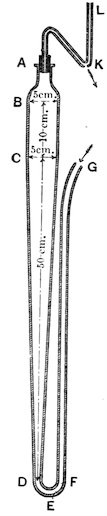
Figure 31.
Schöne’s Elutriator.
In the above formula Z = a coefficient which depends
on the condition of the surface against which the
hydraulic pressure or resistance works, in this case a
sphere; g = the acceleration of gravity equivalent to
9.81 meter; and S = the specific gravity of the particle.
This expression signifies that in a given case, the
velocity of the current in the apparatus is just sufficient
to counteract the tendency of a given particle to
sink. All particles of a smaller diameter, in such a
case, will be carried on by the current, while all of a
greater diameter would separate by sedimentation. These theoretical
conditions are not met with in practice where silt particles
of all shapes and degrees of aggregation abound. These particles,
whatever their shape, may be said to have the same
hydraulic value when carried by the same current. It is necessary,
therefore, to secure some uniform standard of expression
to assume a normal form of particle and a normal specific gravity.
For the form, a sphere is evidently the normal which must be
considered and for specific gravity that of quartz is taken; viz.,
2.65. The mean coefficient for Z may also be placed at 0.55,
although slightly different values are ascribed to it. Substituting
these values in the formula, it is reduced to the expression;
d = v² × 0.0000255 millimeters. It can, therefore, be said
that by this or that velocity of the current, silt particles will be
206removed of this or that diameter, it being understood that all
particles of equal hydraulic value to spherules of quartz of the
given diameter are included in each class. In order to have the
theoretical formula agree with the results of analysis it is necessary
to modify it empirically to read d = v⁷⁄₁₁ × 0.0314 millimeters.
This formula is found to agree well with the results obtained
for all velocities between 0.1 millimeter and twelve millimeters
per second, the ordinary limits of silt separation.
The Apparatus.—The conic-cylindrical elutriating vessel A,
B, C, D, E, F, G, Fig. 31, is of glass. The part B, C, is cylindrical,
ten centimeters in length and as nearly as possible five
centimeters in diameter.
The conical part C, D, is fifty centimeters in length. Its
inner diameter at D must not be greater than five centimeters
nor smaller than four centimeters.
The bend, D, E, F, should have the same diameter; viz., four
to five centimeters.
The part A, B, C, D, and D, E, F, G, may be made of separate
parts and joined by a rubber tube.
Outflow Tube and Piezometer.—The outflow tube and piezometer,
H, J, K, L, is constructed as shown in Fig. 32. It should
be made of barometer tubing having an internal
diameter of about three millimeters. The
tube is bent at J at an angle of forty
to forty-five degrees. The knee J must be as
acute as possible not to interfere with the
inner diameter. The form and especially the
magnitude of the outlet are of great importance.
It must be circular and nearly 1.5 millimeter
in diameter. It must not be larger
than 1.67 millimeter nor smaller than 1.5 millimeter.
The opening should be so made as
to direct the stream of outflowing liquid in
the direction shown by the arrow.
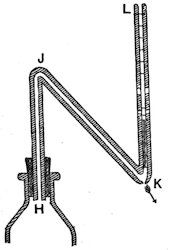
Figure 32.
Schöne’s Elutriator, Outflow Tube.
The piezometer L, K is parallel to the arm H, J, of the delivery
tube. Its graduation has its zero point in the center of the
outlet K. It commences with the one centimeter mark. From
207one to five centimeters it is divided into millimeters, from five to
ten centimeters into one-fourth centimeter, from ten to fifty centimeters
into one-half centimeter, and from fifty to 100 centimeters
into centimeters. The dimensions given are those required for
ordinary soils and for velocities ranging from two-tenths millimeter
to four millimeters per second.
For greater velocities, a delivery tube with a larger outlet
must be used and the piezometer must be of greater internal
diameter than indicated.
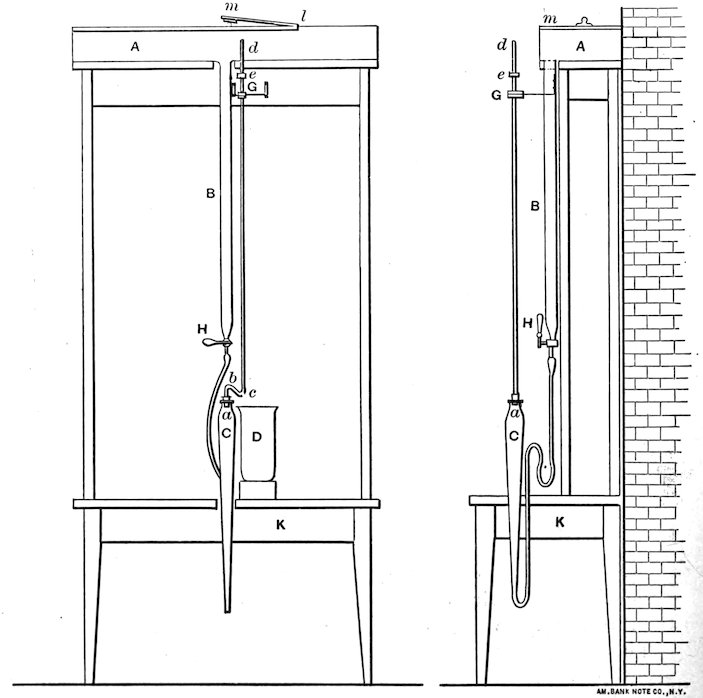
Figure 33.
Schöne’s Elutriator, Arrangement of Apparatus.
Arrangement of the Apparatus.—The apparatus is conveniently
mounted as shown in Fig. 33, giving front and side views
208of all parts of apparatus in position ready for use. When numerous
analyses are to be made much time is saved by having a
number of apparatus arranged en batterie.
The Sieve.—The soil, before being subjected to elutriation,
should be passed through a sieve of which the meshes are 0.2
millimeter square.
The Process.—To measure the diameter of the cylinder, two
marks are made with a diamond upon the glass which are distant
from each other a certain space, for instance, h centimeters.
The space between these two marks is filled with water exactly
measured. Suppose that a cubic centimeters were used, then
the diameter is determined by the formula:
D = √4a
πh centimeters.
In order to determine that the elutriating cylinder is strictly
comparable in all its parts this measurement should be made upon
several parts thereof.
The apparatus should now be tested in regard to the quantity
of liquid which it will deliver under a given pressure in the piezometer.
By means of the stop-cock H the flow of water is so
regulated that the outflow at c can be measured at a given
height of the water in the piezometer. Suppose that a cubic
centimeters of water flow in t seconds, then the quantity which
would flow in one second is determined by the formula, Q = a
t
cubic centimeters. Since according to the law of hydraulic outflow
the quantities are proportional to the square root of the
height of the column it is easy to compute from any given height
the quantity which will flow from any other one desired. For
the retardation due to capillary attraction, it is sufficient, in general,
to take it in a constant quantity; if this constant quantity
be represented by C, the observed height of the water in the piezometer
by h, and the quantity of water flowing out by Q, the
data required for any given velocity can be calculated from the
following proportion:
√h₁ − C : √h₂ − C = Q₁ : Q₂.
It is necessary to compute the magnitude of this constant C
209which is to be subtracted. This is accomplished by measuring
the quantity of water which flows out at two different heights of
the column in the piezometer. From the foregoing proportion,
the value of C is as follows:
C = Q₁² h₂ − Q₂² h₁
Q₁² − Q₂²) centimeters.
The value of C can be the more exactly determined as h₁ is
greater and h₂ smaller. It is best to choose the lowest height
from which an exact reading can be made; that is, by which the
regular rise and fall of the level of the water in the piezometer
(in consequence of the formation of drops) just begins to disappear.
This usually takes place when h₂ = 1.5 centimeter to 1.7
centimeter. For the higher value h₁ it is best to take about 100
centimeters. Suppose, for example, the following results are
obtained:
| Observed height. |
Observed quantity of outflow. |
Height of column to be subtracted due to capillary attraction. |
| |
|
|
|
|
| h₂ centimeters. |
h₁ centimeters. |
Q₁ cubic centimeters. |
Q₂ cubic centimeters. |
centimeters. |
| 80 |
1.6 |
5.53 |
0.406 |
1.21 |
| 100 |
1.6 |
6.13 |
0.484 |
1.17 |
| 80 |
1.8 |
5.53 |
0.406 |
1.19 |
| 100 |
1.8 |
6.13 |
0.484 |
1.19 |
The same quantity of water which flows out in a unit of time
passes also at the same time over a cross section of the elutriating
cylinder. The diameter of this cylinder being D the equation
is derived
v = Q4
πD² centimeters.
Since the velocity in the elutriating cylinder v is directly as the
quantity of water overflowing so is
v : vₙ = √h − C : √hₙ − C;
vₙ = √(hₙ − C) v
√(h − C)
and hₙ = vₙ²(h − C
v² + C. The constant h − C
v²
210is obtained from the means of a number of estimations; for
example as illustrated in the following data:
| Observed height, centimeters. |
Observed quantity of outflow, cubic centimeters. |
Corresponding velocity in elutriating cylinder of 4.489 centimeters diameter, millimeters. |
|
Constant. h − C
2 |
| |
|
|
|
|
| 1.6 |
0.406 |
0.0257 |
|
621 |
| 1.8 |
0.484 |
0.0306 |
|
652 |
| 80.0 |
5.530 |
0.3490 |
|
647 |
| 100.0 |
6.130 |
0.3870 |
|
660 |
| |
|
|
|
|
| |
|
|
Mean |
645 |
Then are obtained the following values of hₙ and vₙ:
hₙ = 645(Vₙ²) + 1.19 centimeters.
and vₙ = √hₙ − 1.19 × 0.0394 centimeters.
In order to be able easily and rapidly to judge under what
pressure the outflow has taken place in any particular instance,
a larger number of values are computed with the help of the
formula given and placed together in tabular form. As an
example the following table may serve which was computed for
one of the apparatus used. Usually it will be sufficient to test
the apparatus for four different heights and then to interpolate the
values for all the others. The numbers marked with a star in
the table are those which were determined by experiment; the
others were calculated.
| Height of column in piezometer. h |
Velocity in the elutriating cylinder of 4.489 centimeters diameter. v |
Corresponding diameter of silt particles. d = v(⁷⁄₁₁)0.0314 millimeters. |
| centimeters. |
Observed, millimeters. |
Calculated, millimeters. |
millimeters. |
| 1.5 |
0.222 |
0.220 |
0.0120 |
| 1.6 |
0.257* |
0.252 |
0.0131 |
| 1.7 |
0.284 |
0.281 |
0.0140 |
| 1.8 |
0.306* |
0.307 |
0.0148 |
| 1.9 |
0.323 |
0.332 |
0.0155 |
| 2.0 |
0.346 |
0.355 |
0.0162 |
| 2.5 |
0.427 |
0.451 |
0.0185 |
| 3.0 |
0.531 |
0.530 |
0.0210 |
| 3.5 |
0.577 |
0.599 |
0.0227 |
| 4.0 |
0.650 |
0.660 |
0.0236 |
| 2114.5 |
0.694 |
0.717 |
0.0254 |
| 5.0 |
0.751 |
0.769 |
0.0265 |
| 6.0 |
0.850 |
0.864 |
0.0286 |
| 7.0 |
0.942 |
0.950 |
0.0304 |
| 8.0 |
1.050 |
1.028 |
0.0320 |
| 9.0 |
1.120 |
1.101 |
0.0334 |
| 10.0 |
1.170 |
1.169 |
0.0347 |
| 15.0 |
1.490 |
1.460 |
0.0400 |
| 20.0 |
1.730 |
1.710 |
0.0441 |
| 25.0 |
1.940 |
1.920 |
0.0476 |
| 30.0 |
2.100 |
2.110 |
0.0506 |
| 35.0 |
2.310 |
2.290 |
0.0532 |
| 40.0 |
2.460 |
2.450 |
0.0556 |
| 45.0 |
2.610 |
2.610 |
0.0578 |
| 50.0 |
2.770 |
2.750 |
0.0598 |
| 60.0 |
3.030 |
3.020 |
0.0635 |
| 70.0 |
3.290 |
3.270 |
0.0667 |
| 80.0 |
3.490* |
3.500 |
0.0697 |
| 90.0 |
3.710 |
3.710 |
0.0724 |
| 100.0 |
3.870* |
3.920 |
0.0749 |
Suppose the problem is by means of the apparatus tested above,
to separate into a number of groups a mixture of silt particles,
whose hydraulic values are found between the following
diameters: 0.01, 0.02, 0.03, 0.04, 0.05, 0.06, 0.07 millimeters.
The table will show at once under what pressure of water the
piezometer must be placed in order to give the values; viz., 1.4,
2.8, 7.0, 15.0, 29.0, 53.0, and 83.0 centimeters respectively.
The apparatus described above, is adapted for velocities in
the elutriating cylinder varying from two-tenths millimeter to four
millimeters per second. The largest silt particles which can be
separated by the velocities given above, have approximately a
diameter of 0.08 millimeter. For the separation of larger particles
a sieve can take the place of the silt apparatus. If, however,
it be desired to subject larger particles to silt analysis, the
dimensions of the elutriating cylinder and of the outlet of the
delivery tube must be changed accordingly.
212Preparation of Sample.—The conduct of silt analysis of natural
soils must, in certain cases, be preceded by a special treatment
of the sample. If the latter be rich in humus the organic substance
must previously be separated as completely as possible.
With sandy soils this can be accomplished by ignition. With
clayey soils, on the contrary, it is to be performed by boiling the
soils at least one hour with water which contains from one to
two per cent of free alkali. Soils which contain lime must also
be subjected to treatment with dilute hydrochloric acid, and the
hydrochloric acid must be as carefully removed, as possible
before the sample is subjected to elutriation; afterward follows
the boiling of the sample in the ordinary way with water. This,
of course, can be omitted when it has already been treated with
boiling dilute alkali. It is also important to remove the larger
particles by a sieve before the elutriation begins. It is well to
pass a sample through a sieve after it has been boiled, by which
all particles of a larger diameter than 0.2 millimeter are removed.
This will usually require about one liter of water and this water
should be allowed to rest from one to two hours and poured off
with the suspended material which it contains. Only what subsides
should be brought into the apparatus. In rinsing the sample
as much water must be used as will fill the apparatus up to
its cylindrical portion.
After the sample has been placed in the apparatus, the water
is allowed slowly to enter, being careful to avoid reaching more
than the lowest required velocity, until the outflow begins.
The water then is so regulated by the stop-cock as to bring it to
the desired height in the piezometer. This being accomplished,
the different velocities which have been decided upon for separating
the particles of silt are used one after the other, as soon
as all the silt which can be removed at each given velocity, has
been secured. From three to five liters of water will be required
for the separation of each class of particles. Sometimes the
reading of the height of the water in the piezometer is difficult;
as, for instance, when foam or bubbles accumulate therein.
213These bubbles can be removed by simply blowing into the tube,
or dropping into it a little ether. The outflow of water can be
received in vessels, beaker glasses, or cylinders, in which it is
allowed to subside. The finest particles which remain in suspension
in the water are best determined by difference. If it be
desired to weigh them directly, the water can be treated with
ammonium bicarbonate until it contains from one to two per
cent thereof. The precipitation then takes place in a few hours.
The collection and weighing of silt particles are accomplished
in the usual way. That which finally remains in the elutriating
vessel is taken out after the end of the operation by closing the
stop-cock, removing the stoppers with the piezometer tube, pouring
the contents of the elutriating vessel into a beaker glass and
rinsing out carefully all adhering particles. Examples of the
working of the apparatus follow:
The soil was taken from the Imperial Russian Agricultural
Experimental Institute at Gorki. It was a fine clay sand and
was carefully treated with hydrochloric acid. The results of the
analysis are given in the following table:
| Velocities employed in millimeters. |
Largest diameter of the collected particles in millimeters. |
Percentage of silt product obtained in repeated elutriations. |
| 0.25 |
0.012 |
13.4 |
12.6 |
11.9 |
| 0.5 |
0.020 |
9.1 |
8.7 |
9.5 |
| 1 |
0.032 |
21.0 |
21.4 |
20.8 |
| 2 |
0.050 |
30.4 |
29.8 |
31.7 |
| 3 |
0.063 |
16.7 |
16.1 |
15.5 |
| 4 |
0.076 |
5.3 |
5.5 |
5.5 |
| |
Residue |
4.2 |
4.9 |
3.8 |
| |
|
|
|
|
| |
Total |
100.0 |
99.0 |
98.7 |
Holthof modifies the apparatus of Schöne by putting into the
lower mouth of the elutriator a little mercury so that the particles
of earth are deposited upon its surface and are thus better
agitated and washed by the current of water.
218. Mayer’s Modification of Schöne’s Method.—An improvement
of Schöne’s apparatus in the direction of greater simplicity
has been tested by Mayer[150] with satisfactory results:
214The apparatus, (Fig. 34), consists of a glass vessel having a
glass stop-cock at the bottom for admitting the water.
For a distance of twenty centimeters the sides of the
tube are parallel and the diameter about one centimeter.
Next for a distance of fifty centimeters the tube
is conical expanding at a regular rate until the internal
diameter reaches five centimeters. For a distance
of ten centimeters the vessel is again strictly cylindrical
and it is in this cylindrical portion that the
separation of the different constituents takes place.
The vessel is then rapidly narrowed until it carries
the stopper A two centimeters in diameter. This
stopper carries two glass tubes, one F bent downward
to conduct the overflow into the receiving vessels,
and one H for the purpose of regulating the rate of
overflow by the height of the column of water therein.
The orifice of the overflow tube F should be so regulated
that with a pressure of five centimeters water in
H, one liter shall pass over in ten minutes.

Figure 34.
Schöne’s Apparatus
for Silt
Analysis,
Modified
by Mayer.
If the separation be conducted in an apparatus thus
mounted and graduated with a pressure of two centimeters
in H all that portion of the soil which can
properly be called clay will pass over. The fine
earth, that is, earth in which all coarse particles have
been removed by proper sifting, is used in ten-gram
lots for each experiment. The residue, after the separation
is complete, consists of pure sand or at least
pure sand mixed with humus. Before the fine earth is placed
in the apparatus, the calcium carbonate therein is removed with
hydrochloric acid. The treatment with hydrochloric acid, however,
is not to be recommended in soil containing many undecomposed
particles of calcium carbonate or dolomite for then large
additions to the silt output might be made from these particles,
which could not be regarded as coming from the soil as it actually
exists. For alluvial soil, however, previous treatment with
hydrochloric acid is recommended unconditionally.
215219. Schöne’s Method as Practiced by Osborne.—The
apparatus used by Osborne[151] was obtained from Germany and
was similar to that described by Schöne in his original paper,
except that it was furnished with a second elutriating tube as
suggested by Orth. The modification made by Orth consists,
essentially, of a second elutriating tube with straight sides into
which the bulk of the soil is introduced, only the final part being
carried over into the Schöne’s tube proper. Water is supplied to
the apparatus under constant pressure by means of a Mariotte’s
bottle.
The preliminary treatment recommended by Schöne is omitted,
as these steps have been shown to be undesirable, on
account of affecting the accuracy of the results.
Twenty grams of the air-dried soil are passed, under water,
through a sieve of one-fourth millimeter mesh. That part of
the soil which remains in suspension after being sifted is placed
at once in the Schöne’s tube of the apparatus, the coarser portion
being rinsed into the Orth tube. The current is regulated
so that the largest particles of quartz carried off have an average
diameter of 0.01 millimeter. When all is carried off that can be
removed at this rate the current is increased until the largest
quartz grains passing off have a diameter of 0.05 millimeter.
As noticed by Hilgard with Schulze’s apparatus, secondary
currents are formed during the process of elutriation which
descend along the walls of the conical portion of the Schöne’s
tube and some distance along the sides of the cylindrical portion.
The tendency of these currents is to produce globular
aggregates of particles which fall to the bottom. They are
broken up from time to time by increasing the velocity of the
current but even this method fails to disintegrate a considerable
quantity of them.
220. Statement Of Results.—Two samples of soil from the
garden of the experiment station analyzed by Schöne’s method
gave the following proportions of sediment.
In the table the term clay is used to designate all that part of
the soil which has diameters less than 0.01 millimeter and which
remains suspended after twenty-four hours standing in water
having a depth of 200 millimeters.
| 216 |
| Soil, from Garden of the Experiment Station.—Not Boiled. |
|---|
| Analyses with the Schöne-Orth Elutriator. |
|---|
|
A. |
B. |
C. |
| Above 0.25 millimeter |
48.82 |
48.82 |
48.82 |
| 0.25–0.05 |
27.36 |
29.94 |
22.37 |
| 0.05–0.01 millimeter |
8.63 |
6.07 |
13.70 |
| 0.01 millimeter and less depos. |
7.36 |
7.31 |
7.20 |
| Clay (by difference) |
1.00 |
1.03 |
1.08 |
| Loss on ignition |
6.83 |
6.83 |
6.83 |
| |
|
|
|
| |
100.00 |
100.00 |
100.00 |
The last column C represents the average of three direct
beaker elutriations according to the method of Osborne.
The differences which these figures show are found to be due
to imperfect separation of the finer grades from the coarser and
even when the various fractions separated by the Schöne method
are subjected to beaker elutriation and the portions separated
from them added to the grades to which they properly belong the
Schöne elutriator was found to effect far less exact separations
than the beaker method.
Samples of prairie soil from Mercer County, Ill., not boiled,
were examined by the two methods with the following results:
|
Schöne-Orth elutriation. |
Beaker method. |
| Above 0.25 millimeter |
0.76 |
0.62 |
| 0.25–0.05 millimeter |
11.25 |
2.42 |
| 0.05–0.01 millimeter |
52.65 |
43.58 |
| 0.01 millimeter and less deposited |
14.84 |
31.58 |
| Clay |
4.44 |
5.81 |
| Loss on ignition |
14.49 |
14.49 |
| |
|
|
| |
98.43 |
98.50 |
In this case it is seen that Schöne’s method varies considerably
from the beaker method and if the beaker method be regarded
as correct the Schöne method is evidently less reliable.
In the next table are given the data of the examination of
brick clay from North Haven, Conn., by the two methods.
| Brick Clay from North Haven, Conn. |
|---|
|
Schöne-Orth elutriation. |
Beaker method. |
| Above 0.25 millimeter |
1.02 |
1.02 |
| 0.25–0.05 millimeter |
3.91 |
0.76 |
| 0.05–0.01 millimeter |
29.63 |
20.95 |
| 0.01 millimeter and less |
58.58 |
71.01 |
| Loss on ignition |
6.60 |
6.60 |
| |
|
|
| |
99.74 |
100.34 |
217The failure of the Schöne method to give the results obtained
by the beaker method is ascribed to the fact that it is impossible
for the current of the strength used to disintegrate the clay and
further that the particles after they are once separated tend
to coalesce by the currents produced by the elutriating process.
221. The Berlin-Schöne Method.—Osborne has also made a
study of the Schöne method as modified by the Bodenlaboratorium
of Berlin. The directions for the analysis by this
laboratory method are as follows:
Five hundred grams of the soil are sifted through a sieve with
circular holes two millimeters in diameter. Of the earth passing
the sieve from 30 to 100 grams are boiled in water with constant
stirring from one-half to one hour or longer, according to the
character of the soil. The finer the texture of the soil the
smaller the quantity taken and the longer the time of boiling.
Treatment with acids or alkalies is not practiced.
The finer portion of the soil remaining suspended in the water,
after boiling, is poured into the Schöne tube, the remaining
coarse part is rinsed into the Orth tube. The clay, together
with the finest sand, is collected in a separate vessel, the water
in which it is suspended is evaporated and the residue after drying
in the air is weighed. The rest of the operation is carried
out as previously described except that the products of elutriation
are not ignited but weighed air dried, in order that they may
be further examined, chemically if desired. By proceeding in
this manner the following results were obtained:
| Soil, from Garden of the Experiment Station, Boiled Forty-five Minutes. |
|---|
| |
|
|
| Separations by the Berlin-Schöne method. |
|---|
| |
|
|
|
Air-dried. |
Ignited. |
| Above 0.05 millimeter |
72.63 |
71.76 |
| 0.05–0.01 millimeter |
14.17 |
12.53 |
| 0.01 millimeter and less |
12.97 |
9.38 |
| Loss on ignition |
|
6.83 |
| |
|
|
| |
99.77 |
99.50 |
For the sake of comparing the mechanical separation attainable
by this procedure with those yielded by other methods, the
air-dried products were ignited and again weighed and examined.
218By subtracting from the ignited portion above 0.05 millimeter,
49.37 per cent, the amount of this soil that remained on a 0.25
millimeter sieve, the fraction between 0.25 millimeter and 0.05
millimeter is found, and the separations in this analysis may be
compared with those previously obtained by the beaker method
as follows:
| Soil from Garden of Experiment Station. |
|---|
| |
|
|
|
|
|
|
Beaker Method. |
| |
|
|
|
Berlin-Schöne, boiled forty-five minutes. |
Boiled twenty-three hours, average of four analyses. |
Pestled, not boiled. |
Not boiled nor pestled, average of three analyses. |
| |
|
|
|
|
| Above 0.25 millimeter |
49.37 |
47.77 |
48.82 |
48.82 |
| 0.25–0.05 millimeter |
21.39 |
20.75 |
22.44 |
22.37 |
| 0.05–0.01 millimeter |
12.53 |
11.18 |
12.55 |
13.70 |
| <0.01 clay included |
9.38 |
13.47 |
9.36 |
8.28 |
| Loss on ignition |
6.83 |
6.83 |
6.83 |
6.83 |
| |
99.50 |
100.00 |
100.00 |
100.00 |
Osborne concludes from the above facts that the Berlin-Schöne
method, while showing close agreement with the beaker method,
does not give results which are identical with that method. On
subjecting portions separated by the Berlin-Schöne method to
the beaker analysis additional separations were secured. In
the case of heavy loams the inability of the Berlin-Schöne
method to effect even a rough or approximate separation of the
several grades becomes very conspicuous.
222. Method of Hilgard.—Two important principles lie at
the foundation of this method; viz., 1, the use only of separating
vessels of true cylindrical shape and 2, the employment of a
mechanical stirrer to break up the floccules formed during the
process of separation. The points in the apparatus to be considered
are uniformity of the cross section of the elutriator at
every point, exact perpendicularity of position, careful control of
the rate of flow and continuous operation of the mechanical stirrer.
According to Hilgard’s observations the stirring due to
the current of water alone is not sufficient to break up the floccules
unavoidably formed during the separation, while any
inclination of the sides of the elutriating vessel from the perpendicular
due either to a conical shape or false position favors in
the highest degree the formation of floccules due to reflex currents
formed in the body of the liquid.
219In order to carry out the idea suggested by Türschmidt of
substituting for the accidental and indefinite products usually
appearing in the statements of silt analyses sediments of known
and definite hydraulic value a constant head of water is used,
secured by means of a Mariotte’s bottle connecting with the tube
delivering the current through a cock provided with an arm
moving on a graduated arc.
According to Hilgard the separation of sediments by the
method of subsidence does not possess the analytical accuracy of
the moving liquid method, especially when the latter is combined
with mechanical stirring. The subsidence method requires close
and continuous attention and in the case of fine sediments tending
to flocculation the difficulties of the method are greatly
increased. The views of Hilgard in respect of the laboriousness
of the subsidence method lose, however, some of their force
since the modifications of Osborne have come into use. The
simplicity and cheapness of the apparatus required for subsidence
give it at the start many advantages over the more elaborate
process with a churn elutriator. For rigid scientific investigation,
however, the method of Hilgard is commended as a
standard of comparison in all cases.
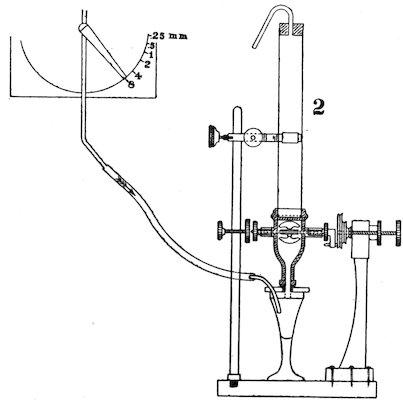
Figure 35. Hilgard’s Churn Elutriator.
223. The Elutriator.—The instrument devised by Hilgard[152]
for the purpose of breaking
up these flocculent
aggregates is shown in
figure 35, together with
the simpler form, a
Schöne’s elutriator, figure
36, which can serve
for grain sizes above
eight millimeters hydraulic
value. The latter
is conveniently selected
so as to have half the
cross-section of the
former, so that with the
same position of the index
lever the velocity
220will be just doubled. The cylindrical glass tube, of about
forty-five millimeters inside diameter at its mouth, and 290
to 300 millimeters high, has attached to its base a rotary
churn consisting of a brass cup, shaped like an egg with point
down, so as to slope rather steeply at base, and triply perforated;
viz., at the bottom for connection with the relay reservoir, and at
the sides for the passage of a horizontal axis bearing four grated
wings. This axis, of course, passes through stuffing boxes,
provided with good thick leather washers, saturated with mutton
tallow. These washers, if the axis runs true, will bear a million
or more revolutions without material leakage. When a beginning
is noted additional washers may be slipped on without
emptying the instrument, until the analysis is finished. For
the finest sediments, from five to six hundred revolutions per
minute is a proper velocity, which may be secured by clock work,
turbine or electric power. The driving pulley should not be
directly connected with the axis, both because it is liable to
cause leakage, and because it is necessary to be able to handle
the elutriator quickly and independently. This is accomplished
by the use of “dogs” on the pulley and churn axis. For the
grain sizes of one to eight millimeters hydraulic value lower
velocities are sufficient; too low a velocity causes an indefinite
duration of the operation and may be recognized by the increase
of turbidity as the velocity is increased.
As the whirling agitation caused by the rotation of the dasher
would gradually communicate itself to the whole column of
water and cause irregularities, a wire screen of 0.8 millimeter
aperture is cemented to the lower base of the cylinder.
The relay vessel should be a thick, conical test glass with
foot; its object is to serve as a reservoir for the heavy sediments
not concerned at the velocity used in the elutriator tube, and
whose presence in the latter or in its base, the churn, would
only cause abrasion of the grains and changes of current velocity,
such as occur in the apparatus of Schöne, and compel the current
measurement of the water delivered. It is connected above
with the churn by a brass tube about ten millimeters in clear
diameter, so as to facilitate the descent of the superfluous sediments,
221which the operator, knowing the proportion of area
between the connecting tube and elutriator, can carry to any
desired extent; thus avoiding the disturbance of
the gauged current velocities, as well as all material
abrasion.
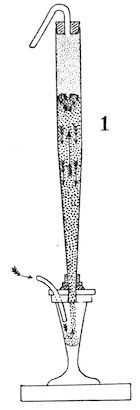
Figure 36.
Improved Schöne’s Apparatus
with
Relay.
A glass delivery tube should extend quite half
way down the sides of the relay vessel, to insure a
full stirring up of the coarse sediments when
required. By means of a rubber hose, not less
than twenty inches in length, this delivery tube
connects with the siphon carrying the water from
near the bottom of the Mariotte’s bottle, a ten-gallon
acid carboy. A stop-cock provided with
a long, stiff index lever, moving on an empirically
graduated arc, regulates the delivery of water
through the siphon. Knowing the area of the
cross section of the elutriator tube, the number of
cubic centimeters of water which should pass
through it in one minute, at one millimeter
velocity, is easily calculated, and from this the
lever positions corresponding to other velocities
are quickly determined and marked on the graduated arc.
The receiving bottle for the sediments, also shown in the figure,
must be wide and tall, so as to allow the sediment to settle while
the water flows from the top into the waste pipe. The receiving
funnel tube must dip nearly to the bottom of the bottle.
Thus arranged, the instrument works very satisfactorily, and
by its aid soils and clays may readily be separated into sediments
of any hydraulic value desired. But in order to insure correct
and concordant results, it is necessary to observe some precautions;
viz.,
(1) The tube of the instrument must be as nearly cylindrical as
possible and must be placed and maintained in a truly vertical
position. A very slight variation from the vertical at once
causes the formation of return currents, and hence of molecular
aggregates on the lower side.
(2) Sunshine, or the proximity of any other source of heat,
must be carefully excluded. The currents formed when the
222instrument is exposed to sunshine will vitiate the results.
(3) The Mariotte’s bottle should be frequently cleansed, and
the water used be as free from foreign matters as possible. For
ordinary purposes it is scarcely necessary to use distilled water.
The quantities used are so large as to render it difficult to maintain
an adequate supply, and the errors resulting from the use of
any water fit for drinking purposes are too slight to be perceptible,
so long as no considerable development of the animal and
vegetable germs is allowed. Water containing the slimy filaments
of fungoid growths and moss protonema, algae, vorticellae, etc.,
will not only cause errors by obstructing the stop-cock at low
velocities, but these organisms will cause a coalescence of sediments
that defies any ordinary churning, and completely vitiates
the operation.
(4) The amount of sediment discharged at any time must not
exceed that producing a moderate turbidity. Whenever the discharge
becomes so copious as to render the moving column
opaque, the sediments assume a mixed character, coarse grains
being, apparently, upborne by the multitude of light ones whose
hydraulic value lies considerably below the velocity used, while
the churner also fails to resolve the molecular aggregates which
must be perpetually reforming where contact is so close and
frequent. This difficulty is especially apt to occur when too
large a quantity of material has been used for analysis, or when
one sediment constitutes an unusually large portion of it.
Within certain limits the smaller the quantity employed the more
concordant are the results. Between ten and fifteen grams is the
proper amount for an instrument of the dimensions given above.
224. Preparation of the Sample.[153]—In some cases simple
sifting will be sufficient to prepare the air-dried soil for the elutriator.
In most cases, however, some mechanical aid must be
invoked to secure particles of sufficient fineness. Nothing harder
than a rubber pestle should be used and care must be taken not
to break up any calcareous or ferruginous masses which the particles
of fine soil may contain. The use of water in this mechanical
attrition should be avoided, if possible, but in some heavy clay
and adobe soils wetting becomes necessary. In this case the
parts separated by the sieve are collected separately and the
223turbid mass removed by water and dried for further examination.
A sieve of 0.5 millimeter mesh is recommended as the best
because that is almost exactly the diameter of the particles passing
off at the maximum velocity of sixty-four millimeters per
second to which the elutriator is adapted. The particles passing
the 0.5 millimeter mesh are called fine earth.
225. Preparation by Boiling.—The method of preparation
by boiling may be applied to all samples of fine earth. The
fact pointed out by Osborne, that diffusibility of some clays is
diminished by long boiling, renders it important to restrict the
time of this operation as much as possible. With most soils
from eight to fifteen hours will be long enough, occasionally
extending to even twenty-four hours. A thin long-necked flask
of about one-liter capacity should be used; filled three-quarters
full with distilled water and the sample of soil added. The flask
is supported over the lamp on a piece of wire gauze at an angle
of 45°. It carries a cork with a long condensing tube. At first
the boiling goes on smoothly, but after a time violent bumping
may supervene, endangering the flask but promoting the object
in view.
The contents of the flask are transferred to a beaker and
diluted with distilled water to one and a half liters, shaken and
allowed to settle for a time necessary to allow all particles of 0.25
millimeter hydraulic value to reach the bottom. The supernatant
turbid liquid is decanted and the process repeated with smaller
quantities of water until no further turbidity is produced. The
united decantations, of which there will be from four to eight
liters, are well shaken and a proper time allowed for the 0.25
millimeter hydraulic value sediments to fall. This last step is
necessary to remove any such sediments which may have been
carried over mechanically in the first separation. The dilution
being very great, a fairly perfect separation is thus secured and
the sediments are then ready for the elutriator.
226. Separation of Clay and Finest Silt.—The property
which pure clay possesses, of remaining suspended almost indefinitely
in pure water, affords a ready means of separation from
the silt particles of less than 0.25 millimeter hydraulic value.
But the finest silt particles subside so slowly that this method of
224separation is too long to become practically applicable to secure
a perfect demarcation between the finest silt and so-called
colloidal clay.
Hilgard recommends the following procedure: The clay water
from the previous separation is placed in a cylindrical vessel of
such a diameter as to allow the column of water to be 200 millimeters
high where it is allowed to settle for twenty-four hours.
When the clay is very abundant a longer time may be allowed;
viz., from forty to sixty hours. The line of separation between
the dark silt below and the translucent clay above is sharply
defined. Finally the clay water is decanted and the remaining
liquid poured off leaving the sediment as sharply defined
as possible. The sediment is rubbed with a rubber pestle and a few
drops of ammonia water added. Distilled water is added, the
beaker well shaken or stirred to break up the floccules that may
have formed and subsidence permitted as before. This operation
is repeated from six to nine times until the water remains quite
clear after subsidence or the decanted turbid water fails to be
precipitated by brine showing the suspended matter to be fine
silt and not clay.
The diameter of the particles of silt thus obtained is from 0.001
to 0.02 millimeter, and it is impossible to obtain it quite free from
any admixture with clay.
227. Estimation of the Colloidal Clay.—The importance of
the colloidal constituent of the clay is such as to make its
direct determination desirable. The volume of the clay waters
at this stage of the analysis may amount to twenty liters. One
method of determination consists in evaporating an aliquot portion
and this method will yield good results if the sample be free
from soluble salts and the quantity taken be not too small. At
least 500 cubic centimeters should be used for this purpose. A
better method consists in precipitating the clay by means of a
saline solution. A saturated solution of salt is recommended
for this purpose of which fifty cubic centimeters are sufficient to
precipitate the clay from one liter of the clay water. The precipitation
is hastened by heating. Each portion of the clay
water should be precipitated as soon as obtained, the total volume
of the precipitate at the end of twenty-four hours is thus reduced
225to a minimum. The clay water from the succeeding separations
of the same analysis can be mixed with the precipitate which
diffuses therein, thus promoting the precipitation of the rest of
the clay inasmuch as the separation takes place more readily
where more clay is present. When all the clay is thus collected
it can be gathered on a tared filter and washed with weak brine.
Pure water may not be used because of the diffusibility of clay
therein. After drying at 100° and weighing it is washed with a
weak solution of ammonium chlorid until all sodium is removed.
The filtrate is evaporated to dryness, ignited at low redness,
and weighed. The weight of the sodium chlorid thus obtained
plus the weight of the filter deducted from the total weight gives
the weight of the clay precipitate. Whenever the clay collected
as above will not diffuse in water it may be washed with water
and its weight directly obtained. An excess of iron in clay will
usually allow of the above treatment.
228. Properties of Pure Clay.—The percentage of pure clay
as obtained by the procedure described is about seventy-five in
the finest natural clays, forty-five in heavy clay soils, and fifteen
in ordinary loamy soils. When freshly precipitated by brine it is
gelatinous resembling a mixed precipitate of iron and aluminum
oxids. Its volume greatly contracts on drying, clinging tenaciously
to the filter, from which it may be freed by moistening.
On drying, it becomes hard, infriable, and often resonant. It
usually possesses a dark brown tint due to iron oxid. Under
the action of water it swells up like glue, the more slowly as the
percentage of iron is greater. In the dry state it adheres to the
tongue with great tenacity. According to Whitney the finest
particles of colloidal clay have a diameter of 0.0001 millimeter.
With a magnifying power of 350 diameters, however, Hilgard
states that no particles can be discerned.
229. Chemical Nature of the Fine Clay.—The fine particles
separated as above consist essentially of hydrous aluminum
silicate or kaolinite. It doubtless contains, however, other colloids
or hydrogels whose absorptive powers are similar to those
of clay. It appears also to contain sometimes free aluminum
hydroxid, and colloidal ferric hydroxid, and amorphous zeolitic
compounds.
226While the most careful mechanical separation can give at
best only approximately the really plastic kaolinite substance, yet
it is far closer than that attained by determination of total
alumina with boiling sulfuric acid. By the latter treatment
all the lime-kaolinite particles are decomposed and the method
does not lead to even an approximate estimate of the soil’s
plasticity.
230. Separation of the Fine Sediments.—The sediments
remaining after the separation of the clay and fine silt are
ready for separation in the churn elutriator. The apparatus
mounted, as already described, is brought into use by beginning
with a low velocity of the water in the upright tube. The rate
of flow should be set at from 0.25 millimeter to 0.50 millimeter
per second, and the churn put in motion.
When the elutriating tube is partly full of water the sediments
should be poured in from a small beaker which is perfectly
cleaned by means of a washing flask. The stopper and delivery
tube of the elutriator are then put in place. The rate of flow
should be so regulated that the sediments shall have had a few
seconds of subsidence before the water is within thirty millimeters
of the top. At this point the required velocity for the first
sedimentation should be turned on; viz., 0.25 millimeter per
second. At first the sediment passes off rapidly and the water
in the elutriator is distinctly turbid. This excess of turbidity
ceases in a few hours and then some attention is necessary in
order to determine when the process is complete. In fact it
never is completely finished, but where no more than one milligram
of silt comes off with one liter of water it may be said to
be practically done. The time required for the first operation
varies from fifteen to ninety hours. Downward currents in the
elutriator are likely to form in spite of all precautions, and floccules
of silt adhere to its walls. These should be detached from
time to time with a feather in order to bring them again in
contact with the churn.
Hilgard has found that, practically, 0.25 millimeter per second
is about the lowest velocity available within reasonable limits of
time, and that by successively doubling the velocities up to
sixty-four millimeters a desirable ascending series of sediments
227is obtained; provided always, that a proper previous preparation
has been given to the soil or clay. It would seem that according
to the prescription given above for the preliminary sedimentation,
no sediment corresponding to 0.25 millimeter velocity
should remain with the coarser portion. That such is nevertheless
always the case, often to a large percentage, emphasizes the
difficulty, or rather impossibility, of entirely preventing or dissolving
the coalescence of these fine grain sizes by hand stirring,
as in beaker elutriation. It is only by such energetic motion as
is above prescribed that this can be fully accomplished, and the
delivery of 0.25 and 0.50 millimeter hydraulic value really
exhausted.
It is desirable to run off the upper third of the column at intervals
of fifteen to twenty minutes by temporarily increasing the
velocity. Recent sediments, river alluvium, etc., are more easily
separated than soils of more ancient formation. The second,
third, etc., separations are naturally accomplished in much less
time than the first. The respective velocities of the separations
should be 0.25 millimeter, 0.50 millimeter, one millimeter, two
millimeters, four millimeters, eight millimeters, sixteen millimeters,
thirty-two millimeters, and sixty-four millimeters a second.
Below a velocity of four millimeters a second the mechanical stirrer
is indispensable. Above this velocity the current of water in the
conical base will be sufficient to bring the desired particles into
the ascending column. At this velocity also a smaller elutriating
tube having one-half or one-quarter the cross-section of the
first may be employed to hasten the operation and diminish the
quantity of water required. The quantity of water required for
a complete separation is from 100 to 120 liters. Any soft water
free of organic matter may be used, but distilled water is best.
Hard water should be avoided.
The mean time required for the different separations is as
follows: 0.25 millimeter hydraulic value, thirty-five hours; 0.50
millimeter hydraulic value, twenty hours; one millimeter hydraulic
value, seven and a half hours; two to sixty-four millimeters
hydraulic value, eight hours. With proper arrangements for
night work, an analysis may be finished in three or four days
not counting the time required for the previous separation of the
clay.
228231. Weighing the Sediments.—The sediments should be
dried at the same temperature used for drying the soils. Hilgard
dries both at 100°. Great care should be used in weighing
the exceedingly hygroscopic clay sediments. In the case of the
sediment of 0.25 millimeter hydraulic value it is allowed to subside
as much as possible and after removing the supernatant
water the residue, twenty-five to fifty cubic centimeters, is evaporated
in a platinum dish and weighed therein. The water can
be completely decanted from the other sediments, and they can
be dried and weighed without any unusual precautions.
The loss in the separation of clays and subsoils containing
but little organic matter is usually from 1.5 to 2 per cent.
This loss is partly due to the fine silt which comes off during the
whole of the process and which is lost in the decanted waters of
the sediments of 0.25 millimeters hydraulic value and above.
The procedures indicated above are not strictly applicable to soils
rich in humus and other organic matters, but the destruction of
these matters by ignition leaves the residual soil in a condition
wholly unfit for sedimentary separation.
232. Classification of Results.—A convenient method of
stating the results of an analysis may be seen from the following
classification. The percentage obtained for each of the classes
is to be entered in the column provided for that purpose.
| |
No. |
Names of Silt Classes. |
Diameter of grains in millimeters. |
Velocity of current millimeters hydraulic value. |
Per cent. |
| Sieves. |
1. |
Grits |
1 –3 |
|
2.07 |
| 2. |
Fine grits |
0.5–1 |
|
| Elutriator without churn. |
3. |
Coarse sand |
0.50 |
64 |
0.55 |
| 4. |
Medium sand |
0.30 |
32 |
| 5. |
Fine sand |
0.16 |
16 |
| Elutriator with churn. |
6. |
Finest sand |
0.12 |
8 |
0.21 |
| 7. |
Coarse silt |
0.072 |
4 |
1.21 |
| 8. |
Large silt |
0.047 |
2 |
2.92 |
| 9. |
Medium silt |
0.036 |
1 |
7.36 |
| 10. |
Silt |
0.025 |
0.5 |
8.86 |
| 11. |
Fine silt separated in elutriator |
0.016 |
0.25 |
7.85 |
| Beaker sedimentation. |
12. |
Fine silt separated from clay water |
0.010 |
<0.25 |
35.22 |
| 13. |
Clay |
0.0001 |
<0.0023 |
33.16 |
| |
|
|
|
|
|
| |
|
Total |
|
|
99.36 |
229The measurements of diameters in the above table is of the
best formed quartz grains in each class. Naturally the actual
size of the particles may vary in each class within the extreme
limits of the diameter next above and below. It is not easy to
indicate in popular language distinctions not popularly made
but the grades of particles designated by the names grits, sand
and silt, may serve, at least, to establish uniformity of expression.
The term grits is thus applied to all grains above one
millimeter in diameter up to gravel. Below one millimeter
down to 0.1 millimeter may be called sand and below that silt
may designate the particles down to an impalpable powder.
233. Influence of Size of Tube.—The diameter of the elutriating
tube exerts a sensible influence on the character of the
sediments. The friction against the sides of a small tube is comparatively
greater than in a large tube. Strictly speaking, no
class of sediments strictly corresponds to the hydraulic value
calculated from the cross section of the tube and the quantity of
water supplied thereto. The sediments correspond actually to
higher velocities, due to the fact that the lateral friction causes
a more rapid flow in the center of the water column. This may
be demonstrated by slightly diminishing the velocity while a
sediment is copiously discharging. The turbid column then
remains stationary while clear water is running off.
234. Statement of Results.—A complete silt analysis of a
soil, conducted by the method of Hilgard, depends largely for its
practical value on an intelligible tabulation. The method of
collating results is illustrated in the table of analyses of Mississippi
soils shown on page 237.
The character of the soils entering into the given analyses is
as follows:
Nos. 248, 206, 209, 397, 219, belong to the end of the drift
period.
No. 230 is one of the two chief varieties of soils occurring in
what is known as the flat-woods, a level surface bordering on the
cretaceous area, having lower tertiary clays near the surface.
No. 165 is a light soil which occurs in the former in irregular
strips and patches, is easily tilled, absorbs rain water readily,
but is subject to drought and does not hold manure.
230
| Silt Analyses of Mississippi Soils and Subsoils. |
|---|
|
Designation of Materials. |
Diameter. Millimeters. |
Velocity (Hydraulic value). Millimeters per second. |
DRIFT |
UPLAND. |
MISSISSIPPI BOTTOM. |
| YELLOW LOAM. |
TERTIARY. |
Champlain. |
MODERN. |
| SANDY. |
LOAM. |
CLAY. |
Swamp River. |
RIVER DEPOSIT. |
DELTA. |
238
White pipeclay. Tishomingo Co. |
248
Tallahoma subsoil Jasper Co. |
165
Lt. Flatwoods soil. Chickasaw Co. |
206
Pine Hill soil. Smith Co. |
209
Pine Hill subsoil. Smith Co. |
397
Oxford subsoil. Lafayette Co. |
219
Table Land subsoil. Benton Co. |
173
Prairie subsoil. Monroe Co. |
230
High Flatwoods soil. Pontotoc Co. |
246
Red Hills subsoil. Attala Co. |
196
Hog Wallow subsoil. Jasper Co. |
390
Buckshot soil. Issaquena Co. |
237
Loess. Claiborne Co. |
365
Tallahatchie soil. Panola Co. |
377
Frontland subsoil. Sunflower Co. |
395
Dogwood ridge soil. Coahoma Co. |
Southwest Pass. Plaquemine Par. |
Southwest mudlump. Plaquemine Par. |
| 1 |
Coarse grits |
1.0 to 3.0 |
|
|
6.94 |
2.90 |
0.36 |
0.36 |
|
0.23 |
2.10 |
0.33 |
1.97 |
0.83 |
0.09 |
0.24 |
0.09 |
|
|
|
|
| 2 |
Fine „ |
0.5 to 1.0 |
|
|
17.65 |
6.96 |
2.98 |
0.83 |
|
0.35 |
1.19 |
0.05 |
|
|
|
|
| 3 |
Coarse sand |
0.40 |
6 |
0.06 |
18.81 |
2.81 |
6.62 |
6.21 |
0.79 |
1.47 |
0.62 |
|
0.72 |
1.96 |
|
0.37 |
0.04 |
0.32 |
0.15 |
0.18 |
0.10 |
| 4 |
Medium „ |
0.30 |
32 |
10.16 |
4.41 |
7.75 |
3.38 |
2.33 |
|
2.32 |
1.64 |
0.36 |
0.61 |
0.05 |
|
| 5 |
Fine „ |
0.16 |
16 |
2.66 |
3.13 |
3.01 |
3.85 |
1.17 |
|
2.09 |
0.88 |
|
0.93 |
0.21 |
2.97 |
|
0.47 |
5.02 |
| 6 |
Finest „ |
0.12 |
8 |
0.08 |
1.66 |
2.02 |
1.59 |
1.49 |
0.18 |
0.78 |
0.20 |
0.23 |
0.70 |
0.26 |
0.31 |
1.65 |
1.30 |
2.41 |
3.74 |
7.03 |
3.68 |
| 7 |
Dust „ |
0.072 |
4 |
0.02 |
1.02 |
2.23 |
1.19 |
0.64 |
0.78 |
0.76 |
1.26 |
0.18 |
1.29 |
0.19 |
0.27 |
1.95 |
2.68 |
16.90 |
21.49 |
12.38 |
5.34 |
| 8 |
Coarsest silt |
0.047 |
2 |
0.04 |
0.88 |
5.06 |
3.56 |
2.63 |
3.56 |
9.79 |
2.92 |
1.61 |
1.81 |
2.49 |
1.56 |
14.25 |
9.38 |
19.79 |
21.83 |
13.27 |
10.09 |
| 9 |
Coarse „ |
0.036 |
1 |
0.08 |
1.96 |
9.67 |
6.50 |
5.40 |
13.12 |
7.26 |
7.36 |
2.66 |
3.60 |
3.67 |
2.23 |
16.20 |
9.88 |
13.90 |
14.01 |
15.87 |
5.58 |
| 10 |
Medium „ |
0.025 |
0.5 |
0.08 |
7.89 |
14.18 |
13.97 |
7.77 |
16.64 |
13.14 |
8.81 |
9.13 |
2.73 |
5.39 |
3.68 |
20.08 |
20.37 |
4.27 |
9.93 |
8.25 |
9.54 |
| 11 |
Fine „ |
0.015 |
0.25 |
2.00 |
8.40 |
22.03 |
14.20 |
16.65 |
27.28 |
15.07 |
7.85 |
26.64 |
13.30 |
10.31 |
8.97 |
5.59 |
19.79 |
1.89 |
9.58 |
7.26 |
8.01 |
| 12 |
Finest „ |
0.008 |
<0.25 |
21.15 |
15.53 |
15.62 |
29.36 |
37.75 |
18.87 |
26.50 |
35.22 |
32.35 |
25.33 |
24.18 |
38.19 |
33.38 |
25.30 |
30.08 |
8.65 |
19.67 |
34.46 |
| 13 |
Clay |
0.0001 |
<0.0023 |
74.65 |
8.63 |
7.86 |
4.58 |
10.70 |
17.23 |
19.19 |
33.16 |
25.48 |
40.25 |
47.03 |
44.30 |
2.51 |
9.64 |
5.51 |
10.35 |
12.20 |
18.18 |
| |
98.16 |
99.28 |
98.68 |
95.67 |
97.77 |
98.35 |
97.65 |
99.50 |
97.87 |
96.11 |
100.00 |
100.01 |
97.74 |
98.73 |
98.04 |
99.72 |
96.58 |
100.00 |
| Compactness (resistance to tillage) |
97.80 |
32.56 |
45.33 |
48.14 |
45.10 |
63.38 |
60.82 |
69.77 |
84.47 |
78.88 |
81.52 |
89.46 |
41.48 |
54.63 |
37.48 |
28.57 |
39.13 |
60.65 |
| Porosity |
0.36 |
59.55 |
40.40 |
37.89 |
47.13 |
20.23 |
26.04 |
17.04 |
6.40 |
39.18 |
10.12 |
4.87 |
38.44 |
23.63 |
58.25 |
61.50 |
49.20 |
28.81 |
| Hygroscopic Moisture (+7° to +21°) |
9.09 |
1.80 |
3.36 |
2.48 |
7.69 |
8.79 |
7.21 |
11.35 |
9.33 |
18.60 |
14.48 |
14.31 |
4.18 |
6.12 |
5.68 |
3.95 |
|
|
| Ferric Oxide |
0.13 |
1.10 |
1.45[G] |
1.25 |
4.15 |
2.53 |
5.11 |
5.42 |
5.90[G] |
10.50 |
4.00 |
5.82[G] |
3.27 |
2.58 |
2.31 |
2.69 |
|
|
231No. 248 is from a soil stratum three feet thick. The soil is
so light that the finer particles of it are carried away by high
winds.
Nos. 206 and 209 are typical of the soils producing the long-leaf
pine. This soil is much improved by an admixture of the
subsoil No. 209, which enables it to hold manure.
No. 219 is a cotton upland soil of the best quality, found in
Western Mississippi and Tennessee.
No. 397 is the same soil of a second rate quality. These lands
are easily washed into gullies on account of their lack of perviousness
to water. They also easily swell up in contact with water,
and become thereby readily diffused. The denudations produced
by heavy rains are rapidly destroying the lands covered
by these soils.
No. 173 is a sedimentary or residual subsoil of the cretaceous
prairies of Northeastern Mississippi, forming a stratum from
three to seven feet thick.
No. 230 is a residual soil which is formed by the disintegration
of the old tertiary clays. It yields good crops only in very
favorable years, and is easily injured both by wet and dry
seasons.
No. 246 is a soil of the same origin, but is more easily tilled
than the foregoing, does not crack, but becomes very hard when
dried slowly. Its superiority to the former soil as regards
tillage consists in the presence of the large amount of iron and
lime.
No. 196 is a typical heavy clay soil; is better suited for the
potter than the farmer. It cracks on drying, whence its popular
name. On the accession of rain the edges of these cracks
crumble and fall, until finally the lumpy surface is produced
which is locally known as hog wallows.
No. 390, the richest soil of the Yazoo Bottom, seems to have
a physical composition like the preceding one. Its superiority
is due not only to the increased quantity of plant food which it
contains, but to its property of crumbling on rapid drying.
Even when plowed wet, on drying each clod crumbles into a
loose pile resembling buck-shot; whence its name. It is strongly
calcareous.
232As comparative data, are added the soils 365, 377, and 395,
representing alluvial deposits, and two deposits from the Delta
of the Mississippi.
235. Comparison of Osborne’s Method with Hilgard’s
Method.[154]—The comparative results obtained by Osborne’s
method, beaker elutriation, and Hilgard’s method, churn
elutriation, are given in the following tables:
| Soil From Experiment Station Garden, New Haven, Conn. Surface Soil, Boiled Twenty-Three Hours. |
|---|
| |
|
|
|
|
Churn elutriation. |
Beaker elutriation. Average of four analyses. |
| Diameter in millimeters. |
per cent. |
per cent. |
per cent. |
| Removed by sieves |
47.77 |
47.77 |
47.77 |
| 0.25–0.05 |
22.06 |
21.95 |
20.75 |
| 0.05–0.01 |
11.20 |
11.62 |
11.18 |
| <0.01 |
9.82 |
9.14 |
10.72 |
| Clay (difference) |
2.32 |
2.69 |
2.75 |
| Loss on ignition |
6.83 |
6.83 |
6.83 |
| |
|
|
|
| |
100.00 |
100.00 |
100.00 |
| Subsoil, Boiled Twenty-three Hours. |
|---|
| |
|
|
|
|
|
Churn elutriation. |
Beaker elutriation. |
| Diameter in millimeters. |
per cent. |
per cent. |
per cent. |
per cent. |
| Removed by sieve |
39.33 |
39.33 |
39.33 |
39.33 |
| 0.25–0.05 |
33.61 |
30.83 |
32.35 |
32.95 |
| 0.05–0.01 |
10.91 |
12.25 |
10.32 |
10.37 |
| <0.01 |
7.05 |
8.11 |
8.29 |
7.64 |
| Clay |
5.02 |
5.40 |
5.63 |
5.63 |
| Loss on ignition |
4.08 |
4.08 |
4.08 |
4.08 |
| |
|
|
|
|
| |
100.00 |
100.00 |
100.00 |
100.00 |
These analyses agree quite as well as could be expected from
two such different methods.
Elutriation of Clayey Soils.—Hilgard found that by churn elutriation
no satisfactory results could be obtained on clay without
long boiling and subsequent kneading of the finer sediments.
Osborne examined a sample of clay by his method after previous
boiling for twenty-three hours. When the sediments were
examined by the microscope they were found to contain many
aggregations of particles which broke into dust under the pressure
of the thin glass slide-cover. These sediments were then
gently crushed in the beaker with the help of a soft rubber
stopper with a glass rod for a handle, the grinding together of
the particles being, as much as possible, avoided. This pestling
233was continued with clear water as long as it occasioned turbidity.
Comparison of the analyses shows that practically identical
results were obtained on this soil whether it was boiled or not
and indicates that the sediments are reduced to their elements
by gentle pestling alone. For such soils, therefore, it is demonstrated
that pestling is a much safer treatment than boiling.
The same remark may be applied to the fertile prairie soil of
Mercer County, Illinois, where boiling proved quite insufficient
and in which the pestling process proved completely successful.
The general conclusions arrived at from the results obtained by
Osborne are as follows:
1. On sands and silts of pure quartz or similar resistant
material Hilgard’s method and beaker elutriation give practically
identical results.
2. With coarse sands and silts upon whose grains finer matter
has been cemented by silicates, etc., and with soils containing
soft slaty detritus, the churn elutriator with preliminary boiling
may give results too low for the coarse and too high for the finer
grades. In these cases beaker elutriation with pestling yields
more correct figures.
3. Some loamy soils containing no large amount of clay or of
extremely fine silt, as well as prairie soils rich in humus, cannot
be suitably disintegrated by twenty-four hours’ boiling, but are
readily reduced by pestling.
4. Beaker elutriation preceded by sifting, gives results in five
or six hours with use of two to three gallons of pure water, which,
in churn elutriation, require several days and consume eight to
ten gallons of pure water.
5. Hilgard found that practically 0.25 millimeter is about the
lowest velocity of water current per second available within
reasonable limits of time in his elutriator. Such a current carries
over particles up to 0.015 millimeter diameter and hence the
silts of less dimensions cannot be conveniently separated by
churn elutriation. In beaker elutriation there is no difficulty in
making good separations at 0.01 millimeter and at 0.005 millimeter.
6. Beaker elutriation requires no tedious boiling or preliminary
treatment and with careful pestling of the sediments gives,
234we believe, as nearly as possible, a good separation of adhering
particles and at every stage of the process carries with it, in the
constant use of the microscope, the means of testing the accuracy
of its work and of observing every visible peculiarity of the soil.
It is not claimed that pestling may not easily go too far, but in
any case a good judgment may be formed of its effects and of
the extent to which it is desirable to carry it.
7. In beaker elutriation the flocculation of particles occasions
little inconvenience and does not impair the accuracy of the
results.
236. Comparison of the Osborne with the Schloesing
Method.—Schloesing’s method has been compared by Osborne[155]
with the beaker method of elutriation with the following results:
| Schloesing’s Method. |
|---|
| |
|
|
Per cent. |
| Calcium carbonate |
4.20 |
| Sand |
64.91 |
| Clay |
22.65 |
| Humus |
none |
| Loss on ignition |
6.60 |
| |
|
| |
|
| By the Direct Beaker Method. |
|---|
| |
|
|
Per cent. |
| Above 0.25 millimeter diameter |
1.02 |
| 0.25–0.05 millimeter diameter |
0.76 |
| 0.05–0.01 millimeter diameter |
20.95 |
| Below 0.01 millimeter diameter |
71.01 |
| Loss on ignition |
6.60 |
It is seen by the above that there is little agreement between
the results of the two methods.
With the prairie soil from Mercer County, Ill., the following
results were obtained working on the original sample and the
sand separated by the Schloesing process:
| Schloesing’s Method. |
|---|
| |
|
|
Per cent. |
| Calcium carbonate |
0.88 |
| Humus |
1.57 |
| Loss at 150° C. |
4.42 |
| Sand |
82.86 |
| Clay |
7.86 |
| |
|
| |
97.59 |
| 235 |
| Beaker Method. |
|---|
| |
|
|
|
|
Schloesing’s sand. |
Original soil. |
|
Dried at 150°C., per cent. |
Ignited, per cent. |
Ignited, per cent. |
| Above 0.25 millimeter diameter |
0.12 |
0.10 |
0.92 |
| 0.25–0.05 millimeter diameter |
3.58 |
3.55 |
2.89 |
| 0.05–0.01 millimeter diameter |
42.69 |
41.87 |
42.86 |
| 0.01–0 millimeter diameter |
23.66 |
20.47 } |
31.44 |
| Clay |
12.81 |
10.14 } |
|
| Clay |
|
|
7.40 |
| Loss on ignition |
|
6.73 |
14.49 |
| |
|
|
|
| |
82.86 |
82.86 |
100.00 |
Osborne says the above figures indicate that the treatment
with acid has disintegrated the particles of less than 0.01
millimeter diameter so that one-third of this portion appears
as clay, according to the Hilgard method of estimating clay,
which is the one employed.
As to the humus it may be noted that loss in the analysis by
Schloesing’s method; viz., 2.41 per cent, plus loss at 150° = 4.42
per cent, plus humus found = 1.57 per cent, plus carbon dioxid
(⁴⁴⁄₅₆ of 0.88 =) 0.69 per cent amounts to 9.09 per cent, while the
loss on ignition which represents humus, carbon dioxid and
water is 14.49 Per cent. The 5.40 per cent difference must evidently
be, for the most part, humus which has escaped estimation
by the Schloesing method, having been distributed among
the sand and clay.
237. The Mechanical Determination of Clay.—Schloesing’s
method for the separation of the clay as stated by Osborne[156] is
essentially one of subsidence for twenty hours from a volume of
from 200 to 250 cubic centimeters of water, but of no specified
height. Hilgard’s conventional method requires the same time
and a height of solution of 200 millimeters.
Such methods of separation assume, first, that most of the sand
and, second, that little of the clay shall settle within the fixed
time. That both of these assumptions are fallacious, the following
experiments show. The clay obtained by twenty hours
subsidence from thirty grams of brick clay is suspended in four
liters of distilled water and allowed to settle out completely,
which requires several days. The water is then decanted so as
to remove all soluble matters, the jar again filled with distilled
236water, and the clay and fine sand allowed to settle again for several
days. The upper three-quarters of the liquid are then
decanted and made up to a volume of four liters, and this is
allowed to stand several days, when a considerable sediment
forms. A decantation is again made as before. The operations
are repeated until the clay water has been so far freed from the
clay as to become opalescent; then it first ceases to deposit any
appreciable sediment. A microscopic examination of the several
sediments thus collected shows them all to contain particles of
sand. It appears, therefore, that only after the liquid containing
the clay has become opalescent does it cease to deposit fine
particles of sand as well as of clay.
Furthermore, the character of the true clay itself is so changed
under certain conditions that it loses the property of remaining
in prolonged suspension in water.
A sample of clay which has been freed from particles of sand
exceeding 0.005 millimeter diameter is suspended in water and
precipitated from it by freezing. It is then washed by decantation
with alcohol and dried in the air. A portion of this clay is
shaken with water and allowed to stand a few hours, during
which time the greater part of it has settled. After decanting
the water and suspended clay and repeating this process a few
times, a very considerable part of the clay is left which will subside
completely through 100 millimeters in a few hours. After
standing under water for several months, only a small part of
the clay has regained the quality of prolonged suspension. It
has been found, however, that if this clay be pestled, this quality
of prolonged suspension is restored to it to a very considerable
degree.
It is evident, therefore, that conventional methods depending
on simple subsidence can give no accurate results because the
ever varying amounts of finest sand and clay in different soils
yield variable mixtures of the two when subjected to any simple
course of treatment by elutriation and subsidence.
The method of persistent pestling and repeated subsidences
and decantations continued until no further separation can be
effected, although extremely tedious, is the only one which
has so far yielded even approximately good separations on any
of the clayey soils examined by Osborne.
237A single subsidence of the clay water for twenty-four hours will
free it from all particles of sand having a diameter greater than
0.005 millimeter, but in many cases a considerable amount of
finer sand will remain in suspension for many hours or days.
On the other hand, the sediment formed during the twenty-four
hours subsidence will not be free from clay, as may be easily
seen by suspending it in water a second time and allowing it to
stand again for twenty-four hours. Both Hilgard and Schloesing
direct attention to these defects, but assume that they do
not usually influence the results to a sufficient extent to deprive
them of value. In many cases this is undoubtedly true, as, for
example, in such soils as that from the garden of the Experiment
Station, at New Haven, in which there is but little clay
and fine sand; but in soils of the opposite character, as in the
North Haven brick clay where exact separations are most
desirable, a very considerable error is thus inevitably encountered.
238. Effect of Boiling on the Texture of Clayey Soils.—Most
investigators who have worked upon mechanical soil
analysis advise boiling with water in order to detach clay and
sand from each other and make a good separation of the several
mechanical elements practicable or possible. In general, however,
the instructions as to the time and manner of boiling are
rather indefinite, and no definite research as to the effects of this
treatment has been undertaken.
The practice of Hilgard, to boil twenty-four hours or even
longer in case of adhesive clays, according to Osborne[157] appears
to be objectionable in view of the dehydration and change of
physical properties known to occur in case of many hydroxids,
especially those of iron and aluminum, which may be present
in the soil. It is a familiar fact that the hydroxids above named
and many other amorphous substances when precipitated from
cold solutions are more bulky and less easily washed upon a filter
than when thrown down hot. It is also well known that
their properties are considerably changed by warming or boiling
with water. Heating with water to boiling for some hours or
days gradually converts the bulky brown-red ferric hydroxid,
which when precipitated cold and air-dried for eighteen days,
238contains thirty-eight per cent of water, into a much denser,
bright red substance containing but two per cent of water. St.
Gilles has also observed the partial dehydration of aluminum
hydroxid from Al₂O₃.5H₂O to Al₂O₃.2H₂O by prolonged boiling.
The hydrate of silica and the highly hydrated silicates are
most probably affected in a similar manner, and if such be the
case, boiling would evidently change the constitution of clay in
a very essential degree.
The following experiments throw light on this subject:
Ten grams of North Haven brick clay were boiled continuously
for nine days with about 700 cubic centimeters of distilled
water, in a glass flask of one liter capacity and furnished
with a reflux condenser. Fifteen grams were boiled in the same
manner for eight and one-half days. When the boiling was
concluded, the soil was found to have assumed a granular condition,
the clay and fine sand being collected into a mass of small
grains resembling coarse sand and settling rapidly. One portion
thus boiled was elutriated by the beaker method, the other by
Hilgard’s. The pestle was not used on either of those portions as
it was desired to determine simply the effect of prolonged boiling.
The separations thus accomplished are here compared
with the elutriations of the same soil boiled twenty-three hours
and of the pestled but unboiled soil.
|
Hilgard elutriation. |
Beaker elutriation. |
|
Not pestled. |
Not pestled. |
Not Pestled. |
Pestled. |
|
Boiled twenty-three hours, |
Boiled nine days, |
Boiled eight and a half days. |
Not boiled. |
| Diameter of particles. |
per cent. |
per cent. |
per cent. |
per cent. |
| By sieves |
3.36 |
3.24 |
3.63 |
3.49 |
| 0.25–0.05 |
1.21 |
1.11 |
1.91 |
1.29 |
| 0.05–0.01 |
28.27 |
33.04 |
33.61 |
27.02 |
| 0.01–0 |
56.29 |
48.85 |
54.78 |
52.21 |
| Clay |
4.92 |
3.05 |
1.97 |
10.15 |
| Loss on ignition |
5.95 |
5.95 |
5.95 |
5.95 |
| |
|
|
|
|
| |
100.00 |
95.24 |
101.85 |
100.11 |
Here it is observed that the eight to nine days boiling diminished
the clay as determined by Hilgard’s conventional method
by seven to eight per cent, increasing the dust by two to three
per cent, and the silt by about six per cent.
Under the microscope small, rounded, opaque, brown granules
239were seen in large numbers, which when pressed under the cover
glass, broke up into a multitude of very fine particles.
From these experiments it would appear to be conclusively
proved that too long boiling precipitates clay and thereby
defeats the very object of the operation.
In these experiments the time of boiling was prolonged in
order to bring out unmistakably the effects of this operation. If
ebullition for eight or nine days reduces clay from ten to two per
cent, increasing the 0.05–0.01 millimeter diameter grades by six
per cent, it is evident that boiling for one day or a shorter time
becomes a questionable treatment.
Further experiments[158] made by boiling clay in a platinum
vessel with a platinum condenser showed that this precipitation
of the clay was largely if not wholly due to the salts extracted
from the soil.
When the clay has once been converted into the granular condition,
considerable difficulty is experienced in restoring it to the
state in which it is capable of prolonged suspension in water.
The results of the studies herewith reported may be summed
up as follows:
1. The Berlin-Schöne method of elutriation gives fairly correct
separations with sandy soils containing little clay or matters finer
than 0.01 millimeter diameter, but on soils of fine texture, as
loams rich in humus and clays, it gives results which are grossly
inaccurate, the error on single grades amounting to from eight
to fourteen per cent.
2. In respect of rapidity, economy of time, and ease of operation,
the Schöne elutriation has no advantage over the beaker
method.
3. Schloesing’s method on its mechanical side makes no satisfactory
separations, and the chemical treatment it employs is
liable to alter seriously the texture of the soil.
4. The determination of clay from a single subsidence from
any conventional depth or volume of water, or for any conventional
time, is not a process certain to effect even a roughly
approximate separation of the finest quartz grains from true clay.
5. Boiling with water must be rejected as a treatment preliminary
to mechanical analysis, because it not only abrades and
240reduces the coarser sediments, but may dehydrate and coagulate
the true clay and thus alter essentially the texture and grain of
the soil.
239. General Conclusions.—The methods of Hilgard and
Osborne have been given in detail and largely in the descriptive
language used by the authors. The other methods of elutriation
in use in other countries have also been described. For
practical use the methods of Hilgard and Osborne are to be preferred
to all others. For simplicity and speed the Osborne
method has the preference over the Hilgard. For rigid control
of the work the Hilgard method is to be preferred. The effect
of long boiling on clay pointed out by Osborne would suggest
that the boiling process preliminary to the Hilgard method be
made as short as possible. It would seem that the churn attrition
in the Hilgard method might well be regarded as a substitute
for the soft pestling of the Osborne process, and any prolonged
boiling in the former method might be safely omitted. When
carefully carried out, the results of the Hilgard and Osborne
method are fairly comparable.
240. Distribution of Soil Ingredients.—The determination
of the distribution of the soil ingredients in the sediments
obtained in silt analysis is illustrated by the following table:[159]
| Hydraulic value |
Clay |
<0.25mm |
0.25mm. |
0.5mm. |
1.0mm. |
|
|
|
| Per cent in soil |
21.64 |
23.56 |
12.54 |
13.67 |
13.11 |
Other sediments. |
Total sediments. |
Original soil. |
| |
|
|
|
|
|
|
|
|
|
|
|
|
|
|
A |
B |
A |
B |
A |
B |
A |
B |
A |
B |
|
|
|
| |
|
|
|
|
|
|
|
|
|
|
|
|
|
| Insoluble residue |
15.96 |
4.35 |
73.17 |
17.29 |
87.96 |
11.03 |
94.13 |
12.72 |
96.52 |
12.74 |
13.76 |
71.89 |
70.53 |
| Soluble silica |
33.10 |
7.17 |
9.95 |
2.34 |
4.27 |
0.53 |
2.35 |
0.32 |
|
0.36 |
|
10.36 |
12.30 |
| Potash |
1.47 |
0.32 |
0.53 |
0.12 |
0.29 |
0.04 |
0.12 |
0.01 |
|
|
0.49 |
0.63 |
| Soda |
(1.70) |
|
0.24 |
0.06 |
0.28 |
0.04 |
0.21 |
0.02 |
|
|
0.12 |
0.09 |
| Lime |
0.09 |
0.03 |
0.13 |
0.03 |
0.18 |
0.02 |
0.09 |
0.01 |
|
|
0.09 |
0.27 |
| Magnesia |
1.33 |
0.29 |
0.46 |
0.11 |
0.26 |
0.03 |
0.10 |
0.01 |
|
|
0.44 |
0.45 |
| Manganese |
0.30 |
0.06 |
0.00 |
0.00 |
0.00 |
0.00 |
0.00 |
0.00 |
|
|
0.06 |
0.06 |
| Ferric oxid |
18.76 |
4.06 |
4.76 |
1.11 |
2.34 |
0.29 |
1.03 |
0.14 |
|
|
5.60 |
5.11 |
| Alumina |
18.19 |
3.97 |
4.32 |
1.04 |
2.64 |
0.33 |
1.21 |
0.17 |
|
|
5.51 |
8.09 |
| Phosphoric acid |
0.18 |
0.04 |
0.11 |
0.02 |
0.03 |
0.00 |
0.02 |
0.00 |
|
|
0.06 |
0.21 |
| Sulfuric acid |
0.06 |
0.01 |
0.02 |
0.01 |
0.03 |
0.00 |
0.03 |
0.00 |
|
|
0.02 |
0.02 |
| Volatile matter |
9.00 |
1.33 |
5.61 |
1.43 |
1.72 |
0.23 |
0.92 |
0.29 |
|
|
3.64 |
3.14 |
| Total |
100.14 |
21.64 |
99.30 |
23.56 |
100.00 |
12.54 |
100.21 |
13.67 |
|
13.10 |
|
98.28 |
100.63 |
| Total soluble matter. |
75.18 |
|
20.52 |
|
10.32 |
|
5.16 |
|
|
|
|
|
|
| „ „ bases |
41.84 |
|
10.44 |
|
5.99 |
|
2.76 |
|
|
|
|
|
|
| Soluble silica in crude substance. |
0.38 |
0.01 |
|
|
|
|
|
|
|
|
|
|
0.19 |
| A. Calculated on the amount of sediment. B. Calculated on the amount of soil. |
241It is seen from the above analyses that the clay is by far the
richest in mineral constituents, of all the ingredients separated in
silt analysis, the amount in the clay being more than twice that
of all the others combined. Its volatile matter is also the largest.
The large amount of soda, however, is probably in part due to
the sodium chlorid used in the precipitation of the diffused
clay. The following points in regard to the distribution of the
different ingredients are instructive:
1. The iron and alumina exist in almost identical relative proportions
in each sediment, making it probable that they are in
some way definitely correlated.
2. Potash and magnesia also exist in almost the same quantities,
and their ratio to each other in all the sediments being almost
constant seems to indicate that they occur combined, perhaps in
some zeolitic silicate which may be a source of supply to plants.
3. Manganese exists only in the clay, a mere trace being
found in the next sediment.
4. The lime appears to have disappeared in the clay, having
probably been largely dissolved in the form of carbonate by the
large quantity of water used in elutriation. Its increase in the
coarser portions may be owing to its existence in a crystallized
form not so readily soluble.
5. In a summary of the ingredients, it is seen that there is a
loss in potash, magnesia and lime in the sediments as compared
with the original soil; and this loss is doubtless due to the
solution of these bodies in the water of elutriation.
A noteworthy fact shown in this table is the rapid decrease of
acid-soluble matter in the coarser sediments; even what is dissolved
from so fine a sediment as 1.0 millimeter hydraulic value,
equal to a diameter of 0.04 millimeter, is in this case a negligible
quantity. This suggests forcibly the inutility of introducing
into chemical soil analysis, grains of as large a size as
will pass a sieve of one millimeter aperture. The hydraulic value
of these grains would be somewhere between 150 and 200 millimeters
per second. While the exact results of the above analysis
may not be applicable to all soils, yet the range is so wide that the
systematic exclusion from chemical analysis of inert material,
by means of preliminary mechanical separation, seems likely to
242lead to important improvements in the interpretation of the
results.
241. Percentage of Silt Classes in Different Soils.—The
adaptation of a soil to different crops depends largely on the sizes
of the particles composing it and consequently on the relative
percentages of the silt classes.
The following table gives the mechanical analysis of some
markedly different types of subsoils:[160]
| Diameter, millimeters. |
Conventional names. |
Early truck. |
Truck and small fruit. |
Tobacco. |
Wheat. |
Grass and wheat. |
Limestone. |
|
|
1 |
2 |
3 |
4 |
5 |
6 |
| 2–1 |
Fine gravel |
0.49 |
0.04 |
1.53 |
0.00 |
0.00 |
1.34 |
| 1–0.5 |
Coarse sand |
4.96 |
1.97 |
5.67 |
0.40 |
0.23 |
0.33 |
| 0.5–0.25 |
Medium sand |
40.19 |
28.64 |
13.25 |
0.57 |
1.29 |
1.08 |
| 0.25–0.1 |
Fine sand |
27.59 |
39.68 |
8.39 |
22.64 |
4.03 |
1.02 |
| 0.1–0.05 |
Very fine sand |
12.10 |
11.43 |
14.95 |
30.55 |
11.57 |
6.94 |
| 0.05–0.01 |
Silt |
7.74 |
4.95 |
28.86 |
13.98 |
38.97 |
29.05 |
| 0.01–0.005 |
Fine silt |
2.23 |
2.02 |
7.84 |
4.08 |
8.84 |
11.03 |
| 0.005–0.0001 |
Clay |
4.40 |
8.79 |
14.55 |
21.98 |
32.70 |
43.44 |
| |
|
|
|
|
|
|
|
| |
|
99.70 |
97.52 |
95.04 |
94.20 |
97.63 |
94.23 |
| Org. matter, water and loss |
0.30 |
2.48 |
4.96 |
5.80 |
2.37 |
5.77 |
242. Description of the Soils.—Number one represents the
very early truck lands of southern Maryland. It is a light yellow
sand, belonging to the Columbia terrace formation. Under
an intense system of cultivation and heavy manuring with
organic matter, good crops of garden vegetables are produced
which mature very early, at least ten days or two weeks before
the crops from any other part of the state. Under the prevailing
meteorological and cultural conditions this soil maintains about
five or six per cent of moisture, while a heavier wheat and
grass soil maintains from twelve to twenty per cent. The
truck soil is so loose and open in texture that the rain-fall passes
through it very readily, and it is undoubtedly owing to this drier
soil that the plant is forced to the early maturity which secures
it from competition from other parts of the State and insures a good
market price.
Number two represents the later truck and fruit lands of southern
Maryland. These lands contain rather more clay than those
just described; they are somewhat heavier and closer in texture,
243and are rather more retentive of moisture. This land gives a
larger yield per acre than the one just described, and in every
way crops make a more vigorous growth and development, but
the crop is about a week or ten days later in maturing, and for
this reason it brings a lower price in the market. It is much
better land than number one for small fruit and peaches. These
lands are altogether too light in texture for the profitable production
of wheat, and it would cost altogether too much to improve
them so that even a moderate yield of wheat could be obtained.
Number three is a tobacco land of southern Maryland. The
finest tobacco lands of this locality come between the truck and
wheat lands in texture, and contain from ten to twenty per cent
of clay. The lighter the texture of the soil and the less clay it
contains, the less tobacco it will yield per acre, but the finer
the texture of the leaf. The tobacco yields more per acre on
the heavier wheat soils, but the leaf is coarse and sappy and
cures green and does not take on color. It brings a very low
price in the market and does not pay for cultivation. The crop
on the lighter lands is of much finer quality; there is a smaller
yield per acre but the leaf takes on a fine color in curing, and
brings a much better price per pound. Wheat is commonly
raised on these tobacco lands to get advantage of the high
manuring, and because the rotation is better for the land than
where tobacco is grown continuously on the same soil. The
finest tobacco lands are, however, too light in texture for the
profitable production of wheat. These lands belong to the neocene
formation.
Number four is a type of the wheat lands of southern Maryland.
These lands represent soil of about the lightest texture
upon which wheat can be economically produced under the
climatic conditions which there prevail. They contain from eighteen
to twenty-five per cent of clay, and are much more retentive of
moisture than the best tobacco lands. This type is about the
limit of profitable wheat production. These soils will maintain
about twelve per cent of water during the dry season. Garden
truck is so late in maturing on these lands that there is often a
glut in the market when the crop matures, and the crops often
do not pay the cost of transportation. The lands are too light in
244texture for a permanent grass sod. They belong to the neocene
formation.
Number five represents the heavier wheat lands of southern
Maryland, belonging probably to a different horizon of the neocene
formation and containing about thirty per cent of clay.
This soil is much more retentive of moisture and produces very
much larger crops of wheat than the last sample. It is strong
enough and sufficiently retentive of moisture to make good grass
lands. It is too close in texture and too retentive of moisture
for the production of a high grade of tobacco, or to be profitable
for market truck.
Number six is from a heavy limestone soil of lower Helderberg
formation. It is a strong and fertile wheat and grass land.
243. Interpretation of Silt Analysis.—The primary conceptions
upon which the interpretation of the mechanical analysis
is based may be briefly stated as follows:[161] The circulation of
water in the soil is due to gravity, or the weight of water, acting
with a constant force to pull the water downward, and also to
surface tension, or the contracting power of the free surface of
water (water-air surface), which tends to move the water either
up or down, or in any direction, according to circumstances.
There is a large amount of space between the grains in all soils
in which water may be held, ranging from about thirty per cent
in light sandy lands to sixty-five or seventy per cent in stiff clay
soils. The relative rate of movement of water through a given
depth of soil will depend upon how much space there is in the
soil; upon how much this space is divided up, i. e., upon how
many grains there are per unit volume of soil; upon the arrangement
of the grains of sand and clay; and upon how this skeleton
structure is filled in and modified with organic matter. It also
appears that the ordinary manures and fertilizers change this
surface tension, or pulling power of water; that they also change
the arrangement of the grains, and consequently the texture or
structure of the soil may be changed and the relation of the soil
to water, through the effect of the ordinary manures and fertilizers
in causing flocculation or the reverse.
244. Number of Particles in a Given Weight of Soil.—The
approximate number of particles in the soil can be calculated
245from the results of the mechanical analysis by the following
formula:[162]
Where a is the weight of each group of particles, d the mean
diameter of the particles in the several groups in centimeters, ω
is the specific gravity of the soil, and A is the total weight of
soil. For the specific gravity of ordinary soils, the constant 2.65
may be used.
In using the formula the per cents are expressed as grams.
Thus, if there were twenty per cent of silt, this would be taken
as twenty grams, and if the results of the analysis added up
ninety-seven per cent the whole weight of soil would be taken
as ninety-seven grams. The diameter d is taken as the mean
for the extreme diameters taken for any group, for instance, for
the silt this would be 0.003 centimeter, which is assumed to be
the diameter of the particles in that group. This formula can
only give approximate values, as the number of separations in a
silt analysis must necessarily be small, amounting usually to not
more than eight or ten grades, on account of the time and labor
required for closer separations. There is relatively rather a wide
range in the diameters of grains within any one of these grades,
and absolute values could not be expected without a vast number
of separations, so that all the grains in each group would be
almost exactly of the same size.
The clay group has relatively the widest limits, which is
unfortunate, as this is the most important of all the groups on
account of the exceedingly small size of the particles. The
figure 0.0001 millimeter is taken as the lowest limit of the diameter
of the clay particles. These particles have been heretofore
assumed to be ultra-microscopic, but by the use of a microscope
of high power with oil-immersion objective and staining fluids, it
has been possible to define the clay particles in a turbid liquid
which has stood so long as to be only faintly opalescent.
Pending more exact measurements, the figure 0.00255 millimeter
has been used as the diameter of the average sized particle
in the clay group.
246The following table gives the approximate number of grains
per gram in the different types of subsoils calculated from the
mechanical analysis of the typical soils already given:
| Number of Particles of Each Class in One Gram of Soil. |
|---|
| Silt classes. Diameter (d) in centimeters. |
No. 1
Early truck. |
No. 2
Truck and small fruit. |
No. 3
Tobacco. |
| 0.15 |
0 |
0 |
3 |
| 0.075 |
85 |
34 |
102 |
| 0.0375 |
5,511 |
4,011 |
1,900 |
| 0.0175 |
37,230 |
54,610 |
11,890 |
| 0.0075 |
207,500 |
199,700 |
267,900 |
| 0.003 |
2,073,000 |
1,355,000 |
8,092,000 |
| 0.00075 |
38,210,000 |
35,360,000 |
140,900,000 |
| 0.000255 |
1,915,000,000 |
3,918,000,000 |
6,637,000,000 |
| |
|
|
|
| |
1,955,000,000 |
3,954,973,355 |
6,786,273,795 |
| Silt classes. Diameter (d) in centimeters. |
No. 4
Wheat. |
No. 5
Grass and wheat. |
No. 6
Limestone. |
| 0.15 |
0 |
0 |
12 |
| 0.075 |
726 |
4 |
60 |
| 0.0375 |
8,273 |
181 |
157 |
| 0.0175 |
32,340 |
5,556 |
1,456 |
| 0.0075 |
554,100 |
202,600 |
125,900 |
| 0.003 |
3,962,000 |
10,670,000 |
8,231,000 |
| 0.00075 |
73,990,000 |
154,900,000 |
199,900,000 |
| 0.000255 |
10,150,000,000 |
14,570,000,000 |
19,430,000,000 |
| |
|
|
|
| |
10,228,547,439 |
14,735,778,341 |
19,638,258,585 |
245. Estimation of the Surface Area of Soil Particles.—The
approximate extent of surface area of the soil grains in one
gram of soil can be calculated from the foregoing by the following
formula:[163]
in which d is the mean of the diameters of any group in centimeters,
and n is the number of particles in the group.
The following table gives the approximate extent of surface
area of the particles in one gram of soil calculated from the
preceding table:
| Approximate Extent in Square Centimeters, of Surface Area in One Gram of Soil. |
|---|
| |
|
|
|
|
|
|
|
Soil number. |
|
————— |
—————— |
—————— |
—————— |
—————— |
—————— |
| Diameter, millimeters. |
1 |
2 |
3 |
4 |
5 |
6 |
| 1.5 |
0.0 |
0.0 |
0.4 |
0.0 |
0.0 |
0.1 |
| 0.75 |
1.8 |
0.6 |
1.8 |
12.8 |
0.1 |
0.1 |
| 2470.375 |
24.3 |
17.7 |
8.4 |
36.5 |
31.0 |
0.7 |
| 0.175 |
35.8 |
52.6 |
11.4 |
31.1 |
5.3 |
1.4 |
| 0.075 |
21.3 |
35.3 |
47.3 |
97.9 |
35.8 |
22.2 |
| 0.03 |
218.8 |
38.3 |
228.9 |
112.0 |
301.4 |
232.7 |
| 0.0075 |
67.4 |
62.5 |
248.9 |
130.8 |
273.5 |
353.4 |
| 0.00255 |
390.8 |
800.5 |
1355.0 |
2072.0 |
2976.0 |
3965.0 |
| |
|
|
|
|
|
|
| Total |
760.2 |
1007.5 |
1902.1 |
2493.1 |
3593.1 |
4575.3 |
246. Logarithmic Constants.—The following logarithmic
constants have been used in the calculation of the approximate
number of grains per gram and of the surface area, using 2.65
in all cases as the specific gravity of the soil.
| Diameter. (d) |
Approximate number of grains. |
Surface area. |
|
log.π(d)³w
6 |
log.(d)²π |
| |
|
|
| 0.15 centimeters |
\̅3.6703 |
\̅2.8493 |
| 0.075 „ |
\̅4.7674 |
\̅2.2473 |
| 0.0375 „ |
\̅5.8641 |
\̅3.6451 |
| 0.0175 „ |
\̅6.8711 |
\̅4.9831 |
| 0.0075 „ |
\̅7.7674 |
\̅4.2473 |
| 0.003 „ |
\̅8.5734 |
\̅5.4513 |
| 0.00075 „ |
\̅1̅0.7674 |
\̅6.2473 |
| 0.000255 „ |
\̅1̅1.3616 |
\̅7.3101 |
247. Mineralogical Examination of the Particles of Soil
Obtained by Mechanical Analysis.—The principal object of
the mechanical analysis of soils as has already been set forth is the
separation of the soil into portions, the particles of which have
the same hydraulic value. It is evident without illustration that
particles of the same hydraulic value do not necessarily have the
same size. The rate of flow of a liquid carrying certain definite
particles does not imply that these particles are of the same
dimensions. Of two particles of the same size and shape, that
one which has the lower specific gravity, will be carried off at
the lower rate of flow. At the end of the operation, therefore,
248the several portions of the soil obtained will be found composed
of particles of sizes varying within certain limits, and of these
particles the larger ones will tend to be composed of minerals of
lower specific gravity, and the smaller ones of minerals of higher
specific gravity. Of the same mineral substance, the particles
which are most irregular, exposing for a given weight the largest
surface will be found to pass over at a lower velocity than
those of a more nearly spherical shape. The same law holds
good for particles falling through a liquid at rest, i. e., the
heavier and more spherical particles, weight for weight, will
sooner reach the bottom of the containing vessel. To complete
the value of a mechanical analysis, it becomes necessary to submit
the several portions of soil obtained not only to a chemical
but also to a mineralogical examination. Only the outlines of
the methods of examining silt separates for mineral constituents
can be given here and special works in petrography must be consulted
for greater details.[164]
It is evident that the methods of separation and examination
from a mineralogical point of view about to be described can
only be applied to silts of the largest size. The finer silts can
not be separated into portions of different specific gravities by
separating liquids of varying densities on account of the slowness
with which they subside, thus tending to adhere to the sides of
the separating vessels and to form floccules which are not all
composed of the same kind of mineral particles. While, therefore,
these processes are more appropriately described in connection
with the silts obtained by hydraulic elutriation, they can be
applied with greater success to the fine particles passing the different
sieves used in the preparation of the soil for analysis or to
the finely pulverized soil as a whole.
The minerals which have contributed to soil formation, moreover,
are better preserved in the larger silt particles and therefore
more easily identified. While the desirability of securing like
determinations in the finer silts is not to be denied, in the present
state of the art the analyst must be content with the examination
of the larger particles.
248. Methods of Investigation.—The chief points to be
observed in the examination of the fine particles of soil are the following:
249(1) the size and shape of the particles; (2) measurement
of crystal angles; (3) separation into classes of approximately
the same specific gravity; (4) separation by means of
the magnet; (5) determination of color and transparency; (6)
determination of refractive index; (7) examination with polarized
light; (8) examination after coloring; (9) chemical separation.
For many of the optical studies above noted, it is first
necessary to prepare thin laminae of the mineral particles
and properly mount them for examination. For the purposes of
this manual only those processes will be described which are
essentially connected with a proper understanding of the nature
of the soil particles. For the more elaborate methods of research
the analyst will consult the standard works on mineralogy and
petrography.
249. Microscopical Examination.—The direct examination
of the silt particles with the microscope should attend the progress
of separation. Unless the particles obtained have the
same general appearance, the separation is not properly
carried on. Especially is the microscope useful to determine
that the value of the silt separation is not impaired by flocculation.
Unless flocculation be practically prevented during the
separation of the finest particles, many of these will be left as
aggregates to be brought over subsequently with particles of far
different properties. No special directions are necessary in the
use of the microscope. The silt particles are removed with a few
drops of water by means of a pipette, a drop of the liquid with
the suspended particles is placed on the glass, covered and examined
with a convenient magnification. A micrometer scale
should be employed in order that the approximate sizes of the
particles may be determined. A camera lucida may also be
conveniently used for the purpose of delineating the form of
particles of peculiar interest.
250. Petrographic Microscope.—Any good microscope
furnished with polarizing apparatus may be used for the examination
of the silt particles and sections. For directions in manipulating
microscopes the reader is referred to works on that subject.
A special form of microscope for petrographic work is
250made by Bausch and Lomb of Rochester. The stand of this
instrument is shown in Fig. 37. The base, upright pillars and
arm are made of
japanned iron. The
stage is made in two
forms, first, plain revolving,
having silvered
graduates at
right angles and second,
a mechanical
stage with silvered
graduations on the
edge with vernier and
graduations for the
rectangular movements.
The mirror
bar is adjustable and
graduated and the
mirror is of large size,
plane and concave.
The double chambered
box in the main
tube carries the upper
Nicol prism (analyzer).
The lower Nicol
prism (polarizer) is
mounted in a cylindrical
box beneath the
stage to which it is
held by a swinging
arm. It is adjustable also up or down and is provided with a
compound lens for securing converged polarized light. In revolving
the prism a distinct click shows the position of the crossed
Nicols.
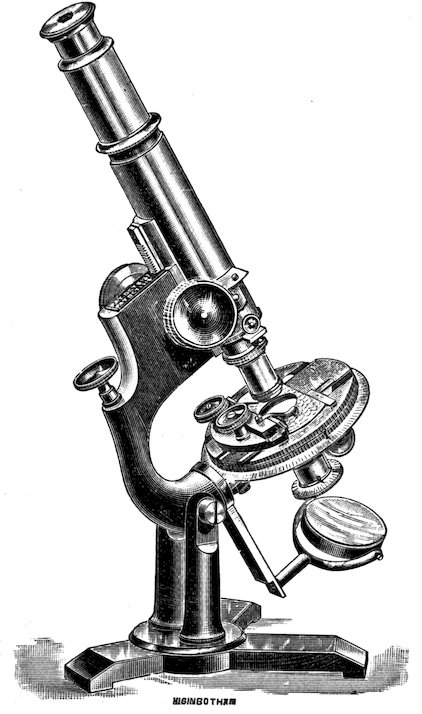
251. Form and Dimensions of the Particles.—In order to
study the contour of the fine silt particles, it is well to suspend
them in a liquid whose refractive index is markedly lower than
that of the particles themselves, and for this purpose pure water
251is commonly used. Care must be taken that not too many particles
are found in the drop of water which is to be placed on
the object holder and protected with a thin, even glass. The tendency
to flocculation in these fine particles will make the study
of their form difficult if they are allowed to come too close
together. The size of the particles, or linear diameter, is to be
determined by means of an eye-micrometer. This consists of a
glass plate on which a millimeter scale is engraved with a diamond,
or photographed. The millimeter scale is the one usually
employed, each millimeter being divided into tenths. On microscopes
designed especially for photographic work the micrometer
is fastened to the eyepiece, and so adjusted as to read from left to
right, or at right angles thereto. Sometimes an eyepiece-micrometer
has two scales at right angles so that dimensions may be
read in two directions without change. With an eyepiece-micrometer,
not the dimensions of the object, but those of its
magnified image are read, and the degree of magnification being
known, the actual size of the object is easily calculated. The
actual measurements may also be obtained by placing in the field
of vision, a stage-micrometer and determining directly the relation
between that and the eyepiece-scale. If, for example, the stage-micrometer
is ruled to 0.01 millimeter, and the eye-micrometer
to 0.1 millimeter, and one division of the stage-rule should cover
three divisions of the eye-rule, then the one division of the eye-micrometer
would correspond to an actual linear distance of 0.0033
millimeter in the object. If the two lines of division in the two
micrometers do not fall absolutely together, the calculation may
be made as follows: suppose that six divisions, 0.6 millimeter,
in the eyepiece correspond to nearly five divisions, 0.25 millimeter,
in the stage piece. To get at the exact comparison, take
ninety-six divisions of the eye-scale and they will be found to be
somewhat longer than eighty-one and somewhat shorter than
eighty-two divisions of the stage-scale. It follows therefore that
| one |
division |
of |
the |
eye-scale |
>0.008438 |
millimeter, |
and |
| „ |
„ |
„ |
„ |
„ „ |
<0.008541 |
„ |
; |
and, hence, one division of the eye-scale corresponds almost
exactly to 0.008489 linear measure.
252. Illustrations of Silt Classes.—In figure 38 are shown
the relative sizes and usual forms of a series of silt separates
252made by the Osborne beaker method. The photomicrographs
were made by Dr. G. L. Spencer from specimens furnished
by Prof. M. Whitney.
The soil represented by the separates is from a truck farm near
Norfolk, Virginia.
The particles represented in each class are not all strictly within
the limits of size described. For instance, in the largest size (No.
1) are two particles at least which show a diameter of more than
one millimeter. The particles in general, however, are within
the limits of the class; viz., one-half to one millimeter, and this
general observation is true of all the classes. In the case of the
finer particles, especially of clay, the tendency to flocculation
could not be overcome in the preparation of the slides for the
photographic apparatus. The clay particles are so fine as to
present but little more than a haze at 150 diameters of magnification.
The particles seen are clearly, in most cases, aggregates
of the finer clay particles. The larger particles show the rounded
appearance due to attrition and weathering. It would have been
more instructive to have had the particles of the different classes
all photographed on the same scale, but this is manifestly impossible.
The lowest power which shows any of the clay particles
to advantage is at least 150 diameters, and with the larger
particles such a magnification would have been impracticable.
253. Measurement of Crystal Angles.—The fine silt particles
rarely retain sufficient crystalline shape to permit of the
measurement of angles and the determination of crystalline form
thereby. The rolling and attrition to which the silt particles
have been subjected have, in most cases, given to the fragments
rounded or irregular forms which render, even in the largest silts,
the measurement of angles impossible. For the methods of
mounting minute crystals and the measurement of microscopic
angles, the analyst is referred to standard works on mineralogy
and petrography.
254. Determination of the Refractive Index.—For a study
of the theory of refraction, works on optics should be consulted.
The general principles of this phenomenon which concern the
determination of the refractive power of fine earth particles are
as follows: if a transparent solid particle is observed in the
253microscope imbedded in a medium of approximately the same
refractive power and color, its outlines will not be clearly defined,
but the imbedded particle will show in all of its extent the
highest possible translucency. If, therefore, the form or perimeter
of the particle is to be studied with as much definiteness
as possible, it should be held in a medium differing as widely
from it as possible in refractive power. For minerals, water is
usually the best immersion material. On the other hand, when
the internal structure of the particles is the object of the examination,
it should be imbedded in oil, resin (Canada balsam), etc.,
or in some of the liquids mentioned below.
If particles of different refractive powers and the same character
of surface be studied in the same medium, they will not all
appear equally smooth on the field of the microscope. Some of
the surfaces will seem smooth and even, others will appear rough
and wrinkled. Those particles whose refractive index is equal
to or less than that of the liquid appear smooth, because all the
emergent light therefrom can pass at once into the environing
medium. On the other hand, the surfaces of those particles which
have a higher refractive power than the medium will appear
roughened, because, on account of the unavoidable irregularities
on the surface, many of the emergent rays of light must strike at
the critical angle and so suffer total reflection, and consequently
those portions of the surface will be less illuminated, producing
the phenomenon of apparent roughness above noted. In the
case of any given particle, liquids of increasing refractive power
can be successively applied until the change in the appearance
of the surface of the particle is noticed. The refractive index
of the liquid being known, that of the particle is in this way
approximately to be determined.
The following liquids, having the indexes mentioned, are
commonly employed:
| Substance. |
Refractive index. |
| Water |
1.333 |
| Alcohol |
1.365 |
| Glycerol |
1.460 |
| Olive oil |
1.470 |
| Canada balsam |
1.540 |
| Oil of cinnamon |
1.580 |
| 254Oil of bitter almonds |
1.600 |
| Oil of Cassia |
1.606 |
| Concentrated solution of potassium and mercuric iodid |
1.733 |
| Concentrated solution of barium and mercuric iodid |
1.775 |
The solution of potassium and mercuric iodid may also be
used for all refractive indexes from 1.733 to 1.334 by proper
dilution with water.
The mineral particle may also be imbedded in Canada balsam
and over it a drop of a liquid of known refractive power placed.
By a few trials one of the liquids will be found having practically
the refractive index of the particle under examination.
255. Examination with Polarized Light.—The internal
structure of a mineral particle can often be determined by its
deportment with polarized light. The theory of polarization is
fully set forth in works on optics and will not be discussed here.
The principle on which the utility of polarized light in the
examination of soil particles rests is found in the information it
may give in respect of crystalline structure. The structure of
mineral particles which make up the bulk of an ordinary soil
is, as a rule, so thoroughly disintegrated that all trace of its
original form is lost. Some particles may exist, however,
in which there is no determinable element of shape and which
yet possess an internal crystalline structure which the microscope
with polarized light may be able to reveal.
256. Staining Silt Particles.—The finer silts and clays
before microscopic examination should be colored or stained.
The methods used in staining bacteria may be employed for the
clay particles.
Evaporation to dryness with a solution of magenta will often
impart a color to the clay particles which is not removed by subsequent
suspension in water. The harder and larger silt particles
are not easily stained, especially if they be firm and undecomposed.
On the other hand, if the particles be broken and
seamed, and well decomposed, the stain will be taken up and
held firmly in the capillary fissures. Valuable indications are
thus obtained respecting the nature of the silt particles. Particles
of mica, chlorite and talc are easily distinguished in this
way from the firmer and less decomposed quartz grains.
255The staining of the particles after ignition and treatment with
acids gives better results than the direct treatment. Particles of
carbonate which are stained with difficulty before ignition take
the stain easily afterwards on account of the decomposition produced
by the loss of carbon dioxid. This is the case also with
particles containing water of composition or crystallization.
257. Cleavage of Soil Particles.—A microscopic examination
of the cleavage of soil particles may be useful in determining
their mineral origin. The course followed by cleavage
lines and their mutual position is dependent on the direction in
which the separation of the mineral fragment takes place. The
character of the microscopic fragments produced by crushing a
soil particle is determined primarily by the system of crystallization
to which it belongs. Perhaps the most distinguishing
cleavage marks in soil particles will be found in fragments of
mica and orthoclase. These characteristic forms are shown in
Figs. 39 and 40. The first (Fig. 39) shows the pinacoidal
cleavage in a fragment of mica. Fig. 40 illustrates the appearance
of the cleavage lines in a fragment of orthoclase. Figs.
41 and 42 show the characteristic cleavage lines in fragments of
epidote and titanite.
258. Microchemical Examination of Silt.—The methods
of quantitative chemical examination of silts will be given in
another part of this manual. Certain qualitative and microchemical
tests, however, are useful in identifying silt particles.
For instance, any soluble iron mineral will be detected, even in
minute quantity, by the blue coloration of the solution produced
by the addition of potassium ferrocyanid. Manganese will be
revealed by fusion with soda and saltpeter on platinum foil,
in the oxidizing flame, producing the well-known green coloration
due to the sodium manganate formed.
More valuable indications of the character of the fragments
examined are obtained by microchemical processes. The best
method of decomposing the silt particles for this purpose is by
treatment with hydrofluosilicic acid. When the particles are
composed of silicates, pure hydrofluoric acid is to be preferred.
The method of treatment is essentially that of Boricky.[165]
The slide used is protected by a film of Canada balsam,
256and a few of the silt particles are placed thereon, and fixed
in place by slightly warming the balsam. Each particle is
then treated with a drop of hydrofluosilicic acid, care being
taken not to let the drops flow together. The acid must
be pure, leaving no residue on evaporation. The acid should be
prepared by the analyst from a mixture of barium fluorid, sulfuric
acid and quartz powder, or the commercial article should be
purified by distillation before using. The acid should be kept
in ceresin or gutta-percha bottles and must be applied with a
ceresin or gutta-percha rod. Each particle should be as completely
dissolved as possible by the acid, and the rate of solution
may be hastened by gentle warming, provided the heat is not great
enough to remove the balsam and allow the acid to attack the
glass. The bases present in the silt particles crystallize on drying
as fluosilicates. In case of a too rapid crystallization, the mass
may be dissolved in a drop of water or of very dilute hydrofluosilicic
acid, and allowed to evaporate more slowly. Some
fragments need more than one treatment with acid to secure
complete solution, and particles of mica may even resist repeated
applications. In such a case the decomposition may be made in
a platinum crucible with hydrofluoric acid, adding afterwards an
excess of hydrofluosilicic acid and evaporating to dryness. The
crystals may then be dissolved in a little water and a drop of the
solution allowed to crystallize on the slide.
259. Special Reactions.—The number of microchemical
reactions is very great, but there will be given here only some of
the more important for silt identification.
Sodium.—Sodium mineral fragments dissolved in hydrofluosilicic
acid and dried give the combinations shown in Fig. 43.
With sodium and aluminum the forms shown in Figs. 44 and 45
are obtained. With an increasing amount of lime in the mineral,
the crystals tend to become longer. For microscopic work
it is not advisable to try to produce the tetrahedral crystals
of the double uranium sodium acetate because the commercial
uranium acetate often contains sodium and even the pure article
will often take up sodium from the bottles.
Potassium.—Fragments containing potash give isotropic clear
cubes, or octahedra of low refracting power, or combinations of
257these forms with each other and with rhombic dodecahedra.
These crystals have the composition K₂SiF₆. Their forms are
shown[166] in Figs. 46 and 47. In case much sodium be present,
the first crystals obtained may be strongly double refractive
rhombohedra, but on dissolving in water and allowing to recrystallize,
the normal forms will be obtained. If the crystals be dissolved
in hydrochloric or sulfuric acids, and treated with platinum
chlorid, the characteristic yellow octahedral crystals of
K₂PtCl₆ will be obtained. Ammonium and cesium compounds
also give this reaction.
Lithium.—When fragments containing lithium are treated
with the solvent mentioned, monoclinic crystals are produced on
drying. These crystals dissolved in sulfuric acid and freed from
calcium sulfate by treatment with potassium carbonate give
aggregates of lithium carbonate resembling a snowflake. At a
high temperature lithium solutions treated with sodium phosphate
give spindle-shaped crystals of lithium phosphate. The
double lithium aluminum silicofluorid is shown in Fig. 48.
The ease with which traces of lithium may be detected by the
spectroscope renders unnecessary any further description of its
microchemical reactions.
Calcium.—Nearly all mineral particles, save quartz grains, contain
calcium. When these particles are dissolved by treatment
with hydrofluosilicic acid, they form on drying hydrated monoclinic
crystals of calcium silicofluorid (CaSiF₆ + 2H₂O). These
crystals assume many forms, some of which are shown in Figs. 49
and 50. These crystals are easily decomposed by sulfuric acid,
the well-known long prismatic crystals of gypsum taking their
place. On treatment of silt particles containing lime with hydrofluoric
and sulfuric acids, only a part of the lime passes into
solution if the content thereof be large. Where but little lime
is present and the sulfuric acid is in large excess, all the lime
passes into solution and the characteristic gypsum crystals
appear as in Fig. 51.
Magnesium.—Rhombohedral crystals of magnesium silicofluorid
separate from the solution of particles containing magnesium
in hydrofluosilicic acid. They have the composition
MgSiF₆6H₂O and their common forms are shown in Fig. 52.
Quite characteristic also are the crystals of struvite (NH₄MgPO₄
+ 6H₂O), which are produced in a very dilute solution of the magnesium
compound first obtained by carefully adding ammonium
hydroxid and chlorid until a faint alkaline reaction is produced,
and then placing a drop of dilute sodium phosphate at the edge
of the solution. The crystals should be allowed to form slowly
in the cold. Their form is shown in Fig. 54.
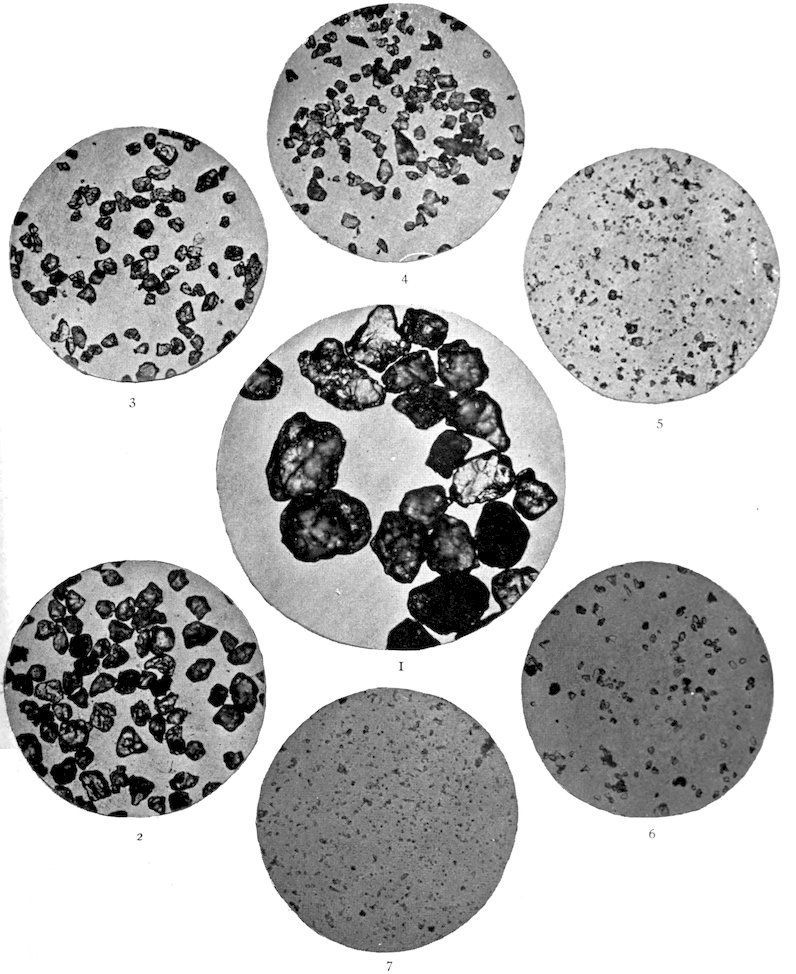
Figure 38. Photomicrographs of Silt Particles.
| No. |
Diameter in mm. |
Name. |
Magnification. Diameters. |
| 1 |
1.0–0.5 |
coarse sand |
×10 |
| 2 |
0.5–0.25 |
medium sand |
×10 |
| 3 |
0.25–0.1 |
fine sand |
×10 |
| 4 |
0.1–0.05 |
very fine sand |
×30 |
| 5 |
0.05–0.01 |
silt |
×30 |
| 6 |
0.01–0.005 |
fine silt |
×150 |
| 7 |
0.005–0.0001 |
clay |
×150 |
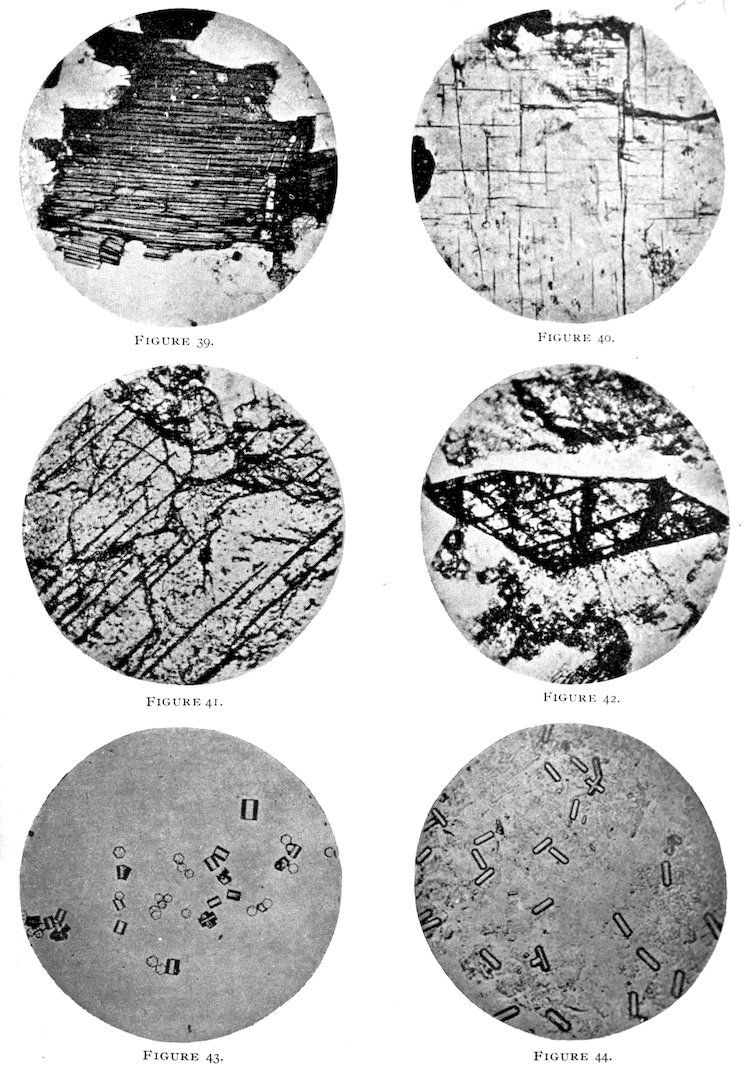
Figures 39–42, show examples of the various degrees of perfection and relative positions of cleavage lines.
Figure 39, illustrates pinacoidal cleavage in mica from granite. Magnified thirty diameters.
Figure 40. A cleavage of orthoclase from augite syenite magnified twenty-seven diameters.
Figure 41. Cleavage of epidote magnified sixty diameters.
Figure 42. Cleavage of titanite magnified seventy-five diameters.
Figure 43. Sodium fluosilicate crystals magnified seventy-two diameters.
Figure 44. The same with aluminum fluosilicate magnified twenty-seven diameters.
Taken from Rosenbusch, Mikroskopische Physiographie.
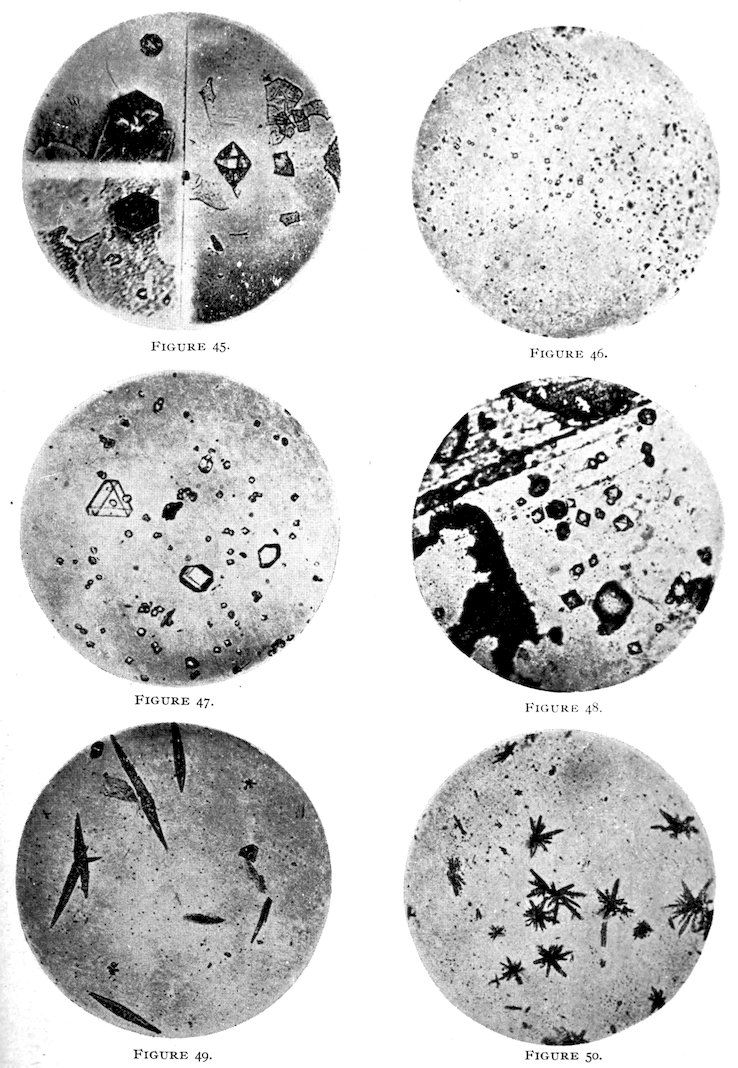
Figure 45. Sodium and aluminum silicofluorid crystals magnified 100, 140 and 160 diameters.
Figure 46. Potassium silicofluorid crystals magnified 130 diameters.
Figure 47. Another preparation of the same magnified 140 diameters.
Figure 48. Lithium and aluminum silicofluorid crystals magnified 100 diameters.
Figure 49. Calcium silicofluorid crystals magnified 45 diameters.
Figure 50. Another preparation of the same magnified 42 diameters.
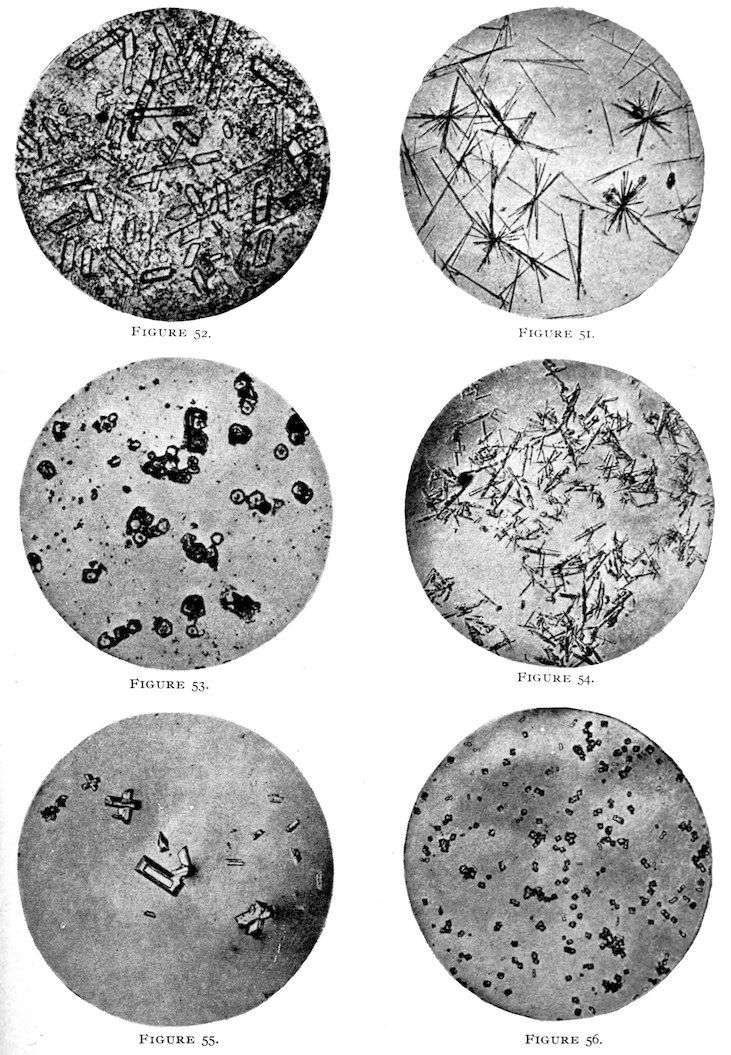
Figure 51. Calcium sulfate crystals magnified twenty diameters.
Figure 52. Magnesium silicofluorid crystals magnified thirty diameters.
Figure 53. Cesium aluminum sulfate crystals magnified twenty diameters.
Figure 54. Ammonium magnesium phosphate crystals magnified ten diameters.
Figure 55. The same crystallized from dilute solution magnified thirty diameters.
Figure 56. Ammonium phosphomolybdate crystals magnified 140 diameters.
258Barium.—From solution of barium bearing minerals in hydrofluosilicic
acid fragments, no characteristic crystals, are obtained.
Treated with hydrofluoric and sulfuric acids the barium is left as
sulfate. If this salt be dissolved in boiling oil of vitriol and a drop
of the solution placed on the slide, a mixture of rectangular
tablets and St. Andrew’s cross-shaped growths will be separated
before any crystals of gypsum which may be present
appear. When strontium is present, the barium sulfate residue
obtained by treatment with hydrofluoric and sulfuric acids should
be fused with sodium and potassium carbonate, washed with
water until the sulfuric acid is removed, the residue dissolved in
hydrochloric or nitric acids, and the solution treated with potassium
chromate. Pale yellow crystals of barium chromate are thus
obtained, which resemble in form those secured by dissolving the
barium sulfate in oil of vitriol. Strontium is not precipitated
by this treatment. If potassium ferrocyanid be used instead
of barium chromate with the hydrochloric acid solution, crystals
of barium potassium ferrocyanid are formed of a bright yellow
color and rhombohedric shape.
Strontium.—From a hydrofluosilicic acid solution, strontium
crystallizes in columns or tablets of the monoclinic system as
strontium silicofluorid, SrSiF₆. On treating these with sulfuric
acid, rhombic plates of strontium sulfate are formed, which serve to
distinguish this element from calcium. On treatment of the particles
of the original mineral with hydrofluoric and sulfuric acids,
the strontium remains in the insoluble residue. When this residue
is treated with boiling oil of vitriol, rhombic plates of celestine
are separated. If the residues above mentioned be dissolved
by fusion with the alkaline carbonates, washed with water, dissolved
in hydrochloric acid and treated with oxalic acid, octahedral
crystals of strontium oxalate are formed.
259Iron.—Mineral particles containing iron give crystals, when
treated as is first described above, which are fully isomorphous
with those obtained from magnesium. By moistening the crystalline
mass with potassium ferrocyanid, the presence of iron is
at once revealed by the blue coloration produced.
Aluminum.—No crystals containing aluminum are formed from
the mineral particles containing this substance when dissolved in
the solvent already mentioned. If, however, the gelatinous mass
be dissolved in a little sulfuric acid and a fragment of a cesium
salt added, beautiful crystals of cesium alum are obtained,
illustrated in Fig. 53.
Phosphorus.—When a mineral fragment containing phosphorus
is treated according to the usual analytical methods for securing
the ammonium magnesium phosphate, crystals are obtained of
the form shown in Figs. 54 and 55. A phosphatic fragment of
silt may be identified when soluble by treatment with nitric
acid and ammonium molybdate. On slowly drying, rhombohedral
crystals are produced, yellow by reflected, and green by
transmitted light. Their form is shown in Fig. 56.
260. Petrographic Examination of Silt Particles.—The
larger silt particles and the minute fragments of minerals in the
soil can best be studied in thin sections. For this purpose the
following plan, proposed by Thoulet, may be used. Mix the
soil minerals in considerable proportion—Thoulet recommends
ten per cent, but a greater percentage is often better—with zinc
oxid and make into a paste with sodium silicate. The paste
should be worked to the consistence of putty and then rolled
into little tablets about one-eighth of an inch thick and an inch
in diameter. After drying a day or two without heating, the tablets
become hard enough to mount and grind like rock sections.
These tablets are mounted in Canada balsam on glass slides and
ground as thin as possible with fine emery on the turn-table or
glass plate, as rock sections are treated. As these tablets are not
as strong as rock sections usually are, they require care in this
treatment. Some of the grains also are apt to be torn out in
the process of grinding and to compensate for this loss a number
of slides should be prepared with each lot of soil minerals.
When this operation has been successful, the optical properties
260of the various minerals can be studied as in rock sections.
As the iron oxid contained in the soils obscures the transparency
of the minerals, it is well to treat a portion of the material
under examination with hot hydrochloric acid for a short time to
remove this oxid and then prepare slides with the cleansed
material and compare results with the untreated. As the acid
will dissolve phosphates and carbonates, and will partly or
wholly decompose some other minerals, the operator must be
guided by his judgment in its use.
261. Machine for Making Mineral Sections.—A convenient
apparatus for this purpose has been described by Williams[167]
and is represented in Fig. 57. It is supported on a substantial
table provided underneath with electric batteries and a motor for
driving the cutting disks seen on the top. The table is three
feet six inches square and two feet nine inches high.
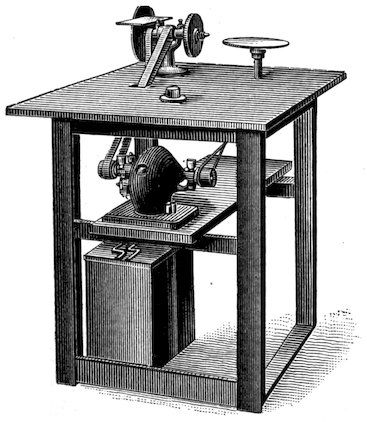
Figure 57.
Machine for Making Mineral Sections.
The grinding apparatus consists of two circular disks of solid
copper, nine inches in diameter,
and three-eighths inch
thick, which may be used
alternately as different
grades of emery are required.
They are attached
either by a screw or square
socket to a vertical iron
spindle which revolves
smoothly in a conical bearing.
The grinding disk is
surrounded when in use by
a large cylindrical pan of
tin, which is not shown in
the cut, which has an
opening in its center to
allow of the passage of the
spindle.
The sawing apparatus consists of a horizontal countershaft
placed on a different part of the table and connected with the
motor by a separate belt. It carries at one end a vertical
wheel of solid emery, and at the other an attachment, level-table
261and guide for the diamond-saw. A small water-can with spout,
not shown in the cut, is suspended over the edge of the table to
keep the saw wet when it is in use.
The machine is very conveniently driven by a storage battery
when street circuits cannot be drawn on.
For the details of making mineral sections, the works on
petrography may be consulted.
262. Separation of Silt Particles by Specific Gravity
Solutions.—In silt separates the specific gravity of the different
mineral particles present may vary from graphite (1.9–2.3) to
hematite (5.2–5–3).
The following list gives the specific gravities of some of the
more common minerals which may be met with in soils:
| Gypsum |
2.31 |
| Albite |
2.56–2.63 |
| Quartz |
2.65 |
| Talc |
2.74 |
| Chlorite |
2.78 |
| Muscovite |
2.85 |
| Calcite |
2.5–2.78 |
| Dolomite |
2.90 |
| Tourmaline |
2.94–3.3 |
| Biotite |
3.01 |
| Apatite |
3.16 |
| Pyroxenes |
3.22–3.5 |
| Epidote |
3.39 |
| Titanium Minerals |
3.48–4.75 |
| Iron oxids |
5.2–5.3 |
The finest particles of silt are separated by gravity with great
difficulty, inasmuch as they tend to remain suspended in the
solutions for an indefinite period. With the coarser silts, however,
useful data are often obtained by this method. The separation
is preceded by extraction of the particles with hydrochloric
acid to remove encrusted soluble matter, and by ignition to
destroy any traces of organic matter. Those mineral matters
which are soluble in acid or are changed by ignition must, of
course, be sought for in separate portions of the silt,
263. Thoulet’s Solution.[168]—The standard solution is of such
a density that particles of 2.65 specific gravity-will just float
thereon, using for this purpose a solution of about 2.7 specific
262gravity. The solution from which the above standard is
prepared is made as follows:
One part of potassium iodid is weighed and placed in a beaker
and one and one-quarter part of mercuric iodid is placed on top
of it. Then water is added in the proportion of ten cubic centimeters
to 100 grams of the mixture, and after some time
(twelve to twenty-four hours), with occasional stirring, the salts
will nearly completely dissolve. Filter from the undissolved residue
and evaporate in a porcelain dish until crystals form on the
surface of the liquid. Allow to cool, pour off the liquid from the
crystals and evaporate the liquid for another crop. The first
solution, after cooling, has a specific gravity between 3.10 and
3.20, the second a specific gravity of 3.28, practically the limit of
density of the solution. The solution of 2.7 specific gravity and
other densities are made by cautiously adding a few drops of
water at a time and ascertaining the specific gravity by the
Westphal balance or other convenient method.
The strong solution, according to Goldschmidt,[169] may be prepared
directly by using potassium iodid and mercuric iodid in the
ratio of 1 : 1.24. Twenty-five cubic centimeters of water, 210
grams of potassium iodid, and 280 grams of mercuric iodid
afford a solution of 3.196 specific gravity at 15°, on which fluorspar
fragments will float.
264. Klein’s Separating Liquid.—A solution of cadmium
borotungstate, of the composition 2H₂O,2CdO,B₂O₃,9WO₃ +
16H₂O, has been proposed by Klein[170] for separating silt particles.
This salt is obtained by dissolving pure sodium tungstate
in five times its weight of water, adding one and a half parts of
boric acid and boiling until, complete solution takes place. On
cooling; the borax is separated in crystalline form. The mother-liquor
after the removal of the crystals is carefully concentrated
by boiling. By stirring the cold solution, there is a
further separation of sodium borate and polyborate. This operation
is continued until glass will float on the mother-liquor. The
salt in solution then has the following composition: 4Na₂O,12WO₃,B₂O₃.
To this boiling concentrated solution, is added
a boiling saturated solution of barium chlorid, in the proportion
of one part of the chlorid to three parts of the original double
263tungstate. An abundant pulverulent precipitate is formed, making
the whole mass mushy. The mass is filtered under pressure
and well-washed with hot water. The residue is then suspended
in hot water containing one part in ten of hydrochloric acid of
1.18 specific gravity. It is then evaporated to dryness in the
presence of an excess of hydrochloric acid and decomposed, by
which process hydrated tungstic acid is separated. The boiling
mass is taken up with water and the boiling continued for two
hours with occasional addition of water to take the place of that
evaporated, and the tungstic acid separated by filtration.
From the solution, beautiful quadratic crystals separate having
the composition 9WO₃,B₂O₃,2BaO₂H₂ + 18H₂O. These are purified
by several recrystallizations and freed from any scales
of boric acid by washing with alcohol. Any reducing action,
revealed by a violet coloration of the crystals, can be avoided by
adding a few drops of nitric acid. From a boiling solution of
these crystals, the cadmium salt desired is obtained by treatment
with the proper amount of cadmium sulfate solution to precipitate
the barium. The barium sulfate is separated by filtration.
The cadmium borotungstate is soluble in less than ten parts
by weight of water. From this solution it is obtained in pure
form by evaporation under a vacuum, or by carefully concentrating
on a water-bath and cooling. A saturated solution of
these crystals at 15° has a bright yellow color and a specific
gravity of 3.28.
If a dilute solution of the above salt be carefully evaporated
on a water-bath, any violet color which may be present disappears
when the specific gravity reaches 2.7. If the evaporation
be continued until a crystal of augite will float on the hot liquid,
crystals may be obtained on cooling which, dissolved in as little
water as possible, make a solution which will almost support
olivine. If the two solutions be united, the specific gravity of
the mixture is 3.30–3.36. The highest attainable specific gravity;
viz., 3.6, is produced by continuing the evaporation on a
water-bath until the liquid will support olivine, and then allowing
to stand in a closed place for twenty-four hours. The crystals of
cadmium borotungstate thus obtained are freed as much as
possible from the mother-liquor by drainage and then melted at
264about 75° in their own water of crystallization. A liquid is thus
obtained on which spinel will float. The same concentration
may also be obtained by careful heating on a water-bath. At
its highest specific gravity this solution has an oily consistence
and this renders its practical use in the separation of fine particles
somewhat restricted. By filtering the liquor when a crystalline
crust begins to form during evaporation, a cold solution
of 3.360–3.365 specific gravity is obtained which is found practically
useful. It has a higher specific gravity than Thoulet’s
mixture, is not injurious to any of the mineral particles, not even
of iron with which it is brought into contact, but the trouble of
preparing it is far greater than that of the mixture of mercuric
and potassium iodids.
265. Rohrbach’s Solution.—The solution of barium mercuric
iodid recommended by Rohrbach[171] for this purpose was originally
prepared by Suchsin. The solution must be rapidly prepared
on account of the tendency of the barium salt to decomposition.
The solution is prepared by weighing rapidly 100
grams of barium and 130 grams of mercuric iodid, mixing the
two salts well in a dry flask and adding twenty cubic centimeters
of water. The mixture is raised to a temperature of 150°–200°
on an oil-bath. The formation and solution of the double salt are
promoted by constant stirring.
After solution, the liquor is boiled for a few minutes and then
evaporated on a water-bath until it will bear a crystal of epidote.
On cooling, a small quantity of a yellow double salt is separated by
crystallization and the resulting mother-liquor is dense enough
to carry a fragment of topaz. Inasmuch as the liquor is filtered
with difficulty, the clear mother-liquor should be separated by
decantation after standing for several days. This solution has the
disadvantage of not being dilutable with water, the addition of
which causes a separation of red mercuric iodid. Were this
solution not so easily decomposed, it would prove of high value
in silt separation.
266. Braun’s Separating Liquid.—In many respects the
separatory solution proposed by Braun[172] is superior to those
already mentioned. It is the commercial methylene iodid,
265CH₂I₂, which has at 16° a specific gravity of 3.32, at 5° of 3.35,
and at 25° of 3.31. It is a strongly refractive liquid having a
refractive index of 1.7466 for the yellow ray.
As a separating medium the liquid is open to two objections;
viz., first, it cannot be diluted with water and, second, it turns
brown on heating or on long exposure to the sunlight.
When dilution is necessary, it should be accomplished with
benzene or xylene. To bring the diluted liquor again to its
maximum density, the benzene must be removed by evaporation,
which causes a considerable loss in the liquid. When this substance
becomes opaque, the transparency may be restored by
removing the separated iodin by shaking with potash lye, washing
with pure water, drying by the addition of pieces of calcium
chlorid and filtering. The same result may also be reached by
freezing and separating the liquid portion. The frozen portion
on melting will have the density of the original liquid.
267. Method of Bréon.—Instead of a solution of a salt,
Bréon[173] has proposed to use salts in a fused state for separating
mineral particles. Lead and zinc chlorids may be used for this
purpose in a melted state, having the specific gravities of 5.0 and
2.4, respectively. By mixing the molten salts in different proportions,
any desired specific gravity between the extremes mentioned
may be secured. The fusion is accomplished at 400° in
a test-tube. The silt is added gradually with constant stirring
until a sharp separation is secured between the sinking and
floating particles. After cooling, the tube is broken, the two
parts separated, and the silt recovered by dissolving the mixed
salts in hot water containing a little nitric acid. Only the coarser
silts can be separated by this method. Fused silver nitrate,
melting point 198°, specific gravity 4.1, has also been used for
separation.
268. The Separation.—Forty cubic centimeters of the solution
in the Thoulet process are placed in the separatory tube A,
Fig. 58, together with from one to two grams of the silt and
the stopper F inserted. The tube G is connected with a
vacuum apparatus by means of which any air particles adhering
to the mineral fragments are removed. The silt which
266sinks in the solution is removed after G has been disconnected by
opening the cock C and sucking through B at I. The cock C is
closed and the separated particles washed into a beaker at H
after opening D. Water is next added to the
materials left in A in quantities previously determined
to secure a given specific gravity and
thus a second, a third, etc., separation secured.
An intimate mixture of the solutions in A can
be effected by closing D, opening C, and blowing
through B in such a way that no liquid is
allowed to pass through C.
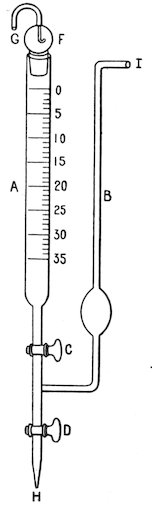
Fig. 58.
Thoulet’s Separating
Apparatus.
The quantity of water to be added in each case
to secure a given specific gravity is determined
by the formula v₁ = v(D − d)
d − 1, in which v is the
volume of the solution, D its specific gravity,
and d and v₁ the specific gravity desired and
volume of the water to be added.
Example.—Let the specific gravity of the
original solution be 3.2, its volume thirty cubic
centimeters, and the desired specific gravity of
the new solution 2.85.
Then v₁ = 30(3.2 − 2.85)
2.85 − 1 = 5.68.
The desired specific gravity is therefore
secured by adding 5.68 cubic centimeters of water, which is
easily accomplished by means of the graduations on the tube.
According to Rosenbusch,[174] the calculated specific gravity as
made above is not wholly reliable on account of the contraction
which takes place. An empirical process is rather to be commended
which consists in introducing a fragment of mineral of
known or desired specific gravity and then adding water drop by
drop until the fragment remains suspended in the mixture.
Should too much water be added, the necessary increase in density
can be secured by adding a little of the strong solution.
269. Method of Packard.—A separatory funnel, according
to Packard,[175] may be safely used to hold the solution while
separation is going on. As the lighter minerals form the bulk
of soils, the heavier constituting only a small percentage, it is
267well to use a wide funnel holding as much as one-half liter for
quantitative separations, because a large quantity of soil, say 100
grams, is necessary from which to recover the small quantity of
heavy particles satisfactorily. The soil is introduced into the solution
contained in the funnel, agitated, stirred with a glass rod, and
allowed to stand some time. This operation may be repeated as
often as desired. Separation is not absolute by this operation,
the heavy and light particles being sometimes so united that they
sink or float together according as one or the other preponderates.
There are also particles having so nearly the same specific
gravity as the solution that they remain indifferent to its
action in any position. After separation has been effected, the
heavy portion is drawn off through the stop-cock of the funnel
and the lighter is skimmed off the top. Both must be thoroughly
washed from the adhering heavy solution for further examination
with the microscope, and by chemical, microchemical, and
blow-pipe tests. One who has familiarized himself with the
appearance of minerals in minute fragments under the microscope,
in ordinary and polarized light, will be able to determine
some minerals in that way. But for certain identification it is
necessary to ascertain their optical properties as is done in the
case of the minerals in thin sections of rocks.
Illustration.—The following example from the work of Packard
will serve to illustrate the results of separating a soil by the
specific gravity method:
One hundred grams of soil, residual clay from the Trenton
limestone, were placed in the Thoulet’s solution contained in the
large separatory funnel. The heavy portion, after washing and
drying, weighed 0.6886 gram, or 0.69 per cent. Of this, the
magnet removed 0.1635 gram, or 0.16 per cent. This heavy
material consisted of rounded yellowish and brown grains up to
twenty-five millimeters in diameter, mingled with lustrous angular
black grains which were seen under the microscope to be
cubes with striated faces, cubes penetrating each other and
aggregations of cubes. Combinations of cubes with octahedra
and instances of the pentagonal dodecahedron were also observed.
These forms, characteristic of pyrites, were also seen in the fine
sand obtained as a residue on elutriating the same soil. As these
crystals dissolved in hydrochloric acid, giving a strong iron solution,
268they were regarded as pseudomorphs of iron oxid after
pyrites. The yellowish grains on treatment with acid left a
grayish residue which contained some grains of quartz but was
not wholly quartz. The lighter portion of the soil, over ninety-nine
per cent, which floated in the Thoulet’s solution of 2.8 was
next examined. It was colored red by the iron oxid which
coated and adhered to the other minerals. It contained all the
quartz, the feldspars if present, and the other minerals whose
specific gravity is less than 2.8. It was examined by the microscope
and found to consist largely of irregular grains of a mineral
which acted on polarized light, obscured somewhat by the iron
oxid, and was apparently quartz; and another mineral which was
yellowish-brown in color and seemed to be dull and not transparent.
Besides there was a large quantity of indistinguishable amorphous
material. To clean these minerals the material was treated with
hydrochloric acid to remove the iron oxid and other matter soluble
in acid, when the quartz grains appeared transparent and
gave interference colors in polarized light. But mingled with
these were grains of the other mineral which now appeared
grayish, dull, and without action on polarized light. The character
of this mineral substance could only be determined by
chemical analysis.
270. Harada’s Apparatus.—Although it has been affirmed by
some analysts that in the subsidence of small particles it is advisable
that the containing vessels have parallel sides,
yet in the method just given, and in those about
to be described, good results are obtained in a
funnel or pear-shaped holder.
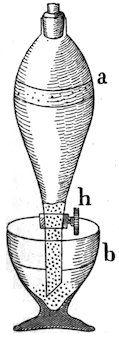
Figure 59.
Harada’s Apparatus.
In the apparatus of Harada,[176] Fig. 59, the separating
vessel a is made of thick glass furnished with
a glass stopper above and a glass stop-cock h below.
The separating liquid and silt are placed in the
pear-shaped vessel a, the stopper inserted, and
the whole well-shaken. As soon as a ring of clear
liquid is seen between the sinking and floating silt,
the lower end of the apparatus is brought near the
bottom of a conical glass b, the cock h opened and
the heavy silt allowed to fall out. Very little of the
liquor will flow out because of the air pressure.
269Should an air bubble enter the apparatus and be held at the
stop-cock, it should be made to ascend by gently tapping. When
all the heavy silt has passed into the conical glass, the cock h is
closed and some water poured over the solution and silt in b.
The separatory apparatus is now raised until the beveled end of
it is in the water layer, when the water at once rises to h and
thus washes all the silt particles adhering to the glass into b.
The liquid in a may then be diluted by inverting the apparatus,
adding the required amount of water through h, again shaken
after closing h, and another separation secured as before.
This apparatus is somewhat easier to manipulate than Thoulet’s
but does not admit of the same quantitative dilution of the separating
liquid.
Fig. 60 a. Fig. 60 b. Fig. 60 c.
Brögger’s Apparatus.
271. Apparatus of Brögger.—All silt separations in narrow
tubes are open to the objection of permitting more or less flocculation.
Some of the lighter particles are thus carried down
by the heavier, and, on the other hand, some of the heavier float
with the lighter. This disturbing action Brögger[177] seeks
to avoid by the following device, Fig. 60, a, b, c. The length
of the apparatus
is forty-six
centimeters,
and its greatest
diameter 3.5
centimeters.
The opening in
the large stop-cock
A is the
same diameter
as that of the
apparatus at
that point.
The cubical
content of the apparatus with A open and B closed is about
seventy-five cubic centimeters. In conducting the separation
the cock B is closed, the separating liquid and silt introduced,
A being open, the stopper K inserted and the whole
well-shaken. In the first separation, the silt S, lying over
270B is contaminated with some of the lighter particles S′₂,
while the lighter particles above A, S₂, are mixed with some
of the heavier particles, S′₁. After closing A the apparatus
is again well-shaken and inverted as in Fig. 60 b. The two
parts of the silt will now undergo another separation as
indicated. The apparatus is now carefully inclined as in c, when
the various grades of silt will flow in the directions indicated by
the arrows, but without mixing, passing each other on opposite
sides of the apparatus. When the movement is complete, A is
carefully opened, the apparatus still being held as in c, and the
light silt formerly between A and B will flow above A, while the
heavy silt above A will flow down and join the silt collected over
B. This operation may be repeated until a perfect separation is
effected. Finally B is opened and the heavy silt collected in a
beaker, and the lighter silt then removed from the upper part of
the apparatus.
Figure 61.
Apparatus of Wülfing.
272. Method of Wülfing.—A somewhat more convenient
method of purifying the silt segregates and freeing them of
mechanically occluded
particles of differing specific
gravities has been proposed
by Wülfing.[178] An
elliptical ring of heavy
glass tubing carries glass
stop-cocks A and B, Fig.
61, at the two extremities
of the ellipse, each arm of
which is provided with a
lateral glass-stoppered
neck. The perforation in the stop-cocks has the same diameter
as the sides of the ellipse. The apparatus has an interior cubical
content of about forty cubic centimeters. Thirty cubic centimeters
of the separating fluid are introduced through one of the
lateral apertures and brought to the same height in the two
arms by opening the cock B. The silt is then introduced in equal
quantities into each of the arms. The stoppers having been
inserted, the whole is well-shaken. At the beginning of the
separation, the apparatus being held in position 1, the lighter
271soil above and the heavier soil below are somewhat mixed by
reason of flocculation and mechanical entanglement. At this
point B is opened and the apparatus placed in the inclined position
2. The heavier particles S + l, on the right arm, are thus
united with the same class of particles in the left arm making
2S + 2l. This operation is hastened by opening A and allowing
the higher column of liquid in the right arm to pass into the
left. The liquid in the left arm is allowed to rise to A. After
all of S + l in the right arm has passed into the left B is closed,
the apparatus then placed back in position 1 and inclined in the
opposite direction until L + s in the top of the left arm has been
transferred to the L + s in the top of the right, and the same
quantity of liquid is found in each arm. The operation is then
repeated and this continued until all S + s is found in the bottom
of the left arm and all L + l in the top of the right arm.
273. Separation with a Magnet.—Particles of magnetic
iron oxid are easily separated from the fine soil particles by
means of a magnet. A strong bar or horseshoe magnet may be
used. Electro-magnets are rarely necessary except for the
separation of particles of feeble magnetic power. Particles of
iron which may be found would owe their origin to the mortars
in which the soil had been pulverized, or they might come from
a recently crushed meteorite. Some minerals, as limonite, after
ignition are attracted by the magnet and it is advisable to subject
a part of the sample to this treatment. The best method of
separation consists in spreading the particles evenly on paper
and gradually bringing the magnetic particles to one side by
moving the magnet underneath.
274. Color and Transparency.—But little can be learned
from the color and transparency of the smallest silt particles, but
these properties in the larger grains have considerable diagnostic
value. Many minerals of distinct color appear wholly colorless
in petrographic sections or in silt particles, as for instance, highly-colored
quartz. On the other hand, even the smallest particle
of chlorite will show its distinctive tint. The colors in some
minerals are due to occluded matter not essential to their structure,
and these foreign bodies would naturally escape when the
crystal mass is reduced to an almost impalpable powder.
272275. Value of Silt Analyses.—As in the case of chemical
analyses a silt analysis of a soil which is not typical or representative
has little value. On the other hand, a systematic separation
of soils into classes of particles can not fail to reveal a definite
correspondence of mechanical composition to soil properties.
The production of a crop is the result of certain functions, chief
among which are temperature, moisture, and plant food. In a
given soil the temperature is markedly affected by its physical
state. It has been demonstrated in previous paragraphs that the
circulation of moisture in the soil and its capacity to be held
therein are chiefly functions of the state of aggregation of the
soil itself. The availability of plant food in a soil is not measured
by its quantity alone, but rather by its state of subdivision.
It is not therefore a matter of surprise that the fertility of a soil
is found, caetèris paribus, to be commensurate to a certain limit
with the percentage of fine silt and clay which it contains. It is
true that two soils quite different in fertility, may have approximately
the same silt percentages, but in such a case it is demonstrable
that even in the poorer soil the measure of fertility is
largely the percentage of fine particles and not its actual content
of plant food. In other words, almost all soils, even the poorest,
have still large quantities of plant food, but these stores, owing
to certain physical conditions, are not accessible to the rootlets
of plants. An illustration of this is seen in the use of concentrated
fertilizers. It might seem absurd to suppose that the
addition of 100 pounds of sodium nitrate would prove useful to a
plat containing already many tons of nitrogen; but the nitrate
is at once available and its beneficial influences are easily seen.
The full value of silt analysis will only be appreciated when
many typical soils from widely separated areas are carefully
studied in respect of their chemical and physical constitution
and the character of the crops which they produce.
Note.—The analyses on page 237 are by Hilgard and Loughridge from Proceedings
American Association for the Advancement of Science, Portland Meeting, 1873.
PART SIXTH. — DIGESTION OF SOILS WITH SOLVENTS. — DETERMINATION OF THE QUANTITY OF DISSOLVED MATTER. — SPECIAL METHODS OF DETERMINATION OF SOIL CONSTITUENTS. — ESTIMATION OF NITROGEN IN SOILS. — AUTHORITIES CITED IN PART SIXTH.
294
290. Preliminary Considerations.—The sample of soil
intended for chemical analysis should consist of the fine earth
which has passed at least a one-millimeter mesh sieve and subsequently
been completely air-dried. According to Petermann
the air-drying of a soil should continue for about four days for
an ordinary arable soil, and about six days for one very rich in
organic matter. With peat and muck soils I have found that
ten or twelve days with frequent stirring, even when in thin
layers, are necessary to attain approximately a constant weight.
The soil is conveniently spread on a zinc or other metal sheet
of sufficient area so that the layer will be only one or two centimeters
in thickness. The weight before and after desiccation
will give the percentage of moisture lost on air-drying, which,
of course, will depend chiefly on the degree of saturation of the
sample when taken and the atmospheric conditions prevailing
during drying.
If samples of soil are taken in very dry times it is often necessary
to moisten them with distilled water in order to prepare
them properly for air-drying.
The quantity of hygroscopic water which the sample loses at
100°–105° should be determined, and all subsequent calculations
of the percentages of the various constituents be based on the
water-free material. When a soil which has been dried at 100°–105°
to a constant weight is heated to 140°–150° it loses additional
weight not due to loss of water of constitution. A part of this
loss may be due to hygroscopic moisture which is not given off
at 100°–105°, and a part may be hydrocarbons, or other easily
295volatile organic or inorganic bodies. Before estimating the total
loss on ignition it is recommended by most chemists to dry at
140°–150°. The samples of soil, however, intended for chemical
examination should never be dried beyond the point which is
reached by exposure in thin layers at ordinary room temperatures.
The state of aggregation, degree of solubility, and general properties
of a soil, may be so changed by absolute desiccation as
to render the subsequent results of chemical investigation misleading.
In the methods which follow the actual processes
employed have been given, which in some instances transgress
the general principle stated above, but in all cases standard and
approved methods are given in detail, even if some of their
provisions seem unnecessary or imperfect.
291. Order of Examination.—First of all in a chemical study
of the soil should be determined, its reaction (with litmus), its
water-holding power in the air-dried state (hygroscopicity), its
content of combined water (giving hydrous silicates of alumina),
its organic matter (humus and organic nitrogen), its content of
carbon dioxid (carbonates of the alkaline earths), and the part
of it soluble in acids. A determination of these values gives the
analyst a general view of the type of soil with which he is
engaged, and leads him to adopt such a method of more
extended analysis as the circumstances of the case may demand.
For this reason those operations which relate to the above
determinations are placed first in the processes to be performed,
while the estimation of the more particular ingredients of the
soil is left for subsequent elaboration.
Next follows a description of the standard methods of estimating
the more important elements passing into solution on
treatment of a soil sample with an acid. The method of treating
the insoluble residue, and the detection and estimation of rare
or unimportant soil constituents, closes the analytical study of
the soils.
With respect to the determination of nitrogen as nitric or
nitrous acid in the soil and drainage waters, it has been thought
proper to collect all standard methods relating particularly
thereto into one group, and they will appear separate from the
methods under nitrogen analysis in fertilizers.
296The question of the utility of chemical soil analyses is one
which has been the subject of vigorous discussion, a discussion
which finds no proper place in a work of this character. Unless,
however, intelligent soil analysis be productive of some good it
would be a thankless task to collect and arrange the details of
the processes employed. An accurate determination of the constituents
of a soil may not enable the chemist to recommend a
proper course of treatment, but it will help in many ways to
develop a rational soil diagnosis which will permit the physician
in charge of the case, who last of all is the farmer, to follow a
rational treatment which in the end will be productive of good.
The analyst will find in the methods given all that are
approved by bodies of official or affiliated chemists, or by
individual experience, and among them some method may be
found which, it is hoped, will be suited, in the light of our
present knowledge, to each case which may arise.
292. Reaction of the Soil.—In soils rich in decaying vegetable
matter the excess of acid is often great enough to produce
a distinct acid reaction.
On the contrary, in arid regions the accumulation of salts near
the surface may produce the opposite effect.
The reaction of the soil may be determined with a large number
of indicators among which, for convenience, sensitive litmus
paper, both red and blue, stand in the front rank. A sample of
the soil, from fifteen to thirty grams, is mixed with water to a
paste and allowed to settle. The litmus paper is then dipped
into the supernatant liquid.
293. Determination of Water in Soil.—The following
problems are presented:
(a) The Determination of Water in Fresh Samples taken in situ.—The
content of water in this case varies with the date and amount
of rain-fall, the capacity of the soil for holding water, the temperature
and degree of saturation of the atmosphere, and many
other conditions, all of which should be noted at the time the
samples are taken.
(b) The Determination of Water in Air-Dried Samples.—In
this case the soil is allowed to remain in thin layers, and exposed
to the air until it ceases to lose weight. The quantity of water
297left is dependent on the capacity of the soil to hold hygroscopic
water and to the temperature and degree of saturation of the air.
(c) The Determination of the Total Water by Ignition.—This
process not only gives the free and hygroscopic moisture, but
also combined water present in the hydrous silicates and otherwise.
The estimation is complicated by the presence of carbonates
and organic matter.
294. Determination of Water in Fresh Samples.—This
determination requires that the sample, when taken in the field,
should be so secured as to be weighed before any loss of moisture
can take place. For this purpose it can be sealed up in tubes or
bottles and preserved for examination in the laboratory.
According to Whitney, the relations of soils to moisture and
heat are such prominent factors in the distribution and development
of agricultural crops, that the determination of the actual
moisture content of soils in the fields should be considered a
necessary part of the meteorological observations, and of far
more importance, indeed, or having far more meaning to the
agriculturist than the simple record of the rain-fall.
In order to determine the relation of the soil to moisture,
uninfluenced by the varying conditions of cultivation and of the
different size of crop, he recommends that a small plot of ground
be reserved at each station, adjacent to the soil thermometers,
where the samples may be taken for the moisture determinations.
No crops should be allowed to grow on this area and the soil is
not to be disturbed, except that weeds and grass are carefully
removed by hand when necessary. Samples of the soil should
be taken every morning at 8 o’clock, by correspondents in the
principal soil formations from the different parts of the area
under observation, and sent by mail to the laboratory.
The samples should be taken as described in paragraph 65.
The locality and date are written on a label attached to the tube.
The tube contains about sixty or seventy grams of soil, and the
moisture determination is made on this in the laboratory in the
usual way.
It would be desirable to have this sample represent a depth
of from six to nine inches, thus rejecting the surface three inches
which are more liable to sudden and accidental changes.
298These tubes are very inexpensive, and a sufficient number should
be purchased to keep each station supplied. The sample represents
a definite depth, and it does not have to be subsampled
or even transferred in the field. This record of the moisture of
the soil will show the amount of moisture which the different
soils can maintain at the disposal of the plants, which, together
with the temperature of the soil, is believed to be a most
important factor in crop distribution and development.
295. Method of Berthelot and André.—The estimation
of the water according to Berthelot and André[189] should be
made under three forms; viz.,
1. Water eliminated spontaneously at ordinary temperatures.
2. Water eliminated by drying to constant weight at 110°.
3. Water eliminated at a red heat.
The water may be determined directly on a sample weighed
at the time of taking and afterwards dried in the open air, and
finally, if necessary, in a desiccator. For a general idea the
desiccation should be made on a sample of 100 grams, for exact
work on ten grams. The dish in which the drying takes place
should be shallow, and during the time the sample should be
frequently stirred and thoroughly pulverized with a spatula
which is weighed with the dish. The drying in the air should
continue several days. The data obtained are not fixed since
they depend on the temperature and the degree of saturation of
the air with aqueous vapor. The variations due to these causes,
however, are not very wide. The process may be regarded as
practically finished when successive weights sensibly constant
are obtained. In this state the soils contain very little water
eliminable at 110°.
296. Estimation of Water Remaining after Air-Drying.—The
sifted sample is placed in quantities of five or ten grams in
a flat-bottomed dish and dried at 110° to constant weight. This
treatment not only removes the moisture, but all matters volatile
at that temperature.
Petermann,[190] in the Agricultural Station, at Gembloux, practices
drying the sample to constant weight at 150°.
It is further recommended by Petermann to determine total
299volatile and combustible matters by igniting to incipient redness,
allowing to cool, moistening with distilled water, and drying at
150°.
The German experiment stations[3] estimate hygroscopic moisture
for analytical calculations by drying to constant weight at
100°. In determining loss on ignition, however, the preliminary
drying is made at 140°, with the exception of peaty samples
where so high a temperature is not admissible.
The Official Agricultural Chemists[191] place five grams of air-dried
soil in a flat-bottomed and tared platinum dish; heat in an air-bath
to 110° for eight hours; cool in a desiccator, and weigh;
repeat the heating, cooling, and weighing, at intervals of an hour
till constant weight is found, and estimate the hygroscopic
moisture by the loss of weight. Weigh rapidly to avoid absorption
of moisture from the air.
In the German laboratories, according to König,[192] from ten to
twenty grams of the fine earth, properly prepared by air-drying
and sifting, for analysis, are heated at 100° to constant weight.
For control, five grams are placed in a desiccator over sulfuric
acid for two or three days.
Wolff directs that a small portion of the well-mixed earth, for
example, twenty grams, be spread out on a flat zinc plate, and
its changes in weight observed through several days. These
observations are continued until the variations are so slight that
the means can be determined with sufficient exactness from the
last weighings. The soil is then dried at 125° in a hot air-chamber.
The loss in weight will give the mean hygroscopic moisture
in the soil under the conditions in which the experiment
is made.
297. Drying in a Desiccator.—The sample dried as indicated
previously by the method of Berthelot and André is placed
in a desiccator over sulfuric acid. It is better to have the sample
traversed by a current of perfectly dry air, and in this case
it should be placed in a tube, which is closed while weighing, to
prevent absorption of moisture. Much time is also required for
this operation, and it does not possess the practical value of the
method of drying in the free air.
298. Water Set Free at 110°.—This is determined by
300Berthelot and André on a weight of five to ten grams of soil.
The sample which has been employed for the preceding determination
may be used. While this is going on in an air-bath
heated to 110°, about ten times as much soil should be dried for
the same time at the same temperature, and this should be
preserved in a well-stoppered flask. All subsequent determinations
are to be made with the soil dried at 110°.
The loss of weight in a soil increases with the temperature to
which it is exposed. The apparent quantity of water, therefore,
determined at 140° or 180° is always greater than that obtained at
110°. But when the temperature exceeds 110° there is danger of
decomposing organic bodies with the loss of a part of their constituent
elements. Carbon dioxid and ammonia may also be lost,
as well as acetic acid and other volatile bodies.
299. Loss on Ignition.—The loss on ignition represents any
hygroscopic moisture not removed by previous drying, all water
in combination with mineral matters as water of constitution,
all organic acids and ammoniacal compounds, all organic matter
when the ignition is continued until the carbon is burned
away, all or nearly all of the carbon dioxid present in carbonates,
and, finally, some of the chlorids of the alkalies, if the
temperature have been carried too high or been continued too
long.
The loss of carbon dioxid in carbonates may be mostly restored
by moistening the ignited mass two or three times with ammonium
carbonate, followed by gentle ignition for a few minutes to
incipient redness, to remove excess of the reagent. The apportionment
of the rest of the loss justly among the remaining volatile
constituents of the original sample is a matter of some
difficulty but may be approximately effected by the methods to
be submitted.
300. Determination of Loss on Ignition.—Method of the
Official Agricultural Chemists. The platinum crucible and five
grams of soil used to determine the hygroscopic moisture may be
employed to determine the volatile matter. Heat the crucible and
dry soil to low redness. The heating should be prolonged till
all organic material is burned away, but below the temperature
at which alkaline chlorids volatilize. Moisten the cold mass
301with a few drops of a saturated solution of ammonium carbonate,
dry, and heat to 150° to expel excess of ammonia. The loss in
weight of the sample represents organic matter, water of
combination, salts of ammonia, etc.
According to Knop[193] the total loss on ignition is determined as
follows: About two grams of the fine earth are carefully ignited
until all organic matter is consumed. The sample is then mixed
with an equal volume of finely powdered, pure oxalic acid, and
again heated until all the oxalic acid is decomposed. After
cooling, the sample is weighed, again mixed with oxalic acid,
ignited, cooled, weighed, and the process continued until the
weight is constant.
The method recommended by König consists in igniting about
ten grams of the fine earth at the lowest possible temperature
until all the humus is destroyed. Thereafter the sample is
repeatedly moistened with a solution of ammonium carbonate
and ignited after drying at 100°, until constant weight is obtained.
In soils rich in carbonates some carbon dioxid may be lost by
the above process. For this a proper correction can be made by
estimating the carbon dioxid in the sample, both before and after
the execution of the above described process.
The method described by Frühling as much used in the German
laboratories, consists in igniting ten grams of the fine earth, previously
dried at 140° in a crucible placed obliquely on its support
and with the cover so adjusted over its mouth as to give a draft
within the body of the crucible. The ignition, at a gentle heat
is continued until on stirring with a platinum wire no evidence
of unconsumed carbon is found. The moistening with solution
of ammonium carbonate, should not take place until the contents
of the crucible are cool. Subsequent ignition, at a low heat for
a short time, will remove the excess of ammonium salt.
301. Method of Berthelot and André.[194]—The earth dried at
110° contains still a greater or less quantity of combined water.
This is the water united with alumina, silica and certain salts,
but not the water of constitution belonging to organic bodies.
The exact estimation of this water offers many difficulties.
The determination of loss obtained at a red heat embraces:
302(1) The water combined with zeolitic silicates, with alumina
and with organic compounds.
(2) The water produced by the combustion of the organic
compounds.
(3) The carbon dioxid resulting from the partial decomposition
of the calcium and magnesium carbonates.
(4) The carbon burned and the nitrogen lost during ignition.
The measure of the loss of weight in an earth heated to redness
in contact with the air is not therefore, an exact process of estimating
water or even volatile matters.
A better defined result is obtained in carefully burning a
known weight of earth either in a current of free oxygen, or
with lead chromate. The water produced in such a combustion
is secured in a ᥩ tube filled with pumice stone saturated
with sulfuric acid, the carbon dioxid being absorbed afterwards
in potash bulbs and by solid potash. The weight of earth burned
is chosen so as to furnish a convenient weight of both water and
carbon dioxid. In general about five grams are sufficient.
When the combustion is made with oxygen, the soil is contained
in a boat and the products of the combustion are carried over a
long column of copper oxid heated to redness. The residue
left in the boat is weighed at the end of the operation, and in
this residue it is advisable to determine any undecomposed carbonate.
Should the sample burn badly and be mixed with carbonaceous
matter at the end of the operation, it will be necessary
to substitute the lead chromate method. In this case, of course,
the residue left after combustion is not weighed. Whichever
method is employed gives a quantity of water originally combined
with the soil, plus the quantity arising from the combustion
of the hydrogen of the organic matter. The details of the
processes for organic combustion, will be given in a subsequent
part of this manual. It is not possible to divide the water
between these two sources directly, but this can be done by calculation,
which gives results lying within the limits of probability.
The method follows:
The organic nitrogen, determined separately, by soda-lime,
the method of Kjeldahl, or volumetrically, is derived from proteid
principles resembling albuminoids containing about one-sixteenth
303of their weight of nitrogen. The nitrates contained in the earth
are in such feeble proportion, as to be negligible in this calculation.
The total weight of these nitrogenous principles in the
soil is therefore easily calculated. The carbon contained in the
proteids is then calculated on a basis of 53 per cent of their
total weight, and the hydrogen on a basis of 7.2 per cent. From
the weight of the total organic carbon (determined as described
further on) is subtracted the carbon present in the proteids.
The remainder corresponds to the organic carbon present as carbohydrates,
(ligneous principles) containing 44.4 per cent carbon
and 6.2 per cent hydrogen. By adding together the weight
of the hydrogen contained in the ligneous principles, and the
hydrogen contained in the proteids, and multiplying the sum by
9, the weight of water formed by the combustion of all the
organic matter in the sample is obtained. This is subtracted from
the weight of the total water obtained by direct determination
as described above. The difference represents the weight of
water combined with the silicates, etc., as well as with organic
matters.
302. Method of Von Bemmelén.[195]—According to the view of
Von Bemmelén, the soil contains colloidal humus and colloidal
silicate, which complicate the determination of water. The
colloids retain water in varying quantities, depending upon the
following conditions:
(1) Upon their composition and state of molecular equilibrium.
(2) Upon the pressure of the aqueous vapor of the room.
(3) Upon the temperature.
At each degree of temperature, the quantity of absorbed water
which a colloid can retain in a room saturated with aqueous
vapor, is different. The quantity of water which air-dried earth
gives off at 100°, has therefore, no special significance unless
all conditions are known.
In addition to the estimation of the quantity of water which
soils, in their natural condition, are capable of taking up and
holding, at ordinary temperatures, the estimation of the quantity
of water which they can take up in different temperatures in
rooms saturated with aqueous vapor should be of interest. It
304follows, therefore, that there is no special value in data obtained
by drying earth at 100° or 110°. For the purpose of comparison,
he prefers to select that point at which the soil is dried over sulfuric
acid, the point at which the tension of the water vapor in
the earth, at a temperature of plus or minus 15°, approaches zero.
The water which still remains in the earth under these conditions
is characterized as firmly combined water.
Von Bemmelén truly observes that only in soils which contain
no carbonates and no chlorids and sulfids, can the loss on
ignition be regarded as the sum of the humus and water content.
By moistening with ammonium carbonate, the correction
for lime or carbon dioxid cannot be correctly made as has been
the custom up to the present time. In the first place, ignited
magnesia, when it has lost its carbon dioxid, does not take this
up completely on moistening with ammonium carbonate; in the
second place, reactions with the chlorids may take place; and
in the third place, the lime which is in the humus will be converted
into calcium carbonate. Chlorids on ignition may be volatilized
or oxidized. The sulfuric acid formed from the sulfids, on
ignition, can expel carbon dioxid; further than this the iron of
pyrites takes up oxygen on ignition. All these influences make
the numbers obtained from loss on ignition extremely variable.
With sea soils, Von Bemmelén has weighed the soil after the
elementary analysis and estimated, in addition to the carbon
dioxid, both chlorin and sulfuric acid therein. The comparison
of these estimations with those of CO₂, Cl, SO₃ and S, made in
the original soil, gave the necessary corrections; viz., for the
increase in the weight through oxidation of sulfur and iron, and
for the decrease in weight through the volatilization of sodium
chlorid, sulfur, and carbon dioxid. A trace of chlorin was
evolved as ferric chlorid, nevertheless, the molecular weight of
sodium chlorid, 58.5, is scarcely different from the equivalent
quantity of ferric chlorid 54.1. For this reason the estimation of
loss of water, on ignition, of sea soils is less exact than that of
soils which are free from carbonates and sulfids and which, as is
usually the case with tillable soils, contain only small quantities
of chlorids and sulfates.
The Strongly Combined Water.—Water which, at a temperature
305of plus or minus 15°, in a dry room, still remains in the
soil, is chiefly combined according to Von Bemmelén with the
colloidal bodies therein. Its estimation, presents, naturally,
difficulties and is not capable of any great exactness. The
quantity of strongly combined water, on the one hand is determined
from the difference between the loss on ignition and the
quantity of humus present, calculated from the content of carbon;
on the other hand, from the difference between the water
obtained by elementary analysis and the water which corresponds
to the calculated quantity of humus. If the hydrogen
content of humus is correctly taken and no appreciable error is
introduced through the factor 1.724, both of these differences
must agree. On the other hand the hydrogen content of the
humus can be computed from the difference between the water
found and the calculated content of the firmly combined water.
The hydrogen content of humus bodies, dried at 100°, varies
between four and five per cent. Eggertz has found the content
from 4.3 to 6.6 per cent of hydrogen in thirteen soils which he
first treated with dilute hydrochloric acid then extracted with
ammonia or potash lye and precipitated this alkaline extract
with acid. The method of applying these principles to soil
analysis is indicated in the following scheme:
A volcanic earth from Deli gave, on elementary analysis:
|
Per cent. |
| Carbon |
2.94 |
| Water |
14.78 |
| Nitrogen |
0.28 |
| Loss on ignition |
17.54 |
| |
|
| First Calculation. |
|---|
|
Per cent. |
| Loss on ignition |
17.54 |
| Humus = carbon, 2.94 × 1.724 = |
5.07 |
| Difference = firmly combined water |
12.47 |
Assuming that a humus dried over sulfuric acid contains five
per cent of hydrogen, the second calculation is made as follows.
| Second Calculation. |
|---|
| |
|
| 5.00 humus × 5 per cent = 0.25 per cent of hydrogen in humus corresponding to 2.28 per cent of water. |
| |
|
|
Per cent. |
| Water found |
14.79 |
| Difference = firmly combined water |
12.51 |
| 306 |
|
| Third Calculation. |
|---|
| |
|
|
Per cent. |
| Firmly combined water |
12.47 |
| Water from the hydrogen in humus |
2.28 |
| Total water |
14.75 |
| Found |
14.79 |
In this way, in three other volcanic earths and in an ordinary
alluvial clay from Rembang, there were found by analysis and
by calculation the following percentages of water:
|
|
1. |
2. |
3. |
4. |
5. |
| Percentage of water |
calculated |
14.75 |
7.74 |
8.06 |
4.90 |
6.01 |
| „ „ „ |
found |
14.97 |
7.63 |
8.05 |
4.70 |
6.00 |
On the contrary, when the calculation is made from sea-slime
taken from under the water a higher content of hydrogen must
be assumed; viz., about six per cent. In two samples of sea-slime
calculated in this way the following numbers were obtained:
| Percentage of water |
calculated |
8.61 |
3.71 |
| „ „ „ |
found |
8.53 |
3.57 |
It is, therefore, quite evident that the organic compounds of
soil taken from under the sea-water are richer in hydrogen than
those exposed to the air or in cultivation.
303. General Conclusions.—In the foregoing paragraphs
have been collected the most widely practiced methods of determining
moisture in soil in both a free and combined state. The
following conclusions may serve to guide the analyst who
endeavors to determine the water in any or all of its conditions:
(1) In determining water in fresh samples the method of Whitney
is satisfactory. Although the samples taken by this method
are small they may be easily secured in great numbers over
widely scattered areas, and can be easily transported without
change. These samples should be dried at 100° to 110° for
rapid work, or where time can be spared may be air-dried.
(2) For a simple determination of the water left in the soil after
air-drying (hygroscopic water) the method of the Association of
Official Agricultural Chemists may be followed. There is much
difference of opinion in respect of the proper temperature at
which this moisture is to be determined. Much here depends
on the nature of the soil. An almost purely mineral soil may
safely be dried at 140° or 150°. A peaty soil, on the contrary,
should not be exposed to a temperature above 100°. For general
307purposes the temperature chosen by the official chemists is to be
recommended.
(3) Water of composition can only be determined by ignition.
As has been fully shown, this process not only eliminates the
water, but also destroys organic matter, decomposes carbonates
and sulfids, and, to some extent, chlorids. Subsequent repeated
treatment with ammonium carbonate may restore the loss
due to carbon dioxid, but in many cases not entirely. The
water which comes from organic matter may be approximately
calculated from the humus content of the sample, but as will be
seen further on the methods of estimating humus itself are only
approximate. Nevertheless, in distributing the losses on ignition
properly to the several compounds of the soil there is no
better method now known than that of taking into consideration
the humus content and carbonates present. The principles of
procedure established by Berthelot and André, and Von Bemmelén,
are to be applied in all such cases, modified as circumstances
may arise according to the judgment of the analyst.
304. Estimation of the Organic Matter of the Soil.—The
organic matter in the soil may be divided into two classes. First,
the undecayed roots and other remains of plant and animal life,
and the living organisms existing in the soil. The study of the
organisms which are active in the condition of plant growth will
be the subject of a special chapter. Second, the decayed or
partially decayed remnants of organic matter in the soil known
as humus. Such matter may be present in only minute traces,
as in barren sand soils, or it may form the great mass of the soil
under examination, as in the case of peat, muck, and vegetable
mold. It is with the investigation of the second class of matter
that the analyst has chiefly to do at present. The problems
which are to be elucidated by the analytical study of such bodies
are the following: (1) The total quantity of such matter in the
soil. (2) The determination of the organic carbon and hydrogen
therein. (3) The determination of total nitrogen. (4)
The determination of the availability of the nitrogen for plant
growth. (5) The estimation of the humic bodies (humus,
humic acid, ulmic acid, etc.).
The importance of humus in the promotion of plant growth is
308sufficient excuse for the somewhat extended study of the principles
which underlie the analytical methods, and the methods
themselves, which follow.
305. Total Quantity of Organic Matter.—The total approximate
quantity of organic matter in the soil can be determined by
simple ignition, in the manner noted in paragraphs 294 and
295. The proper correction for free and combined water being
applied by the further copper oxid or lead chromate combustion
of the sample, and for carbonates and volatile chlorids, the
approximate total of the organic matter of all kinds is obtained.
306. Estimation of the Organic Carbon.—To estimate the
organic carbon in an earth the sample may be burned in a current
of oxygen, or after mixing with lead chromate.
In a Current of Oxygen.—When burned in a current of oxygen
the sample is held in a boat and the gases arising from the combustion
directed over copper oxid at a red heat. The carbon
thus disappears as carbon dioxid and is absorbed and weighed
in the usual way.
With Lead Chromate.—The lead chromate employed should
be previously tested since it often contains other compounds,
especially lead acetate and nitrate, furnishing in the one
case both carbon dioxid and water, and in the other hyponitric
acid.
From two to ten grams of earth are employed, according to
its richness in organic matter. The total carbon dioxid is
obtained in this process both from carbonates and organic bodies.
The water and carbon dioxid are secured and weighed in the
usual manner.
The oxygen method should be used in all cases possible.
Although it does not always give the whole of the carbon dioxid
present as carbonates, the rest can be easily estimated by treating
the residue in the boat with hydrochloric acid, in an apparatus
for estimating that gas.
Calculation of Results.—The whole of the carbon dioxid is
determined either by direct combustion with lead chromate, or
by taking the sum of the amounts by burning in a stream of
oxygen and treating the residue in a carbon dioxid apparatus.
The carbon dioxid contained in the original carbonates should
309be determined by direct treatment of the sample in the usual
way.
The carbon in organic compounds is determined by subtracting
the carbon present as carbonates from the total.
From the organic carbon contained in the soil the humus is
calculated by Wolff on the supposition that it contains fifty-eight
per cent of carbon. It is, therefore, only necessary to multiply
the percentage of carbon found by 1.724, or the carbon dioxid
found by 0.471, to determine the quantity of humus in the dried
soil.
307. Details of the Direct Estimation of Carbon in Soils
by Various Methods.—(1) Oxidation by Chromic Acid.—The
method of Wolff by oxidation with chromic acid has been worked
out in detail by Warington and Peake.[196] It consists in treating
the soil with sulfuric acid and potassium bichromate, or by preference
with a mixture of sulfuric and chromic acids, the carbon
dioxid evolved being estimated in the usual way. This method
is recommended by Fresenius as an alternative to a combustion
of the soil with copper oxid or lead chromate. It is apparently
the method which has been most generally employed in agricultural
investigations.
Ten grams of the finely powdered soil are placed in a flask of
about 250 cubic centimeters capacity, provided with a caoutchouc
stopper, through which pass two tubes, one for the supply of
liquids, the other for the delivery of gas. The soil is treated
with twenty cubic centimeters of water and thirty cubic centimeters
of oil of vitriol; and the whole, after being thoroughly
mixed, is heated for a short time in a water-bath, the object in
view being the decomposition of any carbonates existing in the
soil. Air is next drawn through the flask to remove any carbon
dioxid which has been evolved. The stopper is next removed,
and coarsely powdered potassium bichromate introduced. In
the case of a soil containing three per cent of carbon, six
grams of bichromate will be found sufficient, a portion remaining
undissolved at the end of the experiment. The stopper is then
replaced, its supply-tube closed by a clamp, and the delivery-tube
connected with a series of absorbents contained in ᥩ tubes.
The first of these tubes contains solid calcium chlorid; the second,
310fragments of glass moistened with oil of vitriol; the third
and fourth are nearly filled with soda-lime, a little calcium chlorid
being placed on the top of the soda-lime at each extremity.
The last named tubes are for the absorption of carbon dioxid,
and have been previously weighed. The series is closed by a
guard-tube containing soda-lime, with calcium chlorid at the
two ends.
The flask containing the soil and bichromate is now gradually
heated in a water-bath, the contents of the flask being from time
to time mixed by agitation. A brisk reaction occurs, carbon
dioxid being evolved in proportion as the soil is rich in organic
matter. The temperature of the water-bath is slowly raised to
boiling as the action becomes weaker, and is maintained at that
point till all action ceases. As bubbles of gas are slowly evolved
for some time, it has been usual in these experiments to prolong
the digestion for four or five hours. When the operation is concluded
the source of heat is removed, an aspirator is attached
to the guard-tube at the end of the absorbent vessels, and air
freed from carbon dioxid is drawn through the flask and through
the whole series of ᥩ tubes. The ᥩ tubes filled with soda-lime
are finally weighed, the increase in weight showing the amount
of carbon dioxid produced. The object of the calcium chlorid
placed on the surface of the soda-lime is to retain the water which
is freely given up when the soda-lime absorbs carbon dioxid.
The second ᥩ tube filled with soda-lime does not gain in weight
till the first is nearly saturated; it thus serves to indicate when
the first tube requires refilling. The same tubes may be used
several times in succession.
No increase in the carbon dioxid evolved is obtained by substituting
chromic acid for potassium bichromate.
The organic matter of the soil appears to the eye to be completely
destroyed by the digestion with sulfuric acid and potassium
bichromate; the residue of soil remaining in the flask when
washed with water is perfectly white, or the dark particles, if
any, are found to be unaltered by ignition, and therefore to be
inorganic in their nature. Under these circumstances considerable
confidence has naturally been felt in this method. The complete
destruction of the humic matter of the soil does not,
311however, necessarily imply that the carbon has been entirely converted
into carbon dioxid as has been pointed out by Wanklyn.
According to his demonstration of the action of chromic acid on
organic matter the oxidation frequently stops short of the production
of carbon dioxid. While oxidation with chromic acid apparently
leads to a complete reaction when the carbon is in the form
of graphite, it would probably yield other products than carbon
dioxid when the carbon exists as a carbohydrate. The doubt
thus raised as to the correctness of the results yielded by the
chromate method makes it desirable to check the work by the
use of other methods for the determination of carbon. For this
purpose Warington and Peake recommend:
(2) Oxidation with Potassium Permanganate.—In the trials
with this method ten grams of soil are digested in a closed flask
with a measured quantity of solution of caustic potash containing
five grams of potash for each twenty cubic centimeters, and crystals
of potassium permanganate. Seven grams of the permanganate
are found to be sufficient for a soil containing 3.3 per cent
of carbon. The flask is heated for half an hour in boiling water,
and then for one hour in a salt-bath. The flask during this
digestion is connected with a small receiver containing a little
potash solution, to preserve an atmosphere free from carbon
dioxid; distillation to a limited extent is allowed during the
digestion in the salt-bath.
The first part of the operation being completed a rubber stopper,
carrying a delivery and supply-tube, is fitted to the flask,
which is then connected with the system of ᥩ tubes already
described. Dilute sulfuric acid is then poured down the supply-tube,
a water-bath surrounding the flask is brought to boiling,
and maintained thus for one hour, after which air, free from carbon
dioxid, is drawn through the apparatus, the ᥩ tubes containing
soda-lime being finally disconnected and weighed.
In the first stage of this method the carbon of the organic matter
is converted into carbonate, and probably also into potassium
oxalate.[197] In the second stage the oxalate is decomposed
by the sulfuric acid and permanganate, and the carbon existing,
both as oxalate and carbonate, is evolved as carbon dioxid, and
absorbed by the weighed soda-lime tubes. Both F. Schulze and
312Wanklyn have employed potassium permanganate for the determination
of organic carbon, but they have preferred to calculate
the amount of carbon from the quantity of permanganate consumed,
as, however, by so doing everything oxidizable by permanganate
is reckoned as carbon, it seems better to make a
direct determination of the carbon dioxid formed.
From the amount of carbon dioxid found, is to be subtracted
that existing as carbonates in the soil, and in the solution of potash
used. For this purpose an experiment is made with the
same quantities of soil and potash previously employed, but
without permanganate, and the carbon dioxid obtained is
deducted from that yielded in the experiment with permanganate.
If the potash used contains organic matter two blank experiments
will be necessary, one with potash and permanganate, and one
with soil alone.
A further difficulty arises from the presence of chlorids in the
materials, which occasions an evolution of free chlorin when the
permanganate solution is heated with sulfuric acid. This error
occurs also with the chromic acid method, but in that case the
quantity of chlorid is merely that contained in the soil, which is
usually very small; in the permanganate method we have also the
chlorid present in the caustic potash, and this is often considerable.
Corrections for chlorin by blank experiments are unsatisfactory,
the amount of chlorin which reaches the soda-lime tubes
depending in part on the degree to which the calcium chlorid
tube has become saturated with chlorin. It is better therefore to
remove the chlorin in every experiment by the plan which Perkin
has suggested, by inserting a tube containing silver foil, maintained
at a low red heat, between the flask and the absorbent
ᥩ tubes.
The amount of carbon dioxid yielded by oxidation with potassium
permanganate is found to be considerably in excess of that
obtained by oxidation with chromic acid; to ascertain whether
these higher results really represented the whole of the carbon
present in the soil, trials were next made by actual combustion
of the soil in oxygen.
(3) Combustion in Oxygen.—The most convenient mode of
carrying out the combustion of soil is to place the soil in a platinum
313boat, and ignite it in a current of oxygen in a combustion
tube partly filled with cupric oxid. A wide combustion tube
is employed, about twenty inches long, and drawn out at one
end; the front of the tube is filled for eight inches with coarse
cupric oxid, the hind part is left empty to receive the platinum
boat. The drawn out end of the combustion tube is connected
with a series of absorbent ᥩ tubes, quite similar to those employed
for the estimation of carbon dioxid in the chromic acid method.
Between these absorbent vessels and the combustion tube is
placed a three-bulbed Geissler tube filled with oil of vitriol. The
oil of vitriol is quite effective in retaining nitrous fumes. The
wide end of the combustion tube is connected with a gas-holder
of oxygen; the oxygen gas is made to pass through a ᥩ tube of
soda-lime before entering the combustion tube, to remove any
possible contamination of carbon dioxid.
In starting a combustion the part of the combustion tube containing
the cupric oxid is brought to a red heat, and oxygen is
passed for some time through the apparatus. Ten grams of soil,
previously dried, are placed in a large platinum boat, which is
next introduced at the wide end of the combustion tube. The
combustion is conducted in the usual manner, a current of oxygen
being maintained throughout the whole operation. It is
very useful to terminate the whole series of absorbent vessels
with a glass tube dipping into water; the rate at which the gas
is seen to bubble, serves as a guide to the supply of oxygen from
the gas-holder, the consumption of oxygen varying, of course,
with different soils, and at different stages of the combustion.
At the close of the combustion, oxygen, or air freed from carbon
dioxid, is passed for some time through the apparatus to drive
all carbon dioxid into the absorbent vessels. One experiment
can be followed by another as soon as the hind part of the combustion
tube has cooled sufficiently to admit a second platinum
boat. The same combustion tube can be employed for several
days, if packed in the usual manner in asbestos.
The presence of carbonates in the soil occasions some difficulty
in working the combustion method, as a part of this carbon
dioxid will, of course, be given up on ignition, and be reckoned
as carbon. The simplest mode of meeting this difficulty is to
314expel the carbon dioxid belonging to the carbonates before the
combustion commences. The method of Manning; namely, treatment
with a strong solution of sulfurous acid, may be employed
for this purpose. The ten grams of soil taken for combustion
are placed in a flat-bottomed basin, covered with a thin layer of
sulfurous acid, and frequently stirred. After a time the action is
assisted by a gentle heat. When the carbonates have been completely
decomposed the contents of the basin are evaporated to
dryness on a water-bath; the dry mass is then pulverized, and
removed to the platinum boat for combustion in oxygen. For
the action of the sulfurous acid to be complete it is essential that
the carbonates should be in very fine powder, since even chalk
is but imperfectly attacked when present in coarse particles.
308. Comparison of Methods.—A considerable number of
soils analyzed by the chromic acid method and by the combustion,
method, by Warington and Peake, with the assistance of
Cathcart, shows the following comparisons:
| Percentage of Carbon Found by Two Methods in Soils Dried at 100°. |
|---|
| |
|
|
|
|
|
|
|
|
|
|
Chromic acid method. |
Combustion method. |
|
| No. |
Kind of soil. |
Exp. 1. |
Exp. 2. |
Mean. |
Exp. 1. |
Exp. 2. |
Mean. |
Per cent. yielded by chromic acid. |
| 1. |
Old pasture |
2.85 |
2.79 |
2.82 |
3.58 |
3.55 |
3.57 |
79.0 |
| 2. |
„ „ |
2.83 |
2.79 |
2.81 |
3.57 |
3.53 |
3.55 |
79.1 |
| 3. |
„ „ |
2.76 |
2.76 |
2.76 |
3.46 |
3.46 |
3.46 |
79.7 |
| 4. |
„ „ |
2.74 |
2.76 |
2.75 |
3.37 |
3.38 |
3.38 |
81.4 |
| 5. |
„ „ |
2.64 |
2.54 |
2.59 |
3.31 |
3.36 |
3.34 |
77.5 |
| 6. |
„ „ |
2.51 |
2.43 |
2.47 |
3.15 |
3.15 |
3.15 |
78.4 |
| 7. |
„ „ |
2.40 |
2.44 |
2.42 |
3.09 |
3.13 |
3.11 |
77.8 |
| 8. |
New pasture |
1.92 |
1.93 |
1.93 |
2.41 |
2.40 |
2.41 |
80.1 |
| 9. |
„ „ |
1.66 |
1.81 |
1.74 |
2.39 |
2.43 |
2.41 |
72.2 |
| 10. |
Arable soil |
1.78 |
1.78 |
1.78 |
2.14 |
2.13 |
2.14 |
83.2 |
| 11. |
„ „ |
1.21 |
1.14 |
1.18 |
1.40 |
1.43 |
1.42 |
83.1 |
| 12. |
Subsoil |
0.28 |
0.27 |
0.28 |
0.37 |
0.38 |
0.38 |
73.7 |
Of the above soils the arable soils, Nos. 10 and 11, were the
only ones containing carbonates in any quantity exceeding a
minute trace. The two soils in question were treated with sulfurous
acid before combustion, the others not.
All the determinations by the chromic acid method were made
by Mr. P. H. Cathcart, with the exception of Nos. 9 and 12,
which were executed by another experimenter, and are seen to
315give distinctly lower results. Excluding these two analyses the
relation of the carbon found by the two methods is tolerably constant,
the average being 79.9 of carbon found by oxidation with
chromic acid for 100 yielded by combustion in oxygen. The
results obtained by the chromic acid method thus appear to be
very considerably below the truth.
Four typical soils were analyzed by the permanganate, as well
as by the chromic acid and combustion methods. The results
obtained were as follows:
| Percentage of Carbon Found by Three Methods in Soils Dried at 100°. |
|---|
| |
|
|
|
|
|
|
|
|
|
Permanganate method. |
|
| Kind of soil. |
Combustion method. Mean. Per cent. |
Chromic acid method. Mean. Per cent. |
Exp. 1. Per cent. |
Exp. 2. Per cent. |
Mean. Per cent. |
Yielded by permanganate if carbon by combustion = 100. Per cent. |
| Old pasture |
3.55 |
2.81 |
3.26 |
3.30 |
3.28 |
92.4 |
| New pasture |
2.41 |
1.93 |
2.29 |
2.30 |
2.30 |
95.4 |
| Arable soil |
1.42 |
1.18 |
1.28 |
1.33 |
1.31 |
92.3 |
| Subsoil |
0.38 |
0.28 |
0.34 |
0.34 |
0.34 |
89.5 |
Oxidation by permanganate thus gives a much higher result
than oxidation with chromic acid; but even the permanganate
fails to convert the whole of the carbon into carbon dioxid, the
product with permanganate being on an average of the four soils
92.4 per cent of that yielded by combustion in oxygen.
Wanklyn states that a temperature of 160°–180° is necessary
in some cases to effect complete oxidation with permanganate
and caustic potash. Such a temperature is found impracticable
when dealing with soil, from the action of the potash on the
silicates present; hence possibly the low results obtained.
Combustion in oxygen appears from these experiments to be
the most satisfactory method for determining carbon in soil, nor
is this method, on the whole, longer or more troublesome than
the other methods investigated.
Warington and Peake have further determined the loss on ignition
of the four soils mentioned above, with the view of comparing
this loss with the amount of organic matter calculated from
the carbon actually present. In making this calculation they
have taken as the amount of carbon in the soil, that found by
combustion in oxygen, and have assumed with Schulze, Wolff,
316and Fresenius, that fifty-eight per cent of carbon will be present
in the organic matter of soils. The four soils were heated
successively at 100°, 120°, and 150°, till they ceased to lose
weight; the loss on ignition in each of these stages of dryness
is shown in the following table:
| Percentage Loss on Ignition Compared with Organic Matter Calculated from Carbon. |
|---|
| |
|
|
|
|
|
Between 100° and ignition. |
Between 120° and ignition. |
Between 150° and ignition. |
Organic matter at fifty-eight per cent carbon. |
| Kind of soil. |
Per cent. |
Per cent. |
Per cent. |
Per cent. |
| Old pasture |
9.27 |
9.06 |
8.50 |
6.12 |
| New pasture |
7.07 |
6.88 |
6.55 |
4.16 |
| Arable soil |
5.95 |
5.70 |
5.61 |
2.44 |
| Clay subsoil |
5.82 |
5.39 |
4.76 |
0.65 |
The loss on ignition is seen to be in all cases very considerably
in excess of the organic matter calculated from the carbon, even
when the soil has been dried at as high a temperature as 150°.
The error of the ignition method is least in soils rich in organic
matter, as, for instance, the old pasture soil in the above table.
The error reaches its maximum in the case of the clay subsoil,
which contains very little carbonaceous matter, but is naturally
rich in hydrated silicates, which part with their water only at a
very high temperature.
The above methods of Warington and Peake have been given
in detail, and in almost the verbiage of the authors for the reason
that the working directions are clearly set forth, and may serve,
therefore, as guides to the previous methods where only general
indications of manipulation have been given.
309. Estimation of Organic Hydrogen.—The estimation of
the total hydrogen is made without difficulty either by burning
the sample in a current of oxygen or with lead chromate,
and weighing the water produced. This water comes from
two sources, the pre-existing water and organic hydrogen.
There is no direct method of distinguishing one from the other.
They may, however, be estimated indirectly. The method of
calculating the organic hydrogen has already been given (paragraph
299). Experience shows that the hydrogen thus calculated
is a little greater than is necessary to form water with the
whole of the oxygen found in the organic matters.
317310. Estimation of Organic Oxygen.—The determination
of this oxygen cannot be made directly. It is obtained by calculation,
according to Berthelot and André,[198] from the oxygen in
the proteid and ligneous matters.
Let p represent the weight of the proteid bodies in a sample
of soil.
Then O = p × 33.5
100
Let p′ = weight of ligneous bodies.
Then O′ = p′ × 49.4
100
The total oxygen = O + O′.
An approximate result is thus obtained, very useful to have
when account is taken of the oxidizing processes which go on in
the soil during agricultural operations.
311. Estimation of Humus (Matière Noire).—The original
method of determining this substance is due to Grandeau.[199] It
is carried on as follows: Ten grams of the fine earth are mixed
with coarse sand previously washed with acids and ignited.
The mixture is placed in a small funnel, the bottom of which is
filled with fragments of glass or porcelain. The mass is moistened
with ammonia diluted with an equal volume of distilled
water, and allowed to digest for three or four hours. The ammonia
dissolves the dark matter without attacking the silica. The
ammoniacal solution is displaced by treating the mass with pure
water, or water to which some ammonia has been added, and the
whole of the dark matter is thus obtained in a volume of twenty
to fifty cubic centimeters of filtrate. The filtrate is evaporated
to dryness in a weighed platinum dish, and the weight of residue
is determined and the percentage of matière noire calculated
therefrom. The residue is incinerated, and when in sufficient
quantity the phosphoric acid is determined in the ash. In soils
poor in humus a larger quantity than ten grams may be taken.
If the soil be previously treated with hydrochloric acid, Grandeau
recommends that the phosphoric acid be determined always
in the ash of the dark matter.
The method has undergone various modifications and, as given
by Hilgard, is now practiced as follows:
318About ten grams of soil are weighed into a prepared filter. The
soil should be covered with a piece of paper (a filter) so as to
prevent it from packing when solvents are poured on it. It is
now treated with hydrochloric acid from five-tenths per cent to
one per cent strong (twenty-five and one-third cubic centimeters
of strong acid and 808 cubic centimeters of water) to dissolve the
lime and magnesia which prevent the humus from dissolving in
the ammonia. Treat with the acid until there is no reaction for
lime; then wash out the acid with water to neutral reaction.
Dissolve the humus with weak ammonia water, prepared by
diluting common saturated ammonia water (178 cubic centimeters
of ammonia to 422 cubic centimeters of water). Evaporate
the humus solution to dryness in a weighed platinum dish at
100°; weigh, then ignite; the loss of weight gives the weight
of humus.
The residue from ignition is carbonated with carbon dioxid,
heated and weighed, thus giving the ash. It is then moistened
with nitric acid and evaporated to dryness. The residue is
treated with nitric acid and water, allowed to stand a few hours,
and the solution filtered from the insoluble residue, which is
ignited and weighed, giving the silica.
The soluble phosphoric acid is determined in the solution by
the usual method, as magnesium pyrophosphate. It usually
amounts to a fraction, varying from one-half to as little as one-tenth
of the total in the soil. While the phosphoric acid so
determined is manifestly more soluble and more available to
vegetation than the rest of that found by extraction with stronger
acid, it is clearly not as available as that which, when introduced
in the form of superphosphates, exerts such striking
effects even though forming a much smaller percentage of the
whole soil. Nevertheless, very striking agreement with actual
practice is often found in making this determination.
The estimation of humus by combustion, in any form, of the
total organic matter in the soil, gives results varying according
to the season, and having no direct relation to the active humus
of the soil. The same objection lies against extraction with
strong caustic lye.
319312. Modification of Grandeau’s Method for Determining
Humus in Soils.—According to Huston and McBride[200] the
function of the vegetable matter in the soil has long been a
matter of contention among those interested in the science of
agriculture. Two factors have contributed to the uncertainty
existing in this matter: First, the very complex and varying
nature of the compounds resulting from the decomposition of
vegetable matter in the soils; and second, the lack of uniformity
in the methods of determining either the total amount of organic
matter present in a soil, or the amount that has been so far decomposed
as to be of any immediate agricultural value. Prominent
among these methods are the methods in which a combustion is
resorted to, the substance being either burned in air or in a
combustion tube with some agent supplying oxygen. The loss
on ignition is no measure of the amount of organic matter present
since it is practically impossible to remove all the water from the
soil previous to ignition, and neither of the methods gives information
regarding the extent of the decomposition of the organic
matter. Pure cellulose and the black matter of a fertile soil are
of very different agricultural value.
Determinations of carbon in soils by oxidation with chromic
and sulfuric acid, and with alkaline permanganate have been
used. The method with alkaline permanganate agrees fairly
well with combustion with copper oxid or lead chromate, but the
chromic sulfuric acid method gives only about eighty per cent of
the carbon found by combustion processes. However valuable
these processes may be for determining the total carbon in the
soil, they furnish no information regarding the condition of the
carbonaceous soil constituents, and as the determination is really
one of carbon, the organic matter must be calculated by using an
arbitrary factor. Generally the organic matter of the soil is considered
to have fifty-eight per cent carbon; yet different values
are given from forty to seventy-two per cent.
There is a general opinion that the black or dark brown material
of the soil, resulting from the decay of vegetable matter, has
a much higher agricultural value than the undecomposed vegetable
matter. No very sharp dividing line can be drawn, for
changes in the soil are continually going on, and material may
320be found in almost every stage between pure cellulose and carbon
dioxid. The character of the intermediate products will vary
according to the conditions of tillage and the supply of air and
water.
For agricultural purposes some means of determining the
amount of decomposed matter is very desirable. Several solvents
have been tried for this purpose. The earlier attempts
were made by treating the soil with successive quantities of boiling
half-saturated solution of sodium carbonate until the soil
appeared to yield no more coloring matter to the solvent. The
solutions were then united, rendered acid with HCl, which precipitated
the humic acid, which was then washed, dried, and
weighed. This was considered the more soluble portion of the
humic acid. The soil was afterward treated with caustic potash
solution in the same manner, and the humus thus extracted was
called insoluble humus. This last process was really more in
the nature of manufacturing humus, for sawdust treated with
caustic potash yields humic acid, and the inert organic matter in
the soil was decomposed to some extent by the caustic alkali.
Neither of the processes provided for the separation of the humic
acid from the lime, magnesia, alumina, and iron with which it
is usually combined in the soil.
In case results of different workers are to be compared, it is of
the greatest importance that methods should be used that are of
such a nature that errors resulting from difference of manipulation,
and from difficulty of reproducing duplicate work can be
reduced to a minimum.
Hence, a simple modification of the Grandeau method has been
tried which has the advantage of keeping a definite amount of
the soil in contact with a definite volume of ammonia for a fixed
time, the strength of the ammonia remaining constant.
The process is as follows: The soil is washed with acid and
water as usual. It is then washed into a 500 cubic centimeter
cylinder with ammonia, the cylinder closed and well shaken and
allowed to remain for a definite time, usually thirty-six hours.
The material is shaken at regular intervals. The cylinder is left
inclined as much as possible without having the fluid touch
the glass stopper, thus allowing the soil to settle on the side of
321the cylinder and exposing a very large surface to the action of
the ammonia. During the last twelve hours the cylinder is
placed in a vertical position to allow the soil to settle well before
taking out the aliquot part of the solution.
The process of washing the soil with hydrochloric acid, water and
ammonia, is very tedious when performed in the usual way with the
wash-bottle. A simple automatic washing apparatus was devised
by which a fixed volume of the washing fluid can be delivered
at regular intervals, giving ample time for the thorough draining
between each addition of the fluid, and requiring no attention.
By this apparatus work can be continued day and night. Instead
of washing on the usual form of filter paper in funnels, it is preferable
with this apparatus to hold the soils on a disk of filter paper
resting on a perforated porcelain disk in the bottom of the funnel.
This removes the necessity of washing out the filter papers, does
not permit of the accumulation of humus on the edge of the filter
paper when the Grandeau process is used, and insures that all
the washing fluids pass through the soil and not around it. This
form of apparatus reduces the labor to a minimum and permits
many determinations to be carried on at once.
This form of apparatus was only lately devised and has only
been used long enough to test it and to show its advantages.
The reported results were obtained by the ordinary methods of
washing.
In all the work reported, five grams were used, as the soils
contained so much humus that this amount gave enough humus
for good work in the final weighings. The results obtained so
far appear in the following tables:
| Table I. |
|---|
| |
|
|
|
|
|
|
|
|
|
| Comparison of Method of Grandeau with Huston’s Modification and of Influence of Strength of Ammonia Solution. Time of Digestion in Modified Method Thirty-Six Hours. |
|---|
| |
|
|
|
|
|
|
|
|
|
|
|
Two per cent NH₃. |
Four per cent NH₃. |
Seven per cent NH₃. |
Eight per cent NH₃. |
|
|
Grandeau. |
Huston. |
Grandeau. |
Huston. |
Grandeau. |
Huston. |
Grandeau. |
Huston. |
| 1. |
Peat soil, |
|
|
16.40 |
20.06 |
|
|
|
|
| |
Bogus „ |
|
|
13.98 |
20.80 |
|
|
|
|
| |
„ „ |
|
|
17.43 |
|
|
|
|
|
| |
|
|
|
|
|
|
|
|
|
| |
Mean |
|
|
15.94 |
20.43 |
|
|
|
|
| 322 |
|
|
|
|
|
|
|
|
|
| 2. |
Peat subsoil, |
|
|
13.98 |
19.38 |
|
|
|
|
| |
Bogus „ |
|
|
13.85 |
20.30 |
|
|
|
|
| |
|
|
|
|
|
|
|
|
|
| |
Mean |
|
|
13.92 |
19.84 |
|
|
|
|
| |
|
|
|
|
|
|
|
|
|
| 3. |
Peat soil, |
9.05 |
15.60 |
14.71 |
21.24 |
19.77 |
21.70 |
16.05 |
21.42 |
| |
Good „ |
10.27 |
15.88 |
15.34 |
20.20 |
19.85 |
21.90 |
15.40 |
21.80 |
| |
|
|
|
|
|
|
|
|
|
| |
Mean |
9.61 |
15.74 |
15.03 |
20.72 |
19.81 |
21.80 |
15.73 |
21.61 |
| |
|
|
|
|
|
|
|
|
|
| 4. |
Peat subsoil, |
|
|
16.75 |
24.34 |
|
|
|
|
| |
Good „ |
|
|
18.60 |
23.52 |
|
|
|
|
| |
|
|
|
|
|
|
|
|
|
| |
Mean |
|
|
17.68 |
23.93 |
|
|
|
|
| |
|
|
|
|
|
|
|
|
|
| 5. |
Black soil, A |
3.90 |
6.90 |
(1.86) |
7.42 |
|
|
|
|
| |
„ „ „ |
|
|
(1.67) |
6.98 |
|
|
|
|
| |
„ „ B |
3.88 |
7.00 |
4.42 |
|
|
|
|
|
| |
„ „ „ |
|
|
4.20 |
|
|
|
|
|
| |
|
|
|
|
|
|
|
|
|
| |
Mean |
3.99 |
6.95 |
(3.05) |
7.20 |
|
|
|
|
| |
„ |
|
|
4.31 |
|
|
|
|
|
| |
|
|
|
|
|
|
|
|
|
| 6. |
Clay loam, |
1.86 |
4.20 |
2.40 |
4.26 |
2.14 |
4.02 |
1.85 |
4.12 |
| |
West side, A |
|
|
|
4.28 |
|
|
|
|
| |
„ „ B |
1.76 |
4.36 |
2.48 |
(3.40) |
2.13 |
4.48 |
1.90 |
4.40 |
| |
„ „ „ |
|
|
|
(3.10) |
|
|
|
|
| |
|
|
|
|
|
|
|
|
|
| |
Mean |
1.81 |
4.28 |
2.44 |
(3.76) |
2.14 |
4.25 |
1.88 |
4.26 |
| |
„ |
|
|
|
4.27 |
|
|
|
|
| |
|
|
|
|
|
|
|
|
|
| 7. |
Clay loam, A |
1.90 |
4.12 |
(1.60) |
(4.59) |
|
|
|
|
| |
Lysimeter soil, B |
1.61 |
4.22 |
(1.41) |
(4.58) |
|
|
|
|
| |
„ „ C |
|
|
1.80 |
4.12 |
|
|
|
|
| |
„ „ D |
|
|
1.95 |
4.04 |
|
|
|
|
| |
„ „ E |
|
|
1.92 |
3.85 |
|
|
|
|
| |
„ „ F |
|
|
1.95 |
4.08 |
|
|
|
|
| |
„ „ G |
|
|
1.90 |
3.93 |
|
|
|
|
| |
„ „ H |
|
|
1.90 |
3.80 |
|
|
|
|
| |
|
|
|
|
|
|
|
|
|
| |
Mean |
1.76 |
4.17 |
(1.80) |
(4.12) |
|
|
|
|
| |
„ |
|
|
1.90 |
3.97 |
|
|
|
|
Note.—Numbers in parentheses indicate results, generally the earliest ones, which the authors do not consider strictly comparable with the rest of the work. They are given solely for the purpose of exhibiting all the work that has been done to date. When a mean is included in parentheses it indicates that it is calculated from all the results obtained, including those not considered strictly comparable. Bogus is a name given to a peaty soil which is very sterile.
| 323 |
| Table II. |
|---|
| |
|
|
|
|
| Influence of Time of Digestion. Four Per Cent of Ammonia Used Throughout. Huston’s Method. |
|---|
| |
|
|
|
|
|
Thirty-six hours. |
Forty-eight hours. |
Sixty-eight hours. |
Ninety-eight hours. |
| Peat Soil, |
21.24 |
22.28 |
24.04 |
|
| Good „ |
20.20 |
21.70 |
23.94 |
|
| |
|
|
|
|
| Mean |
20.72 |
21.99 |
23.99 |
|
| |
|
|
|
|
| Clay loam, |
4.28 |
4.00 |
|
4.40 |
| „ |
4.26 |
4.01 |
|
4.85 |
| West side |
(3.40) |
|
|
|
| „ „ |
(3.05) |
|
|
|
| |
|
|
|
|
| Mean |
4.27 |
4.01 |
|
4.63 |
| Table III. |
|---|
| |
|
|
|
|
|
| Influence of Time of Extraction. Time, Ten Days. Grandeau’s Method, Four Per Cent Ammonia. Peat Soil. |
|---|
| |
|
|
|
|
|
|
|
A. Per cent. |
B. Per cent. |
Mean. Per cent. |
Remarks. |
| 1st extraction, |
750 cc |
16.90 |
18.96 |
17.93 |
|
| 2nd „ |
250 „ |
2.80 |
2.38 |
2.59 |
|
| 3rd „ |
250 „ |
1.77 |
1.10 |
1.44 |
|
| 4th „ |
250 „ |
1.34 |
1.30 |
1.32 |
Stood over night. |
| 5th „ |
250 „ |
0.89 |
0.85 |
0.87 |
|
| 6th „ |
250 „ |
1.41 |
1.65 |
1.53 |
Stood overnight. |
| 7th „ |
250 „ |
2.10 |
1.80 |
1.95 |
Washed again with HCl for Ca. Trace found. HCl washed out, but trace of chlorids found in ash. Probably HCl absorbed from air as humus showed small quantity of a white volatile solid on evaporation. |
| 8th „ |
250 „ |
0.67 |
0.65 |
0.66 |
|
| 9th „ |
250 „ |
0.57 |
0.50 |
0.53 |
|
| |
|
|
|
|
|
| Total |
2750 „ |
28.45 |
29.19 |
28.82 |
|
313. Summary of Results.—1. The modified method gives
much higher results than the original method of Grandeau.
2. In the Grandeau method marked irregularities follow a
change in the strength of the ammonia solution. These differences
in results bear no relation to the strength of the solution
used. They seem to be errors due to the difficulty of securing
uniform and complete washing of the soil by the ammonia
solution.
In the modified method the change in the strength of the
ammonia solution makes practically no difference in the amount
324of humus extracted, except in the case of the peat soil where two
per cent ammonia failed to extract all the humus. But the
results show no considerable increase when the strength is
increased to over four per cent.
3. The factor of time has not been fully investigated, but the
results so far obtained indicate that the time exerts less influence
in the modified than in the Grandeau method.
4. Table III shows that considerable quantities of the peat soil
are still passing into solution in the Grandeau method at the end
of ten days. With ordinary soils this is not true; but in the
case of soil No. 5, a black soil, the solutions were colored at the
end of a week. On the peat soil the modified method extracted
from ten to fifty per cent more than the Grandeau, and on the
ordinary soil from two to three times as much humus.
5. In comparing duplicate results by both methods it is found
that with soil No. 3, peat soil, the following differences appear
calculated to percentage of the total amount involved in the
determination:
|
Per cent. |
Per cent. |
Per cent. |
Per cent. |
| Strength of ammonia |
2. |
4. |
7. |
8. |
| Modified |
1.7 |
5. |
1.0 |
1.8 |
| Grandeau |
13.0 |
4.3 |
0.5 |
3.4 |
Special attention was paid to this point in case of soil No. 7,
an ordinary soil; taking all results into consideration the greatest
difference in percentage of total amount involved was, by the
modified method, nineteen per cent, and by the Grandeau, thirty
per cent. In the set of six special determinations made by
both methods to test this point and which are strictly comparable
with each other, the maximum range was by the modified
method 7.8 per cent and by the Grandeau 8.3 per cent of the
total amount involved in the determination. From which it
appears that the modified method is on the whole capable of
yielding rather more concordant results than the Grandeau.
314. Estimation of Free Humic Acids.—This process, due
to Müntz[201] is essentially that of Huston and McBride. Twenty
grams of the soil are reduced to a fine powder and saturated with
fifty cubic centimeters of concentrated ammonia and allowed to
digest two or three days in a warm place. The volume is then
made up to one liter with water, well shaken, and set aside for
325one day in order to permit the subsidence of the solid matter.
At the end of this time 500 cubic centimeters of the supernatant
liquor are taken and acidified with hydrochloric acid in order to
precipitate the humic bodies. The humus is collected on a
filter, dried and weighed. It is then ignited and the weight of
ash deducted from the first weight thus giving the actual weight
of the humus obtained, free from mineral matter. This process
gives the free humic acids. By previous treatment of the sample
with hydrochloric acid as in the process of Huston and
McBride, the total humus is obtained. The estimation of the
free humic acids is of importance in determining the quantity
of lime or marl which should be added to acid lands.
315. Humus Method of Von Bemmelén.[202]—Von Bemmelén
obtains the content of humus by the multiplication of
the content of carbon in the soil by the factor of Wolff; viz.,
1.724. The estimation of carbon, water, and of the loss on
ignition is conducted in combustion tubes in a current of
oxygen. The nitrogen estimation is carried on according to the
method of Dumas.
In soils containing calcium carbonate the carbon content is
derived from the carbon dioxid taken up by the potash bulbs
during combustion (a); from other carbonates not decomposed
on ignition and which are subsequently determined in the
residue by treatment with hydrochloric acid in a carbon dioxid
apparatus, (b) and the total carbon dioxid derived from the
carbonates in the soil (c).
For each estimation from three to five grams of the soil are
taken, because with smaller quantities the errors of analysis too
strongly influence the results. The carbon is then calculated
according to the formula:
Carbon = ³⁄₁₁ (a + b − c).
The Carbon Dioxid of Carbonates.—It is necessary to expel
the carbon dioxid at ordinary temperatures, because on heating
to boiling, carbon dioxid would be formed from the humus. In
a flask, as small as possible, the soil is treated at ordinary temperature,
with dilute sulfuric or citric acid, the escaping gas
dried over sulfuric acid and taken up with soda-lime. Behind
the soda-lime is a small tube filled with pieces of glass and moistened
326with sulfuric acid, which retains any moisture taken out of
the soda-lime. A stream of about one liter of air, free from carbon
dioxid, is sufficient to drive out all of the carbon dioxid
when the estimation is made at ordinary temperatures.
A volcanic earth from Deli, which contained five per cent of
humus, gave, at a temperature plus or minus 15°, 0.01 per cent
CO₂. At boiling temperature two analyses gave 0.54 and 0.56
CO₂. This soil contained no carbonate, and the carbon dioxid
found at the boiling temperature, must have come from the
humus substances under the influence of the dilute acids.
A heavy clay containing 6.9 per cent of humus gave, at plus
or minus 15°, 3.60 per cent CO₂; at 100° without boiling, it gave
an additional 0.53 per cent, and with boiling an additional 0.11
per cent, or a total of 4.24 per cent CO₂. A light clay containing
3.2 per cent of humus, gave, at 15°, 5.09 per cent CO₂; at a
boiling temperature an additional 0.43 per cent, and by continued
boiling an additional 0.27 per cent.
316. Estimation of Humus by the German Method.—The
German experiment stations follow the method of Loges,[203] depending
on the oxidation of the humic bodies with copper oxid after
evaporation of the sample with phosphoric acid. The object of
the preliminary evaporation is to set the humic acids free in
order that they may be better and more easily oxidized than
when burned in the combined state.
The sample of soil is placed in a Hoffmeister dish (Schälchen),
moistened with dilute phosphoric acid and evaporated to complete
dryness. The dish and its contents are rubbed up with
pulverized copper oxid and placed in a combustion tube of
sixty centimeters in length, open at both ends. There is then
placed in the tube, and held in place by asbestos plugs, granular
copper oxid to a length of twenty centimeters.
The combustion tube is placed in a proper furnace and one
end connected with two washing-flasks, the first containing potash
lye, and the other a solution of barium hydroxid. These
flasks are to free the aspirated air from carbon dioxid. The other
end of the combustion tube is connected with an appropriate
apparatus for absorbing the carbon dioxid. Loges recommends
the Pettenkofer absorption tube and a Fresenius drying cylinder.
327Between the absorption apparatus and the aspirator, is also
placed a washing-flask containing barium hydroxid solution,
serving to detect any unabsorbed carbon dioxid. The layer of
granular copper oxid is first heated, the air being slowly
aspirated through the apparatus meanwhile, but not through
the absorption bulbs. All the carbon dioxid is thus removed
from the apparatus.
The absorption system being connected, the tube is heated
slowly from the front, backwards, and after the tube is well
heated a slow current of air is drawn through and continued until
the combustion is complete, which is usually in about three-quarters
of an hour.
After the tube is cool the powdered copper oxid and residue
of combustion are removed, and for this reason the tube is stopped
with a cork at both ends instead of being drawn out and sealed
at one end. The tube can thus be refilled without disturbing
the granular layer of copper oxid.
The drying cylinder used between the combustion tube and
the absorption system has its upper part filled with cotton to
avoid the deleterious effects of the nitric oxid produced in
the combustion. With this arrangement the use of metallic copper
in the combustion tube to reduce the nitric oxid can be dispensed
with, the moist cotton holding back the acid fumes. The
per cent of humus is obtained by multiplying the per cent of
carbon found by 1.724.
317. Method of Raulin for the Estimation of Humus.[204]—The
volumetric estimation of humus in soil by a solution of potassium
permanganate would be convenient and practical if the combustion
of the organic matter were complete, and if the browning of
the liquor did not render the end of the reaction uncertain.
The process of Schmidt, modified as below, has given satisfactory
results.
In a small flask, with flat bottom, containing about 250 cubic
centimeters, are introduced ten cubic centimeters of a solution
of manganese sulfate containing sixteen grams of the anhydrous
salt per liter, and ten cubic centimeters of a ten per cent
solution of potassium permanganate. The solution is heated for
a few minutes, the liquor is decolorized and manganese bronze is
328precipitated. One hundred cubic centimeters of water are added,
and four cubic centimeters of sulfuric acid containing 150 cubic
centimeters of monohydrated acid per liter. There is now added
an exactly measured volume of the humic liquid properly prepared,
so that in oxidizing completely it destroys at most only
half of the manganese dioxid. The mixture is submitted to
gentle ebullition for eight hours, the water being kept at a constant
volume. The excess of manganese dioxid remaining is
dissolved hot by a measured portion of decinormal oxalic acid in
slight excess, and the excess of oxalic acid is removed by a solution
of potassium permanganate containing one gram per liter.
The volume of oxalic acid not destroyed by manganese dioxid
is calculated from the amount of permanganate consumed. The
volume of oxalic acid, which corresponds to the same quantity
of dioxid as the introduced humus, is also calculated by taking
the difference between the volume of oxalic acid necessary to
destroy all the dioxid formed by ten cubic centimeters of the ten
per cent permanganate solution, and the volume of the oxalic
acid which has destroyed the dioxid remaining after the action
of the humus. The first volume of oxalic acid, that is to say,
that which destroys the dioxid formed by ten cubic centimeters
of ten per cent permanganate is determined in a preliminary
titration.
In regard to the humic liquor, it is prepared by treating ten
grams of earth with soda solution in the usual manner. It will be
easy to calculate the volume of the oxalic solution equivalent to the
total volume of the humic solution, of which a determined fraction
has been assayed, and consequently the volume of oxalic
solution equivalent to the humus in ten grams of the dry earth.
This number of cubic centimeters of the decinormal oxalic
solution multiplied by 0.8 will express in milligrams the
weight of oxygen necessary to burn the humus from ten grams
of dry earth. Humus not being a definite compound, but a residue
of complex organic matters partially oxidized, it will require
as much more oxygen to complete the combustion as the previous
oxidation has been less pronounced. This weight of oxygen
necessary to burn the humus from ten grams of dry earth
may serve to detect the total value as well as the weight of the
329humus itself. However, if we wish to have directly the weight
of the humus, resource can be had to a table which, without
being rigorous, can be regarded as sufficiently exact when the
variability of the constitution of humus is taken into account.
| Volume of decinormal oxalic acid for ten grams of earth. |
Corresponding humus, directly determined. |
| Cubic centimeters. |
Milligrams. |
| 50 |
80 |
| 100 |
150 |
| 200 |
280 |
| 300 |
400 |
| 400 |
510 |
| 500 |
610 |
| 600 |
705 |
| 700 |
790 |
| 800 |
885 |
| 900 |
975 |
| 1,000 |
1,060 |
| 1,200 |
1,225 |
| 1,400 |
1,390 |
| 1,600 |
1,560 |
| 1,800 |
1,720 |
| 2,000 |
1,890 |
| 2,500 |
2,315 |
| 3,000 |
2,735 |
| 3,500 |
3,170 |
| 4,000 |
3,605 |
| 4,500 |
4,035 |
| 5,000 |
4,460 |
| 5,500 |
4,890 |
| 6,000 |
5,310 |
| 6,500 |
5,745 |
318. Pasturel’s Method.—According to Pasturel[205] the process
of Raulin does not furnish figures that are rigorously exact
only with soil of which the humus contains forty-five per cent
of carbon. When the richness in organic carbon is less, the
results of the estimation are too high. Pasturel modifies the
process as follows:
Manganese Sulfate.—Dissolve sixteen grams of the pure
anhydrous manganese sulfate in distilled water and make the
solution up to one liter.
Potassium Permanganate.—Make a solution of ten grams of
potassium permanganate in one liter of water; 100 cubic centimeters
of the liquor just mentioned are diluted to one liter and
constitute the potassium permanganate solution one to ten.
Oxalic and Sulfuric Acids.—A solution of oxalic acid is prepared
containing 6.3 grams of the acid in one liter of water,
and a dilute solution of sulfuric acid, by dissolving 150 grams
of the monohydrated acid in one liter of water.
Humus Solution.—The solution of humus is prepared by the
following process: Ten grams of fine earth are freed from all
their carbonates by dilute hydrochloric acid. After washing, the
330filter is broken and the dirt is washed into a small flask. Not
more than twenty or thirty cubic centimeters of water should be
employed for this purpose. Twenty cubic centimeters of a
liquor containing two grams of caustic soda are added, and the
flask is placed upon a sand-bath and maintained at a boiling
temperature for six hours. It is then diluted with water, filtered
and washed as long as the waters are colored. The liquor is
treated with dilute sulfuric acid until almost the whole of the
soda is saturated. It is indispensable, however, to maintain a
slight alkalinity in order that the organic matter may rest totally
dissolved. The precipitation of silica which is almost always produced
is without inconvenience. Afterward the volume is completed
to 500 cubic centimeters and the humus solution is then
ready for use.
Estimation of the Humus.—Ten cubic centimeters of the manganese
sulfate are placed in a flask and ten cubic centimeters
of the permanganate added, and the whole is then slightly heated,
and afterward 100 cubic centimeters of water and four cubic
centimeters of sulfuric acid are added. The humic liquor is now
introduced in such proportion that the humus which it contains
dissolves at the greatest, a half of the precipitated manganese
and the rest of the process is continued as described by Raulin.
319. Estimation of Carbonates in Arable Soil.—The principle
of the determination depends on the liberation of the carbon
dioxid from its compounds in the soil by acting on them with
strong acid, and the desiccation, absorption, and weighing of
the evolved gas. Any of the ordinary forms of apparatus for
estimating carbon dioxid may be used in this determination.
The apparatus of Knorr[206] has been used with satisfaction for
many years in the laboratory of the Department of Agriculture.
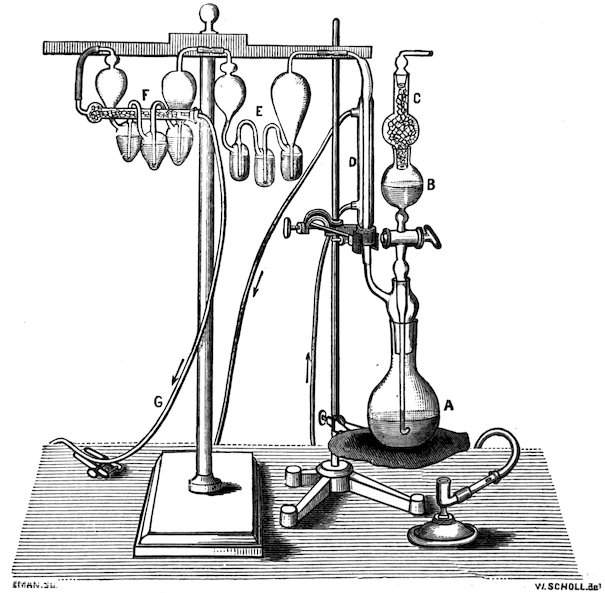
Figure 65.
Knorr’s Apparatus for the Determination of Carbon Dioxid.
The apparatus consists of a flask A, Fig. 65, in which the carbon
dioxid in the soil is liberated. A condenser, D, fits by
means of a ground-glass joint into the neck of the flask in which
the liberated gas, together with any air or aqueous vapor which
may be carried forward, is cooled. This prevents any excess
of vapor of water from entering the absorbing bulbs, which could
easily happen at the end of the experiments when the contents
of A are raised to the boiling point. The bulb B contains the
acid, usually hydrochloric, which is employed for decomposing
the carbonates. It is provided with a guard bulb-tube, C, which
serves to absorb any carbon dioxid which might enter the apparatus
with the air during aspiration at the close of the determination.
The carbon dioxid is dried in the bulb-tube, E, in oil of
vitriol, and absorbed in the potash solution in F. It is advisable
to aspirate a slow current of air through the apparatus by means
of the tube G during the whole of the operation. The quantity
of the sample to be taken depends on its richness in carbonates.
Many soils are so poor in carbonates as to render any attempt at
exact determination nugatory. On the other hand, a comparatively
small sample of marls will be sufficient. A preliminary
qualitative test will indicate, in a general way, the quantity of
the sample to be taken. The sample of soil, five to fifty grams,
having been transferred to A, which should be perfectly dry, is
331made into a batter with freshly boiled distilled water. When all
the parts of the apparatus are properly connected gas-tight, the
cock between B and A is slowly opened and the hydrochloric
(nitric) acid in B allowed to flow into A at such a rate as will
secure a moderate evolution of gas.
When the carbonate is entirely decomposed, a lamp is brought
under A and its contents gradually raised to the boiling point.
The aspiration of air, free from carbon dioxid, is meanwhile continued
until all the liberated gas has been absorbed in F. Usually
about fifteen minutes will be sufficient to accomplish this
purpose.
320. Bernard’s Calcimeter.—For a rapid and approximately
accurate method of determining the amount of carbonate in the
soil, estimated as calcium carbonate, Bernard makes use of the
well-known method of the volumetric estimation
of carbon dioxid. The sample to be
examined should not be powdered in any
way. The sample in a natural state, but
well air-dried, is gently broken up by the
fingers and passed through a sieve having
ten meshes to the centimeter. Of the fine
earth thus obtained, one gram is taken, for
the determination. If the percentage of
carbonate in the soil exceeds fifty then only
half a gram is taken.
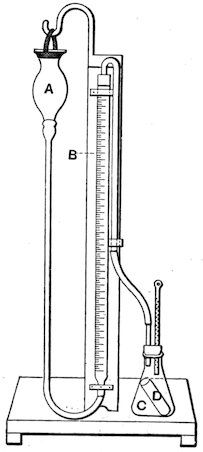
Figure 66.
Bernard’s Calcimeter.
The apparatus employed is one well
known. The small erlenmeyer C is fitted
with a rubber stopper carrying an exit
tube for the gas and a small thermometer.
This flask is connected by means of a
rubber tube and small glass tube to the measuring
burette B. This burette is graduated
from 0 to 100 cubic centimeters. Below, by means of a rubber
tube, it is connected with the open bulb A, which, by means of
a cord about its neck, can be suspended by the hook as shown
in the figure. The measuring tube is filled with water through
A until the level of the liquid in B is slightly above the zero
mark. Meanwhile the one gram of earth has been placed in C,
332together with the tube D three-fourths filled with an equal mixture
of water and strong hydrochloric acid. The greatest care
must be taken that no part of the acid be spilled.
The rubber stopper is now forced into C until the level of the
water in B is just at the zero mark. Grasping C in the right
hand and A in the left, the operator inclines C until the contents
of D are emptied. Meanwhile as the gas is evolved, A is
lowered at such a rate as to always keep the level of the water
in B and A on the same plane. In a few moments the evolution
of gas is complete, and the volume given off is read at once
without correction. This volume multiplied by 0.4 gives the
percentage of carbonate in the sample examined. It is understood
that the determination is made at ordinary temperatures;
viz., 17° to 22°. Example:
One gram of a soil treated as above, gave of carbon dioxid (uncorrected)
65 cubic centimeters. 65 × 0.4 = 26.00 = per cent calcium carbonate in
sample.
The above method is useful in the classification of soils and in
determining approximately the quantity of calcium carbonate
which they contain. The practical use of this method is of great
value in determining the character of fertilizer to be applied.
It is well to know the percentage of carbonate in selecting mineral
fertilizers.
321. Soils Deficient in Carbonates.—When a soil contains
but a small quantity of carbonates, Müller[207] has called attention
to the fact that the carbon dioxid absorbed by the water in which
the soil is rubbed up may vitiate the result. Instead of water a
titrated solution of sodium carbonate is employed. The apparatus
is composed of a flask containing the mixture of the sodium carbonate
and the soil on which the hydrochloric acid is to act. The
hydrochloric acid is contained in a small tube, as in Scheibler’s
apparatus. The gas is received in a rubber tube 1.5 meters long and
three to four millimeters interior diameter, and connected with a
burette, the open mouth of which dips into the water of a cylinder
of proper length. The volume of gas is read when the burette is
raised or lowered in the cylinder until the liquid within and
without stands at the same level.
During the action of the acid on the carbonates the flask is
constantly shaken.
333Several readings of the volume of gas are made, the evolution
flask being vigorously shaken before each one. Finally, in
order to allow for the variations in temperature and pressure of
the exterior air which may take place between the beginning
and the end of the reaction, a second flask containing air is
placed by the side of the evolution flask and communicating with
a narrow ᥩ tube half filled with water. Any variations in the
volume of the air in the flask will be shown by variations
in the height of the liquid in the two arms of the ᥩ tube, and the
volume of the variation can be easily determined by having the
ᥩ tube calibrated.
If now a equals the volume per cent of carbon dioxid in the
atmosphere of the evolution flask at the end of the reaction, v
the volume of gas disengaged, and V the volume of the atmosphere
in the evolution flask, the per cent of carbon dioxid contained
in a given length of the rubber tube will be equal to a
2.
This arises from the fact that the first gas which passes into the
rubber tube is composed solely of air, while the last contains a
per cent of carbon dioxid. By reason of the shaking of the
flask the mean richness of the contents of the tube in carbon
dioxid, will be sensibly a
2.
From the above data the following equations are derived:
1. va
2 + Va = v.
If the weight of the carbon dioxid dissolved in V′ cubic centimeters
of the liquid in the evolution flask be represented by q,
the coefficient of the solubility of pure carbon dioxid in this
liquid will be, according to the law of the solubility of a gas, equal
to k = q
V′a
The volume of k has been determined for various strengths of
the sodium carbonate solution, using five cubic centimeters of
hydrochloric acid containing 1.6 grams pure hydrochloric acid.
For solutions disengaging from five to fifty milligrams of carbon
dioxid, the mean value of k was found to be 1.8 milligrams in
the absence of calcium chlorid. When calcium chlorid was present
in quantities varying from 0.03 to 0.07 gram per cubic centimeter
334of liquid in the evolution flask, the value of k was 1.4
milligrams.
By adopting, according to circumstances, the one or the other
of the above numbers and multiplying it by Va, as determined
by experiment, results are obtained differing only 0.2 to 0.3 milligram
from those secured by direct weighing of the evolved gas.
Dietrich[208] has called attention to the necessity of adding the
volume of the dissolved gas to the measured volume in such
determinations, and this volume or weight is easily determined
by the above formulas.
322. Belgian Method.—The method pursued at the Gembloux
Station[209] consists in taking from five to fifty grams of the
sample of soil, according to its content in carbonate, rubbing it
up in a porcelain dish with distilled water in order to make a
thin paste. The mass is worked to drive out all the air, the whole
washed into a flask of 300 cubic centimeters capacity, and the
amount of carbon dioxid estimated by setting free with an acid,
and collecting the carbon dioxid evolved in potash bulbs.
323. General Considerations.—There are two points in connection
with the determination of mineral matters in the soil
which must always be kept in view; viz., first, the estimation of
the total quantities of material in the soil, and second, the study
of those materials which are more easily brought into solution
and thus made available for the food of plants.
It is well understood that the soil particles do not give up
entirely to the plant the food materials which they contain. The
practical value therefore of an analysis of a soil depends more
upon the exact determination of the plant food available than
upon its total quantity. From a mineral and geological point
of view, on the other hand, an idea of the total composition
of the soil is the object to be attained.
For the determination of the available plant food, various solvents
have been proposed, none of which, perhaps, imitates very
accurately the natural solvent action of organic life and moisture
on the soil materials. A description of the standard methods
335of preparing soil extracts will be the subject of a few succeeding
paragraphs.
324. Estimation of the Quantity of Materials Soluble in
Water.[210]—Five hundred grams of the air-dried soil are treated
in a flask with 1,500 cubic centimeters of water, less the quantity
of water already contained in the air-dried soil, which is volatile
at 125°. The mass is frequently shaken and, after seventy-two
hours, 750 cubic centimeters of the liquid filtered. The filtrate
is evaporated to dryness in a platinum dish, dried at 120° and
weighed. This is then incinerated and, after treatment with
ammonium carbonate and gentle ignition, is again weighed. The
further examination of the residue for acids and bases is made
by some of the methods hereafter described.
325. Treatment with Water Saturated with Carbon
Dioxid.—Two thousand five hundred grams of the air-dried soil
are treated with 8000 cubic centimeters of distilled, and afterwards
with 2000 cubic centimeters of water, which have previously, at
room temperature, been saturated with carbon dioxid. The
mixture is left in a closed flask for seven days, frequently shaken,
after which 7,500 cubic centimeters of the liquid are filtered.
The clear filtrate, after treatment with a little hydrochloric acid
and a few drops of nitric acid, is evaporated to dryness. After
the separation of the silica the traces of iron, alumina, lime,
sulfuric acid, magnesia, potash, and soda, are estimated in the
liquid in the manner hereinafter to be described. Phosphoric
acid is always present in such a case, in such small quantities as
to make its estimation unnecessary.
326. Treatment with Water Containing Ammonium Chlorid.—In
the flask containing the residue from the last experiment;
viz., the soil with 2,500 cubic centimeters of liquid, are
added 1,500 cubic centimeters of water saturated with carbon
dioxid, and 8,000 cubic centimeters of pure water in which five
grams of ammonium chlorid are dissolved. The mixture is then
left for seven days, with frequent shaking, and 7,500 cubic centimeters
of the liquid are then filtered, and the substances dissolved,
determined in the filtrate. In addition to the usual
quantities of lime and magnesia, from two to four times as much
336alkali is dissolved by this treatment as is found in the solution
from the water containing carbon dioxid alone.
327. Treatment with Water Containing Acetic Acid.—The
acetic acid should be of such a strength that after it has fully
acted on the soil it should still contain twenty per cent of free
acid. 1000 grams of the soil dried at 100° are taken and the acid
added in proper proportions and treated in the manner to be
described for determining the solvent action of hydrochloric acid.
328. Treatment with Citric Acid Solution.—In ascertaining
the quantities of soil materials soluble in a solution of citric acid,
Dyer[211] recommends the use of a carefully prepared citric
acid solution. The digestion is carried on as follows: Place
in a flask or bottle, holding about three liters, 200 grams
of air-dried soil and two liters of distilled water, in which are dissolved
twenty grams of pure citric acid. The soil is left, at room
temperature, in contact with the one per cent acid for seven days,
with thorough shaking several times a day. At the end of the
digestion the solution is filtered and 500 cubic centimeters of the
filtrate, corresponding to fifty grams of the soil, are taken for
analysis for each ingredient to be determined.
The digestion in citric acid is especially recommended by
Dyer because of its supposed near resemblance to the methods of
solution of plant food practiced by the rootlets of plants. It is
evident, however, that this process is in no sense an imitation of
natural methods. The solution is to be used exclusively for the
estimation of potash and phosphoric acid. Dyer concludes,
from a comparison of the action of a solution of citric acid on
soils of known fertility, that when as little as 0.01 per cent of
phosphoric acid is dissolved from a soil by this treatment it is
justifiable to assume that it stands in immediate need of phosphatic
manure. The methods used by Dyer to determine the
phosphoric acid and potash in the citric acid solution will be
given in their appropriate place.
329. Treatment with Hydrochloric Acid.—The solutions
of soils usually subjected to chemical analysis are those obtained
by long treatment with hot mineral acids, among which the most
common is hydrochloric.
It has long been assumed by soil analysts, perhaps not with
337justness, that such treatment removed from the soil, all those elements
of plant food which could possibly be available for the needs
of the growing crop. In this connection, however, the analyst
must not forget that nature, in a series of years, with her own
methods may easily accomplish what he in five days, even with
the help of a hot mineral acid, may not be able to secure. Since,
however, this method of solution has been so long practiced it is
not the place here to throw doubt on its effectiveness without
being able to suggest a better way. Of the mineral acids available
no one possesses solvent powers for soils in a higher degree
than hydrochloric. A somewhat detailed description will therefore
be given of the methods of its use.
330. Strength of Acid to be Employed.—The fact that
hydrochloric acid of nearly constant strength; viz., specific
gravity 1.115, equivalent to 22.9 per cent hydrochloric acid, may
be obtained by distillation, led Owen to use acid of this density
in his classic work on soil analysis. Hilgard has lately reviewed
the conditions of constant strength in the solvent with results
confirming the statements of Owen.[212] He evaporated on a steam-bath,
to one-half its bulk, fifty cubic centimeters of hydrochloric
acid, specific gravity 1.116, obtained by using the distillate from
a stronger acid after rejecting the first third. The same operation
was conducted with similar acid diluted with ten per cent of water.
The acid used contained 22.96 per cent hydrochloric acid. The
residual acid contained 21.49 per cent hydrochloric acid. These
results lead Hilgard to believe that the changes arising from evaporation
in hydrochloric acid during soil digestion are insignificant,
compared with those due to its action on the soluble matters, and
that evaporation during digestion is effective in maintaining a
definite strength in the solvent. For this reason it is contended
that evaporation in a porcelain beaker covered by a watch-glass is
more effective in constancy of conditions than digestion in a closed
flask under pressure.
331. Influence of Time of Digestion and Strength of Acid.—Loughridge
has made an interesting study of the influence of
the strength of acid and time of digestion on the extraction of
soils.[213] The method of preparing the soil for the determination
of the above points is as follows:
338The soil, having been passed through the appropriate number
of sieves to obtain the fine earth is pulverized with a wooden
pestle and thoroughly mixed. The hygroscopic moisture is
determined, after exposing it in a place saturated with vapor, in
a layer not exceeding one millimeter in thickness for twelve
hours, and subsequently drying at 200° in a paraffin-bath.
Of this dried substance, from two to three grams are used in the
general analysis, the methods employed being in general those
adopted by Peter.[214]
The quantities of materials dissolved by acids of different densities
are shown below. The determinations were made by
methods hereafter to be described.
|
Specific gravity of acid. |
| Ingredients. |
1.00 |
1.115 |
1.160 |
| Insoluble residue |
71.88 |
70.53 |
74.15 |
| Soluble silica |
11.38 |
12.30 |
9.42 |
| Potash |
0.60 |
0.63 |
0.48 |
| Soda |
0.13 |
0.09 |
0.35 |
| Lime |
0.27 |
0.27 |
0.23 |
| Magnesia |
0.45 |
0.45 |
0.45 |
| Manganese oxid |
0.06 |
0.06 |
0.06 |
| Ferric oxid |
5.15 |
5.11 |
5.04 |
| Alumina |
6.84 |
8.09 |
6.22 |
| Sulfuric acid |
0.02 |
0.02 |
0.02 |
| Volatile matter |
3.14 |
3.14 |
3.14 |
| |
|
|
|
| Total |
100.02 |
100.69 |
99.29 |
| |
|
|
|
| Amount of soluble matter |
24.00 |
27.02 |
22.27 |
| „ „ „ bases |
13.50 |
14.70 |
12.83 |
From the above table it is seen that the strongest acid exerts
the least soluble effect upon the substances present in the soil,
while the greatest degree of solution was obtained by the acid of
1.115 specific gravity. This result indicates that while lime and
magnesia are probably present chiefly as carbonates, potash as
well as alumina, and to some extent lime, are present as silicates,
and for that reason are not as fully extracted by acid of low
strength as by that of medium concentration.
In regard to the influence of the time of digestion, the acid of
specific gravity 1.115 being used, the data obtained are given in
the following table:
| 339 |
|
Number of days digested. |
| Ingredients. |
1. |
3. |
4. |
5. |
10. |
| |
|
|
|
|
|
| Insoluble residue |
76.97 |
72.66 |
71.86 |
70.53 |
71.79 |
| Soluble silica |
8.60 |
11.18 |
11.64 |
12.30 |
10.96 |
| Potash |
0.35 |
0.44 |
0.57 |
0.63 |
0.62 |
| Soda |
0.06 |
0.06 |
0.03 |
0.09 |
0.28 |
| Lime |
0.26 |
0.29 |
0.28 |
0.27 |
0.27 |
| Magnesia |
0.42 |
0.44 |
0.47 |
0.45 |
0.44 |
| Manganese oxid |
0.04 |
.06 |
0.06 |
0.06 |
0.06 |
| Ferric oxid |
4.77 |
5.01 |
5.43 |
5.11 |
4.85 |
| Alumina |
5.15 |
7.38 |
7.07 |
7.88 |
7.16 |
| Phosphoric acid |
|
|
|
0.21 |
0.21 |
| Sulfuric acid |
0.02 |
0.02 |
0.02 |
0.02 |
0.02 |
| Volatile matter |
3.14 |
3.14 |
3.14 |
3.14 |
3.14 |
| |
|
|
|
|
|
| Total |
99.63 |
100.68 |
100.55 |
100.69 |
99.80 |
| |
|
|
|
|
|
| Amount of soluble matter |
19.67 |
24.88 |
25.57 |
27.02 |
24.87 |
| „ „ „ bases |
11.05 |
13.68 |
13.91 |
14.49 |
13.68 |
From this table it appears that the amount of dissolved ingredients
increases up to the fifth day, the increase becoming, however,
very slow as that limit is approached. It is also found that
the ingredients offering the greatest resistance to this action are
the same as those whose amounts were sensibly affected by the
strength of the acid; namely, silica, potash, and alumina.
In regard to lime and magnesia, one day’s digestion not being
sufficient for full extraction, it is evident that they do not exist
in the soil as carbonates or hydric oxids only, as has been supposed,
but also as silicates. A comparison of the results of the
five and ten days’ digestion shows that the solvent action of the
acid has substantially ceased at the end of five days, there being
no further increase of the amount of dissolved matter.
332. Digestion Vessels.—Hilgard prescribes that the digestion
of the sample of soil with acid be conducted in a small porcelain
beaker covered with a watch-glass.[215] Kedzie, however,
prefers beakers of bohemian glass, and shows that hydrochloric
acid attacks the porcelain with greater energy than the glass.[216]
Platinum would be the ideal material for the digestive vessels,
but its great cost would exclude its general use. In most
cases it will be found that the error introduced into the analysis
by the use of porcelain or bohemian glass beakers is quite small
and not likely to affect the quantitative estimation of soluble
soil ingredients to any extent.
340In this laboratory some comparative tests made by Mr. W. D.
Bigelow have shown that vessels of hard glass of special manufacture
are less soluble in hot hydrochloric acid of 1.115 specific
gravity than porcelain, thus confirming the observation of
Kedzie. Following are the data showing the weights of material
dissolved in fifty hours:
| Berlin porcelain |
2.8 |
milligrams |
| Bohemian glass |
1.7 |
„ |
| Kaehler and Martini glass |
1.2 |
„ |
In each case twenty-five cubic centimeters of the acid were
used. The vessels all had approximately a capacity of 200
cubic centimeters.
333. Processes Employed—Hilgard’s Method.—The sample
of soil sifted through a 0.5 millimeter mesh sieve and thoroughly
air-dried, is conveniently preserved in weighing tubes.
The actual content of hygroscopic and combined moisture may
be previously made on a separate sample of soil.
In determining the amount of material to be employed for the
general analysis regard must be had to the nature of the soil.
This is necessary because of the impracticability of handling
successfully such large precipitates of alumina as would result
from the employment of as much as five grams in the case of
calcareous clay soils; while in the case of very sandy soils even
that quantity might require to be doubled in order to obtain
weighable amounts of certain ingredients. For soils in which
the insoluble portion ranges from sixty to eighty per cent,
two and a half to three grams are about the right measure
for general analysis, while for the phosphoric acid determination
not less than three grams should be employed in any case. It has
been alleged that larger quantities must be taken for analysis in
order to secure average results. It is difficult to see why this
should be true for soils and not for ores, in which the results affect
directly the money value, while in the case of soils the interpretation
of results allows much wider limits in the percentages.
Correct sampling must be presupposed to make any analysis
useful; but with modern balances and methods it is difficult to
see why five grams should be employed instead of half that
amount, which in some cases is still too much for convenient
manipulation of certain precipitates.
341The weighed quantity, usually of two to two and a half grams,
is brought into a small porcelain beaker, covered with a watch-glass,
treated with eight to ten times its bulk of hydrochloric
acid of 1.115 specific gravity, and two or three drops of nitric
acid, and digested for five days over the laboratory steam-bath.
At the end of this time it is evaporated to dryness, first on the
water-bath and then on the sand-bath. By this treatment all
the silica set free is rendered insoluble.
334. Provisional Method of the Official Agricultural
Chemists.—Place ten grams of the air-dried soil in a round
bottom 150 to 200 cubic centimeter bohemian flask, add 100
cubic centimeters of pure hydrochloric acid of specific gravity
1.115, insert the stopper, wire it securely, place in a steam-bath,
and digest for thirty-six hours at the temperature of boiling water.
Pour the contents of the flask into a small beaker, wash with distilled
water, add the washings to the contents of the beaker and
filter through a washed filter. The residue is the amount insoluble
in hydrochloric acid. Add a few drops of nitric acid to the filtrate,
and evaporate to dryness on the water-bath; take up with hot
water and a few drops of hydrochloric acid, and again evaporate
to complete dryness. Take up as before, and filter into a liter-flask,
washing with hot water. Cool and make up to the mark.
This is solution A. The residue represents the silica originally
dissolved. In comparing the two preceding methods it is found
that the former; viz., digestion in flasks covered only with a
watch-glass gives a larger quantity of dissolved matter in five
days than the digestion under pressure does in thirty-six hours.
In comparative tests in this laboratory made by Mr. W. D.
Bigelow the respective quantities of soluble and insoluble matter
obtained by the two methods in two soils are as follows:
|
Soil No. 1. |
Soil No. 2. |
|
Per cent. |
Per cent. |
| Method of Digestion. |
Insoluble. |
Soluble. |
Insoluble. |
Soluble. |
| Open flask |
75.62 |
24.38 |
79.62 |
20.38 |
| Closed flask |
76.81 |
23.19 |
80.48 |
19.52 |
335. The German Station Method.—The method recommended
by the German Stations[217] is greatly different from that
described above, both in temperature and time of digestion. To
one part of the soil are added two parts by volume of a twenty-five
342per cent hydrochloric acid solution, the quantity being
increased to correspond to any excess of carbonates. The mixture
is left for forty-eight hours with frequent shaking. As an
alternate method, one part of soil is treated with two parts by
volume of ten per cent hydrochloric acid, and heated on the
water-bath, with frequent shaking, for three hours.
The soluble materials are determined in the filtrate by some of
the methods usually employed.
336. The Gembloux Method.—The method of making the
acid extract of the soil at the Gembloux Station does not differ
greatly from some of those already described.
The quantity of air-dried material taken is such that it may
weigh exactly 300 grams exclusive of the moisture which it contains.
It is dried at 150° for at least six hours. The drying is
necessary in order to obtain an extract in hydrochloric acid of
exactly 1.18 specific gravity. The dry earth is placed in a flask
of two or three liters capacity to which one liter of hydrochloric
acid of 1.18 specific gravity is added, being careful to take precautions
to prevent frothing if much carbonate be present. The
acid is allowed to act for twenty-four hours, it being frequently
shaken meanwhile. After settling it is decanted and filtered
upon a double folded filter, the apex of which rests upon a small
funnel covered with a plain filter of strong paper. Five hundred
cubic centimeters of the filtrate are taken for the estimation, and in
this filtrate are estimated the silica, phosphoric and sulfuric
acids, potash, soda, iron, alumina, lime, and magnesia.
The filtrate is evaporated to dryness in a porcelain capsule, a
few drops of nitric acid added and the liquid kept well stirred.
The residue should be taken up with water, and if not perfectly
bright a second and even a third evaporation with nitric acid
should take place, until all the organic matter is destroyed, which
will be indicated by the clear yellow or reddish-yellow color of
the liquid, caused by the iron oxid. After the last evaporation
the material is dried in a drying oven one hour at 110°.
337. Treatment with Cold Hydrochloric Acid.—According
to the digestion method of Wolff[218] the soil sample is treated with
cold concentrated hydrochloric acid. The process is as follows:
Four hundred and fifty grams of the soil dried at 100° are
343placed in a glass flask and treated with 1,500 cubic centimeters
of hydrochloric acid of 1.15 specific gravity, corresponding to
thirty per cent of gaseous hydrochloric acid. For every five per
cent of calcium carbonate which the soil may contain, an additional
fifty cubic centimeters of hydrochloric acid are added.
With frequent stirring, the soil is left in contact with the acid for
forty-eight hours and then 1,000 cubic centimeters of liquid, as
clear as possible, are poured off, which corresponds to 300 grams
of the soil. After dilution with water it is filtered and the filtrate
treated with a few drops of nitric acid and evaporated to dryness.
After the separation of the silica the solution is again made up
with water to 1,000 cubic centimeters.
Two hundred cubic centimeters of this solution, corresponding
to sixty grams of the soil, are taken for the estimation of iron,
alumina, lime, manganese, and magnesia.
Four hundred cubic centimeters of the solution, corresponding
to 120 grams of the soil, are left for the estimation of sulfuric
acid and alkalies. This method gives from five to six times
less alkalies and a much smaller quantity of iron than the treatment
with hot acid. In the use of hot acid, therefore, Wolff
reduces the quantity of soil acted on to 150 grams.
338. Treatment with Nitric Acid.—For the purpose of estimating
phosphoric acid Grandeau[219] directs that the soil be
extracted with nitric acid. For this purpose 100 grams of the
air-dried fine earth are placed in a bohemian flask and treated
cautiously with nitric acid in small quantities at a time.
If the soil be calcareous in its nature it should be previously
moistened with water, and the acid so added as to avoid undue
effervescence, the flask being inclined during the operation.
Sufficient acid is added to strongly saturate the sample and it is
then digested on the sand-bath for two hours; or at least until
the organic matters are destroyed, which will be indicated by
the cessation of evolution of nitrous vapors. When the supernatant
liquid has become clear it is decanted. The residue is
washed with distilled water and separated on a filter, and washed
until the wash-water is colorless. The decanted portion is
united with the filtrate and the whole made up to a volume of
one liter. The determinations are made in portions of 200 cubic
centimeters each.
344339. Digestion with Hydrofluoric and Sulfuric Acids.—When
a complete disintegration of the siliceous substances in
soils is desired as in analysis in bulk, the decomposition is easily
accomplished by digestion with the above named acids in a
platinum dish. The fine earth is saturated with a concentrated
aqueous solution of hydrofluoric acid to which a few drops of
sulfuric acid are added. It is then digested until nearly dry.
If any undecomposed particles remain, the treatment is continued
until complete decomposition is secured. The silica is thus all
volatilized as hydrofluosilicic acid and the bases pre-existing in
the soil are left as sulfates. This method of treatment is especially
recommended when it is desired to estimate the whole quantity
of any of the soil constituents with the exception of silica.
The silica may, however, be determined in the distillate.
Instead of using the solution of hydrofluoric acid, ammonium
fluorid may be employed. In this process the sample of earth
reduced to an impalpable powder by grinding in an agate mortar
is mixed with four or five times its weight of the ammonium
fluorid in a platinum dish and thoroughly moistened with sulfuric
acid and allowed to stand at room temperature for several
hours. It is then gently heated until all fumes of hydrofluosilicic
acid have been driven off, but is not raised to a red heat.
If any undecomposed particles remain, the above treatment is
repeated.
340. Substances in Solution.—By treatment with solvents
as indicated in the preceding paragraphs, greater or less quantities
of the original constituents of soil are brought into solution.
The total quantity of dissolved matters is determined by
drying and weighing the insoluble residue and the percentages
of soluble and insoluble matters should be noted; and each portion
saved for further examination. In this country the common
practice of soil analysis is to digest the sample with hydrochloric
acid. The following paragraphs, therefore, will be devoted to
the general methods of determining the matters dissolved by
that treatment, leaving for later consideration the special methods
345of analysis. The fundamental principle on which the treatment
with hydrochloric acid rests is based on the belief that
such treatment practically extracts from the soil all those elements
which are likely to become, immediately or in the near
future, available for plant food.
341. Provisional Methods of the Official Agricultural
Chemists.[220]—(1) The Analytical Operations are conducted with
solution A, paragraph 334.
(2) Ferric Oxid, Alumina, and Phosphoric Acid.—To 100
or 200 cubic centimeters, according to the probable amount of iron
present, of the solution A, add ammonium hydroxid to alkaline
reaction to precipitate ferric and aluminum oxids and phosphates.
Expel the excess of ammonia by boiling, allow to settle, decant the
clear solution through a filter; add to the flask fifty cubic centimeters
of hot distilled water, boil, settle, and decant as before.
After pouring off all the clear solution possible, dissolve the residue
with a few drops of warm hydrochloric acid and add just
enough ammonium hydroxid to precipitate the oxids. Wash by
decantation with fifty cubic centimeters of distilled water, and then
transfer all the precipitate to the filter and wash with hot distilled
water till the filtrate becomes free from chlorids. Save
the filtrate and washings which form solution B. Dry the filter
and precipitate at 110°, transfer the precipitate to a tared platinum
crucible, burn the filter and add the ash to the precipitate,
heat the whole red hot, cool in a desiccator, and weigh. The
increase of weight, minus the ash of filter and the phosphoric
acid (found in a separate process), represents the weight of the
ferric and aluminum oxids.
(3) Ferric Oxid.—Precipitate 100 cubic centimeters of solution
A, as under (2), except that only one precipitation is made;
wash with hot water; dissolve in dilute sulfuric acid; reduce
with zinc and estimate as ferrous oxid by a standard solution of
potassium permanganate.
To prepare the potassium permanganate solution, dissolve
3.156 grams of pure crystallized potassium permanganate in
1,000 cubic centimeters of distilled water, and preserve in a
glass-stoppered bottle, shielded from the light. Standardize
this solution with pure ferrous sulfate, ammonium ferrous sulfate
or oxalic acid.
346(4) Alumina.—The calculated weight of ferric oxid deducted
from that of ferric oxid and alumina with corrections for filter
ash and phosphoric acid, will give the weight of alumina in two
grams of air-dried soil.
(5) Phosphoric Acid.—This may be estimated in the above
iron solution, if the soil is sufficiently rich, by the molybdate
method, given under fertilizers; or if the quantity of soil represented
in the iron solution is not sufficient, a fresh portion of
solution A may be taken, and the phosphoric acid determined
directly by the molybdate method.
(6) Manganese.—Concentrate the filtrate and washings (solution B)
to 200 cubic centimeters or less; add ammonium hydroxid
to alkalinity; add bromin water and heat to boiling, keeping the
beaker covered with a watch-glass; as the bromin escapes, the
beaker is allowed to cool somewhat, ammonia and bromin water
again added, and heated as before.
This process is continued until the manganese is completely
precipitated, which requires from thirty to sixty minutes, and
the solution filtered while still warm; the precipitate is washed,
dried, ignited and weighed; estimate as manganese protosesquioxid.
(7) Lime.—If no manganese is precipitated, add to solution
B, or the filtrate and washings from (6) twenty cubic centimeters
of a strong solution of ammonium chlorid and forty cubic centimeters
of saturated solution of ammonium oxalate to completely
precipitate all the lime as oxalate and convert the magnesia into
soluble magnesium oxalate. Heat to boiling and let stand for
six hours till the calcium oxalate settles clear, decant the clear
solution on a filter, pour fifty cubic centimeters of hot distilled
water on the precipitate and again decant the clear solution on
the filter, transfer the precipitate to the filter, and wash it free
from all traces of oxalates and chlorids. Dry and ignite the
precipitate over the blast-lamp until it ceases to lose weight,
weigh and estimate as calcium oxid; carefully moisten with
sulfuric acid, heat the inclined covered crucible gently to avoid
loss, then intensely, and weigh as calcium sulfate.
(8) Magnesia.—Concentrate the filtrate and washings (from
7) to 200 cubic centimeters, place in a half-liter erlenmeyer,
347add thirty cubic centimeters of a saturated solution of sodium
phosphate and twenty cubic centimeters of concentrated
ammonium hydroxid, cork the flask, and shake violently at
intervals of a few minutes till crystals form, then set the flask
in a cool place for twelve hours. Filter the clear liquid through
a tared gooch, transfer the precipitate to the filter, and
wash with dilute ammonium hydroxid (1 : 3) till the filtrate is
free from phosphates; dry and ignite the crucible, at first gently
and then intensely, to form magnesium pyrophosphate. The
increase of weight × 0.36024 = MgO. By using an erlenmeyer
free from scratches and marks, and shaking violently instead
of stirring with a glass rod, the danger is almost entirely
avoided of crystals adhering to the sides of the vessel; but if
crystals do adhere they are readily removed by a rubber-tipped
glass rod.
(9) Sulfuric Acid.—Evaporate 200 cubic centimeters of solution
A (1) nearly to dryness on a water-bath to expel the excess
of acid; then add 100 cubic centimeters of distilled water, heat
to boiling and add ten cubic centimeters of a solution of barium
chlorid, and continue the boiling for five minutes. When the
precipitate has settled, pour the clear liquid on a tared gooch,
treat the precipitate with fifty cubic centimeters of boiling
water, and transfer the precipitate to the filter and wash with
boiling water till the filtrate is free from chlorids. Dry the filter
and ignite strongly. The increase in weight is barium sulfate,
which multiplied by 0.34331 = SO₃ in two grams of air-dried soil.
(10) Potash and Soda.—To another portion of 200 cubic centimeters
of solution A, add barium chlorid in slight excess, and
make alkaline with ammonia to precipitate sulfuric and phosphoric
acids, ferric oxid, etc. Then precipitate the calcium and
barium by ammonium oxalate. Evaporate the filtrate and washings
to dryness, heat to a low red heat to decompose oxalates
and expel ammonia salts, dissolve in twenty-five cubic centimeters
of distilled water, filter and wash the precipitate; add to the
filtrate and washings ten cubic centimeters of baryta water, and
digest for an hour. Filter and wash the precipitate, add ammonium
carbonate to the filtrate to complete precipitation of baryta,
filter and wash this precipitate. Evaporate the filtrate and
348washings in a tared platinum dish, gently ignite the residue to
expel ammonia salts, cool and weigh. The increase of weight
represents the potassium and sodium chlorids in two grams of air-dried
soil.
342. Hilgard’s Methods.[221]—(1) Soluble Silica.— The acid filtrate
obtained by the process given in paragraph 333 is employed
for the following determinations. After the solution obtained has
been evaporated to dryness to render silica insoluble, it is moistened
with strong hydrochloric acid and two or three drops of nitric
acid. The mass is warmed, and after allowing to stand for a few
hours on a steam-bath is taken up with distilled water. After
clearing, it is filtered from the insoluble residue, which is strongly
ignited and weighed. If the filtrate should be turbid the insoluble
residue which has gone through the filter can be recovered
in the iron and alumina determination.
The insoluble residue is next boiled for fifteen or twenty minutes
in a concentrated solution of sodium carbonate, to which a
few drops of caustic lye should then be added to prevent reprecipitation
of the dissolved silica. The solution must be filtered
hot. The difference between the weight of the total residue
and that of undissolved sand and mineral powder is recorded
as soluble silica, being the aggregate of that set free by the acid
treatment and that previously existing in the soil. The latter,
however, rarely reaches five per cent.
(2) Destruction of Organic Matter.—The acid filtrate from the
total insoluble residue is evaporated to a convenient bulk. In
case the filtrate should indicate by its color, the presence of any
organic matter, it should be oxidized by aqua regia, otherwise
there will be difficulty in separating alumina.
(3) Precipitation of Iron and Alumina.—The filtrate thus
prepared is now brought to boiling and treated sparingly
with ammonia, whereby iron and alumina are precipitated.
It is kept boiling until the excess of ammonia is driven off,
and then filtered hot. (Filtrate A.) The previous addition
of ammonium chlorid is usually unnecessary. If the boiling
is continued too long, filtration becomes very difficult and a part
of the precipitate may redissolve in washing. Filtration may be
begun as soon as the nose fails to note the presence of free ammonia;
349test paper is too delicate. Failure to boil long enough
involves the contamination of the iron-alumina precipitate with
lime and manganese.
(4) Estimation of Iron and Alumina.—The iron and alumina
precipitate with filter of (3) is dissolved in a mixture of
about five cubic centimeters of hydrochloric acid and twenty
cubic centimeters of water. Then filter and make up to 150
cubic centimeters. Take fifty cubic centimeters for the determination
of iron and alumina together by precipitation with
ammonia, after oxidizing the organic matter (filter) with
aqua regia; also fifty cubic centimeters for iron alone; keep
fifty cubic centimeters in reserve. Determine the iron by means
of a standard solution of potassium permanganate after reduction;
this latter is done by evaporating the fifty cubic centimeters
almost to dryness with strong sulfuric acid, adding water and
transferring the solution to a flask, and then reducing by means
of pure metallic zinc in the usual way. The alumina is then
determined by difference. This method of determining the two
oxids in their intermixture is in several respects more satisfactory
than the separation with alkaline lye, which, however, has
served for most determinations made, until within the last ten
years. It is, however, much more liable to miscarry in unpracticed
hands than the other.
(5) Estimation of Lime.—The filtrate A from iron and alumina
is acidified slightly with hydrochloric acid, and if too bulky
is evaporated to about twenty-five cubic centimeters, unless the
soil is a very calcareous one, and the lime is precipitated from it
by neutralizing with ammonia and adding ammonium oxalate.
The precipitation of the lime should be done in the hot solution,
as the precipitate settles much more easily. It is allowed to stand
for twelve hours, then filtered (filtrate B), washed with cold water,
and dried. By ignition the lime precipitate is partially converted
into the oxid. It is then heated with excess of powdered ammonium
carbonate, moistened with water, and exposed to a gentle
heat (50°–80°) until all the ammonia is expelled. It is then dried
below red heat and weighed as calcium carbonate. When the
amount of lime is at all considerable, the treatment with ammonium
carbonate must be repeated till a constant weight is obtained.
350(6) Estimation of Sulfuric Arid.—The filtrate B from the
calcium oxalate is put into a bohemian flask, boiled down
over the sand-bath, and the ammoniacal salts destroyed
with aqua regia. From the flask it is removed to a small
beaker and evaporated to dryness with excess of nitric acid.
This process usually occupies four to five hours. The residue
should be crystalline-granular; if white-opaque, ammonium
nitrate remains and must be destroyed by hydrochloric acid.
The dry residue is now moistened with nitric acid, and the
floccules of silica usually present separated by filtration from the
filtrate, which should not amount to more than ten or fifteen
cubic centimeters; sulfur trioxid is then precipitated by treatment
with a few drops of barium nitrate, both the solution and the
reagent being heated to boiling. If the quantity of sulfuric acid
is large it may be filtered after the lapse of four or five hours
(filtrate C). If very small let it stand twelve hours. The precipitate
is washed with boiling water, dried, ignited, and
weighed. Care should be taken in adding the barium nitrate
to use only the least possible excess, because in such a small
concentrated acid solution the excess of barium nitrate may
crystallize and will not readily dissolve in hot water. Care must
also be taken not to leave in the beaker the large heavy crystals
of barium sulfate, of which a few sometimes constitute the entire
precipitate, rarely exceeding a few milligrams. Should the ignited
precipitate show an alkaline reaction on moistening with
water, it must be treated with a drop of hydrochloric acid, refiltered
and weighed. The use of barium acetate involves unnecessary
trouble in this determination.
(7) Estimation of Sodium and Potassium.—Filtrate C is now
evaporated to dryness in a platinum dish; the residue is
treated with an excess of crystallized oxalic acid, moistened
with water, and exposed to gentle heat. It is then strongly
ignited to change the oxalates to carbonates. This treatment
with oxalic acid must be made in a vessel which can be
kept well covered, otherwise there is danger of loss through
spattering. As little water as possible should be used, as otherwise
loss from evolution of carbon dioxid is difficult to avoid.
Spatters on the cover should not be washed back into the basin
351until after the excess of oxalic acid has been volatilized. The
ignited mass should have a slightly blackish tinge to prove the
conversion of the nitrates into carbonates. White portions may
be locally retreated with oxalic acid. The ignited mass is
treated with a small amount of water, which dissolves the alkaline
carbonates and leaves the magnesium carbonate, manganese
protosesquioxid, and the excess of barium carbonate
behind. The alkalies are separated by filtration into a small
platinum dish (filtrate D), and the residue is well but sparingly
washed with water on a small filter. When the filtrate exceeds
ten cubic centimeters it may, on evaporation, show so much turbidity
from dissolved earthy carbonates as to render refiltration
on a small filter necessary, since otherwise the soda percentage
will be found too large and magnesia too small. If, on dissolving
the ignited mass, the solution should appear greenish from the
formation of alkaline manganates, add a few drops of alcohol to
reduce the manganese to insoluble dioxid. The residue of
barium, magnesium, and manganese compounds is treated on
the filter with hydrochloric acid, and the platinum dish is washed
with warm nitric acid (not hydrochloric, for the platinum dish
may be attacked by chlorin from the manganese oxid) dissolving
any small traces of precipitate that may have been left behind.
The filtrate D, which should not be more than ten or fifteen
cubic centimeters, containing the carbonates of the alkalies,
is evaporated to dryness and gently fused, so as to render insoluble
any magnesium carbonate that may have gone through; then
redissolved and filtered into a small weighed platinum dish containing
a few drops of dilute hydrochloric acid, to change the
carbonates into chlorids; evaporated to dryness, exposed to a
gradually rising temperature (below red heat), by which the
chlorids are thoroughly dried and freed from moisture, so as to
prevent the decrepitation that would otherwise occur on ignition.
Then, holding the platinum basin firmly by forceps grasping the
clean edge, pass it carefully over a very low bunsen flame, so as
to cause, successively, every portion of the scaly or powdery
residue to collapse, without fully fusing. There is thus no loss
from volatilization, and no difficulty in obtaining an accurate,
constant weight. The weighed chlorids are washed by means
352of a little water into a small beaker or porcelain dish, treated
with a sufficient quantity of platinum chlorid, and evaporated to
dryness over the water-bath. The dried residue is treated with
a mixture of three parts absolute alcohol and one part ether,
leaving the potassium platinochlorid undissolved. This is put
on a filter, and washed with ether-alcohol. When dried, the
precipitate and filter are put into a small platinum crucible and
exposed to a heat sufficiently intense to reduce the platinum
chlorid to metallic platinum and to volatilize the greater part of
the potassium chlorid. This is easily accomplished in a small
crucible, which is roughened by being constantly used for the same
purpose (and no other), the spongy metal causing a ready evolution
of the gases. The reduced platinum is now first washed
in the crucible with hot acidulated water, then with pure water;
then all moisture is driven off and it is weighed. From the
weight of the platinum, is calculated the potassium chlorid and
the oxid corresponding; the difference between the weights of
the total alkaline chlorids and potassium chlorid gives the sodium
chlorid, from which may be calculated the sodium oxid. When
the heating of the platinum precipitate has not been sufficient in
time or intensity, instead of being in a solid spongy mass of the
color of the crucible itself, small black particles of metallic platinum
will obstinately float on the surface of the water in the
crucible, and it becomes difficult to wash without loss.
(8) Estimation of Manganese.—The solution containing the
magnesium and manganese chlorids is freed from barium salts
by hot precipitation with sulfuric acid, and the barium sulfate,
after settling a few hours, is separated by filtration. The
filtrate is neutralized with ammonia, any resulting small precipitate
(of iron) is filtered, and the manganese precipitated with
ammonium sulfid, let stand twelve hours and filtered (filtrate E);
wash with cold water, dry, ignite, and weigh as manganese
protosesquioxid, Mn₃O₄. If preferred the manganese may be
precipitated with chlorin or bromin water as dioxid; but the
process requires a rather longer time and may fail in inexpert
hands more readily than the other.
(9) Estimation of Magnesium.—The filtrate E from the manganese
is now freed from sulfur by acidulating with hydrochloric
353acid, evaporating, if necessary, and filtering. From the filtrate
the magnesia is precipitated by adding an equal bulk of ammonia
water and then sodium phosphate. After standing at least
twenty-four hours, the magnesium salt may be filtered, washed
with ammoniacal water, dried, ignited, and weighed as magnesium
pyrophosphate.
343. Examination of Acid Extract by the Methods of
Petermann.—Estimation of the Silica.—The Gembloux method
of estimating silica consists in taking up the dry extract obtained
from the treatment of the earth, in the manner described in paragraph
336, with water and a few drops of hydrochloric acid, heating
for a short time on a sand-bath to facilitate the solution, and
filtering, washing, drying, igniting, and weighing the residue
obtained as silica.
Estimation of the Sulfuric Acid.—The method employed consists
in heating the filtrate obtained in the estimation of silica for
half an hour with a few drops of nitric acid and making the volume
up to 500 cubic centimeters. One hundred cubic centimeters
of this are precipitated with barium chlorid, diluted to double its
volume, heated for some time, the precipitate of barium sulfate
collected and weighed, and the quantity of sulfuric acid calculated
therefrom.
Potash and Soda.—Potash and soda are estimated at the Gembloux
Station by heating the filtrate obtained in the estimation
of the sulfuric acid and precipitating the excess of barium in the
hot solution after the addition of ammonia by ammonium oxalate
and carbonate. The whole is allowed to digest for six hours at
a gentle heat and then allowed to remain at rest for twenty-four
hours, filtered, washed, and the filtrate evaporated to dryness in
a large platinum dish and the ammoniacal salts driven off at a
low temperature. At the end, the temperature is carried a little
higher until it reaches low redness. The residue is taken up by
distilled water, filtered into a weighed platinum dish, a few drops
of hydrochloric acid added, evaporated, dried, heated with great
care and the sodium and potassium chlorids obtained weighed
together. The respective quantities of potash and soda in the
earth are estimated in the usual way by precipitating the potash
with platinum chlorid.
354Estimation of the Iron and Aluminum Oxids.—The iron and
aluminum oxids are estimated by taking twenty-five cubic centimeters
of the primitive solution obtained with hydrochloric
acid and adding ammonium carbonate almost to complete neutralization,
that is to say until the precipitate formed is just
redissolved in the feeble excess of hydrochloric acid which
remains. Dilute with distilled water and precipitate with a little
excess of ammonium acetate, and boil for a moment; after
boiling, the basic iron and aluminum acetate and the small
quantity of iron and aluminum phosphate present are easily
deposited, and the supernatant liquid should be completely
limpid and colorless. Wash the precipitate by decantation,
boiling each time, filter, wash the filter with boiling water to
which a little ammonium acetate has been added, dry, ignite,
and weigh. The material obtained consists of ferric oxid, aluminum
oxid, and iron and aluminum phosphates. Deduct from
the whole, the phosphoric acid determined in another portion.
The residue will be the sum of the iron and aluminum oxids.
Estimation of the Lime.—The filtrate from the portion used
for the estimation of the iron and alumina is treated with ammonium
oxalate. The mixture is kept at a low temperature for at
least twelve hours, after which it is filtered, washed with hot
water, dried, and ignited over a blast-lamp to constant weight
and weighed as calcium oxid.
Estimation of the Magnesia.—For the estimation of the magnesia
the filtrate obtained in the estimation of lime is evaporated
to dryness in a platinum dish, the ammoniacal salts driven off,
the residue taken up with water slightly acidified with hydrochloric
acid, filtered, the filtrate saturated with ammonia and
heated some time to the boiling point to precipitate any traces of
iron and alumina which may have remained in solution. Filter,
wash, allow to cool and precipitate the magnesia by the addition
of sodium phosphate. It is then allowed to stand for twelve
hours, collected on a filter, ignited, and weighed as pyrophosphate,
and the quantity of magnesia calculated from the weight
of salt obtained.
Estimation of the Phosphoric Acid.—The phosphoric acid is
estimated by taking 100 cubic centimeters of the original solution
355obtained by the treatment of the soil with hydrochloric acid and
evaporating it to dryness on the water-bath. The residue is
taken up with water to which a few drops of nitric acid have
been added and filtered. The total phosphoric acid is then
obtained by precipitation with ammonium molybdate in the
usual way.
344. Analysis of the Insoluble Residue.—The insoluble
residue left after digestion with hydrochloric acid is not without
interest from an agricultural and analytical point of view. While
it is true that the plant food, therein contained, is not immediately
available, yet it must not be forgotten that the method of the
chemist may not fix a limit to nature’s method of collecting
nutriment for plants. In however refractory a state they may
exist, it is possible that all nutritive elements may eventually
become available for assimilation. For the completion of an
estimate of the total nutritive power of a soil, therefore a further
examination of the insoluble residue should be made. The
methods of securing this are essentially those of making a bulk
analysis of the soil.
The principle of the method depends on the reduction of the
sample to an impalpable powder and the subsequent decomposition
of the insoluble portions by treatment with hydrofluoric
and sulfuric acids or by fusion with the alkalies.
345. Method of Wolff for Treating Residue Insoluble in Hot
Acid.—The well-washed residue is dried with the filter, then separated
therefrom, the filter burned and the ash weighed with the
whole of the residue. About eight grams of the residue are ignited
and serve for the estimation of the insoluble mineral matter.
Another portion of ten grams of the dried, but not ignited, residue
is boiled with a concentrated solution of sodium carbonate
with the addition of caustic soda, and the quantity of dissolved
silicic acid estimated. A third portion of about fifteen grams is
treated with about five times its weight of pure concentrated sulfuric
acid, and is evaporated until the mass has taken the form
of a dry powder. After moistening with concentrated hydrochloric
acid the mass is boiled with water, filtered, and the filtrate
examined according to the ordinary methods for silicic acid,
alumina, iron, lime, magnesia, and alkalies. The residue after
356treatment with concentrated sulfuric acid is dried, but not
ignited, and boiled with a concentrated solution of sodium carbonate
with the addition of a little caustic soda, filtered, heated,
and the silicic acid separated from the solution. After thorough
washing, the residue, after ignition, is weighed and represents
the material insoluble in concentrated hydrochloric and sulfuric
acids. The silicic acid found as before, together with the small
quantity dissolved in the hydrochloric acid extract, gives, in connection
with the alumina contained in the sulfuric acid extract,
approximately the quantity of pure water-free clay contained in
the soil.
In six samples of soils of very different compositions which
were examined by the above process, it was found that the clay
had the following mean composition: Silicic acid, 55.1 to 61.5
per cent, alumina, 38.6 to 44.9 per cent; as a mean 58.05 per
cent silicic acid and 41.95 per cent alumina.
Finally, four or five grams of the residue, after treatment with
sulfuric acid and sodium carbonate, are rubbed up in an agate
mortar and completely separated into silt by water. The silt
mass is dried, lightly ignited, and three grams of it spread in a
flat platinum dish moistened with sulfuric acid, and subjected to
the action of hydrofluoric acid in a lead oven at 60°, until a complete
decomposition of the material is accomplished. In the
solution all the different bases can be determined.
346. Method of the Belgian Chemists.—The method
employed by Petermann[222] at the Gembloux Station in the
examination of the part of the soil insoluble in hydrochloric
acid consists in washing the insoluble portion by decantation
with distilled water until all acid reaction is removed.
Place the contents of the flask and of the filter in a porcelain
dish and dry. After a careful mixing of the mass take out
about fifty grams and wash upon the filter until all reaction
for chlorin has disappeared, dry, detach the mass from
the filter, and incinerate. Place in a platinum crucible two
grams of the ground and ignited residue and mix it, using a
platinum stirring rod, with twelve grams of ammonium fluorid;
heat slightly over a bunsen burner in a muffle with a good
draught and regulate the flame in such a way that the operation
357shall continue for about one hour. After complete decomposition
add about two cubic centimeters of sulfuric acid in such a
way as to moisten completely the residue, drive off the sulfuric
acid carefully at a low red heat and take up the residue with
water slightly acidulated with hydrochloric acid and wash
the whole into a flask of 500 cubic centimeters capacity.
Oxidize by heating for an hour with nitric acid, make up to the
mark and filter. The percentages of potash, soda, lime, magnesia,
and the silicates are determined exactly as in the hydrochloric
acid extract.
347. Bulk Analysis.—It is frequently desirable to determine
the total composition of a soil sample as well as the nature of
that part of it soluble in any of the solvents usually employed.
The latest methods for this purpose have been well studied by
Packard[223] who finds that the variations which occur between
duplicates are probably due to the small quantities of material
taken for analysis, it being difficult to obtain average samples of
a material which is not very finely powdered when small quantities
are taken. Moreover, as it is likely to become of importance
to know whether the proportions of lime and magnesia vary by
as much as one-tenth per cent, and such small variations are
within the limits of error of an analysis, and as the total proportion
of lime and magnesia in highly siliceous soils, probably does
not exceed one-tenth per cent, it is deemed best to take a large
quantity of soil for the bulk analysis in each case. The amount
adopted for the highly siliceous soils containing much quartz is
ten grams. This quantity, taken after quartering down the
entire sample, is ground to an impalpable powder and used for
the determination of the lime, magnesia, and alkalies, the silica,
iron oxid, alumina, and loss on ignition, being determined in
one gram samples. The ten grams are decomposed by hydrofluoric
and sulfuric acids in a large platinum dish, the solution
evaporated, at first on the water-bath until all water is
removed and then at a higher temperature until all the free
sulfuric acid is driven off, when the residue is heated in
a muffle at a low red heat for several hours. At this temperature
the sulfuric acid combined with the iron oxid
and alumina is driven off, leaving the remaining sulfates
358unchanged and the iron oxid and alumina are in the form of a
powder of no great volume which is easily and quickly washed.
This operation is usually successful at first but in some cases the
decomposition is not complete as is shown by the appearance of
a precipitate on adding ammonia to the filtrate from the aluminum
and iron oxids. In such cases the precipitate is dissolved in
hydrochloric acid, reprecipitated by ammonia and removed by filtration.
In the filtrate from the thoroughly washed aluminum and
iron oxids, lime is precipitated as oxalate and separated by filtration;
the filtrate is evaporated to dryness and the ammonia salts
driven off by heat; the magnesia in the unfiltered watery extract
of this residue is precipitated by baryta water, which also removes
the sulfuric acid with which the bases had been combined. In the
filtrate from this precipitate baryta is precipitated by ammonium
carbonate and removed by filtration, leaving the alkalies
to be determined in the usual way after conversion into chlorids.
The mixed precipitate of magnesia and barium sulfate is treated
with hydrochloric acid, filtered, the baryta present removed as
sulfate, and the magnesia precipitated in the filtrate from
the latter as phosphate. The advantages of this method are
that the large quantity of material employed gives some assurance
that an average sample has been operated on, and all the
bases present in small proportions are estimated in the same
sample. The objection to it is the time consumed both in grinding
the samples and in determining all the bases in one
solution. As a small quantity of material is generally used for
determining the silica, iron oxid, alumina, and loss by ignition,
and a larger quantity for the remaining bases, slight differences
in the unground samples are unavoidable, especially when
the quartz grains are somewhat large, it being practically impossible
to take two small samples of such a soil which would have
the same number of quartz grains. Consequently tedious grinding
of large quantities of the soils for the bulk analysis is necessary.
This objection does not apply to the official analysis or
assay of soils in which considerable quantities are extracted by
acid and the solution analyzed, and silica is not determined. In
any case, it may be said, when it becomes an object to know
whether a soil contains a total of 0.1 or 0.2 per cent of lime or
359magnesia, of 0.7 or 0.5 per cent of potash, one analysis even of
the large quantity of ten grams would be insufficient to decide
the point, and at least the mean of two determinations should
be taken.
348. Preliminary Considerations.—In the foregoing paragraphs
the general outline of the chemical methods of soil examination
have been given. There are often occasions, however,
which demand a special study of some particular soil constituent.
It has been thought proper, therefore, to add here some of the
best approved methods of special determinations which have been
approved in this and other countries.
In the main, the final determination of any particular element
of the soil, and its previous separation from accompanying
elements, are based on the general processes already given. The
variations in many instances, however, seem to require special
mention.
349. Condition of Potash in Soils.—Potash exists in the soil
in very different states. That part of it which is combined with
the humus material, or with the hydrated silicates, is easily set
free from its combinations and is to be regarded as the more
assimilable portion.
The potash in the soil is found chiefly in combination with
silicates, and particularly with the hydrated aluminum silicates,
forming clay. As the particles with which it is combined are
found in a state of greater or less fineness, the potash itself is set
free under the influences of the agents which are active in the
soil, with greater or less rapidity, passing into a form in which
it can be utilized by plants. In silicates which are very finely
divided, such as clay, the potash becomes active in a relatively
short time, while in the débris of rocks in a less advanced state
of decomposition it may rest for an indefinite period in an inert
state. The estimation of the potash which is assimilable
in the clay is quite as important for agricultural purposes
as to determine that which may be present in the soil
in firmer combination. Treating the sample of soil with
360water does not furnish any useful information in regard to
the potash which it contains. Indeed, the absorbing properties
of the soil tend to prevent the elimination of the potash in this
way, even when it is found in the soluble state. It is therefore,
necessary to employ an acid to set the potash free, but
variable results are obtained, according to the employment
of acids of greater or less concentration and for longer or
shorter periods of contact.
350. Estimation of the Potash Soluble in Concentrated
Acids.—In the method of the French agricultural chemists[224]
twenty grams of the earth are placed in a dish with a flat bottom,
eleven centimeters in diameter, and rubbed up with twenty to thirty
cubic centimeters of water. There is added carefully, and in small
quantities, some nitric acid of 36° Baumé until all effervescence
has ceased, the mass meanwhile being thoroughly stirred. When
the carbonates have been decomposed, which can be told by the
cessation of the effervescence, twenty cubic centimeters more of
the same acid are added. The dish is heated on the sand-bath for
five hours, regulating the heating in such a way that there still
remains some acid at the end of the operation and the mass is
not thoroughly dry. The acid mass is then taken up with hot
water, filtered, and washed with hot water until the amount of
filtrate is about 300 cubic centimeters. The filtrate should be
received in a flask of about one liter capacity. The filtrate will
contain the dissolved potash, soda, magnesia, lime, iron and
aluminum oxids, and traces of sulfuric and phosphoric acids. For
the elimination of the other substances, with the exception of
potash, soda and magnesia, a few drops of barium nitrate are
added, afterwards sufficient ammonia to render the solution alkaline,
and finally an excess of ammonium carbonate in powder
added in small portions. These materials are added successively
and the whole is left to stand for twenty-four hours. By this
operation the sulfuric acid is separated in the form of barium sulfate;
the iron and aluminum oxids are precipitated, carrying
down with them the phosphoric acid, and the lime is thrown
down in the form of carbonate. The mass is now filtered and
washed several times with hot water. The filtrate contains in
addition to potash, soda, magnesia, and the ammoniacal salts
361which have been introduced. The ammonium salts are destroyed
by adding aqua regia and evaporating the liquid to a very small
volume, as described in the method for the estimation of magnesia.
The mass is now evaporated in a porcelain dish with a
flat bottom, of about seven centimeters diameter, and an excess of
perchloric acid added. The evaporation is carried to dryness on a
sand-bath, and the heating prolonged until the last white fumes of
perchloric acid are disengaged. The mass is now left to cool.
There are then added five cubic centimeters of alcohol, of 90°
strength. The mass is triturated by a stirring rod, the extremity of
which is flattened, in such a manner as to reduce it all to an impalpable
powder. It is then left to settle and the supernatant liquid is
decanted upon a small filter. The treatment with alcohol of the
kind, quantity, and strength described, is continued four or five
times. Afterwards, as there may still remain a trace of the sodium
and magnesium perchlorates in the interior of the crystals of
potassium perchlorate, there are added to the capsule in which
all of the alkaline residue has been collected, two or three cubic
centimeters of water, and it is evaporated again to dryness and
taken up twice with small quantities of alcohol. There are thus
removed the traces of sodium and magnesium perchlorates. By
means of a jet of boiling water the stirring rod and the filter,
which contains the small quantities of potassium perchlorate, are
washed, and the liquid passing through is received in the capsule
which contains the larger part of the salt. It is then evaporated
to dryness and weighed.
When there is very little magnesia present, as is generally the
case, the estimation of the potash is made without any difficulty
by the process just mentioned, but when the proportion of magnesia
is high it is found useful to separate it before the transformation
into perchlorates. The magnesia is separated by carbonating
the residue as indicated in the method for the estimation
of magnesia, by treatment with oxalic acid and ignition. By
extracting the carbonates formed with very small quantities of
water, and filtering, the alkalies are obtained free from magnesia.
It is advisable to test the purity of the potassium perchlorate
formed which sometimes contains a little silica. For this purpose
it is dissolved in boiling water, and any residue which
362remains is weighed, and that weight deducted from the total
weight of perchlorate. By multiplying the weight of potassium
perchlorate found by the coefficient 0.339, the quantity of potash
contained in the twenty grams of earth submitted to analysis is
obtained.
Estimation of the Potash Soluble in Cold, Dilute Acids.—(Method
of Schloesing.) Introduce 100 grams of the soil into a one or
one and a half liter flask with 600 to 800 cubic centimeters of
water. A little nitric acid, of 30° Baumé, is added until the
carbonate is decomposed and a slight acid reaction is obtained.
Afterwards five cubic centimeters of the same acid are added
and it is left to digest for six hours, shaking every fifteen minutes.
Instead of taking the whole of the wash-water for the
examination, it is better to extract only a portion of it and so
dispense with washing. This process is conducted in the following
manner:
The weight P of the full flask having been determined, as much
as possible of the solution, is decanted by means of a very small
siphon, of which the flow is moderated by fixing a rubber tube
with a pinch-cock to its lower extremity. After the decantation
is complete, the flask is again weighed, giving the weight of P′;
the weight of liquid taken, therefore, is equal to P − P′. To determine
the total weight of the liquid, throw upon a filter the earthy
residue insoluble in the acid, and after washing and drying it
determine its weight r. The weight of the empty dry flask p
is also determined. The total weight of the soil will be, therefore,
P − r − p. The part of the liquid which was extracted
from the flask, and upon which the analytical operation is to be
conducted is represented by the fraction P − P′
P − r − p. This method
avoids washing and evaporation which would be of very long
duration. It rests upon the supposition that the solid matter
from which the liquor is separated has no affinity for the dissolved
substances, and that the total of these substances has
passed into the liquor, and that the solution is homogeneous.
In the liquor first decanted as described before, the potash is
estimated. This liquor contains in addition to potash, soda,
lime, magnesia, iron and aluminum oxids, as well as phosphoric,
sulfuric, and hydrochloric acids. There is first added to it a little
363barium chlorid to precipitate the sulfuric acid. It is then heated
to about 40° in a glass flask and some ammonium carbonate added
in a solution containing an excess of ammonium hydroxid.
By this process the lime and baryta are precipitated in the form
of carbonates; the alumina and iron as oxids, and the phosphoric
acid in combination with the last two bases. The magnesium
carbonate is not precipitated because it is soluble in the ammonium
carbonate with which it forms a double salt.
The employment of a gentle heat favors the formation of the
precipitate of calcium carbonate in a granular form which lends
itself easily to filtration. The contents of the flask are now
thrown upon a filter and the insoluble residue washed. The
filtrate contains the potash, soda, magnesia, ammonia, and nitric
and hydrochloric acids. It is concentrated as rapidly as possible
by heating in a flask, and afterwards the ammoniacal salts
are destroyed by weak aqua regia and the whole is then transferred
to a porcelain dish and evaporated to dryness. There is
thus obtained a mixture of potassium, sodium, and magnesium
nitrates, from which the potash is separated by means of perchloric
acid in the manner already described.
Estimation of the Total Potash.—Beside the potash which can
be dissolved by the boiling concentrated acids the soil contains
potash combined with silicates, which becomes useful for plant
life with extreme slowness. It is often of great interest to estimate
the total potash contained in a soil, that is to say, the reserve
for the future. In this case it is necessary to free entirely this
base from its combinations by means of hydrofluoric acid. The
operation is conducted upon two grams of earth previously ignited
and reduced to an impalpable powder. The decomposition is conducted
in a platinum capsule by sprinkling the sample with a few
cubic centimeters of hydrofluoric acid, or solution of ammonium
fluorid, and adding a few drops of sulfuric acid. It is then evaporated
to dryness and dissolved in boiling hydrochloric acid. The
part which remains insoluble is treated a second time by hydrofluoric
and sulfuric and afterwards by hydrochloric acid. All
of the potash is thus brought into solution. The estimation of
the potash, after having obtained it in a soluble state, is conducted
in the manner previously described.
364Estimation of the Potash as Platinochlorid.—Instead of estimating
the potash as perchlorate it can also be transformed into
platinochlorid. This process gives as good results as the preceding
one but it is necessary in all cases, to separate the magnesia.
After having treated the soil as indicated in the case of
the estimation of the potash as perchlorate, the separation of the
sulfuric and phosphoric acids, of alumina and iron, of magnesia,
and the destruction of the ammoniacal salts in the manner
already described, there are finally left the alkalies potash and soda
in the form of carbonates. These are transformed into chlorids
by adding hydrochloric acid; afterwards they are evaporated to
dryness and the mixture of the two chlorids weighed in order to
determine what quantity of platinum chlorid it is necessary to
add, in order that it be in excess. The quantity of chlorid to be
added is calculated so as to be in sufficient quantity to saturate
the whole of the chlorids weighed, whether they may be composed
wholly of sodium or potassium. In this way there is a
certainty of having an excess of platinum. The solution of
platinum chlorid used should contain in 100 cubic centimeters
seventeen grams of platinum. Each cubic centimeter of this
solution will be sufficient for a decigram of the sodium and potassium
double chlorids. After the addition of the platinum chlorid
the mixture is evaporated in a capsule with a flat bottom, on a
water-bath. It is important that the temperature should not
exceed 100°. If the temperature should go above this there
would be a tendency to form some platinum subchlorids insoluble
in alcohol.
The evaporation is continued until the contents of the dish
are in a pasty condition and form a rather solid mass on cooling.
It is necessary to avoid a complete desiccation. After cooling,
the residue is taken up by alcohol of 95° strength. It is allowed
to digest with alcohol of this strength for some time, after having
been thoroughly mixed and shaken therewith in order to
obtain a complete precipitation of the platinochlorid. This
digestion should take place under a small bell-jar resting upon a
piece of ground glass. The evaporation of the alcohol is thus
prevented. The mass is then washed by means of alcohol of
the same strength and the liquors decanted upon a small filter
365placed within another filter of identical weight, which serves as
a tare for it on the balance. The washing is prolonged until the
filtrate becomes colorless. All of the particles in the dish should
be brought upon the filter by means of a hair-brush. The filters
are now dried at a temperature not exceeding 95° and the
platinochlorid received upon the interior filter is weighed. The
precipitate may also be washed from the small filter into the
capsule in which it was formed by means of a jet of alcohol.
The alcohol is evaporated and the precipitate weighed in the
capsule. The weighing should be made rapidly on account of
the hygroscopicity of the material. The weight obtained multiplied
by 0.193 gives the corresponding quantity of potash in the
soil.
Purification of the Oxalic Acid.—The commercial oxalic acid
used in separating the magnesia, often contains lime, magnesia,
and potash. When this reagent is used in a sufficiently large
quantity in the estimation of the above substances, it is indispensable
to free it entirely from them. This is secured by submitting
the oxalic acid to successive recrystallizations which are
obtained by dissolving it in warm water, filtering and leaving
to cool. The mother waters are thrown away. After two or three
successive crystallizations the traces of potash and magnesia have
disappeared and the oxalic acid obtained after ignition leaves no
trace of residue.
The purification may also be secured in the following manner:
At a temperature of 60° a saturated solution of oxalic acid is
made; the liquid is decanted, carried to the boiling point and
filtered. Five per cent of nitric acid are added and it is allowed
to cool. The crystals which are deposited are collected upon a
funnel in which a plug of cotton has been placed, and are washed
with a little cold water.
Purity of the Ammonium Carbonate.—The ammonium carbonate
employed should not leave any residue whatever after volatilization.
In general, it may be said of all the reagents employed
in analyses and especially of those employed in large quantities,
that it is indispensable to be sure that they contain no traces of
the substances which are to be estimated. The acids, ammonia,
etc., should always be examined with this point in view.
366Estimation of the Soda.—It is often of interest to estimate the
soda in the soil, not that it is an element of any great fertility
but rather because it is hurtful when in excess. It is determined
in the residue obtained in the estimation of potash and is estimated
by difference. The weight of the mixture of sodium and
potassium chlorids being known when the potash is determined,
the weight of its chlorid is to be deducted from the weight of
the two chlorids and thus the direct weight of the sodium chlorid
is obtained.
A better way is to make a direct estimation. The soda is
found entirely dissolved in the alcoholic solution obtained by
washing the potash salt as before described, for the separation
of the potassium platinochlorid. This alcoholic liquor is evaporated
to dryness on a water-bath, in a bohemian flask of about
100 cubic centimeters capacity. The residue obtained consists
of sodium platinochlorid and a little platinum chlorid. There
is now fitted to the bohemian flask a cork stopper carrying two
tubes. The apparatus is placed upon a water-bath and kept at
about 100°. Through the tube which reaches to the bottom of
the bohemian flask, a current of pure hydrogen is passed. The
hydrogen passes off through the second tube. The hydrogen
completely reduces the salts of platinum. In order that the
decomposition may go on more rapidly a few drops of water are
added. When the whole mass in the flask has become black
owing to the separation of the platinum, it is shaken, evaporated
to dryness and hydrogen passed through a second time. This
operation is repeated three or four times, being stopped when
the water no longer shows a yellow color. There is then in the
flask only a mixture of reduced platinum and sodium chlorid.
No trace of sodium chlorid has been lost because the temperature
has never exceeded 100°. The sodium chlorid is dissolved
by washing with water and filtered. The liquor, which must be
absolutely colorless, is evaporated to dryness in a platinum capsule
and weighed. There is thus obtained the weight of the
sodium chlorid. For verification, the sum of the weight of potassium
chlorid calculated from the platinochlorid and the weight
of the sodium chlorid should be equal to the initial weight of the
mixture of the two chlorids.
367351. Potash Methods of the German Experiment Stations.[225]—a.
To one volume of air-dried fine earth which is
obtained by sifting through a three millimeter sieve, two volumes
of twenty-five per cent hydrochloric acid are added, or more if the
soil contains much carbonate. The acid is allowed to act with
frequent stirring for forty-eight hours at room temperature.
b. To one volume of the soil, as above prepared, are added
two volumes of hydrochloric acid and allowed to stand for three
hours with frequent shaking, at the temperature of boiling water.
c. (Halle method.) One hundred grams of the fine earth are
treated with 500 cubic centimeters of forty per cent hydrochloric
acid, made up to one liter with water and allowed to stand for
forty-eight hours with frequent shaking. After filtering, a large
aliquot part of the filtrate is evaporated for the estimation of the
potash. The evaporated residue is washed into a half-liter flask
in which the sulfuric acid is precipitated with barium hydroxid
the flask filled to the mark and an aliquot part of the filtrate in
a half-liter flask, treated with ammonium carbonate, filtered and
the potash estimated as platinochlorid by the usual method.
352. Method of Raulin for the Estimation of Potash in
Soils.[226]—The process rests upon the very feeble solubility in
aqueous solution of potassium phosphomolybdate, while sodium,
magnesium, calcium, iron, and aluminum phosphomolybdates
are more or less soluble. The process does not require complicated
separation and permits of the treatment of a small quantity
of soil, since the weight of the phosphomolybdate obtained is
equivalent to nineteen times that of the potash.
The reagent is prepared by dissolving 100 grams of crystallized
ammonium molybdate in as little water as possible and adding
six and a half grams of neutral crystallized ammonium phosphate
dissolved in a little water. Aqua regia is now added cold and some
ammonium phosphomolybdate is precipitated. The mixture is
heated, adding a little aqua regia from time to time, until the
solution of the precipitate is accomplished. The whole is then
evaporated to dryness, the final temperature of evaporation not
being carried above 70°. Four hundred cubic centimeters of
water are now added and five cubic centimeters of nitric acid,
and the contents of the dish heated and filtered. The reagent
is then ready for use.
368The liquid to be used for washing the potassium phosphomolybdate
is prepared by dissolving twenty grams of sodium nitrate
in one liter of water, two cubic centimeters of pure nitric acid,
and a mixture of about twenty cubic centimeters of the phosphomolybdic
reagent and one and a half cubic centimeters of a solution
of potassium nitrate containing eighty grams per liter, slightly
heated in order to saturate the liquid with potassium phosphomolybdate.
The solution is shaken, allowed to rest, and the
liquid decanted.
For the preparation of the solution in which the potash is to
be estimated, a sample of soil is carefully weighed of such magnitude
as to contain about fifteen milligrams of anhydrous potash.
The potash salts are dissolved by the usual processes and are
separated from the largest part of the calcium, iron, and aluminum
salts, and converted into nitrates. The solution is reduced to a
volume of a few cubic centimeters and slightly acidulated with
nitric acid. Four cubic centimeters of the phosphomolybdic
reagent are added for every ten milligrams of anhydrous potash
supposed to be present. The solution is evaporated to dryness
at 50° and immediately brought upon very small weighed filters,
of which each one is double, by using sixty cubic centimeters
of the washing liquor mentioned above. The tared
filter is likewise washed with the same liquid at 50° and
weighed. The weight multiplied by 0.052 gives the anhydrous
potash. This method for a direct precipitation of the potash
salts does not have the merits of the perchlorate process and
both are inferior in accuracy to the usual platinochlorid procedure.
353. Russian Method for Estimating Potash in Soils.[227]—Ten
grams of the soil are digested with 100 cubic centimeters of
ten per cent hydrochloric acid on a steam-bath for twenty-four
hours. After adding five cubic centimeters of nitric acid to the
filtrate it is evaporated to dryness, taken up with dilute hydrochloric
acid, filtered, the filtrate saturated with ammonia, the
excess of ammonia driven off, again filtered, and the lime
separated by ammonium oxalate.
The filtrate is treated with a little barium chlorid for the
removal of sulfuric acid and afterwards with ammonium carbonate
369in excess, and digested for twenty-four hours. After filtering,
the solution is evaporated in a platinum dish, the excess of
ammonia driven off, the residue taken up with water, filtered,
treated with hydrochloric acid, evaporated to dryness, and ignited
at low heat. The residue is again dissolved in water, filtered,
and the potash precipitated with platinum chlorid and estimated
in the usual way.
354. Potash Method of the Italian Stations.[228]—The potash
in the soil should be determined in three forms; viz.,
1. Assimilable potash.
2. Potash soluble in concentrated acid.
3. Total potash.
For determination of the first, 100 grams of earth are put into
a retort holding a liter and digested with dilute nitric acid.
For the analysis, an aliquot portion of the clear liquid is taken
or weighed, and the determination of the potash is made by
the common methods.
For an alternate method, from twenty to fifty grams of earth
are put into a retort of 500 cubic centimeters, moistened with
water, and nitric acid is gradually added. After one or two
hours there are added from 200 to 300 cubic centimeters of water;
the liquid is poured without filtering into a retort and the residue
washed by decantation.
In the liquid, after the elimination of the other substances with
barium chlorid, ammonium carbonate, etc., the potash is
determined by the ordinary methods.
In the second case, by using warm concentrated acids, a portion
of the insoluble silica is decomposed, but this decomposition
is always partial and the quantity of the potash extracted
depends upon the temperature, upon the concentration, upon the
duration of the action, and upon the nature of the acid.
The method of moistening twenty to fifty grams of earth with
water and adding, thereto, concentrated nitric acid of 1.20 density,
in such a manner that the earth shall be completely saturated,
may also be employed. Then the temperature is kept at
100° during two hours. In the solution, the potash is determined
as usual.
In the third case the soil is to be decomposed by hydrofluoric
370and sulfuric acids, or by fusion with alkaline carbonates, and the
total potash determined by one of the standard methods.
If it is desired to adopt a general method for the determination
of the potash the following points must be carefully considered:
1. The quantity of the earth to be examined.
2. The state of humidity or dryness of the same.
3. The quantity, nature, and concentration of the acid.
4. The quantity of the water.
5. The duration of the treatment.
355. Method of J. Lawrence Smith for Potash.—This
method, designed especially for mineral analysis, has been fully
approved by the general experience of analysts.
The principle of the method[229] depends upon the decomposition
of silicates on ignition with calcium carbonate and ammonium
chlorid. The object of this mixture is to bring into contact with
the mineral, caustic lime in a nascent state at a red heat, the
caustic lime being soluble to some extent in calcium chlorid at
a high temperature. Pure calcium carbonate, made by precipitation
of marble, should be used.
The ammonium chlorid should be prepared by taking crystals
of pure, sublimed sal ammoniac, dissolving in water, and filtering,
and evaporating the solution until small crystals are
deposited, the solution being well-stirred until one-half or two-thirds
of the whole has crystallized. The mother-liquor is poured
off while still hot, and the crystals dried on an asbestos filter at
ordinary room temperature.
A special platinum crucible should be used in the Smith
method, but the common crucible, especially if very deep, can
be employed. The special crucible is of about double the usual
length. Smith recommends a crucible ninety-five millimeters in
length, diameter at top twenty-two millimeters, at bottom sixteen
millimeters, and weighing thirty-five to forty grams. The object
of the long crucible is to have the part of the bottom containing
the silicate subjected to a high heat, while the top of the crucible
is at a much lower temperature, thus preventing the loss of
alkalies by volatilization.
Method of Analysis.—The samples of soil or silicate containing
the alkalies are well pulverized in an agate mortar, and from one-half
371to one gram of the finely pulverized material taken for analysis.
This is carefully mixed with the same weight of finely
powdered sal ammoniac and the mineral and sal ammoniac rubbed
well together in a mortar. Eight parts by weight of calcium
carbonate are next added in three or four portions, and the whole
intimately mixed after each addition. The contents of the mortar
are emptied on a piece of glazed paper and then introduced
into the crucible, which is tapped gently upon the table until
the contents are well settled. It is then fixed in the furnace
which is used for heating, and a small bunsen burner is placed
beneath the crucible, and the heat applied just about at the top
of the mixture and gradually carried toward the lower part until
the sal ammoniac is completely decomposed, which requires from
four to five minutes. The heat is then applied by means of a
blast-lamp and the crucible kept at a bright red heat for from forty
to sixty minutes. The crucible is allowed to cool, the contents
detached and placed in a platinum or porcelain dish of
about 150 cubic centimeters capacity, and sixty to eighty cubic
centimeters of distilled water added. The solution of the flux
may be hastened by heating the water to the boiling point. The
crucible and its cover are also well washed with hot water until
all matter adhering to them is dissolved. After the slaking of
the mass it is best to continue the digestion with hot water for
six or eight hours, although this is not absolutely necessary.
The contents of the crucible are filtered and washed well with
about 200 cubic centimeters of water. The filtrate contains in
solution all the alkalies of the mineral, or soil, together with
calcium chlorid and caustic lime. A solution of pure ammonium
carbonate containing about one and one-half grams of the pure
salt is added to the filtrate. This precipitates the lime as carbonate.
The dish containing the material is placed on a water-bath
and its contents evaporated to about forty cubic centimeters.
Two additional drops of ammonium carbonate are added, and a few
drops of caustic ammonia, to precipitate any lime which may be
redissolved by the action of the ammonium chlorid solution on
the calcium carbonate. Filter on a small filter and wash with as
little water as possible and collect the filtrate in a small beaker.
The filtrate contains all the alkalies as chlorids, together with a
372little ammonium chlorid. Add a drop of ammonium carbonate
solution to be sure all the lime is precipitated, evaporate on a
water-bath in a deep platinum dish, in which the alkalies are to
be weighed. The dish should have from thirty to sixty cubic
centimeters capacity, and during the evaporation should never
be more than two-thirds filled. After the evaporation has been
completed the dish is slowly heated and then gently ignited over
a gas-flame to drive off any ammonium chlorid which may be
present. During this process the platinum dish may be covered
with a thin piece of platinum to prevent any possible loss by the
spitting of the salt after the ammonium chlorid has been driven
off. The heat should be gradually increased until it is brought
to a point a little below redness, leaving the cover off. The
platinum dish is again covered, and when sufficiently cooled
placed on a balance and weighed.
If lithium chlorid be present it is necessary to weigh it quickly
as the salt being very deliquescent takes up moisture rapidly.
The alkalies may now be separated in the usual way.
If the sample under examination contains magnesia the residue
in the capsule should be dissolved in a little water and sufficient
pure lime-water added to render the solution alkaline. It should
then be boiled and filtered. The magnesia will, in this way, be
completely separated from the alkalies. The solution which has
passed through the filter is treated with ammonium carbonate in
the manner first described, and the process continued and completed
as above mentioned.
If it be suspected that the whole of the alkalies have not been
obtained by the first fusion, the residue upon the filter can be
rubbed up in a mortar with an amount of ammonium chlorid
equal to one-half the weight of the mineral, mixed with fresh
portions of calcium carbonate and treated exactly as in the first
instance. Any trace of alkali remaining from the first fusion is
thus recovered in the second one.
Method of Heating the Crucible.—The apparatus used by Smith
for igniting the crucible is shown in Fig. 67. It consists of an
iron filter-stand HG, a clamp, ED, carrying the muffle NC,
attached by the supports AB, and heated by the lamp F.
The muffle NC is a chimney of sheet iron, eight to nine
373centimeters long, ten centimeters high, the width at the
bottom being about four centimeters
on one side and three
centimeters on the other. It
is made with the sides straight
for about four centimeters
and then inclining toward the
top so as to leave the opening
at the top about one centimeter
in width. A piece is cut out
of the front of the chimney of
the width of the diameter of the
hole in the iron support and
about four centimeters in
length, being semi-circular at
the top, fitting over the platinum
crucible. Just above this
part of the chimney, is riveted
a piece of sheet iron in the
form of a flattened hook, N,
which holds the chimney in
place by being slipped over
the top of the crucible support; it serves as a protection to the
crucible against the cooling effects of the currents of air.
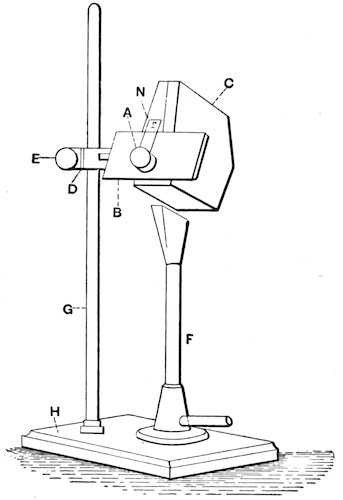
Figure 67.
Smith’s Muffle for Decomposition of Silicates.
356. International Method for Assimilable and Total
Potash.—In the International Congress of Chemists held in Paris
in 1889,[230] the discrimination between the assimilable and total
potash was declared to be of prime importance. Unfortunately
no method is known by which the potash which is present in
the soil in a state suited to the wants of plants can be determined
with approximate accuracy. In general, that portion which is
given up to weak acids may be assumed to be available.
In the treatment of soils with weak acid, as pointed out in
the Congress, it is demonstrable that with a 0.05 to 0.1 per cent
nitric acid solution, the quantity of potash which goes into solution
increases by continued stirring of the mixture with the time
of action of the acid up to a certain maximum which is reached
in from three to four hours, and after that, it is not changed
374even when the strength of the acid mixture is increased to two
per cent. From this time on, concentrated acids withdraw
from the soil which has already been exhausted by the
weak acid, a new quantity of potash. The soils which have been
exhausted by concentrated acids yield also an additional quantity
of potash when they are treated with hydrofluoric acid, or
melted with barium or sodium carbonate. Potash, therefore,
appears to exist in the soil in various forms.
First. In the form of indecomposable silicates which have,
agriculturally perhaps, very little interest.
Second. In the form of silicates which are more basic than
those just mentioned. These silicates are attacked by strong
acids and give up probably every year a portion of their potash
to vegetation.
Third. In a form which is easily soluble in weak acids and
consequently directly assimilable by plants.
In view of the fact that it would be of interest to chemists
and agronomists to establish certain methods of investigation so
as to be able to obtain comparative results, it was decided to
adopt the original method recommended by Gasparin for the
estimation of the potash decomposable by concentrated acids.
This method consists in the treatment of the soil with boiling
aqua regia until the sand which is not decomposed, is white.
Determination of the Fineness of the Earth which is Used for
Analysis.—For the estimation of potash, the soil should be
divided as finely as possible, and passed through a sieve of thirty
meshes to the centimeter. The decomposition is then completed in
two hours, while if a sieve of only ten perforations per centimeter
is used, the acid must be allowed to work for twelve hours.
The determination of the potash after solution, is accomplished
by any of the standard methods.
357. Method of Tatlock as Used by Dyer.—Attention was
called in paragraph 328 to the estimation of the total plant food
in the soil by extraction of the sample with citric acid. Dyer
first determines the total potash by Tatlock’s method which is
as follows:
To determine potash ten grams of fine dry soil are treated
with ten cubic centimeters of hydrochloric acid and evaporated
375to dryness on the water-bath, the residue taken up with another
ten cubic centimeters of acid, warmed, diluted with water, boiled,
filtered, and washed. The filtrate and washings are concentrated
and gently incinerated to get rid of organic matter, and
the residue redissolved in hydrochloric acid, and evaporated
slowly with a considerable quantity of platinum chlorid. If the
evaporation be conducted slowly, the potassium platinochlorid
settles out well, despite the iron, aluminum, and calcium salts,
and is easily washed with some more platinum chlorid solution,
followed by alcohol. The application of this modification of the
platinum chlorid process to solutions containing comparatively
minute quantities of potash amid an overwhelming excess of
iron, aluminum, and calcium salts is probably new to many
chemists. It works admirably, and obviates the necessity for
removing iron, aluminum, calcium, magnesium, etc., with the
necessary use of ammonia, and the tedious processes of concentration
and final volatilization of the ammonium salts; but, of
course, the process cannot be employed if soda also is to be
determined.
The potash, soluble in hydrochloric acid, having been thus
determined, the undissolved siliceous matter is incinerated,
weighed, and finely ground in an agate mortar. A weighed
portion of it is then, as in the Smith method, mixed with a large
bulk of pure calcium carbonate and a little ammonium chlorid
and heated, beginning with a low temperature, rising slowly to
bright redness. The mass is then boiled with water, washed,
incinerated, reground, mixed with some more ammonium chlorid,
and again heated, boiled, and washed. The process is repeated
and the filtrates from all the treatments concentrated, the calcium
being removed as carbonate, and the potash determined
in the filtrate, after evaporation and incineration at a low temperature,
by means of platinum chlorid.
Five hundred cubic centimeters of the citric acid solution of
the soil, made as described in paragraph 328, corresponding to
fifty grams of soil, are evaporated to dryness in a platinum dish
and ignited at a low temperature. The residue is dissolved in
hydrochloric acid filtered and washed, and the filtrate again
evaporated to dryness and treated again as just described. The
potash is then determined as above.
376358. Estimation of Total Alkalies and Alkaline Earths.—To
properly determine the exact amount of these substances in
a sample of soil it is necessary first to remove the silica. This
is accomplished in the process of Berthelot and André[231] by intimately
incorporating with the sample, in a state of very fine
powder, four or five times its weight of ammonium fluorid.
The mixture, in a platinum dish, is moistened with strong sulfuric
acid and allowed to stand for a few hours. It is then gently
heated until all fumes of hydrofluosilicic acid have disappeared,
but the mass is not raised to a red heat. If there is any doubt
about the complete decomposition of the silica the treatment is
repeated.
At the end of the operation there remain only sulfates without
excess of sulfuric acid. The sulfates likely to be present
are of potash, soda, lime, magnesia, alumina, and iron. The
separation of these bodies is conducted in the ordinary manner.
Fusing the soil with potash does not give reliable results but
it can be used in certain cases for the rapid estimation of alumina
and iron. In this case after the separation of the silica in the
ordinary way the iron can be determined as ferric oxid.
The iron can also be directly determined by reducing to the
ferrous state and titrating with potassium permanganate.
Comparison of Fluorin Method with Common Methods.—To
establish the difference in the data obtained by the old and new
processes samples of the same earth were treated by Berthelot
and André by different methods with the following results:
|
By the fluorin method. |
By the cold dilute hydrochloric acid method. |
By the concentrated hydrochloric acid method. |
By incineration and subsequent treatment with boiling hydrochloric acid method. |
| |
|
|
|
|
| |
Per cent. |
Per cent. |
Per cent. |
Per cent. |
| Potash |
0.886 |
0.021 |
0.149 |
0.176 |
| Soda |
0.211 |
0.024 |
0.033 |
0.042 |
| Magnesia |
0.087 |
0.033 |
0.033 |
0.067 |
| Lime |
1.160 |
0.879 |
1.120 |
1.060 |
| Alumina |
3.950 |
0.102 |
1.009 |
2.631 |
| Ferric oxid |
2.150 |
0.296 |
1.401 |
1.678 |
The impossibility of getting all the alkalies and oxids into
solution by even the prolonged action of a boiling acid is clearly
377set forth in the above table. Boiling sulfuric acid might do a
little better but would not give correct results. Lime alone of the
elements in the soil can be correctly determined by solution in boiling
hydrochloric acid, a circumstance due to the fact that lime is
found chiefly as carbonate, sulfate, and phosphate in the soil, and
these compounds are easily soluble in hot hydrochloric acid with
the exception of the sulfate. Even lime could not be thus determined
in soils containing silicates rich in lime. The other mineral
elements cannot be determined by the wet method. This
is due to the forms in which they occur, being mostly silicates of
different composition, with excess of silica.
As to the silicates they may be divided into two groups. The
first of these are the hydrated silicates, resembling the zeolites,
capable of being completely decomposed by boiling acids. The
first group of silicates is doubtless of greater importance to vegetable
life than the second since it would, doubtless, give up its
alkalies with greater ease. This distinction is, however, arbitrary.
It is, in fact, impossible to place on one side the soluble
and on the other the insoluble silicates. This distinction represents
only the unequal degrees in the speed of decomposition of
the different silicates contained in the primitive rocks under the
influence of atmospheric agents, the soil being nothing more than
the products of the decomposition of these rocks with vegetable
mold. The second group is insoluble in acids.
That part of the silicates least decomposed at any given moment
will be attacked more easily by acids, while that portion whose
decomposition has been pushed furthest will be more slowly
attacked. The action of the acid will grow more feeble as the
time of contact is prolonged, and after a time a point is apparently
reached where the results are nearly constant. But it is
evident that this distinction is purely conventional and bears no
necessary or even probable connection with the quantity of
alkali really assimilable by plants.
Vegetables, moreover, exert on a soil, for the extraction of its
alkalies and other matters, chemical reactions peculiar to themselves,
altogether distinct from the tardy action of atmospheric
agents and still more distinct from the rapid action of mineral
acids.
378It is well known with what energy, it ought to be said with
what admirable instinct, plants take from the soil the least traces
of phosphorus, of sulfur, of potash, of iron, and other substances
necessary to their sustenance.
These specific actions of vegetables on the soil merit, in the
highest degree, the attention of analysts and agronomists. Their
intervention plays a most important part in the restitution to the
soil, by means of complementary fertilizers, the mineral elements
removed by vegetable growth.
359. Estimation of Lime by the French Method.—The
quantity of lime contained in the soil varies within wide
limits. Sometimes this base is entirely absent to such a degree
that it is even impossible to discover feeble traces of it. Sometimes
it composes almost the whole of the earthy mass. Lime is found
in the soil principally in the state of carbonate. It is also found
combined with organic matter under the form of humates, with
sulfuric acid, etc. It is customary to estimate the lime as a
whole, without distinguishing between the different states in
which it exists. The quantity of material which is used in the
French method[232] varies in proportion to the amount of calcareous
matter contained in it. For a soil which contains a large amount
of lime, one or two grams would be sufficient for the analysis.
For a soil which is poor in calcareous matter ten or even twenty
grams must be taken. The quantity of lime dissolved differs
according to the strength of the acids employed and length of
contact of the acid with the soil. The calcium carbonate, the
sulfate, the nitrate, and the humate rapidly pass into solution
when treated with acid as above, but this is not the case with
calcium silicates which are attacked much more slowly. Sometimes
the silicates give only an insignificant increase in the
amount of lime, and in this case it is immaterial what process of
solution is employed. For simplicity it is best to adopt the
method of solution in boiling concentrated nitric acid, prolonging
the boiling for a period of five hours. This method of operation
is sufficient to bring into solution at one treatment, not only the
lime, but also the potash and magnesia. After having heated
with acid for the necessary time there are added in the capsule
in which the solution took place ten cubic centimeters of nitric acid
379and fifty cubic centimeters of water. The mixture is heated,
collected upon a filter and the residue washed. To the filtrate,
the volume of which should be from 400 to 500 cubic centimeters,
a sufficient quantity of ammonia is added to render it
slightly alkaline. There is formed a precipitate of alumina and
of iron oxid containing phosphoric acid and also sometimes a
trace of the lime combined with the same acid. In order to keep
the whole of the lime in solution it is necessary to add a little
acetic acid, about ten cubic centimeters more than is necessary
to neutralize the ammonia which has been added in excess. If the
liquid is turbid on account of the presence of the iron and aluminum
phosphates it is necessary to filter it. There is afterwards
added a slight excess of ammonium oxalate in solution, and the
whole is left for twenty-four hours in order that the calcium oxalate
may deposit. Indeed, the complete precipitation is not always
immediate, and especially in the presence of magnesia it takes
place with slowness. The calcium oxalate is collected upon
a filter and washed with hot water. To determine the quantity
of the lime the best procedure consists in transforming the oxalate
into carbonate by a careful ignition, and afterwards heating
in a Schloesing or Leclerc furnace for four or five minutes. The
oxalate for this purpose should be contained in a covered platinum
crucible. By this method the calcium carbonate is transformed
into calcium oxid, in which form it is weighed rapidly to
avoid absorption of moisture.
In laboratories which have no means of securing so high a
temperature as is mentioned before, the lime may be weighed as
sulfate. For this purpose the calcium oxalate is transformed into
carbonate by ignition in a platinum crucible. Afterwards it is
treated with nitric acid until the carbon dioxid is completely
driven off. The platinum crucible is now covered with a funnel
which is afterwards washed in order to bring back into the dish
the small drops which have been projected in the process of boiling.
An excess of sulfuric acid is added and evaporated to dryness
on a sand-bath. Afterwards, in a muffle, the temperature is
carried to a feeble redness until the vapors of sulfuric acid are
all driven off. The lime is weighed in the form of sulfate, and
the weight multiplied by 0.412 gives the lime contained in the
quantity of earth analyzed.
380In special researches in which it is desired to avoid attacking
the siliceous pebbles of the soil, the concentrated nitric acid is
replaced by dilute nitric acid in slight excess, and heated for a
few moments only. The calcium carbonate is then dissolved
with the other calcareous salts not combined with silica in the
rock products. The analysis is continued in other respects as
just described.
360. Estimation of the Actual Calcium Carbonate.—The
lime which is found in the state of carbonate plays one of the
most important rôles in the chemical phenomena which take place
in the soil. It is often of great importance to determine it. The
most certain process is to estimate the carbon dioxid which is
disengaged from the carbonate under the influence of an acid
and to receive this gas in a jar graduated to measure it by volume.
The flask recommended by the French Commission for
this purpose contains about 300 cubic centimeters. The neck
of the flask is connected with a condensing tube of about one centimeter
interior diameter, which is cooled by a current of water.
According to the presumed richness in calcium carbonate
varying quantities of earth are taken for analysis, from as little as
half a gram for soils which are rich in carbonate, up to five or
even ten grams for soils which are poor in carbonate. The
apparatus is connected with a mercury pump for the purpose of
exhausting the air as completely as possible therefrom. For this
purpose the flask in which the carbonate is disengaged is made
in the shape of a tubulated retort. Through the opening into
the retort, a narrow tube is introduced and connected with a small
funnel by means of a rubber tube supplied with a pinch-cock.
When the retort has been connected with the mercury pump a
slight vacuum is produced and the pinch-cock is opened and
forty cubic centimeters of distilled water allowed to enter. The
pinch-cock is closed soon enough to retain a portion of the water
in the funnel. The retort is then heated and a vacuum partially
produced by means of the pump. When the flask is boiling, the
steam drives out the air. A refrigerating jacket is connected with
the tube leading from the retort to the pump by means of which the
steam is condensed and falls back into the flask. After some
minutes of boiling, a vacuum is produced; the lamp is then taken
381away and a cylinder, graduated at 100 cubic centimeters and
filled with mercury, is placed over the lower orifice of the pump,
and there is introduced into the apparatus, by the funnel above
described, some hydrochloric acid in small quantities, but sufficient
only to saturate the whole of the carbonate in the sample
of soil taken. Usually three or four cubic centimeters will be
sufficient. The acid should be added in such quantities as to
prevent the production of any large amount of foam. If frothing
should be excessive a little oil can be added to the flask. The
whole of the carbon dioxid produced in the reaction is withdrawn
by means of the mercury pump and collected in the graduated
jar. Towards the end of the operation the flask is heated anew
in order to produce an ebullition which is continued for some
time. The volume of gas collected is measured after making
the proper corrections for pressure and temperature. Afterwards
the carbon dioxid which has been produced is absorbed by two
or three cubic centimeters of a solution of potash of 42° baumé.
This potash is introduced into the graduated jar by means of a
pipette bent into the form of a ᥩ in the lower portion. If the
whole of the gas is not absorbed the volume which remains is
read, and this is subtracted from the original volume after having
made the proper corrections for pressure and temperature. The
difference gives the quantity of carbon dioxid contained in the
amount of earth employed. From this the actual weight of the
calcium carbonate is computed. This official French method
does not appear to possess any advantage in accuracy to the
usual absorption method and is far more complicated.
361. Estimation of the Active Calcareous Matter in
Soils.—Like other soil elements, the calcium carbonate exists
in different degrees of fineness and availability in the soil. It
must be admitted that the fine particles play the most important
rôle. The calcium carbonate, which exists in large fragments,
presents only a circumscribed surface and remains almost inactive,
although it is easily corroded by the rootlets of plants. It
is possible to estimate in a rapid way, the quantity of fine carbonate
in the soil, considering that in a time relatively short,
feeble acids act upon calcareous matter proportionally to the surface
which it presents, and that it attacks, therefore, especially
382the finest particles. By measuring the amount of carbon dioxid
set free under the action of dilute acids it is possible to estimate
the content of available calcareous matter in the soil.
The apparatus of Mondesir is used for this purpose by the
French chemists. It is composed of a tubulated flask of about
600 cubic centimeters capacity. The interior tubulature carries
a manometer fixed by means of a stopper. This is formed of a
rubber tube, terminated by a glass tube, whose extremity is
united to a little rubber bag, very flexible, placed in the interior
of the flask.
Graduation of the Apparatus.—If the apparatus is new it is
necessary to begin by graduating it. The rubber bag is filled
with water, the air being carefully excluded, in such a way that
the level of the water comes just a little above the bend in the tube.
There are placed in the flask 125 cubic centimeters of water and
it is shaken for a few seconds. The flask and the manometer are
then unstoppered and the level of the water in the manometer is
made to equal the level of the water in the flask. With a rubber
ring the level of the water in the manometer tube is marked.
The manometer is then stoppered. There are then added to the
flask two-tenths gram of pure calcium carbonate. The flask is
closed and shaken for a minute. There are then added, enclosed
in a little piece of filter paper, six-tenths of a gram of pulverized
tartaric acid and the flask immediately closed and shaken several
times. The manometer tube is then uncorked and moved until
the level of the water reaches the point marked before. The
difference in level after the height of the water remains constant
is then read. The depression in the level observed, corresponds
to two-tenths gram of pure calcium carbonate.
362. Estimation of the Available Calcareous Matter in the
Soil.—There is introduced into the flask of the apparatus a
quantity of soil varying in amount in accordance with the content
of carbonate which it is supposed to contain. There are
added 125 cubic centimeters of water and the flask is shaken for
a minute. As in the test given before, the level of the water in
the manometer is then made to correspond to that of the water
in the flask. The level in the manometer is marked as before
with a rubber band, and the manometer is then closed. There
383are then added, contained in a piece of filter paper, two grams of
pulverized tartaric acid and the operation is finished as described
before. The amount of tartaric acid added, in general, should be
three times as much as the amount of calcium carbonate supposed
to be contained in the earth. The pressure in the manometer
being proportional to the quantity of carbon dioxid disengaged,
it is easy to calculate the quantity of calcium carbonate in a state
of fine division contained in the soil taken for the test.
In order to fill the rubber bag it is necessary to put it in its
proper place in the apparatus. The flask is filled with water in
order to flatten the rubber bag and expel the air from it. It is
then closed with a cork. Afterwards, with the aid of a small
funnel and with a copper wire placed in the tube, the lower
extremity of which descends just to the elbow, the air in the tube
is replaced by water. The operation is finished by uncorking
the flask and inclining it or shaking it after a partial vacuum has
been established. It is useless to attempt to drive off the last
particles of the air. The rubber bag should have a content of
about double the volume of the whole of the interior of the
manometric tube. In the washing which is necessary between
two successive operations, it is well to fill the flask entirely with
water in order to expel all the carbon dioxid which it may contain.
The same remark may be made of this method of determination
as was made of the last one. In the present case, however,
the operation is not quite so complicated. When the apparatus
is once arranged, it will admit of rapid determinations.
363. Lime Method at the Riga Station.—Ten grams of the
non-ignited sample of the fine earth are digested with 100
cubic centimeters of ten per cent hydrochloric acid, in a 250
cubic centimeter erlenmeyer for twenty-four hours on the
steam-bath, with frequent shaking. The filtrate, with washings
after the addition of five cubic centimeters strong hydrochloric
acid, is evaporated to dryness in a porcelain dish and
the residue taken up with dilute hydrochloric acid. After
filtering, ammonia is added in excess, the excess removed by
evaporation, and the mass is again filtered. In the filtrate, the
lime is thrown down with ammonium oxalate, filtered, ignited,
and weighed as calcium oxid.
384The above method cannot give exact results chiefly because
more or less lime may be carried down with the phosphoric acid.
Also if manganese be present it will be thrown down with the
lime. These errors are compensatory, but only by chance could
the compensation lead to exactness. It would be better in all
cases to remove the iron and alumina in such a way as would
avoid loss of time.
364. Estimation of Assimilable Lime.—In the determination
of the total lime in soils or even of that part present as carbonate,
it is not to be assumed that the quantity assimilable by
plants is known; particles of lime minerals in soils are corroded
only superficially by the rootlets of plants and any process
which would attack only the superficies of the lime particles
would thus more nearly resemble the activity of the solvent
forces of plant growth. Oxalic acid is a reagent of this kind,
attacking only the surfaces of lime particles. Reverdin and de
la Harpe guided by this fact have based a method for determining
the amount of lime present in the soil in an available
state on the solvent action of oxalic acid.[233] After the total lime
content has been determined, twenty grams of the soil sample
are covered with 200 cubic centimeters of a solution containing
in molecular proportion a known quantity of sodium oxalate and
carbonate. The mixture is digested on the water-bath for one
hour. By this treatment all lime minerals are converted superficially
into oxalate while particles containing magnesia are
not affected. After filtering and washing well, the filtrate and
wash-waters are acidulated with hydrochloric acid. If any precipitate
of organic matter be produced separate it by filtration.
Treat the filtrate with a slight excess of sodium acetate by
which process the excess of hydrochloric acid is replaced with
acetic after which the oxalic acid may be separated by treatment
with calcium chlorid and subsequently titrated with potassium
permanganate in presence of excess of sulfuric acid. The
oxalic acid obtained, deducted from the quantity originally
present will give the amount consumed on the surfaces of the
lime particles and consequently the amount of lime corresponding
thereto which may be considered as available for plant
growth.
385365. Method of the Halle Station for Lime.[234]—a. In Phosphates,
Limestones, etc.—Four grams of the prepared substance
are heated with fifty cubic centimeters of hydrochloric acid and
five cubic centimeters of nitric acid, in a porcelain dish on the
water-bath to dryness, and left for a few hours at 105° for the
purpose of separating the silicic acid. The dry residue is moistened
with hot water and a few drops of hydrochloric acid, and
allowed to stand for some time with frequent stirring. The contents
of the dish are then washed into a half-liter flask, filled up
to the mark and the separated silicic acid removed by filtration.
If the silicic acid is not taken into account, the solution can be
made directly in a half-liter flask.
After filtration, an aliquot part of the filtrate is neutralized in
a 500 or 250 cubic centimeter flask with ammonia, again acidified
with a few drops of hydrochloric acid and allowed to stand
six hours at least, in the cold, with ammonium acetate. For
each four grams of the substance fifty cubic centimeters of an
ammonium acetate solution are used, made by dissolving in one
liter of water 100 grams of ammonium acetate. If phosphoric
acid is present in excess, iron and aluminum oxids are precipitated
completely as phosphates. If iron and aluminum oxids
are in excess, the excess must be precipitated by ammonia. If
it is feared that in the subsequent precipitation of the lime by
ammonium oxalate there may be still some phosphoric acid in
solution, before precipitation with ammonium acetate the proper
amount of ferric chlorid is added and the iron is afterwards precipitated
with ammonia. It is certain that in the presence of
oxalic acid and phosphoric acid the lime is precipitated as oxalate,
but should it be feared that traces of calcium phosphate are
precipitated with the iron and aluminum phosphates the precipitate
of iron and aluminum phosphates may be dissolved in
hydrochloric acid, neutralized with ammonia, again acidified and
a second time precipitated with ammonium acetate and the filtrate
added to that first obtained.
For the further estimation the filtrates are united and a quantity
corresponding to a given part of the original sample, and
being in volume from fifty to one hundred cubic centimeters is
made slightly acid with acetic acid and while hot precipitated
386with dilute ammonium oxalate. The filtrate must contain acetic
acid since calcium oxalate is best precipitated from a slightly
acetic acid solution. The filtering of the calcium oxalate should
not take place until from six to twelve hours after precipitation,
and during this time it should stand in a warm place. Filter
paper of the best quality should be used for the purpose.
The dried precipitate is brought into a platinum crucible
together with the filter; the filter is first incinerated over an
ordinary bunsen and the calcium oxalate converted into calcium
oxid by ignition for fifteen minutes over the blast. It is then
cooled in a well-closed desiccator and weighed as oxid. If in
the precipitation of the iron and aluminum phosphates sodium
acetate be employed instead of ammonium acetate, the precipitation
must take place hot and filtration also be accomplished
on a hot filter.
b. Estimation of Lime in Soils.—For the estimation of lime in
soils there may be used either the acid soil-extract, prepared as
under the direction for the estimation of potash, or twenty grams
of the soil may be treated with hydrochloric acid and a few drops
of nitric acid, and evaporated to dryness in a porcelain dish and
the silicic acid separated as described for the estimation of lime
in phosphates and limestones. In the case of soils, iron and
aluminum oxids can be precipitated directly with ammonia since
the small quantity of phosphoric acid usually contained in soils is
not sufficient to influence in any way the estimation of the lime.
For example suppose there is 0.10 per cent of phosphoric acid
contained in a soil. In case the whole of this phosphoric acid
is taken down with the lime it would only amount to about 0.10
per cent of calcium oxid precipitated as phosphate. This case,
however, is very improbable since it is much more likely that
the iron and aluminum phosphates will be precipitated and the
whole of the phosphoric acid be carried down with them instead
of being precipitated with the lime.
The precipitation of the lime and its subsequent treatment are
to be conducted as just described.
366. Estimation of the Magnesia.—Magnesia is a much
more rare element in the soil than lime. It is usually necessary
to operate upon considerable quantities of earth in order to determine
387the magnesia with any degree of precision. From ten to
twenty grams of the soil are taken. The decomposition is accomplished
as in the case of lime. A few drops of barium nitrate are
added for the purpose of precipitating any sulfuric acid present.
Some ammonia and ammonium carbonate are added to precipitate
the iron and aluminum oxids, the lime and the excess of
barium introduced, as well as the phosphoric acid. The operation
is best conducted on a dilute solution having a volume of
from 400 to 500 cubic centimeters. The solution from which the
lime has been precipitated, contains with the magnesia, large
quantities of ammoniacal salts which it is necessary to destroy.
For this purpose the solution is concentrated in a flask until its
volume is about ten cubic centimeters. About ten cubic centimeters
of nitric acid are added and the whole brought to the boiling
point. Afterwards a few drops of hydrochloric acid are added.
Continuing the heating, hydrochloric acid is added in small portions
and, from time to time, some nitric acid until the bubbles
indicating the setting free of gaseous nitrogen, resulting from the
action of the nascent chlorin upon the ammonia, have completely
ceased to appear. The whole is then evaporated on a sand-bath
in a porcelain dish in order to separate the silica. The residue
is taken up by water containing a few drops of nitric acid. It is
filtered and evaporated to dryness in a covered porcelain dish.
Upon the residue four or five grams of oxalic acid, in a state of
powder, are placed. A little water is added in such a way that
the moist mass covers entirely the matter in the dish. In order
to avoid all losses there is placed upon the dish a funnel which
serves as a cover. The dish is heated on a sand-bath, but when
the film which is formed begins to break there are added from time
to time, a little more oxalic acid and water until there is no
longer any disengagement of the vapor of nitric acid. Afterwards
it is evaporated to dryness and the heat raised to a low
redness. The magnesia is found in a free state or mixed with
alkalies. It is washed with a small quantity of water and collected
upon a very small filter paper. The filter paper is dried,
burned, the ignition carried to redness and afterwards cooled
and weighed. In order to test the purity of the magnesia it is
transformed into sulfate by the addition of a few drops of sulfuric
388acid. The excess of sulfuric acid is driven off by heating moderately
by means of a gas-burner moving it in a circular manner
round the bottom of the capsule and lifting the cover from time
to time in order to allow the vapors of sulfuric acid to escape.
The weight of the magnesium sulfate should correspond to that of
the magnesia from which it was formed.
Magnesia exists most often in the soil in the state of carbonate
or silicate. In this last state it is especially abundant in some
soils, such as those which are derived from mica schists, serpentines,
etc. In treating earth of this last quality with concentrated,
nitric acid there is dissolved also a notable part of the magnesia
of the silicates. If, however, it is treated for some minutes
only with dilute hydrochloric acid the amount of magnesia
present as carbonate alone can be estimated separately.
367. Estimation of Magnesia in Soils.—Method of the
Halle Station.—For the estimation of magnesia the sample of
soil or fertilizer is brought into solution in the same way as is
given for the estimation of lime. After the separation of the
silicic acid, the iron and alumina are precipitated with sodium
acetate. In the case of phosphoric fertilizers, ferric chlorid
should first be added in order that the excess of phosphoric
acid shall be in all cases certainly combined with the iron.
After this the lime is separated as usual with ammonium
oxalate. After the precipitation of the lime, the magnesia is precipitated
in an ammoniacal solution with sodium phosphate and
the ammonium magnesium phosphate estimated exactly as in the
case with the estimation of phosphoric acid, as magnesium pyrophosphate.
A simpler method for the estimation of magnesia consists
in precipitating it as ammonium magnesium phosphate in
the presence of a solution of ammonium citrate, the other
bases remaining in solution. In this case the operation is carried
on in an inverse way as described under the estimation of
phosphoric acid, the proper quantity of the acid solution being
neutralized with ammonia and after the addition of sodium
phosphate, the required quantity of citrate solution added and a
further excess of ammonia supplied.
368. Estimation of Manganese.—The estimation of manganese
389in the presence of Fe₂O₃, Al₂O₃, CaO, etc., presents
peculiar difficulties. In ordinary alluvial clays the quantity
of manganese is proportionately small and its estimation
may be neglected. In volcanic clays the quantity of manganese,
in proportion to the lime and magnesia, is much
larger. The method used for estimating manganese is that of
Carnot.[235] The hydrochloric acid extract of the soil is evaporated
to dryness and heated with potassium bisulfate in order to
destroy the organic substance, the neutralized solution of the
residue precipitated with twenty cubic centimeters of hydrogen
peroxid solution and thirty cubic centimeters of ammonia. The
colorless filtrate gives, with nitric acid and bismuth peroxid,
no trace of reaction for manganese. The precipitate, washed
by decantation, is carried into a carbon dioxid apparatus and
treated with oxalic acid and dilute sulfuric acid. From the
amount of carbon dioxid obtained, the quantity of manganese is
calculated on the supposition that the precipitate corresponds to
the formula Mn₆O₁₁.
369. Estimation of the Manganese by the French Method.—Manganese
exists in all plants and its presence in small quantities
seems necessary to vegetation. The method of estimation
adopted by the French Commission is the one proposed by
Leclerc and is applicable even when the base exists in small
quantities.
Twenty grams of the soil are taken and the organic matter
destroyed by incineration. In a flask of 200 cubic centimeters
capacity, are placed thirty cubic centimeters of water and, little
by little, some hydrochloric acid for the purpose of decomposing
the calcium carbonate. When effervescence has ceased ten cubic
centimeters of the same acid are added and boiled for half an
hour, filtered, washed, and the wash-water and filtrate evaporated
to dryness in a porcelain dish. Afterwards there are added
twenty cubic centimeters of nitric acid of one and two-tenths
density, and ten cubic centimeters of water. The liquor is boiled
with constant shaking. Afterwards there are thrown in, in two
or three portions, ten grams of lead dioxid. The boiling is
stopped just at the moment when all the lead oxid is introduced
into the liquor and the mixture is then shaken vigorously.
390The manganese is transformed by this treatment into a highly
oxygenized compound having a deep rose coloration. It is
transferred immediately afterwards to a graduated cylinder of
100 cubic centimeters capacity, with the wash-waters the volume
is completed to 100 cubic centimeters and it is vigorously stirred
with a rod, flattened at its extremity, in order to obtain a complete
homogeneity of the liquid. The stirring rod is withdrawn
and the liquid left to settle. At the end of some minutes the
principal part of the liquid is clear, and it is decanted by means of a
pipette graduated at fifty cubic centimeters, and this quantity of
the clear liquid is poured into a small glass precipitating jar to
which is added immediately, with constant stirring, a solution of
mercurous nitrate from a graduated burette. The addition of
the nitrate is arrested at the moment when the rose color of the
liquor disappears, and the volume of the mercurous nitrate
employed is read from the burette.
It is now necessary to determine the strength of the mercurous
nitrate, that is the quantity necessary to decolorize one milligram
of manganese. For this purpose dissolve by means of five cubic
centimeters of hydrochloric acid 150 milligrams of manganese
dioxid, which is prepared perfectly pure by means of precipitation.
When the solution is complete evaporate to dryness, add one
cubic centimeter of sulfuric acid and heat on a sand-bath until
white fumes of sulfuric acid appear. Redissolve in water and
make the volume up to 100 cubic centimeters. Each cubic centimeter
of this solution should contain one milligram of manganese.
Take five cubic centimeters of this solution, equivalent to
five milligrams of manganese, treat in a capsule with twenty
cubic centimeters of nitric acid and ten cubic centimeters of
water, afterwards add ten grams of lead dioxid, carrying on the
operation exactly as described above. Fifty cubic centimeters,
taken as before described, are then decolorized by the solution
of mercurous nitrate, and thus it is easy to calculate the quantity
of manganese which corresponds to one cubic centimeter of the
mercurous nitrate employed. By a simple proportion the quantity
of manganese contained in the twenty grams of earth to be
analyzed is calculated.
The mercurous nitrate is prepared by dissolving five grams of
391crystallized mercurous nitrate in one liter of water; it is allowed
to repose for some time and is preserved in a well-stoppered flask.
370. Estimation of Iron.—Iron, in general, is quite abundant
in the soil where it is met with, principally in the state of
anhydrous sesquioxid or the hydrated sesquioxid of silicates.
Some soils, however, only contain iron in small proportions and
it can happen that the introduction of iron as a fertilizing element
may be useful. Plants assimilate iron only in small quantities,
but it appears to be indispensable to their development and to
the proper functional activity of their assimilating faculties.
The method of estimation which is recommended is based upon
the decoloration of potassium permanganate by iron in the ferrous
state. The following description, based on the method proposed
by the French Commission, will illustrate the process to
be followed.
Ten grams of the soil are ignited in a porcelain capsule until
all organic matter is destroyed. The ignited mass is then introduced
into a flask of 100 cubic centimeters capacity with thirty
cubic centimeters of hydrochloric acid and fifteen cubic centimeters
of water. It is boiled for about half an hour. The iron
oxid is dissolved and is found in solution in the form of ferric
chlorid. After filtering and washing, the volume of the filtrate
is reduced by evaporation to about twenty-five cubic centimeters.
The liquor is afterwards placed in a flask of from 100 to 150
cubic centimeters capacity, which is closed by a stopper carrying
a tube furnished with a valve destined to prevent the re-entrance
of the air. Ten cubic centimeters of dilute sulfuric acid are
added from a mixture containing twenty cubic centimeters of
strong acid and eighty cubic centimeters of water. Afterwards
the iron is reduced to the ferrous state by introducing into the
flask, in quantities of about five decigrams, metallic zinc and waiting
after each addition until the portion last added is dissolved
before adding another. This addition of zinc is continued until
the iron is all reduced. When this point is reached and the last
portion of zinc added is dissolved, the contents of the flask are
transferred rapidly to a precipitating glass of about one liter
capacity, in which there has been placed a little lately boiled but
cold water. The flask is washed several times with cold water,
392previously boiled, to remove from it all traces of oxygen. The volume
is made up to 500 cubic centimeters, and afterwards, without
any loss of time, by means of a graduated burette and with constant
stirring, a solution of potassium permanganate is added which is
stopped exactly at the moment when the liquor begins taking on
a light rose tint. The quantity of permanganate employed is
read from the burette and is proportional to the amount of iron
contained in the soil. A blank operation is made for the purpose
of detecting traces of iron which the zinc may contain. If,
as often happens, the soil contains a large amount of iron it is
advisable to use only one gram of it for this operation. The
aspect of the earth will indicate in general if it be very ferruginous.
Preparation and Standardization of the Permanganate Liquor.—In
one liter of water are dissolved ten grams of crystallized
potassium permanganate and the quantity of iron which
corresponds to one cubic centimeter of this liquor is determined.
It may be well enough to remark that this liquor does
not remain constant and it is necessary to titrate it from time to
time. For this purpose pure iron is taken. Piano wire may be
used, being almost pure iron. One-tenth of a gram of this wire
is dissolved in a flask in the manner recommended for treating
the soil and with the same quantities of acid and water. When
the solution is complete it is transferred to the flask to be estimated.
It is made up to one liter and permanganate added,
just as in the case before mentioned, until the rose color persists.
There is thus determined the quantity of iron which corresponds
to each cubic centimeter of the permanganate, and by a simple
proportion, the quantity of iron contained in the soil analyzed is
determined.
The Italian agricultural chemists proceed essentially in the
same manner in determining the iron in soils, first igniting the
sample and afterwards extracting the iron in the ferric state with
boiling hydrochloric acid, reducing with hydrogen, and titrating
with potassium permanganate.
The following are the reactions which take place:
Fe₂O₃ + 6HCl = Fe₂Cl₆ + 3H₂O.
Fe₂Cl₆ + 2H = 2FeCl₂ + 2HCl.
10FeCl₂ + K₂Mn₂O₈ + 16HCl = 5Fe₂Cl₆ + 2KCl + 2MnCl₂ +
8H₂O.
393Sulfuric may take the place of hydrochloric acid in the above
reactions.
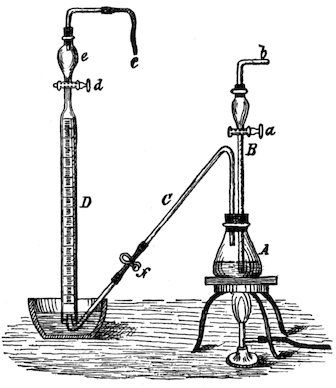
Figure 68.
Apparatus by Sachsse and Becker.
371. Method of Sachsse and Becker.[236]—Ferric oxid (not
as silicate) in soils can be estimated by reducing with hydrogen,
and measuring the hydrogen which is evolved by the action of
the reduced iron on an acid. The sample of soil is weighed in
a platinum boat, the boat put
into a wide glass tube and
heated in a stream of dry
hydrogen. While this is
going on, water is boiled in
the flask A (see Fig. 68) from
which the stopper has been
removed, to drive out the air.
When the reduction of the
ferric oxid is complete, the
boat is slipped out of the tube
into the flask without interrupting
the hydrogen evolution.
In order to accomplish
this without allowing the
reduced iron to come in contact
with the air the flask is inclined, the end of the glass tube
inserted until it is covered with water and the boat is then
dropped beneath the water. The flask is closed with a cork
provided with a funnel tube, B, and a delivery tube C; the tap a
is opened, and tube b connected with a carbon dioxid apparatus
from which the gas is passed into A until all the air is displaced.
This point is determined by filling the burette D with
potash-lye by aspiration at C and allowing the escaping gas
from C to enter the burette as indicated in the figure. Any residual
gas in D is removed by aspiration at C and allowing the
potash-lye in e to enter in its place. The end of the tube C is
now placed under the measuring tube D, and the clamp f opened
and the tap a closed. The funnel is filled with dilute, boiled sulfuric
acid, the cork of b replaced and connected with the carbon
dioxid apparatus. The burner under A is lighted and acid let
in. By continued boiling, all the hydrogen is driven into D, the
394carbon dioxid being absorbed. The measuring tube is then
placed in a tall cylinder of water, the volume of gas read and
reduced to 0° and 760 millimeters barometric pressure. To be
certain that all carbon dioxid is absorbed, some fresh potash-lye
may be introduced into D by carefully opening d. The iron
is then computed from the volume and weight of the hydrogen
by the formula (1) Fe + H₂SO₄ = 2H + FeSO₄.
If the substance analyzed contains iron silicates, these may be
partly decomposed with formation of ferrous sulfate, according to
the reaction (2) 2Fe + Fe₂(SO₄)₃ = 3FeSO₄. This will redissolve
a part of the metallic iron and yield ferrous oxid. In this
case the contents of the flask are cooled in an atmosphere of
carbon dioxid, made up to 500 cubic centimeters, of which
250 cubic centimeters are quickly filtered and titrated with permanganate.
In order to properly distribute the iron in harmony
with its previously existing states the following computations
may be made:
| Represent the |
ferrous oxid corresponding to formula |
(1) by x |
| and that |
„ „ „ |
(2) by z |
| and that |
found by titration with permanganate |
by a. |
We have then the equation x + z = a. Since seventy-two
parts by weight of ferrous oxid formed by formula (1) are
equivalent to two parts by weight of hydrogen, x parts of ferrous
oxid would set free x
32 parts of hydrogen; and this corresponds
to the hydrogen found in D; viz., b.
If a = ¹⁄₃₆ then by solving the equations: Z = a − 36b and
X = 36b. The ferrous oxid arising according to formula (2),
however, is derived in such a way that only one-third of it
corresponds to metallic iron. Then: X + (⅓)z = (⅓)a + 24b.
For computing the total ferric oxid reduced by hydrogen there
must, therefore, be added twenty-four parts by weight of hydrogen
for one-third of the ferrous oxid found by titration with permanganate,
and this quantity of ferrous calculated to ferric oxid.
Some silicates, such as the micas, give ferrous oxid with hot dilute
sulfuric acid. A correction for this is made by making one or
more determinations without previously reducing with hydrogen.
The method of procedure above described appears to be capable
of giving in an easily attainable manner some valuable indications
395of the state in which iron exists in a soil. While plants
do not use any notable quantity of iron during their growth
nevertheless its physiological importance is unquestioned. The
chief points of difficulty to be considered are found in the changes
which the iron may undergo even while heating in a stream of
hydrogen, and the practical difficulties of obtaining carbon
dioxid entirely free of air. The latter difficulty may be overcome
by making blank experiments with carbon dioxid alone
and estimating the volume of residual gas. The total volume
of hydrogen obtained is then to be diminished by the ascertained
amount.
In regard to the second point it is known that both ferrous
and ferric oxids when ignited with hydrated silicates partly
decompose and form new silicates. Care should therefore be
taken not to carry the temperature too high during the process
of ignition.
372. Carnot’s Method for Estimating Phosphoric Acid in
Soils.—Carnot[237] proposes the following procedure for the estimation
of phosphoric acid in soils. The principle of this method
depends upon the isolation of silica by the double precipitation
of phosphomolybdate.
Ten grams of the sifted soil, dried at 100°, are charred if
organic matter be present. The charred mass is next moistened
with water and afterwards with nitric acid, until the carbonates
are decomposed. Afterwards the mass is digested with ten
cubic centimeters of nitric acid for two hours at about 100°, with
frequent stirring and the addition of fresh acid, from time to
time, to replace that which has been evaporated. After filtering
and washing with hot water the filtrate is evaporated to a volume
of fifty cubic centimeters and treated with five cubic centimeters
of concentrated nitric acid and half a gram of crystals of chromic
acid. After covering the dish with a funnel to return condensed
vapors its contents are heated to the boiling point for half an
hour. At the end of this time five grams of ammonium nitrate
are added and afterwards fifty cubic centimeters of molybdate
solution and the mixture kept at a temperature of about 100° for
an hour. The precipitate obtained is washed twice by decantation
with water containing one-fifth of its volume of ammonium
396molybdate solution. It is then dissolved in thirty cubic centimeters
of ammonia diluted with an equal bulk of warm water.
The solution and the washings should measure eighty cubic
centimeters and the ammonia therein is neutralized with nitric
acid, keeping the temperature below 40°. When the yellow precipitate
formed ceases to redissolve on stirring, a mixture of
three cubic centimeters of pure nitric acid and five cubic centimeters
of water is added, together with the same quantity of
molybdate solution. The precipitate is brought upon a filter,
washed first with water containing one per cent of nitric acid
and finally with a little pure water, and dried at 100° and
weighed. The weight of the precipitate multiplied by the factor
0.0373 gives the quantity of phosphoric acid. The object of the
second precipitation is to relieve the process of the necessity of
rendering the silica insoluble, as the presence of silica in the
solution as above treated does not interfere with the complete
precipitation of the phosphate. This was proved by the author,
by the introduction of considerable quantities of sodium silicate
and these were found not to interfere with the accuracy of the
operation.
The results are as accurate as those obtained by the methods
of the consulting committee of the agricultural stations. The
coefficient employed; viz., 0.0373, is not the same as that recommended
by the committee; viz., 0.043. The committee, however,
itself has recognized the inaccuracy of the latter number.
The composition of the compound obtained by double precipitation
according to Carnot is P₂O₅24MoO₃3(NH₄)₂O + 3H₂O.
373. Method of the Halle Experiment Station.—The
available or easily soluble phosphoric acid in soils is estimated
by Maercker and Gerlach, as follows:[238]
Sixty grams of the air-dried soil as prepared for analysis,
are placed in an erlenmeyer with 300 cubic centimeters of
two per cent citric acid solution and digested for twenty-four
hours in the cold. It is necessary in this time to shake the flask
four or five times and to put the stoppers in loosely in order to
allow the escape of any evolved carbon dioxid. Of this mixture
200 cubic centimeters are filtered and evaporated in a 300 cubic
centimeter dish to dryness. There remains, in most cases, a
397sirupy-like mass from which even by strong heating the silica
is not completely separated. In order to reach this result
the residue is treated with twenty cubic centimeters of concentrated
sulfuric and five cubic centimeters of fuming nitric acid
and heated over a bunsen. As soon as the appearance of
foam denotes the beginning of the reaction the lamp must be
removed. With strong foaming and the evolution of red-brown
vapors the citric acid is completely oxidized. After the
reaction is ended the contents of the dish are heated for about
fifteen minutes over a small flame so that a continuous, yet not
too violent evolution of sulfuric acid fumes takes place. After
the silicic acid and the greater part of the lime have been separated
in this way the contents of the dish are diluted with water,
stirred with a glass rod, washed into a 200 cubic centimeter
flask, cooled, filled up to the mark, and filtered. From the filtrate
100 cubic centimeters, corresponding to twenty grams of
the earth, are taken, made slightly alkaline with ammonia,
acidified by a few drops of hydrochloric acid, and after cooling
treated with fifty cubic centimeters of the citrate solution and
twenty-five cubic centimeters of the magnesia mixture. The
complete separation of the precipitate requires about forty-eight
hours and shaking of the precipitate is not necessary.
374. Estimation of total Phosphoric Acid in Soils.—In the
method used at the Halle Station[239] twenty-five grams of
the soil sample are boiled with twenty cubic centimeters of
nitric acid and fifty cubic centimeters of concentrated sulfuric
acid for half an hour. With very clayey soils only half the quantity
of the sample mentioned above is used in order to avoid the
too great accumulation of soluble alumina. The oxidation of
the organic substances of the soils must be carried on at a moderate
heat to avoid foaming. During the boiling, the flask is to
be often shaken to prevent the soil constituents from accumulating
too firmly at the bottom. The total volume is finally made
up to 500 cubic centimeters.
For the estimation, 100 cubic centimeters of the solution, corresponding
to five (or two and a half) grams of the soil, are
taken. In order to nearly completely saturate the acid, the solution
is treated with twenty cubic centimeters of twenty-four per
398cent ammonia, care being taken that the precipitate of iron and
alumina which is formed is again completely dissolved. The
solution is cooled and treated with fifty cubic centimeters of the
citrate solution, and then with twenty cubic centimeters of ammonia
of above strength, and precipitated with the magnesia mixture.
The filtration of the precipitate should not be made for
at least forty-eight hours, during which time the flask should be
often shaken to prevent the attachment of ammonium magnesium
phosphate to its sides and bottom.
A detailed description of the citrate method for estimating
phosphoric acid will be found in the chapter devoted to this
subject under fertilizers.
375. French Method for Phosphoric Acid.—Phosphoric acid
is found in the soil principally in combination with alumina and
iron oxid, with organic matters, or with lime and magnesia.
Whatever may be the state in which it is found all the phosphoric
acid, with the exception of that which enters into the constitution
of insoluble mineral particles, can be brought into
solution by acids and determined by some of the approved methods.
This method of solution, therefore, is capable of determining
very accurately the total proportion of phosphoric acid in the
soil, but it is incapable of rendering account to us of the state in
which the phosphorus is found and of its aptitude to be utilized
by plants.
The estimation of soil phosphorus, as recommended by the
French Commission, is carried on in the following way:[240]
Twenty grams of the earth are submitted to ignition in a muffle
heated to the temperature of redness but not higher. This calcination
eliminates the organic materials, whose intervention in
subsequent reactions might be able to prevent the precipitation
of a part of the phosphoric acid. The calcined earth is placed
in a capsule of about eleven centimeters diameter and saturated
with water. There is then added in small quantities, as long as
effervescence is produced, nitric acid of 36° baumé. When the
effervescence has ceased, after thorough shaking and the addition
of a new quantity of acid, it will be found that the whole of the
calcium carbonate in the soil has been decomposed. It is necessary
then to proceed to the solution of the phosphoric acid by
399adding twenty cubic centimeters of nitric acid and heating on
the steam-bath for five hours, shaking from time to time, and
avoiding complete desiccation. At the end of this time the
whole of the phosphoric acid has entered into solution. It is
taken up by warm water, filtered, and the insoluble residue
washed with small quantities of boiling water. But from the
solution obtained, which holds in addition to phosphoric acid,
some oxid of iron, alumina, lime, magnesia, etc., it is necessary to
separate the silica which has passed into solution. For this
purpose the mass is evaporated to dryness on a sand-bath, heating
toward the end of the operation with precaution and not allowing
the temperature to pass beyond 110°–120°. In these conditions
there is obtained a magma which sometimes remains quite sirupy
when the earth is very highly impregnated with calcium carbonate,
but in which the silica is insoluble. It is indispensable that
it be eliminated wholly because it would introduce grave errors
into the results, as will be seen later on. If the temperature be
carried too high during the desiccation this silica would react
upon the earthy salts and alkaline earths forming silicates and
it would be found ultimately again in solution. The application
of a too high temperature would also render somewhat insoluble
in nitric acid the iron and aluminum oxids, and these would retain
small quantities of phosphoric acid. The desiccation, therefore,
requires to be conducted with great precaution. When it is
accomplished there are placed in the capsule five cubic centimeters
of nitric acid and five cubic centimeters of water, and the
whole heated on the sand-bath until the entire amount of iron
oxid is dissolved, that is to say, until there is no ferruginous
deposit persisting in the liquid. The solution is then filtered
and washed with small quantities of boiling water in such a way
that the total volume of the filtrate will not exceed twenty-five to
thirty-five cubic centimeters. Afterwards there are added twenty
cubic centimeters of ammonium nitromolybdate and the whole is
left at rest for twelve hours at the ordinary temperature. At the
end of this time the whole of the phosphoric acid is precipitated
in the form of ammonium phosphomolybdate. In order to be
certain that an excess of nitromolybdate has been used in the
precipitation, which is indispensable to the total precipitation
400of the phosphoric acid, a few cubic centimeters of the
filtrate are removed by means of a pipette and are mixed
with their own volume of the ammonium nitromolybdate. If, at
the end of an hour or two, no precipitate is formed the operation
can be regarded as terminated.
In order to collect and weigh the ammonium phosphomolybdate
some precautions are necessary. Two smooth filters are
used, one of which serves as a counter-weight for the other
on the balance. One of these filters is placed within the other
and the phosphomolybdate is collected upon the inner filter. The
part of the phosphomolybdate adhering to the precipitating jar
is detached by the aid of a stirring rod, one of the ends of which
is covered with a piece of rubber tubing. The washing is accomplished
with very small quantities of water containing five per
cent of its volume of nitric acid. When all of the precipitate is
collected upon the filter and the washing is terminated a few
drops of water are thrown upon the upper borders of the filters;
this is done to displace the acid liquor which has been used in
washing. The filters are then carried to the drying oven where
they are dried at a temperature not exceeding 90°. The application
of a higher temperature would decompose the ammonium
phosphomolybdate and lead to results which would be too low.
After the drying is completed the two filters are separated and placed
upon the arms of the balance and the increase in weight corresponds
to the ammonium phosphomolybdate. This, multiplied by the
coefficient 0.043, (see page 404) gives the quantity of phosphoric
acid contained in the weight of the soil which has been employed.
The ammonium phosphomolybdate is pure if all the silica has
been eliminated, but if a part of that has remained in solution it
would furnish an ammonium silicomolybdate whose weight would
be added to that of the phosphomolybdate. The elimination of
the silica, therefore, should be made with the greatest care.
Different processes have been proposed in order to determine
the forms under which phosphoric acid should be regarded as
most assimilable. Deherain has proposed acetic acid as a solvent
for this purpose. Other scientists, oxalic or citric acid, and
the ammonium oxalate or citrate. The solubility of phosphoric
acid in these different reagents gives some information in regard
401to its state, but the relations which exist between this solubility
and the assimilability of the acid have not yet been fixed.
Preparation of the Ammonium Nitromolybdate.—One hundred
grams of molybdic acid are dissolved in 400 grams of ammonia
with a density of ninety-five. The mixture is filtered, and the
filtered liquor is received drop by drop in 1,500 grams of nitric
acid of one and two-tenths density, constantly stirring. This
mixture is left standing for some days in an unexposed locality,
during which time a deposit is formed. The clear part is
decanted and used.
The above method of the French chemists unfortunately
attempts to determine the phosphorus content of the soil by
weighing the yellow precipitate and using an empirical factor
for the calculation, a factor which is probably too high.
Experience has shown that at this point it is far more accurate
to continue the process by dissolving the yellow precipitate, and
subsequently obtaining the phosphoric acid in combination with
ammonia and magnesia, or according to the process of Pemberton
the content of phosphoric acid in the yellow precipitate might be
determined by titration. In regard to the latter method which
will be given in full under fertilizers, it may be said that it has been
found quite accurate by several analysts, although it is difficult
to see how a precipitate which is so variable in its constitution
as to be estimated with little safety by weight may yet be capable
of rather exact determination by titration.
376. Petermann’s Method for the Estimation of the Phosphoric
Acid Soluble in Alkaline Ammonium Citrate.[241]—From
twenty-five to fifty grams of the sample of soil are triturated
with 100 cubic centimeters of alkaline ammonium citrate
and placed in a flask of 250 cubic centimeters capacity, and
allowed to digest for one hour at a temperature of from 35°–40°.
After cooling, make up to the mark, filter, take 200 cubic centimeters
of the filtrate, evaporate to dryness on a sand-bath in a
platinum dish, heat lightly at first, and afterwards to a higher
temperature. Take up the residue of the incineration with
water and about two cubic centimeters of nitric acid, heat a few
minutes gently, filter into a bohemian flask and precipitate with
fifty cubic centimeters of ammonium molybdate solution, and
estimate the phosphoric acid in the usual way.
402377. Method of Dyer for Total and Assimilable Phosphoric
Acid.—For the determination of phosphoric acid, soluble in citric
acid, secured as described in paragraph 328, 500 cubic centimeters
of the filtrate obtained, corresponding to fifty grams of the
soil, are evaporated to dryness in a platinum dish, gently ignited,
extracted with hydrochloric acid, again evaporated, ignited and
extracted, and the phosphoric acid determined as below in the
method applied to the hydrochloric acid extract of the soil itself.
The total phosphoric acid is determined in each case in ten
grains of the dried soil and also in twenty-five grams, the mean
of the two results being taken. The numbers obtained in each
case are, however, all but identical, the difference in the duplicate
percentages being in most cases only a small one in the
third place of decimals.
The soil is incinerated and digested with hydrochloric acid,
and evaporated to dryness, redigested with acid, filtered, and
washed. The filtrate and washings are concentrated to a small
bulk, and treated, in the cold, with excess of a solution
of ammonium molybdate in nitric acid. After standing forty-eight
hours, the liquor is decanted through a filter, the precipitate
washed several times by decantation, first with dilute
acid, then with pure water in very small doses, and finally transferred
to the filter and washed free from excess of acid. The
ammonium phosphomolybdate is then dissolved in ammonia,
evaporated to dryness in a platinum capsule, and dried to constant
weight at 100°. The residue contains three and one-half
per cent of its weight of phosphoric acid. This is the method of
Hehner; and for determining small quantities of phosphoric acid,
such as occur in soils or in solutions of iron and steel, is in the opinion
of Dyer very much to be preferred to the old-fashioned method of
conversion into magnesium ammonium phosphate. The solubility
of the yellow precipitate in the small quantity of wash-water used
is in most cases negligible. As a matter of fact, the quantity of
wash-water used in these analyses was found capable of dissolving
only 0.005 gram of precipitate, of which only 0.00017 is
phosphoric acid, making an error of 0.0017 per cent on the soil
if ten grams be used, or of only 0.0006 if twenty-five grams be
used. In the citric acid experiments the solution from fifty
403grams of soil is used, when the error due to solubility of precipitate
shrinks to 0.0003 per cent. The correction for this solubility
is, however, made in each case.
It may be observed that the method of Hehner is not applicable
if the molybdic solution be added to a hot liquid, since, in
that case, some molybdic acid is sure to crystallize with the
yellow precipitate. Moderate and careful warming to about 35°
hastens precipitation, but it is preferable, when speed is not a
special object, to precipitate cold, and leave the beaker standing
at the laboratory temperature over night, or longer if the quantity
to be determined is very minute.
378. Methods of Berthelot and André.—The phosphorus in
the soil may be found under three forms; viz.,
1. Phosphoric acid in phosphates.
2. Phosphoric acid in ethers which alkalies decompose slowly
and oxidizing agents destroy with regeneration of phosphoric
acid.
3. Organic compounds or mineral compounds of phosphorus
which are resolved by alkaline solutions with formation of
phosphoric acid and which are not reduced to this state by the
reagents employed in the wet way of decomposition except after
a contact of indefinite length and uncertainty.
It is, therefore, seen that the employment of oxidizing agents
for the valuation of phosphoric acid in soils and vegetables is not
a very reliable procedure. The same is true after incineration
by which more or less phosphorus may be lost or rendered
insoluble in acids. The methods used by Berthelot and André
for the estimation of these forms of phosphorus are as follows:[242]
Total Phosphorus.—The sample is at first oxidized by a current
of air near a red heat and the vapors are conducted over a column
of sodium or potassium carbonate at the same temperature.
The combustion is finished in a current of pure oxygen. All
phosphorus compounds, even those which are volatile, are by this
treatment converted into phosphoric acid. The part of the acid
held by the carbonate is to be determined with the non-volatile
portions.
A less certain method of oxidation consists in mixing the
material with potassium nitrate and carefully throwing it little
by little into a red hot platinum crucible.
404Estimation of the Phosphoric Acid Pre-existing as Phosphates.—The
sample is treated with a cold dilute acid incapable of exercising
an oxidizing or decomposing effect on the ethers. The
dissolved acid is precipitated and weighed in the usual way.
The precipitate first obtained should be ignited and the phosphoric
acid taken up and reprecipitated. This is necessary to
remove any organic matter or silica which the first precipitate
may contain.
Estimation of Ethereal Phosphoric Acid.—The sample is boiled
for some time with a non-oxidizing acid or with a concentrated
solution of potash. The phosphoric acid dissolved represents
that which was present as phosphates and as ethers. From this,
deduct that portion pre-existing as phosphates and the remainder
represents the part derived from the ethereal compounds.
Estimation of Phosphorus in Organic Compounds and Special
Minerals.—From the total phosphoric acid deduct that found as
phosphates and ethers. The difference represents the quantity
combined as noted in the caption. Illustration.
A sample of soil contained:
| Total phosphoric acid |
0.292 |
per cent. |
| |
|
|
| Of this, pre-existing as phosphoric acid |
0.109 |
„ |
| As ethereal phosphoric acid |
0.074 |
„ |
| As organic phosphoric acid |
0.109 |
„ |
| |
|
|
| Sum |
0.292 |
„ |
379. Method Used at the Riga Station.—In the method
pursued at the experimental station at Riga[243] the organic matter
in the fine earth is first destroyed by igniting twenty-five grams
in a muffle. The ignited residue is placed in a 250 cubic centimeter
erlenmeyer and digested with 150 cubic centimeters
of ten per cent hydrochloric acid. The digestion is continued
for forty-eight hours with frequent shaking. The filtrate is
evaporated to dryness in a porcelain dish to separate any dissolved
silica. The residue is taken up with dilute hot nitric
acid, filtered, and the phosphoric acid precipitated with ammonium
molybdate. The final weighing is made as magnesium
pyrophosphate, following the usual procedure in respect of precipitation
and washing. Experiments show that approximately
ninety-five per cent of the phosphoric acid are obtained by one
405extraction and five per cent by a second, conducted exactly as
the first. Thoms draws the following conclusions from a long
series of determinations:
(1) For the simple purpose of determining the need of a soil
for phosphorus fertilizer a single extraction with ten per cent
hydrochloric acid is sufficient. The difference between the first
and second extraction; viz., five to six per cent is too small to
be of any value from a practical point of view.
(2) A soil which has been ignited until organic matter is
destroyed gives up to the hydrochloric acid solvent about fourteen
per cent more phosphoric acid than a non-ignited sample
would.
(3) The mean temperature in the flask during extraction on
a steam-bath is 74°.
380. Method of Hilgard.[244]—The weighed quantity of soil
(usually from three to five grams) is ignited in a platinum crucible,
care being taken to avoid all loss. The loss of weight after full
ignition gives the amount of chemically combined water and
volatile and combustible matter.
The ignited soil is now removed to a porcelain or glass beaker,
treated with four or five times its bulk of strong nitric acid,
digested for two days, evaporated to dryness, first over the water-bath
and then over the sand-bath, moistened with nitric acid,
heated and treated with water. After standing a few hours on
the water-bath it is filtered and the filtrate is evaporated to a very
small bulk (ten cubic centimeters) and treated with about twice
its bulk of the usual ammonium molybdate solution, thus precipitating
the phosphoric acid. After standing at least twelve
hours, first at a temperature of about 50°, it is filtered and washed
with a solution of ammonium nitrate acidified with nitric acid.
The washed precipitate is dissolved on the filter with dilute
ammonia water. After washing the filter carefully, the ammoniacal
solution is treated with magnesia mixture, by which the
phosphoric acid is precipitated. After allowing it to stand
twenty-four hours it is filtered, washed in the usual way, dried,
ignited, and weighed as magnesium pyrophosphate, from which
the phosphoric acid is calculated. When a gelatinous residue
remains on the filter after dissolving the phosphomolybdate with
406ammonia it may consist either of silica not rendered fully insoluble
in the first evaporation, or, more rarely, of alumina containing
phosphate. It should be treated with strong nitric acid, and the
filtrate with ammonium molybdate; any precipitate formed is,
of course, added to the main quantity before precipitating with
magnesia solution.
381. Separation of Phosphoric Acid From Iron and Alumina.—The
following methods are suggested by Wolff[245] for the
complete separation of the phosphoric acid from the iron and
alumina in soil analysis, where large quantities of these bases are
found in solution:
1. After the separation of the greater part of the iron and
alumina the phosphoric acid is precipitated from the solution in
nitric acid by molybdic acid. The process is carried on as follows:
The acid extract is heated in a flask to boiling and the iron
oxid completely reduced by the gradual addition of small particles
of sodium sulfite. While still warm the free acid is neutralized
with soda-lye, and ammonia added until the ferrous
hydroxid and the aluminum hydroxid are completely separated.
Acetic acid is now added in excess and until about four-fifths of
the whole precipitate have passed again into solution. Then,
after boiling for a moment, the whole is quickly filtered through
a large filter with a cover, and the contents of the filter finally
washed slightly. All the phosphoric acid is thus obtained in
combination with some alumina and a very little iron. Nearly
the whole of the iron and the larger part of the alumina, by this
precipitation, are found in the filtrate and therefore cannot disturb
the estimation of phosphoric acid in succeeding portions.
The filter is now filled with boiling water and a little nitric acid
added. The precipitate is dissolved and received in a beaker.
The precipitation of the phosphoric acid is then accomplished
by ammonium molybdate in the presence of nitric acid.
After twenty-four hours all the phosphoric acid is thus precipitated
and the precipitate is free from iron.
2. By the method of Schulze[246] the iron is completely, and the
alumina, with the exception of a small quantity, separated, and
the precipitation of the phosphoric acid is accomplished either
by the addition of a small quantity of tartaric acid and afterwards
407magnesium sulfate, or directly by means of ammonium molybdate.
The principle of the separation depends on the fact that
when the hydrochloric acid is nearly neutralized with soda or
ammonia, and the solution boiled after treatment with ammonium
formate, the greater part of the alumina remains in solution.
The precipitate is quickly filtered, washed with hot water, dried,
taken from the filter and fused in a silver crucible with pure
caustic alkali, either soda or potash. On solution and boiling
with water, the iron is completely separated from the phosphoric
acid, and from the small quantity of the alumina present the
precipitation of the phosphoric acid can now be accomplished,
either by saturation of the alkaline solution with hydrochloric
acid and the direct addition of the magnesia solution after the
addition of a little tartaric acid and ammonia, or after the addition
of nitric acid by ammonium molybdate.
382. Estimation of Phosphoric Acid in Muck and Peat
Soils.—The amount of phosphoric acid obtained by extraction
with hydrochloric or sulfuric acid is markedly less in these soils
than that obtained after the incineration of the sample, as pointed
out by Schmoeger.[247] This is due to the fact that the phosphoric
acid is ordinarily combined in the form of nuclein. Extraction of
the soils with ether shows that it is not present in the form of
lecithin. The nuclein products, as is well known, are decomposed
by heating in presence of a liquid at a high temperature
for some time. The heating can either take place in an autoclave
or in sealed glass tubes. The method is as follows:
The sample of soil is thoroughly rubbed up in a mortar with
water, and then hydrochloric acid added until one gram of the
water-free peat is suspended in about ten cubic centimeters of
twelve per cent hydrochloric acid. The sample is placed in a
glass or porcelain vessel in an autoclave and heated to 140°–160°
for ten hours. The phosphoric acid is then determined in the
extract in the usual way. The percentage of phosphoric acid
determined in this way is found to correspond to the amount
determined by the incineration of the substance.
The total phosphoric acid is determined in peats by the incineration
of the sample and the estimation of the phosphoric acid
in the ash. The phosphoric acid soluble in hydrochloric acid
408solution is determined by extracting a sample of the soil with
twelve per cent hydrochloric acid in the usual way. The difference
between this and the total is calculated as phosphoric acid
in organic compounds.
Or the total phosphoric acid is determined by treating the soil
with twelve per cent hydrochloric acid, in the proportion of one
gram of soil to ten cubic centimeters of the acid, and the solution
is placed in an autoclave and heated for ten hours to 140°–160°,
as above described. The phosphoric acid is then determined by
the usual method. The difference between the total phosphoric
acid as thus determined and the phosphoric acid soluble in
hydrochloric acid is calculated as phosphoric acid in organic
compounds.
383. Method of Goss.—On account of the length of time
required to determine the phosphoric acid in soils by the usual
methods, Goss[248] has proposed the following modification which
in his hands has given satisfactory results:
Weigh ten grams of the air-dried soil, which has been sifted
through a one millimeter mesh sieve, and transfer to a pear-shaped,
straight necked, kjeldahl digestion flask, which has
been marked to hold 250 cubic centimeters. Add approximately
seven-tenths gram of yellow mercuric oxid and twenty to
thirty cubic centimeters of concentrated sulfuric acid, as for the
determination of nitrogen. Twenty cubic centimeters of acid
are nearly always sufficient, but in the case of unusually finely
divided clay soils containing little or no sand it is necessary to
use thirty cubic centimeters to prevent caking of contents of
flask. In doubtful cases twenty cubic centimeters of acid should
first be added and at the end of five or ten minutes, if contents
show a tendency to cake, ten cubic centimeters more should be
introduced. Thoroughly mix the contents of the flask by shaking,
place on a suitable support over a burner, boil for one hour, cool,
add about 100 cubic centimeters of water, five cubic centimeters
of concentrated hydrochloric acid, and two cubic centimeters of
concentrated nitric acid, boil gently for two minutes to oxidize
iron, cool, make up to volume, and filter through a dry folded
paper until perfectly clear. In order to secure a clear filtrate
it will usually be found necessary to pour the first portion of the
409filtrate back through the paper three or four times. Transfer
100 cubic centimeters of the filtrate to an ordinary flask of about
450 cubic centimeters capacity, add strong ammonia until a permanent
precipitate forms, then six or eight cubic centimeters of
nitric acid to dissolve the precipitate, and boil until clear. In the
case of many soils it is not absolutely necessary to oxidize with
hydrochloric and nitric acids, as a clear solution can be secured
at this point without further oxidation. In the case of some soils,
however, and especially in subsoils, the solution cannot be cleared
up even by prolonged boiling with nitric acid, but if the solution
have been previously oxidized, a clear solution can be secured
without any difficulty whatever. Remove the flask from the lamp
and after two minutes add seventy-five cubic centimeters of
molybdate solution, place the unstoppered flask in an open
water-bath kept at a temperature of 80° for fifteen minutes,
shaking vigorously four or five times while in the bath;
then remove, let stand ten minutes to allow precipitate
to settle, filter through a nine centimeter filter avoiding too strong
a pressure at first, wash the flask and precipitate thoroughly with
ammonium nitrate solution, place the flask in which the precipitation
was made under the funnel, shut off pump and close all valves
to filtering jar to form an air-cushion and prevent too rapid filtration,
fill paper two-thirds full of hot water, add a few cubic centimeters
of strong ammonia, aid solution, if necessary, by stirring
precipitate with a small glass rod.
As pointed out by Hilgard, aluminum is sometimes carried
down with the phosphoric acid upon precipitating with molybdate
solution, in which case some of the phosphoric acid will not
be dissolved in the treatment with ammonia. This will be indicated,
first, by the appearance of a white precipitate upon dissolving
the yellow precipitate in ammonia; and, second, by the
difficulty experienced afterward in washing. If such a precipitate
be present in any appreciable quantity, proceed as follows:
After washing out all the ammoniacal solution in the usual manner,
place a small beaker under the funnel, close all valves, fill
the filter one-third full of hot water, add the same amount of concentrated
hydrochloric acid, proceed as if dissolving phosphomolybdate
in ammonia, and receive final solution and washings in
410flask used. As soon as the yellow precipitate is dissolved open the
valve to filtering jar but do not turn on the pump; after the solution
has all passed through rinse the filter once with a small
amount of hot water; after the last portion has passed through
remove the flask and place a No. 1 lipped beaker under
the funnel and heat the solution in the flask to boiling. If
the solutions have not been oxidized, a blue color is sometimes
present upon dissolving the yellow precipitate in ammonia.
This can be discharged by boiling the ammoniacal solution for a
minute or two and shaking at the same time. Again pour
the solution through the filter, avoiding use of pump at
first, otherwise loss from spattering is likely to ensue, wash out
flask and filter with a small amount of hot water, (the total filtrate
should not exceed fifty cubic centimeters), add hydrochloric
acid to contents of beaker while hot, until yellow color
appears, then add a few drops of ammonia until solution clears,
cool, add fifty cubic centimeters of filtered magnesia mixture
from a burette, a drop at a time with constant stirring, let stand
fifteen minutes, add twenty cubic centimeters of strong ammonia
specific gravity nine-tenths, let stand over night, filter, wash
precipitate with dilute ammonia, dry, ignite intensely over blast-lamp
for ten minutes, cool in desiccator and weigh Mg₂P₂O₇
secured.
Time of Digestion.—Experience has shown that very little
phosphoric acid is extracted from the sample by digestion with
sulfuric acid after the first thirty minutes.
Time Required to Precipitate Phosphomolybdate.— When the
yellow precipitate is obtained according to the method of Goss
practically the whole of it will be thrown down in five minutes.
Agreement with Standard Methods.—Comparative tests of the
Goss method against standard methods have shown that it gives
almost identical results with them. The variations were never
more than 0.02 to 0.03 per cent.
While this method has not been sufficiently tried to receive
unconditional recommendation it possesses merits which entitle
it to the attention of analysts.
384. Estimation of the Sulfuric Acid.—Sulfuric acid is
generally present in small proportions in soils. Since the plants
411have need of sulfur it is proper to inquire into the presence of the
compound which is its principal source. It is in combination with
lime that sulfuric acid exists almost always. In addition to this
there is also some sulfur combined with the organic matter of
the soil.
By digesting a soil for six hours with hot, concentrated nitric
acid the sulfates are dissolved, and there is transformed into sulfuric
acid an important part of the sulfur which is combined with
the humic substances. The quantity of soil to be operated upon
should be about fifty grams.
After filtering and washing with hot water the filtered liquor
is collected, in the French Commission method,[249] in a flask and
carried to boiling, and five cubic centimeters of a saturated solution
of barium chlorid or sufficient to be in slight excess are
added. The boiling is continued for some minutes and the flask
is allowed to stand for twenty-four hours. The filtrate is
received upon a filter and washed with boiling water. The
filter is dried and incinerated, allowed to cool, and as there
may have been a slight reduction of the sulfate a few drops of
nitric acid are added and a drop of sulfuric acid. It is now
evaporated to dryness on a water-bath, heated to redness for a
few moments, cooled and weighed. The weight of the barium
sulfate obtained multiplied by 0.3433, gives the quantity of
sulfuric acid obtained from the fifty grams of soil.
If it is desired to estimate only the sulfur which exists in the
form of sulfate it is necessary to treat the soil with hydrochloric
acid in a very dilute state, heating for a few moments only and
afterwards precipitate by barium nitrate. If, on the other hand,
it is desired to estimate the total sulfur which is sometimes of
great interest, it is necessary to employ the process of Berthelot
and André.
385. Method of Berthelot and André.—Sulfur may exist in
the soil in three forms; viz.,
1. Mineral compounds, consisting generally of sulfates and
sometimes of sulfids.
2. Sulfur, existing in ethereal compounds or their analogues,
as in urine.
3. Organic compounds containing sulfur.
412Estimation of Total Sulfur.—The principle on which this operation,
as described by Berthelot and André, rests is that already
described for phosphorus; viz., oxidation in a current of oxygen
and passing the vapors over a column of alkaline carbonate at
or near a red heat.[250]
The ordinary methods of oxidation in the wet way give generally
inexact results.
Estimation of Sulfur Pre-existing as Sulfates.—The sample is
treated with cold, dilute hydrochloric acid. The filtrate is treated
with barium chlorid, the precipitate collected, dried, ignited,
washed with a mixture of sulfuric and hydrofluoric acids to
remove silica, and afterwards weighed as barium sulfate.
Estimation of Sulfur as Sulfids.—The sample is distilled with
dilute hydrochloric acid, and the hydrogen sulfid produced is
made to pass through an acidulated solution of copper sulfate in
such a way as to transform the sulfur in the hydrogen sulfid
into a sulfid, which is afterwards collected and weighed in the
usual way. The use of a titrated solution of iodin is not advisable
on account of the organic matter which may be present.
Estimation of Sulfur in Ethereal Compounds.—These compounds
can be decomposed by boiling with a solution of potash or concentrated
hydrochloric acid. The resulting sulfuric acid is precipitated
with barium chlorid. Subtract from the sulfates thus
obtained those pre-existing as sulfates; the difference represents
the sulfur present in ethers.
Estimation of Sulfur in Other Organic Compounds.—This is
estimated indirectly by subtracting from the total sulfur that
present as sulfates, sulfids, and ethers.
386. Method of Von Bemmelén.—As Von Bemmelén[251]
observes, the estimation of sulfuric acid in soils presents a number
of difficulties. A small part of it can be present as sulfate insoluble
in water. In addition to this, there is always some sulfur in the
organic bodies present. If the soil is extracted with water then
the sulfuric acid can be estimated therein when only a trace of
humus substance has gone into solution. On the contrary, if
there is much humus substance in solution, and also iron oxid,
as is the case when the extraction is made with hydrochloric
acid, then both of these must be removed, otherwise the estimation
413is very inexact. By fusing the residue of the solution with
sodium carbonate and a little potassium nitrate the organic substance
is destroyed, and after treatment with water the iron oxid
is separated. If any sulfur has been dissolved in the organic
substance present, this is then oxidized to sulfuric acid. The
estimation of the sulfuric acid and of the sulfur, therefore,
remains unsatisfactory.
In a sample of clay from Java, which was rich in calcium carbonate,
but which contained no basic iron sulfate, there was found
the following percentages of sulfuric acid:
Exhausted in the cold with very weak hydrochloric acid, 0.04
per cent; the residue treated in the cold with concentrated hydrochloric
acid, the solution evaporated and fused with sodium carbonate
and potassium nitrate, 0.07 per cent; again, the residue
treated with aqua regia to oxidize the sulfur, the solution evaporated
to dryness, fused with sodium carbonate and potassium
nitrate, 0.14 per cent; in all 0.25 percent. A sample of the
same soil treated directly with aqua regia, and then evaporated
and fused as above, gave two-tenths per cent sulfuric acid. A
sample of the same soil ignited in a crucible with sodium carbonate
and potassium nitrate gave 0.16 per cent of sulfuric acid.
The difference between 0.04 and 0.07 per cent can be attributed
to the sulfur in the organic substance which was dissolved by
the concentrated hydrochloric acid; the quantity, however, is
too small to draw any safe conclusion. Possibly it might have
been that the very dilute hydrochloric acid did not dissolve all
of the sulfate. The quantity of sulfur combined in the organic
substance in the above soil may be derived from the following
equation; viz., 0.2–0.07
80 × 32 = 0.05 per cent of sulfur.
The estimation of the sulfur in a sample of soil from Deli was
carried on with still greater exactness by three different methods.
The quantities of hydrochloric acid, nitric acid, and sodium
carbonate employed were measured or weighed, and the minute
content of sulfuric acid therein estimated and subtracted from
the final results. The methods employed were as follows:
(A) Extraction with water and afterwards with very dilute
hydrochloric acid.
(B) Extraction with cold hydrochloric acid, one part to three
of water.
414(C) Extraction with aqua regia.
(D) Ignition with sodium carbonate and potassium nitrate.
(F) Ignition in a combustion tube with sodium carbonate in
a stream of oxygen.
The percentages of sulfuric acid obtained by the different
methods were as follows:
| (A) |
0.058 |
per |
cent. |
| (B) |
0.070 |
„ |
„ |
| (C) |
0.140 |
„ |
„ |
| (D) |
0.125 |
„ |
„ |
| (F) |
0.106 |
„ |
„ |
387. Method of Wolff.—In regard to the sulfuric acid
Wolff calls attention to the fact that in soils which have been
ignited, a larger quantity of this acid is found than in soils containing
humus.[252] This, doubtless, arises from the oxidation of
the organic sulfur. The following special method for determining
the sulfuric acid is therefore proposed:
Fifty grams of fresh air-dried soil are placed in a platinum
dish with a concentrated solution of pure sodium nitrate. After
drying, the heat is raised gradually to redness. In this way the
complete ignition of the humus present takes place. After cooling,
the mass is diluted with hydrochloric acid, with the addition
of a little nitric acid, and boiled. In the solution, the silicic acid
is first separated and the sulfuric acid estimated in the usual way
with barium sulfate.
388. Method of the Italian Chemists.—The determination
of the sulfuric acid is conducted as follows by the Italian
chemists:[253] The soil is completely extracted by diluted hydrochloric
acid and the sulfuric acid precipitated in the solution
with barium chlorid. If a soil is very rich in calcium sulfate it
should first be treated with a warm solution of sodium carbonate
to decompose the calcium sulfate, and the sulfuric acid determined
in the solution after having added hydrochloric acid.
389. Estimation of the Chlorin.—The estimation of the
chlorin is of great importance in certain cases. When this element
is lacking in the soil, which, however, is rare, certain
plants appear to suffer from its absence. The quality of the
forage plants in particular is influenced by it; but when the
chlorids are too abundant, which is a frequent case, they prevent
415or arrest completely the progress of vegetation. Salty soils are,
in general, completely sterile. In the proportion of one pound
in a thousand in the earth, sodium chlorid is to be regarded as
injurious. It is necessary, therefore, in analysis to take account
of two cases; viz., those of soils poor in chlorids and those of
soils rich in chlorids.
For soils poor in chlorids the French method directs that[254] 200
grams of the earth are to be washed on a filter with boiling
water. The liquor is evaporated to dryness and gently heated
to a temperature inferior to redness in order to destroy the
organic matter. The residue is taken up by small quantities of
water and to the filtered liquor the volume of which should not
exceed forty to fifty cubic centimeters are added ten cubic
centimeters of pure nitric acid and a sufficient quantity of silver
nitrate to produce a complete precipitation. The precipitate is
vigorously shaken and allowed to stand for a few hours in a
darkened locality. The precipitate is collected upon a double
filter and the silver chlorid, after proper desiccation, is weighed.
When the soil is rich in chlorids it is washed as has just been
described upon a filter. The wash-waters are made up to one
liter and fifty cubic centimeters, equivalent to ten grams of the
soil, are taken for analysis. This quantity is treated exactly as
described above.
390. Wolff’s Method of Estimating Chlorin in Soils.[255]—Three
hundred grams of the soil are treated with 900 cubic
centimeters of pure water containing a little nitric acid for forty-eight
hours with frequent shaking. Four hundred and fifty
cubic centimeters are then filtered and the clear liquid evaporated
to 200 cubic centimeters. The chlorin is then precipitated with
silver nitrate. The quantity obtained, corresponds to that found
in 150 grams of the air-dried soil.
A second method, Mohr’s, is as follows: Fifty grams of the
soil are placed in a platinum dish and moistened with a concentrated
solution of potassium nitrate, free from chlorin. The
mass is evaporated to dryness and gradually heated to a red heat.
After cooling it is moistened with water and washed into a
beaker and the solid mass quickly separated. The clear liquid
is poured off and the residue again washed with water. The
416clear liquid obtained is saturated with acetic acid, carefully
evaporated to dryness and after solution in water, filtration and
the addition of a little nitric acid, the chlorin therein is precipitated
by a silver nitrate solution, and the precipitate collected
and weighed as usual.
391. Method of Petermann.[256]—Chlorin in the soil is estimated
at the Gembloux station by digesting 1,000 grams of the
sample with two liters of distilled water with frequent shaking
for thirty-six hours. After allowing to stand for twelve hours
with the addition of one gram of powdered magnesium sulfate
to facilitate the deposition of suspended matter one liter of liquid
is siphoned and evaporated in a platinum dish with the addition of
a few drops of a solution of potassium carbonate free from chlorin
and nitric acid. The concentrated solution is filtered, washed,
and made up to 250 cubic centimeters. Take 100 cubic centimeters
of the solution add some nitric acid and precipitate the
chlorin with silver nitrate. The rest of the solution is reserved
for the estimation of nitrate.
392. Estimation of Silicic Acid.—Direct Estimation.—The
sample of soil in the method of Berthelot and André[257] is mixed
with two or three times its weight of pure sodium carbonate and
fused in a silver crucible until complete decomposition has taken
place. The residue is dissolved in water and dilute hydrochloric
acid. The silicates are decomposed by this treatment and the
solution is evaporated to dryness on the water-bath, and when
dry slightly heated. The silicic acid (silica) is by this treatment
rendered insoluble. It is collected on a filter, washed,
ignited, and weighed. The resulting compound should be
mixed with ammonium fluorid and sulfuric acid, and after
the disappearance of the silica the residue should be dried and
weighed. The loss in weight represents the true silica. The
loss in weight should be corrected by calculating the sulfates of
the alkalies back to oxids. This correction can be neglected
when the work has been carefully done, and the washing of the
original silica has been well performed.
Indirect Estimation.—The total silica may be estimated indirectly
by subtracting from the total weight of the sample the
sum of the weights of the other constituents resulting from the
417separate estimation of each of them after decomposing the sample
with hydrofluoric acid.
393. Simultaneous Estimation of Different Elements.—The
operations and processes for the estimation of each of the
elements have been described, but it is often best to carry on an
operation in such a way as to gain time by making a single
decomposition upon a quantity of soil of some considerable magnitude,
and using the results of the solution for the determination
of the different substances. From the operations already
described it will be easy to make a combination of methods by
which all or nearly all the important constituents in a soil may
be determined in a single sample. Of the various methods proposed,
that of the commission of the French agricultural chemists
may be taken as a type.[258] In the case of the estimation of
lime, potash, magnesia, and sulfuric acid, in which the operation is
carried on in a soil which is not incinerated, time may be saved
by digesting a considerable quantity of the soil with concentrated
nitric acid for a period of five hours. It is best to take 100
grams of the soil and increase proportionally the nitric acid.
The filtrate, after washing, is made up to one liter and thoroughly
shaken. From this amount of liquid, portions are taken
corresponding to the weights of soil upon which the operation
for the determination of each of the constituents would be conducted.
For example, for the estimation of lime in the case of
a very calcareous earth, ten cubic centimeters representing one
gram of the original sample, in the case of a soil poor in carbonates
100 cubic centimeters representing ten grams, and for
the estimation of potash, magnesia, and sulfuric acid 200 cubic
centimeters, representing twenty grams of the soil, should be
taken. This method avoids frequent weighings of the earth and
separate treatments thereof by the acid.
On the other hand, in the same portion of the solution, the
different elements can be estimated. For example, for the estimation
of the potash as has been indicated, in the place of precipitating
as a whole the sulfuric acid, lime, etc., and of afterwards
separating the magnesia in the sole aim of eliminating
these bodies, they can be collected separately and weighed, thus
securing at a single operation several determinations.
418At the end, some barium chlorid is added and if the barium
sulfate is then collected and weighed, the estimation of the sulfuric
acid is effected. To the filtrate there are afterwards added
some ammonia and ammonium carbonate to precipitate, at once,
the excess of barium and the iron and aluminum oxids, the
lime and the phosphoric acid. This separation being effected
the filtrate contains still the magnesia and the alkalies. The
first can be separated by carbonation by means of oxalic acid,
collected, and weighed. Finally the potash itself can be estimated
in the state of perchlorate. It has thus been possible in
the same suite of operations to estimate in a given quantity of
the liquid, the sulfuric acid, the magnesia, the lime, and the
potash.
394. Estimation of Kaolin in Soils.—True kaolin is a
hydrated aluminum silicate, having the formula H₄Al₂Si₂O₉. This
substance is, even in concentrated hydrochloric acid, almost completely
insoluble. It contains, theoretically, 13.94 per cent of
water of combination. The following methods, due to Sachsse
and Becker,[259] can be used for its determination.
Estimation of the Water of Combination.—Heat from one to two
grams of kaolin, dried at 100°, for half an hour in a covered
platinum crucible to a temperature which shows an incipient red
heat when the crucible is partly protected from the daylight with
the hand. This treatment does not quite give the whole of the
water of combination but nearly all of it. A kaolin is changed
by this treatment into a substance which is easily soluble in
dilute hydrochloric acid.
Estimation of the Kaolin in Impure Kaolins.—Mineral kaolin,
or the kaolin obtained by silt analysis, is dried at 100° to constant
weight. It is then heated with strong hydrochloric acid
until all the matters which will pass into solution have been dissolved.
The residual kaolin is then washed thoroughly with
water and ignited for half an hour at a low red heat. The residual
mass is a second time extracted with hydrochloric acid
until silica no longer passes into solution. The soluble silica
is then estimated in the usual way and calculated to kaolin. The
result will give the pure kaolin in the sample examined.
The estimation may also be made as follows: Two samples of
419the impure kaolin are taken and dried to constant weight at 100°.
One is extracted with hydrochloric acid in the manner described
above and the amount of silica determined. The second is
treated directly by ignition to low redness for half an hour, dissolved
in hydrochloric acid and the amount of silica determined.
The difference in the two percentages of silica corresponds to the
silica equivalent to the pure kaolin.
Statement of Results.—It is convenient to incorporate the data
obtained by the above methods with the complete mass analysis
of the silicate examined. In the sample given below the analysis
was made on a clay silt obtained with a velocity of two-tenths
millimeter per second.
The mass analysis gave the following data:
| Loss on ignition |
10.04 |
| SiO₂ |
51.52 |
| Al₂O₃ |
17.93 |
| Fe₂O₃ |
7.42 |
| CaO |
1.57 |
| MgO |
6.27 |
| K₂O |
4.1 |
| Na₂O |
1.61 |
The loss on ignition was made up of the combined water and
a trace of humus. On gentle ignition only 7.52 per cent of water
came off.
The examination of the non-ignited and the gently ignited
silica by means of dilute hydrochloric acid, gave the following
data:
|
Non-ignited. |
Gently ignited. |
Difference. |
| Water |
10.04 |
10.04 |
|
| Insoluble residue |
40. |
34.54 |
–5.46 |
| Al₂O₃ |
9.04 |
10. |
+0.96 |
| Fe₂O₃ |
5.96 |
7.27 |
+1.31 |
| SiO₂ |
25.27 |
28. |
+2.73 |
| Alkalies and alkaline earths |
9.69 |
10.15 |
+0.46 |
By a comparison of these data with those obtained by the mass
analysis, the following representation of the distribution of the
various components in the clay is obtained:
23.52 per cent SiO₂ in the form of quartz and undecomposed
silicates.
2.73 per cent SiO₂ in the form of kaolin.
42025.27 per cent in the form of easily decomposable silicates and
of the hydrates of SiO₂.
7.93 per cent Al₂O₃ in the form of undecomposed silicates.
0.96 per cent Al₂O₃ in the form of kaolin.
9.04 per cent Al₂O₃ in the form of easily decomposed silicates
and of hydrates.
0.15 per cent Fe₂O₃ in the form of undecomposed silicates.
1.31 per cent Fe₂O₃ in the form of kaolin.
5.96 per cent Fe₂O₃ in the form of easily decomposable silicates
and hydrates.
3.40 per cent of alkalies and alkaline earths in the form of
undecomposed silicates.
9.69 per cent of alkalies and alkaline earths in the form of easily
decomposable silicates.
10.04 per cent of water, including a trace of humus.
Collecting these results the following statement is obtained.
The clay analyzed contained:
10.04 per cent of water, a trace of humus.
35.15 per cent of undecomposed silicates and quartz.
5.00 per cent of kaolin.
50.27 per cent of easily decomposable silicates, hydrates of
SiO₂ and hydroxids.
395. Introductory Considerations.—The great economic
and biologic value of nitrogen as a plant food renders its estimation
in soils of especial importance. It is necessary, first of all,
to remember that the nitrogen present in soils may be found in
three forms; viz., first, in organic compounds, second, as ammonia,
and third, as nitric or nitrous acid. Further than this each of
these classes of nitrogen may be subdivided. The organic nitrogen
may be in a form easily nitrified and rendered available for plant
food, or it may be inert and resistant to nitrification, as in humus,
or exist in an amid state. The ammoniacal nitrogen may exist
in small quantities as gaseous ammonia, or be combined with mineral
or organic acids. As nitric or nitrous acid the nitrogen will be
found combined with bases, or perhaps in minute quantities as
421free acid, in passing under the influence of the nitrifying ferment
from the organic to the inorganic state. To the latter state
it must finally come before it is suited to absorption by plants.
In general, far the largest part of soil nitrogen, excluding the
atmosphere diffused in the pores of the soil, is found in the
organic state and is derived from the débris of animal and vegetable
life and from added fertilizers. As ammonia, the nitrogen
can only be regarded as in a transition state, arising from the processes
of decay, or incomplete nitrification. As nitric acid, it is
found as a completed product of nitrification, or as the result of
electrical action. The processes of nitrification and the isolation
and determination of the nitrifying organisms will be considered
in a special chapter of this manual. By reason of the great
solubility of the nitrates, and the inability of the soil to retain
them, there can never be a great accumulation of nitric acid in
the soil save in localities deficient in rain-fall or in specially protected
spots, such as caves. The nitric acid, therefore, produced
in the soil passes at once into growing vegetation, or is found
eventually in the drainage waters.
The formation of ammonia in soil containing much vegetable
matter is thought by Berthelot and André[260] to be due to the progressive
decomposition of amid principles under the influence of
dilute acids or alkalies, either in the cold or at an elevated temperature.
Soils of the above description, of themselves, contain
neither free ammonia nor ammoniacal salts, and the ammonia
which is found in the analysis of these soils comes from the reaction
above indicated. The ammonia which comes from these
soils, in place of what is given off to the surrounding atmosphere,
comes from the same class of decompositions, and these decompositions,
in this case, are effected by the water itself, and by the
alkaline carbonates of the soil. The amid principles which are
thus decomposed belong either to the class of amids proper,
derived by the displacement of hydrogen in ammonia by acids,
or to the class of alkalamids derived from nitrogenous bases,
both volatile and fixed. Among these alkalamids some are soluble
in water and some insoluble, and the decomposition of these
last by acids or by alkalies may furnish bodies which themselves
are either soluble or insoluble in water.
422To determine the nature of the nitrogenous principles in a soil
rather rich in humus, Berthelot and André applied the following
treatment:
A soil containing 19.1 grams of carbon and 1.67 grams of nitrogen
per kilogram was first subjected to treatment, at room temperature,
with a concentrated solution of potash. By this treatment
17.4 per cent of the nitrogen content was set free under the
form of ammonia. One-quarter of this was obtained during the
first three days; one-eighth during the next three days. Afterward
the action became much more feeble and was continued
during forty days longer, and the evolution of the gas was
diminished almost proportionately to the time. It appears from
the above observations that the amid principles of the soil,
decomposable by potash, belong to two distinct groups, which
are broken up with very unequal velocities. The soil, treated
on the water-bath for three hours at 100° with strong potash,
showed the following behavior in respect of its nitrogenous constituents:
Nitrogen eliminated in the form of ammonia, sixteen
per cent; nitrogen remaining in the part soluble in potash, ten
per cent; nitrogen remaining in the part insoluble in potash,
seventy-four per cent.
Treatment with Acid.—The nitrogenous compounds of the
soil are also decomposed by dilute acids, and often more rapidly
than by the alkalies. The method of treatment is substantially
the same as that set forth above. The decompositions effected
either by alkalies or by acids tend in general to lower the molecular
weights of the resulting products. The prolonged action of
alkalies at the temperature of boiling water rendered soluble,
after twenty-four hours of treatment, 93.6 per cent of the organic
nitrogen found in the vegetable mould. By treating the earth
successively with alkalies and acids 95.5 per cent of the total
nitrogen were decomposed. These experiments show how the
insoluble nitrogen in humic compounds can be gradually rendered
assimilable. The action of vegetables is not assuredly
identical with those which acids and alkalies exercise. However,
both present certain degrees of comparison from the point
of view of the mechanisms set in play by the earthy carbonates
and carbon dioxid, as well as by the acids formed by vegetation.
423The reactions which take place naturally, while they are not so
violent as those produced in the laboratory, make up by their
duration what they lack in intensity.
For a more detailed study of the nature of the nitrogenous
elements in soil the following method of treatment, due to
Berthelot and André, is recommended:
Treatment of the Soil with Alkalies.—1. Reaction with cold,
dilute solution of potash. Take fifty grams of the sample, dried
at 110°, and mix with a large excess of ten per cent potash solution
and place under a bell-jar containing standard sulfuric acid.
The mixture is left for a long time in order to secure as fully as
possible the ammonia set free.
Example: Fifty grams of a soil contained 0.0814 gram of
nitrogen. Treated as above it gave the following quantities of
nitrogen as ammonia:
|
|
|
Nitrogen as Ammonia. |
| After |
3 |
days |
0.0034 |
gram. |
| „ |
6 |
„ |
0.0054 |
„ |
| „ |
11 |
„ |
0.0065 |
„ |
| „ |
17 |
„ |
0.0078 |
„ |
| „ |
25 |
„ |
0.0093 |
„ |
| „ |
41 |
„ |
0.0107 |
„ |
| „ |
46 |
„ |
0.0141 |
„ |
It is seen that the action still continued after forty days. In
the space of forty days 17.4 per cent of the total nitrogen contained
in the soil had been converted into ammonia by dilute
potash. According to the above observations the amid principles
transformed into ammonia under the influence of dilute
potash, exist in groups which are acted on with very unequal
rapidity.
2. Reaction with hot dilute solution of potash. Take 200
grams of the soil sample, mix with one and one-half liters of dilute
potash solution containing fifty grams of potash. Place in a flask
and heat on boiling water-bath for six hours. The flask is furnished
with a stopper and tubes, and a current of pure hydrogen
is made to pass through the liquid, having the double object of
preventing any oxidizing effect from the air and of carrying away
the ammonia which may be formed. The escaping hydrogen
and ammonia are passed into a bulb apparatus containing titrated
sulfuric acid.
424The sample of soil employed contained in 200 grams, 0.3256
gram of nitrogen. There was obtained at the end of six hours’
heating, 0.0366 gram of nitrogen. In other words, 11.24 per
cent of the total nitrogen in the sample appeared as ammonia.
Examination of Residue.—After the separation of the ammonia
as above described, pour the residue in the flask on a filter, wash
with hot water, and determine nitrogen in filtrate and in solid
matter on the filter by combustion with soda-lime. The filtrate
is, of course, first evaporated to dryness after being neutralized
with sulfuric acid.
The insoluble part contained 0.041 gram of nitrogen, i. e.,
12.84 per cent of the entire amount.
The soluble part contained 0.2411 gram of nitrogen, i. e.,
74.05 per cent of the whole.
Summary of Data.—In the sample analyzed the following data
were obtained:
|
|
Of the whole. |
| Nitrogen |
as ammonia |
11.24 |
per |
cent. |
| „ |
in insoluble part |
12.84 |
„ |
„ |
| „ |
„ soluble part |
74.05 |
„ |
„ |
| „ |
not determined |
1.87 |
„ |
„ |
| |
|
|
|
|
| |
Sum |
100.00 |
„ |
„ |
The same experiment in which the heating on the water-bath
was continued for thirteen hours gave the following data:
|
|
Of the whole. |
| Nitrogen |
as ammonia |
16.03 |
per |
cent. |
| „ |
in insoluble part |
9.98 |
„ |
„ |
| „ |
„ soluble part |
74.01 |
„ |
„ |
| |
|
|
|
|
| |
Sum |
100.00 |
„ |
„ |
Further Treatment of Matter Insoluble in Hot Dilute Potash.—A
portion of the insoluble portion from the last experiment was
treated for thirteen hours longer under the same conditions with
dilute hot potash. The soluble and insoluble portions were
determined as already described. Of the nitrogen insoluble after
thirteen hours, 64.21 per cent remained insoluble after the second
thirteen hours. This fact shows that slow and progressive
decomposition of the alkalamids in the soil occurs under the influence
of hot dilute potash.
Treatment of Matter Insoluble in Hot Dilute Potash with Hydrochloric
Acid.—A part of the material insoluble in hot potash after
425thirteen hours is mixed with dilute hydrochloric acid, in such
proportion as to have one-fifth the weight of pure hydrochloric
acid to the dry solid matter. Heat in flask on a boiling water-bath
for thirteen hours. Determine the nitrogen in the insoluble
residue.
Example: In the case given it was found that 54.91 per cent
of the nitrogen insoluble in dilute hot potash were dissolved by
the hot hydrochloric acid.
This fact shows that insoluble nitrogen compounds contained
in the soil are dissolved by dilute acids even more readily than
by dilute alkalies at the temperature of boiling water.
Several reactions appear to take place simultaneously when
potash is brought into contact with the nitrogenous principles of
arable earth. Some of these principles, during the first period
of the action become soluble and even form compounds which
are not precipitable by acids. When, however, the action of
the potash is prolonged, the dissolved bodies lose little by little
a part of their nitrogen as ammonia or as soluble alkalamids.
They become thus changed either to compounds no longer soluble
in the potash, or to those insoluble in the solution when
acidified. These compounds, it is true, contain nitrogen, but
are poorer in this element and have a higher molecular weight,
or, in other words, are condensation products. These last principles
are not absolutely stable in the presence of potash, but are
decomposed much more slowly than the original principles from
which they were derived.
In general, it may be said that under the influence of alkalies
on the nitrogenous principles of the soil there is a tendency to
form two classes of bodies, the one more soluble with a lower
molecular weight, the other less soluble with a higher molecular
weight. The inverse relation between solubility and condensation
is in agreement with what is observed in similar reactions
with organic bodies in general. It certainly plays an important
rôle in the transformations which an arable soil undergoes, either
through the mild influences of the air and natural waters, or the
more energetic action of vegetables themselves.
The methods of estimating nitric nitrogen will be made the
theme of a special study in connection with the chapter on nitrification.
426There will be considered first, therefore, the methods
of determining organic and ammoniacal nitrogen with only such
incidental treatment of the methods for nitric nitrogen as the processes
applicable to the other forms may contain.
396. Provisional Methods of the Association of Official
Agricultural Chemists.[261]—The nitrogen compounds in the soil
are usually placed in three classes.
1. The nitrogen combined with oxygen as nitrates, or nitrites,
existing as soluble salts in the soil.
2. The nitrogen combined with hydrogen as ammonia, or
organic nitrogen easily convertible into ammonia. The ammonia
may exist as salts, or may be occluded by hydrated ferric or
aluminum oxids and organic matter in the soil.
3. The inert nitrogen of the soil or the humus nitrogen.
Active Soil Nitrogen.—The material proposed for reducing the
nitrates to ammonia, and at the same time to bring ammonia salts
and organic nitrogen into a condition for separation by distillation,
is sodium amalgam. Liquid sodium amalgam may be
readily prepared by placing 100 cubic centimeters of mercury in
a flask of half a liter capacity, covering the warmed mercury
with melted paraffin, and dropping into the flask at short intervals
pieces of metallic sodium, the size of a large pea (taking care
that the violence of the reaction does not project the contents
from the flask), till 6.75 grams of sodium have combined with
the mercury. The amalgam contains one-half per cent of sodium
and may be preserved indefinitely under the covering of paraffin.
To estimate the active soil nitrogen, weigh fifty grams of air-dried
soil and place it in a clean mortar. Take 200 cubic centimeters
of ammonia-free distilled water, rub up the soil with a
part of the water to a smooth paste, transfer this to a flask of
one liter capacity, washing the last traces of the soil into the
flask with the rest of the water. Add twenty-five cubic centimeters
of the liquid sodium amalgam and shake the flask so as
to break the sodium amalgam into small globules distributed
through the soil. Insert a stopper with a valve and set aside in
a cool place for twenty-four hours. Pour into the flask fifty
cubic centimeters of milk of lime, and distill, on a sand-bath, 100
cubic centimeters into a flask containing twenty cubic centimeters
427of decinormal sulfuric acid, and titrate with decinormal
soda solution, using dimethyl-orange as indicator. Estimate
the nitrogen of the ammonia found as active soil nitrogen.
If the ammonia produced is too small in amount to be readily
estimated volumetrically, determine the ammonia by nesslerizing
the distillate.
Estimation of Nitrates in the Soil.—When it is desired to estimate
separately the nitrates in the soil the following method may
be used: Evaporate 100 cubic centimeters of the soil extract to
dryness on the water-bath, dissolve the soluble portion, of the
residue in 100 cubic centimeters of ammonia-free distilled water,
filtering out any insoluble residue, place the solution in a flask
and add ten cubic centimeters of liquid sodium amalgam, insert
stopper with valve, set it aside to digest in a cool place for twenty-four
hours, add fifty cubic centimeters of milk of lime, distill and
titrate as above, and estimate the nitrogen as N₂O₅.
Nesslerizing may be substituted for titration when the amount
of nitrates is small.
An approximate estimation of the amount of nitrates will be
of value in determining which method of estimation to use.
This may be done by evaporating a measured quantity of the soil
extract, say five cubic centimeters, on a porcelain crucible cover
on a steam-bath or radiator, having first dissolved a minute fragment
of pure brucin sulfate in the soil extract. When dry pour
over the residue concentrated sulfuric acid, free from nitrates,
and observe the color reactions produced.
If the nitrate (reckoned as KNO₃) left upon evaporating the
quantity of water taken does not exceed the two-thousandth part
of a milligram, only a pink color will be developed by adding
the sulfuric acid; with the three-thousandth part of a milligram,
a pink with faint reddish lines; with the four-thousandth part,
a reddish color; with the five-thousandth part, a red color.
By increasing or diminishing the amount of soil extract evaporated
to secure a color reaction of a certain intensity, an approximate
estimate may be made of the amount of nitrates present.
Blank experiments to test the acid and the brucin sulfate will be
required before confidence can be placed in such estimations.
Total Nitrogen of Soils.—The total nitrogen of soils may be
428determined by the usual combustion with soda-lime, but this
process is often unsatisfactory because of the large amount of
material required when the organic matter or humus is small in
amount.
A modification of the kjeldahl method is more easy to carry
out and gives results equally satisfactory. Place twenty grams of
soil in a kjeldahl flask, and add twenty cubic centimeters of
sulfuric acid (free from ammonia) holding in solution one gram
of salicylic acid. If the soil contain much lime or magnesia in
the form of carbonate, enough more sulfuric acid must be added
to secure a strongly acid condition of the contents of the flask.
Add gradually two grams of zinc dust, shaking the contents of
the flask to secure intimate mixture. Place the flask in a sand-bath
and heat till the acid boils, and maintain the boiling for ten
minutes. Add one gram of mercury and continue the boiling
for one hour, adding ten cubic centimeters of sulfuric acid if the
contents of the flask are likely to become solid. Cool the flask
and wash out the soluble materials with 200 cubic centimeters of
pure water, leaving the heavy earthy materials. Rinse the residue
with 100 cubic centimeters of water, and add this to the first
washings. Place this soluble acid extract in a liter digestion
flask, add thirty-five cubic centimeters of a solution of potassium
sulfid, and shake the flask to secure intimate mixture of the contents.
Introduce a few fragments of granulated zinc, pour in
seventy-five cubic centimeters of a saturated solution of caustic
soda, connect the flask with a condenser and distill 150 cubic
centimeters into a flask containing twenty cubic centimeters of
acid, using the same acid and alkali for titration used in the
kjeldahl method under fertilizers.
Enter the nitrogen found in this operation as total soil nitrogen.
The difference between the total soil nitrogen and the active
soil nitrogen will express the inert nitrogen of the soil.
397. Hilgard’s Method.[262]—The humus determination will,
in the case of virgin soils, usually indicate approximately the
store of nitrogen in the soil, which must be gradually made
available by nitrification. Ordinarily (outside of the arid
regions) the determination of ammonia and nitrates present in
the soil is of little interest for general purposes, since these factors
429will vary with the season and from day to day. Kedzie proposes
to estimate the active soil nitrogen (ammonia plus nitrates
and nitrites) by treatment of the whole soil with sodium amalgam
and distillation with lime. The objection to this process is that
the formation of ammonia by the reaction of the alkali and lime
upon the humus amids would greatly exaggerate the active
nitrogen and lead to a serious overestimate of the soil’s immediate
resources.
The usual content of nitrogen in black soil-humus is from
six to eight per cent in the regions of summer rains. From late
determinations it would seem that in the arid regions the usually
small amount of humus (often less than two-tenths per cent) is
materially compensated by a higher nitrogen percentage. It
thus becomes necessary to determine the humus nitrogen directly;
and this is easily done by substituting in the grandeau process
of humus extraction potash or soda-lye for ammonia water, and
determining the nitrogen by the kjeldahl method in the filtrate.
The lye used should have the strength of four per cent in the
case of potassium hydroxid, three per cent in that of sodium
hydroxid. The black humus filtrate is carefully neutralized
with sulfuric acid, evaporated to a small bulk in a beaker or
evaporating basin, and the reduced liquid finally evaporated to
dryness in the kjeldahl flask itself by means of a current of air.
The beaker or basin is washed either with some of the alkaline
lye, or, after evaporation, with warm concentrated sulfuric acid,
which is then used in the nitrogen determination in the usual
way.
For the determination of nitrates in the soil it is, of course,
usually necessary to use large amounts of material, say not less
than 100 grams, and, according to circumstances, five or more
times that amount. In the evaporated solution the nitric acid is
best determined by the reduction method, as ammonia.
Usually the soil filtrate is clear and contains no appreciable
amount of organic matter that would interfere with the determination;
yet in the case of alkaline soils (impregnated with
sodium carbonate) a very dark colored solution may be obtained.
In that case the soil may advantageously be mixed with a few
per cent of powdered gypsum before leaching; or the gypsum
430may be used in the filtrate to discolor it by the decomposition of
sodium carbonate and the precipitation of calcium humate. The
evaporated filtrate can then be used for the nitrate determination
by either the kjeldahl, griess, or the nessler process, which
will, of course, include such portions of the ammoniacal salts as
may have been leached out.
For the separate determination of these and of the occluded
ammonia, when desired, it is probably best to mix the wetted
soil intimately with about ten per cent of magnesium oxid and
distill into titrated hydrochloric acid. For general purposes,
however, this determination is usually of little interest.
398. Müller’s Modified Kjeldahl Method.—Numerous difficulties,
as stated by Müller,[263] have attended the attempts to
apply the kjeldahl method for the estimation of nitrogen to samples
of soil, and he has modified the method to some extent and
made comparisons of the quantity of nitrogen by this modified
method and by the soda-lime method.
The principal difficulty encountered by him has been in the
regular heating of the mixture of fuming sulfuric acid and soil.
The particles of soil are deposited at the bottom of the flask and
the result is that the bottom layers become overheated, and, being
poor conductors of heat, fail to transmit a sufficient quantity of
heat to penetrate to the upper layers of the liquid to complete
the reaction. In order to avoid this difficulty Müller heats his
flask in a small stove formed with a straight vertical cylinder of
iron or copper, the upper end of which is covered with a sheet of
iron pierced with a hole which allows the neck of the flask to
pass through, while the lower end is closed with a piece of sheet
iron furnished on its upper surface with a layer of asbestos.
This cylinder of metal is surrounded with a second one, concentric
with the first through which passes a current of heated gases
furnished by an ordinary bunsen. By heating the flask in
this stove or furnace an even distribution of the heat is secured
to all parts of the mixture, but the little drops of sulfuric acid,
which are condensed on the cold part of the neck, sometimes
lead to the fracture of the glass as they run down the sides of
the flask to the hot portions. To prevent the reflux of this condensed
acid, which only needs to be done near the end of the
431reaction, when it is necessary to heat to a very high temperature,
the neck of the flask is bent at the point immediately above its emergence
at the upper surface of the furnace, and carried into a
flask of about seventy-five cubic centimeters capacity, which
will receive the drops of sulfuric acid condensed during the
operation. The furnace has the following dimensions; height,
twelve centimeters; diameter of interior cylinder, five and one-half
centimeters; diameter of exterior cylinder, seven and one-half
centimeters.
It is supported on a triangle of large iron wire and is heated
by an ordinary bunsen, or by a concentric bunsen, according
to the temperature which it is necessary to obtain. The proportions
which should be observed between the amount of
earth employed and the sulfuric acid are about as follows:
Of the dry earth, fifteen grams; of the fuming sulfuric acid,
thirty cubic centimeters. There should also be added to the
mixture about three-tenths of a gram of pure stearic acid, or
better, benzoic acid. When the soil to be analyzed does not
contain carbonate, the sulfuric acid should be added in two portions.
At first add about twenty cubic centimeters of the acid,
and after shaking it, the other ten cubic centimeters, running it
in from a burette or a pipette in such a manner as to wash thoroughly
the neck and sides of the flask. If the earth contain
carbonate, however, it is necessary to add the fuming acid in
small portions of about five cubic centimeters at a time, waiting
each time until the disengagement of the gas caused by the previous
addition has ceased. A soil which contains from thirty to
forty per cent of calcium carbonate should be carefully treated in
a porcelain capsule with a slight excess of sulfuric acid, pure and
dilute. The mixture is afterward to be evaporated to dryness
upon a sand-bath and the residue heated in a drying oven to
110°. The mass is then pulverized, introduced into the flask,
treated with three-tenths of a gram of benzoic acid and thirty
cubic centimeters of fuming sulfuric acid, and treated as indicated
above. In all cases it is necessary to continue the heating
until the contents of the flask are colorless.
With soils containing considerable quantities of iron, however,
a slight red color will probably be observed which will not interfere
with the accuracy of the tests.
432The heating should at first be gentle and the temperature
afterward elevated little by little, and finally the heat should be
sufficiently great to distill about one and one-half cubic centimeters
of sulfuric acid. The operation lasts from twelve to thirteen
hours. As the reaction is terminated the cooled mass is taken
up with water absolutely free from ammonia. It is filtered into
a flask, and washed upon the filter until the volume of the filtered
liquid is about 350 cubic centimeters. Afterward an excess
of soda-lye, at 50° baumé is added, then a few pieces of quartz to
facilitate boiling. The flask is then connected with a condenser,
the liquid distilled and received in a conical flask closed by
a cork having two holes, of which one permits the entrance of
the end of the condenser, and the other a glass tube which is
connected with a small flask containing water, the neck of the
receiving flask being inclined toward the condenser to avoid
the entrainment of any of the alkaline liquid which may be distilled.
The receiving flask rests upon two or three pieces of
sheet iron and is heated with an ordinary burner, and ebullition
is perfectly regular. From 170 to 180 cubic centimeters of the
liquid are distilled in from three and one-half to four hours.
The distilled liquid, treated with a few drops of litmus, is titrated
by a solution of sulfuric or hydrochloric acid, of which one cubic
centimeter corresponds to 0.001 cubic centimeter of nitrogen.
399. Modification of the Kjeldahl Method by Arnold and
Wedemeyer.[264]—For the oxidizing liquid a mixture of three
grams of benzoic acid with forty cubic centimeters of H₂SO₄ is
employed. After placing in the digestion flask with the nitrogenous
body the whole is gently shaken for a few minutes to
prevent clotting. The temperature is then raised until acid
vapors begin to come off, when one gram of copper sulfate and
one gram of mercuric oxid are added; and after ten to fifteen
minutes, to avoid foaming, ten to twenty grams of potassium
sulfate. The sublimate noticed on the walls of the flask is benzoic
acid and does not interfere with the accuracy of the determination.
This method has given good results with the alkaline nitrates,
the nitrates of barium, mercury, silver, lead, and with strychnia,
ammonia, pyridin, azobenzol, dinitrobenzol, and picric acid.
433400. Prevention of Bumping During Distillation.—Daffert
has employed the modified kjeldahl method, but found considerable
difficulty in using the same owing to the violent bumping
of the liquid in the distillation. This was especially the case
where the sample contained a large proportion of sand. To
overcome this annoyance and danger he devised the following
process:[265]
Fit into the mouth of a large-mouthed distillation flask a stopper
having two perforations. Through one of the perforations
pass the usual distillation tube, through the other a similar tube
connected with a supply of steam. Bring the contents to a brisk
boil, after which a small current of steam is turned on, allowing
the same to pass in a small stream throughout the distillation.
By this means, not only is all danger from bumping avoided, but
the time required for the distillation shortened. By the old
method it usually requires from fifteen to twenty minutes,
whereas the former requires from six to ten minutes.
It is advisable to filter all samples of soils having a large
proportion of sand.
401. Determination of Organic Nitrogen by the Soda-Lime
Method.—In the description of the method following, the
directions of the French Commission of Agricultural Chemists
have been taken as the basis of the analytical process.[266] This
method is, in this country, almost superseded by the moist combustion
process with sulfuric acid. By reason of its long use, however,
and because it is still regarded as the best method by the
agricultural chemists of France, Italy, and England, it merits a
full description. It is recommended also by Berthelot and
André,[267] by the International Congress of Chemists, held in
Paris in 1889, by the Italian chemists, and by the official Belgian
method,[268] in all cases where nitrates are not present in
notable quantities.
The nitrogen which is found in soils in the organic state is
transformed into ammonia when it is heated with soda-lime.
This reaction is the base of the process of analysis which has so
long been used for this class of bodies. The analytical process
is conducted as follows:
A well-cleaned glass combustion tube, closed at one end, is
434used. The length of the tube is from thirty-five to forty centimeters.
It is filled first to a depth of two centimeters with calcium
oxalate; afterwards to a depth of five centimeters with
soda-lime in small fragments; afterwards with the mixture to be
analyzed; viz., of ten grams of the sample of soil, or twenty
grams if poor in nitrogen and organic matters, with soda-lime
reduced to a coarse powder. This mixture should occupy a
length of about twenty centimeters in the tube. The soil and
soda-lime are mixed in a mortar. Afterwards the mortar is
rubbed with small quantities of soda-lime, and this, together
with the copper boat which has been used in introducing the
mixture, is thoroughly washed with the soda-lime, which is
poured into the tube until it is filled to within four centimeters
of its open extremity. The open end of the tube is then closed
with a wad of asbestos packed sufficiently tight to prevent the
carrying off of the soda-lime by the gas which may be generated
during the combustion. The combustion should be commenced
by heating the tube near the open extremity until it is
red and carrying the heat progressively towards the part containing
the soil mixed with the soda-lime. An ordinary gas
combustion furnace should be used and the heat graduated in
such a way that the bubbles of gas pass off regularly and not too
rapidly. The gas is conducted into a bulb tube containing a
decinormal standard sulfuric acid colored with litmus. The
combustion is continued until the whole of the organic material
is decomposed, care being taken not to raise the combustion tube
above a low redness in order to avoid its softening. At the end,
however, the temperature of the combustion tube should be
raised to a bright red, and the part containing the calcium oxalate
should be heated little by little for the purpose of evolving
hydrogen, which is used to drive out the last traces of ammonia.
After the combustion is completed, and the last traces of ammonia
driven out, the standard acid which has received the evolved
ammonia is removed, the tube leading to it washed, the wash-water
collected with the rest of the liquid and titrated with a
standard solution of lime-water, the strength of which has previously
been determined against standard sulfuric acid.
435402. Preparation of the Standard Sulfuric Acid.—The
sulfuric acid to be used in making the standard solutions should
be previously boiled for half an hour in a platinum dish and
allowed to cool in a desiccator. It should contain 61.25 grams
of sulfuric acid in one liter. It is recommended that the flask
which holds the sulfuric acid should be one which has been used
for a long time for holding concentrated sulfuric acid, in order to
avoid any action of the alkali in the glass upon the acid after
its strength has been determined. The solution before described
is of such strength as to have each cubic centimeter equivalent
to one milligram of nitrogen.
For the estimation of the nitrogen in the soil a tenth normal
solution should be used, which is prepared by taking 100 cubic
centimeters of the normal solution, described above, and diluting
to one liter.
Preparation of the Lime-Water.—From 200 to 300 grams of
slaked lime are placed in a closed flask of about five liters
capacity. This is filled with water and shaken frequently, and
left to deposit the matter in suspension. The water which contains
the saline particles which may have been present in the
lime is then poured off. Fresh water is then poured on and the
flask shaken from time to time. To use this lime-water the clear
part of it is decanted into a flask, avoiding, as much as possible,
access to the air. The flask is closed with a cork carrying two
tubes drawn out and bent at a right angle. One of these serves
for pouring off the water and the other serves for the entrance of
the air. These two tubes are themselves closed by means of a
rubber tube carrying a pinch-cock. The strength of the lime-water
is fixed by titration with the decinormal standard sulfuric
acid.
Preparation of the Soda-Lime.—Six hundred grams of slaked
lime in fine powder are saturated with 300 grams of caustic soda
dissolved in 300 cubic centimeters of water. The whole is rubbed
into a paste and introduced into a crucible which is heated to
redness. The contents of the crucible, still hot, are poured out,
and rapidly reduced to fragments in a copper mortar in such a
manner as to have the pieces about the size of a pea, and without
having too much finely powdered soda-lime mixed with it.
436While the matter is still hot it is placed in a flask and well-stoppered.
In order that this reagent should contain no nitrogen it
is indispensable to use in its preparation materials which contain
no trace of nitrates.
Preparation of the Calcium Oxalate.—In a small copper vessel
place 100 grams of oxalic acid and add gradually, bringing it
to boiling, enough water to dissolve it. Afterwards place in the
solution small portions of slaked lime in a state of powder, constantly
testing it until turmeric paper indicates that there is a
little lime in excess. It is then evaporated, stirring vigorously
on the open fire, and the evaporation is finally finished on a
steam-bath. The dried material is placed in a flask and well-stoppered.
The oxalic acid which is used in this preparation
should be free from every trace of nitrogen.
Preparation of the Litmus Solution.—Five grams of litmus are
placed in a flask with a flat bottom. Afterwards a few cubic
centimeters of ammonia are added, twenty five grams of crystallized
sodium carbonate, and ten cubic centimeters of water.
This mixture is left to digest for sometime, with frequent stirring,
at a temperature of from 60°–80°. The digestion is finished
in about four or five days, during which time, at intervals, a few
drops of ammonia are added, sufficient to maintain always the
ammoniacal odor. At the end of this time 200 cubic centimeters
of water are added and the digestion allowed to continue
several days more, still maintaining the solution alkaline with
ammonia. A slight excess of hydrochloric acid is added, and
the matter which is precipitated is received upon a filter where
it is washed several times with cold water and allowed to dry at
a low temperature.
For use, from one to two grams of this dry precipitate are dissolved
in 100 cubic centimeters of alcohol, and there is thus
obtained a litmus solution of extreme sensibility.
403. Treatment of Soil Containing Nitrates.—Nitrates
exist in small quantities in all arable soils. When treated for
nitrogen by the soda-lime method above described, a part of the
nitric nitrogen is changed to the state of ammonia, while another
part escapes estimation altogether, causing an error which it is
important to point out. When the soils contain only small
437quantities of nitrates this error is insignificant and does not affect
sensibly the results, but in the case of earths rich in nitrates it
is necessary first to eliminate them before the determination of
the nitrogen by the soda-lime method. The operation is carried
on as follows:
Twenty grams of the soil are washed on a small funnel, furnished
with a plug of asbestos, with small quantities of pure
water, in such a way as to cause thirty to forty cubic centimeters
of water to pass through. The whole of the nitrate is thus
removed. The soil is now dried and submitted to analysis by
the soda-lime method as just described. There are removed
with the nitrate only small traces of organic nitrogen, too small
to influence the results of the analysis. If, however, it is desired
to remove altogether this slight cause of error, evaporate the
wash-waters, above described, to two or three cubic centimeters;
add a few drops of a concentrated solution of ferrous chlorid and
as much hydrochloric acid, and boil some minutes in order to
drive off, in the state of nitrogen dioxid, all the nitric acid. The
residue is evaporated to dryness and contains the traces of
organic nitrogen. This is added to the soil which is to be treated
by the soda-lime method.
404. Müller’s Method.—The determination of nitrogen in
the soil by soda-lime is carried on as follows by Müller:[269]
Fifteen grams of fine earth, dried and mixed with a little
sugar, are mixed with thirty grams of soda-lime in powder.
The bottom of the combustion tube contains a little moist soda-lime,
which is heated at the end of the operation at the same
time that a current of pure hydrogen is made to pass through it, and
the temperature of the tube is raised, little by little, to a distinct redness.
The contents of the receiving bulbs are distilled, after
the addition of water and soda, in the same apparatus which
served in the estimation of nitrogen, by the kjeldahl method;
the determinations and titrations are made also under the same
conditions.
Blank determinations are also made under the same conditions
to determine the amount of correction to be made by the two
methods. Soda-lime, heated with pure sugar, gave 0.0002 gram
of nitrogen for a total weight of fifty-five grams of the soda-lime
438contained in the tube. The fuming sulfuric acid gave 0.0011
cubic centimeters of ammoniacal nitrogen for the volume of thirty
cubic centimeters.
The numbers obtained by the kjeldahl method in general, are
lower than those obtained by the soda-lime method when no
stearic or benzoic acid is used. The numbers obtained when
stearic acid alone was used were sometimes inferior to those
obtained by the soda-lime method. The numbers obtained when
benzoic acid is used are, in general, about the same as those
obtained by the soda-lime method.
It would seem that the double distillation, outlined above, for
the kjeldahl method, would not be necessary if due care were
exercised in the first distillation. This variation, therefore, seems
to be unnecessary.
In the soda-lime method, time would be saved by the reception
of the ammonia in standard acid, and its titration in the
usual way, unless a further purification of the nitrogenous products
of the combustion by the final distillation be desired.
405. Volumetric Determination of the Nitrogen.—Instead
of separating the nitrates, the total nitrogen in the soil can be
determined directly by the classic method of Dumas, which consists
in bringing the whole of the nitrogen into a gaseous state
and afterwards measuring its volume.
The following method illustrates the general principles of the
determination:
A glass combustion tube closed at one end, about one meter
in length, is selected. In the bottom of this tube is placed some
potassium bicarbonate in a crystalline form, in small pieces, filling
the tube to a distance of about twenty centimeters. Afterwards
copper oxid is placed to the depth of ten centimeters and finally
a mixture of from twenty to thirty grams of the earth with thirty
to forty grams of copper oxid in a fine state of subdivision, and
about ten grams of metallic copper obtained by reducing the
copper oxid by hydrogen. Next the tube is filled with copper
oxid to a depth of from twenty to twenty-five centimeters, and
afterwards with reduced copper to the depth of at least twenty-five
centimeters, and after this another layer of copper oxid of
about five centimeters, and finally a plug of asbestos. The combustion
439tube is closed with a stopper carrying a glass tube of
about ninety centimeters in length, of which the extremity, bent
into the form of a ᥩ, extends to a mercury trough. The glass combustion
tube is surrounded with brass gauze, except that part
which contains the potassium bicarbonate. The beginning of the
operation consists in heating the tube to decompose a part of the
potassium bicarbonate, until the whole of the apparatus is filled
with carbon dioxid. In order to determine that the whole of the
air has been expelled and that the apparatus is entirely filled
with carbon dioxid, a part of the gas which is disengaged, is
received into a jar filled with mercury, in which a little potash-lye
has been placed. If the gas is entirely absorbed by the potash,
so that there remain only unappreciable particles, the tube
can be regarded as completely free of air. When assurance is
given that the air is all out of the apparatus, a jar of about 300
cubic centimeters capacity, filled with mercury and containing
from thirty to forty cubic centimeters of a solution of potash of
a density of 42° baumé, is placed over the outlet tube. The
combustion is commenced by heating the anterior part of the
tube, avoiding the heating of the part containing the earth.
When the first part of the tube has reached the red stage the
part containing the earth is gradually heated in order to obtain
a gentle evolution of gas. The temperature of the tube is carried
to redness and the heating gradually carried back toward
the closed extremity, but avoiding raising the temperature of the
part containing the potassium bicarbonate. The red heat is
continued as long as bubbles of gas are discharged into the reservoir.
When the evolution of gas has ceased the apparatus is
again filled with carbon dioxid for the purpose of driving out the
last traces of nitrogen, by heating again the part of the tube
containing the potassium bicarbonate. The evolution of the
carbon dioxid should be maintained for about fifteen minutes.
At the end of this time all the nitrogen will be found in the
receiving jar. Sometimes a small quantity of nitrogen dioxid
is formed incidentally in the operation. After waiting for a
quarter of an hour, in order to permit all the carbon dioxid which
may have escaped into the reservoir to be completely absorbed,
the receiving jar is carried to a water-basin and the mercury
440allowed gradually to escape; its place being taken by the water.
The gas is then transferred into an azotometer where its volume
and temperature are read in the usual way.
In order to absorb any nitrogen dioxid which may be admixed
with the nitrogen itself, a little crystal of ferrous sulfate is introduced.
The reservoir containing the nitrogen is carried to the
mercury trough, and the water which it contains is nearly all
run out in such a way as to be replaced with mercury, great care
being exercised to avoid any escape of gas. Afterwards there is
introduced over the mercury a crystal of ferrous sulfate and the
azotometer is shaken until this crystal is dissolved by the water
which it still contains. It is then allowed to remain for twenty
hours. At the end of this time the nitrogen dioxid is absorbed
and the volume of the gas is again read as before. One-half
only of the total loss should be subtracted, since the volume of
the nitrogen dioxid is twice the volume of the nitrogen itself.
For the practice of this method, in connection with the use of a
mercury pump, the directions which will be given under fertilizers
may be consulted.
406. Estimation of Ammonia.—Ammonia exists ordinarily
only in very small quantities in the soil, since it is incessantly
transformed into nitrate or diffused in the air. Nevertheless,
it is sometimes interesting to determine its quantity.
The method of determining the ammonia in soils is one of
extreme delicacy on account of the small proportion therein, and
the difficulty of expelling it without at the same time converting
some of the organic nitrogen into ammoniacal compounds. The
various methods employed for this purpose may be classified as
follows:
1. Treatment of the soil with soda-lye in the cold, and the
absorption of the ammonia given off by standard sulfuric acid.
2. The method of Boussingault, which consists in replacing
the soda-lye with magnesia and distilling the ammonia at
a boiling temperature, absorbing the distillate in a standard
acid.
3. A modification of the above method, due to Schloesing,
which consists first in extracting the ammonia by hydrochloric
acid and subjecting the extract to distillation with magnesia.
4414. The method of Knop consists in treating the soil in a closed
cylinder with soda-lye containing bromin. The ammonia set
free by the lye is decomposed in the presence of bromin into free
nitrogen and hydrochloric acid. The nitrogen is collected and
measured in an azotometer. The brom-soda-lye is prepared by
dissolving 100 grams of sodium hydroxid in 1,200 cubic centimeters
of water and adding twenty-five cubic centimeters of
bromin.
5. The process described under 4, as shown by Baumann,[270]
does not give accurate results and it has been modified by him
as follows: Two hundred grams of soil are treated with 100 cubic
centimeters of dilute hydrochloric acid (one part acid and four of
water) free of ammonia; 300 cubic centimeters of ammonia-free
distilled water are added and the whole digested for two hours
with frequent stirring. If a soil contain much calcium carbonate
larger quantities of acid must be used. Two hundred cubic
centimeters of the filtrate are placed in an evolution flask, connected
with an azotometer, with five grams of freshly burned
magnesia. The mixture is then oxidized as follows: Ozone is generated
by adding three parts by weight of sulfuric acid to one part
of dry and powdered potassium permanganate. A stream of air is
drawn through the ozone generator by an aspirator, and the
ozone is conducted into a flask containing the hydrochloric acid
extract of the soil and magnesia. The oxidation is completed
in about ten minutes. The mixture is then brought into the
evolution flask of the azotometer and the nitrogen set free and
measured in the usual way.
It has been shown that if asparagin or glutamin be present in
the soil they are decomposed by the soda-lye and the results
obtained are too high. It has been further proved that soils
which contain a notable quantity of humus give, with soda-lye
in the cold, a practically continuous evolution of ammonia.
Moreover, soils which are rich in humus and which have been
treated by distillation with magnesia give, on subsequent treatment
with soda-lye, considerable additional quantities of ammonia.
Comparison of Methods of Estimating Ammonia.—Baumann
has determined the ammonia-nitrogen in various soils by the
soda-lime method; distillation of the hydrochloric acid extract
442with magnesia, and the azotometric method modified as indicated
above. These methods will be designated as 1, 2, 3, respectively
in the following table.
|
Method. |
|
1. |
2. |
3. |
|
Ammonia-nitrogen in one kilogram of soil. |
| |
|
|
|
| No. of sample. |
Gram. |
Gram. |
Gram. |
| 1 |
0.0448 |
0.02227 |
0.02781 |
| 2 |
0.0168 |
0.01105 |
0.01326 |
| 3 |
0.0336 |
0.01771 |
0.02214 |
| 4 |
0.0056 |
0.00443 |
0.00443 |
| 5 |
0.0280 |
0.02337 |
0.02894 |
| 6 |
0.0196 |
0.01243 |
0.01672 |
From the above figures it is seen that the method usually attributed
to Schloesing gives uniformly higher numbers than either
of the other processes, while the third gives slightly higher
values than the second.
407. The Magnesia Distillation Process.—If a sample of
soil be distilled directly with magnesia and water, there is danger
on the one side of not extracting all the ammonia, by reason
of the absorbing power of these bodies, and on the other, of transforming
into ammonia the nitrogen of the organic matters. It is
therefore preferable to separate the ammonia from the soil in the
form of chlorid, and to subject this extract to distillation.
In fifty grams of the soil the humidity is determined by drying
at 100° until there is no further loss of weight. The quantity
of moisture being known, 200 grams of soil are taken and
moistened with water, and then there is added, in small portions,
some dilute hydrochloric acid, shaking frequently until the
whole of the calcium carbonate present is decomposed. The
liquor should remain acid at the end of the operation, but without
containing a notable excess of acidity. Knowing beforehand
the quantity of moisture contained in the 200 grams, water is
added until the total quantity shall be equal to 500 cubic centimeters.
The whole is then shaken and allowed to repose, and filtered
rapidly, covering the funnel with a glass vessel and
receiving the liquid which runs through in a flask with a narrow
opening. Two hundred and fifty cubic centimeters of this liquor,
or mixture, represent 100 grams of earth of known humidity.
This quantity is introduced into a flask for determining the
443ammonia and five grams of calcined magnesia added. Before
commencing the distillation, assurance should be had that the
magnesia has completely saturated the acid in excess, and that
the liquor is alkaline.
If, by chance, the liquor should be still acid it would be necessary
to add sufficient magnesia in order that the reaction
should be manifestly alkaline. Afterwards the distillation is
begun and the ammonia is received in an appropriate vessel containing
one-tenth normal sulfuric acid and titrated in the usual
way, or nesslerized.
Inasmuch as the quantities of ammonia contained in the earth
are generally very small it is necessary to be very particular in
order to avoid errors. The distilled water which is employed
should be deprived of all traces of ammonia by prolonged ebullition,
and the hydrochloric acid should be distilled in the presence
of a little sulfuric acid. The treatment with hydrochloric
acid is for the purpose of destroying the absorbing properties of
the soil for ammonia, and to permit this last to enter into solution
as chlorid. When there is need of very great precision it
is convenient to make a blank operation with the hydrochloric
acid and water which are employed, in order to make a correction
for the traces of ammonia which these reagents may contain.
408. Estimation of Ammoniacal and Amid Nitrogen by the
Method of Berthelot and André.[271]—Heat one hundred grams
of earth for thirty hours on a steam-bath with about .500 cubic
centimeters of dilute hydrochloric acid (fifteen grams of hydrochloric
acid to 500 cubic centimeters of water). At the end of
this time throw the contents of the flask on a filter and wash with
hot water until acid reaction has ceased. Determine both the
ammoniacal and amid nitrogen in the soluble, and the total
nitrogen in the insoluble portion, the ammoniacal by distillation
with magnesia, and the amid and total with soda-lime.
Example. A soil contained 0.1669 per cent total nitrogen.
Of this there were obtained:
| As ammoniacal nitrogen |
13.7 |
per |
cent |
| In the soluble part as amid nitrogen |
56.2 |
„ |
„ |
| In the insoluble part, total nitrogen |
29.7 |
„ |
„ |
| |
|
|
|
| Sum |
99.6 |
„ |
„ |
Treatment of the Insoluble Portion.—Treat the part insoluble in
444hydrochloric acid with a three per cent solution of potash on a
steam-bath for thirty hours. Estimate the nitrogen remaining
insoluble, from which the part dissolved can be determined by
difference. The potash will dissolve usually about two-thirds
of the remaining nitrogen.
About ninety per cent of the total nitrogen present in an arable
soil will be rendered soluble by successive treatment with acid
and alkali. The reverse treatment will give practically the
same result. It is therefore immaterial, from an analytical standpoint,
whether the acid or alkali be used first.
409. Estimation of Volatile Nitrogenous Compounds
Emitted by Arable Soil.—The following method, due to Berthelot
and André,[272] may be practiced:
Porcelain pots, containing one kilogram of soil, are placed
under bell-jars of fifty liters capacity adjusted to glass dishes
designed to receive the waters of condensation.
During the first period the pots are to be sprinkled from time
to time, during the duration of the experiment, through the
upper tubulature, so as to prevent the soil from becoming dry.
The water is partly condensed on the sides of the bell-jar. It is
removed each week through the inferior tubulature, treated with
a little dilute sulfuric acid, and preserved for further study. A
small vessel containing dilute sulfuric acid is placed near the
porcelain pot for the purpose of collecting, as far as possible, the
evolved ammonia.
During the second period the pots are not sprinkled, the soil
becomes dry and there is no longer any condensation of water
on the walls of the bell-jar. The two periods should include
about five months, from May to October.
At the end of the second period the following determinations
are to be made:
1. The ammonia absorbed by the dilute sulfuric acid.
2. The ammonia set free by distillation with magnesia, such
as may have accumulated in the condensed water.
3. The organic nitrogen contained in the latter after elimination
of the ammonia. This is determined by adding a slight
excess of acid, evaporation to dryness, and combustion with
soda-lime, or by moist combustion with sulfuric acid.
Example:
445Earth Employed.—One kilogram of sandy clay containing total
nitrogen, 0.09 gram. Nitrogen in sprinkling water, 0.000048
gram.
Nitrogen in Exhaled Products.—
| First Period. Sprinkling. |
|---|
| Ammoniacal nitrogen collected in the dilute sulfuric acid |
0.00012 |
gram. |
| Ammoniacal nitrogen collected in the condensation waters |
0.00012 |
„ |
| Organic nitrogen in condensation waters |
0.00220 |
„ |
| |
|
|
| Sum |
0.00244 |
„ |
| |
|
|
| Second Period. No Sprinkling. |
|---|
| Ammoniacal nitrogen in dilute sulfuric acid |
0.000007 |
gram. |
| „ „ „ condensed water |
0.000007 |
„ |
| Organic „ „ „ „ |
0.000040 |
„ |
| |
|
|
| Sum |
0.000054 |
„ |
Conclusions.—The exhalation of nitrogenous compounds takes
place with a certain relative activity, about two milligrams in
two months and a half, as long as the soil is kept moist by
sprinkling.
In the second period, without sprinkling, the exhalation is
reduced to a mere trace.
The vessel containing the dilute sulfuric acid placed near the
porcelain pot absorbs only about one-half of the ammoniacal nitrogen
set free. The nitrogen emitted under other forms than ammonia
is, in every instance, greatly superior in quantity, and this is
the most important of the observed phenomena. This is true at
least with the kind of soil with which the experiment was made.
With arable soil containing twenty times as much nitrogen as
the soil described above this order is reversed,[273] the ammoniacal
prevailing over the non-ammoniacal nitrogen volatilized.
These phenomena are doubtless greatly influenced in soil under
culture by microbes, and the lowest orders of vegetation to which
are doubtless due the traces of non-ammoniacal volatile nitrogenous
compounds, a sort of vegetable ptomaines.
410. General Conclusions.—In the light of our present
knowledge concerning the methods of nitrogen determination
in the soil in the form of organic compounds and ammonia,
446moist combustion with sulfuric acid is to be preferred to the
older soda-lime process. For the nitrogen combined as ammonia,
the extraction of the sample with hydrochloric acid and
subsequent distillation with an excess of freshly calcined magnesia,
are recommended. For the study of the progressive decomposition
of the nitrogenous compounds, the various processes
devised by Berthelot and André are the best.
The origin of the nitric acid in the soil, the methods of studying
the various nitrifying organisms, and of estimating the
nitric acid produced, will form the subject of the next part.
Note.—At the Eleventh Annual Convention of the Association
of Official Agricultural Chemists, held in Washington,
August 23, 24 and 25, 1894, the following process of soil
extraction was adopted as the official method:
Preparation of the Sample.—500 grams or more, of the air-dried
soil, which may be either the original soil or that which has been
passed through a sieve of coarser mesh, are sifted upon a sieve with
circular openings one-half millimeter in diameter, rubbing, if
necessary, with a rubber pestle in a mortar, until the fine earth
has been separated as completely as possible from the particles
that are too coarse to pass through the sieve. The fine earths
thoroughly mixed and preserved in a tightly stoppered bottle
from which the portions for analysis are weighed out.
The coarse part is weighed and may be subjected to further
examination, (as in Bulletin 38, Div. of Chem., pp. 65, 75 and
200.) It may sometimes be necessary to wash the soil through
the one-half millimeter sieve with water, in which case proceed
as directed on pp. 65 and 75 of the above Bulletin. The use of
water is to be avoided whenever possible.
Determination of Moisture.—Heat two to five grams of the air-dried
soil in a flat-bottomed, tared platinum dish; heat for five
hours in a water-oven kept briskly boiling; cover the dish, cool
in a desiccator, and weigh.
Repeat the heating, cooling, and weighing at intervals of two
hours till constant weight is found, and estimate the moisture
by the loss of weight. Weigh rapidly to avoid absorption of
moisture from the air. An air-bath must not be used in this
determination.
447Determination of Volatile Matter.—The platinum dish and soil
used to determine moisture are used also to determine volatile
matter. Heat the dish and dried soil to full redness until all
organic matter is burned away. If the soil contain appreciable
quantities of carbonates, the contents of the dish, after cooling,
are to be moistened with a few drops of a saturated solution
of ammonium carbonate, dried and heated to dull redness to
expel ammonium salts, cooled in the desiccator and weighed.
The loss in weight represents the organic matter, water of
combination, ammonium salts, etc.
Extraction of Acid-Soluble Materials.—In the following scheme
for soil analysis it is intended to use the air-dried soil from
the sample bottle for each separate investigation. The determination
of moisture, made once for all on a separate portion of
air-dried soil, will afford the datum for calculating the results
of analysis upon the soil dried at the temperature of boiling
water. It is not desirable to ignite the soil before analysis or to
heat it so as to change its chemical properties.
The acid digestion is to be performed in a flask so arranged
that the evaporation of acid shall be reduced to a minimum, but
to take place under atmospheric pressure and at the temperature of
boiling water. Any flask resistant to acids is suitable, but it is
not necessary to use a condenser, as a simple bohemian glass
tube eighteen inches in length will answer the purpose of
preventing loss of acid. Where it is not desired to determine
sulfur trioxid, an erlenmeyer fitted with a rubber stopper and
hard glass tube will answer. The flask must be immersed in
the water-bath up to the neck or at least to the level of the acid
and the water must be kept boiling continuously during the
digestion.
In the following scheme, ten grams of soil are taken, this
being a convenient quantity in most soils, in which the insoluble
matter is about eighty per cent. If desired, a larger quantity
of such soil may be taken, using a proportionately larger
quantity of acid and making up the soil solution to a proportionately
larger volume. In very sandy soils, where the proportion
of insoluble matter is ninety per cent or more, twenty
grams of soil are to be digested with 100 cubic centimeters of
448acid and the solution made up to 500 cubic centimeters or a
larger quantity may be used, preserving the same proportions.
It is very important that the analyst assure himself of the purity
of all the reagents to be used in the analysis of soils before
beginning the work.
Acid Digestion of the Soil.—Place ten grams of the air-dried soil
in a 150 to 200 cubic centimeter bohemian flask, add 100 cubic
centimeters of pure hydrochloric acid of specific gravity 1.115,
insert the stopper with condensing tube, place in a water or
steam-bath and digest for ten hours continuously at the temperature
of boiling water, shaking once each hour. Pour the clear
liquid from the flask into a small beaker, wash the residue out
of the flask with distilled water on a filter adding the washings
to the contents of the beaker. The residue after washing until
free of acid, is to be dried and ignited as directed below. Add
one or two cubic centimeters of nitric acid to the filtrate, and
evaporate to dryness on the water-bath, finishing on a sand or
air-bath to complete dryness; take up with hot water and a few
cubic centimeters of hydrochloric acid, and again evaporate to
complete dryness. Take up as before, filter and wash thoroughly
with cold water or with hot water slightly acidified at first with
hydrochloric acid. Cool and make up to 500 cubic centimeters.
This is solution “A.” The residue is to be added to the main
residue and the whole ignited and weighed, giving the insoluble
matter.
The determination of the various components of the solution
remains essentially as described in the provisional methods of the
Association which have already been given.
It is directed that all results of soil analysis be calculated on
the basis of the sample dried to constant weight at the temperature
of boiling water.
3. Die Landwirtschaftlichen Versuchs-Stationen, Band 38, S. 311.
PART SEVENTH. THE ORIGIN AND ESTIMATION OF OXIDIZED NITROGEN IN SOILS, RAIN AND DRAINAGE WATERS. — DETERMINATION OF NITRIC AND NITROUS ACIDS IN SOILS. — THE NITRIC OXID PROCESS. — ESTIMATION OF NITRIC ACID BY OXIDATION OF A COLORED SOLUTION. — DETERMINATION OF NITRIC NITROGEN BY REDUCTION TO AMMONIA. — REDUCTION IN ALKALINE SOLUTIONS. — REDUCTION IN AN ACID SOLUTION. — REDUCTION BY THE ELECTRIC CURRENT. — IODOMETRIC ESTIMATION OF NITRIC ACID IN NITRATES. — ESTIMATION OF NITRIC ACID BY COLORIMETRIC COMPARISON. — ESTIMATION OF NITROUS ACID BY COLORIMETRIC COMPARISON. — DETERMINATION OF FREE AND ALBUMINOID AMMONIA IN RAIN AND DRAINAGE WATERS AND SOIL EXTRACTS. — AUTHORITIES CITED IN PART SEVENTH.
451
411. Introductory Considerations.—The estimation of
oxidized nitrogen in the soil would properly find a place in the
preceding part; but on account of the late progress in our knowledge
of the source of this indispensable and costly plant food it
has become necessary to give it especial attention. The present
part will, therefore, be devoted to a brief statement of our present
knowledge in respect of the origin of oxidized nitrogen, a
description of the nitrifying ferments and methods for their isolation
and determination and finally the most approved methods
of estimating the ammonia, nitrous, and nitric acids formed
thereby both in the soil and the waters pertaining thereto or
proceeding therefrom. It is scarcely necessary to caution the
reader not to consider this part in any sense a treatise on the
bacteria active in soil chemistry. Its object is rather to place in
the hands of the soil analyst data which will enable him to intelligently
study the soil phenomena depending on these organisms
and to determine the extent and character of their biological and
chemical functions. These are matters which, up to the present
time, have found no place in manuals dedicated to agricultural
analysis.
412. Organic Nitrogen in the Soil.—With the exception of
the small quantities of nitric acid added to the soil directly by
rain water, the whole of the supply of this substance is derived
from the products of the oxidation of nitrogenous bodies. These
products are either stored as the results of past nitrification or
are formed synchronously with their consumption by the growing
452plant. Nitrogenous compounds are present as organic vegetable
or animal remains and as humus. All vegetable and animal
material deposited in or on the soil contains more or less of these
proteid or nitrogenous matters while the amount of nitric acid
supplied in this way is probably represented entirely by the
quantity in the organism of the plant or animal and unabsorbed
at the time of its death. In other words it is not demonstrated
that nitrates or nitrites are in any sense a special product of plant
growth save in the case of nitrifying organisms themselves which
are supposed to be of a vegetable nature. Animal organisms do
not in any sense assimilate nitric nitrogen.
With most plants, the quantity of proteid nitrogen which they
can deliver to the soil is in no case greater than the sum of organic
and nitric nitrogen supplied in their food and they can therefore
be regarded only as the carriers and conservers of this substance.
On the other hand there are some plants notably those
belonging to the leguminous family which permit of the development
on their rootlets of colonies of bacteria which have the
faculty of rendering atmospheric nitrogen available for plant
growth. Whether or not there exist plants other than the
micro-organisms mentioned which are capable of directly oxidizing
and fixing atmospheric nitrogen is still an unanswered question.
It is not probable, however, that the difficult task of oxidizing
atmospheric or free nitrogen would be accomplished in
nature in only one way. In fact it has already been established
that organisms do exist which are capable of oxidizing free
nitrogen in a manner wholly independent of other plant life and to
produce weighable quantities of nitric acid when developed in
media of mineral matters and pure carbohydrates to which free
nitrogen has access. It is, therefore, fair to assume that the fixation
of free nitrogen is a function of chemical activity quite independent
of ordinary plant life and that the leguminous plants take
no further part in this process than that of providing in their
radical development a favorable nidus for the growth of the
nitrifying organism.
By the action of denitrifying organisms a portion of the nitrogen
of nitric acid is constantly restored to a free state, a far larger
portion, perhaps, than is fixed in the atmosphere itself by the
453action of electricity. Were it not, therefore, for the activity of
the nitrifying ferments the stores of nitrogen available for growing
plants would constantly become less. Instead of this being
the case, however, it is probable that the contrary is true and
that, by a wise system of agriculture, the total nitrogen at the
disposal of plants may become greater and greater in quantity.
413. Development of Nitric and Nitrous Acids in Soils.—Owing
to the solubility of nitrates there can be but little accumulation
of them in soils in those countries where there is any
considerable amount of rain-fall. On the other hand in arid regions
there may be found extensive deposits of nitrates. The occurrence
of a certain quantity of nitrates in the soil, however, is essential
to the growth of plants. Until within a few years little was known
of the origin of nitric acid in the soil. The presence of nitrates
in drainage waters was well established, likewise the consumption
of nitric acid by the growing plant, but the method of its
supply was unknown. In a general way it was said that the
nitric acid came from electrical action and the oxidation of the
albuminous bodies in the soil, but without specifying the manner
in which this change takes place. The researches of
Schloesing and Müntz, of Springer, Winogradsky, Frankland,
Warington and others have demonstrated the fact that this oxidation
is caused by means of bacteria and that the nitrates formed
can be consumed and destroyed by other species of this organism.
In the one case the process has been called nitrification
and in the other denitrification.[274]
The influence of these low organisms both in producing fertility
in a soil and maintaining it in a state of fertility is of the
highest importance.
414. Conditions Necessary for Nitrification.—In order to
properly understand the reasons for many of the steps in investigating
a soil for nitrifying organisms, it will be useful to state
the general conditions on which nitrification depends.
The nitrifying organism, like every other one, first of all
feels the necessity for food. In general, food which is given to
microbes of all kinds consists of some organic matter together
with the addition of mineral substances necessary to growth.
These substances in general are phosphoric acid, potash, and
454lime. Of these articles of bacterial food phosphoric acid seems
to be the most important. With the nitrifying organisms, however,
it has been found that the organic matter can be omitted.
In fact, as will be seen further on, the omission of organic matter
supplies the best condition for the proper isolation of the
organisms. In other words some forms of the nitrifying organisms
have the property of subsisting wholly on mineral substances,
i. e., are true vegetables.
The presence of oxygen is also necessary to the growth of the
common nitro-organisms. In an atmosphere deprived of oxygen
or in which the oxygen is reduced to a very low percentage, the
process of nitrification is retarded or stopped as the oxygen
diminishes or disappears.
The presence of a base with which the nitrous or nitric acid
formed may unite is also essential to the proper conduct of the
process. For this reason the nitrification should take place in a
solution which is feebly alkaline or in the presence of a base
which can be easily decomposed so that no acidity can take
place. Calcium carbonate is a base well suited to favor the
nitrifying process and its presence in a soil favors the rapid oxidation
of proteid matter. The mistake must not be made, however,
of supposing that an excess of alkali would favor nitrification.
The contrary is true. A slight excess of alkali may prevent
nitrification altogether when it is due to the common organisms
present in an arable soil. It may be that in soils charged with
alkali a different organism exists which is capable of exercising
its functions when the alkali is in excess.
The temperature to which the nitrifying body is subjected is
also a matter of importance. The nitrifying organisms have
the property of remaining active at lower temperatures than
most bodies of their class. On the contrary their action is
retarded and destroyed by high temperatures. The most favorable
temperature for nitrification is about that of blood heat; viz.,
37°. At 50° the organism shows very little activity and at 55°
its activity ceases altogether. Nitrification, however, according
to Warington, cannot be started in a solution if the initial temperature
is 40°.
Desiccation has the same retarding influence on nitrification
455that a high temperature has. Even thoroughly air-drying a
soil may destroy its nitrifying qualities.
Darkness is also necessary to the proper progress of nitrification.
In a strong light, the activity of the organism is very
much diminished or destroyed altogether. A bright light like
sunshine may even stop nitrification which has set in.
415. Effect of Potassium Salts on Rate of Nitrification.—Dumont
and Crochetelle have described some experiments to
determine the effect of potassium salts alone and in combination
with lime on nitrification.[275]
Soil rich in vegetable mold (18.5 per cent of humus and 0.29
per cent of lime) was treated with varying amounts of potassium
sulfate and carbonate and kept for twenty days at 25°. In the
untreated soil the amount of nitric acid produced was twenty-five
parts per million. When potassium carbonate was applied
in quantities of from one-tenth to six per cent the amount of
nitric acid increased from forty-seven parts per million to 438
parts when four and one-half per cent of the potassium salt were
used. Larger quantities caused a decrease in the amount of
nitric acid produced. Very little effect, on the contrary, was
produced by the action of potassium sulfate. When one-half
per cent was employed the quantity of nitric acid formed rose to
fifty parts per million, while with quantities as high as five per
cent it fell below the normal; viz., twenty-five parts per million.
When calcium carbonate was added to the soil in conjunction
with potassium sulfate there was a marked increase in the amount
of nitrogen oxidized. The activity of potassium sulfate in promoting
nitrification is therefore increased by the presence of the calcium
salt, potassium carbonate and calcium sulfate being formed.
416. Production of Nitrous and Nitric Acids.—In the following
pages the study of the methods of isolating the nitrous
and nitric ferments will be considered as one process, the final
isolation of the two classes of bodies being the result of their
synchronous cultivation in appropriate media. The special process
of the production of ammonia by oxidation is not so well-known,
and will therefore be described in brief.
It is now generally conceded that the action of the nitrous
organism is precedent to that of the nitric, but the two processes
456go on so nearly together as to prevent the accumulation of any
large quantities of the lower salt in the soil.
Whether or not the formation of ammonia precedes that of
nitrous acid is still a subject for experimental demonstration.
Chemically, both nitrous acid and ammonia may be produced by
the reduction of nitric acid. In nature, the reverse of this process
may be the customary method.
417. Production of Ammonia in the Soil by the Action
of Microbes.—It is highly probable that organic nitrogen in
the soil in passing into the form of nitric acid exists at some
period of the process in the form of ammonia.
Marchal has isolated and studied some of these ammonia-making
bacteria.[276] Bacillus mycoides is the most active of these
organisms. It occurs constantly in surface soils and is present
in the air and in natural waters. In decomposing albumen it
produces a strongly alkaline solution due to ammonium carbonate.
Organic carbon, during this process, is converted chiefly
into carbon dioxid, but small quantities of formic, propionic,
and butyric acids are also produced. Any organic sulfur which
is present is converted into acid. No hydrogen or nitrogen is
eliminated in a free state. While slight alkalinity is favorable
to the development of this bacterium, yet it may be propagated
in a feeble sulfuric acid solution when the acid is less than one
per cent.
The greatest activity of this organism is manifested at 30°.
Below 5° and above 42° no ammonia is produced. The bacillus
will not develop in an atmosphere of hydrogen or carbon dioxid,
except in solutions of organic matter and nitrate. In addition
to its action on egg albumen it decomposes other proteid bodies
as well as leucin, tyrosin, creatin, and asparagin. It, however,
does not oxidize urea, nor does it develop in solutions of
ammonium salts and nitrates, except as mentioned above.
When soluble carbohydrates are present, acids are formed. It is
concluded from these experiments that the final oxidation of
organic nitrogenous matter is preceded by its conversion into
ammonium carbonate.
418. Summary of Statements.—All nitrogenous matters
which would be naturally present in the soil may become subject
457to nitrification when the proper conditions are supplied. Munro
has also succeeded in nitrifying ethylamin, thiocyanates, and
gelatin, urea, asparagin, and the albuminoids of milk and rapeseed.
The products of nitrification are ammonia, nitrous or nitric
acid, carbon dioxid, and water. The ammonia and nitrous acid
may not appear in soils as the final products of nitrification, as
the nitric organism attacks the latter at once and converts it into
nitric acid. Nitrous acid and ammonia may also be produced in
soils as one of the retrograde steps in denitrification.
To summarize the conditions necessary for nitrification it may
be said that first, the proper material must be supplied; viz., an
organic or inorganic nitrogenous compound capable of oxidation.
In the second place, the medium must be faintly alkaline,
the temperature must not be too high, the nitrifying
organisms must have abundant food, and the process must take
place in the dark.
419. Order of Oxidation.—It is quite definitely determined that
activity of the ammoniacal and nitrous organisms is the first step in
the process, since the nitric organism appears to have no power
whatever to oxidize proteid compounds; while, on the other
hand, the nitrous organism can not, in any case, complete the
conversion of nitrous into nitric acid.
The conditions which permit certain organisms to oxidize free
nitrogen have not been definitely determined. The presence of
such bodies in the tubercles attached to the rootlets of certain
leguminous plants has been established. Lately, Winogradsky
has isolated from the soil a nitrifying organism which is capable
of converting free nitrogen into forms suited to nourish plant
growth. This organism is cultivated in dextrose with careful
exclusion of all nitrogen, save that which exists in the air carefully
freed of every trace of ammonia or oxidized nitrogen.
Under the influence of the growth of this organism the sugar
undergoes a butyric fermentation, and nitrogen in an oxidized
form is assimilated in an amount apparently equal to about one
five-hundredth of the sugar consumed.
This result leads Warington[277] to remark that it is a fact of
extraordinary interest, both to the physiologist and chemist,
458that a vegetable organism should be able to acquire from the air
all the nitrogen it needs.
420. The Nitrification of Ammonia.—The same organism
which converts organic nitrogen into nitrous acid acts also on
ammonia and its compounds with a similar result. In fact, the
formation of ammonia may be regarded as one of the stages on
the road from albuminoid to nitric nitrogen.
Data have been collected by Schloesing on the nitrification of
ammonia taking place in arable soil, tending to show that this
phenomenon is accomplished without appreciable loss of nitrogen
in the gaseous state.[278] This, however, does not hold good
when the quantity of ammonium carbonate introduced into the
earth is largely increased. In two experiments, conducted by
Schloesing, with a larger quantity of ammonium carbonate, the
loss of nitrogen was very notable. In certain conditions the
production of nitrous acid may take place, and it is interesting
to know whether the appearance of nitrites has any influence on
the disengagement of free nitrogen. In order to determine this
question a solution of calcium nitrite was prepared by decomposing
silver nitrite with calcium chlorid. From the results of
the experiments made it was seen that the nitrites were only
the results of a retarded and partially incomplete nitrification.
They are, moreover, thus an obstacle to the normal work of
the nitrifying organisms. It is also established that when
they are present a disengagement of gaseous nitrogen takes
place, whether the nitrites are formed during the progress of the
experiment, or whether they were originally present. However,
it is not best to say that the nitrites themselves have been the
cause of the disengagement of the nitrogen. It may happen
that the disengagement of the nitrogen and the presence of
nitrites are simply simultaneous and due to one and the same
cause. The destruction of nitrates in the midst of reducing
agents furnishes, according to the nature of these bodies and
the circumstances, nitrous acid, nitrogen dioxid, nitrogen protoxid,
free nitrogen, and even ammonia.
This destruction of nitrates and the appearance of oxids of
nitrogen and of free nitrogen are more likely to be due to the
presence of a separate denitrifying ferment as pointed out by
459Springer than to have arisen in the manner mentioned above by
Schloesing. In the present state of our knowledge, moreover,
we can hardly regard the presence of nitrites as an obstacle to
complete nitrification. On the other hand, it seems to be well
established that the production of nitrites or ammonia is a necessary
step between organic nitrogen and nitric acid.
421. Occurrence of Nitrifying Organisms.—According to
the observations of Schloesing and Müntz the nitrifying organisms
are widely distributed.[279] Arable soil containing considerable
humus seems to be the medium in which they grow most
freely and in which they accomplish their most important functions.
Sewage waters are also rich in nitrifying ferments, and, in
fact, all waters containing organic matter. They are also found in
running waters but not in great numbers. They affect chiefly
the surface of bodies, and especially are found on the bottom of
culture-flasks.
These authors have not found the nitrifying organisms in normal
air. They could not seed sterilized flasks by admitting air
freely. The absence of these ferments from the air is explained
by reason of their sensitiveness to desiccation.
The method used by Schloesing and Müntz for the separation
of the organism consisted in the preparation of original and subcultures
in sterilized solutions containing nitrifiable matters.
The proof of isolation was assumed when a given subculture contained
only one kind of organism as seen with the microscope.
The appearance of this organism, as described by the authors,
was that of the later isolations by Warington and Winogradsky,
but the method used could hardly now be regarded as decisive.
422. Determination of Nitrifying Power of Soils.—In
studying the distribution of the nitrifying organisms in a soil
the general method of procedure is based on the production of
nitrification in a convenient solution by the organisms present in
a given sample of soil. If the solution seeded with the given
portion of soil remain unaffected, it will show that there were
no nitrifying organisms present in the seed used. On the other
hand, the vigor of the nitrifying process when once it is started,
may be taken as an evidence of the number and activity of the
organisms in the soil, a sample of which was used for seed.
460423. Composition of the Culture Medium.—The solution
recommended by Warington for the culture and isolation of the
nitrifying ferments has the following composition:
| Ammonium chlorid |
80 |
milligrams. |
| Sodium potassium tartrate |
80 |
„ |
| Potassium phosphate |
40 |
„ |
| Magnesium sulfate |
20 |
„ |
| calcium carbonate |
about 200 |
„ |
| Pure bacteria-free water to make one liter. |
|
424. Apparatus and Manipulation.—The experiments are
conducted in short, wide-mouthed bottles. The initial volume
of the solution in each bottle is 100 cubic centimeters, and the
bottle should be of such size as to give a depth of liquid of
from three to five centimeters.
The neck of the bottle is closed with a plug of cotton and this
is protected from dust by tying over it a cap of filter paper.
Arranged in this way, filtered air has free access to the solution.
The bottle with the solution thus protected is placed in a water-oven
and kept near the temperature of boiling water for six to eight
hours to destroy any organisms present. When cool, the solution
is ready for use.
The calcium carbonate used should be prepared by precipitation
and added in a moist state. The calcium carbonate solution
should be added after the sterilization of the liquid, the
precipitated carbonate being boiled just before it is added.
Preparation of Seed.—The seed employed to start the nitrification
should be a small quantity of fresh soil, usually about one-tenth
of a gram. If a previously nitrified solution be used for
seed it should be thoroughly shaken and about one cubic centimeter
of the solution removed for seeding the new bottle.
In introducing the nitrifying liquor into the bottle the plug
should be lifted slightly and a small pipette inserted by means
of which the liquor is added. The operation should be carried
on in a room perfectly free from dust and to which no one but
the operator has access. The greatest care should be exercised
to prevent any particles of matter entering the solution except
that which is purposely added. In withdrawing the liquor from
the nitrifying solution cotton wool should be pressed around the
top of the pipette so that the entering air may be filtered before
461admission to the interior of the bottle. The pipette which is
used should be kept in boiling water until it is required for use.
After use it should be washed and replaced in boiling water
until again required.
After seeding, the bottles should be placed in a dark cupboard
and exposed to the ordinary temperature of the laboratory. If
a higher or stated temperature be desired, the bottle should be
placed in a metal box the temperature of which can be regulated
to any degree.
Test of the Commencement of Nitrification.—The beginning of
the nitrification can be determined in a solution by testing it
with diphenylamin. One cubic centimeter of the solution withdrawn
as above indicated, is placed in a small beaker, a drop
of solution of diphenylamin sulfate in sulfuric acid added, and
then two cubic centimeters of concentrated sulfuric acid and the
contents of the beaker well shaken. The development of a violet-blue
color shows the presence of nitric or nitrous acid. This
test will detect one part of nitric nitrogen in twenty million of
water.
Determining the Progress of Nitrification.—The progress of
nitrification is determined by repeated examinations for ammonia
by nesslerizing, and for nitrous acid with metaphenylenediamin.
Each experiment is made with five cubic centimeters
of the solution withdrawn as above indicated and placed in test-tubes,
always of the same size. The reaction with the nessler
solution is then made by adding it in the usual way. The colorations
are recorded as, trace, small, moderate, considerable,
large, and abundant.
If the change produced by the organism consisted in the
formation of nitrites only, the ammonia in the original solution
would fall from large to trace, while the nitrous acid would
increase from trace to large. If the nitrification consisted in the
production of nitrates only, the ammonia would diminish without
any corresponding production of nitrous acid. In mother
solutions which contain ammonium carbonate instead of sulfate,
it should not be forgotten that the ammonia might gradually
disappear owing to the volatilization of the carbonate without
any corresponding production of free nitrites or nitrates. The
462complete disappearance of the ammonia in the above experiments
shows the completion of the process.
425. To Determine the Distribution of the Nitrifying
Organism in the Soil.—The principle on which the determination
of the distribution of the nitrifying organism in the soil
depends, rests upon seeding the growth solutions with samples
of soil taken at different depths and carefully protected from the
time of sampling until the time of seeding from any admixture
of accidental organisms.
The method of Warington is the simplest and best to follow.[280]
The samples of soil are taken by digging a pit of convenient depth
usually from eight to ten feet. A fresh surface is then cut on one of
the sides of the pit at the spot selected for sampling. This surface
is scraped with a freshly ignited platinum spatula. The spatula
should then be washed, re-ignited, and cooled, and a small portion
of the soil, at the depth required, detached with the spatula
and transferred at once into one of the growth bottles already
described.
The growth solution best suited for the purpose contains four
cubic centimeters of urine per liter. Each bottle should also
contain some freshly precipitated calcium carbonate. In sterilizing
urine solutions the calcium carbonate should be added before
the heating instead of afterwards. The quantity of soil taken
for each seeding should be about one-tenth of a gram.
Inasmuch as the cotton stopper has to be lifted to introduce
the soil, opportunity is given for the entrance of any organisms
floating in the air. Experience, however, has shown that air
free from soil dust very seldom contains nitrifying organisms.
The seeded bottles are placed in a dark cupboard of moderate
temperature as already described.
426. Sterilized Urine Solution.—The sterilized urine solution
used for the determination of the distribution of the nitrifying
organisms in the soil, is made by taking four cubic centimeters
of healthy urine, diluting to one liter, adding some freshly
precipitated calcium carbonate, stoppering with cotton wool and
heating for several hours at the boiling temperature of water.
As a result of Warington’s experiments it was shown that the
nitrifying organism in the soil did not exist, at least in portions
463of one-tenth of a gram, to a greater depth than eighteen inches.
In only one case was nitrification produced from a sample of soil
taken at a greater depth and this may have been due to the
accidental introduction of organisms from other sources. It
may be assumed that any long delay in the commencement of
nitrification under favorable conditions, implies the presence of
a very limited quantity of organisms in the solution. Thus a
comparative study of the period of incubation and the progress
of nitrification in solutions seeded with soils taken at different
depths or at different places, becomes a fair index of the number
and vitality of the nitrifying organisms contained therein.
427. Depth to Which Micro-Organisms are Found.—Koch
states that at the depth of about one meter, the soil is nearly
free from every kind of bacteria.[281] These observations have been
corroborated by Pumpelly and Smyth who find that no infection
of a bacterial nature is produced in a sterilized solution from
samples of clay taken at the depth of nine feet below the surface.[282]
It is evident from the nature of the experiments above
described that the nitrifying processes go on almost exclusively
in those portions of the soil which are subject to cultivation, while
in the subsoil and below the processes of nitrification are either
retarded or arrested. Any stores of nitrogenous matter, therefore,
in an insoluble state, resting in the subsoil, are preserved from
oxidation and consequent waste until such time as they may be
removed to near the surface.
428. Isolation of the Nitrous and Nitric Organisms in
the Soil.—The action of the organisms which produce nitrification
either in form of nitrites or nitrates, having been thoroughly established,
and the method of testing the soil therefor given, it
remains to describe a method by means of which these organisms
in the soil may be isolated and obtained in a state of purity.
The difficulties attending this process are extremely great on
account of the similarity of the two organisms. All earlier
attempts to make pure cultures of the two separate organisms
were attended with but little success.
According to Winogradsky the method of culture on gelatin
so long practiced is not to be relied upon.[283] It is very difficult
464to eliminate by this process the organisms which grow rapidly
in gelatin and which mature their colonies in two or three days,
but where they require eight or ten days to produce a colony
the method is successful. In fact, by the gelatin process as it
was at first practiced, a good deal was owing to chance, but sometimes
by a happy accident a pure nitro-bacterium might be
isolated.
Formerly it was considered that a liquid could be regarded as
sterile if it gave no growth upon gelatin. It has, however,
now been demonstrated that a liquid may contain large numbers
of nitro-bacteria and still produce no growth upon gelatin.
However, for the organisms which accompany the nitro-bacteria
in soils, it is regarded as certain that if no growth on gelatin
is produced by them they are absent. Therefore in the case
of a solution which has been seeded with a soil, if it can be
brought to such a state as to produce no growth on gelatin, it
may be safely assumed that it contains no bacterial organisms
save those which are capable of producing nitrites or nitrates.
Therefore if such a solution produce nitrification and at the
same time no growth upon gelatin, it may be considered as a
proof of the isolation of the nitro-organisms from all others.
This method was also worked out independently by Mr. and
Mrs. Frankland.[284]
Winogradsky says further he confesses that he has advanced
these views only provisionally and without being convinced
of their infallibility. Strictly speaking, the proof of
seeding gelatin is not sufficient alone because the absence of
growth can not be regarded as the exclusive privilege of the
nitro-bacteria. Such might be the case sometimes for an accidental
mixture of microbes, introduced with any given sample
of soil into the cultures, but the criterion is not absolute.
Microbes, for example, of a sulfurous or ferruginous nature may
be cited, for which the gelatin layer is not only unfavorable but
even fatal. It may thus happen that there may be eliminated from
the solution all that will grow upon gelatin without freeing it from
some special kinds of cultures, refractory like the nitro-bacteria,
but which might reappear if they should be resown in some
favorable nutritive solution. On account of this fault in the
465process, Winogradsky has been impressed with the necessity of
bringing out a better method.
In using the gelatin media it is necessary to find the one
that is suited to nourish these organisms, which would evidently
be the way promising the greatest success. This having
been found, and those organisms which produce colonies being
easily recognizable, a great step towards the solution of the problem
will have been made and the more so as the medium would
be at the same time absolutely unfavorable to other forms of
microbes. On account of the slow degree of development of
the nitro-organisms, all others would probably have opportunity
to grow and strengthen to their exclusion, unless these interfering
organisms could be completely removed.
429. The Culture Solution.—The culture-solution, first proposed
by Winogradsky, had the following composition:
To ten grams of gelatin or one part of agar-agar in 100 cubic
centimeters of water add potassium phosphate, one-tenth of a
gram; magnesium sulfate, five-hundredths of a gram; calcium
chlorid, trace; and sodium carbonate, half a gram. The solution
being sterilized in the usual way by heating, there are added
to it a few cubic centimeters of a sterilized solution containing
two-tenths per cent of ammonium sulfate. Such a solution has
been proved to be very favorable to nitro-organisms. Nevertheless
the experiments with such solutions gave no definite results
and they were abandoned.
The non-success of this method led Winogradsky to adopt a
nitrifying solution which absolutely excluded all organic substances.
Instead of using an animal or vegetable gelatinous
substance he used one of a mineral nature, first proposed by
Graham and Kühne.[285] Two of these gelatinous mineral substances
were considered; viz., the aluminum hydroxid and the
hydrate of silica. The latter was chosen.
430. Preparation of the Mineral Gelatinous Solution.—The
soluble glass which is found in commerce is generally of a
thick, sirupy consistence. It is first diluted with three times its
volume of water. One hundred cubic centimeters of this liquid
are poured with constant stirring into fifty cubic centimeters of
dilute hydrochloric acid and the mixture placed in a dialyzer.
466It is useless to employ a standard solution of silica. All that is
necessary is to submit to dialysis a liquid with an excess of acid
and sufficiently dilute not to be exposed to the danger of being
spontaneously gelatinized in the dialyzer. The dialyzer is left
for one day in running water and two days in distilled water,
often renewed. The solution is then ready for use. This is the
case when it is no longer rendered turbid on the addition of silver
nitrate, showing that the hydrochloric acid has been entirely
extracted. The solution is then to be sterilized by boiling, and
preserved in a glass flask closed with a plug of cotton.
More recent instructions by Winogradsky for preparing the
gelatinous silica recommend dialyzing the soluble glass after
treatment with hydrochloric acid in a parchment tube.[286] The
proportions of silicate and acid are 100 cubic centimeters of the
silicate solution (1.06 specific gravity) and 100 cubic centimeters
of hydrochloric acid (1.1 specific gravity). With a dialyzing
tube placed two days in running water and one day in distilled
water frequently changed it will be found that the acid is completely
removed. One hundred cubic centimeters of the residual liquor
giving no reaction for hydrochloric acid are concentrated to
twenty cubic centimeters. When cold there is added one cubic
centimeter each of a solution of ammonium sulfate and of sodium
carbonate, together with corresponding quantities of the other
nutrient salts commonly employed. The ammonium sulfate
should never exceed two to two and a half, and the sodium carbonate
four parts per thousand. To the flask containing the
above substances is added one drop of the seed-liquor, which may
be a soil water or a drop from some previous culture. The flask
is shaken and the mixture poured into a low circular glass dish
which is covered by one slightly larger in diameter (Petri double
dish). To the liquid in the dish is added a drop of a cold saturated
solution of common salt, and it is then stirred with a
platinum spatula. The addition of the salt greatly favors the
setting of the jelly. The jelly may set in from two to three
hours, but a longer time secures better results in the end.
In employing these preparations as seed, after the organisms
have grown, it is absolutely necessary to use the isolated cellules
and not the aggregated masses (zoöglœæ). The latter are
467rarely free of foreign germs which adhere to their gelatinous
envelope. Since the zoöglœæ can not be broken up by any
artificial means it is necessary to await their spontaneous disintegration
in order to separate the mobile monads. The opalescence
of the culture-liquid is a sure index of this separation.
The particles of mineral gelatin to be used as seed for nitrifying
are best taken as follows:
A glass tube is drawn out immediately preceding the operation,
until the end is as fine as a hair. The surface of the mineral
gelatin is magnified by means of a dissecting microscope
magnifying 80 to 100, to the proper degree and the preparation
table is so arranged as to give a perfect support to the right
hand which should hold the filament of glass. The smallest
colony is then pricked with the needle and the end of the glass
is broken and dropped into the flask which is to be seeded.
The seed is thus selected in as small a particle as may be
desired, only a few cells, but it can always be ascertained with
certainty that some of the particles have been obtained by this
operation.
The method of cultivation on mineral jelly is considered by
Winogradsky an important resource in the study of the nitrifying
organisms. It removes the chief difficulties heretofore existing
in discovering and characterizing these organisms among the
innumerable micro-organisms of the soil. The long series of
cultures necessary to separate the organisms are rendered nugatory.
By directly introducing a little of the earth into the silicic
jelly the active organisms in nitrification can be at once discovered.
It is preferable, however, as indicated below, to previously
produce a nitrification in an aqueous solution by a trace
of earth and to take from it the seed for impregnating the solid
medium. In order to show at once a proof of its nitrifying
character, it is only necessary to take a small bit of the mineral
jelly, the size of a grain of rye, and to throw it into a little sulfuric
acid which has been treated with diphenylamin. There is
at once formed a blue spot equal in intensity to a saturated solution
of anilin blue.
In regard to the growths which nitro-organisms make in a
medium of the kind described, they are far from being so marked
as are those produced by ordinary micro-organisms.
468A nitro-bacterium is not capable of the energy of growth
which is recognized for the greater number of microbes. The
colonies contained in the gelatin always remain small. The largest
among them are just visible to the naked eye like white
points. Along the striae, on the contrary, there is formed
quite a thick white crust. To the naked eye, in general, there
is nothing very characteristic in the formation of colonies in a
medium of this nature. But this impression changes altogether
when the placques are examined with a low magnifying
power. The colonies, especially those of the interior surface,
reveal then an aspect so curious as to be well remembered when
once seen.
This mineral gelatin, as has already been noticed, is very
unfavorable to the growth of microbes other than nitro-bacteria
and becomes altered only under the action of the air. If
the placques be carefully preserved from desiccation the culture
of these organisms can be continued for several weeks. Although
they do not seem to increase, the colonies, as well as the jelly,
are still in a good condition at the end of that time. Nevertheless
the expectation that this medium would prevent the formation
of any foreign organism has not been realized. Some of
the organisms which accompany the nitro-bacteria in soil, also
grow upon the silicic jelly; but they do not form colonies, properly
so-called, and their growth is extremely slow. They generally
make their appearance before the nitro-bacteria and spread exclusively
upon the surface in form of white spots, so transparent
that without careful examination they would not be discovered.
Having reached a certain size the spots do not change during
entire weeks. This circumstance renders the operations of isolation
somewhat delicate, but does not prevent them.
431. Preparation and Treatment of the Solution to be
Nitrified.—The organisms having been grown on the siliceous
gelatin in the manner described they are tested for their nitrifying
power as follows:
The mineral solution which is to be nitrified with the above
preparation is composed of ammonium sulfate, four-tenths gram;
magnesium sulfate, half a gram; potassium phosphate, one-tenth
469gram; calcium chlorid, trace; sodium carbonate, six-tenths to
nine-tenths gram; and distilled water, 100 cubic centimeters.
The sulfates with the calcium chlorid on the one hand, and the
phosphate and carbonate on the other, are dissolved separately
and the two solutions sterilized separately and mixed after
cooling. The seeding is then done as described above.
432. Isolation of the Nitrous and Nitric Organisms.—Instead
of proceeding immediately to the isolation of special
organisms in the soil, the preliminary period of purification is
prolonged by Winogradsky by allowing the free growth to take
place of all the organisms which can be maintained in the ordinary
medium.[287]
The composition of the culture solution employed is as follows:
Distilled water, 1,000 parts; potassium phosphate, one part;
magnesium sulfate, half a part; calcium chlorid, trace. Each
flask receives besides this some magnesium carbonate, freshly
washed with boiling water and added in slight excess.
The flasks thus charged are sterilized, and after sterilization
there are added two cubic centimeters of a solution of two
per cent of ammonium sulfate, which, when added to fifteen or
twenty cubic centimeters of liquid give from two to two and a
half parts per thousand.
They are then seeded with soil. The reasons for this preliminary
treatment are as follows: First, all the observations upon
the enfeeblement of the oxidizing power of these organisms have
been made upon cultures seeded simply by the fresh soil, and in
cultures derived therefrom. In the second place, the existence
of the two forms, one nitrous and the other nitric, prevents at
once the isolation of a single organism.
Samples of soil from Europe, Africa, Asia, Australia, and
America, were used for seed for the experiments. First, the
cultures were made by seeding with a small quantity of each of
these samples of soil, and each one of these cultures served as a
point of departure for a series of subcultures. The temperature
of the cultures should be kept constantly at 30°.
The method of following the nitrification adopted by Winogradsky
is essentially that of Warington, the percentage of
ammonia remaining at any time being determined by nesslerizing.
470To detect the presence of nitric acid the nitrous acid is
decomposed by boiling with ammonium chlorid in excess, or
with urea, and then diphenylamin is used as a reagent. By
treatment with ammonium chlorid and boiling, the ammonium
nitrite is resolved into free nitrogen and water as indicated by the
equation NH₄NO₂ = N₂ + 2H₂O. Or the total oxidized nitrogen
may be estimated by the Schloesing method or by any of
the standard methods hereafter given. The nitrous acid is then
determined by potassium permanganate and the nitric acid by
difference.
A great difference is to be noted between freshly taken earth
and that which has been kept for a long while, especially when
sealed. With fresh earth taken near the surface a mere trace is
sufficient to produce nitrification. With samples of earth which
have been kept for a long while and thoroughly dried, several
grams must be added in order to secure perfect nitrification.
The period of incubation with the samples of earth ranges from
three to twenty days. The beginning of the phenomenon is
revealed by the appearance of nitrous acid, of which the quantity
is increased very rapidly, but in the end it disappears and
is transformed into nitric acid.
433. Statement of the Results.—The method of stating the
results of examination of soils for nitrifying organisms is illustrated
by the following example:
Soil from Zurich. The culture was seeded on the 11th of
October, one gram of soil being taken. On the 20th of October
the nitrous acid had reached its maximum of intensity and there
was no ammonia left. On the 29th of October the nitrous acid
remained almost stationary and there was hardly any nitric acid
present. On the 1st of November the reaction for nitrous acid
began to decrease. On the 5th of November the reaction for
nitric acid was very intense. On the 11th of November the
nitrous acid had all disappeared except a mere trace.
The above order of phenomena was observed with all the samples
of soil tried, from which it is concluded with certainty that
nitrifying organisms transplanted directly from their natural
medium in the soil into a liquid easily nitrifiable produce at
once nitrous acid in abundance. The phenomenon of nitrification
471is divided into two periods therefore, of which the first is
devoted to the production of nitrites, and the second consists in
the oxidation of the nitrites, and this does not commence until
the total disappearance of the ammonia. Occasionally the formation
and oxidation of the nitrites practically go on together,
but never equally, the oxidation of the nitrites being always
sensibly behind their formation.
434. Method for Subcultures.—From the mother cultures
described above, Winogradsky makes subcultures as follows:
The solution to be nitrified is prepared as in the mother cultures.
The seeding is accomplished by adding a small quantity
of the liquor of the mother culture after shaking. Subcultures
can be made in this way to the seventh generation.
In respect of the oxidation of the nitrites the results may be
entered as negative if they have not disappeared at the end of
two months.
To determine whether the process of oxidizing the nitrites is
in progress or not the total nitrous acid is estimated, and the
process repeated at the end of eight or ten days. Should there
be no diminution of the nitrous acid within this time it may be
considered that the further oxidizing action is not taking place.
435. Use of a Solid Medium.—It may be justly claimed that
the action of nitrifying organisms in a liquid is not to be compared
with their action in a solid medium, such as a soil which
is their natural habitat. It might be, therefore, that the inability
of the nitrous organism to produce nitrates is due to the
nature of the medium in which it is cultivated. Winogradsky
in order to determine this question cultivated the organism in a
solid medium of two kinds, first a silicate gelatin impregnated
with an ammonium salt and second in sterilized earth. The
silicate jelly is prepared as follows:
Mix a jelly of silica containing some ammonium sulfate with
sterilized soil. The seeding is done with one of the subcultures
which no longer has the power of producing nitrates.
In the case of the jelly the seeding is accomplished as follows:
A minute drop of a culture liquid is taken with a capillary
glass tube and applied in striae to different parts of the solid
jelly; or a minute drop of the culture liquid may be mixed
472with the jelly before solidification. The Petri dishes in which
these cultures are made can be preserved in a moist atmosphere
and thus the desiccation be easily prevented for a long time.
From time to time small pieces of the jelly as large as a pea can
be taken and tested for the progress of nitrification.
Results.—The nitrous reaction, both in the prepared jelly and
in sterilized soil, will appear in a few days. At the end of from
seven to twelve days it will have attained its maximum intensity
and will then remain stationary indefinitely. Sterilized
soil has no power to generate the nitric from the nitrous ferment.
The two organisms are, therefore, of different species.
After a few generations the power of producing nitrates seems
to be lost although the nitrous ferment may still be active.
This suppression of the power to oxidize the nitrites is not due
to any pernicious influence of the culture-medium but to the
condition of the successive solutions at the time of taking the
seeding samples.
436. Microscopic Examination.—A small particle of the
deposit in the culture-liquid is spread on a glass slide and
dried. There is then added a drop of very dilute perfectly transparent
malachite green solution. Malachite green is Bittermandelölgrün,
or tetramethyldiamidotriphenylcarbinol. Use the
zinc chlorid double salt or oxalate. In about half a minute it is
washed and colored by a very dilute solution of gentian violet
which is left to act for some time. The cells then appear distinctly
colored on a colorless background.
In examining in this way nitrous cultures under a moderate
enlargement there are seen particles of material covered with
scattered groups and massive zoöglœæ composed of cells which
are, doubtless, identical.
By their round or roundish forms, by their relative size and
especially by their numbers and uniformity they are at once
distinguished from the other vegetations which are generally of
a purely bacillus shape.
With the exception of some shreds of mycelium coming from
some oidium in the soil the microscope reveals nothing but the
organisms described. The microscopic appearance[288] of the nitrous
ferment is shown in Fig. 69.
Figure 69. (Upper figure.) Nitrous ferment prepared by Winogradsky from soil from Cito.
Figure 70. (Lower figure.) Nitric ferment prepared by Winogradsky from soil from Cito.
473The general conclusions of Winogradsky are:
1. Each soil possesses but one organism capable of oxidizing
ammonia.
2. Soils from one locality have always the same kind of nitrifying
ferment.
3. Soils from different and distant countries contain nitrifying
organisms which differ from one another in some respects so
much so that it may be necessary to distinguish a few species or
even genera in these bodies.
437. Isolation of the Nitric Ferment in Soils.—The principle
of the separation of this ferment as described by Winogradsky
rests upon the fact that in culture solutions of a mineral
nature free from ammonia the nitrous ferment will not
grow, whereas if nitrite or nitrous acid be present the nitric ferment
will grow.[289] In a few generations, therefore, the nitrous
ferment will be entirely eliminated.
Solution employed:
| Distilled water |
1,000 |
grams. |
| Potassium phosphate |
1 |
gram. |
| Magnesium sulfate |
0.5 |
„ |
| Calcium chlorid |
trace. |
|
| Potassium nitrite |
0.22 |
gram. |
To culture-flasks containing 100 cubic centimeters of the
above mixture after sterilization about one-tenth gram of fresh
soil is added. In favorable conditions the nitrous acid will disappear
in about fifteen days.
Subcultures are made by seeding fresh portions of the sterilized
solution with one or two cubic centimeters of the mother
culture. The operation is continued until the nitrous ferment
is eliminated.
The organisms in the deposit in the culture-flasks are then
subjected to microscopic examination in the manner already
described for the nitrous ferment; or proceed as follows:
438. Culture on Solid Media.—Take a liquid which has
been employed in the culture of a nitrous ferment and evaporate
to one third of its bulk. Gelatinize the residue by adding double
its volume of the silicic acid solution prepared as already directed.
The jelly is placed in the glass vessels usually employed.
The seeding may be done with a few drops of a culture-liquid
474containing the nitric ferment as obtained above. The first reaction
will appear in from eight to ten days. In about forty-five days
the nitrous acid in the jelly will have entirely disappeared. Two
classes of colonies are noticed under the microscope. The first to
appear are small colonies which never extend beneath the surface
of the jelly. In cultures seeded with these colonies there is no
oxidation of nitrous acid. The second class of colonies extends
into the interior of the jelly. They are much larger than the first,
of a yellowish-gray color and not spherical but rather lenticular
in shape. Cultures seeded with these colonies will lose their
nitrous acid in about ten days or two weeks.
The growth of these organisms in a liquid scarcely merit the
name of cultures. The naked eye can usually distinguish no form
of vegetation. The liquid remains clear, the surface is free from
any film, no flocks are deposited. Colored and examined in the
microscope the organisms found are so puny as to make doubtful
their oxidizing power. There is an apparent contradiction
between the powerful chemical action that these organisms
can produce and their apparent deficiency in physical properties.
These organisms are best found by cultivating them in a very
limpid solution. The bottoms of the culture boxes will be found
covered with an extremely tenuous gelatinous deposit communicating
to the glass a feeble grayish-blue tint. The culture bottle
is inclined and the bottom scratched with a recently drawn-out
capillary tube. The colonies rise in the tube together with
a little of the liquid. The colonies are dried, mounted, and
colored as already described and when examined with the
microscope are found to be composed exclusively of masses of an
organism of extreme minuteness.
The organism remains attached so firmly to the bottom of the
culture bottle that it can be washed several times with pure
water without danger of detachment and thus rendered more
pure.
In old cultures which are sustained by new additions of nitrite
an extremely transparent pellicle on the bottom of the flask can
be distinguished. By shaking the liquid some fragments may
be detached and made to float through the fluid. With a little
475care and patience these flocks can be captured, mounted, and
colored. Since they show the nitric organism in its natural state
their preparations are of the greatest interest.
The best preparations are made by coloring with malachite
green and gentian violet and then coloring again hot with magenta.
Afterwards the preparation is washed with warm water at 50°–60°
which takes almost the whole of the color from the gelatinous
matter. The cells are then clearly presented colored a reddish
violet on a rose background. These organisms[290] are shown in
figure 70.
The figure shows the cells united by a gelatinous membrane
and grouped in small dense masses composed often of a single
layer of organisms. The cells are generally elongated, rarely
regularly spherical or oval. Their mean length does not exceed
half a micromillimeter and their thickness is from two to three
times less.
The difference in form of the nitrous and nitric ferments is
very marked and leaves no doubt of the existence of these two
forms which are as distinct as could be desired in microbic discrimination.
439. Dilution Method of Warington.—The method pursued
by Warington in preparing pure cultures of the nitrifying ferment
is based on the well-known principle of dilution which may
be expressed as follows:[291] In a liquid containing bacterial ferments
dilution may be practiced until a drop of the liquid may
be taken which will contain no more than a single organism of
any one kind. If now proper solutions be seeded with single
drops of this solution, some of them may give colonies of pure
cultures of any given organism. The solution to be nitrified
employed by Warington had the following composition:
| Water |
1000 |
parts. |
| Ammonium carbonate |
0.25 |
„ |
| Ammonium chlorid |
0.50 |
„ |
| Potassium phosphate |
0.04 |
„ |
| Magnesium sulphate |
0.02 |
„ |
| Calcium sulphate |
0.02 |
„ |
The ammonium chlorid is added to prevent the precipitation
of magnesium and calcium phosphates. The solution is kept in
wide-mouthed, stoppered bottles to prevent the loss of ammonium
476carbonate, the bottles being only half full. About 100
cubic centimeters are taken for each experiment. These bottles
are sterilized and seeded with fresh soil in the ordinary way.
They are then covered with paper caps and placed in a dark
cupboard at a constant temperature of 22°.
Special Media.—A quantity of arable soil is exhausted of
nitrates by washing with cold water under pressure. The soil is
then boiled with water and filtered. The clear amber-colored
solution obtained may be used instead of water in the above
formula.
Solid Media.—(1) Ordinary ten per cent gelatin made with
beef broth and peptone. (P)
(2) A ten per cent urine solution solidified with six per cent
of gelatin. (U)
(3) A solution of one gram of asparagin, one-half gram sodium
acetate, one-half gram potassium phosphate, two-tenths gram
magnesium sulfate, two-tenths gram calcium sulfate, and one
liter of water solidified with six per cent gelatin. (As)
Other solid media may also be employed for the purpose of
favoring, as much as possible, the growth of the nitrifying organisms.
The first culture in the ammonium carbonate solution given
above, is always made by seeding with a little unmanured arable
soil. Subcultures are seeded from this mother culture by
seeding new solutions with a few drops of the original. In all
cases tried by Warington the subcultures produced only nitrous
fermentation while the original cultures produced the nitric fermentation.
440. Microscopic Examination.—The microscopic examination
of the organisms formed is conducted as follows:
The cover glasses for microscopic objects are placed at the
bottom of the culture-flask, the cover glasses being previously
sterilized. At the end of the nitrification the liquid is removed
with a pipette and the flask containing the cover glasses dried
at 35°. The cover glasses are then removed and stained. The
microscopic appearance of the organisms obtained by the previous
cultures showed masses of corpuscles usually of oval shape
and having a length generally exceeding one micromillimeter.
477An immersion objective giving a magnification of 800 diameters
is suitable for this work.
Other forms of organisms are also met, the whole series being
characterized as follows:
(1) The corpuscles already mentioned. Larger ones are frequently
rough in outline resembling masses of siliceous sea-sand.
The smaller oval corpuscles are regular in form.
(2) Some very small circular organisms often appearing as
mere points and staining much more plainly than the preceding.
(3) A few slender bacilli, staining faintly.
All the cultures obtained by the above method give abundant
growth on gelatin.
441. Trials with the Dilution Method.—One part of the third
subculture in the ammonium carbonate solution described above,
is mixed with 500 parts of thoroughly boiled water and one drop
from a sterilized capillary tube is added to each of five bottles
containing the sterilized ammonium carbonate solution. In
Warington’s experiments one of the five bottles was found to
have nitrified after forty-one days. After ninety-one days two
more were nitrified. Two bottles did not nitrify at all. All
three solutions which nitrified gave growths on gelatin. The
growths took place more speedily on gelatin U and As than on P.
The organisms obtained on gelatin were seeded in appropriate
liquid media but no nitrification was obtained.
A subculture from solution No. 2 of the first dilution mentioned
above, was diluted to one one-thousandth, one ten-thousandth,
one one-hundred-thousandth, and one one-millionth.
Each of these dilutions was used for seeding with five sterilized
solutions of ammonium carbonate, using the method of seeding
above described. At the end of 190 days not one of these solutions
had nitrified.
Warington supposed that the cause of failure in the method
just mentioned might be due to the alkalinity of the ammonium
carbonate. While this solution could be seeded in the ordinary
way with fresh earth it might be that the faint alkalinity which
it presented might prevent it altogether from action when the
nitrifying agent was reduced to a few organisms.
478He therefore changed the solution to one of the following
composition:
| Water |
1,000 |
parts. |
| Ammonium chlorid |
0.02 |
part. |
| Potassium phosphate |
0.06 |
„ |
| Magnesium sulfate |
0.03 |
„ |
| Calcium sulfate |
0.03 |
„ |
The solution was divided in twenty stoppered bottles which
were half filled. The bottles were divided into four series, A,
B, C, D, each one consisting of five bottles, and these were
respectively seeded with one drop from dilutions to one one-thousandth,
one ten-thousandth, one one-hundred-thousandth,
and one one-millionth of a second subculture of No. 3 in the
first dilution series.
After 115 days, nitrification had occurred in ten of the bottles.
The other ten did not nitrify at all. Each of the nitrifying
solutions was spread on gelatin, P and U being employed.
Growth took place far more easily on gelatin U than
on gelatin P. Of the ten nitrified solutions there were three
which gave no growth on gelatin U, either when spread on the
surface or introduced into the substance of the jelly. There
were therefore secured nitrifying solutions which did not contain
organisms capable of growing on gelatin. The supposition
is therefore fair that they were pure nitrifying organisms.
These fresh, pure organisms had the faculty of converting ammonia
into nitrous acid only and not into nitric acid.
With the organisms thus prepared a number of solutions of
potassium nitrite containing phosphates and other mineral ingredients
were seeded. In no case was any loss of nitrite found,
which is proof that the solution contained no organisms capable
of oxidizing nitrous acid. The organisms prepared as above,
have the power of nitrifying organic substances containing
nitrogenous bodies.
The organism isolated as described and examined under the
microscope is seen to contain two forms. The first one is nearly
spherical in shape, the corpuscles varying in size from mere
points to a diameter of one micromillimeter. The form is very
striking and easily stained. The second form is oval-shaped
and attains a length distinctly exceeding one micromillimeter.
479Sometimes it is a regular oval and sometimes it is egg-shaped.
This form is stained less easily than the preceding or spherical
form.
442. Method of Staining.—The method of staining employed
is as follows:
A drop of the culture-liquid is placed on a glass slide and
mixed with the filtered stain by means of a wire. A cover glass
is placed on the drop and allowed to stand for half an hour. It
is then pressed down on the slide and the liquid which exudes
wiped off and hollis glue run around the cover glass. In this
way the organism is stained in its own culture-fluid and can be
seen in its true form without any possibility of the destruction
of its shape by drying. The plate is bright and clear though
colored.
If the preparation is to be mounted in balsam a drop of the
culture is dried in the center of a cover glass. It is then placed
for some minutes in dilute acetic acid to remove matter which
would cause turbidity. The cover glass with its contents is
then washed, dried, and stained for some hours in methyl violet.
443. Classification of Nitrifying Organisms.—The names
proposed by Winogradsky for the various organisms are the
following:
For the general group of microbes transforming ammonia into
nitric acid, Nitro-bacteria.
For the nitrous ferments of the Old World
Genus, Nitrosomonas:
Species, Nitrosomonas europaea.
Nitrosomonas javanensis.
For the nitrous microbes of the New World:
Genus, Nitrosococcus.
Species, not determined.
For the nitric ferment:
Genus, Nitrobacter.
444. Nitrification in Sterilized Soil.—The process of nitrification
in sterilized soil, when seeded with pure cultures, is determined
as follows:
Preparation of Sample.—The fresh sample of arable soil is
freed from pebbles and vegetable débris and reduced to as fine a
480state of subdivision as is possible in the fresh state. It is placed
in quantities of about 800 grams in large crystallizing dishes.
One dish is set aside for use in the natural state, and the
other, hermetically closed, is placed in a sterilizing apparatus
and subjected to the action of steam for two and a half hours.
This treatment is repeated three times on as many successive days.
Seeding of Sample.—Each of the two dishes is moistened with
fifty cubic centimeters of pure water containing 500 milligrams
of ammonium sulfate. The sterilized portion is then seeded
with a preparation of the pure nitrous ferment, produced as before
described. The seed is prepared by filtering a few cubic centimeters
of the nitrous culture liquid through asbestos. The asbestos
is well washed and then thrown into a flask containing a few
cubic centimeters of sterilized water and well shaken. The
water carrying the filaments of asbestos is poured drop by drop
on the surface of the soil in as many places as possible. The
two dishes of soil are kept at an even temperature of 20° in a dark
place. Winogradsky found that, treated in this way, the unsterilized
soil produced only nitrates, while the sterilized portions
produced only nitrites.[292]
445. Variation of the Determinations.—To vary the conditions
of the experiment Winogradsky uses twelve flasks of the
erlenmeyer shape, four having bottoms twelve centimeters in
diameter, and eight of them five centimeters in diameter. In
each of the four large flasks are placed 100 grams of fresh soil,
and in each of the eight small flasks twenty-five grams. The
eight small flasks are designated a, b, c, d, and a′, b′, c′, d′,
and the four large flasks A, B, C, D.
The flasks a, b, c, d, and a′, b′, c′, d′, are placed in a stove at
30° for several days before use, while A, B, C, and D, are kept
at 22°–23° for the same length of time. The soil in the small
flasks is, therefore, somewhat drier than that in the large ones.
The flasks are treated as follows:
a, a′, A, contain the soil as prepared above for control.
b, b′, B, are sterilized at 135° and seeded with a drop of the
pure nitrous culture.
c, c′, C, sterilized as above and seeded with a little of the
unsterilized earth.
481d, d′, D, sterilized as above and seeded with pure nitrous and
pure nitric cultures.
After sterilization there was added to the small flasks two
cubic centimeters of a twenty per cent sterilized ammonium sulfate
solution, and to the large ones six cubic centimeters. At
the end of a month or six weeks the contents of the flasks are
thrown on a filter and washed with cold water until a drop of
the filtrate gives no blue color with diphenylamin. The respective
quantities of nitrite and nitrate are then determined in the
filtrates by the usual processes, which will be fully described
further along.
446. Sterilization.—One of the chief requisites for success
in the bacteriological investigation of soils is found in the thoroughness
of the sterilizing processes. The value of cultures
depends chiefly on the care with which the introduction of foreign
germs is prevented. In the following description a mere
outline of the method of sterilization is presented, while those
who wish to study more carefully the details of the process are
referred to the standard works on bacteriology.
447. Sterilization of the Hands.—It is important that the
hands of the operator handling apparatus and materials for bacteriological
work should be sterilized. The sterilization may be
accomplished in the following way:
The nails should be cut short and thoroughly cleaned with
soap and brush. The hands are thoroughly washed in hot
water with soap. After washing in hot water the hands should
be washed in alcohol and ether. They are then dipped in the
sterilizing solution.
This liquid may consist of a three per cent solution of carbolic
acid, which is the one most commonly employed. A solution of
corrosive sublimate, however, is perhaps the best disinfectant.
It should contain from one to two parts of the crystallized salt to
1,000 parts of water. It has lately been advised to use the sublimate
in an acid solution. Acetic acid or citric acid may be
employed, but hydrochloric acid is recommended as the best, in
a preparation of one-half part per 1,000. For stronger solutions
of sublimate containing more than a half per cent, equal quantities
of common salt should be added. The solution should be
made with sterilized water.
482After dipping the hands in the sterilizing solution they should
be dried with a napkin taken directly from a sterilizing oven,
where it has been kept for some time at the temperature of
boiling water. Where only ordinary work in bacteriology is
contemplated this sterilization of the hands is not necessary.
It is practiced chiefly in antiseptic surgery.
448. Sterilizing Apparatus.—With platinum instruments
the most effective and easiest way for sterilizing is to hold them
in the flame of a bunsen until they are red hot. Steel and
copper instruments can not be treated in this way without
injury. They are best sterilized by submitting them to dry
heat in a drying oven at a temperature of 150°–160° for two
hours. Glass and porcelain apparatus can be sterilized best in
the same way.
All apparatus and materials employed should be used in a
space as free as possible from dust, so that any germs which
might be carried in the dust can be excluded from the apparatus
in transferring it from one place to another.
449. Methods of Applying Heat.—Sterilization by means of
heat may take place in several ways.
First. Submitting the Materials to Dry Heat Without Pressure.—The
temperature in sterilization of this kind may vary
from the temperature of boiling water at sea-level to 160° obtained
by an oil-bath or by an air-oven.
Second. Sterilization in a Liquid Under Pressure.—This form
of sterilization may be effected by sealing the liquid in a strong
vessel and submitting it to the required temperature. If the
temperature required be greater than that of boiling water the
vessel can be immersed in a solution of some mineral salt which
will raise the boiling-point.
Third. Sterilization in Steam Under Pressure.—This method
of sterilization consists in placing the body in a proper receptacle
in vessels to which the steam can have access and then admitting
steam from a boiler at any required pressure. In the case of
small apparatus, such as the autoclave, the steam can be generated
in the apparatus itself. The variety of apparatus used in the
above method of sterilization is very great, but all the forms of
apparatus employed depend upon the principles indicated.
483450. The Sterilizing Oven.—The apparatus for sterilization
by means of hot, dry air usually consists of a double-walled vessel
made of sheet-iron, usually with a copper bottom. The
apparatus is
shown in Fig.
71.
The temperature
is controlled
by means of a
thermometer, T,
and the gas-regulator,
R. This is
one of the ordinary
gas-regulators
by means
of which the
amount of gas
supplied to the
lamp is increased
if the temperature
should fall,
and diminished
if it should rise
above the required
degree.
The best form
of the sterilizing
ovens is provided
with a
means for circulating
the hot air
so that the temperature
may be
made uniform throughout the mass. This can be accomplished
by introducing a mechanical stirrer, or by the movement of the
air itself.
Figure 71. Sterilizing Oven.
Between the walls of the vessel may be placed water, provided
the temperature of sterilization be that of boiling water. If it
should require a higher temperature than boiling water, a solution
484of salt can be added until the required temperature is
reached, or the space between the two walls may be left vacant
and hot air made to circulate around the oven.
The exterior of the oven, except at the bottom where the lamp
strikes the copper surface, should be protected by thick layers
of asbestos or other non-conducting material. To avoid danger
of flying filaments, this covering should be coated with some
smooth paint which will leave an even surface not easily abraded.
451. Sterilization with Steam at High Pressure.—The
apparatus used for this
is commonly called an
autoclave and is shown
in Fig. 72.
The top is movable
and held in place by the
clamp, a, which is fixed
by the screw worked by
the lever, b. The vessel
itself is double-jacketed
and the pressure is obtained
from water in the
vessel heated by means
of the lamp, c. The actual
steam pressure is
indicated by the index
d. The safety-valve, e,
allows any excess of
steam to escape above
the amount required for
the maintenance of the
pressure. This, however,
is best regulated by
the lamp. The outer jacket permits the heat from the lamp to
circulate around the inner pressure vessel, and the holes near
the top, oo, are for the escape of the heated gases. Enough
water is placed in the bottom of the inner pressure vessel to supply
all the aqueous vapor necessary to produce the required
pressure and still leave some water in excess.
Figure 72. Autoclave Sterilizer.
485The materials to be sterilized are held on the shelves of the
stand and the vessels may be of various kinds according to the
nature of the material to be sterilized. The vessels containing the
material being covered, the steam does not come in actual contact
with it. At the end of the operation the safety-valve must
not be opened to allow the escape of the steam, otherwise the
remaining water would be rapidly converted into vapor and
would be projected over the materials on the shelves. The
lamp should be extinguished and the apparatus allowed to cool.
The autoclave is not only useful for sterilizing purposes but can
be made of general use in the laboratory where heat under pressure,
as in the estimation of starch, etc., is required.
These two forms of apparatus are sufficient to illustrate the
general principles of sterilization by hot air and steam. There
are, however, many variations of these forms designed for special
use in certain kinds of work. For full descriptions of these,
reference is made to catalogues of bacteriological apparatus.
452. Arnold’s Sterilizing Apparatus.—A very simple and
cheap steam sterilizer has been devised by Arnold.
Figure 73. Arnold’s Sterilizer.
Water is poured into the pan or reservoir, B, Fig. 73, whence
it passes through three small
apertures into the shallow copper
vessel, A. It is there converted
into steam by being
heated with any convenient lamp,
and rises through the funnel in
the center to the sterilizing
chamber. Here it accumulates
under moderate pressure at a
temperature of 100°. The excess
of steam escapes about the cover,
becomes imprisoned under the
hood, E, and serves to form a
steam-jacket between the wall
of the sterilizing chamber and
the hood. As the steam is forced
down from above and meets the air it condenses and drips back
into the reservoir. Such an apparatus as this is better suited
486to commercial purposes, as the sterilizing of milk, than for scientific
uses.
453. Thermostats for Culture Apparatus.—It is important
in the culture of micro-organisms that the temperature should
be kept constant during the entire time of growth. Inasmuch
as some operations continue for as much as three months it is
necessary to have special forms of apparatus by means of which
a given temperature, during the time specified, can be maintained.
This is secured by means of an oven with an automatic
temperature regulator, practically built on the principle of the
hot air sterilizing oven
already described.
The essential principles
of construction are, however,
that the regulator for
the temperature should be
delicate and that the non-conducting
medium surrounding
the apparatus
should be as perfect as possible,
so that the variations
in temperature from
changes in the exterior
temperature, are reduced to
a minimum. This delicacy
is secured by introducing a
drop of chloroform-ether
into a confined space over
the mercury of the regulating
apparatus. The doors
of the chamber are double,
the interior one being of
glass so that the exterior
door can be opened for inspection of the progress of the bacterial
growth without materially interfering with the interior temperature.
A convenient form is shown in Fig. 74.
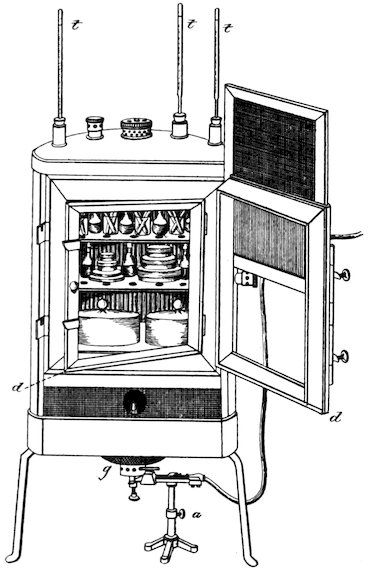
Figure 74. Lautenschläger’s Thermostat.
The apparatus figured, is oval in shape, although circular or
other forms are equally as effective. The arrangement of the
487lamp, a, thermometers, t t t, and gas-regulator, g, and the double
doors, d d, is shown in the engraving and does not require further
description.
The usual temperatures for cultures range from 22° to 35°, and
the apparatus once set at any temperature will remain fixed with
extremely minute variations for an indefinite time. The apparatus
possesses a heat zone which, by the arrangement of the regulator,
is kept absolutely constant. The space between the walls
of the apparatus being filled with water, the temperature is maintained
even in every part. The apparatus, as constructed, is
independent not only of the surrounding temperature within
ordinary variations, but also of the pressure of the barometer.
Three thermometers are employed to determine the temperature
of the heating zone, the water space and the inner space. The
arrangement of the gas-regulator is of an especial kind, as mentioned
above, by means of which the consumption of gas is reduced
to a minimum. This apparatus can be regulated to suit the
character of the work.
454. Microscopic Apparatus Required.—Any good microscope,
capable of accurate observation, of high power, may be
used for the bacteriological observations necessary to soil analysis.
Preference should be given to the patterns adapted to receive
any additional accessories which may be subsequently required
for advanced work. The stage, in addition to being fitted with
a sliding bar, should have a large circular or horseshoe opening
to facilitate focusing operations. A mechanical stage is a
desirable acquisition if really well made, but a plain stage is preferable
for many purposes. A rackwork, centering sub-stage is
essential for advanced work, and in the absence of the more complete
form, there should at least be a fitting beneath the stage to
take the diaphragm and condenser. An iris diaphragm will be
found more useful than any other kind in practice, since the
size of the opening can be increased very gradually at will.
One of the best lamps is known as the paraffin lamp and is
fitted with a half-inch wick. This will give even more light
than is actually required, and a steady flame, perfectly under
control, may be obtained. For the minute details to be observed
in high-grade microscopic work, such as is required in the bacteriological
488examination of soils, reference must be had to the
standard works on bacteriology and microscopy.
455. General Conclusions.—The nitrogenous food of plants
is provided in several ways; viz., (1) By the nitrogen brought
to soil in rain and snow. This nitrogen is chiefly in the form of
ammonia and nitric acid. The nitrogen gas in solution in rain
water has no significance as a plant food. (2) By the action of
certain anaerobic organisms herding in the rootlets of leguminous
plants, free nitrogen may be oxidized and put into form for assimilation.
(3) By the action of certain organisms on nitrogenous
compounds pre-existing in the soil, ammonia, nitrous acid, and
finally, nitric acid, are produced. It is believed that the plant
organism, unaided by the activity of a micro-organism, is unable
to assimilate nitrogen unless it be fully oxidized to nitric acid.
(4) There exist micro-organisms capable of acting directly on
free nitrogen independent of other plant growth, but the significance
of this possible source of plant food is, at the present time,
unknown. (5) The micro-organisms of importance to agriculture
may be isolated and developed to the exclusion of other
organisms of a similar character. This isolation is best accomplished
in culture-media consisting essentially of a mineral gelatin
to which is added only pure carbohydrates and the necessary
mineral nourishment. (6) The nitrifying ferments consist probably
of several species, of different geographic distribution.
Different types of soils probably have nitrifying organisms of
different properties. This is illustrated by the fact that nitrification
is accomplished in dry alkaline soils under conditions in
which the ordinary nitrifying organisms would fail to develop.
(7) The study of typical soils in respect of the kind, activity,
and vigor of their nitrifying organisms has become as important
a factor in soil analysis as the usual determination of physical
and chemical composition.
456. Classification of Methods.—The minute quantities in
which highly oxidized nitrogen exists in soils render the operations
of its quantitative estimation extremely delicate. On the
489other hand, the easy solubility of these forms of combination
and the absence of absorptive powers therefor, in the soil, render
the separation of them from the soil a matter of great ease. It
is possible, therefore, to secure all the nitrates and nitrites present
in a large quantity of earth in a solution which can be concentrated
under proper precautions to a volume convenient for
manipulation. The method of this extraction is the same for
all the processes of determination. The methods of analysis
suited to soil extracts, as a rule, may also be used in the determination
of the same compounds in rain, drainage, and sewage
waters, and for the qualitative and quantitative control of the
progress of nitrification. The various processes employed may
be classified as follows:
1. The conversion of the nitrogen into the gaseous state and
the determination of its volume directly. This is accomplished
by combustion with copper oxid and metallic copper.
2. The conversion of the nitrogen into nitric oxid and the
volumetric determination thereof. The decomposition of a
nitrate with ferrous chlorid in the presence of free hydrochloric
acid is an instance of this type of methods.
3. The oxidation of colored organic solutions and the consequent
disappearance of the characteristic color, or its change
into a different tint. The indigo and indigotin processes are
examples of this method.
4. The production of color, in a colorless or practically colorless
solution, by the treatment thereof with the nitrate in presence
of an acid which decomposes it with the liberation of oxidizing
compounds. The depth of color produced is compared with that
formed by a known quantity of a pure nitrate solution until the
two colorations are alike. The methods depending on the use of
carbazol or acid phenol sulfate illustrate this class of reactions.
5. The conversion of the nitrogen into ammonia by moist combustion
with sulfuric acid in the presence of certain organic
compounds, e. g., salicylic acid, and the collection of the ammonia
in standard acid, the excess of which, is determined by titration.
6. The reduction of nitrates to ammonia by nascent hydrogen
and the recovery of the ammonia produced by distillation and
collection in standard acid.
4907. The reduction of nitrates by electrolytic action and the collection
of the ammonia as above.
8. The decomposition of nitrates with the quantitative evolution
of a different element, and the direct or indirect measurement
of the evolved substance. The quantitative evolution of
chlorin on treating a nitrate with hydrochloric acid, the collection
of the chlorin in potassium iodid, and the determination of
the iodin set free, form a process belonging here.
457. Relative Merit of Methods.—The processes mentioned
in the classifications embraced under numbers (1) and (5) of the
preceding schedule are sufficiently described in the paragraphs
devoted thereto, under soil and fertilizers. In practice at the
present time it is rare to determine the nitrogen in nitrates by
the copper oxid method. The more rapid and equally exact
processes of colorimetric comparison or reduction by nascent
hydrogen are in all respects to be preferred.
The indigo methods among the colorimetric processes are not
so much in use now as those which depend on the development
of a color. Lawes and Gilbert considered them far inferior to
the Schloesing method. The developed color methods are especially
delicate and are to be preferred in all cases where the
detection of the merest traces of nitrates is desired. Where
nitrates are present in considerable quantities the reduction
method with nascent hydrogen is to be preferred over all others.
In all these cases the judgment of the analyst must be exercised.
The particular method to be employed in any given case
can not be determined save by the intelligent discrimination of
the operator.
458. The Extraction of Nitric Acid from the Soil.—The
easy solubility of nitric acid and of nitrates in water is taken
advantage of in the separation of these bodies from the soil. A
convenient quantity, usually about 1,000 grams of the fine soil,
is taken for the extraction. Instead of freeing the soil entirely
from water, it is better to determine the amount of water in the
air-dried or prepared sample, and base the calculation on 1,000
grams of the water-free soil.
All samples of soil, when taken for the purpose of examining
for nitrates, should be rapidly dried to prevent the process of
491nitrification from continuing after the sample is taken. For this
purpose the soil should be placed in a thin layer in a warm place,
50°–60°, until air-dried. It still contains in this case a little
moisture but not enough to permit nitrification to go on.
One thousand grams of soil prepared as above are treated with
2,000 cubic centimeters of distilled water, free of nitric acid, and
allowed to stand for forty-eight hours with frequent shaking.
One thousand cubic centimeters of the extract are then filtered,
corresponding to 500 grams of the dry soil. A small quantity of
pure sodium carbonate should be added to the filtrate which is
then evaporated on a water-bath to a volume of about 100 cubic
centimeters. Should a precipitate be formed during evaporation
it should be separated by filtration, the filter washed thoroughly,
and the filtrate again evaporated to a volume of 100 cubic centimeters.
In taking a soil for the determination of nitrates, it is well to
extend the sampling to a considerable depth. If the sample be
taken only to the depth of nine inches, it should be in dry weather
when the nitrates are near the surface.
The temperature at which a soil is dried has also an influence
on the quality of nitric nitrogen remaining after desiccation.
If a wet soil be dried at 100°, the nitrates present will suffer
partial decomposition. This is probably due to deoxidation by
organic matter present. On the other hand, ordinary air-drying
affords opportunity for continued nitrification, thus increasing
the residuum of oxidized nitrogen. The above method is essentially
that followed by Warington at Rothamstead.
The method of drying practiced at Rothamstead, in order to
secure results as nearly accurate as possible is the following:[293]
The soil is broken up directly after it is taken from the field,
and spread on trays in layers one inch deep. The trays are
then placed in a room at 55°. The drying is completed in
twenty-four hours. After drying, stones and roots are removed,
and the soil is finely powdered and placed in bottles.
For extracting the nitrates, a funnel is prepared by cutting off
the bottom from a bottle four and a half inches in diameter. A
nicely fitting disk of copper gauze is placed in the bottom of this
funnel, and this is covered with two filter papers, the upper one
492having a slightly greater diameter than the lower. The paper is
first moistened, and then from 200 to 500 grams of the dry powdered
soil introduced. The funnel is connected with the receiving
flask of a filter pump, and pure water poured on the soil until
it is thoroughly saturated. The water is then added in small
quantities. When the filtrate amounts to 100 cubic centimeters
the process may be discontinued, since all the nitrates in the soil
will be found in this part of the filtrate.
The extract obtained above is evaporated to convenient bulk
for the determination of nitric nitrogen.
459. Method of Schloesing.—The processes for estimating
nitrogen by combustion with copper oxid and by moist combustion
with sulfuric acid have both been used for the determination
of the quantity of nitrogen existing in a highly oxidized
state. These processes will be fully discussed under the head of
fertilizers. In the case of soil extracts, drainage waters, etc., it
will be sufficient to discuss, for the present, only those processes
adapted especially to a quick and accurate estimation of oxidized
nitrogen.
The principle of the method of Schloesing depends on the
decomposition of nitrates in the presence of a ferrous salt and a
strong mineral acid.[294] The nitrogen in the process appears as
nitric oxid, the volume of which may be directly measured, or
it may be converted into nitric acid and titrated by an alkali.
The typical reactions which take place are represented in the
following equation:
6FeCl₂ + 2KNO₃ + 8HCl = 3Fe₂Cl₆ + 2KCl + 4H₂O + 2NO.
460. Schloesing’s Modified Method.—The Schloesing
method as now practiced by the French chemists is conducted
in the apparatus shown in Fig. 75.[295] The carbon dioxid is generated
by the action of the hydrochloric acid in F on the fragments
of marble in A. After passing the wash-bottle the
gas enters the small tubulated retort, C, which contains the
nitrate in solution. For ordinary soils 100 grams are placed in
an extraction flask, plugged with cotton, and a layer of the
same material is placed over the soil for the purpose of securing
an even distribution of the extracting liquid. This liquid is
493distilled water containing in each liter one gram of calcium
chlorid. The purpose of using the calcium chlorid is to prevent
the soil from becoming compacted which would render the
extraction of the nitrate difficult. The extracting liquid is
allowed to fall drop by drop from a mariotte bottle until the filtrate
amounts to 500 cubic centimeters. This volume is concentrated
on a sand-bath until it is reduced to ten or fifteen cubic
centimeters when it is transferred to a flat-bottomed dish and
the evaporation finished over steam, care being taken not to
allow the temperature to exceed 100°.
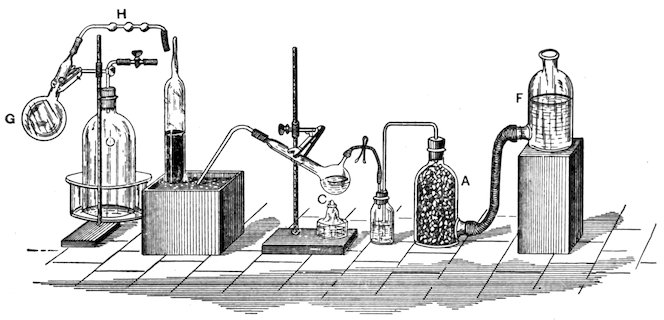
Figure 75. Schloesing’s Apparatus for Nitric Acid.
Another and more rapid method for dissolving the nitrate, may
also be practiced. In a flask holding about one liter, place 220
grams of the soil and 660 cubic centimeters of distilled water and
shake vigorously, or enough water to make 660 cubic centimeters
together with the moisture remaining in the air-dried sample
taken. All the nitrates pass into solution. Throw the contents
of the flask into a filter and take 600 cubic centimeters of
the filtrate which will contain all the nitrates in 200 grams of
the sample taken. This filtrate is evaporated as described above.
In the flat dish containing the dried nitrates, pour three or four
cubic centimeters of ferrous chlorid solution and stir with a
small glass rod until complete solution of the nitrate takes place.
By means of a small funnel the solution is poured into C, and
the capsule and funnel are well rinsed with two cubic centimeters
of hydrochloric acid. The washing is repeated three times
494as above described, and once with one cubic centimeter of water,
which is added cautiously so as to form a layer over the surface
of the heavier liquid. The tubulated flask is then connected
with the carbon dioxid apparatus, previously freed from air, and
the gas allowed to flow evenly until the whole of the apparatus
is completely air-free. The other details of the method are essentially
the same as those adopted by the Commission of French
Agricultural Chemists which will be given below.
461. The French Agricultural Method.—The Schloesing
method as practiced by the French agricultural chemists is very
slightly different from the procedure just described.[296] The process
with soils is carried on as follows:
Five hundred grams of the soil are taken and introduced into
a flask of about two liters capacity and shaken thoroughly with
a liter of distilled water. The whole of the nitrates of the soil
is thus passed into solution. The solution is filtered and 400
cubic centimeters of the filtrate are taken, which correspond to
200 grams of the soil. This liquid is evaporated in a flask, adding
a fragment of paraffin to prevent foaming, until its volume
is reduced to fifteen or twenty cubic centimeters. It is afterwards
transferred through a filter into a capsule with a flat bottom
in which the evaporation is finished on a steam-bath, taking care
that the temperature does not exceed 100°. An important precaution
is, not to allow the contact of the water with the soil to
be too prolonged, to avoid the reduction of the nitrates which
could take place under the influence of the denitrifying organisms
which are developed with so great a rapidity in moist earth.
The apparatus in which the transformation of the nitrates into
nitric oxid takes place is essentially that already described (Fig.
75). The carbon dioxid generator is connected by means of a
rubber tube and a small wash-bottle to the small retort in which
the reaction takes place, and from which the exit tube leads to a
mercury trough. The gas which is disengaged is received under
a jar drawn out to a fine point in its upper part, which carries
about fifteen cubic centimeters of potash solution containing
two parts of water to one of potash.
The operation is conducted as follows:
Into the small capsule which contains the dried matter, three
495or four cubic centimeters of ferrous chlorid are poured. By
means of a stirring rod the residue sticking to the sides of the
capsule is detached with care and all the matter is thus collected
in the bottom. By means of a small funnel the contents of the
capsule are introduced into the retort. About two cubic centimeters
of hydrochloric acid are used for washing out the materials
and this acid is also introduced into the retort. The washing
with hydrochloric acid is repeated three or four times, and
finally the apparatus is washed with one cubic centimeter of
water, which is also poured in by the small funnel with great care,
so that this water may form a layer over the surface of the liquid.
The apparatus is now connected and filled completely with carbon
dioxid. Since it is necessary that this gas should be completely
free of air, the flask, which generates it, is first filled with
the acidulated water from the acid flask, and the air is thus
almost totally displaced by the liquid. The evolution of carbon
dioxid gas which follows, completely frees the apparatus from
air. When this is accomplished the retort is connected with the
rest of the apparatus and the gas allowed to pass for about two
minutes until the air is completely driven out of all the connections.
The current is arrested for a moment by pinching the
rubber tube which conducts the carbon dioxid into the retort,
and the vessel which is to receive the gas is then placed over the
delivery-tube, this vessel being filled with mercury and a strong
solution of potash. The communication between the retort and
the carbon dioxid flask is broken and the flask is heated slightly
by means of a small lamp. The first bubbles of gas evolved
should be entirely absorbed by the potash. This will be an indication
of the complete absence of the air. When the liquid is in
a state of ebullition the nitrogen dioxid is set free. The boiling
is regulated in such a way that the evolution is regular and the
liquid of the retort may not, by a too violent boiling, pass into
the receiver. The boiling is continued until the larger part of
the liquid is distilled and only three or four cubic centimeters
remain in the retort. At this time a few bubbles of carbon dioxid
are allowed to flow through in order to cause to pass into the
receiver the last traces of nitric oxid. The gas received is left
for some minutes in contact with the potash.
496Afterward in a small flask, G, the neck of which is drawn out
to a fine point, and carrying a bulb-tube, H, and a piece of rubber
tubing, there are boiled twenty-five or thirty cubic centimeters
of water for five or six minutes in order to drive all the air
out of the flask, and while the boiling is continued the rubber
tubing is fastened to the drawn-out part of the jar containing
the nitric oxid. Within the rubber tubing the drawn-out
point is broken and the vapor of water is forced into the jar and
drives before it the solution of potash which has filled the capillary
part of the drawn-out tube. As soon as the point is broken,
the boiling of the flask is stopped and by its cooling the nitric
oxid passes into it. It is necessary to press the rubber tubing
with the fingers in order that the passage of the gas into the
flask be not too rapid. As the solution of potash rises in the
bell-jar which contains the nitric oxid near to the point where
the rubber tubing covers its drawn-out portion, the fingers are
removed and a clamp put in their place. There still remains a
little nitric oxid in the flask and to drive this out it is necessary
to introduce five or six cubic centimeters of pure hydrogen, which
are allowed to pass over into the receiving flask, by releasing the
clamp in the same way as the nitric oxid. The hydrogen being
introduced in successive portions, finally carries all the nitric
oxid into the flask without allowing any of the potash to enter.
The flask containing the nitric oxid is now connected with a
reservoir of oxygen. The oxygen is allowed to enter, bubble by
bubble, by means of cooling the flask by immersion in water.
The transformation of nitric oxid into nitric acid is not entirely
complete for twenty-four hours. It is necessary, therefore, to
wait that long after the introduction of the oxygen before determining
the amount of nitric acid produced.
The contents of the flask are placed in a titration-jar, the flask
being washed two or three times and a few drops of tincture of
litmus being added. The nitric acid is then determined by a
standard solution of calcium hydroxid or some other standard
alkali. From the titration the content of nitric acid is calculated.
The French Committee further suggests that this method may
be modified in the way of making it more rapid by collecting
497the nitric acid in a graduated tube filled with mercury and containing
some potash. The volume of the gas is determined and
the pressure of the barometer and the temperature observed, and
the usual calculations made to reduce the volume to zero and to
a pressure of 760 millimeters of mercury. Each cubic centimeter
of nitric oxid thus measured corresponds to 2.417 milligrams of
nitric acid. The presence of organic matter does not interfere
with the determination of nitric acid by either of the methods
given above.
462. Modification of Warington.—The method of procedure
and description of apparatus used, as employed by Warington,
are as follows:
The vessel in which the reaction takes place is a small tubulated
receiver, A (Fig. 76), about four centimeters in diameter,
mounted and connected as shown in the illustration.
The delivery-tube dips into
a jar of mercury in a trough
containing the same liquid.
The long supply funnel-tube
a is of small bore,
holding in all only one-half
cubic centimeter. The
connecting tube F, carrying
a clamp, is also of small
diameter and serves to connect
the apparatus with a
supply of carbon dioxid.
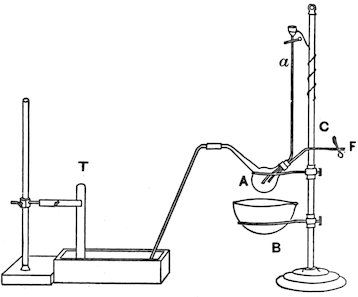
Figure 76. Warington’s Apparatus for Nitric Acid.
In practice, the supply-tube
a is first filled with strong hydrochloric acid and carbon dioxid
passed through the apparatus until the air is all expelled. This
is indicated when a portion of the gas collected over the mercury,
is entirely absorbed by caustic alkali.
At this point the current of carbon dioxid is stopped by the
clamp C, and a bath of calcium chlorid, B, heated to 140° is
brought under the bulb A, until the latter is half immersed
therein. The temperature of the bath is maintained by a lamp.
By allowing a few drops of hydrochloric acid to enter the receiver,
the carbon dioxid is almost wholly expelled. The end of the
498delivery-tube is then connected with the tube, T, filled with
mercury, and the apparatus is ready for use.
The nitrate, in which the nitric acid is to be determined, in a
dry state, is dissolved in two cubic centimeters of the ferrous
chlorid solution (one gram of iron in ten cubic centimeters), one
cubic centimeter of strong hydrochloric acid is added, and the
whole is then introduced into the receiver through the supply-tube,
being followed by successive rinsings with hydrochloric
acid, each rinsing not exceeding one-half cubic centimeter.
The contents of the receiver are, in a few moments, boiled
to dryness; a little carbon dioxid is admitted before dryness is
reached, and again afterwards to drive over all remains of nitric
oxid. In the recovered gas the carbon dioxid is first absorbed
by caustic potash, and afterwards the nitric oxid by ferrous
chlorid. All measurements of the gas are made in Frankland’s
modification of Regnault’s apparatus. The carbon dioxid should
be as free as possible from oxygen. The carbon dioxid generator
is formed of two vessels, the lower one consisting of a bottle with
a tubule in the side near the bottom; this bottle is supported in
an inverted position and contains the marble from which the
gas is generated. The upper vessel consists of a similar bottle
standing upright and containing the hydrochloric acid required
to act on the marble. The two vessels are connected by a glass
tube passing from the side tubule of the upper vessel to the
inverted mouth of the lower vessel. The acid from the upper
vessel thus enters below the marble. Carbon dioxid is generated
and removed at pleasure by opening a stop-cock attached to the
side tubule of the lower vessel thus allowing hydrochloric acid
to descend and come in contact with the marble. A good Kipp’s
generator of any approved form may also be used instead of
the simple apparatus, above described.
The fragments of marble used are previously boiled in water
in a strong flask. After boiling has proceeded for some time, a
rubber stopper is fixed in the neck of the flask and the flame
removed. Boiling will then continue for some time in a partial
vacuum.
The hydrochloric acid is also well boiled and has dissolved in
it a moderate quantity of cuprous chlorid. As soon as the acid
499has been placed in the upper reservoir, it is covered by a layer
of oil. The apparatus being thus charged is at once set in active
work by opening the stop-cock of the marble reservoir; the acid
descends, enters the marble reservoir, and the carbon dioxid
produced drives out the air. As the acid reservoir is kept on a
higher level than the marble reservoir, the latter is always under
internal pressure, and leakage of air from without, into the
apparatus, cannot occur.
The presence of the cuprous chlorid in the hydrochloric acid
not only insures the removal of dissolved oxygen, but affords an
indication to the eye of the maintenance of this condition.
While the acid remains of an olive tint, oxygen is absent; but
should the color change to a blue-green, more cuprous chlorid must
be added. All the reagents employed should be previously
boiled.
In order to secure absolute freedom from air, the following
modifications on the above process have been adopted by Warington:
The apparatus having been mounted as described, the
funnel-tube attached to the bulb retort is filled with water, and
the apparatus connected with the carbon dioxid generator. Carbon
dioxid is then passed through the apparatus until a moderate
stream of bubbles rises in the mercury trough. The stop-cock
is left in this position, and the admission of gas is controlled
by the pinch-cock. The bath of calcium chlorid is so
adjusted as to cause the bulb retort to be almost entirely submerged,
and the temperature of the bath is kept at 130° to 140°.
Small quantities of water are next admitted into the bulb and
expelled as steam in the current of carbon dioxid, the supply
of this gas being shut off before the evaporation is entirely completed,
so as to leave as little carbon dioxid as possible in the
apparatus. Previous to very delicate experiments it is advisable
to introduce through the funnel-tube a small quantity of potassium
nitrate, ferrous chlorid, and hydrochloric acid, rinsing the
tube with the latter reagent. Any trace of oxygen remaining
in the apparatus is then consumed by the nitric oxid formed;
and after boiling to dryness and driving out the nitric acid with
carbon dioxid, the apparatus is in a perfect condition for a quantitative
experiment.
500463. Preparation of the Materials to be Analyzed.—According
to Warington, soil extracts may be used without
other preparation than concentration.
Vegetable juices which coagulate when heated, require to be
boiled and filtered or else evaporated to a thin sirup, treated
with alcohol, and filtered. A clear solution being thus obtained,
it is concentrated over a water-bath to a minimum volume in a
beaker of small size. As soon as cool, it is mixed with one
cubic centimeter of a cold saturated solution of ferrous chlorid
and one cubic centimeter of hydrochloric acid, both reagents
having been boiled and cooled immediately before use.
In mixing with the reagents, care must be taken that bubbles
of air are not entangled, which is apt to occur with viscid extracts.
The quantity of ferrous chlorid mentioned is amply sufficient
for most soil extracts, but it is well to use two cubic centimeters
in the first experiment, the presence of a considerable excess of
ferrous chlorid in the retort being thus insured. With bulky
vegetable extracts more ferrous chlorid should be employed.
To the sirup from twenty grams of mangel-wurzel sap, five cubic
centimeters of ferrous chlorid and two cubic centimeters of
hydrochloric acid are usually added.
464. Measurement of the Gas.—The measurement of the
gas was for some time conducted by the use of concentrated
potash for absorbing the carbon dioxid, and ferrous chlorid for
absorbing the nitric oxid. The use of the ferrous chlorid, however,
was found to introduce a source of error. The treatment
of the gas with oxygen and pyrogallol over potash has therefore
been substituted by Warington for its absorption by ferrous chlorid.
The chief source of error attending the oxygen process lies in
the small quantity of carbon monoxid produced during the
absorption with pyrogallol; this error becomes negligible if the
oxygen be only used in small excess. The amount of oxygen
employed can be regulated by the use of Bischof’s gas delivery-tube.
This may be made of a test-tube having a small perforation
half an inch from the mouth. The tube is partly filled with
oxygen over mercury, and its mouth is then closed by a finely
perforated stopper made from a piece of wide tube and fitted
tightly into the test-tube by means of a covering of rubber.
When this tube is inclined, the side perforation being downwards,
501the oxygen is discharged in small bubbles from the perforated
stopper, while mercury enters through the opening.
Using this tube, the supply of oxygen is perfectly under control
and can be stopped as soon as a fresh bubble ceases to produce
a red tinge on entering. Warington concludes his description
by stating that in the reaction proposed by Schloesing the
analyst has a means of determining a very small quantity of
nitric acid with considerable accuracy, even in the presence of
organic matter; but to accomplish this, the various simplifications
consisting in the omission of the stream of carbon dioxid,
and the collection of the gas over caustic soda must be abandoned,
and special precautions must be taken to exclude all
traces of oxygen from the apparatus.
465. Spiegel’s Modification.—Spiegel noticed inaccuracies
in the results of the ferrous
chlorid method of estimating
nitric acid when carbon dioxid
is used, which sometimes
amounted to three per cent of
the nitric acid present in the
sample. The following suggestions
are made by him for
the improvement of the process:[297]
As regards the use of carbon
dioxid in the operation,
the first difficulty consists in
obtaining it entirely free from
air. By the use of small
pieces of marble, which, before
being placed in the Kipp apparatus,
are kept for a long
while in boiling water, a product
is obtained which, after
thirty minutes of moderate
evolution, leaves only a trace of
unabsorbed gas in contact
with potash-lye. The apparatus used is illustrated in Fig. 77.
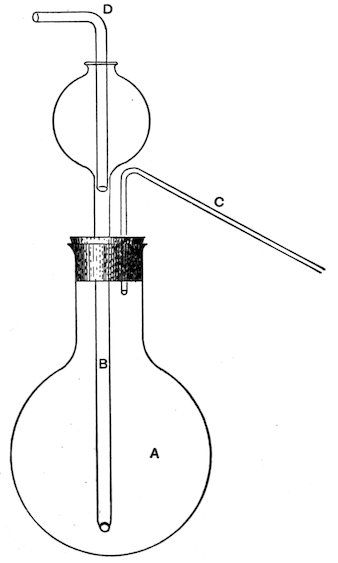
Figure 77. Spiegel’s Apparatus for Nitric Acid.
502A is a round flask of about 150 cubic centimeters capacity,
furnished with a well-fitting rubber stopper provided with two
holes, one for the entrance of the funnel-tube B and the other
for the delivery-tube C. The tube B ends about two centimeters
above the bottom of A and carries a bulb-shaped funnel at its top
capable of holding about fifty cubic centimeters. The gas-tube
D is ground into the bulb of B as shown in the figure.
After the flask had been filled with the solution to be
examined, carbon dioxid is conducted through D and the flask
is heated to boiling until the gas which escapes through C no
longer contains any air. The measuring tube is brought over
the end of the delivery-tube C, in the usual manner, but not
shown in the figure. In the funnel of B are placed twenty cubic
centimeters of previously prepared and boiled ferrous chlorid
solution and this liquid is allowed to flow partly into A by lifting
slightly the gas-tube, D. About forty cubic centimeters of
concentrated, boiled hydrochloric acid are afterwards added to it
in the same way. As soon as the liquid in the flask A is again
boiling, the stream of carbon dioxid is shut off and allowed to
flow again only towards the end of the operation, when the contents
of the flask are reduced almost to dryness. As will be
seen from the above directions no unboiled liquids of any kind
are to be used as reagents in the apparatus described. If the
flask A were made much smaller the efficiency of this apparatus
would be increased. It appears to have few, if any, advantages
over Warington’s process.
466. Schulze-Tiemann Method.—The modification of
Schulze-Tiemann in the ferrous salt method consists chiefly in
the omission of the use of carbon dioxid, and in the simplified
form of apparatus, which permits rapid work and gives, also,
according to some authorities, very exact and reliable results.[298]
The extract, representing 500 grams of the fine soil, is reduced
by evaporation to 100 cubic centimeters and placed in a glass
flask, A (Fig. 78), of 500 cubic centimeters capacity. The
flask is closed with a rubber stopper, carrying two bent glass
tubes which pass through it. The tube a b c is drawn out into
a point at a and reaches about two centimeters below the surface
of the rubber stopper. The tube e f g passes just to the
503lower surface of the rubber stopper. The two tubes mentioned
are connected, by means of rubber tubes and pinch-cocks, with
the tubes d and h. The pinch-cocks at c and g must be capable
of closing the tubes air-tight. The end of the tube g h passes into
a crystallizing dish, B, and is bent upward to a point passing
two to three centimeters into the measuring tube C. The point
within the tube is covered with a piece of rubber tubing. The
measuring tube C is divided into tenths of a cubic centimeter, and
together with the crystallizing dish B, is filled with a ten per
cent solution of boiled soda-lye, which is obtained by dissolving
12.9 parts of sodium
hydroxid in 100 parts
of water.
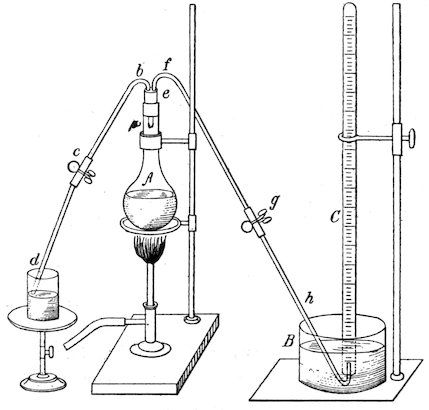
Figure 78. Schulze-Tiemann’s Nitric Acid Apparatus.
The liquid which is
to be examined for
nitric acid, the pinch-cocks
being opened
and the tube g h not
dipping into the crystallizing
dish, is boiled
for one hour in order
to drive the air out of
the flask A. The end
of the tube e f g h is
then brought into the
crystallizing dish containing
the sodium
hydroxid solution so that the steam escaping from the flask A,
escapes partly through the tube b c d, and partly through the
tube f g h, not allowing, however, the bubbles to enter the
measuring tube C. To determine whether the air is all expelled,
the pinch-cock at g is closed and the soda-lye will thereupon
rise to g in case no air interferes. It is best to close the tube at
g first with the thumb and finger and then the rise of the soda-lye
to that point can be determined by the impulse felt. The
tube is then firmly closed by means of the pinch-cock g. The
rest of the steam is allowed to escape through the tube a b c d,
and the evaporation is continued until the contents of the flask
504are evaporated to about ten cubic centimeters. The flask into
which the tube c d dips, is filled with freshly boiled water. The
lamp is removed from the flask A, the pinch-cock is closed,
whereupon the tube c d becomes filled with the freshly boiled
water. The measuring tube C, filled with freshly boiled soda-lye
is closed with the thumb and brought into the dish B, care
being taken that no bubble of air enters. It is placed over the
end of the tube g h.
The pressure of the external air will now flatten the rubber
tubes at c and g. The flask at the end of c d holding freshly
boiled water is then replaced with one filled with a nearly saturated
solution of ferrous chlorid containing some hydrochloric
acid. The flask containing the ferrous chlorid solution should
be graduated so that the amount which is sucked into the flask
A can be determined. The pinch-cock c is opened and from
fifteen to twenty cubic centimeters of the ferrous chlorid solution
allowed to flow into A. The end of the tube c d is then placed in
another flask containing strong hydrochloric acid, and the latter
allowed to flow into the tube in small quantities at a time until
all the ferrous chlorid is washed out of the tube b c d into A.
At the point b there is sometimes formed a little bubble of
hydrochloric acid in the state of gas, which by heating the
flask A completely disappears.
The flask A is next warmed gently until the rubber tubes at
the pinch-cocks begin to assume their normal condition. The
pinch-cock at g is now replaced by the thumb and finger, and as
soon as the pressure within the flask A is somewhat stronger,
caused by the nitric oxid gas evolved from the mixture, it is
allowed to pass through the tube e f g h and escape into the measuring
cylinder C. By a manipulation of the finger and thumb
at g, it is possible to prevent regurgitation of the sodium hydroxid
into A, and at the same time to relieve the pressure of the nitric
oxid in A, which would be difficult to do by means of the pinch-cock
alone.
The boiling of the liquid is continued until there is no longer
any increase of the volume of gas in the measuring cylinder C.
After the end of the operation the tube g h is removed from the
dish B and the measuring tube C is closed by means of the
505thumb while its end is still beneath the surface of the soda-lye,
and it is shaken until all traces of any hydrochloric acid, which
may have escaped absorption, are removed. It is then placed
in a large glass cylinder filled with water at the temperature
at which the volume of gas is to be read. After being
kept at this constant temperature for about half an hour the
volume of the nitric oxid can be read. For this purpose the
measuring cylinder C is sunk into the water of the large cylinder
until the level of the liquids within and without the tube is the
same. The usual correction for pressure of the atmosphere, as
determined by the barometer, and for the tension of the aqueous
vapor at the temperature at which the reading is made, is applied.
The correction is made by means of the following formula:
V′ = (V × 273 × (B − f)) ÷ ((273 + t) × 760)
In this formula V′ denotes the volume of the gas at the temperature
of zero, and at 760 millimeters barometric pressure; V
the volume of the gas as read at the barometric pressure observed,
B, and the temperature observed, t, while f denotes the tension
of the aqueous vapor in millimeters of mercury pressure at the
observed temperature t. The tension of the aqueous vapor at
temperatures from zero to 26°, expressed in millimeters of mercury,
is given in the following table:
| Temp. ° |
Tension in mm. mercury. |
| 0 |
4.6 |
| 1 |
4.9 |
| 2 |
5.3 |
| 3 |
5.7 |
| 4 |
6.1 |
| 5 |
6.5 |
| 6 |
6.9 |
| 7 |
7.4 |
| 8 |
8.0 |
| 9 |
8.5 |
| 10 |
9.1 |
| 11 |
9.7 |
| 12 |
10.4 |
| 13 |
11.1 |
| 14 |
11.9 |
| 15 |
12.7 |
| 16 |
13.5 |
| 17 |
14.4 |
| 18 |
15.3 |
| 19 |
16.3 |
| 20 |
17.4 |
| 21 |
18.5 |
| 22 |
19.6 |
| 23 |
20.9 |
| 24 |
22.2 |
| 25 |
23.5 |
| 26 |
25.0 |
From the gas volume reduced by the above formula the nitric
acid is calculated as follows:
One cubic centimeter of nitric oxid weighs at 0° and 760 millimeters
barometric pressure 1.343 milligrams.
Since two molecules of NO (molecular weight sixty) correspond
to one molecule of N₂O₅ (108) we have the following equation:
60 : 108 = 1.343 : x. Whence x = 2.417 milligrams, the
506weight of nitric acid corresponding to one cubic centimeter of
nitric oxid.
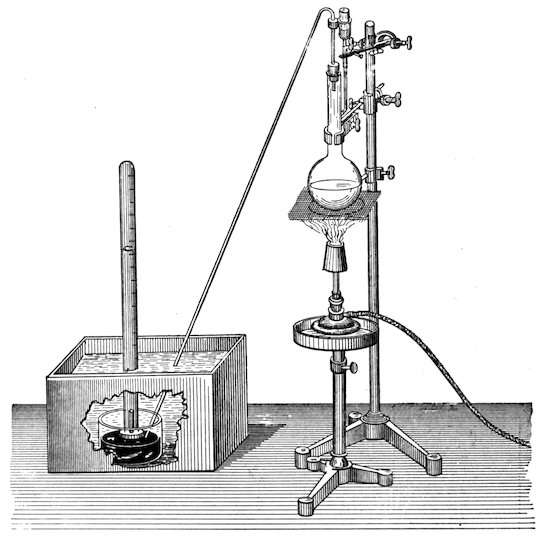
Figure 79. De Konick’s Apparatus.
Figure 80. End of Delivery-Tube.
467. DeKonick’s Modification of Schloesing’s Method.—This
modification consists in an arrangement of the gas delivery-tube,
whereby the regurgitation of the water in the measuring
burette into the evolution flask is prevented by a device for sealing
the delivery-tube with mercury.[299] The apparatus is arranged
as shown in Fig. 79. The flask in which the decomposition
takes place is provided with a long neck, into which a side tube
is sealed and bent upwards, carrying a small funnel
attached to it by rubber tubing. The piece
of rubber tubing carries a pinch-cock, by means of
which the solution containing the nitrate and
hydrochloric acid can be introduced into the flask.
The small gas delivery-tube is arranged as shown
in the figure, and carries at the end next the
burette a device shown in Fig. 80. The cork represented
in this device has radial notches cut in it, so as to permit
507of a free communication between the water in the burette and
in the pneumatic trough. The open end of the burette, when
the apparatus is mounted ready for use, rests on the notched surface
of the cork, and the end of the delivery-tube is placed in the
crystallizing dish resting on the bottom of the pneumatic trough.
The end of the delivery-tube, as indicated, has fused onto it a
vertical tube open at both ends and six to seven centimeters in
length, and carrying the notched cork already described. The
crystallizing dish in the bottom of the pneumatic trough is filled
with mercury until the point of union of the delivery-tube with
the vertical end is sealed to the depth of a few millimeters. As
the gas is evolved it bubbles up through the mercury into the
measuring tube and the displaced water passes out through the
notches in the cork. Should any back pressure supervene the
mercury at once rises in the delivery-tube which is of such a
length as to prevent its entrance into the flask. The operation
can then be carried on with absolute safety.
To make an estimation there are placed in the flask about
forty cubic centimeters of ferrous chlorid solution containing
about 200 grams of iron to the liter, and also an equal volume
of hydrochloric acid of one and one-tenth specific gravity. The
side tube is also filled up to the funnel with the acid. The contents
of the flask are boiled until all air is expelled, which can
be determined by holding a test-tube filled with water over the
end of the delivery-tube. The solution containing the nitrate
is next placed in the funnel, the pinch-cock opened and the
liquid allowed to run into the flask by means of the partial
vacuum produced by stopping the boiling and allowing the mercury
to rise in the delivery-tube. All the solution is washed
into the flask by successive rinsings of the funnel with hydrochloric
acid, being careful to allow no bubble of air to enter.
The contents of the flask are again raised to the boiling-point
and the nitric oxid evolved collected in the nitrometer. The
solution examined should contain enough nitrate to afford from
sixty to eighty cubic centimeters of gas. Without refilling the
flask, from eight to nine determinations can be made by regenerating
the ferrous chlorid by treatment with zinc chlorid. Care
must be exercised not to add the zinc chlorid in excess, otherwise
508ammonia and not nitric oxid will be produced. The side tube
and funnel must also be carefully freed from zinc chlorid by
washing with hydrochloric acid.
468. Schmidt’s Process.—In the case of a water, or the
aqueous extract of a soil, according to the content of
nitric acid, from fifty to one hundred cubic centimeters are evaporated
to thirty cubic centimeters, and the residue sucked
into the generating flask of the apparatus, Fig. 81, and, with
the rinsings with distilled water, evaporated again to from twenty
to thirty cubic centimeters, and the flask then connected,
as shown in
the figure, to a
Schliff measuring
apparatus,
B.[300] This apparatus
is previously
filled to i
with mercury,
and the bulb g
connected with
k by a rubber
tube.
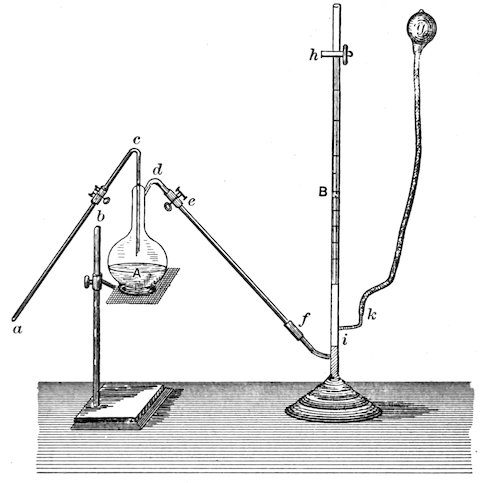
Figure 81. Schmidt’s Apparatus.
The apparatus
is then filled with
a twenty per
cent, previously
boiled and still
warm, caustic
soda solution
until the bulb g
is partially filled when raised a little above the cock h. Then h
is closed and g held, by an appropriate support, on about the
same level with h. The cock at b is then closed and e opened.
Meanwhile the ebullition in the flask is continued, and the air
bubbles rising in the Schliff apparatus are removed, from time
to time, by carefully opening h and raising g. When bubbles
no longer come over, the cock at e is closed and at b opened,
and the steam issuing at a is conducted through a mixture of
509ferrous chlorid and strong hydrochloric acid to free it, as far as
possible, from air. When the contents of the flask have been
evaporated to about five cubic centimeters, b is closed and the
lamp at once removed.
By carefully opening b about ten cubic centimeters of a mixture
of ferrous chlorid and hydrochloric acid are allowed to enter
the flask, when b is closed and the flask slowly heated until the
positive pressure is restored. The pinch-cock e is then opened
and the contents of the flask evaporated nearly to dryness. The
cock e is again closed and the flame removed. Another quantity
(fifteen cubic centimeters) of ferrous chlorid and hydrochloric
acid solution is sucked into the flask and the process of
distillation repeated, whereby the whole of the nitric oxid is collected
in h. The nitric oxid evolved is measured in the usual
way and calculated to nitric acid, one cubic centimeter of nitrogen
dioxid being equal to 2.417 milligrams of nitric acid.
469. Merits of the Ferrous Chlorid Process.—The possibility
of an accurate determination of nitrates; by decomposition
with a ferrous salt in presence of an excess of acid, has been
established by many years of experience and by the testimony
of many analysts. The method is applicable especially where
the quantity of nitrate is not too small and when organic matter
is present. In the case of minute quantities of nitrate, however,
the process is inapplicable and must give way to some of the
colorimetric methods to be hereafter described.
In respect of the apparatus modern practice has led to the
preference of that form which does not require the use of carbon
dioxid for displacing the air. Steam appears to be quite as
effective as carbon dioxid and is much more easily employed.
That form of apparatus should be used which is the simplest in
construction and has the least cubical content.
The measurement of the evolved gas is most simply made by
collecting over lye in an azotometer, reading the volume, noting
the reading of the barometer and thermometer and then
reducing to standard conditions of pressure and temperature by
the customary calculations. Where a very strong lye is used
the tension of the aqueous vapor may be neglected. While every
analyst should have a thorough knowledge of the ferrous chlorid
510method and the principles on which it is based it can not be compared
in simplicity to the later methods with pure nitrates which
are based on the conversion of the nitric acid into ammonia by
the action of nascent hydrogen. In accuracy, moreover, it does
not appear to have any marked advantage over the reduction
methods.
470. Mercury and Sulfuric Acid Method.—This simple and
accurate method of determining nitric acid in the absence of
organic matter is known as the Crum-Frankland process.[301]
The method rests on the principle of converting nitric acid
into nitric oxid by the action of mercury in the presence of sulfuric
acid. The operation as at first described is conducted in
a glass jar eight inches long by one and a half inches in diameter
filled with mercury and inverted in a trough containing the same
liquid. The nitrate to be examined, in a solid form, is passed
into the tube together with three cubic centimeters of water and
five of sulfuric acid. With occasional shaking, two hours are
allowed for the disengagement of the gas, which is then
measured.
471. Warington’s Modification.—A graduated shaking tube
is employed which allows the nitrate solution and oil of vitriol
to be brought to a definite volume. The nitrate solution, with
rinsings, is always two cubic centimeters and enough sulfuric acid
is added to increase the volume to five cubic centimeters. The
sulfuric acid should give no gas when shaken with distilled
water. Any gas given off in the apparatus before shaking, is not
expelled but is included in the final result. The persistent froth
sometimes noticed where some kinds of organic matter are present,
is reduced by the addition of a few drops of hot water
through the stop-cock of the apparatus. The nitric oxid is
finally measured in Frankland’s modification of Regnault’s
apparatus.
This method, accurate for pure nitrates, unfortunately fails
in the presence of any considerable amount of organic matter.
According to Warington’s observations the presence of chlorids
is no hindrance to the accurate determination of both nitric and
nitrous acids by the mercury method. This simplifies the operation
as carried on by Frankland who directs that any chlorin
511present, be removed before the determination of the nitric acid is
commenced.
472. Noyes’ Method.—In the analyses made by Noyes for
the National Board of Health, the Crum-Frankland method was
employed.[302] The apparatus used was essentially that which is
now known as Lunge’s nitrometer and it will be described in
the next paragraph. No correction is made by Noyes for the
tension of aqueous vapor in the measurement of the nitric oxid
because of the moderate dilution of the sulfuric acid by the
liquid holding the nitric compounds in solution. The chlorin
was not removed from the dry residue of the evaporated water as
its presence in moderate quantity does not interfere with the
accuracy of the process. In order to obtain the amount of nitrogen
in the form of nitrates, the total volume of nitric oxid must
be diminished by that due to nitrites present, which must be
determined in a separate analysis. The method of manipulation
is given in the following paragraph.
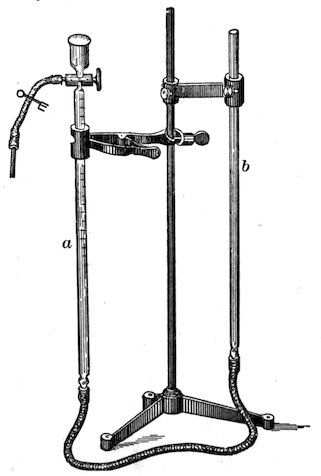
Figure 82. Lunge’s Nitrometer.
473. Lunge’s Nitrometer.—The apparatus employed by
Noyes, in a somewhat more elaborate form, is known as Lunge’s
nitrometer.[303] This apparatus is
shown in Fig. 82. It consists of
a burette, a, divided into one-fifth
cubic centimeters. At its
upper end it is expanded into a
cup-shaped funnel attached by
a three-way glass stop-cock.
Below, the burette is joined to a
plain tube, b, of similar size, by
means of rubber tubing. The
apparatus is first filled with mercury
through the tube b, the
stop-cock being so adjusted as
to allow the mercury to fill the
cup at the top of a. The cock
is then turned until the mercury
in the cup flows out through the
side tube carrying the rubber
tube and clamp. The three-way
cock is closed, and the solution containing the nitrate placed in
512the cup. By lowering the tube b and opening the cock the
liquid is carefully passed into a, being careful to close the cock
before all the liquid has passed out of the cup. By repeated
rinsings with pure concentrated sulfuric acid, every particle of
the nitric compound is finally introduced into a, together with
a large excess of sulfuric acid. The total volume of the introduced
liquid should not exceed ten cubic centimeters. The
mixture of the mercury, nitric compound, and sulfuric acid is
effected by detaching a from its support, compressing the rubber
connection between a and b, placing a nearly in a horizontal
position, and quickly bringing it into a vertical position with
vigorous shaking.
After about five minutes the reaction is complete, and the
level of the liquids in the two tubes is so adjusted as to compensate
for the difference in specific gravity between the acid mixture
in a and the mercury in b; in other words, the mercury
column in b should stand above the mercury column in a one-seventh
of the length of the acid mixture in a. This secures
atmospheric pressure on the nitric oxid which has been collected
in a. The measured volume of nitric oxid should be reduced to
0° and 760 millimeters barometric pressure. Each cubic centimeter
of nitric oxid thus obtained corresponds to 1.343 milligrams
NO; 2.417 milligrams N₂O₅; 4.521 milligrams KNO₃;
1.701 milligrams N₂O₃; 2.820 milligrams HNO₃; and 3.805
milligrams NaNO₃.
474. Lunge’s Improved Apparatus.—Lunge has lately
improved his apparatus for generating and measuring gases and
extended its applicability.[304] The part of it designed to measure
the volume of a gas is the same in all cases. For generating
the gas, the apparatus varies according to the character of the
substance under examination.
The measuring apparatus is shown in Fig. 83. It is composed
essentially of three tubes, conveniently mounted on a wooden
holder with a box base for securing any spilled mercury. The
support is not shown in the illustration.
The tubes A, B, C, are mutually connected by means of a
three-way tube and rubber tubing with very thick walls to safely
hold the mercury without expansion. In the middle of the
513measuring tube A, is found a bulb of seventy cubic centimeters
capacity. Above and below the bulb
the tube is divided into tenths of a cubic
centimeter, and its diameter is such,
viz., 11.3 millimeters, that each cubic
centimeter occupies a length of one centimeter.
The upper end of A is closed
with a glass cock with two oblique perforations,
by means of which communication
can be established at will, either
through e with the apparatus for generating
the gas, or through d with the
absorption apparatus, or the opening be
completely closed.
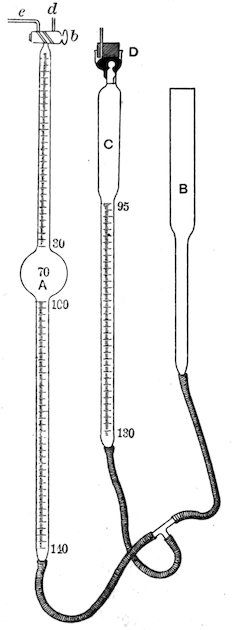
Figure. 83.
Lunge’s Improved Apparatus.
The volume of air under the observed
conditions which would measure exactly
100 cubic centimeters at 0° and 760
millimeters pressure of mercury, is calculated
by the formula
V = 100(273 + t)760
273(b − f);
where t equals observed temperature, b
the barometric pressure less the correction
noted above and f the tension of
the vapor of water under existing conditions.
For example:
| Let the temperature be |
18° |
| Barometric reading |
755 |
| Correction for t |
2 |
| Corrected barometer |
753 |
| Vapor of water tension |
16 |
Then V = 100(273 + 18)760
273(753 − 16) = 109.9.
This indicates that 109.9 cubic centimeters of air would occupy
a volume of 100 cubic centimeters when subjected to standard
conditions.
The tubes A, B, and C are filled with mercury of which about
514two and a half kilograms will be required. By means of the
leveling tube B, the stopper in C being opened, the mercury in
C is brought exactly to 109.9 cubic centimeters. The stopper
in C is then closed, mercury poured into D, which is then closed
with a rubber stopper, carrying a small glass tube as indicated
in the figure.
The leveling tube B serves to regulate the pressure on the
gas in A and this is secured by depressing or elevating it as the
case may require.
The tube for reducing the volume to standard conditions of
temperature and pressure, viz., 0° and 760 millimeters of mercury,
is shown in C. In its narrow part which has the same internal
diameter as A it is graduated into tenths of a cubic centimeter.
The upper end of C is furnished with a heavy glass neck D surmounted
by a glass cup. In the neck is placed a ground-glass
stopper, carrying a groove below, which corresponds to a similar
groove above in the side of the neck whereby communication can
be established at will between the interior of C and the exterior.
The joint is also sealed by pouring mercury into D as is shown in
the figure. When the stopper is well ground and greased the
reduction tube may be raised or lowered as much as may be necessary
without any danger of escape or entrance of gas. To determine
the position of the reduction tube C the reading of the
barometer and thermometer at room temperature is taken. From
the reading of the barometer subtract one millimeter if the temperature
be below 12°, two millimeters at a temperature from 12°
to 19°, three from 20° to 25°, and four above 25°.
When a gas has been introduced into the measuring tube A
it is brought to the volume which it would assume under standard
conditions by adjusting the tube C in such a way as to bring
the level of mercury in C and A to the same point and the level
of the mercury in C is exactly at 100 cubic centimeters. The
gas in A is then at the volume which it would occupy under
standard conditions and this volume can be directly read. This
adjustment is secured by moving the tubes B and C up or down.
If gases are to be measured wet, a drop of water should be put
on the side of the upper part of C, and, if dry, of sulfuric acid,
before the adjustment for temperature and pressure.
515475. Method of Manipulation.—By the action of mercury
in the presence of sulfuric acid, the nitrogen in nitrates, nitrites,
nitrosulfates, nitroses, nitrocellulose, nitroglycerol,
and the greater number of explosives,
may be obtained and measured as nitric oxid.
The nitrogen compounds are decomposed in
the apparatus shown in Fig. 84.
To make an analysis, the apparatus is filled
with mercury, through F, until the two openings
in the cock and i are entirely occupied with that
liquid. The cock h is then closed, and the nitrogen
compound, in solution, introduced through
g, care being taken that no air enters g when F
is depressed and h opened to admit the sample.
The funnel g is washed several times with a few
drops of sulfuric acid, which are successively
introduced into G. The total liquid introduced
should not exceed ten to fifteen cubic centimeters,
of which the greater part should be sulfuric
acid. The rubber tube connecting G and F is carefully closed
with a clamp and G violently shaken for a few minutes until no
further evolution of nitric oxid takes place. In shaking, the
apparatus should be so held as to prevent the escape of the mercury
from the small tube i by keeping it closed with the finger
or drawing over it a rubber cap.
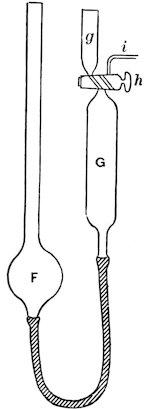
Figure 84.
Lunge’s Analytic Apparatus.
After the evolution of the gas has ceased, the tube e, Fig. 83,
is brought into contact with i, Fig. 84, and the two are joined
by a tight-fitting piece of rubber tubing in such a way as to
exclude any particle of air. The tube F, Fig. 84, is lifted and
B and C, Fig. 83, depressed. On carefully opening the cocks h
and b and bringing i and e into union, the gas is passed from G
into A. When all the gas has entered A and the acid mixture
from G has reached b the latter is closed, and also h. The
apparatus G is disconnected and removed. The gas in A is
then reduced to normal conditions by manipulating the reduction
tube C in the manner already described.
The gas in A is measured dry by reason of having been generated
in presence of rather strong sulfuric acid. Consequently,
516for this operation the adjustment of the volume of gas in C should
be made in contact with a drop of strong sulfuric acid. In order
to make the readings, a quantity of material must be taken which
will give less than thirty or from 100 to 140 cubic centimeters of
nitric oxid.
The quantities of the different compounds of nitric acid corresponding
to the number of cubic centimeters of nitric oxid,
measured under standard conditions, are shown in the following
table:
|
|
CORRESPONDING TO |
|
|
———————————— |
———————————— |
———————————— |
| Cubic centimeters of NO. |
Weight in milligrams. |
N₂O₃ in milligrams. |
HNO₃ in milligrams. |
NaNO₃ in milligrams. |
| 1 |
1.343 |
1.701 |
2.820 |
3.805 |
| 2 |
2.682 |
3.402 |
5.640 |
7.610 |
| 3 |
4.029 |
5.103 |
8.460 |
11.415 |
| 4 |
5.372 |
6.804 |
11.280 |
15.220 |
| 5 |
6.715 |
8.506 |
14.100 |
19.025 |
| 6 |
8.058 |
10.206 |
16.920 |
22.830 |
| 7 |
9.401 |
11.907 |
19.740 |
26.635 |
| 8 |
10.744 |
13.608 |
22.560 |
30.440 |
| 9 |
12.087 |
15.309 |
25.380 |
34.245 |
476. Utility of the Method.—Where it is desirable that the
nitric oxid method be used, and at the same time heating be
avoided, the decomposition of a nitrate by means of metallic
mercury and sulfuric acid affords a convenient and accurate procedure.
But, as a rule, there is no objection to the application
of the lamp, and in such cases the mercury method appears to
have no advantage over the ferrous chlorid process. Nevertheless,
in the hands of a skilled worker the results are reliable, and
the process is a quicker one, on the whole, than by distillation
with ferrous chlorid and hydrochloric acid. This method, however,
can not be recommended as in any way superior to the
reduction methods to be hereinafter described.
477. Method of Boussingault.—The process for the estimation
of nitric acid by the decoloration of a solution of indigo
is due originally to Boussingault.[305] In this method the extract,
obtained by washing slowly 200 grams of soil until the filtrate
517amounts to 300 cubic centimeters, is evaporated until its volume
is no greater than two or three cubic centimeters, and it is transferred
to a test-tube, with washings, and again evaporated in the
tube until the volume is not greater than that last mentioned. A
few drops of solution of indigo are added, and then two cubic
centimeters of pure hydrochloric acid; the whole is then heated.
As the color of the indigo disappears more is added. When the
color ceases to fade, the liquid in the test-tube is concentrated
by boiling. If concentration fail to destroy the blue or green
color, another one-half cubic centimeter of hydrochloric acid is
introduced. The reaction is completed when neither concentration
nor fresh addition of hydrochloric acid destroys the excess
of indigo present. The color produced by a small excess of
indigo is a bright sap-green; this tint is the final reaction
sought. The small excess of indigo necessary to produce a green
color is deducted in every experiment.
When more than mere traces of organic matter are present,
Boussingault advises that the nitric acid be first separated by
distillation and then reduced by the indigo solution. For this
purpose the concentrated solution of the nitrate, two or three
cubic centimeters, is placed in a small tubulated retort with
two grams of manganese dioxid in fine powder. The retort is
next half filled with fragments of broken glass, over which is
poured one cubic centimeter of concentrated sulfuric acid. The
retort is heated carefully by means of a small flame, which is
kept in motion so as to successively come in contact with all parts
of the bottom of the retort. The distillate is received in a graduated
test-tube which is kept cool. The distillation is continued
until the vapors of sulfuric acid begin to appear. The apparatus
is allowed to cool, the stopper of the retort removed, two cubic
centimeters of water introduced, and the distillation again made
until fumes of sulfuric acid are again seen. The distillation
with water is made twice in order to remove every trace of nitric
acid from the retort. The distillate is neutralized with a solution
of potassium hydroxid and concentrated to two cubic centimeters,
and the nitric acid estimated in the manner already
described. The manganese dioxid used should be previously
well washed and the sulfuric must be free of nitric acid.
518Preparation of the Indigo Solution.—Fifty grams of indigo in
fine powder are digested for twenty-four hours, at 40°, in a liter
of distilled water. The water is then poured off and replaced
with a fresh supply. After the second decantation the residue
is treated with 750 cubic centimeters of equal parts of water and
pure concentrated hydrochloric acid and boiled for an hour.
After cooling, the undissolved portion is collected on a filter and
washed at first with hot, and afterwards with cold water, until
the filtrate is no longer colored and is free of acid. The dried
residue is treated with ether under a bell-jar, or in a continuous
extraction apparatus, until the ether is only of a faint blue tint.
The fifty grams of indigo at first taken will give about twenty-five
grams of the purified article, which, however, will still leave
a little ash on combustion.
Solution in Sulfuric Acid.—Five grams of the purified indigo
are placed in a flask having a ground-glass stopper, treated
with twenty-five grams of fuming sulfuric acid, and allowed to
digest two or three days at a temperature of from 50° to 60°.
From seventy to 200 drops of the solution thus made are placed
in 100 cubic centimeters of water for use in the process.
Standardization of the Indigo Solution.—The solution as prepared
above is standardized by a solution of one gram of pure
potassium nitrate in 1,000 cubic centimeters of distilled water.
The oxidation of the indigo solution is accomplished as described
above. For this strength of standard nitrate solution two cubic
centimeters are taken corresponding to two milligrams of potassium
nitrate. The indigo solution for this strength should have
only twenty drops of the sulfuric acid solution of indigo to 100
cubic centimeters of water. If twenty grams of potassium nitrate
are taken for 1,000 cubic centimeters of the standard solution
then 200 drops of the sulfindigotic acid should be used to 100
cubic centimeters of water.
478. Method of Marx.—As usually practiced, the indigo
method is conducted according to the variation described by
Marx.[306] There are required for the process the following reagents
and apparatus:
a. A solution of pure potassium nitrate containing 1.8724
grams per liter. One cubic centimeter of the solution is equivalent
to one milligram of nitric anhydrid (N₂O₅).
519b. A solution of the best indigo carmine in water which should
be approximately standardized by solution in the manner described
hereafter, and then diluted so that six to eight cubic centimeters
equal one milligram of nitric acid.
c. Chemically pure sulfuric acid of specific gravity 1.842, perfectly
free from sulfurous and arsenious acids and nitrogen
oxids.
d. Several thin flasks of about 200 cubic centimeters capacity.
e. A small cylindrical measure holding fifty cubic centimeters
and divided into cubic centimeters.
f. A Mohr’s burette divided into tenths of a cubic centimeter.
g. A twenty-five cubic centimeter pipette or another burette.
h. A five cubic centimeter pipette divided into cubic centimeters
or half cubic centimeters.
i. A measuring flask of 250 cubic centimeters capacity.
Preliminary Trial.—Twenty-five cubic centimeters of the sample
are transferred to a flask; the fifty cubic centimeter measure
is filled with sulfuric acid and the burette with indigo solution.
The sulfuric acid is added to the sample all at once, shaken for
a moment, and the indigo run in as quickly as possible with
shaking until a permanent greenish tint is produced. If the
sample do not require more than twenty cubic centimeters of
indigo solution of the above strength, it can be titrated directly,
otherwise it must be diluted with a proper quantity of pure water,
and subjected again to the preliminary trial.
The Actual Titration.—(1) Twenty-five cubic centimeters of
the sample properly diluted if necessary, are measured and
poured into a flask, and as much indigo as was used in the preliminary
trial, is added; a quantity of sulfuric acid, equal in
volume to the liquid in the flask, is added all at once, the mixture
shaken, and indigo solution run in quickly out of the
burette until the liquid remains permanently of a greenish tint.
(2) The last experiment is repeated as often as may be necessary
adding to the water at first half a cubic centimeter less
indigo than the total quantity used previously, afterwards proceeding
as in (1) until the final test shows too little indigo used.
(3) From the rough titration of the indigo, calculate the
amount of potassium nitrate solution corresponding with the indigo
520solution used in (2), multiply the result by ten, transfer this
quantity of the standard nitrate solution to a 250 cubic centimeter
flask, fill with pure water to the mark, and titrate twenty-five
cubic centimeters of this fluid with indigo as in (2). If the
quantity of indigo solution used is nearly the same as that required
in (2), its exact value may be calculated, but if it is not,
another nitrate solution may be made up in the 250 cubic centimeter
flask, more closely resembling the sample in strength, and
the titration with the indigo solution must be repeated.
(4) If the water contain any considerable amount of organic
matter, it must first be destroyed by potassium permanganate.
In this case, the estimation of the organic matter and nitric acid
may be conveniently combined.
The use of permanganate in the above case is likely to introduce
an error as has been shown by Warington. The method
therefore can not be recommended in the presence of organic
matter.
479. Method of Warington.—The modification of the indigo
method as used by Warington, applicable only in absence of
organic matter, is the one chiefly employed in England.[307]
Instead of the ordinary indigo of commerce, indigotin is used.
The normal solution of the coloring matter is made of such a
strength as to be equivalent to a solution of potassium nitrate
containing 0.14 gram of nitrogen per liter. Where large quantities
of the coloring matter are to be used it is advisable to prepare
it about four times the strength given above and then dilute
it as required. Four grams of sublimed indigotin will furnish
more than two liters of the color solution.
The solution is prepared as follows:
Four grams of indigotin are digested for a few hours with five
times that weight of Nordhausen sulfuric acid, diluted with water,
filtered, and made up to a volume of two liters. The strength
of the indigotin solution is determined with a solution of potassium
nitrate of the strength mentioned above. The process is
performed as follows:
From ten to twenty cubic centimeters of the standard nitrate
solution are placed in a wide-mouthed flask of about 150 cubic
centimeters capacity. A portion of the indigotin solution is next
521added, such as will be deemed sufficient for the process, and the
whole is well mixed. Strong sulfuric acid is next measured out
from a burette into a test-tube, in volume equal to the united
volumes of the nitrate solution and indigotin. The whole of the
sulfuric acid is then poured as quickly as possible, into the solution
in the flask and rapidly mixed, and the flask transferred to
a calcium chlorid bath, the temperature of which should be
maintained at 140°. It is essential to the success of the operation
that the sulfuric acid should be mixed with the greatest
rapidity. It should be poured in at once and the whole well
shaken without waiting for the test-tube containing the acid, to
drain. The flask should be covered by a watch-glass while it is
held in the bath. As soon as the larger part of the indigotin is
oxidized the flask in the bath should be gently rotated. With
very weak solutions of nitrate it may be necessary sometimes to
keep the flask in the bath for five minutes. When the indigo
color is quickly discharged it shows the presence of nitric acid
in considerable excess and a considerably larger quantity of
indigo must be taken in the next experiment. The experiments
are continued until just the quantity of indigo necessary
to consume the nitric acid is taken, the amount of indigo
being in very slight excess, not exceeding one-tenth cubic centimeter
of the indigo solution used. The tint produced by the
small excess of indigo remaining is best seen by filling the flask
with water. On substances of approximately known strength
about four experiments are usually necessary to determine the
amount of indigo to be taken, but with unknown substances a
larger number may be necessary.
Usually in determinations of this kind it is directed to use
double the volume of sulfuric acid mentioned above. In this
case not only is the quantity of indigo oxidized much greater
than with a smaller portion of acid, but the prejudicial effect of
organic matter is also greater than when the smaller quantity of
acid is employed.
An indigo solution standardized as above is strictly to be used
for a solution of nitrate of the strength employed during the
standardization. The quantity of indigo oxidized in proportion
to the nitric acid present diminishes as the nitrate solution
522becomes more dilute. Instead of determining this during each
series of experiments it may be estimated once for all and a table
of corrections used.
The following table is based upon experimental determinations:
| Strength of niter solution used. |
Indigo required, cubic centimeters. |
Difference between amounts of indigo, cubic centimeters. |
Nitrogen corresponding to one cubic centimeter of indigo, gram. |
Difference between the nitrogen values, gram. |
Difference in the nitrogen values for a difference of one cubic centimeter in the amount of indigo, gram. |
| ⁸⁄₆₄ |
Normal |
10.00 |
|
0.000035000 |
|
|
| ⁷⁄₆₄ |
„ |
8.71 |
1.29 |
0.000035161 |
0.000000161 |
0.000000125 |
| ⁶⁄₆₄ |
„ |
7.43 |
1.28 |
0.000035330 |
0.000000169 |
0.000000132 |
| ⁵⁄₆₄ |
„ |
6.14 |
1.29 |
0.000035627 |
0.000000298 |
0.000000231 |
| ⁴⁄₆₄ |
„ |
4.86 |
1.28 |
0.000036008 |
0.000000381 |
0.000000298 |
| ³⁄₆₄ |
„ |
3.57 |
1.29 |
0.000036763 |
0.000000756 |
0.000000586 |
| ²⁄₆₄ |
„ |
2.29 |
1.28 |
0.000038209 |
0.000001445 |
0.000001129 |
| ¹⁄₆₄ |
„ |
1.00 |
1.29 |
0.000043750 |
0.000005541 |
0.000004295 |
The table is used as follows:
Suppose that twenty cubic centimeters of water under examination
have required 5.36 cubic centimeters of indigo solution
for the oxidation of the nitric acid contained therein. By inspection
of the table it is seen that this number is five-tenths cubic
centimeter above the nearest quantity given; viz., 4.86 cubic
centimeters. From the last column in the table it is found that
the correction for five-tenths cubic centimeter of indigo solution
is 0.000000149 cubic centimeter, being half that for the one cubic
centimeter given in the table. This is to be subtracted from the
unit value in nitrogen given in the first “gram” column of the
table; viz., 0.000036008. It is thus seen that the 5.86 cubic
centimeters of indigo solution are equivalent to 0.000035859
gram of nitrogen per cubic centimeter. The water under examination,
therefore, contains nine and six-tenths parts of nitrogen
as nitric acid per million.
Attention must also be paid in standardizing indigo solutions
to the initial temperature of the solutions. A rise in the initial
temperature will be attended by a diminution in the quantity of
indigo oxidized. Experiments with a room temperature of 10°
and a room temperature of 20°, being the initial temperatures of
the experiments, showed that at the higher temperature the
amount of indigo consumed was about five per cent less when
523the strong solutions of nitrate were employed. The indigo
solution should, therefore, be standardized at the same temperature
at which the determinations are made.
If twenty cubic centimeters of the standard nitrate solution
employed be used in setting the indigo solution, this standard
will enable the operator to determine nitric acid up to 17.5
parts of nitrogen per million in water or soil extracts.
The presence of an abundance of chlorids in the water under
examination tends to diminish the content of nitric acid found,
and also tends to introduce an error, which is sometimes of a
plus and sometimes of a minus quantity, according to the strength
of the nitric acid present. The reaction is shortened in weak
solutions by the presence of chlorids, and the quantity of indigo
consumed is consequently increased. The error introduced by
chlorids is usually of an insignificant nature.
On account of the interference of organic matters with the
reaction of indigo it is not of much use in the examination of
nitrates washed out of soils, although in some cases the results
may be quite accurate. This method must, therefore, be considered
as applicable, in general, to waters or soil extracts
which contain little or no organic matter.
In analytical work pertaining particularly to agriculture, the use
of the indigo method for determining nitric acid has been largely
employed, both in the analyses of soil extracts and drainage and
irrigation waters. The method, however, can hardly survive as
an important one in such work in competition with more modern
and speedy processes of analysis.
480. Classification of Methods.—When nitrogen is present
in a highly oxidized state, e. g., as nitric acid, it may be quickly
and accurately estimated by reduction to ammonia. This action
is effected by the reducing power of nascent hydrogen, and this
substance may be secured in the active state by the action of an
acid or alkali on a metal, or by means of an electric current.
The processes depending on the use of a finely divided metal in
the presence of an acid or alkali have come into general use
524within a few years, and are now employed generally instead of
the more elaborate estimations depending on the use of copper
oxid or indigo.
The typical reaction which takes place in all cases is represented
by the following equation:
2HNO₃ + 8H₂ = 2NH₃ + 6H₂O.
The method will be considered under three heads; viz., 1.
Reduction in an alkaline solution; 2. Reduction in an acid solution;
3. Reduction by means of an electric current.
In the first class of processes the reduction and distillation
may go on together. In the second class the reduction is accomplished
first and the distillation effected afterwards, with the
addition of an alkali. In the third class of operations the reduction
is accomplished by means of an electric current and the
ammonia subsequently obtained by distillation, or determined
by nesslerizing. These processes may be applied to rain and
drainage waters, and to soil extracts. On account of the ease
with which the analyses are accomplished, the short time required
and the accuracy of the results, the reduction methods for nitrates
have already commended themselves to analysts, and are quite
likely to supersede all others for practical use where weighable
quantities of nitrates are present. For the minute traces of
nitrates found in rain and drainage waters, and in some soil
extracts, the reduction method may also be applied, but in these
cases the ammonia which is formed must be determined by
colorimetry (nesslerizing) and not by distillation. The processes
about to be described are especially applicable to the
examination of soils and waters rich in nitrates.
481. Provisional Method of the Association of Official
Agricultural Chemists.[308]—
Extraction of the Nitrates.—Place one kilogram of the dried
soil, calculated to water-free substance, on a percolator of glass
or tin. Moisten the soil thoroughly with pure distilled water,
and allow to stand for half an hour. Add fresh portions of pure
distilled water until the filtrate secured amounts to one liter. If
the first filtrate be cloudy before use it may be refiltered.
525Qualitative Test for Nitrates.—Evaporate five cubic centimeters
of the soil extract in a porcelain crucible, having first dissolved
a small quantity of pure brucin sulfate therein. When
dry, add to the residue a drop of concentrated sulfuric acid free
of nitrates. If the nitrate calculated as potassium nitrate does
not exceed the two-thousandth part of a milligram only a pink
color will be developed; with the three-thousandth part of a
milligram a pink color with reddish lines; with the four-thousandth
part of a milligram a reddish color; with the five-thousandth
part of a milligram a distinct red color.
Estimation of the Nitrates.—Evaporate 100 cubic centimeters
of the soil extract to dryness on a steam-bath. Dissolve the
soluble portions of the residue in 100 cubic centimeters of
ammonia-free distilled water, filtering out any insoluble residue.
Place the solution in a flask, add ten cubic centimeters of sodium
amalgam, stopper the flask with a valve which will permit the
escape of hydrogen, and allow to stand in a cool room for twenty-four
hours. Add fifty cubic centimeters of milk of lime and
titrate the ammonia produced by distillation, with standard acid
and estimate as nitrogen pentoxid. Where the amount of
ammonia is small, nesslerizing may be substituted for titration.
Preparation of Sodium Amalgam.—Place 100 cubic centimeters
of mercury in a flask of half a liter capacity; warm until paraffin
will remain melted over the surface; drop successively in
the paraffin-covered mercury, pieces of metallic sodium of the
size of a pea until 6.75 grams have united with the mercury.
The amalgam contains then 0.5 per cent of metallic sodium and
may be preserved indefinitely under the covering of paraffin.
482. Method of the Experiment Station at Möckern.[309]—The
principle of this reaction is based on the reducing action
exercised by nascent hydrogen on a nitrate, the hydrogen being
generated by the action of soda-lye on a mixture of zinc dust
and finely divided iron.
Ten grams of nitrate are dissolved in 500 cubic centimeters of
water. Of this solution twenty-five cubic centimeters, corresponding
to one-half gram, are placed in a distillation flask
of about 400 cubic centimeters capacity, 120 cubic centimeters
of water added, and about five grams of well-washed and
526dried zinc dust and an equal weight of reduced iron. To the
solution are added eighty cubic centimeters of soda-lye of 32° B.
The flask is then connected with the condensing apparatus and
the distillation carried on synchronously with the reduction, the
ammonia being collected in twenty cubic centimeters of titrated
sulfuric acid. The distillation is continued from one to two
hours, or until 100 cubic centimeters have been distilled, and the
remaining sulfuric acid is titrated in the usual way. Soil extracts
and sewage waters should be concentrated until they have
approximately the proportion of nitrates given above.
483. Method of Devarda.—The inconvenience due to slow
action and other causes, arising from the use of pure metals in the
reduction of nitrates to ammonia, has been overcome, to some
extent, by Devarda, by use of an alloy, in a state of fine powder, consisting
of aluminum, copper, and zinc.[310] The alloy consists of
forty-five per cent of aluminum, fifty per cent of copper, and five per
cent of zinc. In dissolving, the copper is left in a finely divided
state, which is a great help in distillation in preventing bumping.
The analytical process is carried out as follows: The solution
containing the nitrate, in quantity equivalent to about one-half
gram of potassium nitrate, is placed in a flask having a capacity
of about one liter, and diluted with sixty cubic centimeters of
water and five cubic centimeters of alcohol, and then forty cubic
centimeters of caustic potash solution added of specific gravity one
and three-tenths. From two to two and one-half grams of the
alloy, described above, are introduced, and the flask attached to a
condenser with a receiver containing standard acid. The connection
between the flask and the condenser is made by means
of a tube having on the limb next the flask a bulb filled with
glass beads to prevent the contents of the flask splashing over
into the receiver, and on the other limb another bulb to prevent
the acid in the receiver finding its way into the distillation flask,
should regurgitation occur. When the flask has been thus connected
with the condenser it is gently heated for half an hour,
at the end of which time the evolution of hydrogen will have
slackened or ceased, and then the distillation is begun, at first
cautiously, until the zinc of the alloy has completely dissolved,
and then more vigorously, the time necessary being about twenty
527minutes from the time when the contents of the flask begin to
boil. The distillate is caught in standard acid and the ammonia
determined by backward titration in the ordinary way. It is to
be noted that the strength of the alkali used is of importance, as
if it be too strong, the action on the alloy is unduly vigorous at
the beginning of the operation, and if too weak, the contents of
the flask have to be heated overmuch, the result in both cases
being the formation of a fine spray of caustic solution, which is
very difficult to stop, even with complicated washing attachments
to the distilling flask. The test analyses on pure nitrates are
satisfactory. This method has been used with satisfaction in
the laboratory of the Department of Agriculture, but does not
appear to have any special advantage over the process of Ulsch,
to be described further on.
484. Variation of Stoklassa.—Stoklassa has subjected
the method of Devarda to a comparative test with the following
methods:[311]
1. Wagner’s Schloesing-Grandeau method.
2. Lunge’s nitrometer method.
3. Stutzer’s method.
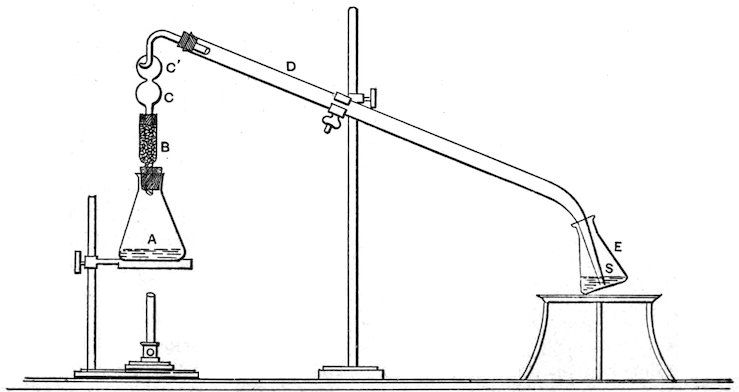
Figure 85. Stoklassa’s Nitric Acid Apparatus.
The reduction takes place in a copper erlenmeyer, A, Fig. 85, in
which, in addition to the solution containing the nitrate, are placed
528200 cubic centimeters of water, forty cubic centimeters of potassium
hydroxid solution of 33° B., five cubic centimeters of alcohol, and
finally two and one-half grams of the finely powdered Devarda
alloy. The distillate passes through a tube, B, filled with glass
pearls and into the condenser D, through the bulbs, C C′.
After the flask is connected with the distilling apparatus, it is
gently warmed and the reduction is ended in about twenty
minutes. The ammonia which is formed is then distilled into
E, containing the standard acid, S, requiring about twenty minutes
more. The comparative results given, show that the
Devarda method is equally as accurate as any of the other
methods mentioned, giving practically theoretical results.
In so far, however, as speed of an analysis, is concerned the
first place is awarded to the Lunge nitrometer method, with
which a complete analysis can be made in from thirty to forty
minutes. In the second rank, so far as speed is concerned, the
Devarda method is recommended. All the methods give accurate
results.
485. Method of Sievert.[312]—Two grams of potassium or
sodium nitrate are dissolved and made up to 1,000 cubic centimeters.
Fifty cubic centimeters of the solution are placed in a 600
cubic centimeter flask and diluted with fifty cubic centimeters of
water, and from eighteen to twenty grams of caustic alkali
added. After the alkali is dissolved, seventy-five cubic centimeters
of ninety-six per cent alcohol are added and a few pieces
of bone-black to prevent foaming. From ten to fifteen grams of
zinc or iron dust are then added to the flask which is closed
and connected with a ᥩ tube holding about 200 cubic centimeters,
which contains about ten cubic centimeters of normal
sulfuric acid. This ᥩ tube is kept cool by being immersed
in water. The whole mixture is now allowed to stand for three
or four hours and then the alcohol is distilled slowly and the
ammonia formed by the reduction of the nitrates is carried over
with it. The distillation lasts for about two hours. The contents
of the ᥩ tube are carefully rinsed into a dish and the
excess of sulfuric acid titrated with one-fourth normal soda-lye.
For soil extracts and substances containing unknown quantities
of nitric acid, a preliminary test will indicate approximately
529the amount thereof, and this will be an indication for
the quantity to be used in the analysis.
The method of Stutzer differs from the foregoing in the substitution
of aluminum dust instead of iron or zinc.[313] The reducing
power of aluminum, however, varies greatly according to the
method in which the metal has been prepared. Pure aluminum
prepared by the electric method, reduces the nitric acid much
less vigorously than the metal prepared by the older methods of
fusion with sodium. For this reason the method of Stutzer is
not to be preferred to that of Sievert.
486. Variation of the Sodium Amalgam Process.—This
method is described by Monnier and Auriol.[314]
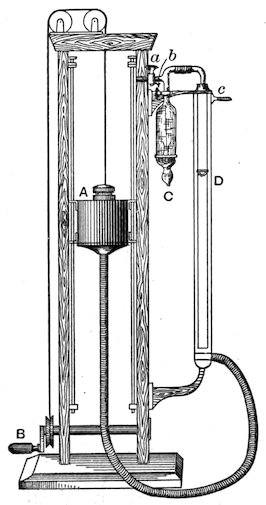
Figure 86. Variation of the Sodium Amalgam Process.
The principle of the operation depends on the reduction of
the dissolved nitrate by titrated sodium amalgam in presence of
an acid, and the estimation of the
quantity of nitric acid present from
the deficit in the volume of hydrogen.
The apparatus employed is conveniently
mounted as shown in Fig. 86.
The brass vessel A is movable by
means of the cord on the pulley B, in
such a way as to be fixed at any
required altitude. It is filled with
water and connected by a rubber tube
to the cooling tube D. Within the
cooling tube there is a graduated
cylinder open at its lower end. Its
upper end is connected directly with
the apparatus C. The cooling tube
D has a small side tube, c, near its
upper end, by means of which the air
can enter or escape when the position
of A is changed. The apparatus C,
in which the reaction takes place, is
a glass cylinder. Its upper end is
continuous with the ⟙ tube provided with the stop-cocks a and b.
530One arm of the ⟙ permits connection with the graduated measuring
tube by means of a rubber union. The lower end of C is
closed with a large hollow ground-glass stopper, carrying a small
receptacle within, so that it forms two separate water-tight compartments,
open at the top.
The sodium amalgam is prepared as follows:
In a clay crucible are heated 400 grams of mercury, and,
little by little, with constant stirring, four grams of dry sodium
are added. When cold, the amalgam is placed in a burette,
having a ground-glass stopper, and covered with petroleum.
The strength of the amalgam is established in the following
manner. A small glass thimble, ground even at the top, is filled
with the amalgam and struck off even with a ground-glass
straight edge. In this way the same quantity of amalgam is
taken for each test. This measured portion of the amalgam is
placed in the inner vessel of the glass stopper to C. Ten cubic
centimeters of water, containing sixty centigrams of tartaric
acid, are placed on the outer ring of the glass stopper, which is
then inserted, well oiled, in C, closing it air- and water-tight.
The tartaric acid solution also carries a piece of litmus paper,
so that its constant acidity may be insured. The vessel A is
then fixed in a position which brings the water in the graduated
burette and tube D exactly to the 0 mark. The cock a is next
closed, b opened, and C is inverted until all the amalgam is
poured into the solution of tartaric acid. The evolved hydrogen
mixed with the air contained in the apparatus, is passed into
the graduated burette. After fifteen minutes, the reaction is
ended. The water level within and without the graduated
tube is restored and the volume of gas evolved noted and reduced
by the usual tables to 0° and 760 millimeters pressure of the
barometer.
An amalgam prepared as above will give about three cubic
centimeters of hydrogen for each gram. The thimble should
hold from twelve to fifteen grams.
The estimation of nitric acid should be made in a solution
containing about one-tenth per cent of nitrate. Ten cubic centimeters
are taken, to which six-tenths gram of tartaric acid is
added, and placed in the outer part of the glass stopper. The
531rest of the process is conducted exactly as described above. The
deficit in hydrogen is calculated to nitrogen pentoxid.
The reduction by sodium amalgam is not so convenient a form
of estimating nitric acid as many of the other forms of using
nascent hydrogen. As practiced by calculating from the deficit
of hydrogen, however, it has some advantages by reason of the
fact that no heating is required. The presence of organic neutral
bodies, or even those of an acid nature, like humus, does not,
therefore, interfere with the work. Likewise, mineral bodies
in solution, which are not reduced by nascent hydrogen, do not
interfere with the accuracy of the reaction.
487. Method of Schmitt.—In the method of Schmitt forty
cubic centimeters of glacial acetic acid are placed in a flask of
600 cubic centimeters content, and fifteen grams of a mixture of
zinc and iron dust added.[315] To this a quantity of the solution
containing the nitrate, representing about half a gram of the pure
nitrate, is added with constant shaking, in portions which do not
evolve hydrogen too rapidly. After about fifteen minutes when the
evolution of nitrogen has somewhat diminished, an additional
fifteen grams of the metal dust are added. If the contents of the
flask should become thick they can be diluted with thirty cubic
centimeters of water. The reduction is complete in from thirty
to forty minutes. The contents of the flask are now saturated
with enough soda-lye not only to neutralize the excess of acetic
acid, but to keep the zinc hydroxid also in solution. For this
purpose about 200 cubic centimeters of soda-lye of 1.25 specific
gravity are necessary. The ammonia is obtained by distillation
into standard acid in the usual way.
488. Method of Ulsch.—In practice the method of Ulsch
has come into general use.[316]
For the determination of nitrogen by this method half a gram
of saltpeter or four-tenths gram of sodium nitrate is taken
and dissolved in twenty five cubic centimeters of water, in a flask
with a content of about 600 cubic centimeters. Five grams of
iron reduced by hydrogen, and ten cubic centimeters of sulfuric
acid diluted with two volumes of water are then added to the
flask. To avoid mechanical losses during the evolution of
hydrogen a pear-shaped glass stopper is hung in the neck
532of the flask. After the first violent evolution of hydrogen has
passed, the flask is slowly heated until in about four minutes
it is brought to a gentle boil. The boiling is continued for
about six minutes when the reduction is complete. About fifty
cubic centimeters of water are then added; also an excess of
soda-lye and a few particles of zinc and the ammonia is distilled
and collected in standard acid in the usual way.
The method of Ulsch can also be applied, according to Fricke,
to the analysis of nitrates contained in drinking and drainage
waters, and it is regarded by him as one of the best methods to
be employed in such investigations.[317]
The method of Ulsch in this laboratory has given entirely
satisfactory results, and is generally used in preference to other
methods in cases where a considerable quantity of nitrates is
present. It is based on the following reactions:
2KNO₃ + H₂SO₄ = K₂SO₄ + 2HNO₃
2HNO₃ + 8H₂ = 2NH₃ + 6H₂O
2NH₃ + H₂SO₄ = (NH₄)₂SO₄.
489. Method of Williams-Warington.—From the losses
which naturally occur during the evaporation of water, even
with all the precautions noted, Warington was led to try some
method for the determination of nitrates and nitrites in waters
without previous concentration.[318] The reduction of these bodies
by the copper-zinc couple formed the basis of these experiments,
and they resulted in the following method of manipulation, which
is based on a process devised by Williams.[319]
The method consists in boiling rapidly one liter of the rain
water in a retort, with a little magnesia previously raised to a
low red heat and then washed, until 250 cubic centimeters have
distilled over. The residue is then made up to 800 cubic centimeters,
transferred to a wide-mouthed, stoppered bottle supplied
with strips of copper and zinc forming electric couples, and
set aside, at a constant temperature of from 21°–24°, for three
days. A measured portion of the solution is then distilled, and
the ammonia determined in the distillate by nesslerizing.
533This plan has two advantages: First, the ammonia, as well as
the nitrogen as nitrates and nitrites, can be determined in the
course of the same operation and in the same sample of water.
For this purpose it is only necessary to fit the retort to an efficient
condenser and to remove all ammonia from the apparatus
by boiling distilled water in the retort before introducing the
rain water. The distillate of 250 cubic centimeters from the rain
water, as described above, is well mixed and the ammonia determined,
in from twenty-five to one hundred cubic centimeters
thereof, diluted to 150 cubic centimeters with ammonia-free
water. Second, the nitrogen, as nitrates and nitrites, is determined
directly and alone; the error of the determination is as
small as nesslerizing admits of, since it is possible, if necessary,
to distill 600 cubic centimeters of the boiled rain water corresponding
to 750 cubic centimeters of the original, and thus obtain
a full amount of ammonia for determination, even when the
rain water has been poor in nitrates.
The determination of nitric nitrogen, in a given sample, by
the above method gave a mean quantity of product of 0.162 part
per million, while the determination, in the same lot of samples,
by the modified Schloesing method gave 0.125 part per million.
This result confirms the supposition that in the complete evaporation
necessary to the manipulation of the Schloesing method
there is a loss of nitrogen. The amount of nitrogen as nitrates
and nitrites in the rain water at Rothamstead, for the twelve
months ending April 1, 1888, was found, by the Schloesing
method, to be 0.614 pound per acre, the total rain-fall being 21.96
inches. For the year ending April 1, 1889, by the copper-zinc
method, it amounted to 0.917 pound per acre, the total rain-fall
being 29.27 inches.
The amounts found in other localities are quite different from
the above, as for instance, the mean of seven stations in Germany
for thirteen years, beginning in 1864, showed 10.18 pounds
of nitrogen per acre. The average amount for ten years at the
observatory of Mont Sauris, near Paris, showed 12.36 pounds
of nitrogen per acre. The average for three years at Lincoln,
as determined by Professor G. Gray, shows one and six-tenths
534pounds of nitrogen per acre per annum. At Tokio, in Japan,
Kellner found, for one year, 1.02 pounds per acre.
490. Determination of the Ammonia.—The method used
at Rothamstead is to make one determination of ammonia in the
whole of the distillate obtained, the strength of which is regulated
by varying the amount introduced into the retort, so that
it shall be equal to about two cubic centimeters of the standard
ammonia solution. A 150 cubic centimeter cylinder is
first filled with the rain water, and fifty cubic centimeters of
nessler reagent added. The depth of tint indicates what quantity
of rain water will be required for distillation. This having been
determined, the appropriate volume of the rain water, provided
it do not exceed 600 cubic centimeters, is placed in the retort
described above, and the distillation continued until the 150
cubic centimeter cylinder is filled. The titration is made in the
usual way.
491. Preparation of the Copper-Zinc Couple.—For 800
cubic centimeters of boiled rain water, prepared as described, six
strips of zinc foil, four inches long by one and a quarter inches
wide, are taken and bent at right angles along their center to obtain
stiffness. The couple is cleansed and coated by washing in a series
of five beakers containing, respectively, dilute solution of sodium
hydroxid, very dilute sulfuric acid, a three per cent solution of
copper sulfate, ordinary distilled water, and distilled water free
from ammonia. Through these five beakers the zinc foil is successively
passed. It is rinsed both after the alkali and the acid.
But after the copper has been deposited, the strips are simply
drained and carefully placed in the distilled water, it being difficult
to rinse without removing the copper. The couples should
be entirely submerged when placed in the rain water. The
strips should remain in the copper sulfate solution long enough
to be well covered with copper.
492. Substitution of an Aluminum-Mercury Couple for
Copper-Zinc.—Ormandy and Cohen have proposed to use an
aluminum-mercury couple for the copper-zinc in the process
described above.[320]
This couple acts more quickly than the copper-zinc, and the
535results are equally as accurate. Nitrites are reduced in about
one hour by this apparatus, while the zinc-copper couple of
Gladstone and Tribe requires about six times as long. Aluminum
foil, free of grease, should be used. The foil should be
heated over a bunsen just before amalgamation. The clean, very
thin foil is coated with mercury by shaking with a concentrated
solution of mercuric chlorid. It should be prepared immediately
before use.
The amalgamated foil is introduced into the sample of water
to be analyzed, and left until all the aluminum is converted into
oxid. The presence of the oxid favors the prevention of bumping
during the subsequent distillation. The distilled ammonia,
collected in dilute acid, is determined by nesslerizing, the free
ammonia in the sample having been previously determined.
The increase in ammonia is due to nitrates or nitrites reduced
by the couple.
493. Method of De Koninck and Nihoul.—This process is
applicable only in the absence of organic bodies and other reducing
agents.
The principle on which it rests, as applied by McGowan, is
as follows:[321]
When a fairly concentrated solution of a nitrate is warmed
with an excess of pure, strong hydrochloric acid, the nitrate is
completely decomposed, and the production of nitrosyl chlorid
and chlorin is quantitative. The reaction, as shown by Tilden,
is represented by the following equation:[322]
HNO₃ + 3HCl = NOCl + Cl₂ + 2H₂O.
One molecule of nitric acid thus yields two atoms of chlorin
and one molecule of nitrosyl chlorid capable of setting free three
atoms of iodin. The iodin can be estimated in the usual manner
by titration with sodium thiosulfate. The nitrosyl chlorid
is decomposed by the potassium iodid, nitric oxid escaping.
The apparatus employed is shown in Fig. 87.
A is a small, round-bottomed flask, into the neck of which a
536glass stopper, x, is accurately ground (with fine emery and oil).
The capacity of
the bulb is about
forty-six cubic
centimeters, and
the length of the
neck, from x to
y, ninety millimeters.
The
first condenser is
a simple tube,
slightly enlarged
at the foot
into two small
bulbs.[323] The
length from a to
b is 300 millimeters,
from b to c 180 millimeters, and from e to f thirty millimeters.
The capacity of the bulb B is twenty-five cubic centimeters,
and the total capacity of the two bulbs and tube, up to
the top of C, forty-one cubic centimeters. This condenser is
immersed, up to the level of c, in a beaker full of water. D is a
geissler bulb apparatus, E is a calcium chlorid tube, filled
with broken glass, which acts as a tower and g is a small funnel,
attached by rubber and clip to the branch ⟙ tube h. Between
the ⟙ tube i and the wash-bottle for the carbon dioxid is placed
a short piece of glass tubing, s, containing a strip of filter paper,
slightly moistened with iodid of starch solution. This tube s
is really hardly necessary, as no chlorin escapes backwards if a
moderate current of carbon dioxid is kept passing, but it serves
as a check. A glance at the joints o, p, and q, which are of narrow
india-rubber tubing, is sufficient to show that, by using this
arrangement, practically no rubber is exposed to the action of
the chlorin. The tiny piece of rubber tubing at the joint o may
be done away with, the narrower tube there being accurately
ground into the wider one; this makes the condensing apparatus
practically perfect.
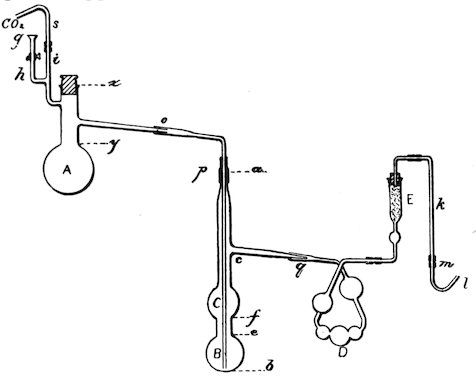
Figure 87. McGowan’s Apparatus for the Iodometric Estimation of Nitric Acid.
The actual operation is performed in the following manner:
537The evolution flask is washed and thoroughly dried, and the
nitrate (say, about 0.25 gram of potassium nitrate) is tapped
into it from the weighing tube. Two cubic centimeters of water
are now added, and the bulb is gently warmed, so as to
bring the nitrate into solution, after which the stopper of the
flask is firmly inserted. About fifteen cubic centimeters of
a solution of potassium iodid (one in four) are run into the
first condensing tube, any iodid adhering to the upper portion
of the tube being washed down with a little water, and five cubic
centimeters of the same solution, mixed with eight to ten cubic
centimeters of water, are sucked into the geissler bulbs whilst
the glass in the tower E is also thoroughly moistened with the
iodid. The geissler bulbs should be so arranged that gas only
bubbles through the last of them, the liquid in the others
remaining quiescent.
All the joints having been made tight the carbon dioxid is
turned on briskly and passed through the apparatus until a
small tubeful collected at l, over caustic potash solution, shows
that no appreciable amount of air is left in it. The small outlet
tube l, is now replaced by a calcium chlorid tube, filled with
broken glass which has been moistened with the above-mentioned
iodid solution, and closed by a cork through which an
outlet tube passes, the object of this trap tube being to prevent
any air getting back into the apparatus. The brisk current
of carbon dioxid is continued for a minute or two longer,
so as to practically expel all the air from this last tube. The
stream of gas is now stopped for an instant, and about fifteen
cubic centimeters of pure concentrated hydrochloric acid, free
from chlorin, run into A through the funnel g (into the tube of
which it is well to have run a few drops of water before beginning
to expel the air from the apparatus), and A is shaken so
as to mix its contents thoroughly. A slow current of carbon
dioxid is now again turned on (one to two bubbles through the
wash-bottle per second), and A is gently warmed over a burner.
It is a distinct advantage that the reaction does not begin until
the mixed solutions are warmed, when the liquid becomes
orange-colored, the color again disappearing after the nitrosyl
chlorid and chlorin have been expelled. The warming should
538be very gentle at first in order to make sure of the conversion of
all the nitric acid, and also because the first escaping vapors are
relatively very rich in chlorin; afterwards the liquid in A is
briskly boiled. A very little practice enables the operator to
judge as to the proper rate of warming. When the volume of
liquid in A has been reduced to about seven cubic centimeters
(by which time it is again colorless) the stream of carbon dioxid
is slightly quickened and the apparatus allowed to cool a
little. The burner is now set aside for a few minutes, and two
cubic centimeters more of hydrochloric acid, previously warmed
in a test-tube, run in gently through g; there is no fear either
of the iodid solution running back, or of any bubbles of air
escaping through y if this is done carefully. This is a precautionary
measure, in case a trace of the liberated chlorin might have
lodged in the comparatively cool liquid in the tube h. The carbon
dioxid is once more turned on slowly and the liquid in A is
boiled again until it is reduced to about five cubic centimeters.
It is now only necessary to allow the apparatus to cool, passing
carbon dioxid all the time, after which the contents of the condensers
are transferred to a flask and titrated with thiosulfate.
At the end of a properly conducted experiment, the glass in the
upper part of tower E should be quite colorless and there should
be only a mere trace of iodin showing in the lower part of the
tower, while the liquid in the last bulb of the geissler apparatus
ought to be pale yellow. During the operation, the stopper
of A and the various joints can be tested from time to time by
means of a piece of iodid of starch paper, and before disjointing
it is well to test the escaping gas (say at m) in the same way, to
make sure that all nitric oxid has been thoroughly expelled.
The method is capable of giving accurate results, but it can
not be preferred to the reduction or colorimetric processes.
494. Method of Gooch and Gruener.—The principle on
which this method rests depends on the decomposition of a
nitrate in presence of a hot saturated solution of manganous
chlorid and hydrochloric acid in an atmosphere of carbon
dioxid.[324] The products of decomposition are passed into a
solution of potassium iodid and the liberated iodin is titrated
with standard sodium thiosulfate. The products of the reaction
539are chlorin, nitric oxid, and possibly nitrosyl chlorid,
and under proper precautions the iodin set free is quantitively
proportional to the
weight of nitrate decomposed.
The manganous
mixture is acted on slowly
at ordinary temperatures,
but on heating, the nitrate
is decomposed with the
formation of a higher
manganese chlorid and
nitric oxid. When the heat
is continued a sufficient
length of time the chlorin
from the higher chlorids is
evolved and only manganous
chlorid remains. During the heating the color of the solution
passes from green to black and at the end the green color is
restored. The apparatus employed is shown in Fig. 88.
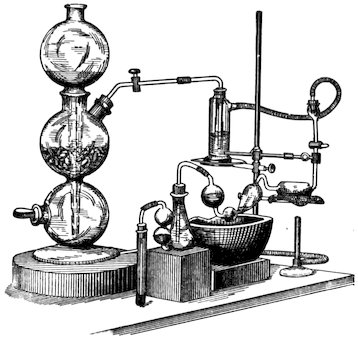
Figure 88. Apparatus of Gooch and Gruener.
A plain pipette bent as is shown in the figure serves as the
generating flask and for the attachment on the one hand to the
carbon dioxid apparatus and on the other to the system of
absorption bulbs for containing the potassium iodid. The latter
should be glass, sealed to the evolution bulb of the pipette to prevent
the action of the evolved gases on organic materials. The
point of the potassium iodid apparatus is drawn out so as to be
pushed well into the second receiver, being held in place by a
piece of rubber tubing. The third tube acts simply as a trap to
exclude the air from the absorption apparatus. The first receiver
contains in solution three grams, the second two, and the third
one gram of potassium iodid. During the reaction the first
receiver is kept cool by immersion in water. Before connecting
the apparatus with the carbon dioxid generator the solution of
manganous chlorid and afterwards the nitrate solution are drawn
into the bulb of the pipette by gentle suction. After connecting
the apparatus the current of carbon dioxid is started and kept
up until all the air is expelled. Heat is then applied to the
bulb of the pipette and the distillation continued until all the
540liquid has passed over. At the end of the reaction the contents
of the receivers are united by disconnecting the apparatus from
the carbon dioxid generator and passing water through the
pipette. The introduction of the manganous chlorid into the
mixture does not interfere with the titration of the iodin. This
is accomplished in the usual way with sodium thiosulfate using
starch as an indicator. The quantity of material used should
contain about the amount of nitric acid that is found in two-tenths
of a gram of potassium nitrate. This method, so similar
to the preceding, is somewhat less complex, and, to that extent,
preferable to it.
495. Delicacy of the Method.—The remarkable delicacy of
those methods of chemical analysis, which depend on the production
of a pronounced color, which can be compared with that
produced by a known quantity of a given substance, has been
long illustrated by the nesslerizing process for the estimation of
ammonia. By such methods minute qualities of substances can
be quantitively determined with great accuracy, when they
would escape all effort for their estimation by gravimetric
methods. Processes based on this principle are, therefore,
peculiarly applicable to the detection and estimation of oxidized
nitrogen in waters and soil extracts, whether they be present as
nitric, nitrous, or ammoniacal compounds.
In the following paragraphs will be given with sufficient detail
for the needs of the analyst, the principles and practice of the
colorimetric comparison methods which have been approved as
best by the experience of analysts. These methods are applicable
especially to cases in which only minute quantities of the
substances looked for are present, and where celerity of determination
is especially desirable. They are, therefore, of especial
value in the analysis of rain, drainage, and irrigation waters,
and of soil extracts poor in oxidized nitrogen.
496. Hooker’s Method.—The quantitive action depends
upon the deep green coloration given by nitric acid, when dissolved
in sulfuric acid and carbazol.[325] Other oxidizing bodies, such
541as iron, chlorin, bromin, chromic acid, etc., give the same reaction,
but not in such a prominent manner. Such bodies with the
exception of chlorin and iron, are not often found in waters. In
the application of the process, iron, if present in quantities greater
than one-tenth part per one hundred thousand, must be removed.
Chlorids also, even when present in very small quantities, interfere
with the delicacy of the reaction and must be removed.
Easily destructible organic matter tends to lower the result, but
not materially, unless present in large excess. Calcium carbonate
and sulfate, soda, and other alkalies, in the quantities in which
they are usually present in water, do not affect the result.
The following reagents are required:
- 1.
- Concentrated sulfuric acid.
- 2.
- An acetic acid solution of carbazol; diphenylimid, (C₆H₄<br>C₆H₄/ NH.)
- 3.
- A sulfuric acid solution of carbazol.
- 4.
- Standard solutions of potassium nitrate.
- 5.
- A solution of aluminum sulfate.
- 6.
- A solution of silver sulfate.
1. The sulfuric acid, used for all purposes in the process,
should be entirely free from nitrogen oxids. It may be readily
tested by dissolving in it a small quantity of carbazol. If the
solution be at first golden-yellow or brown, the acid is sufficiently
pure; if it be green or greenish, another and better sample
must be taken. It is essential also that the specific gravity
of the acid be fully 1.84, and it is well to ascertain that this is
really the case.
2. The acetic acid solution of carbazol is prepared by dissolving
six-tenths gram in about ninety cubic centimeters of strongest
acetic acid, by the aid of gentle heat. It is allowed to cool, and
is then made up to 100 cubic centimeters by the further addition
of acetic acid. The exact strength of this solution, is of no
material importance to the success of the process, and the above
proportions have been selected principally because they are convenient.
The solution will remain unchanged for several
months. The use of this solution merely facilitates the preparation
of that next described, which will not keep, and has, consequently,
542to be freshly prepared for each series of determinations.
3. The sulfuric acid solution of carbazol is easily made in a
few seconds, but it is advisable to allow it to stand from one and
one-half to two hours before using. It is prepared by rapidly
adding fifteen cubic centimeters of sulfuric acid, to one cubic
centimeter of the above-described acetic acid solution. This
quantity usually suffices for from two to three nitrate estimations.
When freshly prepared it is golden-yellow or brown;
it changes gradually, however, and in the course of one and one-half
or two hours it becomes olive-green. This change is probably
due to traces of oxidizing agents, which occur in the sulfuric
and acetic acids, and which, although not present in sufficient
quantity to act immediately, gradually bring about the
reaction described. The greenish color does not interfere with
the process, as might at first be supposed; on the contrary, the
solution is not sensitive to small quantities of nitric acid until it
has undergone the change to olive-green, and it is for this
reason, that it should be prepared about two hours before
required for use. This solution may be thoroughly depended on
for six hours after preparation. The intensities of color produced
by the more concentrated solutions of nitrates after this
time, gradually approach each other and become ultimately the
same.
4. The standard solutions of potassium nitrate are very readily
prepared. The solutions which are to be compared directly with
the waters examined, may be prepared as required, but if many
determinations are to be made with a variety of waters, it will
be found best to prepare a complete series, differing from each
other by 0.02 part nitrogen in 100,000. This series may include
solutions containing quantities of nitrogen in 100,000 parts, represented
by all the odd numbers from 0.03 up to 0.39. It will
be found convenient to prepare them in quantities of 100 cubic
centimeters at a time, from a stock solution of potassium nitrate
which contains 0.00001 gram nitrogen, or 0.000045 nitric acid in
one cubic centimeter. Each cubic centimeter of this solution,
when diluted to 100 cubic centimeters, represents 0.01 nitrogen in
100,000, and consequently if it is desired to make a solution containing
0.35 part nitrogen in 100,000, thirty-five cubic centimeters
543are taken and made up to 100 cubic centimeters, and so on. The
solution of potassium nitrate (b) is best prepared from a stronger
one (a) containing 0.0001 gram nitrogen to the cubic centimeter,
or 0.7214 gram potassium nitrate to the liter; 100 cubic centimeters
of (a) made up to one liter give the solution (b). It is
obvious that the series of solutions, above described, could be
made directly from (a), but by first making (b), greater accuracy
is secured.
5. For purposes which will be presently described, a solution
of aluminum sulfate is required, containing five grams to the
liter. The salt used must be free from chlorin and iron; and the
solution should give no reaction when tested with carbazol.
6. The solution of silver sulfate is required for the removal
of chlorin from the water or soil extract to be examined. It is
prepared by dissolving 4.3943 grams of the salt in pure distilled
water and making up to one liter. The sulfate is preferably
obtained by dissolving metallic silver in pure sulfuric acid. The
solution should be tested with carbazol in the same way as will be
presently described for water; if perfectly pure, no reaction will be
obtained. As silver sulfate is often prepared by precipitation
from the nitrate, it is very apt to contain nitric acid, and consequently,
if the source of the salt be unknown, this test should
on no account be omitted.
The analytical process is carried on as follows:
Two cubic centimeters of the water are carefully delivered by
means of a pipette into the bottom of a test-tube; four
cubic centimeters of sulfuric acid are added, and the solution
thoroughly mixed by the help of a glass rod. The test-tube
is then immersed in cold water, and when well cooled,
one cubic centimeter of the sulfuric acid solution of carbazol is
added, and the whole again mixed as before. The intensity of
the color is now observed, and a little experience enables a fairly
good opinion to be formed of the quantity of nitric acid present.
Suppose that the water be roughly estimated to contain about
0.15 part nitrogen per 100,000; in such a case solutions of potassium
nitrate containing 0.11, 0.15, 0.19 part nitrogen are selected
from the series. Two cubic centimeters are taken from each,
and treated, side by side, with a fresh quantity of the water,
544precisely as described for the preliminary experiment, the
various operations being performed as nearly simultaneously as
possible with each of the samples, and under precisely similar
conditions. Two or three minutes after the carbazol has been
added, the intensity of the color of each is observed. If that
given by the water is matched by any of the standard solutions,
the estimation is at an end. Similarly, if it falls between two
of these, the mean may be taken as representing the nitrogen
present in cases in which great accuracy is not required. If this
be done, the maximum error will be 0.02 part nitrogen, or 0.09
part nitric acid per 100,000. If greater exactness be required,
or it be found that the color given by the water is either
darker or lighter than that given by all the standard solutions,
a new trial must be made. In such a case the water must be
again tested simultaneously with the solutions with which it is
to be compared. This is rendered necessary principally for the
reason that the shade of the solutions to which the carbazol has
been added is apt to change on standing. Hence it is desirable
that the water, and the standard potassium nitrate with which it
is to be compared, should have the carbazol added at as nearly
the same time as possible. When finally the color falls between
that given by any two consecutive members of the standard
potassium nitrate series, the estimation may be considered at an
end, and the mean of these solutions taken as representing the
nitrogen present.
The greatest neatness should be observed in all steps of the
analysis. The quantity of water operated upon is so small that
if the greatest care be not exercised throughout, sources of
error may be readily introduced. The test-tubes should be
rinsed out with nitrate-free water before being used and then
dried. The tint should be determined by looking through the
tube and not through the length of the column of liquid.
Influence of Nitrites.—If the quantity of nitrous acid in the
water is known a correction can be applied for nitrates by deducting
one-fifth of the number found for nitrites when estimated as
nitrates.
Influence of Iron.—Although ferrous salts give no reaction
with carbazol, nitrates are apt to be overestimated in their presence.
545Oh the other hand, ferric compounds, like other oxidizing
agents, may give a characteristic green color with carbazol.
In all cases when iron is present in any considerable quantity it
is best to remove it by rendering the water slightly alkaline,
evaporating to dryness, and redissolving the soluble residue
until the solution reaches the original volume.
Influence of Chlorids.—The presence of chlorids furnishes by
far the most serious source of error in the process by intensifying
the action of the nitric acid. If, however, nitrates be absent
chlorids give no reaction with carbazol. The chlorids are
removed by a standard silver sulfate solution, the quantity of
chlorids present having been first determined by a standard silver
nitrate solution. For this purpose an ordinary sugar flask
can be employed marked at 100 and 110 cubic centimeters.
This flask is filled to the 100 cubic centimeter mark with the
water to be examined; the necessary quantity of silver sulfate
is added and then two cubic centimeters of the solution of aluminum
sulfate, previously described, and the contents of the
flask brought up to 110 cubic centimeters by the addition of
pure distilled water. The whole is shaken up and filtered, the
first portion of the filtrate being rejected. The aluminum sulfate
by reacting with the carbonates usually present in the water
and producing the precipitation of alumina, facilitates the
removal of the precipitated silver chlorid.
The above-described method on account of its delicacy is not
well suited to aqueous solutions of soils except where the quantity
of nitric nitrogen present is extremely minute.
Hooker also first suggested the use of diphenylamin for detecting
the presence of nitrates,[326] a method afterwards worked out
by Spiegel.[327]
In the variation of the method as practiced by Rideal the
standard potassium nitrate and the pure sulfuric acid mentioned
below are required, and in addition, the following reagents:[328]
(a) Silver sulfate solution containing 4.3945 grams per liter.
(b) Aluminum sulfate solution free from chlorids and iron,
five grams per liter.
546(c) Carbazol solution; six-tenths gram carbazol dissolved in
glacial acetic acid and made up to 100 cubic centimeters with the
glacial acid. For use, one cubic centimeter of this solution is
withdrawn by a pipette and mixed with fifteen cubic centimeters
of pure redistilled sulfuric acid.
The process is carried out as follows: To 100 cubic centimeters
of water the amount of chlorin which has been previously
ascertained is removed by the silver sulfate solution. Two cubic
centimeters of the aluminum sulfate are added and the whole
made up to a convenient volume, say about 110 cubic centimeters.
The liquid is filtered and two cubic centimeters of the
filtrate taken for an estimation of nitrates. To the two cubic
centimeters are added four cubic centimeters of concentrated sulfuric
acid and the mixture cooled.
One cubic centimeter of the carbazol solution in sulfuric acid
is added and a bright green color appears in a few moments, if
nitrates are present. Comparison is made with solutions of
standard potassium nitrate.
497. Phenylsulfuric Acid Method.—Rideal also proposes
a variation of the method described by Hooker, which consists
in the substitution of phenylsulfuric acid for carbazol.[329]
The solutions required are:
(a) A standard solution of potassium nitrate containing 0.7215
gram of the pure crystallized salt in a liter of water.
(b) Phenylsulfuric acid, (acid phenyl sulfate,) prepared by dissolving
fifteen grams of pure crystallized phenol in 92.5 cubic
centimeters of pure, redistilled sulfuric acid free from nitrates
and diluted with seven and one-half cubic centimeters of water.
The process is conducted as follows:
A known volume of water, from twenty-five to one hundred cubic
centimeters, according to its richness in nitrates, is evaporated
to dryness in a porcelain dish, one cubic centimeter of phenylsulfuric
acid added then one cubic centimeter of pure water and three
drops of strong sulfuric acid and the mixture gently warmed.
A yellow color shows the presence of nitrates. Dilute to about
twenty-five cubic centimeters with water and add ammonia in
slight excess. Pour into a narrow nessler tube and add the
washings and make up to 100 cubic centimeters. Imitate the
547color of the solution with the standard potassium nitrate treated
with the same reagents.
The phenylsulfuric acid should be prepared some time before
use, as the fresh solution imparts a greenish tint to the yellow
of the ammonium picrate formed.
498. Variation of Leffmann and Beam.—The phenyl sulfate
process, as described by Leffmann and Beam, is conducted
as follows:[330]
Solutions Required.—Acid phenyl sulfate: 18.5 cubic centimeters
of strong sulfuric acid are added to one and one-half
cubic centimeters of water and three grams of pure phenol.
Preserve in a tightly-stoppered bottle.
Standard potassium nitrate: 0.722 gram of potassium nitrate,
previously heated to a temperature just sufficient to fuse it, is
dissolved in water, and the solution made up to 1000 cubic centimeters.
One cubic centimeter of this solution will contain 0.0001
gram of nitrogen.
Analytical Process.—A measured volume of the water is evaporated
just to dryness in a platinum or porcelain basin. One
cubic centimeter of the acid phenyl sulfate is added and thoroughly
mixed with the residue by means of a glass rod. One
cubic centimeter of water, and three drops of strong sulfuric acid
are added, and the dish gently warmed. The liquid is then diluted
with about twenty-five cubic centimeters of water, ammonium
hydroxid added in excess, and the solution made up to 100 cubic
centimeters.
The reactions are:
| Acid phenyl sulfate. |
|
Trinitrophenol (picric acid). |
| HC₆H₅SO₄ + 3HNO₃ |
= |
HC₆H₂(NO₂)₃O + H₂SO₄ + 2H₂O. |
| |
|
|
| |
|
Ammonium picrate. |
| HC₆H₂(NO₂)₃O + NH₄HO |
= |
NH₄C₆H₂(NO₂)₃O + H₂O. |
The ammonium picrate imparts to the solution a yellow color,
the intensity of which is proportional to the amount present.
Five cubic centimeters of the standard solution of potassium
nitrate are similarly evaporated in a platinum dish, treated as
above, and made up to 100 cubic centimeters. The color produced
is compared to that given by the water, and one or the
other of the solutions diluted until the tints of the two agree.
548The comparative volumes of the liquids furnish the necessary
data for determining the amount of nitrate present, as the following
example will show:
Five cubic centimeters of standard nitrate are treated as above,
and made up to 100 cubic centimeters, representing 0.0005 gram
nitrogen.
Suppose 100 cubic centimeters of water similarly treated are
found to require dilution to 150 cubic centimeters before the tint
will match that of the standard; then
100 : 150 :: 0.005 : 0.0075
i. e., the water contains seven and one-half milligrams of nitrogen
as nitrate per liter.
The ammonium picrate solution keeps very well, especially in
the dark. A good plan, therefore, is to make up a standard solution
equivalent to, say, ten milligrams of nitrogen as nitrate per
liter, to which the color obtained from the water may be directly
compared.
The results obtained by this method are quite accurate. Care
should be taken that the same quantity of acid phenyl sulfate be
used for the water and for the comparison liquid, otherwise different
tints instead of depths of tints are produced.
With subsoil and other waters probably containing much
nitrates, ten cubic centimeters of the sample will be sufficient
for the test, but with river and spring waters, twenty-five to one
hundred cubic centimeters may be used. When the organic
matter is sufficient to color the residue, it will be well to purify
the water by addition of alum and subsequent filtration, before
evaporating. The method may also be used to determine small
quantities of nitrates in aqueous extracts of soils when the quantity
is too small for estimation by the ferrous chlorid or reduction
processes.
499. Variation of Johnson.—The ammonium picrate method
has given very satisfactory results as practiced by Johnson,
who varies the process as described below.[331]
The standard solution of potassium nitrate is prepared by dissolving
0.7215 gram of the pure salt in a liter of distilled water.
Dilute 100 cubic centimeters of this solution to one liter with
distilled water. Ten cubic centimeters of this dilute solution
549contain nitrogen equivalent to one part as nitrates in 100,000.
The Solution of Acid Phenyl Sulfate.—This is prepared by pouring
two parts by measure of pure crystallized phenol liquefied
by hot water into five parts by measure of pure concentrated sulfuric
acid and digesting the whole in the water-bath for eight
hours. After cooling, add one and one-half volumes of distilled
water and one-half volume strong hydrochloric acid to each
volume of the above mixture.
The analytical processes are carried on as follows: Ten cubic
centimeters of the water under examination and ten cubic centimeters
of the standard potassium nitrate are placed in small
beakers and put near the edge of a hot plate. When nearly
evaporated they are put on the top of the water-bath and left
there until completely dry. The residue, in each case, is then
treated with one cubic centimeter of the acid phenyl sulfate and
the beakers placed on the top of the water-bath. In good water,
a red color ought not to appear for about ten minutes.
After standing about fifteen minutes, the beakers are removed,
the contents of each washed successively into 100 cubic centimeter
flasks, about twenty cubic centimeters of 0.96 per cent.
ammonia added, and the 100 cubic centimeters made up by
the addition of water and the yellow liquid transferred to the
nessler glass and the tints appropriately compared.
500. Estimation of Nitric in Presence of Nitrous Acid.—The
detection of nitrous in presence of nitric acid can be accomplished
by the method proposed by Griess, as described further
on, through the development of azocolors, with metaphenylenediamin
and other bodies, which are not produced under similar
conditions by nitric acid. The detection and estimation of nitric
in the presence of nitrous acid, however, is not so easy. Lunge
and Lwoff propose brucin for this purpose, which, contrary to
most authorities, does not give the red-yellow color with nitrous acid.[332]
The reagent is prepared by dissolving two-tenths gram of brucin
in 100 cubic centimeters of sulfuric acid, pure and concentrated.
It is almost impossible to prepare a sulfuric acid which does not
give a trace of color with brucin; but with the purest acids this
trace may be neglected.
A solution of nitrate is also prepared containing 0.01 milligram
550of nitrogen as nitric acid in one cubic centimeter. It is made by
dissolving 0.0721 gram of pure potassium nitrate in 100 cubic
centimeters of distilled water, and diluting ten cubic centimeters
thereof with pure concentrated sulfuric acid to 100 cubic centimeters.
Both solutions are conveniently preserved in burettes
with glass stop-cocks. The liquid to be tested for nitric acid
should be mixed with sulfuric acid in such a way that the mixture
will have a specific gravity of one and seven-tenths. If the
liquid to be tested is water, this concentration is reached by
adding three times its volume of the strong acid. For the comparison
of colors, cylinders of colorless glass are employed,
marked at fifty cubic centimeters. They should be about twenty-four
centimeters high and extend about ten centimeters above
the mark. There is placed in the cylinder one cubic centimeter
of the solution of nitrate in sulfuric acid, and the same quantity
of the brucin mixture, and it is filled to the mark with pure sulfuric
acid. The contents of the cylinder are poured into a flask
and warmed at from 70°–80°, until the final yellow tint is secured,
and then poured into the cylinder again. The liquid to be tested
is treated in exactly the same way. The tints are then equalized
by pouring out a part of the contents of the deeper colored cylinder,
taking account of the volume, and filling up with pure concentrated
sulfuric acid.
In this manner the content of nitric acid in the liquid under
examination can be compared directly with the solution of potassium
nitrate of known strength. The coloration is distinctly
produced with 0.01 milligram in fifty cubic centimeters of liquid,
at least three-fourths of which must be sulfuric acid.
501. Piccini Process.—The method proposed by Piccini
may also be used.[333]
About five cubic centimeters of the nitrite solution are placed
in a small beaker, some pure urea dissolved therein and a few
drops of sulfuric acid, and then held in boiling water for three
minutes. The nitrous acid is thus completely destroyed. Ammonium
chlorid may be substituted for urea. The reaction is given
on page 478. The nitric acid present is then determined by
diphenylamin or other suitable reagents. Diphenylamin reacts
both with nitrous and nitric acids, producing a violet tint. Warington
551calls attention to a slight difference, however, in its deportment
with these two acids. When the solution of the reagent
is not too strong a drop of it produces but little turbidity when
added to water or to a solution containing nitric acid. When,
however, nitrous acid is present, a cream-colored turbidity is
produced. The violet color also appears at once on adding sulfuric
acid when a nitrite is present, while in the case of nitrates,
more sulfuric acid is required, except when the solution is very
strong. In this connection, it must not be forgotten that in
heating nitrites with urea or ammonium chlorid in the presence
of a slight excess of sulfuric acid a trace of nitric acid may be
formed.
502. Application of the Method.—The most minute traces
of nitrous acid may be detected by colorimetric methods and the
determination of the quantity present may be approximated with
great exactness by comparison with a solution of a nitrite of
known strength. Especially in following the progress of nitrification
is this method, in some of its forms, of essential importance.
In delicacy and celerity it has the same advantages as
the colorimetric methods for the determination of nitric acid.
503. Metaphenylenediamin Method.—This process depends
upon the development of a yellow color in water containing
nitrous acid on the addition of a reagent containing metaphenylenediamin;
m-C₆H₄(NH₂)₂. This variety of the phenylenediamins
is readily obtained from common dinitrobenzene. It melts at
63° and boils at 287°. In order to preserve the reagent in shape
for use it should be prepared in the following manner:
Dissolve two grams of the chlorid in ten cubic centimeters of
ammonia, and place the solution in a glass-stoppered flask. To
this solution are added five grams of powdered animal-black, and
the whole vigorously shaken. After allowing to settle, the
shaking is repeated at intervals of an hour, three or four times,
and the flask then allowed to remain at rest for twenty-four hours.
The supernatant liquid is generally sufficiently decolorized by
this treatment. If not, the shaking and subsidence must be
repeated until a completely colorless liquid is obtained. The
552solution can be kept, indefinitely, in contact with the animal-black.
Aqueous and alcoholic solutions of the salt can not
be kept.
The test is applied by mixing five drops of the reagent with five
cubic centimeters of sulfuric acid. The mixture must be colorless.
To the mixture add 100 cubic centimeters of the water to
be tested, and heat on the water-bath for five minutes. A yellow
coloration indicates the presence of nitrous acid.
The metaphenylenediamin test is fairly satisfactory in perfectly
colorless waters and aqueous extracts. Many waters and soil
extracts, however, have a yellowish tint, and this interferes in a
marked way with a proper judgment of the yellow triaminazobenzol
developed in the application of the above test.
The decoloration of such waters by means of sodium carbonate
or hydroxid and alum, is a matter of some difficulty and not
wholly without action on the nitrites which may be present.
The method, therefore, is inferior to the one next described.
504. Sulfanilic Acid and Naphthylamin Test for Nitrous
Acid.—A very delicate test for the presence of nitrous acid,
first described by Griess, is the coloration produced thereby in an
acid solution of sulfanilic acid and naphthylamin.[334]
Sulfuric or acetic acid may be used as the acidifying agent,
preferably the latter. The solutions are prepared as follows:
(1) Dissolve one-half gram of sulfanilic acid in 150 cubic
centimeters of dilute acetic acid.
(2) Boil one-tenth gram of naphthylamin with twenty cubic
centimeters of water, decant the colorless solution from the residue
and acidify it with 150 cubic centimeters of dilute acetic
acid.
The two solutions may at once be mixed and preserved in a
well-stoppered flask. The action of light on the mixture is not
hurtful, but air should be carefully excluded because of the
traces of nitrous acid which it may contain. Whenever the
mixed solutions show a red tint it is an indication that they have
absorbed some nitrous acid. The red color may be discharged
and the solution again fitted for use by the introduction of a little
zinc dust, and shaking.
The water, or aqueous solution of a soil, to be tested for nitrites,
553in portions of about twenty cubic centimeters, is treated with a
few cubic centimeters of the mixed reagent and warmed to 70°–80°.
If nitrous acid, in the proportion of one part to one million
be present, the red color will appear in a few minutes. If the
content of nitrous acid be greater, e. g., one part in one thousand,
only a yellow color will be produced, unless a greater
quantity of the reagent be used.
Leffmann and Beam recommend the following method of conducting
the determinations.[335]
Solutions required:
Naphthylammonium Chlorid.—Saturated solution in water free
from nitrites. It should be colorless; a small quantity of animal
charcoal allowed to remain in the bottle will keep it in this condition.
Paraamidobenzene Sulfonic Acid (Sulfanilic Acid).—Saturated
solution in water, free from nitrites.
Hydrochloric Acid.—Twenty-five cubic centimeters of concentrated
pure hydrochloric acid added to seventy-five cubic centimeters
of water, free from nitrites.
Standard Sodium Nitrite.—0.275 gram pure silver nitrite is
dissolved in pure water, and a dilute solution of pure sodium
chlorid added until the precipitate ceases to form. It is then
diluted with pure water to 250 cubic centimeters and allowed to
stand until clear. For use, ten cubic centimeters of this solution
are diluted to 100. It is to be kept in the dark.
One cubic centimeter of the dilute solution is equivalent to
0.00001 gram of nitrogen.
The silver nitrite is prepared in the following manner: A hot
concentrated solution of silver nitrate is added to a concentrated
solution of the purest sodium or potassium nitrite available, filtered
while hot and allowed to cool. The silver nitrite will
separate in fine needle-like crystals, which are freed from the
mother-liquor by filtration with the aid of a filter pump. The crystals
are dissolved in the smallest possible quantity of hot water,
allowed to cool and crystallize, and again separated by means of the
pump. They are then thoroughly dried in the water-bath, and preserved
in a tightly-stoppered bottle away from the light. Their
purity may be tested by heating a weighed quantity to redness in a
554tared, porcelain crucible and noting the weight of the metallic
silver. One hundred and fifty-four parts of silver nitrite leave a
residue of 108 parts of silver.
Analytical Process.—One hundred cubic centimeters of the water
are placed in one of the color-comparison cylinders, the measuring
vessel and cylinder having previously been rinsed with the
water to be tested. By means of a pipette, one cubic centimeter
each of the solutions of sulfanilic acid, dilute hydrochloric acid,
and naphthylammonium chlorid is dropped into the water in the
order named. It is convenient to have three pipettes for this
test, and to use them for no other purpose. In any case the
pipette must be rinsed out thoroughly with nitrite-free water
each time before using, as nitrites, in quantity sufficient to give
a distinct reaction, may be taken up from the air.
One cubic centimeter of the standard nitrite solution is placed
in another clean cylinder, made up with nitrite-free water to 100
cubic centimeters and treated with the reagents, as above.
In the presence of nitrites a pink color is produced, which, in
dilute solutions, may require half an hour for complete development.
At the end of this time the two solutions are compared,
the colors equalized by diluting the darker, and the calculation
made as explained under the estimation of nitrates.
The following are the reactions:
| Paraamidobenzene sulfonic acid. |
Nitrous acid. |
|
Paradiazobenzene sulfonic acid. |
| C₆H₄NH₂HSO₃ + |
HNO₂ |
= |
C₆H₄N₂SO₃ + 2H₂O. |
| |
|
|
|
|
Naphthylammonium chlorid. |
|
Azoalphaamidonaphthalene parazobenzene sulfonic acid. |
| C₆H₄N₂SO₃ + |
C₁₀H₇NH₃Cl |
= |
C₁₀H₆(NH₂)NNC₆H₄HSO₃ + HCl. |
The last named body gives the color to the liquid.
The method pursued by Tanner, in the preparation of the
reagent, is as follows:
Sulfanilic acid is prepared by mixing thirty grams of anilin
slowly, with sixty grams of fuming sulfuric acid, in a porcelain
dish. The brown, sirupy liquid formed is carefully heated until
quite dark in color, and until the evolution of sulfurous fumes is
noticed. After cooling, the thick, semi-fluid mass is poured into
half a liter of cold water and allowed to stand for some hours.
555The liquid portion is then decanted from the nearly black undissolved
crystalline mass. To the residue half a liter of hot water is
added and allowed to stand until cold, and the liquid again
decanted. The undissolved portion is then treated with one
liter of hot water and filtered. The filtrate is treated with animal
charcoal to decolorize it, and allowed to stand for twenty-four
hours and again filtered, the filtrate diluted to 1,500 cubic centimeters
and used as required. This solution tends to turn pink
on keeping, and thus its color interferes with the delicacy of the
test, and a small amount of animal-char is kept in a small
bottle containing the portion for immediate use, and this bottle
is filled, from time to time, from the larger one.
The solution of naphthylamin hydrochlorate is made with
one gram of the salt dissolved in 100 cubic centimeters of water.
The solution is to be occasionally filtered, and not more than
100 cubic centimeters should be prepared at a time.
The analytical operations are carried on as follows:
A standard solution of pure potassium nitrite, made from the
silver salt in distilled water perfectly free from nitrites, is placed
in a color-glass, similar to those used in the nessler reaction,
together with a second glass containing the water to be tested.
These glasses should be marked to hold 100 cubic centimeters at the
same depth. To each of the tubes a few drops of pure hydrochloric
acid are added and two cubic centimeters of the sulfanilic
solution. Afterwards, to each tube are added two cubic centimeters
of the solution of naphthylamin hydrochlorate, and it
is allowed to stand for twenty minutes, at the end of which time
the color should be fully developed. Each tube is covered by a
piece of glass in order to prevent access of air. It is unnecessary
to add that the standard solutions of nitrite of different strength
should be employed until the one is found which resembles, as
nearly as possible, the color developed in the sample of water
under examination.
505. Lunge and Lwoff’s Process for Nitrous Acid.—The
reaction of nitrous acid with α naphthylamin, first described by
Griess, may be made reliable, quantitatively, by proceeding as
below:[336]
Boil 0.100 gram of pure white α naphthylamin for fifteen minutes
556with 100 cubic centimeters of water, add five cubic centimeters
of glacial acetic acid, or its equivalent of dilute acid, and
afterwards one gram of sulfanilic acid dissolved in 100 cubic centimeters
of hot water. The mixture is kept in a well-closed flask.
A slight red tint in the mixture is of no significance, inasmuch as
this completely disappears when one part of it is mixed with fifty
parts of the liquid to be examined. If the coloration be very strong
it can be removed by adding a little zinc dust. One cubic centimeter
of this reagent will give a distinct coloration with 0.001
milligram of nitrous nitrogen in 100 cubic centimeters of water.
The analysis is conducted in cylinders of white glass marked
at fifty cubic centimeters. One cubic centimeter of the above
reagent is placed in each of two cylinders with forty cubic centimeters
of water and five grams of solid sodium acetate. In one
of the cylinders is placed one cubic centimeter of a normal solution
of a nitrite prepared by dissolving 0.0493 gram of pure
sodium nitrite corresponding to ten milligrams of nitrogen in 100
cubic centimeters of water, and adding ten cubic centimeters of
this solution to ninety cubic centimeters of pure sulfuric acid.
This secures a normal solution of nitrosylsulfuric acid, of which
each cubic centimeter corresponds to 0.01 milligram of nitrogen.
In the other cylinder is placed one cubic centimeter of the
solution to be examined, and the contents of both cylinders are
well mixed so that the nitrous acid in a nascent state may act on
the reagent. The colors are compared after any convenient
period, but, as a rule, after five minutes.
The chief improvement made by Lunge and Lwoff on the
method of Griess is in keeping the reagent in a mixed state
ready for use, by means of which any nitrous impurities in the
components thereof are surely indicated. Its advantage over
the method of Ilosvay[337] consists in using the comparative normal
nitrite solution as nitrosylsulfuric acid, in which state it is much
more stable.
506. Estimation of Nitrous Acid with Starch as Indicator.—The
method of procedure, depending on the blue color produced
in a solution of starch in presence of a nitrite and zinc iodid
when treated with sulfuric acid, is not of wide application on account
of the interference produced by organic matter. The soil extract
557or water is treated in a test-tube, with a few drops of starch solution
and some zinc iodid, to which is added some sulfuric acid. The
decomposition of the nitrite is attended with the setting free of an
equivalent amount of iodin which gives a blue coloration to the
starch solution. The depth of the tint is imitated by treating a
standard solution of nitrite in a similar way until the proper quantity
is found, which gives at once the proportion of nitrite in the
sample examined. This process, however, is scarcely more than
a qualitative one.
507. Estimation of Nitrites by the Method of Chabrier.—In
order to make the estimation of the evolved nitrous acid
more definite by the iodin method, Chabrier has elaborated a
plan for titrating it with a reducing agent.[338]
The substance chosen for this purpose is sodium hyposulfite.
In point of fact, it is not the nitrous acid which is attacked by
the hyposulfite, but the equivalent amount of free iodin representing
it. In the case of a soil where the quantity of nitrites is
usually very small, it is well to take as much as one kilogram.
The extraction should be made rapidly, with water, free of
nitrites, in order to avoid any reducing action on the nitrates
which may be present. In the case of water, from five to ten
liters should be evaporated to a small volume. The concentration
should take place in a large flask, rather than in an open dish,
in order to avoid any possibility of the absorption of nitrites produced
by combustion. When the volume has been reduced to
about 100 cubic centimeters it is transferred to a small flask and
the concentration continued until only ten or fifteen cubic centimeters
are left. The residue is filtered into a woulff bottle, F, Fig.
89, of about 100 cubic centimeters capacity.
One of the side tubulures carries a burette, B, containing five per
cent sulfuric acid, the other one filled with a hyposulfite solution
of known strength. The middle tubule serves to introduce a
glass tube through which carbon dioxid or illuminating gas
passes for the purpose of driving out the air from the solution
and the flask. If carbon dioxid be used it should be generated
by the action of sulfuric acid on marble. The cork holding
this is furnished with a slot or valve to permit the exit of the
air and the excess of the gas.
558Before inserting the middle stopper, a few cubic centimeters
of potassium iodid solution and a few drops of thin starch paste
are added, the potassium salt being always used in excess of
the nitrite supposed to be present.
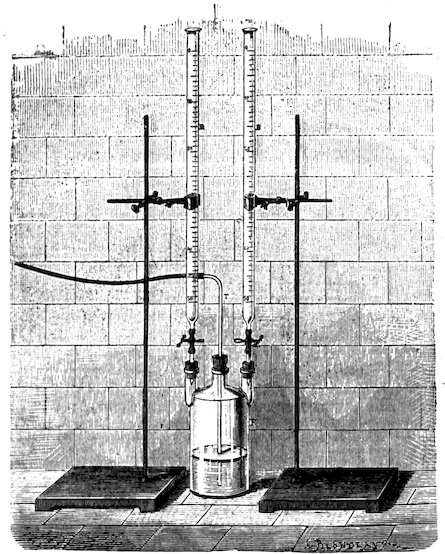
Figure 89. Method of Chabrier.
After the air has all been expelled from the flask the analytical
process is commenced, the carbon dioxid current being
slowly continued. At first, a few drops of the dilute sulfuric
acid are allowed to flow into the flask. As soon as the liquid is
colored blue a sufficient quantity of the thiosulfate solution is
added to discharge the color. The successive addition of acid
and thiosulfate is continued until another portion of the acid
fails to develop the blue color, thus indicating that all the nitrite
has been decomposed. From the volume of thiosulfate used the
quantity of nitrite is calculated.
The Thiosulfate Solution.—The thiosulfate solution is conveniently
prepared, when a large number of analyses is to be
559made, by dissolving twenty-five grams of pure crystallized sodium
thiosulfate in 100 cubic centimeters of water and diluting any
convenient part thereof to 100 or 1,000 cubic centimeters, according
to the supposed strength of nitrite solution under examination.
For fixing the strength of the solution dissolve 3 348 grams of
pure iodin in a solution of potassium iodid and make the volume
up to one liter. Each cubic centimeter of this solution corresponds
to one milligram of nitrous acid. A given volume of the
iodin solution is titrated against the thiosulfate, but it is best
not to add the starch paste until the greater part of the iodin has
been removed. The starch paste is then added and the titration
continued until the blue color has been discharged. Ten
cubic centimeters of the iodin solution is a convenient quantity
for the titration and the thiosulfate should be diluted by adding
to ten cubic centimeters of the solution mentioned above, 990
cubic centimeters of water. Each liter of this dilute solution
contains two and a half grams of the sodium thiosulphate.
Example.—Let us suppose that it has required 21.3 cubic centimeters
of thiosulfate to absorb ten cubic centimeters of the iodin
solution; further that ten liters of water have been evaporated
and titrated as described above, and that the volume of thiosulfate
employed was 13.8 cubic centimeters. From this is derived
the following formula: 13.8 × 10
21.3 = 6.48 milligrams of nitrous
acid; or 0.648 milligram per liter.
508. Estimation of Nitrous Acid By Coloration of Solution
of Ferrous Salt.—This method, due to Picini is based
on the production of the well-known brown color formed by
the action of nitric oxid on a ferrous salt.[339] The nitrite is
decomposed by heating with acetic acid while nitrates thus treated
do not develop the reaction. The tint produced is imitated as
above by testing against a standard solution of nitrite. Ferrous
chlorid is to be preferred to other ferrous salts for the above
purpose. The process should be carried on in solutions free of
air.
509. Estimation of Nitrous Acid By Decomposition with
Potassium Ferrocyanid.—The method of Schaeffer was first
described in 1851, but little attention has been paid to it since.
560The method has lately been brought into notice again by
Deventer.[340]
The reaction depends upon the decomposition of nitrous acid
by potassium ferrocyanid in the presence of acetic acid with the
formation of potassium ferricyanid and acetate, and nitric oxid.
The reaction is expressed by the following equation:
2K₄FeCy₆ + 2HNO₂ + 2C₂H₄O₂
= K₆Fe₂Cy₁₂ + 2KC₂H₃O₂ + 2NO + 2H₂O.
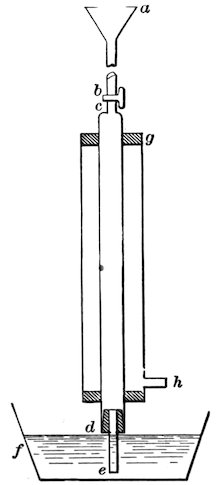
Figure 90.
Schaeffer’s Nitrous Acid Method.
A eudiometer with a glass stop-cock is arranged as shown in
Fig. 90. The lower part of the eudiometer is closed with a rubber
stopper carrying a glass tube which ends in the pan f as
shown at e. The eudiometer is filled to the stop-cock with a
solution of potassium ferrocyanid of about fourteen per cent
strength. The dish f is also filled up to the height indicated
in the figure with the same solution. The solution of
nitrite is used in such quantities that the nitric oxid evolved
will occupy a space of about twenty cubic centimeters. The
whole eudiometer should contain about
fifty-seven cubic centimeters. The nitrite
solution is added to the eudiometer by
means of a funnel, a. The vessel containing
it is washed out with a little water and
then with acetic acid and finally with a
few cubic centimeters of strong potassium
ferrocyanid solution. The last fluid flows
through the solution of nitrite and acetic
acid and thus mixes it with the solution
already in the eudiometer. The
liquids reacting on each other float together
on the strong ferrocyanid solution and each
one of them is at once pressed downward
by the gases which are evolved. When
the evolution of gas becomes slower the
apparatus should be shaken for about
twenty minutes, moving it back and forth
without taking the bottom of it out of
the dish. When there is no longer any evolution
of gas, water is added through a slowly, until the heavy
561potassium ferrocyanid solution is almost completely driven out
of the eudiometer. The opening of the tube at e is then closed
with the thumb, the apparatus is taken out of the dish, shaken
for some time in a vertical direction and again placed in the
dish. Water of any required temperature is now allowed to flow
through the jacket, g, h, until the temperature is constant, when the
volume of nitric oxid is read. The whole experiment can be performed
in less than an hour. Operating in this way, at the end
there is in the eudiometer a liquid which is not very different
from water and one whose coefficient of solubility for nitric oxid
is practically the same as that of water. The gas volume read is
to be corrected for temperature, pressure, tension of the aqueous
vapor, height of the water column in the eudiometer, and, after
the end of the calculation, five per cent of the volume of water
remaining in the eudiometer is to be added to the volume of gas
obtained. This is to compensate for the volume of the gas
absorbed by the water. The method gives good quantitive
results.
510. Method of Collecting Samples of Rain Water for
Analysis.—Warington collects rain water in a large leaden
gauge having an area of 0.001 of an acre.[341] Of the daily collection
of rain, dew, and snow water, an aliquot part amounting
to a gallon for each inch of precipitation is placed in a carboy;
at the end of each month the contents of the carboy are mixed,
and a sample taken for analysis. In the carboy receiving the
rain for nitric acid estimation a little mercuric chlorid is placed
each month with the view of preventing any change of ammonia
into nitric acid. It may be doubted, however, if this precaution
is necessary, as the rain water thus collected always contains a
very appreciable amount of lead; and experiments have shown
that on the whole, rain water more frequently gains than loses
ammonia by keeping.
Preparation of the Sample.—The method first employed by
Warington was to concentrate ten pounds of the rain water in a
retort, a little magnesia being used to decompose any ammonium
nitrite or nitrate present. Concentration by evaporation in the
open air, and especially over gas, results in a distinct addition
to nitrites present. When concentrated to a small bulk, the
562water is filtered and evaporated to dryness in a very small
beaker. The nitrogen as nitrates and nitrites is then determined
by means of the methods already described.
511. Nessler Process.—The quantities of free ammonia in
rain and most drainage waters are minute, but may reach considerable
magnitude in some sewages. By reason of these minute
proportions, gravi- and volumetric methods are not suitable for
its quantitive determination. Recourse is therefore had to the
delicate colorimetric reaction first proposed by Nessler. This
reaction is based on the yellowish-brown coloration produced by
ammonia in a solution of mercuric iodid in potassium iodid.
The coloration is due to the formation of oxydimercuric ammonium
iodid, NH₂Hg₂OI, and takes place between the molecule
of free ammonia and the mercuric iodid dissolved in the alkaline
potassium iodid as represented by the following equation:
| |
|
Hg—O—Hg—I |
|
Hg |
|
| |
/ |
|
|
/ |
\ |
|
| O |
|
|
+ 2H₂N = 2O |
|
|
NH₂I + H₂O |
| |
\ |
|
|
\ |
/ |
|
| |
|
Hg—O—Hg—I |
|
HG |
|
Nessler Reagent.—Dissolve thirty-five grams of potassium iodid
in 100 cubic centimeters of water. Add to this solution gradually
a solution of seventeen grams of mercuric chlorid in 300
cubic centimeters of water until a permanent precipitate of mercuric
iodid is formed. Add now enough of a twenty per cent
solution of sodium hydroxid to make 1000 cubic centimeters.
The mixed solutions, at room temperature, are treated with
additional mercuric chlorid until the precipitate formed, after
thorough stirring, remains undissolved. This precipitate is then
allowed to subside, and when the supernatant liquid is perfectly
clear, it is decanted or filtered through asbestos and kept in a
well-stoppered bottle in a dark place. The part in use should
be transferred to a smaller bottle as required. The solution
should be made for a few days before using, since its delicacy is
increased by keeping. The nessler reagent should show a faint
yellow tint. If colorless it is not delicate, and shows the addition
of an insufficient quantity of mercuric chlorid. When
563properly prepared, two cubic centimeters of the reagent poured
into fifty cubic centimeters of water containing 0.05 milligram
of ammonia will at once develop a yellowish-brown tint.
Preparation of Ammonia-Free Water.—To pure distilled water
add pure, recently-ignited sodium carbonate, from one to two grams
per one liter, and distill. When one-fourth of the whole has
passed over, the distillate may be regarded as free from ammonia;
fifty cubic centimeters of the following distillate should give
no reaction with the nessler reagent. The distillation should be
continued until the residual volume in the retort is about one-fourth
of the original, and the distillate free of ammonia is carefully
preserved in close glass-stoppered bottles previously washed
with ammonia-free water. Pure water, free of ammonia may
also be obtained by distilling with sulfuric acid.
Comparative Solution of Ammonium Chlorid containing 0.00001
gram Ammonia in one cubic centimeter.—Dissolve 3.15 grams H₄NCl
in ammonia-free water and make the volume up to one liter. Take
ten cubic centimeters of the above solution and dilute to 1000 with
water, free from ammonia.
Solution containing 0.00001 gram Nitrogen in one cubic centimeter.—Dissolve
3.82 grams H₄NCl in water, free from ammonia
and dilute with same to 1000 cubic centimeters. Dilute ten
cubic centimeters of the above solution to 1000.
The Distillation.—Any kind of suitable retort or flask connected
with a good condenser may be used. The capacity of
the retort should be from 700 to 1,000 cubic centimeters. The
retort and condenser preferred by Leffmann and Beam are shown
in Fig. 91. Any good lamp may be used in which the flame is
under complete control. The gauze burner shown in the figure
is easily controlled and distributes the heat evenly over the surface
of the retort thus diminishing the danger of fracture. The
apparatus having been previously rinsed with distilled water
receives 500 cubic centimeters of the liquid to be tested for
ammonia, together with a few pieces of recently ignited pumice
stone to prevent bumping and five cubic centimeters of the twenty
percent sodium carbonate solution to render its contents alkaline.
The water is raised to the boiling-point and with gentle
ebullition fifty cubic centimeters of distillate collected. The distillate
564is conveniently collected in a color-comparison cylinder of
thin white glass and flat bottom, about two and a half centimeters
in diameter, and marked at fifty and one hundred cubic centimeters.
Two cubic centimeters of the nessler reagent are added
and if ammonia be present a yellowish-brown color will be
developed, the intensity of which is matched by taking portions
of the ammonium chlorid solution, diluting to fifty cubic centimeters
with pure water and treating with the same quantity of
the nessler reagent. The process is repeated until a distillate
is obtained which gives no reaction for ammonia. The sum of
the quantities obtained in the several distillates gives the total
amount of ammonia in the 500 cubic centimeters of the water
taken. In most cases practically all the ammonia is obtained in
three or four portions of the distillate.
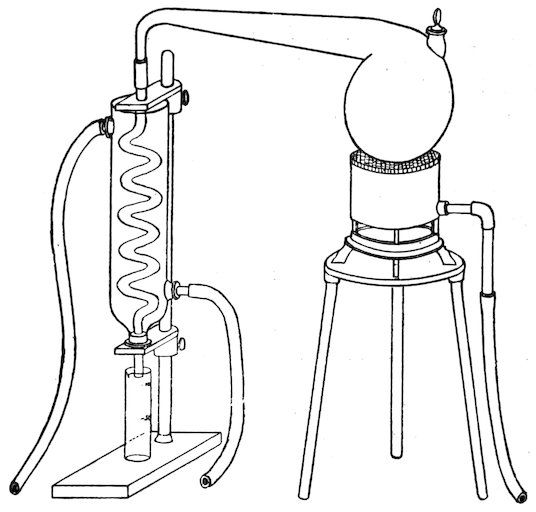
Figure 91. Retort for Distilling Ammonia.
Albuminoid Ammonia.—The residue from the process just
described is employed for the purpose of determining the albuminoid
ammonia. Two hundred grams of potassium hydroxid
and eight grams of potassium permanganate are dissolved in
5651,000 parts of distilled water. Fifty cubic centimeters of the
solution are placed in a porcelain dish with 100 cubic centimeters
of distilled water and evaporated to fifty cubic centimeters. This
liquid is placed in the retort and the distillation resumed and
continued until an ammonia-free distillate is obtained. The
total albuminoid ammonia is determined by taking the sum of
the quantities in the several distillates.
512. Nessler Reagent of Ilosvay.—To secure greater delicacy
in nesslerizing, Ilosvay uses a reagent prepared as follows:[342]
Dissolve two grams of potassium iodid in five cubic centimeters
of water, heat the solution gently, and add three grams of
mercuric iodid. After the solution is cooled, add an additional
portion of three grams of the mercury salt, and then twenty cubic
centimeters of water, and wait until the precipitation is complete.
After filtering, there are added to the filtrate from twenty
to thirty cubic centimeters of a twenty per cent solution of potassium
hydroxid. Only the limpid supernatant liquid is used in
the analytical work. With this reagent, Ilosvay has been able to
detect 0.02 milligram of ammonia in 110 cubic centimeters of
water.
Note.—On page 158, paragraph 172, third line, insert, “and determining
matters dissolved therein,” after “flow.”