Princess Sukey THE STORY OF A PIGEON AND HER HUMAN FRIENDS
Transcriber’s Note:
The cover image was created by the transcriber and is placed in the public domain.
Princess Sukey.
By
MARSHALL SAUNDERS
“Despite neither cats, birds, dogs, nor any member of the animal kingdom, for are not all created beings little brothers of the earth, the air, and the sea?”
NEW YORK: EATON & MAINS
CINCINNATI: JENNINGS & GRAHAM
Copyright, 1905, by
EATON & MAINS.
I DEDICATE THIS STORY TO ONE WHO HAS SHOWN A KIND INTEREST IN EVERY LIVING CREATURE ON MY FARM—TO MY DEAR BROTHER-IN-LAW, CLARENCE KING MOORE, OF THE UNIVERSITY OF ROCHESTER
Dear little Princess Sukey sitting by the fire—pretty
little pigeon—of what is she thinking as she
dreamily eyes the blazing wood? If a pigeon could
review its past life, what she has of bird mind
would be running back over the series of adventures
that she had ere she established herself in this well
ordered household.
Has she any mentality of her own, or are all
pigeons stupid as has been said? Listen to her story,
and judge for yourself.
To begin with—she is not a common street pigeon
like those who are looking in the window, and who
are probably envying her the silk cushion on which
she sits, her china bath, her lump of rock salt, and
her box of seeds. For it is a bitterly cold day. The
wind is blowing fiercely, the thermometer is away
below zero, and the ground is covered with snow.
In summer these same street pigeons seem to be
laughing at the pigeon princess on account of the abnormal
2life that she leads, but just now they certainly
would change places with her.
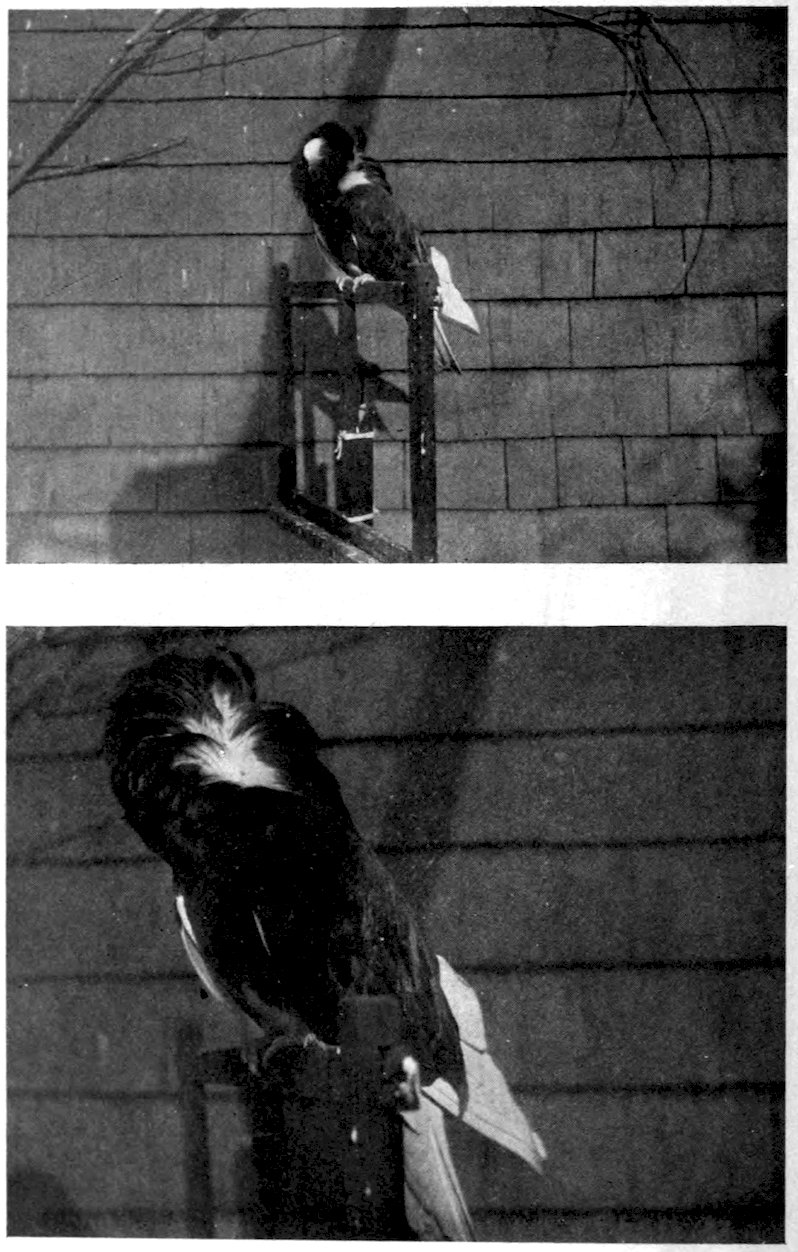
The princess is a Jacobin—a thoroughbred, with
a handsome hood that nearly hides her head, a fine
mane and chain, and her colors are red and white.
Her parents were beauties—show birds with perfect
points, and they were owned by a young pigeon
fancier of the small city of Riverport, Maine.
The lad’s name was Charlie Brown, and he had
a friend called Titus Sancroft, or, more familiarly,
“Stuttering Tite,” from an unfortunate habit that
he had formed of catching his breath at the beginning
of nearly every sentence he uttered.
Now, young Titus walked most opportunely into
Charlie’s pigeon loft just a day after Princess Sukey
had been hatched.
Just before he came in the clock struck four. A
male pigeon always helps the female in the work of
incubation, and bringing up the young ones. About
ten o’clock every morning the mother pigeon leaves
her eggs, goes to get something to eat, and walks
about the loft with the other pigeons—a pigeon
rarely plays; even young ones are phlegmatic. As
she comes off her nest the male pigeon goes on and
sits there till four in the afternoon. Then the female
returns for the night.
Well, the young princess was a sickly pigeon.
There had been two sickly pigeons, for usually two
eggs are laid at a time. One had died, and the
father Jacobin, thinking that the young Sukey was
also going to die, took her in his beak, lifted her
from the nest, and gently deposited her on the floor
at the other end of the loft.
3There is little sentiment among birds. They believe
in the survival of the fittest, and the weak are
calmly taken from the nest.
The young pigeon was not desperately ill. However,
blind and naked as she was, she could not have
survived long, away from the warmth of the nest,
unless this boy Titus had discovered her.
“H-h-hello, Charlie,” he stuttered, “here’s a squab
out of the nest.” Charlie took the bird by the legs.
“W-w-what are you going to do?” asked Titus.
“Strike its head against the wall.”
Titus did not approve of this.
“Wh-why don’t you put it back in the nest?” he
asked, excitedly.
“No good—once the old ones put it out they won’t
look at it.”
“C-c-can’t you feed it?”
“Too much trouble. I did have some birds that
would feed young ones—two fine old feeders, but
I sold them.”
Titus had a mercenary little soul. “A-a pity to
throw away good money,” he said, looking at the
pigeon. “I-I should think you could worry some
food down its throat yourself.”
“I could, but it’s an awful bother. I’ve tried it.
This is a sick thing anyway. It will be dead in five
minutes. See how it’s gasping.”
“B-b-bet you my jackknife it won’t die,” replied
Titus.
So they waited five minutes, and, as good fortune
would have it, the future princess gasped them out,
and Charlie laid her in Titus’s palm. “The squab
is yours.”
4“B-b-blest if I know what to do with it,” remarked
Titus, turning the pigeon over in his hands.
Charlie smiled mischievously. “I guess your
grandfather will give you a time if he finds out.”
“H-h-he shan’t find out,” said Titus.
“It’s mean that you can’t have pigeons or something,”
observed Charlie. “All the fellows have.
Why don’t you make tracks for another grandfather?”
Titus grinned. His grandfather was a great trial
to him, but it was only in one respect. In other
ways he was a model grandfather.
“Hope it will live,” said Charlie, generously.
“Tuck some food down its throat—some feed one
way, some another—and mix some sweet oil in it.
I’ve heard that’s good when you take them from the
parents.”
Titus stood a minute longer; then seeing that the
pigeon was near her end, and that Charlie was unconcernedly
going on with his work of feeding and
watering the other pigeons, he scampered home.
Titus lived with his grandfather, Judge Sancroft,
and Judge Sancroft possessed a somewhat foolish
and provoking but most devoted old family servant
man called Higby.
Titus ran all about the house looking for this
man. He was really forbidden to talk to him unless
he was positively forced to do so. The Judge had
commanded that Titus should only request a service
from Higby, and thank him for one rendered.
There was to be no conversation, for old Higby
stammered terribly, and the Judge feared that it
was from him Titus had caught the tiresome habit.
5Finally the boy found the man in the attic superintending
some painters.
“S-s-see what I’ve got, Higby,” he said, opening
his palms, where he was keeping the pigeon warm.
“A s-s-squab,” said Higby, “a-a-and and an ugly
w-w-worm of a thing it is.”
“W-w-what shall I do with it?” asked Titus.
“W-w-wring it’s neck, young sir,” said Higby,
who was much worried by the painters. “’Tis a
s-s-sad world for m-m-man, woman, or pigeon.”
“B-but it’s worth money,” said Titus. “It’s a
Jacobin—the parents cost twenty dollars.”
Higby looked at it again. Neither he nor the lad
was much animated by sentiment in saving the life
of a bird. Then he felt the pigeon’s crop.
“Th-th-there ain’t nothin’ in there, Master Titus.
You’ve got to fe-fe-feed it mighty quick.”
“Y-you come help me,” said the boy.
“I ca-ca-can’t leave these workmen.”
“I-if you don’t,” replied Titus, “I’ll tell my grandfather
that you seek me out and talk to me. Then
he’ll discharge you.”
Higby flew into a rage. As he choked and spluttered
and stammered he stepped backward. That
was his way when wrestling for words, and when he
at last got his words he struck one foot sharply on
the floor.
Young Titus, on the contrary, always stopped
stuttering when he became deeply moved about anything,
but in his excitement he had formed the
habit of stepping forward. So if he were talking to
Higby there was at the same time advance and
retreat.
6The painters were nearly killing themselves laughing,
and when Higby discovered this he shuffled
downstairs after the boy.
Titus led the way to the kitchen. “Mrs. Blodgett,”
he called to the housekeeper, who was directing
the maids, “please make me some warm feed for this
pigeon.”
The housekeeper stared at the bird. “O, law!
what a nasty little thing!”
By this time the future little princess was nearly
dead, and Titus in dismay called, “Hurry up.”
“Master Titus,” she replied, snappishly, “the girls
are preparing dinner. You’ll have to wait.”
“I can’t wait,” returned the boy, angrily, and he
began to step forward. “Don’t you see the bird’s
dying? Higby, you talk to her.”
Titus’s eyes were flaming, and Higby, who was
at heart a coward, and terrified of anyone in a real
rage, subdued his own disturbed feelings, and in a
wheedling voice asked Mrs. Blodgett for just a little
“ro-ro-rolled oats,” with boiling water poured on.
Mrs. Blodgett frowned, and grumbled out something
about having men and boys in the kitchen at
mealtimes. However, she drew out her keys and
went to the storeroom, and in a few minutes Titus
and Higby were in a corner of the kitchen with a
cup of soft food before them, but with nothing but
their clumsy fingers to put it in the pigeon’s small
beak.
The young bird smelt and felt the food, and
nearly wriggled out of Titus’s grasp in trying to
get it.
“T-t-this won’t do,” exclaimed the boy, when she
7jabbed her beak against his hand, “w-w-we’ve got to
have a feather or a stick.”
Mrs. Blodgett gave them some turkey feathers
and some toothpicks, and between them they managed
to worry a little food into the pigeon’s beak.
“You ought to h-h-have a syringe,” said Higby,
“the old birds fe-fe-feed their young ones by putting
their b-b-beaks crosswise in their mouths to pu-pu-pump
the food down.”
“I-I know, I’ve seen them,” replied Titus. “You
just run along to the drug store and get me one.”
Higby had to go, and by putting a rubber tube
in the pigeon’s beak they managed to feed her pretty
well.
When her crop was quite round and full Titus
called for a basket and cotton wool, and put her
behind the kitchen stove.
“That basket is mortally in the way,” said Mrs.
Blodgett, fretfully; “it is just in the place where we
put our plates to warm.”
“B-b-blodgieblossom,” said the boy, cajolingly,
thrusting his arm through hers, “it’s for your boy.”
The housekeeper gave in. When young Titus
called her “Blodgieblossom,” and said he was her
boy, she would do anything for him.
“Mind, don’t any of you knock that basket over,”
she said, turning frowningly to the maids.
Titus was running upstairs, when suddenly he
stopped and hurried back. They all thought he had
come to thank them for helping him, but he had not.
“L-l-look a-here!” he said, sternly, “If I catch any
of you prattling to grandfather that I’ve got a
pigeon I’ll make it hot for you.”
8They all grinned at each other. The Judge was
a good man, but he was rather severe with his grandson
when he deceived him.
The Judge did not find out. He never entered the
kitchen, and the young pigeon grew and thrived, but
not behind the stove on the plate-warmer, for Titus,
finding that her little body was almost like a furnace
itself, appropriated a corner of one of the big kitchen
tables for her basket.
Young Titus and old Higby fed her several times
a day. One had to hold her, while the other pushed
the food down her throat, and cross enough the old
servant man was when Titus would call out, “T-t-the
goose hangs high.”
Titus did not dare to say, “It is feeding time for
the pigeon, Higby,” for the Judge might have heard,
and Titus feared that he would be exceedingly annoyed
if he found out that a bird was being kept
in his house.
It was really curious that such a dislike for the
lower creation should have been imputed to a really
benevolent and kind-hearted man like Judge Sancroft.
True, he did not care particularly for animals.
He had been brought up in a city, and he
had never had any animals about him but horses
and cows. He was not actively fond of them, but
he always saw that they were well cared for. None
of his children had been fond of animals. Certainly
he was not the kind of man to have said, “No,” if
any of his young sons or daughters had come to him
years ago and said, “Father, I want a dog or a
cat.”
However, his own children were all dead, and the
9opinion had strengthened with years that the Judge
did not care for dumb creatures. Titus did not know
that his grandfather would have listened with dismay
to anyone who said to him, “Sir, you have a
young grandson under your roof who is pining for
pets such as other boys have, and he is afraid to
ask you for them.”
The Judge was unmistakably a very good man.
His white head, large, handsome face, and portly
frame bore the marks of good temper, sound judgment,
and eminent respectability. It was rather a
wonder that he had not made himself known as a
philanthropist. However, he had in early life been
devoted to his profession, then he had had much
trouble and bereavement, and had traveled extensively,
and then his health had partly broken down,
and he had resigned his judgeship, given up most of
the active duties of life, and settled down to a
sedentary old age.
But old age did not come. Renewed health did
come, and at the time when our story opens the
somewhat bewildered Judge found himself in the
position of a man who sees the map of his life turned
upside down in his hands.
He really had not enough to do. He had made
enough money to live on, really more than enough,
but he began to think seriously of opening that long-closed
law office. He was only restrained by a
question of dignity. He had been so long on the
bench that he would hate to come down to office
work again—and yet he could not rust out. He
sighed sometimes as he thought of his future—sighed,
not knowing what responsibilities Providence
10was preparing for him. Probably if he could
have foreseen he would have sighed more heavily.
However, the responsibilities brought also their
alleviations with them.
Young Titus was not at all like his grandfather
in appearance. The Judge was a large, rotund,
handsome man, always carefully, even exquisitely,
dressed. Titus was slim and dark, loose-jointed
and always awry. His collar was shady, his clothes
tumbled. He was not in one single outward respect
like the dignified white-haired man who sat opposite
him at the table. But there was the mysterious tie
of blood between them. Apparently the elderly man
and the boy were not at all alike, but there were
points of resemblance. They both felt them, and in
their way were devoted to each other.
The Judge was a much-afflicted man. Wife, sons,
daughters, all were gone, but this one lad, and he
often looked at him wistfully. If anything should
happen to this sole grandchild the good old name
of Sancroft would die out.
A day came when it looked as if the family name
would go. A terrible thing happened to young
Titus, and his grandfather’s house was wrapped in
gloom. The lad’s unfortunate habit of stuttering
was at the root of the trouble.
The Judge knew perfectly well that any physical
or mental peculiarity about a boy subjects him to an
intermittent martyrdom from his fellow boys, who
with respect to teasing are part savages. Therefore
he had a private teacher who wrestled with Titus
on the subject of stuttering for several hours a week.
He also was willing that Titus should have all his
11lessons at home, but this the boy would not agree
to, and the Judge respected him for it.
Titus always went down the street with his eyes
rolling about him. It was such an irresistible
temptation to the boys to imitate him that usually
the air was vocal with mocking-birds.
Fortunately, Titus was exceedingly wiry, and
utterly fearless. Otherwise he would certainly have
been cowed or injured long before our story begins.
He always marched out of school with the other
boys, never waited to walk home in the shadow of
a teacher, and if a call of derision reached him and
he could locate the boy, if he had time, he took off
his coat, intrusted it to a friend, and rushed into the
fray. The boys in his set never carried books in
the street. They had duplicate copies at home.
On one particular day, which turned out to be the
disastrous day for poor Titus, he had got halfway
home with, strange to say, not a single fight.
It was not a school day but a holiday, and he had
been downtown with a companion. Suddenly, as
he strolled along beside him, a teasing voice rang
out:
Stuttering Tite, stuttering Tite,
O, he is a daisy!
Give him time and give him words,
And he’ll make you crazy.
“An S and an S, and a T and a T,
And a stam and a stutter, and don’t you see—”
The boy got no further. His song was so malicious,
his manner so exquisitely provoking, that
young Titus, without waiting for a single preliminary,
flew upon him like a whirlwind.
12Provoker and the provoked one rolled over and
over in the middle of the street. It was a rainy,
muddy morning in the late summer, and in their
dark suits and bedaubed condition they soon had
very much the appearance of two dogs.
So thought a young man who was driving a fast
horse and talking to a lively young girl by his side.
One careless glance he gave the supposed dogs;
then, thinking that they would get out of the way,
he scarcely took pains to avoid them.
Needless to say, the dogs made no effort to avoid
him. On the contrary, they rolled right in his path.
One terrified shriek he heard from Titus’s opponent,
then there was silence.
The horrified young man sprang from his buggy.
One boy was not hurt, he was only frightened. The
other lay with his dark young face turned up to the
sky. There was blood on his hands and his forehead.
The horse’s hoofs had struck him, and the
wheels of the buggy had gone over his legs.
The young man did not lose his head. He asked
the uninjured lad for Titus’s name and address, he
put him in the buggy, and requesting a bystander
to notify the Judge he drove rapidly to a hospital,
his girl friend tenderly holding Titus’s injured head.
The succession of troubles that Judge Sancroft had
had during his life had all been of a deliberate kind.
His wife and children had all had long illnesses,
and much suffering, so much so that death had
come as a welcome release. He did not remember
anything just as sudden as this, and his chastened
and subdued heart died within him. He feared
that he was going to lose his last treasure.
13He happened to be in his club when the news
came to him, and taking a carriage he drove at once
to the hospital.
What a contrast—from the quiet luxurious rooms
of the club, from the peaceful reading or talking
men, to this abode of pain and distress.
The Judge reverently bared his head as he entered
the door. “God pity them!” he murmured, as he
walked through the long halls and corridors to the
private room where his young grandson had been
carried.
There was a white-capped nurse in the room.
The Judge bowed courteously to her, then he turned
to the bed.
Was that Titus—was that his lively, mischievous
grandson—that pale, quiet lad with the bandaged
head?
The Judge stretched out both hands and laid
them on the lad’s wrists.
“My boy,” he said, piteously, “my boy, don’t you
know me?”
“He is quite unconscious, sir,” said the nurse.
“Will he die?” asked the Judge.
“Sir,” she said, protestingly, “the operation has
not taken place—only an examination.”
The Judge sat down by the bed. Bitter, rebellious
thoughts, resigned thoughts, protesting thoughts,
chased each other through his mind.
At last he got up and went to the back of the
room. “God’s will be done,” he said, with a great
sigh.
The nurse gazed surreptitiously at him. She was
very young, and to her the Judge in his vigorous
14late middle age, and with his white head, appeared
to be an old man.
“And a good one,” she said to herself. Then she
listened.
The Judge was also listening. His senses were
unnaturally acute. Before her he heard the soft
footfalls and the whispering at the door. The hospital
attendants had come to take his boy to the
operating room.
“I shall wait here,” he said, and with a piteous
face he watched the lifting and taking away of the
quiet little body. But when the door closed he went
on his knees by the bed.
“O, Lord, spare my boy—take my life if necessary,
but spare his. I am getting old, but he is
young. Spare him, spare him, dear Lord!”
CHAPTER II Mrs. Blodgett’s Opinion
15
What was becoming of the poor princess all this
time, for that station in life had been assigned her
as soon as the delighted Titus noted her aristocratic
manners.
She was now a lively bird of three weeks of age,
and though, according to well bred pigeon ways,
she had not yet left her nest she was always looking
about, and quite well aware of what took place
around her.
The accident to young Titus had occurred about
noon, when he was on his way home for lunch. It
was now seven o’clock in the evening, and Princess
Sukey was inquiringly raising her pretty hooded
head from her basket to stare about her.
Higby and the maids were serving the dinner.
Mrs. Blodgett had had a dreadful fit of hysterics
when she heard what had happened to the boy of
the household, and had disappeared, no one knew
where.
Higby was whispering the news. The Judge had
stayed at the hospital till dinner time. The doctors
said that there was just a bare chance of Master
Titus’s life, but they were afraid of his reason.
There had been injury to the brain.
“It’s powerful sa-sa-sad to see the old man,” he
went on.
16Higby was much older than the Judge, but still
he always called him “the old man.”
“He sits and ea-ea-eats,” he stammered.
“Surely,” said the young rosy-faced cook, “he
aint eatin’ with the boy ’most dyin’.”
“Did I s-s-say he was?” retorted Higby. “He’s
p-p-playin’ with his food just like a ca-ca-cat with
a mouse, only he ain’t goin’ to e-e-eat it.”
“He feels bad inside,” said the parlor maid sympathetically.
“I know the feelin’—kind of sick
like. I had it when I lost my little brother. Not a
bite of food passed my lips for two days. What’s
the matter with that pigeon?”
The unfortunate little princess was nearly starved.
Her crop was quite empty, and she was experiencing
some of the torment that the healthy young of any
kind suffer from acute hunger. Titus always fed
her at noon, and it was now night. Imperiously
agitating her long red and white wings, she made
the whistling noise which a young pigeon strives
to attract the attention of its parents.
“Hush, gor-gor-gormandizer,” said Higby, turning
fiercely on her. “Is this a time for st-st-stuffing
when y-young master is nearly dead?”
The pigeon understood nothing of what he said
about the boy, but she clearly saw that no food
would be forthcoming now, so she uttered a complaining
“Wee! wee!” and squatted down in her
basket.
As she did so the kitchen door leading into the
back hall was thrown violently open and Mrs.
Blodgett walked in.
She was a short, stout, middle-aged woman, with
17red cheeks and a skin that looked as if it were too
tight for her fat body. Her clothes, too, were tight,
giving her generally an uncomfortable appearance.
The expression of her face was often fretful.
However, she was on the whole a good sort of
woman.
Just now she was greatly excited. She untied
her bonnet strings, flung them back, and said in a
loud voice, “I’ve seen him.”
“S-s-seen who?” asked Higby, stopping short
with a tray in his hands.
“The boy. Where’s the Judge?”
“Master T-t-titus!” exclaimed Higby, walking
backward and striking his foot.
“Yes—hush—I’ll tell you later. Give me that
pigeon.”
Before anyone could reach the princess Mrs.
Blodgett had snatched the basket from one of the
kitchen tables, and was walking toward the stairway
leading to the upper part of the house.
Suddenly she turned back. “Where’s the Judge?”
Higby stared at her. Then he said, “I-i-in his
study—he ordered co-co-coffee there. You’re not
going to s-s-see him?”
“Why aint I?” she asked, irritably. “Why aint
I?”
“I d-d-don’t know,” stammered Higby. “Only
you don’t generally call on him this time of day.”
“Lead the way,” she said, grandly. “Step out.”
Higby stumbled up the steps before her, the dishes
rattling as he went. When he opened the study
door Mrs. Blodgett walked in after him.
The Judge was standing before the fireplace in
18a melancholy attitude, with his hands behind his
back.
He looked at Mrs. Blodgett as she came in, but
did not seem surprised. His servants often came to
him with their troubles.
“Well, Mrs. Blodgett,” he said, patiently, when
Higby poured out his cup of coffee and handed it
to him.
“I’ve somewhat to say to you, sir,” she replied,
with a toss of her head.
The Judge looked at Higby, who went into the
hall, closing the door reluctantly behind him.
Mrs. Blodgett was struggling with a variety of
emotions. At last she burst out with a remark, “I’ve
seen the boy, sir!”
“Have you?” said the Judge, eagerly, and turning
he put his coffee cup on the mantelpiece, as if
glad of an excuse to be rid of it.
“Yes, sir, I’ve seen the boy, and he spoke to me.”
“He spoke!” exclaimed the Judge, “but, Mrs.
Blodgett, what does this mean? No one was to be
admitted.”
Mrs. Blodgett smiled. She knew that the Judge
was too just to condemn her without a hearing.
“It was this way, sir,” she said, gently putting
the pigeon’s basket down on the table, and taking a
handkerchief from her pocket to mop her flushed
face. “It was this way,” and as she spoke she felt
herself getting calm. There was a peaceful, judicial
atmosphere in the Judge’s study, and about the man
himself there was something genial and soothing.
“When I heard of that boy’s head run over and
smashed, the heart stood still in my body. Now, if
19it had been you, sir, or me, or Higby—but that only
bit of young life about the house—it did seem too
awful. ‘I’m goin’ to see him,’ said I. ‘I’m goin’ to
see him afore he dies.’ Bells were ringin’ in my ears,
an’ my head was in a kind of fog like a ship at sea,
but I crawled out to the street, I walked to the hospital.
Many’s the hour I paced up and down waitin’
for you to come out, for I knew you’d stop me if
you saw me. When you was out of sight I hurried
to the door—I rung the bell.”
The Judge drew a long breath, and leaned his
head slightly forward in the intensity of his interest.
“‘Could I see the bed where Master Titus lay?’
I asked,” continued Mrs. Blodgett. “No, I couldn’t.
I was prepared for that. But can you stop a woman
when she makes up her mind? No, sir. I sat in the
waitin’ room an’ I cried for a solid hour, and then
they said I might look in the room for one minute,
if I’d promise not to speak above my breath.
“I promised, and I meant to keep it, but I didn’t.
When I walked into that quiet room, when I looked
at him lyin’ so still with them white cloths on his
black head, then, may heaven forgive me, sir, I let
a screech of ‘Master Titus, me darlin’!’
“He opened them impish eyes, sir, he give me a
glance. ‘Blodgieblossom,’ says he, ‘feed the pigeon,
an’ tell grandfather.’
“He spoke, an’ he went to sleep again, an’ I was
hustled out into the hall, an’ my! didn’t them nurses
give me a tongue-lashin’! But I had heard my boy
speak, sir; his mind were there.”
The Judge’s face was disturbed and bewildered.
20Mrs. Blodgett was hurrying on, though she kept
a keen eye on him.
“So, sir, I says to myself, ‘Go right home, tell the
Judge what the boy says. Tell him that if the Lord
in his mercy spared an innocent bird when it was
tumbled out of its nest, maybe he will spare a helpless
boy.’”
The Judge’s face was radiant. “Then there is a
pigeon?”
“Indeed there be, sir,” she said, pulling at the
princess, who, perceiving herself in a new environment,
had crouched down in her basket. “Your
young grandson’s pet pigeon, hid for fear of you—O,
sir, ’tis sad to see him cravin’ dogs an’ cats, an’
havin’ only this senseless fowl!”
This was an unkind slap at the princess, who, however,
took it good-naturedly, but the Judge looked
sharply at Mrs. Blodgett.
“Sir,” she said, in an earnest voice, “I’ve been
thinkin’ of the many years I’ve served you. You’ve
been a good, kind master to me, bearin’ with my
faults an’ my temper, an’, sir, when I heard of the
boy’s mishap I blamed myself for somethin’ I’ve
often thought of doin’, but have never done.”
The Judge made no remark, but his round, full,
honest eyes were bent on her intently as she went
on.
“You couldn’t get me to leave your employ, sir,
not unless you chased me out. There aint a servant
ever comes in this house that leaves on account of
you. It’s me, or Higby. An’, sir, likin’ an’ honorin’
you, I can’t help takin’ an interest in your grandson.
There’s a soft spot in him, spite of his provokin’
21ways, an’ many’s the time I’ve shed a tear over his
motherless head. I, bein’ as it were the only woman
in the house—them senseless, gigglin’ girls, an’ you
an’ that poor foolish creature Higby, not countin’.
An’ takin’ an interest, I’ve often thought that boys
bein’ naturally fond of live stock, it’s a pity you don’t
let Master Titus have some to potter over. If he had
he’d hurry home from school like Charlie Brown,
an’ not spend so much time in loiterin’ around the
streets an’ pickin’ up quarrels.”
The Judge contracted his eyebrows.
“Sir,” said the woman, solemnly, “if I’d come to
you long ago an’ said, ‘Your young grandson just
craves the pets the other boys have,’ you’d have got
him some.”
“Mrs. Blodgett,” said the Judge, kindly, “let the
past alone.”
“But, sir, you’d have done it,” she said, tearfully.
“You’re that kind of a man. Young Master Titus
has always hid that set of feelin’s from you. He
pretended he didn’t want a pony or a dog. He wanted
to please you. An’, sir, the fear of the extra clutter
of work was what kep’ my mouth shut. Says I,
‘If he has rabbits and fowls I’ll have more work to
do.’ An’ when I heard of what happened this holiday
mornin’, when there was no school to take him
out, an’ when he naterally would ’a’ been with pets
if he had had ’em, I said, ‘The Lord has punished
me!’”
She was sobbing bitterly now, and the Judge felt
his own eyes growing moist.
“Mrs. Blodgett,” he said, slowly, “we all make
mistakes. With shame and contrition I acknowledge
22that my life has been full of them. But tears
do not blot out errors. Turn your back on past
faults, and go forward in the new path you have
marked out. Do not waste strength in lamentations.
I see that I have done wrong not to find out a natural,
wholesome instinct in my grandson. If the Lord
spares him we shall see a different order of things.
Let us say we have done wrong—we will do better
in future.”
The woman looked up in a kind of awe. She was
only of medium height. The Judge stood far above
her. He had straightened himself as if to take new
courage. His tall form seemed taller, his eyes were
fixed on vacancy. And this grand, good man, without
forgetting or laying aside his dignity, had before
her, a humble servant, clothed himself with humility.
He had done wrong, he said.
“Sir,” she replied, with her woman’s mind rapidly
darting to a new subject, “I’ve heard say that once
the biggest lawyer, the chief of all the lawyers in
the Union—”
She hesitated, and bringing back his gaze to her
the Judge said, kindly, “The chief justice of the
Supreme Court?”
“Yes, sir, I’ve heard say that he got stuck, and he
asked your opinion. Is that so?”
“Not exactly, Mrs. Blodgett,” he said, smiling
slightly and shaking his head, “not exactly, but—”
He looked at a clock on the wall. He was in trouble,
and wished to be alone, but, like the courteous
gentleman he was, did not care to dismiss her.
However, she understood him. “I ask your pardon,
sir,” she said, humbly, “for takin’ up so much
23of your valuable time, but I was in sore straits about
this pigeon.”
“Ah! that is the bird, is it?” asked the Judge,
stepping forward.
The princess rose up in her beauty. That kind
face leaning over her meant food, and shaking her
wings she uttered a pitiful “Wee! wee!”
Mrs. Blodgett was anxiously watching the Judge.
“I take it, sir, as how the lad is thinkin’ of it in
his deliriumtries. He wants you to know about it,
an’ have it looked after. The unthinkin’ creature
has been brought up near the kitchen range, but now
that precious lamb is worryin’ about it I don’t dare
to leave it there. Suppose the girls should spill
gravy on it!”
All this talk was very fine, but in the meantime
the princess was dying of hunger, so in her distress
she did what she had never done before. Leaning
over the edge of her basket, she raised one coral
claw, held on, scrambled, then hopped out, and
trotted over the writing table toward the Judge.
“She’s hungry, sir,” said Mrs. Blodgett. “If you
like, sir, I’ll bring her food here.”
The Judge was looking at Sukey with a most
peculiar expression. He knew nothing about birds.
How many things he had dipped into apart from
his profession, but never once had he ever felt the
slightest curiosity with regard to the lower creation.
Birds and animals existed, but he did not care to
know anything about them. Now, as he looked at
the pigeon in the light of his grandson’s interest, a
series of thoughts flashed into his mind. The creature
had the breath of life in its nostrils just as he
24had, it was hungry, it could make its wants known.
How many other points of resemblance to human
beings had it?
“Why is it doing that?” he asked, when the pretty
hooded head was thrust into his hand, and the pink
beak tapped his fingers.
“It’s food, sir, she’s after. Shall I ring for Higby
to bring some?”
The Judge was just about to say, “Take it away,”
when he reflected that it was Titus’s bird, and
stretching out a hand he rang the bell by the fireplace.
Higby came hurrying into the room with a precipitation
that told he had not been far away.
“Pigeon food, Higby,” said Mrs. Blodgett, grandly;
“some warm water to drink, and all Master
Titus’s syringes and things for feedin’ the fowl.”
Higby disappeared at the wave of her hand, and
presently came back with a box full of things.
“Here,” said Mrs. Blodgett, clearing a place on
the Judge’s writing table, “here.”
Higby put down the things, then he stared at her.
“Take the pigeon,” she said, “hold it in your
hands. I’ll fix the food.”
Higby, in surprise, did as she told him, and the
Judge, silently standing beside them, watched with
interest.
“Let’s see,” said Mrs. Blodgett, turning over the
things in the box, “there’s nothin’ mixed. We’ll give
her millet seed, sand, scraped cuttlefish, and soaked
bread. I’ll mix it,” and, pouring the various ingredients
in a cup, she stirred them as briskly as if
she were making a pudding.
25Higby was amazed. He did not suppose that
Mrs. Blodgett knew anything about the pigeon, but
she was pretty shrewd, and had always kept one eye
on him and the boy as they took care of the princess.
“No, I don’t want that syringe,” she said, pushing
it away when Higby offered it to her. “To my
mind, this bird is too big for soft food. I’ll make
it pills,” and she rolled the bread and seed together.
“Now for a feedin’ stick,” she said, looking around.
“I can’t push the food down that small throat with
my fingers.”
Turning her head to and fro, she espied a slender
silver penholder on the writing table. Catching it
up, she tore a strip from her handkerchief, wound
it round the tapering end of the penholder, and
pushed the pill into the princess’s beak.
“That pill sticks,” she said, briskly; “I’ll dip the
next in water.”
Higby looked at the Judge as if to say, “Isn’t she
a wonderful woman,” and the Judge in a quiet way
seemed to return the glance and say, “She is!”
The poor little princess was delighted to get some
food. She flapped her wings, which had now grown
quite large, until she embraced Mrs. Blodgett’s hand
with them. She loved to feel the food slipping down
her throat, and how comfortable was her crop when
at last it was quite full, and Mrs. Blodgett was
giving her sips of water from a coffee spoon.
The princess had learned to drink in that way,
though it was very hard for her, as a pigeon, unlike
most other birds, keeps its head down while
drinking.
After Mrs. Blodgett had finished feeding the
26princess she carefully wiped her beak, and put her
back in the basket.
Then in a somewhat hesitating and embarrassed
manner she cleaned up some water drops from the
table, and cast scrutinizing glances at the Judge
from under her eyelids.
He did not see her. His mind was wandering.
His body was in the room, but his thoughts were at
the hospital with his cruelly injured grandson.
Mrs. Blodgett waved Higby from the room.
Then, soberly depositing the basket on a corner of
the hearth rug, she too slipped out.
The princess lay quietly in her basket, just keeping
one eye on the Judge. She was a discreet young
pigeon, but then all pigeons are discreet. They are
hatched with serious dispositions. Play rarely enters
into their thoughts. They want to work, to eat, and
not to be taken from their homes, for, next to cats,
pigeons love their own locality.
The Judge never looked at the princess, and after
standing up to clean and arrange her feathers, the
last thing a well bred pigeon does at night, she went
to sleep.
The poor Judge sank into an easy-chair. Hour
after hour he sat buried there, buried in sorrow. At
midnight he got up and went to the telephone on a
desk by the window.
“Give me the City Hospital,” he said, and then
he went on: “Judge Sancroft is speaking. How is
my grandson?”
He groaned when he received the message: “Boy
remains the same—condition unchanged.” Then he
went back to his easy-chair.
27At intervals all through the night he went from
his chair to the telephone, and back again.
His face would light up when he approached the
desk. Then as the too familiar reply came back it
would fall, his head would sink on his breast, his
shoulders would droop, and with the step of an old
and weary man he would turn away.
Toward morning, when he painfully dragged himself
to the desk, his face did not light up. He was
giving up hope. However, it did light up, and with
an unearthly radiance too, when the answer this time
came to him: “Boy better—has regained consciousness,
and is asking for you. Come at once.”
The Judge sprang up like a boy. He raised his
two hands to heaven, “God be praised—if the boy
lives, a double contribution to the poor—another boy
to share his life—an end to my selfishness—if he
lives—if he lives,” and burying his face in his hands
the dear old Judge sobbed like a baby.
CHAPTER III Happy Times
28
Ah! that was the beginning of happy times for
the princess.
“Grandfather!” said Titus, weakly, “I have been
acting a lie, but don’t punish the bird.” That was
one of the first sentences he uttered.
“Hush, hush!” said the Judge, soothingly.
“Hush, my boy, your pigeon is in my study. Go
to sleep—there is nothing to worry about.”
Then he sat and looked blissfully and curiously
at the tired, closed eyes. What fancy was this, or,
to go deeper, what sympathy, what affinity was it
that drew the first thought of an almost mortally
wounded boy to a member of the bird world? That
pigeon was more to him than anything else, apparently.
“Doctor,” he said in a low voice, getting up and
going over to the white-haired superintendent of
the hospital who happened to be at the other end
of the room, “are all lads fond of animals?”
“Almost all healthy, normal ones are, according
to my observation,” replied the doctor.
“What is the philosophy of it?”
“I don’t know,” said the man, frankly. “I can
remember my own passion for animals when I was
young, but I have outgrown it. A little girl loves
her doll, a boy his dog. The woman casts aside her
doll for her daughter—”
29“And the boy, or the man, has his sons,” whispered
the Judge.
The doctor nodded. “The young of any kind of
creature is interested in the young of any other.
Sometimes they keep the interest to maturity, sometimes
they don’t.”
“I can understand a boy’s interest in a dog,”
murmured the Judge, “but a pigeon—”
“Is that lad attached to a pigeon?” inquired the
doctor, with a sharp look at the bed.
“Yes, very much so.”
“And is inquiring about it?”
“Yes.”
“Then take good care of it,” said the doctor,
“and if it dies don’t let him know.”
The Judge nodded, and went back to the bed.
The doctor’s advice was repeated at home in the
big stone house.
“Didn’t I tell you so!” exclaimed Mrs. Blodgett
in huge delight, “didn’t I tell you so!” and she
immediately went downtown and bought a new basket
for the princess, who fell into a most unaristocratic
rage when she was put into it.
“Pigeons is like ca-ca-cats,” remarked Higby, who
was watching Mrs. Blodgett induct the princess into
her new home. “They h-h-hate changes.”
“But, darlin’ princess, look at the white ribbons,”
said Mrs. Blodgett, cajolingly, “an’ the pretty German
straw. Why, it’s a lovely basket.”
“Rookety cahoo! rookety cahoo!” said the princess,
stepping high and wrathfully shaking her hood.
“Rookety cahoo! or no rookety cahoo!” said Mrs.
Blodgett, decidedly, “you’ve got to have it. No dirty
30old baskets in the Judge’s study. You’ve got to be
kept as clean as clean. Higby, you clear up that
litter of straw. She aint goin’ to sit on it any more.
I’ve got a roll of scrim to make her cushions. She
drags the straw about with her claws all over the
carpet—and we aint goin’ to feed her in here any
more. She drops seeds. We’ll take her in the pantry.
I don’t want the Judge to turn her out of his
room. If anything happened to her anywhere else
we’d be blamed.”
“The Judge don’t take n-n-no notice of her,”
grumbled Higby.
“Don’t he—that’s all you know. I see him lookin’
at her, an’ weighin’ her actions, an’ sizin’ her up.
I’ll bet you he never knew so much about pigeons
afore.”
It was true that the Judge was observing Princess
Sukey. He was obliged to do so, for as soon as
Titus was allowed to talk he seemed bewitched to
get on to the subject of his pigeon. How did she
look, had she grown much—there were a few little
feathers under her wings that had not started—had
they appeared yet? and the Judge was obliged to
answer all his questions, and if his observations of
the pigeon had not been sufficiently narrow he had
to promise to make more.
The days passed by. Young Titus went steadily
forward. He never lost a step. The hospital authorities
declared that his recuperative powers were
marvelous, and the Judge, who had painfully feared
some hereditary weakness, silently bowed his head
and gave thanks.
One day Mrs. Blodgett went into the Judge’s
31study, which was a beautiful room looking south,
and having large windows opening on a balcony.
She was in search of the princess, and the pigeon,
seeing her coming, hurried somewhat apprehensively
out to this balcony. She had been out of bounds,
and Mrs. Blodgett owned a little switch which she
kept hidden behind one of the bookcases.
The princess was only allowed to sit or stand in
her basket, which stood on a square of oilcloth by
the fireplace, to walk directly to the balcony, or
directly back. She must not linger in corners of
the room, or fly up on the bookcases, the tables, or
the desk.
Just now she had been loitering under one of the
tables, picking at the flowers in the carpet; therefore,
seeing Mrs. Blodgett, she took to the balcony.
Mrs. Blodgett laughed good-humoredly, “I am
not going to whip you to-day. I am ordered to
take you to the hospital to see your young master,
and mind you are a good bird.”
The princess submitted to being caught and put
in her basket. Mrs. Blodgett tied a piece of stout
paper firmly over her, then putting the basket on her
arm she went downstairs and out of doors to the
street, where the coachman Roblee was awaiting
her with the Judge’s carriage.
The rubber-tired wheels moved softly over the
asphalt pavement, but the princess liked neither the
confinement nor the motion, and she was a frightened-looking
bird when she reached the hospital.
Titus did not say much, but his black eyes sparkled
when Mrs. Blodgett put the basket down on his
bed.
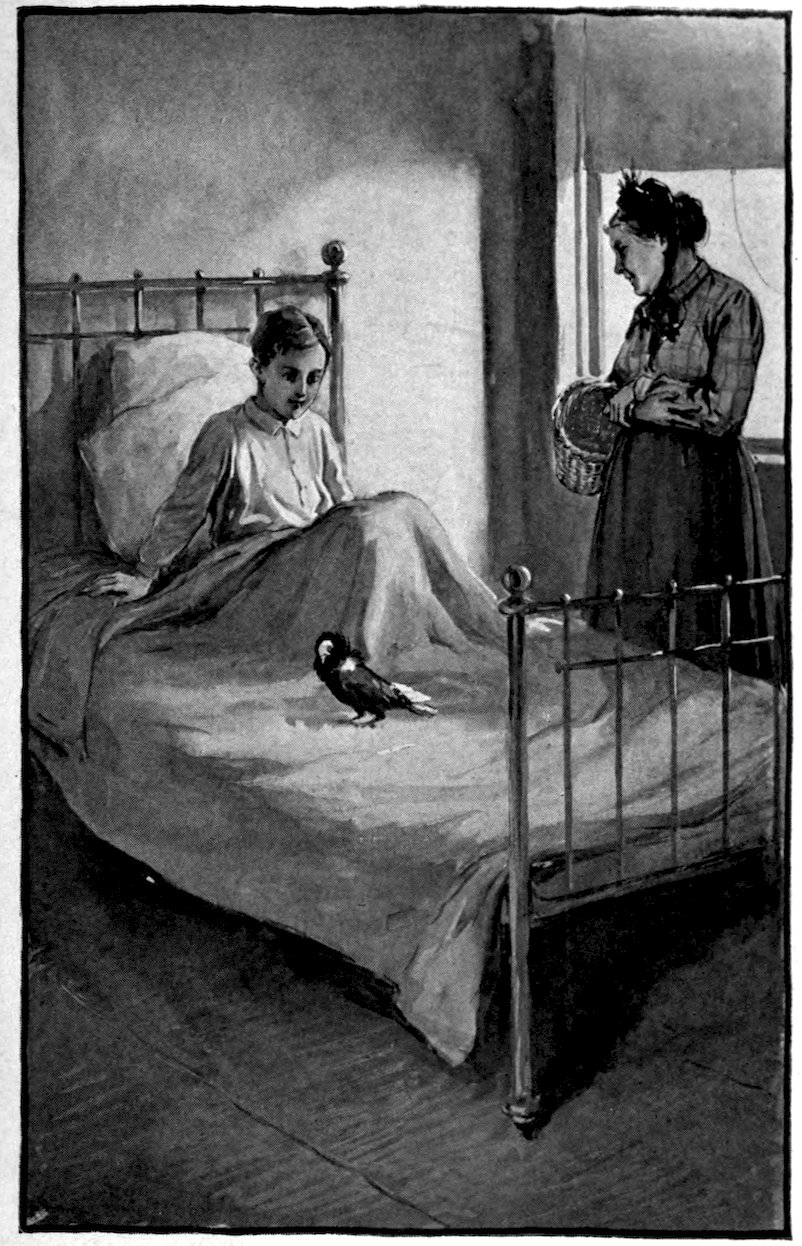
32“W-w-whew!” he said after a time, “isn’t she a
beauty—a real princess!”
Sukey cared nothing for his admiration. She was
in a strange place, and raising her beautiful hooded
head she gazed apprehensively and miserably about
her.
Not one sound would she utter, and when Titus
tried to caress her she would slip her soft back from
under his hand and trot toward Mrs. Blodgett.
“S-s-she has forgotten me,” said the boy, with a
chagrined air.
“Don’t you believe it, Master Titus,” replied Mrs.
Blodgett, consolingly. “She always do act that way
when you takes her in a strange place.”
However, she had forgotten Titus, or she had
transferred her affections to others. That was confirmed
when the boy returned home a few weeks
later.
His grandfather had insisted upon his staying in
the hospital until he was quite well, but everything
comes to him who waits, and at last the day arrived
when Titus’s belongings were packed. He himself
limped out of his room, and down the long halls and
staircases, and entered the carriage waiting for
him.
A nurse went with him, for his grandfather was
confined at home with a slight cold.
When the carriage drove up to the door Titus
hobbled up the steps and greeted the servants, who
were all waiting for him.
“H-h-how do you do, everybody?” he called out,
cheerily, “H-h-here I am as good as new, except a
scar on my forehead, and one foot a little bit crooked.
W-where’s grandfather?” and he limped upstairs to
the Judge’s study.
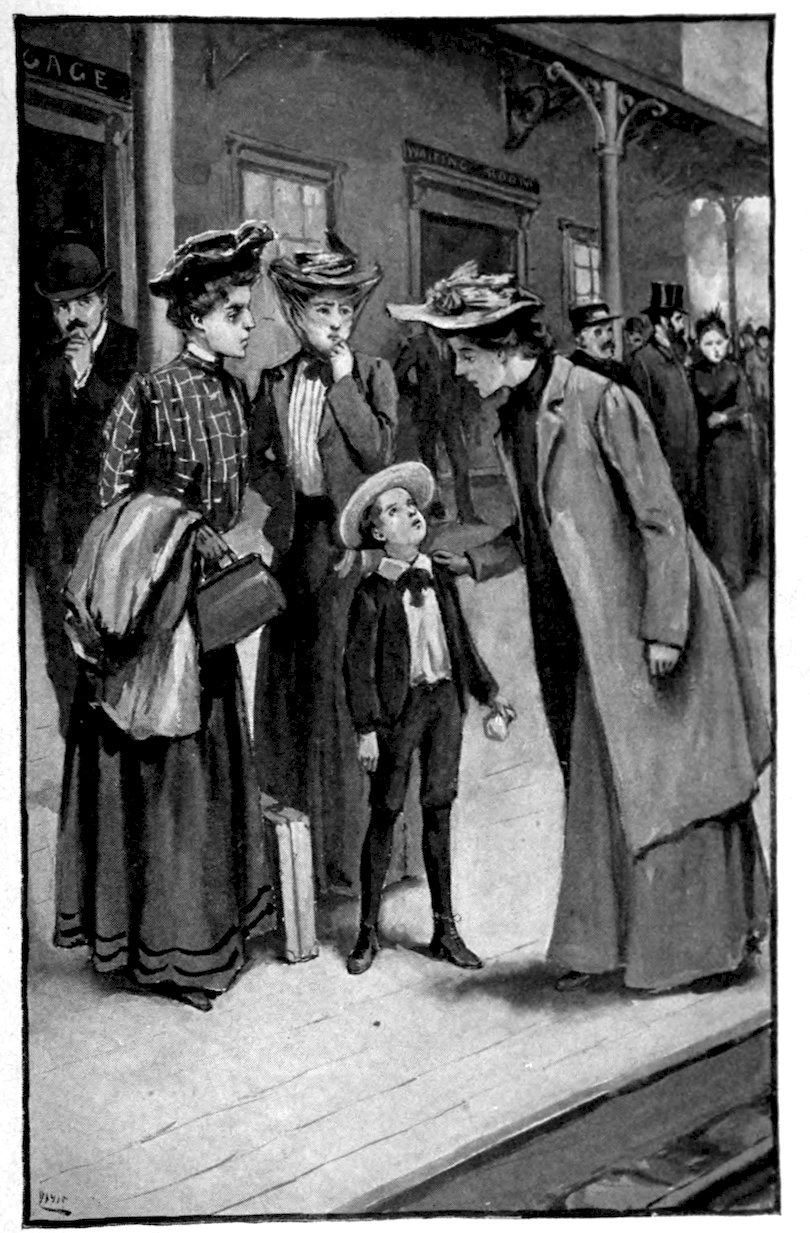
“W-w-whew!” he said after a time, “isn’t she a beauty—a real princess!”
33He was not a demonstrative boy, but on this day
he gave his grandfather a bearish hug; then, as if
he were ashamed of so much expansion, he turned
on his heel and said, “Where’s the pigeon?”
His grandfather smiled. “There she is.”
Titus looked around. The princess’s back was
toward him; she was very busy about something,
he could not tell what.
He stepped forward and recognized an enormous
pincushion, the property of Mrs. Blodgett. It was
stuck full of large, round-headed pins, and the
pigeon was amusing herself by pulling out these pins
and throwing them on her square of oilcloth.
“W-w-what is she doing that for?” asked the boy,
in amazement.
“To kill time, I suppose,” replied his grandfather.
“It is my proud privilege to pick up the pins and
stick them in the cushion when she has drawn them
all out.”
“W-w-well, I never!” exclaimed Titus, with open
mouth. “I never saw a pigeon play before.” Then
he said, “Sukey!”
The pigeon turned round.
“P-p-pretty bird,” he went on.
“O, rookety cahoo!” she said, irritably, and as he
continued to pet her she walked up and down the
oilcloth, shaking her head and setting her hood quivering.
There was a lovely greenish sheen on the red neck
feathers, and Titus exclaimed admiringly, “Y-you
beauty!”
34Sukey in a rage uttered a series of choking “Rookety
cahoos!” then she flew on the Judge’s shoulder.
Titus was awestruck. “Do you let her do that?”
he asked.
“I can’t help it,” said the Judge, sheepishly trying
to drive her away.
She resisted him, and rapidly turning would give
Titus a wrathful glance, and would then peck lovingly
at the Judge’s ear.
“I’ve spoiled her,” said the Judge, weakly.
Titus sank into a chair.
“Here take her,” said his grandfather, reaching
up both hands, seizing the bird bodily, and depositing
her on his grandson’s knee.
The boy held her, and gently stroked her head.
Struggling furiously, she caught hold of his fingers,
bit them sharply until he released her, when she flew
to the Judge’s knee, and seemed to be telling him a
long story of insult and injury.
The Judge could not help laughing, and finally
Titus laughed too. Then he said, “W-w-well, I’ve
lost my pigeon.”
“Never mind,” said his grandfather, “you shall
have some others for yourself. I spoke to a carpenter
the other day about making a loft up at the
stable for you.”
Titus gave his grandfather a queer look. Then
after a long silence he said, strangely, “Y-you don’t
mean it?”
“But I do.”
The boy was overcome, and turning round in his
chair he laid his head on his arm. To have pigeons—to
have a loft like Charlie Brown’s—to see his
35very own birds strutting about in it, to buy and sell
and bargain in the way so dear to boyish hearts.
“Grandfather,” he said after a time, and now he
was so much moved that he did not stutter, “I’m not
just the same as when I went into the hospital.”
“Indeed!” said his grandfather, kindly.
“No, sir. I thought,” and he pointed a finger at
the princess, “that I’d raise and sell her, but now I
don’t want to.”
“Why not?”
“I don’t know, sir.”
“I will tell you,” said his grandfather, very kindly
and very seriously, “your hard lesson has taught you
that a boy is not all legs, stomach, and brain. He
has also a heart.”
CHAPTER IV The Judge’s Vow
36
The Judge often looked up at a large painting on
his study wall—“Even This Shall Pass Away.”
The words were issuing from the lips of an Oriental
king who, seated on a magnificent throne, was
receiving the homage of his courtiers. A half-sad,
half-indulgent smile played about his face, and on
his uplifted hand there could be seen the words
deeply cut on a finger ring, “Even This Shall Pass
Away.”
The Judge often looked at this picture. How
many, many things had passed away in his experience—things
that apparently never would pass away!
How the time had dragged when Titus lay ill in the
hospital! It had seemed as if he would always be
ill, as if his grandfather would always be at home,
a worried and suffering man. But now only a few
weeks had gone by and Titus was at home, and
things were going on as they had before his accident.
The boy was going to school again—no fear of
fights now. He could stutter as much as he pleased.
The boys, half savages as some of them appeared
to be, were afraid to touch him.
After breakfast the Judge read his paper, went
downtown to the post office, the bank, and his club,
then came home.
37The princess was always waiting for him, in her
basket by the hearth rug if it were raining, or on
the balcony if it were fine.
As soon as he appeared in the doorway she flew
to meet him, lighted on his shoulder, rubbed her
beak gently against his ear, saying “Rookety cahoo!”
a great number of times.
When he put her on the hardwood floor she would
circle round his feet, and finally retire to her basket,
where she sat and watched him.
He had become her prime favorite. She liked
Mrs. Blodgett and Higby, and she endured Titus,
but she loved the Judge.
On this particular day, or rather evening, she was
very much disturbed. The Judge had had his nap
in the afternoon, and his drive, and his dinner, and
now in the firelight and incandescent light, when the
room was snug and cozy, he ought to be reading in
his big chair, with herself, the princess, on one arm
of it, occasionally getting her head scratched. But
instead of following the usual order of things he
was muttering to himself something about a vow,
and was pacing about the room.
The princess did not like it, and showed her displeasure
by a succession of sulky “Rookety cahoos!”
uttered from her basket.
After a time the Judge rang the bell.
“Jennie,” he said when the parlor maid appeared,
“ask Master Titus to come here after he finishes
studying his lessons.”
Half an hour later Titus came whistling down the
hall.
“W-w-well, grandfather,” he said, as he came into
38the study, “what do you want—a-a-a game of backgammon?”
“No,” said the Judge, “I want to talk to you. Sit
down.”
Titus threw himself into a chair, and stared at
him.
“When you were ill,” began the Judge, “I, in my
extremity, promised my Maker that if you were
spared to me I would show my gratitude by adopting
some poor child who had no home of his own.”
“W-w-whew!” exclaimed Titus, and he drew his
black brows together.
The Judge was not surprised. He had feared that
Titus might be jealous of another lad.
He waited a minute or two, then he went on
firmly: “This was not blind impulse. I have all
my life known that it was not good for a child to
be brought up alone. Being alone tends to egotism.
We are very happy, you and I, yet I know it would
be better for you to have another lad to share your
sorrows and joys.”
“H-h-he might fight me,” said Titus, gloomily.
“I shall get one much younger than you,” replied
the Judge.
“O-O-O!” said Titus, easily, “then I can lick
him.”
“Titus,” said the Judge, “you know that there are
boys and girls in the world less favored than yourself.”
“Y-y-yes, sir, but they are dirty and lazy, and they
have awful manners.”
“If we get a young child we can mold him. I
feel it my duty, boy. I have enough for you and
39another lad. There is a fearful amount of suffering
in the world. We should do what we can to lessen
it.”
“I-I-I don’t want one of those River Street cubs,”
said Titus, sharply.
“I shall take the greatest pains to get a boy of
good antecedents,” said the Judge, decidedly. “You
know that my profession has brought me into contact
with crime and criminals. I have a horror of
inherited vicious tendencies.”
“A-a-all right, sir,” replied Titus, with a sigh.
“If you’ve promised we’ve got to do it,” and getting
up he walked over to his grandfather and threw his
arm over his shoulder.
Titus was a reserved boy, but just now his slim
young figure, pressed close to the chair in which the
Judge sat, was brimful of eloquence.
The Judge’s lip quivered. “Titus,” he said,
slowly, “I shall never love another boy as I love you,
and, to tell the truth, I half wish now that I had not
made that vow; but I was in dire trouble, and the
Lord delivered me out of it. Should I not show
gratitude?”
“Y-y-yes, sir,” said Titus, hastily. “We’ve had a
hard time. I had thoughts too, sir, when I was lying
in bed so long. I’ve deceived you in lots of things.
I’m going to be more straight—I-I-I guess it’s all
right to take a kid. W-w-we’ll bring him to be just
like you and me,” and with a grin he rubbed his
black head against his grandfather’s white one, and
then scampered away to bed.
Now the princess was happy. With a great sigh
of relief the Judge settled himself back in his chair,
40pulled the reading light toward him, and took up a
book.
Sukey flew to his side, and when he became too
much absorbed in his reading to rub her white head
she leaned over and gently pecked his hand.
Young Titus’s illness had extended over a long
and cold autumn and into the first part of December.
By Christmas time he was dashing about in his old
way, though he still had a slight limp. Only time
would cure that, the doctors said.
The limp did not keep him off his feet. From
morning till night he was rushing about somewhere,
and when the Christmas holidays came he was simply
omnipresent.
According to a long-established custom, he and
his grandfather went downtown every Christmas
Eve to see the shops and the people. They started
early on this Christmas Eve—just as soon as they
had had their dinner—and they both would have
been very much surprised if anyone had told them
that during this evening a chance would come for
the fulfillment of the Judge’s vow.
Ever since he had mentioned the matter to Titus
the Judge had been quietly looking about for a boy.
He had visited several orphan asylums, and he had
written to friends, but though the orphans were
plentiful he was fastidious, and so far some defect
had been found in every one proposed to him.
“This is a joyful season, sir,” said young Titus,
as he endeavored to stride along in a manly fashion
beside his grandfather.
The Judge nodded, for this particular season was,
as Titus said, an ideal one. Enough snow had fallen
41to make sleighing pleasant, the air was clear and
frosty, but not too sharp, and the days were cloudless
and the nights bright. It was a pleasure to be
out.
The usual Christmas stir prevailed. The streets
were full of people, the shops were crowded. The
Judge and Titus had nothing to buy. The boy had
bought his presents for his grandfather and the
servants, and the Judge had his gifts all neatly done
up and labeled. They were in two of the big
drawers of one of his bookcases, and Princess Sukey,
the pigeon, had been the only one to see them as
yet.
Everything was gay and cheerful. Nobody
seemed sad, nobody sorry. Boys and girls, men and
women, were laughing and talking cheerily, and
Titus was staring about, his eyes going this way and
that way, until at last his grandfather turned his
wandering gaze in one direction by saying, “What
do you suppose is the matter with that boy?”
Titus looked straight in front of him.
A small child clad in a long coat and having on a
shabby fur cap was trotting along in front of them.
Sometimes he would take several steps in a straight
and assured way, then he would falter and stagger.
Once in a while he would reel up against the shop
windows. Upon one of these occasions he pressed
his little face against the frosty glass and gazed in
at the toys.
The child’s cheeks were white and dirty, his eyes
were sleepy, and Titus said in a puzzled way, “Do
you suppose anyone would give him anything to
make him stagger?”
42“Hardly,” said the Judge, “the little fellow must
have extraordinarily weak ankles. Watch him.”
The child set out again, and this time he staggered
so badly that he fell on the snowy pavement.
There he sat with his little face bent, a curious smile
playing about his lips as he gazed, not at the passersby,
but down at the ice and snow.
The Judge and Titus were the first to reach him.
“Here,” said the Judge, and he looked down at the
child, “try again,” and he set him on his feet.
The little boy gave him a slow, scrutinizing
glance, then he smiled mysteriously and said, “My
little trotters slipped on the ghosts of running
things.”
“A-a-are you ill?” asked Titus, sharply.
The child softly patted the front of his coat with
his mittened hand, “They kept me late, and Mr. Rat
is at his old tricks.”
“You are hungry,” said the Judge.
The child yawned—such a tired, weak little yawn
that, to the Judge’s surprise, he tried to suppress.
Then he nodded his little head a great many times.
“There’s something in the oven for me, but it’s a
long way there.”
“We are obstructing the way,” said the Judge,
and indeed many persons had stopped and were listening.
“Take his hand, Titus—here, child, come
into this restaurant.”
Like one walking in sleep he gave his hand to
Titus, and allowed himself to be led into the brilliantly
lighted white and gold room.
“W-w-wonder what he thinks of it?” murmured
Titus to himself. “Here, boy, take off your cap.”
43The little boy struggled to keep his hairy or almost
hairless headgear, but Titus was inexorable. He
finally gave it up, but he gazed at Titus with a
slightly injured air, as the bigger boy handed the
shabby fur thing to the waiter.
Then with babyish vanity he put up a hand and
smoothed the thin crop of curls plastered down on
his forehead by a band of perspiration.
“What will you have?” said the Judge to him
after they had seated themselves at a small table.
“Cats like milk,” he said, dreamily, “and dogs
like broo.”
Titus stared at him, then he said under his breath
to his grandfather, “I-i-is he crazy?”
“No, he is repeating a Scotch jingle. ‘Broo’ is
broth. He is terribly tired. Child,” he went on,
“would you like me to read you the menu?”
“Please, sir,” he said, shyly, and with tired grace
he handed the Judge the bit of cardboard with which
he was playing.
The Judge elevated his eyebrows, put on his eyeglasses,
and took the menu from him.
“Oysters, sir,” said the child, seriously, when the
Judge had run over the list, “bouillon, and Democrat-Republican
ice cream.”
Democrat-Republican ice cream was a specialty
of this same first-class restaurant, and Titus, hearing
this poverty-stricken child show familiarity with its
merits, snickered aloud in his amusement.
His grandfather gave him a warning glance, but
the child had not heard him. He was wearily looking
about the pretty room with an air that said, “I
have seen all this before.” Then, while waiting for
44their orders to be filled, he quietly dropped to
sleep.
Meanwhile the Judge and Titus studied his appearance.
“Do you see,” said the Judge, “that though his
face and hands are dirty his wrists are clean. He
is only dirty outside. Look at his ragged little shirt
cuffs. They are quite white—and how nicely his
coat is darned.”
Titus nodded, and as the Judge noted the kindly
look on the boy’s face as he surveyed the sleeping
child a light broke over his own face. He was not
romantic nor sentimental, but he was a religious
man, and he believed in the leadings of Providence.
He had been guided to this boy. What a brother
he would make for Titus—that is, and he prudently
added an afterthought, if he was without incumbrances,
and his antecedents were good—and meanwhile
the little child slept on.
“B-b-boy,” said Titus, presently, “wake up, and
eat your victuals.”
The child opened his eyes, smiled sweetly at him,
and calmly took up a fork.
He went to sleep between oysters and bouillon,
and bouillon and ice cream. He slept putting a piece
of bread to his mouth—indeed, he slept with such
frequency that Titus wondered how he managed to
tuck away so much food.
At last he had finished, and then he did something
that considerably mystified the Judge and Titus.
After wiping his mouth with his napkin he put
the napkin on the table, and unbuttoning his coat
he slipped a hand in the front of it.
45As he did this the sleepy look left his eyes, and a
sorrowful one came in its place. Drawing out a
small handkerchief with a border of marvelous lions
and tigers, he unrolled it, pretended to take something
out of it and put it on the table. Then he
placed crumbs of bread and cake before this imaginary
thing.
“W-w-what are you doing?” asked Titus, bluntly.
“Feeding the little one,” said the child, solemnly.
“W-w-what little one? There isn’t any there.”
“Don’t you see my little mouse?” he asked, impatiently.
“A-a-a mouse!” exclaimed Titus, “je-whillikens!
I don’t like mice.”
“He’s dead,” said the child, softly; “a strange
pussy killed him—not our pussy.”
“H-h-how can you feed him if he’s dead?” pursued
Titus, with boyish callousness.
“But he has a little ghost,” said the strange child,
gently shaking his head, “and I carry it here—have
you had enough, mousie?” and he tenderly lowered
his head to the table.
“Yes,” he said, softly speaking to himself; then
he took up the ghost, wrapped it in his handkerchief,
and put it back in his little bosom.
The Judge felt a strange misgiving. Another
animal enthusiast—and this one worse than Titus,
for Titus had little imagination, and interested himself
only with the live bodies of animals, not their
dead shades.
The mouse episode over, the child again became
sleepy. Titus, who had managed to dispose of some
ice cream himself, jammed the boy’s fur cap down on
46his head, and guided his steps behind the Judge to
the door of the restaurant.
There the child sank down on the doorstep.
“U-u-upon my word,” stuttered Titus, “he’s saying
his prayers. T-t-this time he’ll be off for good—must
have been drugged.”
“It’s a case of natural or unnatural fatigue,” said
his grandfather. “Drugs would probably cause him
to sleep uninterruptedly. Go get a sleigh and we
will drive him home. Child,” and he bent down and
slightly shook him, “where do you live?”
“Forty-five River Street,” he replied, drowsily,
“at Mrs. Tingsby’s.”
When he found himself lifted in among warm
fur sleigh robes he slept more soundly than ever.
“River Street—River Street,” said the Judge.
“Poor child!”
In a short time they had left the crowded, brightly
lighted streets, and were traversing the long, dingy
narrow one that Titus so much disliked.
On one side of the street there were wharves behind
the houses. The traffic for the day was over,
and the wharves were dull and deserted, but there
was some life on the street, particularly about the
saloons and small shops.
Even River Street must have its Christmas Eve.
“Forty-five,” said the driver, “here it is,” and he
stopped beside a narrow house—the middle one of
three dingy, uninviting dwellings.
“Mere shells of buildings,” muttered the Judge,
glancing up at the houses, “and the poor haven’t
coal to heat them, while we with well built houses
have plenty of fuel.”
47When the sleigh stopped, and the merry jingle
of the horses’ bells ceased, a curtain was pulled aside
from a window of number forty-five, then the door
flew open, and a thin slip of a woman in a cotton
dress ran out to meet them.
“O, the child! the child!—don’t say death to me!”
“Motherly anxiety,” commented the Judge to himself,
and strange to say his heart sank. If the boy
had a mother he would never get him.
He stared at the excited wisp of a woman who
was dragging the child from the fur robes, and was
violently hugging him. “O, Bethany! Bethany! you
aint dead.”
“Dead, no,” said the Judge, “he is only asleep,”
and he proceeded to tell the woman the story of
their finding the child.
She listened to him, holding her head up, and with
a strained expression on her thin face, and after a
time the Judge stopped talking, for he discovered
that she had not heard a word of what he was saying.
“I’m deef!” she exclaimed, “deefer than that iron
post. Come in, come in,” and clutching the little
boy firmly by the hand she backed into a tiny hall,
and threw open the door of a small front room where
a table was set as if for a meal.
“Wait for us,” said the Judge to the cabman, then
he followed her.
The cloth on the table was white but threadbare,
and the appointments were all so meager that the
Judge averted his head. He had a tender heart, and
now that he was getting toward old age the awful
inequality between the lot of the rich and the poor
struck a painful sympathy to his heart.
48“What makes this boy so sleepy?” he asked, pointing
to the little child.
The woman saw his gesture. “Ah! sir,” she said,
“it’s cruel to keep them so late. They begin work
at nine in the morning.”
“Work!” echoed Titus.
His clear young voice reached the deaf woman’s
ear.
“That there child,” she said, pointing to the little
boy, who was sitting on a small stool stifling yawns,
“has been at work sence nine this morning with bare
an hour for lunch—just as sure as I’m a livin’
woman.”
“What work does he do?” asked the Judge.
The woman did not hear him, but she guessed
what his question would be.
“From nine to five is the hours, and in the sight
of my Maker I vow I’d not let any child in my care
go to sech slavery, if it weren’t that I’m so hard
pressed that upon my word the soul is fairly racked
out of me to get victuals for my children.”
“What does he do?” roared the Judge in her ear.
“Do, sir—makes paper boxes. You know about
Christmas time how the rich folks must have boxes
to put their candy in. The contracts for boxes is let
out to men who swallow up the poor. There’s dozens
of poor children a-slavin’ in this city, agin’ the
law and unbeknownst to the law. I wish the Lord
had never made Christmas. It’s a good time for
the rich. You take out your fat pocketbooks an’
order presents for each other, an’ you wait till the
last minute, an’ then the poor has to go to work.”
The Judge wrinkled his white brows.
49“Look at that table, sir,” continued the woman,
“set sence five o’clock this evenin’—the time the
poor is supposed to git off. Look at the sour bread
the baker sells us, an’ the salt butter the grocer
weighs us, an’ the molasses, an’ rind of cheese.
That’s our Christmas Eve supper, but sech as it is
it’s been waitin’ for hours for my boarders.”
The Judge said nothing, but his gaze went round
the shabby room. Nothing more unlike his idea of
a boarding house could be imagined.
The little thin woman with the sharp eyes interpreted
his glance.
“Yes, sir, I earns my livin’ by keepin’ boarders—ever
sence my husband was poisoned to death by
work in the city sewers. There’s that boarder,” and
she pointed to a plate on the table—“Matthew Jones.
He works in a fur store—overtime now, because it’s
Christmas, and some grand lady must have her set
of sables to-night. The light is poor in his workroom,
an’ his eyes is bad, but no matter—he’s got
to work or be fired. Then next to him sits Harry
Ray. He’s in the express employ. Only seventeen,
an’ an orphan. He’s drivin’ till one and two every
night now, an’ eatin’ his lunch on his seat in his
cart. He’s got an awful cold. After Christmas
he’ll likely take time to have newmania or grip.
Then there’s old man Fanley. He’s carryin’ parcels
for a small firm—poor old soul, stumblin’ round in
the cold at night when he ought to be in bed. O!
sir, we don’t hate work, we poor uns, we’ll slave all
day, but I do think the rich might let us have our
nights. We’d serve ’em better, sir, we would.”
The Judge bent his white head and nodded it
50sadly. At times there seemed no joy, no pleasure
in life, only stern taskmasters and shrinking slaves.
“It’s hardest on the children,” pursued the woman
in a lower tone. “My heart bleeds for ’em. I’ve
just got me own in bed. They’re all workin’ too,
now that it’s holiday time. I was just waitin’ for
this stray lamb,” and her glance softened as it fell
on the bobbing form of the sleeping child.
The Judge raised his head. “Isn’t this your
child?” he asked, sharply.
The woman turned to Titus. “What do he say?”
Titus repeated the question, and she intently
watched the motion of his lips.
“My child!” she exclaimed. “O, law no! Look
at my hair, sir, black as a crow’s. Those curls be
quite light,” and she stepped over and laid a hand
on the child’s head.
“Whose child is he?” asked the Judge.
The woman turned to Titus with an impatient
gesture. “You say it. His mustache do cover his
lips. I can’t see ’em.”
“P-parents,” cried Titus, “of that boy. Who is
his mother?”
“Mother!” repeated Mrs. Tingsby, “nay, that I
can’t say till I finds an owner for the child. ‘Susan
Tingsby,’ said his ma when she lay a-dyin’ in this
very house, ‘Susan Tingsby, you’ve been a good
friend to me. When the Lord sends some one to
take my baby tell my poor story, such as it is’—an’,
sir, I’ve kept the child these ten months. Often
I’ve hardly had bread for me own, but the child of
the stranger never suffered.”
The Judge sat quietly for a few minutes. Now
51that his attention was called to the fact that the
woman was not the child’s mother he saw quite a
difference in their faces. Mrs. Tingsby’s sharp, dark
features were very unlike the pale, plump face of the
little one.
“Yes!” she suddenly ejaculated, “the child’s fat
enough.”
The Judge looked at her. Though deaf she was
not stupid, and she was marvelously clever at understanding
one’s thoughts.
“The children of the poor is mostly that,” she
continued. “Much sour bread puffs ’em out, an’
likewise fresh air which they has plenty of. But
bless your heart, it aint good flesh like rich children’s.
Newmania and consumption takes ’em off
like smoke.”
“Ask her to what station in life the boy’s mother
belonged,” said the Judge to Titus.
“W-w-was its mother a lady?” vociferated the
boy, with a nod toward the child.
“A lady! Well, I guess so,” replied Mrs. Tingsby,
indignantly, “as much as you be. She were a school-teacher—out
of New York. I know her maiden
name. Her husband’s name weren’t nothin’ remarkable.
I don’t mind sayin’ it. It were Smith.”
“Ask her what the husband’s character was,” said
the Judge.
“H-h-husband,” continued Titus, “was he good?”
“He were an imp,” said Mrs. Tingsby, shortly.
“An imp,” murmured the Judge. “Go on, Titus,
extract some more information. You can guess
pretty well what I want to know.”
“W-w-what do you mean by an imp?” stuttered
52the boy, speaking very slowly, and shaping his words
well with his mouth.
“Well, young sir,” said Mrs. Tingsby, ironically,
“when you grows up and marries a wife, and goes
off an’ leaves her in a poor boardin’ place like this,
an’ only comes home once in a while, an’ takes her
an’ the child to a swell restaurant for lunch, an’
then goes off an’ leaves her to bread and molasses
again, I’ll say you are an imp.”
“I-I-I don’t care much for this woman,” said the
abashed Titus under his breath to his grandfather.
“Never mind, boy—she means well. Ask some
more questions. What was the husband’s business?”
Titus grinned in an embarrassed way. “W-w-what
was the imp’s business?” he inquired.
“Servin’ his master,” said the woman, shortly, and
with a glance at the now sleeping child, “an’ sometimes
gettin’ big pay, an’ sometimes poor—what’s
his business?” and she abruptly jerked a forefinger
in the Judge’s direction.
“H-h-he’s a judge,” said the boy, proudly, “retired
a few years ago—o-o-on account of ill health,”
he added; “but he’s all right now.”
“Ah!” replied Mrs. Tingsby, and still staring at
the Judge she addressed him significantly, “maybe
you’ve seen him purfessionally.”
Judge Sancroft felt an inward recoil, though he
said nothing. But he rose almost immediately, and
looked at his grandson.
Mrs. Tingsby was a remarkably shrewd woman.
Under the Judge’s reserved exterior she saw plainly
that his heart had been going out to the orphan
child.
53“The father is dead,” she said, briefly, “buried by
the mother—an’ she were a saint on earth, an’ is
now a saint in heaven.”
The Judge said nothing, and picking up his fur
gloves he slowly began to draw them on.
Mrs. Tingsby’s strained, eager face was bent on
him. “The father of the imp were a minister of the
gospel,” she continued, “an’ the imp’s wife—”
She paused an instant. The dead woman had told
her clearly not to reveal her maiden name except to
the person who would adopt her child; but Mrs.
Tingsby was so sure that this person stood before
her that she made up her mind to a slight breach
of confidence.
“The mother were a Hittaker,” she said, grandly.
The Judge had never heard of the Hittakers, and
therefore did not look impressed.
The woman in her anxiety pulled Titus by the
sleeve. “Ask him—aint he heard of Hittaker—big
soap manufacturer. Why, it’s in all the groceries.”
Titus shook his head. He saw that his grandfather
did not know the name.
“Inquire why she does not apply to these people,”
said Judge Sancroft.
Titus asked her.
“Apply to ’em! Bless you, didn’t she? What
won’t a woman do for her child. But her own parents
be dead. These Hittakers be uncle and cousin
to her, an’ they wouldn’t do a thing—sent back her
last letter.”
The Judge got up. “I’ll send some one to you,”
he said. “Titus, you tell her. I’ll report her case,
and have some aid given her.”
54Titus in his boyish fashion rattled off a sentence.
“M-m-my grandfather will send help to you. Maybe
he can get the child a home.”
Mrs. Tingsby laid a lean hand on Titus, but she
looked at his grandfather. “An’ you don’t want
the orphan yourself, sir?”
The Judge shook his head.
Mrs. Tingsby locked her hands together. “I like
your face, sir. There has been people fancyin’ the
child, but I didn’t fancy ’em.”
Judge Sancroft smiled faintly. Then his hand
went toward his pocket.
The little woman’s face flushed crimson. “I’m
no beggar, sir. I’ve no wish for money I can’t
earn.” The Judge put out a hand and took hers.
“Titus, shake hands with her,” he said.
“G-g-grandfather,” ejaculated the boy as they
stepped over the threshold of the door leading into
the little dark hall, “look at her!”
Mrs. Tingsby stood holding the small lamp aloft
for them, with tears running down her cheeks,
and a painful, almost terrified, expression in her
eyes.
“I’ve told a dead woman’s secret, sir,” she said
in response to the Judge’s look of inquiry. “I’ve
risked me soul, an’ it aint done no good.”
The woman’s expression of suffering was so genuine
that the Judge stopped short. How cruel to lay
another burden on this already overburdened
back!
She was an honest woman, he could see that. He
had had a long experience in the study of human
nature, and she would not have been able to deceive
55him if she had wished. Suppose he took the child
from her. With his connections and influence he
could easily find a home for it.
“Madam,” he said, courteously, and stepping
back, “this is Christmas Eve, and from my heart
I wish you good cheer. If it will give you pleasure,
I am willing to take the child, and to pledge myself
to find a good home for him.”
The woman again twitched Titus by the sleeve.
She had partly, but not wholly, understood.
Titus, who was getting excited, stopped stuttering
and told her.
When he finished she turned round, set the lamp
down on the table, and threw up her hands.
“Thank the Lord! Thank the Lord! Here,
duckie, old Mother Tingsby has found you a home.
Stir up, and go with the gentleman,” and in feverish
haste she aroused the sleeping child, got him on
his feet, and put his cap on his head.
“Well, well,” said the Judge, in some hesitation,
“I did not think of taking him to-night.”
The woman did not hear him, though she spoke
as if she had. “Better have it over in darkness, with
none to see and none to hear. I don’t want to drag
down that sweet woman’s child by any connection
with me. Ah! sir, she was like a sister to me. I’ll
miss her child,” and with very genuine regret she
embraced the bewildered little boy.
“I assure you,” vociferated the Judge, “that I am
not in the habit of doing things in secret. I do not
care who knows that I have taken a poor child from
River Street.”
Mrs. Tingsby did not hear him, and Titus was too
56excited to report, so the Judge slightly shrugged his
shoulders.
“I’ll miss my baby—I’ll miss my baby!” she cried,
“for there’s not a soul younger in the house but
the kitten—good-bye, pet—good-bye. Old Mother
Tingsby will sometimes sneak up to look in your
windows. Sir, you’ll never give up this child—you’ll
let your soul go first.”
The Judge smiled slightly, and catching this smile
she suddenly flung up her black head and fixed two
shrewd eyes on him.
“Sir, don’t you be afraid of no fathers an’ grandfathers.
Some of my boarders was talkin’ the other
evenin’. Says one of ’em, says he, ‘I’ve been readin’
a magazine article. It says everyone of us has had
thieves an’ robbers in our ancestors.’ Do you believe
that, sir?”
The Judge, in a slightly bewildered state of mind,
was pushing his way out to the hall door, beyond
this flood of talk. He had a feeling that he would
like to reach the quiet of his own home, and think
things over. However, some sort of an answer
was due to her, so he turned once more. “I would
rather have had that boy’s father an honest
man.”
Mrs. Tingsby was so close on his heels, and was
listening so intently, that she caught a few words.
“Boy—yes!” she exclaimed, nodding her head at
Titus, and grinning amiably, “an honest boy!”
“I say,” roared the Judge, stopping short, “that I
wish your little boy had had an unblemished parentage.”
“My boy,” she responded, sadly, “my boy—why,
57sir, I have three—an’ how I’m goin’ to raise ’em the
Lord knows.”
Meanwhile the child was drawing back. He was
now thoroughly roused from sleep, and his little face
was quite disturbed.
“Mother Tingsby,” he said, pulling at the woman’s
gown, and drawing down her ear to his small
mouth, “is this the husband of the good third
mother?”
“Yes, lamb, yes,” said the woman, nodding her
head a great many times, “an’ your second mother
bids you go. Be good an’ clever.”
The child gave her an anguished glance. He did
not wish to go with these strangers. However, he
had been trained to look forward to just such an
event, and he made no protest. Putting his little
hand in the one that Titus held out, he followed the
Judge to the street.
CHAPTER V A Surprise for the Judge
58
No one spoke on the way home. The Judge and
Titus on the back seat of the sleigh scarcely took
their eyes from the serious, little face of the
strangely pale, quiet child opposite.
He was not sleepy now. They could see the two
large brown eyes shining with the steady light of
two solemn stars.
When they reached their home on the avenue,
Titus politely assisted the child to alight, and took
his hand as they went up the long steps.
Higby had gone to bed, and the parlor-maid’s
face as she opened the door was a study. Nobody
explained matters to her, and in a complete state of
mystification she was sent to request Mrs. Blodgett’s
immediate presence in the parlor.
Titus had lifted the little stranger to a chair, and
was drawing off his cap and mittens.
“Mrs. Blodgett,” said the Judge, when that good
woman appeared, “I wish you to take charge of this
child. Put him to sleep at once. If he is nervous,
some one must sleep in the room with him. Don’t
give him a bath to-night. He is very tired. In the
morning dress him and bring him down to breakfast.”
Mrs. Blodgett, in amazement, looked down at
the shabby child. Who was this? She was not fond
59of children, except her own—and poor and dirty
children she detested.
However, a little hand was stealing into hers. A
tired, unhappy face was looking trustfully up at her,
seeking the kind glances of a third mother.
Mrs. Blodgett would have been less than a woman
if she could have resisted. This was probably some
child who was here only for the night.
“Yes, sir,” she said, respectfully, and with the
little boy clinging closely to her, instead of bestowing
glances on the Judge and Titus, she went
upstairs.
The Judge and his grandson did not talk much
that night. The Judge slowly sipped his glass of
hot milk and then went to bed. He lived a quiet
life, and the adventure of the evening had given him
many problems to think over.
Titus was quite excited. Ordinarily the approach
of Christmas Day did not stir him very much, but
now that there was another young person in the
house he felt his pulse quickened. This strange boy
must have some presents. Should he give him some
of his new ones, or would old ones be sufficient?
He would consult his grandfather about it. He had
a lot of old toys up in the attic. To-morrow morning
he would ask Higby to get them down, or,
better still, he would take the youngster up there.
Poor little chap—how mean to make him work,
and with some hitherto unknown generous impulses
animating his sturdy young breast Titus fell
asleep.
He was late for breakfast the next morning. His
grandfather had already had prayers, the servants
60had scattered to their various employments, and
Higby was just taking in a second supply of coffee
to the dining room.
“B-b-beg pardon, grandfather,” said Titus, hurrying
in after the man. “I-I-I fell asleep again after
Higby knocked at my door. M-merry Christmas
and many of them!” and seating himself at the table
he looked around in great approbation.
The long handsome room was flooded with sunlight.
“G-g-good old sun,” ejaculated Titus, approvingly.
“I-I-I can dress better when he shines on
me. I-I-I hate the dark, early part of the morning.
W-where’s the child, sir?”
The Judge looked toward the door. Higby was
just throwing it open for Mrs. Blodgett and her
charge.
Then an amusing scene took place. In the doorway
stood Mrs. Blodgett, and a pale, pretty little
girl dressed in a dainty white cloth dress trimmed
with gold braid.
The Judge and Titus looked at Mrs. Blodgett.
They both knew that she possessed a little granddaughter
of whom she was inordinately proud. This
child sometimes came to the house, and she often
presented her to the Judge for a word or a kind
glance.
Just now he gave both—“A merry Christmas,
little one. Come here and get an orange. Mrs.
Blodgett, how is the boy this morning?”
Mrs. Blodgett pushed the child, who did not seem
inclined to leave her, toward the Judge, then she
said in a puzzled way, “The boy, sir?”
61“Yes—the boy I brought home last night,” replied
the Judge.
“The boy, sir,” she repeated in amazement, while
an additional flood of color swept over her rubicund
face. “There weren’t no boy, sir.”
The Judge gazed patiently at her. Mrs. Blodgett
was getting older. He had noticed several times
lately that she seemed a little stupid and did not
understand quickly what was said to her.
“You surely remember the little boy I brought
home with me last evening?”
Mrs. Blodgett gazed up at the ceiling, down at
the floor, under the table, and behind her out into
the hall as if seeking a lost child.
Then she said, faintly, “As I am a mortal woman,
sir, I didn’t see no boy, sir. He must have slipped
off on the doorstep. I know these poor children.
They’re sneaky as foxes.”
“No, he did not slip away,” said the Judge, with
a quiet smile. “I brought him in and gave him to
you.”
Mrs. Blodgett’s face was purple, and she turned
to Higby in quiet exasperation. “Now, if you’d
been about, instead of bein’ in bed, I’d have said it
was some of them queer tricks of yours.”
“Do not make a scapegoat of Higby,” said the
Judge, decidedly, “but let your memory go back to
last evening. This is a serious matter, Mrs. Blodgett.
I had a young boy in my charge. I am answerable
for his safety. I brought him in the house
and gave him into your care. Now, what has become
of him?”
“Lawks-a-massy!” exclaimed Mrs. Blodgett, joining
62her hands in embarrassment and staring wildly
about her, “Is it you, Judge Sancroft, speakin’, and
am I, Dorinda Blodgett, a-listenin’?”
“You seem to be listening,” remarked the Judge,
dryly, “but you certainly are not understanding.
Please go away and search your memory and the
house for that boy. Titus, what is the matter with
you?”
“Are you crazy, too?” the Judge felt like adding,
but fortunately for himself he did not do so. While
he had been speaking the child had been creeping
shyly toward him, and Titus’s eyes were glued on
her. The Judge turned his eyes quickly on the little
girl. Now that he examined her more closely he
saw that this was no offspring from the Blodgett
stock. Where had he seen before that thin band of
curls, those big, solemn eyes?
“Sir,” Mrs. Blodgett was sniffling miserably,
while she made a ball of her pocket handkerchief,
“you aint never doubted my word afore. It’s time
for me to quit your service.”
“I am not doubting your word,” he said, absently,
“only—” and he again stared at the child.
“Where did you get this little girl?” he asked,
shortly.
“’Tis the same little girl you brought in last
evenin’, sir, the same little girl what weren’t accompanied
by no boy, sure as I’m alive. Jennie, she
saw her—ask her if there were a boy too.”
“Upon my word!” exclaimed the Judge, bringing
his hand down on the table. “Upon my
word!”
Titus’s eyes were absolutely sticking out of his
63head. Then he began to cough, then to laugh, then
to choke.
“Sir,” said Mrs. Blodgett, uneasily, “she were
dressed something like a boy outside, but inside was
such a miserable little frock that I took the liberty
of putting on her one of my grandchild, Mary Ann’s,
outgrown party ones that I’m goin’ to give to an
orphan asylum.”
Still the Judge did not speak, and Mrs. Blodgett
went on. “’Pears to me, now I think of it, you did
tell me to take this little boy an’ put him to bed.
I didn’t pay no attention, sir. As much as I honors
you, I couldn’t think to change my Maker’s decrees
by makin’ a little girl a little boy.”
“O, grandfather!” gasped Titus, half under the
table. “O! O! grandfather!”
The Judge’s face relaxed, then he looked about
him and began to smile. Then he laughed—laughed
so heartily that Mrs. Blodgett, who was no simpleton,
and who was beginning to understand, joined
in. Higby, delighted to find no share of mismanagement
attributed to him, snickered agreeably, and
even the maids who had just come up from the
kitchen and were going to their work in different
parts of the house, hearing the sound of enjoyable
laughter, echoed it light-heartedly.
“This is a good Christmas joke on you and me,
Titus,” said the Judge at last, putting his handkerchief
to his face to wipe his eyes. “It is said that
one finds what one looks for. We were looking for
a boy, and we persuaded ourselves that we had
found one.”
“Did that woman try to deceive you, sir?” asked
64Titus, drawing his head from under the table and
casting a comical glance at his grandfather, then at
the little girl.
“No, she had the appearance of an honest woman,
but her deafness prevented her from hearing us
fully. Now that I think of it, she did not once say
that the child was a boy. We jumped to that conclusion.
Why did you not tell us what you were?”
and he turned to the child.
She gave him a quiet smile that assured him that
she had not intentionally deceived him, and then
he saw that her mouth was parched and open, and
that her lips moved slightly as she looked beyond
him toward the table.
“You are hungry,” he said, courteously. “Higby,
lift her to her seat.”
The child looked over her shoulder at Mrs. Blodgett.
She wished to sit down at the table with her,
and with a deeply gratified smile the housekeeper
stepped forward and arranged her in her chair. That
glance would be set down to the little stranger’s
credit.
“I have to beg your pardon, Mrs. Blodgett,” said
the Judge. “There was a misunderstanding all
round. This little girl is an orphan. I offered to
find a home for her, thinking that she was a boy
because she was dressed like one. She has probably
had on the borrowed garments of a little boy belonging
to the kind woman who has taken care of
her.”
“It’s all right, sir,” said Mrs. Blodgett. “I might
a-remembered what you said. I call back now that
you told me plainly she was a boy, but, as I said
65afore, you can’t change nater,” and with another
gratified smile she waddled away.
Meanwhile Titus, having recovered, or nearly recovered,
himself, for he found it necessary to drop
his napkin on the floor every two minutes and to
be a long time in picking it up, stared almost uninterruptedly
at the little girl.
She was eating an orange that the Judge had
given her, eating it prettily and quietly and without
splashing the juice on her white gown, and casting
meantime curious and searching glances about the
room.
The boy or girl problem disturbed the Judge somewhat.
He could not get it out of his head that she
was a boy. It was extremely disappointing that she
was not, for now she would be no companion for
Titus.
“Child,” he asked, kindly, “what is your name?”
“Bethany,” she replied, in a low voice, “little
Bethany. My mamma was big Bethany.”
“Little Bethany,” said the Judge, “that is a nice
name. Now, what are you going to have? Will
you eat mush, cornmeal mush?”
“If you please, sir.”
“Higby, give her some—put plenty of cream on
it—Indian corn is what our ancestors here in New
England raised and gave to their children. We
don’t eat enough of it nowadays.”
Titus, stricken with sudden shyness, would not
talk to the child. He knew nothing about girls, and
did not care for them, so the Judge felt it his duty
to keep up a conversation.
“How old are you?” he asked.
66“Seven, sir,” she replied.
“Do you like that mush?” he continued, politely.
She paused with spoon uplifted, “It is simply
delicious, sir.”
Titus got up and took a turn to the sideboard. His
grandfather eyed him warningly. He had laughed
enough.
Suddenly the clock struck ten, and as it struck
the child lost her quietly contented air and, blushing
painfully, counted the strokes as they rang out.
“O, sir,” she cried, with a guilty start and laying
down her spoon, “I’m an hour late. I must get to
work—the boss will be so angry.”
The Judge stared at her. The light died out of
his own eyes, an iron hand gripped his heart.
In the face of that tiny child, in her start, her
fear of consequences, he suddenly felt the pain of
the world. Outraged childhood with its bleeding
wounds stood before him.
A great lump rose in his throat. For a minute
it seemed as if his agony could not be borne.
He groaned heavily, then he threw up his head.
“Child!” he said, harshly, “your slavery is over.”
His tones were severe, and the child was frightened.
She slipped from her seat at the table and
stood pale and shrinkingly before him. “Sir, I want
to go back to Mrs. Tingsby.”
Titus came to the rescue. “But you haven’t fed
your mouse,” he said, kindly, and with the cunning
of one young thing in understanding another. “And
we’ve got some prime German cheese. Higby—”
The old man went to the big mahogany sideboard
and presently came back with some crumbs of cheese.
67The little girl’s thoughts were turned in a new
direction. Putting her hand in her little bosom she
drew out the marvelous handkerchief, produced the
ghost of the mouse, fed it, and put it back again.
Then Titus skillfully drew her toward his grandfather’s
study. “About eleven o’clock on Christmas
morning we always have our presents in
here.”
It was a pretty sight to see them go down the hall—the
dark boy and the pretty little white girl, so
much younger than he.
The Judge followed closely behind them, and as
they reached the study door and paused, he paused
too.
The little girl had caught sight of Princess Sukey
sitting on her basket. She stopped short, caught
her breath, stepped close to Titus and remained
motionless.
“W-w-what’s the matter?” asked the boy, bluntly.
“O, hush,” murmured the child, in an ecstasy,
“don’t speak, don’t move, or she will vanish.”
“I-i-indeed she won’t—she is grandfather’s bird.”
“Then she is no ghost,” said Bethany, drawing a
long sigh of relief.
“Ghost, no. Watch her dance when I tickle her
feet,” and he stepped forward to the hearthrug.
The princess got out of her basket when she saw
them coming and, bowing a great many times, said,
“Rookety cahoo!”
“H-h-happy Christmas,” replied Titus, politely;
“lots of seeds and the best of health. Now dance
for the little girl,” and gently touching her claws
he caused her to spin round and round.
68Finally she flew over their heads to the Judge’s
shoulder.
“O, if I could touch her,” said the child, and she
shivered in the intensity of her emotion.
The Judge sat down and put the pigeon on the
arm of his easy-chair.
“Come here, little girl,” he said, “and stroke her.”
Bethany shyly approached and held out a forefinger
to the Judge.
With another sharp pang at his heart he felt that
the tiny finger was roughened by work. Then guiding
it to the white head under the hood of feathers
he looked away from the bird and out the window.
God helping him, this child should never toil again.
When Bethany felt her hand touching the velvety
feathers she gave a long shudder of delight.
After a time, when the princess had impatiently
thrown off the little caressing finger, Bethany threw
up her hands to the ceiling. “I have seen them in
the street, I have called to them, but they never let
me touch them. I think they thought I was a cat.”
“W-w-what do you mean—pigeons?” asked
Titus.
“Yes, birds—pretty birds of the air. I love them,
but they don’t love me. Only dogs, and cats, and
rats, and mice love me.”
“H-h-hello!” exclaimed Titus, “there goes eleven.
N-n-now we’ll have the presents.”
The Judge rang the bell, and the servants, headed
by Higby and Mrs. Blodgett, filed into the room.
Bethany’s serious brown eyes took in every detail
of the scene. The presentation of the good-sized
parcels done up in white paper, the untying of
69strings, the exclamations and expressions of gratitude,
all belonged to a world that she had never
entered before.
Fur-lined gloves, mufflers, fur capes, and warm
dresses for the maids, a dressing-gown for Higby,
beautifully bound books and a new watch for Titus,
were all spread before the eyes of the astonished
child, and she surveyed the various gifts without a
suspicion of envy or jealousy. The Judge saw this
by her transparent face, and with a gesture he told
Titus to give her a small box of candy that lay unnoticed
among his many presents.
The boy hastened to give it to her.
“For me,” she ejaculated, her now pink face
growing red, “for Bethany?”
“Y-y-yes, for Bethany,” said the boy, good-humoredly.
“O, charm of novelty,” reflected the Judge, and
he looked round the room. He had as good a set
of servants as there was in the city. They were as
grateful as they could be to him for his kindly remembrance
of them, but it was the gratitude of
custom, of anticipation. They knew he would give
them handsome presents; any other well-to-do and
well disposed employer would have done the same,
but this child—he looked at her again.
She was in a quiet rapture. “O, the cunning candies,”
she murmured, “each one in a little dress;
O, the pretty pink flounces.”
“Why don’t you eat some?” inquired the Judge.
She touched them daintily with the tips of her
fingers. “O, sir, I could not eat them. I shall
keep them forever and ever and ever.”
70“But they will spoil; they were made to eat.”
“Would you like one, sir?” she asked, anxiously.
“No, thank you.”
She gazed seriously into the box and began to
count one, two, three, four, and so on. “Sir,” she
said at last, “there are just enough to go twice
round for Mrs. Tingsby’s children and the
boarders.”
The Judge smiled. She was not a selfish child.
“I could spare one for the dear bird with the
overcoat on and its collar turned up,” she said,
sweetly.
The Judge looked puzzled.
“S-s-she means Sukey,” explained Titus.
“Thank you, little girl; pigeons do not eat candy.”
“Then I think you had better take one,” she said,
shyly, coming toward him with the box outstretched
in her hand.
O, sweet little childish face and childish grace!—and
the judge’s eyes grew moist. Once years and
years ago God had given him two little daughters—two
dream children, it seemed to him now, so many
were the years that had passed since he laid the little
childish forms away in a country churchyard. O,
children, so long lamented, yet now almost forgotten.
“Little girl,” he said, gently, “I once had two
small daughters not as old as you.”
Bethany looked over her shoulder, as if he were
speaking of some one present.
“What do they look like?” she asked, wistfully.
“Are their faces white like mine, and have they thin
brown curls?”
71“My child, they have been in their graves for
many a day.”
“But their ghosts,” she said, with sweet impatience,
“you see them, don’t you?”
“Do you believe in ghosts?” asked the Judge,
quietly.
Bethany pursed up her lips. “The air is quite,
quite full of them, sir. Every night my mamma
stands by the foot of my bed. Last night she waited
so patiently until I was undressed. When I was
all alone in the room she came forward, she sat
down beside me, she put her hand on my forehead.
She said, ‘Little daughter, do not be lonely, I am
with you.’ Do not your little girls sit beside you
at night?”
“No, dear,” said the Judge, very gently.
“How queer,” and Bethany gazed at him as if
he were a new and strange kind of puzzle. Then
she said, “Please tell me what they were like. Perhaps
I will see them.”
“What an imagination,” murmured the Judge,
then he said aloud, “Some other time, child.”
Bethany possessed an extraordinary amount of
tact for a child of her age, and instead of pursuing
the subject she looked round the room. The servants
were wrapping up their gifts preparatory to
taking them away. Titus was deep in one of the
volumes of travel his grandfather had given him.
“Sir,” she said, suddenly turning to the Judge.
“There are other ghosts besides children and
mothers.”
The Judge quietly bowed his head in token of
acquiescence. He would indulge her humor.
72“There is my mouse ghost,” she said, touching
her breast; “then there is the ghost of the spotted
dog with yellow eyes.”
“Indeed,” remarked the Judge, highly amused
and interested, “and who was the spotted dog?”
“He is a ghost,” said the child, earnestly, “but
he really isn’t dead. He ran away. I can see him
as plain as I see these candies,” and she tightly shut
her eyes for a few instants.
Suddenly opening them, she exclaimed, “There
he is, running with a bone—quick! catch him. I
should like to tell him that Bethany still loves him.”
As she spoke she started dramatically forward
and extended her hands.
“W-w-what’s the matter?” asked Titus, lifting his
head.
“My spotted dog,” she cried; “my dear spotted
dog. Take care that he doesn’t bite your clothes.
He is a very peculiar dog.”
The servants in alarm thought that a real dog
had entered the room by the open door and began to
tumble over each other.
Higby, on account of his infirmity of tongue,
tried to open his mouth as little as possible in the
presence of his employer, but now in his fright he
called out, “W-w-where is the d-d-dog?”
“There,” exclaimed the little girl, “right between
your feet. Do catch him for me, but take care,
for he hates old men, and might give your coat a
snap.”
Higby caught his foot in his highly prized dressing-gown that he was carrying across his arm and
stumbled against Titus’s heap of books. He sent
73them flying; then, to recover himself he clutched one
of the maids, who shrieked with fright.
The Judge carefully examined the child’s face.
Had she called up the spotted dog in a spirit of
mischief? No, for there were tears in her eyes.
“You have frightened him away,” she said, sadly.
“He has run outdoors. He may never come back,”
and, sitting down, she buried her little face in her
hands.
Higby tumbled out of the room. He believed that
the spotted dog was there yet, hidden in some corner
and waiting to bite him.
CHAPTER VI In the Pigeon Loft
74
After lunch at half-past one, the Judge went to
his study for a nap, but he could not sleep.
The face of the strange child was ever before him.
He wondered what she was doing. Titus had taken
her up to the attic to see his old toys and to choose
some for herself. He would like to watch her expression
as Titus exhibited his cast-off playthings.
For her that attic would be a kind of treasure-house.
How like a mirror her face was, how different
from his, even from Titus’s, for the boy, young as
he was, had learned to conceal his emotions; and
now what was he going to do with her?
With a sigh he got up, went into the hall and
downstairs, put on a fur-lined coat and a fur cap,
and was just about to go out when the two children
came down the staircase, Titus not running as usual,
but soberly walking beside his little companion.
Bethany’s eyes were shining. She had a clown
doll under one arm, a trumpet under the other, and
her hands were full of games—toy-dogs and horses,
a Noah’s ark, and a little cart.
Titus had a bag slung on his back.
“G-g-grandfather,” he said, “I suppose it’s all
right to give these things to the Tingsby children.”
“Certainly.”
“H-h-how will I get them there? Are you going
to have the sleigh out to-day?”
75“I was not planning to do so. I am going to
walk.”
“L-l-let’s take the young one for a drive,” exclaimed
Titus.
Judge Sancroft smiled. Titus ordinarily hated
to drive. He did not care to sit still for any length
of time.
“Very well,” he said at length.
“I-I-I was just going to take her up to the stable
to see the pigeons,” said Titus. “S-s-she’s so crazy
about birds.”
“Then tell Roblee to harness, and remember not
to keep me waiting. Don’t take the child outdoors
in that garb.”
“I-I-I don’t know what to put on her,” said Titus,
in a puzzled way. “S-s-she can’t put her old dirty
coat over that white rig.”
The Judge opened the hall closet. “Let us see
what we have here.”
Titus came forward and, rummaging in drawers
and on hooks, brought out a small cap.
“H-h-here, child, try this on.”
Bethany carefully put her toys on the floor and
obediently held up her head.
The cap was several sizes too large, but she did
not complain, only quietly pushed it to the back of
her head.
“Here is a scarf,” said the Judge, “wrap that
round your neck.”
Bethany did as she was told, and Titus next
brought out a short coat of his own.
“I-i-it’s worlds too large,” he observed, “but it
will keep her warm.”
76“What about her feet?” inquired the Judge.
“W-w-well, here’s a big shawl,” stuttered Titus,
bringing out a traveling rug. “I guess we’ll just
wrap that round her after she gets in the
sleigh.”
“It will cover all deficiencies,” said the Judge, “but
how will you get her up to the stable in those thin
slippers?”
Titus emerged from the closet and surveyed Bethany
with a face flushed from exertion. “I guess I’ll
have to carry her up. It isn’t far. Once there she’ll
be warm enough.”
The Judge smiled and followed slowly as the two
went down another staircase and opened a door
leading to a back veranda. From there a plank
walk led through the garden to the stable.
Titus manfully shouldered his burden on the
veranda.
Bethany clasped her arms about his neck and
smiled back at the Judge, who caught up to them at
the stable door.
There was a furnace in the stable, and the air was
warm and comfortable, so Titus allowed Bethany to
slip to the floor.
“Is this where your horses live?” she asked, shyly,
looking up at the Judge.
He nodded his head.
She continued to look about her. “I wish Mother
Tingsby had been born a horse; it would be better
for her.”
The Judge wrinkled his forehead. Poor child—she,
too, was grappling with the mystery of the inequality
of the human lot.
77“W-w-well,” said Titus, hurrying back from the
stalls where he had been to speak to Roblee.
“T-t-the sleigh will be at the door in twenty minutes.
N-n-now let us go up to see the pigeons,” and he
led the way toward a flight of steps.
Bethany tripped behind, occasionally extricating
a hand from the long sleeve of Titus’s coat to push
back on her head the capacious cap, which persisted
in falling over her brows.
Titus, with Charlie Brown’s help, had had a fine
place made for his pigeons. His grandfather had
allowed him to have a part of the hay loft inclosed,
some extra windows put in, and a floor of matched
pine laid.
“There isn’t a better loft in the city,” Charlie had
said when it was finished.
Clean, coarse sand had been put on the floor, movable
nest compartments had been placed against the
wall, and the latest things in feed hoppers and drinking
fountains had been bought for the boy.
He was full of joy over his new possession, and,
as Mrs. Blodgett prophesied, most of his leisure time
was spent here, either alone or in company with
other boys.
He did all the work himself, and with a worthy
pride in the clean home of his birds he stood at the
top of the steps and eagerly waited to hear what the
little girl would say.
Bethany came up the steps, walked through the
screen door that Titus held open, and looked about
her.
It was the middle of the afternoon, and in view
of the fast approaching darkness the pigeons were
78bestirring themselves in order to have their last
feed before going to bed. They were all promenading
over the sanded floor, going from one rack to
another looking for the choicest grains.
They made a very pretty picture in the gloaming.
Titus had not as many varieties as his friend Charlie
had, but still he had a goodly number. There were
dark Jacobins, with nodding red hoods surrounding
their white faces; pure white Jacobins and buff Jacobins;
clean-shaped, slender magpies; graceful archangels;
shell-crested, nasal tufted priests; cobby
frill-backs with reversed feathering; swallows; tumblers;
runts; demure nuns in black and white costumes
with white hoods passing below their side
curls; and globular cropped poulters.
Bethany surveyed them in profound silence. The
Judge, striving to read her face, could make nothing
of it but confusion.
Finally he put out a hand to steady her. The
child was swaying.
“Do you feel ill?” he asked, gazing apprehensively
at her deathly white face.
She nodded. “Yes, sir, Bethany feels sick.”
He took her in his arms and carried her downstairs,
and the discomforted Titus, after a farewell
glance at his beautiful birds, followed disconsolately
behind. He had so hoped that the little girl would
like them. She had seemed to like Princess Sukey.
Well, girls were queer. Boys were much more satisfactory.
“What is the matter with you?” asked the Judge
when he had set Bethany on her feet.
“Sir,” she said, in a whisper and looking up at
79him with an awed face, “Was it heaven or were
they ghosts?”
The Judge tried to do some thinking. It was
hard for a man of his age to send himself back to
childhood—and then he had not been an imaginative
child. But he tried to think of himself as highly
strung, as having a passion for dumb creatures, as
being poor and unable to have pets about him, and
then suddenly to be confronted with a number of
beautiful specimens of the bird world.
Yes, he could just faintly picture to himself something
of Bethany’s ecstasy. The child had been overcome.
“Don’t you want to go in the house and lie
down?” he asked, gazing kindly at her white face.
“Yes, sir,” she whispered. The Judge carried her
along the plank walk, while Titus lounged slowly
behind.
“Where is Mrs. Blodgett?” asked the Judge of a
maid when they entered the lower hall.
“Gone out, sir.”
“Then you take care of this little girl while I am
away.”
Bethany made no protest. The girl smiled kindly
and put out a hand, and the child went quietly with
her.
“Let her lie down and have a sleep,” said the
Judge, “she is tired.”
Then he turned. “Well, boy, what are you for—remaining
at home or going with me?”
Titus looked at his grandfather. It was Christmas
Day, and he ought to keep with him. “I’ll go
with you, sir,” he said, brightening up.
80The Judge smiled, then together they went upstairs
and out the big hall door down to the waiting
sleigh.
Higby carried out the toys for the Tingsby children
and tucked them under the fur robes.
It did not take long for the Judge’s fast horses
to reach River Street.
The street was very quiet. It was a cold day,
and the people were mostly celebrating their Christmas
indoors.
“P-p-pretty poor pickings, I guess, some of them
have,” stuttered Titus, compassionately, and his
grandfather agreed with him.
Mrs. Tingsby’s house was as gray and dingy outside
by daylight as it had been by electric light the
day before, and it was apparently cold and uninhabited.
No children’s faces appeared at the windows,
no cheerful gleam of firelight shone from between
the threadbare curtains.
Titus jumped out and pounded on the door. After
a long time, and a liberal application of both fists,
Mrs. Tingsby herself came.
She gave them a most joyful welcome.
“Come in! Come in!” she screamed in her excitement,
“come in, gentlemen, come in an’ come down
to where we’re celebratin’, poor as we be. No, no—not
there,” as the Judge mechanically turned toward
the door of the small room in which they had sat
the evening before. “Here, sir, down here in the
cellar,” and she trotted before him to a dark stairway,
and with alarming celerity disappeared in the
depths of a basement, while the Judge and Titus felt
their way down after her.
81“Here, here,” she called, opening a door and suddenly
allowing a streak of light to dart into the
almost pitch-dark hall, “here we be—merry as coppersmiths
after our good dinner.”
“S-s-seems to me I’d rather be some other kind of
a smith,” grumbled Titus to himself, wrinkling his
nose in the goose-laden atmosphere as he followed
her, for he was preceding his grandfather, with the
charitable intention of breaking his fall if he had
one.
“Merry, merry—O! so merry,” repeated the little
woman. “Here we be—all the family.”
Titus stood aside and blinked his eyes, while the
Judge walked by him.
“For warmth, sir, an’ comfort, an’ good times,
we’re all in the kitchen,” said Mrs. Tingsby. “Gen’l’men,”
and she turned to her boarders with a ridiculous
little bow, “this is the jedge that tooked
Bethany. Jedge, here be my children,” and she indicated
half a dozen poorly dressed but bright looking
children who got up from the floor and from cracker
boxes to make their best bow to the company.
“Yes, we be all here,” exclaimed Mrs. Tingsby,
a-huggin’ the fire, “which is a good one if I does say
so myself. There’s Harry Ray, the express boy,
Harry an’ his cough, which I’m glad to say is a mite
better owin’ to peppermint tea or his half holiday,
I don’t know which; Matthew Jones an’ his poor
eyes, but he aint grumblin’, because it’s Christmas;
an’ old man Fanley, glad to rest his weary legs from
parcel-carryin’—aint you, Fanley. An’ Barry Mafferty,
which is a temp’rary boarder.”
The Judge looked round him. From the bottom
82of his heart he pitied them. At first sight it seemed
to him the height of misery to be crouching round
a medium-sized fire, breathing an atmosphere so
redolent of goose, with no comfortable seats; and
yet in a few minutes he modified his opinion.
Two of the few chairs in the kitchen had been
given to him and to Titus. As they sat in the shabby
but clean kitchen he reflected that it was warm, that
these people all looked contented, that with their
dingy clothes they would certainly not be happy in
rooms like his own.
“It is very comfortable here,” he said, drawing off
his gloves and rubbing his hands, “very comfortable
after the cold outside.”
“If only the landlords would give the poor better
houses,” he continued, reflecting, “they would not
be so uncomfortable. Really, they are spared some
of the worries of life that we better off ones have
to endure.”
But he must listen to Mrs. Tingsby. “We’ve had
such a good Christmas,” she was exclaiming, “such
a good one. Look-a-here, an’ here,” and she took
from one child a tiny doll, from another a bag of
candy, from another a whistle, and proudly exhibited
them.
Needless to say, the presents were from the boarders,
who somewhat sheepishly averted their faces
while she was praising their generosity to the
Judge.
He was greatly touched. They were so pitiful,
so insignificant, these little presents, and yet how
they had pleased the recipients.
“An’ now,” called Mrs. Tingsby, “may I be forgiven
83for not havin’ put her first—how is that
blessed child?”
The Judge’s lips formed the words, “Very well.”
“Aint she a darlin’! O, you’ll get to love her like
your own flesh an’ blood.”
“I am sorry that she is not a boy,” vociferated
the Judge; “a boy would have been more of a companion
for my grandson.”
“Yes, sir—yes, sir,” said Mrs. Tingsby, beaming
on him, “a boy an’ a girl—just a nice family. I
always did despise two boys or two girls for a set
piece.”
“You tell her,” said the Judge, with a wave of his
hand toward his grandson.
Titus approached his lips somewhat nearer to the
little woman’s ear than they were. “M-m-my grandfather
says he is sorry the girl is not a boy.”
“Boy!” repeated Mrs. Tingsby, “O, yes, she
should have been a boy. They do get on easier
than girls, but we can’t change her now, you
know.”
The semicircle of boarders, children, and the
Judge could not but agree with this statement, and
she looked approvingly round at them.
“Tell her that even though we do not keep the
child, we shall still be interested in her,” said the
Judge.
Titus, in slight embarrassment, again cried in her
ear, “Maybe we can get her a good home somewhere
else.”
“Good home!” replied Mrs. Tingsby, “yes, yes, I
know—the Lord will bless you for that.”
“I guess your mamma is pretty deaf to-day, isn’t
84she?” asked Titus, patiently, of one of the older
children.
The children were all staring rather disdainfully
at him and his grandfather. They did not lack
smartness, and they had jumped to the conclusion
that the Judge’s visit meant that he was tired of
Bethany and wanted to return her.
“I’ll make her hear,” said the eldest girl, grimly,
and she applied her lips to her parent’s ear, and,
without making a steam whistle of herself, as poor
Titus did, she said, in a low, blood-curdling tone,
“The gemman is tired of Bethany—wants to return
her like a parcel sent on approbation.”
Mrs. Tingsby, who had more of the milk of
human kindness than this particular one of her
offspring, turned to the Judge with an amazed,
reproachful air. “Be that true, sir?”
“No,” said the Judge, stoutly, “it isn’t.”
Immediately there ensued an altercation between
him and the smart girl. To his own great confusion
and astonishment, he, Judge Sancroft, leading citizen
of Riverport, actually found himself bandying
words with a saucy little shopgirl, for such she appeared
to be—and she got the better of him.
At last he appealed to the boarders. “Can’t some
of you explain how matters are? The child is a
charming little creature. I have no wish to bring
her back. I will see that she is comfortably placed.”
The new temporary boarder, or visitor, Barry
Mafferty, suddenly began to laugh. The old boarders,
at the entrance of the Judge, had been suddenly
stricken with bashfulness. This poorly dressed,
brown-faced man of middle age had alone preserved
85his composure. After a slight bow he had taken an
unlighted cigarette from his mouth, had calmly
looked the Judge over, from his white head to his
black overshoes, had bestowed a slight glance of admiration
on the half-open, fur-lined coat, and had
then again directed his attention to the red-hot bars
of the grate in front of the old-fashioned cooking-stove.
Now, as if irresistibly amused by the passage-at-arms
between the gentleman and the flippant child
of poverty, he did not try to conceal his amusement.
The Judge turned to him.
“Don’t worry yourself, sir,” said Mafferty, easily,
“things will all come out right. Our hostess is a
good sort.”
The Judge stared. Who was this man?
“Broken down gentleman,” said Mafferty, still
more easily; “lots of time to study human nature.
I have seen the child you took. I advise you to hold
on to her if you value a nice child. She belongs to
a different rank in society from these—” and he
raised his hand comprehensively at the Tingsby
children.
The smart girl immediately turned her attention
upon him.
“Easy now, easy,” he said, coolly, nodding his
really fine-featured head at her. “Easy, or you will
upset your basket of china.”
“China,” she cried, in a fine, thin voice, curiously
like her mother’s, “what do you know of china,
you low-down, gutter-raggy, broken-weazled, shilly-shally—”
Mafferty began to laugh again, and such is the
86power of a long drawn-out, hearty, sustained peal of
laughter in which there is nothing nervous, nothing
satirical, nothing to wound, that one by one his
listeners began to join him.
The Judge laughed, Titus laughed, the boarders
giggled, the children shrieked, and even Mrs. Tingsby,
though she had not heard a word of what was
said, laughed with the best of them, and was soon
wiping the tears from her eyes.
“I don’t know what’s amusin’ you,” she gasped,
convulsively, “but it must be somethin’ powerful
funny.”
At this Mafferty redoubled his own merriment,
and presently the uproar became so loud that the
Judge rose. He really could not take part in this
any longer, though he was still laughing himself.
Mafferty paid no attention to him. His eye was
on the smart girl. She alone of all the children had
not once allowed a crease of amusement to form
itself on her face. She was stubborn, disagreeable,
even ugly.
“Laugh, you goose, laugh,” he suddenly cried,
stopping short and snapping his fingers within an
inch of her nose. “If you don’t learn to laugh the
devil will catch you. You can’t go through life kicking
at Providence and have any sort of a good time.”
The girl drew herself back and began an hysterical
giggle.
“Not bad to start with,” said the man, complacently.
“I’ll teach you to laugh better than that,
though, you insolent wisp of humanity.”
The Judge again stared at him. He was curiously
attracted by this man.
87“Have you been on the stage?” he asked, suddenly.
“Yes, sir,” said Mafferty, good-humoredly, “the
stage of the world. First as a physician, then down,
down through various stages of trampdom. Great
at deceivin’ farmers’ wives. Now imposing on society
as proprietor of a cat farm.”
“O, you are out at Bobbety’s Island?”
“Yes, sir.”
“How can you leave your cats?”
“My wife is there, sir. I’ve come up to the city
to spend Christmas.”
“What about your wife?”
“O, sir, women can enjoy the pleasures of solitude
better than men, and, then, she is fond of the
cats.”
The Judge looked disapprovingly at him, then
saying, “We must go,” he made a sign of farewell
to Mrs. Tingsby.
“Beat him,” said Mafferty, nodding at Titus, “if
he doesn’t work. Don’t let him idle if you half kill
him. The devil’s real name is ‘Loafer.’”
The Judge nodded significantly, and all the boarders
and children stood up as he left the kitchen.
“By the way,” he said, turning suddenly, “the
little girl sent some toys to you children.”
“Hooray!” cried the boys and girls, who were
still hilarious—that is, all but the eldest, smart girl.
Then they pressed out of the kitchen after Titus,
who volunteered to show them where the toys were.
The Judge stood looking at Mrs. Tingsby. He
was sorry for her. She did not quite take in the
situation of affairs, and was troubled and anxious.
88He turned to Mafferty as the one who would best
understand him.
“Explain to her, will you?” he said. “I have no
intention of again placing the child on her hands.
I cannot keep her myself, as she is not a boy, but I
shall find a suitable home for her.”
“Yes, I will,” said the man, then he put out a
hand and touched the Judge’s coat almost lovingly.
“I once had a fur-lined coat. I suppose you haven’t
another?”
“Yes, I have,” said the Judge, promptly, “too
small for me—just your fit.”
Mafferty smiled. He knew he would get it. The
Judge gave a great sigh of relief as he passed up
the dark staircase. He had grown strangely sensitive
this Christmas season. It had seemed to him
that he could not go away comfortably and leave this
man Mafferty without doing something for him.
True, he had not half the respect for him that he
had for the honest expressman, the furrier, and the
parcel-carrier standing modestly in the background.
Those men would have died rather than beg from
him. They were workers, and Mafferty had been,
and evidently still was, a kind of drone. Yet the
cat man was of the Judge’s class. They understood
each other’s Shibboleth, and the rich man’s heart
was full of pity as he went out to the frosty
street.
Roblee had sprung out of his sleigh and had gone
to the horses’ heads.
There was such a screaming and pulling from the
young Tingsbys, who were dragging at the toys and
bearing them to the house, that he was afraid of a
89runaway. Titus, scarcely less excited than the poor
children, was in the thickest of the fun.
“Come! Come!” said the Judge, “stop this tumult,”
and he waved his hand.
Titus hurried the shrieking crew into the house
and sprang in beside his grandfather.
“Home, Roblee,” said the Judge, and in a few
minutes they were before the big stone house on
Grand Avenue.
They were met by a disturbed household. Higby,
after throwing open the door, stammered and
walked backward, and stamped, and tried to ejaculate
something, which was drowned by the exclamations
of the maidservants, who had assembled in the
hall. Foremost among them was Betty, the girl into
whose care the Judge had put little Bethany.
Her face was as white as death, and she was
wringing her hands. Presently the Judge made out
her exclamation, “Child lost!”
“The little girl, do you mean?” he asked, sternly.
“Yes, sir; O! yes, sir.”
“When?”
“Just after you left, sir.”
“Where were you?”
“In my own room. I had laid her on the bed to
go to sleep—she went off like that, sir,” and she
helplessly extended her arms.
“Were you in your room when she disappeared?”
“No, sir; O! no, sir. I was next door to Jennie’s
room. I just went in to borrow a fine needle.”
“And when you came back the child was gone?”
“Yes, sir.”
“Have you searched the house?”
90“Every corner, sir.”
“Did you run out in the street?”
“Yes, sir; we’ve been searching the neighborhood
for an hour. We were just waiting now till
you came.”
The Judge stood stock still in the midst of his
apprehensive domestics. Had the little stranger
run home?
Probably, and yet—he reflected for a minute, his
face heavy with what the young lawyers of Riverport
were pleased to call his “judicial frown.”
Suddenly he lifted up his head. “Have you
searched the stable?”
“The stable—no, sir,” ejaculated poor Betty.
“Come with me, Titus,” said the Judge, “that
child is a peculiar one. I do not think that she has
run away.”
“Go tell the servants that she is found,” said the Judge to Titus.
CHAPTER VII Birds of Heaven
91
The Judge walked calmly out through the house
to the garden and through the garden to the stable.
Arrived in the stable, he called to Roblee, who
was unharnessing, to turn on all the electric lights
above and below. Then he and Titus went up to the
pigeon loft.
The Judge pushed open the screen door. It was
just as he had thought. On a little stool by the
door sat Bethany sound asleep, a white owl pigeon
in her lap, another on her head. Her own head was
thrown back against the wall, one hand resting
caressingly on the beautiful creature in her lap.
The owls opened wide their large eyes and gazed
at the Judge and Titus in mild surprise. Other
pigeons eyed them from nest boxes and perches.
They were all very tame, but not all would have
allowed Bethany to handle them as did the gentle
owls.
“Go tell the servants that she is found,” said the
Judge to Titus.
The boy rushed down the steps, and the Judge
bent over Bethany. She had no wrap on, and the
pigeon loft was not kept very warm.
He looked at a thermometer over her head—fifty
degrees.
“Child,” he said, gently shaking her, “wake up.”
92She drowsily opened her eyes and murmured,
“Birds of heaven.”
The Judge shook her again. “Come! Come!
Don’t you want some Christmas dinner?”
She staggered to her little feet. “O! is it you, Mr.
Judge! I was dreaming of you and the birds.”
The Judge smiled, took her hand, and conducted
her down the steps, then carried her in the house.
Upon arriving inside they found Mrs. Blodgett, who
had just come from her midday Christmas dinner,
eaten at her daughter’s. She had been overwhelming
the unfortunate Betty with reproaches. If she,
Mrs. Blodgett, had been at home the child would
not have been allowed to steal away and give everyone
such an upsetting—just like a careless, giddy
girl, and she swept away the little child to make her
toilet for dinner.
From her store of clothes she managed to unearth
another dress of the grandchild Mary Ann’s, for
Bethany appeared at the dinner table in pale blue.
Very pretty she looked as she came gently into
the dining room and allowed old Higby to lift her
to a seat beside the Judge.
The table was decorated with holly and red ribbons
and a miniature Christmas tree.
Bethany’s eyes shone brightly. At last she was
wide awake, having had sleep enough to last her for
some time.
She said nothing, but her appreciation of her gay
and brilliant surroundings was so intense that, to
the secret amusement of the Judge and Titus, she
made up her mind to have a participator—some one
who was not used to this style of living. Instead of
93waiting for the end of the meal she put up her hand
at once, drew out the ghost of the dead mouse, and
placed him behind a sprig of holly. All through the
meal, from soup to fruit, mousie had his share of
what was going. Not a course did he miss, and it
was a very stuffed and overcome ghost that the child
finally wrapped in her handkerchief when they left
the table.
The big parlor was lighted, the piano was open,
and picture books and games were laid out, but in
some way or other the trio, after dinner, drifted to
the Judge’s study. There on the hearthrug by the
fire, with Princess Sukey, the two children, or,
rather, the boy and the child, sat and talked, while
the Judge listened quietly from his armchair. Part
of the time Titus was shouting with laughter. In
some marvelous way he had got over all his bashfulness
of the morning. Bethany was such a little
girl that it did not seem worth while to be afraid
of her, and then he was in honor bound to tell her
about their visit to the Tingsbys.
Airy, she said, was the name of the eldest girl.
Airy, nickname for Mary, then came Annie, Rodd,
Goldie, Gibb, and Dobbie.
“W-w-what’s Dobbie?” inquired Titus, “boy or
girl?”
“Why, boy, of course,” responded Bethany,
“didn’t you see him?”
“Y-y-yes, I saw a baby sitting on the floor, but
I didn’t know which name belonged to him.”
“Then you had to think a name to him,” said
Bethany, dreamily.
“T-t-think a name—what’s that?”
94“Why, you know that everything has a name,”
said the little girl, staring at him wonderingly.
“There isn’t any ‘it’ about anything. If you don’t
know the name, you just give one.”
“O-o-of course, everything has a name,” said the
boy, stoutly, “but if I don’t know it I don’t give
one. I wait till I find out.”
“I don’t,” she replied, shaking her head. “I give
a name to everything.”
“Did you give me a name before you heard
mine?”
“Of course,” she replied, with dignity.
“W-w-what name did you give me?”
“You won’t be cross?” she said, surveying him
doubtfully.
“C-c-certainly not.”
“I gave you the name of Blackie,” she said, with
a glance up at his dark head.
Titus burst into a fit of laughter. “Y-y-you did
that last night when you were so sleepy?”
Bethany nodded her head. “I wasn’t too sleepy
to think.”
“A-a-and now—what do you give me now?”
“I give you your own name,” she said, patiently,
“but the other one is in the top of my mind. I
could call it down if I wanted to.”
“W-w-would you give this hearthrug a name?”
asked the boy, teasingly.
She caressingly passed a hand over the red velvet
pile. “Yes, boy, I call this rug Red Heart.”
Titus did not laugh this time. He stared curiously
and silently at her.
The Judge interposed a quiet question. “Did you
95think me a name before you knew my real one, little
girl?”
“Yes, sir,” she said, shyly, turning round to face
him.
“What was it?”
“I called you Mr. White Tree because your white
hair is so soft, just like the blossoms on a little tree
in the flower shop on Broadway.”
“Do you call me by that name, now?” pursued the
Judge, curiously.
“No, sir.”
“What do you call me?”
She hung her head and twisted her fingers together.
“Bethany would rather not speak that name
out loud,” she said, in a low voice.
“It isn’t Judge Sancroft, then,” ventured her
senior, kindly.
She shook her head.
“W-w-whisper it,” proposed Titus, bluntly. “I’ve
seen girls whisper things when they would not speak
them out.”
She mumbled something to herself that the boy
could not hear.
“G-g-go say it in his ear,” stuttered Titus, impatiently.
Bethany looked shyly at the Judge.
“Come, if you want to,” he said, with a smile.
She edged up to him step by step. “It’s Daddy
Grandpa,” she whispered in his ear.
“Why Daddy Grandpa?” he whispered back.
“’Cause Bethany hasn’t any daddy and she hasn’t
any grandpa, and she likes to call you that.”
The Judge had noticed before that in moments of
96great embarrassment Bethany often spoke of herself
in the third person, therefore he hastened to reassure
her.
“You may call me that name all the time, dear
child, if it will be any comfort to you.”
A strange glow came over her face, apart from
the glow of the firelight. Poor little lonely heart,
craving for natural relationship and sympathy!
However, she had been schooled to restrain emotion,
and with a simple “Thank you, sir,” she went back
to the hearthrug.
“S-s-sir,” remarked Titus, “it’s getting pretty hot
here, and that pigeon is just roasting herself.”
The Judge wrinkled his eyebrows. “It is most
unfortunate that that bird has contracted the habit
of sitting by the fire—most abnormal, most abnormal.
Open the window and see whether she will go
out on the balcony.”
Bethany, who had been sitting as close as possible
to Sukey’s basket, silently adoring her, moved back,
and Titus got up and went to a window.
“C-c-come, Sukey.”
The pigeon understood him perfectly well, and,
stepping out of her basket, she walked round and
round in a state of great indignation. “Rookety
cahoo! rookety cahoo!”
“Let her alone, boy,” said the Judge, “she won’t
go out to-night, it is too cold. If we insist, she will
stand outside and tap on the window until our nerves
are upset. There, close the window. You have
cooled the room. We will keep doing that, in order
that we may not suffer from the heat.”
Titus concealed a smile as he looked out into the
97cold night. What a change had come over his grandfather.
Who would have imagined last Christmas
that this Christmas he would have a pet pigeon in
his study?
“And now you had better go to bed, children,”
said the Judge, as the big hall clock struck ten.
“Have you had a nice Christmas, little girl?”
Bethany went and stood beside his armchair.
“Sir, it is the best Christmas I ever had. I shall
tell my mamma about it to-night.”
The Judge said nothing, but held out a hand to
her.
She clasped his large fingers tightly in her tiny
ones. “Good-night, sir—may I say the name?”
“O, yes—decidedly.”
“Daddy Grandpa,” she murmured, “good-night,
Daddy Grandpa. Now Bethany is like other little
girls. She isn’t all alone in the world, like a poor
stray cat.”
The Judge stared dreamily into the fire. What
a strange child! He must take the greatest pains
to find a home suitable for her in every respect.
CHAPTER VIII To Adopt or Not to Adopt
98
“Are you going out?” asked Bethany, wistfully,
of the Judge the next morning.
She had breakfasted with the Judge. She had
disappeared afterward to visit the pigeon loft with
Titus, and then when he left the house to call on his
friend Charlie she had gone to the Judge’s study to
play with Sukey. Now she stood regretfully watching
him button on his overcoat.
“Yes, I am,” he replied. “I have a call to make;
would you like to go with me?” he asked, as an
afterthought.
Her little face beamed. That was just what she
wanted.
“But you haven’t any wraps,” said the Judge.
“However, I can bundle you up in something, and
Roblee will drive us to Furst Brothers. There we
will find everything under one roof. Here you are,”
and, laughing like a boy, he smothered her up in the
fur coat that he intended to give Mafferty and carried
her out to the sleigh.
A quiet-living man, a man of simple pleasures,
one who rarely experienced new sensations, the trip
through Furst Brothers’ establishment was as full
of interest to the Judge as a voyage of exploration
would have been to another man.
First they visited the fur department, where Bethany
99stood in rapt silence, with shining eyes which
she sometimes tightly closed, and then suddenly
opened to make sure that it was not all a dream,
while an obsequious shopwoman tried on one little
coat after another.
The Judge’s choice finally fell on a white one with
a cap to match, and Bethany was clad in it. The
Judge directed the woman to let the coat hang open,
as the store was very warm. The little cap was put
on, however, and, tightly holding his hand and
occasionally glancing down to smooth the pretty blue
satin lining, Bethany walked as if in a trance to the
shoe department.
There she was fitted with several pairs of shoes
and slippers. Finally rubbers were slipped on and
a pair of warm, black, woolen gaiters buttoned over
them. Then gloves were chosen, and back they
went to the fur department to buy a little muff which
the Judge had forgotten.
“As for dresses and undergarments,” he said to
Bethany, “Mrs. Blodgett must bring you here. Now
we will go to see my friend.”
When they were again seated in the sleigh, and
Bethany, with a bright pink spot on each cheek, sat
holding her hands tightly clasped in her muff, the
Judge said, “Did you ever hear of Mrs. Tom Everest
while you were living on River Street?”
The child shook her head.
“No; you would not. Well, I must tell you that
she is a very charming and philanthropic young
woman, the granddaughter of a once eminent jurist
of this city.”
Bethany had very little idea of what her companion
100meant, but she enjoyed being talked to as if she
were a young lady, and she gravely bent her head
and said, “Yes, sir.”
“Her grandfather was a much older man than I
am, but I well remember him and his admirable wife,
now also dead. Unfortunately, some time after his
death the family lost their money and went to River
Street to live. This girl Berty, or, rather, Mrs.
Tom Everest, became greatly interested in the poor
people about her, and when she married she persuaded
her husband to come and live with her instead
of moving to another part of the city. They
seem to be quite happy, and are doing much good.
I am going to see her to ask if she knows of any
nice family where you would have young children to
play with and be kindly treated.”
“Me, sir?” ejaculated Bethany, faintly.
“Yes; my house is not a suitable place for you.
You see, I thought you were a boy when I brought
you home.”
“A boy, sir?” said Bethany, still more faintly.
“O, yes, I remember.”
“I wanted a companion for my grandson.”
“I like boys, sir,” murmured the little girl,
weakly.
The Judge looked sharply down at her. The
lovely color had faded from her face. Large tears
were rolling down her cheeks.
“You have surely not got attached to us in this
short time,” he said, wonderingly.
“It doesn’t take much to keep me, sir,” said Bethany,
desperately. “I’ve been trying not to eat too
much—and mousie could get on with less. And I
101can work, sir. Lots of times I’ve scrubbed down the
stairs for Mrs. Tingsby.”
The Judge made some kind of a noise in his
throat and looked over the shoulder farthest away
from Bethany.
They were gliding swiftly through Broadway.
O! the exquisite, clear, cold air and the lovely sunshine.
How good it was to be alive, even if one
were sixty-two; and he had just been stabbing this
faithful little heart beside him. But, pshaw! Nonsense!
A child of seven formed no strong attachments
in a day. If he sent her away she would
cling as closely to a kind stranger as she now apparently
did to him.
But Bethany was talking, very weakly and brokenly,
but still talking, and he must listen.
“Sir,” she murmured, “I could take care of the
birds—those beautiful birds, and if there was not
room in the house I could sleep in that lovely loft.
I would not be nervous and cry, or make any noise
to disturb the horses. Only once in a while, when
you were out, I would like to creep in the house to
see that little saint with the hood on.”
The little saint was Sukey, and the Judge smiled.
“Which do you love the best?” he said, sharply,
“me and my grandson or the pigeons?”
“The pigeons, sir,” she said, simply. “But before
my mamma died she said, ‘Bethany, when you grow
up you will love human beings better than the animals
and the birds.’”
“Then why did you not stay at home with the
birds this morning instead of coming with me? You
wanted to come, didn’t you?”
102“Yes, sir. I don’t know what made me want to
come, but when I heard you putting on your coat I
left the lovely bird and ran in the hall. It seemed
as if I would be lonely without you.”
The Judge smiled, a somewhat puzzled smile, and
did not speak until Roblee drew up in front of a
large, old-fashioned, smartly painted house on River
Street, and said, “Mrs. Everest’s, sir.”
The Judge started, then he turned to Bethany.
“Do you want to come in with me?”
“I—I don’t just feel like it, sir,” she said, hesitatingly,
and the Judge saw that her cast-down face
was again wet with tears.
“I will not be long,” he said, kindly, and he rang
the bell.
“Yes, Mrs. Everest was at home,” a trim little
maidservant informed him, and she ushered him into
a large room on the ground floor.
The painted floor of the room had only one rug,
on which a fat baby was sprawling. A wire screen
before a blazing fire kept in sparks and prevented
the possibility of baby’s hands being burnt, or, possibly,
baby’s precious body, for he was alone for
the moment.
Between partly open sliding doors the Judge saw
in a second large room an enormous Christmas tree
loaded with gifts.
The air of the house was sweet and wholesome.
Looking beyond the Christmas tree, and through
long windows which appeared to be old-fashioned
ones made larger, the Judge had a magnificent view
of the river.
“It is possible to be comfortable even on River
103Street,” he said, standing with his back to the fire
and obligingly giving one foot to the baby, who was
begging frantically for it.
“Good morning, good morning,” said a sudden
gay voice, and a half-girlish, half-womanly figure
entered the room and took both the Judge’s outstretched
hands in her own. “The very best of
Christmas blessings on you!”
“And on you,” he said, heartily, “for you deserve
them if anyone does.”
“Hush, hush,” she protested, blushingly, then motioning
him to the most comfortable of the many
comfortable chairs in the room she took the roly-poly
baby on her lap.
“What do you think of Tom, junior? Isn’t he
immense? You naughty baby, your mouth is black
again. He begs like a little dog for everybody’s
feet—licks the blacking off. Just imagine! Now,
Judge, do you think there is anything servile about
me or Tom?”
“No, I don’t.”
“Well, this baby is an absolute lackey. Cringes
and crawls to everyone—hasn’t the spirit of a mouse.
Fancy liking blacking and coal. You young rogue!”
and she shook him till the baby laughed in glee.
“He is a fine child,” said the Judge, “the picture
of health. And now I must not take up your time,
for I know you are a very busy person. You may
know, or may not know, that for some time I have
been looking for an orphan boy to adopt.”
Mrs. Everest nodded her pretty black head. “Yes,
I know.”
“I didn’t apply to you,” said her caller, “because
104I know your tender heart. You occupy yourself
mostly with the very poor. I wanted a boy of some
respectability.”
“Exactly. Baby, stop licking my belt. Did you
ever see such a child?”
“On Christmas Eve, just two days ago,” continued
the Judge, “I happened to stumble on a child
that I thought was a boy, but perhaps you know
about it,” for Mrs. Everest was laughing heartily.
“O, yes; River Street knows what River Street
does.”
“Then I can omit that part. You know Mrs.
Tingsby?”
“O, yes—know her and esteem her. She is a
little shy of me because she is so respectable and
so self-supporting. She doesn’t want me to help
her. She thinks she would lose prestige as a boarding-house
keeper. Mafferty—Barry Mafferty, who
runs our cat farm—was in last evening. He gave a
glowing account of your visit to Mrs. Tingsby. I
wish you could hear the nice things he says about
you.”
“Has he gone back to his farm?” asked the
Judge.
“Yes, we persuaded him to go this morning. He
gets terribly bored on the Island, and comes up
occasionally to stay for a day or two at Mrs. Tingsby’s.
Then Tom and I have to watch him to see
that he does not get into the saloons.”
“I promised him a fur coat,” said the Judge.
“So he told me. If you leave it here I will see
that he gets it.”
“Well,” said the Judge, “to come back to my
105affair. I don’t want to keep this little girl. I want
to find a good home for her, where her sensitive
nature will be taken into account. I thought perhaps
you would know of such a home.”
“Does she want to leave you?” asked Mrs. Everest,
quickly.
“Well, no,” said the Judge, honestly, “I don’t
think she does, neither did she want to leave Mrs.
Tingsby to come to me. Children are fickle.”
The pretty girl-woman shook her head. “Mrs.
Tingsby’s was different. The child had been
brought up to believe that some day she would know
something better. You should have seen her mother.
She was an exquisite creature. Pale, and cold, and
quiet, and shy, and aristocratic, and making friends
only with Mrs. Tingsby. I, in vain, tried to get
acquainted with her.”
“Did you know that Mrs. Tingsby allowed the
child to work at making paper boxes?” asked the
Judge.
“No,” said Mrs. Everest, quickly. “She would
not dare to have that get to my ears. Do you know
this to be true?”
“Yes; the child was staggering home when I
found her.”
Mrs. Everest clasped her baby closer to her. “O,
these poor people, aren’t they extraordinary! Now,
that woman’s false pride won’t allow me to help her,
and yet she lets this poor child work—and her own,
too, I daresay, for she would not require of one what
she would not require of the others.”
“I understood her to say that they all had work of
some kind through the Christmas holidays. Can
106you in any way get at the employers of this child
labor?”
“I shall make it my business to do so,” said Mrs.
Everest, warmly. “I shall go to see Mrs. Tingsby
to-day and question her.”
“If you want money for prosecution, call on me,”
said the Judge.
“Thank you, I will. Well, what are you going
to do about the little girl if you cannot find a home?
Don’t send her back to Mrs. Tingsby’s. Give her to
me, rather.”
“This would be a charming place for her,” said
the Judge, looking about him. “I never thought of
that. I don’t know anyone I would rather give the
child to than to you.”
“I should be delighted to have her,” said Mrs.
Everest, heartily, “and would try to make her
happy; but in taking her I would not have you suppose
for one single instant that I think you are not
a very suitable and proper person to have charge of
her. Do you know, I have often wondered why you
have not done more active charitable work. You
are so eminently qualified for it, and you have always
been so generous and so sympathetic in your
donations, that we all know your heart is with
us.”
The Judge sighed. “I have had a very busy life,
and then my troubles have made me egotistical.
May I bring the little girl in for you to see her?”
“Certainly, or let me ring. Daisy will get her.”
The happy-faced little maid, upon being instructed,
quickly ran downstairs and returned with
Bethany.
107Mrs. Everest put down the baby and went to meet
her. “How do you do, dear?” she said, kissing her.
Then, drawing her to the fire, she took off her gloves
and rubbed her fingers.
“Why, you are quite cold,” she said; “quite cold,
and you look forlorn.”
She took off the fur cap, and for a few minutes
silently stroked Bethany’s pale, unhappy cheeks.
Then she whispered, “What is the matter, darling?”
Not since her mother’s death had a lady, a genuine
lady, put her arm round the shrinking, sensitive
child and whispered to her in tones sweet and clear.
Something in Bethany’s heart responded. She could
not speak, but she silently returned the pressure of
Mrs. Everest’s hands and gazed into her eyes in
dumb misery.
The Judge, in the meantime, got up, walked about
the room in some embarrassment, and tried to avoid
the overtures of the too-friendly baby, who was
creeping briskly after him, gurgling in his throat,
and begging for permission to play with his feet.
“What is the matter?” whispered Mrs. Everest,
“is it that you don’t want to leave the Judge and
Titus?”
Bethany silently nodded her head.
“Would you like to come and live with me and
be my little girl?” pursued Mrs. Everest.
She felt the little form shrink within her arms.
“You would rather stay with the Judge?”
Bethany nodded again.
Mrs. Everest looked over her shoulder. “What
do you call him?”
108“My little pet name for him is Daddy Grandpa,”
whispered the child, brokenly.
“Then leave me, run right up to him, throw your
arms round his neck, and say, ‘Please, dear Daddy
Grandpa, don’t send me away from you.’”
Somewhat to Mrs. Everest’s surprise, for she did
not know what a relief the suggestion was to the
child’s breaking heart, Bethany broke from her arms
and rushed to the Judge, and, not being able to
reach his neck, clasped his coat, or as much of it as
she could grasp, and fairly shrieked in her nervousness,
“Dear Daddy Grandpa, please don’t send me
away from you.”
The Judge stopped short. His first thought was
that the active baby had risen and was seizing him.
Then he looked down into Bethany’s agitated face
and said, “What! What!”
“Dear Daddy Grandpa,” she cried again; then her
overwrought nerves gave way, and she burst into a
frantic fit of sobbing.
“She doesn’t want to live with me,” said Mrs.
Everest, shaking her black head, and as if remarking,
“I am sorry, but it is no concern
of mine,” she sat down and took up her own
baby.
Bethany was clasping the coat and crying as if
her heart would break.
“Upon my word!” ejaculated the Judge. “Upon
my word!”
This was his exclamation in moments of great
perplexity. “Little girl!” he said. “Little girl!”
This torrent of tears distressed him and made him
vaguely alarmed.
109“Bethany, child,” he said, in haste, “little girl, do
you want to go home?”
Home! That was the magic word that the child
wanted.
“O, yes, sir; yes, sir!” she gasped, and with a
hurried farewell to Mrs. Everest the Judge picked
up the sorrowful child in his arms and fairly ran
downstairs with her.
CHAPTER IX Another Surprise
110
The Judge’s ship had sailed into clear waters—his
venture of the other day had, so far, proved
eminently successful.
It was just one week after his call on Mrs. Everest.
On his way home that day with the disturbed
Bethany nestling close to him in the sleigh he had
said to himself many times, “I don’t know what
Titus will say—I don’t know what Titus will say.”
Titus said very little. When his grandfather
called him into his study and told him that Bethany
seemed to be greatly upset at the thought of leaving
them, Titus replied briefly, “T-t-then keep her, sir.”
“But the brother for you—the boy I was going
to adopt,” said the Judge.
“I-I-I don’t want a brother, sir,” Titus returned;
“never did want one—a-a-am glad to get rid of the
thought of one.”
“Then you like this little girl?” said the Judge,
anxiously.
“D-d-don’t like her and don’t dislike her,” Titus
replied. “She isn’t in my way—isn’t bad as girls
go.”
The matter ended here as far as discussion went,
and Bethany slipped into her place as a member of
the household. She was a very good child, quiet
and well behaved, and insensibly she was becoming
111a great comfort and a great amusement to the Judge.
He loved to see her down on the hearthrug playing
with the pigeon and talking to her. For it was absolutely
necessary for Bethany to have a listener. She
dreamed such wonderful dreams and saw such
astonishing visions that it took several hours a day
of some one’s time to listen to her.
Bethany felt that the pigeon was sympathetic.
She always listened with her greenish-yellow eyes
bent attentively on her, and at times she interposed
a lively “Rookety cahoo!” So at least she was not
asleep, as the Judge sometimes was, when Bethany
was relating her marvels.
She had soon got the Judge to show her the pictures
of Ellen and Susie, his two little girls that
had died, and now nearly every night Bethany fancied
that she saw them. She described them dressed
in their old-fashioned little garments, their hair
braided in little tails tied with ribbon, their talk
quaint and demure and seasoned with Bethany’s
maxims.
The Judge, touched and amused, listened to as
many of her conversations as he had time or inclination
for, then he went to sleep, and Bethany turned
to the pigeon.
On this particular day the Judge was reading his
morning’s mail.
Bethany had gone to school—the Judge had found
a kindergarten round the corner on a quiet street—and
Titus was taking a lesson from a gentleman
who had effected a number of famous cures in cases
of stuttering, and who came all the way from Boston
to treat him.
112So far he had done no good. Titus was a mild,
persistent, and consistent stutterer. He never failed
to hesitate at the beginning of a sentence unless he
was deeply moved about something—he rarely
stopped in the middle of one.
The Judge, fearing Higby’s bad example, had
spoken of sending him away, though it was with
extreme reluctance that he even spoke of discharging
so faithful a servant. Titus’s teacher did not urge
him to do so. He said that Higby was a stammerer,
while Titus, as yet, only stuttered. The boy’s
habit could be broken if he gave himself earnestly
to breaking it up. “Wait a little,” he said to the
Judge. “He does not take himself seriously yet.
Wait till something rouses him and makes him coöperate
with me.”
“I should think that his comrades making fun of
him would arouse him,” said the Judge.
“It probably will, but later on,” replied the teacher,
so the Judge was obliged to possess his soul in
patience.
On this morning Titus was to finish his lesson
and then go to school. At present he was in a small
sitting room, while the Judge was in his study just
across the hall.
Presently the master of the house took up a note
written in a dainty feminine hand.
It was from the lady who was teaching Bethany.
The Judge read it, then he began to laugh. Mrs.
Hume was speaking of Bethany’s facility in making
paper boxes; she was a marvelous, a wonderful
child; she outdistanced all the others. She was a
prodigy.
113The Judge laughed more heartily than ever. He
could fancy demure little Bethany’s slender fingers
manipulating the too familiar cardboard. The child
had evidently not told her teacher where she had
learned the art of making boxes. She was an honest
child, but she was inclined to be shy with strangers.
Just as well in this case for her to be so. Her associates
were mostly Grand Avenue children. Young
as they were, they might look strangely upon the
little girl who had been obliged to earn her living.
It was very amusing, though, to the Judge to read
this lady’s gushing remarks on the subject of Bethany’s
dexterity. He laughed again, and this time
with such heartiness that he had to put up a handkerchief
to wipe the tears from his eyes. Then he
somewhat ruefully surveyed the remaining heap of
letters.
“Who laughs hard prepares to cry harder,” he
said, seriously. “There will be something there to
make me sad.”
There was. The next letter he took up caused his
jaw to drop like that of an old man.
He was absolutely confounded. He sat stock
still, gazing with unseeing eyes at the pigeon, who,
sharp enough to perceive that there was something
the matter with him, flew up on the table, paraded
over his heap of letters and papers, and uttered an
inquiring “Rookety cahoo?”
The Judge did not hear her, and yet he was listening
intently. His own door was ajar, and when
a few minutes later the sitting room door opened
and Titus came out into the hall he called, weakly,
“Grandson!”
114Now he never said “Grandson!” unless something
serious was the matter, so Titus hastened to
him.
“What is it?” he asked, forgetting to stutter as
he always did when greatly excited.
The Judge straightened himself. “I’ve had a
blow. Read that—or listen. The writing is bad,”
and he threw himself back in his chair and, putting
on his glasses, took up the letter.
“Who is it from?” inquired Titus.
“Do you remember hearing me speak of Folsom,
an old university friend of mine?”
“The fellow that was so crazy about work among
the poor?”
“The same. Poor Folsom, he was always an enthusiast,
but I considered him reliable. He became
a clergyman and went to New York in connection
with the mission work of some church. Listen to
what he writes:
“‘My dear Sancroft: What a whiff of good
times I have had this morning! I left the slums for
a call on our dear old Georgeson of the Era, into
whose pockets my hand is permitted to go pretty
freely. I found him seated in his magnificent office,
a financial king on his throne. He showed me your
letter to him about a boy to adopt. “Georgeson,”
said I, “I have just the thing.” He advised me to
correspond with you, but what need is there of
correspondence when I have the very article you
want. An English actor died in my rooms the other
day, a man of the highest respectability. He left
one lad—a jewel of a boy, fair-haired and sunny-tempered.
115Just the companion you would wish for
your own lad, who, if he resembles his grandfather,
will be dark as to hair and eyes. This boy has
absolutely not a relative in the world. He is a
thorough gentleman; you will love him as a son. I
have not time to hear from you. Will put him on
one of the morning trains for Boston. You may
expect him some time Thursday. Don’t forget my
work among the poor. God has blessed you freely;
freely give.
“‘Your old friend,
“‘Ralph Folsom.’”
“Rattlebrain! Gusher! Enthusiast!” exclaimed
the Judge when he finished. His stupefaction was
over. He began to be angry.
“Do you see he does not even ask to hear from
me what I think of this,” he went on, shaking the
letter at Titus, who sat open-mouthed. “He is so
sure he is right. He always was—rushed headlong
into every breach. I would not have had him mixed
up in this matter for a very great deal. Georgeson
is a foolish man not to keep his own council,” and
in considerable excitement the Judge got up and
paced the floor.
“If I knew when he was coming I would meet him
at the station and send him right back to Folsom,”
he said at last, stopping before Titus.
“Well, sir,” said the boy, “he’s got to come on
the 10:30 or the 3:15. If he comes on the 10:30
he’s here now. I’ll look out the hall window now,”
and he stepped outside.
“Jiminy!” he exclaimed, rushing back, “here’s
116an open sleigh coming full tilt down the avenue
with a boy in it.”
The Judge wheeled round as if to go into the hall,
then he stopped short. “I can’t see him. After all,
it isn’t his fault, and he has been lately bereaved.
Do you receive him, Titus?”
“I-I-I was going to school,” said Titus, who, having
recovered his equilibrium, began to stutter;
“shall I take him with me?”
“Yes, no; I don’t care,” said the Judge. “Tell
him how things are if you get a chance. I’ll see
him at lunch.”
Titus darted out of the room, went running and
limping down the stairs, and was beside Higby when
he opened the door.
A tall, pale, handsome lad in a thin light overcoat
stood on the threshold.
“Is this Judge Sancroft’s house?” he asked, fixing
his bright blue eyes on Higby and yet casting a
glance beyond at Titus.
Higby nodded.
The boy turned, and the driver came running up
the steps with a shabby leather bag.
The boy himself was carrying in his hand a small
padlocked wooden box with a perforated cover.
After paying the driver he followed Higby, who was
taking his bag into the hall.
Titus, in his confusion, was saying nothing, and
the boy, turning to him, remarked courteously, “I
suppose you are Judge Sancroft’s grandson?”
“Yes,” replied Titus, simply, “I am.” Then he
continued staring at his guest, until a half smile on
the stranger’s face recalled him to himself.
117“Take off your coat,” he said, suddenly, “and
come in to the fire. There isn’t any in the parlor,”
and he thrust his head in the doorway, “but come
in the dining room—there’s sure to be a good one
there.”
The boy threw his thin coat over a hall chair, put
his small wooden box under it and his hat on top,
then followed Titus.
“Are you cold?” inquired Titus, motioning his
guest to one of the big leather-covered chairs by the
fireplace and taking the other himself.
“Not at all, thank you,” said the boy, but the
hands that he held out to the blaze were red and
covered with chilblains, and Titus, remembering his
thin gloves, felt sorry that he had asked the question.
“I dare say you’re hungry,” observed Titus, suddenly.
“I always am when I’ve been in the train.
What would you like? It’s a good while before
lunch.”
“Ah, thank you,” said the other, politely; “if I
might have a little meat, just a little.”
“Meat,” repeated Titus, “certainly. Higby,” and
he turned toward the man, who, with a face brimful
of curiosity, was coming in with some coal for the
fire, “please have some meat brought up.”
“And have it raw,” said the stranger, with exquisite
courtesy.
Titus threw a glance at the boy’s pale cheeks. He
looked sick. Probably he was taking a raw-meat
cure.
“What kind of m-m-meat?” inquired Higby, goggling
at the newcomer.
“Any kind,” replied the boy, smoothly.
118“What’s your name?” blurted Titus, in an embarrassed
manner when Higby had left the room.
“Dallas de Warren.”
“Ah!” said Titus, and he drew a long breath.
Then a succession of confused thoughts began to
pass through his brain. He was not a brilliant boy,
but he was not without shrewdness. He felt that
the lad before him, though perfectly calm and apparently
happy, had been led to expect a different welcome
from this. The enthusiastic, elderly clergyman
in New York had probably told the lad that
the two Sancrofts would fall on his neck. What
could Titus do to be more agreeable? He would
better apologize for his grandfather. The lad had
not mentioned him, but Titus felt sure that he was
thinking of him.
“Dallas,” he said, bluntly, “my grandfather won’t
be down till half-past one. He is busy in his study—gets
a lot of letters in the morning.”
“Indeed,” replied the boy, with a movement of
his head like that of an older person, “I can fancy
that he is very much occupied. And then he would
hardly get Mr. Folsom’s letter saying I was coming
until this morning.”
“No, he didn’t,” said Titus, “he had just got it
when you came.”
“Then I would be a kind of surprise to him,” said
the boy, pleasantly, and his big blue eyes fixed themselves
calmly on Titus’s dark face.
The Sancroft boy was in torture. He felt himself
growing crimson. His cheeks would tell the
whole story.
They did. The English boy understood. He
119was not wanted. However, his manner did not
change.
He coolly uncrossed his feet, put the left one
where the right one had been, so that it would get
a little more heat from the fire, and meditatively
gazed at the leaping flames.
Titus, with a dull pain at his heart, noted that
the boy’s shoes were more than half worn. One of
them, indeed, had a hole in it. Why were things
so unequal in this world? He never used to notice
that there was a difference between other boys and
himself. Now he was beginning to see that boys
just as deserving as himself and Charlie Brown
were shabbily and insufficiently dressed. Why, this
boy, for instance, had not enough on to keep him
warm. Why was it? Why had he no rich grandfather
to clothe him?
“Here is the meat, sir,” said Higby, trotting into
the room with a plate in his hand; “minced beef,
sir,” and he respectfully put it on the table near the
English boy.
A shade passed over the stranger’s face. With
all his self-possession he could not help showing
that he was disappointed.
“What’s wrong?” asked Titus, bluntly.
“O, nothing—nothing,” replied Dallas, with a
wave of his hand. “Only that I would have preferred
it whole. I should have said so; it was stupid
in me.”
“Have you any more?” said Titus to Higby.
“Yes, sir; a whole joint.”
“Then take that away and get an uncut piece.”
The English boy’s face lighted up strangely.
120“And, Higby,” said Titus, “bring crackers and
something to drink. What will you have, Dallas?”
“O, anything,” said the boy, politely; “any kind
of wine—sherry, perhaps.”
Titus drew his dark eyebrows together. “My
grandfather is a strict temperance man; won’t have
wine in the house, even for pudding sauces.”
“O, indeed,” said the boy, lightly, and with veiled
amusement; “well, it doesn’t matter. Cold water
will do, or a cup of tea.”
“We have homemade w-w-wines, sir,” said Higby,
insinuatingly.
“Bring him some rhubarb,” said Titus; “that is
good.”
Higby disappeared, and Titus sank back into his
chair. There was a heavy dew of perspiration on
his lip. He did not like this business of entertaining.
What could he do to amuse his guest while
Higby was absent? Perhaps the new boy liked
pigeons.
“I say,” he remarked, suddenly, “do you like any
kind of pet birds?”
Dallas scrutinized Titus’s face intently before
he replied; then he said, “I’m awfully fond of
them.”
“What kind?” asked Titus.
“Well, I like canaries and robins—”
Titus’s face was unresponsive, and the stranger
went on, tentatively, “and doves, and linnets, and
thrushes, and mocking-birds—”
He had not struck the right kind of bird yet, and
he put up a hand and pushed back the light hair
from his pale forehead.
121“Cage birds, do you mean?” he said, courteously,
“or yard birds?”
“I mean pigeons,” replied his host, dryly.
“O, pigeons,” said Dallas, with relief; “they’re
my favorite birds. I love them.”
He spoke so warmly that Titus’s heart was almost
touched in one of his tenderest spots. Almost, but
not quite. He had a vague distrust of this English
boy, with his fine manners and his peculiar, lofty
accent. However, Titus felt ashamed of himself
for this distrust, and therefore said in a gruffly polite
tone, “Want to see mine? I’ve got some beauties.”
The stranger’s face clouded the very least little
bit in the world.
“There are one or two things I should like
to unpack first,” he said, eyeing the tray that
Higby was bringing in. “After that I should be
delighted—”
“Very well,” said Titus, “you eat your meat and
I’ll go see what room you’re to have.”
Catching sight of Mrs. Blodgett in the big upstairs
pantry he rushed in.
“Blodgieblossom,” he said, “there’s a boy here—he’s
going to stay all night. Which room shall I
take him to?”
“Bless me, Master Titus,” said the woman, withdrawing
her gaze from the china closet, “give me
a little notice. The bed has to be aired and clean
sheets put on, and dusting to be done.”
“I tell you, he’s got to go in it now,” said Titus,
imperiously. “I want him to hurry up and come
with me to the pigeon loft.”
Mrs. Blodgett smiled. She took to herself the
122credit of the acquisition of so many handsome birds.
Everything had to give way to the pigeons, and,
feeling in one of the pockets of her big apron for
her bunch of keys, she said, “You can follow me,
dear lad, in five minutes to the wee clock room.
I guess that will do, won’t it?”
“Yes, if it’s large enough,” said Titus, doubtfully.
“It’s big enough for a night or two,” she said,
easily, and she proceeded on her way upstairs.
Near the front hall door she met Higby.
“Say,” he whispered, seizing her by the sleeve,
“say, I believe the Judge has ad-d-dopted another
boy.”
Mrs. Blodgett could not speak. She stared at him
silently for a few instants, then with a strange weakness
at her knees began ascending the stairs.
Titus went back to the dining room. The new
boy had eaten his crackers and drunk the wine, but
he had the plate of meat in his hand.
“I think I will take this upstairs,” he said, pleasantly.
“All right,” said Titus, and he slowly led the way
to the hall.
Everything was gone that belonged to the boy—leather
bag, coat, and wooden box.
His face fell, and he looked almost angry.
“The servants have taken them up,” said Titus,
noticing his discomposure.
“O, very kind of them,” said the boy, hurriedly.
“I am so unused to be waited on,” and he went upstairs
so quickly that, although not knowing the
way, he kept ahead of Titus.
123Mrs. Blodgett and Higby were both fussing about
the little room, where a Swiss cuckoo clock hung in
the corner.
The English boy tried to subdue his impatience
as he glanced at them, and as soon as they left the
room he put his plate of meat down on the dressing
table and looked at Titus.
“Wants to eat alone like a dog,” thought the
latter to himself, and saying, “I’ll wait for you outside,”
he walked toward the door.
He threw a glance over his shoulder before he
went out and saw the English lad go fussily toward
the little padlocked wooden box that he had been
carrying in his hand when he arrived and carefully
lift it to the table beside the plate of meat.
“Must have some treasure in it,” murmured Titus,
and he went on his way to lounge about the halls,
wipe the perspiration from his face, and wonder
what his grandfather would say to the English boy.
CHAPTER X The English Boy
124
Bethany came home from school that day full
of glee. She had gained a little prize for good work.
“What kind of work?” inquired the Judge.
Bethany looked up at him and smiled—such a
demure, knowing little smile. Then she pressed his
hand to her lips. “Making boxes, Daddy Grandpa.”
She was swinging on the Judge’s hand, leading
him down to the lunch table. Every day she ran
up to his study at one o’clock when she came from
school. That gave her time for a little chat with
him and a play with Sukey before the bell rang for
lunch.
She noticed that the Judge was graver than usual
to-day, and she said suddenly, “Are you ill, Daddy
Grandpa?”
“No, child,” he said, slowly, but he immediately
lapsed into gravity. He always felt deeply mortified
and ashamed of himself after any indulgence
in excitement or annoyance. He had been greatly
disturbed this morning—foolishly so. There was
no necessity for annoyance. All that he had to do
was to take the affair calmly and to send the boy
back.
So it was really with kindness and sympathy that
he shook the hand of the orphan lad standing beside
Titus in the dining room.
125The English boy was somewhat puzzled. At first
he had been sure that this old gentleman did not
want him. Now he was not so sure about it, so
fatherly was the Judge’s manner.
Bethany was the life of the table. She was not
a chatterbox, but she possessed a peculiar mind, and
what she said often amused the Judge and always
amused Titus.
The English boy was greatly taken with her. His
glance rested often upon her pretty brown head,
and he secretly and bitterly envied her. Here, he
thought, in ignorance of her past life, is a child born
to affluence and delightful surroundings. How little
she knows of the cold world and the struggling for
existence there.
Bethany was prattling about ghosts, one of her
favorite subjects. Last night she had talked with
Ellen and Susie, the Judge’s two little daughters.
“W-w-what were they doing?” said Titus, seriously.
He did not dare to jest upon such a subject,
though sometimes his boyish soul was sorely
tempted to do so.
“Ellen, she had a little basket in her hands, and
she was going to pick blueberries,” replied Bethany.
“She said, ‘Bethany, come with us.’”
“And did you go?” asked Titus.
“’Course I did; I, and Ellen, and Susie set out.
We hadn’t gone far when we met a lion.”
“A-a-a lion!” ejaculated Titus.
“Yes, a truly lion,” said Bethany, smiling enough
to show two rows of white little teeth; “a kind Mr.
Lion. Said he, ‘Little girls, come with me. I’ll
show you where the blueberries grow.’ Ellen said,
126‘Mr. Lion, how do you know where the blueberries
grow, because we haven’t any lions in America.’
Mr. Lion said he had run away from a circus because
the men beat him and fired pistols at him, and
he was living on blueberries, and they were very
sweet.”
“N-n-now, Bethany,” interposed Titus, “a lion
is a meat-eating animal; it couldn’t live on berries.”
“But, boy,” she replied (she often called him
boy), with an obstinate little shake of her head,
“this was a ghost lion.”
“A dream lion, you mean,” said Titus.
She turned her clear eyes on the Judge. “You
understand me, Daddy Grandpa?”
Her faith in him was so great that he would not
have had the heart to shake it even if he had wished
to do so. Therefore he nodded kindly, and Bethany
proceeded:
“The dear ghost lion took us on his back—Ellen
and Susie and me—and we hadn’t gone far before
we met a bear.”
“A-a-a bear!” said Titus, in pretended surprise.
“Yes, a bad, bad bear. Said the bad, bad bear,
‘I am looking for little girls.’
“Said the dear ghost lion, with a sweet roar,
‘What kind bf little girls?’
“Said the big black bear, ‘Little girls who haven’t
any home. I eat them up, or I take them to my cubs
in my den.’
“Said the good ghost lion, ‘Why don’t you eat
little girls that have good homes?’
“‘’Cause,’ he said, ‘’cause the fathers and mothers
would be so, so angry. They would come and
127hunt me and kill my dear baby cubs. I’m only
looking for little orphan girls. Answer my question
quick: Have those little girls on your back got any
parents?’
“‘No,’ said the dear lion, ‘but they have the next
best thing—they have a Daddy Grandpa. He’ll kill
you and eat your cubs if you dare to touch them.
Stand aside, wretch!’”
Titus, at this quietly dramatic command of the
lion, became so convulsed with amusement that
Bethany, in confusion, stopped, and would not go
on.
Titus, recovering himself, begged her pardon, but
she was inexorable.
“’Ceptin’ Daddy Grandpa, no boy shall ever
know what became of the good lion and the bad
bear,” she said, firmly, but without the slightest
resentment, for she immediately went on talking to
Titus on other subjects.
She did not seem to show much curiosity with
regard to the English boy, though he was gazing
at her with the greatest amusement and interest.
Her prattle soothed the Judge; she was beginning
to be a great comfort to him. A little girl about
the house was more company than a boy, and she was
quieter. He liked boys, and yet there were times
when he would just as soon have a whirlwind in
his study as his dear grandson Titus. Bethany was
never noisy, never violent. She crept about the
house after him like a little mouse.
“Yes, dear,” he said; “what is it?” for she was
patiently waiting for him to answer some question.
“May you go to drive with me this afternoon? Certainly;
128it is much pleasanter to have a little girl than
to go alone.”
Then, for they had all finished eating, he got up
from the table.
“I want to speak to you, my lad,” he said, laying
a hand on the shoulder of the English boy.
Titus looked pityingly after Dallas as the Judge
led the way to the large, handsome parlor—the
one room that they all disliked, since there was no
woman in the house to give it a homelike air.
The Judge closed the door after him, then he
turned to Dallas.
“My boy,” he said, kindly, “I am very sorry to
inform you that you have come here through a
mistake. Mr. Folsom was not authorized to send
you. I do not see anything for you to do but to
go back.”
Whatever the English boy’s feelings were, he
bravely surmounted them and, quietly bowing his
head, he said, respectfully, “very well; I will do as
you wish.”
“You look pale,” said the Judge, kindly. “I do
not think the air of New York is good for growing
lads, so if you wish I will allow you to stay here
a few days before going back to Mr. Folsom.”
The boy’s face flushed gratefully. “I am greatly
pleased to accept your offer, sir; I will stay gladly.”
“I will advise Mr. Folsom of my decision,” said
the Judge, “so that he can be making other arrangements
for you. In the meantime, amuse yourself
as best you can. My grandson will, I know, do all
he can to entertain you,” and the Judge paused and
glanced delicately at the lad’s thin suit of clothes.
129“I will take you to my tailor’s this afternoon.”
Dallas’s face became as red as fire. “I would
rather not, sir; if I am not to stay here I can accept
no favors.”
“Nonsense, my boy,” replied the Judge. “By
staying a few days you are accepting a favor, and
you are not suitably dressed for this cold weather.
If I were a poor boy, and you a well-to-do man,
would you not give me a suit of clothes?”
“Yes, indeed,” he said, earnestly.
“Then think no more about it. It is no disgrace
to be poor. It is a disgrace to suffer when friends
are willing to relieve you.”
The Judge paused, and the interview was closed.
Dallas went away, and Titus was informed by
his grandfather of what had occurred.
“I want you to entertain him for a few days,” the
Judge said.
“Very well, sir,” replied the boy, submissively, but
there was no pleasure on his face, nor graciousness
in his manner.
“Don’t you like this boy?” asked the Judge.
“I don’t know him,” said Titus, gruffly.
The Judge pondered. Titus was not stuttering;
he was disturbed in some way.
“He speaks peculiarly,” remarked the Judge, “at
least to our ears. We do not hear very much that
broad sound of the ‘a’ here.”
Titus maintained a grim silence.
“Suppose you were alone in the world?” suggested
the Judge, softly.
“I’ll take care of him, sir,” said Titus, almost
roughly, and he hurried away.
130He kept his word. For five days he was just as
attentive to the stranger as one lad could be to another.
They were scarcely separated one hour, and
there was not a hint of discord between them. The
Judge saw very little of them except at meal times.
He was struck by the exquisite and unfailing courtesy
of the newcomer. Nothing ruffled him, nothing
caused him to forget his good manners. They really
seemed to be a part of him. Sometimes the Judge
felt a vague uneasiness that all this politeness hid
something that ought to have been revealed—that
the boy was too agreeable to be genuine. He was
pretty sure that Titus agreed with him in this, although
he had never heard him discuss his new
friend with anyone.
“Titus,” he said one day when Dallas happened
to be away with Charlie Brown, “Dallas’s visit is
drawing to a close. I hope that he considers it a
successful one.”
Titus gave him a peculiar look. “I think he does,
sir.”
“The servants have been respectful to him, I
hope.”
“They’ve got to be,” said Titus, grimly; “he has
a way with him—”
“What kind of a way?” inquired the Judge.
“Hard inside and soft out,” replied the boy, “and
his blood is blue. Theirs is only red.”
“Is he proud of his culture?”
“He’s got a pedigree,” said Titus, gloomily, “a
pedigree as long as your arm, and he carries it in
that old leather bag. It takes the de Warrens away
back to William the Conqueror.”
131“Why, so have you a pedigree for that matter,”
and the Judge smiled.
Titus looked up quickly, and the Judge opened
one of his table drawers. “When I was in England
last I went to a heraldic office. I knew that Sancroft
was an old English name, and I wished authentic
information respecting our descent. There I saw
our armorial bearings and got the pedigree. Here
it is.”
The boy eagerly took the long slip of paper.
“Do you see,” said the Judge, “you can trace your
ancestry back to a viking of Norway.”
“Hooray!” said Titus, suddenly brandishing the
paper as if it were a weapon, “farther back than his.
May I show this to Dallas?”
“Certainly.”
The boy stopped on his way out of the room and
said in an injured voice, “Why didn’t you show me
this before, sir?”
“I didn’t know that you would be interested,” said
the Judge, in much amusement. “We pay, or have
paid, so little attention to such matters in America.
However, you are typical. The younger generation
is thinking more about ancestral descent than
ever the older ones have thought.”
Titus ran away, and the Judge gazed thoughtfully
out of the window. Sukey was on the balcony nodding
and bowing very energetically at a number of
common street pigeons who were very anxious to
perch beside her.
Higby had put her bath out in the sun, and it
looked very attractive to them, but she was determined
that they should not bathe in her china bowl.
132One male pigeon lighted on the railing, and, strutting
and talking to the princess, at last persuaded
himself that she was favorably inclined toward him.
He flew boldly on the edge of the dish. Whereupon
Sukey ran forward, seized him by the short, soft
feathers of the neck, and in a most unprincesslike
rage shook him and dragged him about, until at
last he was glad to get away from her.
The Judge smiled and stepped out on the balcony.
He looked down on a calm, homelike scene. All
about him were handsome houses standing in their
own grounds. The snow lay thickly over everything
now, even the trees were laden with it, but
the winter scene had a beauty of its own. The day
was not cold; it was barely freezing. Roblee was
sweeping the concrete in front of the stable in his
shirt sleeves. Two of the maids were brushing a
rug at the back door, and Mrs. Blodgett was standing
in the sunshine watching them, with nothing
but an apron thrown over her head.
Presently Dallas came through the stable and
down the walk to the house. The Judge noticed
what a kind smile he threw each of the servants as
he passed them and how respectfully they eyed him.
He waited till he heard the lad coming up the
stairs and through the hall outside his study, then
he stepped out to meet him.
How well the boy looked! His new clothes had
come the day before. In deference to his wishes,
the Judge had ordered black for him. Dallas had
been very much touched—indeed, he had almost
broken down—and he had confided the information
to the Judge that his inability to put on mourning
133for his beloved father had been a great grief to
him.
“Dallas,” said the Judge, kindly, “Mr. Folsom
expects you to-morrow evening. You must take the
early morning train from here.”
A quick, heavy shadow passed over the boy’s face,
but he said, composedly, “Very well, sir. I shall be
ready.” Then he passed on to his room upstairs.
With a strange sinking of the heart the Judge
paced slowly up and down the hall. He was sorry
to send the lad away, very sorry indeed, for he
feared that he did not want to go.
Presently he paused in his walk and went to the
big hall window overlooking the street. Where
was Bethany? The mild afternoon was drawing
to a close. It would soon be dark; she ought to be
in. Just after dinner she had gone for a drive with
him, then had asked permission to take some flowers
to a sick child a few doors away, but she should
have returned by this time. Ah! there she was,
crossing the street. But what was the child doing?
The Judge’s eyes were affectionately fastened on
the little white-fur figure coming toward the house.
In the middle of the snowy avenue she had paused.
A coal cart, lately passing, had shaken off some
black lumps on the street. Bethany was surveying
these lumps with interest. “Now, what has she
got in her little head?” thought the Judge with
amusement.
Suddenly the child bent over. She carefully set
down the little pink beribboned basket in which she
had carried the flowers to the sick playmate, drew
a tiny handkerchief from her pocket, and spreading
134it in the basket she took off her gloves and was carefully
lifting the lumps of coal one by one, when she
had two interruptions. The first came from two
ladies, neighbors, who were going to their homes
near by. The Judge saw them stop and speak to
Bethany, then he opened the window.
In unconcealed amusement they were asking her
what she was going to do with the coal.
She seemed to be shyly evading their questions,
and as they passed on the Judge heard one of them
say, in a clear voice, “How curious it is that a black,
dirty thing like coal should have such a fascination
for the average child!”
Bethany’s second interruption was not so easily
put off. Mrs. Blodgett, whose keen eyes surveyed
not only the interior of the Judge’s mansion but also
its exterior and the avenue on which it was situated,
had espied the stray lamb, and the Judge saw her
fat figure descending the steps with considerable
agility and pouncing upon Bethany.
“Here, dear child,” she said, “come into the house
this minute.”
Bethany protested slightly, but Mrs. Blodgett
calmly seized the basket, turned it upside down, took
her by the hand, and led her into the house.
Just before they arrived outside his study the
Judge closed the window and went inside beside his
fire.
“Sir,” said Mrs. Blodgett, knocking on the half-open
door, “can you speak to this little girl?”
“Come in,” he said, and Mrs. Blodgett walked in,
still holding Bethany, who looked disturbed and a
little rebellious.
135“Now, sir,” said Mrs. Blodgett, decidedly, “I
wish you would speak to this little girl, for she don’t
mind me. I’m tellin’ her all the time that, though
you don’t like wastefulness, yet meanness is hateful
to you, and she do the strangest things. She picks
up coal and little bits of sticks for the fire, an’ she
goes round an’ smells the soap—”
“Smells the soap?” repeated the Judge, in bewilderment.
“Yes, sir; I caught her the other day. She were
in your room. You know, sir, you has in your bathroom
sandalwood soap. Master Titus, he have pure
Castile; the strange boy he have common toilet; in
the kitchen we have Hittaker’s.”
“Ah! Hittaker’s,” interposed the Judge, “is that
a good soap?”
“Fine, sir, for a cheap soap. But what I was
goin’ to say is this: This here little girl loves good
soap, and, young as she be, she knows the difference.
She rolled your cake in these weeny hands, she put
it to that little nose, she wanted it herself, but what
do she do? She slips into your dish the little bit
of sandalwood that I’d given her, she goes to the
upper hall closet an’ takes a cake of Hittaker to her
own room.”
“Well!” observed the Judge, patiently. He did
not understand what all this talk about coal, and
sticks, and soap meant, and he did not like to see
the sensitive child stand there looking like a culprit.
“Sir,” said Mrs. Blodgett, solemnly, “she be
a-tryin’ to save.”
The Judge started. This threw a new light on the
subject.
136“Yes,” Mrs. Blodgett continued, “I know that this
little girl has been a poor little girl, but her mother
were a lady. I can tell by her ways, an’ I’m tired
of tellin’ her that you don’t want her to be a poor
little girl no longer, a pickin’, tradin’, savin’ little
girl. You does the business. She has only to be
good an’ not wasteful, but also not beggarlike.
What’s what in one place isn’t what’s what in another.
She have mentioned River Street. Now,
River Street aint Grand Avenue.”
“Very well, Mrs. Blodgett,” said the Judge, with
a reassuring nod, “I will talk to her,” and in great
relief the fat woman surrendered the culprit to him
and went away.
After the housekeeper’s departure Bethany advanced
somewhat timidly to the fire, and, taking off
her cap, coat, and gloves, placed them in a neat little
heap on a chair. Then she looked up apprehensively
at the Judge.
“You’re not angry with Bethany, are you, Daddy
Grandpa?”
“No,” he said, “I’m not angry.”
“We used to do it at Mrs. Tingsby’s,” she said,
spreading her little hands to the blaze. “Annie, and
Rodd, and Goldie, and I used to take little pails
and go round the streets; on barge days we got lots.”
“What do you mean by barge days,” asked the
Judge.
“Days when the barges came up the river with
coal. Then the trucks took it round the city. We
followed the trucks. We could keep the kitchen fire
going for days. Lots of children did it, Daddy
Grandpa.”
137The Judge was ominously silent, and Bethany
went on in a depreciatory way. “Mrs. Tingsby was
very good to me. When my mamma died she said,
‘You must do all you can to help her, but do not
go round to the hotels with her.’”
“To the hotels?” repeated the Judge.
“Yes, sir; to the back doors. They give poor
people leavings from plates. Mrs. Tingsby used to
get quite nice things sometimes, such as turkey
slices, broken cake, perhaps even whole mutton
chops, fish heads and tails, cut apples, decayed bananas,
melted ice cream, lumps of pudding—”
“Stop!” implored the Judge.
Bethany looked up at him quietly, for she had
been gazing at the fire and speaking in a dreamy
fashion.
“They were very good, sir. Once I found a little
turnover in a pail Mrs. Tingsby brought home—the
sweetest little turnover I ever ate. There were
lots of surprises. You know Jimmy Fox, the dog
man, don’t you?”
“No, I don’t know him.”
“Well, he has lots of dogs, and he lives out the
back road near the iron works. Jimmy always carried
a bag; Mrs. Tingsby, she took a pail. One night
Jimmy got a whole rabbit. He was so pleased; but
Mrs. Tingsby said there must have been something
the matter with that rabbit, or they wouldn’t have
given him a whole one. However, Jimmy didn’t
die, and he ate it. She saw him.”
The Judge tried to smile, but he could not.
He did not find Bethany’s reminiscences at all
amusing.
138“Child,” he said, suddenly, “promise me that you
won’t pick up any more coal.”
Bethany looked at him in surprise. “Why, course
not, Daddy Grandpa, if you don’t want me to.”
“And take the soap Mrs. Blodgett gives you;
don’t use Hittaker’s.”
“Very well, Daddy Grandpa,” she replied, quietly.
“Has Bethany been a bad girl?”
“No, child, no; but it is not necessary for you to
be so economical.”
“I don’t know what that means.”
“It means saving. Do you think that Titus ought
to go and pick up sticks for the fire?”
“No, sir.”
“Why not?”
“Because he isn’t a little poor boy. He is your
very own child.”
“Yes, he is my very own grandson, and you are
my very own granddaughter.”
She took a quick step toward him, and in her
excitement made one of her rare slips in speaking.
“But he was borned that way.”
“And you are made that way,” said the Judge,
firmly. “I make you my little granddaughter. Unless
the Lord takes my money away from me, you
will never have to pick up coal again.”
“I didn’t think you would send me back to River
Street, Daddy Grandpa,” she said, earnestly.
The Judge was silent, not knowing what turn her
thoughts would take.
“I thought I was your little girl,” she went on,
earnestly, “your little poor girl. I picked up sticks
and coal to help you. It is a good deal for you to
139take a little poor girl when you have a rich boy to
keep up.”
“Child,” said the Judge, firmly, “I don’t wish any
distinction to be made. You and Titus are on the
same footing.”
Bethany made a little obstinate movement of her
neck. “My mamma told me all about it, sir. She
said, ‘Bethany, when I am dead, remember a
’dopted child isn’t like a real child. She must be
sweet, and good, because people are watching her.
She must save everything, even a pin. She must say
every day, “Lord, keep me gentle like a lamb.”’”
The Judge, somewhat disconcerted, said hastily,
“I wish your mother had not told you that.”
Bethany shook her head patiently. “You are very
kind, sir, but you can’t change me—I’m only
’dopted. I’m not borned your really grandchild.”
Her companion was silent for a few minutes,
musing on the enormous power of early impressions
and maternal influence. At last he said, somewhat
impatiently, “Then I suppose that as I am not your
real grandfather you do not care much for me.”
Bethany had begun to carefully stack her little
arms with her wraps to take upstairs, but she suddenly
laid them down again.
“Sir,” she said, facing him once more, “last night
I said to Ellen and Susie, said I, ‘Girls, you must
have been dreadful fond of your dear grandpa, who
was your real grandpa, when I am only his play
grandchild, and I just love him—just love him,’”
she repeated, earnestly.
The Judge looked down at the little face glowing
in the firelight.
140“You are a good child,” he said, softly, and he
bent over and kissed her forehead; “whatever you
say, you are my own dear granddaughter after this.”
She smiled happily, then bent in a reproving way
over the pigeon, who had come in and was pecking
at one of her gloves that had fallen on the hearthrug.
“Little saint, you must not soil Bethany’s glove.
You are a rich bird, and do not understand that
poor little girls have to be careful of their clothes.”
Sukey seized the glove and did her best to toss
it into the ashes.
Bethany patiently took it from her, then she
looked round. “Daddy Grandpa, where is Sukey’s
pincushion? She wants something to play with.”
The Judge took the cushion from a drawer and
put it on the hearthrug, and the pigeon, trotting
over to it, began to pull out the large-headed pins
and throw them about the carpet.
“I’ll pick them up,” said Bethany, “just as soon
as I put my things away,” and she again filled her
arms with her wraps, the Judge agreeably placing
the cap on the top of the pile.
“Good-bye,” she said, sweetly, “I’ll soon be back.”
Then she bent forward and looked mysteriously out
into the hall, which Higby, strange to say, had not
yet lighted.
“What do you see?” asked the Judge.
“The yellow, spotted dog,” she replied, in a whisper.
“I just caught one little glimpse of his tail.
He’s running upstairs. Maybe I’ll find him under
my bed.”
The Judge watched her toiling up the staircase.
141What a strange child! He had never heard her express
any fear of the darkness. Indeed, it was so
peopled with ghosts and fancies that he doubted if
it had any terrors for her. It was rather filled with
companionship. He often heard her talking to Ellen
and Susie, to her mother and the yellow, spotted
dog. Then he must also take into consideration
that she was the child of poverty. Children nursed
in the lap of luxury can afford to have nerves. The
children of the poor must steel themselves to privations.
Bethany had never been accustomed to
lighted halls till she came here.
Dear little child! What kind of a woman would
she make; and as the Judge went back into his study
he put up a fervent prayer, “O! Lord, let me live
till I see what is to become of my own child and the
child of my adoption.”
CHAPTER XI Deceit and Forgiveness
142
Every morning before breakfast Titus went out
to see his pigeons. He really had not time to do
much more than look at them, for he was not an
early riser. His real work in taking care of them
was accomplished in the afternoon, at the close of
school.
Bethany had found out about this habit of his of
visiting the pigeon loft, and when he left his room
in the morning he always found her loitering outside,
waiting for an invitation to visit the “dear
birds.”
“Come on,” Titus always said, and taking her
hand he would run out to the stable.
The pigeons knew her as well as they knew him,
and he often allowed her to give them a few handfuls
of hemp seed. This seed, being of an oily nature,
was not fed continuously to them, but they
dearly loved it, and when Bethany stretched out her
palms the pigeons flocked round her.
She shivered with delight when she felt their soft
necks against her fingers, and she never laughed
lest she should frighten them, although Titus, standing
in the background, was often convulsed with
amusement.
The pigeons, in their anxiety to get the seed,
would crowd each other. Then there would be
143fights. The combatants, withdrawing from the
others, would seize each other by the heads and drag
each other about, finally coming back to find all the
seeds gone. Their rueful faces when they contemplated
Bethany’s empty palms were very amusing,
and with a foolish air they always listened to the
little girl’s gentle reproaches on the subject of quarreling.
Sometimes they had dances. That was their
nearest approach to play. If they were particularly
hungry when they saw Bethany coming with the
hemp seed, they would all flap their wings and dance
about her, often lifting themselves off their feet and
turning round and round.
Since Dallas had come to Riverport he, too, had
formed the habit of going out to see the pigeons,
but on the morning of the day on which he was to
leave, Titus and Bethany did not find him waiting
for them.
“I-I-I don’t expect him,” said Titus. “I hope—I
mean, I think—he’s packing. His train leaves in
an hour and a half. Come on in, Bethany. I’ll
run up and see if I can’t help him.”
Bethany trotted into the house and went into the
dining room. The Judge was just entering it, and
presently the servants filed in for prayers.
After prayers came breakfast, and then as the
Judge and Bethany sat at the table Titus entered
with a slow step and a rueful face.
“Dallas is ill, grandfather,” he said, slowly.
The Judge looked up. “What is the matter with
him?”
“I don’t know, sir,” said Titus, in a peculiar manner.
144“His face is red, and he keeps his head under
the bedclothes.”
“He was quite well last evening,” said the Judge,
and his mind ran back to the night before, when, to
his great relief, the English boy had been cheerful
and entertaining, instead of moping, as he had
feared he would do when he was informed that he
must go back to New York.
“Yes, sir,” said Titus, “he played those games fast
enough.”
“Perhaps he has taken cold,” said the Judge; “I
will go up and see,” and, throwing his napkin on
the table, he went slowly upstairs.
Dallas was red and feverish, and his eyes were
bright.
“Have you a headache?” asked the Judge.
“A splitting one,” replied the boy.
“And a pain in your back?”
“Fearful pain,” and the boy groaned.
“I will send for a doctor,” said the Judge. “Will
you eat anything?”
“O, no, no; thank you,” and he shook his
head.
The Judge went downstairs and telephoned to his
physician. Then he went back to the dining room
and finished his breakfast.
As he left the dining room the doctor arrived.
Not his own family physician, to the Judge’s disappointment,
but his assistant.
“I wished to see Dr. Moberly,” he said to the
young man, who pleasantly informed him that Dr.
Moberly was in New York.
The Judge said nothing, but on accompanying
145him to the English boy’s room he saw that the young
man was considerably puzzled by the case.
One minute he said he thought the lad was sickening
for measles, then he inclined to scarlet fever,
then to a feverish cold.
The Judge kindly but firmly told him that he
would not require him to prescribe for the case, and,
bowing him out, he again went to his telephone.
He would request the superintendent of the City
Hospital to call. He had been greatly impressed
by his knowledge of boys.
An hour later Dr. Reynald drove up.
“Against my rules, you know,” he said, shaking
his head at the Judge; “no private practice, but I
couldn’t refuse you. What do you want?”
The Judge told him. “I have an English boy
staying with me. He was to have gone to New
York this morning. He is ill and can’t go; won’t
eat, and I am anxious about him.”
“Take me to him,” said Dr. Reynald.
They went upstairs together, and Dr. Reynald,
after giving a sharp glance round his patient’s room,
went to the windows and pulled back the curtains.
Then he sat down by the bed and fixed his bright,
gray eyes on the boy.
Dallas became a more furious red than ever under
his glance, and when the doctor said, “Let me feel
your pulse,” he half hesitated.
Dr. Reynald, however, gave a peremptory tap on
the bedclothes, and the boy put out his hand.
It was only detained a short time. The doctor
bent over him, passed a hand over his forehead,
whispered a question, to which the boy gave a reluctant
146reply, then, getting up, he nodded to the
Judge and went out of the room, followed by an
ashamed, despairing glance from his patient.
The Judge took him in his study and shut the
door. “Nothing dangerous, I hope; not smallpox,
for example.”
“Worse than that,” replied Dr. Reynald, shortly.
“Worse? What can it be?”
“A touch of moral leprosy—the boy is shamming.”
“Shamming!” exclaimed the Judge.
“Yes. I don’t know the reason; perhaps you can
tell me.”
“He looks sick,” said the Judge, uneasily. “I
don’t want to distrust your word, but is it possible
that you are mistaken?”
“Not possible. We sometimes have such cases
at the hospital. Then I made him confess himself
that he was. Tell me something about this
boy.”
The Judge immediately told him all that he knew,
and he had only uttered a few sentences when he became
convinced that Dr. Reynald was right.
“It’s the old, old story,” he said, when he had
finished what he knew of Dallas’s antecedents. “I
ought to know it better than most people. It is
easier to do wrong than to do right.”
Dr. Reynald smiled. “Yes, you ought to know;
and yet I envy you your beautiful faith in human
nature which you have kept, in spite of your profession.”
“God knows I have tried to hold on to it,” said
the Judge, earnestly. “I would be willing to lie
147down and die if for a moment I gave up my belief
that there is good in every human heart.”
“This is not a heinous case,” said Dr. Reynald.
“In fact, it is rather flattering. That storm-tossed
lad finds this a quiet haven. He dreads to leave it.”
“But his duplicity,” said the Judge. “I must be
severe with him for that. Now, evidently last evening
when I told him he must leave he was much
shocked. Yet he hid his real feelings.”
“He was thinking out a plan,” said Dr. Reynald.
“He is a skillful diplomat. What are you going to
do with him?”
“Tell him to get up and take the train for New
York,” said the Judge, firmly.
“And let him come back again next week.”
The Judge smiled.
“Come, now,” said Dr. Reynald, “confess that
you are slightly pleased—an old fellow like you finding
a slip of young life clinging to you.”
The Judge laughed outright. “Ah! doctor, it is
my environment that the boy likes. His poor young
soul craves comfort.”
“Not altogether,” and Dr. Reynald shook his head
obstinately. “I’ve seen luxurious interiors where a
boy slip would not want to take root. There’s something
about you, Judge, attractive to young life.
You ought to have a dozen youngsters.”
His friend stretched out his hands. “Heaven
forbid! but I will confess it caused me a pang to
send this boy back to the New York whirlpool. Perhaps
I am not sorry to shelter him for a time.
Something else may turn up for him. Would you
like him?”
148“No, thank you,” said Dr. Reynald, politely. “A
hospital home and an old bachelor father would be
cold comforts for your boy. No, keep him, but try
to break him of that iniquitous habit of shamming.”
“Do you suppose he has been deceiving in other
things?” asked the Judge, anxiously.
“You said he had eaten no breakfast?”
“Yes, I did. He has eaten nothing this morning.”
“He has been cramming himself with soda crackers.
I smelt them on his breath.”
“But I cannot bring up such a boy as this with
Titus,” remarked the Judge, indignantly.
“Do you think he can deceive your grandson
as easily as he deceives you?” asked the doctor,
sharply. “Ah! the finesse of youth—nothing equals
it but the equal understanding of youth.”
The Judge reflected for a minute. Titus’s manner
had been very peculiar when he announced
Dallas’s illness. He had also gone off to school
without showing any particular concern about the
English boy.
“I believe Titus knew,” exclaimed the Judge.
“I believe he did,” said Dr. Reynald, coolly,
“from what I know of Titus. Don’t distress yourself
about a little lying. Children all take to it as
ducks to water. The main thing is to get them out
of it, before they get their feathers wet—and it takes
a lot of soaking to wet them.”
“Titus is no story-teller,” said the Judge, thoughtfully,
“though he does other provoking things.”
“How old is he?”
“Fourteen.”
“Then if he has not acquired the habit of lying
149he won’t get it now. Don’t be afraid of the English
boy, Judge. Give him a chance. It’s an awful
world for motherless and fatherless lads. I see them
on the rocks every day.”
“But I ought to send him back to New York,”
said the Judge, weakly.
“No such thing. Go upstairs, give him a tremendous
scolding, then forgive him. You’re not bound
to keep him if he proves outrageous. But he won’t.
He’s a delicate slip; he’s looking for some soft
corner to creep into like a sick cat or dog. Put
yourself in his place, Judge; put yourself in his
place.”
The Judge did, and he shivered. “I will let him
stay,” he said, suddenly, “on your recommendation,
but he must be talked to.”
“Good-bye,” said Dr. Reynald, with a mischievous
face, “good-bye. Let me know when you have
a serious case again,” and he hurried out into the
hall and downstairs.
The Judge went thoughtfully up to Dallas’s bedroom.
The boy was half dressed, and when his friend
and protector came into the room he sank on the
bed in an attitude of the deepest dejection.
From the depths of his good, kind heart the man
was glad to see that the boy was desperately
ashamed of himself.
“Dallas,” he said, kindly, “what have you to say
for yourself?”
“Nothing, sir, nothing,” said the lad, turning his
face away.
“You have deceived me,” said the Judge, softly.
150“Yes, I have deceived you,” said the boy, in a
dull voice.
“You feel badly about it?”
“I don’t know,” said Dallas, wearily. “I suppose
I do. I am so tired, sir. I have heard my father
speak of hunting in England. The fox turns and
twists; he does not know where to go.”
The boy’s attitude was so listless, his manner so
utterly dejected, that the Judge’s heart was touched
with pity. No frantic protestations of regret, no
tears would have appealed to him as did this simple
hopelessness. The boy was done with stratagems.
“Dallas,” he said, gently, “do you like my grandson?”
“Pretty well, sir.”
“You have pretended to like him better than you
do?”
“Yes, I have.”
“You have been making yourself agreeable, hoping
that I would change my mind about adopting
you?”
“Yes, I have,” he replied, bitterly.
“And when you found you had to go back to New
York, what did you plan to do?”
“I didn’t plan to do anything,” said the boy, in
a low, fierce tone. “What could I do? Your friend,
the clergyman, is as poor as a church mouse; he
couldn’t keep me. I’d have to work in some low,
dirty place. O, Lord! I wish I had strength enough
of mind to poison myself.”
“Dallas,” said the Judge, “are you a lazy boy?”
“Is it laziness to hate smelling, poverty-stricken
people and their queer ways, to dread to rub elbows
151all the time with men and boys that talk horrid,
vulgar talk, and that don’t understand you?” asked
the boy, almost rudely.
“I asked you whether you disliked work,” said
the Judge, firmly.
The boy stared at him. “I like to study, to handle
nice, clean books and hear nice, clean language; but
what does it matter what I like? You have washed
your hands of me,” and, dropping his head, he miserably
toyed with an open penknife that he held in
his hand.
The knife was red and stained, and the Judge
eyed it suspiciously. “Dallas,” he went on, decidedly,
“deceit is easier to some natures than to others.
I want you to tell me in just how many ways you
have tried to make things appear other than they
are since you have been here.”
The boy got up in a tired way, sauntered to a
closet, and opened the door. “There!” he said,
bringing out a small box and setting it down on the
floor. “I’ve deceived you all about these ever since
I came,” and taking a little key from his pocket he
opened the padlock on the box and threw back the
perforated lid.
The Judge started. There on a perch in the box
sat two tiny owls—the softest, grayest little owls
he had ever seen. They sat close to each other,
seemingly not at all afraid, but fixing their large,
beautiful round eyes on Dallas they uttered a
simultaneous and soft “Too whoo, whoo, whoo
whoo!”
“Well!” exclaimed the Judge, “well!”
“They are California screech owls,” said the boy,
152in a dull voice; “my father’s pets. He loved birds,
and bought these once in San Francisco when he was
touring. When he died he asked me to take care of
them, and I have done so for his sake, though I
hate them.”
“You hate them!” said the Judge. Was it possible
that he had at last found a young person that
did not like birds?
“Yes, I hate them,” said the boy, energetically.
“I hate all birds. I’ve been pretending to like
pigeons to curry favor with your grandson. It
doesn’t matter about speaking the truth now that I
am going away.”
The Judge looked from the bits of raw meat in
the box to Dallas’s red penknife.
“Where do you get food for them?”
“I buy meat or beg it; and, in fact, all the family
but Titus think that I’m taking a raw-meat cure.
Titus caught on to me, though I don’t know whether
he understands what kind of creatures I’m feeding.”
“I hope you don’t keep them in that little box at
night?”
“O, no; I let them fly about my room at night.
They sleep all day.”
The Judge put on his eyeglasses and stared at the
little feathered creatures, who were sleepily blinking
their eyes.
“Would they fly away if you let them out?”
“I don’t think so, sir. My father used to let them
out at night, and they would catch sparrows and
bring them to our room and eat them.”
“How curious!” remarked the Judge. Then he
153went on, “We have no cats about the house. Let
them have their liberty, but give them plenty of
meat. We have not too many sparrows here.”
Dallas looked sharply at him, but the Judge, taking
no notice of his glance, calmly put his glasses
in their case and returned them to his pocket. Then
he said, irrelevantly, “Dallas, are you wholly English?”
“No, sir; only on my father’s side. My mother
was a Western girl.”
“Has she any relatives living?”
“Only distant ones, and all poor as poverty.”
“How long has your father been dead?”
“Three months.”
“You missed him when he died?”
The boy gave him a look, such a look of utter,
hopeless grief, of unavailing, stifled grief, that the
Judge’s kind heart ached with a sudden ache of pity
and comprehension.
“Boy,” he said, “you want a new father.”
“Ah! that is something I shall never have,” exclaimed
Dallas, his whole soul rising in a protest
of misery and revolt.
“Here is an unworthy substitute,” said the Judge,
quietly tapping his breast. “Stay with me, Dallas;
be my boy.”
The lad once more looked at him. He was more
demonstrative than Titus. If conditions had been
a little different he would have thrown himself on
the neck of the kind man before him, he would have
sobbed out some of his unhappiness to sympathetic
ears. But the Judge was a comparative stranger to
him, and he was so miserable, and so ashamed of
154himself, that it seemed as if he could not be happy
for a time at least.
“Get back into bed,” said the Judge, softly. “You
are tired and worn out from mental stress and
worry. Your meals will be served here to-day.
To-morrow, if you feel like it, come downstairs and
take your place among us. Only one thing I ask
of you—be honest with me, Dallas. Will you, my
boy?”
The lad turned and threw himself full length on
the bed. His whole frame was shaking, and he
could not utter a word.
The Judge did not insist, for he was a wise man.
Softly closing the door, and gently shaking his head,
he went slowly downstairs.
CHAPTER XII The Yellow Spotted Dog
155
“I wonder what Titus will say?” muttered the
Judge to himself. “I wonder what Titus will say?
Perhaps I should have waited to ask him.”
“Titus,” he said, when his grandson returned
home from school, “what do you think of the English
boy?”
Titus grinned, then he said, “How is he?”
“Did you think he was very ill?” inquired the
Judge.
“You’re going to keep him,” said Titus, bluntly.
“I knew you would. I knew he would get round
you.”
“Do you like him?” asked the Judge, anxiously.
“Not I,” said Titus, contemptuously. “I think
he’s a great, big fraud.”
The Judge sighed. Titus’s manner was cool, but
he must be greatly stirred about the matter, for he
was not stuttering at all, and at each reply he made
to his grandfather he stepped slightly forward.
Finding himself crowded against the parlor door,
the Judge opened it and went in.
“Grandson,” he said to Titus, who was still advancing,
“I want you to do more good in the world
than I have done.”
“I’ll be satisfied to do half as much,” replied Titus,
dryly.
156“You liked the boy when he came,” said the
Judge, uneasily.
“I’ve never liked him for one single minute,” said
Titus, striking an inlaid table with his fist. “I’ve
pretended to like him.”
“So you pretend, too?” said the Judge.
“If I didn’t pretend a bit,” said Titus, energetically,
“I’d be fighting from morning till night, with
no stops for meals. Suppose I told half the fellows
in school what I think of them?”
“Suppose I told half the men downtown what I
think of them?” reflected the Judge, with inward
shrinking.
“But there’s different kinds of pretense,” said
Titus, still with animation and still pursuing his
grandfather, who, occasionally looking over his
shoulder, was stepping cautiously round the room.
“I saw the fellow was going to stay here. I
wasn’t going to block him. I can keep out of his
way.”
“Then you are not prepared to receive him as a
brother?”
“Brother—nonsense,” said Titus, disrespectfully.
“I tell you, grandfather, it’s easier to father a boy
than to brother him.”
“He is going to be honest now,” said the Judge.
“Moonshine!” exclaimed Titus, angrily stamping
his foot. “He’s a born actor, like his father.”
“Titus,” said the Judge, mildly, from a corner
where he had taken refuge, “I never saw you do
that before. You have been a respectful—”
“Well, I don’t feel respectful now,” said the boy,
furiously. “How can I respect you when I see every
157Tom, Dick, and Harry pulling the wool over your
eyes?”
“Our interview is at an end,” said the Judge,
“and if you will step back a little I will move toward
the door. I am sure that upon thinking this matter
over you will see an apology is due to me.”
Titus sulkily dragged himself from the room.
With a sinking of the heart the Judge noticed that
his limp was more perceptible than usual.
“Grandson,” he called after him.
Titus turned round. His grandfather’s face was
glowing.
“How can you ever think for an instant,” said
the Judge, “that any boy or any girl can take the
place of my only dear child?”
Titus’s sullen face melted.
“I want to make a noble man of you, my boy,”
continued the older man, advancing with both hands
outstretched. “I want you to have a great, generous
heart, to get out into the huge world and make
thousands of souls happy. You cannot expect all
those souls to be responsive. You have got to make
them happy, in spite of themselves; and how can
you hope to influence thousands when you shrink
from only one, and only a slightly uncongenial soul,
at your own fireside? O, my dear grandson, love
everybody, love everybody!”
It would have taken a sterner soul than Titus’s to
resist such words, such ambitious and loving affection.
“Grandfather,” he said, slowly, “I’m sorry.”
The Judge caught his outstretched hand. “My
dear boy,” he said, “my dear boy,” and he pressed
158the black head to his heart. “My own dear
boy.”
Titus uttered a grunt of delight, and ran away.
That own was for him. Fifty thousand English
boys could not come between him and his grandfather.
“Hello, chickie,” he said, catching up Bethany
and her big school bag as they appeared in the doorway.
“Hello, chickie,” and he carried her and the
bag up the first of the long staircases.
Laughing and catching her breath with delight,
Bethany, after she was set down on her feet, threw
a kiss after Titus and then mounted the next staircase
to her room.
Titus, pursuing a joyous pilgrimage to the stable,
encountered Higby, and gave the old fellow a playful
dig in the ribs, which sent him into his pantry
with a crease of delight forming itself about his
lips. Mrs. Blodgett, pursing her lips over a spoiled
pudding, was restored to good humor by a playful
pinch and a teasing “Hello, Blodgieblossom!” She
forgot to scold further, and Martha the cook bent
over the dish in question with a relieved smile.
Dashing through the kitchen, Titus tossed Jennie’s
apron under the table, then scampered out to
tease and comfort Roblee.
Bethany, as usual, hurried to put away her things,
then, kneeling on a chair before her big basin, she
washed her little face and hands and trotted downstairs
to have her before-luncheon chat with the
Judge and the pigeon.
It was astonishing how little waiting on the child
required. The Judge had been ready and willing
159to engage a youthful maid to attend her, but Mrs.
Blodgett had begged him not to do so, saying that
an extra servant would only be in the way, and that
Bethany really required such a small amount of
attention that any of the present maidservants felt
it a pleasure to give it to her. Therefore Bethany
had a small room all to herself between Mrs. Blodgett’s
and Dallas’s.
Not finding the Judge in his study, Bethany devoted
herself to the princess.
“I have been learning a new song about you,” she
said, prettily. “Now, listen,” and taking her red
dress in her hands she made a little curtsey and
began:
“This is the birdie I love the best,
This is the Sukey I love to caress.
This is the birdie I love the best,
This is my darling Sukey.”
In the midst of her bowing and singing the Judge
came into the room. Sukey was standing with one
claw uplifted, a pair of attentive eyes fixed on Bethany,
and an expression that seemed to say, “Very
pretty, indeed; please sing some more.”
“Where did you learn that, little girl?” inquired
the Judge.
“I just changed it, Daddy Grandpa,” said Bethany,
wheeling round. “It is really and truly a dolly
song, but I put in ‘birdie.’”
The Judge was looking intently at her. Was she
not going to inquire about the English boy? She
had known that he was ill when she went to school.
“Don’t you want to know how Dallas is?” he
said, suggestively.
160“O, yes, poor Dallas. Is he a sick boy yet?”
“No, he is better. He is going to stay here, Bethany.”
She looked up quickly. “To be your other boy—the
boy you were looking for when you found me?”
“Yes—exactly so.”
She made no reply, but, sitting down in the little
rocking-chair that the Judge kept in his study for
her, she thoughtfully took Sukey on her lap and
began to stroke her pretty hood.
“Are you glad?” inquired the Judge.
“I would rather have had Charlie Brown,” she
said, frankly. “Couldn’t the Browns take Dallas,
and let us have Charlie?”
The Judge did not reply. What a mysterious
thing was child nature. Bethany was sweet and
kind with Dallas, but she did not like him as she
did Titus and Charlie Brown.
What was it about the English boy that did not
harmonize with the natures of either Bethany or
Titus? It could not be a racial difference, for the
boy was half American. Probably Bethany and
Titus, being essentially honest, felt that there was
something about the stranger that was hidden from
them. They did not quite trust him. Now, if
Dallas were to turn over a new leaf and try to be
strictly honorable, to try to mean just what he said,
their slight aversion might change to real liking.
“Daddy Grandpa,” asked Bethany, suddenly,
“must I call Dallas ‘Brother’?”
“Yes, you must,” said the Judge, firmly. He
would do his best to reconcile these strong young
natures.
161Bethany’s face became dreamy. Her fingers
stopped stroking the pigeon; she was wandering off
into her spirit land as she often did when things
in her material world went contrary with her.
The Judge, who had been standing watching her,
walked back and forth, and finally extended his
promenade to the hall.
When he approached the doorway or entered the
study he could catch sentences from Bethany.
“Yellow, spotted dog, you must not bite clothes.
Be a good, gentle dog, or boys will throw stones at
you. Brick, will you let poor doggie sleep in your
hogshead to-night? He is lonely all by himself.”
“So the colored boy slept in a hogshead,” murmured
the Judge.
“Hark,” said Bethany, suddenly, “I hear his bark,
his sweet, sweet bark. O, my dear Bylow, my lovely
spotted dog, I could hug you.”
The Judge, happening to be near the hall window,
and happening to hear a dog bark, instinctively
looked out.
To his amazement a colored boy with a dog was
passing on the opposite side of the street—and the
dog was spotted.
“Bethany,” he said, suddenly, “is your colored
boy very black?”
She threw up her little head, and, losing her
thoughtful expression, came back to earth. “No,
sir; Brick is a kind of a red-brown boy—like bricks.
That is why the boys called him Brick.”
The Judge involuntarily stretched out a hand.
He felt like hailing the dirty-looking mulatto boy
now getting out of sight.
162“There goes Bylow again,” exclaimed Bethany,
“hear his sweet little voice, Sukey.”
The Judge started. The dog in the street had
just uttered a succession of barks as he turned the
corner—most unmelodious and ugly barks, to tell
the truth, but then Bethany’s geese were all swans.
“Child,” he said, “I thought that dog was a ghost
dog.”
“So he is a ghost dog,” she remonstrated, gently,
“but don’t you know I told you he was a real dog,
too. He isn’t dead. He is only losted.”
“And when he barked just now was he barking
as a ghost or a real dog?”
“He is a ghost,” she said, thoughtfully, “because
I never see him in the streets now, but I guess his
bark must have been real—it sounded so naturelle.
Perhaps he is in the air,” and she looked up at the
ceiling.
The Judge laughed and resumed his walk, but the
dog question interested him considerably, especially
later on when he took to meeting the same colored
boy about town with a spotted dog at his heels. The
dog had yellow eyes, and the Judge, knowing that
if the boy remained in Riverport it would only be a
question of time as to his meeting with Bethany,
shuddered and shrank within himself, for he knew
what the little girl would do.
CHAPTER XIII Higby and the Owls
163
Until the coming of Bethany and Dallas the
Judge had never seen Titus in contact with other
boys and girls.
The boy had been brought up alone; when he
wanted playmates he went abroad to seek them. He
very seldom brought a boy home to play with him.
The Judge had often remarked this, and had attributed
the absence of children from his own house as
an outward sign of Mrs. Blodgett’s inward dislike
of “clutter.” However, since his adoption of Bethany
and Dallas he had noticed that boys and girls
came about the house quite freely.
There was therefore some other reason for their
previous absence; and in his new interest in boy
and girl study he decided that one child alone in a
home is not a sufficient nucleus for a play place.
He cannot gather round himself as great a variety
of interests as several children can.
Another thing the Judge marveled at was the
amazing strength of youthful character. Titus
when alone had been submissive, patient, self-effacing.
As soon as these other children had been
introduced into the house he became self-assertive,
particular as to his rights, and yet not
disagreeable.
164Even little Bethany had a strong character. Little
men and women—grown people in miniature,
the Judge often thought to himself as he gazed at
the three young heads about his table.
Dallas’ success as a member of his family had so
far exceeded his most sanguine expectations. The
Judge had written a rather amusing letter to Mr.
Folsom on the subject of his adoption of the boy,
and had told him firmly that although he was keeping
Dallas he was to be the last child of adoption.
He wished no others. Alas! the Judge was no
prophet.
Mr. Folsom, in his delight, had come to Riverport,
and had had a three-days’ visit at the Judge’s and
many long conversations with Dallas. The Judge
could not but acknowledge that Dallas was in part
a changed boy. He could not expect him to make
himself over all at once, but the lad was certainly
more sincere. He was still polite, exceedingly polite,
but he did not bore himself and other people by
doing things that were against his nature.
For instance, he had given up his ceaseless companionship
of Titus. The two went their respective
ways. They did not quarrel, neither did they harmonize
and to the Judge’s amusement they even
went to school at separate times.
If there was a question of championship Titus
was at Dallas’ side, and one day the Judge did
hear a species of altercation between the two boys—an
altercation that had ended in a reconciliation.
Titus had Dallas penned in a corner out in the
garden under the Judge’s study balcony.
“Look here, if you don’t try to drop your blamed
165old English accent I’ll stop fighting for you,” he
said. “I ’most got my nose broken to-day. Can’t
you say ‘fast’? It isn’t ‘fost.’”
“Fast, fast,” said Dallas, submissively.
“Now say ‘last.’”
Dallas said “last” and “mast” and many other
words, until at last he got out of patience and rebelled.
“I don’t want to lose my English accent.
I am proud of being English.”
“Then you do your own fighting,” said Titus,
furiously.
“What makes you think I can’t fight,” said Dallas,
and his pale cheeks grew pink. “I’m taller than
you.”
“Taller,” sneered Titus; “you’re soft like a stick
of candy.”
He began his sentence on his feet, but finished it
on his back in a bank of snow.
He was up like a flash and standing before Dallas,
who was ejaculating, “You little black lead
pencil.”
Titus’s wrath was all gone, to the Judge’s amazement,
and he was gurgling in his throat: “How did
you do it? Teach me that trick—come on, Dallas,
teach me.”
The English boy’s contempt faded, and he smiled
complacently at the changed face before him.
“I will tell you something,” he said, grandly.
“Once my father was to figure in a wrestling match
on the stage. Now, he was a good all-round athlete,
but he was not satisfied with himself. We were
in New York at the time. You have heard of Billy
McGee, the trainer?”
166Titus caught his breath. “O, yes—yes.”
“Well, he got Billy McGee to come and train him.
It cost a fearful sum, but father gave it. Billy
taught my father, and my father taught me. So you
needn’t fight my battles any more.”
Titus’s face was glowing. “I say,” and he linked
his arm in Dallas’s, “tell me some of those tricks
of throwing. I don’t know a thing.”
The Judge groaned. The boys were walking
away together arm in arm. “O, this glorification
of brute strength,” he muttered, “the bane of the
rising generation,” and holding out a finger to the
pigeon, who was bowing and cooing to him, he
stepped into the house. He must talk to these boys
on the subject of fighting, and seating himself in his
favorite chair he began to prepare a fatherly or
grandfatherly speech.
Bethany came in and, seeing that he did not wish
to be disturbed, sat down on the rug with Sukey.
Higby brought in the afternoon mail, and with a
stifled yawn laid it on the table and departed.
Poor old Higby! He was a very early riser, and
at the close of every day he began to get sleepy,
and immediately after the seven o’clock dinner of the
household he retired to his room. Jennie, the parlor
maid, took upon herself his duty of going to the
hall door when there was a ring.
On this particular day the Judge composed his
speech, then went down to dinner with Bethany.
Somewhat to his dismay, somewhat to his relief,
and just a little to his amusement, Titus and Dallas
came to the table like two brothers. Their eyes
were on each other, their attentions were for
167each other; they scarcely saw the Judge and Bethany.
Ah! the enthusiasm of youth, and shaking his
head the Judge requested them both to accompany
him to his study after dinner. Upon arriving there
he talked to them very seriously on the evil of picking
quarrels with other boys and the demoralizing
effects of an appeal to brute force.
The boys were listening attentively and respectfully,
when their minds were most forcibly withdrawn
by a succession of blood-curdling shrieks
from the floor above.
With one accord they all sprang to their feet and
ran out to the hall.
“B-b-burglars! Th-th-thieves! F-f-fire! M-m-murderers!”
rang out in stammering tones.
Poor old Higby, in the fine dressing-gown that
the Judge had given him at Christmas, and in a
pair of bedroom slippers to match that Mrs. Blodgett
had made for him, was running downstairs,
screaming at the top of his voice, and with eyes
starting from his head.
“R-r-ring up the police,” he went on, “c-c-catch
them alive!”
“Higby,” commanded the Judge, firmly, “calm
yourself and tell us what is the matter.”
The old man gained some degree of composure
upon arriving in the hall and seeing himself surrounded
by friends.
“They ’m-m-most killed me,” he said, wildly,
stepping up and down and clasping his head with
his hands. “They t-t-tried to dig their knives in
me, but I r-r-ran like a fox.”
168Though considerably older than the Judge, his
head was not white, but was covered with a thin
crop of grizzled hair.
“O, blood!” he moaned, miserably, bringing down
one hand and extending it toward the Judge, “blood!
blood!”
There were red streaks on his hands, and the
Judge looked at them seriously.
“Higby, begin from the first. What has happened
to you?”
The man began to step backward and to stammer
violently.
“S-s-sir, I was in m-m-my room, b-b-back through
the upper hall in the L.”
“Turn him round, some one,” called Mrs. Blodgett,
who was hurrying up from below. “He’s backing
downstairs.”
Titus sprang forward, took him by the sleeve, and
led him past the group of frightened maids to a safe
corner by the hall window.
From there he went on with his story.
“W-w-was in m-m-my room in my bed, s-s-sound
asleep, d-dreaming of home and m-m-mother.
S-s-sir,” and he turned to the Judge, “w-w-we lived
in a little house b-b-by a running brook, n-n-near
a w-w-wood. I woke up, s-s-sir, c-c-crying. Then
I heard a s-s-sound, sir, l-l-like the sounds of o-o-old
times.”
“Well?” said the Judge, encouragingly.
“I-I-I got up, sir; I put on m-m-my gown a-a-and
s-s-slippers; I-I-I went out in the h-h-hall, sir.”
“And what happened?”
“Th-th-the burglars must h-h-have been waiting,
169s-s-sir. They j-j-jumped on me from behind.
Th-th-they struck me on the h-h-head with their
sharp knives, s-s-sir.”
“Did you see them?” asked the Judge, sharply.
“I-I-I thought I saw one, sir. He was all in
b-b-black, sir, and he d-d-dug his knife in me.”
The Judge looked mystified. If it had been the
middle of the night he would have believed Higby’s
story, but early in the evening he could not for a
moment suppose that any thieves would rush out
and attack a person who was simply walking along a
hall. However, he turned to the boys.
“Come upstairs with me and we will make a
thorough search.”
“Wait a minute, please, sir,” said Dallas. “May
I ask Higby what the sound was that drew him
from his bed?”
“T-t-the sound of owls, sir,” stammered Higby,
“of little ow-ow-owls sittin’ on the trees an’
hootin.’”
Dallas gave Titus a queer look, and the latter
immediately burst out laughing.
“’Pon my word; poor old Higby,” gasped Titus.
“You’ve been fooled.”
The manservant looked at him indignantly, while
Dallas turned to the Judge, who was waiting for
an explanation.
“You told me not to keep my birds so closely, sir,
so I let them do pretty much as they please. I open
my window every night at dusk. They must have
got in through some other window into the hall.
It is a habit of owls to pounce on anything furry
or hairy.”
170“I know that,” said the Judge, with a hearty
laugh. “I’ve heard of their descending on the fur
caps of hunters. Well! well! poor old Higby,” and
he turned to him. “Come, now, get over your fright.
Those were only little birds that attacked you—Master
Dallas’s little owls.”
Higby was in a speechless rage. He did not dare
to get angry with the Judge, but he did not for a
moment believe that his assailant had been a bird.
“Come, come,” said the Judge, humoring him;
“to satisfy you we will make a search.”
Quite a procession moved up the stairway—the
Judge, holding Bethany’s hand, in advance, the two
boys and the servants following.
Upon arriving in the upper hall and traversing
it to the L beyond, where the servants’ bedrooms
were over the kitchen and pantries, Dallas kept
looking sharply about.
One peculiarity of the Judge was that he liked
plenty of light. At night the electric lights were
turned on in every hall and every room, whether
occupied or not.
“I do not see the culprits,” said Dallas, “but I
will call,” and he gave a tentative “Too whoo, whoo,
whoo whoo!”
“Too whoo, whoo, whoo whoo,” said two little
soft voices near them.
Dallas stuck his head out a window. “Ah, there
are the miscreants, sitting on the limb of that tree.”
The branches of the big, leafless old elm brushed
the hall window, and the little owls sitting there were
calmly contemplating a rising moon.
The Judge let Bethany look at them, then he
171said: “See, Higby, there are your burglars. There
are no traces of any others here. No man would
be bold enough to pass through this lighted house,
and if he did why should he attack you?”
“I-I-I saw him,” burst from Higby, “a b-b-big
black man.”
The Judge looked down at Bethany. She was
tightly clasping his hand, and the expression of her
face was doubtful.
“They were owls that attacked you, Higby,” he
said, decidedly; “don’t let me hear any more nonsense
about a burglar. Come downstairs, children,”
and he turned about.
Bethany would not let go his hand, even when
they entered the study.
“I will read aloud a little to compose her thoughts
before she goes to bed,” the Judge reflected. “No
fairy tales to stimulate her imagination, but something
that she will not understand,” and he took
from his bookshelves a volume of Milton’s
works.
He seated himself by the table, drew his reading
light toward him, and began. After a time he
looked down at the little figure sitting on the stool
at his feet.
“I suppose you don’t understand this, Bethany,”
he said, patronizingly.
“O, don’t speak, don’t speak, Daddy Grandpa,”
she said, impatiently; “please go on.”
She had lifted her head. Her face had lost its
dreamy expression. It was glowing, radiant, and
intensely interested. The Judge went on mechanically:
172“‘There the companions of his fall, o’erwhelmed
With floods and whirlwinds of tempestuous fire—’”
Why, the child was understanding what he read,
he reflected with surprise, or, rather, she was putting
her own interpretation upon it.
“Bethany,” he asked after a time and slowly
closing the book, “what do you make of all
this?”
“O, I think,” she said, eloquently, “that Satan
must be the father of that bad black man that struck
Higby, and his home must be in the fiery gulf.”
The Judge smiled. “Bethany, those were Dallas’s
owls that attacked Higby. There was no black man
there.”
“But, Daddy Grandpa,” she said, incredulously,
“little birds could not be so bad.”
“I fear they were bad, Bethany. Birds are not all
good. They are like children. Some are good,
some bad; but come, it is your bedtime.”
“It doesn’t feel my bedtime,” she said, quickly.
“But it is. Little girls ought to get to bed early.”
“Sometimes I sat up late when my mamma was
alive,” she said, coaxingly.
“I think you would better go,” said the Judge.
“There is no one up there that I know,” she replied,
drearily.
“How about Ellen and Susie; you tell me they
live in the wall beside your bed.”
“They have gone to the country to see the place
where they are buried,” she said, quickly.
The Judge was silent. Sometimes his studies of
childhood mystified him. Just now he was afraid
that Higby’s foolish story had caused this heretofore
173fearless child suddenly to become afraid to
go upstairs to bed.
While he was thinking she silently caressed the
pigeon, which had hopped up into her lap, but after
a time she put up one of her tiny hands and convulsively
seized his large one. “Daddy Grandpa,
read some more. You have a honey voice.”
The Judge smiled broadly, then he took up a
magazine from the table. What would best put a
little girl to sleep? Ah! the political situation in the
far East, and this time Bethany did go to sleep.
Her head was against his knee so he could not move,
but through the doorway he hailed Dallas, who was
coming out of the sitting room opposite, where he
and Titus prepared their lessons.
“Dallas, send Mrs. Blodgett here.”
“Mrs. Blodgett,” he said, when she came puffing
up the stairway and stood before him, “have a
bed moved in this little girl’s room and let one of
the maids sleep there in future. I don’t think that
it is good for her to be alone so much.”
Mrs. Blodgett nodded her head. “Just what I’ve
been a-thinkin’, sir. I’m willin’, I’m sure, to take
her in my own room next door.”
“No, no; you need your sleep,” said the Judge.
“You are getting older, and you have brought up
one family. Let one of the girls attend to this
child.”
“She do talk a lot to herself in her room, sir.
I hears her laughin’ and chattin’ with them two
blessed little girls of yours.”
“Doesn’t she talk of other children?” asked the
Judge.
174“O, bless you, yes, sir, an’ she also talks to tables,
an’ chairs, an’ carpets, an’ that ghost mouse. She
do have a name for everything in her room, an’
you’d think she had a whole menagerie to hear her
growl an’ bark.”
“Must be the spotted dog,” said the Judge to
himself with a smile, and he again took up his
magazine.
Mrs. Blodgett waddled away. “Sure an’ it’s a
wonderful thing how at his age he do take on the
ways of a family man. He ought to ’a’ had a
dozen children.”
The Judge was instinctively a model person at
managing children. To begin with, he loved them;
and to end with, he did not fuss over them. Just
now he was becoming intensely uncomfortable on
account of this solid little lump against his slightly
rheumatic knee. If he took her up and laid her
on the sofa he might wake her, so he gave her a
cautious little push. She gently rolled over. He
guided her head and assisted the indignant pigeon
to fly away. Now Bethany was comfortably
stretched on the floor sleeping soundly, her pretty
mouth wide open, after the fashion of civilized
children.
The Judge had heard of Indian mothers closing
the mouths of their babes, so he bent over and gently
brought the child’s lips together. To his delight
they stayed closed, and with a sigh of relief he
stretched out his long legs, took up his magazine,
and looked enjoyably about him before he went on
with his reading.
He was intensely fond of his books; indeed, reading
175was almost a passion with him, and the evening
hours were the pleasantest part of the day.
Work was over, the children were safely in the
house—for since Titus’s accident he always had a
little anxiety about boys and girls absent from their
own rooftrees—and he was free to amuse himself in
this most delightful of ways.
Alas for the Judge! He had not read five sentences
when he heard a shrill, insistent voice, not in
this upper hall, but in the one below, away down
by the front door.
“I tell you I must see the Jedge. I hevn’t got no
message.”
Strange to say, the voice, which was shrill and
uncultured rather than noisy, woke Bethany like
the sound of a trumpet.
Instantly rousing herself she sat up and looked
composedly at the Judge. There was not the slightest
sign of confusion about her, or any bewildered
look as of a child hastily aroused from sleep.
“Daddy Grandpa,” she said, quickly, “I’m the
yellow spotted dog,” and beginning to growl and
snap horribly she went down on hands and feet and
crawled under a big table in a corner—a favorite
play place because it had a long, heavy cover whose
sheltering folds concealed a castle, a ship, a railway
train, an ogre’s cavern, or any other fancy that Bethany
chose to indulge in.
The Judge looked after her submissively. His
part was not to rebel, but to await developments.
Then he turned his head to the doorway.
“Sir,” said Jennie, in a puzzled voice, “there’s
a little poor girl craving to see you.”
176“Bring her up,” said the Judge, promptly, and he
tried to think where he had heard that shrill voice
before.
Two minutes later he knew, for Airy Tingsby,
the smart, pert girl, the head of the Tingsby clan,
and the one who had been so saucy and impertinent
to him, now stood within a few feet of his chair.
CHAPTER XIV A Call from Airy
177
The Judge was a gentleman, and he was in his
own house, so he got up, motioned her to a seat,
and said, politely, “Good evening.”
“Good-night,” she said, curtly, then she looked
about her.
O, the bitter envy and discontent of her face!
The Judge averted his eyes. It was not pleasant
to see that expression on the face of a child, for she
was scarcely more.
“Why hev you got all this?” she said, suddenly,
“and why hev I nothin’?”
The Judge made no reply except that of a mournful
shake of his head.
“And why,” she went on, leaning eagerly forward
from her chair and pinching the thin sleeve of her
jacket, “do I hev to wear shoddy cloth an’ you wear
broadcloth?”
“Only Oxford cloth,” said the Judge, protestingly,
“only Oxford in this house suit.”
“How much did you pay for it?” she asked,
grimly.
He made no reply, and she continued. “How
much did you lay out on that diamond neck pin;
how much did your house cost and this fine furniture?”
178The Judge discreetly evaded an answer by a protesting
wave of his hand, and at the same time
thought that a few months previous to this he would
have bowed the saucy little girl from the room.
Now, although he wanted to get back to his reading,
and he gazed wistfully at the heap of new literature
on his table, he was really anxious to hear
what the girl had to say. Something lay under
this—so much he had learned of youthful ways.
How the little wretches understood that he was
interested in their confidences. They were as sharp
as grown people.
“My girl,” he said, kindly, “what have you come
here for?”
Before she answered him she pointed half angrily,
half curiously at Sukey. “What’s that, an’ what’s
it starin’ at me for, like as if I had no right to be
here?”
The pigeon, to the Judge’s amusement, had resented
Airy’s entrance as much as Bethany had done,
but instead of retreating she advanced, stepping
high, and curling each pink claw with indignation.
The look on her high-bred face was delicious, coming
from a pigeon. Her greenish-yellow eyes were
stony, every feather in her hood quivered and
seemed to close more protectingly about the little
white head.
Once or twice before, the Judge had seen her act
so in the presence of poor people, and he had laid
her indignation down to a sense of smell, like that
of the average dog, who hates a poor or dirty person.
But Airy was a very clean child. The Judge
knew what kind of a mother Mrs. Tingsby was,
179so his theory of smell would scarcely hold good in
this case.
Possibly Sukey was sympathizing with Bethany,
whom she had got to love devotedly. Anyway, the
Judge must answer the child, so he said, kindly,
“The bird is a pigeon; she is called a Jacobin.”
“She’s an ugly thing, anyway,” replied Airy,
sulkily, “an’ she hates me. Shoo!” and she clapped
her hands.
The indignant Sukey, who was no heroine, turned
tail and scuttled under Bethany’s table, where the
Judge heard a low growl of welcome greet her.
Then, his two pets safely disposed of, he looked
expectantly at Airy, hoping that she would remember
his question as to her motive for calling on him.
She did remember, and, sinking back in her chair
with a weary gesture, she said, “I’ve come to tell
you that I wants to be a lady.”
“Poor child!” murmured the Judge, involuntarily.
Then he tried to realize the enormity of the question
thrust upon him.
“Why warn’t I born a lady?” pursued Airy,
uncompromisingly. “Why warn’t I born your
darter?”
“Well,” said the Judge, hesitatingly, “well, I suppose
it pleased Providence to place you in another
sphere.”
“Sphere!” she repeated, sneeringly, “that’s no
word I ever heard. ’Pears to me you rich folks
make up words to suit yourselves. But if I don’t
know ‘sphere,’ I do not know one word, an’ that’s
‘Fiddlesticks!’”
“Well,” replied the Judge, with a polite movement
180of his head, “your word is a good old English
one used by Southey, Thackeray, and others, though
I believe it is unknown just how and why it became
an expression of contempt.”
“I don’t know what you’re drivin’ at,” replied
Airy, wearily, “but I’m goin’ to say my proposition
over again: I wants to be a lady!”
The Judge, having heard the announcement before,
bore it this time with fortitude.
“An’ what’s more,” she went on, “I wants you to
help me.”
“What can I do?” inquired the Judge, in mild
surprise.
“You can gab a bit with me now an’ then,” she
said, earnestly. “Why, I took to you the first time
I see you.”
“Did you,” replied the Judge. “Well—ahem!—I
fancied that you were not much taken with
me.”
“I was mad with you,” she said, frankly, “mad
because I figgered that you was returnin’ Bethany
on us. Then I was mad to think you didn’t get
mad.”
“Do you get mad easily?”
“Awful easy. I’m mad ’most all the time. You
see, I’m kind of sickly, an’ I hevn’t much relish
for what I eats, an’ nothin’ makes you mad like
pickin’ at yer food.”
“Poor child!” said the Judge, sympathetically.
“But I’m goin’ to be a lady,” she said, and her
little sharp face hardened, “if I lives. If I dies it
don’t matter.”
She was silent for a few seconds, being employed
181in a search among her patched and darned but clean
garments for a rag of a handkerchief, as white as
the morsel of linen peeping from the Judge’s own
pocket.
“And what steps have you taken in the matter?”
inquired the Judge, knowing that he was expected
to take an interest in this question of ladyhood.
“Fust of all, I’ve quit work,” she replied. “What
air you laughin’ at?” for the Judge was unable to
conceal his amusement.
“Just at the idea of a lazy lady,” he replied; “go
on, please.”
“Did I say I was goin’ to be lazy?” she returned,
fiercely. “I’ve just stopped shopgirlin’ it, but I’m
a-studyin’ like sixty.”
“O, going to school?”
“Yes, sir. Onct before I went, before I got into
Moses & Brown’s big Dry Goods Emporium—all
the latest fashions in ladies’ neckwear, underwear,
street wear, house wear, weddin’ wear, funeral wear,
summer wear, winter wear, an’ so on.”
The Judge drew a long breath. “Indeed!”
“Yes, I’m a-schoolin’ it. I tell you, when I saw
where Bethany had come, an’ when that boy of yours
come hurryin’ down River Street with books an’
things for us an’ hurryin’ off again like as we was
poisoned, I begun to think, ‘It’s time I was lookin’
higher.’”
A doubtful expression passed over the Judge’s
face, but instead of resenting it she went hurriedly
on: “So the next time Barry Mafferty comes in, says
I to him, ‘Barry, I wants to be a lady.’ Says he,
‘Then quit yer shop an’ go to school, an’ I’ll teach
182you Latin an’ French, ’cause you’ll not get them in
the fust grades of the public.’ An’ he gave me a
book. I can say mensa now—mensa, mensæ, mensæ,
mensam, mensa, mensa. Mensæ, mensarum, mensis,
mensas, mensæ, mensis. An’ musa, too,” and she
glibly rattled off the declension of musa.
“And do you know what musa means?” inquired
the Judge, somewhat helplessly, when she at last
paused for want of breath.
“Musa, amuse,” she replied, quickly.
“And what is a muse?” pursued the Judge.
“You don’t know what amuse is at your time of
life!” she said, sharply. “Come on, now, you’re
just foolin’ me.”
“Ask Mafferty to tell you about the Muses the
next time you go to him,” said the Judge. “At
present you have a wrong idea of the meaning of
the word.”
“Hev I?” she said, sharply. “I’ll find out better.
Want to hear some French?”
“If you like,” replied the Judge, politely.
“Javvey, tavvey, lavvey, nouzaviong, vouzaviez,
ilzong. Do you know what that means?”
“I can guess,” replied her friend, calmly.
“You want ter laugh,” she said, suddenly;
“you’re bustin’, I can see, but wait till I’m gone. I
hate to be larfed at.”
The Judge guiltily hung his head.
“Now,” she said, in a businesslike way, “I don’t
want yer for teachin’ me French nor langwidges,
nor grammar. What I wants is ladyness from yer.
Come on, now, what’s the fust thing in bein’ a
lady?”
183She was intensely, terribly in earnest, and the
Judge braced up.
“Well,” he said, seriously, “first of all, before I
can give you one single word of advice, I want to
know what you intend to make of young ladyhood—providing
you attain to it.”
“Don’t understand all yer big words,” she said,
“but I catches yer meanin’. What do I want to
be a lady for? I wants to be a lady so as to make
you an’ other men stand round.”
“Very good,” murmured the Judge; “but go on,
pray.”
“What does you care for me now?” she said, disdainfully.
“My name’s mud to you. I’m a River
Street rat. Aint it so?”
“Well,” said the Judge, in a puzzled voice, “you
are so extreme that I will have to qualify your
statement.”
“It’s true,” she said, grimly, “you ’spises me.
That makes me mad, ’cause I know the Lord made
us both. That my mother has taught me, an’ I
believe her. The Lord loves me as much as he loves
you, but that don’t satisfy me. I’m goin’ to make
you love me, too.”
The Judge shuddered, despite himself. This little
sharp-voiced, bad-tempered, ambitious, plain-featured
specimen of humanity was extremely repellent
to him. It was really an act of Christian charity
on his part to sit and listen to her.
But he must subdue his dislike. The poor little
creature was unhappy. If he sent her away uncomforted
and unaided he would have a sleepless night.
Happily or unhappily for himself, he had so humored
184his conscience through life that he was
obliged slavishly to obey its dictates or suffer the
consequences.
Therefore he said, kindly, “What other object
have you in becoming a lady besides that of making
men stand round?”
“I wants to help my mother,” she said, solemnly,
“an’ get her out of River Street. I wants a little
home out among the fields for her where the ’lectrics
run past an’ she can come in town fer her shoppin’.
She’s a faithful mother, sir; she’s brought us up
good.”
The Judge’s eyes filled with tears. Poor little,
weak, frail creature, and yet not weak, for a noble
spirit animated her sickly body.
“Now I am with you, my girl,” he exclaimed.
“Now I will help you, for this aspiration is noble.”
The touch of sympathy caused a smile to break
over her face. “An’ the children, sir,” she said,
“could play. There’s grass out there where they
could play. There aint no grass on River Street.”
“Don’t they play in the park that Mrs. Everest
got for the River Street children?”
“O, yes, sir, but there be so many feet an’ so
little grass. It’s all tramped down afore it has time
to grow. Now, sir, please tell me, for I must be
goin’, what is the fust thing, in your opinion, to be
a lady?”
The Judge considered a minute, then he said:
“Let us take your call in sections. When you came
in the house I heard your voice away up here shrill
and insistent. Now, what was there unladylike
about that?”
185“I ought to ’a’ spoke low,” she said, eagerly,
“soft an’ low.”
“A real lady always speaks in a sweet voice, my
child. Don’t scream when talking.”
“The real ladies did that when they come a-shoppin’,”
she replied. “They said, ‘Please show me
some white lace,’ jus’ as soft as milk.”
“Then take that as your first rule,” said the Judge.
“Pitch your voice low. Next I would say that your
manner was aggressive when you came in.”
“An’ what are you tryin’ to give me there?” she
said, quickly. “What’s aggressive?”
The Judge was intensely amused. Her words
were rude, but so well had she remembered his advice
that her voice was pitched in a low, almost a
sweet, key.
“Rule two,” he observed, “be respectful. Now,
I am a much older person than you. You should
not address me in the rude, flippant tone in which
you address a street urchin. But I am perhaps
wrong here. In the course of my life I have observed
how popular are the persons who have
respect for everyone—even their own servants. One
human being has no right to treat another human
being with disrespect. Just wait a minute and I will
give you an object lesson,” and getting up he rang
the bell.
Presently there was a knock at the door.
“You hear that?” he said to Airy. “The maid
knocks at the door of this room because it is not a
public but a private room. She knocks at our bedroom
doors also. She does not knock at the dining
room or the parlor door. That is one way of being
186respectful. Now see how politely she will answer
me when she enters,” and he said in a clear voice,
“Come in.”
Jennie stepped inside and stood in her neat gown
and white apron looking expectantly at him.
“Has a parcel come for me this evening from the
druggist’s?” inquired the Judge.
“Yes, sir, quite a large parcel. Would you like
to have it here?”
“No, thank you; in my bedroom.”
“Very well, sir. Is that all?”
“Yes, Jennie; but no—go to the sitting room and
ask Master Dallas to come here.”
“Certainly, sir,” and with a pleasant look she
closed the door and went away.
The Judge looked at Airy. Her lips were parted,
her eyes were intense.
“Now you will see a polite, respectful boy,” he
said, and at that instant there was another knock
at the door.
“Come in,” said the Judge, and Dallas appeared.
“My boy,” said the Judge, “this young girl is
a daughter of a woman who was very kind to
Bethany.”
Dallas turned to Airy and made her such an exquisite
bow that she caught her breath and gasped,
“O, my!”
The Judge bit his lip. “Miss Airy Tingsby and
Mr. Dallas de Warren. Now you will know each
other the next time you meet. How have you
been getting on with your studies this evening,
Dallas?”
“Very well, sir, though perhaps not as well as
187usual, on account of the Higby affair. It amused
Titus.”
“Will you give Miss Airy an account of it?” said
the Judge. “It is not polite for two persons to talk
before a third of something that he or she does not
understand.”
In a perfectly calm and courteous way Dallas,
without appearing to notice that his new acquaintance
belonged to one of the poorest classes in society,
gave her an account of the unfortunate Higby’s
fright.
Airy hung on his words in entranced silence.
Never before in her young life had anyone addressed
her with so much deference. A delightful sensation
ran through her veins. She could have sat till midnight
listening to that mellifluous voice.
“And now we must not keep you,” said the Judge,
when Dallas, having finished his recital, turned to
him. “By the way, though, what are you reading
in Latin just now?”
“The first book of the Æneid, sir.”
“You find it interesting?”
“Intensely so, sir. Æneas had so many adventures.”
“This young girl is also studying Latin,” said the
Judge. “Airy, can you decline mensa for Dallas?”
In a low, gentle voice, and with a manner so full
of caution that it was almost terrified, Airy got
through her task with credit to herself and her
friend. Dallas listened politely and showed not a
sign of a smile.
After she finished he thanked her, and then turned
to the Judge again, who dismissed him by a smile.
188“I will say good-night, sir,” said Dallas, “then I
will not need to disturb you later on.”
“Very well, good-night,” and the Judge extended
a hand.
Dallas shook hands with him, bowed to Airy, and
left the room.
The little girl drew a long breath and rose to her
feet. “I’ve had enough for to-night. Sir, if ever
I get rich and you get poor, just you come to me an’
I’ll help you.”
The Judge smiled mournfully. Poor child—how
easy to bridge the gulf between them by words, and
yet she was an apt pupil.
“You are a little girl to be out alone in the evening,”
he said. “By the way, how old are you?”
“Thirteen, sir; ’most fourteen.”
“How are you going to get home?”
“Some one is waitin’ for me, sir, across the street.
He’s a boy does odd jobs for us. When can I come
agin, sir?” she went on, eagerly.
“When would you like to come?”
“Say this night week, sir. I’ll hev to shine up my
manners till then. My! but it’ll be hard not to yell
in River Street. It’s easy enough to be soft here,
’cause you’ve no one to yell at you.”
“This night week, then,” replied the Judge;
“good-bye.”
“Good-bye, sir,” and to his amusement she awkwardly
shook hands with him, then darted from the
room like a bird.
“I’ll have to teach her to go slowly next lesson,”
said the Judge, with a smile, and leisurely stepping
into the hall he looked out of the window.
189Airy was just joining her escort, or escorts, for
there were two. To the Judge’s dismay the electric
light across the street shone full on the faces of
Brick, the colored boy, and the spotted dog.
Both had probably spent the last hour in front
of his house, and Bethany was only a few steps
away. Suppose she had gone to the window; and
retracing his steps the Judge went into his study
and sitting down began to think over the visit he
had just had.
The tablecloth waving violently attracted his attention.
“Hello, little girl,” he said, affectionately,
“come out. Daddy Grandpa is alone.”
There was no response beyond a continuance of
low growling.
The Judge had made a mistake. It was not Bethany
under the table; it was Bylow.
“Good dog,” he said, “come here.”
She immediately crawled out on all fours, snapping
and snarling at every object she passed, and
accompanied by Sukey, who also was in a bad temper
and pecked at everything near her.
On Bethany’s way to the Judge she suddenly
caught sight of a piece of wrapping paper that had
come round a book and had fallen to the floor.
Seizing it in her hands, she tore it to pieces. The
Judge thought that her small teeth also aided in
the work of destruction. Not till the paper was
in ribbons, and she herself was damp with perspiration
from the violence of her emotion, did she give
up her dog incarnation and become demure little
Bethany again.
The Judge stared. He had never seen her in a
190rage before. However, she was quite self-possessed
now, and putting the grumbling pigeon in her basket
and seating herself beside her she began softly to
stroke and smooth her disturbed feathered friend.
After a time she addressed a gentle remark to the
Judge over her shoulder. “So you have had ‘Airy
Mary, so contrary,’ here this evening?”
“Yes, I have,” he returned. “Why did you not
stay out and see her; don’t you like her?”
“Airy once slapped Bethany,” she remarked, meditatively.
The Judge made no reply. Evidently the two
girls were not affinities.
“Annie never slapped Bethany,” the child presently
remarked.
Annie, the Judge knew, was Mrs. Tingsby’s second
daughter. However, once more he did not feel
called upon to give an expression of opinion, and
Bethany went on: “To-night week I shall go to the
country with Ellen and Susie.”
The Judge rang the bell. “Jennie,” he said, when
the parlor maid appeared, “here is a little girl that
wants to go to bed.”
Bethany got up sweetly. She kissed Sukey good-night,
then she went to the Judge and threw her
arms round his neck. “Good-night, dear Daddy
Grandpa.”
“Good-night, my child,” he responded, and as he
spoke he felt how dear indeed the little affectionate,
jealous creature had become to him.
She seemed to part from him with reluctance.
However, she took Jennie’s hand agreeably enough,
but in the doorway she turned and fired a parting
191shot that immensely amused the unfortunate man
attacked.
“Daddy Grandpa,” she said, sternly, “ladies is
born, not made,” then she disappeared with Jennie.
The Judge sat down in his big chair, alone at
last with what remnant of calm these children had
left him. Which was the more remarkable, Bethany
or Airy? Bethany with her queer, old-fashioned,
precocious, yet strangely childlike ways, or
the bitter, repellent Airy?
How strange that through his life he had heard
so little about child study! He must find out what
books there were on the subject. However, books
or no books, these children bade fair to make a
psychologist of him.
CHAPTER XV A Drive with the Judge
192
A few days later the Judge stood at the foot of
the staircase leading up to the children’s rooms and
inwardly wondered.
Bethany was kneeling down on the top step. “O,
Lord, forgive me for what I am about to do,” she
prayed, piously; then she unclasped her hands and
took in them a crumpled handkerchief.
The Judge still stared. She had her dress pinned
up, a towel fastened round her waist, sleeves rolled
back, and beside her on the step a little tin can and
a cake of Hittaker’s soap.
What was she going to do? and the Judge waited.
She was washing down the steps, and as she
washed she softly sang to herself a homemade ditty:
“Ellen and Susie they’re with me right here;
Wash little maid, wash the steppies so clear,
Wash for the Judge, and for Titus the boy,
So will you fill their dear hearts with joy.”
“She is cleaning the steps,” said the Judge to
himself, “and is enjoying it. Mrs. Blodgett has
probably gone downtown, and after asking the Lord
to forgive her she has yielded to temptation. It
would be a shame to interrupt, seeing she enjoys it
so much,” and with a broad smile on his face he sat
down on the lowest step and waited.
As Bethany was coming down backward she did
193not see him until her hand, going out sideways, deposited
the tin pail on his knees.
“O!” she exclaimed, and giving a great start she
straightened herself.
There were beads of perspiration on her forehead
and upper lip, and her cheeks were flushed.
“There!” she said at last, and she gazed composedly
at the Judge, “I knew Satan would catch me.”
“Thank you,” he replied, quietly.
“O, Daddy Grandpa,” she cried, repentantly,
“you don’t think I meant you—”
“What are you doing?” he asked, disregarding
her question.
“Well,” she said, wearily, “I saw a little dust on
these steps at lunch time, and I’ve been just crazy
to wash them, just crazy.”
“What have you been doing it with?” he inquired.
She uncurled her hand, and showed the wet,
crumpled handkerchief. “It’s a very old one,” she
said, anxiously, “quite full of holes. I hadn’t any
cloth to dry the steps, so I just blew softly as I
sang—I s’pose I’ve got to be punished,” she said,
miserably.
“Let me see first how you have done them,” said
the Judge, trying to speak sternly, and getting up
he walked to the top of the staircase.
The child had done her work thoroughly. There
was not a particle of dust to be seen. Every square
inch not covered by carpet had been carefully
cleaned.
“Well,” he said, as he slowly came downstairs,
“for punishment I order you to wash them down
each day until further orders.”
194She gave him a roguish smile. “Now, Daddy
Grandpa, you know that is no punishment. You are
just pretending.”
“Well,” he went on, “as that would be no punishment,
I order you for work, or play, or whatever
you call it, to wash these steps down once a
week, and for penalty you will not be allowed to go
for a drive with me for three days.”
Her eyes filled with tears. “Three days, Daddy
Grandpa—not two, not one?”
“No, three,” he said, decidedly, “three whole
days.”
She wiped her eyes with the towel about her waist.
“The time will seem long, but I deserve it. I was
very bad. Mrs. Blodgett has gone shopping, and I
thought that you were asleep, and Satan tempted
me. I thought he was laying a trap, but I gave in
to him.”
“Bethany,” said the Judge, kindly, “you were
wrong to do what was forbidden, but since you enjoy
a little housework I will get Mrs. Blodgett to relax
that rule, and give you some easy things to do.”
“Daddy Grandpa,” she said, seizing one of his
large white hands and pressing it to her lips, “if
you had wings you’d be an angel.”
He smiled amiably, and went to get ready for his
drive.
“O, little pail,” said Bethany, seizing the tin, “O,
little pail, I am glad he did not take you from me.
I was afraid that would be my punishment.”
“What are you talking about up there?” inquired
the Judge from the hall below, where he was putting
on his coat.
195Bethany took a few steps forward and put her
head over the balusters.
“I was just telling Bobby that I am glad you did
not take him from me.”
“And who is Bobby?”
“Bobby is one of the little pails we used to get our
butter in. You know that poor people do not eat
the kind of butter that you do, Daddy Grandpa.
Ours was whiter, and it did not taste like Cloverdale
butter. When we went to the grocer’s I always said
we were going to buy a Bobby of butter.”
The Judge made no remark, but he wrinkled his
forehead as he went to the hall door.
“A fowl in the pot for every man on Sunday,” a
good French king is reported to have said, and
“Cloverdale butter for every citizen in Riverport,”
the good Judge wished in his heart.
He had a lonely drive. How much he enjoyed
having the little prattler by his side! for Bethany
talked a good deal when she was out with him.
There were so many objects of interest to inquire
about, and having perfect confidence in him she
never failed to extend her fund of knowledge when
with him. Poor little gropers after truth! How
much the children had to learn! How many questions
they must ask of the, to them, omniscient
grown-up ones, before they were sufficiently
equipped for the battle of life!
On the second day of Bethany’s punishment the
Judge, as he was going down to the sleigh, met
Dallas on the front steps.
“It is a beautiful day,” he said; “don’t you want
to come for a drive?”
196A flush of pleasure crept over the boy’s face.
“Yes, sir, very much; will you be good enough
to wait till I put these books in the house?”
The Judge nodded, and Dallas ran into the
house.
“How is it that you carry books?” inquired the
Judge when he came out. “I never see Titus with
any.”
“He has a set at home and one in school,” said
Dallas, quietly, as they got into the sleigh.
“And why have not you the same?”
“I thought, sir, that it was sufficient for you to
buy me one set. I carry mine.”
The Judge was touched by this mark of the boy’s
thoughtfulness, and for a few minutes he said nothing.
Then he turned round. “Buy another lot—have
just what Titus has.”
Dallas gave him a peculiar glance. It certainly
was not an ungrateful one.
The Judge gazed at him more steadfastly. How
well the boy looked in his heavy black coat and dark
fur cap! He was stouter, too, than when he came.
Already good living and freedom from care were
beginning to show a favorable influence upon him.
But what about the soul? And the Judge peered
more earnestly than ever at him. A good outside
was a fine thing, but the inner things of the heart
were what counted, and the elderly man made up
his mind to ask a few questions. However, at first
he learned all he could from the exterior.
The boy sat beside him very quietly, but his face
was proud. “Now that I think of it,” reflected the
Judge, “this is his first appearance in public with me.
197This doffing of hats and bowing from well dressed
people flatters his boyish vanity.”
“Dallas,” he said, aloud, “would you like to be
popular?”
“Yes, sir,” he replied, with a smile.
“And rich?”
“Yes, sir.”
“Do you believe that riches bring happiness?”
“No, sir.”
“What do you want to be in life? Have you
chosen a calling—a profession?”
The boy gave him a hesitating glance, and the
Judge delicately changed his question. “Have you
ever thought of being an actor, as your father
was?”
The boy shuddered. “O, no, no!”
“Why not? Don’t you approve of the profession?”
Dallas hesitated a minute, then he said, “It’s not
bad for those who get on; it’s awful for those who
don’t.”
“Would you put your father in the latter class?”
“Yes, sir, but in this way only. He had poor
health. If he had been strong he would have made
his mark. He had brains and application enough to
succeed. With his last breath he begged me not to
follow his profession. Even if I wished to do so,
that would keep me from it.”
The Judge made no comment, and presently Dallas
went on: “I have been behind the scenes, sir.
I suppose the public must have theaters, but they’re
hard on girls and young men.”
“In what way?” asked the Judge, quietly.
198“Well, sir,” said the boy, bitterly, “when a person
goes on the stage his or her home goes to smash.”
The Judge made no reply, and Dallas went on
with animation: “If I had my way, I’d have no
army, no navy, no anything that took men out of
their homes. I suppose you’ve always had a home,
sir.”
The Judge smiled.
“Then you don’t know what it is to live in a
boarding house—to share everything in common
with people that you often despise. Why, sir, when
I come home from school and go upstairs to that
little sitting room where Titus and I study, and shut
the door, and feel that it is ours, I am in paradise.”
“But you have to come downstairs and eat and
drink with the family,” said the Judge, in amusement.
“Ah!” said the boy, with his handsome face
aglow, “but you are my own people now. I like to
be with you.”
“Dallas,” said the Judge, abruptly, “tell me what
you would like to be when you become a man.”
The boy grew somewhat less animated. “You
won’t be vexed with me for being too ambitious?”
he said, hesitatingly.
“Not unless you aspire to the Presidency.”
“Sir, I do not aspire to that, but I do wish to be
a doctor.”
“Ah! to study medicine—you are fond of your
books. I see that.”
“The only thing that troubles me,” continued
Dallas, with some embarrassment, “is that one’s
studies are long and expensive. I feel that I ought
199to choose something like a clerkship, so I should not
be so long a burden on you.”
“You shall be a doctor,” said the Judge, promptly.
“You have done well to speak your mind frankly
and honestly. How old are you now?”
“Sixteen, sir.”
“Just two years older than Titus, though you are
much taller. It is well for a boy to choose his
vocation in life as early as possible. Then he can
prepare for it. You know what Titus wishes to be?”
“Yes, sir—a farmer.”
“I can’t gainsay him. I believe in getting back
to the soil. He wants a stock farm, and already I
am beginning to get things in shape for him. Roblee,”
and the Judge spoke to the coachman, “drive
out toward Cloverdale.”
“I have bought a hundred and fifty acres of land,”
the Judge continued, “and have a young man in
charge. We have not time to go all the way there
to-day, but you will see in what direction it is. Have
you been out this way before?”
“No, sir.”
“Have you not been driving at all since you came
to Riverport?”
“No, sir.”
“How is that?”
“Well, Titus does not care for driving, as you
know, and I did not care to ask.”
“But you like it?”
“Indeed I do,” he said, earnestly.
“Then you must often come with me and Bethany.
Poor little soul, she is doing penance to-day.”
“Yes, I saw her going for a walk with Jennie,
200with a very downcast face,” said Dallas with a slight
smile. Then he fell into a reverie.
What a happy boy he was! What good fortune
had been his when he fell into the hands of this
kind, agreeable, yet strong man! How much he
admired him! and he stole a glance at the Judge’s
quiet face.
They were gliding along over a country road now.
How comfortable they were in their luxurious fur-lined
seat, with warm robes over them, and their
feet on the Judge’s long foot-warmer! The sleigh
was an open one, and on each side of them, and
before and behind, they had an uninterrupted view
of a beautiful, snow-covered country.
Occasionally they met a farmer jogging along
on his wood-sled, or going swiftly in a single-seated
sleigh behind a substantial, heavy-footed country
horse. There were also a few sleighs from the city.
Everybody knew the Judge, and if a lady bowed
to him Dallas, in suppressed delight, also saluted
her by touching his fur cap. How he enjoyed recognition!
When he was a man he would wish for no
better enjoyment than this—to drive along the
street and have everyone greet him with respect.
But he must work hard for it at first, and he cast
a side glance at the Judge’s white head. Charlie
Brown had told him that the Judge as a young man
had worked like a slave to master the intricacies of
commercial law, bankruptcy law, international law,
criminal law, and many other kinds of law that
Dallas could not remember. He would work, too,
and he set his young mouth firmly and looked
straight ahead.
201The Judge was murmuring, “God made the country
and man made the town”; then he said aloud,
“Just look at the sun behind that grove of spruces,
Dallas.”
“Beautiful!” said the boy, and then the Judge,
taking out his watch, said regretfully, “We must
turn. Home, Roblee.”
They scarcely spoke until they reached Grand
Avenue. When they were slipping past the fine
houses that bordered it Dallas turned to the Judge.
“I thank you, sir, for this drive. I have enjoyed
it immensely.”
The Judge’s keen eyes sought his face. “My
boy,” he said, kindly, and he stretched out one of
his fur-clad hands and laid it on Dallas’s knee,
“you must often accompany me and the little girl
on our daily drives.”
The Judge’s benevolent face was luminous in the
setting sun. He was proving himself to be a real
father to the boy. Something choked in Dallas’s
throat. He bent his head lower, lower, till a sudden
ecstasy made him seize the Judge’s hand and press
it warmly in his own.
“Just look at that new boy of the Judge’s,” exclaimed
Charlie Brown’s mother as she stood at one
of the upper windows of the house, staring at the
Judge in adoration. “What is it about that man that
makes everyone like him?”
“Good temper,” growled her rather short-tempered
spouse, who was sitting near her, his head
buried in a newspaper.
Dallas’s first drive with the Judge was on the
first day of Bethany’s punishment; his second one
202was on the second day of retribution, and his third
was on the day rendered ever memorable to the
Judge by the fulfillment of one of his worst fears.
He wished, but too late, that Bethany had had no
punishment, that he had forgiven the sin of step-washing,
and had taken her with himself and Dallas.
CHAPTER XVI The Spotted Dog Again
203
The Judge and the boy were just arriving gayly
home from a most enjoyable drive. They had been
driving, not in the direction of Cloverdale, but away
down the frozen river as it silently wound toward
the sea.
Dallas had sprung out of the sleigh, and was
standing respectfully aside waiting for the Judge to
alight, when the big hall door flew open and little
Bethany appeared, being held back, however, by the
protesting Jennie.
Her face was absolutely beatific, and she called
out clearly, “O, Daddy Grandpa, I’ve got the joyfullest
surprise for you!”
The Judge, with an affectionate glance at her,
began to ascend the steps in his usual dignified way.
“Now I have something to thank Satan for,” continued
Bethany, dancing in Jennie’s resolute grasp.
“Now I could almost love the naughty creature.”
The Judge had reached her now, and she broke
away from Jennie and clung to him. “I missed
my drives most dreadfully. Jennie took me for a
walk the day before yesterday, Jennie took me for a
walk yesterday, Jennie took me for a walk to-day,
and what do you think I found?”
“Come inside, child, come inside; you will take
cold,” said the Judge, and he motioned to Jennie to
close the big front door.
204“There they are—what I found,” screamed Bethany.
“O, I am a thankful little girl to Satan for
tempting me that day, ’cause if he hadn’t tempted
me I’d not have walked with Jennie, and if I
hadn’t walked with Jennie I’d never have found
my sweet colored boy and my precious, precious
Bylow.”
The Judge groaned inwardly. Sure enough, in
the middle of the hall stood the grinning colored
boy and the ugly yellow spotted dog.
The Judge preserved a calm exterior, though the
colored boy called warningly, “Keep back, sah—you’s
got on a good coat, and he do hate fine cloes.
I’ll hang on to him,” and with might and main he
pulled back on the dirty brown strap about the dog’s
neck.
Dallas, not as wary as the Judge, went nearer,
and was saluted by a snap from the dog’s powerful
jaws that made him jump in the air.
“O, Bylow, Bylow!” cried Bethany, in dismay,
and to the Judge’s great disapprobation she threw
her arms round the snapping dog. “My precious
dog, you must not be so bad.”
The dog put out a long red tongue and lapped
her forehead.
“Bethany,” said the Judge, “come here.”
“O, Daddy Grandpa!” she exclaimed, fairly
throwing herself at him. “Bethany is ’most dead
with joy, and I knew you’d be dead, too.”
In face of so much enthusiasm and such perfect
trust in his hearty coöperation, the Judge felt that
it would be very hard to disappoint the child, but
he was firm on the subject of vicious animals.
“In the middle of the hall stood the grinning colored boy and the ugly yellow spotted dog.”
205“Boy,” he said to the grinning Brick, “what is
the matter with that dog?”
“Your cloes, sah—turn your coat, sah, jes’ for
fun—you’ll not see no teeth, sah. He’ll jus’ love
you. Look-y-here—” and he pointed to a most disreputable-looking
figure descending the staircase
from the floor above.
The Judge somewhat helplessly took off his heavy
coat and threw it over a chair. These children
were turning his house upside down. That was a
tramp coming downstairs—a tramp, pure and simple.
But what was it—a snicker from young Jennie
notified him that there was mystery afoot.
The supposed tramp was apparently youthful,
but his rags were so clean and evidently so freshly
made that the Judge became suspicious, and then
that smooth, dark young chin and the red lips under
the battered hat—surely they belonged to his grandson
Titus. The old bathrobe, too, he thought he recognized
as one of his own. What nonsense was this?
Bethany was laughing and clapping her hands,
Dallas was giggling, and Brick was grinning more
alarmingly than ever. “Come on, young sah—he’ll
jus’ eat you up wid kindness—no feah in dat dress.
Come on, come on—I’se loosin’ him,” and he let the
dog go.
The creature with the hideous yellow spots actually
ran toward Titus with his mouth open, but
instead of devouring him he fawned on him, licked
him, and soon was romping all over the hall with
him.
“Titus,” said his grandfather, “stop this noise
and explain your actions to me.”
206Titus drew up in front of him, and, still holding
the dog, who was playfully biting at his fingers,
gave his old hat a blow that sent it spinning into
a corner of the hall. Then he said breathlessly,
“This is the queerest dog you ever saw, grandfather.
He hates well dressed people. When he came he
ripped down the seam of my trousers. Brick told
me to go and dress up like a tramp, and see the
difference. You know Brick has been a tramp’s
boy.”
“A what?” inquired the Judge.
“A boy that goes about with a tramp—you’ve
heard of them, grandfather. He waits on the
tramp. Bylow went with him, and he hates well
dressed people and nice houses.”
“Then his place is plainly not here,” observed
the Judge, but under his breath, for fear of Bethany,
who was now ecstatically smoothing the colored
boy’s coat and sleeve.
“So your name is Brick,” he said, addressing the
stranger.
“Yes, sah,” and Brick showed every tooth in his
head.
His color was indeed somewhat brickish. The
Judge had never seen a colored boy of just this
shade before, and he suspected keenly that he had
not been washed for some time.
“You like this little girl?” he said, indicating
Bethany.
“She nice little girl, sah,” responded the boy,
opening his mouth so alarmingly wide that the
Judge saw not only his whole stock of teeth, but
such an expanse of pink gums, tongue, and throat
207that he gazed at them in mild fascination. His
words were fairly swallowed up in this pink gulf.
“She nice little girl,” Brick continued. “She
good to dogs an’ cats. I like dogs meself. Me an’
Bylow’s great friends,” and he nodded toward the
dog, which had calmed down and was lying at his
feet panting and with half-shut eyes.
“Daddy Grandpa,” said Bethany, in sudden
anxiety, “where are they going to sleep? O, where
are they going to sleep?”
The Judge put up a hand and vigorously stroked
his mustache. He knew Bethany’s generous heart
prompted her to wish for them the best in the house.
“Well,” he replied, kindly, “we’re pretty well
filled up inside, but there’s a good room out in the
stable opposite Roblee’s.”
“Daddy Grandpa,” she said, timidly, “there’s
the big spare room—the blue velvet room with the
gilt furniture.”
“My friend Colonel Hansom is to occupy that
next week,” said the Judge. “It would be awkward
to turn out the boy for him.”
Brick was exploding with laughter. He was a
good deal older than Bethany and appreciated the
situation perfectly.
“I guess we’s all right in the stable, missie,” he
said, with a snicker. “Bylow an’ me’s used to sleepin’
with hosses. Then we can guard you when the
bogies come about. There’s lots of bogies these
days,” and his eyes grew round, and he rolled them
wildly to and fro.
“Did you see many out West?” asked the little
girl, in an awestruck voice.
208“The air was thick with ’em, missie. They jus’
called me an’ Bylow till we didn’t know which way
fer to go.”
“Help! Help! Mum-mum-murder!” yelled a
sudden voice.
“Blow that ’ere, Bylow!” muttered Brick, and he
made a dart for the back stairway. “If he aint
sneaked away!”
Titus and Dallas dashed after him, while little
Bethany, twisting her tiny hands in dismay, brought
up the rear with the Judge.
“It’s Higby,” she said, tearfully. “I told Titus
to tell him to put on old clothes. I suppose Titus
forgot. O, dear, dear!”
“Mum-mum-murder,” went on the voice, “help;
there’s something caught m-m-me behind. M-m-missis
Blodgett! Girls!”
“We’re coming,” called Titus, at the top of the
stairway; “hold on.”
“Ca-ca-catch the dishes, some one,” wailed Higby.
“O! law-law-law me! There they go!”
There was a terrible clatter of falling china, and
then Higby’s voice rose higher and shriller than
ever.
“H-h-he’s got m-m-me by the leg. O! O! O! he’s
a-rippin’ me! Help, I say, help!”
The boys dashed valiantly down the stairway.
Brick caught the dog by the neck. Higby, true to
his habit of backing when agonizing for words,
promptly stepped out behind, and fell in a heap on
Brick, Bylow, and the broken china. Titus and
Dallas, nearly choking with laughter, wrestled with
the man, dog, and colored boy to get them on their
209feet, while Mrs. Blodgett and the maids rushed
from the kitchen and stood with horror-stricken
faces.
“Boys,” said the Judge’s voice from the top of the
stairway, “boys!” and his voice brought calm to the
situation.
“Yes, sir,” gasped Titus, who was manfully placing
Higby against the wall and holding him there.
“Take the colored boy to the stable,” pursued the
Judge, “and get him to lock up that dog.”
“Yes, sir—yes, sir,” replied Titus; then he added,
in an undertone, “Hush up, Higby.”
“I ca-ca-can’t hush up,” whined Higby. “Look
at my pa-pa-pants. Torn an’ hang-hang-hangin’
like a woman’s skirt. An’ them gir-gir-girls
a-laughin’!”
It was, alas! too true! Finding that Higby was
not hurt, and that his assailant was only a mischievous,
medium-sized dog with his tongue lolling
good-naturedly from his mouth, and that the china
broken was not the best in the house, the maids were
laughing heartily.
“Get up to your room, then, and change your
clothes,” said Titus, giving Higby a friendly push,
“and you, boy,” and he beckoned to Brick, “come
on out to the stable with me.”
Bethany seized upon Higby as he came toward
her and the Judge, and so bewailed his misfortune,
and so sweetly comforted him, that the old man
went on his way upstairs with a calmer face.
“Hurry up,” said Titus to Brick. “I want to get
you in your den before Roblee comes. He’s something
of a prig. Dallas, come on, too.”
CHAPTER XVII Titus as a Philanthropist
210
The two boys rushed Brick and the dog out to
the stable.
“This way,” said Titus, and he ran upstairs and
opened the door of a small room opposite Roblee’s.
“It used to be a harness room,” Titus explained,
“but was fitted up once for a bedroom when that old
goose Higby took measles and we had to isolate
him. See, here is a bed, and table, and washstand.
I’ll get Mrs. Blodgett to bring out some bedding by
and by.”
Brick looked about him with his tongue and eyes
both going. “’Tis a boss place, sah. Me an’ Bylow’s
not slep’ in such a place, nevvah, no, nevvah.”
“You see,” went on Titus, hurriedly, “as Miss
Bethany is so bent on keeping you round for a time,
I’d like to get my grandfather to have Roblee take
you for a stable boy. He’s looking for one just
now. He won’t like your color, but we’ll try to get
some of that off you.”
“You aint layin’ out fer to wash me, be you,
young sah?” said Brick, anxiously.
“Yes, you and the dog. You’re both too dirty
to live.”
Brick made a bolt for the door, but Titus got
there before him and locked it.
“No use to kick,” he said, grimly. “You’re a
211likely-looking boy, and you’re a fool to tramp it.
I’m going to keep you here for a while and try to
make you halfway decent.”
Brick went down on his knees. “O, lordy massy,
don’t wash me, young sah.”
Titus calmly took him by his collar. “Dallas,
you’ll help me.”
The English boy looked down at his handsome
suit of clothes; however, he assented quietly.
“All right,” said Titus, with a nod of understanding
and good-fellowship, “I thought you would.
Go in the house and get some old clothes of mine
from my closet—not too old, mind—and a comb
and brush and some decent soap and towels—lots
of ’em; and on your way here dash across the back
way to Charlie Brown’s and get him to bring over
that bathtub he uses for his Newfoundland dog.
O, before you go,” he called, as Dallas was leaving
the room, “turn on the heat.”
Dallas went over to a radiator in the corner, then
hurried away.
Titus continued to hold Brick, who did not
cease for one single minute to beg and pray for
release.
“You shan’t go,” said Titus, inexorably, “you
dirty little beast. I’ve taken a fancy to you. You’ve
got to stay here and be our stable boy, and you
sha’nt be our stable boy till you’re clean. I tell you,
Roblee would chuck you out in the snow. He’s
cleaner than I am.”
“I don’t want to stay, sah,” pleaded Brick, earnestly.
“Water just pisons me. O, let me go back
to River Street, me an’ Bylow,” and he gazed helplessly
212at the dog, who had gone to the radiator and
was lying calmly beside it.
“It’s for your good,” said Titus, earnestly.
“Don’t you want to earn money and have a bank
book?”
“Money, sah?” said Brick, eagerly.
“Yes, lots of it—nice clean, rustling greenbacks.
But you’ve got to work for it, my son. Hello!
there they are!”
Dallas and Charlie, with a great laughing and
thumping, were dragging the bathtub upstairs.
When the door was opened Charlie stuck in his
head. “Thought I’d come, too—sounded as if there
was going to be some fun.”
“No, you don’t,” said Titus to Brick, who on seeing
the door open had tried to make a dash for liberty.
Then he addressed the other boys. “Shut
that door, quick. I don’t want this frog to jump.
Now, look sharp—Roblee will soon be home, and I
want this over before he comes.”
“Where is he?” inquired Dallas.
“Had to take the horses to the blacksmith. I say,
fellows, put that tub here in the middle of the room.
Now rush downstairs to the harness room and get
a couple of pails. Then fill them at the hot water
faucet and bring them up here.”
Brick, with rolling eyes, watched the boys scuttling
to and fro.
“Don’t be such a fool,” said Titus, gently shaking
him. “Anyone would think we were going to
hang you.”
“Bylow,” said Brick, faintly, “sic ’em, sic ’em,
good dog.”
213Bylow turned his head. Titus was still in his
tramp suit, Charlie Brown was considerably disheveled
from working about his pigeon loft, and
Dallas had taken the precaution, when he went into
the house hastily to change his good suit of clothes
for the one in which he had arrived at the Judge’s.
Therefore they were a trio of pretty disreputable-looking
boys, and Bylow, after a lazy look at them,
glanced at his young master as if to say, “What are
you worrying about? You are among friends.”
Then he again lay down by the radiator and went to
sleep. He knew that those laughing, chattering
boys meant no harm to the shuddering Brick, and
he took no thought for himself.
“Now,” called Titus, “are you ready?”
“Ay, ay, sir,” responded Charlie Brown.
“Then help me undress the criminal,” said
Titus.
In five minutes Brick was seated in a tub of deliciously
warm water, and three pairs of kind young
hands were lathering him with soap.
He gave one yell at first, then he sat still—and
enjoyed it, if the truth must be told.
“Is this a baf, young sah?” he squeaked, fearfully.
“Yes, it’s a ‘baf,’” said Titus; “what did you
think it was?”
“I thought a baf was cold, sah. This be warm.
O, law!” and he joyfully paddled with his
hands.
“Stop that,” said Titus, peremptorily; “you’re
splashing us.”
The boys worked like heroes, and in a terrible
214haste lest Roblee should return. Brick was rubbed
and scrubbed, and at last Titus shouted, “Out with
him and in with the dog.”
“Young sah,” exclaimed Brick, “where’s my
cloes?”
Shivering with excitement, he stood by the radiator,
trying to rub himself with the towels that Titus
had thrown to him.
“Burnt up,” said Titus. “Master Dallas there
took every rag down and chucked them in the
furnace.”
Brick gave a howl. “An’ me five dollah gold
piece sewed in the tail of me coat!”
“Five dollar fiddlestick!” said Titus, energetically.
“Did you ever see such a darky? He doesn’t
even know how to dry himself. Give him a rub
down, Charlie, will you, while Dallas and I introduce
the dog to the tub?”
Bylow was a considerably astonished dog. He
was no water dog, and the touch of water to his
body was as distasteful to him as it had been at first
to Brick. Titus flung a question over his shoulder
at Brick. “Is he a biter?”
“Sah,” said Brick, earnestly, “he aint no bitah.
I nevvah knowed him to set his teeth in no one.
He’s just a rippah, sah.”
“That’s good,” said Titus; “come on, boys. I’ll
hold and you scrub. Brick, get on that bed and
cover yourself with those horse blankets. We’ll
attend to you presently.”
It took all three boys to manage the dog. His
howls, his bounds, his cries were prodigious, but he
did not once attempt to bite. He was as shrewd as
215most dogs, and he knew that the hand on his collar
was that of a master.
He, unlike Brick, did not enjoy one minute of the
bath. He did not care if the water was warm, and
he struggled and kicked until the three boys were
breathless.
“My! he’s a bounder,” exclaimed Charlie. “What
a back! How many breeds are there in him, colored
boy?”
“Don’t know, sah, but I’ve heard them say as
knows that his fathah ought to ’a’ bin a bulldog,
an’ his grandmothah were a pointah.”
“Let him out,” ordered Titus, “let him out; my
back’s ’most broken.”
“So is mine,” laughed Dallas, but he ran after the
dog, which was shaking violently, and began to rub
him dry.
“Now for the fancy dress ball,” said Titus, and
he began to pull at the heap of clothes that Dallas
had brought out. “Stand up, Brick—here, put on
that shirt.”
Brick, grinning like a Chessy cat, took up the
pink and white cotton shirt and ran his arms into it.
“Here,” said Titus, and he threw him various
other garments. “Not that way, owl—this way,”
and he began to dress the boy himself. Then he
turned to Dallas. “I say, old fellow, run in the
house to my room and get that long mirror standing
behind the door. I was trying a high kick the other
day and broke it. Grandfather says he’ll get me
another.”
Dallas obligingly nodded, and his long legs speedily
took him away from the stable.
216“H’m, no tie and no collar,” said Titus at last
when Brick was fully dressed.
“Here,” said Charlie, pulling off his, “don’t spare
the finishing touches.”
Titus was just fastening the red-silk tie when
Dallas entered the room bearing aloft the long
glass.
“Set it down there,” said Titus, pointing to the
wall. “Now, colored boy, look.”
The transformed boy stepped up to the glass.
He gave one glance, then he turned to the three
boys behind him, who were also reflected in the
mirror.
“Where’s Brick, gen’l’men?”
Titus shook his head solemnly. “Dead!”
The colored boy looked again. “I see foah young
sahs in dere, gen’l’men.”
His face was irresistible, and the three boys burst
out laughing.
“That dead boy used to have cheeks like mud,
gen’l’men,” Brick went on, in his funny, flat voice.
“This boy have pale cheeks. He mos’ white.”
“Brick,” said Titus, solemnly, “we’ve taken off
ten layers of dirt.”
“Young sah,” continued Brick, with dancing eyeballs,
“the young cullid fellahs down at the hotel,
they wears buttins.”
His cunning glance searched Titus’s face.
“Well, you shall have plenty of buttons to wear,”
replied Titus, agreeably. “We’ll stud you with them
till you don’t know which is button and which is
boy.”
Brick gave a shrill whistle and leaped in the air.
217Then he began to dance—to dance with such glee
and so much comicality that the three boys were
presently exploding with laughter.
“Come on; this isn’t work,” exclaimed Titus, suddenly.
“I see Betty coming out with the first call
to dinner. Let’s clear up this mess, ‘gen’l’men.’
Here, Brick, you help.”
The colored boy took hold with a will, and soon
the room was as tidy as when they had entered it.
“Put some life into that dog,” commanded Titus,
pointing to Bylow.
Brick ran at him, caught him round the middle
of his body, and danced round the room with him
till he had no breath left.
“Now cover him up with those blankets,” said
Titus, “and come in and have some dinner.”
“Me, sah,” exclaimed Brick; “me, sah?”
“Yes, you—Charlie, will you stay?”
“O, yes,” replied his friend, sarcastically, “I look
so pretty.”
“Get off with you, then,” said Titus, playfully
giving him a push, “and come some other day.
Much obliged for your help.”
Charlie ran whistling out the back door of the
stable, and Dallas, Titus, and Brick walked toward
the house.
“Mind you,” said Titus to Brick, “not one word
to the girls or Mrs. Blodgett. Eat what is set before
you and ask no questions.”
Titus began to yawn and stutter when they got
to the house. His excitement was over.
“B-b-blodgieblossom,” he said, seeking her in the
little sitting room off the storeroom, where she usually
218sat to be within easy reach of the kitchen, “I’ve
got a new black pigeon—I want some dinner for
it.”
“All right, my boy,” said the woman, affectionately,
and she waddled out into the hall.
“H-h-here it is,” said Titus, emphatically, and he
laid his hand on Brick’s shoulder.
“Bless my heart, and soul, and body,” exclaimed
Mrs. Blodgett, “if you aint the greatest lad! Another
colored boy, and the first one hardly gone out
of the house.”
“H-h-how would you have liked to keep that first
one, Blodgieblossom?” said Titus, mischievously.
“I wouldn’t have given him houseroom,” she said,
energetically, “the dirty creature! Now this fellow
looks clean,” and she bestowed a kindly glance on
Brick. “I’ll have the girls lay him a little table in
the wash room.”
Brick was grinning, but not as alarmingly as before.
He was embarrassed now, and somewhat
afraid of this fat woman.
Ten minutes later he was an ecstatic colored boy.
White girls were waiting on him, white girls were
placing before him the most sumptuous dinner he
ever ate, and he surreptitiously sneaked pieces off
his plate and into his pockets for Bylow, the dog.
CHAPTER XVIII Airy’s Second Call on the Judge
219
Airy was arriving at 100 Grand Avenue, via the
stable.
Like a little dark shadow, she flitted up the driveway
to the open door of the harness room. Brick
was there, seated on an overturned tub, polishing
a silver-mounted bridle and whistling vigorously.
Bylow lay at his feet, only lazily moving one ear in
the direction of Airy.
He knew who was coming. In fact, with his doggish
sense of smell he knew before he saw her.
“Good evening,” said Airy, suddenly.
“Hello!” exclaimed Brick, starting to his feet.
“Lord-a-massy, I thought it was a ghos’. How be
you, Airy?”
“Very well, thank you,” she said, mincing her
words.
“Set down,” said Brick, hospitably, pushing a
stool toward her.
“Thank you,” she said, leaning against the doorway,
“I can’t set—I mean, sit down—with a stable
boy. I’m a-goin’, a-going, I should say, to be a
lady.”
“Aint you give up that nonsense yet?” he said,
agreeably, and dropping his bridle he got up and
lounged toward her.
“I never shall give it up,” she said, solemnly.
220“There always was somethin’ creepy about you,
Airy,” said Brick, uneasily. “I say charms when
I’m round wid you.”
“What kind of charms?” she asked, seriously.
“O, ‘Debbil, debbil, nevvah die,’ an’ ‘The bogie’s
got a lantern hangin’ out for me dis night.’”
“Brick,” said the little girl, severely, “if you say
charms you’ll never be a gentleman.”
“Don’t want to be a gen’l’man,” he replied,
stoutly. “Kin’ Providence had a little coffee in de
wattah when he made dis chile. I’se a-goin’ to
stay cullid.”
“Well, I’m going to be a lady,” said the little
girl, severely, “and I’m not going to waste time talking
to trash like you. I just promised mother to
run and see how you be.”
Brick grinned. He did not care for her thrusts.
“Tell your mummy,” he said, “that I’m a-comin’
down to call. Kin you see my buttins? Do the
light strike ’em dere?” and he moved anxiously
nearer the hanging electric globe.
“Yes,” said Airy, scornfully surveying the breast
of his coat, which was one mass of brass buttons;
“you look like the button drawer at Moses &
Brown’s turned upside down.”
“I sewed ’em on myself,” he went on, unheedingly.
“Young Mass’ Tite he guv me de buttins.
I guess they ben’t quite plumb, but I’ve got ’em.”
“I guess you have to work here,” she remarked.
Brick groaned.
“You won’t like that,” she went on, scornfully.
“Like it, honey—Brick hates it like pison—but,
golly! de grub—dat’s what keeps dis niggah heah.”
221“You’ll get tired of it an’ run away,” she continued.
“Mebbe,” he said, with a yawn, “but look-y-there,
missie,” and he drew a crackling greenback from his
pocket and shook it in her face. “Mass’ Tite, he
call dat earnest money. Chile alive, Brick had one
pound chocolate drops yesterday, two pounds caramel
creams to-day, an’ he’s a-goin’ to have a bag
of jaw-breakers to-morrow, if he’s a spared nig.
Ice cream we gets at table.”
“Ketch me givin’ my servants ice cream when I
have a house,” she said, disdainfully.
“You’re goin’ to make a rattlin’ fine lady,” said
Brick, with a comical glance. “Don’t you come fo’
me to work under yeh.”
“I wouldn’t have you,” she said; then, catching
sight of a new collar on Bylow, she asked, suddenly,
“Who give him that?”
“Mass’ Tite, missie. When he begged fo’ to keep
me, Roblee, de ole man coachman, he was mad, an’
I guess de Jedge was half mad. But Mass’ Tite,
he begged. ‘Well,’ says de Jedge, ‘de dog mus’
go.’ ‘Grandfathah,’ says Mass’ Tite, ‘I’m a-goin’
fo’ to make a gen’l’man of dat dere dog.’ Says de
Jedge, ‘Ye can’t do it.’ Says Mass’ Tite, ‘Gimme
a chance.’ So he go downtown, he buy dat fine
plated collah, he talk to de dog, he brush him, he
show him folks wid good cloes on; he says, ‘Don’
go fo’ to be no tramp dog no longer;’ an’, ’pon my
honnah, dat dog, between de collah, an’ de talkin’,
an’ de showin’, an’ de brushin’, and de good grub,
an’ de warm room—why, he’s goin’ fo’ to be a
ruspectable dog.”
222Airy said nothing, but she looked interested, and
Brick went on with his vivacious play of hands,
mouth, eyes, teeth, and tongue.
“An’ dat ole coachman, he’s a-comin’ roun’ to
like him. Jes’ wait till I tells yeh. Befo’ he come,
ole Roblee he miss his oats. Some one steal ’em.
He don’t know how. Says he, ‘De oat bin aint
nevvah open, only when I takes out oats fo’ de
hosses an’ de cow, an’ when I leaves it fo’ de man
who bring de oats to put ’em in. He’s as honest
as I be.’ Yisterday, says he to Bylow, ‘Dog, look
at dat oat bin. I’m a-goin’ to leave it open. Go
in dat dark corner an’ watch. Ef you’s any good as
watchdog you’ll ketch de thief.’”
Airy held out a finger to Bylow, who licked it
slightly, and Brick continued:
“I give Bylow a sign, an’ he went an’ lay down—didn’t
run after me no moah. Late in de afternoon,
when Roblee was a-drivin’ de Jedge, an’ I was in
de house smellin’ roun’ to see if I could get some
cookies what de girls was a-bakin’, I heard a hullabaloo
in de stable. I runned, an’ Bylow he was
a-rippin’ at de pants of de good man what brung
de oats.”
“That man that brung them?” replied Airy, in a
puzzled voice.
“Yes, missie, de good man knew when Roblee
was away, he brung ’em an’ he took ’em. He roared
an’ he prayed, but Bylow went on a-rippin’, an’ I
led him in dis harness room an’ locked de door, an’
me an’ Bylow set outside, an’ when de Jedge come
he interviewed the crimminel. Says he, ‘What you
bin stealin’ my oats fo’?’ Says de man, ‘I works
223hard an’ I’m only half paid, an’ I’ve got a sick chile
at home a-dyin’ fer want of oranges an’ grapes, an’
I hevn’t got no money fo’ to buy ’em. Jedge, if
you hev me ‘rested, it’ll kill her.’ Says de Jedge,
‘You ought to ’a’ thought of yer daughtah befoh.
Come in de house wid me,’ an’ he took him in.
In ten minutes I see de man a-comin’ out of de house
wid a bag of some knubby things undah one arm—they
mought ’a’ bin petetters, they mought ’a’ bin
oranges—an’ undah de oddah he had one of Mis’
Blodgett’s lemon pies, ’cause I see de marangue
from it stickin’ to de paper, an’ he had oddah groceries,
an’ he was cryin’, and he hadn’t no hand to
get his hankersniff, so I followed on behin’ wid
Bylow, an’ when we got out o’ sight of de house,
an’ in sight of his cyart wid de waitin’ hoss, I says,
‘Boss, shall I give yer a lend of my hankersniff?’
Says he, ‘Quit yer foolin’, ye sassy black imp,’ an’
he begun to gathah up his lines. Says he, ‘Ye’ve
got a good place heah. I advise you to stick to it,’
an’ then he druv away, an’ I aint heard no talk of
no policeman.”
“Good-bye,” said Airy, abruptly, “I’m a-goin’ in
to see the Jedge,” and she went slowly down the
way she had come, and, going round to the front
of the house, rang the bell.
The Judge was expecting her this evening, and
Jennie, having been warned, made no protest.
Bethany had gone to bed. She remembered quite
well the evening that Airy was to return, and she
could hardly wait to finish her dinner before retiring
to her room. The Judge smiled broadly at her
haste. She did not like Airy.
224He put down his book when the young Tingsby
girl entered the room, then he took off his glasses
and surveyed her in silence. He was shocked by
her appearance. She was always thin and delicate,
but to-night there were dark rings under her eyes,
and her manner was subdued and languid. However,
her indomitable spirit shone forth from her
black eyes, and the Judge calmly returned her salutation,
and asked her how she was getting on.
“All right,” she said, coolly, “but I’ve been studyin’
all night an’ all day.”
“That is a foolish proceeding,” he remarked,
warmly.
“There’s such a heap to learn,” she said, wearily.
“Seems as if I can’t ever ketch up to it.”
“One thing at a time,” said the Judge. “You
are young yet, and, I hope, have many years before
you. But you must not sit up at night.”
“Be I improved?” she asked, unheedingly.
“Yes,” he replied, promptly. “You have remembered
your lesson. You came in quietly. Your
voice is low, but you really look too ill to talk this
evening. I will just tell you something I have been
doing and then send you downstairs to have something
to eat and get one of the maids to go home
with you. I don’t want you to come here any more
in the evenings. Little girls should not be running
the streets then. Come to see me in the afternoon,
if you wish.”
“Nothin’ would hurt me,” she said, peevishly.
The Judge got up and went to the mantelpiece.
“Can you read writing?”
“Yes, sir, if it aint too scrawly.”
225“Well, here is a letter that I have written to your
mother. I want you to read it, then to take it to
her. Perhaps I would better read it to you,” and
he sat down again.
Airy languidly dropped her head against the
cushions of her chair and listened to him attentively
enough at first, then eagerly, and at last with a
strained, frantic interest.
CHAPTER XIX Dallas Takes a Hand at Management
226
“Mrs. Tingsby, Dear Madam,” began the
Judge, in his clear, rounded voice, “Some time ago
I went to see a real estate agent in this city, and
told him I wanted to invest a certain sum of money
in house property. He has bought several houses
for me; among them is one cottage situated on the
Cloverdale electric railway line. It is only four
miles from the post office, so one can easily get into
the city from it. The cottage has eight rooms; it
is heated by a furnace, there are hot and cold-water
pipes, and it has a small stable where a cow could
be kept. The outlook is sunny, and the situation is
not lonely, for there are other houses about sixty
feet away. There is also a good school a quarter
of a mile from the cottage. I have as yet no tenant
for this cottage, and if you can pay the rent, which
is one dollar a month, or twelve dollars a year, I
think you should, in justice to your children, at once
take possession of it. I must not forget to say that
I greatly desire to say that whoever takes the cottage
should consent to receive as a boarder an old
servant of mine—a washerwoman. She is in poor
health, and requires some waiting on. Her board,
therefore, will be liberal. I am prepared to offer
227you for her twelve dollars a week. Let me hear
from you at your earliest convenience.
“Yours very truly,
“Titus Sancroft.”
There was a dead silence after the Judge had
finished reading the letter. He folded it, put it back
in the envelope, then looked at Airy.
Her eyes were fixed, and she was staring
strangely at him. At last her jaws moved feebly.
It seemed as if she were trying them to see if she
could utter a sentence.
“Be that true?” she gasped, in a hoarse voice.
“Yes, child, quite true.”
“Every word of it—house rent twelve dollars a
year?”
“O, the pity of it,” and the Judge stifled a groan.
At her age, to be so keenly, so terribly alive to the
value of a dollar.
“House rent, twelve dollars,” he said.
“House rent, twelve dollars,” she repeated, mechanically,
“and boarder’s pay twelve dollars, too.
Only one is by the year, and one by the week,” and
opening her mouth she began to laugh in a shrill,
mechanical voice.
She started low, but she soon got high, and the
Judge was beginning to stir uneasily in his chair,
when, to his dismay, the laugh ended abruptly and
a scream began. It was not an ordinary scream, it
was an hysterical screech, and the alarmed man
sprang from his seat.
Airy had thrown herself back in her chair, her
mouth was wide open, her eyes were staring and
228glassy. “O!” The man put his hands to his ears.
It seemed to him that nothing in his life had ever
struck such sudden dismay to his heart. He had
seen women in hysterics, but this childish yelling
was a thousand times worse. Where were the boys
and the servants? He could not bear to touch the
unfortunate young creature, and he turned helplessly
to the door.
Titus and Dallas were rushing in from the room
across the hall. When Titus saw Airy he fell back.
He had something of his grandfather’s repugnance
to her.
Dallas, however, was not dismayed. He took in
the situation at a glance, and saying to Titus, “You
had better shut the windows,” he calmly took off
his coat and threw it over Airy’s head.
At the close of the day the big furnace in the
basement was apt to make the house very warm,
and windows were freely left open. Titus ran
about this second floor, hastily closing them, while
the servants came running to the study to see what
was the matter.
“Take her away,” said the Judge, hastily; “let
the women have her. I think she is half starved.
Give her something to eat, and let her go home.”
Airy’s voice was muffled now, but it was still holding
forth, and in addition she had begun to kick.
Dallas took up the lean little body in his strong
young arms and bore it across the hall to the sitting
room.
“Come in here,” he said to the wave of maids on
the staircase, and followed by Mrs. Blodgett this
wave overflowed into the sitting room.
229“I excited her—I will stay here,” said the Judge,
with an approving gesture, and he backed into his
study and closed the door. “Take good care of her,”
he called once more, opening the door, “and send
her home when she is better.”
Titus returned into a corner of the sitting room,
and Dallas became master of ceremonies.
“I’ve seen women like this in boarding houses,”
he observed, reassuringly, to Titus. Then he said,
“Some cold water, Jennie, to sprinkle on her face.”
The water was dashed on her, her hands were
rubbed, and presently the exhausted girl sat up and
shut her mouth.
“Will you be kind enough to have some hot soup,
or something of the sort, prepared for her,” said
Dallas to Mrs. Blodgett, “and make the maids go
away. There are too many people in the room.”
Mrs. Blodgett drove everybody out except Titus.
However, he soon slipped away, and she and Dallas
were alone with the little girl.
They said nothing to her, and Airy, curled up on
a sofa, panted and sobbed in a suppressed way, until
Jennie appeared with the soup.
Then she protested. “Take it away. I aint got
no feelin’ for it.”
“Drink it,” said Dallas, quietly, and he held the
bowl to her lips.
She had to take it, though in the effort a violent
perspiration broke out all over her weak little body.
Dallas made her drink every drop of it, then he
sat quietly staring at her. Mrs. Blodgett took the
bowl and waddled away, promising to return in a
short time.
230Airy nervously plucked at the sofa cushions, until
Dallas asked her a question.
“Why did you shock the Judge by screaming in
that way?”
“’Cause he’s such a wonder,” she said, weakly,
“he’s such an understandin’ merracle of a man.”
“What has he done?”
“He’s give us a farm—a greenery place outside
the city.”
“O!” said Dallas, quietly, “a place for your
mother to take the children?”
“Yes, sir.”
“What did you come here to-night for?” asked
the boy.
“I come for to take a lesson in bein’ a lady.”
“Does the Judge teach you?”
“Yes, sir.”
Dallas pondered a few minutes, then he said, half
to himself, “I wonder if he enjoys it.”
“No, he don’t,” said Airy, frankly. “He don’t, but
what kin I do. I’ve got to learn how to be a lady.”
“I’ll speak to the Judge,” said Dallas, calmly. “I
think I could give you lessons. It’s a shame to
bother a man of his age.”
Airy’s eyes sparkled faintly. This polite boy
could teach her as well as the Judge could. However,
she felt too exhausted to discuss the matter,
and sat quietly on the sofa.
“I’ll come to you,” said Dallas; “you’re not
strong enough to come here.”
“I likes it,” she said, faintly; “I likes this house.”
“Well, perhaps when you are stronger,” he said,
decidedly. “Just now, you look as if you ought not
231to leave your own rooftree. I’ll come and teach
you several days a week after school is over. I
suppose you’ll be moving soon, if the Judge has
given you a house?”
“You bet we will,” she said, faintly.
“And now,” he went on, “I am going to have a
carriage sent for, and one of the maids will go
home with you.”
“I’m not worth it,” said Airy, but she was delighted,
he could tell by her wan smile.
Ten minutes later Dallas stood at the front door
watching the disappearing lights of the cab that
bore the poor child away.
Then he went upstairs to the Judge’s study.
“Sir,” he said, “if you will allow me, I should
like to help that little girl get an education.”
His patron looked at him benevolently. “But
you have not the time, Dallas.”
“Yes, sir, I could teach her any day after school.”
The Judge reflected a few minutes. Perhaps it
would be better for the little girl to have a younger
instructor. Then it would be a chance for self-sacrifice
on the part of Dallas.
“You sympathize with her aspirations?” he said,
inquiringly.
“I’ve been there, sir,” replied Dallas, warmly.
“I have been poor and despised, and I have longed
to get an education.”
“Very well, I make my charge over to you. If
you get tired, hand her back to me.”
“I won’t get tired,” said the boy, firmly.
“She wants nourishing food,” said the Judge,
“more than anything else. I shall give orders to
232have something sent to her every day from our
table.”
Dallas said good-night to him and went away,
and the Judge thoughtfully picked up his book.
“I wonder what he will make of her—poor little
soul, she looks as if she were going to die.”
Until he went to bed Airy was in his thoughts.
Poor little ailing creature, he hoped that she would
gain strength. It was sad to have so much ambition
bound up in such a fragile body. He was glad
that he had done something to enable her mother to
move away from narrow, dirty River Street.
During the night he dreamed of the Tingsbys, and
when he awoke in the morning they were still before
him. Therefore, when he went out into the hall
and looked out the window, as he usually did before
he went down to breakfast, he was hardly surprised
to see the whole Tingsby family, except Airy, seated
on the long flight of steps leading up to his front
door. He stared at them, then he went slowly
downstairs.
Higby was sitting on one of the hall chairs. He
got up when he saw his employer, and slightly backing,
as he always did when speaking to the Judge,
said, “Th-th-there’s a whole f-f-family campin’ out
on the s-s-steps, sir. They wouldn’t c-c-come in.”
The Judge patiently put on a hat and opened the
door.
“’Tention,” he heard in Mrs. Tingsby’s voice as
he stepped out.
“Good morning,” he said, politely.
She went on, without apparently noticing him:
“Up, little Tingsbys!”
233“Seems to be a kind of drill,” murmured the
Judge to himself. “Well, if it pleases them and
doesn’t last too long I won’t complain. I wonder
how many of my neighbors are up?” and he calmly
scanned the windows of the house next door.
Two maids were behind the curtains. The Tingsbys
evidently amused them.
Mrs. Tingsby had been holding the baby in her
arms when the Judge arrived. Now he stood on
his own young feet, and with admirable intelligence
was taking his part in the maneuvers.
“Hands out, Tingsbys!” said the little woman.
Every Tingsby child stretched out its arms—Dobbie,
Gibb, Goldie, Rodd, and Annie.
“Mitts off!” commanded the mother.
Every child bared his or her hands.
Mrs. Tingsby turned to the Judge. “See them
finger nails, sir. Every one of ’em to be worked
off for you.”
The Judge shivered slightly.
“In case you needs it,” she continued, with emphasis.
“Now, children, your catechism. Question
one: Who came down like a sheep to the fold
and swooped little Bethany away to a lovely home?”
Five young voices gave an answer to the chilly
morning wind sweeping by, “The Jedge.”
“Who’s been a good shepherd to Sister Airy?”
Again the shrill voices answered, “The Jedge!”
“Who’s guv, or almost guv, us a lovely green
house out in the country, which our eyes have all
seen this blessed mornin’—guv to the Tingsbys?”
“The Jedge!” shouted the children, excitedly.
“An’ now who’s goin’ to love the Jedge, an’ work
234for the Jedge, an’ praise the Jedge, an’ copy the
Jedge?”
“We be!” they yelled, excitedly.
“I am quite satisfied with this exhibition of gratitude,”
said the Judge, trying to speak very distinctly,
“quite satisfied.”
Mrs. Tingsby beamed on him. “Sir, your humble
servant. If ever I hears anyone say a word agin
you I’ll tear out his hair, an’ scratch out his eyes,
an’—”
The Judge waved his hand at her. There was no
use in speaking, for she did not understand a word
he said. However, she would know what that prohibitory
gesture meant. Ordinarily, she was a sensible
woman. Just now she seemed to be in a strange
state of exaltation, brought on, no doubt, by the
prospect of being able to take her progeny to the
country. In short, she was getting silly, and would
better go home.
“Will you come in and have some breakfast?”
asked the Judge, motioning hospitably toward the
open door.
“Sir,” she said, grandly, “I knows my duty.
Never a Tingsby but Airy’ll enter your front door,
nor back door, nuther. But we’ll process up an’
have a look at the stable an’ Brick, bein’ as we’re all
together,” and with a solemn curtsy of farewell
she swept her brood off the front steps and round
the corner of the house toward the stable.
“Higby,” said the Judge, entering the hall, “go
quickly to the stable with a basket of doughnuts
and the supply of coffee for breakfast. Tell cook to
make fresh for me.”
CHAPTER XX The Cat Man and the Judge’s Family
235
Late one afternoon Barry Mafferty, the cat man,
left the island out in the river where he kept his
handsome cats for sale, and quickly rowed himself
toward the city.
The winter was passing away, the spring was
coming. There was a feeling in the air. Barry
could not describe it, as fluent as he was in the use
of words.
The feeling was not a warm feeling, for the air
was still chilly. Perhaps it was not a feeling, but
a look—a look as of a departing, reluctant season.
Barry did not know.
“Anyhow,” he murmured to himself, “the cold
days are going, the warm ones are coming. Something
tells me, something turns my thoughts to
green grass and running water, to gardens and
flowers—it is faith.”
He looked over his shoulder toward the city.
“Just a good size,” he murmured, “not small enough
to be stupid, and not large enough to be oppressive.
Looks well this evening, too—enveloped in that red,
smoky haze.”
In a short time he was abreast of the fish market.
The old caretaker there always took charge of his
boat when he came to the city.
Barry sprang on the slimy stone steps leading up
to the wharf, tied his boat up, looked irritably over
236his shoulder at the deaf old caretaker, who was
shouting his name and a greeting to him, then went
quickly up to the little cabin near the big fish market.
It was not quite dark yet; he would not go up
to the city until it was.
The present caretaker and ex-fisherman followed
him into the cabin.
“What’s your hurry? You spun by me like a
flying fish.”
“I want to sit down; I’m tired,” said Barry, flinging
his cap on the table.
“Did ye row standin’?” roared the old man.
“No, I didn’t,” observed Barry, mildly.
“What’s the news on the island?” inquired the old
fisherman, sitting down before his guest.
“What kind of news would I be likely to have but
cat news?” inquired Barry, sarcastically.
“Well, give us your cat news. I see the Mayor’s
steam launch goin’ out to yer island yesterday. Was
he wantin’ cats fer his lady?”
“Yes, he did buy one,” said Mafferty.
“Hey?”
“He bought one—or, rather, he sent his man for
one—a white Angora with blue eyes.”
“An’ how much would ye get fer such a beast?”
“Twenty dollars.”
“Twenty dollars!” echoed the caretaker, in disgust,
“an’ I drowns ’em by the bagful.”
“You don’t drown Angoras.”
“Who said I did? I drowns common cats, gray
cats, tabby cats, yellow cats, an’ all kinds of cats.”
“How much do you get for it?”
“Ten cents apiece.”
237“Do you drown them here?” asked Barry.
“Yes; do you s’pose I’d navigate ’em out to the
Atlantic?”
“And the lobster pens are close by,” observed
Barry; “disgusting!”
The old man shrugged his shoulders.
“You’ll soon have that source of income cut off,”
continued Barry.
“What’ll be cut off?”
“Your cat money. Law! how deaf the old creature
is! The city is goin to have a gas box.”
“An’ what kind of a union is there between the
city, an’ gas, an’ cats?” inquired the old man, in
quiet exasperation.
“Union and disunion. In future anyone having a
cat to destroy can take it to the City Hall. They’ve
given a big room to the S. P. C. You deliver your
sick cat, or your old cat, or your superfluous cat,
and a man puts her in a big box with a juicy piece
of meat. The gas is turned on, pussy eats her meat,
gets sleepy, lies down, and dies.”
The old fisherman pounded the table with his fist.
“An’ who’s at the bottom of that hugger-mugger
business?”
“Mrs. Tom Everest.”
“I might ’a’ known it—I might ’a’ guessed. Takin’
the bread out of the mouth of an honest man.”
“How about the demoralizing effect on children,
of screaming cats dragged through the city in
bags?”
“Screaming fish tails! It don’t hurt ’em.”
“How would you like to be the cat?” asked Barry,
slyly.
238“She’s always interferin’,” said the old man, passionately;
“she’s always stickin’ her little nose into
every man’s business.”
“Who runs to help me when I’m ill?” inquired
Barry, mischievously.
The old man showed his teeth at him.
“Who always pays my doctor’s bill?” pursued
Barry, in his clear voice.
“I’ve jined a benevolent society,” shouted the
old man; “she aint a-goin’ to coddle me any more.”
“What about your grandchild?” said Barry.
“What about that imp Cracker that no one else can
manage?”
The old man’s head sank, and he looked thoughtful.
“How many times has she saved him from the
police court? Old Cracker, you are an ungrateful
wretch. Come now, aint you?”
The poor old fellow’s head sank lower. His young
grandchild was all he had in the world. “I believe
I be,” he said, slowly. “I believe I be.”
Barry looked out the window. “’Most dark; I
can be going. Seen any strangers about, Cracker,
senior?” he asked, as he turned his coat collar well
up about his ears and pulled his cap down over his
eyes.
“No, no—no strangers, only fish,” replied the
caretaker; “only fish, fish, fish,” and Barry left him
mumbling to himself.
With a quick, alert step the dark-featured, middle-aged
man left River Street, went up one of the
slightly ascending side streets that led to Broadway,
quickly crossed the brilliantly lighted and crowded
239thoroughfare, and struck into a succession of quiet
streets that finally led him to Grand Avenue.
Little by little the appearance of the houses had
improved, until here on Grand Avenue he found
himself among mansions.
Arrived near Judge Sancroft’s house, he walked
more slowly, then suddenly he turned, and retracing
his steps walked up the driveway leading to the
stable.
His keen eyes scrutinized every window of the
house. Here and there one was open. “They all
like fresh air,” he murmured. Under one open window
he paused. He could hear the sound of voices.
Dallas was speaking—Dallas the clever English boy
that the Judge had adopted—and he was scolding
Bethany, dear little Bethany.
Barry’s face softened. He was very much attached
to that child. Ever since he had known her
she had been sweet and gentle with him—first at
Mrs. Tingsby’s, and now when he occasionally saw
her with the Judge. Dear little Bethany—the only
little girl he knew in Riverport that he cared much
about, except poor Airy, and his face softened still
further. What was Dallas worrying her about?
They seemed to be standing by one of the open
parlor windows. “Bethany,” Dallas was saying,
severely, “I have brought you in here to scold you.
I think you are a selfish little girl.”
“Well, you act so. I consider you the most selfish
person in this household. Everyone in the family
has got into the way of pleasing you from morning
240till night, and it is having a bad effect on you. I
consider that you treated Airy very shabbily this
afternoon.”
“I didn’t do anything,” said Bethany, resentfully.
“That is just it—you didn’t do anything. Now,
you know as well as I do that for weeks I have been
teaching Airy, and that she has improved immensely—just
immensely. She called this afternoon, and
naturally I was anxious to show her off to the
Judge. I took pains to have her meet you when you
came from school, and what did you do?”
“You didn’t tell me what to do?” said Bethany,
irritably.
“Didn’t tell you? Of course not. I hoped that
your own kind heart would tell you. You saw that
Airy was dying to play with you. Why didn’t you
invite her to stay?”
Bethany burst out with an intense remark, “I
don’t like Airy.”
“Neither do I, but is that an excuse? Suppose I
stopped teaching her because I did not like her?”
“I’m going to tell Daddy Grandpa how you are
scolding me,” remarked Bethany, plaintively.
“I am delighted to hear it. His calm, judicial
mind will decide between us. I just wanted him to
know, but I wouldn’t go to him, because I hate to
carry tales. And now you may go, Miss Selfishness.
My interview with you is over.”
Barry, under the window, laughed to himself,
then listened as he heard the Judge’s kind voice:
“Children, what are you sparring about here in this
lonely room?”
“O, Daddy Grandpa,” exclaimed Bethany—and
241Barry could imagine her running to throw herself
into the arms of her adopted grandfather, “am I a
selfish creature?”
The Judge’s clear tones floated out the window,
“Certainly—we all are.”
“But Dallas says I am just un—un—it begins
with ‘un’ and ends with ‘able.’”
“So we all are,” said the Judge; “so we all are.”
“But he says I’ve been very hateful to Airy, Daddy
Grandpa.”
“So have we all been,” said the Judge, cheerily,
“so have we all been. She is longing to come here.
She meets me in the street, and she throws out hints.
Dallas, invite your pupil to visit us any hour of any
day, or to any meal. She does you credit.”
Barry could hear the boy’s deeply gratified
“Thank you, sir,” then the voices were hushed for
him, for the Judge said, “Please close that window,
my boy. Bethany’s frock is thin.”
With a smile Barry went on his way to the stable.
The lights were out here, everything was quiet, but
he saw a glimmer from Brick’s room.
“Hello!” he called, and he threw a handful of
gravel against the window. “Brick, ahoy!”
Brick ran up the blind, opened the window, and
thrust out a cautious head.
“Dat you, Mistah Mafferty?”
“Yes, Brick; come down and let me in.”
The colored boy ran nimbly down the stairs,
pressed a button, and lighting up the lower part of
the stable ushered his friend in.
“Come up to your room,” said Barry, commandingly,
and he strode ahead of the lad. Brick, grinning
242from ear to ear at the honor conferred upon
him—for this was the second time that Barry had
visited him within a week—followed close at his
heels.
When they got into his snug little bedroom Barry
sat down and looked about him. Brick was in the
act of changing his clothes.
“What are you dressing up for, this time of
night?” inquired Barry, suspiciously. “You ought
to be going to bed.”
“I aint dressin’ up; I’se dressing down,” giggled
Brick. “I’se goin’ fo’ a walk, mistah, an’ I didn’
want fo’ to soil my buttins,” and he glanced lovingly
at the bespangled garment of the bed.
“Where are you going?”
“Down to River Street. I’se pinin’ to see my ole
friens. Me an’ Bylow’s not been down fo’ about
a thousan’ meal times,” and he gave a push with
his foot toward the plump sleeping dog.
“He don’t want to go,” observed Barry, dryly.
“I guess you’re right, mistah. I guess Bylow be
jus’ as much glorified to stay to hum, but, bless you,
Brick don’ care,” and he thrust his arms into a
shabby coat that he took from a hook on the wall.
“How many coats have you without buttons?”
asked Barry, curiously.
“Dere’s dis fellow,” said Brick, laying his hand
on his chest, “an’ dat fellow,” and he brought one
from the closet, “an’ de odder fellow,” and he
pointed to one that Bylow lay on.
“Let’s see them all lying on the bed together,”
said Barry, in an infantile way.
Brick laughed in silly glee. It was delightful to
243see this fine gentleman—for such the cat man was to
him—taking such an interest in his wardrobe. He
stripped off the coat he had on, brought another
from the closet, pulled the one out from under the
protesting Bylow, and laid them on the bed.
“And how many coats have you with buttons?”
asked Barry.
“Only two, mistah; de fust best an’ de second
best.”
Barry calmly rolled the three buttonless coats together
and put them under his arm.
“Were you going to River Street to see anyone
in particular?”
“No, mistah—jes’ thought I’d sauntah roun’.
Mebbe call on Mis’ Tingsby; but, law me, dis niggah
furgits. She aint dah. She’s moved to de lubley
green country.”
“Brick,” said Barry, seriously, “you are happy
here?”
Brick made a face.
“O, excuse me,” continued Barry, “I forgot. Of
course you are not happy. You long for the old free
life—for dirt and rags, and an empty stomach, for
kicks instead of thanks.”
Brick hung his head. He had sense enough to
know when he was being laughed at.
“Sure enough, mistah,” he said, “de meals dey
didn’t come reglah in dose days. Dey played
chase.”
“And the dirty, low people. How you must have
enjoyed living with them. And the tramp, your
master—what a sweet creature!”
“He used to wallop Brick awful,” and the boy
244ruefully rubbed his shoulder. “I’se glad I runned
away from him.”
“Now, look here, Brick,” said Barry, roughly,
“I think you are a fool. You’ve got a snug berth
here. Just as sure as you go monkeying round
River Street you’ll lose it. What did I tell you two
days ago?”
“You tole me to stay in de house at night and let
de dog loose in de yahd, and not to take up wid
strangers.”
“And you’re doing all that, aren’t you?” said
Barry, sarcastically.
Brick stared earnestly at him for a few seconds,
then he said, “Mistah, dere aint one thing Brick cries
fo’, but one.”
“And what is that, you goose?”
“He can’t do what he likes,” said the boy, seriously.
“Now, Brick, he always likes his own way.
An’ his own way aint Roblee way, nor Jedge way,
nor Mastah Titus way, nor Mistah Mafferty way.”
“You idiot! Who does get his own way in the
world?”
“De tramp,” said Brick, solemnly, “he do.”
“Does he?” said Barry, “does he? Who is the
tramp always afraid of?”
“He aint afraid of no one but hissef.”
“He is. Think now. Search that crack-brained
memory of yours.”
“Do you mean the p’lice?” asked Brick, and from
his slightly open mouth Barry caught a gleam of
pink gums and white ivory.
“Of course I do. He’s mortally afraid of
him.”
245“Dat’s true, dat’s true,” and Brick burst into a
guffaw of laughter. “De p’liceman comes, de tramp
runs, if he aint squared him, an’ it takes lots of cash
to square de whole p’lice of dis here country.”
“Don’t you leave this place,” said Barry, warningly.
“Mistah,” said the boy, and his grin vanished,
“dere’s two Bricks. One Brick he say, ‘Boy, don’
you get out o’ smell o’ dose fleshpots in de Jedge’s
kitchen.’ De odder Brick he say, ‘Run, boy, run—dere’s
fun in de city—run, boy, run.’”
“It’s the button boy that says stay, isn’t it?” inquired
Barry, with a glance at Brick’s official
garments on the bed.
“Yes, sah; dose buttons is anchors. Brick can’t
run wid dem. Dey is ruspectability.”
“Then you’ll have to stay,” said Barry, getting
up and moving toward the door, “for I’m going to
carry off your plain clothes.”
Brick followed him anxiously. “Mistah, you don’
lay out fo’ to take away po’ Brick’s wardrobe?”
“Yes, I do lay out for to do that very thing, and
if you say a word to anyone about it I’ll give you
such a walloping that you won’t be able to stand
up for a week.”
“An’ Brick can’t go anywhere widout dem buttins,”
said the boy, sadly looking at his glistening
coat on the bed. “Ef he ’pears in River Street dey’ll
say, ‘Heah comes de Jedge’s boy.’”
“If you appear in River Street in that coat,” said
Barry, firmly, “I’ll tell you what will happen. I’m
going to see Git McGlory to-night. You know
Git?”
246“Know his fisties,” said Brick, meekly. “De’re
like little potato barrels.”
“Well, I’m going to tell Git that I’m interested in
a certain colored boy called Brick that he knows
well. I’m going to say, ‘Git, if you see that boy on
River Street just you shake your fists at him, and
send him home. He’s got a good home, and I don’t
mean he shall leave it.’”
Brick shuddered. “Mistah, aint I evah goin’ to
git my cloes back?”
“Yes, if you behave yourself; but mind, I’m
watching you. If you cut one button off your
coats, or if you go in one place where you’d be
ashamed to have the Judge see you, I’ll be on your
track. Mind that now,” and with a determined
shake of his head he opened the door to go
out.
“By the way,” he said, sticking his head inside
the room again, “have you seen anything more of
that stranger who came here the other evening
inquiring for the Brown’s coachman?”
“No,” said the boy, seriously, “I aint.”
“Would you know him if you saw him in broad
daylight?”
“No, sah.”
“Well, don’t you have anything to do with him,”
said Barry, somewhat unreasonably, and he went
away.
Left alone, Brick stood quietly in the middle of
the floor for a few minutes. Then he began to
shudder, at first in pretense, then in reality. Then
he said a number of charms. Not all the churchgoing
and Sunday school teaching that he had had
247could shake his faith in them. Finally he jumped
into bed with all his clothes on, and repeating,
“Snake hiss, and toad turn, water bless me ere I
burn!” he called Bylow the dog to lie closer under
the bed, then drawing the blanket over his head
shiveringly tried to go to sleep.
CHAPTER XXI Mafferty Unfolds a Plot
248
Mrs. Tom Everest was putting her baby to bed.
Surely there never was such a provoking baby. He
laughed, and played, and gurgled in his throat, he
caught her hands in his own, he tried to bite his
toes, he lapped at a little black bag she wore on her
belt; in short, he was so naughty that at last she
said seriously, “Baby, if you don’t lie down mother
will slap your hannies.”
At this he shouted with laughter. He clapped his
offending hands, he made a wild dash at her with
his mouth, then suddenly there was silence. He
was dead tired; all day he had been just as bad as
he could be. He was braving the old Sleep Man,
and now, in the twinkling of an eye, he had succumbed.
One tired yawn, one last exquisite baby
look of perfect trust in the young mother bending
over him, and Tom junior was off for Sleepy Town.
Mrs. Tom laid the downy head on the pillow, she
drew the coverlet over the pink limbs, she dropped
a kiss, light as thistle down, on the moist cheek.
How could she leave him, her one baby, her treasure,
and she was fussing over him in the unique way
that mothers have when there was a knock at the
door.
“What is it, Daisy?” she whispered, turning her
head.
249“Mr. Mafferty, ma’am,” said the little maid; “in
the parlor. Wants to see you special.”
“Tell him I will come at once,” and only waiting
to adjust a screen about baby’s tiny bed, young Mrs.
Everest tripped downstairs.
“How do you do, Barry?” she said, extending a
hand with a frank girlish smile, as she entered the
large, comfortable, but plainly furnished room.
“Good evening,” he replied, gravely.
“You have something on your mind, Barry,” she
said, shrewdly. “Come, now, out with it to your
mother confessor.”
He gave her a glance that partook largely of the
nature of adoration.
“Seems like the other day,” he said, dreamily,
“that I was sauntering into this town a lazy, good-for-nothing,
despised tramp.”
Mrs. Everest smiled. “I have almost forgotten
that brown-faced man out by the iron works.”
“I’ll never forget how you looked that day,” he
said, earnestly, “such a clean, sweet slip of a girl.”
“Four years ago, Barry,” she said, shaking her
head; “four years ago.”
“And I had the impudence to ask you for money,”
he went on, “and worse, to threaten you, and you
forgave me, and brought me in to town and gave me
shelter and food. May the Lord bless you for it!”
“I have my reward now,” she said, quietly. “You
don’t know what a pleasure it is to me to see you
living happily out on the island with your wife. She
is a good woman, Barry.”
“Too good for me,” he said, bitterly, “for I give
her lots of trouble yet.”
250“But, Barry, you are doing better.”
“I never was a criminal,” he said, seriously.
“Heaven forgive me for saying it, but I believe that
the real, genuine criminal rarely reforms. I was
and am a drunkard. It seems as if I can’t get rid
of the thirst.”
“Pray to God, Barry, and work hard yourself.”
“O, it’s all very well for you,” he said, with an
impatient shake of his head. “You have a fresh
heart and soul. Mine are old, and dull, and hard.
Intellectually I see things as clearly as ever, but
when it comes to feeling—”
“Barry,” she interrupted, gently, “you are too
hard on yourself.”
He clenched one hand and brought it down softly
on the other. “Mrs. Everest, keep the children innocent
and tender. That’s my thought about them.
Now I’ve come to speak to you to-night about what
I fear is a plot against a little child. There’s no
one near to hear us, is there?” and he looked fearfully
over his shoulder.
“No one, Barry. You may speak freely.”
He threw himself back in his chair with a sigh
of relief. “I’ve been under tension for the last two
days. Queer, isn’t it, what different kinds of people
there are in the world. Seems as if the Lord makes
some of us better than others. Now you live here in
this vile street like a lily growing out of mud. You
know the mud is here, but it doesn’t contaminate
you.”
“Some one says that familiarity with vice is not
necessarily pollution,” murmured Mrs. Everest,
gently. “The lily regrets her environment, but her
251roots running out and fresh soil introduced may
purify the mud.”
“The street is better than it used to be, fifty per
cent,” he said, “but I must get on with my story.
I hate to speak to you of the underworld, but it
exists. Even the children know it. Some persons
are bad and make their living off others. Now, as
I said before, I never was a criminal. In fact, I
was too low down for one, for I didn’t want to
work. But traveling about the country I used to
hear about famous sharpers. I was as dust under
their feet, but when I would get into a tramp’s
refuge of any kind I used to hear them talking of
this one and that who had distinguished himself in
the world of crime—you are listening, are you?”
and he peered forward to look at Mrs. Everest’s
face.
“Yes, Barry, listening and interested, but the
light from that hall gas is not enough. I will light
the lamp on this table,” and she took off its glass
shade.
“Once, in Boston,” continued Barry, when she
sat down again opposite him, “I had one of the
best-known all-round criminals in the country
pointed out to me. They said he could do anything,
and he was only a young fellow. I saw him
again later in the year in a small New Hampshire
town. He was running away from justice, and the
chase was getting hot. I recognized him, accosted
him, and helped him. He laid over a few days in a
shanty in the woods I was occupying, and proud
enough I was of the honor, though at the same time,
low-down tramp as I was, I had a kind of contempt
252for him. But it was an honor to boast of having
been the host of Jim Smalley.”
“Now from that day till two days ago I have never
set eyes on him,” pursued Barry. “But I’ve seen
him on Grand Avenue. You know I took a liking
to Judge Sancroft, and when I come to the city my
feet always carry me up to take a turn round his
house. Well, the other day I was getting near. I
was plodding along by Saint Mark’s Church, when
suddenly I saw a man in front of me sauntering
along, smoking a cigarette.”
“Surely it wasn’t Smalley?” said Mrs. Everest,
excitedly.
“Wait a bit,” replied Barry, with a gratified smile
to think that he had aroused her interest. “I was
gazing at him as one will gaze at a fellow stroller,
when he quietly turned his head in the direction of
the Judge’s house. I felt something cold come over
me. It was Smalley.”
“Just imagine!” exclaimed his companion.
“Mrs. Everest,” he said, earnestly, “I can’t tell
you how frightened I was and how glad. I felt as
if a snake had uprisen in my path, and I was glad
that I felt it was a snake. ‘Brace up, Barry,’ I said
to myself, ‘you’re getting good. Once upon a time
a meeting with the redoubtable Smalley would have
afforded you amusement. Now your one thought is
to get away from him.’”
“Good Barry!” said Mrs. Everest, approvingly.
“My dear young lady,” continued Barry, “have
you ever heard that a caged bird will dash itself
253against the bars of its prison when it sees an hereditary
enemy of its kind flying overhead?”
“No,” she replied, curiously; “why does it do it?”
“Instinct, intuition. Now, I believe—indeed,
criminologists tell us—that an innocent child or a
good man or woman will often feel a strange, involuntary
dislike for an evil person, even when there is
no proof of evil apparent. Now, Smalley is rather
an artless-looking young man. He has not a vicious
face, and nothing that has happened for a long time
pleased me as much as my shrinking from him.”
Mrs. Everest smiled sympathetically, and as a
sudden thought occurred to him he went on: “When
I spoke of the intuitive dislike of the innocent for
the guilty, just now, I was not thinking of myself,
but of you, or Bethany, for example. Alas! I am
only half reformed.”
“But you are sufficiently reformed to hate Smalley
and his evil ways.”
“That I am,” he said, earnestly. “I hope that he
will be brought to confusion.”
“And repentance.”
“From my heart—if it is possible; but I fear,
I fear!” and he shook his head sadly.
“I suppose your first thought was to run away
from him.”
“It was, but my second was to discover if he had
any object in being in that neighborhood. He had—I
knew my man well. He gave careless glances
at the houses of the Judge’s neighbors. His look
at one hundred and ten was long, shrewd, and calculating.
‘There’s mischief afoot,’ I said to myself;
‘I wonder what it is.’ I didn’t want him to see
254me, and yet if he had heard me coming I didn’t want
to stop. It was a raw, east-windy day, and as good
luck would have it I had on the fur-lined coat the
Judge sent me and the fur cap I found in the pocket
of it. I put up a hand, turned up my collar, pulled
down my cap, then I walked straight on. I thought
of stopping and taking a memorandum book out of
my pocket as if to consult it, but I didn’t. It might
have attracted Smalley’s attention—they say he has
an extra sense. Well, he walked on in front of me,
but I saw him give another look at the Judge’s
house. Some people don’t see anything in a look.
Smalley’s spoke volumes to me. He had some particular
reason for singling out number one hundred
and ten. Then, to confirm my suspicion, he gave
a sidelong glance up the driveway to the stable. He
was dying to go up there, but he didn’t like to.”
“How little he thought you were watching him!”
“Yes, he hadn’t a suspicion of me. I had to pass
him, he was going so slowly. I felt him look me
all over.”
“And did he recognize you?” she inquired, breathlessly.
“Not a bit of it. My flesh stopped crawling. I
was a relieved man. You see, my appearance was
so different from that of the dirty tramp he had
met, and then he would never expect to find me
wearing good clothes and walking on a swell avenue,
and finally he would never expect to meet me
at all—would never think of me.”
“But, Barry,” said Mrs. Everest, wonderingly,
“suppose he had recognized you. What harm could
he do?”
255“No harm, but he could make it mighty uncomfortable
for me. If he had found out I was trying to
reform a word from him would have sent every
New England tramp this way to quarter themselves
on me, and if I refused to harbor them to make up
ugly stories about me. Lies are the breath of life
to trampdom.”
“Well, what happened? This is very interesting!”
she exclaimed, with her eyes shining. “Please
hurry on, Barry.”
“My! but you have a good heart,” the man said,
admiringly. “I am old enough to be your father,
but I always feel as if you were my mother.”
“Go on, go on,” she reiterated, in girlish impatience;
“don’t stop to analyze your feelings. You
can do that some other time. What else did Smalley
do?”
“He didn’t do anything more just then, and you
will think that up to this time he had done very
little to justify my suspicion of him. However, I
returned to the Judge’s after dark. Roblee had
gone to bed, but Brick, like all niggers, likes to sit
up late. Presently we heard a knocking below. I
told Brick to open the window and put his head out.
He said, ‘Who’s dere?’ and you know whose voice
replied.”
“Smalley’s,” she returned, promptly.
“Yes, Smalley’s. He asked, as smooth as silk,
‘Is Thomas in?’
“‘What Thomas is dat?’ asked Brick.
“‘Thomas the coachman,’ replied Smalley.
“I gave Brick a pull. ‘Brick,’ I said, ‘that’s a
bad fellow. Set Bylow on him.’
256“‘Isn’t this Mr. Brown’s?’ Smalley was inquiring
in guileless surprise.
“‘No, it aint Mistah Brown’s,’ replied Brick, ‘but
dis here dog’ll take you to Mistah Brown,’ and he
rattled downstairs with Bylow.
“Smalley ran, and Bylow ran. I knew the dog
wouldn’t hurt him, but he did some ripping. When
he and Brick came back I pulled a piece of cloth
from between the dog’s jaws. I recognized it as a
sample of Smalley’s smart trousers. He wouldn’t
do any more reconnoitring round the Judge’s house
after dark.”
“Smalley wanted to see the back of the house
and to find out what kind of a watch was kept in the
stable, and if it would be easy to enter the Judge’s
house at night. I think Bylow informed him on
these questions. He came early in the evening, so
as not to risk his reputation by prowling round it
later. O, he is a clever scamp is Smalley. As soon
as we got rid of him I hurried down to the public
library. Now my fears were fulfilled. Smalley
had designs upon something or some one at one
hundred and ten. In the library I think I found the
clew to Smalley’s presence here.”
“And what was it?”
He looked round, then got up, went to the door,
and coming back again sat down and spoke in a
lower voice: “You don’t know little Bethany’s
origin?”
“No, except that her mother was a lady.”
“Well, I do. Mrs. Tingsby was very much excited
257at the time the Judge took her, and little by
little I got the whole story from her. Bethany’s
father was a scamp, a semi-criminal, or possibly a
whole one. He was of good stock, though. Her
mother was a Hittaker.”
“Of Hittaker’s soap?”
“The same. There were two Hittaker brothers.
One made money, the other didn’t. Bethany’s
grandfather was the unfortunate one. However,
his rich brother helped him during his lifetime. But
he wouldn’t help his children, who are now all dead.
The rich Hittaker is about as mean a man that ever
lived. He was only good to his own. Now, what
do you think I found in the New York papers?”
“Something about the Hittakers, of course,” replied
Mrs. Everest.
“Just so. A week ago a terrible accident occurred
to old Hittaker’s daughter, her husband, and children.
His son-in-law came from Canada, and he
had taken his wife and children home on a visit.
They went sleighing; the ice was rotten on a river
or lake—I forget which—that they crossed, or,
rather, I believe it was an airhole they got into. To
tell the truth, I read the thing in such a hurry lest
Smalley should come upon me that I don’t remember
the details. Anyhow, they were all drowned—Hittaker’s
daughter, her husband, and children.”
“Dreadful!” murmured Mrs. Everest, with a contraction
of her brows. “Who can understand sorrow
like that?”
“The papers all agreed in one thing,” continued
Barry, grimly, “that the old man was floored. You
see, he had staked all on his only child and her
258children. Now they are taken from him, and he
has nothing left.”
He was silent for a few seconds, and Mrs. Everest
said, seriously, “What has this to do with Bethany?”
“Why, don’t you see, the child is his heir or
heiress—sole heiress. The papers didn’t say anything
about her. They merely stated that Hittaker
was without other relatives. Now, as I figure it out,
Smalley or some of his gang read that account with
as much interest as I did. Some of them would
know about Smith—Bethany’s father—having married
Hittaker’s niece. I believe that on the strength
of the old man’s meanness they are counting on the
assurance that when he recovers from his knockdown
blow he will be likely to seek Bethany out
and leave his money to her rather than to
charity.
“Well!” said Mrs. Everest, in astonishment.
“Well, Barry Mafferty, you are a clever man.”
“Smalley is going to kidnap the little young one,”
he went on, positively, “as sure as fate, and hold
her for a ransom from the Judge and old Hittaker,
so I’ve come to you to talk about it.”
“Why didn’t you go to the Judge?”
Barry wrinkled his forehead. “Upon my word,
I don’t know, unless it is that I don’t believe I could
bend him to my views as I think I can you and your
husband, for I want you to consult him.”
“What do you think the Judge would do?” she
asked.
“He’s a very straightforward man,” said Barry,
thoughtfully. “He wouldn’t shilly-shally with fellows
259like Smalley. He’d run him out of town.
Now, I’d like to catch him. There was a famous
child-kidnapping case some time ago in New York.
I believe Smalley was in it from something I read
at the time, and beside that I’ve heard of him as a
kidnapper. If we caught him red-handed now, this
capture might throw light on the former case. Anyhow,
I’d like to see Smalley shut up. It would be
for his good.”
Mrs. Everest’s face had got very red, and Barry,
seeing it, smiled in gratification. “I knew you would
be with me,” he went on, “in trying to catch him.
Anything about children appeals to you.”
Mrs. Everest tried to speak, but could not. Her
voice was shaking with anger and emotion. “The
vile wretch!” she ejaculated at last. “I hope the
Lord will put some charity in my heart for him, but
now I am so angry, so angry! To steal a little one—a
mere baby!”
“Well,” said Barry, reassuringly, “we mustn’t
be too hard on him. We’ve got to watch. But,
frankly, I must say that I never heard of Smalley
doing any good thing, and he’s mostly after big
game. Probably if he’s planning to take the child
he won’t do it himself. He’ll arrange everything,
then slip off and have confederates come. You see,
his face will get known in the city, and he might be
suspected. But I fancy the confederates will go
back on him and confess if we capture them.”
“Well, what do you propose to do?” asked Mrs.
Everest.
“I propose selfishly to keep out of the way. Smalley
might possibly recognize me if he saw me, and
260if he recognized me the whole thing would be up.
He’d know I would give him away.”
“We could not warn Bethany.”
“O, no, that would not be wise.”
“We should keep the children from knowledge
of the evil in the world as long as possible,” continued
Mrs. Everest. “At the same time, I don’t
think it does any harm to tell any child to be careful
about talking to strangers or going with them.”
“I wouldn’t say a word to her,” said Barry, emphatically.
“What would you do?”
“I’d speak to the English boy; he’s had some
experience of the world. Tell him to keep a lookout
for strangers prowling about the house, but not to
be too watchful. And I’d warn the little girl’s
school-teacher. I guess about the only time of day
she’s alone is when she goes to and comes from
school. That’s the time of all she’s got to be
watched.”
“I know who’ll do that without attracting attention,”
said Mrs. Everest, promptly.
“Who is it?”
“Cracker, the ex-newspaper boy. He is so bad,
and has nothing to do, so I got him a bicycle. The
avenue is his favorite riding place.”
“Good,” remarked Barry, in a low voice. “And
he’ll delight in watching some one worse than himself.
Can you trust him, though?”
“Yes, I have means to bind him, and he really
seems attached to me. I have him sleeping in this
house now. He was so dreadful that no one would
take him. His grandfather’s life was worried out
261of him. He is on very good behavior now, for he
likes to be here.”
“Well, try him, and now, to catch these fellows
red-handed, we’ve got to be mighty careful, for
they are as shy as wild ducks and as clever as foxes.”
“Hello!” said a hearty voice, “whom have you got
here, Berty? O, meow, meow, as baby says when
he sees Barry. How do you do, Mafferty?” and
Mrs. Everest’s happy-looking young husband strode
into the room.
“Bonny is in the hall,” he said to his wife, “looking
for the best place to show off his fine new spring
hat—for spring is coming, Mafferty. Do the pussies
tell you that?”
“You know my brother Boniface,” said Mrs.
Everest, under her breath, to her caller. “Let us
tell him, too. He is very discreet.”
Barry nodded, and presently the three young people
and the middle-aged man were all seated in a
corner of the parlor talking in low tones of the best
plan to be adopted to safeguard the rights of the
little child and to punish the guilty unfortunates
who wished to invade them.
CHAPTER XXII The Judge Gets a Shock
262
Princess Sukey stood severely staring at the
Judge.
He was in his favorite place—in his own study,
with his own dear books, in his own capacious armchair,
and with his door wide open for little Bethany’s
noon homecoming.
It was not yet time for her to come, and to-day
she would be late, for she had warned “Daddy
Grandpa” that she must stay for a few minutes after
school to talk about a birthday party that one of
her schoolmates was about to give.
In the meantime the Judge, sitting comfortably
back in his chair, was occupied with his own
thoughts, and uncommonly lively thoughts they
were, judging by his face.
The pigeon stared still more severely. Being of
a serious disposition, she never approved of laughter—and
the Judge was laughing now.
He was thinking of Airy. Her pranks amused
him immensely. The day before she had been invited
to dine with him. The Judge could see her
coming into the room, her mouth primly set, her
sharp eyes going to and fro. She did nothing spontaneously.
With slavish imitation she studied the
other children. She ate as Bethany did, she made
263use of Dallas’s and Titus’s phrases, and if she had
not one of theirs at hand she kept silence.
“Upon my word, Sukey,” said the Judge, mischievously,
to the pigeon, “I believe Airy is going
to make a lady of herself, after all. They say that a
faithful imitation is a good original. I foresee,
though, many lessons ahead for us. The little witch
has made up her mind to spend a good part of her
time in studying us. Well, we don’t care—we don’t
care,” and he laughed again.
“It seems to me,” he said at last, taking off his
glasses and wiping them with his handkerchief,
“that I laugh far more over children than I used to.
I believe that as a young man I took my family too
seriously. Certain it is that I get more real amusement
and enjoyment out of the children of my adoption
than I did out of my own dear little ones. How
I wish I had them round me now!” and he sighed.
The pigeon wrathfully shook herself. She wanted
no more children about. There were too many now
for her taste, and elevating her head she said,
sharply, a great many times, “Rookety cahoo! rookety
cahoo!”
The Judge looked at her. Her greenish-yellow
eyes were fixed on him with a steady glare. They
seemed to mesmerize him, and in two minutes the
Judge’s dear old white head was nodding.
He was having forty winks before luncheon, but
during the forty winks he had time to dream. He
was facing a crowded courtroom, there was trouble
somewhere; he did not seem to know just what it
was. A great noise and confusion uprose. He tried
to speak, but could not, and in his distress he awoke.
264When he went to sleep the room had been quiet,
the house was quiet, the street was quiet. Now the
noise in his dream seemed to have followed him into
real life—or did he fancy it? and he put up a hand
as if to stop the singing in his ears. He hoped he
was not getting deaf.
There certainly was a noise, a great noise abroad,
and it was not in his ears. He heard carriages in
the street and banging of doors, loud voices in the
hall below, and now there were persons rushing
upstairs.
He was still slightly confused. He had a vision
of the pigeon listening, her hooded head on one
side, her body vibrating with anger, then a dozen
or more persons hurried into the room and invaded
his armchair.
The Judge sat helplessly back and looked at them.
What was the matter?
Foremost among the newcomers was young Mrs.
Everest, her face like a poppy, the plumes of her big
hat nodding against his white head as she bent over
him.
She was almost screaming, she was so excited.
“You dear old man, I’ve always wanted to kiss you,
and I’m going to do so now.”
The Judge smiled feebly. Did she, too, want to
be adopted? He made no resistance, but he certainly
made no response as her affectionate arms
were thrown round him and a kiss was sweetly
placed on his forehead.
It was a congratulatory embrace, he felt that;
but what had he done, what had happened?
“Allow me to shake hands and felicitate you,”
265said a second joyful voice, and Berty’s husband
seized and wrung his hand.
The Judge struggled out of his chair. There
was Berty’s brother Boniface, there were several
young Everests, there were Charlie Brown, Titus,
Dallas, and some other boys that he did not know,
and what were those two young fellows doing with
notebooks? Reporters, of course. Oblivious of the
chatter and confusion about them they were rapidly
taking notes, their eyes going all round the room,
even to the top of the bookcase, where stood an indignant,
frightened pigeon looking down at this
invasion of her home.
The Judge soon forgot the reporters. He was
just about to ask what he had done that he should
be written up for the press when his dismayed eyes
fell on a little creature somewhat in the background.
Who was that? If he were in his sane mind he
would say that it was Bethany dressed as a boy.
Her hair was cut short, she had on a boy’s suit of
clothes, and, astonishing to tell, she, quite oblivious
of the laughing and talking about her, was amusing
herself by playing horse on a chair that she had
overturned.
She was astride it. “Gee up, horsie,” the Judge
heard her say, and she whipped and beat the chair
with her plump little palm.
The Judge gazed helplessly at Mrs. Everest and
ejaculated, “Is she crazy?”
“Poor little dear,” said the young woman, indignantly,
“those wretches played on her lively imagination
and tried to transform her into a boy.”
266“What wretches?” asked the Judge, feebly, but
Mrs. Everest had too little command of herself to
answer him. “There’s the Mayor,” she cried, “I
hear his voice,” and she ran out in the hall.
“More carriages!” one young Everest squealed,
and they, too, dashed out.
“Tom Everest,” said the Judge, solemnly, to
Berty’s husband, “what is this all about?”
“Yes, sir,” said Tom, absently, and the Judge
knew that he had not heard his question, for he
continued a lively conversation that he was having
with Boniface.
“I tell you, Bonny, that you shan’t take all the
credit from our police force. It’s all very well for
those New York men to crow. They weren’t in it.”
“They were, Tom,” replied Bonny, indignantly.
The Judge stared. Boniface Gravely was a young
elegant who prided himself on his good manners.
What dispute had he come here in his study to
settle? He never had seen him out of temper before.
Now he was red and flushed, and looked as if
he could strike his brother-in-law.
The Judge caught other phrases from other excited
ones. “The police—cab—driving fast—running
away—railway station—caught them in time.”
Something startling had evidently happened.
He put out one of his long arms and drew Titus
toward him. “Grandson, what is all this about?”
“B-b-lest if I know,” said Titus, bluntly. “I
never saw such a mix-up in my life. The people
are just pouring into the house, and they’re all too
excited to explain. I tried to get hold of Dallas,
but he’s sparring over there in a corner with the
267dirtiest little ragamuffin I ever saw. He’s called
Cracker, and I guess Dallas saw him stealing something.”
“You might keep your eyes open, Titus,” groaned
the Judge. “I never had such an irruption into my
house as this before.”
“W-w-whatever it is, Bethany’s in it,” said Titus.
“I hear them talking about her.”
“Can’t you get hold of her, Titus, and take those
clothes off?”
Titus looked sharply at him. His grandfather’s
voice was almost childish. These people were driving
him distracted.
“Come out in the hall, grandfather,” he said,
taking him by the arm, “the air is cooler.”
“Law me,” he groaned, when they reached the
hall window, “look at the carriages dashing down
the avenue. The Brown-Gardners’ and the Darley-Jameses’,
and the Rector’s—”
“Titus,” called a sudden voice, “there’s a deputation
from your school coming. They’ve just telephoned.
Can you go down and receive them?”
“No, I can’t,” growled Titus, “I’m going to stay
with grandfather. Go yourself.”
Dallas raised himself on tiptoe and stared across
some heads at them.
“Anything I can do for the Judge?” he asked,
calling a halt in his excitement.
“No,” responded Titus, “go on. I’ll stay with
him.”
“A telephone message for Mr. Tom Everest,”
called a piercing voice. “His father wants him on
business at the iron works.”
268The Judge straightened his tall form and looked
in through the open door of his study. A strange
young man sat at his telephone desk. He was receiving
and giving messages, as if the house
belonged to him.
“The Mayor to see the Judge, the Mayor, the
Mayor,” reiterated a number of voices, and a passage
was made between the people, who by this
time crowded the staircase and the upper hall.
Titus guided his grandfather to the big hall window
and threw it wide open.
Mr. Jimson, the Mayor, was a medium-sized,
bluff, hearty man, for whom the Judge had great
respect. He was a man who made no pretensions
to elegance, but the Judge admired him for his
honesty. This was his second term as mayor. During
the first one he had threatened to resign on
account of corruption in civic affairs. He had been
urged to remain in office by all the best citizens of
the town, and owing to their efforts many reforms
had been effected.
Just now he was beaming on the Judge.
“Congratulations!” he said, extending a hand
and heartily shaking the Judge’s. “I’m glad you
caught those fellows.”
“Thank you,” said the Judge, simply. He possessed
a certain kind of pride that would not allow
him to seek information from the chief official of
the city, even though he seemed the only one capable
of giving it.
“Just look at the people swarming down the avenue,”
continued the Mayor. “I wish the people of
Riverport held me in such estimation. This your
269grandson? How do you do, young sir? I’m pleased
to meet you,” and he shook hands with Titus.
Titus was as proud as his grandfather, so he, too,
did not seek enlightenment.
Suddenly Mrs. Everest stood at the Judge’s side.
He did not know how she got there.
“Worked my shoulders through the press,” she
said, gayly; “there’s an art in it. You turn one
blade, then the other, and they cut the crowd. Dear
Judge, the house is packed—not another one can
get in. They’re lining up on the sidewalk and the
middle of the street. Just see. You can’t shake
hands with all. You’ll have to make a speech.”
As if her thought had communicated itself to the
crowd, or, rather, perhaps, that the people on the
street had caught sight of the Judge’s white head,
there arose a sudden cry, “Speech! Speech!”
The Judge looked helplessly about him.
The jam on the staircase, in the hall, and in the
study took up the cry, “Speech! Speech!”
The Judge, brought to bay, turned rebukingly to
Mrs. Everest. “Speech! Speech! but what shall I
speechify about?”
“Why, about this trouble—about your loss and—”
“Speak louder, I beg,” exclaimed the Judge, putting
his hand behind his ear and bending down to
catch her words. “There is such a roaring that I
can’t hear.”
She put up her lips, and in a clear, flutelike voice
called out to him, “Exhort them to love their homes
and families, to keep them pure, to protect their
children. I think you’ll do best on general lines.
Don’t make personal references.”
270The Judge set his face. “I see,” he said, firmly,
“that is some kind of a complimentary demonstration,
but I am not the kind of man to talk about a
thing I do not understand. Tell me in a few words
what all this means.”
Berty stared at him in amazement. “Has no one
told you?” she vociferated.
He shook his head. “No one.”
“Kidnapers tried to steal Bethany,” she cried.
“We rescued her. The people are glad.”
The Judge understood. “Thank you,” he said,
gravely. Then he faced the crowd in the street.
It was not a cold day, and the really soft spring
wind blew aside his white hair as he looked from
the window at his assembled and assembling citizens,
for others were yet arriving.
For just one instant he faltered. He was not a
public speaker, and he had never addressed a crowd
like this. He might have failed, or he might have
made a lame and halting speech, if it had not been
for the presence of a hand somewhat smaller than
his own.
Titus was standing by him, his own dear grandson
was watching him anxiously. The Judge
thought of him and of the other children of his
family. He would speak so that they might be
proud of him, and his voice rang out on the clear
noonday air: “My dear fellow citizens, I thank you
for this grand sympathetic gathering. In trouble
or in joy, the inhabitants of a city should stand
together. Stand by each other, and stand by your
families. We read in Holy Writ that God setteth
the solitary in families; also that ye shall not afflict
271any widow or fatherless child. Now, a fatherless
child has been afflicted. Wicked men attempted to
lay hands upon her, but they were defeated.”
A burst of applause interrupted the Judge, and
with his blood tingling in his veins he went on with
the delivery of the best twenty-minute impromptu
speech that had ever been given in Riverport, so the
newspapers said next day.
The speech was not concluded with as much dignity
as it had been begun. It certainly had a more
affecting conclusion than beginning. The Judge
was just about to close. He was about to thank his
friends and acquaintances and well wishers for the
honor they had done him, when out of the profound
silence about him there arose a little cry—a
child’s cry.
Bethany, happy at first in her play at riding a
horse, had soon become alarmed by the continued
influx of strangers. Some kind-hearted persons had
taken it upon themselves to comfort her, and for a
time had succeeded.
The child, however, wanted Daddy Grandpa, and
refused to be consoled for his absence. She did
not care if he were making a speech, and her wailing
cry grew louder and louder, until at last some
one had the happy thought of passing her out to the
Judge. She was lifted along from one set of strong
arms to another, until at last her little feet were on
the window sill beside the Judge, and her arms were
about his neck.
The close-cropped head was laid across his mouth.
He could not utter a word. The crowd understood
the little affectionate, frightened, childish embrace,
272and a tremendous cheering and clapping broke
out.
The Judge fell back from the window, and the
Mayor stepped forward.
“Three cheers for the Judge,” he said, waving
his hat in the air, “and then three cheers for the
children of Riverport.”
The cheers were given with a will, and then the
crowd began to disperse.
Titus slipped up to Mrs. Everest. “Look here,
Mrs. Berty, send all these folks out of the house. I
can’t, as I’m under my own roof. It’s too much
for grandfather.”
“Very well,” she said, nodding her black head.
“I’ll just let a few stay.”
“Don’t you let anyone stay,” the boy said, obstinately,
“but yourself. Grandfather will want you
to explain this affair to him.”
“Not my brother and the Mayor?” she said, wistfully.
“No brothers and no mayors,” said the boy.
“Excuse me for seeming rude, but grandfather
looks pale. He wasn’t well yesterday.”
Mrs. Everest ran up to the Mayor and whispered
to him.
He was a man of businesslike methods, and in ten
minutes there wasn’t a person in the house outside
the family, except Mrs. Tom Everest, though a few
groups still loitered on the sidewalk.
She went into the study with the Judge and Bethany,
and Titus ran downstairs to tell Higby to let
no one come upstairs without permission.
Titus could not find Higby at first. After a time
273he discovered him behind the door in the pantry,
crying in a low and dispirited way.
“What’s the matter with you?” he asked.
Higby raised a tearful face.
“Mi-mi-missis Blodgett slapped me.”
“And what did she slap you for? I’ll bet you
deserved it.”
“I-I-I’m a bachelor,” whimpered Higby, “a-a-an’
she’s a widder.”
“Well, suppose you are, and suppose she is,” said
the boy, impatiently, “what of it? She wouldn’t
slap you for that?”
“When I-I-I saw the crowd I thought she m-m-might
be scared, an’ I put m-m-my arm round her.”
“Scared! You goose, you’d scare quicker than
she would.”
“An’ she sl-sl-slapped me,” continued Higby,
dolefully, “an’ she said, You sas-sas-sassy ole dog.
An’ I-I-I aint a dog.”
“More’s the pity,” said Titus, unfeelingly. “You’d
have more sense if you were. Now, listen to me.
Grandfather wants to keep quiet. If anyone comes
to see him put him or her in the parlor and come
for me. If you let anyone upstairs without orders
from us I’ll give you a slap compared with which
Mrs. Blodgett’s would be a caress. Do you understand?”
and he took the old man by the shoulder
and gently shook him.
Higby smiled through his tears. “B-b-bless you,
Master Titus. You want to m-m-make ole Higby
laugh.”
“Do you understand?” asked the boy.
The old man nodded.
274“Put your handkerchief in your pocket,” commanded
Titus.
Higby did so.
“Stand up, walk out into the hall, strut a little, if
you can.”
Higby, with a wan smile, tried to strut, and to
such good effect that Titus, taken with a sudden fit of
laughter and choking, was obliged to retire behind
the pantry door. Presently he came out.
“Higby, repeat after me: ‘A bachelor’s life is a
lively life.’”
“A-a-a ba-ba-bachelor’s life is a l-l-lovely life.”
“Lively, you goose.”
“L-l-lively life.”
“None of your widows for me.”
“None of your w-w-widders for me.”
“Now, don’t you feel better?”
“Yes, sir,” said Higby. “I’ll put me a-a-arm
round the stair post afore I-I-I’ll put it round that
widder again,” and he marched valiantly up to the
aforesaid post and struck it with such vehemence
and comicality that Titus put down his head and ran
precipitately upstairs.
Higby’s admiration for Mrs. Blodgett was a
standing joke in the family.
CHAPTER XXIII Mrs. Everest Begins to Explain
275
Titus found his grandfather sitting in his armchair,
with Bethany on her little stool at his feet.
Her head was pressed against him. Her eyes were
red and troubled, and occasionally she caught her
breath in a faint sob.
Mrs. Everest sat opposite them, and on seeing
Titus she said, eagerly, “Come, boy, we are just
waiting for you.” Then she turned to the Judge.
“Do I understand you to say that you have not the
slightest inkling of all that occurred to-day?”
“It would perhaps not be right to say that I have
not the slightest inkling,” returned the Judge. “I
see that something important has happened—some
attempt on Bethany’s life or liberty, I imagine. I
am in possession of not one detail.”
“Do you mean to say that no one told you about
it?” said Mrs. Everest, incredulously. “Why did
not some of those people explain to you? I depended
on them. I was busy looking after the
people myself, and I wanted to say a few words to
the reporters. Some things we don’t want to get
in the press. Why, where was Dallas? He knew
all about it.”
“Here,” exclaimed a sudden voice, and the English
boy pushed open the door and came in. He was
red and flushed, and looked tired.
276“If I haven’t had a dance after that firecracker!”
he exclaimed. “What a beast of a boy! He was
stealing right and left here, or trying to. I had to
drag him with me wherever I went. First of all,
he brought his wheel into the house by the back way
and broke a stepladder and muddied a lot of clean
clothes down in the lower hall. Thank fortune, he’s
gone now. I’ve just escorted him to the corner of
the first street.”
Mrs. Everest looked anxious. “I must hurry
home and talk to him. But first to enlighten you,
dear Judge. I shall begin at the first. Two weeks
ago Barry Mafferty came to me in great anxiety.
Now, this mustn’t be talked about. You boys will
be careful not to say anything about him. Dear
little Bethany is going to sleep,” and she threw a
compassionate glance at the tired face against the
Judge’s knee.
“You don’t wish Mafferty’s name mentioned in
connection with the affair,” said the Judge,
shrewdly.
“Not a murmur of it. You see, he used to be a
miserable sort of a man, and now he is really reforming.
Well, he said a man he knew to be a
criminal was prowling about your house. He made
up his mind—indeed, he had cause to do so—that
the fellow had designs upon some one in your family.
He decided that it was Bethany, for he found
out that old Mr. Hittaker—”
She paused an instant for breath, as she was
speaking very rapidly, and the Judge, with a faint
gleam of amusement passing over his face, inquired,
“Of Hittaker’s soap?”
277“The same. Poor old man, he had lost his daughter,
her husband, and her children. He hadn’t a
relative in the world left but Bethany. Mafferty
said that probably some nest of criminals had decided
to steal Bethany, on the supposition that she
would be made old Mr. Hittaker’s heiress, or, even
if she weren’t, that you would be willing to pay a
considerable sum to get her back.”
The Judge shook his head. “I don’t know how it
is, but an impression has got out that I am worth
a great deal more money than I really possess. I
suppose it is because I stopped working when I
thought I had enough, and because I spend what I
have, instead of hoarding it.”
“You could not be mean,” said Mrs. Everest.
“You are very generous and very sensible. Well,
to continue. Barry was greatly excited, and didn’t
want to trouble you in the affair, so he enlisted my
aid and my husband’s. Then, too, he wanted to
catch the would-be kidnapers, and he was afraid
you would not wait for them as we have done. It
was sorry work, in a way, but both my husband and
Barry said that anyone bad enough to carry off a
child should be caught and shut up.”
“So you have been playing detective?” said the
Judge, and his eyes sparkled with interest and a
slight inclination to tease.
“Yes, dear Judge, amateur detectives. We did
nothing to entice to crime. We merely waited. I
knew, Barry knew, my husband knew, Roblee, your
coachman, knew, Mrs. Hume knew. Cracker, the
naughty Cracker, was merely told to watch certain
people, and he has been scorching up and down this
278avenue like a thing possessed. We did not call in
the aid of the local police or the New York police
till the last day or two. Two young newspaper men
here have helped us wonderfully. One of them
guarded Jennie.”
“Jennie!” exclaimed the Judge.
“O, yes; I forgot to say that she had to be told,
too. Those scamps found out that she slept in the
room with Bethany and had charge of her, so they
tried to become friendly with her in order to get
information from her. One of them came here one
day in the guise of a workman.”
“Who came?”
“One of this gang of miscreants. He rang the
bell, walked in, said he was a workman come to do
the window shades in the attic. Jennie went up
with him, and when he got in the attic she found
there weren’t any shades to mend; they were all
in order. He laughed and said he had come to the
wrong house; then he rather made friends with her
and said he was a stranger in the city. He wished
she would show him about a little. Would she take
a walk with him the next afternoon?”
“She did not go, of course?” said the Judge.
“She did,” said Mrs. Everest, reluctantly; “she
mistook her instructions. We would not have had
her go with him for the world; but you may be sure
she did not go alone.”
“Why did you not stop her, if you did not wish
her to go?” inquired the Judge, slightly wrinkling
his forehead.
“I did not know about it, dear Judge. You see,
it was this way: One of those young reporters had
279engaged a room in that quiet street around the corner
from here, where Bethany goes to school. What
is the name of it?”
Titus supplied the name. “It is Garden Street,
Mrs. Everest.”
“O, yes—Garden Street. Well, Mr. Busby took
a room opposite Mrs. Hume’s. Jennie consulted
him, and he told her to go with the man. He would
be near her. So Jennie went, and Cracker, scooting
after her, reported her movements to Harry Busby.
The pretended workman, who called himself Simpson,
acted like a gentleman. He talked nicely to
Jennie, took her for a walk down Broadway, and
invited her to go into Duffy’s for ice cream.”
The Judge did not like this, and Mrs. Everest
hastened on: “She did it for Bethany, dear Judge.
She felt terribly embarrassed. You know what a
nice, quiet girl Jennie is—not one to take up with
strangers at all. However, when it came to the ice
cream she thought she had gone far enough, and
Harry Busby released her. She put up her hand
and took off her veil. That was a sign that she was
tired of the affair. Busby was watching her through
the doorway. He came in, pretended to be an old
friend, and that he was jealous to find her with a
stranger, and in a quiet way made her come with
him.”
“And what came out of that escapade?” asked
the Judge, with emphasis.
“Nothing, except that the stranger found that he
could not gain any control over Jennie.”
“Did he ask her any questions about Bethany?”
280“Not one; he was evidently planning that for another
meeting. But he never saw Jennie again.
Foiled in that, the kidnapers turned their whole
attention on gaining control of the child herself. By
the way, we found out that there were just two at
first—two young men. One, whose real name was
Smalley, called himself Givins; the other, his confederate,
who tried to deceive Jennie, called himself
Simpson, as I said before. Barry didn’t know his
real name.”
“Do you suppose Smalley was the right name of
the first one?” asked the Judge, searchingly.
“O, no, but that is the name he mostly goes by,
Barry says. Anyway, we had these two fellows well
watched, and cleverly watched, for they did not
suspect us. You see, there were so many of us, and
they were only two. Well, two days ago they both
disappeared, and at this point we took our city
detectives and the New York detectives into our
confidence. One of our own men went to New York
with Givins and Simpson, reported to an agency
there, and the two men have been watched. We
hope to hear of their arrest any time now.”
“Well, this is a plot,” said the Judge, drawing a
long breath.
Mrs. Everest nodded her pretty head at him.
“You don’t quite approve, Judge. I see it in your
eye. O, if you knew what a pleasure it has been
to watch over your interests!”
The Judge looked gratified. “My dear child, I
thank you,” he said, heartily; “but look there,” and
he turned abruptly to Dallas and Titus.
The two boys’ faces were red; their heads and
281bodies, too, for that matter, were bending forward.
They were absolutely hanging on every word she
uttered.
“Just see them,” said the Judge, ironically, “their
young eyes starting out of their heads. You know
what my career has been. I may say that mine has
been a profession that I have kept separate from my
home interests. I early made up my mind that, as
far as possible, it is best to keep the evil and the
good apart. Not one word has my family ever
heard me utter with regard to the process of litigating
or carrying on suits in courts of law or equity
or on the darker world of criminal actions and cases.
I know that the human mind, and especially the
youthful mind, is curious, morbidly curious, with
respect to the proceedings by which a person accused
of crime is brought to trial and judgment. I don’t
think that that curiosity ought to be gratified.”
“Nor I,” replied Mrs. Everest, “but surely this
is an exceptional case.”
“Possibly,” returned the Judge, “possibly. Please
continue your story.”
She smiled sweetly at him, and went on: “After
Simpson and Smalley, alias Givins, left here, two
strange women arrived. But we didn’t know it.
Of all the travelers arriving here daily, we could
not be supposed to know at first sight which ones
were criminals. However, we did not relax our
vigilance with regard to Bethany. No stranger
could approach her, or any member of your family,
without our knowledge. Sure enough, this morning
the kidnaping attempt was to be made.”
“Pardon me,” interrupted the Judge, “but there
282is a great noise in the hall below. It goes through
my head. Titus, will you see about it?”
The Judge was the only one that had heard the
noise. The others had been so absorbed in Mrs.
Everest’s recital, and she herself was still so much
excited, that she was only aware of what was going
on immediately about her.
Titus sprang up and, running out into the hall,
looked over the stair railing.
Poor old Higby, in trouble once more, was executing
a kind of war dance round a young man that
Titus speedily recognized as Mrs. Everest’s husband.
Titus clapped a hand over his mouth to prevent
an explosion of laughter, and for a few instants
wickedly did not interfere.
“Let me by, you old scamp,” Tom Everest was
saying, half in amusement, half in irritability.
“Don’t you know me? Why, I’ve been coming to
this house ever since I was knee-high to a grasshopper.”
“C-c-can’t help it,” replied Higby, flourishing a
broom that he held in his hand. “You aint a-a-a-goin’
up.”
“You old dog—get out of my way—isn’t my wife
up there?”
“S-s-stand back,” vociferated Higby, “or I shall
h-h-hit you with this broom.”
“Why, Higby, you’re crazy,” said Tom, good-naturedly.
“I tell you my wife is up there. Would
you separate man and wife? I’m going up, anyway.
Now, once more, and for the last time, will
you announce me?”
Higby shook his head. Tom gave a grunt of
283disapproval, and adroitly taking his broom from
him put it over his shoulder and began to march
upstairs with it.
Higby came scrambling, stuttering, and scolding
after him, and Tom, mischievously allowing him to
come quite near, would then take a short run.
“Hello, Tom,” said Titus, familiarly.
“Hello,” returned Tom, looking up. “Since when
has this castle been in a state of siege? Here, retainer,
take your flintlock,” and he gayly gave
Higby a playful dig with the broom as he handed it
to him.
“Since the assault this morning,” said Titus, with
a laugh.
“I declare,” said Tom, looking down at Higby
with a whimsical face, “I was just about to lift up
my voice and ask you to call off your dog. I believe
the old fellow has gone crazy. Look at him prancing
up and down with that broom over his shoulder.”
“Higby,” said Titus, staring down at him, “put
down that broom.”
“Y-y-yes, sir.”
“And sit down and rest yourself,” continued
Titus, anxiously. “You look tired. I believe the
events of the morning have upset him,” he said
under his breath to Tom. “I found him crying just
now.”
“He isn’t crying now,” said Tom, pointedly.
Higby, in a state of silly glee, was seated in one
of the high-backed hall chairs, making a succession
of most extraordinary and most uncouth noises.
“Man, what are you trying to do?” called Titus,
severely.
284“B-b-bow-wow! I’m practicin’ a-barkin’,” replied
Higby, with a wild burst of laughter. “’Tis
the second time this mornin’ I’ve been called a
d-d-dog. Missis Blodgett, she begun it. M-m-mister
Everest here, he went on with it. Bow-wow-wow!
Ole Higby’s a d-d-dog. Ha! ha! ha!”
“He’s off his head this time, Titus, sure pop,”
said Tom. “He acted like a fool when I arrived.
Shut the door in my face, and when I went round
the back way he heard me coming and met me with
that broom.”
“Higby,” said Titus, quietly.
“Y-y-yes, sir.”
“Come here.”
The old man got up and came giggling upstairs.
“Go down to the kitchen,” commanded Titus,
“and tell Jennie that you are going to retire to your
room for the rest of the day. Then march upstairs,
take off your clothes, and get into bed. Do you hear
me?”
“W-w-we’re a-goin’ to have some d-d-delicious
jelly for luncheon,” said Higby, anxiously.
“You shall have some. I’ll see that a big tray of
everything going is sent to your room. Now
hurry.”
“B-b-bow-wow,” murmured Higby, under his
breath.
“And Higby,” said Tom, kindly, “I was only in
fun when I called you a dog. You’re not one really,
you know.”
“Be I a c-c-cat,” inquired Higby, mildly.
Tom’s evil genius prompted him to yield to his
impulse to make fun.
285“Yes,” he said, wildly, “meow, meow, poor pussy.
Scat! Scat!”
He pretended to spit and hiss, and Higby scuttled
precipitately downstairs.
Tom watched him going, then he said, soberly,
“How much would you sell that fellow for, Titus?”
“Grandfather likes him,” said the boy, briefly,
“and he was nasty to you because he had been told
to let no one in.”
“Does your grandfather let your servants eat just
what you do?” inquired Tom, curiously.
“The very same. You ought to see his bills in
strawberry season.”
“Berty does the same; everyone in the house
shares alike,” continued Tom, “but my people don’t.
They would think they couldn’t afford it. Hello,
here we are,” and he entered the Judge’s study.
“How do you again, sir,” said Tom, shaking
hands. “I’ve come for my wife, but I thought I’d
never get here.”
“Tom, dear, do sit down,” said Berty, eagerly,
“and listen, or perhaps you can help me with my
story. I was just at the most exciting part.”
Tom and Titus seated themselves side by side on
the sofa, and Mrs. Everest continued.
CHAPTER XXIV The Explanation Continued
286
“As I was saying when Titus left the room, this
morning was the time fixed by the kidnapers for
their grand stroke. You, in all ignorance of it, and
we, too, for that matter, though we were all on the
alert, watched little Bethany go to school. She was
quietly and happily doing her tasks with the other
children when at ten o’clock there was an arrival
at her teacher’s front door.”
“I think you said that you took Mrs. Hume into
your confidence,” remarked the Judge.
“Yes, sir, we did; therefore when her maid said
that there was a carriage at the door and that a
young woman wished to see her, Mrs. Hume went
quickly to her little parlor. She said a respectably
dressed young person stood there and said that you
had sent her—”
“That I?” inquired the Judge.
“Yes, that you, Judge Sancroft, had requested
her to call and get Bethany; that Mrs. Tingsby had
been taken suddenly ill, and you had gone to her;
that the doctor was afraid the poor woman would
die, and she wished to see Bethany. The whole
thing was quite natural. Under ordinary circumstances
Mrs. Hume’s suspicions would not have been
aroused. However, knowing what we had told her,
287she was on her guard. And then, of course, she did
not know that the woman’s story was false. She
asked whether it wasn’t quite a drive out there, and
the young woman said yes, about five miles. She
said she was a neighbor of Mrs. Tingsby’s, and
would take good care of the little girl. Mrs. Hume
said she would get Bethany ready, and she went
away, leaving the young woman in the parlor. Now,
we had had a telephone put into Mrs. Hume’s house
in the attic, and hurrying up there she telephoned
to you.”
“I remember,” said the Judge. “She telephoned
this morning.”
“She asked whether you were at home.”
“She did.”
“And whether the Tingsbys were all well.”
“And I told her that they were, at last accounts,
and she abruptly informed me that she would see
me later in the day, and broke off.”
“She had to telephone elsewhere,” said Mrs. Everest,
with a smile, “and her time was limited. She
communicated with Harry Busby, the newspaper
reporter across the street, who also had a telephone
in his apartment. ‘Are you watching for that
blessed child, Mr. Busby?’ she asked. ‘I am watching,’
he returned, and then she kissed Bethany and
led her downstairs.”
The Judge shook his head.
“Now, don’t you shake your head,” said Mrs. Everest,
playfully, “until I finish. Good is coming out
of all this. Mrs. Hume took Bethany in the parlor,
she introduced her to the young woman, and Bethany
trustfully put out her little hand. She was
288quite ready to go with a stranger, if Daddy Grandpa
wished it.”
The Judge stretched out a finger and softly
touched the sleepy head against his knee.
“Mrs. Hume accompanied them to the front door.
‘Take good care of the child,’ she said, anxiously,
and she peered into the interior of the closed
cab. ‘Who have you got with you?’ ‘My sister,’
replied the young woman. She came with
me.’”
“You see, there were four accomplices, sir,” said
Tom Everest, when his wife paused a minute and
dabbed the perspiration from her face with a handkerchief.
“Four? Yes, I understand,” replied the Judge.
“Mrs. Everest, we are tiring you.”
“Not at all; I want to tell you. I really enjoy
giving you the details. Well, Mrs. Hume was in an
agony when she saw the child drive away, for of
course she knew that she had delivered her into the
hands of two scapegrace young women. However,
she raised her eyes across the street. There was
Harry Busby throwing open his window and tossing
aside the curtains. She knew that he had the number
of the cab, and a description of it, and that he
had telephoned to police headquarters. The cab
would hardly be round the corner before a detective
would be after it. Then there was Cracker scorching
up and down beside it, his bad little head thrown
over his handle bars, his gimlet eyes looking everywhere
but at the driver, and yet observing his every
movement. He remembered his orders. He was
artlessly to follow any vehicle that left Mrs. Hume’s.
289Bethany was safe, but poor Mrs. Hume was in torture.
She came on with a raging headache, had to
send her scholars home, and go to bed.”
“I should think she needed to,” remarked the
Judge.
“Ere this she has heard of our happy issue out of
our difficulties,” continued Mrs. Everest. “Well,
our cab went on its way.”
“Tell the Judge what order the young woman
gave the driver,” interposed Tom.
“O, yes, I forgot that. Before they left Mrs.
Hume’s the young woman said to the cabman, ‘Go
to Jones’s drug store on Broadway.’ Then she explained
to Mrs. Hume that they had to call there
for medicine. They were really going to the railway
station, but she didn’t want either Mrs. Hume
or the cabman to know it. Upon arriving at Jones’s
the two young women and a little boy stepped out
of the cab, dismissed the driver, and went in the
store.”
“They had metamorphosed Bethany, I suppose,”
said the Judge, quietly.
“Yes, sir. As soon as they got her away from
Mrs. Hume these two women overwhelmed her with
caresses and gave her a box of candy, which they
said you had sent her. They also informed her that
you were going to New York, and that she was to
go, too; that you would meet her there. Her grandfather,
her mother’s father, had heard of her, and
wanted to see her. He was going to give her a
lovely house, full of dolls, and birds, and all kinds
of toys. Now, you see all this harmonized with
what the child had learned from her mother and
290Mrs. Tingsby. To any ordinary child it might have
seemed remarkable, but Bethany had been brought
up on expectations.”
“Don’t forget the boy part,” suggested her husband.
“No, I was just coming to it. These two young
women told Bethany that in order to please her
grandfather, who had always wished for a little boy,
you had requested her to put on boy’s clothes. They
had this little suit all ready,” and Mrs. Everest
touched the boyish little garments of the sleeping
child, “and they hurried her into it, and whipping
out a pair of scissors cut off her hair before the
bewildered child had time to protest. She was confused
and submissive, and I fancy they kept stuffing
her mouth with candy, and quoted you to her.
At the drug store they bought five cents’ worth of
cough drops, then they went into the street and
walked a block to the railway station. They did not
hurry, neither did they dawdle. They did not want
Bethany to speak to anyone.”
“Were you watching them then?” inquired the
Judge.
“No, sir, but I was requested to go to the station.
I was to have the proud honor of rescuing Bethany.
Look here,” and she unbuttoned her jacket and
showed a little white apron rolled up round her
waist. “I was in the kitchen making cakes. When
the chief of police telephoned I had just twenty minutes
to get to the station. I caught my hat and
jacket and ran. See, I have no gloves,” and she
spread out her bare hands.
Her expression was so good, so genuine, so
291lovely, that the Judge seized one of her hands and
pressed it warmly. “Go on, my dear girl,” he said,
affectionately.
“I just rushed to the station,” she said. “The
chief of police was there, the chief detective was
there. One was standing by the ticket office, the
other was loitering about the platform at which the
train for Boston and New York was to arrive in
three minutes. I passed by the ticket office. The
chief gave a nod in the direction of the platform.
I hurried on, and my eyes went roving to and fro.
I saw the two women and the little boy. I saw a
great many other people, men, women, and children.
All had the air of going on a journey, and, just to
show how one’s eye needs to be trained for such
work, I did not recognize Bethany, the two women
stood so adroitly talking to each, and rather hiding
her face by their bags and cloaks.”
“Not purposely hiding?” commented the Judge.
“O, no, that would have aroused my suspicion at
once. They stood so naturally that actually the detective
had to come over and stand beside them,
almost to point to them, before I took in the situation.
Then I boldly walked up to them. ‘Bethany,’
I said in a low voice.
“You should have seen the sharp look these
women gave me. For just one instant they were
off their guard. Up to that minute I don’t think
they had an idea that they were being followed.
Then they recovered themselves and looked down
quite composedly at Bethany.”
“And what did she do?” burst excitedly from
Titus.
292They all turned to him, and Mrs. Everest went on
with a smile: “The little creature said, ‘O, Mrs.
Everest!’ as if she were glad to see some one she
knew. However, she has not met me so very many
times, so she was just a little shy. But she put out
a hand to me, and looked queerly at the women, as
if she didn’t just like going with them.”
“Why are you dressed like a little boy?” I asked,
“and what are you doing here?”
“Is this your little child, madam?” said one of
the women, respectfully.
“‘No,’ I replied, ‘but I know her. Where did you
get her?’
“‘The woman who takes care of the waiting
room told us that she had been left here. Her
mother missed her when the last train passed
through for Boston. She asked us to take charge
of her, and we consented.’
“‘Why is she dressed like a boy?’ I asked,
severely.
“The young woman shrugged her shoulders.
‘She is just as we found her.’
“Bethany, who had been following our conversation
with much interest, at this piped up, and pointing
to a suit case that one of them carried said,
‘Bethany’s clothes are in there.’
“A very ugly look came over the young woman’s
face. She knew that she was trapped. I saw her
glance at the other. Out of the mouth of a little
child they had been condemned. O, Judge, I looked
for some sign of softening, some regret, some tender
feeling. There was nothing.
“Why are you dressed like a little boy?” I asked.
293“We heard a dull roar in the distance. The
train was coming in. The women looked at each
other again. They were uncertain just what to do.
I think they had concluded that I was a chance
passer-by and had made up their minds to rush for
the train in the confusion. I had seized Bethany
tightly by the hand. They knew they could not
take her with them.
“‘Don’t move,’ I said, in a low voice, ‘there are
two police officers in plain clothes behind you.’
Now, you know, Judge, we were all scattered, we
watchers, even though Bethany had been stolen.
Harry Busby was still on duty, Cracker was watching,
the second newspaper reporter was keeping his
eyes open, and Jennie and Dallas were by no means
asleep, though, of course, they were busy with their
respective duties—Jennie here in the house and
Dallas at school. But we weren’t sure of the plan
of the miscreants, Barry warned us. He said, ‘Don’t
let them fool you by dragging a red herring across
your track.’ We did not know the extent of their
designs. Bethany’s capture might have been only
the preliminary to something else. However, as it
turns out, it was the beginning and end, and quite
enough it is, I think.”
“What about the women?” asked the Judge.
“O, the train thundered in and thundered out.
We wanted to see if they would have any confederates
on board. No one got off to meet them, and
then we turned. Such a quiet little group—the two
women, Bethany, two policemen, and I. We walked
down the platform together. The women were
clever enough not to make a fuss. When we got
to the place where the carriages stand there was
294Mr. McIntyre, the detective, holding open a carriage
door. The two women got in, and he followed
them. I could not leave them that way. I rushed
impulsively up to the door. I said, ‘O, tell me you
are sorry for this.’ It seemed to me that even then
I could have forgiven them for their crime if there
had been the least sign of contrition.”
“Did they say anything to you, Berty?” asked
her husband, eagerly.
“One of them sneered, the other made a dreadful
remark in which she invoked vengeance on me for
interfering with their scheme. It was no time to
reason with them. They were too sore over their
defeat, but I shall take pains to see them to-morrow.”
“If the affair was managed so quietly, how is it
that it got over the city so quickly?” inquired the
Judge.
Berty laughed gleefully. “O, those newspaper
men! They had done such yeoman’s service that
we were obliged to let them have their own way at
the last. You see, both men who helped us were
on the staff of the News. It was too good a chance
to triumph over their rivals. So they had everything
ready. Bulletin boards were out, and extras
were being prepared, almost before the women got
to the prison or I reached my home with Bethany. I
took her there to change her clothes, but found when
we got to the door that I had forgotten to get the
suit case from the wicked women, so we wheeled
about and came here. By that time the news had
gone by word of mouth just like wildfire. I don’t
know when I have seen the city so excited, unless it
was when we had our last presidential election. I
295am proud of the way my fellow citizens are standing
by the rights of children.”
She stopped, fanned herself with a newspaper,
and they all gazed silently at her.
They were waiting for the Judge to speak. “My
dear young lady,” he said, in a moved voice, “you
are reaping what you have sowed. Nearly five
years ago you began your cry for the children.
Day after day you have unweariedly gone on with
your good work. This demonstration to-day was
more for you than for me.”
“Dear Judge,” she said, extending a hand and
speaking with exquisite gentleness, “can we not
say that youth and advancing age are united in this?
Together they stand, divided they fall.”
She rose as she spoke, but the Judge made a
gesture to detain her. “It only remains for me to
thank you most heartily for what you have done for
me. We will go over the thing more in detail at
some future day. I must be very largely in your
debt, pecuniarily. As for the moral aspect of the
case, my mind seems to falter and stagger when I
think of it. There seems to be an awful cloud overshadowing
me—a cloud of possibilities—of probabilities.
Suppose you had not rescued Bethany,
what would have been her fate?”
The Judge’s voice broke. He was overcome by
emotion. “I want to see the cat man,” he said at
last, weakly. “He is at the root of this deliverance.”
There was nothing amusing about his remark,
but they all broke out laughing. There had been
a great strain on their nerves during the past few
hours.
296Titus and Dallas roared until they woke up Bethany,
who sleepily rubbed her eyes and looked about
her. Mrs. Everest laughed so heartily that at last
she began to cry.
“Come,” said her husband, inexorably, and he
checked his own amusement. “Come now, old girl.
You can’t be domestic, motherly, and grandmotherly
to a whole city without your nerves going on strike
occasionally. You come home and play with your
baby and Cracker. He’s cutting up Jack.”
Berty weakly wiped her eyes. When there was
work to be done she regained her self-control.
“What is he doing?” she asked.
“Teasing the life out of Daisy and the cook. They
locked him in his room and telephoned to me at the
iron works.”
“Good-bye, dear Judge,” said Berty, hastily. “I’ll
see you soon again,” and she fairly ran from the
room.
“Tom,” she said to her husband on their way
home, “human nature is a queer thing, isn’t it?”
“Mighty queer, Berty.”
“Do you know, when I first began my story of
the Bethany affair the dear old Judge was inclined
to stand off and criticize.”
“That was the man of him. He would like to
have been consulted and to have engineered the
affair.”
“In anticipating these revelations I really supposed
that he would fall on my neck when I told
him what we had done,” continued Berty, thoughtfully.
“And you say he didn’t—just stood back and
297criticised? How funny,” and Tom laughed irrepressibly.
“But he changed,” pursued Berty, earnestly. “It
seemed to come over him that a dreadful fate might
have been poor Bethany’s if we had not rescued
her.”
“Of course he changed—would have been a
donkey if he hadn’t,” said Tom, disrespectfully.
“You’re all right, Berty—always were and always
will be.”
“And so are you, Tom,” she responded, generously.
“However, speaking of Bethany,” he went on,
“no dreadful fate would have overtaken her for a
while. Suppose the women had made off with her.
They would have taken mighty good care of her
till the ransom business was settled.”
Berty shuddered. “Suppose no ransom had been
given?”
“O, I fancy Bethany, being a nice child, would
make friends and settle down to business. She
would adapt herself to a changed environment.
She would make a pretty little thief.”
“Tom, don’t jest on such a subject,” said Berty,
passionately. Then she went on in a musing tone,
“Since this affair began I have thought so much
of another kidnaping case that Barry told me
about.”
“O, that New York affair?”
“Yes—the only son of a widow. O, Tom, suppose
our baby were taken from us?”
“Are you pining to be left childless and a widow?”
he asked, pointedly.
298“Tom, don’t. You have that hopeless national
habit of jesting upon every subject. Do be serious.
I assure you I dream of that widow.”
“Why doesn’t she get her boy back?”
“She can’t raise the money. She hasn’t got it.
Barry thinks the Smalley gang is in the affair. I
wonder whether these women would know anything
about it?”
“Possibly; ask them.”
“I will; and Tom, as soon as we get home telephone
to the fish market to have a boat sent for
Barry. I want him to come up this evening and
talk over this affair.”
CHAPTER XXV Visitors for the Judge
299
Two weeks later Berty and her boy were spending
the day at the Judge’s. She arrived early in
the morning.
“Dear Judge,” she said, bundling out of a cab
with various packages and looking up at him as he
stood on his front doorstep throwing crumbs to the
sparrows, “dear Judge, I have come to spend the
blessed, livelong day with you.”
“I am delighted,” he said, gallantly, and throwing
away his bread he hurried down the steps and
took the baby from her.
“Yesterday,” she went on, “I was half distracted
with calls upon me. ‘Tom,’ I said to my husband,
‘if I’m spared till to-morrow morning I am going
to take baby and hide for a day. You get up early
in the morning and go to your mother’s for breakfast,
lunch, and dinner. I am going to close the
house and give Daisy and the cook a holiday.’”
“And what did your husband say?” inquired the
Judge, as he held open the door for her. “O, my
dear lady—”
“What is it?” asked Berty, anxiously.
“This baby—he is putting something in my ear.”
“Gravel,” said his mother, as she stood on tiptoe
and examined the side of the Judge’s head. “He had
his hands full when we started. He is the most
300mischievous baby ever born. You would better give
him to me. You take the packages, and I will take
him.”
“No, no; he is too heavy for you to carry.”
“Have you had breakfast?” inquired Berty, as
the Judge went toward the dining room.
“No, not yet. I was just waiting for the children.”
“Here they come,” said Berty, looking up the
stairway. “Good morning, lammies.”
Bethany and the boys pressed about Berty. They
all loved her, and the baby was a great attraction
to them. He pulled out a wisp of Bethany’s hair,
untied Dallas’s necktie, and slapped Titus, all in the
compass of a minute, but without the slightest resentment
they politely crowded each other in endeavoring
to get a seat near him during prayer time.
His behavior during the reading of a psalm was
so disgraceful that his mother was obliged to carry
him out of the room. Chuckling gayly, and not at
all abashed, he came back in time for breakfast.
His exploits at the table, especially with a cream
jug and his mother’s plate of mush, became so exasperating
that at last she put him on the floor with a
crust of bread.
He was not hungry, having breakfasted earlier,
so, taking his crust, he crawled under the table and
polished the children’s shoes with it. In huge
delight Bethany and the boys, with little explosive
bursts of laughter, submitted to his manipulations,
while his mother talked to the Judge.
“Can you love your work and yet get tired of it?”
she was inquiring searchingly of her older friend.
301The Judge shook his head, not negatively, but in
a thoughtful manner. “O, so tired, my dear friend,
especially when the flesh grows weak.”
“‘The ghost is willing, but the meat is weak,’
a Frenchman once said,” continued Berty, with a
laugh. “Well, Judge, yesterday I thought I would
go crazy. They began before I was out of bed.
‘Mrs. Everest,’ said Daisy at my door, ‘the man at
the Babies’ Supply Depot says an accident has happened
to the fresh-milk van. The cans are upset.
What shall he do?’ ‘Do,’ I said, ‘the foolish man!
Why, do the best he can. There are other cows.
Let him ransack the town for fresh milk. Telephone
to the suburban places. There is milk somewhere.
We’ve got to have it for the River Street
babies. Why does he waste time by coming to me?
I put him there; let him look after his business.
If he doesn’t I’ll discharge him.’”
“Do have some of this Cloverdale honey,” said
the Judge, “it is delicious.”
“Now, Judge, you think I want sweetening,” she
said, with a mischievous twinkling of her black
eyes, “but you’ve got to hear all my troubles. Let
me see, what was the next thing? O, yes, I know—and
this, too, before I was out of bed. Daisy
calls through the door, ‘Mrs. Everest, the footman
from Miss Sally Draylittle’s is here. He says that
his lady says that the Angora cat she bought from
your cat farm is going round with its leg hanging
loose. What shall she do?’”
Dallas, who was listening to Berty, began to
laugh.
“I don’t wonder you laugh,” said Berty, indignantly.
302“Did you ever hear of such a helpless
woman trying to run an establishment? ‘Tell the
footman to tell Miss Draylittle to send for a good
veterinary. The cat has probably broken her leg.’
Then let me see, what came next? I’ve got to tell
you quickly while I’m cross about it, for when I get
cool I shall be ashamed of myself for telling my
trials, even to such dear friends as you all are.”
“You in your work are hampered by inefficient
persons in places of trust,” said the Judge, philosophically.
“That’s it in a nutshell,” said Berty. “Why, the
average person doesn’t seem to think. My next
call was to go to see a sick woman. She wasn’t
sick; she was troubled and uneasy. Her husband
had left home in a temper the night before and
hadn’t come back. She frightened me and I frightened
her. She poured out her woes to me, and I
said, ‘I don’t blame him. If I were your husband
I wouldn’t come back for a week.’ The poor creature
stared at me. ‘Why, look about you,’ I said.
‘Look at this dirty room, this filthy room. How
could a man sit down in it with self-respect. Stop
your crying and clean it.’ And do you know, Judge,
I couldn’t make her see it was dirty. I sent for two
men and had her moved bag and baggage into two
clean rooms in that house you were good enough
to buy for my poor people; and now the question is,
will she have sense enough to keep it clean?”
“Reform is losing some of its rosy hues to you,”
the Judge observed, sententiously.
Berty laughed. “Please give me some more
honey, and just you try criticising River Street.
303Then you will find out where baby gets his temper.
I scold those people frightfully, but I love them.
Titus, are you coming to live on River Street with
me when you get to be a man?” and she turned to
the boy.
“No, but perhaps I can help you,” he said, modestly.
“I was thinking that on that stock farm
grandfather is going to let me have there will be
plenty of room for some cottages for poor sick folks,
and I would like to have some of the children out
every day.”
“You dear,” she said, enthusiastically; then as
he began an animated conversation with Titus on
the subject of farming she remarked in a low voice
to the Judge, “Why, that boy has stopped stammering,
hasn’t he?”
The Judge nodded. “I will tell you about it presently.”
When the two boys and the little girl were excused
from the table, and got up to go to school,
there were simultaneous squeals of laughter from
them. Their shoes were all slipping off their feet.
“It’s that cute little baby,” observed Bethany,
“he’s untied all our shoes.”
“Mine are not only untied, but off my feet,” said
Berty, unconcernedly. “Perhaps Higby will be
good enough to find them.”
The old man, who was grinning with delight
over the baby’s antics, found one in the coal hod.
The other was discovered an hour later out in the
yard, where it had been carried by Bylow the dog,
he having probably picked it up in the back hall,
where it had been thrown by Tom, junior.
304“Why, I believe,” said the Judge, shuffling his
feet about, “that the little rascal has untied my laces.
Dallas, just look before you leave the room. I
dislike fussing with my feet after I am fully
dressed.”
Dallas went down on his knees, neatly fastened
the Judge’s laces, and put his feet on a stool where
they would be slightly out of baby’s way.
“Who is going to take Bethany to school this
morning?” asked the Judge.
“It’s my turn,” replied Titus.
“Good-bye, Daddy Grandpa,” said the little girl,
coming to kiss him.
“Good-bye,” he said, “mind and wait for Jennie
to come and bring you home. Don’t leave Mrs.
Hume’s alone.”
“No, dear Daddy Grandpa.” Then she went on,
anxiously, “Will the baby be here when Bethany
comes home?”
“I hope so,” said the Judge, politely.
“Yes, he will,” said Berty, “that dreadful baby
will be here for luncheon, and for dinner, too, if he
is not turned out before then.”
The Judge smiled. “He won’t be. I have a fellow-feeling
for that baby. Many a time I have
heard my dear departed mother say that I was one
of the worst children she ever saw.”
“O, Judge,” said Berty, vivaciously, “is that true?
Can it be that there is hope for my baby of becoming
a man like you?”
“Tut! tut! he will be a far better one.”
“Judge, will you take him and bring him up?”
The Judge tried to repress a shudder, but could
305not. He liked Berty’s baby, and had great patience
with him as an occasional visitor, but as steady company—“No,”
he said, thoughtfully, “that baby needs
a mother.”
“So he does,” said Berty, catching him up in her
arms, “mother’s great fat lump of flesh with a
naughty little mind inside. Now, Judge, what are
you going to do this morning?”
“I am going to entertain you,” he said, politely.
“No, no, I only stay on condition that I don’t
interfere with your regular occupations. Baby and
I can amuse ourselves.”
“I assure you that I would rather stay with you
than do anything else,” said the Judge.
“Well,” she returned, “you are a truthful man,
and I believe you. Will you take me to see the
pigeons first thing? But what shall we do with
baby?”
“Higby,” said the Judge, “you are fond of children.
You amuse him.”
The old man deliberately came forward and received
the crowing baby in his arms.
Young Tom was too much accustomed to
strangers to object, and at once he was fascinated
by Higby’s teeth, which were rather large and
curiously shaped. Insinuating all his pink fingers in
the man’s mouth, to tried to take them out. They
would not come.
“If you don’t object to that, Higby,” said Mrs.
Everest, “it is a sure way to amuse him.”
Higby gurgled a reply in the affirmative, and
Berty went away with the Judge.
“O, the lovely creatures,” she exclaimed, when
306a few minutes later they entered the pigeon loft,
“and how tame they are!”
The pigeons were flying all over the Judge, lighting
on his head, his shoulders, his arms, and gently
tapping him with their beaks.
“They are becoming tamer every day,” he said.
“It is wonderful what kind treatment will do in developing
the intelligence of the lower order of
creation.”
“I suppose Titus pets these birds very much.”
“O, yes, he and Bethany are indefatigable. I
watched him at first, for I thought he might neglect
them, but he does not.”
“I used to keep pigeons,” said Berty, wistfully.
“I was very fond of them.”
“I am sure Titus would give you a pair or two,
if you wish to start again. He won’t let everybody
have them, but he would be sure of your devotion
to them.”
“I should love to have some,” she said, enthusiastically.
“By the way, Judge, tell me about his
stammering. Is he really cured?”
“You noticed that he spoke slowly.”
“Yes, I did.”
“He is trying to cure himself, really trying hard
now. He got a shock the other day that started him
in the right direction. It was after Airy Tingsby’s
last visit here. Just as soon as she went away I
called him to me. ‘Titus,’ I said, ‘did you notice
that Airy stammered quite often during dinner, and
in the evening?’
“‘Yes,’ he said, reluctantly, ‘he had.’
“‘Do you know,’ I said, ‘that that little girl has
307set up a lofty ideal for herself. She wishes to be
a perfect lady.’
“Titus said he knew that.
“‘And you,’ I said, ‘are going to be a stumbling-block.
So anxious is she to imitate the members of
this family in every particular that she is going to
copy our bad as well as our good qualities. Now,
don’t you think you ought to endeavor to shake off
this habit of stammering?’
“Titus asked me if I thought she was imitating
him purposely.
“‘Do you think so yourself?’ I asked.
“He gave me to understand that he did not, that
she was so consumed by a burning, intense desire to
improve that she unconsciously caught up everything
he said, absorbed all his words, and his
mannerisms with them.
“I did not need to say anything further. The boy
was perfectly upset over the affair, so much so that
I wondered. He was ashamed of standing in the
way of a girl—and such a fragile piece of ambition
as Airy. So he set himself resolutely to conquer his
failing, and you see he is making good progress. He
slips sometimes, but not often.”
“Titus is a noble boy,” said Berty, warmly. “He
is going to make a fine man.”
CHAPTER XXVI The Only Son of a Widow
308
The Judge looked gratified by Berty’s praise of
Titus; then, leading the way to the nest boxes, he
pointed to some young pigeons to her.
“O, the darling things!” exclaimed Berty, looking
in at the downy creatures, “and all in twos. Do
they always have two young ones at a time? My
pigeons never nested.”
“Usually, sometimes only one. Of course, these
pigeons are not allowed to lay during the cold
weather. They are just beginning, now that winter
is thinking of yielding to spring.”
“Just look at them trying to hiss at me, Judge.
Do they know that I am a stranger?”
“Certainly—try these homers.”
Berty put her slim hand in between two young
homers, who promptly beat it with their unfledged
wings.
“Naughty little squabs,” said Berty, caressingly.
“I suppose Titus will fly these homers when they
grow up. Are they workers?”
“Yes, the parents have a record of five hundred
miles, but they were not bred in this loft, so he can’t
let them out. These young ones would come back.”
“Training homing pigeons must be great sport,”
said Berty, enthusiastically.
“It is. Even Dallas is interested in that. He
has been reading that country doctors use homing
309pigeons extensively in their practice, and he may
have to start in the country. By the way, speaking
of doctors, some one said Mafferty is ill; is he?”
“Yes, but only with a cold; nothing serious. His
memories of the last few weeks keep him cheerful.”
“I suppose he is as much elated as ever?”
“More so—he is the proudest man in Riverport,”
and Berty laid a hand on an elusive fantail and
clasped her gently. “No one could be more delighted
at the turn affairs took with regard to the
kidnapers. His well-laid plans succeeded.”
“No credit was given him by the press,” remarked
the Judge. “No reporters interviewed him, but perhaps
he does not care for that sort of thing.”
“Not at all. He shuns notoriety. All the people
that he cared about gave him the glory. You, in
going out to his island, and wringing his hand, conferred
a tremendous honor upon him. You and the
chief of police are his heroes, and at police headquarters
he stands very high, and is correspondingly
set up by it.”
“And your good opinion,” said the Judge, pointedly;
“he knows he has that.”
Berty smiled. “Amusing to retail, he does not
value my praise half as much as he does yours, or
any man’s. He is sure of me. I befriended him
when he was friendless, and he thinks I would like
him no matter what he did. He likes me to approve;
but still, nothing I could say or do would
come up to that handshake of yours.”
“Remember your promise to let me know if there
is anything I can do for him.”
“I will. Just now he is well enough as he is.”
310“By the way, are you still going to see those unfortunate
women?”
“O, yes, every day I have a dreadful feeling
about them. I in one way am responsible for their
captivity. I vowed that I would do all I could to
mitigate it. The first few days, as I told you when
we last met, they would have nothing to say to me.
Then they began to thaw slightly. Little by little
they seemed to understand that I had their good at
heart.”
“Did you say anything to them about the other
kidnaping case?”
“Yes, but not until three days ago. I told them
that their trial would soon come off; that if they
were to give any information about the stolen child
it might influence public opinion in their favor. I
could get nothing out of them. They flatly denied
all knowledge of the missing boy, but at the very
first instant of my mentioning the affair I caught
a gleam of intelligence in the eye of one of them.
She knew something about it. So what do you
think I did, dear Judge?”
The Judge pushed away a pouter that was puffing
and swelling out on his shoulder. “Well,” he said,
mischievously, “your actions are sometimes unexpected.”
She laughed gayly. “To be true to my reputation,
they were in this case. I telegraphed to New
York to the little widow. I said, ‘Come to me, and
possibly I may give you news of your boy.’ The
poor little woman actually flew here. I wish you
could have seen her, Judge. Such a teary, weary,
eerie sort of a widow. All big eyes and veil, and so
311consumed with sorrow, which one could not wonder
at.”
“Did you take her to the jail?”
“I did. I confronted her with those two young
women. I had them both brought into the same
room. I made no explanation, either to them or to
the widow, whose name is Mrs. Tralee. When the
two women, or girls—for neither of them is much
over twenty—came in I abruptly pointed to them,
and said to Mrs. Tralee, ‘Those girls can tell you
where to get information about your lost boy.’
“It was pitiful to see that little widow’s face,
Judge. Just imagine her—alone in the world, one
pet boy, and he snatched from her. She gave me
one look, one terrible look, as if to say, ‘Are you
deceiving me?’ I shook my head solemnly. Those
girls either knew where her boy was or could tell us
who did know. I would have staked my life on it.
“Mrs. Tralee wasted no time in preliminaries.
She fell right on her knees before them. She, a rich
woman, cultured and refined and exquisitely dressed,
took those degraded creatures in her outstretched
arms, she pleaded with them as for her soul’s salvation.
“It was dreadful, Judge. I never heard anything
more affecting in my life. I just stood and
cried like a baby, and I heard a sniffing behind the
door where the jailer stood, and when we came out
I noticed his eyes were all red.
“At first the two girls tried to laugh it off. They
looked sheepishly at each other, but it was no laughing
matter. Despite themselves, and hardened as
they undoubtedly are, something womanly arose in
312them, something responded to that poor little woman’s
cries and groans.
“As I said before, it was terrible. It gave me a
kind of exquisite pain to listen to Mrs. Tralee. She
assured the girls that she was telling the truth in the
sight of her Maker when she stated that the ransom
demanded for her son was one she could not pay.
The money left to her by her husband was not in
her sole control. She would sacrifice every cent she
herself owned, but she absolutely could not touch
the fortune left in trust for her son.
“The two girls looked at each other. They were
getting uneasy and shaky. One whispered something,
the other responded, then they tried to withdraw
their dresses from Mrs. Tralee’s frantic grasp.
At last one of them, with a kind of desperate look,
bent over and said, ‘Go to this address in New York—we
can’t, and shan’t tell you a word more,’ and
she rattled off something in Mrs. Tralee’s ears.
“Then, without waiting for her thanks, they
pulled themselves away and ran to the door, and the
jailer took them to their cells.
“Mrs. Tralee took my head between her hands.
She gave me such a look, Judge—such a look from
those big eyes of hers. There was no need of
speech. Then she fairly flew to the railway station,
and took a special train for New York; and I haven’t
heard a word from her since.”
“How long ago did you say that was?”
“Three days. I thought she would telegraph me.
I hope that those girls weren’t deceiving her. I spoke
to them about it yesterday when I took them some
things to eat, and they were utterly unresponsive.”
313“I imagine from what you have told me of this
affair,” said the Judge, shrewdly, “that they have
not misled that bereaved woman. You will hear
from her later. She is probably in communication
with the child-stealers; quite likely, agreeing upon
some concession—very illegal, but very easily understood.
But come, these pigeons are getting to be
too aggressive. Let us go out and see the rest of
the live stock. I know you like horses.”
“Love them,” said Berty, intensely, “and I want
to see the cow, too. Brick said you had a new one.
By the way, how is the boy getting on?”
“Well, I don’t know that the phrase ‘getting on’
applies to Brick,” observed the Judge, cheerfully.
“It is rather a kind of backward and forward motion
that keeps him in about the same place. I know
I have felt it my duty to raise Roblee’s wages in
order to enable him to bear up under this new species
of trial.”
“The Lord will reward you, Judge,” said Berty,
heartily.
“I take no credit to myself, not a particle,” said
the Judge. “I come in contact with him but little.
He regards Titus as his special oppressor. Look
up there, Mrs. Everest.”
Berty raised her eyes. The Judge was standing
in the open door of the stable pointing toward the
house. “Can you see two little gray balls of down
up at the top of that old elm?”
“No, sir, I can’t.”
“Look again—just where the topmost branches
extend under the gutter at the roof’s edge.”
“O, yes, I do see something—those are surely not
314Dallas’s little owls that Bethany told me about the
other day?”
“Yes, they sit there asleep all day. At night they
fly about. What did Bethany tell you about them?”
“After I rescued her from those women she
seemed greatly relieved, and confided to me a slight
misgiving she had had. Suppose they had taken her
to New York, and had not been able to find Daddy
Grandpa. ‘I tell you, Mrs. Everest, what Bethany
would do,’ she said, sweetly, to me. ‘Bethany would
open her window at night and call ’Frisco and
’Mento, Dallas’s two little owls that fly in the dark,
and she would say, “Go home quickly and tell Daddy
Grandpa that Bethany wants him.”’”
The Judge was listening intently. “How curious
is the working of a child’s mind!” he said. “In that
statement she confesses a belief that I was here all
the time, that I had not gone to New York. She
must have had an intuitive distrust of those
women.”
“I believe she had,” said Berty, decidedly. “It
was just her sweet, yielding nature that made her
go with them.”
“She is not always sweet and yielding. You
should see her when Airy Tingsby is about.”
“I know she does not like Airy,” said Berty, in an
amused voice, “but Airy likes her.”
The Judge looked grave. “Bethany is trying to
overcome her dislike. She has Airy here a good
deal lately.”
“And you have put Airy in Miss Featherby’s
school, I hear,” said Berty, with slight curiosity.
The Judge smiled. “Yes, you know Dallas undertook
315to instruct her. He mystified me greatly,
for I knew he did not mind doing it, and yet he
suddenly became loath to go out to the Tingsby cottage
to give Airy her lessons.”
“Of course, now, you understand that that was
in consequence of his instructions from us, to keep
about the house as much as possible.”
“Yes, now, I understand, but then I did not.
However, I reasoned the matter out with myself.
Airy would be better under a woman’s care, so I
called on Miss Featherby. I had some scruples
about putting Airy in a boarding school.”
“And such a fashionable one,” murmured Berty.
“But Miss Featherby is such a sensible, such a
very sensible person,” continued the Judge, “that
I very much wished Airy to be under her care.”
“You really like the poor little mortal, Judge, I
do believe,” exclaimed Berty, irrepressibly.
The Judge looked cautiously over his shoulder
as if he were afraid the horses and the cow might be
eavesdropping.
“I do not like her, I do not like her,” he said,
seriously.
Berty burst into a merry peal of laughter. “No
one does, yet. Why is it she makes us all stand
round?”
“I don’t like her,” repeated the Judge, cautiously,
“and yet I find myself in the presence of a very
strong young personality when I am with her. That
strength will be expended in some way. If I can
train it, perhaps I ought to.”
“She is very clever, very peculiar, and very fascinating,”
said Berty, succinctly. “She could twist
316me round her little finger if she wished to, but she
doesn’t. Her ideals are not mine.”
“She has affection, too,” said the Judge, warmly.
“She came rushing in the morning after Bethany’s
attempted capture by those women and alarmed me
by her demonstrations of anger and alarm.”
“I suppose she does not come here very much now
that she is at Miss Featherby’s.”
“She comes whenever she is allowed to go out.
If it is to go downtown with a teacher she takes us
in on her way.”
Berty laughed again. “You will have to adopt
her too, Judge; that is, if you have no scruples about
lifting her out of her sphere.”
“I have scruples, but what am I to do? Is not
ambition a good thing? Mrs. Tingsby does not
want to rise, Airy does. I have talked very seriously
to the child. I have explained to her that her wild
ambition is going to create a gulf between her and
her family. She says it won’t.”
“It will,” remarked Berty, decidedly.
“Well, my course is clear,” said the Judge. “I
feel it. The spectacle of that little sick creature sitting
up at night, studying in a cheerless room,
haunted me. I have put her where she is warm and
comfortable, where her very environment is enough
to cheer and uplift her.”
“How does she get on with the other girls?”
The Judge smiled. “Peculiarly. I fancied that
she would have a hard time with them on account
of her different social station. However, I said to
her, ‘No stories, Airy. Tell the truth about yourself.’”
317“And did she?”
“She did,” said the Judge, laconically. Then, after
a time, he laughed suddenly and heartily. “The
truth in her case so far transcended the schoolgirls’
anticipations or realizations that they looked upon it
as the wildest absurdity.”
Berty seemed puzzled.
The Judge repressed his amusement, and looking
down at her in his fatherly, benevolent way said,
“Imagine to yourself, my dear Mrs. Everest, a
schoolroom full of girls, all interested in the newcomer—I
have this straight from Airy—she, poor
child, sitting grim and composed, ready for anything.
Finally, one girl plucks up courage enough
to ask Airy what her name is, where she has lived,
how many servants her mother kept, what her
father’s business is, what church she goes to, how
much money she has in the bank, how many silk
dresses her mother owns, and so on.”
Berty laughed gleefully. “I know them—that is
schoolgirls—they are so delightfully silly. What
did Airy say?”
“The truth, the whole truth, and nothing but the
truth.”
“And the girls were staggered, I suppose,” chuckled
Berty.
“Staggered and confounded. Then Airy says they
looked her over. Having foreseen something of
this, in a dim and masculine way, I had taken care
to provide my protégée with a carefully selected
wardrobe. Her clothes were not showy, but they
were what you women call elegant. I suppose you
will think it the foolish whim of an old man when
318I tell you that I myself interviewed the dressmaker
who fitted Airy out. I told her to line her little
garments with the best of satin.”
Berty leaned against the stable doorway and
laughed long and irrepressibly. “Well, Judge, you
are the greatest man—”
“And I gave her a gold watch,” he went on, with
twinkling eyes—“a very little one, but very exquisite—and
a chain of wonderful workmanship.”
“You dear man!” exclaimed Berty, impulsively.
“You did all this not to encourage vanity, but to
spare a child’s feelings.”
“Well,” said the Judge, modestly, “I did not plan
to deceive Airy’s schoolmates, but the little witches
had heard of my other protégée, Bethany, and her
rich grandfather, so Airy says they received her
truthful account of herself as the most absurd kind
of fairy tale. They shouted with laughter over her
laconic description of the penury to which she had
been accustomed. Then she was received into the
inner circle as a kind of mystery. She says that the
girls think her a foreigner, on account of her dark
complexion, and this opinion is heightened by her
poor English. The most accredited rumor is that
she is an Italian princess, stolen from a magnificent
castle by gypsies.”
Berty was convulsed with amusement. “And
how does Airy take all this?”
“Philosophically,” laughed the Judge. “Really
she is an astonishing girl. Details don’t concern her
as much as they do most people. She grasps the
whole. Dress and environment are secondary
things with her, things not to be disregarded, but
319not to be overestimated. The primary thing is to
get an education. Then she wishes to earn money,
and repay me for what I have done for her, and also
to support her family—a heavy burden for such
young shoulders.”
“I wonder what she is going to be when she
grows up?” remarked Berty, meditatively.
“Now that brings me to something that I wish to
ask your advice about,” said the Judge. “Ever since
the attempt was made to steal Bethany from us I
have been thinking that I need some young person
to look after my children—particularly the two little
girls.”
“Are you counting Airy in the family?” said
Berty, significantly. “I thought she would end by
establishing herself here.”
“How can one defeat such an ingenious child?”
responded the Judge, frankly. “She began by calling,
then dropping in at mealtimes. Really, she
spent the most of her time here before she went to
Miss Featherby’s, and I know that when holidays
come we shall have her altogether.”
“In which case you will need a lady housekeeper,”
said Berty, promptly, “or Airy will rule you all.
Now I know just the person for you, Judge.”
“Who is it?” he inquired, with interest.
“My friend Nancy Armitage Steele.”
“You don’t mean little Nancy, the daughter of the
late General Armitage?”
“The same, Judge; but she is a tall young married
woman now, and, unfortunately, a widow.”
“What! That child married!”
“Child—she is twenty-five years old.”
320“How time flies!” said the Judge, musingly. “It
seems only the other day that the General and I
were lads in school. But how is it that his daughter
needs to support herself.”
“Her husband’s health failed, then after a long
illness he died. He left Nancy nothing and her
father had left her nothing, so she had to go to
work.”
“Poor Armitage—I knew that he made some bad
investments, but I thought he could leave his child
a competency. However, I have rather lost sight of
the family.”
“Yes, it is some time since they left here. Now,
Judge, don’t you think Mrs. Nancy would preside
charmingly over your household? She is the sweetest
girl.”
“I do, indeed,” said the Judge, heartily, “if she
would not be too much of a fine lady to have a motherly
or sisterly care of the children. You see, Mrs.
Blodgett is getting old, and her department is the
housekeeping. I want the next best thing to a
mother for those little girls.”
“Nancy is at present mothering two hundred and
fifty children in an orphan asylum,” said Berty,
warmly, “and mothering them so well that the board
of managers has offered to increase her salary ever
so much if she will stay. But the responsibility is
too much for her. She is a great worker, but she
is not very strong. Next week she is coming to
visit me. I know of several positions that have
been offered her, but I don’t believe she has anything
in view that would suit her as well as this one
with her father’s old friend.”
321“I shall be obliged if you will arrange an interview
with her for me,” said the Judge, “but don’t
say anything decisive. Twenty-five does not seem
very young to you, but a girl of that age appears
like a child to me, and I don’t want to adopt any
more children.”
“You used not to be afraid,” replied Berty, smilingly.
“Nancy has an old head on her young shoulders.”
“Mrs. Everest,” said the Judge, suddenly, “I am
keeping you in a draught. Let us step back here
and see the horses.”
Berty went with him; then, a sudden thought of
the baby coming over her, she hurried the Judge
into the house.
Baby had been good—a perfect angel, and his
proud young mother took him upstairs, where he
fell asleep in the Judge’s study.
The Judge himself went downtown, and the tired
Berty, putting down her head on the sofa beside
young Tom, fell asleep, and did not wake till Bethany
and the Judge came home for luncheon.
After lunch there was a long drive with the
Judge. Baby again was good, but upon coming
back to the avenue he distinguished himself. Before
dinner was announced he had successively worn
out the Judge, his mother, Dallas, Titus, and Bethany.
He had beaten Higby with a hearth-brush,
pulled out two of Sukey’s tail feathers and sent her
shrieking out to the balcony, upset a bottle of ink
on the handsome study carpet, torn leaves out of a
valuable Shakespeare that he snatched from the
table, and generally conducted himself with such
322shameless impropriety that his young mother at
last slapped his hands.
He promptly whipped hers. “Never mind, dear
Judge,” she said, with an imploring glance at him.
“After dinner you will be rid of this nightmare.”
The Judge smiled cheerfully. “I assure you I
have not suffered. If you worry I shall suffer, so
please forgive your baby. He is full of animal
spirits.”
She kissed the little hands that she was holding,
then looked up as Jennie uttered her name.
The modest, pretty young maid stood in the doorway
and gazed alternatively at the Judge and at
Berty.
“There’s a lady downstairs,” she said, doubtfully.
“She asked if Judge Sancroft lived here. She said
she must see Mrs. Everest. It was something very
special. Her name is Mrs. Tralee, and she has a
little boy with her.”
Berty gave a joyful cry. “O, Judge, dear Judge,
she has got her boy. Come downstairs with me.
Jennie, look after the baby—I can’t take him down
in the parlor; he would demolish every bit of bric-a-brac
there. Come, dear Judge,” and seizing his
hand she drew him from the room.
A little, a very little woman stood in the middle of
the large parlor. The Judge gazed intently at her.
Berty had spoken truly when she had said that Mrs.
Tralee was mostly eyes and veil—and what eyes!
The Judge stepped back. He felt himself an intruder.
This was no common scene, and there was
no formal introduction. The two women stood for
an instant looking at the little boy who accompanied
323the lady. Then they fell on each other’s necks—that
is, Berty and the little widow.
There was a sound of crying and kissing, and the
Judge quietly turned and was about to withdraw
when Berty called to him.
“O, Judge, Judge,” she said, “this is the boy—the
lost boy. O, my dear Mrs. Tralee, where did
you get him. Tell me about it.”
The strange lady was gazing in rapt admiration
at Berty, who had run to the little lad and was holding
his hand and earnestly looking into his eyes.
Mrs. Tralee turned to the Judge. “Sir,” she said,
simply, “the only son of a widow—they stole him
from me. But this dear girl found him, and I bought
him. I bought back my precious child. Can you
wonder that I worship her?”
As she spoke she pointed to Berty. Her tone was
animated, even passionate, and the Judge nodded
comprehendingly.
“O, I am so tired,” said Mrs. Tralee, suddenly
dropping into a chair. “For weeks I have scarcely
slept for grief, and now I cannot sleep for joy.”
Berty turned round suddenly. “You are coming
right home with me,” she said, “and I am going to
put you in a quiet room where you can rest, and I
will watch your boy every minute while you sleep.
Dear Judge, may we have a carriage?”
Mrs. Tralee sat gazing at Berty in mute acquiescence.
The expression in her eyes was almost
painful, and the Judge averted his head. “How
women suffer!” he murmured to himself, as he
went to the telephone for a carriage. “And how
they can comfort each other!”
CHAPTER XXVII Mr. Hittaker Calls on the Judge
324
A few weeks later on a lovely spring day Titus,
hammer in hand, stood prying open a box that had
just come for him by express.
While he was energetically pulling out nails
and removing strips of wood Brick came lounging
up the steps holding a mayflower between his
teeth.
“Mass’ Titus, Jennie she say an ole gen’l’man
jus’ come from New York want to see de Jedge.”
“‘Jedge’ has gone driving,” said Titus, briefly.
“Well, but dat ole gen’l’man won’t take no for
yes. He says he mus’ see some one.”
“Bring him out here, then.”
Brick hesitated. He had some idea of propriety,
and he did not like to think of “young Mass’ Titus”
receiving company in the pigeon loft.
Titus understood him. “Do you suppose I’d leave
the pigeons?” he said, indignantly. “They’ve had a
hot, tiresome journey. I’ve got to feed and water
them. Bring the old gentleman out here if he can’t
wait. If he can, I’ll go in the house later.”
Brick disappeared, and presently returned, followed
by a thin, slight, elderly man who carried
his hands in his pockets.
“Sorry to bring you out here, sir,” said Titus,
politely, “but these birds are suffering and I can’t
325leave them. Will you sit down?” and he nodded
toward a stool.
The gentleman remained standing, and with a
pair of remarkably small eyes listlessly surveyed
the roomy, bright pigeon loft, the birds at the open
windows, and the wiry, athletic young figure of
Titus himself.
There was a weary sneer on his face. Titus saw
it, but unconcernedly went on with his work.
“What is the good of all these?” said the stranger
at last, and he withdrew one of his hands from
his pocket and waved it at the birds.
“O, I like to hear them laugh and talk and fight,
just the way we do,” said Titus, calmly.
“Laugh and talk,” repeated the elderly man, and
he straightened himself and looked like one trying
to force himself to take an interest in something.
“Yes, sir, they have their language just as we
have ours. Look at that young one there. He is
crying because his stepfather is beating him. Here,
stepfather, come away.”
The man’s head sank on his breast. He seemed
to be thinking deeply, but Titus shrewdly guessed
that his mind was not on the relations of birds to
each other.
“Looks as if he’d had some trouble,” thought the
boy to himself, then he said aloud, “Come in here,
pigeons,” and he gently guided the two prisoners
he had released from their traveling box into a large
cage.
“I always put strangers in this cage for a few
days,” he remarked, in a cheerful, explanatory way,
326“so they can look about them. Pigeons hate to be
rushed into a crowd.”
The stranger roused himself and gazed at the
newcomers. “What kind of pigeons do you call
them?” he asked, in languid curiosity.
“Pouters,” replied Titus.
“They look as if they had their stomachs under
their chins,” said the elderly man, with slight animation.
“Ugly things!”
“They’re New Yorkers,” said Titus, slyly. Then
he added, “I don’t think they’re beautiful myself,
but I wanted to have them. Here, pigeons, have
some canary seed,” and he put a dish in beside them.
“Where is your grandfather?” asked the stranger,
abruptly. “That is, if you are Judge Sancroft’s
grandson. I think some one said you were.”
“Yes, sir, I am. My grandfather is driving with
my adopted sister Bethany.”
“Adopted sister,” said his companion, thoughtfully.
“Is that the Hittaker child?”
“Yes, sir—Hittaker-Smith. My grandfather had
some kind of papers made out. We’re going to hold
on to little Bethany.”
A heavy shadow passed over the man’s face, and
Titus thought he heard him sigh. “I heard about
her,” he said, dreamily. “They said kidnapers tried
to steal her.”
A sudden thought flashed into Titus’s mind.
“You’re not Mr. Hittaker, are you, sir?” he asked,
sharply, and he stared in boyish curiosity at his
visitor.
The man nodded slightly. “Yes, yes, my name
is Hittaker.”
327Titus looked deeply sympathetic, and his eye ran
over his caller’s black clothes. “I say, sir,” he murmured,
sympathetically, “we were awfully sorry for
you. Bethany cried when she heard about the little
children being drowned.”
At this statement Titus lost the attention of his
companion. Mr. Hittaker’s face became more
dreamy. His mind was wandering away into regions
where the boy could not follow it. He thought
Mr. Hittaker looked ill. He certainly was in a
peculiar state mentally. Minute after minute he
stood silently, his eyes fixed on vacancy.
Titus leaned against the wall and watched him.
Finally, just as his young limbs began to ache from
inaction, Mr. Hittaker roused himself, turned to
him, and said, abruptly, “We were speaking of your
grandfather. When will he come home?”
“Probably not till near dinner time. It is such a
fine day.”
“I planned to take the seven o’clock train back to
New York,” said Mr. Hittaker, slowly, “but it
doesn’t matter, it doesn’t matter.”
“Stay all night, sir,” said Titus, hospitably.
“Then you will have time to talk to my grandfather.
But,” he went on, slowly, “I hope you are
not to ask him for Bethany. It wouldn’t be any
use. We can’t give her up.”
Mr. Hittaker stared moodily at him and made no
reply.
“My grandfather doesn’t think an awful sight of
money,” said the boy, proudly.
“Money,” repeated his caller, and a gleam illuminated
his small eyes and sharp, shrewd face. “Show
328me the man that doesn’t care for it, or the woman,
either.”
“Grandfather does care for it, in a way,” Titus
went on, earnestly. “He thinks you can do a lot
of good and be a great power in the world if you
have plenty of money, but he preaches to us all the
time about not thinking too much of riches.”
“Easy to talk,” replied Mr. Hittaker, with some
show of interest in the subject. “If you were that
black stable boy you couldn’t have all this,” and he
looked about the well appointed loft.
“Sir,” said Titus, intensely, “the other evening
I was walking with grandfather. We passed a tiny
house in the suburbs. A boy was nailing away at a
box and whistling like a good fellow. We stopped
and spoke to him. He was making a house for his
rabbits out of two big soap boxes—and, by the way,
they were Hittaker soap boxes; I saw the name.
When we left him my grandfather said, ‘Do you
suppose you are any happier than that boy?’
“‘No, sir,’ I said, ‘I don’t.’
“Then my grandfather went on: ‘Don’t run away
with the idea that no happiness can exist in cottages.
The contented mind makes its own dwelling.’”
Mr. Hittaker gazed in an uninterested way at a
box of sawdust. He was too old, and too self-centered,
and too absent-minded, to be moved by Titus’s
eloquence; and then, when he had been a boy, he
had had no wise grandfather to train his youthful
mind. A grasping, miserly father had made a
grasping, miserly son.
Titus broke off with a slight shrug of his shoulders.
He was half pitiful, half inimical to his visitor.
329“Come into the house, sir,” he said, hospitably.
“I can leave these birds now. Perhaps the time
won’t seem so long if you are looking at grandfather’s
books.”
Mr. Hittaker did not care for reading. The most
interesting books to him were account books. However,
he followed Titus willingly enough.
CHAPTER XXVIII The Judge Reviews His Family
330
Weeks and months flew by. Spring passed, summer
came and went, autumn followed, then winter
and Christmas and the Christmas holidays.
It was just one year since the Judge and Titus
had found Bethany trotting along Broadway. It
was considerably over a year since the adoption of
the pigeon princess into the family, and she was now
a fully matured bird.
She sat in her basket by the fireside. Higby had
just been in and carefully arranged the wire screen,
so that no sparks from the wood fire should fly out
on her.
Sukey was listening for the Judge’s footstep.
Dinner was over some time ago. He ought to be
coming to his study.
The Judge, after dinner, had put on his cap and
had gone out to the stable. He wished to review
his family, to see that they were all happy and
comfortable.
To his great satisfaction, he found Roblee and
Brick together. The old coachman had brought
the boy into his room. He was teaching him to
read. Outside it was cold and dreary. A wild wind
was blowing, and the air was full of gathering snowflakes.
Inside Roblee’s apartment it was snug and
comfortable. At a little table drawn up under the
electric light sat Roblee, his feet on a coil of hot-water
331pipes, his mouth open nearly all the time to
correct Brick’s innumerable mistakes as he struggled
through the chapters of Oliver Twist.
The Judge stood at the door watching them. “Do
you like that book, Brick?” he said, suddenly.
The two inmates of the room turned round, then,
seeing who it was, rose respectfully.
“Sit down,” said the Judge, and coming into the
room he took a chair himself and for a few minutes
talked kindly to them.
Roblee was certainly much bothered with Brick,
but he was certainly much benefited by having some
young life under the roof with him.
After the Judge left his room he turned into the
pigeon loft. The sleepy, contented birds gave him
bright glances.
“You are out of the coming storm,” he murmured
to himself, as he went downstairs to look at
the horses and the cow. When he emerged from
the stable, and the biting wind struck his face, he
looked up at the big, brightly lighted house. Up
under those dark eaves he knew a few street pigeons
were nestling.
“Their footing is precarious,” he said. “I will
have a carpenter come and make a better shelter for
them. I cannot bear to think that anything under my
care should suffer this cold weather. Is that you,
Bylow?” he went on, as something touched his knee.
“Good dog,” and he stooped down and patted the
now respectable member of society. “Go into the
stable. It is too cold for a short-haired dog to be
outside,” and he opened the door for him.
As he turned something passed his face. He
332heard nothing, but he knew that one of the owls had
flown by on its noiseless wings.
“’Frisco and ’Mento,” he said, with a smile,
“having your night’s spin? Well, there is a comfortable
box for you above when you get through
wandering, and you know it. Strange,” he murmured,
as he continued his way to the house, “how
the whole creation not only groans together, but
rejoices together, and is linked together. I used
not to think of the dumb creatures; but it is easy
to go down, even to the owls, when one begins to
care for the children. Ah! that is a pretty sight!”
and he stopped short and looked in the window.
The curtains were not drawn. Down in the little
dining room for the servants Martha the cook and
Jennie, Betty, and old Higby were seated about a
blazing fire. Martha was rubbing some kind of
ointment on her hands, Jennie and Betty were sewing,
and Mrs. Blodgett, enthroned in a big rocking-chair
at the head of the table, was reading to them—reading
somewhat pompously and condescendingly,
but also in a most satisfactory manner, judging
from the frequent smiles of her auditors. Higby,
indeed, sometimes transgressed by laughing too
irrepressibly, upon which occasions Mrs. Blodgett
interrupted her reading, took off her glasses, and
solemnly scolded him.
The Judge came softly into the house, so that he
would not disturb them, and passed quietly upstairs.
Ah! here was the best picture of all, and he paused
at the parlor door.
Mrs. Nancy Steele had arrived; the Judge had engaged
her to become lady housekeeper, mother-ingeneral,
333adviser-in-chief, and whatever was needed
to make a perfect superintendent for his family.
She was succeeding admirably, and the Judge
gazed in intense admiration at the slender, graceful
figure at the piano. Mrs. Nancy was charming, very
ladylike, and very forceful, under a quiet, almost a
languid exterior.
The children were charmed with her. Bethany
stood close to her, begging her to sing again. Airy
sat near by, quiet and watchful, her eyes glued to
Mrs. Nancy’s face. The Judge knew that both
little girls adored her, and he was delighted, for he
had given them the young widow as a model.
Airy was spending a part of her Christmas holidays
at 110 Grand Avenue—the larger part, the
Judge shrewdly guessed it would be.
Mrs. Steele spoke with a slight, a very slight
drawl, and to the Judge’s amusement Airy had
already acquired this, though she had only been in
the house a few days with her. She also had put
on a black dress, because she so much admired the
young widow’s trailing, somber garments.
Dallas and Titus were playing some game at a
little table and occasionally glancing up at the group
by the piano.
Their faces were all happy. “Peace and good
will,” murmured the Judge. “How I wish my dear
wife could look in on this sight. It reminds me of
the happy times we had when we first came to this
house. For many years this room has been desolate.
Now it is again sanctified by the presence of
a good woman and promising children. Now if
they will only turn out well! God grant it, and give
334me grace so to train them that they may be shining
lights in this troublous world!” and casting a farewell
glance at the occupants of the handsome room
the Judge went on his way to his study.
Sukey was overjoyed to see him. She strutted
toward the doorway, spreading her tail and cooing
with pleasure.
“The only thing I have left,” said the Judge,
cheerfully; “that is, the only thing under my special
jurisdiction. Mrs. Steele has relieved me of a great
weight of care.”
Now he could spend the evening after his own
fashion, safe from any interruption from Bethany,
or Airy, or the boys, he reflected, with a deep sigh
of satisfaction.
But could he? He had scarcely opened his book
when they were all hurrying in upon him—the elegant
Mrs. Nancy drawn on by impetuous Bethany,
and Titus, Dallas, and Airy bringing up the rear.
“Grandfather,” said Titus, imperiously; “Dear
Daddy Grandpa,” exclaimed Bethany; “Mr. Judge,”
said Airy, solemnly; and “Dear Judge,” said the
young widow, smilingly, “the children absolutely
refuse to play a new guessing game I want to teach
them unless you are in it.”
The Judge took off his spectacles and blandly
surveyed the young faces about him. “Will it take
long?”
“O, no, sir,” said Dallas, eagerly, “I half know it
now. We can easily stop at Bethany’s bedtime.”
“Mrs. Steele says I may sit up half an hour later
than usual, you naughty Dallas,” interposed Bethany,
resentfully.
335The Judge smiled. Bethany occasionally showed
a little bit of temper. Well, she had been rather
spoiled lately, and he was afraid that some foolish
people had been talking to her about her rich grandfather.
He had had rather a trying interview with Mr.
Hittaker. In the first place, being two men so absolutely
unlike, they had found no common ground on
which to stand. Then Mr. Hittaker had been painfully
absent-minded. It had been almost impossible
to induce him to concentrate his attention on the
subject of Bethany, though it was for the purpose
of talking about her that he had come to see the
Judge.
He evidently was not much interested in her. All
the mind and heart that he had seemed to have been
buried with his dead daughter and her children.
However, before leaving, he gave the Judge to understand
that he regarded Bethany as the only
remaining member of his family besides himself,
and in the event of his death she would receive what
property he had to leave.
He had at one time in their interview expressed
a desire that Bethany should come to New York to
live with him.
This desire the Judge kindly but promptly told
him could not be gratified. Inwardly he added a
resolve that not for all the wealth of the Union
would he deliver Bethany up to the training of so
self-centered a man.
Mr. Hittaker did not seem to feel disappointed.
Indeed, so strange a state of mind had he been in
that he had not even asked to see the child. It was
336the Judge who suggested having her come in the
room.
He had expressed a little curiosity, though, on
the subject of her kidnapers, and had shown some
satisfaction after hearing that Smalley and the two
women were serving long terms of imprisonment.
The Judge told him that everything was being done
to influence them for good.
“Daddy Grandpa!” said Bethany, stroking his
hand.
The Judge called back his wandering thoughts.
While he had been busy with his reminiscences Mrs.
Steele and the children were waiting. “Certainly,
certainly, my dears,” he said, “I will play your
game with you. Shall we go downstairs?”
Airy was for returning to the parlor. She liked
pomp and ceremony. “No, no,” said Bethany, when
the Tingsby girl remarked in a stilted voice, “The
parlor is more agreeable.”
“No, no,” the child went on, “here in the study
with Daddy Grandpa and Sukey. It is more cozy.”
They all seated themselves about the fire, and Mrs.
Steele began the guessing game.
Princess Sukey, in her basket, lifted her hooded
head and with a wise look surveyed her circle of
friends. Her greenish-yellow eyes rested longest
on the beloved white head. There was the leader
of the family and her chief friend, and his benevolent
eyes, taking in the happy faces of the group
about him, did not forget to rest occasionally on the
little creature who loved him, though she was only
a bird.
The End.
TRANSCRIBER’S NOTES
P. 215, changed “Let him out,” ordered Dallas, “let him out; my back’s ’most
broken.” to “Let him out,” ordered Titus, “let him out; my back’s ’most broken.”
Silently corrected obvious typographical errors and variations in spelling.
Retained archaic, non-standard, and uncertain spellings as printed.