"Not slaves, your Highness," said the Governor.
"We call them engagés here: it's a genteeler style.
The Lord General keeps us supplied."
"I'll be bound he gave them the plainer name,"
said Prince Rupert.
The Governor of Tortuga shrugged his shoulders.
"On the bills of lading they are written as
Malignants; but judging from the way he packed
the last cargo, Monsieur Cromwell regards them
as cattle. It is evident that he cared only to be
shut of them. They were so packed that one
half were dead and over the side before the ship
brought up to her anchors in the harbour here.
And what were left fetched but poor prices.
There was a strong market too. The Spaniards
had been making their raids on the hunters, and
many of the engagés had been killed: our hunters
wanted others; they were hungry for others; but
these poor rags of seaworn, scurvy-bitten
humanity which offered, were hardly worth taking
away to teach the craft—Your Highness
neglects the cordial."
"I am in but indifferent mood for drinking,
Monsieur. It hangs in my memory that these
poor rogues once fought most stoutly for me and
the King. Cromwell was ever inclined to be
iron-fisted with these Irish. Even when we were
fighting him on level terms he hanged all that came
into his hands, till he found us stringing up an
equal number of his saints by way of reprisal.
But now he has the kingdom all to himself, I
suppose he can ride his own gait. But it is sad,
Monsieur D'Ogeron, detestably sad. Irish though
they were, these men fought well for the Cause."
The Governor of Tortuga emptied his goblet
and looked thoughtfully at its silver rim. "But
I did not say they were Irish, mon prince. Four
Irish kernes there were on the ship's manifest,
but the scurvy took them, and they went
overside before reaching here."
"Scots then?"
"There is one outlandish fellow who might be
a Scot, or a Yorkshireman, or a Russian, or
something like that. But no man could speak his
lingo, and none would bid for him at the sale.
You may have him as a present if you care, and if
perchance he can be found anywhere alive on the
island. No, your Highness, this consignment is
all English; drafted from foot, horse, and guns:
and a rarely sought-after lot they would have
been, if whole. From accounts, they must have
been all tried fighting men, and many had the
advantage of being under your own distinguished
command.—Your Highness, I beseech you shirk
not the cordial. This climate creates a pleasing
thirst, which we ought to be thankful for. The
jack stands at your elbow."
Prince Rupert looked out over the harbour,
and the black ships, at the blue waters of the
Carib sea beyond. "My poor fellows," he said,
"my glorious soldiers, your loyalty has cost you
dear."
"It is the fortune of war," said D'Ogeron,
sipping his goblet. "A fighting man must be ready
to take what befalls. Our turn may come to-morrow."
"I am ready, Monsieur, to take my chances.
It is not on my conscience that I ever avoided
them."
"Your Highness is a philosopher, and I take it
your officers are the same. Yesterday they rode
with you boot to boot in the field, ate with you
on the same lawn, spoke with you in council
across the same drum-head. To-day they would
be happy if they could be your lackeys. But the
chance is not open to them; they are lackeys to
the buccaneers."
Prince Rupert started to his feet. "Officers,
did you say?"
"Just officers. The great Monsieur Cromwell
has but wasteful and uncommercial ways of
conducting a war. He captures a gentle and gallant
officer; he does not ask if the poor man desires
to be put up to ransom, but just claps the irons
on him, and writes him for the next shipment to
these West Indies, as though he were a common
pikeman." The Governor toyed with his goblet
and sighed regretfully—"'Twas a sheer waste of
good hard money."
"And you?"
"We kept to the Lord General's classification,
and sold gentle officer, and rude common soldier
on the same footing. There was no other way.
We were too far off your England here to treat
profitably for ransom. Besides, the estates of
most were wasted during the war, and what was
left lay in Monsieur Cromwell's hands."
"All the gentlemen of England are beggared.
They sent their plate to the King's mint to be
coined for the troops' pay; they pawned their
lands; and now they are sent to be butcher-boys
to horny-handed cow-killers. I think you have
dealt harshly, Monsieur D'Ogeron."
"It was your war," said the Governor good-humouredly,
"not mine; and the harshness of it
was out of my hands. The men were sent here,
and I dealt with them in the most profitable way.
If it would have paid me to weed out the officers,
I should have done it. As it didn't, I e'en let
them stay herded in with the rest."
"But surely, Monsieur, you must have some
regard for gentle blood?"
"Mighty little, mon prince, mighty little. I
had it once in the old days, in France; but I lost
it out here. It's not in fashion. A quick eye
and a lusty arm we value in Tortuga and Hispaniola
more than all the titles a king could bestow.
Gentility will not fill the belly here, neither will
it ward off the Spaniards, neither will it despoil
them of their ill-got treasure to provide the
wherewithal for an honest carouse. What we
value most is a little coterie of Brethren of the
Coast sailing in with a deep fat ship, with their
numbers few and their appetites whetted. To
those we are ready to bow, as we did once in the
old countries to knights and belted earls—till,
that is, they have spent their gains."
"And then?"
"Why, then, mon prince, we are apt to grow
uncivil till we see their sterns again as they go off
to search the seas for more. Oh, I tell you, it's
a different life here from the old one at home;
and a rustling blade, if he can contrive to remain
alive, soon makes his way to the top, be he gentle,
or be he mere whelp of a seaport drab."
"You state your policy with clearness. This
is not known in France, and there, I make bold
to say, Monsieur, it would not be liked."
The Governor drank deeply. "Here's to
France," quoth he, "and may she always stay a
long way off! I'm my own master here, and have
a strong place and a lusty following."
"Stronger places have been taken," said the
Prince.
"Not if they were snugly guarded," said
D'Ogeron. "I use my precautions. There are
two entrances to this harbour, but only one
channel. There are many bays, but only one
anchorage. Your ships are in it now; my
batteries command them."
"Monsieur," said Rupert stiffly, "do you
distrust me?"
"Except for my own rogues, and you are not
one of them——"
"Thank God!"
"Except for my own rogues, I trust no one."
"Monsieur," said Rupert, "I am not in the
habit of having my word doubted. I have had
the honour to inform you before that I came in
peace."
"So have done others, and yet I have seen
them bubble out with war when it suited their
purpose."
"Monsieur, you may have your own individual
code of honour in these barbarous islands, but I
still preserve mine. You have seen fit to put in
question my honesty. I must ask you to call
back your words, or stand by the consequences."
The Governor winked a vinous eye. "You
don't catch me fighting a duel," said he. "The
honour of the thing we may leave out of the
question: we don't deal in it here. And beyond
that, I have all to lose and nothing to gain."
"Monsieur," said the Prince, "you have your
sword, and I have mine. I can force you either
to fight or apologise."
The Governor wagged his goblet slowly.
"Neither one nor the other," said he. "Alphonse,"
he cried, raising his voice, "haul across
that curtain."
There was a scuffle of feet. A piece of drapery
that seemed to hide the wall behind the Prince's
chair clattered back on its rings, and showed
another room, long, narrow, and dusky. In it at
the farther end was a demi-bombarde, a small
wide-mouthed piece on a gun carriage, with a
man standing beside its breech holding a lighted
match over the touch-hole.
The Prince turned sharply to look, and then
slewed round to the table again. "It covers me
well, but I have known a single shot to miss."
"But not a bag of musket balls, mon prince,
with a small charge behind them," said the
Frenchman politely.
"They would be safer," said Rupert. "Yes,
Monsieur, it is a pretty trap, but to me it scarcely
seems one that a gentleman would set for a
guest."
D'Ogeron shrugged his shoulders. "It contents
me," he said, reaching for the black-jack.
"I have ceased to be a gentleman. I am
Governor of Tortuga."
"If I cannot compel you just now to fight me
for your discourtesy," said Rupert, "at least I
will not drink with you." And he spilled his
liquor on the floor.
"Every man to his humour," said D'Ogeron.
"The jack's half full yet, but I'm not averse to
doing double duty. This sangoree puts heart in
a man. Now touching these engagés we started
from: there is a way open by which you can serve
them quite to their fancy. All who are left, that
is, for I make no doubt that some have not
survived. Newcomers are apt to be full of
vexatious faults, and the cow-killers are not wont to
be lenient when their convenience is injured.
Give out that you are here with money, and
ready to buy, and within a month I'll have all of
them brought here to look at, with their prices
written in plain figures. Say the word, mon
prince, and I'll send out news this very day."
It irked Prince Rupert to deal with this man,
it irked him to sit in the same room with such a
fellow; but the woes of those that had fought by
his side cried aloud for relief, so he swallowed
back his nausea and spoke him civilly. Besides,
if the Governor chose to pocket the affronts and
go on sipping his sangoree, it was the Governor's
affair. So the Prince said that he was ready to
buy back the liberty of those officers who had
served his late majesty King Charles in the wars,
and was prepared to remain in Tortuga harbour
with his three ships till these were brought in.
"Well and good," said D'Ogeron. "But I
must warn your Highness that prices will rule high.
When your very excellent friends were sold here,
newly out of the ship, being raw with wounds,
and galled with their shackles, and damaged with
scurvy, they went cheap. But since then they
have been in training as hunters, and porters of
meat, and makers of bucan, and dressers of hide,
and so they have acquired value as handicraftsmen.
Moreover, when ransom is spoken of, it is
always our custom to acquire new interest in a
prisoner. You take me?"
"I do. Had I one tenth of your commercial
power, Monsieur, the King, my master, for whom
I came out here to glean the seas, could keep a
richer court at the Hague."
The Governor leaned across the table and
stared. "Do I hear you say you are working for
Charles II.?"
"Certainly. I am his servant since his late
Majesty's murder. His kingdom for the nonce
is unhappily in the hands of others, and with it
the natural revenues. A king must have a court;
a court needs money; I sail the seas to win that
money: the thing is simple."
Monsieur D'Ogeron hit the table. "The thing
is unheard of," he cried. "Loyalty is a
home-growth which does not bear transporting across
the seas. In France, in the old days, I was the
king's man—I forget what king's. I left France
full of that loyalty, and for a while it lasted.
But when my ship ran into the trade winds, it
began to ooze from me, and when I got set down
here, in these islands of the Caribbean, there was
but a dim memory of that loyalty left. France
is so many a weary league away, that the King's
shadow cannot reach across the seas. For a while
I missed it; for a while there was a blank in my
life. And then I found another master: a master
whom I could always admire and strive for; a
master whose every action interested me, whose
every woe was mine; and him I have served this
many years with infinite zest and appetite.
Never had man a master he wished to serve so well."
"May I hear his name?" the Prince asked.
The Governor turned to a silver mirror which
hung against the wall, and lifted his goblet.
"I drink to him," he said, "with all heartiness.
His name is Camille Baptiste D'Ogeron, patron
of the buccaneers."
"And skimmer of their gains?"
"Skimmer of their gains, most certainly, mon
prince, or why Governor of Tortuga? What am
I else but a king? I have no hollow pomp about
my court, it is true, but I could have it if I chose
to pay. I could have drums beat in my path
when I went abroad, and powder burned upon
my saint's day. I could have courtiers in silken
robes and golden chains, and a palace with forty
rooms instead of four. But I take only what
suits my whim. My visitors come in tarry breeks
or the bloodied shirts of cow-hunters. My attendants
can make a roast, or brew a bowl, or slit
a throat with equal glibness. My enemies, when
they call, leave behind them their heads on the
spikes above the gateway. And I have also the
delicate joys of domesticity. Though I have
been widowed these nine times, I married a new
wife brought in by one of the ships only the other
day, and already she adores me."
Prince Rupert sighed. "I can conceive," he
said, "that the situation would not be intolerable
for some men. There is a certain relish in
robbing the Spaniard."
"More for you, mon prince, than for me. They
are Pope's men, and I was a Pope's man bred
myself. You were always Protestant."
"I glory in it," said Rupert fervently, "though
it has made me a ruined fellow from my birth up."
"There you are, then," said the Governor.
"Take your revenge, which is here ready to your
hand, and grow rich at one and the same time."
"I shall take my revenge," said the Prince
quietly, "and I shall take revenge for others
also. But it is my King who will have the
riches."
"Yet, if it could be otherwise," said the
Frenchman musingly: "if you would follow
what is in the atmosphere out here, and be
content to fight for your own hand, what a glorious
future there would be before you! There are
with you three ships in harbour now: a very
tolerable commencement. You could take them
up a creek to careen, and clean them from the
weeds of the voyage, and re-set-up your rigging,
and get all put a-tauto. You have pretty enough
crews on board already. I can get you also those
of your late soldiers whom Monsieur Cromwell
sent me, and who will be none the worse for their
short apprenticeship with the buccaneers. There
are hundreds of the buccaneers themselves that
would join in such an enterprise, and I also could
lend a couple of well-found ships to assist it.
"And what is this enterprise?"
"Seize every plate ship that's sent home to
Spain. Sack every city on the Main in its turn,
squeeze out all the gold, and sail away and leave
its people to spin more."
"You propose I should do this as your lieutenant?"
"That sticks in your gizzard, eh, mon prince?
But, as it chanced, I was not going to make any
such suggestion. I never aspire to having men
of your calibre as my subjects. They would take
too much looking after, and I have no wish to
find one from below climbing up and trampling
on me, and becoming chief in my place. This
governorship has been too hard to get, and is too
snug a property to jeopardise for the mere
ambition of having Rupert Palatine for a mere week
or so as my dutiful lieutenant." And Monsieur
D'Ogeron winked pleasantly. "No, mon prince,
go and seize an island for yourself, and set up
a government, and we will call ourselves allies.
We will form a buccaneer kingdom with a dual
head, and there will be no limit to our prosperity.
Look at the crop there is at hand: wine, women,
meat, corn, silks, pearls and gold in all abundance.
All the strong men will flock to us and help in
the taking. The Spanish power will melt away
like sand cliffs before a sea."
Prince Rupert thrust back his chair from the
table and smote the arm with his fist. "Have
done, Monsieur!" he said. "It is against my
honour that I should listen to you more. I
came out here as a King's man, and if life remains
to me, it will be as his man that I go back."
"But," said the Governor, with a puzzled brow,
"your King's Cause is distant; it is weak; it is
nearly on the ground; it is doubtful if it ever
pulls round again. Nay, your Highness, by this
time, for aught you know, the Second Charles
has followed the way of his father, and there is
no Cause left."
"Then I shall build it up again and fight for
it. In Europe, Monsieur, we do not esteem a
man any the less honourable because he keeps
his fidelity to a Cause that is for the moment
drooping."
"Well," said Monsieur D'Ogeron, "I am
thankful that I have left Europe behind, with
those old unpracticable ideas." He leaned back
in his chair and stretched. Then he laughed
craftily, and went on with his speech. "As it
seems, then, we cannot trade over this idea of a
buccaneer kingdom, your Highness, let us go
back to the question of ransoming these engagés.
You are prepared to pay good hard money down?"
The Prince frowned. "For a gentleman,
Monsieur, you are unpleasantly commercial."
"Your Highness rather wearies me," said the
Governor, with a whimsical shrug. "Gentility I
have dropped, as being quite unprofitable; and
as for keenness over a bargain, why, there I could
skin a Jew; so now you have a fair and final
warning."
"I have no money at present."
"I did not suppose you had. Ships which sail
from here to the Old World are ofttimes rich;
but ships coming here, never. Since history
began, they have always been barren and
empty—or why else should they come?"
"I will make payments, Monsieur, out of the
first prizes which come into my hands."
"I hear your Highness say it. But—Tortuga
is not Europe, and we give mighty little credit
here. If you were known to be fighting for your
own hand, it might be different. But when you
openly say you are merely an admiral of some
king across the water, you speak beyond our
simple minds altogether. I answer not only for
myself: I answer for the whole community. You
must offer some other scheme, mon prince, or
your friends must stay on as engagés and work
out their time. Come, think it out. I do not
wish to hurry you."
Prince Rupert sat with his chin in his fingers
and pondered deeply, but no schemes came to
him. It irked him terribly to think that the men
who had fought by his side during all the battles
of the war should be left unrescued in this
horrible servitude, whilst he was at hand with the
will to set them free, and only lacking of the
bare means. And if fighting would have done
the deed, the Prince would have recked little of
the odds against him. But though he captured
all Tortuga, with its forts and batteries, and
killed the Governor, yet he would be no more
forward in his design. For those he wished to
relieve were scattered in ones and twos far over
the Savannahs of Hispaniola across the strait,
and nothing but the good-will of Monsieur
D'Ogeron could make the buccaneers, their
masters, bring them in.
The Governor at the end of the table smoked
tobacco and sipped his sangoree. He seemed
quite contented, and perhaps a little drowsy.
Prince Rupert stood up, and began to walk to
and fro across the chamber, as was his wont when
thinking deeply. But scarcely had he left his
chair, when the roar of an explosion shook the
place, and the chamber was filled with smoke,
and the chair itself and a part of the table
beyond were blown to the smallest of splinters.
But at the head of the table the Governor sat
unmoved, and, as it seemed, unstartled; and
presently he began to laugh. "'Fore God," he
said, "that was a sleepy rogue of a cannonier.
Has your Highness guessed what happened?
"No," said the Prince. "Your efforts at
hospitality are somewhat beyond me."
"Why, the man with the lighted match in his
hand has been growing more and more drowsy,
and nodding and nodding, till at last his hand
drooped down over the priming. When the
piece fired I chanced to look round, and saw him
waken and start, as though he had been hit
himself. 'Twas a most comic sight."
"Through his carelessness I have had a most
narrow escape."
"But you did escape," said the Governor.
"And the damage done to the chair and table I
will forgive him for the amusement he afforded
me."
"I must request you, Monsieur," said the
Prince, "to order this man a flogging."
The Governor was all affability. "Mon prince,"
quoth he, "if it pleases you, he shall be flogged
first and hanged afterwards. Or would you prefer
that he should have his wakefulness improved by
a generous taste of the rack? You have had a
start. I had forgot you were newly from Europe
and would care for these things. We think little
enough of such small humours here, so long as
we are not hurt. But you are fresh from the Old
World, and my man shall pay dearly enough for
his indiscretion."
The Prince frowned. "I wonder, Monsieur,"
he said, "that you do not punish the man as
taking away your only guard over me."
This time Monsieur D'Ogeron laughed outright.
"Mon prince," he said, "you have small
idea of the completeness of my defences. Were
it my will, I could have you safe in an unbreakable
prison before another second had passed."
"I do not take you, Monsieur."
The Governor rubbed his hands appreciatively.
"My dungeons," he said, "are beneath this
chamber, rock-hewn, deep and vastly unpleasant.
The floor on which we stand is so ingeniously
contrived that at will any portion of it can be
made to give way, and drop an inconvenient person
into safety below. I have a trusty knave at
hand attending on the bolts."
"Who is probably asleep, like your other fellow."
The Governor frowned. "I do not think so,
your Highness. But we will soon see. I might
call your attention to the embrasure of the window
behind you. In case other foothold goes, it will
afford you a scanty seat." Then, lifting his voice,
he cried loudly for "Jean Paul!"
On the instant a great flap of the floor beneath
the Prince's feet swung downwards, and had not
Rupert been warned, there is not a doubt but
that he would have been shot helplessly through
the gap into the prison beneath. But as it was,
with a scramble he reached the ledge of the
window, and sat there cursing aloud at Tortuga
and all the monkeys and the monkeyish tricks it
contained.
It was plain the Governor wished to laugh—for
when half drunk he was a merry enough
ruffian—but he saw the Prince's rage and choked
back his mirth. "Nay, your Highness," he said,
"you brought it on yourself by doubting whether
my man Jean Paul stayed awake. I have known
all my fellows long. Alphonse drowses sometimes
when the heat is great and he has liquor
in him, but, Jean Paul never. That is why I have
set Jean Paul over the strings which govern
the bolts, and he has never failed me, and never
pulled the wrong string. And it is no light
business to keep the tally of them either, for
there is a separate string for every square fathom
of the floor."
"You keep a most delicate care of your health,
Monsieur."
"It is necessary," said the Governor, with a
shrug. "I have some queer callers. Men in these
seas want many things, and when they cannot get
them for the asking, they are not averse to using
violence if they think it will succeed. I dare lay
a wager, mon prince, that if you saw those late
officers of yours, which Monsieur Cromwell sent
me, standing by the harbour side, you would not
think twice about clapping them on board and
carrying them to sea without a piastre of
recompense?"
"It would be my bare duty to gentlemen who
have been my very faithful comrades."
"And your King's servants. How far would
his present Majesty go towards ransoming these
unlucky soldiers?"
"He would go far, Monsieur. I have no
commission from him to speak upon the matter: I
could have no commission, seeing that his Majesty
knew no more than I that Cromwell has sent
unfortunate cavaliers to be enslaved in these savage
seas; but I take it upon myself to say that his
Majesty would sacrifice much to see them relieved."
"Well," said the Governor, "if he sends out
money, I will see the matter most circumspectly
attended to."
"He can send out no money," said Rupert
gloomily. "His Majesty has nothing save for
what I earn for him."
The Governor spread his hands. "Then what
can you expect? There is nothing for it but to
let your good friends continue their employment,
unless——"
"Unless what, Monsieur?"
The Governor dropped his insouciance and stood
to his feet. The drink seemed to warm into life
within him. The Prince was still sitting absurdly
enough in the window embrasure, with the fallen
trap yawning beneath his feet. D'Ogeron strode
up and faced him across the gap. "Give me the
services of your fleet for six short months," he
cried, "and the men shall be yours. We will send
the ships away to-morrow to careen. I will
despatch messengers, and these cavaliers of yours
shall join them before they are cleaned. Then
they shall sail away to harry a Spanish town on
the Main, and their earnings during those six
months shall count for all the ransom."
"It is a bargain," Rupert said. "The King
will forgive my alienating his revenues for the
sake of these cavaliers who have served him so
well. So, Monsieur, I sell myself into the service
of the Governor of Tortuga for six desperate
months."
"Stay a moment," said the Frenchman. "I
made no design on your Highness's utility. It is
part of my design that the fleet should sail under
an officer of my own, and that your Highness
should stay on here, and accept my poor hospitality."
"And for why, Monsieur? Do you honour
me by doubting my capacity as an admiral?"
"By no means. I have the highest opinion of
your fighting genius, mon prince. But I would
like to ensure that the fleet, after glutting itself
with spoil on the Spanish Main, called back in
this harbour here, and did not sail direct to
Helveotsluys or some other port of Holland."
"So, Monsieur, you doubt my poor honesty?
You do well to put a barrier between us, for this
is a killing matter."
"I have learned to doubt everybody, your
Highness; but I doubt you doubly because of your
loyalty to this king without a kingdom, by whom
you have been sent out a-foraging. Once you
and your cavaliers had the gold aboard and under
hatches, it might come to your memories that
this king of yours was poor, and wanted
immediate nourishment, and that Monsieur de Tortuga
could bear to have his account settled on a later
day. You take me?"
"I cannot bargain with you," said Rupert
violently. "I will not be separated from my
fleet. But if hard necessity makes me desert
these unfortunate cavaliers now, be assured that
I do not forget them. And when opportunity
arrives, and I come back to rescue them, look to
yourself, Monsieur."
"You may trust me to do it," said the Frenchman.
"I am always ready to receive my visitors
fittingly. That is why I remain Governor of
Tortuga. Well, your Highness, for the present
negotiations seem at an end between us.
To-morrow I suppose you will buy what food you
have moneys for, and draw anchor, and be off
outside towards the Main, to set about your
earnings. But for the present I have a kindliness
towards you, although in truth you have yielded
me but very slender deference, and I would e'en
let you have a passing look at these good
comrades from whom you have been so cruelly
parted."
"What, you have them here, then?"
"Some of them are coming to the Island now
with their produce. Looking over your Highness's
shoulder through the window, I saw three
canoe-loads of them disappear behind the point.
If it please you to take a short promenade in my
company, you can watch their march when they
land."
"Monsieur," said the Prince, "I accept your
condescension. But first you must make me a
pathway across this gap. I cannot fly."
"That can soon be done," said the Governor.
He put a finger through his lips and whistled
shrilly. A man stepped into the room from
behind a curtain. "Jean Paul," said the Governor,
"the drawbridge." The man lugged a plank
from beneath the table, threw it across the space
in the flooring, and assisted the Prince to cross.
The Governor himself handed his walking-cane
and plumed hat, and together they passed out of
the chamber, Jean Paul and Alphonse following,
with hands upon their pistols.
They walked leisurely through the defences of
the castle, for Monsieur D'Ogeron was by no
means loth to advertise his strength, and arm in
arm they went out through the massive gateway,
with its decoration of shrivelled heads, once worn
by Monsieur D'Ogeron's enemies. They paced
with gentle gait along the sun-dried path beyond,
the Prince discoursing on philosophy, and
engraving, and the gentler sciences, according to
his wont, as though he had no thought beyond,
and the Governor speaking of the fellows they
passed, and the quantity of gold each in his time
had wrested from the Spaniards. The Governor
had but one thought to his head; but the Prince,
whatever his thoughts might be, had always
elegant words on other matters with which to
cloak them.
The Prince used his eyes keenly as he walked,
but could discover little of that lavish wealth of
which the Governor spoke so glibly. The wine
shops were the most considerable buildings in the
place, and these were mere thatched sheds
without walls. Litter and squalor and waste lay
everywhere. Rich silks and other merchandise
were trodden down in the kennel along with
garbage and filth. There was no laden ship in
just then, with a crew to be fleeced, and the
women of the place hung about in disconsolate
knots bewailing their draggled finery. The
dwelling-houses were mere hovels of mud and leaves:
the only warehouse for goods was the open beach.
The Governor must have read the Prince's
glance, for he shrugged an apology. "You see
us," he said, "in a state of ennui. But let one
shipload of plunder come from the Main, and
another of wines arrive from Bordeaux, and the
place is a babel of life and carousal. Buccaneers
returned from the foray are the merriest creatures
imaginable. They will have none round them
that are not cheerful. They set their casks of
rum abroach in the path, and swear to pistol all
who will not drink with them. They strut in
clothes that would look fine on an emperor. They
dice for black-jacks full of fair gold coin. They
love the ladies with a vehemence that only
seamen can command. They sing, they shout, they
scream, they fight, and they scatter their plunder
with a free-handedness that is more than glorious.
They count it as shame if they have a piece-of-eight
remaining to them after a week ashore, and
then away they go to harry the seas for more.
Oh, 'tis a rustling time here in Tortuga when we
have a laden ship in from the harvesting; and a
Governor, who must needs drink level with the
best, needs a hard head to make full use of his
opportunities."
The Prince listened with a courteous bow, and
picked his way with niceness amongst the squalors
of the path; and presently they reached the
outskirts of the sheds and the hovels, and walked
between walls of tropical foliage that arched with
delicate tracery into a graceful roof far above
their heads. Gorgeous butterflies danced before
their path, and flowers administered to them of
their choicest scents. They came into an open
glade hung with beauty, and the Prince exclaimed
that he had been led into fairyland.
"Well," said the Governor, with a laugh, "I
hope your Flightless will be contented with the
fairies, for here they come."
A man appeared from a path at the farther side
of the glade, and after him another, and then
others. They trod with heaviness, being ponderously
laden; and the leader, tearing a switch from
a tree, stepped on one side and beat the others
lustily as they passed him.
"Dépêchez-vous!" he screamed. "Hurry, you
slow-footed dogs!" And the train with infinite
weariness shuffled along at a quicker gait.
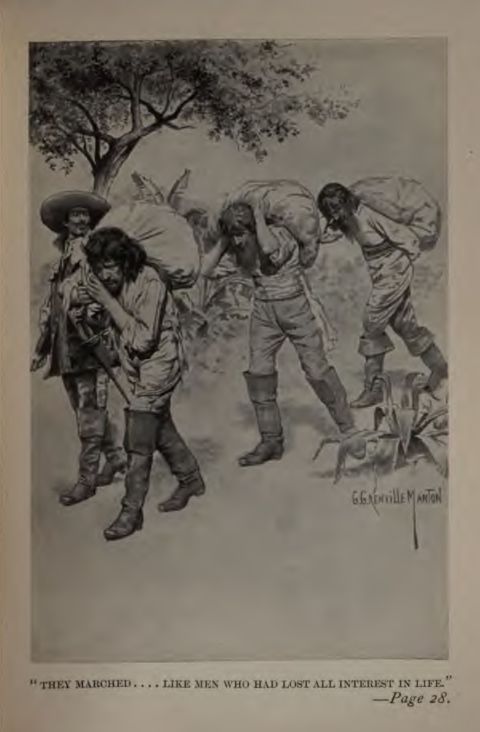
They were all dressed in rude thigh-boots of
raw cowhide, with loose shirts on their upper
bodies stained purple with constant bloodyings.
They wore shaggy beards, and shaggy uncut hair,
full of sticks and refuse. Their faces and arms
were puffed with insect-bites. They were
unspeakably disgustful to look upon, and yet the
Prince regarded them with a softening eye.
Every third or fourth man was armed with a
machete which dangled against his thigh, and a
long-stocked buccaneering piece which he bore in
his hand; and with his spare hand he carried a
switch and belaboured the others. It was only
the unarmed men who bore the burdens—one a
great parcel of crackling hides, another a skinful
of tallow, another a package of bucaned
cow-meat, another a hog bucaned whole, and so on;
and these were the engagés, the slaves for three
years of the acknowledged buccaneers who were
with the train, and the slaves of others who
remained behind in Hispaniola to continue the
hunting.
They marched across the glade, like men who
had lost all interest in life, each watching the heels
of the one preceding; and Rupert devoured them
with his eyes. Then one tall fellow stumbled
over a fallen bough, and sent his burden flying,
and his owner fell upon him with a very ecstasy
of switching, and the Prince stepped out and bade
the buccaneer desist. He did so sulkily enough,
and the engagé scrambled to his feet and resumed
his pack. He was a huge red-haired man, with a
livid scar across his eyebrows.
"By God!" cried the Prince, "I should know
that scar."
The fellow looked up. "The Prince!" he
said—"Prince Rupert! Has your Highness come in
for misfortune too?"
"My share. You carried the name of Coghill,
if I do not disremember?"
"Coghill," said the fellow, "and rode with your
Highness through many a noisy day."
"Especially at Edgehill, lad, and earned that
wipe across the face by saving my poor life."
"I did not wish to recall the debt, your Highness,"
said the fellow, "being in this plight. It
was General Fairfax that give it me. He'd a
lusty arm, and could sit a horse."
The Prince wrung his hands. "I would I could
serve you, lad," he said, "but I am in sorry plight
myself, and the King is as bad."
"Well," said the fellow, with a sigh, "I must
make shift to serve my time. I'm tough, and a
common soldier looks to taking what befalls.
But for officers that was delicate nurtured, it is
different. This life kills them off like flies."
The Prince groaned. "I am powerless, lad,"
he said—"powerless."
"If your Highness could stretch a point," the
fellow persisted, "it would be good for the
Colonel. He will die else."
"What colonel?"
"Sir John Merivale,—who other? Has not
your Highness picked him out?" The man
turned round. "Oh, there he is, just coming
into the open. He has seen much misfortune
since Old Noll took him at Coventry, and sent
him over seas."
Prince Rupert followed the trooper's glance.
A gray-haired old man, the last of the train, was
staggering into the clearing under a horrible
burden. He had been apportioned off to carry a
side of fresh beef, killed that very morning, and
was bearing it, buccaneer fashion, with his head
stuck through a hole in the centre. His knees
bent under him with the weight, his frail hands
gripped feebly at the moist edges of the joint,
but his proud old back was as straight as ever it
had been in the days when he sat in his saddle at
the head of the King's guards; and when a fellow
engagé helped him lower his dripping burden to
the ground, he thanked the man with the easy
courtesy of a superior.
The Prince stepped out to greet him. "Sir
John," he cried, "it grieves me terribly to see you
in this shocking plight."
"Ah, Prince," the old man said, "you have
caught me somewhat unawares, and my present
service is at times none of the most delicate.
How goes the Cause? We get sadly behind the
times here both in news and attire." And with
that he incontinently fell down and fainted.
Prince Rupert turned to the Governor. "Monsieur
D'Ogeron," he said gravely, "I surrender.
For six months the fleet is yours on the conditions
you offered. Whether I do right or whether
I do wrong is another matter, and when the time
comes I shall answer for it to the King, my
master. But in the meantime I am Rupert Palatine,
and I cannot live on to see officers of mine
condemned to a plight like this. The
opportunity is yours, and you make your gains."
"Mon prince," said the Governor delightedly,
"I honour your charity. We will have a great
time together here in Tortuga drinking success
to the fleet whilst it is away."
Here, then, Prince Rupert was left, a guest of
Monsieur D'Ogeron, the Governor of Tortuga, a
man whom he found distasteful when sober and
disgusting when drunk, a man with appetites only
for gold-getting and carousals, frankly devoid of
honour, and caring nothing for philosophy,
engravings, or any of the more humane arts and
sciences.
His Highness had with him his secretary, whom
he knew as Stephen Laughan (but who was a
maid disguised in man's attire), and his only other
attendant was a negro, a creature of Monsieur
D'Ogeron's. And here it seemed he was destined
to endure six months, till his ships should be again
out of pawn, and he was free once more to harry
the Spanish seas at the head of a stout command.
If Monsieur D'Ogeron's castle of the cliff was
unappetising, the squalid settlement at the head
of the harbour was more so. Twice within the
first three weeks, ships of the buccaneers sailed in
laden with plunder from the Main, and there were
some very horrid scenes of debauchery. These
men knew no such thing as moderation; lavishness
was their sole ideal; and he who could riot
away the gains of a year in the carouse of a night
was deemed to have the prettiest manners imaginable.
The squalid town and its people was a
mere nest of harpies, and no one knew this
better than the buccaneers themselves. Monsieur
D'Ogeron they openly addressed as Skin-the-Pike;
the tavern-keepers they treated as though they
had been Guinea blacks; but the hussies who met
them with their painted smiles on the beach, and
who openly flouted them the moment their pockets
were drained, were a lure the rude fellows could
never resist. They kissed these women, and
dandled them on their knees; they lavished their
wealth upon them, and sometimes beat them, and
ofttimes fought for them; but never did they seem
to tire of their vulgar charms.
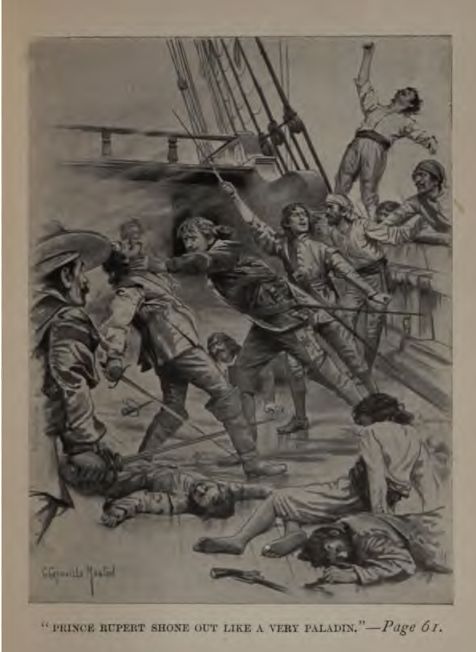
PRINCE RUPERT SHONE OUT LIKE A VERY PALADIN
To the onlooker, the imbecility of the buccaneers
in this matter was as marvellous as it was
unpleasant; and it was plain to see that the
machinations of the hussies (though it cannot be
denied that some had beauty) were as distasteful
to Prince Rupert as they were to his humble
secretary and companion. They accosted them
both on their walks abroad, gibing at the
secretary's prim set face. But though his Highness
gave them badinage for badinage, as was always
his wont with women of whatever condition, they
got nothing from him but pretty words gently
spiced with mockery.
It was however an orgie in the Governor's castle
that put a final term to their stay in Tortuga. A
captured ship came in, laden deep with gold and
merchandise. A week before it had been manned
by seventy Spaniards, and of these twenty-three
remained alive. It had been captured by a mere
handful of buccaneers who had sailed after it in
an open canoe, and these strutted about the decks
arrayed in all manner of uncouth finery, whilst
their prisoners, half-stripped, attended to the
working of the vessel. They brought to an anchor, drove
their prisoners into an empty hold, and clapped
hatches over them; and then stepped into their
boat and rowed to the muddy beach. According
to their custom they had made division of the
coin on board, and each man came ashore with a
canvas bucket full of pieces-of-eight for his day's
expenses.
They rowed to the rim of the harbour, singing,
and the harpies came down on to the littered
beach to meet them. From the castle above we
saw them form procession, each with a couple of
the hussies on his arms, and fiddlers scraping
lustily in the van. There was value enough in the
clothes of them to have graced a king's court;
gold lace was the only braid; and very uncouthly
it sat upon the men, and very vilely upon the
hussies. The fiddles squeaked, a fife shrilled, and
a couple of side-drums rattled bravely, and away
they went with a fine preparatory uproar to the
wine shops.
From his chamber in the castle Monsieur
D'Ogeron heard the landing, and commenced a
bustle of preparation. A feast was to be made
ready, of the best, and the buccaneers and all
those of the townspeople they chose to bring with
them were bidden to it; and after the more solid
part of the feast had been despatched, dice boxes
were to be brought forward, so that the Governor,
who was well skilled in play, might make his
guests pay for their entertainment.
Monsieur D'Ogeron gave the orders to his negro
cooks and stewards, posted armed guards in
convenient niches so that his guests could be handily
shot down if they resented any part of the carousal,
and then, with his two armed body-servants,
Alphonse and Jean Paul, betook himself to the
squalid town below, where he was received with
shouts, which were not entirely those of compliment.
For three hours he was swallowed up out of
vision polite, and then once more reappeared on
the road which led to the castle, arm in arm with
the chief of the buccaneers, with a procession fifty
strong bellowing choruses at their heels. They
lurched up the winding pathways, stamped through
the grim gateway with its decoration of shrivelled
heads, came up the ladders which gave the only
entrance from the courtyard, and clattered into
the long low hall of the castle, where was set
ready for them a feast made up of coarse
profusion. On the blackened wood of the table were
hogs roasted whole, and great smoking joints of
fresh meat, and joints of bucaned meat, and
roasted birds, with pimento and other sauces; and
before each cover was a great black-jack of liquor
set in a little pool of sloppings. To a European
eye the feast was rather disgusting than generous;
but to the buccaneers, new from the lean fare of
shipboard, it was princely; and they pledged the
Governor with choking draughts every time they
hacked themselves a fresh platterful.
Prince Rupert, seeing no way to avoid the scene
without giving offence, was seated at Monsieur
D'Ogeron's right hand; and noticing a hussy
about to plant herself at the Prince's right,
Stephen Laughan clapped down in that place himself,
to the amusement of all, and his own confusion.
His Highness's secretary (being in truth a maid)
had but small appetite for orgies, and had been
minded to slip away privily to a quiet chamber.
But the sight of that forward hussy was too much;
and sooner than let the Prince be pestered by
her horrid blandishments, Stephen sat at his side
throughout the meal, and attempted to discourse
on those genteel matters which were more fitting
to a gentleman of Rupert's station.
Each buccaneer had brought with him his
bucket of pieces-of-eight, which he nursed between
his knees as he sat, with a loaded pistol on top as
a makeweight and a menace to pilferers; and after
that all had glutted themselves with meat, they
swept the joints and platters to the floor, not
waiting for the slaves to remove them, and called
for more drink and the dice boxes, both of which
were promptly set before them. And then began
the silliest exhibition imaginable; for the
buccaneers, with abstinence at sea, were unused to deep
potations, whilst Monsieur D'Ogeron, though he
had been drinking level with the best of them,
was a seasoned cask which wine could never addle;
and moreover, 'tis my belief the dice were cogged.
The old rogue approached them craftily too, saying
at first that he had but small mind for play,
being in a vein of indifferent luck; whereupon
they taunted him so impolitely, that at last he
seemed to give way, and in a passion offered to
play the whole gang of them at once.
They accepted the challenge with shouts, and
Jean Paul fetched a sack of coin and dumped it
against his master's chair; and so the play began,
with small stakes at first, the Governor steadily
losing. The guests, in the meantime, quarrelled
lustily amongst themselves, and twice a pair of
them must needs step away from the tables and
have a bout with their hangers, and so earn a
little blood-letting to cool their tempers. But for
the most part they sat in their places in the
sweltering, stifling heat of the chamber, and drank and
shouted, and watched the rattling dice eagerly
enough, and scrabbled up the coins from amongst
the slop of liquor on the tables. And as they
won and the Governor lost, so much the more did
they shout for the stakes to be raised, till at last
the Governor yielded, and hazarded fifty pieces
on every throw.
Then came a change to the fortune. Monsieur
D'Ogeron, it seemed, could not be beaten. He
won back his own money that he had lost; he won
great store of other moneys, in fat shining
handfuls; and he vaunted loudly of his skill and
success. "You dared me," he cried, "to raise the
stakes; and I did it, and have conquered you.
And now I dare you to raise 'em again." Upon
which they accepted his challenge with oaths and
shouts, and the play went on. A hundred pieces
were staked on every throw of the dice box, and
almost every time did the Governor gather in, till
Stephen Laughan, who accounted it the greatest
of foolishness to lose at gaming, could have wept
at the silliness of the buccaneers in not leaving off
the contest. But the play progressed till each
man was three-parts ruined, and it did not stop
till some were asleep under the tables, and the
hussies and the traders from the settlement rose
in a body and dragged the rest of the seamen away.
Throughout the play Prince Rupert had sat
quietly at the Governor's right hand, puffing at a
long pipe of tobacco, observing with his keen eyes
all that happened, and answering courteously
enough when spoken to. The men around him
were the rudest this world contained; esteeming
themselves the equals of any, and the superiors of
most. But there was a natural dignity which
hedged his Highness in, over which even they did
not dare to trespass; and so, by way perhaps of a
sly revenge, they contented themselves by gibing
now and again at his easily-blushing secretary.
It was not till the play had ended, and the
Governor sat back with a sigh of contentment in his
great carved chair of Spanish mahogany, that the
Prince saw fit to make the proposal by which he
regained his liberty.
"Monsieur," he said, "I have some small skill
at the dice myself. Now that your other
opponents have ceased to contend, will you humour
me by throwing just three mains?"
The Governor turned on him with a vinous eye.
"Your Highness has seen the way we play here
in Tortuga? It must be for ready money jangled
down on the board."
"Money, as you know, Monsieur, I have none,
else had I not been here, but away with mine
own ships as their admiral, earning money for the
King. But I have a gaud or two left. Here is a
thumb ring set with a comely Hindu diamond-stone,
which already you have done me the honour
to covet. I will wager you that, against a small
canoe and permission for myself and Master
Laughan here to use it."
"You want to leave me!" said the Governor,
frowning.
"I wish to go across to Hispaniola to see for
myself these buccaneers of meat at their work, and
afterwards to take up such adventures as befall."
"Your Highness will find but vile entertainment
amongst those savage fellows."
The Prince glanced over the littered banquet
chamber. "I was sitting here ten hours ago: I
am sitting here now. Let that suffice to show I
am not always fastidious."
"The fellows did feed like swine, and that is a
fact," said the Governor; "but if your Highness
had drunk cup for cup with them, instead of keeping
a dry throat, you'd have felt it less. As for
Master Laughan, I do not believe he has wet his
lips once since we have sat here. He snapped at
the ladies and he shuddered at the men. 'Tis my
belief that if Master Laughan were stripped he'd
prove to be a wench."
"Monsieur," said the Prince wrathfully, "any
insult thrown at Master Laughan will be answered
by myself. For his manhood I can vouch. In
action he has twice saved my poor life. If it
please you to take your sword, I will stand up
before you now in this room."
"Pah!" said the Governor. "I do not take
offence at that. I will not fight."
"You will not fight, you will not game! You
own but indifferent manhood!"
"Game!" cried the Governor. "I will throw
you for that thumb ring if you wish to lose it."
"Be it so," said Rupert, and quickly stretching
out his hand gathered up the Governor's dice and
their box.
Monsieur D'Ogeron reached out his fingers
angrily. "Your Highness," he said, "give back
those tools. They are mine, and I am used to
them, and I play with no other."
"They content me very well," said Rupert.
"As a guest I claim the privilege of using them.
Look!" he said, and cast them thrice before him
on to the table. "They throw sixes every time.
They are most tractable dice."
The Governor of Tortuga thrust back his chair,
and for a minute looked like an animal about to
make a spring. But he knew when he was beaten,
and being a man who regarded honour as imbecility,
he sought only to make the best bargain
suitable to his own convenience.
"Your Highness," he said, "the dice you hold
are useful to me."
"I make no doubt of it," said the Prince. "I
have watched you throw them with profit during
these past many hours."
"It would please me to buy them back. I will
pay for them a suitable canoe and victual, such as
you ask for."
"With leave for Master Laughan to voyage
with me as personal attendant?"
"I will throw him in as a makeweight if your
Highness will condescend to forget any small
feats which it seemed to you the dice were kindly
enough to perform in my favour."
The Prince surrendered the box with a courtly
bow. He could be courtly even with such vulgar
knaves as the Governor of Tortuga. "You may
continue to use these ingenious dice as you please,
Monsieur," said he. "I am not sufficiently
enamoured of your good subjects here in Tortuga
to wish to set up as their champion. And," he
added, "I make no doubt you will be as glad to
be shut of me as I am to be rid of your society.
We do not fall in with one another's ways, Monsieur.
We seem to have been differently brought up."
In this manner, then, Prince Rupert and his
humble secretary got their quittance from Tortuga,
and put across the strait to the vast island of
Hispaniola, where men of the French and English
races hunt the wild cattle, and the Spaniards war
against them with an undying hostility. It was
in a lonely bay of this island that the blacks set
them ashore, and at once the discomforts of the
place gave them the utmost torment. For the
night, to ward off the dews and the blighting rays
of the moon, the blacks built them a shelter of
leaves and branches, but there was little enough
of sleep to be snatched. The air drummed with
insects. In the Governor's castle at Tortuga the
beds were warded by a tent-like net of muslin,
called in these countries a pavilion; but these
they lacked, and the expedient of the buccaneers,
who fill their residences with wood-smoke, they
considered even worse than the insect pest itself.
In the morning they rose in very sorry case.
They were sour-mouthed for want of sleep,
their bodies were swollen and their complexions
blotched with the bites, and the negroes (doubtless
by order from Monsieur D'Ogeron) had sailed
off with the canoe during the night. Of food
they had but a very scanty store, of weapons
only their swords, and the country beyond them
was savage and deadly in the extreme.
The Prince, however, was in no wise cast down.
Through the thick grasses on the bay side he
discerned some semblance of a track, and saying
that it was as likely to lead them to the
buccaneers as any other route, shouldered his share
of the provisions, and stepped out along it at a
lusty pace. His secretary followed him, as in
duty bound, though with great weariness; and
together they toiled up steep slopes of mountain
under a sun that burned like molten metal. The
shrubs and the grasses closed them in on either
side, so that no fanning of breeze could get nigh
to refresh them; and though fruits dangled often
by the side of the path, they did not dare to
pluck and quench their thirst, being ignorant as
to which were poison. Twice they heard noises
in the grass, and fearing ambuscade, drew, and
stood on guard. But one of these alarms was
made by a sounder of pigs which presently dashed
before them across the path; and what the other
was they did not discover, but it drew away
finally into the distance. And once they came
upon the bones of a man lying in the track, with
a piece of rusted iron lodged in the skull. But
no sign of those they sought discovered itself, and
meanwhile the path had branched a-many times,
and was growing in indistinctness. It was not
till they were well-nigh exhausted that they came
upon the crest of the mountain (which in truth
was of no great height, though tedious to ascend
by reason of the heat and the growths), and from
there they saw stretched before them a savannah
of enormous width, like some great field, planted
here and there with tree clumps, sliced with silver
rivulets, and overgrown with generous grasses.
For full an hour they lay down panting to observe
this, and to spy for any signs of buccaneers
at their hunting; and at last, in the far distance,
saw a faint blue feather of smoke begin to crawl
up from amongst a small copse of timber.
On the instant his Highness was for marching
on; and although his secretary brought forward
many and excellent reasons for a more lengthened
halt, his Highness laughed them merrily enough
to scorn, and away once more they went, striding
through the shoulder-high grasses, and panting
under the torrent of heat. More and more
obscure did the track become as they progressed,
and more and more branched. Often it seemed
as though it were a mere cattle path, bruised out
by passing herds. And, so uncertain were they of
the directions, being without compass and not
always seeing the sun, that they were fain to
ascend every knoll which lay in their path to
justify their course.
The march, then, it may be gathered, was
infinitely wearisome and tedious, and when at last
they did gain the tree clump which yielded up the
thin feather of smoke, the Prince was owning to a
sentiment of fatigue, and his secretary was ready
to drop with weariness. They were fitter for bed
than for fighting, and yet fighting was nearer to
them than they at all expected.
As all the world now most thoroughly knows,
the Spaniards of the New World were growing
alarmed at the increasing numbers of French and
English adventurers who were coming out to
wrest a living from the Main and the islands of
the Carib Sea, and were resolved to make great
effort to oust these intruders and to continue
possessing the countries to themselves alone. And
seeing that all sooner or later must pass their
traffic through ships, the Spaniards thought to
strike at the root of the evil by exterminating the
cow killers of Hispaniola, who alone could supply
these ships with the necessary bucaned meat.
But these men, "buccaneers" as they are currently
named, indignantly resented any attempt at
extermination, and rather relishing war than
otherwise, fought the Spaniards who were sent to hunt
them with such indescribable ferocity, that for one
buccaneer killed twenty Spaniards were often
left dead upon the field. For which reason the
Spaniards had grown wary, scoured the country in
bands which had acquired the byename of Fifties,
and avoided the hunters most timidly, unless they
could come upon them singly or in bands of two
or three.
The smoke which the Prince and his companion
had seen, rose from the cooking fire of a
buccaneers' camp; and, as it chanced, other eyes
besides theirs had spied it also—to wit, those set
under the helmets of a prowling Spanish Fifty.
But this troop and their horses were masked by
an undulation of the ground, which they had
cleverly made use of to secure an unobserved
advance, and the buccaneers went on with their
cookery with little expectation of surprise. Still
by custom they always kept arms handy to their
fingers, and when the Prince and Master Laughan
stepped out into sight from amongst the tree
stems, two steady muskets covered them, and
they were roundly bidden to stop and recite their
business. Even after this had been said, the
buccaneers received them none too civilly, and it was
not till Prince Rupert had begun to charm them
with his talk—as he could charm even the most
uncouth of men when he chose—that they relaxed
their churlishness and invited the travellers
to share their meal.
There were three of these buccaneers, two only
being sound men. The third, an engagé, had been
sadly gored by a wounded bull, his ribs being bared
some ten inches on one side, and his thigh ripped
down all its length on the other. At first sight the
two visitors looked upon this engagé as a dying
man; but neither he nor his companions seemed
to think much of the wound, and it appeared
that from the active, open-air, well-fed life that
these men lead, their flesh heals after a gash with
almost miraculous quickness.
There was great store of meat in the camp—the
spoils, in fact, of four great bulls; but the
buccaneers had grown dainty in their feeding, and
nothing but the udders of cows would satisfy
them, and so they had shot three other poor
beasts to provide them with a single meal. For
sauce there was lemon and pimento squeezed
together in a calabash, and for further seasoning a
knob of stone salt; plaintains served them for
bread; and for drink they had the choice between
water and nothing. Once the buccaneers had
offered hospitality, they were gracious enough
with it, pointing out the tit-bits, and insisting
that their guests should do well by the meal.
And in truth his Highness played a rare good
trencher-hand, for he was keen set with the walk,
and the cookery was surprisingly delicate. But
through over-fatigue his secretary lacked appetite,
and these rude hunters said they held in but
scurvy account one who was so small an eater.
The meal, however, was not uninterrupted.
When it was half way through its course, the
Prince held up his hand for silence, and then—
"Gentlemen," said he, "were we in Europe, I
should say a troop of horse were reconnoitring
us, possibly with a view to making an onfall."
The buccaneers cocked their ears to listen, and
one of them, a tall, pock-marked man named
Simpson, whispered that the Prince was right.
"And by gum, maister," said he, "tha'd better
ate up t' rest o' thee jock, or happen tha'lt find
theesel' de-ad wi' an empty belly. Tha' sees this
buccaneering-piece of mine? Four an' a half foot
long, square stocked, an' carries a ball sixteen to
t' pund. She's a real Frenchy, pupped by Gelu
o' Nantes, an' she's t' finest piece i' Hispaniola.
I'll drop one o' th' beggars when they top yon
rise, an' I'll get three more as they come up.
My mate here 's good for other three wi' 'is piece,
an' when they comes to hand-grips, we'll give 'em
wild-cats wi' t' skinnin' knives. If thee an' thy
young man do yer shares, maister, we should
bring a round score o' t' beggars to grass afore
we're down on t' floor wi' 'em."
"I'm thinking," said the other buccaneer,
"we'd better knock Tom's brains out before we
start. I'd not like an engagé o' mine to be taken
by the dons alive."
Simpson considered. "There's sense i' that,"
said he.
"Nay, Master Simpson," urged the gored man
on the ground, "say a word for me. I can pull
off a gun as I lie, and at least I can hough their
horses when they come near. It's sheer waste of
an extra arm not to let me earn my own killing."
Simpson cut another mouthful of meat, and ate
it relishingly.
"There's sense i' ye both," quoth he, "but I
think Tom's right. There's fight i' Tom still, an'
them dons may as well ha' t' benefit o' what Tom
can do. Happen we can claw down our twenty-five
if we've luck. But mark tha', Tom, there's
to be no surrendering."
"I'm not anxious," said the gored man, "to
make sport for those brutes while I roast to death
on a greenwood gridiron."
"Gentlemen," said the Prince, "may I ask you
if you regard our position as quite hopeless?"
"Quite," said Simpson. "If tha' don't believe
me, maister, ax Zebedee."
"We'll be five dead men in an hour's time,"
said the other buccaneer. "All I want is a good
pile of dead Spaniards around us; but we'll not
get twenty-five."
"I'd like to bet tha' on it," said Simpson
thoughtfully.
"Gentlemen," said the Prince, "I presume you
are not anxious to die just now?"
"That wants no answering from quick men,"
said Zebedee.
"Precisely," said the Prince; "and as you
appear to be desperate, and to have no plan,
perhaps you will listen to mine. I grant it may fail,
but I have seen it succeed before in affairs of this
sort."
"Who are you?" asked Simpson.
"I am Prince Rupert Palatine. Perhaps you
may have heard of me?"
"Nay, lad, nivver. But let that be. What's
thee plan?"
"That instead of waiting here to be assaulted,
we should attack these horse ourselves; that we
should go across to the rise yonder to seek them,
and should charge furiously towards them,
shouting over our shoulders as though we had a body
of comrades running close upon our heels."
The Yorkshireman Simpson started to his feet,
buccaneering-piece in hand.
"By gum," he cried, "young feller, that's telled
us t' right thing. Happen we may scrape through
yet, and bring in mony a good package o' hides an'
taller, an' sup mony another jack o' old Skin-the-Pikes
liquor i' Tortuga. Or happen we won't.
Onyway, if t' beggars runs they runs, an' if they
dunnot they dunnot, an' we gets our fight all t'
same. Only thing as bothers me's Tom. I'm
thinking we should give Tom a kindly shot before
we start."
"Nay, Master Simpson," said Tom; "if needs
must I can earn my killing with the best of you.
And till that time comes I can be of use. I can
shout after you from the timber, and every voice
helps."
"Assuredly," said the Prince. "Tom's voice
will further the plan."
"It's all very well for you to talk, stranger,"
said Zebedee, "but it's me that's Tom's master,
and has to think for his good. It's my opinion——"
"Here they come!" cried Rupert. "Now,
gentlemen, for God and the King: at the gallop,
charge!"
The helmets of the Spanish horse had appeared,
glistering under the sun, from behind the
grasses of the rise. Three shots rang out, and
three Spaniards toppled backwards out of sight,
and the two sound buccaneers, reloading their
pieces as they ran, sprang off after Prince Rupert
and his secretary, who led, waving their swords as
though to bring up other companions.
"Come on, mates!" shouted the buccaneers
over their shoulders: "we have them on the hip.
Quick, mates, and we'll kill the whole fifty!
Quick, mates, or the cowards will be gone!" And
from behind them in the timber the gored man
sent shouts of encouragement in various keys, an
shots as fast as he could reload his piece, whereof
each one found a billet.
The Spanish horse wavered in their charge,
slowed to a canter, to a trot, to a walk; and then
halted. And meanwhile the Prince and Stephen
Laughan faced towards them unfalteringly, and
the two buccaneers followed, roaring with glee, as
though the whole fifty were already prisoners in
their hands.
Then someone amongst the Spaniards cried
that they were betrayed, and that they were on
the edge of an ambush of the buccaneers; and
pulling his horse out of the line, galloped away by
the line he had come. Upon which all the others,
saving the seven whom Tom and the two buccaneers
had shot, got their horses' heads turned,
clapped in spurs, and rode as though an army
were pounding along at their heels.
Zebedee came and took the Prince by the
hand. "I thank you," he said, "for saving our
lives."
But Simpson was not so openly grateful.
"There's been no fight," said he. "Ye cannot
call yon a fight. By gum, I thought we was in
for summat big." And he walked back to the
camp moodily, like a man who has suffered
disappointment.
Still, even Simpson had sense behind his
recklessness, and was the first to suggest leaving their
temporary camp before the Fifty rallied and came
to seek them again, and advised departing
forthwith to a safer headquarters. The meat and the
skins were to be left behind; the two buccaneers
picked up the wounded engagé arms and heels,
and carried him between them; and, with Prince
Rupert and Master Laughan following, off set all
five at a round pace through the grasses.
The toughness of these hunters was extraordinary.
For hours they had been engaged in the
chase, in skinning and dressing their quarry, in
transporting great loads of meat and hides, with
barely an hour's rest out of the last twenty-four.
And yet here they were, carrying their arms and
a wounded man as though the weight was thistledown,
and walking their good five miles to the
hour. A linen tunic and short drawers reaching
only to mid-thigh was all their wear, and these
were dyed purple with constant bloodyings.
Their powder they carried in waxed calabashes,
their skinning knives in a case of cayman skin,
with bullet pouch attached. Their one article of
luxury and gentility was a toothpick of polished
spider's leg.
To the Prince, hardened as he was by a lifelong
education in camps, following in the tracks of
these buccaneers was a heavy exertion. To poor
Stephen Laughan (that was but a delicately
nurtured maid) it was a horrid torment. Her feet
seemed like lead, her legs mere whisps of
stockings. Her eyes swam and her body swayed, and
nothing but the dreadful thought that if she fell
the Prince might slacken her dress and so discover
her sex, kept her from fainting each step of
the way. Yet even at that terrible situation can
she look back now, and say that never once did
she regret the step that she took to follow across
the seas and guard this gallant gentleman she so
truly and reverently loved.
The details, then, of this march are omitted, as
the historian made the journey in a state
bordering on the insensible; and for the same reason
nothing can be said of the first coming into the
main camp of the buccaneers. Even Prince
Rupert, as he was afterwards gallant enough to own,
was almost sinking with weariness when these
strange headquarters were reached.
But sleep is a great refresher, and next
morning saw his Highness quite restored, and Master
Laughan remembering what was due to borrowed
manhood, and making shift to disown all
inconvenience from fatigue.
It was a Sabbath, and a day of great council.
These strange men, the buccaneers, had come in
from far and wide across the great savannahs, to
recount losses, and to register vengeances against
their natural enemies, the Spaniards. All were
by their custom equal that had served a due
apprenticeship; there was no king, there were no
chiefs, there were no inferiors; and if any by his
natural wit or prowess held a kind of natural
headship amongst the rest, he was careful not to
show it. One would suppose that they would
have welcomed amongst them a prince of birth and
breeding, whom they could have looked up to
and followed as a natural leader; but a truthful
historian must confess that they did not seize
upon this inestimable advantage as readily as
might be supposed.
There was no order and method about the
council, but it must be owned there was little
enough of boisterousness. The buccaneers sat
or lounged amongst the sweet-smelling grasses,
some smoking tobacco, some polishing their arms.
Overhead a great delicately foliaged tree, decked
with scarlet blossoms, sheltered them from the
sun; and to windward fires had been built that
the blue wood-reek might chase away the flies.
One spoke at a time, and the others listened. All
had something to tell: all were fierce against the
tyrannous Spaniard.
At last came Prince Rupert's turn, and what
he spoke was on a different matter.
"Gentlemen," said he, "you see in me an
admiral out of employ, and I come to offer you my
services for a while as leader. The Spaniards
harry you on land, and you wish for vengeance.
Believe me, sirs, you will not hurt them deeply
by cutting off a few of their ragged horsemen.
A Spaniard's deepest feelings are in his pocket,
and his pocket he sends back over seas for safe
keeping in Spain. Find me a canoe, give me
twenty stout men, and I will engage to cut a
deeper wound in the Spaniard on the seas in a
month than you would here ashore in a dozen
years."
Zebedee from the other side of the shadow
nodded. "He's a nice notion of stratagem, brethren."
"But I seed 'im let a fight slip by when it
might 'a' bin 'ad for t' axin'," said Simpson.
"You're wrong there," said another buccaneer.
"I was a Parliament soldier afore Gloucester, and
if you'd seen him and them damned swearing cavaliers
ride through six regiments of saints, you'd
ha' held your tongue upon that, friend Simpson.
No; he's a glutton for a fight."
"But I was going on to say, brethren," said
Zebedee, "that this sea adventuring is none to my
taste. I say nothing about frying for days in an
open boat, eating your boots and your belt, and
going half mad for want of a drop of water; I
say nothing about finding a don's ship at last, and
boarding her in spite of their teeth, and then
putting on fine clothes and making the beggars sail
her for you into Jamaica or Tortuga with colours
flying and every piece being fired off in salute.
But what do we get out of it? A week's carouse,
and then come back here to the hunting with a
shaking hand and an eye that's clogged, and
starve for half a year till the work's pulled you
straight again. No, brethren; for a pleasant life,
give me steady hunting, and steady pegging
away at the Spaniards between whiles by way
of diversion. I've tried both, turn and turn
about, these dozen years, and I know which is
best."
"Zebedee's growing old," cried a younger man.
"I'm rusting for a turn on the seas myself. This
hunting's well enough, but what's a package of
greasy skins against the gutting of a fat galleon's
paunch? They both take the same time to get,
and think of the difference after. Last time I
was over in Tortuga with three months' hard
earnings, I'd empty pockets in a day."
"I'm for a venture on sea," said another. And
twenty more voices said the same.
"There's sense in it," said Simpson. "I'm
thinkin' I could do with a turn mysen if so be
we'd a captain that——"
A man came tearing into the camp, half burst
with running. "There's a pink," he gasped—"a
Jack Spaniard, sailing close in along the coast.
She's becalmed, and the current's been settin' her
in. Her people are nigh frighted to death. I
could see them with my eyes, standing to their
guns."
Rupert started to his feet. "Now, sirs," he
said, "a fisherman's boat with twenty volunteers,
and she is ours."
The younger men amongst the buccaneers were
getting ready their weapons, aglow with the
thoughts of action.
"There's a canoe down by t' creek," said Simpson,
"but there's nobbut one, an' she's half rotten."
"Then we must be the quicker about our business,
so that she does not sink under us," said
Rupert lightly.
"By gum, young feller," said Simpson, "I'm
beginning to like tha'. I'll come an' all."
Already the buccaneers in a body were beginning
to hurry down to the creek, and runners who
had got there first were baling out the canoe in
readiness. She was indeed old and rotten, and
moreover she was small. By no means could a
score of men crowd into her, and there was
competition as to which these should be. Master
Laughan, whom these rude fellows thought by
reason of his slimness to be of small account,
would have been quickly elbowed out had he not
at sword's point asserted his claim to a place. But
he kept his lodgment in the after end of the canoe
next the Prince, and she slipped out into the
stream of the river, and so to sea.
Ten men paddled and the other six baled, and
surely no adventurers have ever tempted the seas
in so unworthy a vessel. The water gushed in
by a thousand cracks, and nothing but the
industry of the balers could keep her afloat. A
single cannon-shot would have sent her to the
sharks in half a trice, and Master Laughan noted
these things with a dry mouth and a heart that
bade fair to leap direct from its resting-place. But
Prince Rupert's eye lit as he steered, and the
buccaneers bawled a psalm as a fitting start to their
enterprise.
So soon as ever the canoe left shore the pink
started her cannonade, though for long enough
the shot fell short. But when she drew in range
the Prince gave an order, and six of the paddles
were taken in, and the deadly marksmen with
their buccaneering-pieces shot at every head which
showed. Helmsman after helmsman was dropped,
till at last the tiller was left deserted. Port after
port they searched with their bullets, till not a
gun was manned; and then, as the leaks gained,
and the canoe was sinking under their feet, they
took to the paddles again and forced her madly
alongside.
Like tigers the Spaniards defended their decks,
and like tigers the buccaneers attacked. They
had stamped their rotten vessel beneath the water
when they boarded, and there was no retreat. If
they could not beat the crew below, they must be
beaten back themselves into the sea. They were
fierce men all, fighting desperately, but even in
that terrible mêlée Prince Rupert shone out like a
very paladin. The Spaniards were eight to one,
and when they saw the smallness of the numbers
against them they resisted stubbornly. Time
after time the Prince led the buccaneers to the
charge, always with a less number to support him,
and when at last those Spaniards who were left
cried "Quarter," he had but nine followers
remaining to take away their arms.
Simpson strode up across the littered decks,
and smote the Prince upon the shoulder. "Young
feller," he cried, "I take back what I said. Tha'rt
as fond of a fight as me, an' tha'st foughten this
one rarely. The lads says that if tha' can find a
matelot they'll elect thee captain, an' we'll go out
upon the seas to see what else we can addle."
"I am honoured by your electing," said the
Prince; "but, a matelot? A sailor? I do not
quite understand."
"A comerade, young feller, if tha' likes it
better. We buccaneers allus has a matelot with
whom we divides, come good fortune, come bad."
"If it is the custom of the brotherhood I will
do as you wish. Master Stephen Laughan shall
be my matelot."
The Yorkshireman burst into a great roar of
laughter. "Yon lad!" he said. "Why, what sort
of matelot would 'e make?"
"I would have you know," said the Prince
stiffly, "that Master Laughan is as good a
swordsman as any on this ship."
"Oh, like enough, like enough, young feller.
But what good's a sword for killing cows? It's
cow killing your matelot's got to make his
business, he staying ashore whilst you are away at
sea. It's the custom of the brotherhood, young
feller, an' tha' cannot be elected captain till tha'st
thy matelot, all complete."
"Then, as Master Laughan is barred to me,"
said the Prince, "I know of no one more capable
than yourself."
"Me!" said Simpson.
"I have seen you fight, sir, and I have formed
a great estimate of your capabilities. I will do
my poor best to serve you well upon the seas.
"But," said Simpson, with his pock-marked
face all puckered, "t' lads has named me here as
quartermaster under thee."
"Of course," said the Prince, "if you prefer
their nomination to mine——"
"By gum, no," cried Simpson. "I'll go ashore.
Tha'll be something to talk about. There's them
as has this, an' them as has that; there's them as
has pickpockets for their matelots, and very bad
some o' them's turned out; but there's not another
buccaneer i' all Hispaniola that has a Prince for
his comerade at sea an' I'll risk t' new thing on
t' chance."
"Master Simpson," said the Prince gravely, "I
am indebted for your condescension. If I live,
you shall have no reason to complain of your
patronage."
"Well, young feller," said the buccaneer, "I
hope not. But there's no denying it's a risk. I've
not always heard princes very well spoken about.
But onyways, off tha' goes an' addle some gold.
Tha'rt a member o' t' Brotherhood o' t' Coast
now, an' tha'st earned thee place wi' a very short
apprenticeship. Tha'st gotten all t' seas afore
thee."
The Yorkshireman bustled away to help tend the
wounded. Prince Rupert leaned his elbows on
the bulwarks and looked far out over the
glittering blue and silver of the Caribbean.
"All the seas before me," he murmured
thoughtfully. "How much can I make the seas
give up for the service of the King?"
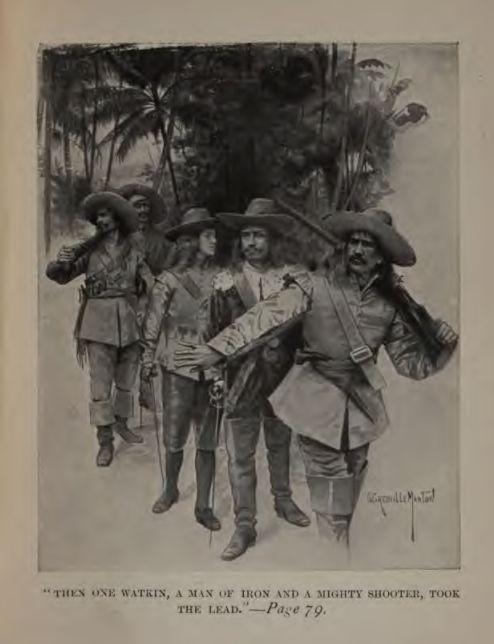
THEN ONE WATKIN, A MAN OF IRON AND
A MIGHTY SHOOTER, TOOK THE LEAD
Now the captured pink, when they came to
examine her, contained very small store of what the
buccaneers consider valuable—to wit, gold coins,
jewels, or pearls. Merchandise, such as cottons
and silks, she was well stocked with; chests of
gold-laced clothes she carried, and in these the
rude fellows decked themselves during the first
search; but all this cargo required further barter
before it could be turned into a carouse, and
barter was a thing the buccaneers held in small
esteem. It was their conceit that as free hunters
they could peddle hides and meat and tallow
without demeaning themselves; but to trade in
merchant stuffs, such as oil, and cloth, and tinsels,
and dyewood, was, in their idea, to dirty their
fingers. Amongst the Brethren of the Coast there
was very great niceness in such small matters as
these.
The event, as it happened, fell in very handily
with Prince Rupert's mood. Small gains were as
useful to his Highness as nothing at all; it was
constantly in his mind that he had to keep
supplied the Court of his Majesty King Charles II. at
The Hague; and, in fine, it was pieces-of-eight
by the puncheonful and not by the purse which
he sought. So he proposed manning the pink
more stoutly, saying with purposeful vagueness
that he intended to venture out upon the seas
again in search of plate ships; and the buccaneers,
who had helped him take her, agreed with shouts
and a salvo from the guns.
There was little time lost in debauch. The
nine surviving buccaneers were, it is true, too
drunk and too encumbered by their fine clothes
to do much towards the working of the pink;
but they sat about the decks, each with an open
liquor cask convenient to one hand and a naked
sword to the other; and the Spanish prisoners, with
the terror of death heavy upon them, were easily
persuaded to do the necessary seamen's work on
this vessel which had so lately been their own.
The pink was sailed up a convenient creek of
Hispaniola, where forests grew down to the water's
edge, and there careened by tackles from her
lower mast-heads to the tree roots. Five of the
buccaneers departed various ways into the country
to secure recruits for this new expedition, and
the other four, with Prince Rupert and Master
Stephen Laughan, his secretary, stayed behind
to guard the Spaniards and keep them diligently
at their work.
Now this Master Laughan (that was in truth a
maid) had been taunted a-many times by rude
fellows with being a mere encumbrance to his
Highness, and inwardly raged at a certain inborn
natural timidity, which on inopportune occasion
would out. But at last Master Laughan (moist-eyed,
and very sorrowful) was resolved openly to
trample these qualms underfoot by some piece of
desperate valour, or perish pitifully in the attempt.
And here lay an enterprise ready to hand.
Beforetime, when a guest with Prince Rupert under
the roof of Monsieur D'Ogeron, the Governor of
Tortuga, the secretary had learned concerning a
vastly rich pearl fishery of the Spaniards in a bay
at the farther side of Hispaniola. This knowledge
Master Laughan had kept secret, timorously
dreading lest the Prince with a small force should
attempt its capture, in spite of the heaviness of
its guarding.
But certain sneers that were dropped by two of
those barbarous buccaneers after the storming of
the pink (whereat indeed Master Laughan's sword-arm
was reddened to the elbow) had driven the
poor creature half frantic with mortification, and
in agony of wounded pride the news of the pearl
fishery was whispered into Prince Rupert's ear.
His Highness heard the scheme with a glowing
face. "My lad," he cried, "this is a more
profitable adventure than any I have dreamed about.
But why have I not been told it before?"
"Because," said Master Laughan, craftily,
"your Highness lacked all followers save my
poor self, and I feared to tantalise you by
pointing out the impossible.
"Arnidieu!" swore Rupert, "you should have
left me to be judge of that, Master Laughan. I
have done the impossible so many times before,
that I begin to think there is small meaning in
the word. Besides, as you well knew, I was a
desperate man in a desperate case. I have pawned
the King's fleet for six months without his leave
or signature, and it is a fact that if I do not earn
plunder without the ships here, I shall earn
censure at The Hague."
"I judged all these things," said the secretary,
with a sigh, "and the only excuse I can put
forward is my poor affection for your Highness's
safety."
"Thou'rt a good lad," said the Prince testily—"a
well-enough-meaning lad, but at times a short-seeing
fool. My life has passed through too many
thousand risks to be cut off with a few more.
And besides, adventure is meat, drink and opium
to me; it is a habit which I cannot shake off, nor
wish to do; and let that suffice. And now for a
chart, and more of your tale."
They went down to the cabin, which was hard
to reach and ill to stand in, since the pink was
careened with one of her bilges clear of the water.
They found a chart and laid it upon the almost
upright table, and to look at it stood on the bunk
coamings by reason of the heel. The thump and
squeak of the scrapers as the men shredded the
growth of weed and barnacles from the planking
came to their ears as they handled the chart, and
with it a quaintly strange smell of burning as the
men breamed the ship's bottom.
"We could be cleverer with more knowledge
on these fisheries," said the Prince, and thrust his
head up through the skylight and shouted that
word should be passed for the erstwhile captain
of the pink.
The Spaniard came presently, shirtless, with
his back a mass of stripes.
"Señor," said the Prince, "I think you have
been foolish, and not bowed to the fortune of
war. I see my fellows have been writing their
displeasure upon you. It would have been wiser
to have shown philosophy and done your
appointed tale of work."
"Señor capitan," said the Spaniard, "I am a
philosopher, but not an atheist. Up till now I
have worked with all the goodwill that could be
expected from a slave, but when your fellows for
the leña para la lumbre—I know not how you
call it——"
"Breaming faggots."
"For their breaming faggots, used that which
was holy, and would have had me participate in
their sin, why then, señor, I refused to put my
soul in jeopardy, and rebelled."
The Prince looked puzzled. "You are speaking
beyond me."
"Señor," said the Spaniard, "as part of my
cargo, which you took from me, were three cases
of papal indulgences. They were entrusted to
my care by the Bishop of Maracaibo, who knows
me as a devout Catholic."
"Well?" said the Prince.
"Señor capitan," said the prisoner, "it is with
these parchments, these things of indescribable
holiness, that your fellows would have us bream
the underplanking of the ship. Some of my
compatriots are weak: they have twisted the
sacred writings up into torches, and I saw them
thereby bartering away their souls before my very
eyes. I alone resisted. I alone have earned
stripes, and this martyrdom. But you, señor
capitan, you are not a rude man, like those
on deck. You will not ensure your eternal
damnation by permitting this sacrilege to continue?"
"At present," said the Prince, "I do not see
cause for interference, being so curiously
constituted as to think that I can earn Heaven without
the Pope's helping."
"You are a blasphemer."
"No, I am a Protestant, and heed papal thunders
as little as a duck fears water; but, señor, I
will permit you to ransom what remains over of
this consignment of indulgences on easy terms."
The Spaniard stepped forward eagerly enough,
then stopped and frowned. "Señor," he said,
"you are playing with me. You know me to be
a ruined man."
"On the contrary," said the Prince, "you still
own one small commodity, and I would buy that
from you on easy terms. You have information
about the pearl fisheries in this bay, which I
have marked here on your chart. Tell me how
they are guarded and how worked, and I will wed
you once more to freedom, amigo, with the
parchments as your dowry."
"You ask me to be traitor to my country."
"These good gentlemen on deck," suggested
the Prince, "might offer you the alternative of
having your nose and other portions of your
honoured anatomy carved in slices, and lighted
matches put between your fingers. It would
injure my feelings sorely if I had to hand you
over to their power of persuasiveness. And in
the meantime, these excellent parchments from
Rome, on which you seem to set so much store,
are flickering away to ash. If a layman might
judge, it seems to me that you are now personally
responsible for their destruction."
"Señor," said the Spaniard, "your diplomacy
is as invincible as your sword-arm. May you live
a thousand years. I must ransom these holy
writings at whatever cost." And forthwith, so
soon as the Prince had bidden those on deck burn
no more of the papal indulgences, the Spaniard
broke into narrative and told all about the pearls
and the manner of their fishing.
It appeared that the industry was then at its
zenith. The fishing had gone on for years with
always increasing success; but now that many
towns of the Main had been raided by enemies,
and Spain was still clamouring for the undiminished
cargoes of treasure, a greater effort than
formerly was made to wrest this wealth from the
fastnesses of the sea. First and last two thousand
men were toiling at the fishery. It was worked
from small brigantines of ten or a dozen tons,
of which there were an amazing number. Each
night these brought their catch to a great storeship
which lay at anchor in the bay, heavily armed.
And for the protection of the armed storeship
was a war-carrack, full of arms and men always on
guard, together with two armed galleys of fifty
oars apiece.
The Spaniard said it was the easiest way
imaginable of gathering wealth, the only difficulty
being a shortness in the supply of the Guinea
blackmen who were used for the diving. These,
it seemed, through being forced by their masters
to remain under water for twenty minutes at a
stretch, deteriorated in strength, and indeed with
frequency would most exasperatingly die. There
was no relying (said the Spaniard) on the
blackamoors to be useful servants, and this was the
greater pity because no other substitute could be
used, since the sharks which abound in these
latitudes attack white men or the native Indians
when swimming in the water, but avoid the blacks
by reason of their pungent smell.
Much more too upon this matter the fellow told,
because having once (as he termed it) done
treachery to his country, it mattered little whether
the treachery was big or small; but it was plain
to see that there was a method in his telling. He
admitted that the pearls were there, which of
course Prince Rupert had learned already; he
spoke upon the methods of fishing, which carried
with them a certain pleasant interest; but he was
unmistakable in his painting of the care with
which they were guarded.
"They know, señor," quoth he, "that your
Excellencies, the Brethren of the Coast, would be
only too happy to make a transference of these
precious gleanings, and they are quite prepared to
defend them to the uttermost. The storeship
and the guardship are both mighty vessels, and
crammed with men. The bay is land-locked and
smooth, and they lie there to their anchors, with
guns run out and loaded, with boarding nettings
triced up to the yard-arms, hand-grenades ranged
ready, and close-quarters all set up convenient for
a fight. They are fine ships both, with lofty
forecastles and aftercastles. Their crews are picked
men, and constantly exercised with their weapons.
They are in sooth, señor, floating fortresses, and
nothing but an armada could reduce them."
So the Spaniard spoke on, and Master Laughan
hearkened to the words with a sinking heart, and
mightily regretted ever having yielded to those
goadings which, in a moment of desperation, led
to the Prince being first told about the fisheries.
But Prince Rupert listened with appetite. He
smiled pleasantly when he heard of the richness of
the pearls in store, and his eye kindled as the
Spaniard described with how great accuracy they
were guarded; and when at the end of his
narration the Spaniard said he hoped he had shown
how impossible it was for even the bravest of men
to overcome the defenders and ravish the store,
the Prince laughed merrily, and said he had done
just the reverse. "I am a man," quoth he, "that
likes a kernel all the better, and hammers for it
all the cleverer, when the nut is hard a-cracking."
"Yet I do not see how you can finger those
pearls?" said the Spaniard.
"And I," said the Prince, "shall not tell my
plans to you or any other living soul, amigo.
Plans shared are easily spread, and plans spread
are handily baulked."
Now, it is the custom of the buccaneers, when
they sail on an expedition, that the scheme of
campaign should be laid open and voted upon by
all hands; and it says much for the influence that
Prince Rupert gained on the rude men who formed
his following and they consented that he should
override this hard-and-fast rule. It was not, as
most who read these memoirs will at once suppose,
that they deferred to his exalted birth: in
fact, the item of his being of princely rank rather
warred against him in their eyes than otherwise.
It was simply his influence as a man, and his
obvious power of conducting affairs, which gave
him this paramount weight; and these savage
fellows, both French and English, who before had
owned none as master save their own desires, were
content to set Rupert over them with an absolute
power of life and death. So a charter-party of
rules was drawn up and sworn to with Bible oaths,
and a scale was appointed by which all plunder
was divided.
Meanwhile, the refitting of the pink was attended
to with infinite patience and skill. Her
bottom was breamed, as has been said, and scraped
to the smoothness of glass, and then varnished
over the yellow wood. The rigging, both standing
and running, was overhauled and reset-up.
The sails were all new bent, and the armament
thoroughly attended to. The pink was a vessel
with a fine turn of speed, and for his purpose
Prince Rupert wanted this speed at its best. For,
to be plain, he destined the vessel for a feint
attack, and intended to leave her reliant for safety
solely upon the nimbleness of her heels.
A dozen days were spent about this industry,
and one by one recruits arrived from over the
savannahs. And then the pink was warped out into the
stream, and towed out of the creek by her boats
to a good offing, and there, with a prayer and a
psalm, committed to canvas and the care of God.
Forty-three seasoned hunters formed her fighting
crew, each with powder, bullets, buccaneering-piece,
bayonet, and skinning-knives; and for her
working, there remained fifteen Spaniards, one of
whom, being skilled in the use of backstaff and
other utensils of navigation, was appointed
sailing-master, with promise of early enlargement.
Then for the first time Prince Rupert made
known the whole of his schemes, and the
buccaneers, in a passion of enthusiasm, ran to the
great guns of the pink, and fired off a shotted
salute in his honour.
But, great as his influence was, in one matter
Prince Rupert was without command. When
once they were at sea, with the Spanish prisoners
to work the pink, the buccaneers had no notions
of restraint or discipline. They ate when and
what they pleased, they drank whenever they
were sober enough to swallow more. Twice they
set the pink on fire, and but for miracles would
have consumed her. The stores were few, and
yet the waste was incredible. The fellows knew no
moderation. They fought at times amongst
themselves, they beat the Spanish prisoners, they
diced incessantly, and throughout all the watches
shouted sea-songs that were often mere ribaldry.
When one through sheer exhaustion slept, the
others yelled their choruses in his ears, and played
their pranks upon his senseless body, till he was
waking and with them again. In fine, they made
that first part of the voyage one horrid unbroken
carouse.
A term was put on the orgie by the failure
of supplies. The pink reeked with the lees of
stale drink, but there was no whole cask left
unbroached. Of food there was scarcely a carcass
remaining, and of water but two tepid leaking
casks. But these indomitable men did not repine.
They had had their frolic, and all that remained
was to make the nip-gut time as short as might be.
They crowded more canvas on the pink till the
Spaniards shivered with fright, and set up
preventer backstays to make the spars carry it. The
vessel rushed through the seas with a roar of
sound, and the savage men within her were
rendered doubly savage by their hunger. But the
situation fell handily with the Prince's plans.
There was no question about succeeding now:
starvation was the only alternative; and these
desperate fellows had no appetite for more of
that.
In these circumstances, then, the pink and her
people came to the western horn of that bay
where the Spaniards plied their pearl fishery,
and running inshore with a light wind, dropped
the stream anchor in five-fathom water. The
boat was launched over-side, and in two journeys
set thirty of the buccaneers upon the hot
white beach, and with them Prince Rupert and
Master Laughan. Then the boat rowed back
again, was hoisted in-board, and the pink tripped
her stream anchor, and once more got to sea.
Forest sprawled down to the rim of the beach,
and the land party were quickly under its cover.
Then one Watkin, a man of iron and a mighty
shooter, took the lead, he being by consent the
best woodsman amongst the buccaneers; Prince
Rupert and his secretary followed; and the rest
trailed on behind in Indian file.
Word had been given, and they were careful to
drop no sound—treading with niceness, and never
speaking even in a whisper—since the success of
their endeavour depended all upon their presence
being unknown till the time came. And so the
whole train of them wound through the tree
aisles of the forests like some monstrous bristling
serpent, whereof every joint was a different hue
and shape.
Their march was not a long one, though
exhausting by reason of the heat, and the quags
they had to traverse, and thickets of barbed thorn
which lay in the path and warred most unkindly
with the fripperies of their clothes. Still, when
they came to the crown of the bay where the fishery
was carried on, they were none of them sorry
(as even the hardened Watkin owned) to lie for
a while in the rim of the undergrowth, and there
await fitting season for the attack.
The bay before them was busy with life. Lying
each at her anchor were two-and-thirty
brigantines, from whose sides the blackamoor divers
were constantly beat down into the water, to be
drawn up again half-burst a quarter of an hour
later with a netful of the rare oysters slung around
their gleaming bodies. In the middle of the
flock of brigantines were the two great armed
carracks, bristling with men at practice on their
weapons; but of the two fifty-oared galleys there
was no sign, for (as was learned afterwards) they
had been sent away, and their soldier crews
retained to strengthen the fighting forces of the
carracks.
There were two thousand men in these vessels
in the bay, all trained to arms, and with every
advantage of position; and surely nothing was
heard more preposterous than this idea of
attacking them with such a trifling handful. But no
trace of anything else but pleasure showed on the
faces of the buccaneers; the Prince was smiling,
as, indeed, was always his habit before an onfall;
and Master Laughan, though inwardly a prey to
the most horrid fears, strove bravely to keep a
good colour, and to seem pleased like the rest.
Presently, too, the tedium of the waiting was
relieved. From round the farther horn of the
bay the pink came sailing in under a cloud of
canvas, and began discharging her cannon at the
outermost of the brigantines. Instantly the
whole scene bubbled with disorder. Drums beat
to quarters, and trumpets rang out defiances.
The guardship vaingloriously made a discharge
of her great pieces on both broadsides (though
the pink was far out of any range), and then sent
her top-slaves aloft to set canvas. From their
lair those on shore could hear the clacking of her
capstan as she heaved in cable to get her anchor.
And then, after some men had run out on her
towering bowsprit to loose the sprit-sail, they
canted her head with that, and sent her clumsily
surging off to seaward, pluming her as she ran,
and never ceasing the useless cannonade.
But the handful of buccaneers in the pink,
recking little of the noise and bustle, sailed
gallantly in, and ran aboard the outermost of the
brigantines. This was going beyond their orders,
for Prince Rupert had commanded that they were
only to show themselves in the offing so as to
draw pursuit, and then sail out again. But it was
easy to see what was compelling them. They
drove the crew over-side, and then threw of food
and water all the brigantine contained on to their
own decks, and, casting off their grapples, sailed
away again. They were half mad with starvation
and thirst, and they risked capture and the wrecking
of the enterprise to satisfy their intolerable
cravings.
By this time the great war-carrack had drawn
near, and her shot was falling merrily about the
fabric of the pink, though the aim for the most
part was ill enough. But once the pink was in
charge of her canvas again, the handful of
buccaneers left the Spanish prisoners to attend to her
sailing, and after a drink and a bite apiece, took up
their hand guns, and with deliberate aim brought
down a man on the carrack for every shot, so
continuing till they drew out of range.
The carrack was a dull sailer, much time having
passed since her last careen, and her bottom being
in consequence a very garden of trailing weeds
and barnacles. The pink, thanks to recent
attention, had, in sea phrase, the heels of her. But
the carrack did not desist from the chase,
lumbering along in the wake of the smaller vessel,
blazing off her futile artillery, wallowing with
helpless wrath. And so the pair of them passed
out of sight round the western horn of the bay.
The sun was just upon its setting, and they sailed
as coal-black ships with coal-black spars and
cordage, through a sea and an air of blood—fit
emblems, as it seemed to Master Laughan, of the
desperate work which was shortly to befall.
Night came suddenly, like the shutting down
of a box, there being no such thing as twilight
known in these latitudes; and amongst the forest
trees of the shore there arose a thin blue film
of mist, which thickened as the night grew, and
spread out over the bay, and swallowed the
shipping away from sight. But the ambush lay still
in its lair, for no attack was to be made till
midnight passed, and those on the shipping were
locked in their deepest slumber.
Prince Rupert and the buccaneers were in high
feather. Their scheme had succeeded with
exactness. The pink had drawn away the
war-carrack, and there remained only a bare fifteen
hundred Spaniards to oppose to their lusty score
and a half. To hear them, one might have
supposed they were going to a wedding, where all
was frolic and gaiety; and yet in all the annals
of men it would be hard to find any scheme more
desperate than that which lay before them. For
their proposal was this: to swim out and seize
the nearest brigantine; with her to capture the
store-carrack; and then to take the great ship to
sea, and so to their rendezvous with the pink.
Heard any man ever such harebrained recklessness?
There was no boat, no canoe upon the beach—nothing
but a few logs, which would help to bear
the weapons, and assist those that could not
swim; and when the time came, the buccaneers
stripped off all clothes except their breeches, for
ease in the water. If they got drowned or killed,
these reckless fellows said they could die as easy
naked as clad; and if they took the carrack, there
would be plenty more clothes in her store; while
if they did not take her, why, then, they were as
good as dead.
Here again, then, was a very horrid situation
for the poor secretary; for to strip was to confess
her sex, than which she would liefer have died,
and to go into the water clad (being indeed no
swimmer) was to court drowning. She did indeed
make one attempt to escape the ordeal, saying
that it was beneath his Highness's dignity to
render up his clothes, and suggested that the
taking of a brigantine—surely an easy
matter—should be left to the common buccaneers, and
that they should send a row-boat to the shore
when they were ready for the attack on the carrack.
But the Prince only laughed. "My scrupulous
Stephen," said he, "we are not in England now,
or even Europe. Perhaps I am Rupert Palatine,
as you say, though I have almost forgot. But,
for the time, I am just a tarry sailor, that for risks
and plunder goes share and share alike with his
crew. And so, my lad, I am e'en going to play
water-rat and dodge the sharks. But do you stay
behind, if you please, and I'll send a boat for you
when the affair is over."
"Nay," said Master Laughan, "if your Highness
goes, your humble secretary follows;" and
with that stepped into the water, laid hold of one
of the logs which the swimmers stood ready to
tow, and shut her eyes, and inwardly commended
her soul to God. And so the greatest stroke of
the enterprise began.
Now the present historian has to confess that
of this horrible passage through the water no
detail can be given here, for she made it in a
condition close upon fainting. Let alone the new
sensation of being afloat in unstable water, there
was the dreadful fear of sharks with which those
seas abounded, and this over-rid all dread of what
the reception might be on the brigantine and
beyond, and made the passage seem infinitely
tedious. But, as it so fell out, no sharks attacked;
and when the brigantine was reached, Master
Laughan, burning with shame at all this pitiful
display of cowardice, was the first to board and
the first to strike a blow.
The taking of that dead-fish-stinking brigantine
was in itself a small matter, as there were barely
forty men on board, and some number of them
negro and other slaves; but it was not
accomplished without some dispute, and many cries
rose shrilly up into the night before all could be
silenced. A gun was fired from the storeship,
which showed that she at least was awake; and
presently, when the buccaneers had cut the cable,
and were moving the brigantine with her sweeps,
a breeze sprang up and drove away the mists
from the whole surface of the bay.
Here then, it seemed, was the whole enterprise
laid bare to public sight, and the one little vessel
in the midst of such a huge force of enemies
could do nothing better than surrender and sue
for quarter. But such was the indomitable
courage of the Prince and these savage buccaneers
who followed him, that nothing was further from
their thoughts. A trumpet pealed out from the
great carrack, and they answered the challenge
by wild shouts and stronger labour at their oars.
Those on board the carrack understood the
capture then, and retorted with a broadside from
their great guns, which tore the waters of the
bay into foam and fountains.
Not a shot hit; but the Prince was as wise as
he was daring, and knowing that a couple of
those iron messengers might well sink the
brigantine before she had accomplished her purpose,
steered her so as to meet the carrack bow to
bow—which, as they had no spring ready to warp round
their broadside, they could not avoid. They had
only two bow pieces which could be brought to
bear, and to these no reply could be made, as all
the powder of the buccaneers had been wetted
by the swimming. But their aim was bad and
their loading slow, and most of the shots hummed
through the rigging overhead, or spouted
harmlessly in the water alongside.
So the brigantine made her advance, and
finally fouled her foremast rigging with the
sprit-sail yard on the carrack's towering boltsprit, and
came to a standstill little harmed.
"Boarders away!" cried the Prince, and led
the storm himself, sword in teeth. The carved
woodwork of the great ship's beak hung above,
sawing up and down with the motion of the seas.
He caught his fingers in this and hauled himself
up, amid a storm of missiles sent down from the
high forecastle roof. His secretary, fearing
horribly, but impelled by love, was close upon his
heels; and the buccaneers, climbing like cats,
followed close after.
But here came a check. Under their feet were
the gratings of the great ship's beak; before
them was the high plain wall of her lofty
forecastle; and at its summit were the outraged
Spaniards lusting for their destruction. For
general use ladders led from the gratings of the
beak to the high roof of the forecastle above,
but these had been drawn up or cast overboard
before the actual moment of the attack. The
wall of wood before them was as naked as the
wall of a house, and quite unscalable; and the
Spaniards above, with shouts of triumph, rained
down shot and grenades into the huddled crowd
of the buccaneers, till it seemed that in another
minute not one soul of them would remain alive.
But presently Watkin the hunter, being a man
of resource, bethought himself of one of the two
forecastle gun ports, which, though shut down
and fastened from within, offered a slight gap.
Into this he thrust his hanger, and prised it open
another half-inch, till he could get a hold with
his fingers; and then, being a fellow of vast and
ponderous strength, wrenched the whole port
lid from its fastenings, and fell backward with it
amongst the corpses and the confusion.
The Prince's secretary was the first to hazard life
through the gap, and got in, wounding two
opponents; and then in came the rest of the
buccaneers, the Prince with his accustomed courage
being the last to seek the shelter.
Here, then, they had got possession of the interior
of the carrack's forward castle, and had a
moment to gain breathing time, and to tie up the
more pressing of their hurts. Within all was dark,
but without all was bright-lit with battle lanterns,
and alive with the curses and movements of
savage armed men. It was plain that the ship
was far from taken yet, and the pearls, which
they were chiefly concerned with, lay in the
lazaret, under the after-cabin floor. So, as the
Spaniards were raging before the doors of the
forecastle and in the waist of the ship, though
not daring to attack them in this gloomy
stronghold, the buccaneers slewed round the two
demi-culverins which armed its ports, loaded them
with grape, and twice shot lanes through the
thick of the enemy, before they gave way and
fled in confusion, to spots where the missiles
could not reach.
"Now!" cried the Prince, "at them again,
brethren, before they can re-form!" and led the
way out on to the main deck, sword in hand.
But here in an instant the boarders were
penned in. The buccaneers might be brave, but
the Spaniards were no cowards, and moreover they
were exasperated by what had befallen already.
Right desperately did the boarders fight, but
their numbers were already small, and they grew
fewer; and although dozens of the Spaniards
were killed, there were always others behind to
fill their places. The buccaneers began to yield
ground. It seemed as though they would be
driven overboard.
But again Prince Rupert called upon them.
"Brethren!" he shouted, "let us go and find
their pearls. It is unprofitable waiting here in
this debate. One fine charge, and we'll have
their after-castle all to ourselves to dine
in!" Whereupon he headed the rush in his own person
with invincible valour, and with wild laughter
those of the buccaneers who survived followed
close upon his heels. A red lane was cut through
the mob of Spaniards, and the doors were reached.
So sudden and furious had been the charge, that
none were inside the barricadoes to defend them,
and once more the little company of the
buccaneers found themselves in a stout fortress from
which nothing but cannon could dislodge them.
The table in the great cabin was set for supper,
and the scraps on the platters showed that it had
been left half eaten. Down the centre of the
table were vast jugs of wine and silver
pannikins, and the throats of the buccaneers being
parched with fighting, they did not omit to drink.
But it was not a time for loitering, though Watkin
and one or two of the others were for sitting
down then and making a meal whilst they had
the chance. For the moment the Spaniards outside
were quiet, but it was easy to guess they were
in some way plotting their destruction. So the
Prince with his cheery voice urged all hands to
search for the hatch to the lazaret.
"Let's win our way down there, brethren," cried
he, "and get their pearls, and then we'll be off and
away. Their silly ship's too hot and heavy to
take with us, so we'll leave her afire to give them
occupation whilst we make our clearance."
"The lazaret hatch is here under the table," said
one.
"And heavily padlocked at that," said another.
But locks cause small delay to lusty men. A
shower of axe-blows beat away the staples, the
hatch was wrenched back, and the lazaret yawned
blackly beneath. A couple of fellows slipped
below and passed up the pearls, which were in handy
leather bags; and these the buccaneers fastened
conveniently about their waists, with jibes at the
Spaniards for making their plunder so easy for the
carrying.
Now it was in Prince Rupert's mind that he
would fire the carrack, jump from the stern gallery
into the water, swim to another brigantine and
take her, and so to sea before pursuit could be
made.
But of a sudden this plan was upset. One who
was spying through an after-castle port, cried that
the Spaniards had drawn up eight cannon across
the main deck, and were then in the very act and
article of shooting, with intent to scatter their own
after-castle and the pestilential buccaneers which
it contained far over the sea beyond, in mere rags
and splinters. Whereupon there occurred something
very akin to a panic, and the buccaneers
incontinently leaped down through the hatch into
the lazaret. Prince Rupert was left behind
helpless; and for a moment busied himself; and then
followed, swearing, at their heels.
"Now," cried he, "I'm for no surrender, brethren;
and if you do not choose to roast like bacon,
you'll cut your way out like men. There's no
retreat the way we came. I've fired the ship above
our heads."
What he said next was lost, for the Spaniards
had begun the bombardment of their own after-castle
(deeming the buccaneers to be still within its
shelter) and all words were choked with the
crashing of timbers overhead, and the din of the
bellowing guns. Dust fell in clouds, and the frail gleam
of a single lantern was the only illumination. But
his Highness showed by signs what he wanted
done, and the buccaneers were quick to carry out
his wishes.
Between the lazaret and the main hold was a
strong bulkhead of Spanish oak, and this had to
be cut through. The axes were plied with frenzied
strength, and the heat grew as the fire above gained
hold. The tough wood resisted stubbornly, but
the axe-men hewed with an ecstasy of strength, and
at last a gap was splintered through. Giant fingers
gripped hold of the ragged wood and wrenched it
away, and at last a road was made.
Into the hold beyond the buccaneers forced their
way, fire and smoke licking at their heels, and the
vengeful guns still thundering overhead; blunderingly
they picked their way over the crates and
barrels with which the hold was filled; and at its
farther end fortune smiled, for they found a sliding
panel which led to the cable tier. There was a
ladder from this to a hatch in the forward castle
deck above, and the ladder head was so stoutly
defended that two more men fell before it was
forced.
But then the Prince himself headed the attack,
and forced a passage through the gap; and when
once he and his buccaneers had stormed the
forecastle and cleared it from those it contained, and
had the place to themselves, they were very little
more disturbed. The aftercastle of the carrack,
shattered into easily burning splinters by her own
artillery, was by this time a mass of spouting
flames; and those of the Spaniards who still offered
offence did it half-heartedly, and were clearly
anxious to be shut of their unneighbourly visitors on
whatever terms they would take.
The brigantine still hung where she had first
lodged, with her foremast rigging fouled on the
carrack's spritsail yard; and the Prince and his
men, having the pearls at their belts, and knowing
of nothing else that was not too hot or too heavy to
carry off, struck up a jaunty song and made retreat
by the way they had come. None molested them;
not a gun was fired with purpose to do them harm:
the Spaniards were all too busy in trying to quell
the flames and save their ship.
But the flames had an unbreakable hold, and by
the time the little brigantine had got herself clear,
and was slipping away from this prickly neighbourhood
as fast as sail and sweep could drive her, the
Spaniards had got their boats into the water,
and were thinking more of saving their lives than
of saving the proud ship of which they had made
their boast. And what more happened to them the
present writer cannot tell, for after the fire reached
her powder, and the carrack blew up, all was
darkness till the dawn rose and the brigantine found
herself alone on a lonely sea. But from the
desperate nature of the foray it is sure that they must
have lost a great number killed, for of the buccaneers
themselves only thirteen live men sailed back
to sea again, including the Prince, and Master
Laughan, and the wounded.
Much excellent booty was wasted in the carrying
off, as is always inevitable in these matters;
and although the carrack had, before she was
touched, the pearls of a whole season's fishing
stored in her lazaret, only one-half of these found
their way into the brigantine to offer themselves
for division.
Over this division too, when they came to the
rendezvous, and found the pink in waiting for
them, there was like to have been another turmoil;
for it is the custom of the buccaneers, when sharing
up their spoil, that each should strip naked to
show that he has no wealth concealed—the which
was an ordeal to which poor Master Laughan (who
could have wept at the thought) strenuously
refused to submit. Where all conformed, this very
refusal seemed in itself suspicious, as even the
Prince himself was forced to admit. But at last,
after offering to fight all who challenged his
honesty, and forthwith being told that it was
impossible to fight the lot of them, Master Laughan
compounded by being allowed to keep his decency
in exchange for all his share of the plunder.
Which compounding the secretary accepted with
much mortification, having as large an appetite for
pearls as other people, and having laboured very
keenly and bravely in the getting of them.
But there was no other way of evading this law
of the buccaneers, and so all that could be set
aside from this venture for the maintenance of
his gracious Majesty's court at The Hague were
the five shares given to Prince Rupert as captain.
Verily, a maid who undertakes to act a man's
part for the sake of being always near one she
loves, meets with more trials and disappointments
than ever she could dream of at the outset. But
Master Laughan did not repine, and all who
know Prince Rupert will understand how natural
it was to feel devotion for him.
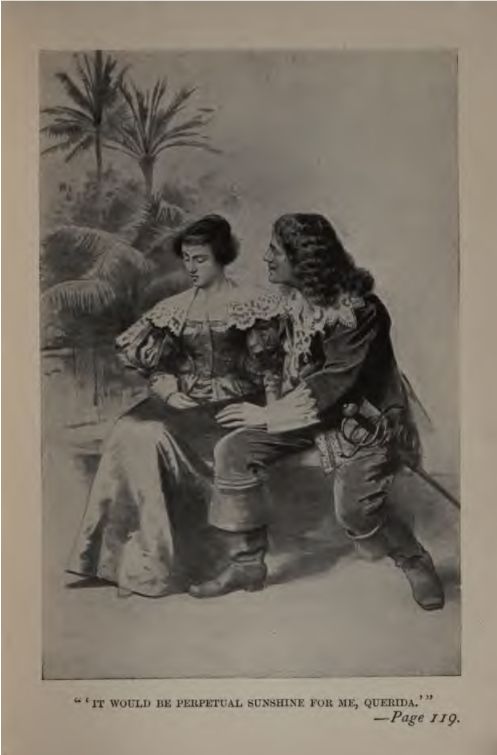
"IT WOULD BE PERPETUAL SUNSHINE FOR ME, QUERIDA"
Now, after the dividing up of the Spanish
pearls amongst them, Prince Rupert could no
longer retain command over his buccaneers.
The cruise was over, and by their laws they were
free to go where they liked and do what they
listed. All their hearts were set upon one
thing—a carousal in Tortuga.
This scheme in no wise suited the Prince. To
begin with, he had acquired a vast dislike for that
no-gentleman and very vile person, Monsieur
D'Ogeron, the Governor of Tortuga; in the
second place (as Master Laughan, his secretary,
pointed out), he had no taste for impolite
debauches and the company of those painted
hussies who lived on the island and sponged on all
laden buccaneers; and over all was his intense
wish to earn money for the banished King at
The Hague, which would in part excuse his
unauthorised pawning of the King's fleet. So he
took for himself the small brigantine, which
otherwise would have been burned as useless, and
remained at anchor in the little bay of Hispaniola,
which was their rendezvous, whilst the pink with
the buccaneers got under way for Tortuga, where
these rude fellows had determined to fritter all
their hard-got gains in one wild carouse.
The pink sailed away with whole rainbows of
bunting displayed, drums beating, guns firing,
horns braying, and every expression of good-will.
The buccaneers who were not occupied in the
making of these noises lined the bulwarks and
shouted, and drank the Prince's toast, so long as
voice or standing power remained to them. In
deed, so ample was their good humour, that one
even drank the toast of Master Stephen Laughan,
who, being in truth a maid, was but slenderly
popular amongst them, on account of displaying
a reserve which, though natural, was beyond their
comprehension. And so the slope of ocean swallowed
them out of sight, still firing their cannon,
and drinking, and flying their flags, as befitted
men who feared none that sailed the seas, and
were feared by all. Whereupon Prince Rupert
and his secretary turned into the standing
bed-places in the brigantine's small hutch of a cabin,
and enjoyed the first sound sleep that had fallen
to their lot during three long weeks.
There remained only with Prince Rupert and
Master Laughan his faithful secretary, four black
negro slaves, which last, having served as pearl
divers to the Spaniards, and being very vilely
entreated of them, were easily willing to give true
service to the Prince during a short season, for
the payment of their liberty when that service
should be finished. But his Highness was a
gentleman of large ideas, and having still some
considerable time to occupy before his fleet
should be restored to him, he proposed to improve
the interval by sailing across to the Spanish Main,
and putting to ransom there the great strong city
of Caraccas, which lies amongst the mountains,
and La Guayra, its roadstead port upon the
coast.
At first sight it seems hard to conceive a more
harebrained project. La Guayra was defended
by forts and batteries; Caraccas, embowered in
the coast mountains beyond, was a place of
incredible strength. A navy and an army might
well be defeated before either of them; and here
was this paladin of a Prince proposing to advance
against them in one small bark of fourteen tons'
burden, with only one attendant of his own colour,
and four black savages who were unreliable even
as menial servants. But his Highness had
method in his scheme: he was not going to make
his attack as Prince Rupert Palatine, but as Prince
Rupert's envoy, and his weapons were to be the
talkings of the herald rather than the rude arms
of a man-of-war. Moreover, he had heard much
of the beauty and wit of Donna Clotilde, the
Governor of Caraccas' niece, and was minded to
inspect her charms with his own proper eyes. He
said it was a weary long time since he had seen
any woman with the faintest claim to gentility.
The Prince's secretary, that was a maid who
loved him very dearly (though he, indeed, never
discovered her sex), endeavoured hard to dissuade
him from the adventure, pointing out the value
of his Highness's noble life, and the grief that
would overwhelm Europe if it were lost in these
obscure seas of the New World; but the Prince
merrily enough retorted that he had a-many times
shown his ability to keep his life within its own
proper carcass, and that it was a necessity for him
to be up and doing.
"We cannot set King Charles back on his London
throne, Stephen lad, by sitting here on our
hunkers admiring the sea views," said he. "The
Restoration is the purpose of my life at present,
and should be the purpose of all those that wish
to carry my esteem, which I know you do.
"Now we must get this brigantine victualled
for the voyage, and that I leave to you and the
blacks. There are no savannahs in this quarter
of Hispaniola, and no wild cattle. But there are
sea-cows in the water, and these you must cause
the blacks to harpoon after their barbarous
fashion, and then make shift to bucan the meat
ashore as you have seen Simpson, and Watkin,
and the other professed hunters do elsewhere.
"For myself, I go now up into the country to
make a cache, buccaneer fashion, for the pearls we
have already taken. If we return all sound from
Caraccas, well and good; they will be here waiting
for us. If not, I have sent a letter by the
pink to await the fleet on its return, and so if aught
happens to us or to the brigantine, the cavaliers
can come and dig the treasure up, and carry it
away for its appointed use."
"Can your Highness's secretary be of help in
this matter?"
"No, Stephen lad. I will not have you with
me as a companion now, because if the worst
happened, and the Spaniards took you, they might by
chance compel you to show the hiding-place of
these much-costing pearls if you knew it."
"Your Highness underrates my poor devotion."
"Not I, lad. I know the spirit is willing, but
the flesh may chance to be weak, and if put to the
question by these Spaniards, the stoutest might
well give way. They are said to be very ingenious
with their tormentings. The thing has grown
to be an art with them."
"But still your Highness seems to rely upon
the buccaneers in the pink as being honest
messengers," said Master Laughan, who was
somewhat nettled.
"That letter," retorted Prince Rupert drily,
"was writ in a cypher, Master Stephen, which
none but my dear brother Prince Maurice can
read. So does that content you?" And with
this he burdened himself with the leather bags of
pearls, and a sword to dig with, and was put to
the shore in a small canoe, paddled by two of the
blacks.
Now, it is no place here to recount anything so
impolite as the fishing of manitee, or sea-cows
(which the vulgar still confuse with mermaidens),
nor any matter so indelicate as the manufacturing
of their white flesh into food which will remain
sweet for a voyage. And it would be equally
disgusting to speak of the turning of turtle on the
beaches, and the salting down of their quivering
flesh into other provision, or to recount the filling
of water-casks in a river's mouth, and the rafting
of them off at a canoe's tail, and the parbuckling
of them on board at expense of vast throes of
weariness and perspiration. Yet, disgusting as
they may appear to the genteel at home, these
things have to be gone through by all adventurers
sailing the seas of the New World. It is the
custom of this barbarous tropic, where gentility is a
forgotten word, for everyone to bear a hand
indifferently; and on this account, Master Laughan,
in spite of a most tender nurturing, was fain to
work equally with the unsavoury pagan blacks.
Even Prince Rupert, after his return from hiding
the treasure, applied himself to these horrid trades
of butcher and buccaneer, till at length the
brigantine was victualled.
A history of the voyage, too, across from
Hispaniola to the Spanish Main would form
unpleasant reading. The brigantine was a small frail
thing of fourteen tons, and none too seaworthy.
Howling greedy tempests seemed her daily portion,
and she clawed her desperate way across an
ocean that was all great noisy hills of yeast and
green, and roaring fearsome valleys. Her water-casks
leaked and fouled, and her ill-cured food
grew tainted. Nothing but constant labour at the
pumps kept her on the sea-top, and everything
was wet on deck, and sodden in the hutch of a
cabin. Salt-water boils were the common ailment,
and poor Master Laughan acquired an ugly red
spot on the chin that was quite destructive to all
comeliness.
It may be owned also that the Prince's sailoring
was none of the best; for though he had some
acquaintance with the utensils of navigation, he
was not skilled in setting off a sea-direction like
those wrinkled mariners that have spent a lifetime
in the trade. And as a consequence he made but
an indifferent landfall, sighting a coast which was
wholly savage and desolate, and having no notion
whatever whether La Guayra lay to the eastward
or to the west. There was nothing for it but
experiment; and taking guidance from the tossing
of a coin, the brigantine's head was put to the
west, till a fishing canoe appeared which gave him
further directions; upon which she was driven
back to the east again, and ran into the road of
La Guayra, and brought up to an anchor there
after a further voyage of forty leagues.
Here, then, Prince Rupert found himself in
touch with the commencement of his enterprise,
and proudly flaunted the St. George's ensign of
England at the foremast head of the brigantine,
and his own banner from the main. The white
flag of truce flew from the mast at the bolt-sprit
end.
There were four armed carracks of the Spaniards
at anchor in the roads, and he saluted these
and the shore batteries with a discharge of his
two puny guns; and presently the captain of the
port came off from shore in an armed galley to
ask his business.
The Spaniard was arrogant enough. He drove
his galley aboard the brigantine, little recking
what damage he did with the rude contact, and
demanded with sundry oaths how any Englishman
dared to invade those seas, which were given by
God and the Pope to his master the King of
Spain.
"I am an envoy," quoth the Prince, "to your
other master, the Governor of Caraccas, sent by
my master, Prince Rupert Palatine."
"I tell you, Señor," said the Spaniard angrily,
"that we can have no dealings with any except
my countrymen in these seas. Officially we do
not admit the existence of intruders."
"Señor," said the Prince, "it seems to me that
I see in you a very discourteous fellow. I must
make my existence apparent to you," said he, and
smote the captain of the port lightly across the
face with the back of his hand.
The Spaniard whipped out his sword, but the
Prince waved off his attack.
"Not now, Señor," he said. "I will afford you
personal satisfaction after I have carried out my
other errand. But since you seem to have had
the fact of my existence impressed upon you,
perhaps now you will guide me to his Excellency
the Governor, so that I may deliver his Highness's
message."
The Spaniard glowered in a black fury.
"If you do not," the Prince went on, "I shall
sail away; and when I come back with Rupert's
fleet, the captain of the port of La Guayra shall
be whipped and hanged, if it costs a hundred men
to take him."
"You seem sure of being given leave to depart,"
the fellow sneered.
Prince Rupert shrugged his shoulders, and
glanced towards the mast which stood up from
the bolt-sprit's end.
"Señor," he said, "I have heard many hard
things said against your countrymen, but I never
yet heard a Spanish official called an ignorant
savage. You do not appear to have seen that
piece of white bunting yonder, or I am sure even
you would not have hinted at detaining a
messenger who came under a flag of truce."
The captain of the port gritted his teeth.
"Well," he said, "I shall shift the responsibility
from my own shoulders. News of your arrival
shall be sent up to his Excellency at Caraccas,
and until his reply comes down, you will stay in
your vessel here, and not shift anchor from the
roads. Have you any name you wish his
Excellency to hear?"
"You may say that the Prince's message is
carried by Master Thomas Benson, who rode by
his side throughout all the English wars, and who
was honoured also by the friendship of his
martyred Majesty, the late King. Master Benson's
attendant is Master Stephen Laughan, Prince
Rupert's own secretary."
"And to what purport is this message?"
"You may inform his Excellency that it concerns
grave matters which are first to be delivered
to his ear alone, and which are not such as
an envoy would gabble into the lugs of underlings."
"Master Benson," said the Spaniard, "when
you have finished your embassage, and are free to
stand up before my sword, I shall kill you.
"Assuredly you shall have the chance," said
the Prince; "and you will not be the first
jack-in-office who has bought a lesson in manners dearer
than he expected."
With that, the captain of the port went back to
his galley, not trusting himself to speak further;
the whips of her boatswains cracked; the chained
slaves strained at their oars; and the galley foamed
away to the land. She was run upon the beach,
and discharged her people on to the shore. The
buildings swallowed them out of sight, and the
first move of the Prince's scheme was played.
For two days the little brigantine swung to her
cable within gunshot of the forts, a thing of notice
only to the sun and the seafowl; and tediously
enough the work of waiting fell upon her people.
The stress of labour was over; there was naught
to do but eat the rotten victual and watch the
tiny vessel swing over the sullen swells of the
roadstead—all to a fine spicing of anxiety. But
Prince Rupert showed a vast philosophy of
patience, and Master Laughan (the boil on whose
chin was subsiding) made shift to follow his
example. Then came a summons from the shore:
his Excellency, Don Jaime de Soto, the Governor
of Caraccas, would grant an audience to Prince
Rupert's envoy.
Never, perhaps, has an embassy on so weighty
a matter set forth upon its business in less bravery
of apparel. Neither the Prince nor his Secretary
had procured a change of clothing since they left
Tortuga two long months before, and in that time
much had befallen. The sun, the seas, the tearing
brambles of the forests, and the greedy weapons
of enemies, had all warred against their attire,
and had reduced it to mere masses of stained rags,
which were barely decent. When the pair of them
landed upon La Guayra beach, the onlookers
raised a jeer of derision. But this soon died away.
Unlike the rude French and English buccaneers,
the Spanish of the New World know how to
appreciate birth and natural dignity, and the majesty
of Rupert's port could not be disguised either by
squalid rags, or the plebeian name of "Master
Thomas Benson." Litters borne of four awaited
them, and in these they journeyed up the six miles
of steep which separate Caraccas City from La
Guayra, its port.
There was no blindfolding, no attempt to hide
anything. The way lay through a narrow gorge
of the mountains, and it was cut by no less than
twenty-three forts, each with drawbridge, bastions,
cannon and soldiers. It was an entrance incredibly
strong, and the city beyond was well worth the
expenditure in defence. Its sacred edifices were
gorgeous; its profane buildings were palaces; and
it lay there under the sun, the choicest jewel in
all the Spanish New World. A more appetising
spot to plunder never met a would-be raider's eye.
Most gorgeous of all was the palace of Don
Jaime, the Governor, and the state he kept was
in full accordance with his dignity. The patio
swarmed with glittering soldiers; the piazzas were
brilliant with finely dressed courtiers; rich
tapestries bedecked the walls of the chambers, richer
flowers adorned the galleries. Don Jaime himself
was a little old white-haired man, as punctilious in
his dress as in his speech and mannerisms.
Through all this splendour, "Master Thomas
Benson" in his mean equipment marched, not one
whit abashed, and showed his Excellency a grand
manner, equal to his own. He presented his
credentials and besought a private interview.
"It is my habit, sir," said the Governor, "to
discuss all matters of State in my Board of Council."
"I have his Highness's strict injunctions to
deliver my message to your Excellency's ear alone.
But after the news are yours, it will be in your
Excellency's power to hand them on if you so see
fit."
"Sir," said the Governor, "I have a curiosity
to know what so gallant a gentleman as Prince
Rupert can have to say to me." He gave instructions,
and those of his attendants who were in
the chamber left, closing the doors behind them.
"And now, Master Benson?"
"My message, your Excellency, is short. His
Majesty, King Charles the Second, has been
thrust out of his lawful kingdom by the present
odious rebellion, and keeps his Court at The
Hague. His revenues are slim, and he has sent
Prince Rupert abroad with the fleet to recruit
them. I am here as his Highness's messenger to
hope that you will see your way to assist the
good cause by a substantial loan."
"The treasury of Caraccas is very empty just
now, Master Benson. The honoured needs of
my own master, the King of Spain, have of late
been large."
"Ten thousand pieces-of-eight was the sum I
was instructed to mention."
"You come to the wrong place for it, sir.
Even if I was to apply to the Holy Church for a
loan, I could not grasp so much together."
"Then one of your Excellency's captains—Don
Sancho, I think his name was, of the galleas
Sanctissimo José—must have lied most stoutly
when we overhauled him a while back. His holds
contained nothing but some rubbishing merchandise,
and for excuse he said that all the plate was
kept back in the treasury here for another year,
waiting a stronger convoy."
"Master Benson," said the Governor, "you are
right. He did lie. They are very unreliable
persons, these mariner folk."
"Your Excellency's eloquence makes the matter
clear to me; but if I carried such an answer
back to the Prince, my poor bald words might not
make him believe."
"And then, sir?"
"Why, then, your Excellency, I fancy Prince
Rupert would come with his fleet and pay a civil
call, and so be assured in person."
The Governor's face flushed, and he started
forward in his chair. "Master Benson," he said,
"take care. You are using very dangerous words.
Neither England, nor England's king, is at war
with Spain."
"England?" said the envoy thoughtfully.
"Spain?" said he. "I seem to have heard the
names once. Oh yes, I remember them distinctly
now. But, your Excellency, those countries are
a very vast distance away from here."
"If you choose to look at it that way, Master
Benson, you may. You may even go so far as to
bring forward the barbarous doctrine that in these
seas might is right. The defences of this place
were built especially to accommodate any person
who might hold that view."
"These were shown me as I came up here,"
said the envoy. "They are brave defences—so
were the defences of your Excellency's pearling
fleet."
"What! Has your Prince attacked my pearl
fishery with his ships?"
"No," said Master Benson negligently. "He
had not his fleet with him at the time. He was
accompanied only by this young gentleman here,
his secretary, and enlisted temporarily the services
of a few cow-killers from Hispaniola, and took
a coasting pink, and with her visited the pearl
fishery. He did no very great feat of arms. He
was obliged to leave one of your Excellency's
war-carracks ablaze, and the other on the rocks,
and make a retreat with some precipitancy. But
he took with him all the pearls which had been
fished during the season, and those made a very
pretty booty for his score and a half of men."
"No word of this has reached me. A score
and a half of men against that armada? It seems,
sir, that you are speaking of an impossibility."
"There were not many left to carry word,"
said the envoy. "But your Excellency may
recognise these seals which I have brought in my
pocket? His Highness cut them from the necks
of the leathern pearl bags."
The Governor started, and passed a tremulous
hand before his eyes. "Yes," he said after a
pause, "they are my seals."
"It was a wasteful way of collecting revenue,"
suggested the envoy. "Much was spilled for the
little that was taken away. If his Highness came
here in person to levy a loan for the kingdom——"
"He would never get here," cried the Governor
violently. "Carrajo! Señor, with your own eyes
you must have seen the strength of the forts!"
"It was an open advertisement, your Excellency.
So was the strength of your pearl-fishing
armada. But as this point of ours cannot be
settled without a trial (though for myself I can
unhesitatingly declare that the Prince will take the
city if he attempts it) let me bring to your notice
another matter which we can agree upon. If
Rupert did come before this place with his
fleet, you would be put to heavy expense resisting
him, whether his arms were successful or no.
You would lose largely in both men and munitions
of war; your defences would be battered,
and shot-torn; there would be burning of houses
and wasting of magazines; and there would occur
a paralysis of trade which only years could cure.
And what would the trouble be all about? To
avoid the loan of a paltry ten thousand
pieces-of-eight to a needy King. Why, your Excellency,
it would cost you ten times that amount if you
could beat Prince Rupert off, once he made an
attack; and should he get foothold in Caraccas
here, you would find it cheap to purchase his
retirement for a thousand times ten thousand
pieces."
"You put the matter very boldly, sir."
"I am a man of business, your Excellency,"
said the envoy. "I prefer to put things plain."
The Governor sat moodily, with his chin in the
butt of his hand; and for a while he answered
nothing. At last he said, "Master Benson, this
is a matter on which I must confer with my
Council. I pray you give me a day or two for
consideration, so that I can send a well-weighed
reply to your Prince's courtesy. And in the
meanwhile, if you would use my poor house, and
all that it contains as your own, I should be
overwhelmed by your condescension."
"Your Excellency," said the envoy, "is vastly
polite. Both Master Laughan and myself are
highly honoured to rest under so distinguished a
roof. But you must permit us first to go round to
some of the stores of the city to procure more
suitable wearing apparel than these filthy rags."
"I will send one of my officers to be your guide.
He," added the Governor with a sour smile, "shall
provide you with the wherewithal to buy."
"I could not trespass upon your Excellency's
kindness to that extent. I have no gold money
to pay for my purchases, it is true. But we have
in our privy purse some small store of pearls,
which, at a push, will doubtless serve as currency."
Don Jaime grinned like a man in pain.
"Master Benson," said he, "you are a most
provident gentleman. If you and Master Laughan
will wait in this chamber for a short while
longer, I will send to you a guide who shall be
entirely devoted to your honoured service."
In this fashion, then, another stage of Prince
Rupert's enterprise was successfully carried out,
and the Governor of Caraccas, though fully alive
to the unbounded impudence of the demands
made upon him, was for the present, at any rate,
civil and self-contained. What he might do in
the future remained to be seen. He might
within another day order the pair of his visitors
to gaol, or death, or (still more horrid fate) hand
them over to the gluttonous cruelties of the
Inquisition, which spares neither rank nor sex. Or,
again, he might act the prudent part, and
despatch them whence they came with ten thousand
pieces-of-eight, to save his splendid city from the
Prince's harrying.
But in the meantime the envoy and Master
Laughan dressed themselves in all the niceness
and bravery which they could procure on so brief
a notice, and prepared to revisit for a short time
genteel society, such as they had been divorced
from for so many a tempestuous month.
Now, in the household of Don Jaime de Soto,
it is a safe thing to say that if Master Laughan
had held command, the enterprise would not have
been damaged; whilst it is a matter of history
that the Prince, by his own action, completely
wrecked it. Master Laughan, it is true (though
being in reality a maid), would have had but
small temptation, as she herself quite recognised;
but the Prince, being man, must needs get enslaved
in a vulgar love affair with a lady whose
charms Master Laughan was quite at a loss to
discover.
To be precise, this Lady of Destruction was
that very Donna Clotilde, the niece of the Governor,
of whom they had heard before; and for those
that care for the Spaniards' appearance, she
certainly had some claim to comely looks. Indeed,
Prince Rupert never tired of extolling her beauty;
and it may as well be owned here, at once, that
the secretary, who in secret loved his Highness
madly herself, was torn with horrid jealousness.
But the Prince, of course, knew naught about
this, scoffed at all warnings, and in his
masquerade of "Master Thomas Benson" pressed his
suit with fire and diligence. The two days for the
consideration of the Governor's reply lengthened
out to four, and four to a week; and when the
poor secretary dared now and again to hint that
duty required a settlement of the business, he
was sharply bidden to hold his pedant's tongue.
And so the affair progressed.
Their entertainment was not lavish. The Governor
of Caraccas was too wily a fellow to make
a parade of his wealth before so dangerous an
envoy. But the society was certainly urbane and
pleasing after that of shipboard and the buccaneers;
and the old Spaniard, from behind his studied
courtesies, saw plainly enough what was going
on, and was content to leave Donna Clotilde to
do battle with the invader on his behalf. The
visitor was clearly infatuated.
Still, what Prince Rupert, a man of the utmost
daring, could have seen in such a little doll of a
woman, it was hard to discover. And, astonishing
to relate, Donna Clotilde made no attempt
to set herself right in his eyes. She openly
quaked when a door was slammed, and ingenuously
confessed that the sight of drawn steel would
make her faint; and yet the poor secretary, who
watched from afar with heart afire, could have
sworn the Prince loved her, and was forced to
hear his rhapsodies when they were alone, and
(more cruel still) was made many times the porter
of presents and the bearer of love messages.
But a fine revenge was in store, and the secretary
can gloat over it to this day, though at the
time it was like to have cost the pair of them their
necks. The secretary in his misery had gone out
into the gardens of the palace, and had lain down
behind some shrubs to be alone with grief. It
was night, and the place was dark but for the
stars and the faint flashings of the fireflies; and
presently who should come up but these two
lovers, and seat themselves within earshot, and be
talking before the listener could move!
"But they tell me," quoth the lady, "that
your country is a place of fogs, Don Tomaso, and
that the sun never shines there."
"It would be perpetual sunshine for me, querida,
if you came to England," said the Prince.
"And the people fight. The mere talk of war
gives me the megrims."
"Were you in England, the fighting would end.
Let them but see you once, and they never would
do aught to cause you pain."
"The good people, it is said, too, wear mighty
uncomely clothes."
"For this many a year they have been wearying
for you to come and lead their taste."
"La! Don Tomaso," said the lady, "you do
flatter me. I wonder if all buccaneers are as
pretty of tongue?"
"Donna Clotilde would make a dumb man find
phrases to express his adoration."
"Fie, Señor! the truly dumb can never speak."
"Querida, even had I been truly dumb, I should
have forced out some few speeches for you."
The lady laughed. "Then what a thousand
pities, amigo, you were not dumb!"
"Your wit is bright, and I am dull. I must ask
your pardon. I do not take you here."
"Why, Señor, had you been dumb, you would
have said less. Being vastly glib, you have said
too much."
"Still I do not see."
"It is the history of Master Thomas Benson
that I speak about. You have given it me a score
of times, and it does not tally: you forget the
details. At one telling, Master Benson is a rude
sailor, and has been bred to the sea from his youth
up. Next, as a lad he fought in Continental wars,
and lingered in dungeons. Now he rides at
Rupert's right hand in English fights, and anon
he gets swept away by his own narration, and
forgets, and leads the charges himself. Now he
pictures his wife settled down in a comfortable
farmstead; and a minute hence he will be talking
of courts as familiar as though he had never seen
aught coarser. 'Twas all prettily told, amigo,
and," she added, sweeping a great courtesy, "I
thank you for the telling. Nay, I must crave your
pardon too. I should not have slipped out the
amigo; I should have done credit to my bringing
up, and said 'Your Highness'!"
The Prince made no attempt to snatch back his
disguise. "Señorita," he said, "whatever may be
my quality, I trust I have done nothing that you
should withdraw from me the title of friend."
"My Prince," she answered, "I am a Spaniard
first and a woman next. You have come into my
country as an enemy, and disguised as your own
envoy."
"You can have a fine revenge," said Rupert
lightly, "and get it easy. One word to your
honoured uncle, and all further trouble will be
taken from your dainty hands. And I doubt
not," he added, with a shrug, "that within the
hour all further thought will be chopped from my
shoulders."
From behind the shrubs, the secretary could
hear the lady shudder.
"I would rather compound the matter with
your Highness, if it could be done."
"For myself," said the Prince, "in losing your
esteem I lose all that is worth caring about."
"You have not lost it," she cried—"you have
not. But what you were asking is a thing
impossible. Princes must not marry maidens of rank
as low as mine."
"Must not!" quoth Rupert blackly. "Who
shall prevent it? I am a strong man, and myself
make laws for myself. Who will prevent it?"
"I," she murmured; "because of—how did
your Highness word it?—esteem, yes, because of
my great and burning esteem for you."
And at that (to the poor secretary's bitter
mortification) he took her tightly into his arms, and
rained kisses on her upturned face. Again the
war of words rose between them, but this timid
little doll of a woman could be as firm as the
Prince. Marry him she would not; go from
Caraccas she would not; betray the Prince (as in
his madness he besought) she would not; and
yet she demanded one thing of him—a costly
enough keepsake. He was to leave as he had
come, a poor man in a single ship; he was to
forego all pretences to the ransom; and he was to
give his word, as a chivalrous gentleman, to
jettison all ideas of harrying the place and helping
himself to its treasures.
"I am a woman," she sobbed, "that loves your
Highness dearly. But I am a Spaniard who loves
her country more."
"And I," said he, "can continue to love such
a true lady, where I should have lightly forgotten
a traitor. Querida," he said, "I know your will
about this matter, and I know my own: neither
will bend. I shall go away in an empty ship as
I came, and never shall I come to seek you here
again. But I shall pray to God to bring us
together in some other place, and till that day
comes I will never call any woman wife."
"And hear me," she said. "I swear also——"
But he closed her lips. "No," he whispered:
"I will not have any promise of you, querida.
Woman are placed different from men, and policies
may turn on giving their hands in marriage. I
would not have you forced to wed, and then
always be pestered by remembering an unfulfillable
vow. I would rather have you free, and then,
if God wills, we shall come together some day and
marry; and if not, we shall stay forever apart."
"Yet I will——"
"No," he pleaded, "do not give me your pledge
in return, or else you will send me away still more
unhappy."
And then, bareheaded, he knelt and kissed her
fingers—he that had a moment before been
kissing her so madly on the lips!—and then with
stately courtesy he led her back into the palace.
He and she were in turns closeted with the
Governor that night, and the next morning an escort
with covered litters borne of four paraded in the
palace patio.
The Prince gave no sign of what had happened:
he was debonair as a man could be; and
he was "Master Thomas Benson" still. He made
his adieux as though he were a favoured
ambassador taking leave of the court of a king, and
he and Master Laughan entered the litters. A
trumpet sounded, and the bearers and the escort
stepped out across the pavement. A window-shutter
opened, and a slender arm stretched out
fluttering a dainty kerchief, and then the litters
passed out to the glaring street beyond, and the
episode was over.
Down they went by the way they had come up,
past the forts, and over the drawbridges of the
gorge to La Guayra, the port; and on the mole a
galley with slaves was in waiting to take them out
to the little brigantine. But the envoy asked for
another half-hour of delay.
"I have a small outstanding account which it
would please me to close," said he, "before
leaving your very desirable town;" and asked that
the captain of the port might be notified of his
presence.
The fellow came up, nothing loath, and saw
some very pretty swordsmanship before he was
run through the shoulder; and then, distributing
a handsome largess of pearls to the escort who
had brought them down, the envoy and Master
Laughan were rowed off to their little brigantine,
and so once more to sea, and further adventuring.
The Prince was thoughtful and full of sighs;
but the humble secretary thought that the perilous
sea had never before looked so friendly and pleasant.
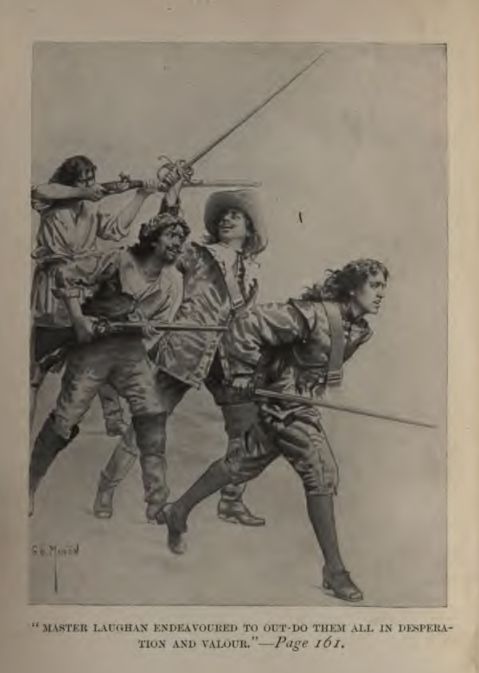
MASTER LAUGHAN ENDEAVOURED TO OUTDO
THEM ALL IN DESPERATION AND VALOUR
Now what follows must I think be taken as
direct proof that Providence concerns itself with
extra diligence on behalf of great gentlemen who
have the birth and parts of Prince Rupert.
No prospects could have been blacker than
ours when we set sail again in the little brigantine
from La Guayra. Of food we were well-nigh
destitute; the little water remaining to us stank;
the vessel herself had grown even still more leaky
through straining at her anchor amongst the
rough seas of the roadstead; and (as though out
of sheer aggravation) one of the black slaves had
died, leaving only three to carry on the necessary
work.
Than bailing water out of a leaky vessel's bilges
there is no labour more detestably menial; but a
Prince of birth can be drowned by a ship
swamping beneath him as glibly as a common
sailor-man; and so as the remaining blacks showed
clear signs of exhaustion, Rupert and his humble
secretary had to take their turn at this occupation,
and ply their utensils too with lusty vigour.
It was extraordinary how fluent were the leaks.
"They say that witches do sea-travelling in
baskets," said Prince Rupert once. "I wish we had
one aboard here to teach us the trick, if indeed
this basket is not too large-meshed for a witch's
skill."
His secretary looked at the dim line of the
coast. "Anything would be better than staying
here to be drowned like puppies under a bucket.
It tears me to think that your Highness's dear
life should be in this horrid danger."
"My dear life has been in worse case many a
time when it was more pleasant to me, lad. And
now that it is soured somewhat through thought
of a certain lady, why, there you have all the
more reason why it will not be cut short. I
quite agree with you that there is a strong need
that we should find soon a scheme to better our
position; but at present I can think of none;
and as for taking another turn on the shore
yonder, why, that I flatly refuse to think about.
I have no appetite for plunging about those
pestiferous mangrove swamps till the Spaniards
starve us out, and take us by sheer numbers and
strength. In fact, I do not want to appear next
before the Governor of Caraccas as a prisoner,
Master Stephen. You will doubtless appreciate
many of my reasons."
And there the poor secretary, being in truth a
maid herself, and passionately enamoured of his
Highness, turned away and faced the glaring
sea, lest the jealousy that consumed her might
be seen written upon her face. Though what
Rupert could see in that creature puzzles her
even to this day.
But neither Prince Rupert nor Master Laughan,
his secretary, could afford to keep their thoughts
entirely on this Donna Clotilde whom they had
left behind them still in the safe keeping of her
uncle the Governor of Caraccas. Their present
discomforts went far to wean them from the
memory of what had immediately passed. Their
hunger and thirst grew upon them; their limbs
ached with the incessant toil of keeping the crazy
vessel afloat; an intolerable tropic sun scorched
them from overhead; and, as though their case
was obviously desperate even to the fish of the
sea, three great sharks swam after the little
brigantine in convoy. Moreover, one of the
blacks began to show signs of delirium, and had
to be confined with leg-irons so that he should
not leap over-side, and lose them his services.
For three days this miserable voyage acquired
to itself new miseries, and yet no plan came to
the voyagers for lightening their case. In fine
(and it is hard for the secretary to say such a
thing about her revered patron), Prince Rupert
lost his reckoning, and owned as much. He was
at the best an inaccurate navigator, being brought
up to nobler trades. And so there they were
careering through a hot sun-scorched sea, with
no land in sight, and the only hope remaining to
them that if they kept at it long enough, they
would, if they did not starve or drown first, fetch
up somewhere in the long run.
"We are true buccaneers now, lad," said
Rupert lightly, "for viler navigators and more
desperate blades never sailed the Caribbean.
My courage would be equal to attacking a
caravel single-handed now—especially if my nose
told me he had a meal preparing in his cook
house."
As the sun lowered on that fourth day of their
travel, a fog bank lifted out of the ocean ahead, a
common enough sight in those unwholesome seas
of the New World, and a breeding place for the
calentura and other disorders. There is nothing
in this you will say worthy of being commented
upon in these memoirs; but when dark at last
fell with all its tropical suddenness, this fog lit up
with a glow, and as they drove nearer to it in their
voyage, this glow seemed to collect and concentrate
upon a centre.
At first they had taken the appearance for some
trick of the sun which in these regions often leaves
a reflection in the Eastern sky that lingers long
after its setting; but this glow endured too long,
and moreover it grew more concentrated, and
increased in brightness; and so there came to the
Secretary's lips a suggestion that some island lay
ahead, and that its savannahs had been fired by
buccaneers to drive the game into their snares.
"There may be a wholesome meal close ahead
of us," said the secretary, "and afterwards, your
Highness' charm will surely enlist some of these
rude hunters into your service. It is my humble
suggestion that Providence evidently intends us
to find profit presently from some adventure
ashore."
"That may be," said Rupert. "But my own idea
is that shore's as far off as ever, and that just
now we're staring at somebody's ship ablaze.
Look now; if we bale a little harder, we may dare
to give this basket of ours a few square yards
more sail, and so come up with her all the
quicker."
So they set the blacks to loose and hoist the
two topsails, and sheet them home, and then took
it by turns to assist the tired creatures at their
intolerable baling.
The Secretary will confess to have experienced
a pang when the next half-hour's sailing proved
His Highness to be right. On land once more,
she could have shown a stout manner to whatever
adventure or hardship lay before them. But land
seemingly lay as far off as ever; indeed they did
not even know its whereabouts; and here on this
unstable sea poor Master Stephen was every minute
forced violently to drag back her courage, lest
it should slip from her shuddering breast and be
overboard beyond reclaim. Indeed only the
all-mastering love she bore for this adorable hero
kept her from disgracing the livery of her
borrowed manhood.
But Rupert's courage was in no way dulled;
indeed matters that would have daunted all other
men (let alone maids) always heartened that great
soldier; and, besides, with his infinite strategy he
saw here ahead of him an opportunity for earning
monies for his master the King at the Hague,
whom he was so diligently endeavouring to serve.
From the moment of making sure that the glow
came from a burning ship, he was all of a fidget to
make the brigantine move faster; and indeed his
haste was natural, for as they drew more near,
and the wind slackened, it seemed likely that the
ship would burn to the water's edge and sink
before he could come up and drive his bargain with
her.
They could see the vessel plainly now, a
tidy-sized pink (or brig, to give her the newer name)
with her bolt-sprit a mere flag of fire, her foremast
already over the side, and the forepart of her hull
little better than a bonfire of flames. The men
upon her stood out black against the blaze which
they fought so vehemently to subdue. They
were massed for the most part in a mob on her
aftercastle and as they drew nearer, Prince Rupert
could see others standing on stages slung over
the side, passing up water to quench the flames
in every conceivable shape of pitcher, from
ale-jacks to mess-kids.
It cannot be said that the reckless fellows showed
any outward fear for the horrid death that was
already beginning to scorch them. They were
chanting a psalm when the brigantine first drove
within earshot; but apparently thinking they had
done enough for their souls with this exercise,
they presently set up some ribald drinking song
which had acquired a dirty popularity in the
taverns of Tortuga, and bawled it out full-lunged to
the accompaniment of water hisses and flame-roar.
With the glare of the fire dazzling their eyes,
and the occupation of fighting it filling their
minds, they did not see the brigantine till she
sailed up through their smoke and rounded up
head to wind just beyond pistol-shot; and when
they did make the discovery, their behaviour was
none too civil. Even had there been any doubt
about their being French and English buccaneers,
they proved it very plainly now. Spaniards
would have shown panic and pleaded for their
lives with threats and promises: these fellows
were for taking what they wanted by sheer dash
and impudence.
"Just the packet we want, lads," roared the
great rude creature who commanded her. "She's
only a Jack-Spaniard, and'll be taken as easy as
skinning a bull. Strip and swim for her. We'll
come back and salve our plunder afterwards."—Upon
which they all began to doff their draggled
finery with astonishing haste.
But Rupert stood up in the brigantine's rigging
and called sharply for them to wait a moment and
hear him. Upon which, catching the sound of his
English words, they stopped their bawling and
listened.
"I am willing to give you passage, gentlemen,
upon reasonable conditions. But my conditions
I must have: you will understand I am no
common carrier."
The tall man who had spoken before gave voice.
"You seem to talk very big, you in your small
ship. I am Captain Wick. Who the devil are you?"
Prince Rupert louted low. "I fear you will not
know my poor name sir, though at home in England
and Europe it has been heard some few times.
There they call me Rupert Palatine."
The tall man whistled. "You'll be the Captain
that pawned his ships to old Skin-the-Pike in
Tortuga?"
"Monsieur D'Ogeron, the Governor, held some
cavaliers who were my very dear friends, and no
other way showed itself of ransoming them.
Besides, I wanted their swords for my enterprises."
"Well, gratitude's no crime, though there's
many in these pagan seas thinks it first cousin to
foolishness. No, I can't say I think any the worse
of you, Captain Rupert, for what you have done."
"Sir," said the Prince, "your approval
overwhelms me."
"Don't mention it," said Captain Wick, "and
don't let us waste any more time in speeches.
This perch here is getting hot. Take us off, like
a decent man, and you have my word for it you
shall be no loser. We gutted a fat Spaniard
yesterday—a Seville ship he was, new out of
Maracaibo—and after the fight, all our hands got so
drunk, he had the ingratitude to slip away; and
as we found ourselves afire in the forehold, we'd
no time just then to set about rechasing him.
I'll make free to own the fire was beginning to
bother us when you came up."
"It has a solid look about it just now," said
Rupert, and he had to shout, for the roar of the
devouring flames overtopped all quieter voice.
"And so as a business man yourself you will be
ready to pay all the higher for your conveyance
elsewhere. It is well we should get these ungenteel
matters of commerce settled first. It would
put an unpleasant finish on our voyaging together
if bad blood rose between us when the hour came
for settling the bill for passages."
Whereupon Captain Wick broke out into some
very fierce and wrathful language.
But Prince Rupert preserved an admirable temper.
"Sir," he said, "I am new to this trade of
passenger-carrying, and I trust I have too much
niceness to make a commencement with a bevy
of unwilling guests. Let me call to your mind
that I am offering no compulsion. If you do not
like my terms, I will draw off and continue my
proper voyage, and as for you—why, you, sir, and
your merry gentlemen can continue to tend your
fire."
It was clear that Captain Wick had fine
appetite for another outburst of words and temper;
but the growing heat of the flames behind was
every moment worse to be borne, and so with a
hard effort he kept his tongue civil. "Well," he
said, "what are your terms?"
"I do not want, sir, to drive too hard a bargain.
I will not take more than you can offer."
"Meaning all we have? That's gluttonous
enough, anyway."
"I did not come out to these amusing seas
merely to study philosophy and refinement."
"That I'll be sworn you didn't. You might
be a common buccaneer like me, with a matelot
ashore to provide for, from the keenness you
show."
"Why there, sir," said Rupert, "you have hit
off my condition in a phrase. I was formally and
solemnly adopted into your desirable Brotherhood
after strict examination and full trial of my
poor abilities, and I have a good camerade now
meat-hunting ashore in Hispaniola. Even if I
were disposed to forego my own advantage, I
could not remain loyal to him and let this chance
of earning moneys slip by me. It is a vital
condition of our partnership that we share and
share alike, and that each should do his best for
his matelot."
"You need not remind an old buccaneer of the
first principle of the Brotherhood. How do they
name your matelot?"
"Simpson. He's a finely accurate shot."
"A man well freckled with pock-markings?"
"He is so distinguished."
"Simpson and I have been shipmates. Well,
I'll have no hand in defrauding Simpson—especially
as I've small choice in the matter. But if
the chance comes my way for driving another
hard bargain, just you look to yourself, Captain
Rupert."
"Sir," said the Prince, "I've done very little
else these some years. Do you answer for your
crew standing honourably by the conditions?"
"You shall swear each fellow for yourself when
they come aboard. Man, make haste and bring
that cockle-shell of yours athwart our stern. The
bacon is beginning to frizzle on us already, and
presently some of us will be cooked alive. I
must say you make a rather poor show of your
hospitality."
"You will not blame me presently, sir. As it
is you will enjoy the fare here. Had you come
from anything short of desperation, I fear you
would have turned up your honoured noses at its
roughness."
The brigantine's head was canted with the
sprit-sail till she gathered way again, and she was
so manoeuvred that Master Stephen Laughan,
who was standing on the forward castle, caught a
rope which was hove to him, and made it fast to
one of the knightheads. Singly the buccaneers
made their way down this from the high poop
which towered above, each carrying a bag filled
with the more valuable of the Spaniard's plunder
to pay his passage, and each, as he dropped foot
on the deck, was made to swear a most
comprehensive obedience. A Bible, a crucifix and a
naked blade were set ready, and the oath was
taken on all three, so that whether the man was
of the Reformed Religion, or Papist, or confessed
no creed at all, one or other of the oaths was
bound to pledge him, and so there would be no
wriggling out through this very common bye-way.
"By the Lord!" said Captain Wick, who was
the last to come on board. "By the Lord, if
formalities can make sound business, you should
be in a fair way towards storing a fortune. By
your leave I'll cast off this rope from the knighthead
here and we'll get your cock-boat under way.
My old ship is pretty well a-fire just now, and it's
on the cards my drunken rascals were not very
thorough when they set to drown the powder.
The kegs were not all easy to get at in the magazine."
"After your handsome behaviour," said Prince
Rupert with a bow, "the least I can do is to put
my poor ship entirely at your present disposal.
You may set your crew to work her (for I will
own ingenuously that mine are somewhat
unskilled), and you may navigate her where you
choose. But if I might venture to suggest, I
should say that the sooner you could bring up
with some land, or with some desirable ship of
the Spaniards, the pleasanter it would be for all
of us."
Captain Wick stared. "You have a rum way
of putting things," he said. "But let's go to
your cabin, and talk it out over a cup of wine.
I've a throat that's full of sand."
"Why," said Rupert smiling, "I'm afraid the
cabin floor will be a-slop with water, as when we
pressed her with sail so as to come down to you
the quicker, the leaks rather gained on us."
"By the Lord!" cried Wick, fairly startled,
"she feels sodden enough under the feet now you
call attention to it. Why, your lower deck ports
are well-nigh awash."
"Oh, I gave the brigantine no certificate for
seaworthiness, when I asked you to honour us with
your presence."
"Well, you're a cool one, anyway," said
Wick, and gave sharp orders to his men to take
a spell at the baling.—"But sink or swim, that
doesn't alter my thirst, and if we can't wash our
necks politely seated in the cabin, why, bid one
of your blacks bring aft the wine on to the poop,
and we'll drink to our better acquaintance
there."
"I fear, sir," said Prince Rupert, still with his
best manner, "that you will think me most
cursedly remiss, but our provisioning has been
plaguely ill done, and there's not a drop of wine
on board."
Captain Wick stared still more, and then, as a
thought struck him, he went to the scuttle-butt
and took a sample from the dipper. "And your
water stinks!" he spluttered. "Faugh! do you
keep ducks in your casks? Man, tell me squarely,
what entertainment is it that you have asked us to?"
"Lean enough, I fear, but I have no wish that
it should endure longer than is absolutely needful.
As a buccaneer, sir, you are my senior, and I bow
to your experience, but as a mere soldier, I should
say that the strategy indicated is to go to the
nearest place where provisions are stored whether
it is afloat or ashore, and procure them in the
handiest way which occurs to us."
Captain Wick slapped his thigh. "Well," he
said, "this is the maddest turn-out! You've
neither meat, wood, nor water; you've a little
old ship that leaks like a fishing net; you've no
force——"
"Ah, pardon me there, sir. You see before
you two very good swords, who would be quite
pleased to parade themselves against any other
two you can put against them."
"Give it if you like, you've an army of two,
yourself and this slim youngster here. You must
have left a very ugly place behind you to have
sailed out so blithely into this fix."
"In honest truth we did. But being here, sir,
and having you and your excellent friends as
companions, I repeat that the shrewdest thing
at present seems to me that we should sail with
as much canvas as we can carry towards the nearest
meal. Come, Captain Wick, I'm still but raw
in these seas, and you are likely to know far more
where the good things are stowed. What do you
say? Are we to get ashore and hunt bullocks?
Or is there some convenient town to sack, or
some castle to ransom? Or can you guarantee
that we shall find a Spaniard on the sea, and get
our next dinner from him before we are absolutely
starving?"
Captain Wick leaned up against the bulwarks
and laughed. "This is like the old hard, wicked
times once more, when buccaneers sailed cheerfully
against an armada in a canoe—and sometimes
took it. It gives me a thrill to be desperate
again. I oughtn't to be merry, I know, but spit
me if I can help it. I've lost my ship, I've been
robbed of my lawful plundery, I'm out of the
frying-pan into the fishing-net, but by the Lord,
there's something too humorous about the whole
adventure to let one work up a proper pitch of
anger."—His face sobered with a sudden pucker
of recollection.—"Rupert," he repeated, "Captain
Rupert. Isn't it Prince Rupert I should have
said?"
"So I am more usually known."
Captain Wick changed his manner. He lugged
off his feathered hat and made a great bow.
"My lord," he said, "you must excuse these
manners I've been showing you. At first I
thought you were a rogue, and then I thought
you were a madman, and then I judged you were
a fool, but I never guessed you were a born prince
and there's the truth of it. I was only a common
seaman before the mast before I drifted out to
these seas of the New World, and earned distinction,
and so at home I was not in a position to
meet Princes, and here there are none to come
across. But believe me, my lord, it gives me
great pleasure now to make your acquaintance,
and devil take the expense. Indeed I don't
grudge the expense: Princes out here will want
to make their bit like other men."
The secretary, who stood near, looked for an
explosion of his Highness' anger, for there were
times when Prince Rupert could defend his
dignity with great niceness and punctilio. For it
was in Master Laughan's mind that this Wick
was merely mocking her patron, since of all these
rude buccaneers they had come across so far in
the New World, they had not met one who
showed a particle of reverence for a great name
and exalted birth for their own sakes. But Prince
Rupert, with his usual fine discernment, saw
otherwise; indeed he understood in a flash that the
man was dazzled at finding himself the guest of
one who carried so illustrious a name: and he
showed him some very pretty and graceful
condescensions.
The secretary, being by this time so thoroughly
wearied out that her eyes would keep open no
longer, heard dully the rumble of their talk for
awhile, and then dropped off to sleep where
she was on the bare deck, but not before a new
course had been set, and sharp orders given for
the re-trimming of tacks and sheets. The
buccaneers, it appears, would have waked her to take
a spell at the baling, being rude brutal fellows
with but little sympathy for gentility and a slim
figure; but the Prince so pleasantly asked them
to desist, at the same time speaking so
handsomely of the secretary's youth and previous
labours, that of their uncouth condescension
Stephen was permitted to further enjoy plank
bed undisturbed.
I am free to confess that the meeting with
Captain Wick and his men, let alone from the sums
earned as their passage money, was indeed
fortunate from another respect. That Prince Rupert
had high military genius, no one who reads
these memoirs, and the other histories specially
written upon his person, will for a moment deny.
But the fact cannot be got over that if the
brigantine had stuck to her original course, his
Highness and the others on her would have
starved, if indeed they had not drowned first.
For the nearest land (if indeed they did not miss
it) was distant a week's sail that way, and the
seas in between practically desert. But this
Captain Wick, if rude, had at least local knowledge
and no particular appetite for starvation, and so
by his hint the brigantine was headed for
Curassou, which island it appeared was conveniently
close at hand.
Let no reader think that in owning this, Master
Stephen Laughan wavers for one instant in loyalty
to Prince Rupert, and profound admiration for
his wonderful powers. But the fact is the island
was out of sight below an horizon, and guessing
at an island's position, when indeed you have
never before heard of its existence, is but
dangerous seamanship.
As Wick himself owned the place had small
enough fame. It had neither mines nor
pearl-fisheries; the Spaniards did naught but gather
salt there; and as this commodity would not attract
buccaneers, who liked more profitable valuables
for their purses, there were no fortifications
to protect the works or the labourers.
"But, your worship," said Captain Wick, "at
present we need comestibles more than cash, and
I take it that these fellows on Curassou, humble
though they may be, must have some sort of food
on hand to stow in their bellies. And besides,
salt-making should be one of the thirstiest trades
imaginable, and there you see that drink, and
much drink, is clearly indicated." And in fine
this prophecy came very near to the truth. In
the harbour of the island they found two vessels
of the salt gatherers and a well-stored village
ashore all practically undefended, and these they
took without opposition.
At this point though the very nasty customs
of the buccaneers nearly caused a breach—and
indeed would have brought about complete severance
of the parties if the secretary had had the
choice. For the rude fellows, after their usual
habit, when the materials for debauch were ready
to their hands, had not the smallest mood to go
abroad for further earning, and in this Captain
Wick (that was none too sober himself) to all
practical purposes gave them his countenance.
"Master Prince," he hiccoughed solemnly. "I
am your most obedient servant to command, but
you mustn't ask me to make water run up hill, or
to cause handy liquor to cease from running down
a thirsty buccaneer's gullet. They are common
fellows, common as dirt every one of them, and
they haven't the gentility and niceness that is
natural to you and me. And moreover, as a
buccaneer's life is often a short one, he strives to
make it as merry as may be. Besides as you are
one of the brotherhood yourself, you ought to
fall in with the custom. I'm sure Simpson, your
matelot, would not be pleased to see you deny
yourself. Come, my lord, what do you say, if you
and me, that are their superiors, condescend a
little and go and take a turn down yonder ourselves?"
The Prince very civilly declined, but still this
Wick must needs persuade him further.
"Of course it's not what me and your lordship
are accustomed to, but there's entertainment in
it. A buccaneer when he's ashore is a rarely
humorous fellow. The Spaniards were asked to
provide a fiddle, or some pipes, or at least a drum
for harmony; but it seems they are leanly enough
furnished with both talent and instruments; and
so the beggars have been stood in a row, and
bidden to whistle jigs as dance music. The
boatswain's been appointed bandmaster, with a rope's
end for baton, and I can tell you he's making a
dandy orchestra."—Captain Wick fidgetted
with his feet—"Oh Lord," he said, "watch 'em
dancing. I just must have a turn myself. Here,
Master Laughan, you're slim, and should make a
most ladylike partner. Come along."
And with that he clapped an arm round the
poor secretary's waist (that was like to have died
with mortification) and set off into absurd capers,
keeping time to the whistling, till the pair of
them were brought to a stop through sheer
breathlessness.
Prince Rupert (it is painful to relate) was in
one of his whimsical humours, and, far from
interfering, only laughed and shook with merriment.
"Keep it up, Stephen, lad," cried he. "You
fling a fine leg. By my faith, you dance the best
maid's steps of all of them. Ho! you other
blushing, bearded, lady buccaneers, mince your
steps like Master Laughan."—And when the
secretary came back flushed and angry to his
side, and would have reproached him with a look,
"Pooh! lad," said he, "you're none the worse.
There's a bit too much of the pedant about you
at times"—At which the poor creature tried to
smile, though in truth she was but an ace off tears.
Of the two vessels of the Spaniards which they
met in the harbour, one was fired, as they had no
service for her, and the other careened, breamed,
refitted and loaded with the brigantine's treasure
and puny armament. The brigantine herself,
being left unbaled for a dozen hours, quickly
sank out of further mischief's ways. The orgie
of the buccaneers, when one came to measure it
up afterwards in the cool blood of the historian,
was in reality short, for these disgusting creatures
consider lavishness the highest gentility, and
waste double what they use. But once the
liquor casks were drained, they were ready
enough to start out for the next venture.
The sun poured down upon their working with
intolerable heat; the beach reeked with the lees
of their spilt rum; and the fellows themselves,
though they stuck manfully enough to their
labours, carried swinging heads and crabbed
tempers. The Spanish prisoners who were set to
the more menial tasks came in for rough usage
when their diligence slackened.
But at last all was ready once more for sea,
and after the custom of the Brotherhood of the
Coast, a meeting was held at which each man
was the equal of his neighbour. They were
done with one voyage, and this, ipso facto,
disrated the lot of them, and forthwith they set
themselves to elect officers for the next, and to
decide on a cruise.
Now all who read these memoirs will at once
think that with so brilliant a commander standing
idle at their side, these rude fellows would
at once have made humble petition to Prince
Rupert that he would condescend to lead them.
But I can nohow describe their uncouth rudeness
more blackly than by relating that they did
nothing of the kind. In fact but one name was
mentioned, and that was Wick's; and they
elected him with shouts, and saluted him with a
ragged volley from their buccaneering-pieces.
For boatswain, too, they elected the fellow who
had served in that rating before. But their
quartermaster had, it appeared, been killed; and
as there were two rival claimants for the office
with equal followings, each ready to fight for
their man, Wick saved civil war by suggesting
that the Prince be appointed. Here was a way
out of their impasse, and they took it as such,
though without any show of enthusiasm, and
Rupert was gracious enough to accept their
nomination. The readiness with which he could
adapt himself to his companions for the moment,
was a singularly lovable feature in this truly great
man's character.
In general meeting also the plan of campaign
was openly discussed and voted upon, all, by the
rules of the Brotherhood of the Coast, having an
equal say in this matter before the cruise
commenced. Indeed Wick himself drew attention
to this freedom of discussion, and pointed out
that if anyone of the company could put skill or
information into the general fund, he was bound
by the laws to give it. "We Brethren of the
Coast," said he, "have our phases. Ashore we
have our frolics. But afloat we are all for
earning. That comes first always; and though
causing annoyance to the Spaniard can generally be
done at one and the same time, that is not to be
looked upon as a serious occupation, but only
one to give relish to the other. Now for myself
I feel bound to make the suggestion that we can
begin our earning here at present in Curassou by
charging a high rate of freight for any specie we
are asked to carry."
For a moment the buccaneers did not catch
his meaning. But someone shouted, "There's a
riposte for our smart quartermaster," and then
they all burst into roars of laughter, wagging
good-humoured fingers at the Prince, and crying
out that hard bargaining made good profits.
"Of course," said Rupert, "I'm with you there
entirely, gentlemen. Indeed, am I not an interested
party, seeing that this cruise is to be worked
on shares, after the ordinary laws of the
Brotherhood? But I must ingenuously confess that I do
not see the merchants who will offer you even
small freights to be carriers of their specie."
Upon which they laughed all the louder.
"Why, you, sir," they cried, "you are our
merchant. And we are the only carriers. The
brigantine's sunk. But you will be dealt with
quite fair. As quartermaster you will receive
your due share from the common fund of what
you pay in as merchant."
"Gentlemen," said Rupert pleasantly, "your
schemes of finance do credit to your nimble
brains. But you see in me at present a banker
rather than a merchant, or perhaps I should say
a bank depositor. Do you take me?"
They did not. But their faces sobered
considerably. No class of men could be in company
with Prince Rupert for long without gaining a
high respect for his genius.—"My lord quartermaster,"
said Wick, "you're talking a bit too
fine for these common fellows."
"Well," said Rupert, "it's a hard thing to do,
gentlemen, but I must avow myself to you as a
coward. Transit of goods in these seas seems so
perilous and so expensive that really I have been
frightened out of risking it. There's some small
fortune which it may come to your memory I
earned a few days back—and for half of which I
am responsible to Master Simpson, my matelot in
Hispaniola. Gentlemen, believe me, my nervousness
about that fortune is so great that I have
decided to bank it with Mother Earth in this
island of Curassou. And indeed, whilst you were
having your frolic with the rum casks, I found a
spade, and myself put the deposit in that good
banker's safekeeping. We contrived matters,
Mother Earth and I, that none should steal the key."
The buccaneers bore no resentment at being
further tricked. Indeed they let off their guns in
compliment to their quartermaster's acuteness,
and bade him now that he had taken up a new
service, attend to the joint interest as cleverly as
he had done before for his own.
The Prince took them pleasantly. "If appetite
gives wit," said he, "I should be a clever
fellow just now. There isn't a buccaneer more
greedy for plunder along all the Spanish Main.
And for advice, there seems to me that only one
course is open to us. Here is this ship that we
have put in trim. You will note that four days
ago she was a mere salt-gatherer."
"We all know that."
"Assuredly. I was but marshalling my arguments.
Now salt is a very vulgar commodity,
but it has its merchants and dealers, and this ship
will have her proper port. I do not know what's
the port, or what's its armament, but according
to me, brethren, it's clearly indicated that this
ship's port is the point for our attack. We sail
there, arriving openly and in broad daylight.
There's nothing hid. We'll set her old crew
(who are luckily none the worse for their
whistling) to work her into anchorage in their usual
clumsy fashion, and for ourselves, we'll sit
genteelly down in the hold as passengers and while
the time (if it please you) with the dice. Then,
when the moment comes, we can walk in and
take possession before they have made any
preparations for our reception. Come now, brethren,
how does my scheme taste to your judgments?"
"We should manage a surprise that way, my
lord quartermaster," said Wick. "The question
is, whether the place is worth it."
"Ah, that point," said the Prince, "must be
left to Captain Wick, who is geographer to this
crew."
"The truth is," said Wick, rubbing his chin,
"the salt merchant belongs to Cumarebo, and
it's a place I never heard that buccaneers visited."
"There must be a beginning to every kind of
experience," said Stephen Laughan modestly.
"Quite so, my lad, but let me tell you your
cleverness is more pert than longheaded. News
always seems to get about if a town on the Main
contains treasure, and Cumarebo makes its boast
principally of a very vast cathedral and several
barracks full of greasy priests."
"Speaking as a Protestant," said Rupert, "I
don't find that Popish idols and vessels do harm
to my pocket when they're melted up into
currency. My master, the King, at The Hague,
favours Rome I know, but I do not think he
would be so undevout as to refuse a loan because
it happened to come from the coffers of his own
church."
"And my master," said Wick with a grin,
"and that's myself, refuses deuced little that
isn't too hot or too heavy to carry away. That's
a good word of yours, my lord quartermaster,
about the cathedral. Where there's priests there's
sure to be plenty: I should have deduced that
for myself."
Three or four of the buccaneers were going to
make objection, but he held up his hand for
silence, mentioning them civilly by name. "I
know that some of you, brethren, are good
Catholics, but you are in the minority, and you'll
be outvoted if you force a poll. Now, don't have
any megrims, and you shall easy save your
consciences. You'll go with us, and you'll do
your work like the rest, and afterwards, when it
comes to the division, you'll take your whack of
plunder like the rest. Later, you can find a
reasonable priest, and buy a full dispensation for
a tenth of what you have pocketed."
At which the objectors seemed very comfortably
satisfied, and as all the others gave their full
adherence to the scheme, they drank up what was
left of the rum, fired a salvo from their
buccaneering pieces to show that the plan of campaign
was settled, and then got out to the ship, and so
to sea.
The buccaneers considered themselves very fine
gentlemen during the three days that the voyage
lasted, contenting themselves merely with giving
orders, and forcing the Spanish prisoners to do
all labour connected with the working of the
vessel. Moreover it was their conceit that music
should lighten the tedium of the journey, and so
the Spaniards were set again to whistle. They
were men of lugubrious countenance all of them,
these prisoners (as who wouldn't be in the hands
of these fierce sea marauders) and the sight of
their efforts at music gave continual merriment
to the buccaneers. Very galling, too, the
practice must have been to their Spanish pride. But
they had no mercy to expect from their task-masters.
Indeed they were lucky to be let off
so lightly. The higher humanity has no place
amongst the fierce passions which sway men in
these seas of the New World. With the Spaniards,
their natural cruelty and the horrid Inquisition
(blasphemously named holy) practise the
most dreadful tortures upon all English and
French that fall alive into their hands, and so
when buccaneers of these nationalities lay clutch
on Spaniards, their natural rudeness at times
permits them to make some very gross retaliation.
There was no starvation this voyage, but as
there was no rum for orgies, the buccaneers
swore that it was intolerably slow, and crowded
canvas on the vessel till they were like to have
whipped the masts out of her. But the reckless
fellows had no appetite for caution.
When they rose the shore line of the Main,
however, and presently would come in sight of
the town which they hoped would yield them
fortune, Captain Wick for the first time asserted
his command. With jests and curses and blows
he drove all down below to take up residence
upon the salt in the hold out of sight, and the
Spaniards who were on deck he compelled with
very horrid threats into complete obedience.
"How would you take your vessel into
harbour?" asked he of the poor wretch who had
once been captain.
"With half the sail she spreads at present,"
said the fellow.
"Then trim her according to your nerves and
your habit," cried Wick. "And see to it there's
nothing suspicious in our entering the harbour.
If an alarm spreads, my man, before it's intended,
I'll set my bull-skinners below to flay the hide off
you living, and then I'll take you on to the beach,
and roll you in sand. Grit your teeth on that,
my man, and see to it your service is as I've
ordered."
Only Wick and the Prince remained on deck
with a disguise of Spaniard's clothes and headgear
to cover them. The secretary was thrust below
with the rest, and was forced with much mortification
to listen to the lewd talk of the buccaneers,
and moreover to stand as a butt to their ribald
jests. Oh, let any maid who thinks of following
to the wars a man she ardently loves, weigh well
the odious talk and treatment which she will have
to pass off smilingly.
Time and again, as they passed the bar, and
bore up towards the anchorage, did Wick and
the Prince cry down the hatchways that those
below should cease their noise, but some funny
fellow would always shout back a quip or start a
new song, and away the whole lot would go again,
ranting and roaring in chorus. And at last it
seems Wick lost patience, for he drew on the
hatch-covers as an extinguisher, and left himself
and the Prince alone on deck cut off with the
eighteen surviving Spaniards. Still there was
little fear that these would prove unruly. They
had tasted too well of buccaneers' discipline
already.
In the pestilent heat of that hold, above the
salt, the poor secretary gasped and stifled, praying
that any risks of battle might be given her in
exchange for this confinement, and indeed when
the time did come for skirmish, the poor creature
was strung to such a pitch of distraction that she
performed some deeds of bravery which even
these rude buccaneers (that in truth are brave
enough themselves, and not over given to praise)
clapped at in admiration.
The surprise of the town, as well it might have
been, was complete enough. The Spanish
captain drove on past the anchorage and laid the
vessel up alongside the steep mud bank of the
river. A gate of the town lay close at hand just
beyond the muddy foreshore, with traffic pouring
in and out, and here was a most desirable place
for any buccaneers to make their in-rush.
It appeared at first that the attack might be
leisurely and well ordered, but one of the Spaniards
on board, spurred on either by recklessness, or
patriotism, or hate, or all three combined, cried
out to friends ashore that the Philistines were
upon them, and although he was promptly cut
down by Wick for his pains, the very act put a
guarantee of faith on his testimony. A shout
was raised by those that did their business on the
beach that the buccaneers were come, and wild
panic ensued. All rushed for the gate, cumbered
with whatever goods came first to hand. Too
frightened to discriminate over the salvage they
might be, but the greed instinct was too strong
in them not to pick up some sort of burden, even
though it was merely a broken crock or an empty
cask. And at the heels of the mob raced Prince
Rupert and Captain Wick, whilst the ship
vomited yelling buccaneers through her hatch.
Those inside laboured to shut the gate, those
who had not yet passed through struggled fiercely
for entrance. In the rear of the fugitives was a
great waggon laden with bales, and when this
was just in the act of passing the doorway, Wick
and the Prince came up. They were alone, for
Stephen Laughan who was the first of their following
to get clear of the ship, was still a hundred
paces behind at the further side of the beach.
And with the strong guard that was inside, the
gate would have inevitably been slammed to,
once the wain was drawn clear through into
the street beyond.
"Hamstring the horses," panted Wick, who
was near burst with running.
"No time, my Captain," said Rupert, and drew
a pistol and steadied it over the crook of an
elbow. Down went the off-horse to his shot, and
its struggles threw the other, and there was the
gate as neatly blocked as one could wish.
"Surrender," roared Wick. "Give up everything
you've got, or we'll slit every throat in the
town." But there was no officer in authority at
the gate to give a command, and the warders and
the townsfolk ran away howling through the narrow
streets, each thinking first of his own greasy
hide.
The pair of them stood in that gateway alone
till the rest of the buccaneers came up, and by
this time the bells were being rung backwards,
drums and trumpets exuding their noise here and
there, and all the elements in force which go to
make a fine confusion. But buccaneers are not
men very easy frightened, and the uproar only
pointed out to them the panic of the enemy.
"Now, brethren," cried Wick, "after me at a
smart run, and we'll pay a polite call on the
Governor's palace. And mind, no straggling. No
stopping for bits of plunder on the way. Do as
I order, and I'll find you the wherewithal to get
drunk for a month on end. And if any dog
amongst you disobeys me," he roared, "I'll cut his
liver out. Come along, my lord quartermaster,"
and with that they led the way at a round pace.
But presently it was clear that the troops in
the place were being roused and accoutred, and
though we cut our way through the first few
bodies that opposed us with ease and derision,
presently others began to throw up barricades
and to man the houses on either side, and the
musketry of these galled us shrewdly. There
were not so many of us that we could afford to
lose men liberally, and Prince Rupert, had he
held the command, would, the secretary feels
certain, have solved the difficulty by sheer fine
generalship. But Wick was Captain, and Wick led the
way with a bold confidence. He had no trace
of an idea in which quarter the Governor's palace
lay, but he thrust out his sword before him and
followed it with a brazen courage.
Still at last even Wick could not but see that
his small tail of men was being eaten away piece-meal
at this disastrous game, and when the Prince
made a suggestion, he was glad enough to follow it.
There was little enough of honour to be found
in this rude street fighting and (it seemed) less of
plunder. "I've a curiosity to see their pretty
church plate," said Rupert, "before the priests
can take it away into hiding. What say you,
Captain, if we stroll that way now? The sights
in this quarter are too commonplace to be interesting."
"It's all one to me, your grace," said Wicks,
with his best bow, "and at any rate we shan't
miss the way to that. What fools these churchmen
are to build towers that can be seen so clear
above all the rest of the houses."
Gallantly they charged in this new direction,
and like furies the buccaneers fought on in their
wake. There was no quarter either asked or
expected, and if a man was wounded he must
struggle on as best he could, or be content to be
left by his friends and get despatch from the
ravaged householders who followed at the heels
of the fight.
It was at this point, where indeed they were
most heavily pressed, and like to have been
swamped by sheer weight of enemy, that Master
Laughan out of sheer ill-temper at the slights these
rude fellows had put upon her during their
previous intercourse, endeavoured to outdo them all
in desperation and valour, and indeed won
several frank compliments from them which soothed
her wounded feelings very pleasantly. For
indeed a maid, though she be timid by nature, and
need much heart-bracing before she be nerved
for a fight, can do with pretty things being said
about her sword play as well as other people.
And so the fight continued with amazing fury till
at last what were left of the buccaneers hewed
their way into the great church, and so won
breathing space not before it was needed.
The Prince and his secretary and a dozen men
stood guard upon the door, and Wick and the rest
set to work to glean their harvest. At first they
found little enough, and in the exasperation of
the moment a good many of the place's
embellishments were badly spoiled. But presently
they came upon a priest in hiding, and although
the poor man at first disclaimed all knowledge of
the treasure, he soon sang a different tale when
the buccaneers set about sharpening his memory
in their rough-and-ready fashion, though indeed
he did scream very dreadfully before they
induced him to tell.
But in the meanwhile Prince Rupert and his
party had been doing their share towards the
common weal. A great crowd of troops and citizens
had been gathered in the square outside the
church, and in two sudden sorties they contrived
to capture some two-score of these and drag them
back as prisoners inside the defences. There was
a fine discrimination of persons in the manoeuvre.
Each buccaneer seized upon the Spaniard whose
clothes struck him as the most rich, in the hopes
that he was dressed only as befitted his rank, and
in this rude theory there was little error. The
silly Spaniards are very strict upon their
sumptuary laws.
It was in truth these involuntary hostages
which gained the invaders a leave to depart.
The treasury of the church had been ransacked
to the bare boards, and the plunder made up into
parcels convenient for carriage. But every
minute the force outside had been growing in
numbers and adding to their materials for offence.
It seemed a thing impossible that the buccaneers
should ever cut their way back to the river's bank
and the ship.
But Wick came out and faced the crowd with
a brazen assurance.
"Look here," he said, "you people. We've
got what we came for and we're ready to go. If
you want more fighting, such as you've had a
sample of already, by the Lord, we'll give you a
belly full. You see this fine gentleman who's
assisting me? That's Prince Rupert, who's come
all the way from England to make a bit out here.
And let me tell you you don't get a Prince
amongst you every day. I'm Captain Wick,
whose name you'll have heard often enough
before and will again. Now if you're for further
trouble, just say the word, and I'll fire this church
in twenty places, and you can set about extinguishing
it. We've got ten of your biggest men with
us as hostages, and if you give us a quiet passage
through the town, and let us get on our ship again
unmolested, I'll make you a present of them sans
ransom. But if you give me trouble, all that
these good caballeros will want further at your
hands will be ten little funerals. There, good
people, there's a civil offer for you, and I want a
reply straight and quick.—Inside the church
there! Blow up your matches and stand by to fire
the woodwork."
That the Spaniards have pride there is no
denying, and had those in authority been able to
speak their own mind, with such a large body of
troops at their disposal they would never have
accepted the disgrace of giving safe conduct to
the insolent handful of buccaneers. Church and
hostages would doubtless have been sacrificed,
but at least the pride and honour of those that
survived would have been retained to them. But
the hostages had wives and daughters who clamoured
shrilly that they should not be sacrificed,
and the other women of the place added their
voices to the plea, through the dread of horrors
which would come very short of an absolute sack,
and in the end the men (perhaps in truth glad of
the excuse) with a strong show of reluctance,
gave way.
Upon which out marched the buccaneers, careless
of how near they had been to general massacre,
and carrying themselves with their usual
sturdy arrogance. Indeed, presently it occurred
to one bright spirit that the success of the foray
ought by rights to be celebrated by music, and
so the pompous dons that were the hostages were
compelled at the knife-point to whistle a cheery
measure as they marched, and a very droll sight
their faces presented to the onlooker.
Now it is hard for the historian of one who,
like Rupert, is born by nature to be a leader to
be compelled to own that another could supplant
him in a leadership, and still bring his campaign
to a prosperous issue. Still harder is it to write
of the success of this man Wick, whose gentility
was aped, and sat upon him untidily; who was
indeed a vulgar fellow; and who on occasion got
very nastily drunk and made ridiculous an
inoffensive secretary like Stephen Laughan. But
the plain truth must be set down that the
conduct of this expedition by Wick was by some
extraordinary freak of fortune entirely
successful; and though a tidy number of the
buccaneers were killed, it is not the custom of the
survivors to waste superfluous regrets on their
late companions. For whatever can be said
against the murderous forays of these men, it can
never be held that they value their own lives any
more highly than they esteem the lives of their
enemies.
But the secretary can at least look back with
pleasure at a little scene which was brought about
by this adventure. The buccaneers marched
down the streets of the town always on the keen
alert, and presenting a very ugly front and rear.
They had a contemptuous distrust for the good
faith of the Spaniards. But they were not
molested. And in due time they passed out through
the Watergate, got on board their ship, and then
honourably fulfilling their engagement, gave the
hostages enlargement, though with some impertinence,
requesting that they would whistle them out
of ear-shot. Then they poled off from the shore,
hoisted their topsails, set the courses and mizzen,
and stood out over the bar to sea, and those that
were wounded—and these were most—had for
the first time leisure to tend their hurts.
But when the bar was passed, and the swells
of the open sea once more swung the ship over
their breasts, Captain Wick gave a compass
course to the helmsman, and took off his hat with
a great bow to Prince Rupert, and laughed.
"That direction you've set should take us back
to Curassou," said the Prince.
"That's what my navigation intends, your Excellency."
"And to the harbour from which we came?"
"It comes to my mind there's more profit to
be got there than elsewhere."
"In the matter of those freights that we spoke
about?"
"Why, there you've hit it to a nicety," said
Wick, rubbing his hands. "All's fair in love
and buccaneering. I still think you made us pay
too dear for those passages."
"So?" said the Prince. "Well, there, I
suppose, Captain, we shall continue to agreeably
differ. For a wager it was one of the Spanish
prisoners who saw me bury the stuff."
"You've guessed it," said Wick laughing. "I
gave the man freedom for his news."
"Very generous of you," said Rupert laughing
also. "And he told you true; I did bury it
there. Under three palm trees just at the back
of your bivouac, was it not?"
"That's the place," said Wick, "and if your
lordship had been as old a buccaneer as me, you'd
have gone a bit further off. You trusted too
much to our drunkenness."
"Why, no," said Rupert drily, "it seems to
me I trusted just enough. In candid truth I
reckoned on being seen. In fact, I invited
supervision."
"Eh?" said Wick, beginning to look glum.
"Why, you see, Captain, I argued like this:
I'd charged for those passages what some might
think a high price. I guessed that after you'd
had your frolic ashore, some of you would be for
getting back a discount: and in the meanwhile, as
I didn't know how deep your drunkenness went,
for aught I knew some of you might be watching
me. So I buried the treasure where I might be
overlooked, so as to satisfy the curious, and
afterwards, at a quieter time, dug it up again, and
reburied it elsewhere. Of course, if you like to take
your spades and turn the whole of Curassou into
arable land, you may stumble upon my banking-place,
though I doubt it; but I think your time
could be spent to greater profit elsewhere."
Now there is no doubt that Wick was greatly
annoyed at this turn which affairs had taken, but
he had the wit to conceal his chagrin. To go
back to the island and dig at random would be
mere foolishness, and his crew would be quick
enough to tell him of it. For the authority of
these buccaneer commanders is in truth shallow
enough, and for anything like a reverse, or a piece
of policy which does not prove immediately
profitable, a captain is deposed with promptness, and
another set up in his place. The which would
not have suited Wick, who was very big with his
position.
So after a meal and a sleep, when the crew were
rested, a council was called of all hands to decide
upon future movements, and the incident of the
passage money was dropped then, and, so far as
Master Laughan knows, for always.
But when Prince Rupert was restored to his
fleet, he sailed round to that quarter and dug it
from the place where it was hidden, namely, in
the rough sands of the seashore, where the tide
ebbed and flowed twice in the course of each
natural day. And so in due time the treasure
came to the hands of our gracious king at The
Hague, and played its slender part in bringing
about the blessed Restoration.
Surely men were never born with less eye to
the future than these Brethren of the Coast, or
Buccaneers, as they are more modernly named.
Apart from slaying the wild cattle of Hispaniola
and bucaning the resultant meat, their two sole
industries were fighting and spoiling the Spaniard
in the Carib Sea and on the Main, and then
frittering away their hard-gotten gains at Tortuga
over the wine shops and the hussies of the town,
or against the cogged dice of Monsieur D'Ogeron,
the Governor, up at his castle.
It was in vain that Captain Wick and that
most noble of quartermasters, Prince Rupert,
pointed out to the ship's company dazzling
schemes for future gain. "They didn't know;"
they "weren't feeling greedy;" it "seemed but
a doubtful investment," and two or three, more
candid than the rest, would be condemned if they
took the pains to earn so much as a single
piece-of-eight more, till they swilled what had been
got down their thirsty necks. In fine, they were
men for whom the morrow was so risky that they
had grown to the habit of living only for the day,
and it was one of their highest ambitions to have
nothing in their pocket, if they should chance to
be killed, that would benefit an enemy's purse.
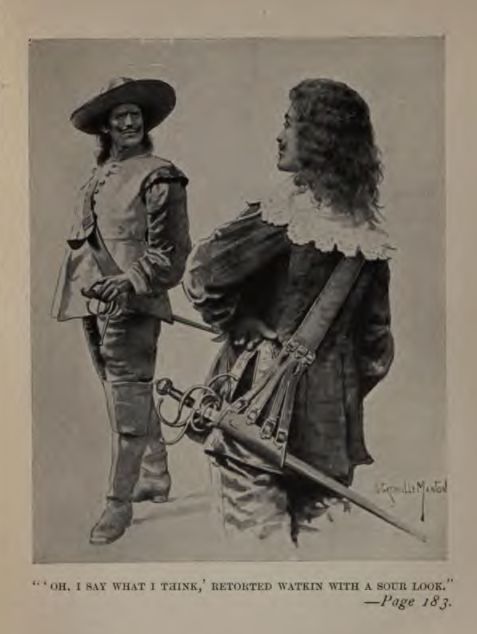
'OH, I SAY WHAT I THINK,' RETORTED WATKIN WITH A SOUR LOOK
So it was finally decided by a council of all
hands to cruise back towards Tortuga, taking of
course any gleanings in the shape of laden ships
that they might be lucky enough to find on the
way, and the poor Secretary's heart sank at the
thought. She knew how unpleasant would be the
attentions of the nasty hussies of that town to her
revered patron, Prince Rupert.
The meeting, however, with another ship of the
buccaneers, sailing plunder-wards, put an end to
this wretched plan with a pleasant suddenness.
She was under the command of a Captain named
Watkin, a rude, strong fellow whom the Prince
had met before in a humbler capacity. Imprimis,
Watkin and his company had themselves just
sailed out from Tortuga, and left the place
absolutely barren of liquor. This was enough to
check Wick's silly fellows at once in their voyage.
The newcomers' second argument was even
stronger to bring about a conference. They had
with them seven casks of rum, the last remainder
of the Tortuga merchants' stock, and they invited
all the ship's company to come across for a carouse
there in mid sea.
A gale was blowing at the time which would
have made more cautious seamen snug down their
canvas and get preventer tackles rove. But these
reckless fellows argued that if they would have
put their ship up alongside an enemy, never mind
what weather prevailed, why then there was all
the more reason why they should not be timid at
rasping bulwarks with a friend when politely
invited to despoil him of his liquor. So when due
salutes had been fired by both sides, and noise
enough made to scare the very fishes, the vessels
were forced together, and lay there grinding and
splintering and in imminent danger of causing
one another to founder incontinently.
With shouts and songs Wick's buccaneers
scrambled over the leaping bulwarks, making
passes with their sheathed hangers, which the
others warded off with black-jacks and drinking
horns. And indeed so fierce was their preliminary
horseplay, and so shrewd their jesting blows, that
two or three pairs drew and laid into one another
in hard bloody earnest before the rum casks were
set abroad and gave them other matters to think
about.
At first it seemed that the ships were to be left
to their cuddle, and with the sea running as it
was, and the heavy wind now filling the canvas
and now setting it aback, the pair would not have
been very long in knocking one another into their
primitive staves. But Wick had some shreds of
prudence left, and when the Secretary, desperately
fearful for her dear patron's life, implored him to
take some steps so that they should not all be
uselessly drowned there together, the fellow with
his own knife cut the grapples that held the ships
to their deadly embrace, and made some of the
buccaneers pass his own vessel astern at the end
of a stout hawser. She rode there dizzily enough
and with much jolting and creaking of fabric, but
for the time she was beyond doing further damage,
and moderately safe from receiving it; and
meanwhile the crowd of buccaneers on the deck
swigged at the rum, and roared their songs, and
laughed and swore at the water which came swilling
about their knees when the vessel in her rollings
shipped a sea.
It says something for the recklessness of these
rude men and their love for carousal that they
could have taken part in such a scene. They were
in the midst of hostile seas, with no resources
but their own for reliance; a gale was blowing
that might well have sent timid folk to their
prayers; neither crew had (as it turned out) above
four days' food between them and starvation, and
yet they held as little dread of the consequences,
and put as much heart into the rum-drinking,
the dicing, the bawling of choruses, the firing of
salutes, and the other ridiculous pranks of a
debauch, as though they had been reeling about the
wine-shops of Tortuga, or toping in the
dinner-chamber of Monsieur D'Ogeron. Night fell,
and the wind grew noisier (as is its custom with
the dark) and the run of the sea became more
dreadful; but none of these things taught them
sobriety. Indeed when they had lit the ship with
her battle-lanterns, they swore the deck was as
good as a ballroom, and set to dancing and
capering about, whilst the water which she took
over her sides swirled and eddied about their
waists.
Only one item in the whole of that horrid
night's array of terrors quelled these buccaneers
even into a moment's sobriety. A cry, a startled
cry, went up that there was a mermaid swimming
close abeam, and the song snapped off in the
middle of a bar, and the rum cup halted in
mid-air. Some crossed themselves, some dropped on
their knees and fumbled at a prayer, and a few
pious spirits, less drunk than the rest, trolled out
a quavering psalm as the best safeguard which
occurred to them. There is no doubt but what
the courage of all of them was woefully shook, and
the secretary, though indeed she could see no
mermaid, owing to the blackness of the night, will
ingeniously confess to being at one with them in
their tremours.
But Prince Rupert, with his accustomed
bravery, rallied the ships' companies into
steadiness again. He urged them to pass up powder
from the magazine, and get shot from the racks
round the hatches, and stand by the guns. And
when Captain Wick and the other buccaneer
commander chided him, he admitted plainly that
he had never heard of a mermaid being shot, but
at the same time professed his personal willingness
to loose off a culverin or a saker at one if
she should come within range. "It's my poor
opinion, gentlemen," said he, "that the creatures
have never been killed because no one as yet had
the impudence to shoot at them. There must
be a beginning to all things, and I am quite
ready to take the risk of this matter on my own
proper shoulders, if indeed I could see the mark.
But to tell the truth I have seen no mermaid, and
it's my belief there is none."
"They sighted her out yonder, abeam," said Wick.
"So I heard. But my eyes seem of but
indifferent quality, messieurs. I've looked, but be
split if I can see her. Mind, I offer no cause for
quarrel: I do not say she has not been sighted:
I merely say that my own eyes—and I've searched
with some scientific curiosity—have not been
fortunate enough to make her out. And what's
more, I'm looking now and still can see nothing
but shadows and water."
Upon which Wick and the other buccaneers
took their courage with both hands, and began
to look out also; whereupon it appeared that the
mermaid had sunk or swum away.
The crews went back to the rum casks little the
worse for the experience, but it was plain that
Wick was shaken. "It's a warning," said Wick,
"and some of us here will have to pay. A
mermaid does not come for nothing."
"I am ready to take my risks," said Rupert
lightly. "Indeed, if the lady pays us a second
visit, I shall hope to see her features more
accurately. To tell the truth, Captain, I came out
here with some curiosity about your mermaids,
and water-monks, and other monstrosities of these
seas, and it's beginning to die away."
"What," said Wick, "your lordship's seen
some of them and they were not so terrific as you
looked for?"
"Why, no," said Rupert, "the fact is I've seen
none of them."
Captain Wick dipped up another horn of rum
and nodded his head over it. "Well, your
Worship," said he, "here's hoping that when your
education on the matter comes, you may not find
it too disastrous. Every man who's sailed these
seas for long knows what mermaids can do, and
I tell you straight that I for one should be the
last to anger them. The good Lord grant that
the mermaiden we sighted meant nothing bad,
though it sticks in my mind that she came as a
warning. Here's luck and dry skins to us all,"
said he, and poured the rum down his throat.
The coming of this mermaid, as has been said,
sobered the buccaneers for the moment, but once
she was gone again, rum soon washed the memory
of her visit from their minds. They roared
at their songs till the gale itself was outshouted,
they danced about in the seas that swept the
decks and tumbled foolishly in the scuppers, and
not content with having the ship lit with her
battle-lanterns, they must needs set a tar barrel
blazing and flaring on the cook's sand-hearth, to
the imminent peril of every soul on board. Wick
presently was swigging at the rum, and playing
the zany with the silliest of them, for it is the
custom of many of these buccaneer commanders
to curry popularity by joining in all excesses that
may be going, and indeed outdoing all the others
in their extravagances.
But Watkin, the other captain, was a man of
different stamp. He did not spare the liquor
indeed, but drink had small effect on him. He was
a man who had a mind for many things. As a
ship-captain he owned but small experience, and
indeed was forced to carry a sailing-master to use
the back-staff and the other utensils of navigation.
It was more as a woodsman, and a hunter,
and an accurate shot that he carried skill. But
pre-eminently above these he was a man with a
brain enamoured of commerce, and it was because
of the handsome and generous way in which he
talked of moneys and gains that he had been
elected to a captaincy. A man who can speak
glibly and alluringly of profits can always find a
strong following amongst needy buccaneers.
"Anybody who likes can come round here and
collect the dirty coppers," said Watkin. "I've
no appetite myself for those small scrapings. And
mark you, they're just as hard to get as the
bigger things. I've seen Spaniards fight over a
cargo of stinking bulls' hides with a fierceness
that would have done them credit if they had
been defending a plate ship. No, Mr. Prince, my
idea is to go out with empty holds (which we've
got now) and come back so loaded down with
gold bars and plate that the decks are half awash.
I've got no use for silks, and shawls, and chests of
dainty clothes. I'm going to spend my time
earning good sound silver and gold, or else know
the reason why."
"Master Watkin," said the Prince, "in your
business ideas you are a man exactly after my
own heart. It's clear to me you've got a place
that's ready for a visit in your mind's eye, and
probably had your plans cut and bucanned long ago."
Watkin sipped his rum and winked. "Well,
between you and me, Mr. Prince, I'm no great
seaman, and I know it as well as the next man.
So I leave sea adventures for whoever wants 'em,
and for long enough I've been looking out for a
place where one could earn a parcel of honest
plunder elsewise. Now mark you, the Spanish
towns on the coast are the best guarded, because
they are always expecting visits from the
buccaneers. So they cost many to storm and sack
them. But further into the country the fortifications
are built more for the look and comfort of the
thing than for real use, because they think that
buccaneers are web-footed creatures who dare not
venture far away from the friendly sea. So my
idea was to find my town inland, but yet not too
far inland, because when buccaneers return with
their plunder, few of them remain over from the
previous fighting, and of these many are wounded
and many are fever-struck, and the rest are well
addled with drink, and such a convoy is easy cut
up, as previous experience has shown."
"You know the conditions of warfare finely."
"You never said a truer thing, Mr. Prince.
Here's to your health again, though I've drunk it
before. And now, in your ear, the place that's
going to fill my purse is named Coro. It lies just
at the bottom of the Golfete de Coro. La Vela's
the port, and it's some ten miles away to the Nor'-east
and the passes between are sown with gates
and forts and drawbridges, all built very superior." He
took a small stained chart from his pocket,
and unrolled it on the deck beneath the glow of a
battle lantern.—"There's the place, Mr. Prince."
"I see. Just on the neck of the Paraguana
peninsula. Then, Master Watkin, if all preparations
are made to resist entry on the Eastern side,
I should say that a call could be made with
less formality from the Westward."
Captain Watkin smacked his thigh delightedly.
"You've hit it in once. My strategy's this,
Mr. Prince. I want Captain Wick to go in front of
La Vela, and make all the noise there he's
capable of. That will bring the troops tramping
down to the batteries and fortifications, and in
the meanwhile I with my merry men will work
round into the Golfete and land at the Westward
side, as you have said, and tumble in by
the back door with few to stop us. I've taken
care," said Watkin with a sly wink, "that there
shall not be the full quota of troops in the place
when we make our call, or rather I have done
my best to that end. But as you'll know for
yourself, Mr. Prince, these engagés are not over
and above reliable."
"Engagés?" said Rupert. "I'm afraid I do not
quite understand. Buccaneers' apprentices, do
you mean?"
"Just those. They were part of a cargo of
prisoners the Lord Protector Cromwell shipped
out to Tortuga—cavaliers or malignants he
called them, but I am so long from home that
I forget English politics now—and Monsieur
D'Ogeron sold them to the buccaneers of
Hispaniola. They were the engagés of these same
bright fellows who have shipped with me and
whom you see drinking down there on the main
deck now; and as they were ours, body and soul,
to do with as we pleased, we set them ashore
some forty miles from Coro as a species of decoy.
Indeed we had only landed them a day before we
came up with you, and were standing off and on
to give them time to do their work. Their orders
were to burn, sink, and destroy, to set up
faction fights amongst the Indians if the chance
came in their way, and in fact to do what they
could to draw out an expedition from the town.
You see my strategy, Mr. Prince?"
"More clearly than your kindness to these
engagés?"
"Why, what better could they have? it is their
bounden duty to make themselves of use to their
masters, and if when they draw the Spaniards
down about their ears they all get killed, why,
by the Lord, they've only themselves to thank
for it. They should have learned to fight better.
They're not without promise of a fine reward to
give them keenness. All who do their work and
remain alive, and contrive to join us in Coro
when we've took the place, will be given
freedom, and made full Brethren of the Coast with
due ceremony and rejoicing. Now I ask you,
what better guerdon could an engagés wish for
than that?"
Prince Rupert sighed. "I am a man that's
seen a good handful of service, Master Watkin,
but I fear I'm not up to the true buccaneer's
standard of hardiness yet. And besides, you
named these poor fellows as cavaliers, and it
sticks in my mind that many amongst them will
have been my old fellow-soldiers in the English
wars."
"If I were there to lead them," said Watkin,
"I warrant I'd come through sound enough
myself, and bring a good handful in at my heels.
But I'll own they lack a leader. There are
several amongst them who have borne officers'
ratings, and I dare say could put troops through
pretty exercises on a parade ground. But we
want something more than mere drill-book out
here, as I daresay you are beginning to learn for
yourself. For you I take it, Mr. Prince, were
once just a routine soldier."
"My man," said Rupert, "I am not given to
take offence where none is meant, especially from
a fellow who is in his cups, but I'll not have my
previous service sneered at, neither will I have
unfortunate cavaliers spoken of with contempt."
"Oh, I say what I think," retorted Watkin
with a sour look.
"Then, sir, you had better take your sword,
and I will do you the honour of crossing it with
mine."
Watkin thrust out an underlip. "Mr. Prince,"
he said, "you may be a big man where you come
from, but let me tell you, that you've a lot to
learn about New World manners yet. Why, you
set up to belong to the Brotherhood of the Coast,
and here you're offering to break one of the first
rules. Don't you know, 'all private disputes
with a Captain, duly appointed, shall be left over
for settlement till the end of the cruise?' And
further: 'Whoso draweth upon a Captain, duly
appointed, that man shall be hanged, or put to some
such other end as may be convenient?' Let me
tell you, too, there's no buccaneer in these seas
that would dare to ride down those rules. Why,
our good friend, Captain Wick, that takes such
pride in having a man of title beneath him as
quartermaster, would be the first to garter your
neck with a rope. Indeed, I believe it would
tickle Wick mightily if he could brag hereafter
amongst the wineshops that once he hanged a
bona-fide, genuine-made prince."
"Let it suffice that I threw away most of my
rank when I came to my present nasty company.
But for the other matter, Captain Watkin, as I
acted in ignorance of the rules, I am free to
acknowledge my error. Your chastisement shall
wait till the fitting season, and when it does come,
I trust you bear me out that I have not omitted
to add due usury for the delay. But touching the
present, sir. The flavour of your company is
vastly disagreeable to my palate, and I should
take it as courteous if you would set me ashore
in the track of these cavaliers who are my
friends."
"If you want to go and try your hand on the
engagés," said Watkin sullenly, "you shall be
landed to-morrow. I've had enough of your fine
finicking ways on this ship. I'm not Wick."
In this manner, then, was brought about the
separation of Prince Rupert from the sea
expedition of the buccaneers, and Stephen Laughan,
who alone was set upon the shore of the Main in
his company, was not sorry to be rid of their
ungenteel society, thinking then, poor fool, that
nothing could be more disagreeable. The beach
on which they were cast was desert; the country
beyond, mere forest and jungle; and for inhabitants,
there were wild beasts and still wilder tribes
of Indians. But somewhere in the country was a
band of cavaliers, and after so long a divorce from
these old companions, both Rupert and the
secretary hungered mightily to come in touch once
more with their manners and pretty conversation.
Their chance of finding this band of forlorn
adventurers was truly vague enough, but they
were not without some trace of direction. "Here
is the very spot where I set the fellows ashore,"
Watkin had said, "and you can see for yourself
the fire they built to keep away the mosquitoes
from their first camp. Who but raw fools would
have advertised their whereabouts with a smoke
like that? But this batch always seemed to think
of comfort first and consequences afterwards.
You see that saw-edged mountain inland? There's
an Indian village in a dead line between the place
of the fire and the highest tooth of the saw, and
their orders were to make for the village first. It's
likely they'll have carried those orders out, or
they'll have starved else. They're such poor
creatures that they've no sense to find food for
themselves, even in a country that teems with food."
This, in fact, was all the real direction that was
given, and Prince Rupert was too proud a man to
ask for more. The other buccaneers had bawled
out wishes for good luck, civilly enough, as the
pair were being put upon the beach, though all
decided that the mermaiden must have appeared
as a special warning to the Prince, and advised
extra caution accordingly. The secretary, loving
her dear patron so tenderly, and being so nervous
for his safety, could not but fall in with this view,
seeing that these rude mariners must have learned
much of the omens and dangers native to the
Carib Sea through sheer familiarity and custom.
But Rupert would have it that the thing was
preposterous.
"As if a mermaiden at sea could have influence
over an honest man seeking profit and adventure
ashore," said he. "And furthermore," said he,
"I don't believe there was a mermaiden at all." With
which brave saying he led the way into the
bush, the slim secretary following at his heels.
The track was easy to follow. The cavaliers,
with no knowledge of woodcraft, had cut their
way through the bush, taking account of neither
swamp nor thicket, and though one could not
withhold admiration for their bravery and
endurance, it was plain to see that they must have
risked marching into an ambush for every yard
of advance. Their labours must have been
terrific. Even following in the made track taxed
all the poor secretary's endurance. The air was
a mere stew of heat, made still more horrible by
the swarming mosquitoes. Serpents and wild
beasts threatened one from the forests, and the
morasses stank detestably of fevers.
The work had been done at a heavy enough
cost. Scarce a mile was passed without coming
upon the carcass of some poor cavalier who had
fallen, and been abandoned to die, and forthwith
became the focus of a covey of disgusting birds.
One man indeed they came upon with a tremour
of life still in him, and the birds sitting round
like ghouls on neighbouring trees. But he was
beyond speech, and indeed passed whilst the Prince
stooped over him, and when they left to continue
their march, the rustle of wings from behind told
that the birds had flown down to commence their
meal.
It irks the secretary to record matters so vastly
impolite as the above in these memoirs, and
indeed many things have been withheld; but in view
of the grave events which follow, it is necessary
that the desperation of this expedition should be
clearly shown. What was the ultimate fate of
the unfortunate band of cavaliers that Prince
Rupert was following will probably now never be
known. That they acted as a decoy, as Watkin
had intended, was evident enough, for no less
than three large companies of soldiery were
despatched from Coro to cut them up. But none of
these, so they afterwards stated, came across the
raiders, and though they all found their traces,
none had skill or endurance sufficient to follow
them up. And so it appears that these poor
cavaliers were swallowed up by that inhospitable
interior which lets not even a rumour of its history
escape to the outside world, and whether they
were all destroyed, or whether stragglers of them
married and settled amongst the Indians, will
remain forever a sealed mystery.
But of the two unfortunates who followed in
their track, the history of their adventures
(though it be merely one of unbroken misfortune)
must be given with all its sorrowful detail.
Though Rupert would have none of such morbid
theory, the secretary, who in most matters agrees
with her adored patron to the letter, cannot help
recording that from the moment of seeing the
mermaiden luck attended none of their efforts.
They were bogged in swamps; they were tormented
with the flies; they ate fruits which gave them
colics, and suffered incessantly from the fevers
which are inseparable from these regions. They
were, in a word, half beside themselves with the
torments which were native to the country, and
if the secretary had been alone, or with any other
leader, she is free to confess that she would
incontinently have lain down to die five times a day.
But Rupert struggled doggedly on, and though
indeed he cursed aloud the fate which led him to
an end in so detestable a country, and sighed a
thousand times for one more wild charge in which
he might ride to a genteel death at the head of
his English troops, he never lost his valiant
courage, and never had aught but cheery,
pleasant words for his solitary follower. "Fortune
may be blacker still, Stephen, lad," he would cry,
"if it can invent a deeper tint, but I'll never give
in to you over the matter of that mermaiden."
In the end, however, they marched along in a
kind of stupor, exchanging no words, and not
possessing even the energy to brush away the
mosquitoes from their swollen faces. They struggled
on, hand-in-hand, clutching at branches and
tree trunks for support as they passed them, and
the maid, by reason of her fierce love for this
adorable Prince, put forth powers of endurance which
astonish her even now to look back upon. But
when at length, in their blind, half-fainting
condition they marched directly into a camp of the
Spaniards, they were in no fit state for any
elaborate display of attack or defence. It is true
that Rupert did run one fellow through the
lungs, and the secretary's feebling arm did guard
her patron's back through fully two minutes from
attack. But the outcome was beyond question.
Their swords were trundled out of their hands, and
they themselves beat to the ground through sheer
weight of blows.
Dully they looked for death, and had no spirit
left to resent its arrival. A clubbed arquebuse
poised over the head of the Prince, a sword was
drawn back to stab through the heart of the
secretary. But the officer of the troop came up just
then, and was more farseeing than his followers.
Prisoners from the English buccaneers were
scarce, and naturally he wanted to parade his
capture; and, after enjoying this pleasant triumph,
why then (as he explained) the Holy Office
would be gratified to take over the bodies of two
such vile heretics, and presently would make
them into a very popular public spectacle.
Wrist and ankle irons are part of the ordinary
accoutrements of these Spanish troops, as all
Indians they come across they enslave—a very
wasteful proceeding, one would think, as the
creatures invariably die within the year, and are
vastly inferior to blacks from the Guinea coast as
labourers. But there the irons were, and quickly
the prisoners were made fast and given food and
drink, and left to recruit as best they could at the
bivouac.
The Spaniards made no further progress with
their expedition: the taking of two English
prisoners seemed to satisfy their greediest ambition;
and when a day had been allowed them to regain
strength, the column was put in motion again for
a return to Coro. The prisoners were vigilantly
guarded, but otherwise they were not ill-treated,
for it was part of the captors' plan that they
should enter the city looking healthy and vigorous,
to give colour to the tale that they had been
taken after desperate fighting and resistance.
Indeed, the secretary, who, poor creature, was
suffering from that seasonable fever which they
call the calentura, was given a mule for her
conveyance, and had the mortification of seeing her
royal patron trudging beside her afoot whether
she would or not. But prisoners are not allowed
to pick and choose in these matters, and when
Master Laughan would have leapt to the ground
in spite of the guards, so that the Prince might
ride as befitted his station, the fellows coupled
that prisoner's heels beneath the belly of the beast
so that submission was a sheer necessity.
The Prince too laid strict commands upon the
secretary on this matter. "We're in a tight fix,"
he said, "and we're fools to have got there. As
like as not they'll give us a dog's death of it. But
they shall have their sport out of me as an
unknown Englishman and not as Rupert."
The secretary urged a reversal of this decision.
"No use," said the Prince. "They would hang
me all the same if they knew my quality, only
they would hang me higher. I have my miserable
pride in the matter, you see. Let me be
written down in Europe as "Missing" or "Vanished,"
if they choose; but I should die very
uneasy if I thought the world was to know how
squalid and obscure a noose it was that ended me."
Still the secretary urged the point, saying that
all men knew Rupert Palatine, and that even these
dreadful Spaniards would not dare to do him
violence, but would offer exchange, or honourable
enlargement upon ransom. But Rupert closed
the talk with sudden heat. "I forbid it and that's
enough," he cried. "You grow insufferable with
your advisings upon this occasion. And if you
want a threat, I'll deny it if you do tell 'em my
name, and curse you with my last dying breath
into the bargain. So stick that in your mind,
Master Laughan."—With which harsh words he
lapsed into a dark, brooding silence, and the
secretary, with her heart near to breaking with
love for him, was constrained to ride the mule
without further speech.
It was the first time that Stephen Laughan had
ever seen the Prince thoroughly cast down, and
so evidently out of all spirit for the future, and of
a certainty their case seemed absolutely devoid of
any ray of hope. Truly the finger of the
mermaiden was showing itself to any one who was not
wilfully blind.
Of that dismal progress to Coro, however, no
more need be told. They arrived outside the city's
walls on the fourth day at nightfall, and the
commandant of the soldiers was torn with indecision.
He wanted much to wait outside so as to make
triumphant exhibition of his prisoners by next
morning's light, and at the same time he feared
the Indians who were constantly raiding up to the
very walls of the city. And in the end dread of
these Indians took the mastery, and the troop
gained admittance through the gates, and they
had to be content with what drums and a multitude
of flaring torches could do to call attention
to their show.
There was no limit to the appetite of these
Spaniards for triumph. It might have been an
army they had captured instead of two
fever-stricken weaklings. But no one of those who
thrust their heads out from the windows and
doorways of the houses cried shame on them for
the paltriness of their exploit, and indeed all the
town roused to acclaim these vainglorious captors
by the name of hero, and to spit their nasty spite
at the prisoners. Great mobs turned out into the
streets, and jostled at the soldiers' heels. Here
were a brace of these hated buccaneers, and they
lusted to have their will on them. The smug
citizen men would have smashed them to a pulp
with their boot heels if they could have snatched
them into reach, and the horrid women would
have torn them like vultures with their nails.
The Captain of the soldiers, however, was not
minded that his credit should end with this
popular triumph: he was a man with a keen eye to
his own promotion, and he was wise enough to
know that favour comes chiefly from their
idolatrous Church in these Spanish cities. So with
laughing blows he and his men drove the civilians
back from their catch, and shouted out that they
were foolish to hurry matters unduly. "The Holy
Office may move slower than your own honoured
progress," he cried, "but, Señores, believe me, it
is very sure. It will take a vengeance out of these
accursed heretics that you may lick your lips to
think about, and there is a good chance that the
city will be treated to an auto da fé. Ho! there,
make way! Why do you want to claw a prisoner
when presently you will see his skin crackling like
a pig's as he roasts on the faggots? Stand back
there, I say, or you'll have an arquebuse butt
dropped on your honoured toes."
The officer swelled with his triumph and made
it linger by passage through many streets, and
from out of the darkness beyond the glare of the
torches came peltings of stone and garbage which
made the procession for the prisoners a very
martyrdom. But worse lay beyond. They drew
up at last before a building whose horrid taint
caused even the callous Spaniards to moderate
their shouts and jeers. The officer too changed
his bluster to a tone that was half-defiant,
half-cowed as he faced the shrouded nameless creature
that answered his summons at the gate, and the
soldiers of the guard redoubled their watchfulness,
knowing full well the desperation of any poor
wretch that came within grip of the Inquisition.
Indeed, had a chance been offered, the secretary,
through sheer horror of her sex being discovered
when handled by the torturers, would have thrown
herself upon the weapons of the guard, and so
earned a quick death, even with the dreadful
knowledge that to do so would take her away
from this princely patron whom she had so
faithfully guarded, and whom she so madly adored.
But the soldiers were ready for all such desperate
attempts, and kept firm grip on the fetters, and
when the cowled familiars of the Inquisition took
over ward of them, and the doors closed, equal
care was shown by these new guardians.
"By my faith," said Rupert, "you do us high
honour, Señores, with all this heavy escort.
Buccaneers must be very lusty blades, or you Spaniards
must be nervous by constitution. Why, Señores, it
hardly stands to your dignity that it should take
a round dozen of you to handle a couple of poor
wretches that are chained at both wrist and leg."
But the echoes of the cold stone passages gave
the only answer to his words. The cowled,
soulless familiars uttered no word of a sound.
The sad procession wound down steps of
stone, into a long row of dungeons smelling of
earth, and of these there seemed an inordinate
quantity, burrowed out from amongst the very
roots of the city. In most was a dank, cold silence,
but two emitted groans from some part of their
black recesses, and from one the faint glow of a
fire shone out into the alley, and with it came the
smell of grilling flesh. But by no word or sound
did the familiars show that they appreciated these
things. They pressed on their way with noiseless
tread, and held on to their prisoners with an iron
clutch. They were most daunting gaolers.
The prisoners were flung together into one
dungeon, and the door closed with soft heaviness
on their heels. The place was black as the grave,
and smelt too like a grave of new-turned earth.
The secretary lay on the damp floor where she
had pitched, a prey to the worst despair. But
the Prince undauntedly began to make exploration,
treading with caution to avoid pitfalls which
are common in these places, and not resting till
with his hands he had traced out the whole of the
walls and the floor. But at last he too flung
himself on the ground. "We're built in all ways by
cemented stone," said he, "so we need not risk
our dignity by trying to break gaol. There's
nothing against which we can grind these bracelets
from our wrists and shanks, or we'll contrive
to make a fight of it somehow and at least die
like gentlemen. So we must e'en be philosophers,
Master Laughan, and take what comes."
"That woeful mermaiden——" said the secretary.
"Pish! you fool. I tell you there was no
mermaiden. It's the mere fortune of war, and it's
my one consolation that they can do their ugliest
on me and yet they'll not learn my name. It'll
be a sharp time, lad, for both of us when they
begin their devilish torturings, but I know you're
as staunch as myself, and I thank you in advance
for carrying out your service to me faithfully to
the end."—And with that he turned on his side
and promptly went off into heavy sleep.
To the poor secretary no wink of sleep would
bring relief. Death or torture she could have
faced bravely; but the thought that her sex must
be discovered drove her well-nigh crazy. For
consider what it meant: Rupert would learn for the
first time that she was indeed a maid, and he
would die sickened at her shamelessness in
following him, and she would die beside him, knowing
that after all that had been endured, she had at
the very last lost his esteem and affection.
Wearily the hours dragged on, and how many
they were cannot be told here, as there was no
means of reckoning them. But at last the door
opened and again those noiseless familiars entered,
bearing lights. The secretary, poor soul,
attempted a jest by way of carrying a brave front.
"We think little enough of your inn, Landlord,
so far," she gibed. "See to it that you improve
the service from now on, or our recommendation
will bring you little further custom."
But they answered by no word, and as the
cowls hid all of their faces, there was no way of
seeing how they took it. Once more with iron
grip these silent men took the prisoners in charge,
five familiars to each, and led them out along the
passageways.
There was little enough of dignity about the
judgment chamber of the Inquisition when it was
arrived at. It was just a bare room, furnished
meanly with a bench, a table and a curtain. And
in the middle of the room the prisoners were
drawn up and stood with the familiars, waiting.
From behind the curtain from time to time there
came the faint rustle of movement, and, in little
gusts, the smell of burning charcoal and heated
iron.
There is a certain intolerableness about waiting
like this when one expects the worst indignities
that human ingenuity can put upon one; though
that doubtless is part of the calculated cruelty on
which this accursed Inquisition coldly prides
itself. But Prince Rupert, like the gallant
gentleman that he was, had a power of mind that rose
above the pinch of the moment. An idea had
come to his mind during the night for an
improvement in that process of mezzotint engraving
in which he was so interested, and calmly and
scientifically, with his accustomed clear phrases
he commenced to discuss it with the secretary.
There was no mention in his speech of the perils
which threatened them, no quiver of fear or
annoyance lest his invention should be left
incomplete by those who became his heirs. But in
that gristly judgment chamber he spoke with as
much ease and interest in his subject as though
he had been seated giving audience to his artistic
friends at The Hague.
But the five familiars who held their clutch on
him, and the other five who held the secretary,
never for one instant relaxed their muscles, neither
did they show by any movement or word that
they were conscious that a word had been spoken.
They were uncomfortable creatures.
At last, however, the Inquisitors themselves
entered, one, a young man, black-avised and sturdy,
and two elders whose peaked beards were grey
and venerable. A monk in russet brown sneaked
in at their heels.
The Inquisitors seated themselves at the bench
before the table. The monk stood apart with
hands folded over his crucifix and head bent. His
lips mumbled as he repeated his office. The
younger man took the centre of the bench, and
commenced the Inquisition. He spent little time
in beating about the bush. "It is reported to
me," he said, "that you two are heretics."
"If the definition implies that we are earnest
members of the Reformed Church," said Rupert
with a courtly bow, "I accept it, Señor, both for
myself and my companion."
"So," said the Inquisitor, "you choose to
beard us to our faces? Father," he said to the
monk, "offer them your holy symbol. Perhaps
the devil speaks only with their voices, and with
their lips and hearts they may give another answer."
The monk stepped up to the prisoners, holding
his crucifix to be kissed, but each in turn shook a
determined head. "Neither by word nor sign do
I become apostate," said Rupert civilly, and the
secretary with an effort made her voice firm and
repeated his words.
The monk's eyes gleamed, and he stood back
to his place. The dark Inquisitor frowned. "You
must know where you are, and you must know
well what will be the result of this obstinacy?"
"Yes," said the Prince calmly, "you will next
prove that you are brutes and the sons of brutes
by putting us to the torture. We shall accept
what we cannot avoid, but we shall not turn our
religion. I should think shame of myself, Señor,
if I accepted a faith which was sullied by the
adherence of bloody-minded men like yourself."
The dark Inquisitor flushed till his face was
almost black. "You shall regret that," he snarled.
"I will look on and give directions whilst every
muscle of your body is made to quiver with
agony."
"Señor," said the Prince with a bow, "you show
that you have every talent developed to the full
which could be of use to a coward and a butcher."
The dark man leaped to his feet and beat the
table a blow with his fist. For the moment he
was inarticulate with rage. But the two older
men who sat on the bench had respect for the
dignity of their office, and they leaned forward,
and in whispers did what they could to pacify
him. He had a struggle with his passion, and
looked as though he could have struck either
of them for their interference; the monk also
came forward, significantly raising his crucifix, as
though to show that they were assembled there
for the purposes of their Church alone; and
presently with an angry scowl he sank back again on
to the bench, and nodded impatient assent to the
whispers.
But if ever the thirst for a cruel vengeance
showed in a man's face it shone from the dark
Inquisitor's then.
He nodded his head at the prisoners. "Presently,"
he said, and looked towards the curtain,
which defaced one side of the room, with an eye
that was ravenous in its hunger.
"It would be affectation to misunderstand you,
Señor," said Rupert in his grand manner.
"Presently you will torture me as few men have been
tortured before, just to appease your private
spite—you that dare not meet me face to face with a
sword in your fingers. Your Church should be
proud of so doughty a champion, though in God's
truth I fear you are forgetting this minute that
there is such a thing as a Church."
The Inquisitor winced as though he had been
struck, and the dark flush died from his face. He
let his eyes droop to the table before him, and
kept them there sunk in thought. His face worked
with the violence of his feelings. The judgment
chamber was steeped in an intolerable silence.
Twice the older men who sat beside him on the
bench brought their grey beards to his ear, and
whispered. But impatiently he waved them aside.
The monk in the russet gown watched him
narrowly as though he could read the tumult of his
thoughts, and at last, as though to lead them in
the path he would wish, kissed his crucifix and
reverently placed it on the table beneath the
Inquisitor's twitching face.
The man sprung back as though it had stung
him, and his face still worked in silence. But at
last he spoke. "You are right, father. And you
have saved me from a deadly sin. I am not fitted
to be an Inquisitor, and after to-day I resign my
office. But for now I am still here, and justice
remains to be done, and the honour of the holy
Church vindicated. Prisoners," he cried, turning
to the two before him, "you shall not be put to
the question after our usual methods. From your
own lips I will judge you and give sentence.
Again, I ask, Are you heretics?"
Prince Rupert shrugged his shoulders. "Señor,"
he said, "you are somewhat wearisome. I have
answered that question once already in the
affirmative. We both happen to be gentlemen; if you
had been one also, you would have known that
our honour would forbid us to make change so
suddenly."
The dark Inquisitor bit his lip. It was clear
that he had quite a mind to flare out afresh. But
with a violent effort he controlled himself. The
two older men leaned towards him, with evident
intention of lending their advice. But impatiently
he waved them aside and turned a livid face on
the prisoners.
"Be it so," he said. "You shall be judged on
that confession. The personal insult avails
nothing here either in mitigation or addition to your
sentences. Your contumacy is proved beyond
doubt, and this Holy Office casts you forthwith
from its tender care."
"So that it rids me of your society, Señor," said
Rupert, "I care not what others of your devilish
compatriots you hand me over to."
"You will be transferred from our keeping to
the secular arm, and on the afternoon of this very
day you will take part in an act of faith already
arranged for three other obstinate heretics. You
who hold them, remove the prisoners. And," he
shrieked, thrusting himself in an ecstasy of passion
half across the table, "if they offer to speak, beat
in their faces."
Two of the familiars stepped back, each with a
heavy iron bar uplifted in his hands, and under
this persuasion the prisoners kept silence. Then
the men in charge turned them round and marched
them out of the judgment chamber.
Formally they were handed over to armed
guards in another part of the building, and these
put on over their clothing, gabardines of coarse
canvas, named San Benito robes, which were
painted grotesquely with flames flickering upwards,
and devils in black and red fully equipped with
hoof and horn. So the victims were decked ready
for the sacrifice.
Nor was the sacrifice to be kept long in
waiting, and the secretary stoutened her heart and
thanked God that this glorious Prince whom she
served was great enough to offer himself as a
martyr for his faith, and that she would have the
privilege alone of all those that had followed him
of being with him to the last, and sharing his end.
The thoughts of pain and indignity were gone; if
her sex were discovered during the burning, at
least it would be when it was too late to snatch
her from death; and so to the last she would avoid
shame from the eyes of this great patron whom
she so truly loved.
The doors opened, and the troop marched out
with the prisoners in charge, three other poor
wretches with joints dislocated by torturings also
hobbling along by their side. The streets
hummed with people. The windows were gay
with sight-seers. And presently, when they came to
the plaza, where five stakes sprouted up each from
its pyre of faggots, there were stands built so that
no citizen might miss the spectacle of the day.
It may be thought that the present historian
exaggerates concerning this: but on her honour,
these bloody-minded Spaniards look upon an Act
of Faith, (as they term the burning of those who
refuse the idolatrous Faith of Rome) as we at
home in England look upon an innocent
bull-baiting or a dog-fight.
"Keep a bright face, my Stephen," whispered
the Prince as they were marched along. "It
would grieve me if these curs had the satisfaction
of thinking that they had cowed us."
"I could smile," said the secretary, "when I
think of the pleasure that mermaiden will feel at
having been so clever with her prophecy."
"Pooh!" said Rupert, "you and your mermaiden!
I'll never believe there was one, and
that's my dying conviction. What think you of
my diplomacy, Stephen, with that black-avised
Inquisitor? If I hadn't maddened that man into
losing his temper, we'd have been writhing in
their filthy torture-chamber this minute.
However, lad, enough of this sullying talk. Let us
turn to that genteeler matter that occupied us
before."—And with that he spoke once more upon
the elaboration of that process of mezzotint
engraving in which during politer days he had taken
so clever and abiding an interest.
In due order the five prisoners were marched
out into the plaza and there under the burning
midday sunshine were fastened by chains to the
stakes which stood out from the piles of faggots.
The audience ceased to chatter; the Inquisitors
and the other dignitaries of the city came up
and took their places on a high draped dais in due
order of precedence; and all was ready for the
torchmen to set light to the pyres. But at the
last moment one of the three other prisoners,
ashen-white, screamed out, "I recant! I recant!"
and immediately a monk went to him and
received his last confession and pronounced
absolution. More time was occupied whilst this wretch
received the reward of his apostasy, for as is well
known, all those of the condemned, that in words
embrace the Roman faith before it is yet too
late, are privileged to enjoy strangulation before
that they are burnt. The which operation of
course occupies time.
But at last this wretch was announced to be
dead, and indeed hung very loosely in his chains
in advertisement of his decease, and the supreme
moment arrived. The torchbearers advanced
with flame that flickered pale and dizzily under
the sunlight, and the poor secretary, who intended
to devote these last moments to commending her
soul to the Most High, could think of nothing
but that disastrous mermaiden who had caused all
this anguish and disaster. But Prince Rupert
was ruffled neither in words nor confession.
"Into Thy hands, O Lord God," he said, "I
commend my spirit, with a full acknowledgment
of my sins, which be many, and a humble reminder
that I have at all times endeavoured to do my
duty. O Lord receive my spirit into Thine own
place, and punish bitterly these Spaniards that are
Thine enemies. Amen."—With which prayer his
devotions ended, and he returned again to the
grave discussion of those improvements in mezzotint.
The secretary does not see that a better proof
can be given of this glorious man's greatness of
mind. What other creature on earth could bring
his attention to such talk when so horrid a death
immediately threatened him?
The torchmen were actually putting their flames
against the tar with which part of these pyres is
daubed, when the interruption came which saved
the prisoners' lives for the time being. A
horseman clattered into the plaza on a half-foundered
stallion, crying that the auto da fé should stop.
The black-avised Inquisitor in a passion leaped to
his feet and shouted that what was ordered should
be gone through with. But the torchmen, halting
between two authorities, plainly dawdled with
their work, and the newcomer reined in his
staggering horse and threw up an hand for silence.
"Hear me," he cried, "and then say if I was
wrong in interrupting. A parcel of buccaneers
under Wick and Watkin (whose accursed names
you well know) are coming against this city
directly. They took me prisoner and set me free
to come here and deliver to you their impudent
will. They ask no ransom, being confident of
their own power of taking what they want, but
they hear that you have some of their number as
prisoners, and through me they give fair warning
that if harm comes to them, they on their part
will burn every prisoner of the Spaniards that
they take, regardless of sex or age. And,"
concluded the messenger simply, "they will do it.
They are men that will stick at nothing, once
they have passed their word."
A riot of voices filled the plaza. It seemed
there were two parties in this city. The Inquisitors
were determined not to be robbed of their
prey, and these were backed up by the fanatics
amongst the populace, and by those reckless, cruel
few who did not wish to be baulked of a spectacle.
And ranged against these were the women and
the more responsible citizens, who feared the
buccaneers horribly, distrusted the defences, and
dreaded that the threatened burning was very
near to their own greasy skins as a retaliation.
Weapons were drawn, and it seemed as though
there would be civil war.
But once more the man on the horse directed
the doings of his fellow-citizens. Again he threw
up his hands frantically beckoning, and again with
some trouble he obtained a hearing. "The captain
of the port bid me say," he shouted, "that if
he could get his galleys manned, he would go out
and tackle these buccaneers forthwith. But at
present disease has been busy on the row-bank,
and he has few slaves to man the oars. It seems
to me, Señores, that you have some recruits
yonder chained up against those stakes? Why waste
them? And if they are killed by their friends in
the ordinary course of action, why the fault lies
outside this city, and we get the ordinary
treatment of war, whatever betides."
Again the riot of words roared through the
plaza. But it was clear that the balance of the
sides was altered. The proposal of the man on
the horse carried weight; the Inquisitors and their
fanatics were hopelessly outnumbered and
outvoted; and presently the torchmen stamped out
the flames, and men came up, and set about
unlinking the chains which held the prisoners to the
stakes.
Oh God! what a revulsion that respite caused
to one! The secretary was well-nigh fainting
with gratitude when they unchained her. Life,
dear life still was left. Only a slavery in the
galleys, lay before them to be endured, only the
lash, and the baking sun, and the heart-breaking
oar for a sentence after all! It seemed in
comparison to those fearful flames which had been so
near, to be the gift of some delicious dream.
But Prince Rupert viewed the change in a different
light. He saw only the dreadful indignities
to which he was condemned, and his pride gave
him more torture than the flames could have
offered if he had been scorched and burnt to
cinders at that horrid stake. His face blackened with
rage and his hands clenched and gripped convulsively.
"Almost," he muttered, "I am beginning
to give credence to your mermaiden, Master
Laughan. The mere fortune of war, unassisted,
could scarce have brought me as low as this.
The galleys for me! And sent there by Spaniards!"
The secretary's heart ached with a new pain as
she heard him. "God help the man," thought
she, "that's chained to Rupert Palatine!"
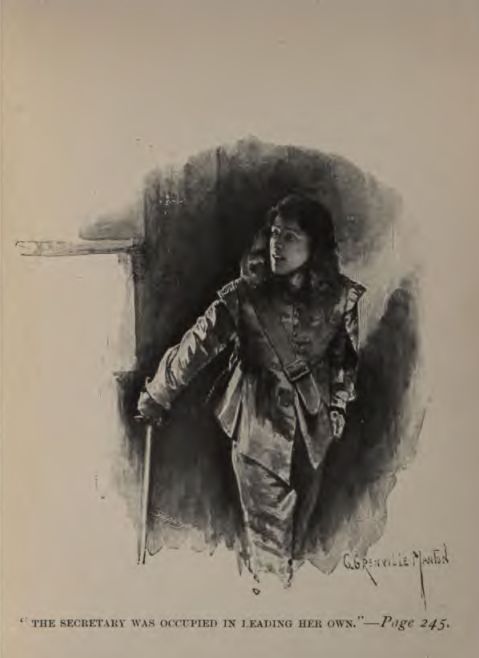
"THE SECRETARY WAS OCCUPIED IN LEADING HER OWN."
In all history there have been few more
lamentable sights than that of the great and glorious
Prince Rupert toiling as a common slave on the
row-bank of that Spanish galley. It is true that
the Spaniards knew nothing of his rank and
position, though their doltishness is proved by their
not surmising it from his grand manner and his
carriage. But the fact remains that they never
so much as guessed at his quality, even when the
Holy Office condemned him to the flames as a
heretic, and it was his firm command to Stephen
Laughan, his secretary and companion in misfortune,
that the incognito should be strictly preserved.
"They take me for an English buccaneer," he
said, "and I am content with it. I'd liefer be
conscience-free as a slave, than Governor of all
the Spanish Colonies on the Main and have to
kow-tow to their crafty priests. Moreover,
Stephen lad, when I throw back on to the oar-loom,
I'm minded that they've left us the use of our limbs,
and that's more than might have been. They're
clever devils with their torturings, and I'd rather
work through life sound as a galley-slave, than sit
crippled even in a palace."
So it will be seen that even in this terrible
adversity—and on all hands it will be admitted that
the galleys is one of the worst of fates—the
Prince carried a high spirit: indeed the secretary
would not be sure that he did not find some
entertainment in the adventure.
The hurry of going on board had been great.
Wick and his buccaneers had appeared off the
port in two ships with brooms at their mastheads
to show that they had cleared the seas, and empty
sacks at their yard-arms to hint that they were
bent on plunder. Wick it seems had caught a
boat load of Spaniards, and had sent them ashore
packed with saucy messages which filled the
Captain of the Port with rage and fright in equal
portions. If Wick had sailed in when he first came
up, he would have found the town of La Vela
(which is the port of Coro City) practically
undefended. But the Spaniards, after their idolatrous
fashion thanked many saints that the buccaneers
wasted much time in bombast and cautious
reconnoitring, and sent for troops from Coro with which
they manned La Vela ramparts and batteries,
and which they also set on the four galleys which
rolled at their moorings in the harbour.
For the motive power of these galleys, slaves
of all descriptions were pressed into service and
chained to the benches. Not one in six of these
wretches had been to sea before, and the odd five
were smitten with seasickness before they had
barely settled to their work. But the whips of
the boatswains who walked up and down the centre
gang-plank were a fine restorative to the feebled
minded, and, as the event showed, the slaves were
quicker to get over their malady than were the
soldiers who partook of no such harsh medicine,
and who were put on board to form the fighting
element.
The horrors of that first night at sea are
well-nigh unspeakable. Wick's ships had drawn off
late in the afternoon, and the galleys, so soon as
they were manned, put to sea in inglorious
pursuit. As a commencement, the slaves had been
chained by ankle-cuffs to traverse-bars which run
beneath the seat just in the order in which they
chanced to come aboard, and as a consequence,
though one oar here and there might be passably
handled, the great majority were strained at by
wretches who knew no trace of rower's craft, and
had little stomach just then to learn it. The
Spaniards, according to their brutal fashion,
thought to teach skill by the sheer lustiness of their
whippings; but these gave little real education,
and presently when the galley began to swing to
the choppy swells of the Caribbean outside La
Vela's protection, the confusion ended in first one,
then another, and then others of the sweeps losing
a blade, till she bade fair to be completely unrigged
if they kept her without change of arrangement.
In the midst of this devil's confusion, with the
night come down black about their ears and
whistling with wind, and the few lanterns showing a
very broken and threatening sea, Prince Rupert,
with his whimsical mood, must needs set up a
rollicking cavalier's song, to which the secretary
(with more of loyalty than prudence) lent her
more slender tones for a chorus. Three verses
rolled out over the charging swells with as full a
lilt and gusto as though they had been sung over
the wine-cups in merry England, and some
half-dozen others of the galley slaves picked up the
rhythm. "To hell with the rebels and God save
the King!" they sang, and presently the whips of
the boatswains began to crack viciously on the
backs of the singers.
But the chief boatswain stopped when he came
to Rupert, and stood with whip uplifted. There
was something in the Prince's face at the thought
of this last indignity that would have daunted any
creature living. "My man," he said, in a terrible
voice, "if you touch me with that thong, I will
kill you!"
"Pah!" said the fellow, "you are chained!"
"Happily for many on this galley. But desperate
men have desperate strength. I tell you freely
that if you thong me I'll break any irons you have
in the ship like pack thread, and I'll tear the life
from your throat with my teeth. Be not a fool,
boatswain. You see me here doing all the work
that is put on to this oar. Moreover, as you may
see from the swirl of the water, and the buckling
of the wood, it is an oar that's being shrewdly
driven. I mislike the labour heartily enough, but,
being a slave, it's my pride to be a good slave, and
it seems to me I've earned promotion already. I
should be captain of this oar instead of being set
on as the middle slave of the five who man it."
"You shall be shifted when the watch is
changed," said the boatswain, looking at him
curiously. "But I'll give you a double set of
irons as an extra present. You are too free with
your threats and schemes, my man, for a healthy
slave."
"I am as I am made," said Rupert. "No man
can change his nature too suddenly. But being
on this galley, I've her welfare at heart like
yourself; as I tell you, even a slave can take pride in
his work. And let me say to you, Señor boatswain,
you've your rowers wastefully arranged.
Your best men are next the rowlocks, or at a cleat
in the middle of the loom, ay, or anywhere but
where they should be, and that's at the oars'
inner ends, next the gangway, where they could
put government over the stroke. As a
consequence there's no evenness. Your timekeeper
with his gavel might be beating stroke for the
seafowl for all the regularity he's causing. And
so, although each slave may be working his
utmost, no two are getting their weight on it
together, and as a consequence the slaves are being
strained and tired out, and the galley gathers no
weigh. I speak as a seaman, Señor boatswain, and
I tell you plain that if you don't alter the disposition
of your slaves, it's a doubt if we weather the
night. You can note for yourself that the breeze
is hardening down and the sea's worsening."
The boatswain observed that others of the
slaves were forgetting their misery in giving ear
to Rupert's tirade, and he pulled himself together.
"Silence there," he shouted. "Hold your saucy
tongue, slave, or you'll be whipped yet." But
what had been said went deeply home to him, for
he began looking keenly amongst the benches to
see which of the slaves put most skill into the
dreadful toil, and when the gavel stopped beating,
and the oars were pulled in and their ends tucked
under the central gangway, so that the blades
reared up clear of the waves, he went aft to the
coach and held a close conversation with the
captain of the soldiers.
Presently there was a resorting of posts. A
gang of the slaves was told off to the pumps, for
the galley shipped more seas than was healthy for
her digestion, and these were chained there lest
they might cheat the Spaniards of their
usefulness by jumping overboard. Then there was
more unchaining, as those whom the boatswain
had marked for watermanship were unlinked from
where they chanced to be, and set each to the
inner end of a sweep to govern its strokes. The
secretary, to her great surprise (having indeed
only a maid's strength to throw into this dreadful
labour), was one of those honoured by promotion,
and Rupert, who sat on a row bank two behind
her across the gangway, gaily cried out his
congratulations.
It seemed that no circumstances could damp
the Prince during this adventure: indeed one
might almost say that his gaiety was unnatural.
For presently when food was served round—wine
of the sourest, sodden bread, and stinking dried
fish that they call baccalhao—he not only ate his
own portion with gusto, but took up also those of
the seasick wretches on the bench beside him, and
added these scraps also to his meal. "There's
work to be done for you and me, Master
Laughan," he cried cheerily, "and we need victual
within our ribs to keep us lusty. Show me none
of your daintiness here, Stephen. Eat soundly,
keep up a good courage and a sturdy arm, and I
promise you shall dine off sweeter victual when
the time comes as your reward."
The boatswain, who was still busy making the
exchanges, heard his speech, and understood it,
although the words were English. "Now you
talker," said he threateningly, "have a care, or
you'll earn something more besides those double
irons I've given you already."
"Why, Señor," said Rupert, "I was but anticipating
your kindness and your gratitude. There
are slaves and slaves. Surely if we show
ourselves to be your best and most valuable slaves,
you will give us some small concessions and
rewards in return when it comes to the dieting?"
"Your tongue is too long," said the boatswain
sourly, "and besides, I don't believe that is what
you meant, you Englishman."
"Well," said Rupert, "you might call me worse
names that don't belong to me than Englishman."
The boatswain scowled and turned away to his
work, and the slaves tried to get what rest they
could where they sat. The deck beneath their
feet was covered with unspeakable filth, and even
if they had the inclination to lie down upon it,
there was no opportunity. Each slave was
chained by the ankles to the traverse-bar (or
"horse," as it was named) which ran beneath the
bench in front, and chained also by wrist-shackles
to the cleats on the oar loom. But with the
oar-blade a-cock, and the loom drawn in and its end
tucked under the gangway, one could snatch rest
sitting, with the weary head pillowed on the arms
and the oar loom.
But there was a short enough spell of sleep
allowed them. The galley fell off into the trough
when she had no weigh on her, and with the
roll the Spanish soldiers' stomachs reeled within
them. So once more the timekeeper sat down to
his table and began monotonously to beat with
the gavel, and once more the oars were dipped
and swung. The rowers might go on till they
burst their souls, so that these doughty warriors
were eased. But this time there was a better
performance. The captain of each oar—those,
that is, who sat at the inner ends—were men of
experience, slaves many of them of long standing
in the galleys, or men brought up to sea-faring.
"Mine's the hardest driving oar in the ship,"
cried Rupert with strange exultation.
"And mine's not the worst," the secretary cried
back to him, falling in with her patron's mood.
Two others voices chimed in, both English.
"Silly braggarts, do you think you're doing all
the work in the galley?" cried one.
"Foils," grumbled another. "Why tew more
than ye need? There's note t'addle by it."
"Arnidieu," swore Rupert, "I should know
you who spoke then."
"'Appen," said the man, who was at the oar
nearest the poop, "I've met a sight o' folk i' my
time."
"But you should remember one whom you
chose to be your matelot, your camerade on the
seas, who was to go a-buccaneering afloat whilst
you bucanned meat in Hispaniola. Your voice,
sir, tells me that you are Master Simpson."
"Aye, I'm Simpson. And so you're——"
"Hush, sir, please. It is my vanity, sir, to keep
my name hid whilst I am in this position. But
it grieves me to see you in similar plight."
But here speech was cut off. Once more the
boatswain came down on to the gang-plank, boiling
with anger at all this talk in defiance of
discipline, and cutting right and left with his whip
on the shoulders of the slaves. Simpson came in
for a share, and cursed him lustily for the gift,
but the Prince he affected not to have caught.
Truly it would have taken a braver man than a
galley's boatswain to flog Rupert Palatine.
Nothing but constant thonging with that whip
kept most of the slaves at their work. The
galley laboured heavily in the sea, rolling her
outrigged thole-pins under at every lurch, and
sea-sickness groaned from all her benches. The reek
of her poisoned the gale. The groans from her
might have alarmed heaven. And if a ship of the
buccaneers had appeared then, her military
manning would have surrendered through sheer
misery.
But as it was she rode out the night
unmolested, and when morning broke, wild and grey,
there were Wick's ships tossing on a far horizon.
Now beating has its limits, and even the arm
of a Spanish boatswain may grow weary after a
long night of unbroken flogging. Moreover the
other galleys had both dropped astern, and lay
without weigh with their oars a-cock. So once
more the timekeeper gave the three sharp blows
with the gavel which meant a halt, and the slaves
thankfully drew in the oars, and thrust the looms
underneath the gangway. A ration was served
out, but for the most part they were too bone-weary
to eat, and dropped incontinently off into
slumber. The Prince, however, mastered his meal
as before, and the secretary, mindful of his order,
made shift to do the same, though indeed her
hands were so raw with the rub of the oar, that
each morsel was seasoned with her own blood.
For three hours the rest endured, and the sun
got up and beat heavily on all the galley held, and
then once more the timekeeper beat with his
gavel. The other galleys came up and formed
into line, sawing over the swells. The whole
fleet set off together. They were going out to
the attack.
A galley's bulwarks are high, and a slave can
see nothing except for swift glances that flash past
through the oar ports; but a slave's ears are
correspondingly sharpened, and from orders shouted
by the officers, and from chance scraps of talk,
those on the row-benches gain some general idea
of what is going on.
By degrees they rose the hulls of Wick's ships
into view, and found that they were hove-to under
canvas. They still carried brooms at their
mastheads, and the insulting sacks at their yard arms,
and further, as if to show their vast contempt for
the force which had come out against them, their
crews were at the wash-tub, and the rigging was
ensigned with strings of fluttering garments hung
out to dry. The Spanish officers gritted their
teeth with rage at the impertinence, and the
boatswain was bidden to whip up more speed out of
the slaves.
But it seemed that these buccaneers could do
other things besides wash their underwear. For
presently when we got within range, down went
the strings of fluttering garments, and to each
man's hand came up his long-barrelled buccaneering
piece, with which he fired with diligence and
precision. There was no volley firing and there
were no wasted bullets. Each buccaneer picked
his mark, loosed off, and reloaded. They did not
man their own big artillery, but they gave their
entire attention to the crews of swaying seasick
soldiers that tried to fight the galleys' heavy guns,
and they trundled them over almost as fast as they
could be replaced. And meanwhile they got
their own ships under weigh, trimming sail so that
they preserved an unaltered distance from the
galleys. They did not attack, and when the
Spaniards at all slackened the engagement, a part
of them put down their buccaneering pieces and
went back to the washtubs. It was a most
exasperating battle, and the officers on the Prince's
galley were almost beside themselves with mortification.
The buccaneers shot with a fine accuracy, as
has been said, but at sea there are always bullets
that go astray, and of these the wretched slaves
that were chained to the row banks came in for
their share. Some were ricochet shots: some
found entrance by the oar ports; but when one
is wounded, it is but small consolation to know
that the hurt was intended for another. A bullet
struck between the two hands of Prince Rupert
himself, splintering the wood of the oar. A slave
that sat next to the secretary was shot through
the temple, falling forward over their loom,
and the rowing was much impeded before the
poor wretch could be unchained, and his body
thrown over to the sharks. Altogether there
were twelve of the slaves killed or disabled, but it
was some comfort to them to know that no less
than thirty of their masters were put outside the
combat.
The Spaniards raged at this treatment, but
they could not alter it, neither could they come
to close quarters with the ships of the buccaneers,
and in the end the galleys were allowed once
more to drift, and the slaves to rest and regain
strength for whatever next might be demanded of
them. Twice again during that day did they try
to force close action, but the only result was loss
to themselves, and in the end when night once
more swept down upon the sea, the Spaniards on
the galley, what between sea nausea, tiredness,
and despondency, lay in a state that did little
credit to their manhood.
Now it is ill work making slaves from men of
the calibre of Prince Rupert, because they weigh
at its exact value all that's going on, and,
resenting their chains very bitterly, are sure to take
the first chance of being rid of them. Rupert
summed up the situation of the soldiers with much
nicety. He summed up also the feelings of the
galley's mariners.
It is the custom in the Spanish sea service to
keep the two businesses of sailing the ship and
fighting her coldly apart. The soldier esteems
himself far too great a person to touch anything
more ungenteel than his weapons. The mariner
is looked upon as an inferior creature, fit only to
handle ropes, and the tarry things of shipboard, a
proper subject to be oppressed at all times, and
beaten when he does not please. On our galley
there were but few mariners, for she did little work
with her sails; but what there were got treatment
but slenderly better than that dealt out to the
slaves; and though this was the custom of their
service, and they had nothing better to look
forward to, the Prince with his shrewd wisdom gave
full value to the matter, and when night once
more wrapped the galley in gloom, he put a plan
that he had formed into brisk action.
One of these sailormen who had undergone
more ill-usage than the rest, and had been anointed
with more than his share of blows, was passing
dejectedly along the gangway, and presently lay
down where he was to sleep. There was nothing
uncommon about this, for the Spaniards deny
their mariners the right to go below into the
cabins, and force them to harbour under the
weather on the open deck, having an idea that
this treatment improves their wakefulness.
To this poor fellow, then, who already had
rebellion simmering in his heart, Rupert spoke in a
whisper, and his clever words soon sapped the
wretch's loyalty. "Why should he toil like a
slave that was a free man himself, and no one whit
worse than his masters? Why should he put up
with blows that were not earned? Why should
he be satisfied with a dog's wage and a hog's
treatment, when he might make a fortune for a
move, and live soft ever after?"
The Prince was persuasive enough, and the
fellow was openly willing. "Show me a chance,"
said he, "and you don't find me staying as I am
much longer."
"Then the thing is simple," said Rupert, "and
the less time it's put off the better. The key to
your fortune is the key of our shackles. You get
me that, and I will guarantee execution of the rest."
"I have only your word for it."
"I can offer you a better certificate. Regard
my position and my need."
"Ay," said the sailor, "there's no questioning
that. But is there to be a general killing on this
galley, once you slaves get loose? My own mates
are men I like, and it would grieve me to see
them hurt. They have suffered from the soldiers
equally with me."
"There shall be as few killed as I can help. I
need all alive for my purposes. And as for your
mates, amigo, if they will only bear a hand to
help us, the thing will be done more simply. But
help or stand aside non-interferent, I swear to you
that no sailor on this galley shall be hurt unless he
sides in with the soldiers."
"They'll not do that last. But I could not say
they'll join with you till they see you've strong
chance of getting the upper hand."
"I ask no better. Let them wait till the game
is well started, and then join in with the winning
side. So hand me the keys."
"Nay," said the sailor, "you will have to get
those for yourself also; but I'll go so far as to
tell you where they are, and that's in the
boatswain's pocket. I'll give you this help, though,"
said he, and moved across to the other side of the
gangway, and coiled up in sleep there.
For the moment Rupert thought the man had
been mocking him; but then he saw that the
gangway was narrow, that the boatswain traversed
it every hour on his official watch, and that the
sleeping sailor at the further side would cause
him to walk near the other edge, and so within
hand-grips of the slaves who wanted the keys. So
the Prince sat on his bench well satisfied, and the
men near him, who had heard what had been said,
waited in silence to get their share of any benefits
which might befall. There is no reason to ask
the slaves on a galley if they will join an
insurrection. That the chance for such a rising may
come, let its risks be what they may, is the one
hourly prayer of their terrible lives.
The time lingered on with a slowness that was
incredible. The slaves in the secret rustled on
their uneasy benches and winced as the chains
galled them. But still the boatswain came not.
It seemed as though the hour for his promenade
was twice passed over.
Rupert muttered a jest, that if he came not
soon, we should be forced to report him to his
superiors for dereliction of duty.
But presently through the gloom these desperate
men saw one step from the coach on to the
gangway and step towards them. Their muscles
grew hardened for the spring, their nerves strung
for fierce fighting. And then, lo! here was a
deputy sent to do the formal round, whilst the
boatswain himself lay sleeping.
So there was the tedious vigil to be endured a
second time. But galley slaves can be patient
over a disappointment like this, so that there is
shrewd prospect of their vengeance coming if only
it is waited for long enough. And in due time
the boatswain himself came out of the coach,
yawning and stretching, and making his way
leisurely along the centre of the gangplank.
It was plain that his eyes were heavy with
drowsiness, and he saw little. Indeed he was
within an ace of the sailor who lay on the gangway
sleeping (or pretending to sleep), and only
swerved just in time to prevent stumbling over
him. He stepped to the edge of the gangway,
cursing softly, and the chain on Rupert's wrist
that fettered it to the oar gave just sufficient play
for the man's undoing. The Prince grasped his
ankle and plucked it smartly from beneath him.
The boatswain fell down headlong among the
slaves—the slaves whom his whip had so cruelly
tortured—and under their vicious handling his
natural cries were stifled before they were born.
The keys were ripped from his pouch, and passed
down the row of benches, and callous, blistered
fingers trembled as they fitted them into the
locks of the shackles. The sweat of anxiety
poured from the slaves during those minutes as
they fumbled.
A voice rang out through the rustling night that
called for the boatswain. There was no reply.
Again the voice called, and this time it was
answered by a laugh. Prince Rupert, once more a
free man, stepped up on to the gangway. The
secretary followed him. They made their way aft
to the coach where the officers of the soldiers
lived, and other shadowy figures, first by ones
and twos, then in mobs, began to move on at their
heels. There were no cries, there was no shouting;
but the very silence of these ill-used slaves
made their onset all the more dreadful. The
officers and the soldiers welled out like angry
bees from an upturned hive to meet them.
Both Rupert and the secretary were happy
enough to filch swords from soldiers that
were barely awake, and with hands once more
gripped on their accustomed tools, were able to
make pretty play. But the great mob of slaves
that came on at their heels found no such genteel
weapons; contented themselves with stanchions,
belaying-pins, balustrading, or anything which
offered itself to the first sight; or else raged
horribly with bare teeth and talons, as though they
had been wild beasts unaccustomed to more
human warfare. There was no display of fencing
skill. Their one manoeuvre was to rush in to
hand-grips and commence a deadly wrestle.
There was no doubt about the slaves' ferocity.
Numbers of them were killed, but even in their
death-writhings they generally managed to pull
their man down overboard with them. Their
numbers and their rush were unconquerable.
And, besides, the Spaniards were still nauseated
with the defeat of the afternoon and with
seasickness.
As more of the slaves got loose from their
shackles the battle degenerated into mere
slaughter. The wretches were men no longer; they
were wild beasts mad with the lust for blood.
They had forgotten the meaning of the word
"quarter"; and when here and there one of the
soldiers threw down his arms, crying that he
surrendered, they simply ran in and finished him,
with laughter at his foolishness.
But it was no part of Rupert's plan to let
capture and punishment degenerate into massacre.
That there were men on the galleys who had
been buccaneers before being taken as prisoners
by the Spaniards, has been mentioned already.
And it appears there were others. It was the
pockmarked Yorkshireman, Simpson, who told of them.
This man Simpson came up to Rupert when
he and the secretary were defending against some
of the maddened slaves a handful of soldiers who
had surrendered. "What d'ye bother yer head
about yon carrion for, young feller?" said
Simpson. "They're nobbut Jack-Spaniards, and
they're far better ower t' side an' into t' watter."
"Why," said Rupert, "I was thinking of them
as substitutes for ourselves on the row bank.
Someone must man the oars, one supposes, and
I've no special ambition to go back to the work
again myself."
"Nor me. I've been making t' beggars pay
pretty dear this last few minutes for the wark
they've had out o' me on this galley. But tha'rt
right, young feller, there must be no more killing.
It's a fooil's trick cutting off yer nose to spite yer
face."
"Help Master Laughan and me to hold off
these savages then."
"Right," said Simpson, and began in his great
bull's voice to call out names. "Jobson! Hugh!
Drapeau! Makepeace! Lebreton!" he shouted
for, and then named others, and presently these
men worked their way up through the rabble of
the Spanish slaves. With the Prince and the
secretary they made a line across the poop,
beginning at the rudder head, and then with word
and blows with the flat drove the maddened
Spanish slaves forward away from their killing, and
passed all living unarmed soldiers they met with
behind them.
Presently these slaves began sullenly to listen
to reason, and though they were far from seeing
the justice by which a small knot of men, who
shortly before had been slaves equally with
themselves should set up a command, they understood
that these few who drove them had once been
buccaneers, and so they resigned themselves to
their superiority. So quickly order was restored;
the dead were put over the side, the soldier-prisoners
were clapped into the vacant chains and
bidden acquire the mystery of oarsmanship; and
the sailors of the galley who had stayed
non-interferent and unmolested, returned to their
accustomed duties without being especially bidden.
They were rather poor-spirited creatures, these
same Spanish sailormen.
It remained to elect a captain and a course, and
this was done with small argument. The
Yorkshireman Simpson took upon himself to make
nomination. "Bretheren," he said, "and scum,
just listen here, all o' you. This 'ere young feller,
that's planned this rising is a Prince, an' 'e's my
matelot. I therefore propose 'im as Captain. If
there's any beggar as 'as any objections, let 'im
just step here an' I'll cut 'is throat.—No one's
onything to say to that? Well, young feller,
tha'rt elected Captain, pleasant an' unanimous, an'
we all serve under you according to the rules of
the Bretheren of the Coast."
"Gentlemen," said Rupert, "I thank you for
the honour, and will endeavour to deserve it. I
believe, according to the Rules, my first duty is to
call a council of all hands, and I do that herewith.
But before there is time used up in speech-making,
I should like to point out that we may be called
upon for further action presently. There has
been noise enough made on this galley to scare
heaven, and I do not see very well how her
consorts can have avoided taking the alarm.
Presently one supposes they'll come up to see what
the uproar's about, and we should be able to give
them their answer in due form."
"Let them come," said Simpson, "we'll give
them all the fighting they've any stomachs for."
"But to what profit, Master Simpson? We
shall simply kill a parcel of soldiers whose trade it
is to be killed, and the Spaniards ashore will only
shrug their shoulders, and say the poor fellows
have merely received what they were hired for.
Now my grievance is more against those said
Spaniards ashore, and moreover, I am remembering
always that I came out to these seas to gather
revenues for my master the King, who now keeps
his court at The Hague."
"Kings is note to me," said Simpson with a
frown, "an' I'll bet they're no more to onybody
on this galley, unless they're a fancy of Master
Laughan's."
Rupert laughed. "Well," he said, "we're far
from England now, and I won't pick a quarrel with
you over your disloyalty, Master Simpson. To
begin with, we've other matters on hand. And to
go on with, I've an opinion that we agree shrewdly
over the other point of my argument. You'll have
as little distaste for plunder as anyone, eh?"
Simpson smacked the Prince's shoulder.
"Tha'st hit it theer i' once, young feller."
"Your approval overwhelms me. Now here's
my plan. We'll give these other galleys the slip,
and be off back to La Vela as fast as the oars can
drive us. They'll know this galley there as their
own, and will let her into the harbour unquestioned——"
"By gum," shouted Simpson, "I see t' plan.
Let's away wi' us, an' we'll talk it through as we
go. We shall loss a fight wi' these 'ere other
galleys, but we shall have all we want in La Vela
harbour before we've got our pickings there an'
are off again. That carrack against the mole has
the plate in her of half a season's gathering."
It took little formality to get the galley once
more into motion. The whips of the late
boatswain and his mates were picked up by ready
hands, and any stubbornness which at first the
new slaves chose to show was soon flogged out of
them. There were not enough soldiers remaining
alive after the vessel was taken to full man the
oars, and perforce some of those who sat on the
benches before had to return to them. But these
freedmen pulled at oars apart, and soon there
sprang up a rivalry between them and the
boatswain who drove the new-made slaves—the which
was bad for the slaves.
Quickly the galley got into her stride again,
swerving in a wide circle under the helm, and then
heading back for the Main. The Spaniards had
not lit her great poop lanterns that night for fear
lest Wick should play some buccaneers'
surprise game under cover of the dark; and unlit
they remained after she was captured; and
if the other consorting galleys came to hunt for
her, they never arrived, and there's an end to
them.
One other talk Captain Prince Rupert had with
his crew before they came up with their new
work. "I tell you plain, gentlemen," he said,
"that I am out in these seas of the New World
to make what monies I can add to my King's
revenues, but at the same time one's own private
honour must be attended to first. Now I want
an agreement from all hands as to where the
profits of this venture belong. For myself and
Master Laughan here, we were of the company
of Captain Wick and Captain Watkin, and were
put ashore (so it was said) to forward their plans
for sacking the City of Coro. It is a marvel, for
which I thank God heartily, that we stand here
alive and free to-day, and as those two buccaneer
commanders must have known to what horrible
fates and dangers they sent us, I take it
they wrote us off their strength as dead the
moment we left the ship. So I hereby dissociate
Master Laughan and myself from their venture,
and proclaim ourselves, so far as they are
concerned, to be gentlemen at large. Remains for
myself a contract I once made in Hispaniola with
Master Simpson."
"Nay, young feller," said Simpson, "that's off
by my own unavoidable act. We agreed that
you were to be my matelot at sea, sharing equally
all you addled, and I was to be your camerade
ashore, with a business of hunting the wild cattle
of Hispaniola and bucaning the meat, selling it
in Tortuga, and sharing with you the gains. But
I must needs be gowk enough to get caught by
the Spaniards, and so, as I say, the bargain's off.
So we're all here on our own bottoms, and all
that's needed is to settle the share list."
The debate about this was simple. Rupert, as
Captain, was to have fourteen shares. Simpson
was appointed Quartermaster with eight shares,
Drapeau, a Frenchman, was made gunner with
four shares. The other French and English
buccaneers, including the secretary (who to her
mortification was offered no official position) were
apportioned two shares apiece, and the Spaniards,
who had been their fellow-slaves, were each given
one share. These last were for making some
disagreement; but it was soon pointed out to
them that the French and English as a rule gave
Spaniards nothing, and that if there was much
fuss about the matter, they would adhere to their
usual habit. The which suggestion calmed these
greedy gentlemen down wonderfully, and so all
within the galley was peace and concord.
Day came, and the galley found herself alone
on a desolate sea. The coast of the Main was
visible from the deck, the buildings of La Vela
could be seen from the mastheads; and so the
oars were cocked and the day was set apart for a
rest which all most sorely needed.
"There's a bit of the Puritan about thee, young
feller," said the Yorkshireman to the Prince, and
Rupert laughed and said that Master Simpson
was the first to guess it. "But I know what you
mean," he added. "I'm suggesting sleep and not
debauch, and although you can barely keep your
eyes open, you're resenting the innovation. But
let me call to your notice that this is a dry ship.
I've had her searched for liquor and there's barely
a cask, and that's only of sour, thin wine; and so
we've to be sober for the strongest of all possible
reasons."
At that the buccaneers laughed and gave in,
and after a watch had been set, all in the galley
addressed themselves to sleep. They lay about,
some below, some on deck, some in the shade,
some in the sunshine, and the slaves of course
rested on the oars to which they were chained;
and sounder sleep this side of death it would have
been impossible to find. Indeed, one may say
that all on the galley were thoroughly worn out
with what they had gone through, and that much
more wakefulness would have had the dreadful
effect that want of sleep produces, and sent many
of them into insanity.
But night came at last, dropping on the sea
with its accustomed tropical suddenness, and with
night the galley woke. The timekeeper gave a
preliminary beat with his gavel, and the oar-blades
splashed down into the sea; he gave two
more beats in warning, and then set off, marking
a steady stroke, and the oars followed him with
all the accuracy of which they were able; and
presently the galley was in full course, heading
back for La Vela. On the poop stood Prince
Rupert explaining patiently in English, and again
in French, and still again in the Spanish tongue,
every small detail of what was to be done in the
harbour, and apportioning to each his especial
work. Wick's ships were demonstrating opposite
this port to lure down the greatest possible
number of troops away from the defence of Coro, so
that the capital might be as feeble as possible
against Watkin's attack. Rupert's was to be a
sally in against desperate odds, and nothing but
the most perfect method and order could bring it
success.
The very noisiness of the galley's approach was
its most efficient disguise. The timekeeper beat
stolidly with his gavel, and after the manner of
the Spaniards a drum and a trumpet made music
on the head of the forecastle, doubtless causing
many ashore to turn in their sleep and curse at
being disturbed by so barbaric a formality. If
the galley had tried to sneak in between the
harbour walls with oars muffled and all within her
quiet, she would have been spied by the sentries,
and they would have filled the place with suspicions
and alarms. But from her arrogant noisiness
none dreamed that she had changed owners,
and the sentries patrolled their beats without
giving her more than a glance.
One of the new-made slaves did indeed more
with bravery than prudence try to shout a
warning when they came within earshot of the forts,
but the galley's sailors were watching narrowly for
an outbreak such as this, and scarcely had the
fellow opened his mouth to shout, than a slash
with a dagger silenced him for always: which
example effectually schooled the others. Those
sailors of the galley were not brave men, but they
were very frightened, and that made them very
efficient guardians for the slaves.
The galley's berth in La Vela harbour was
alongside the arsenal, but orderliness in these
Spanish ports is a thing little thought of, and
when this particular vessel steered towards the
fort which commanded it from the opposite side,
she received no special attention. A low wharf
gave her landing place, the oars sweeping above
the pavements; and the moment her side rasped
against the stone, she vomited forth her people in
a sudden rush. A great carrack lay beside the
next wharf.
Then and not before was the alarm made. A
sentry squibbed off his arquebuse, the ball flying
wide. A drum beat, followed by a rumble of
other drums. Lights kindled in the windows and
embrasures. The clatter and shuffle of men
arming themselves hummed up into the night. But
in three bodies the invaders had gone off under
Rupert, and Simpson, and the secretary, at their
fastest run, and the galley, in charge of the French
gunner, put off again in obedience to her orders.
The three shore parties had a simple duty.
Each in its ranks had a parcel of men armed only
with spike-nails and extemporised hammers, and
it was the duty of the others to burst into the
forts and shelter these men whilst they spiked the
guns. Every moment the town and the garrison
were waking round them: every moment that the
work was incomplete it grew harder of execution.
There was to be no lingering once the guns
were spiked; there was to be no staying to fight
where it could be avoided. "Keep the lives of
your men if you can," Rupert had said as a last
command, "or you will lose me half my profit and
half my revenge."
For a rendezvous, all were to make for the
carrack.
Shouts and screams and oaths told when each
party stormed the fort which it was bidden put out
of action. There was some fire from small arms,
but not much; most of that night's work was
done with cold steel and the hammer. Of the
progress and fortune of the other two parties, the
secretary could see little; she was sufficiently
occupied in leading her own. The men who were
chosen to be under her had grumbled at first at
having such a stripling set over them, and the
poor creature had to look her fiercest at them for
fear lest they should openly mutiny and appoint
another leader on their own responsibility. But
once they had clambered inside the fort
apportioned to them, she summed up a courage brazen
enough to suit the most reckless of them. The
hammer men, being unarmed otherwise, were
nervous and clumsy, and seemed a most tedious
time over their employment. The garrison poured
out against them like bees from an upturned hive.
And when eight of the twelve guns were spiked,
a cry rose that it was time to be going, if any were
to escape back to the carrack with their skins.
But Master Laughan with tongue and sword
stopped the panic (and indeed fought very valiantly
for example), and a space was cleared round
the remaining guns till the hammer men had
stripped the tarpaulins from their breeches, and
put them out of action. And then when indeed
the work was over, and word was passed to make
evacuation with all speed available, the secretary
was the last to leap on the parapet and drop down
over the wall.
Missiles and some shot flew after them, but they
had no means for reply and indeed had been
strictly ordered by the Prince to use their heels;
and so dragging along their wounded, and leaving
their dead, they raced on in a body through
bye-streets and lanes, but always keeping in touch
with the harbour-edge. Around them the town
was ablaze with lights and fury, but in the hurry
of their passage no man knew them exactly for
what they were, and by the time any had guessed,
they were out of shot and shout. It is useless to
cry, "The Buccaneers are on us! The Buccaneers!"
when all the town is thrilling with the
same alarm.
But one deed the secretary did in La Vela
which was outside Rupert's instructions, and
indeed opposed to his strict command. There
came down upon her band from one of the side
streets a black-avised man mounted on horseback.
She recognised him at once. He was the chief
Inquisitor for Coro of that truly horrid institution
of Rome miscalled the Holy Office, and with his
own vile lips he had sentenced both Rupert and
the secretary to what they call an auto da fé, but
which in vulgar terms is nothing more nor less
than a burning to death at the stake. Only the
pressing need of the galleys for rowing-slaves gave
them salvage from this, and for that they had to
thank Captain Wick's activity, and not the
Inquisitor's will. In fact they were beholden to him
for so little, that Master Laughan forthwith broke
orders, bade her men surround the fellow, and
drag him from his horse. The reins of his own
bridle served to bind his hands, and when in his
black rage he would have halted to argue, shrewd
sword progues quickly made him keep station.
"Here is a nobleman for ransom," the secretary
said to her buccaneers, and they swore they would
be cut to pieces sooner than let him escape them.
With furious pantings they drove their way on
through the streets, and at last came to that broad
avenue, littered with barrels, cases, bales and other
merchandise which heads round the inner bight
of the harbour, and there they saw the stately
carrack which had been ordered as their rendezvous.
Already she was the centre of a pretty fight.
The Prince's men and Simpson's had boarded her
some minutes before, and her own people were
resisting with fury and desperation. But at the
run Master Laughan's came up, clambered over
the great precipice of the stem, and so came upon
the poop, which was the last hold of the Spaniards.
Her people thus found themselves between two
sets of swords and had no further stomach for
fighting. Some jumped down on to the quay on one
side, some were forced over into the water on the
other, and there was the great carrack in alien
hands, and buccaneers with axes were cutting
through her shore-fasts. But Master Laughan
had one piece of merchandise to haul on board
yet, and that was the black-avised man whom she
gave orders to carry below, and set two of the freed
slaves to guard.
The galley, according to orders, backed up,
passed a warp on board over her stern, and began
to tow towards the harbour entrance, and all those
who had any ship-knowledge on the carrack laid
aloft to loose her canvas. From the dumb
batteries the garrisons raged as they wrestled with
their spiked artillery. And in the meanwhile a
smattering harmless fire from arquebuses filled the
night with flashings.
Gradually as her courses were let drop and her
topsails hoisted, the carrack gathered way, and
presently she passed out between the harbour
heads. Clouds slid away, and showed a moon
sailing in the heavens. The noises died out in
the town, and one could guess that its people
were watching the two vessels which sailed out
over the lighted sea. The carrack trimmed deep
in the water, and already expert valuers had been
in the holds and reported her cargo of fabulous
value.
"Young feller," said Simpson, "or rather I
should say Captain, it's my belief we've run off
with their annual plateship. Tha'st set us up for
life."
"I had two motives in visiting the place," said
Rupert, "profit and revenge. You say we've done
well with the first, and that is pleasant hearing.
But I should have liked to see my way to making
the second more marked. I've suffered some vile
indignities in this neighbourhood."
"Your Highness," put in the secretary, "I've
flatly disobeyed your orders during this last
half-hour."
Rupert looked at Master Laughan queerly.
"Then I'll lay to it you've got some good
excuse."
"Why, yes, your Highness, my excuse is in one
of the after cabins under a steady guard."
"Fetch it up under the moonlight here."
The black-avised Inquisitor was brought on
deck. "You!" said Rupert, and set his lips
tight.
"The tables appear to be turned," said the fellow
boldly. "I suppose you will use your power
now and torture me."
"That is not my way," said Rupert. "But I
am apt to return kind for kind, and I have in
memory that you condemned me to the flames,
and that it was not your fault I did not suffer in
them."
"I regretted then and regret still you were not
burnt. I took you for a heretic, and it seems you
are a pirate also."
"It seems to me that I am Rupert Palatine, and
acting very naturally. My man, next time you
gather victims for your bloody Inquisition, see
that you do not fly at too high game. If you were
a gentleman, I would set you free with a ransom.
But I see you are a common fellow, and need a
ruder lesson. Put down your helm," he ordered
to the steersman, and to the sail-trimmers he
said, "Lay her to." And then he gave further
commands which pleased all hands mightily. The
galley was brought alongside and set thoroughly
on fire, and the black-avised Inquisitor was put
down on to her decks with his wrists once more
set free. The warps were cast off and the carrack
once more got under weigh. Rupert hailed the
Inquisitor from the poop.
"You will find the keys of the slaves' shackles
on their proper nail inside the coach, and you may
set your rowers adrift as soon as you please.
Then I would counsel you to make for the harbour,
which you can do with ease before the fire
scorches you very deeply. But remember from
this night's work that fire burns, that men who
have had you in their power could still set you free
again unharmed, and be generous to the next poor
wretches that come within the grip of your Inquisition."
The black-avised man took off his hat and
bowed. "I shall pray nightly to heaven, Señor,
that I may meet you once again," said he, and
then turned to get the keys of the rowers'
shackles.
"I'd like to bet tha' that tha'st trouble with
yon dark chap yet," said Simpson thoughtfully.
"It's allus best to scrag these Jack-Spaniards
whilst there's t' chance."
"My dear Master Simpson, one must always remember
that there's such a thing as chivalry left
even in these seas of the New World."
"I know note about chivalry, young feller, but
I'm thinking that 'appen we've some of yon
beggar's brass in this vessil we're running off with,
an' that's what makes 'im mad. I tell tha',
Captain, it's brass i' the end that makes all the wars
and the fighting in this New World, just the same
as it is i' t' Old. There's men gives it other
names; some says they fights for religion, and
some for drink; but reckon it out right to t'
bottom, and tha'll find it's t' brass an' note
else."
"You're a philosopher, it seems, amongst your
other attractions," said Rupert, smiling. "But at
present we must give these nicer matters holiday.
Here we are, with a fat ship, and the business of
carrying her away in safety; and I want very
much to do that without giving toll to either
Captain Wick or Captain Watkin. Let them go
in and sack Coro, as arranged; these Spanish
towns are the proper banks for the buccaneers to
draw upon. There's plenty of pickings left for
them. But for myself, I'm mightily anxious to
carry away without further debate what I've so
honestly and hardly earned."
They watched the galley furiously rowed towards
the harbour with red flags of flames trailing
from her stern; they saw the black dots which
represented her people scramble over the side;
and presently they laughed as they saw flames
sprout from other shipping in the harbour which
blazing matter from the galley had set alight. And
they felt a very pleasant glow of satisfaction as
they watched. From then onwards, until two days
were passed, all the brain in the carrack was
employed till she was clear of possible danger, and
not until then did Rupert formally thank the
secretary for capturing the black-avised Inquisitor.
"If I had not settled my score with that man,"
said Rupert, "I could not have slept easy. But
as it is, I think the adventure has very satisfactorily
ended. My lad, when the time comes, I will
commend you very highly to his Majesty the
King at The Hague."
Now during all these weary adventurous weeks
in which he had been wandering about the
Caribbean, more like a humble knight-errant of old
than a modern prince of birth, Rupert had never
forgotten that he had pawned the King's fleet to
that detestable person, Monsieur D'Ogeron, the
Governor of Tortuga. On what employ it had
been used, no rumour had reached him. But the
period for which it had been pawned was near to
run out, and Rupert was anxious to resume
command on the first day it was due to be
surrendered to him.
The voyage back from Coro in the newly
captured carrack could not be direct for many
reasons. In the first place there was plunder
from his other ventures to be collected, and this,
after the buccaneer fashion, Rupert had buried in
spots known to himself alone, and in the second
place, in the hurry of cutting out the carrack
from La Vela harbour, no one had troubled to
notice that she was not victualled. They had
been keen enough to note the treasure and the
rich merchandise which trimmed her so desirably
low in the water, but it was not found that she
lacked the necessary vulgar details of grain and
dried meat, of wood and water, till she was well
at sea, and these were not to be had for the mere
asking. Consequently the crew were well-nigh
starving before it was found possible to put into
a river which supplied fish for an immediate meal,
and offered savannahs on which the hunters shot
deer meat to take them further.
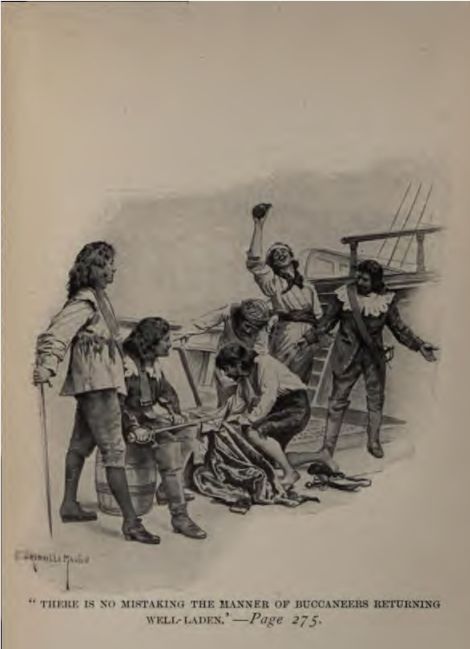
THERE IS NO MISTAKING THE MANNER OF
BUCCANEERS RETURNING WELL-LADEN
But even this supply did not provision them
for long, and they were forced to run across to
Hispaniola, come into touch with the French and
English hunters there, and buy from them
bucaned cows' flesh in the usual way. There is
a routine about these matters, and when it is
departed from one soon finds that the routine has
its reason for being.
It will be seen that here were all the makings
of a voyage which would be prosperous, if
somewhat slow; but it must be owned that all was not
peace and easiness. The Spaniards on board
were the root of the unpleasantness. They held
that they had worked equally with the others in
gathering the plunder. The French and English
held that they were duly-admitted members of
the Brotherhood of the Coast, and therefore of
superior clay to any Spaniard; and, moreover,
when it came to the distribution of the plunder,
they attended armed to the teeth and certainly
took the lion's share. They said at the time that
the Spaniards might feel grateful that they were
given so much as a flavour; and on that day,
being overawed by weapons, these Spaniards
accepted what was left for them with at least an
outward show of civility. But it seems they still
carried rage and discontent in their hearts, which
indeed is the custom of their disgusting nation,
and from then onwards were forever making a
great plot or cabal.
In number these Spaniards might well be vainglorious,
seeing that there were one hundred and
forty of them, to some twenty-seven all told of
the buccaneers, and in fierceness they were above
the ordinary. They were criminals all of them,
condemned to the galleys by their own
countrymen, who found them intolerable at home, and
had it not been that their liberation was useful at
the time to Prince Rupert, one is free to confess
that the galleys was their proper place, as they
were unfitted for any other rank in society.
However, there they were on the carrack,
possessors of some considerable store of plunder,
and very wishful to seize more and to have a say
in their final destination.
Once indeed a deputation came aft to put
forward their views.
What was to be the carrack's destination?
"Tortuga," said Rupert, civilly.
They appeared to hear the name with consternation.
"But, Señor," said their spokesman, "that is
the metropolis of the buccaneers."
"To me," said Rupert, "Tortuga is my
rendezvous with my own fleet."
"We bow to your esteemed convenience, Señor.
But what chance shall we have there? We shall
be lambs in a wolf-fold. They will rob us
certainly; if we escape out of the place with our
lives, we shall be fortunate. Surely, Señor, as we
have borne much of the burden of the fighting,
we are entitled to some say in future schemes."
"As duly elected Captain, all decision in these
matters appears to rest with me. But I do not
wish to make my command unpalatable, and if
what is arranged, and what indeed suits the
French and English of this crew very pleasantly,
goes against your sentiments, I am willing to come
to a composition with you. Once in Tortuga, I
personally and Master Laughan here rejoin my
fleet; Master Simpson and the buccaneers go
ashore, according to their convivial custom, for a
merry time amongst the wine-shops and the ladies
of Tortuga, and possibly for a turn at the dice box
with Monsieur D'Ogeron up at the castle; and
the carrack will remain for sale. I believe prices
for ships rule easy in Tortuga, as there is
somewhat of a glut of them on the market, and the
titles to them are obscure. Here, then, is your
chance: you are men of capital; hand back into
the store the plunder that has been shared out to
you, and the carrack is yours after she had carried
us for our voyage."
At this proposition, the Spaniards appeared to
get very angry, and indeed were for making some
foolish demonstration if they had not been
incontinently driven away forward. But the
buccaneers, who have a more nice appreciation for wit,
laughed heartily, and swore that Rupert was a
prince of good fellows. But at the same time
they did not take the Spaniards too much on trust,
and in fact wore their weapons and their
wakefulness with great diligence.
Had there been liquor on board it is a sure thing
that the buccaneers would have drunk themselves
silly, and the Spaniards, who are too feeble-stomached
for an orgie, would not have failed to use
their soberness to bring about a massacre. But,
as has been said, the carrack was a dry ship; she
was carried off with neither wine nor rum in her
store; and to this alone may her safety be
credited. Indeed so especially keen were these
thirsty buccaneers to arrive at Tortuga and
commence their debauch, that they employed extra
watchfulness to make sure no impediment came in
their way, and by this means alone discovered
the hateful plot which the Spaniards were
hatching against them.
There was amongst the Spaniards it seems an
apothecary, who had earned a certain ill-omened
fame. The city which he polluted by his
residence contained husbands who wished to be rid
of their wives, and wives who had tired of their
husbands. The apothecary supplied the means;
indeed it was the wretch's boast that he had plied
this horrid trade of poisoner for ten whole years
with immunity, and then got found out only by
jealousy of a business rival. Indeed so large was
his circle of patrons, and so strong his power, that
even at his trial he was used leniently and spared
the torture, lest he might tell too much, and in
the end was condemned only to the galleys, when
he should most justly have been slowly burned.
So when a plot was formed against the buccaneers,
here on the carrack was a task in his old
trade ready to the apothecary's hand, and that
was no less than to kill outright by poison all
who were not Spaniards. It seems there was a
parcel of herbs and roots and snake's teeth
amongst the cargo suited for his purpose, and he
got hold of these, and set about making his
tinctures and decoctions. Even then he might
have succeeded, if he had done his work quick
and sudden after the plot was made; but it seems
that there can be artists amongst poisoners as
there are in other trades, and here was one that
took a most dainty pride in his horrid craft. A
crude, rasping poison would not suit him. He
must needs purify and distil a dozen times over
till he had made a death drug of the most
exquisite fineness; and his hundred and forty
compatriots who were all in the secret, sat round and
watched and gloated over their coming triumph
and vengeance.
What made the deed one of such plain simplicity
was the manner in which the two parties had
separated themselves. From the very first day
on board, the English and French buccaneers had
taken the cabins that are set apart for officers and
passengers under the half-deck and poop; and
the Spaniards did not presume to harbour
anywhere except in the forward castle, or the upper
holds. There is a sea sumptuary law or etiquette
about these dispositions that is very strict.
Moreover, gradually as the feeling between the two
bodies became more strained, there was less and
less intercourse between them. Indeed, by
Rupert's direction, the buccaneers posted
constantly a couple of armed sentries on the break of
the poop with a loaded culverin by each, trained
so as to sweep the waist and the lower deck, and
with lighted matches in tubs standing by their
side. The sentries were changed with every
watch, and the Spaniards knew quite well that
they would fire on small occasion. And moreover,
after nightfall, battle-lanterns were hung in
the rigging, so that there should be no rushing
the after deck under cover of darkness.
The matter that gave the apothecary his opening
was a sea custom of the buccaneers. Ashore
these men are the most dextrous of cooks, often
killing a cow especially so that her udder may
provide them with a delicate joint, and serving it
with pimento and other sauces to lend it piquant
flavour. In a word, on dry land they are
gourmands and glory in the fact. But at sea they
are quite different; they can live there on victual
of the roughest; and it is their conceit moreover
to rate the office of cook as the lowest on
shipboard. Either they make their prisoners do the
work, or they carry a slave to dress their victual,
or they are even content to swallow it raw sooner
than grease their tarry fingers with either
roasting-spit or boiler. On this captured carrack, then,
as may be supposed, they pressed a couple of
Spaniards into the caboose (as the cookhouse is
named at sea), and although these showed a stiff
lip at first, and required some beating before they
would serve, presently (after their devilish plot
was concocted) they made the boils and the stews
and the other sea dishes with docility, and, it
must be confessed also, with appetising skill.
To the Yorkshireman Simpson must be
credited the first hint that all was not as it should
be. He and the Prince and the secretary were
sitting on the taffrail one night between two of
the great poop lanterns, and Rupert found
occasion to comment that the voyage was drawing
towards its conclusion very peacefully.
"'Appen," said Simpson, "and again, Captain,
'appen not. Them Spaniards makes out to
be a sight too contented for my liking. They
were as mad as hay about the way we shared up
that treasure, an' they're far from liking t' idea of
a happy week near owd Skin-the-Pike i' Tortuga.
Now tha'llt not tell me they've forgotten;
Spaniards is vengeful devils an' they niver
forgets. And I tell tha' what, young feller, I'd be a
deal more comfortable if they was up an' fighting
with us."
"Pooh!" said Rupert lightly. "Spaniard-hating
has grown to be a disease with you, Master
Simpson. And, besides, we have taken our
precautions. Look at the sentries. You can see the
matches burning in their tubs from here."
"A Spaniard is as artful as a bagful of monkeys."
"And we fancy we are not without some
strategy ourselves."
Simpson put a thumb on his chin. "Look
here, now, young feller. I'd like t' 'ave tha' a bet
on about it. I'll lay tha' an even pint potful o'
silver pieces they try to have their knives into us
before we've an anchor down in Tortuga Harbour."
"I'll take your wager with pleasure."
"Well," said Simpson, with a wink, "it's my
brass," and there the talk ended.
But that night, when Master Laughan was
officer of the watch and was patrolling the poop
with due form and ceremony, the Yorkshireman
came up and made an announcement of his plans
in a cautious whisper. "I'm bahn to win yon bet,
if cleverness will do it, and just to give Captain
Rupert a suck in."—He winked, and patted the
secretary's arm confidentially.—"I know these
Spanish beggars more than a bit, an' it's my
belief they wouldn't cower so quiet unless they were
hatching mischief. Now say note to Rupert, lad,
an' if tha' hears them cutting my throat forrard,
call all the hands aft here and clear the decks for
bloody war. By gum, I'll win yon potful of
pieces, choose 'ow."—With which he took himself
off up the mizzen rigging, and was lost in the
blackness of the night overhead.
It was clear that the man thought more of
winning his paltry wager than of insuring the
safety of his fellow-buccaneers, and the secretary
smiled (but with tears in her eyes) as she thought
of his crazy daring. But it seemed, when he
came back afterwards to tell his tale, that Master
Simpson had a shrewd notion of taking care of
his own skin even when he so dangerously risked
it. As has been said, the waist and the lower
maindeck of the carrack was lit with battle
lanthorns, but these only accentuated the darkness
which wrapped the rest of her. The Yorkshireman,
despite his size and weight, could climb with
an ape's handiness. He made his way up to the
mizzen topmast head, keeping always in the
shadow of the spars and canvas; then like some
uncouth crawling insect laid out along the stays,
reaching first the main, and then the fore top
mast head and finally slipping down the outer
bolt-sprit stay, and crouched in the top of the
mast there for a moment to recover breath.
Below him, past the gammoning of the bolt-sprit,
was the open-work of the ship's beak, upheld by
her figure-head, and in the high wall of the
forward castle beyond, the lamplight gleamed out
warmly through the two open gun-ports.
Quietly Master Simpson made his way down
by the foot ropes, keeping most jealously to the
shadows, and finally took up his post beneath
one of these openings, settling himself
comfortably so as to avoid unnecessary cramp. He
would certainly have been killed a hundred times
over if he had been caught there, but he stayed
coolly on, listening to the chatter inside, hour
after hour, and still hearing nothing of especial
moment. It was terribly risky work. But as he
explained afterwards he learned nothing of
moment and wasn't inclined to give up hope of
winning the bet till daylight came in and clearly
routed him. He said he came from a country
where they meant winning when they laid a
wager, whatever it might cost to bring success.
But at last he heard what suited him, and what
indeed saved every life in the after part of the
ship, and returning laboriously by the way he
had come, high over the rigging, he dropped
down to the poop deck at the exact spot he had
left it.
Master Laughan met him there, heavy-eyed
for want of sleep, and soaked with the dew of
night, and somewhat crabbedly inquired his
news. The fellow had given her a good racking
of anxiety, and she did not wish to show it. But
he laughed at her whimsically enough, and said
his news would keep till breakfast time, and that
for the present he was all yawns, and with that
went below to his bed place. Which example
the secretary in some annoyance followed forthwith.
Sentries challenged and bells clanged, watches
were relieved and the routine of the night went
on in its rigid way, and at last the timekeeper in
charge of the glass cried seven o'clock and bade
all hands rouse and bit. The toilettes of
shipboard are hasty, as all when on the unstable sea
sleep in their clothes to be ready for the sudden
alarms which are so frequent. Indeed it has been
neatly expressed, that seamen like dogs give one
good shake, and are awake and dressed. And so
when the timekeeper gave his cry and turned his
glass, almost before the sand had begun to run
the other way, all of the carrack's afterguard were
turned out, and ready for their breakfasts.
There is no delicate napery at sea, and on this
carrack, then, there was not so much as a salt vat
to decorate the table. To each man was a wooden
platter and a leathern cup, fitting into cavities
cut in the board to keep them in place against
the vessel's rolling, and the benches which served
as seats were built into the solid fabric of the
deck. A savoury smell advertised the cook's
coming, and the ship's company seated themselves
on the benches before the table, and each
drew his knife and laid it before him in readiness.
Then the cook came into the great cabin bearing
the mess kid in his arms, a lean, dark-faced man
with a notable squint. The rude men at the
table sniffed appreciatively, and the cook, setting
the mess-kid on the deck, took out his great ladle
and began filling the platters one by one as they
were handed to him, and then when all were
loaded, the fellow that had been appointed chaplain,
rose to his feet, shut his eyes, and prepared
to say the grace.
But at this point Simpson slipped round to the
door of the cabin and cried a loud "Halt!" Many
faces were turned upon him frowningly.
They brooked ill, these buccaneers, any
interference with their religious exercises. But
Simpson was not the man to be quieted by a scowl.
"Captain," said he, "I'll have to ask tha' for
yon half-pint o' silver pieces."
"It is yours, Master Simpson," said the Prince
politely, "but I'd take it as courteous if you'd
tell how you've earned it."
"Simple enough," said the Yorkshireman. "I
just ask you to force the cook to sample his own
wares."
"Why, we have a new cook to-day," said
Rupert, staring at the Spaniard who held the
mess-kid.
"True enough," said Simpson, "and afore
turning cook, he was galley-slave, and afore that
he practised as apothecary. It sticks in my mind
that to-day he's mixed t' two businesses together
and given us some apothecary's drugs in his cook's
stew. If he hasn't, well, Captain, I may yet owe
you the bet, but, if he has, I think you might pay
up t' brass."
"Most certainly," said Rupert, "and I think
the thing is easy proved, by watching the man
eat a platter full of his own mess. Señor el
Cocinero," he said, dropping into the Spanish
tongue, "by its savoury smell to-day your cooking
has surpassed even its previous excellence."
The cook gave a doubtful little bow.
"But there exists some doubt as to the
wholesomeness of the condiments wherewith you have
flavoured it. The nearest vacant place at the
table appears to be my own. May I beg of you
to honour me by sitting in it and to show by
your own appreciation how excellent is the mess
you have brought for us."
The cook gripped tight on to his ladle and
glared about him like a trapped wild animal. "I
am not hungry," he said, "and besides I am a
Catholic and could not eat after the meat has
been blessed by your chaplain. But the food is
quite wholesome."
"I might point out to you that our honoured
chaplain has not yet said the grace, nor will he
till we know more about what is set before us."
"I will not eat," said the cook, and shivered
violently. "I tell you I have no appetite. I am
not hungry."
"My good man," said Rupert, "I stand in the
position of king over this vessel, and my courteous
invitation may be construed as a royal command.
If you have no appetite, we must find you one." He
signed to those of the buccaneers who sat
nearest at the table, and these, who began to
realise how matters lay, were nothing loath to give
the cook some rough handling. He was forced
into the chair at the head of the board, and those
who held him began sawing at his ears with their
knives. For long enough he withstood the torture,
and sat there sullenly with the blood dripping
on to his shoulders, and the buccaneers down
the table, with the untouched platters still
smoking before them, rested on their elbows and
watched him. Prince Rupert, a man who was
usually averse to these rude proceedings, looked
on with a face that was hard and frowning, and
except for the secretary, who felt herself pale as
she watched, there was not a trace of pity shown
by anyone.
Stoically this monster of a cook held out,
proving by his very stubbornness how complete was
his guilt, but at length he began to recognise that
the grim men who held him were not the sort that
show undue leanings towards mercy. He had to
choose between eating or being carved alive; and
as a poisoner of long and loathly experience, the
full horrors of his dish were well known to him.
But the sharp, cold pain of the knives daunted
him at last, and with a cry he stretched out his
hand and began to scoop up the food in the
platter before him, and to cram it into his mouth.
He fed like a beast, the sooner to get it over, but
those who watched him expressed neither disgust
nor interest; remained, in fact, immovable; and his
eyes roved over the board and glared at them
horribly.
At last the platter was cleaned, and he sat back
in his chair with a face lividly white and beaded
with perspiration. No one spoke; all in the great
cabin watched him with unwinking eyes. Presently
he reached out his hand for a mug of water,
and gulped it down. His teeth chattered against
the lip of the drinking vessel; black rings grew
round his eye-sockets.
He lay back again in the chair, gripping hard
upon the arms, and closing his eyes tightly. He
knew the symptoms which should arrive, and in
imagination endured half their torments before
they actually came to him. When one remembered
how he would have dealt out similar anguish
to all the French and English of the ship's
company, one could not deny that he was rightly
served. But being human, one perforce had to
pity as one watched.
But at last the pains began to grip him in real
grinding earnest. He strained himself to that
side and to this. He writhed like a wounded
worm. He screamed aloud for someone in pity
to kill him. But the mercy that he had dealt
out to others was given him in full measure then.
He was taken out through a door on to the main
deck and laid there on a hatch, and the platters
with the poisoned food were laid in a ring round
him, and there he was left for his friends to deal
with as they chose. And the exact manner of his
wicked end, the present historian does not know.
On the poop above, the matches smoked in
their tubs and the sentries stood by the loaded
culverins which commanded the main deck. In
the great cabin below Prince Rupert was paying
to Master Simpson the amount of his wager.
Simpson spat on the last coin for luck before he
pocketed it.
"I'll give tha' a revenge," he said. "I'll bet
tha' on onything that comes, nobbut just
mention it."
"You're too shrewd for me," said Rupert
laughing. "But I'd like to bet you another small
wager that our Spaniards give us no more trouble
after to-day."
"Tha'rt bahn to be shut o' t' lot of them, eh?
There's an island close aboard, an' tha'st a mind
to set 'em all ashore to laak about as they please?
That's what we Bretheren of the Coast call
marooning, an' it's just what they deserve. They
were all i' t' poisoning, an' they all deserve what
t' druggist got, an' worse. An' when we're shut
o' them, we'll just tak' their share o' t' brass an
squander it under owd Skin-the-Pike's nose in
Tortuga along wi' t' rest."
"H'm," said Rupert, and appeared to consider.
And then he sighed and said: "Well, Master
Simpson, I suppose by the time money is carried
across to The Hague that one piece will look so
much like another that the King will not be able
to distinguish between any of them. I am
beginning to learn the lesson that it does not do to
be too nice about small matters here in these
seas of the New World."
"Not when there's Jack-Spaniards i' question,"
assented Simpson, and there the talk broke off,
and the Prince began making his dispositions for
the capture of the carrack by the buccaneers.
As it chanced the powder room was aft, and
those in the forward portion of the ship could
neither use great guns or small arms, and when
other pieces were drawn up on the poop, and
men stood beside them with smoking lintstocks
all ready to fire, the Spaniards had no stomach
for a rush, but incontinently surrendered. The
prestige of the buccaneers was so great amongst
these people, that it saved even the semblance of
a skirmish. Prince Rupert cried his orders, and
with their own hands they hove the carrack to,
hoisted out the two boats which lay on the
booms, and tumbled over one another in their
anxiety to be in them and off to try their fortune
on the island which lay close under their lee.
As was natural, they had done their best to
leave the ship ablaze behind them as a souvenir,
but the buccaneers anticipated this, and went
forward when the last of the wretches had gone, and
had small trouble in extinguishing the flames.
After which they let fly a shotted salvo from all
the great guns after their common fashion, and
once more trimmed sail, and got along their
course.
Again see the finger of fate. That very afternoon
they came across a small pink out of
Nombre de Dios, loaded with rum. They gave her
freedom for being engaged in so desirable a trade,
only exacting some dozen puncheons of the liquor
as a ransom, and when the sun went down upon
the sea, there was the carrack in charge of Prince
Rupert and Master Laughan, as being the only
two sober souls in all her company. The rest
of the tipsy dogs were making night shiver with
their shoutings, and their shootings, and their
singings, and all the other insanities of debauch.
And if the Spaniards had been on board, the
silly fellows would have got drunk just the same.
There is no trusting these buccaneers of the
Spanish Main once they have got liquor to their
hands, and that is the great reason why they are
so unthrifty with their lives. Even a hard-witted
fellow like Simpson the Yorkshireman could
addle his brain on these occasions like the
weakest of them.
Still with that happy-go-lucky navigation which
is one of the features of the Carib Sea, the
carrack sailed on, missing the reefs and shallows,
coming to no harm in the gales, and in time she
came to the harbour of Tortuga, for which she
aimed. The buccaneers stood to the guns, firing
shot from them in joyous salvos, and caring not
one iota where the said shot flew. The carrack
fluttered with banners and ancients, and the castle,
and the squalid town by the water's edge, and the
shipping at anchor quickly hoisted flags in
welcome. There is no mistaking the manner of
buccaneers returning well laden, and the harpies
of Tortuga who live on such are not niggard in
showing their joy that more ruffians have come
in to be fleeced. Boats put out from the beach
manned by vintners and tawdry hussies, each
desirous of being first to catch a man, and on the
castle of the Governor three trumpets and a
drum made desirable music.
There was a fleet of three ships anchored apart
from the others in the harbour, and Rupert's eye
moistened as he looked upon them. They were
the ships of His Majesty Charles II., which had
come out to these seas with Rupert as Admiral
to gain moneys for the upkeep of the Court at
The Hague. They had been pawned to Monsieur
D'Ogeron as a ransom for those distressed
cavaliers that the accursed Cromwell had sold to the
buccaneers. And here they were, out of their
period of service, and ready once more to take
on board their natural Admiral.
"Shall I round up the carrack amongst the
fleet?" asked Master Laughan, who stood at the
helm. "It will be a joyful moment for our
people when they know who's returned to them."
"Let them keep their joy, then, for another
hour or so," said Rupert, "and do you carry on
to an anchorage beyond. Seeing for how long a
time we've been parted, it is only civil that first I
should go up to the castle and pay my respects to
Monsieur D'Ogeron. He and I have still an
account to settle before I leave this desirable
harbour."
So the carrack was brought to an anchor, with
her courses roughly brailed and topsails lowered.
But there was no attempt at stowing the canvas
tidily, as the buccaneers were too keen to get
ashore for their organised debauch, and, indeed,
were already too drunk to venture aloft and out
upon the foot-ropes. So all went off in
shore-boats to the beach, and Rupert took the
secretary's arm and turned to stroll up to the hill-top,
where the castle crouched menacingly over the
harbour. The women of the place tried hard with
their loathly blandishments to detain them, but
Prince Rupert was not the man to heed such
tawdry Circes as these, though indeed he
declined their invitation civilly, and even with a
laughing word. So by degrees they walked up
under the baking sunshine, and passed underneath
the massive beam of the gateway, where the heads
of Monsieur D'Ogeron's most recent enemies
grilled under an outrageous sun.
The entrance yard was a mere rat-pit, a trap in
which the unfriendly could be shot down without
a chance of retaliation. The only entrance door
was in the upper story, and the ladder which
gave access to this was hauled up with a chain and
a pulley. However, after an exacting parley with
a sentinel, Monsieur D'Ogeron consented to
give audience to his visitors, and, once inside,
extended to them his usual coarse amiability. "Mon
Prince," he cried, "you have come back to claim
your fleet within a week of the day on which it
reverts to your command. If one may judge
by your clothes, you've been seeing service. I
trust that your outlay of courage has brought you
a full financial return?"
"So—so," said Rupert.
"Well, try my brew of sangoree. You'll have
found by now that this climate breeds a most
delicious thirst."
"I thank you, but I will not drink."
The Governor laughed pleasantly. "You still
stick to your Old-World courtesies, I see. Now,
to me, one drink's as good as another, and I'd not
refuse a man's invitation to swallow his sangoree,
even if I were going to cut his throat next
minute."
"I can believe it of you. You are a very nasty
fellow, Monsieur."
The Governor of Tortuga shrugged his
shoulders and blew a long mouthful of tobacco smoke
from his pipe. But he took no offence. "You
didn't come up here to quarrel with me in words,
I'll be bound, mon Prince. Neither did you call
with the intention of putting your sword through
me, as you know well by this how cunningly I
can defend myself, and how unpleasant it is for
callers to annoy me. Your Highness is a man
of observation. You'll have noted the heads
above the gateway?"
"They are all new since I was here last. Your
Excellency is right. I did not come to exchange
courtesies, civil or otherwise. I came for
business: in a word, I am here to receive an account
of my fleet's performance."
"Oh, they served me passing well, thanks to my
own officers who were on board to keep tally and
give directions. They caught five ships on the
sea, and skimmed one a nice fat town. They
brought no women back with them, having some
foolish scruple, which even my officers could not
get over—indeed, come to think of it, their
obedience at times was none of the best—and, thirsty
dogs that they were, they drank up all the wine
they captured long before they sailed back into
harbour here. But I'll not complain. They
brought me a most appetising cargo of gold bars
and plate."
"Which should have gone to the King."
Monsieur D'Ogeron reached out for the smouldering
lintstock which stood on the table, and relit
his pipe. "What, you still toy with that old
fable of loyalty? Well, I've accounted myself no
small judge of men, but it's a strange world, this.
Why, by this, they'll have forgotten you in
Europe."
"I flatter myself they'll keep me longer in
memory."
The Governor shook his head and his pipe.
"And your King will have written off your ships
from his accounts as a speculation that's failed.
Now, if I were your Highness, I'd not surprise
him. I'd keep those ships. And I'd found myself
a pretty little kingdom out here, and be
absolute, and not go home to be servant again to an
unstable Stuart. Why, Prince, you've got all the
materials for a kingdom ready and waiting: the
men are in your own ships; the women you can
gather from any city of the Main you like to
fetch them from, and there you are with the
essentials complete. You choose your site, you
build your town and fort, you catch your
Indians, or you import Guinea blacks for slaves,
and for occupation and revenue you raid the
Spanish, when indeed you are not enjoying
domestic joys at home. And, let me tell you,
that domestic joys out here are not things to be
valued lightly. They grow upon a man."
"Sir," said Rupert, "have done. By now
you might have known that such talk disgusts
me. You appear to find enjoyment in living
over that swinish village, which you miscall a
town, on the beach yonder; but other men are
built different, and, for myself, it would make me
sick."
Monsieur D'Ogeron remained unruffled. "I
see what you're at," he said with a wink. "You
want to make me lose my temper and consent
to fight you. Why should I? For honour? I
haven't any. For chivalry? I've forgotten what
it is. To please your whim? Why, there my
own disinclination comes first. I haven't a
particle of quarrel with you, mon Prince, and I really
do not see how you can scratch one up. I've got
the best of the bargain over the fleet, I've got
the best of the bargain all through, and I quite
see you've your sore. But I refuse to let you
heal it by carving holes in me.—Here's to your
speedy mending," said he, and swigged deeply
at the sangoree.—"I do wish your Highness
would drink. This abstinence is a slur on my
hospitality."
Prince Rupert sat biting his nails in bitter
anger. He knew well the dispositions of the
Governor of Tortuga's audience-room from
previous humiliating experience. Behind one
curtain stood a demi-bombarde, with a gunner and a
lighted lintstock beside it, which could blow him
to pieces at a word. Behind another curtain was
another rogue, holding strings that governed
those traps in the flooring which shot Monsieur
D'Ogeron's unwelcome visitors into the dungeons
beneath. And for aught the Prince knew,
there might be other monkey pranks in readiness
equally nasty. To be beaten by anyone was bad
enough, but to be beaten by a creature of the
low, dishonourable cunning of this Monsieur de
Tortuga was past a gentleman's endurance. And
so Rupert bit his nails through helpless rage.
The Governor lay back in his chair, watching
the fumes from his tobacco pipe as they drifted
towards the beams above, but withal keeping the
tail of one eye warily upon the Prince. He was
a man well-used to danger, and he plumed
himself that he knew where danger lay, and by
forethought was amply secured against it. But he
had all his mind for the Prince, and not so much
as a thought for the secretary, and indeed openly
sneered at the poor creature for her slim figure
and (what he was pleased to term) mincing,
finicking ways. Indeed, if the bare truth be
told, it was as much resentment at this
contemptuous neglect (and to show the brute that she
could be as dangerous as any man) that the poor
secretary made the move that cut the Gordian
knot of the situation. For by a sudden leap
she stood behind Monsieur D'Ogeron's chair,
pressing her poniard down upon his left
shoulder.
She cried out that she would assuredly drive
the weapon down into his heart if he moved, or
if any of those who watched round the room so
much as stirred, and of a truth would have
murdered him there in sheer self-defence if he had
disobeyed, though the mere thought of doing it
turned her sick.
Rupert, with his quick appreciation of events,
sat himself suddenly on the table (knowing the
instability of the floor), and the frowns on his
face changed to merry laughter. "Bravo,
Stephen, lad," cried he. "Strike home if there's
any discourtesy shown you. And now, Monsieur
D'Ogeron, our diplomacy has come down to a
plane where you may find yourself more
amenable to reason."
The Governor smoked on unmoved. A curtain
at one side of the room whisked across and
showed a gunner, lighted match in hand, standing
over the touch-hole of his piece. Another
curtain moved away, and there was the man who
commanded the strings of the traps of the floor,
and behind him a dozen uncombed fellows, each
with pistols and hanger.
"We seem at a deadlock," said the Governor,
with a wave of his pipe-stem.
"As for the lock, that's to be proved,
Monsieur," said Master Laughan from behind him;
"but as for being dead, why, there you will take
precedence of all in this chamber when action
begins." And in emphasis she twisted the poniard
so that it might prick the Governor's shoulder
through his clothing.
The Governor reached slowly for his sangoree
and drank it with an air. "Mon Prince," he
said, "the needs of your gracious sovereign at
The Hague really begin to touch my conscience.
If so lowly a creature as myself might help with
a mite, it would give me vast pleasure to become
his banker to the extent of—well, I am in an
open mood to-day—say anything up to ten
thousand pieces-of-eight."
"It is strange," said Rupert, "but our wishes
seem to jump the same way. In fact you could
not have made a more pleasing suggestion,
Monsieur, except that you made one small
tongue-slip in the figures. Surely the sum you had in
mind was fifty thousand?"
"You are quite right. I meant to have said
twenty thousand, though it will leave my treasury
dangerously bare."
"Fifty," said Rupert pleasantly.
"One cannot do the impossible. I have some
very ingenious torture instruments in this castle,
and some very patient tormentors who are skilled
in their use. Between them they have brought
about some marvellous changes of opinion, but
even they could not make me say more than
thirty thousand. If you doubt me, and carry
this matter too far, perhaps presently you will be
persuaded to go down into the torture chamber
and test the perfection of my instruments for
yourselves?"
"Ah, there," said Rupert, "I fear we must decline
your invitation, Monsieur. Strange though
it may seem in these seas of the New World, both
Master Laughan and I have a certain niceness of
nature which makes the sight of such things
unpalatable. But I think, Stephen, that if you
pressed your point a little further home,
Monsieur D'Ogeron might still be brought to see
things in our light."
Upon which the secretary in her nervousness
thrust at the poniard so shrewdly, that the
Governor with a bundle of oaths yelled out that he
was beaten, and only prayed that the beastly
dagger might be taken away from his shoulder.
"Young man," said he, "you had your iron far
enough in for me to feel the chill. Do you know
this is a very dangerous prank to play with one
of my habit of life?"
There was still a difficulty remaining as to how
the money was to be taken from the Castle treasury
to the cabin of his flagship in the fleet where
Rupert wished to see it stowed. The Prince
distrusted Monsieur D'Ogeron implicitly, and (to
own the bare truth) Monsieur D'Ogeron was
indecently wary lest he should get himself too far
into the Prince's hands. But in the end the pair
of them left the castle arm-in-arm as though
they had been the dearest of friends, and Master
Laughan, as a dependent should, marched humbly
behind them, though with a dagger very
handy.
Chairs and a table were set upon the beach,
and presently drink was brought (without which
little business is done in the New World) and the
pair of them toasted one another very handsomely.
Even a creature like the Governor of
Tortuga could not but admire the splendid parts
of Rupert Palatine, and it seems that Rupert
found points of excellence even in Monsieur
D'Ogeron.
Meanwhile the money was brought down in
sacks, and taken out in boats to the fleet, where a
receipt was duly given, and the Governor saw his
ill-got riches taken away from him for the service
of the King without a frown or an angry word.
He had the virtue of philosophy, this monarch
of the buccaneers, and accepted the unavoidable
like a man of sense. And moreover, as he said,
the harvest of those seas was inexhaustible. The
Spaniard, like the devil, was always with them,
and it was an honest buccaneer's duty to get the
better of both.
So the money was paid, and the parting was
made, and Prince Rupert was rowed out across
the still waters of the harbour to take his proper
place once more as Admiral of the King's fleet.
Master Laughan followed at his heels with a
heart loaded with cheerful emotions. Alas, poor
fond creature, little did she know that they were
posting towards that lamentable quarrel which
(soon after the horrid drowning of Prince Maurice)
separated them eternally. Little did Rupert
guess that he was so soon to be separated from
one whose love and faithfulness towards him has
been abundantly proved to all the world. Little
did the secretary dream that she would lose as
her patron that most noble, fearless and adorable
man ever born since history began.
One weapon alone could the secretary have
used that would have stilled the quarrel the
moment it began; if she had declared her sex Rupert
would have taken back the bitter word that drove
her from his side. But she would have died
sooner than make confession; and when she left
her Prince, he was still ignorant that it was the
maid Mary Laughan, and not Stephen the youth
who had so lovingly and truly served him.
THE END.
THE RIVERSIDE PRESS LIMITED, EDINBURGH
BY THE SAME AUTHOR
THE FILIBUSTERS
THE LOST CONTINENT
THE RECIPE FOR DIAMONDS
HONOUR OF THIEVES
THE STRONGER HAND
THE PARADISE COALBOAT
ADVENTURES OF CAPTAIN KETTLE
FURTHER ADVENTURES OF CAPTAIN KETTLE
THROUGH ARCTIC LAPLAND
MR HORROCKS, PURSER