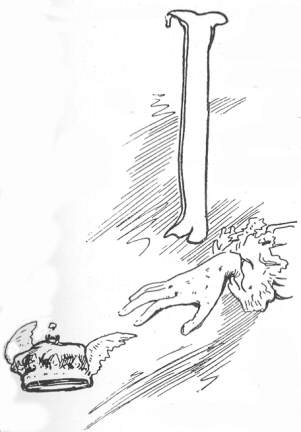
“I say, Jack,” said Prince Ricardo one morning,
“here’s a queer letter for me!”
King Prigio had gone to a distant part of his dominions, on
business of importance, and the young people were sitting in the
royal study. The letter, which Ricardo handed to Jaqueline,
was written on a great broad sheet of paper, folded up without
any envelope, as was the custom then, and was sealed
with a huge seal in red wax.
“I don’t know the arms,” Ricardo said.
“Oh, Ricardo, how you do neglect your
Heraldry! Old Green Stocking is in despair over your
ignorance.”
Now Green Stocking was the chief herald of Pantouflia, just
like Blue Mantle in England.
“Why, these are the Royal Arms of England, you great
ignorant Dick!”
“But Rome isn’t in England, is it?—and the
post-mark is ‘Roma’: that’s Rome in some lingo,
I expect. It is in Latin, anyhow, I know. Mortuus
est Romæ—‘He died at Rome.’
It’s in the Latin Grammar. Let’s see what the
fellow says, anyhow,” added Ricardo, breaking the seal.
“He begins, ‘Prins and dear Cousin!’ I
say, Jaqueline, he spells it ‘Prins;’ now it is P-r-i-n-c-e. He must be an
ignorant fellow!”
“People in glass houses should not throw stones,
Dick,” said Jaqueline.
“He signs himself ‘Charles, P. W.,’”
said Ricardo, looking at the end. “Who on earth can
he be? Why does he not put ‘P. W. Charles,’ if
these are his initials? Look here, it’s rather a long
letter; you might read it to us, Jack!”
The princess took the epistle and began:
“How nice it smells, all scented! The paper is
gilt-edged, too.”
“Luxurious beggar, whoever he is,” said
Ricardo.
“Well, he says: ‘Prins and dear Cousin,—You
and me’ (oh, what grammar!) ‘are much the same age, I
being fifteen next birthday, and we should be better
ackwainted. All the wurld has herd of the fame of
Prins Ricardo, whose name is feerd, and his sord
dreded, wherever there are Monsters and Tirants. Prins, you
may be less well informed about my situation. I
have not killed any Dragguns, there being nun of them here; but I
have been under fiar, at Gaeta.’ Where’s
Gaeta, Dick?”
“Never heard of it,” said Ricardo.
“Well, it is in Italy, and it was besieged lately.
He goes on: ‘and I am told that I did not misbehave myself,
nor disgrace the blud of Bruce.’”
“I’ve heard of Robert Bruce,” said Dick;
“he was the man who did not kill the spider, but he cracked
the head of Sir Harry Bohun with one whack of his axe. I
remember him well enough.”
“Well, your correspondent seems to be a descendant of
his.”
“That’s getting more interesting,” said
Dick. “I wish my father would go to war with
somebody. With the Sword of Sharpness I’d make the
enemy whistle! Drive on, Jack.”
“‘As a prins in distress, I apeal to your
valler, so renouned in Europe. I am kept out of my own; my
royal father, King Gems,’—well, this is the worst
spelling I ever saw in my life! He means King
James,—‘my royal father, King Gems, being druv
into exile by a crewl Usurper, the Elector of Hannover.
King Gems is old, and likes a quiat life; but I am
determined to make an effort, if I go alone, and Europe shall
here of Prince Charles. Having heard—as who has
not?—of your royal Highness’s courage and
sordsmanship, I throw myself at your feet, and implore you to
asist a prins in distres. Let our sords be drawn together
in the caus of freedom and an outraged country, my own.
“‘I remain,
“‘Prins and dear Cuzen,
“‘Charles, P.
W.’
“P. W. means Prince of Wales,” added Jaqueline. “He is turned out of England you
know, and lives at Rome with his father.”
“I like that chap,” said Prince Ricardo.
“He does not spell very well, as you say, but I sometimes
make mistakes myself; and I like his spirit. I’ve
been looking out for an adventure; but the big game is getting
shy, and my sword rusts in his scabbard. I’ll tell
you what, Jack—I’ve an idea! I’ll put him
on the throne of his fathers; it’s as easy as shelling
peas: and as for that other fellow, the Elector, I’ll send
him back to Hanover, wherever that may be, and he can go on
electing, and polling his vote in peace and quietness, at
home. Just wait till I spot the places.”
The prince ran up to the turret, fetched the magic spy-glass,
and looked up London, Rome, and Hanover, as you would in a
map.
“Well, Dick, but how do you mean to do
it?”
“Do it?—nothing simpler! I just take my
Seven-league Boots, run over to Rome, pick up Prince Charles, put
him on the magic carpet, fly to London, clap the Cap of Darkness
on him so that nobody can see him, set him down on the throne of
his fathers; pick up the Elector, carry him over to his beloved
Hanover, and the trick is done—what they call a bloodless
revolution in the history books.”
“But if the English don’t like Prince Charles when
they get him?”
“Like him? they’re sure to like him, a young
fellow like that! Besides, I’ll take the sword with
me in case of accidents.”
“But, Dick, it is your father’s rule that you are
never to meddle in the affairs of other countries, and never to
start on an expedition when he is not at home.”
“Oh, he won’t mind this time!
There’s no kind of danger; and I’m sure he will
approve of the principle of the thing. Kings must
stick up for each other. Why, some electing characters
might come here and kick us out!”
“Your father is not the sort of king who is kicked
out,” said Jaqueline.
But there was no use in talking to Dick. He made his
simple preparations, and announced that he would be back in time
for luncheon.
What was poor Jaqueline to do? She was extremely
anxious. She knew, as we saw, what King Prigio had intended
about changing the fairy things for others that would not
work. She was certain Dick would get himself into a scrape;
how was she to help him? She made up her mind quickly,
while Dick was putting his things together. She told
the queen (it was the nearest to the truth she could think of)
that she “was going for a turn with Dick.” Then
she changed herself into a mosquito—a kind of gnat that
bites—and hid herself under a fold of Dick’s
coat. Of course he knew nothing about her being
there. Then he started off in his Seven-league Boots, and
before you could say “Jack Robinson” he was in Rome,
in the grounds of a splendid palace called the Villa
Borghese.
There he saw an elderly gentleman, in a great curled wig,
sound asleep on a seat beneath a tree. The old gentleman
had a long, pale, melancholy face, and across his breast was a
broad blue ribbon with a star. Ah! how changed was King
James from the handsome Prince who had loved fair Beatrix Esmond,
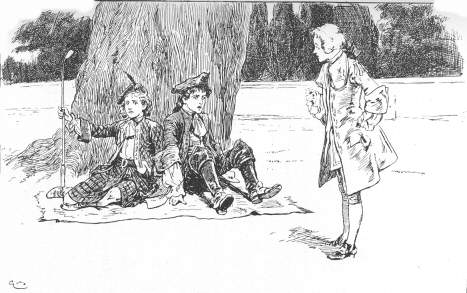
thirty years ago! Near him were two boys, not quite so old
as Prince Ricardo. The younger was a pretty dark boy, with
a funny little roundabout white wig. He was
splendidly dressed in a light-blue silk coat; a delicate little
lace scarf was tied round his neck; he had lace ruffles falling
about his little ringed hands; he had a pretty sword, with a gold
handle set with diamonds—in fact, he was the picture of a
little dandy. The other lad had a broad Scotch bonnet on,
and no wig; beautiful silky yellow locks fell about his
shoulders. He had laid his sword on the grass. He was
dressed in tartan, which Ricardo had never seen before; and he
wore a kilt, which was also new to Ricardo, who wondered at his
bare legs—for he was wearing shoes with no stockings.
In his hand he held a curious club, with a long, slim handle, and
a head made heavy with lead, and defended with horn. With
this he was aiming at a little white ball; and suddenly he swung
up the club and sent the ball out of sight in the air, over
several trees.
Prince Ricardo stepped up to this boy, took off his cap,
and said:
“I think I have the honour of addressing the Prince of
Wales?”
Prince Charles started at the sight of a gentleman in long
riding-boots, girt with a broadsword, which was not then
generally worn, and carrying a Persian rug under his arm.
“That is what I am called, sir,” he said,
“by those who give me the title which is mine by
right. May I inquire the reason which offers me the
pleasure of this unexpected interview?”
“Oh, I’m Ricardo of Pantouflia!” says
Dick. “I had a letter from you this morning, and I
believe you wanted to see me.”
“From Pantouflia, sir,” said Prince Charles;
“why, that is hundreds of leagues away!”
“It is a good distance,” said Dick; “but a
mere step when you wear Seven-league Boots like
mine.”
“My dear prince,” said Charles, throwing himself
into his arms with rapture, and kissing him in the Italian
fashion, which Dick did not half like, “you are, indeed,
worthy of your reputation; and these are the celebrated
Seven-league Boots? Harry,” he cried to his brother,
“come here at once and let me present you to his Royal
Highness, our illustrious ally, Prince Ricardo of
Pantouflia. The Duke of York—Prince Ricardo of
Pantouflia. Gentlemen, know each other!”
The prince bowed in the most stately manner.
“I say,” said Dick, who was seldom at all up to
the standard of royal conversation, “what’s that game
you were playing? It’s new to me. You sent the
ball a tremendous long shot.”
“The game is called golf, and is the favourite pastime of my loyal Scottish subjects,” said
Prince Charles. “For that reason, that I may be able
to share the amusements of my people, whom I soon hope to lead to
a glorious victory, followed by a peaceful and prosperous reign,
I am acquiring a difficult art. I’m practising
walking without stockings, too, to harden my feet,” he
said, in a more familiar tone of voice. “I fancy
there are plenty of long marches before me, and I would not be a
spear’s length behind the hardiest Highlander.”
“By Jove! I respect you,” said Dick, with
the greatest sincerity; “but I don’t think, with me
on your side, you will need to make many marches. It will
all be plain sailing.”
“Pray explain your plan,” said Prince
Charles. “The task of conquering back the throne of
my fathers is not so simple as you seem to suppose.”
“I’ve done a good many difficult
things,” said Dick, modestly.
“The conqueror of the magician, Gorgonzola, and the
Giant Who never Knew when he had Enough, need not tell me
that,” said Prince Charles, with a courteous allusion to
two of Ricardo’s most prodigious adventures.
“Oh! I’ve very little to be proud of,
really,” said Dick, blushing; “anyone could do as
much with my fairy things, of which, no doubt, you have
heard. With a Sword of Sharpness and a Cap of Darkness, and
so forth, you have a great pull over almost anything.”
“And you really possess those talismans?” said the
prince.
“Certainly I do. You see how short a time I took
in coming to your call from Pantouflia.”
“And has Holy Church,” asked the Duke of York,
with anxiety, “given her sanction and her blessing
to those instruments of an art, usually, in her wisdom,
forbidden?”
“Oh, never mind Holy Church, Harry!” said Prince
Charles. “This is business. Besides, the
English are Protestants.”
“I pray for their conversion daily,” said the Duke
of York.
“The end justifies the means, you know,” answered
Prince Charles. “All’s fair in love and
war.”
“I should think so,” said Ricardo,
“especially against those brutes of Electors; they give
trouble at home sometimes.”
“You, too, are plagued with an Elector?” asked
Prince Charles.
“An Elector? thousands of them!” answered
Dick, who never could understand anything about politics.
Prince Charles looked puzzled, but requested Dick to explain
his great plan.
They sat down on the grass, and Ricardo showed them how
he meant to manage it, just as he had told Jaqueline. As he
said, nothing could be simpler.
“Let’s start at once,” he said, and,
inducing Prince Charles to sit down on the magic carpet, he
cried:
“England! St. James’s Palace!”
But nothing happened!
The carpet was not the right magic carpet, but the one which
King Prigio had put in its place.
“Get on! England, I said!” cried Dick.
But there they remained, under the chestnut tree, sitting on
the carpet above the flowery grass.
Prince Charles leaped to his feet; his face like fire, his
eyes glowing.
“Enough of this fooling, sir!” he said.
“It is easy, but cowardly, to mock at an unfortunate
prince. Take your carpet and be off with you, out of the gardens, or your shoulders shall taste my
club.”
“There has been some mistake,” Ricardo said;
“the wrong carpet has been brought by accident, or the
carpet has lost its power.”
“In this sacred city, blessed by the presence of his
Holiness the Pope, and the relics of so many martyrs and saints,
magic may well cease to be potent,” said the Duke of
York.
“Nonsense! You are an impostor, sir! Leave
my presence!” cried Prince Charles, lifting his
golf-club.
Dick caught it out of his hand, and broke across his knee as
fine a driver as ever came from Robertson’s shop at St.
Andrew’s.
“The quarrels of princes are not settled with clubs,
sir! Draw and defend yourself!” he said, kicking off
his boots and standing in his socks on the grass.
Think of the horror of poor Jaqueline, who witnessed
this terrible scene of passion from a fold in Prince
Ricardo’s dress! What could the girl do to save the
life of two princes, the hopes of one nation, and of a
respectable minority in another?
In a moment Prince Charles’s rapier was shining in the
sunlight, and he fell on guard in the most elegant attitude, his
left hand gracefully raised and curved.
Dick drew his sword, but, as suddenly, threw it down
again.
“Hang it!” he exclaimed, “I can’t hit
you with this! This is the Sword of Sharpness; it
would cut through your steel and your neck at a touch.”
He paused, and thought.
“Let me beseech your Royal Highness,” he said to
the Duke of York, who was in a terrible taking, “to lend
your blade to a hand not less royal than your own.”
“Give him it, Hal!” said Prince Charles,
who was standing with the point of his sword on the ground, and
the blade bent. “He seems to believe in his own
nonsense.”
The duke yielded his sword; Dick took it, made a nourish, and
rushed at Prince Charles.
Now Ricardo had always neglected his fencing lessons.
“Where’s the good of it,” he used to ask,
“all that stamping, and posture-making, and ha-haing?
The Sword of Sharpness is enough for me.”
But now he could not, in honour, use the Sword of Sharpness;
so on he came, waving the rapier like a claymore, and made a
slice at Prince Charles’s head.
The prince, very much surprised, parried in prime, riposted,
and touched Dick on the hand.
At this moment the Princess Jaqueline did what she should have
thought of sooner. She flew out of Dick’s coat, and
stung old King James on his royal nose. The
king wakened, nearly crushed the princess (so dangerous is the
practice of magic to the artist), and then leaped up, and saw
Dick’s blade flying through the air, glittering in the
sun. The prince had disarmed him.
“Hullo! what’s all this? À
moi, mes gardes!” cried the old king, in French
and English; and then he ran up, just in time to hear Prince
Charles say:
“Sir, take your life! I cannot strike an unarmed
man. A prince you may be, but you have not learned the
exercises of gentlemen.”
“What is all this, Carluccio?” asked the old
king. “Swords out! brawling in my very presence!
blood drawn!” for Dick’s hand was bleeding a good
deal.
Prince Charles, as briefly as possible, explained the unusual
nature of the circumstances.
“A king must hear both sides,” said King James. “What reply have you, sir, to make
to his Royal Highness’s statements?”
“The carpet would not work, sir,” said Dick.
“It never happened before. Had I used my own
sword,” and he explained its properties, “the Prince
of Wales would not be alive to tell his story. I can say no
more, beyond offering my apology for a disappointment which I
could not have foreseen. A gentleman can only say that he
is sorry. But wait!” he added; “I can at least
prove that my confidence in some of my resources is not
misplaced. Bid me bring you
something—anything—from the ends of the earth, and it
shall be in your hands. I can’t say
fairer.”
King James reflected, while Prince Ricardo was pulling on the
Seven-league Boots, which he had kicked off to fight more freely,
and while the Duke of York bandaged Dick’s hand with a
kerchief.
“Bring me,” said his Majesty, “Lord
Lovat’s snuff-mull.”
“Where does he live?” said Dick.
“At Gortuleg, in Scotland,” answered King
James.
Dick was out of sight before the words were fairly spoken, and
in ten minutes was back, bearing a large ram’s-horn
snuff-box, with a big cairngorm set in the top, and the Frazer
arms.
“Most astonishing!” said King James.
“A miracle!” said the Duke of York.
“You have entirely cleared your character,” said
the king. “Your honour is without a stain, though it
is a pity about the carpet. Your nobility in not using your
magical sword, under the greatest provocation, reconciles me to
this fresh blighting of my hopes. All my allies fail
me,” said the poor king with a sigh; “you alone have
failed with honour. Carluccio, embrace the
prince!”
They fell into each other’s arms.
“Prince,” said Dick, “you have taught me a
lesson for which I shall not be ungrateful. With any blade
a gentleman should be able to hold his own in fair fight. I
shall no longer neglect my fencing lessons.”
“With any blade,” said Prince Charles, “I
shall be happy to find Prince Ricardo by my side in a stricken
field. We shall not part till I have induced you to accept
a sword which I can never hope to draw against another adversary
so noble. In war, my weapon is the claymore.”
Here the prince offered to Ricardo the ruby-studded hilt of
his rapier, which had a beautiful white shark-skin sheath.
“You must accept it, sir,” said King James;
“the hilt holds the rubies of John Sobieski.”
“Thank you, prince,” said Ricardo, “for the
weapon, which I shall learn to wield; and I entreat
you to honour me by receiving this fairy gift—which
you do not need—a ring which makes all men faithful
to the wearer.”
The Prince of Wales bowed, and placed the talisman on his
finger.
Ricardo then, after a few words of courtesy on both parts,
picked up his useless carpet, took his farewell of the royal
party, and, with Jaqueline still hidden under his collar,
returned at full speed, but with a heavy heart, to Pantouflia,
where the palace gong was just sounding for luncheon.
Ricardo never interfered in foreign affairs again, but his
ring proved very useful to Prince Charles, as you may have read
in history.


