The Black Cat and the Brethren!
Who was glad to see the prince, if it was not Lady
Rosalind? The white roses of her cheeks turned to red roses
in a moment, and then back to white again, they were so alarmed
at the change. So the two went into the gardens together,
and talked about a number of things; but at last the prince told
her that, before three days were over, all would be well, or all
would be over with him. For either he would have brought
his brothers back, sound and well, to Falkenstein, or he would
not survive his dishonour.
“It is no more than right,” he said;
“for had I gone first, neither of them would have been sent
to meet the monster after I had fallen. And I should
have fallen, dear Rosalind, if I had faced the Firedrake before I
knew you.”
Then when she asked him why, and what good she had done him,
he told her all the story; and how, before he fell in love with
her, he didn’t believe in fairies, or Firedrakes, or caps
of darkness, or anything nice and impossible, but only in horrid
useless facts, and chemistry, and geology, and arithmetic, and
mathematics, and even political economy. And the Firedrake
would have made a mouthful of him, then.
So she was delighted when she heard this, almost as much
delighted as she was afraid that he might fail in the most
difficult adventure. For it was
one thing to egg on a Remora to kill a Firedrake, and quite
another to find the princes if they were alive, and restore them
if they were dead!
But the prince said he had his plan, and he stayed that night
at the ambassador’s. Next morning he rose very early,
before anyone else was up, that he might not have to say
“Good-bye” to Lady Rosalind. Then he flew in a
moment to the old lonely castle, where nobody went for fear of
ghosts, ever since the Court retired to Falkenstein.
How still it was, how deserted; not a sign of life, and yet
the prince was looking everywhere for some living
thing. He hunted the castle through in vain, and then
went out to the stable-yard; but all the dogs, of course, had
been taken away, and the farmers had offered homes to the
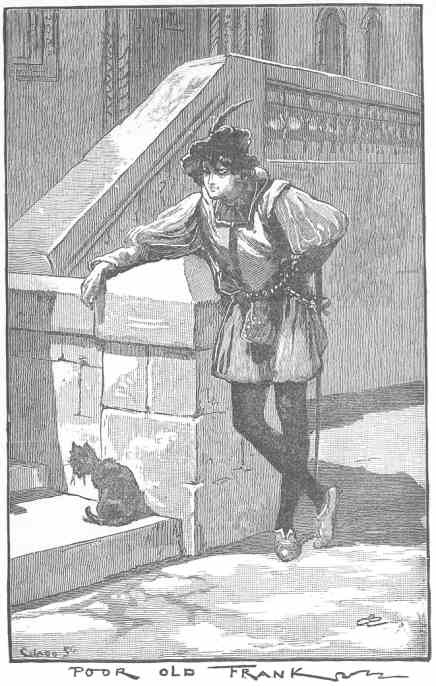
poultry. At last, stretched at full
length in a sunny place, the prince found a very old, half-blind,
miserable cat. The poor creature was lean, and its fur had
fallen off in patches; it could no longer catch birds, nor even
mice, and there was nobody to give it milk. But cats do not
look far into the future; and this old black cat—Frank was
his name—had got a breakfast somehow, and was happy in the
sun. The prince stood and looked at him pityingly, and he
thought that even a sick old cat was, in some ways, happier than
most men.
“Well,” said the prince at last, “he could
not live long anyway, and it must be done. He will feel
nothing.”
Then he drew the sword of sharpness, and with one turn of his
wrist cut the cat’s head clean off.
It did not at once change into a beautiful young lady, as perhaps you expect; no, that was improbable,
and, as the prince was in love already, would have been vastly
inconvenient. The dead cat lay there, like any common
cat.
Then the prince built up a heap of straw, with wood on it, and
there he laid poor puss, and set fire to the pile. Very
soon there was nothing of old black Frank left but ashes!
Then the prince ran upstairs to the fairy cupboard, his heart
beating loudly with excitement. The sun was shining through
the arrow-shot window, all the yellow motes were dancing in its
rays. The light fell on the strange heaps of fairy
things—talismans and spells. The prince hunted about
here and there, and at last he discovered six ancient
water-vessels of black leather, each with a silver plate on it,
and on the plate letters engraved. This was
what was written on the plates:
AQVA. DE. FONTE. LEONVM. [130]
“Thank heaven!” said the prince. “I
thought they were sure to have brought it!”
Then he took one of the old black-leather bottles, and ran
downstairs again to the place where he had burned the body of the
poor old sick cat.
He opened the bottle, and poured a few drops of the water on
the ashes and the dying embers.
Up there sprang a tall, white flame of fire, waving like a
tongue of light; and forth from the heap jumped the most
beautiful, strong, funny, black cat that ever was seen!
It was Frank as he had been in the vigour of his youth;
and he knew the prince at once, and rubbed himself against him
and purred.
The prince lifted up Frank and kissed his nose for joy; and a
bright tear rolled down on Frank’s face, and made him rub
his nose with his paw in the most comical manner.
Then the prince set him down, and he ran round and round after
his tail; and, lastly, cocked his tail up, and marched proudly
after the prince into the castle.
“Oh, Frank!” said Prince Prigio, “no cat
since the time of Puss in Boots was ever so well taken care of as
you shall be. For, if the fairy water from the Fountain of
Lions can bring you back to life—why, there is a
chance for Alphonso and Enrico!”
Then Prigio bustled about, got ready some cold luncheon from
the store-room, took all his fairy
things that he was likely to need, sat down with them on the
flying carpet, and wished himself at the mountain of the
Firedrake.
“I have the king now,” he said; “for if I
can’t find the ashes of my brothers, by Jove!
I’ll!—”
Do you know what he meant to do, if he could not find his
brothers? Let every child guess!
Off he flew; and there he was in a second, just beside poor
Alphono’s garden-engine. Then Prigio, seeing a little
heap of grey ashes beside the engine, watered them with the fairy
water; and up jumped Alphonso, as jolly as ever, his sword in his
hand.
“Hullo, Prigio!” cried he; “are you come
after the monster too? I’ve been asleep, and I had a
kind of dream that he beat me. But the pair of us will
tackle him. How is Molinda?”
“Prettier than ever,” said Prigio;
“but anxious about you. However, the
Firedrake’s dead and done for; so never mind him. But
I left Enrico somewhere about. Just you sit down and wait a
minute, till I fetch him.”
The prince said this, because he did not wish Alphonso to know
that he and Enrico had not had quite the best of it in the affair
with the monster.
“All right, old fellow,” says Alphonso; “but
have you any luncheon with you? Never was so hungry in my
life!”
Prince Prigio had thought of this, and he brought out some
cold sausage (to which Alphonso was partial) and some bread, with
which the younger prince expressed himself satisfied. Then
Prigio went up the hill some way, first warning Alphonso
not to sit on his carpet for fear of accidents like
that which happened to Benson. In a
hollow of the hill, sure enough there was the sword of Enrico,
the diamonds of the hilt gleaming in the sun. And there was
a little heap of grey ashes.
The prince poured a few drops of the water from the Fountain
of Lions on them, and up, of course, jumped Enrico, just as
Alphonso had done.
“Sleepy old chap you are, Enrico,” said the
prince; “but come on, Alphonso will have finished the grub
unless we look smart.”
So back they came, in time to get their share of what was
going; and they drank the Remora’s very good health, when
Prigio told them about the fight. But neither of them ever
knew that they had been dead and done for; because Prigio
invented a story that the mountain was enchanted, and that, as
long as the Firedrake lived, everyone who came there fell
asleep. He did tell them about the flying
carpet, however, which of course did not much surprise them,
because they had read all about it in the Arabian Nights
and other historical works.
“And now I’ll show you fun!” said Prigio;
and he asked them both to take their seats on the carpet, and
wished to be in the valley of the Remora.
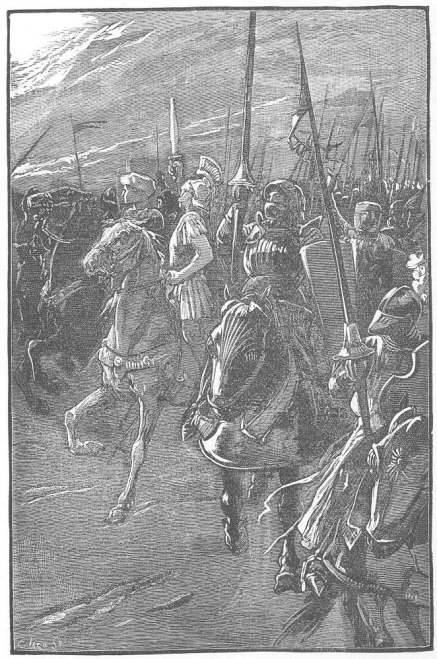
There they were in a moment, among the old knights whom, if
you remember, the Remora had frozen into stone. There was
quite a troop of them, in all sorts of armour—Greek and
Roman, and Knight Templars like Front de Bœuf and Brian du
Bois Gilbert—all the brave warriors that had tried to fight
the Remora since the world began.
Then Prigio gave each of his brothers some of the water in
their caps, and told them to go round pouring a drop or two on
each frozen knight. And as they did it, lo
and behold! each knight came alive, with his horse, and lifted
his sword and shouted:
“Long live Prince
Prigio!”
in Greek, Latin, Egyptian, French, German, and
Spanish,—all of which the prince perfectly understood, and
spoke like a native.
So he marshalled them in order, and sent them off to ride to
Falkenstein and cry:
“Prince Prigio is coming!”
Off they went, the horses’ hoofs clattering, banners
flying, sunshine glittering on the spear-points. Off they
rode to Falkenstein; and when the king saw them come galloping
in, I can tell you he had no more notion of hanging Prigio.