FOR several days after Shorty had gone on his way to the Land of
Make-Believe with Mr. Melville, life ran very quietly and happily for
Prince Jan and his friends in the little bungalow on the cliffs. Then he
began to notice that Captain Smith was worried, and when Jan poked his
nose into the hand of his friend, though the hand stroked the dog's
head, the poundmaster did not smile and his eyes looked as if he saw
something Jan could not see. It worried Jan, though he could do nothing
but lie quietly with his anxious eyes fixed on the old man's face.
One evening after supper a loud knock at the door caused the dog to look
up quickly, while Hippity-Hop jumped with fuzzed tail and excited eyes.
The captain opened the door and two men came in. They shook hands with
him and sat down in the chairs he pushed forward. The two men looked
around the room, stared at the dog, then turned to Jan's master. The
look on the poundmaster's face made the dog feel certain that these men
had something to do with the old man's worry, so Jan went over and sat
close to him, resting his big head on the captain's knee.
"Is that the dog that was stolen?" one of the visitors asked at last.
"Yes," replied the captain. "This is Prince Jan. He was sent to the
pound almost dead with mange and orders through the stableman that the
dog was to be killed because he was vicious. But," the poundmaster
smiled down at the dog that was gazing with loving eyes into his face,
"you see, all he needed was kind treatment and proper care."
"I understand, Smith," the other man now spoke in a voice that sounded
cross to Jan, "that you are violating the City ordinances, and are
keeping the dogs that are brought to the pound. They are sent here to be
killed, not kept."
"I find homes for them all," the old man hastened to say, "and it only
takes a short time to find people who will give them good homes. Not one
of the dogs that has been brought here since I had charge has been
vicious. Those that seemed dangerous at first grew gentle and kind as
soon as they found no one would hurt them."
"Of course, we know how you feel about them, but the City hires you to
kill the dogs if their owners do not claim or want them. People complain
that you keep the dogs and feed them at the public expense. We can't
have that, you know."
Captain Smith rose, and the hand he held out suddenly toward the two men
was trembling. "I don't know who told you that," he said earnestly, "and
I don't believe that whoever did say it meant to tell an untruth, but
the only dogs that are fed at public cost are those for which I am
allowed money. After any dog has been with me for more than a week, I
pay for his food myself."
The two strange men looked at each other and were silent a few minutes.
Finally one of them spoke again,
"I'm sorry, Smith, but you will have to get rid of the dogs. The pound
is not a boarding place for stray dogs, and the fact that you pay for
their feed after a certain time does not change matters."
The old man sat down in his chair as though he were very tired, and
stared at the floor until he felt Jan's nose, and then he looked into
the dog's sympathetic eyes. The wrinkled hand twitched, but the old
man's kindly face turned to the other man.
"I know you can't change the law," he said slowly, "but if you could let
me have a little more time, I can find homes for all the dogs that are
here now. There are only ten, beside Prince Jan, and he belongs to me.
See"—he pushed aside the thick hair on the dog's neck—"I bought a
collar and a license for him, and he has never eaten a mouthful of food
except what I have paid for myself."
"Too many people have complained," was the reply. "The dogs are noisy,
and no one is allowed to have so many dogs inside the city limits. You
know it is against the law, Smith. That settles it."
Both men rose to their feet and looked at the old man, but at the door
they stopped and talked together in low voices. Then one of them turned
and said, "We don't want to be too hard on you, for we know you love
dogs, so we will give you two days to find places for them. After that,
the dogs that are still here must be killed, or you will have to resign
your position as poundmaster."
Smith watched them go down the pathway to the front gate, then with low
drooping head and slow steps he went back to the little room. Jan
pressed closely against him as the old man sank into his chair. Cheepsie
flew from his cage and perched on the captain's shoulder, singing
loudly, and Hippity-Hop, not to be left from the little family group,
limped across the room and rubbed, purring, against the old
poundmaster's leg. They knew that he was troubled, and all of them tried
to make him understand they were sorry for him and loved him.
"We've got to do something for those poor dogs," he said to Jan, at
last. "Even if I do give up my job it won't help them, now. I can't find
homes for them all in such a short time, Jan. Nearly every one I know
here has a dog already, and some of them have two. Folks have been
mighty good taking my dogs."
Cheepsie sang an answer, Hippity-Hop purred her reply, and Prince Jan's
tail, thumping the floor, said very plainly that he agreed with his
master. The captain smiled at them all, for he understood their
languages. "It's bound to work out right, somehow," he asserted
cheerfully, and again his three dumb friends answered him.
The next morning Captain Smith left Jan and Hippity-Hop in the front
yard. It was the first time the old man had ever carried his violin with
him, and he trudged briskly down the street, only stopping when he
reached a corner to wave his hand back where Jan and the kitten stood
with noses pushed between the pickets of the fence. Jan was worried
because it was the first time the captain had gone away from the house
without him.
So, while Hippity-Hop climbed trees, chased butterflies, and washed her
face and paws many times, the dog kept perfectly quiet, watching for his
master's return. A big bark welcomed the captain home as Jan ran down
the street to meet him.
"Come along, Jan," the old man was smiling, and the dog trotted beside
him into the pound, where the other dogs pulled on their ropes and
greeted them noisily.
The poundmaster stopped in front of each dog and fastened a small metal
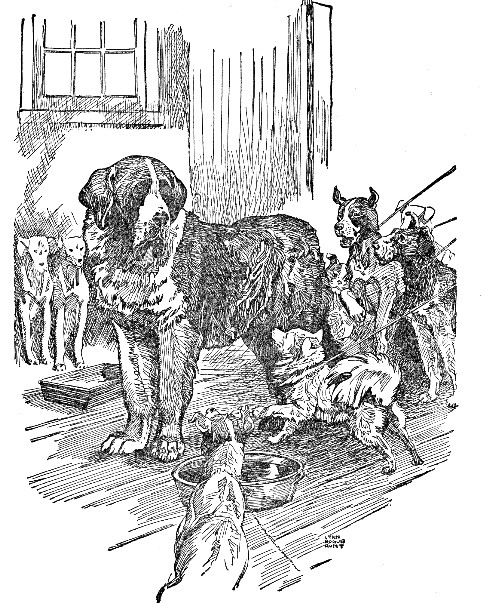
tag to its collar, then he took them all into his own back yard, where
they crowded and leaped about him or chased each other in play. One dog
was so happy that he kept turning around and around after his own short
tail until he was too dizzy to stand up.
"It's a pretty good-sized family, Jan," laughed the old man, as he sat
in a chair on the back porch, smoking his pipe and watching the dogs'
antics. "They've all got licenses now, so no one can order any of 'em
killed for a year. I guess we can find homes for all of them before that
time is up."
So, when the two men came again, Captain Smith took them into the back
yard and showed the license on each dog's collar, as he said, "I have
found homes for five of them already, and to-morrow I'll take the others
to a friend in the country. He will look out for them until we have good
places for all."
He smiled happily at the dogs, then looked up at the two men, but his
smile faded at their next words.
"Well, what do you intend doing with the next bunch you collect?"
"Why, I'll get homes for them, like these others."
"That won't do, Smith. Either you've got to take care of the work as
you are ordered, or else let some other man have your place. What are
you going to do about it?"
Smith's hand rumpled the fur on Jan's back. The eyes of the dog and the
old man met, then the poundmaster lifted his head and said quietly, "I
will give up the place. I thought when I took this work that it would
give me a chance to make some poor dumb brutes a little happier and more
comfortable, but I never intended to shoot one of them. Why, I couldn't
do that. They're all my friends!"
"All right," was the answer. "Suit yourself. We'll have another man take
charge to-morrow morning."
Without further words the men left, and the captain, followed by Jan,
went into the back yard where the ten dogs rushed to meet them. Barking,
leaping, tumbling over each other, they struggled to get close to the
old man who stood smiling and patting them, while he said softly, "The
best friends a man ever had, Jan."
Prince Jan looked at the bunch of dogs, little dogs, big dogs, curs, and
dogs of high breeding. No matter where they had come from, they had
found a protector in the old poundmaster, but they did not know that he
had given up his position because he would not kill them. Even Jan did
not know what his master was writing that evening. It took some time to
get the letter just right, then it was folded, placed in an envelope,
sealed and stamped, and Jan walked with the captain to the letter-box
several blocks away.
When they were home again, the old man sat smoking his pipe and nodding,
then he got up and wound the clock, for it was Saturday night. As he put
the key on top of the clock, he said, "Well, Jan, we'll have to hunt for
another job on Monday, but I don't think it will take long for us to
find something we can do."
Monday morning people came for the dogs, and the captain patted each of
his four-footed friends, before it went to its new home. A man from a
ranch brought an automobile, and into this the five dogs which had not
yet found permanent homes were lifted. Then the captain took out his
worn pocketbook and counted money, which he handed to the rancher.
"Take good care of them for me," said the old man, "and I'll pay for
their food until we find homes for them all."
"All right, Smith," the man answered, and then he drove away with the
yelping dogs.
It was very quiet in the house and back yard, but Hippity-Hop was glad
of it. She had not enjoyed herself while there were so many dogs in the
back of the house. After lunch was over, the captain dressed himself in
his best clothes, put on his hat, and with Jan at his side, went to many
big buildings where he talked earnestly with several men.
They were very kind to him, patted Jan, and promised they would let the
captain know if they saw any work he could do. Jan saw that his old
friend seemed tired after they had been to several places, and when the
dog thrust his nose into the captain's hand, the faded eyes would smile
bravely, as the captain said, "It's bound to work out right in the end,
Jan."
Day after day, they made these trips, and at night Jan lay watching the
face of his master, but the smile was not seen very often now. One
evening the old man was more despondent than ever, so even Jan's wistful
sympathy failed to rouse him, though the hand caressed the dog. Jan's
heart ached, and unable to stand it longer, he pushed his head on the
captain's knee and gave a low whimper.
Captain Smith leaned down and lifted the dog's head between his hands
and looking into his puzzled eyes, he said slowly, "We're up against it,
Jan. My money is gone, and there does not seem to be any work for me to
do. Every one is very kind, and all promise to send for me, but it is
just because they are sorry. If I were younger, it would be easy to find
plenty to do."
Jan licked the gnarled hand and tried to show that he wished he could
help, but the only thing he could do was to show the love and sympathy
that filled his loyal heart. That night when the light was out and
everything was quiet, Jan lay wide awake trying to puzzle out what it
all meant, and then he heard a faint sigh and knew that the captain, on
his cot, was awake, too. So the dog rose softly and moved to the side of
the narrow bed, where he stretched himself on the floor. Presently he
felt a hand touch his head and he turned quickly to caress it with his
tongue. Then he heard the old man say, "It's bound to work out right
some way, Jan!"
The next morning the captain was more cheerful, and when the postman
came along the street, the old man called out, "It's a beautiful day,
isn't it?"
The postman nodded, then said, "I have a registered letter for you,
Captain."
With surprised eyes and quick steps, the old man reached the gate and
signed the card. He turned the letter over, stared at it, then smiled
and cried out, "It's from my daughter!"
A happy smile illumined his face and his fingers were unsteady as he
tore open the envelope, saying, "She and her husband went to Alaska two
years ago. I haven't heard anything from them for six months. You see,
when winter begins up there, the river freezes solid, so no boats or
mail can reach them."
"Well, the postmen up there have an easy time once in a while," replied
the letter-carrier as he slung the heavy pouch over his shoulder and
went on his way.
The old man sat on the step of the porch and read the letter, which was
a long one. Jan knew his master was glad over something, and yet, when
the letter was finished, there were tears rolling down the captain's
cheeks. Jan edged tightly against him.
"They're all well," said the old man, "and they want us to come and
live with them. Look, Jan!" He held out a piece of paper which the dog
sniffed at. "That is to pay our way, and we're going to start just as
soon as we can pack up. You see, it worked out right in the end!"
Busy hours followed for them all. The captain hurried about the little
house, packing things into boxes, and taking down pictures, which he put
into a trunk. One picture he held for some minutes, "That was Jenny when
she was a little girl, just able to walk, Jan." Then he wrapped it very
carefully in a faded blue knitted scarf and placed it in the trunk with
the other things. Hippity-Hop scurried about the room, and Cheepsie had
a hard time clinging to the old man's shoulder, for he moved so swiftly
and kept leaning over the trunk.
It was three o'clock in the afternoon when the trunk was shut and locked
and an old carpet-bag stood beside it. The captain's hat was on his
head, Cheepsie chirped in his cage that was wrapped tightly with paper,
and Hippity-Hop mewed forlornly from a basket, while Jan moved nervously
between the bundles and his master, wondering what it all meant. Then a
man drove to the door and carried the trunk and valise to his wagon,
leaving the captain to pick up the bird-cage and the hamper that held
the kitten.
"Come along, Jan," he called cheerfully, and the dog rushed ahead,
turning back to frisk in circles or leap up in front of his friends. Jan
was much happier than Hippity-Hop, who was yowling loudly as she stuck
one paw through a hole in the basket, and Cheepsie's twitters sounded
really cross.
Jan, once again, was put in a baggage car and after a ride of several
hours, the captain got him out and led him to a wharf. Jan remembered
his trip in the boat when he came to the Land of No Snow. He hesitated
to go up the plank walk, but the captain smiled and said, "It's all
right, Jan. Come along!" and then the dog trotted fearlessly along the
boards that led to the deck of the big boat. Everything was confusion,
but Jan did not worry when his master led him down into the lower part
of the boat, under the deck. After tying Jan, the old man gave him a
final pat and said, "I'll be back soon, Jan"; and the dog, knowing
everything was all right, stretched on his side and closed his eyes. He
was tired from the trip, the excitement of packing, and from those days
of worry before the letter came that made the captain happy again. So he
was very glad to have nothing to do, nothing to think about.
Then the boat trembled and puffed, and Prince Jan knew that he and
Hippity-Hop and Cheepsie and their loved master were going somewhere
together, and he was satisfied.