Twelve-year-old Arthur Dale Dustin
did not look the least bit like a Prince,
sitting perched on the topmost rail of the zig-zag
fence that bright September afternoon. As he
dangled his bare brown legs idly, he wistfully
watched his cousins at the play in which they
would not allow him to join. He loved to play
as dearly as any other boy; but somehow or
other he was always left out of their games by the
boisterous crew of little Dustins whom he called
cousins. He tried his best to like what they liked,
2and to be one with them; but something always
seemed to happen to prevent.
Once when they all went to see the well that
his uncle, John Dustin, was drilling, deep down into
the ground, with the hope of striking petroleum,
they found the men away, and, for a few minutes,
had the place to themselves. Thereupon Cousin
Dick, who was two years older than Arthur, climbed
up the derrick, and, watching his chance, sprang on
the end of the great walking beam, that was working
slowly up and down with ponderous strokes.
Here he rode on the back of his mighty wooden
steed for a few seconds, while the other children
shouted and clapped their hands with admiration.
Then Dick came down and dared Arthur to perform
the same feat; but the boy held back. He
was not afraid, not a bit of it; and even if he had
been he would gladly have done anything Dick
dared do, merely to win his good-will and that of
the others. But his Uncle John had forbidden them
even to go near the derrick or the engine unless he
was there to look after them. The others seemed to
have forgotten this; but Arthur remembered it, and
so refused to ride on the walking beam because it
3would be an act of disobedience. Then Cousin Dick
sneered at him, and called him a “’Fraid-cat,” and all
the others, except tender-hearted, freckle-faced little
Cynthia, took up the cry and shouted, “’Fraid-cat!
’Fraid-cat!” as they crowded around him and pushed
him into the derrick.
Just then Uncle John returned and the others ran
away, leaving poor Arthur, looking very confused
and red in the face, standing in the middle of the
derrick floor. Then, when his uncle in a stern voice
asked him what he was doing in that place which
he had been strictly forbidden to enter, Arthur
hung his head and would not say anything; for he
was too brave a lad to be a “tell-tale,” and too
honest to tell a lie. So his Uncle John said that
he was a naughty boy who had led the other children
into mischief, and that he might go right home
and get into bed, and stay there for the rest of the
day as a punishment.
Poor Arthur obeyed; and, as he walked slowly
toward the only place in the world he could call his
home, great tears rolled down his cheeks. When
the other children, who were hiding in the bushes,
saw them they called out, “Cry-baby! Cry-baby!”
4Only little Cynthia ran out and put her arm about
his neck and said she was sorry; but Dick pulled
her roughly away.
Another time when Cynthia asked Arthur to
build a house for her dolls, under the roots of a
great tree that had blown down just on the edge of
the woods back of the house, he, being an obliging little
soul, consented at once to do so. Under the huge
mass of roots and earth they played happily enough
at making believe it was a cave, and Cynthia was
radiant with delight over the beautiful time they
were having. For a little while Arthur experienced
the novel feeling of being perfectly happy. Then,
all of a sudden, a shower of earth and gravel came
rattling down on them from above, and with it came a
mocking chorus of “Girl-boy! Girl-boy! Look at the
girl-boy playing with dolls!” and little Cynthia began
to cry over the ruin of her beautiful baby-house.
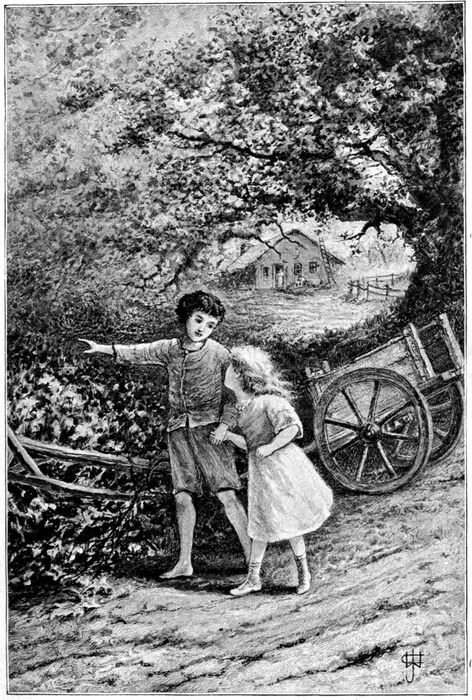
PRINCE DUSTY AND CYNTHIA SET OUT ON THEIR ADVENTURES. (Page 5.)
5Upon this, with a quick blaze of indignation,
Arthur picked up a bit of stick and flung it with
all his strength at the tormentors who had brought
tears to his little cousin’s eyes. It was aimed at nobody
in particular; but it happened to strike Dick
on the cheek and make a slight cut, from which the
blood flowed. Thereupon the big boy ran crying
home to his mother, and told her that Arthur had
struck him with a stick, in proof of which story he
showed his bloody face. Then Mrs. Dustin, who
always acted upon the impulse of the moment, took
down the apple switch from over the mantel-piece
and gave her nephew a whipping, which she said
would be a lesson to him. Poor little Cynthia tried
to explain how it had all happened; but her mother
had no time to listen, and only told her and the other
children to come away from the bad boy, and not go
near him again that day.
Some days after this, when all the others had gone
on a fishing expedition, upon which they had refused
to let Arthur and Cynthia accompany them,
the boy proposed a beautiful plan to his little
cousin. He remembered the fairy tales his own
dear mother used to read to him, and now he said:
“Let us make believe we are a Prince and Princess,
Cynthia, and go out into the world in search of
adventures.”
Cynthia had not the remotest idea of what was
meant by “adventures”; but she was willing to
agree to anything that Arthur might propose.
6So the two children set forth, and nobody noticed
them as they went out of the front gate and walked,
hand in hand, down the dusty road.
They had not gone far before they discovered a
poor little robin just learning to fly, that had fallen
into a ditch by the roadside, where in a few moments
more he would have been drowned. Of course
they rescued him, and, while the old mother and
father birds flew about them uttering cries of distress
and begging them not to hurt their baby, Cynthia
dried his wings and carefully wiped the mud
from his downy feathers with her pinafore. Then
Arthur climbed over a fence and gently placed the
little trembling thing down in the soft grass on the
other side.
Next they found a yellow butterfly, whose pretty
wings were all tangled in a spider’s web. Of course
they set him free, and had the pleasure of seeing him
flutter joyously away. Arthur said these were beautiful
adventures, and both the children looked
eagerly forward to finding some more; but they
walked nearly a mile, and were becoming very hot
and tired, before they met with another.
All of a sudden, as they were passing a cottage by
7the roadside, they were startled by a deep, loud
bark, and turning they saw a big Newfoundland dog
bound over the front fence, and come dashing directly
toward them. Now, while Arthur was very fond of
dogs that he was acquainted with, he was also very
much afraid of strange dogs, especially big ones;
and his first impulse upon this occasion was to run
away. Then he remembered that he was a Prince,
and that princes were always brave. So he told
Cynthia to run as fast as she could, and hide in the
bushes. As she did this the brave little fellow
turned a bold front, though he was trembling in
every limb, toward the enemy. The next instant
the big dog sprang upon him, threw him down,
rolled him in the dust, and then stood over him wagging
a bushy tail, and barking with delight at what
he had done.
CHAPTER II. A PRESENT FROM A FAIRY GODMOTHER.
8
Arthur, who thought he was certainly to be
killed, shut his eyes, and for nearly a minute
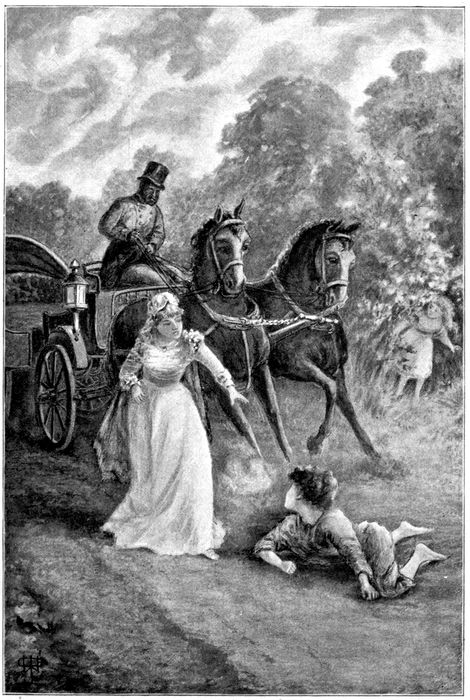
lay perfectly still. He opened them on hearing a
trampling of hoofs, a jingling of harness, and a loud
“Whoa.” Then, no longer seeing the dog, he quickly
scrambled to his feet. He was right under the noses
of a pair of splendid horses, and behind them was a
fine carriage, from which a beautiful lady was just
stepping.
“Why, little boy,” she said, as she took Arthur’s
hand and led him away from in front of the horses,
“don’t you know that you came very near being run
over? and that it is dangerous to be playing out here
in the middle of the road? Now run into the house,
and ask your mother to brush your clothes, and don’t
ever do so again.”
9“But I don’t live here,” said Arthur, lifting his
dust-covered little face to the gracious one bent
down to him. “I live a long way off, and I’m a
Prince, and Cynthia is a Princess, and we were looking
for adventures, when a big dog knocked me
down; but he didn’t hurt Cynthia, because I defended
her, the same as princes do in the stories my
own mamma used to read to me.”
“So you are a Prince, are you?” laughed the lady;
“then you must be ‘Prince Dusty.’ Well, if you
will get into my carriage, and show me the way, I
will take you home to your castle. But where is
your Princess? What did you say her name was?”
“It is Cynthia,” replied Arthur, “and there she
comes now.”
As he spoke, poor, terrified little Cynthia came
timidly out from the bushes where she had been
hiding, and crying with fright, for the last three
minutes.
Then the beautiful lady took them both into her
carriage, and ordered the coachman to drive on,
while she soothed and comforted the children, and
wiped Arthur’s dusty face with her own embroidered
handkerchief.
10She looked curiously at him when he told her that
his name was Arthur Dale Dustin, that his dearest
mamma and papa were dead, and that he used to
live in New York, but that now he lived with Cynthia’s
father and mother, who were his Uncle John
and Aunt Nancy. She asked him several questions
about himself; but always seemed to forget his name
and only called him “Prince Dusty.”
When they reached the Dustin house she kissed
both the children good-bye, and gave Arthur a beautiful
copy of Hans Christian Andersen’s “Fairy
Tales,” that she had in the carriage with her. On
the fly-leaf she wrote, with a tiny gold pencil that
hung from her watch-chain: “To Prince Dusty from
his Fairy Godmother.” Then she said she must
hurry on, and drove away, leaving the children
standing by the roadside and staring after the carriage
so long as the faintest cloud of dust from its
wheels was visible.
As they turned slowly into the front gate, and
walked toward the house, Arthur drew a long
breath and said: “Cynthia, that is the very most
beautiful adventure I ever heard of. It’s beautifuller
even than the stories my own mamma used to
11tell, and I’ve got this lovely book to show that it is
all true.”
Poor Arthur was not allowed to enjoy the possession
of his book very long, for his Aunt Nancy, who
had been alarmed at the children’s disappearance,
and now gave them only bread and water for their
dinner, took it from him, and laid it on a high shelf,
saying that it was altogether too handsome a book
for a little boy to have.
Arthur begged, and pleaded with tears in his
eyes, that he might be allowed to keep his book,
claiming justly that it was his very own, and had
been given to him to do as he pleased with; but all
to no purpose. His Aunt Nancy only said that she
would give it to him when the proper time came;
and then, adding that she was too busy now to be
bothered with him, she bade him get out of the
house, and not let her see him again before sundown.
So the sensitive little chap walked slowly away,
trying in vain to choke back the indignant sobs that
would persist in making themselves heard, and feeling
very bitterly the injustice of his Aunt Nancy’s
action. He longed for sympathy in this time of
trial, and for some friendly ear into which he might
12pour his griefs. Even Cynthia’s company was denied
him, for she was seated in the kitchen under her
mother’s watchful eye, taking slow, awkward stitches
in the patchwork, a square of which was her allotted
task for each day.
“I’ll find Uncle Phin,” said Arthur to himself,
“and tell him all about it, and perhaps he will somehow
find a way to get my book again, and then I’ll
ask him to take me away from here, to some place
where I can keep it always.”
Somewhat cheered by having a definite purpose in
view, the forlorn little fellow started across the
fields toward a distant wood-lot, in which he knew
his sympathizing old friend and adviser was at work.
Uncle Phin was a white-headed, simple-hearted,
old negro, who, some years before, had been a slave
belonging to Colonel Arthur Dale, of Dalecourt,
Virginia. He had been the constant attendant, in
her daily horseback rides, of the Colonel’s only
daughter, the lovely Virginia Dale, to whom her
father had formally presented him, as a birthday
gift, when she was fifteen years old.
Three years later the spirited girl, refusing to
marry the man whom her father had selected for her,
13ran away with Richard Dustin, a young Northerner
recently graduated from a New England university,
who had accepted a professorship in one of the Virginia
colleges. This marriage proved so terrible a
disappointment to her father that, in his anger, he
declared he would never receive a communication
from her, nor see her again, and he never did. The
young couple, accompanied by the faithful Uncle
Phin, went to New York. There their only child, a
boy, named Arthur Dale after the grandfather who
refused to recognize him, was born, and there they
lived in the greatest happiness until the child was
nearly eleven years old. Then the beautiful young
mother died, leaving Richard Dustin utterly heartbroken.
Soon afterward he removed with his idolized
boy and Uncle Phin, who had filled the position
of nurse and constant protector to Arthur from infancy,
to the home of his childhood, a little rocky
farm in Northwestern Pennsylvania.
He had but one relative in the world, a brother,
who lived near one of the mushroom-like towns that
sprang up during the early days of petroleum.
When, a year after the death of his wife, Richard
Dustin was also laid in the grave, it was in the
14family of this brother, John Dustin, that Arthur and
Uncle Phin found a home.
Richard Dustin left no property save the rocky
farm that was too poor even to support a mortgage.
As his brother John had a large family, the new
burdens now thrust upon him were not very warmly
welcomed. In fact Mrs. Dustin strongly urged her
husband not to receive them. She was Arthur’s
Aunt Nancy, a hard, unsympathetic, overworked
woman, who grudged every morsel of food that the
new-comers ate, and seemed to consider that everything
given to Arthur was just so much stolen from
her own children.
Uncle Phin, it is true, worked faithfully to do
what he could toward earning the bread eaten
by himself and his “lil Marse,” as he persisted in
calling Arthur, but he was old and feeble, and the
best that he could do did not amount to much.
The scanty, but neat, city-made wardrobe that Arthur
brought with him to his new home, had not
been replenished by a single garment, and now the
boy’s clothes were shabby and outgrown to such
a degree, that his mother’s heart would have ached
could she have seen him.
15Although he was a thoughtful, imaginative child,
he was remarkably strong and active for his age.
He had learned to read and write at his mother’s
knee, and his father had, during the last year of his
life, found his only pleasure in planning and directing
the boy’s education. Arthur was therefore as
far in advance of his cousins in this respect as he
was in refinement and ideas of honor. He was so
very different from them that, though he tried hard
to love them and make them love him, they, with the
exception of little Cynthia, to whom he was an ideal
of perfection, united in cordially disliking him.
This dislike was clearly shown, and resulted in
many a heartache and many an unjust punishment
to the lonely orphan boy. Many a night he slipped
from his little cot bed in the back shed, and creeping
to where Uncle Phin slept on a hay-mow in the
barn, poured his troubles with bitter tears into the
sympathetic ears of the old negro.
Then the faithful soul would open wide his arms,
and nestling the fair head of his “lil Marse” against
his broad bosom, would soothe and comfort him
with gentle croonings and quaint quavering plantation
melodies. His singing was always accompanied
16by a slow rocking motion of the body, and finally
the blue, tear-swollen eyes would close, and the boy
would drop into a sleep full of beautiful dreams,
in which he always saw his own dear father and
mother. Then Uncle Phin’s frosted head would
droop lower and lower, until he too was asleep and
dreaming of his long ago cabin home under the
magnolia trees of old Virginia. Thus these two
would comfort each other until morning.
Now, choking with a sense of injustice and wrong
at the hands of his Aunt Nancy, little Prince Dusty
fled across the fields in search of this friend. He
was filled with the determination to beg Uncle Phin
to take him away from that hated place, to some
other where they might live happily together for
always and always.
CHAPTER III. BRACE BARLOW THE MOONLIGHTER.
17
Besides Uncle Phin and Cynthia, Arthur had
one other friend whom he seldom saw now,
but whom he was always glad to meet. This was
Brace Barlow, a stalwart, good-natured, young
fellow, about twenty-five years old, who seemed so
big and strong to the little boy, that the latter
called him his “dear giant.” He worked for
Arthur’s uncle when the boy first came to live
with the Dustins, and had immediately taken a
great fancy to the gentle little fellow. He taught
Arthur to ride horseback, to drive a team, and to
swim, and was always ready to tell him stories of
adventures in the oil region. Besides these things,
he took pains patiently to explain where the oil came
from, and how wells were drilled, deep down into
the earth to its hiding-places.
18Some months before the time with which this
story opens, Brace Barlow left Mr. Dustin’s employ,
and, much to Arthur’s dismay, became a “moonlighter.”
Now to understand what a “moonlighter” is,
one must know at least as much as Arthur did about
oil wells. They are holes about the size of an ordinary
stove-pipe, bored, by means of immensely heavy
iron drills, hundreds and sometimes thousands of
feet into the earth, until they reach the layer of
porous sandstone that holds the oil, just as a sponge
holds water.
With the oil in this sandstone are vast quantities
of gas, that exert an enormous pressure upon it;
and the moment an opening is made to where it is,
this gas forces the oil to the surface, often driving it
forth in great spurts and fountain-like jets. Such a
well is called a “gusher,” and from it the oil flows
for days, weeks, and sometimes for years. After
a while, however, the supply of oil or gas, or both,
becomes exhausted, so that the stream no longer
rises above the mouth of the well. Then a pump is
used, and by means of it the oil is pumped up, just
as water is from an ordinary well. But the supply
19of oil always decreases, until, by and by, the pump
no longer brings it up in paying quantities.
For some years after the discovery of oil, these
exhausted wells were abandoned, and their owners
sunk new ones in other places. At length, however,
a wise man who had studied the situation very carefully,
concluded that if, by any means, the oil-bearing
rock could be shattered for a considerable distance
around the bottom of these old wells, the flow of oil
might be increased, and it might again be produced
from them in paying quantities. So he invented a
torpedo that could be exploded at any required
depth in a well. It was simply a long tin tube,
closed at the lower end, and filled with nitro-glycerine.
This is one of the most terrible explosives ever
discovered; and though it is only ordinary sweet
glycerine, such as is used for chapped faces and
hands, mixed with nitric acid, it is ten times more
powerful than gunpowder, and explodes upon receiving
a very slight shock or blow.
A torpedo of this kind, lowered to the bottom of
an oil well, and exploded by means of a sharp-pointed
iron weight dropped upon it, shatters a large
area of oil-bearing rock, and the oil or gas, comes
20rushing to the surface as when the well was first
opened. This operation is called “shooting a well”;
the lowering of a torpedo into position, a thousand
feet or more below the surface of the earth, is called
“placing a shot,” and the men who undertake this
dangerous business are called “torpedo men” or
“well-shooters.”
The person who invented this process of well-shooting,
and obtained a patent on it, charged so much for
the use of his torpedoes that to shoot a well was an
expensive undertaking. Many oil producers thought
they could not afford it, or that their exhausted
wells were not worth the further expenditure of so
much money. Under these circumstances a class of
reckless, daring fellows sprang into existence, who
made a business of manufacturing torpedoes, and
secretly shooting wells without paying the inventor
the royalty to which his patent entitled him. Thus
they were able to do the work much more cheaply
than the regular torpedo men, and a great number
of well owners were willing to employ them for the
sake of what money they would thus save.
As these men generally worked at night they
were called “moonlighters,” and many thrilling
21tales of the desperate risks run by them, are still
told in the oil regions. The inventor of the torpedo,
who was the only man having a legal right
to use it, was of course most anxious to detect and
punish these “moonlighters,” and for this purpose
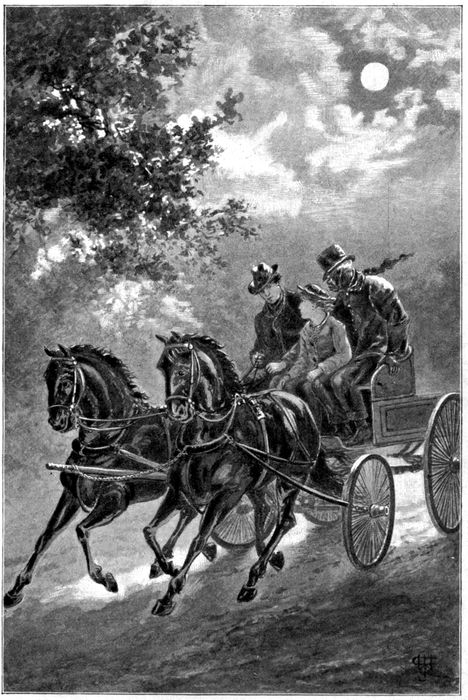
he employed a number of spies. These spies, or
detectives, were generally mounted on fleet horses,
and whenever they discovered a “moonlighter”
driving along the lonely roads, with his load of
nitro-glycerine, they gave chase to him. Then he
would whip up his spirited team, and drive away at
full speed, reckless of consequences, and only intent
upon escaping from his pursuers.
Thus it often happened that people sleeping in
the vicinity of those quiet mountain roads were
awakened at night by the sound of galloping horses,
the rattle of a light wagon, and the shouts of its
pursuers. They would hold their breath and wait
in anxious suspense until the sounds died away,
happy if they did not hear the awful roar of an
explosion, that meant instant death to all who were
anywhere near that ill-fated wagon.
When it is remembered that such an explosion could
be caused by the breaking of a wheel, the upsetting
22of the wagon, or even its sudden striking against a
rock or stump, and that such an accident would
result in the instantaneous and complete disappearance
of men, horses, wagon, and everything within
reach of the awful stuff, it will be understood what
terrible risks the “moonlighters” ran in pursuit of
their illegal business, and what reckless men they
were. As the patent on oil-well torpedoes expired
some years ago, and anybody can now use them who
chooses to do so, there are no longer any “moonlighters,”
but at the time of this story they were
numerous, and Arthur’s friend, Brace Barlow, was
one of the most daring of them all.
To have his “dear giant” engage in a pursuit at
once so wrong and so dangerous was a great grief to
the honest, loving little soul, and at every opportunity
he pleaded with Brace to give it up. But
the young man would only laugh, saying that he
had as much right to shoot wells and risk his life as
anybody else, and that it was the easiest way of
making money he knew of.
At length, however, about daylight one morning,
he came to the Dustin house, bruised, bleeding, and
with an awe-stricken look on his usually merry face.
23Waking his little friend, he said he had come to tell
him that his moonlighting days were over, and that
hereafter he was to be an honest well-shooter, in the
service of the rightful owner of the torpedo patent.
“Oh, I am so glad!” cried the boy, “only I wish
you would work at something else, and never touch
the awful glycerine again.”
“I can’t give it up entirely, little one,” replied
Brace. “Its very danger makes it exciting, and any
other life would seem tame after it.”
“Well,” said Arthur, “if you must be one, I am
glad you are going to be an honest torpedo man.
But, ‘dear giant,’ are you hurt? What makes you
look so queer?”
Then Brace told him that about an hour before,
he had been driving quietly along, with fifty quarts
of nitro-glycerine stowed snugly under his buggy
seat, toward a well that he was to shoot at daylight,
when the sound of galloping hoofs gave warning
that a detective was on his track. He instantly
whipped up his horses, and, as they sprang forward,
his light buggy was nearly upset by striking some
obstacle, and he was thrown to the ground with such
force as to be partially stunned. As he lay there
24the detective dashed past without noticing him, and
overtaking the runaway team a minute later probably
tried to stop them. They must have swerved to
one side, the buggy had undoubtedly been upset,
and a terrific explosion instantly followed. When
Brace reached the spot no trace of man, horses, or
wagon, was to be found, and only a great hole in the
ground marked the scene of the catastrophe.
The boy shuddered as he listened to this story,
and for days afterward his sunny face was clouded
by its memory. Still he found some comfort in
reflecting that nothing less than some such terrible
lesson would have made an honest torpedo man of
his dear “moonlighter,” with whom, from that time
forward, his friendship became stronger than ever.
CHAPTER IV. A TORPEDO MAN’S PERIL.
25
On the day that Arthur played at being a
Prince, and was on his way to unfold the
sad result of that experience to Uncle Phin, he met
Brace Barlow driving out of an old wood road that
led to his nitro-glycerine magazine, hidden in the
loneliest depths of the forest.
At sight of his little friend, Brace reined in his
horses and stopped for a moment’s chat with him.
In spite of the young man’s warning that he had
a load of the “stuff” under the seat, Arthur ran
forward and clambered up into the wagon beside
him.
“Oh, I am so glad to see you, ‘dear giant’!” he
began impulsively, “because——” Here he paused.
He had been about to pour into this friend’s ear
all his troubles, and make a complaint against his
26Aunt Nancy; but it suddenly occurred to him that
by so doing he would be only acting the part of a
tale-bearer, which his father had taught him most
heartily to despise. Telling things to Uncle Phin
was different. He was quite certain that Brace
could not help him in his present trouble, and so,
when the latter asked with a smile, “Because what,
little one?” he answered:
“Because I love you, and I am always glad to
see the people I love. Are you going to shoot a
well? Can’t I go with you? Aunt Nancy says I
am to stay out of her sight until sunset, and the
boys have gone fishing, and Cynthia’s doing her
patchwork, and I haven’t a single thing to do.
Please let me go.”
“Well, I don’t know,” replied Brace Barlow, reflectively.
“I don’t suppose there is really any
danger; still——”
“Danger!” exclaimed Prince Dusty, scornfully.
“Do you suppose I am any more afraid of danger
than you are, even if you are a great, big
man and I am only a little boy? Well, I’m not.
Your old glycerine can’t be any worse than lightning,
and I’m not a bit afraid of that. Besides, if
27I am always going to live in this oil region, I ought
to learn all about its dangers, so that I’ll know
enough to keep away from them. Perhaps when I
have grown to be a giant, like you, I will want to
be a well-shooter too, and how can I if I haven’t
learned how?”
This array of argument was too much for Brace
to answer, and so, saying, “Well, I suppose I’ll have
to take you with me just this once,” he chirruped
to his horses, and, driving much more slowly and
carefully than usual, turned into the road that led
to the well he was engaged to shoot.
They reached the place without incident, and
Arthur helped carry into the derrick the bundle of
bright tin tubes that had been lashed to a couple of
curved iron supports at one side of the wagon. He
also helped place in position the reel on which was
wound two thousand feet of stout cord, by means of
which the torpedo was to be let down into the well.
This line was run through a pulley that hung
directly above the well, and its end terminating in
an iron hook, dangled close to the mouth of the
deep, dark hole.
When these preparations were made, Brace Barlow
28began to fit and fasten together several lengths
of small tin pipe until they formed a continuous
tube about fifty feet long. This is called the
“anchor,” and was to be attached to the lower end
of the shell, or large torpedo tube, so that when the
whole was lowered into the well, it would support
the torpedo at a height of fifty feet above the
bottom.
Arthur was allowed to assist in fitting the anchor
tubes, and also in making the shell ready to be filled
with its deadly explosive. When the cans of nitro-glycerine
were brought into the derrick, all the men
employed about the place retired to a respectful
distance from it. Then Brace insisted that Arthur
should also go away, and leave him alone to finish
the delicate and dangerous job of loading the
shell, lowering it into position, and exploding it.
The boy begged to be allowed to stay, declaring
that he was not in the least afraid, and would keep
as still as a mouse. But Brace would not listen for
a moment to his pleadings, and very slowly the little
fellow walked away to what he considered a safe
distance, though it was not nearly so far as the men
had gone.
29At this time the empty shell, which was a large
tin tube about twenty feet long, was, with its anchor
attached, hanging in the well so that its upper end
was just above the surface. It hung from a very
shallow iron hook, at the end of the stout cord
arranged for the purpose; and Brace Barlow now
proceeded slowly and cautiously to pour the nitro-glycerine
into it. The stuff was the color of soft
soap, and about as thick as syrup.
He had been thus engaged but a few minutes,
when Arthur, who was nearer to him than anybody
else, heard him call, “Come here, quick, somebody,
and help me!”
Without a moment’s hesitation or thought of fear,
the brave little fellow ran swiftly to the derrick,
exclaiming, as he reached it, “Here I am, Brace!
What do you want?”
“You here, you dear little chap!” cried the torpedo
man, “I didn’t mean that you should come;
but perhaps after all you will do better than
another, and I must have help at once. You see the
hook has slipped off the shell, and I only caught
the torpedo in time to save it from dropping and
exploding before I was ready. Then the weight of
30the cord pulled the hook up so that I can’t reach it.
Now if you can climb up the side of the derrick,
holding the drill rope in close to you till you reach
the proper height, then swing out, catch hold of that
hook, and slide down the drill rope with it in your
hand, you will do what I want as well as if you
were the biggest man in the world. Do you think
you can?”
“I can try,” replied the boy, who took in the
whole situation at a glance, and he at once began to
climb the ladder that led to the top of the tall
derrick.
It seemed that while Brace was filling the torpedo,
and had nearly completed his task, he found it
necessary to shift the position of the shell slightly.
As he lifted it, the shallow hook slipped from the
bail, or handle of stout copper wire, and flew up just
beyond his reach. To let go of the torpedo was out
of the question, for it would have fallen down the
well and probably exploded from concussion with
the iron tubing lining the hole before it had gone
many feet. This explosion would have fired the
quart or more of glycerine still remaining in one of
the cans on the derrick floor, and Brace Barlow
31would instantly have disappeared from human view.
The weight of the torpedo was so great that he
could not support it very long; and so, unless assistance
came to him promptly when he called, he must
have let the thing drop, and suffered the consequences.
But help had come promptly; and a twelve-year-old
boy, forgetting all thoughts of danger, and
urged on by the love he bore his friend, was climbing
the derrick, swinging out into space on the heavy
drill rope, clutching the dangling iron hook, and
sliding down with it in his hand. Then, instead of
timidly reaching it to Brace, he stepped boldly up
and attached it to the copper bail of the torpedo that
was cutting deep into the flesh of the strong hand
that held it, and must in another minute have
let it go.
As the well-shooter, with a pale face, rose from
his strained position, he clasped the boy in his
arms, exclaiming: “Little one, you have done for
me this day what any man might be proud of
doing for a friend; and, so long as I live, I will
never forget the service nor cease to be indebted to
you.”
32When the filling of the torpedo was completed, it
was cautiously lowered a thousand feet to the bottom
of the well, the “Go Devil,” a heavy, pointed bit of
iron that was to explode it, was dropped, and, seizing
Arthur in his arms, Brace Barlow ran swiftly
from the spot.
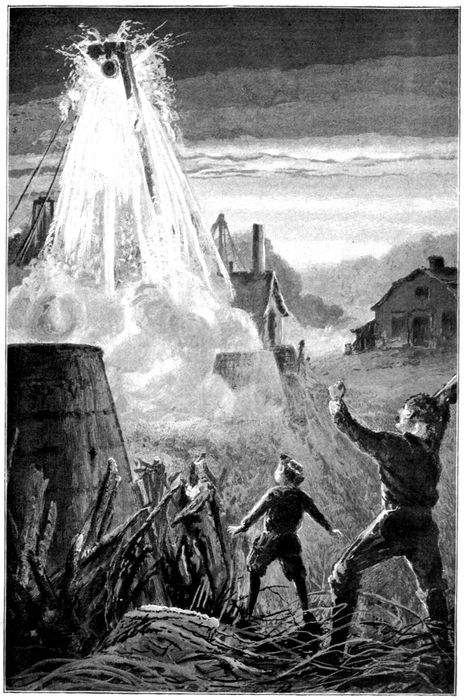
A few seconds later the solid earth was shaken
and there was a heavy but muffled roar. Directly
afterwards a vast column of oil shot up through the
derrick sixty feet into the air, and fell back to earth
in a glistening cloud of amber-colored spray. The
shot was a perfect success; and for months afterwards
the old well again flowed at the rate of twenty
barrels a day.
As Brace and his little friend rode homewards
they stopped in the first lonely bit of forest to
explode the still dangerous but empty nitro-glycerine
cans. This was done by placing them on the
ground, lighting the end of a short fuse attached to
a cap thrust into one of them, and driving rapidly
away. The explosion was terrific, and its roar was
like that of a hundred-pounder gun. Arthur said it
was better than any Fourth of July he had ever
known.
CHAPTER V. ARTHUR AND HIS COUSINS.
33
As Arthur and Brace Barlow returned from the
well-shooting described in the preceding
chapter, the latter set the boy down at a cross-road
but a short distance from the Dustin house. Here
the little fellow bade his “dear giant” good-night,
and ran homeward, feeling happier than he had for
a long time. Though he hardly realized the full
value of the service he had just rendered to
his friend, he was sure that he had been useful at a
critical moment; he knew that he had been praised
for what he had done, and he felt more manly than
ever before.
It was quite late when he reached the front gate,
where faithful little Cynthia was anxiously watching
for him and wondering where he could be.
“Oh, Cynthia!” he cried, as he drew near and
saw her, “I’ve had such a lovely time! I have
34been shooting a well with Brace Barlow, and I
climbed up the derrick and got a hook that had
slipped away from him, and brought it down; and
he said I was a brave boy, and had saved his life,
though I don’t see exactly how; and then we had a
splendid Fourth of July time, blowing up the cans;
and it sounded like a real truly cannon; and the
very minute I get grown up I’m going to be a well-shooter.”
It was absolutely necessary for the enthusiastic
little fellow to pour into sympathetic ear the tale of
what he had done. He had performed a brave
act, and in the first flush of his excitement he longed
to be praised for it, as we all do whenever we have
done anything that we consider especially good,
or worthy of commendation. It is a reward of
merit to which all who have earned it are entitled;
and to withhold just praise is as cruel as to extend
unjust censure.
Cynthia would not have been guilty of any such
unkindness. Her eyes opened wide as she listened
to the tale her Prince told of his own deeds, and
she was just catching her breath to tell him how
splendid she thought them, when they were startled
35by the sound of a harsh voice, calling, “Arthur!
Cynthia! come into the house this minute, you
naughty children. Don’t you know better than to
be staying out there breathing the night air?”
“A boy must breathe some kind of air, Aunt
Nancy, and when it is night time I don’t see how
he can help breathing night air,” laughed Arthur, as
he reached the house; for not even his aunt’s harsh
tones could at once dispel his good spirits.
“What do you mean by talking back to me?”
asked Mrs. Dustin. “I say that night air is poison,
and no member of my family, even if he is a young
interloper, shall breathe a drop of it, not so long
as I can help it. Now, not another word. I
know where you’ve been this whole blessed
afternoon. You’ve been off with Brace Barlow,
who ought to have more sense than to encourage
your badness, shooting wells, and trying to get yourself
blown into mince-meat, just to make more
trouble for me. Yes, I know all about it, in spite
of your sly ways. Now, you may go right to bed,
and not a morsel of supper shall you have this night,
which may be it’ll be a lesson that you will remember
for one while, anyway.”
36Mr. John Dustin, who sat smoking his evening
pipe by an open window, rarely interfered with his
wife’s management of the children; but now he
spoke up saying:
“That won’t do, wife; you only gave the boy
bread and water for his dinner, and it won’t do to
send him to bed without any supper. I believe in
proper punishment, where it is deserved, as much as
anybody; but when it comes to starving, that’s
quite another thing. It shall never be said that my
brother Richard’s only son was starved in his uncle’s
house. So give the boy his supper, and plenty of
it. Then you can send him to bed if you see fit.”
Mrs. Dustin knew that when her husband spoke
in this tone he meant to be obeyed; so, without a
word, she set a plain but bountiful meal before
Arthur. From a long experience of bread-and-water
punishments and supperless nights the boy was wise
enough to eat heartily all that he possibly could, in
spite of his heavy heart. He ate in silence, and for
some time nobody else spoke; only Dick, who sat at
the farther end of the room with the other children,
chuckled and made faces behind Arthur’s back, for
the benefit, and to the huge delight, of his companions.
37He was greatly pleased at the result of
his tale-bearing; for it was he who, overhearing
Arthur tell Cynthia that he had been well-shooting
with Brace Barlow, had hurried to the house, and
repeated the information, with some picturesque
additions of his own devising, to his mother.
Once, during the silent meal, little Cynthia tried
to create a diversion in her cousin’s favor by remarking
timidly to nobody in particular, but to the company
in general, “Arthur says Brace Barlow says he
saved his life.”
“Who says what?” inquired Mrs. Dustin, turning
quickly and fixing her sharp eyes on the little girl’s
face.
“Brace Barlow says—I mean Arthur says Brace
Barlow says—he saved his——”
“Oh, fiddlesticks!” interrupted her mother;
“you don’t know what you’re talking about. It
isn’t at all likely that either of them did anything
of the kind. The sort of danger Brace Barlow goes
into is quick and sure. When it once gets started
there isn’t any chance for life-saving, or for telling
of it afterwards. Arthur ought to know better than
to go round boasting in that way to a little girl like
38you, and I should think he’d be ashamed of himself
for doing it.”
Arthur listened to this unjust speech with a
flushed face and a feeling of choking indignation;
but he did not say a word. Young as he was, he
had already learned that in a contest with an unreasonable
person silence is the weapon of wisdom.
After finishing his supper the forlorn little fellow,
accepting his punishment without a murmur, though
he could not imagine what wrong he had done, retired
to his cot in the woodshed, where he was quickly
blessed by the presence of sleep the comforter.
The next day was the bright one in September
with which this story opens, and Arthur is introduced
as he sits on the top rail of a zig-zag fence
watching the other children at play.
Fired by the accounts of his adventure of the
day before as narrated to them, at second-hand by
Cynthia, for Arthur could not be induced to say
another word concerning it, his cousins had determined
to have a miniature well-shooting of their
own. They spent the entire morning in the construction
of a very shaky little derrick, about six
feet high, and now they were busy drilling a well,
39which they hoped to put down to a depth of at least
two feet. When it was finished they proposed to
shoot it by means of a cannon-cracker, that they had
saved over from the Fourth of July for use on some
such special occasion.
The scheme was well planned, and seemed likely
to be carried out; for the children were enthusiastic
over it, and, under Dick’s direction, worked most
diligently. Arthur would gladly have joined in
this fascinating occupation; but the others would
not have him. As Dick scornfully remarked:
“What can a city chap like you know about building
derricks and drilling wells? You wasn’t raised
in the oil region.”
So Arthur was forced to content himself with sitting
on the fence and watching them. Occasionally
he turned for a chat with Uncle Phin, who was cutting
brush in the field behind him, and who took a
long rest whenever he reached the end of a row that
brought him anywhere near his “lil marse.” Finally,
after one of these rests, during which Arthur had
paid no attention to the operations at the miniature
derrick, he left his perch and followed Uncle Phin
for a short distance into the thick brush.
CHAPTER VI. A GALLANT RESCUE AND ITS REWARD.
40
Arthur had hardly left his perch before he
was startled by a perfect babel of sounds
coming from where the children were at play. There
were yells and shouts of laughter, mingled with
cries of pain and an angry screaming, together with
piteous calls of “Arthur! oh, Arthur! Come and
make ’em stop!”
Like a young deer the boy bounded out of the
brush and over the fence, followed, much more slowly
by Uncle Phin. Arrived upon the scene, he quickly
comprehended the situation. In an unfortunate
moment, just as the well was completed and ready
to be shot, Cynthia’s dearly loved little white kitty
came demurely walking in that direction looking for
her mistress. At sight of the little animal a brilliant
idea flashed through Dick’s mind, and he at once
proceeded to carry it out. He said:
41“We can’t have much fun shooting a dry well
anyhow, ’cause there won’t be any oil to fly up in
the air; but I’ll tell you what. Let’s have an
execution by ’lectricity. It’ll be immense, and here’s
the prisoner already waiting to be executed.”
Thus saying, the cruel boy snatched up the little
white kitty, and, bidding the others hold Cynthia,
who was ready to make a furious struggle in defence
of her pet, he ran with it to the derrick. Here, with
the make-believe drill rope, he hung it by the tail,
so that the little pink nose was but a few inches
from the ground. Then, lighting the fuse of the
great cannon-cracker, he placed it directly beneath
the victim, who was now uttering piteous cries of
pain and terror, and ran to where the others were
shouting with delight over the new and thrilling
diversion so unexpectedly prepared for them.
Poor, desperate little Cynthia, kicking, biting,
scratching, but struggling in vain with the young
rascals who held her fast, began, as a last resort, to
call upon Arthur, the brave Prince who had defended
her against the big dog, and she did not call in vain.
Hatless and breathless, with the fire of righteous
wrath blazing in his blue eyes, the plucky boy came
42flying to the rescue. He had no thought of the overwhelming
odds against him. The princes of his fairy
tales fought whole armies single-handed, and why
should not he? His impetuous speed carried him
right through the shouting group assembled to witness
the execution of the hapless kitty, and two of them
were flung to the ground before they knew of his
presence. An instant later he reached the little
derrick. The fuse had burned down into the body
of the big cracker, and in another second it would
explode. Without the faintest trace of hesitation,
the little fellow seized it and flung it behind him.
An explosion followed almost instantly, and was
accompanied by a yell of pain. The moment Dick
recognized Arthur, and perceived his intention, he
sprang after his cousin, and was directly in line when
the cannon-cracker came flying toward him. It
struck him and fell to the ground, exploding as it
did so, and burning his bare feet painfully.
Furious with rage the cowardly young bully
rushed at Arthur, who was releasing the white kitty
from her unhappy position, and with a savage blow
knocked the little fellow down. Then he jumped
on him and began to pummel him, screaming “Take
43that, will you! And that! I’ll teach you! I’ll
show you who’s boss round here!”
All at once these cruel cries were changed to yells
of dismay, as, whack! whack! whack! a shower of
stinging blows fell upon Dick’s shoulders. Uncle
Phin, who had followed Arthur as fast as he was
able, had arrived just in time to save his “lil Marse”
from any severe injury at the hands of his enraged
cousin, and to administer, with a stout stick, the
thrashing that the young rascal so well deserved.
In less than a minute cowardly Cousin Dick and
his frightened followers were scampering away
towards the house, where they proposed to lay their
side of the case promptly before their mother.
Cynthia had gone after her beloved kitty, and brave
little “Prince Dusty,” who had flung himself into
Uncle Phin’s arms, was sobbing as though his heart
would break.
“Soh, Honey, soh, don’t you cry now,” murmured
the old man, in soothing tones. “’Member dat while
you is a Dustin by name, you’s a Dale by breedin,
an comes of Dale stock. You’s mos a man now, a
young gen’lm’n, an it won’t nebber do fer sich as
you is to cry like a lilly gal. Soh, now, Honey, soh.”
44Neither of them heard the quick, determined step
that approached them from behind, and so occupied
was poor, troubled Uncle Phin in soothing and comforting
his charge, that it was an easy matter for
Mrs. Dustin to snatch the trembling boy from his
arms. Then she marched rapidly away, without a
word; but dragging her victim relentlessly after her.
Uncle Phin half started to his feet when he first
realized what was happening; but sank back again
with a groan, and a murmured “De good Lawd hab
mussy on His Lamb.”
Then he bowed his frosted head on his knees and
the hot tears trickled slowly between his black
fingers.
While he thus sat helpless and despairing, poor
Arthur was taken to the house and there whipped,
until the apple-tree switch broke, and his Aunt
Nancy’s strength was exhausted. Then, telling
the boy that this was a lesson for him to remember
as long as he lived, she bade him go to the woodshed,
which was his sleeping-room, and stay there until she
should release him.
During this undeserved punishment not a cry had
escaped from the boy, nor had a tear found its way
45to his eyes. He bit his under-lip and clenched his
hands, but not a sound did he utter. He remembered
what Uncle Phin had just told him. He was
almost a man now, and no man, especially a Dale,
would cry for a whipping. So, though the little
face was drawn and white, and the boy trembled
until he could hardly stand, he held out to the end
as bravely as ever a martyr under torture, and when
he was thrust into his cheerless shed, he sat on the
edge of his rude bed rigid and tearless. His mind
was in a furious whirl, but above all was the overwhelming
sense of injustice and outrage.
Finally he sprang to his feet, crying, “I hate you!
I hate you! I hate you!” and then, flinging himself
on his bed, he gave way to a burst of passionate
weeping.
“Oh, mamma!” he cried, “my own mamma!
why don’t you come for me and take me away from
this dreadful place? I can’t stay here any longer!
Indeed I can’t, mamma! oh, come for me; do come!
Please, mamma, come for me, and take me to where
you are!”
For nearly an hour the forlorn child cried for the
dear ones who had left him; then his sobs gradually
46died away, and, utterly exhausted, he fell into a
troubled sleep.
In the meantime little Cynthia, who only found
her dear kitty after a long search, met her father
coming home from his work, and when he inquired
what was the matter with his daughter, and who
had made her cry, she told him the truth of all that
had happened, so far as she knew it. Mr. Dustin
had begun to suspect that Arthur was ill-treated
by his cousins, and as he listened to Cynthia’s story,
his face grew very stern, and he said: “This matter
must be looked into.”
When they reached the house, and he was told
that Arthur had been severely punished for trying
to kill Cynthia’s kitten, and for fighting with Dick
who had rescued it, and that Uncle Phin had beaten
Dick, Mr. Dustin’s anger could not be restrained.
He said:
“Wife, I am afraid you have made a terrible mistake,
and punished an innocent child for performing
a noble act. If what Cynthia tells me is true, and I
believe it is, Master Dick is the boy who tormented
his little sister, and would have killed her pet.
Master Dick is the coward who thrashed a little
47fellow two years younger than himself, for bravely
rescuing the victim of his cruelty. Master Dick
is the one who told a lie to hide his own wickedness
and cause his cousin to receive the punishment
he himself deserved. And Master Dick is the boy
who is aching for the whipping that I shall give
him before he is many minutes older.
“In regard to my dead brother’s child, I want it
understood that so long as he remains under my
roof he is never again to be punished for any fault,
real or fancied; and if anybody has any complaints
to make against him, they must make them to me.
As for Uncle Phin, if it is true that he beat one of
my children, he must leave this place, and look for
a home elsewhere, which I shall tell him to-morrow.”
Every word of this was heard by the old negro,
who was sitting on a bench in the little vine-colored
porch, close under an open window, of the room in
which Mr. Dustin stood. The old man, who had not
known of the cruel punishment inflicted upon his
“lil Marse,” was waiting patiently for Arthur to
come out and bring him his supper, as the boy had
done every evening since they came there to live.
Now he said to himself: “Dat’s all right, Marse
48Dustin. I did beat yo boy, an I do it agin if heem
tetch my honey lamb; but yo sha’n’t nebber hab de
chance to tun ole Phin Dale from yo house. No,
sah; he done go of his own sef, befo ebber he ’lowin
you to do sich a ting. An when he go he isn’t
gwine erlone. No, sah.”
Just then little Cynthia came out with his supper,
and said that Arthur was asleep. The old man ate
his frugal meal in silence; but a train of thoughts
was passing through his head much more rapidly
than usual. They were all travelling in the same
direction, and it was back toward his old Virginia
home.
CHAPTER VII. UNCLE PHIN’S PLAN.
49
After finishing his supper on the memorable
evening of Arthur’s unjust punishment, Mr.
John Dustin stepped softly into the woodshed, which,
in that overcrowded household, had seemed to be
the only place that could be given up for an extra
sleeping-room. He closed the door behind him, and,
by the light of a candle that he carried, gazed long
and earnestly at the tear-stained face of the child
who lay on a rude cot. It was hot and flushed, and
the sleeping boy tossed and moaned as though visited
by unhappy dreams. Once he called out: “Don’t
let them whip me, mamma! I haven’t been naughty.
Indeed I have not!”
At this the man, as though fearful of awakening
the sleeper, hastily retired from the place, and there
was a suspicious moisture in his eyes as he re-entered
the other room.
50Here he said: “Wife, I believe we have treated
that little chap very unjustly. My brother Richard
was the most truthful and honorable boy and man I
ever knew, and I am inclined to think the son takes
after his father. Hereafter I shall try to make his
life pleasanter and happier, and in this I want you
to help me.”
Mrs. Dustin made no answer to this, for her heart
was hardened against the orphan lad, and she really
believed him to be the sly bad boy that Dick strove
to make him appear. “I will watch him more closely
than ever, and show him up in his true light yet,”
she thought, as she bent her head over her sewing
so that her husband could not see her face. “He
sha’n’t stand in the way of my children, and I’ll
believe my own Dick’s word before his every time,”
was her mental resolve.
Knowing nothing of his wife’s thoughts, Mr.
Dustin was already taking steps to insure Arthur’s
greater comfort. He went to the pantry and brought
from it a bowl of milk, a loaf of new bread, and a
plate of ginger cookies made that day. With these
he again entered Arthur’s sleeping-room, and softly
placed them on a chair where, by the light of the
51moon that was just rising, the boy would see them
whenever he should awake. Once, while he was
thus engaged, Mrs. Dustin opened her mouth to
remonstrate against such a lavish provision of food
for a mere child; but a glance at her husband’s
determined face caused her to change her mind, and
she wisely remained silent.
There had been another and more appreciative
witness of Mr. Dustin’s thoughtful act. It was
Uncle Phin, who, kneeling outside the shed and
gazing through an open chink in its rough wall, was
waiting patiently for the family to retire that he
might have a private and undetected conversation
with his “lil Marse.”
As Mr. Dustin again left the shed, the old man
said softly to himself:
“De good Lawd bress you fer what you is jes
done, Marse Dustin. You is got some ob pore
Marse Richard’s goodness into you after all. If it
warn’t fer de ole Miss an dem wicked chillun, me
an lil Marse would try an stick it out awhile longer.
But it can’t be did. No, sah, it can’t be did.” Here
the old man shook his white head sorrowfully.
“Dem young limbs is too powerful wicked, an ole
52Miss, she back ’em up. Fer a fac, ole Phin got ter
tote his lamb away fum heah, an maybe de good
Lawd lead us to de green fiels ob de still waters,
where we kin lie down in peacefulness.”
An hour later, when the lights of the house were
extinguished and all was still with the silence of
sleep, Uncle Phin cautiously opened the shed
door, and tip-toeing heavily to where Arthur lay,
rested his horny hand gently on the boy’s white
forehead.
The child opened his eyes and smiled, as, by the
moonlight, now flooding the place, he saw who was
bending over him.
“Sh-h-h, Honey,” whispered Uncle Phin, with
warning finger uplifted; “git up quiet like a fiel
mouse an come erlong wif me. Sh-h-h!”
Then the old man and the child stole softly away,
the former not forgetting to carry with him the supply
of food provided by Mr. Dustin. As quietly as
two shadows they moved across the open space
between the house and the barn.
Not until they were safe in his particular corner of
the hay-mow did Uncle Phin venture to speak aloud.
Here he drew a long breath of satisfaction, for in
53this place they could talk freely and without danger
of being overheard.
First he made Arthur drink all that he could from
the bowl of milk and eat heartily of the bread and
cakes that Mr. Dustin had left for him. After eating
the food, of which he stood so greatly in need,
and which the old man assured him had been left by
one “ob de good Lawd’s own rabens,” Arthur said:
“Oh, Uncle Phin, I’ve tried as hard as I can to be
good, and make them all love me here, but they
won’t do it. No matter what I do, it seems to be the
wrong thing, and I only get punished for it. I am
getting almost afraid to try and do right any more,
and if we stay here much longer I’m pretty sure I
shall grow to be a bad boy, such as my own dear
mamma and papa wouldn’t love. Now don’t you
think we might run away and live somewhere else,
where it would be more easy to be good than it is
here? Do you think it would be very wrong if we
did? I’m sure Aunt Nancy would be glad to have
us go, and perhaps Uncle John would too.”
“Why, Honeybug!” cried the old man delightedly,
“dat ar is prezactly what yo ole Unc Phin’s
been projeckin to hissef—only you mus’n’t call it
54runnin away, like you was a pore niggah. A Dale
don’t nebber run away. He only change de spere
ob his libbin, when he gits tired ob one place, an’
takes up wif anudder, same like we’s a gwine ter.
I’s been considerin fer a long while back dat dese
yere Dustins, who isn’t much better ’n pore white
trash no how, wasn’t de bestest company fer a
thorobred Dale like you is.”
“Hush, Uncle Phin! You must not speak so of
my uncle’s family. He was my dear papa’s own
brother, and they are the only relatives I have in the
world,” said Arthur.
“No, dey isn’t, Honey. Dey isn’t de onliest ones
what you got in de worl. You is got a granpaw
libin yet. A monsrus fine gen’lm’n he is, and he’s
place one ob de fines’ in all Ferginny, if I does say it.
He’s quality, he is, an Dalecourt is yo own properest
home.”
“But I have never seen my Grandpapa Dale, and
he doesn’t know me, and I don’t believe he wants
to,” replied Arthur; adding sadly: “There doesn’t
seem to be anybody in the whole world that wants
to know me, except you, and Brace Barlow, and
Cynthia. Besides Dalecourt is a long way off, and
55it would take a great deal of money to get there, and
we haven’t any at all, and I don’t believe even
you could find the way to it if we should try and go
there.”
“Dint I uster lib dere, Honey, and dint I come
frum dere? What fo you spec I can’t go whar I
come frum?”
“But coming from a place and going back to it are
very different things,” replied Arthur, wisely.
“So dey is, Honey, ob cose dey is,” agreed Uncle
Phin, who was not yet ready to disclose his plans.
“But we will go away somewhere and live together,
won’t we?” pleaded Arthur. “I don’t suppose
we could take my ‘dear Giant’ and Cynthia
with us; but if we only could, wouldn’t we be
happy?”
“Ob cose we’se a gwine leab dish yere place,” replied
the old man. “You jes trus yo Unc Phin,
an he fin a way to trabble, an a place fer to go.”
Then he told the boy that he should go away
before daylight, and might remain several days
making preparations for their journey. He would
not say where he was going, because he wanted
Arthur to be able to say honestly he did not know,
56if he were asked. He instructed the boy to collect
all his little belongings, including his scanty wardrobe,
and have them ready for a start at a moment’s
notice. “Itll be in de night time, Honey, in de
middle ob de night, an ole Phin ’ll creep in an wake
you, same like he did erwhile ago. So don’t you be
afeared when you wakes up sudden an fin’s him
stan’in alongside ob you.”
“No, I won’t be afraid, and Ill be ready whenever
you come for me,” replied the little fellow;
“but don’t stay long away, because I shall be so
lonely without you.”
Uncle Phin promised that he would not be a
single minute longer than was necessary to make
preparations, and Arthur was about to go back to
the house, when a sudden thought flashed into his
mind, and he exclaimed: “Oh, my book, my precious
book that the beautiful lady gave me! I can’t leave
it behind, and Im afraid Aunt Nancy won’t let me
have it.”
Then, in answer to Uncle Phin’s inquiries, he had
to tell him the whole story of his adventures as a
Prince, which he had not heretofore found an opportunity
of relating, and in which the old man was
57greatly interested. He was particularly pleased with
the title bestowed upon his “lil Marse” by the
beautiful lady, and said: “You is a shuah ’nough
Prince, Honey, if dere ebber was one in dis worl,
only you won’t always be Prince Dusty. Some day
youll be a Prince somefin else. But you mus hab
yo book, in cose you mus, an we’ll make out to git
hol ob it somehow or nudder.”
Comforted by this assurance, and filled with the
new hopes raised by their prolonged conversation,
Arthur flung his arms about the old man’s neck and
kissed him good-night and good-bye. Then slipping
from the hay-mow he sped back to the house, carrying
the empty dishes, from which Uncle Phin had
taken the remnants of food for his own use.
CHAPTER VIII. AWAKENED AT MIDNIGHT.
58
The next morning Mrs. Dustin was greatly surprised
on coming down-stairs to find that no
fire had been made in the kitchen stove, and that
the water-buckets, standing on a shelf over the sink,
were empty. Nothing of this kind had happened
since Arthur and Uncle Phin came there to live,
nearly two months before; for to light the fire and
bring fresh water into the house were among the very
first of Uncle Phin’s morning duties. Arthur had
meant to get up very early this morning and do
these things, with a vague hope that the old negro’s
absence might not be noticed; but he was so thoroughly
exhausted by the events of the preceding
day and night, that he overslept and only awoke
with a start as his Aunt Nancy entered the kitchen.
Now, wide-awake, the boy lay trembling in bed
and wondered what would happen. He heard his
59aunt go out to the barn and call “Phin! Uncle
Phin!” but there was no answer, though the call
was repeated several times. Then she came back
muttering something about “lazy and worthless old
niggers,” and Arthur heard her making the fire. Still
anxious to take Uncle Phin’s place as far as possible,
he jumped up, and hastily slipping on his ragged
clothes, picked up an armful of wood that he carried
into the kitchen.
His aunt looked at him sharply: “Where is
Phin?” she demanded.
“I do not know,” answered the boy.
“Humph! I might have expected you would say
that,” she replied. “How did you know I wanted
any wood, then?”
“I heard you calling Uncle Phin, and thought
perhaps that was what you wanted him for,” was
the reply.
“Well, then, if you know so well what I want, perhaps
you know that I want you to get out of this
kitchen and keep out of the way while I am getting
breakfast,” said Mrs. Dustin, angrily.
It is always those whom we have injured the most
that we dislike the most; and, with the recollection
60of her cruelty toward this gentle child fresh in her
mind, the mere sight of him filled her with anger.
So the little fellow wandered out to the barn, and
felt very lonely as he climbed up on the hay-mow to
make sure that his dearest earthly friend had indeed
gone. He sat down to wonder where Uncle Phin
was, and how long it would be before he would come
to take him away from that unhappy place. He
wished that he might stay right where he was, and
not be compelled to see any of the family again, and
was feeling very wretched and forlorn generally.
All at once he heard Cynthia’s voice calling the
chickens around her on the barn floor where she
fed them every morning. Here was somebody for
whom he cared, and the thought that he was so
soon to leave her, probably forever, filled him with a
pang of mingled pain and love.
He slid down from the hay-mow to where his little
cousin stood, and as she threw her arms about his
neck and kissed him and told him how much she
loved him and how sorry she was for him, he began
to realize how hard it would be to part from her,
and to wonder if after all he ought to run away with
Uncle Phin.
61Cynthia was a loving and lovable little soul, and
though she had a freckled face, it was lighted by a
pair of glorious brown eyes. Her hair was of a rich
brown, flecked with specks of red gold where the
sunlight shone through it. It was just such hair as
the sun loves to kiss, and the merry wind delighted
to toss it into the most bewitching tangles whenever
it was not closely imprisoned under the little pink
sun-bonnet. It reminded Arthur of his own dear
mother’s hair, and often when they were playing together
he would snatch off the pink sun-bonnet just
for the pleasure of seeing it ripple down over her
shoulders. His own used to be long, almost as long
as Cynthia’s, but his Aunt Nancy had cut it off when
he first came to live there, and it had been clipped
short ever since, greatly to Uncle Phin’s sorrow.
While Arthur and Cynthia were feeding the
chickens, and the former was almost forgetting his
recent loneliness, Mr. Dustin came into the barn.
He greeted both the children pleasantly, and even
kissed them, a thing that Arthur wondered at, for
he could not remember that it had ever happened
before. Then he asked, “Do you know where Uncle
Phin is, Arthur?”
62“I think he has gone away,” replied the boy,
flushing and looking down, for it seemed somehow
as though he were not exactly telling the truth.
“Do you know where he has gone?”
“No, sir, I do not,” was the honest reply, and the
boy looked his questioner squarely in the face as he
made it.
“Well, I believe you, of course,” said his uncle,
“and I suppose he must have taken it into his head
to leave us, though it seems very strange that he
should have done so without bidding you good-bye,
or telling you where he was going.”
This was too much for Arthur’s sense of honor,
and speaking up manfully, he said: “He did tell me
he was going away, Uncle John, and bid me good-bye
but he didn’t tell me where he was going, and he
didn’t want me to say anything about it unless I
had to.”
“I am glad you have told me this,” said Mr. Dustin,
“and since he has gone I must say I am not
very sorry. Now come in to breakfast.”
That morning Mr. Dustin took Arthur and Cynthia
with him to the well he was drilling, and, to
their great delight, allowed them to stay there all
63day. When they reached home that evening Arthur
was so emboldened by his uncle’s unusual kindness,
that he ventured, in his presence, to make mention
of the book of fairy tales that his Aunt Nancy had
taken from him. He said:
“Isn’t the book the beautiful lady gave me my
very own, Aunt Nancy?”
“I suppose it is,” answered Mrs. Dustin, shortly.
“Well, then, don’t you think I might have it just
to look at?”
“I said you might have it when I got ready to
give it to you.”
Then Mr. Dustin inquired what book they referred
to, and when it was explained to him he said:
“Well, I guess your aunt is ready to let you have
it this very minute, aren’t you, wife?”
There was no mistaking his meaning; and, very
ungraciously, Aunt Nancy took the precious book
down from its high shelf and tossed it on the
table.
Arthur seized it eagerly, and until the children
were sent to bed they and Mr. Dustin enjoyed looking
at its many beautiful illustrations. That night
Arthur slept with it under his pillow and it must
64have influenced his dreams for they were very pleasant
ones.
The following day was also a happy one for Arthur
and Cynthia, for they spent most of it sitting
close together under the roots of the great overturned
tree that was their especial retreat absorbed
in the book, and discussing, in their wise childish
way, several of its charming stories that Arthur read
aloud to his little cousin.
The boy was beginning to think that life in this
place was not so very cheerless after all, and was becoming
more than ever doubtful of the expediency of
running away, when an incident took place that restored
all his previous resolves. Cynthia had been
called in by her mother to sew on her hated patchwork,
and Arthur was sitting alone, when suddenly
a great, squirming, half-dead snake was dropped on
him from above. With a cry of horror the startled
boy sprang up just in time to see his Cousin
Dick’s grinning face, and hear him say, “That’s
only part of what you’ll get before long, you little
sneak, you.”
That night as he slept with his precious book
clasped tightly in his arms, he was again awakened
65by a hand laid lightly on his forehead. As he sprang
to a sitting posture, Uncle Phin bent lovingly over
him, saying:
“Sh-h-h, Honey! Ebberyting’s ready, an it’s
high time fer us to be gittin away frum hyar.”
CHAPTER IX. A HURRIED FLIGHT.
66
There was no need for Arthur to ask any
questions, when he was roused in the middle
of the second night after Uncle Phin’s departure.
He realized at once what was required of him, and
the heaviness of sleep instantly vanished, leaving
him keenly wide awake. Stepping softly from his
bed, he quickly dressed, while the old negro gathered
together everything belonging to his “lil Marse,”
and placed the things in a corn-sack that he had
brought for that purpose.
“Is dat yo book, Honey?” he whispered, noticing
the volume of fairy tales lying on the bed.
“Yes, that is my own precious book that the
beautiful lady gave me; but don’t put it in the bag,
Uncle Phin, I want to carry it myself.”
Then the thoughtful little fellow, since he could
not bid Cynthia good-bye, and feared she might feel
67hurt if he went away without a word, begged his
companion to wait, just a minute, while he wrote
her a note. He wrote it by the bright moonlight,
on a bit of brown paper, with the stump of a lead-pencil,
so that it was not a very elegant production,
but it answered its purpose, and was tenderly cherished
for many a day by the little girl who received
it the next morning. In it, in a big, scrawling hand,
was written:
“Dear Cynthia: I have been so much trouble
here, specially to Aunt Nancy and Dick, that I am
going away with uncle Fin, to find another home.
I love you dearly, and sometime I hope I shall come
back and see you. Good-bye, from
“Your loving cousin,
“Arthur.”
Although the old negro was in a hurry to be off,
he waited patiently while Arthur slowly wrote this
note. To him writing was one of the most mysterious
and difficult of arts; and, gazing admiringly at
the young penman, he murmured to himself:
“What a fine lilly gen’l’man him be to be shuah.
Him only twelve year ole; but settin dar an er writin
like he was a hundred.”
68When the note was finished it was pinned to the
pillow of the cot bed, and, with a lingering look at
the place that had sheltered him for a year, the child
stepped out and softly closed the door. Then clasping
his precious book tightly under his arm, and
trustingly following the old negro, Arthur started
on the wonderful journey that was to change the
whole course of his life, though he was still ignorant
of their destination.
When they were safely behind the barn, out of
sight and hearing of the house; Uncle Phin stopped
and said:
“Dere’s only one ting trubblin dis yeah ole woolly
head. Kin you tell, Honey, fer shuah, what way de
ribber ober yander is a runnin’?”
“Which, the Alleghany? Why, south, of course,”
answered Arthur, wondering at the question.
“Dat’s what I lowed it done!” exclaimed the
old man. “I knowed it didn’ run yeast, kase dat ar
way de sun rise, and I knowed it didn’ run wes, kase
dat ar way him a settin; but I wasn’ rightly shuah
him didn’ run to de norf. I was figgerin all de time
dough on him running to de souf, an now we’m git
back to ole Ferginny easy an sartin.”
69“To Virginia!” cried Arthur, in dismay. “Are
we going to try and go way to Virginia, Uncle
Phin?”
“Ob cose we is, Honey. We’se er gwine to Ferginny,
an Dalecourt, an yo granpaw, an de lil ole
cabin by the magnole tree. We is gwine to yo own
shuah ’nough home, Honey.”
“But how are we ever going to travel so far?”
“You’ll see, Honey! you’ll see dreckly,” chuckled
the other. “I’se got a great ’sprise in sto fer you.
Hyar’s de kerridge a waitin on us now, and Misto
Barlow is gwine dribe us to the steamboat.”
They were now on the road, at some distance from
the house, and as Uncle Phin spoke, Arthur saw,
drawn up to one side in the shadow of a clump of
trees, Brace Barlow’s team, and, leaning against the
light wagon, the young man himself.
“Oh, Brace!” he cried, springing forward the moment
he saw who it was, “I’m so glad! I didn’t
want to go away without seeing you again. Are you
really going with us?”
“I wish I could go with you all the way, my boy,
and see you safe to your journey’s end, but you know
I can’t leave my old mother. So I am only going to
70give you a lift for a little way and see that you
get a good start. Jump in quick now for we’ve
got a long drive ahead of us and I must be back by
daylight.”
As the spirited horses dashed away over the moonlit
road with Arthur nestled between Brace and
Uncle Phin on the single seat of the wagon, the boy
learned how it happened that his friend had been
induced to aid them in their flight. Uncle Phin had
gone directly to him two nights before, and roused his
indignation by describing the unhappy life his young
charge was leading, and how much he suffered at the
hands of Mrs. Dustin and her children. Then he
told Brace of Dalecourt, and gave him to understand
that Colonel Dale was ready to receive his grandson
with open arms, whenever he should go to him.
The kind-hearted young fellow, entertaining a sincere
regard for the little chap who had recently rendered
him so great a service, readily agreed to a plan
that promised so much of good to the boy, and willingly
consented to assist him and Uncle Phin to make
a start on their journey. He devoted two whole
days to the task of preparing for it, and did so much
more than Uncle Phin had dared ask or hope for, as
to win the old man’s everlasting gratitude and render
the first stage of their journey comparatively
easy.
71For some time Arthur enjoyed the exciting night
ride over the steep mountain roads, across deep
valleys, and through forests, all bathed in the glorious,
unclouded moonlight. He did not ask whither
he was being taken. Nestled warmly between his
two best friends he felt perfectly safe and happy.
He knew that they would do what was best for
him, and the very mystery and uncertainty attending
this part of their journey lent it a fascination.
At length his weary head nodded, the heavy eyelids
closed, and, sound asleep, he was unconscious of his
surroundings until the horses stopped, and he awoke
to find himself being lifted from the wagon.
There was a gleam of moonlit water in his eyes,
and as he dimly realized that he was on the bank of a
river, strong arms bore him into the cabin of a queer-looking
craft that lay moored to the forest trees.
Here the boy was gently laid down, and was vaguely
conscious that Brace Barlow was bidding him good-bye,
when the sleepy eyelids again closed and the
child passed into dream-land.
72The young man stood looking at the sleeping boy
for a full minute. As he did so he said softly:
“Dear little chap! I hate to have you go away, and
to think I may never see you again. But I suppose
it’s the best thing to be done, or I wouldn’t have
lifted a hand to help it along. I only hope it will
come out all right, and that you’ll have a happier
life in the place you’re going to than you ever could
have had here. God bless you.”
It was a benediction, as well as the farewell of
one brave soul to another. As he uttered it the
young man slipped a bank bill between two pages
of the book the boy had clasped so closely, but
which had now fallen from his hands.
“It’s little enough,” he said to himself as he
turned away, “but it’s all I’ve got, and may be it
will help him out of a fix some time.” Then he went
out to assist Uncle Phin, who was casting off the
fastenings of the boat, and preparing to push it from
the shore.
In another minute the clumsy old craft had
swung clear of the bank, and was moving slowly
down stream in the shadow of the great trees that
grew to the water’s edge. Brace Barlow watched
73it until it became a part of the shadows, and he
could no longer distinguish the white-headed figure
bending over the long sweep that was made to do
duty as a steering oar or rudder. Then he again
mounted the seat of his light wagon, and started on
his long homeward drive, feeling more lonely than
he had ever felt in all his life.
CHAPTER X. ON BOARD THE ARK.
74
The craft on which the old man and the sleeping
boy were now slowly drifting down the
broad, moonlit stream, was a tiny house-boat, such
as are common on all American rivers. It had
floated down, empty and ownerless, with the high
waters of the preceding spring, and had stranded
and been left by the receding flood at the point
where Uncle Phin discovered it some weeks before.
It was a small, flat-bottomed scow, on which was
built a low house, ten feet long and six wide. This
house contained but a single room; and beyond it,
at either end, the deck of the scow projected about
four feet. At each end of the house was a door,
and on each side a square hole or window, that
closed with a wooden shutter.
At the stern was a steering oar, as has been stated.
It hung on a swivel and its long handle projected
75up over the end of the roof, on which the steersman
stood. From each side of the roof hung a heavy
sweep, by means of which the craft might be
slowly propelled or turned in any desired direction.
When not in use, the lower ends of these could be
lifted from the water by ropes attached to their
blades, and fastened to the sides of the house. A
rude ladder reached from each of the small end
decks to the top of the roof. The whole affair was
strong and in good condition, but rough and unpainted.
When it came down with the flood and stranded
on the river bank, it contained nothing in the shape
of furniture, save a couple of bunks built against
the sides, the same number of rough benches, and
several shelves put up here and there in convenient
corners.
Uncle Phin had not thought of making use of
this stranded craft, when he first found it among the
trees that he was marking to be cut down for firewood.
He slept in it one night, and merely regarded
it as a convenient shelter that he could occupy when
working in that distant and lonely place. When,
however, he and Arthur conceived the idea of running
76away, and he made up his mind that if they
did, it must be to travel in the direction of Dalecourt,
a vision of the little old house-boat crossed his
mind.
If it could only be got into the water, and should
prove to be tight and sound, how easy and pleasant
it would be to float down the river in it. Whenever
they had gone as far as they saw fit by water, they
could probably sell the boat for enough money to
meet their expenses on the rest of the journey. It
seemed a fine scheme, and Uncle Phin hastened to lay
it before Brace Barlow and ask his advice concerning
it.
The young man listened to it with great interest,
and then they drove over to take a look at the
stranded craft. After a careful examination, Brace
said that, with a little calking of its seams, the boat
could be made tight and river-worthy, and that Uncle
Phin’s plan seemed to him a first-class one. He
furthermore offered his own labor and the use of his
team to help prepare the craft for its voyage, and get
it once more afloat.
This offer was thankfully accepted, and the two
succeeding days had been busy ones for both men
77and horses. It was found necessary to make several
trips back and forth between Brace Barlow’s house
and the “Ark,” as he called the boat. Then they
calked her open seams, and smeared them thickly
with pitch. They constructed a rude track of straight
young tree-trunks, from the boat to the water, into
which, aided by rollers, long levers, and the horses,
they finally succeeded in launching her. After this
they had the sweeps to make, and, as there was no
stove, Uncle Phin built a fireplace in the middle of
the floor, near one end of the cabin. This he did
by forming a square of large rocks, filling it with
small stones, and covering the whole with a thick
layer of earth. They filled the bunks with sweet,
fresh straw, and made pillows of the flour sacks
stuffed with the same material. Brace Barlow covered
one of these bunks with a coarse sheet and a
blanket drawn from his own slender stock of household
goods. Uncle Phin had his own bedding, that
consisted of a thin old army blanket and a tattered
comforter. He also had an axe, which was the only
piece of valuable property that he possessed.
Then Brace Barlow bought several cooking utensils,
a few dishes, and a small supply of provisions,
78to which he added potatoes and a dozen eggs from
his own little farm.
When all this had been accomplished, the two
men surveyed their work with great satisfaction, and
nothing but his duty to his mother prevented Brace
Barlow from joining the party and making the voyage
down the river with them.
From information furnished by Uncle Phin the
young man gained an idea that the greater part of
their journey was to be performed by water, and
that Dalecourt was somewhere in West Virginia,
within a few miles of the point to which the ark
could be navigated.
This was also Uncle Phin’s idea when he learned
that the river on which his craft was launched
flowed into the Ohio, which in turn washed one of the
borders of West Virginia. This new name meant
nothing to him. There had been but one Virginia
when he left it, and even of its extent he had not the
slightest conception. He imagined that, once within
the borders of the State, it would be a simple matter
to discover and reach his old home. All he knew of
travelling and distances was, that when he followed
his young mistress to New York, the journey occupied
79less than two days, and that the one from New
York to the oil country had been accomplished in
about the same space of time. So now, while he was
well aware that a boat, drifting with the current,
would not travel quite as fast as a train of cars, he
did not, for a moment, doubt that two or three
weeks or a month at the very most, would see
them safely established beneath the stately magnolias
of Dalecourt.
Had he known that between the place where they
must leave their boat and their destination, there
stretched a weary distance of nearly five hundred
miles, much of which was across rugged mountain
ranges, it is probable that even his stout heart would
have shrunk from so great an undertaking. But he
had no knowledge of this, and, as happily ignorant
of what was before them as was his beloved “lil
Marse,” now sleeping so peacefully on his bed of
straw, the old man floated contentedly over the gleaming
waters, and recalled bright pictures of the dear
old home he hoped so soon to see.
The night was far advanced; he was worn out
with the fatiguing labor of the preceding two days,
there was no sound to disturb him, and so, after
80a while, his head sunk low over the steering oar, and
ere long he too was fast asleep.
Thus, with no wakeful eye to determine her
course, the Ark drifted on through the night; now
in deep shadows of great hills or dark forests, then
across long stretches of silvery moonlight; here
caught by an eddy and turned slowly round and
round; there held for a moment on the point of some
glistening sand-bar from which she would slowly
swing off and again move ahead.
While the occupants of the boat still slept, the
moonlight paled before the rosy dawn of a new day,
and at last a mischievous beam from the round red
sun, just peeping over the eastern hills, found its way
into the little cabin and shone full across Arthur’s
eyes. In a moment the boy was wide-awake, and
gazing upon his strange surroundings with the utmost
bewilderment. He heard no sound, perceived
no motion, and had not the faintest idea that he was
on a boat. He only wondered whose this strange
house was, where it was, and what had become of
Uncle Phin, of whom he could see no sign.
He almost expected to hear his Aunt Nancy’s
harsh voice calling him. Then the events of the
81preceding night came slowly back to him; and, with
a thrill of joy he remembered that he was far from
her dreaded presence, and had actually started on a
journey toward his own dear mother’s beautiful
home.
But he must get up and find out where he was,
and what had become of Brace Barlow and Uncle
Phin. At the very moment he stepped from his
straw-filled bunk there came a crash and a shock
that flung him to the floor. At the same instant he
heard a frightened cry and a loud splash. Regaining
his feet he sprang to one of the open doors and
looking out saw nobody. Then he ran to the other,
with the same result. He was evidently alone on
some sort of a boat, which at that moment was drifting
beneath a great iron bridge.
CHAPTER XI. UNCLE PHIN’S DANGER.
82
For a moment poor Arthur, who knew nothing
of boats and had never been on one before
unless it was a New York ferry-boat, stood irresolute
and frightened, without the slightest idea of what
had happened or what he ought to do. The cry
that he heard had not sounded a bit like Uncle
Phin’s voice, and if it was his what had become of
him? He was not on the boat, nor, so far as Arthur
could discover, was he in the water. Upon seeing
the bridge overhead the boy readily comprehended
that the shock which had flung him to the floor was
caused by the boat drifting against one of its great
stone piers; but this did not explain Uncle Phin’s
disappearance.
In his fear and distress of mind he began to call
wildly: “Uncle Phin! Oh, dear Uncle Phin! where
are you?”
83“Hyar I is, Honey,” came a feeble voice from the
other end of the boat, and Arthur sprang joyfully in
that direction.
As the boat had swung around on striking the
bridge pier, its after end now pointed down stream,
and Arthur had been standing at the bow, gazing
back on the place where he was afraid Uncle Phin
had been left. Now, as he reached the other end of
the boat, he saw the old man’s white head and black
face, just on the surface of the water, but a short
distance from where he stood. He seemed to be
sitting astride of some object, to which he clung
desperately. Every now and then it would sink,
and poor Uncle Phin would disappear completely,
only to re-appear a moment later, spluttering, choking,
and exhibiting every sign of the utmost terror.
For a moment Arthur did not in the least comprehend
the situation, and could not imagine what
it was to which Uncle Phin was clinging. When it
suddenly occurred to him that it was the long steering
sweep, the other end of which projected above
his head over the roof of the cabin, his first impulse,
and the one on which he acted, was to spring
to this inboard end and throw his weight upon it,
84with the idea of lifting the old negro clear of the
water. As the steering sweep was a very nicely
balanced see-saw, and as Uncle Phin’s body in the
water, weighed less than Arthur’s out of it, the boy’s
effort was crowned with a complete success, though
its result was not exactly what he had anticipated.
To be sure, as Arthur flung himself upon one end
of the long pole, the old man, astride the bit of plank
fastened to its other end, was lifted into the air. It
was, however, so suddenly and unexpectedly, that
he lost his balance, toppled over, and again disappeared
headforemost beneath the water. At the
same time the boy, at the inner end of the see-saw,
was bumped down on the cabin roof. Then
Uncle Phin’s end again descended into the water,
just in time for the old man to grasp it as he came
to the surface.
With great difficulty he struggled into his former
position, and turning a reproachful gaze on Arthur
said:
“Don’t you do it again, Honey. I’se no doubt you
means all right; but anodder fling like dat ar, would
drown de old man shuah.”
“I didn’t mean to, Uncle Phin! Indeed, I
85didn’t!” cried poor Arthur, in great distress. “I
only meant to try and help you and lift you from
the water.”
“Well, you done it, Honey, shuah ’nuff; but I
wouldn’ try no more sich ’speriments. If you’ll
frow me de end ob de rope, what’s lying jes inside
the do, and tie de odder end to dat ar pos, I reckin I
kin pull myself up outen de water.”
Arthur quickly did as directed, and in a few minutes
more had the satisfaction of seeing his dear old
friend rescued from his perilous position, and seated
safely on the deck. As the water-soaked man sat
there, recovering from his exhaustion, and grateful
for the warmth of the hot morning sun, he shook
his head, and said:
“I allus heerd tell dat salorin was a resky bizness,
an dat dem what goes down into de sea in ships sees
wonerful tings; but I nebber spected ole Phin Dale
ebber sperience it all fer his own sef.”
After his strength was somewhat restored, Uncle
Phin instructed Arthur to keep a sharp look-out for
any more bridges, and went into the cabin to light a
fire and prepare breakfast. A good supply of dry
wood and a box of matches having been provided,
86he quickly had a cheerful blaze crackling on his
rude hearth. While it was burning down to a bed
of red coals, he mixed the meal, salt, and water, that
he intended should be transformed into a corn-pone,
set the coffee water on to boil, and cut two slices of
bacon. The smoke of the fire found its way out of
the cabin through a square hatch that Brace Barlow
had cut in the roof directly above it.
In less than an hour the bed of coals had done its
duty. The corn-pone had been baked on a flat
stone, previously rubbed with a bacon rind, and set
up at a sharp angle in the hottest corner of the
fireplace. The slices of bacon were done to a turn,
and four fresh eggs had been fried with them. The
coffee was hot and strong, and there was maple
sugar to sweeten it. Taken altogether, it was a
breakfast that would have pleased a much more
fastidious person than hungry little Arthur Dale
Dustin, and he enjoyed it as, it seemed to him, he
never had enjoyed a meal before.
Uncle Phin’s delight at seeing his “lil Marse” eat
so heartily was unbounded, and they both found so
much pleasure in their novel housekeeping that the
mishap of an hour before was forgotten, and they
87would willingly have agreed to drift along in this
happy way for the rest of their lives.
After every scrap of food had been eaten, and
only grounds remained in the coffee-pot, Uncle Phin
began to clear the table, which was an empty packing-box,
shake the table-cloth, which was a newspaper,
and wash the dishes; while Arthur set to
work to tidy up the cabin. He made the beds,
which only took about one minute each, placed his
precious book carefully on one of the shelves, and
then looked about for a broom with which to sweep
the floor. There was none.
“Why, Uncle Phin!” exclaimed the boy, “if we
haven’t come off and forgotten the broom!”
“So we has, Honey! so we has!” replied the old
man, pausing in his work and assuming an expression
of mock dismay, “I ricollec now, when de furnichure
man putten in dem elergent brack walnut
bedstids, he say, ’Misto Phin Dale, don you fergit
somefin’; and I say, ‘No, Misto Furnichure man, I
reckin not.’ Now, he mus er been meanin de broom all
de time, an hyar we is come off an lef it behin.”
“You are making fun of me, you know you are,”
laughed Arthur; “but really, I do need a broom
88very much, for I can’t make this place look tidy
without one.”
“You mus hab one, ob cose,” said Uncle Phin,
“an we’ll jes run inter de sho and fin some white
birch trees, an Unc Phin make you a twig broom, jes
de fines you ebber seen.”
They were both glad of an excuse to stop and
make a landing, for they were enjoying their voyage
so much that they feared it might come to an end
more quickly than they wished it to. So they went
on deck, and watched for a good opportunity to run
ashore.
At last they drifted close into a grassy bank,
above which were a number of huge oil tanks, a
brick building, and a neat white cottage. It was a
pumping station on one of the great pipe lines
through which crude petroleum is conveyed from
the wells of the oil region to the distant seaboard
refineries. At that time it was thought necessary to
have relay stations of tanks, and pumps to force the
oil along from one to another, every five or six miles.
Of late years, however, the pumps have grown larger
and stronger, until, on a recently constructed pipeline
leading into Chicago, one immense pumping
89engine forces the oil along the entire distance of 250
miles.
As the Ark drifted slowly along in front of this
pleasant-looking place, Uncle Phin, directing Arthur
how to steer, loosened the side sweep that was
farthest from shore, and, by rowing with it, headed
their craft in toward the bank. In a minute more
she was so close to it that Arthur could easily
spring to the narrow beach, carrying with him the
end of a rope, that he made fast to a tree.
CHAPTER XII. A TORRENT OF FLAME.
90
When the boat was properly secured, Uncle
Phin, leaving Arthur to look out for it,
shouldered his axe and went in search of a birch
tree. Within half an hour he returned, bringing a
great bundle of twigs and the interesting information
that there was a little boy and a little girl up
in the bushes picking blackberries.
“Oh, can’t I go up there and pick some too?”
asked Arthur; “they would be so good for dinner,
and if I got enough you might make a pie, you
know.” He was fully in earnest, for he had such
firm faith in Uncle Phin’s culinary skill that he
believed he could make anything good to eat that
anybody else could.
The old man only laughed at this, but said he
might go if he wanted to; and the boy, taking a tincup
91in which to hold the berries, ran off, happily
enough, to find the children. When he discovered
them they were both standing still, bashfully looking
at him, the little girl, in a pink sun-bonnet that
reminded him of Cynthia’s, half hidden behind her
brother and evidently just ready to run away.
The new-comer at once opened conversation by
saying: “How do you do? I am very glad to see
you, because I haven’t very many friends. My
name is Arthur Dale Dustin. What is yours?”
The boy said his was Bert and his sister’s was
Sue, and that their other name was Chapman.
He added that their father was engineer of the
pumping station, and that nobody else lived anywhere
near there.
Within five minutes they were thoroughly well
acquainted, and were all busily picking the luscious
berries that abounded in that vicinity. Arthur said it
reminded him of a fairy story, and little Sue Chapman
said she loved fairy tales, only she had not
heard very many. So Arthur began to tell them
the story of the “Mermaid,” which was one that he
had read to Cynthia; but he could not remember it
very well, and said if they would go down with him
92to where he lived he would read it to them out of
his book.
They readily agreed to this, and were so delighted
with the queer house-boat and all that they
saw on it that it was some time before they were
ready to listen to the story of the mermaid. When
it was finished they said they must go home now,
but invited Arthur to come up to the house and see
them after dinner.
That afternoon he met Mr. Chapman and Mrs.
Chapman, and saw the great pumping engine at
work, and was allowed to climb up and look into
one of the large tanks that held thousands of barrels
of oil, and had altogether a most interesting and
happy time. The best of all though was playing with
the dogs, of which there were three, a mother and
two half-grown pups, all thoroughbred bull terriers.
The boy enjoyed these so much, and was so fascinated
with their playfulness and intelligence, and
Mr. Chapman took such a fancy to him, that he told
Bert and Sue they might make their new friend a
present of one of the pups if they wished.
As Arthur had never owned a real live pet in his
life, this seemed a most generous offer and he
93thanked the Chapmans warmly. They gave him
his choice of the two pups, and each showed so
many good points that it was a long time before he
could make up his mind which to take. At length
he chose one that was brindled, and had a white tip
to his tail. His name was “Russet,” but as the young
Chapmans called him “Rusty,” Arthur decided that
he would call him so too.
He carried the pup in his arms down to the boat;
but all the way it cried piteously at being taken
from its home, and struggled hard to get free.
Arthur made a bed for it at the foot of his own
bunk and tried to feed it, but the pup refused to accept
his kindness, and only cried and whined and
begged to be let out at one of the closed doors.
Finally even good-natured Uncle Phin lost his patience
and said the pup needed a good whipping to
make him keep quiet.
“Oh, no, indeed, Uncle Phin!” exclaimed Arthur,
reproachfully; “I wouldn’t whip him for anything.
How would you like to be whipped because you
cried at being taken away from your mamma? I’ve
made up my mind that I won’t make him unhappy
any longer; and so, though I should love dearly to
94keep him if he wanted to stay, I shall just carry him
back to his home.”
True to this resolve, the tender-hearted little fellow
did carry poor “Rusty” back up the hill, and
was made even happier by witnessing the extravagant
joy of the pup and the mother dog at once
more seeing each other, than he had been by receiving
the Chapmans’ gift.
They made him stay to supper, after which the
whole family said they would escort him down to
the boat, of which Bert and Sue had talked so much,
that their parents were curious to see it. So, taking
a lantern with them, for it was growing dark, they
started down the slope, at the bottom of which they
met Uncle Phin, just coming to look for his “lil
Marse,” at whose long absence he had grown anxious.
Mr. Chapman, who was much interested in this
voyage of the old negro and his young master, had
brought down a small lamp and a gallon of oil for
it, as a present to them; for Arthur had told him
that they had no light on board. Mrs. Chapman
brought a loaf of bread. Bert brought half a dozen
eggs laid by his own hen, and little Sue, who could
think of nothing else, brought a bunch of flowers
95from her own garden. They had a very merry time
over the presentation of these gifts, for each of
which Uncle Phin returned thanks in his own funny,
earnest way.
When Arthur said he wished he had something
to give in return for them to remember him by, Mrs.
Chapman said that if he would only read to them
one of the stories out of his fairy book that the
children had told her of, it would be one of the most
acceptable presents he could make them. This the
boy was willing enough to do, and when the new
lamp was lighted and placed on the packing-box
that served as a table, and they had all found seats,
he read to them the story of “Little Klaus” who
made bushels of money by everything that he
undertook.
When he finished they all thanked him, and Bert
said if he had a bushel of money he would buy a
pony. Little Sue said she would get a great big
doll, as big as a live baby, that could talk; and her
mother said if they only had money enough, they
would live near a town where they could have
neighbors, and where the children could go to
school. Mr. Chapman said it would be very nice to
96have a bushel of money and a fine house, but that
they should be very thankful for the one they had,
especially when such a storm was coming up, as was
about to burst over them at that moment.
Sure enough it was thundering, and the guests of
the evening had not been gone from the Ark many
minutes before great drops of rain began to fall.
Nearer and nearer swept the storm, and blacker and
blacker grew the night, until the awful glare of
the lightning was almost continuous, and the crash
of the thunder was deafening. Silently, hand in
hand, the two occupants of the house-boat sat and
watched it.
Suddenly there fell a blinding, dazzling ball of
fire, accompanied by such an awful burst of thunder
as shook the solid earth. The next instant the
whole sky was lighted by a vast column of flame
that seemed to spring from the hillside directly
above the place where the Ark lay moored. One of
the great oil tanks had been struck by the lightning,
and now a raging, roaring mass of flame shot up
fifty feet into the air above it, lighting the river and
the whole storm-swept country for miles around
with its fierce, lurid glare. It was a grand but fearful
97sight, and the boy clung closer to the old man,
as he gazed upon it with an eager fascination.
They could not at first understand the deep booming
sounds that they began to hear above the roar
of the storm, soon after the fire broke out, and which
were repeated at regular intervals of a few minutes
each. Then Arthur remembered what Brace Barlow
had told him about firing cannon-balls into burning
oil tanks, that the oil might run out through the
holes thus made, and the danger of an explosion be
lessened. Mr. Chapman was shooting at this tank
with a small cannon that he kept on hand for just
such an emergency.
All at once the contents of the tank seemed to
boil over. A fountain of blazing oil burst from it
and poured down its sides, the oil running from the
shot-holes near its base took fire, and in another
instant a fierce torrent of flame came rushing down
the slope, directly toward the little house-boat
moored at its foot.
Poor Uncle Phin dropped on his knees in an
agony of fear, crying: “O Lawd! O de good
Lawd, hab mussy on us, an deliber us frum de fiery
funness”; while to Arthur it seemed as though they
were in most imminent peril.
CHAPTER XIII. HOW THE ARK WAS SAVED.
98
If the wind had been blowing from across the
river, so as to hold the Ark close to the bank
against which she was moored, nothing could have
saved her from destruction by the torrent of blazing
oil that rushed down the slope. Even her occupants
would have stood but a slight chance of escaping.
The stream of leaping flame was so wide, and
came toward them with such extraordinary swiftness,
that, before they could have reached the shore and
run beyond its limits in either direction, it would
have been upon them. Their only chance would
have been to throw themselves into the swift current
of the river from the opposite side of their boat,
with the hope of gaining the bank at a safe distance
below.
Uncle Phin was helpless with terror and completely
bewildered by the suddenness of the peril
99that threatened them. Thus it was entirely owing
to Arthur’s presence of mind and quick wit, that
their boat was saved and they escaped the necessity
of taking the desperate plunge that would probably
have drowned one or both of them. The boy had
noticed that the storm came from over the hills on
their side of the river, and how, as the fierce blasts
swept down and struck the broadside of the Ark, she
tugged and strained at her moorings. Now he remembered
this, and was quick to turn his observations
to account.
Seizing the axe he severed at a single blow the
rope holding the boat at one end, and then, running
to the other, cut that with equal promptness. Next,
thrusting a long pole into Uncle Phin’s trembling
hands, he bade the old man shove off from shore
with all his might, at one end, while, with a
lighter pole, he did the same thing at the other.
Their feeble strength would have availed little but
for the powerful aid lent by the favoring gale.
While this hurled the advancing flames fiercely
toward them, it also drove them, at first slowly, then
more rapidly, beyond reach of the danger.
There were hardly ten feet of open water between
100the Ark and the shore she had just left when the
flames sprang down the bank and began to spread
over the surface of the river, the oil burning here as
readily as on land. For a minute it seemed as
though the fire must catch and devour them after
all. Its flames leaped eagerly forward, like a million
writhing serpents, with red-forked tongues, darting
after their prey.
“Push, Uncle Phin! Push for your life!” shouted
Arthur from his end of the boat, where he was
breathlessly exerting every ounce of strength that
his sturdy young frame could yield.
“I’se a pushin, Honey!” answered the old man,
with the veins of his forehead standing out like whipcords.
“I is a pushin; but onless de good Lawd
pushin wif us, we hain’t got no show.”
But the good Lord did push with these, his helpless
ones, and his strong wind bore their drifting boat
forward faster than it did the hungry flames. The
current, of course, set them down stream at the same
time, and thus, moving in a diagonal direction, they
soon found themselves in safety. They were beyond
the limits of the sea of fire, that extended for a mile
down the river, and a quarter of that distance out
101toward its centre. Then the old man and the boy
laid down their now useless poles and watched the
wonderfully beautiful but fearful sight, while they
recovered their spent breath.
The great tank was still vomiting forth sheets of
flame and clouds of smoke. None of the others had
caught fire, and an occasional gleam of light, reflected
from the white walls of the Chapmans’
cottage, showed them that it was still safe.
At length, as they were rapidly nearing the opposite
side of the river, the current bore them around
a sharp turn that almost instantly hid the whole
glowing scene from them, and plunged them into a
darkness, the more intense on account of the recent
glare.
With this turn of the river the gale, now acting
on the other side of the boat, drove it back toward
the bank they had left, and thus, for several hours,
as they followed the windings of the crooked
stream, they were carried now almost to one side
and then nearly to the other. As they could see
absolutely nothing of where they were, or whither
they were going, they were quite ignorant of their
surroundings. Nor did they know what happened
102when, about midnight, their boat was driven violently
upon some obstruction, and its movement was
suddenly arrested.
The storm had passed so that there was no longer
any lightning to give instantaneous photographs
of the scene about them. The wind still blew a
gale; and, as they could hear it lashing the branches
of the forest trees, apparently directly above their
heads, they concluded that they must have been
driven ashore.
Although both Arthur and Uncle Phin were too
excited, and too anxious, to go to bed, there was nothing
they could do to improve their situation until
the morning light should disclose its features. So
they closed the doors and windows of their house
and lighted the new lamp. How snug and cheerful
the rude little cabin now looked. How home-like it
seemed, and what a fine shelter it was from the gale
that was howling outside.
Arthur said he was hungry; and, as Uncle Phin
said he was hungry also, they drew upon their slender
store of provisions for a light lunch, after which
Arthur read aloud from his book the tale of “The
Steadfast Lead Soldier.” The old negro thought
103it a very nice story, though not so good as it would
be had the lead soldier been alive. Then he told
Arthur, for about the thousandth time, the story of
how Brer Rabbit and Brer Fox went a-fishing, and
before it was finished the tired child was fast asleep.
Then Uncle Phin lifted him gently into his bunk,
and finding that the gale had subsided, almost to a
calm, concluded to go to bed himself.
So the Ark was again left to take care of itself,
and when its inmates next awoke it was not only
broad daylight, but nearly noon. They now discovered
that their craft had indeed been driven ashore,
on the same side of the river that they had left the
preceding evening, though, of course, several miles
below the pumping station. There were now no
houses in sight, nor any traces of human beings,
nothing so far as they could see but a thick forest.
After a few ineffectual efforts they found that it was
useless to try and push the Ark off with poles into
deep water. She was hard and fast aground, and
they could not budge her a single inch.
So they decided to have breakfast first and make
up their minds what to do afterwards, and while
Uncle Phin prepared the simple meal, Arthur made
104the beds and swept out the cabin with his fine new
broom of birch twigs.
After breakfast, or rather after dinner; for, although
they did not know it, it was past one o’clock
before they finished their meal, the entire crew of
the Ark got overboard to examine her situation.
They found she had grounded on a sand-bar that
afforded her an easy resting-place, but which also
held her in a firm grasp. Uncle Phin cut down a
young tree, trimmed off its branches, and, using it as
a lever, with a large rock as a fulcrum, tried to pry
the boat off the bar, but to no purpose. The combined
strength of the old man and the boy produced
not the slightest effect upon her, and no wonder, for
all the strength they could command was but weakness,
compared with what was needed.
It was a very unfortunate situation, particularly
as they had only provisions enough to last a few
days, and knew not where they were to obtain more.
Then, too, as it was now the month of October,
no more high water could be expected that year,
and, in the meantime, the river would be apt to
fall lower and lower, leaving their boat high and
dry.
105In going ashore to cut his lever, Uncle Phin had
discovered a road, running parallel with the river.
Now he proposed to walk down this road until he
came to a house, in the hope of obtaining help, provided
Arthur was not afraid to remain alone and
look after the Ark.
Of course Arthur was not afraid, he scorned the
idea. What should he be afraid of? It was not
likely that anybody would hurt a little boy like him.
So Uncle Phin left him, and, wading ashore, disappeared
down the forest road.
For some time the boy amused himself about
the boat; but his resources were few, and after an
hour or so, he grew lonely, and began to watch
anxiously for Uncle Phin’s return. Exposed to the
full glare of the afternoon sun, the boat became as
hot as an oven; and finally Arthur decided to take
his book and wade ashore. There he would find a
comfortable place, in the cool shade of the trees,
from which he might the sooner perceive anybody
approaching along the road.
He found just such a place as he had longed for;
a deliciously cool, shady glade, surrounded by
spreading oak trees, and commanding a limited
106view of the road. After sitting here for some time,
he discovered that there were ripe berries on the
opposite side of the glade. When he had gathered
and eaten these, he saw more berries beyond them,
and still more at a greater distance. Then he found
some lovely flowers, and thought it would be a fine
idea to gather enough of them to decorate the cabin
of the Ark against Uncle Phin’s return. So he
strolled carelessly on, from berries to flowers, and
from one flower to another, until, all at once, the
deepening shadows roused him to a knowledge of
the fact that the sun was setting, and that he could
no longer see either the road or the river.
CHAPTER XIV. A CAMP OF TRAMPS.
107
It was evidently high time to be getting home,
and the boy started back in the direction he
had just come. He was certain that it was the
right direction, and yet the trees and bushes kept
getting thicker and thicker, and he missed the open
glades through which he had been strolling. This
was clearly the wrong track; and, facing directly
about, he now attempted to retrace his latest
course.
It was rapidly growing dark; strange night sounds
were beginning to be heard in the forest, and a great
dread began to clutch at the boy’s heart. Was he
really lost, as the Babes in the Wood had been, and
would he die there, and be covered with leaves, so
that even his body could not be found, and nobody
would ever know what had become of him?
108He began to call aloud; but only the forest
echoes mocked him, and the night birds answered
him with harsh cries. At length it was too dark
to even try and walk any farther. The little fellow,
frightened and weary, sank down at the foot of a
great tree, that seemed to lean over him with an air
of protection and sympathy.
He would not cry. Uncle Phin had said that
none of the Dales ever cried after they were grown
up, and he was a Dale, almost grown up. Two or
three big tears rolled silently down his cheeks; but
then that was something that might happen to almost
anybody, at any time. It could not be counted as
crying.
As he sat there in the darkness, trying to be brave
because he was a Dale, the sound of a peculiar, long-drawn,
far-away cry, caused him involuntarily to
look around; though, of course, he did not expect
to see anything through the darkness. He did see
something, though, and it was a light. It was not a
bright, clear light; but a dim glow, just visible between
the tree trunks, and evidently at quite a distance
from where he sat.
The boy’s spirits rose with a bound. He dashed
109away the stealthy tear drops, and sprang to his feet.
Things were coming out all right after all; for a
light meant people, who, according to simple-hearted
little Arthur’s experience of the world, would be
kind to him. They would probably invite him to
stay to supper, and show him the way to the Ark
afterwards. Then he would ask them to help him
and Uncle Phin get the boat afloat, and his becoming
lost would turn out to be the very best kind of
a thing that could have happened after all.
While these thoughts passed through his mind,
the boy was making his way, as rapidly as possible,
through the woods in the direction of the light, that
grew brighter and more distinct with each step.
He still carried his precious book in one hand, and
the great bunch of flowers that he had gathered, in
the other. Suddenly he came to an abrupt pause on
the edge of a shallow ravine, through which laughed
and tumbled a small brook. The sides of the ravine
were quite steep, and, almost at his feet, the boy
saw a sight that filled him with amazement.
About a glowing fire, occupying all sorts of easy
positions, were grouped a number of men and one
boy. They were ragged, dirty, and unshaven.
110Their clothes were made up of odds and ends. Some
of them were smoking short black pipes; some were
talking loudly; and others lay perfectly still, as
though asleep. Two of the number seemed to be
preparing supper; for they were at work about the
fire, and were evidently anxious regarding the contents
of some tin cans, and several battered kettles.
At a short distance from the fire were two or three
rude huts of poles and branches.
Although Arthur did not know it at the time, this
was a tramps’ camp, to which all these vagrants of
society, who happened to be prowling about that
part of the country, flocked when night overtook
them. Sometimes one or more, who were tired of
tramping, and who had begged or stolen a stock of
provisions, would remain here for several days, so
that, from early spring until quite late in the
autumn, the camp was never without a greater or
less number of occupants.
Now, although Arthur had never had any practical
experience with tramps, except to gaze curiously,
from a respectful distance, at the few specimens he
had seen, he instinctively shrank from making his
presence known to the rough-looking fellows gathered
111beneath him. It was pleasant to see the cheerful
firelight, to hear the sound of voices, and to
know that there were other human beings besides
himself in that dark forest. It would also be very
pleasant to the hungry boy if he could have some
supper. Still, to venture down among those men
might prove very unpleasant. So Arthur wisely
decided to bear his hunger as best he might, and
study them from a safe distance, at least for a while
longer.
All at once, from some part of the camp beyond
the circle of firelight, came the same melancholy
long-drawn cry that had first directed the boy’s
attention to this place, and he now recognized it as
the howl of a dog in distress.
At the sound, the largest and most powerful of all
the tramps, who had been lying motionless stretched
at full length on the ground, sprang up, and in a
fierce voice exclaimed:
“You Kid, fetch that pup here! we’ll see if we
can’t give him something to ki-yi for, or else we’ll
stop his infernal yelp entirely.”
The one boy of the camp, who answered to the
name of “Kid,” and was a tough-looking young
112rascal, larger and apparently a year or two older
than Arthur, hastened to obey this command. He
disappeared, and in a minute returned dragging
after him, by means of a bit of rope about its neck
that was evidently choking it, a dog. As the bright
firelight fell full upon the animal, Arthur was
amazed to recognize it as the very one that had
been presented to him by the Chapmans the day
before. There could be no doubt of it; for there
were the same erect sharp-pointed ears, the same
white-tipped little tail, and the same brindled markings.
It was indeed poor Rusty; and Arthur’s
heart ached to see him in so wretched a plight. How
could he have come there? What were they about
to do with him? This last question was quickly
answered.
The big tramp took the rope from the lad’s hand,
at the same time bidding him go and cut a hickory
switch. “See that it’s a good one too,” he added.
This command was obeyed as the other had been,
and in a few minutes the switch was ready.
“Now whale him while I hold him,” ordered the
big tramp, savagely. “We’ll give him a chance to
do all his howling at once, and then we’ll have some
113peace for the rest of the night. Lay it on solid, and
if you kill him, so much the better.”
Arthur’s blood boiled at these words. How could
anybody be so cruel? Would the boy dare beat his
dog?
The heavy switch was uplifted and brought down
with vicious force on the animal’s back. The dog
uttered a sharp cry of pain and terror.
Again was the switch lifted; but before it could
descend it was snatched from the boy’s hand and
flung away; while he was confronted by a sturdy
young figure with blazing eyes. “How dare you
strike my dog?” cried Arthur, in a voice that
choked and trembled with anger. “He is mine!
My very own! And I won’t have him hurt. I won’t,
I say.”
The other boy stared at this one in open-mouthed
amazement, while the tramps, who had been
startled by the sight of the strange little figure, as
it dashed into their camp from the dark forest, now
gathered about the two to see the fun.
“Well, my bantam,” said the big tramp to Arthur,
“I don’t know who you are, nor where you
come from; but you talk pretty big about your114dog. Kid here says it’s his dog, and I reckon you’ll
have to settle it between you. Can you fight?”
“I don’t want to fight,” replied Arthur, looking
the big tramp bravely in the face.
“Oh, well then, it’s the Kid’s dog, and he’ll do as
he pleases with him. Kid, give the cur a kick.”
The boy lifted his foot but again Arthur sprang in
front of him. “You sha’n’t kick him, even if I have
to fight you to make you stop it!” he cried. Then
he clenched his fists, and his face grew very pale.
“That’s right, sonny!” said the big tramp, approvingly.
“I’ll back you and hold your picture-book
and nosegay. Take off your jacket like a little
man. Now, fellers, form a ring and give the bantams
a fair show.”
CHAPTER XV. ARTHUR’S FIGHT TO SAVE RUSTY.
115
In all his life Arthur had never before found it
necessary to fight, though he had certainly received
provocation enough from his Cousin Dick to
do so more than once. His own father had taught
him to hate fighting and to avoid it if possible, as
he would anything else that was ungentlemanly and
wrong. At the same time Mr. Dustin had been too
wise a man not to know that occasions may arise in
everybody’s life when it becomes absolutely necessary
to fight. He believed, for instance, that it is
right and proper to do so in defence of the weak
and helpless who have claims upon us for protection,
provided that is the only way of defending
them, and this principle he had thoroughly instilled
into his child’s mind.
Mr. Dustin also believed that every boy should be
taught to use the weapons with which nature has
116provided him—namely, his fists—for the protection
of himself and others, just as he should be taught to
read and write or do a thousand other things necessary
to his success and happiness in life.
Thus believing, and having been himself one of
the best boxers in his college gymnasium, he had begun
to instruct his little son in the art of self-defence
on the very day that the boy’s mother began to
teach him his letters. Now, therefore, although Arthur
had never fought a battle with any other boy,
he had a very fair knowledge of what he ought to
do under the circumstances, and of how to do it.
All his father’s talks upon the subject flashed
into his mind, and he seemed to remember every
word of them. He could almost hear the dear
voice say: “Never fight if you can help it, but if the
time comes that you feel it to be your duty, then
pitch in with all your heart, with all your strength,
and with all your skill. Then fight just as long as
you can stand, or until you have won a victory.”
In the present instance, surrounded as he was by
fierce-looking, hard-hearted men, who acknowledged
no law but that of brute force, and with poor little
Rusty crouching at his feet, so certain was the boy
117of his duty, that he prepared for the coming struggle
with a brave heart, though with a very white
face.
The boy called “Kid” was perfectly willing to
fight; in fact, there was nothing he enjoyed more,
especially when, as in this case, he saw the prospect
of an easy victory before him. So, as he stood up
in front of Arthur, the firelight disclosed a broad
grin on his dirty face. He looked so much stronger
and heavier than his antagonist, that some of the
men were touched with pity for the little fellow, and
murmured that it wasn’t a square deal.
“That’s all right,” said the big tramp, who had
taken charge of the affair. “The young chap’s got
sand or else he wouldn’t be here. He’s been talking
pretty big too, and now he’s got the chance to
show whether he can back up his words or not.”
To the amazement of the spectators the battle was
a long and a hard one; for the new-comer’s pluck
and skill were evenly matched against the other’s
weight and a dogged pride that forbade him to
yield to one younger and smaller than himself. Still,
he was in the wrong, and he knew it; while Arthur
was in the right, and knew that he was. The boy
118who was fighting in defence of the weak and the helpless
never once thought of giving in, and so the other
had to. They finally went to the ground together,
with Arthur on top, and this ended the struggle.
The “Kid” began to cry: “Lemme up! lemme up!
I don’t want to fight no more wid a perfessional.
Lemme up!”
Then Arthur left him, and walked to where poor
little Rusty was crouching, with his rope held by
one of the tramps. Taking the rope in his hand,
and lifting his brave, flushed face, blood-stained
from a slight cut on his forehead, to that of the big
tramp who had ordered the pup to be beaten, the
boy asked: “Is he my dog now?”
“Of course he is, sonny; of course he is!” answered
the big man, promptly. “You’ve fought
the bulliest kind of a fight for him, and I’d like to
see the man as would try to take him from you.”
As he spoke, the big tramp glared about him, as
though wishing somebody would dare dispute his
words, but nobody did. Every one of those who
now crowded about the boy, anxious to shake hands
with him and congratulate him on his victory, expressed
the heartiest approval of what the big man
119said. They all seemed to regard Arthur as a hero,
and to feel highly honored by his presence in their
camp. Even his dog received a full share of praise
and petting, and was utterly bewildered by the
sudden turn in the tide of popular opinion concerning
him.
Seeing that the young champion was rendered
uncomfortable by the over-officiousness of those who
crowded about him, the big tramp, who seemed to
exercise an acknowledged authority over them, ordered
the rest to clear out, and leave the little chap
to him. Then he took Arthur to the brook, and
bathed his face and hands, and even his bare feet, in
its cool waters, with a degree of tenderness surprising
in one so big and rough.
A few minutes later supper was announced, and
the big tramp made Arthur sit beside him on the
ground, in front of a kettle that contained a most
delicious-smelling stew of chicken and potatoes and
onions and green corn, and several other things.
To be sure, Arthur was obliged to eat his portion
out of a hastily improvised bowl of birch bark,
made for him by his big friend, with a rude wooden
spoon provided by the same ingenious individual;
120but how good it was! How often that bark bowl
was refilled, and how proud the cooks were to have
the hero of the feast thus compliment them so
highly.
As for little Rusty, who seemed to recognize
Arthur as his friend and protector, and kept close
beside him, there never was a dog treated with
greater consideration. Everybody wanted to feed
him, and kept tossing choice morsels of food to him.
He ate everything thus offered, with perfect impartiality,
until at length he had no room for another
morsel, and even the daintiest bits of chicken failed
to tempt him.
After supper all the tramps were anxious to learn
something of Arthur’s history, and who had taught
him to fight so skilfully, and how he happened to
visit their camp. So he told them about his own
dear father, who had given him boxing lessons, and
about living with Uncle John and Aunt Nancy, and
how he and Uncle Phin had decided to go to his
grandfather’s in Virginia, and were travelling in a
boat, and how it had run aground so that they
couldn’t get it off, and Uncle Phin had gone in
search of help, and how he happened to get lost in
121the woods, and finally how he discovered their
camp; all of which was listened to with absorbing
interest.
When he finished, the big tramp spoke up and
said: “Well, fellers, from this little chap’s account
of hisself, I don’t see but what him and his old
Uncle Phin is travelling through the country pretty
much the same as we does, like gentlemen of leisure
and independent means, as it were. In fact I should
call ’em a couple of honest tramps, as is making
their way through the world without asking no odds
of nobody.”
“That’s so,” assented several voices.
“Such being the case,” continued the big man,
“It is clearly our dooty to help ’em out of the fix
they’ve got into, and I move that we all go down
to the river, first thing in the morning, and set their
old scow afloat.”
As this motion seemed to meet with general
approval, Arthur was cordially invited to spend the
night in the tramps’ camp, and was assured that they
would guide him to the Ark, and that it should be
started on its voyage the very first thing in the
morning. As there really seemed nothing else for
122him to do, the little fellow accepted the invitation,
though he wished he could get back to the boat
that night, and thus relieve the anxiety that he
knew Uncle Phin must be suffering on account of his
unexplained disappearance.
In the meantime he had recovered his book from
the big tramp, who had held it during the fight, and
it now lay on the grass beside him. He had mentioned
that he sometimes read stories from this
book to Uncle Phin, and now the big tramp said to
him: “Look here, sonny, why won’t you read a
story to us out of your book, just to pass away the
time? If you will, I will give you some information
that may prove useful to you in your travels, but
which you can’t find in any book in the world.”
CHAPTER XVI. THE MEANING OF SOME QUEER SIGNS.
123
Arthur said he would gladly read to the
tramps if they cared to hear him, and at the
same time he wondered what valuable information
the man could possibly give him.
Then all the tramps gathered as near to him as
they could, and Arthur, sitting where the firelight
shone brightest, with one hand laid protectingly on
little Rusty, opened his precious book, and read the
first story he came to, which happened to be that of
“The Ugly Duckling.”
It was a striking picture, that of the fair-haired
child, sitting in the red glow of the firelight, and
reading a fairy tale to the rough men crowded about
him, their uncouth figures half disclosed and half
hidden in the dusky shadows. Close behind the
big tramp, who was his father, sat the boy with
124whom Arthur had fought, still looking sullen and
crestfallen over his recent defeat, and occasionally
casting glances of mingled envy and hate at his
rival.
As the tale proceeded, his hard, young face took
on a softer expression, and when it was finished he
heaved a great sigh.
“Well, Kid,” said the big tramp, turning to him
at the conclusion of the story, “what do you think
of that for a yarn? You are a pretty ugly sort of a
duck yourself, and who knows but what you may
turn out to be a swan after all, some of these fine
days.”
“It’ll be a goose more like,” muttered one of the
men; and Arthur, looking pityingly at the lad, wondered
which it would be.
Now it was the big tramp’s turn to fulfil his part
of the bargain. This he began to do by taking a
bit of chalk from his pocket and drawing with it
several rude figures like these, ❌︎ ❌︎ ɸ — ✓ on a
piece of birch bark. Showing them to Arthur, he
told him that these were signs understood by all the
tramps of the country, and that whenever they saw
them chalked on gate-posts or fences or other conspicuous
125places near houses, they knew at once what
they meant. “This, for instance,” he said, pointing
to one of the signs, “means ‘Stingy people in this
house; won’t give a poor tramp anything.’ This
one means, ‘Savage dog in here’; and this, ‘Good
people, and plenty to eat.’” Another meant, “Man
here keeps a gun for tramps”; and still another,
“Only women folks here; no danger.” He also
said that the older and best-known tramps had their
private marks or autographs, which were very generally
known and recognized by all the others along
their particular lines of travel.
Arthur was greatly interested in this, and made
copies of several of the marks thus shown him, so as
to impress them upon his memory, though at that time
he could not foresee that they would ever be of any
use. At the close of this novel lesson, the big tramp
told him that his name was Sandy Grimes, and
showed him his own private mark or autograph,
which was M̥, and said that Arthur was at liberty
to use it, in proof of their friendship, whenever he
found himself in company with any other tramps.
The boy thanked him politely for this favor,
though thinking to himself that he hoped the time
126would never come when he should care to claim
such a friendship. Then Arthur said he was tired,
and would like to go to sleep, whereupon Sandy
Grimes showed him a bed of dry leaves beside a big
log near enough to the fire to feel its warmth, and
told him he could lie down there. So there the
tired little fellow lay, with Rusty nestled close beside
him, and watched the stars twinkling overhead
until he fell asleep.
Although on this occasion Arthur breathed great
quantities of the night air that his Aunt Nancy had
declared to be poison, its injurious effects were not
apparent when he awoke the next morning, looking
as bright and fresh as though he had slept in the
downiest of beds. To be sure he felt somewhat stiff
and sore; but after his encounter with the young
tramp, it would have been most surprising if he
had not.
The sun was just rising as he made his way to
the brook to dip his face in its cool waters; but the
camp was already astir. Tramps are proverbially
lazy, but they are always among the earliest of risers.
From the cheap lodging-houses and police-stations
of the city they are turned out at daylight. The
127same thing happens in the country, where the thrifty
farmer routs them out from his barn or haystacks,
and hunger drives them from their camps at the same
early hour. A want of food was what set this particular
camp astir by sunrise on this occasion; for
its occupants had exhausted their entire supply on the
feast of the previous evening. Now they were setting
forth to beg, or steal, something to eat at the
nearest farm-houses and villages.
Some of them, careless of their promise made the
night before to go with Arthur and help him and
Uncle Phin get their boat afloat, had already left,
while others sullenly refused to keep their word,
now that they were reminded of it. However, five
of them, including the big tramp and his boy, said
they were going that way anyhow, and didn’t mind
giving the youngster a lift with his scow if it didn’t
take too long and prove too hard work. So, in a
few minutes after leaving his bed by the old log,
Arthur found himself walking down the ravine
toward the river in company with five as disreputable
and rascally-looking tramps as could be
found in the country.
He had not forgotten poor little Rusty. Oh, no
128indeed! Nor had the dog forgotten him, but now
followed close at his heels without paying the
slightest attention to any other person in the party.
He had been stolen by the “Kid” from the Chapmans’
house during the excitement caused by the
burning oil tank, and had evidently suffered much
at the hands of his captor, for never after that day
did he see a tramp without growling and showing
his teeth at him.
The tramps’ camp was located but a few hundred
yards from the road that ran along the river bank,
and the relief party had hardly turned into it before
Arthur, with a cry of joy, sprang forward and flung
himself into the arms of Uncle Phin, who, looking
the picture of misery and utter dejection, was hobbling
toward them.
The old man was so overcome by joy and bewilderment
that for a few moments he was utterly
speechless. Then he broke out with “Tank de good
Lawd, Honey, I is foun you! Ole Phin die ob de
heart broke shuah if he didn’t fin you pretty
quick, an he’s bin sarchin fo you all de night
long.” This was said with such a heartfelt earnestness,
that the boy realized in a moment how greatly
his old friend had suffered.
129Although Uncle Phin had found several houses
during his absence of the afternoon before, none of
their inmates had been willing to return and help
him get the Ark afloat. He had not got back to it
until after sunset, and then, to his dismay, had found
it dark and deserted.
Too greatly distressed to eat or sleep, he had spent
the night in wandering up and down the road hunting,
and calling for, his “lil Marse,” and now that
he had found him, his joy was almost too great for
expression.
It was but a short distance to where the Ark lay
aground, and it was but a five minutes’ job for those
sturdy tramps to work her off the sand-bar and set
her once more afloat.
The last thing Arthur did before scrambling
aboard was to shake hands with the boy whom he
had fought the evening before, and, as he bade
him good-bye, he said: “I hope you won’t be an ‘ugly
duckling’ much longer.”
Then, with its three passengers safely aboard, the
Ark slowly drifted away with the current, while the
tramps watched it and waved their tattered hats in
farewell to the bravest twelve-year-old boy they had
ever known.
CHAPTER XVII. PLEASANT DRIFTINGS.
130
How really like a home their rude little old
house-boat appeared to the boy, who had
been lost in the woods and spent the night in a
tramps’ camp, and to the old man, who had passed
the long hours in wandering up and down the
lonely road, searching for his lost one. What comforts
it contained, and with what a delightfully easy
motion it glided down the sunlit river. Even
Rusty seemed to feel that he was at home, and
to recognize the place; for the moment he was
taken into the cabin, he sprang up on Arthur’s bunk,
and nestled down at its foot, where the boy had
prepared a bed for him two days before.
While Uncle Phin was getting ready the breakfast
for which they were all so hungry, Arthur and
Rusty, who had fully recovered his spirits, had a fine
131game of romp, during which the dog displayed so
much intelligence, and performed so many funny
tricks, as to completely win his young master’s heart.
When breakfast was finished, Uncle Phin and
Arthur sat on the cabin roof, under a bit of an
awning that the former had contrived, and talked of
their recent experience, while watching, with the
delight of simple natures, the exquisitely beautiful
scenery through which they were drifting. Between
them, apparently appreciating it all as much as they,
sat Rusty, contentedly wagging his tail, the little
white tip of which seemed the emblem of perpetual
motion. He had evidently transferred all his affection
to Arthur, and the expression of his honest eyes,
as he turned them upon his young master, was that of
love and perfect confidence.
This day was but the first of many such, during
which the Ark, with frequent stops, drifted down
the quiet river, ever southward, and, as its occupants
fondly hoped, ever getting nearer to the far-away
home that they sought. They always tied up to
the bank at night, and every now and then they
spent several days in a place, while Uncle Phin
sought odd jobs of work, by which he might earn a
132little money for the replenishing of their stock of
provisions.
During one of these stops, at a place where there
was a large hotel, in which a number of the summer
guests lingered for the enjoyment of the autumn
scenery, something very pleasant happened to them.
A boy of just about Arthur’s age and size, who was
staying at the hotel, walked down to the river bank
with his father. They were attracted by the quaint
appearance of the Ark; and, on going close enough
to look in at one of its open doors, were surprised to
see that its occupants were an old negro and a barefooted
boy, the first of whom was patching a small
garment, while the other read aloud to him. The
new-comers had little difficulty in forming the acquaintance
of Arthur, Uncle Phin, and Rusty, or in
learning their story.
In answer to Uncle Phin’s anxious inquiry as to
whether he knew of any work to be had in that
neighborhood, the gentleman said he did not. Then,
with a little hesitation, he added that if Arthur
cared to come up to the hotel that evening, and read
a story out of his book at a children’s entertainment
they were going to have, he would give him a dollar.
133Glancing sadly down at his ragged clothes, the
boy said he should like ever so much to do so, but
did not see how he could.
Thereupon the gentleman, understanding the
glance, said that his present costume was so picturesque
that he wanted him to come just as he was,
ragged, barefooted, and all. So Arthur went, being
more proud of his ability to earn a whole dollar than
he was ashamed of his appearance, and his reading
was such a success that all the people were anxious
to know who he was.
When it was over, the kind gentleman invited
him to his room, where Arthur found a complete
suit of the other boy’s clothes, including shoes,
stockings, and a round cap, which the gentleman
said were for him, and insisted upon his putting on
at once.
So the boy was again dressed, and made to feel
like a young gentleman; and, when he reappeared
down-stairs, nobody knew him, at first, for the one
who had read to them.
The next day a gay party of these hotel guests
chartered the Ark for an excursion, and drifted
down the river on her, in company with Arthur and
134Uncle Phin and Rusty, to a point about five miles
below the village, where carriages were waiting to
take them back. For this use of the boat they
paid two dollars, besides leaving enough provisions
behind them to last our friends for several days.
By the kind gentleman, who appeared greatly interested
in their journey, Arthur and Uncle Phin
were advised to sell their boat in Pittsburgh, as that
would offer a better market than points farther on,
and to take the cars from there.
So the whole month of October passed before the
happy voyage was ended, and, late one afternoon in
November, the Ark was moored at the mouth of a
small creek on the outskirts of the city of Pittsburgh.
It was a region of iron-works, of foundries, furnaces,
and rolling mills, a place of noise and heat, and
never-ending weariness. A dense cloud of black
smoke hung low above it that still November evening,
and, though the air was comparatively pure
where the boat was moored, its pall-like presence
seemed to cast a foreboding of evil days over the
hearts of our travellers. As the darkness drew on,
the smoke clouds were illumined by a strange, lurid,
135glare like that of a great volcano. It was a weirdly
beautiful sight; but it filled them with uneasiness;
and, after watching it for a while, they were glad to
enter their cosey little cabin, and close it to all outside
influences.
With heavy hearts they prepared and ate their
evening meal; for there was only food enough left
for a slender breakfast, and they had no money with
which to purchase more. After supper they began
seriously to consider their plans for the future, of
which they had talked but vaguely thus far.
“Isn’t it too bad that we can’t go all the way in
this boat?” said Arthur.
“It is so, Honey,” replied Uncle Phin, “but dars
no use er frettin. We’ll go by de kyars and be
dar in mos no time now.”
“Do you think we’ll get money enough to pay
for riding on the cars, Uncle Phin?”
“Sho, Honey! You doesn’t know much about
trabblin, dats a fac; why it don’t take no money
fer to ride on de kyars. De man wif de brass buttens,
what owns ’em, jes gib you a lil ticket, and den
you ride as long as you like.”
136Arthur was inclined to doubt this statement; but
Uncle Phin was so positive, that he tried to believe
it. The truth was that, on the only two railroad
journeys he had ever taken in his life, Uncle Phin’s
tickets had been bought and paid for without his
knowledge, and handed to the conductor by Mr.
Dustin, together with the others for his little party.
Then a conductor’s check had been stuck in the old
man’s hat-band, and he had ridden unquestioned to
his journey’s end. Thus he was led to believe that
railroads were built, and cars run upon them, for the
free accommodation of all who were compelled by a
hard fate to move restlessly from place to place,
and he felt very grateful for the kindness thus
extended.
“But Brace Barlow said we could sell the Ark
for enough money to carry us the rest of the way
when we got here, you told me so, yourself,” said
Arthur, “and what did he mean if it isn’t going
to cost anything?”
“Why, Honey, he mean to pay fer de grub we
mus hab while we is a trabblin, an fer de candies
and picshur books, what de boy in de kyars hans
roun. You is jes nacherly ’bleeged to pay fer dem,
137ob cose. Yo fader allus done dat,” answered the
old man.
“Then we will have to sell the Ark to-morrow, I
suppose,” said Arthur, looking regretfully about the
rude little cabin that had been so pleasant a home
to him.
“To be shuah, Honey. We jes drap a bit furder
down de ribber, inter de bizness place ob de city,
fust ting in de mornin. Den we sell de boat, an
take to de kyars what’s boun fer ole Ferginny, an
maybe by to-morrer night we is all safe an soun at
Dalecourt.”
“How much do you think we will get for the
boat?”
“I don know per zackly, Honey. It’ll be cordin
ter de deman fer boats. Maybe five dollar, maybe
ten. Depens on what dey is er fetchin,” replied
Uncle Phin, whose ideas as to the value of this sort
of property were of the vaguest description.
As their backs were turned to the cabin window
that was nearest the shore, neither Arthur nor Uncle
Phin knew that, during this conversation, an evil-looking
face was peering in at them, and that its
owner was an attentive listener to all that they said.
138Now, as they looked up, startled by an uneasy
growl from Rusty, who had just detected the
stranger’s presence, and sprang barking toward the
window, the face was hastily withdrawn, and
appeared no more.
CHAPTER XVIII. THE ARK IS STOLEN.
139
The next morning, after eating the very last of
their provisions, which they shared impartially
with Rusty, they cast the Ark loose from its moorings,
and allowed it to drift a mile or two down past
the city water front. At length they reached a place
of comparative quiet, amid the bewildering number
of steamboats, tugs, and barges, by which they were
now surrounded. It was just below a great bridge
that spanned the river at this point, and here, after
half an hour of anxiety and hard work, they finally
succeeded in making their boat fast to the levee.
Then, not knowing what else to do, they waited
patiently for some hours, in the hope that a customer
would appear, and make them an offer for the Ark.
But of all the hurrying throngs who passed the
place, no one paid the slightest attention to them.
140Uncle Phin had just decided that it would be necessary
for him to go ashore, and in some way make it
known that he had a boat for sale, when a stranger
came walking briskly toward them, and sprang
aboard.
Growling savagely, Rusty would have flown at
the man, whom he recognized as the one who had
looked into the cabin window the evening before,
had not Arthur seized and held him.
“Good-morning,” said the stranger, politely. “Fine
watch dog you’ve got there.”
“Yes,” replied Arthur, “he is; but I never knew
him to want to bite anybody before.”
“Oh, well,” said the man, “he probably isn’t used
to city folks; but he will get over that. I came to
ask if this boat is for sale.”
“Of course it is,” replied the boy, delightedly.
“We have been hoping somebody would come along
who wanted to buy it.”
Then they showed the stranger all over the boat,
explaining to him what an unusually fine craft it
was, and, before long, had told him all he wanted to
know of their history and plans.
He was a shabbily-dressed man; but they were
141accustomed to seeing such people, and never for a
moment mistrusted him when he said that he was
looking for just that kind of a boat, in which
to take his family to New Orleans for the winter.
They only congratulated each other, on securing a
customer so readily, by exchanging sundry significant
looks and smiles behind his back.
At length he asked their price for the boat, and
Uncle Phin, emboldened by his praise of the craft
and evident desire to possess her, answered that, as
boats seemed to be in pretty good demand, he thought
this one ought to be worth twenty dollars.
“Nonsense!” exclaimed the stranger. “Twenty
dollars! why, she is worth fifty, if she is worth a
cent, and I couldn’t think of offering any less for
her. Say fifty and we’ll call it a bargain.”
Was there ever such a generous and honest man?
Both Arthur and Uncle Phin thought there never
was, as they gladly accepted this magnificent offer,
and thanked him for it besides.
“Now,” said the stranger, “business is business,
and I should like to take possession of the boat at
once; while I presume you are anxious to pursue
your journey. If you will just step up-town with
142me to my bank, I will pay you the fifty dollars, and
on the way I will show you the station of the railroad
that goes to Virginia. Then we’ll get a team
to come down here for your baggage, and you’ll be
all right.”
Neither Arthur nor the old negro could think of
any particular baggage that they wished to carry
with them, unless it was their bedding, and Uncle
Phin’s axe, and they told the stranger so. He said
they might think of something else after they had
got their money, and that at any rate they had better
go up-town with him and secure it at once.
Arthur suggested that it might not be safe to
leave the boat all alone, and proposed that Uncle
Phin go for the money, while he and Rusty stayed
behind to guard it.
“Oh, that’s all right,” said the stranger. “You
never knew such honest folks as live round here.
They wouldn’t touch anything that didn’t belong
to them for the world. Besides I want you both to
sign the bill of sale, and the receipt for the money.”
So, after carefully closing the cabin doors and
windows, the trusting old man, and the boy, ignorant
as yet of the world’s wickedness, accompanied
143the plausible stranger up-town. Arthur led Rusty
by a bit of rope fastened to the leathern collar
Uncle Phin had made for him, and had some difficulty
in keeping him at a safe distance from the
stranger, toward whom the dog seemed to have
taken the greatest dislike. Moved by some impulse
that he could not have explained, the boy had also
taken his precious book from its shelf, at the last
moment, and now carried it under his arm.
The stranger continued to be very polite and entertaining,
as they walked through the crowded
streets, and pointed out several places of interest,
among others the railway station from which they
were to take the train for Virginia.
They walked so far that Arthur began to grow
tired, and was very glad when they at length entered
a fine building, above the doorway of which he read
the word “Bank” in large letters. Here both the
old man and the boy were awed and bewildered by
the imposing appearance of the interior into which
they were ushered. They wondered at the number
of desks, at which busy clerks sat writing behind a
high and strong iron grating, and at the crowds of
people who stood in long lines before the little windows
144in it, or passed hurriedly to and fro. Leading
them to a retired corner, out of the throng, their
guide bade them wait there for a few minutes, while
he prepared the papers that it would be necessary
for them to sign, and procured the fifty dollars. Then
he mingled with the crowd of men about them, and
disappeared.
For fifteen minutes or so, the attention of the old
man and the boy was fully occupied by the novel
scenes about them, and in keeping Rusty quiet.
Then they began to watch anxiously for the stranger’s
return, and to grow somewhat uneasy over his nonappearance.
When half an hour had passed, they
were thoroughly alarmed, and began to walk up
and down the crowded space, in front of the iron
grating, peering wistfully into the faces of those who
filled it, but without seeing him whom they sought.
At last a man, who had been closely watching their
movements for some time, stepped briskly up to them,
and laying a hand on Uncle Phin’s shoulder said:
“Come, get out of here, old man. I’ve had my eye
on you ever since you came in, and it’s evident that
you have no business here.”
“But, boss, we’se a lookin fer——”
145“Yes, I know you are looking for something you
won’t find here, so clear out, or else I’ll have to put
you out.”
There was no use offering a further resistance to
the detective, and so the next minute our two friends
found themselves in the street, utterly bewildered,
and not knowing which way to turn.
“What do you suppose it all means, Uncle Phin?”
asked Arthur.
“Don know, Honey. Hit beat de ole man’s ’sperience,
and he don pear to know nuffin about hit.”
“There is something wrong any way,” said the boy,
decidedly, “and I think the best thing we can do is
to get back to the boat as quick as possible.”
By inquiring they found out in which direction
the river lay, and started to make their way to it as
fast as they could. It was a long, weary walk, and
when they finally reached the river, they spent nearly
an hour searching and inquiring before they discovered
the bridge near which the Ark had been left.
Now the boat was nowhere to be seen. In vain
did they gaze up and down the river. They saw
other house-boats, and many strange craft of all descriptions,
but nothing that looked in the least like
146the one that had sheltered them for so long that it
seemed like a very home. Then the truth began to
dawn upon them. Their boat had been stolen,
probably by the very man who had persuaded them
to accompany him up-town, and then deserted them.
This belief was finally confirmed by a good-natured
boatman of whom they made some inquiries, and
who told them that the craft for which they were
looking had been boarded and taken away by a
couple of men more than two hours before. They
had of course floated off down the river, and the
boatman said the only thing for them to do was to
hire a tug and go after her.
As this would have cost at least twenty dollars,
and as they did not have a cent, it was of course out
of the question. What were they to do? And
what was to become of them?
It was now late in the afternoon, and in addition
to being very tired they were very hungry. This
latter unpleasant sensation was evidently shared by
poor Rusty, who began to whine and look pleadingly
up into his young master’s face. To add to their
misery, the dense smoke clouds that had been hanging
lower and lower over the city now enveloped it
147entirely in damp, sooty folds, and a cold, drizzling
rain began to fall.
Poor Arthur felt so utterly wretched that he
would have cried, but for the remembrance that
he was a Dale.
CHAPTER XIX. PENNILESS WANDERERS IN A STRANGE CITY.
148
Friendless and penniless in a strange city;
cold, wet, and hungry, with night near at
hand. This was the present condition of little
Prince Dusty and his Uncle Phin, as, realizing that
they had been cruelly deceived and robbed by the
stranger who had proposed to purchase their boat,
they turned slowly away from the river. They knew
not where to go; but, moved by the impulse that
prompted them to seek shelter from the storm, they
walked toward the buildings on a street that fronted
the broad, sloping levee.
If they only had something to eat, their future
might not seem so dark. Then they could talk
over their situation and decide upon some plan.
Now they could neither talk nor think of anything
but the terrible hunger that turned their strength
149into weakness and drove every other thought from
their minds.
It was now twenty-four hours since they had
eaten a satisfactory meal; for their mouthful of
breakfast had only whetted their appetite for more.
Uncle Phin had known what hunger was before,
and was thus somewhat prepared to bear its sufferings.
Even Rusty’s patient dog nature enabled him
to suffer in silence, only revealing his misery by an
occasional whine, and by appealing glances at his
young master’s face. To this same young master,
however, the hunger wolf had never seemed so
fierce, nor so terrible, as now. Many a night had
the fatherless boy been sent to bed by his Aunt
Nancy without any supper, and at such times he had
been very hungry; but never had he imagined such
a longing for food as he now experienced.
“Oh, Uncle Phin!” he moaned, “can’t you think
of any way to get something to eat? Just a loaf of
bread or some crackers. It doesn’t seem as if I
could stand it much longer.”
“Well, Honey! my pore lil honey lamb! de ole
man is a rackin his brain, an a projeckin, an a
thinkin, and it’s mo’n likely he’ll strike up wif some
150plan dreckly. You see des yeah ’sperience hab kim
up powerful sudden, an its umposserbilities hab tuk
me by ’sprise. Now we might sell dat ar dorg Rusty
fer ernough to buy a squar meal, ef we know’d whar
to fin a pusson what wanted a dorg.”
“Sell Rusty, Uncle Phin! Sell my dear little
dog! Why, I’d starve first.”
“Dats it! Dats jes de way I knowed ’t would be,”
said the old man, shaking his head sadly. “Well,
dars dat ar book ob yourn. We mighter——”
“My precious book, that the beautiful lady gave
me!” cried the boy. “Why, Uncle Phin, that’s
worse than Rusty. I wouldn’t give it up for anything
in the world; not even for a great heaping plate
of hot buckwheat cakes, with maple syrup on them.”
“Or a fat possum roasted in a hole in de groun?”
suggested the old man, his mouth watering at the
thought.
“No, nor a beefsteak with baked sweet potatoes,
and hot rolls,” said the boy, who, under the circumstances,
was certainly placing a high value on his
book.
“Or a big dish er hominy smoking frum de kittle
wif a plenty er pok gravy,” added Uncle Phin
151eagerly, unable to conceive of anything more likely
to tempt a hungry little boy than this.
“No, not for anything that was ever cooked, or
ever will be, would I give up my own dear book,”
said Arthur stoutly.
They had found a temporary refuge from the rain
in a doorway, and stood within its shelter during
this exchange of the tantalizing thoughts uppermost
in their minds. Nearly opposite to them was a
street lamp that had just been lighted, and they
watched the lamplighter enviously, as he shouldered
his flaming torch and walked away, whistling merrily,
doubtless to a home and supper.
Now, as in answer to Arthur’s last remark, Uncle
Phin was saying: “Well, den, Honey, I don see but
what we’se got er go hungry twel to-morrer, when
maybe I kin git er job er wood sawin,” there came a
quick rush of feet on the wet flagging. Arthur
turned to look at the flying figure, and gave a little
cry of recognition, as the light from the street lamp
fell on its face. At the same instant Rusty recognized
in it his old persecutor, the boy with whom
his young master had fought in the tramps’ camp.
With a growl he sprang forward. Arthur still held
152the end of his rope, and the dog’s movement was so
sudden that it nearly threw him down. As it was,
he stumbled, and the precious book, so recently the
subject of their conversation, fell to the sidewalk.
The next moment another figure, and this time it
was that of Sandy Grimes, the big tramp, rushed
past, evidently in pursuit of his boy, and then all
was again quiet.
Recovering himself, and taking a firmer hold on
the rope that held the still excited Rusty, Arthur
stepped forward and picked up his book of fairy
tales. As he did so, a bit of dark paper, that seemed
to fall from between its leaves, fluttered to the wet
stones, and this the boy also picked up. Curious to
see what it was, he held it to the light and uttered a
cry of incredulous amazement.
It was a bank bill for five dollars; and, although
Arthur did not know it at the time, it was the same one
that his friend, Brace Barlow, had slipped between
the leaves of the book on the night that he bade
them farewell. Why Arthur had not discovered it
long before, will always be a mystery that can only
be accounted for by the fact that the book was a
large one, and contained many stories, several of
153which he had not yet read. Between the leaves of
one of these the bill had probably been all this time,
and now, in the hour of the boy’s sorest need, it came
to him as though it were indeed a gift from the fairy
godmother who had written the inscription upon the
fly-leaf of the volume.
Arthur’s excitement was fully shared by Uncle
Phin, though with the old man it assumed a quieter
and more reverent form. He said: “De good Lawd
seen de fix we was in, Honey, an He sen dis yeah
in place ob er raben, fer our suppah. Dats what
we’se er wantin de mostes, an dats what we oughter
to be gettin de fustes ting.”
CHAPTER XX. A RAILROAD EXPERIENCE.
154
To Uncle Phin’s proposition the boy fully
agreed. Even Rusty seemed to comprehend
that his young master’s fortunes had taken a turn for
the better; and, as they started up the street, in
search of a place where they might obtain food, he
danced about them barking joyously.
Before long they discovered a very small and
humble bake shop, kept by a colored aunty, who
looked almost as old as Uncle Phin; but who was as
stout as he was thin, and whose head was covered
by a Madras kerchief of vivid reds and yellows.
She was not expecting any customers this stormy
evening, and at first regarded the new-comers with
suspicion, evidently fearing that they were about to
appeal to her for charity. This, by the way, as
they afterwards learned, was her name, “Aunt
155Charity.” She was, however, reassured by the sight
of the five-dollar bill in Uncle Phin’s hand, by the
old man’s extreme politeness, and by Arthur’s
honest blue eyes. In spite of his clothes being rain-soaked
and mud-stained, he was so evidently a little
gentleman, that she involuntarily dropped him a
curtsey when, in winning tones, he said: “Please,
ma’am, get us something to eat. We are nearly
starved; but we have the money to pay for it, and
I think we would like to have a good deal of most
everything you have.”
“To be suttinly, sah! To be suttinly, my pore
lamb. You shall hab de bes Aunt Charity kin
skeer up, dreckly,” answered the old woman, dropping
her curtsey, and gazing compassionately at the
little fellow. “Ef you’d like to dry yo’sefs, while
I’se er gittin sumpin ready, yo’se welkum to step
inter de kitchun, an set by de fire, Misto——”
Here she paused and looked at Uncle Phin, as
though waiting for him to complete her sentence by
introducing himself.
“Phin Dale ob Dalecourt, Ferginny,” said the
old man, promptly, adding, “and dis my lil Marse
Arthur Dale Dustin. We is a trabblin to his granpaw’s,
156an is to take de kyars fo Dalecourt, soon as
we is eatin our suppah.”
As Aunt Charity had also spent the earlier days
of her life in Virginia, a bond of sympathy was at
once established between them, and she bustled
about, with surprising agility for one of her size, to
make the travellers comfortable. She had intended
supplying their wants from the counter and well-filled
shelves of her little shop; but, after they were
comfortably seated in the friendly warmth of the
kitchen stove, she decided to make a pot of tea, and
then to fry a rasher of bacon with some eggs. Nor
did she neglect their immediate wants, while preparing
these things. Hunger was so plainly stamped
on their faces, that it would have been cruel to keep
them waiting a single minute before beginning to
satisfy it. So she gave them each a big, shiny-topped
bun, with currants in it, and when she saw
Arthur breaking off a piece of his for Rusty, she
immediately got another for the hungry dog.
What a pleasant contrast this cheerful, low-ceiled
kitchen, with its glowing stove, presented to the
cold, and wet, and darkness of the streets through
which they were wandering so hopelessly but a few
157minutes before. How thoroughly Arthur and
Uncle Phin appreciated its comforts, and what
glances, expressive of gratitude and complete satisfaction,
they exchanged as they sat on opposite
sides of the stove, well back so as not to interfere
with the ponderous but bustling movements of the
mistress of the establishment.
In the darkest corner of the room was a high,
calico-curtained bedstead, from beneath which projected
one end of a low trundle-bed. In this could
just be distinguished two little woolly heads, from
which two pairs of wide-open black eyes gazed wonderingly
at the strangers, and the busy scene about
the stove.
When Uncle Phin inquired, with an air of well-feigned
interest, if those were her children, Aunt
Charity paused in her work for a moment, and,
standing with arms akimbo, regarded them with
great complacency, as she answered: “No, Misto
Phin Dale, deys not my ownly chillun; but deys
my gran’chillun, once remobed. You see deir maw,
she my ole man’s fustes wife’s gal, by her fustes husban’.
So when dey came to be twins an’ orfuns at
de same time, I wuz deir nex ob kin, an dey nacherly
158fell to my sheer ob de estate. Now, I’se gwine
gib ’em a eddicashun, and train ’em up fer de whitewash
an kalsermine bizness.”
Warm and dry, strengthened and refreshed by
their supper, of which little Rusty had eaten his
full share and would now have greatly preferred
lying under the stove to going out into the stormy
night, our travellers again set forth on their journey.
Had Aunt Charity’s mite of a house afforded a spare
room she would have invited them to occupy it
until morning; but it did not, and she had no place
to offer them. Then, too, Uncle Phin was most
anxious to start at once, now that they had money,
in hopes that it would last until they reached
their journey’s end. So interested had Aunt Charity
become in the young lad who was so bravely seeking
a distant home in place of the one where
he had been cruelly and unjustly treated—for
Uncle Phin had told her the whole of Arthur’s
history,—that she at first refused to receive any pay
for their supper. Both Arthur and Uncle Phin
insisted so strongly that she should, that at length
she consented to take twenty-five cents, but no
more. She also forced into Uncle Phin’s hands a
159paper bag full of rolls and cakes for Arthur just
as they left, and stood in the doorway watching
them until they were lost to sight in the shadows
of the dimly lighted street.
Aunt Charity had given them directions for reaching
the railway station, so that they had no trouble
in finding it. Here they were quickly bewildered
by the hurrying throngs of people and great trucks
of baggage that were being trundled up and down
the platform, the puffing and snorting of engines,
and the dazzling white light of the electric lamps.
At last Uncle Phin ventured to address a man in
a cap and blue coat, whom he took to be one of the
railway officials.
“Please, sah,” said the old man, bowing humbly
and pulling at the brim of his tattered hat, “which
ob de kyars is er gwine to Ferginny?”
“Which way are you bound?” asked the official,
sharply. “East or west?”
Uncle Phin did not know.
“Let me see your tickets?”
Uncle Phin had none. “De man haint passen
ob ’em roun yet,” he said.
“Are you going to Richmond, Virginia?”
160“Near by dar, sah! Clus on to it!” cried the old
man, eagerly, delighted at hearing the familiar name.
“Well, then you want to take the first through
train going east, and it won’t be along till midnight.”
With this the busy railroad man hurried on,
leaving our friends gazing at each other in dismay.
Midnight! and now it was only seven o’clock.
What should they do and where should they go to
pass those five hours? They did not dare go very
far from the railway station, and so they wandered
aimlessly about in the darkness near it, growing
more weary, more wet, cold, and uncomfortable with
each moment.
At length they paused before an empty freight
car, one door of which was partly open. Why not
seek shelter from the storm in it?
Nobody saw them as they climbed into the car,
which they found to be half filled with sacks of corn-meal.
On these they made themselves quite comfortable,
and here they decided to wait patiently
until the lighted clock on a tower above the station
which they could see from the car door, should tell
them that it was nearly midnight. Of course they
161had no idea of going to sleep. That would never
do; for they must watch the clock. How slowly its
hands crept round. Arthur resolutely turned his
eyes away from it, determined not to look again for
at least half an hour. When satisfied that that
length of time had elapsed, he glanced at its round
yellow face, only to find that barely five minutes had
passed. He spoke of this to Uncle Phin, but received
no answer. The old man was fast asleep.
“Poor Uncle Phin!” said the boy to himself.
“He must be very tired, and I won’t wake him till
it’s time to go.”
So Arthur watched the lighted clock until it
looked like a moon, and then he rubbed his eyes to
make sure that it was not winking and laughing at
him. And then—and then he too was fast asleep,
with one arm thrown about Rusty’s neck, and the
only sounds to be heard were the patter of rain on
the roof of the motionless freight car, and the regular
breathing of its three tired occupants.
An hour later two men, carrying lanterns and
wearing rubber coats that glistened with the wet,
came along and paused before the freight car. One
of them consulted a way bill. “Yes, this is it,” he
162said. “No. 201, corn-meal for Harrisburg. Six
sacks to be left at Arden. That’s all right. Shut
her up, Joe. It was mighty careless of those fellows
to leave the door open.”
Then Joe pushed the heavy door to, with a slam.
It fastened with a spring lock, and the men with the
lanterns walked away to look up the rest of their
train. A little later an engine came rolling softly
along the wet track to where the car stood. There
was a bump, a rattle of coupling pins and links, a
swinging of lanterns, and the car was drawn away,
past the multitude of little red, and green, and yellow
lights twinkling through the rain and darkness like
big fire-flies, and marking the switches.
The car was hauled and pushed hither and thither,
and others were attached to it, until at length a long
train was made up. The great locomotive panted,
eager to be off, and its hot breath made little clouds
of fleecy steam, that were edged with flame by the
glow from its open-mouthed furnace. The brakemen
were at their posts on the slippery tops of the cars;
the caboose at the rear end of the train looked warm
and comfortable. The red lights, shining like angry
eyes, were hung in position on its sides near the rear
163end, and freight train No. 15 was in readiness for a
start.
The conductor came from the Train Despatcher’s
office with a thin sheet of yellow paper, on which
were written his orders, in his hand.
“No tramps on board to-night, are there, Joe?” he
said to his head brakeman.
“No, sir, not a sign of one. I’ve looked carefully
everywhere. It’s too wet for ’em to travel, I
reckon.”
“All right. Let her go.”
Then the conductor swung his glistening lantern,
the engineer pulled the throttle, and Freight No. 15
moved slowly out into the darkness. Its first stop
was at Arden, where it was to side-track and await
the passing of the New York Limited. Here too
were to be left six sacks of meal.
As Brakeman Joe unlocked and pushed open the
door of car No. 201, and the light of his lantern
flashed into its dark interior, it fell upon something
that caused him to start and exclaim:
“Great Scott! the tramps are travelling after all,
and here they are. A dog too! Well, if that isn’t
cold cheek!”
CHAPTER XXI. CARRIED OFF IN A FREIGHT CAR.
164
Brakeman Joe did not love tramps. His
regular work was hard enough, goodness
knows; and when, in addition to it, he had to make
a thorough examination of the whole train at every
stopping-place, peering, by the light of his lantern,
between and underneath the cars for tramps, who
might be stealing a ride, he felt that he had good
cause to dislike them. Sometimes he had hard tussles
before dislodging them from their perches and
roosts, and many an ugly blow had he received while
performing this duty. Joe had, therefore, learned to
deal very promptly, not to say roughly, with this
portion of the travelling public whenever he found
them on or in the cars under his charge.
On this particular night he had made sure, before
starting, that there was not a single tramp on the
165train, and had in consequence been anticipating a
comparatively easy trip. And now he had, as he
supposed, discovered a whole nest of them snugly
stowed away in car No. 201. A dog too! It was
aggravating, and, under the circumstances, it is not
to be wondered at that he hustled them out of there
without much regard to their feelings.
Both Arthur and Uncle Phin had been suddenly
awakened, and greatly alarmed, when Brakeman
Joe first slammed and locked the door of the car in
which they had taken refuge from the storm. They
had a confused idea that they had been asleep,
though for how long they could not tell, and now
they could no longer see the lighted clock above the
railway station. It might even be midnight, and
time for their train to come along for all they knew.
They shouted, and kicked against the locked door,
and Rusty barked; but all in vain. The conductor
and Brakeman Joe had walked away before these
noises began, and there was no one else to hear
them.
Then the engine came and pushed and pulled the
car about until they had not the slightest idea of the
direction in which they were moving. It might be
166forward or backward, east or west, for all they could
tell. Nor was their situation improved when the
train, of which car No. 201 finally formed a part,
pulled out of the railway yard, and started on its
long journey. They had no idea which way it was
going, and Arthur could have cried as he reflected
that they might be travelling in exactly the opposite
direction from that they wished to take, and might
be carried hundreds of miles before their car door
was again unlocked. As he could not do this, because
he was a Dale, he only hugged little Rusty,
and tried to be comforted by Uncle Phin’s assurances
“Dat de good Lawd was er gwine ter keer
for dem, jes like He did fer de sparrers, whose
hairs was all counted so as dey shouldn’ fall to de
groun.”
Arthur’s unhappiness was increased by the fact
that he could nowhere feel his precious book. It
had slipped from his grasp as he slept, and now was
nowhere to be found. Thus the first stage of their
journey by rail was a most unhappy one, and they
were glad to forget their sorrows in the sleep that
again overcame them a few minutes before the train
made its first stop.
167The Arden station was a very small one, in a
lonely place, with no houses near it. It was only
a platform with a freight shed at one end, and a
more forlorn place for a stranger to be left on a dark,
stormy night, could hardly be imagined. Arthur
and Uncle Phin were not conscious of the train
stopping here, and were only awakened from their
troubled sleep by the light from Brakeman Joe’s
lantern flashing in their faces. They were just
sitting up and gazing at him, in a bewildered way,
when this energetic young man hustled them out of
the car in his roughest manner. It was so rough, in
fact, that poor Uncle Phin, impelled by a violent
push, slipped on the wet platform, and fell heavily.
He struck one of his knees such a painful blow that,
for a few moments, he was unable to rise, and lay
there groaning.
“Aren’t you ashamed of yourself to treat an old
man so!” cried Arthur to Brakeman Joe, as with
flashing eyes and quivering lips he sprang to his
companion’s side, and endeavored to assist him to
his feet.
“Well, what business has the old tramp got to be
stealing a ride on my train?” replied the brakeman,
168sulkily, though at the same time bending over Uncle
Phin and helping him up.
He was not a bad-hearted young man, this Brakeman
Joe; but he was overworked, and much bothered
by tramps. Generally he was good-natured, and
was especially kind and gentle with old people, for
he had an old father at home of whom he was the
sole support, and to whom he was devoted. He had
not noticed, in the dim light, that Uncle Phin was
old and white-headed. He had only regarded him
as a tramp, who, as everybody knows, is apt to be
young and strong, and well able to perform the labor
that he refuses to undertake out of sheer laziness.
So now he helped the prostrate figure to its feet, said
he hoped the old fellow was not much hurt, and then
returned to his task of dragging the six sacks of
meal, that were to be left at Arden, from the car.
“What’s the matter here, Joe?” asked the conductor
of the train, stepping up at this moment.
“Only a couple of stowaways that I found stealing
a ride in this car,” was the answer.
“Tramps, eh?” said the conductor, sharply, flashing
the light from his lantern upon the two trembling
figures who stood behind him. “A dog, too,” he
169continued, “and I’ll warrant they stole it. I’ve a
mind to take it in payment for their ride. If this
was a town I’d have you fellows arrested and locked
up in less than no time. You, and all your kind,
ought to be killed off for the good of the country.
As it is I’ll leave you here to soak in the rain for
the rest of the night, and perhaps some of the worthlessness
will be washed out of you by morning.
Hello! what’s this?”
Here the conductor stooped and picked up a small
object over which Brakeman Joe had stumbled, and
which he had sent flying out on to the platform.
It was a book, and the conductor picked it up,
wondering where it could have come from. “‘Andersen’s
Fairy Tales,’” he read aloud, holding it up
to his lantern. “The very book my little Kitty was
asking me to get for her only the other day! Well,
if this isn’t a find!” Then, turning to the fly-leaf,
he read aloud: “To Prince Dusty, from——”
Here he was interrupted by Arthur, who sprang
forward, and, stretching out his hand for the book,
cried: “Please, sir, it’s mine; and I should feel
dreadfully to lose it, and we aren’t tramps, and
didn’t mean to steal a ride. We got locked in by
170accident, and we have money enough to pay for
everything, and oh! please don’t leave us here in
this lonely place.”
The conductor stared at the boy in amazement.
“Well, you do look like a ‘little Dusty’ sure enough,
though I can’t say that you are exactly what I should
have fancied a Prince was. Who are you, anyway?
And where do you want to go to?”
Then Arthur, who was completely covered with
white dust from the meal sacks on which he had been
sleeping, told the conductor, in as few words as possible,
of the object of their journey, and how they
happened to be locked into car No. 201. He finished
by repeating that they had money, and would willingly
pay for the privilege of riding further on the
train, provided it was bound east. This last question
was asked most anxiously, for as yet the boy
had not the slightest idea of where they were.
“Bound east!” exclaimed the conductor. “Of
course we are, and there goes the ‘New York Limited’
now.” As he spoke, an express train, of heavy
vestibuled cars, thundered past them, with a roar and
a crash, at such tremendous speed that in a second it
was gone, and its two red eyes, looking backward,
171seemed to wink mockingly at the snail-like freight
train, as they were whisked out of sight.
“Now,” said the conductor as the roar of the express
dying away permitted his voice to be again
heard, “I’ll tell you what I will do. You say you
are not tramps, and didn’t mean to stow away in
that car, and that you have money enough to pay for
your trip. That all may be so, and it may not. At
any rate I haven’t time to investigate your story
now, for we must pull out of here at once. So you
and the old man and the dog just tumble into that
caboose, and I’ll carry you along a bit further. We’ll
see about paying for the trip when you decide how
far you want to go, and you shall read a story out of
your book to Brakeman Joe and me, to pay for the
ride you have already had. But mind,” he added
threateningly as Arthur began to thank him, “if I
find that you have been telling me any lies, I’ll have
you arrested and locked up in the very first town we
come to.”
CHAPTER XXII. SAVING THE KEYSTONE EXPRESS.
172
Conductor Tobin, of freight No. 15, was
one of the biggest-hearted and most generous
men on the road. In fact it was largely owing to
this that he had not long ago been promoted from
a freight to a passenger train. He could not bear the
thought of taking a place from any of his friends,
whom he thought needed it more than he did. So
he always held back, and let them step up over his
head, and rejoiced with them in their good fortune,
and said he would take his turn next time. He had a
wife and one little girl about Arthur’s age, whose
name was Katherine, but who was called “Kitty”
for short; and, though the conductor’s pay was small,
they managed to make both ends meet, and lived
very happily in Harrisburg, in a little cottage that
they only rented, but which it was their great desire
173to own, some day. It was so conveniently situated,
not far from the railroad, and yet in such a nice part
of the town that Mrs. Tobin often said to Conductor
Tobin that they could not find one more to their
liking, if they should look for a hundred years, and
Conductor Tobin agreed with her.
Like Brakeman Joe, the only persons with whom
Conductor Tobin had no patience, and upon whom
he was very severe whenever they came in his way,
were tramps. In the present case he was pleased
with the sweet, honest face of little “Prince Dusty,”
a name that struck his fancy most happily. It seemed
a proof of the truthfulness of Arthur’s claims, that
he possessed, and evidently valued, the very book
for which his little girl had expressed a desire. Thus
he became favorably inclined toward our travellers,
and offered to help them on with their journey.
So it happened that, when freight No. 15 pulled
slowly and heavily out from the Arden siding, Arthur
and Uncle Phin and Rusty, instead of being
left behind on the storm-beaten platform, were comfortably
seated about the little round stove in the
caboose, enjoying its grateful warmth and very happy
over their good fortune.
174Soon after starting, Conductor Tobin and Brakeman
Joe entered the caboose, and sat down for a chat
with their guests. Uncle Phin was too fully occupied
in nursing his bruised knee to enter very
heartily into the conversation; but Arthur so easily
sustained his share of it, that the trainmen were
delighted with his intelligence and ready wit.
After he had told them all that he could about himself,
he began to ask them questions, whereby he
gained much information concerning railroad business
in general, and the running of trains in particular.
They allowed him to climb up into the cupola of the
caboose, through the four windows of which he
could look out into the night, ahead, behind, and on
both sides. Then they showed him their red and
white lanterns, and set of flags, and explained their
uses. He thus learned that, if any accident happened
to their train, it would be the conductor’s
first duty to send a brakeman back on the track to
wave a red lantern, and warn approaching trains of
the danger ahead.
“Would a train always stop if a red lantern was
waved across the track ahead of it?” asked
Arthur.
175“Of course it would,” was the answer, “for if it
didn’t it would get into trouble.”
Brakeman Joe even went so far as to initiate the
boy into the mysteries of his own peculiar department.
Of course he did not invite him to walk over
the wet roofs of the moving train, in order to show
him how the brakes of the freight cars were set up;
but he gave him a lesson on the platform of the
caboose that answered every purpose.
Then the trainmen brought out their tin lunch
pails, and from their contents, together with those
of the paper bag so thoughtfully provided by Aunt
Charity, the merry party of five, for of course the
always-hungry Rusty was included in it, made a
hearty midnight supper.
Freight No. 15 had stopped several times to drop
or pick up loaded cars; but, as yet, nothing had
been said about leaving the guests behind, or about
Arthur reading a story in payment for the earlier
portion of their ride. At length, when they were
toiling slowly up a long, heavy grade, for they were
now climbing the western slope of the Alleghany
Mountains, Conductor Tobin claimed the fulfilment
of this promise, and Arthur willingly undertook to
176read the story of “The Wild Swans.” Brakeman
Joe was at his post in the cupola on look-out, so
of course he could not be expected to listen to the
reading. Nor could the conductor hear very well,
above the roar of the train, though the boy strove to
read loudly and clearly. At length, as it was evident
that he was straining his voice, and also that
he was growing very sleepy, kind-hearted Conductor
Tobin gently took the book from his hands, and
bade him lie down on a sort of long bench, covered
with a cushion and a blanket, that ran along one
side of the caboose, while he finished the story for
himself.
Here, with Rusty nestled close beside him, the
tired boy quickly fell asleep, while Uncle Phin
nodded and dozed in a big arm-chair beside the
stove, and the only sounds heard were the panting
of the locomotive, and the rattle of the heavy train
as it toiled slowly up the steep grades.
Somewhere near the summit a stop was made for
water. During it both Conductor Tobin and Brakeman
Joe went to the forward end of the long train
for a chat with the engineer. They were still talking
when it was time to start ahead, and both men
177jumped into the cab for a moment that they might
finish what they were saying. Then they began to
make their way back toward the caboose, walking as
quickly and surely over the swaying roofs of the
cars as though they had been on solid ground.
It had ceased to rain; but thick, damp mist
clouds, were driving over the mountains, and they
at first thought this was the reason why they did
not see the green lights, that should show in the
back of the red caboose lanterns. Then they became
anxious, and quickened their steps. When they
reached the end of the train their worst fears were
realized. The caboose was no longer there.
The engineer, happening to look back, saw their
swinging lanterns. A sharp, imperative whistle blast
called for brakes. For a few moments there was a
harsh grinding of the iron brake shoes against
iron wheels, and then the train came to a standstill.
As it did so Conductor Tobin ran breathlessly
up to the locomotive, shouting: “Back down to
the tank! Side-track the train, and run your engine
back after the caboose. It’s broke loose and gone
down the grade! Number 17 is coming up behind
us! There isn’t one chance in ten thousand but
178what there’ll be a collision! We’ve got to take
that one though, and do what we can.”
Long before he finished speaking Conductor Tobin
was in the cab, and the train was backing rapidly
toward the siding. Brakeman Joe had run back to
the little green light at its end, unlocked and thrown
over the lever, so that now a “flying switch” was
made, and, while the train ran in on the siding, the
locomotive, previously cut loose from it, still stood
on the main track. Again the lever was thrown
over, the green light, denoting that the main track
was open, swung into place, and the engine seemed
to give a great bound as it plunged swiftly down
the grade in pursuit of the runaway caboose.
In the meantime Arthur had been suddenly awakened
from his nap by a peculiar jarring jerk that
accompanied the starting of the train, and by a loud
barking from Rusty. For an instant the caboose
stood still, though he could hear the other cars in
motion, then it began to move backwards; at first
very slowly, but increasing its speed with each moment.
Although he did not yet realize in the least
what had happened, the boy felt uneasy, and stepping
to the door he looked out. Even to his inexperienced
eye the situation was clear at a glance.
179A coupling-pin had broken, and the caboose was
running away down the steep grade the train had just
climbed.
“Quick, Uncle Phin!” he shouted, “come here
quick!” and the old man, hobbling to the door,
found the boy exerting all of his strength upon the
iron brake wheel.
Together they tugged and strained at it until at
length they got the brake set, after a fashion. Of
course not as Brakeman Joe’s powerful arms could
have done it, but so that its iron shoes ground with
considerable force against the wheels.
At first it did not seem to have the slightest effect,
and the car still rushed at a fearful speed down the
mountain side, whirling around the sharp curves
with sickening lurches that nearly threw its passengers
off their feet.
Suddenly a new terror was added to the situation.
From down in the valley came the shrill whistle of
an approaching train, and they knew it was climbing
the grade toward them on the same track. Now
their runaway car struck a short place of comparative
level, and its speed seemed to slacken.
If they could only set that brake up one more
notch! It seemed impossible; but they did it, and
180the red sparks began to fly from the grinding
wheels.
They were certainly going slower, and, at last, on
the beginning of an abrupt curve, they stopped.
Another hundred feet would have sent them flying
down the steepest grade of the mountain.
Arthur bade Uncle Phin take one of the two red
lanterns left in the car and swing it from the front
platform. Then, with the other in his hand, he
jumped to the track, and ran at the top of his speed
around the curve ahead of them. He was not a
second too soon, for within a hundred yards of the
caboose he was nearly blinded by the sudden glare
of an approaching headlight. Standing steadily in
the middle of the track he swung his danger signal
to and fro, until he could feel the hot breath of the
approaching monster, and then he sprang aside.
Its powerful air brakes were already at work, and
the “Keystone Express,” filled with sleeping passengers,
came to a standstill within a few feet of
the runaway caboose, just as the engine from the
freight train bumped softly against it from the other
direction.
STANDING STEADILY IN THE MIDDLE OF THE TRACK HE SWUNG HIS DANGER SIGNAL TO AND FRO. (Page 180.)
181As Conductor Tobin picked Arthur up in his
arms and carried him back to the caboose the tears
were streaming down his face, and he said: “God
bless you, lad! You’ve done a thing this night the
oldest trainman on the road might be proud of
doing.”
CHAPTER XXIII. CROSSING THE ALLEGHANIES.
182
So little “Prince Dusty,” by remembering what
he had been taught, and having the common-sense
to put it into practice, was able to prevent a
terrible disaster. Some boys of his age would have
been so frightened at finding themselves in a runaway
car, plunging madly down a mountain-side,
that they would have become panic-stricken and
utterly powerless to help themselves or others.
They would have, as people say, lost their heads;
but Arthur was not one of the kind who lose their
heads. He had been sensibly brought up by his
practical father, and taught to face emergencies
coolly and calmly. Young as he was, he had
learned to stop and think “What is the best thing
to be done?” and then to do it promptly to the very
best of his ability. It does not take long to think.
183If the brain is clear and steady, a great many
thoughts can flash through it in a second; and one
moment thus spent is worth a lifetime of thoughtless
action.
It would be absurd to claim that Arthur had not
been frightened on this occasion. He had never
been so frightened in his life, and it is to be hoped
that he never will be again; but he was too brave
a boy to allow his fright to obtain control of him.
Now that the time for being cool and calm, and for
prompt action, had passed, he felt weak and faint,
and was very glad to be picked up and borne
tenderly back to the caboose, in Conductor Tobin’s
strong arms. There Uncle Phin was waiting to
throw his arms about his “lil Marse,” and to “tank
de good Lawd” for letting him be the brave,
splendid boy that he was.
The runaway caboose was hauled up to where the
rest of its train was waiting on the siding for it, and
the “Keystone Express” followed slowly. Here it
stopped for a few minutes, while its engineer and
conductor, and the conductors of the sleeping-cars,
all crowded into the caboose to see and shake hands
with the boy who had saved their lives, and to
184thank him with trembling voices. They wanted
Arthur and Uncle Phin and Rusty to go with them,
and travel, surrounded by every comfort and luxury
that their train could afford; but Arthur said he
would rather stay where he was. This decision
made Conductor Tobin and Brakeman Joe very
happy, for they were so proud of their young
“railroad man,” as they called him, that they could
not bear the thought of parting with him.
So, with many a full-hearted “God bless you!”
and “We’ll not forget you in a hurry,” the trainmen
of the “Keystone Express” went back to their
places, and it rolled away over the mountains, without
its sleeping passengers being any the wiser for
what had happened. Nor did they ever know of
the danger they had escaped; for passengers on
railway trains are never told, if it can be helped, of
their narrow escapes from accidents. It might make
them timid about riding in the cars.
Only one passenger knew. He was an elderly
gentleman, who, unable to sleep, had been lying in
a lower berth, gazing out into the darkness through
his uncurtained window. He knew of the sudden
and unusual stopping of the train, had seen the
swinging lanterns, and had noticed the engineer and
185conductors of his own train crowding into the
caboose of Freight No. 15. When the express was
once more in motion, he called the porter of the
sleeping-car, and made him tell all he knew of what
had taken place.
When the story was finished, the elderly gentleman
sighed regretfully, and said he wished he had
known of it in time to go and see that boy for himself.
He had no boys of his own, and had never
cared much for them; but recent circumstances had
caused him to change his mind, and long for one.
He had even come to regard all boys with interest,
and now wished he might have known the brave
little fellow whose courage and promptness of action
had, in all probability, saved his life.
After the express had passed on, and Freight No.
15 was again pounding heavily along over the steel
rails, Conductor Tobin and Brakeman Joe sat by
the little caboose stove and talked over the events
of the past half hour. Arthur lay quietly on the
blanket-covered bench, with Rusty curled up at his
feet, and Uncle Phin, sitting close beside him, held
one of his hands, as though fearful of losing him.
The two men told each other what a wonderful
thing it was that these stowaways had chosen their
186particular train, and how thankful they were that
they had not left them at Arden, as they at first
intended. They could not tire of praising the boy
for remembering what they had just taught him,
and for being so ready to act upon it. They praised
Uncle Phin, too, for his share of the night’s work,
and even little Rusty was petted and praised for
barking to wake Arthur when the caboose broke
loose.
Brakeman Joe said that the boy was so evidently
cut out for a railroad man that it would be a pity if
he should ever try to become anything else. He
even went so far as to offer Arthur and Uncle Phin
a home with his old father, promising to teach the
former all he knew of railroading, and to get him a
place as water-boy on a passenger train.
Arthur gratefully declined this offer, and said he
thought they had better keep on with their journey
to the home in which he belonged. At the same
time a genuine love for railroads and everything connected
with them, even including their dangers, had
entered his heart that night, and he determined that
some day he would not only be a railroad man, but
a famous one.
187They had now passed the summit of the Alleghanies,
and day was dawning. As the night mists
rolled away, and the magnificent panorama of
mountain, hill, and valley began to unfold beneath
them, Arthur climbed up into the cupola to watch
it. He had never witnessed so glorious a sunrise as
that now flashed back by the clear waters of the
Juniata, which laughed and rippled beside the track.
As he drew in long breaths of the fresh mountain air
and gazed on the marvellous beauty of the ever-widening
landscape, the mere fact of being alive and
able to enjoy it all filled him with happiness.
During the morning Freight No. 15 rumbled
heavily across the Susquehanna River and into the
beautiful old city of Harrisburg, the proud capital
of one of the greatest and wealthiest States of the
Union. Here it was turned over to a new crew of
trainmen, while Conductor Tobin, Brakeman Joe,
and the others who had brought it thus far were at
liberty to seek their homes and a well-earned rest.
Conductor Tobin insisted upon taking our travellers
home with him, and, though Brakeman Joe
would gladly have had them as his guests, he was
obliged to yield to the claims of his superior officer.
188So they all went to the neat little cottage, not far
from the railroad, where, when warm-hearted Mrs.
Tobin learned from her husband what Arthur and
Uncle Phin and Rusty had done, she took the boy at
once into her arms and heart, and shook hands with
the old negro, and petted the dog, and said that her
house was honored by having such distinguished
guests under its roof. Then she prepared an extra
fine dinner for the occasion, and even little Rusty was
allowed to sit at the table and have his share of it,
“just like folks,” as Mrs. Tobin said.
After dinner Arthur won Kitty’s heart by reading
stories to her out of his precious book, and Uncle
Phin won it by carving toys out of bits of soft pine
with his jack-knife, and Rusty won it by performing
all his tricks and playing with her.
That evening Conductor Tobin produced a railroad
folder that contained a map. On this they
traced out the course of the journey yet to be undertaken
to the point on the James River not far from
Richmond, Virginia, where Uncle Phin said Dalecourt
was located. When their route had been carefully
marked in red ink the map was entrusted to
Arthur for their future guidance.
CHAPTER XXIV. A BRAVE STRUGGLE WITH POVERTY.
189
The following day Conductor Tobin introduced
his guests to a freight conductor on the
Northern Central road, who, when he had heard
their story, willingly consented to carry them on his
train, which was to go out that night, as far as
Baltimore.
This he did; and when they got there, they had
not spent one cent of the money with which they
had left Pittsburgh, and yet they had accomplished
two thirds of their journey.
As the weather was pleasant, they decided to walk
from Baltimore, at least as far as Washington. So
the Northern Central conductor set them down at a
small station just outside the city limits of Baltimore.
Then, after pointing out the direction they
were to take, he bade them good-by, and left them to
190pursue their journey on foot, with light hearts and a
firm faith that they would speedily accomplish it.
From the very outset of this walk Arthur began
to realize the value of the information given him
long before, in the tramps’ camp on the Alleghany,
regarding their peculiar signs, as inscribed on fences
and gate-posts. While he and Uncle Phin had some
money, it was so very little for the long journey still
ahead of them, that they must use every means possible
to save it. They did not expect to live at first-class
hotels during their travels, or even in cheap
lodging-houses. They only hoped to obtain permission
to sleep in barns, or under haystacks if nothing
better offered, and to buy their food of such farmers’
wives as would let them have what was left over
from their own tables.
Therefore it became very important for them to
know who were the liberal, good-natured people
along their route, and which were the ones from
whose doors they would be chased away by dogs, or
threatened with shot-guns. To discover this Arthur
kept a sharp look-out for signs by the roadside.
It was surprising, now that he began to look for
them, and to discover for himself where to look, how
191many he found. There was hardly a dwelling along
the way but what had the character of its inmates
denoted by rude chalk marks on some conspicuous
object in its immediate vicinity. So by applying
only at the houses whose signs were favorable, they
got along very nicely for three days. They were
allowed to sleep in comfortable barns each night, and
had several meals given to them without charge,
though they always offered to pay for what they
received. Thus, on the fourth day, when they
expected to reach Washington, they had spent but
one dollar of their little store.
As neither of them was used to walking, and as to
Uncle Phin’s rheumatic stiffness of limb was now
added a severe pain in the knee that had been injured
by falling on the platform at Arden, their progress
was very slow. It was so slow, in fact, that Arthur
began to despair of ever completing their long
journey on foot, and to wonder if no other means
of travel could be found.
He was so busily thinking over the several plans
that proposed themselves, on the evening of that
fourth day, that he hardly paid any attention to the
great white dome of the Capitol at Washington that,
192looming high above the city, marked the end of this
stage of their journey. Nor did he pay much attention
to the black clouds gathering overhead, until
Uncle Phin, who was hobbling painfully along beside
him, said: “We’se er gwine hab a storm, Honey, an
I spec hits comin down rambumptious.” As he spoke
there came a wild gust of wind accompanied by a
flurry of rain.
They were on such a lonely stretch of road that
there was no house in sight, and only a haystack in a
neighboring field offered the slightest shelter. So
they hurried to it, and burrowing under its leeward
side, found there comparative protection from the
storm, which they hoped would be of short duration.
But it lasted all night, with the wind shifting and
blowing from every quarter; so that, after long
hours of sleepless misery, the gray dawn found them
soaked to the skin by the pitiless rain, faint with
hunger, and shivering with cold.
With the first daylight they tried to move on in
search of a house; but when poor Uncle Phin
attempted to rise from his cramped position, he sank
back with a groan. His injured knee had swollen
and stiffened during the night, so that every effort
193to move it now gave him excruciating pain. He was
entirely helpless; and the twelve-year-old boy, upon
whom this new responsibility had so suddenly fallen,
was, for a few moments, overwhelmed by it. Then
he rallied bravely, and, saying, “I am going for
help, Uncle Phin, but I’ll be back just as quick as
I can,” he started on a run across the sodden field,
toward the road.
In less than half an hour he returned with a team
that he had discovered on its way to the city. Its
driver agreed to take them as far as he went for
two dollars, which sum Arthur gladly promised
him. He would have given everything he possessed,
and even willingly have resigned his prospects
of finding a home, for the sake of getting his
dear old friend to some shelter in which he could
have warmth and food.
With great difficulty they got Uncle Phin into
the wagon, where he lay with his head in Arthur’s
lap. Two hours later they were established in an
humble negro boarding-house, to which the driver
of the wagon had taken them. Here they could
have a small but neat and well-warmed room for a
dollar a week, payable in advance.
194Procuring a cup of hot tea and some broth for
Uncle Phin, besides food for himself and Rusty,
completely exhausted Arthur’s slender stock of
money. So, when he had got Uncle Phin to bed, and
seen that he was as comfortable as possible, the
brave, tired little fellow started out into the strange
city to try and earn some more.
That day he made twenty-five cents, by holding a
horse for several hours, while its rider was attending
to some business in one of the public buildings.
Then, for several days, his fortunes fluctuated; on
one of them he made a whole dollar by running
errands, holding horses, carrying parcels for ladies
who were shopping, and by doing, cheerfully and
faithfully, from morning to night, everything that
offered, no matter how hard or disagreeable it was.
On other days he made nothing.
At length a piece of good fortune befell him. The
holiday season was drawing near, and the business
of the retail stores was greatly increased. The proprietor
of one of them, who had noticed this cheerful
little errand-boy waiting for odd jobs in front of his
store, finally offered him regular work, for a few
weeks, at fifty cents a day. For this he was always
195to be on hand to open the doors of carriages, carry
parcels for shoppers to the horse-cars, and make himself
generally useful outside the store.
In the meantime, poor Uncle Phin, stricken with
rheumatic fever, lay suffering and groaning in his
bed through the long, lonely days of several weeks,
before he was again able to hobble about.
During these weeks of toil, suffering, and anxiety,
little Rusty was Arthur’s constant companion and
sole comforter, and the boy grew to love him better
than anything on earth, except Uncle Phin. In
going to and fro from his work each day, he passed
a certain house, in which lived a gentleman who was
very fond of dogs. This gentleman noticed Rusty,
and took such a fancy to him that he several times
offered to buy him. Arthur steadily refused these
offers, until at length, when Christmas was past, and
there was no more work for him at the store. Then
he went to the gentleman’s house, and trying to
speak bravely, but with quivering lips and tear-filled
eyes, told him he might have the dear little
dog for two tickets to Richmond.
Uncle Phin was again able to travel, and intensely
anxious to continue their journey, so as to reach his
196old home “befo de dawn ob de New Yeah.” Arthur’s
travels had taught him that railroad tickets
cost money; but with all his efforts and self-denials,
he had been unable to save anything from his scanty
earnings. So, for Uncle Phin’s sake, he finally decided
to sacrifice his dear Rusty, if by so doing he
could obtain the means of getting to Richmond.
The gentleman gladly, and without asking any
questions, accepted this strange offer, and sent a
servant to procure the required tickets. Then the
poor little fellow, after giving Rusty a long parting
hug, ran home, with a heavy heart, and a suspicious
moisture glistening in his eyes.
The next day they travelled in the cars to Richmond,
and the mere knowledge that he was once
more in old Virginia, seemed to infuse new life into
Uncle Phin. Without a moment’s delay, they started
to walk the ten miles of rough, frozen road that lay
between the city and Dalecourt.
The old man’s strength lasted wonderfully, but it
gave out when they were still two miles from their
destination; and, tottering to the doorway of a
dilapidated and deserted cabin, that stood on the
roadside, he declared that he could go no farther,
197and begged his boy companion to go on without
him.
To this Arthur would not listen for a moment;
but, helping the old man into the cabin, he declared
they could rest there very comfortably until morning.
Then he gathered a quantity of sticks, broken
branches, and small logs, which he piled in the big
fireplace that filled one end of the cabin’s single
room. He had just one match, but it did its duty,
and soon a cheerful blaze was roaring up the old
earthen chimney.
Grateful for its warmth, and for even this poor
shelter, they prepared to pass, as best they might in
this lonely place, the last night of the old year.
There were no doors or windows to the cabin, so
that everything they did might be plainly seen
by any chance passers along that wintry road.
Arthur still had his book of fairy tales; and, as
darkness set in, the old man begged him to read
“jes one lilly story” from it, to help them forget
their wretchedness. So, sitting in the brightest
glow of the firelight, the boy bent his brave, careworn
young face over the pages, and read the
touching story of “The Little Match-Girl.”
198Her situation and theirs were so much alike, that
the story seemed very real to him; and as he
started at the sound of a rustle behind him just as
he closed the book, he looked up, almost expecting
to see some beautiful vision. Nor was he disappointed.
A dainty, richly-clad figure stood in the
doorway. As the boy lifted his eyes he uttered a
cry of mingled fear, amazement, and joy. The face
into which he was looking was that of the beautiful
lady who had given him this precious book, and
who had written in it “To Prince Dusty, from his
Fairy Godmother.”
THE FAIRY GODMOTHER FINDS PRINCE DUSTY. (Page 198.)
CHAPTER XXV. FINDING A HOME.
199
Before Arthur could recover in the slightest
from his bewilderment at this wonderful and
undreamed-of appearance of his beautiful lady in
such a place, she stepped forward and caught him
in her arms. “Oh, my little Prince Dusty! My
dear little Prince Dusty!” she cried. “Where have
you been? How did you get here? Do you know
that I am your cousin? Your own cousin, Harriet
Dale, and that I live at Dalecourt? I never was so
utterly amazed in my life as I am to find you here!
We knew that you had left the Dustins; but nobody
could tell where, or how, you had gone. And to
think that you should have come to Dalecourt! I
don’t see how you ever found the way! It is the
very most wonderful thing I ever heard of! How
did you get here? But, no matter now. How
200thoughtless I am to stand here asking all these
questions. You look frozen and starved, poor child,
and the first thing is to get you home as quickly as
possible. Who is this with you? Not Uncle Phin!
Surely not the Uncle Phin who used to be so good
to me when I was a little girl?”
“Yes, Miss Hatty,” answered the old man, who
had scrambled stiffly to his feet upon her entrance,
and now stood with his white head uncovered,
laughing and crying at the same time. “Hit am de
same ole Unc Phin, an he tank de good Lawd he is
lib to see a shuah nough Dale once mo. He done
bring lil Marse home, Miss Hatty. Hits been powerful
hard wuk; but de Lawd done sen He rabens,
an He fiery chariots, an He pillows ob smoke, an now
He done sen you Miss Hatty, like a bressed angel,
fur to delibber us.”
“He has indeed been very good to us,” said the
young lady, gently. “Now we must get this dear
child home at once.”
The carriage in which Miss Hatty was driving
home from Richmond, when her curiosity was
attracted by the strange scene in the little old
cabin, was now brought to the door. Uncle Phin,
201feebly protesting that it was all too fine and too
grand for a “wuffless ole niggah” like him, was made
to take the front seat; while on the other sat Miss
Harriet Dale, with ragged, tired, hungry, but intensely
happy Arthur nestled close beside her.
The perplexing tumult of his feelings was such
that, up to this time, he had not spoken a word; and
even now he wondered if it were not all a beautiful
dream, from which he would awake to find himself
lying on the floor of the cabin. It seemed as though
his own dear mother must have come back; that it
was her loving arm now thrown protectingly about
him, and he almost feared to speak, lest she might
disappear, as she always did when he waked from
dreaming of her. But the beautiful lady was talking
to him and asking him questions.
She could not wait until they reached home to
learn how these two had wandered from the far-away
place in which she had met her “Prince
Dusty,” to this one. It was such a wonderful
journey for them to have undertaken, that her impatience
to know something of it could not be restrained.
So she asked question after question, that
Arthur and Uncle Phin answered to the best of
202their ability, until at length she knew enough of
the principal events of their pilgrimage to make it
seem marvellous that they should ever have accomplished
it.
Among other things she learned of their experience
in the runaway caboose of freight train No. 15,
in the Alleghany Mountains, and this seemed to
interest her more than all the rest.
Then she wanted to know if the book from which
Arthur had been reading to Uncle Phin, and which
he now carried clasped tightly in both hands, could
be the same that she had given him so long ago, and
how he had been able to keep it all this time.
“Of course it is,” answered Arthur, “and of course
I have kept it. It is the very most precious thing I
own in the world; and nothing but beautiful things,
just like its stories, have happened ever since you
gave it to me. I had to let Rusty go to get us here;
but I would never, never, have let my book go, not
even if we had been starving.”
Then Miss Hatty had to be told who Rusty was,
and what a dear dog he was, and how hard it had
been to part with him, and how Arthur hoped there
would be some horses for him to hold at Dalecourt,
203or errands to be run, so that he could earn money
enough to buy him back again.
It was too dark for them to see anything of the
Park, once so carefully kept, but now neglected and
overgrown, through which they drove for half a mile
after turning in at the Dalecourt gateway; but
Arthur felt a thrill of happiness when his cousin
told him where they were. It seemed incredible
that his long, weary journey, with all its hunger and
cold and suffering, was past, and that he was really
at the home he had so longed to reach. How beautiful
it was to be welcomed so warmly and lovingly,
when he had sometimes feared they might not even
receive him at all.
At length the carriage stopped before a great
rambling house, that had been very stately and
handsome in bygone years; but which was now so
dilapidated and shabby as to be but a forlorn relic
of its former glory. However, it still contained
much of comfort and good cheer; and, as the great
front door was flung open, the warm glow of a huge
log fire sprang out upon the cold darkness, and
drove it back. It seemed to Arthur as though the
very house offered him a welcome of light and
warmth, and he loved it from that moment.
204From the open doorway stepped an elderly gentleman,
with iron-gray hair and mustache, and an erect
military bearing, who called out:
“Welcome home, Niece Harriet! We’ve had
lonely holidays without you; and right glad am I
to have you back again.”
“No more so than I am to be here, uncle!” exclaimed
Miss Hatty, springing lightly from the carriage
and heartily kissing the elderly gentleman,
who was Colonel Arthur Dale, of Dalecourt, and
Arthur’s grandfather. “And, uncle, I’ve brought
home a friend of yours, whom I picked up on the
road. He is the very boy you were speaking of so
recently, who saved your train, in the Alleghanies,
from a collision.”
“Eh! what’s that?” cried Colonel Dale. “You
have found that boy? How in the name of goodness—But
bring him in! Bring him in where we
can have a look at him. It’s too cold to stand out
here any longer.”
So the young lady followed her uncle into the
glowing hall, leading Arthur by the hand, while
Uncle Phin hobbled after them. The boy’s mind
was filled with a whirl of conflicting emotions, as he
205stepped, for the first time, across the threshold of
his mother’s home, and gazed on the form of his
nearest living relative. Had he tried to speak at
that moment his feelings would have choked him;
but he gave no outward sign of his mental condition,
except by clasping more firmly the kind hand
that led him forward.
When fairly within the circle of ruddy firelight,
that filled the oak-panelled interior with its cheery
glow, Colonel Dale turned for a look at the stranger
whom his niece had so curiously discovered and
brought home with her. As his glance fell on the
ragged little figure at her side, the words that were
upon his lips died away, a sudden pallor overspread
his countenance, and he gazed in silence.
What did he see in that sweet face, now so thin
and careworn? In its brave blue eyes? In the fair
head of clustering ringlets? What was it that, for a
moment, rendered him speechless and powerless to
do aught save stare? It seemed to him that he saw
a spirit.
“Who is he, Harriet?” he almost gasped, at
length. “Where did you find him? He is the living
image of my dead daughter?”
206“He is that dead daughter’s child, uncle. He is
your own grandson Arthur, and my little ‘Prince
Dusty,’” was the answer.
The next instant the boy was clasped in a loving,
forgiving, all-atoning embrace, and had found a place
in his grandfather’s heart, that he would never resign
so long as life lasted.
CHAPTER XXVI. COLONEL DALE OF DALECOURT.
207
It is hardly possible to describe the joy that
reigned in Dalecourt on that last night of the
year. Colonel Dale and Miss Hatty, and Mrs. Allen
Dale, her mother, all asked Arthur questions at
once; and petted, and fed, and pitied, and praised
him, until the poor, tired, happy little fellow, worn
out with excitement, could no longer keep his eyes
open, and was carried off to bed. Nor would it be
possible to convey any idea of what a hero dear old
Uncle Phin became in the eyes of the dusky assembly,
who thronged the kitchen, to see him eat his
much needed supper, and to hear of his marvellous
adventures while bringing the “lil Marse” to his
own home. All these things can be imagined a
great deal better than they can be described. At
the same time it does seem to be necessary to tell
208something about the Dales and Dalecourt, and how
Colonel Dale’s niece, Miss Harriet, happened to be
the same beautiful lady who presented Arthur with
an illustrated copy of Andersen’s “Fairy Tales,” in
the oil region of Pennsylvania, some months before
that happy New Year’s Eve.
She was the only daughter of Colonel Dale’s
youngest brother Allen, and was therefore own
cousin to Arthur’s mother. At the death of her
father, who left them penniless, she and her mother
went to Dalecourt to live, and to keep house for
her lonely uncle.
One of the very dearest of Miss Hatty’s school
friends lived in the oil region of Pennsylvania, and
during the previous summer she paid this friend a
visit. It was at the conclusion of this visit, and
while driving from her friend’s house to the distant
railway station, that she encountered Arthur and
little Cynthia, just as their search for adventures
had led them into trouble.
With her first glance at the boy’s face she was
struck by a certain familiar expression in it, and
when he told her his name she wondered if he might
not be her little cousin whom she had never seen.
209She was not quite sure of the Dustin part of his
name, as it was never allowed to be mentioned at
Dalecourt, so she decided to wait until she could
make further inquiries before claiming the relationship.
As she had barely time to reach the railway station
and catch her train, she was not able to pursue these
inquiries just then. She, however, bade the coachman
find out what he could about the Dustins, and
also wrote to her friend for what information she could
obtain concerning the child, in whom she had become
so greatly interested. From her mother she learned
that Dustin was the name of the young Northerner
whom her cousin Virginia had married; and when
she received an answer to her letter, it assured her
that she had discovered, in that far-away region, her
uncle’s only grandson.
Now came what she feared would prove the most
difficult part of her task. Colonel Dale had forbidden
the name of Dustin to be mentioned in his house,
nor had Miss Hatty ever heard him speak as though
aware that he had a grandson living. She at first
tried to approach the subject cautiously, but finding
that she was liable to be misunderstood, she at length
210told her uncle frankly all that she knew and suspected.
To her great surprise he listened to her willingly and
with an eager interest.
Colonel Arthur Dale had been a very selfish man,
though he called his selfishness “family pride.” He
had also been a very self-willed one, though this he
would have said indicated strength of character.
Of late years, however, both of these faults had
been dealt heavy blows. The losing of his beautiful
daughter Virginia was the first blow. Then his wife
died, and then the war came. It left him a poor
man, with a large but unproductive estate on his
hands, and no opportunity, that he could discover,
for going into business and retrieving his shattered
fortunes.
Instead of hardening his nature, these trials softened
it. His pride was broken. He no longer
thought of himself alone. His stubbornness disappeared
and he longed for human love and sympathy.
His once princely estate was now so encumbered by
mortgages that they promised soon completely to
overwhelm it. In spite of its owner’s efforts to keep
the place in order, it showed evidences of decay and
ruin in every direction. Many of the old family
211servants still clung to Dalecourt, and the Colonel
was too kind-hearted to turn them away. Thus
there was always a large number of mouths to feed,
and each year brought less to feed them with.
Of late the lonely man had thought much of his
dead daughter, and wondered if her son, the grandson
whose existence he had never openly acknowledged,
was still alive, and what sort of a boy he was.
Thus, when his niece began to speak to him on this
very subject, he proved an eager listener to all that
she had to say.
“He is one of the very dearest, sweetest, and
bravest little fellows I ever saw,” she cried impulsively.
“When I met him he was making believe to
be a prince, and was defending a child, younger than
himself, from what he thought was the savage attack
of a big dog. He was so covered with dust when I
picked him up out of the road, that I called him
‘Prince Dusty,’ and the title of ‘Prince’ seems
somehow exactly to suit him. Although he was
ragged and barefooted, he was every inch a little
gentleman, and the last I saw of him he was lifting
his tattered straw hat to me, as I drove away.”
The result of this conversation, and of several
212similar ones that followed it, was that, toward the
end of October, Colonel Dale set out for the oil
region of Pennsylvania, determined to bring his dead
daughter’s child home with him, and thereafter to
treat him as his own son.
He had, by this time, so set his heart upon having
the boy to love and to care for, and had centred so
many plans for the future about him, that to learn,
from the Dustins, of Arthur’s absolute and mysterious
disappearance, was a grievous disappointment, for
which he was not prepared. He could not believe
that the boy was not still in that vicinity, and insisted
that a search should be made for him throughout all
the surrounding country, though the runaways had
been gone for nearly a month.
Colonel Dale read and re-read the rudely pencilled
note that Arthur had left for Cynthia, and asked to
be allowed to keep it: but the child would not give
it up. It was her most treasured possession, and
though he bribed her with money, and candy, and
toys, she could not be induced to part with it.
Brace Barlow, the only person who knew how
and in what direction Arthur and Uncle Phin had
gone, was in a distant part of the oil region, so that
213he heard nothing of Colonel Dale’s arrival, nor of the
eager search for the little fellow who used to call him
“dear giant.”
Arthur’s grandfather even visited the farm that
had belonged to his unacknowledged son-in-law,
Richard Dustin, with the faint hope that his grandson
might have sought shelter there.
Finally, after obtaining John Dustin’s promise to
telegraph the first bit of information that he should
gain concerning the missing boy, and also to relinquish
all claims upon him in favor of the grandfather,
the disappointed man turned his face homeward.
He was not only disappointed at the
unexpected result of his journey; but he was as
heavy-hearted as though death had robbed him of
some loved one, and he were now on his way to bear
the sad tidings to those who waited at home.
It was such thoughts as these that drove sleep
from his eyes, while the Keystone express, on which
he was a passenger, climbed the western slope of the
Alleghanies, and barely escaped destruction from the
runaway caboose of a freight train, through the
prompt action of a boy. If the sleepless man could
only have known that this boy was his own grandson,
214how quickly would his sorrow have been changed
to joy and pride. As it was, he was filled with
admiration for the brave lad, merely from listening
to the sleeping-car porter’s imperfect account of the
affair, and wished he might have seen and known
him.
When he reached home he related this incident to
his niece and her mother as the most thrilling of his
trip, and again regretted that he had not made the
acquaintance of its hero.
Now, the fact that his grandson and this young
hero were one and the same boy, and that this boy
had voluntarily sought a home under his roof, was a
continual source of joy and pride to Colonel Dale,
that he was at no pains to conceal.
Becomingly dressed, well cared for, and, above all,
surrounded by an atmosphere of love and gentleness,
“Prince Dusty” was now such a handsome,
merry little fellow, that he not only completely won
the hearts of his grandfather and the Dalecourt
household, but of every one who came in contact
with him.
Now, more bitterly than ever, did Colonel Dale
regret his lost fortune, and shrink from the ruin
215that, staring him in the face, could not much longer
be averted. The financial difficulties of the family
had not been kept from Arthur, for he was wise beyond
his years, and his grandfather thought it best
that he should know exactly how matters stood with
them. It was a great grief to the boy to see his
grandpapa and his Cousin Hatty, both of whom he
had learned to love dearly, so troubled; and, in his
wise young way, he pondered deeply over the
situation.
At last, one evening as he was bidding them all
good-night, he said: “Grandpapa, I think I have
almost thought of a way for us to get a great deal of
money.”
“Have you, my boy?” said the colonel. “That’s
good; what is it?”
“Well I haven’t quite thought it all out yet; but
I will finish thinking and tell you what it is in the
morning,” replied the boy, smiling brightly down
upon his grandfather, as he bounded up the broad
stairway.
CHAPTER XXVII. A “GENUINE CHUMP.”
216
It seemed so absurd that a twelve-year-old boy
should be considering plans for raising the
large sum of money necessary to help Colonel Dale
out of his difficulties, that, after Arthur had gone to
bed, those who were left down-stairs found considerable
amusement in wondering what his scheme
could be.
His grandfather said it would probably be a proposition
to form an errand-boy trust; while Mrs.
Dale thought it would only prove to be some
absurd idea concerning railroad life, that the boy
had picked up during his recent travels. Miss Harriet,
however, said that her “Prince Dusty” was
wiser than they imagined, and she did not believe
he ever spoke seriously, upon any subject, without
knowing pretty well what he was saying. So, by
217talking the matter over, they became greatly interested,
and quite curious to hear what Arthur
would have to say the next morning.
When they began to question him at breakfast
time he gravely answered that he had heard his
papa say that the breakfast-table was not the proper
place to discuss business affairs. The seriousness
with which this speech was uttered, caused a general
smile, and as Colonel Dale had been heard
to make the very same remark, no objections could
be raised against it.
After breakfast the little fellow invited his grandfather
to accompany him into the library, where he
proceeded to unfold his plan. It was nothing more
nor less than that they should go back to Pennsylvania,
and sink a well, for oil, on the farm that his
father had left him.
For a moment Colonel Dale looked at the boy to
see if he were in earnest, and then burst into a hearty
laugh. “Why, Arthur!” he said at length, “whatever
put such an idea into your head? I don’t
know the first thing about oil wells, and I am afraid
that, wise as you are, you don’t know much more
than I do.”
218“That’s just it, sir!” replied the boy, eagerly.
“And it is because both of us are ‘chumps’ that
we’ll be certain to strike oil. Brace Barlow always
said so. You see, a ‘chump’ is somebody who
doesn’t know any more about oil, or where to find
it, than we do. What Brace Barlow says is, that
while those who know all about the business often
strike ‘dusters,’ a ‘genuine chump’ always has luck
with his first well. Now, you are a ‘genuine chump,’
you know. I’m afraid I am not quite genuine,
because Brace Barlow has told me so much about
the business, and because I helped him shoot a well.
But, I think you must be genuine enough for both
of us. It’s a perfectly splendid way to make money,
unless you strike a ‘duster,’ but only ‘sharps’ do
that.”
“What do you mean by ‘dusters’ and ‘sharps’?
They sound exceedingly like slang words,” said
Colonel Dale, smiling.
“Oh, no, indeed, they are not!” cried Arthur.
“Brace Barlow uses them, and so does Uncle John.
A ‘duster’ is a dry well—one that doesn’t have
any oil, you know; and a ‘sharp’ is one who understands
all about the oil business. He is just the
219most different kind of a man from a ‘chump,’ and is
nearly always too wise to make money.”
“But, my boy, your farm is not even in the oil region;
so what makes you fancy that we could strike
oil by sinking a well on it?” asked Colonel Dale.
“Because I know two secrets about it,” answered
the boy, mysteriously. “One day when papa and I
were walking in the back wood-lot, we smelled gas,
and by and by we found a tiny place in the rocks
where it came out. Papa lighted it, and it burned
beautifully. Then he put it out, and told me always
to remember that place, but not to say anything
about it to anybody until the proper time came.
After that papa studied a great deal about oil, and
he found out that our farm was on the forty-five
degree line, and said he was quite sure that oil
would some day be found on it.
“So, while he didn’t tell anybody but me about
it, he made Uncle John promise never to sell the
farm. I have thought several times, when I needed
money, that I would go back to my farm and get
some oil to sell; but then it has always come some
other way, so I haven’t had to touch it. Then I
thought I would save it, until I was ready to be a
220railroad man, and wanted to build a railroad of my
own. Now I have decided that I would rather you
should have it than to do anything else in the world
with it, and then you can make Dalecourt beautiful
again, and we can always live here and be happy.”
Although at the time Colonel Dale made light of
his little grandson’s plans for acquiring wealth, this
curious conversation set him to thinking, and to
looking up all the information concerning oil that
he could obtain. The more he considered the
scheme, the more favorably he was impressed with
it, and the more inclined he was to attempt it.
Mrs. Allen Dale thought it was all nonsense; but
Miss Harriet was delighted with it, and begged her
uncle to undertake it. “Just think!” she exclaimed,
“how fine it would be, if our little ‘Prince Dusty’
should turn out to be a little oil Prince. Wouldn’t
it be splendid?”
At length, when the winter had passed, and the
Virginia forests were putting on their delicate spring
robes of leaves and blossoms, Colonel Dale decided
to make the venture, and to sink a “wild-cat” well
on the Pennsylvania farm belonging to his grandson,
with the hope of finding oil.
221It was a curious thing for a staid and elderly Virginia
planter to undertake; and, but for the desperate
state of his fortunes, it is doubtful if he would have
considered the plan for a moment. As it was, he
mortgaged Dalecourt for the very last cent that
could possibly be raised on it, and, with the few
thousand dollars thus obtained, started for Pennsylvania.
Arthur and Miss Harriet accompanied him; the
former, as a matter of course, because, as he said, he
was to be his grandpapa’s partner in this new business.
The latter went to keep house for them while
the well was being sunk, and to continue Arthur’s
education, which she had undertaken when he first
came to Dalecourt. Mrs. Dale was to remain in
charge of the beautiful old place, which might so
soon pass into the hands of strangers, and Uncle
Phin was also left behind to fill the responsible
position of head gardener.
On the morning that the little party set forth on
the journey that, to them, promised as much of
glorious success or disastrous failure as did ever an
ancient voyage of discovery or exploration, Arthur
was enthusiastic over their undertaking, and confident
222of its complete success. Miss Harriet was
smiling and hopeful. Colonel Dale was serious, and
his face wore an air of quiet determination; while
Mrs. Allen Dale was tearful and doubtful. She
bade them good-bye as though she never expected
to see them again; and, when they were gone, she
gazed as sadly about her, as though the last hope of
Dalecourt had departed with them.
The journey was a rapid and pleasant one, occupying
but two days and one night, which was in striking
contrast to the three months spent by Arthur and
Uncle Phin in traversing the same distance.
Arthur did not manifest much interest in Washington,
as they passed through it. He had suffered
too much there to care to renew his associations with
the place. He only looked eagerly from the car
window at all the dogs that were to be seen, with
the faint hope that one of them might be his dear
Rusty.
At Harrisburg he tried to point out to his companions
Conductor Tobin’s cottage; and, from there
to Pittsburgh, he felt almost certain that every
freight train they passed must be No. 15, and that
on each he recognized Brakeman Joe. He was
223greatly disappointed that they did not have time to
go and see Aunt Charity; for he gratefully remembered
all those who had been kind to him in the
time of his need, and would gladly have renewed
their acquaintance.
CHAPTER XXVIII. A FEW FACTS CONCERNING PETROLEUM.
224
As they approached the oil region, and began to
see the tall derricks, looking like windmill
towers, crowning the hilltops, their conversation
naturally turned upon the subject of oil and its
production. Arthur related stories from Brace Barlow’s
experience; while Colonel Dale, who, from
weeks of reading, was now as well informed
on all matters pertaining to oil as one can be from
books alone, gave them bits of information concerning
its early use and history.
One of Arthur’s stories described the fearfully
narrow escape his “dear giant” once had from a runaway
team. He was driving along a lonely road
that ran in the bottom of a narrow valley, and had
sixty quarts of nitro-glycerine snugly stowed under
the seat of his buggy. Suddenly he saw a runaway
225team attached to a heavy lumber wagon, dashing at a
mad gallop down the road, directly toward him. There
was barely time to turn his own horses into the ditch
at one side, and thus leave a narrow space through
which the runaways might have passed in safety, if
they had so chosen.
Instead of doing this, they too headed for the
ditch, and plunged into it, just in front of the glycerine
buggy. There they fell over each other, broke
the pole, upset their wagon, and became so entangled
in the wreck that they were incapable of further
mischief. All this took place within ten feet of
where Brace Barlow sat, on top of his load of nitro-glycerine,
as steadily as though he did not expect,
with each instant, to be blown into a million fragments,
and hurled into eternity.
Then Colonel Dale explained what torpedoes are,
and why they are used; and Miss Hatty said she
hoped their well would have to be shot, so that she
might witness the operation. Seeing that his companions
were interested in the subject, the Colonel
continued to talk of it. He said:
“Although we, naturally, know and hear more
about the oil fields of Pennsylvania than any other,
226petroleum is also found in a dozen or more of our
own States and territories, as well as in many other
countries of the world. In Pennsylvania it exists in
a narrow territory, lying about fifty miles west of
the Alleghany Mountains; and, as the oil-bearing
belt extends in a general northeast and southwest
direction, it is spoken of as lying on a forty-five-degree
line.”
“Just as our farm does,” said Arthur.
“Exactly,” said his grandfather, “and I only hope
it may not lie over one of the many barren places
that exist on that line.”
“In this part of the country,” he continued, “the
drilling of wells and the handling of oil have been
reduced to a state of perfection and simplicity unknown
elsewhere. Consequently, Pennsylvania well
drillers, with their tools, are in demand in many
foreign oil fields, and may be found, commanding
large salaries, in Russia, Japan, China, New Zealand,
Canada, the various countries of Western South
America, in several of the West Indian islands, and
elsewhere.
“In China immense oil fields exist, in which wells,
drilled centuries ago, are still in use. Natural gas
227has also been used in that country for hundreds, and
perhaps thousands, of years. It is conveyed from
the wells through bamboo pipes tipped with rude
clay burners.
“Petroleum has also been known and used in
Burmah for an unknown length of time, both for
light and fuel. Into a shallow oil well of that
country an iron bucket is lowered by means of a
rope, passing over a wooden cylinder. When the
bucket is full, two men take hold of the other end
of the rope, and, by running down an inclined plane
as long as the well is deep, draw it to the surface.”
“What a stupid way,” said Miss Hatty.
“Havana, Cuba,” continued Colonel Dale, “was
originally named ‘Carine,’ for it was the place where
the early voyagers to the new world careened their
vessels and made their seams water-tight with the
natural pitch, or solidified petroleum, that oozed in
abundance from the rocks near the shores of the
harbor. Oil springs are very numerous in Cuba, as
they are in many others of the West Indian islands.”
“Wouldn’t it be good if we could find a flowing
oil spring on our farm?” said Arthur, his eyes
glistening at the prospect.
228“It would certainly be very pleasant,” replied his
grandfather. “And, speaking of flowing springs, the
most wonderful flow of petroleum ever seen in any
country, occurred in 1862 in the town of Enniskillen,
in the western part of the Canadian Province of Ontario,
along the borders of a stream called Black Creek.
At that time there was so little demand for oil that
it was only bringing ten cents a barrel, though three
years later it was worth ten dollars a barrel in gold.
“The first well in that region was drilled early in
the year; and, at the depth of only one hundred
feet, it entered an immense reservoir of petroleum.
Although oil was of so little value at that time, the
reckless settlers of the country seemed possessed of
a rage for drilling wells, apparently merely for the
pleasure of seeing it flow from them. Some of these
rudely drilled wells spouted forth thousands of barrels
of oil in a day, and one of them is computed to
have flowed at the rate of 10,000 barrels in twenty-four
hours. All these fountains and rivers of oil
were allowed to run absolutely to waste. The
waters of Black Creek were covered by it to a depth
of six inches, and it formed a film over the entire
surface of Lake Erie.
229“At length this vast quantity of oil was set on
fire by some mischievous person, who wished to see
what the effect would be. For days Black Creek
was a torrent of raging flames, that leaped and
roared with inconceivable fury and grandeur. It
was such a sight as the world never had seen, and
probably never will see again; while the Canadians
were so thoroughly satisfied with their experiment
that they have had no desire to repeat it since.
“It is estimated that, during the spring and summer
of 1862, no less than five millions of barrels of
oil ran to waste down the channel of Black Creek.
Three years later that amount of oil would have
been worth, in the United States, a hundred million
of dollars.”
“My!” exclaimed Arthur, drawing a long breath.
“I don’t believe I should know what to do with so
much money as that.”
“I am afraid you wouldn’t, dear,” laughed Miss
Hatty. “I know that I for one would not dare assume
the responsibility of taking care of, and spending,
such an enormous sum. Why, the man who
has one hundredth part of that, or one million, has
more money than many princes, and is wealthy beyond
230the average conception; while he who has but
a thousandth part of it, or one hundred thousand
dollars, is still a rich man.”
Although Arthur hardly comprehended these figures,
they interested him, and he now asked: “How
many barrels of oil will we have to get out of our
well, grandpapa, to give us as much money as we
need?”
“That is rather a hard question to answer,” laughed
Colonel Dale; “for, as a general thing, the more
money people have, the more they think they need.
However, always supposing that it is not a ‘duster,’
as you have taught me to call a dry hole, if our well
yields twenty-five barrels a day I shall be pleased. If
it should yield fifty barrels I should be perfectly satisfied;
while with a daily yield of one hundred barrels, I
should be amazed and delighted. In that case you
might well be called a ‘little oil Prince’; for, with
oil at three dollars per barrel, your income would
be at the rate of a hundred thousand dollars a
year.”
“But suppose it should yield more than a hundred
barrels a day?” persisted Arthur. “How
would you feel then?”
231“I am sure I do not know,” laughed his grandfather,
“for I cannot conceive of such a thing as
happening. I expect I should feel something as Mr.
Kier of Pittsburgh did in 1860, when the oil that he
had been getting at the rate of two or three barrels
a day from his salt wells, and selling as a medicine
for fifty cents a half pint, was suddenly produced in
such quantities that the price fell to about ten cents
per barrel. So, if our well should flow too freely, I
should be afraid that its product would become a
drug on the market.”
“Just what Mr. Kier’s had been, but ceased to
be,” laughed Miss Hatty.
“What?” asked Arthur, innocently.
“Why, a drug on the market. Didn’t uncle say
that it was formerly sold as a medicine?”
“Oh, yes,” said Arthur, soberly, “I see.”
Just then Miss Hatty, who was very fond of figs,
invested ten cents in a small box of “fig tablets,”
as the train-boy called them. She and Arthur at
once began to eat them with evident relish, but
Colonel Dale refused the proffered box.
“What do you suppose you are eating?” he asked,
smiling.
232“Why, figs of course,” answered Miss Hatty.
“Do you call that a fig leaf?” asked her uncle,
pointing to one, cut from green paper, that lay on
top of the box.
“No, certainly not. That is only an imitation
leaf,” was the answer.
“Well, it is just as much a real leaf as those are
real figs.”
“Why, grandpapa, they have seeds in them!”
exclaimed Arthur, as though that was proof positive
that they must be real figs.
“To be sure they have,” laughed Colonel Dale.
“The imitation would not be a good one if the
seeds were left out. In spite of their seeds, those
figs are made of petroleum; or rather of paraffine,
which is one of the important products of petroleum.
Not long ago I came across a list of over two
hundred articles of commerce that are manufactured
directly from this wonderful oil. Among them were
these very ‘fig tablets.’ Other things made from
paraffine are chewing-gum, jujube paste, gum-drops,
some jellies and jams, icing for cakes, etc. The list
also contained the names of all our most brilliant
dyes, which are produced from the very lowest
233residuum of petroleum tar, and several drugs, among
which was a powerful anæsthetic.”
“Well,” said Miss Hatty, “I am glad I am not so
wise as some people. It is very foolish to know too
much; for it takes half the pleasure out of life.
Now I am sure I don’t care to eat any more of these
kerosene figs, even if they have got seeds in them;
and yet a minute ago I thought them quite good.”
“Seems to me,” said practical little Arthur, “that
it is more foolish not to eat a thing that tastes good,
if it won’t do you any harm, no matter what it is
made of, than it is to be wise.”
“And it seems to me,” said Colonel Dale, “that
we had better be collecting our things and preparing
to leave the train; for here is the station at which
we are to get off.”
CHAPTER XXIX. LOCATING AN OIL WELL.
234
It was a comfortable, low-roofed, stone farmhouse,
at which the stage deposited our travellers,
after a pleasant drive from the railway station. To
Arthur it seemed very much like a home, so filled
was it with memories of his dear father. As Colonel
Dale had notified the neighbor, who had it in charge,
of their coming, everything was in readiness for
them. The house had been aired and swept, its
plain but serviceable furniture dusted and cleaned,
lights were burning in all the lower rooms, and supper
was nearly ready.
Miss Hatty, who had never been there before, was
charmed with the place, and hoped that if they
lost Dalecourt they could make their home here
in “Prince Dusty’s” castle.
They did not tell anybody why they came into
235that out-of-the-way part of the world, and many
were the discussions throughout the scattered neighborhood
as to the object of their visit. At length
old Deacon Thackby thought he had discovered
the secret and he announced the fact, with a wise
look on his shrewd face, as he and several others
stood on the church steps after a Friday evening
meeting.
“I figgered out yesterday,” he said, “why them
Dales come here and settled down like they was
going to stay.”
“I thought maybe from the way I see him peering
round that p’raps he was perspecting fer ile,” piped
a thin voice at the Deacon’s elbow.
“Ile!” snorted the Deacon, contemptuously.
“You’ve got ile on the brain, brother Moss. Ef thar
was any ile raound here wouldn’t some of us that
was borned and brung up in the place have diskivered
it long ago? Do you suppose a stranger, who I
reckin never seed a drap of crude in his life, is a
comin to tell us what we never knowed about our
own kentry, nor what our fathers never knowed, nor
what nobody never will know?”
“Well——” said the thin voice.
236“Well!” interrupted the Deacon. “There’s no
use talking. It may be ile that has brung ’em here;
but it’s paint ile, an not petroleum. That young
woman is one of them artiss’s that you hear so much
about nowadays, an she’s here to do some paintin.
The boy wanted to come naturally ’cause it was his
home, an the old Cunnel he come to look after ’em.
That’s all thar is about it.”
“What makes you think the young lady is an
artist, Deacon?” asked another of the group.
“I don’t think, I know,” replied Deacon Thackby,
decidedly, “an how I know is ’cause I seen her at it,
and ’cause she’s cranky and pernicketly like they
all is. Why, last Wednesday she come down to my
old red mill an did a drawring of it, an called it a
beautiful color subjec, an said she was comin down
agin yesterday afternoon to do it in iles. Well, you
know how drefful shabby-looking the old place
was, all kinder cluttered up, an the paint wore
off in patches, an them vines hiding the best half
of it.
“It seemed too bad to have her wastin her time
on sich as it was, an I didn’t want folks to look at
her picter, when it was done, an say how shifless I
237was nohow. So I got the boys out by the break
o’ day, an we put in some good solid work on that mill
agin the time she got thar. We tore down all them
pesky vines an burned them up, an cut away the
bushes so as to make a good airy clearin all raound.
Then we turned to an giv the hull outside a fustclass
coat of whitewash, from ruff to suller, an made
it look fine.
“We hadn’t more’n finished when she come along
with all her fixins, ready to do it up in iles; but
when I went out to show her what we’d done she
didn’t seem a mite grateful. She jest looked disappointed
an miserable an said ‘Oh, Deacon, how
could ye?’
“Then she went off, like she felt real bad, an
awhile arterwards I see her settin on the big rock
in my hill pasture, wastin all her paints on one of
them common pink an white apple-trees, such as
you might see most any day bout this time o’ year.
Oh, yes, she’s a artiss, an cranky like they all is.”
In the meantime Colonel Dale was quietly, but
actively, making preparations to sink a well, in
search of the wealth of oil that he hoped lay hidden
beneath the Dustin farm. On the very first morning
238after they reached there he and Miss Hatty and
Arthur visited the place in the back wood-lot where
Mr. Dustin and his son had discovered the tiny gas
jet issuing from the rocks. Arthur readily found it
again, and again the application of a lighted match
gave proof that it was genuine gas and would
burn.
Then the Colonel said he would leave the location
of the well to his little partner, and asked him
to point out the place where he wished the derrick
to stand.
The boy walked hesitatingly around the gas jet
for a minute, and then, returning to where the others
stood, said:
“Don’t you think, grandpapa, that Cousin Hatty
’d better be the one to say where it shall stand?
You see I know so much about oil, and you have got
so wise lately, that I am afraid we are not quite such
‘chumps’ as we ought to be; but Cousin Hatty is a
real genuine, and doesn’t know anything at all.
About oil, I mean!” he added quickly, blushing
furiously. “Of course she knows everything else,
and that’s what makes her the very best kind of a
‘chump.’”
239“Something like—
“‘The pork-pie man’s beautiful daughter
Who rarely knew what she had orter;
And in quenching a fire,
Once sought to rise higher,
Using ile, instead of cold water,’”
laughed Miss Hatty. “However, I will consent to
act as the ‘chump’ of this party for the sake of the
common good, and I decide that the well shall be
sunk on this very spot.” Here the young lady
thrust a bit of stick into the ground where she was
standing. It was about a hundred feet from the
little gas jet, on the side nearest the house, and Miss
Hatty afterwards acknowledged that she selected it
because it was visible from her window, and she
wanted to be able to see the derrick when it was
built.
The spot where that bit of stick stood in the
ground instantly acquired a new interest. It almost
seemed as though they could see the tall derrick
that was to rise there, and hear the steady thud of
the drill as it cut its way down through earth and
rock to the oil-bed. The very air seemed to be filled
with the odor of petroleum; but perhaps it was only
240a whiff of the gas driven towards them by a puff of
wind. At any rate, they felt that a beginning had
been made now that the site of the well was decided
upon, and were more than ever anxious to have the
work go speedily forward.
Soon afterwards Colonel Dale visited the old oil
region, some twenty miles away, in which Mr. John
Dustin lived, to purchase the necessary supplies for
his well, and to engage experienced men to come and
drill it. It was while he was thus absent that Deacon
Thackby persuaded the neighborhood that the
Dales were only there because Miss Hatty was an
“artiss.”
The neighborhood was indeed astonished when
it discovered one day that several loads of lumber
had been hauled from the railway station to
the Dustin farm, and that a “rig-builder” was at
work with his men erecting a derrick in the back
wood-lot.
“What in the name of common-sense!” ejaculated
Deacon Thackby, when he first heard of what was
going on.
“Didn’t I tell ye I thought they was perspecting
round fer ile?” piped brother Moss’ thin voice.
241“But thar ain’t no ile within twenty mile of
here,” cried Deacon Thackby. “The man must be
a born natural to come wild-catting down here, and
I’m jest a going to tell him so.”
And the Deacon did tell Colonel Dale how foolishly
he was, wasting his money, and how perfectly
useless it was to drill for oil in that part of the
country, where, if there was any, it would have been
discovered long ago.
“Has anybody tried sinking a well in this vicinity?”
asked Colonel Dale.
“Yes, thar was Sile Pettis put one down ’bout a
year ago; but it didn’t mount to nothing. Thar
warn’t no ile into it.”
“How deep did he sink it?” inquired the Colonel,
with interest.
“Well, not more than four hundred foot or so,”
admitted the Deacon, reluctantly.
“And the ‘third sand,’ which is the only one in
this region that pays—or at least so I am told,”
remarked the Colonel, “is hardly ever struck at a
less depth than one thousand feet. Is Mr. Sile
Pettis’ unproductive well the only thing that makes
you think there is no oil about here, Deacon?”
242“Thar ain’t no surface indications, like thar should
be if the ile was right down under us.”
“That is something we must provide for at once,”
laughed Arthur’s grandfather. “I realize that we
must have them, Deacon, and just as soon as I get this
well down a thousand feet I will try and show you
some of the finest surface indications in the country.”
CHAPTER XXX. THE DALE-DUSTIN MYSTERY.
243
Although Colonel Dale talked thus bravely
and cheerfully, he could not drive away a
heavy, sinking feeling from his heart, nor prevent
the furrows in his face from growing deeper and
deeper, as he thought of how much depended upon
the result of this experiment that everybody about
him said was such a foolish waste of both time
and money.
Still the work was pushed steadily forward. The
graceful derrick was run rapidly up to a height of
sixty feet, and a strong iron pulley wheel was
suspended from its crown. On the derrick floor, at
one side, the great bull wheels, about the shaft of
which the drill rope was to be wound, were
placed in position. On the opposite side was set the
solid samson post that was to support the equally
244solid walking beam. The former was a section of
the squared trunk of an oak tree, let deep into the
ground; while the walking beam was a long and
very strong oaken timber, nicely balanced so that it
would work readily up and down. To the end of
the walking beam, that reached into the middle of
the derrick, were to be attached the heavy drills;
while the other end was connected with the ten-horse-power
engine that stood in a rough shed but a
short distance from the derrick.
Still beyond this, in the open air, was a rusty
boiler, with a pipe discharging into its open furnace
door. This pipe led from a small tank that was
filled by the jet of natural gas, discovered by Arthur
and his father; and natural gas was to be the only fuel
used in drilling and operating the Dale-Dustin well.
At length, after a month of hard work and vexatious
delays, the “rig-builders” finished their labors,
and the well drillers came in their place. To
Arthur’s great joy, they were headed by his “dear
giant,” Brace Barlow, who, having heard that his
little friend was interested in a new oil well, applied
for and obtained the contract for drilling it. “And
Arthur, lad,” he said, after the first warmth of their
245greeting was over, “if this well proves a ‘duster,’ it
won’t be because it isn’t drilled fair enough, or deep
enough. I’ll keep the temper screw turning, and
the drill going, till we strike something to stop it,
if it’s only an order to quit, or the bottom of the
appropriation.”
Brace Barlow brought with him a delightful surprise
for Arthur in the person of his Cousin Cynthia,
who, upon Miss Hatty’s invitation, came to
make a visit at Dustin farm. The two children
enjoyed each other so thoroughly that it was a
pleasure to see them together. Arthur had so
much to tell and Cynthia so much to hear concerning
his wonderful journey to Dalecourt, and they
had so many plans to make for the future, that the
days were not half long enough for them. In the
evenings, when the day’s work was done, Arthur
generally sat with Brace Barlow, listening to his
tales of adventure in the oil region, or relating incidents
of the recent journey, in which Brace was fully
as much interested as Cynthia.
Thus the boy discovered how the mysterious five-dollar
bill came to be in his precious book, and Brace
learned of what service it had been to them.
246Day after day the powerful drills worked steadily
downward through hard and soft rock, sometimes
descending only six or eight feet in twenty-four
hours, but generally cutting through twenty or
thirty feet of material in a day. The first and second
sandstones or “sands” were passed, and at length
the drill was down a thousand feet. At this depth
it had not yet reached the third, or oil-bearing, sandstone.
Occasional puffs of gas came up through the
casing of iron pipe that was driven down as fast as
a hole was cut to receive it; but there was no sign
of oil.
The work had now been prosecuted for two
months, and with the passage of time, and the rapid
melting away of the few remaining dollars of his
fortune, Colonel Dale’s face grew more furrowed and
careworn, and, though he still tried to maintain a
brave front, it was evident that anxiety was telling
heavily upon him.
As the opening of a new district has a very decided
effect on the oil market, all brokers who deal
in oil or oil stocks are, of course, anxious to secure
the earliest information concerning the prospects of
the first well sunk in it. If this proves to be a dryhole,
247and the district is accordingly believed to be
barren, the price of oil remains firm, with a tendency
to go up. If, on the other hand, the new well
happens to be a “gusher,” the price of oil immediately
drops. In either case those who receive the
earliest reliable information are able to make their
purchases or sales of oil accordingly and reap large
profits.
In order to obtain this information some of the
leading brokers and oil companies employ a class of
men called “scouts,” whose duty it is to find out all
about new wells, especially those drilled in districts
hitherto unworked, and to report upon their progress
and prospects. These scouts are always bright
young fellows, thoroughly posted in all details of
the oil business; and it is almost impossible to keep
the condition of any well a secret from them, even
though the owners undertake to do so.
Now Colonel Dale had determined to reap, for
Arthur’s sake, whatever benefits were to be gained
from an early knowledge of the prospects of the
Dale-Dustin well. For this purpose he had engaged
the services of a broker in Oil City, whom he had
undertaken to furnish with the very earliest information
248regarding it. As the drill neared the depth
at which it was expected to enter the oil-bearing
rock, a number of scouts began to appear on the
scene of operations and to visit the well every day.
On the approach of the critical hour that was to
decide the fate of the experiment, these visitors
were politely but firmly requested to keep off the
premises, while the derricks and tanks were boarded
up, so that they might not be able to witness the
inside operations from a distance. The drillers
were bound to secrecy regarding the progress of
their work, and a guard was stationed about the
well, with orders not to allow any stranger to approach
the derrick. Thus the Dale-Dustin well
became a “mystery,” and the scouts were put to
their wits’ end to discover its condition.
They formed a camp among the thick hemlocks,
back of the Dustin farm, and at the nearest point
to the well they could reach. Here one or more of
their number remained on watch night and day,
with fleet horses beside them, ready to bear them to
the nearest telegraph station with the first bit of
information they should obtain. From this camp a
powerful field glass was always directed toward the
249new derrick, the strokes of the walking beam were
counted, and every movement of those who came
out of, or went into, the boarded structure was
closely watched.
During the darkness of night the scouts crept
closer, and, with many a narrow escape from the
guards, who constantly patrolled the premises,
watched and listened for any chance bit of news
that might thus be gleaned.
At last their patience and perseverance were rewarded,
and they gained the very information for
which they had striven so long. A scout, who had
lain concealed in a clump of low bushes beside the
derrick, during the long hours of a dark, stormy
night, overheard a remark not intended for his ears.
It furnished a key to the situation; and, slipping
away, still unobserved, to where his horse was
fastened, he galloped rapidly off in the direction of
the village.
In the several oil exchanges of the country, the
principal item of news the next morning was that
the Dale-Dustin mystery well had proved a dry
hole; and many were the jokes made concerning
the Dustin “duster.”
CHAPTER XXXI. A BITTER DISAPPOINTMENT.
250
The Dale-Dustin well was a dry hole. It contained
a little gas and plenty of salt water;
but not a drop of oil flowed from it, though, as Brace
Barlow said, the material through which the drill
had finally pierced, at a depth of twelve hundred
feet, was as likely looking oil sand as one would
wish to see. The boss driller was greatly puzzled to
account for the present state of affairs, though he was
not inclined to talk much about it. He had so often
and so confidently predicted that this well was not
only going to strike oil, but to prove a “gusher,”
that he now had nothing to say.
He spent the greater part of the morning in wandering
moodily about the place, occasionally entering
the derrick, and casting reproachful glances at the
idle drills, as though they were in some way responsible
251for having opened such a useless hole in the
ground. Then he would pick up a handful of sand,
from a little pile on the derrick floor, where the
sand-pump, that brought it from the very bottom of
the well, had deposited it. He would smell of this
sand, and taste it, and rub it slowly between his
fingers. Then, with a perplexed shake of his head,
the “dear giant” would throw it away, and again
set forth on his melancholy wanderings about the
place. He had discharged and paid off his men that
morning; so now he was left entirely alone with his
thoughts. At length, about noon, he disappeared,
and nobody knew what had become of him.
The night before, his tour of duty, or “tower,” as
the oil men say, began at midnight, when he took
charge of the drilling, with one assistant. They
found that the tools had entered the third sand, in
which it had been expected to strike oil, and were
rapidly cutting their way through it. The layer of
sandstone at this point was unusually thick, and it
was not until nearly daylight that the drill penetrated
beyond it.
With each drop of the tools, the anxious watchers
at the surface expected a rush of oil; and each time
252the sand-pump was let down, its return was eagerly
awaited, and its contents were carefully examined.
There were, to be sure, traces of oil; but that
was all.
All night long, Colonel Dale sat in the derrick,
hardly speaking or moving, except when he stepped
forward to study the contents of the sand-pump. It
was a night of nights to him. His fortunes, and
those of the dear ones dependent upon him, were to
be decided by the result of those few hours’ labor.
A derrick lamp cast an uncertain light over the
scene, and threw long wavering shadows across the
floor. Brace Barlow worked the temper screw, and
turned the drill after each stroke, so as to insure its
cutting a perfectly round hole. His assistant labored
at the little, glowing forge in one corner. Here he
heated the extra drills, and, on the anvil beside him,
beat their blunted points into sharp, cutting edges
with a heavy hammer.
There was a steady clangor of noise within the
boarded structure; while outside the wind howled
dismally. Conversation would have been difficult;
and, under the circumstances, there was nothing that
any of the three men cared to say. Colonel Dale’s
253face grew whiter and whiter, as the slow hours
passed, and the monotonous working of the tools produced
no result. His eyes were fixed upon the great
drill rope, as it moved steadily up and down, but he
did not see it. He saw his dearly loved grandson,
and his niece, thrown on the charity of the world.
He saw Dalecourt, his once beautiful home, and the
home of his fathers, passing from him, and occupied
by strangers. He saw himself ruined and helpless,
pointed at by men as an old fool, who had persisted
in squandering his money on a reckless adventure
that everybody told him would only result in failure.
He hardly knew when the monotonous throb of the
machinery ceased; but, in the stillness that followed,
he heard the tones of Brace Barlow’s voice, something
like those of a judgment. Standing respectfully and
pityingly before him, the young man said:
“I hate to tell you, Colonel; but it’s no use drilling
any further. We’ve gone clean through the sand
without a show. I don’t understand it, but it’s so all
the same, and it would be foolish to spend any more
money on such a ‘duster’ as this hole has proved.”
“Very well, Mr. Barlow,” replied Colonel Dale,
speaking calmly and without a trace of emotion,
254“pay off the men and discharge them. I am going
to the house for a nap. Please see that I am not
disturbed or awakened.” Then the stricken man,
with the merciless hand of ruin clutching at his
throat, walked slowly away from the scene of his
high hopes and bitter disappointment.
In the stillness that followed the stopping of the
machinery, Brace Barlow’s words had been plainly
heard by the oil scout, who crouched, wet, cold, and
well-nigh exhausted, in his hiding-place close beside
the derrick. It was what he had waited for; and, an
hour later, the news of the failure of the Dale-Dustin
wild-cat well was flashing far and wide over the wires.
Soon afterward all the world knew of it—that is,
all the oil world or the world that cared to know of
such things. The greater part of this world rejoiced
at the news. It was not exactly envy or jealousy
that caused their rejoicing, but perhaps it was a mixture
of the two. At any rate it was that unkind
feeling that prompts so many of us to secretly dislike
the person whom we are congratulating on a
success, and, again, to secretly rejoice over his misfortunes,
while outwardly sympathizing with him.
A few, a very few people were really grieved by the
255news and were sincerely sorry for the old man and
the boy whose hopes were dashed by it.
Deacon Thackby was sorry, but at the same time
he found great satisfaction in saying: “You remember
I told you how it would be, an I give the Cunnel
a fair warnin.”
Brace Barlow was sorry; sorry from the very
bottom of his great, honest heart; but as he could
find no words to express his sorrow he went away
without having said that he was.
The scouts were sorry; not that it made any great
difference to them, only it would have been so much
more fun if the well had proved a “gusher” instead
of a “duster.” Still, as they philosophically remarked,
it would all be the same in the long run.
So, after visiting the now lonely and deserted well
to assure themselves that the report concerning it
was true, they packed their hand-bags and departed
in search of new “mysteries.” Only one of their
number remained behind, and he was the one who,
having crouched beside the derrick all night long,
was so worn out that he slept through the greater
part of the following day. When he awoke his
companions had departed, and as the last train of
256that day had also gone he was forced to remain
where he was until the next morning.
To a very small, almost unnoticed portion of the
world, the news that the well was a “duster” caused
not only unfeigned sorrow, but genuine consternation.
Miss Hatty had always been hopeful of its success,
while Arthur had never for a moment doubted it.
He had such absolute faith that the oil was there
and would be found that, with Cynthia’s help, he
had made plans for years to come, all based upon
the striking of oil in the Dale-Dustin well, and the
income to be derived from it. He had not only
planned the restoration of Dalecourt and laid out
his own career as a railroad man, but he had given
to all of his friends, and especially to those who had
been kind to him and Uncle Phin on their journey,
everything that they most desired.
To Cynthia this had all seemed so real that for
several days she had been in a state of mental bewilderment,
trying to decide upon what she did most
desire. To have this responsibility lifted from her
mind by the refusal of the oil well to provide even
the smallest income with which Arthur’s plans
might be carried out, was really a great relief to the
257little girl. Still she could and did sympathize with
Arthur’s distress, and tried, in her childish way, to
comfort him by telling him not to mind, that it
didn’t matter very much any how, and that there
were lots of good times left.
But Arthur did mind, though it was more for his
grandfather’s sake than for his own. Brace Barlow
had awakened him at daylight by throwing pebbles
against his window, to tell him the sad news, and ask
him to warn his cousins that Colonel Dale had just gone
to bed utterly exhausted, and must not be disturbed.
Arthur told Miss Hatty and Cynthia, and, after
they had eaten a sorrowful breakfast, they sat and
talked of their grief in whispers and low, awed
tones, as though somebody had died.
Miss Hatty, who realized more fully than anybody
else her uncle’s position, and what utter ruin
this blow meant for him, was more distressed even
than Arthur, and he almost forgot his own sorrow
in his efforts to comfort her.
“Don’t cry, Cousin Hatty,” he pleaded, as he
gently smoothed her hair, and wondered in his
boyish fashion what good crying could do in such
a case as this. “It isn’t so bad after all, when you
258come to think of it,” he continued. “Really it
isn’t. Even if we can’t go back to Dalecourt,
we have got this place, and it’s a great deal better
than some places, you know, and your mamma and
Uncle Phin can come here to live with us, and I can
do lots of things to earn money, and we can be just
as happy as anything. I ought to be the one to
work for the rest anyhow, because it must have been
my knowing so much about oil wells that spoiled
this one. I never did feel like a real truly chump,
but I thought perhaps you and grandpapa could
make up. I am afraid though the trouble was that
it was more my well than anybody else’s, and so you
being chumps didn’t do any good.”
“You are a dear, blessed little comforter!” cried
Miss Hatty, throwing her arms about her “Prince
Dusty” and giving him a great hug. She even
smiled through her tears, whereupon the boy declared
that he could almost see a tiny rainbow at
the ends of her eye-lashes.
Then the children went out, but it was only to
walk soberly up to the now silent derrick where it
was so lonely, and seemed so queer, that they did
not care to stay long.
CHAPTER XXXII. SHOOTING A “DUSTER.”
259
The long, solemn day wore itself slowly away,
and the weight of a great calamity was so
heavy upon it that everybody was glad when night
came and it was time to go to bed.
Although Colonel Dale had not been seen, he had
been heard pacing heavily up and down his room
for hours at a time. Miss Hatty had carried some
dinner up-stairs, and begged that he would eat it.
Without opening his door, he said: “Leave me alone
to-day, Harriet, and to-morrow I will again try to
face the world.” She thereupon left the tray close
beside the door, and told him that it was there.
He did not again answer her, nor had the tempting
dishes been touched at nightfall.
Arthur fell asleep wondering where Brace Barlow
had gone, and why his “dear giant” should have
260left without bidding him good-bye. Perhaps it is
for this reason that he sprang from his bed so very
wide awake when a tiny pebble rattled against his
window, just as it had done the morning before,
when Brace roused him to hear the sorrowful
news of the well. It was earlier this time than it
had been then, for the daylight was so faint that
Arthur could just make out that it was his “dear
giant” who again stood beneath his window, looking
up and beckoning to him.
“Dress yourself and come down as quickly and
softly as you can,” said the young man, in a loud
whisper.
The boy obeyed, wondering what on earth Brace
could want with him at that time of day. In less
than five minutes he was down-stairs, and standing
outside, in the damp chill of the early morning.
Brace was waiting for him. Without a word, he
led the boy up the hill back of the house, and into
the derrick of the Dale-Dustin well. Not until then
did he speak. Now he said:
“I have called you out, Arthur, lad, because I
have got a job on hand that I can’t very well do
alone, and because I wanted your permission to
261undertake it. You own half of this well, don’t
you?”
“Why, yes,” answered the boy, in surprise; “I
suppose I do. Grandpapa and I are partners, you
know.”
“Well, then, as one of the owners, I want your
permission to try a shot in it.”
“In this well?” cried Arthur; “why, I thought
you only shot old wells that had stopped flowing.”
“So we do, generally,” replied Brace. “But, if a
shot will help an old well that won’t flow, why
shouldn’t it help a new one that won’t? I’ve made
up my mind that there is oil down in that hole.
The sand says there is, and I never knew it to lie.
Now, if that is so, it only needs to be stirred up a
bit; and a good big shot will fetch it, if anything
can. I’ve been up to the magazine, where I had a
little of the stuff left, and have brought down a
hundred and twenty quarts. There it is, over
yonder.”
Arthur gave a little start, as, in the dusky corner
of the derrick thus pointed out, he now for the first
time saw the well-remembered square tins, in which
the terrible explosive rested so quietly.
262“I’ve brought the shells, too,” continued Brace.
“Now, I only want you to say ‘go ahead,’ and then
help me put into the Dale-Dustin a bigger shot than
I have ever used before. It can’t do any harm, and
it may do a great deal of good. What do you say?
Shall we try it?”
“Of course we will!” cried Arthur, greatly excited.
“And, oh, Brace! if the oil only would
come, shouldn’t we be happy?”
“Well, I rather guess we would,” replied the torpedo
man, heartily, as he began making his preparations
for the great shot.
Everything had been made ready, on a liberal
scale, for the expected oil that had thus far failed
to appear. Two tanks, each capable of holding a
thousand barrels, stood empty and waiting. The
casing head was in position, and the heavy iron
“oil-saver” lay near the well, waiting to be used.
Colonel Dale never did anything by halves, and he
had been thoroughly prepared for every emergency,
except the striking of a dry hole. This he had
feared and dreaded, but had not really expected.
In less than an hour, the experienced well-shooter
and his fearless young assistant had filled the bright
263tin tubes with one hundred and twenty quarts of
nitro-glycerine, and they now hung in the well,
ready to be sent to the bottom as one huge torpedo,
eighty feet long. Arthur stood by, without a tremor,
as, with steady hands, Brace Barlow emptied can
after can of the awful liquid, and was so quick to
lend a helping hand whenever he could be of assistance,
that he seemed to know what was wanted before
the other could utter a request.
So eager and anxious were they, that they hardly
spoke while engaged in their dangerous task.
At length the great torpedo was lowered, slowly
and carefully, to the very bottom of the well, and
its line was reeled in. The empty cans had been
carried to a safe distance, and Brace now stood beside
the boy, on the derrick floor, holding the go-devil
in his hand. He looked at Arthur, and the
latter understood the look.
“Yes, Brace,” he said, “I want to drop it.” With
the utmost coolness and steadiness of nerve, ‘Prince
Dusty’ held the iron-winged messenger of destruction
over the mouth of the well for an instant, and then
sped it on its downward flight, toward the monster
waiting a thousand feet below, to receive it.
264Hand in hand the man and the boy fled from the
place, out from among the trees, and down the hillside.
Then came a mighty trembling, like that of an
earthquake shock, followed by the terrible smothered
roar, and a few seconds of silence and suspense.
“There it comes!” shouted Arthur, almost beside
himself with excitement, as a liquid column rose
slowly from the mouth of the well to a height
of twenty feet or so, and then fell back.
“No, that’s only the water,” answered Brace
Barlow, gazing with strained eyes and an intense
eagerness, such as he had never before known.
Suddenly a black column of mud, water, and
burned glycerine rushed to the top of the derrick.
Its blackness was tinged with the yellow of oil, and
Brace had opened his mouth to utter a shout of joy;
when, with a mighty roar like that of thunder, a
dense volume of gas burst forth. For a few moments
it enveloped the derrick in an impenetrable,
bluish, cloud. As this cleared away there stood revealed
a solid golden column, six inches in diameter,
reaching to the top of the derrick, and breaking
into great jets and fountains of amber-colored spray
against the crown pulley.
WITH A MIGHTY ROAR LIKE THAT OF THUNDER, A DENSE VOLUME OF GAS BURST FORTH. (Page 264.)
265The awful force with which that mighty column
of oil rushed upward is beyond conception. Nor
can its beauty, as it glowed and throbbed in the red
light of the rising sun, be appreciated, save by those
who have witnessed similar spectacles.
Miss Hatty, who had sprung from her bed terrified
and bewildered by the noise and jar of the shot,
saw it as she kneeled by her chamber window, and
breathed a fervent prayer of thankfulness.
Colonel Dale, who had rushed into the open air
under the impression that some terrible convulsion
of nature was at hand, saw it; and, strong man that
he was, he trembled like one stricken with a palsy,
while great tears streamed down his haggard and
deeply furrowed face.
Brace Barlow and Arthur saw it, and the clear
morning air rang with their shouts of joy.
“There’s no dust in that blessed hole this time!”
cried Brace. “She’s a ‘gusher’ if there ever was
one, and her like hasn’t been seen for many a day.”
CHAPTER XXXIII. SAVED BY THE SIGN OF THE TRAMP.
266
It rarely happens, in real life, that people are
lifted from the profoundest depths of grief,
poverty, and misfortune, to such heights of joy and
promised prosperity, as was the case with those
whose fortunes depended on the success or failure
of the Dale-Dustin oil well, on the memorable morning
of Brace Barlow’s great shot. For many weeks
they had been weighed down by anxiety, and filled
with mingled hopes and fears. For hours they had
been prostrated by what seemed utter and unavoidable
ruin. The night had been passed in hopeless
sorrow, but in an instant it was swept away. The
rising sun, shining full on that gleaming column of
oil, hurling its mighty torrent from the mysterious
recesses where it had lain hidden for untold ages,
filled their hearts with its gladness and unspeakable
267glory. For some minutes they could only gaze upon
the scene that it disclosed with incredulous wonder
and amazement.
To Colonel Dale and his niece, who had never before
witnessed the shooting of an oil well, the sight
was a miracle, and they were at a loss to account
for it.
To Arthur and Brace Barlow, who had not dared
hope for such wonderful results from their torpedo,
that golden fountain of oil was at the moment the
most beautiful and desirable thing on earth.
At length, withdrawing his fascinated gaze from
it, Arthur saw his grandfather standing bareheaded,
bewildered, and motionless, near the open door of
the frame house. Running to him the excited boy
flung himself into his arms, crying:
“Oh, grandpapa, we’ve shot the ‘duster’ and
turned it into the most beautiful ‘gusher’ that ever
was seen! Isn’t it perfectly splendid! And we
are the very most genuine kind of ‘chumps,’ after
all, aren’t we? And I never was so happy in all
my life! Were you, grandpapa?”
“No, my boy, I don’t believe I ever was,” answered
Colonel Dale, in a voice almost choked with emotion,
268“unless it was when you came to me to be the joy
and pride of my old age.”
Then Miss Hatty, who had hastily dressed herself,
came running down-stairs; and she cried and laughed
at the same time, as she threw her arms about the
boy and called him her young “oil Prince,” and
declared that he was the dearest, and wisest, and
most lovable oil Prince in all the world.
Beside them stood shy little Cynthia, gazing at
the marvel with wide open eyes, half-frightened and
not knowing what to say, but thrilled with the great
happiness and excitement of those about her.
In the meantime hundreds of barrels of the precious
oil were pouring down the hillside and going to
waste, in a yellow stream that fretted and sparkled
and tumbled in miniature cascades over the rocks like
a runaway mountain brook. Several men from the
neighboring farms, attracted by the noise of the
explosion and the hoarse roar of the escaping oil
and gas, now came hurrying to the spot. Followed
by these, Brace Barlow started toward the derrick
to see what could be done to check the furious
torrent and direct it into the empty tanks.
Colonel Dale was about to join them; but, stopped
269by a sudden thought, he turned to Arthur and asked
him if he could ride to the telegraph office five miles
away and send an important despatch.
“Of course I can, sir,” answered the boy promptly,
for after his experience of that morning he felt that
he could do almost anything.
So a message that had been previously thought
out was hastily written. Arthur was charged to
make all speed with it and, above all, not to mention
a word of what had taken place at the Dale-Dustin
well that morning to anybody.
As Colonel Dale had found it necessary to ride
about the country a great deal on business connected
with the well, he had purchased the horse that
Arthur now rode when they first came there. It
was a fine animal, and the Colonel valued it highly,
besides having grown very fond of it.
Now as, unmindful of Arthur’s light weight, it
galloped swiftly and easily along the lonely forest
roads, it seemed to fully share its young rider’s
happiness and impatience. Faster and faster they
flew, the horse tossing his head and pulling at the
bit, while the boy’s cheeks became flushed with
excitement. His eyes sparkled, and as the fresh
270morning air whistled past him it seemed filled
with happy fancies. It was a glorious ride, and he
was enjoying it to the utmost when it was interrupted
in a most disagreeable and unexpected
manner.
In the very loneliest part of the road, about half
way to the village, two ragged, evil-looking men
suddenly sprang out from the bushes by which they
had been concealed. One of them succeeded in seizing
the bridle of Arthur’s horse, and though the
startled animal reared and plunged so as to almost unseat
his young rider, the man managed to retain his
hold. When the horse at last became quiet this
man said:
“The walking is good enough for young legs like
yours, sonny, so I reckon you’d better light down
and lend us this hoss for a bit. My pard here is
lame, so that he can’t keep up with the procession
very well, and we’re in a hurry to get along.”
“But I am in a hurry too,” answered Arthur, trying
to speak bravely and to control the fear that
had driven every bit of color from his cheeks.
“And I am going to the village on very important
business.”
271“It must be very important,” said the tramp with
a disagreeable laugh.
“Yes,” spoke up the other, “I reckon it’s as important
as buying a stick of candy; but that’s
nothing to the importance of our business. We’re
walking delegates of the society of independent
tramps, we are, and our business can’t wait. So
tumble down out of that saddle, young feller, without
wasting any more of our walyable time. If yer
don’t I’ll pull yer down; for we’ve got to have this
ere hoss.”
The word “tramp” was as an inspiration to
Arthur, and he answered boldly: “If you steal my
horse I shall tell my friend, Sandy Grimes, the very
next time I see him, and he will make you send it
back, besides making you very sorry that you dared
do such a thing.”
“What do you know about Sandy Grimes?”
asked the man who had the bridle, while they both
looked so uneasily at each other that it was evident
the name was one they knew and feared.
“He is a friend of mine,” replied Arthur, “and he
told me I was to mention his name if any tramps like
you ever tried to bother me.”
272“How are you going to prove you are a friend of
Sandy’s?” asked one of the men. “You don’t look
over much like one of his kind.”
“I’ll prove it this way,” answered the quick-witted
boy. As he spoke, he drew a bit of pencil,
and the despatch he was to deliver, from his pocket.
On the back of the latter he made the symbol M̥, that
the big tramp, with whose boy he had fought months
before, had shown him.
The two tramps look at it in amazement. “Yes,
that’s Sandy’s mark,” said one of them at length;
“there’s no going back on that. But I don’t see
how he ever come to give it to the likes of you.
However, seeing that you’ve got it, and claims Sandy
for a friend, I suppose we’ve got to let you and the
hoss go. You’ll have to give us every cent of
money that’s about your clothes, though, for my
pard ’ll have to pay his railroad fare, if he can’t
have a hoss to ride.”
Arthur had a dollar that his grandfather had
given him, to pay for sending the telegram, and this
he willingly gave up. Then, after the men had
made him turn all his pockets inside out to show
that he had no more money, they let go of his horse’s
bridle, and in another moment he had dashed out of
their reach and sight.
“YES, THAT’S SANDY’S MARK,” SAID ONE OF THEM, “THERE’S NO GOING BACK ON THAT.” (Page 272.)
273It was an ugly adventure, and one that might have
ended seriously for him, if the boy had lost his head,
or allowed his fright to get the better of him. But,
as has been said before, Arthur was not one of the
boys who lose their heads in times of danger, and
once more his coolness and courage had saved him.
CHAPTER XXXIV. AN OIL SCOUT OUTWITTED.
274
Arthur reached the telegraph office without
further mishap; but, to his dismay, the
operator refused to send his message unless it was
prepaid,—and he had no money. In spite of Arthur’s
pleadings that he would do so, and of his offer to go
home, get the money, and bring it immediately back
with him, the operator steadily refused to send the
despatch, saying that it was against the rules to
accept a collect message from a stranger.
A young man, who was waiting in the office for a
train, and who recognized Arthur as a grandson of
the owner of the Dale-Dustin well, listened with
interest to this discussion. At length he stepped up
to the boy, saying: “I know who you are, and I’ll
pay for that despatch, rather than have you put to
any inconvenience. You can send the money to me
275at any time by postal note, you know. Let me see
how many words there are?”
With this the stranger glanced over Arthur’s telegram,
as though to count the number of words, at
the same time drawing a handful of change from his
pocket.
“You must write it out on a regular blank,” said
the operator; and this the stranger kindly did
for Arthur, crumpling up the original when he had
finished, and holding it carelessly in his hand, as
though there were no further use for it.
Just then the train came along, and the obliging
young man hurried away, without giving Arthur
his address, or even having told his name.
He was the oil scout, who had hidden beside the
Dale-Dustin derrick all night, and thereby learned
that the well was a dry hole. When he was comfortably
seated in the car, he drew forth the crumpled
original of the telegram, and again read it. It was:
“To R. Sims,
“Petroleum Exchange,
“Oil City, Pennsylvania:
“Have not struck the oil yet in any quantities. The well
now is proving everything bad; but fear a regular duster.
“Arthur Dale.”
276“Well, if that isn’t one of the clumsiest despatches
I ever read,” soliloquized the oil scout. “He seems
to have tried to work in all the words he could.
How absurd to send news like that, twenty-four
hours after all the world knew it. I should say
that the old Colonel was a little off his base. Perhaps
his disappointment has affected his mind. I
must drop in on Sims and congratulate him on
getting such early information. I’ll make him repay
me the money I spent on that telegram, too.”
Then the scout dismissed the subject from his
mind, and turned to the morning paper in which,
among other items of oil news, he read of the collapse
of the Dale-Dustin mystery, and found himself
spoken of in highly complimentary terms as having
been the first to discover its true condition.
“That’s the ticket,” he said to himself, “and it
certainly ought to induce a raise of salary. I shall
take care that my bosses see that notice, and if they
don’t come down with something handsome, it won’t
be my fault or because their duty is not made clear
to them.”
About three o’clock that afternoon, after having
stopped at several other places, the scout reached
277Oil City, and sauntered into the office of R. Sims,
broker.
“How are you, Sims?” he inquired carelessly,
throwing himself into an arm-chair. “What’s the
latest from Dale-Dustin?”
“Everything is lovely there,” answered the broker,
who was looking particularly happy and well satisfied
at that moment.
“How’s that?”
“Why, she’s flowing right along, and I got a
despatch early this morning that gave me a good
three hours’ start on the market. It’s been a mighty
lucky day for Colonel Dale, and not a bad one for
yours truly, I can tell you. I shouldn’t be surprised
if we’d netted a cool hundred thousand. By the
way, your company got badly left! How did that
happen? I thought you were on the spot. The
other boys said you were to stay there until to-day.”
During these remarks the face of the scout grew
white and red by turns. Now he sprang from his
chair in a state of the greatest agitation, crying:
“What do you mean, man? The Dale-Dustin is a
dry hole! What sort of a telegram did you receive
this morning?”
278“Dry hole! well, I should smile!” exclaimed the
broker. “There is the first despatch that I got this
morning, and I have had several since confirming it.”
With this he handed to the scout a telegraph
form on which was written:
“To R. Sims, Petroleum Exchange,
“Oil City, Pennsylvania:
“Have not struck the oil yet in any quantities. The well
now is proving everything bad but fear a regular duster.
“Arthur Dale.”
“You see,” explained Mr. Sims, “we were afraid
some of you scouts might bribe the operator, or get
hold of our despatches in some way. So we arranged
to have all messages referring to the well read just
the opposite of what was really meant, until every
other word was crossed out. Then you see it comes
out all right.”
“Oh! it comes out all right, does it?” groaned
the scout as he hastily left the office. “Well, it may
be for you, but I am afraid it is all wrong for me.”
When Arthur returned to the farm after sending
his despatch, and with a keen appetite for the breakfast
Miss Hatty had saved for him, he found that
the great stream of oil had been just got under
279control, and was rapidly filling the tanks prepared
to receive it. He also found a large gang of men at
work laying, with all possible speed, a line of pipe
from the Dale-Dustin tanks to a pumping station of
the great seaboard pipe line that fortunately was
located less than a mile away.
The shutting in of that marvellous well was a
task that taxed the best energies of Brace Barlow
and those who labored with him to their utmost for
several hours. When it was finally completed it
was a feat to be proud of. Colonel Dale, appreciating
the magnitude of the task, offered $400 reward
to any one who should succeed in completing it.
Stimulated by this, Brace and three other men immediately
undertook it.
It was a fearful thing to venture into those floods
of falling oil and clouds of suffocating gas; but, in
the oil region, men become accustomed to such perils.
Stripping to the waist, these four boldly entered
the derrick, from the sides of which the boarding
had previously been torn away.
There they battled with the rushing torrent,
which every now and then flung them and their
appliances to one side as though they were jackstraws.
280Occasionally one, or all of them, would
dash out for a few breaths of fresh air, and to rid
their lungs of the deadly gases that hung low over
the derrick. Then they would return to the fight,
and toil with the energy and strength of giants.
At length, under a pressure of nearly three thousand
pounds, the oil-saver was slowly forced down
upon the fierce stream until its cap finally met the
casing head. A moment later the set screws were
turned, and the torrent of oil was discharging
through four two-inch pipes into the waiting tanks.
Its force was as great as though it were impelled by
the pump of a steam fire-engine, and the pipes through
which it discharged throbbed and vibrated under
the terrible pulsations of the flow.
As the men who had accomplished this task came
from the derrick, reeking with the oil, they flung
themselves to the ground, so thoroughly exhausted
with their long struggle that, for nearly an hour,
they could not be persuaded to move.
Now the pipe must be hurried to its completion
before the tanks overflowed. More men and more
teams must be procured. The well could not be
closed, or the fierce pressure of the imprisoned oil
281and gas would blow out its casing, and the waste
would be enormous. The tanks were filling at the
rate of five hundred barrels an hour in spite of all
restrictions that could with safety be placed upon
the flow, so that in four hours’ time they would be
full and running over. So messengers were sent in
all directions for more men and teams, until the
whole country side was engaged on the work.
Shortly after noon it was finished, and oil from
the wonderful Dale-Dustin well was finding its way
into the tanks of the great pipe line that would convey
it to the distant seaboard refineries.
For months this magnificent well poured out
thousands of barrels of oil daily, but after a while
it settled down to a steady stream of about five hundred
barrels in each twenty-four hours, which yield,
with very slight diminution, was continued for several
years.
When the wearied, but happy occupants of the
little farmhouse, retired that night their prospects
for the future were as bright and as full of promise
as, but a few hours before, they had been sad and
gloomy. The well had already more than paid for
itself, and it was rapidly yielding them a fortune at
282the rate of $1,500 for each hour of the day and
night. Their days of poverty had come to an end,
and wealth was literally flowing in upon them.
It was impossible for Arthur to realize the full
meaning of what was happening for his benefit; but
his grandfather and cousin did, and their rejoicings
were more for his sake than for their own. Even
they, however, could have no conception of the
effect that the opening of the Dale-Dustin Well was
to have upon that whole region, nor of the magical
changes that were to take place on that lonely farm
within a few days.
CHAPTER XXXV. DEVELOPING AN OIL REGION.
283
Brace Barlow’s great shot not only opened
the Dale-Dustin well, but it announced to
the world the discovery of a new oil field that
promised to be one of the most productive and
valuable in the whole Pennsylvania region. As its
echoes rolled far and wide over the country, they
startled men in all walks of life, bidding them leave
their homes and hasten to where the newly-found
reservoirs of petroleum only awaited the magic
touch of the drill to pour forth their floods of
wealth. Thousands of people listened to the call of
the echoes, and hundreds gladly responded to them.
From all directions they flocked to the Dustin farm.
They brought with them wealth seeking opportunities
for investment, and they came with empty
hands. Experienced oil producers came, and men
284who had never seen a well or a derrick. Business
men, old and young men, came; clerks, store-keepers,
hotel men, teamsters, carpenters, well drillers,
and torpedo men, lawyers, doctors, and reporters,
men of every age and calling began to pour in to
the new oil field the very day after Arthur Dale
Dustin dropped the go-devil down its first well.
They came by rail, in wagons, and on foot. They
brought their families, and they came without them.
Within two weeks the new oil town of Dustindale
had sprung into a full-fledged existence. It contained
nearly a thousand inhabitants, and its population
was increasing by hundreds every day. It
was a town of tents, huts, shanties, and the lightest
of frame buildings hastily run up at a cost which,
in more eligible localities, would have paid for
marble structures of the same size. A branch railroad,
to connect with the main line, five miles away,
was already in process of construction. The lonely
Dustin farm was, as though by the touch of a magic
wand, transformed into one of the most bustling
centres of the busy world.
It was not only a busy place, but a wealthy one;
for money poured into it, and was spent as freely as
285it came. Laborers made ten dollars a day, and
teamsters twenty. Thousands of dollars sent to be
invested in wells and oil lands changed hands daily.
Everybody made money easily and quickly, and the
majority of those who did so, seemed possessed of a
craze for spending it, giving it away, throwing it
away, or doing anything else to get rid of it.
Scores of derricks were to be seen, built or building,
in every direction; while by night, as well as
by day, was heard the steady clank of walking-beams,
and the dull thud of drills.
New wells were going down on all sides; but, for
more than a month, only one was in operation. It
was the magnificent Dale-Dustin, the magnet that
drew this feverish mass of humanity from all places
to itself, the living, throbbing promise that kept
them there. They gazed at it with a never failing
delight and with an ever increasing wonder, as it
steadily and without a pause poured forth its thousands
of barrels of oil. They began to believe that
it was inexhaustible, and that it might flow thus to
the end of time. To its owners it was bringing
in a royal income. At the same time they had
other sources of wealth, more valuable even than
286it, though but for it these could have had no
existence.
Of all this wonderful development and marvellous
activity, Colonel Arthur Dale, of Virginia, was King,
and his grandson was the Crown Prince.
With the first rush of adventurers to the farm and
the first rude growth of Dustindale, little Cynthia
was sent to her own home and Miss Hatty returned
to Dalecourt. She wanted to take Arthur with
her, but he begged so hard to be allowed to stay
where he was a while longer that his grandfather
consented to let him. So they two lived
quietly on in the pleasant old farmhouse, that was
destined ere long to stand in the centre of a flourishing
town, the marvellous growth of which the boy
watched with wondering eyes.
He took a lively interest in every new well being
drilled, and went from one to another with wise bits
of advice, gleaned from his own experience both as a
“chump” and a “sharp.” The rig-builders, perched
on lofty derricks, loved to look down and see him
watching them. Sturdy well drillers smiled as they
saw his sober young face, intently studying the motion
of the great walking-beams or the turning of the
287temper screws, and they listened with amused gravity
to his decidedly expressed opinions of what should
be done or left undone. Profanity ceased as he
drew near, and rough words and manners were laid
aside until he had passed. He was very proud of
being the oldest settler in the town; for, as he said:
“You know I lived here long before even you came,
grandpapa.”
To his grandfather the boy was a never-failing
source of pride and joy. He was so gentle and
lovable, at the same time so brave and practical
and so unspoiled by all the flattery and attention
showered upon him, that he was a constant marvel
and example to the impulsive old Colonel. To be
sure, the latter had never known much about boys;
but he certainly had not imagined that, as a class,
they were like this one.
For the sake of his grandson, Colonel Dale made
the most of the golden opportunities now presented
to him. At the very beginning of his operations as
an oil producer, he had secured oil leases of large
tracts of land lying on both sides of the Dustin
farm. For these he was to give one quarter of all
the oil produced from them, and guaranteed to sink
288wells upon them within a certain time. Now he
was able to dispose of these leases, in one-acre lots,
for a thousand dollars apiece in money, and an agreement
that gave him one half the oil.
Within ninety days after the Dale-Dustin well
began to flow, half of the Dustin farm had been
surveyed into town lots, and sold for half a million
of dollars; while the other half was leased in one-acre
lots as oil territory, in such a manner as to
make it worth as much more. In making these
sales, Colonel Dale retained, in Arthur’s name, the
farmhouse with the land immediately surrounding it,
and the Dale-Dustin well.
From all these statements and figures, it will be
seen that Arthur’s plan for relieving his grandfather’s
financial difficulties had succeeded beyond
his wildest dreams.
As the summer drew near its close, Colonel Dale,
impatient to escape from business cares and the intense
excitement in which they were living, began to
place his affairs in such a shape that he might return
to Dalecourt. Arthur, too, was becoming tired of
the oil region, and longed for a change of scene.
He was therefore made very happy by being told
289that they would start for Dalecourt early in October,
on the very day of the month that he and Uncle
Phin had started on their memorable journey a year
before. This was also the day set for the formal
opening of the branch railroad to Dustindale.
Brace Barlow, who had all this time been in charge
of the well that he had opened, was now appointed
superintendent of the entire Dale-Dustin interests in
that part of the country, at a handsome salary. He
was to occupy the farm house, and his mother was to
come and live with him.
CHAPTER XXXVI. ARTHUR REMEMBERS HIS FRIENDS.
290
On the evening before they were to go away,
Colonel Dale, in his grandson’s name, invited
all the citizens of Dustindale to assemble on the lawn
in front of the farmhouse.
It was a dark night, but the lawn was brilliantly
illuminated by hundreds of natural gas torches, that
produced a novel and beautiful effect. When the
guests arrived—and everybody accepted the invitation—they
found that they were to be entertained
with fireworks, by the music of the Dustindale Cornet
band, by an address from Colonel Dale, and with a
supper.
The address was a short one, but it was received
with tremendous applause, for it was a presentation,
on behalf of Arthur Dale Dustin, to Dustindale, of
the plans for a town-hall, a school-house, and a library,
291accompanied by the money to build and
equip them.
Then the people crowded about Arthur, and
wanted to shake hands with him, and thank him,
and tell him how sorry they were that he was going
away, and he tried to answer every one who spoke
to him. He could not remember afterwards what he
said to anybody, it was all so confusing; but it must
have been just what they wanted him to say, for
everybody seemed pleased, and somebody said he
was such a fine little fellow that he should have
been a Prince. Then somebody else took this up,
and said he was a Prince, a young oil Prince; which
so pleased the fancy of the people that they at once
accepted the title, and cheered again and again for
their oil Prince.
The next morning, when Arthur walked with his
grandfather down to the station of the new railroad,
where they were to take the train, he found a crowd
of people gathered about and admiring one of the
most beautiful private cars that ever was seen.
It was attached to the rear end of the passenger
train, which was to be the first ever run over that
road, and was so new and fresh-looking that it
292could evidently never have been used. All of its
outside metalwork was of gleaming brass, and in
a central panel, encircled by a wreath of roses and
butterflies, was inscribed, in golden letters, the name
“Cynthia.”
“Just look at that car, grandpapa!” cried Arthur
excitedly. “Isn’t it a beauty? and how queer that
its name should be Cynthia.”
“It is strange,” answered Colonel Dale with a
smile. “Suppose we step aboard and see what the
inside looks like.”
They entered by the rear door and found themselves
in a beautiful saloon that was furnished with
a lounge, table, and easy chairs, and had large plate-glass
windows at the end and on both sides. Beyond
this was an exquisitely appointed bath-room,
and opening from it was a large stateroom, furnished
with a low French bedstead, a dressing-table, writing
desk, and easy chair. A smaller stateroom opened beyond
this one. Still further on they saw a dining-room,
at the sides of which were four berths like
those in sleeping-cars. Then came a pantry, linen
closet, ice chest, and various other conveniences.
Last of all was the tiny kitchen, looking like a
293yacht’s galley, and hung all around with the brightest
of cooking utensils.
Arthur was charmed with all that he saw and
kept wondering who was to ride in this wonderful
palace on wheels. As he peeped into the kitchen
he hesitated for a moment and then sprang forward
with a cry of joy.
There, with a white cap on his head and a snowy
apron tied about his waist, was his own dear old Uncle
Phin, his face beaming with delighted anticipation.
“Yes, Honey!” he cried, after the tumult of
Arthur’s greeting had somewhat subsided. “I jes
had ter come. Ole Unc Phin couldn’ trust you fer
ter trabbel wifout him no longer. So I kum to take
de charge ob de cookin ob yo kyar.”
“My car!” cried Arthur in amazement. “What
does he mean by my car, grandpapa?”
“He means,” replied Colonel Dale, “that this car,
the ‘Cynthia,’ and all that it contains is my present
to the dearest and best of grandsons, as a slight
acknowledgment of what he has done and is doing
for me.”
“Do you mean that this is my very own car, to
travel in, and live in, and do as I please with, grandpapa?”
294asked the boy, in a slightly awed tone, as
the full import of what he had just heard began to
dawn upon him.
“Precisely that,” was the answer. “And in it,
if you choose, we will travel together over all the
important railways of the country, while you are
taking a course of object lessons in the study of how
to become a railroad man. How do you like that
for a plan?”
“Why, I never dreamed of one half so splendid!”
cried the happy boy. “It is more like a real fairy
tale than anything I ever heard of.”
Just then a young man, in a handsome blue uniform
with shining brass buttons, stepped into the
car, and touching his cap to Colonel Dale announced
that it was time for the train to start.
Arthur stared at him for a moment and then exclaimed:
“Brakeman Joe! Is it Brakeman Joe?”
“Conductor Joe, if you please, sir,” said the young
man, looking immensely proud and pleased. “Conductor
of this car, and at your orders to take her
wherever you may choose to have her go.”
Then, amid the firing of guns, the cheering of the
assembled people, and a great chorus of “good-bye”
295and “come back again soon,” the train moved slowly
off, and Arthur had begun his second journey toward
Dalecourt. But under what different circumstances
from the other was this journey undertaken.
As Arthur sat for a while, perfectly still and
thinking it all over, his heart was too full of happiness
and gratitude for expression in words. At
length he said:
“Grandpapa, I do believe that I am the very happiest
boy in the world, and I do wish that all other
boys could be as happy as I am.”
“I am afraid that all boys do not deserve to be,”
replied his grandfather, smiling; “though, of course,
a great many of them do. At any rate, you now
have it in your power to add very greatly to the
happiness of all the deserving and unhappy boys
whom you may meet. I do not know of any better
use to which you can put the great wealth that has
been so wonderfully given you; and I am willing
you should expend just as much money as you see
fit in that way. The very best use we can put
money to, is to make others happy with it.”
“I think so, too,” exclaimed the boy, with flushed
cheeks and sparkling eyes; “and I would rather
296spend all the money you can spare in making people
happy, than to do anything else in the world with
it. Can’t we begin with the people who were good
and kind to me, when I was trying to get to you,
last year?”
“Of course, we can,” answered Colonel Dale.
“I had thought of them, and have planned this
journey so as to follow as nearly as possible the
same route that you and Uncle Phin took, and find
all the people we can who were kind to you.”
They began to carry out this delightful plan of
making people happy that very day, by having the
“Cynthia” side-tracked at the station nearest to
where the Chapmans lived, and driving to their
house.
Nothing could exceed the astonishment of this
kind-hearted family at again seeing Arthur, and
hearing of all the marvellous things that had happened
to him since they last met. Mr. Chapman
hitched up his team, and with his wife, and Bert,
and Sue, drove over to the railway station, to take
dinner with Arthur and his grandfather in the
beautiful car.
There they renewed their acquaintance with
297Uncle Phin, and made him feel very proud, by
praising his cooking, and eating heartily of all the
good things that he had provided.
After dinner, Arthur said he wanted to tell them
a fairy story, instead of reading one to them, as he
had done before. It was all about a pretty cottage,
near a large city, that had been bought in their
name, and was waiting for them. There was also
employment waiting for Mr. Chapman in that city,
and schools to which Mrs. Chapman could send the
children. In the cottage waited the biggest doll
that was ever seen for little Sue, while in the cottage
stable waited a pony for Bert. The best part
of this fairy story was, that it was every word true.
The next stop of the “Cynthia” was in Pittsburgh,
where Colonel Dale, and Arthur, and Uncle
Phin, all went to see good Aunt Charity, and left
the dear old soul staring in tearful amazement at a
check for a larger amount of money than she had
ever seen in all her life. It was given her for the
education of the twins, who were to be brought up
to “de whitewash an de kalsomine bizness.”
Then they went to Harrisburg, where Conductor
Tobin’s little house, not far from the railroad, was
298bought and presented to him, to be his very own
for always, and where Kitty Tobin was given the
handsomest copy of “Hans Christian Andersen’s
Fairy Tales” that could be procured.
As they were walking back to the car from Conductor
Tobin’s house, a boy with a bundle of papers
under his arm, stared intently at Arthur for a
moment, and then sprang directly in front of him
exclaiming:
“Don’t yer know me? I’m de kid what you
licked one time.”
“Why, of course I know you!” cried Arthur,
holding out his hand, “and I am very glad to see
you. How do you do, Kid?”
Then the Kid said his name was Billy Grimes,
and that ever since he heard Arthur read that story
he had been trying to be something better than an
ugly duck. He had run away from his father in
Pittsburgh, soon after meeting Arthur, because the
big tramp wanted to make him steal for a living,
and had gradually worked his way to Harrisburg,
where he was trying to be an honest newsboy.
The result of this fortunate second meeting with
Arthur was that, in less than a month from that
299time, Master William Grimes was entered as a pupil
in one of the best military schools of the country.
There he is working so hard and doing so well that,
before long nobody will remember that he ever was
an “ugly duckling.”
In Washington Colonel Dale went to call on an
old friend, and took Arthur with him. To the boy’s
surprise and delight, this friend proved to be the
very gentleman to whom he had sold his dog Rusty.
The dog was still there, and manifested such extravagant
joy at again seeing his former master that
the gentleman laughingly said it would be cruel to
part such loving friends any longer. So the dear
dog, now more handsome and knowing than ever,
was again presented to the boy who had once fought
to save him from a beating, and Arthur said this
was the happiest thing of the whole journey.
The next day they were once more at Dalecourt,
and the very first person Arthur saw, standing in
the doorway as he and Rusty sprang from the carriage,
was Cynthia. Colonel Dale had invited her
to come to Dalecourt to be educated and to live as
his daughter, and her father had consented that she
should.
300Miss Hatty had been engaged all summer in
restoring Dalecourt to even more than its former
glory, so that now it was one of the most beautiful
places in Virginia.
Here we must leave the boy whose wanderings
and fortunes we have followed for a year. Although
he is no longer poor, he studies and works just as
hard as though he were, and is all the happier for
so doing. He is still determined to be a railroad
man when he grows up, and he still finds his chief
pleasure in turning other people’s sorrow into happiness.
On that first evening at Dalecourt Miss Hatty
went up to his room to take away the light after he
had gone to bed. He was just dropping to sleep
as she bent over him, and kissing his forehead said
softly: “Good-night and pleasant dreams to you,
my dear little Prince Dusty!”
THE END.
TRANSCRIBER’S NOTES
Silently corrected typographical errors and variations in spelling.
Archaic, non-standard, and uncertain spellings retained as printed.