My Mythology and Monuments of Ancient Athens has been for
some time out of print. I have decided to issue no second
edition. A word of explanation is therefore needed as to the
purport of the present pages.
Since my book on Athens was published Dr Frazer’s great
commentary on Pausanias has appeared, and for scholars has made
a second edition, so far as my book was a commentary on Pausanias,
superfluous. The need for a popular handbook has been met by
Professor Ernest Gardner’s Ancient Athens. It happens however
that, on a question cardinal for the understanding of the early
history of Athens, I hold views diametrically opposed to both
these writers. These views I have felt bound to state.
This cardinal question is the interpretation of an account given
by Thucydides of the character and limits of ancient Athens.
Both Dr Frazer and Professor Ernest Gardner hold by an
interpretation which though almost universally prevalent down
to recent times has been, in my opinion, disproved by the recent
excavations of the German Archaeological Institute at Athens
and the explanation of their results by Professor Dörpfeld. An
adequate examination of the new theory could perhaps hardly
be expected in such a book as Professor Gardner’s, and it will
not be found there. Dr Frazer, it is needless to say, stated
Professor Dörpfeld’s view with fulness and fairness, so far as
was then possible or consistent with his main purpose. But the
passage of Thucydides deserves and requires a more full consideration
than it could receive incidentally in an edition of
Pausanias. Moreover at the time when Dr Frazer visited Athens
the excavations were only in process, and the results had not been
fully developed when his book was published. It was therefore
impossible for Dr Frazer to give in one place such a connected
account of the new evidence and theory as in a question of this
magnitude seems desirable.
The view I set forth is not my own but that of Professor
Dörpfeld. In the light of his examination of the passage of
Thucydides what had been a mere ‘Enneakrounos Episode’
interesting only to specialists, became at once a vital question
affecting the whole history of primitive Athens. Professor
Dörpfeld’s views convinced me even before they were confirmed
by excavation. I expressed my adhesion in my Mythology and
Monuments of Ancient Athens, but I did not then see their full
significance. For English readers these views have been so far
stated as heresies to be combated, or as rash speculations needing
danger-signals. The danger seems to me the other way.
To my mind this is a case where adherence to traditional views
can only leave us in straits made desperate by the advancing tide
of knowledge. I have therefore set forth Prof. Dörpfeld’s views,
not apologetically, but in full confidence, as illuminating truths
essentially conciliatory and constructive.
Save in the Conclusion, on the question of the metastasis, I
have added to the topographical argument nothing of my own. If
here and there I have been unable to resist the temptation of
wandering into bye-paths of religion and mythology, I trust the
reader will pardon one who is by nature no topographer. For
topography all that I have done is to set forth as clearly and fully
as I could a somewhat intricate argument.
This task—not very easy because alien to my own present
work—has been lightened by the help of many friends. Professor
Dörpfeld has found time while excavating at Pergamos to go over
my proofs and to assure me that his views are correctly represented.
The German Archaeological Institute has generously
placed at my disposal the whole of their official publications, from
which my illustrations are mainly drawn. The like facilities
in the matter of the Acropolis excavations have been kindly
accorded me by Dr Kabbadias. Other sources are noted in
their place. In the matter of re-drawing, in restorations and
the modification of plans I have again to thank Mrs Hugh
Stewart for much difficult and delicate work, work which could
only be done by one who is archaeologist as well as artist.
My debt, by now habitual, to Dr Verrall will appear throughout
the book. Mr Gilbert Murray has written for me the Critical
Note and has made many fruitful suggestions. Mr F. M. Cornford
has helped me throughout, and has revised the whole of my
proofs. And last, for any degree of accuracy that may have been
attained in the printing, I am indebted to the skill and care of
the University Press.
CHAPTER I. THE ANCIENT CITY, ITS CHARACTER AND LIMITS.
Account of Thucydides. Its incidental character and its object. The
scattered burghs. The Synoikismos. The definition of the ancient city.
The fourfold evidence of its small size. The ancient city was the Acropolis
of the times of Thucydides with an addendum ‘towards about South.’
Excavation of the plateau of the Acropolis confirms the statement of
Thucydides. Natural features of the Acropolis. The ‘Pelasgic’ circuit wall.
Analogy with other ‘Mycenaean’ burghs or fortified hills. Evidence of
excavations North of the Erechtheion and South of the Parthenon. Mythical
master-builders. Giants and Kyklopes. Pelasgoi and Pelargoi. The storks
of the poros pediment. Pelasgikon and Pelargikon. The addendum to the
South. The Enneapylai and the approach to the citadel. pp. 5-36
CHAPTER II. THE SANCTUARIES IN THE CITADEL.
The sanctuaries of the ‘other deities.’ The later Erechtheion built to
enclose a complex of cults. Prof. Dörpfeld’s elucidation of its plan. The
hero-tomb of Kekrops. Kekrops and the Kekropidae. The hero-snake.
The snakes of the poros pediment of the Hecatompedon. The Pandroseion.
Pandrosos. The ‘Maidens.’ The semeia. The sacred olive. The ‘sea.’
The trident-mark. Its primitive significance and connection with Poseidon.
Poseidon and Erechtheus. Athena. Herakles. pp. 37-65
CHAPTER III. THE SANCTUARIES OUTSIDE THE CITADEL.
Meaning of the words ‘towards this part.’ The four sanctuaries (1) the
Sanctuary of Zeus Olympios, (2) the Pythion. Their position interdependent.
The site of the Pythion certain. Evidence from the Ion of Euripides. The
Long Rocks. Evidence of Pausanias. Evidence of recent excavations.
The cave of Apollo. Votive tablets dedicated by Thesmothetae. Apollo
Patroös and Pythios. The two sanctuaries of Zeus Olympios. Deucalion
and Zeus Meilichios. Zeus and Apollo. Ion and the Ionians. The cave of
Pan. The Sanctuary of Aglauros. (3) The Sanctuary of Ge. (4) The Sanctuary
of Dionysos-in-the-Marshes to be distinguished from the Sanctuary of
Dionysos Eleuthereus. The two festivals of Dionysos at Athens. The two
theatres and precincts. The orchestra in the agora. Evidence of excavations.
The Iobakcheion and the earlier Dionysion. The earlier Dionysion a triangular
precinct—containing wine-press, altar, temple. The Lenaion and the Lenaia.
The Chytroi. The ‘other sanctuaries.’ The Amyneion. Amynos and
Asklepios. Dexion. The sanctuary of the Semnae Theai. The sanctuary
of Aphrodite Pandemos. Evidence of inscriptions. Oriental origin of the
worship. pp. 66-110
CHAPTER IV. THE SPRING KALLIRRHOË-ENNEAKROUNOS ‘NEAR’ THE CITADEL.
The spring Kallirrhoë. The water-supply of Athens. Geological structure
of the Limnae. Site of Kallirrhoë fixed in Pnyx rock. Efforts to reinforce
water-supply before time of tyrants. Water-works of the tyrants. Polycrates
at Samos. The conduit of Peisistratos from the upper Ilissos to the Pnyx.
Comparison with conduit of Polycrates. The great reservoir. The Fountain-House.
Water-works of Theagenes at Megara. Analogy between his Fountain-House
and Enneakrounos. Evidence of vase-paintings. The central square
in front of Enneakrounos. The Panathenaic way. The agora and its development.
Argument resumed. pp. 111-136
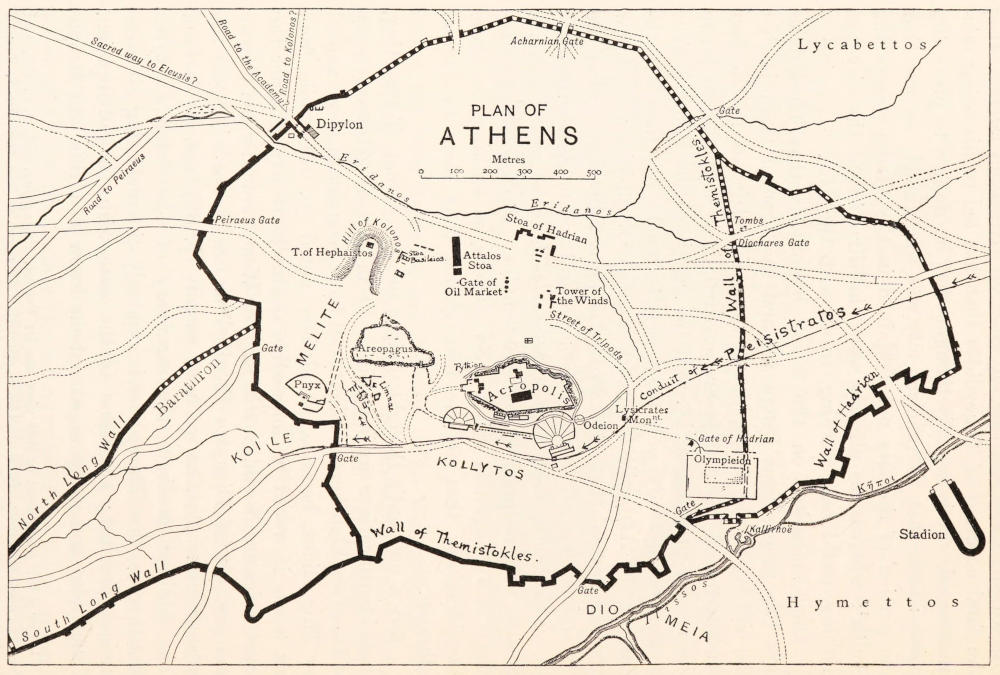
The traveller who visits Athens for the first time will
naturally, if he be a classical scholar, devote himself at the
outset to the realization of the city of Perikles. His task will
here be beset by no serious difficulties. The Acropolis, as Perikles
left it, is, both from literary and monumental evidence, adequately
known to us. Archaeological investigation has now but little to
add to the familiar picture, and that little in matters of quite
subordinate detail. The Parthenon, the Propylaea, the temple of
Nike Apteros, the Erechtheion (this last probably planned, though
certainly not executed by Perikles) still remain to us; their
ground-plans and their restorations are for the most part architectural
certainties. Moreover, even outside the Acropolis, the
situation and limits of the city of Perikles are fairly well ascertained.
The Acropolis itself was, we know, a fortified sanctuary
within a larger walled city. This city lay, as the oracle in
Herodotus[1] said, ‘wheel-shaped’ about the axle of the sacred
hill. Portions of this outside wall have come to light here and
there, and the foundations of the great Dipylon Gate are clearly
made out, and are marked in every guide-book. Inside the
circuit of these walls, in the inner Kerameikos, whose boundary-stone
still remains, lay the agora. Outside is still to be seen, with
its street of tombs, the ancient cemetery.
Should the sympathies of the scholar extend to Roman times,
he has still, for the making of his mental picture, all the help
imagination needs. Through the twisted streets of modern Athens
the beautiful Tower of the Winds is his constant land-mark;
Hadrian, with his Olympieion, with his triumphal Arch, with his
Library, confronts him at every turn; when he goes to the great
Stadion to see ‘Olympian’ games or a revived ‘Antigone,’ when
he looks down from the Acropolis into the vast Odeion, Herodes
Atticus cannot well be forgotten. Moreover, if he really cares to
know what Athens was in Roman days, the scholar can leave
behind him his Murray and his Baedeker and take for his only
guide the contemporary of Hadrian, Pausanias.
But returning, as he inevitably will, again and again to the
Acropolis, the scholar will gradually become conscious, if dimly,
of another and an earlier Athens. On his plan of the Acropolis
he will find marked certain fragments of very early masonry,
which, he is told, are ‘Pelasgian.’ As he passes to the south
of the Parthenon he comes upon deep-sunk pits railed in, and
within them he can see traces of these ‘Pelasgian’ walls and other
masonry about which his guide-book is not over-explicit. To the
south of the Propylaea, to his considerable satisfaction, he comes
on a solid piece of this ‘Pelasgian’ wall, still above ground. East
of the Erechtheion he will see a rock-hewn stairway which once,
he learns, led down from the palace of the ancient prehistoric
kings, the ‘strong house of Erechtheus.’ South of the Erechtheion
he can make out with some effort the ground plan of an early
temple; he is told that there exist bases of columns belonging to
a yet earlier structure, and these he probably fails to find.
With all his efforts he can frame but a hazy picture of this
earlier Acropolis, this citadel before the Persian wars. Probably
he might drop the whole question as of merely antiquarian interest—a
matter to be noted rather than realized—but that his
next experience brings sudden revelation. Skilfully sunk out
of sight—to avoid interfering with his realization of Periklean
Athens—is the small Acropolis Museum. Entering it, he finds
himself in a moment actually within that other and earlier Athens
dimly discerned, and instantly he knows it, not as a world of
ground-plans and fragmentary Pelasgic fortifications, but as a
kingdom of art and of humanity vivid with colour and beauty.
As he passes in eager excitement through the ante-rooms he
will glance, as he goes, at the great blue lion and the bull, at the
tangle of rampant many-coloured snakes, at the long-winged birds
with their prey still in beak and talon; he will pause to smile
back at the three kindly ‘Blue-beards,’ he will be glad when
he sees that the familiar Calf-Carrier has found his feet and
his name, he will note the long rows of solemn votive
terra-cottas, and, at last, he will stand in the presence of
those Maiden-images, who, amid all that coloured architectural
splendour, were consecrate to the worship of the Maiden. The
Persian harried them, Perikles left them to lie beneath his feet,
yet their antique loveliness is untouched and still sovran. They
are alive, waiting still, in hushed, intent expectancy—but not for
us. We go out from their presence as from a sanctuary, and
henceforth every stone of the Pelasgian fortress where they dwelt
is, for us, sacred.
But if he leave that museum aglow with a new enthusiasm,
determined to know what is to be known of that antique world,
the scholar will assuredly be met on the threshold of his enquiry
by difficulties and disillusionment. By difficulties, because the
information he seeks is scattered through a mass of foreign
periodical literature, German and Greek; by disillusionment, because
to the simple questions he wants to ask he can get no clear,
straightforward answer. He wants to know what was the nature
and extent of the ancient city, did it spread beyond the Acropolis,
if so in what direction and how far? what were the primitive
sanctuaries inside the Pelasgic walls, what, if any, lay outside
and where? Where was the ancient city well (Kallirrhoë), where
the agora, where that primitive orchestra on which, before the
great theatre was built, dramatic contests took place? Straightway
he finds himself plunged into a very cauldron of controversy.
The ancient agora is placed by some to the north, by others to
the south, by others again to the west. The question of its
position is inextricably bound up, he finds to his surprise, with the
question as to where lay the Enneakrounos, a fountain with which
hitherto he has had no excessive familiarity; the mere mention of
the Enneakrounos brings either a heated discussion or, worse, a
chilling silence.
This atmosphere of controversy, electric with personal prejudice,
exhilarating as it is to the professed archaeologist, plunges
the scholar in a profound dejection. His concern is not jurare in
verba magistri—he wants to know not who but what is right.
Two questions only he asks. First, and perhaps to him unduly
foremost, What, as to the primitive city, is the literary testimony
of the ancients themselves, and preferably the testimony not of
scholiasts and second-hand lexicographers, but of classical writers
who knew and lived in Athens, of Thucydides, of Pausanias?
Second, To that literary testimony, what of monumental evidence
has been added by excavation?
It is to answer these two questions that the following pages
are written. It is the present writer’s conviction that controversy
as to the main outlines of the picture, though perhaps at
the outset inevitable, is, with the material now accessible, an
anachronism; that the facts stand out plain and clear and that
between the literary and monumental evidence there is no discrepancy.
The plan adopted will therefore be to state as simply
as may be what seems the ascertained truth about the ancient
city, and to state that truth unencumbered by controversy.
Then, and not till then, it may be profitable to mention other
current opinions, and to examine briefly what seem to be the
errors in method which have led to their acceptance.
CHAPTER I. THE ANCIENT CITY, ITS CHARACTER AND LIMITS.
By a rare good fortune we have from Thucydides himself an
account of the nature and extent of the city of Athens in the
time of the kingship. This account is not indeed as explicit in
detail as we could wish, but in general outline it is clear and
vivid. To the scholar the remembrance of this account comes as
a ray of light in his darkness. If he cannot find his way in the
mazes of archaeological controversy, it is at least his business to
read Thucydides and his hope to understand him.
The account of primitive Athens is incidental. Thucydides is
telling how, during the Peloponnesian War, when the enemy was
mustering on the Isthmus and attack on Attica seemed imminent,
Perikles advised the Athenians to desert their country homes and
take refuge in the city. The Athenians were convinced by his
arguments. They sent their sheep and cattle to Euboea and the
islands; they pulled down even the wood-work of their houses,
and themselves, with their wives, their children, and all their
moveable property, migrated to Athens. But, says Thucydides[2],
this ‘flitting’ went hard with them; and why? Because ‘they
had always, most of them, been used to a country life.’
This habit of ‘living in the fields,’ this country life was,
Thucydides goes on to explain, no affair of yesterday; it had been
so from the earliest times. All through the days of the kingship
from Kekrops to Theseus the people had lived scattered about in
small communities—‘village communities’ we expect to hear him
say, for he is insisting on the habit of country life; but, though
he knows the word ‘village’ (κώμη) and employs it in discussing
Laconia elsewhere[3], he does not use it here. He says the inhabitants
of Athens lived ‘in towns’ (κατὰ πόλεις), or, as it would
be safer to translate it, ‘in burghs.’
It is necessary at the outset to understand clearly what the
word polis here means. We use the word ‘town’ in contradistinction
to country, but from the account of Thucydides it
is clear that people could live in a polis and yet lead a country
life. Our word city is still less appropriate; ‘city’ to us means a
very large town, a place where people live crowded together. A
polis, as Thucydides here uses the word, was a community of
people living on and immediately about a fortified hill or citadel—a
citadel-community. The life lived in such a community was
essentially a country life. A polis was a citadel, only that our
word ‘citadel’ is over-weighted with military association.
Athens then, in the days of Kekrops and the other kings down
to Theseus, was one among many other citadel-communities or
burghs. Like the other scattered burghs, like Aphidna, like
Thoricus, like Eleusis, it had its own local government, its own
council-house, its own magistrates. So independent were these
citadel-communities that, Thucydides tells us, on one occasion
Eleusis under Eumolpos actually made war on Athens under
Erechtheus.
So things went on till the reign of Theseus and his famous
Synoikismos, the Dwelling-together or Unification. Theseus,
Thucydides says, was a man of ideas and of the force of character
necessary to carry them out. He substituted the one for the
many; he put an end to the little local councils and council-houses
and centralized the government of Attica in Athens.
Where the government is, thither naturally population will flock.
People began to gather into Athens, and for a certain percentage
of the population town-life became fashionable. Then, and not
till then, did the city become ‘great,’ and that ‘great’ city Theseus
handed down to posterity. ‘And from that time down to the
present day the Athenians celebrate to the Goddess at the public
expense a festival called the Dwelling-together[4].’
One unified city and one goddess, the goddess who needs no
name. Their unity and their greatness the Athenians are not
likely to forget, but will they remember the time before the
union, when Athens was but Kekropia, but one among the many
scattered citadel-communities? Will they remember how small
was their own beginning, how limited their burgh, how impossible—for
that is the immediate point—that it should have
contained in its narrow circuit a large town population? Thucydides
clearly is afraid they will not. There was much to prevent
accurate realization. The walls of Themistocles, when Thucydides
wrote, enclosed a polis that was not very much smaller than the
modern town; the walls of the earlier community, the old small
burgh, were in part ruined. It was necessary therefore, if the
historian would make clear his point, namely, the smallness of
the ancient burgh and its inadequacy for town-life, that he should
define its limits. This straightway he proceeds to do. Our whole
discussion will centre round his definition and description, and at
the outset the passage must be given in full. Immediately after
his notice of the festival of the ‘Dwelling-together,’ celebrated to
‘the Goddess,’ Thucydides[5] writes as follows:
‘Before this, what is now the citadel was the city, together with
what is below it towards about south. The evidence is this. The
sanctuaries are in the citadel itself, those of other deities as well[6] (as
the Goddess). And those that are outside are placed towards this
part of the city more (than elsewhere). Such are the sanctuary of
Zeus Olympios, and the Pythion, and the sanctuary of Ge, and that
of Dionysos-in-the-Marshes (to whom is celebrated the more ancient
Dionysiac Festival on the 12th day in the month Anthesterion, as
is also the custom down to the present day with the Ionian descendants
of the Athenians); and other ancient sanctuaries also are
placed here. And the spring which is now called Nine-Spouts,
from the form given it by the despots, but which formerly, when the
sources were open, was named Fair-Fount—this spring (I say),
being near, they used for the most important purposes, and even
now it is still the custom derived from the ancient (habit) to use
the water before weddings and for other sacred purposes. Because
of the ancient settlement here, the citadel (as well as the present
city) is still to this day called by the Athenians the City.’
In spite of certain obscurities, which are mainly due to a
characteristically Thucydidean over-condensation of style, the
main purport of the argument is clear. Thucydides, it will be
remembered, wants to prove that the city before Theseus was,
because of its small size, incapable of holding a large town population.
This small size not being evident to the contemporaries of
Thucydides, he proceeds to define the limits of the ancient city.
He makes a statement and supports it by fourfold evidence.
The statement that he makes is that the ancient city comprised
the present citadel together with what is below it towards
about south. The fourfold evidence is as follows:
1. The sanctuaries are in the citadel itself, those of other
deities as well as the Goddess.
2. Those ancient sanctuaries that are outside are placed
towards this part of the present city more than elsewhere. Four
instances of such outside shrines are adduced.
3. There is a spring near at hand used from of old for the
most important purposes, and still so used on sacred occasions.
4. The citadel, as well as the present city, was still in the
time of Thucydides called the ‘city.’
We begin with the statement as to the limits of the city. Not
till we clearly understand exactly what Thucydides states, how
much and how little, can we properly weigh the fourfold evidence
he offers in support of his statement.
‘Before this what is now the citadel was the city, together with
what is below it towards about south.’ The city before Theseus
was the citadel or acropolis of the days of Thucydides, plus something
else. The citadel or acropolis needed then, and needs now,
no further definition. By it is clearly meant not the whole hill to
the base, but the plateau on the summit enclosed by the walls of
Themistocles and Kimon together with the fortification out-works
on the west slope still extant in the days of Thucydides. But the
second and secondary part of the statement is less clearly defined.
The words neither give nor suggest, to us at least, any circumscribing
line; only a direction, and that vague enough, ‘towards
about south.’ It is a point at which the scholar naturally asks,
whether archaeology has anything to say?
But before that question is asked and answered, it should be
noted that from the shape of the sentence alone something
may be inferred. That the present citadel is coextensive with
the old city is the main contention. We feel that Thucydides
might have stopped there and yet made his point, namely, the
smallness of that ancient city. But Thucydides is a careful man,
he remembers that the two were not quite coextensive. To the old
city must be reckoned an additional portion below the citadel (τὸ
ὑπ’ αὐτήν), a portion that, as will later be seen, his readers might
be peculiarly apt to forget; so he adds it to his statement. But,
by the way it is hung on, we should naturally figure that portion
as ‘not only subordinate to the acropolis, but in some way closely
incorporated with it. In relation to the acropolis, this additional
area, to justify the arrangement of the words of Thucydides, should
be a part neither large nor independent[7].’
Thus much can be gathered from the text; it is time to see
what additional evidence is brought by archaeology.
Thucydides was, according to his lights, scrupulously exact.
It happens, however, that in the nature of things he could not,
as regards the limits of the ancient city, be strictly precise. The
necessary monuments were by his time hidden deep below the
ground. His first and main statement, that one portion of the
old city was coextensive with the citadel of his day, is not quite
true. This upper portion of the old burgh was a good deal
smaller; all the better for his argument, had he known it!
Thanks to systematic excavation we know more about the limits
of the old city than Thucydides himself, and it happens curiously
enough that this more exact and very recent knowledge, while
it leads us to convict Thucydides of a real and unavoidable
inexactness, gives us also the reason for his caution. It explains
to us why, appended to his statement about the city and the
citadel, he is careful to put in the somewhat vague addendum,
‘together with what is below it towards about south.’
To us to-day the top of the Acropolis appears as a smooth
plateau sloping gently westwards towards the Propylaea, and
this plateau is surrounded by fortification walls, whose clean,
straight lines show them to be artificial. Very similar in all
essentials was the appearance presented by the hill to the contemporaries
of Thucydides, but such was not the ancient
Acropolis. What manner of thing the primitive hill was has
been shown by the excavations carried on by the Greek Government
from 1885-1889. The excavators, save when they were
prevented by the foundations of buildings, have everywhere dug
down to the living rock, every handful of the débris exposed has
been carefully examined, and nothing more now remains for
discovery.
When the traveller first reaches Athens he is so impressed by
the unexpected height and dominant situation of Lycabettus,
that he wonders why it plays so small a part in classical record.
Plato[8] seems to have felt that it was hard for Lycabettus to be
left out. In his description of primitive Athens he says, ‘in old
days the hill of the Acropolis extended to the Eridanus and
Ilissus, and included the Pnyx on one side and Lycabettus as
a boundary on the opposite side of the hill,’ and there is a certain
rough geological justice about Plato’s description. All these hills
are spurs of that last offshoot of Pentelicus, known in modern
times as Turkovouni. Yet to the wise Athena, Lycabettus was
but building material; she was carrying the hill through the air
to fortify her Acropolis, when she met the crow[9] who told her
that the disobedient sisters had opened the chest, and then and
there she dropped Lycabettus and left it ... to the crows.
A moment’s reflection will show why the Acropolis was chosen
and Lycabettus left. Lycabettus is a good hill to climb and see a
sunset from. It has not level space enough for a settlement. The
Acropolis has the two desiderata of an ancient burgh, space on
which to settle, and easy defensibility.
The Acropolis, as in neolithic days the first settlers found it,
was, it will be seen in Fig. 1, a long, rocky ridge, broken at
intervals[10]. It could only be climbed with ease on the west and
south-west sides, the remaining sides being everywhere precipitous,
though in places not absolutely inaccessible. For a
primitive settlement it was an ideal situation. Two things remained
for the settlers to do: first, they had to level the surface
by hewing away jagged rocks and filling up cracks with earth and
stones to make sites for their houses and their sanctuaries; and
second, they had to supplement what nature had already done in
the way of fortification; here and there to make the steep rocks
steeper, build a wall round their settlement, and, above all, fortify
that accessible west and south-west end and build an impregnable
gateway. Kleidemos[11], writing in the fifth century B.C., says, ‘they
levelled the Acropolis and made the Pelasgicon, which they built
round it nine-gated.’ They levelled the surface, they built a wall
round it, they furnished the fortification wall with gates. We
begin for convenience sake with the wall. In tracing its course
the process of levelling is most plainly seen. The question of the
gates will be taken last.
Fig. 1.
In the plan in Fig. 2 is shown what excavations have laid
bare of the ancient Pelasgic fortress. We see instantly the inexactness
of the main statement of Thucydides. It is not ‘what is now
the Citadel’ that was the main part of the old burgh, but something
substantially smaller, smaller by about one-fifth of the total area.
We see also that this Thucydides could not know. The Pelasgic
wall following the broken outline of the natural rock was in his
days covered over by the artificial platform reaching everywhere to
the wall of Kimon. At one place, and one only, in the days of
Thucydides, did the Pelasgic wall come into sight, and there it
still remains above ground, as it has always been, save when temporarily
covered by Turkish out-works. This visible piece is the
large fragment (A), 6 metres broad, to the south of the present
Propylaea and close to the earlier gateway (G). In the days
of Thucydides it stood several metres high. Of this we have
definite monumental evidence. The south-east corner of the wall
of the south-west wing of the present Propylaea is bevelled away[12]
so as to fit against this Pelasgic wall, and the bevelling can be
seen to-day. This portion of the Pelasgic wall is of exceptional
strength and thickness, doubtless because it was part of the gateway
fortifications, the natural point of attack.
Fig. 2.
Save for this one exception, the Pelasgic walls lie now, as they
did in the day of Thucydides, below the level of the present hill,
and their existence was, until the excavations began, only dimly
suspected. Literary tradition said there was a circuit wall, but
where this circuit wall ran was matter of conjecture; bygone
scholars even placed it below the Acropolis. Now the outline,
though far from complete, is clear enough. To the south and
south-west of the Parthenon there are, as seen on the plan, substantial
remains and what is gone can be easily supplied. On the
north side the remains are scanty. The reason is obvious; the
line of the Pelasgic fortification on the south lies well within
the line of Kimon’s wall; the Pelasgic wall was covered in, but
not intentionally broken down. To the north it coincided with
Themistocles’ wall, and was therefore, for the most part, pulled
down or used as foundation.
But none the less is it clear that the centre of gravity of the
ancient settlement lay to the north of the plateau. Although
the north wall was broken away, it is on this north side that the
remains which may belong to a royal palace have come to light.
The plan of these remains cannot in detail be made out, but the
general analogy of the masonry to that of Tiryns and Mycenae
leave no doubt that here we have remains of ‘Mycenaean’ date.
North-east of the Erechtheion is a rock-cut stairway (B) leading
down through a natural cleft in the rock to the plain below. As
at Tiryns and Mycenae, the settlement on the Acropolis had not
only its great entrance-gates, but a second smaller approach,
accessible only to passengers on foot, and possibly reserved for
the rulers only.
Incomplete though the remains of this settlement are, the
certain fact of its existence, and its close analogy to the palaces
of Tiryns and Mycenae are of priceless value. Ancient Athens
is now no longer a thing by itself; it falls into line with all
the other ancient ‘Mycenaean’ fortified hills, with Thoricus,
Acharnae, Aphidna, Eleusis. The citadel of Kekrops is henceforth
as the citadel of Agamemnon and as the citadel of Priam.
The ‘strong house’ of Erechtheus is not a temple, but what the
words plainly mean, the dwelling of a king. Moreover we are
dealing not with a city, in the modern sense, of vague dimensions,
but with a compact fortified burgh.
Thucydides, though certainly convicted of some inexactness
as to detail, is in his main contention seen to be strictly true—‘what
is now the citadel was the city.’ Grasping this firmly in
our minds we may return to note his inexactness as to detail.
By examining certain portions of the Pelasgic wall more closely,
we shall realize how much smaller was the space it enclosed than
the Acropolis as known to Thucydides.
Fig. 3.
The general shape of the hill, and its subsequent alteration,
are best realized by Dr Dörpfeld’s simple illustration[13]. A vertical
section of the natural rock, it is roughly of the shape of a
house (Fig. 3) with an ordinary gable roof.
The sides of the house represent the steep
inaccessible cliffs to north and south and east;
the lines of the roof slope like the lines of
the upper part of the hill converging at the
middle. Suppose the sides of the house produced
upwards to the height of the roof-ridge,
and the triangular space so formed filled in, we
have the state of the Acropolis when Kimon’s
walls were completed. The filling in of those
spaces is the history of the gradual ‘levelling of the surface of
the hill, the work of many successive generations.’ The section
in Fig. 4 will show that this levelling up had to be done chiefly
on the north and south sides; to the east and west the living
rock is near the surface.
Fig. 4.
It has already been noted that on the north side of the
Acropolis the actual remains of the Pelasgian wall are few and
slight; but as the wall of Themistocles which superseded it
follows the contours of the rock, we may be sure that here the
two were nearly coincident. The wall of Themistocles remains
to this day a perpetual monument of the disaster wrought by the
Persians. Built into it opposite the Erechtheum, not by accident,
but for express memorial, are fragments of the architrave, triglyphs
and cornice of poros stone, and the marble metopes, from the old
temple of Athena which the Persians had burnt. Other memorials
lay buried out of sight, and were brought to light by the excavations
of 1886. The excavators[14] were clearing the ground to the
north-east of the Propylaea. On the 6th of February, at a depth
of from 3-4½ metres below the surface, they came upon fourteen
of the ‘Maidens[15].’ The section[16] in Fig. 5 shows the place where
they had slept their long sleep. We should like to think they
were laid there in all reverence for their beauty, but hard facts
compel us to own that, though their burial may have been
prompted in part by awe of their sanctity, yet the practical
Athenian did not shrink from utilizing them as material to level
up with.
The deposit, it is here clearly seen, was in three strata. Each
stratum consisted of statues and fragments of statues, inscribed
bases, potsherds, charred wood, stones, and earth. Each stratum,
and this is the significant fact, is separated from the one above it
by a thin layer of rubble, the refuse of material used in the wall
of Themistocles. The conclusion to the architect is manifest.
In building the wall, perhaps to save expense, no scaffolding was
used; but, after a few courses were laid, the ground inside
was levelled up, and for this purpose what could be better than
the statues knocked down by the Persians? Headless, armless,
their sanctity was gone, their beauty uncared for. In the topmost
of the three strata—the stratum which yielded the first
find of ‘Maidens’—a hoard of coins was found: thirty-five Attic
tetradrachms, two drachmas, and twenty-three obols. All are of
Solon’s time except eight of the obols, which date somewhat
earlier. Besides the ‘Maidens,’ on this north side of the Acropolis
other monuments came to light, many bronzes, and among them
the lovely flat Athena[17], the beautiful terra-cotta plaque[18] painted
with the figure of a hoplite, and countless votive terra-cottas.
Fig. 5.
The excavations on the south side of the Acropolis have
yielded much that is of great value for art and for science, for
our knowledge of the extent of the Pelasgian fortification, results
of the first importance. The section in Fig. 7, taken at the
south-east corner of the Parthenon, shows the state of things
revealed. The section should be compared with the view in
Fig. 6.
Fig. 6.
Fig. 7.
The masonry marked 2 is the foundation, deep and massive
beyond all expectation, laid, not for the Parthenon as we know it,
but for that earlier Parthenon begun before the Persian War, and
fated never to be completed. At 4 we see the great Kimonian
wall as it exists to-day, though obscured by its mediaeval casing.
All this, if we want to realize primitive Athens, we must think
away. The date of Kimon’s wall is of course roughly fixed as
shortly after 469 B.C., the foundations of the early Parthenon are
certainly before the Persian War, probably after the date of
Peisistratos. We may probably, though not quite certainly,
attribute them to the time of the first democracy, the activity
of Kleisthenes[19], a period that saw the building of the theatre-shaped
Pnyx, the establishment of the new agora in the Kerameikos,
and the Stoa of the Athenians at Delphi. Laurium had
just begun to yield silver from her mines. Themistocles, before
and after the war, was all for fortification; the Alkmaeonid
Kleisthenes may well have indulged an hereditary tendency to
temple building.
Save for the clearing of our minds, the date of the early
temple-foundations does not immediately concern us. Their
importance is that, but for the building of the Parthenon, early
and late, we should never apparently have had the great alteration
and addition to the south side of the hill and the ancient
Pelasgian wall would never have been covered in. Let us see
how this happened[20].
We start with nothing but the natural rock, and on it the
Pelasgian wall (1). Over the natural rock is a layer of earth,
marked I. Whatever objects have been found in that layer date
before the laying of the great foundations; these objects are
chiefly fragments of pottery, many of them of ‘Mycenean’
character, and some ordinary black-figured vases.
It is decided to build a great temple, and the foundations
are to be laid. The ground slopes away somewhat rapidly, so the
southern side of the temple is to be founded on an artificial platform.
The trench (b) is dug in the layer of earth; then, just as
on the north side of the hill, no scaffolding is used, but as the
foundations are laid course by course, the débris is used as a platform
for the workmen. A supporting wall (2) is required and
built of polygonal masonry; it rises course by course, corresponding
with the platform of débris. And then, what might have been
expected but was apparently not foreseen, happens. The slender
wall can be raised no higher and at about the second course the
débris unsupported pours over it, as seen at III.
The débris, unchecked, fell over as far as the old Pelasgian
wall. How high this originally stood it is not possible now to
say; but, from the fact that outside the supporting wall the
layers of débris again lie horizontally, and from the analogy of
another section taken further west, which need not be discussed
here, it is probable that the old wall was raised by several new
courses, and that the higher ones were of quadrangular blocks, as
restored in Fig. 7.
So far all that has been accomplished is the raising of the old
Pelasgian wall and a levelling up of the terrace to its new height.
That these terraces were raised step by step with the foundations
of the Parthenon is clear. Between each layer of earth and poros
fragments—just as we have seen in the similar circumstances
of the north wall (p. 15)—is interposed a layer of splinters and
fragments of the stones used in the building of the foundations.
This can clearly be seen at II. in the section in Fig. 7.
It may seem strange that Kleisthenes, or whoever built the
earlier Parthenon, did not at once utilize the Pelasgian wall and
boldly pile up his terrace against its support. But it must be
remembered that the space between the Parthenon and the Pelasgian
wall was very great; an immense amount of débris would
be required for the filling up of such a space, and it was probably
more economical to build the polygonal supporting-wall nearer to
the Parthenon. Anyhow it is quite clear that the polygonal wall
was no provisional structure. Its façade shows it was meant to
be seen, and that the terrace was meant for permanent use is
clear from the fact that it is connected by a flight of steps with
the lower terrace under the Pelasgian wall (Fig. 8). It is clear
that whoever planned these steps never thought that the lower
terrace would be levelled up.
Doubtless whoever filled in the terrace to the height of the
raised Pelasgian wall believed in like manner that his work was
complete. But Kimon thought otherwise. We know for certain
that it was he who built the great final wall, the structure that remains
to-day, though partly concealed by mediaeval casing Fig. 7 (4).
Plutarch[21] tells us that after the battle of Eurymedon (469 B.C.) so
much money was raised by the sale of the spoils of the Persians
that the people were able to afford to build the south wall. We
know also that this wall of Kimon was at least as much a retaining
wall to the great terrace as a fortification. For the filling up
of the space between the Pelasgian fortification and his own wall
Kimon had material sadly ample. He had the débris left by the
Persians after the sacking of the Acropolis. The fragments of
sculpture and architecture that bear traces of fire are found in the
strata marked IV, and there only, for it is these strata only that
were laid down after the Persian War[22]. The last courses of
‘Kimon’s wall’ (5) were laid by Perikles, and he it was who finally
filled in the terrace to its present level (V).
Fig. 8.
The relation of the successive walls and terraces is shown by
the ground-plan in Fig. 9[23]. The double shaded lines from A to
E and D show the irregular course of the old Pelasgic wall. The
dotted lines from B to F show the polygonal supporting wall of
the first terrace. It ran, as is seen, nearly parallel to the
Parthenon. Its course is lost to sight after it passes under the
new museum, but originally it certainly joined the Pelasgic wall
at C. At B was the stairway joining the two terraces. Next
came the time when, as the rubble fell over the wall, larger space
was needed, and a portion of the Pelasgic wall was utilized and
raised. This is shown by the thick black line from B to E coincident
with the Pelasgic wall; the masonry here was of quadrangular
poros blocks. The coincidence with the Pelasgic wall was only
partial. At GH there jutted out an independent angular outpost,
and again at EF the new wall is separate from the old; at FD it
coincided with the earlier polygonal terrace wall. Kimon’s wall
is indicated by the outside double lines, and in the space between
these lines and the wall HEK lay the débris of the Persian War.
Above that débris lay a still later stratum, deposited during the
building operations of Perikles.
Fig. 9.
The various terraces and walls have been examined somewhat
in detail, because their examination helps us to realize as nothing
else could how artificial a structure is the south side of the Acropolis,
and also—a point, to us, of paramount importance—how
different was the early condition of the hill from its later
appearance.
Before we pass to the consideration of the second clause in the
historian’s statement, ‘together with what is below it towards about
south,’ it is necessary to say a word as to when the old fortress
walls were built and by whom. Kimon and Themistocles we
know, but who were these earlier master-builders?
A red-figured vase painter of the fifth century B.C. gives us
what would have seemed to a contemporary Athenian a safe and
satisfactory answer—‘There were giants in those days.’ The
design in Fig. 10 is from a skyphos[24] in the Louvre Museum.
Athena is about to fortify her chosen hill. She wears no aegis,
for her work is peaceful; she has planted her spear in the ground
perhaps as a measuring rod, and she has chosen her workman.
A great giant, his name Gigas, inscribed over him, toils after her,
bearing a huge ‘Cyclopean’ rock. She points with her hand where
he is to lay it.
Fig. 10.
On the obverse of the same vase (Fig. 11) we have a scene of
similar significance. To either side of a small tree, which marks
the background as woodland, stands a man of rather wild and
uncouth appearance. The man to the left is bearded and his
name is inscribed, Phlegyas. The right-hand man is younger,
and obviously resembles the giant of the obverse. He is showing
to Phlegyas an object, which they both inspect with an intent,
puzzled air. And well they may. It is a builder’s staphyle[25], or
measuring line, weighted with knobs of lead like a cluster of
grapes; hence its name. Phlegyas[26] and his giant Thessalian folk
were the typical lawless bandits of antiquity; they plundered
Delphi, they attacked Thebes after it had been fortified by
Amphion and Zethus. But Athena has them at her hest for
master-builders. All glory to Athena!
Fig. 11.
It is not only at Athens that legends of giant, fabulous workmen
cluster about ‘Mycenean’ remains. Phlegyas and his giants
toil for Athena, and at Tiryns too, according to tradition, the
Kyklopes work for King Proetus[27], and they too built the walls
and Lion-Gate of Mycenae[28]. At Thebes the Kadmeia[29] is the
work of Amphion and Zethus, sons of the gods, and the fashion
in which art represents Zethus as toiling is just that of our
giant on the vase. The mantle that Jason wore was embroidered,
Apollonius of Rhodes[30] tells us, with the building of Thebes,
Of river-born Antiope therein
The sons were woven, Zethus and his twin
Amphion, and all Thebes unlifted yet
Around them lay. They sought but now to set
The stones of her first building. Like one sore
In labour, Zethus on great shoulders bore
A stone-clad mountain’s crest; and there hard by
Amphion went his way with minstrelsy
Clanging a golden lyre, and twice as vast
The dumb rock rose and sought him as he passed.
Sisyphos, ancient king of Corinth, built on the acropolis of
Corinth his great palace, the Sisypheion. He is the Corinthian
double of Erechtheus with his Erechtheion. Strabo[31] was in doubt
whether to call the Sisypheion palace or temple. Like the old
Erechtheion, it was both fortress and sanctuary. In Hades for
eternal remembrance, not, as men later thought, of his sin, but of his
craft as master-builder, Sisyphos[32], like Zethus, like our giant, still
rolls a huge stone up the slope. Everywhere it is the same tale.
All definite record or remembrance of the building of ‘Cyclopean’
walls is lost; some hero-king built them, some god, some demi-god,
some giant. Just so did the devil in ancient days build his
Bridges all over England.
Tradition loves to embroider a story with names and definite
details. The prudent Attic vase-painter gives us only a nameless
‘Giant.’ Others knew more. Pausanias[33] had heard the builders’
actual names and tried to fix their race. He tells us—just as he
leaves the Acropolis—‘Save for the portion built by Kimon, son
of Miltiades, the whole circuit of the Acropolis fortification was,
they say, built by the Pelasgians, who once dwelt below the
Acropolis. It is said that Agrolas and Hyperbios ... and on
asking who they were, I could only learn that in origin they were
Sikelians and that they migrated to Acarnania.’
Spite of the lacuna, it is clear that Agrolas and Hyperbios are
the reputed builders. The reference to Sicily dates probably from
a time when the Kyklopes had taken up their abode in the island.
The two builder-brothers remind us of Amphion and Zethus, and
of their prototypes the Dioscuri[34]. Pliny[35]
tells of a similar pair,
though he gives to one of them another name. ‘The brothers
Euryalos and Hyperbios were the first to make brick-kilns and
houses at Athens; before this they used caves in the ground for
houses.’
The names of the two ‘Pelasgian’ brothers are, as we know from
the evidence of vase-paintings[36], ‘giant’ names, and Hyperbios is
obviously appropriate. The names leave us in the region of myth,
but the tradition that the brothers were ‘Pelasgian’ deserves closer
attention.
In describing the old wall we have spoken of it as ‘Pelasgian,’
and in this we follow classical tradition. Quoting from Hecataeus
(circ. 500 B.C.), Herodotus[37] speaks of land under Hymettus as
given to the Pelasgians ‘in payment for the fortification wall which
they had formerly built round the Acropolis.’ Again, Herodotus[38]
tells how when Kleomenes King of Sparta reached Athens, he,
together with those of the citizens who desired to be free,
besieged the despots who were shut up in the Pelasgian fortification.
A Pelasgian fortification, a constant tradition that Athens was
inhabited by Pelasgians—we seem to be on solid ground. Yet on
a closer examination the evidence for connecting the name of the
fortification with the name ‘Pelasgian’ crumbles. In the one
official[39] inscription that we possess the word is written, not
Pelasgikon, but Pelargikon. In like manner, in Thucydides[40],
where the word occurs twice, it is written with an r. Pelargikon
is ‘stork-fort,’ not Pelasgian fort. The confusion probably began
with Herodotus, who was specially interested in the Pelasgians.
Why the old citadel was called ‘stork-fort’ we cannot say—there
are no storks there now—but we have one delightful piece
of evidence that, to the Athenian of the sixth century B.C.,
‘stork-fort’ was a reality.
Immediately to the south of the present Erechtheion lie the
foundations of the ancient Doric temple[41], currently known by a
pardonable Germanism as the ‘old Athena-temple.’ For its date
we have a certain terminus ante quem. The colonnade was of the
time of Peisistratos; it was a later addition; the cella of the
temple existed before—how much before we do not know. The
zeal and skill of Prof. Dörpfeld for architecture, of Dʳˢ Wiegand
and Schrader for sculpture, have restored to us a picture of that
ancient Doric temple all aglow with life and colour and in essentials
complete[42].
Fig. 12.
Of all the marvellous fragments of early sculpture recently discovered,
none is more widely known
nor more justly popular than the smiling,
three-headed monster known
throughout Europe as the ‘Blue-beard.’
He belongs to the
sculptures of the west pediment
of the inner pre-Peisistratean
cella of the
‘old Athena-temple,’
a portion of which
is shown in Fig. 12. It is tempting to turn aside and discuss
in detail the whole pediment composition to which he belongs.
It will, however, shortly be seen (p. 37) that our argument
forbids all detailed discussion of the sanctuaries of Athena, and
the pediments of her earliest temple have therefore, for us at the
moment, an interest merely incidental.
Thus much, however, for clearness sake may and must be said.
The design of the western pediment fell into two parts. In one
angle, that to the left of the spectator, Herakles is wrestling with
Triton; the right-hand portion, not figured here, is occupied by the
triple figure of ‘Blue-beard,’ whose correct mythological name is
probably Typhon[43]. He is no protagonist, only a splendid smiling
spectator. The centre of the pediment, where, in the art of Pheidias,
we should expect the interest to culminate, was occupied by accessories,
the stem of a tree on which hung, as in vase-paintings, the
bow and arrows and superfluous raiment of Herakles.
It is a point of no small mythological interest that in this and
two other primitive pediments the protagonist is not, as we
should expect, the indigenous hero Theseus, but the semi-Oriental
Herakles; but this question also we must set aside; our immediate
interest is not in the sculptured figures of the pediment,
but in the richly painted decoration on the pediment roof above
their heads.
The recent excavations on the Acropolis yielded a large number
of painted architectural fragments, the place and significance of
which was at first far from clear. Of these fragments forty were
adorned with two forms of lotus-flower; twenty had upon them
figures of birds of two sorts. Fragmentary though the birds
mostly are, the two kinds (storks and sea-eagles) are, by realism
as to feathers, beak, legs, and claws, carefully distinguished. The
stork (πελαργός) in the Pelargikon is a surprise and a delight.
Was Aristophanes[44] thinking of this Pelargikon when to the
building of his Nephelokokkygia he brought
For brickmakers a myriad flight of storks.
One of the storks is given in Fig. 13. The birds in the original
fragments are brilliantly and delicately coloured. Their vivid red
legs take us to Delphi. We remember Ion[45] with his laurel crown,
his bow and arrows, his warning song to swan and eagle.
Fig. 13.
There see! the birds are up: they fly
Their nests upon Parnassus high
And hither tend. I warn you all
To golden house and marble wall
Approach not. Once again my bow
Zeus’ herald-bird, will lay thee low;
Of all that fly the mightiest thou
In talon! Lo another now
Sails hitherward—a swan! Away
Away, thou red-foot!
In days when on open-air altars sacrifice smoked, and there
was abundance of sacred cakes, birds were real and very frequent
presences. To the heads of numbers of statues found on the
Acropolis is fixed a sharp spike to prevent the birds perching[46].
They were sacred yet profane.
The lotus-flowers carry us back to Egypt. The rich blending
of motives from the animal and vegetable kingdom is altogether
‘Mycenaean.’ Man in art, as in life, is still at home with his
brothers the fish, the bird, and the flower. After this ancient
fulness and warmth of life a pediment by Pheidias strikes a chill.
Its sheer humanity is cold and lonely. Man has forgotten that
Earth is a covering to hide thee, the garment of thee.
There are two sorts of birds, two sorts of lotus-flowers, and
there are two pediments. It is natural to suppose, with Dr Wiegand,
that the eagles belonged to the east, the principal pediment.
There, it will later be seen (p. 47), were seated the divinities of
the place. Our pediment decorated the west end, the humbler
seat of heroes rather than gods. There Herakles wrestled with
the Triton; there old Blue-beard—surely a monster of the
earlier slime—kept his watch; and over that ancient struggle
of hero and monster brooded the stork.
The storks themselves are there to remind us that the old
name of the citadel was Pelargikon, and that Pelargikon meant
‘stork fort’; by an easy shift it became Pelasgikon[47], and had
henceforth an etymologically false association with the Pelasgoi.
Etymologically false, but perhaps in fact true, for happily the
analogy between the Pelargic walls and those of Mycenae is
beyond dispute, and if the ‘Mycenaeans’ were Pelasgian, the
walls are, after all, Pelasgic.
We have seen that both Thucydides and the official inscription
write Pelargikon; their statements will repay examination.
Thucydides, after his account of the narrow limits of the city
before Theseus, returns to the main burden of his narrative, the
crowding of the inhabitants of Attica within the city walls.
‘Some few,’ he says[48], ‘indeed had dwelling places, and took refuge
with some of their friends or relations, but the most part of them
took up their abode on the waste places of the city and in the
sanctuaries and hero-shrines, with the exception of the Acropolis
and the Eleusinion, and any other that might be definitely closed.
And what is called the Pelargikon beneath the Acropolis, to
dwell in which was accursed, and was forbidden in the fag end
of an actual Pythian oracle on this wise,
The Pelargikon better unused,
was, notwithstanding, in consequence of the immediate pressure
thickly populated.’
The passage comes for a moment as something of a shock.
We have been thinking of the Pelargikon as the Acropolis, we
have traced its circuit of walls on the Acropolis, and now suddenly
we find the two sharply distinguished. The Acropolis, though
closed, is surely not cursed. The Acropolis is one of the definitely
closed places, to which the refugees cannot get access; the Pelargikon,
though accursed, is open to them, and they take possession
of it; the two manifestly cannot be coincident. But happily
the words ‘below the Acropolis’ bring recollection, and with it
illumination. What is called the Pelargikon below the Acropolis
is surely that appanage of the citadel which Thucydides in his
second clause mentions so vaguely. The ancient polis comprised
not only ‘what is now the citadel,’ but also together with it,
‘what is below it towards about south[49].’ Thucydides would
have saved a world of trouble if he had stated that ‘what
is below towards the south’ was the Pelargikon; but he does
not, probably because he is concerned with dimensions, not with
nomenclature.
The Pelasgikon meant originally the whole citadel, the ancient
city as defined by Thucydides. This was its meaning in the days
of Herodotus. In the Pelasgikon the tyrants were besieged (p. 25).
But by the time of Thucydides the Acropolis proper, i.e. much the
larger and more important part of the old city, had ceased to be
‘Pelasgic’; the old fortifications were concealed by the new
retaining walls of Themistocles and Kimon. It was only at
the west and south-west that the Pelasgic fortifications were still
visible, hence this portion below the Acropolis took to itself the
name that had belonged to the whole; but this limited use of the
word was at first tentative. Thucydides says, ‘which is called
the Pelargikon.’ This is quite different from the definite ‘the
Pelasgian citadel’ used by Herodotus. The neuter adjectival
form is, so far as I know, never used of the whole complex of
the Acropolis plus what is below.
From Thucydides we learn only that what was called the
Pelargikon was below the Acropolis. ‘Below’ means immediately,
vertically below, for when, in Lucian’s Fisherman[50], Parrhesiades,
after baiting his hook with figs and gold, casts down his line to
fish for the false philosophers, Philosophy, seeing him hanging
over, asks, ‘What are you fishing for, Parrhesiades? Stones from
the Pelasgikon?’ An inscription[51] of the latter end of the fifth
century confirms the curse mentioned by Thucydides, and shows
us that the Pelargikon was a well-defined area, as it was the
subject of special legislation. ‘The king (i.e. the magistrate
of that name) is to fix the boundaries of the sanctuaries in the
Pelargikon, and henceforth altars are not to be set up in the
Pelargikon without the consent of the Council and the people,
nor may stones be quarried from the Pelargikon, nor earth or
stones had out of it. And if any man break these enactments
he shall pay 500 drachmas and the king shall report him to the
Council.’ Pollux[52] further tells us that there was a penalty of
3 drachmas and costs for even mowing grass within the Pelargikon,
and three officers called paredroi guarded against the
offence. Evidently the fortifications of the Pelargikon, partially
dismantled by the Persians, had become a popular stone quarry;
as evidently the state had no intention that these fortifications
should fall into complete disuse. The question naturally arises,
what was the purport of this surviving Pelargikon, why did it not
perish with the rest of the Pelasgic fortifications?
The answer is simple: the Pelargikon remained because it was
the great fortification of the citadel gates. According to Kleidemos,
it will be remembered (p. 11), the work of the early settlers
was threefold; they levelled the surface of the citadel, they built a
wall round it, and they furnished the fortifications with gates.
Where will those gates be? A glance at the section in Fig. 1
shows that they must be where they are, i.e. at the only point
where the rock has an approachable slope, the west or south-west.
We say advisedly south-west. The great gate of Mnesicles, the
Propylaea which remain to-day, face due west; but within that
great gate still remain the foundations[53] of a smaller, older gate
(Fig. 2, G), built in direct connection with the great Pelasgic
fortification wall, and that older gate, there before the Persian
War[54], faces south-west.
Fig. 14.
This gate facing south-west stands on the summit of the hill,
and is but one. Kleidemos (p. 11) tells us that the Pelargikon
had nine gates. That there should be nine gates round the
Acropolis is unthinkable, such an arrangement would weaken
the fortification, not strengthen it. The successive gates must
somehow have been arranged one inside the other, and the fortifications
would probably be in terrace form. The west slope of the
Acropolis lends itself to such an arrangement, and in Turkish
days this slope was occupied by a succession of redoubts (Fig. 14).
Fortified Turkish Athens is in some ways nearer to the old
Pelasgian fortress than the Acropolis
as we see it to-day. We
shall probably not be far wrong
if we think of the approach to the
ancient citadel as a winding way
(Fig. 15), leading gradually up
by successive terraces, passing
through successive fortified gates[55],
and reaching at last the topmost
propylon which faced south-west.
These terraces, gates, fortifications,
covering a large space, the limits
of which will presently be defined,
formed a whole known from the time of Thucydides to that of
Lucian as the Pelargikon or Pelasgikon.
Fig. 15.
Lucian indeed not only affords our best evidence that, down to
Roman days, a place called the Pelasgikon existed below the Acropolis,
but is also our chief literary source for defining its limits.
We expect those limits to be wide, otherwise the refugees would
not have crowded in.
The passages about the Pelasgikon in Lucian are two. First
in the ‘Double Indictment[56],’ Dike, standing on the Acropolis, sees
Pan approaching, and asks who the god is with the horns and the
pipe and the hairy legs. Hermes answers that Pan, who used to
dwell on Mt Parthenion, had for his services been honoured with
a cave below the Acropolis ‘a little beyond the Pelasgikon.’ There
he lives and pays his taxes as a resident alien. The site of Pan’s
cave is certainly known; close below it was the Pelasgikon. This
marks the extreme limit of the Pelasgikon to the north, for the
sanctuary of Aglauros (p. 81) by which the Persians climbed up
was unquestionably outside the fortifications. Herodotus[57] distinctly
says, ‘In front then of the Acropolis, but behind the
gates and the ascent, where neither did anyone keep guard, nor
could it be expected that anyone could climb up there, some of
them ascended near the sanctuary of Aglauros, daughter of
Kekrops, though the place was precipitous.’
A second passage[58] in Lucian gives us a further clue.
Parrhesiades and Philosophy, from their station on the Acropolis,
are watching the philosophers as they crowd up. Parrhesiades
says, ‘Goodness, why, at the mere sound of the words, “a ten-pound
note,” the whole way up is a mass of them shouldering
each other; some are coming along the Pelasgikon, others and
more of them by the Areopagos, some are at the tomb of Talos,
and others have got ladders and put them against the Anakeion;
and, by Jove, there’s a whole hive of them swarming up like bees.’
A description like this cannot be regarded as definite proof; but,
taking the shrines in their natural order, it certainly looks as
though in Lucian’s days the Pelasgikon extended from the Areopagos
to the Asklepieion. The philosophers crowd up by the
regular approach (ἄνοδος) to the Propylaea; there is not room for
them all, so they spread to right and left, on the right to the
Asklepieion, on the left to the Areopagos; some are crowded out
still further on the right to the tomb of Talos[59], near the
theatre of Dionysos; on the left to the Anakeion[60] on the north
side of the Acropolis.
Yet one more topographical hint is left us. In a fragment of
Polemon[61] (circ. 180 B.C.), preserved to us by the scholiast on the
Oedipus Coloneus of Sophocles, we hear that Hesychos, the
eponymous hero of the Hesychidae, hereditary priests of the
Semnae, had a sanctuary. Its position is thus described: ‘it is
alongside of the Kyloneion outside the Nine-Gates.’ It is clear that
in the days of Polemon either the Nine-Gates were still standing,
or their position was exactly known. It is also clear that, whatever
was called the Nine-Gates was near the precinct of the Semnae.
The eponymous hero of their priests must have had his shrine in
or close to the sanctuary of the goddesses. Moreover the Kyloneion
or hero shrine ties us to the same spot. When the fellow-conspirators
of Kylon were driven from the Acropolis, where Megacles
dared not kill them, they fastened themselves by a thread to the
image of the goddess to keep themselves in touch; when they
reached the altars of the Semnae the thread broke and they were
all murdered[62]. The Kyloneion must have been erected as an
expiatory shrine on the spot.
When we turn to examine actual remains of the Pelasgikon
on the south slope of the Acropolis (Fig. 2), we are met by
disappointment. Of all the various terraces and supporting walls,
only one fragment (P) can definitely be pronounced Pelasgian.
The remaining walls seen in Fig. 16 date between the seventh
and the fifth centuries. The walls marked G in the plan in
Fig. 16, but purposely omitted in Fig. 2, are of good polygonal
masonry, and must have been supporting walls to the successive
terraces of the Pelasgikon; they are probably of the time of
Peisistratos[63], but may even be earlier. It is important to note
that though not ‘Pelasgic’ themselves they doubtless supplanted
previous ‘Pelasgic’ structures. The line followed by the ancient
road must have skirted the outermost wall of the Pelargikon;
later it was diverted in order to allow of the building of the
Odeion of Herodes Atticus. The Pelasgikon of Lucian’s day only
extended as far as the Asklepieion; the earlier fortification must
have included what was later the Asklepieion[64], as it would need
to protect the important well within that precinct.
Thucydides has stated the limits of the ancient city, ‘what is
now the citadel was the city together with what is below it towards
about south.’ We now-a-days should not question his statement.
The remains of the Pelasgian fortifications disclosed by excavation
amply support his main contention, namely, that what is now the
citadel was the city, the conformation of the hill and literary
evidence justify his careful ‘addendum’ together with what is below
it towards about south.
But, as noted before, the readers of Thucydides were not
in our position, they knew less about the boundaries of the
ancient city, and though they probably knew fairly well the
limits of the Pelasgikon, even that was becoming rather a matter
of antiquarian interest. Above all, they were citizens of the
larger city of Themistocles, the Dipylon was more to them than
the Enneapylon. Thucydides therefore feels that the truth about
the ancient city needs driving home. He proceeds to give
evidence for what was, he felt, scarcely self-evident. If we feel that
the evidence is somewhat superfluous, we yet welcome it because
incidentally he thereby gives us much and interesting information
as to the sanctuaries of ancient Athens.
The evidence is, as above stated (p. 8), fourfold.
CHAPTER II. THE SANCTUARIES IN THE CITADEL. — 1. The hero-tomb of Kekrops. — 2. The Pandroseion.
There are sanctuaries in the citadel itself, those of other deities
as well (as The Goddess).
Needless difficulties have been raised about this sentence,
and, quite unnecessarily, a lacuna in the text has been supposed[65].
Though the form of the sentence is compressed, the plain literal
meaning is clear. The first piece of evidence that Thucydides
states is that in the ‘citadel itself other divinities “as well”
have sanctuaries.’ To what does this ‘as well’ refer? Obviously
to ‘The Goddess’ mentioned in the clause next but one before as
presiding over the Synoikia, ‘The Goddess’ who was so well known
that to name her was needless.
It has been proposed to read the sentence thus: ‘There are
(ancient) sanctuaries in the citadel itself both “of the goddess
Athena” and of other deities as well.’ This is true, but it is not
what Thucydides says and not what he means. He does not
desire to make any statement whatever about the sanctuaries of
Athene or their antiquity; both propositions are for the moment
irrelevant; he wishes to say what he does say, that ‘there are
sanctuaries in the Acropolis itself, those of other deities as well
(as The Goddess).’ It is the ‘other deities’ not ‘The Goddess’
who are the point.
Fig. 16.
But Thucydides always leaves perhaps rather much to the
intelligence of his readers. It may fairly be asked, why is the
existence of these sanctuaries of ‘other deities’ an argument in
support of the statement that the Acropolis was the ancient city?
Once fairly asked, the question answers itself. The Acropolis in
the time of Thucydides was a hill sacred to Athena, it was almost
her temenos; the other gods, Apollo, Zeus, Aphrodite, had their
most important sanctuaries down below, all over the great ‘wheel-shaped’
city. Athena had from time immemorial, it was believed,
dwelt on the hill; any statement about her shrines would prove
nothing one way or the other. But in the old days, before there
was any ‘down below,’ any ‘wheel-shaped’ city, if the ‘other gods’
were to be city gods at all they must have their shrines up above.
Such shrines there were on the Acropolis itself; this made it
additionally probable that the Acropolis was the ancient city.
The reasoning is quite clear and relevant, and the argument is
just the sort that an Athenian of the time of Thucydides, with
his head full of the dominant Athena, and apt to forget the ‘other
gods,’ would need to have recalled to his mind.
The citadel of classical days, with its ‘old Athena temple,’
Parthenon and its Erechtheion lies before us in Fig. 16. The
‘old Athena temple’ and the Parthenon belong to ‘The Goddess,’
where then are the ‘sanctuaries in the citadel itself which belong
to other deities’ of which Thucydides is thinking?
For such we naturally look to the north side of the Acropolis,
where lay the ancient king’s palace (Fig. 2, C). About that old
palace westward there lay clustered a number of early altars,
‘tokens’ (σημεῖα), sacred places and things (ἱερά). Later these
were enclosed in the complex building known to us as the
Erechtheion. It is by studying the plan of this later temple
that we can best understand the grouping and significance of the
earlier sanctuaries.
The Erechtheion as we have it now is shown in Fig. 17. Its
plan is obviously anomalous, and has puzzled generations of
architects. It was reserved for Professor Dörpfeld, with his
imaginative insight, to divine that the temple, as we have it,
is incomplete; and, further, to reconstruct conjecturally the
complete design. In the light of this reconstruction the
Erechtheion, as we now possess it, became for the first time
intelligible.
Fig. 17.
Fig. 18.
This reconstruction is shown in Fig. 18. The temple in the
original plan was intended to consist of two cellas, each furnished
with a pronaos; the east cella is marked on the plan ‘Athena-Polias
Tempel,’ the west cella is marked ‘opisthodom,’ i.e. opisthodomos
or back chamber. Between these two cellas is a building
divided into three chambers, marked in the plan ‘Poseidon-Erechth(eus)-Tempel.’
The middle chamber of the three is
entered by two porches, a large one to the north, a smaller
one—the famous Karyatid porch—to the south. This middle
chamber alone of the three was probably provided with a low roof
as shown in the sketch in
Fig. 19. A building so
complex cries aloud for explanation.
It has become
symmetrical, but what is
its significance? What for
us its connection with the
sanctuaries of ‘other deities as well’?
Fig. 19.
To understand the new temple we must go back to the times
before it was built[66]. It was intended—though ultimately this
intention was not fully accomplished—to replace other existing
sanctuaries, and these were first the old temple of Athena, and
second the old temple of Erechtheus. The ‘old temple of Athena’ appears
on the plan (Fig. 18) to the south of the Erechtheion; the very
scanty remains of the old temple of Poseidon-Erechtheus are seen
running diagonally under the western part of the new Erechtheion.
The ‘old temple of Athena’ consisted, it is clear, of two parts:
to the east the actual cella of the goddess; to the west, divided
into three chambers, the opisthodomos or treasure-house. We
are concerned wholly, it must be noted, with the ‘other deities,’
not with Athena; for from the consideration of Athena and her
sanctuaries Thucydides has dispensed us; but the arrangement
of the new Erechtheion cannot be understood without some
reference to the disposition of the old temple of Athena.
Perikles intended to demolish not only the old Erechtheion
but also the old temple of Athena, and to supplant them by a
common sanctuary. The east cella in the old Athena temple was
to be replaced by an east cella for the goddess in the new; the
opisthodomos to the west of the old temple by an opisthodomos
to the west of the new. Between these parts of the old Athena
temple three chambers were to be devoted to replacing the old
Erechtheion. It is difficult by help of ground-plans to realize
the different levels of the temple, but those who have been on the
spot will remember that the new cella of Athena is on the same
level as the old. The Erechtheion with its different levels is a
striking contrast to the Parthenon, where, as we have already
seen, the slope of the ground was levelled up and that at
enormous expense. This preservation of different levels in the
Erechtheion is in itself sufficient evidence of the sanctity of the
different cults to be enshrined. The longer complex structure,
with its different levels and its five chambers, was intended, as
Perikles planned it, to be entered by the two porches, north and
south. Structurally these would reduce the effect of undue
length, but they had also another purpose—the north porch
contained the trident mark of Poseidon, the south the grave of
Kekrops.
The plan of Perikles was never completed. By some one’s
machinations, whether of architect, priest, or politician we do not
know, he was—as before in the building of the Propylaea—frustrated,
and obliged to be content with a truncated scheme.
The new Erechtheion almost certainly had been begun before the
outbreak of the Peloponnesian War. When Perikles found that
his plan was not accepted in full, he did not design a new temple
but made a compromise obviously intended to be provisional.
He was again frustrated in the execution even of this modified
scheme, which was not completed till much later. The Erechtheion
that we know has the east cella for Athena complete and
the two porches, but two only of the three intended midway
chambers were built, and the westernmost one, as appears on the
plan, is slightly reduced in size. The west cella was never even
begun. It is probable that Perikles never succeeded in transferring
the image of Athena from her old temple to the new
cella, but this question[67] it is not necessary we should here decide.
Setting aside those portions of the Erechtheion which were
intended to supply the place of the old temple of Athena, namely
the east cella and the proposed opisthodomos to the west, we
have now to consider what were the ancient sanctities (ἱερά) of
‘other deities’ which the three central chambers and the two
porches were planned to enshrine. They are as follows:—
1. The hero-tomb of Kekrops.
2. The Pandroseion.
3. Three ‘tokens’ (σημεῖα).
a. A sacred olive tree.
b. A ‘sea’ called after Erechtheus.
c. A trident mark sacred to Poseidon.
We begin with Kekrops because, by almost uniform tradition,
with Kekrops Athens began. The Parian Chronicle[68] sets him at
the head of the kings of Athens, and the date assigned to him
is 1582 B.C., before Kranaus, before Amphictyon, before Erechtheus.
Thucydides[69] names him as the typical early Athenian
king. ‘Under Kekrops and the first kings,’ he writes; Apollodorus[70]
says definitely, ‘the indigenous Kekrops, whose body was compounded
of man and snake, first reigned over Attica, and the country
which before was called Attica was from him named Kekropia.’
Herodotus[71] looked back to a day before Athens was Athens and
when there were no Athenians at all: ‘The Athenians,’ he says,
‘at the time when the Pelasgians held that which is now called
Hellas, were Pelasgians and they were called Kranai; under the
rule of Kekrops they were called Kekropidae; but when Erechtheus
succeeded they changed their name for that of Athenians,
and when Ion, son of Xuthus, became general, they took from
him the name of Ionians.’
Herodotus touches the truth. Kekrops was not the first
king of Athens, he was king before there was any Athens,
long before. He was the ancestor of the clan of the Kekropidae.
At some very early date—the Parian marble may
very likely be roughly right—the Kekropidae got possession of
the Acropolis and called it Kekropia. Kekropis was the name
not only of one of the four original Attic tribes but also of one
of the later ten[72]. But though the clan kept its old name it
lost the headship of Kekropia. Kekrops had only one son,
Erysichthon[73], and he died childless; that is the mythological way
of saying that the kingship changed families. Then came the
time when the leading clan were Erechtheidae, descendants not
of Kekrops, but of Erechtheus. These are Homer’s days. He
knows nothing of Kekrops and Kekropia, only of ‘the people of
Erechtheus[74].’ Then still later came another change; those who
once were the people of Erechtheus became the people of Athena,
Athenians. But Kekrops and Kekropia were first, probably long
first. Kekrops is the hero-founder, the typical old-world king.
It is Kekrops whom Bdelycleon[75], tormented by modernity,
invokes:
‘Kekrops, oh my king and hero, thou that hast the dragon’s feet.’
Kekrops was half man, half snake. His ‘double nature’ gave
logographers and even philosophers much trouble. Was it because
he had the understanding of a man and the strength of a dragon,
was it because, at first a good king, he later became a tyrant, or
because he knew two languages (Egyptian and Greek), or because
he instituted marriage? The curious will find it all in Tzetzes[76].
Eager anthropologists have seized on Kekrops as a totem-snake,
but the average orthodox mythologist is content to see in his
snake-tail the symbol of the ‘earth-born’ Athenians. This interpretation
grazes the truth, but just misses the point. The hybrid
form is of course transitional. Kekrops is sloughing off his snake
form[77] in deference to the inveterate anthropomorphism of the
Greek. He was once a complete snake, not because he was a
totem-snake, not because he was an ‘autochthonous hero,’ but
because he was a dead man and all dead persons of importance,
all heroes, become snakes.
No one has done so much to obscure the early history of
Athenian religion as Athena herself, by her constant habit of
taking over the attributes of other divinities[78]. The eponymous
hero of each victorious tribe, Kekrops and Erechtheus in turn, is
a home-keeping, home-guarding snake (οἰκουρὸς ὄφις). But by
the time of Herodotus[79] the sacred snake supposed to live on and
guard the Acropolis lives in the sanctuary of Athena, and is
almost the embodiment of the goddess herself; when the snake
refused the honey-cake it was taken as an omen that ‘the goddess
had deserted the Acropolis.’ By the time of Pheidias the snake is
just an attribute of the Parthenos, and was set to crouch beneath
her shield. But Pausanias[80] has an inkling of the truth; he says,
‘close beside the spear is a snake: this snake is probably Erichthonios.’
The real relation of goddess and snake was simply this:
the original pair of divinities worshipped in many local cults
were a matriarchal goddess, a local form of earth-goddess, and the
local hero of the place in snake form as her male correlative; such
a pair were Demeter and the snake-king Kenchreus at Eleusis[81],
such were Chryse and her home-keeping nameless guardian snake
on Lemnos[82], such were Eileithyia and Sosipolis at Olympia[83],
such were ‘the goddess’ and her successive heroes Kekrops and
Erichthonios or Erechtheus; only, as will later be seen, in this last
pair another goddess preceded Athena.
Kekrops then was a dead, divinized hero embodied as a snake;
the natural place for his worship was his tomb, probably the
earliest sanctuary of the Acropolis. Clement[84] of Alexandria says,
‘the tomb of Kekrops is at Athens on the Acropolis,’ and
Theodoretus[85], quoting Antiochos, adds that it is ‘by the Poliouchos
herself,’ the goddess of the city. We might safely assume
that a hero-tomb was a sanctuary, but we have express evidence:
in an honorary decree[86] respecting the ‘ephebi’ of the deme of
Kekrops it is ordered that the decree shall be set up ‘in the
sanctuary of Kekrops,’ and from another decree[87] we learn the
name of a ‘priest of Kekrops.’
But our most definite evidence as to where the tomb of
Kekrops lay comes from the famous Chandler inscription[88] now in
the British Museum. This inscription is exactly dated by the
archonship of Diokles (409-408 B.C.). It is a statement of the
exact condition in which the overseers of the unfinished temple
took over the work, what part was half finished, what unwrought
and unchannelled (i.e. columns), and what were completely finished
but not set up in their place. The various parts of the temple
are described as near or opposite to such and such an ancient
shrine, and fortunately among these descriptions occur more than
one mention of the Kekropion. The following[89] is decisive: ‘Concerning
the porch beside the Kekropion the roof stones above the
Korae must be....’ The porch of the Karyatids, or to call it by its
ancient[90] name, the porch of the Korae, the Maidens, was beside,
close to, the Kekropion.
So far all is certain. The tomb of Kekrops was close to the
porch of the Maidens; but in which direction? We should
expect it to be north-west, because in that direction, as will be
immediately (p. 48) shown, lay the precinct of Pandrosos,
daughter of Kekrops. Professor Dörpfeld[91] places it conjecturally at
D (Fig. 16), and the site is almost certain. It has been already noted
that the west wall of the present Erechtheion was set back a short
distance within its original plan. It may have been to avoid
trenching on the tomb of Kekrops. Moreover, at the south end
of this wall there is a great gap in the ancient masonry of about
10 ft. long by 10 high. The gap is evident, though it was filled
up by modern masonry. It is spanned by an enormous ancient
block of stone, 15 ft. by 5. Here probably was buried the serpent
king.
Fig. 19.*
With the serpent king and his
prophylactic tomb clearly in our
minds, we turn with new eyes to
examine certain fragments of sculpture
discovered in the recent excavations.
Nothing perhaps caused
more surprise when these fragments
came to light than the size
and splendour of the snake-figures.
We have already seen (p. 27) that
the western pediment of the Hecatompedon
held two sea-monsters,
a Triton and Typhon; the eastern
pediment held two land-snakes of
even greater magnificence. The
design of this pediment as restored
by Dr. Wiegand[92] is as
follows (Fig. 19*). In the apex is
seated Athena; to her right hand
a figure seated and crowned, and
therefore a king or a god; this
figure survives, but the figure which
must have balanced him to the left
of the goddess is lost for ever.
Athena is supreme; the surviving
figure is usually called Zeus, but
from his subordinate place it seems
to me that it is more likely he is
either a subordinate god, Poseidon,
or a local king, Erechtheus. Possibly
Athena is seated between
Poseidon and Erechtheus.
It is, after all, not the seated
protagonists of the pediment, be
they Olympians or local kings, who
most interest us, but the two great
snakes who in the angles keep watch and ward. These snakes
are often described as ‘decorative’ or ‘space-filling.’ But
surely they are too alive, too large, too dominant to be mere
accessories. One of them is shown in Fig. 19* in detail, so far as
he can be represented by an uncoloured reproduction. In the
original he is blue and orange, and his companion in the other
angle is a vivid emerald green.
Herodotus[93], it is true, speaks of one snake only as guardian
of the Acropolis, the snake who when the land was beset by
the Persians, would not eat its honey-cake; but then Herodotus
writes as if he had no personal knowledge: ‘the Athenians say
there is a great snake.’ In the story of Erichthonios tradition,
and good Attic tradition, knew of two. Hermes in the Ion of
Euripides[94] says, referring to Erichthonios,
‘To him
What time she gave him to the Agraulid maids
Athena bound for watch two guardian snakes;
In memory whereof Erechtheus’ sons
In Athens still upon their nursing babes
Put serpents wrought of gold’;
and on the well-known vase in the British museum[95] depicting the
scene, two snakes appear. We need not say that the two snakes
of the pediment are a duplicated Kekrops, but we may and do
say that they are two hero-snakes, guardians of the city, and we
may further conjecture that they were an old pair, male and
female. This conjecture brings us to the woman counterpart of
Kekrops, the snake king, his ‘daughter’ Pandrosos.
Kekrops and his faithful daughter Pandrosos were not far
sundered. The situation of the Pandroseion is, within narrow
limits, certain. It was an enclosure to the west of the present
Erechtheion. The invaluable Chandler inscription[96] speaks of ‘the
pillars on the wall towards the Pandroseion.’ This must refer to
the west wall, on which were four engaged pillars at a height
of about 12 feet from the ground. In another inscription[97],
found during the pulling down of the ‘Odysseus’ Bastion, mention
is made of two pediments, one towards the east and the other
‘towards the Pandroseion.’
We know, then, certainly that the Pandroseion was west of the
present Erechtheion. We know also that it was close to the ‘old
temple of Athena.’ Pausanias[98], in passing from the one to the
other, distinctly says: ‘The temple of Pandrosos adjoins the temple
of Athena.’ As Pausanias distinctly says there was a temple (ναός),
not merely a temenos or sanctuary (ἱερόν), it is disappointing that
excavations have yielded no trace.
In actual cultus and topography we have found Kekrops side
by side with one woman figure, Pandrosos. In current mythology
he has three daughters, of whom is told the thrice familiar story
of the child and the chest[99]. It will repay examination.
The child Erichthonios is born from the Earth in the presence
of Kekrops. His real mother, Earth, gives him up to the tendance
of Athena; such is the scene familiar on terra-cottas and vase-paintings.
Athena places him in a chest or wicker-basket, and
gives him to the three daughters of Kekrops, Pandrosos, Herse,
Aglauros, with strict orders not to open the chest. The two
sisters, Herse and Aglauros (or according to some versions all
three), overcome by curiosity open the chest, and see the child
with a snake or snakes coiled about him. In terror at the snake,
who pursues them, and fearing the anger of Athena, they cast
themselves down from the Acropolis.
The story is manifestly absurd, and in some of the elements
plainly aetiological.
The suicide of the disobedient sisters is easily explicable.
Half way down the Acropolis, below the steepest portion of the
rock, were a number of shrines and tombs. Why were they there?
Clearly because the persons after whom they were named had
thrown themselves down, or been thrown down, from the top.
Such a shrine was the tomb of Talos[100], near the Asklepieion.
Daedalos was jealous of Talos, and threw him down from the
rock. Such was also the shrine of Aegeus[101], below the temple
of Nike Apteros, where Aegeus in despair at the sight of the black
sail cast himself down. Such was the sanctuary of Aglauros[102] on
the north side of the Acropolis. Somebody must have cast herself
down to account for the situation. When one sister only
is mentioned she is naturally Aglauros, but all three are often
allowed to commit suicide for completeness sake.
Of the three sisters, Herse was not a real person[103]; she has no
shrine, she is only a heroine invented to account for the ceremony
of the Hersephoria. The cult of Aglauros is below the Acropolis
and manifestly separate from that of Pandrosos, and Pandrosos
alone for the present need be considered.
Pausanias, after stating that the temple of Pandrosos adjoins
that of Athena, says that she was ‘the only one of the sisters
who was blameless in the affair of the chest intrusted to them.’
As Pandrosos had a shrine so revered it would have been
awkward to make her out guilty. He then, without telling us
whether or no he perceives any connection, proceeds to describe
‘a thing which caused me the greatest astonishment and is not
generally known.’ The thing that so astonished Pausanias was
the ceremony of the Arrephoria[104]. Maidens called Arrephoroi
bore upon their heads certain sacred things covered up; these
they carried by night by a natural underground passage to a
precinct near to that of Aphrodite in the Gardens. There they
left what they had been carrying, and brought back other things
also wrapped up and unknown. From the analogy of other
mystery cults we may be sure that the objects carried were
some sort of fertility-charms, and they would be carried in a
chest or wicker basket, a cista or a liknon, veiled that the sacred
thing might not be seen. The girl-Arrephoroi might not look
into the sacred chests. Why? The answer was ready, the
goddess they served, Pandrosos, had also her sacred chest into
which she and she only had not looked.
The personality of Pandrosos is hard to seize and fix. One
thing is clear; ‘Pandrosos’ is not a mere ‘title of Athena.’ She
manifestly, as daughter of Kekrops, belongs to that earlier stratum
before the dominance of The Goddess. Later Athena absorbed
her as she absorbed everything else. In official inscriptions she
usually comes after Athena, and is clearly a separate personality.
Thus the epheboi[105] offered their ‘sacrifices at departure (ἐξιτήρια)
on the Acropolis to Athena Polias and to Kourotrophos and to
Pandrosos,’ and women swore by her, though not so often as by
Aglauros. We have one ritual particular that looked as though
between her and Athene there was at some time friction.
Harpocration[106] in explaining the rare word ‘ἐπίβοιον,’ ‘that which
is after the ox,’ says, quoting from Philochoros, that it was the
name given to a sacrifice to Pandrosos. If any one sacrificed an
ox to Athena it was necessary to sacrifice a sheep to Pandrosos.
Pandrosos was in danger of being effaced by Athena, and some
one was determined this should not be; all that ‘The Goddess’
could secure was precedence.
We have found, then, a maiden goddess who was there before
‘The Goddess,’ nay, who may have herself been ‘The Goddess’
before Athena claimed the title. Pandrosos belongs to the early
order of the Kekropidae, before the dwellers on the hill became
Athenians. It is possible that her presence throws some light
on the beautiful, but as yet enigmatic figures of the ‘Maidens’
who have been restored to us by the recent excavations. Who
and what are they?
The ‘Maiden’ whose figure is chosen for the frontispiece of
this book was found alone, somewhat later than the rest, in
October, 1888, not like the others (p. 16) North of the Erechtheion,
but near the wall of Kimon to the South, between the precinct
of Artemis-Brauronia and the West front of the Parthenon. There
is a certain fitness in this, because though in dress, adornments,
colouring, general type, she is like the rest, her great beauty will
always make her a thing apart. The torso and head were found
separate, and about the torso there is nothing specially noteworthy.
The unique loveliness is all of the face, and it escapes analysis.
There are, however, peculiarities worth noting. The right eye
is set much more obliquely than the left. This gives an irregular
charm and individuality; the unusually high forehead emphasizes
the austere virginal air, and the same may be said of the straight
chest and long thin throat. But the secret of her beauty is still
kept; standing as she does now among the other ‘Maidens,’ she
is a creature from another world, and for all their beauty the
rest look but a kindly mob of robust mothers and genial housewives.
The statues in question, which now number upwards of fifty,
have been called by the name ‘Maidens,’ a name current among
archaeologists. It is open to objection, because ‘maidens’ (κόραι)
meant in the official language of the inscription already quoted[107]
the ‘Caryatid’ figures of the Erechtheion. The word has, however,
one great advantage, it is vague and commits the user of it to
no theory as to the significance of the statues. The word korè
meant to the Greek not only maiden, but doll or puppet or statue
of a maiden. We need only recall the familiar epigram with the
dedication to Artemis[108]:
Maid of the Mere, Timaretè here brings
Before she weds, her cymbals, her dear ball
To thee a Maid, her maiden offerings,
Her snood, her maiden dolls their clothes and all.
Here the korai are actual dolls, but in Attic inscriptions we find
the word korè used of a statue[109], thus, ‘a korè of gold on a pillar’;
or again in a dedication to Poseidon, ‘he dedicated as firstfruits
this korè.’ A korè is one form of an agalma, a thing of delight.
The statues, then, may be called ‘Maidens,’ but the word is
too vague to help us much as to their significance, and it is their
significance, who and what they are, not their value in the history
of art that here concerns us.
The question is generally put thus, Are they statues of Athena,
or are they statues of mortal women dedicated to her? priestesses
or merely worshippers? Statues of Athena they are, I think,
certainly not; they have neither helmet, spear, shield, nor even
aegis. Athena may appear sporadically without characteristic
attributes, but that a series of fifty statues of Athena should
be dedicated without a single hint of anything that made
Athena to be Athena is scarcely possible.
Are they, then, mortal maidens? For priestesses their
number, restricted as they are by style to a short period of years,
is too many. If they are mere mortal worshippers, it is at least
strange that in the only two cases where we have inscribed bases
they are dedicated by men. In one case we have the simple
statement: ‘Euthydikos son of Thalearchus dedicated[110]’; on the
other, Antenor, it is stated, makes the statue, Nearchos dedicates
it as ‘firstfruits of his works[111].’ Would Nearchos dedicate a
statue of mortal woman as ‘firstfruits of his works’? We seem
to be at an impasse.
But there is surely a third solution open to us. The maidens
need not be mortal because they are not Athena. There was a
time before the armed maiden with spear and shield and aegis
came from Libya or the East, a time when another maiden ruled
upon the hill and was ‘The Goddess.’ Is it not at least possible
that the maidens are made in her image, and that when the
armed goddess took possession of the hill, when the ancient
Kekropidae and Erechtheidae became Athenaioi, the maidens
of the old order passed into the service of the maiden of the new?
that we must think of their type as shaped at least for the
worship of Pandrosos rather than Athena? The type of the
warlike goddess was not fashionable in Greece. The Greeks, if
any people, held firmly the doctrine that
A woman armed makes war upon herself.
The woman armed and disarmed, the Amazon in defeat, they
made beautiful and poignantly human, but the woman armed
and triumphant, Athena Nikephoros, remained a cold unreality.
The korè of Eleusis is not armed, but at Corinth and at Sparta
there was that strangest of all sights—the image of Aphrodite
armed[112]. Whence she came is, as will later be seen (p. 109), not
doubtful. In Cythera[113], Pausanias tells us, ‘the sanctuary of the
Heavenly Goddess is most holy, and of all Greek sanctuaries
of Aphrodite this is most ancient. The goddess is represented
by a wooden image armed.’ The Cythereans called their armed
Oriental goddess Cytherea. Did the Athenians call the same
armed goddess ‘Athenaia’? Be that as it may, before her coming
they worshipped the unarmed maiden.
Before we pass from Kekrops and Pandrosos to the later order
under Erechtheus, the traditional events reputed of the reign of
Kekrops must be noted. There are three:—
1. The contest between Athena and Poseidon, of which
Kekrops acted as judge.
2. The introduction of the worship of Zeus.
3. The institution of marriage.
The discussion of the contest between Athena and Poseidon
really belongs to the Erechtheid period, and must stand over
till then. The introduction of the worship of Zeus and the institution
of marriage are probably but the religious and social
forces of the same advance, and may be taken together.
In front of the Erechtheion, Pausanias[114] tells us, was an altar
dedicated to Zeus Hypatos, on which no living thing was sacrificed,
but only cakes (πέλανοι). Pausanias does not here say that
the altar was dedicated by Kekrops, but, in his discussion of
Arcadia[115] and the human sacrifice of Lycaon, he says, ‘Kekrops
was the first who gave to Zeus the title of Supreme, and he would
not sacrifice anything that had life, but he burned on the altar
the local cakes which the Athenians to this day call pelanoi.’
What probably happened was just the reverse of what Pausanias
describes: there was an old altar to ‘the Supreme,’ the Hypatos;
at some time or other this was taken over by the immigrant
Zeus; the shift was attributed to Kekrops.
Zeus was essentially of the patriarchal order, i.e. of a condition
of things in which the father rather than the mother is the head
of the family, gives his name to the children, and holds the family
property and conducts the family worship. Nothing could be
more patriarchal than the constitution of the Homeric Olympus.
Such a condition of things is necessarily connected with some
form of the social institution known to us as marriage. Accordingly
we learn from Athenaeus[116], quoting from Clearchus the
pupil of Aristotle, that ‘At Athens Kekrops was the first to join
one woman to one man: before connections had taken place at
random and marriages were in common—hence as some think
Kekrops was called “Twyformed” (διφυής) since before his day
people did not know who their fathers were on account of the
number’ (of possible parents). The story of the contest between
Athene and Poseidon was later mixed up with the same tradition
of the shift from patriarchy to matriarchy. St Augustine[117] says
that the women voted for Athena, and their punishment was to
be, among other things, that ‘no one was hereafter to be called by
his mother’s name.’
We pass to the three tokens (σημεῖα), the first of which is
a. The sacred olive-tree.
The holy bloom of the olive, whose hoar leaf
High in the shadowy shrine of Pandrosos
Hath honour of us all.
Apollodorus[118] says, ‘After him (Poseidon) came Athena, and
having made Kekrops witness of her seizure, she planted the
olive which is now shown in the Pandroseion.’ A ‘seizure’ indeed,
and not from Poseidon but from the elder goddess Pandrosos.
Athena is manifestly an interloper; why should Pandrosos have
other people’s olive trees planted in her precinct? The olive is
but one of the many ‘tokens’ or attributes that Athena wrested
to herself. It was there before her, Kekrops quite rightly holds
it in his hand.
The olive-tree grew in the Pandroseion, it also grew in the
older Erechtheion. Herodotus[119] says, ‘There is on this Acropolis
a temple of Erechtheus, who is called earth-born, and in it are an
olive-tree and a sea which, according to the current tradition
among the Athenians, Poseidon and Athenaia planted as tokens
when they contended for the country.’ There is no discrepancy,
the Pandroseion must have been included in the older Erechtheion.
By a most happy chance, among the fragments of decorative
sculpture left us is one on which is carved ‘the holy bloom of the
olive,’ in three delicate sprays. The real sacred olive was old and
stunted and crooked[120], but the artist went his own way. The fragments
are grouped together in a conjectural restoration[121] in Fig. 20.
All that is certain is that we have a Doric building and adjacent
to it the wall of a precinct over which the olive is growing.
Against the wall of the building is the figure of a woman in
purple, wearing peplos and himation. Against the wall of the
precinct once stood a man. Only one leg of him is left. The two
figures might be part of a procession. The woman, standing full
face, may belong to the same composition, but this is not certain.
She wears a red chiton and bluish-green himation. On her head is
a pad (τύλη), for she is carrying some burden. One of her arms is
lifted to support it. We think instinctively of the Arrephoroi.
The figure, though very rudely hewn, has something of the lovely
seriousness of the other ‘maidens.’ The whole composition may
have belonged to a pediment of the earlier Erechtheion, but its
pictorial character makes it more probably a votive relief for
dedication there, and representing some scene of worship at the
ancient shrine.
Within the older Erechtheion we have further
(b) A cistern or ‘sea,’ called after Erechtheus. With it may
be taken
(c) A trident-mark, sacred to Poseidon.
Fortunately about the position of these two sacred things
there is no doubt. Underneath the pavement of the westernmost
chamber (c) of the present Erechtheion is a large cistern[122] hewn
in the rock, and at A in the North porch are the marks of the
trident.
Fig. 20.
The two things together, the sea-water in the cistern and the
trident-mark, were both associated with Poseidon. Pausanias[123]
says they were said to be ‘the evidence produced by Poseidon in
support of his claim to the country.’ Apollodorus[124] says, ‘Poseidon
came first to Attica and smote with his trident in the middle
of the Acropolis and produced the sea which they now call
Erechtheïs.’
Athena produced the olive-tree, Poseidon the salt well and the
trident-mark as ‘tokens’ or evidence of their claim. This is
manifest aetiology. There had been on the Acropolis from time
immemorial certain things reputed sacred, a gnarled olive-tree, a
brackish well, three holes in a rock. It was the obvious policy of
any divinity who wished to be worshipped at Athens to annex
these tokens. Pandrosos had the olive-tree before Athena. The
name of the well Erechtheïs shows that it was a ‘token’ of
Erechtheus rather than of Poseidon.
Such sacred trees, such ‘seas,’ such curious marks existed
elsewhere; Pausanias[125] himself notes in another inland place,
Aphrodisias in Caria, there was a sea-well. What impressed him
as noteworthy about the well at Athens was that when the South
wind was blowing it gave forth the sound of waves, but then as he
does not say if he waited for a South wind, the ‘sound of waves’
may have been a detail supplied by the guides.
The trident-mark belongs to a class of sacred things that will
repay somewhat closer attention. Fresh light has been thrown
upon it by a recent discovery. In examining the roof of the
North Porch, with a view to repairs, it was observed that immediately
above the trident-mark an opening in the roof had been
purposely left. The object is clear; the sacred token had to be left
open to the sky; it had to be sub divo. This is manifestly more
appropriate to a sky-god than to a sea-god.
Our best analogies are drawn from Roman sources. Ovid[126]
tells us that when the new Capitol was being built a whole multitude
of divinities were consulted by augury as to whether they
would withdraw to make place for Jupiter. They tactfully consented,
all but old Terminus. He stood fast, remaining in his
shrine, and still possesses a temple in common with mighty
Jupiter:
And still, that he may see only heaven’s signs
In the roof above him is a little hole.
When place was wanted for an Olympian, be he Zeus or
Poseidon or Athena, the elder divinities were not always so
courteously consulted. We do not even know whose open air
token Poseidon seized.
Servius[127], commenting on ‘the steadfast stone of the Capitol,’
tells the same story. There was a time when there was no
temple of Jupiter, that is there was no Jupiter. Augury said that
the Tarpeian mount was the place to build one, but on it were
already a number of shrines of other divinities. Ceremonies were
performed to ‘call out’ by means of sacrifice the other divinities
to other temples. They all willingly migrated, only Terminus
declined to move: this was taken as a sign that the Roman
empire would be for all eternity, and hence in the Capitoline
temple the part of the roof immediately above, which looks
down on the very stone of Terminus, was open, for to Terminus it
is not allowable to sacrifice save in the open air. Terminus was
just a sacred stone or herm, incidentally to the practical Romans a
boundary god. Another Roman god, Fidius[128], had in his temple
a roof with a hole in it (perforatum tectum), and Fulgur, Caelum,
Sol and Luna had all to dwell in hypaethral temples[129]. Wherever
the lightning struck was in Greece holy ground, to be fenced in
but open always above to the god who had sanctified it, to the
‘descender,’ Kataibates[130]. Kataibates became Zeus Kataibates,
Fulgur Jupiter Fulgur, but the lightning and the ‘descender’
were there before the coming of the Olympian, and the threefold
mark preceded Poseidon.
In picturing to ourselves therefore the ancient sanctities of the
Acropolis, we have to begin with certain natural holy things that
were there from time immemorial, that were holy in themselves,
not because they were consecrated to this or that divinity. Such
were the olive-tree, the salt sea-well, the trident-mark—we are
back in a time rather of holy things than divine persons. Successive
heroic families, in possessing themselves of the kingship, take
possession of these sanctities; they are as it were the regalia. In
the time of the Kekropidae, Pandrosos, daughter and paredros of
Kekrops, owns the olive-tree; in the time of the Erechtheidae the
well is called Erechtheïs, and all the sacred things are included in
an Erechtheion. It is worth noting that though Poseidon claimed
the well and the trident-mark he never gave his name to either,
and though Athena boasted of the olive-tree and snake, neither
was ever called after her.
The name of Erechtheus or Erechthonios marks a stage definitely
later than that of Kekrops. In the reign of Kekrops we
hear nothing of foreign policy. He is engaged in civilizing his
people, in marrying them, in teaching them to offer bloodless
sacrifice. But the reign of Erechtheus is marked by a great war.
He fought with and conquered Eumolpos, king of the neighbouring
burgh Eleusis. Kekropia has taken the first step towards
that hegemony she was to obtain under Theseus.
Erechtheus, not Kekrops, is the king-hero known to Homer;
the two passages in which he and his city are mentioned are
significant. In the Odyssey[131], Athena, having counselled Odysseus,
leaves him to make his entrance alone into the house of Alkinoös,
while she betakes herself home. ‘Therewith grey-eyed Athene
departed over the unharvested seas and left pleasant Scheria and
came to Marathon and wide-wayed Athens, and entered the good
house of Erechtheus.’ Here manifestly Athena has no temple, she
has to shelter herself in the good house of Erechtheus (Ἐρεχθῆος
πυκινὸν δόμον). That is how it used to be in the old kingly days,
the king was divine, his palace a sanctuary.
But in the Catalogue of the Ships[132]—allowed on all hands to
be a later document—things are quite otherwise. Among the
captains of the ships were ‘they that possessed the goodly citadel
of Athens, the domain of Erechtheus the high-hearted, whom erst
Athene, daughter of Zeus, fostered, when Earth, the grain-giver,
brought him to birth;—and she gave him a resting-place in
Athens, in her own rich sanctuary; and there the sons of the
Athenians worship him with bulls and rams as the years turn in
their courses.’
The passage is a notable one. The singer is manifestly in
some difficulty. Athena by his time is supreme; she has a goodly
temple: it is she who offers hospitality to Erechtheus, not
Erechtheus to her. Yet the singer knows the early tradition
that the goodly citadel belongs to the king Erechtheus, he also
knows the ritual fact that annual sacrifice was offered to him.
This ritual fact of the sacrifice to Erechtheus is attested by
Herodotus[133]. He tells us that the Epidaurians were allowed to
cut down sacred olive-trees to make statues from, on the express
condition that they annually sacrificed victims to Athena Polias
and Erechtheus. Here the goddess joins in the honours, a fact
not expressly stated in Homer, though probably understood.
So far we have Erechtheus, hero-king, snake-king, like the
earlier Kekrops and Athena. Athena, it is evident, is the later
intruder, but we have had no evidence of Poseidon. Poseidon’s
position at Athens is a very peculiar one. Unlike Erechtheus, he
has no temple called after him, he cannot give his name even to a
salt sea-well, his trident-mark is probably to begin with a thunder-smitten
rock; unlike Athena he never gets the people called after
him, and yet, spite of all this, his worship is ancient and deep-rooted,
and from him rather than from Zeus or Athena the old
nobility of Athens claimed to be descended.
We are so accustomed to regard Athena as the Alpha and
well-nigh the Omega of Athenian religion that the priority of
Poseidon, one of the ‘other gods,’ needs emphasis. The Athenians
themselves, however, at least the more conservative[134] among them,
recognized it. Poseidon they knew was son of Kronos, and Athena
daughter only of the younger Zeus.
‘O Sea-Poseidon and ye elderly gods’
exclaims the youth in the Plutus when he holds the torch to the
wrinkles in the old woman’s withered face. When, in the Frogs,
Euripides is made to utter what is taken to be a fine old conservative
sentiment, Dionysos answers ‘Good by Poseidon, that!’
When in the Knights Nicias the household slave—conservative
after the manner of his class—hears that the new demagogue
is a black-pudding chandler, he exclaims in horror,
‘A black-pudding chandler, Poseidon what a trade!’
The choice of Poseidon by the conservative party was no mere
chance; they believed in him, they swore by him, because they
thought they were descended from him. In the case of one noble
family, the Butadae, this descent was no mere chance tradition;
their family tree was written up in the Erechtheion itself, and they
claimed to be descended from a certain Butes, son of Poseidon and
brother of Erechtheus. When Pausanias[135] entered the later
Erechtheion he saw in the first chamber three altars, ‘one sacred
to Poseidon on which sacrifices are offered to Erechtheus in
accordance with the command of an oracle, one to the hero Butes,
and one to Hephaestos; the paintings on the wall represent the
family of the Butadae.’ It is often said that Erechtheus is merely
a ‘title’ of Poseidon; this was the view of the lexicographers.
Hesychius[136] explains Erechtheus as ‘Poseidon at Athens.’ But the
statement about the altar shows that they were not originally the
same, the command of an oracle was needed to affiliate them. It
is a noticeable point moreover that Poseidon has no temple of his
own, only an altar in the ‘dwelling’ (οἴκημα) called the Erechtheion.
This sanctuary bearing the kingly name, remains his ‘steadfast
house’ and is an eternal remembrance of the days when the king
was priest and the god’s vicegerent on earth.
But there came a time when kings ceased to be in the old full
sense incarnate gods, and then the kingly function was split into
two offices, secular and spiritual. Of this at Athens we have
traces in the narrative of Apollodorus[137]. He says ‘on the death of
Pandion his sons divided the paternal estate and Erechtheus
took the kingship, but Butes took the priesthood of Athena and
of Poseidon the son of Erechthonios.’ It was the family tree of the
royal priest Butes that was religiously preserved in the Erechtheion.
The ‘paintings’ on the wall could of course only go back to the
rebuilding of those walls in 409 B.C., but the genealogical tree
would go back to time immemorial. In the Lives of the Ten
Orators[138] we hear of Lycurgus, the Eteobutad, as follows. His
ancestors derived from Erechtheus, son of Ge and Hephaestos, but
his immediate ancestors were Lycomedes and Lycurgus, whom the
people had honoured with a public funeral. And the descent of
his family from those who held office as priests of Poseidon is on a
complete tablet in the Erechtheion written up by Ismenios son of
Chalcideus and there are wooden images of Lycurgos and his sons,
of Habron, Lycurgos and Lycophron made by Timarchos and
Cephisodotos the son of Praxiteles. And Habron dedicated the
tablet to his son, and coming in succession to the priesthood he
resigned in favour of his brother Lycophron. Hence Habron is
represented handing over the trident to him.
By such family trees, by the genealogies and successive priesthoods
of royal priestly families, was ancient chronology kept.
Argive chronology it will be remembered was reckoned by the
years of the consecration of the successive priestesses of Hera[139].
The record was kept in the ancient sanctuary of the Heraion and
the statues of the priestesses were set up in front of the temple[140].
With the question of the cult of Athena we have not to deal,
but as Poseidon is emphatically one of the ‘other gods’ a word
must be said about the subordinate position he comes to occupy.
This position is remarkable. To the conservative party as we have
seen he was a god of the first importance; it is very noticeable
that the chorus of Knights[141] sing first to ‘Poseidon lord of horses’
and only second to ‘Pallas, She of the Citadel.’ Their normal
orthodox relation, Athena first, Poseidon second, is reflected in the
hymn at Colonos. Yet when we come to examine the ritual of
the two divinities we find that their priesthood was conjoint; the
Butadae held the priesthood not only of Poseidon but of Athena[142].
These difficulties, these incongruities in tradition, would no
doubt be easily solved did we fully know the origin of the cults of
Poseidon and Athena. This at present is hidden from our eyes.
Kekrops, Pandrosos, Erechtheus, are obviously local. Their worship
never spread beyond the hill of Athens, but Poseidon and Athena
were worshipped over the whole of Hellas, and whether in Athens
they were indigenous or imported cannot at present be certainly
said. Herodotus[143] emphatically states that Poseidon originated in
Libya, ‘for none except the Libyans originally possessed the name
of Poseidon and they have always worshipped him.’ It is in Libya
also that this same Herodotus[144] notes that the dwellers round lake
Tritonis sacrifice principally to Athena and next to Triton and
Poseidon, and from the Libyan women the Greeks obtained the
dress and the aegis of the statues of Athena.
If we may hazard a glimpse into things remote or dark, it may
be conjectured that the worship of Poseidon and Athena came
from Libya to Attica from a people geographically remote, but
with racial affinities[145]. That in Libya Athena was, as Herodotus
notes, the more important of the two. An old matriarchal goddess,
transplanted to Athens in the days of king Erechtheus, she fell
when social conditions were patriarchal rather than matriarchal
to a subordinate place. Poseidon rather than Athena stood at the
head of the Athenian family trees. He headed the conservative
aristocratic party. But at some time of political upheaval, possibly
even as late as the time of Peisistratos[146], the tide turned, and the
ancient matriarchal goddess, as patron of the tyrants and the
democracy, reasserted herself. It is Athena not Poseidon who
brings Peisistratos back in her chariot to Athens. All this, the
prior supremacy of Poseidon, the resurgence of Athena, is reflected
in the myth of the Eris, the rivalry, the contest of the two
divinities for the land, in the aetiological myth of the planting of
the olive-tree and the smiting of the rock with the trident.
To resume, among the ‘other deities’ are first and foremost
Kekrops and Erechtheus, ancient eponymous kings, Pandrosos the
daughter and paredros of Kekrops and later affiliated to these the
immigrant Poseidon. Their ‘sacred things’ are the tomb of
Kekrops, the olive, the ‘sea,’ the trident-mark. The list does not
exhaust the ‘other deities’ worshipped on the Acropolis; Zeus
had altars, Artemis perhaps from early days a precinct. Herakles,
though probably an oriental immigrant, was worshipped on the
Acropolis at a very early date. It has been one of the sudden
corrections sometimes so sharply administered by archaeology to
our prejudice that, among the ancient poros sculptures of which
so many remains have come to light, Herakles is prominent,
Theseus conspicuously absent. But the group of deities and
sanctities that cluster round the Erechtheion are sufficient for
our purpose, and for that of Thucydides. They show that the
Acropolis was the polis for the simple reason that ‘there are
sanctuaries in the citadel itself, those of other deities as well’ (as
the Goddess).
CHAPTER III. THE SANCTUARIES THAT ARE OUTSIDE THE CITADEL.
Let us recapitulate. Thucydides has made a statement as to
the city before the days of Theseus.—Before this, what is now the
citadel was the city, together with what is below it towards about
South. In support of this statement he has adduced one argument.
The sanctuaries are in the Citadel itself, those of other deities as
well (as the Goddess). He now adduces a second, ‘And those that
are outside are placed towards this part of the city more (than elsewhere).
Such are the sanctuary of Zeus Olympios, and the Pythion,
and the sanctuary of Ge, and that of Dionysos-in-the-Marshes (to
whom is celebrated the more ancient Dionysiac Festival on the 12th
day in the month Anthesterion, as is also the custom down to the
present day with the Ionian descendants of the Athenians); and
other ancient sanctuaries also are placed there.’
This second argument we have now to examine:—
By ‘this part of the city’ it is quite clear that Thucydides
means that portion of the city of his own day which he has
carefully marked out; i.e. the citadel plus something, plus ‘what
is below it towards about South’; by this we have seen is meant
the upper citadel plus the Pelargikon. This second piece of
evidence is, like the first, adduced simply to prove the small limits
of the ancient city. But Thucydides has expressed himself somewhat
carelessly. Readers who did not know where the sanctuaries
adduced as instances were, might and have taken ‘towards this
part of the city’ to mean ‘towards about South.’ The proximity of
the two phrases and the appearance of a relation between them,
if in fact there be no relation is, as Dr Verrall[147] observes, ‘a flaw in
composition which would not have been passed by a pupil of
Isocrates.’ The carelessness of Thucydides is, however, excusable
enough. He assumes that the position of the shrines he instances
is known as it was by every Athenian of his day. He also assumes
that the main gist of his argument is intelligently remembered,
that his readers realize that he is concerned with the character
and dimensions not the direction of his ancient city.
All that Thucydides tells us is that the sanctuaries outside the
ancient city are ‘towards’ it[148]: strictly speaking he gives us absolutely
no information as to whether they are North, South, East or
West. But ‘towards’ implies approach, and, if we are told that
sanctuaries are ‘towards’ a place, we naturally think of ourselves
as going there and as finding these sanctuaries on and about the
approach to that place.
As to the direction of the approach to the Acropolis there is
happily no manner of doubt. In Thucydides’ own days it was
where it now is, due West; in the days before the Persian War, the
days when the old sanctuaries grew up towards the approach, it
was South-West. We know then roughly where to look for our
‘outside’ sanctuaries; they will be about the entrance West and
South-West. We must however remember that the whole ancient
entrance with its fortifications, the Enneapylon, covered a far
wider area than is occupied by the Propylaea now; it took in the
whole West end of the hill and part of the North side, as well as
part of the South. The area included to the South was, as we
have already seen (p. 34), much larger than that to the North.
The Sanctuary of Zeus Olympios and the Pythion. The
two sanctuaries first mentioned, those of Zeus Olympios and of
Apollo Pythios, are linked together more closely than by mere
topographical juxtaposition. In the Kerameikos Apollo Patroös[149]
had a temple close to the Stoa of Zeus Eleutherios; down near
the Ilissos, Zeus Olympios had his great sanctuary (Fig. 49),
and near it Apollo Pythios had a temenos, and here, where
Thucydides is speaking of the most ancient foundation of the
two gods, father and son, they are manifestly in close conjunction.
This is fortunate for our argument. For it happens that, whereas
we know the exact site of the earliest Pythion, of this earliest
Olympieion there are no certain remains. From the known site
of the Pythion and from the close conjunction of the two
we can deduce within narrow limits the unknown site of the
Olympion.
Possibly at this point, if the reader knows modern Athens, the
words ‘the unknown site’ of the Olympion will rouse an instinctive
protest. Surely the site of the Olympieion, with its familiar cluster
of Corinthian columns, is of all things most certain and familiar.
It lies South-East of the Acropolis not far from the Ilissos (see
Fig. 49). A moment’s consideration will however show that this
Olympieion, though familiar, is irrelevant, nay impossible. It is
too remote to be described as towards the ancient city, it is too
recent to be accounted an ancient sanctuary. It was, as Thucydides
quite well knew, begun by Peisistratos[150].
We begin by fixing the site of the Pythion, happily certain.
Literature alone enables us within narrow limits to do this.
In the Ion of Euripides[151] Ion, learning that Creousa comes from
Athens, presses her for particulars about that ‘glorious’ city.
As a priestling he is naturally interested in all canonical legends,
but what he is really eager about is the ancient sacred spot which
linked Athens to Delphi. The nursling of Delphi eagerly asks
And is there there a place called the Long Rocks?
Cre. Why ask this? Oh the memory thou hast touched.
Ion. The Pythian honours it and the Pythian fires.
Cre. Honours it! he honours it! Curse the day I saw it.
Ion. What is it? You hate the haunts the god loves best.
Cre. Nothing. Those caves could tell a tale of shame.
But this is not what the pious Ion wants and he turns the
subject.
The place at Athens dearest to the Pythian, the place his
lightnings honour is on the Long Rocks, and there, we may
safely assume, was the god’s earliest sanctuary.
The prologue of the same play tells us where the Long Rocks
were, namely on the North of the Acropolis. Hermes, who brought
Ion to Delphi, speaks[152]:
‘A citadel there is in Hellas famed,
Called after Pallas of the golden spear,
And, where the northern rocks ’neath Pallas’ hill
Are called the Long Rocks, Phoebus there by force
Did wed Creousa.’
Nor is it Ion only who knows that this place was honoured by the
Pythian fires, it is no mere ‘poetical’ figure. Strabo[153], in speaking
of a place called Harma in Boeotia, says we must not confuse this
Harma with another Harma near Pyle, a deme in Attica bordering
on Tanagra. In connection with this Attic Harma, he adds, the
proverb originated ‘When it has lightened through Harma.’ Strabo
further goes on to say that this Harma, which is on Mt Parnes, to
the North-West of Athens, was watched by certain officials called
Pythiasts for three days and nights in each of three successive
months; when a flash of lightning was observed a sacrifice was
despatched to Delphi. The place whence the observation was
taken was the altar of Zeus Astrapaios, Zeus of the Lightning,
and this altar was in (or on) the (Acropolis) wall between the
Pythion and the Olympion.
Euripides, it is clear, is alluding to this definite ritual which of
course would be familiar to Ion. That ritual he clearly conceived
of as taking place near the Long Rocks. Near the Long Rocks
must therefore have stood the altar of Zeus of the Lightning, on
the wall between the Olympieion and the Pythion. Not only the
Pythion but the Olympieion must therefore have been close to the
Long Rocks. The word used by Strabo for wall (τεῖχος) is strictly
a fortification wall, and we should naturally understand it of that
portion of the Pelargikon which defends the North-West corner
of the citadel and abuts on the Long Rocks (Fig. 2). It is just
here, close to the Pelargikon that we should, from the account of
Pausanias[154], expect to find Apollo’s ‘best loved’ sanctuary.
Pausanias on leaving the Acropolis notes the Pelargikon, or as he
calls it Pelasgikon, and immediately after says ‘on the descent not
to the lower parts of the city but just below the Propylaea, is a
spring of water, and close by a sanctuary of Apollo in a cave; they
think that it was here he met Creousa, the daughter of
Erechtheus.’
Pausanias says ‘a sanctuary of Apollo in a cave.’ It is the
fact that the sanctuary is in a cave that strikes and interests him.
He does not call it a Pythion. But by another writer the actual
word Pythion is used. Philostratos[155] describes the route taken by
the Panathenaic ship thus: starting from the outer Kerameikos it
sailed to the Eleusinion, and, having rounded it, it was carried
along past the Pelasgikon and came alongside of the Pythion,
where it is now moored. The Panathenaic way has been, as will
later be seen (p. 131), laid bare; for the moment all that concerns
us is that the Pythion is mentioned immediately after the
Pelasgikon and was therefore presumably next to it. Philostratos
puts what he calls the Pythion in just the place where Pausanias[156]
saw his ‘sanctuary in a cave’; the two are identical. Further,
any doubts as to where the ship was moored are set at rest by
Pausanias himself. He saw the ship and noted its splendour.
It stood ‘near the Areopagus.’ The Pythion must have stood at
the North-West corner of the Acropolis (Fig. 46).
Even if we relied on literary evidence only we should be quite
sure that the Pythion of which Thucydides speaks was somewhere
on the Long Rocks, at the North-West end of the Acropolis.
Happily however the situation is not left thus vague; the actual
cave of Apollo has been found, and thoroughly cleared out, and
in it there came to light numerous inscribed votive offerings to
the god, which make the ascription certain.
From the lower tower at the North-West corner there have
always been clearly visible to any one looking up from below
three caves (Fig. 21), a very shallow one immediately over the
Klepsydra, and two others nearer together and somewhat deeper
separated from the first by a shoulder of rock. On the plan in
Fig. 22 these are marked Α, Β and Γ. The question has long been
raised which of the three belonged to Apollo and which to Pan.
As Pausanias[157] first mentions the sanctuary of Apollo in a cave and
then passes on to tell the story of Pheidippides, manifestly à propos
of Pan’s cave, it has been usual to connect Α with Apollo and
Β and Γ, one or both, with Pan.
Fig. 21.
But the identification has never been felt to be quite satisfactory.
The cave Α is really no cave at all; it is a very shallow
niche. It is impossible to imagine it the scene of the story of
Creousa. Moreover it bears no traces of any votive offerings
having been attached to its wall, nor have any remains of such
been found there.
Between cave Α and cave Β there is a connecting stairway
α, α′, α″, but it should be carefully noted that Α has no direct
communication with the upper part of the Acropolis nor with
the Propylaea. The steep
staircase that leads down
now-a-days from near the
monument of Agrippa to
the little Church now built
over the Klepsydra looks
very rocky and primitive,
but really only dates from
mediaeval or at earliest late
Roman times. It was made
at the time that the so-called
‘Valerian’ wall was
built, which starts from the
Klepsydra and reaches to
the Stoa of Attalos (Fig. 46,
dotted lines).
Fig. 22.
We pass to cave Β, which
formerly was believed to belong
to Pan. Recent excavations[158] leave no doubt that it was
sacred to Apollo. The back wall and sides of this cave are thickly
studded with niches for the most part of oblong shape, but a few
are round. About in the middle of the cave is an extra large
niche, which looks as if it had contained the image of a god.
Many of the niches still show the holes which once held nails
for the fixing of votive tablets. As the cave became unduly
crowded with offerings they overflowed on to the rock at the
left hand.
So far we are sure that cave Β was a sanctuary, but of whom?
If Α did not belong to Apollo we should expect that Β, as next in
order, was Apollo’s cave. The ground in front of Β has been
cleared down to the living rock and the results of this clearance[159]
were conclusive. Exactly in front of Β there came to light eleven
tablets or pinakes all of similar type, and all bearing inscribed
dedications to Apollo, either with the title ‘below the Heights,’
or ‘below the Long Rocks.’ Cave Β is clearly a sanctuary of
Apollo.
The votive tablets are all of late Roman date; it is probable
however that owing to the small space available, they superseded
earlier offerings of the same kind. The type scarcely varies.
Specimens are given in Fig. 23. The inscription is surrounded
sometimes by an olive wreath and sometimes by a myrtle wreath
with characteristic berries. Occasionally the wreath is tied by two
snakes. Two inscriptions may serve as a sample of the rest.
On No. 1[160] (Fig. 23) is inscribed ‘Good Fortune G(aios) Ioulios
Metrodorus a Marathonian having borne the office of Thesmothetes
dedicated (this) to Apollo Below-the-Long (Rocks).’ In the second[161]
instance (Fig. 23) the dedicator states that he is ‘King’ (Archon),
and the dedication is to Apollo ‘below the Heights.’ Clearly the
two titles of the god were interchangeable.
These dedications are of capital importance. It is little likely
that unless the custom had been of immemorial antiquity the
archons would have sought out an obscure cave-sanctuary in
which to place their commemorative tablets. Was there not the
temple of Apollo Patroös in the Market Place and the splendid
Pythion down near the Ilissos?
Fig. 23.
They chose the cave-sanctuary of Apollo in which to place, at
the close of their term of office, their votive tablet because it was in
this ancient sanctuary that they had taken their oath of fidelity on
their election. At the official scrutiny[162] of candidates for the archonship
enquiry was made as to the ancestry of the candidate on both
father’s and mother’s side. But it was not enough that he should
be a full citizen, he was also solemnly asked whether he had an
Apollo Patroös and a Zeus Herkeios and where their sanctuaries
were. The Athenians, in so far as they were Ionians, claimed
descent through Ion from Apollo and of course through Apollo
from Zeus. The sanctuary in the cave was therefore to them of
supreme importance. This scrutiny over, the candidates went to
a sacred stone near the Stoa Basileios, and there, standing over
the cut pieces of the sacrificed victim, they took the oath to rule
justly and to take no bribes, and they swore that if any took
a bribe he would dedicate at Delphi[163] a gold statue commensurate
in value.
The archons had to prove their relation to Apollo Patroös and
to dedicate a gold statue if they offended the Pythian god under
whose immediate control they stood. Moreover it was not enough
that they should swear at the Stoa Basileios. The oath was
doubtless older than any Stoa Basileios in the later Market Place.
After they had sworn there they had to ‘go up to the Acropolis
and there swear the same oath again[164].’ Then and not till then
could they enter office. And whither on the Acropolis should
they go? Whither but to the cave where a little later they will
dedicate their votive tablets, and where still the foundations of an
altar stand, the cave of their ancestor Apollo Patroös and
Pythios?
Whether the second oath, on the Acropolis, was taken actually
in the cave-sanctuary cannot be certainly decided; the votive
tablets make it probable and they make quite certain that the
cave-sanctuary was officially used by the archons. This fact it is
necessary to emphasize. Until these inscriptions were brought to
light Apollo’s cave was thought to be of but little importance,
curious and primitive but practically negligible. Now that it is
clear that the archons selected it as their memorial chapel, such a
view is no longer possible. It was a sanctuary not merely of Apollo
Below-the-Heights but of the ancestral god, the Apollo Patroös
of the archons. Moreover—a fact all important—this Apollo
‘Below-the-Heights’ being Apollo Patroös was also Apollo Pythios.
Demosthenes in the de Corona[165], calling to witness his country’s
gods, says ‘I call on all the gods and goddesses who hold the land
of Attica and on Apollo the Pythian, who is ancestral (πατρῷος)
to the state.’ The sanctuary in the cave was a Pythion. Apollo
coming as he did to Athens from Pytho was always Pythian whatever
additional title he might take, and every sanctuary of his
was a Pythion; his most venerable sanctuary was not a temple
but a hollowed rock.
The Pythion lies before us securely fixed, primitive, convincing.
With the ‘sanctuary of Zeus Olympios’ it is alas! far otherwise.
Given that the Pythion is fixed at the North-West corner of the
Acropolis, and given that, according to Strabo (see p. 69), it was
so near the Olympieion that the place of an altar could be
described as ‘between’ them, then it follows that somewhere near
to that North-West corner the sanctuary of Zeus Olympios must
have lain. We may further say that as Thucydides, it will be
seen, notes the various sanctuaries and the city-well in the order
from East to West, and begins with the sanctuary of Zeus
Olympios, it lay presumably somewhat to the East of the Pythion.
To the East of the Pythion, near to the supposed site of the
temenos of Aglauros, was found an inscription[166] with a dedication
to Zeus, but, as inscriptions are easily moveable, no great importance
can be attached to this isolated fact. Of definite monumental
evidence for the existence of a sanctuary of Zeus where we seek it,
we must frankly own at the outset there is nothing certain[167]. It
must stand or fall with the Pythion.
Before examining such literary evidence as exists it is necessary
to note clearly that Thucydides mentions not a temple but a
sanctuary. The great temple near the Ilissos, begun by Peisistratos[168],
and not completed till centuries later by Antiochus Epiphanes
and Hadrian, is usually spoken of as a temple (ναός), but we have
no grounds whatever for supposing that on or near the Long
Rocks there was a temple, but only a sanctuary[169], which may very
likely have been merely a precinct with an altar. Such a precinct
and altar might easily disappear and leave no trace. This is
of importance for the understanding of what follows.
When we come to literary evidence one point is clear. Before
Peisistratos began the building of his great temple there existed
another and earlier place for the worship of Zeus, and this is
spoken of as not a temple but a sanctuary. Pausanias[170], when he
visited the great temple, wrote, ‘They say that Deucalion built
the old sanctuary of Zeus Olympios, and, as a proof of the sojourn
of Deucalion at Athens, point to his tomb, which is not far distant
from the present temple.’
It has usually been assumed that this earlier sanctuary was on
or near the site of the later temple, but, as Prof. Dörpfeld[171] has
pointed out, this is no-wise stated by Pausanias. He only says
that there was a tomb of Deucalion, not far from the present
temple, and that the existence of this tomb made people attribute
to Deucalion the building of the early sanctuary. Where the
early sanctuary was he does not say. It should be noted that he
is careful to use the word sanctuary, not temple, in speaking of the
foundation of Deucalion.
From this it follows, I think, that when we hear of a sanctuary
of Zeus Olympios, not a temple, there is a slight presumption in
favour of its being the earlier foundation. In the opening scene
of the Phaedrus[172] an ‘Olympion,’ i.e. a sanctuary of Zeus, is mentioned.
Socrates and Phaedrus meet somewhere, presumably
within the city walls, for Socrates is later taxed with never going
for a country walk. Socrates says, ‘So it seems Lysias was up
in town.’ Phaedrus answers, ‘Yes, he is staying with Epikrates
in yonder house, near the Olympion, the one that used to belong
to Morychus.’ The favourite haunt of Socrates was the agora;
a stroll by the Ilissos was to him a serious and unusual country
walk. Our Olympion at the North-West corner of the Acropolis
would fit the scene somewhat better than the great temple near
the Ilissos; but that is all, the passage proves nothing.
A question more important perhaps than any topographical
issue remains. Do we know anything of the nature of the god
worshipped in the ancient sanctuary, or of the character of his ritual?
The question may seem to some superfluous. Zeus is surely Zeus
everywhere and for all time, his cloud-compelling nature and his
splendid sacrificial feasts familiar from Homer downwards. But
then what of Deucalion? Deucalion is a figure manifestly Oriental,
a feeble copy of the archetypal Noah. Why does he institute the
worship of our immemorial Indo-European Zeus? Are there two
Zeuses?
There were, at least at Athens, two festivals of Zeus.
Thucydides[173] himself is witness. He tells us of the trap laid for
Kylon in characteristic fashion by the Delphic oracle. Kylon was
to seize the Acropolis ‘on the greatest festival of Zeus.’ But this
‘greatest festival’ was alas for him! not of the Zeus he, as an
Olympian victor, remembered, but of ‘Zeus Meilichios,’ and—significant
fact for us—it, the familiar Diasia, was celebrated ‘outside the
city.’ This ‘outside the city’ cannot fail, used as the words are
by Thucydides himself, to remind us of our sanctuary, also ‘outside.’
What may be dimly discerned, though certainly no-wise demonstrated,
is this. The name Zeus is one of the few divine titles as
to which philologists agree that it is Indo-European. But the
name Zeus was attached to persons and conceptions many and
diverse, and here in Athens it was attached to a divinity of
Oriental nature and origin. Meilichios[174] is but the Graecized form
of Melek, the ‘King’ best known to us as Moloch, a deity who like
the Greek Meilichios loved holocausts, a deity harsh and stern,
who could only by a helpless and hopelessly mistaken etymology
be called Meilichios the Gentle One. His worship prevailed in
the Peiraeus, brought thither probably by Phenician sailors,
from his sanctuary there came the familiar reliefs with the great
snake as the impersonation of the god. It was this Semitic Melek
whom Deucalion brought in his ark. When this Semitic immigration
took place it is hard to say. Tradition, as evidenced by
the Parian Chronicle[175], placed it in the reign of the shadowy Attic
king Kranaos, about 1528 B.C.
The sanctuaries of both Zeus and Apollo are alike outside the
ancient city. Zeus had altars on the Acropolis itself; Apollo,
great though he was, never forced an entrance there. The fact is
surely significant. Herodotus[176], it will be remembered, marks the
successive stages of the development of Athens: under Kekrops
they were Kekropidai, under Erechtheus they were Athenians,
and last, ‘when Ion, son of Xuthos, became their leader, from
him they were called Ionians.’ Ion was the first Athenian
polemarch[177].
One thing is clear, Ion marks the incoming of a new race,
a race with Zeus and Apollo for their gods. From the blend of
this new stock with the old autochthonous inhabitants arose the
Ionians. Zeus and Apollo were called ‘ancestral’ at Athens
because they were ancestral; the new element traced its descent
from them, and presumably the affiliation was arranged by
Delphi; but Apollo, though his sanctuary was on the hill, never
got inside.
Ion had for divine father Apollo, but his real human father
was Xuthos. This Xuthos, as immigrant conqueror, marries the
king’s daughter Creousa. Xuthos was really a local hero of the
deme Potamoi[178], near Prasiae. He came of Achaean stock, and
therefore had Zeus for ancestor. Hermes, in the prologue to
the Ion[179], is quite clear. There was war between Athens and
Euboea:
And Xuthos strove and helped them with the sword
And had Creousa, guerdon of his aid,
No home-born hero he, but son of Zeus
And Aiolos, Achaean.
And again[180], when Ion questions his unknown mother as to her
husband:
Ion. And what Athenian took thee for his wife?
Cre. No citizen: an alien from another land.
Ion. Who? For a well-born man he needs had been.
Cre. Xuthos, of Zeus and Aiolos the offspring he.
The tomb of Ion, significant fact, was not at Athens but at
Potamoi, and Pausanias[181] saw it there. Well may the sanctuaries
of Zeus and Apollo stand together.
To return to the question of topography. That the cave
marked Β on the plan is sacred to Apollo admits, in the face of the
inscribed votive tablets, of no doubt. But a difficulty yet remains.
It was noted in speaking of the cave above the Klepsydra that it
was too shallow and too exposed to be a natural scene of the story
of Creousa. The same objections, though in a somewhat less
degree, apply to the cave marked Β. The difficulty, however,
admits of an easy solution.
The excavators proceeded to clear out cave Γ, and here they
found nothing, no votive tablets, no altar, no inscriptions. But in
carrying on their work further East they came on a fourth cave, of
a character quite different from that of Α, Β, or Γ. The fourth
cave, Δ, has a very narrow entrance; it communicates by a narrow
passage with Δ′ and also with Δ″, but Δ″ has been turned into a
small Christian church, of which the pavement and a portion of a
brick wall yet remain. Here at Δ we have a cave in the full
sense of the word, and here we have in all probability the cave or
caves, the ‘seats[182]’ (θακήματα) of Pan.
But, be it remembered, Pan was a late-comer; his worship was
introduced after his services at Marathon. In heroic days, the
time of the story of Creousa, the Long Rocks were shared by the
Pythian god and the daughters of Aglauros. The hollow triple
cave marked Δ′, Δ″, Δ‴ was once the property of Apollo, and it
saw the birth of Ion; later it was handed over to Pan, and is
again, as in the Lysistrata[183], the natural sequestered haunt of
lovers. Kinesias, on the Acropolis, points out to Myrrhine that
near at hand is the sanctuary of Pan for seclusion, and close by
the Klepsydra for purification.
In the countless votive tablets[184] to Pan and the nymphs, the
type varies little. We have a cave, an altar: round the altar three
nymphs are dancing, usually led by Hermes, and, perched on the
side of the cave or looking through a hole, Pan is piping to them.
The three nymphs, three daughters of Kekrops, were then dancing
on the Long Rocks long before Pan came to pipe to them. Concerned
as we are for the present with Apollo and his Pythion, it is
only necessary to note that their shrine, the sanctuary of Aglauros,
must have been near the cave of Pan, somewhere to the East.
Euripides[185] speaks of them as practically one:
O seats of Pan and rock hard by
To where the hollow Long Rocks lie
Where, before Pallas’ temple-bound
Aglauros’ daughters three go round
Upon their grassy dancing-ground
To nimble reedy staves.
Where thou O Pan art piping found
Within thy shepherd caves.
Exactly where that sanctuary of Aglauros was excavations have
not established. At the point where the cavern is closed by the
little modern church, begins a stairway, consisting of seventeen steps
(θ-κ-λ-μ-), cut in the rock. These steps manifestly lead up to the
steps already known, which lead down, twenty-two in number,
from the Erechtheion. This is probably the ‘opening’ (ὄπη)
down which the deserting women in the Lysistrata[186] were caught
escaping. Still further East is a long narrow subterranean passage,
a natural cleft in the rock π-π′, and at the end of this, just
above the modern Church of the Seraphim, is supposed to be the
sanctuary of Aglauros. Here were found a niche in the rock, the
basis of a statue, and some fragments of black-figured vases.
Here again there is communication with the Acropolis, but only
by a ladder ascending the cliff for about twenty feet at a precipitous
point. Moreover the upper part of the stone stairway is
of mediaeval date so that it is not likely that the ascent was an
ancient one.
The Sanctuary of Ge.—The site of this sanctuary can, within
very narrow limits be determined.
Pausanias, in describing the South side of the Acropolis, after
passing the Asklepieion, notes the temple of Themis and the monument
of Hippolytus. Apropos of this he mentions and probably
saw a sanctuary of Aphrodite Pandemos (p. 105); he then says
‘there is also a sanctuary of Ge Kourotrophos and Demeter Chloe’;
immediately afterwards he passes through the Propylaea. The
sanctuary of Ge must therefore have been at the South-West corner
or due West of the Acropolis, and presumably somewhere along
the winding road followed by Pausanias (see Plan, p. 38). From
the account of Pausanias[187] we should gather that Ge Kourotrophos,
Earth the Nursing-Mother, and Demeter Chloe, Green Demeter
had a sanctuary together; perhaps they had by the time of
Pausanias, but the considerable number of separate dedications[188]
to Demeter Chloe makes it probable that at least in earlier days
these precincts, though near, were distinct.
The union of Ge Kourotrophos and Demeter Chloe is not
the union of Mother and Maid, it is the union of two Mother-goddesses.
Of the two Demeter belongs locally not to Athens
but to Eleusis. Ge Kourotrophos is obviously the earlier and
strictly local figure. But Demeter of Eleusis, from various
causes, political and agricultural, developed to dimensions almost
Olympian, and her figure tended everywhere to efface that of the
local Earth-Mother, hence we need not be surprised that the
number of dedications to Demeter is larger than that of those to
Kourotrophos. Kourotrophos appears among the early divinities
enumerated by the woman herald in the Thesmophoriazusae[189], and
the scholiast, in his comment on the passage, recognizes her
antiquity: ‘either Earth or Hestia; it comes to the same thing;
they sacrifice to her before Zeus.’ Suidas[190] states that Erichthonios
was the first to sacrifice to her on the Acropolis, and instituted
the custom that ‘those who were sacrificing to any god should
first sacrifice to her.’
The Sanctuary of Dionysos-in-the-Marshes.
The name Dionysos at once carries us in imagination to the
famous theatre on the South side of the Acropolis (Fig. 16), and
we remember perhaps with some relief that this theatre is, quite
as much as the Pythion, ‘towards’ the ancient city; it lies right
up against the Acropolis rock. We remember also that Pausanias[191],
in his account of the South slope, says ‘the oldest sanctuary of
Dionysos is beside the theatre.’ He sees within the precinct
there two temples, the foundations of which remain to-day; one
of them was named Eleutherian, the other we think may surely
have belonged to Dionysos-in-the-Marshes. It is true that the
ground about the theatre is anything but marshy now, nor could
it ever have been very damp, as it slopes sharply down to the
South-East. Still, from an ancient name it is never safe to argue[192];
in-the-marshesmay have been a mere popular etymology from a
word the meaning of which was wholly lost.
But a moment’s reflection shows that the identification, though
tempting, will not do. Thucydides himself (p. 66) seems to warn us;
he seems to say, ‘not that precinct which you all know so well and
think so much of, not that theatre where year by year you all go,
but an earlier and more venerable place, and, that there be no
mistake, the place where you go on the 12th day of Anthesterion,
and where your ancestors went before they migrated to colonize
Asia Minor.’
It is most fortunate that Thucydides has been thus precise,
because about this festival on the 12th day of Anthesterion we know
from other sources[193] certain important details which may help to
the identification of the sanctuary.
The festival celebrated on the 12th of Anthesterion was the
Festival of the Choes or Pitchers[194]. On this day, we learn from
Athenaeus[195] and others, the people drank new wine, each one by
himself, offered some to the god, and brought to the priestess
in the sanctuary in the Marshes the wreaths they had worn. On
this day took place also a ceremony of great sanctity, the marriage
of the god to the wife of the chief archon—the ‘king’ as he was
called. The actual marriage took place in a building called the
Boukoleion, the exact site of which is not known; but certain
preliminary ceremonies were gone through by the Bride in the
sanctuary in-the-Marshes. The author of the Oration ‘against
Neaera[196]’ tells us that there was a law by which the Bride had
to be a full citizen and a virgin when she married the king, she
was bound over to perform the ceremonies required of her
‘according to ancestral custom,’ to leave nothing undone, and
to introduce no innovations. This law, the orator tells us, was
engraved on a stele and set up alongside of the altar in the
sanctuary of Dionysos in-the-Marshes, and remained to his day,
though the letters were somewhat dim.
But this, though much, is not all. The orator goes on to tell
us why the law was written up in this particular sanctuary. ‘And
the reason why they set it up in the most ancient sanctuary of
Dionysos and the most holy, in the Marshes, is that not many
people may read what is written. For it is opened once only in
each year, on the 12th of the month Anthesterion[197].’ Finally,
having sufficiently raised our curiosity, he bids the clerk read
the actual oath administered by this pure Bride to her attendants,
administered before they touch the sacred things, and taken
on the baskets at the altar. The clerk is to read it that all
present may realize how venerable and holy and ancient the
accustomed rite was. The oath of the attendants was as follows:
‘I fast and am clean and abstinent from all things that make
unclean and from intercourse with man, and I will celebrate the
Theoinia and the Iobakcheia to Dionysos in accordance with
ancestral usage and at the appointed times.’
We shall meet again the precinct, the altar, the stele, the
oath; for the present it is all-important to note that the precinct
In-the-Marshes was open but once a year, and that on the 12th of
Anthesterion. It is impossible, therefore, that this precinct could
be identical with the precinct near the theatre on the South slope[198],
as this must have been open for the Greater Dionysia, celebrated
in the month Elaphebolion (March-April).
The precinct In-the-Marshes has been sought and found; but
before we tell the story of its finding, in order that we may realize
what clue was in the hands of the excavators, it is necessary to say
a word as to the time and place of the festivals of Dionysos at
Athens.
Thucydides himself tells us that the Dionysiac festivals were
two, an earlier and a later. His use of the comparative—‘Dionysos-in-the-Marshes,’
he says, ‘to whom is celebrated the more ancient
Dionysiac Festival,’—makes it clear that, to his mind, there were
two and only two. The later festival, the Greater Dionysia, was
celebrated in the precinct of Dionysos Eleuthereus; the time, we
noted before, was the month Elaphebolion.
The ‘more ancient Dionysiac Festival’ is of course a purely
informal descriptive title. But it happens that we know the
official title of the two Athenian festivals, the earlier and the later[199].
1. The later festival, that in the present theatre, was called
in laws and official inscriptions ‘the (Dionysia) in the town’ (τὰ ἐν
ἄστει), or ‘the town Dionysia’ (ἀστικὰ Διονύσια).
2. The more ancient festival was called either ‘the Dionysia at
the Lenaion’ (τὰ ἐπὶ Ληναίῳ Διονύσια), or ‘the (dramatic) contest
at the Lenaion’ (ὁ ἐπὶ Ληναίῳ ἀγών), or, more simply, ‘the
Lenaia’ (τὰ Λήναια).
We have got two festivals, an earlier and a later, the earlier
called officially ‘Lenaia,’ or ‘the dramatic contest at the Lenaion’;
but were there two theatres also, an earlier and a later? Yes.
Pollux[200] tells us there was a Dionysiac theatre and a ‘Lenaic’ one—just
the very word we wanted. And to clinch the whole argument
we find that the ‘Lenaic’ one was the earlier. Hesychius[201], explaining
the phrase, ‘the dramatic contest at the Lenaion,’ says,
‘there is in the city the Lenaion with a large enclosure, and in it
a sanctuary of Dionysos Lenaios. In this (i.e. presumably the
enclosure) the dramatic contests of the Athenians took place,
before the theatre was built.’
This ‘theatre,’ where the plays were performed before the
theatre of Eleuthereus was built, was no very grand affair; its
seats, it would seem, were called ‘scaffoldings’ (ἴκρια). Photius[202]
in explaining the word ikria says, ‘the (structure) in the agora
from which they watched the Dionysiac contests before the theatre
in the precinct of Dionysos was built.’
Photius, while explaining the ‘scaffolding,’ gives us incidentally
a priceless piece of information. This early theatre was in the agora.
But then, to raise a time-honoured question, to which we shall later
(p. 132) return, where is the agora? This question for the present
we must not pursue. But the ancient theatre consisted of more
than ‘scaffolding’ for seats. It had what was the central, initial,
cardinal feature of every Greek theatre, its dancing place, its
orchestra; and we know approximately where this orchestra was.
A lexicographer[203], explaining the word orchestra, says, ‘a conspicuous
place for a public festival, where are the statues of
Harmodios and Aristogeiton.’
The agora, conducted by successive theorists, has made the
complete tour of the Acropolis, but the statues of the Tyrant-Slayers
cannot break loose from the Areopagus,—beneath which
‘not far’ from the temple of Ares, Pausanias[204] saw them. The
statues, according to Timaeus, were at the site of the ancient
orchestra[205], from the scaffolding of which ‘in the agora’ the more
ancient festival (the Lenaia) was witnessed. Here then, somewhere
near the Areopagus, we must seek the sanctuary of
Dionysos-in-the-Marshes.
The Lenaia, though more ancient than the ‘city Dionysia’
was no obscure festival. Plato[206], in the Protagoras, mentions a
comedy which Pherecrates had brought out at the Lenaia, and it
can never be forgotten that for the Lenaia, in 405 B.C., Aristophanes
wrote the Frogs[207]. The chorus of Frogs[208] assuredly remember
that their home is in the Limnae. There they were
wont to croak and chant at the Anthesteria, on the third day
of which festival, the Chytroi or Pots, came the ‘Pot Contests,’
probably the earliest dramatic performances that Athens saw.
‘O brood of the mere, the spring,
Gather together and sing
From the depths of your throat
By the side of the boat
Co-äx, as we move in a ring;
As in Limnae we sang the divine
Nyseïan Giver of Wine,
When the people in lots
With their sanctified Pots
Came reeling around my shrine.’
The excavations which have brought to light the ancient
sanctuary of the Limnae were not undertaken solely, or even chiefly,
with that object. Rather the intention was to settle, if possible,
other and wider topographical questions: where lay the ancient road
to the Acropolis, where the ancient agora, and where the city well,
Kallirrhoë. Yet, to some, who awaited with an almost breathless
impatience the result of these excavations, their great hope was
that the precinct of the Limnae might be found; that they might
know where in imagination to picture the ancient rites of the
Anthesteria and the marriage of the Queen and those earliest
dramatic contests from which sprang tragedy and comedy. The
wider results of the excavations will be noted in connection with
the Enneakrounos; for the moment it is the narrower, intenser
issue of the Limnae that alone concerns us.
So far our only topographical clues have been two. (1) Thucydides
has told us that the sanctuary in the Marshes with the other
sanctuaries he mentions was ‘towards’ the ancient city; we have
fixed the Pythion at the North-West corner of the Acropolis, and
as his account seems to be moving westwards, we expect the
Dionysiac sanctuary to be West of that point. (2) We know also
(p. 87) that the ancient orchestra was near the Areopagus.
We look for a site for the Dionysia which shall combine
these two directions. If that site is also a possible Marsh, so
much the better; and here indeed, in the hollow between the
Pnyx, Areopagus, and Acropolis, water is caught and confined;
but for artificial drainage, here marsh-land must be. This, by
practical experience, the excavators soon had reason to know.
Fig. 24.
A portion of the results of the excavations begun by the
German Archaeological Institute in 1887[209] and lasting for upwards
of ten years is to be seen on the plans in Figs. 24 and 35.
The enlarged plan of a portion of the excavations (Fig. 24) for
the moment alone concerns us. The first substantial discovery
that rewarded the excavators was the finding of the ancient road.
It followed, as Professor Dörpfeld had always predicted it would,
the lie of the modern road. Roads being strictly conditioned by
the law of least resistance do not lightly alter their course. The
present carriage road to the Acropolis is a little less devious in
its windings than the ancient one, that is all (Fig. 35).
Fig. 25.
Just below where the ancient road passes down from the West
shoulder of the Acropolis,
and at a level much higher
than that of the road itself,
the excavators came on a
building of Roman date
and indifferent masonry,
which proved to be a large
hall, with two rows of
columns dividing it into
a central nave and two
aisles. To the East the
hall was furnished with a
quadrangular apse. Within
this apse was found
an altar[210] decorated with
scenes from the worship
of Dionysos, a goat being
dragged to the altar, a
Satyr, a Maenad, and the
like. This altar would in
itself rouse the suspicion
that we are in a sanctuary
dedicated to Dionysos, but
fortunately we are not left
to evidence so precarious.
Of far greater interest
than the altar, and indeed
for our purpose of supreme
importance, was another
discovery. In the apse, with the altar mentioned and other altars,
was found the drum of a column (Fig. 25), which had once stood
in the great hall; columns just like it are still standing, so that
it belongs without doubt to the building. On it is an inscription[211],
divided into two columns and 167 lines in length, which from its
style may be dated about the third century A.D. Above the inscription,
in a relief in pediment form containing Dionysiac
symbols, two panthers stand heraldically, one to either side of
a cantharus; above is the head of a bull. Inscriptions arranged in
this fashion on columns are not unusual in the third century A.D.[212]
The inscription contains the statutes of a thiasos, or club of
persons calling themselves Iobakchoi, who met in a place—the
hall where the inscription was set up—called the Bakcheion.
This is our quadrangular building marked Bakcheion on the plan
(Fig. 24). The rules, which are given in great detail, are very
interesting, but for the present one thing only concerns us—the
name of the thiasos, the Iobakchoi. Iobakchos was a title of
Dionysos, a title probably derived from a cry uttered in his
worship, and, we remember (p. 85) with sudden delight, the Gerarae,
the attendants of the Queen, promised in their oath to celebrate,
in accordance with ancestral usage, the Iobakcheia.
But the building, and even the traces of an earlier structure
that preceded it[213], are of late date; we are on the spot, and yet so
far the sanctuary in the Marshes eludes us. But not for long.
Digging deeper down, to the level of the ancient road, the excavators
came on another and an earlier structure, the triangular
precinct marked on the plan, and here at last evidence was found
that settled for ever the site of the sanctuary of Dionysos-in-the-Marshes.
The sanctuary, for such we shall immediately see it was, is
of triangular shape, and lies substantially lower than the roads
by which it is bounded. The sides of the triangle face approximately,
North, East and South-West. The precinct is surrounded
by an ancient polygonal wall, a portion of which from the South
end of the South-West side is shown in Fig. 26. The material is
throughout blue calcareous stone, but the masonry is by no means
of uniform excellence or of the same date. At various periods the
wall must have undergone repairs. The space enclosed is about
560 square metres. Owing to the fact that the precinct lay
deeper than the surrounding roads, sometimes to the extent of
two metres, the wall is supported in places by buttresses, only
one of which is of good Greek masonry; the rest seem to have
been added shortly before the ancient precinct fell into disuse.
Fig. 26.
A notable point about this precinct wall is that there is no
trace of any large entrance-gate. We expect a gate at the South-West
side, where the precinct is skirted by the main road. Here
the wall is well preserved, but there is no trace of any possible
gate. The only feasible place is at the South end of the East wall,
where there seems to have been a break, and towards this point,
as we shall see, the small temple is orientated. Here, then, and
in all probability here only, was there access to the precinct.
At the North-West corner the excavators came on a structure
so far unique in the history of discoveries. They found a walled-in
floor 4·70 m. by 2·80. This floor is carefully paved with a
mixture of pebbles, stone, and cement, and is inclined to one
corner at an angle of 0·25 m. At this lowest point there is a
hole through the wall enclosing the floor, and outside, let into
the pavement, is a large vessel, 0·50 m. in diameter, quadrangular
above, round below. They had found, beyond all possible doubt,
what they had never dared to hope they might find, an ancient
Greek wine-press or lenos, and at the finding of that wine-press
fled the last lingering misgiving. In Fig. 27 is a view[214] of the
wine-press, which shows clearly how it lies just in the corner of
the triangular precinct, with its South-West wall (in the front of
the picture) abutting on the Panathenaic way. The stucco floor
of the wine-press comes out in dead white. In the background
can be seen, to the right, the North aisle of the rectangular
Bakcheion, and, to the left, the foot of the Areopagus rock.
Fig. 27.
The wine-press, which is shown in section in Fig. 28, had, like
the precinct, had a long history. It had been rebuilt more than
once. The paved floors of two successive structures are clearly
visible. The upper one is smaller than the lower, and, of course,
of later date. It is, however, below the level of the Bakcheion,
and must have been underground when the Bakcheion was built.
The lower wine-press is at the same level as the Lesche, on the
opposite side of the road, which is known to be of the 4th
century B.C. Under this 4th century wine-press is a pavement
which must have belonged to a third, yet earlier structure. It
may be noted that these wine-presses are in every respect exactly
similar to those in use among the Greeks to-day. The wine-press
within the precinct is not the only one that came to light;
scattered about near at hand were several others. Two can be
seen on the plan in Fig. 35. It was indeed a place of wine-presses,
a Lenaion.
Fig. 28.
Fig. 29.
The wine-press in itself would mark the precinct as belonging
to Dionysos, but there was more evidence forthcoming. In the
centre of the precinct is the foundation in poros stone of a large
altar, 3·10 metres square (Fig. 29). In this foundation there once
were four holes; three of them remain, and the fourth may be
safely supplied. These holes are evidently intended for the
supports on which the actual altar-table rested. Such altar-tables
are familiar in vase-paintings, and seem to have been in use
specially in the cult of Dionysos; they held the wine-jars offered
to the god, and baskets of fruit such as those on which the
attendants of the Queen took their oath (p. 85). Moreover, the
actual altar-slab of just such a table has been found in Attica,
and it bears an inscription to Dionysos Auloneus[215]. Yet another
important point remains. On the West step of the altar foundation
a long groove is sunk in the stone. Its purpose is obvious.
Both on the Acropolis and elsewhere in sacred precincts such
grooves are found, and they served to contain the bases of
stelae, on which decrees, dedications, and the like were inscribed.
Is it not at least possible that we have here not only the altar
on which the Queen took her oath, but the groove in which was
set up the very stele on which it was inscribed, the stele which
stood ‘alongside of the altar’ (παρὰ τὸν βωμόν)?
We have, then, a precinct secluded from the main road; within
it, open to the air, a great altar. But inside this precinct not a
single inscription nor any sort of votive offering has come to
light. In a precinct so important this at first sight seems strange.
The explanation lies to hand. Votive offerings are meant to be
seen, meant to show forth the piety of the worshipper as well
as the glory of the god. Was it worth while to dedicate an
offering in a precinct that was open but for one day in the
whole year? Apparently not. This was essentially a ‘mystery’
sanctuary, with no touch of the museum.
In the sanctuary of Dionysos-in-the-Marshes we expect not
only precinct and altar but an actual temple, the existence of
which we know, not from Thucydides, but from the scholiast[216]
on the Frogs of Aristophanes. Commenting on the word ‘marsh’
he says, ‘a sacred place of Dionysos, in which there is a dwelling
and a temple of the god.’ Callimachus in the Hekale says,
‘To him, Limnaios, do they keep the feast
With choral dances.’
The ‘dwelling’ may be some building that contained the wine-press;
the temple happily has been found, and its position in
relation to the precinct is strange and significant.
The foundations of the temple came to light in the South
corner of the precinct. It is of small size (3·96 by 3·40 m.), and
consists of a quadrangular cella and a narrow pronaos. From its
small size it seems unlikely that the pronaos had any columns.
The masonry is very ancient. The walls are polygonal, and the
blocks of calcareous stone of which they are made are on the South-West
side unusually large. In the foundations of the side-walls
a few poros blocks occur. There are no steps serving as foundation
to either cella or pronaos. From this Professor Dörpfeld
concludes that in all probability this temple is earlier than the
temple of Dionysos Eleuthereus, close to the skenè of the theatre.
The temple of Eleuthereus belonged to the time of Peisistratos;
it is more carefully built than the one newly discovered, and it
has one step. Early though the newly discovered building undoubtedly
is, it was preceded by a yet earlier structure, the walls
of which, marked on the plan, lie beneath its foundations.
Quite exceptional is the relation of the temple to the precinct.
It does not lie in the middle, and is, moreover, separated from
the inner part of the precinct by a wall and a door that could be
closed. This separating wall is however apparently later than the
temple, which possibly at one time stood free within the precinct.
The separating wall is only explicable on ritual grounds. It made
it possible for the temple to be accessible all the year round,
whereas the precinct, save for one day in the year, was
closed.
Are we to give to the ancient sanctuary the name Lenaion?
To the sanctuary itself probably not. The meaning of Lenaion,
it would seem, is not ‘sanctuary of the god Lenaios,’ but rather
‘place of the wine-press.’ It is noticeable that writers who could
themselves have seen the sanctuary never call it Lenaion.
Thucydides[217], the writer of the oration against Neaera[218],
be he
Demosthenes or Apollodorus, and again Phanodemus[219], as quoted
by Athenaeus, all speak of it as the sanctuary of Dionysos-in-the-Marshes.
Isaeus[220] calls it the Dionysion-in-the-Marshes. On the
other hand, when contemporary authors speak of the dramatic
contest which was held not in honour of Dionysos Eleuthereus
but at the older Dionysia, they speak of the contest as at or on
the Lenaion, never as in-the-Marshes. The natural conclusion is
that the name Lenaion is applicable to the place where the
contests actually took place, namely to the ancient Orchestra
and perhaps its immediate neighbourhood. The district of the
wine-presses naturally had its dancing place, and that dancing
place was called the Lenaion. To this day the peasants of Greece
use for their festival-dances the village threshing-floor.
In the theatre of Eleuthereus Dr Dörpfeld[221] has given back to
us the old orchestra. He has shown us deep down below the successive
Graeco-Roman and Roman stages the old circular orchestra
built of polygonal masonry (Fig. 16). On this old orchestra, with
only wooden seats for the spectators, were acted, we now know,
the dramas of Aeschylus, Sophocles, Euripides, nay tradition[222] even
says, and we have no cause to doubt its veracity, that Thespis
was the first (in 586 B.C.) to exhibit a play in the ‘city’ contest
(ἐν ἄστει).
But ancient though it was, before it, as we have seen, came
the orchestra in the Limnae. Dr Dörpfeld had hoped that his
excavations would give back this orchestra too; this hope has not
been fulfilled. Traces have been found of a circular structure on
the South slope of the Areopagus and are marked on the plan
(Fig. 46), but they are of uncertain date, and, if they mark the
site of any ancient building, it is probably that of the Odeion of
Agrippa. The old orchestra lay at the North-West corner of the
Areopagos.
Tradition records the beginning of the contests ‘in the city,’
i.e. in the theatre of Eleuthereus, but the beginnings of the other
festivals, the Lenaia and the Chytroi, held in the Limnae, are
lost in the mists before. The two are in all probability but
different names for the same festival, or rather the Chytroi is
the whole ceremony of the third day of the Anthesteria and
Lenaia the name given to the dramatic part of the ceremonies.
But though we do not know the beginning, and though, as will
presently be seen, the ‘Pot-Contests’ went back in all probability
to a time before the coming of Dionysos, we have hints as to
how the end came, how the splendour and convenience of the
great theatre of Eleuthereus gradually obscured and absorbed the
primitive contests of the orchestra in the Limnae.
It was, we know, the great statesman Lycurgus who, in the
4th century B.C., built the first permanent stone stage in the
theatre and made the seats for the spectators as we see them now.
So pleased was he, it would seem, with his theatre that he thought
it useless and senseless to have plays acted elsewhere. Accordingly
in the Lives of the Ten Orators[223] we learn that Lycurgus introduced
laws, and among them one about comic writers ‘to hold a performance
at the Chytroi, a competitive one, in the theatre,’ and ‘to record
the victor as a victor in the city,’ which had formerly not been
allowed. He thus revived the performance which had fallen into
disuse.
Lycurgus meant well we may be sure, but he was a Butad[224], he
ought to have known better than to pluck up an old festival
by the roots like that and think to foster it by transplantation.
The end was certain; the old precinct, deserted by its festivals, was
bit by bit forgotten, overgrown, and at last in part built over by
the new Iobakchoi.
The precinct had lost prestige by the time of Pausanias[225].
Had the temple of Dionysos-in-the-Marshes been above ground
he would assuredly not have passed it by. Near to where the
precinct once was he saw a building, a circular or semi-circular
one, which may have been a last Roman reminiscence of the
orchestra, and still of note though it did not occupy the same site;
he notes ‘a theatre which they call the Odeion.’ It is probable
that this was the theatre built by Agrippa and mentioned by
Philostratos[226] as ‘the theatre in the Kerameikos, which goes by
the name of the Agrippeion.’
Before leaving the sanctuary in-the-Marshes, a word must be
said as to the Anthesteria or, as Thucydides calls it, ‘the more
ancient Dionysiac Festival.’ I have tried elsewhere[227] to show in
detail that the Dionysiac element in the Anthesteria was only
a thin upper layer beneath which lay a ritual of immemorial
antiquity, which had for its object the promotion of fertility by
means of the placation of ghosts or heroes. On the first day, if I am
right, the Pithoigia was an Opening not only of wine-jars but of
grave-jars; the second, the Choes, was a feast not only of Cups but
of Libations (χοαί); the third, the Chytroi, not only a Pot-feast,
but a feast of Holes in the ground and of the solemn dismissal of
Keres back to the lower world. That the collective name of the
whole feast Anthesteria did not primarily mean the festival of
those who ‘did the flowers,’ but rather of those who ‘revoked the
ghosts[228].’
But in trying to distinguish the two strata, the under stratum
of ghosts, the upper of Dionysos, I never doubted that the Pot
Contest on the day of the Chytroi belonged to Dionysos. Dionysos
and the ‘origin of the drama’ are canonically connected. It
has remained, therefore, something of a mystery how Dionysos,
late-comer as he was, contrived to possess himself of the ancient
ghost-festival and impose his dramatic contests on a ritual substratum
apparently so uncongenial. Religions are accommodating
enough, but some sort of analogy or possible bridge from one to
the other is necessary for affiliation.
The difficulty disappears at once if we accept Professor
Ridgeway’s[229] recent theory as to the origin of tragedy. The drama
according to him is not ‘Dorian,’ and, save for the one element of
the Satyric play, not Dionysiac. It took its rise in mimetic dances
at the tombs of local heroes. When Dionysos came to Athens
with his Satyr attendants he would find the Pot-Contests as part
of the funeral ritual of the Anthesteria. He added to the festival
wine and the Satyrs. Small wonder that comedy, as in the Frogs,
was at home in the Underworld, and could in all piety parody
a funeral[230] on the stage.
Thucydides has given us four examples of sanctuaries outside
the polis which are ‘towards that part’ of it, but again, as in the
first clause, he seems to feel that if he has spoken the truth it is
not the whole truth, so he saves himself from misunderstanding
by an additional clause, ‘and other ancient sanctuaries are placed
here.’
It would be idle to try and give a complete list of all the
sanctuaries that were situated in this particular region, still more
idle to decide of what particular sanctuaries Thucydides was
thinking. The precinct of Aglauros and the Anakeion on the North
side, the sanctuary of the Semnae and the Amyneion on the West,
the sanctuary of Aphrodite Pandemos and that of Themis on the
West and South-West are all ‘towards’ the approach. Three out
of these, the Amyneion, the sanctuary of the Semnae, and the
sanctuary of Aphrodite Pandemos, are of such interest in themselves
and so essential to the forming of a picture of the sanctities
of ancient Athens that a word must be said of each.
The Amyneion. The Amyneion, or sanctuary of Amynos[231], is
known to us only through monumental evidence, brought to light
in the recent excavations. Its discovery is one of the things that
make us feel suddenly how much of popular faith we, relying
as we must almost wholly on literature, may have utterly lost.
Fig. 30.
If after leaving the precinct of Dionysos in-the-Marshes we
follow the main road for about 35 metres, we come on a precinct
(Fig. 30) of much smaller size and of quadrangular shape, which
abuts on the road and along the North side of which a narrow
foot-path leads up to the Acropolis. The precinct-walls are of
hard blue calcareous stone from the Acropolis and neighbouring
hills, and the masonry is good polygonal. The entrance-gate (A),
which has been rebuilt in Roman times, is at the North-West
corner. A little to the East of the middle of the precinct, and
manifestly of great importance, is a well (B). The natural supply
of this well was reinforced by a conduit-pipe, which leads direct
into it from the great water-course of Peisistratos, which will later
(p. 119) be described. Near the well are remains of a small hero-chapel,
and within this was found the lower part of a marble
sacrificial table (C), decorated with two snakes. The masonry
of the precinct wall, the well, and the shrine all point to a date at
the time of Peisistratos. Even before the limits of this precinct
were fairly made out the excavators came upon a number of fragments
of votive offerings of a familiar type. Such are reliefs
representing parts of the human body, breasts and the like, votive
snakes, and reliefs representing worshippers approaching a god of
the usual Asklepios type. Conspicuous among these was a fine well-preserved
relief (Fig. 31), depicting a man holding a huge leg,
very clearly marked with a varicose vein, exactly where, doctors
say, a varicose vein should be. The inscription[232] above the figure
is unfortunately so effaced that no facts emerge save that the
dedicator, the man who holds the leg, was the son of a certain
Lysimachos, and was of the deme Acharnae. The style of the
letters and of the sculpture dates the monument as of about the
first half of the 4th century B.C. It was clear enough that the
excavators had come on the precinct of a god of healing, and a few
decades ago the precinct would
have been labelled without
more ado as ‘sacred to Asklepios.’
We should then have
been left with the curious problem,
Why had Asklepios two
precincts, one on the South,
one on the West? We know
that Asklepios made his triumphant
entry into the great
precinct on the South slope in
421 B.C.; if he had had a precinct
on the West slope since
the days of Peisistratos, why
did he leave it?
Fig. 31.
Fig. 32.
But now-a-days in the
matter of ascription we proceed
more cautiously. We
know that votive-reliefs of the
‘Asklepios’ type are offered to
almost any local hero, that local
heroes anywhere and everywhere
are hero-healers[233]. Hence
local hero-healers were gradually
absorbed and effaced by the
most successful of their number,
Asklepios. In literature we
hear little of the hero-cult of
an Amphiaraos, but his local
shrine went on down to late
days at Oropus. Fortunately
in our precinct we have inscriptions that leave us no doubt. On
a stele[234] (Fig. 32) found there we have an inscription as follows:
‘Mnesiptolemè on behalf of Dikaiophanes dedicated (this) to
Asklepios Amynos.’
At first we seem no further; we have the familiar Asklepios
worshipped under the title of Amynos, Protector, Defender.
A second inscription[235], however, makes it certain that Amynos is
not merely an adjective attached to Asklepios, but the cultus title
of a person separate from Asklepios. This inscription, of the
latter half of the 4th century B.C., is in honour of certain persons
who had been benefactors of the thiasos (ὀργεῶνες) of Amynos and
of Asklepios and of Dexion. We know who Dexion was; he was
Sophocles, heroized, and he, the mortal, came last on the list.
Sophocles had a shrine apart, or it may be a separate shrine within
the larger one. The same inscription[236] goes on to order that the
honorary decree was to be ‘engraved on two stone stelae, and these
to be set up, the one in the sanctuary of Dexion, the other in that
of Amynos and Asklepios.’
Sophocles[237] though, to us, he is first in remembrance, comes
last in ritual precedence; Amynos is first. The history of the
little shrine is instructive. Not later than Peisistratos, and how
much earlier we do not know, the worship was set up of a local
hero with the title Protector, Amynos. At some time or other,
perhaps shortly after the pestilence at Athens, which the local
Protector had been powerless to avert, it was thought well to
call in a greater Healer-Hero, Asklepios, who meanwhile had
attained in the Peloponnesos to enormous prestige. The experiment
was tried carefully and quietly in the little precinct.
Amynos kept his own precedence. No one’s feelings are hurt;
the snake of the Peloponnesos is merely affiliated to the local
Athenian hero-snake, the same offerings are due to both, the
pelanoi, the votive limbs. But the new-comer is too strong;
Asklepios waxes, Amynos wanes—into an adjective. Asklepios
outgrows the little precinct and betakes himself to a new and
grander sanctuary on the South slope.
The precinct and worship of Amynos, though it has no mention
in literature, is preserved to us perhaps through its association
with the dominant worship of Asklepios; but Amynos was probably
only one among many heroes who had their chapels and their
family worships scattered along the main road of the city where
countless little buildings remain unidentified (Fig. 35). If the
supposition suggested above (p. 99) be correct these local heroes
must have had choral dances about their tombs, those choral
dances affiliated by the late-comer Dionysos, and ultimately leading
to the development of the drama. At the festival of the
Anthesteria these local ghosts would be summoned from their
tombs on the day of the Pithoigia; on the day of the Chytroi they
would be fed and their descendants would hold a wake with revels
and dancings.
The Sanctuary of the Semnae Theai or Venerable Goddesses.
The site of this sanctuary is practically certain. Euripides[238] in the
Electra makes the Erinyes, when they are about to become Semnae,
descend into a chasm of the earth near to the Areopagos. Near
to the Areopagos there is one chasm and one only, that is the deep
fissure on the North-East side, the spot where tradition has long
placed the cave of the Semnae[239]. A cave they needed, for they
were under-world goddesses. Their ritual I have discussed in
detail elsewhere[240]; here it need only be noted that it was of great
antiquity and had all the characteristic marks of a chthonic cult.
As under-world goddesses the Venerable Ones bore the title also
of Arai, Imprecations; they were for cursing as well as blessing;
the hill it is now generally acknowledged took its name from
them rather than from the war-god Ares. Orestes it will be remembered[241]
came to the Areopagos to be purified from his mother’s
blood, and he found the people celebrating the Choes; he found
them, if our topography be correct, close by, in the precinct of
Dionysos-in-the-Marshes.
The Sanctuary of Aphrodite Pandemos. Harpocration[242] in explaining
the title Pandemos tells us that Apollodorus in the sixth
book of his treatise About the Gods said that this was ‘the name
given at Athens to the goddess whose worship had been established
somewhere near the ancient agora.’ His conjecture that the goddess
was called Pandemos because all the people collected in the
agora need not detain us, but the topographical statement coming
from an author who knew his subject like Apollodorus, is
important. We have to seek the sanctuary of Pandemos somewhere
on or close to the West slope of the Acropolis, somewhere
near the great square which as we shall see (p. 131) stood in front
of the ancient well-house and formed the ancient agora.
Pausanias[243] mentions the worship of Aphrodite Pandemos in a
sentence of the most tantalizing vagueness. After leaving the
Asklepieion he notes a temple of Themis and in front of it a monument
to Hippolytus. He then tells at length the story of Phaedra
and next goes on ‘When Theseus united the various Athenian demes
into one people he introduced the worship of Aphrodite Pandemos
and Peitho. The old images were not there in my time, but
those I saw were the work of no obscure artists.’ Immediately
after he passes to the sanctuary of Ge Kourotrophos and Demeter
Chloe and then straight to the citadel.
Of the actual sanctuary of Aphrodite Pandemos not a trace
has been found. From the account of Pausanias coupled with
that of Harpocration we should expect it to be somewhere below
the sanctuary of Ge and above the fountain Enneakrounos, near
which was the ancient agora, and of course outside the Pelargikon.
When the West slope of the Acropolis was excavated[244] in the
upper layers of earth about 40 statuettes of Aphrodite were found,
and these must have belonged to the sanctuary. Inscriptions[245]
relating to her worship were found built into a mediaeval fortification
wall near Beule’s Gate. These, as not being in situ,
cannot be used as topographical evidence, but they give us
important information as to the character of the worship of
Pandemos.
The first[246] of these inscriptions (Fig. 33) dates about the
beginning of the fifth century B.C. ‘[...]dorus dedicated me
to Aphrodite a gift of first fruits, Lady do thou grant him
abundance of good things. But they who unrighteously say false
things and....’ Unfortunately here the
inscription breaks off so the scandal will
remain for ever a secret. Aphrodite, it is
to be noted, is prayed to as a giver of increase.
She does not seem yet to have got
her title of Pandemos, but as this occurs
in the two other inscriptions found with
this one, and they probably all three came
from the same sanctuary, this Aphrodite
is almost certainly she who became Pandemos.
Fig. 33.
Fig. 34.
The second inscription (Fig. 34), dating about the middle
of the 4th century B.C., is carved on an architrave adorned with
a frieze of doves carrying a fillet. The architrave is broken midway.
Only the left-hand half is represented in the figure. This
inscription[247] again is partly metrical, forming an elegiac couplet.
‘This for thee, O great and holy Pandemos Aphr[odite,
We adorn with gifts, our statues.’
Beneath in prose and in smaller letters come the names of the
dedicators. Pandemos is here quite plainly the official title of
the goddess.
The third and latest inscription[248] is carved on a stele of Hymettus
marble. It is exactly dated (283 B.C.) by the archon’s name, the
elder Euthios. It records a decree made while a woman called
Hegesipyle was priestess. The decree, which is too long to be
here quoted in full, ordains that the astynomoi should at the
time of the procession in honour of Aphrodite Pandemos ‘provide
a dove for the purification of the temple, should have the altars
anointed, should give a coat of pitch to the roof and wash the
statues and prepare a purple robe.’
Aphrodite Pandemos was a ‘great and holy goddess,’ giver of
increase. She was no private divinity of the courtesan; the second
inscription tells us that she was worshipped by a married woman,
who is her priestess. It is literature and not ritual that has cast
a slur on the title Pandemos; the state honoured both her
and Ourania alike ‘according to ancestral custom.’ Plato[249] in
his beautiful reckless way will have it that because there are two
Loves there are two Goddesses, ‘the elder one having no mother,
who is the Heavenly Aphrodite, the daughter of Ouranos; to her
we give the title Ourania, the younger, who is the daughter of
Zeus and Dione, and her we call “Of-all-the-People,” Pandemos.’
The real truth was that Aphrodite came to the Greeks from
the East and like most Semitic divinities she was not only a
duality but a trinity.
When Pausanias[250] was at Thebes he saw the images of this
ancient Oriental trinity and he knew whence they had come.
‘There are wooden images of Aphrodite at Thebes so ancient that
it is said they were dedicated by Harmonia and that they were
made out of the wooden figure-heads of the ships of Cadmus.
One of them is called Heavenly, another Of-all-the-People, and the
third the Turner-Away.’ The threefold Aphrodite came from the
Semitic East bearing three Semitic titles: she was the Queen of
Heaven[251], she was the Lady of all the People, Ourania and
Pandemos, what the third title was which the Greeks translated
into Apostrophia we do not know; as already noted it took slight
hold. At Megalopolis[252] we see how the third title of the trinity
faded. There close to the house where was an image of Ammon
made like a Herm and with the horns of a ram, there—significant
conjunction—was a sanctuary of Aphrodite in ruins, with
the front part only left and it had three images, ‘one named
Ourania the other Pandemos, the third had no particular name.’
So it was that the Greeks lost the trinity and kept, all they
needed, the duality.
The Greeks themselves always knew quite well whence came
their Heavenly Aphrodite, she of Paphos, and she of Kythera.
Herodotus[253] is explicit. He is telling how some of the Scythians
in their passage through Palestine from Egypt pillaged the
sanctuary of Aphrodite Ourania at Ascalon. ‘This sanctuary,’
he says, ‘I found on enquiry is the most ancient of all those that
are dedicated to this goddess, for the sanctuary in Cyprus had its
origin from thence, as the Cyprians themselves say, and that in
Kythera was founded by Phenicians who came from this part of
Syria.’ Pausanias[254] says ‘the first to worship Ourania were the
Assyrians, next to them were the dwellers in Paphos of Cyprus,
and the Phenicians of Ascalon in Palestine. And the inhabitants
of Kythera learnt the worship from the Phenicians.’
The Oriental origin[255] of Ourania, Queen of Heaven, the armed
goddess, the Virgo Caelestis, was patent to all; but Aphrodite in
her more human earthly aspect, as Pandemos, goddess of the
people and of all increase, was so like Kourotrophos, like Demeter,
that she might easily be thought of as indigenous. Yet her ritual
betrays her. For the purification of her sanctuary we have seen
there was ordered a dove. Instinctively we remember that when
Mary Virgin[256] went up to the temple of Jerusalem for her purification
she must take with her ‘a pair of turtle-doves or two young
pigeons.’ In the statuettes of Paphos, Aphrodite holds a dove
in her hand; the coins of Salamis in Cyprus are stamped with the
dove[257]. At the Phenician Eryx when the festival of the Anagogia[258]
came round, and Aphrodite Astarte went back to her home in
Libya, the doves went with her, and when they came back at the
Katagogia, a white multitude, among them was one with feathers
of red gold, and she was Aphrodite.
CHAPTER IV. THE SPRING KALLIRRHOË-ENNEAKROUNOS ‘NEAR’ THE CITADEL.
The argument now stands as follows. As evidence that the
old city was the present citadel with the addition of what is below
it towards about South Thucydides has adduced two facts: 1st,
that the sanctuaries are in the citadel, those of other deities as well
(as the Goddess); 2nd, that those that are outside are placed
towards this part of the city more (than elsewhere). Instances of
such outside shrines are the sanctuary of Zeus Olympios and the
Pythion, and the sanctuary of Ge, and that of Dionysos-in-the-Marshes.
This last is defined, to prevent confusion with the
later sanctuary of Dionysos Eleuthereus, as the scene of the
earlier Dionysia. Finally, other ancient sanctuaries also (not
named) are placed here.
We next come to the third fact adduced as evidence, namely,
a statement as to the position of the ancient city spring, as
follows: ‘And the spring which is now called “Nine-Spouts,” from
the form given it by the despots, but which formerly, when the
sources were open, was named Fair-Fount—this spring (I say)
being near, they used for the most important purposes, and even
now it is still the custom in consequence of the ancient (habit) to
use the water before weddings and for other sacred purposes.’ Was
ever argument stated in fashion more odd, involved, and utterly
Thucydidean?
A spring which was once called Kallirrhoë and now Enneakrounos
is ‘near,’ i.e. is near the ancient city as above defined,
and is now used for weddings and the like. Why does Thucydides,
who is ‘least of all mortals a gossip,’ tell us about the water and
the weddings? Why refer to the history of the fountain at all?
Because, as in the case of the Anthesteria, the reference to things
ancient is part of his argument. The train of thought is this.
The water of Nine-Spouts is now used for weddings. Why? On
the face of it there seems no particular reason. The fountain
‘Nine-Spouts’ has water enough and to spare. But the fountain
‘Nine-Spouts’ was not always there, it replaced ‘Fair-Fount,’ and
this spring the ancient Athenians used only for ‘most important’
purposes. Again, why? Well, clearly because there was not
enough of it for general use. It was ‘near,’ and yet they reserved
it for special purposes. We may gather, then, from the account of
Thucydides, though he does not expressly state it, the despots not
only changed the name but increased the ‘water supply[259].’
As to where the spring was, save that it is ‘near,’ Thucydides
says absolutely nothing. It might be North, East, South, or West.
We who have followed him step by step down the western slope,
from the Olympieion and Pythion to the sanctuary of Ge and
to the sanctuary of Dionysos-in-the-Marshes, expect to find ‘Nine-Spouts’
somewhere near these sites, somewhere in the depression
enclosed by Acropolis, Pnyx, and Areopagos. But we must bear
in mind that this expectation is based on our identification of
the previous sanctuaries, not on any words of Thucydides about
the spring.
But when we ask, as we inevitably must, where did Pausanias
see the famous fountain, we are in better case. Pausanias[260] saw
‘Nine-Spouts’ near to the Odeion, and the Odeion he saw immediately
after the statues of Harmodios and Aristogeiton, on the
slope of the Areopagos. Immediately after the Enneakrounos,
‘beyond the fountain,’ as he says, Pausanias[261] saw the temples of
Demeter and Kore, which can scarcely be separated from the
Thesmophorion on the Pnyx. Somewhere adjacent to both Pnyx
and Areopagos we should, from Pausanias, expect to find ‘Nine-Spouts,’
and there find it we shall.
It is fortunate for us that Thucydides was so explicit about
the fountain. He gives us not merely a fountain called Fair-Fount
but a fountain called Fair-Fount that was turned into
Nine-Spouts. This is fortunate, because the word translated
‘Fair-Fount,’ Kallirrhoë, is a term so general that it might be
applied to almost any spring. If in travelling through Greece
to-day you stop to drink from a spring and ask your guide its
name, he will, three times out of four, tell you it is Mavromati,
Black-Eye, because that is a term so general as to be safely
applicable. So at Athens there was, certainly in later days and
possibly even in the time of Thucydides, another Kallirrhoë far
away on the Ilissus. As Socrates, in the Axiochos[262], was going out
towards Kynosarges and had reached the Ilissos he heard some
one shouting to him, and turning round he saw Kleinias running
towards Kallirrhoë. Clearly this was another Kallirrhoë, not the
one near the Pnyx. How this duplication of Kallirrhoës at
Athens arose will later (p. 143) be considered. The Kallirrhoë we
are in search of is the Fair-Fount which became the Nine-Spouts,
that and no other.
It is worth noticing how quickly the spring lost its old name.
People were, no doubt, very proud of the new Nine-Spouts.
Herodotus[263] naively assumes that in the days of the Pelasgians
Fair-Fount was called Nine-Spouts. The Athenians said that
their expulsion of the Pelasgians from Attica was justified, for
‘the Pelasgians who were settled under Hymettus used to
make excursions thence and do lawless deeds. Their daughters
used constantly to go to the Enneakrounos for water, for at that
time the Greeks had no household servants, and whenever they
came the Pelasgians used to offer them violence out of insolence
and contempt.’ There must have been people alive in the days
of Thucydides whose fathers remembered the change made by the
despots, yet the name Fair-Fount was, when Thucydides wrote,
evidently a matter of antiquarian knowledge.
The question now before us is, Have we evidence that a spring,
naturally small but reinforced and rearranged at the time of the
despots, existed in the district enclosed by the Pnyx, Areopagos,
and Acropolis? A glance at the plan in Fig. 35 will show that such
evidence does indeed exist. In the Pnyx rock at the point marked
Y is the spring Kallirrhoë, Fair-Fount. It has been reinforced
by water from the district of the Ilissus, brought in the conduit
of Peisistratos. In front of the ancient Kallirrhoë once stood a
Fountain-House, also of the date of the despots, the Fountain-House
called Nine-Spouts, Enneakrounos.
The evidence for this threefold statement must be examined
in detail. But first a word must be said as to the geological
conditions of the site so far as they bear on the water-supply of
Athens.
For her water-supply, and especially for her drinking water,
Athens depends, has always depended, not on her rivers but her
wells. In describing the Enneakrounos Pausanias[264] says, ‘There
are wells throughout all the city, but this is the only spring.’
His statement as regards the spring is not strictly correct.
Besides Kallirrhoë the ancient city possessed two natural springs,
and these both on the Acropolis itself, the Klepsydra at the
North-West corner and the spring in the precinct of Asklepios on
the South slope. About the wells he is right. The plain on which
Athens stood was, owing to its geological structure, amply supplied
with wells. Its uppermost stratum is of calcareous stone, the
material of which the hills of Lykabettos, of the Mouseion, and
the Acropolis are all formed. Through this stratum rain can
freely filter. But beneath this calcareous layer is a second
stratum of slate and marl; this is practically impermeable, and
here water collects into wells.
Fig. 35.
Wells, then, occur sporadically all over Athens and the
Athenian plain, but nowhere in such abundance as in the
district under discussion[265]. The Pnyx and the Mouseion on the
one side, the Areopagos and Acropolis on the other form, as will
readily be seen by reference to Fig. 46, a sort of trough, in which
both rain and subterranean water are caught and must necessarily
accumulate. As the ground slopes towards the North and
the West the water accumulated cannot make its way towards
the Ilissos. Its only outlet is the narrow and inadequate passage
between the Pnyx and the Areopagos to the Eridanos. It is not
surprising that, though the district lies high above the bed of
the Eridanos, it was somewhat marshy. That its watery character
was early turned to account and led to a dense population is
shown by the fact that no less than 100 wells have been sunk
within its narrow limits. These wells will be seen dotted about
all over the plan in Fig. 35. These wells for subterranean water
are frequently reinforced by cisterns for collecting rain-water.
The cisterns are easily distinguished from the wells by the fact
that they are lined with cement. Sometimes an old well which
has presumably run dry has been turned by a coat of cement into
a cistern. It is very remarkable that, long before the days of
Peisistratos, elaborate systems existed for collecting water, in
wells, cisterns, and conduits; one canal extended as far as the
Odeion of Herodes Atticus, and followed a course almost coincident
with that of Peisistratos, which it long preceded. Its complex of
wells is clearly seen at T in Fig. 35, a little to the North of the
‘Branch Conduit to Koile.’
It is beside our purpose to examine in detail the artificial
water-supply[266] of the district before the time of Peisistratos. That
such a system existed is worth noting, because it shows that
the district is a good site for the Limnae, and also that it was
from early days thickly populated.
Our immediate concern, however, is to fix, if possible, the site
of Kallirrhoë. Nor is this difficult. As the traveller goes by the
modern carriage road from the ‘Theseion’ to the Acropolis, and as
he nears the Pnyx he will see on his right a number of rock-chambers
and channels cut in the rock, originally buried out of
sight but laid bare by the making of the modern road. These
are shown in Fig. 35 to the right and left of the spot marked
Kallirrhoë, and appear more plainly on the enlarged plan in
Fig. 38, where they are marked r¹-r¹⁰. They are a succession
of rock-hewn wells and cisterns and channels, dating from early
Greek to Roman times. Their number is additional evidence
that the rock of the Pnyx had a regular system for collecting
water, but of the series two only concern us, those marked
r⁶ and r⁷.
An enlarged plan of the wells r⁶ and r⁷, with their connecting
passages and chambers, is given in Fig. 36. A detailed description
of it is important, because these chambers, recognized as
forming the ancient Kallirrhoë, are now closed to the public by
a locked gate, behind which few visitors to Athens penetrate.
Fig. 36.
A narrow stairway, a-b, leads into a chamber (Y) hewn in the
heart of the rock. This chamber is about 4 metres square, and
has an arched roof. Immediately opposite the entrance to Y, in
the Western wall, a niche 1·80 m. deep has been cut (C). In this
niche the shaft of a well (r⁷) has been sunk 2 metres deep. This
is clearly shown in section in Fig. 43. In front of the well was
a barrier, so that water could be drawn without fear of falling in.
Over the well, about 0·80 metre above the pavement, was a small
niche, which may have held an image. From the entrance of the
chamber Y, about 1·30 metres high from the ground, there is a
channel, n-p, worked in the rock. It has a slight inclination
towards the niche C, and was obviously meant to collect the
water that oozed from the vaulted roof and the walls. Later it
was used as a conduit for the new water-supply brought by
Peisistratos. Remains of a lead pipe and a terra-cotta conduit
were found at m.
For,—doubt is impossible,—we have here in the niche at C the
ancient Kallirrhoë. The large rock chamber Y marks it out from
the other wells. Its importance down to Roman times is shown
by the fact that the chamber Y is paved with a rich mosaic, the
patterns of which are like those made elsewhere in Athens in
the time of Hadrian. The ancient well must have kept its
sanctity, otherwise it would not have been so adorned. After
the well had run dry, and when the water-supply was purely
artificial, the walls and ceiling were carefully cemented and the
cement was later renewed. Such a coating would of course have
been impossible when the roof and walls were dripping with
natural water.
At the right hand of the entrance to Y was a passage, e-f,
leading down by steps into a large elliptical chamber, r⁶. This
chamber, presumably a cistern, was paved in Roman days with
marble slabs, but below the marble pavement is a stucco
pavement of Greek date. From this cistern leads a channel, i,
which may have led to the well-house of Peisistratos, or, as
suggested in the restoration (Fig. 43), to a smaller subordinate
fountain.
The supply of water at Kallirrhoë was slender. We have seen
that efforts were made to reinforce it by well-sinking, by conduits,
by cisterns. But, though the Athenians found the water of
Kallirrhoë adequate for their ritual baths, they had other needs,
and, as the city grew and grew, the effort to cope locally with the
increasing demand proved futile. There was a crying need for
water from a distance, a great popular need such as the despots
loved to supply. Water was needed, and water was brought in
a supply practically inexhaustible, from the district of the upper
Ilissos.
By a happy chance in the history of excavations, long before
the search for the aqueduct of the despots began, another aqueduct,
the work of another despot, had been brought to light—the
aqueduct that Polycrates made for the Samians. At the close of
his account of Polycrates, Herodotus[267] tells us he had lingered
long over the affairs of the Samians ‘because they possessed three
of the most wonderful works ever accomplished by the Greeks.’
The first and the only one of these wonders that concerns us
was a great aqueduct bored through a mountain 150 fathoms
high. The length of the tunnel, he goes on to say, was seven
stadia, the height and the breadth eight feet each way. Through
this tunnel there went a second passage, 20 cubits deep by three
feet wide, through which the water is carried along in tiled pipes
from a great spring to the city of Samos. The architect of this
tunnel was a Megarean, Eupalinos, son of Naustrophos.
Possibly, pace Herodotus, even if the Samians had had no
aqueduct he would anyhow have told us the story of the ring;
be that as it may, his account of the first wonder, the aqueduct,
is invaluable, and has been fully substantiated. Never was a town
by nature worse off for its water-supply than Samos, and rarely
has one been supplied by a more astonishing piece of engineering.
The ‘great spring’ Hagniades has been found[268], the tunnel with
its double channel, even the very earthenware pipes laid down
by Eupalinos. We know perfectly well what to expect in an
aqueduct made by the despots.
The excavators naturally sought for the conduit of Peisistratos
in the immediate neighbourhood of Kallirrhoë, and there, close up
to the Pnyx rock, they found it, at a distance of about 40 metres
from the rock chamber Y. From that point up to the South of
the Odeion of Herodes Atticus its course has been completely
excavated. It is best seen in Professor Dörpfeld’s official plan
(Fig. 46). Just South of the Odeion the conduit could not be
cleared out, because of its damaged condition and the mass of
débris that had fallen over it. Between the Odeion and the
Dionysiac theatre it runs beneath an ancient road, and passes
within the precinct of Dionysos, between the earlier and later
temples. Beyond that point its course has not been excavated
in detail, but beneath the modern Russian church a conduit
passes which must be its continuation, and this leads on to the
water-course[269] discovered long ago, now utilized for watering the
Royal Gardens. This water is known to come from the upper
valley of the Ilissus (Fig. 49).
The main conduit ran, then, from the upper valley of the
Ilissus to the great reservoir basin marked on the plan in Fig. 35,
but from this main conduit several branches can be traced; the
most important are the branch tunnel that leads to the district
of Koile and a smaller branch that goes off to water the Amyneion.
Other ramifications can be traced, the object of which is not
always clear; they probably occur at points where in piercing
the tunnel veins of water were reached, and some served to bring
to the main conduit subsidiary supplies from the Hill of the
Muses and from the Acropolis.
Only those, as Professor Dörpfeld[270] himself remarks, who have
taken the trouble to get right down into the tunnellings and
cross tunnellings and explore them thoroughly so far as they can
be explored, can form any idea of the magnitude of the work.
Sometimes it is possible to stand upright in the conduit, some
portions can only be reached on the hands and knees. The fact
is borne in upon any one and every one who has made even a
brief exploration, he feels himself unquestionably exploring what
must have been the main artificial water-supply of ancient Athens,
and here, if such a supply were needed, must have been the centre
of the ancient city life.
The aqueduct is dated securely by comparison with the work
of Eupalinos at Samos as of the time of the despots. Two
striking analogies are observable between the aqueduct of Peisistratos
at Athens and that of Polycrates at Samos. These are
the character of the pipes, and the system of shafts. The separate
pieces of the pipes at Athens are from 0·60 m. to 0·61 in length,
not counting the junction points. They are made of fine yellowish
clay; inside they are protected by a red glaze, outside they are
left rough, except that at each end they are glazed and have
a double stripe of glaze round the middle and round each end.
In length and diameter they correspond with the Samos pipes,
which Professor Dörpfeld carefully inspected for comparison[271].
The Samos pipes also are actually decorated with stripes, only the
stripes at Samos are incised, those at Athens painted.
The same correspondence is notable in the way the pipes
are joined together: both at Athens and Samos the pipes are
soldered together with lead, and provision is made at both places
for cleaning them. An elliptical shaped hole large enough to
admit the hand is left, and is provided with a cover. A specimen
of the Athenian pipes is shown in Fig. 37, and side by side with
it a section of the conduit with the pipe in position.
Fig. 37.
The pipes bear abundant traces of long use and frequent
repair. In quite early days they seem to have got crusted
with lime deposit from the water, and in some cases quite
choked up, the water then flowed over the pipes and flooded
the main channel to two-thirds of its height. In some places,
where the rock was soft, it seems to have got worn away and
fallen in, and portions of the tunnel became useless. New borings
were made for about 30 metres and new pipes put in; these were
quadrangular instead of round, but in the disused portion of the
tunnel the old round pipes still lie about.
Secondly, as at Samos, at intervals of from 30 to 40 metres,
both tunnels alike are provided with shafts, which served when
the tunnels were first made for the clearing away of the rock
fragments, and which were made use of for the like purpose when
the conduit was excavated. These shafts are sunk perpendicularly;
one of them reached down to a depth of 12 metres, so low does
the conduit in places lie.
Of cardinal importance to us is the point at which the conduit
debouches, because near to that point we may hope to find the
fountain-house ‘Nine-Spouts.’ The conduit ends in an arrangement
which is somewhat surprising, and which will be best understood
by reference to Fig. 38. To the extreme left, at a point
near letter B, the conduit emerges. It here consists of a massive
channel built of blocks of poros stone, indicated by the thick
black lines on the plan. At point a⁴ it ends in the Pnyx rock.
But, and this is the odd thing, at a³, about eight metres before
the channel ends, a pipe issues from the stone channel and
running parallel to the Pnyx rock conducts the water to the
main reservoir (Haupt-Bassin). A similar arrangement has been
observed in the aqueduct at Samos. There, too, the conduit pipe
leaves the rock channel before it ends. It is conjectured[272] that
this was a plan intended to mislead an enemy who might desire
to cut off the water-supply.
The conduit actually debouches at a⁵ into the great reservoir
from which the new fountain-house Nine-Spouts must have
been fed. Here, at the reservoir, we find indications of three
successive structures. First a structure of very early date,
possibly of the time of Solon. Second that of Peisistratos. Third
a late Roman structure. Of the two earlier structures no masonry
remains, but the position and dimensions can roughly be made
out by markings on the Pnyx rock, out of which the West side
of the basin was hewn. The exact size of the original basin, which
was smaller than the later one, cannot now be determined. In
the time of Peisistratos it was enlarged and deepened; the floor
of the basin was sunk nearly 1·50 metres deeper. The great
basin of Peisistratos was lined with masonry, the blocks of which
have now disappeared. In Roman days the place of the great
basin of Peisistratos was taken by a quite small structure. This
change must have taken place before the building of the late
Roman villa which occupied the place where once the ‘Nine-Founts’
stood. When the villa was built the great reservoir had
for some time been disused, and the water from the aqueduct, not
being needed on the spot in any large quantity, was carried by
pipes to the lower city to the North for the supply of the new
Roman market-place. These alterations as to water-supply, it
should be noted, are of the first importance in questions of
topography, and change in the direction or the extension of an
aqueduct is naturally the index of a shifting of population.
Fig. 38.
The restoration by Professor Dörpfeld (Fig. 38) is, it must
clearly be understood, to a large extent conjectural. It must be
consulted strictly in conjunction with the plan in Fig. 35, where the
actual remains of Greek date are clearly marked in solid black
lines. So used it can be of great service in helping us mentally
to reconstruct scattered fragments of masonry that would otherwise
be unintelligible.
Some of the details of the restoration have been suggested
by the water-works discovered at Megara, which are in some
respects better preserved than those at Athens. At Megara are
extant not only a great conduit to bring water from a distance
but an elaborate arrangement for utilizing it consisting of
a reservoir and a pillared draw-well besides a fountain house.
It is very probable that the works of Theagenes served as a model
to Peisistratos, and therefore before the draw-well and fountain
house of Peisistratos are discussed a word must be said of the
excavations at Megara.
Fig. 39.
Pausanias[273] begins his account of the city of Megara somewhat
abruptly thus. ‘In the city there is a fountain. And Theagenes
built it for them. About him I have already mentioned that he
gave his daughter in marriage to Kylon the Athenian. This
Theagenes, having possessed himself of the tyranny, built the
fountain, and from its size, its decorations, and the number of
its columns, it is worth looking at. Water flows into it called
the water of the Sithnidian nymphs.’ After the excavations at
Athens, the fountain or, as perhaps it is best called, the well-house
of Theagenes at Megara was sought and found[274] at the bottom
of the Eastern Acropolis of Megara, called Karia. The aqueduct
leading to the reservoir was excavated for a considerable distance,
and proved to be a structure closely resembling those found at
Athens and Samos. Eupalinos it will be remembered was a native
of Megara. The draw-well, the supporting walls of which are well
preserved, was about 15 by 20 metres in size and built of Kara
limestone, a material much used in the 6th century B.C. for the
foundations and stylobates of buildings. All round the side
whence water was drawn was a low parapet wall. This wall
shows signs in many places of being worn away by the friction
of ropes and dripping of water. The block shown in Fig. 39 is
closely paralleled by the block found in Athens and placed
beneath it for comparison.
Not only, then, at Athens did a despot build a well-house and
artificially increase a supply of holy water. The original spring
at Megara was sacred to the Sithnidian nymphs; we do not know
what nymphs guarded Kallirrhoë at Athens; there were plenty
about, for to this day close at hand is the Hill of the Nymphs.
Dionysos who dwelt so near was called Limnaios, He-of-the-Marshes,
Phanodemos[275] says, because he invented the blending of
must with water; hence, he adds, ‘the springs are called Nymphs
and nurses of Dionysos, because water mixed with wine increases
it.’
We return to the water-worn stone, the details of which are
shown in Fig. 40. This stone is of great architectural importance.
From it can be deduced not only the date of the building to
which it belonged, but also something of its dimensions and
general appearance. The date is fixed by the clamp mark at C.
The clamp itself has disappeared, but its shape is proved by
the mark of its insertion. Clamps of the shape only
appear at Athens in buildings of about the date of Peisistratos,
e.g. on the earlier temple of Dionysos Eleuthereus. Our stone
belonged to a building of the date of Peisistratos. As regards
the character of the building, it is clear from the curve at e which
is a segment of a circle, that the stone was at this point cut away
to receive a pillar. The unworn condition of the stucco at
b leads Professor Dörpfeld to conclude that the stone was a corner
stone, the angle protecting the stucco from friction. The distance
between these two points, e and b, gives the measurement of the
intercolumniations. From this one stone it is certain that a draw-well
of the date of Peisistratos existed and that it was surmounted
by a colonnade. Its appearance must have been somewhat that
of the draw-well (Schoepf-brunnen) restored in Fig. 38. We pass
to the consideration of the fountain house Nine-Spouts.
Fig. 40.
The great open square marked ‘place of the Enneakrounos’
(Fig. 38) is really the site of Nine-Spouts. This is clear from
many considerations. 1. Nine-Spouts must have stood over
or in front of Fair-Fount which it superseded. Over it would
be an impossible situation, because of the Pnyx rock, so we
may securely place it in front. 2. Nine-Founts must have stood
about two metres below the level of the basin, from which it
was fed, in order that the water might flow easily in. 3. At K 2
and K 3 are the beginnings of two ancient subterranean canals
which must have been intended to carry off the superfluous water
from Nine-Spouts. 4. Straight down to this open place comes
the footway from the Acropolis and thither also all the rest of
the roads ultimately converge. 5. The place must have been in
Greek times an open place, as no foundations of Greek buildings
have been found, only the remains of a great Roman house, and
under it countless wells.
This Roman house consisted of a large atrium with a peristyle
of twelve columns and several small chambers surrounding it.
The walls are a patchwork of materials of all kinds, and even
the bases of the columns are made up of fragments from other
buildings. One of these fragments belonging to the draw-well
we have already discussed, another, we shall immediately see,
belongs to Nine-Spouts itself.
Fig. 41.
Can we form any mental picture of Nine-Spouts? Fortunately
vase-paintings come to our aid. It is not a little remarkable that
in the decoration of black-figured water-vases (hydriae) of the
6th century B.C., there appears a sudden fashion in fountain-houses.
Of hydriae so decorated the British Museum contains
no less than ten. One of these[276] is reproduced in Fig. 41. The
Fountain-House depicted is of the usual shape, a tetrastyle Doric
portico. The architectural details are very clear, the triglyphs
and guttae standing out in white. In actual architecture they
would both be painted blue. Four maidens are water-drawing.
Two of them are hanging up wreaths. Over three of them
their names are inscribed Iope, Rhodopis, Kleo. But what at
once arrests our attention is the arrangement of the water-spouts.
Facing us are three, a lion’s head and two horsemen,
to either side of these is a lion’s head spout; that makes not
a Nine-Spouts but a Five-Spouts. But, drawn in perspective as
they must be, do not the side spouts each represent three? It is
at least probable that we have an arrangement like that restored
in Fig. 38, three spouts facing, and three at each side. Lion-spouts
are of course frequent in Fountain-Houses. The horsemen
of our vase are unique; they give the Fountain-House a dashing
despotic air.
Fig. 42.
We know then just what sort of architectural fragments, we
might expect to find; we can imagine a fragment that would be
conclusive. A ‘Doric’ portico might belong to more than one
kind of building, a lion’s head spout could belong only to a
Fountain-House. No lion’s head has been found, but instead,
what is as good for our purpose, a stone hollowed out for the
reception of a lions head. This stone is shown in Fig. 42.
Not only is the space for the lion’s head evident, but behind is
clearly visible the hole for the pipe. The block is of blue
calcareous stone such as is found both on the Acropolis and the
Pnyx. Of exactly the same limestone is a small remnant of
a polygonal wall from the South boundary of the precinct of
the Fountain-House.
The plan in Fig. 38 makes the general disposition of the
place of the Enneakrounos clear, the large reservoir behind
(Haupt-Bassin), immediately in front of it the draw-well (Schoepf-brunnen),
and to the right of the reservoir, and of course equally
fed by it, Nine-Spouts (Lauf-brunnen). In front a great open
space. What is matter for conjecture is the exact site and size of
Nine-Spouts. A clear view of the relation of Nine-Spouts to
Fair-Fount is given in the sectional restoration[277] in Fig. 43. There
we see the vaulted rock chamber Y, the actual well, Kallirrhoë, to
which it led, and in front of it, the modern road intervening,
Nine-Spouts or Enneakrounos itself. In front of that again
the open space, possibly once enclosed, was the heart and centre
of the agora.
Fig. 43.
Before we pass to the question of the agora it may be worth
while to notice that the well-house, Enneakrounos, Nine-Spouts,
was known as late as the seventeenth century to have been on the
West slope of the Acropolis. In the curious old plan, then
drawn by Guillet and Coronelli[278], a portion of which is reproduced
in Fig. 44, we have on the West slope not only a well against
which in the key to the plan is marked ‘Enneakrounos,’ but also
close to it the ruins of a small theatre, which may well stand for
the Odeion as seen by Pausanias. In another plan of the seventeenth
century, usually known as the plan of the Capucins, both
theatre and Enneakrounos are missing, and in their place stands
the so-called ‘Theseion.’ On close examination it may be seen
that on the Capucin plan, the theatre, the Enneakrounos, and
some other buildings have been obliterated and other monuments
drawn in over them. It may be taken therefore as certain[279] that,
in the seventeenth century, remains of an ‘Enneakrounos,’ and of
a theatre-like building near it, existed.
Fig. 44.
We have had to reconstruct the Nine-Spouts as best we might
from the analogy of well-houses on vase-paintings, from the remains
of the well-house at Megara, and from a few scattered,
though significant stones. We have also inferred its importance
from the vast system of water-works of which it was the manifest
goal. But there is another witness to its past greatness. It is
the place where all ways meet. The irregular square in front
of the well-house Nine-Spouts and in part occupied by it was
manifestly a great centre of the city life. The complex of ancient
roads is best seen in Fig. 46. The great Panathenaic way passes
along its Eastern side, but that is not all. The branch roads from
the Areopagos converge thither. Most important of all for us,
straight down from the Acropolis gate, skirting the Amyneion,
there descends a narrow footway. By this we may be sure the
King’s daughters descended to fetch water from Kallirrhoë.
A word must be said as to the nature and surroundings of the
main ancient road, which topographically is of capital importance.
Somewhere along its course must have lain the ancient Agora.
Our first impression is, unexpectedly, of narrowness, just as it is
when we stand on the other Sacred Way, at Delphi. On the
Panathenaic way five persons can only just stand abreast; the
chariots must have gone in single file. It is in fact a narrow
Oriental street. It is bounded on either side by walls of good
polygonal masonry and is hemmed in, as is seen on the map, by
houses and precincts. Beneath the road is an elaborate system of
drainage pipes with shafts by which they could be entered for
cleaning purposes. There are of course many cross-roads, two
to the left leading to the Areopagos, one to the Pnyx, another
to Koile. The footway leading straight to the Acropolis has
already been noted.
One of the best preserved portions of the road is that which
runs along by the Western side of the precinct of Dionysos-in-the-Marshes.
Here the polygonal walls on both sides are well preserved.
Almost opposite the wine-press we come on buildings
which, from inscriptions, can be dated as of the sixth and fifth
centuries B.C. These consist of an open exedra, quadrangular
in shape and of polygonal masonry. Inside this precinct is a
small shrine with no columns, in front of it an altar of poros
stone. Both material and technique point to the sixth century
B.C. To whom the shrine is dedicated is not known.
Thucydides could perhaps have told us. In the course of the
century next following the shrine must have fallen into disuse.
As the level of the road rose it would, once disused, speedily get
covered up. That this was actually the case is clearly shown by
the fact that a building of the fourth century B.C. was superimposed.
It extended right back to the Pnyx rock. Two boundary
stones of this later building are still[280]in situ in the wall bordering
on the main road; on each is inscribed ‘Boundary of the Lesche’
(ὅρος λέσχης). Immediately next to the South comes a building
of polygonal limestone masonry. Two inscriptions show that this
building was mortgaged, so it must have been a private house.
Beyond this there is nothing of special interest till we come to
the great open place in which stood the fountain Nine-Spouts.
The careful engineering of the road, its elaborate drainage,
the way it is close packed on either side with houses and sanctuaries
leave us no doubt but that in it we have the one and, it
appears, the only chariot-way from the agora to the Acropolis.
The shrines that line this regular approach lie essentially and
emphatically towards that part of the city.
So far we have considered the road as an approach, but it
must always be remembered that historically we have to reverse
our procedure. The city grows from the central hill, not towards
it, and that outward growth is clear. It may be traced on the
map in Fig. 46. The ancient agora lay in the hollow between the
hills directly overlooked by the assembly place on the Pnyx; then
as it outgrew these narrow limits it was forced bit by bit round the
West shoulder of the Areopagus, and there turned Eastward by
the hill Kolonos Agoraios, on which stands the ‘Theseion’; below
that hill was the Stoa Basileios, which in the fifth century B.C. was
assuredly part of the agora. The agora could not spread Westward;
the hill prevented that; it was forced always Eastward,
first in Hellenistic days as far as the Stoa of Attalos, then in Roman
days to the Gate of the Roman Agora and the Tower of the
Winds. Such is its long but simple story. If we follow the
water-course of Peisistratos and its later Roman extension we
shall not go wrong.
The houses that covered the square in front of Nine-Spouts,
and into which fragments of the well-house were built, are all of
Roman date. Clear them away, and we have, as has been seen, a
great quadrangular space in front of the city well, a place to which
all ways converge (Fig. 46). Surely here, if anywhere, is the
ancient agora, close to the city gates.
It is remarkable that, visiting Athens half a century before
the excavations began, an English scholar, Christopher Wordsworth[281],
by sheer light of common sense, saw that here, and here
only, could the ancient agora be, and here he marked it on his
quaint, rudimentary map (Fig. 45). His words are, as contrasted
with later confusions, memorable. ‘In order,’ he says, ‘to obtain
a distinct notion of the natural characteristics of the spot to
which we refer, let us consider it in the first place as abstracted
from all artificial modifications; let us imagine ourselves as existing
in the days of Kekrops, and looking upon the site of Athens.
In a wide plain, which is enclosed by mountains except on the
South, where it is bounded by the sea, rises a flat, oblong rock
lying from East to West about fifty yards high, rather more than
one hundred and sixty broad, and about three hundred in length.
It is inaccessible on all sides but the West, on which it is approached
by a steep slope. This is the future Acropolis or Citadel
of Athens. We place ourselves upon this eminence and cast our
eyes about us. Immediately on the West is a second hill, of
irregular form, lower than that on which we stand and opposite to
us. This is the Areopagus. Beneath it on the South-West is a
valley neither deep nor narrow, open both at the North-West and
South-East. Here was the Agora or public place of Athens.
Above it to the South-West rises another hill, formed like the
two others already mentioned of hard and rugged limestone,
clothed here and there with a scanty covering of herbage. On
this hill the popular assemblies of the future citizens of Athens
will be held. It will be called the Pnyx. To the South of it is a
fourth hill, of similar kind, known in after-ages as the Museum.
Thus a group of four hills is presented to our view, which nearly
enclose the space wherein the Athenian Agora existed, as the
Forum of Rome lay between the hills of the Capitol and the
Palatine.’
Fig. 45.
The secret of Dr Wordsworth’s insight lies in the words, ‘we
place ourselves upon the eminence and cast our eyes about us.’
He stood on the actual hill, realized, as Thucydides did, that that
was the beginning of things, noted the shape of the hill and its
only possible approach, and saw that the developments of the city
must lie that way, towards that part, as Thucydides would say.
Half a century later Prof. Dörpfeld, coming with the trained eye
of the engineer and architect, made, quite independently of
Dr Wordsworth, the same observation. The valley enclosed by
the Acropolis, Areopagus, Pnyx, and Mouseion, was then utterly
barren of visible remains; other archaeologists had placed their
agora where ancient remains were visible, North or South of the
Acropolis; Prof. Dörpfeld, in defiance of orthodox tradition, placed
it West, and there his excavations, as we have seen, brought to
light the sanctuary of Dionysos-in-the-Marshes, the ‘Nine-Spouts,’
the Panathenaic Way, and the host of sanctuaries, houses, wine-presses,
wells, and water-courses that encompassed the ancient
agora.
Later we shall have to examine what it was that led other scholars
and archaeologists astray; for the present we must return to
Thucydides. He never mentions the agora, his thoughts never
for a moment stray from his city before Theseus. He has shown
its meagre extent and the immediate proximity of its most ancient
sanctuaries, and to clinch his argument he returns to the citadel
itself and its ancient name; he resumes the whole argument (see
p. 8) in its last and most emphatic clause.
Because of the ancient settlement here, the citadel as well (as the
present city) is still to this day called the city.
Thucydides is strictly correct both as regards official and
literary usage. An examination of official inscriptions shows
that down to the Peace of Antalcidas (387-6 B.C.) the Acropolis
was officially known as polis[282]. The new form ‘in the Acropolis’ first
appears in the year of the peace[283], and from then on is in regular
use. In literature, both in prose and verse, polis is still uniformly
used after a local preposition, e.g. towards the polis, in the polis;
but when there is no local preposition the word acropolis is
employed. Thus, in the Knights of Aristophanes[284], when the
Sausage-Seller sees the Goddess herself coming from the polis
with her owl perched on her, and there is no shadow of doubt that
Athena is coming from the Acropolis; but Lysistrata[285] says, ‘to-day
we shall seize the Acropolis,’ where there is no local preposition,
though the sense would have been clear with polis. As Dr Wyse[286]
has pointed out, it was easy for the word polis to go on being
used for the Acropolis, because the Athenians had another word
(ἄστυ), which they used in such phrases as ‘in town,’ ‘to town.’
We have learnt from Thucydides all he has to tell us, and in
the light of recent excavations he seems to have spoken clearly
enough. The limits of his ancient city have been confirmed by
the discovery of the old Pelasgic fortifications. We have seen with
our own eyes two of the ancient sanctuaries which lay towards
his city, the Pythion and the sanctuary of Dionysos-in-the-Marshes;
and from literary evidence inferred the two others, the
Olympieion and the sanctuary of Ge. We have noted that, in
the order in which Thucydides names them, they occur in succession
from East to West; and, most convincing of all, near to the last-named
sanctuary we have found Nine-Spouts, and not only Nine-Spouts,
but the old Fair-Fount that was before it. Thus all
seems clear and simple; Thucydides, Pausanias, and modern
excavations tell the same harmonious tale.
Fig. 46.
From Antike DenkmälerII. 37.
CONCLUSION. — 1. The lie of the modern town. — 2. A misunderstanding of the text of Thucydides. — 3. The duplication of certain sanctuaries. — 4. Confusion as to Kallirrhoë and Enneakrounos.
Having now stated what we believe to be the truth respecting
the ancient burgh of Athens, its nature and limits and the position
of its early Sanctuaries, we have still, in accordance with the plan
proposed at the outset (p. 4), to examine other and, as we believe,
erroneous views. These views are widely current in manuals and
guide-books and are supported by names[287] that command respect.
A study of the genesis of errors so wide-spread and deep-rooted
may not be unprofitable.
The sources of error seem to us fourfold, as follows:
1. The lie of the modern town.
2. A misunderstanding of the text of Thucydides.
3. The duplication of certain sanctuaries
and, closely connected with this,
4. Confusion as to Kallirrhoë and Enneakrounos.
A glance at the map of modern Athens will show that its centre
of gravity lies not West but North of the Acropolis—the modern
market lies there with its throng of narrow streets and the whole
modern town, with its shops, hotels, stations, spreads out in that
direction. Moreover, it is obvious that the business part of Roman
Athens also lay North. To the North lies the Gate of the Roman
agora[288], besides such buildings as the Tower of the Winds and
Hadrian’s Library (Fig. 49). More than this, the agora of Hellenistic
days (Fig. 46) lay there also, and was almost certainly bounded
on its Eastern side by the Stoa of Attalos, of which there are
still substantial remains[289]. Quite recently the foundations of two
other colonnades have come to light[290], just below and to the East
of the hill on which stands the so-called ‘Theseion.’ These two
colonnades stand just at the entrance of the Greek agora; the
Northern one is probably either the Basileion or the Stoa
Basileios, the first building described by Pausanias on his entry
into the Kerameikos. The two last colonnades played no part
in attempted reconstructions of the agora, for the simple reason
that they were below ground; but the Stoa of Attalos, that of
the Giants, and the Gateway of the Roman agora have been
regularly regarded as data with which any theorist was bound to
start; they had to be fitted in somehow.
Fig. 47.
The next question was, where was the road that led from the
agora to the Acropolis, the Panathenaic way? Given an agora
to the North and North-East of the Areopagus, and, given
that you were working at home in your study with a flat plan
before you, the answer seemed obvious; the road must have
passed straight from the agora round the Eastern end of the
Areopagus, and so straight up to the entrance at the Propylaea.
The result is a reconstruction of agora and road, like that seen in
Fig. 47, a restoration made by Prof. Curtius. So utterly is the
West slope of the Acropolis ignored, that it is simply cut off as
irrelevant.
Professor Dörpfeld was the first to point out that at the
Eastern end of the Areopagus, though there is a footway up
to the Acropolis, there is not now a carriage-road, there never
was, and, unless the whole natural features of the place are altered,
there never will be. The hill at that point, though short, is
impracticably steep. What looks easy and obvious on paper is
in actuality impossible. Long before he began his excavations,
Prof. Dörpfeld, with the trained eye of the practical engineer, saw
the ancient carriage-way must have followed the modern road, that
is, round the West end of the Areopagus between that hill and the
Pnyx. From that point by successive windings, then and now, it
could climb the hill. The old road we have seen has now been
found; it lies in places actually under the new and follows the
same course, as natural in 500 B.C. as in 1900 A.D.
One school of topographers, headed by the great name of
Curtius, placed the agora at the North side of the Acropolis.
We have seen that, though wrong for the beginning of things,
this is right for the end. Another school, though they knew that
the Roman market lay Northwards, yet had compunctions about
the earlier agora. This earlier agora they placed due South of
the Acropolis, completely separated from the Roman one. The
separation was in idea as well as in place. The early agora
was supposed to be in some obscure way a religious, the later
a political and commercial centre. Such an arrangement is
shown in the plan in Fig. 48[291]. It is purely theoretical and
impossible. The Panathenaic way is made to run North of the
Areopagus up the impracticable hill, and the ancient agora lies as
a sort of desert island by itself, away from the Council House, the
Tholos, the Stoa Basileios, and the rest. The West slope is left
void. When and how the mysterious leap from old to new, from
South to North, was taken no one explained. This brings us to
our second source of error.
Fig. 48.
What has led topographers to make this singular and unmeaning
division of old and new? why have they placed the old agora
South of the Acropolis? Simply because, misunderstanding the
words of Thucydides, they think he placed it South. Thucydides says,
it will be remembered (p. 7), that, in the days before Theseus, ‘what
is now the citadel was the city, together with what is below it towards
about South.’ We have seen that the simple and satisfactory explanation
of the words is that the reference is to the bit of ground
known as the Pelargikon, extending mainly West and South-West
of the Acropolis and included in the ancient city. We have also
seen—and this is of paramount importance—that the sole gist and
point of Thucydides’ argument is to show the smallness of the
ancient city, to prove that it was practically the same as the
citadel, only there was this bit over ‘towards about South.’ It is
the fatal accuracy of Thucydides that has led to his being misunderstood.
It is actually thought that he desires to prove two
points: first, that the ancient city was the citadel; second, that
the portion of the city not contained in the citadel was to the
South[292]; whereas, as already seen, the direction of the city has
nothing, could have nothing, to do with the case.
Once embarked on the wrong hypothesis that Thucydides
lays two propositions before us, and that one of them is that
the city lay to the South, the downward road is easy. The four
sanctuaries of Thucydides are selected, it is supposed, to prove
the second proposition, i.e. that the city is to the South. Four
sanctuaries lie ready, only too ready, to hand. We have, South-East
of the Acropolis (Fig. 49), a great Olympieion; we know
from Pausanias[293] that close by it was a great Pythion, within the
Olympieion was a precinct of Ge; and last and most convincing of
all, on the South-East slope of the Acropolis is the great Dionysiac
theatre, with its precinct and two temples. Truly a little archaeology
is a dangerous thing. So obvious, so striking are these
identifications, that at the first glance they seem to compel
adhesion.
But a moment’s thought obliges us to see that, if tempting,
these identifications are impossible. From its position the sanctuary
of Dionysos Eleuthereus might well have been one of those named
by Thucydides, because, as already noted (p. 67), while from
his words it would be impossible definitely to say whether the
sanctuaries are North, South, East, or West, assuredly the theatre
and precinct of Dionysos Eleuthereus are ‘towards’ (πρὸς) the
ancient city. But, as we have already (p. 83) seen, it is from
this familiar precinct, the sanctuary of the later Dionysos
Eleuthereus, that Thucydides is expressly differentiating his more
ancient precinct; the same is the case with the Olympieion.
Thucydides and everyone at Athens knew that this vast temple
was begun in the time of Peisistratos; was it likely to be chosen
as a sanctuary to show the limits (or even the direction) of the
city of Kekrops?
Fig. 49.
As regards the Pythion, special stress has been laid on the
fact that it—not the sanctuary on the Long Rocks—is called by
Pausanias the Pythion; but the explanation is easy and manifest;
Pausanias is distinguishing it from the other sanctuary of Apollo
near at hand, the Delphinion[294].
Sanctuaries so late as these could not fairly be used to prove
even the direction of the city of Kekrops; but, as already shown,
it is not direction, but size with which Thucydides is concerned.
To give sanctuaries like the Olympieion and Pythion, which lay
outside even the city of Themistocles, as evidence of the smallness
of an ancient ‘Mycenaean’ city, a Pelasgic fortress, is an
absurdity so manifest that statement is refutation. We are
brought face to face with the third source of error.
The misinterpretation of Thucydides has been helped and
indeed in a large measure caused by a most curious historical
fact, calculated until it was properly understood to mislead anyone.
There was a duplication in two different districts of certain
of the most notable Athenian sanctuaries. To the North and West
of the Acropolis, as we have seen in detail, there were sanctuaries
of Zeus Olympios, of Apollo Pythios, of Ge and of Dionysos, and
near to them was a spring Kallirrhoë, and it is of these, if our
view be correct, that Thucydides makes mention, but none the
less the fact is patent to everyone who reads Pausanias and visits
modern Athens, that to the South-East of the Acropolis there are
sanctuaries of the same divinities, of Zeus Olympios, of Apollo
Pythios, of Ge and of Dionysos, and that near these also is
a spring called to this day Kallirrhoë. How did this come to be?
What does it signify? The answer once stated is simple and
convincing. The duplication of sanctuaries is due to a shift of
population from North-West to South-East, from the district of
the Pnyx to the district of the Ilissus. This shift of population is
a fact historically attested.
Plutarch[295] in his treatise ‘On Banishment’ is trying to
persuade us that exile is in itself no hardship. He asks, ‘Are
then those Athenians to be accounted strangers and outlaws who
moved from Melite to Diomeia, whence they called the month
Metageitnion, and the sacrifice they offered took its name
Metageitnia from this removal, since they accepted pleasantly and
cheerfully their neighbourhood to new people? Surely they are
not.’ Plutarch’s argument does not come to much, but we are
grateful to him for recording the fact that there was this shift of
population, when or why, alas! we do not certainly know, from
Melite in the North-West to Diomeia in the South-East (Fig. 49).
Did not the people when they moved take with them their old
place-names, their old local legends, their Kallirrhoë? We have
curious incidental evidence that they did.
Let us look for a moment at the position of the two demes.
As to the position of Melite there has never been any doubt,
though its exact boundaries are not clearly defined. Melite was
the deme-name given to the hill district West and North-West of
the Acropolis. It extended on the West to the barathron, near
which cheerful site Themistocles had his home. There, Plutarch[296]
tells us, in Melite, he built the sanctuary of Artemis Aristoboule
which gave such umbrage to the Athenians. Melite was, we
know, near the agora and on higher ground. In the opening of
the Parmenides[297] Kephalos meets Adeimantos in the agora. They
want to see Antiphon, and Adeimantos says it will be easy enough
for Antiphon has just gone home and ‘he lives close by in Melite.’
Demosthenes[298] in the speech against Konon says that he was
walking in the agora near the Leokorion when he met Ktesias,
and Ktesias ‘passed on to Melite up hill.’
Finally, and for our purpose most important of all, Melite
certainly included the Pnyx hill. When Meton appears in the
Birds[299] and is asked who he is, and where he comes from, he
answers
‘Meton am I, Greece knows me and Kolonos.’
The scholiast is concerned as to whether it could correctly be
stated that Meton was of the deme Kolonos, and apropos of this,
as to where a certain astronomical monument to Meton had been
erected. According to one authority there was a sun-dial in the
Pnyx in his memory. The scholiast then adds, ‘Is not, some say,
the whole of the district in which the Pnyx is included, the Kolonos
called μίσθιος? So customary has it become to call the part
behind the Long Stoa, Kolonos, though it is not. For all that
part is Melite, and it is so described in the boundaries of the city.’
The scholiast is, of course, primarily concerned with the name of
the hill dominating the later agora, and on which stands the
so-called Theseion (Fig. 46), but incidentally he tells that the
deme Melite which included that hill included also the Pnyx.
Both points, it will later be seen, are for us important.
Melite then is to the North-West and West of the Acropolis.
Where is Diomeia? Its dimensions again are not exactly known,
but happily its direction is certain (Fig. 49)[300].
In the deme of Diomeia was a gymnasium and a sanctuary of
Herakles, both known as Kynosarges, and from Herodotus[301] we
know in what direction this Kynosarges lay. After Marathon the
Persian fleet rounded Sunium with a view to landing at Phalerum,
then the port of Athens. Phalerum, of course, lies almost due
South of Athens. The Athenians hurry back from Marathon with
all speed to protect the city. They leave the Herakleion at
Marathon where they had encamped, and ‘take up their station in
another Herakleion, that in Kynosarges’—Kynosarges, and with
it Diomeia, must therefore lie in or command the direct road
between Phalerum and Athens. Pausanias[302] visited Kynosarges
and referred to the story of ‘the white dog’ immediately after the
low-lying district of the ‘Gardens’ on the Ilissus before he visited
the stadium.
The Herakleion of Kynosarges has shown us the direction in
which Diomeia lay. Diomeia, we have seen, was colonized from
Melite. We naturally ask, Was the Herakleion one of the
duplicate sanctuaries? In other words, Was there a worship of
Herakles in Melite?
In the Frogs—a play be it remembered performed at the
Lenaia, a festival held originally (p. 88) in the Limnae just below
the hill district of Melite—Xanthias is dressing up as Herakles;
he says to Dionysos, as he is putting on the lion-skin,
‘Now watch if Xanthias-Herakles turns faint,
Or shows the same presence of mind as you’;
and Dionysos answers
‘The real old jail-bird, him from Melite.’
The careful scholiast[303] notes it was not usual to speak of a god
as ‘from’ a place. The Melitean Herakles would normally be
described as Herakles ‘in’ or ‘at Melite’; it was treating Herakles
as a mere mortal to say Herakles from Melite. But does not the
‘from’ possibly mark an added joke? Are not the baggage and
the donkey and the ‘from’ all put in to parody the real ‘flitting’
of Herakles from Melite to Diomeia? That flitting was already
accomplished in the time of Aristophanes, for, later on in the
play[304], when Aeacus is beating Xanthias-Herakles, and Xanthias
utters an involuntary ‘whe-ew,’ Aeacus asks if he is hurt, and
Xanthias recovering himself says,
‘No; I was just thinking,
When my Diomean Feast would next be due.’
The same curious duplication of sanctuaries meets us in the
accounts of the initiation of Herakles. The scholiast on the Frogs[305]
says, ‘Herakles was initiated in the Lesser Mysteries in Melite,
a deme of Attica,’ but by common consent[306] these Lesser
Mysteries are held to have taken place at Agrae on the Ilissos,
and it is there, according to Stephen[307] of Byzantium, that Herakles
obtained initiation. In Melite on or close to the Pnyx hill
Pausanias[308] saw beyond the spring ‘temples, one built for Demeter
and Kore, the other containing an image of Triptolemos.’ Did
the emigrants from Melite carry their cult down with them to the
mystic banks of the Ilissos[309], to Agrae ‘where,’ according to
Eustathius[310], they say ‘the Lesser Mysteries of Demeter which
they call “those in Agrae” are celebrated’?
Tradition, then, as to the initiation of Herakles was two-fold;
he was initiated in Melite, he was initiated on the banks of the
Ilissos at Agrae in Diomeia. We naturally ask, ‘Why was he
initiated at all, and why did his initiation attract so much attention?’
If he was a god it was superfluous, if a pious mortal
merely normal. The answer to this question may give a clue to
the cause of the shift of population from Melite to Diomeia.
Herakles was initiated because he was an immigrant stranger.
We have seen (pp. 27 and 65) that in the 6th century B.C. he was
at home on the Acropolis itself; he appears on archaic pediments
contending with Triton and the Hydra and on vase-paintings
his popularity precedes that of his rival Theseus. Yet, none the
less, he is a stranger, and his formal reception as a guest was at
various places in Attica matter of old world tradition. In the
Lysis Ktesippos complains that the boys’ lovers make for him the
weary old boast, that to an ancestor of his belonged the honour
of the ‘reception of Herakles[311].’ Lysis belonged to Aixone, a deme
near Phalerum; and by way of the sea in all probability Herakles
had come to Athens. Orators, specially religious orators, are less
contemptuous. The initiation of Herakles was a telling argument
in the mouth of the cosmopolitan peace-loving politician. The
Torch-bearer, Kallias[312], in his speech to the Lacedaemonian allies
urges the familiar precedent. ‘It was right,’ he says, ‘for us not to
bear arms against each other since tradition says, your leader
Herakles, and your citizens, the Dioscuri, were the first strangers to
whom our ancestor Triptolemos showed the unutterable rites of
Demeter and Kore.’ Plutarch[313], again, in his Life of Theseus tells
how the Tyndaridae supported their claim to initiation by citing
the analogous case of Herakles. In order to be initiated, Herakles,
as a stranger, had to be adopted by a citizen called Pylios; the
Tyndaridae, whose exploits were supposed to have taken place at
Aphidna, were adopted by Aphidnus. The scene of the initiation
of Herakles and the Dioscuri occurs on more than one late
red-figured vase[314].
The emphasis laid on the initiation of Herakles and the
tradition that he was admitted at the Lesser Mysteries mark the
fact that he was a stranger. It is possible to go a step further.
Herakles was not merely no true-born Athenian citizen, but an
actual foreigner, an Oriental. It is therefore no surprise to us to
learn from the best of authorities on Athenian ritual, Apollodorus[315],
that ‘sacrifice was offered to Herakles Alexikakos at Athens
after a special and peculiar manner.’ It would be out of place
here to enter upon any detailed examination of the Oriental
elements in the worship of Herakles generally, but as regards his
worship at Athens, and especially in Melite[316], some points must be
noted.
Melite, all authorities seem to agree, is Malta[317], the place of
refuge. Diodorus[318] gives us a full description of the original
Melite-Malta and emphasizes, if emphasis were needed, its
harbourage and generally its maritime convenience, its wealth in
arts and crafts and manufactures. ‘This island is a colony of the
Phenicians, it lay in mid-ocean and had good harbour, hence
when they extended their trade to the western Ocean it served
them as a refuge.’ Of another island of refuge called Melite
Strabo[319] tells us ‘the Korybantes removed to Samothrace which was
formerly called Melite.’ This Samothrace, according to Diodorus[320],
was called in ancient days Saonnesos, Safe-island, which of course
is merely a translation of its Semitic name. In this Saonnesos-Melite
the inhabitants down to the time of Diodorus still in their
sacrificial ceremonies used many words of a dialect peculiar to
them and, according to tradition, the island got its name in
connection with the story—always a Semitic note—of the Flood.
The inhabitants set up all round the island boundary stones ‘of
salvation.’
In the light of Melite, ‘Refuge,’ we begin to understand why
Herakles was worshipped there under the special cultus title of
Alexikakos, ‘Preserver-from-Evil[321].’ He is Alexikakos, not merely
as the hero of the Labours but by divine right; as a god even if
an immigrant. Diodorus[322] records that while the Thebans and
others did honour to Herakles as a hero ‘the Athenians were the
first to offer sacrifices to him as a god’; their pious example
influenced, he says, first the rest of Greece and afterwards the
whole habitable world. Strabo[323] hits the mark when he says ‘as
in other matters the Athenians were hospitable in what concerned
the gods.’
Herakles in Melite was then in all probability a stranger; as
to Herakles in Diomeia there is no shadow of doubt. Plutarch[324]
begins his life of Themistocles with a story that shows in striking
fashion the limits of the hospitality extended to Herakles as the
typical stranger. ‘The origin of Themistokles was too obscure to
be a source of distinction.’ On his father’s side he was an Athenian,
but on his mother’s some said a Thracian, but Phanias stated
that she was a Karian, and Neanthes that she belonged to
Halikarnassos. Anyhow he was what the Athenians accounted
base-born (νόθος). ‘The base-born youths subscribed to the
“Kynosarges,” the gymnasium of Herakles, outside the city gates,
for Herakles, too, was not a true-born god but was introduced
by adoption inasmuch as his mother was a mortal. Accordingly,
Themistocles persuaded certain of the true-born youths to go to
Kynosarges and exercise there with him.’ Kynosarges, haunt of
the base-born, outside the gates; there could be no better evidence
that its patron, Herakles, was a foreigner[325].
Themistocles has yet more evidence to yield us, and that of a
curious character. Themistocles, it will be remembered (p. 144),
had a home in Melite close to the barathron. Near to his home
he founded a sanctuary of Artemis ‘to whom he gave the title of
Aristoboule[326].’ This was among the many ways in which he annoyed
the Athenians. The cause of the annoyance, Plutarch thinks, was
that he gave the title to commemorate his good advice before the
battle of Salamis. But was this the real reason? Surely the
dedication gave all glory to the goddess, not to himself? It is
a curious and, I think, significant fact that we know of another
Aristoboule, and she is a manifestly Semitic goddess. Porphyry,
in enumerating instances of human sacrifice, says[327] that in Rhodes
on the 6th day of the month Metageitnion, a man used to be
sacrificed to Kronos. The custom, which had obtained for a long
time, had been modified. A condemned criminal was kept alive
till the feast of Kronos, and at the time of the feast they led the
man outside the city gates opposite the image of Aristoboule,
gave him wine to drink and slew him. If Themistocles was
trying ‘craftily,’ as Plutarch[328] says, to affiliate a base-born to
a true-born divinity, an Aristoboule to an Artemis, small wonder
if the Athenians were annoyed. Perhaps the ‘Karian’ mother
counted for something in the attempt.
The festival of Aristoboule in Rhodes, the grim Semitic
Kronia, fell—and the fact is surely significant—in the month
Metageitnion. Certain Herakleia, probably, though not quite
certainly[329], the Herakleia in Kynosarges, fell in the same month;
and of course the actual ceremonial of the Metageitnia mentioned
by Plutarch. To this Metageitnia we now return. We
have seen that the population of Melite, the worshippers of
Herakles[330], were probably foreigners, and that at one time there
was a shift of these Herakles worshippers from Melite to Diomeia.
Is it not possible that the two facts are connected? Plutarch
leaves us in mid-air as to the time and cause of the metastasis,
but be it observed the shift is from Melite, a district outside the
old burgh, to Diomeia, a district, at least in part, outside the
new. May it not have been felt when the new circuit-wall of
Themistocles was complete that it comprised too many foreigners?
If the shift took place soon after the building of the new fortifications
the event would still be remembered at the performance
(406 B.C.) of the Frogs.
At whatever date the metastasis took place thus much is
clear. It was no chance incidental flitting of a few scattered
families, but a substantial shift of population, and it adequately
accounts for the curious duplication of sanctuaries. The foreign
character of one element in that population and of the cult they
carried with them has been emphasized because it provides at
least a possible explanation of the shift, but it must not for a
moment be supposed that all the sanctuaries and sanctities were
necessarily foreign. We may conclude this portion of the evidence
by noting an instance of mythological duplication specially convincing
because wholly incidental and undesigned, the legend of
Boreas and Oreithyia.
Pausanias[331] tells us that ‘the Ilissus is the river where
Oreithyia is said to have been playing when she was carried
off by Boreas the North wind.’ We are a little surprised; what
was the king’s daughter doing playing down by the Ilissus
far from her father’s citadel, and was not the Ilissus rather a
sheltered spot for the North wind? Plato[332] in the Phaedrus, as
Sokrates and Phaedrus are lying under the ‘tallest plane tree’
on the bank of the Ilissus, makes Phaedrus say ‘I should like to
know whether the place is not somewhere here where Boreas is
said to have carried off Oreithyia;’ Sokrates says it is not far,
about a quarter of a mile off, and that there is some sort of an
altar there—and adds ‘there is a discrepancy however about the
spot; according to another version of the story she was taken
from the Areopagos and not from this place.’
We pass to our fourth source of error.
Misunderstanding as regards the duplicated sanctuaries was
explicable, even natural, but the downward road once embarked
on leads to a deeper depth. Those who believe that Thucydides
is concerned to prove that the ancient city lay Southwards have
to find for the Fair-Fount and Nine-Spouts of Thucydides a home
other than the rock of the Pnyx; they place the ancient city well,
whence the king’s daughters drew their water, outside, not only of
the walls of Themistocles, but even of the later and wider enclosure
of Hadrian; they place it on the Ilissus, at a distance of over
half-a-mile as the crow flies from the citadel gate. If the king’s
daughters really ventured out there we must not, considering the
convention of the times, too severely blame the attacks of the
rude Pelasgians. And assuredly, if any one will try the experiment
of carrying a bucket of water from Kallirrhoë on the Ilissus to the
top of the Acropolis on a hot summer’s day, he will imagine those
king’s daughters as cast in more than mortal mould.
In the days when the Kallirrhoë of Thucydides could be
placed on the Ilissus the conception of Athens formed by scholars
was of an Athens in the days of Pericles. To speak of ancient
Athens as a ‘Mycenaean’ city would then have been unmeaning,
if not positively insulting. As soon as we realise the conditions
of a Pelasgian burgh, with its king and his immediate dependents
massed upon and close up to the citadel, we know that the citadel-well
must be close at hand—the Fair-Fount of the Pnyx is already
full far.
As to the Fair-Fount (Kallirrhoë) on the Ilissus, there has been
and still prevails much confusion. A Kallirrhoë there certainly is
on the Ilissus; the women of Athens wash their clothes there to-day[333],
and the existence of this Kallirrhoë Prof. Dörpfeld has never
denied. Nay, he expressly points out that even in the days
of Thucydides the Kallirrhoë of the Pnyx had already lost its
name, and needs to be recalled to his readers. If, as has been
seen, many sanctuaries were transferred and names duplicated
there is nothing (1) impossible nor (2) injurious to our theory, if
the new Kallirrhoë was sometimes, like its old archetype, called
Enneakrounos. Though as a matter of fact this seems not to
have been the case.
Two ancient authorities, and two only, appear at first sight
definitely to place the Enneakrounos on the Ilissus. These must
be examined in detail. First, the Etymologicum Magnum[334], under
the heading Enneakrounos, says, ‘a fountain at Athens by the
Ilissus, which was formerly Kallirrhoë, to which they go to fetch
the water for baths for brides.’ Unquestionably, whoever wrote
this thought the Enneakrounos was on the Ilissus. But then by
the time the Etymologicum Magnum was compiled the old Kallirrhoë
at the Pnyx was long forgotten. The statement looks as if
it had come originally from Thucydides[335], and as if the topographical
‘by the Ilissus’ had been added by some ambitious but
ignorant compiler.
Against this statement of the Etymologicum Magnum, for
what it is worth, we may set the statement of another lexicographer[336].
Explaining the expression ‘Wedding Baths,’ he says,
‘the baths brought from a fountain from the agora.’ The wildest
topographer has never placed the agora by the Ilissus, though it
might go there with quite as good reason as the ancient city well.
A second ancient literary authority seems at first sight indisputably
to place the Enneakrounos near to the temple of Zeus
Olympios and, if there, then, as a necessary consequence, on the
Ilissus. In the preface to a treatise by Hierocles[337] on Veterinary
Medicine there occurs, apropos of the age to which horses and
mules live, the following statement: ‘Tarantinos narrates that
the Athenians when they were building the temple of Zeus near
Enneakrounos passed a decree that all the beasts of burden
should be driven in from Attica to the town.’ This seems perfectly
definite and circumstantial, and the passage has been
eagerly seized on by all those who wished to prove that the
Enneakrounos was on the Ilissus. Quite naturally, but wait a
moment. It is essential that the passage be read to the
end. Tarantinos goes on, ‘and a certain husbandman through
fear of this decree drove in an aged mule in its eightieth year.
But the people out of respect for its age enacted that the mule
was to be leader of all the beasts of burden employed in the
building of the temple, it was to walk in front unyoked and
unspurred, and that none of the wheat-merchants or barley-merchants
were to drive it away from their houses or prevent
it from browsing.’
The aged mule story is charming; we can scarcely hear it too
often, but somehow it is oddly familiar; have we not heard it before
in slightly different form? Yes; surely it is the story Plutarch[338]
tells when he is recounting the kindness of Cato to his beasts.
‘A good man will take care of his horses and dogs, not only while
they are young, but when they are old and past service. Thus
the people of Athens, when they were building the Hecatompedon
set at liberty those mules which they thought had worked
hardest and let them go free, and one of them, it is said, afterwards
came of her own accord back to the works and trotted by
the side of the beasts who were drawing the waggons and led
them on and seemed to be exhorting and encouraging them.
And the people passed a vote that she should be entertained at
the public expense to the day of her death.’ The same story is
told by Aelian[339] of the time ‘when the Athenians were building
the Parthenon,’ and he quotes as his authority Aristotle. It is
Aristotle[340] who has set the whole uncertainty going. He tells
the story of the time ‘when at Athens they were building the
temple.’
By the ‘temple’ Aelian and Plutarch are almost certainly
right in understanding the Parthenon. If they are right, we can
infer that Tarantinos, an author whose date is unknown, and
whom we have no ground for regarding as an authority on
Athenian topography, has made at any rate one mistake, when
he identifies ‘the temple’ with the great temple of his own day,
the temple ‘of Zeus.’ Tarantinos is, presumably, taking the story
from Aristotle. If so, it is clear that, besides wrongly identifying
‘the temple,’ he supposed that the Enneakrounos, which on this
hypothesis he for the first time imports into the story, was
identical with the Kallirrhoë of the Ilissos[341]. But what is the
value of his evidence? His supporters may fairly be challenged
to produce the credentials of a witness whose only title to be
regarded as an authority is an identification almost certainly
wrong. There is nothing to rebut the simple supposition that,
like the author of the Etymologicum Magnum, he is merely
confusing the two Kallirrhoës[342].
Finally, supposing for a moment that the passage of Thucydides
leaves us in doubt as to the site of the Enneakrounos, naturally
our next step would be to ask what does our next best authority,
Pausanias, say? Pausanias is a topographer by profession, surely
we shall learn from him where he saw the well-house. Pausanias[343]
after seeing the statues of Harmodios and Aristogeiton ‘not far
from’ the temple of Ares, passes straight on to a small group of
monuments which he links together more or less clearly; they are
the Odeion; near to it the Enneakrounos; above or beyond this
the temples of Demeter and Kore; a little further on the temple
of Eukleia. It is quite true that he links the Odeion by no
connecting particle, but that is his frequent practice when passing
straight from one monument to another.
The uninstructed reader in his simplicity would naturally
think that, as Pausanias passes straight from the statues of the
Tyrant Slayers to the Odeion, the two lay somewhere not far
apart, and so they did. The Odeion in the days of Pausanias
would almost certainly be near the site of the ancient orchestra,
where still are faint remains of a semi-circular building (Fig. 46).
Anyhow it stood close to the Areopagos. But this is too simple
and natural. Pausanias we are told, here and nowhere else,
abruptly breaks his narrative of the buildings in the Kerameikos,
and with no apparent reason and no hint in the text, flies off
for nearly half-a-mile and plants his reader on the banks of the
Ilissus,—a district, be it noted, that he later describes in detail,—whence
he shortly returns again without warning and finishes
his account of the Kerameikos. In a word we are presented
with what is known as the ‘Enneakrounos Episode.’ Various
causes are suggested for the ‘Episode’; the leaves of the MS. got
mixed, or Pausanias was staying with friends near the Ilissus,
and went home to lunch. The real cause of the ‘Episode’ is that
Thucydides has been misunderstood, and that the late compiler
of the Etymologicum Magnum has blundered. Pausanias[344] saw
the Odeion in the neighbourhood of the old orchestra at the south-west
of the Areopagos, the Enneakrounos near to it by the Pnyx
rock, the temples of Demeter and Kore ‘above it’ on the Pnyx
rock where were the Thesmophorion[345] and the temple of Eukleia
‘not far off’; his course of sight-seeing was here as elsewhere
orderly and undisturbed.
Pausanias is seen to be at one with Thucydides and, thanks
to Prof. Dörpfeld, the evidence of both has been confirmed by
excavation; the sources of error and confusion in late authors,
lexicographers and modern archaeologists have come to light.
Surely now at last the ‘Enneakrounos Episode’ may be laid to
sleep in peace.
[7] See Dr A. W. Verrall, The Site of Primitive Athens. Thucydides II. 15 and
recent explorations, Class. Rev. June 1900, p. 274. In the discussion of the actual
text, I have throughout followed Dr Verrall.
[22] Unfortunately at the actual time of the excavations the chronology of the
various retaining walls was not clearly evident and the precise place where many of
the fragments excavated were found was not noted with adequate precision.
[24] F. Hauser, Strena Helbigiana, p. 115. The reverse was first correctly
explained thro’ the identification of the σταφύλη by Dr O. Rossbach, ‘Verschollene
Sagen und Kulten,’ Neue Jahrbücher f. Kl. Altertumswissenschaft, 1901, p. 390.
[31] Strabo, VIII. 21 § 379. See my Prolegomena, p. 609.
[32]Od.XI. 594. Mr Salomon Reinach in his “Sisyphe aux enfers et quelques
autres damnés,” Rev. Arch. 1903, has established beyond doubt the true interpretation
of the stone of Sisyphos.
[38] Herod. V. 64 ἐπολιόρκεε τοὺς τυράννους ἀπεργμένους ἐν τῷ Πελασγικῷ τείχει. All
the MSS. except Z have Πελασγικῷ: Z has been corrected to Πελαργικῷ.
[41] For details of this temple, see my Myth. and Mon. Anc. Athens, p. 496. For
its ground-plan, see below p. 40, Fig. 18.
[42] Wiegand-Schrader-Dörpfeld, Poros-Architektur der Akropolis. For any realization
of pre-Periclean architecture a study of the coloured plates of this work is
essential.
[43] Typhon and Tritons appear together on the throne of Apollo at Amyclae.
The artistic motives of this Ionian work are largely Oriental. The conjunction of
Typhon and the Tritons is not, I think, a mere decorative chance. Attention has
not, I think, been called, in connection with this pediment, to the fact that in
Plutarch’s Isis and Osiris (XXXII.) Typhon is the sea into which the Nile flows
(Τυφῶνα δὲ τὴν θάλασσαν, εἰς ἣν ὁ Νεῖλος ἐμπίπτων ἀφανίζεται). The Egyptian
inspiration of the Isis and Osiris no one will deny, and on this Egyptianized
pediment with its lotus-flowers the Egyptian sea-god Typhon is well in place. His
name is doubtless, as Muss Arnolt Semitic Words in Greek and Latin, p. 59 points out,
connected with Heb. צָפוֹן hidden, dark, northern. The sea was north of Egypt.
[46] See Lechat, Au Musée de l’Acropole d’Athènes, p. 215.
[47] Any learned blunderer might write Πελασγικόν for Πελαργικόν, but if Πελασγικόν
were the original form it would be little likely to be changed to Πελαργικόν.
[48] Thucyd. II. 17 τό τε Πελαργικὸν καλούμενον τὸ ὑπὸ τὴν ἀκρόπολιν, ὃ καὶ ἐπάρατόν
τε ἦν μὴ οἰκεῖν καί τι καὶ Πυθικοῦ μαντείου ἀκροτελεύτιον τοιόνδε διεκώλυε, λέγον ὡς τὸ
Πελαργικὸν ἀργὸν ἄμεινον, ὅμως ὑπὸ τῆς παραχρῆμα ἀνάγκης ἐξῳκήθη. Thucydides
calls ‘τὸ Πελαργικὸν ἀργὸν ἀμείνον’ a final hemistich. Mr A. B. Cook kindly points
out to me that it is in fact a complete line of the ancient metrical form preceding
the hexameter and known as paroimiac.
[49] καὶ τὸ ὑπ’ αὐτὴν μάλιστα πρὸς νότον τετραμμένον.
[55] The number of these gates is of course purely conjectural. The sketch in
Fig. 15 which I owe to the kindness of Prof. Dörpfeld gives five only on the
western slope. The line of the walls HJK is suggested by remains of the 6th century
B.C. which probably occupy the site of still earlier Pelasgic fortifications (see p. 35
note 2). Of the remaining gates one would probably be near where the Asklepieion
was later built and one or more on the north slope.
[56] Lucian, Bis Accus. 9 μικρὸν ὑπὲρ τοῦ Πελασγικοῦ.
[63] For these details about the date of the various walls I am indebted to Professor
Dörpfeld. Dr F. Noack holds that the nine-gated Pelargikon was not of Mycenaean
date but was built by Peisistratos, the earlier Pelargikon being a much simpler
structure. Prof. Dörpfeld also holds that there was no nine-gated Pelargikon in
Mycenaean days, but he believes that the Peisistratids only strengthened an already
existing fortification, building perhaps some additional gates. The Enneapylon
would then have its contemporary analogy in the Enneakrounos. See F. Noack,
Arne, A. Mitt. 1894, p. 418.
[64] A protest was raised against the building of the Asklepieion after it was begun;
possibly this was because of its encroachment on the Pelargikon. See A. Koerte,
A. Mitt. 1896, pp. 318-331.
[77] Only once so far as I know is Kekrops definitely called a snake, in the Hekale
of Callimachus; speaking of the decision in favour of Athene as against Poseidon
he says (V. 9)
τήν ῥα νέον ψήφῳ (τ)ε Διὸς δύο καὶ δέκα τ’ ἄλλων
ἀθανάτων ὄφιός τε κατέλλαβε μαρτυρίῃσιν.
See Gomperz, Rainer PapyrusVI. 1897, p. 9.
[78] Prof. Dörpfeld kindly suggests to me that the type of the Cretan Snake-Goddess
recently brought to light by Dr Evans and Miss Boyd may have had its
influence on the goddess of Athens. I agree (see my Prolegomena, p. 307 note 3)
and hope to return to this question on another occasion.
[79] Herod. VIII. 41. The snake was of course at first imaginary and Herodotus seems
to doubt its existence.
[90] For the name Caryatid as explained by Vitruvius see my Mon. and Myth. Anc.
Athens, p. 489.
[91] Dörpfeld, ‘Der ursprüngliche Plan des Erechtheion,’ A. Mitt.XXIX. p. 104,
1904.
[92] Wiegand, Die archäische Poros-Architektur
der Akropolis zu Athen (1904), p. 106;
and see also M. H. Lechat, La sculpture
Attique avant Pheidias, p. 53.
[103] See my ‘Mythological Studies—the three daughters of Kekrops,’ Journ. Hell.
Soc.XII. p. 351, 1891.
[104] For a fuller discussion of the Arrephoria in relation to the Thesmophoria, see
my Prolegomena, p. 131; and for the child in the mystery liknon, p. 525.
[121] For full discussion of the fragments see Dr Th. Wiegand, Die archäische Poros-Architektur
der Akropolis zu Athen, p. 97; Das älteste Erechtheion und der heilige
Oelbaum, Taf. XIV. on which the restoration in Fig. 20 is based. The door really at
the end of the building is, perhaps by a not uncommon convention, brought into
view at the side. Cf. the temple of Janus on a coin of Nero.
[122] Unfortunately the site of the ‘sea’ has never been systematically excavated
and examined. Professor Dörpfeld tells me that the cistern now visible is of
mediaeval date. Until the mediaeval masonry is removed the precise character of
the ‘sea’ cannot be determined. There was certainly no spring, the geological
character of the Acropolis plateau forbids that, but a well may exist.
[123] Paus. I. 26. 5 ταῦτα δὲ λέγεται Ποσειδῶνι μαρτύρια ἐς τὴν ἀμφισβήτησιν τῆς
χώρας φανῆναι.
[125] Paus. I. 26. 5. The sea well at Caria was sacred to a foreign god called Osogoa,
see Paus. VIII. 10. 4. It is worth noting that Semitic gods have ‘seas’ in their
sanctuaries; Solomon’s temple had a brazen ‘sea’ and Marduk at Babylon had
a tamtu or sea, and curiously enough it was associated with the great serpent.
See King, Babylonian Religion, p. 105.
[136]s.v. Ἐρέχθευς, but the scholiast in Lycophron, Al. 431, says Ἐρέχθευς ὁ Ζεὺς ἐν
Ἀθήναις καὶ ἐν Ἀρκαδίᾳ τιμᾶται; see Mr A. B. Cook, Classical Review, 1904, p. 85.
[145] See Prof. Ridgeway, The Early Age of Greece, p. 226.
[146] Herod. I. 59. To the question of the origin and development of the cult of
Athena and to the examination of certain Oriental factors in it I hope to return
on another occasion.
[148] Prof. Dörpfeld draws attention (Rhein. Mus.LI. p. 134) to the analogous case
of Torone, which Thucydides (IV. 110) describes thus: οὔσης τῆς πόλεως πρὸς λόφον—‘was
nach dem Zusammenhang nicht nach dem Hügel hin sondern nur an dem
Hügel hinauf bedeutet.’ But it must carefully be noted that as Dr Verrall (Class.
Rev. 1900, p. 278) observes, the notion of ascent is given not by πρός but by λόφον.
The analogy is one of fact, not of the verbal description of that fact.
[157]loc. cit. supra. Between the words νομίζουσι and ὡς πεμφθείη we must mentally
supply ἐνταῦθα καὶ τοῦ Πανὸς ἱερόν, φασὶ δὲ, or words to that effect.
[158] The ‘Valerian’ wall was probably the work of Antonio Acciajoli. See
Dr Judeich, Topographie von Athen, p. 103, note 6.
[159] For a full account of Dr Kabbadias’s excavations from which the above
particulars are taken see Ephemeris Archäologike, 1897, 1-32 and 87-92, pl. I.-IV.
and for résumé in French Bull. de Corr. Hell.XX. 382 ff., also American Journal of
Arch. 1897, p. 348 and 1898, p. 311.
[160] Ἐφ. Ἀρχ. 1897, p. 8, pl. 4 Ἀγαθὴ τύχη, Γ(άϊος) Ἰούλιος Μητρόδωρος Μαραθ(ώνιος)
θεσμοθετήσας Ἀπόλλωνι ὑπὸ Μακραῖς ἀνέθηκεν.
[161] Ἐφ. Ἀρχ. 1897, p. 9, pl. 4 Τιβ(έριος) Ἀντίστιος Κίνεας ἐκ Κοίλης Ἀπόλλωνι ὑπ’
Ἄκραις βασιλεύς.
[163] Ar. Ἀθ. Πολ. LVII. 4. There is no mention of Delphi, and the word ἰσομέτρητον
does not occur, but in Plato’s reference (Phaedr. 235 D) it is distinctly stated both
occur, καί σοι ἐγὼ ὥσπερ οἱ ἐννέα ἄρχοντες, ὑπισχνοῦμαι χρυσὴν εἰκόνα ἰσομέτρητον εἰς
Δελφοὺς ἀναθήσειν.
[167] Prof. Dörpfeld kindly tells me that he thinks it quite possible that the poros
structure below and north of the Klepsydra may be remains of the Olympion. The
situation would of course admirably suit the words of Thucydides. The remains
are marked in solid black in Fig. 46.
[168] For full particulars of this temple see my Myth. and Mon. Anc. Athens, p. 190.
[169] I see to my great regret that Prof. Ernest Gardner in translating Thucydides
II. 15 renders ἱερόν throughout by ‘temple’, ‘the temple of Olympian Zeus, the
Pythium, the temple of Earth.’ Though templum in Latin is used to denote any
sanctified space of earth or air, surely such a use of temple is misleading in
English.
[171]A. Mitt. 1895, p. 56. The word οἰκοδομέω does not necessarily imply house or
temple building. It is used of building a wall, a labyrinth.
[172] Plat. Phaedr. 227 Σω. ἀτὰρ Λυσίας ἦν ὡς ἔοικεν ἐν ἄστει; Φαι. Ναὶ παρ’ Ἐπικράτει
ἐν τῇδε τῇ πλησίον τοῦ Ὀλυμπίου οἰκίᾳ τῇ Μορυχίᾳ. Nothing can be inferred from
ἐν ἄστει. It means simply ‘in town’ as opposed to the Peiraeus or the country.
[174] For a discussion of the worship of Meilichios see my Prolegomena, pp. 12-29.
What I there say as to the chthonic character of Meilichios still I hope holds good,
but I offer my apologies to M. Foucart for my attempted refutation of his theory as
to the Semitic origin of the god. I now see that he was right. Meilichios is none
other than מֶלֶךְ misunderstood. See also Lagrange, Études sur les Religions
Sémitiques, 1905, pp. 99-109.
[191] Paus. I. 20. 3. See Mr Mitchell Carroll in the Classical Review (July 1905,
p. 325), ‘Thucydides, Pausanias and the Dionysium in Limnis,’ but Mr Carroll
makes the to my mind fatal mistake of examining the Limnae question apart from
the other sanctuaries.
[192] See Dr Verrall (Class. Rev.XIV. 1900, p. 278), who cites Burnham Beeches
which has nothing to do with any beech and Sandiacre which has nothing to do with
sand, and, as Mr Carroll observes, ‘Rhode Island’ is not an island nor is Washington
a Washing-Town.
[193] Such sources as are necessary for my argument will be given as required, but
the whole material for the study of the Attic festivals of Dionysos has been collected
by Dr Martin P. N. Nilsson in his Studia de Dionysiis Atticis, Lund, 1900.
[194] For the ceremonies see my Prolegomena, p. 40.
[195] Athen. XI. p. 464 F.
Φανόδημος δὲ πρὸς τῷ ἱερῷ φησὶ τοῦ ἐν Λίμναις Διονύσου τὸ
γλεῦκος φέροντας τοὺς Ἀθηναίους ἐκ τῶν πίθων τῷ θεῷ κιρνάναι: and X. 437 B ... ἀποφέρειν
τοὺς στεφάνους πρὸς τὸ ἐν Λίμναις τέμενος.
[198] This and the separate character of the festivals belonging to the Limnae from
those of the precinct of Dionysos Eleuthereus were first pointed out I believe by
Professor W. v. Wilamowitz-Moellendorff, ‘Die Bühne von Æschylos,’ HermesXXI.
p. 617.
[199] The sources are (1) the law of Euegoros (Dem. c. Meid. 10) Εὐήγορος εἶπεν·
ὅταν ἡ πομπὴ ᾖ τῷ Διονύσῳ ἐν Πειραιεῖ καὶ οἱ κωμῳδοὶ καὶ οἱ τραγῳδοί, καὶ ἡ ἐπὶ Ληναίῳ
πομπὴ καὶ οἱ τραγῳδοὶ καὶ οἱ κωμῳδοί, καὶ τοῖς ἐν ἄστει Διονυσίοις ἡ πομπή ...; (2) an
official inscription, C.I.A.II. 741, in which the same two festivals are three times
mentioned.
[201] Hesych. s.v. ἐπὶ Ληναίῳ ἀγών· ἔστιν ἐν τῷ ἄστει Λήναιον περίβολον ἔχον μέγαν,
καὶ ἐν αὐτῷ Ληναίου Διονύσου ἱερόν, ἐν ᾧ ἐπετελοῦντο οἱ ἀγῶνες Ἀθηναίων πρὶν τὸ θέατρον
οἰκοδομηθῆναι. The same account is given by Photius s.v. Λήναιον, by the Etym.
Magnum ἐπὶ Ληναίῳ and Bekker’s AnecdotaI. p. 278.
[202] Phot. s.v. ἴκρια: τὰ ἐν τῇ ἀγορᾷ, ἀφ’ ὧν ἐθεῶντο τοὺς Διονυσιακοὺς ἀγῶνας πρὶν ἢ
κατασκευασθῆναι τὸ ἐν Διονύσου θέατρον, and see also Eustath. 1472, 7, and Hesych.
s.v. παρ’ αἰγείρον θέα. Hesychius quotes Eratosthenes from whom very probably all
the other accounts came.
[205] To any one using my Mythology and Monuments of Ancient Athens I must
at this point offer my apologies. The rough sketch map of the agora (facing p. 5)
was made before Prof. Dörpfeld’s excavations. The Limnae is wrongly marked on
the district near the Dipylon. I was at that time convinced only that the Limnae did
not lie South of the Acropolis and wrongly identified it with the sanctuary seen by
Pausanias on his entrance into the city. The orchestra also on my plan must be
moved further to the South-East. The conjectural site of the Odeion seen by Pausanias
is shown on Prof. Dörpfeld’s plan (Fig. 46). At this point a curved foundation of
Roman masonry has come to light.
Trans. by Mr Gilbert Murray. For the χύτρινοι ἀγῶνες, see Schol. ad loc., ἤγοντο
ἀγῶνες αὐτόθι οἱ χύτρινοι καλούμενοι καθ’ ἅ φησιν Φιλόχορος ἐν τῇ ἑκτῇ τῶν Ἀτθίδων.
[209] For the literature of the excavations see Bibliography. A résumé of the
portion relating to the Limnae will be found in Dr Frazer’s Pausanias, vol. V. p. 495,
Addenda, Athens.
[210] H. Schrader, ‘Funde im Bezirk des Dionysion,’ A. Mitt., 1896, XXI. p. 265,
pl. IX.
[211] Published and fully discussed by Dr S. Wide, ‘Inschrift der Iobakchen,’ A. Mitt.
1894, p. 248, and see E. Maass, Orpheus, p. 16 ff.
[212]C.I.A.III. 1159, 1186, 1193, 1197, 1202. See Dr Wide, op. cit. p. 1.
[213] See Dr Dörpfeld, A. Mitt.XX. 1895, p. 34. The intricacies of this earlier
Bakcheion do not concern the present argument.
[214] I owe this view to the kindness of Mr Percy Droop of Trinity College. It is
taken from a point close to the N.W. end of the Lesche (Fig. 24).
[226] Philostr. Vit. Soph.II. 5. 4 τὸ ἐν τῷ Κεραμεικῷ θέατρον ὃ δὴ ἐπωνόμασται
Ἀγριππεῖον. For the whole question of the Odeion which, save for its possible identity
in site with the old orchestra, does not concern us, see Dr Dörpfeld, ‘Die verschiedenen
Odeien in Athen,’ A. Mitt.XVII. 1892, p. 352.
[227]Prolegomena to the Study of Greek Religion, Chapter II., The Anthesteria.
[229]Journal of Hellenic StudiesXXIV. p. xxxix. 1904.
[230] It seems to me possible that the transition may have been helped as regards the
word Lenaion by the fact that the Greek ληνός means coffin as well as wine-press.
The ληνός like the πίθος could be used for purposes widely diverse.
[231] A. Koerte, ‘Bezirk eines Heilgottes,’ A. Mitt. 1893, XVIII. pl. xi.; A. Koerte,
‘Ausgrabungen am Westabhange IV. Das Heiligtum des Amynos,’ A. Mitt. 1896,
XXI. p. 286, pl. xi.
For discussion of this inscription and the nature of the building dedicated, see
Dr Kawerau, ‘Die Pandemos-Weihung auf der Akropolis’ (A. Mitt. 1905), which
through his kindness reached me after the above was written.
[251] I follow M. Victor Bérard, Origine des cultes Arcadiens, p. 142. Ourania is
‘Queen of Heaven,’ מלכת־השׁמים, as in the Hebrew scriptures, Jerem. vii. 18,
xliv. 18-20. Pandemos is רבת־הארץ, lady of the land. I have ventured above,
p. 54, to suggest that to the armed Ourania, the Virgo Caelestis, we owe at least some
elements in the armed Athena.
[253] Herod. I. 105. The name Kythera is Semitic (כתרת); see M. Victor Bérard,
Les Phéniciens et l’Odyssée, p. 427. Kythera means a headdress, a tiara, and its
Greek ‘doublette’ is Skandeia.
[255] We have incidentally curious evidence of the association of Kourotrophos
with the Oriental Aphrodite. An inscription (C.I.A.III. 411) found on a Turkish
wall near the temple of Nike mentions the entrance to a chapel of Blaute and
Kourotrophos (εἴσοδος πρὸς σηκὸν Βλαύτης καὶ Κουροτρόφου). Lydus (de Mens.I. 21),
on the authority of Phlegon, tells us that Blatta was ‘a title of Aphrodite among
the Phenicians’ (καὶ βλάττα δέ, ἐξ ἧς τὰ βλάττια λέγομεν, ὄνομα Ἀφροδίτης, ἐστι κατὰ
τοὺς Φοίνικας ὡς ὁ Φλέγων ἐν τῷ περὶ ἑορτῶν φησί). He does not tell us,—what is
obvious enough,—that Blaute and Blatta are Greek attempts to reproduce
Baalat (בַּעֲלַת). Blaute is but Aphrodite-Pandemos, Lady, Baalat of the People.
[257] Mr E. Babelon, Monnaies des Phéniciens, CXXV.
[258] Ael. Nat. Anim.IV. 2; see M. Victor Bérard, Cultes Arcadiens, p. 106.
[259] For what can here be deduced from the text apart from new archaeological
material, see Dr Verrall, Class. Rev. 1900, p. 277.
[260] Paus. I. 14. 1 πλησίον δέ ἐστι κρήνη, καλοῦσι δὲ αὐτὴν Ἐννεάκρουνον, οὕτω
κοσμηθεῖσαν ὑπὸ Πεισιστράτου. Between the statues of Harmodios and Aristogeiton
(I. 8. 5) and the Odeion (I. 8. 6) there is no connecting particle. This often happens
in Pausanias when things in immediate juxtaposition are described. Traces of
curved foundations of Roman date which may mark the site of the Odeion are shown
in Prof. Dörpfeld’s plan (Fig. 46), but as the identification is conjectural I prefer
not to use it as an argument.
[265] For what follows I am entirely indebted to Herr Gräber’s final investigations,
completing those of Prof. Dörpfeld. See ‘Enneakrounos,’ A. Mitt. 1905, p. 58.
[268] For a full account of the Samos aqueduct, see Dr Fabricius, A. Mitt.IX. 1884,
p. 175.
[269] Examined and discussed by Dr E. Ziller, A. Mitt.II. p. 112, and see Herr
Gräber, ‘Die Enneakrounos,’ A. Mitt. 1905, p. 58.
[270] The account is taken entirely from the official reports by Prof. Dörpfeld after
examination of the site under his guidance. See Bibliography, Enneakrounos,
and for the more recent supplementary investigations of Herr Gräber ‘Enneakrounos,’
A. Mitt. 1905, XXX. p. 1.
[276] Brit. Mus. Cat. B. 329, Antike DenkmälerII. Taf. 19. On another vase in the
British Museum (Cat. B 331) is inscribed Kalire Krene, Spring Fair-Fount, and on
it also occurs the name Hippokrates, which may be intended for the brother of
Kleisthenes; see Myth. and Mon. Anc. Athens, Fig. 20.
[277] Mr F. M. Cornford draws my attention to the striking resemblance between
the plan of the Kallirrhoë cavern (Figs. 36 and 43) and the curious arrangement of the
‘cavernous underground chamber’ which in Plato (Rep.VII. 514) symbolizes the
prison-house of earthly existence. This chamber was entered by a long and steep
descent from the outer air and had at the opposite end a low parapet, answering to
the well-parapet in Kallirrhoë. Even the image in the niche has its Platonic
counterpart in the shadows cast by the fire-light upon the inmost wall from the
images carried along the parapet. One can imagine that Plato himself had often
visited the well, had seen his own shadow thrown across the parapet by the torch
of his guide standing at the foot of the entrance-stair, and heard the echo of his
own voice as though it were proceeding from the shadow (Plat. Rep. 515 B).
[288] The map in Fig. 46 is reproduced by Prof. Dörpfeld’s kind permission from
his official plan published in the Antike Denkmäler (II. 37). To discuss the later
Greek, Hellenistic and Roman agoras is no part of the object of the present book,
but it was thought well to reproduce the plan as showing how the agora spread
gradually to the North and also as elucidating the complex of roads that meet at
the Enneakrounos.
[289] For the details of this and the other buildings both of the Hellenistic and
Roman agoras, see my Myth. and Mon. Anc. Athens, pp. 17-22, 199, 183-203.
[291] After the restoration of W. Judeich, Jahrbuch f. Phil.CXLI. p. 746. The plan
is only given here to illustrate bygone conceptions. I am rejoiced to see that
Dr Judeich in his recent Topographie von Athen, 1905, accepts the main outlines of
Prof. Dörpfeld’s topography. See his Plan I.
[292] For a full statement of this view see Dr Frazer, Pausanias, Vol. V. p. 484, and
Prof. Ernest Gardner, Ancient Athens, p. 141. I regret to see that Prof. Ernest
Gardner translates καὶ τὸ ὑπ’ αὐτὴν πρὸς νότον μάλιστα τετραμμένον ‘and the district
outside it to the Southward.’
[294] Paus. I. 19. 1. For a full account of this Olympieion and Pythion which, save
for the mistaken identification, do not concern us here, see my Myth. and Mon. of
Anc. Athens, p. 184.
[295] Plut. de Exil.VI. ἆρα οὖν ξένοι καὶ ἀπόλιδες εἰσὶν Ἀθηναίων οἱ μεταστάντες ἐκ
Μελίτης εἰς Διωμίδα ὅπου καὶ μῆνα Μεταγειτνιῶνα καὶ θυσίαν ἐπώνυμον ἄγουσι τοῦ
μετοικισμοῦ τὰ Μεταγείτνια, τὴν πρὸς ἑτέρους γειτνιάσιν εὐκόλως καὶ ἱλαρῶς ἐκδεχόμενοι
καὶ στέργοντες; οὐκ ἂν εἴποις. Attention was first drawn to the importance of this
passage by Prof. Dörpfeld.
The MSS. have ἐκεῖνο ἐπάνω, Forchammer ἐπάνω ᾧ, Wachsmuth ἅπαν ᾧ, Dobree
πᾶν ᾧ. I follow Wachsmuth.
[300] Diomeia is marked on my map (Fig. 49) to the South-East of the Olympieion.
My map was drawn before the appearance of Dr Judeich’s Topographie von Athen;
I am glad to see that he (Topographie, pp. 155, 158) accepts the position assigned
by Professor Dörpfeld to Diomeia. The British School of Archaeology claims to
have found the gymnasium of Kynosarges (Annual of the British School, 1896-7,
p. 89), but as the plans are not yet published I prefer to base my argument on
literary evidence.
[302] Paus. I. 19. 3. Those who following Curtius (Stadtgeschichte von Athen,
pl. IV.) place Diomeia and Kynosarges North-West on the slopes of Lykabettos
have to make Pausanias retrace his steps to visit the stadium.
[303] Schol. ad Ar. Ran. 501 ... οὑκ Μελίτης μαστιγίας, σύνηθές τε οὐχ οὕτω λέγειν ἐπὶ
θεῶν, οὑκ Μελίτης ἀλλ’ ὁ ἐν Μελίτῃ, ὡς καὶ Ζεὺς ὁ ἐν Ὀλυμπίᾳ· ἐπὶ δὲ ἀνθρώπων ἐκ
Μελίτης.... My attention was drawn to the scholiast’s remark in relation to the
‘flitting’ by Mr Gilbert Murray.
[310] Eustath. 361. 38 ἀπὸ χώρας πρὸς τῷ Ἰλισσῷ ᾧ κλῆσις Ἄγραι καὶ Ἄγρα, οὗ τὰ μικρὰ
τῆς Δήμητρος ἤγετό φησι μυστήρια ἃ ἐλέγετο τὰ ἐν Ἄγραις. Professor Tucker is I
believe right in his conjecture (Class. Rev. 1904, p. 416) that the Mysteries in the
Frogs are these Lesser Mysteries and this, as I have pointed out in connection with
his discussion (op. cit., p. 418), adds fresh significance to the figure of Herakles.
[314] See my Myth. and Mon. Anc. Athens, p. 155, Fig. 33.
[315] Apollod. ap. Zenob. Cant.V. 22 μήλου (l. μήλων) Ἡρακλῆς. Ἀπολλόδωρος ἐν
τοῖς περὶ θεῶν ὅτι θύεται Ἀθήνησι Ἡρακλεῖ ἀλεξικάκῳ ἰδιάζουσά τις θυσιά. Pollux (Onom.I. 30) gives the aetiological myth and adds the important detail that the same
cultus title Melon and the same ritual was in use in Boeotia. καὶ καλεῖται παρὰ τοῖς
Θηβαίοις ἢ τοῖς Βοιωτοῖς Μήλων ὁ Ἡρακλῆς, ὄνομα ἐκ τοῦ τρόπου τῆς θυσίας λαβών.
Melos and Belos appear to be interchangeable forms (Steph. Byz. Βῆλος, ἢ καὶ
Μῆλος πρὸς ταῖς Ἡρακλέους στήλαις), and of the island Melos we know from the same
writer (s.v. Μῆλος) that its earlier colonists were Phenicians, Φοίνικες οὖν οἰκισταὶ
πρότερον. Cf. Herakles at Gades, Appian (ed. Bekk. p. 49) says Θρησκεύεται νῦν ἔτι
φοινικικῶς.
[316] The Oriental character of the Herakles cult at Melite was first, I believe,
pointed out by Curtius, and further emphasized by Wachsmuth, Stadt Athen,
p. 404 ff. It has never, I believe, been discussed in relation to the shift of population
from Melite to Diomeia.
[317] See Lewy, Die Semitischen Fremdwörter im Griechischen, p. 209, the
root mālaṭ מלט to save, מְלִיטָה.
[321] Hesych. s.v. ἐκ Μελίτης μαστιγίας, καλεῖται δὲ ὁ ἐν Μελίτῃ Ἡρακλῆς ἀλεξίκακος.
The Greek was doubtless, as Lewy points out, simply the translation of some such
Semitic divine title as מְמַלֵּט מֵרָעָה mᵉmallēṭ mērāʿā, Preserver-from-Evil.
[322] Diod. IV. 39. Diodorus goes on to describe the strange primitive ceremony
of adoption by which Hera naturalized Herakles among the Olympians; see my
Proleg., p. 347.
[325] The cult of Herakles in Diomeia contains other elements obviously Semitic, the
discussion of which would lead us far. The details are given in my Myth. and Mon.
Ancient Athens, p. 216, but the Semitic character of the ‘white dog’ legend I did not
then realize. Prof. Robertson Smith long ago (Religion of the Semites, p. 274, note 2),
pointed out that the supposed ‘white dog’ is really the ‘dogs’ enclosure’ and that the
sacred dogs are a class of Semitic temple-ministrants (see Deut. xxiii. 18, and C.I.S.
No. 86). To the whole question of the Semitic elements in the worship of Herakles
I hope to return on another occasion.
[327] Porphyr. de Abst.II. 54 ἐθύετο γὰρ καὶ ἐν Ῥόδῳ μηνὶ Μεταγειτνιῶνι ἑκτῇ ἱσταμένου
ἄνθρωπος τῷ Κρόνῳ ὃ δὴ ἐπὶ πολὺ κρατῆσαν ἔθος μετεβλήθη· ἕνα γὰρ τῶν ἐπὶ θανάτῳ
δημοσίᾳ κατακριθέντων μέχρι μὲν τῶν Κρονίων συνεῖχον, ἐνστάσης δὲ τῆς ἑορτῆς προαγαγόντες
τὸν ἄνθρωπον ἔξω πυλῶν ἄντικρυ τοῦ Ἀριστοβούλης ἕδους οἴνου ποτίσαντες
ἔσφαττον. In this connection it is strange that the tradition of human sacrifice
before the battle of Salamis, possibly apocryphal, attaches itself to Themistocles;
see my Prolegomena, p. 489.
[329] Aug. Mommsen, Feste der Stadt Athen, p. 160. Probably Mommsen is right
in his conjecture that the sacrifice of the Metageitnia mentioned by Plutarch was
an actual part or at least preliminary to the Herakleia.
[330] I selected the worship of Herakles for discussion because we have definite
evidence that Herakles is connected with Diomeia as well as Melite. An equally
striking case of the shift of a foreign cult from Melite to the district of the Ilissos
is that of Aphrodite Ourania. Pausanias (I. 14. 7) saw the sanctuary in Melite, noted
its oriental origin and the current story that Porphyrion founded a sanctuary of
Aphrodite in the deme Athimoneus, i.e. on the way from Marathon. When he came
to the Ilissos to the district of the Gardens (I. 19. 2) he sees the sanctuary of
Aphrodite Ourania, her image as a herm and the inscription says she is eldest of the
Fates. He notes that there is ‘no local legend.’ How should there be if the cult
was transplanted? From this sanctuary he passes on next to Kynosarges.
[333] See Myth. and Mon. Anc. Athens, p. 226 and Fig. 17. Since I wrote that
account excavations have been undertaken by the Greek Archaeological Society on
the supposed site of the Enneakrounos on the Ilissus; traces of channels for the
conducting of water have been found, but the water so conducted is not drinkable.
For report see Πρακτικὰ τῆς Ἀρχ. Ἑταιρίας, 1893, pp. 111-136.
[340] Aristot. Hist. An.VI. 24 ἤδη γάρ τις βεβίωκεν ἔτη καὶ ὀγδοήκοντα οἷον Ἀθήνησιν
ὅτε τὸν νεὼν ᾠκοδόμουν· ὃς καὶ ἀφειμένος ἤδη διὰ τὸ γῆρας, συναμπρεύων καὶ παραπορευόμενος
παρώξυνε πρὸς τὸ ἔργον ὡς ἐψηφίσαντο μὴ ἀπελαύνειν αὐτὸν τοὺς σιτοπώλους
ἀπὸ τῶν τηλιῶν. Aristotle is obviously the ultimate source of the statement of
Tarantinos.
[341] Professor Ernest Gardner in his Ancient Athens, p. 20, quotes the passage of
Tarantinos as part of the ‘overwhelming evidence that Kallirrhoë lay in the bed
of Ilissus.’ No one, so far as I know, has ever doubted that there was a Kallirrhoë
in the bed of the Ilissus, the point is whether the particular Kallirrhoë which was
transformed into Enneakrounos lay there. Attention was I believe first drawn by
Prof. Dörpfeld to the various temple buildings with which the mule-story is connected.
I owe the references to Dr Bodensteiner’s ‘Enneakrounos und Lenaion,’ Blätter f.
das Gym. Schulwesen, 1895, p. 31.
[342] It is almost incredible that the fact that Alciphron in one epistle (III. 49. 1)
mentions Enneakrounos—as a source of ordinary drinking water—and in another
(III. 51. 1) speaks of Kallirrhoë—as an object of sentiment—has been urged as an
argument for an Enneakrounos on the Ilissos. He is obviously speaking of two
different springs. Pliny (N. H.IV. 7. 11) enumerating the Attic fountains says
‘Cephisia Larine Calliroe, Enneacrunos,’ and some editors assume that Pliny
wrote Calliroe Enneacrunos by apposition. Surely, as Dyer observes (Journ. Phil.III. p. 87), since Pliny was reckoning up the actual number of fountains, he would
have given his readers notice that these were only two different names for the
same object, and have inserted seu or some such word between them.
It seems to me that there is probably no corruption at all in this
passage and that we may follow the MSS. throughout. (The MSS. are Hude’s
A B C E F G M.)
l. 1. πρὸ τούτου: πρὸ τοῦ C G. No improvement, being a little less
definite than πρὸ τούτου; but on technical grounds quite likely to be right.
ἡ ἀκρόπολις ἡ νῦν οὖσα πόλις ἦν: Hude transposes ἡ, so as to read ἡ
ἀκρόπολις νῦν οὖσα ἡ πόλις ἦν. Perhaps slightly easier. Stuart Jones
keeps the MS. reading.
l. 2. καὶ ἄλλων θεῶν ἐστι: Classen marked a lacuna here, and most
editors follow him. The meaning of ἄλλων is undoubtedly ‘other than
Athena,’ to whom in Thucydides’ time the Acropolis belonged. The question
is whether in order to make ἄλλων clear, Thucydides must have mentioned
Athena in this clause; or whether from (1) the mention of τῇ θεῷ in the last
sentence, and (2) the obvious and close connexion between Athena and the
Acropolis of Athens, the reference to her could be ‘understood.’
On purely critical grounds this is hard to decide, as it depends on various
unsolved problems about the condition of our Thucydides MSS., and the
degree of divergence from smooth writing of which Thucydides was capable.
But, if we do suppose that a line has fallen out, I do not think the argument
quite suits with corrections like Classen’s ἄλλων θεῶν ἐστι <καὶ τὰ τῆς
Ἀθηνᾶς>, or Wilamowitz’s ἐν αὐτῇ τῇ ἀκροπόλει <καὶ ὑπ’ αὐτῇ τῆς τ’
Ἀθηναίας> καὶ ἄλλων θεῶν. Everyone knew that Athena lived on the
Acropolis. You would need <οὐ μόνον τῆς Ἀθηναίας ἀλλὰ> καὶ. And this
sense, after all, is just what we have from the text as it stands.
l. 4. τὸ ἐν Λίμναις Διονύσου: τὸ <τοῦ> Cobet: on purely linguistic
grounds, of which it is hard to estimate the cogency. The same remark
applies to the proposed omissions of either τῇ δωδεκάτῃ or of ἐν μηνὶ
Ἀνθεστηριῶνι in the next sentence.
l. 7. σκευασάντων: κελευσάντων two MSS. (C G), clearly wrong.
l. 8. ἐκείνῃ MSS.: ἐκεῖνοι (i.e. οἱ ἀρχαῖοι) Bekker. This makes the
construction easier, and is palaeographically very probable.
τὰ πλείστου ἄξια: τὰ πλεῖστα ἄξια two MSS. (A B): a mere slip.
BIBLIOGRAPHY. — Thucydides , II. 15, discussion of. — Pausanias , Commentaries on. — Official Reports of Excavations by the German Archaeological Institute at Athens published in— — (1) Mittheilungen des K. Deutschen Archaeologischen Instituts in Athen. — (2) Antike Denkmäler d. K. Deutschen Archäologischen Instituts Berlin. (Official plans of Excavations with Text.) Ausgrabungen in Athen, 1899-1901, II., Pl. 37, 38. — (3) Jahrbuch d. K. D. Arch. Inst. — Topography of Athens: — General. — Pan’s Cave. — Pelargikon. — Enneakrounos.
N. Wecklein, Sitzungsber. der Bayer. Akad., 97, 1887.
P. Stahl, “Thukydides über das alte Athen vor Theseus.” Rhein. Mus. für
Philol., L. p. 566, 1895.
W. Dörpfeld, “Das alte Athen vor Theseus.” Rhein. Mus. für Philol., LI.
p. 127, 1896.
C. Wachsmuth, “Neue Beiträge zur Topographie von Athen. Das Thukydideische
Ur-Athen.” Abhandl. der K. Sächs. Ges. der Wiss., XLI. 1899.
A. W. Verrall, “Thucydides II. 15 and Recent Explorations.” Classical Review,
XIV. p. 274, 1900.
L. R. Farnell, “Questions concerning Attic Topography and Religion.”
Classical Review, p. 369, 1900.
M. Carroll, “Thucydides, Pausanias and the Dionysium in Limnis.” Classical
Review, XIX. p. 325, 1905.
T. H. Dyer, Ancient Athens, its History, Topography and Remains, ch. vi.
p. 180 sqq., 1873.
Harrison and Verrall, Mythology and Monuments of Ancient Athens, p. 90,
1890.
O. Fallis, Pausanias auf der Agora von Athen. Munich, 1895.
Hitzig und Blümner, Pausaniae Graeciae Descriptio, 1896.
J. G. Frazer, Pausanias’ Description of Greece, 1898.
(a) Die Ausgrabungen am Westabhange der Acropolis.
I. W. Dörpfeld, “Allgemeine Uebersicht,” XIX. p. 496, Pl. XIV., 1894.
II. W. Dörpfeld, “Das Lenaion oder Dionysion in den Limnai,” XX. p. 161,
Pl. IV., 1895.
III. H. Schrader, “Funde im Gebiete des Dionysion,” XXI. p. 265,
Pl. VIII.-X., 1896.
IV. O. Körte, “Das Heiligtum des Amynos,” XXI. p. 287, Pl. XI., 1896; and
see Körte, “Bezirk eines Heilgottes,” XVIII. p. 231, Pl. XI., 1893.
V. C. Watzinger, “Einzelfunde,” XXVI. p. 305, 1901.
(b) Die Ausgrabungen an der Enneakrounos.
I. W. Dörpfeld, XVII. p. 439, 1892.
II. W. Dörpfeld, XIX. p. 143, 1894;
and see Dörpfeld, “Die verschiedenen Odeien in Athen,” XVII. p. 252,
1892.
S. Wide, “Inschrift der Iobakchen,” XIX. p. 248, 1894.
H. v. Prott, “Enneakrunos, Lenaion, u. Διονύσιον ἐν Λίμναις,” XXIII. p. 205,
1898; and see Prott, Nachtrag dazu, XXIII. p. 367, 1898.
C. Watzinger, “Mimologen. Terracotta vom Westabhange,” XXVI. p. 1,
Pl. I., 1901.
C. Watzinger, “Vasenfunde aus Athen,” XXVI. p. 50, Pl. II.-IV., 1901.
Fr. Gräber, “Die Enneakrunos,” XXX. p. 58, 1905.
E. Ziller, “Wasserleitungen von Athen,” II. 1877.
Fabricius, “Polykrates at Samos,” IX. p. 165, 1884.
Delbrück u. K. G. Vollmöller, “Das Brunnenhaus des Theagenes,” XXV. p. 23,
Pl. VII., VIII., 1900.
Funde.
1. “Aphrodite Pandemos,” XIV. p. 121, 1889; and see G. Kawerau u.
F. Weibach, “Die Pandemosweihung auf der Akropolis,” XXX.
p. 298, 1905.
2. Discoveries, various, XV. p. 343, 444, 1890; XVI. pp. 140, 252, 361,
443, 1891; XVII. pp. 90, 281, 449, 1892.
3. “Stoa Basileios,” XXI. pp. 103, 458, 1896; XXII. pp. 225, 476,
1897.
Sitzungsprotokolle.
W. Dörpfeld, “Alopeke,” XX. p. 507, 1895.
P. Wolters, “Δεξίων,” XX. p. 508, 1895.
W. Dörpfeld, “Enneakrunos im Siebzehnten Jahrhundert” (Guillet et
Coronelli), XX. p. 510, 1895.
W. Dörpfeld, “Aphrodite Pandemos,” XX. p. 511, 1895.
W. Dörpfeld, “Anzeiger,” XI. p. 19, 1896.
C. Belger, “Anzeiger,” XI. p. 40, 1896.
M. Leake, Topography of Athens, 1821.
M. Leake, Topography of Athens and the Demi, 1841.
P. Forchhammer, “Topographie von Athen” (Kieler Philol. Studien).
Kiel, 1841.
E. Curtius, “Attische Studien” (Abhandl. d. Göttinger Ges. d. Wiss.XI.XII.)
Göttingen, I. 1862; II. 1865.
E. Curtius, Erläuternder Text der Sieben Karten zur Topographie von Athen.
Berlin, 1868.
H. G. Lolling, K. Baedekers Griechenland, pp. 34-83, 1883.
H. G. Lolling, “Anhang zur Hellenischen Landeskunde und Topographie”
(I. Müller’s Handb. d. C. A. W.), III. 290.
A. Milchhöfer, “Athen” (Baumeister, Denkmäler des class. Alt., I. p. 144, 1884).
C. Wachsmuth, Die Stadt Athen im Alterthum, I. 1874, II. 1890.
C. Wachsmuth, “Neue Beiträge zur Topog. von Athen” (Abh. d. K. S. Ges.
d. Wiss., XLI.).
W. Judeich, “Anzeiger von C. Wachsmuth, Stadt Athen,” Jahrbuch für Class.
Phil. v. A. Fleckeisen, p. 721, 1890.
Pickard, “Dionysos ἐν Λίμναις.” Am. J. of Arch.VIII. p. 56, 1893.
J. Middleton, Plans and drawings of Athenian Buildings, J.H.S. SupplementIII., 1900.
A. Malinin, “Zwei Streitfragen der Topographie v. Athen,” 1901.
O. Jahn and A. Michaelis, Arx Athenarum a Pausania Descripta, 1901.
A. Michaelis, Tabulae Arcem Athenarum illustrantes, 1901.
E. A. Gardner, Ancient Athens, 1902.
H. Lechat, Au Musée de l’Acropole d’Athènes, 1902.
H. Lechat, La Sculpture Attique avant Phidias, 1904.
C. H. Weller, “The pre-Periclean Propylaea on the Acropolis of Athens,”
Am. Journ. Arch., pp. 33-70, Pl. I.-VI., 1904.
W. Dörpfeld, Report, Ath. Mitth.XXI. p. 460, 1897.
P. Kabbadias, Τοπογραφικὰ Ἀθηνῶν, Ephem. Arch.XXI. Pl. I.-IV. pp. 1-32,
1897.
Bulletin de Corr. Hel.XX. p. 382.
A. Michaelis, op. cit., Atlas, Pl. XVII., 1, XVI., 1 a.
H. Unger, “Enneakrunos und Pelasgikon,” p. 263 (Sitzungsber. d. K. Bayer.
Akad. d. Wiss. zu München), 1874.
W. Miller, “A History of the Acropolis of Athens.” Amer. Journ. Arch.VIII.
p. 481, 1893.
J. W. White, Περὶ τοῦ Πελαργικοῦ ἐπὶ Περικλέους. Ἐφημερὶς Ἀρχαιολογική,
1894, p. 2.
G. Nikolaïdes, Περὶ Καλλιρρόης καὶ Ἐννεακρούνου. Eph. Arch. 1893, p. 176.
W. Dörpfeld, Ἡ Ἐννεάκρουνος καὶ ἡ Καλλιρρόη. Eph. Arch. 1894, p. 1.
A complete list of the scattered and voluminous foreign literature
of the “Enneakrounos Episode” is not given here, because full
references will be found in three books which must necessarily be
in the hands of any one attempting an independent examination
of this or any other question relating to the topography of Athens—these
are:
1. H. Hitzig and H. Blümner, Pausaniae Graeciae Descriptio, Berlin, 1896 (for
the Enneakrounos episode, I. part 1, pp. 166-172 and pp. 187-191).
2. C. Wachsmuth, “Athenai,” in Pauly-Wissowa, Real-Encyclopädie. Supplement,
Erstes Heft, Stuttgart, 1903.
3. W. Judeich, Topographie von Athen, München, 1905, in Iwan von Müller’s
Handbuch d. kl. Altertumswissenschaft, Band 3, Abt. 2, Hälfte 2.
The classical sources for the Enneakrounos and other topographical
questions are conveniently collected by Dr Milchhoefer
in E. Curtius, Die Stadtgeschichte von Athen, Berlin, 1891.

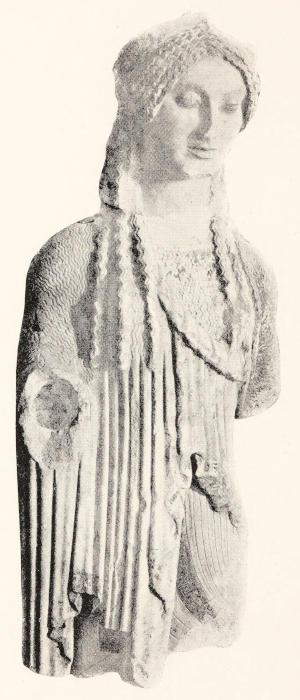
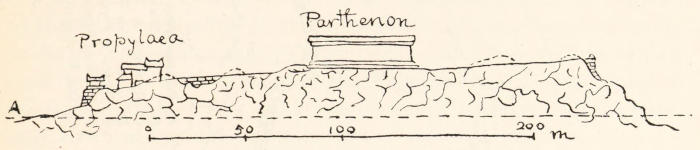
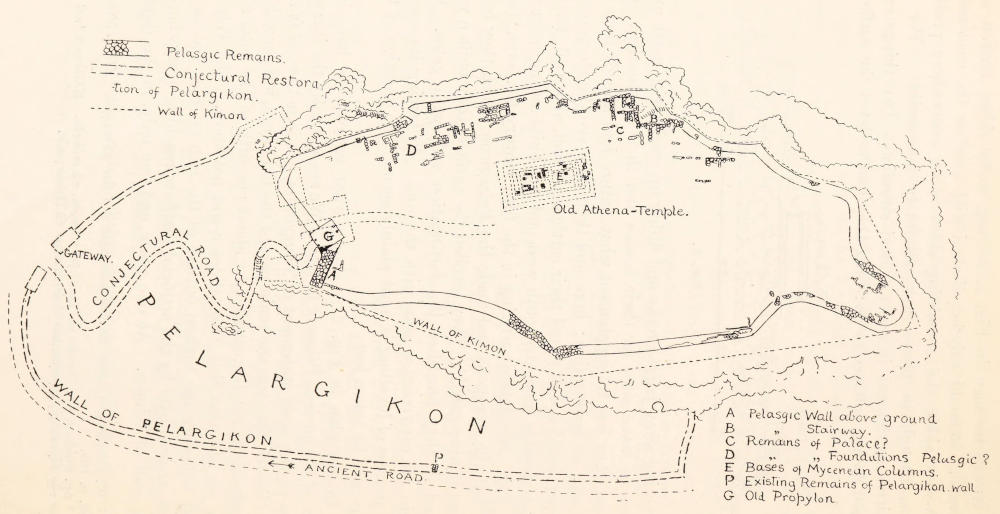
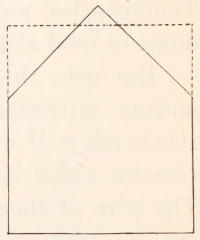
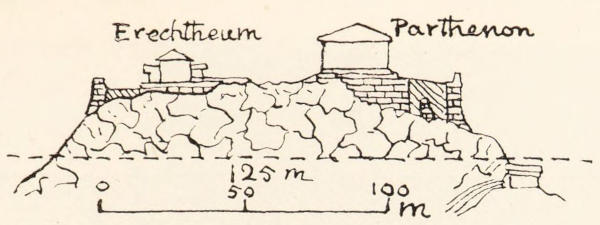
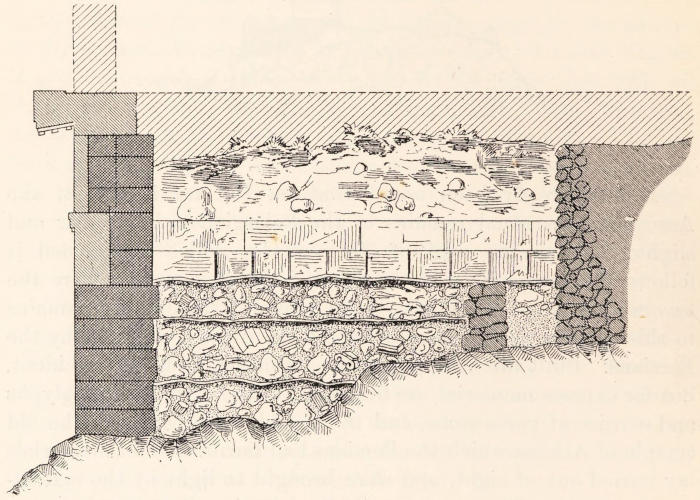
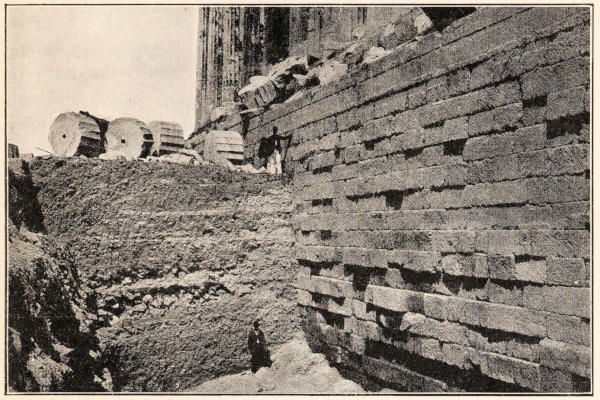
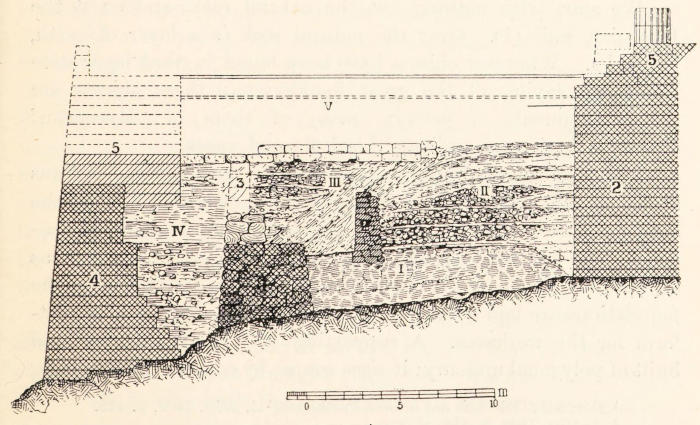
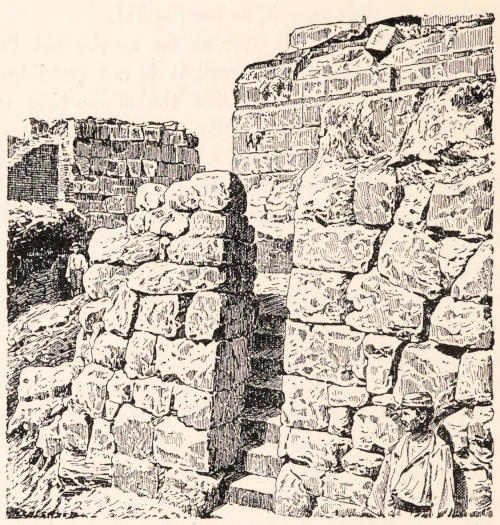
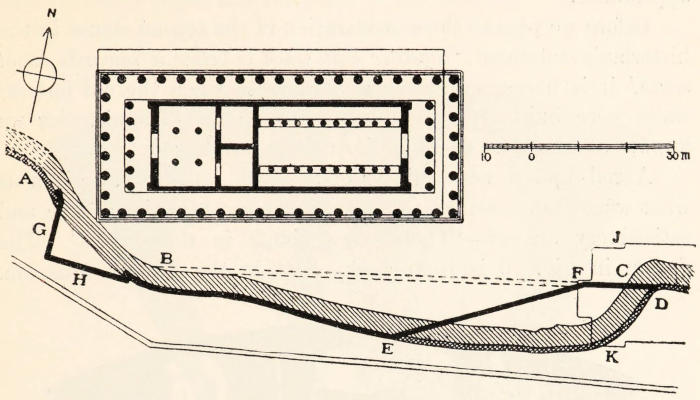
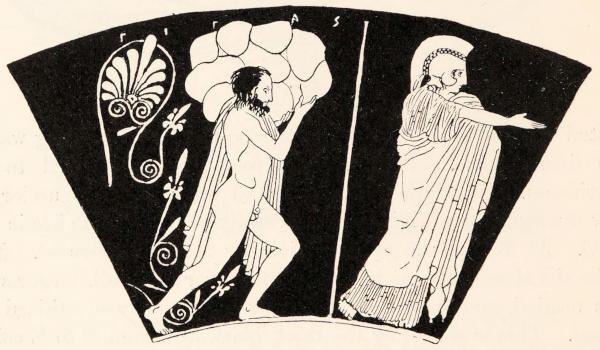
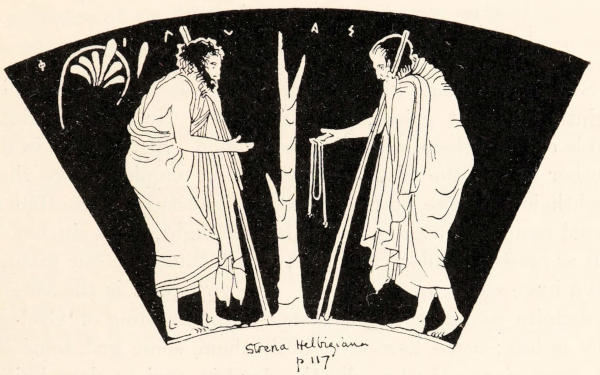
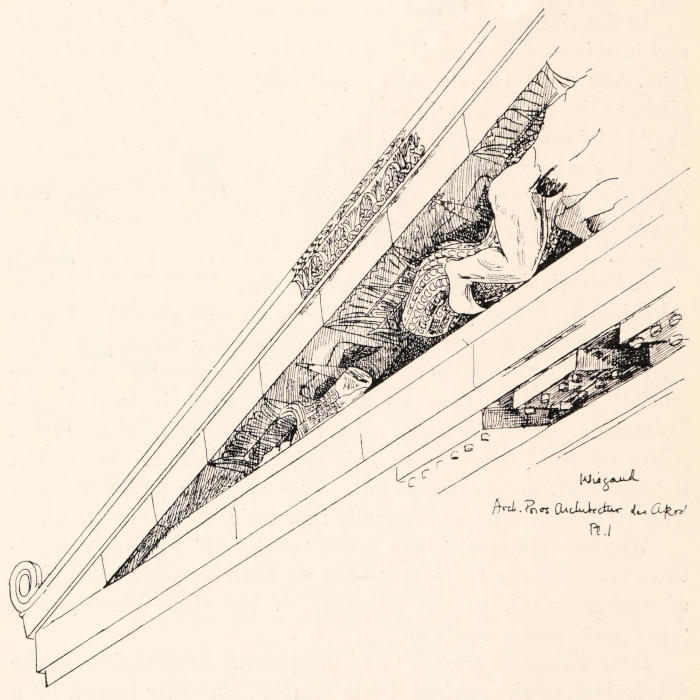
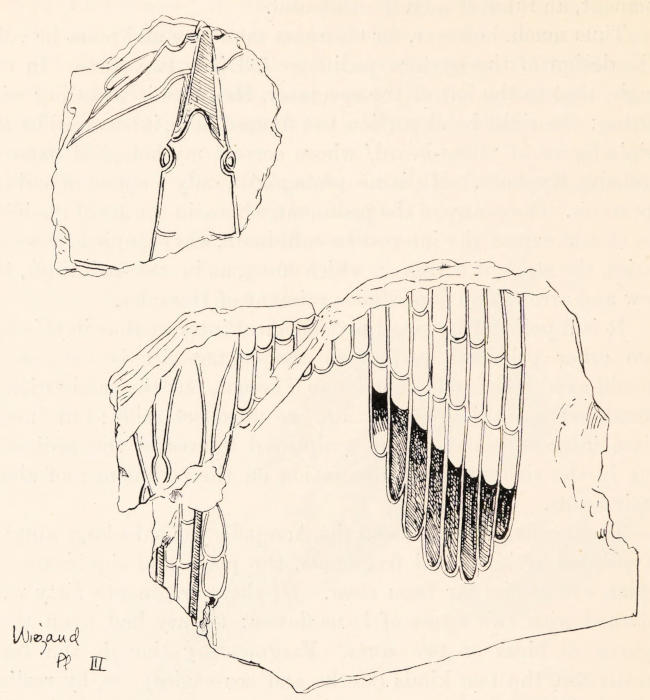
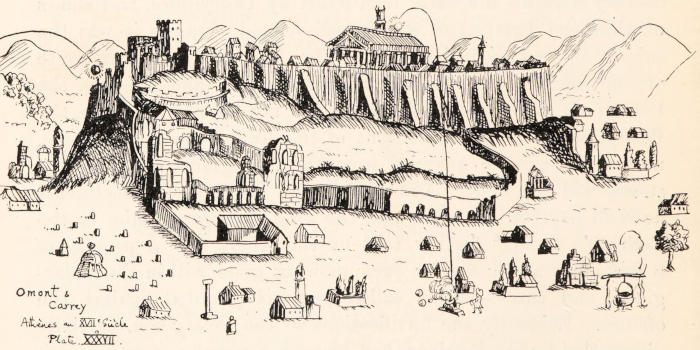
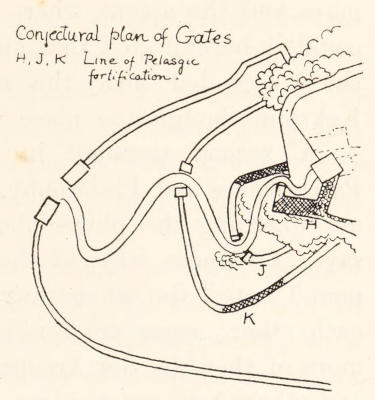
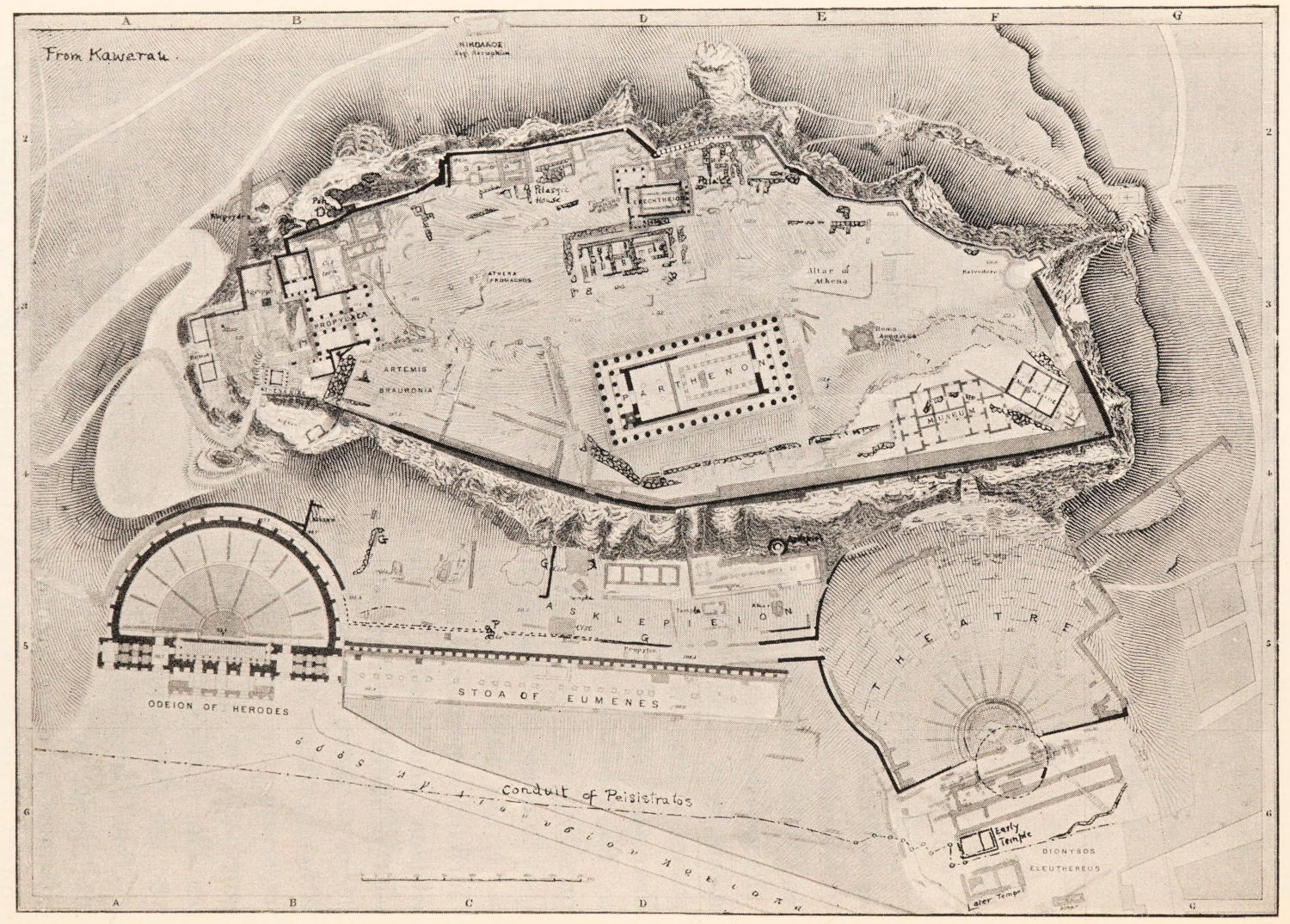
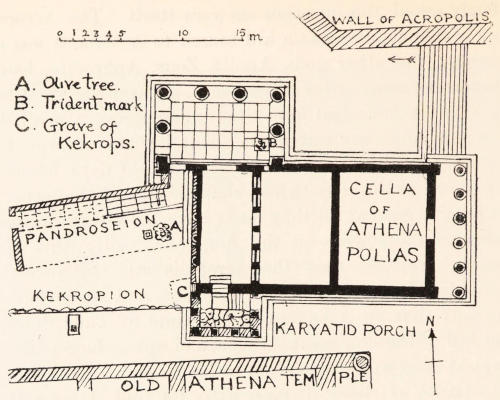
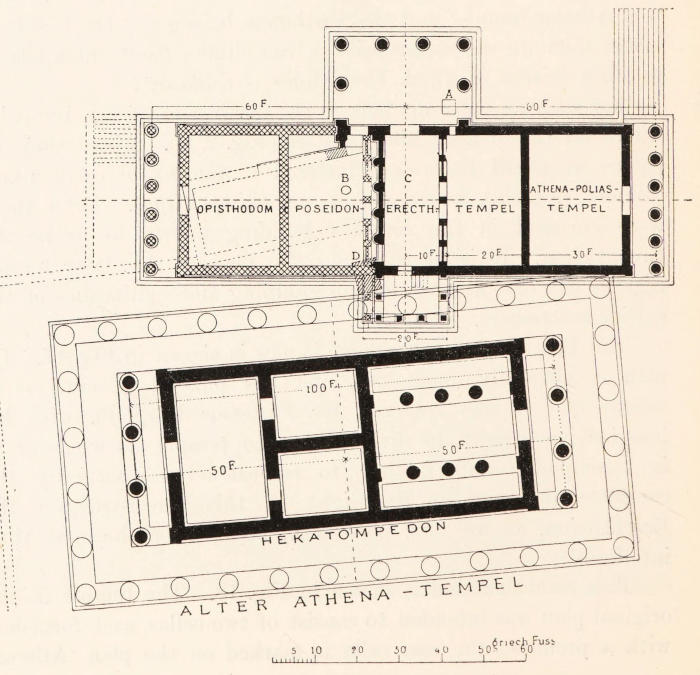
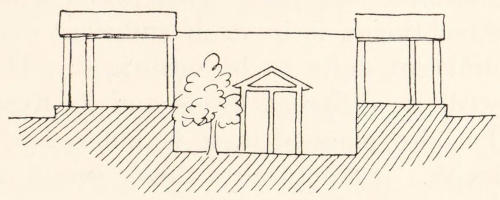
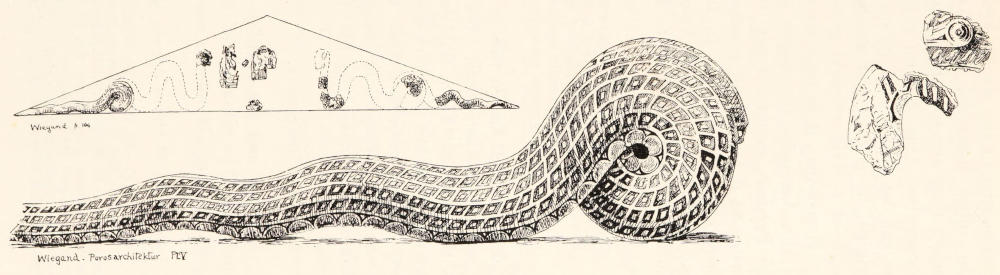
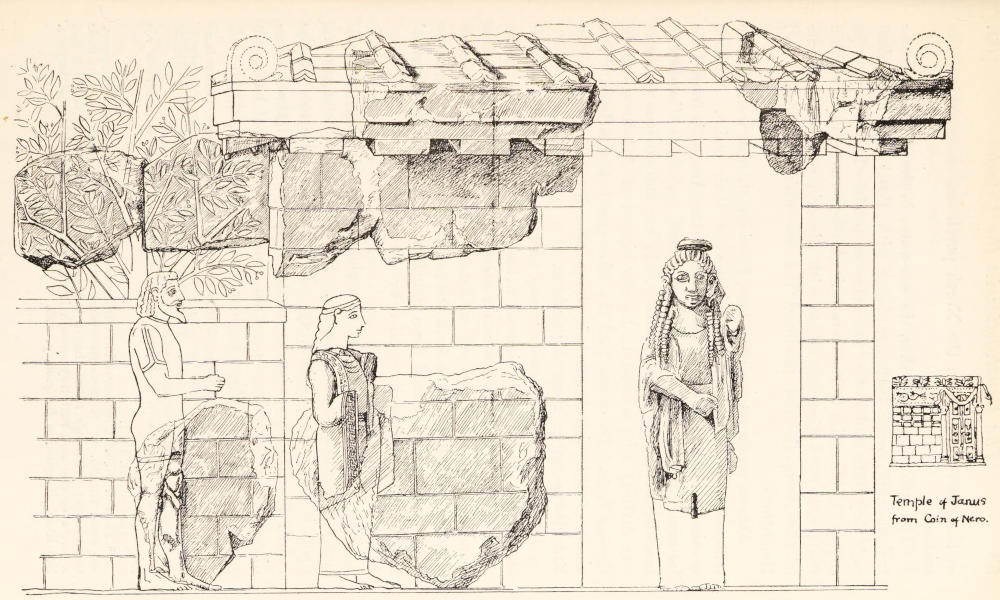
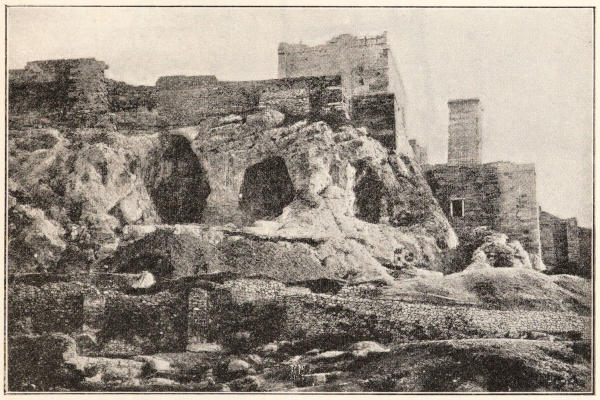
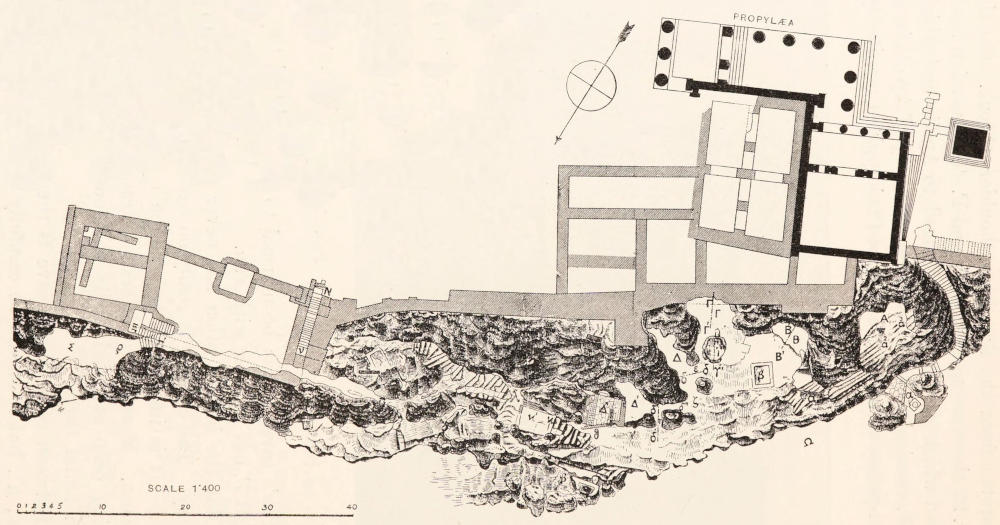
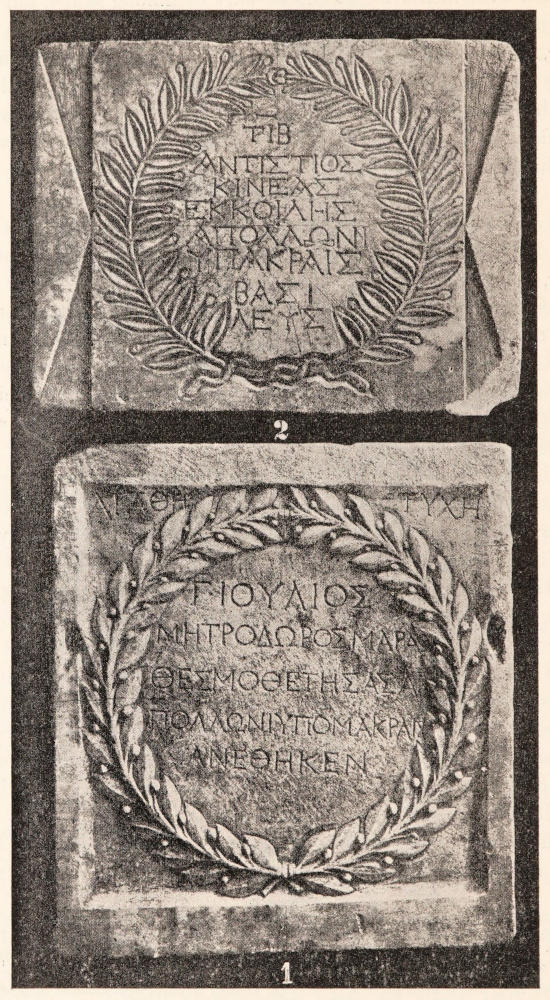
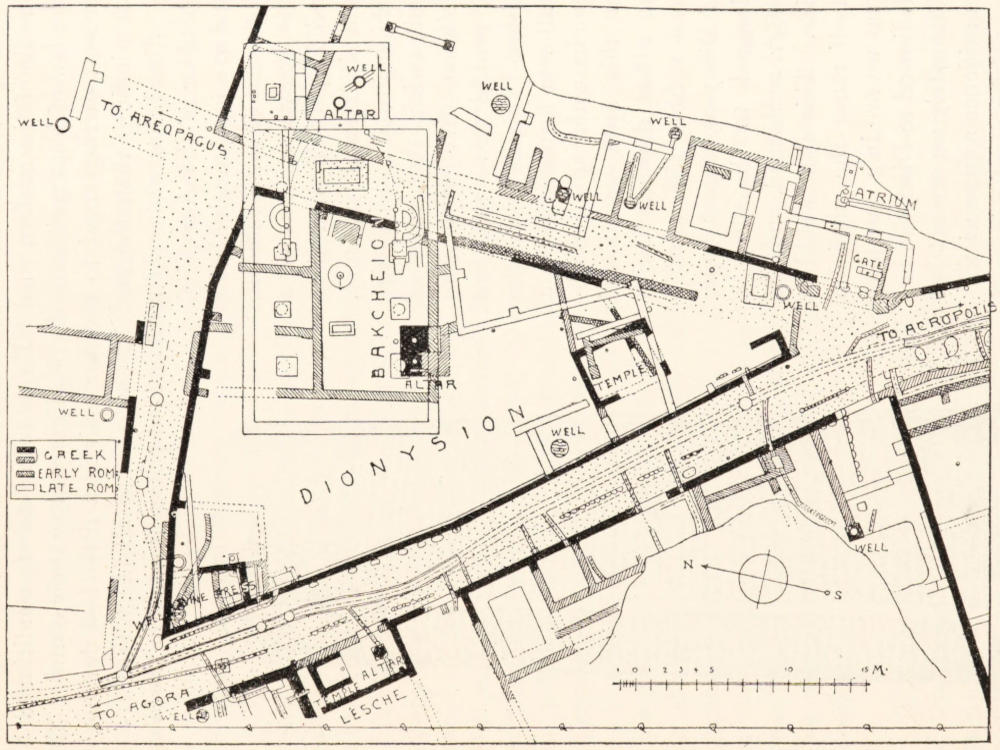
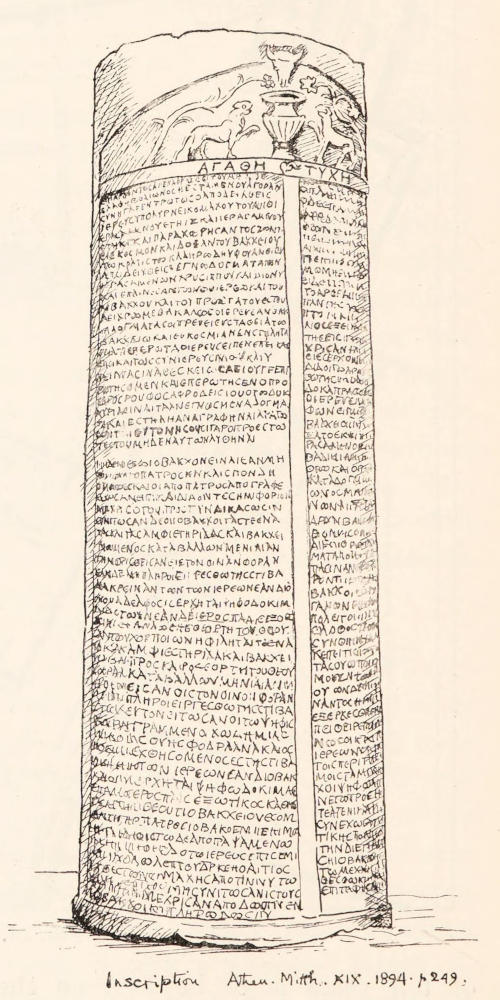
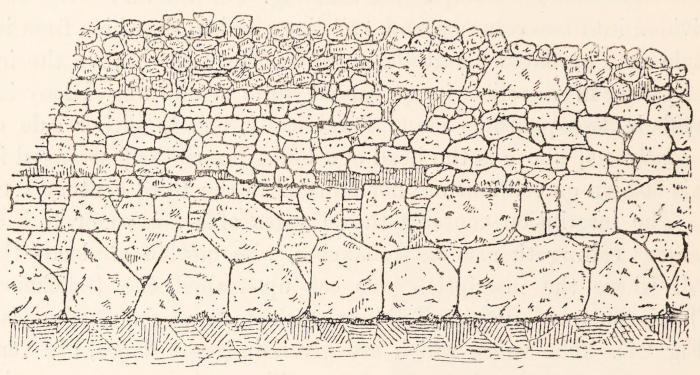
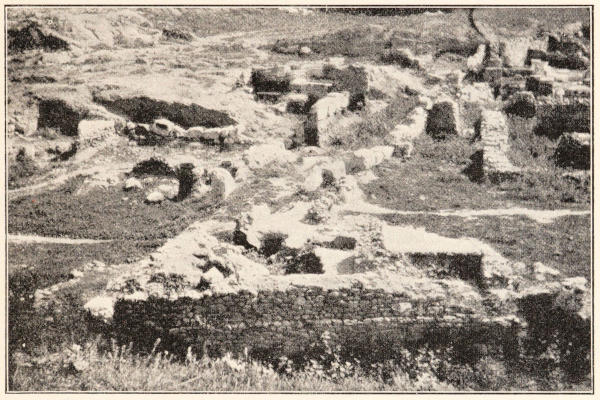
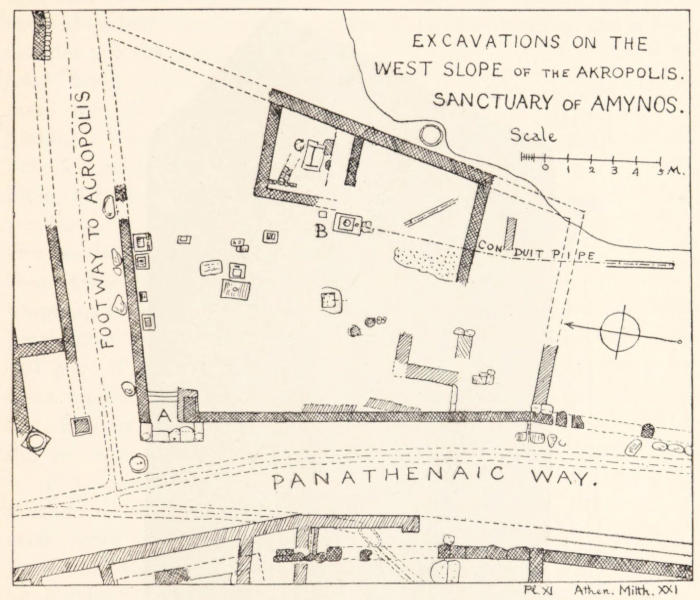
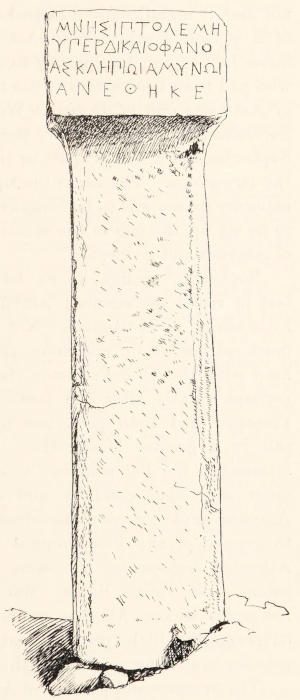
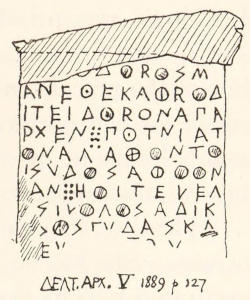
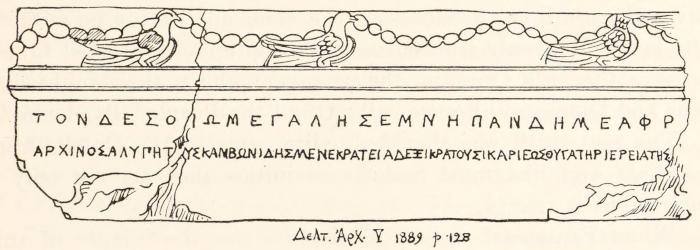
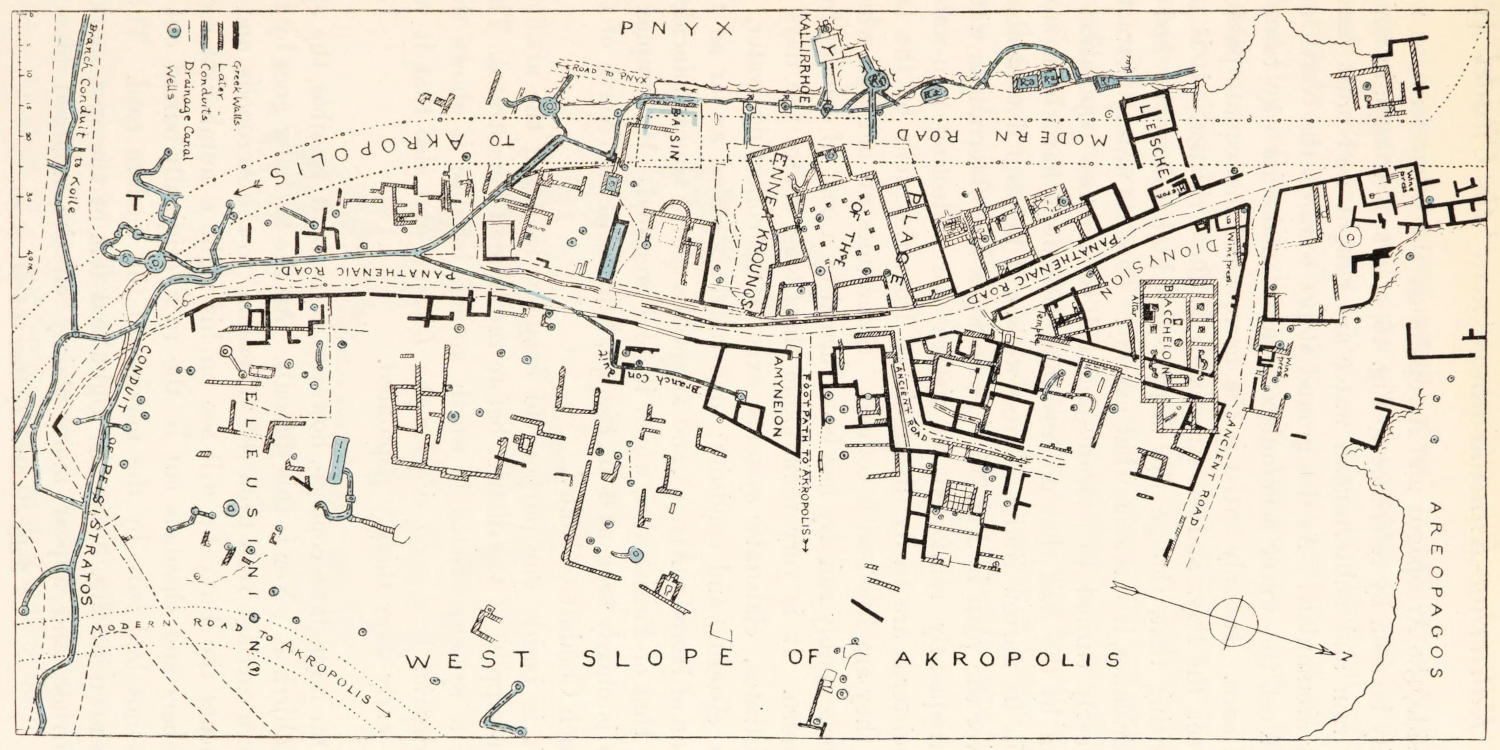
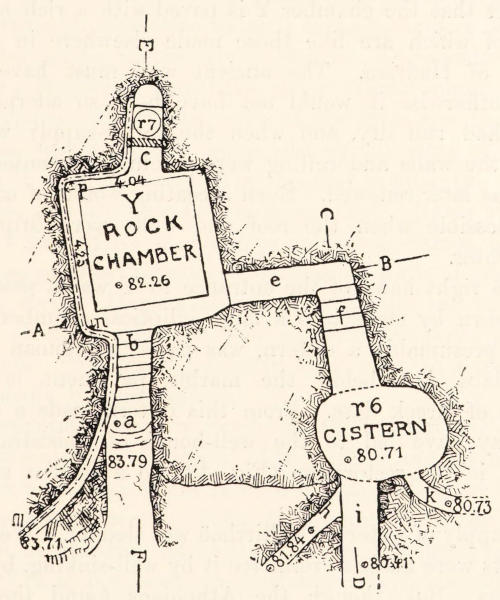
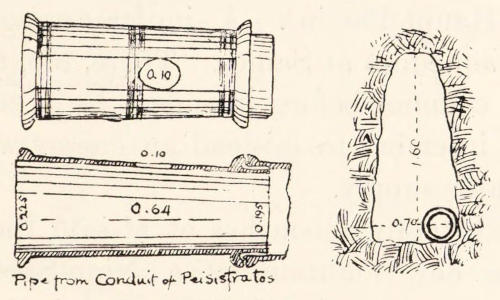
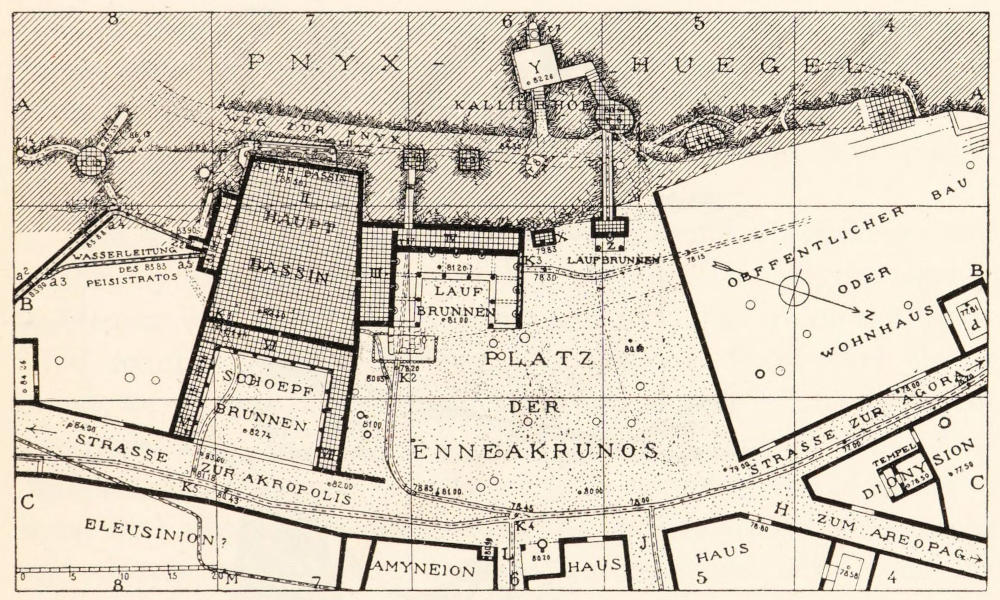
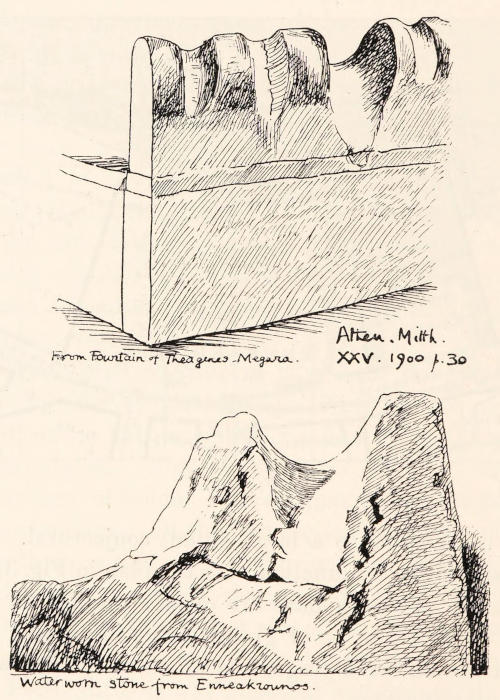
 shape only
appear at Athens in buildings of about the date of Peisistratos,
e.g. on the earlier temple of Dionysos Eleuthereus. Our stone
belonged to a building of the date of Peisistratos. As regards
the character of the building, it is clear from the curve at e which
is a segment of a circle, that the stone was at this point cut away
to receive a pillar. The unworn condition of the stucco at
b leads Professor Dörpfeld to conclude that the stone was a corner
stone, the angle protecting the stucco from friction. The distance
between these two points, e and b, gives the measurement of the
intercolumniations. From this one stone it is certain that a draw-well
of the date of Peisistratos existed and that it was surmounted
by a colonnade. Its appearance must have been somewhat that
of the draw-well (Schoepf-brunnen) restored in