Bulgarian Centerpiece Design No. 55,
And Set of 3 Doilies, Nos. 55A, 55B, and 55C.
Colored Plate VII.
By L. Barton Wilson.
Materials: Corticelli Filo Silk, 6 skeins each 526, 626; 4 skeins 123; 3 skeins 645; 2
skeins each 125, 128, 130, 527; 1 skein each 126, 528, 542, 544. Corticelli Etching
Silk, 12 skeins each 626, 645; 4 skeins 612. Dealers can furnish stamped linen of this
design in 22 inch size. They can also furnish stamped linen 7 and 9 inches square of
the set of three doily designs (Nos. 55A, 55B, 55C), to match this centerpiece. See
page 92.
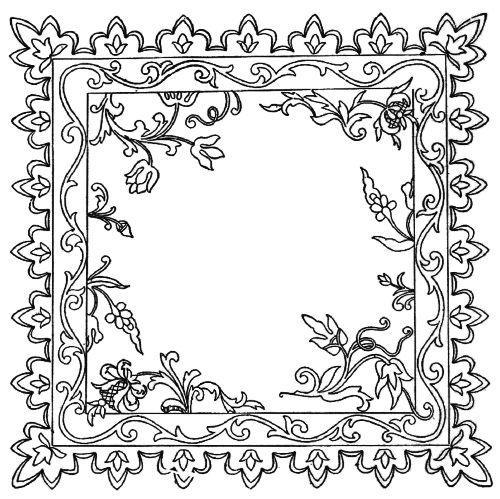
Bulgarian Centerpiece Design No. 55.
The Bulgarian embroidery as we know it on the brown linen squares
is valuable chiefly for its durability and pleasing coloring. These
squares embroidered in the bright cottons make beautiful cushions
and their use with Turkish rugs and hangings is very appropriate.
The stitching is effective rather than accurate. The figures of the
characteristic designs are crude, but they are full of suggestions and
it is possible in carrying out these to obtain most graceful and dainty
drawings. When they are adapted to fine white linens and embroidered in
silks the result is at once orientally rich and sufficiently dainty for
table use.
Heavy colorings are more and more to be urged for centerpieces and
doilies which are to be placed under gas light. The color combinations
for this set may seem at first startling, but when the shades are
properly distributed the result is rich and harmonious.
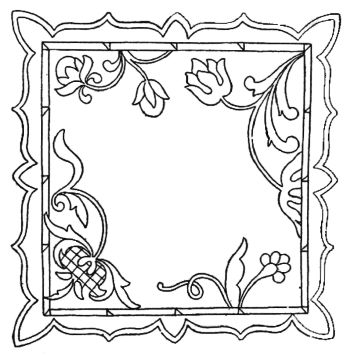
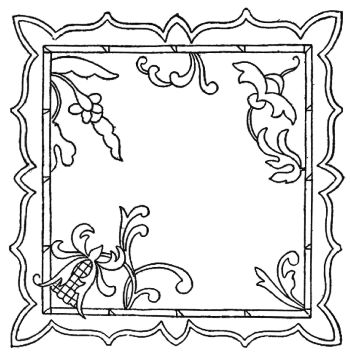
Bulgarian Doily No. 55 A.
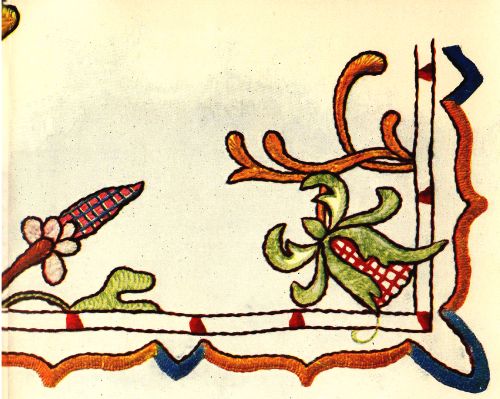
Border.—Buttonhole the scalloped edge in blue and gold brown Corticelli
Etching Silk, using shades 626 and 645 alternately for each scallop. One
connecting scallop should be blue and the next one yellow. The inner edge
of scallops should be outlined in Black Etching Silk, 612, also the straight
lines enclosing the scroll and the bars of the doilies. The same Blue, 626, in
Corticelli Filo Silk with Brown, 526, may be used for the scroll.
Keep the blue on one edge and the brown on the other. Embroider in
the "overlap" long and short stitch. Work the little trefoils within
the scallop in satin stitch with Pink, 128, 130, and cross-bar them
alternately with the scallop colors. See Colored Plate VII.
Bulgarian Doily No. 55 B.
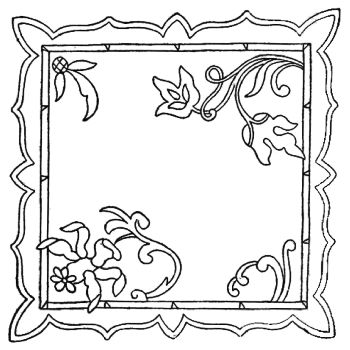
Flower and Leaf Forms.—These should carry the colors of the
edge with a few in addition. Use in the leaf forms, in combination with
Brown, 526, 527, and 528, the Greens 123, 125, and 126. In the flower
forms use beside the blue and yellow, Pink, 128 and 130, and Red, 542
and 544. The leaf forms should be embroidered in long and short stitch.
The flower forms may be made altogether or nearly solid or filled with
feather stitch or satin stitch diapered. The satin stitch may be done
in Filo Silk cross-barred with the Etching Silk. Distribute the colors
in masses, that is, confine certain colors to certain forms, combine
the colors rather than mix them. The effect of cross-bar diapering in
the flower forms of these figures is very pretty and the work is firm
as well.
Bulgarian Doily No. 55 C.
Corticelli Filo Silk alone should be used in the figures of the
doilies even for the cross-barring, though the scallops and black lines
should be of the Etching Silk. It is possible to introduce the red into
the doily scallops in the little connecting points and to so combine
the colors as to make all the edges different. Four of each of the
doily designs form the dozen, and these may be still further varied by
a little planning as to color schemes. The centerpiece and doilies may
be embroidered with good effect in simple outline or rows of outline,
known as the "Bulgarian stitch." If desired the entire work on the
centerpiece may be done with Corticelli Etching Silk, and the effect
will be really very beautiful, and novel as well, but the figures of
the doilies are too small for such treatment. (Not Difficult.)
Corticelli Bulgarian Design No. 55.
Colored Plate VII.
Corticelli Japanese Design No. 51.
Colored Plate VIII.
Colored Plate VIII.
By Emma Haywood.
Materials—22 inch Size: Corticelli Filo Silk, 4 skeins, 779.5; 2 skeins each 655.7,
525.7, 525.8, 525.9, 655.8, 655.9, 656, 780; 1 skein 115. Corticelli Persian Floss, 8
skeins 780.
Materials—9 inch Size: Corticelli Filo Silk, 1 skein each of above shades. Corticelli
Persian Floss, 2 skeins 780. Dealers can furnish stamped linen of this design
in 9, 12, 18, and 22 inch sizes. See page 92.
It has been aptly said of Japanese designers that they know how
to occupy a space without filling it, thus producing very beautiful
effects with little labor. This remark applies well to this design,
since it can be quickly worked, and it will prove very charming and
effective for either a centerpiece or doily.
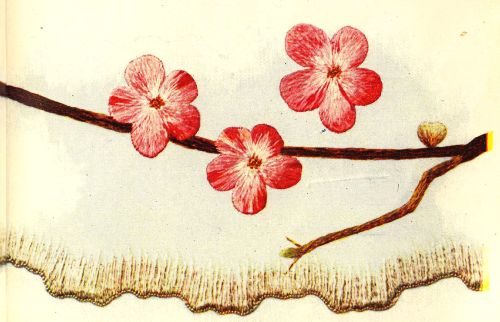
Border.—Work in indented (long and short on the inside)
buttonhole stitch in two shades of pale soft green. For the outside
edge use Corticelli Persian Floss, 780; into this blend Filo Silk,
779.5, still keeping the indented effect in the shading.
Almond Blossoms.—Work solid, beginning the edges of petals
with Corticelli Filo Silk, 656, shading lighter to the center, using
655.9, 655.8, 655.7. In the center of the flower make French knots in
Golden Brown, 115.
Stems.—Work solid in shades of Golden Brown, 525.7, 525.8,
525.9. The shading should be darker near the flowers and at the bottom
of the stem than elsewhere. Use the lighter shades for working the
small stems branching out from the main stalk.
Calyx and Small Buds.—Use Green, 780, for the upper part and
Brown, 525.7, near the stems.
The work should be pressed before the edge is cut. If desired a double
strand of Corticelli Filo Silk may be used for working the blossoms and stems.
Great care must be taken, however, not to allow the strands to twist around
each other. They should lie side by side, giving their full value. Even when
working with a single strand great attention should be paid to keeping it from
twisting. Keep it in its normal condition by occasionally untwisting; otherwise
it will become like a wisp and all the beautiful gloss of this lovely silk
will soon be lost. (Easy.)
Pansy Design No. 603 A.
Materials—22 inch Size: Corticelli Filo Silk, 1 skein each 507, 644.8, 645, 649.9, 650,
651, 652, 653, 654, 729.5, 754, 778, 781, 782, 783, 784. Corticelli Persian Floss, 6
skeins 615. Dealers can furnish stamped linen of this design in 22 inch size. See
page 92.
Border.—Work the scallop in buttonhole stitch with Persian
Floss, 615. Work the cross-bar in the four corners in border in outline
stitch with one thread of Filo in Brown, 644.8. Where the lines meet
make a cross stitch in Brown, 645. In the center space between the bars
make an X in Brown, 778. See Colored Plate IX for method of working
border and cross-bar.
Flowers.—Work solid in Purple, 649.9, 650, 651, 652, 653, 654,
729.5. Begin edge of upper petals with 649.9, shading gradually darker
to the center with 650, 651, 652. Work the edge of the three lower
petals with 651, and shade gradually darker to center, using 652, 653,
654, 729.5. Put a few stitches of Yellow, 507, in the center.
Leaves.—Work solid in Green, 781, for points. Shade darker
toward the center, using 782, 783, and for veins, 754. Some leaves
should be worked with 781 on edge, 754 for center, and work veins with
784.
Scroll Lines and Cross-bar.—Outline the cross-bar lines with
645 and the scroll with 646.
A study of Pansy Design 605 B, Colored Plate I (Frontispiece), will
give some hints as to how the pansies should be shaded, although the
coloring is different. (Somewhat Difficult.)
Violet Design No. 603 C.
Materials—22 inch Size: Corticelli Filo Silk, 2 skeins each 725, 727, 728, 781, 782;
1 skein each 506, 644.8, 645, 729, 778, 783. Corticelli Persian Floss, 6 skeins 615.
Dealers can furnish stamped linen of this design in 22 inch size.
Border.—Work the scallop in buttonhole stitch with Persian
Floss, 615. Work the cross-bar in the four corners in the border in
outline stitch with one thread of Filo, Brown, 644.8. Where the lines
meet make a cross stitch in Brown, 645. In the center space between
the bars make an X with Brown, 778. See Colored Plate IX for method of
working border and cross-bar.
Flowers.—Work solid in the shades of violet, making some
flowers lighter than others. Work some of the petals darker on the edge
and lighter toward the center, and reverse, some lighter on the edge
and darker toward the center. Make a few solid stitches of yellow in
the center of the open flowers. Work the buds solid in 728, 729, and
the calyx solid with Green, 782.
Leaves.—Work the edge and points with 781 and shade darker to
the center with 782. Use 783 for veins and stem. (Easy.)
Colored Plate IX.
By Amalia Smith.
Materials—22 inch Size: Corticelli Filo Silk, 2 skeins each 636, 655.7, 781, 782;
1 skein each 504, 637, 638, 639, 640, 644.8, 645, 755, 778, 780, 783. Corticelli Persian
Floss, 6 skeins 615. Dealers can furnish stamped linen of this design in 22 inch size.
Border.—Work the scallop in buttonhole stitch with Persian Floss, 615.
Work the cross-bar in the four corners in border in outline stitch with one
thread of Filo in Brown, 644.8. Where the lines meet make a cross stitch in
Brown, 645. In the center space between the bars make an X in Brown, 778.
See Colored Plate IX.
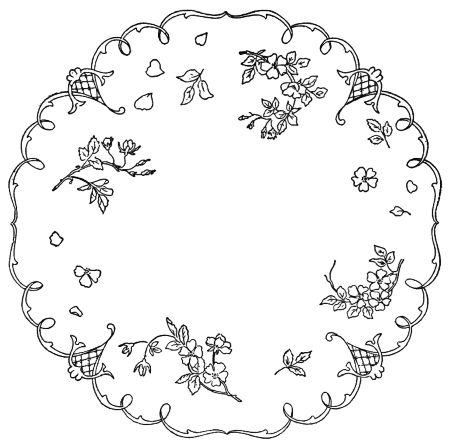
Wild Rose Design No. 603 E.
Flowers.—Work solid. Begin the edge of petals of open flowers
with Pink, 639. Shade lighter to the center, using 636, 637, 638,
655.7. Make some lighter and some darker. Put three stitches of Green,
780, in the center, and surrounding center but 1⁄4 inch away make a few
French knots in Yellow, 504. Work the back petals in the half flowers
with Pink, 639, 640, and the front petals or those in the foreground
with 637, 638, 639.
Buds and Calyx.—Work the buds with Pink, 639, 640, and the
calyx points with Green, 780, 781. For the bulb and stem use 782.
Leaves.—Work solid. For the edge and points use 781, shading
toward the center with 782, 783. The veins and stem work with 783,
755.
The Wild Rose is always a popular subject for embroidery, and even a
beginner should have no difficulty in working the design as the Colored
Plate IX gives the exact shading and stitch direction, (Easy.)
Sweet Pea Design No. 603 F.
Materials—22 inch Size: Corticelli Filo Silk, 1 skein each 644.8, 645, 678, 679, 680,
673, 674, 726.5, 727, 778, 780, 781, 782, 783. Corticelli Persian Floss, 6 skeins 615.
Dealers can furnish stamped linen of this design in 22 inch size. See page 92.
Border.—Work the scallop in buttonhole stitch with Corticelli Persian
Floss, White, 615. Work the cross-bar in the four corners in the border in
outline stitch with one thread of Corticelli Filo Silk, Brown, 644.8. Where
the lines meet make a cross stitch in Brown, 645. In the center space
between the bars make an X with Brown, 778. See Colored Plate IX for
method of working border and cross-bar.
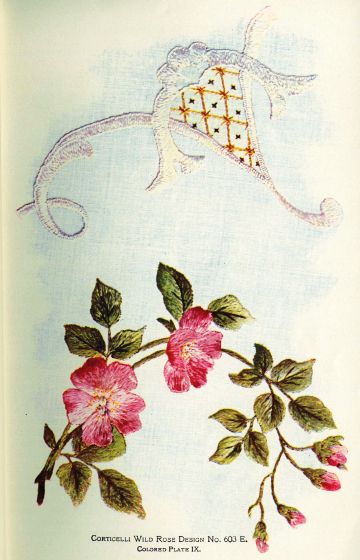
Corticelli Wild Rose Design No. 603 E.
Colored Plate IX.
Flowers.—Work solid in shades of purple and pink Corticelli Filo Silk.
Begin some flowers with Pink, 680, shading gradually lighter toward the
center with 679 and 678. In others combine purple and pink. Begin with 674
and shade gradually to light pink; then darker toward the center, or reverse,
using different shades in each flower. Reference to the Colored Plate of Sweet
Pea Design 407G will be found quite a help in getting the proper
shading, although the colors used are not identical with those
suggested for this design.
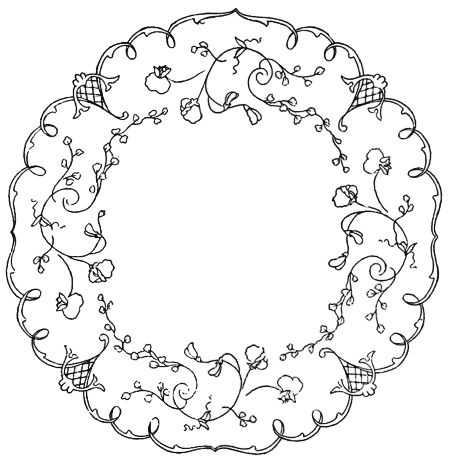
Sweet Pea Design No. 603F.
Leaves.—Work the points with Green, 781, shading darker toward
the center with 782, 783. Work the veins and stems in 783. For the
tendrils use 780. (Difficult.)
Colored Plate I.
(Frontispiece.)
By Amalia Smith.
Materials—22 inch Size: Corticelli Filo Silk, 2
skeins each 725, 727; 1 skein each 645, 726, 728, 729, 729.5, 740,
741, 742, 743, 743.5 743.7, 754, 766, 780, 781, 782. Corticelli EE
Embroidery Silk, 6 skeins 615. Smaller pieces take less silk. Dealers
can furnish stamped linen of this design in 18 and 22 inch sizes. See
page 92.
Pansies always have a peculiar charm of their own, and as
subjects for embroidery afford opportunity for very skillful, as
well as artistic, treatment. The range of color is so varied and the
possibility of pleasing combinations is so great that the following
instructions are given simply as a suggestion. However, the directions
will be found ample for the less experienced needleworker who does not
care for a color scheme of her own.
Border.—Work the scallop in buttonhole stitch with Corticelli
EE Embroidery Silk, White, 615; or Persian Floss, 615, can be used.
Flowers.—Work solid in combination of Purple, 725, 726, 727, 728, 729,
729.5, and Yellow, 740, 741, 742, 743, 743.5, 743.7. It would be effective to work
some flowers all in purple, others in yellow with purple rays. Commence
with the two upper back petals of the open flower nearest to the border.
Work the edge of the petal with Yellow, 743; shade into that 743.5, 743.7, and
use 645 near the center for shadow. Begin the edge of the three lower
petals with 743, shading lighter to the center with 742, 741, 740. See Colored
Plate I (Frontispiece). To lend variety the three lower petals in some yellow
flowers can be made lighter on the edge and darker toward the center.
From the center of the flower, extending into the three lower petals
make rays of Purple, 729. Work a few solid stitches of Scarlet, 766, in the
center of the flower. Now begin with the two upper back petals of the
purple flowers using 728 for edge of the petal, shading gradually darker to the
center with 728, 729, and make a few stitches of 729.5 in rays, and as shadows.
Begin the edge of the lower petals with 725 and gradually shade darker to
the center, making rays in the three lower petals with 729.5. Work a few
solid stitches of Scarlet, 766, in the center of the flowers. See Colored
Plate I (Frontispiece) for shading and proper direction of the stitches.
Buds and Calyx.—Work the buds solid, using 727, 728, 729. Work the
edge with 727 and shade gradually darker to the stem, using a little of 729.5
near the stem. Work the points of the calyx in Green, 781, shading toward
the stem with 782 and 754.
Leaves.—Work the points of the leaves solid, in 780, shading gradually
darker toward the midvein and base of the leaf, using 781, 782. (Difficult.)
Garland Wild Rose and Forget-me-not Design No. 54.
By Alice C. Morse.
Materials—22 inch Size: Corticelli Filo Silk, 2 skeins each 623, 624, 637, 638, 639,
640, 741, 742, 805, 806; 1 skein each 504, 625, 626, 780, 807, 808. Corticelli Persian
Floss, 8 skeins 616.5. Smaller pieces take less silk. Dealers can furnish stamped
linen of this design in 18 and 22 inch sizes only. See page 92.
This garland design when embroidered will be a surprise to any one who
has never tried a similar pattern. The coloring has a very rich, subdued
tone which is quite different from that found in any other style of design.
Border.—Work the scallop in buttonhole stitch with Corticelli Persian
Floss, 616.5.
Wild Roses.—Work solid, using all the shades of Pink Corticelli Filo Silk,
637, 638, 639, 640, working the edge of the petals dark, shading gradually
lighter toward the center of the flowers. Use three shades in each flower.
Vary the flowers, making some darker than others. In the center work
four or five stamens with one thread of Filo, 780, and at the end of each
stamen make a French knot with Yellow, 504. (See Photo Frame No. 60.)
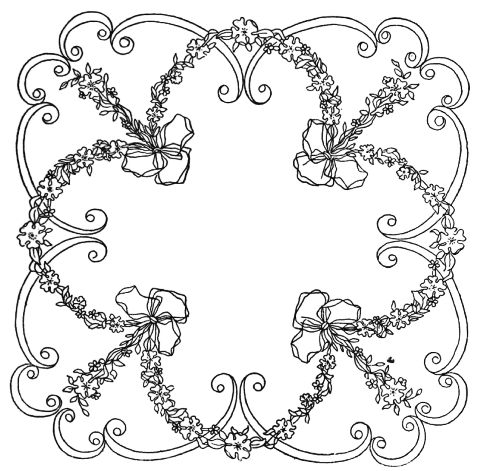
Garland Wild Rose and Forget-me-not Design No. 54.
Forget-me-nots.—Work in satin stitch with Blue, 623, 624, 625, 626. Don't
try to shade each petal, but get light and shade effect by making some petals
in 623, some in 624, etc. Use 626 for an occasional petal only, as
the color is rather strong. Work in the centers one French knot with
742.
Leaves.—Work solid with Green, 805, 806, 807, 808. Make the
larger leaves in the darker shades; the points of the leaves in 805.
Veins and stems work with 808.
Ribbons.—Work in satin stitch, slanting across the ribbon,
using Yellow, 741, 742. To give the effect of the twisted ribbon, work
one turn of the ribbon with 741, the next fold with 742, and so on. If
you prefer, Green, 125, 126, 127, can be used for the ribbon, carrying
out the same idea as directed above. (Somewhat Difficult.)
Colored Plate X.
Materials—22 inch Size: Corticelli Filo Silk, 2 skeins each
615, 692.8, 781, 782; 1 skein each 506, 661, 662, 663, 780, 783, 784.
Corticelli Persian Floss, 6 skeins 615. Smaller sizes take less silk.
Dealers can furnish stamped linen of this design in 18 and 22 inch
sizes. See page 92.
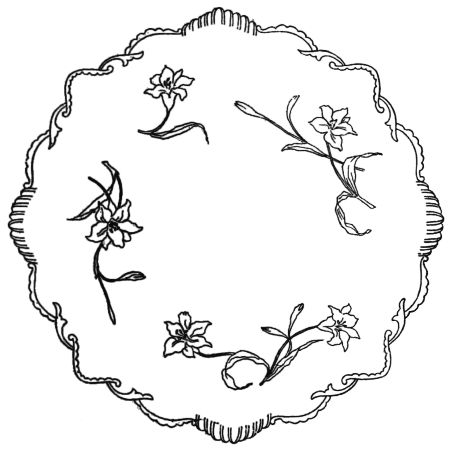
Easter Lily Design No. 605 D.
Border.—Work in buttonhole stitch with Corticelli Persian
Floss, 615.
Flowers.—Work solid, beginning the edge of the petals
with Corticelli Filo Silk, White, 615, shading into it Green, 692.8, 661, 662,
using 663 for the center. Work six or seven stamens in 781, putting three
small stitches of Yellow, 506, at the end of each to form the top or head.
Work the point of the buds with Green, 692.8, shading darker with 661, 662,
663, to the stem. See Colored Plate X.
Leaves.—Work solid, with Green, 781, for points, and shading gradually
darker with 782, 783, and 784 to the stem. The leaf is worked straight from
the point without veins. Use Green, 782, for the stems. When well done
the shading in this design is very delicate. (Not Difficult.)
Colored Plate XI.
By Amalia Smith.
Materials—22 inch Size: Corticelli Filo Silk, 2 skeins each 725, 726, 781, 782;
1 skein each 650, 651, 652, 676, 780, 783, 784. Corticelli Persian Floss, 6 skeins 615.
Smaller sizes take less silk. Dealers can furnish stamped linen of this design in 18
and 22 inch sizes. See page 92.
Border.—Work the scallop in buttonhole stitch with Corticelli
Persian Floss, White, 615.
Flowers.—Make a few stitches at the middle of the point of
each petal with Corticelli Filo Silk, Purple, 676, shading toward the
bottom of the petal with 652, 651, 650, 726, 725. Begin back edge, or
lip, of cup with 651, shading darker toward the center with 652, 676.
Do the front lip in similar manner, but use 650 for the edge and 651 to
shade toward the center. Under the lip make the shadow with 676. From
the center of the cup make a pistil in Green, 781. Careful study of
Colored Plate XI will show the proper shading and correct direction of
the stitches.
Leaves.—Work solid, using 780 for the point and shading gradually darker
with 781, 782, 783, 784. Work the stems near the flower, with 783, shading
darker with 784 toward the base of stem. (Somewhat Difficult.)
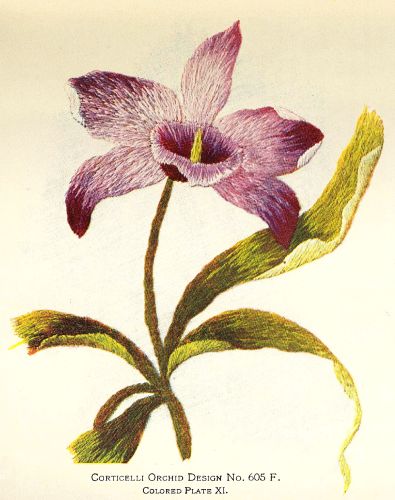
Corticelli Orchid Design No. 605 F.
Colored Plate XI.
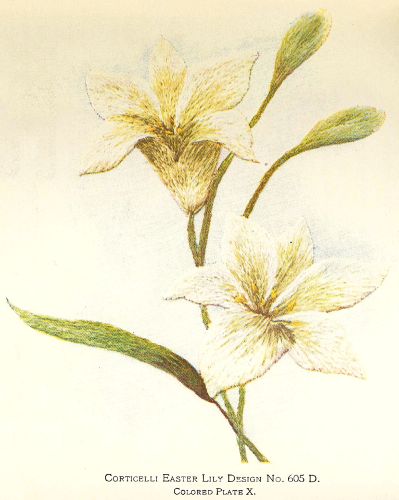
Corticelli Easter Lily Design No. 605 D.
Colored Plate X.
Buttercup Design No. 610 B.
Materials—22 inch Size: Corticelli Filo Silk, 1 skein each 502, 504, 505, 506, 507,
582, 753, 754, 755, 781. Corticelli Persian Floss, 5 skeins 615. Smaller sizes take
less silk. Dealers can furnish stamped linen of this design in 9 and 22 inch sizes.
See page 92.
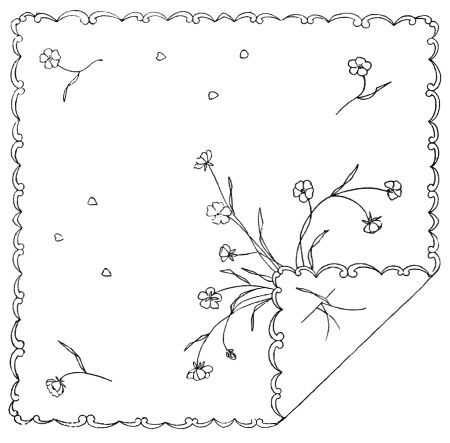
Buttercup Design No. 610 B.
Turning over one of the corners adds to the novelty of this design
and the 9 inch size makes an especially dainty doily. The 22 inch size
is for a centerpiece.
Border.—Work the scallop in buttonhole stitch with Corticelli
Persian Floss, 615. One corner is turned under on the wrong side and
buttonholed on the right side through both thicknesses of linen.
Work the straight line, or slit, in the turned over corner in fine
buttonhole stitch with Corticelli Persian Floss, 615. The stems, which
apparently come through the slit, should be worked in outline stitch
with Filo Silk, Green, 755. Colored Plate V.
Flowers.—Make the edge with Corticelli Filo Silk, Yellow, 507, shading
lighter to the center with 506, 505, 504, 502. Some flowers should be darker
than others. In the center of the flower work a few stitches of Green, 781,
and around these stitches make a few French knots in 781 also. For the
back petals of the buds use 507, shading lighter to the stem with 506, 505.
Use Green, 582, for the points of calyx, and shade 573 into the stem, using
this shade also for a part of each stem.
Leaves.—Make the points in Green, 781, shading gradually to midvein
with 582, 753, 754. Omit 781 in some of the leaves, thus making them darker,
and adding 755 at the bottom of the leaf. Use 755 for the stems. (Easy.)
Carnation Design No. 610 C.
Materials—22 inch Size: Corticelli Filo Silk, 1 skein each 635.5, 636, 637, 638,
640, 780, 781, 782, 783. Corticelli Persian Floss, 5 skeins 615. Smaller sizes take
less silk. Dealers can furnish stamped linen of this design in 9 and 22 inch sizes.
See page 92.
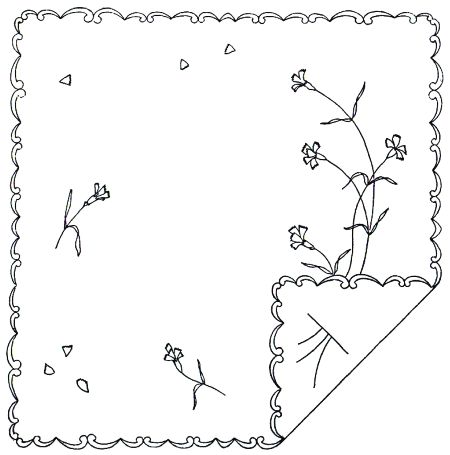
Carnation Design No. 610 C.
These turned corner patterns are very simple, taking but a small quantity
of silk and little time to work them.
Border—Work the scallop in buttonhole stitch with Corticelli
Persian Floss, 615. One corner is turned under on the wrong side and
buttonholed on the right side through both thicknesses of linen.
Work the straight line, or slit, in the turned over corner, in fine
buttonhole stitch with Corticelli Persian Floss, 615. The stems, which
apparently come through the slit, should be worked in outline stitch
with Green, 783. Colored Plate V.
Flowers.—Begin the edge of the petals with 640, shading
gradually lighter toward the calyx with 638, 637, 636, 635.5. Make some
petals lighter than others by omitting 638, using only 637, 636, 635.5.
For the calyx use Green, 780 and 781, shading darker to the stem with
783.
Leaves.—Work solid, using 780 for the points and shading
gradually darker with 781 and 782. Work the stems with 783. (Easy.)
Colored Plate XII.
Materials—22 inch Size: Corticelli Filo Silk, 2 skeins 615; 1 skein each 542, 644.6,
644.7, 644.8, 646, 649.9, 650, 651, 780, 781, 782, 783. Corticelli EE Embroidery Silk,
6 skeins 615. Smaller sizes take less silk. Dealers can furnish stamped linen of this
design in 12, 18, and 22 inch sizes. See page 92.
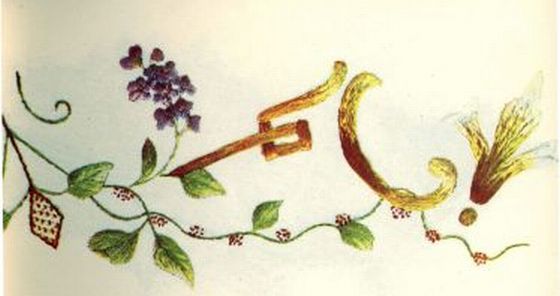
CORTICELLI BOHEMIAN GLASS DESIGN No. 606 B.
COLORED PLATE XII.
Border.—Work the scallop in buttonhole stitch with Corticelli EE
Embroidery Silk, White, 615. Work the scrolls near the border in outline
stitch with Filo Silk, Brown, 644.8. See Colored Plate II. Between the
lines work innumerable small stitches with 946 to represent seeds. (See
article on Stitches—"Seed Stitch.")
Pointed Figure.—Cross-bar the center of the pointed figure running inward
from the border with 644.7, catching down the lines where they intersect
with 646, and outline the figure with the same shade. See Colored Plate XII.
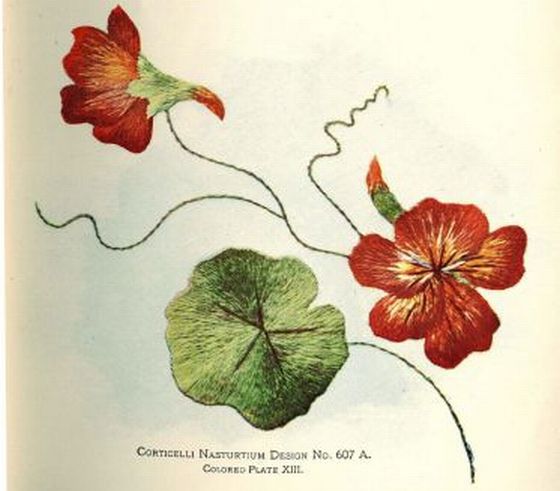
CORTICELLI NASTURTIUM DESIGN No. 607 A.
COLORED PLATE XIII.
Flowers.—Work solid in Violet, 649.9, 650, 651, making each flower in
one shade, choosing the lighter shades for the flowers having five petals and
making the flowers in the rear of the bunch in the darker shades. Put one
French knot in the center of the open flower, using Green, 780. See Colored
Plate XII.
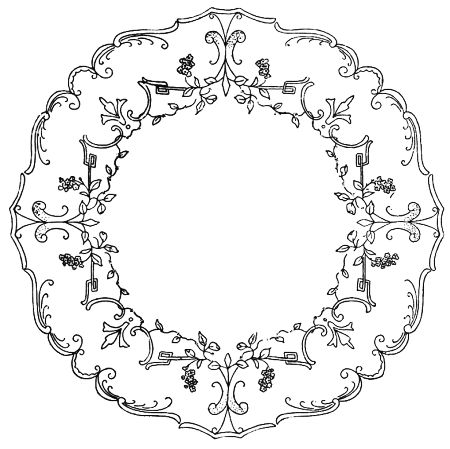
BOHEMIAN GLASS DESIGN No. 606 B.
Leaves and Vine.—Begin point of leaf with Green, 780, shading
to center with 781, 782. Make some of the leaves darker by omitting
780. Work the veins and stems with 783. Along the vine work in seed
stitch several groups of three or four little dots each, using Red,
542.
Inside Scrolls.—Work solid, making ends or points in Brown,
644.6, shading darker in the middle with 644.7, 644.8. For the shadow
on each side of the fold use 646. For the half circle scroll use 644.6.
Make the points of the Fleur-de-lis in White Filo, 615, shading darker
to base with Brown, 644.6, 644.7, 644.8. Work the round dot solid in
646. (Not Difficult.)
Nasturtium Design No. 607 A.
COLORED PLATE XIII.
Materials—22 inch Size: Corticelli Filo Silk, 2 skeins each 782, 783, 809, 812; 1
skein each 743.6, 743.7, 779, 781, 784, 813, 814. Corticelli Persian Floss, 6 skeins 615.
Smaller sizes take less silk. Dealers can furnish stamped linen of this design in 9, 12,
18, and 22 inch sizes. See page 92.
Border.—Work the scallop in buttonhole stitch with Corticelli Persian
Floss, White, 615, working the shell shaped scallop long and short on the
inside. Into this shade work 809, using one thread of Filo Silk, still leaving
the indented effect (alternate long and short stitches) on the inside. See
Colored Plate III. Work the scroll near the border in seamstress feather
stitch or outline stitch with Green, 781.
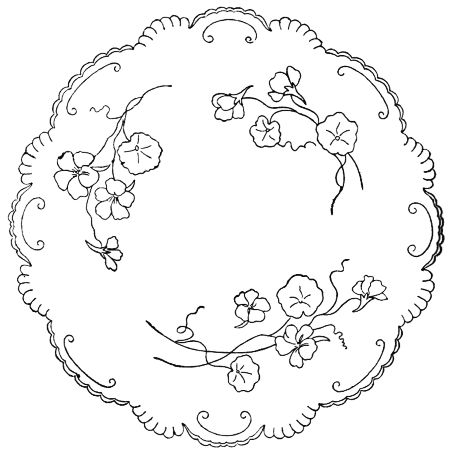
Nasturtium Design No. 607 A.
Flowers.—Work solid. Begin the edge with 814, using 813, 743.7, 743.6,
812, 809, toward the center. Make some flowers lighter than others. All the
shades mentioned are not required for each flower. In each petal of the
open flower make three rays in Brown, 779. The part of the calyx shown
between the petals work in Green, 782. See Colored Plate XIII. Use 814
for the edge of the buds, shading lighter to the calyx with 813, 743.7.
Put a touch of 743.7 at the end of calyx, work remaining part in 781,
782, using the lighter shade nearest the petals.
Leaves.—Work each leaf in one shade of Green, making all the
stitches come to the center. Use 781 for the small leaves, and 782,
783, for the larger ones. For stems and veins use 784, and for the
small buds 781. (Not Difficult.)
Colored Plate XIV.
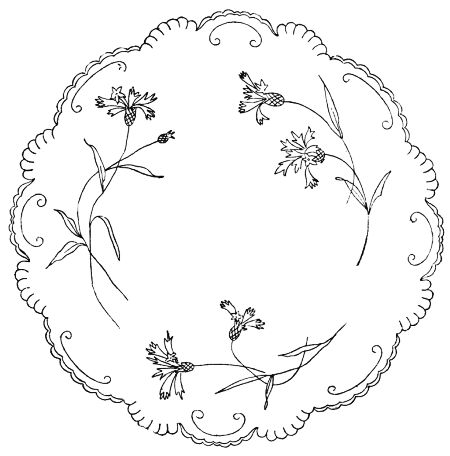
Bachelor's Button Design No. 607 B.
Materials—22 inch Size: Corticelli Filo Silk, 2 skeins each 661, 744; 1 skein each
662, 663, 664, 675, 745, 746, 781. Corticelli Persian Floss, 6 skeins
615. Smaller pieces take less silk. Dealers can furnish stamped
linen of this design in 9, 12, 18, and 22 inch sizes. See page
92.
Border.—Work the scallop in buttonhole stitch with Corticelli
Persian Floss, White, 615. The edge of the shell scallop in the border
should be worked with 615. Into this white shade Corticelli Filo Silk,
Blue, 744, leaving a long and short effect on inside. See Colored Plate
III. The scroll near the border should be worked with Green, 661.
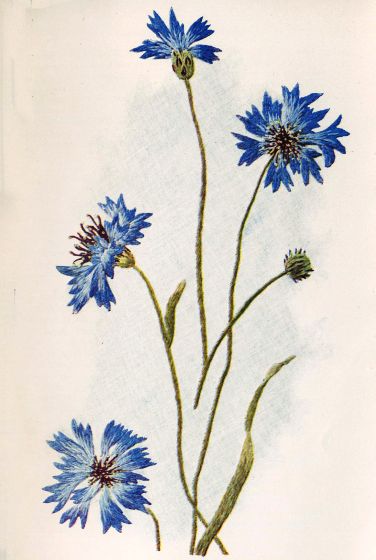
Corticelli Batchelor's Button Design No. 607 B.
Colored Plate XIV.
Flowers.—Work solid. Begin the edge of the petals with
Corticelli Filo Silk, Blue, 746, shading lighter to the center with 745 and 744.
Fill the center with
stamens in Red Purple, 675, placing a French knot at head of each stamen
in Green, 781. See Colored Plate XIV. Work the part of calyx nearest
the petals with Green, 662, and that nearest the stem with 663. Over this
green make a few stitches like an inverted V "Λ," in 675. Work the seed pod
in the same shades as the calyx, putting a few stitches in 675 on the edges as
shown by Colored Plate XIV.
Leaves.—Work solid, making the points in 661, shading gradually darker
to the center with 662, 663. For the stem use 664, making two lines of stem
stitch, or use outline stitch, but slant the stitches more than usual. (Not
Difficult.)
Colored Plate XV.
Materials—22 inch Size: Corticelli Filo Silk, 2 skeins each 655.7, 678, 679, 782,
783; 1 skein each 680, 682, 781. Corticelli Persian Floss, 6 skeins 615. Smaller
pieces take less silk. Dealers can furnish stamped linen of this design in 9, 12, 18, and
22 inch sizes. See page 92.
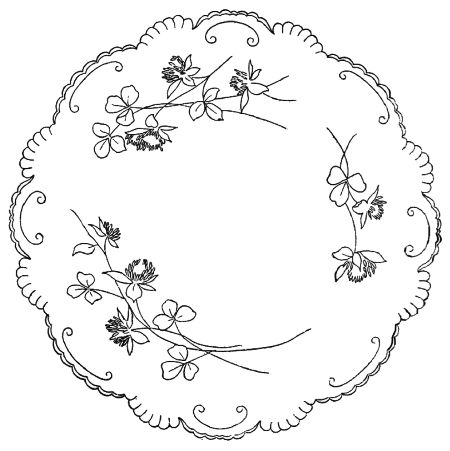
Red Clover Design No. 607 D.
Border.—Work the scallop in buttonhole stitch with Corticelli
Persian Floss, White, 615. The shell shaped scallop buttonhole
irregularly long and short on the inside. Over this work Corticelli
Filo Silk, Pink, 655.7, into which shade Pink, 678, leaving a long and
short effect on the inside. See Colored Plate III. The scroll near the
border can be done in either outline or seamstress feather stitch in
Green, 781.
Flowers.—Work solid in shades of Pink, 655.7, 678, 679, 680,
682. Use only one shade for a petal. Make the back petals in 679, 680;
the middle or center petals with 655.7, 678; and those nearest the stem
in 680, 682. Be careful to keep the petals separate. See Colored Plate
XV.
Leaves.—Work the leaves under the flower solid with green,
using 782 for the edge, and 781 for the crescent or horseshoe. At the
base of the leaves near the stem work a few stitches of 783, using the
same shade for the stems. (Easy.)
Chrysanthemum Design No. 607 D.
Materials—22 inch Size: Corticelli Filo Silk, 2 skeins each 506, 507, 508, 781, 782,
783; 1 skein each 504, 505, 616.5, 784, 813, 814. Corticelli Persian Floss, 6 skeins
616.5. Smaller pieces take less silk. Dealers can furnish stamped linen of this design
in 9, 12, 18, and 22 inch sizes. See page 92.
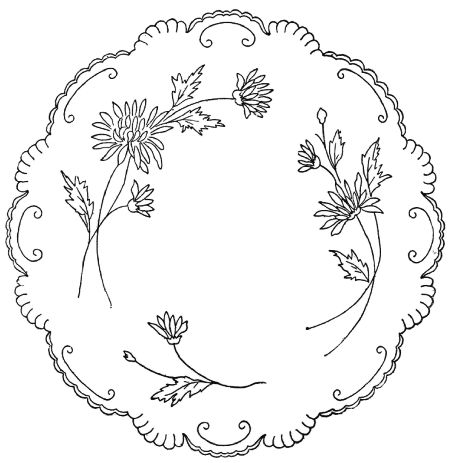
Chrysanthemum Design No. 607 D.
Border.—Work the scallop in buttonhole stitch with Corticelli
Persian Floss, White, 616.5. Buttonhole the shell scallop long and
short on the inside, and over this work one thread of Corticelli Filo
Silk 616.5, leaving a long and short effect on the inside. See Colored
Plate No. III. The scroll near the center work in outline stitch with
813.
Flowers.—Begin the edge of the petals in Yellow, 504, shading
darker to the base of petal with 505, 506, 507, 508, 813, 814. It is
not necessary to use all these shades in every petal; make some lighter
and some darker. Work the center of the full flower in 504. For the
petals that curl inward and over the center use 508, shading darker to
base with 813, 814. Work the edge of petals of buds in 507, shading
darker toward the calyx with 508, 813, 814. Use Green, 781, for the
points of calyx, shading darker towards the stem with 782, 783.
Leaves.—Work the edges with 781, shading darker toward the
center with 782, 783. Vein with 784. Work the stems in two rows of stem
stitch with 784. (Not Difficult.)
Colored Plate XVI.
Materials—22 inch Size: Corticelli Filo Silk, 2 skeins each 504, 505, 506, 507, 754,
781; 1 skein 503, 782. Corticelli Persian Floss, 6 skeins 615. Smaller pieces take less
silk. Dealers can furnish stamped linen of this design in 9, 12, 18, and 22 inch sizes.
See page 92.
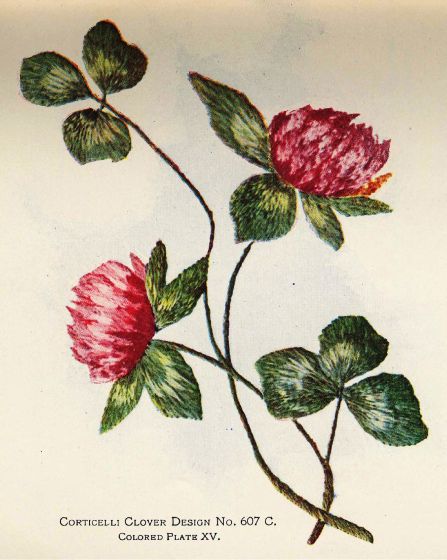
Corticelli Clover Design No. 607 C.
Colored Plate XV.
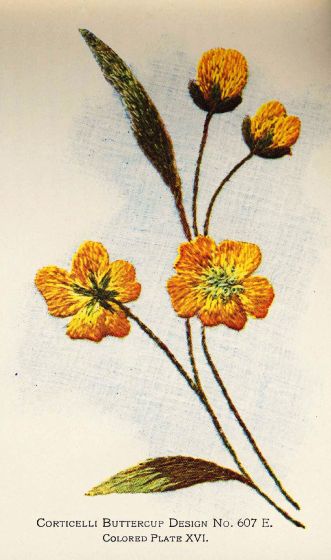
Corticelli Buttercup Design No. 607 E.
Colored Plate XVI.
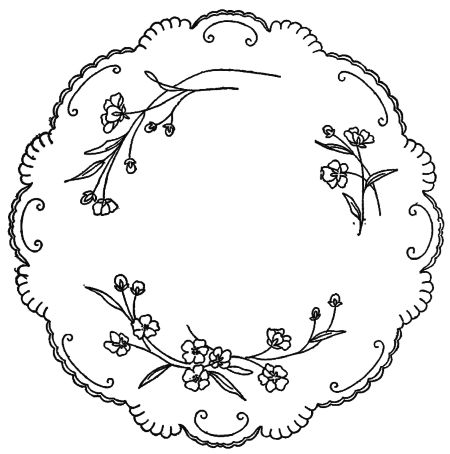
Buttercup Design No. 607 E.
Border.—Work the scallop in buttonhole stitch with Corticelli
Persian Floss, White, 615. Work the shell scallop in buttonhole stitch,
long and short on the inside; work over the white with one thread of
Corticelli Filo Silk, Yellow, 503, leaving on the inside a long and
short effect. See Colored Plate III.
Flowers.—Work solid. Begin the edge of the petals with Yellow,
507, shading lighter to the center with 506, 505, 504, 503. Some
flowers should be darker than others. In the center of the flower work
a few stitches of Green, 781, and around these stitches make a few
French knots in 781 also. See Colored Plate XVI.
Leaves.—Work solid. Begin the points with 781, and shade into 754
toward the center. Work the stems in outline stitch with Green, 754. (Easy.)
Holly Design No. 607 F.
Materials—22 inch Size: Corticelli Filo Silk, 2
skeins each 582, 583, 754, 781, 785; 1 skein each 586, 615, 767, 768.
Corticelli Persian Floss, 6 skeins, White, 615. Smaller pieces take
less silk. Dealers can furnish stamped linen of this design in 9, 12,
18, and 22 inch sizes. See page 92.
For a Christmas or New Year's present nothing is more appropriate
than a centerpiece or doily embroidered with the handsome holly. This
design is quite simple and is easily worked.
Border.—Work the scallop in buttonhole stitch with Corticelli Persian
Floss, White, 615. Work the shell-shaped scallop long and short on the
inside. Over this indented buttonhole work, shade in one thread of Filo Silk,
White, 615, leaving a long and short effect on the inside. See Colored Plate
IV, Borders. Work the scroll near the border in seamstress feather stitch
or in outline stitch with Filo Silk, White, 615, or in Green, 781.
Berries.—Work in satin stitch with Corticelli Filo Silk, Red, 767, 768, using
only one shade in each berry.
Leaves.—Work solid, using Green, 781, for the edge. Shade darker
toward the center with 754, 582, 583, 785, 586. Make some leaves darker than
others. Use 781 for the turned over parts of the leaves. Work the stems
and veins in 584 and 785. (Easy.)
Violet Design No. 402 A.
Fringed Doily.
Materials—12 inch Size: Corticelli Filo Silk, 1 skein each
506, 726, 727, 728, 729, 781, 782, 783. Smaller sizes take less silk.
Dealers can furnish stamped linen of this design, ready fringed, in 7,
9, 12, and 18 inch sizes. See page 92. They can also furnish stamped
and fringed linen for tray cloth, 10 x 14 inches, to match this doily.
The above quantity of silk will be more than enough for the tray
cloth.
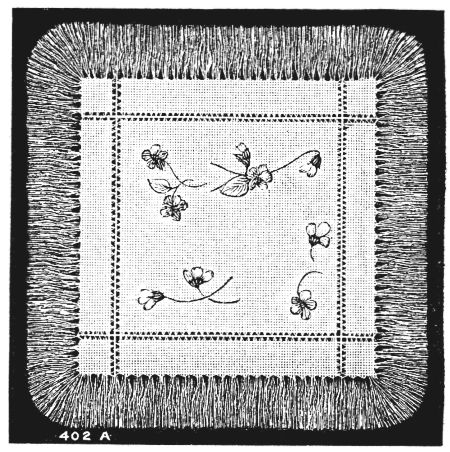
Violet Doily Design No. 402 A.
These fringed doilies are imported goods of fine quality. They are
neat and dainty, require little silk to work, and together make as
pretty a set of six patterns as we have seen.
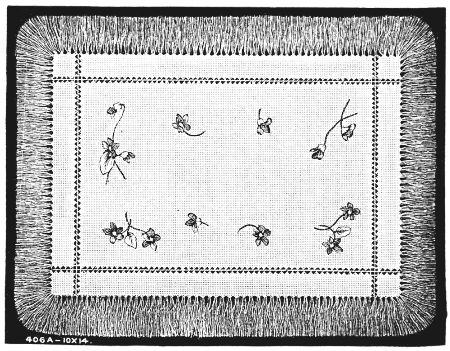
Violet Tray Cloth Design No. 402 A.
Flowers.—Work solid. Use 726 for the edge of some of the
petals, working darker to the center with 727, 728, 729. Use three
shades to a flower. Commence other flowers with 727 on the edge and
use 728, 729 toward the center. In the center of the open flowers work
three stitches of Yellow, 506. Work the buds in 727, 728, and 729, and
use 782 for the calyx.
Leaves.—Use Green, 781, for edge of leaf, shading toward the
midvein with 782. Use 783 for the veins and stems. (Easy.)
Clover Design No. 402 B.
Fringed Doily.
Materials—12 inch Size: Corticelli Filo Silk, 1 skein each 655.7, 678, 679, 680, 681,
781, 782, 783. Smaller sizes take less silk. Dealers can furnish
stamped linen of this design, ready fringed, in 7, 9, 12, and 18 inch
sizes. See page 92. They can also furnish stamped and fringed linen for
tray cloth, 10 x 14 inches, to match this doily. The above quantity of
silk will be more than enough to work the tray cloth.
These fringed doilies are imported goods of fine quality. They are
neat and dainty, require little silk to work, and together make as
pretty a set of six patterns as we have seen.
Instructions for working this design are the same as given for Red
Clover Design No. 607 C, page 37, and illustrated by Colored Plate XV,
although of course the rules for working the border do not apply to
this design. (Easy.)
Buttercup Design No. 402 C.
Fringed Doily.
Materials—12 inch Size: Corticelli Filo Silk, 1 skein each 503, 504, 505, 506,
754, 781, 782. Smaller sizes take less silk. Dealers can furnish
stamped linen of this design, ready fringed, in 7, 9, 12, and 18 inch
sizes. See page 92. They can also furnish stamped and fringed linen for
tray cloth, 10 x 14 inches, to match this doily. The above quantity of
silk will be more than enough to work the tray cloth.
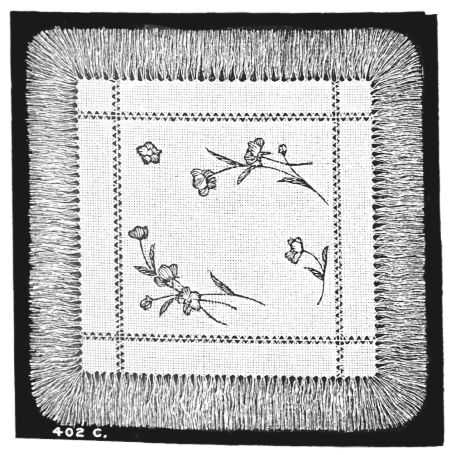
Buttercup Design No. 402 C.
These fringed doilies are imported goods of fine quality. They are
neat and dainty, require little silk to work, and together make as
pretty a set of six patterns as we have seen.
Instructions for working this design are the same as given for
Buttercup Design No. 607 E, page 39, and illustrated by Colored Plate
XVI, although of course the rules for working the border do not apply
to this design, (Easy.)
Daisy Design No. 402 D.
Fringed Doily.
Materials—12 inch Size: Corticelli Filo Silk, 1 skein each 503, 505, 582, 615, 661,
662, 692.8, 753, 754. Smaller sizes take less silk. Dealers can furnish
stamped linen of this design, ready fringed, in 7, 9, 12, and 18 inch
sizes. See page 92. They can also furnish stamped and fringed linen for
tray cloth, 10 x 14 inches, to match this doily. The above quantity of
silk will be more than enough to work the tray cloth.
These fringed doilies are imported goods of fine quality. They are
neat and dainty, require little silk to work, and together make as
pretty a set of six patterns as we have seen.
Instructions for working this design are the same as given for
Daisy Design No. 612 D, page 49, and illustrated by Colored Plate XX,
although of course the rules for working the border do not apply to
this design. (Easy.)
Maiden-hair Fern Design No. 402 E.
Fringed Doily.
Materials—12 inch Size: Corticelli Filo Silk, 1 skein each 527, 780, 781, 782, 783,
783.5. Smaller sizes take less silk. Dealers can furnish stamped linen
of this design, ready fringed, in 7, 9, 12, and 18 inch sizes. See page
92. They can also furnish stamped and fringed linen for tray cloth, 10
x 14 inches, to match this doily. The above quantity of silk will be
more than enough to work the tray cloth.
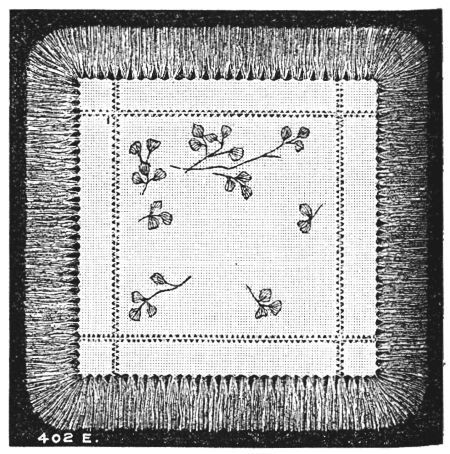
Maiden-hair Fern Design 402 E.
These fringed doilies are imported goods of fine quality. They are
neat and dainty, require little silk to work, and together make as
pretty a set of six patterns as we have seen.
Ferns.—Work solid. Slant the stitches toward the bottom, and
thus bring them to a point at the stem. Make each leaf of one shade.
Begin the leaves at the top of the spray with Corticelli Filo Silk,
780, and work down gradually darker, using 783.5 for those at the
bottom of the spray. Work the stems with a split thread of Filo Silk,
Brown, 527, making the stitches very fine. (Easy.)
Forget-me-not Design No. 402 F.
Fringed Doily.
Materials—12 inch Size: Corticelli Filo Silk, 1 skein each 504, 519, 520, 521, 678,
781, 782, 783. Smaller sizes take less silk. Dealers can furnish
stamped linen of this design, ready fringed, in 7, 9, 12, and 18 inch
sizes. See page 92. They can also furnish stamped and fringed linen for
tray cloth, 10 × 14 inches, to match this doily. The above quantity of
silk will be more than enough to work the tray cloth.
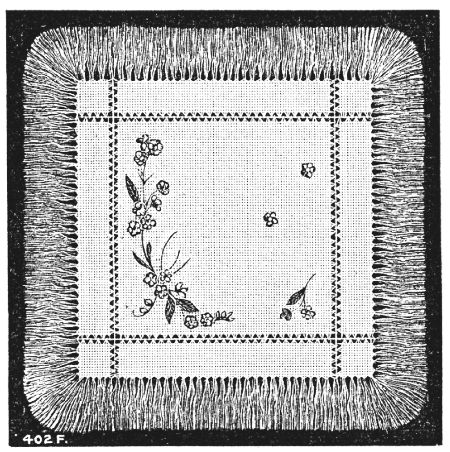
Forget-me-not Design No. 402 F.
These fringed doilies are imported goods of fine quality. They are
neat and dainty, require little silk to work, and together make as
pretty a set of six patterns as we have seen.
Forget-me-not.—Work solid in satin stitch, working all
stitches toward the center. Make each flower of one shade, using 519,
520, 521, for the different flowers. Make a French knot of Yellow, 504,
in the center. Work most of the buds with Pink, 678, and work the calyx
with 782.
Leaves.—Work solid, using 781 on the edge, and shade toward
the midvein with 782. Veins and stems make with 783. (Easy.)
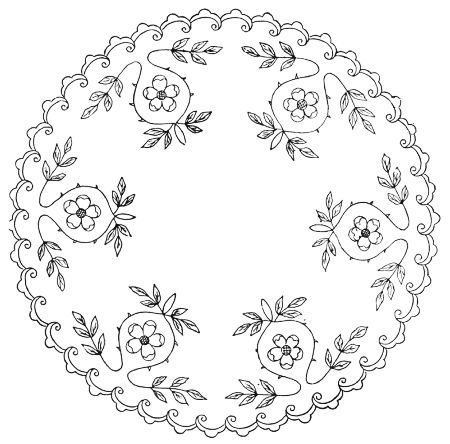
Conventional Wild Rose Design No. 52.
By Emma Haywood.
Materials—22 inch Size: Corticelli Filo Silk, 4 skeins each 106, 107, 108, 109; 3
skeins each 101, 102, 103, 105; 2 skeins each 525.7, 525.8, 525.9; 1 skein each 113, 647.
Corticelli Persian Floss, 8 skeins, 616.5.
Materials—9 inch Size: Corticelli Filo Silk, 1 skein each of above shades. Corticelli
Persian Floss, 2 skeins, 616.5. Dealers can furnish stamped linen of this
design in 9, 12, 18, and 22 inch sizes. See page 92.
This dainty design of semi-conventional roses and leaves is quite unique
in style. For the handsomer kinds of embroidery there is a decided leaning
toward conventionalized forms, but many of the designs offered are so
intricate and stilted as to be hardly practical. This, however, is both rich
and graceful, with the added attraction that it is not difficult to work. The
treatment, as well as the design, is somewhat conventional.
Border.—Work the scallop in buttonhole stitch with Corticelli Persian
Floss, Cream White, 616.5.
Roses.—For the roses we suggest a most delicious new shade of pink
Corticelli Filo Silk, 101, 102, 103, 105. Take the darkest for the curled over
edge, working in a slanting direction. The outer edge, however, should not
be put in until the middle part is worked, so that the edge can be
worked over it. The inner part should be graduated, putting the
lightest next to the center so that one begins with 103 next the outer
edge; 104 is left out so as to make a more decided break from the
curled over edge. The round center is very effective worked in pale
Gold Color, 113. This is covered with a network of crossed bars in a
dark, rich shade of Brown, 647, and outlined with the same.
Conventional Wild Rose Design No. 52.
Leaves.—The leaves are worked mainly with a soft shade of
green, but to avoid monotony golden brown is blended into the green at
frequent intervals, sometimes half a leaf is brown, sometimes it is
tipped with brown on one or both sides, or a little brown is worked in
at the base of the leaf. For the green shades take 106, 107, 108, 109,
and for the golden brown use 525.7, 525.8, 525.9. The stems and thorns
are likewise put in with the three shades of brown. In working the
leaves let the stitches take the direction of the veins; by this means
the veining will be expressed much better than by putting it in. (Not
Difficult.)
Colored Plate XVII.
By Amalia Smith.
Materials—22 inch Size: Corticelli Filo Silk, 2 skeins each 672, 673, 678; 1 skein
each 616.5, 655.7, 674, 755, 780, 781, 782, 783. Corticelli Persian Floss, 5 skeins
615. Dealers can furnish stamped linen of this design in 22 inch size. See page 92.
This is a very effective design, pleasing in coloring, and capable of very
artistic treatment.
Border.—Work the scallop in buttonhole stitch with Corticelli Persian
Floss, White, 615, with a long and short (indented) effect on the inside line.
Work the under scallop with Corticelli Filo Silk, 678, using two threads in
the needle. See Colored Plate IV for coloring and method of working border.
Corticelli Japanese Chrysanthemum Design No. 609 B.
Colored Plate XVII.
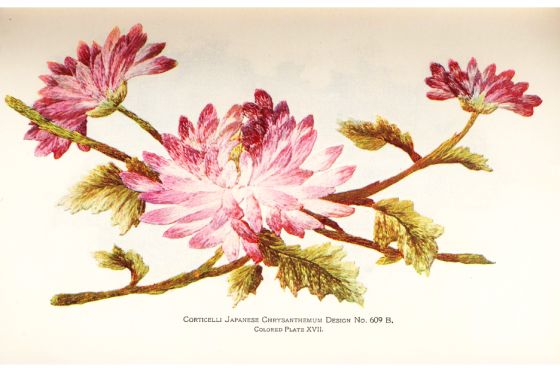
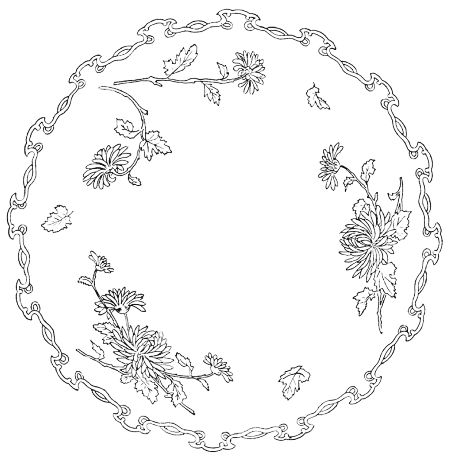
Flowers.—Work the back petals in 672, 673, 674, making the points dark
and the shading lighter toward the center. The petals in the foreground
should be made as follows: points in 672, shading lighter toward
the base with 678, 655.7, 616.5. See Colored Plate XVII. Work the
buds solid. Use 674 for the back petals of buds and for those in the
foreground; use 672 for points, and shade lighter to the calyx, using
678, 655.7. Work the calyx solid in Green, 781 and 782.
Japanese Chrysanthemum Design No. 609 B.
Leaves.—Begin the edges with 781, shading gradually darker to
the center with 782 and 783. Make some lighter by using 780 on the edge
and 782 for the darkest shade. Vein with 783. For the stems use Green,
782, 783, and 755, working solid and making the end of the stem darker
than the part nearest the flower. (Difficult.)
Thistle Design No. 609 E.
Materials—22 inch Size: Corticelli Filo Silk, 2
skeins each 684, 685, 686, 754, 781, 782, 783, 784; 1 skein each 672,
675, 726, 727, 729. Corticelli Persian Floss, 4 skeins 615; 3 skeins
672. Dealers can furnish stamped linen of this design in 22 inch size.
See page 92.
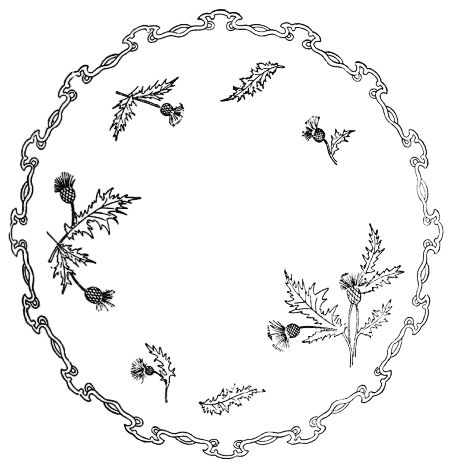
Thistle Design No. 609 E.
Border.—Work the scallop in buttonhole stitch with Corticelli
Persian Floss, 672 and 615. Work the outside scallop with Persian
Floss, White, 615, and the small twining scallop with 672. See Colored
Plate IV for method of working border.
Thistles.—Work the thistle with Corticelli Filo Silk, Purple, 672, 726,
727, 675, 729. Make each strand very fine and make each with as much of
a feathery effect as possible. At the top of the thistle use 672, 726, and a
little of 727. Make the upper part light; near the center use the darker
shades, 675, 727, 729, but use 675 and 729 sparingly. Work the bulb of the
thistle solid in Green, 781, 782, 783, 784. Near the top of the bulb work one
or more rows, according to the size of the bulb, with Green, 782; the next two
rows near the middle of the bulb, with 781, then gradually darker to the
bottom near the stem. Another way to work the bulb is to work it solid
with Green, 781, and cross-bar with Bronze Green, 852.
Leaves.—Work solid. Make one spray of leaves with Green, 781, 782, 783,
784. Use 781 for the points of the leaves and shade darker toward the center.
Vein with 782, 783, 784. For another spray of leaves use 754, 684, 685, 686,
working in the same manner as described above. Work the stems in stem
stitch with 784, giving quite a slant to the stitches. (Not Difficult.)
Buttercup Design No. 611 A.
Rococo Border.
Materials—22 inch Size: Corticelli Filo Silk, 2 skeins each 615, 692.8; 1 skein each
503, 504, 505, 506, 507, 692.9, 753, 754, 780, 781, 782. Corticelli Persian Floss,
5 skeins 615. Dealers can furnish stamped linen of this design in 22 inch size. See
page 92.
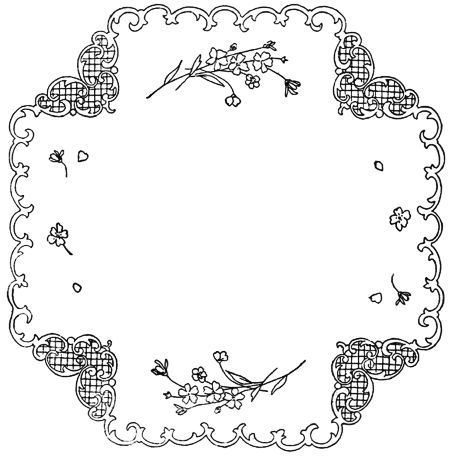
Buttercup Design No. 611 A. Rococo Border.
Border.—Work the scallop with Corticelli Persian Floss, White,
615, in buttonhole stitch long and short to the inside line. Shade into
the white with one thread of Corticelli Filo Silk, 692.8., making an
even line or finish on the narrow part of the scallop but leaving an
uneven edge at the points. Shade these points with a few stitches of
692.9, thus giving them a darker effect.
Four Corners in Border.—Work the cross-bar in outline stitch
with one thread of Corticelli Filo Silk, 692.8. Make a cross stitch
with 692.9 where the lines intersect. Stuff the two jewels with cotton,
or, better still, Corticelli Persian Floss, to raise the work, and then
work over in satin stitch with Filo, 692.8, and outline with the same
shade.
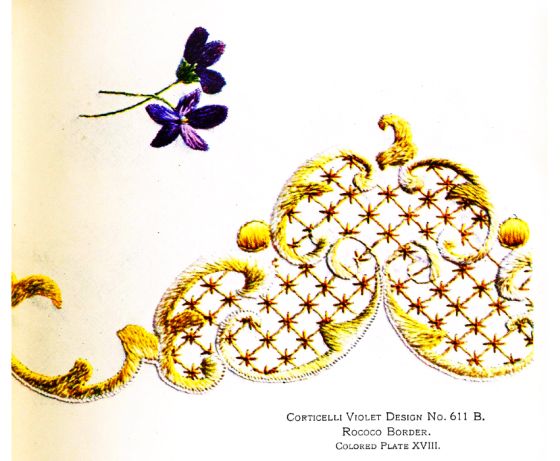
Corticelli Violet Design No. 611 B.
Rococo Border.
Colored Plate XVIII.
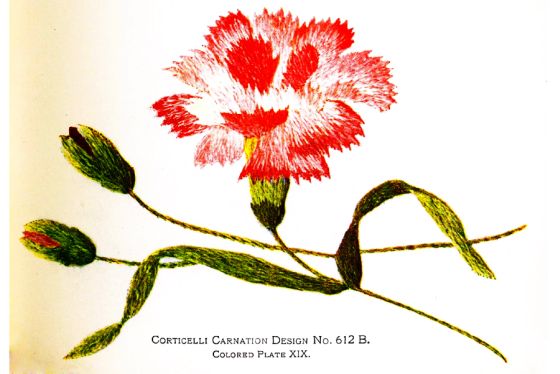
Corticelli Carnation Design No. 612 B.
Colored Plate XIX.
Scroll.—Work the even side of the scroll around the cross-bar lines with
Filo Silk, White, 615. Shade 692.8 and 692.9 into the white, giving the same
effect as the border. The shading is shown on Colored Plate XVIII, but
the colors are different.
Flowers and Leaves.—Instructions given for working the flowers and
leaves in Buttercup Design No. 607 E, page 39, and illustrated by Colored
Plate XVI, apply equally well to this pattern. (Not Difficult.)
Rococo Border.
Colored Plate XVIII.
Materials—22 inch Size: Corticelli Filo Silk, 2 skeins each 615, 644.6, 644.7, 644.8;
1 skein each 505, 645, 725, 727, 728, 729, 781, 782, 783. Corticelli Persian Floss, 5
skeins, 615. Dealers can furnish stamped linen of this design in 22 inch size. See
page 92.
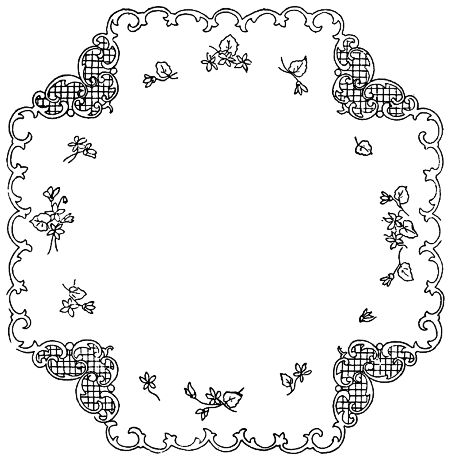
Violet Design No. 611 B. Rococo Border.
Border.—Work the scallop with Corticelli Persian Floss, White,
615, in buttonhole stitch long and short to the inside line. Shade into
the white one thread of Corticelli Filo Silk, 644.6, making an even
line or finish on the narrow part of the scallop. Shade the points in
the border with a few stitches of 644.7 and 644.8, thus giving them a
darker effect. See Colored Plate XVIII.
Four Corners in Border.—Work the cross-bar in outline stitch
with one thread of Corticelli Filo Silk, 644.8. Make a cross stitch
with 645 where the lines intersect. Stuff the two jewels with cotton,
or, better still, Corticelli Persian Floss, to raise the work, and then
work over in satin stitch with Filo, 644.7, and outline with the same
shade. (See Jewel Design No. 50, for directions for working jewels.)
Scroll.—Work the even side of the scroll around the cross-bar lines with
Filo Silk, White, 615. Shade 644.7 and 644.8 into the white, giving the same
effect as the border. See Colored Plate XVIII.
Flowers.—Begin the edge of the petals with 725, shading darker to the
center with 727, 728, 729. Make some petals darker by omitting 725 and 727.
In the center of the open flowers work a stitch in Yellow, 505. Work the
calyx solid with Green, 782.
Leaves.—Begin the edge in Green, 781, shading to the center with 782.
Vein and stem with 783. (Not Difficult.)
Violet Design No. 612 A.
Materials—22 inch Size: Corticelli Filo Silk, 4 skeins 615; 3 skeins 645; 2 skeins
each 644.6, 727, 728, 729; 1 skein 505, 725, 781, 782, 783. Smaller sizes take less silk.
Dealers can furnish stamped linen of this design in 9, 18, and 22 inch sizes. See
page 92.
This design is square, the edges are doubled under and securely
sewed with silk. For this reason only a small quantity of silk is
required for working, as none is used for the edge.
Border.—Outline the scroll in each corner with Corticelli Filo
Silk, 645. Work the scallop inside the scroll with Filo Silk, White,
615, to the depth of half an inch. Shade into the white, Lemon, 644.6,
leaving a long and short effect on the inside of the scallop. Fill
the space between the outside scroll and the scallop with fine seed
stitches with 645. Work the scroll inside of stitching solid with 645
in satin stitch. See Colored Plate XX.
Flowers.—Begin the edge of the petals in 725, shading darker to the
center with 727, 728, 729. Make some petals darker by omitting 725 and 727.
In the center of open flowers work a stitch of Yellow, 505. Work the calyx
solid in Green, 782.
Leaves.—Begin the edge in 781; shade to center with 782. Vein and stem
with 783. (Easy.)
Colored Plate XIX.
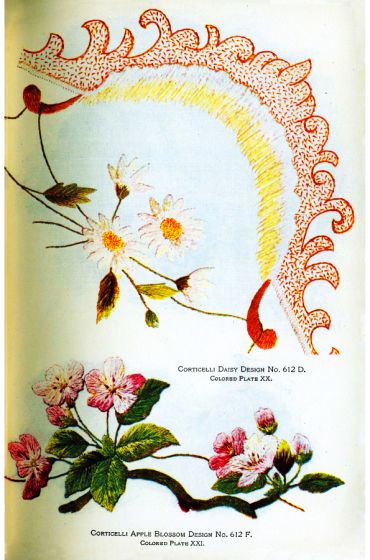
Corticelli Daisy Design No. 612 D.
Colored Plate XX.
Corticelli Apple Blossum Design No. 612 F.
Colored Plate XXI.
Materials—22 inch Size: Corticelli Filo Silk, 4 skeins 615; 3 skeins 645; 2 skeins
each 636, 637, 638, 639, 644.6, 780; 1 skein each 655.7, 781, 782, 783. Smaller
sizes take less silk. Dealers can furnish stamped linen of this design in 9, 18, and 22
inch sizes. See page 92.
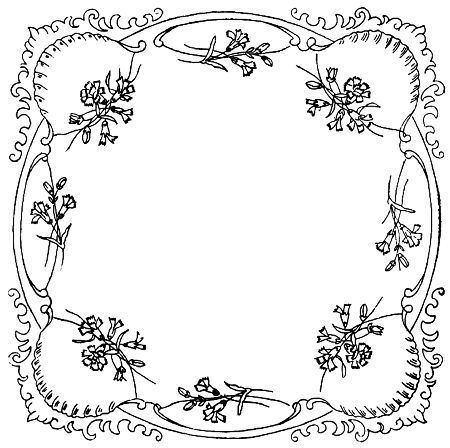
Carnation Design No. 612 B.
This design is square, the edges are doubled under and securely
sewed with silk.
Border—Use same instructions as given for working border of
Daisy Design 612 D. See below.
Flowers.—Begin the edge of the petals with 639, shading
lighter to the calyx with 638, 637, 636, 655.7. Make some petals light
and others dark. In the full flower it is better to make the back
petals lighter and those in the foreground darker. See Colored Plate
XIX. Work that part of the calyx near the petals with Green, 780, 781,
and the bottom with 782.
Leaves.—Work solid, using 780 for the points and shading
gradually darker with 781, 782. Use 783 for the stems. (Not
Difficult.)
Colored Plate XX.
Materials—22 inch Size: Corticelli Filo Silk, 7
skeins 615; 3 skeins 645; 2 skeins 644.6, 1 skein each 503, 505, 582,
661, 662, 692.8, 753, 754. Smaller sizes take less silk. Dealers can
furnish stamped linen of this design in 9, 18, and 22 inch sizes. See
page 92.
This design is square, the edges are doubled under and securely
sewed with silk.
Border.—Outline the scroll in each corner with Corticelli Filo
Silk, 645. Work the scallop inside the scroll with White, 615, to the
depth of half an inch. Into the white shade 644.6, leaving a long and short
effect on the inside of the scallop. Fill the space between the outside scroll
and the scallop with fine seed stitches made with 645. Work the scroll inside
of stitching solid in satin stitch with 645. See Colored Plate XX.
Flowers.—Begin the points of the petals with White, 615, shading to the
center with Green, 692.8, 661, and 662. Fill the centers with French knots in
Yellow, 503 and 505. See Colored Plate XX. Work the buds in 692.8 and 661.
(These small buds are darker than open flowers.) In the large buds use some
white also. Work the calyx with Green, 754.
Leaves.—Begin the points with Green, 753, shading gradually darker with
754 to the center. Use 582 for the stems and veins. (Easy.)
Wild Rose Design No. 612 E.
Materials—22 inch Size: Corticelli Filo Silk, 3 skeins each 638, 639, 645; 2 skeins
each 644.6, 655.8, 655.9, 781, 782; 1 skein each 504, 615, 780, 783, 784. Smaller sizes
take less silk. Dealers can furnish stamped linen of this design in 9, 18, and 22 inch
sizes. See page 92.
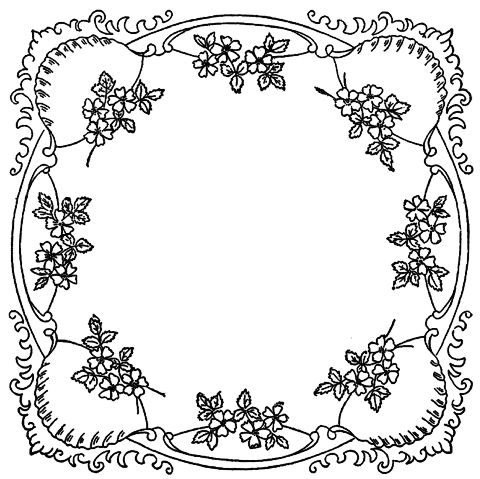
Wild Rose Design No. 612 E.
This design is square, the edges are doubled under and securely
sewed. No silk is therefore required for buttonholing the edge.
Border.—Use same instructions as given for working Border of
Daisy Design 612 D, page 49.
Flowers.—Begin the edge with 639 and shade lighter to center
with 638, 655.9, 655.8. Make some petals lighter and some flowers
lighter than others. Vary the shading. In the center of the open
flower work a few stitches of Green, 780, and irregularly around these
stitches make French knots in Yellow, 504. A study of Colored Plate IX
will assist one in shading this design.
Leaves.—Work solid. Begin the edge with Green, 780, shading
gradually darker to the center with 781, 782, 783. Vary the shading.
Make the leaves under the flowers much darker. Use but a little of 780
and only on tips. Work the veins and stems with Green, 784. (Easy.)
Colored Plate XXI.
Materials—22 inch Size: Corticelli Filo Silk, 4 skeins 615; 3 skeins 645; 2 skeins
each 636, 637, 644.6, 655.7, 655.8, 781, 782; 1 skein each 527, 616, 755, 783, 852.
Smaller sizes take less silk. Dealers can furnish stamped linen of this design in 9, 18,
and 22 inch sizes. See page 92.
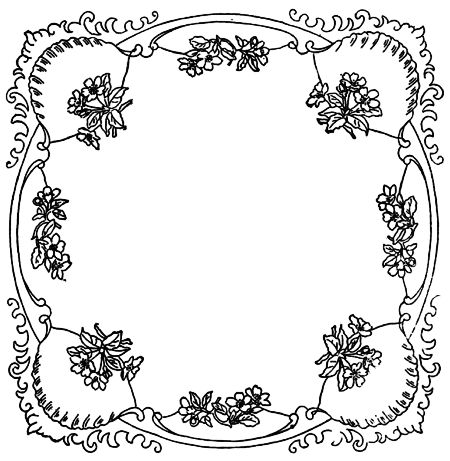
Apple Blossom Design No. 612 F.
This design is square, the edges are doubled under and securely
sewed with silk. For this reason only a small quantity of silk is
required for working, as none is used for buttonholing the edge.
Border.—Use same instructions as given for working border of
Daisy Design 612 D, page 49.
Flowers.—Begin the edge of the petals with 636, shading
lighter to the center with 655.8, 655.7, 616. Make some petals lighter
by omitting 636 and use 615 in place of 616 toward the center. Vary the
shading by making some flowers almost white. In each petal make two or
three stamens with Green, 781, and place a small French knot of 645 at
the end of each stamen. See Colored Plate XXI.
Buds and Calyx.—Begin the edge of the petals with 637, shading lighter
to the base with 636. Work all the buds darker than the flowers. Work the
calyx in Green, 782.
Leaves.—Work solid. Use Green, 781, for the points, shading gradually
darker to the center with 782, 783, 755, with a touch of 852 near the base and
midvein. Vary the shading as usual. Work the stems solid with 755, 852,
527, using most of 527. (Not Difficult.)
Violet Design No. 613 A.
Materials—22 inch Size: Corticelli Filo Silk, 1 skein each 506, 725, 727, 728, 729,
781, 782, 783. Corticelli Persian Floss, 1 skein 615. Smaller sizes take less silk.
Dealers can furnish stamped linen of this design in 9 and 22 inch sizes. See page 92.
These octagon shaped patterns require no buttonhole work on the edges,
as the linen is folded under and securely sewed as shown by the illustration.
The effect is quite novel, and as the designs are simple only a small
quantity of silk is needed to work the pattern.
Flowers.—Work solid. Use Corticelli Filo Silk, Violet, 725,
for the edge of the petals, shading darker toward the center with 727,
728, 729. Make the three lower petals lighter than the upper two. In
the center of the open flowers work a few stitches of Yellow, 506, and
a stitch of Green, 781, on each side of the yellow. Work the buds with
729, 728, and 727. Work the calyx solid with 781 and 782, the darker
shade nearest the stem.
Leaves.—Work solid, using 781 for the edge and shading darker
to the center with 782. Work the veins and stems in 783. The slit
in corner, or the line across the ends of the stems, work in fine
buttonhole stitch with Persian Floss, White, 615. (Easy.)
Buttercup Design No. 613 B.
Materials—22 inch Size: Corticelli Filo Silk, 1 skein
each 503, 504, 505, 506, 507, 754, 781, 782. Corticelli Persian
Floss, 1 skein 615. Smaller sizes take less silk. Dealers can furnish
stamped linen of this design in 9 and 22 inch sizes. See page
92.
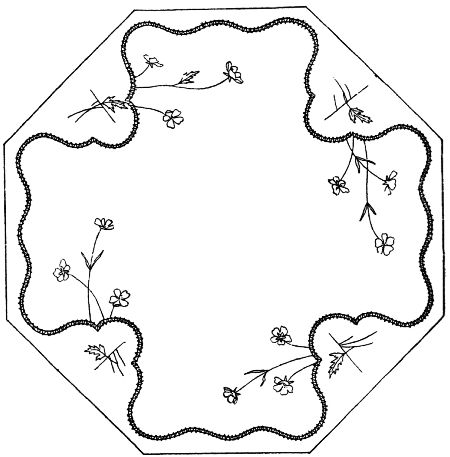
Buttercup Design No. 613 B.
These octagon shaped patterns require no buttonhole work on the
edges, as the linen is folded under and securely sewed as shown by the
illustration. The effect is quite novel, and
as the designs are simple only a small quantity of silk is needed to work the
pattern.
Flowers and Leaves.—Instructions for working this design
are the same as given for Buttercup Design No. 607 E, page 39, and
illustrated by Colored Plate XVI. (Easy.)
Daisy Design No. 613 D.
Materials—22 inch Size: Corticelli Filo Silk, 2
skeins 615; 1 skein each 503, 505, 582, 661, 662, 692.8, 753, 754.
Smaller sizes take less silk. Dealers can furnish stamped linen of this
design in 9 and 22 inch sizes. See page 92.
These octagon shaped patterns require no buttonhole work on the
edges, as the linen is folded under and securely sewed as shown by the
illustration. The effect is quite novel, and as the designs are simple
only a small quantity of silk is needed to work the pattern.
Flowers and Leaves.—Instructions for working this design are
the same as given for Daisy Design, 612 D, page 49, and illustrated by
Colored Plate XXI, although of course the rules for working the border
do not apply to this design. (Easy.)
Forget-me-not Design No. 613 E.
Materials—22 inch Size: Corticelli Filo Silk,
1 skein each 504, 518, 519, 520, 678, 781, 782, 783. Corticelli
Persian Floss, 1 skein 615. Smaller sizes take less silk. Dealers can
furnish stamped linen of this design in 9 and 22 inch sizes. See page
92.
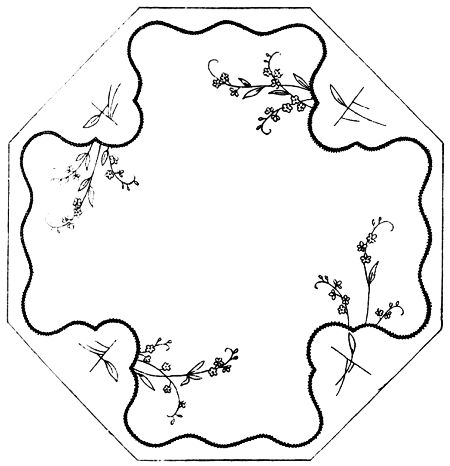
Forget-me-not Design No. 613 E.
These octagon shaped patterns require no buttonhole work on the edges,
as the linen is folded under and securely sewed as shown by the illustration.
Flowers.—Work solid. Make the petals in Corticelli Filo Silk, Blue, 518,
519, 520. Vary the shading by making one or more petals in some of the
flowers of a lighter shade. Tip some of the petals with a touch of Pink, 678.
Put a French knot in Yellow, 504, in the center of the open flowers. Make
some of the buds in Pink, 678, and others in Blue, 519.
Leaves.—Work solid, using Green, 781, for the points, shading gradually
darker to the stem with 782, 783. Make some leaves lighter than others.
Work the stems in 783. The slit in corner, or the line across the ends of the
stems, work in fine buttonhole stitch with Persian Floss, White, 615. (Easy.)
Chrysanthemum Design No. 613 F.
Materials—22 inch Size: Corticelli Filo Silk, 1 skein each
502, 503, 504, 505, 507, 716, 717, 718, 719, 781, 782, 783, 784.
Corticelli Persian Floss, 1 skein 615. Smaller sizes take less silk.
Dealers can furnish stamped linen of this design in 9 and 22 inch
sizes. See page 92.
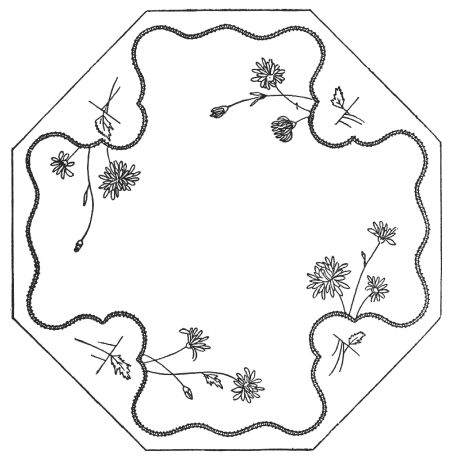
Chrysanthemum Design No. 613 F. Octagon Hem.
Red Flowers.—Work the points of the petals in the background
in Corticelli Filo Silk, 719, shading lighter to the base with 718,
717. Work the points of the petals in the foreground with 719, shading
lighter with 718, 717, 716. The petals that droop in the foreground
make lighter by omitting 719.
Yellow Flowers.—Work the points in the petals with Yellow,
507, shading lighter with 505, 504, 503, 502. Change the shading in
different petals by using either lighter or darker shades of silk. The
petals that are on top make light, using the lightest shades toward the
center of the upper petals. Use your taste in arranging the colors.
You can work red and yellow flowers in one spray, or make each spray
different, either way will be pretty. Use Green, 782, 783, for the
calyx.
Leaves.—Work the points with Green, 781, shading to the stem
with 782, 783. Use 784 for the stems. (Not Difficult.)
And Set of 4 Doilies, No. 56A, 56B, 56C, and 56D.
Colored Plate XXII.
By Elizabeth Moore Hallowell.
Materials—22 inch Centerpiece: Corticelli Filo Silk, 4 skeins 785; 3 skeins 784;
2 skeins each 725, 726, 727, 728, 729, 783; 1 skein each 621, 622, 779.5, 780, 781, 782.
Corticelli Persian Floss, 8 skeins 615. Smaller pieces take less silk. Dealers can
furnish stamped linen of this design in 22 and 27 inch sizes. They can also furnish
stamped linen, 9 inch square, of the set of four doily designs (Nos. 56A, B, C, D), to
match this centerpiece. See page 92.
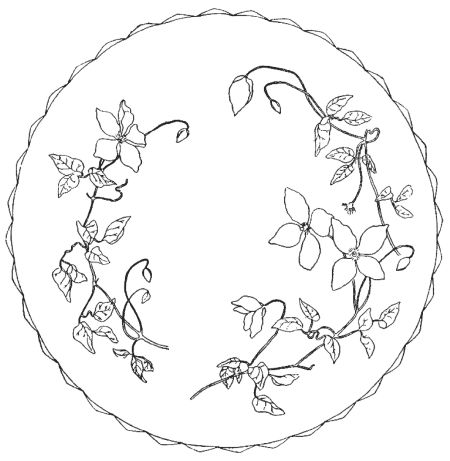
Purple Clematis Centerpiece Design No. 56.
One can always do better embroidery, as is the case in all branches
of art, if thoroughly familiar with one's subject; then the mind,
which is really the source of intelligent work, can act through the
pencil, the pen, or the needle, and give to the result the added touch
of knowledge at first hand. Therefore, if possible, before working
this design secure a spray of the real clematis, choosing the variety
known as Clematis Jackmanni, which is probably one of the best
known.
The Purple Clematis blossoms in June, July, or August, according to
the climate, but it can be secured from florists during other months.
Notice that the flowers often have four petals, and nearly as often
five. This is a marked peculiarity of the plant. Observe also the
buds and sprays of leaves, starting from the axils of the branches; the
curling tendency of the stems, by which tendril-like quality the plant
climbs. Sometimes the leaves will drop off from these stems, leaving
occasionally what looks like a real tendril, but what is in reality the
leaf-stem.
This centerpiece may be worked in heavy outline, which produces a very
decorative effect with less labor, but this is not recommended, the design
being of a large and handsome flower, which calls for stronger and more
lasting treatment, and the instructions given therefore are for solid embroidery,
in long and short stitch. (See article on Stitches—"Feather Stitch.")
While purple is the usual color of the flower, it is sometimes very pale lavender,
but for a decorative design merely, the flowers might be worked in white
with greenish shadings.
Flowers.—Begin the edge of petals with Purple, 729, shading
gradually lighter toward the base of the petal, using 728, 727, 726,
725. The lightest shades should come into a vein in the center of the
petal. For the under side, or turned over parts, of the petals use 725
and 726. The contrast between the color of upper and under sides is
very marked. Work the pistil solid, using 781 for the upper and 782 for
the lower half. See Colored Plate XXII.
Centers.—Outline the stamens with Green, 780, 781. Make
the outer stamens, which are heavier than those inside and somewhat
irregular, with a double thread of Corticelli Filo Silk, and the inner
stamens with a single thread. At the point of each stamen make a French
knot with Purple, 729. Use 780 and 781 also for the center from which
the petals have dropped. Work the buds solid, in 725, 726. At the base
of each shade into the stem a few stitches of 780.
Leaves.—Work solid in long and short stitch, with 779.5,
780, 781, 782, 783, 784, 785, being careful to slant the stitches in
the same direction as the veins, that is, from the edge in toward the
central vein, but sloping toward the base of the leaf. Shade from light
on the edge to dark near the midvein, See Colored Plate XXII. The
leaves are large and many shades can be used with advantage. Work some
of the smaller leaves in lighter shades than the large leaves at the
bottom of the spray. The veins in the leaves should not be indicated
too distinctly. They are shown with clearness in the illustration so
that the correct direction may be easily followed. One shade lighter
than the darkest shade used in the leaf will be correct for the veins.
For the turned over parts of leaves use 780 or 781.
Stems.—Work solid in 783, 784, 785, and where the stems are
largest use a little Reddish Brown, 621, 622. The stems from buds, also
the tendrils, should be made in 782, 783, 784.
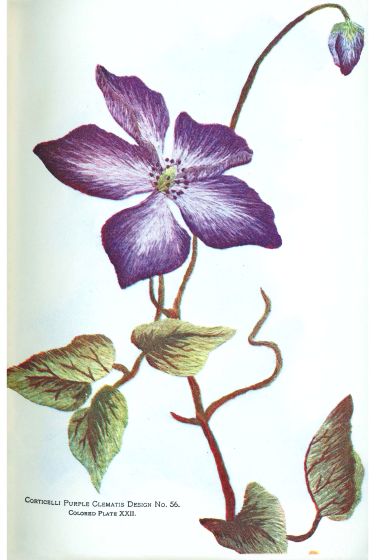
Corticelli Purple Clematis Design No. 56.
Colored Plate XXII.
Border.—Work the scallop in buttonhole stitch with Corticelli Persian
Floss, White, 615, or if desired use Light Green Persian Floss, 780. If fringe
is wanted buy the 27 inch square of stamped linen, buttonhole the edge very
fine and even all around with Corticelli Etching Silk. Then fringe the linen
to the buttonhole edge, comb out the threads
evenly and trim to any length wanted. (Not
Difficult.)
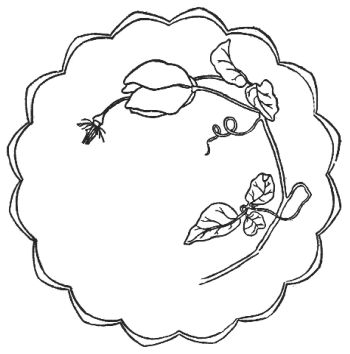
Purple Clematis Doily Designs Nos. 56A, 56B, 56C, and 56D.
Three of these doilies are designed so that the decoration will show
even should a tumbler or a finger bowl be placed upon them, and if six
or a larger number of doilies are desired for a set, repeat these three
patterns. In the fourth design, No. 56 A, the decoration is confined
to the center of the doily, this being intended for a bread or cake
covering, or for any purpose where a central decoration is most useful.
The instructions given for the clematis centerpiece will be ample for
working these doilies. (Not Difficult.)
Violet Design No. 615 A.
Materials—22 inch Size: Corticelli Filo Silk, 1 skein each 505, 661, 725, 727, 728,
729, 781, 782, 783, 784. Corticelli Persian Floss, 6 skeins 615.
Smaller sizes take less silk. Dealers can furnish stamped linen of this
design in 6, 9, 12, 18, and 22 inch sizes. See page 92.
Border.—Work the scallop in buttonhole stitch with Corticelli
Persian Floss, White, 615. In the three shell shaped scallops the
stitches should be irregular on the inside. Now shade Corticelli
Filo Silk, Green, 661, into the white (in these three shell shaped
scallops), giving a long and short effect on the inside. See Colored
Plate VI for method of working border.
Flowers.—Work solid in Violet, 729, 728, 727, 725. Make the
three lower petals lighter, the two upper
petals darker, working the edge of the petal lighter and darker toward the
center. Make a few solid stitches of Yellow, 505, in the center of the
flower.
Leaves.—Work solid with Green, 781, 782, 783. For the stems
and veins use 784. (Easy.)
Daisy Design No. 615 B.
Materials—22 inch Size: Corticelli
Filo Silk, 1 skein each 505, 615, 661, 781, 782, 783. Corticelli
Persian Floss, 6 skeins 615. Smaller sizes take less silk. Dealers
can furnish stamped linen of this design in 6, 9, 12, 18, and 22 inch
sizes. See page 92.
Border.—Use same instructions as given for Violet Design No.
615 A, page 57.
Flowers.—Work solid; the edge of the petals with White, 615,
using 661 toward the center. Make French knots in the center of the
open flower with Yellow, 505.
Leaves.—Work solid. For the points use Green, 781, shading
darker toward the center with 782. Work the veins and stems with 783.
(Easy.)
Rosebud Design No. 615 C.
Materials—22 inch Size: Corticelli Filo Silk, 1 skein
each 642, 657, 659, 661, 781, 782, 783. Corticelli Persian Floss, 6
skeins, 615. Smaller sizes take less silk. Dealers can furnish stamped
linen of this design in 6, 9, 12, 18, and 22 inch sizes. See page
92.
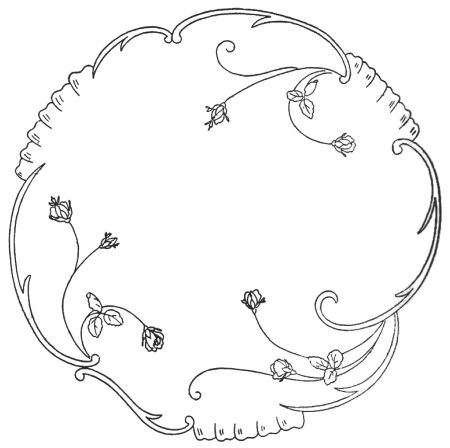
Rosebud Design No. 615 C.
Border.—Use same instructions as given for Violet Design No. 615 A,
page 57.
Rosebuds.—Work the edge of some of the back petals with Red, 659,
shading in with 657. The center should be lighter. Make some of the petals
darker by using 642 on the edge and shading in with 659. The petals in the
foreground should be lighter, using 659 and 657. Make the points of the
calyx in Green, 781, and shade gradually darker toward the bulb, using 782, 783.
Leaves.—Work solid. For the edge use Green, 781, shading darker toward
the center with 782. Work the veins and stems with 783. (Not Difficult.)
Buttercup Design No. 615 D.
Materials—22 inch Size: Corticelli Filo Silk, 1 skein each 503, 504, 505, 506, 781,
782. Corticelli Persian Floss, 6 skeins 615. Smaller sizes take less silk. Dealers can
furnish stamped linen of this design in 6, 9, 12, 18, and 22 inch sizes. See page 92.
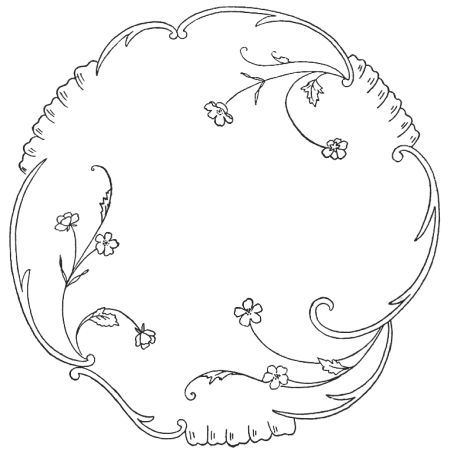
Buttercup Design No. 615 D.
Border.—Work the scallop in buttonhole stitch with Corticelli
Persian Floss, White, 615. In the three shell shaped scallops the
stitches should be irregular on the inside. Now shade Corticelli
Filo Silk, Yellow, 503, into the white (in these three shell shaped
scallops), giving a long and short effect on the inside. See Colored
Plate VI for method of working border; the coloring however will be
found different from that intended for this design.
Flowers.—Work solid. Use 505 for the edge, and gradually shade
lighter to the bottom of the petal with 504, 503. Three shades to a
flower are sufficient. Make some petals darker by using 506 on the edge
instead of 505. In the center of the open flowers work a few stitches
of Green, 781, and around these make a few French knots in 781, also.
See Colored Plate XVI.
Leaves.—Work the leaves with 781 in satin stitch, slanting the
stitches across the leaf. For the stems take 782. (Easy.)
Maiden-hair Fern Design No. 615 E.
Materials—22 inch Size: Corticelli Filo Silk, 1 skein each 527, 780, 781, 782, 783.
Corticelli Persian Floss, 6 skeins 615. Smaller sizes take less silk. Dealers can
furnish stamped linen of this design in 6, 9, 12, 18, and 22 inch sizes. See page 92.
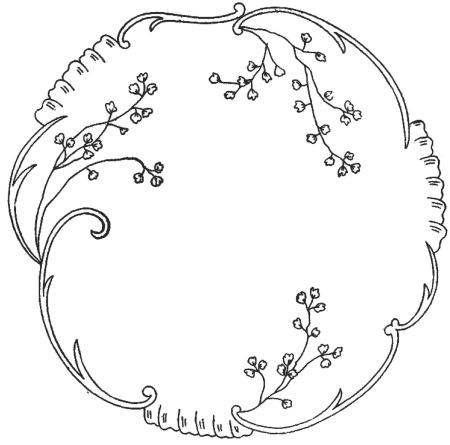
Maiden-hair Fern Design No. 615 E.
Border.—Work the scallop in buttonhole stitch with Corticelli
Persian Floss, White, 615. In the three shell shaped scallops the
stitches should be irregular on the inside. Now shade Corticelli
Filo Silk, Green, 780, into the white (in these three shell shaped
scallops), giving a long and short effect on the inside. See Colored
Plate VI for method of working border.
Leaves.—Work solid, making each leaf of one shade. Make the
leaves at the top of each spray with 781, the next two leaves with
782, and those next below with 783. Continue to make the leaves darker
toward the bottom of the spray. Work the stems in very fine stem stitch
with a thread of Filo Silk, 527, split in two parts. (Easy.)
Forget-me-not Design No. 615 F.
Materials—22 inch Size: Corticelli Filo Silk, 1 skein
each 504, 517, 519, 520, 679, 781, 782. Corticelli Persian Floss, 6
skeins 615. Smaller sizes take less silk. Dealers can furnish stamped
linen of this design in 6, 9, 12, 18, and 22 inch sizes. See page
92.
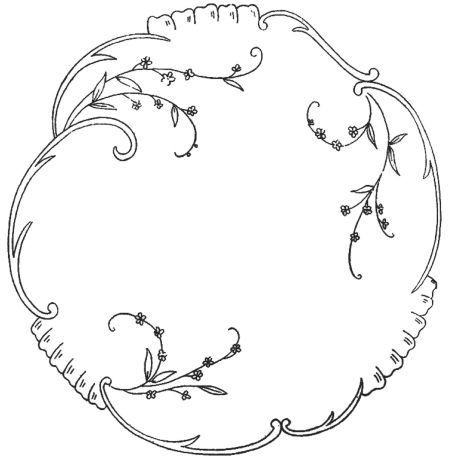
Forget-me-not Design No. 615 F.
Border.—Work the scallop in buttonhole stitch with Corticelli
Persian Floss, White, 615. In the three shell shaped scallops the
stitches should be irregular on the inside. Now shade Corticelli Filo
Silk, Blue, 517, into the white (in these three shell shaped scallops),
giving a long and short effect on the inside. See Colored Plate VI for
method of working border; the coloring however, will be found different
from that intended for this design.
Flowers.—Work solid. Use Blue, 517, 519, 520, for the petals, varying the
shading. Give a touch of Pink, 679, to some of the petals. Make a French
knot of Yellow, 504, in the center of the open flowers. Work some of the
buds with Blue, 519, and some with Pink, 679. Use Green, 782, for the calyx.
Leaves.—Work solid. For the points use Green, 781, shading toward the
stem with 782. Work the stems with 782. (Easy.)
Colored Plate XXIII.
By Emma Haywood.
Materials—22 inch Size: Corticelli Filo Silk, 4 skeins each 113, 114, 809, 810, 811;
3 skeins each 752.9, 753; 2 skeins each 700, 701, 786, 787, 788; 1 skein each 646, 650,
656, 812. Corticelli Persian Floss, 4 skeins 786. Corticelli EE Twisted Embroidery
Silk, 8 skeins 809.
Materials—9 inch Size: Corticelli Filo Silk, 1 skein each
of above shades. Corticelli Persian Floss, 1 skein 786; Corticelli EE
Twisted Embroidery Silk, 2 skeins 809. Dealers can furnish stamped
linen of this design in 9, 12, 18, and 22 inch sizes. See page
92.
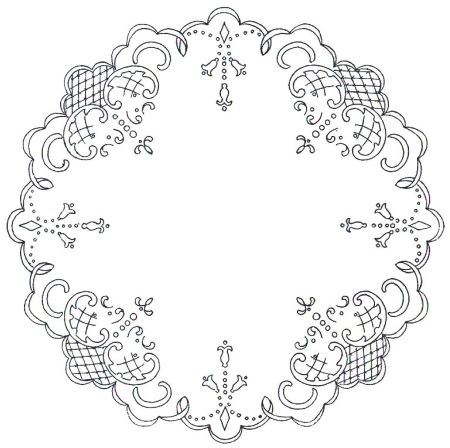
Jewel embroidery is more than ever popular, and deservedly so,
not only on account of the scope it gives for daintiness of design,
but more especially because of the splendid possibilities in the
arrangement of color. Of course one is not slavishly tied to copying
the exact color of any particular gem; the decorator's license is
available here just the same as in reproducing flowers, an artistic and
harmonious scheme of color must be the first consideration. Unless the
jewels be of unusual size it is better to work each individual gem in
one shade, varying the tone if repeated in the same group. It must be
remembered that embroidery, like any textile fabric, to a great extent
shades itself, especially when the surface is glossy. In this style
of design it is well to introduce as great a variety of coloring as
possible, avoiding however very violent contrasts.
We suggest a scheme that will be found to work beautifully, but many
others might be thought out with equally good results. It should be
observed, however, that in formulating a scheme all the colors employed
should be chosen in about the same tone to avoid the spottiness so
often found in amateur work; the very best designs can easily be
spoiled through inattention to this rule. The task of following exactly
the directions given is rendered easy by means of the numbers on the
labels attached to each skein of Corticelli Silk and by reference to
Colored Plate XXIII.
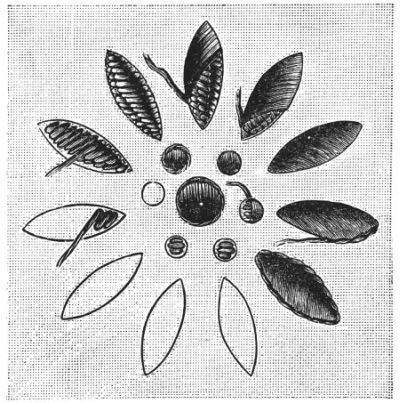
Jewel Embroidery. Filling and Covering.
The work is solid throughout except where the scallops are filled
in beneath the scrolls with crossed bars; these are laid in place
from side to side, and caught down at each intersection. The jewels
are put in with satin stitch. (See article on Stitches.) They should
be raised a little by filling. This can be done in two ways, either
by filling one way in satin stitch and crossing the filling in the
opposite direction in finishing (see engraving), or by working a circle
in stem stitch and following the circle inside until quite filled in,
then covering with satin stitch. When covering the filling, always
start in the center and work out each way. It will then be found easy
to preserve the form. It is hardly worth while to use a different kind
of silk for the filling; it is poor economy and saves very little
after all, while the additional fastenings off are liable to make the
work lumpy. The jewels are more pronounced if outlined, but this is
optional. If outlined, a rich Burnt Sienna shade, such as No. 646, will
be very effective and not at all heavy. The jewels should be worked
with Corticelli Filo Silk.
For the four sections composed of scrolls, and for the scallop exactly
beneath them, choose three delicate shades of Apricot, 809, 810, 811. Use the
lightest in Corticelli EE Embroidery Silk for the scallop, and shade the
scrolls with the three tones in Filo Silk. Put in the crossed bars with Green
Filo Silk, 752.9, and catch them down with 753. The outside scrolls are
also worked with 752.9. The small scrolls at the apex and on either side, also
the upper bars in stem stitch, are of a golden hue, for which take 113, 114.
The large central jewel and those heading the golden bars, are green. Use
700 for the large one and 701 for the small ones; those on either side on the
bars are Violet, 650; the three below and one above the large center jewel
are also worked with 650; the remaining single gems on either side of the
center are Red, 656. See Colored Plate XXIII.
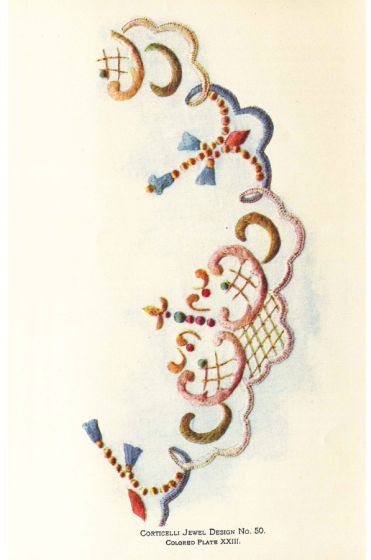
Corticelli Jewel Design No. 50.
Colored Plate XXIII.
We now come to the intervening forms embracing three scallops. Work
the lily forms with Filo Silk in three shades of Blue, 786, 787, 788. Work the
three scallops in Persian Floss, with Blue, 786. The jewels are golden, being
worked with Filo Silk, 113, 114. The diamond shaped jewel is put in with
812, representing a pink topaz. (Somewhat Difficult.)
Apple Blossom Design No. 406 A.
Hemstitched Edge.
Materials—12 inch Size: Corticelli Filo Silk, 1 skein each 636, 637, 645, 655.7, 781,
782, 783. Dealers can furnish stamped and hemstitched linen of this design in 6, 7, 9,
12, 15, 18, and 21 inch sizes. See page 92. They can also furnish stamped and hemstitched
linen for tray cloths and bureau scarfs to match this design, 18×27, 18×36,
17×54, and 17×72 inches. See page 92.
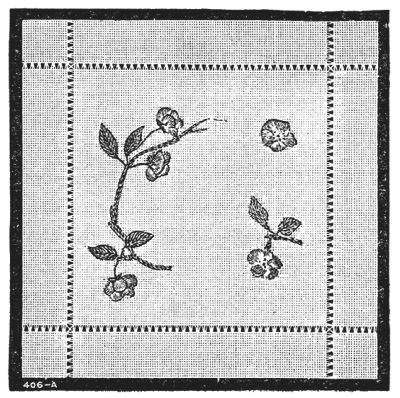
Apple Blossom Design No. 406 A.
These designs are especially adapted for beginners. The 7 and 9 inch
sizes make pretty doilies, and the larger linens work up into very
attractive centerpieces, tray cloths and bureau scarfs.
Flowers.—Work solid. Begin edge of petals with Corticelli Filo
Silk, 637, shading lighter toward center with 636, 655.7. In the center
of the open flowers make a few stitches in 781 to represent stamens,
and make three or four French knots around these stitches with 645.
Work the buds solid, using 637 for edge and 636 near calyx. Use 782
for calyx. A study of Colored Plate XXI will assist one in getting the
right shading and stitch direction.
Leaves.—Work solid, beginning points with 781, shading darker
to midvein with 782. Stems should be worked
solid or with two or three
rows of outline stitch, using 783. Use 783 also for veins. (Easy.)
Buttercup Design No. 406 B.
Hemstitched Edge.
Materials—12 inch Size: Corticelli Filo Silk, 1 skein each 503, 505, 506, 781, 782.
Dealers can furnish stamped and hemstitched linen of this design in 6, 7, 9, 12, 15, 18,
and 21 inch sizes. See page 92. They can also furnish stamped and hemstitched linen
for tray cloths and bureau scarfs, to match this design, 18×27, 1×36, 17×54, and
17×72 inches. See page 92.
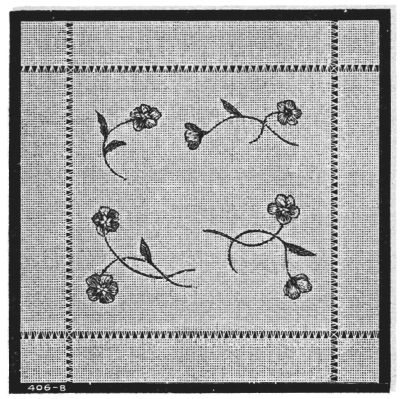
Buttercup Design No. 406 B.
These designs are especially adapted for beginners. The 7 and 9 inch
sizes make pretty doilies, and the larger linens work up into very
attractive centerpieces, tray cloths, and bureau scarfs. Only a small
quantity of silk is required for these patterns.
Flowers.—Work solid. Begin the edge of petals with Corticelli
Filo Silk, Yellow, 506, shading gradually lighter to center with 505,
503. Vary the shading in petals, making some light and some dark. Work
the calyx with Green, 781. The buds should be worked darker than the
open flowers. A study of Colored Plate XVI will be found helpful to
beginners.
Leaves.—Work solid, beginning points with 781 and shading to
midvein with 782. Work the stems in outline stitch with 782. (Easy.)
Chrysanthemum Design No. 406 C.
Hemstitched Edge.
Materials—12 inch Size: Corticelli Filo Silk, 1 skein each 673, 674, 678, 781, 782.
Dealers can furnish stamped and hemstitched linen of this design in 6, 7, 9, 12, 15, 18,
and 21 inch sizes. See page 92. They can also furnish stamped and hemstitched linen
for tray cloths and bureau scarfs to match this design, 18×27, 18×36, 17×54, and
17×72 inches. See page 92.
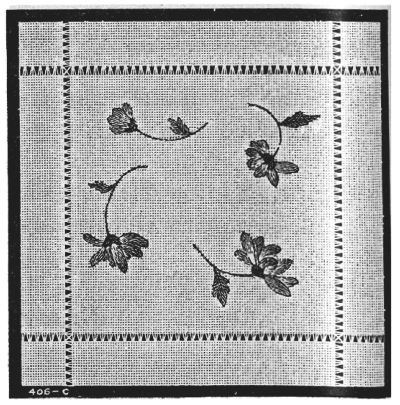
Chrysanthemum Design No. 406 C.
These designs are specially adapted for beginners. The 7 and 9 inch
sizes make pretty doilies, and the larger linens work up into very
attractive centerpieces, tray cloths, and bureau scarfs.
Flowers.—Work solid. Begin the edge of petals with Corticelli
Filo Silk, 674, shading lighter to the calyx with 673 and 678. Make
some petals lighter by omitting 674. The petals in the background
should be darker than those in the foreground. Use 781 for the calyx.
A study of Colored Plate XXII will be found helpful to beginners.
Leaves.—Work solid, beginning the points with 781, shading
darker to midvein with 782. Work the stems in outline stitch with 782.
(Not Difficult.)
Daisy Design No. 406 D.
Hemstitched Edge.
Materials—12 inch Size: Corticelli Filo Silk, 1 skein each 503, 505, 615, 660.5,
661, 662, 754. Dealers can furnish stamped and hemstitched linen of this design in 6,
7, 9, 12, 15, 18, and 21 inch sizes. See page 92. They can also furnish stamped and
hemstitched linen for tray cloths and bureau scarfs to match this design, 18 x 27,
18 x 36, 17 x 54, and 17 x 72 inches. See page 92.
These designs are especially adapted for beginners. The 7 and 9 inch
sizes make pretty doilies, and the larger linens work up into very
attractive centerpieces, tray cloths, and bureau scarfs.
Flowers.—Begin the edge of the petals with Corticelli Filo
Silk, White, 615, shading toward the center with 660.5. Work the
centers in fine French knots in Yellow, 503, 505, placing those in 505
above those in 503. Work the calyx in 661. See Colored Plate XX for
method of shading.
Leaves.—Begin the points with 661. Shade darker to the center
with 662 and 754. Vein with 754 and work the stems in outline stitch
with same shade. (Easy.)
Sweet Pea Design No. 406 E.
Hemstitched Edge.
Materials—12 inch Size: Corticelli Filo Silk, 1 skein
each 123, 124, 126, 128, 129, 501, 680, 725, 726.5, 727. Dealers can
furnish stamped and hemstitched linen of this design in 6, 7, 9, 12,
15, 18, and 21 inch sizes. See page 92. They can also furnish stamped
and hemstitched linen for tray cloths and bureau scarfs to match
this design, 18 x 27, 18 x 36, 17 x 54, and 17 x 72 inches. See page
92.
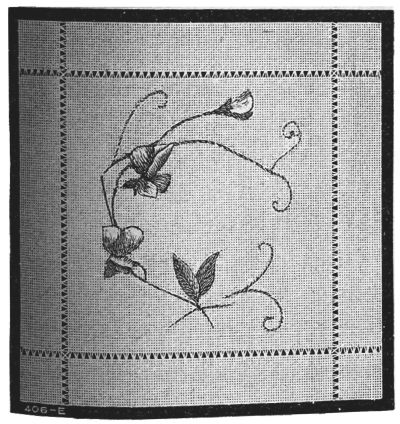
Sweet Pea Design No. 406 E.
These designs are especially adapted for beginners. The 7 and 9 inch
sizes make pretty doilies, and the larger linens work up into very
attractive centerpieces, tray cloths, and bureau scarfs.
Flowers.—Sweet Peas are always difficult owing to the great
variety of shades found in the flower. Begin the edge of the two upper
petals with Corticelli Filo Silk, Pink, 128, shading darker to center
with 129 and 680. For the lower petals use the same shades; at the base work a
few solid stitches of Green, 123 and 124, for calyx. For a purple and yellow
flower begin the edge with Yellow, 501, into which shade Purple, 725, and
near the base, or where the petals meet, use 726.5 and 727. For the turn over
part use 725. The buds should be darker than the open flowers. Carefully
examine Colored Plate XXVII, before beginning to embroider this design.
Leaves.—Work the leaves in 123, 124, 126, shading from light on points to
dark near the center and base of leaf. Work the stems and tendrils in 123,
126, using the former for the ends of tendrils only. (Somewhat Difficult.)
Forget-me-not Design No. 406 F.
Hemstitched Edge.
Materials—12 inch Size: Corticelli Filo Silk, 1 skein each 504, 518, 519, 521, 678,
781, 783. Dealers can furnish stamped and hemstitched linen of this design in 6, 7, 9,
12, 15, 18, and 21 inch sizes. See page 92. They can also furnish
stamped and hemstitched linen for tray cloths and bureau scarfs to
match this design, 18 x 27, 18 x 36, 17 x 54, and 17 x 72 inches. See
page 92.
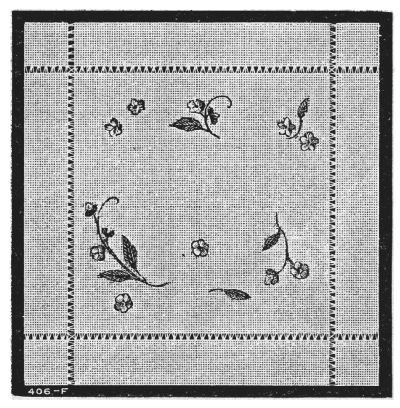
Forget-me-not Design No. 406 F.
These designs are especially adapted for beginners. The 7 and 9 inch
sizes make pretty doilies, and the larger linens work up into very
attractive centerpieces, tray cloths, and bureau scarfs.
Flowers.—Work solid, making each petal of one shade.
Corticelli Filo Silk, Blue, 518, 519, 521, are the forget-me-not
shades. Make an occasional petal in Pink, 678. Put one or two French
knots in the center of every open flower with Yellow, 504. Work the
buds darker than the open flowers. Use Green, 781, for the calyx.
Leaves.—Work solid, beginning the points with 781, shading
darker to midvein with 783. Work the stems in outline stitch with 783.
(Easy.)
The "Queen" Embroidery Hoop.
Most professional needleworkers use a large frame, and work with both
hands. For amateurs a hoop is the next best thing. Mrs. Haywood recommends
the "Queen" hoop. It is, in fact, quite superior to the ordinary
wooden or rubber ones. It is a smooth wooden hoop, true in circle, with
rounded edges; the outer hoop is a stiff spring wire band, interlaced with
braid. This hoop requires no wrapping for either light or heavy material as
the spring band will keep the goods stretched to a uniform tension. It is
made in 4, 5, 6, and 7 inch sizes, and can be had at nearly all dry goods stores.
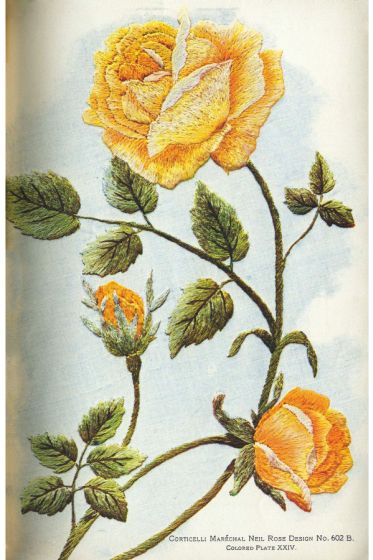
Corticelli Maréchal Neil Rose Design No. 602 B.
Colored Plate XXIV.
Colored Plate XXIV.
By Amalia Smith.
Materials—22 inch Size: Corticelli Filo Silk, 2 skeins each 615, 616, 616.5, 740,
741, 742, 780, 781; 1 skein each 692.8, 743, 743.5, 782, 783, 784. Corticelli Persian
Floss, 6 skeins 615. Smaller pieces take less silk. Dealers can furnish stamped linen
of this design in 18 and 22 inch sizes. See page 92.
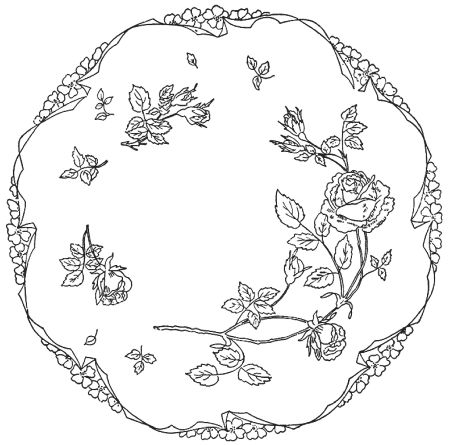
Maréchal Niel Rose Design No. 602 B.
For the more experienced worker this design has many attractions,
and aided by the Colored Plate many who otherwise would be unable
to embroider this rose will find no difficulty in following the
directions. It is as handsome a design as the most ambitious could
desire, affording opportunity for very artistic treatment.
Border.—Work the scallop in buttonhole stitch with Corticelli
Persian Floss, 615. For the flowers in the border choose Corticelli
Filo Silk, 615, shading to center with Green, 692.8. Put a few French
knots of Yellow, 742, in the center. Or work the centers of these
border flowers in Yellow, 740, instead of Green, 692.8, shading outward
with 616.5 and 616.
Large Rose.—Begin the edge of some of the petals with Corticelli Filo
Silk, Yellow, 743.5, shading gradually lighter to 616 at base. The edge of the
other petals can be done with Yellow, 740, shading darker toward base with
741, 742, 743, 743.5. The turn over petals must be raised high by filling in
with long stitches of Corticelli Roman Floss, although darning or embroidery
cotton can be used; over this filling work Filo Silk, Cream White, 616, care
being taken to slant the stitches in almost the opposite direction from those
in the rest of the petal. See Colored Plate XXIV. In working the roses
remember to use the darker shades for the back petals, as well as for the
hollows or deep places and choose the lighter shades for the high-lights or the
raised parts, such as turn over petals and those on the outside.
Buds.—Work solid, using 743.5 for the point of the buds, shading lighter
toward calyx with Yellow, 743, 742. Work the points of calyx with Green,
780, shading darker toward the bulb with 781, 782, 783, 784.
Leaves.—Work solid. For edge of some of the leaves use Green, 781,
shading toward the center with 782, 783. Vein with 784. For the smallest
leaves 780 can be used for the points, shading toward the center with 781,
782, and veining with 783. A study of Colored Plate XXIV will repay one, as
it gives the shading of the leaves as well as of the roses. (Difficult.)
Colored Plate XXVI.
Materials—22 inch Size: Corticelli Filo Silk, 2 skeins each 134, 136, 137; 1 skein
each 105, 140, 534, 561, 645, 646, 647, 656, 779.5, 781, 782, 783, 784. Corticelli
Persian Floss, 8 skeins 781. Smaller sizes take less silk. Dealers can furnish stamped
linen of this design in 9 and 22 inch sizes. See page 92.
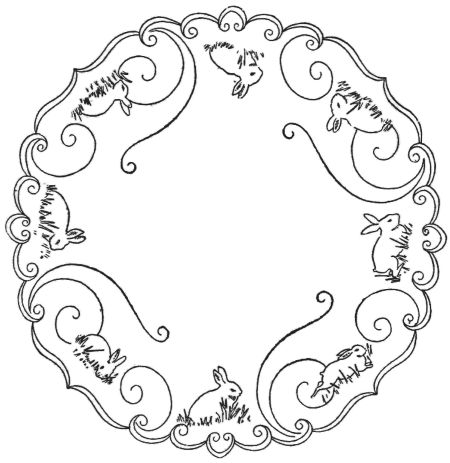
Rabbit Chafing Dish Design No. 53.
Border.—Work the scallop in buttonhole stitch with Corticelli Persian
Floss, Green, 781. See Colored Plate XXVI.
Rabbits.—The rabbits can be worked in outline, or a better
way would be to work them partly solid. These instructions are for
the partly solid work. Begin working all around the rabbits' ears in
long and short stitch with Gray, 134; shade 105 into the gray, and
inside the ear use very light pink, 534. Around the eyes and nose make
irregular stitches with 136, working the eyes solid with Pink, 656.
A few stitches will give expression. Choose 137 for the back of the
rabbit, and, using long and short stitch, slant the stitches a little
toward the tail downward. Now shade lighter to the side, using 136,
134. Begin the under side of the rabbit with 137, and with 136 and 134
shade lighter upward and toward the center in the direction the fur
would seem to take. Shade under the head and bend of the legs with 137.
Care must be taken in working the rabbits to give the right direction
to the stitches, otherwise the effect will not be good. See Colored
Plate XXVI.
Grasses.—Work solid in long and short stitch with Green, 779.5, 781, 782,
783, 784, and Bronze, 561, 140, making each spear of grass of one shade.
Scrolls.—Work in outline stitch with Brown, 645, 646, 647, shading from
light at end to dark at base. (Somewhat Difficult.)

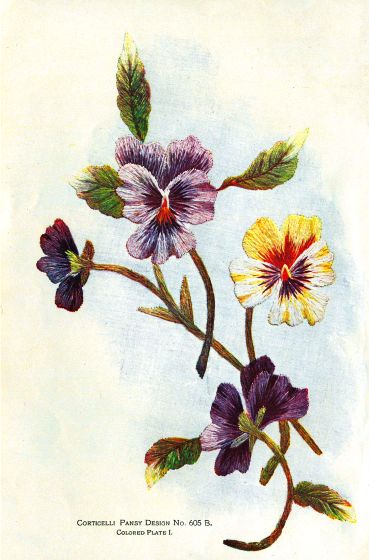

 There is no book
for 1897.
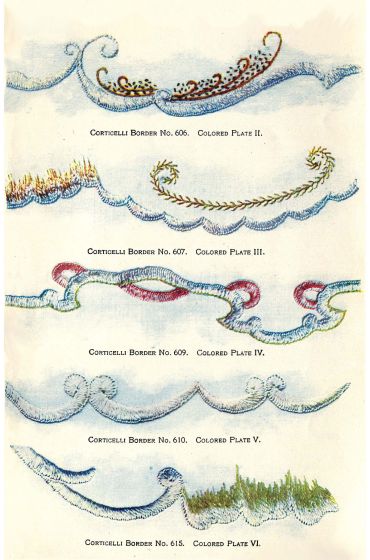









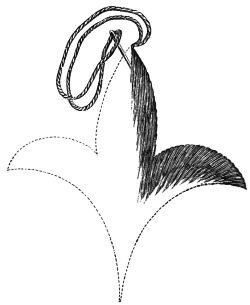
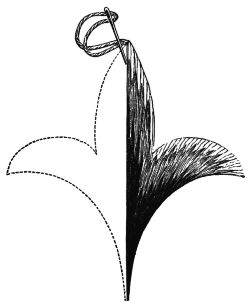
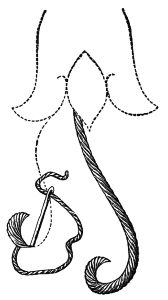
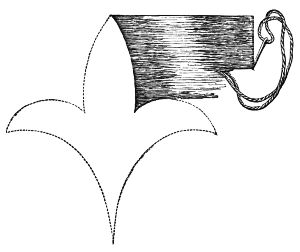
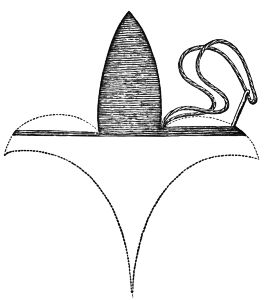
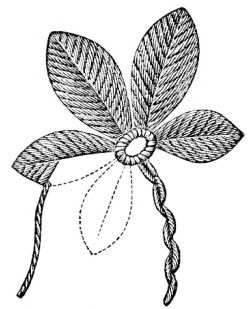
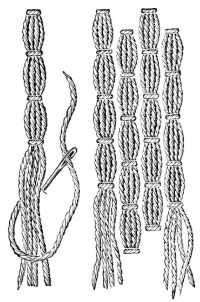
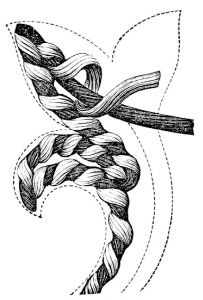
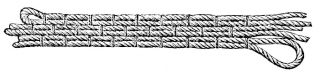
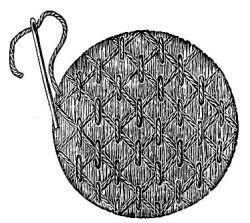
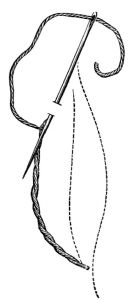
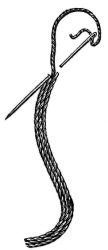
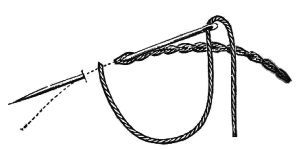
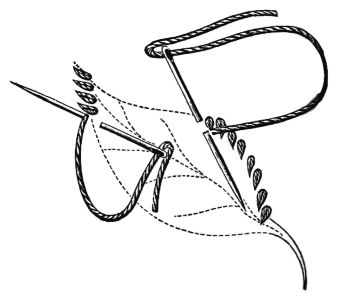
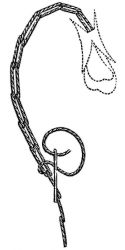
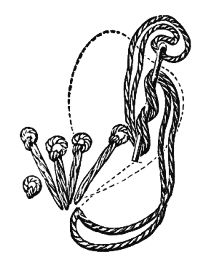
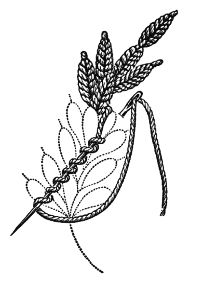
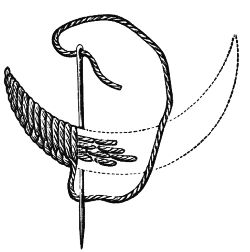
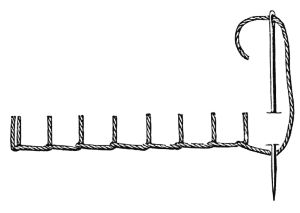
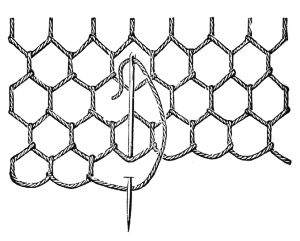
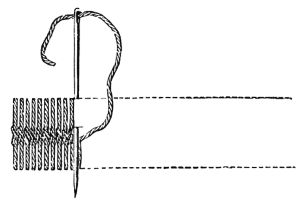
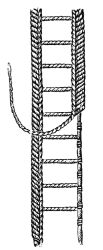
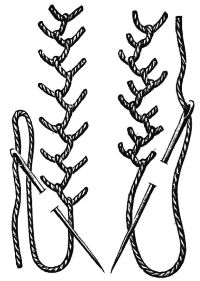
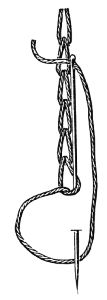
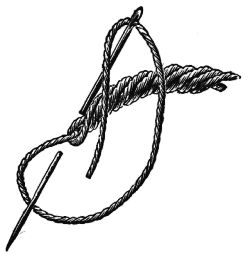
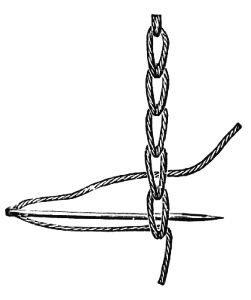
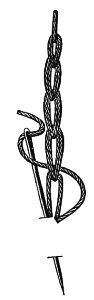
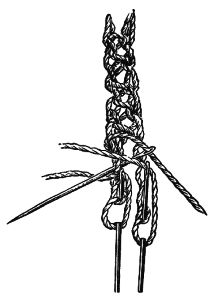
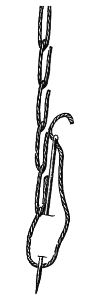
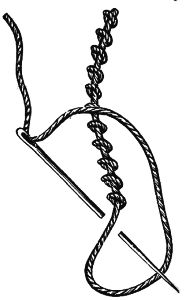
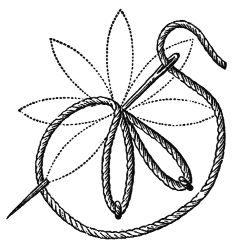
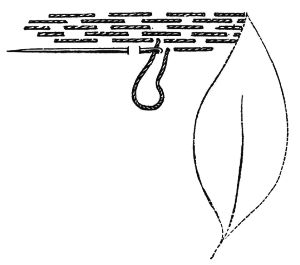
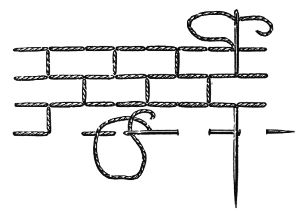
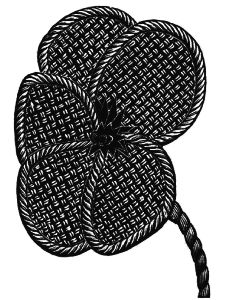
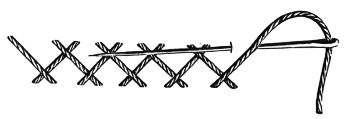
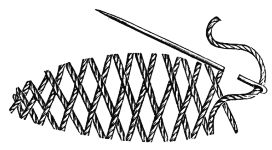
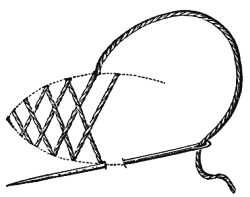
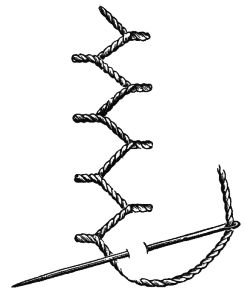
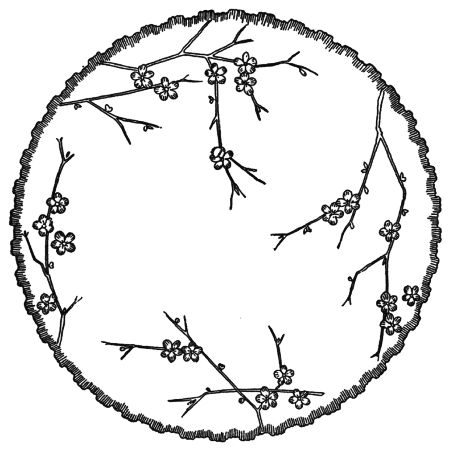
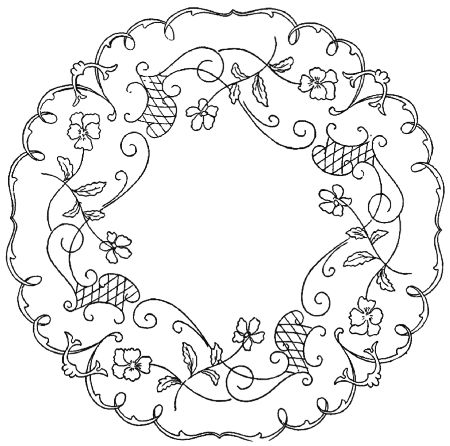
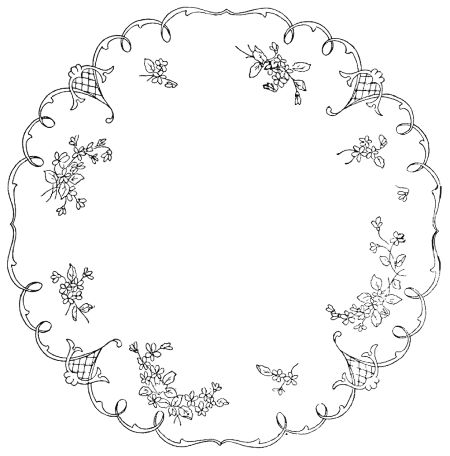
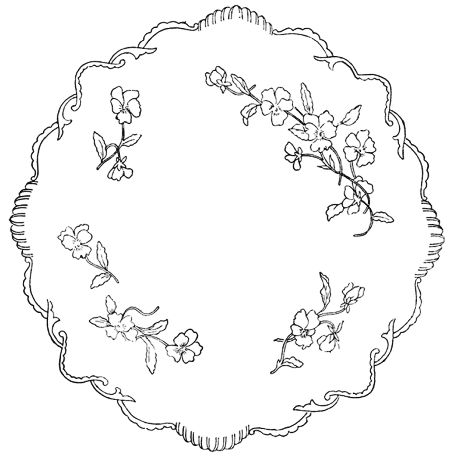
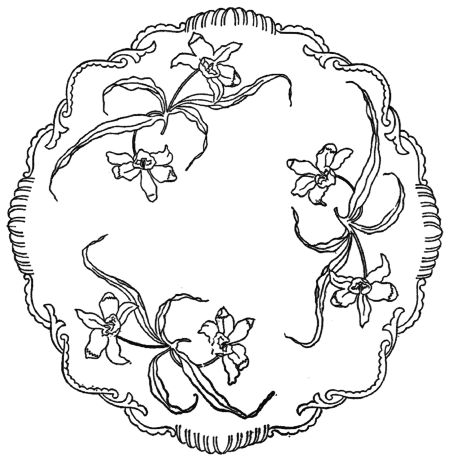
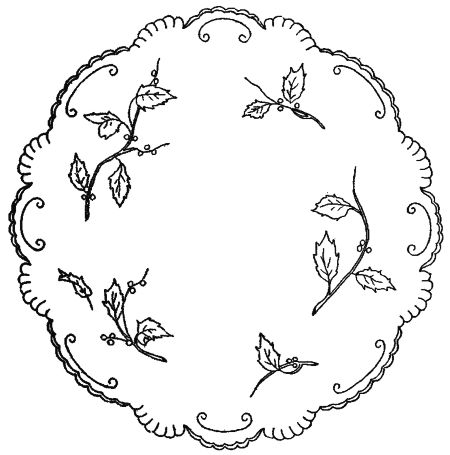
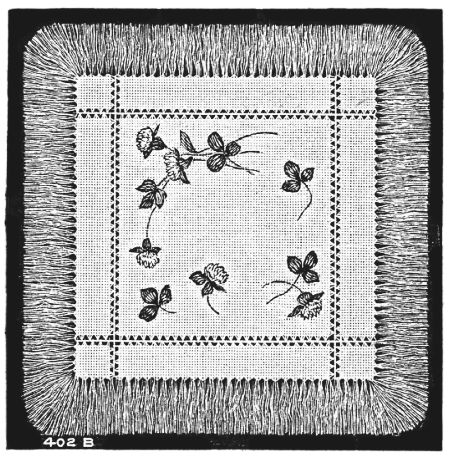
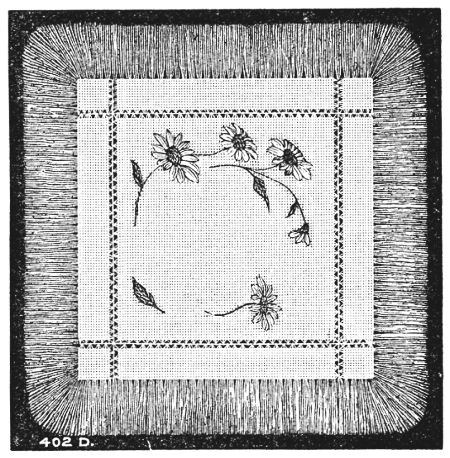
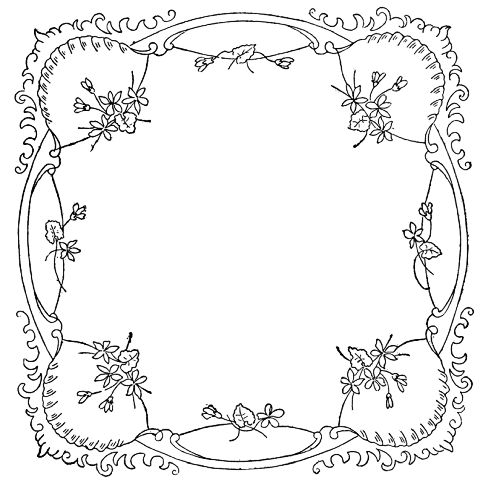
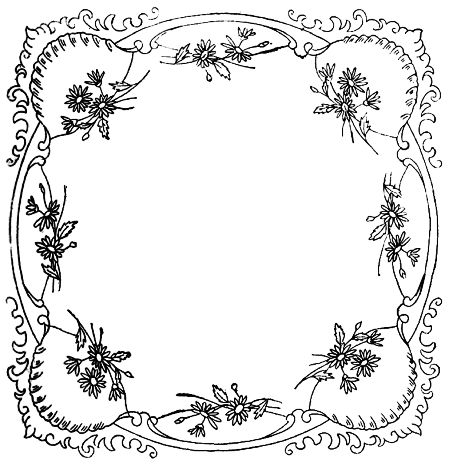
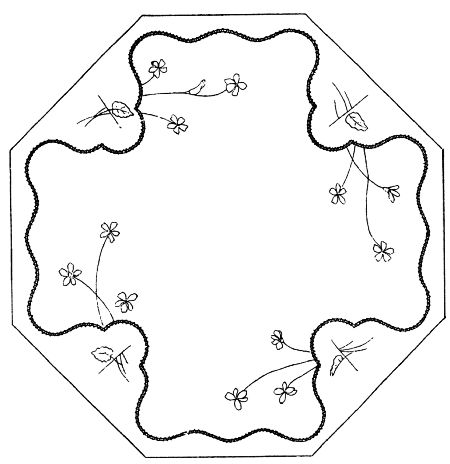
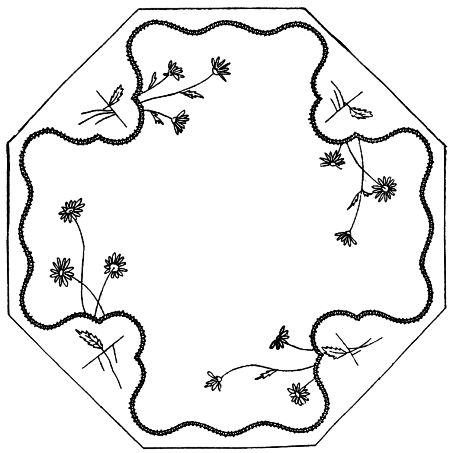
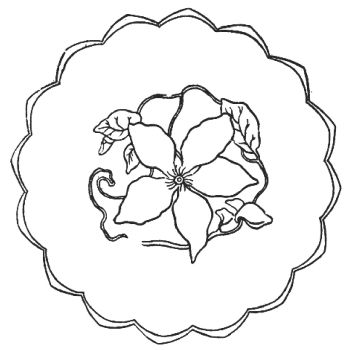
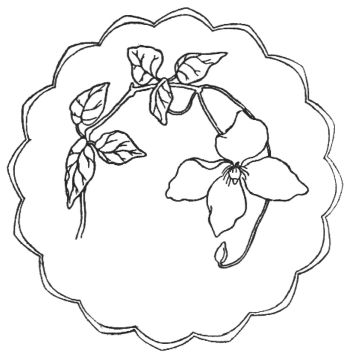
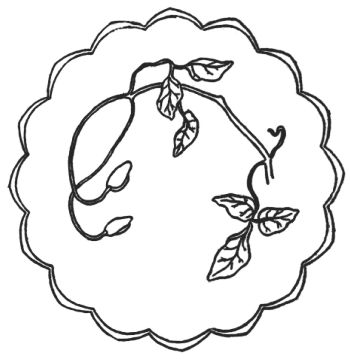
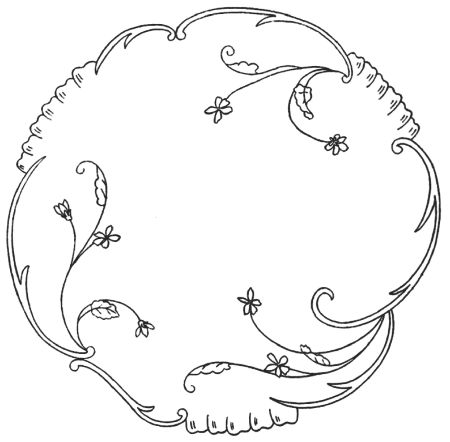
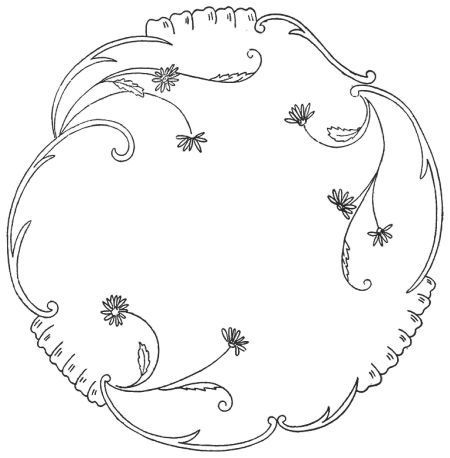
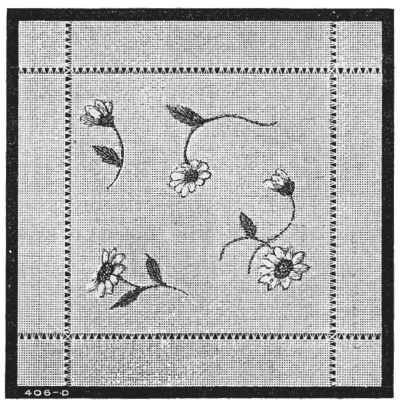
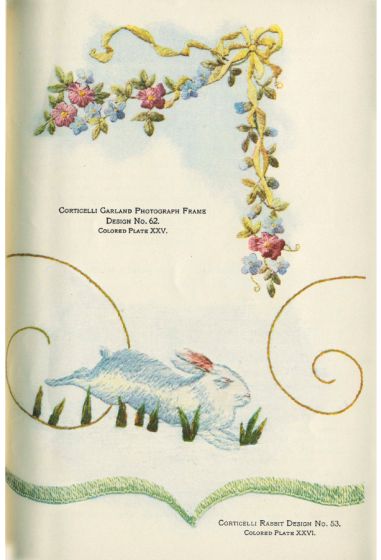
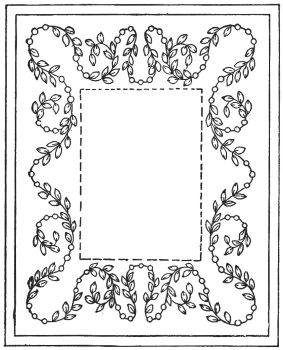
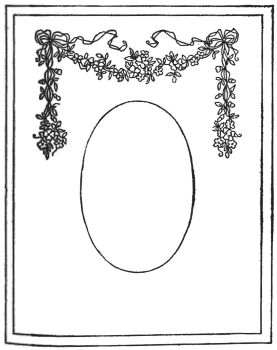
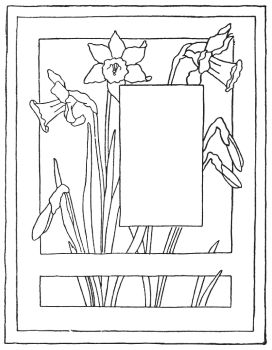
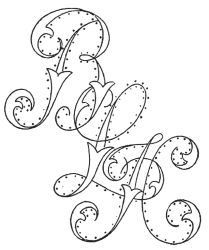
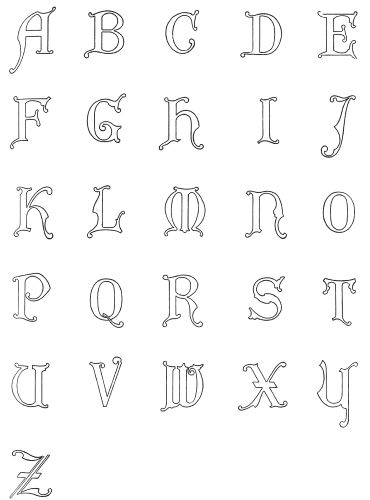
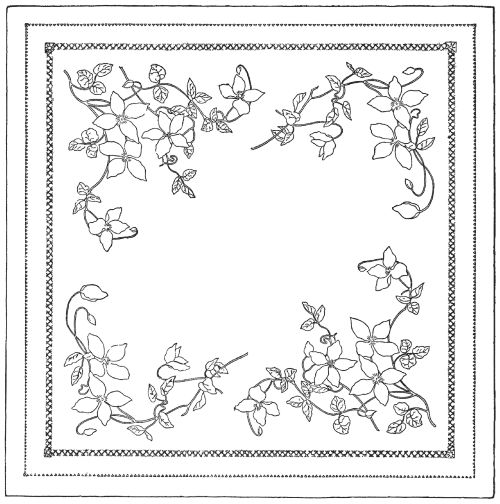
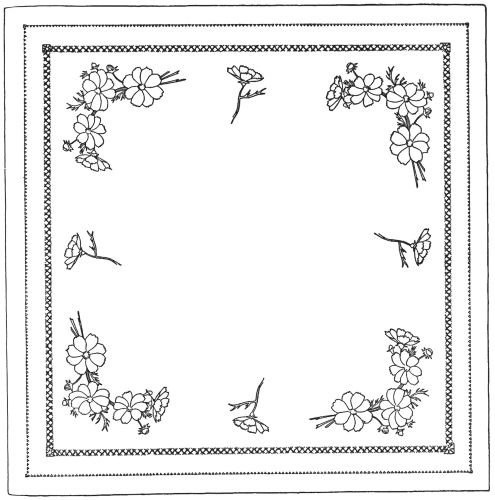
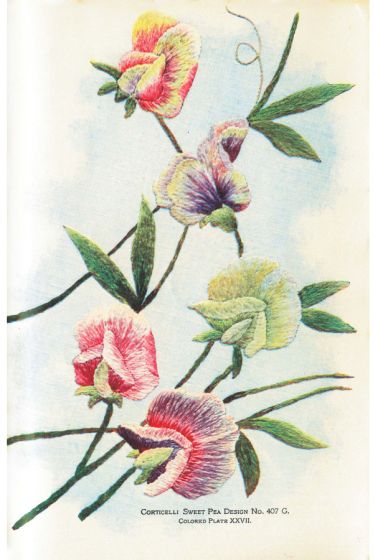
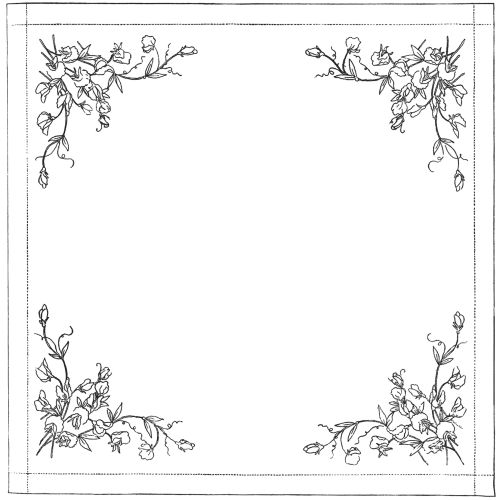
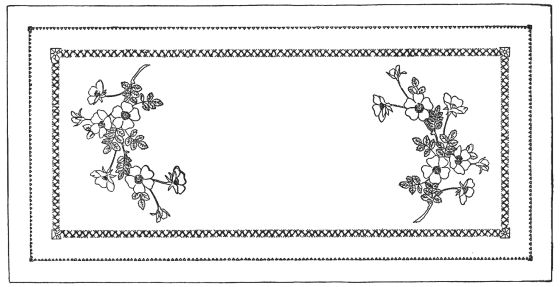
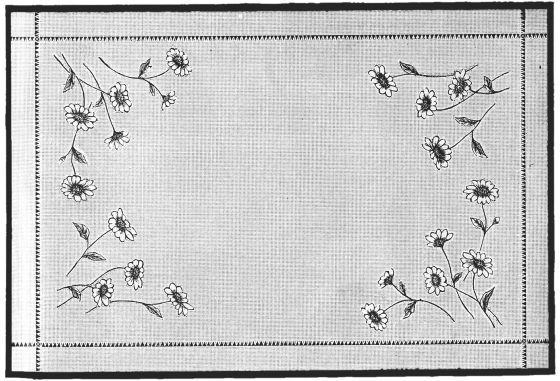
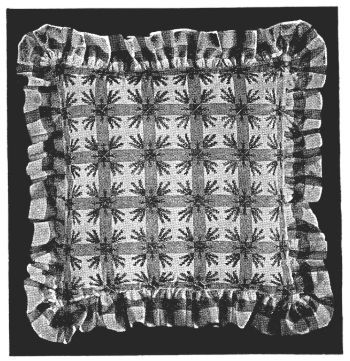
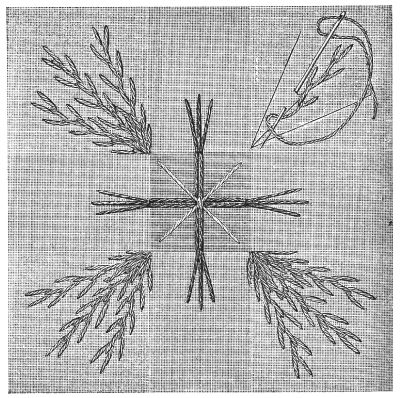
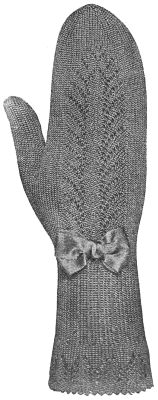
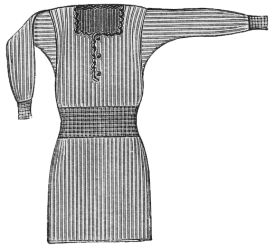
 Send for samples and price list.

 Philadelphia, Pa.