The fossil remains described in the preceding
chapter possess good claims to that most interesting
position, viz. an intermediate one between Mankind
and the more highly-developed of the Apes.
From such remarkable claimants we turn to
consider fossil bones of undoubted human nature.
Of such examples some have been regarded as
differing from all other human types to such an
extent as to justify their segregation in a distinct
species or even genus. Yet even were such separation
fully justified, they are still indubitably human.
In the early phases of the study of prehistoric
archaeology, the distinction of a ‘stone age’ from
those of metals was soon realised. Credit is due
to the present Lord Avebury[9] for the subdivision of
that period into the earlier and later parts known as
the Palaeolithic and Neolithic stages. At first, those
subdivisions possessed no connotation of anatomical
or ethnical significance. But as research progressed,
the existence of a representative human type specially
characteristic of the palaeolithic period passed
from the stage of surmise to that of certainty. Yet,
although characteristic, this type is not the only one
recognisable in those early days.
In the following pages, some account is given
of the most recent discoveries of human remains to
which Palaeolithic antiquity can undoubtedly be
assigned. The very numerous works relating to
prehistoric man are full of discussions of such
specimens as those found in the Neanderthal, at Spy,
Engis, Malarnaud, La Naulette or Denise.
That some of these examples are of great antiquity
is inferred from the circumstances under which they
were discovered. The evidence relates either to their
association with extinct animals such as the Mammoth,
or again the bones may have been found at great
depths from the surface, in strata judged to have
been undisturbed since the remains were deposited.
One of the earliest discoveries was that of the Engis
skull; the differences separating this skull from those
of modern Europeans are so extraordinarily slight
that doubt has been expressed as to the antiquity
assigned to the specimen, and indeed this doubt has
not been finally dispelled. The bones from Denise
(now rehabilitated in respect of their antiquity by
Professor Boule) present similar features. But on
the other hand the jaws found at La Naulette and
Malarnaud suggest the former existence of a lowlier
and more bestial form of humanity. Support is
provided by the famous skull of the Neanderthal, but
in regard to the latter, conclusive evidence (as distinct
from presumption) is unfortunately lacking. Further
confirmation is given by the Forbes Quarry skull
from Gibraltar, but although its resemblance to that
of the Neanderthal was clearly noted by Dr Busk
and Sir William Turner[10] as long ago as 1864, the
specimen was long neglected. In this case, as in that
of the Neanderthal, corroborative evidence as to the
geological or archaeological horizon is lamentably
defective. After a lapse of some twenty years, the
discoveries of human skeletons at Spy in Belgium,
undoubtedly associated as they were with remains of
Mammoth, threw a flood of light on the subject, and
enormously enhanced the significance of the earlier
discoveries. The former existence in Europe of a
human type, different from all other known inhabitants
of that continent, and presenting no small
resemblance to the lowliest modern representatives of
mankind, may be said to have been finally established
by the results of the excavations at Spy. Moreover
the differences thus recognised are such as to lend
strong support to the evolutionary view as to the
origin of the more recent human stocks from an
ancestral series including representatives of a simian
phase. Yet the co-existence of a higher type represented
by the Engis skull must not be overlooked,
nor indeed has this been the case. The significance
of so remarkable a phenomenon is more fully
discussed in the sequel; but no detailed account of
the earlier discoveries need be given. A bibliography
is appended and here references (Hœrnes[44], 1908;
Schwalbe[55]) will be found to the more important
sources of information upon those specimens.
| Locality |
Date |
Literary reference |
Synonyms |
| Taubach |
1895 |
Nehring[11] |
|
| Krapina |
1899 |
Kramberger[12] |
|
| S. Brélade |
1910-11 |
Marett[13] |
|
| La Chapelle aux Saints |
1908 |
MarettBoule[14] |
“Corrèze” |
| Le Moustier |
1908 |
Klaatsch[15] |
“Homo mousterensis hauseri” |
| La Ferrassie |
1909 |
Peyrony[16] |
|
| Pech de l'Aze |
1909 |
Peyrony[16] |
|
| Forbes Quarry |
1848-1909 |
Sollas[17] Sera[18] |
“Gibraltar” |
| Andalusia |
1910 |
Verner[19] |
|
| Grotte des Enfants |
1902-06 |
Verneau[20] |
“Grimaldi” |
| Baradero |
1887 |
(S. Roth) Lehmann-Nitsche (1907)[21] |
|
| Monte Hermoso |
? |
Lehmann-Nitsche (1909)[22] |
Homo neogaeus” |
| Combe Capelle |
1909 |
Klaatsch[23] |
“Homo aurignacensis hauseri” |
| Galley Hill |
1895 |
Newton[24] |
“Homo fossilis” |
In the present instance, an attempt will be made
to provide some account of the most recent advances
gained through the results of excavations carried out
in late years. And herein, prominence will be given
in the first place to such human remains as are
assignable to the lowlier human type represented
previously by the Spy skeletons. Following upon
these, come examples possessing other characters and
therefore not referable to the same type.
The discoveries are commonly designated by the
name of the locality in which they were made. Those
selected for particular mention are enumerated in
the list on p. 20.
Certain specimens discovered at Taubach and first
described in 1895 possess an importance second only
to that of the Mauer jaw and of the Javan bones
found by Professor Dubois. Indeed there would be
justification for associating the three localities in the
present series of descriptions. But upon consideration,
it was decided to bring the Taubach finds into the
present place and group. It may be added that they
are assigned to an epoch not very different from that
represented by the Mauer strata whence the mandible
was obtained.
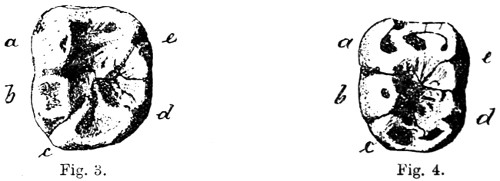
Fig. 3. The grinding surface of the first right lower molar tooth
from Taubach. The letters denote several small prominences
called cusps.
Fig. 4. The grinding surface of the corresponding tooth (cf. Fig. 3)
of a Chimpanzee. (Figs. 3, 4, 5, and 6 are much enlarged.)
The actual material consists only of two human
teeth of the molar series. One is the first lower
‘milk’ molar of the left side. This tooth exceeds
most corresponding modern examples in its dimensions.
In a large collection of modern teeth from
Berlin no example provided dimensions so large.
The surface is more worn than is usual in modern
milk teeth of this kind. The second tooth (Fig. 3)
is the first lower ‘permanent’ molar of the left
side. It bears five cusps. Neither this number of
cusps, nor its absolute dimensions, confer distinction
upon the tooth. Its chief claim to notice is based
upon its relative narrowness from side to side. That
narrowness (proportion of transverse to anteroposterior
diameter), represented by the ratio 84.6:100,
is present in a distinctly unusual and almost simian
degree. In this character the Taubach tooth resembles
the same tooth of the Chimpanzee (Fig. 4), to
which it stands nearer than does the corresponding
tooth of the Mauer jaw. The manner in which the
worn surface of the tooth slopes downwards and
forwards has been claimed as another simian
character. In these respects, the Taubach tooth is
among the most ape-like of human teeth (whether
prehistoric or recent) as yet recorded, and in my
opinion there is some difficulty in deciding whether
this is the tooth of a human being or of a
pithecoid human precursor. There is a very slight
tendency (Figs. 5, 6) to concrescence of the roots,
and these are curiously parallel in direction, when
viewed from the side. In the latter respect no
similarity to the teeth of apes can be recognised.
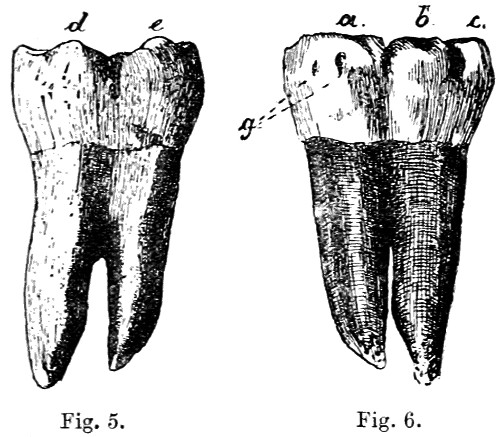
Fig. 5. Inner side of the Taubach tooth.]
Fig. 6. Outer side of the same. (From Nehring.)
Next in order to the discovery of human teeth at
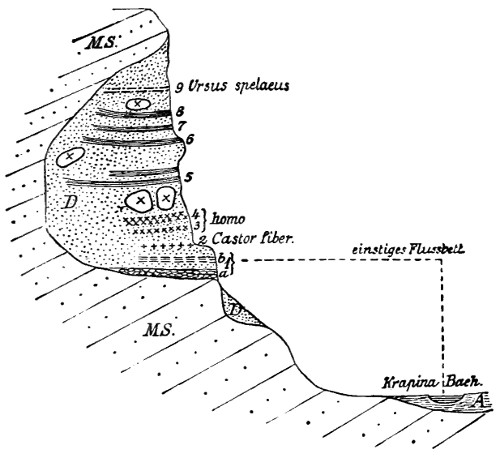
Taubach, the results of excavations in a so-called
‘rock-shelter’ on the bank of the river Krapini[vc]a in
Croatia, call for consideration. Immense numbers
of bones were obtained, and the remains of a large
number of human beings were found to be mingled
with those of various animals. Apart from their
abundance, the fragmentary character of the human
bones is very remarkable. The discovery that one
particular stratum in the cave consisted mainly of
burnt human bones has suggested that some of the
early inhabitants of the Krapina shelter practised
cannibalism.
Indeed this view is definitely adopted by Professor
Kramberger, and he makes the suggestion that
the remains include representatives of those who
practised as well as those who suffered from this
custom. Both young individuals and those of
mature age are represented, but very aged persons
have not been recognised.
Turning to the details of the actual bones, the
conclusion of outstanding interest is the recognition
of further instances of the type of the Neanderthal
and of Spy, the latter discovery being separated by
a lapse of twenty years and more from that at
Krapina. An attempt has been made to reconstruct
one skull, and the result is shewn in Fig. 7, which
provides a view of the specimen in profile. Viewed
from above, the chief character is the width of
the cranial portion, which exceeds very distinctly
in this respect the corresponding diameter in the
more classic examples from the Neanderthal and
Spy. It is very important to note that the brain-case
is thus shewn to be remarkably capacious,
and this is all the more remarkable since the limb-bones
do not denote a very great stature or bulk.
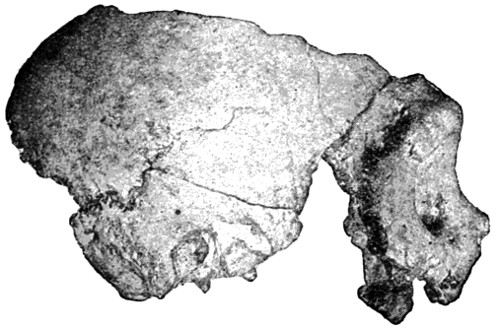
Fig. 7. Profile view of a reconstructed human skull from
Krapina. (From Birkner, after Kramberger.)
Having recently examined the specimens now in
the Museum of Palaeontology at Agram in Croatia,
I venture to add some notes made on that occasion.
The Krapina skull-fragments and the head of a
femur are certainly most impressive. It is shewn
that early palaeolithic man presents examples of
skulls both of brachy-cephalic and dolicho-cephalic
proportions. Variations in the form and arrangement
of the facial bones also occur.
The form and proportions of the brain-case have
been noted already. The profile view (cf. Fig. 7)
shews the distinctive features of the brow region.
The brow-ridges are very large, but they do not
absolutely conform to the conditions presented by
the corresponding parts in the skulls of aboriginal
Australian or Tasmanian natives. The region of the
forehead above the brows is in some instances (but
not in all) flattened or retreating, and this feature
is indicated even in some small fragments by the
oblique direction of the lamina cribrosa of the
ethmoid bone.
Two types of upper jaw are distinguishable:
no specimen projects forwards so far as might be
expected, but the teeth are curiously curved downwards
(as in some crania of aboriginal Australians).
The facial surface of the jaw is not depressed to form
a ‘canine fossa.’ The nasal bones are flattened.
The mandibles present further remarkable characters.
By these again, two types have been rendered
capable of distinction. In their massiveness they are
unsurpassed save by the mandible from Mauer. In
absolute width one specimen actually surpasses the
Mauer jaw, but yet fails to rival that bone in respect
of the great width found to characterise the ascending
ramus in that example. In the Krapina jaws, the
chin is absent or at best feebly developed. In one
specimen the body of the jaw is bent at an angle
between the canine and first premolar tooth, and is
thus reminiscent of the simian jaw. Behind the
incisor teeth the conformation is peculiar, again
suggestive of the arrangement seen in the Mauer
jaw, and differing from that found in more recent
human specimens.
The distinction of two types of lower jaw was made
in the following manner. The bone was placed on a
flat surface. The vertical height of the tooth-bearing
part was measured in two regions, (a) near the front,
(b) further back, and close to the second molar tooth
(cf. Fig. 2f, g). In some of the bones these measurements
are nearly equal, but the hinder one is
always the less. In the instances in which the two
measurements approximate to one another, the
proportion is as 100:92. In other instances the
corresponding proportion differed, the ratio being
about 100:86 or less. The former type is considered
by Professor Kramberger to indicate a special variety
(krapinensis) of the Neanderthal or Homo primigenius
type. The second type is that of the Spy
mandible No. 1. Professor Schwalbe[25] (1906) objects
to the distinction, urging that the indices (92 and 86)
are not sufficiently contrasted. However this may be,
it is noteworthy that other bones shew differences.
Thus the curvature of the forehead is a variable
feature, some skulls having had foreheads much flatter
and more retreating than others. The limb bones
are also called upon to provide evidence. Some of
the arm-bones and thigh-bones are longer and more
slender than others.
How far these differences really penetrated and
whether the thesis of two types can be fully sustained,
does not appear to admit of a final answer.
The view here adopted is that, on the whole, the
distinction will be confirmed. But nevertheless I
am far from supporting in all respects the view of
Professor Klaatsch to whose imagination we owe
the suggestion of realistic tableaux depicting the
murderous conflict of the two tribes at Krapina, the
butchery of one act culminating suitably in a scene
of cannibalism. Nor am I persuaded that either
variety or type found at Krapina can be reasonably
identified with that of the Galley Hill skeleton. But
of these matters further discussion is reserved for
the sequel.
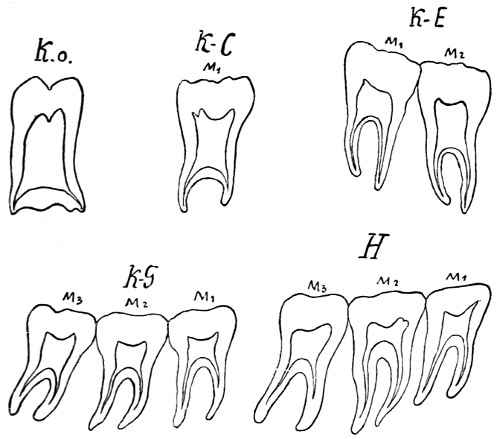
Fig. 8. Tracings (from skiagrams) of various molar teeth. The
specimen K.o. from Krapina shews the conjoined roots characteristic
of teeth found at Krapina, and in Jersey at S. Brélade's Bay.
The large pulp-cavity of the Krapina teeth should be noted. K.o.,
K.C., K.E., K.G., from Krapina; H. Mauer. (From Kramberger.)
This brief sketch of the cranial characters of the
Krapina remains must be supplemented by a note
on the teeth. Great numbers were found, and some
of them are of enormous dimensions, surpassing
those of the Mauer jaw. But some of the molar
teeth are further distinguished in a very remarkable
way, for the roots supporting the crown of the tooth
are conjoined or fused: they are not distinct or
divergent as is usual. The contrast thus provided
by these anomalous teeth is well illustrated in the
accompanying figure (8, Ko). Now such fusion of
roots is not absolutely unknown at the present
day; but the third molar or wisdom tooth is most
frequently affected. The occurrence is extremely
unusual in the other molar teeth of modern men.
Yet among the Krapina teeth, such fusion is striking
both in its degree and in its frequency. So
marked a characteristic has attracted much attention.
Professor Kramberger holds the view that it constituted
a feature of adaptation peculiar to the
Palaeolithic men of Krapina. In opposition to this,
Professor Adloff holds that the character is so
definite and marked as to enter into the category
of distinctive and specific conformations. The discussion
of these views was carried on somewhat
warmly, but yet to some extent fruitlessly so long as
the only known examples were those from Krapina.
Dr Laloy supported Professor Kramberger, and on
the other side may be ranged the support of
Professor Walkhoff. But a recent discovery has very
substantially fortified the view adopted by Professor
Adloff and his supporters. For in a cave near
S. Brélade's Bay in Jersey, the explorations of
Messrs Nicolle, Sinel and Marett (1910-1911) have
brought to light Palaeolithic human teeth of very
similar form. They are said indeed by Dr Keith to
be precisely comparable to those from Krapina. The
conjoined roots of such teeth should be regarded
therefore as more than a peculiarity of the Palaeolithic
men of Croatia, and rather as a very definite
means of assigning to a particular Palaeolithic epoch
any other instances of a similar nature. Space will
not admit of more than a simple record of two
other features of the Krapina teeth. They are
(a) the curvature of the canine teeth and (b) the
remarkable size and extent of the ‘pulp-cavity’
(cf. Fig. 8, Ko) of the molar teeth. In entering
upon so protracted a discussion of this part of the
evidence, the excuse is proffered that, as may be
noted in the instances at Trinil and Taubach, teeth
are remarkably well-fitted for preservation in the
fossil state, since they may be preserved in circumstances
leading to the complete destruction of
other parts of the skeleton.
The limb bones of the Krapina skeletons are
chiefly remarkable for the variety they present.
Some are short and stout, of almost pygmy proportions:
others are long and slender, inappropriate
in these respects to the massive skull fragments
which predominate. The distinction of two human
types upon evidence furnished by the limb bones has
already been mentioned.
A cave in this locality has been explored during
the last two years (1910, 1911). Human remains are
represented by the teeth already mentioned on account
of their resemblance to those found at Krapina. The
resemblance depends primarily upon the curious
fusion of the roots in the molar teeth. Moreover, the
circumference of the combined and thickened roots is
so great as to confer a most remarkable ‘columnar’
appearance on the affected teeth (cf. fig. 8, K.o.). The
teeth from Krapina and Jersey while thus associated
must be contrasted with some specimens which they
resemble in other respects. The corresponding teeth
in the Mauer jaw have been described as similar to
those from Krapina, but I cannot confirm this from
Dr Schoetensack's illustrations, of which fig. 8 (H) is
a fair representation. The teeth of the Forbes Quarry
and Le Moustier specimens do not conform to the
precise requirements of the test. The Spy teeth are
said to have three distinct roots save in two cases,
where the numbers are four and two respectively. The
test of combined molar roots therefore provides
a means of subdividing a group of examples otherwise
similar, rather than a mark of recognition
applicable to all alike.
The S. Brélade teeth also resemble those from
Krapina in the proportions of their crowns and the
unusually large size of the pulp-cavity. The latter
character may prove more important than the fusion
of the roots. But the evidence of their surroundings
assigns the teeth from Jersey to an epoch less ancient
than that of the Krapina men.
The human skeleton from La Chapelle-aux-Saints
holds a very distinguished position among its congeners.
In the first place, the discovery was
not haphazard, but made by two very competent
observers during their excavations. Again, the
remains comprise not only the nearly intact brain-case,
but much of the facial part of the skull,
together with the lower jaw and many bones of the
trunk and limbs. The individual was a male of
mature age, but not senile (Manouvrier). For these
reasons, the value of this skeleton in evidence is
singularly great.
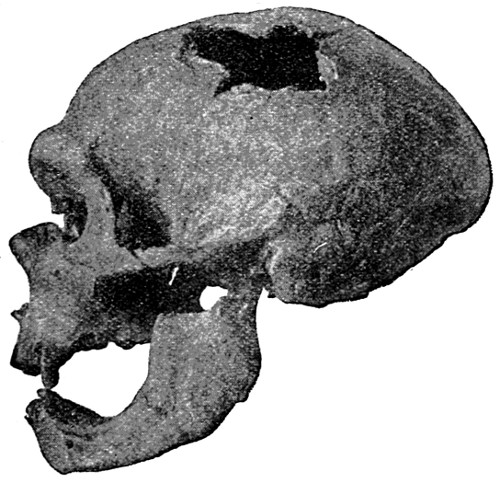
Fig. 9. Profile view of the skull from La Chapelle-aux-Saints
(Corrèze). (From Birkner, after Boule.)
Speaking generally, the specimen is found to
resemble very closely the Neanderthal skeleton in
practically every structure and feature common to
the two individuals. This correspondence is confirmatory
therefore of the view which assigns great
antiquity to the Neanderthal man, and in addition
to this, further support is given to the recognition
of these examples (together with those from Spy and
Krapina) as representatives of a widely distributed
type. It is increasingly difficult to claim them as
individual variations which have been preserved
fortuitously.
Beyond these inferences, the skeleton from La
Chapelle adds very greatly to the sum total of our
knowledge of the structural details of these skeletons.
For here the facial bones are well preserved. Before
proceeding to their consideration reference should
be made to the side view of the skull (Fig. 9), as
well as to the tracings of the brain-case brought
into comparison with those provided by the Neanderthal
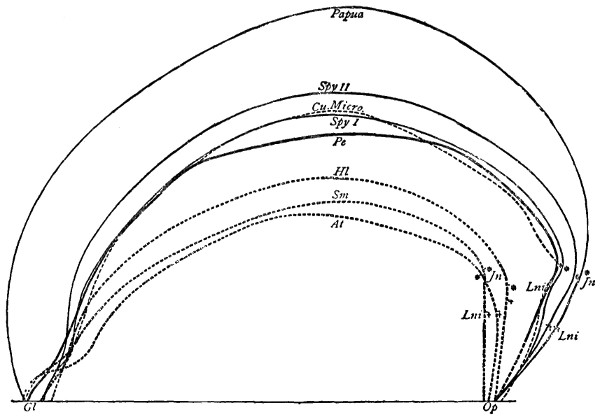
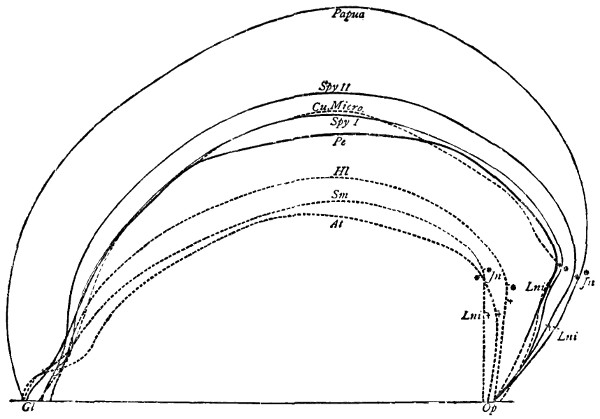
and Spy crania. In the case of one illustration
of those tracings (Fig. 10) it must be remarked
that objection is taken by Professor Klaatsch to
the base-line selected, though in this particular
instance, that objection has less weight than in
others.
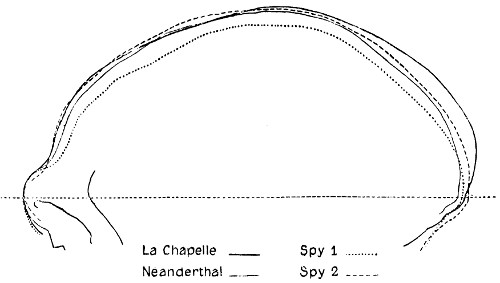
Fig. 10. Outline tracings (cf. Fig. 1) of various human skulls of the
Palaeolithic Age. (From Boule.)
Turning to the facial parts of the skull, the brows
will be seen to overhang the face less than in many
crania of aboriginal Australians. Prognathism, i.e.
projection of the jaws (Fig. 11), though distinct, is less
pronounced than might be expected. Hereby the
reconstruction of the facial parts of the Neanderthal
skull, as prepared by Professor Klaatsch, is shewn
to be much exaggerated. The skeleton of the
nose reveals some simian traits, and on either
side, the canine fossa (below the eye) is shallow or
non-existent. A good deal of stress has been laid on
this character, perhaps more than is justifiable. Yet
it is quite uncommon in this degree among modern
European crania, though alleged by Giuffrida Ruggeri
to characterise certain skulls from the Far East. The
reconstructed skull contains teeth which are large
and in the incisor region (i.e. in front) are much curved
downwards in the direction of their length. But this,
though probably correct, is yet a matter of inference,
for only a couple of teeth (the second premolars
of the left side) were found in situ. And so far no
detailed description of these teeth has appeared.
The mandible is of extraordinary dimensions; very
widely separated ‘ascending rami’ converge to the
massive body of the jaw. The sigmoid notch is almost
as shallow as in the Mauer jaw. The chin is retreating
or absent.
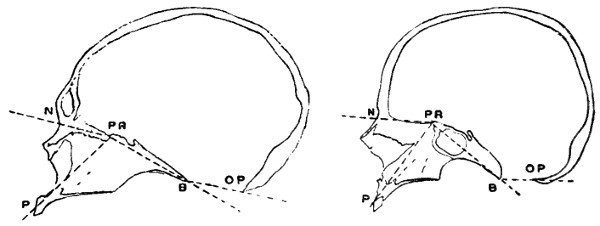
Fig. 11. Contours of two skulls, A of a New Guinea man; B of an
European woman. The angle B.PR.P measures the degree of
prognathism, and in this respect, the two specimens are strongly
contrasted. (From specimens in the Cambridge Museum.)
Such are the more easily recognisable features of
the skull. It will be understood that many more
details remain for discussion. But within the allotted
space, two only can be dealt with. The capacity of
the brain-case is surprisingly large, for it is estimated
at 1600 cubic centimetres: from this figure (which
will be the subject of further discussion in the sequel)
it appears that the man of La Chapelle was amply
provided with cerebral material for all ordinary needs
as judged even by modern standards. In the second
place, MM. Boule and Anthony, not content with a
mere estimate of capacity, have published an elaborate
account of the form of the brain as revealed by a cast
of the interior of the brain-case. As the main result
of their investigations, they are enabled to record a list
of characters indicative of a comparatively lowly status
as regards the form of the brain, although in actual
size it leaves little to be desired.
The principal points of interest in the remainder
of the skeleton refer in the first instance to the
estimate of stature and the evidence provided as to
the natural pose and attitude of the individual. Using
Professor Pearson's table, I estimate the stature as
being from 1600 to 1620 mm. (5ft. 3in. or 5ft. 4in.), a
result almost identical with the estimate given for the
Neanderthal man. In both, the limb bones are
relatively thick and massive, and by the curvature of
the thigh-bones and of the upper parts of the shin-bones,
a suggestion is given of the peculiar gait
described by Professor Manouvrier as ‘la marche en
flexion’; the distinctive feature consists in an incompleteness
of the straightening of the knee-joint
as the limb is swung forwards between successive
steps.
The bones of the foot are not lacking in interest,
and, in particular, that called astragalus is provided
with an unusually extensive joint-surface on its outer
aspect. In this respect it becomes liable to comparison
with the corresponding bone in the feet of
climbing animals, whether simian or other.
That these features of the bone in question are
not peculiar to the skeleton from La Chapelle, is
shewn by their occurrence in bones of corresponding
antiquity from La Quina (Martin, 1911) and (it is
also said) from La Ferrassie (Boule, L'Anthropologie,
Mai-Juin, 1911).
This skeleton was discovered in the lower rock-shelter
of Le Moustier (Dordogne, France) in the
course of excavations carried out by Professor
Hauser (of Swiss nationality) during the year 1908.
The final removal of the bones was conducted in
the presence of a number of German archaeologists
expressly invited to attend. The omission to
inform or invite any French archaeologists, and the
immediate removal of the bones to Breslau, are
regrettable incidents which cast a shadow quite
unnecessarily on an event of great archaeological
interest. By a curious coincidence this took place a
few days after the discovery of the human skeleton of
La Chapelle (v. supra). The two finds are very
fortunately complementary to each other in several
respects, for the Dordogne skeleton is that of a youth,
whereas the individual of La Chapelle was fully
mature. In their main characters, the two skeletons
are very similar, so that in the present account it will
be necessary only to mention the more important
features revealed by the study of the Dordogne
specimen. Outline drawings of the two skulls are
compared with the corresponding contour of the
Neanderthal calvaria by Klaatsch.
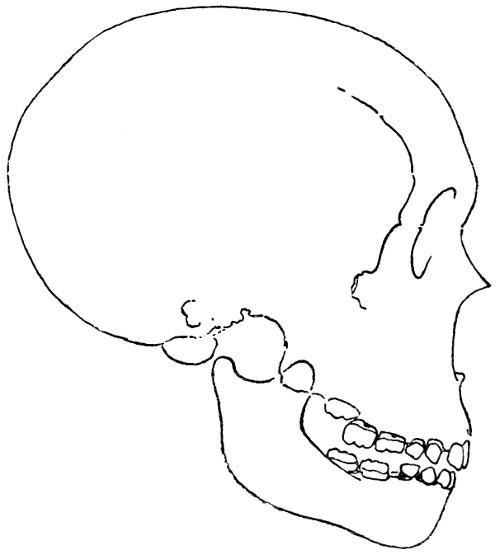
Fig. 12. Outline tracing of a cast of the Moustier skull (Dordogne).
(From a specimen in the Cambridge Museum.)
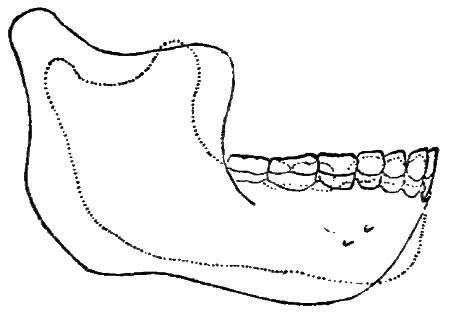
Fig. 13. Tracings from casts (in the Cambridge Museum) of the
jaw-bone from Mauer and of that of the Moustier skeleton.
The Mauer jaw is indicated by the continuous line.
In the Dordogne youth the bones were far more
fragile than in the older man from La Chapelle.
Nevertheless, photographs taken while the bones
were still in situ but uncovered, provide a means of
realising many features of interest. Moreover although
the face in particular was greatly damaged, yet the
teeth are perfectly preserved, and were replaced in
the reconstructed skull of which a representation
is shewn in Fig. 12. This reconstruction cannot
however be described as a happy result of the
great labour bestowed upon it. In particular it is
almost certain that the skull is now more prognathous
than in its natural state. Apart from such drawbacks
the value of the specimen is very great, and this is
especially the case in regard to the teeth and the
lower jaw. The former are remarkably large, and
they agree herein with the teeth from Krapina
(though their roots are distinct and not conjoined as
in the Krapina examples). In respect of size, the
teeth of the Dordogne individual surpass those of the
Mauer jaw, but the first lower molar has proportions
similar to the corresponding tooth of that specimen.
But, large as they are, the lower teeth are implanted
in a mandible falling far short of the Mauer jaw in
respect of size and weight (Fig. 13). In fact one of
the great characteristics of the Dordogne skeleton
is the inadequacy of the mandible when compared
to the remainder of the skull, even though allowance
is made for the youth of the individual. Were it
not that the facts are beyond dispute, it is difficult to
imagine that such a mandible could be associated
with so large and capacious a cranium. And yet the
jaw is not devoid of points in which it resembles
the Mauer bone, in spite of its much smaller bulk.
Thus the chin is defective, the lower border undulating,
and the ascending branch is wide in proportion to its
height. A good idea of these features is provided by
the illustration of the side-view (cf. Fig. 14) given by
Professor Frizzi. Seen from above, the contour is
in close agreement with that of several well-known
examples, such as the jaws from Spy (cf. Fig. 15)
and Krapina.
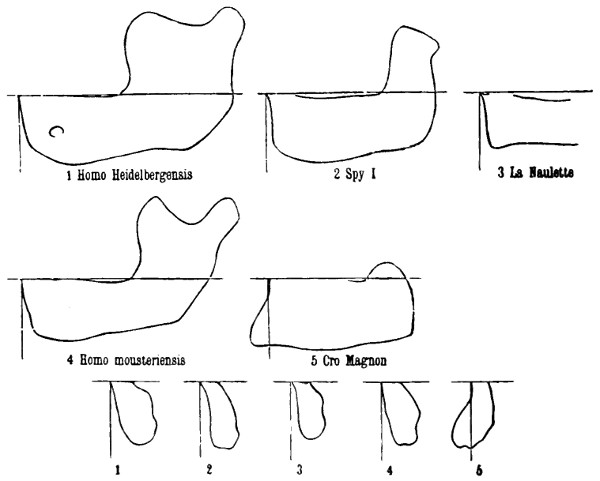
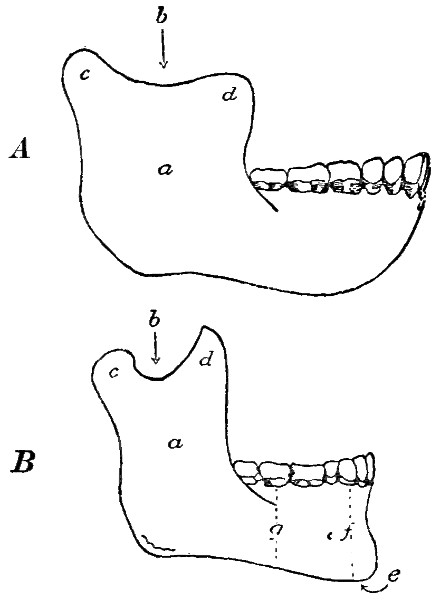
Fig. 14. Outline tracings of jaw-bones. In the lower row, sections
are represented as made vertically in the median plane through
the chin, which is either receding or prominent. In this series,
the numbers refer to those given in the upper set. (From Frizzi.)
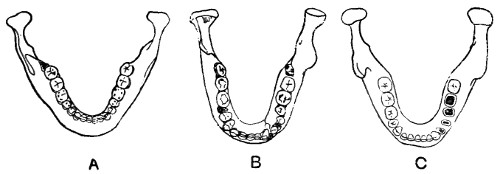
Fig. 15. Outline tracings of jaw-bones viewed from above. A an
ancient Briton (cf. Fig. 2, B). B Moustier. C Mauer. (B and
C are from casts in the Cambridge Museum.)
The limb bones agree in general appearance with
those of the skeletons of the Neanderthal and La
Chapelle. Though absolutely smaller than in those
examples, they are yet similar in regard to their
stoutness. The femur is short and curved, and the
articular ends are disproportionately large as judged
by modern standards. The tibia is prismatic, resembling
herein the corresponding bone in the Spy
skeleton. It is not flattened or sabre-like, as in certain
other prehistoric skeletons.
Another point of interest derived from the study
of the limb bones is the stature they indicate.
Having regard to all the bones available, a mean
value of about 1500 mm. (about 4 ft. 11 in.) is thus
inferred. Yet the youth was certainly 16 years
of age and might have been as much as 19 years.
The comparison of stature with that of the other
examples described is given in a later chapter.
At present, it is important to remark that in
view of this determination (of 4 ft. 11 in.) and even
when allowance is made for further growth in stature
the large size of the skull must be regarded as very
extraordinary indeed. A similar remark applies to
the estimate of the capacity of the brain-case. A
moderate estimate gives 1600 c.c. as the capacity of
the brain-case (practically identical with that of the
La Chapelle skull). In modern Europeans of about
5 ft. 6 in., this high figure would not cause surprise.
In a modern European of the same stature as the
Dordogne man (4 ft. 11 in.), so capacious a brain-case
would be regarded if not as a pathological anomaly,
yet certainly as the extreme upper limit of normal
variation. Without insisting further on this paradoxical
result (which is partly due to defective
observations), it will suffice to remark that early
Palaeolithic man was furnished with a very adequate
quantity of brain-material, whatever its quality may
have been. In regard to the amount, no symptom or
sign of an inferior evolutionary status can be detected.
This discovery was made in a rock-shelter during
its excavation in the autumn of 1909 by M. Peyrony.
A human skeleton was found in the floor of the
grotto, and below strata characterised by Mousterian
implements. The bones were excessively
fragile, and though the greatest care was taken in
their removal, the skull on arrival at Paris was in a
condition described by Professor Boule (L'Anthropologie,
1911, p. 118) as ‘très brisée.’ No detailed
account has yet appeared, though even in its fragmentary
condition, the specimen is sure to provide
valuable information. From the photographs taken
while the skeleton lay in situ after its exposure, it is
difficult to arrive at a definite conclusion as to its
characters. But in regard to these, some resemblance
at least (in the jaws) to the Neanderthal type can be
detected.
M. Peyrony found also in the same year and in
the same region (at Le Pech de l'Aze) the cranium
of a child, assignable to the same epoch as the
skeleton of La Ferrassie. But so far no further
details have been published.
The human skull thus designated was found in
the year 1848. It was, so to speak, rediscovered by
Messrs Busk and Falconer. The former authority
described the specimen in 1864, but this description
is only known from an abstract in the Reports
of the British Association. Broca published an
account of the osteological characters a few years
later. After 1882, the skull again fell into obscurity
for some twenty years: thereafter it attracted the
attention of Dr Macnamara, Professor Schwalbe, and
above all of Professor Sollas, who published the first
detailed and critical account in 1907. This has
stimulated yet other researches, particularly those of
Professor Sera (of Florence) in 1909, and the literature
thus growing up bids fair to rival that of the
Neanderthal skeleton. A most important feature of
the specimen consists in the fact that the bones
of the face have remained intact and in connection
with the skull. But the mandible is wanting, and
the molar teeth of the upper set are absent.
As may be gathered from the tracing published
by Dr Sera (cf. Fig. 16) the upper part of the brain-case
is imperfect. Nevertheless the contour has
been restored, and the Neanderthal-like features of
distinct brow-ridges, followed by a low flattened
cranial curve, are recognisable at once. The facial
profile is almost complete, and in this respect the
Forbes Quarry skull stood alone until the discovery
of the specimen from La Chapelle. Since that
incident, this distinction is not absolute, but the
Forbes Quarry skull is still unique amidst the other
fossils in respect of the bones forming what is called
the cranial base. In no other specimen hitherto
found, are these bones so complete, or so well preserved
in their natural position.
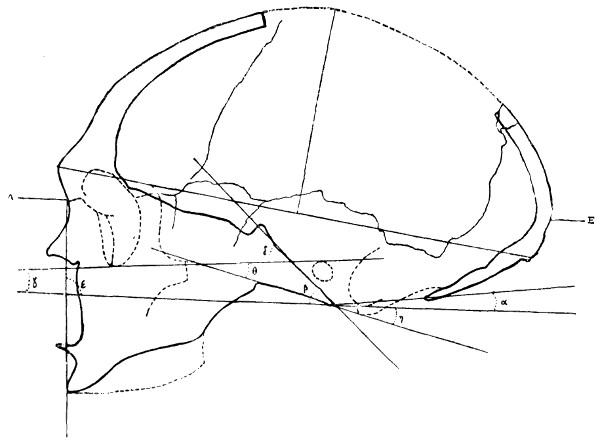
Fig. 16. Outline tracing and sectional view of the Gibraltar (Forbes Quarry) skull.
The various angles are used for comparative purposes. (From Sera.)
The Forbes Quarry skull is clearly of Neanderthaloid
type as regards the formation of the brain-case;
in respect of the face it resembles in general the skull
from La Chapelle. But in respect of the estimated
capacity of the brain-case (estimated at 1100 c.c.),
the Forbes Quarry skull falls far short of both those
other examples. Moreover the cranial base assigns
to it an extremely lowly position. The individual
is supposed by some to have been of the female sex,
but there is no great certainty about this surmise.
The enormous size of the eye-cavities and of the
opening of the nose confer a very peculiar appearance
upon the face, and are best seen in the full-face view.
Some other features of the skull will be considered
in the concluding chapter, when its relation to skulls
of the Neanderthal type will be discussed in detail.
In 1910, Colonel Willoughby Verner discovered
several fragments of a human skeleton in a cave in
the Serranía de Ronda. These fragments have been
presented to the Hunterian Museum. They seem to
be absolutely mineralised. Though imperfect, they
indicate that their possessor was adult and of pygmy
stature. The thigh-bone in particular is of interest, for
an upper fragment presents a curious conformation of
the rounded prominence called the greater trochanter.
In this feature, and in regard to the small size of the
head of the bone, the femur is found to differ from
most other ancient fossil thigh-bones, and from those
of modern human beings, with the exception of some
pygmy types, viz. the dwarf-like cave-dwellers of
Aurignac (compared by Pruner-Bey in 1868 to the
Bushmen), the aborigines of the Andaman islands,
and the aboriginal Bushmen of South Africa. A full
description of the bones has not been published, but
will probably appear very shortly.
Among the numerous human skeletons yielded by
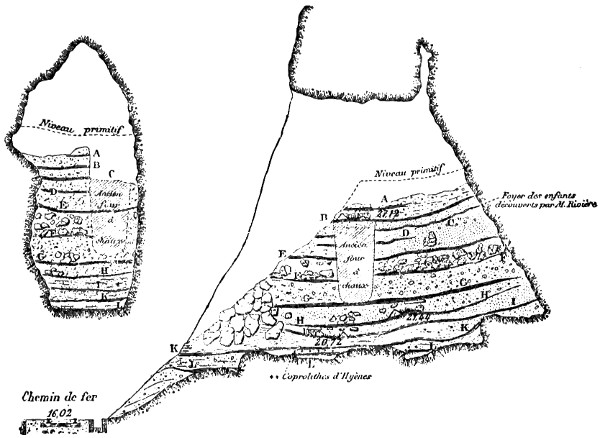
the caves of Mentone, two were discovered at a great
depth in a cave known as the ‘Grotte des Enfants.’
The excavations were set on foot by the Prince of
Monaco, and these particular skeletons have been
designated the ‘Grimaldi’ remains.
Their chief interest (apart from the evidence as
to a definite interment having taken place) consists
in the alleged presence of ‘negroid’ characters. The
skeletons are those of a young man (cf. Fig. 17),
and an aged woman. The late Professor Gaudry
examined the jaw of the male skeleton. He noted the
large dimensions of the teeth, the prognathism, the
feeble development of the chin, and upon such
grounds pointed out the similarity of this jaw to
those of aboriginal natives of Australia. Some years
later Dr Verneau, in describing the same remains,
based a claim to (African) negroid affinity on those
characters, adding thereto evidence drawn from a
study of the limb bones. In both male and female
alike, the lower limbs are long and slender, while the
forearm and shin-bones are relatively long when
compared respectively with the arm and the thigh-bones.
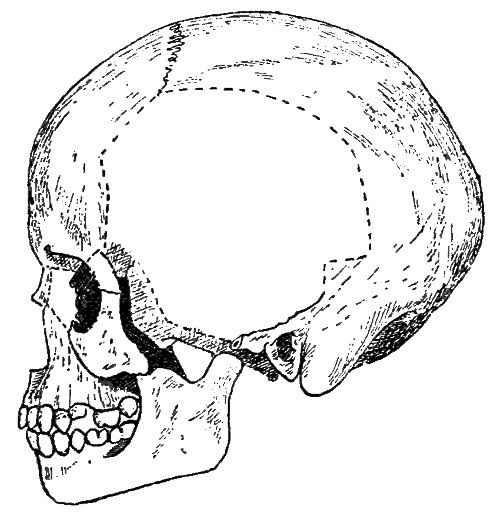
Fig. 17. Profile view of young male skull of the type designated
that of ‘Grimaldi,’ and alleged to present ‘negroid’ features.
Locality. Deeper strata in the Grotte des Enfants, Mentone.
(From Birkner, after Verneau, modified.)
From a review of the evidence it seems that the
term ‘negroid’ is scarcely justified, and there is no
doubt that the Grimaldi skeletons could be matched
without difficulty by skeletons of even recent date.
Herein they are strongly contrasted with skeletons
of the Neanderthal group. And although modern
Europeans undoubtedly may possess any of the
osteological characters claimed as ‘negroid’ by Dr
Verneau, nevertheless the African negro races possess
those characters more frequently and more markedly.
Caution in accepting the designation ‘negroid’ is
therefore based upon reluctance to allow positive
evidence from two or three characters to outweigh
numerous negative indications; and besides this
consideration, it will be admitted that two specimens
provide but a feeble basis for supporting the superstructure
thus laid on their characters. Lastly Dr
Verneau has been at some pains to shew that skulls
of the ‘Grimaldi-negroid’ type persist in modern times.
Yet the possessors of many and probably most such
modern crania were white men and not negroes.
Enough has however been related to shew how
widely the skeletons from the ‘Grotte des Enfants’
differ from the Palaeolithic remains associated as the
Neanderthal type.
South America. With the exception of Pithecanthropus,
all the discoveries mentioned in the
foregoing paragraphs were made in Europe. From
other parts of the world, actual human remains
referable to earlier geological epochs are scanty save
in South America. The discoveries made in this
part of the New World have been described at great
length. In many instances, claims to extraordinary
antiquity have been made on their behalf. It is
necessary therefore to examine the credentials of
such specimens. Upon an examination of the evidence,
I have come to the conclusion that two instances
only deserve serious attention and criticism.
Fragmentary remains of a human skeleton: the
mandible is the best preserved portion; unfortunately
the front part has been broken off so that no
conclusion can be formed as to the characters of
the chin. Otherwise in regard to its proportions,
some resemblance is found with the mandible of the
Spy skull (No. 1). More important and definite is
the direction of the grinding surfaces of the molar
teeth. In the lower jaw, this surface is said to look
forwards. The interest of this observation consists
in the fact that the tooth from Taubach presents the
same feature, which is unusual.
Beyond these, the skeleton from the löss of
Baradero presents no distinctive features save the
remarkable length of the upper limbs.
From this region two bones were obtained at
different dates. These are an atlas vertebra (the
vertebra next to the skull) and a thigh-bone. The
latter is of less than pygmy dimensions. Both are
from fully adult skeletons.
An attempt has been made to reconstruct an
individual (the Tetraprothomo of Ameghino) to which
the two bones should be referred. It will be noticed
that the circumstances bear some, although a very
faint, analogy to those in which the remains of
Pithecanthropus were found. The results are however
extraordinarily different. Professor Branco has
ably shewn that in the case of the bones from
Monte Hermoso, the association in one and the
same skeleton would provide so large a skull in
proportion to the rest of the body, that the result
becomes not only improbable, but impossible. It is
therefore necessary to treat the bones separately. If
this is done, there is no reason to regard the thigh-bone
as other than that of a large monkey of one of
the varieties known to have inhabited South America
in prehistoric as well as in recent times.
The vertebra is more interesting. It is small but
thick and strong in a degree out of proportion to
its linear dimensions. Professor Lehmann-Nitsche
supposes that it may have formed part of a skeleton
like that of Pithecanthropus, that is to say that it is
not part of a pygmy skeleton. On the other hand,
Dr Rivet considers that the Monte Hermoso vertebra
could be matched exactly by several specimens in the
large collection of exotic human skeletons in the
National Museum, Paris. Be this as it may, there
is no doubt that the atlas vertebra in question constitutes
the most interesting discovery of its kind
made so far in South America. It is important to
notice that time after time the attempts made to
demonstrate the early origin of Man in the American
Continent have resulted in failure, which in some
instances has been regrettably ignominious.
Returning to Europe, it is to be noted that
in a rock-shelter near Combe-Capelle (Dordogne),
the excavations of Dr Hauser led to the discovery in
1909 of an entire human skeleton of the male sex.
The interment (for such it was) had taken place
in the Aurignacian period. The skeleton presents a
very striking appearance. In stature, no important
divergence from the Neanderthal type can be noted.
But the more vertical forehead, more boldly-curved
arc of the brain-case, the diminished brow-ridges,
large mastoid processes and distinct canine fossae
provide a complete contrast between the Aurignac
man and those of the Neanderthal group. Moreover
the Aurignac jaw has a slight projection at the chin,
where an ‘internal process’ is now distinct. The
brain-case has dolicho-cephalic proportions in a
marked degree. The limb bones are straight and
slender, and not so much enlarged in the regions of
the several joints.
The Aurignac skeleton of Combe Capelle has
been associated with several others by Professor
Klaatsch. By some authorities they are considered
as transitional forms bridging the gap between the
early Palaeolithic types and those of the existing
Hominidae. But Professor Klaatsch evidently regards
them as intruders and invaders of the territory
previously occupied by the more lowly Neanderthaloid
type.
Among the skeletons which have been thus
associated with the Aurignac man, are three which
have for many years attracted the attention of
anthropologists. For this reason, no detailed account
of their characters will be given here. Of the
three instances referred to, two are the fragmentary
skull-caps of the skeletons found at Brüx and at
Brünn in Moravia. The latter specimen is generally
described as Brünn (91) to distinguish it from Brünn
(85), a different and earlier find of less interest.
It will suffice to mention here that both specimens
agree in possessing what may be described as a
distinctly mitigated form of the characters so strongly
developed in the Neanderthal skull and its allies.
The Aurignac and Brüx skulls are distinctly longer
and narrower than that of Brünn (91). The limb
bones are not available for the purposes of evidence.
The third specimen possesses a very much greater
interest. It is known as the Galley Hill skeleton
from the site of its discovery near Northfleet in Kent.
Since it was first described by Mr E. T. Newton
(in 1895), much literature has accumulated about the
difficult problems presented by the Galley Hill
skeleton. By some authors it is regarded as clearly
associated with the other examples just mentioned
(Brüx, Brünn, and Aurignac). Others reject its claims
to high antiquity; of the latter some are courteous,
others are scornful, but all are absolutely decided.
Having investigated the literature as well as I could,
and having seen the cranium, I decided that the
claims to great antiquity made on its behalf do really
justify its inclusion. But I am quite convinced
that the skeleton will give no more than very general
indications. Thus the bones are fragile in the
extreme. And besides this, the skull is so contorted
that measurements made in the usual way must be
extraordinarily misleading and the possible error is
too great to be successfully allowed for (cf. Fig. 18).
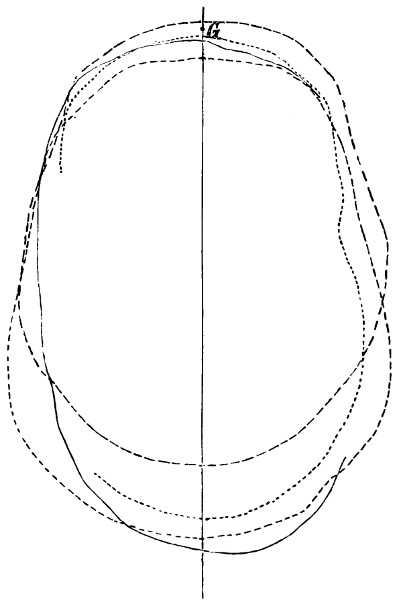
Fig. 18. Outline tracing of the Galley Hill skull, viewed
from above. (From Klaatsch.)
| --- Galley Hill. |
··· Neanderthal. |
| --- Ancient German. |
··· Modern South German. |
To insist upon these points is the more important
since nowadays various indices based on such
measurements of the Galley Hill cranium will be
found tabulated with data yielded by other skulls,
and yet no mark of qualification distinguishes the
former figures.
The description of the skeleton may be given in
a very few words. In the great majority of its characters,
it is not seen to differ from modern human
beings (though the stature is small, viz. 1600 mm.,
5 ft. 3 in.). And so far as I am able to judge, the
characters claimed as distinctive (separating the
Galley Hill skull from modern dolichocephalic European
skulls) are based upon observations containing a
very large possibility of error.
Having regard to such statements, the inference
is that the Galley Hill skull does not in fact differ
essentially from its modern European counterparts.
Similar conclusions have been formed in regard to
the other parts of this skeleton. It is important to
note that the specimen does not lose its interest on
this account.
From the foregoing descriptions, it follows that
of the most ancient remains considered, at least three
divisions can be recognised. In the first place, come
the examples described as Pithecanthropus and Homo
heidelbergensis (Mauer). In the second category
come instances as to which no reasonable doubt as
to their definitely human characters now exists (save
possibly in the case of the Taubach tooth and the
Hermoso atlas). Of the members of this second series,
two sub-divisions here designated (A) and (B) can be
demonstrated; these with the first examples complete
the threefold grouping set out in the table following,
with which Table A, p. 85, should be compared.
| Group I.Early ancestral forms.Ex. gr. H. heidelbergensis. |
| Group II. |
| Subdivision A.Homo primigenius. |
Ex. gr. La Chapelle. |
| Subdivision B.H. recens; with varieties |
|
H. fossilis. Ex. gr. Galley Hill. |
| H. sapiens. |
Taking the first group (Pithecanthropus and
Homo heidelbergensis) it is to be noticed that close
correlation is quite possible. Besides this, evidence
exists in each case to the effect that far-distant
human ancestors are hereby revealed to their modern
representatives. Of their physical characters, distinct
indications are given of the possession of a small
brain in a flattened brain-case associated with powerful
jaws; the lower part of the face being distinguished
by the absence of any projection of the chin. The
teeth indicate with some degree of probability that
their diet was of a mixed nature, resembling in this
respect the condition of many modern savage tribes.
Beyond this, the evidence is weak and indefinite. It
is highly probable that these men were not arboreal:
though whether they habitually assumed the distinctive
erect attitude is a point still in doubt. And yet again,
while the indications are not clear, it is probable that
in stature they were comparable, if not superior, to the
average man of to-day.
Passing from this division to the second, a region
of much greater certainty is entered. Of the second
group, one subdivision (A) retains certain characters
of the earlier forms. Thus the massive continuous
brow-ridge persists, as do also the flattened brain-case
with a large mass of jaw-muscle, and a ponderous
chinless lower jaw. For the rest, the points of
contrast are much more prominent than those of
similarity. The brain has increased in size. This
increase is very considerable in absolute amount.
But relatively also to the size of the possessor, the
increase in brain-material is even more striking, for
the stature and consequently bulk and weight are
less. The thigh-bone offers important points of
difference, the earlier long slender form (in P. erectus)
being now replaced by a shorter, curved, thick substitute.
If there has been inheritance here, marked
and aberrant variation is also observed.
The second subdivision (B) remains for consideration.
Here the stature has not appreciably changed.
The limb bones are long, slender, and less curved
than those of the other associated human beings (A),
and herein the earliest type is suggested once more.
But the differences occur now in the skull. The
brain is as large as in the other subdivision (A) and
in modern men. The brain-case is becoming elevated:
the brow-ridges are undergoing reduction; this
process, commencing at their outer ends, expresses
to some extent the degree of reduction in the muscles
and bone of the lower jaw. The teeth are smaller
and the chin becomes more prominent. The distinction
from modern types of humanity is often impossible.
In the next chapter some account is given of the
circumstances under which the bones were discovered,
and of the nature of their surroundings.