 hough a Preface before a booke of this Nature is seldome writt, and
seldomer Read, yet I could not herein Confine my selfe unto the Examples
of others, but have rather elected to decline a Generall Practice, to
follow my owne Inclination, than observe one, to immitate the inclination
of others.
hough a Preface before a booke of this Nature is seldome writt, and
seldomer Read, yet I could not herein Confine my selfe unto the Examples
of others, but have rather elected to decline a Generall Practice, to
follow my owne Inclination, than observe one, to immitate the inclination
of others.
Amongst my many Faults, I know none which had a lesse Disputed Assendent
over me, then a Detestation to Readeing and Studdy, in which vast
unhappinesse I continued ’till I went to see the VVorld, and makeing some
Residence in France, I assotiated my selfe with Persons of my owne Age,
where I soone found, that he who was Ignorant of the Romances of these
Times, was as fitt an Object for VVonder, as a Phylosopher would be, who
had never heard of Aristotle, or a Methematician of Euclyd. This inforc’t
me to reade, Necessity performing what should have sprunge from a
handsomer Principle. In the Perusall of those Bookes, I mett with the
names, & some of the Actions, of those Hero’s, whome I had heard off, in
the Scoole; This gave me a passionate desire to seperate the Truth from
the Fixion, in the effecting whereof, I became as much a Freind to
readeing, as I had bin an Enemy to it. This experiment I esteem’d an
ingratitude to Conceale; & I have cause to beleiue since Romances Acted a
Cure upom me, thy cannot fayle of doeing the Like upon any other; & by the
knowledge I haue of my selfe & according to a Proportionate Degree of
operation, much more upon Any other, then they have done upon me.
All the Readers of Parthenissa may wonder at my makeing of Spartacus and
Perolla contemporaries, & that Artabbanes & Spartacus should be the same
Person &c. But I hope they will noe Longer doe so, when I Minde them,
that I write a Romance, not a History, and that therfore though all I
Relate be not the Truth, yet if a Part be, I performe more then what the
Title of my Booke does confyne me to. The Latter of these they will finde
I doe, in the warre of Spartacus; In the warre betweene Rome and Carthage
called the second Punick warre; In the warre betweene the Romans, and the
Parthians, and in the warre termed the Metrydatick; In the Relations
whereof I have punctualy followed those Authors, who have most
celebratedly bestowed the History of those Times to Posterrity, and where
I have found any contradictions (as in most Historyes I have found some) I
have gon according to the seeming’st Truth. Only in the second Punick
warre, I have followed exactly Polibius, & the Excellent Sir VValter Rawly
in who’s Generall History of the VVorld, I finde more Harmony then ever I
did in any perticuler History, of any Part of it. But to Evidence
Chronologie is not essentiall in Romances, Virgill (who writes a Romance
in Numbers, & who is as Famous now, as he was in Augustus Times) makes
Æneas and Dido Lovers, when according to most Chronologers the Troian
Preceaded her, at lest two Centuries and a Halfe of Yeares; The Former
Living in the Yeare of the VVorld 2771; and the Latter in the Yeare of the
VVorld 3058, or as Alsted an Excellent Modern Chronologer will haue it, in
the Yeare 3077. I Instance this for my Iustification, or at least to
evidence I Err by a Famous and Authentique Example. Neither doe I thinke
but such a Fault may be Pardonable, when by it I Present the Reader with
two such signall, and True Historyes, as that of Hanniball, and that of
Spartacus, which doe both contayne things worthy the Perusall, especially
the Latter, which Past ages cannot Parralell, neither doe I beleive the
Future will. The Reuolt of Matho & Spendius from the Carthaginians in
Antient Times, and of Massaniello from the King of Spayne in the Present,
though they are Admirable Actions, yet are rather Foyles, then Paralels to
Spartacus’es, who from a private Slaue, after the winning of many a
Battell brought the Empire of Rome to the Stake in One, in which had he
had successe, Pompey might have Lost the Name of The Great, or else have
had a better Title to it, then he Deriu’d from his Asian or Priattike
Victories.
I shall not here tell you in what Places I have intrench’t upon, or
borrowed of Truth, since that might silence a Curiossity, the raising
wherof is one of my cheefest ends in writeing this Booke. Neither shall I
here endeavour to Apologize for Romances, for though I thinke I could say
somthing for them, yet I am certaine I can say more against them, & so
much, that had I bin of the same Minde when this Romance was first
Designed, as I am now of, at the finishing of the Fourth Tome, I had never
begun the First; And if I should continue the two remaineing Last Tomes,
it shalbe as a Penance for having writt the foure First. Yet I may say
that this way of writing Romances is lesse ill, than any I have yet seene
Originaly in our Language; for all that have bin presented to the VVorld
First in English have bin Purely Fabulous; This contayning much of Truth
’tis like Ore in which the Refyner will have Drosse, and Mettle, and
indeede almost the best Historians, differ herein, not in the Quallity,
but the Quantity; at least as to the causes & retayles of VVars, sometimes
even in the very events; Though many Historyans, write the same History,
yet they write not the same things; now it being impossible that there
should be but one Truth, ’tis as impossible that those Disagreeing writers
should all write that Truth; which cleerely evinces, that Historyes are
for the most Part but mixt Romances, and yet the Pure Romance Part, may be
as Instructiue as, if not more than, the Historicall; since ’tis not the
Truth of a wise Councell, or Ingenious Designe which inuites Men to an
immitation thereof, but the Rationallity and Probability of it, whither it
be reall or Imaginary; had the Histories of Cæsar or Hanniball bin as
meere a fable as they are the Contrary we might yet have Deriu’d from
thence as much instruction as wee now can, or doe. Besides, Romances tell
us what may be, whereas true Historyes tell vs what is, or has bin, now
what may be, is more vncircumscrib’d than what is, or has bin, and
consequently affoards a Larger Feild for instruction, and inuention.
But I feare I doe herein speake against what I have spoken, I shall
therefore only add. That though a desperate Cure (for so I account of
reading Romances, as an inuitation to Studdy) be not alwaies to be made
use of, yet it is not alwaies to be declyn’d; That this Romance is the
Idle Fruit of some Idle Time; That I have euidenc’t my weaknesse in Print
but to let those Freinds see the Power they have ouer me, which could
inuite me to it; And in the Last place I must desire the Reader to mend
the faults in the Printing, which I cannot but conclude are too many since
they almost equall those in the VVriting.
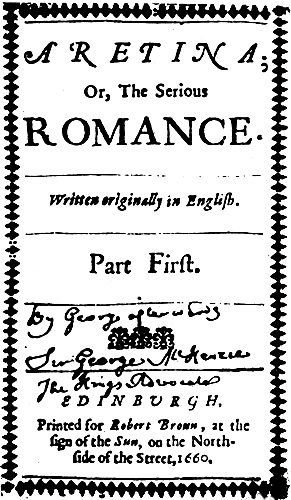
ARETINA;
Or, The Serious
ROMANCE.
Written originally in English.
Part First.
EDINBURGH,
Printed for Robert Brown, at the
sign of the Sun, on the Northside
of the Street, 1660.

To all the Ladies of this
Nation.
Fair Ladies,
I Do, like Moses trembling mother, leave this my first born upon the
banks of envies current, exposed to the muddy and impetuous streams of
merciless censure; wishing, that the fair hands of the meanest of your
number would vouchsafe to dandle it in the lapp of your protection; It is
but an abortive birth, posted to the world before its time, by an
unavoidable emergent, and so I fear shall never prove strong, nor be able
to go much abroad: Yet if it be admitted to suck the breasts of your
favour, it may possibly prove strong enough (shielded by your affection)
to graple with malice, and all other opposition. Whilest my winged
curiositie, pilgrimaged through all the corners of my memory; desirous to
know wherewith it was fittest to adorn the porch of this mean structure;
duty at last pleaded, that it was lese-majesty against your supremacy,
even to doubt whether it was fit to give you the precedency. For, since
the best eyed fancy, cannot observe any traite in your peerless faces,
wherein nature hath not prodigalled her charmes; so perfection were
imprudent, and so no perfection, if it palaced not it self in such
accomplisht creatures. And if there be any Orthodox maxime in Phisognomy,
we may conclude, that such excellent faces are assorted with excellent
souls: Providence being like these prudent Artists, who bestow the
choisest cases only upon the richest pieces. And seing one look darted
from your irresistible eyes, is able to conquer, in a moment, these over
whom neither reason, nor courage, could never raise their trophies; we may
conclude that there is something in you, which nothing in man (who
seigneurises over all other creatures, and who can pretend to nothing
stronger then courage and reason) can ever equal. It is to pleasure you
that wit is studied, and were it not that ye might be pleased, certainly
providence had placed wit beyond the reach of our studies: it is to sooth
your humor that men school themselves in patience; and by your miraculous
voice, the storms of their passions are calmed; from your beauty, cowards
borrow courage, and niggards liberality; so that all these scattered
colonies of vertues, which are squandred amongst men, are all originated
from your example. But as it was duty, so it is prudence in me to beg your
patronage; for how can the body of this Book be abissed, and sink in the
gulf of scorn, if its head be handed up by such admired beauties; neither
think I, that malice can be so malicious, as to along a thurst at the
author, who ensconces himself behinde such sacred persons; lest the blow
destinated for him should wound them who targets him. I have chosen so
many patronesses, to evidence that there is none of your never enough
admired sex, but may lay claime to the patronage of all that drops from my
pen; as also, fearing that among such a number, I should scarce finde one
who would be so excessively hospitall, as to lodge in her Cabinet or
Chamber such an unacknowledged Orphelin. The disappointment of my fears in
this, is rather the wish, then the expectation of,
Fair Ladies,
Your most humble Servant.

An Apologie for
ROMANCES.
It hath been rather the fate, then merit of Romances in all ages, to be
asperst with these vices, whereof they were not only innocent, but to
whose ante-doting vertues they might justly pretend: for whereas they are
judged to be both the fire, and faggots, wherby Lov’d flames are both
kindled and alimented; I believe verily, that there is nothing can so
easily extinguish them, for as these who have at Court, seen numbers of
peerless and wel deckt beauties, can hardly become enamoured of an
ordinary Country-maid; So these who have seen a Philoclea, or Cleopatra,
depenciled by the curious wits of Sidney, and Scuderie, will hardly be
invassalled by the (to them scarce approaching) treats of these, whom this
age garlands for admired beauties. Others forsooth accuse them, for
robbing us of our precious time; but this reproach is ill founded; for if
the Romance be abject, none will trifle away their time in reading it,
except these who would mispend it however, and if they be excellent, then
time is rather spent then mispent in leafing them over. There is also a
third race of detracters, who condemn them as lies; but since their
Authors propose them, not with an intention to deceive, they cannot
properly be reputed such: And albeit they seem but fables, yet who would
unkernel them, would finde budled up in them reall truthes; and as
naturalists observe, these kernels are best where the shells are hardest;
and these mettals are noblest, which are mudded over with most earth. But
so leave such Phanaticks in the bedlame of their own fancies, who should
blush to trace in these paths, which the famous Sidney, Scuderie, Barkley,
and Broghill hath beaten for them, besides thousands of Ancients, and
Moderns Ecclesiasticks, and Laicks, Spaniards, French, and Italians, to
remunerat whose endeavours, fame hath Wreathed Garlands (to betemple their
ingenious and ingenuous heads) which shall never fade whilest Learning
flourishes. I shall speak nothing of that noble Romance, written by a
Bishop, which the entreaty of all the Eastern Churches could never prevail
with him to disown; and I am confident, that where Romances are written by
excellent wits, and perused by intelligent Readers, that the judgement may
pick more sound information from them, then from History, for the one
teacheth us onely what was done, and the other what should be done; and
whereas Romances presents to us, vertue in its holy-day robes, History
presents her only to us in these ordinary, and spotted sutes which she
weares whilst she is busied in her servile, and lucrative imployments: and
as many would be incited to vertue and generosity, by reading in Romances,
how much it hath been honoured; So contrary wise, many are deterred by
historical experience from being vertuous, knowing that it hath been
oftner punished then acknowledged. Romances are these vessels which strain
the christal streams of vertue from the puddle of interest; whereas
history suffers the memory to quaff them of in their mixt impuritie; by
these likewise lazy Ladies and luxurious Gallants, are allured to spend in
their Chambers some hours, which else, the one would consecrat to the Bed,
and the other to the Bordell: and albeit essayes be the choicest Pearls in
the Jewel house of moral Philosophy, yet I ever thought that they were set
off to the best advantage, and appeared with the greatest lustre, when
they were laced upon a Romance; that so the curiosity might be satisfied,
as well as the judgement informed, especially in this age Wherein the
appetit of mens judgements is become so queasie, that it can rellish
nothing that is not either vinegared with Satyres, or suggared with
Eloquence.
I know that these who have devanced us in this imployment, will as our
oldest brothers in time, have a double portion of fame bestowed upon them,
and no wonder, seing they had store both of expression and invention to
make choice of, and if any of us use their expressions, albeit we were
only debtor to our own invention for them, yet we should be thought to
plagiarize: wherefore he who writes now, should read what hath been
written formerly; not to the intent that he may borrow, but least he
should borrow any thing that is theirs. I perceive there have been two
errours committed by the first writers of Romances: the first was, that
they stuffed their Books with things impracticable, which because they
were above the reach of mans power, they should never have fallen within
the circle of his observation: and such was Amadis de Gaule, Palmeron de
Oliva &c. The other errour was in the style, which because of its soaring
pitch was inimitable: and as the first hath been the fault of the first
writers, So the last hath been the fault of the last writers, wherefore
the famous Scuderie hath written so, as that his invention may suit well
with our practice, and his style with our discourse, and especially in his
Clelia, wherein he professes that he hath adapted all to the present
converse of the French Nation and that is really the mould wherein all tru
Romances should be casten. There are some who embroider their discourse
with Latin and Greek termes, thinking, like these who are charmers, that
the charme loses its energie, if the words be not used in Latine. But this
is as ridiculous, as if one who desires to make his face seem pleasant,
should enamble it with red, blew, green, and other colours; which though
they are in themselves pleasant, yet are rediculous when placed there. And
this is an university style, which favours too much its pedant, and is at
best but bastard oratory, seing the scope of all Orators is to perswade,
and there can be no perswasion where the term is not understood; examples
of this are Brown, Charletoun, &c. The second style, is that of moral
Philosophers, where the periods are short, and the sense strong, and our
experience teacheth us, that the shorter any thing be, it is the stronger:
this style suits best with Preachers, whose it is to debit the grand
misteries of Faith and Religion; for, seing sentences there should be
weighty, if they were either many, or long, they would burden too much the
hearers. The third style, is that of Barrasters, which is flourished with
similees, and where are used long winded periods; and of all others, this
is the most preferable, for seing similitude is but a harmony, this style
shews that excellent harmony; and rapport, which God intended in the first
Creation; and which the Philosophers of all ages have ever since admired.
This Lawyers have learned from the paucitie of all humane Lawes, which
makes them oft recurr to that topick, which teaches them to argument from
the paritie of reason. And in this they resemble Mechanicks, who, by
applying a cord, whose length they know, to any body whose length they
ignore, do thereby learn its measures also. And by this way Nathan in the
old Testament, and our Saviour in the new, repremands the errors of David
and the self conceated Jewes. The fourth style is where the cadence is
sweet, and the epithets well adapted, without any other varnish
whatsoever: and this is that style which is used at Court, and is paterned
to us by eloquent Scuderie. I hear there is now a ridiculous caball of
Ladies at Paris, who terme themselves the precious, and who paraphrase
every thing they speak of, terming a mirrour, the conselour of beauty, and
a chair, the commoditie of conversation, &c. And thus they have progressed
from painting of faces to paint expressions.
As for my self, since I expect no applause, I need fear no censure; and
if I satisfie not others, I shall at least satisfie my self, for it was to
form to my self a style that I undertook this Piece, whose defects I hope
the sober readers will pardon, since their clemency will not be oft
tempted with crimes of this nature: only this I begg, that these who will
not do me the favour to read the last part, will not do me the wrong to
read the first part; for as the Lord Baken very well observes, our
thoughts are like our years, whereof the first are alwayes the worst; and
it is no wonder, for boyling youth customarly throws the scum upmost. I
have concealed my name till I see how my undertaking is relished; for
which reason likewise, I have sent this Piece to the world unaccompanied,
as a swatch of what I intend, reserving the web, till I see how the Stuff
pleases. The subject hath made this first part serious, and my inclination
shall make the second pleasant.
BENTIVOLIO
AND
URANIA,
IN
FOUR BOOKES.
By N. I. D. D.

LONDON:
Printed by J. G. for Richard Marriot, and are to be
sold at his shop in Saint Dunstans Church-yard Fleetstreet.
MDCLX.
A
PREFACE
TO THE
READER,
CONCERNING
The Design of this Book.
 T is justly esteemed by those which know themselves, as the onely work
that is worthy of wise men, so to employ their better faculties and
improve their time, that at last they may obtain an End, in which they may
rejoyce eternally: After a sincere intention of this End, to prosecute it
with a constant use of fit means, is the Character of a Prudent and Good
man. Those which govern not their life by this Principle, do either suffer
themselves to be benum’d with Idleness, or abuse the activity of their
Souls in some vain employment.
T is justly esteemed by those which know themselves, as the onely work
that is worthy of wise men, so to employ their better faculties and
improve their time, that at last they may obtain an End, in which they may
rejoyce eternally: After a sincere intention of this End, to prosecute it
with a constant use of fit means, is the Character of a Prudent and Good
man. Those which govern not their life by this Principle, do either suffer
themselves to be benum’d with Idleness, or abuse the activity of their
Souls in some vain employment.
The first of these two out of their great love to do nothing, can make no
better wish for themselves, then that they might sleep out the other half
of their time; and it is rationall to do so, if his Rule were good for any
thing, who said, He values his life at a just rate, who would be content
to forgoe it for a Dream.
The other make their bargain but a little better; for whilest they
entertain themselves with things which correspond not with the Dignity of
Reasonable Souls, instead of perfecting those rare Capacities with which
their Natures are invested, by a generous endeavour to obtain that
Happiness which God doth not envy us, they lessen themselves, clip the
wings of their Souls, and bring them down from those degrees of Excellency
which they actually enjoy, and make them degenerate into a brutish
incapacity, though many times they take no notice of the weakness of their
judgements: till they meet it in the miserable Consequences of their
Actions.
It is not my purpose here to reckon up all the impertinencies of Mankind,
which are the several instances of the forementioned folly, I would onely
give a charitable notice of one, viz. the VVriting and Reading of
Romances. This I put into the number, because for the most part it is
verified in them what Justin Martyr said of Homers Poetry, Ἔστι γαρ ἡ πᾶσα
ῥαψῳδία Ἰλιάδος τε καὶ Ὀδυσσείας, ἀρχὴ καὶ τέλος, γυνὴ, i.e. The whole
Rhapsody of Homers Iliads and Odysseis, beginning and end, is but a
VVoman. Yet they dote so much upon that subject, that they think with
those amorous Trojans, that Helen was not onely worthy of all the labours
of Homers Quill, but also of the sharp contentions of the Greek and Trojan
swords.
Ου’ νέμεσις Τρωες και ευκνημιδαι Αχαιοι
Τοιη δ’ αμφι γυναικι πολυν χρονον αλγεα πασχειν: i.e.
A ten years VVar is no unworthy sight,
VVhen Greece and Troy for such a VVoman fight.
She was a brave Woman indeed, and it was but fit that so many Gallant men
should destroy one another in the Revenge and Defence of her Adultery.
But Maximus Tyrius in his 15th. Dissertation doth justly reprove the
folly of their opinion, and condemn the unreasonablenesse of that lavish
praise.
I am not ignorant that Homer wrote upon another design, then to tell so
many tales of Helen and Paris, and that Horace hath said in his
Commendation,
Qui quid sit pulchrum, quid turpe, quid utile, quid non,
Plenius ac melius Chrysippo & Crantore dicit: i.e.
He what is fair, what foul, what good, what not,
Better then Crantor and Chrysippus wrot.
It may be so; for though Chrysippus was so great a man, that he was
esteemed the onely support of the Stoick School, according to the
Proverbiall speech recorded by Diogenes Laertius, Εἰ μὴ γὰρ ἦν Χρύσιππος,
οὐκ ἂν ἦν Στοά. Yet quite contrary to the vertuous design of prudent
Socrates, he spoil’d the Docrine of good manners, and unwisely changed the
substiantiall precepts of a morall life for the uselesse subtilties of
nice disputation. Or what if Crantor, whom he yokes with him in the
disparagement, made no great proficiency either by Plato, to whose School
he belonged, or Homer himself, who was his delight? For all this fair
verdict, which Horace hath passed in favour of his Brother Poet, the
Morall Vertues, which so highly concern the felicity of the World, ought
to be discours’d in another manner then he useth; for he, as it may be
said also of other Romancers, hath made the fabulous rind so thick, that
few can see through it into the usefull sense. I do not deny what Plutarch
saies, that his Verses were not written onely for pleasure, ὰλλὰ γαρ
βαθύτερός εστι τους ενκεκρυμμενους τοις επεσι, i.e. but that a deeper
meaning is hid under his Poems; but he hath sunk it so deep, that very few
can come at it. And some of those who applaud him for a Philosopher,
confesse that such onely can make a gain of him, that have already
attain’d a mature judgement by long study; that is, such may possibly
learn of him, who are able to teach him: But he is so unfit for others,
that Plato desired they might not see him, ἱνα μη μυθους οιησοιντο γραφειν
τον Ἡρωα, i.e. for fear they should think that the Hero wrote fables,
which he had good reason to expect upon the perusall.
Besides this, as many others do, he hath so form’d the representations of
Vertue and Vice, that it is hard to say, which is commended and which
reproved; whil’st the Gods are frequently brought in practising
Immoralities, he doth at least equall Vice to Vertue, and nourish that
which he should eradicate. For, why should men endeavour to be better then
their Gods? So he in the Comedy made the Adultery of Jupiter an apology
for his lust.
——Et quia consimilem luserat
Jam olim ille ludum—————
Ego homuncio hoc non facerem: Terent. Eunuch.
By these and such like instances the Greek Fathers did convince the
Heathens of the imperfection of their best Authors. So one may perceive in
some Romances of a later date, that the pictures of Heroes, which they
have drawn far exact patterns of the most rais’d vertue are often blotted
with notorious defects, as Impatience, Revenge, and the like.
But this sort of Books is most to be blamed, because for the greater
part, as I said before, their chief Design is to put fleshly Lust into
long stories, and sometimes not without very unhandsome mixtures, tending
onely to the service of brutish Concupiscence, the nourishment of
dishonorable affections, and by exciting in the Readers muddy fancies, to
indispose them for their attendance upon God by their better part. For
some such reason, I suppose, the great Sidney before his death charg’d his
friend Sir Fulk Grevill, who had the onely Copy of his Arcadia, that he
should never permit it to be made publick.
The other pieces, which fill up the intervalls of the story, and grace it
with pleasing varieties, are commonly frivolous devices of wit in some
contemptible matter, and serve but to some such slight purpose, as doth
the writing of Verses in the form of an Egge or Hatchet, where the
measures of words and sense are constrain’d to suite with the odde
proportions of such figures. These are fine rarities of no use, the
intertexture of the by-accidents being as triviall as the principall
Design.
’Tis true, some of these Authors written in divers Languages, are
applauded for the Elegancy of each particular Tongue, and are here and
there interspers’d with good Sentences: but they are so deeply infected
with noisome words, immodest Tales and Discourses, which do fatally
corrupt the manners of Youth, that I cannot but assent to the Opinion of
many wise men, who judge them, for all that, well worthy of the fire.
Neither do I think it improper to use the words, which the old Sages of
Troy silently mutter’d, when they perceived the dangers which attended the
beauty of Helen, which the young men extoll’d as equall to that of the
heavenly Goddesses.
Αλλὰ γαρ ὧς τοίηπερ ἐοῦς᾽ ἐν νηυσὶ νεέσθω
μηδ᾽ ἡμῖν τεκέεσσί τ᾽ ὀπίσσω πῆμα λίποιτο, i.e.
But though She’s such, let her return, and make
An end of what we suffer for her sake.
I could easily name them, but that Labour is needless to such as know
books: and to those which do not, I ought not, by making a Catalogue, to
give notice of such as I could wish burnt. If they were, they would not be
greatly miss’d, as to that propriety of speech unto which they lay claim,
and for which they are magnified by their Readers; because the best
Languages used in the world, may as well be learn’d from Authors that are
as Elegant as Chaste.
For these reasons I think the Noble Mountaigne gave a great proof of his
early wisdome, in that, as he saies, Quant aux Amadis, et telles sortes
d’escrits, ils n’ont pas eu le credit d’arrester seulement mon enfance,
i.e. Amadis and such like trash of VVriting; had not so much credit with
him, as to allure his youth to delight in them. And upon the same
considerations one may well judge some Excellent Wits thrown away in
writing great stories of Nothing; and that others lose their unvaluable
Time whilst they reade them. And the rather, because, besides the direct
losse, they leave the Memory so full of fantasticall images of things
which are not, that they cannot easily dismisse them: the Fancy being
held in the amusement of those foolish Dreames, as we are in Sleep with
the various representations of severall things, which never were nor will
be in such Ridiculous Conjunctions. And when the Reader considers how
prettily he hath abused himself, yet cannot he presently dispossesse his
fancy of those vain Imaginations which he hath entertain’d, but is still
haunted with them, and much indispos’d in Mind for more worthy
Considerations; as troublesome Dreams often leave the Body not so well
affected.
There is no doubt but that most Readers of such things, ingenuously
examining what beneficiall use they could make of the gains reaped from
their Studies, would find themselves hard put to it to name a better then
the Great VVit was forc’d to, who said, when he thought to retire from his
Extravagancies, and to repose his wearied Spirit, and it still pester’d
him with an orderlesse rabble of troublesome Chimæras, he resolv’d to keep
a Register of them, hoping by that meanes one day to make it asham’d, and
blush at it self.
It is no wonder that these Fooleries are not easily thrown off, because
of that deep impression which they make upon the affectionate part,
through the cunning inveglements of Fancy. For men having indulg’d
Imagination, and play’d carelesly with its Fantasms, unawares take
vehement pleasure in things which they do not believe, and weep for such
inconsiderable reasons, that afterward they laugh at themselves for it,
and read Fables with such affections, as if their own or their friends
best interest were wrapp’d up in them. What strong Expectation have they
for the Issue of a doubtfull Design? How unsatisfied are they till the End
of a paper-Combate? What fears possesse them for the Knight whose part
they take? How passionately are they delighted with the Description of a
Castle built in the aire? How ravish’d upon the conceit of Beauties which
owe themselves only to the paint which came out of the Poets Ink-pot? How
are they taken with pleasure and sorrow for the good and bad success of
the Romantick Lovers? They are apt also to draw to themselves or their
friends such things as they read in far-fetch’d references: if the
resemblances suite in some little points, they seem to do and suffer such
things; and what fits not they endeavour to patch up with some feign’d
coherency.
But if in the midst of this busie Idlenesse they would admit a severe
consideration of more important duties neglected the while, a few
disentangled thoughts would rout the Troop of their fond Imaginations.
Some peradventure not altogether satisfied with that which I have said,
may reply, What, then is Fancy uselesse? Is it not one of the naturall
faculties of the Soul? Were any of them made to no purpose? Is there any
more proper entertainment for it then the Conceit and Language of a
well-form’d Romance? Many books, which pretend to declare better matters
to us, do it so jejunely, that it is a work of more then ordinary patience
to give them the reading; and we are put into a doubt, whether or no those
who wrote them did intend any should make use of their Understandings in
the perusall of them, or whether they were able to give that which others
would expect as a reasonable satisfaction. Besides, we perceive many Books
of grave Titles so afflicted with Disputes about troublesome niceties and
trifling Capriccio’s, that wise persons find the books as little of kin to
their Names, as the Contents are of small Furtherance to their best
Concernments.
To these things I answer; Fancy is not uselesse, and may as lawfully be
gratified with excellent forms of Invention, as the Eye may entertain it
self with the Beauty of well-plac’d Colours, or the Sense of Smelling
please it self with the odours of a delicious Rose. But though it be a
Naturall Faculty, yet it is under discipline of the Supreme Governesse of
Soul and Body, Reason; and when it wanders without its Keeper, out-staying
its time in allowed diversions, or transgressing the limits of such
Subjects as sound Judgement permits, it returns abus’d with hurtfull
delight, and instead of being us’d decently, is unworthily prostituted: in
whose behalf the Rationall Guide, which is not farre off, will take notice
and complain, as it doth often, and whip the Vagrant, and not spare to
reproach it with the cheap reward of foolish recreation, for the enjoyment
of which she mispent the time which she took from her Prayers, and, it may
be, for the reading of an Idle Story neglected the Examination of her
Conscience; and afterward is made to understand that the same pleasure
which was pretended to be sought abroad, is to be found at Home. For
Reason is no such severe Mistresse as to detain us with Awe that is void
of Love and Joy; but besides the solid Complacencies of Vertue, allows
also the chearfull entertainments of Wit and Fancy. There are Books good
store where Truths of greatest Importance are presented neither besmeared
with loathsome Nonsence, nor blended with unprofitable Disputes, which
adde nothing to Religion, but trouble and darknesse, and where Excellent
sense and good words offer themselves in such lovely Embraces, that they
are a perfect content to all beholders but such as cannot Fancy,
Understand and Love. Wit and ability of mind do so shine in many Religious
Discourses, that we cannot justly make that pretended defect an Excuse for
our deferring of sober studies. Now God forbid that we should think his
Gifts so imprudently thrown amongst men, that none should be able to get
them that would use them to the adorning of that which most deserves it,
Vertue; which, though by reason of its innate beauty it least needs any
adventitious ornament, yet doth not scorn the light vaile of Romance, if
it be of that fashion which I shall by and by describe.
It were a thing to be wondred at, that by many nothing is esteem’d witty,
except Poetry and Romances, but that want of Judgement doth notoriously
discover it self in those persons who are highly pleas’d with pittifull
things. Divers of their admired Authors are so empty of true worth, that
if the entire sense of their books were summ’d up, it would onely amount
to some small matter as triviall as uselesse: And if most of them, whether
Antient or Modern, were examined with a Judicious Eye, they would appear
to be full of the grossest Indecorum’s of Invention, as odious
misrepresentations of Divinity, unnaturall Descriptions of Humane Life,
Improper and Prophane Allusions to Sacred Things, frequent and palpable
Contradictions, Sottish stories, and in short, all the absurdities of wild
Imagination. I need not verifie this by bringing together those great
multitudes of Instances which abound in that sort of books written in the
Greek, Latin, Italian and
French Languages. If any desire, they may see it
done largely in the Extravagant Shepheard, especially in the Speech of
Clarimond in the 13th. book, not long since translated by Mr. Davies.
For my own part I do not desire that all books should be as dull as many
are, and none compos’d, as all are not, to delight; but I would have that
delight true, and the quicknesse not evaporate into Lightnesse and Vanity.
Is there no joy but laughter? Doth nothing recreate but what is fabulous?
Such as do not like true happinesse, because it is a serious thing, have a
reasonable Soul bestowed upon them in vain, and would have been better
pleas’d if God had made them worse, and more content if God had not
design’d them to so Noble an End. But those which like nothing except what
goes in a plain Rode of talk, may as reasonably desire every body to
spell, when they read. Such as would not have Truth presented in ingenious
Schemes of Discourse, do foolishly condemn the wisdom of the Antients,
some of which we may not reprove without a kind of Blasphemy: and whilst
they understand not the Excellent use of Apologues, Parables, and such
like Modes of signification, they are sufficiently answer’d by the
Confession of their own Ignorance. There are severall spirits in the
World; some will take a thing one way, that will not another. A Physitian
will not wisely quarrell with his Patient, because he refuseth to take the
Pill unlesse it be guilded. There are also some persons that need to have
some things told them, which because they are guarded with the stately
Circumstance of Worldly Quality, one cannot so easily come near them as in
a Disguise.
There are some brave minds, in whom Riches of Conceit are attended with
incomparable Expression: and Truth is not unwilling to be dress’d by such;
and those which revile them for their paines, are justly abhorr’d for
their Envy, or pitied for their Ignorance. Its a mischief that distresses
most little Capacities, impotently to desire that all others should be
constituted after their size; and having passionately, but foolishly,
wish’d such a thing a great while, at last they begin to believe that what
they desire is so indeed.
It is an ungratefull folly and a pride to be laugh’d at, when men are
unwilling that others should endeavour to further their Good, because they
gave them not leave to prescribe them the way for doing of it: but they
should consider, that there may be such in the world which understand that
which themselves do not, and are delighted with such things as they
contemn.
But some that mean well, and think they are not mistaken in the sense of
their proposition, humbly desire that those Excellent Wits would lay their
design of Romance deeper then the Shallows of Fancy; that so the Reader
may not stick upon every Shelf of Fiction, and that the streams of Wit be
made navigable for the Importation of such Wisdom as is necessary for our
best life. The design to please is then as well accomplished; but not
terminating in the surface of Recreation, it is improv’d into a higher
advantage of those nobler faculties which God hath given us.
They think also that the Way to this End is miss’d, when the Authors
account their Contrivance poor, unless they can sail under water too. As
when there is no morall design of making men better, the Work is done but
by the Halves, as we say: so if that lie under ground in such deep
conceits as but few can dive into the bottom of them, their labour is so
far only not lost, as that some who are more ingenious will take the pains
to understand what they meant.
To conclude, I have not all this while spoke my own Hopes concerning what
I have perform’d in this work, but my wishes were hearty that it might
neither displease nor be unprofitable. Whereas I have in severall places
reprov’d some things frequently found amongst Men, I only plead, that
since they make no scruple of acting unworthily, I though: I might much
more justly take liberty to talk of it. And since you have had the
patience to be acquainted with what I would have done, if any body be
pleas’d with that which is written, I shall not be discouraged, but if
they be profited too, then I shall think that I have not laboured in
vain.
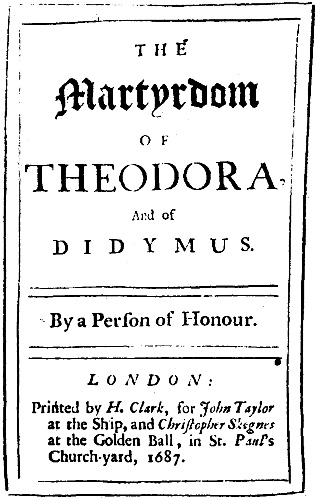
THE
Martyrdom
OF
THEODORA,
And of
DIDYMUS.
By a Person of Honour.
LONDON:
Printed by H. Clark, for John Taylor
at the Ship, and Christopher Skegnes
at the Golden Ball, in St. Paul’s
Church-yard, 1687.
SUCH AN
ACCOUNT
Of the following
BOOK,
Sent with it to a
FRIEND;
As may serve instead of a
PREFACE.
To convince you, Sir, how much more I am concern’d to have you think, I
can Obey well, than Write well; I venture to send you the Account, (as
imperfect and unpolish’d as it is) that you are pleas’d to command Of the
last Hours of Theodora. But I must beg your leave to accompany it with
another Account (though but a short one) how I came to meddle with this
Subject; and why what I present you about it, is so much Maim’d, and has
no more Uniformity.
Having had occasion many years ago to turn over a Martyrology, and some
other Books, that related to the Sufferings of the Primitive Christians; I
chanc’d to light on those of a Virgin, who, though (to my wonder) she was
left unnam’d by the other Writers that mentioned her, seem’d plainly to be
the same, that is by one of them expresly call’d Theodora: I own, I was
not a little affected, at the reading of such moving and uncommon
adventures as hers: and finding her story to be related, by the Author
that nam’d both her and her Lover, not only very succinctly and
imperfectly, but very dully too; I found my self tempted so to enlarge
this Story, as that it might be contriv’d into a somewhat voluminous
Romance: But upon second thoughts, it appeared incongruous to turn a
Martyr into a Nymph or an Amazon: And I consider’d too, that (to omit what
else might be objected against that sort of Composures) as true Pearls
are Cordials and Antidotes, which counterfeit ones, how fine soever they
may appear, are not; so True Examples do arm and fortify the mind far
more efficaciously, than Imaginary or Fictitious ones can do; and the
fabulous labours of Hercules, and Exploits of Arthur of Britain,
will never make men aspire to Heroick Vertue half so powerfully, as the
real Examples of Courage and Gallantry afforded by Jonathan Cæsar, or
the Black Prince. But yet, thinking it great pity, that so shining a
Vertue as Theodora’s should prove Exemplary, but to her own time, and to
one City; and remembring, that soon after the Age which she Ennobl’d, it
was counted among the Primitive Christians an act of Piety, to build fair
Monuments, upon the formerly abject Graves of the Martyrs; to repay, by
Honours done to their Memories, the indignities and Disgraces they had
suffer’d in their Persons; I thought fit to try, if I could rescue from
more unskilful Hands than even mine, a story that abundantly deserv’d to
be well told.
But upon further thoughts, I soon foresaw, that this Task was not more
worthy to be undertaken, than it would prove difficult to be well
perform’d: For the Martyrologist having allow’d scarce one whole Page, to
a Relation, that perhaps merited a Volume, had left so many Chasms, and so
many necessary things unmentioned, that I plainly perceiv’d, I wanted a
far greater number of Circumstances, than that he had supply’d me with to
make up so maim’d a story tolerably compleat. And as the Relation deny’d
me matter enough to work upon, so the nature of the Subject refus’d most
of those Imbellishments which in other Themes, where young Gallants and
fair Ladies are the chief Actors, are wont to supply the deficiences of
the matter. Besides, my task was not near so easie as it would have been,
if I had been only to recite the Intrigues of an Amour, with the liberty
to feign surprizing adventures, to adorn the Historical part of the
account, and to make a Lover speak as Passionately as I could, and his
Mistress as Kindly as the indulgentest laws of decency would permit. But I
was to introduce a Christian and pious Lover, who was to contain the
expressions of his Flame within the narrow bounds of his Religion; and a
Virgin, who, being as modest and discreet as handsom, and as devout as
either, was to own an high Esteem for an excellent Lover, and an uncommon
Gratitude to a transcendent Benefactor, without intrenching either upon
her Vertue, or her Reservedness. And I perceiv’d the difficulty of my Task
would be encreas’d, by that of Reconciling Theodora’s Scrupulousness to
the humours of some young Persons of Quality of either Sex, who were
earnest to engage my Pen on this occasion, and would expect that I should
make Theodora more kind, than I thought her great Piety and strict
Modesty would permit. But for all this; the esteem I had for the fair
Martyrs Excellencies, and the compliance I had for those that desir’d to
receive an account of so rare a Persons actions and Sufferings, made me
resolve to try what I could do. Which I adventur’d upon with the less
Reluctancy, because, though I esteem’d it a kind of Profaneness, to
transform a piece of Martyrology into a Romance; yet I thought it
allowable enough, where a Narrative was written so concisely, and left so
unperfect, as That I had to descant upon; to make such supplements of
Circumstances, as were not improbable in the nature of the thing, and were
little less than necessary to the clearness and entireness of the Story,
and the decent connection of the parts it should consist of. I suppos’d
too, that I needed not scruple, to lend Speeches to the Persons I brought
upon the Stage, provided they were suitable to the Speakers, and
Occasions; since I was warranted by the Examples of Livy, Plutarch,
and other Grave and Judicious Historians, who make no scruple to give us
set Orations, of their own framing, and sometimes put them into the mouths
of Generals at the head of their Armies, just going to give Battel: though
at such times the hurry and distraction that both they and their Auditors
must be in, must make it very unlikely, either that they should make
elaborate Speeches, or their Hearers mind and remember them well enough
to repeat them to the Historians.
Encourag’d by these Liberties, which I thought I might justly allow my
self: I drew up, as well as I could, what you have been told I wrote about
Theodora. This I thought fit to divide into two parts; in the first
whereof, (which was less remote from being Romantick) I gave somewhat at
large the Characters of them both. I mention’d the rise and progress of
Didymus’s Love; the degeneracy of the then Christians, which provok’d
Divine Providence, to expose them to a very Bloody Persecution: I
declar’d, how Theodora being involv’d in it, was brought before the
President of Antioch; how she resolutely own’d her Religion before
him, answer’d His Arguments, and resisted both his Promises, and his
Menaces; how thereupon the Judge doom’d her either to Sacrafice, or to be
prostituted in the publick Stews. How she, after an eager Debate in her
own mind, refusing to offer sacrifice, was, (notwithstanding her silence)
led away to the infamous place; how being shut up there alone in a Room,
she employ’d the little time, that was granted her to consider whether she
would yet burn Incense to the Roman Idols, in fervent Prayer to the true
God, for a rescue of her Purity, not her Life; in order whereunto, she
design’d and hop’d by Resistance and Contumelies to provoke her first
Assailant, to become her Murderer, rather than her Ravisher.
These were the chief Contents of the first Book. Those of the second, were
more Historical; and consisted of an account of the last hours of her
Life, and particularly of those Sufferings that ended in her and
Didymus’s glorious Martyrdom. This piece having been perus’d by those
for whose sake I wrote it; was so fortunate, that it having, without my
leave, been ventur’d into several hands, as a Book of a nameless and
unknown Author, it was lucky enough to be, by some indulgent Readers,
attributed to One, and by some to Another, of the two Persons, that were
at that time counted the best writers of disguis’d Histories. But among
the many Hands it pass’d through, it seems it fell into some, out of which
a great part of the loose sheets, (which were not bound in a Book, but
only tack’d together) were not to be retriev’d: whether it were by the
negligence, or the contempt, that some had of so unpolish’d a Work; or
whether there were some fatality in the Business, that Theodora’s
Sufferings should outlive her, and her Story be as ill us’d as her Person
had been. This loss, (if it can deserve that name) I did not much regret:
Since I intended not to make the lost Papers publick, and had receiv’d
much greater approbation and thanks than they merited, from the particular
Persons they were design’d for. But after I had for many years worn out,
not only the sense, but the memory of this loss: It was made more
troublesom to me, than ever it was at first, by the earnest solicitations
of some eminent Persons, that had a great power over me, and some of them
the repute of great Judges of this kind of Composures. For having seen
several Sheets, that I accidentally lighted on, in tumbling over some long
neglected Papers; they oblig’d me to cause those old rude sheets to be
transcrib’d. And tho’ almost all the first Book was wanting, (upon which
account, I could not be remov’d from my Resolution not to trouble my self
about it) yet there was so much of the Second Book, but in parts no way
Coherent, little by little retriev’d, that a pretence was afforded to
press me to repair those Breaches, and restore out of my memory, or
otherwise, a piece, which they would needs perswade me might do some good,
by rendring Vertue Amiable, and recommending Piety to a sort of Readers,
that are much more affected by shining Examples, and pathetical
Expressions, than by dry Precepts, and grave Discourses.
If some of your more scrupulous Friends shall object, that I have
mentioned Theodora’s Beauty more often and advantagously, and
represented her Lovers Passion more Pathetically, than the subject of the
story exacted, and the truth requir’d in History would warrant; I shall
not altogether deny the Charge: Being rather content to have it thought,
that a youthful and heated fancy transported my Pen, somewhat beyond the
narrow bounds of History, than that so Pious a person as Didymus did not
keep both his Flame, and the Expressions of it, within the limits of
Reason and Religion. But though I pretend not to justifie, all that has
been said in the strain of an Encomiast, or a Lover, yet I hop’d that I
may much Extenuate, if not Excuse it, by representing such things as
these.
That I have been careful, that Theodora should not be made to do, or
say, any thing, that, the great Obligations she had to her Rescuer
consider’d, do intrench either upon her Piety, or her Vertue, or so much
as upon her Reserv’dness.
That as for Didymus; I might say, that probably he thought, those
Celebrations that would have been Flattery to another Lady, were but
Justice to a Person so Extraordinary, and so accomplish’d as his
Mistress; and that he thought it allowable, not to suppress the chast
effects of a Passion, that has not only been incident to Heroes, but
perhaps help’d to make them such. But I will rather say, that those only
are like to find much fault with his Expressions, who consider not how
free they are from any degree of Prophaneness or Immodesty: And who are
not accustomed to the reading of Stories, where Lovers are introduc’d, and
made to Praise and Complement in a far more Bold and Romantick way, than I
allowed my self in the following Paper. In which, all the Deference,
wherewith Irene as well as Didymus treat Theodora, may be accounted
for by this; That I remember’d to have, in some Author or other, found
Mention made of a Person about Dioclesian’s time, Whom I took for our
Martyr, that was intimated to be of high Quality, if not a Princess,
which Title I had without scruple given Her, If I had been half as sure
that she Was a Princess, as that she Deserv’d to be One.
That perhaps I was not unwilling, both to shew the Persons I wrote for,
that One might have glittering Idea’s of Beauty, without being dazl’d by
them; and also to convince them, that high Complements and passionate
expressions, are no certain Marks of His being really Smitten (to speak
in a Lovers Phrase) that can Imploy them; since I retain’d my wonted
freedom of mind, while I was Writing; and presented them by the mouth of
Didymus, but what Fancy, not Passion indited.
And lastly, I was induc’d to allow my self a more fashionable Stile, than
would perhaps be suitable to a meer Sermon, or Book of Divinity, because I
fear’d, that the Youthful Persons of Quality of both Sexes, that I was
chiefly to regard, would scarce be sufficiently affected by unfortunate
Vertue, if the interweaving of passages relating to Beauty and Love, did
not help to make the Tragical story, Delightful, add the Excellent
Sufferers Piety, Amiable.
If it be objected, that in some of the discourses of the two Martyrs,
there are Passages that argue more Knowledge, than is likely to have been
found in Lay Persons no Elder than they. I answer, that such Discourses
indeed were somewhat strange, if they were ascrib’d to a young Gallant,
and a younger Lady, of Our degenerate Times; wherein so many Persons of
that sort, make Diversion their grand Business; and, having as little
Leisure as Concern to mind any thing, but their Pleasures and petty
Interests, think it their Priviledge to know little of Religion, and leave
to meaner People the study of things Serious and Useful. But, though
among this sort of Persons, it were so difficult to find many that would
Emulate such Knowledge and Vertue as shin’d in Theodora, that I fear
they would not so much as believe them; yet among better qualify’d
Judges, the lately propos’d objection will be of no great force, if it be
consider’d, that Didymus and Theodora liv’d in the Primitive and
devout times of the Church, and in the Roman Empire, when the Christian
Religion was as diligently Taught by Excellent Divines, as frequently
Oppos’d by Arguments, and violently assaulted by Persecutions. Upon which
scores, the zealous Candidates of Martyrdom, many of which obtain’d the
Crown of it, even in their greener Age, were early and skilfully
instructed in the truths of their own Religion, and furnish’d with good
Arguments, both to Defend It, and Confute the Erroneous Opinions and
Impious worships of their Heathen Adversaries. Nor is it any wonder, that
they should think That Religion worth Studying, that they thought worth
Dying for. I will not here examine, whether the Ignorance wont to be
imputed to Women, be Their fault, or that of their Accusers, and whether
it is any natural want of Capacity, or rather want of Instruction, that
keeps most of them from Knowledge, though This regards not Sexes. But
without inquiry, whether it be not our Interest, or our Envy, that Makes
Women what we are wont to decry them for Being; I shall not scruple to
own, that I have sometimes had the honour to converse with Ladys, that
convinc’d me, That, to attain to a great proficiency in Knowledge, ’tis
not necessary to be a Doctor of Divinity, or so much as a Man, since they
discours’d of Divine things, with no less Wit than Piety. And to return to
our Martyr, if we may judge by the Effects, we may reasonably suppose,
that our Virgins Parents not only thought it their Duty, but took much
Pleasure, to Cultivate so excellent and promising a Subject as their fair
Daughter. Since great advantages of Nature and general Grace should rather
Invite, than Excuse, Improvements by Education; as even the Garden of
Eden, though an admirably fertile Soil, and planted by God’s own Hands,
was not so left to itself, but that Adam was appointed to dress it, and
to keep it. And if the Discourses of our Martyrs are sometimes less short
than they might have been made; I hope it may be some excuse, that I was
not unwilling, to lay hold now and then of the Rises afforded me by some
occasions, to shew, that Romantick Subjects are not, as too many Persons
of Quality think them, the Only ones, that may be treated of in a
Gentleman-like stile; and that even some noble Questions in Divinity, and
some of the severer Dictates of the Christian Morals, may be discours’d
of, without the harshness of the School Terms, or the downright plainness
of some better Meant, than Pen’d, Books of Theology and Devotion.
’Tis like Sir, you will think it strange, that I make so Pious a Person as
Theodora, offer her Breast to Didymus’s Sword, and by soliciting him
to Kill her, tempt him to an Action, which would make her guilty of a
Murder, and make him greatly accessory to it. But possibly her Action
would not appear very strange, if we were not too enclinable to estimate
the Affairs of Past Times, and Remote Regions, by the Opinions and
Customes of our own Age and Countrys. For, what ever we now justly think
of the sinfulness of Destroying a Mans self, whether immediately or
otherwise, yet I must not deny, but that divers of the Ancient Christians
thought it not Criminal, when it was necessary for the preservation of
Chastity. And, if I much misremember not, St. Jerom himself, where he
speaks of the unlawfulness of Self-destroying, intimates, that he excepts
the Case of an inevitable danger of a Rape. But my chief answer is, that
having found the Virgin Martyrs proposal expresly deliver’d by the Author
I was to follow, I judg’d it the part of an Historian not to suppress it;
which I acknowledge, I the rather declin’d to do, because Theodoras
offer was a noble evincement, both of her Gratitude and her Generosity.
And therefore, instead of Omitting so considerable an Action of hers, I
chose rather to Set my thoughts a work, to find a plausible Colour for it.
Which whether I have happily done, by supplying her with the Example of a
Prophet, who, though he would not cast Himself into the Sea, yet
solicited Others to cast him, (and that having first bound him) I must
leave You to judge.
I freely confess, Sir, that, if the following Piece had been written by
One, that I were fond of Censuring, I could my self find enough in it to
Criticize upon; and should object against it, besides the want of
Uniformity throughout, That if judg’d of by the strict Rules of Art, it
ought to pass for an Irregular Piece. And therefore I shall not wonder, if
Nicer Criticks, and more vers’d in Exquisite Composures than I pretend to
be, shall find fault with this Artless one of mine. But the reception that
the following Papers met with, from the Persons for whom they were chiefly
written, affords me the Consolation derivable from the ingenious saying of
that excellent Wit, who declar’d, He had rather the Dishes serv’d up at
his Treat, should please the Guests, than the Cooks. And I might say too,
that some of the Passages that may meet with Censure, would perhaps escape
it; if in writing this Book many years agoe, I had not had some Aims, that
I then thought more fit to be Pursu’d, than I now do to be Declar’d. Yet I
will not here dissemble, that I know it may be thought by some, that this
Paper should have consisted less of Conversations, and more of Narratives.
But I chose the way of Writing I have employ’d, partly because the
Authors I met with furnish’d me with so very few matters of Fact, that if
I would have confin’d my self to Relations; I must have compriz’d this
piece in a very few Pages, and have finish’d it presently after I had
begun it: And partly too, (and indeed much more) because (as I lately
began to intimate) my chief design was not so much, to perform the Office
of a meer Historian, as to take Rises from the several Circumstances I
should relate, to convey unperceivedly, into the minds of those young
Persons of Quality for whom I wrote, Sentiments of true Piety and Vertue.
And these I thought would not so happily gain admittance and
entertainment, it they were presented in a Scholar like Discourse, or a
profess’d Book of devotion, as when they were taken, not from common
places but from the Nature of the Things and Persons Introduc’d; and
without formality Instill’d by the occasional discourses of a young
Gentleman and fair Lady, for whom the Beauty and the Merit ascrib’d to the
Speakers, had given the Hearers a great Esteem and Kindness. And I shall
not scruple to own, that I, who value time above most other things, did
not think it worth the expence of mine, to give my self the trouble of
Writing a Book, only to give others a Divertisement in Reading it. And
whilst I was Conversing with such Excellent Company, as our noble Martyrs,
and Meditating on such Serious Subjects, as are Death, and the Worth of
that Heavenly Religion for whose sake They despis’d It; I found my self
Incited, and thought my self Oblig’d, to aim less at the Pleasing of some
few Nice Exactors of Regularity, than to Possess many Readers with high
and noble Sentiments of the Christian Religion, and the sublime Dictates
of it; and thereby both Elevate their minds to a generous Contempt of all
they can lose and suffer for it, and Fill them with bright Idea’s of
Heroick Vertue, and of the much brighter Glories that will Crown it. By
such Reflections, I was induc’d not to omit some Passages that seem’d
likely to further the main Ends I pursu’d, though I forsaw, that perhaps
some rigid Judges would say, that they might have been spar’d. For as I
writ not a Romance, wherein Authors are wont to aim no higher, than to
Delight the Delicate Readers, and Escape the Critical ones, by making
their Composures Diverting and Regular; so I presum’d that to employ a
more Useful, though less Fashionamble way of Writing, was allowable for
Me, who ought to endeavour in such a piece as This, rather to propose
Patterns of Vertue, than Models of Skill or Eloquence; and to think it
more Successful, if the Readers shall upon perusing it, Imitate our
excellent Martyrs Piety, than if they should only Applaud their History.
Which both as to Stile and Reasonings, is freely submitted to your
Judgment, by
Sir,
your most &c.
ERRATA.
Preface Page 3. line 19. read Jonathan Cæsar, &c. p. 5. l. 11. r. feign
Contents Ch. 1. r. Chamber. Ch. 3. r. thinking. P. 80. l. 16. r.
manifest Danger, &c. p. 89. l. 14. r. and let her see, &c. p. 152. l.
14. r. enough. p. 222. l. 17. r. her Kindness, &c. p. 227. l. 1. for
having, r. did. ibid. l. 4. for assum’d, r. assume. p. 238, l. 15.
r. of all other, &c.
William Andrews Clark Memorial Library: University of California
The Augustan Reprint Society
General Editors
H. Richard Archer
Wm. Andrews Clark Memorial Library
R. C. Boys
University of Michigan
Ralph Cohen
University of California, Los Angeles
Vinton A. Dearing
University of California, Los Angeles
Corresponding Secretary: Mrs. Edna C. Davis, Wm. Andrews Clark Memorial Library
The Society exists to make available inexpensive reprints (usually
facsimile reproductions) of rare seventeenth and eighteenth century works.
The editorial policy of the Society remains unchanged. As in the past, the
editors welcome suggestions concerning publications. All income of the
Society is devoted to defraying cost of publication and mailing.
All correspondence concerning subscriptions in the United States and
Canada should be addressed to the William Andrews Clark Memorial Library,
2205 West Adams Boulevard, Los Angeles 18, California. Correspondence
concerning editorial matters may be addressed to any of the general
editors. The membership fee is $3.00 a year for subscribers in the United
States and Canada and 15/- for subscribers in Great Britain and Europe.
British and European subscribers should address B. H. Blackwell, Broad
Street, Oxford, England.
Publications for the seventh year [1952-1953]
(At least six items, most of them from the following list, will be reprinted.)
Selections from the Tatler, the Spectator, the Guardian. Introduction by
Donald F. Bond.
Bernard Mandeville: A Letter to Dion (1732). Introduction by Jacob
Viner.
M. C. Sarbiewski: The Odes of Casimire (1646). Introduction by
Maren-Sofie Rœstvig.
An Essay on the New Species of Writing Founded by Mr. Fielding (1751).
Introduction by James A. Work.
[Thomas Morrison]: A Pindarick Ode on Painting (1767). Introduction by
Frederick W. Hilles.
[John Phillips]: Satyr Against Hypocrits (1655). Introduction by Leon
Howard.
Prefaces to Fiction. Second series. Selected with an introduction by
Charles Davies.
Thomas Warton: A History of English Poetry: An Unpublished Continuation.
Introduction by Rodney M. Baine.
Publications for the first six years (with the exception of nos. 1-6,
which are out of print) are available at the rate of $3.00 a year. Prices
for individual numbers may be obtained by writing to the Society.
THE AUGUSTAN REPRINT SOCIETY
WILLIAM ANDREWS CLARK MEMORIAL LIBRARY
2205 West Adams Boulevard, Los Angeles 18, California
Make check or money order payable to The Regents of the University of California.
PUBLICATIONS OF THE AUGUSTAN REPRINT SOCIETY
First Year (1946-47)
Numbers 1-6 out of print.
Second Year (1947-1948)
7. John Gay’s The Present State of Wit (1711); and a section on Wit from
The English Theophrastus (1702).
8. Rapin’s De Carmine Pastorali, translated by Creech (1684).
9. T. Hanmer’s (?) Some Remarks on the Tragedy of Hamlet (1736).
10. Corbyn Morris’ Essay towards Fixing the True Standards of Wit, etc.
(1744).
11. Thomas Purney’s Discourse on the Pastoral (1717).
12. Essays on the Stage, selected, with an Introduction by Joseph Wood
Krutch.
Third Year (1948-1949)
13. Sir John Falstaff (pseud.), The Theatre (1720).
14. Edward Moore’s The Gamester (1753).
15. John Oldmixon’s Reflections on Dr. Swift’s Letter to Harley (1712);
and Arthur Mainwaring’s The British Academy (1712).
16. Nevil Payne’s Fatal Jealousy (1673).
17. Nicholas Rowe’s Some Account of the Life of Mr. William Shakespeare
(1709).
18. “Of Genius,” in The Occasional Paper, Vol. III, No. 10 (1719); and
Aaron Hill’s Preface to The Creation (1720).
Fourth Year (1949-1950)
19. Susanna Centlivre’s The Busie Body (1709).
20. Lewis Theobold’s Preface to The Works of Shakespeare (1734).
21. Critical Remarks on Sir Charles Grandison, Clarissa, and Pamela
(1754).
22. Samuel Johnson’s The Vanity of Human Wishes (1749) and Two Rambler
papers (1750).
23. John Dryden’s His Majesties Declaration Defended (1681).
24. Pierre Nicole’s An Essay on True and Apparent Beauty in Which from
Settled Principles is Rendered the Grounds for Choosing and Rejecting
Epigrams, translated by J. V. Cunningham.
Fifth Year (1950-51)
25. Thomas Baker’s The Fine Lady’s Airs (1709).
26. Charles Macklin’s The Man of the World (1792).
27. Frances Reynolds’ An Enquiry Concerning the Principles of Taste, and
of the Origin of Our Ideas of Beauty, etc. (1785).
28. John Evelyn’s An Apologie for the Royal Party (1659); and A
Panegyric to Charles the Second (1661).
29. Daniel Defoe’s A Vindication of the Press (1718).
30. Essays on Taste from John Gilbert Cooper’s Letters Concerning Taste,
3rd edition (1757), & John Armstrong’s Miscellanies (1770).
Sixth Year (1951-1952)
31. Thomas Gray’s An Elegy Wrote in a Country Church Yard (1751); and
The Eton College Manuscript.
32. Prefaces to Fiction; Georges de Scudéry’s Preface to Ibrahim (1674),
etc.
33. Henry Gally’s A Critical Essay on Characteristic-Writings (1725).
34. Thomas Tyers’ A Biographical Sketch of Dr. Samuel Johnson (1785).
35. James Boswell, Andrew Erskine, and George Dempster. Critical
Strictures on the New Tragedy of Elvira, Written by Mr. David Malloch
(1763).
36. Joseph Harris’s The City Bride (1696).
37. Thomas Morrison’s A Pindarick Ode on Painting (1767).
38. John Phillips’ A Satyr Against Hypocrites.
39. Thomas Warton’s A History of English Poetry.
40. Edward Bysshe’s The Art of English Poetry.
41. Bernard Mandeville’s “A Letter to Dion” (1732).