The most prominent figure in the long and involved
list of Ptolemy queens, next to that of the
famed Cleopatra, is Arsinoe II, daughter of Sotor
and Berenike, and sister and wife of Ptolemy
Philadelphus. She is spoken of on the Mendes
stele, now at Gizeh, as “the charming princess,
the most attractive, lovely and beautiful, the
crowned one, who has received the double diadem,
whose splendor fills the palace, the friend
of the sacred Ram and his priestess Uta Utaba,
the king’s sister and wife who loves him, the
queen Arsinoe.” And of no other queen do we
find so many monuments in various parts of the
Greek world.
To the day of Arsinoe’s death she seems to
have had the strongest hold upon her husband’s
affections and no token of honor and respect was
too great to lavish upon her while living, or to
eulogize her merits after her decease. The early
part of her life was a tragic story, but she survived
the cruel sorrows which might have killed
a woman of less toughness of fibre than that
which distinguished all the female members of the
Ptolemy race, and lived through a prosperous
and successful middle life, turning her back on
the bitterness of the past and making the most of
the honors and dignity which came to her in the
course of years.
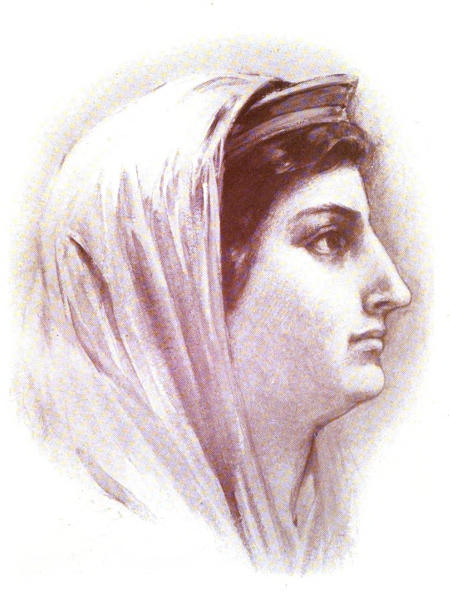
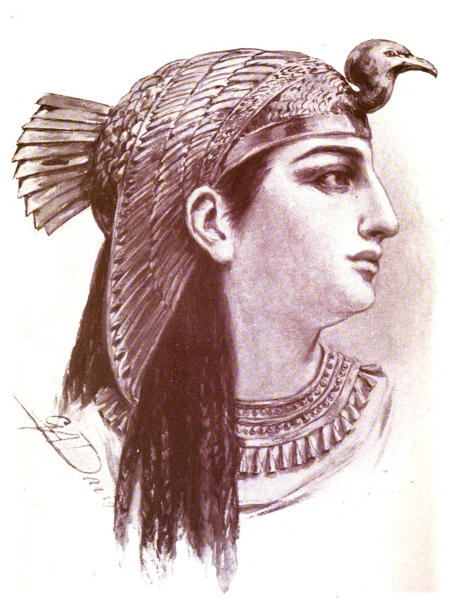
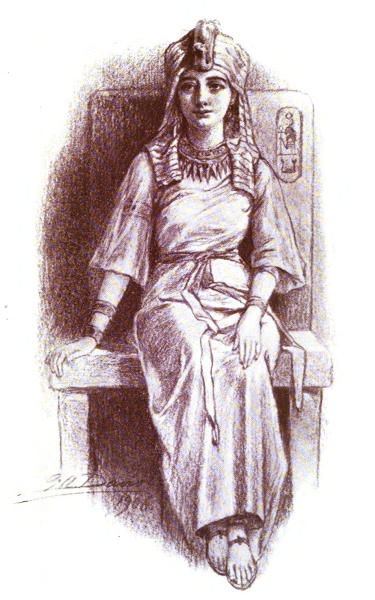
Arsinoe.
In placing his younger son on the throne, instead
of the elder, who would usually have been
considered the rightful heir, Ptolemy Sotor may
have been influenced by the personal character of
the two, as well as by other motives. The elder
bore the name of Ptolemy Keraunos, a soubriquet
or nick-name meaning gloomy or violent,
and was “of fiery temper and unsteady life.”
Mahaffy suggests that the thunderbolt added to
the Ptolemy coins at the time of his birth possibly
gave rise to the nick-name. History does
not chronicle details, but there may have been
actual quarrels between father and son, a state
of affairs not unknown in modern times. Be
this as it may, the younger was preferred before
the elder. Neither succession perhaps could have
prevented subsequent bitterness of feeling and
strife. Yet peace was outwardly observed during
the life of the old king. Keraunos submitted
and left Egypt with his mother, brothers and
sister, while Berenike’s son was made king, co-ruler
with his father (who virtually abdicated in
285-4) with feasts and rejoicing.
Ptolemy the younger was “fair haired and
delicate” in youth, resembling his father, but with
more regular features, and the thick neck characteristic
of many members of the family. His
manners were gentle as well as popular and probably
he had already shown an appreciation of his
father’s policy and a taste for intellectual and
scientific pursuits. Few fathers would not take
more pleasure in the succession of a son likely to
carry out their views, than in one who seemed
disposed to change and alter all their arrangements.
Gorgeous pageants celebrated the advent of the
new king. His father, it may be said, had in a
certain measure slipped into power; not so with
the son, his successor. It was a matter of direct
inheritance and in Egypt at least his claim was
not disputed. Whatever assistance Ptolemy Keraunos
secured was from foreign aid and not
from partizans at home. The banqueting hall
was decorated with sculpture and painted and carpeted
with flowers, the gold and silver vessels,
crown treasures, were carried in the grand procession.
There were fruits of all sorts displayed
and droves of camels, elephants and other wild
animals. Elephants were then much in favor as
battle chargers with the kings of this period, and
though the Ptolemies made less use of them in
this respect, they too had large numbers of them.
Their popularity, however, soon declined and in
later wars they were no longer deemed available.
Ptolemy Sotor presented the victors in the
games at his son’s coronation with twenty crowns,
Queen Berenike with twenty-three.
Historical and allegorical tableaux were interspersed
and eighty thousand troops of cavalry
and infantry took part. It must have been a combination
of the circus processions of modern
times, with less tinsel and more of solid value,
with a fine military parade. It delighted the people
from morning till evening and showed to all
strangers the wealth and power of the Ptolemy
House.
Spite of gentle seeming, as soon as his father’s
death left him in possession of the regal power,
the new king made it quite clear he would tolerate
no rival and meant to keep possession of all he
had gained. Like his father, perhaps, he had no
special taste for the shedding of blood; indeed he
is said to have deplored what he considered the
necessity of pursuing this policy, none the less
did he hesitate to do so to secure his throne, and
several people were put to death whom he
thought might give him trouble. Probably his
elder brother would have been among these could
he have laid his hand on him. It was mortal
strife between them, and Ptolemy Keraunos was
now in another country doing his best to unseat
the young king.
Some years before her brother’s accession the
young Arsinoe, a girl of sixteen, first child of
Ptolemy Sotor and Berenike, had married, or
rather been married, to the elderly Lysimachus,
King of Thrace (disparity of years was of course
of no account in a political marriage), and had
exchanged her sunny Egyptian home for the
cooler and more rigorous climate of the mountainous
regions of Northern Greece. Beautiful,
clever and ambitious, as were most of the Ptolemy
women, she was prominent among them and
destined to have strong influence wherever she
went, especially over two at least of the men with
whom she was most closely associated. This
marriage took place about 300 B. C.
So anxious was Ptolemy Sotor to cement the
alliance between Lysimachus and himself, that
marriage after marriage was arranged for and it
might have been supposed that the two families
were so closely united that peace among them had
been secured. His step-daughter Lysandra was
given to the Thracian Crown Prince Agathocles,
thus making her at the same time sister and
daughter-in-law of Arsinoe, who was probably
the younger of the two, and not content with
this, a marriage was arranged between the young
king of Egypt and Arsinoe, daughter of Lysimachus,
and half-sister of Agathocles, who thus
became Queen Arsinoe I of Egypt.
She, too, was a person of spirit, decision and
character, bloodshed marked her footsteps; she
caused an illicit lover of her mother’s to be slain,
and is said herself, young though she was, to have
hastened on her marriage with the Egyptian king.
One of policy rather than affection probably on
both sides. It requires a clear head to follow out
these complicated relationships. Arsinoe I had
attained her ambition, but it was a position, in
those unsettled times, involving quite as much
peril as honor. She became the mother of several
children, but whether her life was a happy
one we may justly have our doubts. It held, however,
less tragedy than that of her successor. Perhaps
she was neither beautiful nor winning, certain
it is that the courtesies which were subsequently
paid to various queens, of putting their
likeness on the coins and naming cities after them,
were omitted in her case.
Ptolemy Philadelphus founded, it is said, four
Berenikes in honor of his mother, eighteen Arsinoes,
in honor of his second wife, and three Philoteras,
in honor of his sister, in Egypt and elsewhere.
These last were out of regard to a favorite
sister Philotera, who dwelt in single blessedness—shall
we call it a rare privilege in those
days?—and lived in great harmony with her
brother and his queens. As to the queen, Arsinoe
II, so to the maiden sister also poems were
addressed by the versifiers of the times.
The Thracian Arsinoe I, notwithstanding her
early self-assertion, seems to have made little
mark either upon her husband or upon Egypt.
The comparative neglect with which she was
treated may have embittered her and made true
the accusation brought against her of having conspired
against the life of her husband. If it was
true she was leniently dealt with. She was divorced
about 277 B. C. in the eighth or ninth year
of Ptolemy’s reign, and banished to Koptos,
where she lived in some state and appears from
certain records to have been accompanied or
visited by her younger son. She kept up her intercourse,
too, perhaps with some of her Thracian
relatives; and built shrines to the gods. The
very fact that her life did not pay the forfeit of
her alleged crime seems to throw doubt upon it.
Or possibly, though this seems less likely, Arsinoe
II, her supplanter, who in general, her purpose
accomplished, showed no desire for the shedding
of blood, may have induced the king to
spare her. We can only surmise.
Ptolemy Philadelphus was a prosperous and
popular king; living in comparative peace in
sunny Egypt with his Thracian wife, remote from
most of the wars which were carried on in his
name and caring little what battles raged at a distance
so that he preserved himself and his kingdom
in relative quiet. There were wars and rebellions
afar, there were times even when Egypt
itself was threatened, but through it all, at home,
Ptolemy was able to pursue a relatively peaceful
way. He spent his time adorning his splendid
city and enlarging and, so to call it, emphasizing
the scope of his great museum, a combination of
university, club and social gathering place. The
early Ptolemies, especially, were patrons of learning
and people of all nations met at their brilliant
court. He gathered around him men of intellectual
and scientific pursuits and enjoyed mental
pleasures as well as those of a lower order.
His courtiers lavished upon him unstinted adulation
and he might well have walked the earth as
proudly as the great Rameses II, his predecessor.
It is to him we owe the translation of the Bible
called the Septuagent, from the seventy translators
who were gathered together to accomplish
the task. Manetho, of Sebennytus, a priest of
Heliopolis, was also employed by the king to collect
the fragments of Egyptian history, from the
time of Menes 4455 B. C. to 322 B. C. which had
lain hidden or neglected in the various temples,
and prepare from them a consecutive narrative.
But unfortunately only fragments of this also
now remain to us, and it is from these, given by
Josephus and other Jewish and Christian writers
that we have obtained our earliest knowledge, in
a literary form, of Egyptian history. This work
enjoyed a high reputation.
The king himself must have had some literary
ability, or at least a pretty turn for the use of
the pen, for he wrote a history of Alexander’s
conquests. That it was much celebrated and
lauded goes without saying; even in modern times
the literary productions of king or president are
much in demand and widely read. But of its
intrinsic merits we are unable to judge, since it
too is lost to us, an unfortunate fact, as it could
not fail to have been of interest, whatever its
method of treatment or literary value.
Ptolemy made wise laws and so far as he
could, combined with his own personal advantage,
wrought in every way for the internal improvement
of his kingdom. Notwithstanding the modern
assertions of liberty, equality and fraternity,
it may be doubted whether in all ages and at all
times man is not more or less a slave to circumstance
and environment, but certainly the slaves
of the early Ptolemies might have contrasted favorably
both with those that who came before and
those who came after. Less trampled upon and
oppressed than in the reigns of the Pyramid
builders, the great Rameses, or the Persian line,
they appear also to have been better off and more
peaceful than under the later Ptolemy rulers.
Ptolemy, ably seconded by his favorite wife,
was devoted to the service of the temples and
favorable to the priests, a policy which helped to
strengthen his place and power. He built and
restored temples both to the gods of Greece and
Egypt. These last were approached in solemn
procession, and were not merely, like the Greeks,
to hold images of the gods, or like the later
Christian places of worship to accommodate a
congregation. They had a holy of holies, into
which only the high priest entered. Through the
avenue of sphinxes, which frequently gave entrance
to the temples, the long line would wind
from their gaily decorated boats on the Nile,
while the sacred lakes and the sacred grove were
generally within the enclosure. The pylons or
entrances were most imposing and an open court
and a great hall beyond, with colonnades and
columns, adorned with sculpture and paintings,
gave entrance to this highest sanctuary, containing
the symbol of the god or sacred animal.
No traces remain of the temple building of
Ptolemy Philadelphus beyond the beautiful island
of Philae; but at many other points ruins and
fragments are to be found. Those of the temple
of Isis in Hebt are near the present Mausura.
These are of red and grey granite, with columns
and architraves. There are figures of the king
making offerings to Isis and among others an
inscription which reads “Isis, Mistress of Hebit,
who lays everything before her royal brother.”
Of the portrait statues of the Egyptian kings and
queens Dr. Lepsius says: “They wear the same
character of monumental repose as the gods
themselves and yet without the possibility of their
human individuality being confounded with the
universally typical features of the divine images.”
But intellectual, or so called religious pursuits,
not alone shared Ptolemy’s heart and attention.
His was a pleasure-loving nature; beautiful women
thronged his court, sought his favor and
beamed upon him with smiles and blandishments.
No claim of legal wife, not even the true and devoted
affection which he showed so plainly that
he felt for his latest spouse, prevented his indulging
in baser connections. He was the king—if
no other man—the king at least might do as he
pleased, there was none to criticise, none to prevent.
Then, too, he amused himself with his
goldsmith’s work, bench and tools doubtless occupied
some favorite nook in the palace, and since
this fancy is matter of record, we may judge that
he turned out some creditable specimens of work,
was no mean craftsman and perhaps adorned
with his own skill the favorite of the hour, or the
plumb and beautiful form of his beloved Arsinoe
II.
To the personal history of this same princess,
the subject of the present sketch, we turn once
more. Like Roxane, wife of Alexander, she in a
measure deserved and prepared the way for her
own subsequent misfortunes. She was queen of
Thrace, a distinguished and honorable position,
but obtained at the cost of the honor, feelings and
probably affections of the previous queen. Lysimachus
had lived at Sardis, apparently in harmony
with a noble Persian wife, Amestris. But,
probably for political reasons alone, he sent her
away, and married the young daughter of Ptolemy
Sotor.
The new queen of Thrace resembled her
mother Berenike in her ambition and tact. She,
too, acquired great influence over an old husband,
as far as in her lay, ousted her step-children from
their natural rights, and secured all she could for
her own. She obtained from the king the session
of several valuable towns, but was not contented.
Again like her mother before her she
wished to supplant the elder members of the family.
At this crisis Ptolemy Keraunos, “the Embroiler,”
arrived at the Thracian court, and instead
of, as might have been expected, siding
with his own sister Lysandra, who had married
the Crown Prince, Agathocles, calumniated him
to the king, showing how completely the old
man was under Arsinoe’s powerful influence, and
succeeded in having the prince put to death.
None of which shows Arsinoe in a very amiable
light, but she doubtless thought one must fight
for one’s self, by whatever means, or be driven to
the wall.
There were other allies, Magas, King of Cyrene
and half brother of Ptolemy Keraunos,
seems to have leaned to his side, in the contest
which the latter was waging for his rights, and
been ready to throw off the yoke of Egypt. These
were stirring times, men and women too, whether
they would or not must lead “the strenuous life.”
Seleukos, King of Syria, lent aid to Ptolemy
Keraunos, and attacked Lysimachus, who lost his
life in battle, but instead of proceeding further
to place Keraunos on the throne of Egypt, as
the latter expected, he suddenly determined to go
back to his old home in Macedonia. Disappointed
and enraged, Keraunos secured the murder of
Seleukos and proclaimed himself king in his
place. That he could have succeeded in this
gigantic scheme, Mahaffy considers, shows him
to have had many fellow conspirators.
His Egyptian projects had now to be abandoned,
as Antiochus, son of Seleukos, was already
hastening to avenge the death of his
father. So Keraunos, nothing loth probably,
seized upon the throne of Thrace, the king and
his eldest son both being dead. Grabbing a Kingdom
seems to have been comparatively easy—the
pastime of adventurers in those days—but
it was frequently “light come and light go”—there
was seldom any real stability in these self-made
royalties.
Again Arsinoe, the Egyptian born, appears in
an unfavorable light (though how far independence
of action or any other course was possible
to her we cannot judge) for she married this
murderer of kings, the son of her father’s first
wife. Doubtless she must have foreseen the possibility
of ill consequences, for she was a woman
of acute mind, but probably in the midst of such
troublous times and so many perplexities it
seemed the safest thing to her to marry the
strongest, the man who had proved himself a
success, and she believed that it would secure
her and her children the throne of Thrace. She
had already lent herself to cruel deeds to secure
this object, she must needs go on in the same
path. Few more unlovely characters than Keraunos
appear in this dark period of history. It
is evident that he simply married Arsinoe to get
her in his power, for no sooner had he done so
than he murdered her young children and banished
her childless and heart-broken to the island
of Samothrace, to repent in bitterness of
soul her sad mistake. Two years later the
monster was overthrown in battle, dragged from
his elephant, and hacked to pieces by the barbarous
Gauls, leaving, we may imagine, but few
to mourn his well-deserved fate.
Meanwhile the childless widow, stripped of
throne, honors and kindred abode in the holy,
isle. To her perhaps life seemed ended, little
foreseeing the splendid future before her. Turning
to religious consolations in time of sorrow,
she worshipped the strange divinities of the place,
building shrines to them, of which traces have
been discovered in modern times, and even adding
them to the long list of Egyptian divinities
and building temples to them when she returned
to her native land.
Deeply attached to her as he proved himself
to be later, we cannot suppose Ptolemy Philadelphus
to have been unmoved by the great misfortunes
of his sister, but news traveled slowly in
those days, and whatever the cause, he seems to
have done nothing at once to avenge her losses.
Whether at his instance or hers we know not, but
after a certain length of time Arsinoe returned
to Egypt. She took new hold of life and perhaps
even began to scheme for the attainment
of the honors which she shortly won. Recognized
or not, her presence was a menace to the
reigning queen. Equally it remains possible that
she was innocent in this matter, further than
acquiescence in the wishes of the king, but her
previous course in Thrace lends color to the
former idea.
So Arsinoe I was banished and Ptolemy married
the widow, who now became Arsinoe II,
called Philadelphus during her lifetime, and only
subsequently was the title bestowed upon her
husband to distinguish him among the long list
of Ptolemy kings. This strange marriage was
quite in accordance with Egyptian customs,
where the queen was frequently called the king’s
sister, as a term of honor, whether she was so
or not, and shows how the Ptolemies had accepted
Egyptian ideas, which no doubt largely
account for their popularity. But to the Greeks
such unions were an offence and deemed, as we
would in a Christian age, incestuous. But the
king was absolute, one of the courtiers, if not
more, who dared to criticise and disapprove, paid
with life for his temerity.
The first marriage occurred probably when
Arsinoe II was about sixteen, her third and last
when she was thirty-nine or forty. There can
be little doubt that she had beauty and charm,
a vigorous mind and great tact. She needed
scope for her powers and in becoming queen of
Egypt found a field well suited to her desires
and abilities. We seem to see some resemblance
between her and Queen Mertytefs of ancient
times. Both were in succession wife to different
kings, both were women of great attractiveness
and capacity, and both took a personal share in
public affairs. Step by step the new queen rose
to greater prominence. Her sorrows were of
the past, now life was all sunshine. She attained
the highest point to which mortal could
reach, she was finally worshipped as a goddess,
and on a certain stele found at Pithon, she is
even represented as a deity bestowing favors on
her husband.
In the fifteenth year of Ptolemy’s reign Arsinoe
II was made goddess of Mende, in the nineteenth
at Thebes and in the twentieth or twenty-first,
as Isis-Arsinoe, she was worshipped at Sais,
and the king claimed these honors for her in all
the temples of Egypt. There had been a city,
the centre of the Egyptian worship of the crocodile,
this Ptolemy re-named after the queen; it
was enlarged, embellished and Hellenised to a
great extent by the introduction of the Greek
language and the erection of temples to the
Greek gods and institutions on a Greek pattern.
Its population at one time was said to amount
to a hundred thousand.
Among other attractions for the king, perhaps,
was also the fact that Arsinoe was a great heiress.
She had proprietary claims on Cassandrea, Pontiac,
Heraclia and its dependent cities, bestowed
on her by her first husband. In the region called
the Fayum, the former Lake Moeris was drained
and turned into a fertile plain and this work was
attributed to Arsinoe and it was now called the
Arsinoe nome, and from it the queen derived part
of her revenues. Old records show that it was
settled by veteran soldiers who brought wives
from Greek lands, and that it was an orderly
and well managed society, with few crimes laid to
its account.
Arsinoe II was an ideal stepmother, in the
better sense of the word. The children of Ptolemy
were treated by her as her own—only one
son appears to have accompanied his mother into
exile, if even he remained permanently with her—all
the others dwelt in apparent harmony and
affection with her supplanter. Thus Ptolemy
Philadelphus had an intellectual companion
whose advice he sought and upon whose judgment
he relied, whose personal charms were
great, who made life smooth and agreeable and
who dwelt at peace both with his favorite sister
and his children. While last, and perhaps not
least in her catalogue of virtues in his eyes, she
was lenient to his defections from the moral code
and saved him from the desire and peril of other
alliances. Such as she was the king seems to
have idolized her and paid her every possible
honor in life and in death. That she was some
years his senior in no way interfered with a marriage
apparently most congenial to both.
Deprived first of parents, then of husband,
children and throne Arsinoe had a strange and
rare experience, virtually a second life lay before
her, surpassing in all respects her earlier
career. She dwelt in light and airy palaces built
of brick and wood, richly decorated with color,
adorned with balconies and surrounded by gardens
and ponds. The music of tambourine, drum
and flute, violin with one string, zither, lute or
mandolin—and song and chorus, she had but to
speak her pleasure and silence became melodious.
Rhythm but not time, and monotonous singing
through the nose, not pleasing to the European
ear, is said to describe Egyptian music of to-day
and probably that of the past also, but it was
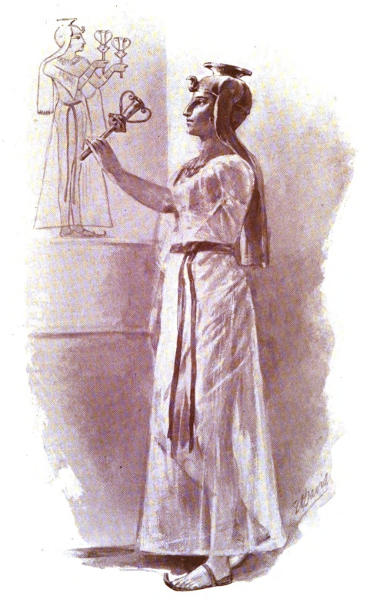
doubtless to their taste. The queen, too, had the
privilege of being priestess in the temples and
playing the sacred sistrum before the gods. She
dwelt in an increasingly beautiful city, with wide
streets, splendid palaces and many fine buildings.
Her associations were with men of culture and
learning. She was surrounded by courtiers and
poets who paid her homage and wrote in her
praise. Doubtless, too, through her many tried
to obtain favors from and influence with the
king. She was for those times a deeply religious
woman, building temples to the gods and lavishing
gifts upon them. Thereby, of course, she
endeared herself to the priests, always a more or
less influential class, and it was probably owing
to this, in addition to her husband’s partiality,
that she was, even during her lifetime, deified.
Both she and the king, we may judge, had affable
and agreeable manners and both seem to
have been very popular with the people.
In all the concerns of the kingdom she took
an active share, and it is said that “no queen till
we reach the last Cleopatra ever wielded greater
political influence.” Wars and rumors of wars
there were, but Egypt itself in this reign rested
in comparative peace. The queen’s life must
have been busy and full of interest, thus enabling
her to recover from her earlier sorrows. Egypt
was a country flowing not with milk and honey,
but with oil and wine, the juices of the olive and
the grape, from which large revenues were derived.
As the great museum is said to have
formed part of the palace, and contained cloisters
or porticoes, a public theatre, or lecture room,
and an immense dining hall, where the learned
feasted together, it is possible that the queen
may have been no unfamiliar figure within its
walls. The person of the Ptolemy queens was
doubtless as well known to the people as the
wife of many a modern ruler, the Persian custom
of strict seclusion for women not obtaining
among the Greeks and their descendants.
There is a story told of Queen Arsinoe II, considered
reliable, to the effect that she took exception
to the ordering of a feast to one of the
gods, remarking “this is a shabby consorting together,
for the company must be a mixed crowd
of all sorts, the food stale and not decently
served,” and thereafter provided for better arrangements
at her own expense. Hitherto each
guest, somewhat in the manner of a modern country
picnic, having brought a miscellaneous and
disorderly collection. And whatever the queen
did in the matter was doubtless accepted by the
king.
Together with his sister, the royal pair travelled
through the country and cities were founded
bearing the name of both ladies. Together the
king and queen seem to have governed and
planned for the internal improvement of the kingdom,
studying its needs and necessities by personal
inspection. They made two visits to Pithon,
and their foreign officials brought back elephants
and various curiosities, to pleasure their
majesties, or by special command. Part of the
text of an ancient inscription found in the mounds
of the ruins of this very city reads: “He brought
all the things which are agreeable to the king,
and to his sister, his royal wife who loves him;”
further, “and he built a great city to the king with
the illustrious name of the king, the lord of
Egypt, Ptolemais. And he took possession of it
with the soldiers of his majesty and all the workmen
of Egypt and the land of Punt.” Also they
caught elephants and in another place it proceeds,
“and in this place (Kemuer-sea) the king
had founded a large city to his sister, with the
illustrious name of King Ptolemy (Philotera).”
The same beloved sister, to whom, as well as to
the queen herself, court poets, like Callimachus,
addressed poems. Sanctuaries were also built
there to the princess Adelphus.
The delicate and pleasure-loving king never
commanded his armies in person, but was quick
to take advantage of anything in his own favor.
He sent ambassadors to treat with the great and
growing power of Rome, and made alliances
wherever possible with any power strong enough
to do his harm. With Pyrrhus, king of Epirus,
he was connected by the marriage of a step-sister,
Antigone; his mother, Berenike’s daughter,
by her first husband.
Always beside the king, Arsinoe II was a
woman of affairs, busy and capable, but not too
much occupied to enjoy the amenities of life and
make it agreeable to her consort. In his foreign
wars and alliances, in the internal improvement
of the kingdom, in his literary work, the story
of Alexander’s campaigns, in Manetho’s History
of Egypt, in the translation of the Septuagent,
in the additions to the great library in
which at the time of his death Ptolemy Philadelphus
is said to have left 700,000 volumes, in the
marriages of his children we cannot doubt the
queen’s active interest and sympathetic share,
above all others she was the Privy Councillor.
At Karnak and various points along the Nile
as far as Philae, are fragments of temples both
to Egyptian and Greek gods, built or restored by
Ptolemy Philadelphus, and both he and his wife
were interested in the Cabeiri mysteries, probably
in their later years as some one has well
said, “to still the longings of the soul with spiritual
food and with dim revelations of the unseen,”
here, too, perhaps, we may see the queen’s
influence, since they were celebrated with special
solemnity at Samothrace, the home of her widowhood.
The king and queen lived in an atmosphere
of adulation, like that which surrounded
Louis XIV. Writers of the time drew flattering
pictures of them and coarse caricatures of the
masses. As to-day newspapers, whatever the
private convictions of their editors, will bow and
truckle to what they believe to be the popular
view of any subject, so in ancient times it was
the king and queen alone and those in high places
who thus swayed the pen.
Some writers believe that Ptolemy and Arsinoe
had one son who died in youth, but the
weight of testimony is against this. In regard to
the marriages of her step-children, whom she had
brought up as her own, we may well believe the
queen’s influence was great. The eldest daughter,
Berenike, the child of Arsinoe I, was married to
Antiochus II, the sickly king of Syria, chiefly
in the hope of establishing an Egyptian claim to
the throne of that monarchy. Sacrificed like so
many young princesses, both before and after,
to political purposes. Yet Ptolemy Philadelphus
seems to have regarded this daughter with especial
tenderness, for he accompanied her to her
husband’s kingdom, was present at the marriage,
and continued to send her the water of the fertile,
beloved and worshipped Nile for use in
her distant home. To accomplish this marriage
Antiochus II had put away his first wife, Laodike.
But this last was not a woman to submit
meekly to such indignity, and stopped at nothing
to recover her lost position. Who did in those
days—even the best of them—hesitate at any
crime to secure her object? The injured queen,
burning to avenge her wrongs, caused the king
to be poisoned, he, perhaps weakly, having put
himself in her power by going to see her at
Ephesus, even after the birth of a son by the new
queen. Nor was this enough, for the death of
her rival was also determined upon, Laodike having
many adherents, and ere her father could
come to her rescue, poor Berenike and her babe
were also murdered, innocent victims of political
intrigue. Ptolemy Philadelphus perhaps
lived long enough to hear of this tragic death, but
not long enough to avenge it—a task he left to
the son who succeeded him.
Of the personality and general characteristics
of no queen in the long Ptolemy line can we
gather a clearer idea from the records that remain
to us. There is a statue of Ptolemy Philadelphus
and Arsinoe II in the Vatican, with, Mahaffy
thinks, the dear sister Philactera beside
them. Not only on coins, but among the effigies
at the entrance of the Odeum at Athens, where
the statues of the Egyptian kings were set up,
she had her place. Pausanius also saw at Helicon
a statue of her “riding upon an ostrich in
bronze.” A position elevated, but lacking in dignity,
perhaps, like a grey-haired lady on the modern
bicycle. “It is very likely,” continues Mahaffy,
“that this statue or a replica was present
to the mind of Callicachus when he spake in the
‘Coma Berinices,’ of ‘the winged horse, brother
of the Aethiopian Memnon, who is the messenger
of Queen Arsinoe, she is also in that
poem called Venus and Zaphyrion.”
From the coins we learn of Arsinoe II that
there were octadrams in all metals with her
image, and those with portraits of Ptolemy I and
Berenike I, and those of Ptolemy II and herself;
and in silver of Ptolemy I, and also of her
alone, struck in the reign of Ptolemy Philadelphus;
also gold coins with Arsinoe II alone.
The coins of Arsinoe II were mainly octadrams
in gold and decadrams in silver. On these and
also on those of her step-daughter, Berenike II,
both queens are diademed and veiled, with regular
features, indisputably handsome but conventionalized.
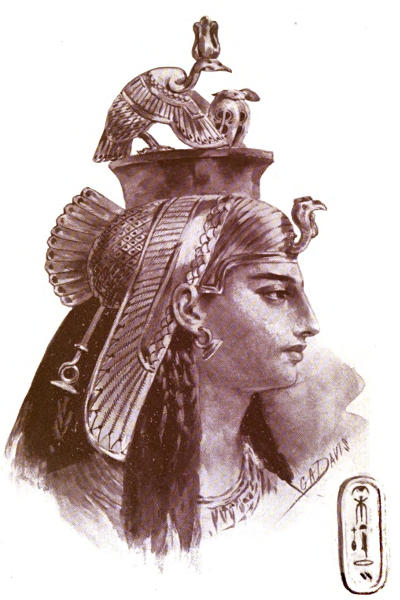
Arsinoe II appears with the horn of
Zeus Amon, diadem, stephane or crown, veil and
sceptre. She is beautiful in youth and still handsome,
though more portly as depicted in later
years. Most of the Ptolemy queens grew comfortably
plump with time; the murder of a rival
or even the death of their nearest relatives appears
to have interfered little with their digestion.
But death came at last to put an end to these
ceaseless activities, whether by slow decay or sudden
illness, we know not. Ptolemy Philadelphia
died 247 B. C., Arsinoe II, some say 270 B. C.,
but we have no precise date. The king was in
no sense a faithful lover, since he had a succession
of feminine favorites, alternating in the
company of philosophers and mistresses. Yet
he seems to have mourned Arsinoe with a passionate
grief, and indulged in what may be called
wild schemes to do her honor. One of these was
the building of a temple with a loadstone in the
roof which should hold, suspended in mid-air,
an iron statue of the queen. In everything he
had leaned upon her, and she had made life
agreeable to him, his sorrow for her loss was sincere
and deep. Her popularity with the people
was also widespread, more inscriptions in her
honor have been found all over Egypt than of
those of any of the succeeding queens.
Ptolemy Philadelphus reigned more than thirty-six
years and left his kingdom peacefully to his
son Euergetes, whose name had long been associated
with his in public acts.