New highways of science have been monumented
now and again by the masterful efforts of
genius, working single-handed; but more often
it is slow-moving time that ripens discovery, and,
at the proper moment, opens some new path to
men whose intellectual power is but willingness
to learn. So the annals of astronomical photography
do not recount the achievements of extraordinary
genius. It would have been strange,
indeed, if the discovery of photography had not
been followed by its application to astronomy.
The whole range of chemical science contains
no experiment of greater inherent interest than
the development of a photographic plate. Let
but the smallest ray of light fall upon its
strangely sensitive surface, and some subtle invisible
change takes place. It is then merely necessary
to plunge the plate into a properly prepared
chemical bath, and the gradual process of
developing the picture begins. Slowly, very
slowly, the colorless surface darkens wherever
light has touched it. Let us imagine that the
exposure has been made with an ordinary lens
and camera, and that it is a landscape seeming to
grow beneath the experimenter's eyes. At first
only the most conspicuous objects make their
appearance. But gradually the process extends,
until finally every tiny detail is reproduced with
marvellous fidelity to the original. The photographic
plate, when developed in this way, is
called a "negative." For in Nature luminous
points, or sources of light, are bright, while the
developing negative turns dark wherever light
has acted. Thus the negative, while true to Nature,
reproduces everything in a reversed way;
bright things are dark, and shadows appear light.
For ordinary purposes, therefore, the negative has
to be replaced by a new photograph made by copying
it again photographically. In this way it is
again reversed, giving us a picture corresponding
correctly to the facts as seen. Such a copy from
a negative is what is ordinarily called a photograph;
technically, it is known as a "positive."
One of the remarkable things about the sensitive
plate is its complete indifference to the distance
from which the light comes. It is ready
to yield obediently to the ray of some distant
star that may have journeyed, as it were, from
the very vanishing point of space, or to the
bright glow of an electric light upon the photographer's
table. This quality makes its use especially
advantageous in astronomy, since we can
gain knowledge of remote stars only by a study
of the light they send us. In such study the
photographic plate possesses a supreme advantage
over the human eye. If the conditions of
weather and atmosphere are favorable, an observer
looking through an ordinary telescope
will see nearly as much at the first glance as he
will ever see. Attentive and continued study will
enable him to fix details upon his memory, and
to record them by means of drawings and diagrams.
Occasional moments of especially undisturbed
atmospheric conditions will allow him
to glimpse faint objects seldom visible. But on
the whole, telescopic astronomers add little to
their harvest by continued husbandry in the
same field of stars. Photography is different.
The effect of light upon the sensitive surface of
the plate is strictly cumulative. If a given star
can bring about a certain result when it has been
allowed to act upon the plate for one minute,
then in two or three minutes it will accomplish
much more. Perhaps a single minute's exposure
would have produced a mark scarcely perceptible
upon the developed negative. In that case,
three or four minutes would give us a perfectly
well defined black image of the star.
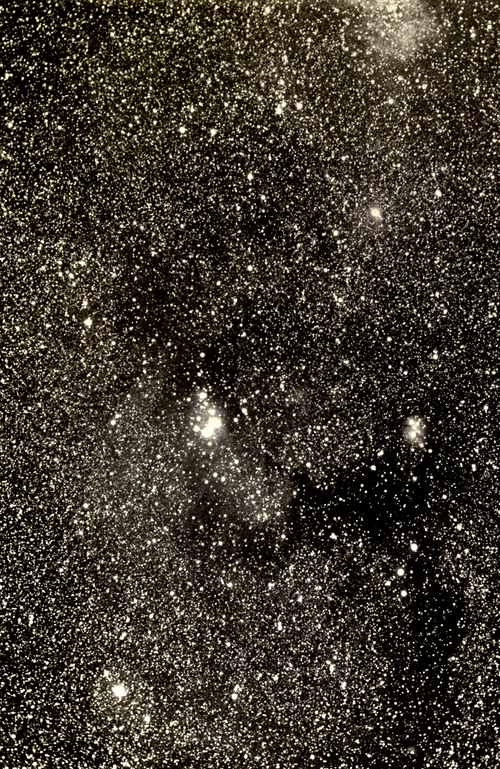
Star-Field in Constellation Monoceros.
Photographed by Barnard, February 1, 1894.
Exposure, three hours.
Thus, by lengthening the exposure we can
make the fainter stars impress themselves upon
the plate. If their light is not able to produce
the desired effect in minutes, we can let its action
accumulate for hours. In this manner it becomes
possible and easy to photograph objects
so faint that they have never been seen, even
with our most powerful telescopes. This
achievement ranks high among those which
make astronomy appeal so strongly to the imagination.
Scientific men are not given to fancies;
nor should they be. But the first long-exposure
photograph must have been an exciting thing.
After coming from the observatory, the chemical
development was, of course, made in a dark
room, so that no additional light might harm the
plate until the process was complete. Carrying
it out then into the light, that early experimenter
cannot but have felt a thrill of triumph;
for his hand held a true picture of dim stars to
the eye unlighted, lifted into view as if by magic.
Plates have been thus exposed as long as
twenty-five hours, and the manner of doing it is
very interesting. Of course, it is impossible to
carry on the work continuously for so long a
period, since the beginning of daylight would
surely ruin the photograph. In fact, the astronomer
must stop before even the faintest streak of
dawn begins to redden the eastern sky. Moreover,
making astronomical negatives requires excessively
close attention, and this it is impossible
to give continuously during more than a few
hours. But the exposure of a single plate can be
extended over several nights without difficulty.
It is merely necessary to close the plate-holder
with a "light-tight" cover when the first night's
work is finished. To begin further exposure of
the same plate on another night, we simply aim
the photographic telescope at precisely the same
point of the sky as before. The light-tight
plate-holder being again opened, the exposure
can go on as if there had been no interruption.
Astronomers have invented a most ingenious
device for making sure that the telescope's aim
can be brought back again to the same point with
great exactness. This is a very important matter;
for the slightest disturbance of the plate before
the second or subsequent portions of the exposure
would ruin everything. Instead of a very
complete single picture, we should have two partial
ones mixed up together in inextricable confusion.
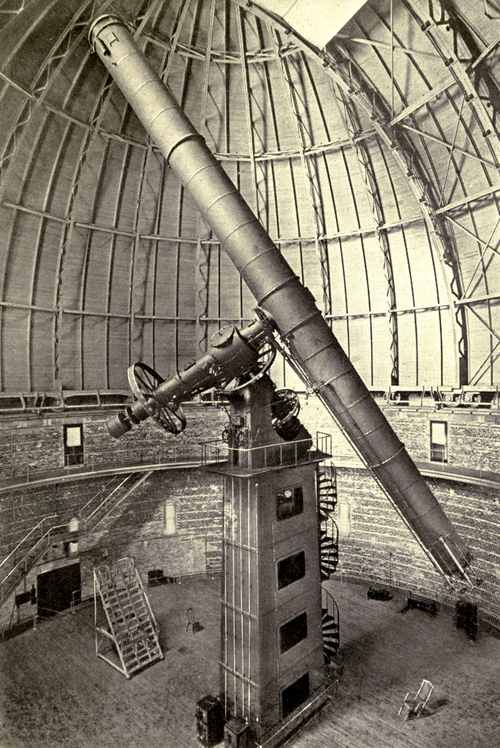
To prevent this, photographic telescopes are
made double, not altogether unlike an opera-glass.
One of the tubes is arranged for photography
proper, while the other is fitted with lenses suitable
for an ordinary visual telescope. The two tubes
are made parallel. Thus the astronomer, by looking
through the visual glass, can watch objects in
the heavens even while they are being photographed.
The visual half of the instrument is
provided with a pair of very fine cross-wires movable
at will in the field of view. These can be
made to bisect some little star exactly, before beginning
the first night's work. Afterward, everything
about the instrument having been left unchanged,
the astronomer can always assure himself
of coming back to precisely the same point of the
sky, by so adjusting the instrument that the same
little star is again bisected.
It must not be supposed, however, that the
entire instrument remains unmoved, even during
the whole of a single night's exposure. For in
that case, the apparent motion of the stars as they
rise or set in the sky would speedily carry them
out of the telescope's field of view. Consequently,
this motion has to be counteracted by shifting
the telescope so as to follow the stars. This
can be accomplished accurately and automatically
by means of clock-work mechanism. Such contrivances
have already been applied in the past to
visual telescopes, because even then they facilitated
the observer's work. They save him the
trouble of turning his instrument every few minutes,
and allow him to give his undivided attention
to the actual business of observation.
For photographic purposes the telescope needs
to "follow" the stars far more accurately than in
the older kind of observing with the eye. Nor is
it possible to make a clock that will drive the instrument
satisfactorily and quite automatically.
But by means of the second or visual telescope,
astronomers can always ascertain whether the
clock is working correctly at any given moment.
It requires only a glance at the little star bisected
by the cross-wires, and, if there has been the
slightest imperfection in the following by clock-work,
the star will no longer be cut exactly by
the wires.
The astronomer can at once correct any error
by putting in operation a very ingenious mechanical
device sometimes called a "mouse-control."
He need only touch an electric button,
and a signal is sent into the clock-work.
Instantly there is a shifting of the mechanism.
For one of the regular driving wheels is substituted,
temporarily, another having an extra tooth.
This makes the clock run a little faster so long
as the electric current passes. In a similar way,
by means of another button, the clock can be
made to run slower temporarily. Thus by
watching the cross-wires continuously, and manipulating
his two electric buttons, the photographic
astronomer can compel his telescope to
follow exactly the object under observation, and
he can make certain of obtaining a perfect negative.
These long-exposure plates are intended especially
for what may be called descriptive astronomy.
With them, as we have seen, advantage is
taken of cumulative light-effects on the sensitive
plate, and the telescope's light-gathering and
space-penetrating powers are vastly increased.
We are enabled to carry our researches far beyond
the confines of the old visible universe.
Extremely faint objects can be recorded, even
down to their minutest details, with a fidelity unknown
to older visual methods. But at present
we intend to consider principally applications
of photography in the astronomy of measurement,
rather than the descriptive branch of our
subject. Instead of describing pictures made
simply to see what certain objects look like in
the sky, we shall consider negatives intended for
precise measurement, with all that the word precision
implies in celestial science.
Taking up first the photography of stars, we
must begin by mentioning the work of Rutherfurd
at New York. More than thirty years ago
he had so far perfected methods of stellar photography
that he was able to secure excellent
pictures of stars as faint as the ninth magnitude.
In those days the modern process of dry-plate
photography had not been invented. To-day,
plates exposed in the photographic telescope are
made of glass covered with a perfectly dry film
of sensitized gelatine. But in the old wet-plate
process the sensitive film was first wetted with a
chemical solution; and this solution could not be
allowed to dry during the exposure. Consequently,
Rutherfurd was limited to exposures a
few minutes in length, while nowadays, as we
have said, their duration can be prolonged at will.
When we add to this the fact that the old
plates were far less sensitive to light than those
now available, it is easy to see what were the difficulties
in the way of photographing faint stars
in Rutherfurd's time. Nor did he possess the
modern ingenious device of a combined visual
and photographic instrument. He had no electric
controlling apparatus. In fact, the younger
generation of astronomers can form no adequate
idea of the patience and personal skill Rutherfurd
must have had at his command. For he
certainly did produce negatives that are but little
inferior to the best that can be made to-day.
His only limitation was that he could not
obtain images of stars much below the ninth
magnitude.
To understand just what is meant here by the
ninth magnitude, it is necessary to go back in imagination
to the time of Hipparchus, the father
of sidereal astronomy. (See page 39.) He
adopted the convenient plan of dividing all the
stars visible to the naked eye (of course, he had
no telescope) into six classes, according to their
brilliancy. The faintest visible stars were put in
the sixth class, and all the others were assigned
somewhat arbitrarily to one or the other of the
brighter classes.
Modern astronomers have devised a more scientific
system, which has been made to conform
very nearly to that of Hipparchus, just as it has
come down to us through the ages. We have
adopted a certain arbitrary degree of luminosity
as the standard "first-magnitude"; compared with
sunlight, this may be represented roughly by a
fraction of which the numerator is 1, and the denominator
about eighty thousand millions. The
standard second-magnitude star is one whose
light, compared with a first-magnitude, may be
represented approximately by the fraction ⅖.
The third magnitude, in turn, may be compared
with the second by the same fraction ⅖; and so
the classification is extended to magnitudes below
those visible to the unaided eye. Each magnitude
compares with the one above it, as the light
of two candles would compare with the light of
five.
Rutherfurd did not stop with mere photographs.
He realized very clearly the obvious
truth that by making a picture of the sky we
simply change the scene of our operations.
Upon the photograph we can measure that which
we might have studied directly in the heavens;
but so long as they remain unmeasured, celestial
pictures have a potential value only. Locked
within them may lie hidden some secret of our
universe. But it will not come forth unsought.
Patient effort must precede discovery, in photography,
as elsewhere in science. There is no
royal road. Rutherfurd devised an elaborate
measuring-machine in which his photographs
could be examined under the microscope with
the most minute exactness. With this machine
he measured a large number of his pictures; and
it has been shown quite recently that the results
obtained from them are comparable in accuracy
with those coming from the most highly accredited
methods of direct eye-observation.
And photographs are far superior in ease of manipulation.
Convenient day-observing under the
microscope in a comfortable astronomical laboratory
is substituted for all the discomforts of a
midnight vigil under the stars. The work of
measurement can proceed in all weathers, whereas
formerly it was limited strictly to perfectly clear
nights. Lastly, the negatives form a permanent
record, to which we can always return to correct
errors or re-examine doubtful points.
Rutherfurd's stellar work extended down to
about 1877, and included especially parallax determinations
and the photography of star-clusters.
Each of these subjects is receiving close attention
from later investigators, and, therefore, merits
brief mention here. Stellar parallax is in one
sense but another name for stellar distance. Its
measurement has been one of the important
problems of astronomy for centuries, ever since
men recognized that the Copernican theory of
our universe requires the determination of stellar
distances for its complete demonstration.
If the earth is swinging around the sun once a
year in a mighty path or orbit, there must be
changes of its position in space comparable in size
with the orbit itself. And the stars ought to shift
their apparent places on the sky to correspond
with these changes in the terrestrial observer's
position. The phenomenon is analogous to what
occurs when we look out of a room, first through
one window, and then through another. Any
object on the opposite side of the street will be
seen in a changed direction, on account of the
observer's having shifted his position from one
window to the other. If the object seemed to
be due north when seen from the first window,
it will, perhaps, appear a little east of north from
the other. But this change of direction will be
comparatively small, if the object under observation
is very far away, in comparison with the distance
between the two windows.
This is what occurs with the stars. The earth's
orbit, vast as it is, shrinks into almost absolute
insignificance when compared with the profound
distances by which we are sundered from even
the nearest fixed stars. Consequently, the shifting
of their positions is also very small—so
small as to be near the extreme limit separating
that which is measurable from that which is beyond
human ken.
Photography lends itself most readily to a
study of this matter. Suppose a certain star is
suspected of "having a parallax." In other
words, we have reason to believe it near enough
to admit of a successful measurement of distance.
Perhaps it is a very bright star; and, other
things being equal, it is probably fair to assume
that brightness signifies nearness. And astronomers
have certain other indications of proximity
that guide them in the selection of proper objects
for investigation, though such evidence, of course,
never takes the place of actual measurement.
The star under examination is sure to have near
it on the sky a number of stars so very small
that we may safely take them to be immeasurably
far away. The parallax star is among them,
but not of them. We see it projected upon the
background of the heavens, though it may in
reality be quite near us, astronomically speaking.
If this is really so, and the star, therefore, subject
to the slight parallactic shifting already mentioned,
we can detect it by noting the suspected
star's position among the surrounding small
stars. For these, being immeasurably remote,
will remain unchanged, within the limits of our
powers of observation, and thus serve as points
of reference for marking the apparent shifting of
the brighter star we are actually considering.
We have merely to photograph the region at
various seasons of the year. Careful examination
of the photographs under the microscope
will then enable us to measure the slightest displacement
of the parallax star. From these
measures, by a process of calculation, astronomers
can then obtain the star's distance. It will
not become known in miles; we shall only ascertain
how many times the distance between the
earth and sun would have to be laid down like a
measuring-rod, in order to cover the space separating
us from the star: and the subsequent
evaluation of this distance "earth to sun" in
miles is another important problem in whose solution
photography promises to be most useful.
The above method of measuring stellar distance
is, of course, subject to whatever slight uncertainty
arises from the assumption that the small stars
used for comparison are themselves beyond the
possibility of parallactic shifting. But astronomy
possesses no better method. Moreover,
the number of small stars used in this way is, of
course, much larger in photography than it ever
can be in visual work. In the former process,
all surrounding stars can be photographed at
once; in the latter each star must be measured
separately, and daylight soon intervenes to impose
a limit on numbers. Usually only two can
be used; so that here photography has a most
important advantage. It minimizes the chance
of our parallax being rendered erroneous, by the
stars of comparison not being really infinitely
remote. This might happen, perhaps, in the
case of one or two; but with an average result
from a large number we know it to be practically
impossible.
Cluster work is not altogether unlike "parallax
hunting" in its preliminary stage of securing
the photographic observations. The object is to
obtain an absolutely faithful picture of a star
group, just as it exists in the sky. We have
every reason to suppose that a very large number
of stars condensed into one small spot upon
the heavens means something more than chance
aggregation. The Pleiades group (page 10) contains
thousands of massive stars, doubtless held
together by the force of their mutual gravitational
attraction. If this be true, there must be
complex orbital motion in the cluster; and, as
time goes on, we should actually see the separate
components change their relative positions,
as it were, before our eyes. The details of such
motion upon the great scale of cosmic space offer
one of the many problems that make astronomy
the grandest of human sciences.
We have said that time must pass before we
can see these things; there may be centuries of
waiting. But one way exists to hurry on the
perfection of our knowledge; we must increase
the precision of observations. Motions that
would need the growth of centuries to become
visible to the older astronomical appliances,
might yield in a few decades to more delicate
observational processes. Here photography is
most promising. Having once obtained a surpassingly
accurate picture of a star-cluster, we
can subject it easily to precise microscopic measurement.
The same operations repeated at a
later date will enable us to compare the two
series of measures, and thus ascertain the motions
that may have occurred in the interval.
The Rutherfurd photographs furnish a veritable
mine of information in researches of this kind;
for they antedate all other celestial photographs
of precision by at least a quarter-century, and
bring just so much nearer the time when definite
knowledge shall replace information based on
reasoning from probabilities.
Rutherfurd's methods showed the advantages
of photography as applied to individual star-clusters.
It required only the attention of some
astronomer disposing of large observational facilities,
and accustomed to operations upon a great
scale, to apply similar methods throughout the
whole heavens. In the year 1882 a bright
comet was very conspicuous in the southern
heavens. It was extensively observed from the
southern hemisphere, and especially at the British
Royal Observatory at the Cape of Good Hope.
Gill, director of that institution, conceived the
idea that this comet might be bright enough
to photograph. At that time, comet photography
had been attempted but little, if at all, and it
was by no means sure that the experiment would
be successful. Nor was Gill well acquainted with
the work of Rutherfurd; for the best results of
that astronomer had lain dormant many years.
He was one of those men with whom personal
modesty amounts to a fault. Loath to put himself
forward in any way, and disliking to rush
into print, Rutherfurd had given but little publicity
to his work. This peculiarity has, doubtless,
delayed his just reputation; but he will lose
nothing in the end from a brief postponement.
Gill must, however, be credited with more penetration
than would be his due if Rutherfurd had
made it possible for others to know that he had
anticipated many of the newer ideas.
However this may be, the comet was photographed
with the help of a local portrait photographer
named Allis. When Gill and Allis fastened
a simple portrait camera belonging to the
latter upon the tube of one of the Cape telescopes,
and pointed it at the great comet, they
little thought the experiment would lead to one
of the greatest astronomical works ever attempted
by men. Yet this was destined to occur.
The negative they obtained showed an
excellent picture of the comet; but what was
more important for the future of sidereal astronomy,
it was also quite thickly dotted with little
black points corresponding to stars. The extraordinary
ease with which the whole heavens
could be thus charted photographically was
brought home to Gill as never before. It was
this comet picture that interested him in the application
of photography to star-charting; and
without his interest the now famous astro-photographic
catalogue of the heavens would probably
never have been made.
After considerable preliminary correspondence,
a congress of astronomers was finally called to
meet at Paris in 1887. Representatives of the
principal observatories and civilized governments
were present. They decided that the end of the
nineteenth century should see the making of a
great catalogue of all the stars in the sky, upon a
scale of completeness and precision surpassing
anything previously attempted. It is impossible
to exaggerate the importance of such a work;
for upon our star-catalogues depends ultimately
the entire structure of astronomical science.
The work was far too vast for the powers of
any observatory alone. Therefore, the whole
sky, from pole to pole, was divided into eighteen
belts or zones of approximately equal area; and
each of these was assigned to a single observatory
to be photographed. A series of telescopes
was specially constructed, so that every part of
the work should be done with the same type of
instrument. As far as possible, an attempt was
made to secure uniformity of methods, and particularly
a uniform scale of precision. To cover
the entire sky upon the plan proposed no less
than 44,108 negatives are required; and most
of these have now been finished. The further
measurement of the pictures and the drawing up
of a vast printed star-catalogue are also well under
way. One of the participating observatories,
that at Potsdam, Germany, has published the first
volume of its part of the catalogue. It is estimated
that this observatory alone will require
twenty quarto volumes to contain merely the
final results of its work on the catalogue. Altogether
not less than two million stars will find a
place in this, our latest directory of the heavens.
Such wholesale methods of attacking problems
of observational astronomy are particularly characteristic
of photography. The great catalogue
is, perhaps, the best illustration of this tendency;
but of scarcely smaller interest, though less important
in reality, is the photographic method of
dealing with minor planets. We have already
said (page 63) that in the space between the orbits
of Mars and Jupiter several hundred small bodies
are moving around the sun in ordinary planetary
orbits. These bodies are called asteroids, or
minor planets. The visual method of discovering
unknown members of this group was painfully
tedious; but photography has changed
matters completely, and has added immensely
to our knowledge of the asteroids.
Wolf, of Heidelberg, first made use of the
new process for minor-planet discovery. His
method is sufficiently ingenious to deserve brief
mention again. A photograph of a suitable region
of the sky was made with an exposure lasting
two or three hours. Throughout all this
time the instrument was manipulated so as to
follow the motion of the heavens in the way we
have already explained, so that each star would
appear on the negative as a small, round, black
dot.
But if a minor planet happened to be in the
region covered by the plate, its photographic
image would be very different. For the orbital
motion of the planet about the sun would make
it move a little among the stars even in the two
or three hours during which the plate was exposed.
This motion would be faithfully reproduced
in the picture, so that the planet would
appear as a short curved line rather than a well-defined
dot like a star. Thus the presence of
such a line-image infallibly denotes an asteroid.
Subsequent calculations are necessary to ascertain
whether the object is a planet already known
or a genuine new discovery. Wolf, and others
using his method in recent years, have made immense
additions to our catalogue of asteroids.
Indeed, the matter was beginning to lose interest
on account of the frequency and sameness
of these discoveries, when the astronomical world
was startled by the finding of the Planet of 1898.
(Page 58.)
On August 27, 1898, Witt, of Berlin, discovered
the small body that bears the number
"433" in the list of minor planets, and has received
the name Eros. Its important peculiarity
consists in the exceptional position of the
orbit. While all the other asteroids are farther
from the sun than Mars, and less distant than
Jupiter, Eros can pass within the orbit of the
former. At times, therefore, it will approach
our earth more closely than any other permanent
member of the solar system, excepting our own
moon. So it is, in a sense, our nearest neighbor;
and this fact alone makes it the most interesting
of all the minor planets. The nineteenth
century was opened by Piazzi's well-known discovery
of the first of these bodies (page 59); it
is, therefore, fitting that we should find the most
important one at its close. We are almost certain
that it will be possible to make use of Eros
to solve with unprecedented accuracy the most
important problem in all astronomy. This is the
determination of our earth's distance from the sun.
When considering stellar parallax, we have seen
how our observations enable us to measure some
of the stars' distances in terms of the distance
"earth to sun" as a unit. It is, indeed, the fundamental
unit for all astronomical measures, and
its exact evaluation has always been considered
the basal problem of astronomy. Astronomers
know it as the problem of Solar Parallax.
We shall not here enter into the somewhat
intricate details of this subject, however interesting
they may be. The problem offers difficulties
somewhat analogous to those confronting
a surveyor who has to determine the distance of
some inaccessible terrestrial point. To do this,
it is necessary first to measure a "base-line," as
we call it. Then the measurement of angles
with a theodolite will make it possible to deduce
the required distance of the inaccessible point by
a process of calculation. To insure accuracy,
however, as every surveyor knows, the base-line
must be made long enough; and this is precisely
what is impossible in the case of the solar
parallax.
For we are necessarily limited to marking
out our base-line on the earth; and the entire
planet is too small to furnish one of really sufficient
size. The best we can do is to use the distance
between two observatories situated, as near
as may be, on opposite sides of the earth. But
even this base is wofully small. However, the
smallness loses some of its harmful effect if we
operate upon a planet that is comparatively near
us. We can measure such a planet's distance
more accurately than any other; and this being
known, the solar distance can be computed by
the aid of mathematical considerations based
upon Newton's law of gravitation and observational
determinations of the planetary orbital
elements.
Photography is by no means limited to investigations
in the older departments of astronomical
observation. Its powerful arm has been
stretched out to grasp as well the newer instruments
of spectroscopic study. Here the sensitive
plate has been substituted for the human
eye with even greater relative advantage. The
accurate microscopic measurement of difficult
lines in stellar spectra was indeed possible by
older methods; but photography has made it
comparatively easy; and, above all, has rendered
practicable series of observations extensive
enough in numbers to furnish statistical information
of real value. Only in this way have we
been able to determine whether the stars, in their
varied and unknown orbits, are approaching us
or moving farther away. Even the speed of this
approach or recession has become measurable,
and has been evaluated in the case of many individual
stars. (See page 21.)
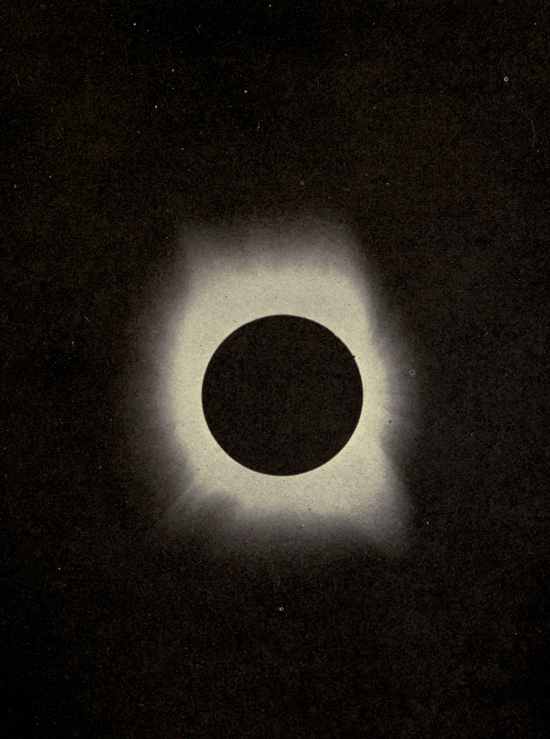
Solar Corona. Total Eclipse.
Photographed by Campbell, January 22, 1898; Jeur, India.
The subject of solar physics has become a veritable
department of astronomy in the hands of
photographic investigators. Ingenious spectro-photographic
methods have been devised, whereby
we have secured pictures of the sun from
which we have learned much that must have
remained forever unknown to older methods.
Especially useful has photography proved itself
in the observation of total solar eclipses. It is
only when the sun's bright disk is completely
obscured by the interposed moon that we can see
the faintly luminous structure of the solar corona,
that great appendage of our sun, whose
exact nature is still unexplained. Only during
the few minutes of total eclipse in each century
can we look upon it; and keen is the interest of
astronomers when those few minutes occur. But
it is found that eye observations made in hurried
excitement have comparatively little value.
Half a dozen persons might make drawings of
the corona during the same eclipse, yet they
would differ so much from one another as to
leave the true outline very much in doubt. But
with photography we can obtain a really correct
picture whose details can be studied and discussed
subsequently at leisure.
If we were asked to sum up in one word what
photography has accomplished, we should say
that observational astronomy has been revolutionized.
There is to-day scarcely an instrument
of precision in which the sensitive plate
has not been substituted for the human eye;
scarcely an inquiry possible to the older method
which cannot now be undertaken upon a grander
scale. Novel investigations formerly not even
possible are now entirely practicable by photography;
and the end is not yet. Valuable as are
the achievements already consummated, photography
is richest in its promise for the future.
Astronomy has been called the "perfect science";
it is safe to predict that the next generation
will wonder that the knowledge we have
to-day should ever have received so proud a
title.