Preparing the Design—Treatment of an Ink Drawing—Chalk Drawings—Alterations—Value
of Impressions—Offsets—The Lithographic
Hand-roller—Proving—Registration—General Features—Transferring—A
Commercial Necessity—Arrangement—Choice of Paper—Transference
to Stone—Preparing the Forme.
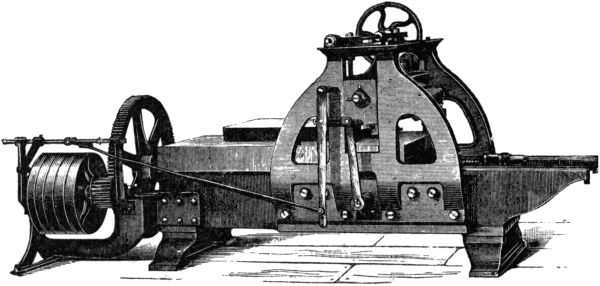
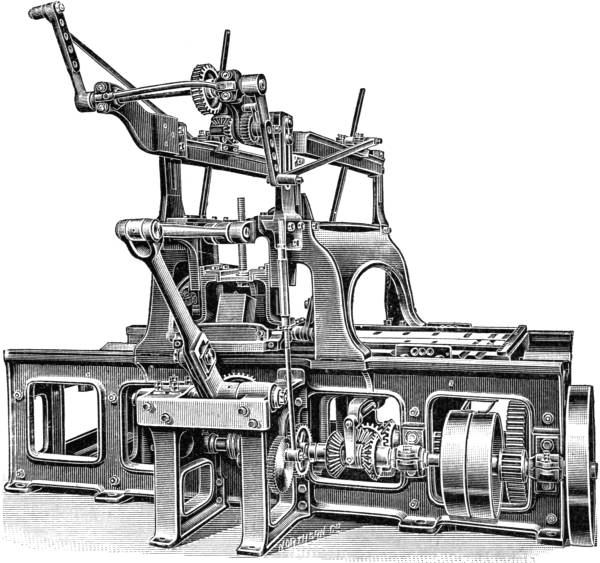
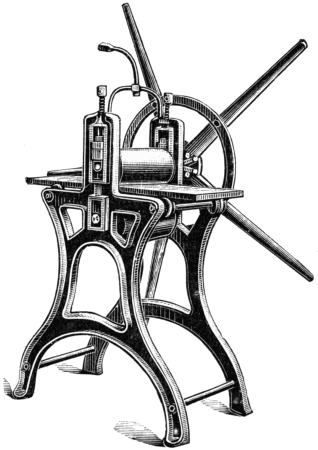
The operations directly associated with lithographic press
work are more or less of a preparatory character. The
preparation of a design, in its progressive stages, from the
lithographic draughtsman to the printing machine, is usually
carried out in conjunction with the press. Only under
exceptional conditions or for some particular class of work
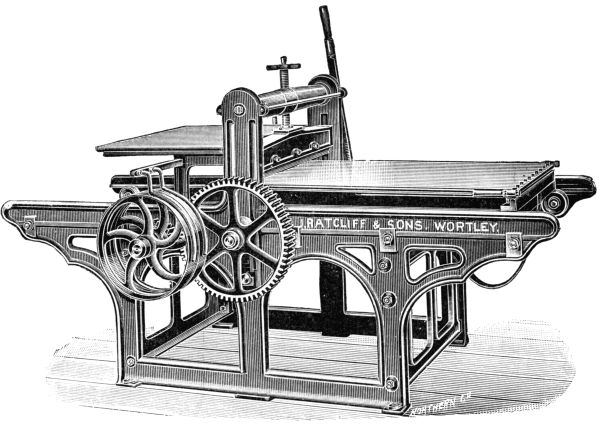
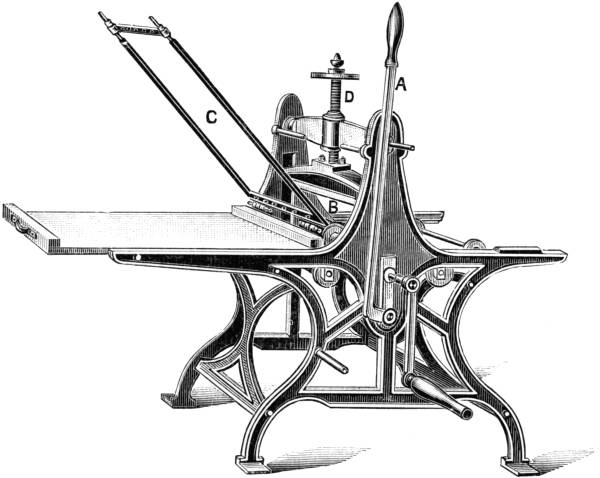
is the lithographic press actually employed for printing
purposes. Its ready adaptability to the ever-varying thickness
of lithographic stones, and the manner in which pressure
can be applied at will, as well as the intense sharpness
of such pressure, render it peculiarly suitable for the work
now under discussion. Such operations will be better understood
and probably more easily remembered if they are
described in a sequence such as might be presented under
average commercial conditions. Taking a design as it leaves
the lithographic draughtsman, i.e. in the form of a greasy
drawing on stone, the first object of the printer is to so
prepare it as to preserve the conditions described in Chap. I.
page 2. This he may accomplish in the following manner.
Cover the whole stone with fresh strong gum and allow
it to dry. Then if it be an ink drawing, wash off the
gum with water, and remove the drawing ink from the
surface of the design with a few drops of turpentine
and a piece of clean rag. Proceed to roll up with a
lithographic hand-roller charged with good black printing
ink. The consistency of this printing ink can only be
determined by the character of the work under treatment.
It is therefore a matter of experience rather than rule.
Heavy designs covering large areas can be worked up with
moderately thin ink, while work of a finer description will
most probably require a stronger ink for its successful
treatment. Between these two extremes there is a
variety of conditions and effects which will require a
ready recognition and an intelligent adaptation or modification
of any operation which may be described. It may even
be advisable to rub up the work with a piece of soft rag and
printing ink, but the clearness and crispness of the drawing
can best be preserved by a complete removal of the greasy
ink with which the drawing was originally made. More
particularly is this desirable when heavy, solid work is in
close contact with work of a finer description, for the excessively
greasy character of the artist’s drawing ink has
a dangerous tendency to smear or spread and to thicken
the design, unless a reasonable amount of care is exercised.
After rolling up the work as well as possible, and having
decided that it is firm and strong and is fully charged
with ink, dry the stone perfectly and dust over the
design with finely powdered resin or French chalk. With
a piece of water of Ayr stone polish away any scum or
dirt which may surround the work, and etch it quickly
with a weak solution of nitric acid. Cover up with strong
gum and dry it. The design is now ready either for proving
or transferring.
The treatment of chalk drawings, grained stones, or
transfers from grained paper needs a slight variation of the
operations already described. The preliminary etching is
generally carried out by the draughtsman by flooding the
stone with a mixture of gum and acid, after which the
gum solution is allowed to dry. The chemical change which
takes place during this etching is often described as one in
which the soap present in lithographic chalks is changed
to an insoluble compound. This chemical change is perhaps
a somewhat contentious matter, but the effect and
not the principle involved is to us the matter of primary
importance, and this effect is such as to actually prevent any
spreading of the design on the stone beyond the lines of
the original drawing.
Returning once more to the operation, wash off the gum,
and, having removed the excess of water in the usual way,
roll up firmly with a strong black ink. Instead of washing
out the drawing with turpentine immediately, work off the
original chalk by rolling up with a good nap roller and taking
frequent impressions. In this way the grain of the drawing
will be gradually developed and rendered fit for further
operations. The stone can then be passed to the prover
or transferrer.
A French writer, in referring to the importance of really
good chalk drawing and printing, as well as to its artistic
and technical value, once said: “The printer requires a fair
appreciation of that subtle suggestiveness which gradations
of tone can impart to a chalk drawing before he can hope
to successfully reproduce the artist’s original conception. A
good printer handles his roller over a chalk drawing with
the same feeling as that with which a violin player handles
his bow. By movements rapid or slow, and by greater or
less pressure over certain parts, he charges the drawing to
the proper tone.”
If at any time the original work requires alterations,
they may be executed in the following manner. Roll up
the design firmly in strong, black ink, and, after fanning
the surface dry, dust it over with French chalk. Make
the necessary erasures with water of Ayr stone and etch
with fairly strong nitric acid. Polish slightly, and wash
well with a plentiful supply of clean water. Pour over
the stone a very weak solution of alum, and again wash
thoroughly with hot water, so that its rapid evaporation
may leave the work ready for immediate manipulation.
Alterations may be made by transferring or drawing. In
either case it is advisable to gum up the work with strong
gum and allow it to stand until dry. The subsequent
treatment of any alteration will, of course, depend upon
their character and extent. As new work, they should
be carefully handled.
It is most important that a very weak solution of alum
should be used. Being an alkali, a strong solution would
have a tendency to dissolve the greasy particles of the
drawing and cause them to spread and thicken.
It is always advisable to take an impression from each
design, whether it be in ink or crayon, before it is laid aside
for subsequent manipulation. These impressions will not
only reveal any inaccuracies or weaknesses which might otherwise
pass unnoticed, but also serve as a useful record and
for comparison with other transfers or impressions which
may be required.
There are other phases of preparatory work which come
within the scope of the lithographic pressman, and as they
frequently constitute an intermediary stage between the first
drawing of the draughtsman on stone and the making of
transfer impressions to facilitate reproduction, a description
at this point will be appropriate.
It may be that a key forme only has been prepared, or
perhaps an outline forme with sufficient detail. In either
case a number of offsets equivalent to the number of colours
necessary for the completion of the design will be required.
These are made by taking good, solid impressions in stiff
black ink from the key or outline forme. Dust these over
with a mixture of three parts Venetian red and one part
lamp-black. Lay them in convenient positions on a well-polished
dry stone, and run them through the lithographic
press with a light yet firm pressure. The result will be faint
yet sufficiently clear offsets of an outline which will enable
the lithographic draughtsman to prepare any number of
formes, and these will register or fit each other and the original
drawing with perfect accuracy. Such outlines will in no way
affect the work of the draughtsman, and will disappear at the
first application of the gum sponge or moisture in any form.
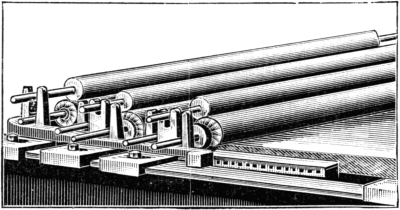
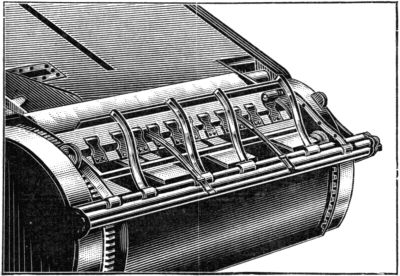
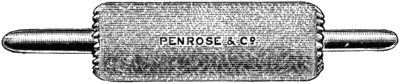 Fig. 9.
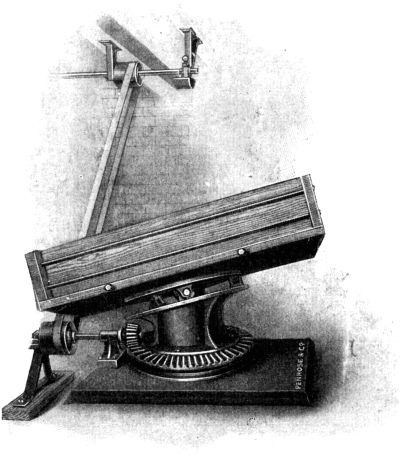
A lithographic nap-roller (Fig. 9) facilitates the work of
the pressman in the
preparation and development
of original
drawings on stone,
and becomes an absolute
necessity when crayon drawings on grained stones are
operated upon. The preparation and preservation of a roller
of this description requires a more than average amount of
care and attention. The best rollers are covered with
French calf-skin with a soft, velvet-like nap, and may be
prepared as follows. Run the roller in crude castor oil for
a short time until the leather becomes soft and pliable, then
work out the superfluous oil by repeated rolling in medium
varnish, occasionally scraping off the varnish with a broad
blunt knife. Continue this for a day or two, then gradually
work into the skin some good non-drying black printing
ink. The roller thus prepared may be somewhat harsh, but
a few days’ use will bring it into condition. An occasional
application of tallow or lard, say about once a week, will
keep the roller skin soft and pliable, and counteract the
hardening effect of constant contact with the damp surface of
the lithographic stone and the oxidisation of the printing ink.
Proving the work of the lithographic artist, though not
always an absolute necessity, is a helpful and most important
function. In its progressive stage it enables both designer
and lithographer to observe the realisation of their colour
schemes, and to amplify or minimise if necessary the effects
they desire to produce. Errors of judgment or of detail can
be rectified before the work reaches a more advanced stage.
Again, a finished proof offers something of a tangible character
for an expression of approval or disapproval, and serves as
a useful and helpful guide to the printer throughout the
subsequent operations.
This will show clearly the importance of the prover’s
work, and though it is not by any means an unusual
proceeding to prove up even the most elaborate designs in
the lithographic printing machines, it is, for obvious reasons,
more convenient to confine such work to the press. It may
therefore be regarded as an intermediate operation, distinctly
apart from the preparation of the original drawing which
precedes it, and the arrangement for machine printing which
follows. The distinctive and pre-eminently the most important
feature of proving is the manner in which one colour
is registered with another; and although the methods usually
adopted are of the simplest possible character, the most
scrupulous care is requisite for their successful application.
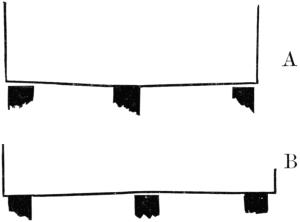
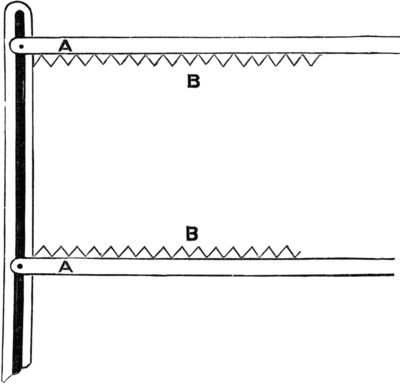
It appears to be an almost ridiculous plan, so simple is it, to
cut away the angles formed by the register lines after the
first printing (Fig. 10A), and then to place them to corresponding
lines on each colour forme, or to pierce the register lines as
in Fig. 10B, passing a fine needle through each puncture into
corresponding holes drilled in the stones and allowing the
sheets to fall into position,—yet these operations demand
constant care and attention.
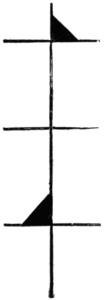 Fig. 10a.
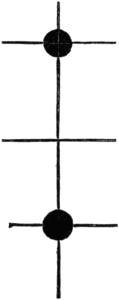 Fig. 10b.
The mixing of colours for proving, and the general
principle of their application, are matters which are almost
entirely under the control of the printer. Their selection
and the manner in which they are employed are both determined
by the individual character of the work. It is
impossible to indicate any “rule of thumb” guide for their
application or manipulation. The individual fancy of the
artist, or the wish of a customer, are the only probable
complications which may have to be considered. Then
again, many phases of the work are more or less experimental,
when the resourcefulness of the
printer may be tested, and the
mechanical features of his work
be relieved by the exercise of
intelligent application, if not of
artistic perception. Very rarely
is it possible to print from the
litho-draughtsman’s original drawing,
and even when it may be
convenient to do so, it is, in the
majority of cases, unadvisable on
account of the element of risk
involved. There is an ever-present danger of the stone
breaking,—a catastrophe which would necessitate an entire
reproduction of the design, and even under the most
favourable conditions the constant attrition produced by
the rollers, etc., would have an appreciable effect on the
work, and in course of time destroy its value for graphic
reproduction.
Many other equally cogent reasons why duplicates of the
original should be made for printing purposes present themselves.
The chief of these is an essentially commercial one.
To reproduce half a million impressions from a single small
drawing would obviously depreciate the commercial value of
lithographic printing very considerably, and although there is
no record of the circumstances under which the duplicating
of original work by means of transfers was first evolved, it is
only reasonable to suppose that it was the direct outcome of
a necessity which was as peremptory in its demands as it has
been far-reaching in its effects. The method is one by which
any number of impressions can be made on a suitably prepared
paper, and with a sufficiently greasy pigment. These
can be re-transferred to a lithographic stone, and in this way
facsimiles of the original may be secured and arranged in
the manner most convenient for machine printing. Great
care is necessary in making these transfer impressions.
They must be perfectly solid, yet not overcharged with
ink, i.e. they must be clean and sharp, and as nearly an
exact replica of the original work as it is possible to make
them.
That the further description of these operations may be
as lucid and practical as possible, we will apply it to
ordinary work-a-day conditions, and suppose that a design in
three workings has been lithographed and prepared for transferring
as already described. The size of the work is 7¼ in. by
4½ in., then the paper on which it is to be printed ought
to be double crown, 20 in. by 30 in. This will allow 1½ in.
for the gripper and ½ in. margin at the back and sides.
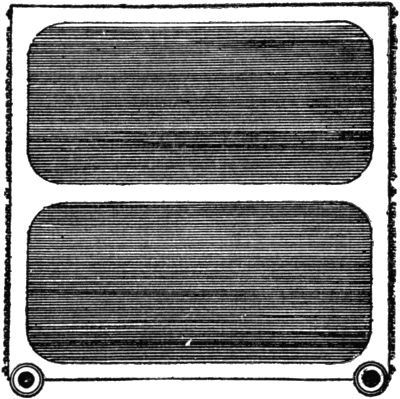
Sixteen transfers can be pulled from each colour forme on a
thin, transparent transfer paper. Mark out a sheet of stout
paper as in Fig. 11, and arrange the transfers in the position
indicated by the dotted lines. The gripper margins A A
are determined by the construction of the machines, and may
be varied accordingly.
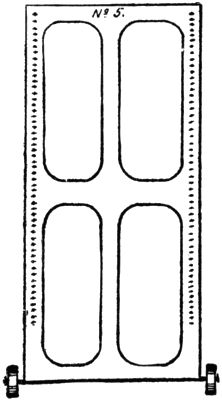
Varnished transfer papers may be laid down on a slightly
warmed dry stone, and if French transfer paper be used the
stone must be slightly damped. If the sheet of transfers is
laid down to a board—Fig. 12—uniformity of gripper margin
will be assured throughout the series, and the work of the
machine printer facilitated.
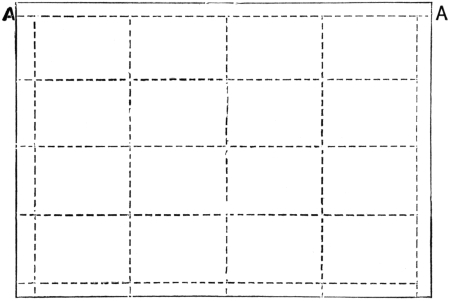 Fig. 11.
Pull it through the lithographic press with a gradually
increasing pressure in the usual way. The varnish transfer
paper will be sufficiently tacky to adhere slightly to the surface
of the stone, so that the pressure may be repeated again
and again with perfect safety. It may not be possible to
remove the base upon which they were arranged, as it is
usual to secure them in position with
paste. At this point the manipulation of
the two varieties of paper differs slightly.
The thin, transparent variety is usually
fastened down to its paper base with
syrup, glucose, or some sticky composition
of a similar character. This paper backing
can be removed immediately after
sufficient pressure has been applied to
fix the transfers to the stone. As this transfer paper is
adhesive it is necessary to damp the surface of the litho-stone
before it is laid down, when, of course, it will readily
adhere, even under a moderately light pressure.
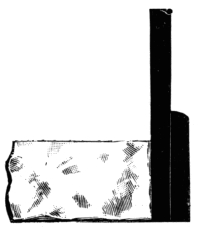 Fig. 12.
The further preparation of work, after being transferred
in this manner, is in many respects similar to the treatment
of new work, but with this important difference. A new
transfer should almost invariably be worked up with a soft
rag and black ink, the latter being thinned down with turpentine
and varnish. Gum up the work, and allow the gum to
dry. Roll a piece of soft rag into a pad, and charge it with
printing ink which has been thinned down. Wipe off the
gum on the surface of the stone, leaving only a thin film over
the work. Rub up the transfers with the rag already prepared,
and when fully charged with ink cover them with
fresh gum. If possible they should stand for one or two
hours, when the rolling up and etching may be proceeded
with.
Accuracy of register can be ensured by the second and
third sets of transfers being patched up to the first forme in
the following manner.
Make two fairly strong black impressions of this forme on
a stout unstretchable paper. Fix these up on a glass frame
in such a position as to allow the light to pass through them,
and carefully place each transfer in its exact position. They
can then be laid down on separate stones in the same way as
the first set. These are the simple outlines of the transferring
process. In detail they may, of course, be modified to
meet the exigencies of peculiar conditions, which in lithography
are frequently the controlling powers, and at all times
are matters of vital importance.
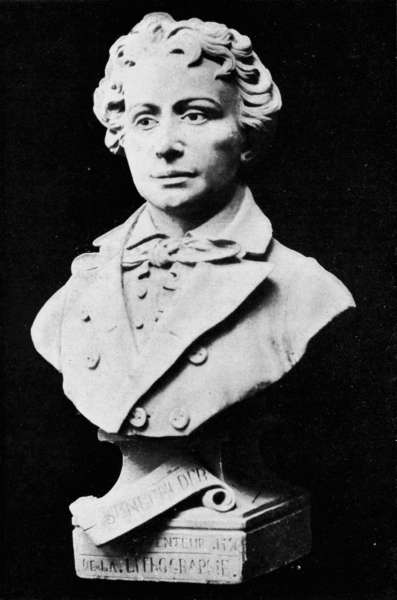 ALOIS SENEFELDER.