FOUNDATION.
Just how deep to excavate to start the foundation
of a house depends on the climate and
soil. Always dig trenches below the frost line in
any soil. This is sufficient if the subsoil is solid;
if the subsoil is not solid, go deep enough to
reach solid earth.
In saying this, we are supposing you
are not building in a swamp, where it is
often necessary to drive piles upon which
to start a solid foundation. Stone is generally
used for foundation walls where it is convenient, and it makes
the best. Hard pressed brick, laid with mortar composed of one
part of hydraulic lime and two parts sharp sand, makes a foundation
not inferior to stone for all practical purposes. By using the above
mortar, dampness will not ascend from the ground to injure the floor
joists.
Mortar made from common lime or sand, though commonly
used, is objectionable for foundations, because dampness will ascend
even above the floor joists, if the floor is not several feet above the
ground. It is often the case that hydraulic lime cannot be conveniently
had. In that case a layer of slate or coarse paper, well saturated
with pitch, laid between the brick seams below the line of joists,
will answer the same purpose, and is less expensive.
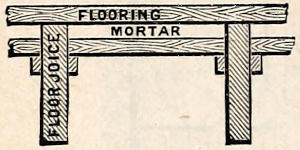
See that the space between the joists is filled with brick, flush
with the under-side of floor boards. This prevents Mr. Rat, or
other members of his interesting family, from sitting in these little
corners and gnawing into the room above, or climbing between the
siding to the upper floors. If this little matter is attended to right,
neither rats or mice can enter the house, except through the doors.
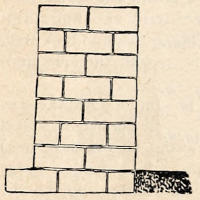
To keep them from burrowing underneath the foundation walls, let
the thickness of one brick project outward at the bottom of the
foundation. On burrowing downward, a rat soon reaches this shelf,
and following it around till he arrives at the place he started from,
becomes disgusted, or is supposed to, as he is not seen about the
house again. It is always better to have the foundation broader at
the bottom than the thickness of wall intended to be used. This is
necessary in all brick houses, unless on a rock bottom.
See that the space under the ground floor is left clear of rubbish
before the floor is laid, and grating built in the wall for ventilation.
This opening can be closed in winter to secure additional warmth.
The cellar is closely related to the foundation; we give some hints
on its construction on page 22.
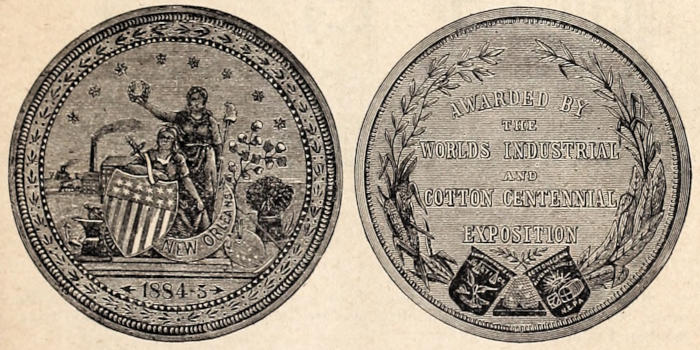
Fac-simile of Gold Medal awarded to Walter’s Patent Metallic Shingles.
These shingles have received twenty-eight other awards for merit in the
United States.
The plans and elevations of cottages presented in this book have each been
specially prepared for some individual by an eminent architect, and the proportions
and details can be relied upon.
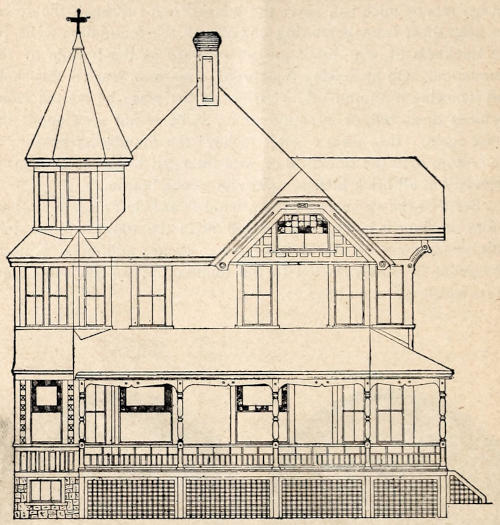
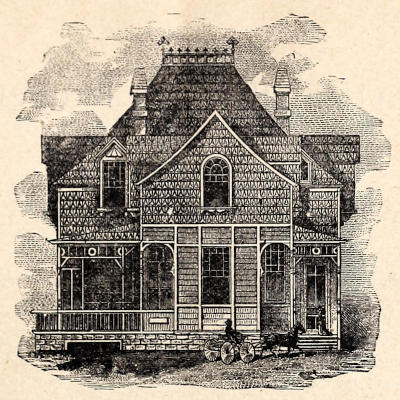
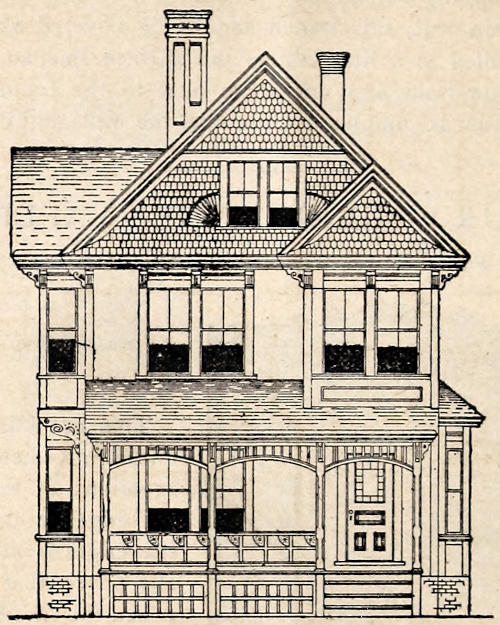
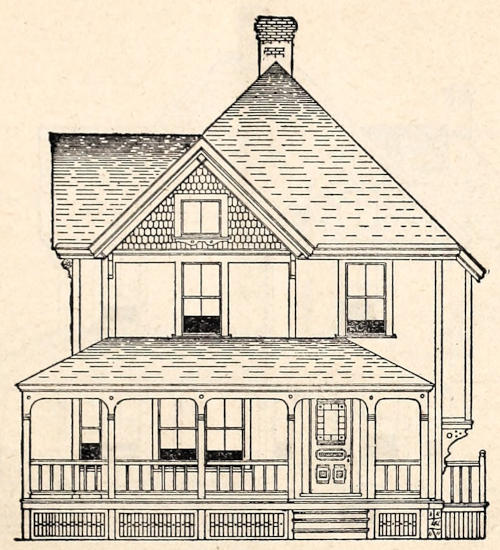
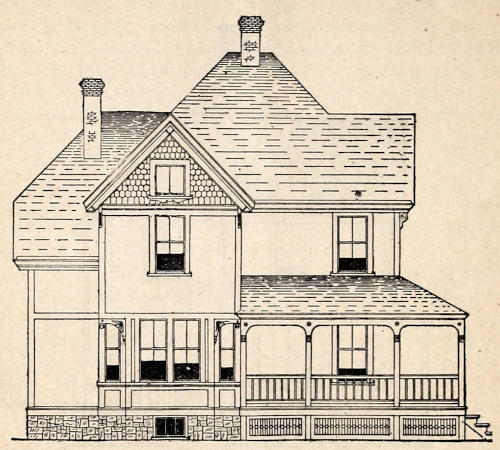
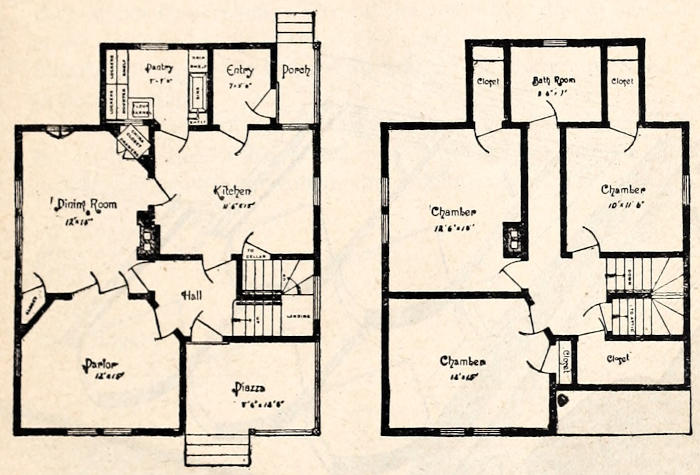
Design I.—Front Elevation.
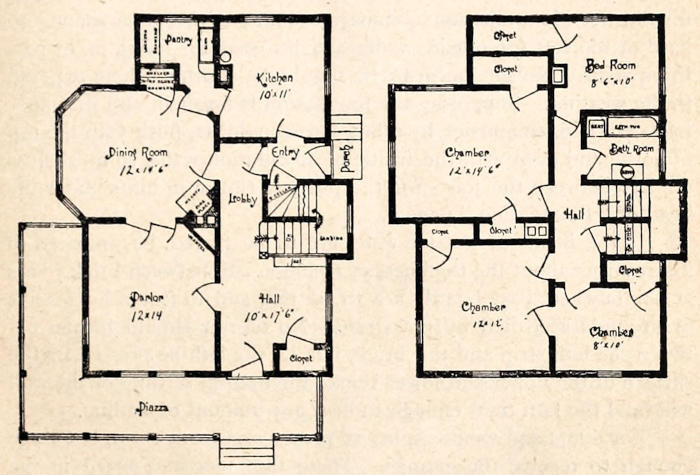
TEN-ROOM, TWO-STORY HOUSE.
Estimated Cost, with Bath and Furnace, $5,000 to $6,000.
Roof to be covered with 10 × 14 Galvanized Tin Shingles; porches with
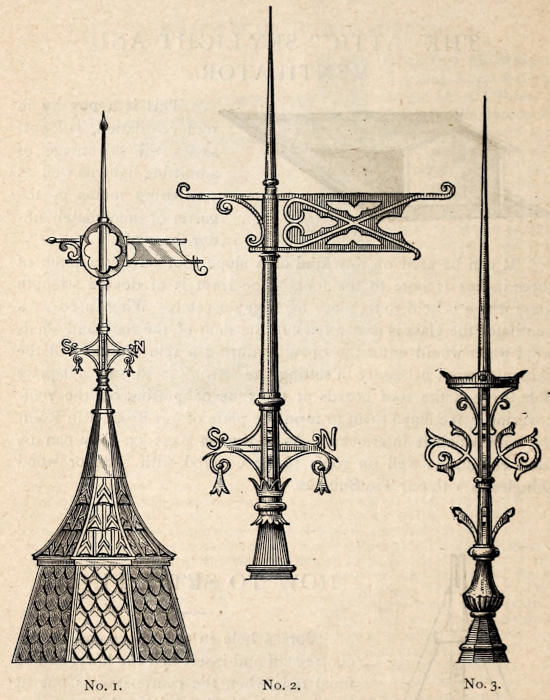
same; tower with 7 × 10, same quality; use attic vents on main roof, and No. 1
Six-foot Finial on apex of tower.
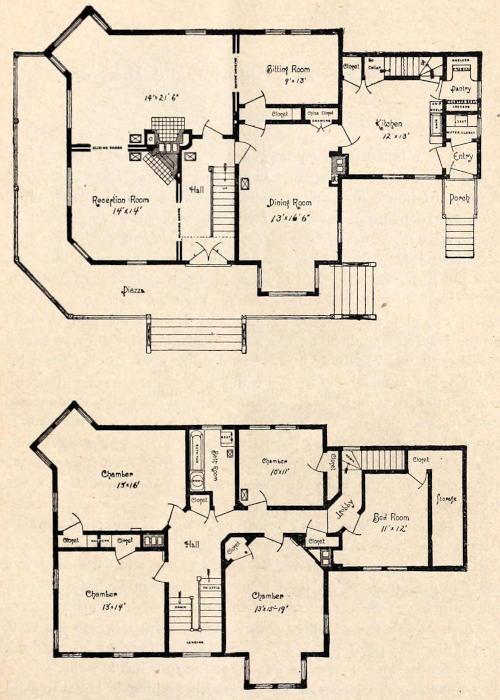
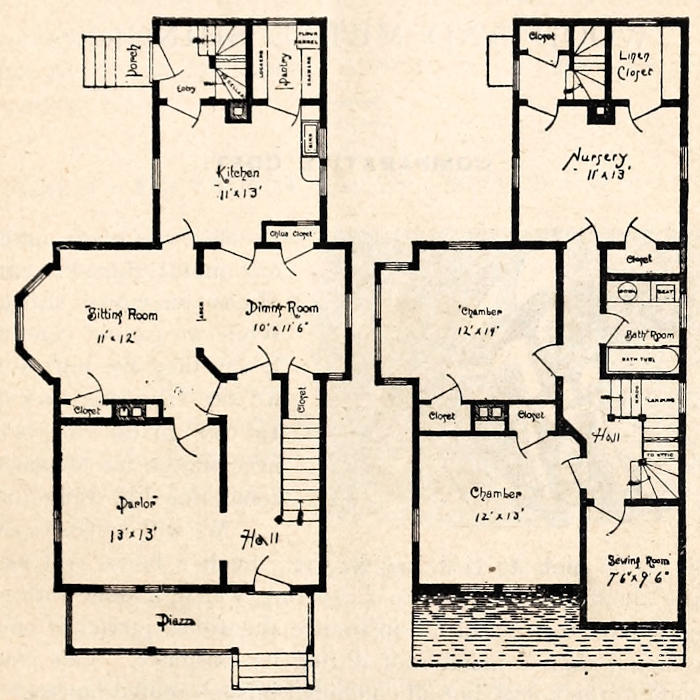
First Floor.
Second Floor.
Design I.—(Elevation, page 8.)
COLORS.—For Exterior and Interior.
As your house nears completion, it is well to decide upon colors.
That is a distinctive feature which is to give tone and beauty, and
make your house in some respects different from all others. The
question of painting is often a mere matter of preserving the structure,
and not a question of beauty or harmony of colors, or what
would be best suited to the surroundings; it is too often the case
that but little regard is paid to those nice perceptions that make one
man’s work many times more valuable than another. Strong contrasts
of color should be avoided. Light tints are preferable to
strong colors. Think of a house painted black, red, yellow, or green.
Let the surroundings suggest what the exterior colors should be.
A house surrounded by trees and shrubbery will admit of white, with
white tinted trimmings, such as cornices, corner-boards, window and
door frames; but for half the year the green foliage of the trees is
turned to brown, which but partially relieves the glaring white. This
is why that color is not a favorite for exteriors. As a rule, select a
light color for the body of the house, and darken that for the
trimmings.
For interior wood-work select light wood colors; let none be
darker than walnut. Oak, chestnut, ash, white walnut, maple and
cherry make a beautiful finish by simply oiling, and varnishing if a
gloss is preferred. Very light shades of ochre make beautiful ceilings
which can be ornamented with suitable designs, using darker
but delicate shades of other light colors. Here is where the taste
and skill of the painter comes in, and unless you are an adept, don’t
fail to consult an experienced decorator for your inside walls.
For houses of moderate cost we think nothing is equal to solid
colors for inside walls. Let the colors be light and cheerful, and
the rooms of different shades. (See page 48).
If you are interested in Roofing, send
for our Price List and Discount Sheet,
which is special to the trade. We are
pioneers in the introduction of practical
metal shingles, and no imitator has yet
produced their equal. Our goods are
largely used throughout the United
States and Canadas; are used by the
Government and Railroads; approved
by the Fire Insurance Companies, and
many leading Architects and Builders.
They are lighter than slate, and will last
longer without repairs; and the low rate
of insurance on our roofing will, in a
short time, more than balance the difference
in price where wood shingles
are cheaper.
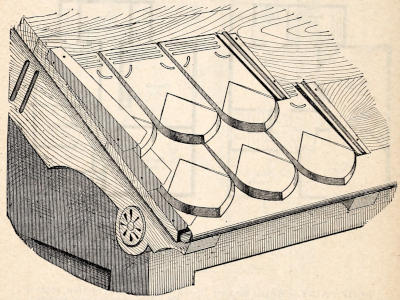
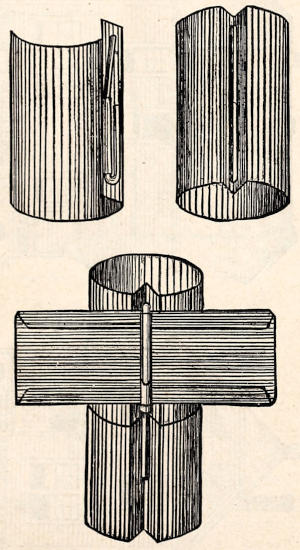
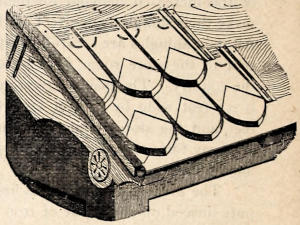
As seen by the cut, our shingles are the
same to-day as when first introduced.
Remember, no cleats or springs are necessary
in using our shingles. The lock
is simple and perfect, with corrugations
across the top, and bracing corrugations
across the exposed end of the shingles,
which stiffen and hold the shingles
firmly to the underlying courses. They
are easily applied, and any one who can
lay a wood shingle can lay these. We
furnish them in four sizes, made from charcoal
roofing tin, painted both sides and unpainted,
galvanized tin plate, which is superior
to galvanized iron, cold rolled copper,
and steel plates. We keep on hand a full
line of roofing sundries.
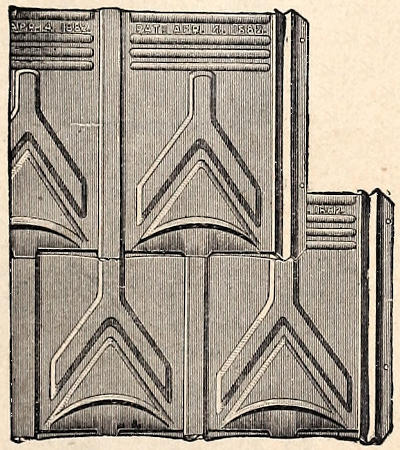
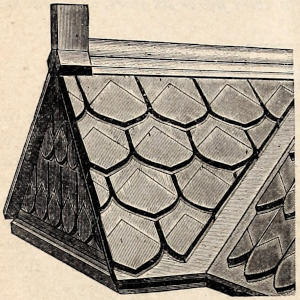
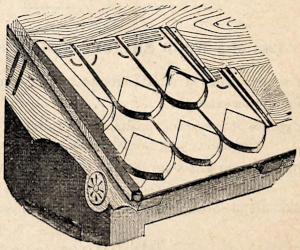
Fac-simile of beginning of first two courses.
Our Shingles received the highest and only
award for metal shingles at the American
Institute, held in this city, October, 1886,
and New Orleans Exposition, 1885.
WHOLESALE AGENTS.
RICHARD KNISELY & SON, 184
South Jefferson St., Chicago, Ills.
W. W. MONTAGUE & CO., San
Francisco, Cal., Pacific Coast.
J. J. WALTERS, Denver, Col.
PHILLIPS & BUTTORFF MFG.
Co., Nashville, Tenn.
CANADA GALVANIZING AND
STEEL ROOFING CO., Montreal,
Canada.
MACHWIRTH BROS., Buffalo, N.Y.
JEROME TWICHELL & CO.,
Kansas City, Mo.
F. H. LAWSON & CO., Cincinnati,
Ohio.
The National Sheet Metal Roofing Company,
510, 512, 514, 516, 518, 520 East 20th St., New York, U. S. A.
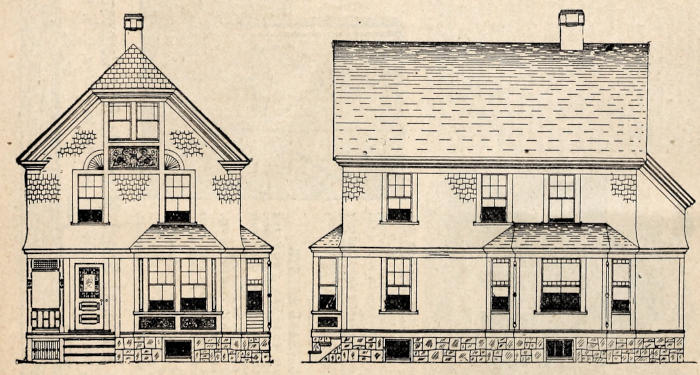
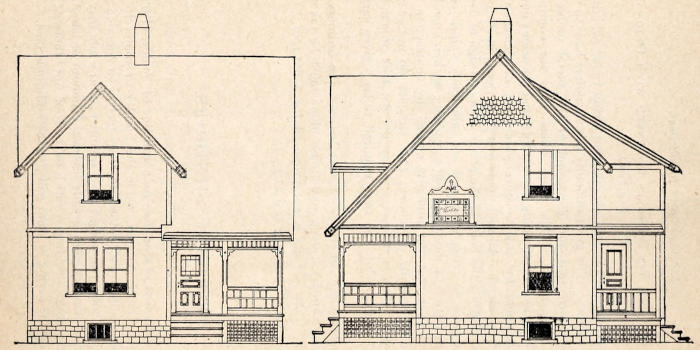
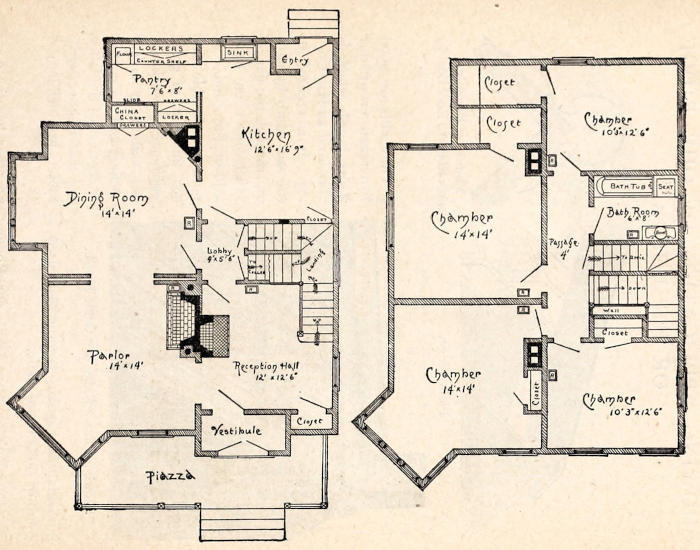
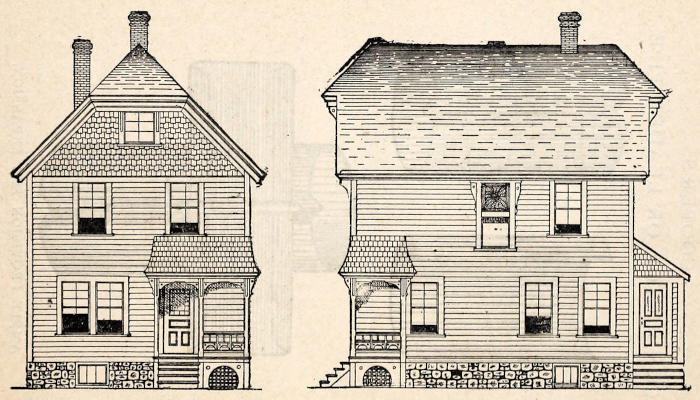
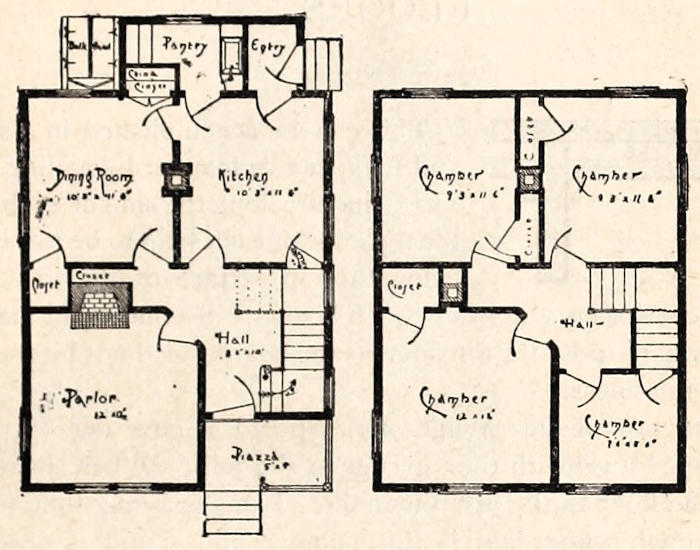
Design C.—Front and Side Elevation.
SEVEN-ROOM, TWO-STORY HOUSE.
Estimated Cost, with Bath and Furnace, $1,800 to $2,000.
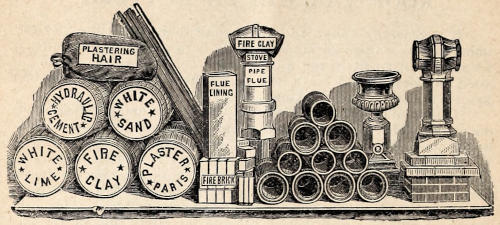
WHAT IS GOOD MORTAR?
To a casual observer mortar is mud, but to a builder who understands
the chemistry of mortar it is a compound of water, lime and
sand, and when properly prepared forms an indestructible cement.
Fresh slacked lime, when brought in contact with clean, sharp sand,
adheres strongly to the surface of each grain, and forms the silicate
of lime.
At the same time the drying mortar absorbs carbonic acid from
the atmosphere, forming with it lime-stone, which in time becomes a
rock in solidity. Now, all mortar is good or bad in proportion to
the purity of the ingredients and their relative affinity for each
other. The adhesive properties of mortar are nullified by loam or
clay in sand, or the stale condition of lime used.
Loam mortar adheres freely to the surface of walls or ceilings.
So does mud if thrown against an upright surface; but water dissolves
it. It dries quickly, but does not harden with age. The foundation
of many frame, and the entire walls of many brick houses are built
with poor mortar, when the materials for good could be had at the
same price.
Water, lime, sand and hair are the ingredients for plasterers’
mortar in about the following proportions: One bushel unslacked
lime and four bushels sharp sand; (to this add twenty-four pounds
of dry hair for every one hundred yards, when used for “scratch” or
first coat,) and water sufficient to make it of proper consistency. After
being properly mixed, the mortar should stand from three to ten days
before using. However, the time it should stand depends upon the
susceptibility of the lime to slack. Some lime requires a month,
while good lime slacks immediately. Age improves mortar, provided
it is kept wet, and makes it work easier under the workman’s trowel.
As it is the keys formed by pressing the mortar against the lathing
on the ceiling that holds it to its place, there should be a relative
width of lath and key space to insure strength sufficient to prevent
its falling. Ignorance of this, and poor mortar, is the cause of falling
ceilings. Lath one inch wide, 7/16 inches thick, placed 7/16 inches apart
will insure good strong work.
The second coat needs but a very small quantity of hair. Fifty
bushels sand, and twelve and one-half bushels unslacked lime, will
make mortar enough to cover one hundred square yards. If mortar
freezes before it is dry it loses its cementing properties and becomes
in common phase rotten, but if the sand used is clean, and it remains
frozen without thawing until it is dry, it is not injured. The
best way to treat a house in which the plastering is not dry, and cannot
be kept from freezing before it dries, is to throw the house open,
and let it freeze for eight or ten days, or until the plastering freezes dry.
Cisterns should be plastered inside with mortar made of equal
parts of hydraulic lime and clean sand. For brick work above foundations
use one part unslacked lime to four parts sand.
“THE INDEPENDENT,” 251 Broadway, New York, October 28th, 1889.
Gentlemen:—The shingles from your respected concern used on my new
house look splendidly, and give entire satisfaction. They are far better than
any metal shingles I have previously used on other buildings, which I have
had torn off and thrown away as worthless. At times we were flooded by
the water under their (want of) protection, and we could not stop the leaks.
Noah in the ark I am sure was, fortunately, not troubled with leaks such as
we endured for years; if he had been all would have been drowned. Now,
under your protection, we are all right and still alive.
Faithfully,
HENRY C. BOWEN,
Chandler.
CHIMNEYS.
We will not moralize on the evils of
smoky chimneys, but just tell you in plain
language how to construct them so they will
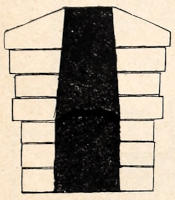
not smoke. Make the throat of the fire-place
not more than half the size of the flue;
carefully smooth the inside of the flue, and
have it of the same area all the way to near
the top of the chimney, when it should be
gradually tapered inward to about half the
area of the flue. At the extreme top, the
cap stone should slant from the opening in all directions downward
at an angle of about twenty degrees. This will insure a good
draught and prevent the smoke blowing downward. No two fire-places
should enter the same flue; neither should a stove-pipe enter
a flue unless the fire-place is closed. Each stove and fire-place
should have its own flue. The size necessary for a flue depends on
the fuel to be used.
Soft or Bituminous coal requires a flue nearly double the size of
one where Anthracite is to be used; an open fire-place for wood,
larger flues than either. For instance, an 8 × 8 inch flue answers for
Anthracite, because it makes but little soot, while if Bituminous coal
is used, 8 × 12 is none too large.
You will find in houses all over the country flues smaller than
the above, and a corresponding number of smoky chimneys, which it
is impossible to remedy without re-building from the bottom up.
The carelessness displayed in chimney construction is astonishing.
As the work is hid from view on completion, be watchful during
the process of construction from the ground up. All chimneys
should, if possible, extend above the apex or comb of roof, and
should be built of good hard burnt brick, and no woodwork should
be allowed to enter within five inches of inside of flue, and not
within twelve inches anywhere near the fire-place.
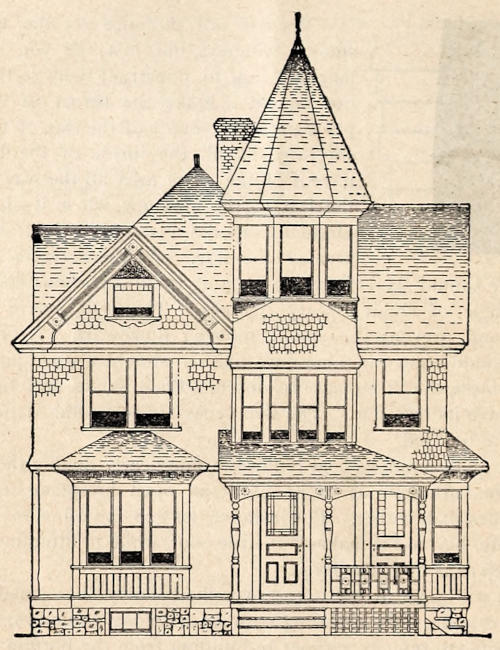
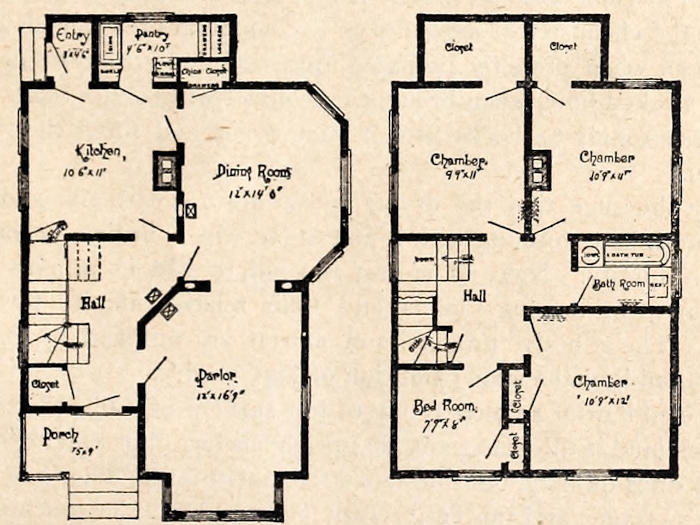
Design H.—Front Elevation.
EIGHT-ROOM, TWO-STORY HOUSE.
Estimated Cost, with Bath and Furnace, $3,500 to $4,000.
Roof covered with 10 × 14 No. 1 Standard Tin Shingles; gables with Queen
Anne; second story, sides, with 7 × 10 Standard Tin Shingles; and porches with
Broad Rib Tin Roofing; use No. 2 Five-foot Finial on tower.
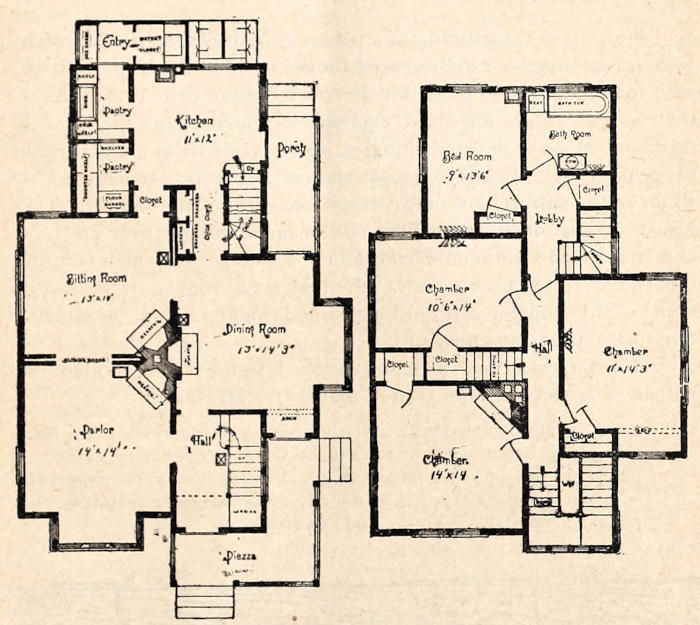
First Floor. Second Floor.
Design H.—(Elevation, page 18.)
A retired plumber thus gives a point for the gratuitous relief of householders:
“Just before retiring at night pour into the clogged pipe enough liquid
soda lye to fill the ‘trap’ or bent part of the pipe. Be sure that no water runs
in it until the next morning. During the night the lye will convert all the offal
into soft soap, and the first current of water in the morning will wash it away
and clear the pipe clean as new.”
PAINTING SHEET-METAL ROOFS.
The subject of painting sheet-metal roofs is one of great importance, says
the Builder, Decorator and Wood-Worker, not only on account of the protection
afforded, but because the material, when properly colored, can be made pleasant
to the eye when placed in exposed positions. While many kinds of paint
have been discovered and patented, composed of a great variety of materials, it
is a question if there is a substance used that is an effective substitute for linseed
oil, regarding the effectiveness of which an authority on the subject says:
“By consulting experienced and unbiased painters you will learn the fact that
there is no vehicle pigments at all approaching linseed oil in effectiveness and
durability, especially for exposure to the weather. A good paint must be both
hard and elastic. It requires hardness to prevent abrasion and wear, and elasticity
to prevent cracking from expansion and contraction. Nothing but linseed
oil will give these qualities, for, strange as it may seem to many in these days of
novelties, the pigments really add but very little to the effectiveness of paints.
Mark, we say the best of pigments, for many pigments are the reverse of protective,
and are really destructive to both the vehicles and the material which
they are supposed to protect. For example, coal tar and all its products,
whether called dead oil, asphalt, rubber, etc., are of the class just described, and
their use at any price, especially for covering sheet-metals, is a wanton waste
of money. Extended experiments have demonstrated that there is no better
pigment for metal than a good iron ore ground to an impalpable powder. To
be most thoroughly effective the pigment must be intimately incorporated with
the vehicle, which can best be done only by grinding them together in a stone
mill by steam power.” It is of the greatest importance that sheet-metal roofs,
especially those made of iron, should be protected from the action of the elements,
as when so protected there is hardly any limit to the time they will last.
In order that the paint should be effective, it should be applied before the iron
has had an opportunity to rust, and the first coat should be of the best quality
and applied in the best manner; or if it is defective it is plain that it will not
only require repainting far sooner than it should, but no matter how good the
subsequent coatings of paint are, they cannot be effective if founded on an original
coating which has commenced to crack or peel, as it certainly will if not
prepared with the best methods and materials. Another important point to be
observed in the painting of sheet-metal is that the paint should not be too thick,
as it is the linseed oil that is to be depended on to furnish protection, and as
the action of the air on the surface of the exposed oil gives it a particularly hard
surface, two thin coats of paint are much more durable than one thick one.
Remember, it is the rust-preventing qualities of linseed oil, combined
with the oxide of iron, that makes steel or iron sheets resist the corrosive action
of oxygen, which is ever present in the atmosphere. (See page 101.)
THE KITCHEN.
Somehow, our architects and builders habitually neglect to
study the requirements of the kitchen, but persist in constructing
for this use a plainly constructed room, generally cramped in size,
with no means of escaping the great heat generated by the range or
stove, which in the hot months of summer is almost unbearable. If
men were often obliged to remain in such a place, a large part of the
day during the hot season, they would be quick to seize upon any
plan which would mitigate the heat. But as their wives, daughters
or “help” preside in that department, they offer no amendment to
the long-established mode of kitchen construction.
Now, a kitchen can be so constructed that even with the largest
size family-stove or range in use, it will be as comfortable as any
other room in the house, and at an expense not to exceed the cost
of the stove or range used. To do this, build of brick a large open
fire-place, say from three to twelve inches broader than the length of
the stove or range to be used, and from front to rear deep enough to
receive the same. It is best to set an ordinary cook-stove with the
side to the front, so that the oven door can be convenient. The
oven door, of course, on the opposite side is permanently closed.
The range being differently constructed can readily be set in the
brick enclosure or open fire-place, the walls of which should be built
perpendicular to the floor, and about five feet high. The back wall
should be sufficiently thick to commence at this point a smoke-flue
8 × 12 inches, with an opening to receive the smoke-pipe from the
range or stove, and continue it out through the roof of house (see
“Chimneys”); resting on the walls of this open fire-place build,
either with wood or brick, a tapering flue, so that after emerging
from the roof it will expose an opening of not less than four square
feet. A cap should be put over this to prevent an entrance of rain,
but not to contract the draught space.
You will see by this arrangement you have a large chimney with
a fire-place at the bottom large enough to receive the stove or range.
Now construct a sliding sash with double strength glass, and balanced
with weights, with the upper end of sash inside the draught
flue, and the lower end to reach within a foot of the floor, and about
four inches from the side of stove. You will readily perceive that
the heat from the stove inside the flue will constantly cause a strong
draught between the bottom of the sash and the floor, which will
prevent heat from escaping into the kitchen, keeping it as cool as
any room in the house. Even with the sash up, the draught will
take nearly all the heat through the flue over the stove, carrying
with it the steam and odor during the process of cooking. A coat of
whitewash inside the brick-work will add to the appearance and give
light, which is shadowed by the flue.
The kitchen should be large and light, and, if possible, be joined
by a broad covered porch, upon which much of the kitchen work
can be done in warm weather.
As this little book is merely hints to builders, we cannot go into
the details of hot and cold water, stationary wash-tubs and such
matters. But we will say, more important than all this is a well-constructed
drain pipe, not less than three inches in diameter, leading
from the kitchen sink to a point some distance (according to the
nature of the ground) from the house. This pipe inside the kitchen,
should have a trap to prevent offensive odors escaping into the
room.
OLD MATERIALS.
In tearing down old work be as careful as in putting up new.
Old material should never be destroyed simply because it is old.
When putting away old stuff see that it is protected from rain
and the atmosphere.
It costs about 15 per cent. extra to work up old material, and
this fact should be borne in mind, as I have known several contractors
who paid dearly for their “whistle” in estimating on working
up second-hand material.
These remarks apply to wood-work only. In using old bricks,
stone, slate and other miscellaneous materials, it is as well to add
double price for working up.
Workmen do not care to handle old material, and justly so. It
is ruinous to tools, painful to handle, and very destructive to clothing.
In my experience I always found it pay to advance the wages of
workmen—skilled mechanics—while working up old material. This
encouraged the men and spurred them to better efforts.
Sash frames, with sash weights, locks and trim complete, may be
taken out of old buildings that are being taken down and preserved
just as good as new by screwing slats and braces on them, which not
only keeps the frame square, but prevents the glass from being broken.
Doors, frames and trims may also be kept in good order until
used, by taking the same precautions as in window frames.
Old scantlings and joists should have all nails drawn or hammered
in before piling away.
Counters, shelving, drawers and other store-fittings should be
kindly dealt with. They will be wanted sooner or later.
Take care of the locks, hinges, bolts, keys and other hardware.
Each individual piece represents money in a greater or lesser sum.
Old flooring can seldom be utilized, though I have seen it used
for temporary purposes, such as fencing, covering of veranda floors
while finishing work on plastering, etc. As a rule, however, it does
not pay to take it up carefully and preserve it. Conductor pipes,
metallic cornices, and sheet metal work generally, can seldom be
made available a second time though all is worth caring for, as some
parties may use it for repairs.
Sinks, wash-basins, bath-tubs, traps, heating appliances, grates,
mantels and hearth-stones should be moved with care. They are
always worth money and may be used in many places as substitutes
for more inferior fixings.
Marble mantels require the most careful handling.
Perhaps the most difficult fixings about a house to adapt a
second time are the stairs. Yet I have known where a man has so
managed to put up new buildings that the old stairs taken from
another building just suited. This may have been a “favorable
accident,” but the initiated reader will understand him. Seldom
such accidents can occur.
Rails, balusters and newels may be utilized much readier than
stairs, as the rail may be lengthened or shortened to suit variable
conditions.
Gas fixtures should be cared for and stowed away in some dry
place. They can often be made available, and are not easily renovated
if soiled or tarnished.
It is not wise to employ men who have nothing but their
strength to recommend them. As a rule they are like bears—have
more strength than knowledge, and lack of the latter is often an
expensive desideratum. Employ for taking down the work good
careful mechanics, and do not have the work “rushed through.”
Rushers of this sort are expensive.
Never send old material to a mill to be sawed or planed, no
matter how carefully nails, pebbles and sand have been hunted for,
the saw or planer knives will most assuredly find some you have
overlooked, then there will be trouble at the mill.
Have some mercy for the workman’s tools. If it can be avoided
do not work up old stuff into fine work. If not avoidable pay the
workman something extra because of injury to tools.
Don’t grumble if you do not get as good results from the use of
old material as from new. The workman has much to contend with
while working up old nail-speckled, sand-covered material.
Builder and Woodworker.
HEATING.
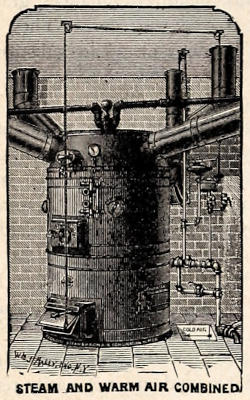
STEAM AND WARM AIR COMBINED.
I once knew a church building
committee who planned and built
quite a large church, and when I was
called in to arrange for heating the
building with a large furnace, the
furnace committee were astonished
when told that the building committee
had forgotten the fact that the
hot-air furnace required a chimney.
The construction of many houses
suggests that houses built in the
hot months of summer needed no
special provision for heating. This
is an important subject, and should
be carefully considered in the construction
of the plainest house. Always take climate, location and
fuel into consideration. The open fire place, with fire on the hearth,
is without doubt the most cheerful and healthful. This is the favorite
and best mode for plain country homes. But in all instances, for
churches and public halls, the open fire-place is not to be depended
upon. There is a variety of good steam-heaters and hot-air furnaces
to choose from. Consult the parties from whom you buy as to the
size of heater required; its location, size of cold-air duct, register,
pipe, etc.
For small rural churches that have no basement, construct a
small room under the front entrance or vestibule; eight feet square,
inside measure, is sufficient. Near its floor have a cold-air entrance
leading to the furnace. Cover the opening with wire netting to prevent
the entrance of mice. Use brick for the room, building the
walls eight inches thick; leave openings 2½ × 4 inches, about one foot
apart all around the bottom next to the floor. Carry the wall close to
the ceiling, and make it tight by plastering carefully inside and out
where it joins the ceiling. Cover the ceiling, by nailing to joists,
with bright sheets of tin, and white-wash the brick-work inside. For
entrance make a door 6 × 3 feet. A plain wooden one will answer.
In the aisle of the church, immediately over this room, put a large
grating, such as your furnace-men will suggest. In this room place
your furnace, and have it large enough to heat the room above during
the coldest weather without excessive firing. With a larger capacity
than necessary, the furnace will last longer, burn less coal, and give
better results in every respect. As the furnace will radiate considerable
heat, this can be utilized by running a pipe of proper size
from the room to the vestibule or some other room. The objection
to using this heat in the church is the noise of firing up, which would
be annoying during church service. However, a furnace properly
attended will not need firing during church service. Remember, a
large volume of warm air is what you want, and not a small volume
of hot air. Never cover the grating or close the cold-air duct to cool
off while there is fire in the furnace, but open the doors or windows
of the church and check the fire. The closing of the grating or
cold-air duct will injure the castings of the furnace by overheating
them.
COLORS AND HOW TO MAKE THEM.
- Blue and yellow makes green.
- White and yellow makes buff.
- White, yellow and black makes drab.
- White and black makes lead.
- White and black makes gray.
- White, black and blue makes pearl.
- White and lake makes pink.
- White, blue and black makes slate.
- Red, black and blue makes brown.
- Red, black and yellow makes maroon.
- Red and yellow makes orange.
- Blue and lake makes purple.
U. S. Marine Barracks, Navy Yard, Pensacola, Fla., October 22d, 1887.
Sirs:—In compliance with your request, I have to say that about a year
ago I was called upon to decide which of several kinds of roofing material to
select for two barrack buildings, which I was constructing for the Government
at this place. Owing to the heat and moisture of the climate, very destructive
to wood, and the proximity of the Gulf of Mexico, which makes what is known
as a salt atmosphere, very injurious to iron roofing, I was induced to try your
system, and ordered the 14 × 20 size, I. C. Standard, some painted and some
galvanized. As it was previously almost unknown to me, I had to assume
the risk of its success, and have since watched it very closely; the more so, as
it was laid by soldiers entirely unfamiliar with it.
After the first rain a close inspection failed to reveal a single leak. I have
had it inspected after every heavy rain since then with the same result. On
the 20th inst. we had the severest gale for many years, and the roofs not only
resisted it in every way, but there was no rattle, which could not be said of our
other tin roofs (old system).
You can refer any one to me for commendation of these points which are
established; also of its architectural beauty, and I have little doubt as to the
rest, for we painted it very carefully on both sides.
I am, Sirs, very respectfully yours,
HENRY CLAY COCHRANE,
Captain U. S. Marine Corps, Commanding Post.
The combination of cherry and light oak proves an excellent
one for over-mantels, for, in addition to contrast of grain, and figure,
and hue, is that of the high polish of which cherry is susceptible with
the somewhat ridgy surface of the oak.
One coat of paint takes 20 lbs. of lead and 4 gals. of oil per 100
square yards. The second coat, 40 lbs. lead, 4 gals. oil; the third,
the same as the second—say 100 lbs. lead, 12 gals. oil per 100 square
yards, for three coats.
| One gallon |
priming colors |
covers |
50 |
square yards. |
| “ |
white zinc |
“ |
50 |
“ |
| “ |
white lead |
“ |
44 |
“ |
| “ |
lead color |
“ |
50 |
“ |
| “ |
black paint |
“ |
50 |
“ |
| “ |
stone color |
“ |
44 |
“ |
| “ |
yellow paint |
“ |
44 |
“ |
| “ |
blue color |
“ |
45 |
“ |
| “ |
green paint |
“ |
45 |
“ |
| “ |
bright emerald |
“ |
25 |
“ |
| “ |
bronze green |
“ |
75 |
“ |
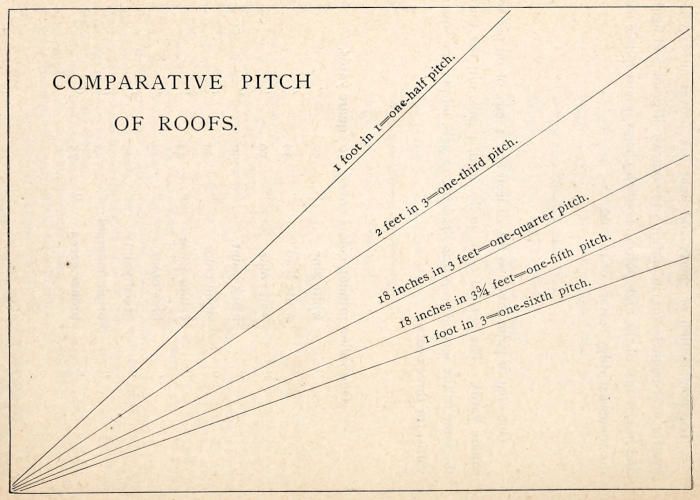
COMPARATIVE PITCH OF ROOFS.
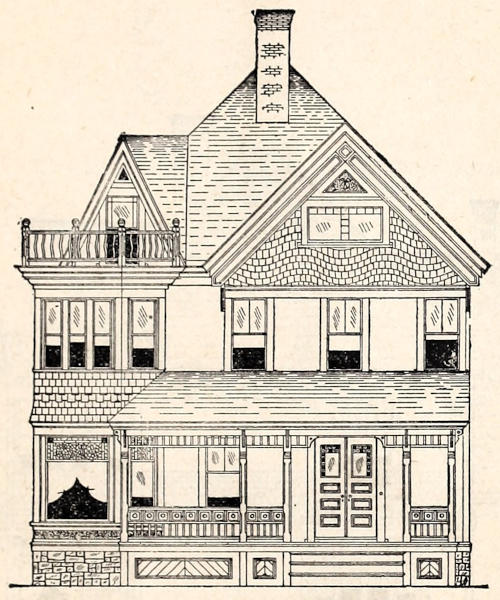
Design J.—Front Elevation.
EIGHT-ROOM, TWO-STORY HOUSE.
OUR GUARANTEE.
We guarantee our shingles as follows: If you will use them, and they
are properly put on in accordance with our instructions, and if they do not then
give satisfaction, we agree to replace your roof, free of expense to you, with
equally expensive material, any time within two years from the time you
put them on. In addition to this, we may be able to give you a local reference,
as our goods are in use in every State and Territory. We call your
attention to the price list, and we will be pleased to make you discounts on
application.
THE NATIONAL SHEET METAL ROOFING CO.,
510 to 520 East 20th St., New York City.
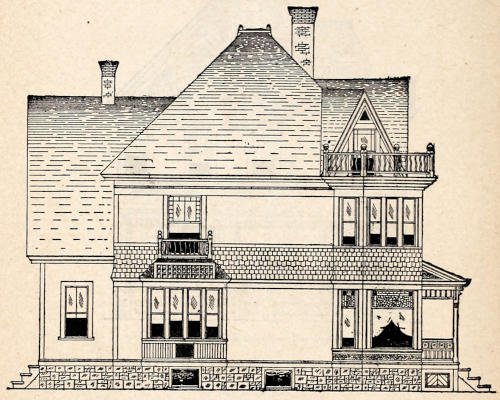
Design J.—Side Elevation.
Cover roof with No. 1 Standard 10 × 14 Tin Shingles; use attic vents (see
page 73) on main roof, and cover belt courses with 7 × 10 Tin Shingles, same
quality as those for main roof.
The plans and elevations of cottages presented in this book have each
been specially prepared for some individual by an eminent architect, and
the proportions and details can be relied upon.
VENTILATION.
As you value health,
study well this important
subject, which is oftener
neglected in constructing
dwellings than any other
detail. An experienced
and observant man can
pick from those whom he
meets on the street men or women who habitually sleep in badly
ventilated rooms. The florist will study and practice the best means
to ventilate his propagating house, and ignore the necessity of the
same principle for himself and family. Everything that breathes—and
what living thing does not?—needs a change of air to remain
in a healthy condition. Leaves are the lungs of plants, and, deprived
of this change, soon assume a delicate, sickly hue.
Why should the human family, in full possession of reasoning powers,
ignore the lesson that is every day before them? By ventilation we
mean a system that will constantly supply the dwelling with fresh air;
at the same time it draws the vitiated atmosphere from each hall and
room in the house. This can be done during the process of erection
in a simple, effectual and inexpensive manner. Even if it should cost
more than you feel inclined to pay, the result will justify the expense.
There is no better way of creating upward draught than the
open fire-place, or a flue built with an opening near the floor. Such
flues should not be less than 8 × 8 inches for an ordinary size bedroom,
and should, if possible, be built alongside of the chimney flue,
and extend through the house-top without openings, except the one
nearest the floor in the room it starts from.
As vitiated air is heavier than pure air, and is always nearest the
floor, the artificial draught caused by a long, upright flue is constantly
at work carrying the lower atmosphere from each room in which
these upward and outward draught flues are built. To supply the
rooms with fresh air, corresponding flues must be built similar in size
and construction to the above. Commence them with outside openings
about on a level with the first floor joists, extending upward, and end
with openings inward near the ceiling. Each of these openings outside
and inside the house should be covered with coarse wire cloth. That
made from tinned or galvanized No. 16 wire, with one-half in. meshes,
is the best. Care should be taken in building these flues to have them
smoothly plastered on the inside. An ornamental finish can be used at
each end if desired. By this arrangement a steady flow of fresh air,
both night and day, is secured without the ill effects of strong draughts.
Do not try to economize by using one flue for two or more
rooms. Good results are only secured by using a set of flues for each
room or hall. I have seen ventilating flues built to open through the
cornice. That is a bad plan, for even a slight wind will check the
draught while blowing against that side. If the flues are properly
finished after passing through the roof the wind will increase the
draught. The above suggestions answer equally as well for frame
houses. It is easy to construct wood flues between the weatherboarding
and lath.
DIRECTIONS FOR LAYING WALTER’S PATENT METALLIC SHINGLES.
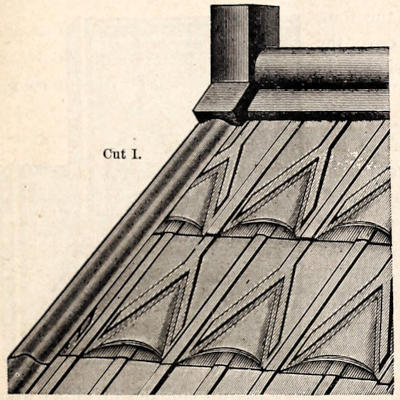
Cut I.
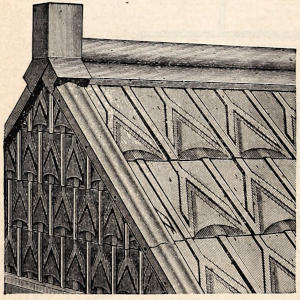
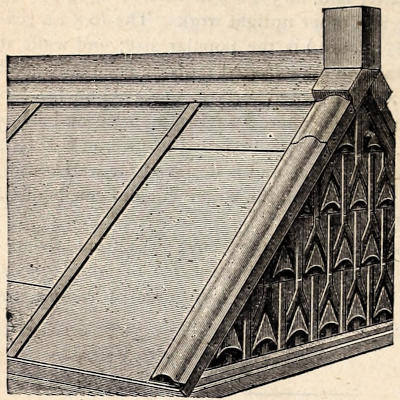
Shows manner of finishing with Climax Ridge Stop Block
and Gable End Finish.
Commence at the lower
left-hand corner. In
starting be particular
to see that you start
straight with the eaves
of the building. To do
this it is best to draw a
chalk line about twelve
inches from the eaves;
this distance leaves two
inches to project from
the eaves, which in many
cases is more than sufficient.
If you use our
Gable End Finish (Cut
I) it saves the trouble of
fitting the shingles to the
verge board, and adds to the appearance
of the roof. After nailing the
Gable End Finish to its place, press
the left-hand edge of the first shingle
well under the fold of the Gable End
Finish, and before nailing it hook two
or three shingles with the top edge on
a line with your chalk line; then remove
the loose shingles, and nail the
first one which is held to its proper
place by the Gable End Finish. By
doing this in starting each course you
are sure of a straight line if you follow
correctly the gauge lines at the top of
each shingle.
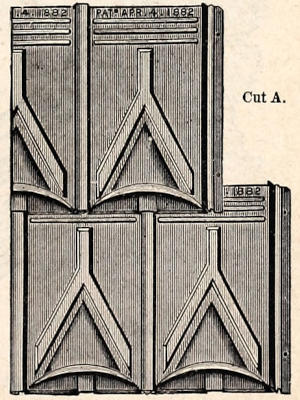
Cut A.
Shows commencement of first two courses.
If your roof has a pitch of six inches to the foot, or steeper, let the
bottom edge of the shingle rest just above the lower gauge line on the top of
the underlying shingle, as shown in Cut A. But if the pitch of the roof is
less than six inches to the foot,
let the shingle entirely cover the
lower gauge line, as shown in
Cut B.
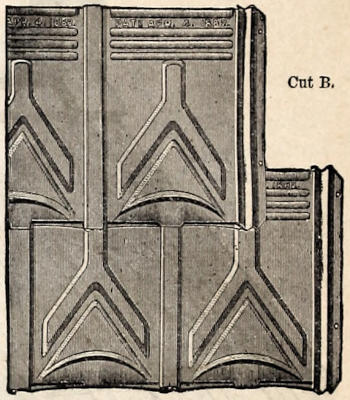
Cut B.
We advise against the use
of our shingles on roofs of less
pitch than five inches to the
foot, unless the lap is increased.
As a rule, we think any roof that
can be walked over with safety
is too flat for shingles of either wood
or metal.
Cut F.
Should there be a gutter formed
at the eave, let the shingle
rest on it as you would in
using the ordinary wood
shingle. (Remember
every other course commences
with a half shingle,
as shown in Cuts A
and B.) The same rules
that govern the laying
of slate or the common
wood shingle along valleys,
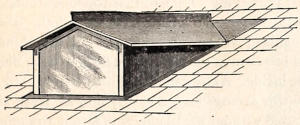
or about chimneys
and dormer windows,
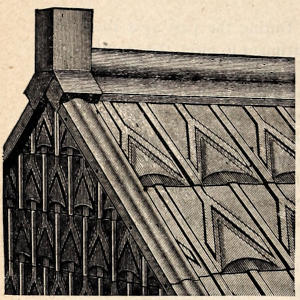
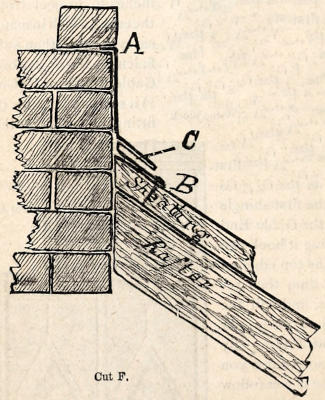
are applicable to ours, except the tin shingles are bent up against the
sides of chimneys, which cannot be done with wood or slate. When
our shingles turn up against the sides of chimneys or brick walls, insert
flashing by sawing out the mortar joint above the line of tin
work; where the upper edge of our shingles butts against the brick
wall, as they do on the lower side of chimneys, cut them off on the
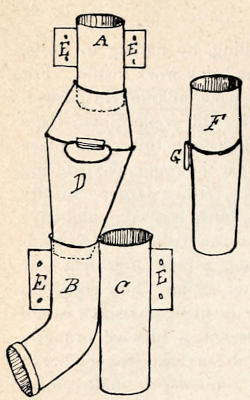
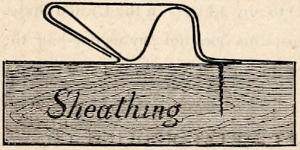
line where the chimney comes to the roof, and use a strip of tin bent
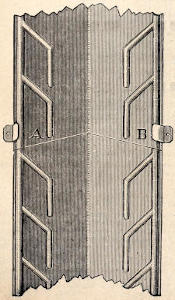
in this manner. (See Cut F.) The upper end at A is to fit in mortar
joint. The lower edge, B, is nailed to the sheathing before the
shingles are put on. The upper ends of shingles are then to be
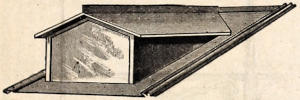
pressed up under the fold, C. Great care should be used in finishing
about chimneys and dormers, the details
of which cannot well be explained to suit
each case; but a workman of ordinary
skill can suggest the
proper manner in which
the work should be done
to secure thoroughly
tight work.
It is much easier to
secure this result with
the use of our shingles
than it is with either
wood or slate.
Where the upper end of shingle butts
against the side of a frame house, use
the same means as on the lower side of
chimneys, only let there be no bend at the point A, as shown in Cut
F; but let it extend an inch or so up under the weather boarding.
Where the weather boarding is vertical there is no way of making tight
work but to put the tin work, as before described, back of the vertical
weather board.
In laying the valley, cut the tin so it extends to about one-half
inch over the lock, and bend it under, as shown in Cut D. We furnish
to each customer a small pair of hand-tongs, which is handy to
turn this edge over and pinch it together after the shingle is laid.
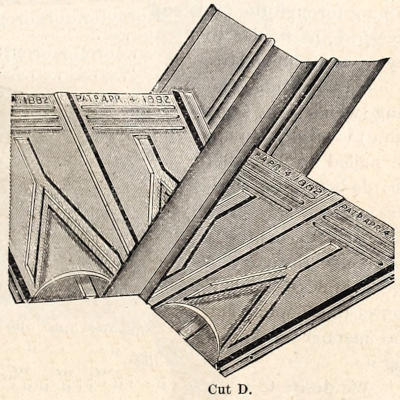
Cut D.
The Cut D represents the shingles laid to and from the valley.
In starting from the valley it is best to hold several shingles together,
or tack them at the top, then with a straight-edge mark and
cut where they overlap the valley; and with the hand-tongs edge and
lock them to the valley, as shown in cut D.
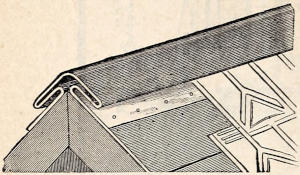
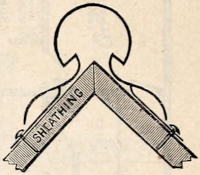
Use the Hip Coping by nailing the edges to the roof boards, and
press the shingle up under the folds on each side after they are cut
to suit the angle of the hip. (See Cut E.)
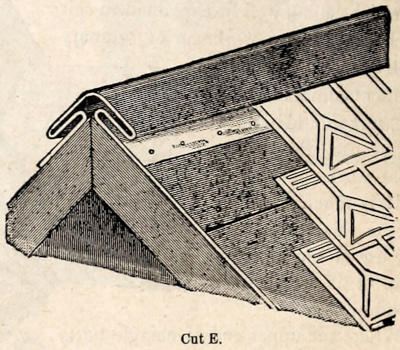
Cut E.
As plain as this appears, we have known men to nail the Hip
Coping through the folds and on the top of the shingles. We are,
therefore, particular to
say wherever this Hip,
or our Plain Ridge Coping
(which is the same
thing) is used it should
be nailed to the roof
boards before the shingles
are put on. The
fold is made expressly
to receive the edge of
the shingles. Cut E
shows this coping and
the manner of applying
it.
We desire to impress upon our customers, who live in the Northern
States, where blizzards and severe snow storms are frequent,
the necessity of using close sheathing, and if the sheathing is not
close, the use of sheathing paper, to be laid underneath the shingles; it adds
greatly to the warmth of the house in winter, and prevents small particles
of snow from entering, it costs but little, and should always be
used under wood, slate or tin shingles where the best protection is
desired.
DO NOT Hammer Down the Joints or Lock.
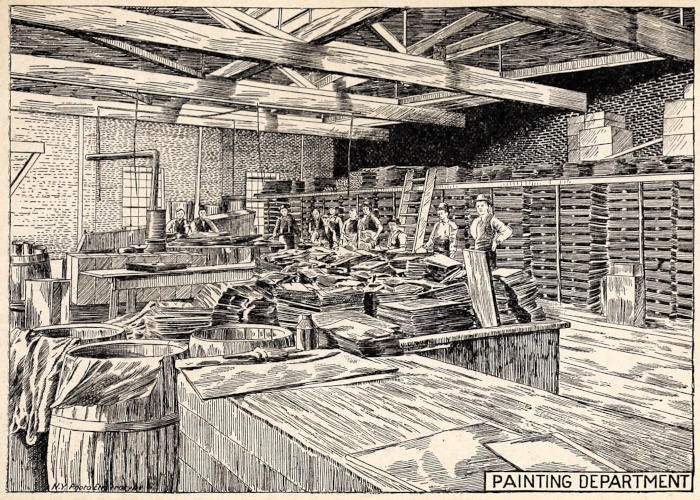
PAINTING DEPARTMENT
PAINTING. — ATTENTION, ROOFERS!
After the mason, bricklayer, carpenter, tinsmith and plasterer
comes the painter. At this stage of progress in the work, the owner
usually thinks of moving in; in fact, he thinks he should have been
living in his new house several weeks ago.
If weather conditions have been good, the representatives of
other branches of house building have got along smoothly excepting
a little shaking up now and then, caused mostly by the men occasionally
yielding to the seductive influences of Old John Barleycorn or
his rival King Growler. The owner, having previously engaged or
contracted for inside painting, now calls on the painter. The man
of colors and brushes is always ready to promise quick work (and
we are free to say the mysteries of his trade are equal to any reasonable
emergency), and is apt to humor his employer’s impatience, and
meekly submits to his wishes knowing that his employer’s hurry is
his gain. House-builder, did it ever occur to you that first-class
inside painting is a slow process? Think of this; after the first
coat is laid, it should stand long enough to become thoroughly dry,
dry enough to be sand-papered. The second coat should be a little
heavier than the first or priming coat. It does not dry as fast as the
first. (We are speaking of good materials properly proportioned.)
Each coat must be thoroughly dry before it is sand-papered. Any
kind of good work requires three coats. Extra good work—four,
besides varnishing.
If you succeed in doing this work inside of four weeks you are
fortunate. Thus you see it requires time to do good work. Time
for the men to do theirs, and time for Nature to do hers. Sometimes
Nature frowns and lowers a curtain of humidity for days at a time,
which prevents the oils from drying. It is possible for your painter
to finish all four coats in as many days; but if he is honest and you
have not hurried him unreasonably, his conscience will suffer. Good
painting, like other good things, is durable, looks well, and is the
cheapest in the end.
Good painters pride themselves on doing good work. So if you
desire first-class work, you should give the painter a reasonable price,
and sufficient time in which to do the work properly.
There is doubtless more adulteration in paint than in any
materials used in house-finishing. So general is this the case that it
is often difficult to get pure materials. This is caused by the low
price of the products of petroleum, the earth materials used to adulterate
mineral paints, and the demand for cheap work.
Our Broad Rib Roofing and Steel Plate Shingles are not
protected with a coat of richer metal like those made of tin or terne
plate, and consequently their durability depends upon the paint with
which they should be covered.
For this purpose nothing, so far as we know, is equal to a mixture
of pure unboiled linseed oil and the oxide of iron. The Shingles
should have two coats, one before they are put on, on both sides
(this we do), the other immediately after they are laid. This last
coat should be repeated every four or five years.
Remember, it is the rust-preventing qualities of linseed oil, combined
with the oxide of iron, that makes steel or iron sheets resist the
corrosive action of oxygen, which is ever present in the atmosphere.
(See page 101.)
A PERFECT ROOF.
The best can only be obtained by using good materials, worked
into the best form that theory and experience can suggest.
WALTER’S PATENT “STANDARD” and
COOPER’S PATENT “QUEEN ANNE”
METALLIC SHINGLES AND SIDING,
made from Tin Plate, Steel Plate, Galvanized Tin Plate, Bronze
Metal, and Copper, are unrivaled for roof covering.
Because they have a perfect lock, using no cleats, springs or exposed
seams.
Because they have no exposed fastenings; all nail heads are covered
as perfectly as those used for wood shingles.
Because they can be applied without the necessity of soldering, and
with no other tools than a hammer, a small pair of hand-tongs
and tin shears.
Because they break joints by starting each alternate course with a
half shingle, thus bringing the centre of the bottom of each
shingle astraddle of the locked shingle below, securely binding
the same and preventing rattling.
Because they are easily and rapidly put on, requiring no odd pieces
at the eaves, gables or comb.
Because they lessen the expense of insurance, which extends not
only to the building but to furniture and goods contained
therein.
Because they do not crack, split, warp, fall off, rust or burn.
Because there are no cross seams or joints where rain or moisture
can settle and cause decay.
Because we furnish with our shingles, at moderate cost, Valleys,
Gable Strips, Ridge and Hip Coping, that not only improves the
finish of exterior, but assists the workman to an extent that lessens
the cost of applying.
Manufactured by
THE NATIONAL SHEET METAL ROOFING CO.,
510 to 520 East 20th Street, New York City,
and for sale by Dealers in all the principal cities of the United States
and Canada.
From BARTLETT HARDWARE CO.,
Freeport, Ill., January 10th, 1888.
The National Sheet Metal Roofing Co.,
New York City.
Dear Sirs:—I send you photo. of my house that you may see how handsome
a Roof the 7 × 10 Shingles make. You thought the 10 × 14 would have
been better, but this is the finest roof in this country, and we expect to sell
some the present year. Everybody admires it. Please quote for the coming
season’s trade.
Very respectfully,
F. BARTLETT, President.
WHAT OUR GOODS ARE. — SAMPLES.
In offering our goods to the public, we desire to say, briefly,
that the Walter’s Patent Metallic Shingles and Siding Plates have
now been before this country for nearly eight years, upwards of twelve
thousand buildings have been covered with them in the United
States and Canada, and we feel warranted in referring to the owners
of every building so covered.
Our shingles have a concealed nailing flange the entire length
of the shingle on one side, and a perfect lock with a concealed gutter
at the side of the nailing flange that provides for expansion and
contraction, with sufficient ventilation to prevent sweating on the
under-side, (causing rust,) so common in the cross seams of flat lock
and standing seam, now in use.
Our Galvanized (Re-dipped) Shingle is our Standard Tin
Shingle galvanized; and, as every square has twenty pounds of
zinc coating, in addition to the first coat of tin, it will be seen why
it is superior to any galvanized iron made.
Our “Old Process” prices are designed to cover such grades of
double-coated plates as “Old Style,” “M.F.,” “Phelp’s Triple Plate,”
“Gilbertson’s Old Method,” and “Tregoning Old Process,” all superior
to the Standard Grades, and higher in price. We quote all but
Galvanized, painted both sides. If any size or kind is ordered unpainted,
the price will be 25 cents per square less.
Our Steel Plate Shingles are made from sheets of Bessemer steel
rolled as smooth as tin plate, they are painted the same as the Standard
Shingles, and when laid on a roof cannot be distinguished from
them. They should be painted every five years with pure linseed oil
and oxide of iron (brown mineral). They will not bear neglect; in
this respect they differ from shingles made from tin plate. The price
is somewhat less, but the greater durability of the Tin Shingles is
worth more than the difference in price.
We make our shingles in four sizes: The smallest, 7 × 10, (showing
an exposed surface, after laid, of 5½ × 9 inches,) is designed for
Mansards, Spires, Siding, and other upright work. The 10 × 14, (exposed
surface, 8¼ × 11½ inches,) is the popular size; and while it
works to the best advantage on complicated roofs, it is equally good
for plain ones. The 14 × 20, (exposed surface, 12 × 17½ inches,) is
used largely on the plainer roofs, where a saving in price and labor
of putting on is an item. The 20 × 28, (exposed surface, 17½ × 25½
inches,) is made from heavier metal, and is designed for warehouses,
and other large surfaces; and any of the larger shingles can be used
for siding equally as well.
We are prepared to make any of the above sizes from any special
brand of tin plate in the market, but for our Standard goods,
which we carry in stock, we use a first-class grade of roofing tin
plate, warranted perfect.
We will send free, and charges paid, samples of our Walter’s
Patent Shingles (three pieces) to any address in the United States
on receipt of five two-cent stamps; this does not pay us one-half the
expense, but we propose to make the cost as light as possible to those
interested in building.
THE NATIONAL SHEET METAL ROOFING CO.,
510 to 520 East 20th Street,
New York City.
INSIDE CONSTRUCTION.
By this we do not mean the arrangement or size of rooms, they
may be large or very small, and in either instance lack the conveniences
which may always be provided for by good construction. Even
a small house can have transoms over all the doors which open into
a hall, proper ventilating flues for all rooms, and a kitchen that will
be comfortable in all seasons, (see articles under the head of “Ventilation”
and “The Kitchen.”) These are essential; all dwellings, large or
small, should have them. The windows and doors should be arranged
to suit the furniture to be used. You have doubtless seen rooms with
windows on two sides, a door and fire-place on the other. This
arrangement makes it impossible for the room to contain an ordinary
size bedstead, without placing it before a window or some other
opening. Study these things when getting up plans for your house.
The dining room should be light and roomy, fronting the East
if possible, as the morning sun is always desirable, and adds much
to the cheerfulness of the family. The kitchen should not connect
directly with the dining-room. Construct a passage-way, well ventilated,
between the two rooms; this will prevent unsavory odors entering
the dining-room. The space at each end of the passage can be
utilized for the kitchen closets. Arrange your rooms so that you
will not be compelled to pass through one room to get to another.
Do not disfigure the walls by driving nails or hooks into the plastering
for the purpose of hanging pictures, but fasten a neat gilt moulding
to the side walls all around the room, about one foot from the
ceiling. The moulding should be about one and one-half or two
inches wide, with a groove on its upper side. Hooks shaped as an S
can be placed at any point on this moulding, and the pictures are to
be hung to these hooks. This arrangement is somewhat expensive,
but it is the only proper way in which pictures can be hung.
Closets.—No house is complete without ample closets. Every
lady knows that clothing and wraps cannot be stored away in drawers,
and look well when wanted for use. As closets are expensive we
suggest for small houses, that a room be constructed from four to six
feet wide, and from ten to fifteen feet long, with a window at one
end. Make shelves on one side, and place suitable clothes hooks on
the other. In such a room the entire wardrobe and family linen can
be properly stored. If you desire a moth-proof room, the ceiling,
walls and shelves should be made of red cedar. We suggest this
clothes room because of its cheapness. Each bedroom of large houses
should be provided with a clothes closet, which should be lined with
red cedar for the reasons above stated.
Don’t forget to have windows and all outside doors fitted up
with light sash and frames covered with woven wire cloth. This
material is very cheap, and can be purchased at any house-furnishing
goods store. Its use prevents mosquitoes and flies from entering the
house. Freedom from these summer pests will amply repay you for
the expense. During the late fall, winter and spring months, the
sash and frames can be removed; they should be stored in some perfectly
dry place, such as a garret, never in a cellar. Speaking of
pests reminds us of another kind that breed in cracks and crevices
found in most kitchens, which might lead a thoughtful man to suppose
that the builder, in his kindness of heart, provided these little
hiding places for just such creatures. If you don’t want them, see
that there are no cracks left between the wood-work and plastering,
or in any part of the floor or walls of the kitchen. Fill with cement
(Plaster of Paris is good) all cracks caused by shrinkage of wood-work
after the walls are completed and are thoroughly dry.
SHEET METAL WORK FOR PUBLIC AND PRIVATE BUILDINGS. — GUTTERS, VALLEYS AND DOWN PIPES.
These things are very closely related to the roof, and like it
should be of the best material.
A tin gutter hung at the eaves has the advantage of being cheap;
if made of good material and put up with good fastenings is durable,
and suitable for cheap houses and some portions of expensive ones.
In all cases where the fastenings are to hang from the roof, the
gutter should be put up before the roof covering is put on, so the
fastenings can be secured to the roof boards instead of on top of the
tin, slate or wood shingles. If the fastenings are nailed on top of the
roof covering, the nails soon become loose, and the gutter sags. The
tinsmith will charge no more for doing his work before the roofers
commence, but it may delay you a day. Paint the gutter inside as well
as out, and see that it has sufficient fall to clear itself of water. If you
prefer the gutter on the roof near the eaves, let the sheets of which it
is made be of sufficient width to extend far enough up under the
roof covering to prevent water (when the gutter is full) from overflowing
at the back instead of over at the front; this is a common
error. In every instance let this top gutter be outside the wall line,
so in case of leakage the “drip” is outside the walls. Gutters of
this kind, and all gutters that are soldered and firmly fastened to roof
boards (not hanging gutters), are liable to crack by expansion and
contraction of the metal; we therefore say, never put a gutter inside
the wall lines if they can be put outside. Valleys formed by the
joining of two roofs at an angle are usually steep enough to allow
the metal sheets to lap on each other and shed water without soldering.
Such sheets are usually made twenty-eight inches long. Their
shortness prevents cracking from expansion and contraction even if
nailed to roof boards. Remember that all trash or dirt that settles
on the roof eventually finds its way into the valleys, gutters and
down pipes, and in a manner scours their surface; for this reason
they receive several fold more wear than the same amount of
exposed surface of the roof, consequently, should be of better
material. Few people are aware of the amount of dirt and sand
which is carried by the wind and deposited on their house-tops; for
this reason, if the water is used for drinking or cooking purposes, the
first water that flows from the roof during a rain storm should not be
allowed to flow into the cistern.
It is always best to have good sized down pipes. As a rule, for
down pipes from hanging gutters, let the circumference of the pipe
equal the girt of the gutter, and the gutter should be large enough
to convey the water which falls on the roof during the heaviest
storms. Use only curved elbows where a turn in the pipe is to be
made, and at the foot or discharge end. Curved elbows are now made
by machinery; they are stronger, more durable and cost no more
than the common hand-made acute kind.
We have spoken of good material; but what is good material
when Tin Plate is spoken of? The quality of Tin Plate depends on
its toughness, and the weight of Tin or Terne coating on its surface.
The first is easily determined by bending back and forth with the
hand, the latter is not, unless handled by an expert. The following
test will determine the difference, provided you have different qualities.
If the qualities are the same, or nearly so, the difference will
not be distinguishable.
Take two pieces of different quality of Tin or Terne plates, say
two inches square, grease one side with any kind of animal fat; then
with a pair of plyers, hold them separately over a gas or candle jet
with one corner obliquely downward, and the amount of fusible
metal which flows from them will determine the difference between
good and common.
TESTIMONIALS.
St. Louis, Mo., April 26th, 1888.
Gentlemen:—We have used your Walter’s Metal Shingles on the most
prominent buildings of our city, all of which have given universal satisfaction
both in appearance and durability. As for us, we can say we give them the
preference above all others knowing that when once up there is none its equal.
Yours truly,
MESKER BROS.
Augusta, Ga., April 30th, 1888.
Gentlemen:—I have in the past six years used and carefully compared all
the leading makes of Patent Metallic Shingles, and I unhesitatingly pronounce
your Walter’s Patent the best shingle on the market. They are simple, and
easy to put on, and for a handsome, light and durable roof they are without
a parallel. I have used them on many public as well as private buildings in
this city, and they have in all instances given the highest possible satisfaction,
which has won me the esteem and confidence of the public.
Yours truly,
DAVID SLUSKY.
Las Vegas College, Las Vegas, N. M., April 29th, 1888.
Gentlemen:—I am glad to inform you that we are very well satisfied with
the Walter’s Metal Shingles with which the new stone addition of our college
is covered. It is about three years since the roof was laid, and your shingles
are keeping yet a very neat and nice appearance, defying bravely the eating
and inclemency of the weather.
Yours truly,
C. M. CAPILUPI, S. J.
Office of Superintendent, DePaw University, Green Castle, Ind., April 30th, 1888.
Gentlemen:—We beg to say that your Walter’s Shingles with which our
college buildings are covered are very satisfactory.
E. T. CHAFFEE, Sup’t.
Colorado State Insane Asylum, Pueblo, Col., April 27th, 1888.
Gentlemen:—I wish to say that the Walter’s Patent Metallic Shingles,
with which our buildings are covered, we believe to be superior to anything
heretofore introduced in the West in that line.
Yours truly,
P. R. THOMBS, Sup’t.
Daytona, Fla., April 27th, 1888.
Gentlemen:—We have used your Metallic Shingles on the First Congregational
Church at this place. As to durability, the roof has been on now
about three years, and seems as good as the day it was put on. Its appearance
is beautiful, and its rain shedding qualities are perfect. We like the
roof first rate, and can conscientiously recommend them to others.
Yours very truly,
CHAS. M. BINGHAM, Pastor.
Ithaca, N. Y., April 28th, 1888.
Gentlemen:—We have put the Walter’s Metallic Shingles upon many
buildings in Ithaca, and in each instance our customers have been perfectly
satisfied. In our opinion they are the most durable roof we have handled.
The writer has his house covered with the Galvanized Tin Shingles, and
believes he has the most durable roof in Ithaca, because they need no
painting, or care of any kind whatever. While costing more at the start, in
the end the matter of economy is with the Walter’s Shingles.
Yours truly,
C. J. RUMSEY & CO.
Taunton, Mass., April 25th, 1888.
Gentlemen:—We have used in less than two years about 800 squares of
your Metallic Shingles, and they have given the best of satisfaction in every
case, and in our opinion are far ahead in durability and appearance of either
slate or wooden shingles.
Yours truly,
N. CRAPO & BRO.
Winthrop St. Baptist Church, Taunton, Mass., May 5th, 1888.
Gentlemen:—We are in every way fully satisfied with the Walter’s Metal
Shingles which you put on the roof of our church two years ago. It would
be difficult to desire a superior roofing.
Yours very truly,
J. K. WILSON, Pastor.
Centenarian M. E. Church, Beatrice, Neb., May 2d, 1888.
Gentlemen:—I consider the Walter’s Metal Shingle an improvement over
anything of the past; superior to slate in appearance; of less weight and cost,
and just as durable. When properly put in place it can but give the best of
satisfaction. Can heartily recommend it.
Respectfully,
A. C. CALKINS, Pastor.
Matteawan, N. Y., April 25th, 1888.
Gentlemen:—I take great pleasure in giving my unprejudiced opinion of
Walter’s Metallic Shingles. I have been using them for the last three years,
and have never had any fault found with them of all the roofs that I have put
on, and I have had good practical tinners proclaim to me that they consider
it the best tin roofing they have ever seen. It is the roof for me when I am
building myself. Any person adopting this roof, by giving it a coat of
metallic paint every five years, I will warrant them to have a tight roof for
two generations.
Yours truly,
SAM’L McKEE.
Minneapolis, Minn., April 27th, 1888.
Gentlemen:—I have put on in the Northwest large amounts of your
Metallic Shingles for others, and also covered my own residence some five
years ago, and can heartily recommend your goods to any one desiring a substantial
and absolutely tight roof of fine appearance, which gives a roof much
better than slate and a lower price.
Most respectfully yours,
M. H. CRITTENDEN.
Ann Arbor, Mich., May 4th, 1888.
Gentlemen:—My roof was the first one in this city on which your tin
shingles were used, and they have given entire satisfaction. I would not
exchange it for any other roof that I know of.
Yours truly,
GEO. W. MOORE.
Milford, Delaware, May 10th, 1888.
Gentlemen:—Would say that the Walter’s Patent Metallic Shingles, put
on the Electric Light Station in this town, by W. P. Cullen, are giving entire
satisfaction, making a handsome and durable roof, much preferable in our
judgment to the regular tin roofs usually put on such buildings.
Very truly yours,
W. T. JOHNSON.
New Milford, Del., May 15th, 1888.
Perhaps it may be of interest to you to know my views of the Tin Shingle
Roofing purchased of W. P. Cullen, of Milford, Del. I can recommend in
the highest degree their use, as they possess many advantages over any other
material used for that purpose. They require no skilled labor, and are as
durable as any tin roof can possibly be. I have watched it during every rainstorm
since it was laid, and not one drop has passed through it to my gratification,
and to the credit of the inventor. I invite the inspection of any one
who may contemplate putting on a roof upon any building.
Respectfully,
P. H. STORM.
Brockton, Mass., April 27th, 1888.
Gentlemen:—Two years ago the Brockton Agricultural Society covered
the roof of their main building with your tin shingles, and I am pleased to
inform you that they have given perfect satisfaction.
Yours truly,
H. W. ROBINSON, President.
Church of the Holy Apostles, St. Clair, Pa., April 25th, 1888.
Gentlemen:—The Walter’s Patent Metallic Shingles have been the covering
to the Rectory of this church since September, 1885. They were put on by
novices under disadvantageous circumstances, and have withstood every test
that a Pennsylvania mountainous district changeable weather could give. I
talk tin shingles to all my friends.
Yours truly,
CHAS. A. MARKS, Rector.
Natchez, Miss., February 16th, 1888.
Gentlemen:—I have been in the tin roofing business for the past 20 years,
and I believe that the Walter’s Patent Tin Shingles make the best tin roofing
of any of the other patents that are now on the market. I have put on hundreds
of squares of them, and they have given me and the property owners
entire satisfaction. I will further say that each box of shingles I have bought
from them has covered one hundred square feet of roof, which will be understood
by tinners to be a great satisfaction in ordering roofing, as the rule is
that patent roofing falls short after being laid. I have often been asked by
different manufacturing companies for my opinion of the roofing that they
manufacture, but this is the first time that I have ever given my opinion, and
I would not give my opinion now if the Walter’s Patent Tin Shingles did
not deserve it.
I am, yours truly,
P. W. MULVIHILL.
Baton Rouge, La., February 24th, 1888.
Gentlemen:—I beg to say that I have used the Walter’s Patent Tin Shingles
for some time, and they have given satisfaction. I think they make the
best roofing that can be put on for the money.
Yours truly,
M. J. WILLIAMS.
Milford, Del., May 4th, 1888.
Dear Sirs:—This is to say that I have used several thousand shingles of
Walter’s Patent on our roof at the Phosphate Factory, put on by W. P. Cullen,
and up to this time not a single drop of water or a weight of snow has drifted
through it, and if kept properly painted, I believe the roof will last as long
as any person could wish it to.
W. I. SIMPSON.
Canajoharie, N. Y., May 10th, 1888.
Gentlemen:—Having Walter’s Metal Shingles on two of my buildings,
put on by F. H. Hodge, the new Courier building being sided with them, I
feel that I am competent to speak of the merits of the shingles. My experience
has been entirely satisfactory, and I regard the Metallic Shingles as the
best roofing and siding extant. If I were to build a hundred houses, and it
were possible to use these shingles, I would not hesitate one moment, as I
regard them as cheaper and better than any other covering in the market.
Yours, &c.,
WILLET F. COOK.
Hospital for the Insane in Washington Territory, Fort Steilacoom, W. T., May 2d, 1888.
Dear Sirs:—This institution has passed two winters under cover of Walter’s
Metal Shingles. Our Winters are very wet, rain falling most of the
time, but there has been no leak. The shingles are, therefore, entirely satisfactory.
Yours very truly,
JOHN W. WAUGHOP, M. D.
Sup’t Hospital Insane, W. T.
Woodstock College, Howard Co., Md., December 8th, 1886.
Gentlemen:—It affords me much pleasure to indorse favorably the Walter’s
Patent Metallic Shingles. I have used them on our church buildings in Trinidad,
Colo., Albuquerque, N. M., and Woodstock, Md. In the first named
place they have been in use over two years, and have withstood, without detriment,
the very high winds and occasional driving storms of rain and snow for
which that State is so remarkable. In the other places they are also giving satisfaction
in every respect.
I consider a roof of this material far superior to the ordinary tin or iron,
both in beauty of design and solidity of construction, and see no reason why it
should not supersede slate, as it is far less costly, requires a lighter frame, is
just as much fire or storm-proof, and equally durable if kept painted.
Hoping your goods may elicit the patronage they justly deserve, I beg to
remain, gentlemen,
Yours very truly,
EDWARD BARRY, S. J.
Auburn, N. Y., November 26th, 1889.
Gentlemen:—Your esteemed favor of the 16th duly to hand; by reason of
Mr. Stevens’ absence from town, has not had earlier reply. We take great
pleasure in speaking a good word for the new roofing we purchased of your
house; we find it all it was recommended to be. The condition in which it came
to us rendered it very easy to place upon the roof. It makes a tight and substantial
roof, one which we believe will be as durable as anything we have ever
seen. We remain, with respect,
Yours very truly,
A. W. STEVENS & SON.
Penfield Center, N. Y., October 17th, 1889.
Gentlemen:—I have used about sixty squares of your metal shingles this
year, and can say they excel any roof I have used. They are light, tight and
cannot help being a life-lasting roof, if they are taken care of.
Yours truly,
G. H. BACON.
Sherman, Texas, October 28th, 1889.
Gentlemen:—I have been contracting and building fifty years, 34 years in
North Texas. I recommend your metal roofing as the best I have ever used,
and that it gives perfect satisfaction, and if painted every five years it will last
a century.
Yours truly,
GEO. MELTON,
Architect and Builder.
College of the Holy Cross, Worcester, Mass.
Mr. W. F. Wallace,
Sec’y and Treas’r, Nat. Sheet Metal Roofing Co.
Dear Sir:—Having used your Galvanized Tin Shingles largely in Maryland,
Connecticut and here, and recommended their use in other sections, I have no
hesitation in stating that everywhere the results have been completely satisfactory.
I shall continue to use the roofing in preference to any that I know.
Yours respectfully,
T. W. HAYES, S. J.
Rome, N. Y., November 4th, 1889.
Dear Sirs:—Nearly two years ago I had the steeples of my church covered
with your Galvanized Metal Shingles. I have now no hesitation in stating that
in my judgment it is the best roofing material in the market. It is very ornamental,
and time seems to have no effect on it, as it still retains the same color.
So pleased were the citizens of this place with the work done on my church,
that many of them are now using the same material in roofing their houses.
A. MURPHY, Pastor.
Webster, N. Y., October 17th, 1889.
Gentlemen:—I have used your patent shingles on my grist mill and think
there is nothing better for fire, wind or weather. They are all right.
Yours truly,
B. SPERRY.
Rome, N. Y., December 2d, 1889.
Gentlemen:—The Walter’s Metallic Shingles put on the roof of our new
church in this city, about four months ago, by Mr. James Conley, are in every
way satisfactory to our people, and the roof is admired by all who see it. I take
great pleasure in recommending your shingles to the public as the best material
for roofing that I have seen.
E. W. BRUCE,
Pastor and Chairman of Building Com.
Rome, N. Y., November 5th, 1889.
Gentlemen:—We have used your Metallic Shingles on the steeples of the
Welsh Congregational Church, at this place, last summer, and it seems as good
as the day it was put on. Its appearance is beautiful and its rain-shedding
qualities are perfect. We like the steeple first rate and can conscientiously
recommend them to others. They need no painting or care of any kind whatever.
These were put on by Mr. James Conley, of Rome, N. Y.
Yours truly,
D. E. PRICHARD, Pastor.
James Thomas, Sec’y.
Rome, N. Y., December 6th, 1889.
Gentlemen:—The Walter’s Metallic Shingles were first brought to my notice
by Mr. James Conley, of this city, some two years ago, and I made a personal
examination and test of same, and have since specified and had them used in
preference on several buildings. They make a light, handsome and durable
roof, and I have yet to hear the first complaint.
Respectfully,
WM. H. DAVIES, Architect.
Council Grove, Kansas, November 5th, 1889.
Messrs. Jerome Twichell & Co., Kansas City, Mo.
Gents:—Yours of the 25th at hand regarding the Walter’s Shingles. I purchased
in the spring the Walter’s Shingles and used them on my dwelling house.
I must say they make the best looking roof and the tightest roof I ever saw, and
they are easily laid. I am much pleased with them and can recommend them
very highly.
Yours truly,
THOS. J. HIGGINS,
Breeder of Hereford Cattle.
Junction City, Kansas, October 29th, 1889.
Messrs. Jerome Twichell & Co., Kansas City, Mo.
Gentlemen:—Replying to yours, 25th inst., we have used the Walter’s
Metallic Shingles on the large three-story building we occupy. This roof was
put on nearly two years ago: the roof has not shown any defects up to this time,
and if kept properly painted will last many years.
Very respectfully yours,
ZIEGLER HARDWARE CO.
Kansas City, October 26th, 1889.
Messrs. Jerome Twichell & Co., Kansas City, Mo.
Dear Sirs:—In reply to yours I have no hesitation in pronouncing the
Walter’s Metallic Shingles a good roof. It has been on my two-story frame
house two years, and I have found it to be perfectly tight, keeps clean (an advantage
where cistern water is used) and adds greatly to the appearance of the
house.
Yours truly,
M. J. REILLY,
1308 Park Avenue.
Weston, Mo., October 31st, 1889.
Messrs. Jerome Twichell & Co., Kansas City, Mo.
Gentlemen:—Walter’s Metallic Shingles bought of you last May were put
on our school-house, and I am glad to state that they make a tight, handsome
and substantial roof. Everybody is pleased with it. I can recommend them to
all who want a tight and substantial roof.
Yours truly,
Rev. CHAS. SCHAAF,
Pastor of Catholic Church.
Hutchinson, Kansas, October 26th, 1889.
Messrs. Jerome Twichell & Co., Kansas City, Mo.
Gents:—We have used almost all kinds of Metallic Shingles manufactured,
but find the Walter’s Shingle makes the best roof of any we have found. They
make a tight, ornamental and durable roof, and have never given us a particle
of trouble, and we are glad to recommend them to any one wanting a first-class
metallic roof.
Respectfully,
SWIFT, MANKOFF & CONGDON.
Trinidad, Colo., November 16th, 1889.
Messrs. Jerome Twichell & Co., Kansas City, Mo.
Dear Sirs:—We have used the Walter’s Patent Shingles to the satisfaction
of all concerned on the following buildings: Southern Hotel, South Side Public
School, Jewish Synagogue and several minor buildings. They undoubtedly
make a good roof.
Yours truly,
SCHMIDT BROS.
Mr. James Conley,
Agent, Walter’s Patent Tin Shingles, Rome, N. Y.
Dear Sir:—I take pleasure in commending the Walter’s Tin Shingles, as
applied to my house by you. As you will remember, the roof was not completed
in all its details when the winter set in last year, and, at my request, the
scaffolding was left on the different roofs, more for a test from banking of snow
and back-water, feeling assured that if the shingles survived the test, I would
never experience any trouble from that source, in the future, when the scaffolding
was removed. I was more than satisfied with the test, as we experienced
no trouble from leakage or from any other source. Therefore, I take great
pleasure in recommending the Walter’s Patent Tin Shingles to whoever contemplates
using a metallic shingle for their buildings.
I remain, yours truly,
CHAS. WIGHAM,
House, 418 Floyd Ave., Rome, N. Y.
OUR SPECIALTIES.
THE BEST OF THEIR KIND.
METAL SHINGLES, under the Walter’s and Cooper’s Patents, made
from Tin Plates, Tin Plate Galvanized, Steel Plates and Copper, have
no equal in the world for roof covering.
CURVED ELBOWS.—Fixed, adjustable and in sections. The most
perfect machine-made Elbow ever invented. Made from Tin Plate, Tin
Plate Re-tinned, and Tin Plate Galvanized. Perfect in form and fitting.
The best in the world.
CONDUCTOR PIPE.—Crimp expanding. Will not burst by freezing.
In sections twenty-eight inches long, which interlock with each other.
Two sizes, three and four inches diameter.
WIRE NAILS.—Made from Steel Wire. All sizes, both barbed and plain,
in kegs, at manufacturers’ prices.
DRY PAINT. (Devils’ Red.)—The very best Oxide of Iron.
This is NOT a Ready-Mixed Paint. It is Iron Ore, burnt until all
deleterious substances are destroyed, then pulverized and bolted. In
a word it is IRON RUST, it
- MIXES readily with Linseed Oil,
- FLOWS freely under the brush,
- ADHERES tenaciously wherever applied.
Samples Mailed Free.
Write for Illustrated Catalogue and Prices.
THE NATIONAL SHEET METAL ROOFING COMPANY,
510 to 520 East Twentieth Street,
NEW YORK CITY.

WIRE NAILS
STEEL WIRE NAILS
AT MANUFACTURERS’ PRICES.
All Kinds of Wire Nails, Plain or Barbed,
FOR
Tin and Iron Roofing, Tin and Wooden Shingles, Slate and
Composition Roofing, Carpenters and Box Makers, Trunk
and Casket Makers, Builders and Contractors.
THE NATIONAL SHEET METAL ROOFING CO.
510 to 520 East 20th Street, New York City.
FRANK L. SMITH, Architect,
22 SCHOOL STREET, (Room 10,) BOSTON, MASS.
Plans for Specifications Prepared for Buildings of every description.
Low Cost Suburban Dwellings a Specialty.
Distance is no obstacle to my serving parties in all parts of the country. Correspondence Solicited.
PUBLISHER OF
A COSY HOME: How It was Built.
A DISCUSSION OF THE VARIOUS METHODS AND MATERIALS
EMPLOYED IN ITS CONSTRUCTION.
The book contains ninety-six pages, and is handsomely printed on heavy,
tinted paper. Is illustrated by designs of ten low-cost houses; first and second
floor plans and front and side elevations of each design are presented.
It contains many valuable and practical suggestions for those who would
build economically, and who desire to obtain the greatest value for their money.
Most of the houses represented have been recently built in the vicinity of Boston,
and the estimated cost of executing each design is based upon actual figures.
If you are interested in house planning and building, it will pay you to
send for this book. Sent post-paid, on receipt of price, 25c.
HOMES OF TO-DAY,
OR,
Modern Examples of Moderate Cost Houses.
Published in four parts, quarterly. First and second parts now ready.
Volume will contain 240 pages, quarto size, showing designs of buildings to
cost from $250 upwards. Over 200 illustrations, full set of framing plans,
model specification, colored frontispiece, and valuable information for those
about to build. Four parts, post-paid, as issued, $1.00. Address,
F. L. SMITH, Architect, 22 School St., Boston, Mass.
BRUCE & COOK
Nos. 248 & 250 PEARL ST
186. 188. & 190. WATER ST. N.Y.
For Extra Roofing specify KILLEY EXTRA or LPL EXTRA.
Each Sheet stamped with Brand.
For Best Roofing specify TREGONING OLD PROCESS.
Each Sheet stamped with Brand.
CORRUGATED LEADERS. IXL VENTILATORS.
Eight Foot Seamless Eave Troughs and Gutters.
NEPONSET WATERPROOF PAPER.
(Patented Dec. 28, 1885.)

No. 1 Neponset Rope Roofing.
For a first-class covering use our No. 1 and No. 2 Neponset
Rope Roofing. This will make a permanent covering at a low cost.
Black Neponset Building.
This is without exception the best building paper in the market.
Cheaper and better than tarred paper. Will save fuel.
For Sale by all Dealers.
Manufactured solely by
F. W. BIRD & SON, East Walpole, Mass.
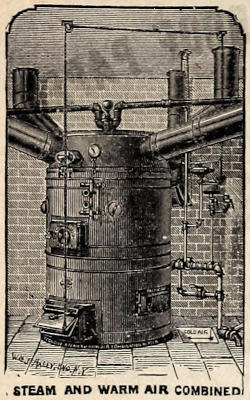
STEAM AND WARM AIR COMBINED
THE
ECONOMY
COMBINATION
Steam and Warm Air Heater.
A Low Pressure Apparatus. Radiates Steam Heat
with from ½ to 3 pounds pressure. One fire generates
both Warm Air and Steam, Increasing its capacity 25 per
cent. over any All-Steam Heater made. The drafts are
automatically regulated by the steam pressure.
Our Systems of Warming Buildings with Steam Radiation
and Warm Air insure
Perfect Ventilation,
And guarantee a uniform and healthful temperature throughout the house.
THE “ECONOMY”
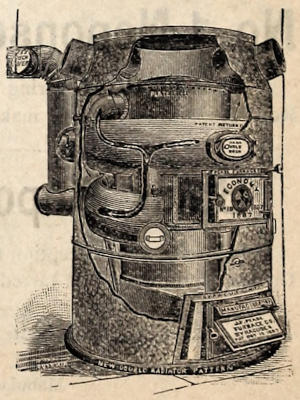
The Double Radiator Economy Warm-Air Furnace.
Warm-Air Furnaces
Have a reputation that is neither excelled nor
equalled for Durability, Power and
Economy, and are guaranteed in every respect.
SEND FOR CATALOGUE
giving full particulars, descriptions and illustrations
of 31 different styles and sizes of Heaters.
Manufactured solely by the
J. F. PEASE FURNACE CO.
Syracuse, N. Y., Toronto, Ont.,
75 Union Street, Boston,
177 East Randolph Street, Chicago.
EARL B. CHACE & CO.
General N. Y. Managers,
206 Water St., New York.
Estimates for Warming Buildings Promptly Furnished.
PAINT! PAINT!! PAINT!!!
YOUR HOUSE-TOPS,
BARNS, and
OUTHOUSES,
Paint! Paint!! Paint!!!
WITH
DEVILS’ RED
THE BEST OXIDE OF IRON,
GROUND to an Impalpable Powder
READY to mix with Linseed Oil
WITHOUT any other ingredient.
If you want the very best results from OXIDE OF IRON, mix
only with Linseed Oil.
If you want a cheap, vile compound often sold for Paint, mix Oxide of
Iron, Benzine, and a “leetle” Oil.
DEVILS’ RED IS NOT a Ready-Mixed Paint. It is Iron Ore
burnt until all deleterious substances are destroyed,
then pulverized and bolted.
| In a word it is Iron Rust, it |
MIXES readily with Linseed Oil, |
|
FLOWS freely under the brush, |
|
ADHERES tenaciously wherever applied. |
DEVILS’ RED is For Sale to the Trade,
ONLY BY
THE NATIONAL SHEET METAL ROOFING CO.
510 to 520 East 20th Street, New York City,
In Packages of 25 lbs., 60c.; 50 lbs., $1.00; 100 lbs., $1.75.
Special Prices by the Barrel. Samples Mailed Free.