THE EQUIPMENT OF A METEOROLOGICAL LABORATORY.
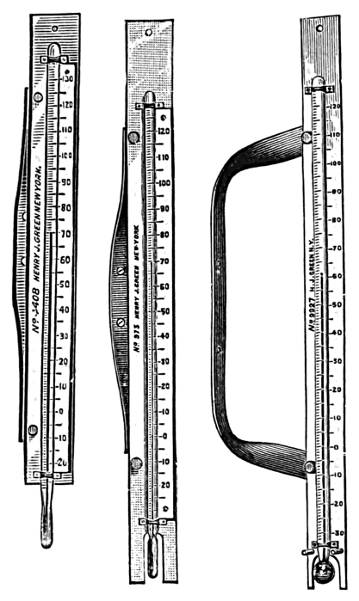
Exposed Thermometer (United States Weather Bureau pattern), with brass
support, $2.75.
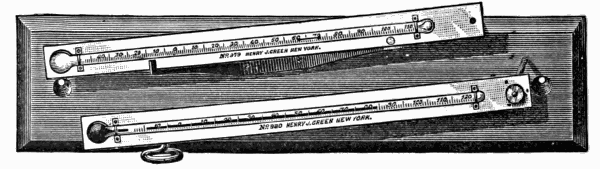
Maximum and Minimum Thermometers (United States Weather Bureau pattern),
mounted together on one board, $6.25.
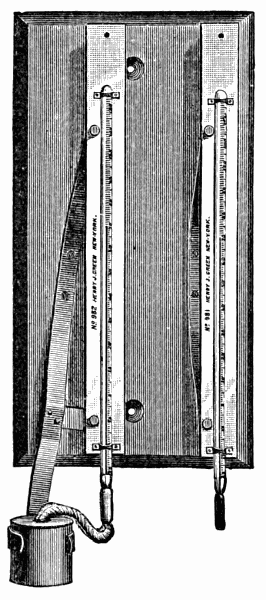
Wet- and Dry-Bulb Thermometers (United States Weather Bureau pattern),
mounted on one board, complete with water cup, $6.50.
Sling Psychrometer (designed by Professor C. F. Marvin, of the United
States Weather Bureau), consisting of two exposed mercurial thermometers,
mounted on an aluminum back, and provided with polished, turned hard-wood
handle and brass trimmings, $5.00.
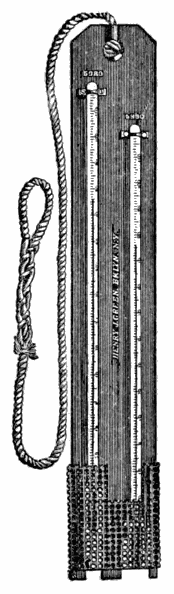
Sling Psychrometer, consisting of two cylindrical bulb thermometers,
mounted one a little above the other upon a light brass frame, with a
perforated guard to protect the bulbs while swinging, but which can be
raised (by sliding upon the frame) for the purpose of moistening the linen
covering of the wet bulb. Much less liable to be broken than the Weather
Bureau pattern, $5.00.
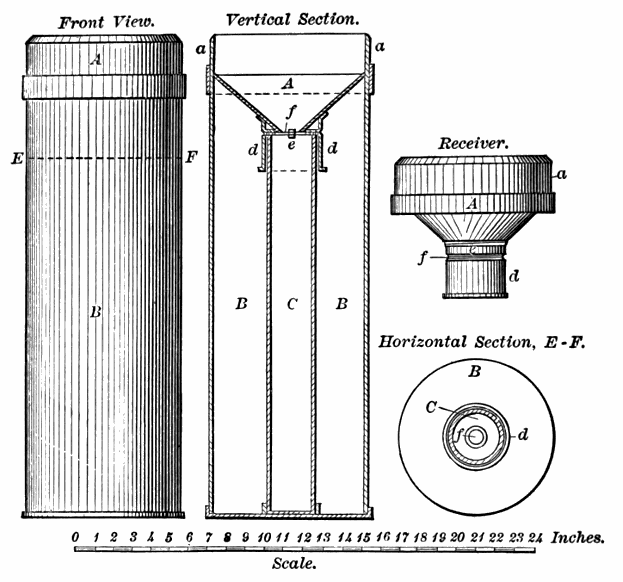
Rain Gauge (United States Weather Bureau standard), 8 inches in
diameter, complete, with measuring stick, $5.25.
Rain Gauge, 3 inches in diameter, with overflow and measuring stick,
$1.25.
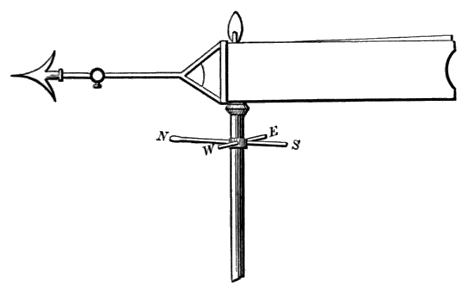
Wind Vane (United States Weather Bureau pattern), $10.00.
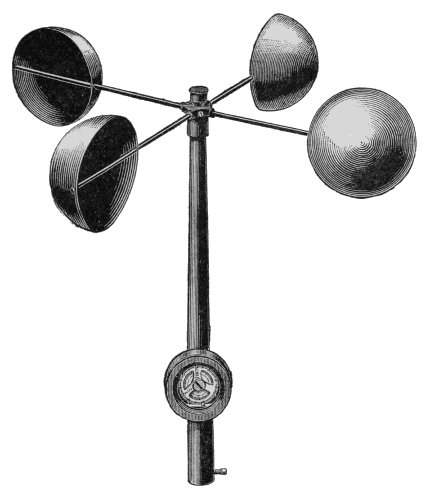
Anemometer (United States Weather Bureau pattern), with indicator,
aluminum cups, and electrical attachment, $25.00.
The same, with painted brass cups, $23.00.
Anemometer Register (United States Weather Bureau pattern), with pen and
ink attachment, $35.00.
The same, with pencil attachment (old style), $24.00.
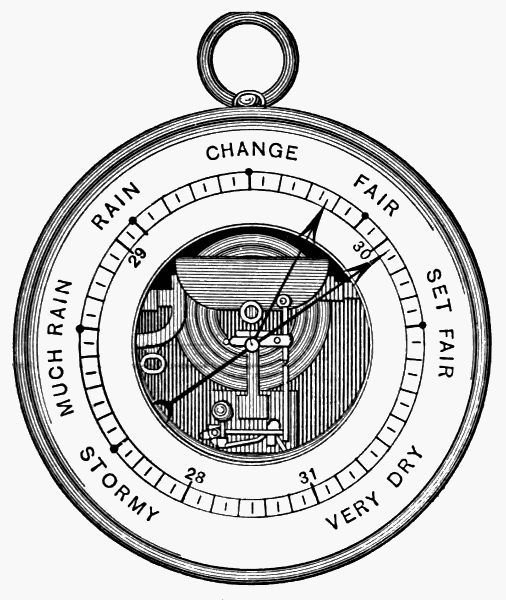
Aneroid Barometer (for meteorological work), $14.00-$16.00.
Note.—Much cheaper aneroids can be purchased, and may be used
to some advantage in the simpler observations in schools.
Mercurial Barometer (Standard United States Weather Bureau pattern),
complete with attached thermometer, vernier, etc., $30.00-$33.00.
Note.—The above instruments, as used by the United States
Weather Bureau, are made by H. J. Green, 1191 Bedford Avenue,
Brooklyn, N. Y. The prices are those given in Green’s latest
catalogue.
Mercurial Barometer. New improved form, especially designed for school
use. Mounted on mahogany back. Scale engraved on aluminum. Divisions of
scale on metric and English systems. No vernier, $5.75.
(L. E. Knott Apparatus Co., 14 Ashburton Place, Boston, Mass.)
Thermograph (designed by Dr. Daniel Draper, of New York). Consists of a
bimetallic thermometer in a case which carries a disk, with a chart upon
its axle instead of hands like the ordinary clock. A pen (resting on the
face of the disk) registers the fluctuations of temperature as the chart
is carried around. Sizes, 14 × 20 inches, $30.00; 10 × 14 inches, $15.00.
This instrument may be purchased of H. J. Green.
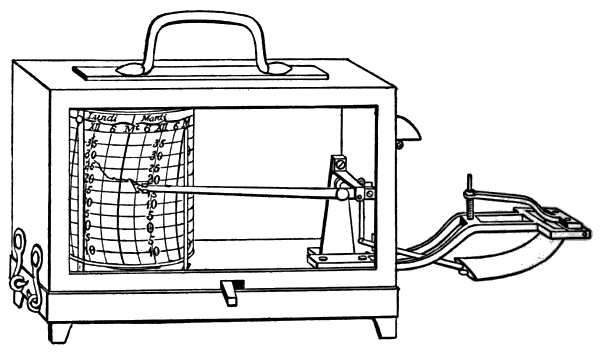
Thermograph. Self-recording thermometer (as adopted by the United States
Weather Bureau), made by Richard Frères, of Paris. Records continuously on
a sheet of paper wound around a revolving drum, which is driven by
clock-work inside. Standard size (without duty), $30.00.
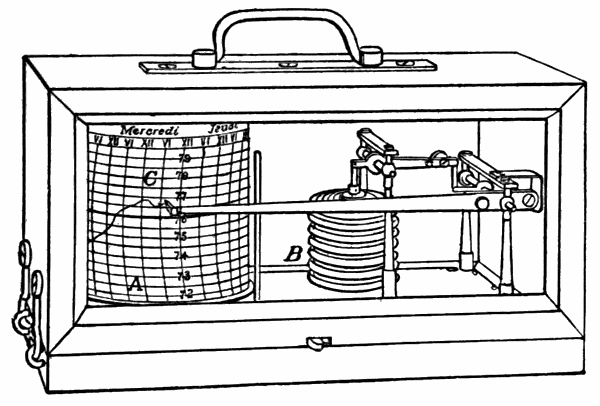
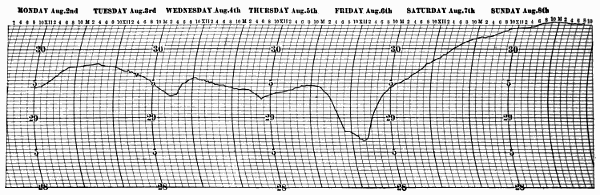
Barograph. Self-recording barometer (as adopted by the United States
Weather Bureau), made by Richard Frères, of Paris. Similar in general
arrangement to the thermograph. Standard size (without duty), $27.60.
These last two instruments can be procured through Glaenzer Frères &
Rheinboldt, 26 & 28 Washington Place, New York City.
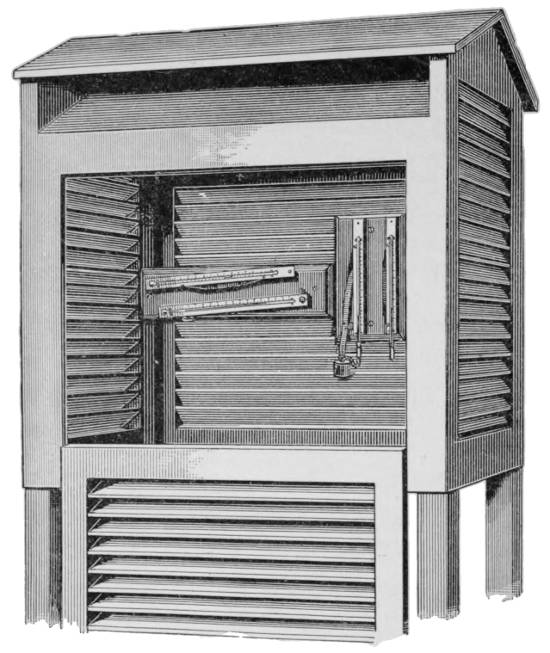
Instrument Shelter (standard United States Weather Bureau pattern) will
hold a set of maximum and minimum
thermometers,
psychrometer, and a
thermograph. May be set up on top of posts driven into the ground, or may
be attached to a wall, $18.00.
Barometer Box, for the standard mercurial barometer. Made of mahogany,
with glass panels on front and sides; lock and key, and with fittings
complete, $8.50.
These may be purchased of H. J. Green.
The Story of the Earth’s Atmosphere. Douglas Archibald. New York, D.
Appleton & Co., 1898. 18mo, pp. 194. 40 cents.
To be recommended to the general reader who wishes to gain some knowledge
of meteorology quickly. Not a text-book. Contains a chapter on “Flight in
the Atmosphere.”
Elementary Meteorology. William Morris Davis. Boston, Ginn & Co., 1898.
8vo, pp. 355. $2.50.
The most complete of the modern text-books, and the best adapted for use
in the systematic teaching of meteorology. The modern views are presented
clearly and without the use of mathematics. Portions of it are somewhat
too advanced for school study, but teachers will find it invaluable as a
reference book in directing the laboratory work, and in answering the
questions of school classes.
A Popular Treatise on the Winds. William Ferrel. New York, John Wiley &
Sons, 1890. 8vo, pp. 505. $3.40.
This can hardly be regarded as a popular treatise. It embodies, in
condensed and chiefly non-mathematical form, the results of Ferrel’s
researches during his long and profound study of the general circulation
and phenomena of the atmosphere. Teachers who advance far into meteorology
will find this book indispensable. It is not at all suited for general
class-room use.
American Weather. A. W. Greely. New York, Dodd, Mead & Co., 1888. 8vo,
pp. 286. Out of print, but secondhand copies are probably obtainable.
Deals, as the title implies, especially with the weather phenomena of the
United States. Contains brief accounts of individual hot and cold waves,
hurricanes, blizzards and tornadoes, and gives
specific
data concerning
maxima and minima of temperature, precipitation, etc., in the United
States.
Meteorology: Practical and Applied. John William Moore. London, F. J.
Rebman, 1894. 8vo, pp. 445. 8 shillings.
A readable book. Considerable space is given to instrumental meteorology.
Contains chapters on the climate of the British Isles and on the relations
of weather and disease in the British Isles. Especially adapted for the
use of English readers.
Elementary Meteorology. Robert H. Scott. International Scientific
Series. London, Kegan Paul, Trench & Co., 1885; Boston, A. A. Waterman &
Co., 1889. 8vo, pp. 410. 6 shillings.
The standard text-book in Great Britain. The author is secretary to the
Meteorological Council of the Royal Society. Fairly complete, but now
somewhat out of date in some portions. It is a useful book in a
meteorological library, but does not treat the subject in a way very
helpful to the teacher.
Meteorology. Thomas Russell. New York, The Macmillan Company, 1895. 8vo,
pp. 277.
Brief and incomplete as a text-book of meteorology, but containing a very
comprehensive account, fully illustrated, of rivers and floods in the
United States, and their prediction.
Elementary Meteorology. Frank Waldo. New York, American Book Company,
1896. 8vo, pp. 373. 90 cents.
A compact summary. Useful to teachers as a handy reference book.
Modern Meteorology. Frank Waldo. New York, Charles Scribner’s Sons,
1893. 8vo, pp. 460. $1.25.
Very complete account of meteorological apparatus and methods, and
admirable summary of recent German studies of the thermodynamics and
general motions of the atmosphere.
Instructions for Voluntary Observers. 1899. 8vo, pp. 23. Brief
instructions for taking and recording observations of temperature and
precipitation with ordinary and maximum and minimum thermometers and with
the rain gauge.
Barometers and the Measurement of Atmospheric Pressure. C. F. Marvin.
1894. 8vo, pp. 74. A pamphlet of information respecting the theory and
construction of barometers in general, with summary of instructions for
the care and use of the standard Weather Bureau instruments.
Instructions for Obtaining and Tabulating Records from Recording
Instruments. 1898. 8vo, pp. 31. Contains directions concerning the care
and use of the Richard thermograph and barograph.
Note.—These pamphlets are prepared under the direction of
Professor Willis L. Moore, Chief of the United States Weather
Bureau, and are published, under authority of the Secretary of
Agriculture, by the Weather Bureau. They will be found the best
guides in making observations, the care of instruments, etc.
Monthly Weather Review. Prepared under the direction of Willis L. Moore,
Chief of Weather Bureau, Professor Cleveland Abbe, Editor. United States
Department of Agriculture, Weather Bureau, Washington, D. C. 10 cents a
copy.
An invaluable publication for teachers and students alike. Contains
complete meteorological summaries for each month; accounts of all notable
storms, cold and hot waves, etc.; and a large number of articles on a wide
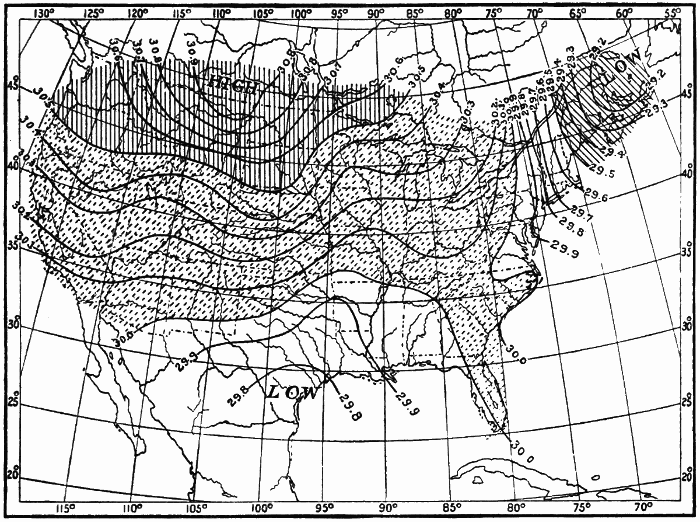
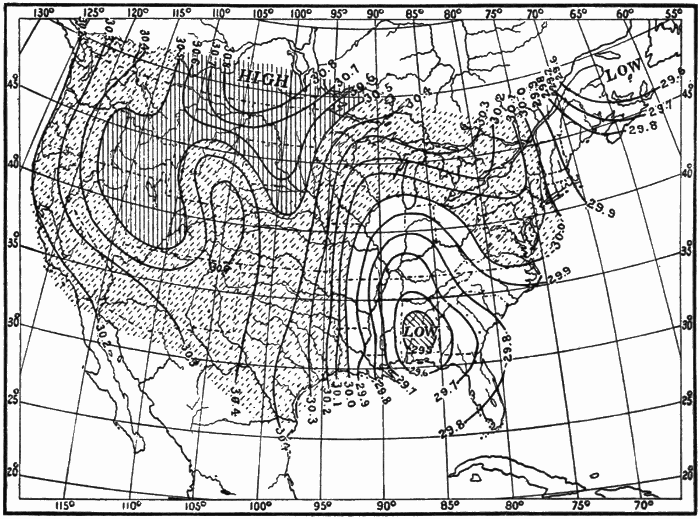
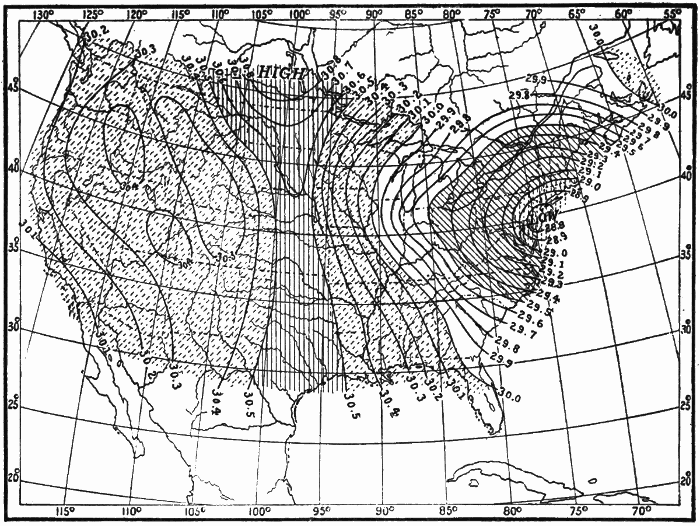
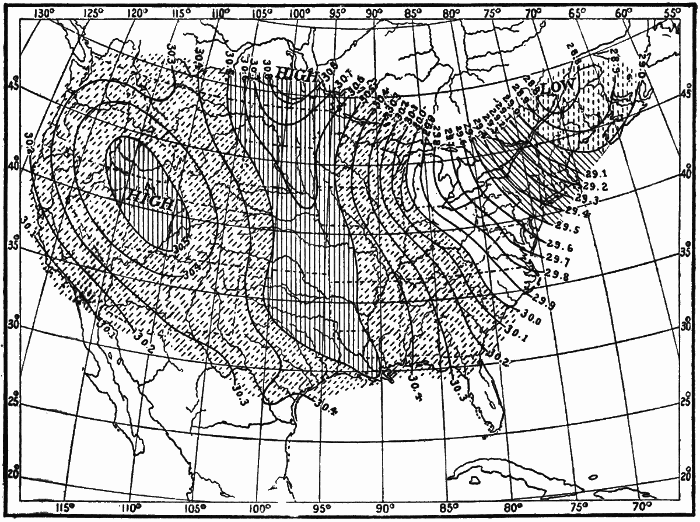
range of meteorological subjects. The charts show the tracks of areas of
high and low pressure which crossed the United States during the month,
the total precipitation, sea-level pressure, temperature and surface
winds, percentage of sunshine, etc., for the month. Other charts are also
frequently added.
The Journal of School Geography. Professor Richard E. Dodge, Teachers
College, Columbia University, New York City, Editor. Publication Office,
41 No. Queen Street, Lancaster, Pa. Ten numbers a year. $1.00 per annum.
A monthly journal devoted to the interests of the common school teacher of
geography. Contains numerous articles and notes on meteorological and
climatological subjects.
Science. Edited by Professor J. McK. Cattell, Columbia University, New
York City, New York, The Macmillan Company. Weekly. $5.00 per annum.
Devoted to the advancement of all sciences. Contains brief Current Notes
on Meteorology, which summarize the more important meteorological
publications.
Monthly Bulletins of the Climate and Crop Service of the Weather Bureau.
These Bulletins are issued every month at the central office of the
Weather Bureau in each State, under the direction of the Section Director
of the Climate and Crop Service in that State. They contain meteorological
data for the month, and frequently notes of interest. The annual summaries
are especially valuable.
Daily Weather Maps. These are published at the central office of the
Weather Bureau in Washington, and at eighty-four other stations of the
Bureau throughout the United States. It is best to have the daily maps
sent from the nearest map-publishing station, and not from Washington, as
the delay in the latter case is often so great that much of the immediate
value of the maps is lost.
Climate and Crop Bulletin of the United States Weather Bureau.
Washington, D. C. Monthly.
Chart showing, by means of small maps, the actual precipitation,
departures from normal precipitation, departures from normal temperature,
and maximum and minimum temperatures. Also a printed summary of the
weather and of the crop conditions in the different sections of the United
States. Issued on the first of each month.
Snow and Ice Chart of the United States Weather Bureau. Washington, D.
C. Weekly during the winter season.
Based on data from regular Weather Bureau stations, supplemented by
reports from selected voluntary observers. Shows, by shading, the area
covered with snow at 8 P.M. each Tuesday during the winter, and by lines,
the depth of snow in inches. Explanatory tables and text accompany the
chart.
Storm Bulletin of the United States Weather Bureau. Washington, D. C.
Issued at irregular intervals.
Charts, with text, illustrating the history of individual notable storms.
Pilot Chart of the North Atlantic and North Pacific Oceans. Hydrographic
Office, Bureau of Equipment, Department of the Navy, Washington, D. C.
Monthly. Price 10 cents a copy.
Shows calms and prevailing winds, ocean currents, regions of fog and
equatorial rains, the positions of icebergs and wrecks, steamship and
sailing routes, storm tracks, magnetic variation, etc. Also gives isobars
and isotherms and a forecast for the month succeeding the date of
publication, and a review of the weather over the oceans for the preceding
month. Supplementary charts are occasionally issued.
Rainfall and Snow of the United States as compiled to the End of 1891,
with Annual, Seasonal, Monthly, and other Charts. Mark W. Harrington.
United States Department of Agriculture. Weather Bureau, Bulletin C,
Washington, D. C. 1894. Atlas, 18 × 24 inches. Charts 23. Text, 4-80 pp.
Contains twenty-three charts as follows: Monthly rainfall, seasonal
rainfall, annual rainfall, monthly snowfall, monthly maxima of rainfall,
rainy seasons, details of rainfall, details of occurrence of
thunderstorms. Well adapted to serve as illustrations for use in the
class-room. The text is explanatory, and is published separately in quarto
form.
Rainfall of the United States, with Annual, Seasonal, and other Charts.
Alfred J. Henry. United States Department of Agriculture, Weather Bureau,
Bulletin D, Washington, D. C. 1897. 91⁄4 × 111⁄2 inches. Pp. 58. Charts
10. Plates III.
A more recent publication than the preceding one, the averages having been
compiled to the end of 1896. The charts are smaller than most of those in
Bulletin C, and therefore not so well adapted for class-room illustration.
The chart of mean annual precipitation is the latest and best published.
The rainfall of the crop-growing season receives separate treatment, and
is illustrated by means of two charts. The discussion in the text is
excellent.
Smithsonian Meteorological Tables. Smithsonian Miscellaneous
Collections, 844. Washington, D. C. 1893. 8vo. Pp. 262.
A very complete set of tables.
Handbook of Meteorological Tables. H. A. Hazen (of the United States
Weather Bureau). Washington, D. C. 1888. 8vo. Pp. 127. $1.50.
Contains forty-seven tables, comprising all that are needed by the working
meteorologist. Includes tables for Fahrenheit and Centigrade conversions,
for barometric hypsometry and reduction to sea level, for the
psychrometer, etc.
Tables for Obtaining the Temperature of the Dew-Point, Relative Humidity,
etc. United States Department of Agriculture, Weather Bureau, Washington,
D. C. 1897. 8vo. Pp. 29.
These are the tables now in use by the Weather Bureau.
Classification of Clouds for the Weather Observers of the Hydrographic
Office. Hydrographic Office, Bureau of Navigation, Department of the
Navy, Washington, D. C. 1897. Sheet of twelve colored views. Price 40
cents. In book form, with descriptive text, $1.00.
An excellent set of cloud views, classified according to the
International Nomenclature. The text describes the various cloud forms
and shows their value as weather prognostics. An attractive addition to
the furnishings of a schoolroom.
Selected List of Cloud Photographs and Lantern Slides.
Consists of twenty-eight photographs, and the same number of lantern
slides, of the typical cloud forms, selected by the present writer from
the collection in the Physical Geography Laboratory of Harvard University.
The photographs (20 cents each, mounted) and slides (40 cents each) may be
purchased of E. E. Howell, 612 17th Street, N. W., Washington, D. C. A
description of these views was published in the American Meteorological
Journal for July, 1894 (Boston, Mass., Ginn & Company).
Photographs. Photographs of miscellaneous meteorological phenomena, such
as snow and ice storms, damage by storm-waves or high winds, wind-blown
trees, lightning, etc., may often be purchased of local dealers. They add
to the attractiveness of a schoolroom and furnish excellent illustrations
in teaching.
The following Bulletins of the Weather Bureau may be found useful as
reference books:
No. 1. Notes on the Climate and Meteorology of Death Valley, California.
Mark W. Harrington. 8vo. 1892. Pp. 50.
No. 8. Report on the Climatology of the Cotton Plant. P. H. Mell. 8vo.
1893. Pp. 68.
No. 10. The Climate of Chicago. H. A. Hazen. 8vo. 1893. Pp. 137.
No. 11. Report of the International Meteorological Congress held at
Chicago, III., Aug. 21-24, 1893. 8vo. Pt. I, 1894, pp. 206. Pt. II, 1895,
pp. 583. Pt. III, 1896, pp. 772. Pt. IV, not yet issued.
No. 15. Protection from Lightning. Alexander McAdie. 8vo. 1895. Pp. 26.
No. 17. The Work of the Weather Bureau in Connection with the Rivers of
the United States. Willis L. Moore. 8vo. 1896. Pp. 106.
No. 19. Report on the Relative Humidity of Southern New England and Other
Localities. A. J. Henry. 8vo. 1896. Pp. 23.
No. 20. Storms, Storm Tracks and Weather Forecasting. Frank H. Bigelow.
8vo. 1897. Pp. 87.
No. 21. Climate, of Cuba. Also, A Note on the Weather of Manila. W. F.
R. Phillips. 8vo. 1898. Pp. 23.
No. 23. Frost: When to expect it and how to lessen the Injury therefrom.
W. H. Hammon. 8vo. 1899. Pp. 37.
No. 25. Weather Forecasting: Some Facts Historical, Practical, and
Theoretical. Willis L. Moore. 8vo. 1899. Pp. 16.
No. 26. Lightning and the Electricity of the Air. In two parts. A. G.
McAdie and A. J. Henry. 8vo. 1899. Pp. 74.
The following miscellaneous publications of the Weather Bureau may also
prove of value.
Injury from Frost and Methods of Protection. W. H. Hammon. 8vo. 1896.
Pp. 12.
Some Climatic Features of the Arid Regions. Willis L. Moore. 8vo. 1896.
Pp. 19.
Investigation of the Cyclonic Circulation and the Translatory Movement of
the West Indian Hurricanes. The late Rev. Benito Viñes, S. J. 8vo. 1898.
Pp. 34.
Requests for weather maps, Bulletins, and other publications of the
Weather Bureau should be sent to the Chief of the Weather Bureau,
Washington, D. C. All requests are dealt with on their merits, and in
cases where it is deemed that effective use will be made of the
publications they are usually sent free of charge.


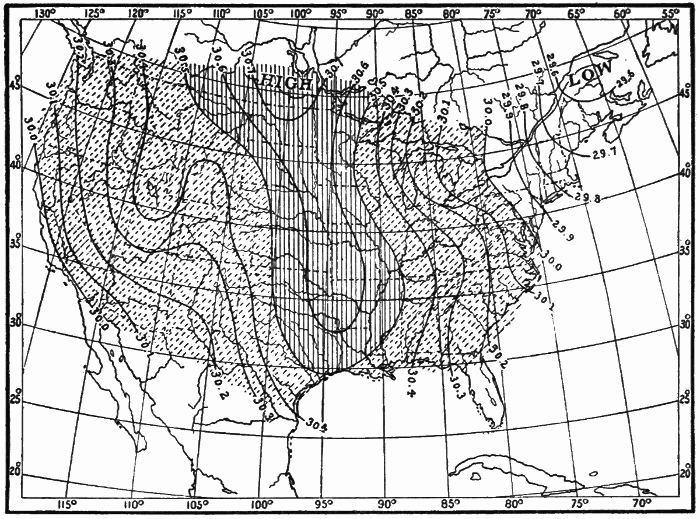
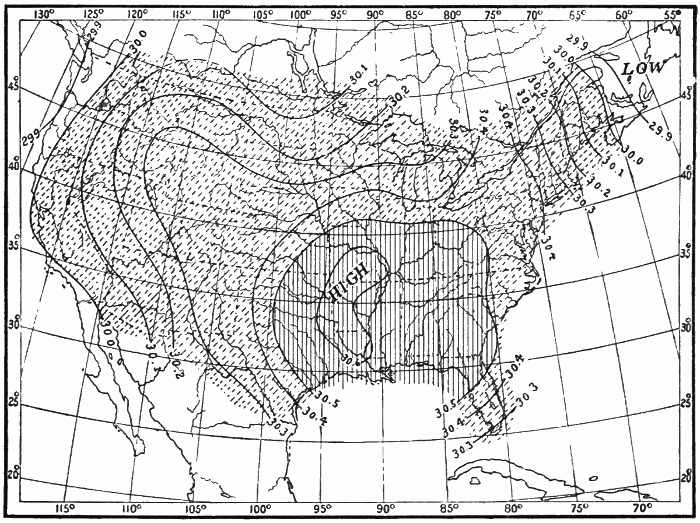
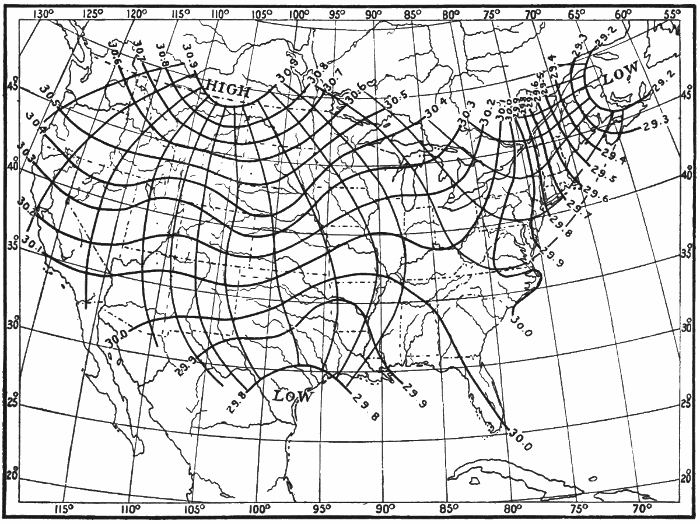
 clear;
 fair, or partly cloudy;
 cloudy;
 rain;
rain;
 snow.
snow.