The beginner, when he handles for the first time a coil of sensitized
film measuring 1⅜ inches in width, and perhaps 200 feet in length,
might hesitate to attempt its development. He might prefer to despatch
it to a firm prepared to carry out this work for a light charge,
confident that with the facilities at their command, and with their
accumulated experience, they would be able to bring out his work to the
best advantage.
But the man who aspires to succeed in topical work for the local
picture palace or general market, especially if he is not within easy
reach of a post office, must be prepared to undertake the task himself.
As a matter of fact it is by no means so difficult as it appears at
first sight, and the rudiments of the process may be grasped readily
by a person of average intelligence. Success, as in other handicrafts,
only can be achieved with practice.
Cinematography, being a peculiar and special branch of the photographic
art, demanding the use of new and unfamiliar tools, has been
responsible for the perfection of particular devices and methods to
assist and facilitate development. In the early days the worker had
to worry through the task, and was compelled to undertake a host of
doubtful experiments. The beginner of to-day is able to profit from
the mistakes of the pioneers, and the appliances and processes at his
disposal are those of approved application. After one or two trials
the worker will realise that the development of a 200-feet length
of celluloid ribbon is no more difficult than the development of an
ordinary Kodak spool.
One thing the beginner will do well to bear in mind. He should adopt
some particular brand of film, and cling to it after he has become
acquainted with its emulsion, speed, composition, and peculiar
characteristics. There are three or four different makes of film upon
the market, but it is preferable to select a film which is easily
obtainable at any time and in any part of the world. I would strongly
urge the beginner to select the Eastman stock for this if for no other
reason. The Eastman organisation has its tentacles spread throughout
the world. It has thousands of agencies in immediate touch with the
different national companies. The result is that this film can be
purchased without difficulty in nearly all parts of the globe. If a
local dealer does not stock it, he can procure it to order within a
day or two. Moreover the film will be new and in perfect condition.
There are many other reasons why it is advisable to select and to
adhere to this stock, which, although of a technical character, are of
much importance to the user. It must be borne in mind that the technics
and chemistry of cinematography are still in their infancy, and the
technical staff retained for the preparation of the various ingredients
employed in the sensitizing of the film are striving constantly to
improve and to increase the speed or sensitiveness of the emulsion.
The result is that the worker who uses Eastman film keeps pace with
developments. The makers of this ribbon were the first to discover a
base and emulsion suited to moving-picture work. This was achieved
only after the expenditure of enormous sums of money, after hundreds
of fruitless experiments, and with the co-operation of the highest
technical and chemical skill. Under these circumstances the limitations
of the base and of the emulsion become thoroughly understood, so that
the film is certain to maintain the highest quality. On the other hand,
those firms who have embarked upon the manufacture of the commodity
only within recent years, have still to face and to overcome many
pitfalls which the older concern discovered and surmounted years ago.
So the film marketed by younger organisations is apt to vary in its
quality.
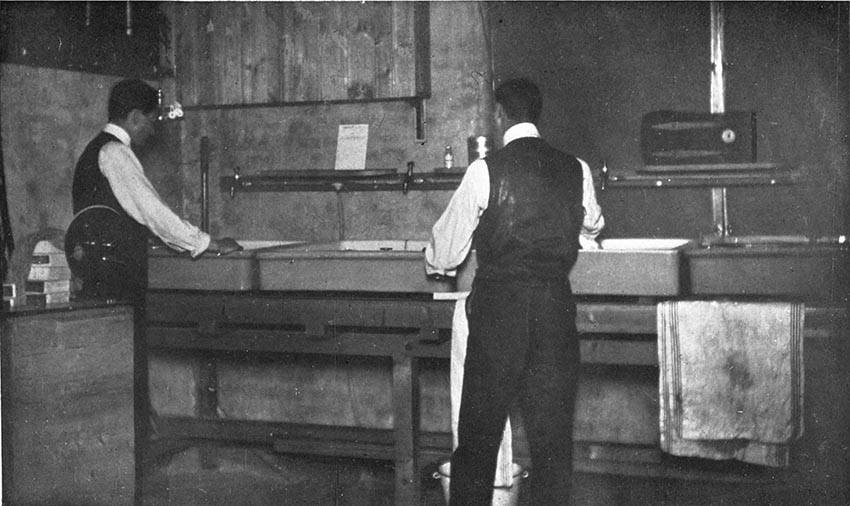
A well-equipped Dark Room showing Arrangement of the Trays.
By permission of Jury's Kine. Supplies, Ltd.
Winding the Developing Frame.
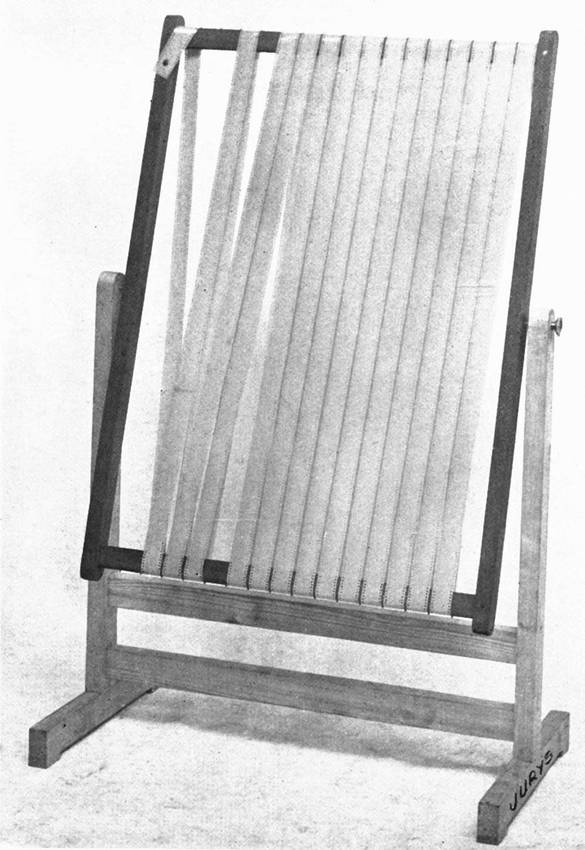
The film is transferred from the exposed film-box to a revolving frame,
emulsion side outermost.
Before the beginner attempts development he must make sure that his
dark room and accessories are adequate. To seek success with makeshifts
in the first instance is to court heart-rending failure. Many of the
utensils employed in the dark room can be fashioned by any handy man.
They may lack finish, but so long as they perform their work properly
nothing more is necessary.
The dark room must be spacious, for cramped conditions are fatal to
satisfactory work. An expert will perform his task successfully, if
the exigencies arise, in a small cupboard, but the beginner will find
that the more space he has at his command the easier he will be able to
complete his task. The room should measure 10 feet in length by 6 feet
wide at least. In a corner, or at some other convenient point along the
wall, there should be an ordinary sink provided with free waste and
with ample supplies of water laid on to a tap above. On one or other
side of this sink, there should be a bench, 3 feet in width, for the
purpose of the developing, fixing, rinsing, and other baths.
At least four trays will be required, three being for solutions and one
for rinsing. Each tray should be at least 33 inches square inside, by
about 6 inches in depth. These trays may be made of wood throughout,
with dove-tailed sides, and tongued and grooved bottom, or the bottom
may be made of glass. If the work of dove-tailing seems too difficult,
the sides and bottom need only be nailed or screwed together, but in
this case a lining of waterproof fabric should be fixed to the wood.
Trays of this type are inexpensive, and are quite as good as those of
a more elaborate character. In some developing works lead-lined trays
are used, but they are weighty and cumbersome to handle. In order to
draw off the solution when necessary it is well to fit a drain and plug
in the bottom of the tray by which the contents can escape into the
storage vessel placed beneath the bench.
Sometimes a vertical tank is used. This system is maintained to be the
most satisfactory as it enables the solution to be kept more easily in
movement. The tank, in this case, should be 33 inches high by 33 inches
wide, and 6 inches from front to back. These are inside measurements.
It must be lined with waterproof material or with thin sheet lead in
the same manner as the tray. For the purposes of the small worker,
the tank process is more expensive, owing to the greater quantity of
solution that it requires; so, for ordinary and limited working, the
tray is recommended. It should be fitted with a rocker so as to enable
the solution to be kept flowing evenly over the surface of the film.
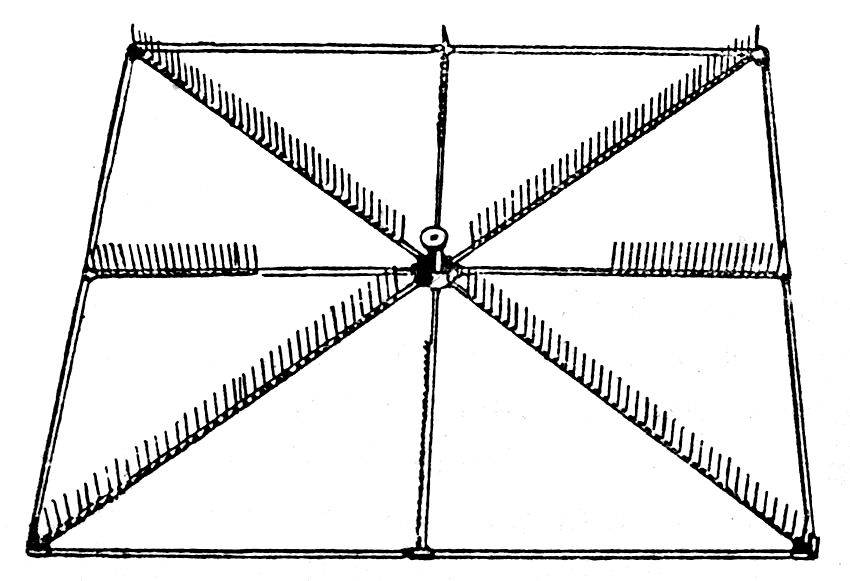
Fig. 2.—The "Pin" Frame.
The film is mounted upon a special frame. A frame made of wood is most
generally used. This likewise a handy man can make at home, although it
is not expensive to buy. The middle of each side of the frame is fitted
with a short pin to serve as a spindle and to facilitate spinning
round when the frame is mounted upon its stand. Each transverse end is
provided with guide pins for winding the film.
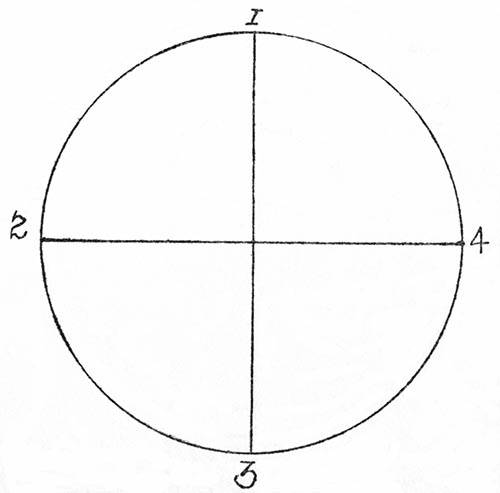
The other type is known as the pin frame. Its design may be gathered
from Fig. 2. It is a light skeleton frame with vertical pins projecting
from the four diagonal members. The spool is slipped on the central
spindle and the film is unwound and passed round the pin on one
diagonal, then to the relative pins on the three other members. It is
then taken round the second pin on the first diagonal, followed round
the relative pins on the other three members, and so on until the whole
film has been uncoiled, the pins on the other four cross members being
called into requisition as additional supports when the frame is about
half covered. When the film is mounted upon this frame it is in the
form of an endless square spiral. When the frame is laid in the bath of
solution the film stands edgewise. The wooden frame, however, is now
almost exclusively used, as it is easier and simpler to work. The film
can be transferred to it in a shorter space of time, and the frame with
the film upon it can be handled more safely.
The ruby light may be either electricity, gas, or oil, but extreme care
must be taken to make absolutely certain that the light is non-actinic,
and is not too powerful, otherwise the film, which is extremely
sensitive, will be fogged during development. The safety of the light
may be tested in a very simple and easy manner. Cut off about 6 inches
of film from the unexposed reel, lay it flat upon the developing bench,
emulsion side uppermost, in full view of the ruby light. Place two or
three coins upon the emulsion and leave them there for a few minutes.
Then develop the strip in a covered dish. If the space surrounding the
places where the coins were laid comes up grey, then it shows that the
light is unsafe, because the exposed emulsion surrounding the coins has
become fogged. On the other hand, if no signs of the position of the
coins are revealed upon the developed strip, the light is perfectly
safe.
The trays should be placed side by side along the bench. The one which
is used for developing should stand furthest from the ruby light.
If space will allow, the rinsing bath should be placed next to it,
but if this is impossible the fixing bath may be placed there. A
division board should be set up between the two trays, rising some 10
or 12 inches above their upper edges. This will prevent the fixing
solution splashing into the developing bath and spoiling it. Various
formulæ have been prepared for development, each of which has certain
advantages. As may be supposed, each firm has evolved a formula which
it has found from experience to give the best results. Obviously
these formulæ are secret. But the most satisfactory for the beginner
is that advocated by the Eastman Company. It possesses the advantage
of having been prepared by the chemists who are responsible for the
emulsion, who understand its particular characteristics and also its
limitations. The majority of other formulæ are based more or less upon
this one, which is applicable and adaptable to all kinds of work. It
has the quality of bringing the picture out to the utmost degree, and
by its means many of the errors in exposure may be corrected during
development.
The developing solution is made up as follows:—
| | Avoirdupois. | Metric. |
| Sodium sulphite (des.) | 53 oz. | 1,575 grammes |
| Sodium carbonate (") | 25 " | 750 " |
| Metol | 180 grains | 12 " |
| Hydrochinon (hydroquinone) | 8 oz. | 237 " |
| Potassium bromide | 1 oz. 63 grains | 34 " |
| Citric acid | 400 grains | 27·5 " |
| Potassium metabisulphite | 2 oz. | 60 " |
| Water (Imperial measure)} | 8⅓ gallons | 40 litres |
| " (United States " )} | 10 " |
The ingredients must be mixed in the order indicated. All the chemicals
are readily and cheaply obtainable at any photographic chemists and
drug stores. After preparation the developer will keep for a long
period so long as the bottle is well stoppered and kept in a cool
place. Only the highest grade chemicals of a reputable brand should
be used. A slight saving in the purchase of these essentials is false
economy, because a film costing one hundred or more times the money
saved in the outlay upon chemicals may thus be ruined.
In cases of over-exposure, perhaps the most common fault of the
beginner who does not understand the stopping down of the lens, a
restrainer is necessary. This is composed of the following:—
| | Avoirdupois. | Metric. |
| Potassium bromide | 1 oz. | 30 grammes |
| Water | 10 oz. | 300 cubic centimetres |
The process of development is as follows. First, the film is
transferred from the dark film-box of the camera to the frame. The
latter, if it is of the wooden type, can be spun round freely when
mounted on its stand. It is not advisable for the beginner to withdraw
the coil of film bodily from the box until he is expert in winding the
frame, otherwise, to his surprise and disgust, the spool may fall out
and the film be precipitated to the floor in an inextricable tangle.
He should let it remain in the dark box until it is removed by being
drawn slowly through the velvet-lined slot. The free end of the film
should be fixed with a drawing pin to one end-bar of the frame, and
contained between two guide pins, with the emulsion side outermost. The
emulsion side can be recognized even in the subdued light of the dark
room because it has a matt surface, while the other side is glossy. The
difference between the two sides can also be detected by the touch.
When the end of the film has been attached to one end-bar the frame is
turned, the film meanwhile being permitted to slide out of the dark
box, until the opposite end of the frame comes up. The film is passed
over this bar, also between the first pair of guide pins, and once
more, with a half-turn to the frame, the film passes along the second
side of the frame back to the first bar, between the succeeding pair
of guide pins, over the top and back again to the opposite bar, this
process being continued until the coil of film is unrolled, when the
second extremity is likewise fixed to the bar by means of a drawing
pin. The film while being wound must not be drawn too tightly; at the
same time it must not be too slack. When winding has been completed,
the frame and film will have the appearance shown in the illustration
facing p. 65. The guide pins in the end-bars prevent the edges from
overlapping or touching. The result is the presentation of two
emulsion faces on either side of the frame and each face resembles the
sensitized side of a dry plate.
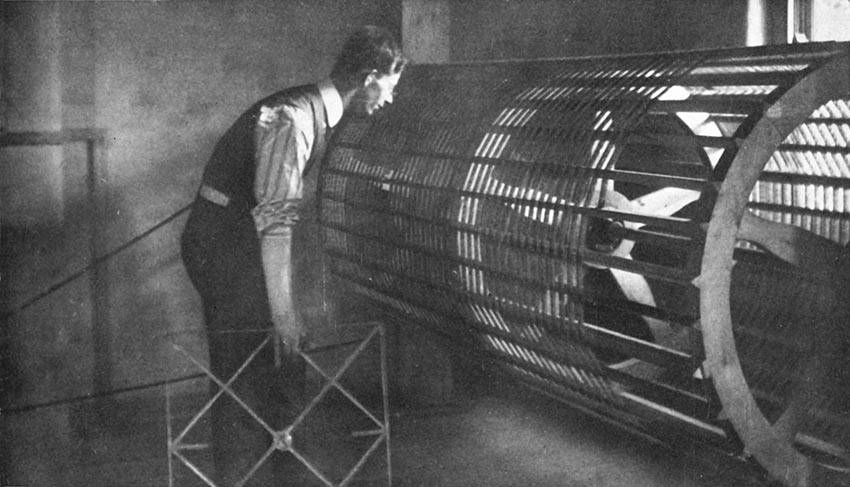
The Film transferred from the Developing Frame to the Drying Drum.
For amateur use a small drum can be used.
By permission of Williamson Kine. Co., Ltd.
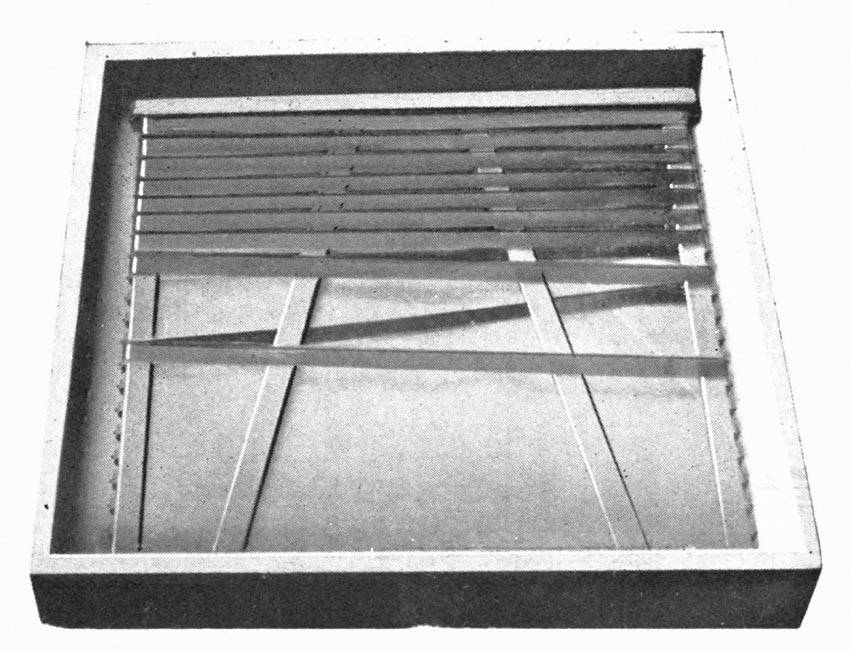
The Film Wound on Frame and placed in The Developing Tray.
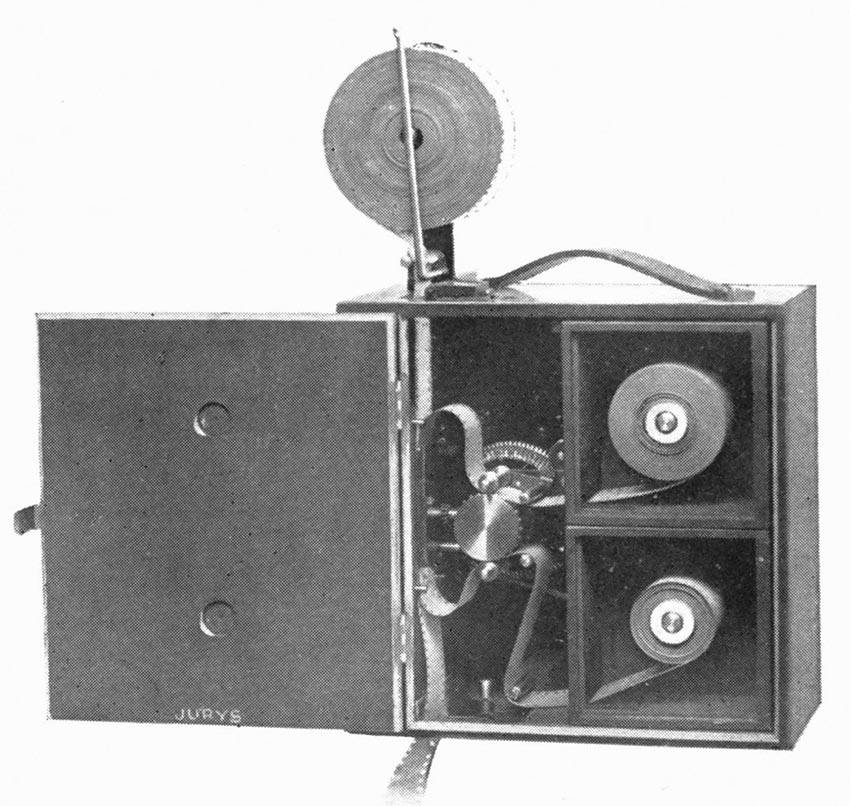
By permission of Jury's Kine. Supplies, Ltd.
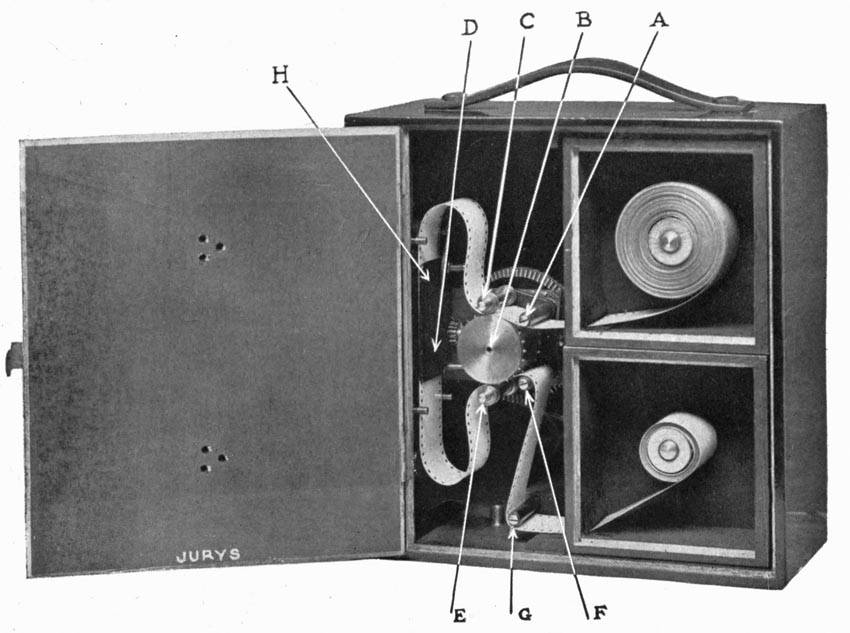
The Jury Combined Camera and Printer.
In winding the film upon the frame, and indeed during all the
operations, the operator should be careful not to touch the gelatine
coating of the ribbon with his fingers. The finger nails should be
kept well trimmed so that scratching may be avoided. A touched film
is usually marked, for the touch leaves a deposit of grease, which
interferes with the action of the developer.
The frame, with the film wound upon it, is lifted off the stand and
carefully placed in the developing bath, into which the developing
solution has already been poured. If it is inserted gently no air
bubbles or bells will form on the emulsion, but if there should be any
such they can be removed at once by means of a large, flat, soft, camel
hair brush. In order to secure first-class results, the developing
solution should be kept at a temperature of 65° Fahr.
The developing solution is rapid in its action and the film must be
watched closely. The frame must be kept rocking so that the solution
may remain in movement. This enables it to act upon the whole surface
of the film equally. Should development take place too quickly—(i.e.
the images flash up almost instantly)—the frame should be removed at
once from the developer and immersed in the rinsing tray to allow a few
drams of the restrainer solution to be poured into, and mixed with, the
developer. On the other hand the film may be under-exposed, and then
the images will appear very slowly.
Development proceeds exactly as in the case of a glass plate, and
the same judgment is required to determine when the process has been
carried far enough. When this point has been reached the frame is
lifted out of the developer and placed in the rinsing tray to receive a
thorough washing. Water is a kind friend in cinematography and should
be used ungrudgingly. Three or four thorough flushes will suffice to
rinse the film satisfactorily, and then the frame is placed in the
fixing bath. This is made up as follows:—
| | Avoirdupois. | Metric. |
| Water | 64 oz. (fluid) | 2,000 c.c. |
| Hyposulphite of soda | 16 " | 480 grammes |
| Sulphite | ¾ " | 22 " |
| When fully dissolved add the following hardener. |
| Powdered alum | ½ oz. | 15 grammes |
| Citric acid | ½ " | 15 " |
During fixing the frame should be kept rocked so that every trace of
undeveloped silver salts may be removed from the film. Then it is
transferred to the washing tray and submitted to a thorough washing
in frequent changes of water for some twenty minutes. The film is
now ready for its final treatment. This is immersion in the soaking
solution:—
| | Avoirdupois. | Metric. |
| Water | 32 oz. | 1,000 c.c. |
| Glycerine | 1 " | 30 " |
This final bath is not always used, but it is desirable if the negative
film is to be kept for any length of time. Immersion in this soaking
solution prevents the gelatine coating of the film from becoming hard
and horny. After remaining in this bath for five minutes the frame is
lifted out, and returned to its stand, where the excess of glycerine
and water is removed by wiping with a soft cloth.
It will be seen that once the film is wound upon the frame it is not
removed during the whole process of development, and may be left in
the same position during the drying period. But if the drying is to
be quickly performed the frame must be of what is known as the spring
type, so that it does not keep the same area of film constantly
pressing upon the curved end-bars. Otherwise the film would retain
this shape when it has been dried and the kink would be irremovable.
To avoid this defect it is just as well to transfer the film from
the frame to a drum (see illustration facing p. 72). This is an easy
matter. The drum is mounted upon a stand so as to be free to revolve
easily. Detach one end of the film from the developing frame, and
attach it to the drum by means of a drawing pin. The emulsion side, of
course, must face outwards. Then by unwinding the frame and rotating
the drum simultaneously the film becomes wound spirally upon the
drum. Another pin will secure the second end of the film. The drum
is an inexpensive and very handy accessory to the moving-picture
photographer, especially in the drying operation, when forceful methods
have to be adopted.
Unfortunately the drying of the film cannot be accelerated to any great
extent. The hardening of the gelatine emulsion cannot be hastened, as
in glass plate work, by immersion in a bath of methylated spirits or
some other evaporative agent, since the alcohol contained therein would
dissolve the celluloid base. The only available means is a current of
warm, dry, clean air. While the well-equipped factory is fitted with
a special drying room, such a facility is beyond the resources of the
average independent worker, who must therefore be content to revolve
his frame or drum continuously, until the gelatine has hardened
sufficiently. The process can be accelerated to a certain extent by
revolving the drum or frame over a steam radiator, or some other form
of heating which emits no smoke or flame, but the temperature of
the air must not be raised too high or the gelatine coating will be
injured. If the weather is fine and calm, the drying may be done upon
a lawn in the open air, but in any event extreme care must be observed
to prevent dust settling upon the gelatine while it is wet and soft, or
irreparable injury will be inflicted. So it behoves the worker to keep
his dark room and drying room free from dust. Drying should not be done
in the dark room because there are small particles of chemical dust
always floating about in such surroundings. If these should settle upon
the emulsion they would play sad havoc with it.
When the gelatine has hardened the film may be transferred direct
from the drum to a spool by means of a winder. When the beginner has
become expert he will be able to do this by hand, but it is never a
wise practice since the coating is liable to become scratched. The
spool-winder is inexpensive and does the work much more quickly, while
the risk of damaging the film is eliminated.
As has been mentioned, it is well to develop the film as soon as
possible after exposure. Although the exposed film is kept in a dark
box, the chemical action set up by exposure before the lens, continues,
as in dry-plate and snap-shot photography, and in a more rapid manner.
Consequently the film should not be left undeveloped for more than a
few days at the utmost. While prompt development is usual in topical
work, there are other sorts of work in which the operator may feel
tempted to put the film on one side for development at a later and more
convenient time. Perhaps several weeks may elapse, and then complete
amazement is expressed at the result. In the unexposed condition,
however, Eastman stock will last many months so long as it is not
removed from the case in which it is packed at the works. Equal care
must be used in storing the developed negative films. They must be kept
in a cool dry place, protected from severe fluctuations in temperature
and climatic effects.