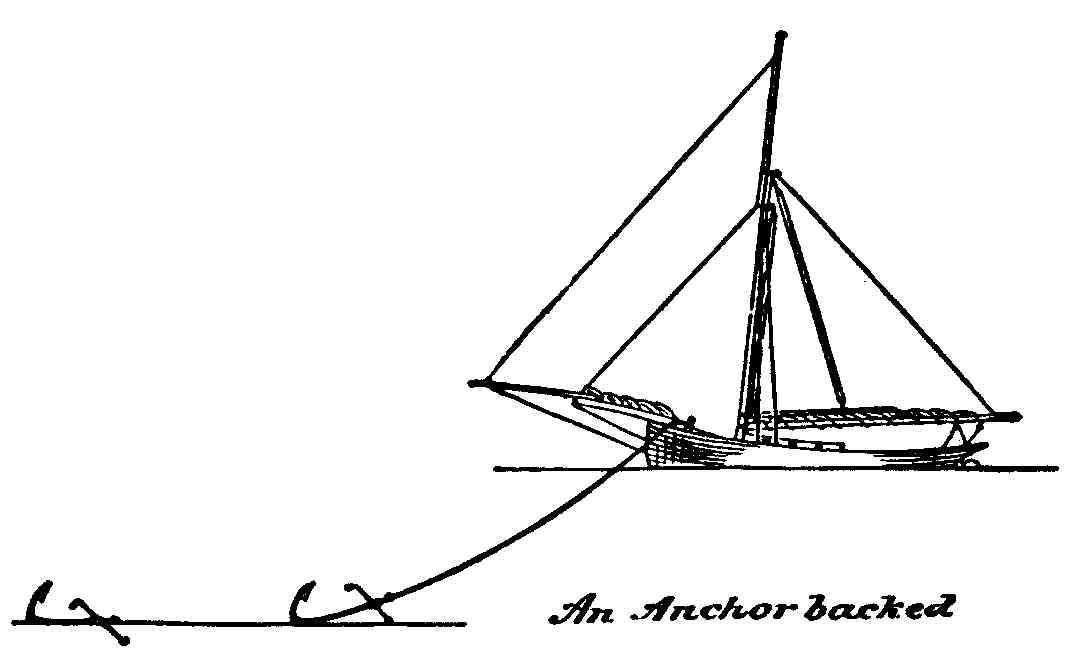
Aback.—A sail is said to be taken aback, when
its forward surface is acted upon by the wind.
Abaft.—The position, towards the stern, or
hinder part of the yacht, from any stated point; as,
"abaft the forecastle," "abaft the mainmast,"
"abaft the cabin."
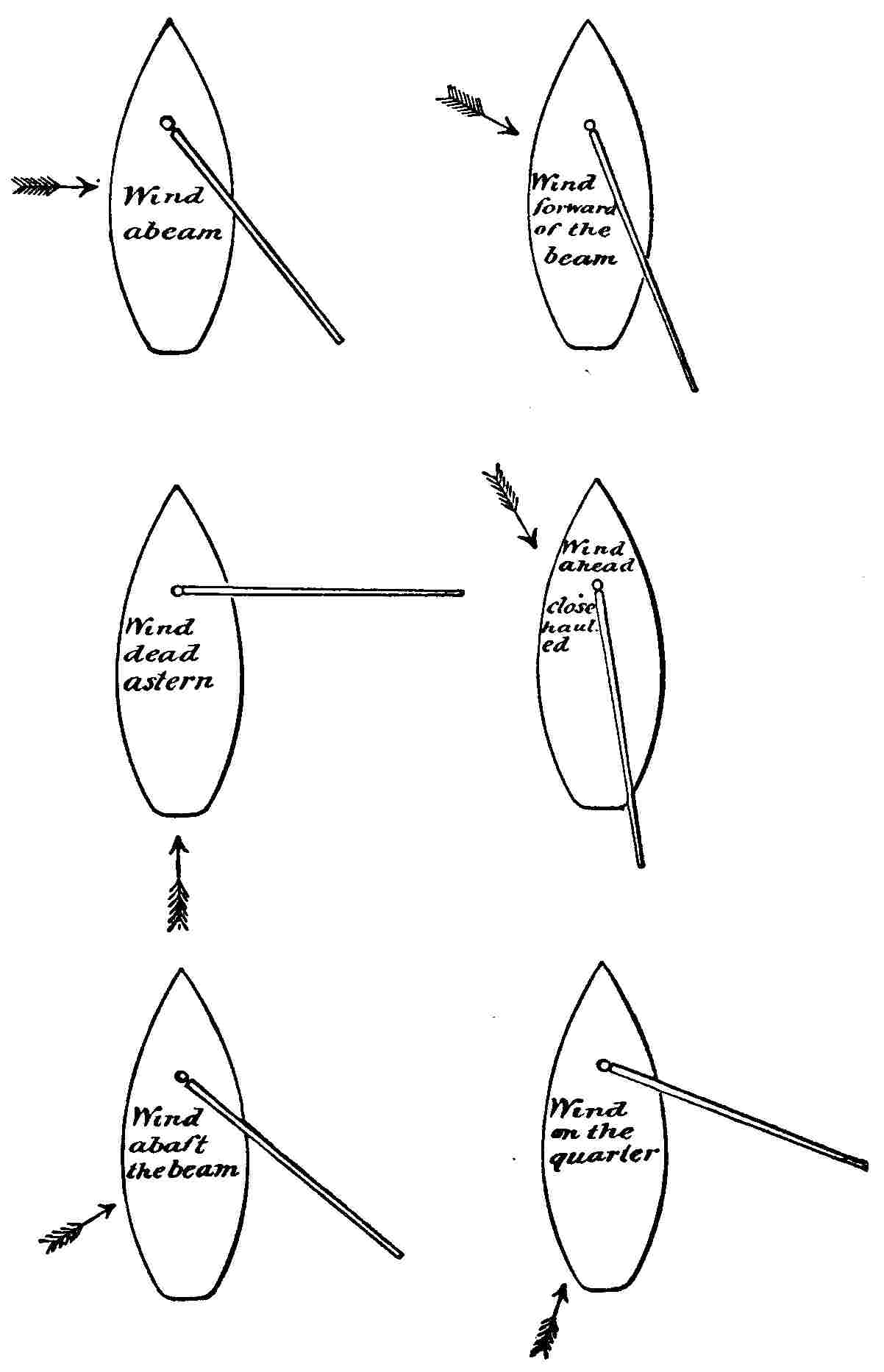
Abeam.—Any object is said to be abeam that
bears at right angles to the line of the keel; and an
imaginary line drawn at right angles across the keel,
equidistant from the bow and stern, divides the
yacht into two parts. Any thing bearing forward of
this line is said to be "forward of the beam," and
any thing bearing behind this line is said to be
"abaft the beam."
Aboard.—In the yacht; as, "Get the anchor
aboard!" "Come aboard!"
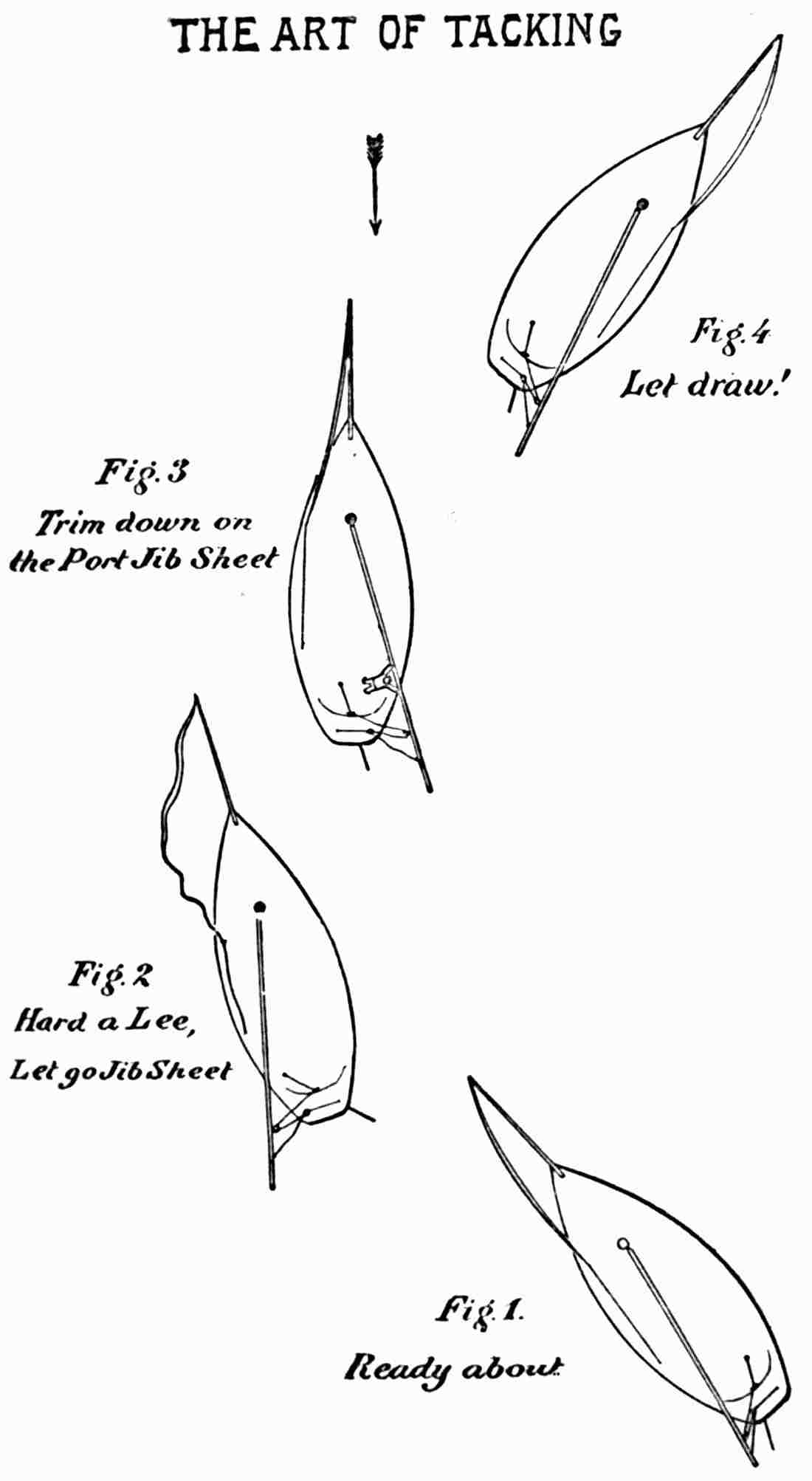
About.—A yacht is said to "go about" when
tacking, the order to prepare for which is, "Ready
about!"
Abreast.—Opposite to, as relates to the sides
of a yacht; as, abreast of a lighthouse, when the
side of the yacht is at right angles to it, or nearly so.
Adrift.—Broken loose from moorings; or any
thing rolling about the decks loose in a sea-way is
said to have broken adrift.
Afloat.—Clear of the bottom, sustained by
the water.
Afore.—That part of the yacht nearest to the
stem, or head.
Aft.—Behind; as, "Stand further aft," "Haul
aft the main sheet!" i.e. bring the boom nearer the
line of the keel.
After.—Hinder, as after sails, such as the mainsail,
in contra distinction to forward-sails, such as
the jib.
Aground.—Not having water enough for the
yacht, which rests on the ground.
Ahead.—Before the yacht; any thing in advance
of where the yacht is being directed.
A-lee.—The helm is a-lee when the tiller is put
to the lee-side; "hard a lee," when it is put over
as far as it will go.
All in the Wind.—When the sails receive a
portion of the wind on both surfaces, and shake or
wave like a flag.
All Hands, Ahoy.—A summons used to call
all the crew on deck in an emergency.
Aloft.—Up above, at the masthead.
Alongside.—Close to the side of the yacht.
Amidships.—Any thing in a line with the keel;
viz., "Put the helm amidships!"
To Anchor.—To let the anchor fall overboard
that it may hold the yacht; the order for which is
"Let go the anchor!"
Anchorage.—Ground fit to anchor on.
To Weigh the Anchor.—To heave it up from
the bottom to the bow of the yacht.
Ashore.—On land, aground.
Astern.—Behind the yacht.
Athwart.—Across.
Athwart-Ships.—Any thing lying at right angles
to the line of the keel, or nearly so.
Avast.—To cease pulling, to stop.
A-weather.—The helm is said to be a-weather
when the tiller is put over to the windward side of
the yacht; and "hard a-weather," when it is put
over as far as it will go.
Awning.—A canvas covering stretched overhead,
to give protection from the heat of the sun.
Back-Stays.—Ropes fixed at the topmasthead,
and fastened to the sides of the yacht to sustain
the topmast.
Ballast.—A quantity of heavy material placed
in the hold of the yacht to give her proper stability.
Bands.—Pieces of canvas sewn across a sail to
strengthen it to sustain the reef-points, and called
reef-bands.
Bar.—A shoal, usually found at the mouths of
rivers and harbors that are subject to much current.
Bare Poles.—Having no sail up, on account
of the severity of the wind: hence "scudding
under bare poles," that is, running before the wind
with no sail set.
Beams.—Pieces of timber across the yacht under
the decks, bound to the sides by knees. A yacht
is said to be on her "beam-ends" when she is hove
down by any force, so that the ends of the beams
point towards the ground.
Forward of the Beam.—When the object or
wind is at some position between abeam and ahead.
Before the Beam.—When the wind or object
bears on some point forward of the beam, but within
the right angle formed by the keel and a line
across the middle of the yacht.
Abaft the Beam.—The opposite to Before the
Beam.
Bearings.—The direction of any object by observation
of the compass; also to any object, as
the lighthouse bears abaft the beam.
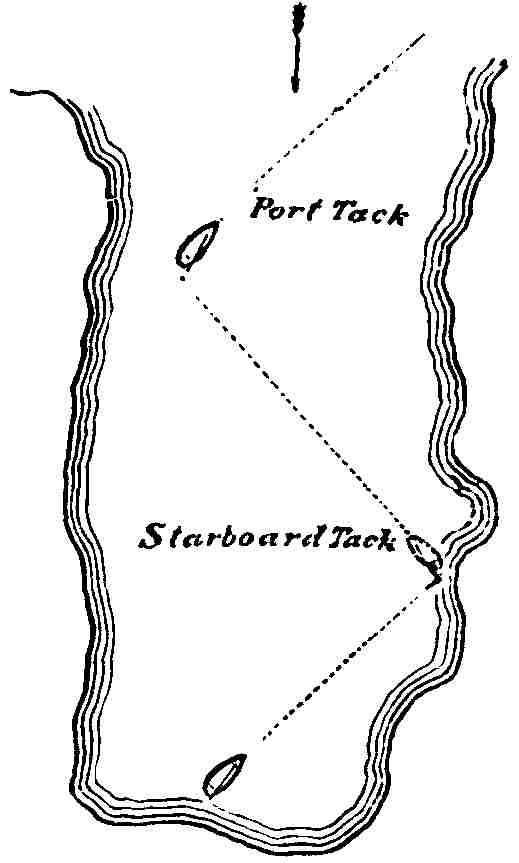
Beating to Windward.—Advancing in the direction
from which the wind proceeds by a series
of manœuvres called "tacking."
Becalmed.—Having no wind to fill the sails.
One sail is also said to becalm another when the
wind is aft.
Belay.—To make fast a rope around a cleat or
pin.
To Bend.—To fasten; as to bend the sails, bend
on the cable to the anchor, bend on the colors,
&c.
Bight.—Any slack part of a rope between the
ends.
Bilge.—The flat part of a yacht's bottom, where
the water that she ships, or which leaks in, remains,
and is called "bilge-water."
Binnacle.—A box, fitted with lights, which
contains the steering-compass.
Berth.—An anchorage; a bunk or wooden shelf
used for sleeping in.
Bitts.—Large, upright pieces of timber, with a
cross-piece, to which hawsers or large ropes are
belayed; also called "knight-heads."
Blocks.—Instruments, with sheaves or pulleys,
used to increase the power of ropes.
Block and Block (also called commonly "chock-a-block").—When
the two blocks of a tackle have
been brought as near together as possible.
To Make a Board.—To tack.
To Make a Stern-Board.—To move through
the water stern foremost.
Bob-Stays.—Ropes from the cut-water, or stem,
to the bowsprit end, to sustain and strengthen it.
Bolt-Ropes.—Ropes sewn round the edges of
the sails, to keep them from splitting.
Booms.—Round pieces of timber on which the
foot of sails are lashed.
Bows.—The round part of the yacht forward,
ending in the cut-water, or stem.
To Bouse.—To haul upon.
Bowsprit.—A spar nearly parallel with the deck,
extending out over the stem.
To Bring Up.—To take the bottom suddenly,
as brought up by a shoal; to come to an anchor.
To Bring To.—To make the yacht nearly stationary
by stopping her headway by means of the
sails set in different positions, so as to counterpoise
each other in connection with the helm.
Butt End.—The end of a plank in a yacht's
side; to start a butt, i.e., to leak.
By the Board.—A mast is said to go by the
board when carried away just above the deck.
By the Head.—When a yacht is deeper in
the water forward than aft.
By the Stern.—The reverse of "by the head."
By the Wind.—When a yacht is as near the
wind as she can be sailed without the sails shaking;
also called "full and by."
Cable.—The rope by which the yacht is secured
to the anchor.
To Pay out the Cable.—To allow more of it
to pass outboard, so that the yacht lies farther from
the anchor.
Caboose.—Place where the food is cooked; also
called the "cook's galley."
Call.—A silver whistle used by the boatswain
to have certain orders obeyed.
Capsize.—To turn over.
To Carry Away.—A spar is said to be carried
away when it is broken by the wind.
To Cast Off.—To untie, to allow to go free;
viz., "Cast off the main-sheet!" "Cast off that
boat's painter!"
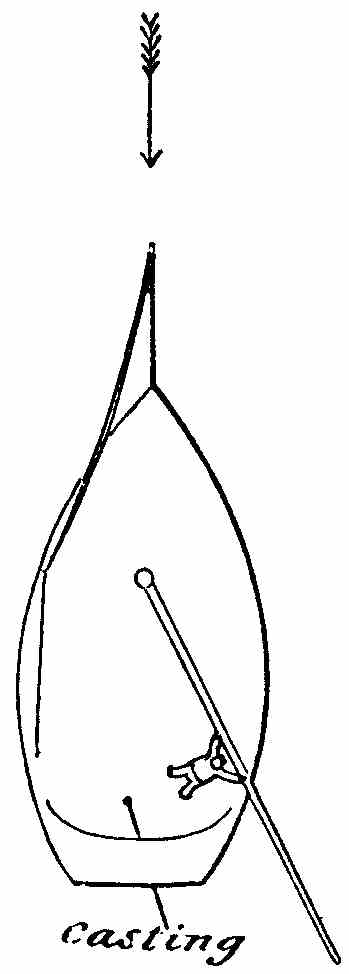
Casting.—To pay a yacht off on the desired
tack when weighing the anchor, by arranging the
sails so as to be taken aback.
Cat Boat-Rig.—A yacht rigged with one mast
placed chock forward in the eyes, and without stays
or bowsprit, and fitted with one fore-and-aft sail.
Cat's-Paw.—A light breeze or puff of air seen
upon the water.
To Calk.—To drive oakum or cotton into the
seams to prevent leaking, and to "pay" the same
with pitch or tar.
Centre-Board.—A movable keel that can be
lowered or hoisted at pleasure.
To Claw off.—To beat to windward from off
a lee-shore.
Cleat.—A piece of wood with two horns, fastened
to the side of the yacht or to the mast, upon
which ropes are made fast.
Clews.—The corners of sails.
Close-Hauled.—To sail as near the wind as
possible.
Coiling.—To gather up a rope into a circular
form ready for running out again at a moment's
notice; such as, "Coil up the peak-halliards, and
have them ready for running!"
Course.—The point of the compass on which
the yacht sails.
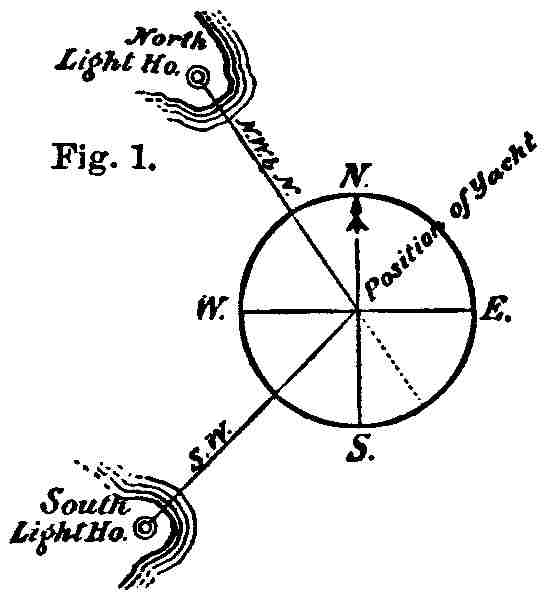
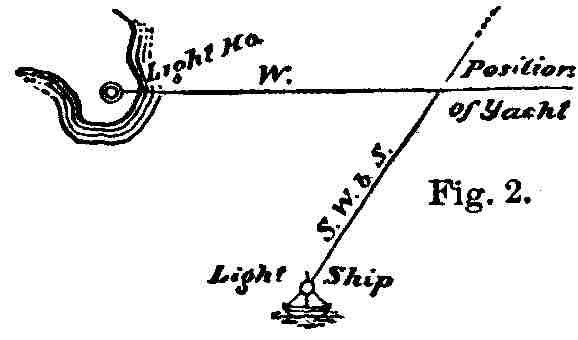
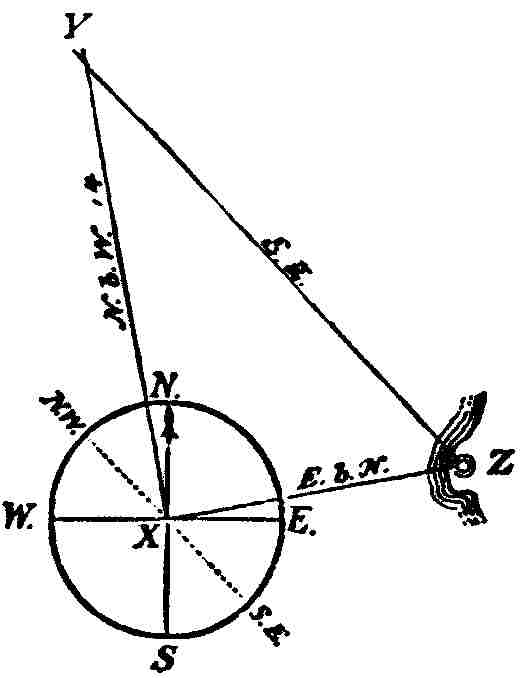
Cross-Bearings.—The finding of the exact
position of the yacht upon the chart by taking the
bearings by compass of two objects on shore.
Crotch.—Two crossed pieces of wood in which
the main boom is lashed, when the yacht is at anchor
or the sail furled, to confine it in place.
To Cun.—To direct the helmsman how to steer.
Cut-Water.—The timber forming the entrance
of the yacht.
Boat-Davits.—Pieces of strong, bent iron standing
out over the side to hoist boats up to, and secure
them.
Down-haul.—A rope used to pull down the jib,
&c.
Draught.—Depth of water. Thus it is said of
a yacht that her draught is three feet; i.e., she
draws three feet of water.
Drift.—To drive to leeward; to lose steerage
way for want of wind.
Earings.—Small ropes used for lashings.
Ease Off.—To slacken.
Ease off Handsomely.—To slacken very carefully.
End for End.—To change a rope that has
been worn, and use one part where the other was
formerly used.
End On.—To advance bow or stern on, or to
have another vessel approach in a similar manner.
Ensign.—The national flag, carried always at
the gaff-end.
Fag-End.—The end of a rope which is frayed.
Falling Off.—When a yacht moves from the
wind farther than she ought.
Fathom.—A measurement six feet in length.
Fid.—A tapered piece of wood used to splice
ropes with, and, when made of iron, called a "marline-spike."
To Fill.—To have the wind strike the inner or
after surfaces of the sails.
Flake.—One circle of a coil of rope.
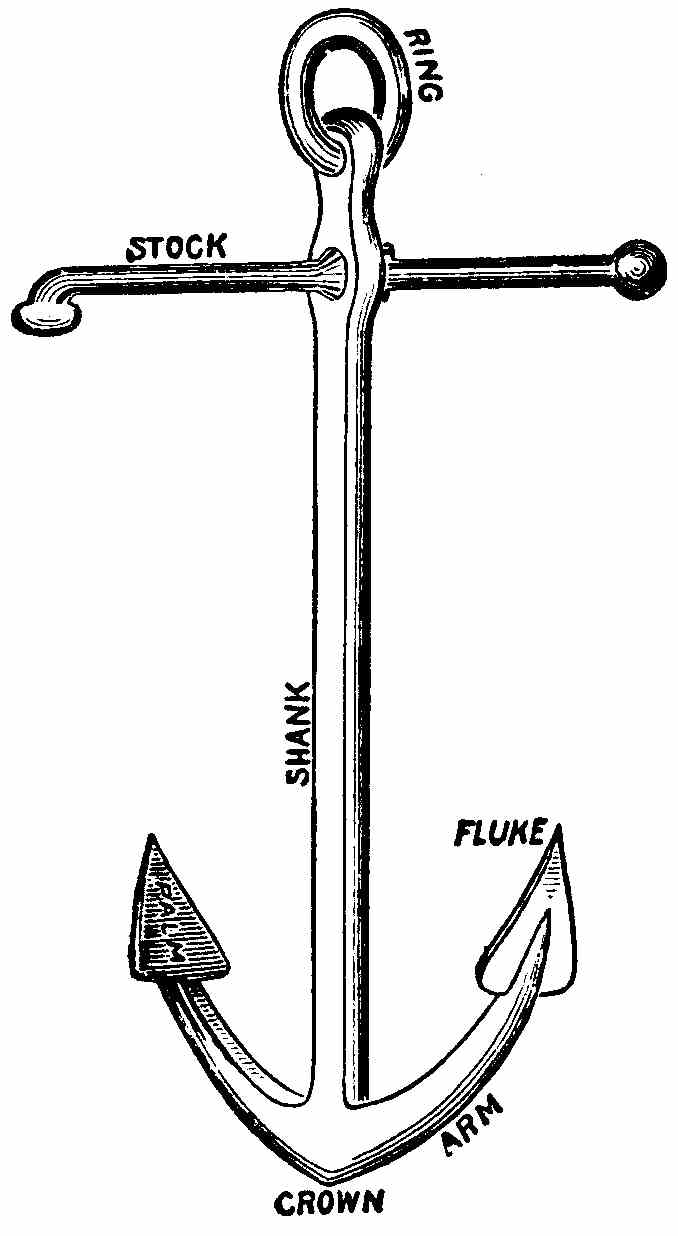
Flukes.—The broad spade-like parts of an
anchor.
Fore.—That part of the yacht nearest to the
head.
Fore and Aft.—In the direction of the keel;
also vessels without square yards. Hence a schooner
is often called a "fore-and-after;" and a ship, a
"square-rigger."
Foul Hawse.—When the cables are twisted.
To Foul.—To entangle a rope; as, "The jib-halliards
are foul." To run foul of a yacht is to
come in collision with another.
To Founder.—To sink.
Furling.—Making the sails fast to the booms
and spars, and stowing them, by means of gaskets.
Gaff.—The spar that supports the head of a
fore-and-aft sail.
Gangway.—The place where persons come on
board.
Gasket.—A piece of rope or narrow canvas
used to tie up sails with, or lash any thing.
To Go About.—To tack.
Goring.—Cutting a sail obliquely.
Granny-Knot.—A foul knot,—one not tied in
a proper manner.
Griping.—When a yacht carries too great a
weather-helm.
Halliards.—Ropes or pulleys to hoist up sails.
Hands.—The crew; i.e., "Send a hand aft
here!" "All hands," all the crew. To "hand a
sail," to furl it. "Bear a hand," hurry up to help.
Hand lead, instrument used for sounding.
Handsomely.—Carefully.
Hanks.—Oval rings, fitted to work upon stays,
to which the sail is lashed to be hoisted or lowered.
Hatchway.—A square hole in the deck that
communicates with the hold.
To Haul.—To pull.
To Hail.—To call out to another ship; such
as "What ship is that?"
To Heel.—To incline to one side; i.e., she
heels over too much on account of a want of ballast.
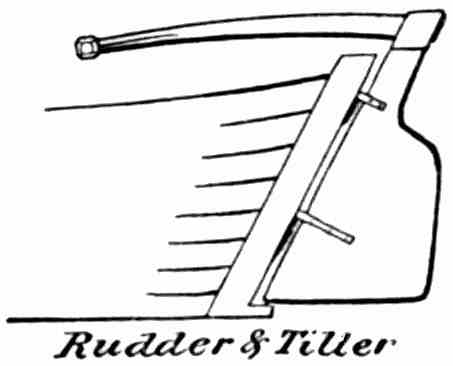
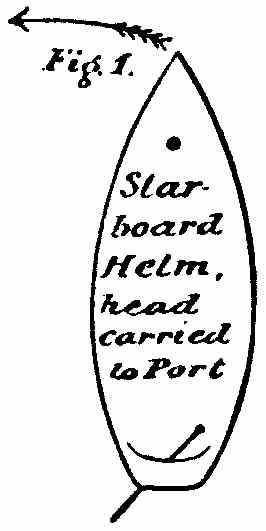
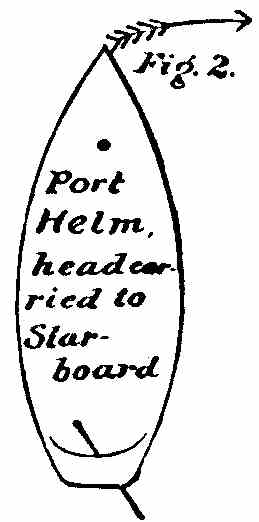
Helm.—A tiller or wheel which controls the
rudder.
To Haul Home.—To pull the clew of any sail
as far as it will go.
Too High.—The warning given to the helmsman
when the yacht is too near the wind.
To Hitch.—To make fast.
The Hold.—The space under deck.
Hull.—The body of a yacht.
"In Irons."—A yacht is said to be "in irons"
when she has lost steerage way from any cause, and
will not obey the helm.
Jack-Stay.—A small bar of iron, or slat of wood,
fastened to a spar, and to which the sail is bent.
To Jam.—A knot is said to be jammed when it
cannot be untied.
Junk.—Old pieces of rope, canvas, &c.
Jury-Masts.—Temporary masts used when
others are carried away.
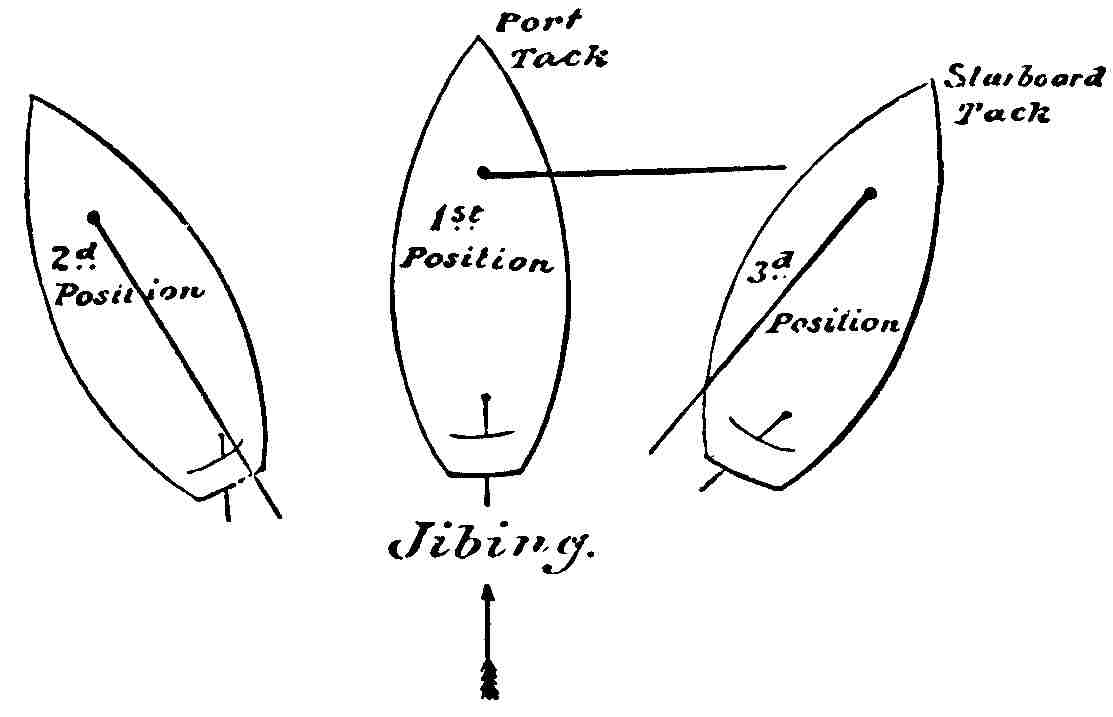
Jibing.—The act of passing the main-boom
from one side of the yacht to the other, whilst running
before the wind.
Keel.—That part of the yacht lowest in the
water, and upon which all her superstructure is
erected.
Kink.—A twist or turn in the rope.
To Labor.—A yacht is said to labor when she
pitches and rolls heavily in a sea-way.
Land-Fall.—Discovering the land.
Larboard.—The left side of the yacht, facing
forward, now almost obsolete, port having almost
wholly taken its place; larboard having been
found in practice to be too near in sound to its
opposite starboard.
Lay Aft.—The command to come aft. "Lay
aloft," to go up the rigging. "Lay out," to go out,
on the bowsprit, for instance. "Lay in," to come
in.
Leach.—The perpendicular border of a fore-and-aft
sail.
Lee-Lurch.—When the yacht rolls heavily and
suddenly to leeward.
Lee-Shore.—The coast-line to leeward of the
yacht, on which the wind is blowing.
Leeward.—The direction towards which the
wind is blowing.
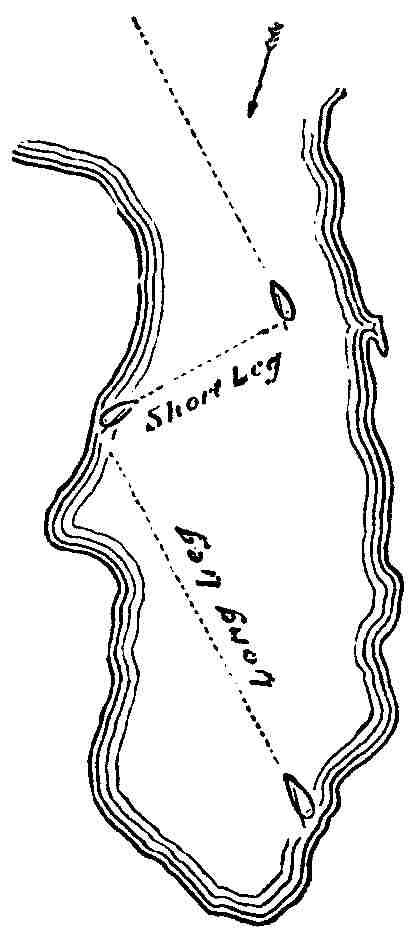
Long Leg.—A term used when the wind is not
dead ahead, but so as to cause the yacht to make a
long tack and a short one. Hence, to make "a long
leg," and a short leg.
Log.—The record of the yacht's performance
each day of twenty-four hours, as concerns weather,
courses, &c., kept in a log-book. "Heaving the
log," to ascertain the speed by means of a log-line.
Looming.—The appearance of a distant object,
such as another vessel, or the land, especially in
foggy or misty weather, when it is said to loom, i.e.,
look larger, and appear nearer, than it really is.
Lubber.—A person who is not a sailor,—a
greenhorn.
Luff.—An order to have the helmsman put the
helm to leeward; the forward part of a fore-and-aft
sail attached to the mast by hoops.
Lying To.—Bringing the yacht to the wind
under small sail, and lashing the helm a-lee, so that
she may lie safely, and ride out the storm.
To Moor.—To secure the yacht by more than
one anchor.
Moorings.—The place where the yacht is generally
kept when in harbor, and denoted by a buoy,
which watches over them.
Neap-Tides.—Those tides which occur when
the moon is in her quarters; spring-tides being
much higher, and occurring at the full and change.
Too Near.—A warning to the helmsman that
the sails are not quite full, and that he is steering a
little too near the wind.
Main Chains.—Place on the yacht's side where
the shrouds and backstays are fastened.
Miss-Stays.—The act of failing to "go about"
on the other tack.
Model.—The shape and form of the hull.
Off and On.—Approaching the land on one
tack, and leaving it on the other.
Offing.—Out to sea, clear of all dangers, yet
near the land; sea-room.
Overboard.—Out of the yacht; in the water.
Overhauling.—To haul a rope through a block;
to examine any thing thoroughly; to gain upon a
vessel or object ahead.
Painter.—A short rope in the bows of a boat
by which she is secured.
To Part.—To tear asunder; i.e., the cable has
parted; the main-sheet has parted.
To Pass a Lashing.—To wind a rope round a
spar or sail.
Pay.—To rub on pitch or tar with a large brush.
To Pay Off.—To make a yacht's head recede
from the wind by hauling the jib to windward, and
easing off the main-boom to leeward.
To Peak Up.—To elevate the outer or after end
of a gaff, so that the sail may set better.
Plying.—Turning to windward.
Pooping.—A yacht is said to be pooped when
she is struck by a sea that comes on board over
the stern or quarter.
Port.—See larboard.
Preventer.—Any thing to secure or take off the
strain, as preventer jib-sheet.
Pennant.—A long narrow flag.
Quarter.—That part of the yacht's side contained
between the beam and stern.
Rake.—The sheer of masts from the perpendicular.
Range of Cable.—A sufficient length overhauled
and ready so as to allow the anchor to reach
the bottom without fouling.
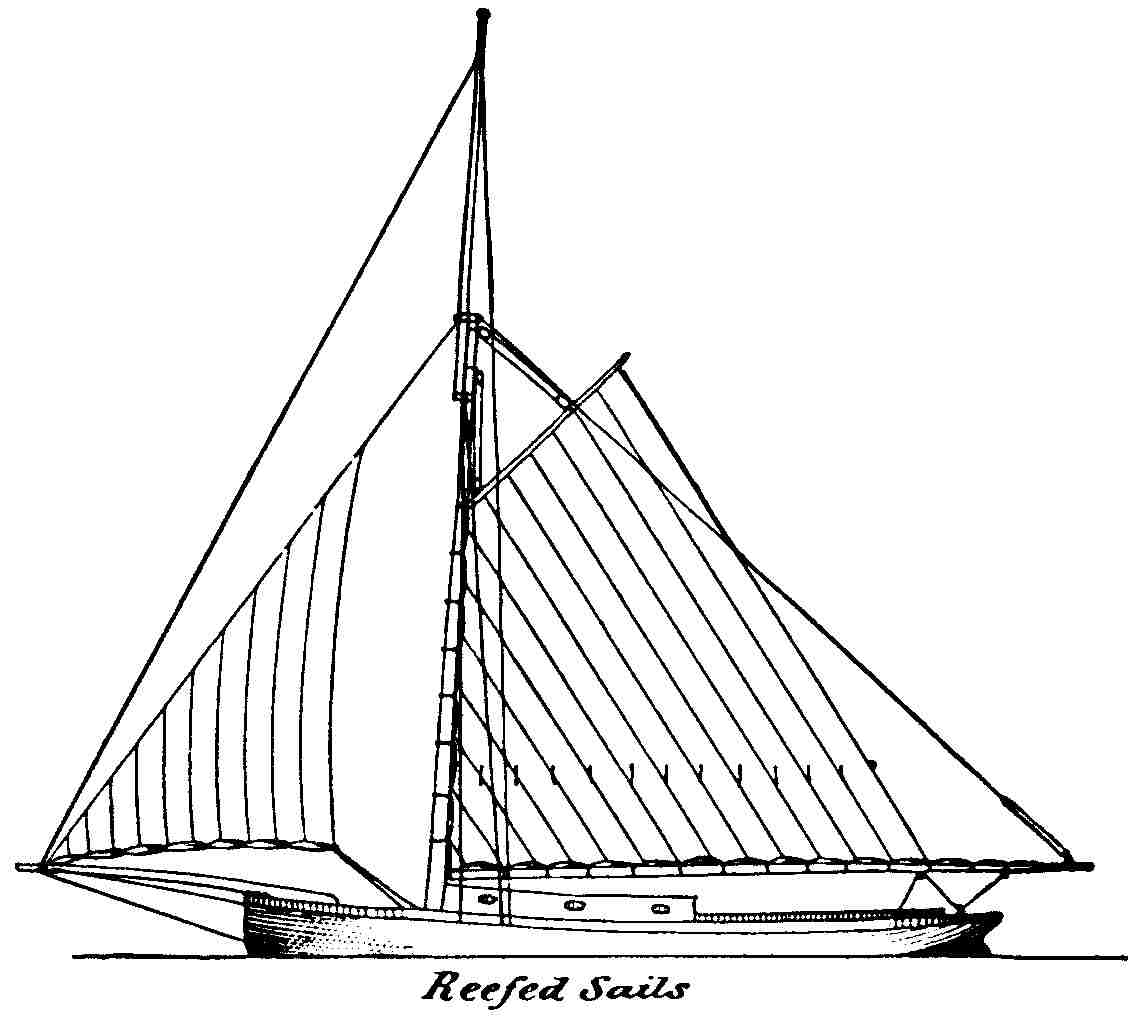
To Reef.—To reduce a sail by fastening it down
to a boom or jack-stay by means of reef-points
To Reeve.—To pass a rope through a block.
To Ride.—To be held at anchor.
To Right.—A yacht is said to right when she
rises to an upright position again, after having been
thrown on her beam-ends by a sudden squall.
To Right the Helm.—To put it amidships, so
that the rudder will be in a line with the keel.
To Run Down.—When one yacht sinks another
by running over her.
Scant.—The wind is said to be scant when a
yacht will barely lay her course.
Scope.—To pay out more of the cable when at
anchor.
To Scud.—To run before the wind in a storm.
To Scuttle.—To make holes in a yacht's bottom
to sink her.
To Serve.—To wind any thing round a rope so
as to save it from chafing.
To Seize.—To make fast or bind.
To Sheer.—To vary to the right and left from
a direct course.
To Ship.—To place or receive any thing on
board; as, to ship a sea, to ship a crew.
To Shiver.—To make the sails shake in the
wind's eye.
Shoal.—The land beneath the water that approaches
near the surface, or is left bare at low
water.
The Slack of a Rope.—The part that hangs
loose.
To Slip a Cable.—To let it run out overboard,
and release the yacht from the anchor, being first
generally buoyed so as to be recovered.
To Slue.—To turn any thing about.
Snub.—Used in reference to the cables, in
checking the yacht, after they have been paid
out.
To Sound.—To ascertain the depth of water by
means of a lead-line.
To Take a Spell.—To relieve any one at any
duty; as, to take a spell at the wheel.
To Spill.—To take the wind out of a sail by
easing off the sheets or otherwise, so as to remove
the pressure of the wind.
To Splice.—To join two ropes together by interweaving
the strands.
To Spring a Mast.—To crack or split it.
A Spring.—A rope made fast to the cable, and
taken on board aft, in order to haul the yacht's side
in any direction.
Spring-Tides.—The highest tides, which occur
at the full and change of the moon.
To Stand On.—To keep on in one's course.
To Stand By.—To be ready.
Starboard.—The right side of a yacht, the observer
looking from aft forward.
To Steer.—To control the yacht with the rudder
and tiller.
Stranded.—A yacht is said to be stranded when
she is so far on shore that she cannot be floated.
To Strike.—To beat against the bottom; to
hit suddenly any object below the surface of the
water.
Swig Off.—To take a turn with a rope at a cleat,
and then pull upon it laterally, so as to gather in all
the slack.
To Tack.—To advance by a series of angles
toward the direction from which the wind proceeds.
Taut.—Tight.
Taunt.—Long, lofty.
Tender.—A small boat or wherry used to pass
from the yacht to the shore.
To Tow.—To drag any thing astern behind the
yacht; as, to tow the tender.
Truck.—The small ball at the topmasthead,
through which the signal-halliards reeve.
Trough of the Sea.—The level of the water
between two waves.
Turning to Windward.—Tacking.
Unbend.—To cast off, to release; as, "Unbend
the anchor from the cable!" "Unbend the mainsail!"—roll
it up and put it below.
To Unship.—To take any thing from the place
where it was fixed; as, to "unship the rudder."
Wake.—The track, or furrow, left by the yacht
on the water she has passed over.
To Wear.—To turn a yacht round from the
wind,—the direct opposite of tacking.
To Warp.—To move a yacht by hawsers.
Watch.—A division of the crew into starboard
and larboard watch, who take turns in taking care
of the yacht.
Water-Logged.—The condition of a yacht
when she is so full of water as to be almost unmanageable,
and nearly submerged.
Way.—Progress through the water: "she has
good way on." To a boat's crew, to cease pulling,
the command is given, "Way enough."
To Weather a Yacht.—To get to the windward
side by faster speed, or lying nearer the
wind.
Weather Beaten.—Worn by the weather and
exposure.
Well of All.—A command used when the
several ropes of a sail have all been hauled upon at
the same time, and it is perfectly set, and means to
belay.
To Weigh.—To lift an anchor from the bottom.
Wind's Eye.—The exact direction from which
the wind proceeds.
To Windward.—Towards that point from which
the wind blows.
To Work to Windward.—To tack so as to
make progress in the direction from which the wind
blows.
Yacht.—A vessel used for pleasure only, and
not for commerce or trade; built for speed and
comfort.
To Yaw.—To swerve suddenly and violently
from the true course, in spite of the action of the
rudder.
Franklin Press: Rand, Avery, & Co., Boston.
Transcriber's Notes:
Some minor punctuation, spelling and hyphenation mistakes and
inconsistencies have been corrected.