Historical Summary
“After this he led them into his garden, where was great variety
of Flowers. Then said he again, Behold, the Flowers are diverse
in stature, in quality, and colour, and smell, and virtue, and
some are better than some.”
—Bunyan.
Without attempting a history of pottery which, however brief, would be
somewhat out of place in a Craft Book, a short summary of its evolution,
emphasizing those periods in which it was most beautifully developed,
seems essential to help the beginner in the selection and appreciation of
good form, colour, and decoration. These are very vital matters and easily
overlooked in the struggle to acquire a craft that is full of fascination
from the first fumbled shape upon the wheel to the finished product of
time and art and craft.
Too much stress cannot be laid upon the importance of close study of the
best work, both ancient and modern; for it is a truism that however
handily a craftsman may work, his output will be worthless if he has not,
with his increasing powers of technique, developed a sound judgement and
refined taste. To-day, these alone can replace the lost traditions of the
old masters.
The Potter’s Craft had a coeval birth in various parts of the earth, but
the obscurity is such that no clear idea can be gained of its antiquity.
It was, probably, the first form of handicraft, if we except the
fashioning of flints and clubs. Accident or the funeral pyre may have
suggested the extraordinary durability the clay shape obtained when
burned, and doubtless siliceous glazes were first the result of chance.
All early work was built up by hand and for that reason possesses wide
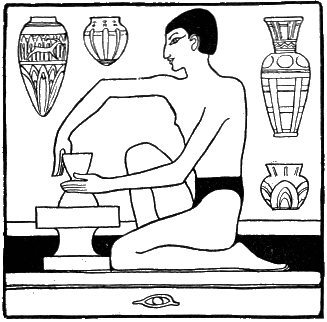
mouths and simple forms. The introduction of the wheel is lost in a mist
of time, but drawings from the tombs of Beni Hassan show the potter at his
wheel substantially as he works in Asia to this day. The wheel-made or
thrown shape is distinguished by far more grace and symmetry than the
built shape, and by an infinitely greater variety of form.
In burial mounds from prehistoric Egypt are found many bowls and platters
rudely scratched, and the earliest examples from mounds, lake dwellings,
and tombs show the quick development of the pot, not only as an object of
utility, but as a vehicle of art. The first kinds of decoration were
incised lines followed by strappings and bandings, painted stripes and
scrolls and hieroglyphs, with later additions in slip and modelled clay.
Primitive wares from their method of production exhibit an interesting
similarity of shape and style in such widely divergent countries as China,
Egypt, and Peru.
It was only when the craftsman had acquired considerable dexterity that we
find his nationality influencing his shapes and producing the wonderful
variety in form and decoration that characterizes and distinguishes the
pottery of all nations. Once established, the prevalence of type is
strong. This traditional style is particularly noticeable in Egypt, much
modern work being identical with that of the early dynasties.
Before turning to more sophisticated work it would be well to learn the
lesson of simplicity and fitness here taught by primitive folks. The
simple beginning leads to the simple, strong, and satisfying end. Much of
this primitive work is inspiring for its freshness or naïveté; its
unspoiled innate taste allied to downright common sense. Properly
approached, it should be a sure corrective to any desire for unsightly
new shapes or extravagance in decoration. A few careful studies will do
much to drive home this valuable lesson in fine, simple line and spacing.
In Egypt the thrown shape was not distinguished by any extraordinary
beauty or variety. Nevertheless their small Ushabti, glazed gods and
demons, show a very advanced knowledge of coloured enamels, and their
fabrication of a hard sandy paste for glazing shows the first great step
in the science of pottery. Their glaze was purely alkaline.
The Assyrians appear to have been the first to use coloured tin glazes,
and although few pieces of pottery survive, the enamelled friezes from
Korsobad and Sousa are striking evidence of their proficiency in
tile-making.
From Egypt and Mesopotamia the craft spread east and west to Phœnicia,
Attica, and Greece; through Persia and Arabia to India. Here it mingled
with currents from China, then invading Korea, Japan, and Siam, the united
floods rising until the potter was a power in every land.
Phœnician pottery forms, with Cretan and early Grecian, a beautiful
sequence from the primitive work of early dynasties to the refinements of
later Grecian wares.
It will prove an interesting and instructive study to trace the
developments that led finally to the zenith of Greek pottery. The
primitive Hissarlik ware leads through Mycenaean, Dipylon, Phalæron,
Rhodian, and Corinthian right up to the wonderful figure vases of about
300 B.C. Although limited in paste and colour, with a thin transparent
glaze or lustre, these vases were exquisitely fashioned. Large and small
shapes of wide diversity were decorated in black, red, and white, ornament
and figures both drawn straight on to the body with a sureness of touch
and refinement of line that excite the envy of a master. Many of their
forms are strongly influenced by contemporary bronze work and for that
reason are not the best guides for shapes. Their incomparable terra-cottas
known as Tanagras form a link between Pottery and Sculpture.
Again, from Phœnician work one may see dimly by way of Samian, Rhodian and
old Cairene wares the lineage of the royal wares of Persia, and recent
investigations point to Old Cairo as the birthplace of lustre.
From Persia come some of the finest pottery, painted in colours and
lustres, that the world can show. Their wares stand pre-eminent in that
class wherein the chief beauty is the painted decoration. Their one-colour
pieces, whilst not comparable with the Chinese, nevertheless reach a high
standard. Their lustres have never been surpassed or rarely equalled.
Their shapes are true potter’s shapes, and a delight to the eye. The
finest pieces were painted in simple blues, greens, reds, and faint
purples, with black pencilling. This appears to have been done on an
engobe of finely ground flint, and covered with an alkaline glaze giving a
broken white ground. This would account in some measure for the
extraordinary freshness of both drawing and colour. Later on raised
ornament, finely conceived and used with restraint, is seen along with
pierced decoration having translucent effects.
Rhodes and Damascus produced a somewhat coarser ware, but bold and free in
brushwork and varied with a bright red. Syrian pottery abounds in virile
individual shapes. Turkey also was not without a fine and vigorous style.
Much time can be most profitably spent studying the masterpieces of
Persia. A representative collection like that at South Kensington will
show vases, bottles, bowls, pots, and tiles in bewildering variety and of
infinite freshness. They are directly painted, with free renderings of
flowers within geometric forms and often with an inscription in rich
Arabic characters. The exquisite Moore Collection in the Metropolitan
Museum, New York City, is smaller but is remarkable for the unusually high
standard of taste shown in its acquisition. At its purest period human or
animal figures were rarely or never represented and those shapes or tiles
with such decoration belong to a more decadent but still fine period.
Again we have the eternal lesson of simplicity and fitness. Again it will
be borne in upon the student that originality does not mean weirdness, but
rather a fresh spontaneous treatment of simple, well-known natural forms,
with, above all, a fine appreciation of good line and space. No sincere
student can fail to develop here a respect and veneration of a craft and
of craftsmen capable of producing such glorious works.
From this teeming home the craft spread to Arabia and west across the
Mediterranean to Spain. Here in the twelfth century the Moors were
producing their famous Hispano-Mooresque lustred wares. Their large
plaques offer a wonderful variety of pure brushwork ornament with spirited
heraldic additions. Sometimes the backs of these dishes are as beautifully
lustred as the fronts.
For a proper appreciation of their purely geometric decoration and its
possibilities in pottery we must turn to the Alcazzar at Madrid. Here the
use of opaque tin glaze permitted the extensive use of a coarse body for
tiles and bricks. The Moors, however, first introduced glazes with a lead
base and from that time we begin to lose the fresh wet colour always
associated with the alkaline glazes of the Persians. Analysis shows that
they used lead, but only occasionally and in small quantities, to aid
their lustres. The lustred wares of Spain declined late in the thirteenth
century, but not before its exportation to Italy by way of Majorca had
stimulated the production of Italian Majolica. Della Robbia, about 1415,
succeeded in colouring his tin glazes, and his finely modelled but
somewhat crudely coloured reliefs usher in the era of Italian Faience.
Patronized by the nobles the craft quickly took root and was blossoming
profusely at Urbino, Gubbio, Pesaro, Faenza and other cities at the end of
the fifteenth century.
Here we break ground and leave the chaste simplicity of the golden age to
riot a blaze of exuberant decoration. Scraffito, slip, inlaid, applied,
incised, raised, embossed and modelled and painted embellishments; all are
here. This era is chiefly notable for its splendid ruby lustres and the
remarkable power and freedom, amounting to absolute abandon, of the
brushwork and drawing shown by its artists. They used their lustres to
heighten the effects of their painting and the results are in keeping with
that romantic age. Alongside of it our best modern work is apt to look
spiritless and dull.
Much splendid work was produced in Italy at this period, but in such a
wide field there are naturally some places that exhibit technique rather
than art. The student must go into it with appreciative faculties alert
lest mere splendour should sweep him off his feet.
The wares and the potters of Italy penetrated north into Europe, to
France, the Holy Roman Empire and Britain, starting or stimulating what
was to prove an overwhelming flood of production. In Europe in pre-Roman
times, a coarse, unglazed, built-up ware was general, it being of simple,
somewhat clumsy but vigorous form, low-fired and friable. It was used
chiefly for cinerary purposes, the Germanic peoples having a decided
preference for vessels of horn, wood, or metal.
The Romans introduced the wheel and produced a far higher class of ware.
Their importation of the fine red Samian pottery resulted in the
fabrication of the vigorous Gallo-Roman and Romano-British pottery. This
was good in shape and paste and characteristically decorated with slip,
bosses, dots, and indentations. The later Gaulish work shows applied
figures and highly finished scroll work. After the decline of Rome, Saxon
and Germanic work shows a distinctly retrograde tendency. It is often
built up, strapped, banded, and bossed in imitation of the Romano-British.
Though coarse and lacking in finish, it is full of freshness and
character.
In Mediæval England, when pottery making was at a low ebb, the monasteries
and travelling guilds of potters produced splendid encaustic tiles. These
were inlaid with simple yet striking geometric designs, or animal or bird
forms, both heraldic and symbolic.
In Europe for many years the domestic pottery remained coarse and
primitive, showing still the arresting hand of the barbarian conquerors of
Rome. The first signs of the Italian Renaissance are to be found in the
rare Henri Deux or Orion ware. Palissy’s desperate and romantic search for
enamels was the prelude to the development of Rouen, Nevers, Lille,
Moustiers, Sèvres, Marseilles, and other less important potteries. In
France also early experiments led eventually to the fabrication of
porcelain much on the lines of English porcelain, a frit being used
instead of kaolin.
In Germany, as early as the fifteenth century, they produced fine
stoneware highly decorated with relief patterns and colours. After long
research Boettiger, by a lucky accident, discovered kaolin. Porcelain was
made at Dresden in 1709, and many of the Dresden figures show a remarkably
sympathetic alliance of potting, modelling and painting.
The success of the German ceramists led to a wide patronage of potters by
kings and princes which quickly spread the knowledge of porcelain
throughout Europe.
Long before this in the early part of the seventeenth century, potteries
were established at Delft in Holland. Here was made the well-known ware
painted in blue camaien on a fine white ground. This was for a time
produced in great quantities, and the process of painting directly on to
an absorbent ground led to a surprisingly fresh and skilful style.
In the middle of the seventeenth century English wares commenced to rise
from the stagnation in which they seemed sunk since Saxon times. Toft,
with his tygs and platters, Dwight, and his bellarmines, and Elers, with
turned shapes, started a movement which was eventually to send English
wares into all parts of Europe, even into the far Russias, to be known
everywhere for its excellent workmanship. And in this flood of production
in the seventeenth and eighteenth centuries was much that was technically
unrivalled despite the fact that the Art of the potter is sometimes far to
seek. Dwight is said to have produced a fritted porcelain in 1671, before
the discovery of kaolin. This is doubtful, but his persistent research
eventually led up to the fine pastes of Chelsea and Bow and the unrivalled
“fine earthenwares” of Staffordshire.
This European revival gained tremendous impetus from the importation by
the Portuguese of the wares of China. The wide scope of its decoration,
both painted and modelled, pointed the way to most potters of the West
during the heyday of European pottery. The magnificent single-colour
pieces were not introduced until later when the break-up of the Empire
rendered them accessible to Europeans. It is to them that the student
must turn to see the summit of the potter’s art, which, it is logically
contended, commences on the wheel and ends at the glost oven with the
potter, the only attendant from the pot’s inception to its finish.
Painting or modelling is not essential to its perfection and unless
applied by a true disciple detracts rather than adds to the beauty of the
piece.
In China, where tradition holds that earthenware was first made in 2698
B.C., the art of the potter, in body, shape, glaze, and colour, through
centuries reached perfection. Porcelain is said to have been first made
about 200 B.C., but this date is conjectural. What we do know
unmistakably, however, is that the best work of their best periods is
unrivalled. Depending primarily on form and colour, with here and there a
subtle decoration in raised or incised line, in crackle or simple
brushwork, it stands alone, and despite the omnipotent chemistry of
to-day, defies imitation. Their forms are strong, bold, and dignified, yet
subtle and delicate, too. Then, added to a wonderful range of colours, was
a perfection of body that was for so long the despair of western
imitators. It is here at the altar of perfection amidst the chaste
richness of Tang and Sung and Ming that the true disciple must worship.
And to those who must eat bread as well as make pots it is to be pointed
out that these pieces at the time of their production fetched prices that
compare favourably with the “fancy” prices given to-day.
To the Japanese also in great measure the same tribute is due. Although
beginning later as disciples and scarcely getting so far as their masters,
their more limited range of colour and form is set off by their restrained
and even more tasteful decoration. The unique collection in the Boston
Museum is an amplification of this bald statement. They were often more
concerned with the touch and texture of the pot than the more obvious
appeal of decoration. Esoteric as it is to most occidentals it is rich in
a pure æstheticism and a deep and beautiful symbolism that is slowly but
surely having an influence on western art, just when it seems in some
danger of dying out in Japan. The hermit kingdom of Korea, despite its
midway position, produced pottery that is strangely beautiful and
distinctive and worth much more than a passing notice.
In China the art decadence of the eighteenth and nineteenth centuries,
coupled with internal revolutions, has sadly dimmed her plots, dispersed
her potters, and all but destroyed her priceless traditions.
For the further development of pottery in Europe and America and Asia the
student has many excellent books to consult. From the seventeenth century
the ramifications are rapid and all-embracing, giving, however, more joy
to the collector than to the artist. Modern work has made an enormous
advance in the science of the craft. Since the “Eighties” it shows signs
of a renaissance in æsthetics. Lustres of all shades, crystalline, star,
and crackle glazes with safe methods of oxidizing and reducing in the
fire, have been brought to perfection. Yet, with some few exceptions,
commerce seems writ large upon them all and their very perfection of
finish damns them in the eyes of an artist. Whichever way he looks, he
must return again and again to refresh his eyes with the inspiring
examples of the best that has survived from the near and far East.
Only an antiquarian humbug would wish to go back to ancient conditions
even to produce old pots. But it is only by seeing in so far as we may in
museums and books the works of these ancient yet ever modern potters; by
tracing their development, appreciating their qualities and attempting to
work as they worked, honestly and unaffectedly, that we shall begin to
approach the excellence and originality of their art. This study should
not of course obey the direction it all too frequently follows. The
slavish measuring by module and fraction of classic styles, the stark
geometric analysis of Moorish ornament or the laborious copying of Chinese
pattern is at best only art in cold storage. It should be self-evident
that where an alien style is consciously imitated the result is sterility
for the imitator. In others, it is apt to produce a powerful reaction
that results in Futurism or some such self-conscious affectation. “The
Greeks did not draw from casts nor did the Persians haunt museums,” says
the harried student. No. But better than that, they were surrounded, if
not by beauty, at least by nature naked and unashamed. They lived not
easily maybe, but surely more gracefully, untrammelled by fashion, cult,
or craze.
“The earth his sober Inn
And quiet pilgrimage.”
Their best work seems ever fresh, spontaneous, and untired. It must have
been done with a spirit and real joy impossible to anyone but a true
craftsman tremendously interested in his work, we might also add, his
environment.
Naturally, present-day conditions must modify the struggle for existence.
They may mar our best aim at times. Yet some few have worked wonders even
in this age. To mention but two instances, W. De Morgan and the Martin
brothers, is to tell of high endeavour and great achievement. But we must
not expect to get rich that way.
Pottery is an exacting and difficult craft, abounding in as many trials
and disappointments as excitements and rewards. Its true devotee must
suffer. Yet the delightful tale of Palissy’s heroic battle should hearten
the more fortunate student of to-day. It is good to read of the spirit in
which Wedgwood, scientist though he was, approached his work. In a trade
catalogue he says, “A Competition for Cheapness, and not for Excellence of
Workmanship, is the most frequent cause of rapid Decay and entire
Destruction of Art and of Manufacture.” “Beautiful Forms are not to be
made by Chance and they never were made nor can be made in any kind at
small expense.” Such sentiments rarely emanate from the modern commercial
pottery.
Tradition, except the traditions of flawless glazes, certain soulless
results, and commercial cheese paring; seems dead perhaps, but it will
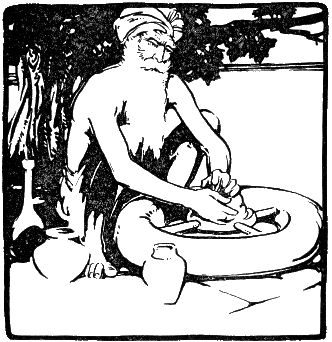
surely come to life again. To see the potter “thumping his wet clay,” and
seated at the wheel of ancient lineage, conjuring forth a wealth of
gracious shapes, is to renew one’s faith in the ultimate survival of
simple honest handicraft even in this machine-ridden age. Masterpieces
were never conceived in factories, and when we make pots primarily for
love of them, not to sell them, we shall begin to beat back the
manufacturer of debauched “Art” pots into that domestic and hygienic realm
wherein his efforts are particularly admirable and effective. A craft that
teems with such an endless variety of beautiful objects for such countless
uses can never remain for all time the hand-maiden of commerce.
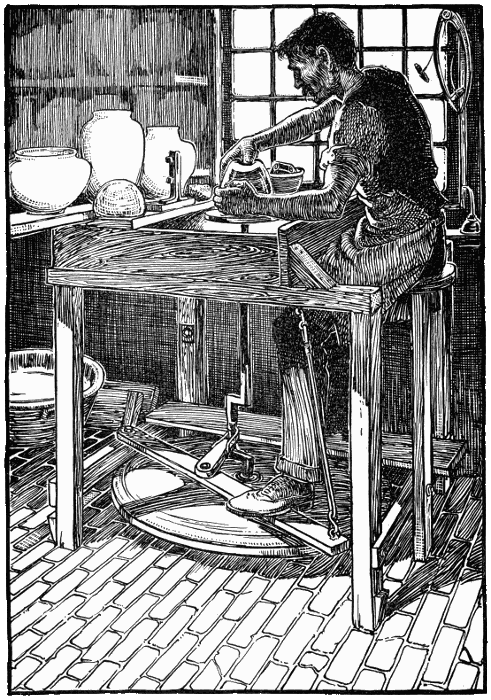 Hollowing the Ball
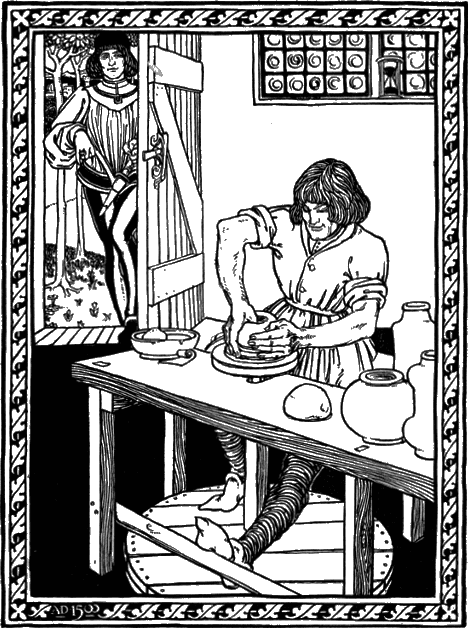 “He wrought a work upon the wheels, and the
vessel that he made of clay was marred in the hands of the Potter: so he
made it again another vessel, as seemed good to the Potter to make
it.”—(Jeremiah.)
“He wrought a work upon the wheels, and the
vessel that he made of clay was marred in the hands of the Potter: so he
made it again another vessel, as seemed good to the Potter to make
it.”—(Jeremiah.)