Scarcely any other three words form a phrase freighted with
meaning so vital to our national life. Here is the convergence
of streams of humanity flowing from the ends of
the world. Through these gateways more than 33,000,000
aliens have come to our shores. Much that they have brought has
been antagonistic to the spirit and purpose of our institutions, but
their great contribution has been the world's wealth of physical
strength, intellectual power, spiritual vigor, religious fervor and
the incarnation of the yearning passion of the soul for liberty and
life. It is our duty to recognize the value of their offering in terms
of manhood and womanhood and not merely in terms of finance
and business, and to so discharge the responsibility involved in
opening our gates, as to help them to properly appreciate their
privilege and opportunity, and to make possible the realization of
their ideals.
Dr. Steiner says, "It is a big task, the biggest and most difficult
and yet most rewarding task the Church has to face."
The Immigrant's Welcome
The Federal authorities endeavor to receive the immigrant with
a genuinely humane welcome. Some of our ports have not buildings
properly equipped for receiving and examining immigrants
and caring for the detained. Occasionally there are rumors of
instances of harsh treatment on the part of the Government. For
some of these there is doubtless occasion, but one who has the
opportunity to see the Ports of Entry service in all its phases
through a series of months, will be convinced that honesty, carefulness
and kindness characterize the method and manner of the
Government officials and employees, and that nowhere else is the
immigrant received more humanely and treated more kindly and
courteously than at our Ports of Entry.
Dr. Frederic C. Howe, Commissioner of Immigration at the
Port of New York, recently said, "Ellis Island is public property
and those of us who are over there are public servants. We have
made provisions at Ellis Island so that every man, woman or child
in the United States can participate in its administration. We did
that through inviting suggestions, criticisms, complaints. We believe
the best curative of disease is sunlight, and the sunlight that
we are aiming to turn on Ellis Island is the sunlight of as many
human eyes as will turn themselves on that station with their suggestions
or complaints. I invite you to come to Ellis Island, to
see the station and to examine it, to meet your friends and to aid the
six hundred men over there in the Government employ in making
Ellis Island a place we all love."
Our Missionaries
No part of the immigrant welcome service is more important
than that which is done by the missionaries. Their purpose is primarily
to carry the gospel story of salvation and good cheer. "Behold,
I bring you glad tidings of great joy" is the message of the
Ports of Entry missionary. This work, however, combines regard
for spiritual life and material welfare. It must be humanitarian
and philanthropic service of a very practical sort. It is the cup of
water "In His name" given with the personal touch of one of His
disciples.
On page 18 will be found a list of other Societies and Organizations
engaged in this immigrant welcome service.
The Home Missions Council
and
Council of Women for Home Missions
At the annual meeting, January 12, 1915, the Committee on
Immigrant Work reported—"We are confirmed by Dr. Selden's
brief study and by all that we have seen and heard during the year
in the opinion expressed in our last report, as follows:
"If the Council desires to do the far-visioned thing, based on
the broad and stable principles which should govern the King's
business, let it lay hands upon the strongest available man and put
him at the task of inquiry, of leadership, of unification, of inspiration,
beginning at the port of entry and gradually extending his
knowledge and influence until he stands at the center of the whole
field of our service in alien tongues."
"We do not, however, venture at this time to suggest a program
so elaborate nor a task so comprehensive for the Council's representative.
We review in effect our recommendation of last year
that the Council proceed conservatively and that effort for
the coming year be limited in the main to the ports of entry. The
relatively small volume of immigration now coming in, while
making less immediate demands upon us, affords peculiar advantages
for study of the problems involved, for conference with
Government officials, and for development, readjustment and organization
of the missionary force. At the end of a year of inquiry
and effort along these lines, having all the time in view the larger
field of our work across the country, your Committee hopes to be
able to report substantial progress and to suggest how further to
profit by the ground gained in the inquiries of last year and the
year to come."
"Your Committee is glad to be able to announce that the Council
of Women for Home Missions has been increasingly interested
in the matter under discussion and has recommended to its constituent
bodies that they assume one-third of the expense of any plan
adopted for the coming year."
At this meeting the following recommendation of the Business
Committee was adopted, "That the Council, in cooperation with the
Council of Women for Home Missions, ask the Rev. Joseph E.
Perry, Ph.D., to act as representative of the two Councils at ports
of entry, for the year beginning January 15, 1915."
The task of directing the work of the representative of the two
Councils at the Ports of Entry was given to a "Committee of Six"
composed of three persons chosen from the "Immigrant Work
Committee" of the Home Missions Council, and three from the
"Committee of Missionary Interests Among the Immigrants" of
the Council of Women.
In accordance with the policy and program proposed by the
"Committee of Six" the time of the secretary was spent mainly in
touch with the missionary work and workers at the Ports of Entry
in Philadelphia, Boston and Ellis Island. Conferences were held
with representatives of the Federal Government and agents and
workers of various societies working with the Immigrant, including
the Commissioners and Assistant Commissioners at the Ports mentioned,
Mr. Green of the Federal Information Bureau, representatives
of the Y. M. C. A., and Y. W. C. A. City and International
Committees, the W. C. T. U., the Committee for Immigrants of
America, the North American Civic League, the Travelers' Aid,
the Immigrant Guide and Transfer Agency, and with missionaries
working at these Ports.
These interviews and conferences revealed:
1. The fact that organization and cooperation in this work is
almost universally regarded as essential to the permanent establishment
of any large service for the Immigrant, and especially is this
true of the missionary work. It is quite generally regarded that
lack of system is a great hindrance to the comprehensive effectiveness
of this very important phase of the service rendered for the
arriving Immigrant.
2. All other Societies and Agencies have rather definitely systematized
their work. This fact appeals to the Government officials
and enables these Societies to have recognition and consideration
by Federal and Municipal authorities and other agencies interested
in the formation of any comprehensive scheme for the protection of
the Immigrant.
3. In every Port the officials bear fine testimony to the very
useful service rendered by the Christian missionaries. But even so
their estimate is based on the social and humanitarian side of the
work, and not on the spiritual phase of their service.
4. If the Christian missionaries and the religious workers were
withdrawn from this service at the Ports of Entry, it would be like
withdrawing the sun from the heavens.
The activities involved in this service are as varied as the duties
of a missionary in any other field of work. They must clothe the
naked, visit the sick, comfort the sorrowing, cheer the despondent,
give courage to the hesitating, frightened stranger, care for the
dying, and sometimes minister at the burial service. They read
to the illiterate, write letters and supply papers and literature.
Indeed, they must be voice, ears, hands and feet; even heart and
soul to hundreds and thousands of these children from the old
world, now babes in a new life.
The true spirit of harmony, brotherly kindness, and heart sympathy
filled with the spirit of power of Christian love, characterizes
their work. Nothing else could fulfil its mission. It is also very
evident that the full potential value of this work has not yet been
actualized. This part of the missionary service of the Christian
Church may be made a much more forceful and fruitful agency
in the work of the Kingdom. It ought to be a source and center of
greater power in the Home missionary work of our entire country,
and can be made an agency of power in our Foreign missionary
work. To realize the full measure of the possible power and usefulness
of this branch of missionary work, is the central purpose of
our task. To accomplish this purpose it was evident that our missionary
work should be organized in some comprehensive and definite
scheme that would unite practically all the religious forces and
represent to the immigrant the heart and spirit of American Christian
sentiment, and that would combine in a practical way the work
of all Ports of Entry, and also vitally relate this work to all immigrant
work inland, aiding and being supplemented by such work.
In this way also our missionary work could be related readily to
all civic and philanthropic immigrant work in any city or community.
The adoption of such plan, because of its being interdenominational
in principle and having unselfish ideals, and being
practical and comprehensive in its working, would commend itself
to the Federal, Civic and Municipal Government authorities. It
will commend itself also to the religious communities and societies
for the same reasons, and also because of a possible lessening of
expense, and of securing larger and more permanent results for the
effort and money expended.
A plan of organization was presented by the secretary to the
Committee of Six, which was adopted by them and referred to the
missionaries at Ellis Island for their consideration. This proposition
provided for the appointment of certain committees on the
different departments of the missionary work, and for conferences
of workers and for relating the work to that of other Ports of Entry,
and for uniting the port missionary work to the missionary work
inland.
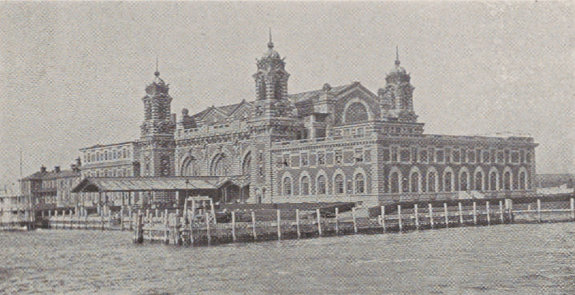
The center of the year's work has been Ellis Island, the great
home and foreign mission field, in area covering a few acres,
in influence compassing the entire world. Any one with
ability to "sense" a condition standing at Ellis Island feels
himself to be not at the "hub of the universe," but at the heart of
the world, through which are circulating the life currents of the
old world and the new. More than one-half of those coming to our
shores enter by this gateway. Here is the beginning of the preparation
of this great mass of humanity for the process of assimilation
into the American spirit and life.
The missionaries at Ellis Island adopted the plan of organization
approved by the Committee of Six, and appointed the committees
provided for. The operation of this plan has been very satisfactory
considering all that is involved. The Committees are organized and
reports from some of them are given in the following pages.
There are now twenty-five missionaries and workers representing
the Boards and Societies federated with the two Councils, and
other Societies cooperating in the work of federating the religious
forces in this branch of missionary service. The field of service
and the activities of the missionaries at Ellis Island is typical of
all Ports of Entry missionary work.
The field of this ministry is:
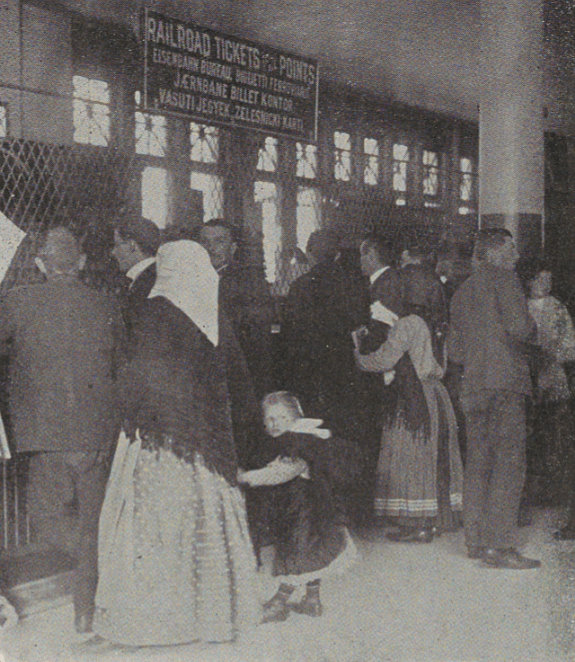
(a) The railroad rooms. Here quick work must be done. It is
just touch and go. The missionaries of our Societies, the American
Tract Society, the New York Bible Society, the Y. M. C. A., Y. W.
C. A., W. C. T. U., and kindred agencies do most excellent service.
(b) Among the detained Immigrants. This is a field of varied
service and is perhaps the place of greatest opportunity for our missionaries
and is specifically their field.
(c) The hospital. This is a very important part of the work
for, and with, those who are detained. Of course, there is need of
temporal relief and comforts, but here especially there are times
when no one can minister except one who brings spiritual comfort
and the cheer of the love of God.
Missionary Activities
The missionaries at our Ports meet and aid representatives
of the following nationalities, viz.: English, Irish, Scotch,
Welsh, French, Swiss, German, Dutch, Belgian, Hebrews of
various nations, Swedish, Norwegian, Danish, Finnish, Italian,
Spanish, Portuguese, Austrian, Greek, Turkish, Armenian,
Bulgarian, Servian, Roumanian, Albanian, Hungarian, Bohemian,
Croatian, Slovenian, Ruthenian, Lithuanian, Russian, Polish, Mexican,
Cuban, and other West Indian, Panamanian, Venezuelan,
Columbian, Argentinian, Australian, Maltese, West African, Egyptian,
Syrian, Persian, Hindu, Chaldean, Chinese, Japanese, and
Korean,—in all, 52.
Visitors to Ellis Island often ask, "Just what do the missionaries
do?" The Rev. Eliot White, Port Chaplain of the Protestant
Episcopal City Mission Society, gives the following answer to this
query:
We meet those newly coming from the ocean steamers to Ellis
Island, and less frequently, second-cabin passengers at the docks.
We aid them through the Immigration Station in many ways, with
tickets, trunks and hand baggage, with food, sometimes getting
milk heated for a baby, or "minding" little children while parents
look for their trunks; telegraph or telephone to relatives or friends,
give information of many sorts, expediting the progress through
the day's ordeals of those fortunate enough to pass without
detention.
As for those who are detained and designated for "special
inquiry," our duties in their behalf are more complicated and often
difficult and sad. Appeals must be written in many cases. Where
the exclusion is mandatory, we have special opportunity for the
specifically pastoral and consolatory offices in presence of bitter
disappointment and sometimes heart-broken sorrow. Many are the
physical needs also, of the detained, and those to be deported;
indeed, the only limitation on service of this sort is the worker's
time and strength. There is clothing to supply for those sometimes
wretchedly clad, and even barefooted on the cold stone floors,
and there are errands to run for many a humble requirement. Then
there is the often sad office of messenger between the sick in the
immigrant hospital and their relatives detained on the main island,
and sometimes a burial to conduct when the entrance to the land
of hope has been shadowed by some dear one's death. For some
time after they have left Ellis Island, we maintain a "follow-up"
correspondence with many whom we meet.
Ellis Island Committees
1. Committee on Literature. Mr. Charles Carrol, Rev. G. J.
D'Anchise, Miss Martha Troeck, Miss Teresa Fransee.
2. Detained Immigrants. Rev. P. D. Vassileff, Miss A. E. Matthews,
Mrs. Athena Marmaroff.
3. Clothing and Supplies. Rev. P. H. Land, Mr. Marmaroff, Miss
Fransee, Miss Brys.
4. Hospitals. Miss Martha Troeck, Mrs. Tripp, Mr. D'Anchise.
5. Appeals. Rev. Eliot White, Rev. P. H. Land, Mr. Carbonetto,
Mrs. Conversano.
6. Follow-up Committee. Dr. Perry representing the Committee
of Six, Rev. P. D. Vassileff, Mrs. Conversano, Mrs. Tripp.
7. Religious Meetings and Entertainment. Mr. Charles Carrol,
Rev. P. H. Land, Rev. Eliot White, Rev. P. D. Vassileff, Mr.
Carbonetto, Mrs. Conversano, Miss Matthews, Miss Fransee.
The Literature Committee
I. Organization:
At a meeting held on June 29, 1915, the following resolutions
were adopted: (1) The general distribution in the Railroad rooms
should be left to the New York Bible Society and the American
Tract Society, except in cases where missionaries are especially
interested. (2) The present methods of distribution in hospitals
and detention rooms are approved. (3) The literature distributed
in general should be interdenominational and not of a proselyting
nature. (4) The New York Bible Society and the American Tract
Society are requested to supply missionaries with literature for
distribution in hospitals and detention rooms. (5) The Home
Missions Council is requested to supply special tracts for young
men and young women with advice for immigrants in general.
(6) The Home Missions Council is requested to supply the
detained immigrants with daily papers, periodicals and if possible
with library books.
II. The Duty of the Committee:
(1) To see that the literature distributed is suitable. (2) If
special kind of literature is needed to outline its character. (3) To
see that immigrants, both outgoing and detained, are supplied with
needed literature. (4) To see that the literature distributed is
evangelical and undenominational.
III. Literature is Distributed:
(1) In the Railroad Rooms. (2) In the Detention Rooms,
where immigrants are detained in large numbers, sometimes for
months. (3) In the hospitals, where many immigrants are detained
and literature is most welcome.
Charles A. Carrol,
Chairman of the Committee.
The Clothing of the Immigrants
at Ellis Island, N. Y.
One of the most important items in the work of the missionaries
at Ellis Island is the work of providing suitable
clothing and shoes for the many aliens detained at the
Island. Only by strict adherence to certain principles can
the work be a real success. The first of these principles is: Never
give an alien that which is beneath his dignity to wear or to use.
This may sound strange, but is nevertheless very important. All
the aliens, except stowaways and warrant cases, bring their wearing
apparel with them. Stowaways are as a rule not very particular.
Warrant cases, since they have been in this country and
know how to dress, are quite particular. The average alien will
not look with favor upon any person who offers him a garment
which is worn out, or which he would be ashamed to wear
at home. There are other difficulties. Some of the aliens will not
accept for instance an old lady's overcoat which was worn 20 years
ago. Of such we receive quite an overwhelming number. Others
cling strongly to their home fashions and will only accept such
things as in some manner correspond to their accustomed styles.
The second principle is: to give only to the really needy. Caution
is necessary. Some immigrants are greedy, they accept everything
which is offered, put it into their hampers, and keep on wearing
their old worn-out duds in the hope of receiving still more gifts.
Another principle is to try and fit the alien as well as possible. If
the coat or shoes fit him, he will wear them with pleasure and will
not feel ridiculous among his fellows.
Another principle is to study the social training and tastes of
the immigrants and if they need clothes give such things as will
make their appearance more respectable. One of the purposes of
the clothes department is: to have the alien appear before the
Board of Special Inquiry as neat and respectable looking as possible,
so that he may be judged as he would look under ordinary
circumstances, not as he arrives after a lengthy trip in the steerage.
Another principle is: not to overlap. Where there is a number of
missionaries there is always the danger of overlapping in the distribution
of gifts.
At Ellis Island a clothes room of moderate proportions is in
use. It is divided into sections, and clothes are kept separately
for men, women, and children. Shoes and other things have their
proper places. A great deal of valuable time is consumed in sorting
out the things which are utterly unfit to give away. We cannot
insist too strongly upon the necessity of not sending things
which are useless, worn out, or ridiculous. The average alien has
a great deal more knowledge and taste than he is credited with by
the donors in various churches. Shoes and clothes ought to be at
least in good repair. It would be far better to send fewer and
better things, than to send great boxes of indifferent material.
The greatest needs. Underwear, suitable to the season of year,
shoes of large proportions, men's overcoats, socks and stockings
for all, infants' outfits for the newly born, and children's clothes are
always welcome and appreciated. Also a lot of other things seldom
received, garters, suspenders, toilet articles, such as combs,
finecombs, shaving mugs, brushes, etc. All these things are needed
every day. The most essential principle of all this work, however,
is for the missionary to put heart into it, and not to let the recipient
feel that the work is done perfunctorily or with aversion. The
missionary sometimes must even show how to make use of the gift
and must see to it that the clothes are actually worn, etc. It is a
blessed work if properly done.
Rev. P. H. Land,
Chairman of the Committee.
Missionary Work in the Immigrant Hospital,
Ellis Island
The daily visits of the missionaries in the hospital wards on
Ellis Island have proved a great blessing and a help to the
immigrants. We are also in various ways helpful to the
doctors and nurses in their attentions to the patients, and
very often act as an interpreter. The missionaries are particularly
responsible for those people in whose languages they are able to
converse. They visit these daily, if possible or advisable, but they
also pay attention by little gifts and sympathy to the other patients
in the ward, and by doing so become friends to everybody. Our
first object in visiting new arrivals is to let them know that the
relatives who traveled with them on the same ship are waiting
for them in the large Immigration Detention Rooms and will not
leave before the sick one is discharged from the hospital. This is
always welcome news, for most all the poor, helpless patients seem
to be under the impression that their friends have left them when
separated from them by the doctors. After a little explanation
and comforting words, we leave (if advisable) some good literature
with them and promise soon to call again and bring greetings
from their loved ones. As they see us talking to other patients,
they find confidence and take courage among the strangers, and
wait anxiously our return. We visit all the wards in the hospital
except the contagious hospital, where the missionaries are allowed
only by special permission from the Superintendent or doctors.
The missionaries are called upon to supply the patients with the
most necessary articles of clothing to those discharged from the
hospital, and also to supply many children and adults with shoes
and stockings when under treatment for trachoma or any other
disease, which does not confine the patients to the bed. They furnish
the outfit for new-born infants for which the mothers had no
chance to provide, or were too poor to do so. We bring tags, picture
books, dolls and other little gifts to the sick and lonesome
children. To the adults we carry newspapers and magazines in different
languages, books, gospels and tracts. On Christmas we
place trees in the different wards and give appropriate presents to
all the patients. The missionaries communicate with the relatives
or friends of the sick aliens. In case of death they assist in every
way possible. Pastors often officiate at the funeral services.
Martha M. Troeck,
Chairman of Hospital Committee.
Committee on Appeals and Petitions
When a case is excluded at Ellis Island an appeal is
allowed to the Secretary of Labor in Washington, as a
higher "court," except when the exclusion is because of
certain contagious disease, mental inferiority and the
like.
The missionaries at Ellis Island not infrequently write the
appeals, endeavoring to bring out points in the cases which
strengthen the appellants' cause.
They also make petitions for hospital treatment for such unappealable
cases as sufferers from trachoma, hookworm, etc. This
treatment, if allowed by the Secretary of Labor, is at the expense
of the aliens' relatives. If the afflicted person is cured, he or she
is, if otherwise eligible to land, admitted to the country.
Eliot White,
For the Committee.
In the complete working out of this plan the proper method
will be for any missionary wishing to file an appeal, to confer with
this Committee, and especially so before making an appeal to the
Secretary of Labor in Washington. In some instances at least,
this will be a protection for the missionary against unwise petitions
of friends and relatives.
Follow-up Committee
This Committee is to be the connecting link between the
Ports of Entry and the inland work. The missionaries fill
out blanks, giving the name and destination of the arriving
immigrant. These blanks are given to the Follow-up Committee
and duplicates with a letter are forwarded to a pastor or
worker in the place of the immigrant's destination with a request
that the family be visited, and a reply sent on the postal card
enclosed with the letter. In this short period 198 names
have been forwarded. It is, however, too soon to measure the
value of this work.
Mrs. Marie Conversano,
For the Committee.
The effectiveness of the work of this Committee necessitates
having a list of pastors and workers in the entire country. This
will be greatly simplified by the appointment of local interdenominational
committees such as have been appointed in several towns
and cities. It can be made a most important force in correlating
the work of the different Ports of Entry, and strengthening our
inland missionary work.
Committee of Religious Services
Commissioner Howe having given his consent to the
holding of Religious Services, five of these were conducted
in the spring and summer of 1915, under the auspices of
the missionaries representing the Congregational, Episcopal,
Lutheran, Methodist, and Presbyterian Churches.
At present the best available hour on Sundays (2.30 to 3.30
p.m.) is occupied usually by a concert, so that the services have
been somewhat interfered with. It is hoped, however, soon to meet
this difficulty.
E. White,
For the Committee.
This year frequently the missionaries have met once a week in
a prayer service. During the year weekly entertainments have
been given with a moving picture outfit provided by the Committee
of Six for the detained immigrants.
Other Societies Working at Ellis Island
The New York Bible Society
At Ellis Island our missionaries aim to make it possible for
each immigrant to obtain a copy of the Scriptures in his
own language. Mr. Jackson has been engaged in this work
for over thirty-six years.
Mr. Lodsin is familiar with the language and customs of the
Lettish, Russian, and Polish people.
At Ellis Island during the year 629 Bibles, 3,047 New Testaments,
and 27,510 portions of the Scriptures were distributed.
American Tract Society
During the current year at Ellis Island, the American
Tract Society has distributed Christian literature in twenty-nine
different languages, and a total of 150,270 volumes,
booklets, tracts and periodicals. The number of immigrants
visited totals 386,595.
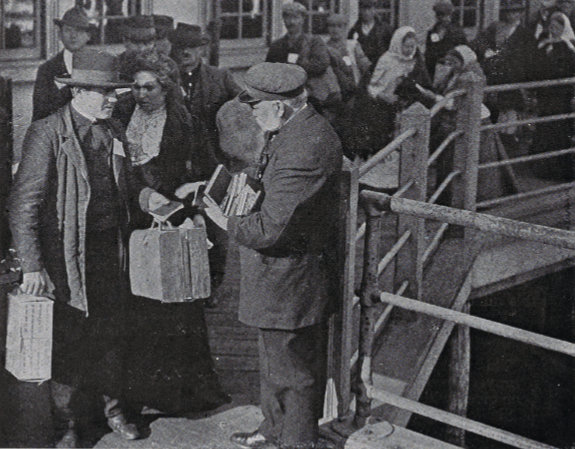
Mr. Ernest Jackson,
MISSIONARY OF THE NEW YORK BIBLE SOCIETY AT ELLIS ISLAND FOR
MORE THAN THIRTY-SIX YEARS
Young Men's Christian Association
Five port secretaries in America serve the thousands still
coming. In Ellis Island, during the year, 7,807 men were
helped; 4,302 were given introductions to inland Associations;
1,644 were tied up to relatives and friends, and 250
appeals were made in behalf of the detained. Similar services
were rendered men landing in New York, Philadelphia, Boston
and San Francisco. The Association has this year found exceptional
opportunities for service among men who could neither land
nor leave. Port secretaries have assumed the responsibility of
landing many of these people, found them employment, and reported
regularly to the Immigration Commissioner concerning
them.
The Young Women's Christian Association have two workers,
one for the New York branch office, and one for the national office.
These are not engaged in strictly missionary work. The New
York branch frequently sends some of its foreign-speaking workers
to Ellis Island for special services. Plans for still greater
national and international service may be formulated and adopted.
The W. C. T. U.
Mrs. Athena Marmaroff, missionary at Ellis Island,
is under appointment by the National W. C. T. U., though
the administration of the work is placed in the hands of
New York State. Mrs. Marmaroff was educated at a Congregational
Mission School in Monastir, Turkey. She speaks all
the languages of the Balkan States.
Mrs. Marmaroff works among Greeks, Roumanians, Bulgarians,
Montenegrins and immigrants from other Balkan States. Her
work is especially for women and children. During the month of
October, 1915, she gave out 3,500 tracts, 150 papers, one Bible,
nine Testaments, and 65 Gospels.
The various Hebrew Societies are excellently organized for
doing most effective service.
The Report of Committee on United States
Immigration Stations
To the Board of Directors of the Hebrew Sheltering and Immigrant
Aid Society of America:
Your Committee is, under our Constitution, in "charge of all
matters pertaining to the relation of the Society with the Federal
Immigration authorities" and "the work of the Society at the various
Immigration Stations."
Accordingly we have during the year kept in close touch, not
only with our Ellis Island Bureau but also with the work at the
Immigration Stations of Boston, Philadelphia and Baltimore, conducted
by our affiliated organizations at those ports.
The bond of harmony which now exists between the workers at
the various ports has been firmly cemented during the year, a
fact which has resulted in great benefit to the Jewish Immigrants
who sought admission at these ports.
Societies at Work at Ellis Island
From the point of view of effecting some definitely organized
plan of cooperation among the various agencies at work
at Ellis Island, these agencies fall into four groups:
1. National and Philanthropic Societies: Of which
there are eleven, accredited with ten missionaries. These include
such societies as the Polish National Alliance, the Slavonic Immigrant
Society, the Travelers' Aid Society, the Austrian Society of
New York, etc.
2. Jewish Societies: Three accredited with three workers.
The burden of this work falls upon the Hebrew Sheltering and Aid
Society, which has six regular workers.
3. Catholic Societies: Of which there are four, accredited
with eight workers, including five priests. Italian immigrants are
particularly cared for under this group by the St. Rafael's Society.
4. Protestant Christian Agencies:
- Women's Baptist Home Mission Society
- Missionaries: Miss Martha M. Troeck
- Mrs. Marie C. Conversano
- Congregational Home Missionary Society
- Missionary: Rev. P. D. Vassileff
- New York City Society of the Methodist Episcopal Church
- Missionary: Rev. Charles Samuelson
- Methodist Woman's Home Missionary Society
- Missionaries: Miss A. E. Mathews
- Immigrant Home: Miss Ellen Stenman
- Woman's Board of Home Missions, Presbyterian Church, U. S. A.
- Missionary: Miss Teresa Fransee
- Protestant Episcopal City Mission Society
- Missionaries: Rev. Elliot White
- Rev. G. J. D'Anchise
- Board of Domestic Missions of the Reformed Church in America
- Missionary: Rev. Sidney Zandstra
- Board of Home Missions, Reformed Church in the United States
- Missionary: Rev. P. H. Land
- The Lutheran Emigrant House Association (German) (Connected
with the Lutheran General Council), 21 Pearl Street, New
York City.
- Missionaries: Rev. Fritz O. Evers, Supt.
- Mr. Adolph Metshone
- Swedish Lutheran Immigrant Home (Connected with the Lutheran
General Council)
- 5 Water Street, Missionary Supt., Rev. Axel C. H. Helander.
- Danish Evangelical Lutheran Church in America (united)
- 410 Grand Avenue, Kenosha, Wis.
- Missionary: Rev. J. J. Kildsig
- 193 9th Street, Brooklyn
- Missionary: Rev. R. Andersen
- German Evangelical Lutheran Synod (Lutheran Immigrant Society)
- 8 State Street, New York City
- Missionary: Rev. C. H. Restin, Supt.
- Norwegian Lutheran Church of America, United
- Missionary: Rev. T. Aug. Tillehei
- Swedish Evangelical Mission Covenant of America
- Missionary: Rev. P. Peterson
- Young Men's Christian Association: The International Committee
- Workers: Rev. J. D. Marmaroff
- Mr. A. Carbonetto
- Young Women's Christian Association: National Board
- Miss Mabel Cratty, Gen'l Sec'y
- 600 Lexington Avenue, New York City
- Worker: Miss Adelaide Currie
- Women's Christian Temperance Union
- Worker: Mrs. Athena Marmaroff
- American Tract Society, New York City
- Missionary: Mr. Charles Carrol
- New York Bible Society
- Missionaries: Mr. Ernest Jackson
- Rev. Michael Lodsin

Christmas Celebration
for the Immigrants at Ellis Island, New York
Thursday, December 23, 1915
PROGRAMME
| Overture |
Salvation Army Band |
| 1. Hymn—"America" |
|
| 2. Invocation |
Rev. Dr. Elliot White |
| 3. Christmas Song |
Played by the Band |
| 4. Greeting |
Commissioner Howe |
| 5. Christmas Greeting (in Italian) |
Rev. J. Moretto |
| 6. Christmas Greeting (in Spanish) |
Rev. G. J. D'Anchise |
| 7. Song |
Polish Children's Choir |
| 8. Christmas Greeting (in Greek) |
Rev. J. D. Marmaroff |
| 9. Christmas Greeting (in Russian) |
Rev. P. D. Vassileff |
| 10. Song |
Bohemian Children's Choir |
| 11. Christmas Greeting (in Swedish) |
|
| 12. Duet |
Capt. Toft and Dr. Leidzen |
| 13. Christmas Greeting (in German) |
Rev. Paul Land |
| 14. Fantasie |
Played by Salvation Army Band |
| 15. Address (in English) |
Rev. Dr. C. P. Tinker |
| 16. Hymn—"All Hail the Power of Jesus' Name" |
|
| 17. Remarks and benediction by the chairman |
Rev. Paul Land |
| Doxology |
|