BOSTON AND NEW YORK
HOUGHTON MIFFLIN COMPANY The Riverside Press Cambridge
1916
COPYRIGHT, 1912, 1913, 1914, 1915, BY THE NORTH AMERICAN REVIEW
COPYRIGHT, 1915, BY THE SUWANEE REVIEW
COPYRIGHT, 1915, BY THE SOUTH ATLANTIC QUARTERLY
COPYRIGHT, 1916, BY GAMALIEL BRADFORD
ALL RIGHTS RESERVED
Published October 1916
TO
MY DAUGHTER
Out, hyperbolical fiend! talkest thou nothing but of ladies?
Twelfth Night.
PREFACE
The nine portraits contained in this volume are preliminary
studies or sketches for the series of portraits
of American women which will follow my Union portraits.
Such a collection of portraits of women will
certainly fill a most important section in the gallery
of historical likenesses selected from the whole of
American history, which it is my wish to complete, if
possible.
There is always a certain impertinence about a man’s
attempt to portray the characters of women. And this
impertinence is not got rid of by the charming, but not
wholly felicitous, epigraph of Sainte-Beuve’s Portraits
de Femmes: “Avez vous donc été femme, Monsieur, pour
prétendre ainsi nous connâitre?”—“Non, Madame, je
ne suis pas le devin Tirésias, je ne suis qu’un humble mortel
qui vous a beaucoup aimées.” There is, however, an
equal impertinence in trying to portray the characters
of men, indeed of anybody but one’s self, and though
this last undertaking is always delightful, it is apt to
lead to even more astonishing results than accompany
one’s attempts upon others. While endeavoring constantly
to strengthen and deepen the accuracy of my
portraits as regards mere fact, I yet become more and
more convinced that their value must be more in suggestion
and stimulation than in any reliable or final
presentment of character. Such presentments do not
exist.
The selection of portraits in this volume has grown
in a rather haphazard way. Although the types depicted
differ from one another, sometimes with marked
contrast, still, if I had planned the series deliberately
as a whole, I should have picked out figures more representative
of entirely different lines of life. A disadvantage,
much more marked in portraying women
than in portraying men, is the necessity of dealing with
exceptions rather than with average personages. The
psychographer must have abundant material, and usually
it is women who have lived exceptional lives that
leave such material behind them. The psychography
of queens and artists and authors and saints is little,
if any, more interesting, than that of your mother or
mine, or of the first shopgirl we meet. I would paint the
shopgirl’s portrait with the greatest pleasure, but the
material is lacking.
It will be noted, also, that none of these portraits
presents the modern woman. Eugénie de Guérin is the
latest in date and she is about as modern as Eve. The
projection of woman into the very middle of the stage
of active life, her participation on equal terms in almost
all the lines of man’s achievement, are effecting the
vastest social revolution since the appearance of Christianity.
The outcome of this revolution is something
no man—or woman—can foresee. But its most
obvious and perhaps principal effect is in moulding the
life, character, and habits of man. Woman already
dominates our manners, our morals, our literature, our
stage, our private finances. She proposes to dominate
our politics. And it is by no means sure that she will
not end by the subjugation of our intelligence. This
feminine supremacy obtains, if I am correctly informed,
in the kingdom of the spiders and also, according
to some seers, in the most advanced development
of the planetary worlds. While such a conquest must,
of course, to some extent, react upon the conqueror, it
seems probable that the fundamental instincts of the
feminine temperament are what they were a thousand,
or two thousand years ago, and that the new woman
remains the same old woman in a little different garb,
which propensity to a little different garb is the oldest
thing about her.
As I have already explained in the preface to “Union
Portraits,” the word “Portrait” is very unsatisfactory,
in spite of the high authority of Sainte-Beuve.
Analogies between different arts are always misleading
and this particular analogy is particularly objectionable.
Critics, otherwise kindly, have urged that a portrait
takes a man only at one special moment of his life
and may therefore be quite untrue to the larger lines
of his character. This is perfectly just, and the word
“psychographs” should be substituted for “portraits.”
Psychography aims at precisely the opposite of photography.
It seeks to extricate from the fleeting, shifting,
many-colored tissue of a man’s long life those habits of
action, usually known as qualities of character, which
are the slow product of inheritance and training, and
which, once formed at a comparatively early age, usually
alter little and that only by imperceptible degrees.
The art of psychography is to disentangle these habits
from the immaterial, inessential matter of biography,
to illustrate them by touches of speech and action that
are significant and by those only, and thus to burn
them into the attention of the reader, not by any
means as a final or unchangeable verdict, but as something
that cannot be changed without vigorous thinking
on the part of the reader himself.
But “Psychographs of Women,” on the back of a
book, is as yet rather startling for the publisher, for
the purchaser, and even for me.
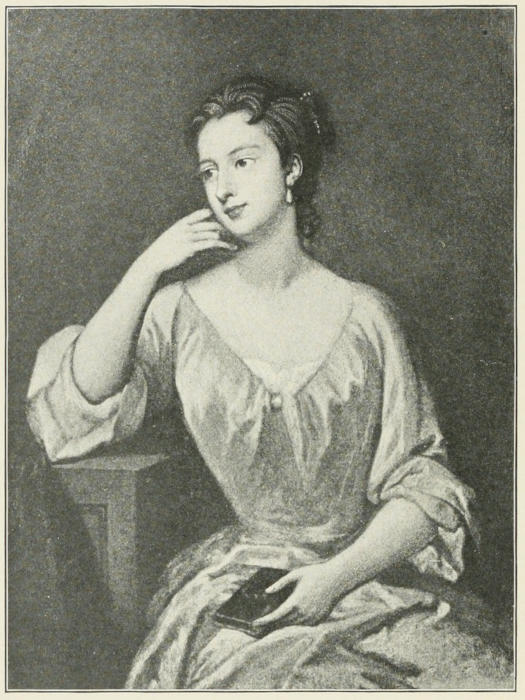
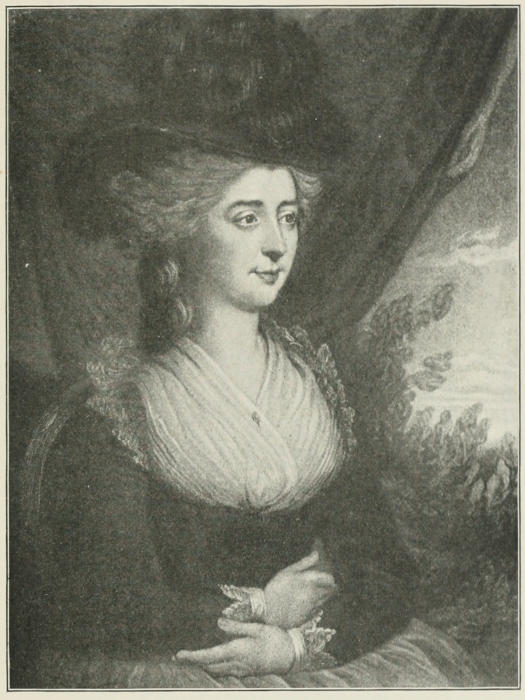
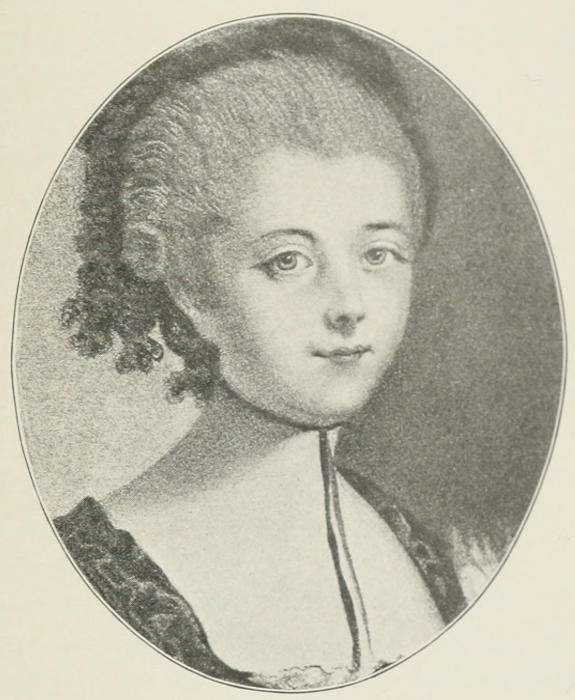
From a photogravure in Le Duc et la Duchesse de
Choiseul, by Gaston Maugras, after a portrait owned by the Comte
de Ludre
PORTRAITS OF WOMEN — I Lady Mary Wortley Montagu — CHRONOLOGY — I LADY MARY WORTLEY MONTAGU
Lady Mary Pierrepont.
Born London, May 26, 1689.
Married Edward Wortley Montagu, August 16, 1712.
In Constantinople 1716-1718.
In Italy 1739-1761.
Husband died 1761.
Died London, August 21, 1762.
Lady Mary Wortley Montagu
Lady Mary Wortley Montagu (born Pierrepont)
wrote poems, essays, and translations of some note in
her own day, of none in ours. She also wrote letters
which can never die, letters less charming, indeed, than
Madame de Sévigné’s because the writer was less
charming, but full of light for the first half of the
eighteenth century and also for Lady Mary herself.
I do not refer so much to the celebrated letters from
Constantinople, because those were probably arranged
and edited for literary purposes, but to the general
correspondence, which throbs and vibrates and sparkles
like a live thing.
The writer knew quite well what she was doing.
Speaking of Madame de Sévigné’s productions she
says: “Mine will be full as entertaining forty years
hence.” And, perhaps with a touch of jealousy not
wholly uncharacteristic, she depreciates her French
predecessor, “who only gives us, in a lively manner
and fashionable phrases, mean sentiments, vulgar
prejudices, and endless repetitions. Sometimes the
tittle-tattle of a fine lady, sometimes the tittle-tattle
of an old nurse, always tittle-tattle.” Those who find
the divine tittle-tattle of “Notre Dame des Rochers”
not only among the liveliest, but among the most
human and even the wisest, things in literature, will
not be the less ready to appreciate Lady Mary, who
has her own tittle-tattle as well as her own wisdom and
liveliness. How easy she is, how ready, and how graceful.
Her letters, she says, are “written with rapidity
and sent without reading over.” This may be true and
may not. At any rate, they have, at their best, the
freshness of first thoughts, the careless brilliancy of a
high-bred, keen-witted woman, talking in her own
parlor, indifferent to effect, yet naturally elegant, in
her speech, as in her dress and motion.
With what vivacity she touches everything and
everybody about her, “a certain sprightly folly that
(I thank God) I was born with” she calls it, but it is
only folly in the sense of making dull things gay and
sad things tolerable. See how she finds laughter in the
imminence of sea peril. An ancient English lady “had
bought a fine point head, which she was contriving to
conceal from the custom-house officers.... When the
wind grew high, and our little vessel cracked, she fell
heartily to her prayers, and thought wholly of her soul.
When it seemed to abate, she returned to the worldly
care of her head-dress, and addressed herself to me:
‘Dear madam, will you take care of this point? If it
should be lost!—Ah, Lord, we shall all be lost!—Lord
have mercy on my soul!—Pray, madam, take
care of this head-dress.’ This easy transition from her
soul to her head-dress, and the alternate agonies that
both gave her, made it hard to determine which she
thought of greatest value.”
In the constant imminence of life’s world perils Lady
Mary had still by her this resource of merriment, which
some call flippancy, but which, by any name, is not
without its comforts.
True, such a glib tongue or pen is a dangerous play-thing
and liable to abuse. Lady Mary’s own daughter
said that her mother was too apt to set down people of
a meek and gentle character for fools. People of any
character, perhaps, whenever the wayward fancy
struck her. She darted her shafts right and left. They
stung and they clung, for they were barbed, if not poisoned.
Sometimes they made near friends as cold as
strangers. Too often they turned indifferent strangers
into enemies. Enemies, too many, Lady Mary had all
her life, and they seized on her weak points and amplified
or invented ugly things about her till those who
admire her most find defence somewhat difficult.
Yet she did not gloat over evil. “’Tis always a
mortification to me to observe there is no perfection in
humanity.” Her unkindness was far more on her
tongue than in her heart. “This I know, that revenge
has so few joys for me, I shall never lose so much time
as to undertake it.” She had the keenest sense of
human sorrow and suffering: “I think nothing so terrible
as objects of misery, except one had the God-like
attribute of being able to redress them.” What she
could do to redress them she did. In her efforts to
introduce inoculation for smallpox she surely proved
herself one of the greatest benefactors of humanity.
In many smaller things, also, she was kindly and sympathetic.
And what pleases me most is that she makes
little mention of such deeds herself. One is left to divine
them from curt, half-sarcastic remarks in other connections.
Thus, during her long residence in Italy, it
appears that she ministered to her neighbors both in
body and soul. “I do what good I am able in the village
round me, which is a very large one; and have
had so much success, that I am thought a great physician,
and should be esteemed a saint if I went to mass.”
Later she had much ado to keep the people from erecting
a statue to her. But she shrank from love in Italy
which was sure to breed laughter in England.
Also, even in her bursts of ill-nature, she had a certain
reserve, a certain control, a certain sobriety. Indeed,
she compliments herself, in old age, on her freedom
from petulance. “To say truth, I think myself an
uncommon kind of creature, being an old woman without
superstition, peevishness, or censoriousness.” This
is, perhaps, more than we could say for her. But in
youth and age both she loved moderation and shunned
excess. When she was twenty-three, she wrote, “I
would throw off all partiality and passion, and be calm
in my opinion.” She threw them off too much, she was
too calm, she was cold. Walpole called her letters too
womanish, but Lady Craven thought they must have
been written by a man. Most readers will agree with
Lady Craven. Even her vivacity lacks warmth. And
it is here that she most falls short of the golden sunshine
of Madame de Sévigné. Lady Mary is not quite
the woman, even in her malice. Through her wit,
through her thought, through her comment on life,
even through her human relations runs a strain of
something that was masculine.
Nowhere is this more curious and amusing than in
her love and marriage. She was beautiful, and knew it,
though the smallpox, by depriving her of eyelashes,
had given a certain staring boldness to her eyes. When
she was over thirty, she “led up a ball” and “believed
in her conscience she made one of the best figures
there.” When she was old, for all her philosophy, she
did not look in a glass for eleven years. “The last
reflexion I saw there was so disagreeable, I resolved to
spare myself such mortifications for the future.”
She fed her youthful fancy with the vast fictions
then in fashion and the result was a romantic head and
a cool heart. These appear alternately in her strange
correspondence with her lover and future husband,
Edward Wortley Montagu. When they first met, the
gentleman admired her learning—at fourteen! And
Latinity seems to have drawn them together quite as
much as love. There was a sister, Miss Anne Wortley,
and sisters are of great use on such occasions. Lady
Mary wrote to her in language of extravagant regard,
and Miss Wortley wrote back—at her brother’s dictation.
Then it became obviously simpler for the
lovers to write direct.
Obstacles arose. Mr. Wortley Montagu would make
no settlement on his wife. Lady Mary’s father would
not hear of a marriage without one, and hunted up
another suitor, rich—and unacceptable. There was
doubt, debate, delay—and then an elopement. Lady
Mary eloping! What elements of comedy! And her
letters make it so.
That she loved her lover as much as she could love is
evident. “My protestations of friendship are not like
other people’s, I never speak but what I mean, and
when I say I love, ’tis for ever.” “I am willing to
abandon all conversation but yours. If you please I
will never see another man. In short, I will part with
anything for you, but you. I will not have you a
month to lose you for the rest of my life.” “I would
die to be secure of your heart, though but for a moment.”
Yet this apparent passion is tempered with doubt
and reversal. She cannot make him happy, nor he her.
“I can esteem, I can be a friend, but I don’t know
whether I can love.” “You would be soon tired with
seeing every day the same thing.” No, it is all folly.
Cancel it, break it up, throw it over. Begin again, a
new life, a new world. She will write to him no more.
“I resolve against all correspondence of the kind; my
resolutions are seldom made, and never broken.”
This one is broken in a few days. Again she loves,
again she hopes. Everything shall be right, so far as
it lies with her. “If my opinion could sway, nothing
should displease you. Nobody ever was so disinterested
as I am.” And yet once more cold analysis
twitches her sleeve, murmurs in her ear. “You are the
first I ever had a correspondence with, and I thank
God I have done with it for all my life.” “When I
have no more to say to you, you will like me no longer.”
Then she blows the doubts away, makes her stolen
marriage, gives all to love, and in the very doing of it,
lets fall one word that shows the doubter more than
ever (italics mine): “I foresee all that will happen on
this occasion. I shall incense my family in the highest
degree. The generality of the world will blame my
conduct ...; yet, ’tis possible, you may recompence
everything to me.” How two little words will show a
heart!
And afterwards? She fared pretty much as she
expected. Love hardened into marriage with some,
not unusual, hours of agony. “I cannot forbear any
longer telling you, I think you use me very unkindly.”
When he fails to write to her, she cries for two hours.
Then all becomes domestic, and decorous, and as it
should be; and her matured opinion of marriage agrees
very well with the previsions of her youth. “Where
are people matched? I suppose we shall all come right
in Heaven; as in a country dance, the hands are
strangely given and taken, while they are in motion,
at last all meet their partners when the jig is done.”
Perhaps because she showed no great conjugal affection,
there was plenty of gossip about affection less
legitimate. Pope lavished rhetorical devotion on her.
She laughed at it and, I fear, at him. In consequence
he lampooned her with the savage spite of an eighteenth-century
poet. She said unkind things about Sir
Robert Walpole and Sir Robert’s son said unkind
things about her, mentioned some lovers by name, and
implied many others. Lady Mary’s careful editors
have dealt with these slanders most painstakingly; and
though in one case, that of an Italian adventure, they
have overlooked a passage in Sir Horace Mann’s letters
oddly confirmatory of Walpole, I think they have
cleared their heroine with entire success.
After all, Lady Mary’s best defense against scandal
is her own temperament and her own words. It is true,
those who have lived a wild life are often the first to
exclaim against it. But in this case the language bears
every mark of being prompted by observation rather
than experience. She says of the notorious Lady Vane:
“I think there is no rational creature that would not
prefer the life of the strictest Carmelite to the round of
hurry and misfortune she has gone through.”
Lady Mary’s long sojourn in Italy towards the close
of her life did much to increase suspicion in regard to
her relations with her husband. Her greatest admirers
have not been able to explain clearly why she wished
to exile herself in such a fashion. But the tone in
which, during the whole period, she writes both to Mr.
Wortley Montagu and of him, is absolutely incompatible
with any serious coldness between them. “My
most fervent wishes are for your health and happiness.”
And again: “I have never heard from her since, nor
from any other person in England, which gives me the
greatest uneasiness; but the most sensible part of it is
in regard of your health, which is truly and sincerely
the dearest concern I have in this world.”
Lady Mary had two children, and as a mother she is
very much what she is as a wife, reasonable, prudent,
devoted, but neither clinging nor adoring. She had,
indeed, a happy art of expressing maternal tenderness,
as of expressing everything, by which I do not imply
that her feelings were not sincere, but simply that they
were not very vital or very overwhelming. When she
sets out on her travels, she is heartbroken over the
perils and exposures for her son: “I have long learnt to
hold myself at nothing; but when I think of the fatigue
my poor infant must suffer, I have all a mother’s fondness
in my eyes, and all her tender passions in my
heart.” But her language about this same son, when
grown to manhood, is somewhat astounding. He was a
most extraordinary black sheep, wasted money, contracted
debts, gambled, liked evil occupations and
worse company, varied a multiplicity of wives with a
multiplicity of religions, was once in jail, and never
respectable. All this Lady Mary deplores, but she is
not driven to despair by it; on the contrary, she analyzes
his character to his father with singular cold soberness.
“It is very disagreeable to me to converse with
one from whom I do not expect to hear a word of truth,
and, who, I am very sure, will repeat many things
that never passed in our conversation.” Or, more generally,
“I suppose you are now convinced I have never
been mistaken in his character; which remains unchanged,
and what is yet worse, I think is unchangeable.
I never saw such a complication of folly and
falsity as in his letter to Mr. G.”
Her daughter, Lady Bute, she was fond of. “Your
happiness,” she writes to her, “was my first wish, and
the pursuit of all my actions, divested of all self-interest.”
Nevertheless, she lived contentedly without
seeing her for twenty years.
That Lady Mary was a good manager domestically
hardly admits of doubt; but I find no evidence that she
loved peculiarly feminine occupations, though she does
somewhere remark that she considers certain types of
learned ladies “much inferior to the plain sense of a
cook maid, who can make a good pudding and keep the
kitchen in good order.” Among her numerous benefactions
in Italy was the teaching of her neighbors how to
make bread and butter.
It is said that her servants loved her, not unnaturally,
if she carried out her own maxim: “The small
proportion of authority that has fallen to my share
(only over a few children and servants) has always
been a burden, ... and I believe every one finds it so
who acts from a maxim ... that whoever is under
my power is under my protection.” She was a natural
aristocrat, however, both socially and politically, and
any leveling tendencies that she may have cherished in
the ardor of youth, vanished entirely with years and
experience. “Was it possible for me to elevate anybody
from the station in which they were born, I now would
not do it: perhaps it is a rebellion against that Providence
that has placed them; all we ought to do is to
endeavour to make them easy in the rank assigned
them.” And elsewhere, in a much more elaborate passage,
she expresses herself with a deliberate haughtiness
of rank and privilege which has rarely been surpassed.
In her youth, she says, silly prejudice taught her that
she was to treat no one as an inferior. But she has
learned better and come to see that such a notion made
her “admit many familiar acquaintances, of which I
have heartily repented every one, and the greatest
examples I have known of honor and integrity have
been among those of the highest birth and fortunes.”
The English tendency to mingle classes and level distinctions
will, she believes, have some day fatal consequences.
How curious, in so keen a wit, the failure
to foresee that just this English social elasticity would
avert the terrible disaster which was to befall the neat
gradations of French order and system!
Lady Mary was not only practical in her household,
but in all the other common concerns of life. Few
women have pushed their husbands on in the world
with more vigorous energy than is shown in the letters
she writes to Mr. Wortley Montagu, urging him to
drop his diffidence and claim what he deserves. “No
modest man ever did, or ever will, make his fortune.”
As regards money, also, she was eminently a woman
of business—too eminently, say her enemies. One
reason alleged for her quarrel with Pope is his well-meant
advice which brought her large losses in South
Sea speculation. However much one may like and
admire her, it is impossible wholly to explain away
Walpole’s picture of her sordid avarice, which cannot
be omitted, though hideous. “Lady Mary Wortley is
arrived; I have seen her; I think her avarice, her dirt,
and her vivacity are all increased. Her dress, like her
languages, is a galimatias of several countries, the
groundwork, rags; and the embroidery nastiness. She
wears no cap, no handkerchief, no gown, no petticoat,
no shoes. An old black-laced hood represents the first;
the fur of a horseman’s coat, which replaces the third,
serves for the second; a dimity petticoat is deputy, and
officiates for the fourth; and slippers act the part of the
last.”
It is easy to see here the brush of hatred deepening
the colors; but hatred can hardly have invented the
whole. Yet all the references to money matters in
Lady Mary’s letters are sane and commendable. She
hates poverty, and she hates extravagance as the road
to poverty, and she cherishes thrift as the assurance of
independence and comfort. That sort of lavish living
which is certain to end in suffering for self and others
she condemns bitterly. Will any one say she can condemn
it too bitterly? “He lives upon rapine—I mean
running in debt to poor people, who perhaps he will
never be able to pay.” But I do not find that she cherishes
money for itself. We should seek riches, she says,
but why? “As the world is, and will be, ’tis a sort of
duty to be rich, that it may be in one’s power to do
good, riches being another word for power.” With
which compare the remark of Gray, a man surely not
liable to the charge of avarice: “It is a striking thing
that one can’t only not live as one pleases, but where
and with whom one pleases, without money. Swift
somewhere says, that money is liberty; and I fear
money is friendship, too, and society, and almost every
external blessing. It is a great, though ill-natured,
comfort, to see most of those who have it in plenty,
without pleasure, without liberty, and without friends.”
Nevertheless, it must be admitted that in these questions
of conduct Lady Mary does not err on the side of
enthusiasm. In a long and curious passage she enlarges
on the virtues of her favorite model—Atticus, the
typical trimmer and opportunist, who lived in one of
the greatest crises of the world, and weathered it safe
and rich, who had many friends and served many and
betrayed none, but did not think any cause good
enough to die for.
As regards social life and general human relations, it
is very much the same. Lady Mary had vast acquaintance.
I do not find that she had many friends, either
dear or intimate. Of Lady Oxford she does, indeed,
always speak with deep affection. And she says of
herself, no doubt truly: “I have a constancy in my
nature that makes me always remember my old
friends.” Also her love of a snapping exchange of wit
made her appreciate conversation. “You know I have
ever been of opinion that a chosen conversation composed
of a few that one esteems is the greatest happiness
of life.” Yet she was too full of resources to need
people, too critical to love people, too little sympathetic
to pity people. And in one of the lightning sentences
of self-revelation she shows a temperament not
perfectly endowed by heaven for friendship: “I manage
my friends with such a strong yet with a gentle hand,
that they are both willing to do whatever I have a
mind to.”
But, if she did not love mankind, she found them
endlessly amusing, a perpetual food for observation and
curiosity. And the wandering life she led nourished
this taste to the fullest degree. “It was a violent transition
from your palace and company to be locked up all
day with my chambermaid, and sleep at night in a
hovel; but my whole life has been in the Pindaric
style.” It is this love of diversity, this keen sense of the
human in all its phases, which give zest to her Turkish
letters and the record of wanderings and hardships
which might not now be encountered in a journey to
the Pole. But long wanderings and strange faces are
not necessary for the naturalist of souls who can find
the ugliest weeds and tenderest flowers at his own front
door. Lady Mary was never tired of studying souls
and thought highly of her own discernment in them.
“I have seldom been mistaken in my first judgment of
those I thought it worth while to consider.” This confidence
I am sorry to find in her; for I have always
believed it a good rule that those who asserted their
sure judgment of men knew little about them. True
insight is more modest. At any rate, mistaken or not,
she found the varied spectacle of human action endlessly
diverting and again and again recurs to the
charm of it: “I endeavour upon this occasion to do as I
have hitherto done in all the odd turns of my life; turn
them, if I can, to my diversion.” “I own I enjoy vast
delight in the folly of mankind; and, God be praised,
that is an inexhaustible source of entertainment.”
Thus she could always amuse herself with men and
women. At the same time, she could amuse herself
without them and needed neither courtship nor cards
nor gossip to keep her heart at ease. It is true that in
youth she knew youth’s restlessness, and that haunting
dread, chronic to some souls, which fills one day with
anxiety as to what may fill the next. To Mrs. Hewet
she writes: “Be so good as never to read a letter of
mine but in one of those minutes when you are entirely
alone, weary of everything, and inquiète to think of
what you shall do next. All people who live in the
country must have some of those minutes.” But time
soothes this and makes the present seem so insufficient
that the poor shreds of life remaining can never quite
eke it out. “I have now lived almost seven years in a
stricter retirement than yours in the Isle of Bute, and
can assure you, I have never had half an hour heavy on
my hands, for want of something to do.”
Her country life did not, indeed, include much ecstasy
over the natural world. She was born too early
for Rousseau and it is doubtful whether high romance
could ever have seriously appealed to her. She finds
Venice a gay social centre. Of its poetry, its mystery,
its moonlight, never a word. Perhaps these did not
exist before Byron. On the Alps and their sublimity
she has as delightful a phrase as the whole eighteenth
century can furnish (italics mine): “The prodigious
prospect of mountains covered with eternal snow,
clouds hanging far below our feet, and the vast cascades
tumbling down the rocks with a confused roaring,
would have been solemnly entertaining to me, if I had
suffered less from the extreme cold that reigns here.”
If that is not Salvator Rosa in little, what is? I know
few things better, unless it be Ovid’s Nile jocose, gamesome
Nile.
No. Lady Mary’s nature, like that of most of her
contemporaries, was an artful invention of trim lawns,
boxed walks, shady alleys with a statue at the end or
a ruined temple on a turfy hill. Such gardens she liked
well enough to stroll in; but the garden that charmed
her most was the garden of her soul. “Whoever will
cultivate their own mind, will find full employment.
Every virtue does not only require great care in the
planting, but as much daily solicitude in cherishing, as
exotic fruits and flowers.... Add to this the search
after knowledge (every branch of which is entertaining),
and the longest life is too short for the pursuit of
it.”
In that pursuit she never tired, from her early youth
to her latest years. Indeed, among her contemporaries
she had the reputation of a learning as masculine as
some of her other tastes and habits. Here rumor probably
exaggerated, as usual. She herself, in her many
curious and interesting references to her education,
disclaims anything of the sort. She was a bright, quick
child, left to herself, with a passion for reading and
many books accessible. She learned Latin, French,
and Italian, and used them, but rather as a reader
than as a scholar. Systematic intellectual training she
could hardly have had or desired, merely that passionate
delight in the things of the mind which is one of the
greatest blessings that can be bestowed upon a human
being. “If,” she says of her granddaughter, “she has
the same inclination (I should say passion) for learning
that I was born with, history, geography, and philosophy
will furnish her materials to pass away cheerfully
a longer life than is allotted to mortals.”
She had, however, little disposition to brag of her acquirements.
On the contrary, it is singular with what
insistence, bitterness almost, she urges that a woman
should never, never allow herself to be thought wiser
or more studious than her kind. Read, if you please;
think, if you please; but keep it to yourself. Otherwise
women will laugh at you and men avoid you. “I
never studied anything in my life, and have always (at
least from fifteen) thought the reputation of learning
a misfortune to a woman.” And again, of her granddaughter,
with a sharp tang that hints at many sad
experiences, “The second caution to be given her is
to conceal whatever learning she attains, with as much
solicitude as she would hide crookedness or lameness;
the parade of it can only serve to draw on her the envy,
and consequently the most inveterate hatred, of all he
and she fools, which will certainly be at least three
parts in four of all her acquaintance.”
It is in this spirit that Lady Mary speaks very slightingly
of her own poems and other writings; and indeed,
they do not deserve much better. For us they are
chiefly significant as emphasizing, in their coarseness
and in some other peculiarities, that masculine strain
which has been so apparent in many sides of her
interesting personality.
As a critic she is more fruitful than as an author, and
her remarks on contemporary writers have a singular
vigor and independence. Johnson she recommends for
the idle and ignorant. “Such gentle readers may be
improved by a moral hint, which, though repeated
over and over from generation to generation, they
never heard in their lives.” Fielding and Smollett she
adores—again the man’s taste, you see. On Clarissa
she is charming. The man in her disapproves, derides.
The woman weeps, “like any milkmaid of sixteen over
the ballad of the Lady’s Fall.” But weeping, or laughing,
or yawning, she reads, reads, reads. For she is a
true lover of books. And she thus delightfully amplifies
Montesquieu’s delightful eulogy, “Je n’ai jamais eu de
chagrin qu’une demi-heure de lecture ne pouvait dissiper.”
“I wish your daughters to resemble me in nothing but
the love of reading, knowing, by experience, how far it
is capable of softening the cruellest accidents of life;
even the happiest cannot be passed over without many
uneasy hours; and there is no remedy so easy as books,
which, if they do not give cheerfulness, at least restore
quiet to the most troubled mind. Those that fly to
cards or company for relief, generally find they only
exchange one misfortune for another.”
It must be by this time manifest that in the things of
the spirit Lady Mary was as masculine and as stoical as
in things of the flesh. In very early youth she translated
Epictetus and he stood by her to the grave.
Life has its vexations and many of them. People fret
and torment, till even her equanimity sometimes gives
way. “I am sick with vexation.” But, in general, she
surmounts or forgets, now with an unpleasant, haughty
fling of cynical scorn, “For my part, as it is my established
opinion that this globe of ours is no better than
a Holland cheese, and the walkers about in it mites, I
possess my mind in patience, let what will happen; and
should feel tolerably easy, though a great rat came and
ate half of it up;” now, as in her very last years, with a
gentler reminiscence of her heroic teacher: “In this
world much must be suffered, and we ought all to follow
the rule of Epictetus, ‘Bear and forbear.’”
As for nerves, vapors, melancholy, she has little experience
of such feminine weakness, and no patience
with it. “Mutability of sublunary things is the only
melancholy reflection I have to make on my own account.”
She seldom makes any other. “Strictly speaking,
there is but one real evil—I mean acute pain; all
other complaints are so considerably diminished by
time, that it is plain the grief of it is owing to our passion,
since the sensation of it vanishes when that is
over.” If by chance any little wrinkle shows itself, sigh
from some unknown despair, winter shadow of old age
and failing strength and falling friends, let us smother
it, strangle it, obliterate it, by a book, or a flower, or a
smile. In these matters habit is everything.
And what was God in Lady Mary’s life? Apparently,
little or nothing. As strangely little as in so
many eighteenth century lives. There is no rebellion,
no passionate debate of hope or doubt; simply, as it
seems, very little thought given to the subject. Religion
is a useful thing—for the million, oh, an excellent
thing, under any garb, in Turkey, in Italy, in England.
Respect it? Yes. Cherish it? Yes. Believe it? The
question is—well, an impertinent one. And if it be
said that there may have been a feeling that some
things were too sacred to be spoken about, let anyone
who can read Lady Mary’s letters through and retain
that idea, cling to it for his comfort.
No, she lived like a gentlewoman, I had almost said
like a gentleman, with a decent regard for the proprieties,
a fundamental instinct of duty, a fair share of
human charity, and an inexhaustible delight in the
fleeting shows of time. And she died as she had lived.
“Lady Mary Wortley, too, is departing,” says Horace
Walpole. “She brought over a cancer in her breast,
which she concealed till about six weeks ago. It burst
and there are no hopes of her. She behaves with great
fortitude, and says she has lived long enough.”
Altogether, not a winning figure, but a solid one,
who, with many oddities, treads earth firmly, and
makes life seem respectable, if not bewitching.
II Lady Holland — CHRONOLOGY — II LADY HOLLAND
Elizabeth Vassall
Born March 25, 1771.
Married Sir Godfrey Webster 1786.
Traveled abroad 1791-1796.
Divorced July 4, 1797.
Married Lord Holland July 6, 1797.
Lord Holland died 1840.
Died 1845.
Elizabeth, Lady Holland
The brilliant salons which have made so conspicuous
a figure in French social life have had few counterparts
in England. English women have perhaps influenced
politics and thought quite as powerfully as have their
French sisters. But in England the work has been done
through husbands or fathers or brothers, domestically,
not in an open social circle where wit glitters and ideas
clash.
One of the most notable exceptions to this rule was
the Holland House society during the first half of the
nineteenth century. Politically Holland House was a
Whig centre; but its hospitable doors were open to all
who talked or thought. Fox, Canning, Brougham,
Grey, Melbourne, John Russell, unbent there and discussed
great themes and little. Rogers mocked, Sydney
Smith laughed, Moore sang, Macaulay unwound his
memory, and Greville listened and recorded. Wordsworth
dropped a thought there, Talleyrand a witticism.
Irving brought over the America of the eighteenth
century, Ticknor of the nineteenth.
“It is the house of all Europe,” says Greville. “All
like it more or less; and whenever ... it shall come to
an end, a vacuum will be made in society which nothing
can supply. The world will suffer by the loss; and it
may be said with truth that it will ‘eclipse the gaiety of
nations.’” Macaulay adorned the theme with his ample
rhetoric: “Former guests will recollect how many
men who have guided the politics of Europe, who have
moved great assemblies by reason and eloquence, who
have put life into bronze or canvas, or who have left
to posterity things so written that it shall not willingly
let them die, were there mixed with all that was loveliest
and gayest in the society of the most splendid of
capitals. They will remember the peculiar character
which belonged to that circle, in which every talent
and accomplishment, every art and science, had its
place.... They will remember, above all, the grace,
and the kindness, far more admirable than grace, with
which the princely hospitality of that ancient mansion
was dispensed. They will remember the venerable and
benignant countenance and the cordial voice of him
who bade them welcome.... They will remember, too,
that he whose name they hold in reverence was not less
distinguished by the inflexible uprightness of his political
conduct than by his loving disposition and his winning
manners. They will remember that, in the last
lines which he traced, he expressed his joy that he had
done nothing unworthy of the friend of Fox and Grey;
and they will have reason to feel similar joy, if, in looking
back on many troubled years, they cannot accuse
themselves of having done anything unworthy of men
who were distinguished by the friendship of Lord
Holland.”
You will observe that little is said here of the mistress
of the house. As regards Lord Holland, it is instructive
to turn from Macaulay’s swelling periods to
the cool comment of Greville, who was neither a
rhetorician nor a cynic: “I doubt, from all I see,
whether anybody (except his own family, including
Allen) had really a very warm affection for Lord Holland,
and the reason probably is that he had none for
anybody.”
There was a mistress of the house and Macaulay
elsewhere has enough to say about her. It is quite
astonishing, the unanimity with which her guests combine
to slight her character and emphasize her defects.
Macaulay asserts, in the passage quoted above, that
“all that was loveliest and gayest” met at Holland
House. This is quite false; for few women went there.
Those who did had little good to say of their hostess.
In the early years before she married Lord Holland,
Miss Holroyd wrote of her: “If anybody ever offends
you so grievously that you do not recollect any punishment
bad enough for them, only wish them on a
party of pleasure with Lady Webster!... Everything
that was proposed she decidedly determined on a contrary
scheme, and as regularly altered her mind in a
few hours.” Long after, Fanny Kemble expresses herself
quite as bitterly: “The impression she made upon
me was so disagreeable that for a time it involved every
member of that dinner party in a halo of undistinguishable
dislike in my mind.”
When the women condemn, one expects the men to
praise. In this case they do not. All alike, in milder
or harsher terms, record her acts that crushed, her
speeches that stung. The gentle Moore takes Irving to
visit her. “Lady H. said, ‘What an uncouth hour to
come at,’ which alarmed me a little, but she was very
civil to him.” Rogers told Dyce that “when she wanted
to get rid of a fop, she would beg his pardon and ask
him to sit little further off, adding ‘there is something
on your handkerchief I do not quite like.’” She observed
to Rogers himself: “Your poetry is bad enough,
so pray be sparing of your prose.” And to Lord Porchester:
“I am sorry to hear you are going to publish a
poem. Can’t you suppress it?”
Also they paid her back in kind, with a vim which,
in gentlemen, as they all were, seems to imply immense
provocation. “My lady ... asked me how I could
write those vulgar verses the other day about Hunt,”
writes Moore. “Asked her in turn, why she should take
it for granted, if they were so vulgar, that it was I who
wrote them.” Croker records: “Lady Holland was
saying yesterday to her assembled coterie, ‘Why
should not Lord Holland be Secretary for Foreign
Affairs—why not as well as Lord Landsdowne for the
Home Department?’ Little Lord John Russell is said
to have replied, in his quiet way, ‘Why, they say,
Ma’am, that you open all Lord Holland’s letters, and
the Foreign Ministers might not like that.’” Rogers
was talking of beautiful hair. “Why, Rogers, only a
few years ago I had such a head of hair that I could
hide myself in it, and I’ve lost it all.” Rogers merely
answered, “What a pity!” “But with such a look and
tone,” says Fanny Kemble, “that an exultant giggle
ran round the table at her expense.” And the table was
her own! To Ticknor she said “That she believed New
England was originally colonized by convicts sent over
from the mother country. Mr. Ticknor replied that he
was not aware of it, but said he knew that some of the
Vassall family—ancestors of Lady Holland—had
settled early in Massachusetts.” Finally, there is the
almost incredible incident so vividly narrated by
Macaulay. “Lady Holland is in a most extraordinary
state. She came to Rogers’s, with Allen, in so bad a
humour that we were all forced to rally and make common
cause against her. There was not a person at
table to whom she was not rude; and none of us were
inclined to submit. Rogers sneered; Sydney made merciless
sport of her; Tom Moore looked excessively impertinent;
Bobus put her down with simple, straightforward
rudeness; and I treated her with what I meant
to be the coldest civility. Allen flew into a rage with us
all, and especially with Sydney, whose guffaws, as the
Scotch say, were indeed tremendous.”
One and all, they felt that the lady wished to domineer,
to rule over everything and everybody, and they
did not like it. “Now, Macaulay,” she would say, “we
have had enough of this. Give us something else.” At
a crowded table, when a late guest came: “Luttrell,
make room.” “It must be made,” murmured Luttrell;
“for it does not exist.” “The centurion did not keep
his soldiers in better order than she kept her guests,”
Macaulay writes. “It is to one, ‘Go,’ and he goeth;
and to another, ‘Do this,’ and it is done.” Some one
asked Lord Dudley why he did not go to Holland
House. He said that he did not choose to be tyrannized
over while he was eating his dinner.
Her friends thought she wished to regulate their
lives, especially to regulate them in the way that suited
her comfort and convenience. What could be more
remarkable than the scene Macaulay describes, when
she implored, ordered him to refuse his high appointment
in India? “I had a most extraordinary scene
with Lady Holland. If she had been as young and as
handsome as she was thirty years ago, she would have
turned my head. She was quite hysterical about my
going; paid me such compliments as I cannot repeat;
cried; raved; called me dear dear Macaulay. ‘You are
sacrificed to your family. I see it all. You are too good
to them. They are always making a tool of you; last
session about the slaves; and now sending you to
India.’ I always do my best to keep my temper with
Lady Holland for three reasons: because she is a woman;
because she is very unhappy in her health, and in
the circumstances of her position; and because she has
a real kindness for me. But at last she said something
about you. This was too much, and I was beginning to
answer her in a voice trembling with anger, when she
broke out again: ‘I beg your pardon. Pray forgive me,
dear Macaulay. I was very impertinent. I know you
will forgive me. Nobody has such a temper as you. I
said so to Allen only this morning. I am sure you will
bear with my weakness. I shall never see you again’;
and she cried, and I cooled; for it would have been to
very little purpose to be angry with her. I hear that it
is not to me alone that she runs on in this way. She
storms at the ministry for letting me go.”
And she was supposed to tyrannize over her household
as well as over her guests. The Allen referred to
above is a curious figure. Originally recommended to
Lord Holland as a traveling physician, he entered the
family and remained in it. He was an immense reader,
a careful student, and supplied many a Holland House
politician with the stuff of oratory. He had opinions of
his own, was a violent enemy of all religion, and was
gibingly known as “Lady Holland’s atheist.” He did
not hesitate to contradict his patroness and some even
assert that she was a little afraid of him. At any rate,
he was deeply attached to her, remained with her after
Lord Holland’s death, and suffered himself in practical
matters to be ordered about like a domestic poodle.
Moore records an interesting bit of mutual self-confession,
when Allen, after years of intimate contact with
the deepest thought and brightest wit in Europe, admitted
that to keep up conversation during these evenings
was “frequently a most heavy task and that if
he had followed his own taste and wishes he would long
since have given up that mode of life.” And Moore
himself adds that the “Holland House sort of existence,
though by far the best specimen of its kind going,
would appear to me, for any continuance, the most
wearisome of all forms of slavery.”
Even Lord Holland himself appeared to his observant
visitors to be subject to a domination at times
somewhat irksome. “A little after twelve my lady
retired and intimated that he ought to do so too,”
writes Moore; “but he begged hard for ten minutes
more.” Greville says that when some revivalists called
on Lord Holland, Lady Holland was with great difficulty
persuaded to allow him to go and receive them.
“At last she let him be wheeled in, but ordered Edgar
and Harold, the two pages, to post themselves outside
the door and rush in if they heard Lord Holland
scream.” On the great occasion of Macaulay’s going
to India, it is recorded that the good-natured husband
was goaded into a disciplinary outburst: “Don’t talk
such nonsense, my lady! What the devil! Can we tell
a gentleman who has a claim upon us that he must lose
his only chance for getting an independence in order
that he may come and talk to you in an evening?”
I repeat, it is a most curious thing to observe this
mob of illustrious and kindly gentlemen handing down
to posterity such unanimous abuse of a lady, who,
whatever her defects, had done them infinite courtesies.
And she is dead and cannot defend herself.
She left a journal, however, which Lord Ilchester has
lately edited. And few studies can be more delightful
than to turn from the picture painted of her by her
friends(?) to her intimate and faithful likeness of herself.
The tart, even the boisterous, tongue is indeed not
concealed, as when she told a political friend that “I
regretted he had not lived in the Middle Ages and given
his faith to orthodox points, as he would have made one
of the firmest pillars of the church, instead of being a
milk and water politician now.” But there are many
other things besides tartness and boisterousness.
Unfortunately the Journal stops before the great
days of Holland House began. What would we not
give for the lady’s account of those conversations with
Moore and Ticknor and Macaulay? What for portraits
of them and of others such as she well knew how
to draw? For her pen was no mean one. It could bite
and sting, could emphasize lights and shadows quite
as strongly as some of those that etched the figures at
her table and the scenes in her drawing-room. You may
meet such a type as the following any day in Italy; but
only an artist could so render it. “The old Marchesa
was also delightful, not to the eye, for she was hideous,
nor to the ear, for she squalled, nor to the nose, for
she was an Italian; yet, from her unbounded desire of
pleasing, the tout ensemble created more agreeable sensations
than many more accomplished could have inspired.”
Or match this with an English married couple:
“The first thing she did was to live apart from him,
and keep up a love correspondence with him; hence to
the world they appeared enamoured of one another.
She is a little mad, and parsimony is her chief turn.
She is good-natured and a little clever. Trevor has
no judgment and slender talents. His foibles are very
harmless and his whole life has been insipidly good. His
ridicules are a love of dress coats, volantes, and always
speaking French. Au reste, he is very like other people,
only better.” And, as will appear from these two, her
portraits, though satirical, are not all unkindly, or at
least she sweetens the bitterest of them with a touch of
human charity.
Just a few sketches she has of the great men who
afterwards became so widely identified with her,
enough to increase our ardent desire for more. Thus
the following of Wordsworth, interesting in every word
for both painter and painted, if somewhat astounding:
“Sent an invitation to Wordsworth, one of the Lake
poets, to come and dine, or visit us in the evening. He
came. He is much superior to his writings, and his conversation
is even beyond his abilities. I should almost
fear he is disposed to apply his talents more towards
making himself a vigorous conversationist in the style of
our friend Sharp, than to improve his style of composition....
He holds some opinions on picturesque subjects
with which I completely differ, especially as to the
effects produced by white houses on the sides of the
hills; to my taste they produce a cheerful effect. He, on
the contrary, would brown, or even black-work them;
he maintained his opinion with a considerable degree of
ingenuity.” With which compare the snub administered
by Henry Taylor, when she sneered at Wordsworth’s
poetry: “Let me beg you to believe, Lady
Holland, that this has not been the sort of thing to say
about Wordsworth’s poetry for the last ten years.”
But the Journal is far less interesting for its portraits
of others than for that of the lady herself, who is seen
there complete, and human, and not unlovely.
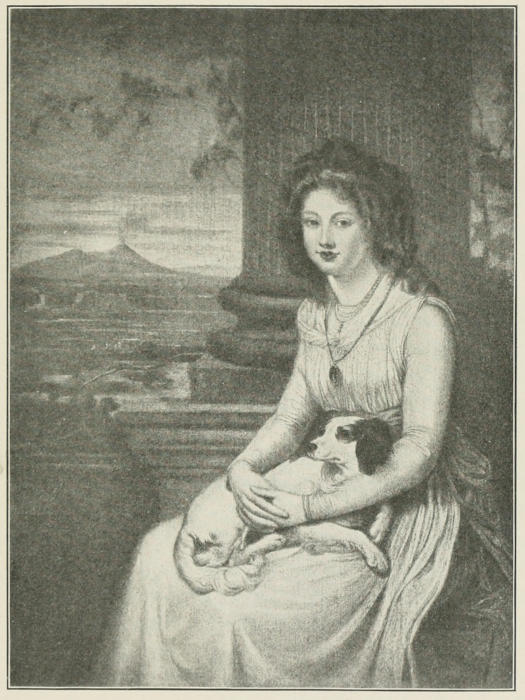
When she was young, she was beautiful. “I observed
a portrait of Lady Holland, painted some thirty
years ago,” says Macaulay. “I could have cried to see
the change. She must have been a most beautiful
woman.”
A mere child, she was married to a man she detested,
who perhaps deserved it. “At fifteen, through caprice
and folly, I was thrown into the power of one who was
a pompous coxcomb, with youth, beauty, and a good
disposition, all to be so squandered!” I imagine that
Sir Godfrey Webster was a rough English squire of the
Western type, fond of beef, beer, hunting, and rural
politics, fond also of his wife, after his fashion, but believing
that wives should bake, brew, and breed, and
utterly intolerant of my lady’s freaks and fancies, of
her social ambitions and her sentimental whims. To
her he appeared a simple brute. When he “in a paroxysm
threw the book I was reading at my head, after
having first torn it out of my hands,” I can divine
something of how he felt. So perhaps could she; but
the incident gave her all the gratification of martyrdom.
“Ah, me!” she writes, “what can please or cheer one
who has no hope of happiness in life? Solitude and
amusement from external objects is all I hope for; home
is the abyss of misery!” Condemned to the exile of a
country house, I am sorry to say that she revenged herself
by devising cruel tricks against her husband’s aunt,
who, however, was most apt at paying back. Later her
despair drove her nearly to suicide. “Oftentimes in the
gloom of midnight I feel a desire to curtail my grief,
and but for an unaccountable shudder that creeps over
me, ere this the deed of rashness would be executed. I
shall leave nothing behind that I can regret. My children
are yet too young to attach me to existence, and
Heaven knows I have no close, no tender ties besides.
Oh, pardon the audacity of the thought.”
Then Lord Holland appeared and her whole life was
altered. With such an early career and with a temper
so erratic one would hardly expect that an irregular
connection, even though legalized as soon as possible
by divorce and marriage, would turn out well. It did.
When she first meets her lover, he is “quite delightful.”
A number of years later she recognizes that life
with him has transformed her character. Every hour
she continues “to wonder [sic] and admire the most
wonderful union of benevolence, sense, and integrity in
the character of the excellent being whose faith is
pledged with mine. Either he has imparted some of his
goodness to me, or the example of his excellence has
drawn out the latent good I had—as certainly I am a
better person and a more useful member of society than
I was in my years of misery.”
Although she was still young and very beautiful, the
ardent suit of other lovers makes no impression on her.
She gets rid of them as best she can and consults her
husband as to the most effective manner of doing so.
Formerly life was hateful and she longed to be rid of
it. “In the bitterness of sorrow I prayed for death.
Now I am a coward indeed; a spasm terrifies me, and
every memento of the fragile tenure of my bliss strikes
a panic through my frame. Oh! my beloved friend, how
hast thou by becoming mine endeared the every day
occurrences of life! I shrink from nothing but the dread
of leaving or of losing thee.” In the lot of an acquaintance
who has lost her husband she bewails the most
terrible of future possibilities for herself. “How fortunate
for her should she never awaken to her wretchedness,
but die in the agonies of delirium. Oh! in mercy
let such be my close if I am doomed to the—oh! I
cannot with calmness suppose the case.”
It is in no cynical spirit, nor with any question of the
genuineness of these feelings, but simply as a comment
on the ways of this world, that I turn to a passage of
Greville, written three months after Lord Holland’s
death: “I dined with Lady Holland yesterday. Everything
there is exactly the same as it used to be, excepting
only the person of Lord Holland, who seems to be
pretty well forgotten. The same talk went merrily
round, the laugh rang loudly and frequently, and, but
for the black and the mob-cap of the lady, one might
have fancied he had never lived or had died half a century
ago.”
There has been some question as to whether Lady
Holland cared very much for her children by either
marriage. Certainly at her death she left her son only
two thousand pounds and a large income to a comparative
stranger. Yet at the time of her separation from
her first husband she sought passionately to retain her
daughter, even resorting to the strange and characteristic
device of pretending that the child was dead and
burying a kid in a coffin in her place.
The Journal, too, is full of passages that come
straight from the heart and absolutely prove a sincere,
if somewhat erratic maternal affection. I hardly know
a stranger mixture of passionate grief and curious self-analysis
than the following passage, written on occasion
of a child’s death. “There is a sensation in a
mother’s breast at the loss of an infant that partakes of
the feeling of instinct. It is a species of savage despair.
Alas! to lose my pretty infant, just beginning to prattle
his little innocent wishes, and imagination so busily aids
my grief by tracing what he might have been. In those
dreary nights whilst I sat watching his disturbed sleep,
I knelt down and poured out to God a fervent prayer
for his recovery, and swore that if he were spared me
the remainder of my life should be devoted to the exercise
of religious duties; that I would believe in the
mercy of a God who could listen to and alleviate my
woe. Had he lived I should have been a pious enthusiast.
I have no superstition in my nature, but from
what I then felt it is obvious how the mind may be
worked upon when weakened and perplexed by contending
passions of fear, hope, and terror.”
It is admitted that Lady Holland was an able housekeeper,
and Mr. Ellis Roberts even thinks that the
success of her salon was largely owing to the excellence
of her table. “It is true the parties were overcrowded,
but ... men do not much care how they eat, if what
they eat is to their liking.” It is admitted, also, that
she was most generous, kind, and thoughtful for her
servants. Yet the inveterate prejudice against her
manifests itself even here. “In this,” says Greville,
“probably selfish considerations principally moved her;
it was essential to her comfort to be diligently and zealously
served, and she secured by her conduct to them
their devoted attachment. It used often to be said in
joke that they were very much better off than her
guests.” Nevertheless, perhaps there are worse tests of
character than the devoted attachment of servants.
On Lady Holland’s intellectual and spiritual life
much curious light is thrown by her Journal, when
taken in connection with the comments of her friends.
Her wayward childhood, her early marriage, her utter
lack of systematic education must not be forgotten. “I
should be bien autre chose if I had been regularly taught.
I never had any method in my pursuits, and I was always
too greedy to follow a thing with any suite. Till
lately [age 26] I did not know the common principles
of grammar, and still a boy of ten years old would outdo
me.” Yet she was a wide, curious, and intelligent
reader, and remembered what she read, as when she
located one of Moore’s innumerable stories in an old
volume of Fabliaux.
She had her strong opinion on most general subjects.
In art she was distinctly of the eighteenth century, as
in her view of Wordsworth’s poetry, and her admiration
for Guido and the Bolognese painters. “‘St. Peter
weeping,’ by Guido, reckoned the first of his works and
the most faultless picture in Italy.” Nature sometimes
moved her deeply, however, as became a contemporary
of Byron and Chateaubriand: “The weather was delicious,
truly Italian, the night serene, with just enough
air to waft the fragrance of the orange-flower, then in
blossom. Through the leaves of the trees we caught
glimpses of the trembling moonbeams on the glassy
surface of the bay; all objects conspired to soothe my
mind and the sensations I felt were those of ecstatic
rapture. I was so happy that when I reached my bedroom,
I dismissed my maid, and sat up the whole night
looking from my window upon the sea.”
In religion she was more than liberal, in fact, had no
positive beliefs. “Oh, God! chance, nature, or whatever
thou art,” is the best she can do in the way of a
prayer, though she never encouraged sceptical talk at
her table and sometimes snubbed Allen sharply for it.
With irreligion went a strong touch of superstition, as
so often. “She would not set out on a journey of a
Friday for any consideration; dreadfully afraid of thunder,
etc.,” “was frightened out of her wits by hearing a
dog howl. She was sure that this portended her death,
or my lord’s.”
According to her critical guests she was pitifully
afraid of death always. “She was in a terrible taking
about the cholera,” writes Macaulay; “talked of nothing
else; refused to eat any ice, because somebody said that
ice was bad for the cholera.” And again, in regard to
the same disease: “Lady Holland apparently considers
the case so serious that she has taken her conscience out
of Allen’s keeping and put it into the hands of Charles
Grant.” At any rate, she was morbidly, almost ludicrously
anxious about her health; and she herself records
that in Spain she selfishly refused to let Allen
leave her when she was very ill to attend another invalid
friend who greatly needed him. Yet in view of
many other passages in her Journal, I cannot think that
she really lacked courage in the face of death or of anything
else. With her it is never possible to tell what is
serious and what is whim. Certain it is that her parting
scene was dignified, if not even noble: “She evinced
during her illness a very philosophical calmness and
resolution, and perfect good-humor, aware that she was
dying, and not afraid of death.”
In her main interest, she was preëminently a social
being. Greville says that she dreaded solitude above
everything, that she “could not live alone for a single
minute; she never was alone, and even in her moments
of greatest grief it was not in solitude but in society
that she sought her consolation.” Her Journal is, I
think, sufficient to prove that this is exaggerated. She
read and loved to read, and no true lover of books hates
solitude. Still she was social, loved men and women
and their talk and laughter, loved the sparkle of wit,
the snap of repartee, the long interchange of solid argument.
Nor was she too particular in the choice of her
associates. “There was no person of any position in the
world, no matter how frivolous and foolish, whose acquaintance
she was not eager to cultivate,” says Greville
again. Here, too, her Journal supplies a needed correction,
or at least sets things in a fairer and more
agreeable light: “A long acquaintance is with me a
passport to affection. This does not operate to exclusion
of new acquaintances, as I seek them with avidity.”
The “passport to affection” is generally recognized.
She was loyal in her affections and in her
admirations, though sometimes carrying them, like
everything else, to the point of oddity, as in her strange
worship of Napoleon.
That a person so fond of society should have shown
so little tact in it is one of the curious features of her
case. But some things throw an interesting light on her
brusqueness, her downright rudeness. Here is one brief
passage about a woman she met and liked. “If I were
to see much of her she might perhaps be benefited, for
as nobody can do more mischief to a woman than a
woman, so perhaps might one reverse the maxim and
say nobody can do more good. A little mild reproof and
disapprobation of some of her doctrines might possibly
rescue her from the gulf.” Does not that explain a host
of oddities, and pleasantly? Who of us likes to be rescued
from the gulf by a little mild reproof?
And the woman was nervous, sensitive, imaginative.
Society irritates such people even when it fascinates
them. Of one guest she writes: “His loud voice and
disgusting vanity displeased me so much that I fled for
refuge speedily into my own room.” Another bit of
most delicate analysis shows how easily the social disillusionment
of a sensitive organization might manifest
itself in tactless ill-humor. “There is some perverse
quality in the mind that seems to take an active pleasure
in destroying the amusement it promises to itself.
It never fails to baffle my expectations; so sure as I
propose to my imagination an agreeable conversation
with a person where past experience warrants the hope,
so sure am I disappointed. I feel it perpetually, for
example, with Dumont; with him I have passed very
many cheerful hours. This knowledge tempts me to
renew our walks, the consequence is we both yawn.”
So clear, so sure is it, that in all human relations the
true road to happiness and enjoyment is not to seek
them directly for one’s self.
The sense of power, of guiding and controlling others,
was doubtless a large element of Lady Holland’s social
instinct. “Her love and habit of domination were both
unbounded,” writes Greville. To achieve this, to govern
the sort of men that gathered about her, she knew that
she must study their pursuits. Hence she devoted herself
to the details of politics almost as sedulously as did
Greville himself. The minuteness of her Spanish Journals,
personally of little importance, in this respect, is
remarkable. Yet I know of few things more delightfully
feminine than her brief comment on ministerial
changes. Her friends go out of power, and she observes,
“The loss of all interest in public affairs was the natural
effect of the change of Administration to me.”
It is, I hope, by this time evident, that, whatever her
virtues or her defects, Lady Holland was an extraordinarily
interesting character. I have quoted from her
guests and friends much that was bitter. But a careful
search brings out also testimony all the more favorable
when we consider the extent of the abuse. Thus
Greville admits that “though often capricious and impertinent,
she was never out of temper, and bore with
good-humor and calmness the indignant and resentful
outbreaks which she sometimes provoked in others.”
And while asserting that “She was always intensely
selfish,” he adds in the next sentence that “To those
who were ill and suffering, to whom she could show any
personal kindness and attention, among her intimate
friends, she never failed to do so.” Sydney Smith writes
to her with a tenderness, an obviously genuine affection,
which would prove fine qualities in any woman: “I am
not always confident of your friendship for me at particular
times; but I have great confidence in it from one
end of the year to the other: above all, I am confident
that I have a great affection for you.” “I have heard
five hundred people assert that there is no such agreeable
house in Europe as Holland House: why should
you be the last person to be convinced of this and the
first to make it true?” “I love the Hollands so much
that I would go to them in any spot, however innocent,
sequestered and rural.” Finally, the most sympathetic,
as well as one of the shrewdest judgments, comes
from Sir Henry Holland, the physician, who had studied
Lady Holland in all her aspects perhaps as carefully
as any one. “In my long and intimate knowledge
of Lady Holland, I never knew her to desert an old
friend, whatever his condition might be. Many things
seemingly wilful and incongruous in her might be explained
through this happier quality of mind blended
with that love of power, which, fostered by various
circumstances, pervaded every part of her life....
Her manner of conversation at the dinner-table—sometimes
arbitrary and in rude arrest of others,
sometimes courteously inviting the subject—furnished
a study in itself. Every guest felt her presence,
and generally more or less succumbed to it. She was
acute in distinguishing between real and false merit,
and merciless in her treatment of the latter. Not a
woman of wit in words, she had what might well be
called consummate wit in all her relations to society.
Once only, and that very late in life, she spoke to me of
the labor she underwent in maintaining the position
thus acquired.”
May we not accept Greville’s dictum that she was a
very strange woman, adding that, after all, she played
her rôle of a great lady in not unseemly fashion? And
perhaps it was with some justice that on her deathbed
she spoke—most characteristically—of her life
“with considerable satisfaction, asserting that she had
done as much good and as little harm as she could
during her existence.”
III Miss Austen — CHRONOLOGY — III MISS AUSTEN
Jane Austen.
Born December 16, 1775.
Wrote “Pride and Prejudice,” 1796-1797.
“Sense and Sensibility,” published 1811.
“Pride and Prejudice,” published 1813.
“Mansfield Park,” published 1814.
“Emma,” published 1816.
Died July 18, 1817.
“Northanger Abbey” and “Persuasion,” published 1818.
Jane Austen
Jane Austen lived her brief life in two or three quiet
English towns. She had no adventures, no experiences,
no great fortunes or misfortunes. She began to do her
best writing when she was little more than a girl. She
left a few immortal works, surpassed by no others in
the painting of the human heart. What sort of woman
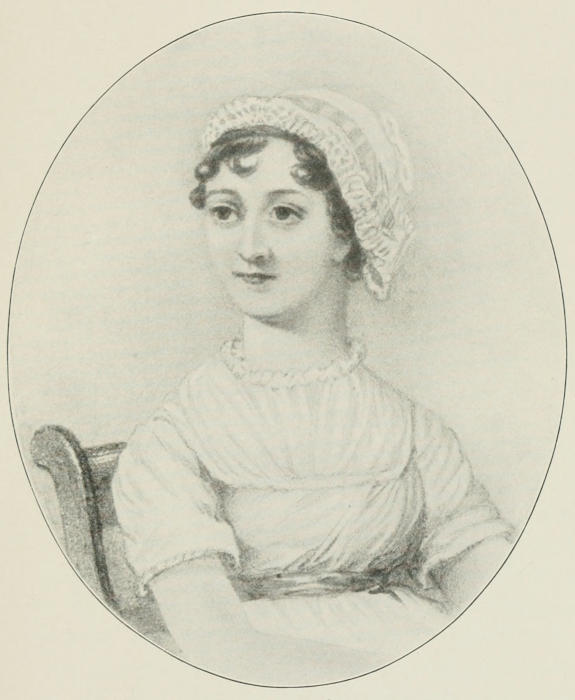
was she herself? Not very remarkable to look at, it
appears. Round, full cheeks—“for the most part,
they are foolish that are so,” Cleopatra tells us—bright,
hazel eyes, brown curls about her face. No
doubt, in every point a lady. But her soul?
At first sight, it seems that she laughed, mocked, at
all things, very gently and decorously, but still mocked.
“I dearly love a laugh,” says the heroine who surely
most resembles her creatress. And again it is said of
this same Elizabeth Bennett: “She had a lively, playful
disposition which delighted in anything ridiculous.”
Those who love Miss Austen best will recognize, far
beyond any testimony of quoted instances, this incessant,
pervading spirit of gentle mockery which appears
in all her books, courteous, infinitely well-bred, but
sometimes very far from amiable.
That she should mock at woman’s education was,
perhaps, at the beginning of the nineteenth century,
natural enough. But it would be hard to find any one
in any century who has mocked at it more cruelly.
“Where people wish to attach, they should always be
ignorant. To come with a well-informed mind is to
come with an inability of administering to the vanity
of others, which a sensible person would always wish
to avoid. A woman, especially, if she have the misfortune
of knowing anything, should conceal it as well as
she can.” Which was also the opinion of Lady Mary
Wortley Montagu, considered one of the most learned
women of her time. Now we have changed all that.
But if you suppose that Miss Austen wishes to contrast
with learning the sweets of domesticity, you are
far astray indeed. I do not know whether she read
La Rochefoucauld. She hardly needed to. In any case,
she well supports his dictum that there are comfortable
marriages, but no delicious ones. The motive of most
she lashes with her whip of silken scorn. “His temper
might perhaps be a little soured by finding, like many
others of his sex, that through some unaccountable
bias in favor of beauty, he was the husband of a very
silly woman.” Though she had a sister whom she
loved better than anything on earth, the kindest thing
she could find to say of two most affectionate sisters
was: “Among the merits and the happiness of Elinor
and Marianne, let it not be ranked as the least considerable,
that, though sisters, and living almost within
sight of each other, they could live without disagreement
between themselves, or producing coolness between
their husbands.”
Nor is she much more enthusiastic about the charms
of society. Her heroines do, indeed, love an outing or a
ball; but much more stress is laid on untoward accidents
that blight enjoyment than on its rapturous
completeness. And this is life, as we all know. Only—As
for the little distresses of social converse, who has
ever depicted them more subtly? “To Elizabeth it
appeared, that had her family made an agreement to
expose themselves as much as they could during the
evening, it would have been impossible for them to
play their parts with more spirit, or finer success.”
No one probably will maintain that Miss Austen
treats love very seriously. Its common youthful ardors,
“what is so often described as arising on a first interview
with its object, and even before two words have
been exchanged,” she makes matter for derision or dismisses
with indifference. Isabella utters a platitude on
the subject. “This charming sentiment, recommended
as much by sense as novelty, gave Catherine a most
pleasing remembrance of all the heroines of her acquaintance.”
With the author’s own serious heroines
love is an emotion of such reverend profundity that
the ladies themselves require years to discover it, and
even then it has to be forced upon their notice.
Religion and the deeper concerns of life generally,
where they are mentioned at all, fare no better. They
are touched with an irony of somewhat dubious effect
on the profane, as at the end of Northanger Abbey,
where those it may concern are left to wonder “Whether
the tendency of this work be altogether to recommend
parental tyranny, or reward filial disobedience.” There
is no doubt, however, that Miss Austen sincerely honored
sacred things. She would have said with her own
Elizabeth, “I hope I never ridicule what is wise or
good.” She appeared to think she would attain this
end by keeping matters of the soul mainly out of her
work. But she miscalculated a little. I do not know
how one could more discredit religion than by exhibiting
it in such representatives as Dr. Grant, Mr. Elton,
and Mr. Collins: a glutton, a ninny, and an imbecile.
If any reader holds that the prosy sermonizing of Edward
Bertram helps the divine end of the matter, I
disagree totally.
And as she mocked all things in human life, so she
had a peculiar fancy for mocking the departure out of
it. We know much mockable is there; but it seems odd
matter for a young girl to deal with. “It was felt as
such things must be felt. Everybody had a degree of
gravity and sorrow; tenderness toward the departed,
solicitude for the surviving friends; and, in a reasonable
time, curiosity to know where she would be buried.
Goldsmith tells us that when lovely woman stoops to
folly, she has nothing to do but to die; and when she
stoops to be disagreeable, it is equally to be recommended
as a clearer of ill-fame.”
Obviously Miss Austen’s mocking was not all sweet,
sunny, natural gaiety. It had too much ill-nature in it.
This shows, I think, in her fundamental conception of
character. Read over her list of dramatis personæ and
see how many are attractive or agreeable. It is not
that she presents set types of evil or folly. Far from it.
Her people are all human, vividly human, walking
figures of flesh and blood humanity. But like all true
human beings, they have good and evil both, and her
vision usually turns towards the evil, the mildly evil,
the foolish and ridiculous. This perversion is slight,
but constant, and its very slightness makes it more
true—and more depressing. What doubles the hideousness
of the hideous scene between Mr. and Mrs.
Dashwood (“Sense and Sensibility,” chapter II) is its
perfect humanity and the possibility that it might have
been you and I.
She will brand a whole company with a touch: they
“almost all labored under one or other of these disqualifications
for being agreeable—want of sense,
either natural or improved—want of elegance—want
of spirits—or want of temper.” As any company
might, to be sure—if you took it so. She will
brand a whole sex. Mr. Palmer had “no traits at all
unusual in his sex and time of life. He was nice in his
eating, uncertain in his hours; fond of his child, though
affecting to slight it; and idled away the morning
at billiards, which ought to have been devoted to
business.”
Above all, she is severe upon women past middle life.
Few indeed has she drawn that are even tolerable. Yet
I have known some who were charming. With what
infinite, subtle, loving art are Mrs. Jennings and Mrs.
Norris made odious! And the best illustration of all for
Miss Austen’s methods is Miss Bates. Her creatress
starts with a heroic determination to be amiable for
once. God has given this poor old specimen excellent
qualities. For heaven’s sake, let us dwell upon them
and leave the defects in shadow. “She was a happy
woman, and a woman whom no one named without
good will. It was her own universal good will and contented
temper which worked such wonders. She loved
everybody, was interested in everybody’s happiness,
quick-sighted to everybody’s merits.” Yet the turning
of a page makes Miss Bates ridiculous, and the turning
of more makes her almost as tedious to us as the author
evidently found her. In the end she drives even Emma
to open insult, which Emma speedily regrets, and
would probably as speedily renew.
But, it will be urged, I am making the old mistake of
interpreting an author from her writings, of transferring
to her the sentiments of her characters, or, at any
rate, her merely formal literary expression.
Very well, let us turn to Miss Austen’s letters, and
see what we find there. To begin with, they are charming
letters, full of life, spirit, and vivacity, quite as
charming as her novels. Her editors and biographers
seem to feel it necessary to apologize for them. Why?
It is true, they contain no reference to topics of the day.
She might never have heard of Napoleon, or known
that America was discovered. But, as letters, they are
none the worse for that. Also, they are not formally
literary, have no set pieces, or elaborate disquisitions.
There is hardly a general thought in the whole of them.
Who cares? They are literary as being the work of one
of the most exquisite masters of expression. Indeed, an
occasional odd glimpse of her constant literary preoccupation
slips out. “Benjamin Portal is here. How
charming that is! I do not know exactly why, but the
phrase followed so naturally that I could not help putting
it down.” And again: “Your letter is come. It
came, indeed, twelve lines ago, but I could not stop to
acknowledge it before, and I am glad it did not arrive
till I had completed my first sentence, because the
sentence had been made ever since yesterday, and I
think forms a very good beginning.” But, in general,
they are merely the swiftest, lightest chronicle of little
daily happenings, made eternal by a sense of fun as
keen as Lamb’s. Is there in Lamb any bit of happier
nonsense than the sketch of Mr. Haden? “You seem
to be under a mistake as to Mr. H. You call him an
apothecary. He is no apothecary; he has never been an
apothecary; there is not an apothecary in this neighbourhood....
He is a Haden, nothing but a Haden,
a sort of wonderful nondescript creature on two legs,
something between a man and an angel, but without
the least spice of an apothecary. He is, perhaps, the
only person not an apothecary hereabouts. He has
never sung to us. He will not sing without a pianoforte
accompaniment.”
Yet, minute as they are, and natural as they are,
Miss Austen’s letters tell us little about herself, that is,
the inmost self that we wish to get at. Those we have
were almost all written to her nearest and dearest sister,
Cassandra. To Cassandra, if to any one, she must
have opened her soul. But, if so, she did it by lip and
not by letter. It is rare indeed that she goes so far as to
say, “I am sick of myself and my bad pens.” To be
sure, such concealment of personal feeling and emotion
is a most significant trait of character. The gleam and
glitter of those sparkling pages with all their implication
and suggestion recalls the charming speech of Birnheim
to Fanny Lear, “Ce qui fait le charme de votre conversation,
ce n’est pas seulement ce que vous dites; c’est
encore et surtout ce que vous ne dites pas.” But when
we try to get any definite picture of the writer, she
eludes us like a kind of elfin spirit, in perpetual glimmering,
mazy dance, refusing to stand still.
At any rate, mockery is the prominent feature in the
letters, as in the novels; and in letters as in novels, the
mockery, though sometimes sunny and sweet, is too
often unkindly and leaves a sting. Miss Austen herself
once at least recognizes this. She describes a certain
person as “the sort of woman who gives me the idea of
being determined never to be well and who likes her
spasms and nervousness, and the consequence they
give her, better than anything else. This is an ill-natured
statement to send all over the Baltic.” Doubtless,
her modesty prevented her from thinking of the
ill-natured statements she was to send for ages all over
the world.
But let us see, again, with more minuteness how
completely she spins this gauze web of satire over every
phase of life. Is learning in question? “I think I may
boast myself to be, with all possible vanity, the most
unlearned and uninformed female who ever dared to be
an authoress.” Or is she discussing family relations?
“The possessor of one of the finest estates in England
and of more worthless nephews and nieces than any
other private man in the United Kingdom.” A prospective
marriage is summarily disposed of. Mr.
Blackall is “a piece of perfection—noisy perfection....
I could wish Miss Lewis to be of a silent turn and
rather ignorant, but naturally intelligent and wishing
to learn, fond of cold veal pies, green tea in the afternoon,
and a green window-blind at night.” Mrs.
Austen is disturbed by receiving an unamiable letter
from a relative. Miss Austen is not. “The discontentedness
of it shocked and surprised her—but I see
nothing in it out of nature.”
As to society she resembles her heroines in liking
balls, and, like her heroines, she finds many drawbacks
in them. “Our ball was chiefly made up of Jervoises
and Terrys, the former of whom were apt to be vulgar,
the latter to be noisy.... I had a very pleasant evening,
however, though you will probably find out that there
was no particular reason for it; but I do not think it
worth while to wait for enjoyment until there is some
real opportunity for it.” On beauty she comments
freely. “There were very few beauties, and such as
there were were not very handsome. Miss Iremonger
did not look well, and Mrs. Blount was the only one
much admired. She appeared exactly as she did in
September, with the same broad face, diamond bandeau,
white shoes, pink husband, and fat neck.” As in
this passage, she often refers to dress and too often unkindly.
“Mrs. Powlett was at once expensively and
nakedly dressed; we have had the satisfaction of estimating
her lace and her muslins; and she said too little
to afford us much other amusement.” In regard to
one special company she seems to express naïvely her
general attitude. “I cannot anyhow continue to find
people agreeable.”
More intimate social relations and the sacred name
of friendship are treated at least as lightly. “The
neighborhood have quite recovered the death of Mrs.
Rider; so much so, that I think they are rather rejoiced
at it now; her things were so very dear! And Mrs.
Rogers is to be all that is desirable. Not even death
itself can fix the friendships of the world.”
And love? Persons who mock at nothing else mock
at that. What should we expect, then, from the genius
of mockery? Whether she rallied her young men to
their faces, I do not know. Assuredly she rallied them
behind their backs. One evening she expects an offer,
but is determined to refuse, unless he promises to give
away his white coat. The next she makes over to a
friend all her love interest, even “the kiss which C.
Powlett wanted to give me,” everything except Tom
Lefroy, “for whom I don’t care sixpence.” And when,
writing to her niece in later years, she sketches the man
she might have loved, she ends by turning all into
laughter. “There are such beings in the world, perhaps
one in a thousand, as the creature you and I should
think perfection, where grace and spirit are united to
worth, where the manners are equal to the heart and
understanding, but such a person may not come in your
way, or, if he does, he may not be the eldest son of a
man of fortune, the near relation of your particular
friend and belonging to your own county.”
Also, as in the novels, she is perpetually laughing at
religion and virtue, that is, of course, at those elements
in religion and virtue which are undeniably laughable.
Morals and immorals she can treat lightly in individual
cases. “The little flaw of having a mistress now living
with him at Ashdown Park seems to be the only unpleasing
circumstance about him.” In their general
phases she can jumble them happily with physical disorders.
“What is become of all the shyness in the
world? Moral as well as natural diseases disappear in
the progress of time, and new ones take their place.
Shyness and the sweating sickness have given way to
confidence and paralytic complaints.” On death she
is inexhaustible. One would think she found it the
most humorous thing in life—as perhaps it is. With
what amiable, kid-gloved atrocity does she bury Mrs.
Holder. “Only think of Mrs. Holder’s being dead!
Poor woman, she has done the only thing in the world
she could possibly do to make one cease to abuse her.”
Apparently, even this supreme effort of Mrs. Holder’s
was not successful, in fact embalmed her in spiced
abuse forever. Other interments are quite as sympathetic
as hers.
Most curious of all is Miss Austen on the death of a
near relative, the trim decorum, the correct restraint,
the evident fear of being either over-conventional or
under-feeling. So in the first letter; but two days later
she rebounds and trifles with her mourning. “One Miss
Baker makes my gown and the other my bonnet, which
is to be silk covered with crape.” Well could she say of
herself, “I can lament in one sentence and laugh in the
next.” Only she immensely mistook the proportion.
One bare strong phrase takes us right to the root of
all the mocking and perversity. “Pictures of perfection,
as you know, make me sick and wicked.”
It is in this spirit that she makes fun even of her own
art, novel writing, will not take it seriously, “the art of
keeping lovers apart in five volumes,” will not take its
professors seriously. She mocks at their machinery,
their heroines, their landscape, their morals, and their
language, “novel slang,” she calls it, “thorough novel
slang, and so old that I daresay Adam met with it in
the first novel he opened.” Whatever pains she may
have taken with her own work, she does not mention
them, unless ironically, when some one praises her. “I
am looking about for a sentiment, an illustration, or a
metaphor in every corner of the room.” If money and
profit are suggested as possible objects, she laughs at
them. Fame is all she is thinking of. “I write only for
fame and without any view to pecuniary emolument.”
But when it is a question of glory, she laughs at that,
and toils instead for pounds and shillings. “Though I
like praise as well as anybody, I like what Edward calls
Pewter, too.” Yet at the getting of money, and at the
keeping of it, and at the spending of it, and at the lack
of it, still she laughs: “They will not come often, I dare
say. They live in a handsome style and are rich, and
she seemed to like to be rich, and we gave her to understand
that we were far from being so; she will soon feel,
therefore, that we are not worth her acquaintance.”
One subject only is too sacred for mocking—the
British navy. And even that seems sacred chiefly in
connection with the Austens; for Sir Walter Elliot is
allowed to say that all officers should be killed off after
forty because of their weatherbeaten complexion.
Miss Austen herself, however, appears to have been
possessed, like Louisa Musgrove, with “a fine naval
fervour,” which blossoms in Captain Wentworth’s
rapturous praise of his calling and fruits in the charming
conclusion of “Persuasion”: “She gloried in being
a sailor’s wife, but she must pay the tax of quick alarm
for belonging to that profession which is, if possible,
more distinguished in the domestic virtues than in its
national importance.” A sentiment which would have
delighted Sir Joseph Porter, K.C.B., though it would
have obliged Nelson to turn away his face.
So, are we to set down this demure, round-faced chit
of a parson’s daughter as one of the universal mockers,
der Geist der verneint in petticoats, a sister of Aristophanes
and Heine? It sounds ridiculous? How she
would have shrunk from Das Buch Le Grand and
shuddered with horror at Schnabelwopski! Yet would
she?
But her cynicism is more nearly related to Fielding
and Smollett and to the eighteenth century, that is, it
does not flow from Heine’s universal dissolution of all
things, but is founded on a secure basis of conventional
belief. Minds of that eighteenth-century type were so
confident of God that they felt entirely at liberty to
abuse man; “whatever is is right” said the “one infallible
Pope,” as Miss Austen styles him, therefore there
could be no harm in calling it wrong.
On the other hand, what separates Miss Austen from
Fielding, what brings her close to Heine, and what
almost, if not quite, makes up for all her mocking, is
that you feel underneath the mocking an infinite fund
of tenderness, a warm, loving, hoping, earnest heart.
Rarely has a woman been more misjudged by another
woman than Miss Austen by Miss Brontë when she
wrote,“Jane Austen was a complete and most sensible
lady, but a very incomplete and insensible woman.”
Oh, no, under that demure demeanor was hidden the
germ of every emotion known to woman or to man.
She knew them all, she felt them all, and she restrained
them all, which means quite as much character—if
perhaps not quite so much “temperament”—as the
volcanic flare of Charlotte Brontë. The very difficulty
of tracing these things under Miss Austen’s vigilant
reserve adds to their significance when found and to
the convincing force of their reality.
First, as to emotion in general. The testimony of the
novels is often disputed. It is disputable when it refers
to particular experiences and must be used with care.
But many little touches would have been absolutely
impossible, if the writer had not first felt them herself.
Thus, she says: “It is the misfortune of poetry to be
seldom safely enjoyed by those who enjoy it completely,
and the strong feelings which alone can estimate it
truly are the very feelings which ought to taste it but
sparingly.” Or again, with brief and rapid analysis,
“She read with an eagerness which hardly left her the
power of comprehension; and from impatience of knowing
what the next sentence might bring, was incapable
of attending to the sense of the one before her eyes.”
Do you suppose the writer of that had never torn the
heart out of a letter as madly as Jane Eyre? And was
there not plenty of emotion in the woman who described
the moment of release from a disagreeable partner
as “ecstasy,” and who fainted dead away when
told suddenly that she was to leave her old home and
seek a new one?
Or in another line, how all the mockery of her own
writing withers before one short sentence which shows
the real author, like all other authors: “I should like to
know what her estimate is, but am always half afraid
of finding a clever novel too clever, and of finding my
own story and my own people all forestalled.”
Then as to love. Here the problem is more obscure.
Some critics have endeavored to deduce Miss Austen’s
feelings from that of her heroines. Others have entirely
denied the legitimacy of such deduction. No doubt,
observation and divination may do much, but it seems
to me that the subtle details introduced in many a
critical moment must be based on experiences closely
akin to those described. No man can ever understand
Miss Austen’s taste in heroes, and her creations in this
line are the worst of her mockeries, all the more so
because unintentional. But if she was blind to the
faults of the type, she may have been equally blind to
them in some real Edward or Knightley. We all are.
I should even like to believe, with her adoring relative,
that that shadowy lover who died unnamed to posterity
blighted her literary effort and accounted for the
singular gap between her earlier and later work. “That
her grief should have silenced her is, I think, quite consistent
with the reserve of her character,” writes the
said relative. I agree as to the possibility, but somewhat
question the fact.
With the more common domestic and social feelings
we are on surer ground. There is a universal concordance
of testimony as to Miss Austen’s sweetness in such
relations, her tenderness, her charm. Guarded as her
letters are, these qualities appear, in all the laughter, in
all the mockery. She watches over her mother, she
longs for every detail about her brothers, she cries for
joy at their promotion, she exchanges with her sister a
thousand little intimacies, all the more sincere for their
daily triviality. It is said that the family were always
amiable in their daily intercourse, never argued or
spoke harshly, and I can believe it. It is said that Cassandra
always controlled her temper, but that Jane had
no temper to control, and the latter statement I do not
believe, but do believe that appearances justified it. It
is said that she loved children, and many passages in
her letters prove this. See in the following the deep and
evident tenderness turning into her eternal mockery.
“My dear itty Dordy’s remembrance of me is very
pleasing to me—foolishly pleasing, because I know it
will be over so soon. My attachment to him will be
more durable. I shall think with tenderness and delight
on his beautiful and smiling countenance and interesting
manner until a few years have turned him into an
ungovernable ungracious fellow.”
That she enjoyed playing the rôle of maiden aunt
I see no reason to imagine. But she accepted it with
sweet kindliness, and as years went on, she seems to
have grown even more self-forgetful and thoughtful of
those about her. I have spoken of Heine. What could
be lovelier than his efforts to spare his old mother every
detail of his last torturing illness, writing her the gayest
of letters from his pillow of agony? Everything with
Miss Austen is on a slighter scale; but how sweet is the
story of the sofa. Sofas were scarce in those days. The
Austen rooms contained but one, and Jane, dying,
propped herself on two chairs, and left the sofa to her
invalid mother, declaring that the chairs were preferable.
And if she loved others, they loved her. Her brother
makes the truly astonishing statement that in regard
to her neighbors “even on their vices did she never
trust herself to comment with unkindness.... She always
sought in the faults of others something to excuse,
to forgive or forget.” And he adds, “No one could be
often in her company without feeling a strong desire of
obtaining her friendship and cherishing a hope of having
obtained it.” The profound affection of her sister
Cassandra needs no further evidence than the pathetic
letters written by her after Jane’s death, and the feeling
of the other members of the family seems to have
been hardly less deep. Especially was her society cherished
by children and young people. “Her first charm
to children was great sweetness of manner,” writes her
niece, “she seemed to love you, and you loved her in
return.” Again, “Soon came the delight of her playful
talk. She could make everything amusing to a child.”
And later, when years had somewhat diminished the
difference of age, “It had become a habit with me to
put by things in my mind with reference to her, and to
say to myself, I shall keep that for aunt Jane.”
Altogether, whatever may have been her instincts of
intellectual cynicism, she was past question a woman
exquisitely lovable and one who craved and appreciated
love, even when she made least show of doing so.
How pathetic is the tenderness of her last letter! “As
to what I owe her, and the anxious affection of all my
beloved family on this occasion, I can only cry over it,
and pray God to bless them more and more.” And
again: “If ever you are ill, may you be as tenderly
nursed as I have been. May the same blessed alleviations
of anxious friends be yours; and may you possess,
as I dare say you will, the greatest blessing of all, in the
consciousness of not being unworthy of their love. I
could not feel this.” Surely those with such a longing
and with such a sense of unworthiness are not the least
worthy of love in this harsh, self-absorbed, and loveless
world.
Nevertheless, what remains most characteristic of
Miss Austen is her singular and inexhaustible delight
in the observation of humanity. No one illustrates
better than she the odd paradox that it is possible to
love mankind as a whole, or, at any rate, to take the
greatest interest in them, while finding most individual
specimens unattractive and even contemptible. I
think she would have understood perfectly that wonderful
passage in a letter of another novelist not unlike
her, Mrs. Craigie: “I live in a world and among
beings of my own creation, and when I hear of tangible
mortals, what they do, what they say, and what they
think, I feel a stranger and a pilgrim; life frightens me;
humanity terrifies me; perhaps that is why it is real
suffering for me to be in a room with more than one
other. I believe I am a lover of souls, but people scare
me out of my wits: it is not that I am nervous. I have
only a sensation of being, as it were, in ‘the wrong Paradise.’
I am not at home: I talk about things I do not
believe in to people who do not believe me: I become
constrained, artificial.”
“I am a great wonderer,” says one of Miss Austen’s
characters. I think she was a great wonderer herself.
How fertile this interest in human nature was, what
endless and richly varied entertainment it afforded, is
made manifest in many passages throughout both
novels and letters. “I did not know before,” says
Bingley to Elizabeth, “that you were a studier of
character. It must be an amusing study.” Elizabeth’s
creatress found it so. When she visits picture galleries,
she confesses that she cannot look at the pictures for
the men and women. In trying social situations the
watchful critical instinct remains imperturbable and
revels in the unguarded display of emotions commonly
concealed. “Anything like a breach of punctuality was
a great offense, and Mr. Moore was very angry, which
I was rather glad of. I wanted to see him angry.”
Even in the most solemn crises the habit of curious
observation cannot be wholly extinguished. Writing
to her sister, with deep and genuine sympathy, on
occasion of a sister-in-law’s death, she interjects this
query, which strikes you like a flat slap on an unexpectant
cheek. “I suppose you see the corpse? How
does it appear?” Finally, like all profound, minute
observers of character, she realizes how far from perfect
her knowledge is, that she cannot predict, cannot foresee.
“Nobody ever feels or acts, suffers or enjoys, as
one expects.”
Miss Austen alone would be sufficient to disprove the
contention that age and wide knowledge of the world
are necessary for the understanding of the human
heart. She had neither of these qualifications. Yet,
though she may have missed many superficial varieties
of experience, who knew better the essential motives
that animate us all? She lived in a quiet neighborhood
and saw comparatively few specimens; but those were
enough. As she says, through Elizabeth, “people alter
so much, that there is something new to be observed in
them forever.”
Thus she herself enjoyed and pointed out to others
the simplest, the most available, the most inexhaustible
of all earthly distractions. Only, I could wish she might
have seen mankind a little more constantly by the
amiable side. As Lamb well observed, the great majority
of Shakespeare’s characters are lovable. How few
of Miss Austen’s are! Yet it may be that at twenty-one
she knew better than Shakespeare.
IV Madame D’Arblay — CHRONOLOGY — IV MADAME D’ARBLAY
Frances Burney.
Born June 13, 1752.
“Evelina,” published January, 1778.
“Cecilia,” published July, 1782.
At Court 1786-1791.
Married General D’Arblay July 31, 1793.
“Camilla,” published 1796.
“The Wanderer,” published 1814.
Died January 6, 1840.
Madame D’Arblay
Frances Burney (Madame D’Arblay) wrote a
diary or diary-like letters almost from the cradle to the
grave. For reasons which will appear later we do not
know so much about her intimate self as might be expected
from such minuteness of record; but her external
life, the places she dwelt in, the people she saw, the
things she did, are brought before us with a full detail
which is rare in the biography of women and even of
men.
She was by no means a Bohemian in soul. Yet her
career has something of the nomadic, kaleidoscopic
character which we are apt to call Bohemian. She
met all sorts of people and portrayed all sorts, from the
top of society to the bottom. And through this infinite
diversity of spiritual contact she carried an eager eye,
an untiring pen, and a singularly amiable heart.
Her father, Dr. Charles Burney, the musician and
historian of music, had an excellent stock of what is
nowadays called temperament. He was witty, gay, and
charming. Everybody went to his house and he to
everybody’s. Thus Fanny in her youth (she was born
in 1752) had the opportunity of seeing many of the
distinguished men and women of eighteenth-century
London: Johnson and Goldsmith, Sir Joshua Reynolds,
Händel, Garrick and Sheridan, Bruce the traveler,
actors, singers, beaux, divines, ladies with blue stockings,
and with stockings of other colors. It was a gay
and variegated world for a quick-eyed girl to make
merry in. She made merry in it, she studied it, and as
a certain literary gift was born in her, she profited.
Then, when she was twenty-five, she wrote and published
anonymously an epistolary novel called “Evelina.”
Even to-day, though its charm is of a peculiarly
perishable order, the book may be read with pleasure
and some laughter. But its freshness, its ease, and its
rollicking spirits must have commended it highly to an
age whose own speech and manners were reflected in it.
Fanny had first the delicious satisfaction of hearing
genuine praise from those who had no idea of her authorship.
And when the authorship was confessed—as
who, under such circumstances would have concealed
it?—the praise became universal, more high-pitched
still, and perhaps no less delicious. The book was read
everywhere, commended everywhere. Fanny’s father,
whom she adored, was bewitched with it. No less so
was that odd personage Samuel Crisp, almost equally
adored, who, like some others, having made a notable
failure in literature himself, felt especially qualified to
advise those who had succeeded.
In the houses where Fanny had before been a minor
personage, a petted child, watching great doings and
bewigged celebrities with wide-eyed curiosity from
quiet corners, she now appeared as a celebrity herself,
not bewigged, but with the wigs bowing down to her.
Titles of honor begged for an introduction and titles of
learning. She was pointed out in the streets and in the
theatres. Her characters were cited, her wit quoted,
her sentiments applied by daily personages to daily
life. London was all the English world then and a book
read by ten thousand people in London had a sort of
personal success which no book could have anywhere
to-day.
Best of all, Fanny was praised to her face by those
whose praise she knew to be really worth having. Sir
Joshua said he would give fifty pounds to know the
author of “Evelina.” Burke sat up all night to finish it.
Murphy and Sheridan entreated her to write a comedy
and Sheridan agreed to take it before a word was put
on paper. To a girl of twenty-five, up to that day
merely one of the babes and sucklings, all this must
have seemed like a golden dream.
But the best was Johnson. Fanny was brought into
intimate contact with him in Mrs. Thrale’s hospitable
house at Streatham. Something of the Doctor’s enthusiasm
must doubtless be laid to the influence of grace,
beauty, and feminine charm on that ogrish and susceptible
heart. But, whatever the cause, he set no
bounds to an outcry of admiration sufficient to turn the
head of an older and sedater woman. Nothing like
“Evelina,” he said, had appeared for years. And of its
author “I know none like her—nor do I believe there
is, or ever was, a man who could write such a book so
young.” And the literary praise was mingled with expressions
of personal affection. “Afterwards, grasping
my hand with the most affectionate warmth, he said:
‘I wish you success! my dear little Burney!’ When, at
length, I told him I could stay no longer, and bid him
good night, he said, ‘There is none like you, my dear
little Burney! there is none like you!—good night, my
darling!’”
In such a highly-flavored atmosphere did the girl
live until the publication of her second novel, “Cecilia,”
in 1782. This, though more elaborate, more
Johnsonian, and less freshly entertaining than “Evelina,”
was equally well received, and Miss Burney continued
to be idolized by all the literary set of London.
Then there came an extraordinary change. Mrs.
Thrale married the Italian musician, Piozzi, and the
Streatham circle was broken up. Miss Burney’s greatest
supporter, Johnson, died in 1784, and in the following
year Fanny was transplanted, elevated or degraded,
as you please, from the free, fascinating life of a popular
author to be a personal attendant on the queen. Dr.
Burney thought his daughter’s future assured in the
most promising fashion. She herself entered upon her
new career with anxiety and regret and found nothing
in it to contradict her unpleasant expectations.
The queen and princesses were, indeed, kind to her;
but their hangers-on were not, or not all of them. She
had been born free, had grown up in freedom, had been
accustomed to indulge her fancies, to have them indulged
by others, limiting them only by love and the
affectionate wish to comply with the fancies of those
dear to her. Now she was cramped in every movement,
what was far worse, in every thought. To do servant’s
work for a servant’s stipend was hateful. To run at
bell-call for an idle bidding was more hateful. But
these were nothing compared to having no home, no
time, no life, of one’s own. To move by the clock, some
one else’s clock, to be thrown into any quarters that
could be spared from the needs of those higher, to dress
and undress at stated times in stated fashions, to be
never, never Dr. Burney’s daughter, but always the
handmaid of the queen—what a change from the
caresses of Johnson and the compliments of Burke!
Even pastimes not unwelcome in themselves become so
in such surroundings. What a wail does she utter over
the daily infliction of piquet with the tyrannous Mrs.
Schwellenberg: “And—O picquet—life hardly hangs
on earth during its compulsion, in these months succeeding
months, and years creeping, crawling after
years.”
And then another change, quite as violent as the
preceding. Miss Burney’s health fails under the strain,
she leaves the court, is thrown among a group of French
émigrés, meets General D’Arblay, marries him, and
settles down in a quiet country cottage, with a bit of an
income and a garden full of cabbages. No Burkes or
Johnsons here, no kings or queens or saucy gentlemen
in waiting; just quiet. One would think she would miss
it all, even what was hateful. Charles Lamb sighed to
be rid of his India House slavery, and when he was rid
of it, could not tell what to do with his freedom. So it
is apt to be with all of us. But Madame D’Arblay apparently
knew when she was well off. She adored her
husband. She was absorbed in her son. She wrote another
novel, “Camilla,” less readable than the others,
but well paid for. She entertained with perfect simplicity
any friend who could come to her. She had but
one dread—lest some call of military or political duty
in France might draw away her husband and break up
her Paradise. “Ah, if peace would come without, what
could equal my peace within!”
The call of duty did come. Her husband went and
she followed him, into other scenes, still totally different
from what had gone before. She saw the France of
the first Napoleon and Napoleon himself. She saw the
restoration of the Bourbons. She was hurried along in
the mad bustle of the flight from Paris. She waited in
Brussels through the suspense of Waterloo. With husband
and son, and alone, she had adventures and perils
by land and sea. Surely she had need of a good stock of
peace within, for peace without seemed very far away.
But the last act passed quietly at home in England.
She was not fêted or flattered any more, as she had
been. Yet enough of old glory clung about her to bring
her a large price for one more very indifferent novel,
“The Wanderer.” Her husband died, her son died.
Not much was left to her but memories and these,
when she was nearly eighty, she wove into a life of her
father, which Macaulay condemned, but which has at
least the merit of being sweet and sunshiny. To recall
such a golden past, such a tangled web of fortune, at
eighty, without a word of bitterness for the present,
shows a heart worth loving, worth studying. Let us
study Madame D’Arblay’s.
She will not help us so much as we could wish. “Poor
Fanny’s face tells what she thinks, whether she will or
no,” said Dr. Burney. Her face might. Her Diary does
not. To be sure, she herself asserts repeatedly that she
writes nothing but the truth. “How truly does this
Journal contain my real, undisguised thoughts ... its
truth and simplicity are its sole recommendation.” No
doubt she believed so. No doubt she aimed to be absolutely
veracious. No doubt she avoids false statements
and perversion of fact. Her diary may be true, but it is
not genuine. It is literary, artificial, in every line of it.
She sees herself exactly as a man—or woman—sees
himself in a mirror: the very nature of the observation
involves unconscious and instinctive posing.
Macaulay, in his rhetorical fashion, draws a violent
contrast between Madame D’Arblay’s Memoirs of her
father and her Diary. The Diary, he says, is fresh and
natural, the Memoirs tricked up with all the artifice of
a perfumer’s shop. Neither is fresh and natural. The
Memoirs are overloaded with Johnsonian ornament;
but the simpler style of the Diary is not one bit more
spontaneous or more genuine. It was impossible for
the woman to look at herself from any but a literary
point of view.
Take, for instance, the address to “Nobody,” with
which the Diary opens. It sets the note at once. There
is not the slightest suggestion of a sincere, direct effort
to record the experiences of a soul; merely an airy,
literary coquetting with somebody, everybody, under
the Nobody mask.
A single breath of fresh air is enough to blast the
artificiality of the whole thing. Turn from a page of
the Diary to any letter of Mrs. Piozzi—some of them
are given in the Diary itself. A coarse woman, a passionate
woman, a jealous woman—but, oh, so genuine
in every word. Her loud veracity sweeps through
Fanny’s dainty nothings like a salt sea breeze. And do
not misunderstand the distinction. Fanny could not
have told a lie to save her life. Mrs. Piozzi probably
tossed them about like cherries or bonbons. But Mrs.
Piozzi, laughing or lying, was always herself, without
thinking about herself. Fanny was always thinking—unconsciously,
if one may say so—of how she would
appear to somebody else.
Thus I cannot agree with Mr. Dobson that her Diary
is to be classed with the great diaries. A page of Pepys
is enough to put her out of the count. She may be more
decorous, more varied, even more entertaining. As a
portrayer of her own soul or of the souls of others, between
her and Pepys there is no comparison.
Take the mere matter of conversations. In these
Miss Burney is inexhaustible. She gives an evening’s
talk of half a dozen personages, tricked out with the
neatness of finished comic dialogue. She may keep
the general drift of what was said. But who supposes
her record can be exact? Exact enough, you say. In
a sense, yes. Yet she turns humanity into literature.
When Pepys quotes a sentence, you know you have the
gross reality.
So, I repeat, our diarist helps us less than she ought.
Yet even she cannot write two thousand pages, nominally
about herself, without telling something. The
very fact of such literary self-consciousness is of deep
human interest. It is to be noted, also, that she does
not conceal herself from any instinct of reserve. She is
willing to drop pose and tell all, if she could; but she
cannot. Such thoughtless self-confession as Pepys’s
would have been impossible to her. I do not think that
once, in all her volumes, does she show herself in an
unfavorable light.
But we can detect what she does not show. We can
read much, much that she did not mean us to read.
And lights are thrown on her by others as well as by
herself.
To begin with, how did she bear glory? For a girl of
twenty-five to be thrown into such a blaze of it was
something of an ordeal. She herself disclaims any excessive
ambition. She could almost wish the triumph
might “happen to some other person who had more
ambition, whose hopes were more sanguine, who could
less have borne to be buried in the oblivion which I
even sought.” She records all the fine things that are
said of her, the surmises of eager curiosity, the ardent
outbursts of family affection, the really tumultuous
enthusiasm of ripened critical judgment. But she is
rather awed than inflated by it, at least, so she says.
“I believe half the flattery I have had would have
made me madly merry; but all serves only to depress
me by the fulness of heart it occasions.” “Steeped as
she was in egotism,” is the phrase used of her by Hayward,
the biographer of Mrs. Piozzi. If she was so
steeped, it certainly did not appear in outward obtrusiveness,
pretense, or self-assertion. She repeatedly
complains of her own shyness; and others, who knew
her in very various surroundings, bear witness to it as
strongly. “She was silent, backward, and timid, even
to sheepishness,” writes her father. “Dr. Burney and
his daughter, the author of ‘Evelina’ and ‘Cecilia’ ...
I always thought rather avoided than solicited notice,”
says Wraxall. And Walpole, assuredly never inclined
to minimize defects, speaks with an enthusiasm which
is absolutely conclusive. Miss Burney “is half-and-half
sense and modesty, which possess her so entirely, that
not a cranny is left for pretense or affectation.”
No. The author of “Evelina” may, must, have reveled
in the praise which was showered upon her in such
intoxicating measure. But she kept her head, and few
men or women ever lived who were less spoiled by flattery
than she.
Indeed, her extreme shyness probably prevented her
being brilliantly successful in general society. She herself
disposes summarily of her qualifications in this
regard. A hostess, she says, should provide for the
intellectual as well as the material wants of her guests.
“To take care of both, as every mistress of a table
ought to do, requires practice as well as spirits, and
ease as well as exertion. Of these four requisites I
possess not one.”
This is the sort of thing one prefers saying one’s self
to having others say it. There can be no doubt that
Miss Burney had tact, grace, charm, and above all,
that faculty of taking command of and saving a difficult
situation which is one of the most essential of
social requisites. There is character in the pretty little
anecdote of her childhood. She and her playmates had
soaked and ruined a crusty neighbor’s wig. He scolded.
For a while Fanny—ten years old—listened with
remorse and patience. Then she walked up to him and
said. “What signifies talking so much about an accident?
The wig is wet, to be sure; and the wig was a
good wig, to be sure; but ’tis of no use to speak of it
any more, because what’s done can’t be undone.”
Still, she was doubtless at her best in companies of
three or four friends, where she felt at her ease. She
loved society and conversation, but it was of the intimate,
fireside order. How fine is her remark on this
point. “I determined, however, to avoid all tête-à-têtes
with him whatsoever, as much as was in my power.
How very few people are fit for them, nobody living
in trios and quartettos can imagine!” She studied her
interlocutors and adapted herself to them. “As soon
as I found by the looks and expressions of this young
lady, that she was of a peculiar cast, I left all choice of
subjects to herself, determined quietly to follow as she
led.” She had also that charming gift for intimate
society, the power—rather, the instinctive habit—of
drawing confidences. Young and old, men and women,
told her their hopes, their sorrows, their aspirations,
and their difficulties. This, I think, does not commonly
happen to persons steeped in egotism.
As it is delightful to turn from one trait in a character
to another that seems quite incompatible with it,
we must not assume that, because Miss Burney was
shy and retiring, therefore she wanted spirits and gayety.
On the contrary, she assures us, and the Diary and
her other writings and her friends confirm it, that in
good company she could carry laughter and hilarity to
the pitch of riot. What a delicious picture does Crisp
paint of her in childhood, dancing “Nancy Dawson on
the grass-plot, with your cap on the ground, and your
long hair streaming down your back, one shoe off, and
throwing about your head like a mad thing.” She was
always ready to dance Nancy Dawson, and eager in
sympathy when others danced. In the lively parts of
“Evelina” there is a Bacchic boisterousness almost
Rabelaisian, and again and again throughout the Diary
scenes of pure, wild fun diversify the literary gravity of
Streatham and the dull decorum of the court of George
the Third.
But if Miss Burney could mock her friends, she could
also love them, and to study her friendships is to study
the woman herself. Mrs. Thrale-Piozzi does, indeed,
write of her young protégée in rather harsh terms.
Like all the rest of the Streatham world, Fanny was
bitterly opposed to the Piozzi marriage, and her attitude
provoked her former hostess to indignant criticism.
Even in the earlier days of ardent affection, Mrs.
Thrale notes some flaws in the relationship. Fanny was
independent. Mrs. Thrale was patronizing. Fanny
accepted favors a little as her due. Mrs. Thrale showered
them, but wished them recognized. “Fanny Burney
has kept her room here in my house seven days,
with a fever or something that she calls a fever; I gave
her every medicine and every slop with my own hand;
took away her dirty cups, spoons, etc.; moved her tables;
in short, was doctor, nurse, and maid—for I did not like
the servants should have additional trouble, lest they
should hate her for it. And now, with the true gratitude
of a wit, she tells me that the world thinks the
better of me for my civility to her. It does? does it?”
Can you not understand how Fanny felt? And how
Mrs. Thrale felt? And that they loved each other,
nevertheless, as Mrs. Thrale indeed eagerly admits?
Then came the Piozzi trouble and the lady speaks
harshly of “the treacherous Burneys.” Yet I do not
think Fanny deserved it. She loved Dr. Johnson and
she loved Mrs. Thrale. Between them her course was
difficult. Also, she was undeniably conventional by
nature and Mrs. Thrale’s irregularities shocked her.
Yet she did the best she could.
“Treacherous,” said Mrs. Thrale. “True as gold,”
said Queen Charlotte. The latter is much nearer the
facts. Affection, loyal, devoted affection was the root
of Miss Burney’s existence. She quotes Dr. Johnson’s
saying to her, “Cling to those who cling to you,” and I
am sure she was ready to carry it the one step further
which real loyalty requires. Her friends stick by her
and she by them. She defends them when they need it,
even when they hardly deserve it. “All else but kindness
and society has to me always been nothing.”
Especially charming is her devotion to her family.
The Memoirs of her father are three volumes of long
laudation. Almost equal is her affection for that singular
figure, her other father, Samuel Crisp. Her sisters,
Susan especially, are loved and praised with like ecstasy
and when her husband appears, her letters to him
and about him are as rapturous as was to be expected.
One exception to these family ardors stands out by its
oddity. Madame D’Arblay’s only son is, in youth, not
what she would wish him to be—not dissipated, not
vicious, but unsocial, unconventional—and she analyzes
him to his father with a critical coldness which, in
her, is startling. “When he is wholly at his ease, as he
is at present, ... he is uncouth, negligent, and absent....
He exults rather than blushes in considering himself
ignorant of everything that belongs to common
life, and of everything that is deemed useful.... Sometimes
he wishes for wealth, but it is only that he might
be supine.... Yet, while thus open to every dupery,
and professedly without any sense of order, he is so
fearful of ridicule that a smile from his wife at any absurdity
would fill him with the most gloomy indignation.
It does so now from his mother.” And thus we
get sudden glimpses into deep gulfs of human nature,
where it is hardly meant we should.
It seems almost an irony that a person of Miss Burney’s
social and conventional temper should have been
forced into the excess of social convention—a court.
She knew what was before her and hated it; for we like
to indulge our failings in our own way. All the more,
therefore, is one struck with the admirable qualities
which such a trying experience calls out in her. To
begin with, she maintains her dignity. Sensitive, shy,
and timid as she was, it might be supposed that all
court creatures would walk over her, from the king to
the lowest lacquey, that in the busy struggle to climb
she would be made a ladder-rung for every coarse or
careless foot. No, it is clear she was not. She had no
false pretensions, no whimsical assertion of pride in the
wrong place. But she would not be imposed upon.
How fine and straightforward is her statement of principle
in the matter: “To submit to ill-humour rather
than argue and dispute I think an exercise of patience,
and I encourage myself all I can to practise it: but to
accept even a shadow of an obligation upon such terms
I should think mean and unworthy; and therefore I
mean always, in a Court as I would elsewhere, to be
open and fearless in declining such subjection.”
Even finer is the force of character with which she
resists depression and brooding over being torn from
her friends and cut off from all her favorite pursuits.
“Now therefore I took shame to myself and resolved to
be happy.” Happy she could not be, but such a resolution
alters life, nevertheless, and shows an immense
fund of character in the resolver. Similar resources she
had shown before, when literary failure came to her as
well as success. Accept the inevitable, resolutely control
all thought of what cannot be helped, say nothing
about it, and try something else. In short, she had a
rich supply of that useful article, common sense. It is
to be noted, also, that the heroines of her novels have
it, for all their wild adventures.
With these various opportunities of human contact
and with this natural shrewdness, Madame D’Arblay’s
Diary should have been a mine of varied and powerful
observation of life. It is not. She presents us with a
vast collection of figures, vividly contrasted and distinguished
in external details and little personal peculiarities;
but rarely, if ever, does she get down to essentials,
to a real grip on the deeper springs and motives of
character. This is in large part due to the eternal literary
prepossession which I have already pointed out.
You feel that the painter is much more interested in
making an effective picture than a genuine likeness.
But Miss Burney’s deficiencies as an analyst of hearts
go deeper than this technical artificiality and are bound
up with one of the greatest charms of her personal temperament.
For an exact observer of character she is
altogether too amiable. I do not at all assert that a
good student of men must hate them. Far from it.
There is a soul of goodness in things evil,
Would we observingly distil it out,—
is an excellent warning for the psychologist. But Miss
Burney is really too full of the milk of human kindness.
It oozes from every pore. She “tempers her satire with
meekness,” said Mrs. Thrale. She does indeed. Occasionally,
in a very elaborate portrait, like that of her
fellow courtier, Mr. Turbulent, she makes what the
French call a charge; but even these are the rallying of
joyous good-nature, not the bitter caricature of the
born satirist. When, by rare chance, she does bring
herself to a bitter touch, she usually atones for it by
the observing distillation of a soul of goodness, which
transfers the subject to the sheep category at once.
It is thus that her really vast gallery of portraiture is
cruelly disappointing. Turn from her to Saint-Simon
or Lord Hervey, turn even to the milder Greville or
Madame de Rémusat, and you will feel the difference.
George the Third was not Louis the Fourteenth, nor
Queen Charlotte Queen Caroline. But George and his
wife were hardly the beatific spirits that appear in this
Diary. Miss Burney cannot say enough about her dear
queen, her good queen, her saintly queen. Mrs. Thrale
remarks: “The Queen’s approaching death gives no
concern but to the tradesmen, who want to sell their
pinks and yellows, I suppose.” And this is really refreshing
after so much distillation of soul perfumery.
In short, though she was far from a fool, Miss Burney’s
views of humanity do more credit to her heart
than to her head. If the paradox is permissible, she was
exceedingly intelligent, but not very richly endowed
with intelligence, that is, she was quick to perceive and
reason in detail, but she had no turn for abstract thinking.
The “puppy-men” at Bath complained to Mrs.
Thrale that her young protégée had “such a drooping
air and such a timid intelligence.” This was greatly to
the credit of the puppy-mens’ discernment. Timid
intellectually—not morally—Miss Burney certainly
was. Such learning as she had she carefully disguised,
and in this, no doubt, she had as fellows other eighteenth-century
women much bigger than she. But
when she gets hold of an attractive book, she waits to
read it in company. “Anything highly beautiful I have
almost an aversion to reading alone.” Here I think we
have a mark of social instincts altogether outbalancing
the intellectual.
As to religious opinions, we have no right to criticize
Miss Burney’s reserve, because she tells us that it is
of set purpose. At the same time it is noticeable how
ready she is to look up to somebody else for her thinking.
Her father, Crisp, Dr. Johnson, Mr. Locke, her
husband, each in turn is an idol, a mainstay for the
timid intelligence to cling to.
And as her intelligence was perhaps not Herculean,
so I question whether her emotional life, just and tender
and true as it indisputably was, had anything volcanic
in it. She had certainly admirable control of her
feelings; but in these cases we are never quite sure
whether the force controlling is strong or the force controlled
weak. Her love for her husband was rapturous—in
words. Words were her stock in trade. It was
also, no doubt, capable of supreme sacrifice; for her
conscience was high and pure. Still, that “drooping
air and timid intelligence” haunt me. She seems to
approach all life, from God to her baby, with a delicious
spiritual awe; so different from Miss Austen, who
walks right up and lifts the veil of awe from everything.
Miss Burney, indeed, stands as much in awe of herself as
of everything else; and hence it is that, writing thousands
of words about herself, she tells us comparatively
little.
One thing is certain, she was a writer from her childhood
to her death. Her own experiences and all others’
were “copy,” first and foremost. “I thought the lines
worth preserving; so flew out of the room to write them.”
She was always flying out of life to preserve it—in
syrup. The minute detail with which she writes out—or
invents—all the conversations of her first love affair
is extraordinary enough. Still, as she had no feeling in
the matter herself, it was less wonderful that she could
describe—not analyze—the young man’s. But she
did love her father. She did love her husband. That
she could go from their deathbeds and note down last
words and dying wishes, all the hopes and fears of those
supreme moments, with cool artistic finish and posterity
in her eye, is a fine instance of the scribbling mania.
It is, therefore, as an authoress that we must chiefly
think of her. It is as the fêted, flattered, worshiped
creatress of “Evelina” that her girlish figure gets its
finest piquancy; and she herself, in old age, must have
gone back again and again, through all the varied agitations
of fifty years, to that glorious evening when Johnson
and Burke vied with each other in enthusiastic
praise of her books, and as she left them, intoxicated
with glory, Burke quietly said to her, “Miss Burney,
die to-night.”
V Mrs. Pepys — CHRONOLOGY — V MRS. PEPYS
Elizabeth Saint-Michel.
Born 1640.
Married Samuel Pepys December 1, 1655.
Died November 10, 1669.
Mrs. Pepys as St. Katharine
The psychographer is apt to be hampered in his
study of women by lack of material. Men of energy
and vigor make themselves felt in the world at large.
Even if they write little, they have a vast acquaintance,
come into close contact with those who can write, and
all their doings and sayings of importance are narrowly
watched and minutely chronicled. In making their
portraits one is more often embarrassed by the excess of
material than by the lack of it.
With women this is not the case. Those who have
public careers, historical figures, artists, writers especially,
are approachable enough. And there is a great
temptation to portray such mainly, if not exclusively.
Yet so far from being all of the sex, they are not fairly
representative of it, perhaps one may even say they are
not normally representative. It is the quiet lives that
count, the humble lives, the simple lives, lives perhaps
of great achievement and of great influence, but of
great influence through others, not direct. The richest
and fullest and most fruitful of these lives often pass
without leaving any written record, without a single
trace that can be seized and followed to good purpose
by the curious student. No doubt such women would
prefer to be left in shadow, as they lived. But the loss
to humanity in the study of their nobility and usefulness
is very great. Above all, in portraying women of
another type we should not forget these fugitive and
silent figures who ought to be occupying the very first
place in the history of their sex.
No one will maintain that Elizabeth, wife of Samuel
Pepys, was an especially noble or heroic personage, or
that her influence in the world, direct or indirect, was
of a character to deserve any particular celebration.
She appears, however, to have been thoroughly feminine
and she is exceptional and interesting in this one
point, at least, that she has not left posterity a single
written line, yet she is known to us, from the Diary of
her husband, with an intimacy and an accuracy of detail
which we can hope to acquire with few characters
who lived so long ago. George Sand remarked justly of
Rousseau’s “Confessions,” that while he was without
doubt at liberty to expose his own frailty, he had no
right, in doing so, to expose the frailty of others. Right
or wrong, Pepys certainly exposed his wife, in all her
humanity, to the curious gaze of those who care to
read. If we had a full volume of her letters, we could
probably add something to certain phases of her experience,
and more than anything else we should be glad to
have her frank and daily comment on her husband.
But, as it is, we know her as we know few of our living
acquaintances and not all of our intimate friends.
When she first appears to us, she was twenty years
old. Pepys married her at the early age of fifteen. It
was a pure love match. He was poor and she was
poor. Her father was a French Protestant. He was
unsuccessful and unthrifty and Pepys helped the whole
family, so far as he could. Of Elizabeth’s early life we
know little, except that her Catholic friends tried to
convert her. Of her married life before the Diary
begins, in 1660, we know nothing.
She was eminently beautiful. Pepys assures us of
that, and he was a connoisseur. Nor was this a lover’s
illusion on his part. Years after his marriage, when too
much friction had set in between them, he reiterates his
opinion and notes with pride that she is not outdone by
the greatest beauties of the time: “My wife, by my
troth, appeared as pretty as any of them; I never
thought so much before; and so did Talbot and W.
Hewer, as they said, I heard, to one another.” The
admiring husband does not attempt details, and perhaps
it is as well. In the likenesses that have come
down to us we do not discern any singular charm: a
forehead rather full and prominent, eyebrows gracefully
arched, a strongly marked nose, the mouth somewhat
heavy, with lips, especially the upper, protruding.
That dress occupied a large place in Mrs. Pepys’s
thoughts, as well as in her husband’s finances, goes
without saying. He wishes her at all times to look well,
but is not always eager about paying the bills. She
follows the fashion, but not, it would seem, too curiously.
Black patches, pendant curls, enhance, or disfigure,
her natural charm. She cuts her dresses low in
the neck, considerably to Pepys’s disgust, “out of a
belief, but without reason, that it is the fashion.”
When worldly prospects are favorable, she gets gifts,—for
example, a new silk petticoat, “a very fine rich one,
the best I did see there, and much better than she desires
or expects.” On the other hand, if a speculation—or
a dinner—goes awry, her adornments are
viewed less amiably. The purchase of a costly pair of
earrings “did vex me and brought both me and her to
very high and very foule words from her to me.”
As this shows, she was in many ways a child; and
what else should she have been? Married at fifteen,
after a wandering and uncertain youth, how could she
have attained solid training or any staid capacity?
When she came to Pepys, she had apparently little education,
but it is clear that she had a quick mother wit,
so that with the passage of years she probably acquired
as much as might decently justify the eulogy of her
delightful epitaph, “forma, artibus, linguis cultissima.”
Her husband was vexed by her false spelling, which
must, therefore, have been indeed atrocious. But in
his leisure hours he taught her arithmetic, geography,
astronomy, and declares, in his patronizing way, that
she made good profit.
She was a considerable reader, perhaps not of very
solid literature, but at any rate of the poets and novelists.
When obliged to remain at home, with a new
Easter bonnet, on account of Pepys’s indisposition,
she consoles him, if not herself, by reading Fuller’s
“Worthies.” On other similar occasions she reads Du
Bartas or Ovid. Her erudition at times even produces
a great effect on her husband, as when she assures him
that the plot of a popular play is taken from a novel,
goes home and puts the passage before him, also when
she laboriously copies out a letter on jealousy from the
“Arcadia” and submits it to him for his edification.
The romances that she loved she knew by heart, for her
mentor finds occasion to check her for “her long stories
out of Grand Cyrus, which she would tell, though
nothing to the purpose, nor in any good manner.”
When she was married, she had not many accomplishments.
But Pepys wanted a wife who would do
him credit and took pains to teach her. Also, it must be
added that music was one of the greatest pleasures of
his life and he tried hard to share it with her. Sometimes
he is encouraged. She really has quite a voice, if
it were not that she has no ear. And even if she has no
voice, she is so deft with her fingers that he is sure she
will play the flageolet charmingly. Then it ends too
often in the wail of the musical temperament over the
temperament that is not musical and never can be.
With drawing it is somewhat better. The lady makes
progress; she decidedly outdoes Peg Penn, which is
gratifying, and in one case, at least, her husband defers
abjectly to her esthetic judgment. I “did choose two
pictures to hang up in my house, which my wife did not
like when I came home, and so I sent the picture of
Paris back again.”
Mrs. Pepys’s enthusiasm for her artistic pursuits was
so great as occasionally to bring reproach upon her for
neglect of her household duties. But in general we may
conclude that she was a faithful, a devoted, and an
interested housekeeper. In a girl of twenty some slips
were surely to be expected. “Finding my wife’s clothes
lie carelessly laid up, I was angry with her, which I was
troubled for.” The record, however, usually indicates
both intelligence and energy. “My poor wife, who
works all day at home like a horse,” remarks the not
always appreciative husband. There are spurts of
cleanliness, when the lady and her maids rise early
and labor late, with a grim determination to rid their
belongings of dirt, that monster of the world. Every
woman will sympathize and will resent the unkindly
comment of the observing cynic: “She now pretends
to a resolution of being hereafter very clean. How long
it will hold I can guess.”
Washing seems to have been done with a thoroughness
which makes up for its rarity. Washing day upsets
the whole household and with it Mr. Pepys’s temper,
because he had invited friends to dinner and did not
see how preparations could possibly be made to receive
them. Nevertheless, I imagine the guests were received,
and had no suspicions. A good housewife can
work those miracles. At another time he goes to bed
late and leaves mistress and maids still washing,
washing.
The lady was a cook, too, and no doubt a good one.
Many a dinner of her getting is minutely detailed and
many more of her supervising. As has happened to
others, her new oven bakes too quickly and burns her
tarts and pies, but she “knows how to do better another
time.” And this is a little touch of character, is it
not?
But the sweetest picture of Mrs. Pepys at work is
drawn by her husband’s memory, as he looks back from
growing fortune on cottage days and simple love.
“Talking with pleasure with my poor wife, how she
used to make coal fires, and wash my foul clothes with
her own hand for me, poor wretch! in our little room at
my Lord Sandwich’s; for which I ought for ever to love
and admire her, and do; and persuade myself she would
do the same thing again, if God should reduce us to it.”
Riches diminish some cares and swell others. In the
little room at Lord Sandwich’s the servant problem was
not serious. Afterwards it became so. A procession of
sweet old English names, Nells and Janes and Nans
and Debs, gleams and dances through the Diary, sometimes
in tears, sometimes in laughter, sometimes trim,
dainty, and coquettish, sometimes red-armed and
tousle-headed. Some please master and mistress both,
some please only the mistress, some, alas!—not the
red arms and tousled heads—please only the master
and fill that quaint and ancient Pepysian domesticity
with tragedy and woe. Nothing, absolutely nothing,
not even her children, tests a woman’s character so
much as do her servants. From all that we read, it
seems safe to assume that Mrs. Pepys showed judgment,
common sense, and balance in the treatment of
hers. If she flew out occasionally, we must remember
that she was very young and that she lived with servants
in very close intimacy. I fancy that her voice had
deserved weight in the pretty little scene which took
place in the garden and the moonlight. “Then it being
fine moonshine with my wife an houre in the garden,
talking of her clothes against Easter and about her
mayds, Jane being to be gone, and the great dispute
whether Besse, whom we both love, should be raised to
be chamber-mayde or no. We have both a mind to it,
but know not whether we should venture the making
her proud and so make a bad chamber-mayde of a
good-natured and sufficient cook-mayde.”
Probably the greatest wrecker of domestic peace is
and always has been money. Was Mrs. Pepys a good
economist? She was woman enough, human enough, to
take delight in comfort and luxury. A new hanging, a
new picture, a new bit of furniture enchanted her, as
did a frock or a jewel. The purchase of the family
coach was a matter of manifest rejoicing. Also, she
was not perfect in her accounts, and when called to a
stern audit by her source of supply, was forced to admit
that she sometimes juggled with the figures, a confession
truly horrible to one whose Philistine morality
strained at a commercial gnat and swallowed a sexual
camel. It “madded me and do still trouble me, for I
fear she will forget by degrees the way of living cheap
and under sense of want.” Nevertheless, her management
is usually approved. After all, she costs less than
other wives, a good many, and occasions of expense for
her are not so frequent, all things considered. Even, in
one felicitous instance, she receives praise, of that moderate
sort which must often content the starved susceptibilities
of matrimony. “She continuing with the
same care and thrift and innocence, so long as I keep
her from occasions of being otherwise, as ever she was
in her life.”
One question that occurs frequently in regard to
Mrs. Pepys is, had she friends? Apparently she had
none. Perhaps her vague and troubled youth had kept
her from contracting any of the rapturous intimacies of
girlhood. If she had done so, they did not survive marriage.
For Pepys was not the man to let his wife’s close
companions pass without comment. He would have
hated them—or loved them, and in either case made
his house not over-pleasant to them. Perhaps he had
done so before the Diary begins. At any rate, while
Mrs. Pepys had many acquaintances, we do not see
that she had one real confidante to whom she entrusted
the many secrets that she obviously had to entrust.
And in consequence she was lonely. The Diary shows
it in touching fashion. Pepys recognizes it, but, with a
certain cold-bloodedness, prefers having her lonely at
home to having her dissipated abroad. So she is left to
gossip and bicker with her maids, to pet her dogs and
birds, and to quarrel with her husband. Even of her
own family she sees little. Pepys did not seek their
company, because they always wanted something.
And they did not seek his, because they did not always
get what they wanted, though with them, as with
others, he was usually just and often generous.
It must not, however, be supposed that Mrs. Pepys
was a Cinderella, or that the maids in the kitchen were
her sole society. Pepys was proud of her, proud of his
house, proud of his hospitality, which enlarged as
riches came. He took her about with him often to the
houses of his friends. Now and again they made a
journey together with great peace of mind and curious
content. Also, few weeks passed that he did not bring
some one home with him, for dancing, or music, or
general merriment, and in all these doings Mrs. Pepys’s
share was greater or less. I think we can easily surmise
her hand in that royal and triumphant festivity, the
mere narrative of which breeds joy as well as laughter
in any well-tempered disposition. “We fell to dancing,
and continued, only with intermission for a good supper,
till two in the morning, the music being Greeting,
and another most excellent violin, and theorbo, the
best in town. And so with mighty mirth, and pleased
with their dancing of jigs afterwards several of them,
and among others, Betty Turner, who did it mighty
prettily; and, lastly, W. Batelier’s ‘Blackmore and
Blackmore Mad’; and then to a country-dance again,
and so broke up with extraordinary pleasure, as being
one of the days and nights of my life spent with the
greatest content; and that which I can but hope to
repeat again a few times in my whole life. This done,
we parted, the strangers home, and I did lodge my
cozen Pepys and his wife in our blue chamber. My
cozen Turner, her sister, and The., in our best chamber;
Bab., Betty, and Betty Turner in our own chamber;
and myself and my wife in the maid’s bed, which is
very good. Our maids in the coachman’s bed; the
coachman with the boy in his settle-bed, and Tom
where he uses to lie. And so I did, to my great content,
lodge at once in my house, with the greatest ease, fifteen,
and eight of them strangers of quality.” And
surely Mrs. Pepys was the queen of the feast, even
though her name is but once mentioned.
Moreover, she had the social instinct, and gave her
husband advice as to his conduct in the world, which he
himself recognizes as excellent, and resolves to follow
it. “I told all this day’s passages, and she to give me
very good and rational advice how to behave myself
to my Lord and his family, by slighting everybody but
my Lord and Lady, and not to seem to have the least
society or fellowship with them, which I am resolved to
do, knowing that it is my high carriage that must do me
good there, and to appear in good clothes and garbe.”
In one of Pepys’s diversions, which meant more to
him than any except, perhaps, music, Mrs. Pepys was
allowed to share to a considerable extent, and that was
theatre-going. It would seem that she entered into it
almost as heartily as did her husband and with quite as
intelligent criticism. In one of his delightful spells of
conscience-ache, he reproaches himself for going to a
play alone, after swearing to his wife that he would go
no more without her. But he sometimes permits her to
go alone and very often enjoys her company and her
enthusiasm. Occasionally she differs from him without
shaking his judgment. But they agree entirely in their
delight in Massinger’s “Bondman” and as entirely in
their contempt for “A Midsummer Night’s Dream.”
When one considers the frailties that resulted from
Pepys’s social relations, one is tempted to ask how
Mrs. Pepys was affected in this regard. So far as we
can judge, it was not an age of very nice morality, at
any rate among the upper classes. Wives as fair and as
respectable as Pepys’s seem to have entertained the addresses
of lovers more or less numerous. But I think we
may assume that the lady we are concerned with was all
that a wife should be. Pepys himself was undoubtedly
of that opinion and he was an acute and a by no means
partial judge. He does, indeed, have tempestuous
bursts of jealousy. There was a certain dancing master,
Pembleton by name, who caused a great deal of uneasiness.
It is pretty evident that Mrs. Pepys coquetted
with him, perhaps intentionally, and drove her husband
at times to the verge of frenzy, perhaps intentionally.
It “do so trouble me that I know not at this
very minute that I now write this almost what either I
write or am doing.” But it blows over with the clear
admission that the parties had been nothing more than
indiscreet.
Also, I divine a little malice in that pleasant incident
of later date, when Mrs. Pepys appears with a couple of
fine lace pinners, at first causing infinite disquiet by the
suspicion that they were a present and then dispelling
this disagreeable state of mind by another hardly less
disagreeable. “On the contrary, I find she hath bought
them for me to pay for them, without my knowledge.”
Under other aspects of morality, Mrs. Pepys perhaps
impresses us less favorably. She would seem to have
had faults of temper, faults of tongue, to be at times
inclined to deception, at times to violence. Here again
her age must be remembered, her age and her training.
I imagine that in some moral points she was more
practical than her husband, less inclined to hair-splitting
nicety. I would give a good deal to know what
she thought of his precious business of vows, his fine
distinctions as to indulgence and abstinence, his forfeits,
his pretexts and subterfuges. When he made up
for a vow broken in an extra visit to the theatre by
getting her to substitute one of her visits which she
could not use, I can see her soothing agreement, “Oh,
yes, Sam, of course, why not?” And I can see also the
fine smile twitching the corners of her pretty mouth as
she watched the departing Phariseeism of those sturdy
English shoulders.
What religion she had back of her morals—or immorals—we
do not know. Although, in the enthusiasm
of first love, she announced that she had a husband
who would help her out of popery, she doubtless soon
found that there was not much spiritual comfort to be
had from one who in good fortune boasted of sharing
the utter irreligion of Lord Sandwich and, when things
went wrong, dreaded abjectly that the Lord God would
punish him for his sins. Curious depths of inward experience
suggest themselves from the fact that Mrs.
Pepys became a Catholic and received the sacrament,
without a single suspicion on the part of her watchful
inquisitor. Yet, after all, there may have been little
spiritual experience, but merely a deft confessor and
an unresponsive world.
So it is hard to find out whether Mrs. Pepys loved
God and it is equally hard to find out what we are even
more eager to know, whether she loved her husband.
In considering the point, we must remember first that
the world saw him quite other than we see him in the
Diary. We see the lining of his soul, somewhat spotted
and patched and threadbare. The world at large saw
the outer tissue which was really imposing and magnificent.
Not only was he a useful, prosperous, successful
public servant and man of business, but he had more
than the respect, the esteem and admiration, of the
best men of his time, as a scholar and a gentleman.
Here, therefore, was a husband to be proud of.
Pride does not make love, however. And we know
well that folly and even vice often hold a woman’s
heart closer and longer than well-laundered respectability.
It would appear that Mr. Pepys might have
combined all the desired qualifications with peculiar
success. Yet as to the result, I repeat, we do not know.
And it is strange that we do not. Every shade of the
husband’s varying feelings is revealed to us, but what
the wife felt he does not record, because, alas, he does
not greatly care. Or, rather, may we say that he assumed
that she worshiped him? And may we not go
further and conclude that he was right in so assuming
and that for one word of real affection she was ready
to lay all her whims and errors and vagaries at his
feet? Is not this attitude quite compatible with understanding
him completely?
His family she did not love, nor they her. The case
is not unprecedented. Very likely she tried her best.
Very likely they tried their best. But she was young
and fashionable and quick-witted. They were old,
some of them, and all of them antique. Then they
adored Sam, who was making the family. Well, so did
she. But she knew Sam and did not care to have his
Sunday attitudes and platitudes thrust upon her
perpetually.
If they had only had children, how different it might
all have been! Pepys as a father would have furnished
one more delight to the civilized world. Mrs. Pepys as
a mother would have come in for some bad half hours,
but she would have been more cherished and even
more interesting. There is little evidence that Pepys
regretted his childless state, or that his wife did. But
we can guess how it was with her.
I have said that Pepys’s feelings towards his wife
can be seen in minute detail all through the Diary.
The study of them is profoundly curious. That he was
an ardent lover before marriage is manifest from many
casual observations, notably from one of the most
high-wrought and passionate entries in the entire
record. “But that which did please me beyond anything
in the whole world was the wind-musique when
the angel comes down, which is so sweet that it ravished
me, and indeed, in a word, did wrap up my soul
so that it made me really sick, just as I have formerly
been when in love with my wife.”
The calm daylight of matrimonial domesticity paled
these raptures to a very considerable extent. It has
done so in other cases. The dull wear of duns and
debts, the friction of household management, an ill-cooked
dinner, an ill-dusted study—these things may
not shatter the foundations of love, but they do a little
tarnish its fresh trim and new felicity. Yet, though the
husband is no longer made “almost sick” by the lover’s
rapturous longing, there are plenty of instances of a
solid habit of affection, growing firmer and more enduring
with the passage of years. When she is away on a
visit, his heart is heavy for the absence of his dear wife,
all things seem melancholy without her, and he is filled
with satisfaction at her return. When she is ill, suddenly
and violently ill, his anxiety and distress prove
to him his great love for her, though, when the crisis is
past, his incomparable candor adds, “God forgive me!
I did find that I was most desirous to take my rest than
to ease her, but there was nothing I could do to do her
any good with.” When the world goes wrong and life
seems nothing but toil and trouble, he turns to her and
gets her to comfort him.
It is true that that relentless Diary has scenes as
painful as they are curious, scenes in which the estimable
naval secretary and friend of Newton and Evelyn
comports himself after a fashion that would be disgraceful
in any station of life. There are outbursts of
jealousy and fits of temper, kickings of furniture and
trinkets smashed in spite, abuse, blows, and nose and
ear pullings of intolerable indignity. The fault is confessed
and temporarily forgotten, “Last night I was
very angry, and do think I did give her as much cause
to be angry with me.” Then, some wretched trifle, an
ill-timed visit, a shilling mis-spent, a foolish fashion
followed, sets all awry again. I do not know where in
literature to find a fiercer or more cutting scene of domestic
infelicity than that of the tearing of the old love
letters. Mrs. Pepys had written a remonstrance as to
some phases of ill-treatment. “She now read it, and
it was so piquant, and wrote in English, and most of it
true, of the retiredness of her life, and how unpleasant
it was; that being wrote in English, and so in danger of
being met with and read by others, I was vexed at it,
and desired her and then commanded her to tear it:
when she desired to be excused, I forced it from her,
and tore it, and withal took her other bundle of papers
from her.... I pulled them out one by one and tore
them all before her face, though it went against my
heart to do it, she crying and desiring me not to do it,
but such was my passion and trouble to see the letters
of my love to her ... to be joyned with a paper of so
much disgrace to me and dishonour, if it should have
been found by anybody.”
Things like this, one would say, could never be forgotten.
Yet they are. “After winter comes summer,”
says the “Imitation,” “after the night the day, and
after a storm a great calm.” Great calms came in the
Pepys family also. “I home, and to writing, and heare
my boy play on the lute, and a turne with my wife
pleasantly in the garden by moonshine, my heart being
in great peace, and so home to supper and to bed.”
Truly, life is made up of delightful—and pitiful—contrasts.
The worst domestic troubles of the Pepyses were
caused by the husband’s extreme susceptibility to
feminine charm. “A strange slavery that I stand in to
beauty,” he remarks, with that pleased amazement at
himself which makes him so attractive.
The detail of these infatuations—how they were
mildly resisted at first, and how they grew and developed
to an extent hardly possible for such a man
in a less scandalous age, how they were indulged, and
then repented, and again indulged, and again repented—belongs
to the history of Mr. Pepys—and of human
nature. Mrs. Pepys knew little of them, though
she divined much.
What does concern her is the very instructive fashion
in which she gradually gained power over her husband
by his infidelities themselves. She knew well that he
loved her at heart. At any rate, she knew that he was
tied to her by bonds of habit and circumstance which a
man of his temperament could never shake off. Therefore,
by the aid of jealousy and tears and scenes she
learned that she could in time mould him to almost
anything she wished. This experience begins with outsiders,
with Mrs. Pierce and Mrs. Knipp. A little well-placed
anger—certainly not feigned—was found to
accomplish wonders. “Which is pretty to see how my
wife is come to convention with me, that whatever I do
give to anybody else, I shall give her as much, which I
am not much displeased with.” By the time the crisis
of the maid, Deb Willett, had arrived, Mrs. Pepys had
become past-mistress in the art of working on her
husband’s sensibilities. Note that I do not mean that
this was a coldly deliberate process; simply, that all the
instinct of her outraged affection concentrated itself
on energetic means of overcoming this foolish and recalcitrant
male, and triumphed magnificently. Deb is
wooed and forsaken and wooed again and banished.
The man’s will is bent, and bent, and bent, till he
comes right square down upon his knees: “Therefore
I do, by the grace of God, promise never to offend her
more, and did this night begin to pray to God upon
my knees alone in my chamber, which God knows I
cannot yet do heartily; but I hope God will give me
the grace more and more every day to fear Him, and
to be true to my poor wife.”
Even after this the symptoms recur, but milder, and
in that pathetic blank stop which ends the Diary because
of failing sight, the phrase “my amours to Deb
are past,” seems to leave the wife victorious, we hope
permanently.
So, after we have known her for nine years in the
closest intimacy, she steps out from us into great night.
A few months later, still a young woman, she died; but
she dies for us with the last line of her husband’s imperishable
record. In that record it may be said, in a
certain sense, that she is shown at the greatest possible
disadvantage, as we may in part realize, if we consider
what a similar record would have been, kept by herself.
Yet even seen as her husband reports her, we feel that
she had, with much of a woman’s weakness, much also
of a woman’s charm.
VI Madame de Sévigné — CHRONOLOGY — VI MADAME DE SÉVIGNÉ
Marie de Rabutin-Chantal.
Born 1626.
Married Marquis de Sévigné 1644.
Husband died 1651.
Died 1696.
Madame de Sévigné
Merely as a literary figure, as a writer, Madame de
Sévigné amply justifies her claim to celebrity in the
greatest age of French letters. As a mistress of style
she is the worthy contemporary of Molière, Corneille,
Pascal, and La Fontaine.
Yet she wrote only letters and wrote those letters as
naturally as she talked. Just before her came Balzac
and Voiture, who wrote epistles, after the fashion of
Pliny and James Howell. Now, Madame de Sévigné
knows that she writes well and takes pride in it, just as
Cicero did; but like him, she knows that letters, to be of
any interest, must be sincere, must be written for matter,
not manner. Hers flow from her heart direct, as
she says; they pour forth all the passion, the curiosity,
the laughter of the moment. Often she does not even
reread them before sending. The far-fetched felicities
of a laborious writer fill her with disgust. Of the style
of one such she writes, “It is insupportable to me. I
had rather be coarse than be like her. She drives me to
forget delicacy, refinement, and politeness, for fear of
falling into her juggler’s tricks. Now isn’t it sad to
become just a mere peasant?”
Peasant or not, she makes the whole wide world of
the French seventeenth century live in her letters, as
does Saint-Simon, in his Memoirs, somewhat later; and
in Madame de Sévigné it lives more vividly, if in Saint-Simon
more profoundly. The great affairs of princes
and their petty humanness, the splendor of war and
its hideous cruelty, intrigues of courtiers, intrigues of
lovers, new books, new plays, new prayers, fashion,
folly, tears, and laughter, all mingle in her pages and
help us understand to-day and to-morrow by their deep
and startling similitude with yesterday. As “human
documents” these letters have rarely been surpassed.
But the most interesting thing in her letters is her
soul, and she lays bare every fold and fibre of it, without
the slightest bravado of self-revelation, but also
without any attempt at reserve or concealment. She
defies our minutest curiosity, because she could.
Above all, she was a healthy, normal temperament,
with all the elements delightfully blended, a rich, human
creature of balance and sanity. She knew well
that life is of a mingled yarn, at its best not free from
bitterness. She knew well what passion is, what grief is.
This is just what makes her so rounded and so human.
But, in most things, she held a sure rein and kept her
heart in reasonable harmony with her intelligence.
As a practical manager she was admirable. Her husband,
who fortunately died early, was a spendthrift.
So was her son, and her daughter not much better.
But the wife and mother knew the excellent utility of
money, watched carefully her great estate, scolded her
agents, spent largely when she could, and when she
could not, went without. She accuses herself of avarice,
as the avaricious never do. But we know that she
was prudent, and forethoughtful, and discreet.
I am sure, also, that she was perfect mistress of her
household. But it is a strange thing that a woman,
writing a thousand of the frankest long letters, should
say scarcely a word about her servants. Could you
imitate her, madam? And do you not agree with me
that it is an indication of strong sense and native tact?
Let us trace further the charming many-sidedness
of this beautifully rounded character. She was a
Parisian, a child of brick and mortar, her ears well
tuned to the hubbub of city streets, yet she loved the
country, not for hasty week-ends of dress and gossip,
but for its real quiet and solitude. She felt its melancholy.
“In these woods reveries sometimes fall upon
me so black that I come out of them as if I had had
a touch of fever.” And when she rambles under the
shade of melancholy boughs, with Madame de La
Fayette and La Rochefoucauld, whose company one
would not have supposed exhilarating, their conversations
are “so dismal that you would think there was
nothing else to do but bury us.” Yet the quick, sweet
reaction of her sunny temper shows in the very next
sentence. “Madame de La Fayette’s garden is the loveliest
thing in the world. It is all flowers, all sweetness.”
She herself assures her friends that they need not
fear that country solitude will bore her and make her
morbid. “Except for pangs of heart, against which I
am too weak, there is nothing to pity me for. I am
naturally happy and get on with everything and am
amused with everything.” So, if the song of a nightingale
could fill her eyes with tears, in another instant,
like the merry Phædria, she could “laugh at shaking of
the leaves light.” It is she who invented that exquisite
spring phrase, “the singing woods,” she who calls herself
“lonely as a violet, easy to be hid,” she who knows
the love of mute insensate things, “I understand better
than any one in the world the sort of attachment one
has for inanimate objects.” How fresh and charming
is the picture of her wading in the morning dew up
to her knees to take an eager survey of her open-air
possessions.
With that other joy of solitude, books, she is as engaging
and as frank as with the natural world. It
would be absurd to think of her as a pedant, or a blue-stocking.
Any call of the normal feminine pursuits of
life found her quickly and readily responsive, her best
books cast into a corner, forgotten. Yet she did love
them. “When I step into this library, I cannot understand
why I ever step out of it.” She can pass long
hours wholly absorbed in new authors, or old ones.
Her comments on the great French literature that
was springing up about her are always fresh, shrewd,
and suggestive. Of Racine’s religious plays she says,
“Racine has outdone himself; he loves God as he loved
his mistresses; he enters into sacred things as he did
into profane.” La Fontaine she prized as one born
under the same planet. He was gay like her, tender
like her, loved the birds and flowers like her, and like
her, kept his tears in the closest contact with his
laughter. I feel a certain yearning in the words with
which she socially condemns the wayward poet. “You
can only thank God for such a man and pray to have
nothing to do with him.”
But novels, novels! Assuredly no one ever loved
them more than Madame de Sévigné, those interminable
ten-volume romances of chivalry and sentiment
which she pored over, as later generations pored
over Richardson, or Scott, or Dumas, or Victor Hugo.
No one has ever expressed more vivaciously than she
the fascination we feel in these books, even when our
cooler judgment laughs at them: “The style of La
Calprenède is wretched in a thousand places: the
swelling romantic phrases, the ill-assorted words, I feel
them all. I admit that such language is detestable,
and all the time the book holds me like glue. The
beauty of the sentiments, the violence of the passions,
the great scale of the incidents, and the miraculous success
of the hero’s redoubtable sword—it sweeps me
away as if I were a girl again.”
Yet though she could make such rich and ample use
of the resources of nature and books in solitude, she
was the last person in the world to shrink from human
society. As a friend she was exquisite. She practised
friendship widely, yet discreetly, as one of the most delicious
arts of life. “I am nice in my friendships and it
is a business in which I am sufficiently expert.” She
recognized those whom she felt to be akin to her, even
when she knew them but by hearsay, and she mourns
over the death of a friend’s friend because she loved
her, though, she says, “only by reverberation.”
She had friends of both sexes and all kinds. She was
devoted alike to the magnificent Fouquet, the gay,
volatile, and malicious Bussy, the brilliant, ardent
Retz, the cynical La Rochefoucauld, the wise and quiet
scholar, Corbinelli. It is difficult to say whether she
loved most the grave, thoughtful, sentimental Madame
de La Fayette, or Madame de Coulanges with whom
she could play the lightest, daintiest sort of epistolary
battledore and shuttlecock. So souls were honest and
right-minded and of stuff to knit loyally with hers, they
were all acceptable to her.
For she was beautifully, nobly, femininely loyal in all
these different friendships. Perhaps the best known of
her letters are those in which she relates the trial of
Fouquet on charges of maladministration in his great
financial office. With what passionate eagerness does
she narrate every detail from day to day, the judges’
malevolence (as she views it), the varying testimony,
the gradual approach of doom, and above all, the lofty,
admirable bearing of the accused! With what indignant
grief does she resent and resist—in spirit—the
conviction and the punishment. And in lesser troubles
she has the same firm fidelity. Contagious illness, what
is that in a matter of friendship? “I feel about infections
as you do about precipices, there are people with
whom I have no fear of them.” Disagreements, controversies,
quarrels?—
“To be wroth with one we love
Doth work like madness in the brain.”—
“In our family,” she says, of one such, “we do not lose
affection. The bonds may stretch, but they never
break.” And again, when she is hurt by coldness and
indifference, she protests, “Ah, how easy it really is to
live with me! A little gentleness, a little social impulse,
a little confidence, even superficial, will lead me such a
long way. I do believe that no one is more responsive
than I in the daily intercourse of life.”
Yet, though she had many friends and loved them,
it must not be supposed that she was love-blinded or
without keen insight into folly and weakness. She was
a careful observer of the facts of human nature, and
could say with Pepys, whom she resembles in some
points, not in others, “I confess that I am in all things
curious.” Indeed, she herself remarks of one who had
died in a rather unusual manner, “I perfectly understand
your desire to see her. I should like to have been
there myself. I love everything that is out of the common.”
And a sympathetic acquaintance writes, after
Madame de Sévigné’s own death: “You appear to have
the taste of your late friend, who yearned for details
and baptized them as ‘the style of friendship.’”
One who looked so closely into souls, and especially
one who was a near friend of La Rochefoucauld, could
not escape some harsh conclusions, could not avoid
seeing that all is not love that speaks kindly, nor all
honor that pranks itself in stately phrase. Madame de
Sévigné had her moments when she lost faith in humanity,
moments of despair, moments of still more
melancholy mocking. When she is most touched with
the spirit of her cynical associate, she writes, “We like
so much to hear people talk of us and of our motives,
that we are charmed even when they abuse us.” And
again, “The desire to be singular and to astonish by
ways out of the common seems to me to be the source
of many virtues.” One day, when she was especially
out of sorts, she let her quick wit amuse itself
imagining what it would be to take the roof off of too
many households that she knew and see inside the hate,
the jealousy, the bickering, the pettiness that are
veiled so carefully under the decorous fashions of the
world.
Nevertheless, it would be wholly unjust to class her
with La Rochefoucauld or with any one who was a
cynic by permanent habit of thought. She observed
men and women because she loved them. She knew
that their faults were her faults and that what was good
in her was to be found in them also. In no one is more
obvious and unfailing the large spirit of tolerance and
charity so exquisitely expressed by old Fagon, physician
to King Louis the Fourteenth, “Il faut beaucoup
pardonner à la nature.” It is true that her native spirit
of merriment cannot resist a good joke, however it
comes. “Friendship,” she says, “bids us be indignant
with those who speak against our friends; but it does
not forbid us to be amused when they speak wittily.”
Yet she had always and everywhere that deepest and
most essential element of human kindness, the faculty
of putting herself in another’s place, and her sense of
the laughable in trivial misfortunes was not so keen as
her ready and active sympathy in great.
Therefore she was popular and widely beloved and
largely sought after. In her youth and even in her later
maturity she was beautiful. Precisely because her
beauty was less of the features than of the expression,
it lasted longer than mere pink cheeks and delicate
contours. Her soul laughed in her eyes and her merry
and fortunate thoughts spoke as much in her gestures
and the carriage of her body as in the quick grace of her
Parisian tongue. And though no human being was less
vain, she no doubt knew her charm, and prized it, and
cultivated it in all due and proper ways. “There is
nothing so lovely as to be beautiful. Beauty is a gift of
God and we should cherish it as such.”
Delicious is the word her friends most often use of
her. “Your letters are delicious and so are you,” writes
one of them. “She was delicious to live with,” said
another. And her son-in-law, with whom she had sharp
spats at times, yet declared that “delicious” was the
true name for her society.
The fact is, she loved to be with men and women,
and therefore they loved to be with her. Being flesh
and blood, she sometimes tired of the invitations and
festivities that were thrust upon her. There were receptions
and entertainments without end, court functions
and private functions. “I wish with all my soul I were
out of here where they honor me too much. I am hungry
for privation and silence.” And again, when the
courtesies rained as thickly as blossoms in May, and
tired nerves rebelled against late eating sauced with
interminable chatter, “When, when can I die of hunger
and keep still?” Also, being a creature of petulant wit,
she could not fail occasionally to find average humanity—that
is, you and me—somewhat tedious.
Yet she makes the best, even of such tediousness, in
her kindly, human way, and turns it into gentle pleasantry.
After all, she argues, it is much better to mix
with bad company than good. Why? Because when
the bad leaves you, you are not a bit sorry. But parting
with those whose society is delightful leaves you utterly
at a loss how to resume the common life of every
day. Does not this last touch of hers recall many a
poignant minute of your own? This is what makes
Madame de Sévigné so charming, that in giving perfect
expression to every shade of her feeling she is finding
immortal utterance for your feelings and for mine.
“Sometimes I am seized with the fancy to cry at a
great ball, and sometimes I give way to my fancy,
without any one’s ever knowing it.”
Crying or laughing, she went to balls and banquets,
and enjoyed them, and described them with the golden
glow of her decorative imagination. “I went to the
marriage of Mademoiselle de Louvois. What shall I
say about it? Magnificence, gorgeousness, all France,
garments loaded and slashed with gold, jewels, a blaze
of fires and flowers, a jam of coaches, cries in the street,
torches flaring, poor folk thrust back and run over; in
short, the usual whirlwind of nothing, questions not
answered, compliments not meant, civilities addressed
to no one in particular, everybody’s feet tangled up
in everybody’s train.” And she went home weary and
resolved not to go again. And she went again—like
all of us.
It will naturally be asked whether, in an age of too
courtly morals, when exact virtue was not always insisted
upon, perhaps not even expected, this gay young
widow lived within the limits of propriety. It can only
be said that the keenest scandal-mongers of the time—and
none were ever keener—find no fault with her in
this respect. She had passionate lovers of all sorts,
princes, generals, statesmen, poets. She laughed with
them all, picked the fine flower of their adoration, and
went on her way untouched, so far as it appears. What
the passions were she knew well, as is shown clearly
enough in the wonderful sentence in which she compares
them to vipers, which may be bruised and
crushed and torn and trampled, and still they move;
you may tear their hearts out, and still they move.
But for her own, she flourished in spite of them, not
perhaps with white innocence, but with royal self-possession.
And this self-possession was not wholly the outcome
of coldness, nor even of balanced sanity. A large
amount of spiritual elevation entered into it, a religious
fervor which, if not always haunting, is rarely far away.
Madame de Sévigné took nice and constant counsel for
the welfare of her soul. With all her ample sense of the
charm and solace of this world, she was very much
alive to the awful immanence of another. Time flies,
she says, “and I see it fly with horror, bringing me
hideous old age, disease, and death.” Again, “I find
death so terrible, that I hate life more because it brings
me to it than because of the thorns that strew the
path.” She assuages the horror with devout practice.
On suitable occasions she resolves to withdraw from
the world, pray and fast much, and “practice boredom
for the love of God.” She is a faithful and constant
reader of the fathers and the moralists. She
listens to the great sermons of Bossuet and Bordaloue,
and profits, though her shrewd wit is sometimes critical.
Above all, she strives for a humble, earnest attitude
of submission to the will of God everywhere and
always. Without this, she thinks, life would be unbearable.
The sense of His presence and of His guidance,
the solution of sin and suffering by His all-controlling
and all-loving will are never far from her. At moments
she even rises to something of the mystic’s joy.
Yet she was no mystic, but in this aspect of life also a
sane and normal woman, and it is delicious, because so
human, to see how the pressure of this world returns
upon her and crowds out even God. How charming is
her naïve report of the verdict of a suggested confessor.
“I have seen the Abbé de la Vergne; we talked about
my soul; he says that unless he can lock me up, not stir
a step from me, take me to and from church himself,
and neither let me read, speak, nor hear a single thing,
he will have nothing to do with me whatever.” The
saints, the saints! She envies them, of course. But
they are so dowdy. The sinners are so much more
agreeable. And the ways of this world are pleasant,
pleasant. Dark thoughts, dark hours will intrude, will
overcome us like a summer cloud, and then we get out
Pascal or Nicole and hurry to the altar. But who can
live on this level long? Yes, she is mean and low and
base, she says. When she sees people too happy it fills
her with despair, which is not the fashion of a beautiful
soul. She is not a beautiful soul, calls herself a soul of
mud. How can any prayer, or any religion, or any God
save her?
She has her moments, also, not of defiance, but of
question whether it is worth while to make one’s self
unhappy. “You must love my weaknesses, my faults,”
she says. “For my part I put up with them well
enough.” After all, if she is lukewarm, and easy-going,
and forgetful, so are others, millions of others. Why
should she suffer for it more than they? We practice
salvation with the saints, she says, and damnation with
the children of this world. “We are not the devil’s,”
she says, “because we fear God and because at bottom
we have a touch of religion. We are not God’s, either,
because His law is hard and we do not wish to do ourselves
a damage. This is the state of the lukewarm,
and the great number of them does not disturb me. I
enter perfectly into their reasons. At the same time
God hates them and they ought to escape from their
condition; but this is precisely the difficulty.”
No one has portrayed more exquisitely than she the
pitiful but human lightness of common souls in face of
these enormous questions. “My saintly friend sometimes
finds me as reasonable and serious as she would
have me. And then, a whiff of spring air, a ray of sunshine,
sweeps away all the reflections of the twilight
gloom.” And it is she who framed the advice, dangerous
or precious according to the heart it falls on. “Il
faut glisser sur les pensées et ne pas les approfondir.” It is
sometimes best to slip over thoughts and not go to the
bottom of them.
So we have seen Madame de Sévigné to be in every
respect a sweetly rounded nature, one of the most so,
one of the most sane, normal, human women that have
left the record of their souls for the careful study of posterity.
Well, in this pure and perfect crystal of balanced
common sense and judgment there was one most
curious and interesting flaw, the lady’s love for her
daughter. Love for her daughter? you repeat. And
is not that the most sane and normal of all possible
characteristics in a woman?
It ought to be. But in Madame de Sévigné it certainly
was not. She had two children, a daughter and
a son. The son much resembled her, with some of her
good qualities exaggerated into faults. He was gay and
kindly; but he was light-headed and careless. Such as
he was, his mother loved him with normal affection.
She saw his weakness and tried to correct it. But she
enjoyed his society, retained his confidence, and could
be as merry with him as a summer’s day, witness her
inimitable account of his relating to her his comic parting
from Ninon de l’Enclos. “He said the maddest
things in the world and so did I. It was a scene worthy
of Molière.” Then, when he keeps bad company, behaves
indiscreetly, and is generally reprehensible, she
is aware of it at once and comments in no uncertain
terms. “I wish you could see how little merit or beauty
it takes to charm my son. His taste is beneath contempt.”
But the daughter, the daughter, Madame de Grignan,
she is a paragon, a miracle of nature, above admiration,
and without defect. The bulk of Madame de
Sévigné’s correspondence is written to her, and what is
much worse, it is written about her, page after page of
advice, of anxiety, of adoration, until even dear lovers
of the mother, like Fitzgerald, feel that, in her own
vivid phrase, they have had “an indigestion of Grignans.”
But this feeling of boredom vanishes as soon as you
see that you are confronted with a psychological problem.
For Madame de Sévigné’s attitude, her language,
are not that of a normal, not even of a passionately
affectionate, mother. Her feeling in this case is an obsession,
a real mania, like a girl’s or a grown woman’s
genuine love affair. She cannot be happy one moment
away from the object of her devotion. She thinks of
her daily, nightly, dreams of her, in everything is anxious
to please her or sick to think she has not pleased
her. She seeks solitude because there she can dream
more freely of this beloved daughter of hers. And the
chief charm of society is that some one may inquire
about Madame de Grignan’s health and venture a
compliment which the eager listener can set down and
pass on. Like a lover of twenty, she suggests that she
and her beloved are looking at the moon at the same
time. “You alone,” she writes, in the ardor of her
passion, “can make the joy or the sorrow of my life. I
know nothing but you, and beyond you everything
is nothing to me.” Over and over again she repeats
that she wishes she loved God as she loves this bit of
herself, this thing of mortal, but exquisite fragility.
Now this is not quite the love of a common sane and
normal mother, is it?
And the daughter, did she deserve it? Some think
not. She was beautiful. And she was a scholar, a
pupil of Descartes, a reader of philosophies and critic of
literature, who looked down a little on her mother’s
naïve and extremely personal judgments. She was a
wit, also,—wrote what she thought fine letters. They
seem to us a little stilted, as the one she sent to Moulceau
after her mother’s death. And some say she was
haughty, without her mother’s broad sympathy, and
even high-tempered and quarrelsome.
But all these flaws were nothing to the mother lover.
It is, indeed, pretty to observe how, being the keenest
sighted of women, she occasionally sees things that she
will not see. Thus, she writes of her daughter’s boasted
style, “It is perfect. All you have to do is to keep it as
it is and not try to improve it.” Or of her attitude towards
herself. “Somebody said the other day that,
with all the tender affection you have for me, you don’t
get as much out of my society as you might, that you
do not appreciate what I am worth, even as regards
you.”
For the most part, however, it is a sweet, warm tempest
of praise, an indigestion of praise, touchingly at
variance with the chilly judgment of those who looked
on. Madame de Grignan has not only the choicest of
intellects, but the tenderest of hearts. She has a stoical,
old Roman virtue which the vulgar may mistake for
indifference; but underneath she is so surprisingly sensitive
that every precaution is necessary to guard her
too delicate nerves from intolerable shock. She thinks
loftily, she speaks wittily, and her letters are the
quintessence of everything finished and exquisite, so
different from the hasty and careless scrawls of this
scribbling mother, though, to be sure, good judges have
found ours, also, not unworthy of commendation. And
some, who do not believe that a love that takes us out
of ourselves is the best worth having of all things in
this loveless world, may think such a degree of self-deception
puerile. It is a little unusual, at any rate.
Such a love, in a universe of cross accidents and unforeseen
contingencies, is always shot through and
through with misery. This woman, so poised and tempered
in all that concerned herself and the common
course of life, dwelt in a cloud of anxiety for what concerned
the welfare of her precious daughter. It was
worry, worry from morning till night. In far Provence,
where the treasure and her husband and children lived,
what disasters might not occur, while the sun was shining
and wit sparkling in jovial Paris? With the lovely
inconsistency of love, the mother declares at one moment
that her passion is all joy and the delight of it
far, far outweighs the care and trouble, at the next that
life is only wretchedness for those who have a great
devotion. “The mind should be at peace,” she says;
“but the heart debauches it perpetually. Mine is filled
full with my daughter.” She frets over great things
and little, Madame de Grignan’s children, Madame de
Grignan’s debts, Madame de Grignan’s lawsuits,
above all over Madame de Grignan’s health. The
daughter was, apparently, one of those persons who are
never ill and never well. And the doting mother, at
five hundred miles distance, is always suggesting drugs,
draughts, plasters, poultices, doctors, doctor’s devices,
and devices of the devil.
Also, in the rare intervals when they were together,
she suggested to the same effect, and in consequence
such sojourns were not happy. I know few things more
tragic than this vast affection, longing, longing to be
with its object, and when they did meet, thwarted,
hampered, blighted by that fatal inadequacy of human
contact which makes love’s fine fruition a joy not of
this transitory world. We have, of course, little record
of things actually done or said while the lover and the
beloved were together. But we have the piteous cry of
the bereaved one when they had felt themselves compelled
to part. “Was it a crime for me to be anxious
about your health? I saw you perishing before my
eyes, and I was not permitted to shed a tear. I was
killing you, they said, I was murdering you. I must
keep still, if I suffocated. I never knew a more ingenious
and cruel torment.” Or again, “In God’s name,
child, let us try another visit to reëstablish our reputation.
We must be more reasonable, at least you must,
and not give them occasion to say, ‘You simply kill one
another.’” With what a strangling clutch does she
tear at her heart, in the effort to make those adjustments
of human passion which can never be perfectly
made by flesh and blood. “You speak like one who is
even further from me than I thought, who has wholly
forgotten me, who no longer understands the measure
of my attachment, nor the tenderness of my heart,
who knows no longer the devotion I have for her, nor
that natural weakness and bent to tears which have
been an object of mocking to your philosophic firmness.”
But it makes no difference. In spite of presence, or
absence, or indifference, the old wound keeps still and
always fresh and bleeding. Still, still the longing heart
cries out for what it needs, even if it can never obtain it.
“How is it that my whole life turns on one sole thought
and everything else appears to me to be nothing?”
Only God can comfort her. “Everything must be
given up for God, and I will do it, and will only wonder
at His ways, who, when all things seem as if they
should be well with us, opens great gulfs which swallow
the whole good of life, a separation which wounds my
heart every hour of the day and far more hours of the
night than sense or reason would.”
Thus, you see, this sweet and noble lady, whose
robust strength it seems as if we might all envy, also
carried her burden of spiritual grief. Assuredly she is
the more charming for it. As she herself said: “In the
midst of all my moralizing, I keep a good share of the
frailty of humanity.” Thank God, she did!
VII Madame du Deffand — CHRONOLOGY — VII MADAME DU DEFFAND
Marie de Vichy-Chamrond.
Born 1697.
Married Marquis du Deffand August 2, 1718.
Friendship with Mademoiselle de L’Espinasse 1754-1764.
Met Horace Walpole 1765.
Died October 24, 1780.
Madame du Deffand
We know her intimately through her multitude of
letters, but we know her only as a blind, infirm old
woman, dependent on the kindness of others for amusement,
if not for support, and ready to depart at any
time from the well-worn and tedious spectacle of flavorless
existence, if it had not been for her utter uncertainty
as to the world that lay beyond.
She had been very young, however, very young and
very gay, as traditions tell us. Born into the most dissipated
period of French social life, the regency of the
first half of the eighteenth century, she was conspicuous
for her charm and wit as well as for the irregularity
of her conduct. She is said to have been loved by the
regent himself. In any case, she was most intimate with
him and with his favorites, and turned that intimacy to
advantage by securing a pension which was of solid
value to her in later life. She fascinated others besides
the wicked. The great preacher, Massillon, was summoned
by her friends to convert her in early youth.
He talked with her very freely, but would make no
comment except that she was charming, and when
asked to prescribe for her case would suggest nothing
but a five-cent catechism.
She was married for convenience, but most inconveniently
to her and her husband both. Either he was
too fast for her, or too slow, at any rate he was too dull.
She left him, and returned to him, and left him again,
and was adrift in the wide world.
It is important to note that with Madame du Deffand,
as with some other French women, extreme freedom
of living is quite compatible not only with great
refinement of taste, but with a singular delicacy and
sensitiveness of moral perception. She has an occasional
coarseness of speech belonging to her age, but
few people have been more alive to fine shades of affection,
of devotion, of spiritual tact.
Nevertheless, her early life must be remembered, if
we would understand her later. She herself says, “Oh,
I should not want to be young again on condition of
being brought up as I was, living with the people I
lived with, and having the sort of mind and character I
have.” Dissipation, even less innocent than hers, disorders
life, strips it of illusion, takes away utterly and
forever the charm of simple things.
With Madame du Deffand, at any rate, there was no
illusion left, and in her gray old age the charm of simple
things was gone and of complex also. If she could have
detailed her chill philosophy to Rosalind, that child of
dawn would have cried out even more than to the curious
Jacques, “I had rather have a fool to make me
merry than experience to make me sad.” To this disillusioned
lady the men and women of the age she lived
in were either cynics or pedants, they were bold without
force and licentious without merriment, they had
little talent and a vast deal of presumption. But as far
as her thought and her reading and her knowledge
went, the men and women of other times were little
better. Most were either fools or knaves and the few
who were not were so painfully conscious of it that
living with them was more of a burden than with the
others. She has words more bitterly acrid than even
La Rochefoucauld’s to designate the folly and emptiness
and wickedness of life. “I do not know why Diogenes
went looking for a man: nothing could happen
to him worse than finding one.” And she sums it up in
one terrible sentence. “For my part, I confess that I
have but one fixed thought, one feeling, one misfortune,
one regret, that ever I was born.”
As a general thing, however, her complaint is less
violent than this and what impresses her in life is not
so much its actual evil and misery as its intolerable
ennui. I must ask the reader’s pardon for using the
French word, which is, perhaps, by this time almost
English. No equivalent exactly fits it. “Melancholy”
suggests somewhat more of abstract reflection and
“boredom” more of irritation with external circumstances.
Both these are sometimes applicable, but one
cannot get along without “ennui” in discussing
Madame du Deffand.
This, then, is the deadly burden that life inflicts upon
her. The great hours run by, immense, interminable,
with nothing to fill them, nothing that inspires her,
nothing that amuses her, nothing that distracts her
even. The weary waste of time to come can be judged
only by the barren memory of time past and that holds
out neither encouragement nor hope. To be sure, she
readily recognizes that the root of the trouble may be
within. A certain lady fails to please her, “but she
shared this misfortune with many others, for everything
seems insupportable to me. This may very well
be because I am insupportable myself.” Whatever the
cause, the malady is always present and without cure.
“I end because I am sad with no reason for sadness
except that I exist.”
It might be supposed that, drifting always in such a
dead fog of ennui, she might bore her correspondents,
much more her readers among posterity. She does
often. She would very much oftener, if she were not
after all a Frenchwoman of the wittiest age of French
social life, with the sparkle of French vivacity at the
end of her pen. Feeble as she was, world-weary as she
was, perhaps even in close connection with these conditions,
she had an indomitable nervous energy, which
responded in the most surprising way to social or spiritual
stimulus. Horace Walpole speaks with admirable
justice of her “Herculean weakness.” She found life
dull. Yet out of the dulness she could weave the tissue
of a correspondence with Voltaire in which the balance
of brilliancy is not always on one side. Could we say
more? She goes right to the fact in her letters, speaks
vigorously, without tautology, or circumlocution. “I
care nothing for perfection of style or even for finished
politeness. I detest phrases and energy delights me.”
With what verve and petulance does she express the
emotion of the moment, grave or gay. “Quick, quick,
quick, let me tell you about the supper of yesterday
which worried me so for fear I should be dull, or
crabbed, or embarrassed. Nothing of the sort. I never
remember in all my life being younger, or gayer, or
merrier.”
She had the sheer salt of French wit, too, could tell
a story inimitably, or strike off a stinging epigram. It
was she who created the well-known phrase in regard to
St. Denis’s long perambulation with his head off: “It is
the first step that costs”; she who said—untranslatably—of
the verses that showered on Voltaire’s grave,
that the great author had become “la pâture des vers”;
she who remarked of one of her own friends that her wit
was like a fine instrument always a-tuning and never
played on. Above all, she could make inexhaustible
mockery of her besetting evil. “Write disagreeably, if
you like,” she urges. “As the man said of the rack, it
will help me to pass an hour or two, at any rate.” And
again, “I hear nothings, I speak nothings, I take interest
in nothing, and from nothing to nothing I travel
gently down the dull way which leads to becoming
nothing.”
Thus the roses strewn over the abyss make it only
deeper and blacker and more horrible. Others may
take pleasure in her vivacity, may laugh at her stories
and applaud her wit. She takes no pleasure and finds
the applause and laughter utterly hollow. Man delights
her not nor woman either. And still those interminable
hours drag along, unfilled and unfillable as the
sieves of the daughters of Danäus.
To be sure, when all these glittering analyses of
nothing were written, she was old, and blind, and
sleepless, three things that are apt to dull the quickest
spirits. Before she was far past middle life her eyesight
failed her and she became the frail, exquisite, touching
figure that we see in her best-known portrait, sitting in
a great straw-canopied chair, her tonneau, she called it,
with fine, earnest, sensitive features, stretching out her
hands in the groping gesture pathetically characteristic
of her affliction. And loss of sight to eyes so keen must
leave an appalling emptiness.
Also she was tormented by insomnia, to long, blind,
empty days added solitary nights, when the tossing of
weary limbs doubles the tossing of weary spirits. “One
goes over and over in one’s mind everything that worries
and distresses one; I have a gnawing worm which
sleeps no more than I do; I reproach myself alone with
all my troubles and it seems clear that I have brought
them all upon myself.” At two A.M. such things do have
a most intolerable clarity.
With afflictions like these, at seventy years old, it is
perhaps not wonderful that a lone woman should feel
she had had enough of life. Unfortunately Madame du
Deffand’s weariness began when she was young and
could see—too well. According to Mademoiselle Aïssé,
after she and her husband had parted, she asked him to
come back to her, desiring to reëstablish her position in
the world. For six weeks things hobbled along. Then
she became bored till she could endure it no further,
and she made her state of mind so evident, not by ill-temper,
but by all signs of depression, that the husband
departed, this time for good and all. But who can depict
her experiences better than herself? “I remember
thinking in my youth that no one was happy but madmen,
drunkards, and lovers.” And elsewhere she flings
the facts at us like a glass of cold water in the face. “I
was born melancholy. My gayety comes only by fits
and they are growing rare enough.”
Those things which distract and divert most men
and women, those great passions and little pleasures
which to some of us seem to fill every cranny of life
with business and delight, to her meant simply nothing.
If we review them in their larger categories, we shall
see her lay her cold, light finger on them and shrivel
them up. It is not deliberate on her part. She would be
glad to enjoy as others do. But she has not the power.
“It is not my purpose to refuse happiness from anything.
I leave open every door that seems to lead to
pleasure; and if I could, I would bar those that let in
sorrow and regret. But destiny or fortune has bereft
me of the keys that open and close the mansion of my
soul.”
Nature, the calmest, the most soothing of spiritual
consolations? She has no place for it. As a scientific,
intellectual pursuit, she blasts it with her savage, untranslatable
epigram on Buffon: “Il ne s’occupe que
des bêtes; il faut l’être un peu soi-même pour se dévouer à
une telle occupation.” As for the emotional, imaginative
aspects of the natural world, she grudgingly confesses
that she might enjoy them, if circumstances were
favorable: “I am not insensible to natural and rural
beauties, but one’s soul must be in a very gentle and
peaceful mood to get much pleasure from them.” Her
friend, Horace Walpole, can hardly be regarded as an
ardent nature lover, he who wrote of general birdsong,
“It is very disagreeable that the nightingales should
sing but half a dozen songs, and the other beasts squall
for two months together.” Yet to Madame du Deffand
it seemed that even Walpole’s delight in country life
was quite incomprehensible. “I cannot form any idea
of the pleasures you taste in solitude and of the charm
you find in inanimate objects.”
But the more human interests did not please her any
better. Thought, learning, the long effort to understand
the secret of life and the springs of human action?
Will this dissipate ennui? Not hers. It only
deadens it.
Politics? The movement of the world, wars, battles
and sieges, deaths of illustrious princes and of unknown
thousands? They move not her. High and mighty
potencies seem to her perfectly trivial. “Let me
whisper in your ear that I make precious little account
of kings; their protestations, their retractations, their
recriminations, their contradictions, I find them of no
more moment than the mixing of a breakfast for my
cat.” But if you think that at the other extreme she
had any more sympathy with the people, just then at
the point of striving so mightily, you are altogether
mistaken. “From the Agrarian Law down to your
monument, your lanterns, and your black flag, the
people, with its joy, its anger, its applause, and its
curses, is thoroughly odious to me.”
Then there is art, beauty of human creation, to some
a resource so great that it overcomes not only tedium
but even misery and acute suffering. To this lady with
the dead heart beauty makes no appeal whatever. Her
blindness of course cut her off from beauty of the eye to
which she seldom if ever refers. But the ears of the
blind are supposed to be doubly keen and indeed hers
were so. Yet to the nerves behind the ears music was
mainly a vexation. In one instance she does, indeed,
find the harp delightful. This was her idea of delight:
“The thought that one gets hold of nothing, that
everything slips away and fails us, that one is alone in
the universe and fears to go out of it: this is what occupied
me during the music.” Do you wonder that she
elsewhere writes, “To me music is a noise more importunate
than agreeable.”
With literature the case is little better. Madame du
Deffand knew well most of the French writers of her
day and had little esteem for them or their works. Of
earlier authors she thought more, but not much. La
Fontaine occasionally made her smile. Corneille’s heroics
enraptured her—for a moment. A minor comedy
gives her extreme pleasure, in fact she weeps during the
whole third act, and “they were not tears of bitter anguish,
but tears of tender emotion.” Her usual state
of mind is, however, better expressed in another passage:
“Everything I read bores me; history, because I
am totally incurious; essays, because they are half
platitude and half affected originality; novels, because
the love-making seems sentimental and the study of
passion makes me unhappy.”
For a soul thus blasted by a dry wind from the barren
places of this world it would seem as if the thought
of another might offer irresistible attraction. It did,
and Madame du Deffand is fascinating on the subject.
She would like, oh, she would like to practice religion with
fervor. She invites a confessor to dine, talks with him,
and is quite encouraged. Why should not grace work a
miracle for her as well as for others? She reads Saint
François de Sales and finds a tender and winning spirit
under his “mystical nonsense.” She regrets that he is
dead. “He would have bored me considerably, but I
should have loved him.” And in her long hours of insomnia
she reflects upon the delightful possibility of
believing and builds castles in Spain, or in heaven. “I
should read sermons instead of novels, the Bible instead
of fables, the Lives of the Saints instead of history,
and I should be less bored, or no more, than with
what I read now ... at least I should have an object
to which I could offer all my sorrows and make the
sacrifice of all my desires.”
But it is utterly futile, babble of children, dreams of
white nuns bereft of all converse with the heart of man.
She was the pupil of Voltaire, the mistress of the Regent,
the friend of D’Alembert and Helvétius. To be
the friend of these celebrities and of God also would
have been too much. Therefore she believed in nothing
whatever. Faith, she says, is a devout belief in what
one does not understand. We must leave it to those
who have it. I have it not. And what belief could
overcome the colossal wretchedness of having been
born? “Everything that exists is wretched, an angel,
an oyster, perhaps even a grain of sand; nothingness,
nothingness, what better can we have to pray for?”
She did not originate, but she would gladly have accepted
the bitter definition of life as “a nightmare
between two nothings.”
Thus, you see, she missed, as so many do, the one
great privilege of universal scepticism: universal hope.
There are thousands who, like her, proclaim that they
have no belief in anything, yet, like her, appear to have
a most fervent belief in the devil and all his works.
It was natural that one isolated by blindness and
unable to get pleasure from the resources of her own
soul should turn to society, should try to draw life from
constant contact with others who had more of it than
she. In none was this restless desire ever more intense
than in Madame du Deffand. She seeks people always,
goes among them when she can, uses every effort to
make them come to her. Her chief dread of poverty is
that she may lose the means of attracting company.
Even dull company seems to her more tolerable than
her own thoughts. And as I have already pointed out,
when she got among people, they enjoyed and admired
her. She was quick, vivacious, brilliant, gave no sign
of being bored, if she was so. Some of her words even
make one suspect that she exaggerated her troubles
and found more in life to please her than she would willingly
confess. Hear what she says of a long projected
and finally realized visit. “I have been here five weeks
and I can say, with entire truth, that I have not been
bored one single minute, have not had the smallest mishap
or annoyance.” Surely the most contented of us
can seldom say as much.
But the general tone of her social experience is much
better manifested in one long passage, as remarkable
for style as for self-revelation. “Men and women alike
seemed to me machines on springs, which went, came,
spoke, laughed, without thinking, without reflecting,
without feeling. Everybody played a part from habit
merely. One woman shook with laughter, another
sneered at everything, another gabbled about everything.
The men’s performance was no better. And I
myself was swallowed up in the blackest of black
thoughts. I reflected that I had passed my life in illusions;
that I had dug for myself all the pits I had fallen
into; that all my judgments had been false and rash,
always too hasty; that I had never known any one perfectly;
that I had never been known by any one either,
and perhaps I did not know myself. One seeks everywhere
for something to lean on. One is charmed with
the hope of having found it: it turns out to be a dream
which harsh facts scatter with a rude awakening.”
By this time it must be very clear that the lady’s
worst tormentor was herself. If she could have followed
the wholesome advice of her exquisite friend,
Madame de Choiseul, she would have seen life differently.
“Eat little at night, open your windows, drive
out often, and look for the good in things and people....
You will no longer be sad, or bored, or ill.” It was
quite in vain. In such maladies the patient must minister
to himself, and this poor patient not only submitted
to the black ennui of to-day but doubled it, in
fact gave it its chief significance, by dreading the
longer, blacker hours of many to-morrows.
So you set her down as a cold, barren, dead old woman,
and think you have heard enough of her. But
there is more and of singular interest. She had noble
and beautiful and winning qualities. For one thing, she
was frank, straightforward, and sincere. Indeed, it was
the excess of these fine traits that caused her troubles.
She would have no illusion, no deception, no sham,
nothing but the truth. It was the exaggerated fear of
accepting pleasant falsehoods which led her to believe
that necessarily everything pleasant must be a falsehood.
But her honesty draws you to her, even while
her misery repels.
Then, curiously enough, though the case is not unprecedented,
her very pessimism and failure to find
any good in the world resulted from an inherent idealism,
from too high expectations of men and things.
Her imagination was so keen that it discounted every
pleasure before it came, with resultant disappointment.
Her natural instinct was to trust, often unwisely.
Then, when she was deceived, she mistrusted and suspected—unwisely
also. Primarily she was a dreamer,
a hoper, as she herself phrases it in her vivid language,
“a listen-if-it rains, a visionary, who watches the
clouds and sees lovely things there that fade even as
one beholds them.” And vast dreams dispelled left a
darker and a sadder emptiness.
So with people. She demanded perfection, and would
take nothing less. Men and women thus tempered go
starved and discontented in this far from perfect
world. “I pass in review everybody I know and everybody
I have known; I do not see one of them without a
fault, and I find myself worse than any of them.” But,
good heavens, what son or daughter of Adam can endure
such a test as that? Yet some are extreme good
company, nevertheless.
In other words, her bitter judgments were founded
on an over-exacting standard and did not exclude pity
or tenderness. Though too impatient to be of great
help to others and too critical to be tolerant towards
them, she was capable of keen and passionate sympathy,
and she held kindness to be a great and most estimable
virtue. With the candor which is one of her
chief charms she confesses, “I renew every day the
resolution to be kind and loving myself. How much
progress I make I do not know.”
And following this clue, if we probe still deeper, we
come across a curious fact in Madame du Deffand’s
temperament, which seems to explain many things.
Under all her misery, all her discontent, all her boredom,
she was aching for love. Perhaps she was incapable
of it. Perhaps her keen vision, and her deep mistrust,
and her lofty demands on human nature made it
impossible for her to give or to receive the passionate
affection which might have filled her life. But after
careful study it is impossible to resist the conclusion
that she more than most women felt the deep need of
all women, that the right home, and the right husband,
and the right children might have given her the satisfaction
she could not get from books, or thought, or
art, or nature.
She herself recognized this, with lucidity as well as
pathos. She repeats often that she loves nothing, less
often that some inborn flaw, some unconquerable twist
or imperfection, makes her incapable of loving anything.
But far more often still does she cry out for love
and tenderness. “Friendship is almost a mania with
me; I was born for nothing else.” “I love nothing and
that is the true cause of my ennui.” When she was
dying, she saw her secretary, Wiart, who had long
served her, in tears. “You love me, then?” she murmured,
and so her last words expressed at once the
doubt and the longing of her life.
Of her earlier attempts to satisfy this natural instinct
three, at least, are well known to us and none was
perfectly successful. For years she lived in the most
intimate relations with Hénault, a man of the highest
position and character; but he was not of a nature
to feel ardor or inspire it. Their mutual attitude was
one of respectful esteem, largely tempered with keen-sighted
criticism. Again, Madame du Deffand took into
her protection a young orphan relative, Mademoiselle
de L’Espinasse, hoping to find a comfort for her age.
But the older lady was exacting, the younger restless,
and they quarreled and parted by the fault of both—or
of neither. Finally, there was Madame de Choiseul,
with whom it was not easy to quarrel. Madame
du Deffand adored her, called her “grandmamma,”
though she was many years the younger, declared over
and over again that her love was all she wanted, all her
hope and comfort in life. Yet in one of her moments of
desperate petulance she could write of even Madame
de Choiseul: “She shows a good deal of friendship; and
as she has none for me and I have none for her, it is
perfectly natural that we should exchange the tenderest
expressions in the world.” Truly, a strange, subtle,
and difficult temper, and one ill-fitted to separate the
evil from the good in the tangled yarn of human life.
Then, after all these attempts at love and failures,
came a most singular adventure. Madame du Deffand,
at seventy, fell in love with a man of fifty. This world-worn,
life-wearied, pale, frail, dusty heart was suddenly
set beating by another as cold, as disillusioned, if not as
bored as hers, that of Horace Walpole, a bachelor, a
dilettante, and an Englishman. And this old woman’s
love was no mere fancy, no indifferent whim, lightly
caught and blown off like a feather. It was a real, intense,
absorbing, overwhelming passion, like that of a
girl of twenty or a woman of forty. “Everybody loves
after his own manner; I have only one way of loving,
infinitely, or not at all.” “The thought of you enters
into everything I think and everything I do.” This is
the tone, not for an hour, or a day, but over and over
and over, for eleven years. Let us note some of the
special phases of such an unusual experience.
To begin with, how about Walpole himself? He was
not infatuated. He never could have been, and certainly
not at fifty, for an aged Frenchwoman. He
kept a cool head and saw with perfect clearness the
foibles of his ardent correspondent. At the same time,
his bearing in a rather difficult situation is on the whole
loyal and manly. He defended his aged friend against
criticism and mockery and it is from him that we get
the finest appreciation of her good qualities, her noble
sincerity, her unconquerable vivacity, her social charm.
But if he sees her as we see her, assuredly she does
not see him as we see him, or never, never admits that
she does. Without accepting all of Macaulay’s severe
judgment, it is difficult to place Walpole on a very
heroic plane. He was kindly, he was gentle, he was generous
where it cost him little, he was mildly loyal to his
friends. But he was vain, superficial, snobbish while
pretending to democracy, incapable of great devotion
and of self-forgetfulness. The Walpole that Madame
du Deffand loved was, however, far different from this.
He had the virtues of French and English combined
and the vices of no race. As an author, he is in the same
class with Voltaire, his letters are like Voltaire’s for
style, and far above for matter. “For style they have
had no model and cannot be imitated. They are the
sublime of abundance and of naturalness.” If you
know Walpole, what do you think of that? And his
character is as sublime as his letters. He is perhaps a
little godlike for perfect friendship, or is she wrong
about this? But in the early stages of her passion
she proclaims the lover’s idea from which she never
swerves. “If others saw as clearly as I do, you would
be placed first, not only in England, but in the universe;
this is not flattery; wit, talent, and the perfection of
kindness have never been united as they are in you.”
What a marvellous light is thrown on the woman’s
character, as we have studied it, by such a sentence as
that!
So she plays, in letter after letter, on the whole compass
of the tenderest, most self-abandoning affection.
With him in London and herself in Paris, and several
days of delaying post between them, she writes incessantly,
begging for good news, bad news, any news.
His plans, she must know every detail of his plans,
what he does, where he goes, whom he sees. His health.
Let but the gout touch him and she is in misery. She
showers remedies, like a quack doctor, or an aged nurse.
Her distress is everywhere made plain to us by the
vivid touches of her quick imagination. “I am like a
child hanging out of a window by a cord and every
instant on the brink of falling.”
The best remedy for the anxiety of absence would
certainly be presence and she seems to live only in the
passionate hope of those rare and hurried visits which
brought her beloved to her. Yet even so, she is most
characteristically afraid that when he does come he will
be bored. He shall see only whom he wishes when he
wishes, provided he gives long hours to seeing her. He
comes, she is in Paradise, sits talking with him till two
in the morning, and he gets a long letter from her before
he rises the next day.
Then he is gone again and she is in pain again. The
memory of past pleasure only makes the pang of separation
keener. She is old, old, hardly a particle of life
left in her, and she cannot hope to live to see him ever
any more.
A passion like this, full as it is of tragedy and pathos,
will at times tempt sarcasm. The sincerity and fine intelligence
of Madame du Deffand make it impossible
for a sympathetic reader even to smile at her. But
Walpole was by nature abnormally sensitive to ridicule,
as he himself confesses. To be praised as if he were a
god and loved as if he were an opera tenor by an old
lady of seventy, whom he knew to be living in closest
intimacy with the most critical and mocking wits of
the world, placed a man of his temper in an exceedingly
difficult position. Beware of romance, he cautioned
mildly. But she laughed at him. Romance! at
her age! She had never been romantic, had all her life
stripped the veil of sentimental illusion from the cold
bones of reality. Romance! Her feelings were nothing
but common, daylight friendship. In which she was
quite wrong, for nothing about her was or could be
common or of every day.
So felt Walpole. And he still shuddered at the
thought of the vast guffaw of future generations. Destroy
my letters, he insisted, and do, do moderate the
tone of yours. And he cautioned, and he lectured, as a
tutor might lecture a moonstruck girl.
She did not like it, she resented it. The notes she
writes so thickly are of painful interest in their sore,
hurt, pleading, protesting energy. “If I were as unreasonable
as you, you would never hear another word
from me. The letter I have just received is so offensive,
so extravagant, that I should throw it in the fire unanswered.”
“Should throw,” you notice, not “have
thrown.” “It is impossible to judge more falsely than
you judge me.... You see yourself in everything I say
about others and think I am finding fault with you,
when I find fault with any one.” “God is not more
incomprehensible than you; but if he is not more just, it
is hardly worth while believing in him.”
Yet she kissed the hand that chastened her, she
turned like a child to its tutor, for advice and comfort,
with blind trust, blind confidence, blind hope. He is a
true physician for the soul, she says, and one who needs
no physician for his own. She only wishes that he
might have had control of her from childhood. How
different she would have been! “You would have
formed my taste, my judgment, my discernment, you
would have taught me to know the world, to mistrust
it, to despise it, to enjoy it; you would not have bridled
my imagination, or blighted my passions, or chilled my
soul; but you would have been like a skilful dancing-master,
who keeps the natural poise of health and vigor
and adds to it finished grace.”
So she loved for eleven years and died with this final
illusion like the cross in her hands and the sacred wafer
at her lips. You think she was pitiably infatuated.
Perhaps she was. But it was an infatuation that not
only furnished the clue to her whole life, but in a manner
sanctified it.
It is a curious thing that the two greatest women
letter writers of France, perhaps of the world, Madame
de Sévigné and Madame du Deffand, should each have
built the main fabric of their correspondence on an
exaggerated, not to say abnormal, affection. It is far
more curious that this affection should be with Madame
de Sévigné the one flaw in a singularly well-balanced
character and with Madame du Deffand the
most marked symptom of health in a character otherwise
erratic, distorted, and unsound.
VIII Madame de Choiseul — CHRONOLOGY — VIII MADAME DE CHOISEUL
Louise Honorine Crozat du Châtel.
Born 1734.
Married Duc de Choiseul 1750.
Choiseul’s ministry 1758-1770.
Husband died 1785.
Died December 3, 1801.
Madame de Choiseul
A portrait of Madame de Choiseul seems the
natural complement to the portrait of Madame du
Deffand. The two were intimate friends, in spite of
a considerable difference in age; their lives were intertwined
in the closest fashion. At the same time, they
present a marked contrast in temperament, character,
and habits of thought. Madame du Deffand’s estimate
of her younger friend, whom she playfully called
“grandmamma,” will serve well to set the note for a
portrayal of the latter: “If there is a perfect being in
the world, ’tis she. She has mastered all her passions.
No one is at once so sensitive and so completely mistress
of herself. Everything is genuine in her, nothing
artificial, yet everything is under control.”
Elsewhere Madame du Deffand points out that if
Madame de Choiseul was perfect, she had everything
to make her so, family, fortune, friends, and social
position. “I know no one who has been so continuously
and so completely fortunate as you.” In a sense
this was exact. Madame de Choiseul from birth filled
a high position in the social life of the French mid-eighteenth
century. She married early a man of the
greatest distinction and charm, who came to occupy the
most important political offices, and for a time she was
perhaps the leading lady of France, next the queen—and
the king’s mistress. But her life was not all roses,
by any means. Her husband was charming to others
as well as to her. She had no children. Politics brought
her misery as well as fortune, since the duke lost his
office and was sent in disgrace and banishment from
court. Later he died and she was left alone to face the
Revolution, which she did with the splendid patience
and courage shown by so many women of her class.
But this was long after Madame du Deffand had exchanged
the ennui of earth for the felicity of heaven.
During the time she held a leading social position,
Madame de Choiseul proved to be in every way fitted
for it. She herself declares she has no preference for
such a life, complains that her hours are filled not occupied,
longs for solitude and quiet, and when they come,
as a result of political failure, accepts them with a sigh
of genuine relief.
But all agree that for the manifold uses of society
she had a singular aptness and charm. She was married
when she was fifteen, and at eighteen went as ambassadress
to Rome, where she made herself beloved
by every one. She was not perhaps regularly beautiful,
but her little figure had a fairylike grace and lightness,
and her simple, dainty speech and manners
doubled the attraction of her figure. “A Venus in
little,” Vénus en abrégé, Voltaire calls her. Horace
Walpole, who to be sure loved all the friends of Madame
du Deffand, says of the duchess: “Oh, it is the
gentlest, amiable, civil, little creature that ever came
out of a fairy egg! So just in its phrases and thoughts,
so attentive and good-natured!” Elsewhere he is even
more enthusiastic: “She has more sense and more virtues
than almost any human being,” and another brief
touch gives a climax quite unusual with the cynic of
Strawberry Hill: “The most perfect being I know of
either sex.”
Nor was this grace and perfection of the tame order
which effaces itself and merely warms others till they
sparkle and flame. The lady had a fairy’s vivacity as
well as a fairy’s daintiness. It is true, social embarrassment
sometimes overcame her—most winningly. She
had, says Walpole further, “a hesitation and modesty,
the latter of which the court has not cured, and the
former of which is atoned for by the most interesting
sound of voice, and forgotten in the most elegant turn
and propriety of expression.” She herself gives a
charming account of a social crisis in which she was
utterly at a loss what to do or say and could only
stammeringly repeat the words of others, “Yes, Madam,
no, Madam,—I think, that is, I believe—oh,
yes, I am sure I agree with you entirely.”
But she had wit of her own, spirit of her own, courage
of her own, and could find words in plenty when occasion
really called for them. Madame du Deffand has
preserved many of her clever sayings, as the comment
on two gentlemen equally amiable, but different. “One
is charming for the manner that he has and the other
for the manner that he has not.”
The lasting evidence for us, however, of Madame de
Choiseul’s vivacity is her letters. They exist in no
such number as Madame du Deffand’s or Madame de
Sévigné’s, but they yield to neither in ease, in variety,
in grace and swiftness of expression. These qualities
are equally manifest in her long description of the
busy day of a prime minister’s wife,—the scores of
petitioners, the hurry from one function to another,
the tedious necessity of being something to everybody
while nobody is anything to you,—and in little
touches of the most pregnant and delicate simplicity.
“What is there to say in the country when you are
alone and it rains? We were alone and it was raining.
This suggested talk of ourselves and, after all, what
is there that we know so much about?” or again, “To
love and to please is to be always young.” She could
and did write French as perfect as Voltaire’s. But she
did not hesitate a moment to twist grammar or syntax,
when some unusual turn of thought required it. “I propose
to speak my own tongue before that of my nation,”
she says, “and it is often the irregularity of our thought
that causes the irregularity of our expressions.”
But it was neither her beauty nor her wit that made
the duchess so much admired and beloved. It was
her sympathy and tenderness, her faculty of entering
into the joys and sorrows of others and her pleasure in
doing so, that drew all hearts to her. “She had the art
of listening and of making others shine,” says a memoir
writer of her own day. This is a social quality by no
means contemptible. But the quality of sympathetic
comprehension served for much more than social purposes.
“I cannot bear the idea of suffering, even for
persons indifferent to me,” she writes. This did not
mean, however, that she fled suffering, but that she
endeavored to alleviate it, by every means in her power.
Where the suffering was mental or imaginary, she
soothed and diverted it by sound counsel and gentle
rallying, if necessary. Where it was physical, she gave
her time and thought and strength to substantial relief.
Her dependents, her servants, the poor in all the
region round, adored her. She gave them money, she
gave them food, she gave them the sunshine of her
presence and her cheerfulness. A servant whose work
had been about the house was offered a better position
outside. He refused it. “But why,” urged the duchess,
“why? Your pay will be better, your hours shorter,
your work lighter.” “Yes, madam, but I shall not be
near you.” After the Revolution, when she had lost
everything and was living in a garret, there came one
day a knock at the door. She opened it to a rather
prosperous-looking mechanic, and inquired what he
wanted. “Madam, when I was a poor peasant, working
on the roads, you asked me what I desired most
in the world. I said, a cart and an ass to draw it. You
gave them to me and I have made a comfortable fortune.
Now it is all yours.”
If she was thus kind to those who were nothing to
her personally, it may well be supposed that she was devoted
to her friends. She had many of them and never
felt that she had enough. Like all persons of such ample
affection, she had her disappointments, with resulting
cynicism, and once wrote: “It is well to love even a
dog when you have the opportunity, for fear you
should find nothing else worth loving.” But in general,
though she was far from indiscriminate in her choice,
she loved widely, and she repeats again and again that
love is the only thing that makes life worth living,
that love is life. When the bitter saying of Madame de
Staël is reported to her, that she was always glad to
make new acquaintances because she felt sure they
could not be worse than those she had already, Madame
de Choiseul rebels with the utmost indignation,
declaring that she is not dissatisfied with any of her
acquaintance and that she is enchanted with her
friends. It seems, also, that her friendship was to
a singular degree sympathetic and self-forgetful. So
many of us see our friends’ lives from the point of view
of our own and enter into their interests chiefly so far
as they are identical with ours. But this lady has one
beautiful and perfect word on the subject: “I have
always had the vanity of those I love, that is my
fashion of loving.”
One of her friendships we can study in minute detail
and we find it to be without fault or flaw, that for
Madame du Deffand. One friend was young, rich,
beautiful, popular, driven in the rush and hurry of the
great world. The other was old, feeble, blind, forlorn.
Yet the friendship was as genuine and heartfelt on one
side as on the other. Madame de Choiseul had the
discernment to see Madame du Deffand’s fine qualities,
her clear head, her tender heart, her magnificent sincerity;
but she cherished her, as love does cherish, not
from a mathematical calculation of fine qualities, but
simply because it does and must. I love you, she repeats,
I love you. I think of you daily, hourly. Tell
me everything, as I tell you everything. Let there be
no secrets and no shadows between us.
Nor was it by any means an untested friendship.
Madame du Deffand had nothing to do but think of
trouble, she was critically sensitive, knew her own
weaknesses, and could not believe that anybody loved
her. Often she intimates her complaints, her dissatisfaction,
her jealousy. Madame de Choiseul is
sometimes forced to treat her like the child she calls
her. There are moments when a frank, outspoken word
is necessary. But it is spoken with careful tenderness.
“You think I love you from complaisance and ask
you to visit me from politeness. I don’t. I love you
because I love you. I will not say because you are
lovable; for your fears, your doubts, your absurd hesitations
annoy me too much for compliments. I don’t
care about doing you justice. I want to do justice to
myself. I love you because you love me, because I
have my own interests at heart, and because I am
absolutely sure of you.... I want to see you, because
I love you, right or wrong.” And she did love her, in
spite of all criticism and difficulty, with patient tenderness,
thoughtful devotion, and infinite solicitude,
till the very end.
Another friendship, of a somewhat different character,
but of almost equal interest, is that for the Abbé
Barthélemy, the clever, brilliant, sensitive scholar who
was dependent upon the duchess’s bounty during a
great part of his life. Here again, in the Abbé’s enthusiastic
descriptions and comments, we see the thoughtful
kindness, the unselfish devotion, the unobtrusive
sympathy, which Madame de Choiseul lavished on
those whom she had taken into her heart.
Sometimes this tenderness got her into difficulties.
She added a child, apt and skilled in music, to her
household, and made a pet of him. As he grew older,
the boy fell in love with her, and she did not know
what to do about it. Her pathetic account of her attempts
to reason with him should be read in the original
to be appreciated: “He could eat nothing, he could
attend to nothing, and one day I found him seated at
the clavichord, his heart overflowing in pitiful sighs.
I called him, ‘my sweet child,’ to pet him and comfort
him a little. Then his heart failed him and his tears
flowed abundantly. Through a thousand sobs I could
make out that he reproached me for calling him ‘my
sweet child,’ when I didn’t love him and wouldn’t
let him love me.... My courage broke too, I cried as
much as he did, and to hide my tears I ran to find
Monsieur de Choiseul and told him the whole story.”
Some gossips attempted to see in this pretty incident
a suggestion, or at any rate a parallel, to the adventures
of the page, Cherubino, in Beaumarchais’s “Marriage
of Figaro,” written at a later date. Such slander
was utterly unfounded. It is not the least of Madame
de Choiseul’s charms that in an age when to have only
one lover at a time was virtue and to have many was
hardly vice, she is absolutely above the suspicion of
having had any lovers at all. No doubt she knew that
she was charming and liked to be admired. Madame
du Deffand was perfectly right in reproaching Walpole
for the singular lack of tact implied in his compliment
to the duchess’s virtue. “Why did you tell her
that a man would never think of falling in love with
her? No woman under forty likes to be praised in
that fashion.” But she herself declares that she was
something of a prude and the testimony of many
besides Walpole proves conclusively that she was not
the opposite.
Moreover, she had the best of guarantees against
waywardness of the affections, a profound, enduring,
and self-forgetful love for her husband. Walpole cynically
suggests that this love was too obtrusive to be
sincere. In Walpole’s world such obtrusiveness may
not have been fashionable. “My grandmamma has
the ridiculous foible of being in love,” says Madame
du Deffand. Some may not find it so ridiculous. At
any rate, to the duchess her husband was the most
important figure in the world and the obvious delight
with which she welcomes political banishment because
it means solitude and seclusion with him is as charming
as it is pathetic.
Pathetic, because she did not get the same devotion
in return. The duke loved her, respected her, admired
her. His serious words about her are worthy of him
and her both: “Her virtues, her attractions, her love
for me and mine for her, have brought to our union
a happiness far beyond the gifts of fortune.” But,
though a prime minister, the duke was not always serious,
in fact too seldom. He was a brilliant, versatile,
gay, and amorous Frenchman, and while he loved his
wife, which was a merit, he loved many other ladies,
which was less so. “He does not mean to go without
anything,” writes the duchess to Madame du Deffand,
in a moment of unusual frankness. “He lets no pleasure
escape him. He is right in thinking that pleasure
is a legitimate end, but not every one is satisfied with
pleasures that come as easily as his. Some of us cannot
get them for merely stooping to pick them up.”
Yet, with all his weaknesses, it cannot be said that
the passionate lover had chosen a wholly unworthy
object, and even if she had, the breadth, the intensity,
the nobility of her passion would have gone far
to justify it. How tactful she is, with all her longing
for affection! She does not intrude her feelings at the
wrong place or time. She thinks more of giving than
of getting. How exquisitely tender are the gleams we
see, often through others, of the devotion which showed
itself in a hundred little forms of the desire to please.
“Your grandmamma is at the clavichord,” writes
Barthélemy, with playful exaggeration, “and will
remain there till dinner time. She will go at it again at
seven and play till eleven. She has been doing this for
two months, with infinite pleasure. Her sole object is
to get so she can play to the duke without nervousness.
To accomplish that result will take her about
fourteen years longer, and she will be perfectly satisfied
if at fifty she can play two or three pieces without
a slip.”
Her own words are even more significant. “I want to
grow young again, and pretty, if I could. At any rate,
I should like to make your grandpapa think I am both
one and the other, and as he has little here to compare
me with, I may be able to deceive him.” Again,
in as charming a bit of self-revelation as it would be
easy to find, she writes to Madame du Deffand, with a
lover’s passionate urgency: “Tell me, dear grandchild,
did your grandpapa come back again Wednesday,
after he had put me into the carriage? Did he speak
of me? What did he say and how did he say it? I can’t
help thinking that he grows a little less ashamed of me,
and it is a great point gained when we no longer mortify
those whom we would have love us.—You must
admit that your grandpapa is the best of men; but
that is not all, I assure you he is the greatest man the
age has produced.”
If he was not, at least she did her best to make him
so. While he was minister, she pulled every wire a loving
woman can pull honestly, even stooping to court
and caress Madame de Pompadour, the mistress of
the king. When he was disgraced, she cherished his
friends and fought his enemies, minimized his faults
and blazoned his virtues, believed in him so intensely
that she made others believe who were much more
ready to doubt. After his death, she sold her possessions
and lived in poverty to pay his debts and clear
his memory. When she was urged to flee during the
Revolution, she said she could not, or those debts
would never be paid, and when she was imprisoned
and in danger of the guillotine, her plea for release
was still that she had a task to do on earth that was
not done. She was set free and continued her efforts
till her death.
It will be asked if this charming personage had no
faults. Of course she had. She realized them herself,
and so did others. It was even maintained that her
very faultlessness was an imperfection and that she
overcame nature so completely as to be not quite
human enough. The Abbé Barthélemy himself, loyal
and devoted as he was, and protesting that he is a
monster of ingratitude, whispers gently to Madame
du Deffand that his patroness had serious defects, to
be sure chiefly injurious to herself, which resulted from
her very excess of virtue, sympathy, and self-control.
Elsewhere he murmurs that she is so busy with everybody
it is sometimes hard to realize that she cares for
anybody, and again that she thinks so much of friends
who are absent that those who are present get very
little attention.
Madame du Deffand, who was lonely, sensitive, and
jealous, is much more free in her criticism. Persons
overflowing with sympathy and kindness, like Madame
de Choiseul, are always exposed to the charge
of insincerity and the older friend expresses this, in
the early days of their acquaintance, with the utmost
bitterness. “She makes a great show of friendship.
And as she has none for me and I have none for her, it
is perfectly natural that we should say the tenderest
things possible to one another.”
The passage of years wholly corrected this misapprehension.
The blind, forlorn, love-thirsty dreamer
came to know that there was no love in the world more
loyal, more tender, more self-forgetful than that of
this wonderful lady who might have had princes at
her feet. Yet the solitary heart is not contented, can
never be contented. Soothing, petting, rallying may
calm it for the moment. It will never be still. “You
cannot let go in your letters. You always say just what
you want to say.” She writes grumblingly to Walpole
of the duchess: “She wants to be perfect. That is her
defect.” And again, “It is vexatious that she is an
angel. I had rather she were a woman.” The sum total
of the complaint recurs again and again in a phrase
which Madame de Choiseul had most unfortunately
invented herself. “You know you love me, but you
do not feel it.”
Yet, after all, the lady was not so fatally angelic as
to lose every appeal to frail humanity. It stung her to
be dependent. It stung her to ask a favor of an enemy.
It stung her to have any one ask a favor for her. With
what wholesome vigor does she lash Madame du Deffand,
who had innocently spoken a kind word for her
friend to the wife of her friend’s chief political antagonist.
“This is something I will not allow. This is something
you absolutely must make right, and in the
presence of the very persons who were witnesses to a
piece of cajolery so unfitting under existing circumstances
and so utterly foreign to my character.” And
she adds, “the Abbé, who is all for gentle methods, will
try to smooth this over. But, for my part, though
I am sorry to hurt you, I don’t retract a word, because
I have said what I feel.”
Also, she was capable of good honest hatred, when
she thought there was occasion for it, and right in the
family too. Her husband had a sister, Madame de
Grammont, a big haughty Juno, if the duchess was a
little Venus, and between the two there was no friendship.
The duke hearkened to the sister much more
than the wife liked. In short, they were jealous of
each other and though they finally patched up an
armed truce which age developed into a reconciliation,
they never regarded each other with much cordiality.
How vividly human is Madame de Choiseul’s account
of her conduct when the duke had an attack of illness.
“Though I hate Madame de Grammont, I sent her
word, because I should wish her to do the same to me.
What happened? She never thanked me, she never
even answered me, but wrote to the duke to complain
that he had not written and thus got me into trouble.”
So, you see, she knew the bitter emotions of life as
well as the sweet, and was by no means exempt from
any aspect of human frailty. Yet, although her soul
was wide-open to emotions of all sorts, and though
she herself passionately repeated that feeling was the
only good of existence, was the whole of existence, she
had, beside her emotions, an intellectual life singularly
subtle, plastic, and varied, and full of interest to the
curious student. She was apt to condemn reason as
misleading, deceptive, and of little worth, but in demonstrating
the point she indulged herself in reasoning
of a highly elaborate and ingenious order. In fact, she
was a child of the eighteenth century, and could not
wholly escape its abstract tendencies. Speaking of her
own letters, when a friend wanted to collect them for
publication, she said, “to me they seem to be the writing
of a raisonneuse.”
She came naturally by this argumentative tendency,
for it was said of her father that he was too inclined to
dissect his ideas and had a leaning toward metaphysics
which he communicated to his wife, so that the
daughter’s cradle may have been rocked by tempests
of theoretical discussion. She herself declares that
she was not educated at all and thanks heaven for it.
For, she says, at least she was not taught the errors of
others. “If I have learned anything, I owe it neither
to precepts nor to books, but to a few opportune misfortunes.
Perhaps the school of misfortunes is the
very best.” She had, however, picked up a rather
broad learning through keen attention and a love of
books. She speaks of Pliny, Horace, Cicero, and other
Latin authors, as if she knew them by heart. She reads
the Memoirs of Sully with delight, though chiefly why?
Because Sully’s situation reminds her of Monsieur de
Choiseul’s. She deplores Madame du Deffand’s indifference
to reading: “Books help us to endure ignorance
and life itself: Life, because the knowledge of past
wretchedness helps us to endure the present; ignorance,
because history tells us nothing but what we already
know.” Here you see the touch of the raisonneuse, to
use her own phrase, the curious analyst, the minute
dissector of her own motives and those of others. Madame
du Deffand quotes a German admirer as saying
of the duchess: “She is reason masquerading as an
angel and having the power to persuade with charm.”
It is most fruitful to follow the gleaming thread of
Madame de Choiseul’s analysis through the different
concerns and aspects of human life.
Of art she apparently knew nothing whatever.
Though herself a figure just stepped out of a canvas
of Watteau, she never mentions him, nor any other
artist, greater or lesser. We do not see that plastic
beauty existed for her at all. Of her music we know only
that she practised day and night to please her husband.
Nature she never mentions in any aspect. All that
she has to say of her long years in the country is that
solitude is restful.
On the other hand, she shows much of herself and
of her own mind in what she says of literature. As we
have seen, she was a good deal of a reader, would have
read much more, or fancied she would, if she had not
had a thousand other things to do. And her judgment
of books and authors is as keen and penetrating as it
is independent. It shows further the strong, sound,
moral bent of her disposition. She pierces Rousseau’s
extravagant theorizing about nature with swift thrusts
of practical sense, summing up her verdict in a touch
of common truth expressed inimitably: “Let us beware
of metaphysics applied to simple things.” And Rousseau
himself she defined with bitter accuracy: “He has
always seemed to me to be a charlatan of virtue.” Voltaire
she judged with a singular breadth and justice
of perception, appreciating to the full his greatness and
his pettiness. “He tells us he is faithful to his enthusiasms;
he should have said, to his weaknesses. He has
always been cowardly where there was no danger, insolent
where there was no motive, and mean where
there was no object in being so. All which does not prevent
his being the most brilliant mind of the century.
We should admire his talent, study his works, profit by
his philosophy, and be broadened by his teaching. We
should adore him and despise him, as is indeed the case
with a good many objects of worship.”
This passage alone would show that we are dealing
with a vigorous and independent mind. The impression
is by no means diminished when we read the duchess’s
other outpourings on abstract subjects. Some indeed
think that she overdoes the matter, that she has caught
the pernicious eighteenth-century habit of moral declamation,
in short, that she violated her own excellent
precept about applying metaphysics to simple things.
But her sight was so clear, her sympathy so tender, and
her heart so sound that I do not think any one can seriously
accuse her of being a rhetorician.
It is, however, very curious to compare her in this
respect with Madame du Deffand, who takes no interest
whatever in general questions, and is disposed to
leave politics to princes, religion to priests, and the
progress of mankind to those who can still believe in it.
Not so Madame de Choiseul. She thinks passionately
on the great problems of life and history and follows
with keen interest the thinking of others. When Voltaire
sets himself up as the apologist of Catherine II of Russia,
the duchess’s sense of right is outraged and in a
strange long letter to Madame du Deffand she analyzes
Catherine’s career and with it the whole theory
of political and social morals. When Rousseau is under
discussion, she analyzes carefully the tissue and fabric of
organized community life. When forms of government
attract her pen, she analyzes monarchy and democracy
and expresses a sympathy with the latter surprisingly
significant for her age and class. When her analyzing
appetite can find no other bone to gnaw on, she analyzes
her own happiness, with the subtlety of La
Bruyère. Perhaps the following is a little too much an
application of metaphysics to simple things: “Gayety,
even when it is habitual, seems to me only an accident.
Happiness is the fruit of reason, a tranquil condition,
and an enduring one, which knows neither transport
nor ecstasy. Perhaps it is a slumber of the soul, death,
nothingness. As to that I cannot say, but by these
words I mean nothing sad, though people commonly
think of them as lugubrious.”
In all these elaborate analyses it is noticeable that
there is no trace whatsoever of religion. Madame de
Choiseul was as completely sceptical as Madame du
Deffand. In all their correspondence God is hardly
mentioned, even in the light, intimate way so common
with the French. Madame de Choiseul declares her uncertainty
with perfect frankness. “My scepticism has
grown so great that it falls over backward and from
doubting everything I have become ready to believe
everything. For instance, I believe just as much in
Blue Beard, the Thousand and One Nights, genii,
fairies, sorcerers, and will-o’-the-wisps, as in—what
shall I say?—anything you please.” Nor is her faith
in human nature in the abstract any more stable, as
soon as she subjects it to the cold ray of her analyzing
intellect. “Let us say once for all that there are few
people whom one can count on, a melancholy truth
that chills the heart and withers the confidence of
youth. We grow old as soon as we cease to love and
trust.” While her summing up of the acme of possible
good wishes is, to say the least, not of a very spiritual
tenor. “Good-by, dear child, I wish you good sleep
and a good digestion. I don’t know anything better to
desire for those I love.”
What is deeply important and significant for the
study of Madame de Choiseul in this lack of positive
belief is that on a substructure apparently so frail
there could be built up a character so rounded, so pure,
so delicate, so eminently self-forgetful and devoted.
And it is to be observed that her perfection was not
all the result of a happy, contented, optimistic temperament.
She was not born entirely a saint, nor quite
ignorant of the perversities of frail humanity. She herself
says: “With a warm heart which longed for affection
and a quick imagination which must be ever at work,
I was more disposed to unhappiness and ennui than
people usually are. Yet I am happy and ennui gets no
hold on me.” In many other passages she makes it
evident that she had her troubles, many of them.
Physically, she was delicate and sensitive, always ailing,
and it is a charming bit of human nature that with
all her splendid self-control she could not refrain from
eating things that disagreed with her, so that Barthélemy
complains that she had the courage of a lion
in great matters and was a coward in little. Also, the
seeds of spiritual complaints were manifestly latent
in her and she had her dark hours when sadness and
anxiety and regret threatened to assert themselves with
irresistible vigor. She speaks somewhere, as the years
roll on, of “the terror which seizes me and the disgust
which overpowers me when I see the work of destruction
advancing and that resistance is no longer equal
to attack.”
But to all these subtle dangers she opposed a superb
strength of will, a splendid courage, and above all
the instinctive, unconquerable, eternal energy of love.
While she was doing something for others she was
happy and for others there was always something to
be done. It is a most satisfying and tranquilizing
thing to see a creature so dainty, so exquisite, so
finely tempered with all the delicate responsiveness
we nowadays call nerves, at the same time steeled
and toughened by that substantial necessity, common
sense. She knew all the good of life and all the evil.
Beauty, rank, wealth, love, honor, exile, ruin, and disaster
were all hers. And through them all she remained
the same simple, gentle, loyal, heroic figure, admirable
if a woman ever was, and memorable if the highest
charm backed by the strongest character are indeed
worth remembering.
IX Eugénie de Guérin — CHRONOLOGY — IX EUGÉNIE DE GUÉRIN
Eugénie de Guérin.
Born in Languedoc, 1805.
Visited Paris 1838.
Brother died 1839.
Visited Paris 1841.
Died May, 1848.
She lived a solitary, an almost eremitical life, utterly
secluded from the contact, and almost from the
knowledge, of the great world. No isolation in America
to-day could be quite so complete as that of a lady in
a French provincial town a hundred years ago: the
same quiet waysides, the same faces at the same corners
the same seasons in their eternal change, the bell
of centuries tolling a monotonous succession of births,
marriages, and deaths. All the varied doings of mankind
in hasty cities, kings crowned and uncrowned, new
thoughts, new fashions, new vices, new beauty, echoed
in that tranquil dwelling like the far passage of some
martial pageant stirring a dream. “Two visits, two
letters written, one received, fill a day,” she says;
“fill a day full for us.”
She did not complain of the solitude, she loved it.
She was born in it, grew up in it, and wished to die in
it. Every tree, every flower was a friend to her. Old
sunlit walls caressed her with a touch like love’s. “I
could take a vow to remain here forever,” she says.
“No place could be to me so much my home.” The
habit of loneliness grows on her, as all our habits do,
until one day, returning to a house quite empty, she
exclaims, “You cannot think how gaily I took possession
of this abandoned dwelling. Here I am alone,
absolutely alone, in a place which of itself breeds calm
reflection. I hear the passers pass, and do not even
turn my head.”
In a life so unbroken little movements made a great
stir. Twice she sojourned for a few weeks in Paris and
she made a brief visit to a watering place in the Pyrenees.
On all these occasions she was quick and wide-eyed
to catch what went on about her. She responded
to great scenes and notable monuments and was not
incurious as to the ways of men and women. But she
felt no eagerness to change her own habits and returned
with undisturbed delight to the places she had
always loved. “Repose is what delights me; not inaction,
but the poised quiet of a heart that is content.”
Do not imagine that her solitude meant always quiet,
however. Such outward peace perhaps fosters inward
turbulence, at any rate leaves room for it. Hearts
unvexed by the world’s rash hurry have tempests and
revolutions and tumults all their own. How many
strange soul-combats go on in quiet tenements! How
many fierce struggles pass unperceived and unrecorded,
perhaps not worth recording, yet of immense significance
to those who conquer or succumb! “All my days
are alike, so far as the outer world goes,” writes Mademoiselle
de Guérin; “but with the soul’s life it is different,
nothing could be more varied, more flexible,
more subject to perpetual change.”
Two main, essential objects of all her inner life and
thought kept her in this unceasing agitation. One was
her brother Maurice. She had another brother and a
sister whom she loved and cherished. To her father she
was a sympathetic companion and a faithful attendant.
But Maurice was confessedly more to her than
any one else. He was younger than she. She had supplied
for him the place of the mother who died early.
She tended him, watched over him, guided him, and
when he went out into the great world thought of him
and prayed for him perpetually.
He was one who well deserved such affection. Sensitive,
delicate in health and in feeling, imaginative,
finely touched to all the fine issues of genius, his brief
life was torn and tortured by alternate aspiration and
doubt, by vast dreams of what he might achieve and
miserable distrust of his ability to achieve anything.
He died young and left behind him a journal recording
these struggles with pathetic fidelity and one short
prose poem, which has wide harmonies of classic dignity
and echoing grandeur not surpassed by the “Hyperion”
of Keats. Who that knows that music can ever
forget it? “O Mélampe! les dieux errants ont posé leur
lyres sur les pierres; mais aucun—aucun ne l’y a oubliée.”
The sister also kept a journal. But while Maurice’s
was addressed to himself or to curious posterity, hers
was addressed only to him; even after death had
snatched him from her, only to him. All her inmost
thoughts go there, all her hopes, all her sorrows, and
to pour them out to him is the great preoccupation of
her life. She can say to him things she cannot say to
others. He will understand. He has always understood.
With great and with little events it is the same. A sunset
walk in the fields and the death of a dear friend—each
alike must be discussed with Maurice. All the
emotion each brings with it must be confided to him.
Anxiety for his health, for his future, for his happiness,
is constantly blended with her own daily doings, the
whole making a curious tissue of love, as fine and delicate
as it is tender and true.
To turn to the brother’s journal from the sister’s is a
fruitful lesson in human nature. In her life everything
is related to him. In his she is an element, an episode,
beloved, delightful, nothing more. Her name hardly
occurs in his Journal, even casually. The letters he
writes to her are affectionate, and appeal for comfort
when he needs it. He was the sun of her life. In his,
even before his marriage, she was only a tranquil star,
shining quietly, treasured, but not always remembered.
She knew this. Love always knows. Looking back,
after he was gone, she wonders if she did not sometimes
bore him. While she had him with her, the longed-for
letters used to come, not always bringing what she demanded
of them. “How my fingers burned to open that
letter in which at last I was to see you. I have seen you,
but I do not know you. You open only your head to
me. It was your heart, your soul, the very inmost of
your being, what makes your life, that I hoped to see.”
No lack of response made any difference in the sister’s
ardent affection, however, unless perhaps to increase
the ardor, as sometimes happens in this inconsequent
world. Eugénie’s thought was ever on the
beloved object, on his reading, on his thinking, on his
material condition, on his varied failure and success
in his efforts to overcome the maddening poverty which
hampered his progress. Yet how strange are the vagaries
of the human heart. With all her passionate
thought and affection, I do not find that she gave much
heed to the one interest which was positive in Maurice’s
life, his desire to achieve enduring beauty for the delight
of men. When a life is devoured by this longing, it
measures all things and all people by their sympathy
with it and contribution to it. It is perhaps just here
that Eugénie failed to evoke the entire response she
looked for from her brother’s heart. To be sure, when
his writings were gathered together after his death,
she expressed great interest and some enthusiasm. Yet
even then her chief anxiety was that he should not be
misrepresented, misunderstood, mispraised as pagan
rather than Christian, and she did not hesitate to assert
that he had no thought of fame and did not desire it.
How even our most unselfish love is absorbed in its
own point of view! How hard it is to love others as they
would be loved, not as we would be loved. Eugénie
worried perpetually about Maurice’s soul, but very
little about his reputation. She had not learned the
profound truth and beauty of Madame de Choiseul’s
remark: “I have always had the vanity of those I love:
that is my fashion of loving.”
I wonder whether the young wife from the far Indies,
whom Maurice married when death was already
beginning to lay its hand on him, had any more sympathy
with his aspirations for this world. There is no
evidence that she had, though she was tender and
devoted in her care and ministrations to the very last.
It is most curious to observe Eugénie’s relation to this
new sister. Even for a mother, who has her own distinct,
assured claim, it is hard enough to give up a son she
loves. But a sister, with all a mother’s love, but only
a sister’s intimacy, cannot see the forming of a new
and stronger bond without some dread, some repugnance,
some coldness at the heart. Eugénie, like all
persons who analyze their feelings, was naturally inclined
to doubt others’ affection because she doubted
her own desert. When her friends fail to write to her,
she hints her grief about it. When the tone of Maurice’s
letters is indifferent, or she fancies that it is, she
frets and broods over it. “Do you remember that little
short letter that tormented me for a fortnight?” How,
then, did she bear the intrusion of a stranger heart, sure
to see into all the hidden places where even she had not
been privileged to come? We can divine well enough
how hard it was. Her tone about her new sister might
indeed seem to be all praise. She is good, she is beautiful,
she is devoted to Maurice, she fulfils all her duties
and is a sweet companion and friend. Nevertheless,
there is the faintest, perfectly unintentional patronage.
Her family are not, perhaps, quite all they should be.
Her dress, charming, delightful, appropriate, but is it
a little startling for a country town, that black velvet
hat with an ostrich plume, fit to amaze earth and heaven,
as a neighbor puts it? But we do so want to be
friendly, to do our part. “I hope Maurice will be happy
with her. She isn’t just the sort of woman I am used
to, for character, or heart, or face. She is a stranger.
I am studying her. I am trying to get her near to me,
to enter into her life, if she cannot enter into mine.”
When they both together were soothing the last hours
of the beloved one, Eugénie has nothing but praise
and affection for her sister-in-law. But who could miss
the poignancy of the quiet remark that the sister lies
awake all night and hears the wife ministering to the
husband as she herself would like to minister? It is
hard to tell which is more significant, this comment or
that of a few weeks earlier: “They are happy. Maurice
is a perfect husband. He is worth a hundred of what
he was a year ago. He told me so himself. He confides
in me just as much as ever. We often talk together
intimately.”
On one point Maurice’s marriage seems to be as satisfactory
as it could be, that of religion. His wife does
not appear to have distracted him in any way from his
salvation, which would have been hard for Eugénie; nor
yet does the wife promote it more than the sister did,
which would have been even harder. Maurice’s salvation!
That was the object of Eugénie’s daily thoughts
and of her nightly prayers. Maurice’s salvation! While
she had him under her own motherly wing, all was well.
He might perhaps have been too easily distracted, not
intensely serious, as she was; but at least his faith was
firmly grounded and she sent him out into the great
world, confident that he would be a white soldier of
Christ always.
Alas, how often such hopes are disappointed! Not
that Maurice really sinned, or went astray. Most would
have thought him virtuous enough, Christian enough.
But he took a certain interest in the heresies of his
adored teacher, Lamennais, and, to the half-cloistered
sister at any rate, he appeared much tainted with the
follies and incredulities of an unbelieving age. How she
longed to have him back with her, at least in spirit!
How she prayed that he might pray! How she trembled
and shrank at the thought that after being separated
on earth they might not be united in heaven! “I am
not holy enough to convert you, nor strong enough to
draw you with me. God alone can do that. Oh, how I
ask it of him, for all my happiness goes with it. Perhaps
you cannot imagine, with your philosophic eye you
cannot see, the tears of a Christian eye, weeping for a
soul that may be lost, a soul so much beloved, a brother’s
soul, the sister of one’s own.”
At least she had the satisfaction of feeling that in the
end her prayers were answered and that the frail and
wavering spirit returned to die in the faith in which
she had cradled it. Taking a view with which the unregenerate
will find it hard to sympathize, she declares
that errors of the intellect are much more serious, more
dangerous than errors of the heart. To her fond hope
it seemed that on her brother’s deathbed intellectual
errors were all forgotten, and after he had left her she
resented bitterly the verdict of great writers, George
Sand and Sainte-Beuve, that he would live to posterity
as a poet of nature whose essential spirit was much
less Christian than Greek.
I have said that Mademoiselle de Guérin’s secluded
and in a sense impersonal life was filled by two great
preoccupations. One was her brother. It will be evident
by this time that the other was God. “There is
one thing needful, to possess God,” wrote Amiel at the
beginning of his Journal. Assuredly few human beings
have possessed God, have been more thoroughly possessed
by the thought of God, than Eugénie de Guérin.
All thoughts, all passions, all hopes, all griefs are referred
constantly, in prayer and meditation, to that one
source, to that one end. It is indeed beautiful to see
how completely the two great interests of her life merge
in each other. Madame de Sévigné adored her daughter
more than God, felt and admitted that the earthly
idol usurped God’s place in her eager, tender, frantic
mother’s heart. Madame du Deffand worshipped Horace
Walpole instead of God, a frail and singular substitute,
it will certainly be admitted. With Mademoiselle
de Guérin there was never any question of
conflict. Her two loves were absolutely united, and one
simply enhanced the other. To one object she addressed
herself almost as freely as to the other, and it
was matter of regret to her that she did not quite:
“I speak as I please to this little book [her Journal,
addressed to Maurice]. I tell it everything, thoughts,
griefs, pleasures, feelings, everything but what can be
told only to God, and even then I am sorry to leave
anything at the bottom of the box.”
After her brother’s death, she recognizes, in a passage
of wonderful self-analysis, the huge, the over-mastering
power of earthly affection, yet at once her
permanent instinct blends God with it all in a complete,
supreme effort of submission to his will. “Shall we never
be rid of our affections? Neither grief, nor anguish,
nor death has power to change us. To love, always to
love, to love right down into the grave, to love the
earthly remnants, to love the body that has borne the
soul, even though the soul has fled to heaven!... All
happiness is dead for me on earth. I have buried my
heart’s life. I have lost the charm of my existence. I
cannot tell all that my brother was to me or how profoundly
I had hidden in him all my happiness. My
future, my hopes, my old age, all were one with his, and
then he was a soul that understood me. He and I were
two eyes in one forehead. Now we are torn apart and
God has come between us. His will be done!”
In emphasizing this divine possession of Mademoiselle
de Guérin, we must not, however, imply that she
was actually unbalanced, or not alive to the common
needs and duties of daily life. Her religion was active
as well as passive. Even in the more ecstatic rites of
spiritual devotion she recognizes a wholesome practical
efficacy, as in her striking remark about confession.
“What ease, what light, what strength come to
me every time I say right out, ‘I was at fault.’” Such
a normal attitude makes one regret more than ever
that, in our day, at any rate, those make most use of
confession who have very little to confess.
In the wide practice of charity it does not appear that
Mademoiselle de Guérin was especially active. Yet here
too it is evident that she gave not only money but the
comfort and the sage, kindly counsel which are worth
much more than money, whenever occasion called for
them.
So with domestic pursuits. Though her family were
of old, high standing, they were poor, lived simply,
kept few attendants, and the daughters of the house
were wont to turn their prudent hands to every sort
of service. Eugénie had evidently been trained in the
methods of careful French housekeeping. She dusts,
she mends, she lays the table, she cooks, in emergency
she takes the linen to the brook and washes it after
the picturesque, muscular European fashion. She often
finds pleasure in all these doings, also, has a true domestic
sense of order and finish and propriety. Nay, she
does her washing with real lightness of heart, seeing
charms in it which perhaps escape the average laundress.
“It is a real joy to wash, to see the fish swim by,
to watch the little wavelets, the twigs, the leaves, the
blossoms floating in the stream. The brook brings so
much that is pretty to the toiler who knows how to see.”
But even here we note that the toiler’s thoughts were
not wholly on her toil, however well she might perform
it. She was not born to labor with contented indifference.
Her heart was too restless, too eager, too bent
on vast reveries beyond the limits of this world’s cleanliness.
Therefore she willingly lets her sister be housekeeper
and only stands ready to help when needed.
If little tasks absorb too much of her time, she complains,
almost petulantly. “I have hardly opened a
book to-day. My time has been passed with things
quite different from reading, things nothing in themselves,
not even worth mentioning, yet which fill up
every moment.” And always, through the humblest of
such tasks, runs the glowing current of those thoughts
which to her were the only reality in a world of tawdry,
trivial, incoherent phantoms. Even when the phantoms
burn her fingers, she thinks only of Saint Catherine
of Sienna, who had a taste for cooking. “It gave
her so many subjects for meditation. I can well believe
it, if for nothing but the sight of the fire and the
little burns one gets, which make one think of purgatory.”
For she was thinking of hell, and purgatory, and
heaven all the time, or as I said in beginning, more
justly, she was thinking of God, which included them
all three, and far more. God entered into every step
she took, and every breath she breathed.
We may trace Him in all her earthly affections. They
were deep and strong. We have seen this in regard to
Maurice. It was just as true in regard to all others.
Her father she cherished tenderly. She knew that he
depended on her for everything and she was ready to
give him everything at any moment. The deepest
workings of her soul she kept from him, because she
knew that he would not wholly understand them, and
in covering them even with a certain duplicity she
only practiced the precept of one who had penetrated
the spiritual life as deeply as she, though from a different
angle, “the law of love is higher than the law of
truth.” Her friendships for other women, also, were
profoundly sincere and lasting. She gives much and
asks little, just tenderness shown in a brief letter,
or a fleeting word. Who has analyzed the passing of
friendship more delicately than she? “It is said that
women never love each other. I do not know. There
may be deep affections that last only a short time.
But I have always mistrusted these, for myself and
for those I love. Nothing is sadder than a bit of death
in the heart. Therefore, when I see an affection dying,
I set to work to rekindle it with all my power.” Hers
also is this perfect expression of a heart inclined to
tenderness: “Our affections are born one of another.”
Yet, as with Maurice, in all these relations God
was first. The thought of Him sanctified them. The
sense of his presence enhanced and beautified them.
Except as they turned towards Him, they could not
live and did not deserve to live. “The tenderest affections
of the heart, what are they, if they are not
bent towards heaven, if they are not offered up to God?
They are as mortal as ourselves. We should love not
for this world, but for another.”
As with human love, so is it for Eugénie with all
other phases of the inner life. By nature she had keen
intellectual instincts, liked to read, liked to think,
would even have been inclined to think with broad audacity.
She had eminently the habit of reflection and
analysis which makes solitude fruitful and also makes
it dangerous. What scholar could express the charm
of lonely hours with more depth and delicacy than
this slightly tutored girl? “I love to linger over my
thoughts, to bend over each one and breathe its fragrance,
to enjoy them fully before they fade away.”
Books are a refuge, a resource, a consolation to her.
She hates to leave them, even for the brief journeys
she is called upon to make.
Also, the very interesting catalogue of her limited
bookshelf contains some authors of distinctly profane
persuasion, whom she does not always shun. Victor
Hugo fascinates her. Sometimes, indeed, the quality
of the text forces her to confine her attention to the
pictures, but again she is wrapt by the adventures
of Jean Valjean and the flamboyant mediævalism of
“Notre Dame de Paris.” She tries to break a long day
by an exciting novel, picks “The Chamber of Poisons”
for its title, but finds only disappointments, pet toads,
Jesuits turned into hobgoblins, big names in petty
places. She has no taste for poisons, she says. Or
again, she turns to Sainte-Beuve’s “Volupté,” having
been assured by her confessor that pure minds may
pass untainted through strange regions. She likes the
book, not perhaps wholly fathoming its depths of morbid
suggestiveness. But the best is Molière. She tries
him once, is delighted, and means to read more. Now
what could be further apart than the worlds of Molière
and Eugénie de Guérin?
But, in the main, she reads the writers of this life
only to condemn them. Bossuet, Pascal, the Fathers,
the “Imitation,” are her daily and nightly company.
Such books are all that Christians should read or even
recognize. As for the general diffusion of book-learning
and education, she deplores it with the real obscurantism
of mediæval superstition. The peasants, she says,
were once simple-minded, earnest, reverent, devout.
Now they go to school, they read the newspapers, they
acquire the superficial jargon of modern culture, and
as a consequence they are atheistic in their talk and
immoral in their lives.
The same intense and constant preoccupation with
the mystical point of view that affected Mademoiselle
de Guérin’s intellectual pursuits entered into her æsthetic
enjoyments. Art in its technical form was completely
out of her world. She probably saw pictures
with the other curiosities of Paris, but they made no
appeal, and churches to her were churches, not in any
way creations of architectural art. Music alone she
approaches with a sort of groping sense of its vast emotional
possibility. But as to this she would undoubtedly
have agreed with Cowper that all music not directly
intended and employed for the worship of God
was corrupting, enervating, debasing. “Oh, if I knew
music!” she cries, in a moment of enthusiasm. “They
say it is so good for the disorders of the soul.” Yet it
does not touch her. “Nothing in the world has such
power to move and stimulate the soul. I know it, but
I do not feel it.” And a similar experience calls forth
words profoundly characteristic for more than music.
“I listened to wonders, yet nothing astonished me. Is
there then no astonishment save in heaven?”
But there was one region of beauty in which Eugénie’s
soul opened and flowered with the most exquisite
delicacy and sensibility of response and that was the
world of nature. The subtle, dreamy, suggestive landscape
of France, which has meant so much to poets
and painters, has rarely been felt or rendered with more
perfection than by this simple girl who spent her life
with flowers and birds and clouds and stars. “I tried
to begin a letter to you yesterday,” she says, “but I
could not write. All my soul was at the window.”
How often her soul was at the window, all ears, all
eyes, stirred to wild joy or grief by the breath of light
winds, or the dance of blossoms in sunshine, or the drift
of autumn leaves. Now it is fair spring weather that
delights her, now it is the long and wind-swept rains of
autumn. The vast tranquillity of summer nights at
times befits her mood. And again she welcomes the
tumult of great storms and cries out for even thunder
to jar the too monotonous quiet. Not the heart of
Keats or Shelley was more vividly, more blissfully or
painfully, at one with little sounds, or fleeting sights,
or unknown odors that vanish as quickly as they come.
She reads Bernardin de Saint-Pierre’s description
of the strawberry vine, which, he says, would make
matter for a volume, with all its relations and experiences.
“I,” she says, “am like the strawberry vine,
bound up with earth and air and sky, with the birds,
with so many things, visible and invisible, that I should
never get through describing them, without counting
what lives hidden in the folds of my heart, like the
insects that dwell in the thickness of a leaf.” And again,
“I wish my heart did not feel the condition of the air
and of the season so much that it opens and closes like
a flower with cold or sun. I don’t understand it, but
so it is, so long as the soul is encased in this frail habitation
of the body.”
But nature is never all to her, never enough for her.
She must have God. Either she sees Him as the whole
life and beauty of it all, hears his voice in the breeze
and in the storm, feels his hand in the motion of flowers
and of stars, or she turns away from the beauty of
earth as too apt to distract from the beauty of heaven.
“The sky to-day is pale and languid like a fair face
after a fever. This look of languor is full of charm.
The blending of greenness and decay, of flowers that
open with flowers that fall, of singing birds and creeping
brooks, the breath of storm and May sunshine
mingled, give an effect of fine fabrics ruffled and tossed
together, of sad and sweet at once, which fills me with
delight. But this is Ascension day: let us leave earth
and earth’s skies; let us rise above our fragile dwelling
place and follow where Christ has gone before us.” In
another mood the quiet, subtle sounds of night seem to
penetrate devotion with an overpowering tenderness, to
waft thought higher even than meditation undisturbed.
“It is black night. But you can still hear the crickets,
the streamlet, and the nightingale, just one, which
sings, sings, sings, in the thick darkness. What a perfect
accompaniment to evening prayer!”
I said in beginning that Mademoiselle de Guérin had
no active personal life of her own. This is as true of her
as perhaps of any of us. She followed the thought of
others and of God as the shadow follows the sun. At
the same time, she was human, she was a woman, she
was made of earth, as we all are. It is a study of exceeding
interest to watch the stirrings of humanity, even
barely perceptible and quickly crushed, in this white,
pure vessel filled with the glow of an unearthly adoration.
Revolt she seems to have had none, doubt none, or
only such momentary dimming of the pure flame as
serves to make it shine the brighter. It does indeed
trouble her a little to reflect that just those consolations
which the poor need are given only to the rich
who need them not. Life, she says, seems inside out
and upside down, which was the view of Prometheus
and of Satan, but in Mademoiselle de Guérin it does
not strike us as Satanic. Also, her questioning of the divine
order goes so far as a regret that she cannot have
her doves in heaven. But this pulls her up with a shock,
for in heaven we shall regret nothing—not even
doves.
Some shreds of human frailty, some lingering hints
of impatience and irritability and nerves, we are
pleased to find that even this saint shares with us. How
subtly and charmingly does she analyze them herself.
“I am not in the mood to write or to do anything amiable:
quite the contrary. There are days when the
soul shuts itself up like a hedgehog. If you were here,
how I would prick you.” And again, in a little different
phase. “I am most unsuccessful in dealing with
difficulties, and am always in too great a hurry to get
at what is to give me pleasure.”
Also, I wonder whether her friends really got near
her and felt at ease with her. Monsieur Anatole
France speaks charmingly of la douceur impérieuse des
saintes. Had Mademoiselle de Guérin’s infinite gentleness
sometimes a touch of the imperious? I can hardly
prove it. It is rare and subtle and indefinable. But I
divine it—a little. She remarks, with beatific triumph,
“I speak to everybody I love of the things of eternity.”
She did. She did. And it seems merely prophetic despair
to imply that the things of eternity might grow
tiresome. But in this world we are contented only with
eternal change.
There are some special matters of absorbing interest
to most women. Eugénie de Guérin was a woman. Did
she take no interest in these matters? Beauty, for instance?
It does not appear that she had any special
charm of feature or carriage. Was she aware of this?
Did it trouble her? If so, she seldom shows it. Yet
there are words here and there that set one thinking.
When she was young, she says, she desired passionately
to be beautiful, because she was told that if she were so,
her mother would love her more. But as she grows
older, she thinks only of beauty of the soul. Nevertheless,
coming age seems to affect her with suggestions
of ugliness, not of the soul only.
Dress again. Fair women employ it to enhance
beauty, others to create it. Did Eugénie give no thought
to what she should put on? Not much, I confess, beyond
an exquisite sense of neatness and good order.
Yet, here, too, if you watch closely, you get a gleam of
human vanity, like the flash of a spangle on a sombre
floor. She looks back and reviews the preoccupations
of her youth, long since laid aside and forgotten, she
says. “Dolls, toys, birds, butterflies I cherished, pretty
and innocent fancies of childhood. Then books, talk,
jewels and ornaments a little, dreams, fair dreams—but
I am not writing a confession.”
If she had written one, would there have been men
in it, fairy lovers such as girls dream, an ideal blend
of manly beauty and mad tenderness? We do not
know, but here again little things make us suspect.
She tells us she does not like novels, because the passions
are let loose in them—but she reads them. She
pities the souls in purgatory because of the terrible
impatience with which they await release. What expectation
on earth can compare with it? she says. Not
that of fortune, or of glory, or of anything else that
makes the human heart pant, unless perhaps it be the
longing of the beloved waiting for the lover. And elsewhere
she draws a domestic picture of quiet happiness,
a little house in the fields, with vines and poultry, and
some one, whom? Not a peasant, she says, like ours
who beat their wives. “Do you remember—?” But
she stops short and does not give the name.
In such a picture the crowning object would be
children and though she does not mention them here,
she does elsewhere, often, with all a born mother’s
tenderness. How charming is her dream of the way
she would rear them and teach them. “If I had a child
to bring up, how gently I would do it, how merrily,
with all the care one gives a delicate flower. I would
speak to them of God with words of love. I would tell
them that He loves them even more than I do, that He
gives them everything I give them, and besides, the
air, the sun, and the flowers, that He made the sky and
the beautiful stars.” When Maurice’s child is about
to be born, after the father’s death, she cries out in
ecstasy. “How I long to have a baby in the house,
to play mother, and nurse it, and caress it.” Surely
the real woman is speaking to us here.
Other feminine affairs were of less interest to her, as
we have seen with things purely domestic. General
society she shunned, and no doubt lost by doing so.
Occasionally she is tricked out and led to a party, where
she thinks every one remarks her ill, unaccustomed
manner of dancing, the truth probably being that no
one noticed her at all. She might, no doubt, have been
successful in conversation, for she had wit, refinement,
distinction, and was capable of vivacity. But she
avoided what she calls the world, with a suggestion of
inexpressible disdain, alleging to herself that it was
futile, frivolous, and unprofitable. Perhaps a good
part of the reason was that she herself was proud and
shy and essentially a spiritual aristocrat. “Books are
my intellectual passion; but how few there are that I
like. It is just so with people. I rarely meet any one
that pleases me.” When you frequent the world in that
spirit, it is unprofitable indeed.
One phase of human weakness did take hold of this
celestial wanderer and even threaten to disturb her
saintly peace, and that was the ambition of literature.
She restrains it, subdues it, disclaims it. But no one
could take such nice care of expression as she does, could
turn sentences so daintily, so vigorously, and not take
pride in them. She is like Saint François de Sales, who
announces the loftiest contempt for poor words, but
uses the most cunning skill to get all he can out of them.
Writing is almost a necessity to her, she says. She
turns to her pen as an outlet for all the struggles and
trials and passions of her inner life. “Writing is the
sign that I am alive, as that of a brook is running.”
She looks to publication, too, makes delicate verses
and sends them to a review, which she thinks will
print them, if it prints women’s verses at all. Not that
she cares for the public, oh, no! She writes only to please
a friend or two who can appreciate her. And her name
must not be used in print, oh, never! Still, there is a
subtle charm about this newspaper notoriety, you can
hardly call it glory, which does appeal, even to the
saints.
Then she thinks it appeals too much. All earthly
glory is vanity, even that of the poet’s corner of a
magazine. Can it be right for her to spend time and
thought which should belong to God on the mere
tinkle of human rhyming? She consults her confessor,
who assures her that no great harm is done. She consults
Maurice, who is very round with her, tells her not
to worry about her conscience in the matter, but to
write, tells her to think a little more about the subject
of her verses and less about herself, and above all suggests
that she should omit devotion and mysticism
and be human, advice by which he lays himself open to
gentle admonition and reproof.
But she sticks to her pen just the same. Who ever
failed to, that was born for it? Why, I may do good by
writing, she urges. No doubt her confessor persuaded
her she might, with perfect justice as regarded doing
good to one person, at any rate.
But we must not emphasize too much all these
petty and indifferent preoccupations. None of them
really counted, none of them was more than a trifle
beside the paramount, absorbing interest of Mademoiselle
de Guérin’s life. Not a page, hardly a paragraph,
of her Journal but has some allusion to God, to her desire
for God, her thirst for God, her complete, entire reference
of all things earthly to what was, for her, at any
rate, their origin, their purpose, and their end. She
has words of marvellous mystical subtlety and grace,
though the constant impression is more powerful than
any single words. “When a brook runs, it starts full
of foam and turmoil and grows clearer as it travels.
The road I wander in is God, or a friend, but above all,
God. In Him I run my course and find repose.” “In
this vast silence, when God only speaks to me, my soul
is ravished and dead to everything else, above, below,
within, without; but the rapture does not last.”
Alas, no, it does not last. These ecstasies never do,
whether earthly or heavenly, unless in heaven. And
persons who spend their lives in waiting for them
are apt to view the common, petty joys of earth with
discontent. This was unquestionably the case with
Mademoiselle de Guérin. A word less frequent than
God in her Journal is ennui, but it is frequent enough.
People bore her, society bores her, little daily duties
bore her. She endures them and keeps a brave face
because God bids, but the ennui is there just the same.
Nor is it only ennui. She sees a vast amount of positive
evil in life. “Pessimism is half of saintliness,” says
an excellent authority. It was at least half of Mademoiselle
de Guérin’s. Besides general human suffering
and cruelty and neglect, she has a set of individual
troubles which seem avoidable, some doubt as to her
own salvation and very considerable doubt as to the
salvation of others. These things keep dark clouds
over her until the sun has hard work to break through.
She speaks perpetually of graves and death, always,
to be sure, to draw a moral lesson from them; but
cannot moral lessons be drawn from sweeter things?
Even the great Christian poet, Donne, while expressing
a preference for the grave, found other matters
more attractive still.
“I hate extremes, yet I had rather stay
With graves than cradles to wear out a day.”
But Mademoiselle de Guérin is more than “half in
love with easeful death” and inclines to woo him with
all the strange fancies of Constance in “King John.”
“Hippolyte talks to me of Marie, of another world, of
his grief, of you, of death, of all the things I love so
much.”
One is inclined to break in on a strain so morbid
and abnormal with reminders of “earthlier happy is
the rose distilled,” or with the somewhat brutal Philistinism
of Horace Greeley’s comment on his dear
friend, Margaret Fuller, “A good husband and two or
three bouncing babies would have emancipated her
from a good deal of cant and nonsense.”
But, though Mademoiselle de Guérin might herself
have been happier as a normal wife and mother, she
would not have left us the fine, elaborate analysis of
an exquisite soul.
THE END
The Riverside Press
CAMBRIDGE · MASSACHUSETTS
U.S.A.
Read Portraits of Women (1912) by Gamaliel Bradford — Full Text Online Free | Open Old Books