What we do, are, and suffer journalistically
was determined for us in the Nineties.
The decade was the meeting-ground of
opposing forces, and the battle between
them was largely fought to a decision before the end.
In 1890 the old “solid” journalism—and it was very
solid indeed—decidedly enjoyed pride of place; the
newer journalism was not too firmly established;
the newest journalism had conquered but an insignificant
portion of the weekly Press, and had gained no
daily representative.
Ten years later the whole scene was changed. The
old journalism was manifestly stricken to death,
though it took an unconscionable time to die. The
newer journalism—its most typical representative
was The Star—had advanced but slightly. The
newest journalism—that of Alfred Harmsworth and
his imitators—was in the heyday of youthful vigour,
very much alive, and perpetually kicking. It is not
easy to find a parallel to a change so swift, so silent,
and so complete—a change, moreover, so powerful
and various in its effect, for the newest journalism,
with its loud and simple Imperialism, its indifference
to party ties, its lack of interest in moral or religious
questions, its intense concern in wealth and the
manifestations of wealth, has contributed as much as
anything to the digging of that great spiritual gulf
which separates us from the Victorian time.
At the beginning of the Nineties the older newspaper
Press seemed to enjoy all the prestige which
had been its since Gladstone made a cheap Press
possible. The “great dailies” were not largely
circulated, as circulations now go; they were very
cheaply conducted, by all modern standards of
expenditure; they had few interests, apart from
politics; they do not seem, to one who turns over
the yellow files, conspicuously well written. But
they commanded an almost idolatrous respect. The
average of British mankind took his paper not much
less seriously than his passbook, and rather more
seriously than his Bible. The journalist himself
might still, perhaps, be rather lightly regarded; there
might be men still who, like George Warrington,
blushed when they confessed to making an honest
living out of pen and ink.
“I write,” said Warrington. “I don’t tell the
world that I do so,” he added with a blush. “I
do not choose that questions should be asked;
or perhaps I am an ass, and don’t wish it to be
said that George Warrington writes for bread.”
But the same Warrington—a much more delicious
snob than any in his creator’s special book on that
species—could indulge in such a rhapsody on the
Press as the following:
They were passing through the Strand as they
talked, and by a newspaper office, which was all
lighted up and bright. Reporters were coming
out of the place, or rushing up to it in cabs;
there were lamps burning in the editors’ rooms,
and above where the compositors were at work;
the windows of the building were in a blaze of
gas.
“Look at that, Pen,” Warrington said. “There
she is—the great engine—she never sleeps. She
has her ambassadors in every quarter of the
world—her couriers upon every road. Her
officers march along with armies, and her envoys
walk into statesmen’s cabinets. They are
ubiquitous. Yonder journal has an agent, at
this minute, giving bribes in Madrid, and
another inspecting the price of potatoes in Covent
Garden. Look! Here comes the Foreign Express
galloping in. They will be able to give
news to Downing Street to-morrow; funds will
rise or fall, fortunes be made or lost; Lord B.
will get up, and, holding the paper in his hand,
and seeing the noble Marquis in his place, will
make a great speech; and—and Mr. Doolan
will be called away from his supper at the back
kitchen; for he is the foreign sub-editor, and
sees the mail on the newspaper sheet before he
goes to his own.”
That was the feeling about the Press in Thackeray’s
time, and it was still the feeling in the early Nineties;
the sense of something almost superhuman in its
intelligence. Thackeray, as a kind of gentleman,
heartily scorned the newspaper people with whom he
was thrown into professional contact, but he had a
vast respect for the final result of all their efforts.
To-day Thackeray, however gentlemanly, would not
be ashamed to acknowledge being or knowing a
leader-writer, but on the other hand he would sneer
(as a fashionable thing to do) at the Press as an
institution. Thirty years ago the actual Thackerayan
view prevailed on both points, if a little weakened.
There was still almost a sacredness attaching to
serious print. Men were so anxious to respect the
Press that they frowned on any tendencies to levity
which might occasionally be found. A journal purporting
to give news and views had gravity forced
upon it. It is true that a great deal of licence was
allowed to the comic and periodical Press, which was,
on the whole, much less decorous than that of to-day.
These publications, indeed, seemed to be tolerated
rather on the old respectable principle that, since
there must be wickedness, it is well to give it a
definite outlet, so as to avoid the evils of general
contamination. These papers were, so to speak, the
journalistic filles de joie who, by the sacrifice of their
own reputation, safeguarded the vestal innocence of
the responsible sheets. In their pages the reader
could, if his tastes lay that way, find all the spice,
suggestiveness, and scandalous piquancy he wanted.
In the great dailies all was propriety and dullness.
They were the work of the shorthand reporter and
the leader-writer. Home news meant Parliament,
public meetings, and police court “intelligence.”
Foreign news meant (to quote Mr. Balfour) the “dull
and doubtful details of the European diary daily
transmitted by ‘our special correspondent.’” Leaders,
broadly speaking, meant comment on the speeches
and the despatches.
The old journalism had a great tradition behind
it. It was never, indeed, quite what its eulogists
would have us believe. There never was a time
when the feet of advertisers were not beautiful upon
its staircases. There never was a time when the
proprietor thought of his paper purely as a public
institution. Indeed, the fact was rather that the
proprietor was so much of a tradesman that he restricted
himself to the commercial side of his venture.
There were exceptions, of course, like some of the
Walter family, who took a very living interest in
policy. But as a rule the great newspaper plutocrat
had little social ambition, and less interest in home
or foreign politics. Such a man knew that he was a
Conservative and a Churchman, or that he was a
Liberal and a Nonconformist, or that he was a Secularist
and a Radical, or that he was a “kind of a
plaid.” But he did not greatly trouble about specific
things political: he left that to his editor. He
“set” a general policy, and then looked round for
someone to carry it out: the someone soon showed
whether he was going to be a success or a failure. If
he were a failure, the proprietor had the misery of
another trial; if he were a success, another name
was added to the list of “great editors.” The proprietor
occasionally asked him to dinner, much as
Mr. Bungay asked his contributors to “cut mutton”
with him; but for months together the editor
dictated policy without a hint from above.
A man thus working for a mere salary—and that
not exactly a princely one, for Mr. Mudford’s five
thousand a year on The Standard was almost the
plum of the profession—might, one would think, get
into all sorts of bad courses in thus working practically
without supervision. He might well become a
drunkard, or a lazybones, or a venal scoundrel. In
fact, every editor was a model of probity, and almost
all the editors showed great energy and ability. Commonly
they developed a most romantic loyalty to
their papers and proprietors, and generally ended by
dying of sheer exhaustion in their service. But this
was not the Victorian editor’s only loyalty. Even
more striking was his sense of what was due to the
public. He felt in his very marrow the obligation to
serve the public to the best of his ability, both as
regarded information and counsel. If he thought the
mass of the public was right from his political standpoint,
then it must be kept intelligently right; if it
was wrong, then it must be argued out of its error.
But he held it as a cardinal principle that the public
must not be merely bamboozled, still less misled by
sheer lies, and knowingly he never published false or
distorted information. His comments might be
partial, but his news was honest. Such an editor
never boasted himself as a person of special integrity;
on the contrary he generally spoke in private with
extreme cynicism, and was as far removed from
priggishness as a man could well be. Yet few bishops,
priests, or deacons held so firmly to professional duties
and decencies.
It was part of the character of these men to be
anonymous. Inside their offices they were autocrats;
outside they were less than nobodies; they
did not properly exist at all. Delane, ubiquitous and
social-minded, was the exception. The rule was
rather represented by Mudford of The Standard, who
would see nobody at his office, and, when a Cabinet
Minister once pursued him to his private house, called
to his servant from the dining-room, “Tell Lord ——
I am not at home.” Mudford’s offices in Shoe Lane
were fitted up with all sorts of secret passages to
enable him to enter or leave without notice, and
though, by a perfect intelligence service, he knew
everything that was going on, he was himself as
invisible as the Mikado of old. Next to the editors,
the chief personages of the “great dailies” were the
leader-writers. They were often socially better known
as individuals than the editor. But it was considered
bad form to be aware of their professional pursuits,
and nobody was supposed to notice if at a certain
hour a particular man, known to write for the Press,
disappeared like the ghost of Hamlet’s father when
the cock crew. The old leader-writer generally
belonged to the class of man who, with a little more
ambition and some money or great family connection,
would have gone into politics. He had usually done
well at his university. He knew a good many people
of the “right” sort. He belonged to a good club
when it was something to belong to almost any club.
He was paid well. He was, on the whole, very lightly
worked, and his duties were no less pleasant than
easy. Small wonder, therefore, that newspapers had
a large field of selection, and that leader-writers grew
grey in the service of particular papers. Almost the
only survival of this interesting class now active in
the Press is Sir Sidney Low, the author of The Governance
of England and a number of other valuable
works. The technique of daily writing probably
never reached a higher perfection than with him;
he had a most uncanny power of producing, as fast
as his pencil (for he eschewed the pen, fountain or
otherwise) could travel over paper, an article strong
in common sense, coherent in argument, abounding in
incidental felicities of quotation and illustration, and
delightful in its easy freedom and picturesqueness.
A rather heavier weight was the late Mr. S. H.
Jeyes, who was for long associated with Sir Sidney
Low on The Standard. Jeyes was happy in being
exactly suited temperamentally to his medium. I
could never think of Sir Sidney Low as a true Conservative;
but the other was as good a specimen
of the natural Tory as ever existed. His was not the
Toryism of mental inertia, still less of stupidity, for
he had a brain of the very first quality, and in spite
of a tendency to indolence got through an enormous
deal of work; but both his temper and his philosophy
of life were wholly Conservative, and the Gladstonian
Liberal, I fancy, aroused in him an almost physical
repulsion. Like Carlyle, he was much more tolerant
of the Mountain than of the Gironde, and a real
Bolshevist would probably have affected him less
unfavourably than a constitutional Socialist of the
type whom the Bolshevist swallowed. He commanded
a style of massive strength, and had a curiously impressive
way of smashing some small antagonist in
a line, much as one might settle the hash of an
annoying insect, and then passing on in careless
unconcern to a more important person or matter.
Perhaps the mordancy of his style was increased by
his studies of Juvenal, of whose satires he has left an
extremely lively translation; he loved the Latin
idiom, which he could use with almost as much
freedom as English, and his own manner savoured of
classic severity and compression. He lived just long
enough to see the beginning of the end of The
Standard, to which his best years had been devoted.
A feature of the old daily papers was a “light”
leader on a literary or general subject; here the
hand of the political leader-writer was seldom used,
though Sir Sidney Low, whose range was extraordinarily
wide, has done some very charming things
in this genre. A famous contributor of The Standard
was Alfred Austin, whom many thought better in his
workaday prose than in his occasional verse. Austin
seldom stirred from his place near Ashford, in Kent,
and was perhaps the only leader-writer whose contributions
were habitually transmitted by wire. Another
charming writer of these fancy leaders was Andrew
Lang. Mr. Hutchinson has dealt with him in a
charming sketch in his Portraits of the Eighties, but
Lang’s hand was still discoverable by the discerning
in the Daily News of the earlier Nineties.
Such in the main was the “great daily”: an affair
of a “great editor,” talented leader-writers, and a
few highly-paid correspondents in certain big capitals.
The rest of the staff were nobodies, inferior in education,
in social standing, and in professional status;
and there was a sort of Chinese wall, moral and sometimes
even physical, between them and the aristocrats.
This rigidity was unfavourable to progress,
and it so happened that about the beginning of the
Nineties the supply of really “great editors” fell
short. Mr. Buckle, of The Times, might, indeed, be
accounted such, but he had special difficulties in his
way—perhaps the chief of them was the great blow
of the Pigott forgeries—and among the controllers
of the other “great dailies” (except the Daily Telegraph,
which has always been peculiar in having a
most active and vigilant proprietorial element) there
was none of quite the same calibre as the Mudfords
and the Delanes. There was thus a deadness about
the Press which positively invited the invasion of a
robust competitor.
The first who made a burst into that silent sea was
Mr. T. P. O’Connor with The Star; Mr. W. T. Stead’s
experiments with the Pall Mall Gazette were not of
long duration, and the enterprise of The Echo, one of
the earliest pioneers of popular journalism, was not
specially distinctive. The Star may be taken as
typical of the newer journalistic school of the early
Nineties. In those days it was a strange blend of
seriousness and flippancy. To the rather stodgy
decorum of the old-established papers it opposed a
curiously insincere rowdyism. I say “insincere,” but
perhaps the better adjective would be “forced.” The
Star was really not at all vulgar. On its literary side
it stood for the very opposite of vulgarity; the true
vulgarity was on the side of the staid and respectable
critics. And in politics it was mainly for all that
was honest and of good report; one might smile at
the enthusiasms of a purely Cockney print for “Home
to the village and back to the land,” but one could
not accuse it of an unworthy or trivial outlook. But
it tried with extraordinary strenuousness to give the
impression of vulgarity. In dealing with the gravest
matters it affected a riot of titular fantasy tending to
scandalise the steady-going. On the whole, it clung
to the narrow range of subjects affected by the older
papers, but it dished up the meetings and despatches
piping hot and with a sauce piquante of “bright”
headline. The news of the “Wife Murder at Stepney”
might be substantially the same as in the ordinary
paper, but The Star sought to induce cheerfulness by
heading the paragraph “Bullets for Mother.” A
criminal who cut his throat while trying to escape
from the police was described as “A Scarlet Runner.”
But this jocularity was often too abstruse to be really
popular. The Star was staffed chiefly by clever and
rebellious young men, most of whom have since done
well for themselves and perhaps for others, and they
were incorrigible in inferring, not only much mental
alertness in their readers, but a considerable acquaintance
with the dead languages and the French and
English classics. Thus, if there happened to be a
strike of bakers settled by compromise, the glad news
was pretty sure to be announced under the headline
“Dough ut des,” which might have delighted a
frivolous man of education, but could hardly have
failed to leave the ordinary proletarian (supposed to
be the main support of the paper) in a state of angry
mystification. Suppose, also, that some gorgeous
Maharajah happened to come over to one of the
recurrent royal pageants, dropping diamonds wherever
he went—“Lo! The Rich Indian,” the predestined
headline, might tickle an idle man who
remembered the original quotation and recalled the
rest of the couplet. But to the brewer’s drayman it
would seem a mere gratuitous silliness. It was this
disastrous cleverness, perhaps more than anything
else, which prevented the ultimate victory resting
with the newer journalism, and left the way open to
the newest school.
The newer journalism, however, set many of the
fashions that still prevail to-day. It broke up the
old anonymity of the Press. Few people would have
been able at that time to say who edited The Times,
The Standard, or The Morning Post, who wrote those
charming things on golf and Shakespeare and the
musical glasses, or who was responsible for exalting
“The Bells” or decrying “Ghosts.” But everybody
knew that Mr. T. P. O’Connor started The Star, that
Mr. Bernard Shaw “did” the music for it, that
Mr. A. B. Walkley “did” the drama, and that Mr.
Ernest Parke, after a very short time, inherited Mr.
O’Connor’s mantle. The name of Mr. Parke at once
suggests what was perhaps the feature which most
strongly differentiated the journalism of the early
Nineties, new or old, from that which was seen clearly
to be most successful at the end of the decade. I
mean its unashamed preaching, its conviction that it
had a mission, and its content to risk being a bore if
only the mission could succeed. Ernest Parke was—I
speak of him in the past tense, though he happily
remains in the present, because, while he is still hale
and vigorous, his massive and once golden head is
no longer a common object of the Fleet Street landscape—a
journalist of a type now hardly existent. To
begin with, he was an extraordinary judge of ability
of any kind, and managed to surround himself, at
singularly low cost for the most part to his principals,
with young men who have since either earned distinction
in letters or have gone to form the cadres of
all the chief newspaper staffs of London. In the
second place he contrived to maintain all the realities
of the sternest discipline with all the forms of anarchy.
The shyest new arrival soon fell into the habit of
calling him by his surname, and making jokes (not
excluding practical jokes) at his expense. Yet the
terror of being found out by him in any slackness or
stupidity lay on the oldest inhabitant as much as on
the rawest recruit. He contrived to give the journalistic
calling all the zest of a joke with all the earnestness
of a religious vocation. His interests were
singularly wide. Himself very far removed from the
scholarly, he had the keenest appreciation of all the
newest things in literature and the arts, and there
was no better rough judge of good, sound writing.
On the other hand, he had the capacity of feeling
deeply on all sorts of odd things to which the bookish
man is commonly indifferent. He could work himself
up—or perhaps he did not need working up—into a
state of frenzy over the “guzzling” and junketing
propensities of various public or semi-public bodies
in the City of London. He waged deadly war against
all ill-treatment of animals. A workhouse “scandal”
would move him to extraordinary indignation. A
police court sentence which appealed to him as unjust
or cruel would rouse all the generous Quixote as
well as all the original savage in him. But he did
not, by any means, think parochially—or perhaps it
would be more accurate to say that, if he thought
parochially, he made the whole world his parish.
Something happening in Russia would excite him no
less, in given circumstances, than something happening
in Mile End. He kept his eye as vigilantly on
the iniquity of the Turk as on the shiftiness of a minor
Minister or the advertisements of a bucket-shop fraud.
The memory of his long duel with the Rockefellers
over “low-flash oil” still lingers with the older
inhabitants of Fleet Street. I happened to be out of
England for some years while this crusade was proceeding.
My last uncloudy impression of the Old
Country was a placard at Southampton with some
such words as “Nearing Victory over Low-Flash,”
and my first clear impression on my return was
another placard at Tilbury (a rather depressed-looking
and washed-out placard) bearing the legend “Another
Low-Flash Horror—How long, Oh Lord, how long?”—or
words to that effect.
A vague and even rather bewildered kindness of
heart, a noble indignation against any sort of oppression,
corruption, or insolence, a general sympathy
with the under-dog anywhere and everywhere—these
Ernest Parke had in common with a number of men
who, lacking the essential sanity which was at the
bottom of his very English temperament, drifted into
mere faddism, humanitarian eccentricity, and anti-nationalism:
the sort of men who, to quote Mr.
Chesterton, would first ask us to eat nothing but
vegetables, then tell us that it was wicked to consume
even grass, and finally ask, in a flush of noble sentiment,
“Why should salt suffer?” But Mr. Parke
may well serve as the representative of a whole class
of editors, flourishing in the Nineties, who were not
afraid to be bores, and (by some miracle) succeeded
in escaping the usual fate of the bore. In ordinary
life the man who insists on expounding his view of a
certain set of questions is shunned like the plague:
business interest, blood relationship, deep-seated
esteem suffice not to win him toleration. A boring
newspaper is easier to avoid than a boring individual;
the remedy is simply not to buy it. The only conclusion,
therefore, is either that the public of that
day enjoyed “damned iteration,” or that the
“damned iteration” was done with great art. The
contrast between the preaching journalism of the
Nineties and the preaching journalism of to-day
cannot be better exemplified than by the history of
two agitations. In the Nineties there was an agitation
against the Turk. The British public was called
on to express its feeling concerning a great massacre
of Armenians. It was invited to condemn “the
dripping sword of Abdul the Damned.” Now the
Armenians, though an ill-used, were a very far-away
people; not one out of a thousand Englishmen had
ever seen an Armenian, or even framed any clear
picture of the nature or geographical disposition of
an Armenian. Yet, after some weeks of newspaper
agitation, the whole country was ringing with indignation
against the Sultan, and Lord Rosebery’s retirement
was hastened by the incompatibility between
his views on these massacres and those of the great
majority of the Liberal Party.
Contrast this agitation with that concerning recent
Irish administration. Ireland lies a few hours from
England, and vast numbers of Englishmen have
friends among the Irish. The Irish question is not
a remote affair of foreign politics, but is most intimately
connected with all our great interests, as well
as all our party feuds and intrigues. Whatever be
the exact truth about the situation, it is certain that
the state of Ireland has long been worse than it has
ever been within living memory, and it is equally
certain that for a hundred years no such allegations
have been made against a British Government in
regard to Ireland as the allegations that are made
to-day. But the newspapers which have the clearest
political interest in agitation do not agitate. Apparently
they are not without the wish to agitate, for
they occasionally publish strongly-worded articles.
What they have lost is less the spirit than the knack
of agitation. That knack consists in merciless and
unremitting repetition, in what the ordinary man
calls “rubbing it in.” The facts have to be made
clear, not once or twice, but seventy times seven.
The public has to be given no chance of forgetting
and no excuse for misunderstanding. The paper
that would succeed in agitation must, in short, be
prepared to make itself a very serious bore. It must
be prepared to lose something in order to gain something.
It must be ready to sacrifice any reputation
it may have with office boys and millinery hands, who
are not and cannot be made interested in politics.
It must even reconcile itself to the loss of a nice
balance of headlines on its main news page. Now
the modern editor is far too much of an artist to
make these sacrifices. He is prepared to give Ireland
some sort of show if Ireland happens to be much in
the picture. But even then the eternal test match and
the never-remitting golf championship cannot be
banished to the sporting page, and prominence simply
must be found for the pathetic little story about the
“Thousand Million Dollar Baby,” while the demands
of local interest compel due attention to “Spooks in
a Norfolk Rectory,” and “Cat at an Eastbourne
Whist Drive.” So Ireland’s tale of woe flows through
the paper like an Australian river. It is easily
traceable to the extent of a column; with some little
difficulty one finds an inch and a half of it under
“Rembrandt for Ninepence” two columns away;
the mystery thickens when, referred to “continuation
on page seven,” one finds nothing there but a company
meeting and “Are we Immodest?” (continued
from page eight); but finally the residue of the Irish
revelations is, by a lucky chance, run to ground on
the City page between “Butter Quiet” and “Copper
Uneasy.” This is what happens when Ireland is
uppermost. At other times just nothing happens.
When Ireland does not deserve an important headline
Ireland does not get one, and the perfunctory paragraph
is relegated to some back page, where a provincial
tennis match crowds it out.
Now the editor of the Nineties had none of this
excessive respect for the momentary and this strange
disregard for continuity. Nor was he in the smallest
degree concerned about the symmetry of his news
page. His main idea was to make an impression,
and an impression he certainly made. The truth is
that he felt himself less an artist in newspaper
technique than a prophet; often a Nonconformist
by extraction, sometimes a secularist of that Victorian
type which was really more religious than the orthodox,
he was consumed with the idea that it was his
business to put the world right, and if he thought the
world could be put a little more right by letting an
article run to five good columns, he could not bring
himself to hack it into two poor columns. He would
rather leave out something about a dog swallowing
a will.
Curiously enough, the only newspapers which have
not lost the knack of propaganda are those which, in
their origin, represented the revulsion against propagandist
journalism, and set out to supply simply
“what the public wants.” What I have called the
newest journalism of the Nineties (that is, the most
solidly established journalism of to-day) has none
of the moral fervour of the Parkes and Steads. But
it understands as well as they did the importance of
“rubbing it in”; and modern history might well
have run a far different course had such mastery of
method been associated with a more stable political
philosophy.
This newest journalism is the child of two men—Alfred,
Viscount Northcliffe, and Mr. Kennedy Jones,
M.P. The soul of it belongs to the one, the body
of it was moulded by the other. There were immediate
imitators, careful but uninspired, like Sir Arthur
Pearson, and in the long run all sorts of old papers
abjectly copied the methods which had brought them
discomfiture. Other magnates, endowed with more
character, adopted the spirit while imparting to their
productions a rather more masculine note. But on
the whole the great revolution in the Press since the
Nineties took its form from the personality of these
two men. The journalism represented by The Star
was half a joke and half a crusade, with a commercial
side to it. It was meant to pay, and no doubt did
pay up to a point; but its main motive was hardly
a purely commercial motive. The newest journalism,
on the other hand, was frankly businesslike: it set
out to industrialise Bohemia, and succeeded. It was
as businesslike as a tea-shop: indeed, its progress
was very like that of the great tea-shop concerns.
The tea-shops started with the lightest of refreshments;
the newest journalism started with the
lightest of reading. The tea-shop concerns went on
extending and experimentalising until they embraced
every branch of the trade; they bought up old concerns
and started new ones; but to every acquisition
and departure they imparted something of their own
original character. It was the same with the newest
journalism. Starting on crackers and sherbert, it
worked its way to fifteen-course dinners and vintage
wines. But it has retained throughout a certain
singularity; and that singularity is the complete
standardisation of things of the spirit. The newer
journalism carelessly made a joke, sniggered over it,
and then forgot all about it. The very new journalism,
on the contrary, treated a joke as a very serious
thing, in which it was right—a joke is a very serious
thing. It decided against certain classes of jokes.
There must not be jokes about Nonconformists:
many advertising agents are Nonconformists. There
must not be jokes about Jews: many Jews are
wealthy and prone to advertising; was not the first
advertisement on record that of a Frankfort Jew?
Jokes against “aliens” are, of course, permissible.
On the whole, there must not be jokes about the
Church of England, though that is a less serious
matter. There must not be “unpleasant” jokes;
otherwise the babies’ foods and the condensed milks
will not come into the advertising columns. Finally,
by a process of exhaustion, the right kinds of jokes
are reached, and by due experiment (prize competitions
and the like) conducted with all the seriousness
of a Home Office analysis, it is found which particular
kind of joke brings the greatest happiness to the
greatest number. This discovery made, the joke is
made the subject of mass production, and vast stocks
are poured out until the bookstall agents recommend
a change. It is much the same with news; the
experts can tell within five hundred the circulation
effect of an ordinary murder, a “mystery,” a “poison
mystery,” a “poison mystery” with a “money
motive,” a “poison mystery” with a “love motive,”
a divorce case with two eminent co-respondents and
no particular point, and a divorce case with one quite
undistinguished co-respondent and a strong “heart
interest.” The business mind only begins to haver
when it reaches the rarefied atmosphere of high
politics. It inclines to the view that, war apart,
foreign news is only useful to give a certain distinction
to a paper, but that home politics may occasionally
furnish the raw material for a really effective “stunt.”
The victory of the newest journalism over the old
and the rather new is only part of the general victory
of standardisation and mass production over the
older and more individual enterprise. Everybody
knows all about what it has given the public—how it
has placed every village much on a news equality with
the great towns, how it has given vastly increased
and diversified news services, how it has spread the
habit of reading (if not of thinking) over great classes
which never glanced at a book or a newspaper. It
is not my business to discuss all this, which belongs
to the new century. More to the present purpose is
to indicate what it has destroyed, but what was still
living and vigorous in the Nineties.
In the first place, it has destroyed that singular
thing called editorial responsibility, to which I alluded
above. In the second, it has given the newspaper the
flickering unsteadiness of a cinema film, instead of
the fixity appropriate to the printed page; the paper
amuses and interests more, but instructs and leads
far less. In the third, it has undoubtedly debased
the taste for really good and especially for really
thoughtful writing. But, above all, it has tended to
render obsolete the prophet in print, the man who
feels a vocation to right wrongs, to preach crusades,
or to insist, in season and out, on the importance of
principle. Such men are now scarcely found in
modern daily journalism, and if they were never so
numerous they would find difficulty in getting a
hearing. They linger, with increasing difficulty, on
the weekly papers; they seem doomed to eventual
extinction; but when they go the world will be the
poorer for their loss. In the Nineties a notable
specimen of this kind of man, notable but perhaps
scarcely brilliant, was Sir Thomas Wemyss Reid, the
first conductor of The Speaker, which attempted to
be to Gladstonian Liberalism what The Spectator was
to Unionism. His warm friend, Lord Rosebery, has
paid him as noble a tribute as journalist ever earned
from man of affairs. “His ideal of friendship,” says
Lord Rosebery, “was singularly lofty and generous.
He was the devoted and chivalrous champion of
those he loved; he took up their cause as his own,
and much more than his own; he was the friend of
their friends, and the enemy of their enemies. No
man ever set a higher value on this high connection,
which, after all, whether brought about by kinship,
or sympathy, or association, or gratitude, or stress,
is, under Heaven, the sweetest solace of our poor
humanity; and so it coloured and guided the life
of Wemyss Reid. His chief works were all monuments
to that faith; it inspired him in tasks which
he knew would be irksome, and which could scarcely
be successful, or which at least could ill satisfy his
own standard. This is a severe test for a man of
letters, but he met it without fail.” It was perhaps
this sympathy, as well as his discrimination, which
enabled Reid to gather round him so brilliant a group
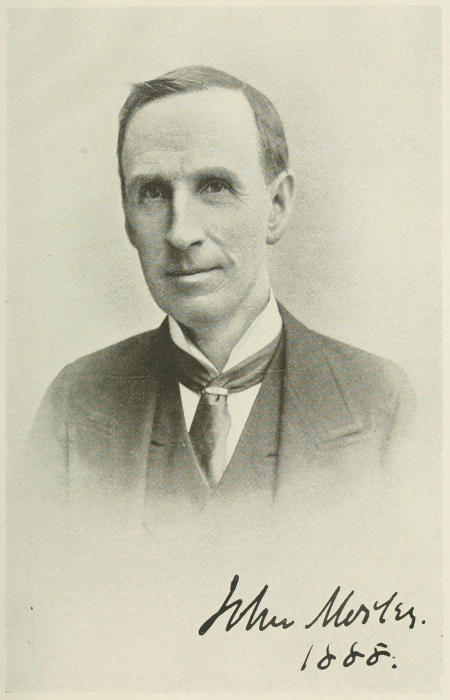
of contributors; among them were Mr. John (now
Lord) Morley, Mr. J. A. Spender (the present editor
of the Westminster Gazette), Mr. Herbert Paul, Mr.
James (now Lord) Bryce, Sir Alfred Lyall, Mr.
Augustine Birrell, Mr. Frederic Harrison, Mr. James
Payn, Mr. Henry James, Mr. (now Sir) J. M. Barrie,
and Mr. A. B. Walkley.
Wemyss Reid detested above all things what was
then called the new but what I have called the
newer journalism; he would have hated still more
the newest journalism; and he gave John Morley
advice (which was at the time rather resented) to
keep strict control over the activities of W. T.
Stead. He did not believe in government by newspaper,
and Stead’s essay in connection with the
mission of General Gordon more than ever convinced
him that the proper function of the Press was rather
to check Ministers than to dictate their policy. His
Speaker was ultimately not a success, and if he is
noted here it is chiefly because the journalistic ideas
for which he stood, as well as his politics, are still
represented by one of the most brilliant of his younger
colleagues, Mr. J. A. Spender, who now directs the
Westminster Gazette, and there exemplifies his old
chief’s horror of sensationalism and love of balance.