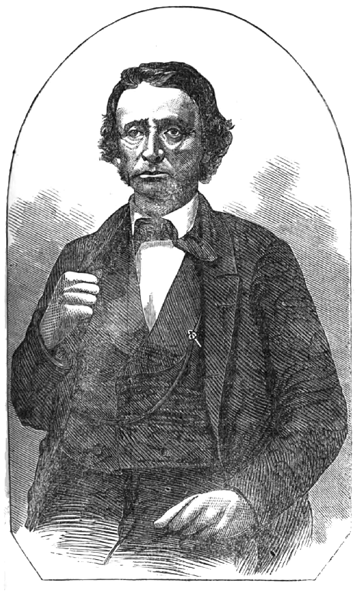
Remaining here a few days to recuperate his almost worn-out energies,
and receiving many invitations from different cities to lay before the
sympathizing public the story of his wrongs, he determined to make a
tour through several Northern States. Accordingly on the fourth day of
April he was welcomed to the city of Cincinnati, Ohio, in a manner which
was worthy of his unswerving patriotism and illustrious fidelity. It was
very much doubted whether the Opera House, since it was first opened to
the public, ever contained a larger or more refined assemblage than on
that evening.
Before the doors were opened, the crowd had commenced to gather on
Fourth street, and before half-past seven o'clock, not a vacant seat was
to be found in the house, and the aisles and every available spot
occupied. Many were unable to obtain even standing room, and left the
house. The turnout, considering that the admission fee was fifty cents,
must have been very gratifying to the Parson.
The stage was decorated with a number of American flags, and across the
front part of it were two rows of chairs, on which were seated the Vice
Presidents. Immediately in the rear was a raised platform, on which were
seated three hundred and seventy-two boys and girls from the district,
intermediate and high schools of the city, who, under the direction of
Mr. L. W. Mason, sang the following:
SONG OF WELCOME.
All hail! all hail! the here unflinching!
The pure patriot we sing, unwavering and bold,
Who foul treason denounced, and with deeds was still clinching
His strong speech, when vile traitors in numbers untold
Howled hatred demoniac, and madly were clamoring,
His life should be forfeit! triumphantly sing,
And utter the welcome with the tongue's feeble stammering,
The welcome, the warm welcome, our hearts to him bring!
Safe! safe in our midst, we shall hear the man's voice,
That had cowed all his foes, and made us rejoice;
Then hail him again, and forever and aye!
His country he loves, and for it he would die!
Rejoice! rejoice! for freedom is marching
With her power resistless, to punish and crush;
And the Iris of Union will soon be o'erarching
Again our loved country, when its brave children rush
To rescue its life from the demons now seeking
To blot out its name from the nations of earth.
But rather than this, let their black blood be reeking,
Unpitied by earth, so disgraced by their birth.
Thus speaks he, the hero! Then sing with one voice:
We love and revere him, in his presence rejoice!
Then hail him again, and forever and aye!
His country he loves, and for it he would die!
Shortly after eight o'clock Parson Brownlow came upon the stage, leaning
upon the arm of Joseph C. Butler, Esq., the President of the Chamber of
Commerce.
Mr. Butler, in introducing Mr. Brownlow, said:
Ladies and Gentlemen:—I have been honored with the pleasing duty of
inaugurating the ceremonies of this occasion, in introducing a renowned
and loyal citizen of our sister State of Tennessee. A State forced by
usurpation, fraud and violence into rebellion against a Government that
her sons in bygone times have done so much to maintain and establish,
and now suffers in being the field of conflict in a desolating civil
war. A State recently baptized again into the fold of the Union by the
martyr patriots' blood shed upon her soil, and will be confirmed in that
fold by continued deeds of heroic daring; within whose limits has been
exhibited by her loyal sons as unfaltering devotion and love of country
as has ever been displayed in the history of any people. Surrounded by
the armed band of desperate and cruel military despots, given up to the
mercy of ignorant and vicious mobs, cut off from all communication with
and support from a Government they were sacrificing themselves to
maintain, these patriots of Tennessee were driven from their homes,
suffered in jails, and sealed, when called on, with their lives on the
scaffold their devotion to the Union and Constitution established by
their fathers. Through a long and weary summer, through the dreary fall
and winter, with hearts sickened by many disappointed hopes, they
suffered and faithfully endured. And now that the armies of the Union
have entered their State, and the flag of freedom once more floats over
its capital, may we not hope that the hour of their deliverance is at
hand. God grant it may be speedy.
One of this noble band of patriots is with us to-night. He will recount
to you some of the scenes he has witnessed, and give you in brief the
history of the rebellion in his once prosperous and noble State. He has
sacrificed on the altar of his country all that man holds most dear,
jeopardizing not only his own life, but the lives of his family and
kindred in vindicating the sacred cause of his country. If we honor the
bravery displayed on the battle-field, how much more should we honor
him, who almost alone, sick and in prison, tempted by seducing offers of
power and place, and with an ignominious
death daily threatened,
maintains for weeks and months with unfaltering trust, his faith and
virtue. The instinctive homage of the human heart to genuine courage we
pay to an endurance like this. The historian who will record for the
perusal of our children the list of heroes that this wicked rebellion
has brought forth, will name none whose matchless courage is surpassed,
or the bold outline of whose character for outspoken patriotism, so
overshadows all cavil and criticism, as the hero of the pulpit and the
press. I have now the honor of introducing Mr. W. G. Brownlow, of
Knoxville, Tennessee.
SPEECH.
Ladies and Gentlemen:—I appear before you in accordance with the
arrangement of a committee—a large committee—of intelligent and
influential citizens of your own town. I am not before you for the
purpose of making an effort as an orator, or a speaker, with any view or
wish to fascinate or to charm my audience with the style or the language
I employ in the brief address I am about to deliver.
I am before you for the purpose of relating facts and localities, and
giving you names in regard to the rebellion in the South, and the
persecutions of my fellow countrymen, and their sufferings even unto
death. I have met, since I came to this city, with not a few intelligent
and high-toned gentlemen—men of years and of knowledge—who have
inquired of me seriously: "Is it a fact that they hanged men, shot down
men, in your country, for their sentiments?" You cannot, it seems to me,
realize the state of things that has existed beyond the mountains.
In what I shall say to you, without effort at all at display, I shall
deal in nothing but facts. I will state nothing that I do not personally
know to be true—nothing that I cannot sustain, if a controversy is
raised in reference thereto.
I have seen the day when I was a young man, ladies (I speak of my age
with a great deal of freedom, for I have a wife who is likely never to
die)—[laughter]—I have seen the day when I could be heard by an
audience of any size—when I have been able for four or five dreadful
hours on a stretch to speak in the open air. Those days with me have
gone by, and are numbered with the days and years beyond the flood. For
some three years back I have labored under a disease of the throat—a
bronchial affection—a severe affliction it was. Until the last twelve
months I could but whisper. In the providence of God, and through his
agency, I am better now. In repeated denunciation of secession my voice
has been gaining all the time [applause,] and I shall not be astonished
if in six months "Richard is himself again." [Applause.]
You will bear with me, I know, for I shall not detain you long. I shall
by no means be tedious, but you will bear with me, I am certain, if I
make a few remarks, by way of "preliminary," personal to myself. The
circumstances surrounding me, the connection that my name has had for
the last twelve months with the rebellion and with this subject, will
justify me in so doing, without the dread of incurring the charge of
egotism.
I am a native of the Old Dominion—born, raised and educated in the
State of Virginia. I have the pleasure of announcing to you this evening
that you have before you the first man who ever made the acknowledgment
in public, that he was the descendant of one of the second families of
Virginia. [Laughter.]
My parents before me, on both sides, were Virginians. On both sides of
the house they were slaveholders, as most of the citizens of the Old
Dominion are and have been. Although I am branded at home, since the
inauguration of rebellion, with being myself an anti-slavery man, and a
tory and the descendant of tories, I take great pleasure and pride in
announcing to you that my father was a volunteer in the war of 1812,
under Old Hickory. My uncle William, after whom I was named, lived and
died a naval officer, and his remains sleep in the Navy Yard at Norfolk,
Virginia. My uncle Alexander was also a naval officer, and his remains
rest in the Navy Yard at New Orleans. My uncle John was also a navy
officer. He died at sea and was thrown overboard, and became food for
the fishes thereof. My uncle John was the third man who scaled the walls
at the battle of the Horseshoe. [Applause.] On my mother's side—the
Galloways—not a few lost their lives at Norfolk, from yellow fever,
camp diseases and fatigue. They did not fight for a section of the
country—not for the yellow fever swamps of the South—but for every
State, and every particle of this glorious Union of ours. [Applause.]
I may as well make a remark or two on the subject of politics. I am not
here for the purpose of reviving any old party prejudice—not at
all—nor yet with a view to drop a solitary remark that shall offend
even the most fastidious political partisan who may be under the sound
of my voice. In Tennessee, thank God, we have merged all political
party questions into the one great question of the Union and its
preservation. [Applause.]
In all time to come—though I have been a Whig of the strictest
sort—though I have lived up to the creed and fought Democracy in all
its ramifications, and in all its windings—I would, in the language of
Milton, see a man where cold performs the effect of fire—or, in the
still more nervous language of Pollock, I would see a man where
gravitation, shifting, turns the other way—even hell-ward—before I
would vote for any man who was not an unconditional, straight-out Union
man. [Great applause.]
I have fought Andrew Johnson, of Tennessee, systematically,
perseveringly and untiringly, for the last twenty-five years of my
somewhat eventful life. He has scored me on every stump in the State of
Tennessee, and I have paid him back to the best of my ability. But
honors with us are easy. [Laughter.] We take each other by the hand now,
as brethren. [Applause.] Now I will fight for him, and under
him—engaged as we are in the same cause, against the same vile foe to
God and man, and especially to our country. [Applause.]
I have always been a Union man. I commenced my political career in
Tennessee in 1828. I remark again, ladies, that although I may have the
appearance of being—I confess the fact with more candor from the
consideration that I never expect to be—a widower [laughter], I
commenced my political career in Tennessee in 1828. I was one of the
corporal's guard who, in that State, got up the electoral ticket for
John Quincy Adams against Andrew Jackson. I name this fact simply to
show you that I was not a sectional man in '28; that I did not go for a
man because he was born and lived south of Mason and Dixon's line, nor
against him because he resided north of Mason and Dixon's line. Having
mentioned the name of Old Hickory, I take pleasure in saying that, while
I opposed him in his political aspirations, Jackson was always a patriot
and a true lover of his country. If my prayers and tears could have
brought him from his grave, during the last twelve months of the
iniquitous reign of James Buchanan, I would have brought him out, that
he might have destroyed secession as he did nullification—that might
have sunk South Carolina in some sort of Lake not unlike the Dead
Sea—where she will ultimately go. [Applause.]
In the next contest I was a supporter of Henry Clay. In the next contest
I was a supporter of Ulasu White. In the next I supported William Henry
Harrison, and I sung louder, jumped higher, and fell flatter and harder
than anybody else in the whole State of Tennessee. I wrote upon log
cabins, and waved coon-skins and
water-gourds
high and low. [Laughter.]
In succeeding contests, gentlemen and ladies, I supported Taylor,
Fillmore and Donelson. The last contest I was engaged in, was in the
support of the Bell and Everett ticket. The tail of that ticket is now
doing well enough in the State of Massachusetts. It stands erect, and
carries itself majestically. But the latter end of the ticket will yet
do to tie to, but as to the frontispiece—"pity the sorrows of a poor
old man." [Laughter.]
One word before I progress further—upon the subject of slavery. What I
have to say on that subject—all I have to say at home or abroad, I will
say to you now, for, ladies and gentlemen, I have no sentiments in the
South that I do not entertain when I am in the North. I have none in
Cincinnati that I do not entertain when I am at home in Knoxville.
[Applause.] The South, as I told them months ago, when I was surrounded
by three thousand Confederate troops—the South is more to blame for the
state of things that now exist than the North is. But yet, I have to
say, just in this connection, that if, about two years ago, I had been
authorized to collect—if I had been let hunt them up, for I know the
men I would have wanted—if I had been allowed to hunt up about one or
two hundred anti-slavery agitators and fanatics at the North, scattered
here and there, and about an equal number of our God-forsaken,
hell-deserving, corrupt secessionists and disunionists, I should have
marched the whole army of them into the District of Columbia, and dug a
common ditch, erected a common gallows, after embalming their bodies
with gipsy weed and dog-fennel. Had this been done, I should not have
been here to-night—we would have had none of the troubles which afflict
the country now.
One word more upon the subject of slavery. If the issue shall be made by
the South—if they are mad enough, if they are fools enough to make the
issue of Slavery and no Union, or Union and no Slavery—I am for the
Union. [Applause.] I have told them so at home upon the stump in my own
town. I will stand by the Union until you make the issue between the
Federal Union and the Christian religion; then I will back out from the
Union—but for no other institution. [Applause.]
The speaker here commenced the narrative of the doings of treason in
East Tennessee. About twelve months ago, he said, a stream of secession
fire, as hot as hell, commenced pouring out of the Southern States in
the direction of Leesburg, Richmond and Manassas, by way of Knoxville,
Tennessee. Then it was that the rebel soldiery of the South, made drunk
upon mean whisky, halted over night—day in and day out—in the town of
Knoxville, and commenced their depredations, visiting the houses of
Union men and stoning the inmates, blackguarding all whom they saw in
them, male and female. His (Mr. Brownlow's) house, in Cumberland street,
was more frequently visited by them than any other building in the town.
At the same time he was reading, in the Mobile and South Carolina
papers, that the best blood of the South had volunteered in the cause of
"Southern rights." He said to his wife, "If this is the flower of the
South, God deliver us from the Southern rabble."
The rebel soldiers became more and more insulting and overbearing.
Finally, in the month of May, they commenced to shoot down Union men in
the streets. The first man they singled out was Charles S. Douglas, a
gentleman who had been conspicuous at the election as a Union man. They
deliberately shot him down from the window of his house, in the day
time. Mr. Brownlow was in the street at the time they made propositions
to shoot down other Union men. Thinking prudence the better part of
discretion, they retired from the crowd, many of them slipping into
their houses quietly. But the work of murder and slaughter went on.
Finally, many of the loyal men had to flee to the mountains—to the
mountains of Hepsidam, if you please, said the speaker.
They remained away for several days, sleeping in the open air, and
subsisting on bread and meat brought from their homes, with a quantity
of game which they shot.
The rebel troops took possession of Mr. Brownlow's printing
office—destroyed his press and type, and converted the building into a
blacksmith shop for altering old flintlock muskets which Floyd had
stolen from the Government. They were contemplating the destruction of
his dwelling house, and would have accomplished it but for the timely
arrival of General Zollicoffer, who, being a personal friend of the
Dr.'s, set a guard around the premises, and issued an order confining
the Texan troops to their camps for two days.
Retiring to Knoxville, Mr. Brownlow received a letter from Gen. George
B. Crittenden, stating that he had been ordered by the Confederate
Secretary of War to give him (Brownlow) a passport beyond the
Confederate lines into the State of Kentucky to a Union neighborhood.
Mr. Brownlow was about to accept the General's proffer, when he was
arrested on a charge of treason, for writing and publishing what
appeared in the Knoxville Whig as his farewell letter to his patrons
and subscribers. On the 6th of December he was thrust into the Knoxville
jail. He found in the jail one hundred and fifty Union men—the building
crowded to overflowing. Every man confined on a charge of treason was a
personal friend of Mr. Brownlow's. They ran around him in astonishment,
and asked him what he was thrown into prison for. Some of them shed
tears, others smiled when they saw him enter the iron gates. He told
them he was under arrest for treason on a warrant just issued. He had
been in jail ten or twelve days when a Confederate Brigadier General,
whom he had known as an old Union man, paid him a visit. Upon entering
the jail with two of his Aides he shook hands with him. The prisoners
all crowded round to see the "sight." After a while the Brigadier said
it was too bad to see Brownlow in such a place, and tried to impress
upon the patriot's mind the propriety of his taking the oath of
allegiance to the Confederacy, upon which condition he should be
released immediately. Brownlow was in a good humor until that
proposition was made. That stirred up the bile of his stomach. "Sir,"
said he to the officer, looking him full in the eye, "I will be here
till I die with old age, or till I rot in prison, before I will take the
oath of allegiance to the Southern Confederacy. You have no Government.
I deny that you are authorized to administer such an oath. You have
organized a big Southern mob—not a Government. You have never been
recognized by any civilized Government on the face of God Almighty's
earth, and you never will be. And yet you are here asking me to take the
oath of allegiance to the vilest mob that was ever organized South of
Mason and Dixon's line. Not wishing to be profane, nor desiring to be
regarded by you in that light, permit me to conclude my remarks by
saying that I will see your Southern Confederacy in the infernal
regions, and you high on top of it before I will take the oath." The
officer remarked that that was d—d plain talk. Mr. Brownlow replied
that it was the right way to make men understand each other. The General
turned upon his heel, tipped his duck-bill cap and walked off.
[Applause.]
When the speaker entered the jail he found among the inmates three
Baptist preachers. One of them, a Mr. Pope, 77 years of age, was charged
with having prayed to the Lord to bless the President of the United
States, to bless the General Government, and put an end to this
unholy
war. Another old man—a minister—70 years of age, was thrust into jail
for having thrown up his hat and hurrahed for the stars and stripes when
a company of Union Home Guards marched by his house with the stars and
stripes flying over them. The third, a young man, was confined for
having volunteered as chaplain in a Union regiment.
The sufferings of the inmates of the jail the speaker described as
horrible. The food they were supplied with was rank and unwholesome. He,
himself, got permission to receive meals from his family, otherwise he
should not have been able to live through his long confinement.
Toward the conclusion of his address, Mr. Brownlow related several
instances in which prisoners had been taken from the jail and hung by
the troops after a few hours warning. Once they hung a father and son,
whose sole offence was their loyalty to the Government, on the same
gallows. They compelled the father to witness the agonies of the son
before permitting death to come to his relief. The most affecting case
mentioned was that of an old man, who, after a lengthy incarceration,
was sentenced at ten o'clock one morning to be hung at four that
afternoon. His name was William Henry Harrison Self. His daughter, a
highly intelligent and well educated lady, hearing this awful news
during the day, hastened to the jail, and, with great difficulty,
obtained permission to visit the condemned man. The meeting of father
and daughter was a scene which drew tears from the eyes of a hundred and
fifty men long used to hardship and suffering themselves. They embraced
and kissed each other, neither of them able to utter a word for some
time. At about one o'clock the young lady approached Dr. Brownlow, and
asked him to write, in her name, a despatch to Jeff. Davis, at
Richmond, asking him to grant a pardon to her father. The Dr. did this,
stating in the despatch, as follows:
"Honorable Jefferson Davis:
"My father, W. H. H. Self, is under sentence to hang to-day at four
o'clock. My mother is dead; my father is my only hope and stay. I
pray you pardon him. Let me hear from you by telegraph.
"ELIZABETH SELF."
The young lady carried this despatch to the telegraph office, a distance
of two miles, in greatest haste, and had it sent to Richmond
immediately. Shortly before three o'clock she received an answer from
"President" Davis commuting the old man's sentence to imprisonment, for
such length of time as the Commanding General should see proper. The joy
of his daughter was, of course, boundless. When Mr. Brownlow left
Knoxville, on the 3d of March, Self was still in jail. He has been
released before this time, Southern "justice" being satisfied in the
premises.
REMARKS OF GENERAL S. F. CAREY.
General S. F. Carey was next introduced. He referred to the deliverance
of Dr. Brownlow as a release from dangers greater than those that
surrounded Daniel in the lion's den, and from beasts far worse than
beset the prophet. His deliverance was not to be credited to their
magnanimity, but their fears.
He did not like to find fault with the Government, but it did seem to
him that it was time it should bestir itself, and prosecute the war
with greater vigor. Nor did he approve the policy pursued towards those
taken in rebellion against the Government, referred with much bitterness
to the tenderness displayed in the cases of Magoffin, Buckner, and the
rebel prisoners at Columbus. He didn't
think the penitentiary the place
for them, and would not have the convicts contaminated by them. There
was no inmate of the penitentiary, though he had been guilty of
murdering his father, mother, or brother, whose crime was not innocence
itself compared with that of these rebel prisoners, who sport their
uniforms in the streets of Columbus, insulting the fathers and brothers
of those men who had fallen in defence of the Union, and sitting in
privileged seats in the legislative chambers of the State.
The audience had heard the narrative of the sufferings of loyal women in
the South, and yet we have women in the State of Ohio who go to
Columbus, with the avowed purpose of making the rebel officers
comfortable,—conduct that in his opinion, and notwithstanding their
sex, deserved the halter. He had no sympathy with the rebellion or with
rebels, and was for cleaning them out root and branch.
In speaking on this subject, he felt the utter feebleness of human
language. After it was exhausted, the great crime of rebellion looms up
in all its terrible proportions. God speed the day when we shall be
delivered! And yet he had no hope for the country till all the remnants
of miserable partyism are swept away; he had no hope for it, while
politicians were busy at the Capital
intriguing and scheming for the
preservation of some old broken down faction called a party. We need
patriotism, not party.
Referring to the remarks of Mr. Brownlow, respecting the treatment that
should be meted out to disunionists North and South, Mr. Carey said that
while he respected the right of free speech, he was for hanging any man
who favored disunion and dared to say so. Every man has his rights, the
convict on the gallows, the thief in the penitentiary, but when a man
abuses his rights, the right of free speech, to express himself in favor
of disunion, be he Wendell Phillips, or any other man, cut him down.
The masses of the people in the North are in favor of a restoration of
the Union as it existed before the war. But if the war continues, and
the people of the rebellious States are given over to hardness of heart,
if they shoot our pickets, if it proves necessary to send a few more
thousand men from the loyal States to put down the rebellion, and people
Southern grave yards, a cry will go up from Maine to the Pacific to
clean out the rebels, niggers and all.
He believed the whole purpose of the Administration in the prosecution
of the war, was to preserve the Republic and all its institutions as
they existed when it came into power; and nothing is more certain than
that the Union will be preserved, though it cost all our property and
half the lives in the Republic.
He appealed to mothers to exert their influence in kindling a spirit of
exalted patriotism, and to teach their sons not to be Democrats or
Republicans, but to be patriots; and appealed to the ladies of the city
to visit the hospitals, comfort the sick, point the dying to the land
where there is no secession and no rebels, and give of their time,
sympathy, and means to soothe the sufferings and lighten the afflictions
of those who had volunteered
in defence of the Union.
Gen. Carey, of whose vigorous speech we give but a brief outline,
retired amid prolonged cheers. The "Star Spangled Banner" was sung, and
Lieutenant-Governor Fisk, of Kentucky, introduced by the Chairman.
REMARKS OF MR. FISK.
Mr. Fisk said he believed we were, all of us, filled with a righteous
determination to give the present Administration all the aid in our
power to put down the rebellion. He remembered when deputations of the
Legislatures of Tennessee, Kentucky, Indiana and Ohio had met in that
place, and that on that occasion no sentiment met a more hearty response
than that of Andrew Jackson: "The Union must be preserved." What we want
is the Union and the Constitution as they were; and while our armies are
in the field fighting for their preservation, let us be careful that no
mischief-makers at home pervert the object of the war to the utter
subversion of one or the other.
He didn't
believe in this talk about the subjugation of the South. On
his side of the river that was the argument of the secessionists, and
was considered evidence of sympathy with the rebellion. He did not know
what it was called on this side of the Ohio, but he did know that every
such menace was eagerly caught up and magnified by those confederated
with the rebels. The Government was doing nothing of that kind. It was
fighting for self-preservation and a restoration of its authority, and
it was its duty to send out all the troops necessary to put down the
rebellion. We must fight for the preservation of the Constitution and
Union, and we must preserve them or we cease to exist as a nation. If
the rebellion succeeds the Government is at an end, and our history as
a nation terminates. We must fight to preserve them not only for
ourselves, but the rising generation and those who shall come after
them.
He asserted that all the bloodshed, and all the suffering and misery
entailed by this war, history would charge directly to the account of
the wicked men who had inaugurated it, and not to the loyal people of
this country. It was our duty to go on with this war, and to prosecute
it, not in a malignant and revengeful spirit, but with the simple and
patriotic purpose of putting down the rebellion and restoring the
supremacy of the Government over every inch of its rightful territory.
At the conclusion of Mr. Fisk's remarks, the little sons of the members
of the Ninth Ohio Regiment were conducted to the stage, and introduced
to the audience. The lads sang a song in German; and when they had
retired, the whole audience joined in three cheers for the Ninth Ohio,
which were given with a will, the vast assembly rising to their feet.
The resolutions were unanimously adopted; after which, the proceedings
were brought to a conclusion, and the audience dispersed.