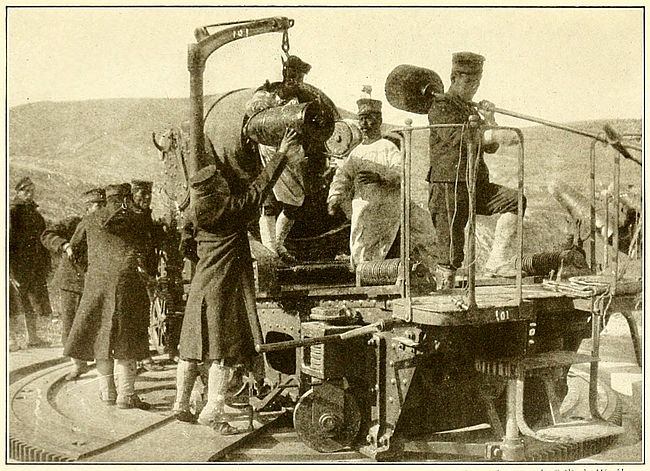
Ho-o-zan, (the Phœnix Mountain)
three miles from and looking into
Port Arthur, Sept. 14th: Here we
are with the Third Imperial Army
waiting for Russia’s downfall in the Far East.
With her fleet gone, Russia’s sea power has vanished.
With Kuropatkin smashed it will be
another year before she can have a great army
in the field. So now there remains only impregnable
Port Arthur to say that Russia but eight
months ago held all Manchuria.
Ten of us are privileged to follow the fortunes
of the army of investment. We alone of
eighty-four war correspondents who entered the
field are here to record the details of a siege that
promises to go down in history with Plevna and
Sebastopol. At the present time I may tell you
only of how the army lives and works, and what
sensations engulf one in the midst of this elemental
contest at the apex of a world, where two
civilizations are in life and death throes.
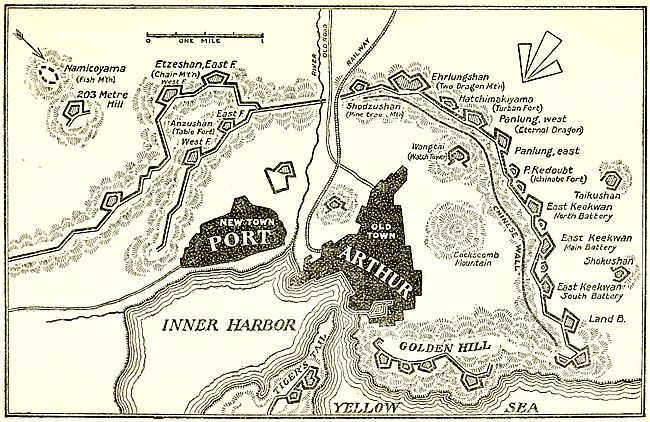
Impregnable is the word for the line of forts
confronting us. Military authorities innumerable
have predicted it would never be taken from
a white soldiery, although Japan ten years ago
did take it, in a single day of fierce assault, from
the weakly armed and poorly trained Chinese.
But through seven years Russia has been preparing
for what she faces to-day—a great army
of veteran troops from a warlike nation,
equipped for scientific fighting and officered by
men trained in the best schools in the world.
She has repaired and rebuilt the old Chinese
Wall till it lies across the back of the city, from
sea to sea, a buttress of protection and menace,
plentifully loopholed for rifles and hung at intervals,
like huge fobs on a gigantic chain, with
forts. Every natural elevation is commanded
by a battery, and every weak depression built
up for similar defense. Six miles from sea to
sea, convex into the valley, and cutting off the
apex of the Liaotung peninsula as a conical cake
might be cut by a spoon, lies this bristling line.
Looking at it, and what confronts it from above,
this appears as grand a battlefield as the mind
can conceive.
The mere names of some of the forts bring
gleams of the situation. To our right, in the
center, lie Anzushan and Etzeshan, the Chair
and Table Mountains. Some giant might hang
his legs over Anzushan and sup from Etzeshan,
but were he built in proportion he would be
nearly two thousand feet high, for they rise from
the valley precipitously half that distance. It
was here, the key to the center, that the Japanese
pierced the line ten years ago, but they have
tried no such move this time; a different foe
confronts them now. Far beyond the Chair and
Table Mountains, the key to the outer, we see
Golden Mount, the key to the inner defenses, at
once a sea and land fort. It shines glorious and
confident in the sunlight, the model of a conventionally
built fortification, rising square and
solid from the hills, buttressed with sod and sand
bags and parapeted on a bevel.
After all the outer seventeen forts have fallen
and after that terrible Chinese Wall has been
pierced, there still remains Golden Mount, the
Tiger’s Tail and Liaotishan. Just below Golden
Mount, to be seen only from a certain angle in
the valley in front of us, lie the shattered remnant
of the Russian fleet—three gray old battleships,
four tarnished cruisers and a half dozen
torpedo boats, smashed and done by Togo’s
fleet, whose smoke curls irregularly over the sky
line as it tugs warily there on perpetual watch,
a watch uninterrupted for seven months, in
which the monotony has been varied by three
great naval battles.
To the right of Golden Mount and still below
it lies the new town of Port Arthur built by the
Russians. Hid behind a hill is the old town of
frame houses. There is not a living thing to
be seen on the streets, lying in plain view through
a strong glass, as though in miniature on the
palm of your hand. It is unharmed and spotless,
seemingly in fresh paint. Four sticks piercing
the sky line tell of the wireless telegraph
station. To the right a huge crane can be seen
sticking up to indicate the dock yards and a
patch of blue, landlocked water, the west harbor.
Nearest us the arsenal and railroad shops
are plain. Then comes the railroad mockingly
deserted in the sunlight. Then a high embankment
shuts the view, but we know that under the
embankment nestles a series of barracks. Far
out on the plain, between the two armies, and
between us on the mountain and the Russian
forts, two miles off, a lone factory chimney up-slants
to the blue; though bursting shells have
been thick about there it is unharmed, and, so
far as we can see, Port Arthur is unharmed. So
far the Japanese have not shelled it at all. But
we are told the navy has wrecked the Russian
quarter. The army scorns to destroy the city
which now lies at the mercy of its siege guns,
just as it scorns to starve out the beleaguered
garrison. It is a civilized game the Japanese are
playing, one of strategy and force.
Far down in the plain called the Mariner’s,
or the Shuishiying Valley, a little to the left
and back of the lone chimney, is a great fort
known as the Two Dragons, a most difficult place
to take because of its long approaches. It is the
advance guard of the Russian line; only eight
hundred yards from the Japanese trenches. Far
out to the right, resting on the northern arm of
Pigeon Bay, is a bald-headed peak some eight
hundred feet high. This is Liaotishan, the extreme
left of the Russian position. Behind the
town are great peaks, the highest hereabouts,
and on them, in the early morning, four brass
cannons can be seen glittering. They are
thought to be dummy cannon, for they have not
yet spoken.
To the left of the town, with its Golden
Mount, begin the really great forts, scenes of
carnage destined for history’s brightest page,
and about which have taken place the battles I
am about to describe. The Eternal Dragon and
the three batteries of the Cock’s Comb are the
essential. Far behind this Eternal Dragon and
the wall, a few hundred yards from the sea, is
a wooded driveway, leading to a mountain
called Wangtai, or “the watch tower.” Up this,
of an afternoon, a carriage can sometimes be seen
drawn by white horses. Prisoners tell us it is
General Stoessel’s carriage and that he thus goes
to his headquarters. Why is he not fired upon?
Because he is out of close rifle range and the
Japanese never waste a shell on a single man or
on even a group.
Occasionally we can see men moving a heavy
gun about, or walking in squads through the
town. The Japanese wait to concentrate their
fire; they never harass the enemy. On the contrary,
the Russians, now when they should hoard
every shell, waste hundreds each day. They will
fling a six-inch screamer at a mule or an umbrella,
and no part of the Japanese rear is safe,
though distances are so great that the chances of
being hit are one in a thousand.
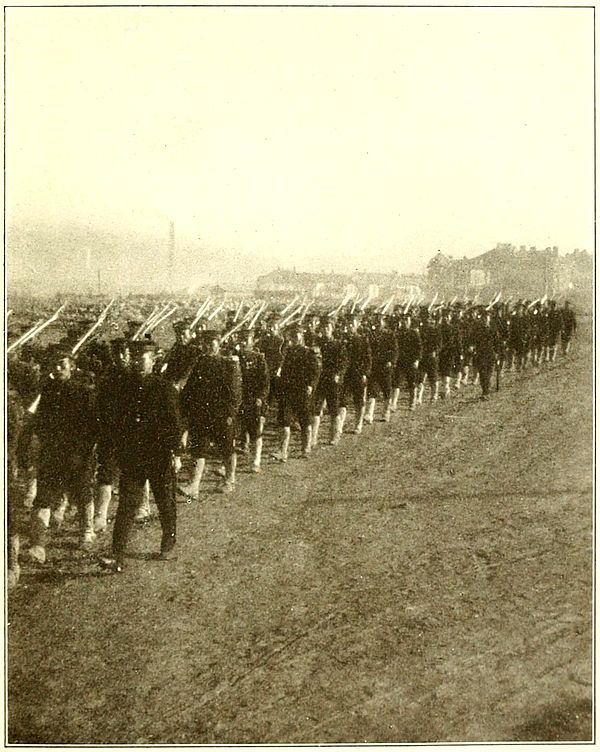
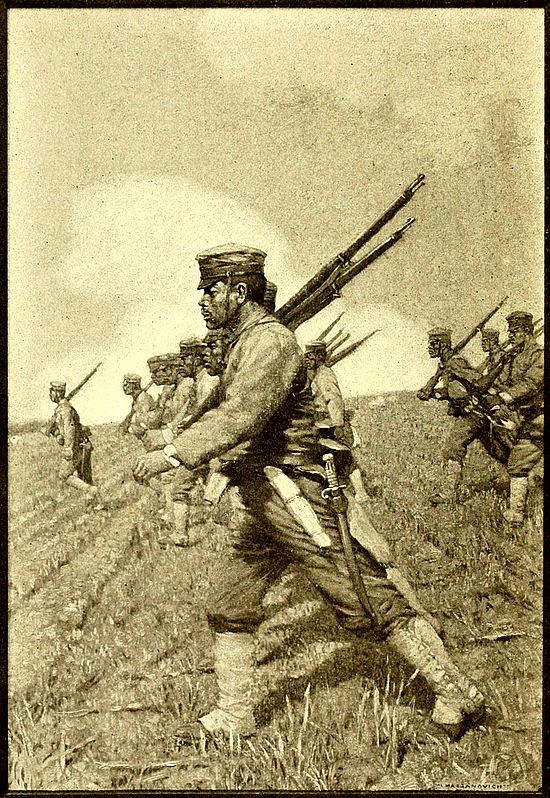
OFF FOR PORT ARTHUR
A reserve regiment leaving Dalny for the firing line eighteen
miles away.
All is quiet except that now and then a Russian
shell whizzes. The sound can no longer
be called the “boom of cannon,” so savage and
rending is the detonation of these mighty modern
charges. To hear one explode even half a
mile off sets every fiber of the body in action,
so angry is the report. Infantry popping can
be heard, oftenest in the night, as the outposts
come together, or the sentries chaff each other
by showing dummy heads or arms. But over
beyond that ragged line we know that twenty
thousand men, driven into a corner—and what
a corner it is!—are fighting like rats in a hole,
that they are of the same blood that defeated
Napoleon when on the defense a century ago,
the same that half a century ago stubbornly contested
Sebastopol, the same that a quarter of a
century ago, at appalling loss of life, reduced
the marvelous Plevna. They sit thus hunted,
at bay, well ammunitioned and provisioned,
determined to sell every ounce of blood
dearly.
To take Port Arthur seems impossible. It
takes men drunk with victory and strong in ancient
might to dare the task. It is only looking
at what the Japanese have already taken that
makes one have faith in their ability to do what
they are now trying; otherwise, looking across
at that six-mile line, one would say as he might
have said of the ridges lying behind us: human
energy and prowess cannot force them; only
madmen would attempt it. But the Japanese
have already forced at least five positions, seemingly
as difficult as Port Arthur. First, they
took Nanshan, which was even worse than this,
for the approaches were gradual for two miles,
while here precipitous heights and deep ravines
give shelter. Nanshan the Japanese took in a
single desperate day; Kenzan, where they had
to climb hand over hand, they scaled in a night;
Witozan, where they broke in over parapets
built on rocks seven hundred feet above the sea,
they reduced at high noon; Anshirey, where the
road climbs up a spiral for a mile, and is raked
at every yard, they enfiladed and took in two
days; and Taikushan, a saddle of malachite and
granite straddling the main road to Port Arthur,
they shelled out in thirty-six hours. Thus
it is we have faith that some morning the world
will wake to hear that the Rising Sun flies over
Port Arthur, which the military experts of the
Powers have declared impregnable.
Bitter as the contest is, war has not touched
the bowels of the land. Looking into the plain
behind me I can see a score of busy and peaceful
villages serene in a sea of golden harvest. Maize
and buckwheat, beans and millet, cabbage and
barley alternate green and russet over the
meadows. Springless bullock carts, ancient as
Jerusalem, helped by tiny donkeys and naked
children, painfully garner the grain. Women
sing in low monotones at the primitive stone
mills where blindfolded donkeys travel all day
in a circle, grinding out the seed and flour.
Lines of coolies wend through the footpaths,
spring-kneed with huge weights on limber poles.
Shells at the rate of four or five an hour drop
into this great area, separated from the field of
battle by a range of mountains, plowing up a
hill, shattering a house, tearing a road, killing
a donkey, wounding a coolie, but of no great
damage. No one minds. The harvest goes on.
The glorious, golden September continues. The
women sing, the naked children play, the tiny
donkeys labor.
It is the plain in front, under the Cock’s Comb
and the Golden Mount, guarded by the Two
Dragons that has desolate quiet. There the
maize is untouched and the heavy heads of the
millet fall from sheer weight, while the cabbages
are crushed by infantry passing in the
night. Fires have blackened the villages, the
Manchurians have fled, and in ragged lines from
sea to sea the two armies hold their hostile
trenches, from which, through the twenty-four
hours, goes up the intermittent ping and pop of
rifle bullets.
What of the army? You cannot see it; much
less can you hear it. An army of a hundred
thousand men is here, around us, among us, but
we do not know it, we can hardly guess it. Little
would one think, were it not for the firing, that
so much as a company were idling along that
plain. A machine gun rattles, a low, deep boom
comes from the sea; the forts reply, a flash
streaks the air, we see a puff of smoke, then a
cloud of earth is thrown up; finally, after a long
while, as we are about to turn away, the angry
shriek of a shell comes over and we hear it burst
a thousand yards below in the valley. Only our
ears tell us that war is on. The Japanese are as
invisible as the Russians. It will take days and
weeks to spy out the labyrinthine ways of this
great army as it toils among the hills, into the
valley and up the ravines, mounting its guns,
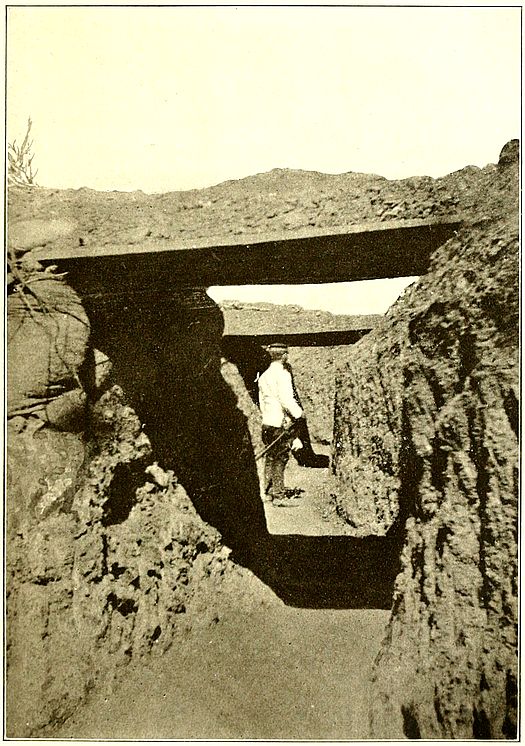
and digging its way up to the parapets, where
its units will cling, like barnacles to a ship, until
the monstrous hulk founders.
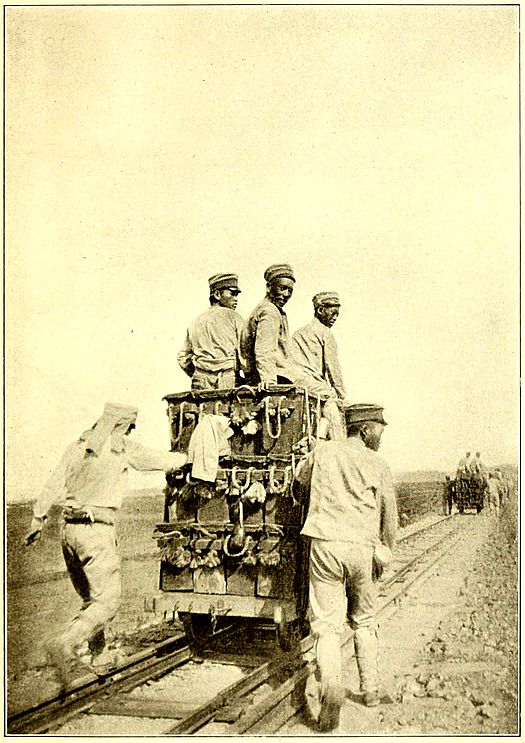
But getting down into the rear plain, traveling
the road, taking a different one each day,
passing among the villages and through the
hills, one begins to realize that the country is
honeycombed by grim activity. Back and forth,
from the front to Cho-ray-che, a railroad station
halfway from Port Arthur to Dalny, travel
lines of transport. Each line has from one to
five dozen light wagons drawn by single small
shaggy horses, each guided by a small dust-visaged
soldier.
“There is the strength of our army,” said an
officer to me one day as a company of them
passed, grimed, heated, menial. They are the
flower of Japanese youth, clerks, professional
men, students, exiled on rice and pickled plums,
getting none of the glory of war. They are the
unnamed and unknown but all-powerful commissary.
As the transport passes in, loaded with bags
of rice, there comes out another line, this time
of coolies, paired, and well burdened with human
freight. They are bearing the wounded,
in bamboo stretchers that do not jolt the piteously
shattered frames, to the railroad station,
whence they go by train to Dalny, thence by hospital
ship to Japan. Every day comes this dribble
of wounded, some days only a score, but after
a battle the ways are thick with them—hundreds,
thousands.
Occasionally, but very seldom, a battalion or
a regiment of infantry will be seen moving in,
with compact lines, knapsacks on back, bearing
rifles with the barrel holes brass covered. The
other night over by the western sea I suddenly
came upon a troop of cavalry racing along the
sands in the sunset. They rode their horses well,
considering that the Japanese is not a horseman.
Each had an extra mount. They frolicked like
plainsmen till the coves rang. I had not seen
so much gayety before in all the Japanese army.
But what can cavalry do at a siege?
For the sublime we need not go to the firing
line where men risk their lives and lose them.
At the front of our mountain lies a deep rutted
road, at the end of which, hid well among the
hills, is the hole for a concrete gun-emplacement,
redoubted with sandbags, the glacis slippery
with shale. Along this road as the sun
sinks we see what looks like a gigantic snake,
its tail pulling an ugly head slowly backward,
its dust-covered belly squirming laboriously.
Descending we find a cable thick as a man’s
thigh stretched between two long lines of men,
each of whom has hold and is pulling that ugly
head—a siege gun—nose and breech clap-boarded,
and wallowing, without its carriage, on
wooden rollers. We count the men—300. Men
alone can do the work, for they alone can move in
unison, quietly, at the word of command. There
is no noise. The commands cannot be heard five
hundred yards away. The three hundred bend
their backs as one and the Pride of Osacca bunts
her nose through the dust a rod nearer emplacement.
They toil there a week to get that monster
into position, pygmies moving a power that
will rend the mountains, as tradition has it that
Hendrick Hudson and his crew moved the
ships’ cannon into the Catskills for the eternal
generation of Knickerbocker thunder. To look
upon that gun, helpless but disputatious in the
hands of the three hundred, to realize that a
week hence its bulk, into which one of these
naked Manchurian children can easily creep,
will toss five hundred weight of shell five miles
through the air into one of those Russian forts
where it will shatter the skill, labor, and life of
an Empire—ah, that is sublime! Is it not also
terrible?
The same scientific skill with which the gun
is handled is seen throughout the army. Even
after a battle, in the disorder of regiments, the
search for the wounded, the burial of the dead,
there is no confusion. All moves quietly and
quickly. No officer swears, for the simple reason
that the Japanese language hasn’t the words.
Only the interpreters, who know English, swear.
They, however, can be excused; they handle the
correspondents, to whom they can’t speak, as the
soldiers do to the Russians, with lead. You read
of “the confusion and bustle of an army” and
“the terrors of war.” There is no confusion, no
terror here. No shrieks, no shouts, no hurrying.
Once, as a regiment, after losing half its
men, scaled the top parapet of one of those
lower forts across the way, it gave out three
rapid “Banzais.” Just that triple cry in the
early dawn, from troops drunk with victory and
mad with fatigue, is about the only evidence I
have that the army possesses nerves. It rings in
my ears yet and will always ring there—a wild
shriek of samurai exultation floating out of the
mist of the valley above the voice of rifle and
cannon. “The officers lost control for a few
minutes, but not for long,” explained a certain
general to me later, apologetically. He didn’t
countenance such enthusiasm. War is business
here—the most superb game of chess ever played
upon the chequered board of the world.
One thing that relieves the situation of much
of the evident hurry that once made war picturesque
is the absence of the orderly. The
mounted officer, riding for life, dispatch in
breast-pocket or saddle bag, from the general
to his brigadiers and his colonels, is food for
reminiscence. The telephone rang his knell.
This is the first time in history that the field telephone
has come successfully into extensive
active use. General Nogi can sit in his headquarters,
four miles from Port Arthur, and speak
with every battery and every regiment lying
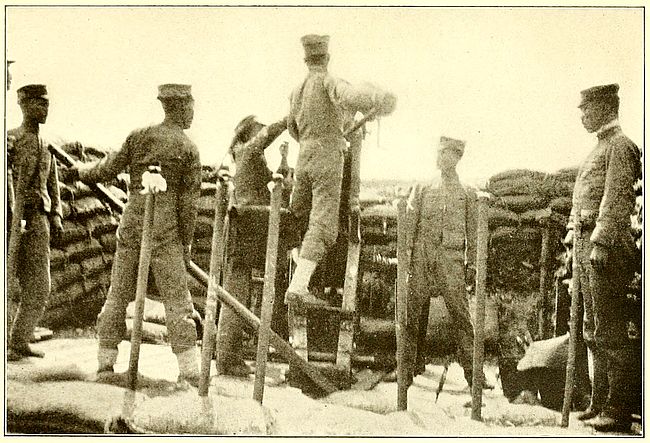
within sight of the doomed forts. Little bands
of uniformed men, carrying bamboo poles and
light wire frames on transport carts, and armed
with saws and shovels, have intersected the peninsula
with lines of instantaneous communication.
It is the twentieth century. Yet, as I
walked over the hills near the headquarters of
the commander of artillery yesterday, I saw,
hanging from one of the bamboo poles and all
along a wire leading from it to the artillery
commander’s tent, strips of white cotton cloth
called “goheis.” You can see the same before
all the Shinto shrines in Japan. They are offerings
of supplication to the spirits of the fathers.
Some simple linesman, garbed in khaki and
wearing an electric belt, not content with telephonic
training, would thus guard his general.
“Oh, ye who have watched over Japan, in peril
and in safety, from the age of Jimmu, even to
the present day,” he cries, “now, in a foreign
land, faithfully guard this, our talisman and
signal!”
I have said there are no sounds in the Japanese
army. But there are—a few. At night,
from far back on the rear plain, comes the
monosyllabic sound of singing, several companies
in unison, interspersed with light laughter—nothing
hilarious, nothing loud, only an overflow
of happy spirit into the night—never in
the daytime, always at night. The song is a long
one by Fukishima, a Major-General now in the
north with Marshal Oyama, with a refrain:
“Nippon Caarte, Nippon Caarte; Rosen Marke-te.”
(Russia defeated is, Japan victorious.)
The laughter comes from the game they play,
something like our fox and geese, an innocent
sport with nothing rough about it. Of late the
Osacca band has been here, playing for the
generals at luncheon and for the convalescents
in the field hospitals, but very quiet music—The
Geisha, some Misereres, waltzes from Wang,
and Sir Arthur Sullivan’s tunes. They avoid
the military, the dramatic, and the inspiriting.
The music is taken to soothe, just as their surgeons
use opium when necessary. How different
from the Russian, of whom each regiment
has a band busy every day with the pomp and
circumstance of conflict! One day, a week before
we came here, the Russians made a sortie
into the plain, parading for several hundred
yards in front of the Two Dragons. That was
before the lines were as closely drawn as they
are now and the Japanese looked with amusement
on the show-off. At the head marched two
bands, brassing a brilliant march. Then came
the colors flashing in the sun. The officers were
dashingly decorated, and the troops wore colored
caps. It was a rare treat for the Japanese, for
they had never seen anything such as that in their
own army. Like a boy bewildered at the gay
plumage of a bird he might not otherwise catch,
the simple and curious Japanese let the foe vaingloriously
march back into the town. So here
they sit, playing children’s games, to the chamber
music of women, as gentle as girls—but you
should see them fight!
The transport camps are sheltered by mountains
so high and steep that Russian shells cannot
be fired at an angle to drop in behind them.
Through one of these nooks I came one morning,
unable to find the main road, and pushed
among the horses. As I emerged at the farther
end a soldier rushed at me with a bayonet and
slashed at my legs. The bayonet was sheathed
and I had a stout stick, so no damage was done.
I soon explained who I was. He sullenly let
me pass and his comrades began chaffing him.
Some officers across the ravine also laughed. I
thought they were laughing at me. Almost
any human nature laughs at the foreigner.
That was the first evidence of violence and
the first evidence of rudeness I had seen in
the Japanese soldier. I passed the day off
in the regiment and, as night fell, came back
through the horses, where I went without comment.
Round a corner, out of sight of the camp
I suddenly came upon the same soldier apparently
waiting to see me. I grasped my stick
tightly, but he was weaponless, and advanced
smiling, cigarette box in hand. He wanted to
apologize and be friends. His comrades had
been laughing at him, not at me, and had
taunted him till he felt so ashamed of himself
that unless I smoked with him and returned for
some tea he would never stand right with them
again. We had the tea and the whole mess
joined in. That was a private soldier—a hostler.
The courtesy of the officers is embarrassing, it
is so continuous and exacting. Everywhere,
from general to private, it is real and delightful,
especially toward an American. I have heard
many say that it is only a crust, that underneath
the Japanese is a devil and a dastard. But a
very nice crust. Let us enjoy it; as to the pie
underneath, let the Russians testify.
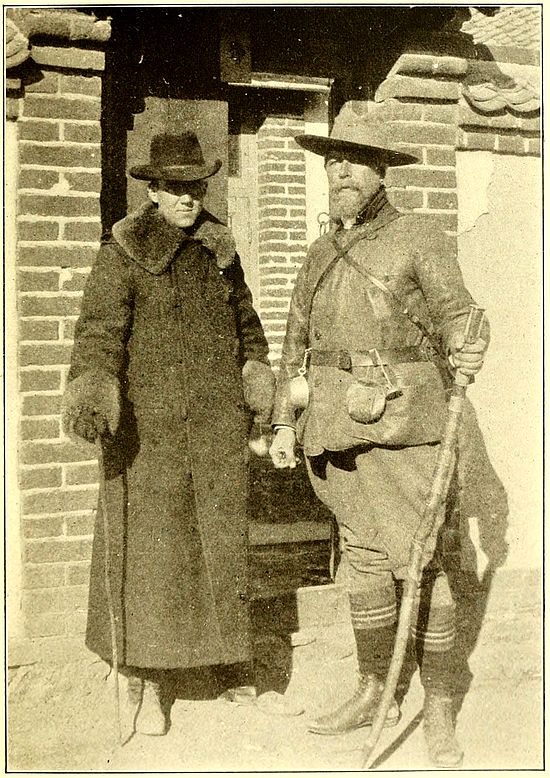
For the essence of courtesy and thoughtfulness
there is General Nogi. James Ricalton and
I went to call on him two days ago. He spent
half an hour with us at his headquarters in the
village of Luchufong, which is Chinese for
Willow Tree Apartment. It is one of the prettiest
villages in the great plain, on the edge of
a brook, fringing the zone of fire. Everything
shows seclusion and quiet, though there is
located the brain that directs these gigantic
operations, the girth of which Nogi alone comprehends.
“Do you understand the situation?”
I asked weeks ago of Frederic Villiers, the veteran
English war artist, survivor of seventeen
campaigns, present ten years ago at the other
fall of Port Arthur, and dean of the war correspondents.
“No,” said he, “I was at Plevna with the
Russians, but that was jackstraws to this game
of go. I know nothing of go. Ask the military
attachés.” In turn I asked the different military
attachés—the German, French, English,
Chilean, Spanish, Swedish, and finally the young
lieutenant here for the United States. They all
understood all about Port Arthur, but the
trouble was, no two knew it the same. So I went
back to Villiers. “Nogi is the only man that
knows,” said he; “Nogi alone can tell you how
the batteries are placed, how the divisions and
regiments are to be deployed and played, what
forts are the keys, what Russian batteries the
weakest, the reserve force, the commissary and
hospital supplies.”
So, naturally, coming to meet such a man we
must have some awe, some curiosity and some
respect for the master strategist, commander of
the army which drove the Russians down the
peninsula and which holds it now in a death
trap. We expected to meet a man of iron, for
Nogi is the General whose eldest son, a lieutenant
in the Second Army, was killed at Nanshan;
who has under his command a second son, a
lieutenant, and who wrote home after the first
disaster: “Hold the funeral rites until Hoten
and I return, when you can bury three at
once.”
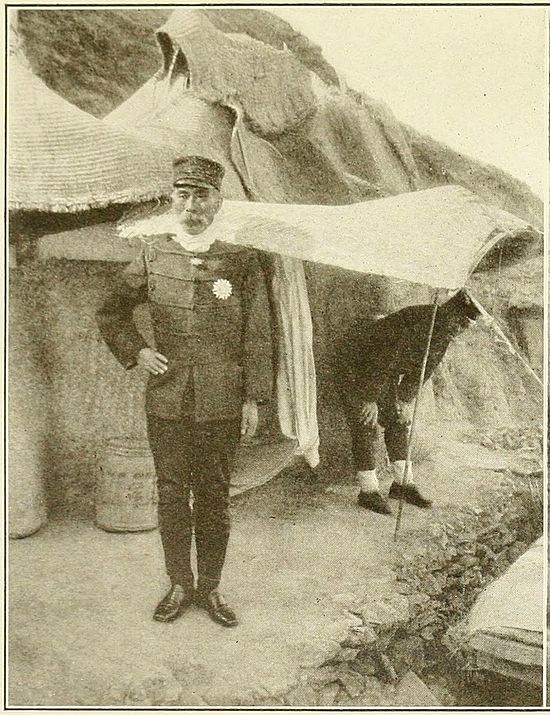
The General received us in his garden. He
was at a small table, under a willow, working
with a magnifying glass over a map. He wore
an undress blue uniform with the three stars and
three stripes of a full general on the sleeve—no
other decoration, though once before I had seen
him wearing the first class order of the Rising
Sun. His parchment-crinkled face, brown like
chocolate with a summer’s torrid suns, beamed
kindly on us. His smile and manner were fatherly.
It was impossible to think that any complicated
problem troubled his mind. A resemblance
in facial contour to General Sherman
arrested us. Lying near, in his hammock, was a
French novel. He reads both French and English,
but does not trust himself to speak in
either. Miki Yamaguchi, Professor of languages
in the Nobles School, Tokyo, for seven
years resident in America, and graduate of the
Wabash college, was the interpreter.
“Look after your bodies,” the General said
after greeting us. “I was out to the firing line
the other day and came back with a touch of dysentery,
so take warning. I do not want any of
you to be sick. At the first sign of danger consult
our surgeons. We have good surgeons.”
“We are of little account, General,” said
Ricalton, “but it is a very serious thing for a
man on whom the world’s eyes are centered to
have dysentery.”
The General smiled. “I am quite well now,”
he said; “but how old are you?” he asked, looking
at Ricalton’s gray hairs. They compared
ages. Ricalton proved to be three years the older.
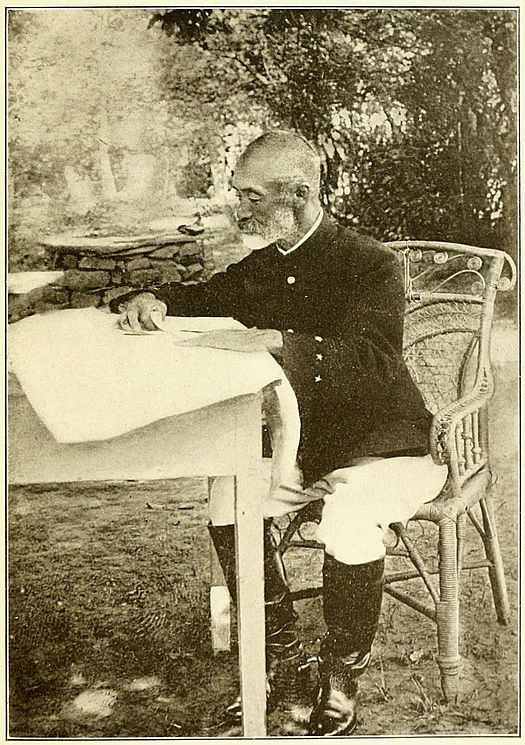
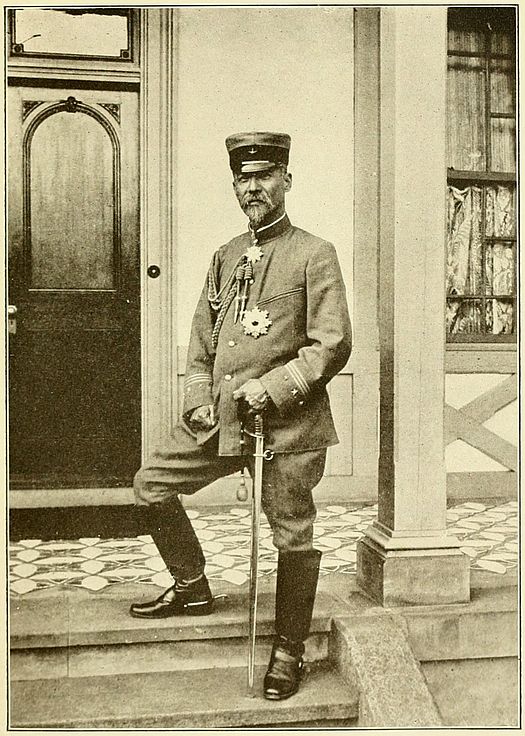
From Stereograph, Copyright 1904, by Underwood & Underwood, New York
GENERAL BARON NOGI
The photograph shows the Commander of the Third Imperial Japanese
Army studying the defenses of Port Arthur in his garden
in the Willow Tree Village, Manchuria
“The command of the army, then, belongs to
me,” said Ricalton. “I’m your senior.”
“Ah,” said the General, “but then I should
have to do your work and I fear I could not do
it as well as you do.”
That night a huge hamper came to Ricalton’s
tent in charge of the headquarters orderly. It
contained three huge bunches of Malaga grapes,
half a dozen Bartlett pears, a peck of fine
snow apples, and bore a card reading: “The
General sends his compliments to his senior in
command.”
“He is a great man,” said Ricalton, “who
can so notice, in the midst of colossal labors, a
passing old photographer.”
But, as Nogi goes, so go the other generals,
and so goes the army. Villiers and I went yesterday
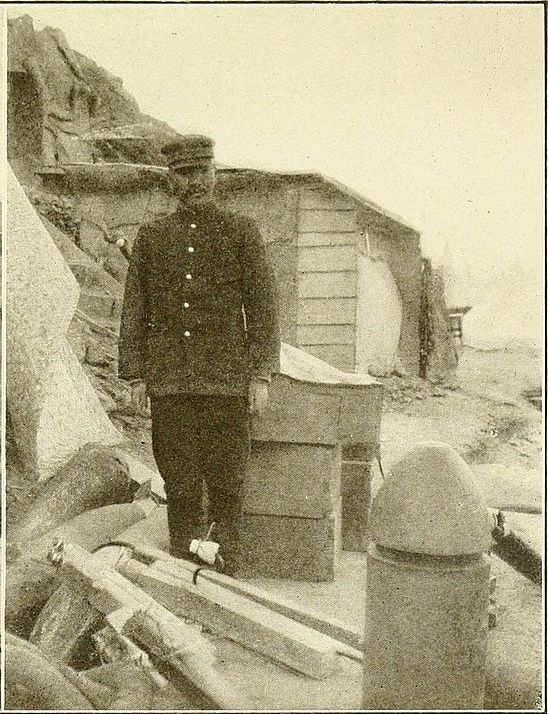
to call on a certain Lieutenant-General
who commands the most important third of the
forces. His division has borne the brunt of the
fighting, and he doesn’t live as Nogi does, on
the edge of the zone of fire, but close under the
guns within a mile of the Russian forts, so close
that in his lookout two of his staff officers were
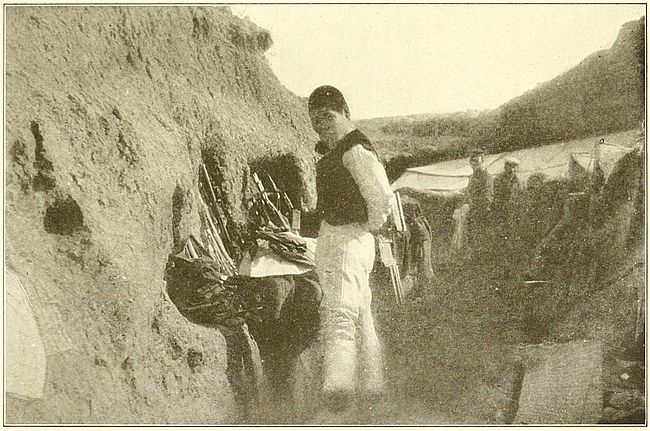
recently killed. His home is a dugout in the
side of a mountain. It is large enough for him
to lie down in and turn over. He had a heavy
white blanket, a rubber pillow to be inflated
with lung power, a fan, an officer’s trunk that
carries sixty pounds, and a small lantern of oiled
silk—this was his furniture, his complete outfit.
On a peg hung his sword, and outside, on
the ground, lay his boots. Some member of his
staff had fixed up an iron bedstead and a water
bowl, but they were lying off at the side of the
dugout, untouched. He came to meet us in a
thin pair of rubber slippers, his uniform a bit
worn, the string on his breast, where the order
of the Rising Sun is usually worn, barren, his
eyes kindly, his manner fatherly and his hospitality
generous; he spread a lunch bountiful as
Nogi’s.
“I know the Russians,” said Villiers that
night. “I was with them all through the Russo-Turkish
War. I remember Skoboleff, their
great cavalry leader, a magnificent type of man,
a soldier to the ground, but fiery, emotional,
vivacious, vain, fond of orders, jewels, wine and
women, looking on war as a lark, dashing and
brilliant, the scourge of Europe! He was not
this type of man—a scientific chap, sober, full
of business to the chin, no lugs to him, and as
unemotional as a fish. Kuropatkin was Skoboleff’s
Chief of Staff and you see what these fellows
have done with him. The day of cynical
dash and reckless valor has gone by in war, my
boy. We are living in an age of modesty and
gentleness, of science and concentration; Japan
is the master.”
We lay under the searchlights, which were
turning the night valley into a noontide halo, as
Villiers spoke. Every light came from the Russian
side, which lay wary and restless beyond
us. From the Japanese side came no light, no
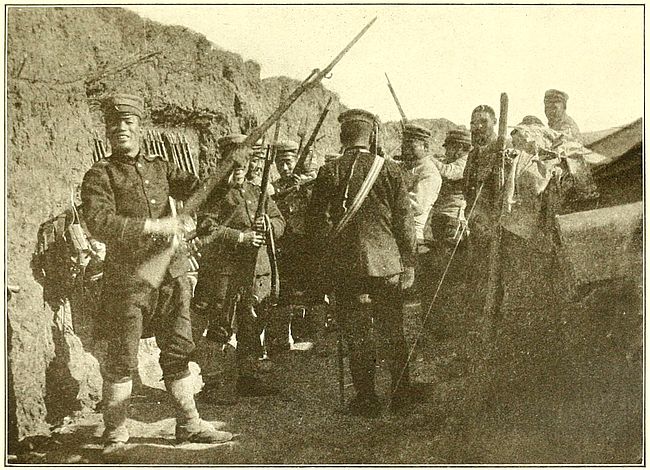
sound. All was secrecy and silence. Yet we
knew those hills were alive with toiling brown
figures, that a ten-mile line of rifle pits was
guarded at every rod by a sleepless soldier
watching for the Rising Sun and that the tents
of those Generals blinked unceasingly with the
steady glow of the oiled silk lanterns, quivering
cabalistically with ideographs.
As I looked upon swaying and heavy searchlights,
I could think only of the Indian cobra
and his mortal enemy, the mongoose. Silently,
rolled in a ball, alert for a fatal spring,
the little mongoose watches, and the hooded
cobra swings ponderously, more nervous with
each move. All other enemies he can crush;
none other he fears; his body is murderous, his
fangs deadly, his stealthy glide noiseless and
sure. How well he knows his power! Despot
of the jungle, why should he fear? And yet,
since the world dawned his tribe has done well
to avoid the mongoose.
Steadily swings the cobra; viciously he lunges.
Now look! In the folds of the cobra’s neck
those incisive teeth, those death-dealing claws!
With the fury of whirlwinds lashes the cobra.
With eternal calm cling the teeth and claws.
Hour after hour goes the unequal struggle. The
huge coils relax, the great head falls. Then
the beady eyes twinkle. The mongoose slips off
in the darkness; prone lies the cobra. Who
sheds tears?