The Curé of Chavignat was an excellent man. He
was very fond of children, and was, consequently, a
great favourite with them. He chatted with them
as if it were for his own amusement, and whilst thus
engaged he gave them useful advice, with which they,
in their turn, were highly delighted; because his instructions
were usually accompanied by stories, which
accustomed them to reflect on their own characters,
on the best means of correcting their faults, and on
the pleasure arising from the possession of good qualities.
Whenever the Curé of Chavignat met with a
story of this kind, he wrote it down, that he might
afterwards give it or relate it to those children to
whom it might prove useful. He went frequently to
the château of Chavignat, where the children received
him with demonstrations of the greatest delight, whilst
the parents were continually thanking him for his
kindness to their children.
One day he perceived that Juliana, the eldest of
the children, who was scalloping a piece of muslin,
was quite out of temper because her mother had reproved
her.
"When I see," said he, "a little lady who is out of
humour with her mamma, I begin to think what would
be the state of matters if mammas, on their side, were
to be out of humour with their little girls."
"It would be strange, indeed," said Juliana, "if
papas and mammas were out of humour, when they
are masters, and can do exactly as they please! That
would he very just, truly!"
"People do not then get out of humour without just
cause, Miss Juliana?" asked the Curé. "I was not
aware of that."
"Witness Madame Gonthier, our housekeeper,"
cried Amadeus, "who, this morning, when her coffee
overturned into the fire, scolded the girl who has
charge of the poultry-yard, because the hens' eggs
were so small."
"Just, Monsieur le Curé," said little Paul, raising
his finger to his face, "as if it was the poultry girl
that made the hens' eggs."
"Yes, my little friend; or, as if your mamma were
to give Miss Juliana a slap on the face because the
apricots do not ripen this year."
The children began to laugh, with the exception of
Juliana, who, shrugging her shoulders, said in a disdainful
tone, "Fortunately, people do not have relations
so ill-bred as Madame Gonthier."
"Indeed, young lady," replied the Curé, "there are,
I assure you, many persons in that unfortunate predicament.
Besides," he added, "it is possible that
a young lady very well brought up, like Miss Juliana,
who just now gave her little brother a kick because
her mamma had found fault with her—it is quite
possible, I repeat, that when she grows up to be a
woman, she may pull her little daughter by the ears
because her footman failed to execute a commission
properly."
"Oh, she did not hurt me," cried Paul, "I drew back."
"True," said the Curé, "but when it is the mamma
who gives the blow it is not always so easy to draw
back. I was once acquainted with a youth whose
aunt was extremely ill-tempered, and who when she was
dissatisfied with one person would vent her anger
on another; and I can assure you, the young gentleman
found this anything but agreeable."
"Oh, a story! a story! Monsieur le Curé," exclaimed
both the little boys at once; "pray relate it to us."
"I will," said the Curé, giving a side glance at
Juliana, "some day when nobody is out of humour
here, for a certain person might take it to herself, and
I do not wish to be uncivil to any one."
"Oh! pray relate your story, by all means, Monsieur
le Curé," said Juliana, very sharply; "people can take
it as they please."
"Young lady," replied the Curé, "when I relate a
story, I wish it to be taken as I please." Juliana was
silent, for she clearly perceived that she had spoken
impertinently.
The next day, as soon as the Curé arrived, the little
boys failed not to remind him of the promised story:
he did not wait to be pressed, for he had brought the
manuscript with him.
He seated himself at the table where Juliana was
at work; she neither advanced nor drew back her
chair. Amadeus placed his as close to the Curé as
possible, and little Paul established himself between
his knees, with upturned eyes and open mouth: the
Curé then related what follows:—
One day Louis entered his mother's room quite
beside himself; his eyes sparkled with anger, and his
whole countenance expressed the strongest resentment.
"I saw her! there is no gainsaying it, I saw her
with my own eyes," cried Marianne, the cook, who
rushed in after him, and who was almost as much
excited as himself. "Madame Ballier attempted to
give him a box on the ear," she continued; "fortunately
he drew back in good time, but trust me, if he
did not feel the wind of it——"
"Had it not been my grand aunt," said Louis,
pacing the room with hasty strides and folded arms;
"had it not been my aunt——"
"Oh, he would have strangled her for certain,"
rejoined Marianne; "I saw that clearly, and in my
opinion she would only have had what she deserved,
the horrid thing."
"Marianne!" said Madame Delong, in a severe
tone, and Marianne left the room shrugging her
shoulders. Then addressing her son, "Are you quite
sure, Louis," she said, "that you are not in some
degree to blame?" Louis continued to pace the
apartment without making any reply. Madame Delong
repeated the question, but Louis had not yet
sufficiently recovered himself to understand exactly
what his mother was saying. At this moment Madame
Ballier made her appearance; she looked confused,
and speaking hurriedly, like a person who is afraid
of being prevented by some disagreeable speech, she
said, "Louis, will you go with me to the play this
evening?"
Louis started and appeared surprised; but after a
moment's hesitation, he replied, in a gloomy manner,
turning away his head, "No, thank you, aunt."
"There are two actors arrived from Paris," added
Madame Ballier, still more embarrassed.
"I am aware of it: I saw the notice posted up as
I came from the college, and they are going to perform
The Templars."
"Well, will you not come?"
"No, aunt," replied Louis again, rather sharply.
Excited at once by resentment and the regret of losing
the play, he was about to add some angry expression,
but he restrained himself, and replied in the calmest
tone that he could command, "I have to work for the
examination of the inspectors who are coming this
day week."
"Very well, I can go by myself," said Madame
Ballier, still more annoyed. She went to the window
as if to look at something, and then left the room
without saying another word.
"If any one else had asked me," said Louis, in a
tone of vexation, as soon as she was gone, "nothing
would have delighted me more. Ever since I read
the announcement I have been thinking how much I
should like to see The Templars; but," he added, in
an altered voice, "I will not give her the pleasure of
thinking she can afford me the slightest gratification."
His anger increased from the sacrifice which it
had induced him to make. His mother, wishing to
calm him a little, said caressingly, as she took his
arm, "But you will give me the gratification, will you
not, of taking a walk with me? I have a headache,
and want the air;" and, seeing that he did not take
any notice, she added, with a smile, "I shall not resign
myself to going out without you, so readily as my
aunt does."
Louis never refused his mother anything, and,
although only fourteen years of age, he was so right-minded,
and possessed so noble and generous a disposition,
that Madame Delong treated him with entire
confidence, and never, in any thing she required of
him, appealed to any other motive than his own good
sense and affection. Louis immediately took his hat,
went to fetch his mother's parasol, and, without saying
a word, offered her his arm to go out. Madame Delong
saw the effort he was making to control himself, and
said, "Thank you, my dear." These words began to
restore peace to the soul of Louis. He was devotedly
fond of his mother, and felt proud of being able to
make her life more agreeable and happy. Almost
always absent from her husband, and continually
anxious and trembling for the dangers to which his
military life exposed him, Madame Delong required
the exertion of much fortitude to preserve her equanimity;
and Louis, witnessing her trials, had early
learned to avoid whatever might render her resignation
more difficult. Very different in character from
those children who imagine they obtain a species of
triumph over their superiors when they have excited
their displeasure, Louis took a pride in being able
to ward off troubles and annoyances from his mother.
It was not in a few instances, but in all cases that he
was in the habit of doing this. If he gave her his arm
in the street or the fields, he would avoid a rough
path where she might hurt herself, lead her away from
the herd of cows she did not like to venture amongst,
or remove the horse she had to pass. Quick, and even
thoughtless in his own case, he became prudent where
his mother was concerned. Madame Delong would
observe, with a smile, "Louis is my protector;" and
Louis would smile also, and at the same time slightly
blush, but not from annoyance; at such moments
he felt himself a man, and in a position to be useful
to others.
This kind of relation between Louis and his
mother had not in the least diminished the respect
due to her maternal authority and the superiority of
her understanding. To this authority Louis submitted
the more cheerfully, because the possibility of her at
any time abusing it never entered his mind. He
could not for a moment believe that his mother could
ever be unjust or unreasonable; scarcely could he even
believe that she could ever be mistaken; and if at
any time he hesitated to perform his duty, the moment
she said, "My dear, it must be done," Louis
thought he heard the voice of his own conscience.
Nevertheless, since Madame Ballier had become
an inmate of the house, Louis had more frequently
experienced the difficulty of submission; and, upon
certain points, all his affection for his mother was
scarcely sufficient to supply what was wanting in his
yet immature reason. Madame Ballier, who was
formerly a mercer at Paris, had never received the advantage
of a good education; she was sister to Monsieur
Delong's mother, and when, at twelve years of age,
he was left an orphan, she had given him a home. At
fifteen he entered the army, obtained promotion by
his bravery and good conduct, and neglecting no
opportunity of improving himself and acquiring knowledge,
he rose to the rank of colonel, and to the reputation
of a distinguished man. Madame Delong,
though without fortune, had been extremely well
educated, and the congeniality of their minds and
characters had established between them the most
tender and perfect union.
When, two or three years before the time of our
story, Madame Ballier, then a widow, had retired from
business, in rather indifferent circumstances, Madame
Delong proposed to her husband to offer her a home
with them. Monsieur Delong at first hesitated, from
the fear of giving his wife an associate by no means
agreeable; but he soon yielded to the noble motives
by which she was influenced in making this proposal,
and to his conviction, that the mingled gentleness and
firmness of her character would greatly diminish the
inconveniences which might otherwise result from
such an arrangement. Madame Ballier accordingly
joined the family of her niece in the small town where
the latter resided, in the absence of her husband, and
where with a very moderate income she endeavoured,
by strict economy, to meet the expenses occasioned
by the war, and provide for the education of her son.
A good-hearted woman in the main, but often weary of
her position, and, notwithstanding the deference with
which she was treated by Madame Delong, dissatisfied
at not being the mistress, Madame Ballier was frequently
out of humour, and found means of showing
her temper on a thousand occasions; for persons who
have no taste for serious occupation are apt to become
very fanciful about trifles. The two greatest sufferers
were Louis and his black wolf-dog Barogo: as for
Marianne, a quarrel was not positively disagreeable to
her, and it was a pleasure which Madame Ballier seldom
hesitated to afford her. Madame Delong would by no
means have permitted Marianne to fail in respect to her
aunt, but neither did she like that Madame Ballier
should uselessly torment Marianne, an old and faithful
servant, who had been in the family ever since her
mistress was born, and who was determined to end
her days in it; both, therefore, were equally interested
in keeping their quarrels secret, and thus being sure
of each other, they observed no mutual consideration;
and a coffee-pot placed on the fire precisely where it
would most inconvenience Marianne, or removed at
the very time Madame Ballier wished to have it heated;
a commission given inopportunely, and received with
a bad grace, and, above all, the delinquencies of
Robinet, Madame Ballier's cat, who was afraid of
mice and devoured every thing in the larder, kept up
a fund of animosity, and underhand quarrels, which
interestingly occupied one half of their lives.
But between Louis and his aunt, the game was by
no means so equal.
As Madame Ballier had no authority whatever
over him, she made a point of contradicting him in
everything. His shoes were too tight, or his trowsers
too wide; he wore his hair too short, or his
sleeves too long: and as the next day neither hair,
nor sleeves, nor shoes, nor trowsers, differed in any
degree from what they were the night before, the
remarks were repeated with as much acrimony as if
Madame Ballier were herself obliged to wear the
things in question. Madame Delong, perfectly mute
during these disputes, in which she never took any
part, was not equally reserved with her son, whom she
scrupulously compelled, much against his inclination,
to restrain his conduct within the bounds of proper
respect; but all her authority, and her severe looks,
were scarcely sufficient to effect this, when the injustice
fell upon Barogo, whom Madame Ballier regularly
turned out of the room, two or three times a
day saying that he gave her fleas. Louis would
then immediately follow, in order to be with his dear
Barogo, and usually found him engaged in avenging
upon Robinet the insults received from her mistress.
Warned by the noise he made in pursuing her favourite,
Madame Ballier would fly to the rescue; snatch
up, in her alarm and anger, a broom, a pair of tongs,
or whatever came to hand, as a weapon against the
aggressor, and while the latter made his escape growling,
Madame Ballier, drawn away by a deeper interest,
ran to seek and console her cat. Then Barogo, satisfied
with having proved his right of resistance, by displaying
his white teeth through his black moustaches,
would return and take quiet possession of the sitting-room,
where he soon became the object of a fresh contest.
"Why should we be obliged to submit to my aunt's
caprices and ill-humour?" Louis would sometimes
exclaim in a fit of uncontrollable indignation. "Why
should we be obliged to live with our relations at
all?" asked Madame Delong one day in reply. "Why
should we be obliged to keep up any ties of kindred?
Why should not brothers and sisters, fathers and
children, go each their own way, without troubling
themselves about each other? If I were to become
peevish, morose, and difficult to please, tell me, Louis,
would you be obliged to retain any regard for me?"
"Oh! my dear mother!" cried Louis, wounded at
such a supposition.
"My child," replied his mother, "when we once
believe that we may quarrel with our duties, because
they are difficult, there is none of them that may not
be brought into question, for there is none of them,
the fulfilment of which may not at some period or
other occasion us some inconvenience. Do you not
think a nephew owes to his aunt, and an aged aunt,
respect and complaisance?"
"Undoubtedly, but—"
"But you would prefer that your aunt should be
careful to render this duty more agreeable to you:—this
I can conceive; yet a duty is not the less a duty
because it is painful."
"I should think my aunt has duties also," said
Louis, with a little asperity.
"My son," returned his mother, very seriously,
"when you have found out a suitable manner of
representing them to her, you will be quite justified
in thinking of them."
"What is to be done, then?" Louis would sometimes
exclaim, quite out of patience at seeing no
means of avoiding what he knew not how to endure.
One day, when the heat was extreme, and he was
continually wiping his face during a discussion of this
kind, his mother said to him, "Six or seven years ago,
my dear, you would not have been able to bear such
heat as this without repeating every moment, Oh,
how hot it is! but now you scarcely pay any attention
to it, because you know that it is unbecoming in
a man not to show himself superior to petty inconveniences."
Louis was quite old enough to understand his
mother's arguments, but he had not yet acquired sufficient
resolution to submit to them. When his aunt
was out of humour with him, he became angry in his
turn; if she wished to subject him to some caprice
of hers, he was the more obstinately bent on a contrary
whim; and to make him feel it a matter of
great importance that his hat should remain on the
table, it was only necessary that Madame Ballier
should take it into her head to throw it upon a chair.
When out of his mother's presence, and no longer
restrained by her looks, which habitually followed
him, and which he dared not avoid, Louis was always
more disposed to forget himself, and did not often
escape the danger, particularly as he was then more
openly attacked by Madame Ballier, who was no
longer held in check by the fear of disobliging her
niece. The last quarrel had been occasioned by
one of those trifles which so often occasioned them,
and Louis, exasperated to the utmost by his aunt's
ill-humour, and perhaps not very well disposed himself
that day had taken the liberty to indulge in
remarks so little measured, that the anger of Madame
Ballier had gone beyond all bounds. She was sorry
for it afterwards; not that she considered it anything
extraordinary for an aunt to box the ears of a nephew
who had spoken impertinently to her; but such things
were not in accordance with the tone of the family,
and although she herself constantly found fault with
her niece, she would not have liked her niece to find
fault with her.
She thought to repair all by the offer of taking Louis
to the theatre, and could not understand his retaining
so much resentment as to refuse. Consequently, she
was much out of humour the whole of dinner-time,
and when upon leaving the table a fresh proposal was
again met by a refusal on the part of Louis, she went
off shrugging her shoulders with a sigh of indignation.
She had only just left the room, when in came M.
Lebeau, a friend of Madame Delong's.
"Come, come, my boy!" he said to Louis, "to the
theatre:—quick! there is not a moment to lose, or we
shall not find places. Charles and Eugenia are on the
way with their mother; we will overtake them."
Louis and his mother looked at each other without
making any reply. "Well! are you coming?" said
M. Lebeau, impatiently. "I do not think that Louis
can go to the play this evening," said Madame Delong,
at length, looking earnestly at her son.
"And why not?"
"He has work to finish."
"I worked hard enough when I was young, and
learned my profession as a notary as well as any one
else, but I did not give up my amusement, for all that.
Why, my lad, at your age, when I wanted to go to the
play, I spent the night in work, and there was an end
of it."
"That would not be very difficult," said Louis,
looking at his mother, whilst his face was scarlet with
anger and anxiety. Madame Delong suppressed a
sigh, called forth by the sight of her son's vexation,
and said to him; "You know very well, my dear, that
that is not the difficulty:" then, turning to M. Lebeau,
she added, in a firmer tone, "It is impossible; Louis
has refused to go with his aunt."
"His aunt! his aunt! What then? He has changed
his mind; surely he has a right to be more amused
with my children than with his aunt. Come, come, I
will undertake to make her listen to reason, though
we do not generally understand one another particularly
well."
Louis seemed in suspense. "M. Lebeau," said
Madame Delong, very seriously; "since it must be
confessed, Louis has had a slight quarrel with his aunt,
and it was for that reason that he declined going with
her to the theatre. I do not blame him for it, it was
the most respectful manner of letting his aunt know
that she had wounded his feelings; but I leave him to
judge," she added, looking at Louis, "whether it be
becoming in him to go and brave her as it were, and
as if he said to her, 'I did not choose to accept your
favours, I can dispense with them.'"
"Such punctilios are only fit for a girl," cried M.
Lebeau. "My dear friend, I tell you plainly, you will
make a milksop of that son of yours."
"I am not aware," said Madame Delong, still looking
at her son, "that Louis feels himself any the
weaker, or the less worthy of esteem, when he submits
to his duty, than when he fails in it in order to
follow his pleasures."
Louis shook his head; he knew very well that his
mother was right; but he found it impossible to make
any answer. At this moment Charles rushed into the
room: quite out of patience at not seeing his friend
Louis arrive, he had run to look for him. "Come,
make haste!" he cried; "you will make us lose the
first scene, and perhaps even our places."
Louis, with eyes cast down, pressed his hand, and
not daring to trust his voice, said, in a tone scarcely
audible,—"I am not going to the theatre."
"Not going! and why not?" asked Charles, much
astonished.
"On account of my aunt."
Charles, in consternation, looked alternately at his
father and at Madame Delong; the latter hastened
to observe: "It is a voluntary sacrifice which my son
makes to his sense of propriety, and one which I hope
we shall be able to make up to him another time."
"Another time!" cried M. Lebeau, striking the
floor with his cane; "another time! why, they are
going away to-morrow; I tell you they set off to-morrow."
Louis started. Madame Delong, looking at him,
sorrowfully, but firmly, said, "Is that any reason, my
son?" Louis hurried out of the room; he was choking.
Charles left the house in grief, and M. Lebeau, as he
took his departure, repeated, "I always said so; the
most sensible woman in the world knows nothing
about bringing up boys."
Madame Delong immediately went to her son's
room and found him leaning against the corner of the
mantel-piece; his fortitude was completely overcome;
the poor boy was in tears, and his mother felt much
disposed to join him. As if suddenly struck with
resentment upon her entrance, he exclaimed, "You
wished to punish me because I dared to be angry with
my aunt when she tried to box my ears;" and these
last words were uttered in a still more passionate
manner.
"To punish you!" said Madame Delong, putting
her arm round her son's neck, "to punish you! Oh,
my dear child, it is a very long time since I have even
thought it possible that I could have occasion to
punish you!"
The tears of Louis were now flowing abundantly.
Madame Delong leant her head on his shoulder, saying,
with much emotion, "My dearest child, overcome
this weakness, I entreat you. What will become
of me who have the responsibility of making you
acquainted with your duties, if you have not resolution
enough to fulfil them? How cruel will be my task,
Louis! I have laboured all your life to inspire you
with fortitude, in order that your courage might sustain
my own."
"This disappointment cannot grieve you as much
as it does me," said Louis, still a little angry, though
already in some degree softened by his mother's
words.
"My dear boy," replied Madame Delong, "if you
were now at the theatre, I should be watching the
clock, and although alone, should fear to see the hours
pass, for I should say, 'he is now enjoying himself,'
and that would render my whole evening delightful."
Louis kissed her hand. "But," she continued, "if after
having refused your aunt, you had been weak enough
to accompany M. Lebeau, and I weak enough to consent
to your doing so, we should both of us have had
our pleasure destroyed; the sight of your aunt at the
play would have disturbed you the whole time; on your
return we should not have dared to converse together
on what would have been a subject of self-reproach to
both, and you would have gone to bed without having
anything to relate to me."
Louis was insensibly calmed by the conversation
and affection of his mother; nevertheless, he had some
difficulty in applying steadily to anything during this
evening, and he dreamed all night that he had gone to
the theatre, and was wandering round and round the
house without being able to find the entrance, whilst
all the time the play was going on, and he could hear
the applause.
Madame Ballier, on her part, had returned home
much dissatisfied with the manner in which she had
passed her evening. She had the misfortune to be
seated in a box close to the one occupied by M.
Lebeau and his family: there was already a good deal
of bitterness between them, for M. Lebeau, though a
good-natured and upright man, was little disposed to
think that people should inconvenience themselves for
the sake of others; he had never approved of Madame
Delong's plan of having Madame Ballier with her, and
consequently had taken an aversion to the latter almost
before he had made her acquaintance. Never would
he consent to show her the slightest attention calculated
to attract her to his house, and as this prevented
Madame Delong from visiting there as frequently
as she had previously done, M. Lebeau was
the more dissatisfied; and the grievances of Louis, who
was a great favourite of his, and even those of Barogo,
with whom he cultivated a certain degree of intimacy,
did not tend to soften matters. When, upon entering
the theatre, he saw Madame Ballier in the next box
to that which his family had taken, he felt so annoyed
that he would have changed his place had it been possible.
His excitement, and the explanations given to
his party in no very low tone, soon informed Madame
Ballier of what had taken place, and the name of
"poor Louis," which, at every pause in their pleasure,
was repeated by the children in a tone of regret, and
with a side glance towards her, rendered her evening
extremely disagreeable. On returning home she complained
of a headache, and retired to her own room
without seeing any one. The next day she made no
allusion whatever to the play; and if Louis was wrong
in somewhat enjoying this little revenge, he was at
all events justified in congratulating himself on having
escaped a similar embarrassment. Two days afterwards,
at the house of M. Lebeau, the latter again
attacked Madame Delong on the subject of the play;
Louis defended his mother with so much eagerness,
that M. Lebeau, provoked at finding in him an opponent,
exclaimed, "Young man! this is the way you
spoil your mother." Everybody laughed, and M.
Lebeau amongst the rest, while Madame Delong gave
her son a smile of affectionate pride, which seemed to
say, "Persevere, my dear Louis, let us continue to aid
each other in fulfilling our duty."
The Curé here paused. "Is that all?" exclaimed
the two little boys.
"That is not a story," said Juliana, drawing up her
head with an air of pretension. "It has neither beginning
nor end."
"As to the end," replied the Curé, "I have not told
you that my story was ended: I wished merely to show
you how very disagreeable it is for young persons
when their relations happen to be bad-tempered, and
at the same time to point out to you that when such
is the case it is the duty of the young to make every
sacrifice rather than displease their relations."
"It was not very difficult for Louis to do what his
mother wished," said Juliana, in a tone which betrayed
a little vexation; "she always spoke to him so
gently."
"Well! that is good!" cried Amadeus. "The other
day when you were in a passion, and nurse very gently
begged you to listen to reason, did you not tell her to
march off with her reason?"
"Mr. Amadeus," replied Juliana, colouring violently,
"mind your own affairs if you please, or I shall
tell, in my turn, what naughty words you made use
of in the grove, when papa called you to write your
exercise."
"I see," said the Curé, "that you would neither of
you have been as reasonable as Louis, though he was
nothing to boast of."
"Yes," observed Amadeus, "for he obeyed the
wishes of his mother only when she was present."
"I don't behave like him, Monsieur le Curé," said
Paul, touching the clergyman's arm to make him listen
to him; "when mamma goes away and says, 'Paul,
don't go near the water,' I don't go near it at all."
"I should like to know," said Juliana, "what would
have happened if Louis had remained for some time
tête-à-tête with his aunt?"
"That is precisely the sequel of my story," replied
the Curé. The children having expressed their wish
to hear this sequel, the Curé promised it, and a few
days afterwards he thus resumed the adventures of
Louis.
Madame Delong received intelligence from Germany
which caused her the greatest affliction. Her
husband had been dangerously wounded, and she immediately
set off to attend on him, deeply grieved at
the necessity of leaving her son to his own discretion,
as it were, with a person who was incapable of maintaining
any authority over him.
Being also perfectly well aware that whilst Madame
Ballier had to command, and Marianne to obey, there
would be little peace in the household, we may easily
imagine what were her parting admonitions, and what
the promises and good resolutions made to conform
to them. But, scarcely was she out of sight, when
Madame Ballier, eager to take possession of her
authority, positively exacted of Marianne that the
soup tureen, which from time immemorial had been
placed on the sideboard, should for the future be put
away in the closet, and that, contrary to the practice
hitherto observed, the glasses should be rinsed before
the decanters. From this moment all hope of agreement
was at an end; and when Louis returned home
to dinner, he found Marianne in a state of the greatest
excitement. "Master Louis," she said, "this
will never do; that woman will drive me out of my
senses. I tell you, Master Louis, we can never go
on in this way."
"Louis," said Madame Ballier, very composedly,
to her nephew, when he came to take his place at the
dining-table, "I beg you for the future to be more
punctual to the time."
Louis looked at his watch, then at the time-piece,
and was much surprised to find that they did not
agree; he had set them together in the morning,
and now perceived that, without any intimation to
him, Madame Ballier had advanced the time-piece after
his departure. He showed his watch, and said coolly,
but not without some intention of annoying, "This is
the time by Monsieur Lebeau's clock, which is the
best in the town, and which everybody follows since
the town clock has been out of order."
Madame Ballier replied, pettishly, that Monsieur
Lebeau's clock went like his head, and that the house
clock was the one to which he must conform.
"To render that possible," said Louis, "it ought
not to be altered every moment without necessity."
Silence ensued till about the middle of dinner,
when Madame Ballier said to her nephew, "I hope,
Louis, that you do not intend to take advantage of
your mother's absence to run about and idle away
your time, instead of attending to your studies."
"Run about! Where, aunt?" inquired Louis,
greatly astonished, for he was noted for his exactitude
in the performance of his duties.
"Why, to Monsieur Lebeau's, for example."
"My mother has given me permission to go there,"
replied Louis, in a careless tone.
"Morning and evening?" demanded Madame
Ballier, sharply.
"As often as I please," replied Louis, drily.
"As often as you please!" cried Madame Ballier.
"Very fine, truly; if you have permission to do
whatever you please, sir, it was not worth my while
to take charge of you."
"You take charge of me, aunt!" exclaimed Louis,
in his turn, with an indignation which completely exasperated
Madame Ballier.
"And who, then, is to take charge of you, pray,
sir?"
Louis was silent: he had raised a difficult question;
for he could not possibly suppose that at his
age he could avoid being responsible for his conduct
to some one or other; nor could he tell Madame
Ballier that it was not to her that he owed this
responsibility, as this would neither have been respectful
nor true; for, in fact, if he had been guilty
of any impropriety, if he had neglected his studies,
and spent his time away from home in the absence of
his mother, it was undoubtedly the duty of his aunt
to repress such misconduct by every means in her
power. Louis' mistake consisted in not remembering,
that it is not only a duty to yield, in matters of importance,
to those who have a right to exact obedience;
but that we ought likewise to yield to them in
trifles also; because it is but reasonable that we
should avoid giving them annoyance.
They again relapsed into silence; but on rising
from table Madame Ballier said to her nephew, at the
same time carefully emphasizing every word, "Notwithstanding
all your permissions, you will be so good
as to remember, Master Louis, that I am amenable
for you in the absence of your mother, and that
I shall not allow you to commit any follies; do you
understand that?" She took care to close the door
as she pronounced these last words, so as to avoid
having to hear any reply to them. Louis had no
thought of answering her; all his ideas were in confusion.
Not having the slightest inclination to commit
any follies, as Madame Ballier expressed it, he
was surprised to find himself so extremely offended
at her prohibition of them.
"Do but look at that woman, now," said Marianne,
folding her arms, and fixing her eyes on the door by
which Madame Ballier had made her exit.
"If this is the way she begins," resumed Louis,
slowly setting down the glass which in his surprise he
had held suspended near his lips. It seemed as if a
thunderbolt had fallen at their feet, so little were
they prepared for their proper course of action, which
was simply to allow things and words of no importance
to pass quietly by.
Louis went to M. Lebeau's to console himself for
his vexations, by relating them to Charles and
Eugenia. "Let her grumble as much as she
pleases; you take your own way," said Charles.
Eugenia scolded Charles and then Louis. "Ask
mamma," she said, "whether that is the proper
manner of behaving to your aunt."
"In what respect, then, do you find I behave so
much amiss?" returned Charles, hastily. "You
would do just the same in my place."
"I! by no means; when I want to do anything
I ask permission; there is surely no great trouble in
that."
"But what permission have I to ask of her?"
"That you know best,—permission to look out at
the window, if she requires it; it would be no great
hardship after all."
"That, certainly, would be very pretty for a boy!"
said Charles.
"It would seem, then, that it is more becoming in a
boy to be unreasonable, than it is in a girl?"
"Pshaw! Eugenia," said Louis, ill-humouredly, as
he took Charles by the arm to lead him away from
his sister; "you know nothing about the matter;
and besides, what you say is only an affectation."
"I am sure," replied Eugenia, offended in her turn,
"that you give yourself airs; it costs you but little
to make rude speeches."
They quarrelled, then became reconciled. Louis
found in Eugenia's advice much that resembled the
counsels of his mother; and he was only the more
distressed by dimly perceiving that he was in the
wrong, without exactly knowing how to set himself
right. The fact was, that Louis was disposed to comply
with the wishes of his aunt, provided she required
nothing that was troublesome to him; and
willing to treat her with complaisance, provided she
never interfered with his inclinations; which certainly
was setting himself no very difficult task.
A few days after this occurrence, Louis received a
letter from his mother, written at the end of her first
day's journey.
"Bear in mind, above all things, my dear son," she
said in this letter, "never to swerve from the respect
you owe your aunt. You may sometimes think she
demands a greater degree of submission than she has
a right to exact; yet you must submit to this, in
order to please her; for it is your duty to make her
satisfied with you.
"Should you sometimes think she opposes you unreasonably,
or from ill-humour, the best way of showing
yourself a man is by not allowing yourself to be
irritated by this conduct; for it is little children only
that people are anxious not to oppose unreasonably,
for fear of spoiling their tempers; but when they
become men, they must in their turn conform to the
tempers of others.
"In a short time, my dear son, you will have to
conduct yourself properly, not only towards those
who behave well to you, but towards all with whom
you have any intercourse. So long as you are unable
to fulfil your duty, unless you have to deal with just
and reasonable persons, so long will you be unfit to
dispense with the guidance of your father and mother;
for you will meet with no one else in the world who,
for the sake of sparing you the commission of a fault,
will be careful to treat you on all occasions with
kindness and justice."
The day that Louis received this letter he was
more assiduous in his attentions to his aunt; he took
care not to leave the door open when she was in the
draught, and he prevented Barogo from eating up the
food prepared for Robinet—an occurrence which the
evening before had occasioned great offence. Left to
himself, Louis was naturally disposed to be obliging;
but he wanted that self-control which can alone
secure us against the caprices of others. He was
consequently never so much at the mercy of his aunt's
whims as when he allowed her to put him in a passion,
in spite of his good resolutions. Now, as her
caprices became every day more frequent, in proportion
to the effect they produced on him, and as in
proportion to their frequency his resolution became
every day weaker, his desire of maintaining peace soon
gave way to a complete abandonment of himself to all
those emotions which naturally excite discord. The
counsels of his mother now produced only a feeling of
irritation, for he had persuaded himself that what she
required of him was impossible. His home became
insupportable, and he was always anxious to escape
from it; nor could his mind rest with pleasure on anything
but the idea of the enjoyment which he promised
himself in going to spend the three holidays of
Whitsuntide with Madame Lebeau in the country.
This excursion had been arranged before the departure
of Madame Delong. Louis had often mentioned
it, and considered it as a settled affair, but Madame
Ballier took it into her head, as the best possible
means of annoying him, to oblige him to ask specially
for her permission.
It had been arranged that on the Saturday preceding
Whitsunday Louis was to dine with M. Lebeau, in
order to be ready to set out with the family for the
country immediately afterwards.
On the day in question, the moment before he
returned home to dress for dinner, and make up his
little package of what was to be taken with him,
Madame Ballier left the house, carrying with her the
keys of the wardrobe. Louis, greatly annoyed at not
finding the keys when he came in, asked Marianne for
them, and then inquired for his aunt. Marianne had
not seen her go out, and knew not where to find her.
They separated in search of her. Louis ran out,
boiling with impatience; and, perceiving her seated
on one of the benches in the promenade, he could
scarcely restrain himself sufficiently to avoid demanding
his keys before he came up to her, or ask for
them, when he did arrive, in terms of proper politeness.
Madame Ballier quietly inquired what he
wanted them for?
"I want to dress, aunt—I am in a great hurry—pray
give them to me immediately;"—and he held out
a hand tremulous with impatience.
"To dress! you never dress but on Sundays,"
replied Madame Ballier with the utmost coolness.
"But, aunt! you know I am going into the country."
"I know nothing about it: you have not told me."
"I have spoken of it a hundred times in your presence."
"I am not accustomed," said Madame Ballier, "to
take to myself what is not directly addressed to me."
"Well, then, aunt, I tell you now; I repeat it,"
replied Louis, with redoubled vehemence.
"I have an idea, sir," said Madame Ballier, very
gravely, and rising at the same time, "that you will
ask me for them in a different manner."
Louis half bent his knee, and in a tone which in
his anger he endeavoured to render derisive, said,
"Will my aunt have the kindness, the magnanimity,
the clemency to give me my keys?"
Madame Ballier made a movement as if to go
away. Louis threw himself before her: the clock was
striking four, the hour appointed for the rendezvous
at M. Lebeau's. "Aunt," he exclaimed, and without
perceiving that the tone of his voice had become
almost menacing: "Aunt, I entreat you ...
where are my keys?"
"In a place," replied Madame Ballier, who on her
part was beginning to lose her self-control; "in a
place where you will not get them until it suits me."
"You will not give them to me, then?"
Madame Ballier walked on without condescending
to reply. Louis darted off like an arrow, taking with
him, in his way home, the locksmith usually employed
in the house, who, knowing him, made no difficulty
about opening the drawers; he then dressed himself,
made up a small parcel, and, meeting Marianne, who
had just come in, told her to carry to M. Lebeau, in
the course of the day, the rest of his things, that
they might not be locked up again.
Surprised at such an order, and disturbed at seeing
all the drawers open, Marianne would fain have
questioned him as to what had occurred, but he was
already at a distance, and she stood at the door gazing
after him in complete bewilderment.
Louis was eager to arrive; eager to shake off the
agitation which tormented him. Since the departure
of his mother he had never felt satisfied with himself,
at the present moment he was less so than ever, and
knew not what the future was likely to bring forth,
for he had not the courage to scrutinize the state of his
mind. He concealed his uneasiness as well as he
could, not liking to mention to M. Lebeau his disagreement
with his aunt, and the idea of being for
three whole days quite free from his vexations made
him speedily forget them. As soon as dinner was
over, it was announced that the asses were at the
door. Louis was appointed to lead Eugenia's, and
Charles that intended for his mother, excepting when
M. Lebeau was to take the place of one or the other,
so as to let them, by turns, mount his horse. The
weather was delightful, and the young people, already
animated by the prospect of pleasure, were running
down the steps, laughing and jumping, when Marianne
appeared at the door, much excited, and carrying
in her arms a large parcel, which she held out to
Louis: "Here, Master Louis," she said, "here are
your clothes; when your aunt saw that I was going
to take them, she threw them in my face, saying that
when they were once out of the house they had better
remain so, and you too. Then, said I, 'And I too;' for
now that you are gone, Master Louis, she may
manage as she can. I will not set foot in the house
till my mistress returns. Here is the account of
every thing left under my care—it may easily be seen
that all is right; besides, she has taken all the keys,
and I will no longer be answerable for anything."
"But, Marianne," said Louis, who was excessively
disturbed, "I am not going away—I am to be absent
only two days."
"Oh! indeed! but she declared that you should
remain where you are—that she was going to write
to your mother—that she would no longer be answerable
for you—and I don't know what besides."
"You will stay with us," said Charles, with great
glee.
"What nonsense!" said Madame Lebeau, impatiently,
"his aunt will never drive him away from the
house."
"Oh! as for that, she said that if he came back,
she should go away," replied Marianne, "not that she
will do any such thing—but it is all the same to me.
I remained there only for your sake, Master Louis,
and now I have done with her. Didn't she say it
was I that forced the lock, and that she would take
me before the Justice of the Peace! Let her do so!
I am not afraid of her; I am better known in the
town than she is. The Justice of the Peace, indeed!
I am at my sister's, in the next street, let her come
for me there:—Good-by, Master Louis."—Then
turning back—"Oh! stay! here is a letter from your
mamma, which, with all this bother, I forgot to give
you;" and she went away, repeating to herself, "The
Justice of the Peace! Much I care for her and her
Justice of the Peace!" Thus she went on, becoming
more and more irritated every time this idea recurred
to her mind.
Louis was thunderstruck; he turned his mother's
letter mechanically in his hand—it seemed already to
pain him, as if it contained a reproach.
"What is all this?" demanded M. Lebeau, who
came up in the midst of Marianne's harangue; and
Louis scarcely knew how to give him an explanation,
so trifling was the subject in dispute.
"Come with us all the same," said Charles, in an
under-tone, "you can settle all that on your return."
"Write her a very submissive letter from the
country," said Eugenia. Louis heard not a word that
was said, he had just opened his mother's letter.
"Good Heavens!" he exclaimed, in a tone of grief,
whilst he hid his face in his hands.
"What has happened?—your father!" cried
Madame Lebeau, alarmed.
"On the contrary," said Louis, blushing at the
exclamation which had just escaped him, "my father
is better;" and he added, in a subdued tone, "An
hour ago this letter would have rendered me extremely
happy."
Madame Delong had written to inform her son that
her husband was out of danger, and in a fit state to
bear the journey; she was to set out with him in
a few days on his return home, where it would be
necessary for him to remain, to complete his recovery,
and to pass the time of his convalescence, which was
expected to be long.
"I shall soon, therefore, my dear son," added
Madame Delong, "present you to your father, who
has not seen you these four years. He is continually
speaking of you, and I scarcely dare to reply: I fear
to trust my own affection; I fear to speak of you
more favourably than the event may justify. Nevertheless,
dear Louis, I trust he will be pleased with us.
One thing alone disturbs me," she continued, "I am
not satisfied with the tone of your last letter when
speaking of your aunt. My dear child, I must warn
you that your father, who is much weakened by long-continued
exertion and severe suffering, is unable to
bear the slightest agitation; it is necessary for him
that the whole house should be as tranquil as the
apartment of an invalid. Be on the watch, therefore,
that on his arrival every thing may wear the aspect of
harmony, and nothing arise to disturb him. Examine
carefully, my dear son, whether you have prepared for
us the reception I require, and whether you feel
yourself thoroughly disposed to fulfil your duty."
Louis was overwhelmed. "Well!" said M. Lebeau,
who was waiting, and who was not fond of waiting,
"Are you coming or not?"
"What will my mother say?" said Louis, who
hardly heard the words addressed to him.
"What will she say? Why, you are not in fault,
are you?"
"I really don't know anything at all about it."
"Oh; if you don't know, that is another matter.
Come, my boy, you should always know what you
mean or what you don't mean; whether you are
right or whether you are wrong, and then act accordingly."
Louis now presented his mother's letter, not, however,
that M. Lebeau might decide for him, for his
resolution was already taken.
"Yes," said M. Lebeau, after having read the
letter, "you will do well to arrange matters if you
can;" and Louis, without speaking another word,
took the parcel which Marianne had brought, fastened
to it the one which he had made up to take into the
country, and passing his stick through them, put it
on his shoulder, pressed the hand of Charles, nodded
to Eugenia, with a sigh, and walked to the door.
"Is he going away?" asked Charles and Eugenia,
in consternation.
"You will come back to us," said M. Lebeau, who
liked to make the best of every thing. Louis again
nodded, and departed. He soon heard the noise of
the donkeys as they were mounting, and of M.
Lebeau's horse pawing the ground, impatient to set
out; he turned his head, and saw them all preparing
for their departure, but in silence; and he watched
them to the very end of the street, without hearing a
single burst of laughter.
He walked on, without very well knowing what
was to be done; he thought, however, that he must
in the first place seek Marianne, and prevent her
from sleeping out of the house; and, afterwards, go
and inform his aunt that it was he who had caused
the locks to be forced, and thus prevent her from
going to the Justice of the Peace. He found Marianne
extremely excited, relating what had passed to her
sister, who was vainly endeavouring to pacify her.
"Stop!" she said, when she saw Louis enter; "there
is Master Louis himself, who will tell you that it is
quite impossible to live with that woman."
"But what are you doing here, Master Louis? and
your parcel?—you should not have made me carry it to
Monsieur Lebeau's; I would have brought it straight
here myself. My sister will lock it safe up in her
chest, I promise you, Master Louis; you may be
quite easy about it."
"But Marianne," repeated Louis several times impatiently,
in vain attempting to interrupt her; "but
Marianne, it is not that; I come to tell you that you
must return home."
"Return home! and for what, pray, Master Louis?
It was all very well, whilst you were there; but as
for your aunt, she can do well enough without me,
and I can do without her. Go, then, Master Louis,
and take your pleasure in the country; you need not
be afraid, we shall not bite one another in your absence."
"But, Marianne," replied Louis, more and more
out of patience, yet still hesitating to engage himself,
"I tell you it is not certain—it is indeed very
possible that I may not go into the country at all."
"How!—not go into the country! Oh! that is
quite another affair! It was well worth while to
open the drawers in such a hurry! Well, if that is
the case, I will go and make your bed to-morrow,
Master Louis; you may be very sure I shall not leave
your room in disorder; you may depend upon that
beforehand; your bed shall be ready."
"And dinner also, Marianne?"
"Dinner for your aunt? oh! she can dine well
enough without me, the dear creature! If she had
nobody to cook her dinner but me, I warrant you
it would not make her ill;" and Marianne's passion
beginning to revive, she talked to herself and to
every one around, without their being able to stop her
tongue.
"But listen to me, do, pray, Marianne," cried
Louis, almost losing temper himself; "I tell you that
my father and mother are coming."
"What! the colonel!—my mistress!" exclaimed
Marianne. "Gracious me! when?—where are they?"
and she seemed ready to run and meet them.
"Oh, not yet, Marianne," said Louis; "but they
are on the road; here is the letter which gives me the
intelligence, and you must see that if they find all the
house out of sorts in this manner——"
"Ah yes! you are quite right, Master Louis, that
is very true. The poor colonel!—and my mistress!
How happy she must be!—how is he, now? What!
they are really coming!" and the exclamations of
Marianne, mingled and succeeded each other with as
much rapidity in her delight as in her anger. The
whole course of her ideas was completely changed,
and perhaps on a closer consideration of the arrival of
her master and mistress, she might feel some uneasiness
as to the consequences of her late conduct, which
in the heat of the moment she had not very attentively
examined. There was no difficulty in inducing
her to return. "Must we not be preparing the house
for their arrival?" she said. "Come, Master Louis;
duty before all things;—duty before all things!"
They departed, Marianne carrying the parcels,
which she insisted on taking under her charge. "We
are going back," she said, "like traders who have
been unlucky at the fair; we are as heavily laden as
when we set out."
They found the door of the house locked; for, as
Marianne was no longer there to attend to it, Madame
Ballier had carried away the key with her when she
went out. This incident, which Louis might have expected,
vexed him exceedingly; he had not yet entirely
given up all hopes of going to join his friends in the
country, after having reinstalled Marianne at home; but
this now became, at least, doubtful, and every moment
of delay increased the chance of its being impossible.
However, nothing was to be done but to wait; so
Louis seated himself on the bench at the door, and
did wait, but with a degree of bitterness which every
minute of impatience rendered worse. Madame Ballier
did not return till ten o'clock at night. Louis
sprang up hastily, and his aunt uttered a cry of
alarm, for she had not seen either him or Marianne
in the dark corner in which they had seated themselves.
However, the servant of one of Madame
Ballier's friends, who had accompanied her home with
a lantern, and to whom she had given the key, began
to unlock the door: Louis did not feel sure of being
admitted without a contest; fortunately, however,
Barogo, who poked his nose in at the door the moment
it was a little opened, immediately got scent of
Robinet, and pushing it back still farther with his
head, bounded into the house, barking with all his
might, as he pursued the cat. Madame Ballier
rushed in after him, Louis followed his aunt, and
Marianne followed him; the door was closed, and
every thing fell naturally into its place.
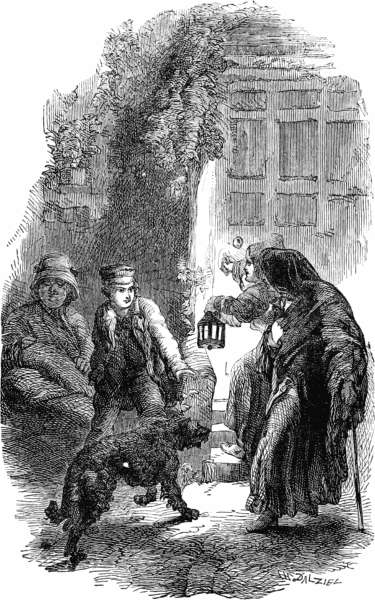
Madame Ballier's Return, p. 200.
Nevertheless, it was necessary for Louis to come to
some explanation with his aunt. He prepared himself
for it, and endeavoured to summon all the moderation
of which he was capable, when he met her at the
door of his room, carrying Robinet in her arms. She
asked him sharply why he had not brought the locksmith
to open the street door as well as that of the
wardrobe?
"Since you knew that it was I who had the drawers
opened," cried Louis, his anger already excited, as
his principal motive for returning had been to explain
this matter, "why, aunt, did you threaten to take
Marianne before the Justice of the Peace? I came
back purposely to prevent you from making such a
scandal."
"You are much needed, truly, young gentleman,
to prevent scandals," replied Madame Ballier, more
and more irritated; "if you came here only to tell
me that, you had better return into the country."
"That is what I purpose doing to-morrow morning,"
said Louis.
"But not, I beg," replied Madame Ballier, "until
I have written a letter to Monsieur Lebeau, which
you will be so good as to deliver to him, requesting
him to take charge of you, as I will have nothing
more to do with you."
"I will carry no such letter!" exclaimed Louis, who
again began to think of the arrival of his father and
mother.
"If you do not carry it, I shall send it."
"That will be of no use, for I shall not stay with
Monsieur Lebeau."
"If you go there to-morrow you will stay there."
"And what is to compel me to do so?"
"I will compel you; for I will leave this house, and
send word to your mother for what reason I do so."
Louis returned to his room, slamming the door
violently. "No," he said, pacing the room, and
stamping till the floor shook; "it is useless trying:
if one wishes to behave properly, she will not let
one."
"It is useless trying, that's certain," said Marianne,
as she put the room in order.
The Curé having laid down his manuscript, "Well,
tell us," demanded the children, "did he not go
into the country?"
"What would you have done in his place?" inquired
the Curé.
Amadeus shook his head, as he replied, "I really
do not know; it was certainly a very puzzling situation."
"Not at all," replied Juliana, in a very decided
tone; "I should the next day have said to my aunt,
'If you still choose to hinder me from going into the
country, I shall remain here, and tell every one that it
is because I am more reasonable than you are.'"
The Curé smiled. "That would have been very
agreeable to her, indeed!" said Amadeus.
"Neither should I have wished it to be agreeable
to her," replied Juliana.
"For my part," said Paul, "I would have written
immediately to mamma, in Germany, to ask her permission
to go next day to Monsieur Lebeau's."
Every one laughed at Paul's expedient, and the
Curé continued his narrative.
Louis was left alone in his apartment, in a state of
terrible agitation, and he passed nearly an hour in
thinking only of his annoyance, and giving way to
passion, without coming to any decision.
The last words of Marianne rang disagreeably in
his ears. "It is useless to try," he repeated; "Is it,
then, impossible to be reasonable?" and the idea
displeased him; for he would rather have believed
that it was impossible. He began to reperuse his
mother's letter; but in his present disposition he
several times stopped impatiently, for he felt as if
his mother were there, giving him advice which he
was unwilling to follow. Once he even threw the
letter on the table in a passion; but suddenly recollected,
that one day when he was vexed at some
advice which his mother gave him, she said, "My
dear Louis, are you displeased with my advice because
it is bad, or because it is good?" and he
acknowledged that people quarrel only with good
advice, because it is that alone which one is obliged
to follow.
But although acknowledging to himself that his
mother's advice was good, Louis was not the less inclined
to dispute: was he not only to renounce so
great a pleasure, and one, too, on which he had
so long counted, but also give way to his aunt,
and especially in a thing so unreasonable! Then
another recollection presented itself. One day during
his childhood, when he had given a kick to Barogo,
for not learning his exercise, saying, "What a stupid
brute you are!" his mother replied, "If he be a
brute, why do you expect him to do things which
require reason?" This reflection now struck him,
and he said, "Since my aunt is so unreasonable, it
is foolish in me to expect her to require of me
nothing but what is reasonable;" and he added, "If
I do not yield to her in what is unreasonable, I shall
never have to yield at all, for as to other things,
I should do them of my own accord."
His agitation began to subside in consequence of
the pleasure which he experienced in feeling himself a
reasonable person, and this kind of pleasure always
inspires the wish to become still more so. He remembered
also that his mother had often said to him:
"Sensible people have a great task imposed on them,
for they have to be reasonable, not only for themselves,
but for those also who are unreasonable;" and
he began to consider it as something very honourable
to feel one's self intrusted with a duty of this kind.
Then he felt a pleasure in reading over again, not
only the last letter which he had received from his
mother, but all she had written to him since her
departure. He was struck with the following sentence:
"Your misfortune, my dear son, consists in
your having completely forgotten, in your intercourse
with your aunt, how we ought to conduct ourselves
towards those whose approbation we desire. Now, it
appears to me, that approbation is always desirable, and
that there may be some pleasure in gaining it where
it costs an effort." In his present disposition, this
idea particularly struck Louis. "It would be amusing,
after all," he said, "to force my aunt to praise me."
His imagination was so excited by this project, that
he could scarcely go to sleep.
The next morning he awoke in the best disposition
possible. The weather was delightful; he heard in
the streets sounds indicative of a festival-day, and
this made him feel rather heavy-hearted; but he had
other things to think of, and did not permit these
recollections to distress him. He entered his aunt's
room with an air of serenity which she had not expected.
He knew that she had already inquired of
Marianne whether he was going into the country, and
had been answered in the negative. Her demeanour,
accordingly, was rather stiff than angry. When he
had informed her of the news which he had received:
"It is for this reason, then, I suppose, young gentleman,"
she observed, "that you have put water into
your wine."
The colour mounted into Louis' cheeks, but he had
so well prepared himself, that he did not lose his
temper; besides, he could not but acknowledge to
himself that his aunt had spoken the truth. "At all
events, aunt," he said, "I should certainly be much
grieved, if my father and mother, on their return,
should find you dissatisfied with me."
Madame Ballier was astonished; she had not calculated
on such an answer, and contented herself with
muttering in a low voice, that she might not appear
at a loss, "I shall soon, then, be released from my
charge:" she then hastened to make inquiries respecting
the health of her nephew, and the time of his
return; then, presently recurring to the subject on
which it was easy to see she wished to enter without
very well knowing how to begin, she said, in a tone
which merely simulated displeasure, "Then you will
have no one to hinder you from going into the
country."
"But you know, aunt," said Louis, gently, "that
my mother had granted me permission to go."
"And for that reason," said Madame Ballier, again
growing angry, "you considered that you might dispense
with the permission of every one else."
"You may see very well, aunt," replied Louis, in
the same mild tone, "that that is not the case, for it
was because you did not wish it that I have not gone;
and yet I wanted very much to go," he added, with a
sigh, which was not feigned.
"How he is playing the hypocrite at present!" said
Madame Ballier, turning away her head.
"No, aunt, I am not playing the hypocrite," replied
Louis, rather hastily. "You know very well, that I
calculated upon going into the country, and I expected
to enjoy myself extremely, I can assure you."
"Louis," replied Madame Ballier, gravely, "I do
not wish to deprive you of your enjoyment, when you
can ask for it in a proper manner." She evidently
expected a reply.
Louis hesitated a moment, and then said, "Well,
then, aunt; will you ... permit me to go?" The
words cost him an effort, but when they had passed
his lips, he hastened to add, in order to conceal his
repugnance, "I shall be very much obliged to you."
"You may go," said Madame Ballier, somewhat
embarrassed herself with the victory she had gained;
and by way of preserving her dignity, she added, "To
say the truth, it is more than you deserve after your
conduct yesterday."
"Come, aunt, let us talk no more of that," said
Louis, in a tone of mingled playfulness and submission;
and Madame Ballier, who could scarcely believe
her senses, shrugged up her shoulders, as she said,
"Go, then, and be quick." Louis did not wait to be
told a second time. In running to dress, he met
Marianne, and, wild with joy, he seized her by the
shoulders, and spinning her round, cried out, "Marianne,
I am going into the country."
But Marianne was in no laughing mood. Robinet
had just overturned a jug of water, and she had
all her kitchen to clean up. She declared she
would wring the cat's neck the very first time she
could catch him; and as she uttered these words, a
single door only, and that scarcely closed, separated
her from Madame Ballier. Louis trembled; he put
his hand before her mouth, coaxed her, spoke of the
necessity of maintaining a good understanding in the
house, and even read to her a passage from his mother's
letter; and Marianne, quite enchanted, began
to moralize on the duties of servants towards their
masters, which led her on, from one good sentiment
to another, till she came to protestations of attachment
to Madame Ballier, and even to Robinet. Louis
had hardly reached his room upstairs, when he heard
his aunt calling to him, "Come, make haste, Louis,
you will be killed with the heat;" and, on going
down, he found her brushing his hat: touched with
this mark of kindness, he kissed her hand, whilst
Marianne hastened to take the brush from her.
Never had anything of the kind been seen before in
the family.
Louis set off, his heart as light as his heels; he
felt not the sun, he felt nothing but his delight.
Quite astonished at his own happiness, he asked himself
if it was legitimate, and after the most strict
self-examination, could find nothing to reproach himself
with,—nothing that had not been prompted by
the best intentions; he could not but wonder how
all had been settled with two words, when he had
long been wasting so many in throwing every thing
into confusion. He felt grateful to his aunt for
giving way so promptly, and he was pleased with himself
for experiencing this sentiment, for a feeling in
harmony with our duties is something akin to virtue.
On his arrival, he saw, in the distance, Charles standing
at the door, and called out so loud, "Here I am,"
that Eugenia heard him and ran to the door. M.
Lebeau came also, and Louis plainly perceived that
he had been the subject of conversation since the preceding
evening.
"Did your aunt make a great fuss?" inquired M.
Lebeau.
"No, no," replied Louis, in a tone which sufficiently
marked his present disposition: in his new
plan of conduct towards his aunt, he would have considered
as treachery on his part a word spoken against
her in her absence.
The three days passed delightfully, and yet Louis
was not grieved to see them come to a close. The
new task which he had set himself occupied his mind,
and filled it with that interest always accorded to a
project the success of which depends on our own
exertions. He represented to himself the happiness
of his mother when, on her arrival, she would witness
the good understanding which had replaced the appearances
of animosity which made her uneasy; he
took pleasure in thinking that she would feel obliged
to him for this; and happy in the idea of being able
to procure her this satisfaction, the efforts by which it
was to be obtained began to assume a pleasant aspect
in his mind. On his way homewards, he was surprised
to find himself thinking, with satisfaction, of
meeting his aunt, and of seeing her reconciled to him,
and he was consequently a little agitated when he
arrived. It was very near eleven o'clock at night, and
Madame Ballier, whose imagination had not been
excited like that of her nephew, received him ill
enough on account of his coming home so late.
Louis, though disconcerted by this reception, was so
full of his good sentiments that he had no difficulty
in keeping his temper, and he replied gently that he
was very sorry to have kept his aunt waiting. Madame
Ballier, who had not expected such an answer, had
not a word to say in reply. On the succeeding days,
the case was the same: when Madame Ballier scolded,
Louis apologized, so that she ceased to scold, or did so
only from habit. One day, at dinner, she was seen to
give a bone to Barogo, and even advised Louis to
make him wear a muzzle, in order to prevent him from
eating the poisoned balls which were thrown into the
streets during the extreme hot weather. Barogo,
however, could not endure a muzzle, and Louis did
not like to inconvenience his favourite, so he replied
that Barogo did not go out till late, and after the balls
had been eaten by other dogs. Upon this, Madame
Ballier, day after day returned to the subject of the
muzzle, and Louis persisted, with some warmth, in
defending Barogo's opinion. Hence, it happened
that Madame Ballier, having once mentioned the
subject, was perpetually recurring to it indirectly, and
with some degree of asperity. Louis had at first said
to himself, "The dog is mine, and it is no concern of
my aunt's," but he afterwards considered, "If it did
concern her, it would be my duty to do it, since she
required it, and, since she has no right to interfere, I
ought to do it to please her." It gave him some pain
to follow this determination, particularly when it was
necessary to overcome the resistance of Barogo, who
had not made the same progress as himself in the art
of obliging. "Barogo," he said, as he fastened on
the muzzle, "we must please my aunt;" and, instead
of waiting, as perverse people often do, until his aunt
again complained of his injuring his dog, in order to
obtain a triumph over her, he showed her the muzzle,
saying, "Aunt, I have put a muzzle on Barogo," and,
as he was now daily improving, he added, "and he
does not mind it nearly so much as I feared he would."
Madame Ballier contented herself with replying, somewhat
ungraciously, "I knew very well it would be so,"
and never failed to remind him every day to put the
muzzle on his dog. But every day, also, at dinner,
Barogo received a bit of meat from Madame Ballier,
and as Barogo was sensible of this kindness, and did
not know that it was she who was the cause of his
being muzzled, he began at table to wag his tail, and
fix his bright eyes upon her, which was quite a new
thing on his part, and Louis was filled with amazement
to see him. Good sense and gentleness seemed
to spring up on all sides since he had thought of
introducing them into the house.
Nevertheless, he one day found Marianne in a fury.
Madame Ballier had just told her that she had seen
some ripe cherries, and ordered her to go and purchase
some. Marianne had maintained that they were not
ripe, and protested between her teeth that she would
not go, flying into a violent passion, as if she had
been thrust out by the shoulders. Louis, at first,
endeavoured to persuade her that it was not very
difficult to try at least to get some cherries; but this
only increased Marianne's anger. Then he said that
he was sure Marianne would do difficult things for his
sake, and that he particularly wished for some cherries.
"Nonsense!" said Marianne, "that is only to prevent
your aunt from making an outcry."
"Yes, Marianne," he replied, smiling, "for fear
that my father, who is on his journey, should hear the
noise." Then, gently patting her on the shoulder,
he added, "My good Marianne, you would not wish
to give my father a headache?" Marianne shook her
head, told him he was a wheedler, and went to fetch
the cherries.
Since Louis had given up the idea of employing
any but gentle means in the attainment of his
wishes, he discovered a vast number of such means,
which would never otherwise have occurred to him.
This evening he found an opportunity of telling
Marianne that the cherries were excellent, and from
this point went on to speak of the pleasure it would
give his mother to find there were so much fewer
quarrels in the house; and Marianne was so pleased
at having contributed to this pacification, that the same
evening she placed, of her own accord, the lamp upon
the table, instead of on the mantel-piece, a thing she
had never before consented to do, without having been
first scolded about it by Madame Ballier.
Time passed, and M. Delong was approaching
home, although slowly, being obliged to travel by
short stages, and to rest frequently. They had now
but one week more to wait, and the day before his
arrival was the fête-day of the village in which M.
Lebeau's country house was situated. This fête was
a celebrated one in the neighbourhood; there was a
grand fair, dancing in a pretty meadow, games, and
boating on the river. Louis was to pass the day
with the Lebeau family, and promised himself great
pleasure, enhanced by the assurance of still greater
happiness, a few days afterwards, on the arrival of his
father and mother. He had spoken of this party to
his aunt, and she had consented to his going, with an
expression of vexation which had not escaped Louis,
but the cause of which he had not courage enough to
investigate. He soon perceived, however, that his
aunt was herself embarrassed about going to this
fête. Those persons with whom she was most intimate
in the town were absent; others had made up
their parties, which she could not join, or which did
not suit her, and during three days she had a fund of
ill-humour, and Louis a feeling of discomfort, for
which he dared not venture to account. At length he
confessed to himself, that if he was ill at ease, it was
because he was not performing his duty; and from
this moment the only question was, how to summon
resolution for its performance: a difficult duty is
more than half accomplished when we have once
acknowledged its necessity. Yet, to renounce his
engagement with the Lebeau family, and give up his
whole day to his aunt, was a sacrifice which, three
weeks before, would never have entered his mind.
But now that the arrival of his mother drew so near,
he was more than ever engrossed with the desire of
proving to her that he had conducted himself well in
her absence; and it would have been vexatious to
spoil all his labour by leaving with his aunt a
sufficiently legitimate cause of complaint. Still he
hesitated, grieved at the idea of relinquishing the
delightful prospect in view, but a letter from his
mother put an end to his uncertainty. A sensible
amelioration had permitted M. Delong to hasten
his journey, and he was to arrive the day after the
fête. Madame Delong at the same time mentioned to
her son her anxiety respecting his conduct to his
aunt, of which the last letters received from her gave
but an indifferent idea. Louis triumphantly smiled to
himself at his mother's fears, and at the happiness he
was preparing for her; and, full of these delightful
thoughts, he so vividly transported himself in imagination
to the day of her arrival, that it was easy for
him to leap over that of the fête. He ran to his
aunt, who was already informed by letter of his
father's more speedy arrival, and hastened to propose
to take her to the fête with him. When she objected,
by saying that he would have much more amusement
with the family of M. Lebeau, he was on the point of
answering "Very well, aunt;" happily, however, he
checked himself in time, and simply replied that he
should have great pleasure in escorting her; and this
was quite true; for at this moment all was pleasure to
him. He then went to M. Lebeau, to excuse himself
from his engagement. M. Lebeau was annoyed, and
inquired, "How is it that your aunt can find no one
to take charge of her?"
"All her acquaintances are in the country," replied
Louis; "there is perhaps no one left in town with
whom she is so well acquainted as with yourself."
"And I am not going to take her, I assure you,"
said M. Lebeau.
"That I am quite aware of," said Louis, somewhat
offended in his turn; for he probably thought that a
little good-nature on the part of M. Lebeau would
have settled everything satisfactorily.
"What a pity!" said Eugenia, in a low tone,
glancing timidly at her father: "there is abundance
of room in the boat."
"There is no room for any one but ourselves,"
said M. Lebeau, hastily, for he had overheard or
guessed what she said: "and suppose it should
upset—do you imagine I want to have to run after
Madame Ballier?"
"There is no question about the matter," said
Louis, still more displeased; "I am going with my
aunt."
"It is the best thing you can do." For the first
time M. Lebeau was offended with Louis, because
Louis had placed him in the wrong, and, for the first
time also, Louis found that M. Lebeau was to blame
for his disobliging conduct towards his aunt.
The next day, he would have set out in a somewhat
sad mood, had he not chanced to notice his mother's
room, which had been left open for the purpose of
airing it, as well as his father's, which Marianne had
just been putting in order. This recalled his resolution
to make every thing pleasant to his aunt, who, on
her side, was all good humour. Even Barogo, who, in
the transports of his joy, leaped several times upon
her, was allowed to do so without being angrily repulsed.
Louis, compelled at the fête to give his arm
to his aunt, who could neither walk fast nor go far,
could not help looking at the various groups of pedestrians
so full of vivacity and mirth. People were
hastening to the river-side, and crowding into boats,
in order to go and dine on an island at a short distance,
whence they were to return afterwards to
dance in the meadow. Madame Ballier wished to engage
a boat, but there was not one to be had, nor
even a place in one. Louis saw, with a sigh, that he
should be obliged to sacrifice his whole day completely,
and Madame Ballier was herself rather disconcerted,
not knowing very well how to pass the
time. At some distance they perceived M. Lebeau,
ready to embark with all his family. Louis observed
them without stirring from his place, till M. Lebeau
beckoned to him, when he begged permission from
his aunt to go and speak to him.
"Have you a boat?" asked M. Lebeau. Louis
replied in the negative. "Confound it!" said M.
Lebeau, with a look of annoyance which Louis very
well understood; for his boat would have accommodated
half-a-dozen more persons.
"Could not your aunt," said M. Lebeau, "join some
other party? I see some of her acquaintance yonder.
Then you could join us." Louis could not forbear
looking in the direction pointed out, but immediately
recollecting himself, he replied, "Indeed, Monsieur
Lebeau, I could not think of proposing such a plan to
her; you must see yourself that it would not be right,"
and he was turning away, but Eugenia held him
gently by his coat.
"Confound it!" repeated M. Lebeau. He stopped,
and then suddenly resumed, "Well, then, if it cannot
be otherwise arranged, bring your aunt with you;
we will try and find a place for her."
Louis hesitated, not knowing whether he ought to
accept the invitation. "Go, Charles, and propose it
to her," said Madame Lebeau, who had long wished
to see an end to the bickerings between her husband
and Madame Ballier; and Eugenia, without waiting
for a command, set off with Charles to invite Madame
Ballier to come into their boat, adding, like a person
of discretion as she was, that her mother would
herself have come, had she not to take care of her
little sister. Madame Ballier made a few difficulties,
just sufficient to support her dignity; but Louis came
up, took her arm, and cutting short all objections, had
no sooner said, "Come, let us make haste, pray," than
they were already on the way, Madame Ballier walking
as fast as she could, and Charles with Eugenia
running and skipping before them with cries of
triumph. The bustle of arrival, and of entering the
boat, saved Madame Ballier the embarrassment of
showing either too much eagerness or too much resentment;
and M. Lebeau, in saying to her, "Come,
Madame Ballier, place yourself there, quite at your
ease," was not more abrupt in his manner than he
would have been to one whose society was the most
agreeable to him. Madame Lebeau was all kindness
and attention, and Eugenia hastened to place under
her feet the board which was laid across the bottom
of the boat, to preserve the ladies from the wet.
Louis, meanwhile, pressed the hand of M. Lebeau,
with an expression which moved him. "Come," said
the latter, "you are a good boy; I am very glad to
have given you pleasure;" and off they went.
The day passed delightfully. They dined on the
island. M. Lebeau exerted himself to amuse Madame
Ballier. Madame Ballier was soon in high
spirits, and her gaiety quite accorded with that of
M. Lebeau. On rising from table they were the
best friends in the world; and M. Lebeau said to
Louis, "After all, your aunt is at heart a good sort of
woman." "No doubt of it," replied Louis, in a tone
which showed that he would not have the good qualities
of his aunt called in question. On bringing her
amongst his friends, he had taken care that his friends
should be agreeable to her. His attentions naturally
attracted those of others, and the kind Eugenia
seemed to have no thought but that of seconding him.
As to Madame Ballier, she was good-nature itself;
she remained as late as they wished at the dancing,
and scarcely complained of fatigue on their way home,
particularly as Louis took care to say something
laughable, whenever they came to any bad parts in
the road. To crown all, on entering the house, they
found a letter announcing the exact hour at which
they might expect their friends the next day; and
Madame Ballier declared that she would herself carry
the intelligence to M. Lebeau, to whom she owed
this civility, as he had been so extremely obliging to
her.
The morning came at last; then noon; then four
o'clock; then they heard the sound of the carriage;
then it stopped. How often had they repeated to
themselves that they must restrain their joy to avoid
overpowering the invalid; yet, at the moment the
doors were opened, and that they rushed down stairs,
the excitement was so great, that Barogo began to
bark, Robinet took to flight, and Marianne knew not
where she was; but all was hushed at the sight of
M. Delong, who, still feeble, and deprived of the use
of his limbs, required support on all sides, and of Madame
Delong, pale and worn out by the sufferings of
her husband. The invalid was carried upstairs so
gently that even the steps of those who bore him were
inaudible. They seated him in an easy-chair, and
quietly placed themselves around him. Louis, standing
before his father, sometimes raised his eyes to
him, and then cast them down as he encountered
those of his father examining him attentively. His
heart beat, for this first interview with a father who
had left him a mere child and now found him almost
a man, was to him a great and imposing moment.
Madame Delong, with a mixture of anxiety and confidence,
looked alternately at her son and at her
husband. At length, Madame Ballier, who willingly
translated into words these mute scenes, said to the
colonel,—"I can assure you, nephew, that you have
a very amiable son;" and then addressing herself to
Madame Delong; "You cannot imagine, niece, how
much he has improved during your absence."
Louis eagerly kissed his mother's hand, whose pale
features were now lit up with a flush of joy. This
moment convinced her that they had not ceased to
understand each other.
"Louis," said M. Delong, as he held out his hand
to him, "your mother has told me much good of you;
I know she thinks still more, and I am always disposed
to think as she does." Louis, in stooping his
head over his father's hand, half bent one knee in
this first act of gratitude towards a parent whose approbation
he so ardently desired. His eyes then met
those of his mother. The necessity of restraining
their feelings rendered them only the more intense.
This was a moment which could never be forgotten.
M. Lebeau came in, and declared that as soon as
the colonel could bear another removal, he must
come and establish himself at his house in the country,
and in the sequel of his speech he included in his
invitation Madame Ballier, who graciously bowed her
acquiescence. Madame Delong looked with astonishment
at her son, who smiled, and Madame Ballier
having quitted the apartment; "This wizard, Louis,"
he said to Madame Delong, "has absolutely forced me
to be on good terms with his aunt;" then turning to
M. Delong, he added—"Colonel, this son of yours
will be a remarkable man; remember, I tell you so."
How happy was Madame Delong, and with what
heartfelt pleasure did the eyes of Louis meet the delighted
looks of his mother, which were constantly
fixed upon him! Nor was their felicity momentary.
Louis found no difficulty in acknowledging to her his
faults, because he had repaired them. He confessed
how greatly he had felt relieved since, instead of seeking
out failings in his aunt, he had been engaged in
considering her good qualities, and the respect he
owed her of which he had been too forgetful; for
children and young people are not sufficiently aware
of the harm they do, when, even without talking to
others, their thoughts are occupied in examining the
defects of those to whom they owe respect, instead of
going backward, like the children of Noah, to cover
them with their mantle. Louis had learnt by experience,
that when we look at things as they really
are, it is almost always possible to find something
good in persons of whom at first we were disposed to
think only evil. He gradually attached himself to his
aunt through his desire of pleasing her; and Madame
Ballier, on her side, acquired so strong an affection
for him, that she would not suffer any one to blame
him or oppose him in her presence; and when he
found her in dispute with Marianne or Barogo, he
had only to interpose, and all was at an end. This
new mode of proceeding has brought back peace into
the domestic circle of Madame Delong, and Louis
continually experiences the advantage of having acquired
the power of self-control, which is the surest
means of obtaining influence over others; for he who
advances thoughtfully, observing carefully where he
steps, instead of following his humour and heedlessly
rushing into any mire that may obstruct his path, is
sure to become at last the leader of his party.
When the Curé had concluded his story, he raised
his head, took off his spectacles, and looking round at
the children, said, "Well, now, which would you
rather be,—Madame Ballier or Louis?"
"Oh! there is no great difficulty in deciding that
question," replied Amadeus.
"You know, Monsieur le Curé," said Paul, "that
everybody would like better to be an amiable person
than one who is not so."
"I think," remarked Juliana, with her disdainful
tone, "it was hardly worth while to ask such a question."
"Indeed," said the Curé; "for my part, I thought
that there were persons to be met with occasionally,
who would rather not be amiable."
Juliana shrugged her shoulders, and Amadeus
burst into a loud laugh.
"Ah! that is Juliana," cried Paul, jumping about,
and clapping his hands.
"By no means," replied the Curé; "for I perceive
that Miss Juliana is displeased when any one appears
to think her less amiable than usual, and this proves
that she wishes to be amiable."
Juliana blushed: she was not sure whether the
Curé was speaking in jest or in earnest, for it was
perfectly true that many times when her ill-humour
was over, she felt sorry for having given way to it,
especially in the presence of persons who appeared
shocked by it. "Oh, yes!" said Amadeus, "when
she has done any thing foolish she is so vexed that it
makes her immediately do something else just as bad.
Don't you remember this morning, Juliana, throwing
your work into Zemira's porringer, because mamma
had rung for you twice whilst you were busy undoing
a knot in your thread?"
"Yes, and only think! Monsieur le Curé," cried
Paul; "she was so angry—so very angry, at having
wetted her work with the water in the porringer, that
when I picked it up to bring it back to her, she
snatched it out of my hands, and scratched my finger
so with her needle."
And Paul, excited by the recollection of his misfortune,
pointed to the scratch on his finger, whilst
Juliana could hardly restrain her tears, so much was
she ashamed and grieved that her fault should be made
known to the Curé.
"You know very well I did not do it on purpose,"
she said, in a broken voice; "but Amadeus is always
finding fault with me;" and her tears began to flow in
earnest.
"Come, calm yourself, my good girl," said the Curé,
in an affectionate tone; "these little folks do not know
how vexatious it is to a sensible young lady to feel
that she has not been quite so reasonable as she ought
to have been: but I will teach you how to silence
them."
Juliana shook her head with a sigh.
"You shall hear my story," added the Curé, "which
shall be for you alone, and we will afterwards discuss
the matter."
The next day the Curé brought the following tale,
which he read to Juliana in private, because he perceived,
that as she was growing up, the best way of
gaining her confidence was to avoid wounding her self-love,
more especially in the presence of her brothers,
who, in this case, especially, would not have failed to
draw comparisons extremely disagreeable to her.
"This is really insupportable," said Adela, walking,
in a hurried manner, from the window overlooking the
court, to the terrace which led into the garden.
"What is the matter?" said her mother, who entered
at the moment and overheard her.
"Why, you see, mamma," replied Adela, a little
confused, "it is past ten o'clock,—(it was five minutes
over the hour,)—and papa is not returned from hunting.
We shall never get our breakfast."
"Do you think so? that would be very unfortunate,
certainly."
"But papa said he would be back by ten o'clock."
"Certainly, five minutes longer are too much to be
endured."
"Mamma! I am hungry."
"Well, my dear, you are not obliged to wait for our
breakfast; the bread is upon the table, you can take
as much as you please; it is surely better to breakfast
upon dry bread than bear any longer what is insupportable."
Adela made no reply; for she must have confessed
that although she was hungry enough to complain, she
was not hungry enough to breakfast on dry bread,
which would have been a proof that she was complaining
about a mere trifle. This was Adela's chief
defect. The least disappointment appeared to her, to
use her habitual expression, insupportable. For the
slightest indisposition or hurt, she would lament, disturb
everybody, and require to be pitied,—not that
she so much feared pain, but that whatever incommoded
or put her the least out of her way, seemed to
her the most grievous and extraordinary thing possible.
She must be attended to at the very moment appointed,
even things that did not depend on any one must fall
out precisely as she desired, or all was wrong. Her
nurse used to laugh at her, and say that it was very
wrong of the rain to come on the day she wished to
go out; for it seemed, in fact, as if every thing must
happen so as to suit her convenience and fancy; nor
did she seem able to bear the consequences even of
what she had most desired, as soon as they occasioned
her the slightest inconvenience. Thus, for example,
she would take a long walk, and as soon as she began
to feel fatigued, she would complain as if others were
in fault. She would repeat fifty times over, "This tiresome
château will never come," for she seemed almost
to believe that the château ought to come to her. She
considered herself much aggrieved when her mother
would not permit her to hang on her arm, or lean on
her sister's shoulder; for her only concern was for
herself. Thus she could not conceive why they should
do without the carriage when the horses were engaged
in helping to bring home the hay; or why her nurse
was not ready to dress her, when she had been sent
out on a message to the village. Her little sister
Amelia would sometimes say, "Adela is always sure
of having some one to love her, for she loves herself
so well."
This remark Amelia had probably heard from some
of the servants, for those even who were attached to
Adela, in consequence of the kindness of her parents,
were so provoked by her ill-humour and exacting disposition,
that they lost no opportunity of laughing at
her expense. Her mother endeavoured to make her
feel the absurdity of her conduct, and when she heard
her complain of some trifling inconvenience, as for
example, of being obliged to fetch her bonnet, which
Amelia had taken up stairs to their room, by mistake,
she said to her:
"Adela, does it hurt your feet to walk up stairs to
your room?"
"No, mamma; but——"
"Or perhaps you are afraid of meeting by the way
a wolf that will eat you up?"
Adela would have shrugged her shoulders if she
had dared.
"Surely, my dear, it must cause you some great
pain, otherwise you would not be so displeased about
the matter."
"But, mamma! it puts me out of the way."
"And does it hurt you to be put out of the way?"
"I don't like it."
"Why not, if it does you no harm?"
Adela could find nothing more to say, excepting
that "Amelia might have spared herself the trouble
of taking it up stairs." Then Madame de Vaucourt
would no longer listen to her; she merely took care
that no one should suffer from her ill-humour, or pay
any attention to it. However, it often happened that
the servants, in order to get rid of her, did immediately
what she required, and little Amelia who loved
above all things to laugh and be merry, and who hated
to hear complaints, was extremely afraid of doing any
thing that might displease her sister.
Monsieur and Madame de Vaucourt saw very little
society in the country. It happened, however, that a
Polish Princess, with whom they had been formerly
acquainted, having arrived in Paris, sent them word
that she would come and spend a week with them.
At this news the children were in the greatest commotion.
Adela, like most little girls, imagined that a
princess must be a very extraordinary personage, and
Amelia could not picture her otherwise than in dresses
embroidered with gold. Adela had no doubt that her
mother would order a new bonnet for her on the occasion,
and inquired how she was to dress during the
princess' visit. She was astonished when her mother,
laughing at her, told her she was to dress just
as usual. "What, mamma! even in my common
cambric frock for the morning?" Her mother assured
her that she saw nothing in her dress that required
change. This time Adela was indeed out of humour;
she was seriously grieved even, but she dared not show
her feelings, because she saw that she should be
laughed at. However, during the whole week which
preceded the arrival of the princess, she was more
than ever inclined to indulge in her habitual complaints,
crying out, whenever any one came near her,
that they would soil her dress, and screaming aloud if
a drop of rain touched her bonnet. Little Amelia
said it was because she was afraid it would not be
nice enough for the arrival of the princess, and also
remarked that her sister, who could never be persuaded
to put on a pair of shoes in the least worn
down at heel, pretending that she could not walk in
them, during this whole week wore none but old shoes,
in order to keep the new ones for the arrival of the
princess.
At last the princess came. The little girls, who
were upon the terrace, were greatly astonished to find
her dressed much in the same style as their mamma,
but then she had a coat of arms on her carriage, and
the liveries of her servants were richly laced; this
greatly impressed Adela, who had besides been so long
prepared to consider her as a person of great importance,
that she could not give up the idea she had
formed. When therefore little Stanislas, the son of
the princess, trod on her foot, in coming up the steps,
Adela, for the first time in her life, bore the accident
without a murmur. Nay, more, for when her sister
happened accidentally to strike her elbow in passing
quickly into the drawing-room after the princess, in
order to obtain a better view of her, Adela opened her
lips to complain, but immediately checked herself, on
finding that the princess looked round at the moment.
Scarcely had they entered the room when the princess'
little dog put its paws into Adela's work-basket,
threw down her thimble, her scissors, and needle-case,
and scampered about the room, carrying her work in
his mouth, and shaking it about his ears. Amelia
screamed. On ordinary occasions such a misfortune
would have been a subject of distress and lamentation
for an hour, but Adela did not give way to anger.
She picked up all her things, ran after the dog, but
not too hastily, for fear of appearing out of temper,
and although when she at last caught him, she was
quite crimson with impatience, she did not say a
single word to Stanislas, who was laughing heartily
at the trouble she had to get back her work. Stanislas
asked to go into the garden, and upon Madame de
Vaucourt's desiring her daughters to accompany him,
Adela did not begin by replying that he could go very
well by himself. When in the garden, Stanislas, who was
a spoiled child, threw sand into her shoes, without her
uttering a complaint, and on her return to the drawing-room
the first thing he did was to seat himself in the
chair which she had appropriated to herself, and which
was a continual source of disputes between her and
her sister, whom she would never allow to sit in
it, except by Madame de Vaucourt's express command.
Amelia, who began to be on familiar terms
with Stanislas, pulled him by the arm, saying, "Come
away, that is my sister's chair," and Adela, quite
ashamed, touched her sister's arm, and whispered to
her to mind her own business.
"But he is upon your chair," said Amelia.
"What is that to you?"
"Oh! very well, then I shall sit there after him;"
and as soon as Stanislas quitted the chair, she took
possession of it, while Adela, in the presence of the
princess, did not even think of preventing her. Amelia
soon left the chair, to run and take from Stanislas her
sister's draught-board, which he was preparing to
open. "I want to play with the draughts," cried the
little fellow, while Amelia exclaimed in return, "But
my sister will not let any one touch them." Adela, quite
alarmed at the idea the princess might form of her,
hastened to take the draught-board from the hands
of Amelia and gave it to Stanislas.
"Very well, then, I shall play with them too," said
Amelia. Stanislas began to roll the draughts about
on the floor. Amelia at first tried to check him, and
then began rolling them still faster herself. When
he was tired of playing with them, she wished to
persuade him to put them away in order, but he
dragged her to the garden, and called out from the
door, that they must leave the draughts where they
were, as he meant to come back and play with them
again. The next day two of them were missing. Amelia
came to tell the news, looking terribly frightened, and
as no one seemed to listen with much attention, she
said, "But they belong to my sister's draught-board?"
"What does that signify?" said Adela quickly.
"Ah! if I had lost them!" said Amelia: but a sign
from her sister imposed silence on her.
"Adela seems very gentle and sensible," observed
the princess. Adela cast down her eyes, not daring
to look at her mother or sister.
All this lasted several days. At table, Madame de
Vaucourt's old servant, who was not very alert, and
had more to do than usual, could not wait on Adela
as attentively as on other occasions, and was surprised
not to hear her say sharply, "Chambéri, do you
not mean to give me a plate?" He remarked to her,
"Gracious! Miss Adela, how gentle and well-behaved
you have become lately!" "That is because she is
afraid of the princess," said the mischievous little
Amelia, laughing. Adela, who began to lose patience,
was sometimes on the point of forgetting herself, but
Amelia would then take flight and run into the drawing-room,
laughing, as she knew that Adela would not
venture to scold her there, while Stanislas, of whom
she had made an intimate friend, joined in her laughter
without understanding its cause. Adela, though burning
with impatience, endeavoured to smile lest some
indiscretion on Amelia's part might betray to others
the cause of her ill-humour. Her temper, however,
would have obtained the mastery at last; and she was
beginning sometimes to treat Stanislas and the little
dog rather harshly, when, fortunately, the princess
took her departure. For the first few days afterwards
the effect of the habit which Adela had acquired
of restraining her temper was still visible; but
as Amelia had also got the habit of fearing her less,
and laughing at her, it was not long before the old
disputes were renewed. They first began about the
chair, which Amelia took without ceremony, even removing
her sister's work, which had been left there,
as if to keep the place in her absence.
Adela became angry. "I thought that fancy was
over?" said Madame de Vaucourt.
"Oh, mamma," replied Amelia, "that was only on
account of the princess."
Madame de Vaucourt observed that Adela must
have felt there was something very absurd in such
childishness, since she was ashamed to show it before
the princess; and she hoped, therefore, that they
should hear no more of it. The argument was unanswerable,
and besides Madame de Vaucourt's tone
forbade reply. Adela therefore contented herself with
leaving the room, slamming the door with all her
might. Her mother called her back.
"My dear," she said, "when the princess was here
you used to shut the doors gently, and as that proves
to me that you can do so without great inconvenience,
I beg you will do it in future."
Thus obliged to close the door quietly, Adela went
into the garden to exhale her ill-temper, since she
saw that it was now determined to allow no excuse
for it. During their evening walk, it happened that
the path they had to take was very dirty. Adela said
it was insupportable.
"Surely," replied her mother, "you do not mean to
let that disturb you? The other day when we were
walking with the princess, the mud was ten times as
bad, yet you never made the least complaint."
"I found it very disagreeable though."
"Why then did you not complain?"
"It was not necessary."
"And is it necessary to-day?"
"Must one never say a word then about what is
unpleasant?" replied Adela in a very impatient tone.
"I would ask you that question, my dear; you best
know the reasons which induced you to refrain from
murmuring whilst the princess was present."
After some reflection, Adela could find nothing
better to say than that her mother had enjoined her
to behave well before strangers. Madame de Vaucourt
observed that she had enjoined her to behave
well at all times. "But," she added, "since you
think you ought to refrain from complaints in order
to maintain a proper appearance before strangers,
why did you, when you cut yourself the other day,
whilst the princess was present, say that you were
hurt, and hold your finger in water, and then keep it
wrapped up in a handkerchief for an hour?"
"But, mamma, it pained me very much."
"You believe then that one may complain before
strangers of things which give real pain? Suppose
now that you had received a letter from the school,
saying that your brother was ill, would you not have
thought it allowable to show your grief on such an
occasion before the princess?"
"Yes, indeed, mamma," replied Adela quickly.
"You see then that when we suffer real evils we
may complain of them before strangers, it is only
when things are too trifling to deserve notice, that
it is ridiculous to make complaints in their presence,
and since they do not deserve notice, it is just as
ridiculous to complain of them when strangers are not
present."
Adela might not perhaps have been convinced by
this reasoning, but thenceforth whenever she said that
anything was insupportable, her mother replied, "You
did not find it so when the princess was here." Nor
would Amelia suffer herself to be harshly treated without
talking of the princess: even Chambéri, if Adela
scolded him, would say, "Ah! Miss Adela, I see we
want the princess here again." Adela began to be
terribly annoyed with this raillery; then she got
frightened, lest from its being so often repeated it
might at last reach the ears of the princess; so that
to avoid these constant allusions to her name, she
endeavoured to be less impatient. When she had
once become convinced that it was possible to repress
her angry feelings, she found it was easy to do so;
she perceived that three fourths of the things which
vexed her, were in reality of no consequence to her,
and that the only real harm she experienced from
them, was that which she inflicted on herself by losing
her temper. Some years afterwards, she saw the princess
again, and could not help blushing a little when
she thought of all the taunts which her first visit had
brought upon her; but these things were now forgotten
by her friends, for Adela had ceased to be a
grumbler.
"Well!" said the Curé to Juliana, when he had
finished his story. "What do you think of it?"
"I think," replied Juliana, a little discontented, "that
she was a very ridiculous girl with her princess."
"What! ridiculous for correcting herself?"
"No, but for doing so on account of the princess."
"When we correct our faults it must be for some
motive."
"There are many more important motives," said
Juliana a little proudly, "which ought to have induced
her to correct herself."
"Since you are so well acquainted with these
things, Miss Juliana, let me know them," said the
Curé, "and we will make a story about them."
"A story?" asked Juliana, uncertain whether to
laugh or be offended.
"Certainly: I shall begin it from the point where
Miss Juliana made the discovery that there were many
good reasons for inducing her to correct her faults,
and I shall terminate it by saying—Miss Juliana,
whose only serious fault was that of losing her temper
when anything was disagreeable to her, corrected herself
completely, and became a most amiable young
lady."
At this moment, the two little boys, quite disappointed
that the Curé would not admit them to his
conversation with Juliana, came to teaze him to tell
them at least the story. "You shall hear it," he said,
"when you have quite left off tormenting your sister,"
for in correcting Juliana he would not encourage bad
habits in her brothers; then turning towards her,
"you know now, Miss Juliana, what you have to do
in order to silence them."
"That will not be giving them much trouble, at all
events," said Juliana.
"But who will have the advantage?" said the
Curé; and Juliana appeared pleased at the idea of
being some day free from a defect which made her
pass many unhappy moments; besides she felt touched
and flattered by the pains which the Curé took to be
useful to her.
It began to rain; Juliana, whose bonnet was almost
new, was anxious to return to the house; but before
they could reach it they had to cross a large flower
garden, and in an instant the shower became so violent
that it was impossible to escape it. Juliana, in running,
caught in some trellis work, which tore her
dress and threw her down. The Curé, though not
running, came up however in time to assist her in
rising, and thinking her much disposed to be angry,
said to her, "Providence has soon given you an opportunity,
Miss Juliana, of introducing a fine passage
into our story."
Juliana had sufficient command over herself to
make no reply, and that was a great deal for her, as
besides spoiling her bonnet, and tearing her frock,
she was covered with dirt from head to foot, and had
also hurt her knee in her fall. The Curé gave her his
arm to assist her to the house, and she might have remarked
that although by touching her he had soiled
the sleeve and skirt of his coat, and that on their
way she had accidentally splashed some water into
his shoe and almost filled it, he did not show the
slightest mark of displeasure. When, however, they
entered the drawing-room, and Zemira came jumping
upon her to testify his joy at seeing her again, she was
very near giving him a kick, but she checked herself,
and the Curé who observed this, said to her, "I shall
write on my tablets that Zemira did not receive a
kick." If Juliana smiled, it was perhaps against her
will, and her brothers, who now entered and began
laughing when they saw the plight she was in, would
no doubt have felt the weight of her long repressed
vexation, if the Curé had not said, "I perceive, Miss
Juliana, that these little rogues will not deserve to
hear the story of the princess, till you have succeeded
in curing them of their faults." Juliana made her
escape to her own room, where she changed her dress,
not, it is suspected, without more than once showing
her impatience to her nurse, who was eagerly busied
in assisting her. At all events it is certain that when
she came down stairs, and her mother had complimented
her on the patience with which she had endured
her accident, Juliana could not help blushing.
From that day forward, whenever the Curé came to
the château, he asked Juliana if there was anything
to be added to the story; sometimes Juliana shook
her head, having nothing good to relate; at others,
she would smile, because she felt satisfied with herself.
On such occasions, she liked to converse with the
Curé about the temptations to which she had been
exposed; but in recounting them she found them far
less serious than they had appeared at the time, and
felt more completely how foolish it would have been
to have yielded to them. This confirmed her in her
good resolutions; and she was further confirmed in
them by the satisfaction which her friends testified in
her improvement. She afterwards went with her
parents to Paris, and remained there three years;
during which time she kept up a regular correspondence
with the Curé of Chavignat. On her return she
was seventeen, and felt happy in the thought that he
would find her cured of her childish fault. Amadeus,
instead of teazing, now treated her with respect, for
she no longer scolded him unjustly; he was consequently
accustomed to listen to her when she warned
him gently of any fault. Neither did she make any
difficulty in relating to him the story of the princess;
and Amadeus, when talking of it to the Curé on the
day of his return, said, "At all events Juliana was
never so disagreeable as that;" and the good Curé
rejoiced to find that Juliana's defects were so well
concealed that they had even been forgotten. During
this time Juliana was looking for her bag, which she
had mislaid, and although it was half-an-hour before
she could find it, and Paul was all the while tormenting
her with a thousand childish tricks, she was not
in the least put out of temper.
"Since my story is so well ended, Miss Juliana,"
said the Curé, when she had found her bag, "pray
inform me how you have managed to bring things to
so satisfactory a conclusion."
Juliana blushed and smiled as she replied, "By
being always, thanks to you, Monsieur le Curé, so full
of the desire of being reasonable, that it drove out
of my head whatever might have prevented me from
keeping my resolution."