By CHARLES RICHARDS DODGE.
The wealth of any community is dependent on the variety and
extent of its industries, the utilization of local natural resources,
and the employment of the labor of all classes of its population. In
locations of successful industrial operations the farmer derives increased
incomes, the value of his products is greater, his lands of
higher value, and the wages of agricultural labor larger. The rural
population contiguous to large towns, therefore, is more prosperous
than the larger farming contingent more remote from manufacturing
or industrial centers. The farmers of the first class are prosperous
because they have a home market for their dairy products, fruits,
vegetables, and other "truck," which they are able to produce, for
the most part, on small areas by high culture, while those of the second
class are forced to expend their energies on commercial commodities
such as cotton, wool, meat, grain, etc., with long hauls in
transportation, and with heavy competition, international as well as
domestic.
In times of depression, or when competition has grown too heavy,
the cultivation of certain staples may cease to be remunerative, and
the unfortunate producer is compelled to diversify his agriculture, or
adopt some other means of livelihood.
Just such a misfortune has overtaken many farmers in the United
States within the past few years. Within two years, in fact, wheat
has been a drug in the market, while corn has been cheaper in some
sections than coal, and cotton is now so low that it hardly pays to
grow it, without considering the necessity, for the Southern farmer,
of competing against the seventy-five thousand bales of Egyptian cotton
which enter our ports in a year. Confronted with these conditions,
there never has been a time when farmers were more anxious to
discover new paying crops. Among the possible new rural industries
that have attracted the attention of the agricultural class is that of
fiber production, though the growth of certain kinds of fibers in past
time has been a source of income to the country. Already there is a
widespread interest in the subject throughout the West and South,
and farmers are only seeking information regarding the particular
practice involved in the cultivation of flax, ramie, and other fibers,
cost of production, market, etc., but many are asking where the
proper seed can be secured with which to make a start.
The importation of unmanufactured flax, hemp, textile grasses,
and other fibers amounts annually to a sum ranging from fifteen million
to twenty million dollars, while the imported manufactures
of these fibers amount to almost double this value, or, in round
numbers, approximately forty-five million dollars. With the establishment
and extension of three or four fiber industries in this
country, and with the new manufacturing enterprises that would
grow out of such establishment and extension, an immense sum could
be readily saved to the country, and the money representing the
growth of these fibers would add just so much to the wealth of the
farming class.
There are two ways in which we may arrive at a solution of this
problem: by direct Government aid, and through the intelligently
directed efforts of private enterprise.
Government experiments for the development or extension of
vegetable fiber industries have been instituted, at different times, in
many countries. In some instances these have been confined to testing
the strength of native fibrous substances for comparison with
similar tests of commercial fibers. Such were the almost exhaustive
experiments of Roxburgh in India early in the present century.
Another direction for Government experimentation has been the testing
of machines to supersede costly hand labor in the preparation
of the raw material for market, or in the development of chemical
processes for the further preparation of the fibers for manufacture.
The broadest field of experiment, however, has been the growth of
the plants under different conditions, either to introduce their culture,
or to economically develop the industries growing out of their culture,
when such industries need to be fostered. The introduction of ramie
culture is an example of the first instance, the fostering of the almost
extinct flax industry of our grandfathers' days an illustration of the
second.
The United States has conducted experiments or instituted inquiries
in the fiber interest at various times in the last fifty years,
but it is only since 1890 that an office of practical experiment
and inquiry has been established by the United States Department
of Agriculture, that has been continuous through a term of
years.
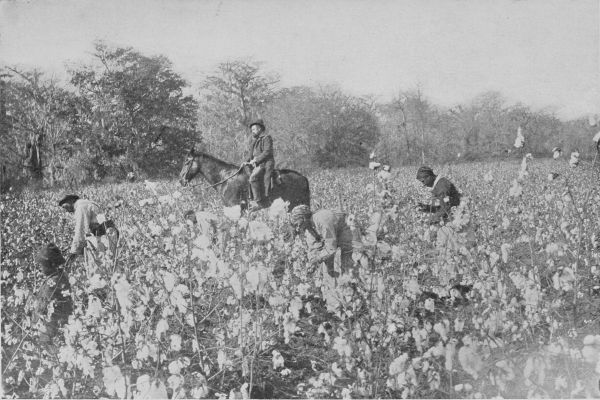
A Cotton Field in Mississippi.
In the present work the efforts of the Government have been
mainly directed in the line of collecting and disseminating authoritative
information relating to all branches of the industry, in importing
proper seed for experimental cultivation, and in directing experiments,
either on its own account or in co-operation with State and
even private interests. The testing of new labor-saving machinery
has also come within its province.
The subject in its details will be better understood by considering
the list of the more important commercial fibers known
to our market. The list is not a long one, for it barely reaches a
total of fifteen species. The fibers of the first rank are the spinning
fibers—namely, cotton, flax, hemp, jute; of the second rank, or cordage
fibers, Sisal, Manila, Sunn and Mauritius hemps, and New Zealand
flax; and of the third rank, Tampico, or ixtle, African fiber or palmetto,
coir or cocoanut, piassaba, Mexican whisk, raffia, and Spanish
moss, which are used in brush manufacture, in upholstery, and for
other rough manufactures. Of these fifteen forms, only cotton, hemp,
palmetto, and Spanish moss are produced in the United States in
commercial quantity, though flax line has been produced to some
extent in the past. Of those not produced in commercial quantity
in this country, but which would thrive in cultivation, may be
mentioned jute, New Zealand flax, Sisal hemp, cocoanut, and possibly
Sunn hemp in subtropical Florida, with a few "substitutes,"
which will be mentioned hereafter.
I have neglected to mention in this list the sponge cucumber, a
species of Luffa used as a bath sponge, which is imported from Japan
in quantity, and which grows in the United States.
Passing the list of recognized commercial fibers, we come to a
large number of species, forms allied to the above, that are either
employed locally, chiefly by the natives in the countries where grown,
or that would be capable of employment in the world's manufacture
were they not inferior to the standard commercial forms at present
recognized, and with which they would necessarily compete at a disadvantage.
This list is a long one, for in the single genus Agave, to
which belong the plant producing the Sisal hemp of commerce, there
are over one hundred species in Mexico alone, more than one half
of which would produce good fiber. In our own country it would
be possible to enumerate twenty species of plants that are recognized
as American weeds, the fibers of which could be employed as hemp,
flax, or jute substitutes were these materials unobtainable, besides
half as many structural fiber plants similar to the agave, the products
of which could be employed as cordage fiber substitutes in the same
manner. Many of these uncultivated plants have been known to the
aborigines for years, possibly for centuries, as we find their fiber,
produced in varied forms of rude manufacture, in ancient tombs or
other burial places.
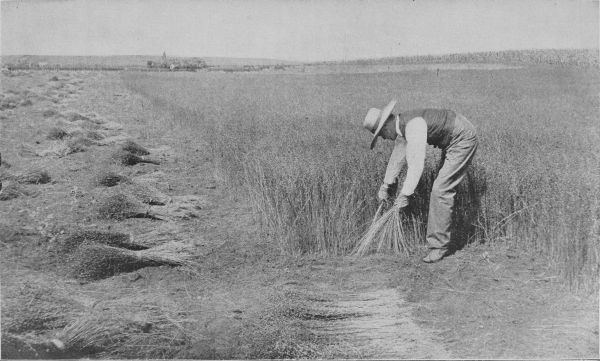
Pulling Flax in Minnesota.
After exhausting the list of plants that may be termed commercial
fiber substitutes, in different countries where they grow, there
still remains a much larger list of species that are chiefly interesting
in a scientific enumeration of those plants which produce in their
stalks, leaves, or seed vessels what may be termed fibrous substance.
My own catalogue of the fibers of the world already foots up over
one thousand species of plants, and the complete catalogue for all
countries might extend the list to a thousand more.
In considering the undeveloped fibers of the United States, it will
be seen we should only recognize the actual commercial forms which
we do not produce, but which may be produced within our borders,
or such native growths as may be economically employed as their
substitutes, and which possibly might be brought into commercial
importance.
The hemp industry is already established, though it should be
extended in order to recover its lost position among American rural
industries. Where in the past we produced forty thousand tons of
hemp in the United States, we now produce less than a fifth of this
quantity. The cultivation of flax in the United States before the
days of the present factory system was so widespread that it was of
national importance. Its manufacture was largely a home industry,
however, conducted by the fireside, and, as in ancient Greece and
Rome, the work was performed by the women of the household.
With the advent of the factory system came competition; the housewife
laid aside her spinning wheel, the clumsy home-made loom fell
into disuse, and the farmer grew no more flax for fiber. Then the
flaxseed industry was extended, and after the close of the war a
large demand sprang up for coarse fiber for the roughest of uses—for
bagging and upholstery, in connection with hemp—and hundreds of
little tow mills came into existence in the Middle and Western
States.
The introduction of jute opened another chapter, and the decline
of this crude attempt at a flax industry is recorded. Meanwhile
some line flax was produced, but the extension of spinning and
weaving establishments made a larger demand for this fiber, which
was chiefly imported. Land in the old flax-growing States became
more valuable for other crops, especially with the low prices brought
about by foreign competition, and gradually the flax culture in the
United States became a thing of the past.
In recent years similar causes have served to operate against the
industry in foreign flax countries where old and plodding methods
are still in vogue, with additional factors in impoverished soils and
high rental for land, and the cultural industry abroad is declining.
With the opening of new and fertile Western lands in this country,
and with the employment of the finest labor-saving agricultural
implements in the world, the conditions are again changed, and are
now favorable for American agriculture to re-establish this industry,
and to make good a declining foreign supply. Our farmers are
ready for the work, but they have not only lost their skill and cunning
in producing the straw and preparing the fiber for the spinner,
but new and more economical methods must be adopted to place the
culture on a solid basis.
A million acres of flax are grown for seed annually, but the growth
of flax for seed and flax for fiber are two very different things;
moreover, Old World methods do not coincide with the progressive ideas
of the educated farmers of the United States, for the peasant class
does not exist in this country. A practice essentially American must be
followed in order to make the culture profitable, and to equalize the
difference in wages on the two sides of the Atlantic. This difference is
more apparent than real, for it can be readily overcome by intelligently
directed effort, by difference in soil fertility and rentals, and
especially by the use of certain forms of
labor-saving machines that already have been devised and are being
rapidly improved. The "American practice," then, means, first,
an intelligent practice, with a view to economy of effort and involving
the use of machinery in the place of plodding foreign methods;
and, second, the co-operation of farm labor and capital to the
end of systematizing the work—i.e., the farmers of a community
growing the flax, and capital, represented by a central mill, turning
the straw when grown into a grade of fiber that the spinners
can afford to purchase. Here is the solution of the flax problem
in a nutshell. The scheme has already been tested in practice with
favorable results, but the farmers in any community can do little
until capital is more generally interested.
This brings up an important point and presents another obstacle,
for great harm has been done to all new fiber industries in recent
years by the misdirected
efforts of some professional
promoters. In certain instances
the organized fiber
companies have been mere
stock-jobbing concerns.
They have had their rise
and fall, men with idle
money have burned their
fingers, and the particular
industry has received a
"black eye."
The story of Government
effort toward the establishment
of the flax industry
need not be told
here; there has been widespread
prejudice to overcome,
with the opposition
of the importers, discouragements
to be studied and
explained, the unvarnished
truth to be told, and practical
and authoritative information
to be given to
all who may seek it. The
literature of the subject
has been disseminated by thousands of copies, and new editions are
being ordered.
As to the results: Superior flax has been produced in this country
in limited quantities since the work began, and through extended
field experiments flax regions have been discovered that are thought
to equal the best flax centers of Europe. The department experiments
in the Puget Sound region of Washington have demonstrated
that we possess in that State a climate and soil that bid fair to rival
the celebrated flax region of Courtrai, and from these experiments
scutched flax has been produced that is valued by manufacturers in
Ireland at three hundred and fifty dollars per ton, and hackled flax
worth five hundred dollars per ton. Much has been done, but a great
deal more remains to be accomplished in bringing together the
farmer and capitalist in the practical work of growing, retting,
scutching, and preparing for market American flax fiber, for questions
of culture are settled.
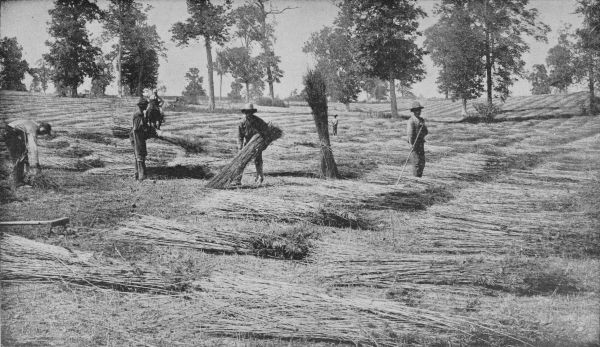
Spreading Hemp in Kentucky.
We should restore our hemp industry to its former proportions
by producing high-grade instead of low-grade fiber. The growth of
a grade of American hemp that will sell for six to eight cents per
pound, instead of three to three and a half cents per pound, as at
the present time, means that our farmers must follow more closely
the careful practices of Europe, and especially that they must adopt
water retting in place of the present practice of dew retting, which
gives a fiber dark in color and uneven in quality. A careful consideration
of the practices of Italy and France as set forth in Fiber
Report No. 11, Department of Agriculture, will materially aid those
who desire to change their product from the cheaper dark hemps, for
which there is small demand, to the higher-priced light hemps, which
will compete with the imported commodity.
One of the most interesting problems of the day in the utilization
of the new fiber material, and one that is attracting the attention of
all civilized countries, is the industrial production of that wonderful
substance known in the Orient as China grass, in India as rhea,
and in Europe and America as ramie. The money spent by governments
and by private enterprise throughout the world, in experiments
and inventions, in the effort to establish the ramie industry,
would make up the total of a princely fortune. Obstacle after
obstacle has been overcome in the years of persistent effort, and now
we stand before the last barrier, baffled for the time, but still hopeful,
and with efforts unrelaxed. The difficulty may be stated in a few
words: ramie culture will only become a paying industry when an
economically successful machine for stripping the fiber has been
placed on the market. Hundreds of thousands of dollars have been
spent in efforts to perfect a machine, but no Government fiber expert
in the world recognizes that we have such a machine at the present
time, though great progress has been made in machine construction.
The world's interest in this fiber began in 1869, when a reward
of five thousand pounds was offered by the Government of India for
the best machine with which to decorticate the green stalks. The first
exhibition and trial of machines took place in 1872, resulting in utter
failure. The reward was again offered, and in 1879 a second official
trial was held, at which ten machines competed, though none filled
the requirements, and subsequently the offer was withdrawn. The
immediate result was to stimulate invention in many countries, and
from 1869 to the present time inventors have been untiring in their
efforts to produce a successful machine. The commercial history of
ramie, therefore, does not extend further back than 1869.
The first French official trials took place in 1888, followed by the
trials of 1889, in Paris, at which the writer was present, and which
are recorded in the official reports of the Fiber Investigation series.
Another trial was held in 1891, and in the same year the first official
trials in America took place, in the State of Vera Cruz, in Mexico,
followed the next year by the official trials of American machines in
the United States, these being followed by the trials of 1894. Since
that year further progress in machine construction has been made, and a
third official trial should be held in the near future.
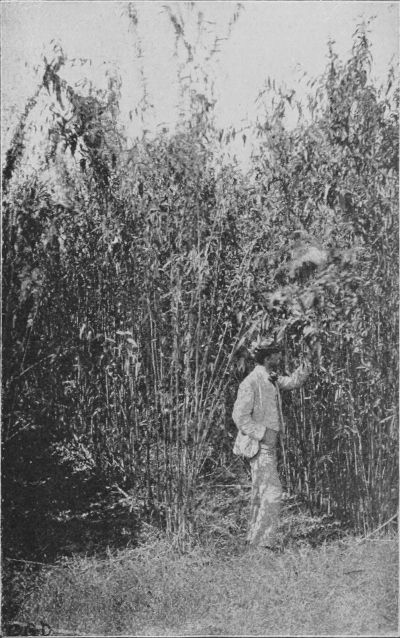
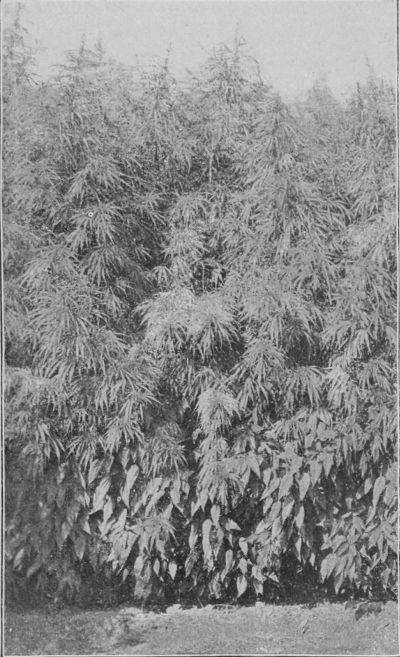
Growth of Jute in Louisiana.
The first records of Chinese shipments of this fiber to European
markets show that in 1872 two hundred or three hundred tons of the fiber
were sent to London, valued at eighty pounds per ton, or about four
hundred dollars. India also sent small shipments, but there was a light
demand, with a considerable reduction in price, the quotations being
thirty pounds to forty pounds per ton for Chinese and ten pounds to
thirty pounds for the Indian product.
Those who are unacquainted with the properties and uses of this
wonderful textile may peruse with interest the following paragraph
from Fiber Report 7, on the Cultivation of Ramie, issued by the
Department of Agriculture:
"The fiber of ramie is strong and durable, is of all fibers least
affected by moisture, and from these characteristics must take first
rank in value as a textile substance. It has three times the strength
of Russian hemp, while its filaments can be separated almost to the
fineness of silk. In manufacture it has been spun on various forms
of textile machinery, also used in connection with cotton, wool, and
silk, and can be employed as a substitute in certain forms of manufacture
for all these textiles and for flax also, where elasticity is not
essential. It likewise produces superior paper, the fineness and close
texture of its pulp making it a most valuable bank-note paper. In
England, France, Germany, Austria, and in our own country to an
experimental extent, the fiber has also been woven into a great variety
of fabrics, covering the widest range of uses, such as lace, lace curtains,
handkerchiefs, cloth, or white goods resembling fine linen, dress
goods, napkins, table damask, table covers, bedspreads, drapery for
curtains or lambrequins, plush, and even carpets and fabrics suitable
for clothing. The fiber can be dyed in all desirable shades or colors,
some examples having the luster and brilliancy of silk. In China
and Japan the fiber is extracted by hand labor; it is not only manufactured
into cordage, fish lines, nets, and similar coarse manufactures,
but woven into the finest and most beautiful of fabrics."
China is at present the source of supply of the raw product, and
the world's demand is only about ten thousand tons, nine tenths of
this quantity being absorbed in Oriental countries. The ramie situation
in the United States at the present time may be briefly summarized
as follows:
The plant can be grown successfully in California and in the Gulf
States, and will produce from two to four crops per year without
replanting, giving from two hundred and fifty to eight hundred
pounds of fiber per acre, dependent upon the number of cuttings,
worth perhaps four cents per pound. The machines for preparing
this fiber for market are hardly able at the present time to clean the
product of one acre (single crop) in a day, and the fiber is quite
inferior to the commercial China grass. A new French machine produces
a quality of fiber which approaches the China grass of commerce,
but its output per day is too small to make its use profitable
in this country. All obstacles in chemical treatment of the fiber and
in spinning and manufacture are overcome, and the world is waiting
for the successful device which will economically prepare the raw
material for market.
The part the United States Government is taking in the work is
to co-operate in experiments, to issue publications giving all desired
information regarding culture, the machine question, and the utilization
of the fiber. It tests new decorticators and reports to the public
upon their merits or demerits. It cautions farmers and capitalists,
for the present, to go into the industry with their eyes open, for
the professional promoter has seized upon this industry, above all
others in the fiber interest, as one in which he can more readily gull
a gullible public. Nevertheless, responsible capitalists are making
every legitimate effort to place the manufacturing industry on a solid
basis in this country, and to attain to the progress made in other
countries where manufacture has already been established, and where
the Chinese fiber is employed as the raw material.
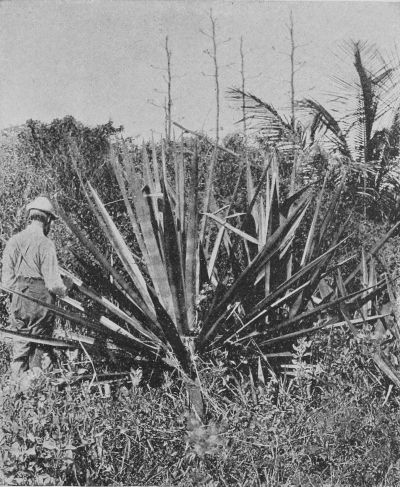
A Florida Sisal Hemp Plant.
Thus far I have only considered spinning fibers. More than one
half of the raw fibers imported in the United States are employed
in the manufacture of rope and small twine, or bagging for baling
the cotton crop. Cordage is manufactured chiefly from the Manila
and Sisal hemps, the former derived from the Philippine Islands, the
latter from Yucatan. Some jute is also used in this industry, though
the fiber is more largely employed in bagging; and some common
hemp, such as is grown in Kentucky, is also used.
We can not produce Manila hemp in the United States, and this
substance will always hold its own for marine cordage. Jute will
grow to perfection in many of the Southern States, but it is doubtful
if we can produce it at a price low enough to compete with the cheaper
grades of the imported India fiber. Rough flax and common hemp
might be used in lieu of jute, in bagging manufacture, but the question
of competition is still a factor. Sisal hemp, which has been imported
to the value of seven million dollars a year, when prices were
high, will grow in southern Florida, and the plant has been the subject
of exhaustive study and experiment. This plant was first grown
in the United States on Indian Key, Florida, about 1836, a few
plants having been introduced from Mexico by Dr. Henry Perrine,
and from this early attempt at cultivation the species has spread over
southern Florida, the remains of former small experimental tracts
being found at many points, though uncared for.
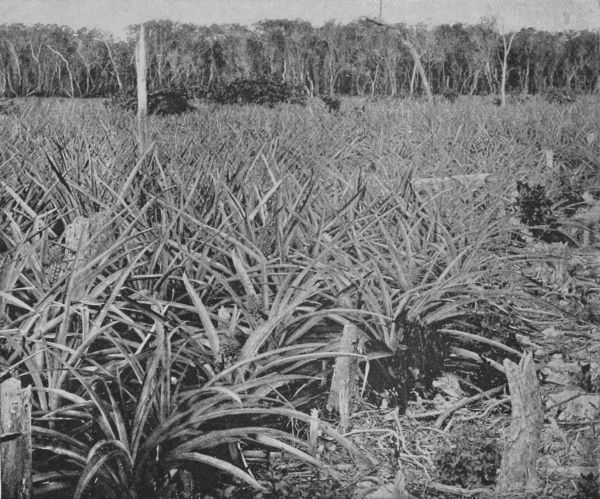
Pineapple Field in Florida.
The high prices of cordage fibers in 1890 and 1891, brought
about by the schemes of certain cordage concerns, called attention to
the necessity of producing, if possible, a portion of the supply of
these hard fibers within our own borders. In 1891, in response to
requests for definite information regarding the growth of the Sisal
hemp plant, a preliminary survey of the Key system and Biscayne
Bay region of southern Florida was made by the Department of
Agriculture, and in the following year an experimental factory was
established at Cocoanut Grove with special machinery sent down for
the work. With this equipment, and with a fast-sailing yacht at the
disposal of the special agent in charge of the experiments, a careful
study of the Sisal hemp plant, its fiber, and the possibility of the industry
was made, and the results were duly published. About this
time the Bahaman Government became interested in the industry,
and with shiploads of plants, both purchased and gathered without
cost on the uninhabited Florida Keys, the Bahamans began the new
industry by setting out extensive plantations on the different islands
of the group. The high prices of 1890 having overstimulated production
in Yucatan, two or three years later there was a tremendous
fall in the market price of Sisal hemp, and Florida's interest in the
new fiber subsided, though small plantations had been attempted. In
the meantime, American invention having continued its efforts in the
construction of cleaning devices, two successful machines for preparing
the raw fiber have been produced which have, in a measure,
superseded the clumsy raspadore hitherto universally employed for
the purpose, and one of the obstacles to the production of the fiber
in Florida is removed. The reaction toward better prices has already
begun, and the future establishment of an American Sisal hemp industry
in southern Florida is a possibility, though there are several
practical questions yet to be settled.
Pineapple culture is already a flourishing industry in the Sisal
hemp region. A pineapple plant matures but one apple in a season,
and after the harvest of fruit the old leaves are of no further use to
the plant, and may be removed. The leaves have the same structural
system as the agaves—that is, they are composed of a cellular mass
through which the fibers extend, and when the epidermis and pulpy
matter are eliminated the residue is a soft, silklike filament, the value
of which has long been recognized. Only fifty pounds of this fiber
can be obtained from a ton of leaves, but, as the product would doubtless
command double the price of Sisal hemp, its production would
be profitable. How to secure this fiber cheaply is the problem. The
Sisal hemp machines are too rough in action for so fine a fiber, and,
at the rate of ten leaves to the pound, working up a ton of the
material would mean the handling of over twenty thousand leaves
to secure perhaps three dollars' worth of the commercial product.
Were the fiber utilized in the arts, however, and its place established,
it would compete in a measure with flax as a spinning fiber,
for its filaments are divisible to the ten-thousandth of an inch. The
substance has already been utilized to a slight extent in Eastern
countries (being hand-prepared) in the manufacture of costly, filmy,
cobweblike fabrics that will almost float in air.
Another possible fiber industry for Florida is the cultivation of
bowstring hemp, or the fiber of a species of Sansevieria that grows in
rank luxuriance throughout the subtropical region of the State. The
fiber is finer and softer than Sisal hemp, though not so fine as pineapple
fiber, and would command in price a figure between the two.
The yield is about sixty pounds to the ton of leaves. Many other
textile plants might be named that have been experimented with by
the Government or through private enterprise, but the most important,
in a commercial sense, have been named.
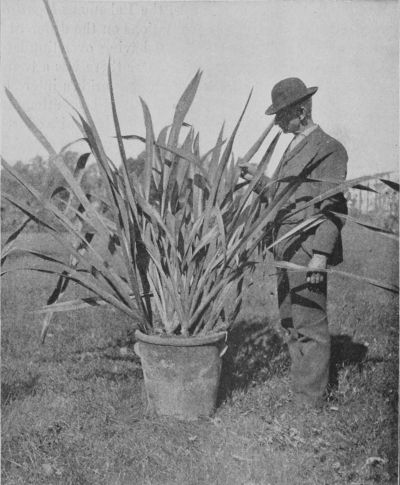
A Plant of New Zealand Flax.
There is a considerable list of plants, however, which are the
subject of frequent inquiry, but which will never be utilized commercially
as long as other more useful fibers hold the market. These
for the most part produce bast fiber, and the farmer knows them as
wild field growths or weeds. They are interesting in themselves, and
many of them produce a fair quality of fiber, but to what extent they
might be brought into cultivation, or how economically the raw
material might be prepared, are questions the details of which only
experiment can determine. But the fact that at best they can only
be regarded as the substitutes for better, already established, commercial
fibers has prevented serious experiment to ascertain their
place. They are continually brought to notice, however, for again
and again the thrifty farmer, as he finds their bleached and weather-beaten
filaments clinging to the dead stalks in the fields, deludes himself
in believing that he has made a discovery which may lead to
untold wealth, and a letter and the specimen are promptly dispatched
to the fiber expert for information concerning them. In such cases
all that can be done is to give full information, taking care to let
the inquirer down as easily as possible.
The limit of practical work in the direction of new textile industries
is so clearly defined that the expert need never be in doubt
regarding the economic value of any fiber plant that may be submitted
to him for an opinion, and the long catalogue of mere fibrous
substances will never demand his serious attention.
In studying the problem of the establishment of new fiber industries,
therefore, we should consider "materials" rather than particular
species of plants—utility or adaptation rather than acclimatization.
We should study the entire range of textile manufacture,
and before giving attention to questions of cultivation we should first
ascertain how far the plants which we already know can be produced
within our own borders may be depended upon to supply the "material"
adapted to present demands in manufacture. If the larger
part of our better fabrics—cordage and fine twines, bagging, and
similar rough goods—can be made from cotton, flax, common hemp,
and Sisal hemp, which we ought to be able to produce in quantity
at home, there is no further need of costly experiments with other
fibers. Unfortunately, however, it is possible for manufacturers to
"discriminate" against a particular fiber when the use of another
fiber better subserves their private interests. As an example, common
hemp was discriminated against in a certain form of small cordage,
in extensive use, because by employing other, imported fibers, it has
been possible in the past to control the supply, and in this day of
trusts such control is an important factor in regulating the profits.
With common hemp grown on a thousand American farms in 1890,
the price of Sisal and Manila hemp binding twine, of which fifty
thousand tons were used, would never have been forced up to sixteen
and twenty cents a pound, when common hemp, which is just as good
for the purpose, could have been produced in unlimited quantity for
three and a half cents. The bagging with which the cotton crop is
baled is made of imported jute, but common hemp or even low-grade
flax would make better bagging. A change from jute to hemp
or flax in the manufacture of bagging (it would only be a return to
these fibers), could it be brought about, would mean an advantage
of at least three million dollars to our farmers. Yet in considering
such a desirable change we are confronted with two questions:
Is it possible to compete with foreign jute? and can prejudice be
overcome? For it is true that there are, even among farmers, those
who would hesitate to buy hemp bagging at the same price as jute
bagging because it was not the thing they were familiar with. But
some of them will buy inferior jute twine, colored to resemble hemp,
at the price of hemp, and never question the fraud.
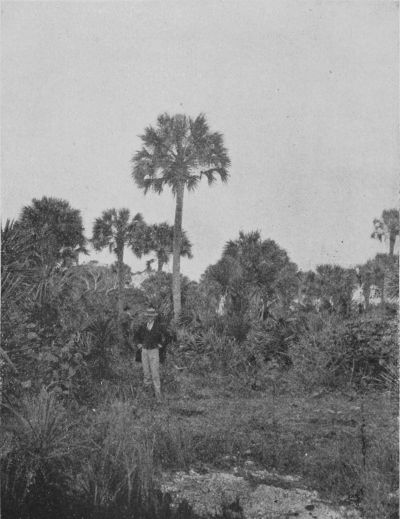
Cabbage Palmetto in Florida.
Our farmers waste the fibrous straw produced on the million acres
of flax grown for seed. It has little value, it is true, for the production
of good spinning flax, yet by modifying present methods of
culture, salable fiber can be produced and the seed saved as well,
giving two paying crops from the same harvest where now the flaxseed
grower secures but one.
In summarizing the situation in this country, therefore, it will be
seen that, out of the hundreds of fibrous plants known to the botanist
and to the fiber expert, the textile economist need only consider four
or five species and their varieties, all of them supplying well-known
commercial products that are regularly quoted in the world's market
price current, the cultivation and preparation of which are known
quantities. Were the future of new fiber industries in this country
to rest upon this simple statement, there would be little need of
further effort. The problem, however, is one of economical adaptation
to conditions not widely understood in the first place, and not
altogether within control in the second.
Twenty flax farmers in a community decide to grow flax for fiber,
and two of these farmers are perhaps acquainted with the culture.
They go to work each in his own way; ten make a positive failure
in cultivation for lack of proper direction, five of the remaining ten
fail in retting the straw, and five succeed in turning out as many different
grades of flax line, only one grade of which may come up to
the standard required by the spinners. And all of them will have
lost money. If the failure is investigated it will be discovered that
the proper seed was not used; in some instances the soil was not
adapted to the culture, and old-fashioned ideas prevailed in the practice
followed. The straw was not pulled at the proper time, and it
was improperly retted. The breaking and scutching were accomplished
in a primitive way, because the farmers could not afford to
purchase the necessary machinery, and of course they all lost money,
and decided in future to let flax alone.
But the next year the president of the local bank, the secretary
of the town board of trade, and three or four prosperous merchants
formed a little company and built a flax mill. A competent superintendent—perhaps
an old country flax-man—was employed, a quantity
of good seed was imported, and the company contracted with
these twenty farmers to grow five, ten, or fifteen acres of flax straw
each, under the direction of the old Scotch superintendent. The seed
was sold to them to be paid for in product; they were advised regarding
proper soil and the best practice to follow; they grew good straw,
and when it was ready to harvest the company took it off their hands
at a stipulated price per ton. The superintendent of the mill assumed
all further responsibility, attended to the retting, and worked up the
product. Result: several carloads of salable flax fiber shipped to the
Eastern market in the winter, the twenty farmers had "money to
burn" instead of flax straw, and the company was able to declare a
dividend. This is not altogether a supposititious case, and it illustrates
the point that in this day of specialties the fiber industry can
only be established by co-operation.
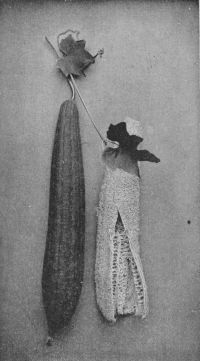
The Luffa, or Sponge Cucumber.
In all these industries, whether the fiber cultivated is flax, ramie,
or jute, the machine question enters so largely into the problem of
their successful establishment that the business must be conducted on a
large scale. Even in the growth of Sisal hemp in Florida, should it be
attempted, the enterprise will only pay when the necessary mill plant
for extracting the fiber is able to draw upon a cultivated area of five
hundred acres. In other words, the small farmer can never become a
fiber producer independently, but must represent a single wheel in the
combination.
The subject is a vast one, and, while I have been able to set
forth the importance of these industries as new sources of national
prosperity, only an outline has been given of the difficulties which are
factors in the industrial problem. Summing up the points of vantage, the
market is already assured; through years of study and experiment we are
beginning to better understand the particular conditions that influence
success or failure in this country; we have the best agricultural
implements in the world, and American inventive genius will be able,
doubtless, in time, to perfect the new mechanical devices which are so
essential to economical production; our farmers are intelligent and
industrious, and need only the promise of a fair return for their labor
to enter heart and soul into this work.


