Climate and Acclimatization.—In
view of the rapid growth of West Indian
and South American commerce and the
considerable emigration to Cuba and
neighboring islands, which our present
relations with them will probably bring
about, the following extracts from an
editorial in the London Lancet are of
interest: "The American nation has entered
upon a new and, in a sense, imperial
policy, which may be regarded
as forming an epoch in its history.
This brings it face to face with the
problem of colonization and acclimatization—a
problem which we have had
to confront long ago and toward the solution
of which we have ever since been
slowly fighting our way by following on
the lines of the best practical measures
of hygiene known to us. 'The white
man's burden' has proved a tragical one
in its drain on the life of the young manhood
of this country, notwithstanding
the very large measure of success which
has attended our sanitary efforts in this
direction. The Americans, having taken
up their burden, will, no doubt, like the
practical people they are, set about their
task in a practical way. The four principal
factors in the production of climate,
according to Buchan, are distance
from the equator, height above the sea,
distance from the sea, and prevailing
winds. The equatorial region has the
most equable climate; tropical regions
have much greater variations of temperature
than those near the equator, and
have a hot and cold or dry and rainy
season. The isothermal lines of mean
temperature do not supply a graduated
measure of the effects of temperature on
animal life. So far as climate is concerned,
no single meteorological influence
appears, however, to equal the effect of
temperature upon health, and its range
is of more importance than its mean.
The European under a tropical climate
suffers from anæmia, diseases of the digestive
system, especially of the liver,
from malaria, dysentery, typhoid fever,
and yellow fever. It is not at all easy
to say, however, how much of the excess
of mortality of Europeans in tropical
and subtropical countries is simply attributable
to climatic heat per se, and is
consequently inevitable and not the effect
of malaria, or how much of it is the
direct consequence of habits of life and
of the neglect of sanitary laws and of
personal hygiene. As Arnould rightly
said, the habitudes alimentaires of the
Anglo-Saxon constitute one of the stumbling-blocks
to health, but by far the
most important is malaria, compared
with which the rest are relatively
insignificant. Mr. Chamberlain was right
when he said the other day that 'the
man who shall successfully grapple with
this foe to humanity and shall find a
cure for malarial fever and shall make
the tropics livable for the white man,
will do more for the world and more for
the British Empire than the man who
adds a new province to the wide dominions
of the Queen.'"
"Picture Telegraphy."—The following
account of the new so-called picture
telegraphy is from the New York
Electrical World and Engineer: "The
apparatus consists of a receiver and
transmitter, similar in appearance and
in mechanism. The picture to be transmitted
is drawn on a heavy piece of
metal foil, the lines of the drawing being
made with an insulating ink. The foil
is then secured on the circumference of
a horizontal cylinder on the transmitter,
the cylinder being of about the size of
a typewriter rubber roller. There is a
similar cylinder on the receiver, on
whose surface is clamped the paper upon
which the drawing is to be reproduced;
over this is superposed carbon paper,
which is covered in turn by a sheet of
thin paper. A stylus actuated by an
electro-magnet is adjusted close to the
surface of the latter, and each time a
current is passed through the electro-magnet
the stylus is forcibly pressed
against the moving surface of the cylinder,
and a corresponding mark is made
on the two sheets in contact with the
carbon paper; the outer sheet serves
merely to offer a smooth surface to the
stylus and to enable the operator to see
that the picture is being properly reproduced.
The transmitting cylinder passes
under a similar stylus, which latter
closes the circuit between the receiving
and transmitting ends when it rests upon
the foil, and opens the circuit when it
passes over the lines drawn with insulating
ink, in the latter case actuating
the stylus magnet at the receiving end,
which leaves a mark on the paper of the
receiving cylinder in the form of a line
corresponding to the width of the insulation
over which the transmitting stylus
is passing. The stylus at each end of
the line is simultaneously advanced at
the end of each revolution of the cylinders
by a screw of small pitch. From the
description it will be seen that if the surface
of the foil on the transmitting cylinder
were entirely insulated the receiving
stylus would merely draw a number
of parallel lines on the paper corresponding
to the turns of the screw, and separated
a distance corresponding to the
pitch of the screw and the angle through
which it is turned at each operation.
Four different rates of advance may be
given to the stylus, corresponding to as
many different angles of advance that
may, by appropriate mechanism, be
given to the screw. The two cylinders
have synchronous motion, so that all the
marks or lines on the receiving cylinder
correspond to widths of insulating ink
traced over on the transmitting cylinder.
Synchronism is obtained as follows: Connected
with both receiver and transmitter
is an electric motor which, at the
end of every revolution of the cylinder,
raises a weight, which acts on a clock
train when falling and thus gives motion
to the cylinder. At the end of each revolution
of the transmitting cylinder a
contact is made which locks for an instant
the receiving cylinder when it arrives
in a position corresponding to a
similar position of the transmitting cylinder.
Thus it will be seen that each
cylinder begins its revolution from identical
positions and at the same instant,
and as the clockwork of both receiver
and transmitter are duplicates, approximate
synchronism is maintained during
a revolution. Owing to the use of carbon
paper, the lines made by the receiver
are of considerable width, with the
consequence that the resulting picture does
not have the appearance of being made
up of parallel lines, as in the case of reproductions
by the original Caselli picture
telegraph, of which the system described
is a modification. The Hummell
apparatus appears to be entirely practicable,
the simplicity of its synchronizing
mechanism giving it a great advantage
over former types of Caselli picture
telegraphs. The apparatus has been
worked duplex with success. In one instance,
a few days ago, a picture was
sent from New York to St. Louis while
one was being received from the same
place in New York, the latter picture in
addition being received simultaneously
at Boston."
The Charges on Country Checks:
an Economic Mistake.—An article in
the May issue of the Yale Review, discussing
the recent adoption by the New
York banks of a rule imposing a "collection
charge" on all country checks handled,
takes the view that the new rule is
a mistake. After reviewing the history
and present position of the Bank of England;
calling attention to the fact that
although it is a private enterprise its position
is used as a governor, so to speak,
of English finance; the similarity to it
in position and power for good or evil of
the association of banks known as the
New York Clearing House is pointed
out; the review goes on to say: "In the
associated banks of New York, as in the
Bank of England, is kept a very large
part of the reserve on which the great
financial transactions of a whole country
are based. The system of 'reserve cities'
for holding large deposit accounts of
country banks, in which New York is
by far the most important center, is but
the recognition in the national banking
law of this great fact of a central reserve,
and the power of utilizing such
deposits, indirectly extended by the law
which allows and encourages country
banks to hold a large part of their legal
reserve in the form of deposits in New
York, probably constitutes a much more
valuable privilege than the rights of note
issue enjoyed by the Bank of England.
In extraordinary emergencies the parallel
is even closer. Just as the Bank of
England is encouraged to expect a modification
of the restrictions on its right of
note issue, as a means of extending its
effective currency reserve in times of
panic, so the New York banks, by their
system of clearing-house loan certificates,
are encouraged and expected to evade
those provisions of our national banking
laws which restrict their power of
issuing notes to meet an emergency....
The exercise of this function of holding
a reserve for clearing the business of the
country is attended with some expense,
as well as with much profit. One of the
most vexatious of these expenses has
been the cost of collecting country
checks.... Under these circumstances
they have adopted a rule imposing such
charges on country checks as to compel
a large part of the remittances to be
made in the form of bank drafts on New
York city, rather than individual checks
on country banks supposed to have accounts
with some New York bank. This
rule will save the New York banks
something like two million dollars annually.
It will not prevent any solvent
man from making remittances,
for if he has a deposit in his local
bank and his local bank has a deposit
in New York he can buy a draft to
send as a remittance, which will pass
through the New York Clearing House
without question or expense. Yet, in
spite of these plausible arguments, we
believe the action of the New York
banks to be a mistake of very serious
magnitude, an inconvenience to the public,
a probable loss to deposit banking in
the long run, and, worst of all, a serious
blow to the cause of sound currency
throughout the country. It seems to us,
in short, a case where narrower duties
and economics have been allowed to
crowd broader ones out of sight." The
review then goes on to show how great
an amount of inconvenience and loss of
time in the aggregate the new rule is
going to cause, and finally says: "In a
popular government the greatest safeguard
against soft money—we may fairly
say the only real safeguard—is to prevent
the growth of a demand for soft
money. And of all the means of prevention
at our command the most effective
is the encouragement of the habit of paying
by checks. The habit of paying by
check is very general in all large business
centers, and has been rapidly extending
into the smaller centers, and the most
serious public danger in the action of
the New York banks is that it seems
likely to deal a severe blow to such progress."
La Nature's Second Scientific
Excursion.—A second scientific excursion
to an interesting district of France is
planned, by M. Henri de Parville, of La
Nature, to start from Bayonne August
25th. It will spend about two weeks,
following the chain of the Pyrenees from
the ocean to the Mediterranean. Among
objects of interest enumerated are the
scenery at Biarritz, Pau, Cauterets, and
Bigorre; fine architecture at Toulouse,
Carcassonne, Elne, etc.; glacial phenomena
and thermal waters along the whole
mountain chain; manufactories, including
iron works at Bouchain, woolen
mills at Bigorre, cigarette factories at
Perpignan, and the Arago Maritime
Laboratory and the sanitarium at Banyuls.
The excursion will be "personally
conducted" by the eminent anthropologist
and archæologist, M. E. Cartaillac.
The excursion last year, to the
Central Plateau and the Tarn, was an
eminent success. The programme of the
present one seems equally attractive.
M. de Parville and his associates deserve
great credit for their sagacity and enterprise
in inaugurating these excursions,
which now promise to become annual.
We can conceive nothing more profitable
and conducive to real pleasure in a vacation
than the tour in the company of men
having a common interest in the pursuit
of knowledge of Nature and art, through
such magnificent regions as that of the
Pyrenees or through a country so full of
natural wonders and novelties as that of
last year's excursion. And it will be an
incalculable advantage to be under the
guidance of so eminent a student and
one so familiar with the remarkable features
and the antiquities of southern
France as M. Cartaillac.
The American Association Meeting.—The
forty-eighth annual meeting
of the American Association for the
Advancement of Science will be held at Columbus,
Ohio, August 19th to 26th. The
association headquarters will be in University
Hall, of the Ohio State University,
and the headquarters of the council
will be at the Chittenden Hotel.
The president of the meeting will be
Prof. Edward Orton, of the Ohio State
University. The vice-presidents or chairmen
of sections will be: Mathematics
and astronomy, Alexander Macfarlane;
physics, Elihu Thomson; chemistry, F. P.
Venable; mechanics and engineering,
Storm Bull; geology and geography, J.
F. Whiteaves; zoölogy, S. H. Gage; botany,
Charles R. Barnes; anthropology,
Thomas Wilson; social and economic
science, Marcus Benjamin. The Permanent
Secretary is L. O. Howard, Cosmos
Club, Washington; General Secretary,
Frederick Bedell, Cornell University;
Secretary of the Council, Charles Baskerville,
Chapel Hill, N. C.; Treasurer,
R. S. Woodward, Columbia University,
New York. The address of retiring
President Putnam will be delivered Monday
evening, August 21st. Saturday,
August 26th, will be devoted to excursions
to Fort Ancient and elsewhere.
Receptions and shorter excursions will
be provided at hours that will not conflict
with the appointments of the association.
The Desire for Notoriety a Cause
of Crime.—Under the title Luccheni
Redivivus the London Lancet gives some
interesting psychological data which
have been obtained since the imprisonment
of Luccheni, the assassin of the
Austrian Empress. Twice since his trial
and conviction he has attempted suicide.
Within the last few days (May 13th) his
moral condition has undergone a change
confirmatory in a significant degree of
the diagnosis which found vanity or
megalomania at the root of his crime. The
cantonal juge d'instruction in an attempt
to ascertain if possible his associates
in the crime, visited him in his
cell and approached the subject with
what seemed to himself due dexterity
and caution. At once the previously
downcast and abject creature brightened
up, his eyes sparkling with gratified self-importance.
"I giornali riparlano di
me?" (So the journals are talking of me
again) he exclaimed interrogatively. The
judge disclosed the object of his visit.
Luccheni thereupon dallied with his
interlocutor, smiling at his reminiscences
of the crime, assuming airs of reticence,
even indulging in self-contradiction to
tease if not torment his judicial antagonist.
It was learned, however, that in
the preliminaries leading up to the assassination
he really had accomplices; beyond
this nothing new was elicited from
him. The point of chief importance, however,
to be observed in this account is the
large part which vanity and a desire for
the widespread public attention which
such crimes bring about plays in reconciling
the criminal to his fate, and even
leading to the commission of the crime
in cases where the mental balance is very
unstable. Hence this class of criminals
should always be tried and punished
with as little publicity as possible, not
only because this policy deprives the
individual of a show, with himself as
the center, but also because every such
public trial is liable to lead to the commission
of similar crimes by other mentally
unsound degenerates, who are sure
to attend such spectacles whenever it is
possible.
Bounties and Free Trade.—Much
discussion is going on in England over
the question of bounties and the propriety
of putting a tariff on those imported
articles which, owing to bounties
or other form of government aid at their
place of manufacture, can be sold "too
cheaply." The following paragraphs are
taken from an article in the London
Spectator: "In our opinion there can be
no question between the policy of free
and open market and the policy of only
allowing goods to be sold here 'at the
natural price of the world's market.'
We hold that the maintenance of an
open and unhindered market is essential
to our welfare; ... that is the real principle
involved, and that is the ground on
which this question of bounties must be
fought out. It is not Cobdenism or free
trade that is involved, but that which
underlies them both—the great principle
of the free and open market.... We
attach such immense importance to the
open market because we believe not
only that our internal prosperity is essentially
bound up with the right, not
merely of consumers, but of producers,
to buy as cheaply as they can and where
and how they will, but that the empire
itself rests upon the preservation of a
free and open market. Mr. Morley never
spoke a truer word than when he insisted
that Cobden and Bright and the old free
traders were empire builders. That they
were so and that our empire could not
possibly have grown up except with the
help of free trade and a market always
open must be clear to all whose eyes are
not blinded by that evil and foolish spirit
of commercial jealousy under which a
man, in order to injure his neighbor,
wounds himself. Free trade made our empire
possible and created what the world
before had never seen, overwhelming
commercial power wielded without jealousy
or narrowness and based on wide
and liberal ideas. How long would our
colonies have tolerated the connection
with us had we been forever worrying
them with tariffs and excluding this or
that product because it was unnaturally
cheap?... As it is, we bid all men welcome
in our markets and none are aggrieved....
Foreign powers may hate
us for our wealth and prosperity, but not
one of them would care to spoil their best
market. How would the commerce of
France, or Germany, or Russia get on if
England were ruined and the English
market destroyed? The principle of
maintaining a free and open market,
coupled with our moral and physical energy,
and our liberal aims and aspirations
have given us a great and splendid
empire. Are we to risk its destruction
because the sugar refiners grumble, and
because the words of Cobden on another
subject may possibly be interpreted to
show that he would not, were he alive,
have voted against the imposition of
countervailing duties?"
Forest and Animal Life of the
Catskills.—The interior region of the
Catskill Mountains surrounding Kaaterskill
Junction is assigned, by Dr. E. A.
Means in a paper of the United States
National Museum, to the Canadian
faunal region, with a slight mixture of
the Alleghanian in the farming lands
on the banks of Schoharie Creek. A few
mammals of the Upper Austral zones,
however, such as the New England cottontail,
the deer mouse, and the gray
fox, appear to have extended their ranges
into the locality by following up the
clearings. Though the region is now
again well wooded, only the barest tags
and remnants yet remain of the splendid
forests that once covered the area.
All is second growth except in the rockiest
gulches, whence the lumber can not
be extracted, and about the rocky summits
of a few mountains of the East Jewett
ranges. While the original forests
seem to have been of conifers, the woods
are now very thoroughly mixed, and the
succession of trees according to altitudes,
with its strongly marked division
lines, is no longer seen. Specimens of fifty-eight
species of trees and shrubs have
been collected and placed in the National
Museum. Only ten species of mollusks,
one crustacean (the common crawfish),
probably a dozen fishes (the author identifies
eight and mentions others), eight
batrachians, two snakes, and a turtle
have been found. Of mammals, thirty-five
species are described as known to
occur at the present time, and eight as
of doubtful occurrence now.
Geology of Block Island.—In a
study of the geology and natural history
of Block Island, of which Arthur Hollick
gives a summary in the Annals of
the New York Academy of Sciences, the
most important problem was whether
the Amboy clay series was represented
in the island. Of fifteen species of fossil
leaves and fruit capable of identification,
represented by about twenty-five specimens,
at least nine were typical of the
Amboy flora. Observations on dip and
strike of strata tended to emphasize the
fact of contortion of glacial action, the
dip in all cases being toward the north,
indicating that the strata had been
pushed southward in a series of overthrust
folds by the advancing ice front.
The flora may be divided physiographically
into that of the hills, the peat bogs
and pond holes, the salt marshes, the
sand dunes, and the salt water. Trees
are rare, and such vegetation as is dependent
on forestal conditions is absent.
The bulk of the surface is that of a typical
morainal region, with rounded hills
and corresponding depressions, many
of the depressions being occupied by
swamps or ponds, often without any visible
outlet. Running streams are few
and insignificant, and permanent springs
occur only in a limited number of localities.
The soil is bowlder till and gravel,
with sand in the dunes and beaches, and
there are no outcrops of rock. The flora
is morainal in its general character, except
in the peat bogs and on the limited
sand dunes and sea-beach areas, and has
its nearest analogue in that of Montauk
Point. "In fact, if we could imagine
Montauk Point to be despoiled of its few
remaining trees and converted into an
island it would bear a striking resemblance,
geologically and botanically, to
Block Island." Considering the geological
features of Long Island, Block Island,
Martha's Vineyard, and Nantucket,
and comparing their floras, we
find that all except Block Island have
some of the plain region remaining with
them, on which a characteristic flora
finds a home. Block Island has lost all
its plain region and accompanying flora,
and is now merely an isolated portion of
the terminal moraine, with small areas
of modern sand beach and dune formations,
affording a home only for such
species as can exist under such conditions.
The island appears to have been
extensively wooded before it was settled,
and large stumps, together with roots
and branches, are found in some of the
peat bogs. The scarcity of animal life
on the island is sure at once to attract
the attention of the observer from the
mainland. Tree-living birds are absent,
but robins, bank swallows, red-winged
blackbirds, and meadow larks occur with
some frequency. Among mollusks, the
periwinkle of the Old World, an importation
or migration, is the most abundant.
Frogs and spotted turtles are
plentiful, and a few small striped snakes
were seen by Mr. Hollick. The archæology
of the island is being studied by persons
specially interested in the subject.
The Claims of the High School.—In
considering the right of the public
high school to be a just charge upon the
public treasury, Mr. Frank A. Hill, of
the Massachusetts State Board of Education,
finds that less than one fifth of
the school money raised in the State is
expended on account of these schools,
whereas if the number of pupils in each
of the thirteen grades of school was
equal and the money was evenly divided,
the higher grades would be entitled to
four thirteenths, or nearly one third of
it. To an objection sometimes raised
against the high-school system that the
"toiling millions" will have no use for
more than the teaching of the elementary
grades, Mr. Hill asks, Who has a
right to decide whether one child shall
have a greater or less amount of instruction
than another? "And so freedom of
choice, when the question of what one's
life work shall be comes up, is a basic
thing in government by the people.
Upon the wisdom of this choice turns
the welfare of each unit in the State, and
therefore of the State itself." Hence the
State has no right to refuse to one any
opportunity of preparing himself to exercise
this freedom of choice which it accords
to another. There has never been
a time since 1647 when the laws of Massachusetts
did not require certain towns
to maintain grammar schools, of which
the high schools are the modern equivalents,
at public expense, and when the
colony became a State a perpetual obligation
was imposed upon the Legislature
and magistrates "to cherish the
interests of literature and the sciences
and all seminaries of them, especially
the university at Cambridge, public
schools, and grammar schools in the
towns."
Degeneration.—Dr. William C.
Krauss, in a paper on The Stigmata of
Degeneration, describes degeneration as
meaning, in pathology, the substitution
of a tissue by some other regarded as
less highly organized, less complex in
structure, of inferior physiological rank,
or less suited for the performance of the
original function. The same definition
may apply equally well, according to Dr.
Krauss, in human ontogeny, "where we
can regard a normal man as possessing
a certain number of units of strength
capable of supplying or exerting a certain
number of units of work or force,
varying of course according to the environment,
education, and fixity of purpose
of the individual. It would be obviously
unfair to compare a professional
man or a brain-worker, whose units of
work are intuitively manifold more than
a hand-worker, and declare the latter a
degenerate because his force and energy,
as measured by the world's standard, are
not as productive as the former. The
questions of money standard and time-worth
are foreign to the laws of degeneracy,
and are not to be regarded in
any way. The degenerate must be considered
solely and alone upon the physical,
mental, and abnormal stigmata
which brand him as an abnormal or
atypical man, and prevent him from exerting
himself to the highest limit commensurate
with his skill and development."
The author's paper treats in detail
of the various aspects of degeneracy.
Birds as Pest Destroyers.—The
French journal, Le Chasseur, puts in
a plea for the animals that should not
be killed. "Why destroy spiders, except
in rooms, while they check the increase
of flies? Why tread on the cricket in
the garden, which wars upon caterpillars,
snails, and grubs? Why kill the
inoffensive slowworm, which eats grasshoppers?
Why slay the cuckoo, whose
favorite food is the caterpillar, which we
do not like to touch? Why destroy the
nuthatch and de-nest the warbler, foes
of wasps? Why make war on sparrows,
which eat seeds only when they can not
get insects, and which exterminate so
many grain-eating insects? Why burn
powder against starlings, which pass
their lives in eating larvæ and picking
vermin from the cattle in the fields?
(But they eat grapes too.) Why destroy
the ladybird, which feeds on aphides?
Why lay snares for titmice, when each
pair take on an average one hundred and
twenty thousand worms and insects for
their little ones? Why kill the toad,
which eats snails, weevils, and ants?
Why save the lives of thousands of gnats
by destroying goat-suckers? Why kill
the bat, which makes war on night
moths and many bugs, as swallows do
on flies? Why destroy the shrew mole,
which lives on earthworms, as the mouse
does on wheat? Why say the screech
owl eats pigeons and chickens, when it is
not true, and why destroy it when it
takes the place of seven or eight cats
by eating at least six thousand mice a
year?"
The Yang-tse-Kiang.—In a lecture
before the London Foreign Press Association
Mrs. Isabella Bishop describes
the Yank-tse-Kiang as one of the largest
rivers of the world, it draining an area
of 650,000 square miles, within which
dwell a population of 180,000,000. In
the journey to the far East, the scenery
at Szu-chuan changed from savage grandeur
and endless surprises to the fairest
scenes, with prosperity, peace, law, and
order seeming to prevail everywhere.
Erroneous ideas were often entertained
about Chinese social life and surroundings.
China had many trade associations,
which were often strengthened by
alliance with guilds. They were composed
of men in any particular trade or
employment, who bound themselves for
common action in the interest of that
trade. They might rightly be called
trade unions, for through their elected
officers they prescribed hours of labor
and minimum wages and made trade
rules, the breach of which was punishable
by fine and expulsion. The Chinese
people displayed much benevolence and
social kindness one to another, and had
societies for providing free coffins and
seemly burial in free cemeteries for the
poor, soup kitchens, foundling institutions,
asylums, orphanages, and medical
dispensaries. Throughout the whole of
the Yang-tse basin the author was impressed
with the completeness of Chinese
social and commercial organization
by the existence of patriotism or public
spirit, by great prosperity, and by the
absence of the decay often attributed to
the nation. Of the prevailing "expansion"
or territorial robbery fever Mrs.
Bishop said that we were coming to
think only of markets and territories,
and to ignore human beings, and were
breaking up, in the case of a fourth of
the human race, the most ancient of the
earth's existing civilizations without giving
for our supposed advantage a fair
equivalent.
"Somewhat" Poisonous Plants.—In
Prof. B. D. Halsted's paper in the
State Agricultural Experiment Station
Bulletins on The Poisonous Plants of
New Jersey, besides the descriptions of
plants recognized as poisonous internally
and to the touch, a list is given
of "many somewhat poisonous plants."
Among these the catalpa and ailantus
produce emanations that are disagreeable
and sometimes poisonous, and catalpa
flowers, when handled, will produce
an irritation of the skin. The thorn
of the Osage orange leaves a poisoned
wound. The young leaves of the red
cedar and the arbor vitæ are irritating
to the skin and may produce blisters,
and the pitch of the spruce causes itching.
Balm of Gilead may cause blistering.
The green bark of the club of Hercules
is irritating to the skin. The
herbage of oleander affects some persons
like poison ivy, the bark of the daphne
causes blisters, and the juice of the box
produces an itching with many persons.
To some the herbage of the wild clematis
is acrid and unpleasant. Many of the
wild herbs have acrid properties, among
them skunk cabbage, Indian turnip, cow
parsnip, several of the mustards, and
the juice of red pepper and stonecrop.
Garden rue and the short bristles of the
borage are irritating. Some persons have
had their skin inflamed by handling the
garden nasturtium. Other plants not always
pleasant to handle are meadow-saffron
bulbs, garlic, juice of bloodwort
and celandine, the smartweed, the herbage
of the poke, monkshood, larkspur,
bearberry, some of the buttercups, anemone,
star cucumber, various burs, daisy
flowers, hairy plants, the nettles, sneeze-weed,
the corpse plant, and some of the
toadstools. Flax spinners have a flax
poison, jute workers a rash, hop pickers
a disagreeable irritation of the hands,
and the grinders of mandrake root find
the powder irritating to the face. It is
not unusual for persons who gather
plants in field and forest to receive sensations
akin to those produced by mosquitoes,
which are often chargeable to
the plants. Other animals than man are
less susceptible to the effects of contact
poisons.
The Dangers of Hypnotism.—In a
review of the medico-legal aspects of
hypnotism Dr. Sydney Kuh inquires
whether the hypnotized can be injured
physically or mentally by hypnotization,
and whether they can fall victims to
crime. Summing up a number of cases
cited as bearing on the former question,
he finds that hypnotism is now generally
conceded to be a pathological and
not a physiological condition; that its
use, when resorted to too frequently,
is liable to bring on mental deterioration;
that it may be the cause of chronic
headache or of an outbreak of hysteria;
that at times it has an undesirable effect
upon pre-existing mental disease;
and that in some cases it may even
produce an outbreak of insanity. He
has learned of a few cases on record
in which hypnotism was directly or indirectly
responsible for the death of the
patient. On the other hand, "we all
know that hypnotism is a useful therapeutic
agent practically only in cases of
functional disease which only very rarely
endangers the patient's life." Seeking
simpler, less dangerous methods of treating
maladies for which hypnotism has
been recommended, the author has experimented
upon the use of suggestion
in the waking state, with results that
encourage him. A large series of cases
convinced him that a hypodermic injection
of aqua destillata, given under
proper precautions and circumstances,
so as to impress the patient deeply, will
produce very nearly, if not quite, as
many cures as hypnotization. As for the
other question, laboratory experiments
indicate that a hypnotized person may
be induced to commit acts bearing the
aspect of crime, but that when the case
becomes a serious one something will
most likely occur in the mind of the patient
or the conditions to prevent the
consummation. The result is too uncertain
and difficult, and the risks are too
many and various, even to permit the
use of hypnotism as an instrument of
crime to become common or really dangerous.
And the author's conclusion is
that the dangers of hypnotism lie much
more in its use for experimental and
therapeutical than for criminal purposes.
Instruction of the Deaf and
Dumb.—Of the two principal methods
of instructing deaf-mutes in this country,
as defined by Mr. J. C. Gordon, of
the Illinois Institution, in the sign method,
deaf-mutes are taught a peculiar language
of motions of the arm and upper
part of the body, to which they learn
to attach signification through usage.
For instance, to teach the word cat to
a deaf child a sign teacher would show
the child a cat or a picture of a cat.
He would next direct attention to the
cat's whiskers, drawing the thumb and
finger of each hand lightly over them.
"A similar motion of the thumb and
hand above the teacher's upper lip at
once becomes a sign for cat." After the
sign has become familiar the child is
trained to write the word cat on a slate,
blackboard, or sheet of paper, and by
frequent repetition the pupil associates
the written word with the sign for cat,
so that the written word recalls the gestural
sign, and the gestural sign serves
to recall the concept cat. This language
is acquired more readily than any other
means of communication. The other
method is the intuitive, direct, or English-language
method, and, while it
would require the use of the living cat
or the recognition of the picture of a
cat by the deaf child, would connect the
written or spoken word directly with
the object, without the intervention of
any artificial finger-sign. Wherever
this method prevails the English language
in its written or spoken forms,
or in its finger-spelled form, becomes the
ordinary means of communication between
teachers and pupils, so that every
step in instruction requires the use of
the English language, which is practically
both the instrument and the immediate
end of instruction. All the
schools called oral use this method. It
can be used in connection with finger-spelling,
but not with the sign method.
Experiments in Nature Study.—Some
very interesting features of school
children's Nature study—not the teaching
of science, but the seeing and understanding
of the common objects of the
external world—are illustrated in a report
of Cornell Agricultural Experiment
Station, from incidents of school life in
some of the New York schools. The
children in the sixth grade of one of the
schools of Saratoga Springs provided
themselves with eggshells filled with
earth and sown with wheat. "The botanical
side was made a lesson well flavored
with active interest. The pride
of ownership and a plant coming from a
spoonful of earth had the charm of a
creation all the pupil's own, and it was
much more real to study the thing itself
than to read about it and make a recitation."
Geographical applications were
made by tracing the introduction and
extension and transportation of the
crop, and by means of the exchange of
correspondence the wheat belt could be
traced and plotted in every State of the
Union. The children of Corning gathered
seeds and divided them into classes
as indicated by the means of travel with
which they are provided. A small boy
felt himself a profound investigator when
he discovered the advantage some seeds
have in being able to float and ride on
the water. It required no hard drill to
learn the names. The summer planting
of flowers by the children of Jamestown
resulted in a flower show in the fall.
Many children took the tent caterpillar,
reared it from the eggs, and learned all
about its metamorphoses. "Nature
study can be made elastic. In the kindergarten
it can be idealized so as to approach
a fairy story. It can be intensified
so that in the high school it will
have all the solidity of pure science."
The best proof that the idea is bearing
fruit is that teachers are asking for definite
instruction on the subject, and a
course has been provided for them. The
study should be so informal as not to
admit of systematic examination.
Chemistry Teaching in Grammar
and High Schools.—At the fourth
meeting of the New England Association
of Chemistry Teachers, held in Boston
in January, 1899, preliminary reports
were made on grammar-school and
high-school courses in chemistry. The
grammar-school course was defined as
intended to give its pupils first-hand
knowledge of the more obvious and important
facts and principles of chemical
changes, with emphasis placed on those
facts which are illustrative of the
changes that are going on all about the
pupil in the home and in outdoor Nature.
While the point of view should be
that of Nature study rather than of science,
the selection of material and method
of study should be such as to make
the course of greatest value to those
who are to pursue the subject in higher
institutions. For high-school study the
report insists that, before everything
else, the course be intelligible to the
pupil. Whatever experiment or work is
undertaken, it must be such that the
pupil shall be able to understand its aim
and the steps in its pursuit, and it must
not be too intricate in demonstration or
abstruse in application. It should require
at least five hours a week, and, if
possible, too, of these periods consecutive,
and should come as late in the curriculum
as possible, following physics.
The general work may be divided into
the heads of historical, informational
(qualitative and quantitative), and theoretical,
the second division having ordinarily
the larger part of the time. The
belief is expressed that only part of the
demonstration work should be done by
the teacher in the class, but most of it
should be performed, as far as practicable,
by each pupil in the laboratory.
Lastly, the report recommends that the
humanistic side of the science be made
as prominent as possible. Whenever
facts in chemistry can be related to human
life or activity this should be done.
In a recent report on the educational
work of the Passaic (New Jersey) public
schools, Superintendent F. E. Spaulding
points out one of the worst faults of our
present public-school system. "The true
function of education is to foster and direct
the growth of children, not to teach
so many pages, rules, facts, or precepts of
this subject or of that. And the one adequate
rule of practice is constantly to
meet the growing needs of this and that
individual child, not to teach this class
of children as a class. From this proposition
there follows the corollary, which
is amply substantiated in practice, that
the time, order, method, and extent of
presenting any subject can be rightly determined
only by the interest and capacity
of the child for whose benefit it is to
be presented, not by the logic and practical
importance of the subject itself."
Dr. Sir James Grant, of Ottawa,
has been led, by his studies of the alimentary
canal in its function of discharging
the secretions of the various glands, to a
high appreciation of the importance of
its operation in connection with the elaborate
and complex nervous system associated
with it. It is reasonable, he believes,
to suppose that the activity of
these nerves is injuriously affected by
noxious influences long before any evidence
of organic disease appears, and
that, hence, want of care in the digestive
process can not and does not fail "to
bring about results of a most telling
character in the very process of sanguinification."
Believing that irregularities
of the digestive process in the alimentary
canal are more frequent than is generally
supposed, he holds that "the internal
sewage of the system" can not be too
critically examined with a view of preventing
the ill effect of toxic accumulations
upon the nerve centers. "That
the recently discovered neurones," he
adds, "play an important part in the
vitalizing of nerve energy is a reasonable
deduction. A path is now open in which
life, under ordinary circumstances, may
be prolonged, provided no organic disease
is present."
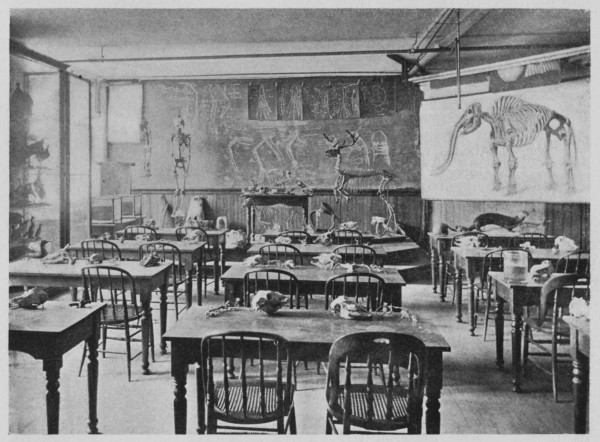
The courses in biology in the University
of Pennsylvania have been arranged
with reference to the needs of students
who desire instruction in the biological
sciences for general culture, as a preparation
for teaching or original investigation,
or as a foundation for the professional
course in medicine. They include
in the courses in arts and sciences the
electives, the biology-chemistry group,
and the botany-zoölogy group, each set
including several classes; the four-year
course in biology, which appeals particularly
to students who wish to become
teachers or to take up special work as investigators
in biology, and the two-years'
course in biology, which is designed especially
for those who desire some systematic
training in natural science before
taking up the study of medicine.
Both of these courses are open to men
and women alike. An ample equipment
is provided for the biological department
in the shape of spacious class rooms and
laboratories, a botanic garden, an herbarium,
a vivarium, zoölogical and auxiliary
collections, a marine laboratory at
Sea Isle, New Jersey, tables at Woods
Holl, library facilities, two serial publications,
and clubs and societies.
We learn from the London Lancet
that besides the special ward of twelve
beds at the Royal Southern Hospital of
Liverpool, which was formally opened
by Lord Lister on April 29th last, arrangements
have been completed for a
school for the study of tropical diseases
at Liverpool. Lord Lister, on the
occasion of the school's foundation, said:
"The medical student in the ordinary
hospital has rare opportunities of seeing
these diseases, and for a man who
is about to practice in the tropics it is
essential that he have opportunities for
studying them here before embarking on
his tropical career. The possession of
tropical colonies makes such institutions
in the home country very necessary, not
only for preparing the colonial doctors,
but for the protection of the home population,
which is sure to be brought into
contact more or less with the infectious
tropical diseases."
An interesting paper by Mr. C. J.
Coleman on The Electrical Protection of
Safes and Vaults is described in the Electrical
World and Engineer. He divided
the methods into two systems, in one the
alarm depending on the opening and the
other on the closing of a circuit—the latter
of the two being the one most in use.
Among the curious devices mentioned
are cementing narrow tin-foil strips on
the inner surfaces of window glass, so
that any breakage or fracture of the
glass will open the circuit; the use of
glass tubes filled with mercury and connected
in circuit, or tubes filled with
water or compressed air. In reply to questions
as to the use of electricity in perforating
safes it was stated that a five-ply
chrome steel safe, seven inches and a
half thick, was burned through by three
hundred ampères in twenty-five minutes,
and holes were burned through a solid
block of vault steel twelve inches thick
in twenty-six minutes with three hundred
and fifty ampères, and in fifteen
minutes with five hundred ampères.
The Royal Institution of Great Britain,
on the occasion of its one hundredth
anniversary, has elected as honorary
members the following Americans: Prof.
Samuel Pierpont Langley, astronomer,
Secretary of the Smithsonian Institution,
Washington, D. C.; Prof. Albert
Abraham Michelson, physicist, of Chicago;
Prof. Robert Henry Thurston, mechanical
engineer, Director of the Sibley
College of Cornell University; Prof. J. S.
Ames, of Johns Hopkins University;
George Frederick Barker, physicist, Professor
of Physics at the University of
Pennsylvania, Philadelphia; and Prof.
William Lyne Wilson, President of
Washington and Lee University, ex-Congressman,
and Postmaster-General.
The foundation stone of an oceanographic
museum, instituted by Prince
Albert of Monaco, was laid in that city
April 25th. The museum is designed,
primarily, to receive the large and valuable
collections obtained by the prince in
the voyages of ocean exploration which
he has conducted, and to become a general
depository for oceanographic spoils.
The principal address was made by
the governor-general, who glorified the
prince's meritorious scientific career.
The German Emperor, who is named a
patron of the museum, and the French
President were represented on the occasion
by deputies.
The City Library Association of
Springfield, Mass., has been holding, during
April, May, and June, an elaborate
and instructive exhibit of geographic appliances
of special interest to teachers in
the elementary schools. The exhibition
included a number of sets of wall maps,
relief maps and globes, models for use in
structural geography, pictures, photographs,
etc., of geographical features,
aids in teaching, geographical texts,
manuals and treatises, books of travel,
and an exhibit of geographical work
done in the elementary schools of Springfield
and vicinity. The association has
also published a brief Bibliography of
Geographical Instruction, which was
prepared by W. S. Monroe, of the State
Normal School at Westfield, Mass.
Dr. Daniel G. Brinton has presented
to the University of Pennsylvania,
where he is Professor of American Archæology
and Linguistics, his entire collection
of books and manuscripts relating
to the aboriginal languages of North
and South America. The collection represents
the work of twenty-five years,
and embraces about two thousand titles.
Mr. Andrew Carnegie has offered
to complete, with a contribution of £50,000,
a fund which Mr. Joseph Chamberlain
is trying to raise in order to make
the scientific school the principal department
of the University of Birmingham,
England.
A noteworthy experiment in bird
protection has been made in a boys'
school at Coupvray, France, by forming
a society of the pupils for that purpose.
The president, vice-president, and
secretary of the society are selected
from among the pupils of the first division,
and all the other pupils are
members. Meetings are held every Saturday
afternoon in March, April, May,
June, and July, under the presidency of
the teacher, to hear the reports of members
and record the nests protected and
noxious animals destroyed in a notebook
kept for the purpose. In 1898,
570 nests were protected by the school,
and more than 400 mice, rats, weasels,
and dormice were destroyed. Such societies
cost nothing, and are capable of
rendering great service.
Ernest D. Bell, whose formula for
determining animal longevity by the
length of the period of maturity was
published in a recent Monthly, has sent
a later communication to Nature, changing
his constant from 10.5 to 10.1, the
latter figure giving much better results.
The report of Mr. J. C. Hopkins on
the Clays and Clay Industries of Western
Pennsylvania is the second one of a series
of economic reports on the natural resources
of the State in course of publication
by the Pennsylvania State College.
The first report, published in 1897, was
on the Brown Stones of Pennsylvania.
The report represents that a capital of
nearly $7,000,000 is invested in the clay
industries about Pittsburg, of which
more than $3,000,000 are in the fire-clay
industry. The value of the annual output
of material is nearly $4,000,000, more
than fifty per cent of the capital invested.
The 139 companies employ 4,403 men.
Herr Hansemann, of the University
of Berlin, who examined the skull
of Helmholtz, reports in the Zeitschrift
für Psychologie that he found the head
about the size of Bismarck's, and a little
smaller than Wagner's. By metrical
standards the brain weighed about 1,700
grammes with the coagulated blood, and
about 1,440 grammes without it—about
100 grammes more than the average.
The circumvolutions, which are now
thought to have more relation to mental
capacity than mere weight, were particularly
deep and well marked. The
skull was 55 centimetres in circumference,
15.5 centimetres broad, and 18.3
centimetres long, and the cephalic index
was 85.25.
Our obituary list for this month includes
the names, among persons known
in connection with science, of Miss Elizabeth
M. Bardwell, Professor of Astronomy
in Mount Holyoke College, who
died May 28th, aged sixty-seven years;
G. F. Lyster, long Engineer-in-Chief of
the Mersey Docks and Harbor Board,
and author of valuable improvements
in the Liverpool docks, member of the
Royal Society of Edinburgh and of the
Institute of Civil Engineers, aged seventy-six
years; Prof. Lars Fredrik Nilson,
Director of the Agricultural Experiment
Station at Stockholm, Sweden,
May 14th, aged fifty-nine years; M.
Adolphe Lageal, a French geologist,
killed by natives while making explorations
in the French Soudan; Sir Frederick
McCoy, Professor of Natural Science
in the University of Melbourne, died in
May, aged seventy-six years; he was a
member of the Geological Survey of Victoria,
founder of the Melbourne National
Museum, and author of numerous papers
on Victorian geology; before going
to Australia he was Professor of Geology
in Queen's College, Belfast, and had
already attained a high reputation as a
geologist by the work he had done as
assistant to Sedgwick and by the publication
of important memoirs in geology
and paleontology; and Lawson Tait, an
eminent English surgeon, author of numerous
books of a high order relative to
his profession, and an active worker in
practical sanitary matters; he died at
Llandudno, Wales, June 13th, aged fifty-four
years.
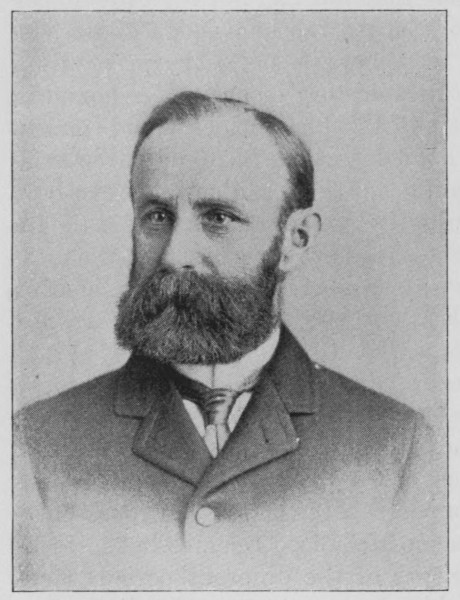
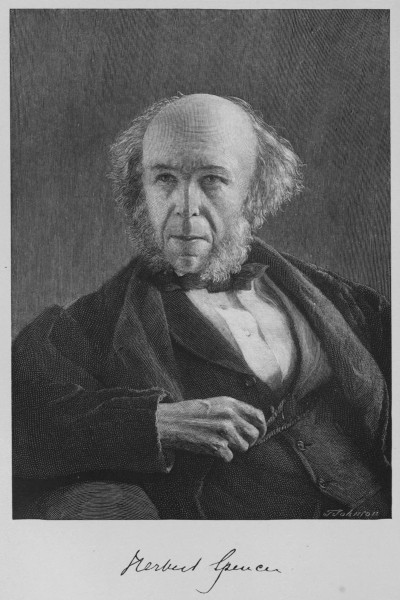 Herbert Spencer