FORMERLY PROFESSOR OF EXPERIMENTAL SCIENCE, STAFF COLLEGE
SECOND SERIES
WITH AN AUTOBIOGRAPHY OF THE AUTHOR
LONGMANS, GREEN, AND CO.
39 PATERNOSTER ROW, LONDON NEW YORK, BOMBAY, AND CALCUTTA
1908
All rights reserved
BIBLIOGRAPHICAL NOTE.
Issued in Silver Library, March 1893; Reprinted
July 1895, May 1898, June 1900, December 1903, August 1908.
PREFACE.
The favour with which the first series of Professor Helmholtz’s
Lectures has been received would justify, if a justification were
needed, the publication of the present volume.
I have to express my acknowledgments to Professor G. Croome Robertson,
the editor, and to Messrs. Macmillan, the publishers of ‘Mind,’ for
permission to use a translation of the paper on the ‘Axioms of Modern
Geometry’ which appeared in that journal.
The article on ‘Academic Freedom in German Universities’ contains some
statements respecting the Universities of Oxford and Cambridge to which
exception has been taken. These statements were a fair representation
of the impression produced on the mind of a foreigner by a state of
things which no longer exists in those Universities, at least to the
same extent. The reform in the University system, which may be said to
date from the year 1854, has brought about so many alterations both in
the form and in the spirit of the regulations, that older members of
the University have been known to speak of the place as so changed that
they could scarcely recognise it. Hence, in respect of this article,
I have availed myself of the liberty granted by Professor Helmholtz,
and have altogether omitted some passages, and have slightly modified
others, which would convey an erroneous impression of the present
state of things. I have also on these points consulted members of the
University on whose judgment I think I can rely.
In other articles, where the matter is of prime importance, I have been
anxious faithfully to reproduce the original; nor have I in any such
cases allowed a regard for form to interfere with the plain duty of
exactly rendering the author’s meaning.
Address delivered in the Leibnitz meeting of the Academy of Sciences
on July 6, 1871.
The honourable duty has fallen on me of expressing in the name of this
Academy what it has lost in Gustav Magnus, who belonged to it for
thirty years. As a grateful pupil, as a friend, and finally as his
successor, it was a pleasure to me as well as a duty to fulfil such a
task. But I find the best part of my work already done by our colleague
Hofmann at the request of the German Chemical Society, of which he is
the President. He has solved the difficulty of giving a picture of the
life and work of Magnus in the most complete and most charming manner.
He has not only anticipated me, but he stood in much closer and more
intimate personal relation to Magnus than I did; and, on the other
hand, he is much better qualified than I to pronounce a competent
judgment on the principal side of Magnus’s activity, namely, the
chemical.
Hence what remains for me to do is greatly restricted. I shall scarcely
venture to speak as the biographer of Magnus, but only of what he was
to us and to science, to represent which is our allotted task.
His life was not indeed rich in external events and changes; it was the
peaceful life of a man who, free from the cares of outer circumstances,
first as member, then as leader of an esteemed, gifted, and amiable
family, sought and found abundant satisfaction in scientific work, in
the utilisation of scientific results for the instruction and advantage
of mankind. Heinrich Gustav Magnus was born in Berlin on May 2, 1802,
the fourth of six brothers, who by their talents have distinguished
themselves in various directions. The father, Johann Matthias, was
chief of a wealthy commercial house, whose first concern was to secure
to his children a free development of their individual capacity
and inclinations. Our departed friend showed very early a greater
inclination for the study of mathematics and natural philosophy than
for that of languages. His father arranged his instruction accordingly,
by removing him from the Werder Gymnasium and sending him to the Cauer
Private Institute, in which more attention was paid to scientific subjects.
From 1822 to 1827 Magnus devoted himself entirely to the study of
natural science at the University of Berlin. Before carrying out his
original intention of qualifying as a professor of technology, he spent
two years with that object in travelling; he remained with Berzelius
a long time in Stockholm, then with Dulong, Thénard and Gay-Lussac
in Paris. Unusually well prepared by these means, he qualified in
the University of this place in technology, and afterwards also in
physics; he was appointed extraordinary professor in 1834, and ordinary
professor in 1845, and so distinguished himself by his scientific
labours at this time, that nine years after his habilitation, on
January 27, 1840, he was elected a member of this Academy. From 1832
until 1840 he taught physics in the Artillery and Engineering School;
and from 1850 until 1856 chemical technology in the Gewerbe Institut.
For a long time he gave the lectures in his own house, using his own
instruments, which gradually developed into the most splendid physical
collection in existence at that time, and which the State afterwards
purchased for the University. His lectures were afterwards given in the
University, and he only retained the laboratory in his own house for
his own private work and for that of his pupils.
His life was passed thus in quiet but unremitting activity; travels,
sometimes for scientific or technical studies, sometimes also in the
service of the State, and occasionally for recreation, interrupted
his work here from time to time. His experience and knowledge of
business were often in demand by the State on various commissions;
among these may be especially mentioned the part he took in the
chemical deliberations of the Agricultural Board (Landes-Economie
Collegium), to which he devoted much of his time; above all to the
great practical questions of agricultural chemistry.
After sixty-seven years of almost undisturbed health he was overtaken
by a painful illness towards the end of the year 1869.[1]
He still continued his lectures on physics until February 25, 1870, but during
March he was scarcely able to leave his bed, and he died on April 4.
Magnus’s was a richly endowed nature, which under happy external
circumstances could develop in its own peculiar manner, and was free
to choose its activity according to its own mind. But this mind was so
governed by reason, and so filled, I might almost say, with artistic
harmony, which shunned the immoderate and impure, that he knew how
to choose the object of his work wisely, and on this account almost
always to attain it. Thus the direction and manner of Magnus’s activity
accorded so perfectly with his intellectual nature as is the case only
with the happy few among mortals. The harmonious tendency and
cultivation of his mind could be recognised in the natural grace of his
behaviour, in the cheerfulness and firmness of his disposition, in the
warm amiability of his intercourse with others. There was in all this,
much more than the mere acquisition of the outer forms of politeness
can ever reach, where they are not illuminated by a warm sympathy and
by a fine feeling for the beautiful.
Accustomed from an early age to the regulated and prudent activity of
the commercial house in which he grew up, he retained that skill in
business which he had so frequently to exercise in the administration
of the affairs of this Academy, of the philosophical faculty, and of
the various Government commissions. He retained from thence the love of
order, the tendency towards the actual, and towards what is practically
attainable, even although the chief aim of his activity was an ideal
one. He understood that the pleasant enjoyment of an existence free
from care, and intercourse with the most amiable circle of relatives
and friends, do not bring a lasting satisfaction; but work only, and
unselfish work for an ideal aim. Thus he laboured, not for the increase
of riches, but for science; not as a dilettante and capriciously, but
according to a fixed aim and indefatigably; not in vanity, catching
at striking discoveries, which might at once have made his name
celebrated. He was, on the contrary, a master of faithful, patient,
and modest work, who tests that work again and again, and never
ceases until he knows there is nothing left to be improved. But it
is also such work, which by the classical perfection of its methods,
by the accuracy and certainty of its results, merits and gains the
best and most enduring fame. There are among the labours of Magnus
masterpieces of finished perfection, especially those on the expansion
of gases by heat, and on the tension of vapours. Another master in
this field, and one of the most experienced and distinguished, namely,
Regnault of Paris, worked at these subjects at the same time with
Magnus, but without knowing of his researches. The results of both
investigators were made public almost simultaneously, and showed by
their extraordinarily close agreement with what fidelity and with what
skill both had laboured. But where differences showed themselves, they
were eventually decided in favour of Magnus.
The unselfishness with which Magnus held to the ideal aim of his
efforts is shown in quite a characteristic manner, in the way in which
he attracted younger men to scientific work, and as soon as he believed
he had discovered in them zeal and talent for such work by placing
at their disposal his apparatus, and the appliances of his private
laboratory. This was the way in which I was brought in close relation
to him, when I found myself in Berlin for the purpose of passing the
Government medical examination.
He invited me at that time (I myself would not have ventured to propose
it) to extend my experiments on fermentation and putrefaction in new
directions, and to apply other methods, which required greater means
than a young army surgeon living on his pay could provide himself with.
At that time I worked with him almost daily for about three months,
and thus gained a deep and lasting impression of his goodness, his
unselfishness, and his perfect freedom from scientific jealousy.
By such a course he not only surrendered the external advantages which
the possession of one of the richest collections of instruments would
have secured an ambitious man against competitors, but he also bore
with perfect composure the little troubles and vexations involved in
the want of skill and the hastiness with which young experimentalists
are apt to handle costly instruments. Still less could it be said that,
after the manner of the learned in other countries, he utilised the
work of the pupils for his own objects, and for the glorification of
his own name. At that time chemical laboratories were being established
according to Liebig’s precedent: of physical laboratories—which, it
may be observed, are much more difficult to organise—not one existed
at that time to my knowledge. In fact, their institution is due to Magnus.
In such circumstances we see an essential part of the inner tendency of
the man, which must not be neglected in estimating his value: he was
not only an investigator, he was also a teacher of science in the
highest and widest sense of the word. He did not wish science to be
confined to the study and lecture-room, he desired that it should
find its way into all conditions of life. In his active interest
for technology, in his zealous participation in the work of the
Agricultural Board, this phase of his efforts was plainly reflected, as
well as in the great trouble he took in the preparation of experiments,
and in the ingenious contrivance of the apparatus required for them.
His collection of instruments, which subsequently passed into the
possession of the University, and is at present used by me as his
successor, is the most eloquent testimony of this. Everything is in
the most perfect order: if a silk-thread, a glass tube, or a cork, are
required for an experiment, one may safely depend on finding them near
the instrument. All the apparatus which he contrived is made with the
best means at his disposal, without sparing either material, or the
labour of the workman, so as to ensure the success of the experiment,
and by making it on a sufficiently large scale to render it visible
as far off as possible. I recollect very well with what wonder and
admiration we students saw him experiment, not merely because all the
experiments were successful and brilliant, but because they scarcely
seemed to occupy or to disturb his thoughts. The easy and clear flow of
his discourse went on without interruption; each experiment came in its
right place, was performed quickly, without haste or hesitation, and
was then put aside.
I have already mentioned that the valuable collection of apparatus came
into the possession of the University during his lifetime. He specially
wished that what he had collected and constructed as appliances in
his scientific work should not be scattered and estranged from the
original purpose to which he had devoted his life. With this feeling
he bequeathed to the University the rest of the apparatus of his
laboratory, as well as his very rich and valuable library, and he thus
laid the foundation for the further development of a Public Physical
Institute.
It is sufficient in these few touches to have recalled the mental
individuality of our departed friend, so far as the sources of the
direction of his activity are to be found.
Personal recollections will furnish a livelier image to all those of
you who have worked with him for the last thirty years.
If we now proceed to discuss the results of his researches it will not
be sufficient to read through and to estimate his academical writings.
I have already shown that a prominent part of his activity was directed
to his fellow-creatures. To this must be added, that he lived in an
age when natural science passed through a process of development, with
a rapidity such as never occurred before in the history of science.
But the men who belonged to such a time, and co-operated in this
development are apt to appear in wrong perspective to their successors,
since the best part of their work seems to the latter self-evident, and
scarcely worthy of mention.
It is difficult for us to realise the condition of natural science
as it existed in Germany, at least in the first twenty years of this
century. Magnus was born in 1802; I myself nineteen years later; but
when I go back to my earliest recollections, when I began to study
physics out of the school-books in my father’s possession, who was
himself taught in the Cauer Institute, I still see before me the dark
image of a series of ideas which seems now like the alchemy of the
middle ages. Of Lavoisier’s and of Humphry Davy’s revolutionising
discoveries, not much had got into the school-books. Although oxygen
was already known, yet phlogiston, the fire element, played also its
part. Chlorine was still oxygenated hydrochloric acid; potash and lime
were still elements. Invertebrate animals were divided into insects and
reptiles; and in botany we still counted stamens.
It is strange to see how late and with what hesitation Germans applied
themselves to the study of natural science in this century, whilst they
had taken so prominent a part in its earlier development. I need only
name Copernicus, Kepler, Leibnitz, and Stahl.
For we may indeed boast of our eager, fearless and unselfish love
of truth, which flinches before no authority, and is stopped by no
pretence; shuns no sacrifice and no labour, and is very modest in
its claims on worldly success. But even on this account she ever
impels us first of all to pursue the questions of principle to their
ultimate sources, and to trouble ourselves but little about what has no
connection with fundamental principles, and especially about practical
consequences and about useful applications. To this must be added
another reason, namely, that the independent mental development of
the last three hundred years, began under political conditions which
caused the chief weight to fall on theological studies. Germany has
liberated Europe from the tyranny of the ancient church; but she has
also paid a much dearer price for this freedom than other nations.
After the religious wars, she remained devastated, impoverished,
politically shattered, her boundaries spoiled, and arrogantly handed
over defenceless to her neighbours. To deduce consequences from the
new moral views, to prove them scientifically, to work them out in all
regions of intellectual life, for all this there was no time during the
storm of war; each man had to hold to his own party, every incipient
change of opinion was looked upon as treachery, and excited bitter
wrath. Owing to the Reformation, intellectual life had lost its old
stability and cohesion; everything appeared in a new light, and new
questions arose. The German mind could not be quieted with outward
uniformity; when it was not convinced and satisfied, it did not allow
its doubt to remain silent. Thus it was theology, and next to it
classical philology and philosophy, which, partly as scientific aids
of theology, partly for what they could do for the solution of the
new moral, æsthetical, and metaphysical problems, laid claim almost
exclusively to the interest of scientific culture. Hence it is clear
why the Protestant nations, as well as that part of the Catholics
which, wavering in its old faith, only remained outwardly in connection
with its church, threw itself with such zeal on philosophy. Ethical
and metaphysical problems were chiefly to be solved; the sources of
knowledge had to be critically examined, and this was done with deeper
earnestness than formerly. I need not enumerate the actual results
which the last century gained by this work. It excited soaring hopes,
and it cannot be denied that metaphysics has a dangerous attraction
for the German mind; it could not again abandon it until all its
hiding-places had been searched through and it had satisfied itself
that for the present nothing more is to be found there.
Then, in the second half of the last century, the rejuvenescent
intellectual life of the nation began to cultivate its artistic
flowers; the clumsy language transformed itself into one of the most
expressive instruments of the human mind; out of what was still the
hard, poor, and wearisome condition of civil and political life, the
results of the religious war, in which the figure of the Prussian
hero-king only now cast the first hope of a better future, to be again
followed by the misery of the Napoleonic war,—out of this joyless
existence, all sensitive minds gladly fled into the flowery land opened
out by German poetry, rivalling as it did the best poetry of all times
and of all peoples; or in the sublime aspects of philosophy they
endeavoured to sink reality in oblivion.
And the natural sciences were on the side of this real world, so
willingly overlooked. Astronomy alone could at that time offer great
and sublime prospects; in all other branches long and patient labour
was still necessary before great principles could be attained; before
these subjects could have a voice in the great questions of human life;
or before they became the powerful means of the authority of man over
the forces of nature which they have since become. The labour of the
natural philosopher seems narrow, low, and insignificant compared with
the great conceptions of the philosopher and of the poet; it was only
those natural philosophers who, like Oken, rejoiced in poetical
philosophical conceptions, who found willing auditors.
Far be it from me as a one-sided advocate of scientific interests to
blame this period of enthusiastic excitement; we have, in fact, to
thank it for the moral force which broke the Napoleonic yoke; we have
to thank it for the grand poetry which is the noblest treasure of our
nation; but the real world retains its right against every semblance,
even against the most beautiful; and individuals, as well as nations,
who wish to rise to the ripeness of manhood must learn to look reality
in the face, in order to bend it to the purpose of the mind. To flee
into an ideal world is a false resource of transient success; it only
facilitates the play of the adversary; and when knowledge only reflects
itself, it becomes unsubstantial and empty, or resolves itself into
illusions and phrases.
Against the errors of a mental tendency, which corresponded at first to
the natural soaring of a fresh youthful ambition, but which afterwards,
in the age of the Epigones of the Romantic school and of the philosophy
of Identity, fell into sentimental straining after sublimity and
inspiration, a reaction took place, and was carried out not merely in
the regions of science, but also in history, in art, and in philology.
In the last departments, too, where we deal directly with products of
activity of the human mind, and where, therefore, a construction à
priori from the psychological laws seems much more possible than in
nature, it has come to be understood that we must first know the facts,
before we can establish their laws.
Gustav Magnus’s development happened during the period of this
struggle; it lay in the whole tendency of his mind, that he whose
gentle spirit usually endeavoured to reconcile antagonisms, took a
decided part in favour of pure experience as against speculation. If
he forbore to wound people, it must be confessed that he did not relax
one iota of the principle which, with sure instinct, he had recognised
as the true one; and in the most influential quarters he fought in a
twofold sense; on the one hand, because in physics it was a question as
to the foundations of the whole of natural sciences; and on the other
hand, because the University of Berlin, with its numerous students,
had long been the stronghold of speculation. He continually preached
to his pupils that no reasoning, however plausible it might seem,
avails against actual fact, and that observation and experiment must
decide; and he was always anxious that every practicable experiment
should be made which could give practical confirmation or refutation
of an assumed law. He did not limit in any way the applicability of
scientific methods in the investigation of inanimate nature, but in his
research on the gases of the blood (1837) he dealt a blow at the heart
of vitalistic theories. He led physics to the centre of organic change,
by laying a scientific foundation for a correct theory of respiration;
a foundation upon which a great number of more recent investigators
have built, and which has developed into one of the most important
chapters of physiology.
He cannot be reproached with having had too little confidence in
carrying out his principle; but I must confess that I myself and many
of my companions formerly thought that Magnus carried his distrust of
speculation too far, especially in relation to mathematical physics.
He had probably never dipped very deep in the latter subject, and that
strengthened our doubts. Yet when we look around us from the standpoint
which science has now attained, it must be confessed that his
distrust of the mathematical physics of that date was not unfounded.
At that time no separation had been distinctly made as to what was
empirical matter of fact, what mere verbal definition, and what only
hypothesis. The vague mixture of these elements which formed the basis
of calculation was put forth as axioms of metaphysical necessity,
and postulated a similar kind of necessity for the results. I need
only recall to you the great part which hypotheses as to the atomic
structure of bodies played in mathematical physics during the first
half of this century, whilst as good as nothing was known of atoms;
and, for instance, hardly anything was known of the extraordinary
influence which heat has on molecular forces. We now know that the
expansive force of gases depends on motion due to heat; at that period
most physicists regarded heat as imponderable matter.
In reference to atoms in molecular physics, Sir W. Thomson says, with
much weight, that their assumption can explain no property of the body
which has not previously been attributed to the atoms. Whilst assenting
to this opinion, I would in no way express myself against the existence
of atoms, but only against the endeavour to deduce the principles of
theoretical physics from purely hypothetical assumptions as to the
atomic structure of bodies. We now know that many of these hypotheses,
which found favour in their day, far overshot the mark. Mathematical
physics has acquired an entirely different character under the hands
of Gauss, of F. E. Neumann and their pupils, among the Germans; as
well as from those mathematicians who in England followed Faraday’s
lead, Stokes, W. Thomson, and Clerk-Maxwell. It is now understood that
mathematical physics is a purely experimental science; that it has no
other principles to follow than those of experimental physics. In our
immediate experience we find bodies variously formed and constituted;
only with such can we make our observations and experiments. Their
actions are made up of the actions which each of their parts
contributes to the sum of the whole; and hence, if we wish to know the
simplest and most general law of the action of masses and substances
found in nature upon one another, and if we wish to divest these
laws of the accidents of form, magnitude, and position of the bodies
concerned, we must go back to the laws of action of the smallest
particles, or, as mathematicians designate it, the elementary volume.
But these are not, like the atoms, disparate and heterogeneous, but
continuous and homogeneous.
The characteristic properties of the elementary volumes of different
bodies are to be found experimentally, either directly, where the
knowledge of the sum is sufficient to discover the constituents, or
hypothetically, where the calculated sum of effects in the greatest
possible number of different cases must be compared with actual fact by
observation and by experiment. It is thus admitted that mathematical
physics only investigates the laws of action of the elements of a body
independently of the accidents of form, in a purely empirical manner,
and is therefore just as much under the control of experience as what
are called experimental physics. In principle they are not at all
different, and the former only continues the function of the latter,
in order to arrive at still simpler and still more general laws of
phenomena.
It cannot be doubted that this analytical tendency of physical inquiry
has assumed another character; that it has just cast off that which was
the means of placing Magnus towards it in some degree of antagonism. He
tried to maintain, at least in former years, that the business of the
mathematical and that of the experimental physicist are quite distinct
from one another; that a young man who wishes to pursue physics would
have to decide between the two. It appears to me, on the contrary, that
the conviction is constantly gaining ground, that in the present more
advanced state of science those only can experimentalise profitably
who have a clear-sighted knowledge of theory, and know how to propound
and pursue the right questions; and, on the other hand, only those can
theorise with advantage who have great practice in experiments. The
discovery of spectrum analysis is the most brilliant example within our
recollection of such an interpenetration of theoretical knowledge and
experimental skill.
I am not aware whether Magnus subsequently expressed other views as to
the relation of experimental and mathematical physics. In any case,
those who regard his former desertion of mathematical physics as a
reaction against the misuse of speculation carried too far, must also
admit that in the older mathematical physics there are many reasons
for this dislike, and that, on the other hand, he received with the
greatest pleasure the results which Kirchhoff, Sir W. Thomson, and
others had developed out of new facts from theoretical starting-points.
I may here be permitted to adduce my own experience. My researches were
mostly developed in a manner against which Magnus tried to guard; yet I
never found in him any but the most willing and friendly recognition.
It is, however, natural that every one, relying upon his own
experience, should recommend to others, as most beneficial, the way
which best suits his own nature, and by which he has made the quickest
progress. And if we are all of the same opinion that the task of
science is to find the Laws of Facts, then each one may be left
free either to plunge into facts, and to search where he might come
upon traces of laws still unknown, or from laws already known to search
out the points where new facts are to be discovered. But just as we
all, like Magnus, are opposed to the theorist who holds it unnecessary
to prove experimentally the hypothetical results which seem axioms to
him, so would Magnus—as his works decidedly show—pronounce with us
against that kind of excessive empiricism which sets out to discover
facts which fit to no rule, and which also try carefully to avoid a
law, or a possible connection between newly discovered facts.
It must here be mentioned that Faraday, another great physicist, worked
in England exactly in the same direction, and with the same object;
to whom, on that account, Magnus was bound by the heartiest sympathy.
With Faraday, the antagonism to the physical theories hitherto held,
which treated of atoms and forces acting at a distance, was even more
pronounced than with Magnus.
We must, moreover, admit that Magnus mostly worked with success on
problems which seemed specially adapted to mathematical treatment; as,
for instance, his research on the deviation of rotating shot fired from
rifled guns; also his paper on the form of jets of water and their
resolution into drops. In the first, he proved, by a very cleverly
arranged experiment, how the resistance of the air, acting on the ball
from below, must deflect it sideways as a rotating body, in a direction
depending on that of the rotation; and how, in consequence of this, the
trajectory is deflected in the same direction. In the second treatise,
he investigated the different forms of jets of water, how they are
partly changed by the form of the aperture through which they flow,
partly in consequence of the manner in which they flow to it; and how
their resolution into drops is caused by external agitation. He applied
the principle of the stroboscopic disk in observing the phenomena, by
looking at the jet through small slits in a rotating disk. He grouped
the various phenomena with peculiar tact, so that those among them
which are alike were easily seen, and one elucidated the other. And
if a final mechanical explanation is not always attained, yet the
reason for a great number of characteristic features of the individual
phenomena is plain. In this respect many of his researches—I might
specially commend those on the efflux of jets of water—are excellent
models of what Goethe theoretically advanced, and in his physical
labours endeavoured to accomplish, though with only partial success.
But even where Magnus from his standpoint, and armed with the
knowledge of his time, exerted himself in vain to seize the kernel
of the solution of a difficult question, a host of new and valuable
facts is always brought to light. Thus in his research on the
thermo-electric battery, where he correctly saw that a critical
question was to be solved, and at the conclusion declared: ‘When I
commenced the experiment just described, I confidently hoped to find
that thermo-electrical currents are due to a motion of heat.’ In this
sense he investigated the cases in which the thermo-electrical circuit
consisted of a single metal in which there were alternately hard
portions, and such as had been softened by heat; or those it which the
parts in contact had very different temperatures. He was convinced
that the thermo-electrical current was due neither to the radiating
power, nor to the conductivity for heat, using this expression in its
ordinary meaning, and he had to content himself with the obviously
imperfect explanation that two pieces of the same metal at different
temperatures acted like dissimilar conductors, which like liquids do
not fall in with the potential series. The solution was first furnished
by the two general laws of the mechanical theory of heat. Magnus’s hope
was not unfulfilled. Sir W. Thomson discovered that alterations in the
conductivity for heat, though such as were produced by the electrical
current itself, were indeed the sources of the current.
It is the nature of the scientific direction which Magnus pursued in
his researches, that they build many a stone into the great fabric of
science, which give it an ever broader support, and an ever growing
height, without its appearing to a fresh observer as a special and
distinctive work due to the sole exertion of any one scientific man.
If we wish to explain the importance of each stone for its special
place, how difficult to procure it, and how skilfully it was worked, we
must presuppose either that the hearer knows the entire history of the
building, or we must explain it to him, by which more time is lost than
I can now claim.
Thus it is with Magnus’s researches. Wherever he has attacked, he has
brought out a host of new and often remarkable facts; he has carefully
and accurately observed them, and he has brought them in connection
with the great fabric of science. He has, moreover, bequeathed
to science a great number of ingenious and carefully devised new
methods, as instruments with which future generations will continue to
discover hidden veins of the noble metal of everlasting laws in the
apparently waste and wild chaos of accident. Magnus’s name will always
be mentioned in the first line of those on whose labours the proud
edifice of the science of Nature reposes; of the science which has so
thoroughly remodelled the life of modern humanity by its intellectual
influence, as well as by its having subjugated the forces of nature to
the dominion of the mind.
I have only spoken of Magnus’s physical labours, and have only
mentioned those which seemed to me characteristic for his
individuality. But the number of his researches is very great, and
they extend over wider regions than could now be grasped by any single
inquirer. He began as a chemist, but even then he inclined to those
cases which showed remarkable physical conditions; he was afterwards
exclusively a physicist. But parallel with this he cultivated a very
extended study of technology, which of itself would alone have occupied
a man’s life.
He has departed, after a rich life and a fruitful activity. The old
law that no man’s life is free from pain must have been applied to him
also; and yet his life seems to have been especially happy. He had
what men generally desire most; but he knew how to ennoble external
fortune by putting it at the service of unselfish objects. To him was
granted, what is dearest to the mind of a noble spirit, to dwell in
the centre of an affectionate family, and in a circle of faithful and
distinguished friends. But I count his rarest happiness to be that he
could work in pure enthusiasm for an ideal principle; and that he saw
the cause which he served go on victoriously, and develop to unheard of
wealth and ever wider activity.
And in conclusion we must add, in so far as thoughtfulness, purity of
intention, moral and intellectual tact, modesty, and true humanity can
rule over the caprices of fortune and of man, in so far was Magnus
the artificer of his own fortune; one of the most satisfactory and
contented natures, who secure the love and favour of men, who with sure
inspiration know how to find the right place for their activity; and
of whom we may say, envious fact does not embitter their successes,
for, working for pure objects and with pure wishes, they would find
contentment even without external successes.
ON THE ORIGIN AND SIGNIFICANCE OF GEOMETRICAL AXIOMS. — APPENDIX.
Lecture delivered in the Docenten Verein in Heidelberg, in the year
1870.
The fact that a science can exist and can be developed as has been
the case with geometry, has always attracted the closest attention
among those who are interested in questions relating to the bases of
the theory of cognition. Of all branches of human knowledge, there is
none which, like it, has sprung as a completely armed Minerva from
the head of Jupiter; none before whose death-dealing Aegis doubt and
inconsistency have so little dared to raise their eyes. It escapes the
tedious and troublesome task of collecting experimental facts, which is
the province of the natural sciences in the strict sense of the word;
the sole form of its scientific method is deduction. Conclusion is
deduced from conclusion, and yet no one of common sense doubts but that
these geometrical principles must find their practical application
in the real world about us. Land surveying, as well as architecture,
the construction of machinery no less than mathematical physics, are
continually calculating relations of space of the most varied kind
by geometrical principles; they expect that the success of their
constructions and experiments shall agree with these calculations; and
no case is known in which this expectation has been falsified, provided
the calculations were made correctly and with sufficient data.
Indeed, the fact that geometry exists, and is capable of all this,
has always been used as a prominent example in the discussion on that
question, which forms, as it were, the centre of all antitheses of
philosophical systems, that there can be a cognition of principles
destitute of any bases drawn from experience. In the answer to Kant’s
celebrated question, ‘How are synthetical principles a priori
possible?’ geometrical axioms are certainly those examples which appear
to show most decisively that synthetical principles are a priori
possible at all. The circumstance that such principles exist, and force
themselves on our conviction, is regarded as a proof that space is an
a priori mode of all external perception. It appears thereby to
postulate, for this a priori form, not only the character of a
purely formal scheme of itself quite unsubstantial, in which any given
result experience would fit; but also to include certain peculiarities
of the scheme, which bring it about that only a certain content, and
one which, as it were, is strictly defined, could occupy it and be
apprehended by us.[2]
It is precisely this relation of geometry to the theory of cognition
which emboldens me to speak to you on geometrical subjects in an
assembly of those who for the most part have limited their mathematical
studies to the ordinary instruction in schools. Fortunately, the amount
of geometry taught in our gymnasia will enable you to follow, at any
rate the tendency, of the principles I am about to discuss.
I intend to give you an account of a series of recent and closely
connected mathematical researches which are concerned with the
geometrical axioms, their relations to experience, with the question
whether it is logically possible to replace them by others.
Seeing that the researches in question are more immediately designed
to furnish proofs for experts in a region which, more than almost
any other, requires a higher power of abstraction, and that they are
virtually inaccessible to the non-mathematician, I will endeavour to
explain to such a one the question at issue. I need scarcely remark
that my explanation will give no proof of the correctness of the new
views. He who seeks this proof must take the trouble to study the
original researches.
Anyone who has entered the gates of the first elementary axioms of
geometry, that is, the mathematical doctrine of space, finds on his
path that unbroken chain of conclusions of which I just spoke, by which
the ever more varied and more complicated figures are brought within
the domain of law. But even in their first elements certain principles
are laid down, with respect to which geometry confesses that she cannot
prove them, and can only assume that anyone who understands the essence
of these principles will at once admit their correctness. These are the
so-called axioms.
For example, the proposition that if the shortest line drawn between
two points is called a straight line, there can be only one such
straight line. Again, it is an axiom that through any three points
in space, not lying in a straight line, a plane may be drawn, i.e.
a surface which will wholly include every straight line joining any
two of its points. Another axiom, about which there has been much
discussion, affirms that through a point lying without a straight
line only one straight line can be drawn parallel to the first; two
straight lines that lie in the same plane and never meet, however far
they may be produced, being called parallel. There are also axioms that
determine the number of dimensions of space and its surfaces, lines and
points, showing how they are continuous; as in the propositions, that
a solid is bounded by a surface, a surface by a line and a line by a
point, that the point is indivisible, that by the movement of a point
a line is described, by that of a line a line or a surface, by that of
a surface a surface or a solid, but by the movement of a solid a solid
and nothing else is described.
Now what is the origin of such propositions, unquestionably true yet
incapable of proof in a science where everything else is reasoned
conclusion? Are they inherited from the divine source of our reason as
the idealistic philosophers think, or is it only that the ingenuity of
mathematicians has hitherto not been penetrating enough to find the
proof? Every new votary, coming with fresh zeal to geometry, naturally
strives to succeed where all before him have failed. And it is quite
right that each should make the trial afresh; for, as the question has
hitherto stood, it is only by the fruitlessness of one’s own efforts
that one can be convinced of the impossibility of finding a proof.
Meanwhile solitary inquirers are always from time to time appearing who
become so deeply entangled in complicated trains of reasoning that they
can no longer discover their mistakes and believe they have solved the
problem. The axiom of parallels especially has called forth a great
number of seeming demonstrations.
The main difficulty in these inquiries is, and always has been, the
readiness with which results of everyday experience become mixed up as
apparent necessities of thought with the logical processes, so long as
Euclid’s method of constructive intuition is exclusively followed in
geometry. It is in particular extremely difficult, on this method, to
be quite sure that in the steps prescribed for the demonstration we
have not involuntarily and unconsciously drawn in some most general
results of experience, which the power of executing certain parts
of the operation has already taught us practically. In drawing any
subsidiary line for the sake of his demonstration, the well-trained
geometer always asks if it is possible to draw such a line. It is well
known that problems of construction play an essential part in the
system of geometry. At first sight, these appear to be practical
operations, introduced for the training of learners; but in reality
they establish the existence of definite figures. They show that
points, straight lines, or circles such as the problem requires to be
constructed are possible under all conditions, or they determine any
exceptions that there may be. The point on which the investigations
turn, that we are about to consider, is essentially of this nature. The
foundation of all proof by Euclid’s method consists in establishing the
congruence of lines, angles, plane figures, solids, &c. To make the
congruence evident, the geometrical figures are supposed to be applied
to one another, of course without changing their form and dimensions.
That this is in fact possible we have all experienced from our earliest
youth. But, if we proceed to build necessities of thought upon this
assumption of the free translation of fixed figures, with unchanged
form, to every part of space, we must see whether the assumption does
not involve some presupposition of which no logical proof is given. We
shall see later on that it does indeed contain one of the most serious
import. But if so, every proof by congruence rests upon a fact which is
obtained from experience only.
I offer these remarks, at first only to show what difficulties attend
the complete analysis of the pre-suppositions we make, in employing
the common constructive method. We evade them when we apply, to
the investigation of principles, the analytical method of modern
algebraical geometry. The whole process of algebraical calculation
is a purely logical operation; it can yield no relation between the
quantities submitted to it that is not already contained in the
equations which give occasion for its being applied. The recent
investigations in question have accordingly been conducted almost
exclusively by means of the purely abstract methods of analytical
geometry.
However, after discovering by the abstract method what are the points
in question, we shall best get a distinct view of them by taking a
region of narrower limits than our own world of space. Let us, as we
logically may, suppose reasoning beings of only two dimensions to live
and move on the surface of some solid body. We will assume that they
have not the power of perceiving anything outside this surface, but
that upon it they have perceptions similar to ours. If such beings
worked out a geometry, they would of course assign only two dimensions
to their space. They would ascertain that a point in moving describes a
line, and that a line in moving describes a surface. But they could as
little represent to themselves what further spatial construction would
be generated by a surface moving out of itself, as we can represent what
would be generated by a solid moving out of the space we know. By
the much-abused expression ‘to represent’ or ‘to be able to think
how something happens’ I understand—and I do not see how anything
else can be understood by it without loss of all meaning—the power
of imagining the whole series of sensible impressions that would be
had in such a case. Now as no sensible impression is known relating
to such an unheard-of event, as the movement to a fourth dimension
would be to us, or as a movement to our third dimension would be to
the inhabitants of a surface, such a ‘representation’ is as impossible
as the ‘representation’ of colours would be to one born blind, if a
description of them in general terms could be given to him.
Our surface-beings would also be able to draw shortest lines in their
superficial space. These would not necessarily be straight lines in
our sense, but what are technically called geodetic lines of
the surface on which they live; lines such as are described by a
tense thread laid along the surface, and which can slide upon it
freely. I will henceforth speak of such lines as the straightest
lines of any particular surface or given space, so as to bring out
their analogy with the straight line in a plane. I hope by this
expression to make the conception more easy for the apprehension of my
non-mathematical hearers without giving rise to misconception.
Now if beings of this kind lived on an infinite plane, their geometry
would be exactly the same as our planimetry. They would affirm
that only one straight line is possible between two points; that
through a third point lying without this line only one line can be
drawn parallel to it; that the ends of a straight line never meet
though it is produced to infinity, and so on. Their space might be
infinitely extended, but even if there were limits to their movement
and perception, they would be able to represent to themselves a
continuation beyond these limits; and thus their space would appear
to them infinitely extended, just as ours does to us, although our
bodies cannot leave the earth, and our sight only reaches as far as the
visible fixed stars.
But intelligent beings of the kind supposed might also live on the
surface of a sphere. Their shortest or straightest line between two
points would then be an arc of the great circle passing through them.
Every great circle, passing through two points, is by these divided
into two parts; and if they are unequal, the shorter is certainly the
shortest line on the sphere between the two points, but also the other
or larger arc of the same great circle is a geodetic or straightest
line, i.e. every smaller part of it is the shortest line between
its ends. Thus the notion of the geodetic or straightest line is not
quite identical with that of the shortest line. If the two given
points are the ends of a diameter of the sphere, every plane passing
through this diameter cuts semicircles, on the surface of the sphere,
all of which are shortest lines between the ends; in which case there
is an equal number of equal shortest lines between the given points.
Accordingly, the axiom of there being only one shortest line between
two points would not hold without a certain exception for the dwellers
on a sphere.
Of parallel lines the sphere-dwellers would know nothing. They would
maintain that any two straightest lines, sufficiently produced, must
finally cut not in one only but in two points. The sum of the angles of
a triangle would be always greater than two right angles, increasing
as the surface of the triangle grew greater. They could thus have
no conception of geometrical similarity between greater and smaller
figures of the same kind, for with them a greater triangle must have
different angles from a smaller one. Their space would be unlimited,
but would be found to be finite or at least represented as such.
It is clear, then, that such beings must set up a very different system
of geometrical axioms from that of the inhabitants of a plane, or from
ours with our space of three dimensions, though the logical powers of
all were the same; nor are more examples necessary to show that
geometrical axioms must vary according to the kind of space inhabited
by beings whose powers of reason are quite in conformity with ours. But
let us proceed still farther.
Let us think of reasoning beings existing on the surface of an
egg-shaped body. Shortest lines could be drawn between three points of
such a surface and a triangle constructed. But if the attempt were made
to construct congruent triangles at different parts of the surface, it
would be found that two triangles, with three pairs of equal sides,
would not have their angles equal. The sum of the angles of a triangle
drawn at the sharper pole of the body would depart farther from two
right angles than if the triangle were drawn at the blunter pole or at
the equator. Hence it appears that not even such a simple figure as
a triangle can be moved on such a surface without change of form. It
would also be found that if circles of equal radii were constructed at
different parts of such a surface (the length of the radii being always
measured by shortest lines along the surface) the periphery would be
greater at the blunter than at the sharper end.
We see accordingly that, if a surface admits of the figures lying on it
being freely moved without change of any of their lines and angles as
measured along it, the property is a special one and does not belong to
every kind of surface. The condition under which a surface possesses
this important property was pointed out by Gauss in his celebrated
treatise on the curvature of surfaces.[3]
The ‘measure of curvature,’ as he called it, i.e. the reciprocal
of the product of the greatest and least radii of curvature, must be
everywhere equal over the whole extent of the surface.
Gauss showed at the same time that this measure of curvature is not
changed if the surface is bent without distension or contraction of any
part of it. Thus we can roll up a flat sheet of paper into the form
of a cylinder, or of a cone, without any change in the dimensions of
the figures taken along the surface of the sheet. Or the hemispherical
fundus of a bladder may be rolled into a spindle-shape without altering
the dimensions on the surface. Geometry on a plane will therefore be
the same as on a cylindrical surface; only in the latter case we must
imagine that any number of layers of this surface, like the layers of a
rolled sheet of paper, lie one upon another, and that after each entire
revolution round the cylinder a new layer is reached different from the
previous ones.
These observations are necessary to give the reader a notion of a kind
of surface the geometry of which is on the whole similar to that of the
plane, but in which the axiom of parallels does not hold good. This
is a kind of curved surface which is, as it were, geometrically
the counterpart of a sphere, and which has therefore been called
the pseudospherical surface by the distinguished Italian
mathematician E. Beltrami, who has investigated its properties.[4]
It is a saddle-shaped surface of which only limited pieces or strips can
be connectedly represented in our space, but which may yet be thought
of as infinitely continued in all directions, since each piece lying
at the limit of the part constructed can be conceived as drawn back
to the middle of it and then continued. The piece displaced must in
the process change its flexure but not its dimensions, just as happens
with a sheet of paper moved about a cone formed out of a plane rolled
up. Such a sheet fits the conical surface in every part, but must be
more bent near the vertex and cannot be so moved over the vertex as to
be at the same time adapted to the existing cone and to its imaginary
continuation beyond.
Like the plane and the sphere, pseudospherical surfaces have their
measure of curvature constant, so that every piece of them can be
exactly applied to every other piece, and therefore all figures
constructed at one place on the surface can be transferred to any
other place with perfect congruity of form, and perfect equality of
all dimensions lying in the surface itself. The measure of curvature
as laid down by Gauss, which is positive for the sphere and zero for
the plane, would have a constant negative value for pseudospherical
surfaces, because the two principal curvatures of a saddle-shaped
surface have their concavity turned opposite ways.
A strip of a pseudospherical surface may, for example, be
represented by the inner surface (turned towards the axis) of a solid
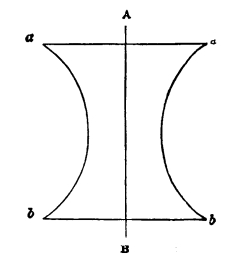
anchor-ring. If the plane figure aabb (Fig. 1)
is made to revolve on its axis of symmetry AB, the two arcs ab
will describe a pseudospherical concave-convex surface like that of the
ring. Above and below, towards aa and bb, the surface
will turn outwards with ever-increasing flexure, till it becomes
perpendicular to the axis, and ends at the edge with one curvature
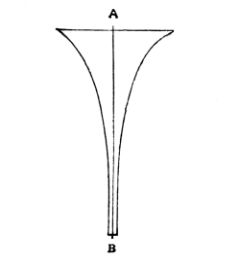
infinite. Or, again, half of a pseudospherical surface may be rolled up
into the shape of a champagne-glass (Fig. 2), with
tapering stem infinitely prolonged. But the surface is always
necessarily bounded by a sharp edge beyond which it cannot be directly
continued. Only by supposing each single piece of the edge cut loose
and drawn along the surface of the ring or glass, can it be brought to
places of different flexure, at which farther continuation of the piece
is possible.
In this way too the straightest lines of the pseudospherical surface
may be infinitely produced. They do not, like those on a sphere, return
upon themselves, but, as on a plane, only one shortest line is possible
between the two given points. The axiom of parallels does not, however,
hold good. If a straightest line is given on the surface and a point
without it, a whole pencil of straightest lines may pass through the
point, no one of which, though infinitely produced, cuts the first
line; the pencil itself being limited by two straightest lines, one
of which intersects one of the ends of the given line at an infinite
distance, the other the other end.
Fig. 1.
Fig. 2.
Such a system of geometry, which excluded the axiom of parallels, was
devised on Euclid’s synthetic method, as far back as the year 1829, by
N. J. Lobatchewsky, professor of mathematics at Kasan,[5]
and it was proved that this system could be carried out as consistently as
Euclid’s. It agrees exactly with the geometry of the pseudospherical
surfaces worked out recently by Beltrami.
Thus we see that in the geometry of two dimensions a surface is marked
out as a plane, or a sphere, or a pseudospherical surface, by the
assumption that any figure may be moved about in all directions without
change of dimensions. The axiom, that there is only one shortest line
between any two points, distinguishes the plane and the pseudospherical
surface from the sphere, and the axiom of parallels marks off the
plane from the pseudosphere. These three axioms are in fact necessary
and sufficient, to define as a plane the surface to which Euclid’s
planimetry has reference, as distinguished from all other modes of
space in two dimensions.
The difference between plane and spherical geometry has been long
evident, but the meaning of the axiom of parallels could not be
understood till Gauss had developed the notion of surfaces flexible
without dilatation, and consequently that of the possibly infinite
continuation of pseudospherical surfaces. Inhabiting, as we do, a
space of three dimensions and endowed with organs of sense for their
perception, we can represent to ourselves the various cases in which
beings on a surface might have to develop their perception of space;
for we have only to limit our own perceptions to a narrower field.
It is easy to think away perceptions that we have; but it is very
difficult to imagine perceptions to which there is nothing analogous in
our experience. When, therefore, we pass to space of three dimensions,
we are stopped in our power of representation, by the structure of our
organs and the experiences got through them which correspond only to
the space in which we live.
There is however another way of treating geometry scientifically. All
known space-relations are measurable, that is, they may be brought
to determination of magnitudes (lines, angles, surfaces, volumes).
Problems in geometry can therefore be solved, by finding methods of
calculation for arriving at unknown magnitudes from known ones. This
is done in analytical geometry, where all forms of space are
treated only as quantities and determined by means of other quantities.
Even the axioms themselves make reference to magnitudes. The straight
line is defined as the shortest between two points, which is
a determination of quantity. The axiom of parallels declares that if
two straight lines in a plane do not intersect (are parallel), the
alternate angles, or the corresponding angles, made by a third line
intersecting them, are equal; or it may be laid down instead that the
sum of the angles of any triangle is equal to two right angles. These,
also, are determinations of quantity.
Now we may start with this view of space, according to which the
position of a point may be determined by measurements in relation to
any given figure (system of co-ordinates), taken as fixed, and then
inquire what are the special characteristics of our space as manifested
in the measurements that have to be made, and how it differs from other
extended quantities of like variety. This path was first entered by
one too early lost to science, B. Riemann of Göttingen.[6]
It has the peculiar advantage that all its operations consist in pure
calculation of quantities, which quite obviates the danger of habitual
perceptions being taken for necessities of thought.
The number of measurements necessary to give the position of a point,
is equal to the number of dimensions of the space in question. In a
line the distance from one fixed point is sufficient, that is to say,
one quantity; in a surface the distances from two fixed points must be
given; in space, the distances from three; or we require, as on the
earth, longitude, latitude, and height above the sea, or, as is usual
in analytical geometry, the distances from three co-ordinate planes.
Riemann calls a system of differences in which one thing can be
determined by n measurements an ‘nfold extended
aggregate’ or an ‘aggregate of n dimensions.’ Thus the space in
which we live is a threefold, a surface is a twofold, and a line is a
simple extended aggregate of points. Time also is an aggregate of one
dimension. The system of colours is an aggregate of three dimensions,
inasmuch as each colour, according to the investigations of Thomas
Young and of Clerk Maxwell,[7]
may be represented as a mixture of three primary colours, taken in
definite quantities. The particular mixtures can be actually made with
the colour-top.
In the same way we may consider the system of simple tones[8]
as an aggregate of two dimensions, if we distinguish only pitch and
intensity, and leave out of account differences of timbre. This
generalisation of the idea is well suited to bring out the distinction
between space of three dimensions and other aggregates. We can, as
we know from daily experience, compare the vertical distance of two
points with the horizontal distance of two others, because we can apply
a measure first to the one pair and then to the other. But we cannot
compare the difference between two tones of equal pitch and different
intensity, with that between two tones of equal intensity and different
pitch. Riemann showed, by considerations of this kind, that the
essential foundation of any system of geometry, is the expression that
it gives for the distance between two points lying in any direction
towards one another, beginning with the infinitesimal interval. He took
from analytical geometry the most general form for this expression,
that, namely, which leaves altogether open the kind of measurements
by which the position of any point is given.[9]
Then he showed that the kind of free mobility without change of form
which belongs to bodies in our space can only exist when certain
quantities yielded by the calculation[10]—quantities
that coincide with Gauss’s measure of surface-curvature when they are
expressed for surfaces—have everywhere an equal value. For this reason
Riemann calls these quantities, when they have the same value in all
directions for a particular spot, the measure of curvature of the space
at this spot. To prevent misunderstanding,[11]
I will once more observe that this so-called measure of space-curvature
is a quantity obtained by purely analytical calculation, and that
its introduction involves no suggestion of relations that would have
a meaning only for sense-perception. The name is merely taken, as a
short expression for a complex relation, from the one case in which the
quantity designated admits of sensible representation.
Now whenever the value of this measure of curvature in any space is
everywhere zero, that space everywhere conforms to the axioms of
Euclid; and it may be called a flat (homaloid) space in
contradistinction to other spaces, analytically constructible, that
may be called curved, because their measure of curvature has a
value other than zero. Analytical geometry may be as completely and
consistently worked out for such spaces as ordinary geometry can for
our actually existing homaloid space.
If the measure of curvature is positive we have spherical
space, in which straightest lines return upon themselves and there
are no parallels. Such a space would, like the surface of a sphere,
be unlimited but not infinitely great. A constant negative measure
of curvature on the other hand gives pseudospherical space,
in which straightest lines run out to infinity, and a pencil of
straightest lines may be drawn, in any flattest surface, through any
point which does not intersect another given straightest line in that
surface.
Beltrami[12]
has rendered these last relations imaginable by showing that the
points, lines, and surfaces of a pseudospherical space of
three dimensions, can be so portrayed in the interior of a sphere
in Euclid’s homaloid space, that every straightest line or flattest
surface of the pseudospherical space is represented by a straight
line or a plane, respectively, in the sphere. The surface itself
of the sphere corresponds to the infinitely distant points of the
pseudospherical space; and the different parts of this space, as
represented in the sphere, become smaller, the nearer they lie to the
spherical surface, diminishing more rapidly in the direction of the
radii than in that perpendicular to them. Straight lines in the sphere,
which only intersect beyond its surface, correspond to straightest
lines of the pseudospherical space which never intersect.
Thus it appeared that space, considered as a region of measurable
quantities, does not at all correspond with the most general conception
of an aggregate of three dimensions, but involves also special
conditions, depending on the perfectly free mobility of solid bodies
without change of form to all parts of it and with all possible changes
of direction; and, further, on the special value of the measure of
curvature which for our actual space equals, or at least is not
distinguishable from, zero. This latter definition is given in the
axioms of straight lines and parallels.
Whilst Riemann entered upon this new field from the side of the most
general and fundamental questions of analytical geometry, I myself
arrived at similar
conclusions,[13]
partly from seeking to represent in space the system of colours,
involving the comparison of one threefold extended aggregate with
another, and partly from inquiries on the origin of our ocular measure
for distances in the field of vision. Riemann starts by assuming the
above-mentioned algebraical expression which represents in the most
general form the distance between two infinitely near points, and
deduces therefrom, the conditions of mobility of rigid figures. I, on
the other hand, starting from the observed fact that the movement of
rigid figures is possible in our space, with the degree of freedom that
we know, deduce the necessity of the algebraic expression taken by
Riemann as an axiom. The assumptions that I had to make as the basis of
the calculation were the following.
First, to make algebraical treatment at all possible, it must be
assumed that the position of any point A can be determined, in relation
to certain given figures taken as fixed bases, by measurement of some
kind of magnitudes, as lines, angles between lines, angles between
surfaces, and so forth. The measurements necessary for determining the
position of A are known as its co-ordinates. In general, the number of
co-ordinates necessary for the complete determination of the position
of a point, marks the number of the dimensions of the space in
question. It is further assumed that with the movement of the point A,
the magnitudes used as co-ordinates vary continuously.
Secondly, the definition of a solid body, or rigid system of points,
must be made in such a way as to admit of magnitudes being compared by
congruence. As we must not, at this stage, assume any special methods
for the measurement of magnitudes, our definition can, in the first
instance, run only as follows: Between the co-ordinates of any two
points belonging to a solid body, there must be an equation which,
however the body is moved, expresses a constant spatial relation
(proving at last to be the distance) between the two points, and which
is the same for congruent pairs of points, that is to say, such pairs
as can be made successively to coincide in space with the same fixed
pair of points.
However indeterminate in appearance, this definition involves most
important consequences, because with increase in the number of points,
the number of equations increases much more quickly than the number of
co-ordinates which they determine. Five points, A, B, C, D, E, give ten
different pairs of points
AB, AC, AD, AE,
BC, BD, BE,
CD, CE,
DE,
and therefore ten equations, involving in space of three dimensions
fifteen variable co-ordinates. But of these fifteen, six must remain
arbitrary, if the system of five points is to admit of free movement
and rotation, and thus the ten equations can determine only nine
co-ordinates as functions of the six variables. With six points we
obtain fifteen equations for twelve quantities, with seven points
twenty-one equations for fifteen, and so on. Now from n
independent equations we can determine n contained quantities,
and if we have more than n equations, the superfluous ones
must be deducible from the first n. Hence it follows that the
equations which subsist between the co-ordinates of each pair of
points of a solid body must have a special character, seeing that,
when in space of three dimensions they are satisfied for nine pairs of
points as formed out of any five points, the equation for the tenth
pair follows by logical consequence. Thus our assumption for the
definition of solidity, becomes quite sufficient to determine the kind
of equations holding between the co-ordinates of two points rigidly
connected.
Thirdly, the calculation must further be based on the fact of a
peculiar circumstance in the movement of solid bodies, a fact so
familiar to us that but for this inquiry it might never have been
thought of as something that need not be. When in our space of three
dimensions two points of a solid body are kept fixed, its movements
are limited to rotations round the straight line connecting them.
If we turn it completely round once, it again occupies exactly the
position it had at first. This fact, that rotation in one direction
always brings a solid body back into its original position, needs
special mention. A system of geometry is possible without it. This
is most easily seen in the geometry of a plane. Suppose that with
every rotation of a plane figure its linear dimensions increased
in proportion to the angle of rotation, the figure after one whole
rotation through 360 degrees would no longer coincide with itself as
it was originally. But any second figure that was congruent with the
first in its original position might be made to coincide with it in its
second position by being also turned through 360 degrees. A consistent
system of geometry would be possible upon this supposition, which does
not come under Riemann’s formula.
On the other hand I have shown that the three assumptions taken
together form a sufficient basis for the starting-point of Riemann’s
investigation, and thence for all his further results relating to the
distinction of different spaces according to their measure of curvature.
It still remained to be seen whether the laws of motion, as dependent
on moving forces, could also be consistently transferred to spherical
or pseudospherical space. This investigation has been carried out by
Professor Lipschitz of Bonn.[14]
It is found that the comprehensive expression for all the laws of
dynamics, Hamilton’s principle, may be directly transferred to spaces
of which the measure of curvature is other than zero. Accordingly,
in this respect also, the disparate systems of geometry lead to no
contradiction.
We have now to seek an explanation of the special characteristics of
our own flat space, since it appears that they are not implied in
the general notion of an extended quantity of three dimensions and
of the free mobility of bounded figures therein. Necessities of
thought, such as are involved in the conception of such a variety,
and its measurability, or from the most general of all ideas of a solid
figure contained in it, and of its free mobility, they undoubtedly
are not. Let us then examine the opposite assumption as to their
origin being empirical, and see if they can be inferred from facts of
experience and so established, or if, when tested by experience, they
are perhaps to be rejected. If they are of empirical origin, we must be
able to represent to ourselves connected series of facts, indicating a
different value for the measure of curvature from that of Euclid’s flat
space. But if we can imagine such spaces of other sorts, it cannot be
maintained that the axioms of geometry are necessary consequences of an
à priori transcendental form of intuition, as Kant thought.
The distinction between spherical, pseudospherical, and Euclid’s
geometry depends, as was above observed, on the value of a certain
constant called, by Riemann, the measure of curvature of the space
in question. The value must be zero for Euclid’s axioms to hold
good. If it were not zero, the sum of the angles of a large triangle
would differ from that of the angles of a small one, being larger in
spherical, smaller in pseudospherical, space. Again, the geometrical
similarity of large and small solids or figures is possible only in
Euclid’s space. All systems of practical mensuration that have been
used for the angles of large rectilinear triangles, and especially all
systems of astronomical measurement which make the parallax of the
immeasurably distant fixed stars equal to zero (in pseudospherical
space the parallax even of infinitely distant points would be
positive), confirm empirically the axiom of parallels, and show the
measure of curvature of our space thus far to be indistinguishable from
zero. It remains, however, a question, as Riemann observed, whether the
result might not be different if we could use other than our limited
base-lines, the greatest of which is the major axis of the earth’s orbit.
Meanwhile, we must not forget that all geometrical measurements rest
ultimately upon the principle of congruence. We measure the distance
between points by applying to them the compass, rule, or chain. We
measure angles by bringing the divided circle or theodolite to the
vertex of the angle. We also determine straight lines by the path
of rays of light which in our experience is rectilinear; but that
light travels in shortest lines as long as it continues in a medium
of constant refraction would be equally true in space of a different
measure of curvature. Thus all our geometrical measurements depend on
our instruments being really, as we consider them, invariable in form,
or at least on their undergoing no other than the small changes we know
of, as arising from variation of temperature, or from gravity acting
differently at different places.
In measuring, we only employ the best and surest means we know of to
determine, what we otherwise are in the habit of making out by sight
and touch or by pacing. Here our own body with its organs is the
instrument we carry about in space. Now it is the hand, now the leg,
that serves for a compass, or the eye turning in all directions is our
theodolite for measuring arcs and angles in the visual field.
Every comparative estimate of magnitudes or measurement of their
spatial relations proceeds therefore upon a supposition as to the
behaviour of certain physical things, either the human body or other
instruments employed. The supposition may be in the highest degree
probable and in closest harmony with all other physical relations known
to us, but yet it passes beyond the scope of pure space-intuition.
It is in fact possible to imagine conditions for bodies apparently
solid such that the measurements in Euclid’s space become what they
would be in spherical or pseudospherical space. Let me first remind the
reader that if all the linear dimensions of other bodies, and our own,
at the same time were diminished or increased in like proportion, as
for instance to half or double their size, we should with our means of
space-perception be utterly unaware of the change. This would also be
the case if the distension or contraction were different in different
directions, provided that our own body changed in the same manner,
and further that a body in rotating assumed at every moment, without
suffering or exerting mechanical resistance, the amount of dilatation
in its different dimensions corresponding to its position at the time.
Think of the image of the world in a convex mirror. The common silvered
globes set up in gardens give the essential features, only distorted
by some optical irregularities. A well-made convex mirror of moderate
aperture represents the objects in front of it as apparently solid and
in fixed positions behind its surface. But the images of the distant
horizon and of the sun in the sky lie behind the mirror at a limited
distance, equal to its focal length. Between these and the surface
of the mirror are found the images of all the other objects before
it, but the images are diminished and flattened in proportion to the
distance of their objects from the mirror. The flattening, or decrease
in the third dimension, is relatively greater than the decrease of
the surface-dimensions. Yet every straight line or every plane in the
outer world is represented by a straight line or a plane in the image.
The image of a man measuring with a rule a straight line from the
mirror would contract more and more the farther he went, but with his
shrunken rule the man in the image would count out exactly the same
number of centimetres as the real man. And, in general, all geometrical
measurements of lines or angles made with regularly varying images of
real instruments would yield exactly the same results as in the outer
world, all congruent bodies would coincide on being applied to one
another in the mirror as in the outer world, all lines of sight in the
outer world would be represented by straight lines of sight in the
mirror. In short I do not see how men in the mirror are to discover
that their bodies are not rigid solids and their experiences good
examples of the correctness of Euclid’s axioms. But if they could look
out upon our world as we can look into theirs, without overstepping the
boundary, they must declare it to be a picture in a spherical mirror,
and would speak of us just as we speak of them; and if two inhabitants
of the different worlds could communicate with one another, neither,
so far as I can see, would be able to convince the other that he had
the true, the other the distorted, relations. Indeed I cannot see that
such a question would have any meaning at all, so long as mechanical
considerations are not mixed up with it.
Now Beltrami’s representation of pseudospherical space in a sphere of
Euclid’s space, is quite similar, except that the background is not a
plane as in the convex mirror, but the surface of a sphere, and that
the proportion in which the images as they approach the spherical
surface contract, has a different mathematical expression.[15]
If we imagine then, conversely, that in the sphere, for the interior of which
Euclid’s axioms hold good, moving bodies contract as they depart from
the centre like the images in a convex mirror, and in such a way that
their representatives in pseudospherical space retain their dimensions
unchanged,—observers whose bodies were regularly subjected to the same
change would obtain the same results from the geometrical measurements
they could make as if they lived in pseudospherical space.
We can even go a step further, and infer how the objects in a
pseudospherical world, were it possible to enter one, would appear to
an observer, whose eye-measure and experiences of space had been gained
like ours in Euclid’s space. Such an observer would continue to look
upon rays of light or the lines of vision as straight lines, such as
are met with in flat space, and as they really are in the spherical
representation of pseudospherical space. The visual image of the
objects in pseudospherical space would thus make the same impression
upon him as if he were at the centre of Beltrami’s sphere. He would
think he saw the most remote objects round about him at a finite
distance,[16]
let us suppose a hundred feet off. But as he approached
these distant objects, they would dilate before him, though more in
the third dimension than superficially, while behind him they would
contract. He would know that his eye judged wrongly. If he saw two
straight lines which in his estimate ran parallel for the hundred feet
to his world’s end, he would find on following them that the farther he
advanced the more they diverged, because of the dilatation of all the
objects to which he approached. On the other hand, behind him, their
distance would seem to diminish, so that as he advanced they would
appear always to diverge more and more. But two straight lines which
from his first position seemed to converge to one and the same point
of the background a hundred feet distant, would continue to do
this however far he went, and he would never reach their point of
intersection.
Now we can obtain exactly similar images of our real world, if we
look through a large convex lens of corresponding negative focal
length, or even through a pair of convex spectacles if ground somewhat
prismatically to resemble pieces of one continuous larger lens. With
these, like the convex mirror, we see remote objects as if near to us,
the most remote appearing no farther distant than the focus of the
lens. In going about with this lens before the eyes, we find that the
objects we approach dilate exactly in the manner I have described for
pseudospherical space. Now any one using a lens, were it even so strong
as to have a focal length of only sixty inches, to say nothing of a
hundred feet, would perhaps observe for the first moment that he saw
objects brought nearer. But after going about a little the illusion
would vanish, and in spite of the false images he would judge of the
distances rightly. We have every reason to suppose that what happens in
a few hours to any one beginning to wear spectacles would soon enough
be experienced in pseudospherical space. In short, pseudospherical space
would not seem to us very strange, comparatively speaking; we should
only at first be subject to illusions in measuring by eye the size and
distance of the more remote objects.
There would be illusions of an opposite description, if, with eyes
practised to measure in Euclid’s space, we entered a spherical space
of three dimensions. We should suppose the more distant objects to be
more remote and larger than they are, and should find on approaching
them that we reached them more quickly than we expected from their
appearance. But we should also see before us objects that we can fixate
only with diverging lines of sight, namely, all those at a greater
distance from us than the quadrant of a great circle. Such an aspect of
things would hardly strike us as very extraordinary, for we can have
it even as things are if we place before the eye a slightly prismatic
glass with the thicker side towards the nose: the eyes must then become
divergent to take in distant objects. This excites a certain feeling
of unwonted strain in the eyes, but does not perceptibly change the
appearance of the objects thus seen. The strangest sight, however, in
the spherical world would be the back of our own head, in which all
visual lines not stopped by other objects would meet again, and which
must fill the extreme background of the whole perspective picture.
At the same time it must be noted that as a small elastic flat disk,
say of india-rubber, can only be fitted to a slightly curved spherical
surface with relative contraction of its border and distension of
its centre, so our bodies, developed in Euclid’s flat space, could
not pass into curved space without undergoing similar distensions
and contractions of their parts, their coherence being of course
maintained only in as far as their elasticity permitted their bending
without breaking. The kind of distension must be the same as in passing
from a small body imagined at the centre of Beltrami’s sphere to its
pseudospherical or spherical representation. For such passage to
appear possible, it will always have to be assumed that the body is
sufficiently elastic and small in comparison with the real or imaginary
radius of curvature of the curved space into which it is to pass.
These remarks will suffice to show the way in which we can infer
from the known laws of our sensible perceptions the series of
sensible impressions which a spherical or pseudospherical world
would give us, if it existed. In doing so, we nowhere meet with
inconsistency or impossibility any more than in the calculation of
its metrical proportions. We can represent to ourselves the look of
a pseudospherical world in all directions just as we can develop the
conception of it. Therefore it cannot be allowed that the axioms of our
geometry depend on the native form of our perceptive faculty, or are in
any way connected with it.
It is different with the three dimensions of space. As all our means of
sense-perception extend only to space of three dimensions, and a fourth
is not merely a modification of what we have, but something perfectly
new, we find ourselves by reason of our bodily organisation quite
unable to represent a fourth dimension.
In conclusion, I would again urge that the axioms of geometry are not
propositions pertaining only to the pure doctrine of space. As I said
before, they are concerned with quantity. We can speak of quantities
only when we know of some way by which we can compare, divide, and
measure them. All space-measurements, and therefore in general all
ideas of quantities applied to space, assume the possibility of figures
moving without change of form or size. It is true we are accustomed
in geometry to call such figures purely geometrical solids, surfaces,
angles, and lines, because we abstract from all the other distinctions,
physical and chemical, of natural bodies; but yet one physical quality,
rigidity, is retained. Now we have no other mark of rigidity of bodies
or figures but congruence, whenever they are applied to one another at
any time or place, and after any revolution. We cannot, however, decide
by pure geometry, and without mechanical considerations, whether the
coinciding bodies may not both have varied in the same sense.
If it were useful for any purpose, we might with perfect consistency
look upon the space in which we live as the apparent space behind a
convex mirror with its shortened and contracted background; or we might
consider a bounded sphere of our space, beyond the limits of which we
perceive nothing further, as infinite pseudospherical space. Only then
we should have to ascribe to the bodies which appear to us to be solid,
and to our own body at the same time, corresponding distensions and
contractions, and we should have to change our system of mechanical
principles entirely; for even the proposition that every point in
motion, if acted upon by no force, continues to move with unchanged
velocity in a straight line, is not adapted to the image of the world
in the convex mirror. The path would indeed be straight, but the
velocity would depend upon the place.
Thus the axioms of geometry are not concerned with space-relations only
but also at the same time with the mechanical deportment of solidest
bodies in motion. The notion of rigid geometrical figure might indeed
be conceived as transcendental in Kant’s sense, namely, as formed
independently of actual experience, which need not exactly correspond
therewith, any more than natural bodies do ever in fact correspond
exactly to the abstract notion we have obtained of them by induction.
Taking the notion of rigidity thus as a mere ideal, a strict Kantian
might certainly look upon the geometrical axioms as propositions given,
à priori, by transcendental intuition, which no experience could
either confirm or refute, because it must first be decided by them
whether any natural bodies can be considered as rigid. But then we
should have to maintain that the axioms of geometry are not synthetic
propositions, as Kant held them; they would merely define what
qualities and deportment a body must have to be recognised as rigid.
But if to the geometrical axioms we add propositions relating to
the mechanical properties of natural bodies, were it only the axiom
of inertia, or the single proposition, that the mechanical and
physical properties of bodies and their mutual reactions are, other
circumstances remaining the same, independent of place, such a system
of propositions has a real import which can be confirmed or refuted
by experience, but just for the same reason can also be gained by
experience. The mechanical axiom, just cited, is in fact of the
utmost importance for the whole system of our mechanical and physical
conceptions. That rigid solids, as we call them, which are really
nothing else than elastic solids of great resistance, retain the same
form in every part of space if no external force affects them, is a
single case falling under the general principle.
In conclusion, I do not, of course, maintain that mankind first arrived
at space-intuitions, in agreement with the axioms of Euclid, by any
carefully executed systems of exact measurement. It was rather a
succession of everyday experiences, especially the perception of the
geometrical similarity of great and small bodies, only possible in flat
space, that led to the rejection, as impossible, of every geometrical
representation at variance with this fact. For this no knowledge
of the necessary logical connection between the observed fact of
geometrical similarity and the axioms was needed; but only an intuitive
apprehension of the typical relations between lines, planes, angles,
&c., obtained by numerous and attentive observations—an intuition of
the kind the artist possesses of the objects he is to represent, and
by means of which he decides with certainty and accuracy whether a new
combination, which he tries, will correspond or not with their nature.
It is true that we have no word but intuition to mark this; but
it is knowledge empirically gained by the aggregation and reinforcement
of similar recurrent impressions in memory, and not a transcendental
form given before experience. That other such empirical intuitions of
fixed typical relations, when not clearly comprehended, have frequently
enough been taken by metaphysicians for à priori principles, is
a point on which I need not insist.
To sum up, the final outcome of the whole inquiry may be thus
expressed:—
(1.) The axioms of geometry, taken by themselves out of all connection
with mechanical propositions, represent no relations of real things.
When thus isolated, if we regard them with Kant as forms of intuition
transcendentally given, they constitute a form into which any empirical
content whatever will fit, and which therefore does not in any way
limit or determine beforehand the nature of the content. This is
true, however, not only of Euclid’s axioms, but also of the axioms of
spherical and pseudospherical geometry.
(2.) As soon as certain principles of mechanics are conjoined with
the axioms of geometry, we obtain a system of propositions which has
real import, and which can be verified or overturned by empirical
observations, just as it can be inferred from experience. If such a
system were to be taken as a transcendental form of intuition and thought,
there must be assumed a pre-established harmony between form and reality.
The elements of the geometry of spherical space are most easily obtained
by putting for space of four dimensions the equation for the sphere
x² + y² +z² + t² = R²(1.)
and for the distance ds between the points
(x, y, z, t) and
[(x + dx) (y + dy)
(z + dz) (t + dt)]
the value ds² = dx² + dy² + dz² + dt²(2.)
It is easily found by means of the methods used for three dimensions
that the shortest lines are given by equations of the form
ax + by + cz + ft = 0
(3.)
αx + βy + γz + φt = 0
in which a, b, c, f,
as well as α, β, γ, φ, are constants.
The length of the shortest arc, s, between the points (x,
y, z, t), and (ξ, η, ζ,
τ) follows, as in the sphere, from the equation
cos
s
=
xξ + yη + zζ + tτ
(4.)
R
R²
One of the co-ordinates may be eliminated from the values given in 2 to
4, by means of equation 1, and the expressions then apply to space of
three dimensions.
If we take the distances from the points
ξ = η = ζ = 0
from which equation 1 gives τ = R, then,
sin
(
s₀
)
=
σ
R
R
in which
σ = √x² + y² + z²
or,
s₀ = R . arc sin
(
σ
)
=
R . arc tang
(
σ
)
(5.)
R
t
In this, s₀ is the distance of the
point x, y, z, measured from the centre of the
co-ordinates.
If now we suppose the point x, y, z, of spherical
space, to be projected in a point of plane space whose co-ordinates are
respectively
χ
=
Rx
ϒ
=
Ry
ζ
=
Rz
t
t
t
χ² + ϒ² + ζ² =
r² =
R²σ²
t²
then in the plane space the equations 3, which
belong to the straightest lines of spherical space, are equations of
the straight line. Hence the shortest lines of spherical space are
represented in the system of χ, ϒ, ζ, by straight lines. For very small
values of x, y, z, t = R, and
χ = x, ϒ = y, ζ = z
Immediately about the centre of the co-ordinates,
the measurements of both spaces coincide. On the other hand, we have
for the distances from the centre
s₀ = R . arc tang
(
±
r
)
(6.)
R
In this, r may be infinite; but every point
of plane space must be the projection of two points of the sphere,
one for which s₀ < ½Rπ, one for which s₀ >
½Rπ. The extension in the direction of r is then
ds₀
=
R²
dr
R² + r²
In order to obtain corresponding expressions for pseudospherical space,
let R and t be imaginary; that is,
R = ℛi, and t = τi.
Equation 6 gives then
tang
s₀
=
±
r
iℛ
iℛ
from which, eliminating the imaginary form, we get
s₀ = ½ℛ log. nat.
ℛ + r
ℛ - r
Here s₀ has real values only as
long as r = R; for r = ℛ the distance s₀ in
pseudospherical space is infinite. The image in plane space is, on the
contrary, contained in the sphere of radius R, and every point
of this sphere forms only one point of the infinite pseudospherical
space. The extension in the direction of r is
ds₀
=
ℛ²
dr
ℛ² - r²
For linear elements, on the contrary, whose direction is at right
angles to r, and for which t is unchanged, we have in
both cases
√dx² + dy² + dz²
=
t
=
τ
=
σ
√dχ² + dϒ² + dζ²
R
ℛ
r
=
√x² + y² + z²
√χ² + ϒ² + ζ²
ON THE RELATION OF OPTICS TO PAINTING. — I. Form. — II. Shade. — III. Colour. — IV. Harmony of Colour.
Being the substance of a series of Lectures
delivered in Cologne, Berlin, and Bonn.
I fear that the announcement of my intention to address you on the
subject of plastic art may have created no little surprise among
some of my hearers. For I cannot doubt that many of you have had
more frequent opportunities of viewing works of art, and have more
thoroughly studied its historical aspects, than I can lay claim to have
done; or indeed have had personal experience in the actual practice
of art, in which I am entirely wanting. I have arrived at my artistic
studies by a path which is but little trod, that is, by the physiology
of the senses; and in reference to those who have a long acquaintance
with, and who are quite at home in the beautiful fields of art, I may
compare myself to a traveller who has entered upon them by a steep and
stony mountain path, but who, in doing so, has passed many a stage from
which a good point of view is obtained. If therefore I relate to you
what I consider I have observed, it is with the understanding that I
wish to regard myself as open to instruction by those more experienced
than myself.
The physiological study of the manner in which the perceptions of our
senses originate, how impressions from without pass into our nerves,
and how the condition of the latter is thereby altered, presents
many points of contact with the theory of the fine arts. On a former
occasion I endeavoured to establish such a relation between the
physiology of the sense of hearing, and the theory of music. Those
relations in that case are particularly clear and distinct, because
the elementary forms of music depend more closely on the nature and on
the peculiarities of our perceptions than is the case in other arts,
in which the nature of the material to be used and of the objects to
be represented has a far greater influence. Yet even in those other
branches of art, the especial mode of perception of that organ of sense
by which the impression is taken up is not without importance; and a
theoretical insight into its action, and into the principle of its
methods, cannot be complete if this physiological element is not taken
into account. Next to music this seems to predominate more particularly
in painting, and this is the reason why I have chosen painting as the
subject of my present lecture.
The more immediate object of the painter is to produce in us by
his palette a lively visual impression of the objects which he has
endeavoured to represent. The aim, in a certain sense, is to produce a
kind of optical illusion; not indeed that, like the birds who pecked
at the painted grapes of Apelles, we are to suppose we have present
the real objects themselves, and not a picture; but in so far that the
artistic representation produces in us a conception of their objects as
vivid and as powerful as if we had them actually before us. The study
of what are called illusions of the senses is however a very prominent
and important part of the physiology of the senses; for just those
cases in which external impressions evoke conceptions which are not in
accordance with reality are particularly instructive for discovering
the laws of those means and processes by which normal perceptions
originate. We must look upon artists as persons whose observation of
sensuous impressions is particularly vivid and accurate, and whose
memory for these images is particularly true. That which long tradition
has handed down to the men most gifted in this respect, and that
which they have found by innumerable experiments in the most varied
directions, as regards means and methods of representation, forms a
series of important and significant facts, which the physiologist, who
has here to learn from the artist, cannot afford to neglect. The study
of works of art will throw great light on the question as to which
elements and relations of our visual impressions are most predominant
in determining our conception of what is seen, and what others are of
less importance. As far as lies within his power, the artist will seek
to foster the former at the cost of the latter.
In this sense then a careful observation of the works of the great
masters will be serviceable, not only to physiological optics, but also
because the investigation of the laws of the perceptions and of the
observations of the senses will promote the theory of art, that is, the
comprehension of its mode of action.
We have not here to do with a discussion of the ultimate objects
and aims of art, but only with an examination of the action of the
elementary means with which it works. The knowledge of the latter must,
however, form an indispensable basis for the solution of the deeper
questions, if we are to understand the problems which the artist has to
solve, and the mode in which he attempts to attain his object.
I need scarcely lay stress on the fact, following as it does from
what I have already said, that it is not my intention to furnish
instructions according to which the artist is to work. I consider it a
mistake to suppose that any kind of æsthetic lectures such as these can
ever do so; but it is a mistake which those very frequently make who
have only practical objects in view.
The painter seeks to produce in his picture an image of external
objects. The first aim of our investigation must be to ascertain what
degree and what kind of similarity he can expect to attain, and what
limits are assigned to him by the nature of his method. The uneducated
observer usually requires nothing more than an illusive resemblance
to nature: the more this is obtained, the more does he delight in the
picture. An observer, on the contrary, whose taste in works of art has
been more finely educated, will, consciously or unconsciously, require
something more, and something different. A faithful copy of crude
Nature he will at most regard as an artistic feat. To satisfy him, he
will need artistic selection, grouping, and even idealisation of the
objects represented. The human figures in a work of art must not be
the everyday figures, such as we see in photographs; they must have
expression, and a characteristic development, and if possible beautiful
forms, which have perhaps belonged to no living individuals or indeed
any individuals which ever have existed, but only to such a one as
might exist, and as must exist, to produce a vivid perception of any
particular aspect of human existence in its complete and unhindered
development.
If however the artist is to produce an artistic arrangement of only
idealised types, whether of man or of natural objects, must not the
picture be an actual, complete, and directly true delineation of that
which would appear if it anywhere came into being?
Since the picture is on a plane surface, this faithful representation
can of course only give a faithful perspective view of the objects.
Yet our eye, which in its optical properties is equivalent to a camera
obscura, the well-known apparatus of the photographer, gives on the
retina, which is its sensitive plate, only perspective views of the
external world; these are stationary, like the drawing on a picture, as
long as the standpoint of the eye is not altered. And, in fact, if we
restrict ourselves in the first place to the form of the object viewed,
and disregard for the present any consideration of colour, by a correct
perspective drawing we can present to the eye of an observer, who views
it from a correctly chosen point of view, the same forms of the visual
image as the inspection of the objects themselves would present to the
same eye, when viewed from the corresponding point of view.
But apart from the fact that any movement of the observer, whereby his
eye changes its position, will produce displacements of the visual
image, different when he stands before objects from those when he
stands before the image, I could speak of only one eye for
which equality of impression is to be established. We however see the
world with two eyes, which occupy somewhat different positions
in space, and which therefore show two different perspective views of
objects before us. This difference of the images of the two eyes forms
one of the most important means of estimating the distance of objects
from our eye, and of estimating depth, and this is what is wanting to
the painter, or even turns against him; since in binocular vision the
picture distinctly forces itself on our perception as a plane surface.
You must all have observed the wonderful vividness which the solid
form of objects acquires when good stereoscopic images are viewed in
the stereoscope, a kind of vividness in which either of the pictures
is wanting when viewed without the stereoscope. The illusion is most
striking and instructive with figures in simple line; models of
crystals and the like, in which there is no other element of illusion.
The reason of this deception is, that looking with two eyes we view
the world simultaneously from somewhat different points of view, and
thereby acquire two different perspective images. With the right eye we
see somewhat more of the right side of objects before us, and also
somewhat more of those behind it, than we do with the left eye; and
conversely we see with the left, more of the left side of an object,
and of the background behind its left edges, and partially concealed
by the edge. But a flat picture shows to the right eye absolutely the
same picture, and all objects represented upon it, as to the left eye.
If then we make for each eye such a picture as that eye would perceive
if itself looked at the object, and if both pictures are combined in
the stereoscope, so that each eye sees its corresponding picture, then
as far as form is concerned the same impression is produced in the
two eyes as the object itself produces. But if we look at a drawing
or a picture with both eyes, we just as easily recognise that it is a
representation on a plane surface, which is different from that which
the actual object would show simultaneously to both eyes. Hence is due
the well-known increase in the vividness of a picture if it is looked
at with only one eye, and while quite stationary, through a dark tube;
we thus exclude any comparison of its distance with that of adjacent
objects in the room. For it must be observed that as we use different
pictures seen with the two eyes for the perception of depth, in like
manner as the body moves from one place to another, the pictures seen
by the same eye serve for the same purpose. In moving, whether on foot
or riding, the nearer objects are apparently displaced in comparison
with the more distant ones; the former appear to recede, the latter
appear to move with us. Hence arises a far stricter distinction between
what is near and what is distant, than seeing with one eye from one and
the same spot would ever afford us. If we move towards the picture, the
sensuous impression that it is a flat picture hanging against the wall
forces itself more strongly upon us than if we look at it while we are
stationary. Compared with a large picture at a greater distance, all
those elements which depend on binocular vision and on the movement
of the body are less operative, because in very distant objects the
differences between the images of the two eyes, or between the aspect
from adjacent points of view, seem less. Hence large pictures furnish
a less distorted aspect of their object than small ones, while the
impression on a stationary eye, of a small picture close at hand, might
be just the same as that of a large distant one. In a painting close at
hand, the fact that it is a flat picture continually forces itself more
powerfully and more distinctly on our perception.
The fact that perspective drawings, which are taken from too near a
point of view, may easily produce a distorted impression, is, I think,
connected with this. For here the want of the second representation for
the other eye, which would be very different, is too marked. On the
other hand, what are called geometrical projections, that is,
perspective drawings which represent a view taken from an infinite
distance, give in many cases a particularly favourable view of the
object, although they correspond to a point of sight which does not in
reality occur. Here the pictures of both eyes for such an object are
the same.
You will notice that in these respects there is a primary incongruity,
and one which cannot be got over, between the aspect of a picture and
the aspect of reality. This incongruity may be lessened, but never
entirely overcome. Owing to the imperfect action of binocular vision,
the most important natural means is lost of enabling the observer
to estimate the depth of objects represented in the picture. The
painter possesses a series of subordinate means, partly of limited
applicability, and partly of slight effect, of expressing various
distances by depth. It is not unimportant to become acquainted with
these elements, as arising out of theoretical considerations; for in
the practice of the art of painting they have manifestly exercised
great influence on the arrangement, selection, and mode of illumination
of the objects represented. The distinctness of what is represented is
indeed of subordinate importance when considered in reference to the
ideal aims of art; it must not however be depreciated, for it is the
first condition by which the observer attains an intelligibility of
expression, which impresses itself without fatigue on the observer.
This direct intelligibility is again the preliminary condition for an
undisturbed, and vivid action of the picture on the feelings and mood
of the observer.
The subordinate methods of expressing depth which have been referred
to, depend in the first place on perspective. Nearer objects partially
conceal more distant ones, but can never themselves be concealed by
the latter. If therefore the painter skilfully groups his objects, so
that the feature in question comes into play, this gives at once a very
certain gradation of far and near. This mutual concealment may even
preponderate over the binocular perception of depth, if stereoscopic
pictures are intentionally produced in which each counteracts the
other. Moreover, in bodies of regular or of known form, the forms of
perspective projection are for the most part characteristic for the
depth of the object. If we look at houses, or other results of man’s
artistic activity, we know at the outset that the forms are for the
most part plane surfaces at right angles to each other, with occasional
circular or even spheroidal surfaces. And in fact, when we know so
much, a correct perspective drawing is sufficient to produce the whole
shape of the body. This is also the case with the figures of men and
animals which are familiar to us, and whose forms moreover show two
symmetrical halves. The best perspective drawing is however of but
little avail in the case of irregular shapes, rough blocks of rock and
ice, masses of foliage, and the like; that this is so, is best seen
in photographs, where the perspective and shading may be absolutely
correct, and yet the total impression is indistinct and confused.
When human habitations are seen in a picture, they represent to the
observer the direction of the horizontal surfaces at the place at which
they stand; and in comparison therewith the inclination of the ground,
which without them would often be difficult to represent.
The apparent magnitude which objects, whose actual magnitude is known,
present in different parts of the picture must also be taken into
account. Men and animals, as well as familiar trees, are useful to the
painter in this respect. In the more distant centre of the landscape
they appear smaller than in the foreground, and thus their apparent
magnitude furnishes a measure of the distance at which they are placed.
Shadows, and more especially double ones, are of great importance. You
all know how much more distinct is the impression which a well-shaded
drawing gives as distinguished from an outline; the shading is hence
one of the most difficult, but at the same time most effective,
elements in the productions of the draughtsman and painter. It is his
task to imitate the fine gradation and transitions of light and shade
on rounded surfaces, which are his chief means of expressing their
modelling, with all their fine changes of curvature; he must take
into account the extension or restriction of the sources of light,
and the mutual reflection of the surfaces on each other. While the
modifications of the lighting on the surface of bodies themselves
is often dubious—for instance, an intaglio of a medal may, with a
particular illumination, produce the impression of reliefs which are
only illuminated from the other side—double shadows, on the contrary,
are undoubted indications that the body which throws the shadow is
nearer the source of light than that which receives the shadow. This
rule is so completely without exception, that even in stereoscopic
views a falsely placed double shadow may destroy or confuse the entire
illusion.
The various kinds of illumination are not all equally favourable for
obtaining the full effect of shadows. When the observer looks at the
objects in the same direction as that in which light falls upon them,
he sees only their illuminated sides and nothing of the shadow; the
whole relief which the shadows could give then disappears. If the
object is between the source of light and the observer he only sees the
shadows. Hence we need lateral illumination for a picturesque shading;
and over surfaces which like those of plane or hilly land only present
slightly moving figures, we require light which is almost in the
direction of the surface itself, for only such a one gives shadows.
This is one of the reasons which makes illumination by the rising or
the setting sun so effective. The forms of the landscape become more
distinct. To this must also be added the influence of colour, and of
aerial light, which we shall subsequently discuss.
Direct illumination from the sun, or from a flame, makes the shadows
sharply defined, and hard. Illumination from a very wide luminous
surface, such as a cloudy sky, makes them confused, or destroys
them altogether. Between these two extremes there are transitions;
illumination by a portion of the sky, defined by a window, or by trees,
&c., allows the shadows to be more or less prominent according to the
nature of the object. You must have seen of what importance this is to
photographers, who have to modify their light by all manner of screens
and curtains in order to obtain well-modelled portraits.
Of more importance for the representation of depth than the elements
hitherto enumerated, and which are more or less of local and accidental
significance, is what is called aerial perspective. By this
we understand the optical action of the light, which the illuminated
masses of air, between the observer and distant objects, give. This
arises from a fine opacity in the atmosphere, which never entirely
disappears. If, in a transparent medium, there are fine transparent
particles of varying density and varying refrangibility, in so far
as they are struck by it, they deflect the light passing through
such a medium, partly by reflection and partly by refraction; to use
an optical expression, they scatter it in all directions. If
the opaque particles are sparsely distributed, so that a great part
of the light can pass through them without being deflected, distant
objects are seen in sharp, well-defined outlines through such a medium,
while at the same time a portion of the light which is deflected is
distributed in the transparent medium as an opaque halo. Water rendered
turbid by a few drops of milk shows this dispersion of the light and
cloudiness very distinctly. The light in this case is deflected by the
microscopic globules of butter which are suspended in the milk.
In the ordinary air of our rooms, this turbidity is very apparent when
the room is closed, and a ray of sunlight is admitted through a narrow
aperture. We see then some of these solar particles, large enough to be
distinguished by the naked eye, while others form a fine homogeneous
turbidity. But even the latter must consist mainly of suspended
particles of organic substances, for, according to an observation of
Tyndall, they can be burnt. If the flame of a spirit lamp is placed
directly below the path of these rays, the air rising from the flame
stands out quite dark in the surrounding bright turbidity; that is to
say, the air rising from the flame has been quite freed from dust.
In the open air, besides dust and occasional smoke, we must often
also take into account the turbidity arising from incipient aqueous
deposits, where the temperature of moist air sinks so far that the
water retained in it can no longer exist as invisible vapour. Part of
the water settles then in the form of fine drops, as a kind of the very
finest aqueous dust, and forms a finer or denser fog; that is to say,
cloud. The turbidity which forms in hot sunshine and dry air may arise,
partly from dust which the ascending currents of warm air whirl about;
and partly from the irregular mixture of cold and warm layers of air
of different density, as is seen in the tremulous motion of the lower
layers of air over surfaces irradiated by the sun. But science can as
yet give no explanation of the turbidity in the higher regions of the
atmosphere which produces the blue of the sky; we do not know whether
it arises from suspended particles of foreign substances, or whether
the molecules of air themselves may not act as turbid particles in the
luminous ether.
The colour of the light reflected by the opaque particles mainly
depends on their magnitude. When a block of wood floats on water, and
by a succession of falling drops we produce small wave-rings near it,
these are repelled by the floating wood as if it were a solid wall.
But in the long waves of the sea, a block of wood would be rocked
about without the waves being thereby materially disturbed in their
progress. Now light is well known to be an undulatory motion of
the ether which fills all space. The red and yellow rays have the
longest waves, the blue and violet the shortest. Very fine particles,
therefore, which disturb the uniformity of the ether, will accordingly
reflect the latter rays more markedly than the red and yellow rays. The
light of turbid media is bluer, the finer are the opaque particles;
while the larger particles of uniform light reflect all colours, and
therefore give a whitish turbidity. Of this kind is the celestial
blue, that is, the colour of the turbid atmosphere as seen against
dark cosmical space. The purer and the more transparent the air, the
bluer is the sky. In like manner it is bluer and darker when we ascend
high mountains, partly because the air at great heights is freer
from turbidity, and partly because there is less air above us. But
the same blue, which is seen against the dark celestial space, also
occurs against dark terrestrial objects; for instance, when a thick
layer of illuminated air is between us and masses of deeply shaded or
wooded hills. The same aerial light makes the sky blue, as well as the
mountains; excepting that in the former case it is pure, while in the
latter it is mixed with the light from objects behind; and moreover
it belongs to the coarser turbidity of the lower regions of the
atmosphere, so that it is whiter. In hot countries, and with dry air,
the aerial turbidity is also finer in the lower regions of the air,
and therefore the blue in front of distant terrestrial objects is more
like that of the sky. The clearness and the pure colours of Italian
landscapes depend mainly on this fact. On high mountains, particularly
in the morning, the aerial turbidity is often so slight that the
colours of the most distant objects can scarcely be distinguished from
those of the nearest. The sky may then appear almost bluish-black.
Conversely, the denser turbidity consists mainly of coarser particles,
and is therefore whitish. As a rule, this is the case in the lower
layers of air, and in states of weather in which the aqueous vapour in
the air is near its point of condensation.
On the other hand, the light which reaches the eye of the observer
after having passed through a long layer of air, has been robbed of
part of its violet and blue by scattered reflections; it therefore
appears yellowish to reddish-yellow or red, the former when the
turbidity is fine, the latter when it is coarse. Thus the sun and the
moon at their rising and setting, and also distant brightly illuminated
mountain-tops, especially snow-mountains, appear coloured.
These colourations are moreover not peculiar to the air, but occur
in all cases in which a transparent substance is made turbid by the
admixture of another transparent substance. We see it, as we have
observed, in diluted milk, and in water to which a few drops of eau de
Cologne have been added, whereby the ethereal oils and resins dissolved
by the latter, separate out and produce the turbidity. Excessively
fine blue clouds, bluer even than the air, may be produced, as Tyndall
has observed, when the sun’s light is allowed to exert its decomposing
action on the vapours of certain carbon compounds. Goethe called
attention to the universality of this phenomenon, and endeavoured to
base upon it his theory of colour.
By aerial perspective we understand the artistic representation of
aerial turbidity; for the greater or less predominance of the aerial
colour above the colour of the objects, shows their varying distance
very definitely; and landscapes more especially acquire the appearance
of depth. According to the weather, the turbidity of the air may be
greater or less, more white or more blue. Very clear air, as sometimes
met with after continued rain, makes the distant mountains appear small
and near; whereas, when the air contains more vapour, they appear large
and distant.
This latter is decidedly better for the landscape painter, and the high
transparent landscapes of mountainous regions, which so often lead the
Alpine climber to under-estimate the distance and the magnitude of the
mountain-tops before him, are also difficult to turn to account in a
picturesque manner. Views from the valleys, and from seas and plains
in which the aerial light is faintly but markedly developed, are far
better; not only do they allow the various distances and magnitudes of
what is seen to stand out, but they are on the other hand favourable to
the artistic unity of colouration.
Although aerial colour is most distinct in the greater depths of
landscape, it is not entirely wanting in front of the near objects of
a room. What is seen to be isolated and well defined, when sunlight
passes into a dark room through a hole in the shutter, is also not
quite wanting when the whole room is lighted. Here, also, the aerial
lighting must stand out against the background, and must somewhat
deaden the colours in comparison with those of nearer objects; and
these differences, also, although far more delicate than against the
background of a landscape, are important for the historical, genre, or
portrait painter; and when they are carefully observed and imitated,
they greatly heighten the distinctness of his representation.
The circumstances which we have hitherto discussed indicate a profound
difference, and one which is exceedingly important for the perception
of solid form, between the visual image which our eyes give, when we
stand before objects, and that which the picture gives. The choice
of the objects to be represented in pictures is thereby at once much
restricted. Artists are well aware that there is much which cannot be
represented by the means at their disposal. Part of their artistic
skill consists in the fact that by a suitable grouping, position,
and turn of the objects, by a suitable choice of the point of view,
and by the mode of lighting, they learn to overcome the unfavourable
conditions which are imposed on them in this respect.
It might at first sight appear that of the requisite truth to nature
of a picture, so much would remain that, seen from the proper point of
view, it would at least produce the same distribution of light, colour,
and shadow in its field of view, and would produce in the interior of
the eye exactly the same image on the retina as the object represented
would do if we had it actually before us, and looked at it from a
definite, fixed point of view. It might seem to be an object of
pictorial skill to aim at producing, under the given limitations, the
same effect as is produced by the object itself.
If we proceed to examine whether, and how far, painting can satisfy
such a condition, we come upon difficulties before which we should
perhaps shrink, if we did not know that they had been already overcome.
Let us begin with the simplest case; with the quantitative relations
between luminous intensities. If the artist is to imitate exactly the
impression which the object produces on our eye, he ought to be able to
dispose of brightness and darkness equal to that which nature offers.
But of this there can be no idea. Let me give a case in point. Let
there be, in a picture-gallery, a desert-scene, in which a procession
of Bedouins, shrouded in white, and of dark negroes, marches under the
burning sunshine; close to it a bluish moonlight scene, where the moon
is reflected in the water, and groups of trees, and human forms, are
seen to be faintly indicated in the darkness. You know from experience
that both pictures, if they are well done, can produce with surprising
vividness the representation of their objects; and yet, in both
pictures, the brightest parts are produced with the same white-lead,
which is but slightly altered by admixtures; while the darkest parts
are produced with the same black. Both, being hung on the same wall,
share the same light, and the brightest as well as the darkest parts of
the two scarcely differ as concerns the degree of their brightness.
How is it, however, with the actual degrees of brightness represented?
The relation between the brightness of the sun’s light, and that of the
moon, was measured by Wollaston, who compared their intensities with
that of the light of candles of the same material. He thus found that
the luminosity of the sun is 800,000 times that of the brightest light
of a full moon.
An opaque body, which is lighted from any source whatever, can, even
in the most favourable case, only emit as much light as falls upon
it. Yet, from Lambert’s observations, even the whitest bodies only
reflect about two fifths of the incident light. The sun’s rays, which
proceed parallel from the sun, whose diameter is 85,000 miles, when
they reach us, are distributed uniformly over a sphere 195 millions
of miles in diameter. Its density and illuminating power is here only
the one forty-thousandth of that with which it left the sun’s surface;
and Lambert’s number leads to the conclusion that even the brightest
white surface on which the sun’s rays fall vertically, has only the one
hundred-thousandth part of the brightness of the sun’s disk. The moon
however is a gray body, whose mean brightness is only about one fifth
of that of the purest white.
And when the moon irradiates a body of the purest white on the earth,
its brightness is only the hundred-thousandth part of the brightness of
the moon itself; hence the sun’s disk is 80,000 million times brighter
than a white which is irradiated by the full moon.
Now pictures which hang in a room are not lighted by the direct light
of the sun, but by that which is reflected from the sky and clouds. I
do not know of any direct measurements of the ordinary brightness of
the light in a picture-gallery, but estimates may be made from known
data. With strong upper light and bright light from the clouds, the
brightest white on a picture has probably 1-20th of the brightness of
white directly lighted by the sun; it will generally be only 1-40th, or
even less.
Hence the painter of the desert, even if he gives up the representation
of the sun’s disk, which is always very imperfect, will have to
represent the glaringly lighted garments of his Bedouins with a white
which, in the most favourable case, shows only the 1-20th part of the
brightness which corresponds to actual fact. If he could bring it, with
its lighting unchanged, into the desert near the white there, it would
seem like a dark grey. I found in fact, by an experiment, that
lamp-black, lighted by the sun, is not less than half as bright, as
shaded white in the brighter part of a room.
On the picture of the moon, the same white which has been used for
depicting the Bedouins’ garments must be used for representing the
moon’s disk, and its reflection in the water; although the real moon
has only one fifth of this brightness, and its reflection in water
still less. Hence white garments in moonlight, or marble surfaces, even
when the artist gives them a grey shade, will always be ten to twenty
times as bright in his picture as they are in reality.
On the other hand, the darkest black which the artist could apply would
be scarcely sufficient to represent the real illumination of a white
object on which the moon shone. For even the deadest black coatings of
lamp-black, black velvet, when powerfully lighted appear grey, as we
often enough know to our cost, when we wish to shut off superfluous
light. I investigated a coating of lamp-black, and found its brightness
to be about ¹/₁₀₀ that of white paper. The brightest colours of a
painter are only about one hundred times as bright as his darkest
shades.
The statements I have made may perhaps appear exaggerated. But they
depend upon measurements, and you can control them by well-known
observations. According to Wollaston, the light of the full moon is
equal to that of a candle burning at a distance of 12 feet. You know
that we cannot read by the light of the full moon, though we can read
at a distance of three or four feet from a candle. Now assume that you
suddenly passed from a room in daylight to a vault perfectly dark, with
the exception of the light of a single candle. You would at first think
you were in absolute darkness, and at most you would only recognise the
candle itself. In any case, you would not recognise the slightest trace
of any objects at a distance of 12 feet from the candle. These however
are the objects whose illumination is the same as that which the
moonlight gives. You would only become accustomed to the darkness after
some time, and you would then find your way about without difficulty.
If, now, you return to the daylight, which before was perfectly
comfortable, it will appear so dazzling that you will perhaps have
to close the eyes, and only be able to gaze round with a painful
glare. You see thus that we are concerned here not with minute, but
with colossal, differences. How now is it possible that, under such
circumstances, we can imagine there is any similarity between the
picture and reality?
Our discussion of what we did not see at first, but could afterwards
see in the vault, points to the most important element in the solution;
it is the varying extent to which our senses are deadened by light; a
process to which we can attach the same name, fatigue, as that for
the corresponding one in the muscle. Any activity of our nervous
system diminishes its power for the time being. The muscle is tired by
work, the brain is tired by thinking, and by mental operations; the
eye is tired by light, and the more so the more powerful the light.
Fatigue makes it dull and insensitive to new impressions, so that it
appreciates strong ones only moderately, and weak ones not at all.
But now you see how different is the aim of the artist when these
circumstances are taken into account. The eye of the traveller in
the desert, who is looking at the caravan, has been dulled to the
last degree by the dazzling sunshine; while that of the wanderer
by moonlight has been raised to the extreme of sensitiveness. The
condition of one who is looking at a picture differs from both the
above cases by possessing a certain mean degree of sensitiveness.
Accordingly, the painter must endeavour to produce by his colours, on
the moderately sensitive eye of the spectator, the same impression as
that which the desert, on the one hand, produces on the deadened, and
the moonlight, on the other hand, creates on the untired eye of its
observer. Hence, along with the actual luminous phenomena of the outer
world, the different physiological conditions of the eye play a most
important part in the work of the artist. What he has to give is not a
mere transcript of the object, but a translation of his impression into
another scale of sensitiveness, which belongs to a different degree of
impressibility of the observing eye, in which the organ speaks a very
different dialect in responding to the impressions of the outer world.
In order to understand to what conclusions this leads, I must first
of all explain the law which Fechner discovered for the scale of
sensitiveness of the eye, which is a particular case of the more
general psycho-physical law of the relations of the various
sensuous impressions to the irritations which produce them. This law
may be expressed as follows: Within very wide limits of brightness,
differences in the strength of light are equally distinct or appear
equal in sensation, if they form an equal fraction of the total
quantity of light compared. Thus, for instance, differences in
intensity of one hundredth of the total amount can be recognised
without great trouble with very different strengths of light, without
exhibiting material differences in the certainty and facility of the estimate,
whether the brightest daylight or the light of a good candle be used.
Fig. 3.
Fig. 4.
The easiest method of producing accurately measurable differences in
the brightness of two white surfaces, depends on the use of rapidly
rotating disks. If a disk, like the adjacent one in Fig. 3,
is made to rotate very rapidly (that is, 20 to 30 times in a second), it appears
to the eye to be covered with three grey rings as in Fig. 4.
The reader must, however, figure to himself the grey of these rings, as
it appears on the rotating disk of Fig. 3, as a scarcely
perceptible shade of the ground. When the rotation is rapid each ring of the
disk appears illuminated, as if all the light which fell upon it had been
uniformly distributed over its entire surface. Those rings, in which
are the black bands, have somewhat less light than the quite white
ones, and if the breadth of the marks is compared with the length of
half the circumference of the corresponding ring, we get the fraction
by which the intensity of the light in the white ground of the disk is
diminished in the ring in question. If the bands are all equally broad,
as in Fig. 3, the inner rings appear darker than the outer
ones, for in this latter case the same loss of light is distributed over a larger
area than in the former. In this way extremely delicate shades of
brightness may be obtained, and by this method, when the strength
of the illumination varies, the brightness always diminishes by
the same proportion of its total value. Now it is found, in
accordance with Fechner’s law, that the distinctness of the rings is
nearly constant for very different strengths of light. We exclude, of
course, the cases of too dazzling or of too dim a light. In both cases
the finer distinctions can no longer be perceived by the eye.
The case is quite different when for different strengths of
illumination we produce differences which always correspond to the same
quantity of light. If, for instance, we close the shutter of a room
at daytime, so that it is quite dark, and now light it by a candle,
we can discriminate without difficulty the shadows, such as that of
the hand, thrown by the candle on a sheet of white paper. If, however,
the shutters are again opened, so that daylight enters the room, for
the same position of the hand we can no longer recognise the shadow,
although there falls on that part of the white sheet, which is not
struck by this shadow, the same excess of candle-light as upon the
parts shaded by the hand. But this small quantity of light disappears
in comparison with the newly added daylight, provided that this strikes
all parts of the white sheet uniformly. You see then that, while the
difference between candle-light and darkness can be easily perceived,
the equally great difference between daylight, on the one hand, and
daylight plus candle-light on the other, can be no longer recognised.
This law is of great importance in discriminating between various
degrees of brightness of natural objects. A white body appears white
because it reflects a large fraction, and a grey body appears grey
because it reflects a small fraction, of incident light. For different
intensities of illumination, the difference of brightness between
the two will always correspond to the same fraction of their total
brightness, and hence will be equally perceptible to our eyes, provided
we do not approach too near to the upper or the lower limit of the
brightness, for which Fechner’s law no longer holds. Hence, on the
whole, the painter can produce what appears an equal difference for the
spectator of his picture, notwithstanding the varying strength of light
in the gallery, provided he gives to his colours the same ratio
of brightness as that which actually exists.
For, in fact, in looking at natural objects, the absolute brightness in
which they appear to the eye varies within very wide limits, according
to the intensity of the light, and the sensitiveness of the eye. That
which is constant is only the ratio of the brightness in which surfaces
of various depth of colour appear to us when lighted to the same
amount. But this ratio of brightness is for us the perception, from
which we form our judgment as to the lighter or darker colour of the
bodies we see. Now this ratio can be imitated by the painter without
restraint, and in conformity with nature, to evoke in us the same
conception as to the nature of the bodies seen. A truthful imitation in
this respect would be attained within the limits in which Fechner’s law
holds, if the artist reproduced the fully lighted parts of the objects
which he has to represent with pigments, which, with the same light,
were equal to the colours to be represented. This is approximately the
case. On the whole, the painter chooses coloured pigments which almost
exactly reproduce the colours of the bodies represented, especially
for objects of no great depth, such as portraits, and which are only
darker in the shaded parts. Children begin to paint on this principle;
they imitate one colour by another; and, in like manner also, nations
in which painting has remained in a childish stage. Perfect artistic
painting is only reached when we have succeeded in imitating the action
of light upon the eye, and not merely the pigments; and only when we
look at the object of pictorial representation from this point of view,
will it be possible to understand the variations from nature which
artists have to make in the choice of their scale of colour and of
shade.
These are, in the first case, due to the circumstance that Fechner’s
law only holds for mean degrees of brightness; while, for a brightness
which is too high or too low, appreciable divergences are met with.
At both extremes of luminous intensity the eye is less sensitive for
differences in light than is required by that law. With a very strong
light it is dazzled; that is, its internal activity cannot keep pace
with the external excitations; the nerves are too soon tired. Very
bright objects appear almost always to be equally bright, even when
there are, in fact, material differences in their luminous intensity.
The light at the edge of the sun is only about half as bright as that
at the centre, yet none of you will have noticed that, if you have
not looked through coloured glasses, which reduce the brightness to a
convenient extent. With a weak light the eye is also less sensitive,
but from the opposite reason. If a body is so feebly illuminated that
we scarcely perceive it, we shall not be able to perceive that its
brightness is lessened by a shadow by the one hundredth or even by a
tenth.
It follows from this, that, with moderate illumination, darker objects
become more like the darkest objects, while with greater illumination
brighter objects become more like the brightest than should be the
case in accordance with Fechner’s law, which holds for mean degrees of
illumination. From this results, what, for painting, is an extremely
characteristic difference between the impression of very powerful and
very feeble illumination.
When painters wish to represent glowing sunshine, they make all objects
almost equally bright, and thus produce with their moderately bright
colours the impression which the sun’s glow makes upon the dazzled
eye of the observer. If, on the contrary, they wish to represent
moonshine, they only indicate the very brightest objects, particularly
the reflection of moonlight on shining surfaces, and keep everything so
dark as to be almost unrecognisable; that is to say, they make all dark
objects more like the deepest dark which they can produce with their
colours, than should be the case in accordance with the true ratio of
the luminosities. In both cases they express, by their gradation of
the lights, the insensitiveness of the eye for differences of
too bright or too feeble lights. If they could employ the colour of
the dazzling brightness of full sunshine, or of the actual dimness of
moonlight, they would not need to represent the gradation of light
in their picture other than it is in nature; the picture would then
make the same impression on the eye as is produced by equal degrees
of brightness of actual objects. The alteration in the scale of shade
which has been described is necessary because the colours of the
picture are seen in the mean brightness of a moderately lighted room,
for which Fechner’s law holds; and therewith objects are to be
represented whose brightness is beyond the limits of this law.
We find that the older masters, and pre-eminently Rembrandt, employ the
same deviation, which corresponds to that actually seen in moonlight
landscapes; and this in cases in which it is by no means wished to
produce the impression of moonshine, or of a similar feeble light.
The brightest parts of the objects are given in these pictures in
bright, luminous yellowish colours; but the shades towards the black
are made very marked, so that the darker objects are almost lost in an
impermeable darkness. But this darkness is covered with the yellowish
haze of powerfully lighted aërial masses, so that, notwithstanding
their darkness, these pictures give the impression of sunlight, and the
very marked gradation of the shadows, the contours of the faces and
figures, are made extremely prominent. The deviation from strict truth
to nature is very remarkable in this shading, and yet these pictures
give particularly bright and vivid aspects of the objects. Hence
they are of particular interest for understanding the principles of
pictorial illumination.
In order to explain these actions we must, I think, consider that while
Fechner’s law is approximately correct for those mean lights which are
agreeable to the eye, the deviations which are so marked, for too high
or too low lights, are not without some influence in the region of the
middle lights. We have to observe more closely in order to perceive
this influence. It is found, in fact, that when the very finest
differences of shade are produced on a rotating disk, they are only
visible by a light which about corresponds to the illumination of a
white paper on a bright day, which is lighted by the light of the sky,
but is not directly struck by the sun. With such a light, shades of
¹/₁₅₀ or ¹/₁₈₀ of the total intensity can be recognised. The light in
which pictures are looked at is, on the contrary, much feebler; and
if we are to retain the same distinctness of the finest shadows and
of the modelling of the contours which it produces, the gradations of
shade in the picture must be somewhat stronger than corresponds to the
exact luminous intensities. The darkest objects of the picture thereby
become unnaturally dark, which is however not detrimental to the object
of the artist if the attention of the observer is to be directed to
the brighter parts. The great artistic effectiveness of this manner
shows us that the chief emphasis is to be laid on imitating difference
of brightness and not on absolute brightness; and that the greatest
differences in this latter respect can be borne without perceptible
incongruity, if only their gradations are imitated with expression.
With these divergences in brightness are connected certain divergences
in colour, which, physiologically, are caused by the fact that the
scale of sensitiveness is different for different colours. The strength
of the sensation produced by light of a particular colour, and for a
given intensity of light, depends altogether on the special reaction of
that complex of nerves which are set in operation by the action of the
light in question. Now all our sensations of colour are admixtures of
three simple sensations; namely, of red, green, and violet,[17]
which, by a not improbable supposition of Thomas Young, can be apprehended
quite independently of each other by three different systems of
nerve-fibres. To this independence of the different sensations of
colour corresponds their independence in the gradation of intensity.
Recent measurements[18]
have shown that the sensitiveness of our eye for feeble shadows is
greatest in the blue and least in the red. A difference of ¹/₂₀₅ to
¹/₂₆₈ of the intensity can be observed in the blue, and with an untired
eye of ¹/₁₆ in the red; or when the colour is dimmed by being looked at
for a long time, a difference of ¹/₅₀ to ¹/₇₀.
Red therefore acts as a colour towards whose shades the eye is
relatively less sensitive than towards that of blue. In agreement with
this, the impression of glare, as the intensity increases, is feebler
in red than in blue. According to an observation of Dove, if a blue
and a red paper be chosen which appear of equal brightness under a
mean degree of white light, as the light is made much dimmer the blue
appears brighter, and as the light is much strengthened, the red. I
myself have found that the same differences are seen, and even in a
more striking manner, in the red and violet spectral colours, and, when
their intensity is increased only moderately, by the same fraction for
both.
Now the impression of white is made up of the impressions which the
individual spectral colours make on our eye. If we increase the
brightness of white, the strength of the sensation for the red and
yellow rays will relatively be more increased than that for the blue
and violet. In bright white, therefore, the former will produce a
relatively stronger impression than the latter; in dull white the blue
and bluish colours will have this effect. Very bright white appears
therefore yellowish, and dull white appears bluish. In our ordinary way
of looking at the objects about us, we are not so readily conscious of
this; for the direct comparison of colours of very different shade is
difficult, and we are accustomed to see in this alteration in the white
the result of different illumination of one and the same white object,
so that in judging pigment-colours we have learnt to eliminate the
influence of brightness.
If however to the painter is put the problem of imitating, with faint
colours, white irradiated by the sun, he can attain a high degree of
resemblance; for by an admixture of yellow in his white he makes this
colour preponderate just as it would preponderate in actual bright
light, owing to the impression on the nerves. It is the same impression
as that produced if we look at a clouded landscape through a yellow
glass, and thereby give it the appearance of a sunny light. The artist
will, on the contrary, give a bluish tint to moonlight, that is, a
faint white; for the colours on the picture must, as we have seen, be
far brighter than the colour to be represented. In moonshine scarcely
any other colour can be recognised than blue; the blue starry sky or
blue colours may still appear distinctly coloured, while yellow and red
can only be seen as obscurations of the general bluish white or grey.
I will again remind you that these changes of colour would not be
necessary if the artist had at his disposal colours of the same
brightness, or the same faintness, as are actually shown by the bodies
irradiated by the sun or by the moon.
The change of colour, like the scale of shade, previously discussed, is
a subjective action which the artist must represent objectively on his
canvas, since moderately bright colours cannot produce them.
We observe something quite similar in regard to the phenomena of
Contrast. By this term we understand cases in which the colour
or brightness of a surface appears changed by the proximity of a mass
of another colour or shade, and, in such a manner, that the original
colour appears darker by the proximity of a brighter shade, and
brighter by that of a darker shade; while by a colour of a different
kind it tends towards the complementary tint.
The phenomena of contrast are very various, and depend on different
causes. One class, Chevreul’s simultaneous Contrast, is
independent of the motions of the eyes, and occurs with surfaces where
there are very slight differences in colour and shade. This contrast
appears both on the picture and in actual objects, and is well known to
painters. Their mixtures of colours on the palette often appear quite
different to what they are on the picture. The changes of colour which
are here met with are often very striking; I will not, however, enter
upon them, for they produce no divergence between the picture and
reality.
The second class of phenomena of contrast, and one which, for us, is
more important, is met with in changes of direction of the glance, and
more especially between surfaces in which there are great differences
of shade and of colour. As the eye glides over bright and dark, or
coloured objects and surfaces, the impression of each colour changes,
for it is depicted on portions of the retina which directly before were
struck by other colours and lights, and were therefore changed in their
sensitiveness to an impression. This kind of contrast is therefore
essentially dependent on movements of the eye, and has been called by
Chevreul, ‘successive Contrast.’
We have already seen that the retina is more sensitive in the dark to
feeble light than it was before. By strong light, on the contrary,
it is dulled, and is less sensitive to feeble lights which it had
before perceived. This latter process is designated as ‘Fatigue’ of
the retina; an exhaustion of the capability of the retina by its own
activity, just as the muscles by their activity become tired.
I must here remark that the fatigue of the retina by light does not
necessarily extend to the whole surface; but when only a small portion
of this membrane is struck by a minute, defined picture it can also be
locally developed in this part only.
You must all have observed the dark spots which move about in the field
of vision, when we have been looking for only a short time towards the
setting sun, and which physiologists call negative after-images
of the sun. They are due to the fact that only those parts of the
retina which are actually struck by the image of the sun in the eye,
have become insensitive to a new impression of light. If, with an
eye which is thus locally tired, we look towards a uniformly bright
surface, such as the sky, the tired parts of the retina are more feebly
and more darkly affected than the other portions, so that the observer
thinks he sees dark spots in the sky, which move about with his sight.
We have then in juxtaposition, in the bright parts of the sky, the
impression which these make upon the untired parts of the retina, and
in the dark spots their action on the tired portions. Objects, bright
like the sun, produce negative after-images in the most striking
manner; but with a little attention they may be seen even after much
more moderate impressions of light. A longer time is required in order
to develop such an impression, so that it may be distinctly recognised,
and a definite point of the bright object must be fixed, without moving
the eye, so that its image may be distinctly formed on the retina, and
only a limited portion of the retina be excited and tired, just as in
producing sharp photographic portraits, the object must be stationary
during the time of exposure in order that its image may not be
displaced on the sensitive plate. The after-image in the eye is, as it
were, a photograph on the retina, which becomes visible owing to the
altered sensitiveness towards fresh light, but only remains stationary
for a short time; it is longer, the more powerful and durable was the
action of light.
If the object viewed was coloured, for instance red paper, the
after-image is of the complementary colour on a grey ground; in
this case of a bluish-green.[19]
Rose-red paper, on the contrary, gives a pure green after-image, green
a rose-red, blue a yellow, and yellow a blue. These phenomena show that
in the retina partial fatigue is possible for the several colours.
According to Thomas Young’s hypothesis of the existence of three
systems of fibres in the visual nerves,[20]
of which one set perceives red whatever the kind of irritation, the
second green, and the third violet, with green light, only those fibres
of the retina which are sensitive to green are powerfully excited and
tired. If this same part of the retina is afterwards illuminated with
white light, the sensation of green is enfeebled, while that of red
and violet is vivid and predominant; their sum gives the sensation of
purple, which mixed with the unchanged white ground forms rose-red.
In the ordinary way of looking at light and coloured objects, we
are not accustomed to fix continuously one and the same point; for
following with the gaze the play of our attentiveness, we are always
turning it to new parts of the object as they happen to interest us.
This way of looking, in which the eye is continually moving, and
therefore the retinal image is also shifting about on the retina,
has moreover the advantage of avoiding disturbances of sight, which
powerful and continuous after-images would bring with them. Yet here
also, after-images are not wanting; only they are shadowy in their
contours, and of very short duration.
If a red surface be laid upon a grey ground, and if we look from the
red over the edge towards the grey, the edges of the grey will seem as
if struck by such an after-image of red, and will seem to be of a faint
bluish green. But as the after-image rapidly disappears, it is mostly
only those parts of the grey, which are nearest the red, which show the
change in a marked degree.
This also is a phenomenon which is produced more strongly by bright
light and brilliant saturated colours than by fainter light and duller
colours. The artist however, works for the most part with the latter.
He produces most of his tints by mixture; each mixed pigment is,
however, greyer and duller than the pure colour of which it is
mixed, and even the few pigments of a highly saturated shade, which
oil-painting can employ, are comparatively dark. The pigments employed
in water-colours and coloured chalks are again comparatively white.
Hence such bright contrasts, as are observed in strongly coloured and
strongly lighted objects in nature, cannot be expected from their
representation in the picture. If, therefore, with the pigments at his
command, the artist wishes to reproduce the impression which objects
give, as strikingly as possible, he must paint the contrasts which they
produce. If the colours on the picture are as brilliant and luminous as
in the actual objects, the contrasts in the former case would produce
themselves as spontaneously as in the latter. Here, also, subjective
phenomena of the eye must be objectively introduced into the picture,
because the scale of colour and of brightness is different upon the
latter.
With a little attention you will see that painters and draughtsmen
generally make a plain uniformly lighted surface brighter, where it is
close to a dark object, and darker, where it is near a light object.
You will find that uniform grey surfaces are given a yellowish tint at
the edge where there is a background of blue, and a rose-red tint where
they impinge on green, provided that none of the light collected from
the blue or green can fall upon the grey. Where the sun’s rays passing
through the green leafy shade of trees strike against the ground, they
appear to the eye, tired with looking at the predominant green, of a
rose-red tint; the whole daylight, entering through a slit, appears
blue, compared with reddish-yellow candle-light. In this way they are
represented by the painter, since the colours of his pictures are not
bright enough to produce the contrast without such help.
To the series of subjective phenomena, which artists are compelled to
represent objectively in their pictures, must be associated certain
phenomena of irradiation. By this is understood cases in which
any bright object in the field spreads its light or colour over the
neighbourhood. The phenomena are the more marked the brighter is
the radiating object, and the halo is brightest in the immediate
neighbourhood of the bright object, but diminishes at a greater
distance. These phenomena of irradiation are most striking around a
very bright light on a dark ground. If the view of the flame itself
is closed by a narrow dark object such as the finger, a bright misty
halo disappears, which covers the whole neighbourhood, and, at the same
time, any objects there may be in the dark part of the field of view
are seen more distinctly. If the flame is partly screened by a ruler,
this appears jagged where the flame projects beyond it. The luminosity
in the neighbourhood of the flame is so intense, that its brightness
can scarcely be distinguished from that of the flame itself; as is the
case with all bright objects, the flame appears magnified, and as if
spreading over towards the adjacent dark objects.
The cause of this phenomenon is quite similar to that of aërial
perspective. It is due to a diffusion of light which arises from the
passage of light through dull media, excepting that for the phenomena
of aërial perspective the turbidity is to be sought in the air in front
of the eye, while for true phenomena of irradiation it is to be sought
in the transparent media of the eye. When even the healthiest human
eye is examined by powerful light, the best being a pencil of sunlight
concentrated on the side by a condensing lens, it is seen that the
sclerotica and crystalline lens are not perfectly clear. If strongly
illuminated, they both appear whitish and as if rendered turbid by a
fine mist. Both are, in fact, tissues of fibrous structure, and are
not therefore so homogeneous as a pure liquid or a pure crystal. Every
inequality, however small, in the structure of a transparent body can,
however, reflect some of the incident light—that is, can diffuse it in
all directions.[21]
The phenomena of irradiation also occur with moderate degrees of
brightness. A dark aperture in a sheet of paper illuminated by the sun,
or a small dark object on a coloured glass plate which is held against
the clear sky, appear as if the colour of the adjacent surface were
diffused over them.
Hence the phenomena of irradiation are very similar to those which
produce the opacity of the air. The only essential difference lies
in this, that the opacity by luminous air is stronger before distant
objects which have a greater mass of air in front of them than before
near ones; while irradiation in the eye sheds its halo uniformly over
near and over distant objects.
Irradiation also belongs to the subjective phenomena of the eye which
the artist represents objectively, because painted lights and painted
sunlight are not bright enough to produce a distinct irradiation in the
eye of the observer.
The representation which the painter has to give of the lights and
colours of his object I have described as a translation, and I have
urged that, as a general rule, it cannot give a copy true in all its
details. The altered scale of brightness which the artist must apply in
many cases is opposed to this. It is not the colours of the objects,
but the impression which they have given, or would give, which is to
be imitated, so as to produce as distinct and vivid a conception as
possible of those objects. As the painter must change the scale of
light and colour in which he executes his picture, he only alters
something which is subject to manifold change according to the
lighting, and the degree of fatigue of the eye. He retains the more
essential, that is, the gradations of brightness and tint. Here
present themselves a series of phenomena which are occasioned by the
manner in which the eye replies to an external irritation; and since
they depend upon the intensity of this irritation they are not directly
produced by the varied luminous intensity and colours of the picture.
These objective phenomena, which occur on looking at the object, would
be wanting if the painter did not represent them objectively on his
canvas. The fact that they are represented is particularly significant
for the kind of problem which is to be solved by a pictorial
representation.
Now, in all translations, the individuality of the translator plays a
part. In artistic productions many important points are left to the
choice of the artist, which he can decide according to his individual
taste, or according to the requirements of his subject. Within certain
limits he can freely select the absolute brightness of his colours, as
well as the strength of the shadows. Like Rembrandt, he may exaggerate
them in order to obtain strong relief; or he may diminish them, with
Fra Angelico and his modern imitators, in order to soften earthly
shadows in the representation of sacred objects. Like the Dutch school,
he may represent the varying light of the atmosphere, now bright
and sunny, and now pale, or warm and cold, and thereby evoke in the
observer moods which depend on the illumination and on the state of the
weather; or by means of undisturbed air he may cause his figures to
stand out objectively clear as it were, and uninfluenced by subjective
impressions. By this means, great variety is attained in what artists
call ‘style’ or ‘treatment,’ and indeed in their purely pictorial elements.
We here naturally raise the question: If, owing to the small quantity
of light and saturation of his colours, the artist seeks, in all
kinds of indirect ways, by imitating subjective impressions to attain
resemblance to nature, as close as possible, but still imperfect,
would it not be more convenient to seek for means of obviating these
evils? Such there are indeed. Frescoes are sometimes viewed in direct
sunlight; transparencies and paintings on glass can utilise far higher
degrees of brightness, and far more saturated colours; in dioramas and
in theatrical decorations we may employ powerful artificial light, and,
if need be, the electric light. But when I enumerate these branches of
art, it will at once strike you that those works which we admire as the
greatest masterpieces of painting, do not belong to this class; but
by far the larger number of the great works of art are executed with
the comparatively dull water or oil-colours, or at any rate for rooms
with softened light. If higher artistic effects could be attained with
colours lighted by the sun, we should undoubtedly have pictures which
took advantage of this. Fresco painting would have led to this; or the
experiments of Münich’s celebrated optician Steinheil, which he made as
a matter of science, that is, to produce oil paintings which should be
looked at in bright sunshine, would not be isolated.
Experiment seems therefore to teach, that moderation of light and of
colours in pictures is ever advantageous, and we need only look at
frescoes in direct sunlight, such as those of the new Pinakothek in
Münich, to learn in what this advantage consists. Their brightness
is so great that we cannot look at them steadily for any length of
time. And what in this case is so painful and so tiring to the eye,
would also operate in a smaller degree if, in a picture, brilliant
colours were used, even locally and to a moderate extent, which were
intended to represent bright sunlight, and a mass of light shed over
the picture. It is much easier to produce an accurate imitation of the
feeble light of moonshine with artificial light in dioramas and theatre
decorations.
We may therefore designate truth to Nature of a beautiful picture as
an ennobled fidelity to Nature. Such a picture reproduces all that is
essential in the impression, and attains full vividness of conception,
but without injury or tiring the eye by the nude lights of reality. The
differences between Art and Nature are chiefly confined, as we have
already seen, to those matters which we can in reality only estimate in
an uncertain manner, such as the absolute intensities of light.
That which is pleasant to the senses, the beneficial but not exhausting
fatigue of our nerves, the feeling of comfort, corresponds in this
case, as in others, to those conditions which are most favourable
for perceiving the outer world, and which admit of the finest
discrimination and observation.
It has been mentioned above that the discrimination of the finest
shadows, and of the modelling which they express, is the most delicate
under a certain mean brightness. I should like to direct your
attention to another point which has great importance in painting:
I refer to our natural delight in colours, which has undoubtedly a
great influence upon our pleasure in the works of the painter. In its
simplest expression, as pleasure in gaudy flowers, feathers, stones,
in fireworks, and Bengal lights, this inclination has but little to do
with man’s sense of art; it only appears as the natural pleasure of
the perceptive organism in the varying and multifarious excitation of
its various nerves, which is necessary for its healthy continuance and
productivity. But the thorough fitness in the construction of living
organisms, whatever their origin, excludes the possibility that in the
majority of healthy individuals an instinct should be developed or
maintain itself which did not serve some definite purpose.
We have not far to seek for the delight in light and in colours, and
for the dread of darkness; this coincides with the endeavour to see
and to recognise surrounding objects. Darkness owes the greater part
of the terror which it inspires to the fright of what is unknown and
cannot be recognised. A coloured picture gives a far more accurate,
richer, and easier conception than a similarly executed drawing, which
only retains the contrasts of light and shade. A picture retains the
latter, but has in addition the material for discrimination which
colours afford; by which surfaces which appear equally bright in the
drawing, owing to their different colour, are now assigned to various
objects, or again as alike in colour are seen to be parts of the same,
or of similar objects. In utilising the relations thus naturally given,
the artist, by means of prominent colours, can direct and enchain the
attention of the observer upon the chief objects of the picture; and by
the variety of the garments he can discriminate the figures from each
other, but complete each individual one in itself. Even the natural
pleasure in pure, strongly saturated colours, finds its justification
in this direction. The case is analogous to that in music, with the
full, pure, well-sounding tones of a beautiful voice. Such a one is
more expressive; that is, even the smallest change of its pitch, or its
quality—any slight interruption, any tremulousness, any rising or
falling in it—is at once more distinctly recognised by the hearer than
could be the case with a less regular sound; and it seems also that
the powerful excitation which it produces in the ear of the listener,
arouses trains of ideas and passions more strongly than does a feebler
excitation of the same kind. A pure, fundamental colour bears to small
admixtures the same relation as a dark ground on which the slightest
shade of light is visible. Any of the ladies present will have known
how sensitive clothes of uniform saturated shades are to dirt, in
comparison with grey or greyish-brown materials. This also corresponds
to the conclusions from Young’s theory of colours. According to this
theory, the perception of each of the three fundamental colours arises
from the excitation of only one kind of sensitive fibres, while the two
others are at rest; or at any rate are but feebly excited. A brilliant,
pure colour produces a powerful stimulus, and yet, at the same time,
a great degree of sensitiveness to the admixture of other colours, in
those systems of nerve-fibres which are at rest. The modelling of a
coloured surface mainly depends upon the reflection of light of other
colours which falls upon them from without. It is more particularly
when the material glistens that the reflections of the bright places
are preferably of the colour of the incident light. In the depth of the
folds, on the contrary, the coloured surface reflects against itself,
and thereby makes its own colour more saturated. A white surface, on
the contrary, of great brightness, produces a dazzling effect, and is
thereby insensitive to slight degrees of shade. Strong colours thus, by
the powerful irritation which they produce, can enchain the eye of the
observer, and yet be expressive for the slightest change of modelling
or of illumination; that is, they are expressive in the artistic sense.
If, on the other hand, we coat too large surfaces, they produce fatigue
for the prominent colour, and a diminution in sensitiveness towards it.
This colour then becomes more grey, and on all surfaces of a different
colour the complementary tint appears, especially on grey or black
surfaces. Hence therefore clothes, and more particularly curtains,
which are of too bright a single colour, produce an unsatisfactory and
fatiguing effect; the clothes have moreover the disadvantage for the
wearer that they cover face and hands with the complementary colour.
Blue produces yellow, violet gives greenish yellow, bright purple gives
green, scarlet gives blue, and, conversely, yellow gives blue, etc.
There is another circumstance which the artist has to consider, that
colour is for him an important means of attracting the attention of the
observer. To be able to do this he must be sparing in the use of the
pure colours, otherwise they distract the attention, and the picture
becomes glaring. It is necessary, on the other hand, to avoid a
one-sided fatigue of the eye by too prominent a colour. This is effected
either by introducing the prominent colour to a moderate extent upon a
dull, slightly coloured ground, or by the juxtaposition of variously
saturated colours, which produce a certain equilibrium of irritation
in the eye, and, by the contrast in their after-images, strengthen and
increase each other. A green surface on which the green after-image of
a purple one falls, appears to be a far purer green than without such
an after-image. By fatigue towards purple, that is towards red and
violet, any admixture of these two colours in the green is enfeebled,
while this itself produces its full effect. In this way the sensation
of green is purified from any foreign admixture. Even the purest and
most saturated green, which Nature shows in the prismatic spectrum, may
thus acquire a higher degree of saturation. We find thus that the other
pairs of complementary colours, which we have mentioned, make each
other more brilliant by their contrast, while colours which are very
similar are detrimental to each other, and acquire a grey tint.
These relations of the colours to each other have manifestly a great
influence on the degree of pleasure which different combinations of
colours afford. Two colours may, without injury, be juxtaposed, which
indeed are so similar as to look like varieties of the same colour,
produced by varying degrees of light and shade. Thus, upon scarlet the
more shaded parts appear of a carmine, or on a straw-colour they appear
of a golden-yellow.
If we pass beyond these limits, we arrive at unpleasant combinations,
such as carmine and orange, or orange and straw-yellow. The distance
of the colours must then be increased, so as to create pleasing
combinations once more. The complementary colours are those which
are most distant from each other. When these are combined, such, for
instance, as straw-colour and ultramarine, or verdigris and purple,
they have something insipid but crude; perhaps because we are prepared
to expect the second colour to appear as an after-image of the first,
and it does not sufficiently appear to be a new and independent element
in the compound. Hence, on the whole, combinations of those pairs are
most pleasing in which the second colour of the complementary tint is
near the first, though with a distinct difference. Thus, scarlet and
greenish blue are complementary. The combination produced when the
greenish blue is allowed to glide either into ultramarine, or yellowish
green (sap green), is still more pleasing. In the latter case, the
combination tends towards yellow, and in the former, towards
rose-red. Still more satisfactory combinations are those of three
tints which bring about equilibrium in the impression of colour, and,
notwithstanding the great body of colour, avoid a one-sided fatigue of
the eye, without falling into the baldness of complementary tints.
To this belongs the combination which the Venetian masters used so
much—red, green, and violet; as well as Paul Veronese’s purple,
greenish blue, and yellow. The former triad corresponds approximately
to the three fundamental colours, in so far as these can be produced
by pigments; the latter gives the mixtures of each pair of fundamental
colours. It is however to be observed, that it has not yet been
possible to establish rules for the harmony of colours with the
same precision and certainty as for the consonance of tones. On the
contrary, a consideration of the facts shows that a number of accessory
influences come into play,[22]
when once the coloured surface is also to produce, either wholly or in
part, a representation of natural objects or of solid forms, or even if
it only offers a resemblance with the representation of a relief, of
shaded and of non-shaded surfaces. It is moreover often difficult to
establish, as a matter of fact, what are the colours which produce the
harmonic impression. This is pre-eminently the case with pictures
in which the aërial colour, the coloured reflection and shade, so
variously alter the tint of each single coloured surface when it
is not perfectly smooth, that it is hardly possible to give an
indisputable determination of its tint. In such cases, moreover, the
direct action of the colour upon the eye is only a subordinate means;
for, on the other hand, the prominent colours and lights must also
serve for directing the attention to the more important points of the
representation. Compared with these more poetical and psychological
elements of the representation, considerations as to the pleasing
effect of the colours are thrown into the background. Only in the pure
ornamentation on carpets, draperies, ribbons, or architectonic surfaces
is there free scope for pure pleasure in the colours, and only there
can it develop itself according to its own laws.
In pictures, too, there is not, as a general rule, perfect equilibrium
between the various colours, but one of them preponderates to an extent
which corresponds to the dominant light. This is occasioned, in the
first case, by the truthful imitation of physical circumstances. If
the illumination is rich in yellow light, yellow colours will appear
brighter and more brilliant than blue ones; for yellow bodies are those
which preferably reflect yellow light; while that of blue is only
feebly reflected, and is mainly absorbed. Before the shaded parts of
blue bodies, the yellow aërial light produces its effect, and imparts
to the blue more or less of a grey tint. The same thing happens in
front of red and green, though to a less extent, so that, in their
shadows, these colours merge into yellow. This also is closely in
accordance with the æsthetic requirements of artistic unity of
composition in colour. This is caused by the fact that the divergent
colours show a relation to the predominant colour, and point to it most
distinctly in their shades. Where this is wanting, the various colours
are hard and crude; and, since each one calls attention to itself, they
make a motley and disturbing impression; and, on the other hand, a cold
one, for the appearance of a flood of light thrown over the objects is
wanting.
We have a natural type of the harmony which a well-executed
illumination of masses of air can produce in a picture, in the light of
the setting sun, which throws over the poorest regions a flood of light
and colour, and harmoniously brightens them. The natural reason for
this increase of aërial illumination lies in the fact, that the lower
and more opaque layers of air are in the direction of the sun, and
therefore reflect more powerfully; while at the same time the yellowish
red colour of the light which has passed through the atmosphere becomes
more distinct as the length of path increases which it has to traverse,
and that further, this coloration is more pronounced as the background
falls into shadow.
In summing up once more these considerations, we have first seen what
limitations are imposed on truth to Nature in artistic representation;
how the painter links the principal means which nature furnishes of
recognising depths in the field of view, namely binocular vision,
which indeed is even turned against him, as it shows unmistakably the
flatness of the picture; how therefore the painter must carefully
select, partly the perspective arrangement of his subject, its position
and its aspect, and partly the lighting and shading, in order to give
us a directly intelligible image of its magnitude, its shape, and
distance, and how a truthful representation of aërial light is one of
the most important means of attaining the object.
We then saw that even the scale of luminous intensity, as met with
in the objects, must be transformed in the picture to one differing
sometimes by a hundredfold; how here, the colour of the object cannot
be simply represented by the pigment; that indeed it is necessary to
introduce important changes in the distribution of light and dark, of
yellowish and of bluish tints.
The artist cannot transcribe Nature; he must translate her; yet this
translation may give us an impression in the highest degree distinct
and forcible, not merely of the objects themselves, but even of the
greatly altered intensities of light under which we view them. The
altered scale is indeed in many cases advantageous, as it gets rid
of everything which, in the actual objects, is too dazzling, and too
fatiguing for the eye. Thus the imitation of Nature in the picture is
at the same time an ennobling of the impression on the senses. In this
respect we can often give ourselves up more calmly and continuously, to
the consideration of a work of art, than to that of a real object. The
work of art can produce those gradations of light, and those tints in
which the modelling of the forms is most distinct and therefore most
expressive. It can bring forward a fulness of vivid fervent colours,
and by skilful contrast can retain the sensitiveness of the eye in
advantageous equilibrium. It can fearlessly apply the entire energy of
powerful sensuous impressions, and the feeling of delight associated
therewith, to direct and enchain the attention; it can use their
variety to heighten the direct understanding of what is represented,
and yet keep the eye in a condition of excitation most favourable and
agreeable for delicate sensuous impressions.
If, in these considerations, my having continually laid much weight on
the lightest, finest, and most accurate sensuous intelligibility of
artistic representation, may seem to many of you as a very subordinate
point—a point which, if mentioned at all by writers on æsthetics, is
treated as quite accessory—I think this is unjustly so. The sensuous
distinctness is by no means a low or subordinate element in the action
of works of art; its importance has forced itself the more strongly
upon me the more I have sought to discover the physiological elements
in their action.
What effect is to be produced by a work of art, using this word in
its highest sense? It should excite and enchain our attention, arouse
in us, in easy play, a host of slumbering conceptions and their
corresponding feelings, and direct them towards a common object,
so as to give a vivid perception of all the features of an ideal
type, whose separate fragments lie scattered in our imagination and
overgrown by the wild chaos of accident. It seems as if we can only
refer the frequent preponderance, in the mind, of art over reality,
to the fact that the latter mixes something foreign, disturbing, and
even injurious; while art can collect all the elements for the desired
impression, and allow them to act without restraint. The power of
this impression will no doubt be greater the deeper, the finer, and
the truer to nature is the sensuous impression which is to arouse the
series of images and the effects connected therewith. It must act
certainly, rapidly, unequivocably, and with accuracy if it is to
produce a vivid and powerful impression. These essentially are
the points which I have sought to comprehend under the name of
intelligibility of the work of art.
Then the peculiarities of the painters’ technique (Technik),
to which physiological optical investigation have led us, are often
closely connected with the highest problems of art. We may perhaps
think that even the last secret of artistic beauty—that is, the
wondrous pleasure which we feel in its presence—is essentially based
on the feeling of an easy, harmonic, vivid stream of our conceptions,
which, in spite of manifold changes, flow towards a common object,
bring to light laws hitherto concealed, and allow us to gaze in the
deepest depths of sensation of our own minds.
ON THE ORIGIN OF THE PLANETARY SYSTEM. — ADDENDUM.
Lecture delivered in Heidelberg and in Cologne, in 1871.
It is my intention to bring a subject before you to-day which has been
much discussed—that is, the hypothesis of Kant and Laplace as to the
formation of the celestial bodies, and more especially of our planetary
system. The choice of the subject needs no apology. In popular
lectures, like the present, the hearers may reasonably expect from the
lecturer, that he shall bring before them well-ascertained facts, and
the complete results of investigation, and not unripe suppositions,
hypotheses, or dreams.
Of all the subjects to which the thought and imagination of man could
turn, the question as to the origin of the world has, since remote
antiquity, been the favourite arena of the wildest speculation.
Beneficent and malignant deities, giants, Kronos who devours his
children, Niflheim, with the ice-giant Ymir, who is killed by the
celestial Asas,[23]
that out of him the world may be constructed—these are all figures
which fill the cosmogonic systems of the more cultivated of the
peoples. But the universality of the fact, that each people develops
its own cosmogonies, and sometimes in great detail, is an expression of
the interest, felt by all, in knowing what is our own origin, what is
the ultimate beginning of the things about us. And with the question of
the beginning is closely connected that of the end of all things; for
that which may be formed, may also pass away. The question about the
end of things is perhaps of greater practical interest than that of the
beginning.
Now, I must premise that the theory which I intend to discuss to-day
was first put forth by a man who is known as the most abstract of
philosophical thinkers; the originator of transcendental idealism and
of the Categorical Imperative, Immanuel Kant. The work in which he
developed this, the General Natural Philosophy and Theory of the
Heavens, is one of his first publications, having appeared in his
thirty-first year. Looking at the writings of this first period of his
scientific activity, which lasted to about his fortieth year, we find
that they belong mostly to Natural Philosophy, and are far in advance
of their times with a number of the happiest ideas. His philosophical
writings at this period are but few, and partly like his introductory
lecture, directly originating in some adventitious circumstance; at the
same time the matter they contain is comparatively without originality,
and they are only important from a destructive and partially sarcastic
criticism. It cannot be denied that the Kant of early life was a
natural philosopher by instinct and by inclination; and that probably
only the power of external circumstances, the want of the means
necessary for independent scientific research, and the tone of thought
prevalent at the time, kept him to philosophy, in which it was only
much later that he produced anything original and important; for the
Kritik der reinen Vernunft appeared in his fifty-seventh year.
Even in the later periods of his life, between his great philosophical
works, he wrote occasional memoirs on natural philosophy, and regularly
delivered a course of lectures on physical geography. He was restricted
in this to the scanty measure of knowledge and of appliances of his
time, and of the out-of-the-way place where he lived; but with a large
and intelligent mind he strove after such more general points of view
as Alexander von Humboldt afterwards worked out. It is exactly an
inversion of the historical connection, when Kant’s name is
occasionally misused, to recommend that natural philosophy shall leave
the inductive method, by which it has become great, to revert to the
windy speculations of a so-called ‘deductive method.’ No one would have
attacked such a misuse, more energetically and more incisively, than
Kant himself if he were still among us.
The same hypothesis as to the origin of our planetary system was
advanced a second time, but apparently quite independently of Kant,
by the most celebrated of French astronomers, Simon, Marquis de
Laplace. It formed, as it were, the final conclusion of his work on the
mechanism of our system, executed with such gigantic industry and great
mathematical acuteness. You see from the names of these two men, whom
we meet as experienced and tried leaders in our course, that in a view
in which they both agree, we have not to deal with a mere random guess,
but with a careful and well-considered attempt to deduce conclusions as
to the unknown past from known conditions of the present time.
It is in the nature of the case, that a hypothesis as to the origin
of the world which we inhabit, and which deals with things in the
most distant past, cannot be verified by direct observation. It may,
however, receive direct confirmation, if, in the progress of scientific
knowledge, new facts accrue to those already known, and like them are
explained on the hypothesis; and particularly if survivals of the
processes, assumed to have taken place in the formation of the heavenly
bodies, can be proved to exist in the present.
Such direct confirmations of various kinds have, in fact, been formed
for the view we are about to discuss, and have materially increased its
probability.
Partly this fact, and partly the fact that the hypothesis in question
has recently been mentioned in popular and scientific books, in
connection with philosophical, ethical, and theological questions, have
emboldened me to speak of it here. I intend not so much to tell you
anything substantially new in reference to it, as to endeavour to give,
as connectedly as possible, the reasons which have led to, and have
confirmed it.
These apologies which I must premise, only apply to the fact that I
treat a theme of this kind as a popular lecture. Science is not only
entitled, but is indeed beholden, to make such an investigation. For
her it is a definite and important question—the question, namely, as
to the existence of limits to the validity of the laws of nature, which
rule all that now surrounds us; the question whether they have always
held in the past, and whether they will always hold in the future; or
whether, on the supposition of an everlasting uniformity of natural
laws, our conclusions from present circumstances as to the past, and as
to the future, imperatively lead to an impossible state of things; that
is, to the necessity of an infraction of natural laws, of a beginning
which could not have been due to processes known to us. Hence, to begin
such an investigation as to the possible or probable primeval history
of our present world, is, considered as a question of science, no idle
speculation, but a question as to the limits of its methods, and as to
the extent to which existing laws are valid.
It may perhaps appear rash that we, restricted as we are, in the circle
of our observations in space, by our position on this little earth,
which is but as a grain of dust in our milky way; and limited in time
by the short duration of the human race; that we should attempt to
apply the laws which we have deduced from the confined circle of facts
open to us, to the whole range of infinite space, and of time from
everlasting to everlasting. But all our thought and our action, in the
greatest as well as in the least, is based on our confidence in the
unchangeable order of nature, and this confidence has hitherto been the
more justified, the deeper we have penetrated into the interconnections
of natural phenomena. And that the general laws, which we have found,
also hold for the most distant vistas of space, has acquired strong
actual confirmation during the past half-century.
In the front rank of all, then, is the law of gravitation. The
celestial bodies, as you all know, float and move in infinite space.
Compared with the enormous distances between them, each of us is but as
a grain of dust. The nearest fixed stars, viewed even under the most
powerful magnification, have no visible diameter; and we may be sure
that even our sun, looked at from the nearest fixed stars, would only
appear as a single luminous point; seeing that the masses of those
stars, in so far as they have been determined, have not been found to
be materially different from that of the sun. But, notwithstanding
these enormous distances, there is an invisible tie between them which
connects them together, and brings them in mutual interdependence. This
is the force of gravitation, with which all heavy masses attract each
other. We know this force as gravity, when it is operative between an
earthly body and the mass of our earth. The force which causes a body
to fall to the ground is none other than that which continually compels
the moon to accompany the earth in its path round the sun, and which
keeps the earth itself from fleeing off into space, away from the sun.
You may realise, by means of a simple mechanical model, the course
of planetary motion. Fasten to the branch of a tree, at a sufficient
height, or to a rigid bar, fixed horizontally in the wall, a silk cord,
and at its end a small heavy body—for instance, a lead ball. If
you allow this to hang at rest, it stretches the thread. This is
the position of equilibrium of the ball. To indicate this, and keep
it visible, put in the place of the ball any other solid body—for
instance, a large terrestrial globe on a stand. For this purpose the
ball must be pushed aside, but it presses against the globe, and,
if taken away, it still tends to come back to it, because gravity
impels it towards its position of equilibrium, which is in the centre
of the sphere. And upon whatever side it is drawn, the same thing
always happens. This force, which drives the ball towards the globe,
represents in our model the attraction which the earth exerts on the
moon, or the sun on the planets. After you have convinced yourselves
of the accuracy of these facts, try to give the ball, when it is a
little away from the globe, a slight throw in a lateral direction.
If you have accurately hit the strength of the throw, the small ball
will move round the large one in a circular path, and may retain this
motion for some time; just as the moon persists in its course round the
earth, or the planets about the sun. Now, in our model, the circles
described by the lead ball will be continually narrower, because the
opposing forces, the resistance of the air, the rigidity of the thread,
friction, cannot be eliminated, in this case, as they are excluded in
the planetary system.
Fig. 5.
If the path about the attracting centre is exactly circular, the
attracting force always acts on the planets, or on the lead sphere,
with equal strength. In this case, it is immaterial according to what
law the force would increase or diminish at other distances from the
centre in which the moving body does not come. If the original impulse
has not been of the right strength in both cases, the paths will not be
circular but elliptical, of the form of the curved line in Fig. 5.
But these ellipses lie in both cases differently as regards the attracting
centre. In our model, the attracting force is stronger, the further the
lead sphere is removed from its position of equilibrium. Under these
circumstances, the ellipse of the path has such a position in reference
to the attracting centre, that this is in the centre, c, of the
ellipse. For planets, on the contrary, the attracting force is feebler
the further it is removed from the attracting body, and this is the
reason that an ellipse is described, one of whose foci lies in the
centre of attraction. The two foci, a and b, are two
points which lie symmetrically towards the ends of the ellipse, and
are characterised by the property that the sum of their distances,
am + bm, is the same from any given points.
Kepler had found that the paths of the planets are ellipses of this
kind; and since, as the above example shows, the form and position
of the orbit depend on the law according to which the magnitude of
the attracting force alters, Newton could deduce from the form of
the planetary orbits the well-known law of the force of gravitation,
which attracts the planets to the sun, according to which this force
decreases with increase of distance as the square of that distance.
Terrestrial gravity must obey this law, and Newton had the wonderful
self-denial to refrain from publishing his important discovery
until it had acquired a direct confirmation; this followed from the
observations, that the force which attracts the moon towards the earth,
bears towards the gravity of a terrestrial body the ratio required by
the above law.
In the course of the eighteenth century the power of mathematical
analysis, and the methods of astronomical observation, increased so
far that all the complicated actions, which take place between all the
planets, and all their satellites, in consequence of the
mutual action of each upon each, and which astronomers call
disturbances—disturbance, that is to say, of the simpler elliptical
motions about the sun, which each one would produce if the others were
absent—that all these could be theoretically predicted from Newton’s
law, and be accurately compared with what actually takes place in the
heavens. The development of this theory of planetary motion in detail
was, as has been said, the merit of Laplace. The agreement between this
theory, which was developed from the simple law of gravitation, and the
extremely complicated and manifold phenomena which follow therefrom,
was so complete and so accurate, as had never previously been attained
in any other branch of human knowledge. Emboldened by this agreement,
the next step was to conclude that where slight defects were still
constantly found, unknown causes must be at work. Thus, from Bessel’s
calculation of the discrepancy between the actual and the calculated
motion of Uranus, it was inferred that there must be another planet.
The position of this planet was calculated by Leverrier and Adams,
and thus Neptune, the most distant of all known at that time, was
discovered.
But it was not merely in the region of the attraction of our sun that
the law of gravitation was found to hold. With regard to the fixed
stars, it was found that double stars moved about each other in
elliptical paths, and that therefore the same law of gravitation must
hold for them as for our planetary system. The distance of some of
them could be calculated. The nearest of them, α, in the constellation
of the Centaur, is 270,000 times further from the sun than the earth.
Light, which has a velocity of 186,000 miles a second, which traverses
the distance from the sun to the earth in eight minutes, would take
four years to travel from α Centauri to us. The more delicate methods
of modern astronomy have made it possible to determine distances which
light would take thirty-five years to traverse; as, for instance, the
Pole Star; but the law of gravitation is seen to hold, ruling the
motion of the double stars, at distances in the heavens, which all the
means we possess have hitherto utterly failed to measure.
The knowledge of the law of gravitation has here also led to the
discovery of new bodies, as in the case of Neptune. Peters of Altona
found, confirming therein a conjecture of Bessel, that Sirius, the
most brilliant of the fixed stars, moves in an elliptical path about
an invisible centre. This must have been due to an unseen companion,
and when the excellent and powerful telescope of the University of
Cambridge, in the United States, had been set up, this was discovered.
It is not quite dark, but its light is so feeble that it can only be
seen by the most perfect instruments. The mass of Sirius is found to
be 13·76, and that of its satellite 6·71, times the mass of the sun;
their mutual distance is equal to thirty-seven times the radius of the
earth’s orbit, and is therefore somewhat larger than the distance of
Neptune from the sun.
Another fixed star, Procyon, is in the same case as Sirius, but its
satellite has not yet been discovered.
You thus see that in gravitation we have discovered a property common
to all matter, which is not confined to bodies in our system, but
extends, as far in the celestial space, as our means of observation
have hitherto been able to penetrate.
But not merely is this universal property of all mass shared by the
most distant celestial bodies, as well as by terrestrial ones; but
spectrum analysis has taught us that a number of well-known terrestrial
elements are met with in the atmospheres of the fixed stars, and even
of the nebulæ.
You all know that a fine bright line of light, seen through a glass
prism, appears as a coloured band, red and yellow at one edge, blue
and violet at the other, and green in the middle. Such a coloured
image is called a spectrum—the rainbow is such a one, produced by the
refraction of light, though not exactly by a prism; and it exhibits
therefore the series of colours into which white sunlight can thus be
decomposed. The formation of the prismatic spectrum depends on the foot
that the sun’s light, and that of most ignited bodies, is made up of
various kinds of light, which appear of different colours to our eyes,
and the rays of which are separated from each other when refracted by a
prism.
Now if a solid or a liquid is heated to such an extent that it becomes
incandescent, the spectrum which its light gives is, like the rainbow,
a broad coloured band without any breaks, with the well-known series
of colours, red, yellow, green, blue, and violet, and in no wise
characteristic of the nature of the body which emits the light.
The case is different if the light is emitted by an ignited gas, or by
an ignited vapour—that is, a substance vaporised by heat. The spectrum
of such a body consists, then, of one or more, and sometimes even a
great number, of entirely distinct bright lines, whose position and
arrangement in the spectrum is characteristic for the substances of
which the gas or vapour consists, so that it can be ascertained, by
means of spectrum analysis, what is the chemical constitution of the
ignited gaseous body. Gaseous spectra of this kind are shown in the
heavenly space by many nebulæ; for the most part they are spectra which
show the bright line of ignited hydrogen and oxygen, and along with it
a line which, as yet, has never been again found in the spectrum of any
terrestrial element. Apart from the proof of two well-known terrestrial
elements, this discovery was of the utmost importance, since it
furnished the first unmistakable proof that the cosmical nebulæ are
not, for the most part, small heaps of fine stars, but that the greater
part of the light which they emit is really due to gaseous bodies.
The gaseous spectra present a different appearance when the gas is in
front of an ignited solid whose temperature is far higher than that of
the gas. The observer sees then a continuous spectrum of a solid, but
traversed by fine dark lines, which are just visible in the places in
which the gas alone, seen in front of a dark background, would show
bright lines. The solar spectrum is of this kind, and also that of a
great number of fixed stars. The dark lines of the solar spectrum,
originally discovered by Wollaston, were first investigated and
measured by Fraunhofer, and are hence known as Fraunhofer’s lines.
Fig. 6.
Fig. 7.
Fig. 8.
Far more powerful apparatus was afterwards used by Kirchhoff, and then
by Angström, to push the decomposition of light as far as possible.
Fig. 6 represents an apparatus with four prisms, constructed by
Steinheil for Kirchhoff. At the further end of the telescope B
is a screen with a fine slit, representing a fine slice of light, which
can be narrowed or widened by the small screw, and by which the light
under investigation can be allowed to enter. It then passes
through the telescope B, afterwards
through the four prisms, and finally through the telescope
A, from which it reaches the eye of the
observer. Figs. 7, 8,
and 9 represent small portions of the solar
spectrum as mapped by Kirchhoff, taken from the green, yellow, and
golden-yellow, in which the chemical symbols below—Fe (iron), Ca
(calcium), Na (sodium), Pb (lead)—and the affixed lines, indicate
the positions in which the vapours of these metals, when made
incandescent, either in the flames or in the electrical spark, would
show bright lines. The numbers above them show how far these fractions
of Kirchhoff’s map of the whole system are apart from each other.
Here, also, we see a predominance of iron lines. In the whole spectrum
Kirchhoff found not less than 450.
Fig. 9.
It follows from this, that the solar atmosphere contains an abundance
of the vapours of iron, which, by the way, justifies us in concluding
what an enormously high temperature must prevail there. It shows,
moreover, how our figs. 7, 8,
and 9 indicate iron, calcium, and sodium,
and also the presence of hydrogen, of zinc, of copper, and of the
metals of magnesia, alumina, baryta, and other terrestrial elements.
Lead, on the other hand, is wanting, as well as gold, silver, mercury,
antimony, arsenic, and some others.
The spectra of several fixed stars are similarly constituted; they show
systems of fine lines which can be identified with those of terrestrial
elements. In the atmosphere of Aldebaran in Taurus there is, again,
hydrogen, iron, magnesium, calcium, sodium, and also mercury, antimony,
and bismuth; and, according to H. C. Vogel, there is in α Orionis the
rare metal thallium; and so on.
We cannot, indeed, say that we have explained all spectra; many fixed
stars exhibit peculiarly banded spectra, probably belonging to gases
whose molecules have not been completely resolved into their atoms by
the high temperature. In the spectrum of the sun, also, are many lines
which we cannot identify with those of terrestrial elements. It is
possible that they may be due to substances unknown to us, it is also
possible that they are produced by the excessively high temperature of
the sun, far transcending anything we can produce. But this is certain,
that the known terrestrial substances are widely diffused in space, and
especially nitrogen, which constitutes the greater part of our
atmosphere, and hydrogen, an element in water, which indeed is formed
by its combustion. Both have been found in the irresolvable nebulæ,
and, from the inalterability of their shape, these must be masses of
enormous dimensions and at an enormous distance. For this reason Sir W.
Herschel considered that they did not belong to the system of our fixed
stars, but were representatives of the manner in which other systems
manifested themselves.
Spectrum analysis has further taught us more about the sun, by which
he is brought nearer to us, as it were, than could formerly have
seemed possible. You know that the sun is an enormous sphere, whose
diameter is 112 times as great as that of the earth. We may consider
what we see on its surface as a layer of incandescent vapour, which,
to judge from the appearances of the sun-spots, has a depth of about
500 miles. This layer of vapour, which is continually radiating heat on
the outside, and is certainly cooler than the inner masses of the sun,
is, however, hotter than all our terrestrial flames—hotter even than
the incandescent carbon points of the electrical arc, which represent
the highest temperature attainable by terrestrial means. This can be
deduced with certainty from Kirchhoff’s law of the radiation of opaque
bodies, from the greater luminous intensity of the sun. The older
assumption, that the sun is a dark cool body, surrounded by a
photosphere which only radiates heat and light externally, contains a
physical impossibility.
Outside the opaque photosphere, the sun appears surrounded by a layer
of transparent gases, which are hot enough to show in the spectrum
bright coloured lines, and are hence called the Chromosphere.
They show the bright lines of hydrogen, of sodium, of magnesium, and
iron. In these layers of gas and of vapour about the sun enormous
storms occur, which are as much greater than those of our earth in
extent and in velocity as the sun is greater than the earth. Currents
of ignited hydrogen burst out several thousands of miles high,
like gigantic jets or tongues of flame, with clouds of smoke above
them.[24]
These structures could formerly only be viewed at the time of a
total eclipse of the sun, forming what were called the rose-red
protuberances. We now possess a method, devised by MM. Jansen and Lockyer,
by which they may at any time be seen by the aid of the spectroscope.
Fig. 10.
On the other hand, there are individual darker parts on the sun’s
surface, what are called sun-spots, which were seen as long ago
as by Galileo. They are funnel-shaped, the sides of the funnel are not
so dark as the deepest part, the core. Fig. 10 represents
such a spot according to Padre Secchi, as seen under powerful magnification.
Their diameter is often more than many tens of thousands of miles, so that
two or three earths could lie in one of them. These spots may stand
for weeks or months, slowly changing, before they are again resolved,
and meanwhile several rotations of the sun may take place. Sometimes,
however, there are very rapid changes in them. That the core is deeper
than the edge of the surrounding penumbra follows from their respective
displacements as they come near the edge, and are therefore seen in a
very oblique direction. Fig. 11 represents in
A to E
the different aspects of such a spot as it comes near the edge of the sun.
Fig. 11.
Just on the edge of these spots there are spectroscopic indications of
the most violent motion, and in their vicinity there are often large
protuberances; they show comparatively often a rotatory motion. They
may be considered to be places where the cooler gases from the outer
layers of the sun’s atmosphere sink down, and perhaps produce local
superficial coolings of the sun’s mass. To understand the origin of
these phenomena, it must be remembered that the gases, as they rise
from the hot body of the sun, are charged with vapours of difficultly
volatile metals, which expand as they ascend, and partly by their
expansion, and partly by radiation into space, must become cooled. At
the same time, they deposit their more difficultly volatile
constituents as fog or cloud. This cooling can only, of course, be
regarded as comparative; their temperature is probably, even then,
higher than any temperature attainable on the earth. If now the upper
layers, freed from the heavier vapours, sink down, there will be a
space over the sun’s body which is free from cloud. They appear then as
depressions, because about them are layers of ignited vapours as much
as 500 miles in height.
Violent storms cannot fail to occur in the sun’s atmosphere, because
it is cooled on the outside, and the coolest and comparatively densest
and heaviest parts come to lie over the hotter and lighter ones. This
is the reason why we have frequent, and at times sudden and violent,
movements in the earth’s atmosphere, because this is heated from the
ground made hot by the sun and is cooled above. With the far more
colossal magnitude and temperature of the sun, its meteorological
processes are on a far larger scale, and are far more violent.
We will now pass to the question of the permanence of the present
condition of our system. For a long time the view was pretty generally
held that, in its chief features at any rate, it was unchangeable.
This opinion was based mainly on the conclusions at which Laplace had
arrived as the final results of his long and laborious investigations,
of the influence of planetary disturbances. By disturbances of the
planetary motion astronomers understand, as I have already mentioned,
those deviations from the purely elliptical motion which are due to
the attraction of various planets and satellites upon each other. The
attraction of the sun, as by far the largest body of our system, is
indeed the chief and preponderating force which produces the motion
of the planets. If it alone were operative, each of the planets would
move continuously in a constant ellipse whose axes would retain the
same direction and the same magnitude, making the revolutions always
in the same length of time. But, in point of fact, in addition to the
attraction of the sun there are the attractions of all other planets,
which, though small, yet, in long periods of time, do effect slow
changes in the plane, the direction, and the magnitude of the axes
of its elliptical orbit. It has been asked whether these attractions
in the orbit of the planet could go so far as to cause two adjacent
planets to encounter each other, so that individual ones fall into
the sun. Laplace was able to reply that this could not be the case;
that all alterations in the planetary orbits produced by this kind of
disturbance must periodically increase and decrease, and again revert
to a mean condition. But it must not be forgotten that this result
of Laplace’s investigations only applies to disturbances due to the
reciprocal attraction of planets upon each other, and on the assumption
that no forces of other kinds have any influence on their motions.
On our earth we cannot produce such an everlasting motion as that of
the planets seems to be; for resisting forces are continually being
opposed to all movements of terrestrial bodies. The best known of these
are what we call friction, resistance of the air, and inelastic impact.
Hence the fundamental law of mechanics, according to which every motion
of a body on which no force acts goes on in a straight line for ever
with unchanged velocity, never holds fully.
Even if we eliminate the influence of gravity in a ball, for example,
which rolls on a plane surface, we see it go on for a while, and the
further the smoother is the path; but at the same time we hear the
rolling ball make a clattering sound—that is, it produces waves
of sound in the surrounding bodies; there is friction even on the
smoothest surface; this sets the surrounding air in vibration, and
imparts to it some of its own motion. Thus it happens that its velocity
is continually less and less until it finally ceases. In like manner,
even the most carefully constructed wheel which plays upon fine points,
once made to turn, goes on for a quarter of an hour, or even more, but
then stops. For there is always some friction on the axles, and in
addition there is the resistance of the air, which resistance is mainly
due to that of the particles of air against each other, due to their
friction against the wheel.
If we could once set a body in rotation, and keep it from falling,
without its being supported by another body, and if we could transfer
the whole arrangement to an absolute vacuum, it would continue to
move for ever with undiminished velocity. This case, which cannot be
realised on terrestrial bodies, is apparently met with in the planets
with their satellites. They appear to move in the perfectly vacuous
cosmical space, without contact with any body which could produce
friction, and hence their motion seems to be one which never diminishes.
You see, however, that the justification of this conclusion depends on
the question whether cosmical space is really quite vacuous. Is there
nowhere any friction in the motion of the planets?
From the progress which the knowledge of nature has made since the time
of Laplace, we must now answer both questions in the negative.
Celestial space is not absolutely vacuous. In the first place, it is
filled by that continuous medium the agitation of which constitutes
light and radiant heat, and which physicists know as the luminiferous
ether. In the second place, large and small fragments of heavy matter,
from the size of huge stones to that of dust, are still everywhere
scattered; at any rate, in those parts of space which our earth
traverses.
The existence of the luminiferous ether cannot be considered doubtful.
That light and radiant heat are due to a motion which spreads in all
directions has been sufficiently proved. For the transference of such
a motion through space there must be something which can be moved.
Indeed, from the magnitude of the action of this motion, or from that
which the science of mechanics calls its vis viva, we may
indeed assign certain limits for the density of this medium. Such a
calculation has been made by Sir W. Thomson, the celebrated Glasgow
physicist. He has found that the density may possibly be far less than
that of the air in the most perfect exhaustion obtainable by a good
air-pump; but that the mass of the ether cannot be absolutely equal
to zero. A volume equal to that of the earth cannot contain less than
2,775 pounds of luminiferous ether.[25]
The phenomena in celestial space are in conformity with this. Just as a
heavy stone flung through the air shows scarcely any influence of the
resistance of the air, while a light feather is appreciably hindered;
in like manner the medium which fills space is far too attenuated for
any diminution to have been perceived in the motion of the planets
since the time in which we possess astronomical observations of their
path. It is different with the smaller bodies of our system. Encke
in particular has shown, with reference to the well-known small
comet which bears his name, that it circulates round the sun in
ever-diminishing orbits and in ever shorter periods of revolution.
Its motion is similar to that of the circular pendulum which we
have mentioned, and which, having its velocity gradually delayed
by the resistance of the air, describes circles about its centre
of attraction, which continually become smaller and smaller. The
reason for this phenomenon is the following: The force which offers
a resistance to the attraction of the sun on all comets and planets,
and which prevents them from getting continually nearer to the sun, is
what is called the centrifugal force—that is, the tendency to continue
their motion in a straight line in the direction of their path. As
the force of their motion diminishes, they yield by a corresponding
amount to the attraction of the sun, and get nearer to it. If the
resistance continues, they will continue to get nearer the sun until
they fall into it. Encke’s comet is no doubt in this condition. But the
resistance whose presence in space is hereby indicated, must act, and
has long continued to act, in the same manner on the far larger masses
of the planets.
The presence of partly fine and partly coarse heavy masses diffused
in cosmical space is more distinctly revealed by the phenomena of
asteroids and of meteorites. We know now that these are bodies which
ranged about in cosmical space, before they came within the region
of our terrestrial atmosphere. In the more strongly resisting medium
which this atmosphere offers they are delayed in their motion, and at
the same time are heated by the corresponding friction. Many of them
may still find an escape from the terrestrial atmosphere, and continue
their path through space with an altered and retarded motion. Others
fall to the earth; the larger ones as meteorites, while the smaller
ones are probably resolved into dust by the heat, and as such fall
without being seen. According to Alexander Herschel’s estimate, we
may figure shooting-stars as being on an average of the same size as
paving-stones. Their incandescence mostly occurs in the higher and most
attenuated regions of the atmosphere, eighteen miles and more above the
surface of the earth. As they move in space under the influence of the
same laws as the planets and comets, they possess a planetary velocity
of from eighteen to forty miles in a second. By this, also, we observe
that they are in fact stelle cadente, falling stars, as they
have long been called by poets.
This enormous velocity with which they enter our atmosphere is
undoubtedly the cause of their becoming heated. You all know that
friction heats the bodies rubbed. Every match that we ignite, every
badly greased coach-wheel, every auger which we work in hard wood,
teaches this. The air, like solid bodies, not only becomes heated by
friction, but also by the work consumed in its compression. One of the
most important results of modern physics, the actual proof of which is
mainly due to the Englishman Joule, is that, in such a case, the heat
developed is exactly proportional to the work expended. If, like the
mechanicians, we measure the work done by the weight which would be
necessary to produce it, multiplied by the height from which it must
fall, Joule has shown that the work, produced by a given weight of
water falling through a height of 425 metres, would be just sufficient
to raise the same weight of water through one degree Centigrade. The
equivalent in work of a velocity of eighteen to twenty-four miles in a
second may be easily calculated from known mechanical laws; and this,
transformed into heat, would be sufficient to raise the temperature of
a piece of meteoric iron to 900,000 to 2,500,000 degrees Centigrade,
provided that all the heat were retained by the iron, and did not,
as it undoubtedly does, mainly pass into the air. This calculation
shows, at any rate, that the velocity of the shooting-stars is
perfectly adequate to raise them to the most violent incandescence. The
temperatures attainable by terrestrial means scarcely exceed 2,000
degrees. In fact, the outer crusts of meteoric stones generally show
traces of incipient fusion; and in cases in which observers examined
with sufficient promptitude the stones which had fallen they found them
hot on the surface, while the interior of detached pieces seemed to
show the intense cold of cosmical space.
To the individual observer who casually looks towards the starry
sky the meteorites appear as a rare and exceptional phenomenon. If,
however, they are continuously observed, they are seen with tolerable
regularity, especially towards morning, when they usually fall. But
a single observer only views but a small part of the atmosphere; and
if they are calculated for the entire surface of the earth it results
that about seven and a half millions fall every day. In our regions of
space, they are somewhat sparse and distant from each other. According
to Alexander Herschel’s estimates, each stone is, on an average, at a
distance of 450 miles from its neighbours. But the earth moves through
18 miles every second, and has a diameter of 7,820 miles, and therefore
sweeps through 876 millions of cubic miles of space every second, and
carries with it whatever stones are contained therein.
Many groups are irregularly distributed in space, being probably those
which have already undergone disturbances by planets. There are also
denser swarms which move in regular elliptical orbits, cutting the
earth’s orbit in definite places, and therefore always occur on
particular days of the year. Thus the 10th of August of each year is
remarkable, and every thirty-three years the splendid fireworks of the
12th to the 14th of November repeats itself for a few years. It is
remarkable that certain comets accompany the paths of these swarms, and
give rise to the supposition that the comets gradually split up into
meteoric swarms.
This is an important process. What the earth does is done by the other
planets, and in a far higher degree by the sun, towards which all the
smaller bodies of our system must fall; those, therefore, that are
more subject to the influence of the resisting medium, and which must
fall the more rapidly, the smaller they are. The earth and the planets
have for millions of years been sweeping together the loose masses in
space, and they hold fast what they have once attracted. But it follows
from this that the earth and the planets were once smaller than they
are now, and that more mass was diffused in space; and if we follow
out this consideration it takes us back to a state of things in which,
perhaps, all the mass now accumulated in the sun and in the planets,
wandered loosely diffused in space. If we consider, further, that the
small masses of meteorites as they now fall, have perhaps been formed
by the gradual aggregation of fine dust, we see ourselves led to a
primitive condition of fine nebulous masses.
From this point of view, that the fall of shooting-stars and of
meteorites is perhaps only a small survival of a process which once
built up worlds, it assumes far greater significance.
This would be a supposition of which we might admit the possibility,
but which could not perhaps claim any great degree of probability, if
we did not find that our predecessors, starting from quite different
considerations, had arrived at the same hypothesis.
You know that a considerable number of planets rotate around the
sun besides the eight larger ones, Mercury, Venus, the Earth, Mars,
Jupiter, Saturn, Uranus, and Neptune; in the interval between Mars
and Jupiter there circulate, as far as we know, 156 small planets or
planetoids. Moons also rotate about the larger planets—that is, about
the Earth and the four most distant ones, Jupiter, Saturn, Uranus, and
Neptune; and lastly the Sun, and at any rate the larger planets, rotate
about their own axes. Now, in the first place, it is remarkable that
all the planes of rotation of the planets and of their satellites, as
well as the equatorial planes of these planets, do not vary much from
each other, and that in these planes all the rotation is in the same
direction. The only considerable exceptions known are the moons of
Uranus, whose plane is almost at right angles to the planes of
the larger planets. It must at the same time be remarked that the
coincidence, in the direction of these planes, is on the whole greater,
the longer are the bodies and the larger the paths in question; while
in the smaller bodies, and for the smaller paths, especially for the
rotations of the planets about their own axes, considerable divergences
occur. Thus the planes of all the planets, with the exception of
Mercury and of the small ones between Mars and Jupiter, differ at most
by three degrees from the path of the Earth. The equatorial plane of
the Sun deviates by only seven and a half degrees, that of Jupiter only
half as much. The equatorial plane of the Earth deviates, it is true,
to the extent of twenty-three and a half degrees, and that of Mars by
twenty-eight and a half degrees, and the separate paths of the small
planet’s satellites differ still more. But in these paths they all move
direct, all in the same direction about the sun, and, as far as can be
ascertained, also about their own axes, like the earth—that is, from
west to east. If they had originated independently of each other, and
had come together, any direction of the planes for each individual one
would have been equally probable; a reverse direction of the orbit
would have been just as probable as a direct one; decidedly elliptical
paths would have been as probable as the almost circular ones which
we meet with in all the bodies we have named. There is, in fact, a
complete irregularity in the comets and meteoric swarms, which we
have much reason for considering to be formations which have only
accidentally come within the sphere of the sun’s attraction.
The number of coincidences in the orbits of the planets and their
satellites is too great to be ascribed to accident. We must inquire
for the reason of this coincidence, and this can only be sought in a
primitive connection of the entire mass. Now, we are acquainted with
forces and processes which condense an originally diffused mass, but
none which could drive into space such large masses, as the planets, in
the condition we now find them. Moreover, if they had become detached
from the common mass, at a place much nearer the sun, they ought to
have a markedly elliptical orbit. We must assume, accordingly, that
this mass in its primitive condition extended at least to the orbit of
the outermost planets.
These were the essential features of the considerations which led
Kant and Laplace to their hypothesis. In their view our system was
originally a chaotic ball of nebulous matter, of which originally, when
it extended to the path of the most distant planet, many billions of
cubic miles could contain scarcely a gramme of mass. This ball, when it
had become detached from the nebulous balls of the adjacent fixed
stars, possessed a slow movement of rotation. It became condensed under
the influence of the reciprocal attraction of its parts; and, in the
degree in which it condensed, the rotatory motion increased, and formed
it into a flat disk. From time to time masses at the circumference
of this disk became detached under the influence of the increasing
centrifugal force; that which became detached formed again into a
rotating nebulous mass, which either simply condensed and formed a
planet, or during this condensation again repelled masses from the
periphery, which became satellites, or in one case, that of Saturn,
remained as a coherent ring. In another case, the mass which separated
from the outside of the chief ball, divided into many parts, detached
from each other, and furnished the swarms of small planets between Mars
and Jupiter.
Our more recent experience as to the nature of star showers teaches us
that this process of the condensation of loosely diffused masses to
form larger bodies is by no means complete, but still goes on, though
the traces are slight. The form in which it now appears is altered by
the fact that meanwhile the gaseous or dust-like mass diffused in space
had united under the influence of the force of attraction, and of the
force of crystallisation of their constituents, to larger pieces than
originally existed.
The showers of stars, as examples now taking place of the process which
formed the heavenly bodies, are important from another point of view.
They develop light and heat; and that directs us to a third series of
considerations, which leads again to the same goal.
All life and all motion on our earth is, with few exceptions, kept up
by a single force, that of the sun’s rays, which bring to us light
and heat. They warm the air of the hot zones, this becomes lighter
and ascends, while the colder air flows towards the poles. Thus is
formed the great circulation of the passage-winds. Local differences
of temperature over land and sea, plains and mountains, disturb the
uniformity of this great motion, and produce for us the capricious
change of winds. Warm aqueous vapours ascend with the warm air, become
condensed into clouds, and fall in the cooler zones, and upon the
snowy tops of the mountains, as rain and as snow. The water collects
in brooks, in rivers, moistens the plains, and makes life possible;
crumbles the stones, carries their fragments along, and thus works at
the geological transformation of the earth’s surface. It is only under
the influence of the sun’s rays that the variegated covering of plants
of the earth grows; and while they grow, they accumulate in their
structure organic matter, which partly serves the whole animal kingdom
as food, and serves man more particularly as fuel. Coals and lignites,
the sources of power of our steam engines, are remains of primitive
plants—the ancient production of the sun’s rays.
Need we wonder if, to our forefathers of the Aryan race in India and
Persia, the sun appeared as the fittest symbol of the Deity? They were
right in regarding it as the giver of all life—as the ultimate source
of almost all that has happened on earth.
But whence does the sun acquire this force? It radiates forth a more
intense light than can be attained with any terrestrial means. It
yields as much heat as if 1,500 pounds of coal were burned every hour
upon each square foot of its surface. Of the heat which thus issues
from it, the small fraction which enters our atmosphere furnishes
a great mechanical force. Every steam-engine teaches us that heat
can produce such force. The sun, in fact, drives on earth a kind
of steam-engine whose performances are far greater than those of
artificially constructed machines. The circulation of water in the
atmosphere raises, as has been said, the water evaporated from the
warm tropical seas to the mountain heights; it is, as it were, a
water-raising engine of the most magnificent kind, with whose power no
artificial machine can be even distantly compared. I have previously
explained the mechanical equivalent of heat. Calculated by that
standard, the work which the sun produces by its radiation is equal to
the constant exertion of 7,000 horse-power for each square foot of the
sun’s surface.
For a long time experience had impressed on our mechanicians that
a working force cannot be produced from nothing; that it can only
be taken from the stores which nature possesses; which are strictly
limited and which cannot be increased at pleasure—whether it be taken
from the rushing water or from the wind; whether from the layers
of coal, or from men and from animals, which cannot work without
the consumption of food. Modern physics has attempted to prove the
universality of this experience, to show that it applies to the great
whole of all natural processes, and is independent of the special
interests of man. These have been generalised and comprehended in the
all-ruling natural law of the Conservation of Force. No natural
process, and no series of natural processes, can be found, however
manifold may be the changes which take place among them, by which a
motive force can be continuously produced without a corresponding
consumption. Just as the human race finds on earth but a limited supply
of motive forces, capable of producing work, which it can utilise but
not increase, so also must this be the case in the great whole of
nature. The universe has its definite store of force, which works in
it under ever varying forms; is indestructible, not to be increased,
everlasting and unchangeable like matter itself. It seems as if Goethe
had an idea of this when he makes the earth-spirit speak of himself as
the representative of natural force.
In the currents of life, in the tempests of motion,
In the fervour of art, in the fire, in the storm,
Hither and thither,
Over and under,
Wend I and wander.
Birth and the grave,
Limitless ocean,
Where the restless wave
Undulates ever
Under and over,
Their seething strife
Heaving and weaving
The changes of life.
At the whirling loom of time unawed,
I work the living mantle of God.
Let us return to the special question which concerns us here: Whence
does the sun derive this enormous store of force which it sends out?
On earth the processes of combustion are the most abundant source of
heat. Does the sun’s heat originate in a process of this kind? To this
question we can reply with a complete and decided negative, for we
now know that the sun contains the terrestrial elements with which we
are acquainted. Let us select from among them the two, which, for the
smallest mass, produce the greatest amount of heat when they combine;
let us assume that the sun consists of hydrogen and oxygen, mixed in
the proportion in which they would unite to form water. The mass of the
sun is known, and also the quantity of heat produced by the union of
known weights of oxygen and hydrogen. Calculation shows that under
the above supposition, the heat resulting from their combustion would
be sufficient to keep up the radiation of heat from the sun for 3,021
years. That, it is true, is a long time, but even profane history
teaches that the sun has lighted and warmed us for 3,000 years, and
geology puts it beyond doubt that this period must be extended to
millions of years.
Known chemical forces are thus so completely inadequate, even on the
most favourable assumption, to explain the production of heat which
takes place in the sun, that we must quite drop this hypothesis.
We must seek for forces of far greater magnitude, and these we can
only find in cosmical attraction. We have already seen that the
comparatively small masses of shooting-stars and meteorites can produce
extraordinarily large amounts of heat when their cosmical velocities
are arrested by our atmosphere. Now the force which has produced these
great velocities is gravitation. We know of this force as one acting on
the surface of our planet when it appears as terrestrial gravity. We
know that a weight raised from the earth can drive our clocks,
and that in like manner the gravity of the water rushing down from the
mountains works our mills.
If a weight falls from a height and strikes the ground its mass loses,
indeed, the visible motion which it had as a whole—in fact, however,
this motion is not lost; it is transferred to the smallest elementary
particles of the mass, and this invisible vibration of the molecules is
the motion of heat. Visible motion is transformed by impact, into the
motion of heat.
That which holds in this respect for gravity, holds also for
gravitation. A heavy mass, of whatever kind, which is suspended in
space separated from another heavy mass, represents a force capable
of work. For both masses attract each other, and, if unrestrained by
centrifugal force, they move towards each other under the influence of
this attraction; this takes place with ever-increasing velocity; and
if this velocity is finally destroyed, whether this be suddenly, by
collision, or gradually, by the friction of movable parts, it develops
the corresponding quantity of the motion of heat, the amount of which
can be calculated from the equivalence, previously established, between
heat and mechanical work.
Now we may assume with great probability that very many more meteors
fall upon the sun than upon the earth, and with greater velocity, too,
and therefore give more heat. Yet the hypothesis, that the entire
amount of the sun’s heat which is continually lost by radiation, is
made up by the fall of meteors, a hypothesis which was propounded by
Mayer, and has been favourably adopted by several other physicists, is
open, according to Sir W. Thomson’s investigations, to objection; for,
assuming it to hold, the mass of the sun should increase so rapidly
that the consequences would have shown themselves in the accelerated
motion of the planets. The entire loss of heat from the sun cannot
at all events be produced in this way; at the most a portion, which,
however, may not be inconsiderable.
If, now, there is no present manifestation of force sufficient to cover
the expenditure of the sun’s heat, the sun must originally have had a
store of heat which it gradually gives out. But whence this store? We
know that the cosmical forces alone could have produced it. And here
the hypothesis, previously discussed as to the origin of the sun, comes
to our aid. If the mass of the sun had been once diffused in cosmical
space, and had then been condensed—that is, had fallen together under
the influence of celestial gravity—if then the resultant motion had
been destroyed by friction and impact, with the production of heat, the
new world produced by such condensation must have acquired a store of
heat not only of considerable, but even of colossal, magnitude.
Calculation shows that, assuming the thermal capacity of the sun to be
the same as that of water, the temperature might be raised to
28,000,000 of degrees, if this quantity of heat could ever have been
present in the sun at one time. This cannot be assumed, for such
an increase of temperature would offer the greatest hindrance to
condensation. It is probable rather that a great part of this heat,
which was produced by condensation, began to radiate into space before
this condensation was complete. But the heat which the sun could have
previously developed by its condensation, would have been sufficient to
cover its present expenditure for not less than 22,000,000 of years of
the past.
And the sun is by no means so dense as it may become. Spectrum analysis
demonstrates the presence of large masses of iron and of other known
constituents of the rocks. The pressure which endeavours to condense
the interior is about 800 times as great as that in the centre of the
earth; and yet the density of the sun, owing probably to its enormous
temperature, is less than a quarter of the mean density of the earth.
We may therefore assume with great probability that the sun will still
continue in its condensation, even if it only attained the density of
the earth—though it will probably become far denser in the interior
owing to the enormous pressure—this would develop fresh quantities
of heat, which would be sufficient to maintain for an additional
17,000,000 of years the same intensity of sunshine as that which is now
the source of all terrestrial life.
The smaller bodies of our system might become less hot than the sun,
because the attraction of the fresh masses would be feebler. A body
like the earth might, if even we put its thermal capacity as high as
that of water, become heated to even 9,000 degrees, to more than our
flames can produce. The smaller bodies must cool more rapidly as long
as they are still liquid. The increase in temperature, with the depth,
is shown in bore-holes and in mines. The existence of hot wells and of
volcanic eruptions shows that in the interior of the earth there is a
very high temperature, which can scarcely be anything than a remnant
of the high temperature which prevailed at the time of its production.
At any rate, the attempts to discover for the internal heat of the
earth a more recent origin in chemical processes, have hitherto rested
on very arbitrary assumptions; and, compared with the general uniform
distribution of the internal heat, are somewhat insufficient.
On the other hand, considering the huge masses of Jupiter, of Saturn,
of Uranus, and of Neptune, their small density, as well as that of the
sun, is surprising, while the smaller planets and the moon approximate
to the density of the earth. We are here reminded of the higher initial
temperature, and the slower cooling, which characterises larger
masses.[26]
The moon, on the contrary, exhibits formations on its surface which are
strikingly suggestive of volcanic craters, and point to a former state
of ignition of our satellite. The mode of its rotation, moreover, that
it always turns the same side towards the earth, is a peculiarity which
might have been produced by the friction of a fluid. At present no
trace of such a one can be perceived.
Fig. 12.
You see, thus, by what various paths we are constantly led to the same
primitive conditions. The hypothesis of Kant and Laplace is seen to be
one of the happiest ideas in science, which at first astounds us, and
then connects us in all directions with other discoveries, by which the
conclusions are confirmed until we have confidence in them. In this
case another circumstance has contributed—that is, the observation
that this process of transformation, which the theory in question
presupposes, goes on still, though on a smaller scale, seeing that all
stages of that process can still be found to exist.
Fig. 13.
For as we have already seen, the larger bodies which are already formed
go on increasing with the development of heat, by the attraction of the
meteoric masses already diffused in space. Even now the smaller bodies
are slowly drawn towards the sun by the resistance in space. We still
find in the firmament of fixed stars, according to Sir J. Herschel’s
newest catalogue, over 5,000 nebulous spots, of which those whose light
is sufficiently strong give for the most part a coloured spectrum of
fine bright lines, as they appear in the spectra of the ignited gases.
The nebulæ are partly rounded structures, which are called planetary
nebulæ (fig. 12); sometimes wholly irregular in form, as the large
nebula in Orion, represented in fig. 13; they are partly annular, as in
the figures in fig. 14, from the Canes Venatici. They are for the most
part feebly luminous over their whole surface, while the fixed stars
only appear as luminous points.
Fig. 14.
Fig. 15.
Fig. 16.
In many nebulæ small stars can be seen, as in figs. 15
and 16, from Sagittarius and Aurigo. More stars are continually
being discovered in them, the better are the telescopes used in their analysis. Thus,
before the discovery of spectrum analysis, Sir W. Herschel’s former
view might be regarded as the most probable, that that which we see
to be nebulæ are only heaps of very fine stars, of other Milky Ways.
Now, however, spectrum analysis has shown a gas spectrum in many
nebulæ which contains stars, while actual heaps of stars show the
continuous spectrum of ignited solid bodies. Nebulæ have in general
three distinctly recognisable lines, one of which, in the blue, belongs
to hydrogen, a second in bluish-green to nitrogen,[27]
while the third, between the two, is of unknown origin. Fig. 17
shows such a spectrum of a small but bright nebula in the Dragon. Traces of
other bright lines are seen along with them, and sometimes also, as
in fig. 17, traces of a continuous spectrum; all of which,
however, are too feeble to admit of accurate investigation. It must be observed
here that the light of very feeble objects which give a continuous
spectrum are distributed by the spectroscope over a large surface,
and are therefore greatly enfeebled or even extinguished, while the
undecomposable light of bright gas lines remains undecomposed, and
hence can still be seen. In any case, the decomposition of the light
of the nebulæ shows that by far the greater part of their luminous
surface is due to ignited gases, of which hydrogen forms a prominent
constituent. In the planetary masses, the spherical or discoidal, it
might be supposed that the gaseous mass had attained a condition of
equilibrium; but most other nebulæ exhibit highly irregular forms,
which by no means correspond to such a condition. As, however, their
shape has either not at all altered, or not appreciably, since they
have been known and observed, they must either have very little mass,
or they must be of colossal size and distance. The former does not
appear very probable, because small masses very soon give out their
heat, and hence we are left to the second alternative, that they are of
huge dimensions and distances. The same conclusion had been originally
drawn by Sir W. Herschel, on the assumption that the nebulæ were heaps
of stars.
Fig. 17.
With those nebulæ which, besides the lines of gases, also show the
continuous spectrum of ignited denser bodies, are connected spots which
are partly irresolvable and partly resolvable into heaps of stars,
which only show the light of the latter kind.
The countless luminous stars of the heavenly firmament, whose number
increases with each newer and more perfect telescope, associate
themselves with this primitive condition of the worlds as they are
formed. They are like our sun in magnitude, in luminosity, and on the
whole also in the chemical condition of their surface, although there
may be differences in the quantity of individual elements.
But we find also in space a third stadium, that of extinct suns;
and for this also there are actual evidences. In the first place,
there are, in the course of history, pretty frequent examples of the
appearance of new stars. In 1572 Tycho Brahe observed such a one,
which, though gradually burning paler, was visible for two years, stood
still like a fixed star, and finally reverted to the darkness from
which it had so suddenly emerged. The largest of them all seems to have
been that observed by Kepler in the year 1604, which was brighter than
a star of the first magnitude, and was observed from September 27,
1604, until March 1606. The reason of its luminosity was probably the
collision with a smaller world. In a more recent case, in which on May
12, 1866, a small star of the tenth magnitude in the Corona suddenly
burst out to one of the second magnitude, spectrum analysis showed that
it was an outburst of ignited hydrogen which produced the light. This
was only luminous for twelve days.
In other cases obscure heavenly bodies have discovered themselves by
their attraction on adjacent bright stars, and the motions of the
latter thereby produced. Such an influence is observed in Sirius and
Procyon. By means of a new refracting telescope Messrs. Alvan Clarke
and Pond, of Cambridge, U.S., have discovered in the case of Sirius a
scarcely visible star, which has but little luminosity, but is almost
seven times as heavy as the sun, has about half the mass of Sirius, and
whose distance from Sirius is about equal to that of Neptune from the
sun. The satellite of Procyon has not yet been seen; it appears to be
quite dark.
Thus there are extinct suns. The fact that there are such lends new
weight to the reasons which permit us to conclude that our sun also is
a body which slowly gives out its store of heat, and thus will some
time become extinct.
The term of 17,000,000 years which I have given may perhaps become
considerably prolonged by the gradual abatement of radiation, by the
new accretion of falling meteors, and by still greater condensation
than that which I have assumed in that calculation. But we know of no
natural process which could spare our sun the fate which has manifestly
fallen upon other suns. This is a thought which we only reluctantly
admit; it seems to us an insult to the beneficent Creative Power which
we otherwise find at work in organisms and especially in living ones.
But we must reconcile ourselves to the thought that, however we may
consider ourselves to be the centre and final object of Creation, we
are but as dust on the earth; which again is but a speck of dust in
the immensity of space; and the previous duration of our race, even
if we follow it far beyond our written history, into the era of the
lake dwellings or of the mammoth, is but an instant compared with
the primeval times of our planet; when living beings existed upon
it, whose strange and unearthly remains still gaze at us from their
ancient tombs; and far more does the duration of our race sink into
insignificance compared with the enormous periods during which worlds
have been in process of formation, and will still continue to form when
our sun is extinguished, and our earth is either solidified in cold or
is united with the ignited central body of our system.
But who knows whether the first living inhabitants of the warm sea on
the young world, whom we ought perhaps to honour as our ancestors,
would not have regarded our present cooler condition with as much
horror as we look on a world without a sun? Considering the wonderful
adaptability to the conditions of life which all organisms possess,
who knows to what degree of perfection our posterity will have been
developed in 17,000,000 of years, and whether our fossilised bones will
not perhaps seem to them as monstrous as those of the Ichthyosaurus
now do; and whether they, adjusted for a more sensitive state of
equilibrium, will not consider the extremes of temperature, within
which we now exist, to be just as violent and destructive as those of
the older geological times appear to us? Yea, even if sun and earth
should solidify and become motionless, who could say what new worlds
would not be ready to develop life? Meteoric stones sometimes contain
hydrocarbons; the light of the heads of comets exhibits a spectrum
which is most like that of the electrical light in gases containing
hydrogen and carbon. But carbon is the element, which is characteristic
of organic compounds, from which living bodies are built up. Who knows
whether these bodies, which everywhere swarm through space, do not
scatter germs of life wherever there is a new world, which has become
capable of giving a dwelling-place to organic bodies? And this life we
might perhaps consider as allied to ours in its primitive germ, however
different might be the form which it would assume in adapting itself to
its new dwelling-place.
However this may be, that which most arouses our moral feelings at
the thought of a future, though possibly very remote, cessation of
all living creation on the earth, is more particularly the question
whether all this life is not an aimless sport, which will ultimately
fall a prey to destruction by brute force? Under the light of Darwin’s
great thought we begin to see that not only pleasure and joy, but also
pain, struggle, and death, are the powerful means by which nature has
built up her finer and more perfect forms of life. And we men know
more particularly that in our intelligence, our civic order, and our
morality we are living on the inheritance which our forefathers have
gained for us, and that which we acquire in the same way, will in like
manner ennoble the life of our posterity. Thus the individual, who
works for the ideal objects of humanity, even if in a modest position,
and in a limited sphere of activity, may bear without fear the thought
that the thread of his own consciousness will one day break. But even
men of such free and large order of minds as Lessing and David Strauss
could not reconcile themselves to the thought of a final destruction of
the living race, and with it of all the fruits of all past generations.
As yet we know of no fact, which can be established by scientific
observation, which would show that the finer and complex forms of vital
motion could exist otherwise than in the dense material of organic
life; that it can propagate itself as the sound-movement of a string
can leave its originally narrow and fixed home and diffuse itself in
the air, keeping all the time its pitch, and the most delicate shade
of its colour-tint; and that, when it meets another string attuned to
it, starts this again or excites a flame ready to sing to the same
tone. The flame even, which, of all processes in inanimate nature,
is the closest type of life, may become extinct, but the heat which
it produces continues to exist—indestructible, imperishable, as an
invisible motion, now agitating the molecules of ponderable matter,
and then radiating into boundless space as the vibration of an ether.
Even there it retains the characteristic peculiarities of its origin,
and it reveals its history to the inquirer who questions it by the
spectroscope. United afresh, these rays may ignite a new flame, and
thus, as it were, acquire a new bodily existence.
Just as the flame remains the same in appearance, and continues to
exist with the same form and structure, although it draws every
minute fresh combustible vapour, and fresh oxygen from the air, into
the vortex of its ascending current; and just as the wave goes on
in unaltered form, and is yet being reconstructed every moment from
fresh particles of water, so also in the living being, it is not
the definite mass of substance, which now constitutes the body, to
which the continuance of the individual is attached. For the material
of the body, like that of the flame, is subject to continuous and
comparatively rapid change—a change the more rapid, the livelier the
activity of the organs in question. Some constituents are renewed from
day to day, some from month to month, and others only after years. That
which continues to exist as a particular individual is like the flame
and the wave—only the form of motion which continually attracts fresh
matter into its vortex and expels the old. The observer with a deaf ear
only recognises the vibration of sound as long as it is visible and can
be felt, bound up with heavy matter. Are our senses, in reference to
life, like the deaf ear in this respect?
The sentences on page 193 gave rise to a
controversial attack by Mr. J. C. F. Zoellner, in his book ‘On the
Nature of the Comets,’ on Sir W. Thomson, on which I took occasion to
express myself briefly in the preface to the second part of the German
translation of the ‘Handbook of Theoretical Physics,’ by Thomson and
Tait. I give here the passage in question:—
‘I will mention here a further objection. It refers to the question as
to the possibility that organic germs may occur in meteoric stones,
and be conveyed to the celestial bodies which have been cooled. In
his opening Address at the Meeting of the British Association in
Edinburgh, in August 1871, Sir W. Thomson had described this as “not
unscientific.” Here also, if there is an error, I must confess that I
also am a culprit. I had mentioned the same view as a possible mode
of explaining the transmission of organisms through space, even a
little before Sir W. Thomson, in a lecture delivered in the spring of
the same year at Heidelberg and Cologne, but not published. I cannot
object if anyone considers this hypothesis to be in a high, or even in
the highest, degree improbable. But to me it seems a perfectly correct
scientific procedure, that when all our attempts fail in producing
organisms from inanimate matter, we may inquire whether life has
ever originated at all or not, and whether its germs have not been
transported from one world to another, and have developed themselves
wherever they found a favourable soil.
‘Mr. Zoellner’s so-called physical objections are but of very small
weight. He recalls the history of meteoric stone, and adds (p. xxvi.):
“If, therefore, that meteoric stones covered with organisms had escaped
with a whole skin in the smash-up of its mother-body, and had not
shared the general rise of temperature, it must necessarily have first
passed through the atmosphere of the earth, before it could deliver
itself of its organisms for the purpose of peopling the earth.”
‘Now, in the first place, we know from repeated observations that the
larger meteoric stones only become heated in their outside layer during
their fall through the atmosphere, while the interior is cold, or even
very cold. Hence all germs which there might be in the crevices would
be safe from combustion in the earth’s atmosphere. But even those germs
which were collected on the surface when they reached the highest and
most attenuated layer of the atmosphere would long before have been
blown away by the powerful draught of air, before the stone reached
the denser parts of the gaseous mass, where the compression would be
sufficient to produce an appreciable heat. And, on the other hand, as
far as the impact of two bodies is concerned, as Thomson assumes, the
first consequences would be powerful mechanical motions, and only in
the degree in which this would be destroyed by friction would heat be
produced. We do not know whether that would last for hours, for days,
or for weeks. The fragments, which at the first moment were scattered
with planetary velocity, might escape without any disengagement of
heat. I consider it even not improbable, that a stone, or shower of
stones, flying through the higher regions of the atmosphere of a celestial
body, carries with it a mass of air which contains unburned germs.
‘As I have already remarked I am not inclined to suggest that all these
possibilities are probabilities. They are questions the existence and
signification of which we must remember, in order that if the case arise
they may be solved by actual observations or by conclusions therefrom.’
ON THOUGHT IN MEDICINE.
An Address delivered August 2, 1877, on
the Anniversary of the Foundation of the Institute for the Education of
Army Surgeons.
It is now thirty-five years since, on the 2nd August, I stood on the
rostrum in the Hall of this Institute, before another such audience as
this, and read a paper on the operation of Venal Tumours. I was then
a pupil of this Institution, and was just at the end of my studies. I
had never seen a tumour cut, and the subject-matter of my lecture was
merely compiled from books; but book knowledge played at that time a
far wider and a far more influential part in medicine than we are at
present disposed to assign to it. It was a period of fermentation,
of the fight between learned tradition and the new spirit of natural
science, which would have no more of tradition, but wished to depend
upon individual experience. The authorities at that time judged more
favourably of my Essay than I did myself, and I still possess the books
which were awarded to me as the prize.
The recollections which crowd in upon me on this occasion have brought
vividly before my mind a picture of the then condition of our science,
of our endeavours and of our hopes, and have led me to compare the past
state of things with that into which it has developed. Much indeed has
been accomplished.
Although all that we hoped for has not been fulfilled, and many things
have turned out differently from what we wished, yet we have gained
much for which we could not have dared to hope. Just as the history of
the world has made one of its few giant steps before our eyes, so also
has our science; hence an old student, like myself, scarcely recognises
the somewhat matronly aspect of Dame Medicine, when he accidentally
comes again in relation to her, so vigorous and so capable of growth
has she become in the fountain of youth of the Natural Sciences.
I may, perhaps, retain the impression of this antagonism, more freshly
than those of my contemporaries whom I have the honour to see assembled
before me; and who, having remained permanently connected with science
and practice, have been less struck and less surprised by great
changes, taking place as they do by slow steps. This must be my excuse
for speaking to you about the metamorphosis which has taken place in
medicine during this period, and with the results of whose development
you are better acquainted than I am. I should like the impression
of this development and of its causes not to be quite lost on the
younger of my hearers. They have no special incentive for consulting
the literature of that period; they would meet with principles which
appear as if written in a lost tongue, so that it is by no means easy
for us to transfer ourselves into the mode of thought of a period
which is so far behind us. The course of development of medicine is an
instructive lesson on the true principles of scientific inquiry, and
the positive part of this lesson has, perhaps, in no previous time been
so impressively taught as in the last generation.
The task falls to me, of teaching that branch of the natural sciences
which has to make the widest generalisations, and has to discuss the
meaning of fundamental ideas; and which has, on that account, been not
unfitly termed Natural Philosophy by the English-speaking peoples.
Hence it does not fall too far out of the range of my official duties
and of my own studies, if I attempt to discourse here of the principles
of scientific method, in reference to the sciences of experience.
As regards my acquaintance with the tone of thought of the older
medicine, independently of the general obligation, incumbent on every
educated physician, of understanding the literature of his science and
the direction as well as the conditions of its progress, there was in
my case a special incentive. In my first professorship at Königsberg,
from the year 1849 to 1856, I had to lecture each winter on general
pathology—that is, on that part of the subject which contains the
general theoretical conceptions of the nature of disease, and of the
principles of its treatment.
General pathology was regarded by our elders as the fairest blossom of
medical science. But in fact, that which formed its essence possesses
only historical interest for the disciples of modern natural science.
Many of my predecessors have broken a lance for the scientific defence
of this essence, and more especially Henle and Lotz. The latter, whose
starting-point was also medicine, had, in his general pathology and
therapeutics, arranged it very thoroughly and methodically and with
great critical acumen.
My own original inclination was towards physics; external circumstances
compelled me to commence the study of medicine, which was made possible
to me by the liberal arrangements of this Institution. It had, however,
been the custom of a former time to combine the study of medicine with
that of the Natural Sciences, and whatever in this was compulsory I
must consider fortunate; not merely that I entered medicine at a time
in which any one who was even moderately at home in physical
considerations found a fruitful virgin soil for cultivation; but
I consider the study of medicine to have been that training which
preached more impressively and more convincingly than any other
could have done, the everlasting principles of all scientific work;
principles which are so simple and yet are ever forgotten again; so
clear and yet always hidden by a deceptive veil.
Perhaps only he can appreciate the immense importance and the fearful
practical scope of the problems of medical theory, who has watched the
fading eye of approaching death, and witnessed the distracted grief
of affection, and who has asked himself the solemn questions, Has all
been done which could be done to ward off the dread event? Have all
the resources and all the means which Science has accumulated become
exhausted?
Provided that he remains undisturbed in his study, the purely
theoretical inquirer may smile with calm contempt when, for a time,
vanity and conceit seek to swell themselves in science and stir up a
commotion. Or he may consider ancient prejudices to be interesting and
pardonable, as remains of poetic romance, or of youthful enthusiasm. To
one who has to contend with the hostile forces of fact, indifference
and romance disappear; that which he knows and can do, is exposed to
severe tests; he can only use the hard and clear light of facts, and
must give up the notion of lulling himself in agreeable illusions.
I rejoice, therefore, that I can once more address an assembly
consisting almost exclusively of medical men who have gone through the
same school. Medicine was once the intellectual home in which I grew
up, and even the emigrant best understands and is best understood by
his native land.
If I am called upon to designate in one word the fundamental error
of that former time, I should be inclined to say that it pursued a
false ideal of science in a one-sided and erroneous reverence for
the deductive method. Medicine, it is true, was not the only science
which was involved in this error, but in no other science have the
consequences been so glaring, or have so hindered progress, as in
medicine. The history of this science claims, therefore, a special
interest in the history of the development of the human mind. None
other is, perhaps, more fitted to show that a true criticism of the
sources of cognition is also practically an exceedingly important
object of true philosophy.
The proud word of Hippokrates,
ἰητρὸς φιλόσοφος ἰσόθεος,
‘Godlike is the physician who is a philosopher’, served,
as it were, as a banner of the old deductive medicine.
We may admit this if only we once agree what we are to understand
as a philosopher. For the ancients, philosophy embraced all
theoretical knowledge; their philosophers pursued Mathematics,
Physics, Astronomy, Natural History, in close connection with true
philosophical or metaphysical considerations. If, therefore, we are
to understand the medical philosopher of Hippokrates to be a man who
has a perfected insight into the causal connection of natural
processes, we shall in fact be able to say with Hippokrates, such a one
can give help like a god.
Understood in this sense, the aphorism describes in three words the
ideal which our science has to strive after. But who can allege that it
will ever attain this ideal?
But those disciples of medicine who thought themselves divine even in
their own lifetime, and who wished to impose themselves upon others as
such, were not inclined to postpone their hopes for so long a period.
The requirements for the φιλόσοφος were considerably moderated. Every
adherent of any given cosmological system, in which, for well or ill,
facts must be made to correspond with reality, felt himself to be a
philosopher. The philosophers of that time knew little more of the laws
of Nature than the unlearned layman; but the stress of their endeavours
was laid upon thinking, upon the logical consequence and completeness
of the system. It is not difficult to understand how in periods of
youthful development, such a one-sided over-estimate of thought could
be arrived at. The superiority of man over animals, of the scholar over
the barbarian, depends upon thinking; sensation, feeling, perception,
on the contrary, he shares with his lower fellow-creatures, and in
acuteness of the senses many of these are even superior to him. That
man strives to develop his thinking faculty to the utmost is a problem
on the solution of which the feeling of his own dignity, as well as of
his own practical power, depends; and it is a natural error to have
considered unimportant the dowry of mental capacities which Nature had
given to animals, and to have believed that thought could be liberated
from its natural basis, observation and perception, to begin its
Icarian flight of metaphysical speculation.
It is, in fact, no easy problem to ascertain completely the origins of
our knowledge. An enormous amount is transmitted by speech and writing.
This power which man possesses of gathering together the stores of
knowledge of generations, is the chief reason of his superiority over
the animal, who is restricted to an inherited blind instinct and to
its individual experience. But all transmitted knowledge is handed
on already formed; whence the reporter has derived it, or how much
criticism he has bestowed upon it, can seldom be made out, especially
if the tradition has been handed down through several generations. We
must admit it all upon good faith; we cannot arrive at the source; and
when many generations have contented themselves with such knowledge,
have brought no criticism to bear upon it; have, indeed, gradually
added all kinds of small alterations, which ultimately grew up to large
ones—after all this, strange things are often reported and believed
under the authority of primeval wisdom. A curious case of this kind is
the history of the circulation of the blood, of which we shall still
have to speak.
But another kind of tradition by speech, which long remained
undetected, is even still more confusing for one who reflects upon
the origin of knowledge. Speech cannot readily develop names for
classes of objects or for classes of processes, if we have not
been accustomed very often to mention together the corresponding
individuals, things, and separate cases, and to assert what there is
in common about them. They must, therefore, possess many points in
common. Or if we, reflecting scientifically upon this, select some
of these characteristics, and collate them to form a definition, the
common possession of these selected characteristics must necessitate
that in the given cases a great number of other characteristics are to
be regularly met with; there must be a natural connection between the
first and the last named characteristics. If, for instance, we assign
the name of mammals to those animals which, when young, are suckled
by their mothers, we can assert further, in reference to them, that
they are all warm-blooded animals, born alive, that they have a spinal
column but no quadrate bone, breathe through lungs, have separate
divisions of the heart, &c. Hence the fact, that in the speech of an
intelligent observing people a certain class of things are included
in one name, indicates that these things or cases fall under a
common natural relationship; by this alone a host of experiences are
transmitted from preceding generations without this appearing to be the
case.
The adult, moreover, when he begins to reflect upon the origin of his
knowledge, is in possession of a huge mass of everyday experiences,
which in great part reach back to the obscurity of his first childhood.
Everything individual has long been forgotten, but the similar traces
which the daily repetition of similar cases has left in his memory have
deeply engraved themselves. And since only that which is in conformity
with law is always repeated with regularity, these deeply impressed
remains of all previous conceptions are just the conceptions of what is
conformable to law in the things and processes.
Thus man, when he begins to reflect, finds that he possesses a wide
range of acquirements of which he knows not whence they came, which he
has possessed as long as he can remember. We need not refer even to the
possibility of inheritance by procreation.
The conceptions which he has formed, which his mother tongue has
transmitted, assert themselves as regulative powers, even in the
objective world of fact, and as he does not know that he or his
forefathers have developed these conceptions from the things
themselves, the world of facts seems to him, like his conceptions, to
be governed by intellectual forces. We recognise this psychological
anthropomorphism, from the Ideas of Plato, to the immanent
dialectic of the cosmical process of Hegel, and to the unconscious will
of Schopenhauer.
Natural science, which in former times was virtually identical with
medicine, followed the path of philosophy; the deductive method seemed
to be capable of doing everything. Socrates, it is true, had developed
the inductive conception in the most instructive manner. But the best
which he accomplished remained virtually misunderstood.
I will not lead you through the motley confusion of pathological
theories which, according to the varying inclination of their authors,
sprouted up in consequence of this or the other increase of natural
knowledge, and were mostly put forth by physicians, who obtained fame
and renown as great observers and empirics, independently of their
theories. Then came the less gifted pupils, who copied their master,
exaggerated his theory, made it more one-sided and more logical,
without regard to any discordance with Nature. The more rigid the
system, the fewer and the more thorough were the methods to which the
healing art was restricted. The more the schools were driven into a
corner by the increase in actual knowledge, the more did they depend
upon the ancient authorities, and the more intolerant were they
against innovation. The great reformer of anatomy, Vesalius, was cited
before the Theological faculty of Salamanca; Servetus was burned at
Geneva along with his book, in which he described the circulation of
the lungs; and the Paris faculty prohibited the teaching of Harvey’s
doctrine of the circulation of the blood in its lecture rooms.
At the same time the bases of the systems from which these schools
started were mostly views on natural science which it would have been
quite right to utilise within a narrow circle. What was not right was
the delusion that it was more scientific to refer all diseases to one
kind of explanation, than to several. What was called the solidar
pathology wanted to deduce everything from the altered mechanism of
the solid parts, especially from their altered tension; from the
strictum and laxum, from tone and want of tone, and
afterwards from strained or relaxed nerves and from obstructions in the
vessels. Humoral pathology was only acquainted with alterations in
mixture. The four cardinal fluids, representatives of the classical
four elements, blood, phlegm, black and yellow gall; with others, the
acrimonies or dyscrasies, which had to be expelled by sweating and
purging; in the beginning of our modern epoch, the acids and alkalies
or the alchymistic spirits, and the occult qualities of the substances
assimilated—all these were the elements of this chemistry. Along with
these were found all kinds of physiological conceptions, some of which
contained remarkable foreshadowings, such as the ἔμφυτον θέρμον,
the inherent vital force of Hippokrates, which is kept up by nutritive
substances, this again boils in the stomach and is the source of all
motion; here the thread is begun to be spun which subsequently led a
physician to the law of the conservation of force. On the other hand,
the πνεῦμα, which is half spirit and half air, which can be
driven from the lungs into the arteries and fills them, has produced
much confusion. The fact that air is generally found in the arteries
of dead bodies, which indeed only penetrates in the moment in which
the vessels are cut, led the ancients to the belief that air is also
present in the arteries during life. The veins only remained then in
which blood could circulate. It was believed to be formed in the liver,
to move from there to the heart, and through the veins to the organs.
Any careful observation of the operation of blood-letting must have
taught that, in the veins, it comes from the periphery, and flows
towards the heart. But this false theory had become so mixed up with
the explanation of fever and of inflammation, that it acquired the
authority of a dogma, which it was dangerous to attack.
Yet the essential and fundamental error of this system was, and still
continued to be, the false kind of logical conclusion to which it was
supposed to lead; the conception that it must be possible to build a
complete system which would embrace all forms of disease, and their
cure, upon any one such simple explanation. Complete knowledge of the
causal connection of one class of phenomena gives finally a logical
coherent system. There is no prouder edifice of the most exact thought
than modern astronomy, deduced even to the minutest of its small
disturbances, from Newton’s law of gravitation. But Newton had been
preceded by Kepler, who had by induction collated all the facts; and
the astronomers have never believed that Newton’s force excluded the
simultaneous action of other forces. They have been continually on the
watch to see whether friction, resisting media, and swarms of meteors
have not also some influence. The older philosophers and physicians
believed they could deduce, before they had settled their general
principles by induction. They forgot that a deduction can have no more
certainty than the principle from which it is deduced; and that each
new induction must in the first place be a new test, by experience, of
its own bases. That a conclusion is deduced by the strictest logical
method from an uncertain premise does not give it a hair’s breadth of
certainty or of value.
One characteristic of the schools which built up their system on
such hypotheses, which they assumed as dogmas, is the intolerance of
expression which I have already partially mentioned. One who works
upon a well-ascertained foundation may readily admit an error; he
loses, by so doing, nothing more than that in which he erred. If,
however, the starting-point has been placed upon a hypothesis, which
either appears guaranteed by authority, or is only chosen because
it agrees with that which it is wished to believe true, any
crack may then hopelessly destroy the whole fabric of conviction. The
convinced disciples must therefore claim for each individual part of
such a fabric the same degree of infallibility; for the anatomy of
Hippokrates just as much as for fever crises; every opponent must only
appear then as stupid or depraved, and the dispute will thus, according
to old precedent, be so much the more passionate and personal, the
more uncertain is the basis which is defended. We have frequent
opportunities of confirming these general rules in the schools of
dogmatic deductive medicine. They turned their intolerance partly
against each other, and partly against the eclectics who found various
explanations for various forms of disease. This method, which in its
essence is completely justified, had, in the eyes of systematists,
the defect of being illogical. And yet the greatest physicians and
observers, Hippokrates at the head, Aretæus, Galen, Sydenham, and
Boerhaave, had become eclectics, or at any rate very lax systematists.
About the time when we seniors commenced the study of medicine, it was
still under the influence of the important discoveries which Albrecht
von Haller had made on the excitability of nerves; and which he had
placed in connection with the vitalistic theory of the nature of
life. Haller had observed the excitability in the nerves and muscles
of amputated members. The most surprising thing to him was, that the
most varied external actions, mechanical, chemical, thermal, to which
electrical ones were subsequently added, had always the same result;
namely, that they produced muscular contraction. They were only
quantitatively distinguished as regards their action on the organism,
that is, only by the strength of the excitation; he designated them by
the common name of stimulus; he called the altered condition of
the nerve the excitation, and its capacity of responding to a
stimulus the excitability, which was lost at death. This entire
condition of things, which physically speaking asserts no more than
that the nerves, as concerns the changes which take place in them after
excitation, are in an exceedingly unstable state of equilibrium; this
was looked upon as the fundamental property of animal life, and was
unhesitatingly transferred to the other organs and tissues of the body,
for which there was no similar justification. It was believed that none
of them were active of themselves, but must receive an impulse by a
stimulus from without; air and nourishment were considered to be the
normal stimuli. The kind of activity seemed, on the contrary, to
be conditioned by the specific energy of the organ, under the influence
of the vital force. Increase or diminution of the excitability was the
category under which the whole of the acute diseases were referred, and
from which indications were taken as to whether the treatment should be
lowering or stimulating. The rigid one-sidedness and the unrelenting
logic with which Robert Brown had once worked out this system was
broken, but it always furnished the leading points of view.
The vital force had formerly lodged as ethereal spirit, as a Pneuma
in the arteries; it had then with Paracelsus acquired the form of an
Archeus, a kind of useful Kobold, or indwelling alchymist, and had
acquired its clearest scientific position as ‘soul of life’, anima inscia,
in Georg Ernst Stahl, who, in the first half of the last
century, was professor of chemistry and pathology in Halle. Stahl had
a clear and acute mind, which is informing and stimulating, from the
way in which he states the proper question, even in those cases in
which he decides against our present views. He it is who established
the first comprehensive system of chemistry, that of phlogiston. If
we translate his phlogiston into latent heat, the theoretical bases
of his system passed essentially into the system of Lavoisier; Stahl
did not then know oxygen, which occasioned some false hypotheses; for
instance, on the negative gravity of phlogiston. Stahl’s ‘soul of life’
is, on the whole, constructed on the pattern on which the pietistic
communities of that period represented to themselves the sinful human
soul; it is subject to errors and passions, to sloth, fear, impatience,
sorrow, indiscretion, despair. The physician must first appease it, or
then incite it, or punish it, and compel it to repent. And the way in
which, at the same time, he established the necessity of the physical
and vital actions was well thought out. The soul of life governs the
body, and only acts by means of the physico-chemical forces of the
substances assimilated. But it has the power to bind and to loose
these forces, to allow them full play or to restrain them. After
death the restrained forces become free, and evoke putrefaction and
decomposition. For the refutation of this hypothesis of binding and
loosing, it was necessary to discover the law of the conservation of
force.
The second half of the previous century was too much possessed by
the principles of rationalism to recognise openly Stahl’s ‘soul of
life.’ It was presented more scientifically as vital force, Vis
vitalis, while in the main it retained its functions, and under
the name of ‘Nature’s healing power’ it played a prominent part in the
treatment of diseases.
The doctrine of vital force entered into the pathological system of
changes in irritability. The attempt was made to separate the direct
actions of the virus which produce disease, in so far as they depended
on the play of blind natural forces, the symptomata morbi, from
those which brought on the reaction of vital force, the symptomata
reactionis. The latter were principally seen in inflammation
and in fever. It was the function of the physician to observe the
strength of this reaction, and to stimulate or moderate it according to
circumstances.
The treatment of fever seemed at that time to be the chief point; to be
that part of medicine which had a real scientific foundation, and in
which the local treatment fell comparatively into the background. The
therapeutics of febrile diseases had thereby become very monotonous,
although the means indicated by theory were still abundantly used, and
especially blood-letting, which since that time has almost been
entirely abandoned. Therapeutics became still more impoverished as
the younger and more critical generation grew up, and tested the
assumptions of that which was considered to be scientific. Among the
younger generation were many who, in despair as to their science, had
almost entirely given up therapeutics, or on principle had grasped
at an empiricism such as Rademacher then taught, which regarded any
expectation of a scientific explanation as a vain hope.
What we learned at that time were only the ruins of the older
dogmatism, but their doubtful features soon manifested themselves.
The vitalistic physician considered that the essential part of the
vital processes did not depend upon natural forces, which, doing their
work with blind necessity and according to a fixed law, determined
the result. What these forces could do appeared quite subordinate,
and scarcely worthy of a minute study. He thought that he had to deal
with a soul-like being, to which a thinker, a philosopher, and an
intelligent man must be opposed. May I elucidate this by a few outlines?
At this time auscultation and percussion of the organs of the chest
were being regularly practised in the clinical wards. But I have often
heard it maintained that they were a coarse mechanical means of
investigation which a physician with a clear mental vision did not
need; and it indeed lowered and debased the patient, who was anyhow a
human being, by treating him as a machine. To feel the pulse seemed the
most direct method of learning the mode of action of the vital force,
and it was practised, therefore, as by far the most important means of
investigation. To count with a repeater was quite usual, but seemed to
the old gentlemen as a method not quite in good taste. There was, as
yet, no idea of measuring temperature in cases of disease. In reference
to the ophthalmoscope, a celebrated surgical colleague said to me that
he would never use the instrument, it was too dangerous to admit crude
light into diseased eyes; another said the mirror might be useful for
physicians with bad eyes, his, however, were good, and he did not need it.
A professor of physiology of that time, celebrated for his literary
activity, and noted as an orator and intelligent man, had a dispute
on the images in the eye with his colleague the physicist. The latter
challenged the physiologist to visit him and witness the experiment.
The physiologist, however, refused his request with indignation;
alleging that a physiologist had nothing to do with experiments;
they were of no good but for the physicist. Another aged and learned
professor of therapeutics, who occupied himself much with the
reorganisation of the Universities, was urgent with me to divide
physiology, in order to restore the good old time; that I myself should
lecture on the really intellectual part, and should hand over the lower
experimental part to a colleague whom he regarded as good enough for
the purpose. He quite gave me up when I said that I myself considered
experiments to be the true basis of science.
I mention these points, which I myself have experienced, to elucidate
the feeling of the older schools, and indeed of the most illustrious
representatives of medical science, in reference to the progressive set
of ideas of the natural sciences; in literature these ideas naturally
found feebler expression, for the old gentlemen were cautious and
worldly wise.
You will understand how great a hindrance to progress such a feeling on
the part of influential and respected men must have been. The medical
education of that time was based mainly on the study of books; there
were still lectures, which were restricted to mere dictation; for
experiments and demonstrations in the laboratory the provision made was
sometimes good and sometimes the reverse; there were no physiological
and physical laboratories in which the student himself might go to
work. Liebig’s great deed, the foundation of the chemical laboratory,
was complete, as far as chemistry was concerned, but his example had
not been imitated elsewhere. Yet medicine possessed in anatomical
dissections a great means of education for independent observation,
which is wanting in the other faculties, and to which I am disposed
to attach great weight. Microscopic demonstrations were isolated
and infrequent in the lectures. Microscopic instruments were costly
and scarce. I came into possession of one by having spent my autumn
vacation in 1841 in the Charité, prostrated by typhoid fever; as pupil,
I was nursed without expense, and on my recovery I found myself in
possession of the savings of my small resources. The instrument was not
beautiful, yet I was able to recognise by its means the prolongations
of the ganglionic cells in the invertebrata, which I described in
my dissertation, and to investigate the vibrions in my research on
putrefaction and fermentation.
Any of my fellow-students who wished to make experiments had to do
so at the cost of his pocket-money. One thing we learned thereby,
which the younger generation does not, perhaps, learn so well in the
laboratories—that is, to consider in all directions the ways and
means of attaining the end, and to exhaust all possibilities, in the
consideration, until a practicable path was found. We had, it is true,
an almost uncultivated field before us, in which almost every stroke of
the spade might produce remunerative results.
It was one man more especially who aroused our enthusiasm for work in
the right direction—that is, Johannes Müller, the physiologist. In his
theoretical views he favoured the vitalistic hypothesis, but in the
most essential points he was a natural philosopher, firm and immovable;
for him, all theories were but hypotheses, which had to be tested by
facts, and about which facts could alone decide. Even the views upon
those points which most easily crystallise into dogmas, on the mode of
activity of the vital force and the activity of the conscious soul, he
tried continually to define more precisely, to prove or to refute by
means of facts.
And, although the art of anatomical investigation was most familiar to
him, and he therefore recurred most willingly to this, yet he worked
himself into the chemical and physical methods which were more foreign
to him. He furnished the proof that fibrine is dissolved in blood; he
experimented on the propagation of sound in such mechanisms as are
found in the drum of the ear; he treated the action of the eye as an
optician. His most important performance for the physiology of the
nervous system, as well as for the theory of cognition, was the actual
definite establishment of the doctrine of the specific energies of
the nerves. In reference to the separation of the nerves of motor and
sensible energy, he showed how to make the experimental proof of Bell’s
law of the roots of the spinal cord so as to be free from errors; and
in regard to the sensible energies he not only established the general
law, but carried out a great number of separate investigations, to
eliminate objections, and to refute false indications and evasions.
That which hitherto had been imagined from the data of everyday
experience, and which had been sought to be expressed in a vague
manner, in which the true was mixed up with the false; or which had
just been established for individual branches, such as by Dr. Young for
the theory of colours, or by Sir Charles Bell for the motor nerves,
that emerged from Müller’s hands in a state of classical perfection—a
scientific achievement whose value I am inclined to consider as equal
to that of the discovery of the law of gravitation.
His scientific tendency, and more especially his example, were
continued in his pupils. We had been preceded by Schwann, Henle,
Reichert, Peters, Remak; I met as fellow-students E. Du Bois-Reymond,
Virchow, Brücke, Ludwig, Traube, J. Meyer, Lieberkühn, Hallmann; we
were succeeded by A. von Graefe, W. Busch, Max Schultze, A. Schneider.
Microscopic and pathological anatomy, the study of organic types,
physiology, experimental pathology and therapeutics, ophthalmology,
developed themselves in Germany under the influence of this powerful
impulse far beyond the standard of rival adjacent countries. This was
helped by the labours of those of similar tendencies among Müller’s
contemporaries, among whom the three brothers Weber of Leipzig must
first of all be mentioned, who have built solid foundations in the
mechanism of the circulation, of the muscles, of the joints, and of the
ear.
The attack was made wherever a way could be perceived of understanding
one of the vital processes; it was assumed that they could be
understood, and success justified this assumption. A delicate and
copious technical apparatus has been developed in the methods of
microscopy, of physiological chemistry, and of vivisection; the latter
greatly facilitated more particularly by the use of anæsthetic ether
and of the paralysing curara, by which a number of deep problems
became open to attack, which to our generation seemed hopeless.
The thermometer, the ophthalmoscope, the auricular speculum, the
laryngoscope, nervous irritation on the living body, opened out to
the physician possibilities of delicate and yet certain diagnosis
where there seemed to be absolute darkness. The continually increasing
number of proved parasitical organisms substitute tangible objects for
mystical entities, and teach the surgeon to forestall the fearfully
subtle diseases of decomposition.
But do not think, gentlemen, that the struggle is at an end. As long as
there are people of such astounding conceit as to imagine that they can
effect, by a few clever strokes, that which man can otherwise only hope
to achieve by toilsome labour, hypotheses will be started which,
propounded as dogmas, at once promise to solve all riddles. And as long
as there are people who believe implicitly in that which they wish to
be true, so long will the hypotheses of the former find credence. Both
classes will certainly not die out, and to the latter the majority will
always belong.
There are two characteristics more particularly which metaphysical
systems have always possessed. In the first place man is always
desirous of feeling himself to be a being of a higher order, far beyond
the standard of the rest of nature; this wish is satisfied by the
spiritualists. On the other hand, he would like to believe that by his
thought he was unrestrained lord of the world, and of course by his
thinking with those conceptions, to the development of which he has
attained; this is attempted to be satisfied by the materialists.
But one who, like the physician, has actively to face natural forces
which bring about weal or woe, is also under the obligation of
seeking for a knowledge of the truth, and of the truth only; without
considering whether, what he finds, is pleasant in one way or the
other. His aim is one which is firmly settled; for him the success
of facts is alone finally decisive. He must endeavour to ascertain
beforehand, what will be the result of his attack if he pursues this or
that course. In order to acquire this foreknowledge of what is coming,
but of what has not been settled by observations, no other method is
possible than that of endeavouring to arrive at the laws of facts by
observations; and we can only learn them by induction, by the careful
selection, collation, and observation of those cases which fall under
the law. When we fancy that we have arrived at a law, the business of
deduction commences. It is then our duty to develop the consequences
of our law as completely as may be, but in the first place only to
apply to them the test of experience, so far as they can be tested, and
then to decide by this test whether the law holds, and to what extent.
This is a test which really never ceases. The true natural philosopher
reflects at each new phenomenon, whether the best established laws of
the best known forces may not experience a change; it can of course
only be a question of a change which does not contradict the whole
store of our previously collected experiences. It never thus attains
unconditional truth, but such a high degree of probability that it is
practically equal to certainty. The metaphysicians may amuse themselves
at this; we will take their mocking to heart when they are in a
position to do better, or even as well. The old words of Socrates, the
prime master of inductive definitions, in reference to them are just as
fresh as they were 2,000 years ago: ‘They imagined they knew what they
did not know, and he at any rate had the advantage of not pretending
to know what he did not know.’ And again, he was surprised at its not
being clear to them that it is not possible for men to discover such
things; since even those who most prided themselves on the speeches
made on the matter, did not agree among themselves, but behaved to each
other like madmen (τοῖς μαινομένοις ὁμοίως).[28]
Socrates calls them τοὺς μέγιστον φρονοῦντας. Schopenhauer[29]
calls himself a Mont Blanc, by the side of a mole-heap, when he
compares himself with a natural philosopher. The pupils admire these
big words and try to imitate the master.
In speaking against the empty manufacture of hypotheses, do not by
any means suppose that I wish to diminish the real value of original
thoughts. The first discovery of a new law, is the discovery of a
similarity which has hitherto been concealed in the course of natural
processes. It is a manifestation of that which our forefathers in a
serious sense described as ‘wit’; it is of the same quality as the
highest performances of artistic perception in the discovery of new
types of expression. It is something which cannot be forced, and which
cannot be acquired by any known method. Hence all those aspire after
it who wish to pass as the favoured children of genius. It seems, too,
so easy, so free from trouble, to get by sudden mental flashes an
unattainable advantage over our contemporaries. The true artist and
the true inquirer knows that great works can only be produced by hard
work. The proof that the ideas formed do not merely scrape together
superficial resemblances, but are produced by a quick glance into the
connection of the whole, can only be acquired when these ideas are
completely developed—that is, for a newly discovered natural law,
only by its agreement with facts. This estimate must by no means be
regarded as depending on external success, but the success is here
closely connected with the depth and completeness of the preliminary
perceptions.
To find superficial resemblances is easy; it is amusing in society,
and witty thoughts soon procure for their author the name of a clever
man. Among the great number of such ideas, there must be some which
are ultimately found to be partially or wholly correct; it would be a
stroke of skill always to guess falsely. In such a happy chance
a man can loudly claim his priority for the discovery; if otherwise, a
lucky oblivion conceals the false conclusions. The adherents of such a
process are glad to certify the value of a first thought. Conscientious
workers who are shy at bringing their thoughts before the public before
they have tested them in all directions, solved all doubts, and have
firmly established the proof, these are at a decided disadvantage. To
settle the present kind of questions of priority, only by the date of
their first publication, and without considering the ripeness of the
research, has seriously favoured this mischief.
In the ‘type case’ of the printer all the wisdom of the world is
contained which has been or can be discovered; it is only requisite
to know how the letters are to be arranged. So also, in the hundreds
of books and pamphlets which are every year published about ether,
the structure of atoms, the theory of perception, as well as on the
nature of the asthenic fever and carcinoma, all the most refined shades
of possible hypotheses are exhausted, and among these there must
necessarily be many fragments of the correct theory. But who knows how
to find them?
I insist upon this in order to make clear to you that all this
literature, of untried and unconfirmed hypotheses, has no value in the
progress of science. On the contrary, the few sound ideas which they
may contain are concealed by the rubbish of the rest; and one who wants
to publish something really new—facts—sees himself open to the danger
of countless claims of priority, unless he is prepared to waste time
and power in reading beforehand a quantity of absolutely useless books,
and to destroy his readers’ patience by a multitude of useless
quotations.
Our generation has had to suffer under the tyranny of spiritualistic
metaphysics; the newer generation will probably have to guard against
that of the materialistic hypotheses. Kant’s rejection of the claims
of pure thought has gradually made some impression, but Kant allowed
one way of escape. It was as clear to him as to Socrates that all
metaphysical systems which up to that time had been propounded were
tissues of false conclusions. His Kritik der reinen Vernunft is
a continual sermon against the use of the category of thought beyond
the limits of possible experience. But geometry seemed to him to do
something which metaphysics was striving after; and hence geometrical
axioms, which he looked upon as à priori principles antecedent
to all experience, he held to be given by transcendental intuition,
or as the inherent form of all external intuition. Since that time,
pure à priori intuition has been the anchoring-ground of
metaphysicians. It is even more convenient than pure thought, because
everything can be heaped on it without going into chains of reasoning,
which might be capable of proof or of refutation. The nativistic
theory of perception of the senses is the expression of this theory in
physiology. All mathematicians united to fight against any attempt to
resolve the intuitions into their natural elements; whether the
so-called pure or the empirical, the axioms of geometry, the principles
of mechanics, or the perceptions of vision. For this reason, therefore,
the mathematical investigations of Lobatschewsky, Gauss, and Riemann on
the alterations which are logically possible in the axioms of geometry;
and the proof that the axioms are principles which are to be confirmed
or perhaps even refuted by experience, and can accordingly be acquired
from experience—these I consider to be very important steps. That
all metaphysical sects get into a rage about this must not lead you
astray, for these investigations lay the axe at the bases of apparently
the firmest supports which their claims still possess. Against those
investigators who endeavour to eliminate from among the perceptions of
the senses, whatever there may be of the actions of memory, and of the
repetition of similar impressions, which occur in memory; whatever, in
short, is a matter of experience, against them it is attempted to raise
a party cry that they are spiritualists. As if memory, experience, and
custom were not also facts, whose laws are to be sought, and which are
not to be explained away because they cannot be glibly referred to
reflex actions, and to the complex of the prolongation of ganglionic
cells, and of the connection of nerve-fibres in the brain.
Indeed, however self-evident, and however important the principle may
appear to be, that natural science has to seek for the laws of facts,
this principle is nevertheless often forgotten. In recognising the law
found, as a force which rules the processes in nature, we conceive it
objectively as a force, and such a reference of individual cases
to a force which under given conditions produces a definite result,
that we designate as a causal explanation of phenomena. We cannot
always refer to the forces of atoms; we speak of a refractive force,
of electromotive and of electrodynamic force. But do not forget the
given conditions and the given result. If these cannot
be given, the explanation attempted is merely a modest confession of
ignorance, and then it is decidedly better to confess this openly.
If any process in vegetation is referred to forces in the cells,
without a closer definition of the conditions among which, and of the
direction in which, they work, this can at most assert that the more
remote parts of the organism are without influence; but it would be
difficult to confirm this with certainty in more than a few cases. In
like manner, the originally definite sense which Johannes Müller gave
to the idea of reflex action, is gradually evaporated into this, that
when an impression has been made on any part of the nervous system,
and an action occurs in any other part, this is supposed to have been
explained by saying that it is a reflex action. Much may be imposed
upon the irresolvable complexity of the nerve-fibres of the brain. But
the resemblance to the qualitates occultæ of ancient medicine is
very suspicious.
From the entire chain of my argument it follows that what I have
said against metaphysics is not intended against philosophy. But
metaphysicians have always tried to plume themselves on being
philosophers, and philosophical amateurs have mostly taken an interest
in the high-flying speculations of the metaphysicians, by which they
hope in a short time, and at no great trouble, to learn the whole
of what is worth knowing. On another occasion[30]
I compared the relationship of metaphysics to philosophy with that of
astrology to astronomy. The former had the most exciting interest for
the public at large, and especially for the fashionable world, and
turned its alleged connoisseurs into influential persons. Astronomy, on
the contrary, although it had become the ideal of scientific research,
had to be content with a small number of quietly working disciples.
In like manner, philosophy, if it gives up metaphysics, still possesses
a wide and important field, the knowledge of mental and spiritual
processes and their laws. Just as the anatomist, when he has reached
the limits of microscopic vision, must try to gain an insight into the
action of his optical instrument, in like manner every scientific
enquirer must study minutely the chief instrument of his research as
to its capabilities. The groping of the medical schools for the last
two thousand years is, among other things, an illustration of the harm
of erroneous views in this respect. And the physician, the statesman,
the jurist, the clergyman, and the teacher, ought to be able to build
upon a knowledge of physical processes if they wish to acquire a true
scientific basis for their practical activity. But the true science of
philosophy has had, perhaps, to suffer more from the evil mental habits
and the false ideals of metaphysics than even medicine itself.
One word of warning. I should not like you to think that my statements
are influenced by personal irritation. I need not explain that one
who has such opinions as I have laid before you, who impresses on his
pupils, whenever he can, the principle that ‘a metaphysical conclusion
is either a false conclusion or a concealed experimental conclusion,’
that he is not exactly beloved by the votaries of metaphysics or of
intuitive conceptions. Metaphysicians, like all those who cannot give
any decisive reasons to their opponents, are usually not very polite
in their controversy; one’s own success may approximately be estimated
from the increasing want of politeness in the replies.
My own researches have led me more than other disciples of the school
of natural science into controversial regions; and the expressions of
metaphysical discontent have perhaps concerned me even more than my
friends, as many of you are doubtless aware.
In order, therefore, to leave my own personal opinions quite on
one side, I have allowed two unsuspected warrantors to speak for
me—Socrates and Kant—both of whom were certain that all metaphysical
systems established up to their time were full of empty false
conclusions, and who guarded themselves against adding any new ones. In
order to show that the matter has not changed, either in the last 2,000
years or in the last 100 years, let me conclude with a sentence of one
who was unfortunately too soon taken away from us, Frederick Albert
Lange, the author of the ‘History of Materialism.’ In his posthumous
‘Logical Studies,’ which he wrote in anticipation of his approaching
end, he gives the following picture, which struck me because it would
hold just as well in reference to solidar or humoral pathologists, or
any other of the old dogmatic schools of medicine.
Lange says: The Hegelian ascribes to the Herbartian a less perfect
knowledge than to himself, and conversely; but neither hesitates to
consider the knowledge of the other to be higher compared with that of
the empiricist, and to recognise in it at any rate an approximation to
the only true knowledge. It is seen, also, that here no regard is paid
to the validity of the proof, and that a mere statement in the form of
a deduction from the entirety of a system is recognised as ‘apodictic
knowledge.’
Let us, then, throw no stones at our old medical predecessors, who
in dark ages, and with but slight preliminary knowledge, fell into
precisely the same errors as the great intelligences of what wishes
to be thought the illuminated nineteenth century. They did no worse
than their predecessors except that the nonsense of their method was
more prominent in the matter of natural science. Let us work on. In
this work of true intelligence physicians are called upon to play a
prominent part. Among those who are continually called upon actively to
preserve and apply their knowledge of nature, you are those who begin
with the best mental preparation, and are acquainted with the most
varied regions of natural phenomena.
In order, finally, to conclude our consultation on the condition of
Dame Medicine correctly with the epikrisis, I think we have every
reason to be content with the success of the treatment which the school
of natural science has applied, and we can only recommend the younger
generation to continue the same therapeutics.
ON ACADEMIC FREEDOM IN GERMAN UNIVERSITIES.
Inaugural Address as Rector of the Frederick William University of
Berlin. Delivered October 15, 1877.
In entering upon the honourable office to which the confidence of my
colleagues has called me, my first duty is once more openly to express
my thanks to those who have thus honoured me by their confidence. I
have the more reason to appreciate it highly, as it was conferred upon
me, notwithstanding that I have been but few years among you, and
notwithstanding that I belong to a branch of natural science which has
come within the circle of University instruction in some sense as a
foreign element; which has necessitated many changes in the old order
of University teaching, and which will, perhaps, necessitate other
changes. It is indeed just in that branch (Physics) which I represent,
and which forms the theoretical basis of all other branches of Natural
Science, that the particular characteristics of their methods are
most definitely pronounced. I have already been several times in the
position of having to propose alterations in the previous regulations
of the University, and I have always had the pleasure of meeting
with the ready assistance of my colleagues in the faculty, and of
the Senate. That you have made me the Director of the business of
this University for this year, is a proof that you regard me as no
thoughtless innovator. For, in fact, however the objects, the methods,
the more immediate aims of investigations in the natural sciences
may differ externally from those of the mental sciences, and however
foreign their results and however remote their interest may often
appear, to those who are accustomed only to the direct manifestations
and products of mental activity, there is in reality, as I have
endeavoured to show in my discourse as Rector at Heidelberg, the
closest connection in the essentials of scientific methods, as well as
in the ultimate aims of both classes of the sciences. Even if most of
the objects of investigation of the natural sciences are not directly
connected with the interests of the mind, it cannot, on the other hand,
be forgotten that the power of true scientific method stands out in the
natural sciences far more prominently—that the real is far more
sharply separated from the unreal, by the incorruptible criticism
of facts, than is the case with the more complex problems of mental
science.
And not merely the development of this new side of scientific activity,
which was almost unknown to antiquity, but also the influence of
many political, social, and even international relationships make
themselves felt, and require to be taken into account. The circle of
our students has had to be increased; a changed national life makes
other demands upon those who are leaving; the sciences become more and
more specialised and divided; exclusive of the libraries, larger and
more varied appliances for study are required. We can scarcely foresee
what fresh demands and what new problems we may have to meet in the
more immediate future.
On the other hand, the German Universities have conquered a position
of honour not confined to their fatherland; the eyes of the civilised
world are upon them. Scholars speaking the most different languages
crowd towards them, even from the farthest parts of the earth. Such a
position would be easily lost by a false step, but would be difficult
to regain.
Under these circumstances it is our duty to get a clear understanding
of the reason for the previous prosperity of our Universities; we must
try to find what is the feature in their arrangements which we must
seek to retain as a precious jewel, and where, on the contrary, we
may give way when changes are required. I consider myself by no means
entitled to give a final opinion on this matter. The point of view of
any single individual is restricted; representatives of other sciences
will be able to contribute something. But I think that a final result
can only be arrived at when each one becomes clear as to the state of
things as seen from his point of view.
The European Universities of the Middle Age had their origin as free
private unions of their students, who came together under the influence
of celebrated teachers, and themselves arranged their own affairs. In
recognition of the public advantage of these unions they soon obtained
from the State, privileges and honourable rights, especially that
of an independent jurisdiction, and the right of granting academic
degrees. The students of that time were mostly men of mature years, who
frequented the University more immediately for their own instruction
and without any direct practical object; but younger men soon began to
be sent, who, for the most part, were placed under the superintendence
of the older members. The separate Universities split again into closer
economic unions, under the name of ‘Nations,’ ‘Bursaries,’ ‘Colleges,’
whose older members, the seniors, governed the common affairs of each
such union, and also met together for regulating the common affairs
of the University. In the courtyard of the University of Bologna are
still to be seen the coats-of-arms, and lists of members and seniors,
of many such Nations in ancient times. The older graduated members were
regarded as permanent life members of such Unions, and they retained
the right of voting, as is still the case in the College of Doctors
in the University of Vienna, and in the Colleges of Oxford and of
Cambridge, or was until recently.
Such a free confederation of independent men, in which teachers as well
as taught were brought together by no other interest than that of love
of science; some by the desire of discovering the treasure of mental
culture which antiquity had bequeathed, others endeavouring to kindle
in a new generation the ideal enthusiasm which had animated their
lives. Such was the origin of Universities, based, in the conception,
and in the plan of their organisation, upon the most perfect freedom.
But we must not think here of freedom of teaching in the modern sense.
The majority was usually very intolerant of divergent opinions. Not
unfrequently the adherents of the minority were compelled to quit
the University in a body. This was not restricted to those cases in
which the Church intermeddled, and where political or metaphysical
propositions were in question. Even the medical faculties—that of
Paris, the most celebrated of all at the head—allowed no divergence
from that which they regarded as the teaching of Hippocrates. Anyone
who used the medicines of the Arabians or who believed in the
circulation of the blood was expelled.
The change, in the Universities, to their present constitution, was
caused mainly by the fact that the State granted to them material help,
but required, on the other hand, the right of co-operating in their
management. The course of this development was different in different
European countries, partly owing to divergent political conditions and
partly to that of national character.
Until lately, it might have been said that the least change has
taken place in the old English Universities, Oxford and Cambridge.
Their great endowments, the political feeling of the English for the
retention of existing rights, had excluded almost all change, even in
directions in which such change was urgently required. Until of late
both Universities had in great measure retained their character as
schools for the clergy, formerly of the Roman and now of the Anglican
Church, whose instruction laymen might also share in so far as it could
serve the general education of the mind; they were subjected to such
a control and mode of life, as was formerly considered to be good for
young priests. They lived, as they still live, in colleges, under the
superintendence of a number of older graduate members (Fellows) of the
College; in other respects in the style and habits of the well-to-do
classes in England.
The range and the method of the instruction is a more highly developed
gymnasial instruction; though in its limitation to what is afterwards
required in the examination, and in the minute study of the contents of
prescribed text-books, it is more like the Repetitoria which are here
and there held in our Universities. The acquirements of the students
are controlled by searching examinations for academical degrees, in
which very special knowledge is required, though only for limited
regions. By such examinations the academical degrees are acquired.
While the English Universities give but little for the endowment of
the positions of approved scientific teachers, and do not logically
apply even that little for this object, they have another arrangement
which is apparently of great promise for scientific study, but which
has hitherto not effected much; that is the institution of Fellowships.
Those who have passed the best examinations are elected as Fellows
of their college, where they have a home, and along with this, a
respectable income, so that they can devote the whole of their leisure
to scientific pursuits. Both Oxford and Cambridge have each more than
500 such fellowships. The Fellows may, but need not act
as tutors for the students. They need not even live in the University
Town, but may spend their stipends where they like, and in many
cases may retain the fellowships for an indefinite period. With some
exceptions, they only lose it in case they marry, or are elected to
certain offices. They are the real successors of the old corporation of
students, by and for which the University was founded and endowed. But
however beautiful this plan may seem, and notwithstanding the enormous
sums devoted to it, in the opinion of all unprejudiced Englishmen it
does but little for science; manifestly because most of these young
men, although they are the pick of the students, and in the most
favourable conditions possible for scientific work, have in their
student-career not come sufficiently in contact with the living spirit
of inquiry, to work on afterwards on their own account, and with their
own enthusiasm.
In certain respects the English Universities do a great deal. They
bring up their students as cultivated men, who are expected not to
break through the restrictions of their political and ecclesiastical
party, and, in fact, do not thus break through. In two respects we
might well endeavour to imitate them. In the first place, together with
a lively feeling for the beauty and youthful freshness of antiquity,
they develop in a high degree a sense for delicacy and precision in
writing which shows itself in the way in which they handle their
mother tongue. I fear that one of the weakest sides in the instruction
of German youth is in this direction. In the second place the English
Universities, like their schools, take greater care of the bodily
health of their students. They live and work in airy, spacious
buildings, surrounded by lawns and groves of trees; they find much
of their pleasure in games which excite a passionate rivalry in the
development of bodily energy and skill, and which in this respect are
far more efficacious than our gymnastic and fencing exercises. It
must not be forgotten that the more young men are cut off from fresh
air and from the opportunity of vigorous exercise, the more induced
will they be to seek an apparent refreshment in the misuse of tobacco
and of intoxicating drinks. It must also be admitted that the English
Universities accustom their students to energetic and accurate work,
and keep them up to the habits of educated society. The moral
effect of the more rigorous control is said to be rather illusory.
The Scotch Universities and some smaller English foundations of more
recent origin—University College and King’s College in London, and
Owens College in Manchester—are constituted more on the German and
Dutch model.
The development of French Universities has been quite different, and
indeed almost in the opposite direction. In accordance with the
tendency of the French to throw overboard everything of historic
development to suit some rationalistic theory, their faculties have
logically become purely institutes for instruction—special schools,
with definite regulations for the course of instruction, developed
and quite distinct from those institutions which are to further
the progress of science, such as the Collège de France, the
Jardin des Plantes, and the École des Études Supérieures.
The faculties are entirely separated from one another, even when they
are in the same town. The course of study is definitely prescribed,
and is controlled by frequent examinations. French teaching is
confined to that which is clearly established, and transmits this in a
well-arranged, well worked-out manner, which is easily intelligible,
and does not excite doubt nor the necessity for deeper inquiry. The
teachers need only possess good receptive talents. Thus in France it
is looked upon as a false step when a young man of promising talent
takes a professorship in a faculty in the provinces. The method of
instruction in France is well adapted to give pupils, of even moderate
capacity, sufficient knowledge for the routine of their calling. They
have no choice between different teachers, and they swear in verba
magistri; this gives a happy self-satisfaction and freedom from
doubts. If the teacher has been well chosen, this is sufficient in
ordinary cases, in which the pupil does what he has seen his teacher
do. It is only unusual cases that test how much actual insight and
judgment the pupil has acquired. The French people are moreover gifted,
vivacious, and ambitious, and this corrects many defects in their
system of teaching.
A special feature in the organisation of French Universities
consists in the fact that the position of the teacher is quite
independent of the favour of his hearers; the pupils who belong to
his faculty are generally compelled to attend his lectures, and the
far from inconsiderable fees which they pay flow into the chest of
the Minister of Education; the regular salaries of the University
professors are defrayed from this source; the State gives but an
insignificant contribution towards the maintenance of the University.
When, therefore, the teacher has no real pleasure in teaching, or
is not ambitious of having a number of pupils, he very soon becomes
indifferent to the success of his teaching, and is inclined to take
things easily.
Outside the lecture-rooms, the French students live without control,
and associate with young men of other callings, without any special
esprit de corps or common feeling.
The development of the German Universities differs characteristically
from these two extremes. Too poor in their own possessions not to be
compelled, with increasing demands for the means of instruction,
eagerly to accept the help of the State, and too weak to resist
encroachments upon their ancient rights in times in which modern
States attempt to consolidate themselves, the German Universities
have had to submit themselves to the controlling influence of the
State. Owing to this latter circumstance the decision in all important
University matters has in principle been transferred to the State,
and in times of religious or political excitement this supreme power
has occasionally been unscrupulously exerted. But in most cases the
States which were working out their own independence were favourably
disposed towards the Universities; they required intelligent officials,
and the fame of their country’s University conferred a certain lustre
upon the Government. The ruling officials were, moreover, for the most
part students of the University; they remained attached to it. It is
very remarkable how among wars and political changes in the States
fighting with the decaying Empire for the consolidation of their young
sovereignties, while almost all other privileged orders were destroyed,
the Universities of Germany saved a far greater nucleus of their
internal freedom and of the most valuable side of this freedom, than in
conscientious Conservative England, and than in France with its wild
chase after freedom.
We have retained the old conception of students, as that of young men
responsible to themselves, striving after science of their own free
will, and to whom it is left to arrange their own plan of studies as
they think best. If attendance on particular lectures was enjoined
for certain callings—what are called ‘compulsory lectures’—these
regulations were not made by the University, but by the State, which
was afterwards to admit candidates to these callings. At the same time
the students had, and still have, perfect freedom to migrate from one
German University to another, from Dorpat to Zurich, from Vienna to
Gratz; and in each University they had free choice among the teachers
of the same subject, without reference to their position as ordinary or
extraordinary professors or as private docents. The students are, in
fact, free to acquire any part of their instruction from books; it is
highly desirable that the works of great men of past times should form
an essential part of study.
Outside the University there is no control over the proceedings of the
students, so long as they do not come in collision with the guardians
of public order. Beyond these cases the only control to which they are
subject is that of their colleagues, which prevents them from doing
anything which is repugnant to the feeling of honour of their own body.
The Universities of the Middle Ages formed definite close corporations,
with their own jurisdiction, which extended to the right over life
and death of their own members. As they lived for the most part on
foreign soil, it was necessary to have their own jurisdiction, partly
to protect the members from the caprices of foreign judges, partly to
keep up that degree of respect and order, within the society, which
was necessary to secure the continuation of the rights of hospitality
on a foreign soil; and partly, again, to settle disputes among the
members. In modern times the remains of this academic jurisdiction
have by degrees been completely transferred to the ordinary courts,
or will be so transferred; but it is still necessary to maintain
certain restrictions on a union of strong and spirited young men,
which guarantee the peace of their fellow-students and that of the
citizens. In cases of collision this is the object of the disciplinary
power of the University authorities. This object, however, must be
mainly attained by the sense of honour of the students; and it must be
considered fortunate that German students have retained a vivid sense
of corporate union, and of what is intimately connected therewith,
a requirement of honourable behaviour in the individual. I am by no
means prepared to defend every individual regulation in the Codex of
Students’ Honour; there are many Middle Age remains among them which were
better swept away; but that can only be done by the students themselves.
For most foreigners the uncontrolled freedom of German students is a
subject of astonishment; the more so as it is usually some obvious
excrescences of this freedom which first meet their eyes; they are
unable to understand how young men can be so left to themselves without
the greatest detriment. The German looks back to his student life as to
his golden age; our literature and our poetry are full of expressions
of this feeling. Nothing of this kind is but even faintly suggested
in the literature of other European peoples. The German student alone
has this perfect joy in the time, in which, in the first delight in
youthful responsibility, and freed more immediately from having to work
for extraneous interests, he can devote himself to the task of striving
after the best and noblest which the human race has hitherto been able
to attain in knowledge and in speculation, closely joined in friendly
rivalry with a large body of associates of similar aspirations, and in
daily mental intercourse with teachers from whom he learns something of
the workings of the thoughts of independent minds.
When I think of my own student life, and of the impression which a man
like Johannes Müller, the physiologist, made upon us, I must place a
very high value upon this latter point. Anyone who has once come in
contact with one or more men of the first rank must have had his whole
mental standard altered for the rest of his life. Such intercourse is,
moreover, the most interesting that life can offer.
You, my younger friends, have received in this freedom of the German
students a costly and valuable inheritance of preceding generations.
Keep it—and hand it on to coming races, purified and ennobled if
possible. You have to maintain it, by each, in his place, taking care
that the body of German students is worthy of the confidence which has
hitherto accorded such a measure of freedom. But freedom necessarily
implies responsibility. It is as injurious a present for weak, as it is
valuable for strong characters. Do not wonder if parents and statesmen
sometimes urge that a more rigid system of supervision and control,
like that of the English, shall be introduced even among us. There
is no doubt that, by such a system, many a one would be saved who is
ruined by freedom. But the State and the Nation is best served by those
who can bear freedom, and have shown that they know how to work and to
struggle, from their own force and insight and from their own interest
in science.
My having previously dwelt on the influence of mental intercourse with
distinguished men, leads me to discuss another point in which German
Universities are distinguished from the English and French ones. It is
that we start with the object of having instruction given, if possible,
only by teachers who have proved their own power of advancing science.
This also is a point in respect to which the English and French often
express their surprise. They lay more weight than the Germans on what
is called the ‘talent for teaching’—that is, the power of explaining
the subjects of instruction in a well-arranged and clear manner, and,
if possible, with eloquence, and so as to entertain and to fix the
attention. Lectures of eloquent orators at the Collège de France,
Jardin des Plantes, as well as in Oxford and Cambridge, are often the
centres of the elegant and the educated world. In Germany we are not
only indifferent to, but even distrustful of, oratorical ornament,
and often enough are more negligent than we should be of the outer
forms of the lecture. There can be no doubt that a good lecture can
be followed with far less exertion than a bad one; that the matter
of the first can be more certainly and completely apprehended; that
a well-arranged explanation, which develops the salient points and
the divisions of the subject, and which brings it, as it were, almost
intuitively before us, can impart more information in the same time
than one which has the opposite qualities. I am by no means prepared to
defend what is, frequently, our too great contempt for form in speech
and in writing. It cannot also be doubted that many original men, who
have done considerable scientific work, have often an uncouth, heavy,
and hesitating delivery. Yet I have not infrequently seen that such
teachers had crowded lecture-rooms, while empty-headed orators excited
astonishment in the first lecture, fatigue in the second, and were
deserted in the third. Anyone who desires to give his hearers a perfect
conviction of the truth of his principles must, first of all, know
from his own experience how conviction is acquired and how not. He
must have known how to acquire conviction where no predecessor had
been before him—that is, he must have worked at the confines of human
knowledge, and have conquered for it new regions. A teacher who retails
convictions which are foreign to him, is sufficient for those pupils
who depend upon authority as the source of their knowledge, but not for
such as require bases for their conviction which extend to the very
bottom.
You will see that this is an honourable confidence which the nation
reposes in you. Definite courses and specified teachers are not
prescribed to you. You are regarded as men whose unfettered conviction
is to be gained; who know how to distinguish what is essential from
what is only apparent; who can no longer be appeased by an appeal to
any authority, and who no longer let themselves be so appeased. Care is
also always taken that you yourselves should penetrate to the sources
of knowledge in so far as these consist in books and monuments, or in
experiments, and in the observation of natural objects and processes.
Even the smaller German Universities have their own libraries,
collections of casts, and the like. And in the establishment of
laboratories for chemistry, microscopy, physiology, and physics,
Germany has preceded all other European countries, who are now
beginning to emulate her. In our own University we may in the next few
weeks expect the opening of two new institutions devoted to instruction
in natural science.
The free conviction of the student can only be acquired when freedom
of expression is guaranteed to the teacher’s own conviction—the
liberty of teaching. This has not always been ensured, either
in Germany or in the adjacent countries. In times of political and
ecclesiastical struggle the ruling parties have often enough allowed
themselves to encroach; this has always been regarded by the German
nation as an attack upon their sanctuary. The advanced political
freedom of the new German Empire has brought a cure for this. At this
moment, the most extreme consequences of materialistic metaphysics, the
boldest speculations upon the basis of Darwin’s theory of evolution,
may be taught in German Universities with as little restraint as the
most extreme deification of Papal Infallibility. As in the tribune of
European Parliaments it is forbidden to suspect motives or indulge
in abuse of the personal qualities of our opponents, so also is any
incitement to such acts as are legally forbidden. But there is no
obstacle to the discussion of a scientific question in a scientific
spirit. In English and French Universities there is less idea of
liberty of teaching in this sense. Even in the Collège de France the
lectures of a man of Renan’s scientific importance and earnestness are
forbidden.
I have to speak of another aspect of our liberty of teaching. That is,
the extended sense in which German Universities have admitted teachers.
In the original meaning of the word, a doctor is a ‘teacher,’ or one
whose capacity as teacher is recognised. In the Universities of the
Middle Ages any doctor who found pupils could set up as teacher. In
course of time the practical signification of the title was changed.
Most of those who sought the title did not intend to act as teachers,
but only needed it as an official recognition of their scientific
training. Only in Germany are there any remains of this ancient right.
In accordance with the altered meaning of the title of doctor, and
the minuter specialisation of the subjects of instruction, a special
proof of more profound scientific proficiency, in the particular branch
in which they wish to habilitate, is required from those doctors who
desire to exercise the right of teaching. In most German Universities,
moreover, the legal status of these habilitated doctors as teachers is
exactly the same as that of the ordinary professors. In a few places
they are subject to some slight restrictions which, however, have
scarcely any practical effect. The senior teachers of the University,
especially the ordinary professors, have this amount of favour, that,
on the one hand, in those branches in which special apparatus is needed
for instruction, they can more freely dispose of the means belonging to
the State; while on the other it falls to them to hold the examinations
in the faculty, and, as a matter of fact, often also the State
examination. This naturally exerts a certain pressure on the weaker
minds among the students. The influence of examinations is, however,
often exaggerated. In the frequent migrations of our students, a great
number of examinations are held in which the candidates have never
attended the lectures of the examiners.
On no feature of our University arrangements do foreigners express
their astonishment so much as about the position of private docents.
They are surprised, and even envious, that we have such a number of
young men who, without salary, for the most part with insignificant
incomes from fees, and with very uncertain prospects for the future,
devote themselves to strenuous scientific work. And, judging us from
the point of view of basely practical interests, they are equally
surprised that the faculties so readily admit young men who at any
moment may change from assistants to competitors; and further, that
only in the most exceptional cases is anything ever heard of unworthy
means of competition in what is a matter of some delicacy.
The appointment to vacant professorships, like the admission of
private docents, rests, though not unconditionally, and not in the
last resort, with the faculty, that is with the body of ordinary
professors. These form, in German Universities, that residuum of
former colleges of doctors to which the rights of the old corporations
have been transferred. They form as it were a select committee of the
graduates of a former epoch, but established with the co-operation
of the Government. The usual form for the nomination of new ordinary
professors is that the faculty proposes three candidates to Government
for its choice; where the Government, however, does not consider itself
restricted to the candidates proposed. Excepting in times of heated
party conflict it is very unusual for the proposals of the faculty to
be passed over. If there is not a very obvious reason for hesitation it
is always a serious personal responsibility for the executive officials
to elect, in opposition to the proposals of competent judges, a teacher
who has publicly to prove his capacity before large circles.
The professors have, however, the strongest motives for securing
to the faculty the best teachers. The most essential condition for
being able to work with pleasure at the preparation of lectures is
the consciousness of having not too small a number of intelligent
listeners; moreover, a considerable fraction of the income of many
teachers depends upon the number of their hearers. Each one must
wish that his faculty, as a whole, shall attract as numerous and as
intelligent a body of students as possible. That, however, can only
be attained by choosing as many able teachers, whether professors or
docents, as possible. On the other hand, a professor’s attempt to
stimulate his hearers to vigorous and independent research can only
be successful when it is supported by his colleagues; besides this,
working with distinguished colleagues makes life in University circles
interesting, instructive, and stimulating. A faculty must have greatly
sunk, it must not only have lost its sense of dignity, but also even
the most ordinary worldly prudence, if other motives could preponderate
over these; and such a faculty would soon ruin itself.
With regard to the spectre of rivalry among University teachers with
which it is sometimes attempted to frighten public opinion, there can
be none such if the students and their teachers are of the right kind.
In the first place, it is only in large Universities that there are two
to teach one and the same branch; and even if there is no difference
in the official definition of the subject, there will be a difference
in the scientific tendencies of the teachers; they will be able to
divide the work in such a manner that each has that side which he
most completely masters. Two distinguished teachers who are thus
complementary to each other, form then so strong a centre of attraction
for the students that both suffer no loss of hearers, though they may
have to share among themselves a number of the less zealous ones.
The disagreeable effects of rivalry will be feared by a teacher who
does not feel quite certain in his scientific position. This can have
no considerable influence on the official decisions of the faculty when
it is only a question of one, or of a small number, of the voters.
The predominance of a distinct scientific school in a faculty may
become more injurious than such personal interests. When the school has
scientifically out-lived itself, students will probably migrate by
degrees to other Universities. This may extend over a long period, and
the faculty in question will suffer during that time.
We see best how strenuously the Universities under this system have
sought to attract the scientific ability of Germany when we consider
how many pioneers have remained outside the Universities. The answer
to such an inquiry is given in the not infrequent jest or sneer that
all wisdom in Germany is professorial wisdom. If we look at England,
we see men like Humphry Davy, Faraday, Mill, Grote, who have had
no connection with English Universities. If, on the other hand, we
deduct from the list of German men of science those who, like David
Strauss, have been driven away by Government for ecclesiastical or for
political reasons, and those who, as members of learned Academies, had
the right to deliver lectures in the Universities, as Alexander and
Wilhelm von Humboldt, Leopold von Buch, and others, the rest will only
form a small fraction of the number of the men of equal scientific
standing who have been at work in the Universities; while the same
calculation made for England would give exactly the opposite result.
I have often wondered that the Royal Institution of London, a private
Society, which provides for its members and others short courses of
lectures on the Progress of Natural Science, should have been able to
retain permanently the services of men of such scientific importance as
Humphry Davy and Faraday. It was no question of great emoluments; these
men were manifestly attracted by a select public consisting of men and
women of independent mental culture. In Germany the Universities are
unmistakably the institutions which exert the most powerful attraction
on the taught. But it is clear that this attraction depends on the
teacher’s hope that he will not only find in the University a body of
pupils enthusiastic and accustomed to work, but such also as devote
themselves to the formation of an independent conviction. It is only
with such students that the intelligence of the teacher bears any
further fruit.
The entire organisation of our Universities is thus permeated by
this respect for a free independent conviction, which is more
strongly impressed on the Germans than on their Aryan kindred of the
Celtic and Romanic branches, in whom practical political motives
have greater weight. They are able, and as it would seem with
perfect conscientiousness, to restrain the inquiring mind from the
investigation of those principles which appear to them to be beyond
the range of discussion, as forming the foundation of their political,
social, and religious organisation; they think themselves quite
justified in not allowing their youth to look beyond the boundary which
they themselves are not disposed to overstep.
If, therefore, any region of questions is to be considered as outside
the range of discussion, however remote and restricted it may be, and
however good may be the intention, the pupils must be kept in the
prescribed path, and teachers must be appointed who do not rebel
against authority. We can then, however, only speak of free conviction
in a very limited sense.
You see how different was the plan of our forefathers. However
violently they may at times have interfered with individual results of
scientific inquiry, they never wished to pull it up by the roots. An
opinion which was not based upon independent conviction appeared to
them of no value. In their hearts they never lost faith that freedom
alone could cure the errors of freedom, and a riper knowledge the
errors of what is unripe. The same spirit which overthrew the yoke of
the Church of Rome, also organised the German Universities.
But any institution based upon freedom must also be able to calculate
on the judgment and reasonableness of those to whom freedom is granted.
Apart from the points which have been previously discussed, where
the students themselves are left to decide on the course of their
studies and to select their teachers, the above considerations show
how the students react upon their teachers. To produce a good course
of lectures is a labour which is renewed every term. New matter is
continually being added which necessitates a reconsideration and a
rearrangement of the old from fresh points of view. The teacher would
soon be dispirited in his work if he could not count upon the zeal and
the interest of his hearers. The estimate which he places on his
task will depend on how far he is followed by the appreciation of a
sufficient number of, at any rate, his more intelligent hearers. The
influx of hearers to the lectures of a teacher has no slight influence
upon his fame and promotion, and, therefore, upon the composition of
the body of teachers. In all these respects, it is assumed that the
general public opinion among the students cannot go permanently wrong.
The majority of them—who are, as it were, the representatives of the
general opinion—must come to us with a sufficiently logically trained
judgment, with a sufficient habit of mental exertion, with a tact
sufficiently developed on the best models, to be able to discriminate
truth from the babbling appearance of truth. Among the students are
to be found those intelligent heads who will be the mental leaders of
the next generation, and who, perhaps, in a few years, will direct to
themselves the eyes of the world. Occasional errors in youthful and
excitable spirits naturally occur; but, on the whole, we may be pretty
sure that they will soon set themselves right.
Thus prepared, they have hitherto been sent to us by the Gymnasiums.
It would be very dangerous for the Universities if large numbers
of students frequented them, who were less developed in the above
respects. The general self-respect of the students must not be allowed
to sink. If that were the case, the dangers of academic freedom would
choke its blessings. It must therefore not be looked upon as pedantry,
or arrogance, if the Universities are scrupulous in the admission of
students of a different style of education. It would be still more
dangerous if, for any extraneous reasons, teachers were introduced into
the faculty, who have not the complete qualifications of an independent
academical teacher.
Do not forget, my dear colleagues, that you are in a responsible
position. You have to preserve the noble inheritance of which I have
spoken, not only for your own people, but also as a model to the widest
circles of humanity. You will show that youth also is enthusiastic, and
will work for independence of conviction. I say work; for independence
of conviction is not the facile assumption of untested hypotheses,
but can only be acquired as the fruit of conscientious inquiry and
strenuous labour. You must show that a conviction which you yourselves
have worked out is a more fruitful germ of fresh insight, and a better
guide for action, than the best-intentioned guidance by authority.
Germany—which in the sixteenth century first revolted for the right of
such conviction, and gave its witness in blood—is still in the van of
this fight. To Germany has fallen an exalted historical task, and in it
you are called upon to co-operate.
HERMANN VON HELMHOLTZ
AN AUTOBIOGRAPHICAL SKETCH.
An Address delivered on the occasion of his Jubilee, 1891.
In the course of the past year, and most recently on the occasion
of the celebration of my seventieth birthday, and the subsequent
festivities, I have been overloaded with honours, with marks of respect
and of goodwill in a way which could never have been expected. My own
sovereign, his Majesty the German Emperor, has raised me to the highest
rank in the Civil Service; the Kings of Sweden and of Italy, my former
sovereign, the Grand Duke of Baden, and the President of the French
Republic, have conferred Grand Crosses on me; many academies, not only
of science, but also of the fine arts, faculties, and learned societies
spread over the whole world, from Tomsk to Melbourne, have sent me
diplomas, and richly illuminated addresses, expressing in elevated
language their recognition of my scientific endeavours, and their
thanks for those endeavours, in terms which I cannot read without a
feeling of shame. My native town, Potsdam, has conferred its freedom
on me. To all this must be added countless individuals, scientific and
personal friends, pupils, and others personally unknown to me, who have
sent their congratulations in telegrams and in letters.
But this is not all. You desire to make my name the banner, as it
were, of a magnificent institution which, founded by lovers of science
of all nations, is to encourage and promote scientific inquiry in
all countries. Science and art are, indeed, at the present time
the only remaining bond of peace between civilised nations. Their
ever-increasing development is a common aim of all; is effected by
the common work of all, and for the common good of all. A great and
a sacred work! The founders even wish to devote their gift to the
promotion of those branches of science which all my life I have
pursued, and thus bring me, with my shortcomings, before future
generations almost as an exemplar of scientific investigation. This
is the proudest honour which you could confer upon me, in so much as
you thereby show that I possess your unqualified favourable opinion.
But it would border on presumption were I to accept it without a quiet
expectation on my part that the judges of future centuries will not be
influenced by considerations of personal favour.
My personal appearance even, you have had represented in marble by a
master of the first rank, so that I shall appear to the present and
to future generations in a more ideal form; and another master of the
etching needle has ensured that faithful portraits of me shall be
distributed among my contemporaries.
I cannot fail to remember that all you have done is an expression of
the sincerest and warmest goodwill on your part, and that I am most
deeply indebted to you for it.
I must, however, be excused if the first effect of these abundant
honours is rather surprising and confusing to me than intelligible.
My own consciousness does not justify me in putting a measure of the
value of what I have tried to do, which would leave such a balance
in my favour as you have drawn. I know how simply everything I have
done has been brought about; how scientific methods worked out by my
predecessors have naturally led to certain results, and how frequently
a fortunate circumstance or a lucky accident has helped me. But the
chief difference is this—that which I have seen slowly growing from
small beginnings through months and years of toilsome and tentative
work, all that suddenly starts before you like Pallas fully equipped
from the head of Jupiter. A feeling of surprise has entered into your
estimate, but not into mine. At times, and perhaps even frequently, my
own estimate may possibly have been unduly lowered by the fatigue of
the work, and by vexation about all kinds of futile steps which I
had taken. My colleagues, as well as the public at large, estimate a
scientific or artistic work according to the utility, the instruction,
or the pleasure which it has afforded. An author is usually disposed
to base his estimate on the labour it has cost him, and it is but
seldom that both kinds of judgment agree. It can, on the other hand, be
seen from incidental expressions of some of the most celebrated men,
especially of artists, that they lay but small weight on productions
which seem to us inimitable, compared with others which have been
difficult, and yet which appear to readers and observers as much less
successful. I need only mention Goethe, who once stated to Eckermann
that he did not estimate his poetical works so highly as what he had
done in the theory of colours.
The same may have happened to me, though in a more modest degree, if I
may accept your assurances and those of the authors of the addresses
which have reached me. Permit me, therefore, to give you a short
account of the manner in which I have been led to the special direction
of my work.
In my first seven years I was a delicate boy, for long confined to
my room, and often even to bed; but, nevertheless, I had a strong
inclination towards occupation and mental activity. My parents busied
themselves a good deal with me; picture books and games, especially with
wooden blocks, filled up the rest of the time. Reading came pretty
early, which, of course, greatly increased the range of my occupations.
But a defect of my mental organisation showed itself almost as
early, in that I had a bad memory for disconnected things. The
first indication of this I consider to be the difficulty I had in
distinguishing between left and right; afterwards, when at school
I began with languages, I had greater difficulties than others in
learning words, irregular grammatical forms, and peculiar terms of
expression. History as then taught to us I could scarcely master. To
learn prose by heart was martyrdom. This defect has, of course, only
increased, and is a vexation of my mature age.
But when I possessed small mnemotechnical methods, or merely such as
are afforded by the metre and rhyme of poetry, learning by heart,
and the retention of what I had learnt, went on better. I easily
remembered poems by great authors, but by no means so easily the
somewhat artificial verses of authors of the second rank. I think that
is probably due to the natural flow of thought in good poems, and I am
inclined to think that in this connection is to be found an essential
basis of æsthetic beauty. In the higher classes of the Gymnasium I
could repeat some books of the Odyssey, a considerable number of the
odes of Horace, and large stores of German poetry. In other directions
I was just in the position of our older ancestors, who were not able to
write, and hence expressed their laws and their history in verse, so as
to learn them by heart.
That which a man does easily he usually does willingly; hence I was
first of all a great admirer and lover of poetry. This inclination was
encouraged by my father, who, while he had a strict sense of duty,
was also of an enthusiastic disposition, impassioned for poetry, and
particularly for the classic period of German Literature. He taught
German in the upper classes of the Gymnasium, and read Homer with us.
Under his guidance we did, alternately, themes in German prose and
metrical exercises—poems as we called them. But even if most of us
remained indifferent poets, we learned better in this way, than in any
other I know of, how to express what we had to say in the most varied
manner.
But the most perfect mnemotechnical help is a knowledge of the laws
of phenomena. This I first got to know in geometry. From the time
of my childish playing with wooden blocks, the relations of special
proportions to each other were well known to me from actual perception.
What sort of figures were produced when bodies of regular shape were
laid against each other I knew well without much consideration. When I
began the scientific study of geometry, all the facts which I had to
learn were perfectly well known and familiar to me, much to the
astonishment of my teachers. So far as I recollect, that came out
incidentally in the elementary school attached to the Potsdam Training
College, which I attended up to my eighth year. Strict scientific
methods, on the contrary, were new to me, and with their help I saw the
difficulties disappear which had hindered me in other regions.
One thing was wanting in geometry; it dealt exclusively with abstract
forms of space, and I delighted in complete reality. As I became bigger
and stronger I went about with my father and my schoolfellows a great
deal in the neighbourhood of my native town, Potsdam, and I acquired
a great love of Nature. This is perhaps the reason why the first
fragments of physics which I learned in the Gymnasium engrossed me much
more closely than purely geometrical and algebraical studies. Here
there was a copious and multifarious region, with the mighty fulness
of Nature, to be brought under the dominion of a mentally apprehended
law. And, in fact, that which first fascinated me was the intellectual
mastery over Nature, which at first confronts us as so unfamiliar,
by the logical force of law. But this, of course, soon led to the
recognition that knowledge of natural processes was the magical key
which places ascendency over Nature in the hands of its possessor. In
this order of ideas I felt myself at home.
I plunged then with great zeal and pleasure into the study of all
the books on physics I found in my father’s library. They were very
old-fashioned; phlogiston still held sway, and galvanism had not
grown beyond the voltaic pile. A young friend and myself tried, with
our small means, all sorts of experiments about which we had read.
The action of acids on our mothers’ stores of linen we investigated
thoroughly; we had otherwise but little success. Most successful was,
perhaps, the construction of optical instruments by means of spectacle
glasses, which were to be had in Potsdam, and a small botanical lens
belonging to my father. The limitation of our means had at that time
the value that I was compelled always to vary in all possible ways my
plans for experiments, until I got them in a form in which I could
carry them out. I must confess that many a time when the class was
reading Cicero or Virgil, both of which I found very tedious, I was
calculating under the desk the path of rays in a telescope, and I
discovered, even at that time, some optical theorems, not ordinarily
met with in text-books, but which I afterwards found useful in the
construction of the ophthalmoscope.
Thus it happened that I entered upon that special line of study to
which I have subsequently adhered, and which, in the conditions I have
mentioned, grew into an absorbing impulse, amounting even to a passion.
This impulse to dominate the actual world by acquiring an understanding
of it, or what, I think, is only another expression for the same thing,
to discover the causal connection of phenomena, has guided me through
my whole life, and the strength of this impulse is possibly the reason
why I found no satisfaction in apparent solutions of problems so long
as I felt there were still obscure points in them.
And now I was to go to the university. Physics was at that time looked
upon as an art by which a living could not be made. My parents were
compelled to be very economical, and my father explained to me that he
knew of no other way of helping me to the study of Physics, than by
taking up the study of medicine into the bargain. I was by no means
averse from the study of living Nature, and assented to this without
much difficulty. Moreover, the only influential person in our family
had been a medical man, the late Surgeon-General Mursinna; and this
relationship was a recommendation in my favour among other applicants
for admission to our Army Medical School, the Friedrich Wilhelms
Institut, which very materially helped the poorer students in passing
through their medical course.
In this study I came at once under the influence of a profound
teacher—Johannes Müller; he who at the same time introduced E. Du
Bois-Reymond, E. Brücke, C. Ludwig, and Virchow to the study of
anatomy and physiology. As respects the critical questions about the
nature of life, Müller still struggled between the older—essentially
the metaphysical—view and the naturalistic one, which was then being
developed; but the conviction that nothing could replace the knowledge
of facts forced itself upon him with increasing certainty, and it may
be that his influence over his students was the greater because he
still so struggled.
Young people are ready at once to attack the deepest problems, and thus
I attacked the perplexing question of the nature of the vital force.
Most physiologists had at that time adopted G. E. Stahl’s way out of
the difficulty, that while it is the physical and chemical forces of
the organs and substances of the living body which act on it, there
is an indwelling vital soul or vital force which could bind and loose
the activity of these forces; that after death the free action of
these forces produces decomposition, while during life their action is
continually being controlled by the soul of life. I had a misgiving
that there was something against nature in this explanation; but it
took me a good deal of trouble to state my misgiving in the form of a
definite question. I found ultimately, in the latter years of my career
as a student, that Stahl’s theory ascribed to every living body the
nature of a perpetuum mobile. I was tolerably well acquainted
with the controversies on this latter subject. In my school days I had
heard it discussed by my father and our mathematical teachers, and
while still a pupil of the Friedrich Wilhelms Institut I had helped in
the library, and in my spare moments had looked through the works of
Daniell, Bernouilli, D’Alembert, and other mathematicians of the last
century. I thus came upon the question, ‘What relations must exist
between the various kinds of natural forces for a perpetual motion to
be possible?’ and the further one, ‘Do those relations actually exist?’
In my essay, ‘On the Conservation of Force,’ my aim was merely to give
a critical investigation and arrangement of the facts for the benefit
of physiologists.
I should have been quite prepared if the experts had ultimately said,
‘We know all that. What is this young doctor thinking about, in
considering himself called upon to explain it all to us so fully?’
But, to my astonishment, the physical authorities with whom I came in
contact took up the matter quite differently. They were inclined to
deny the correctness of the law, and in the eager contest in which
they were engaged against Hegel’s Natural Philosophy were disposed
to declare my essay to be a fantastical speculation. Jacobi, the
mathematician, who recognised the connection of my line of thought
with that of the mathematicians of the last century, was the only
one who took an interest in my attempt, and protected me from being
misconceived. On the other hand, I met with enthusiastic applause and
practical help from my younger friends, and especially from E. Du Bois
Reymond. These, then, soon brought over to my side the members of the
recently formed Physical Society of Berlin. About Joule’s researches on
the same subject I knew at that time but little, and nothing at all of
those of Robert Mayer.
Connected with this were a few smaller experimental researches on
putrefaction and fermentation, in which I was able to furnish a proof,
in opposition to Liebig’s contention, that both were by no means purely
chemical decompositions, spontaneously occurring, or brought about by
the aid of the atmospheric oxygen; that alcoholic fermentation more
especially was bound up with the presence of yeast spores which are
only formed by reproduction. There was, further, my work on metabolism
in muscular action, which afterwards was connected with that on the
development of heat in muscular action; these being processes which
were to be expected from the law of the conservation of force.
These researches were sufficient to direct upon me the attention of
Johannes Müller as well as of the Prussian Ministry of Instruction,
and to lead to my being called to Berlin as Brücke’s successor, and
immediately thereupon to the University of Königsberg. The Army medical
authorities, with thank-worthy liberality, very readily agreed to
relieve me from the obligation to further military service, and thus
made it possible for me to take up a scientific position.
In Königsberg I had to lecture on general pathology and physiology.
A university professor undergoes a very valuable training in being
compelled to lecture every year, on the whole range of his science, in
such a manner that he convinces and satisfies the intelligent among his
hearers—the leading men of the next generation. This necessity yielded
me, first of all, two valuable results.
For in preparing my course of lectures, I hit directly on the
possibility of the ophthalmoscope, and then on the plan of measuring
the rate of propagation of excitation in the nerves.
The ophthalmoscope is, perhaps, the most popular of my scientific
performances, but I have already related to the oculists how luck
really played a comparatively more important part than my own merit. I
had to explain to my hearers Brücke’s theory of ocular illumination. In
this, Brücke was actually within a hair’s breadth of the invention of
the ophthalmoscope. He had merely neglected to put the question, To
what optical image do the rays belong, which come from the illuminated
eye? For the purpose he then had in view it was not necessary to
propound this question. If he had put it, he was quite the man to
answer it as quickly as I could, and the plan of the ophthalmoscope
would have been given. I turned the problem about in various ways, to
see how I could best explain it to my hearers, and I thereby hit upon
the question I have mentioned. I knew well, from my medical studies,
the difficulties which oculists had about the conditions then comprised
under the name of Amaurosis, and I at once set about constructing
the instrument by means of spectacle glasses and the glass used for
microscope purposes. The instrument was at first difficult to use, and
without an assured theoretical conviction that it must work, I might,
perhaps, not have persevered. But in about a week I had the great joy
of being the first who saw clearly before him a living human retina.
The construction of the ophthalmoscope had a very decisive influence on
my position in the eyes of the world. From this time forward I met with
the most willing recognition and readiness to meet my wishes on the
part of the authorities and of my colleagues, so that for the future I
was able to pursue far more freely the secret impulses of my desire for
knowledge. I must, however, say that I ascribed my success in great
measure to the circumstance that, possessing some geometrical capacity,
and equipped with a knowledge of physics, I had, by good fortune,
been thrown among medical men, where I found in physiology a virgin
soil of great fertility; while, on the other hand, I was led by the
consideration of the vital processes to questions and points of view
which are usually foreign to pure mathematicians and physicists. Up to
that time I had only been able to compare my mathematical abilities
with those of my fellow-pupils and of my medical colleagues; that I was
for the most part superior to them in this respect did not, perhaps,
say very much. Moreover, mathematics was always regarded in the school
as a branch of secondary rank. In Latin composition, on the contrary,
which then decided the palm of victory, more than half my fellow-pupils
were ahead of me.
In my own consciousness, my researches were simple logical applications
of the experimental and mathematical methods developed in science,
which by slight modifications could be easily adapted to the particular
object in view. My colleagues and friends, who, like myself, had
devoted themselves to the physical aspect of physiology, furnished
results no less surprising.
But in the course of time matters could not remain in that stage.
Problems which might be solved by known methods I had gradually to hand
over, to the pupils in my laboratory, and for my own part turn to
more difficult researches, where success was uncertain, where general
methods left the investigator in the lurch, or where the method itself
had to be worked out.
In those regions also which come nearer the boundaries of our knowledge
I have succeeded in many things experimental and mechanical—I do not
know if I may add philosophical. In respect of the former, like any one
who has attacked many experimental problems, I had become a person of
experience, who was acquainted with many plans and devices, and I had
changed my youthful habit of considering things geometrically into a
kind of mechanical mode of view. I felt, intuitively as it were, how
strains and stresses were distributed in any mechanical arrangement,
a faculty also met with in experienced mechanicians and machine
constructors. But I had the advantage over them of being able to make
complicated and specially important relations perspicuous, by means of
theoretical analysis.
I have also been in a position to solve several mathematical physical
problems, and some, indeed, on which the great mathematicians, since
the time of Euler, had in vain occupied themselves; for example,
questions as to vortex motion and the discontinuity of motion in
liquids, the question as to the motion of sound at the open ends of
organ pipes, &c. &c. But the pride which I might have felt about
the final result in these cases was considerably lowered by my
consciousness that I had only succeeded in solving such problems
after many devious ways, by the gradually increasing generalisation
of favourable examples, and by a series of fortunate guesses. I had
to compare myself with an Alpine climber, who, not knowing the way,
ascends slowly and with toil, and is often compelled to retrace his
steps because his progress is stopped; sometimes by reasoning, and
sometimes by accident, he hits upon traces of a fresh path, which again
leads him a little further; and finally, when he has reached the goal,
he finds to his annoyance a royal road on which he might have ridden
up if he had been clever enough to find the right starting-point at
the outset. In my memoirs I have, of course, not given the reader an
account of my wanderings, but I have described the beaten path on which
he can now reach the summit without trouble.
There are many people of narrow views, who greatly admire themselves,
if once in a way, they have had a happy idea, or believe they have
had one. An investigator, or an artist, who is continually having a
great number of happy ideas, is undoubtedly a privileged being, and is
recognised as a benefactor of humanity. But who can count or measure
such mental flashes? Who can follow the hidden tracts by which
conceptions are connected?
That which man had never known,
Or had not thought out,
Through the labyrinth of mind
Wanders in the night.
I must say that those regions, in which we have not to rely on lucky
accidents and ideas, have always been most agreeable to me, as fields
of work.
But, as I have often been in the unpleasant position of having to
wait for lucky ideas, I have had some experience as to when and where
they came to me, which will perhaps be useful to others. They often
steal into the line of thought without their importance being at first
understood; then afterwards some accidental circumstance shows how
and under what conditions they have originated; they are present,
otherwise, without our knowing whence they came. In other cases they
occur suddenly, without exertion, like an inspiration. As far as my
experience goes, they never came at the desk or to a tired brain. I
have always so turned my problem about in all directions that I could
see in my mind its turns and complications, and run through them freely
without writing them down. But to reach that stage was not usually
possible without long preliminary work. Then, after the fatigue from
this had passed away, an hour of perfect bodily repose and quiet
comfort was necessary before the good ideas came. They often came
actually in the morning on waking, as expressed in Goethe’s words which
I have quoted, and as Gauss also has remarked.[31]
But, as I have stated in Heidelberg, they were usually apt to come
when comfortably ascending woody hills in sunny weather. The smallest
quantity of alcoholic drink seemed to frighten them away.
Such moments of fruitful thought were indeed very delightful, but not
so the reverse, when the redeeming ideas did not come. For weeks or
months I was gnawing at such a question until in my mind I was
Like to a beast upon a barren heath
Dragged in a circle by an evil spirit,
While all around are pleasant pastures green.
And, lastly, it was often a sharp attack of headache which released me
from this strain, and set me free for other interests.
I have entered upon still another region to which I was led by
investigation on perception and observation of the senses, namely,
the theory of cognition. Just as a physicist has to examine the
telescope and galvanometer with which he is working; has to get a clear
conception of what he can attain with them, and how they may deceive
him; so, too, it seemed to me necessary to investigate likewise the
capabilities of our power of thought. Here, also, we were concerned
only with a series of questions of fact about which definite answers
could and must be given. We have distinct impressions of the senses,
in consequence of which we know how to act. The success of the
action usually agrees with that which was to have been anticipated,
but sometimes also not, in what are called subjective impressions.
These are all objective facts, the laws regulating which it will be
possible to find. My principal result was that the impressions of the
senses are only signs for the constitution of the external world, the
interpretation of which must be learned by experience. The interest
for questions of the theory of cognition, had been implanted in me in
my youth, when I had often heard my father, who had retained a strong
impression from Fichter’s idealism, dispute with his colleagues who
believed in Kant or Hegel. Hitherto I have had but little reason to be
proud about those investigations. For each one in my favour, I have
had about ten opponents; and I have in particular aroused all the
metaphysicians, even the materialistic ones, and all people of hidden
metaphysical tendencies. But the addresses of the last few days have
revealed a host of friends whom as yet I did not know; so that in this
respect also I am indebted to this festivity for pleasure and for fresh
hope. Philosophy, it is true, has been for nearly three thousand years
the battle-ground for the most violent differences of opinion, and it
is not to be expected that these can be settled in the course of a
single life.
I have wished to explain to you how the history of my scientific
endeavours and successes, so far as they go, appears when looked at
from my own point of view, and you will perhaps understand that I am
surprised at the universal profusion of praise which you have poured
out upon me. My successes have had primarily this value for my own
estimate of myself, that they furnished a standard of what I might
further attempt; but they have not, I hope, led me to self-admiration.
I have often enough seen how injurious an exaggerated sense of
self-importance may be for a scholar, and hence I have always taken
great care not to fall a prey to this enemy. I well knew that a
rigid self-criticism of my own work and my own capabilities was the
protection and palladium against this fate. But it is only needful
to keep the eyes open for what others can do, and what one cannot do
oneself, to find there is no great danger; and, as regards my own work,
I do not think I have ever corrected the last proof of a memoir without
finding in the course of twenty-four hours a few points which I could
have done better or more carefully.
As regards the thanks which you consider you owe me, I should be unjust
if I said that the good of humanity appeared to me, from the outset,
as the conscious object of my labours. It was, in fact, the special
form of my desire for knowledge which impelled me and determined me,
to employ in scientific research all the time which was not required
by my official duties and by the care for my family. These two
restrictions did not, indeed, require any essential deviation from the
aims I was striving for. My office required me to make myself capable
of delivering lectures in the University; my family, that I should
establish and maintain my reputation as an investigator. The State,
which provided my maintenance, scientific appliances, and a great share
of my free time, had, in my opinion, acquired thereby the right that I
should communicate faithfully and completely to my fellow-citizens, and
in a suitable form, that which I had discovered by its help.
The writing out of scientific investigations is usually a troublesome
affair; at any rate it has been so to me. Many parts of my memoirs I
have rewritten five or six times, and have changed the order about
until I was fairly satisfied. But the author has a great advantage in
such a careful wording of his work. It compels him to make the severest
criticism of each sentence and each conclusion, more thoroughly even
than the lectures at the University which I have mentioned. I have
never considered an investigation finished until it was formulated in
writing, completely and without any logical deficiencies.
Those among my friends who were most conversant with the matter
represented to my mind, my conscience as it were. I asked myself
whether they would approve of it. They hovered before me as the
embodiment of the scientific spirit of an ideal humanity, and furnished
me with a standard.
In the first half of my life, when I had still to work for my external
position, I will not say that, along with a desire for knowledge and a
feeling of duty as servant of the State, higher ethical motives were
not also at work; it was, however, in any case difficult to be certain
of the reality of their existence so long as selfish motives were
still existent. This is, perhaps, the case with all investigators. But
afterwards, when an assured position has been attained, when those who
have no inner impulse towards science may quite cease their labours, a
higher conception of their relation to humanity does influence those
who continue to work. They gradually learn from their own experience
how the thoughts which they have uttered, whether through literature
or through oral instruction, continue to act on their fellow-men, and
possess, as it were, an independent life; how these thoughts, further
worked out by their pupils, acquire a deeper significance and a more
definite form, and, reacting on their originators, furnish them with
fresh instruction. The ideas of an individual, which he himself has
conceived, are of course more closely connected with his mental field
of view than extraneous ones, and he feels more encouragement and
satisfaction when he sees the latter more abundantly developed than the
former. A kind of parental affection for such a mental child ultimately
springs up, which leads him to care and to struggle for the furtherance
of his mental offspring as he does for his real children.
But, at the same time, the whole intellectual world of civilised
humanity presents itself to him as a continuous and spontaneously
developing whole, the duration of which seems infinite as compared
with that of a single individual. With his small contributions to the
building up of science, he sees that he is in the service of something
everlastingly sacred, with which he is connected by close bands of
affection. His work thereby appears to him more sanctified. Anyone can,
perhaps, apprehend this theoretically, but actual personal experience
is doubtless necessary to develop this idea into a strong feeling.
The world, which is not apt to believe in ideal motives, calls this
feeling love of fame. But there is a decisive criterion by which both
kinds of sentiment can be discriminated. Ask the question if it is
the same thing to you whether the results of investigation which you
have obtained are recognised as belonging to you or not when there
are no considerations of external advantage bound up with the answer
to this question. The reply to it is easiest in the case of chiefs
of laboratories. The teacher must usually furnish the fundamental
idea of the research as well as a number of proposals for overcoming
experimental difficulties, in which more or less ingenuity comes into
play. All this passes as the work of the student, and ultimately
appears in his name when the research is finished. Who can afterwards
decide what one or the other has done? And how many teachers are there
not who in this respect are devoid of any jealousy?
Thus, gentlemen, I have been in the happy position that, in freely
following my own inclination, I have been led to researches for which
you praise me, as having been useful and instructive. I am extremely
fortunate that I am praised and honoured by my contemporaries, in so
high a degree, for a course of work which is to me the most interesting
I could pursue. But my contemporaries have afforded me great and
essential help. Apart from the care for my own existence and that of
my family, of which they have relieved me, and apart from the external
means with which they have provided me, I have found in them a standard
of the intellectual capacity of man; and by their sympathy for my work
they have evoked in me a vivid conception of the universal mental life
of humanity which has enabled me to see the value of my own researches
in a higher light. In these circumstances, I can only regard as a free
gift the thanks which you desire to accord to me, given unconditionally
and without counting on any return.
PRINTED BY SPOTTISWOODE AND CO. LTD.,
NEW STREET SQUARE LONDON
WORKS BY JOHN TYNDALL, D.C.L. LL.D. F.R.S.
FRAGMENTS of SCIENCE: a Series of Detached Essays,
Addresses, and Reviews. 2 vols. crown 8vo. 16s.
NEW FRAGMENTS. Crown 8vo. 10s. 6d.
LECTURES on SOUND. With Frontispiece of Fog-Syren,
and 203 other Woodcuts and Diagrams in the Text. Crown 8vo. 10s. 6d.
HEAT, a MODE of MOTION. With 125 Woodcuts and Diagrams.
Crown 8vo. 12s.
LECTURES on LIGHT, DELIVERED in the UNITED STATES
in 1872 and 1873. With Portrait, Lithographic Plate, and 59 Diagrams. Crown 8vo. 5s.
ESSAYS on the FLOATING MATTER of the AIR in RELATION to
PUTREFACTION and INFECTION. With 24 Woodcuts. Crown 8vo. 7s. 6d.
RESEARCHES on DIAMAGNETISM and MAGNE-CRYSTALLIC ACTION;
including the Question of Diamagnetic Polarity. Crown 8vo. 12s.
NOTES of a COURSE of NINE LECTURES on LIGHT,
delivered at the Royal Institution of Great Britain, 1869.
Crown 8vo. 1s. 6d.
NOTES of a COURSE of SEVEN LECTURES on ELECTRICAL
PHENOMENA and THEORIES, delivered at the Royal Institution of Great Britain, 1870. Crown 8vo.
1s. 6d.
LESSONS in ELECTRICITY at the ROYAL INSTITUTION,
1875-1876. With 58 Woodcuts and Diagrams. Crown 8vo. 2s. 6d.
THE GLACIERS of the ALPS:
being a Narrative of Excursions and Ascents. An Account of
the Origin and Phenomena of Glaciers, and an Exposition of
the Physical Principles to which they are related. With 6 Illustrations.
Crown 8vo. 6s. 6d.net. ‘Silver Library’ Edition, 3s. 6d.
HOURS of EXERCISE in the ALPS.
With 7 Illustrations. Crown 8vo. 6s. 6d. net.
‘Silver Library’ Edition, 3s. 6d.
FARADAY as a DISCOVERER.
With 2 Portraits. Fcp. 8vo. 3s. 6d.
LONGMANS, GREEN, & CO. 39 Paternoster Row,
London New York, Bombay, and Calcutta.
[2]
In his book, On the Limits of Philosophy, Mr. W.
Tobias maintains that axioms of a kind which I formerly enunciated are
a misunderstanding of Kant’s opinion. But Kant specially adduces the
axioms, that the straight line is the shortest (Kritik der reinen
Vernunft, Introduction, v. 2nd ed. p. 16); that space has three
dimensions (Ibid. part i. sect. i. § 3, p. 41); that only one
straight line is possible between two points (Ibid. part ii.
sect. i. ‘On the Axioms of Intuition’), as axioms which express a
priori the conditions of intuition by the senses. It is not here
the question, whether these axioms were originally given as intuition
of space, or whether they are only the starting-points from which the
understanding can develop such axioms a priori on which my
critic insists.
[3]
Gauss, Werke, Bd. IV. p. 215, first published in
Commentationes Sec. Reg. Scientt. Gottengensis recentiores, vol. vi., 1828.
[4]Saggio di Interpretazione della Geometria Non-Euclidea, Napoli,
1868.—Teoria fondamentale degli Spazii di Curvatura costante,
Annali di Matematica, Ser. II. Tom. II. pp. 232-55. Both have been
translated into French by J. Hoüel, Annales Scientifiques de l’Ecole
Normale, Tom V., 1869.
[6]
Ueber die Hypothesen welche der Geometrie zu Grunde liegen,
Habilitationsschrift vom 10 Juni 1854. (Abhandl. der königl.
Gesellsch. zu Göttingen, Bd. XIII.)
[7]
Helmholtz’s Popular Lectures, Series I. p. 243.
[9]
For the square of the distance of two infinitely near points the
expression is a homogeneous quadric function of the differentials of
their co-ordinates.
[10]
They are algebraical expressions compounded from the coefficients of
the various terms in the expression for the square of the distance of
two contiguous points and from their differential quotients.
[11]
As occurs, for instance, in the above-mentioned work of Tobias, pp. 70, etc.
[13]
Ueber die Thatsachen die der Geometrie zum Grunde liegen
(Nachrichten von der königl. Ges. d. Wiss. zu Göttingen, Juni 3, 1868).
[14]
‘Untersuchungen über die ganzen homogenen Functionen von n
Differentialen’ (Borchardt’s Journal für Mathematik, Bd. lxx. 3,
71; lxxiii. 3,1); ‘Untersuchung eines Problems der Variationsrechnung’
(Ibid. Bd. lxxiv.).
[15]
Compare the Appendix at the end of this Lecture.
[16]
The reciprocal of the square of this distance, expressed
in negative quantity, would be the measure of curvature of the
pseudospherical space.
[17]
Helmholtz’s Popular Scientific Lectures, pp. 232-52.
[18]
Dobrowolsky in Graefe’s Archiv für Ophthalmologie,
vol. xviii. part i. pp. 24-92.
[19]
In order to see this kind of image as distinctly as possible, it is
desirable to avoid all movements of the eye. On a large sheet of
dark grey paper a small black cross is drawn, the centre of which is
steadily viewed, and a quadrangular sheet of paper of that colour whose
after-image is to be observed is slid from the side, so that one of its
corners touches the cross. The sheet is allowed to remain for a minute
or two, the cross being steadily viewed, and it is then drawn suddenly
away, without relaxing the view. In place of the sheet removed the
after-image appears then on the dark ground.
[20]
See Helmholtz’s Popular Lectures, first series, p. 250.
[21]
I disregard here the view that irradiation in the eye depends on a
diffusion of the excitation in the substance of the nerves, as this
appears to me too hypothetical. Moreover, we are here concerned with
the phenomena and not with their cause.
[22]
Conf. E. Brücke, Die Physiologie der Farben für die Zwecke der
Kunstgewerbe. Leipzig, 1866. W. v. Bezold, Die Farbenlehre, ein
Hinblick auf Kunst und Kunstgewerbe. Braunschweig, 1874.
[23]
Cox’s Aryan Mythology, vol. i. 372. Longmans.
[24]
According to H. C. Vogel’s observations in Bothkamp to a height of
70,000 miles. The spectroscopic displacement of the lines showed
velocities of 18 to 23 miles in a second; and, according to Lockyer, of
even 37 to 42 miles.
[25]
This calculation would, however, lose its bases if Maxwell’s hypothesis
were confirmed, according to which light depends on electrical and
magnetical oscillations.
[26]
Mr. Zoellner concludes from photometric measurements, which, however,
need confirmation, that Jupiter still possesses a light of its own.
[27]
Or perhaps also to oxygen. The line occurs in the spectrum of
atmospheric air, and according to H. C. Vogel’s observations was
wanting in the spectrum of pure oxygen.