A POPULAR HISTORY OF THE UNITED STATES OF AMERICA: FROM THE DISCOVERY OF THE AMERICAN CONTINENT TO THE PRESENT TIME.
Transcriber’s Note:
The cover image was created by the transcriber and is placed in the public domain.
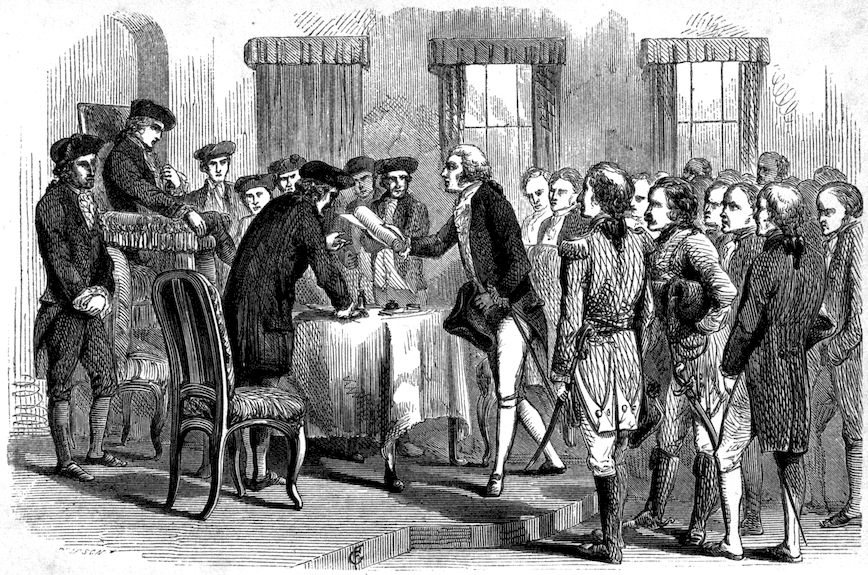
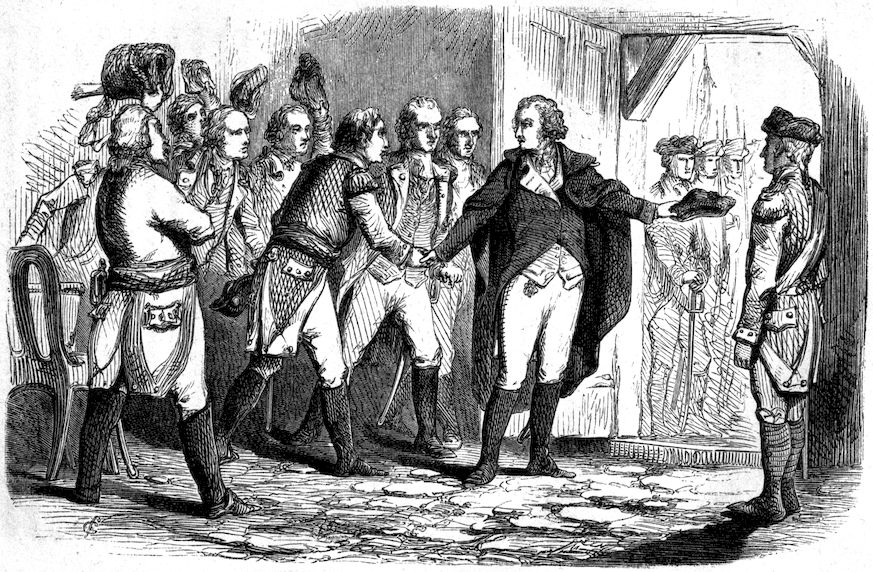
WASHINGTON RESIGNING HIS COMMISSION AS COMMANDER-IN-CHIEF.
BY MARY HOWITT.
Illustrated with Numerous Engravings.
VOL. II.
NEW YORK:
HARPER & BROTHERS, PUBLISHERS,
FRANKLIN SQUARE.
1860.
Entered, according to Act of Congress, in the year one thousand eight hundred and fifty-nine, by
Harper & Brothers,
in the Clerk’s Office of the District Court of the Southern District of New York.
CONTENTS TO VOL. II.
iii
CHAPTER I.
Commencement of the Great Wars.
The Austrian succession.—Renewed treaty with the six nations.—Breaking out of the war.—Governor Shirley attacks Louisburg.—Co-operation of the colonies.—Commodore Warren’s squadron.—Siege of Louisburg.—The city capitulates.—Franklin’s scheme for raising troops.—The peace of Aix-la-Chapelle.—Louisburg and Cape Breton returned to the French.—Undefined limits of English and French claims on America.—The Ohio company.—Remonstrance of Duquesne.—Washington’s first service.—Disputes among the colonists themselves.—Franklin’s scheme for general union rejected.—Braddock chosen major-general.—Taxation and discontent.—The English occupy Nova Scotia.—Acadia.—The outrage on the Acadians.—Their unhappy fate.—Braddock’s fancied security.—His discomfiture and death.—Expeditions against Niagara and Crown Point.—Death of Williams and Hendricks.—General feeling in North America for liberty.—John Adams and his teachings
Plan of the campaign of 1756.—Arrival of General Abercrombie.—The Marquis of Montcalm.—Loudon’s disasters in 1756 and 1757.—Loudon recalled.—Preparations for a new campaign.—Energetic exertions of the colonists to raise troops and money.—Siege of Louisburg.—Death of Howe.—Repulse of Abercrombie.—Forbes’ expedition against Fort Duquesne.—The fort destroyed.—Campaign of 1759.—Scheme for conquest of Canada.—General Wolfe.—Amherst at Ticonderoga.—Wolfe undertakes the siege of Quebec.—Wolfe’s energetic measures.—Taking of Quebec.—Death of Wolfe and of the French Marquis Montcalm.—Operations in Canada.—Montreal surrendered.—The Cherokees humbled.—Peace of 1763.—Indian rising, and terrible vengeance.—Canada in English hands
ivDebt resulting from the struggle with the French.—Amount of expense incurred.—Growing power of the colonies.—English encroachments.—Navigation acts.—Duties on various articles.—Accession of George III.—Stamp-tax.—Indignation in the colonies.—Barre’s speech in the House of Commons.—The “Liberty tree.”—First colonial congress at New York.—Franklin at the bar of the house.—Repeal of the stamp act.—Operations of the Assembly at Massachusetts.—Reinforcements in New York.—The breach widens.—Tories and whigs.—Impulse given to the home manufactures of America.—First settlements in Tennessee.—The tea dispute.—Boston port bill passed.—Meeting of the Great Congress.—Efforts to produce a reconciliation.—Preparations for war.—Indian warfare.—The New England restraining bill.—Breaking out of the war.
The British forces in America.—The affray at Lexington.—Its effect on the Americans.—Unity among the colonists.—Arnold’s exploits.—Battle of Bunker’s Hill.—Washington appointed commander-in-chief of the American army.—The Indians propitiated.—Montgomery takes possession of Quebec.—Settlement in Kentucky.—Obstinacy of George III.—Vain attempts at reconciliation.—British interests in the colonies.
The Revolutionary War (continued).—The British expelled from Boston.—Loss of New York, &c.
Washington resolves to occupy Boston.—The British evacuate the city.—Washington marches to New York.—Charleston fortified.—Moultrie’s defence of Charleston harbour.—The siege raised.—The declaration of independence drawn up and signed on the 4th July.—Howe arrives at Sandy Hook.—Plots against Washington.—Offers from Britain of indemnity on submission.—Disasters of the Americans at Long Island.—Washington returns to New York.—The British assault Fort Washington.—The Howes issue a proclamation for submission.—Despondency among the Americans.—Washington’s exploit at Trenton.—Attack on the British at Princetown.—The recovery of the Jerseys.—Franklin sent as envoy to Paris.—Lafayette joins the Americans.
War on the Canadian frontier.—Washington at Morristown.—Burgoyne’s expedition in the North.—His plan of operations.—Engagement at Hubbardton.—Burgoyne’s successes: he reaches the Hudson.—The “Green Mountain Boys” and their prowess.—Fate of Jenny M‘Crea.—General Gates assumes the command.—Battle of Saratoga.—Burgoyne falls back on Saratoga.—Surrender of the British army at Saratoga.—Washington at Philadelphia.—Battle of the Brandywine river.—Howe enters Philadelphia.—Washington’s ill success at Germantown.—His precarious position.—Want and distress in the American army.—Plan of confederation.
Discussions in Parliament on the American war.—Conciliatory measures proposed and rejected.—Losses suffered by the Americans.—Increase of warlike spirit among the Americans.—Treaties of commerce and alliance between France and the United States.—Offers from Britain rejected.—Philadelphia evacuated.—Battle of Freehold.—French fleet arrives to assist the Americans.—Attempt against Newport abandoned by D’Estaing.—British fleet, sent to oppose D’Estaing, arrives at New York.—Commissioners for conciliation.—Lafayette challenges the Earl of Carlisle.—The war assumes a ferocious character.—Destruction of Fort Wyoming.—The war in the South.—Savannah captured by the British
Clarke takes the British post of Kaskaskia.—Improved state of Washington’s army.—John Roberts and Abraham Carlisle executed for treason.—Operations in the South.—State of Georgia and the Carolinas.—Loyalists or tories.—Party-spirit.—Victory of the British at Briar Creek.—March of the British towards Charleston.—They besiege the town, but soon retreat.—Clinton at Philipsburg.—Washington at New Jersey.—Tryon’s devastations.—Stony Point retaken with the bayonet.—Major Lee’s successes at Paul’s Hook.—Flight of the Americans on the Penobscot.—New settlements in the West.—Indian and loyalist depredations
Events in the West Indies.—Preparations for an attack on Savannah.—Paul Jones encounters Pearson.—Proposal to employ negroes in the war.—The British conquer South Carolina.—Action at Springfield
General Gates sent to the relief of the southern provinces.—His discomfiture near Camden.—Women participate in the war.—Treason at West Point.—Arnold’s treachery.—Enterprise of Major André.—Failure of the scheme; escape of Arnold; arrest and death of André.—Gates superseded.—Ferguson slain.—Position of England at the close of 1780.—Critical state of affairs in America.—Financial efforts.—Arnold fights on the British side.—He ravages the banks of the James river
Cornwallis advances towards North Carolina.—Tarleton’s defeat at the battle of the Cowpens.—Passage of the Yadkin.—State of the American army.—The tories of North Carolina arm on the British side.—Greene and his taciturnity.—Battle near Guilford.—The Americans routed.—Greene’s advance to South Carolina.—Battle of Hobkirk’s Mill.—Sufferings of both armies.—The command of the British devolves on Colonel Stuart.—Execution of Isaac Hayne.—Phillips and Arnold in Virginia.—Operations of Cornwallis.—Smallness of Washington’s force.—Threatened attack on New York.—Sudden march towards the North.—Undecided Battle at Eutaw Springs
The French fleet arrives at the Chesapeake.—Du Barras arrives with his squadron.—Washington’s plans.—Fort Griswold carried by assault.—Ledyard murdered.—The British force blocked up at Yorktown.—Cornwallis’s hopes of relief.—Capitulation of the British army.—Yorktown and Gloucester surrendered.—The news of Cornwallis’s surrender in England.—Its effects on the king and on his ministers.—The Rockingham and Shelburne administrations.—Negotiations.—Dubious conduct of Vergennes.—The preliminaries of peace signed.—Murder of Joshua Huddy.—Captain Asgill’s narrow escape
Poverty of the American government.—Destitute condition of the republican troops.—Financial embarrassments.—Boundary line of States.—Claims to the territory of Vermont.—New York and other States oppose the admission of Vermont into the Union.—War on the Western frontiers.—Fight with the Indians in Kentucky.—Battle of the Big Blue Lick.—Simon Girty, the refugee.—Massacre of the Kentuckians.—Passage in the life of a Kentucky prisoner.—The back settlements of Carolina
Financial difficulties.—A monarchical government proposed.—Washington’s patriotism.—Discontent in the army.—Washington negotiates with the troops.—Washington established as the seat of government.—Peace with Great Britain formally proclaimed.—Washington’s entry into New York.—Washington resigns his commission as commander-in-chief.—Evacuation of America by the British.—Slaves under British protection.—The loyalists dissatisfied.—The anti-slavery struggle.—Meeting of Congress.—Financial arrangements.—Economical efforts.—Jefferson succeeds Franklin as ambassador to France.—Treaty with the Indians.—Kentucky and Tennessee.—Decimal coinage.—Taxation.—Large numbers of malcontents.—The Habeas Corpus act suspended.—Attempt to capture the arsenal at Springfield.—Reform of the government.—The Church of England in America.—Religious excitement in the States
Meeting of the Convention.—Arduous debates.—The Constitution proposed.—Its provisions.—The various articles of the Constitution.—Washington elected President.—Amendments in the Constitution
Great accession of territory to the States from the treaty with the six Indian nations.—The Ohio company formed.—Kentucky applies to be admitted into the Union.—Ohio settlements.—The city of Marietta founded.—Washington county.—The Constitution adopted throughout the States.—Washington elected President.—His disinterestedness.—His mode of life.—The departments of foreign affairs, of the treasury, and of war, established.—The President’s tour through the States.—The session of 1790.—Discussion on the debt in Congress.—Rhode Island added to the Union.—The Indian chief, M‘Gillivray.—The act for the encouragement of learning.—The Indian war.—Disastrous defeat of St. Clair.—The city of Washington laid out
The French revolution and its influence.—Washington re-elected.—Genet, the minister of the French republic.—Sympathy in Philadelphia with the French republic.—Genet’s turbulent conduct.—Reaction.—General Wayne succeeds St. Clair.—Defeat of the Indians.—Treaty at Greenville.—Insurrection at Pennsylvania.—Disaffection and sedition checked by military force.—Act for the establishment of a navy.—Threatened rupture with Britain.—Unpopular treaty.—Treaties with Algiers and with Spain.—Petitions against the British treaty.—Washington’s firmness.—Monroe sent to France as ambassador.—Failure of his mission.—Washington’s farewell address
Adams elected President and Jefferson Vice-President.—Prospect of war with France.—Attempt at conciliation.—French depredations and American reprisals.—Death of Washington.—Tokens of respect to his memory in America, France, and England.—Jefferson and Colonel Burr.—Second census of the United Slates.—Louisiana purchased.—The Illinois territory acquired.—War with Tripoli.—Burning of the “Philadelphia.”—Jefferson re-elected President, and Clinton Vice-President.—England assumes the right of search.—Engagement between the “Leopard” and the “Chesapeake.”—Bill of embargo passed by Congress.—Burr’s enterprise in the Western States.—His arrest.—He is accused of treason, and acquitted
James Madison’s Administration.—War with Great Britain.
Election of Madison.—Hostile attitude of England towards America.—Engagement between the “President” and the “Little Belt.”—The Indian chief Tecumseh.—Harrison’s victory over the Indians.—Preparations for war.—War with Britain proclaimed.—Proposed invasion of Canada.—Detroit surrendered.—General Hall arraigned and convicted of cowardice.—Battle of Queenstown.—Expedition against the Kickapoo Indians.—The “Guerrière” frigate taken by the “Constitution.”—Encounter between the “Wasp” and the “Frolic.”—The “Constitution” takes the “Java.”—Lord Castlereagh rejects the American proposals for peace.—Madison re-elected President.—Efforts of the Americans to establish a navy.—Combats on the lakes.—The “Chesapeake” taken by the “Shannon,” and the “Argus” by the “Pelican.”—Encounters on Lake Erie.—The Indian confederacy broken up.—Tecumseh slain
General Brown advances into Canada.—Battle at Niagara Falls.—Defeat of the British at Plattsburgh.—Destruction of the city of Washington.—Enterprise of the British at Alexandria.—British expedition against New Orleans.—New-year’s day, 1815.—The British attack repulsed.—Arrival and ratification of a treaty of peace.—Expedition against the Algerines.—Second national bank established.—James Monroe elected President.—African colonisation society.—Great western canal.—Depredations of the Seminole and Creek Indians.—Debates on the slavery question.—Operations against the West Indian pirates.—Death of Adams and of Jefferson
Temperance societies formed.—Statistics of drunkenness.—Anti-Masonic societies founded.—Abduction of William Morgan, and consequent excitement.—General Jackson re-elected.—Renewed Indian hostilities.—The celebrated chief, “Black Hawk.”—His exploits; his capture.—The last days of “Black Hawk.”—Description of “Black Hawk.”—Growth of civilisation in the West.—The tariff bill passed.—Excitement caused by this measure.—Compromise bill introduced by Henry Clay.—Indian rebellion.—Injustice practised towards the tribes.—Osceola’s plan of revenge.—Massacre of Major Dade and his men.—Devastations.—Submission of the Indians.—Van Buren elected President.—End of the Seminole war.—Osceola’s imprisonment.—Harrison President.—State repudiation of debt.—Anti-rent disturbances.—Iowa and Florida received into the Union
Mexican War.—Annexation of Texas.—Vast Increase of Territory.—The Mormons.
First settlement of the whites in Texas.—Spanish population of Texas.—Restrictions on trade.—Texas in the early part of the present century.—Population in 1833.—Santa Anna and his operations.—Fortress of the Alamo taken.—Goliad taken.—Santa Anna captured.—Duplicity of Santa Anna.—Texas admitted into the Union.—The war with Mexico.—The treaty of 1846.—New Mexico.—Utah and California.—Puebla and the metropolis Mexico taken.—Orderly conduct of the victors.—Mexican ideas concerning the Americans.—Moral state of Mexico.—Treaty of peace.—Wisconsin admitted into the Union.—Mormonism.—The Great Salt Lake.—Joseph Smith the Mormon prophet.—His pretensions.—The Mormons establish themselves.—Murder of Smith and his brother.—Statistics of Mormonism.—Mormon government and morality.—Mormon journeys
California.—Statistical Review of the United States.
Upper California discovered by Sir F. Drake.—Sebastian Viscaino.—Early Spanish settlement in California.—Humboldt’s statements concerning California.—Mrs. Willard’s account.—The United States’ exploring expedition under Fremont.—The gold discoveries and consequent emigration.—Sacramento city.—Californian Indians.—The cholera.—Distress and famine among the Californian emigrants.—State organisation of California.—Convention at Monterey.—Signing of the convention.—California sends members to Congress.—California admitted into the Union.—Considerations on the United States.—Education.—Manufactures.—Railroads.—The electric telegraph.—Cotton and woollen manufactures.—Printing operations.—Journals.—Typefounding.—Boot and shoe manufactures.—Iron foundries.—Art-education.—Commercial advantages of the American States
In 1744, the disputed Austrian succession threw the whole of Europe
into arms, and France and England were of course once more at
war. In expectation of this event, when an invasion from Canada
might be feared, New York fortified Albany and Oswego, and the
friendship of the Six Nations was secured. This precaution was
additionally necessary, as they had taken offence, owing to a collision
which some of their people had come into with the backwoodsmen
of Virginia. At a convention held at Lancaster, to which
Virginia, Pennsylvania, and Maryland were parties, the Six Nations,
with due oratory and ceremonial, relinquished all title to the
valley of the Blue Ridge, the central chain of the Alleganies.
The western frontiers thus secured, New England proposed a combination
of the five northern colonies for their mutual defence,
which New York declined, trusting to enjoy her former neutrality.
The war broke out. Fort Canso, in Nova Scotia, was taken by
the French; Annapolis was besieged by a united force of Canadians
and Indians; privateers issued from Louisburg, and the eastern
Indians again attacked the frontiers of Maine. The northern provinces
were routed, and Governor Shirley of Massachusetts resolved
to attack Louisburg. Louisburg, the capital of Cape Breton, was
called, from the strength of its fortifications, the Dunkirk of America.
Its position was one of great importance, commanding the navigation
of the St. Lawrence and the fisheries of the adjoining seas.
2The scheme was a bold one, and Shirley applied to the British
ministry for naval assistance, in the meantime laying open his
views to the general assembly, after having first sworn all the members
to secrecy. Six days were taken to deliberate upon it, and then
the scheme was negatived as too hazardous and expensive. And so
it might have ended, had not one of the members, during his evening
devotions, been heard to pray for the success of the undertaking.
The scheme got wind, and the populace approved; the plan was
therefore again proposed in the council, and carried by one vote.
Troops were immediately raised by New England. Connecticut
sent 500 men; Rhode Island and New Hampshire each 300; but
those of Rhode Island did not arrive until Louisburg was taken.
Pennsylvania, refusing troops, furnished provisions; and New York,
£3,000, a quantity of provisions, and ten eighteen-pounders. The
great burden of the war, of course, fell upon Massachusetts, who
furnished an army of 3,250 men, with ten armed vessels,—all the
fishermen, whose trade the war had interrupted, entering the service
as volunteers. The command in chief was given to William Pepperell,
a rich merchant in Maine, who was celebrated for his universal
good fortune; and Whitfield, then preaching in New Hampshire,
suggested as the motto of their flag, “Never despair with Christ for
the captain;” and one of the army chaplains, a disciple of Whitfield,
carried with him a hatchet, to hew down the images in the French
chapels.[1]
An express sent to Commodore Warren, in the West Indies, requesting
the co-operation of such ships as he could spare, returned with a
negative answer just before the expedition was leaving Boston.
Nothing daunted, however, they set sail, and approaching Cape
Breton, were prevented from entering its harbours by the great
quantity of floating ice. Returning then to Casco, they lay there
for several days under a bright sky and in clear weather, and here
were agreeably surprised by the arrival of a squadron from Commodore
Warren, who had received subsequent orders to render all
possible assistance. The next day, nine vessels from Connecticut
joined them also, with the troops from that colony. On the 30th of
April, the fleet, consisting of 100 vessels, entering Cape Breton,
3came in sight of Louisburg. This commanding fortress, the walls of
which were forty feet thick at the base and from twenty to thirty
feet high, was surrounded by a ditch eighty feet wide, and was
furnished with 101 cannon, seventy-six swivels, and six mortars; its
garrison numbered 1,600 men, and the harbour was defended by an
island battery of thirty twenty-two pounders, and by the royal
battery on the shore, having thirty large cannon, a moat, and bastions,
all so perfect that it was supposed 200 men could defend it
against 5,000. The assailants, on the contrary, had only eighteen
cannon and three mortars. Reaching the shore, however, they
effected a landing almost without opposition, and the following day
Colonel Vaughan of New Hampshire led a detachment through the
woods, past the city, which they greeted with three cheers. The
French, at their approach, having spiked their guns, fled from the
royal battery in the night, and the next morning Vaughan and
thirteen of his men, having gained possession, defended it against
the boats which were sent from Louisburg to retake it. Seth Pomroy,
a gunsmith, and a major in one of the Massachusetts regiments, was
now employed in the oversight of twenty smiths, who were employed
in drilling the cannon; and in the meantime, and for fourteen
nights in succession, the hardy besiegers were engaged in dragging
their artillery over some miles of boggy morass impassable to wheels,
and for the carriage of which a New Hampshire colonel, a carpenter,
constructed sledges, which the men, with straps over their shoulders
and midleg-deep in mud, drew safely over. Five unsuccessful
attempts were made on a battery which defended the town, and the
troops, insufficiently provided with tents and other comforts, suffered
severely in that cold and foggy climate. But nothing could daunt
their ardour. Seth Pomroy, the gunsmith-major, wrote to his wife:
“Louisburg is an exceedingly strong place, and seems impregnable.
It looks as if our campaign would last long; but I am willing to
stay till God’s time comes to deliver the city into our hands.” And
his wife replied in the same resolute spirit: “Suffer no anxious
thoughts to rest in your mind about me. The whole town is much
engaged with concern for the expedition, how Providence will order
the affair, for which religious meetings every week are maintained.
I leave you in the hand of God.”
4At length it was resolved that the fleet should enter the harbour
and bombard the city, whilst the land forces attempted to scale the
walls. Whilst this was under meditation, a French ship of sixty-four
guns, laden with supplies, was taken, after an active engagement,
within sight of the town. Fortunately for the besiegers, disaffection
prevailed within the walls, and the governor, dispirited by
this success of the enemy, sent out a flag of truce and offers of
capitulation. On the forty-ninth day of the siege, Louisburg surrendered,
together with the island of Cape Breton. When the
conquerors entered the city and beheld the strength of the works,
their very hearts sunk within them at the greatness of their undertaking;
“God has gone out of the way of his common providence,”
said they, “to incline the hearts of the French to give up this strong
city into our hands.”
The loss of Louisburg exasperated the French nation, and a powerful
armament was fitted out to ravage, in return, the whole coast of
North America; but Providence again interfered in their behalf;
the fleet, under the Duke d’Anville, was scattered and destroyed by
storms and wreck, and, to complete its misfortunes, the commander
died suddenly, and his successor, in a fit of delirium, committed
suicide. The following year, a second fleet, sent out for the same
purpose, was taken by Anson and Warren.
The capture of Louisburg was not less a cause of rejoicing in
England than in the colonies. Pepperell was made a baronet, and
commissioned as a colonel in the British army, and Warren promoted
to the rank of rear-admiral. The report of Warren, however, as
regarded the New England people, only confirmed the suspicions
which were entertained of them at home. “They have,” said he,
“the highest notions of the rights and liberties of Englishmen, and,
indeed, are almost levellers.”
The Canadian French retaliated immediately for their loss, by
attacking the English frontiers and taking several outposts, but no
great damage was done. This success revived the favourite scheme
of the conquest of Canada, and England, as well as the colonies,
began active preparations for carrying it out. In Pennsylvania,
where hitherto peace principles had been very carefully maintained,
an active military spirit, excited by Benjamin Franklin, who now,
5after twenty years of industry, had acquired a handsome property,
prevailed. “He was the originator,” says Logan, “of two lotteries,
that raised above £6,000 to pay for the charge of the batteries on
the river, and he found out a way to put the country on raising
above 120 companies of militia, of which Philadelphia raised ten, or
about 100 men each. The women, too, were so zealous that they
furnished ten pair of silk colours, wrought with various mottoes.”
Logan, himself a Quaker, though not a strict one, was highly satisfied,
as he says, with “Benjamin Franklin for contriving the militia,”
and he adds, that, “Franklin, when elected to the command of a
regiment, declined the distinction, and carried a musket among the
common soldiers.”
The peace of Aix-la-Chapelle, however, put an end to all these
ambitious schemes of conquest, and the mutual restoration of all
places taken during the war being one of its conditions, Cape
Breton and Louisburg, to the grief and mortification of the northern
colonies, were returned to France. The only thing which consoled
Massachusetts for this loss was, that the British indemnified her for
the expenses of this last enterprise, to the amount of £183,000, a
very welcome boon, when her finances were suffering the most
serious embarrassment, owing to her extensive issues of paper
money and the depreciation of the currency. It was proposed by
Thomas Hutchinson, grandson of the celebrated Anne Hutchinson,
and now a wealthy merchant of Boston, and speaker of the House
of Representatives, that the money thus granted should be imported
in silver, and applied to redeem, at its current value, all the outstanding
paper. This was done, and for a quarter of a century,
says Hildreth, Massachusetts enjoyed the blessing of a sound currency.
It was just at this time when a great inroad was attempted on
the rigidity of the Puritan manners, by the attempt of some young
Englishmen at Boston to introduce theatrical entertainments. The
play first announced was Otway’s Orphan, but it proceeded no
further than announcement, such exhibitions being at once prohibited,
“as tending to discourage industry and frugality, and
greatly to the increase of impiety and contempt for religion.”
Connecticut immediately followed the example; neither would she
6suffer such Babylonish pursuits. Two years afterwards, a London
company of actors came over, and acted the Beau’s Stratagem and
Merchant of Venice, at Annapolis and Williamsburg in Virginia.
Connecticut and Massachusetts being closed against them, they confined
their labours to Annapolis, Williamsburg, Philadelphia, Perth-Amboy,
New York and Newport.
The peace of Aix-la-Chapelle left the great causes of difference,
the undefined limits of the French and English claims in America,
still unsettled. The French, by virtue of the discoveries of La
Salle, Marquette, Champlain and others, claimed all the lands occupied
by the waters flowing into the St. Lawrence, the Mississippi
and the Lakes, and all watered by the Mississippi and its branches.
In fact, they claimed the whole of America, except that portion
which lies east of the Allegany chain, the rivers of which flow into
the Atlantic, and even of this they claimed the basin of the Kennebec
and all Maine to the east of that valley. The British on the
contrary, asserted a right to the entire country, on account of the
discovery of Cabot, extending their claims under the old patents
with more than equal extravagance, from the Atlantic to the Pacific
Ocean. To strengthen this title, they had lately purchased from the
chiefs of the confederated Six Nations, acknowledged by the treaties
of Utrecht and Aix-la-Chapelle as being under British protection, their
claim to the country of the Mississippi, which, it was stated, had at
some former period been conquered by them.
The French, as we have already said, had in part carried out their
plan of a chain of forts, to connect their more recent settlements on
the Mississippi with their earlier ones on the St. Lawrence, when in
1750 a number of gentlemen of Virginia, among whom was Lawrence
Washington, the grandfather of the celebrated George, applied to the
British parliament for an act for incorporating “the Ohio Company,”
and granting them 600,000 acres of land on the Ohio river.
This was done; the tract was surveyed, and trade commenced with
the Indians. The jealousy of the French was roused; and the
Marquis du Quesne, governor of Canada, complained to the authorities
of New York and Pennsylvania, threatening to seize their traders
if they did not quit this territory. The trade went on as before,
and the French carried out their threat, burning the village of an
7Indian tribe which refused submission, and seizing the English
traders and their merchandise; and the following year the number
and importance of the French forts was increased.
Robert Dinwiddie, at that time royal governor of Virginia, alarmed
at those violent proceedings, purchased permission of the Indians on
the Monongahala to build a fort on the junction of that river with
the Allegany, and determined to send a trusty messenger to the
French commandant at Venango, to require explanation and the
release of the captured traders. It was late in the season, and the
embassy demanded both courage and wisdom. A young man of two-and-twenty,
a major in the militia, and by profession a land-surveyor,
and who when only sixteen had been employed as such by Lord
Fairfax on his property in the Northern Neck, was selected for this
service. This young man was George Washington.
The journey, about 400 miles through the untracked forest, and at
the commencement of winter, though full of peril and wild adventure,
was performed successfully. Washington was well received by
the commandant, St. Pierre, who promised, after two days’ deliberation,
to transmit his message to his superiors in Canada; and all
unconscious of the present or future importance of their guest, who
was making accurate observations as to the strength of the fort, the
French officers revealed to him, over their wine, the intentions of
France to occupy the whole country.
The reply of St. Pierre, the contents of which were not known till
opened at Williamsburg, leaving no doubt of the hostile intentions
of the French, Dinwiddie began immediately to prepare for resistance,
promising to the officers and soldiers of the Virginian army
200,000 acres of land to be divided amongst them, as an encouragement
to enlist. A regiment of 600 men, of which Washington
was appointed lieutenant-colonel, marched in the month
of April, 1754, into the disputed territory, and, encamping at the
Great Meadows, were met by alarming intelligence; the French
had driven the Virginians from a fort which, owing to his own
recommendation, they were building at “the Fork,” the place where
Pittsburg now stands, between the junction of the Monongahala and
the Allegany, the importance of which position he had become
aware of on his journey to Venango. This fort the French had now
8finished, and had called Du Quesne, in honour of the governor-general;
besides which, a detachment sent against him were encamped
at a few miles distance. Washington proceeded, surprised the
enemy, and killed the commander, Jumonville—the first blood shed
in this war.
On his return to the Great Meadows, Washington was joined by the
troops from New York and South Carolina, and here erected a fort,
which he called Fort Necessity. Frye, the colonel, being now dead, the
chief command devolved upon Washington, who very shortly set out
towards Du Quesne, when he was compelled to return and entrench
himself within Fort Necessity, owing to the approach of a very
superior force under De Villier, the brother of Jumonville. After a
day of hard fighting, the fort itself was surrendered, on condition of
the garrison being permitted to retire unmolested. A singular
circumstance occurred in this capitulation: Washington, who did
not understand French, employed a Dutchman as his interpreter, and
he, either from ignorance or treachery, rendered the terms of the
capitulation incorrectly; thus Washington signed an acknowledgment
of having “assassinated” Jumonville, and engaged not again to
appear in arms against the French within twelve months.
Hitherto, the intercolonial wars had originated in European
quarrels; now, the causes of dispute existed in the colonies themselves,
and were derivable from the growing importance of these American
possessions to the mother-countries; the approaching war, in consequence,
assumed an interest to the colonies which no former war
had possessed. It was now, therefore, proposed by the British cabinet
that a union should be formed among the colonies for their mutual
protection and support, and that the friendship of the Six Nations
should be immediately secured. Accordingly a congress was convened
at Albany, in June, 1754, at which delegates appeared from
New York, Pennsylvania, Maryland, Massachusetts, New Hampshire,
Rhode Island and Connecticut; Delaney, governor of New York,
being the president. A treaty of peace was signed with the Six
Nations, and the convention entered upon the subject of the great
union, a plan for which had been drawn up by Benjamin Franklin, the
delegate from Pennsylvania, and which was carefully discussed,
clause by clause, in the assembly. Both William Penn, in 1697, and
9Coxe in his “Carolana,” had proposed a similar annual congress of
all the colonies for the regulation of trade, and these were the bases
of Franklin’s plan of union.
This plan proposed the establishment of a general government in
the colonies, the administration of which should be placed in the
hands of a governor-general appointed by the crown, and a council
of forty-eight members, representatives of the several provinces,
“having the power to levy troops, declare war, raise money, make
peace, regulate the Indian trade and concert all other measures
necessary for the general safety; the governor-general being allowed
a negative on the proceedings of the council, and all laws to be
ratified by the king.” This plan was signed by all the delegates
excepting the one from Connecticut, who objected to a negative
being allowed to the governor-general, on the 4th of July, the day
on which Fort Necessity was surrendered, and the very day twenty-two
years before the signing of the Declaration of Independence.
This scheme of union was, however, rejected by all the colonial
assemblies, on the plea of giving too much power to the crown; and,
strange to say, was rejected likewise by the crown, because it gave
too much power to the people. The colonial union, therefore, being at
an end for the present, it was proposed by the British ministry that
money should be furnished for the carrying on of the war by England,
to be reimbursed by a tax on the colonies. This scheme, however,
the colonies strongly opposed, being averse, argued Massachusetts, to
everything that shall have the remotest tendency to raise a revenue
in America for any public use or purpose of government. It was,
therefore, finally agreed to carry on the war with British troops,
aided by such auxiliaries as the colonial assemblies would voluntarily
furnish. These pending territorial disputes led to the publication of
more complete maps, whereby the position and danger of the
British colonies were more clearly understood. The British
colonies occupied about a thousand miles of the Atlantic coast,
but their extent inland was limited; the population amounted to
about 1,500,000. New France, on the contrary, contained a
population not exceeding 100,000, scattered over a vast expanse
of territory from Cape Breton to the mouth of the Mississippi,
though principally collected on the St. Lawrence. The very
10remoteness of the French settlements, separated from the English
by unexplored forests and mountains, placed them in comparative
security, while the whole western frontier of the English, from Maine
to Georgia, was exposed to attacks of the Indians, disgusted by
constant encroachments and ever ready for war.[2]
While negotiations were being carried on with France for the
adjustment of the territorial quarrel, the establishment of French
posts on the Ohio and the attack on Washington being regarded as
the commencement of hostilities, General Braddock was selected as
the American major-general, under the Duke of Cumberland, commander-in-chief
of the British army. Braddock was a man of despotic
temper, intrepid in action, and severe as a disciplinarian; and as the
duke had no confidence in any but regular troops, it was ordered that
the general and field officers of the colonial forces should be of subordinate
rank when serving with the commissioned officers of the
king. Washington, on his return from the Great Meadows, found
Dinwiddie re-organising the Virginia militia, and that, according to
the late orders, he himself was lowered to the rank of captain, on
which he indignantly retired from the service.
In February, 1755, Braddock, with two British regiments, arrived
in Chesapeake Bay, the colonies having levied forces in preparation,
and a tax being already imposed on wine and spirituous liquors,
spite of the general opposition to such imposts, and which excited a
very general discontent, each family being required on oath to state
the quantity consumed by themselves each year, and thus either to
perjure or to tax themselves. This unpopular tax gave rise to several
newspapers, the first newspaper of Connecticut dating from this time.
Braddock having arrived, a convention of colonial governors met
at Alexandria, in Virginia, to concert the plan of action, when four
expeditions were determined upon. Lawrence, the lieutenant-governor
of Nova Scotia, was to reduce that province; General Johnson, from
his long acquaintance with the Six Nations, was selected to enrol the
Mohawk warriors in British pay, and conduct an army of Indians
and provincial militia against Crown Point; Governor Shirley was
to do the same against Niagara; while Braddock was to attack Fort
11Du Quesne, and thus recover the Ohio Valley and take possession of
the North West.
Soon after Braddock sailed, the French sent out a fleet with a large
body of troops under the veteran Baron Dieskau, to reinforce the
army in Canada. Although England at this time had avowed only
the design of resisting encroachment on her territory, Boscawen was
sent out to cruise on the banks of Newfoundland, where he took two
of the French ships; of the remainder, some aided by fog, and others
by altering their course, arrived safely at Quebec and Louisburg; at
the same time, De Vaudreuil, a Canadian by birth, and formerly
governor of Louisiana, arrived and superseded Du Quesne as governor
of Canada.
Three thousand men sailed from Boston under Lieutenant-colonel
Winslow, on the 29th of May, for the expedition against Nova
Scotia. This Winslow was the great-grandson of the Plymouth
patriarch, and grandson of the commander of the New England
forces in King Philip’s war; he was a major-general in the Massachusetts
militia, and now, under the British commander-in-chief,
was reduced to the rank of lieutenant-colonel. At Chignecto, in
the Bay of Fundy, he was joined by Colonel Monckton with 300
British regulars, and advancing against the French forts at Beau
Sejour and Gaspereau, took possession of them in five days, after
slight resistance; and no sooner did the English fleet appear in the
St. John’s, than the French, setting fire to their fort at the mouth of
that river, evacuated the country. The English thus, with the loss
of about twenty men, found themselves in possession of the whole of
Nova Scotia: when great difficulty arose, what was to be done with
the people?
Acadia was the oldest French colony in America, having been
settled by Bretons sixteen years before the landing of the pilgrim
fathers. Thirty years before the commencement of the present war,
the treaty of Utrecht had ceded Acadia to Great Britain, yet the
settlement remained French in spirit, character, and religion. By
the terms granted to them when the British took possession, they
were excused from bearing arms against France, and were thence
known as “French Neutrals.” From the time of the Peace of
Utrecht, they appear, however, almost to have been forgotten, until
12the present war brought them, to their great misfortune, back to
remembrance. Their life had been one of Arcadian peace and
simplicity; neither tax-gatherer nor magistrate was seen among
them; their parish priests, sent over from Canada, were their supreme
head. By unwearied labour they had secured the rich alluvial
marshes from the rivers and sea, and their wealth consisted in flocks
and herds. Their houses, gathered in hamlets, were full of the
comforts and simple luxuries of their position; their clothing was
warm, abundant, and home-made, spun and wove from the flax of
their fields and the fleeces of their flocks. Thus were the Acadians
prosperous and happy as one great family of love. Their population,
which had doubled within the last thirty years, amounted at this
time to about 2,000.
Unfortunately, these good Acadians had not strictly adhered to
their character of neutrals; 300 of their young men had been taken
in arms at Beau Sejour, and one of their priests was detected as an
active French agent. It was resolved, therefore, to remove them
from their present position, in which they had every opportunity of
aiding the French. Lawrence, lieutenant-governor of Nova Scotia,
Boscawen, and Mostyn, commanders of the British fleet, consulted
with Belcher, chief-justice of the province, and the result was a
scheme of kidnapping and conveying them to the various British
provinces, although at the capitulation of Beau Sejour it had been
strictly provided that the neighbouring inhabitants should not be
disturbed. But no matter; they must be got rid of, for there was no
secure possession for the English while they, bound by all the ties of
language, affection, and religion to France, remained there. A sadder
incident of wholesale outrage hardly occurs in history than this.
The design was kept strictly secret, lest the people, excited by
despair, should rise en masse against their oppressors. Obeying
the command, therefore, to assemble at their parish churches, they
were surrounded by soldiers, taken prisoners and marched off, without
ceremony, to the ships, for transportation. At Grand Pré, for
example, says Bancroft, 418 unarmed men came together, when
Winslow, the American commander, addressed them, as follows:
“Your lands and tenements, cattle of all kinds, and live stock of all
sorts, are forfeited to the crown, and you yourselves are to be removed
13from this province. I am, through, his Majesty’s goodness, directed
to allow you to carry off your money, and your household goods, as
many as you can without discommoding the vessels you go in.”
They were the king’s prisoners; their wives and families shared
their lot; their sons, 527 in number; their daughters, 576; the
whole, including women and babes, old men and children, amounting
to about 2,000 souls. They had left home in the morning; they were
never to return. Wonderful it seems, that Heaven left such an
outrage on humanity unavenged on the spot!
The 10th of September was the day of transportation. They were
marched down to the vessels six abreast; the young men first, driven
forward by the bayonet, but not a weapon was allowed to them. It
was a scene of heart-breaking misery, and in the confusion of embarkation,
wives were separated from their husbands, parents from their
children, never to meet again! It was two months before the last of
the unhappy people were conveyed away, and in the meantime many
fled to the woods; but even this availed nothing, the pitiless conquerors
had already destroyed the harvests, to compel their surrender,
and burnt their former homes to the ground.
A quota of these poor, unhappy people were sent to every British
North American colony, where, broken-hearted and disconsolate,
they became burdens on the public charity, and failed not to excite
pity by their misery, spite of the hatred to them as Catholics
and the exasperation produced by the protracted war. Some
few made their way to France; others to Canada, St. Domingo,
and Louisiana; and to those who reached the latter country, lands
were assigned above New Orleans, still known as the Acadian
coast. A number of those sent to Georgia constructed rude boats,
and endeavoured to return to their beloved homes in the Bay of
Fundy. Generally speaking, they died in exile, the victims of dejection
and despair.
It will be remembered by our readers, doubtless, that one of
the finest poems which America has produced, “Evangeline,” by
Longfellow, is founded on this cruel and unjustifiable outrage on
humanity.
The English, in the meantime, as if their arms were not to be
blessed, had met with a severe repulse in their attempt to drive the
14French from the Ohio. Braddock’s troops landed at Alexandria, a
small town at the mouth of the Potomac, early in June; and Colonel
Washington, being permitted to retain his rank in consequence of the
reputation he had already attained, joined the expedition soon after.
Braddock made very light of the whole campaign; being stopped at
the commencement of his march, for want of horses and wagons, he
told Benjamin Franklin, that after having taken Fort Du Quesne,
whither he was hastening, he should proceed to Niagara, and having
taken that, to Frontenac. “Du Quesne,” said he, “will not detain
me above three or four days, and then I see nothing which can
obstruct my march to Niagara.” Franklin calmly replied, that the
Indians were dexterous in laying and executing ambuscades. “The
savages,” replied Braddock, “may he formidable to your raw American
militia; upon the king’s regulars it is impossible that they should
make any impression.”
Among the wagoners, whom the energy of Franklin obtained, was
Daniel Morgan, famous as a village wrestler, who had emigrated as a
day-labourer from New Jersey to Virginia, and who, having saved his
wages, was now the owner of a team, all unconscious of his future
greatness.[3] By the advice of Washington, owing to the difficulty of
obtaining horses and wagons, the heavy baggage was left under the
care of Colonel Dunbar, with an escort of 600 men; and Braddock, at
the head of 1,300 picked men, proceeded forward more rapidly. Fort
Du Quesne, in the meantime, was receiving reinforcements.
Braddock was by no means deficient in courage or military skill,
but he was wholly ignorant of the mode of conducting warfare amid
American woods and morasses; and to make this deficiency the
greater, he undervalued the American troops, nor would profit by the
opinions and experience of American officers. Washington urged the
expediency of employing the Indians, who, under the well-known
chief Half-king, had already offered their services as scouts and
advance parties; but Braddock rejected both the advice and this
offered aid, and that so rudely that Half-king himself and his Indians
were seriously offended.
It was now the 9th of July, and the governor of Du Quesne almost
15gave up his fort as lost; for Braddock and his army were that morning
only twelve miles distant. Washington, about noon riding a
little a-head, looked back from the height above the right bank of
the Monongahala, and beheld the advanced guard of regulars, headed
by Lieutenant-colonel Gage, advancing, with all the glitter of their
brilliant uniform, into an open wood. At that moment the Indian
war-whoop sounded, and they were fired upon from all quarters by
an invisible foe. The assailants, about 200 French and 600 Indians,
hidden in some ravines on each side of the road and amid the long
grass, poured in a deadly fire: the British troops, seized with sudden
panic, were thrown into hopeless confusion, and would have fled, but
that Braddock rallied them and exerted himself to the utmost to
restore order. Succeeding in part, and preserving something like
the order of battle, the horrors of the moment were increased; for
his men, “penned like sheep in a fold,” were the better mark for the
invisible enemy, who themselves, expecting merely to harass, never
hoping to defeat, were astonished at their own success. The Indians,
singling out the officers, shot down every one; of eighty-six officers,
twenty-six were killed and thirty-seven wounded; of the men one-half
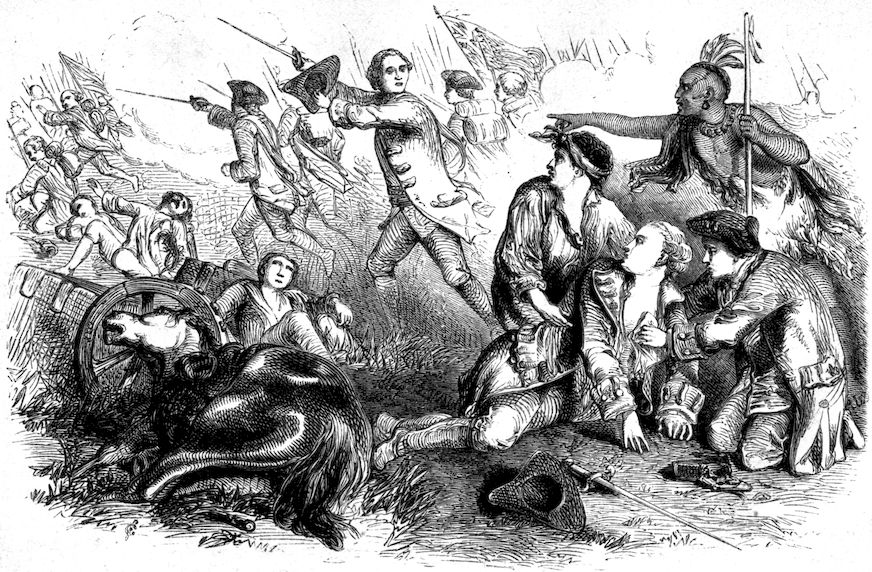
were killed or wounded. Washington alone seemed to be preserved
as by an especial Providence. In vain the Indian singled him
out also as a mark for his rifle; no bullet took his life, though two
horses were shot under him, and four bullets, after the battle, were
found lodged in his coat. Well might the savage exclaim, “Some
powerful Manitou guards his life!” This singular preservation of
the young Washington, in the midst of death, attracted the attention
of all. “I cannot but hope,” said a learned divine, a month
afterwards, “that Providence has preserved that heroic youth, Colonel
Washington, in so especial a manner for some important service to
his country.” And in England Lord Halifax inquired, “Who is
this Mr. Washington? I know nothing of him; but they say that
he behaved in Braddock’s action as bravely as if he loved the whistling
of bullets.”
Braddock remained undismayed amid the shower of bullets; five
horses were shot under him, and at length a ball entering his right
side, he fell mortally wounded. With difficulty he was borne off the
field; for many hours he remained silent; towards evening he said,
16“Who would have thought it?” On the 12th, Braddock being conveyed
to Dunbar’s camp, the remaining artillery was destroyed, the
public stores and heavy baggage burnt, to the value of £100,000,
Dunbar assigning as the reason, the dying general’s commands.
The next day they retreated, and the same night Braddock died; his
last words being, “We shall know better how to deal with them
another time.” His grave may still be seen near the public road,
about a mile west of Fort Necessity.[4]
Philadelphia was preparing for the triumph of victory, when the
news of this shameful defeat reached the city, in the arrival of
Dunbar, on whom the command had now devolved. The whole
frontier of Virginia was thus left open to the depredations of the
French and Indians. The French at Fort Du Quesne endeavoured
to withdraw the Cherokees from their fidelity to the English, and
news of this reaching the ears of Glen, governor of South Carolina,
a council of Cherokee chiefs was called, the covenant of peace was
renewed, and the cession of a large tract of land in South Carolina
was obtained.
The expedition against Niagara was entrusted to Governor Shirley,
who now, by the death of Braddock, was commander-in-chief of the
British forces. It was intended that the troops destined for this
service should assemble at Oswego, whence they were to proceed by
water to the mouth of the Niagara. The march, however, was one
of extreme difficulty, the troops being disabled by sickness and disheartened
by the news of Braddock’s defeat; and when after six
weeks it was accomplished, various adverse circumstances, violent
winds and rains, and the desertion of their Indian allies, rendered
it unadvisable for them to proceed. Two strong forts were, however,
erected, and vessels built in preparation for their embarkation.
The troops destined for the expedition against Crown Point, consisting
principally of the militia of Connecticut and Massachusetts,
were entrusted to General (afterwards Sir William) Johnson. In
June and July, about 6,000 New England men, having Phineas Lyman
as their major-general, reached the portage between Hudson River
and Lake George, where they constructed a fort called Fort Lyman,
17afterwards Fort Edward. Here they were joined by General Johnson,
with about 3,400 irregulars and Indians, towards the end of August,
when he assumed command and advanced towards Lake George.
Dieskau, in the meantime, having ascended Lake Champlain with
2,000 men from Montreal, was now pushing on to Fort Lyman,
when, altering his route, probably at the request of his Indian allies,
who dreaded the English artillery, he suddenly attacked the camp of
Johnson. Already informed of his intended attack on Fort Edward,
Johnson had sent out 1,000 Massachusetts men, under Ephraim
Williams, and a body of Mohawk warriors, under a famous chief called
Hendricks, for the purpose of intercepting their return. Unfortunately,
however, this detachment fell in with the whole force of Dieskau’s
army in a narrow defile, and were driven back with great slaughter,
Williams and Hendricks being soon slain. It was this Williams who,
when passing through Albany, made his will, leaving his property,
in case of his death, to found a Free School for Western Massachusetts,
which is now the Williams College; a better monument, as
Hildreth justly observes, than any victory would have been. The
loss of the enemy was also considerable.
The firing being heard in the camp of Johnson, the repulse of
Williams was suspected. A breast-work of felled trees was therefore
hastily constructed, and a few cannon mounted, which had just been
brought up from Fort Edward; and scarcely had the fugitives
reached the camp, when the enemy appeared, who met with so warm
a reception from the newly-planted cannon, that the Canadian troops
and the Indians soon fled, greatly to the chagrin of Dieskau. Johnson,
being early wounded, retired from the fight, and the New Englanders,
under their own officers, fought bravely for five hours. It was a
terrible day for the French; nearly all their regulars perished, and
Dieskau was mortally wounded, though he still refused to retire.
Two Canadians, who wished to carry him from the field, were shot
dead at his side, and he himself soon after, being found seated on
the stump of a tree, was wantonly shot by a renegade Frenchman.
A small remnant fled, only to be pursued by a detachment from Fort
Edward. Instead of pursuing his advantage, Johnson spent the
autumn in erecting a fort on the site of his encampment, called Fort
William Henry; and the season being late, dispersed his army to
18their respective provinces. In the meantime the French were
strengthening their position at Crown Point, and fortifying Ticonderoga.
These actions are known as the battle of Lake George.
Benjamin Franklin having about this time published an account of
the rapid increase of population in the United States, the attention
of England was turned to the immensely growing power of her colonies.
Let us hear the reasoning of the two parties on this subject.
“I have found,” said the royal governor, Shirley, who had been
appealed to, “that the calculations are right. The number of the
inhabitants is doubled every twenty years.” He admitted that the
demand for British manufactures and the employment of shipping
increased in an equal ratio; also that the sagacity which had been
displayed in the plan of union proposed at the late congress at
Albany, might justly excite the fear of England, lest the colonists
should throw off their dependence on the mother-country and set up
a government of their own. But, added he, let it be considered how
various are the present constitutions of their respective governments;
how much their interests clash, and how opposed their tempers are,
and any coalition among them will be found to be impossible. “At
all events,” said he, “they could not maintain such an independency
without a strong naval force, which it must ever be in the power of
Great Britain to prevent. Besides, the 7,000 troops which his
Majesty has in America, and the Indians at command, provided
the provincial governors do their duty and are maintained independent
of the assemblies, may easily prevent any such step being
taken.”
The royal governor of Virginia, Dinwiddie, urged upon parliament
his plan of a general land and poll tax, begging, however, that the
plan might come entirely as from them; he urged also the subversion
of charter-governments, arguing that all would remain in a
distracted condition until his majesty took the proprietary government
into his own hands. Another advised that Duke William of
Cumberland should be sent out as sovereign of the united provinces
of British America, on the plea that in a few years the colonies of
America would be independent of Britain.
These fears were prophetic of the future, and indeed were but an
echo of the popular sentiment. Franklin was thinking, and acting,
19and scattering abroad words, which were winged seeds of liberty;
Washington was already doing great deeds; and John Adams, then
the young teacher of a New England free school, was giving words to
ideas which thousands besides himself were prepared to turn into deeds.
“All creation,” said he, “is liable to change; mighty states are not
exempted. Soon after the Reformation, a few people came out here
for conscience sake. This apparently trivial incident may transfer
the great seat of empire into America. If we can remove these turbulent
Gallics, our people, according to the exactest calculation, will
in another century become more numerous than England itself. All
Europe will not be able to subdue us. The only way to keep us
from setting up for ourselves, is to disunite us.” They had learnt
already that union was strength.
CHAPTER II. PROGRESS OF THE WAR—THE CONQUEST OF CANADA.
20
The plan of the campaign for 1756, arranged by a convention of
provincial governors at New York, was similar to that of the preceding
year: the reduction of Crown Point, Niagara and Fort Du
Quesne. The enrolling of volunteer militia went on; Benjamin
Franklin being active for this purpose in Pennsylvania, and he himself
now assuming military command as a colonel on the frontier
from the Delaware to the Maryland line. The frontiers of Virginia
continued to suffer severely, though Washington, with 1,500 volunteers,
did his utmost for their protection. It was difficult to obtain a
larger volunteer force, on account, said Dinwiddie, writing to the
Board of Trade on this subject, “of our not daring to part with any
of our white men to a distance, as we must have a watch over our
negro-slaves.”
The war had now continued two years without any formal declaration
of hostilities between Great Britain and France. In May,
however, of this year it was made.
In June, General Abercrombie, who superseded Shirley, arrived
with two regiments from England, and proceeded to Albany, where
the provincial troops and the remains of Braddock’s army were
already assembled—short of provisions, however, and suffering from
small-pox. Abercrombie, deeming his forces insufficient for the proposed
campaign, determined to wait for the arrival of Lord Loudon,
now appointed commander-in-chief. This occasioned a delay until
the end of July. In the meantime, the French, under the Marquis
of Montcalm, successor to the Baron Dieskau, taking advantage of
the tardiness of the English, had made an attack on Fort Oswego,
21which it had been intended to reinforce with a regiment of regulars
under General Webb; but it was then too late; the Forts Oswego
and Ontario were taken, and Webb retired precipitately to Albany.
Upwards of 1,000 men, 135 pieces of artillery, a great amount of
stores, and a fleet of boats and small vessels built the year before for
the Niagara expedition, fell into the hands of Montcalm.
To gratify the Six Nations, and induce them to assume a position
of neutrality, Montcalm destroyed the forts, after which he returned
to Canada. These disasters were as discouraging as the defeat of
Braddock had been in the former year. The march to Ticonderoga
was abandoned, and Forts Edward and William Henry were ordered
to be strengthened. Feebleness and incapacity characterised the
campaign. The Indians, incited by the French, renewed their border
depredations; and the Quakers incurred no inconsiderable ignominy
by persisting to advocate the cause of the Indians, holding conferences
with them and forming treaties of peace. But though these
measures were against the spirit of the time, they persevered, and
succeeded in thus defending the frontiers of Pennsylvania as well as
some of the other colonies by force of arms.
On July 9, 1757, Loudon sailed with 6,000 regulars against Louisburg,
the important stronghold of the North, as Fort Du Quesne was
of the West, and on the 13th reached Halifax, where he was reinforced
by eleven sail of the line, under Admiral Holbourn, with 6,000
additional troops. Nothing, however, was done; for on learning that
Louisburg was garrisoned by 6,000 men, and that a large French
fleet lay in her harbour, the expedition was abandoned, and Loudon
returned to New York. In the meantime, Montcalm, combining his
forces from Ticonderoga and Crown Point, amounting to 9,000, with
2,000 Indians, ascended Lake George, and laid siege to Fort William
Henry, which was at that time commanded by Colonel Munro, with
upwards of 2,000 men, while Colonel Webb was stationed at Fort
Edward, only fifteen miles distant, with 5,000. For six days the
garrison made a brave resistance, until the ammunition being exhausted,
and no relief coming from Fort Edward, Munro capitulated; honourable
terms being granted, “on account,” said the capitulation, “of
their honourable defence.” But the terms were not kept. The
Indians attached to Montcalm’s army fell upon the retiring British,
22plundering their baggage and murdering them in cold blood. Munro
and a part of his men retreated for protection to the French camp;
great numbers fled to the woods, where they suffered extremely;
many were never more heard of.
In the civil history of the colonies there is very little to chronicle
during this period. In Pennsylvania a dispute arose respecting the
rights of the proprietaries to exempt their own lands from taxes
raised for the defence of those lands. Benjamin Franklin visited
England in consequence, and the question was decided by the proprietaries
yielding on certain conditions. In Georgia, also, arose a
dispute in which the Creek Indians took a lively interest, as it grew
out of the claims of that Mary Musgrove, the Indian interpreter, who
had materially aided Oglethorpe on his arrival in that country.
Mary had now married, for her third husband, Thomas Bosomworth,
Oglethorpe’s former agent for Indian affairs, but who, having taken
orders in England, had returned as successor of Wesley and Whitfield,
and claimed the islands on the coast and a tract of land above
Savannah, which the Creeks had made over to her, as well as twelve
years’ arrears of salary as Indian interpreter. The dispute, after
having continued twelve years, was settled at this time to the entire
satisfaction of Mary and her nation. The island of St. Catherine
was secured to her and her husband, and £2,000 paid in liquidation
of her other demands. Georgia was also, about the same
time, divided into parishes, and the Church of England established
by law.
The unfortunate results of the campaigns of 1756–7 were extremely
humiliating to England, and so strong was the feeling against the
ministry and their measures, that a change was necessary. A new
administration was formed, at the head of which was William Pitt,
afterwards Lord Chatham; Lord Loudon was recalled; additional
forces were raised in America, and a large naval armament and 12,000
additional troops were promised. After this great expenditure of
money and of blood on the part of the English, the French still held
all the disputed territory. The English were still in possession of
the Bay of Fundy, it is true; but Louisburg, commanding the
entrance of the St. Lawrence, Crown Point and Ticonderoga on Lake
Champlain, Frontenac and Niagara on Lake Ontario, Presque Island
23on Lake Erie, and the chain of posts thence to the Ohio, were still
in the hands of the French. They had driven the English from
Fort Oswego and Lake George, and had compelled the Six Nations
to neutrality. A devastating war was raging along the whole north-western
frontier; scalping parties advanced to the very centre of
Massachusetts; to within a short distance of Philadelphia, and
kept Maryland and Virginia in perpetual alarm.[5]
The campaign of 1758 began in earnest. Pitt addressed a circular
to the colonies, demanding at least 20,000 men; the crown undertook
to provide arms, ammunition, tents and provisions; the colonies
were to raise, clothe and pay the levies, but were to be reimbursed
by parliament. This energetic impulse was cheerfully responded to.
Massachusetts voted 7,000 men, besides such as were needed for
frontier defence. The advances of Massachusetts during the year
amounted to about £250,000. Individual Boston merchants paid
taxes to the amount of £500. The tax on real estate amounted to
13s. 4d. in the pound. Connecticut voted 5,000 men; New Hampshire
and Rhode Island a regiment of 500 men each; New Jersey
1,000; Pennsylvania appropriated £100,000 for bringing 2,700 men
into the field; Virginia raised 2,000. To co-operate with these
colonial levies, the Royal Americans were recalled from Canada, and
large reinforcements were sent from England. Abercrombie, the
new commander-in-chief, found 50,000 men at his disposal—a greater
number than the whole male population of New France. The total
number of Canadians able to bear arms was 20,000; the regular
troops amounted to about 5,000; besides which, the constant occupation
of war had caused agriculture to be neglected. Canada was at
this time almost in a state of famine.[6] “I shudder,” wrote Montcalm
to the French government, in February 1758, “when I think of provisions.
The famine is very great; New France needs peace, or
sooner or later it must fall; so great is the number of the English;
so great our difficulty in obtaining supplies.” The French army, and
the whole of Canada, were put on restricted allowance of food.
The campaign, as we have said, began in earnest; there was no
trifling, no delay. Three simultaneous expeditions were decided
24upon; against Louisburg, Ticonderoga, and Fort Du Quesne. The
possession of Louisburg was deemed very important, as opening the
Gulf of St. Lawrence, and thus admitting the English at once to the
capital of Canada. In June, Boscawen appeared before Louisburg
with thirty-eight ships of war, convoying an army of 14,000 men,
chiefly regulars, under General Amherst, but including a considerable
body of New England troops. The siege commenced. It was here
that General Wolfe first distinguished himself in America; his
amiable disposition and calm, clear judgment early won the esteem
and admiration of the colonists. Here, also, served Isaac Barre,
raised by Wolfe from a subaltern position to the rank of major of
brigade. The siege was conducted with great skill and energy, and
on the 27th of July, this celebrated fortress was in the hands of the
English, and with it the islands of Cape Breton, Prince Edward’s
Island and their dependencies. The garrison became prisoners of
war; the inhabitants were shipped off to France. Such was the end
of the French power on the Gulf of St. Lawrence.
While the siege of Louisburg was going forward, General Abercrombie,
with 16,000 men and a great force of artillery, advanced
against Ticonderoga and Crown Point. On the 16th of July, having
embarked at Fort William Henry, he advanced down Lake George,
and landing near the northern extremity of the lake, the march
commenced through a thick wood towards the fort, which Montcalm
held with about 4,000 men. Unfortunately, the vanguard—headed
by the young and gallant Lord Howe, who, like Wolfe, had
already gained the enthusiastic affection of the Americans—ignorant
of the ground, lost their way and fell in with a French scouting
party, when a skirmish took place, and though the enemy was driven
back, Lord Howe fell. The grief of the provincial troops, and,
indeed, of the whole northern colonies, was very great for the loss of
this brave young man, to whose memory Massachusetts afterwards
erected a monument in Westminster Abbey.[7]
The death of Lord Howe is said to have considerably abated the
ardour of the troops; nevertheless, Abercrombie, without waiting for
the coming up of his artillery, hastened on the attack of Ticonderoga,
25having been assured that the works were unfinished, and that it
might easily be taken. The result, however, proved the contrary.
The breast-work was of great strength, and defended by felled trees,
their branches sharpened, and pointing outwards like spears. The
utmost intrepidity, however, was shown in the attack; but, with the
loss of about 2,000 killed and wounded, Abercrombie was repulsed,
and the next day made a disorderly retreat to Fort William Henry.
Colonel Bradstreet, being about to march at the head of the provincials
of New York and New England against Fort Frontenac,
obtained from Abercrombie, after this defeat, a detachment of 3,000
men, and with these, having marched to Oswego, he crossed Lake
Ontario, and on the 25th of August attacked Fort Frontenac, which
in two days’ time surrendered. Three armed vessels were taken,
and the fort, which contained military stores intended for the Indians,
and provisions for the south-western troops, was destroyed. On their
return, the troops assisted in erecting Fort Stanwix, midway between
Oswego and Albany. Among the officers who served with Bradstreet
were Woodhull and Van Schaick, afterwards distinguished in
the revolutionary war.
The expedition against Fort Du Quesne was entrusted to General
Forbes, who early in July commenced his march with 7,000 men,
including the Pennsylvanian and Virginian levies, the royal Americans
recalled from South Carolina, and a body of Cherokee Indians.
Washington, who headed the Virginian troops, and was then at Cumberland
ready to join the main army, advised that the military road
cut by Braddock’s army should be made use of; instead of which,
Forbes, induced by some Pennsylvanian land-speculators, commenced
making a new road from Ray’s Town, where the Pennsylvanian
forces were stationed, to the Ohio. Whilst a needless delay was thus
caused, Major Grant, who, with 800 men, had been sent forward to
reconnoitre, was repulsed with the loss of 300 men, and himself
taken prisoner. This misfortune, and the loss of time caused by
making the road, which drove them into the cold season, together
with considerable desertion and sickness, so dispirited the troops, that
a council of officers determined to abandon the enterprise for the
present. Just at that moment, however, a number of French prisoners
accidentally brought in, revealed the feeble state of the garrison,
26and the news of the taking of Fort Frontenac reaching them at the
same time, it was resolved to push forward immediately; and though
they were then fifty miles from Du Quesne, and had, at the commencement
of winter, to traverse untracked forests, they succeeded
in arriving at the fort on the 25th of November, when it was found
to be a pile of ruins, the garrison having set fire to it the day before,
and retired down the Ohio.
The possession of this post caused great joy. New works were
erected on the site of Du Quesne, the name of which was now
changed to Fort Pitt, afterwards Pittsburg, now the Birmingham of
America.
The consequence of this success was immediately seen, by the disposition
which the Indians showed for peace. The frontiers of Virginia
and Maryland were relieved from their incursions; and at a
grand council held at Easton, in Pennsylvania, not only deputies of
the Six Nations, but from their dependent tribes, the Delawares and
others, met Sir William Johnson and the governors of New York and
New Jersey, and solemn treaties of peace were entered into. In
order to check the north-eastern Indians, who still remained hostile,
and to prevent their intercourse with Canada, Fort Pownall was
erected; the first permanent English settlement in that district.
The great object of the campaign of 1759 was the so-long-desired
conquest of Canada. The intention of the British minister was communicated
to the various colonial assemblies under an oath of
secrecy; and this, together with the faithful reimbursement of their
last year’s expenses, induced such a general activity and zeal, that
early in the spring 20,000 colonial troops were ready to take the
field.
In consequence of his disaster at Ticonderoga, Abercrombie was
superseded, and General Amherst became commander-in-chief. The
plan for the campaign was as follows: Wolfe, who after the taking
of Louisburg had gone to England, and was now returning with a
powerful fleet, was to make a direct attack on Quebec; Amherst was
directed to take Ticonderoga and Crown Point, and so proceed
northerly; while General Prideaux, who commanded the provincial
troops and Indians, was to descend the St. Lawrence after taking
Fort Niagara, and join Amherst in an attack on Montreal. Such
27was the proposed plan. The three divisions were intended to enter
Canada by three different routes of conquest, all to merge finally in
the conquest of Quebec, the great heart of the French power and
dominion in America.
According to arrangement, Amherst arrived before Ticonderoga in
July, with 11,000 men, when the garrison of the fort having been
weakened by the withdrawal of forces for the defence of Quebec,
both this and Crown Point surrendered without difficulty; the want
of vessels, however, prevented him for some time either proceeding to
join Wolfe at Quebec or attacking Montreal.
General Prideaux proceeded in the expedition against Niagara
with his provincials and a body of warriors of the Six Nations, who,
in spite of their treaty of neutrality, had been induced to join in this
enterprise. Prideaux advanced by way of Schenectady and Oswego,
and on the 6th of July effected a landing near Fort Niagara without
opposition. The bursting of a gun, however, killed General Prideaux,
when the command devolved on Sir William Johnson. Twelve hundred
French, and an equal number of Indian auxiliaries, advancing
to the relief of the garrison, gave battle to the English, and were
routed with great loss, leaving a considerable number prisoners; on
which the dispirited garrison capitulated. The surrender of this
post cut off all communication between Canada and the south-west.
Sir William Johnson having so far accomplished his object, should,
according to pre-arrangement, have descended Lake Ontario, to co-operate
with Wolfe on the St. Lawrence; but again the want of
shipping, shortness of provisions and the incumbrance of his French
prisoners, prevented his doing so.
Thus disappointed in receiving these important reinforcements,
Wolfe was compelled to commence the siege of Quebec alone. The
presence of Wolfe had already inspired the most unbounded
confidence. His army consisted of 8,000 men; his fleet, commanded
by Admirals Saunders and Holmes, consisted of twenty-two
ships of the line, and the same number of frigates and armed vessels.
On board of one ship was Jervis, afterwards Earl St. Vincent;
another had for master, James Cooke, the afterwards celebrated
navigator. The brigades were commanded by Robert Moncton,
afterwards governor of New York, and the conqueror of Martinique.
28Wolfe selected as his adjutant-general Isaac Barre, his old associate
at Louisburg, an Irishman of humble birth, but brave, eloquent, and
ambitious.
On the 27th of June, the whole armament disembarked on the
island of Orleans, just below the city. We will give a rapid
account of the events of this important siege from Mrs. Willard’s
excellent history.
“From the island of Orleans, Wolfe reconnoitred the position of
his enemy, and saw the full magnitude of the difficulties which surrounded
him. The city of Quebec rose before him upon the north
side of the St. Lawrence; its upper town and strong fortifications
situated on a rock whose bold and steep front continued far westward,
parallel with the river, its base near to the shore, thus presenting
a wall which appeared inaccessible. From the north-west
came down the St. Charles, entering the St. Lawrence just below the
town, its banks steep and uneven and cut into deep ravines, while
armed vessels were borne upon its waters, and floating batteries
obstructed its entrance. A few miles below, the Montmorenci leapt
down its cataract into the St. Lawrence; and strongly posted along
the sloping bank of that river and between these two tributaries,
the French army, commanded by Montcalm, displayed its formidable
lines.
“The first measure of Wolfe was to obtain possession of Point Levi,
opposite Quebec. Here he erected and opened heavy batteries, which
swept from the lower town the buildings along the margin of the
river; but the fortifications, resting on the huge table of rock above,
remained uninjured. Perceiving this, Wolfe next sought to draw
the enemy from his entrenchments, and bring on an engagement.
For this purpose he landed his army below the Montmorenci; but
the wary Montcalm eluded every artifice to draw him out. Wolfe
next crossed that stream with a portion of his army, and attacked
him in his camp. The troops which were to commence the assault
fell into disorder, having, with impetuous ardour, disobeyed the
commands of the general. Perceiving their confusion, he drew
them off, with the loss of 400 men, and re-crossed the Montmorenci.
Here he was informed that his expected succours were
likely to fail him. Amherst had possession of Ticonderoga and
29Crown Point, but was preparing to attack the forces withdrawn
from these places at the Isle aux Noix. Prideaux had lost his life,
and Sir William Johnson had succeeded him in the command;
but the enemy were in force at Montreal, and from neither division
of the British army could the commander at Quebec hope for
assistance.”
The bodily fatigues which Wolfe had undergone, and his anxiety
and disappointment, threw him into a fever, which for a time disabled
him from action; nevertheless he devised desperate means of attack,
which, on proposing to his officers, were decided to be impracticable.
Finally, it was determined to convey by night four or five thousand
men to the level plain above the town, called the Heights of
Abraham, and draw Montcalm “from his impregnable situation into
open action.”[8]
“Montcalm,” continues Mrs. Willard, “perceiving that something
was about to be attempted, despatched M. de Bourgainville with
1,500 men higher up the St. Lawrence, to watch the movements of
the English. Wolfe, pursuant to his plan, broke up his camp at
Montmorenci and returned to Orleans. Then embarking with his
army, he directed Admiral Holmes, who commanded the fleet in
which himself and the army had embarked, to sail up the river
several miles higher than the intended point of debarkation. This
movement deceived De Bourgainville, and gave Wolfe the advantage
of the current and the tide to float his boats silently down to the
destined spot.
This was done about one hour before daybreak. Wolfe and the
troops with him leapt on shore; the light infantry whom the force of
the current was hurrying along clambered up the steep shore, staying
themselves by the roots and branches of the trees. French sentinels
were on the shore; one of these hailed in French and was answered
by an officer in that language. Escaping the dangers of the water’s
edge, they proceeded, though with the utmost difficulty, to scale the
precipice. The first party which reached the heights secured a small
battery which crowned them, and thus the remainder of the army
ascended in safety. In the light of morning the British army were
30discovered by the French, drawn up on this lofty plain in the most
advantageous position.
Montcalm, learning with surprise and consternation the advantage
gained by the enemy, left his strong position, and displaying his
lines for battle, intrepidly led on the attack. Being on the left of the
French, he was opposed to Wolfe, who was on the right of the
British. In the heat of the engagement both commanders were
mortally wounded. This was the third wound which Wolfe had
received, and Isaac Barre, who fought near him, received a ball in
the head, which ultimately deprived him of sight. “Support me,”
said Wolfe to an officer near him; “do not let my brave fellows see
me fall!” He was removed to the rear, and water was brought to
quench his thirst. Just then a cry was heard, “They run! they
run!” “Who runs?” exclaimed Wolfe, faintly raising himself.
“The enemy!” was the reply. “Then,” said he, “I die content;”
and expired. Not less heroic was the death of Montcalm. He
rejoiced when told that his wound was mortal, “For then,” said he,
“I shall not live to see the surrender of Quebec!”
After the battle, General Townsend conducted the English affairs
with great discretion. The French on their part appear to have
yielded at once to the suggestion of their fears. The capitulation of
Quebec was signed five days after the battle. Favourable terms
were granted to the garrison.
General Townsend returning to England, General Murray was
left in command, with a garrison of 5,000 men. The French
army retired to Montreal, and M. de Levi, who had succeeded Montcalm,
being reinforced by Canadians and Indians, returned the
following spring, 1760, with 6,000 men to Quebec. General Murray
left the fortress, and a second still more bloody battle was fought on
the Heights of Abraham. Each army lost about 1,000 men, but the
French maintained their ground, and the English took refuge within
the fortress. Here they were closely invested, until having received
reinforcements, M. de Levi abandoned all hope of regaining possession
of Quebec, and returned to Montreal, where Vaudreuil, the
governor, assembled all the force of Canada.
DEATH OF GENERAL WOLFE.
31Desirous of completing this great conquest, the northern colonies
joyfully contributed their aid, and towards the close of the summer,
three armies were on their way to Montreal; Amherst at the head of
10,000 men together with 1,000 Indians of the Six Nations, headed
by Sir William Johnson; Murray with 4,000 men from Quebec; and
Haviland at the head of 3,500 men, by way of Lake Champlain. The
force which was thus brought against Montreal was irresistible; but
it was not needed; Vaudreuil, the governor, surrendered without a
struggle. The British flag floated on the city; and not alone was
possession given of Montreal, but of Presque Isle, Detroit, Mackinaw
and all the other posts of Western Canada. About 4,000 regular
troops were to be sent to France, and to the Canadians were
guaranteed their property and liberty of worship.
Great was the joy of New York and the New England states in the
conquest of Canada, as their frontiers were now finally delivered from
the terrible scourge of Indian warfare. But while they rejoiced from
this cause, the Carolinian frontiers were suffering from incursions of
the Cherokees, who had been instigated to these measures by the
French, who, retiring from Fort Du Quesne, had passed through their
country on their way to Louisiana. General Amherst, therefore,
despatched Colonel Montgomery against them, who aided by the
Carolinian troops, marched into their country, burned their villages,
and was on his way to the interior, when they in their turn besieged
Fort Loudon, which, after great suffering, the garrison were compelled
to surrender, under promise of a safe conduct to the British
settlements. This promise, however, was broken; great numbers
were killed on the way and others taken prisoners; and again the
war raged on the frontier. The next year Colonel Grant marched
with increased force into their country; a terrible battle was fought,
in which the Cherokees were defeated, their villages burned, and
their crops destroyed. Finally they were driven to the mountains,
and now subdued and humbled, besought for peace.
The war between England and France, though at an end on the
continent of America, was still continued among the West India
Islands, France in this case also being the loser. Martinique,
Grenada, St. Lucia, St. Vincent’s—every island, in fact, which France
possessed among the Caribbees—passed into the hands of the English.
Besides which, being at the same time at war with Spain, England
32took possession of Havanna, the key to the whole trade of the Gulf
of Mexico.
In November, 1763, a treaty of peace was signed at Paris, which
led to further changes, all being favourable to Britain; whilst Martinique,
Guadalope and St. Lucia were restored to France, England
took possession of St. Vincent’s, Dominica and Tobago islands, which
had hitherto been considered neutral. By the same treaty all the
vast territory east of the Mississippi, from its source to the Gulf of
Mexico, with the exception of the island of New Orleans, was yielded
up to the British; and Spain, in return for Havanna, ceded her
possession of Florida. Thus, says Hildreth, was vested in the British
crown, as far as the consent of rival European claimants could give
it, the sovereignty of the whole eastern half of North America, from
the Gulf of Mexico to Hudson’s Bay and the Polar Ocean. By the
same treaty the navigation of the Mississippi was free to both nations.
France at the same time gave to Spain, as a compensation for her
losses in the war, all Louisiana west of the Mississippi, which contained
at that time about 10,000 inhabitants, to whom this transfer was
very unsatisfactory.
Three new British provinces were now erected in America; Quebec
and East and West Florida. East Florida included all the country
embraced by the present Florida, bounded on the north by the St.
Mary’s. West Florida extended from the Apalachicola River to the
Mississippi; from the 31st degree of latitude on the north, to the
Gulf of Mexico on the south, thus including portions of the present
states of Alabama and Mississippi. The boundary of Quebec corresponded
with the claims of New York and Massachusetts, being a line
from the southern end of Lake Nipissing, striking the St. Lawrence
at the 45th degree of latitude, and following that parallel across the
foot of Lake Champlain to the sources of the Connecticut, and thence
along the highlands which separate the waters flowing into the St.
Lawrence from those which fall into the sea.[9]
All, however, was not yet peace in the northern provinces. The
English might possess themselves of French territory, but they could
not win the hearts of the Indian, whom the devoted missionaries and
33the kind and politic French traders had attached to their nation.
When, therefore, the English, who treated the Indians with cold
contempt, were about to take possession, Pontiac, the brave and
intellectual chief of the Ottawas, who cherished the hope of restoring
his nation to independence, endeavoured to excite the Red men
against their new lords. “If,” reasoned he, addressing his people,
“the English have expelled the French, what should hinder, but
that the Indian should destroy them before they have established
their power, and thus the Red man once more be lord of the forest?”
Pontiac, by his eloquence and energy, gained the co-operation of the
whole north-western tribes, and the plan of a simultaneous attack on
all the British posts on the lakes was formed without any suspicion
being excited. The day fixed was the 7th of July, and on that day
nine forts—all, indeed, excepting those of Niagara, Detroit and Fort
Pitt—were surprised and taken. Nor was the outbreak confined to
the forts; the whole frontier of Pennsylvania and Virginia, especially
the former, was attacked, and the scattered traders and settlers
plundered and cruelly murdered. The back settlers of Pennsylvania—principally
Scotch and Irish Presbyterians, men of a character very
different to that of the mild Quakers, and who, in the spirit of the
older Puritans, regarded the Indians as the Canaanites of the Old
Testament—rose up in vengeance, and the leaders of this movement
coming principally from a place called Paxton, the body assumed the
name of “the Paxton Boys,” and pursued their victims with a bloodthirsty
spirit, which aimed at nothing less than extermination. In
vain Benjamin Franklin interfered to save such friendly Indians as
had fled for refuge to Philadelphia and other towns; the avengers
knew no mercy, and for these unhappy remnants of a once powerful
race there appeared no place of refuge but the grave. Such of the
Christianised Indians as escaped this cold-blooded massacre established
themselves on a distant branch of the Susquehanna; though their
peace there was but of short duration, being again compelled, within
a few years, to emigrate to the country north-west of the Ohio,
where they and their missionaries, the Moravians, settled in three
villages on the Muskinghum.
The conquest of Canada and the subjection of the eastern Indians
giving security to the colonists of Maine, that province began to
34expand and flourish. The counties of Cumberland and Lincoln were
added to the former single county of York, and settlers began to
occupy the lower Kennebec, and to extend themselves along the coast
towards the Penobscot. Nor was this northern expansion confined
alone to Maine; settlers began to occupy both sides of the upper
Connecticut, and to advance into new regions beyond the Green
Mountains, towards Lake Champlain, a beautiful and fertile country
which had first become known to the colonists in the late war.
Homes were growing up in Vermont. In the same manner population
extended westward beyond the Alleganies, as soon as the Indian
disturbances were allayed in that direction. The go-a-head principle
was ever active in British America. The population of Georgia was
beginning to increase greatly, and in 1763 the first newspaper of that
colony was published, called the “Georgia Gazette.” A vital principle
was operating also in the new province of East Florida, now
that she ranked among the British possessions. In ten years, more
was done for the colony than had been done through the whole
period of the Spanish occupation. A colony of Greeks settled about
this time on the inlet still known as New Smyrna; and a body of
settlers from the banks of the Roanoke planted themselves in West
Florida, near Baton Rouge.[10]
Nor was this increase confined to the newer provinces; the older
ones progressed in the same degree. Hildreth calls this the golden
age of Virginia, Maryland, and South Carolina, which were increasing
in population and productions at a rate unknown before or since.
In the north, leisure was found for the cultivation of literature, art,
and social refinement. The six colonial colleges were crowded with
students; a medical college was established in Pennsylvania, the
first in the colonies; and West and Copley, both born in the same
year—the one in New York, the other in Boston—proved that genius
was native to the New World, though the Old afforded richer
patronage. Besides all this, the late wars and the growing difficulties
with the mother-country had called forth and trained able commanders
for the field, and sagacious intellects for the control of the
great events which were at hand.
CHAPTER III. CAUSES OF THE REVOLUTIONARY WAR.
35
A vast amount of debt, as is always the case with war, was the
result of the late contests in America. With peace, the costs of the
struggle began to be reckoned. The colonies had lost, by disease or
the sword, above 30,000 men; and their debt amounted to about
£4,000,000, Massachusetts alone having been reimbursed by parliament.
The popular power had, however, grown in various ways;
the colonial assemblies had resisted the claims of the royal and proprietary
governors to the management and irresponsible expenditure
of the large sums which were raised for the war, and thus the executive
influence became transferred in considerable degree from the
governors to the colonial assemblies. Another, and still more dangerous
result, was the martial spirit which had sprung up, and the
discovery of the powerful means which the colonists held in their
hands for settling any disputed points of authority and right with
the mother-country. The colonies had of late been a military college
to her citizens, in which, though they had performed the hardest
service and had been extremely offended and annoyed by the superiority
assumed by the British officers and their own subordination,
yet they had been well trained, and had learned their own power
and resources. The conquest of New France, in great measure, cost
England her colonies.
England, at the close of the war—at the close, in fact, of four wars
within seventy years—found herself burdened with a debt of
£140,000,000; and as it was necessary now to keep a standing
army in her colonies, to defend and maintain her late conquests, the
scheme of colonial taxation to provide a regular and certain revenue
36began again to be agitated. Already England feared the growing
power and independence of her colonies, and even at one moment
hesitated as to whether it were not wiser to restore Canada to France,
in order that the proximity of a powerful rival might keep them in
check and secure their dependence on the mother-country. As far
as the colonists themselves were concerned, we are assured by their
earlier historians that the majority had no idea of or wish to separate
themselves from England, and that the utmost which they contemplated
by the conquest of Canada, was the freedom from French and
Indian wars, and that state of tranquil prosperity which would leave
them at liberty to cultivate and avail themselves of the productions
and resources of an affluent land. The true causes which slowly
alienated the colonies from the parent state may be traced back to
the early encroachments on their civil rights and the restrictive
enactments against their commerce.
The Americans were a bold and independent people from the
beginning. They came to the shores of the New World, the greater
and better part of them, republicans in feeling and principle. “They
were men who scoffed at the right of kings, and looked upon rulers
as public servants bound to exercise their authority for the benefit
of the governed, and ever maintained that it is the inalienable right
of the subject freely to give his money to the crown or to withhold it at
his discretion.” Such were the Americans in principle, yet were they
bound to the mother-country by old ties of affection, and by no means
wishful to rush into rebellion. It was precisely the case of the son
grown to years of discretion, whom an unreasonable parent seeks
still to coerce, until the hitherto dutiful, though clear-headed and
resolute son, violently breaks the bonds of parental authority and
asserts the independence of his manhood. The human being would
have been less worthy in submission; the colonies would have belied
the strong race which planted them, had they done otherwise.
England believed that she had a right to dictate and change the
government of the colonies at her pleasure, and to regulate and
restrict their commerce; and for some time this was, if not patiently
submitted to, at least allowed. The navigation acts declared that,
for the benefit of British shipping, no merchandise from the English
colonies should be imported into England excepting by English vessels;
37and, for the benefit of English manufacturers, prohibited
exportation from the colonies, nor allowed articles of domestic manufacture
to be carried from one colony to another; she forbade hats,
at one time, to be made in the colony, where beaver abounded; at
another, that any hatter should have above two apprentices at one
time; she subjected sugar, rum and molasses to exorbitant duties
on importation; she forbade the erection of iron-works and the preparation
of steel; or the felling of pitch and white pine-trees unless
in enclosed lands. To some of these laws, though felt to be an
encroachment on their rights, the colonies submitted patiently;
others, as for instance, the duties on sugar and molasses, they evaded
and opposed in every possible way, and the British authorities, from
the year 1733, when these duties were first imposed, to 1761, made
but little resistance to this opposition. At this latter date, however,
George III. having then ascended the throne, and being, as Charles
Townshend described him, “a very obstinate young man,” it was
determined to enforce this law, and “writs of assistance,” in other
words, search-warrants, were issued, by means of which the royal
custom-house officers were authorised to search for goods which had
been imported without the payment of duty. The people of Boston
opposed and resented these measures; and their two most eminent
lawyers, Oxenbridge Thatcher and James Otis, expressed the public
sentiment in the strongest language. Spite of search-warrants and
official vigilance, the payment of these duties was still evaded, and
smuggling increased to a great extent, while the colonial trade with
the West Indies was nearly destroyed.
In 1764 the sugar-duties were somewhat reduced, as a boon to the
colonies, but new duties were imposed on articles which had hitherto
been imported free; at the same time, Lord Grenville proposed a
new impost in the form of a stamp-tax. All pamphlets, almanacs,
newspapers; all bonds, notes, leases, policies of insurance, together
with all papers used for legal purposes, in order to be valid, were to
be drawn on stamped paper, to be purchased only from the king’s
officers appointed for that purpose. This plan met with the entire
approbation of the British parliament, but its enactment was deferred
until the following year, in order that the colonies might have an
opportunity of expressing their feelings on the subject. Though
38deference was thus apparently paid to their wishes, the intention of
the British government was no longer concealed. The preamble of
the bill openly avowed the intention of raising a revenue from “His
Majesty’s dominions in America;” the same act gave increased power
to the admiralty-courts, and provided more stringent means for
enforcing the payment of duties and punishing their evasion.
The colonies received the news of these proposed measures with
strong indignation. Massachusetts instructed her agent in London
to deny the right of parliament to impose duties and taxes on a
people who were not represented in the House of Commons. “If we
are not represented,” said they, “we are slaves.” A combination
of all the colonies for the defence of their common interests was
suggested.
Otis, who had published a pamphlet on Colonial Rights, seeing the
tide of public indignation rising very high, inculcated “obedience”
and “the duty of submission,” but this was not a doctrine which
the Americans were then in a state of mind to listen to. Better
suited to their feeling was Thatcher’s pamphlet against all parliamentary
taxation. Rhode Island expressed the same; so did Maryland,
by their secretary of the province; so did Virginia, by a leading
member of her House of Burgesses.[11] Strong as the expression of
resentment was in the colonies, addresses in a much milder strain
were prepared to the king and parliament from most of them, New
York alone expressing boldly and decidedly the true nature of her
feelings, the same tone being maintained by Rhode Island.
STAMP ACT RIOTS.
39But the minds of the British monarch and his ministers were not
to be influenced either by the remonstrances and pleadings of the
colonies or their agents in London, or of their few friends in parliament.
Grenville, the minister, according to pre-arrangement, brought
in his bill for collecting a stamp-tax in America, and it passed the
House of Commons five to one, and in the House of Lords there was
neither division on the subject nor the slightest opposition. This act
was to come into operation on the 1st day of November of the same year.
It was on the occasion of its discussion in the House of Commons,
that Colonel Barre, who had fought with Wolfe at Louisburg and
Quebec, electrified the house with his burst of eloquence in reply to
one of the ministers who spoke of the colonists as “children planted
by our care, nourished by our indulgence, and protected by our arms.”
“They planted by your care!” retorted Barre. “No; your oppression
planted them in America. They nourished by your indulgence!
They grew up by your neglect of them. They protected by your
arms! Those sons of liberty have nobly taken up arms in your
defence. I claim to know more of America than most of you, having
been conversant in that country. The people, I believe, are as truly
loyal subjects as the king has, but a people jealous of their liberties,
and who will vindicate them should they ever be violated.”
The day after the Stamp Act had passed the house, Benjamin
Franklin, then in London as agent for Philadelphia, wrote the news
to his friend, Charles Thompson. “The sun of liberty,” said he, “is
set; you must light up the candles of industry and economy.” “We
shall light up torches of quite another kind,” was the reply.
Anticipating opposition to this unpopular measure, a new clause
was introduced in the Mutiny Act, authorising the sending of any
number of troops into the colonies, which, by an especial enactment,
were to be found with “quarters, fire-wood, bedding, drink, soap and
candles,” by the colonists.
The news of the passage of the Stamp Act called forth a universal
burst of indignation. At Boston and Philadelphia the bells were
muffled, and rung a funeral peal; at New York the act was carried
through the streets with a death’s head affixed to it, and labelled,
“The folly of England and the ruin of America.”[12]
The House of Assembly was sitting when the news reached Virginia,
and the leading aristocratic members hesitated to express an
opinion. Several days passed, and nothing was said; but the popular
sentiment found an utterance from the lips of Patrick Henry, a young
lawyer and member of the Assembly, who introduced a series of
resolutions, which were, in fact, the key-note to all that followed.
The first four resolutions asserted the rights and privileges of the
colonists; the last denied the authority of any power whatsoever,
excepting their own provincial Assembly, to impose taxes upon
40them, and denounced any person as an enemy to the colonies, who
should by writing or speaking maintain the contrary. These strong
resolutions led to a hot debate, during which Henry, carried away
by the fervour of his patriotism, styled the king of England a tyrant.
“Cæsar,” said he, “had his Brutus; Charles I. his Cromwell; and
George III.——” the cry of “Treason! Treason!” interrupted him—“and
George III.,” continued the corrected orator, “may profit by
their example. If that be treason, make the most of it!” Spite of
strong opposition, the resolutions passed; the last and most emphatic,
by only the majority of one vote. The next day, in the absence
of Henry, it was rescinded. But the whole had already gone to
Philadelphia in manuscript, and soon circulating through the colonies,
met with a warm response, and gave an impetus to the popular
feeling.
Before the proceedings in Virginia were known in Massachusetts,
the General Court had met, and a convention or congress of deputies
from the various colonial houses of representatives was called “to
meet at New York on the first Tuesday in October, to consult on
the difficulties in which the colonies were and must be placed by the
late acts of parliament levying duties and taxes upon them;” and
further, “to consider of a general and humble address to his majesty
and the parliament, to implore relief.”
In the meantime the popular feeling grew in intensity, and public
meetings were held throughout the colonies—a new feature in colonial
history,—and inflammatory speeches made, and associations
formed, and resolutions agreed upon, to resist to the utmost this
detested measure, which was stated to be “unconstitutional and subversive
of their dearest rights.” Nor were they contented with
talking merely. Associations, under the name of “Sons of Liberty,”
a phrase taken from Colonel Barre’s famous speech, were formed in
Connecticut, New York, Massachusetts, Pennsylvania and New
Jersey, who proceeded to express the popular sentiment in a very
forcible manner. The stamp-officers in all these provinces were
either compelled or persuaded to renounce their appointments; the
stamps were seized and burned, and in Boston scenes even of disgraceful
violence occurred. Public meetings were held under a
large elm-tree, in an open space in the city, which hence took the
41name of the “Liberty Tree;” the effigies of such as were considered
friends of the British government were hanged in its branches, beneath
which inflammatory speeches were made. The house of Oliver,
appointed stamp-distributor of Massachusetts, was attacked, the windows
broken, and the furniture destroyed, and he compelled to
resign. A violent sermon was preached against the Stamp Act, and
this excited the mob still further; many houses of the public officers
were attacked and destroyed, together with private papers and public
records, as was particularly the case at the house of Hutchinson, the
lieutenant-governor, whose furniture was piled into bonfires, the
flames of which were fed with invaluable manuscripts, the carefully
collected historical records of thirty years. These acts of
violence were of course committed by such ignorant mobs as are
the product of all periods of popular excitement. The respectable
inhabitants of Boston expressed their “abhorrence,” and a civic
guard was organised to prevent their recurrence; nevertheless the
offenders passed unpunished, whence it may be inferred that “the
respectability” of Boston did not quarrel with the spirit of their
proceedings.
And now, on October 7th, the first Colonial Congress met at New
York; twenty-eight delegates being present from nine colonies;
among these were Timothy Ruggles, president, Otis, of Massachusetts,
William Johnson, of Connecticut, Philip Livingstone, of New York,
John Dickinson, of Pennsylvania, John M‘Kean, of Delaware, Christopher
Gadsden and John Rutledge, of South Carolina—all names
afterwards distinguished in the revolution. After mature deliberation,
“a Declaration of the Rights and Grievances of the Colonies”
was drawn up, in which all the rights and privileges of Englishmen
were claimed as the birthright of the colonists; one of the most
important of which was an exemption from all taxation, except such
as was imposed by their own consent and by their own representatives.
A petition to the king and parliament was also prepared, in
which the cause of the colonies was eloquently pleaded.
These proceedings were sanctioned by all the representatives,
excepting Ruggles, the president, and Ogden, of New Jersey, both of
whom refused to sign, on the plea of the approbation of their several
assemblies being first required. The petition and memorials, signed
42by the other delegates, were transmitted to England, and all the
other colonies gave in their approval immediately afterwards.
On the important 1st of November, the day on which the Stamp
Act came into operation, scarcely a sheet of all the many bales of
stamped paper which had been sent out to the colonies was to be
found. They had either been destroyed or shipped back to England.
The day was observed as one of public mourning; shops were
closed, vessels displayed their flags half-mast high, processions
paraded the streets, and every means was used to show the public
disapprobation. The very terms of the act caused, in the present
state of the popular mind, a suspension of the whole machinery of
the social state. Business for the time was at an end; the courts of
law were closed; marriages could not take place, nor could the
affairs of the dead be legally settled. This was a state, however,
which could not continue, and by degrees things fell into their usual
course, without any regard to the act of parliament at all.
On the 6th of November, a public meeting of the more influential
inhabitants of Boston formed a combination of retaliation on Great
Britain. The purport of this was, that no goods should be imported
from England nor used by the colonies. The women entered into
the scheme with the utmost enthusiasm. All British manufactures
were foresworn, and every kind of domestic manufacture was to be
encouraged. In order to promote the home manufacture of woollen
cloths, it was determined for the present to eat neither mutton nor
lamb, that the American flocks might thus be allowed to increase.
By these means it was intended that the trade with Great Britain
should be destroyed.
England received the news with mingled alarm and displeasure.
Nevertheless, a change having taken place in the ministry, Lord
Grenville being succeeded by the Marquis of Rockingham, a party
more favourable to America was in power; and it was now, therefore,
evident to all that one of two measures must be immediately
taken—either the odious Stamp Act must be repealed, or the colonies
must be compelled to obedience by force of arms. The former was
the wiser course, and a strong party now existed to advocate it.
Angry debates began in the British senate on the subject. Lord
Grenville’s party opposed repeal, which Pitt in the House of Commons,
43and Lord Camden in the House of Lords, as warmly advocated.
“You have no right,” said Pitt, addressing the house, “to tax America.
We are told that America is obstinate—is almost in open rebellion.
I rejoice that America has resisted. Three millions of people, so
dead to all the feelings of liberty as to voluntarily submit to be
slaves, would have been fit instruments to make slaves of all the
rest. The Americans have been wronged. They have been driven
to madness by injustice. Let this country be the first to resume its
prudence and temper. I will pledge my word for the colonies, that
on their part animosity and resentment will cease!”
Franklin, summoned to the bar of the house as a witness, declared
that the act could never be enforced; and the bill for the repeal
was carried in the Commons. In the House of Lords it met with
great opposition. Lord Camden advocated the cause of the colonies
with great eloquence. “My position is this,” said he—“I repeat it,
I will maintain it to my last hour—taxation and representation are
inseparable. This position is founded on the law of nature. It is
more—it is itself an eternal law of nature; for whatever is a man’s
own is absolutely his own; no man has a right to take it from him
without his consent. Whoever attempts to do it attempts an injury;
whoever does it commits a robbery.”
The bill for repeal passed, but it was accompanied by another,
called “the Declaratory Act,” which was intended to save the national
honour by avowing the principle “that parliament had a right to
bind the colonies in all cases whatever.”
The repeal of the Stamp Act caused great joy in London to the
merchants, manufacturers, and friends of America. In America it
was received by a general outburst of loyalty and gratitude. A
general thanksgiving was appointed; statues to Pitt and even to the
king were voted, and erected in various places. Pitt became more
than ever the idol of the colonies; and thanks were voted to him by
most of the colonial assemblies.
The rejoicing, however, was only of short duration. The Declaratory
Act made known the principle of action which it was intended
to pursue towards the colonies, and accordingly the following year
its operation commenced. Again the ministry was changed; and
though Pitt, now Earl of Chatham, was at the head of affairs, and
44Lord Camden had a seat in the cabinet, advantage was taken of
Chatham’s illness, and Charles Townshend, now Chancellor of the
Exchequer and a former member of Grenville’s ministry, brought
in a bill for taxing all tea, glass, paper and painters’ colours, imported
into the colonies. This bill being supposed less objectionable than
the Stamp Act, passed the two houses with but little opposition. Nor
was this all; a standing army was to be maintained in the colonies,
and permanent salaries provided for the governors and judges, so
as to make them independent of the colonial assemblies; while a
third act empowered the naval officers to act as custom-house officers,
armed with authority to enforce the trade and navigation acts.
Punishment was also inflicted on New York and Georgia for their
disregard of the late Quartering Act; the legislative assembly of
New York was suspended until his majesty’s troops were provided
with supplies at the expense of the colony, and the troops were
withdrawn from Georgia for the same cause, leaving her exposed to
the incursions of Indians and the insurrection of negroes, which soon
brought her to submission.
The passing of these bills in such quick succession left the Americans
no longer in doubt of the line of policy which it was intended by
England to adopt towards them, and the excitement and indignation
which they occasioned equalled that produced by the Stamp Act.
The colonial assemblies met, and the strongest dissatisfaction was
expressed. Pamphlets circulated briskly, and the newspapers, now
about five-and-twenty in number, entered boldly on the subject of
colonial rights. The “Letters of a Pennsylvanian Farmer to the
Inhabitants of the British Colonies,” written by John Dickinson,
flew from one end of the colonies to the other. Franklin caused an
edition to be published even in London. The object of Dickinson’s
letters was to show how dangerous was the precedent of allowing
parliamentary taxation in any form or to any extent whatever.
Again meetings were held and associations formed for the support
and encouragement of home manufactures, and against the use and
importation of British goods. This movement, which commenced in
Boston, extended throughout the province, and the example was followed
in Providence, New York and Philadelphia. In New Hampshire
the non-importation agreement was not so warmly seconded, owing to
45the influence of the governor, Wentworth, while in Connecticut, under
William Pitkin, the governor and an ardent patriot, it met with
universal acceptation.
The assembly of Massachusetts invited by circular the co-operation
of the other provinces for the maintenance of colonial rights; the
prime movers in this measure being Thomas Cushing, the speaker of
the House of Assembly, James Otis, Samuel Adams, John Hancock,
and Joseph Hawley, all men of character and great influence. Otis
was a lawyer; Cushing, descended from an old Puritan line in the
colony; Adams, a stern Puritan likewise, educated for the ministry,
but forced by circumstances to become a merchant—he had, however,
been unsuccessful as such, and after various reverses and
changes was now an active politician and patriot, a man though
poor, and whose wife by her industry supported the family, yet who
exercised an extraordinary influence upon the fate of his country.
Hancock, the youngest of this patriot band, was a wealthy merchant,
descended from a line of merchants, “young, gay, of winning
manners, with a strong love of popular approbation.” “Hancock,”
says Hildreth, “acted very much under the guidance of Adams, who
saw the policy of putting him forward as a leader.” Hawley was a
member of Northampton County, a lawyer by profession, a man of
sound judgment, religious feeling, and unimpeachable character. The
leader in the House of Representatives at this time was James
Bowdoin, the grandson of a French Huguenot, whose father from
the smallest beginnings had become the most opulent man in Boston,
his immense wealth being inherited by his son and only child at one-and-twenty;
he, too, acted under the direction of Adams.
The revenue officers no sooner began to enforce the collection of
duties, than, as might be expected in the existing state of public
feeling, they found themselves violently opposed by the merchants.
Before long, also, the sloop Liberty, belonging to Hancock, being
seized on the charge of having smuggled goods on board, the
smothered fires burst into open flame. The populace rose, and the
terrified revenue officers fled for their lives to the barracks on Castle
Island, at the mouth of the harbour.
About the same time orders were received from England that “the
Circular,” issued by the last court, and which had given great offence,
46should be rescinded, and great disapprobation was expressed in his
majesty’s name of “that rash and hasty proceeding.” But the circular
had already gone forth, and by a vote of ninety-two to seventeen
the House of Assembly refused to rescind. Orders had also
been received by all the other colonies, desiring them to pay no attention
to this offensive circular; but Connecticut, New Jersey, Virginia,
and Georgia, had already committed themselves to it; and
Maryland and New York, instead of obedience, now put forth remonstrances
of their own.
Still was New York in contention with the governor on the subject
of the quartering of the troops, when General Gage, commander-in-chief
of the British forces in America, at the request of Bernard,
the governor, who had complained to England of the tumultuous and
refractory character of the people of Boston, was ordered to establish
a military force in the city, to keep the inhabitants in order, as well
as to aid the revenue officers in performing their duties. Two additional
regiments were in consequence sent over from England. Late
in September they arrived, and with muskets charged, and fixed
bayonets, marched in as to a conquered town. The people, however,
remained refractory; nor, though ships of war were in their
harbour, and 1,000 armed men in their streets, would they submit
to find them quarters. At length the discomfited governor was compelled
to yield; one regiment encamped on Boston common, and the
State-house was thrown open for the accommodation of the rest. It
was Sunday when all this happened, and as the State-house stood
opposite the great church, the inhabitants were disagreeably disturbed
in their worship by the beating of drums and the marching of
the troops, only to find themselves challenged by sentinels stationed
in the street on their way home. These were not circumstances calculated
to mollify the popular resentment; the most irritating language
passed between the soldiers and the citizens, and the public
excitement increased daily.
The news of this reception given to the troops, which was transmitted
to England both by Gage and Governor Bernard, caused an
equally violent excitement in England. Parliament declared the
conduct of Massachusetts to be “illegal, unconstitutional, and derogatory
to the rights of the crown and of parliament, and urged upon
47the king, that the governor should be ordered to obtain all information
regarding this treason, and to send suspected persons over to England
for trial, under an old statute of Henry VIII., for the punishment of
treasons committed out of the kingdom.” And a bill to the same
effect, spite of the opposition of Barre, Burke, and Pownall, was
immediately passed.
Every new step now taken, either by the colonies or the mother-country,
increased the distance between them. The news of these
instructions called forth immediately the most decisive expression of
opinion from the colonial assemblies. The Virginian Assembly, in
which Thomas Jefferson now first distinguished himself, and which
was sitting when these tidings reached, passed a resolution denying
boldly the king’s right, either to tax the colonies without their consent,
or to remove an offender out of the country for trial. As soon
as Lord Boutetout, the governor, heard of this, he dissolved the
assembly, but the members, instead of submitting, resumed their
sittings in a private house, and choosing Peyton Randolph as their
speaker, passed resolutions, drawn up by Colonel Washington,
against the use of British goods. Their example was followed, and
the “non-importation agreement” of Boston, Salem and New York,
now became general. In North Carolina the assembly was also dissolved,
as well as in Massachusetts. In Massachusetts, indeed, the
military still occupying the town of Boston and the State-house, the
rupture became so violent, that when Sir Francis Bernard communicated
to the assembly his intention of going to England, to represent
to parliament the disaffected state of the province, the assembly
drew up a petition praying that he might be removed for ever from
the government of the province, and denouncing, in the strongest
terms, the fact of a standing army being maintained among them in
a time of peace, and against their express desire. Leaving the
administration in the hands of Lieutenant-governor Hutchinson,
Bernard departed.
In the following year, 1770, an event occurred at Boston, which
caused great excitement throughout America. An affray having
taken place between some citizens and soldiers, the populace became
greatly exasperated, and on the 5th of March, a crowd insulted the
city guard under Captain Preston, and dared them to fire. The
48soldiers fired, three of the people were killed, and others seriously
wounded. At once the whole city was roused, and thousands
appeared in arms. After great difficulty, and by promise that justice
should be done them on the morrow, the lieutenant-governor succeeded
in appeasing the tumult. Captain Preston and his company
were tried for murder; two of the most distinguished American
lawyers and patriots, John Adams and Josiah Quincy, very nobly
volunteering their services in their defence. Two of the soldiers
were convicted of manslaughter, the rest were acquitted; but this
circumstance only tended to increase the ill-feeling between the
citizens and the soldiers.[13]
On the very day of the outrage at Boston, Lord North, who was now
at the head of the British administration, brought in a bill for the
repeal of the detestable Quartering Act, and the removal of all the
late offensive duties, excepting those on tea. It was time, in fact,
to do something, as during the last year the amount produced by
these very taxes had been swallowed up in their collection; British
trade with the colonies was nearly at an end, and the military
expenses amounted within the same period to £170,000. But even
this conciliatory measure could do little. The Americans would
accept nothing which still recognised the principle that parliament
had a right to tax the provinces, and tea became now an article
especially marked out by the non-importation agreements.
The concessions of government were not, however, without their
effect in America; two parties began now to exist; those who inclined
to moderation and adherence to the mother-country, called Tories,
and the opponents, Whigs. In New York the party of Tories was
strong, being composed of wealthy merchants, and members of the
Church of England. These having power in the assembly, which
now, after a suspension of two years, was allowed to meet again,
submitted to the “Quartering Act,” and provided for the soldiers, to
the extreme disgust of the patriots and sons of Liberty, at whose
head was a wealthy merchant, Alexander M‘Dougall, a man who
had raised himself by his own energy from poverty, and who was
afterwards a major-general in the revolutionary army. This man
49having expressed his views very strongly, was imprisoned by the
assembly, thus glad to show their zeal and loyalty, and M‘Dougall
became at once a popular hero and martyr, and his prison the
gathering-place of patriots.
The non-importation and non-consumption agreements led to
results of a beneficial character in social life which had not been
contemplated. The senseless pomp of mourning and funeral expenses
in which the colonists had indulged was discontinued; American
manufactures were stimulated, “home-made was the fashion; and in
1770, the graduating students at Cambridge took their degrees in
home-spun suits.”
As we have before said, every successive act of Britain only served
to alienate still more the hearts of her colonies. In 1772, parliament
provided for the maintenance of the governor and judges of Massachusetts
out of the royal revenues of the province, independent of
the colonial assembly, and this was resented as an intended bribe
to the governor and an infraction of their rights. Public meetings
were again held throughout Massachusetts, and corresponding committees
were formed, whose business was to discuss and consider the
rights of the colonists and to communicate and publish the result. In
the following year these committees commenced operation in New
Hampshire, Rhode Island, Connecticut, Pennsylvania and Maryland,
as well as in Massachusetts. These, “the nurseries of independence,”
gave again great offence in England.
During June of the same year, the Gaspe, an armed revenue
schooner, which had been a great cause of annoyance in Narrangansett
Bay, was purposely enticed into shoal-water by a vessel to
which she gave chase, boarded and burnt by a party from Providence.
This daring outrage called forth the indignation of parliament,
and an act was passed for sending to England for trial all persons
concerned in destroying his majesty’s ships, etc. A reward of £600
was offered for the discovery of the persons concerned in the
destruction of this vessel, and powerful machinery of examination
was put in action; but though the perpetrators were well known, so
strong was public feeling in their favour, that no legal evidence
could be obtained against them.
“While ardent discussions,” says Hildreth, “on the subject of
50colonial and national rights were going on in Massachusetts, some
reflecting persons were struck with the inconsistency of contending
for their own liberty and depriving other people of theirs. Hence
arose a controversy as to the justice and legality of negro slavery.
This controversy led to trials at law, in which the question was
freely canvassed, and it was proved by legal decisions ‘that the colonists,
black or white, born there, were free-born British subjects, and
entitled to all the essential rights of such.’ These were the first
steps towards the abolition of slavery in Massachusetts.”
Whilst disputes were maturing themselves into the great national
contest between the mother-country and the colonies, the colonies
were not altogether at peace among themselves; the question of
boundary being fruitful in controversy. Pennsylvania and Connecticut
quarrelled violently about the possession of the Wyoming
Valley, on the Upper Susquehanna, and blood was even shed.
Virginia quarrelled with Pennsylvania, also, about her western
frontier, laying claim to Pittsburg and the whole district west of
the Laurel Mountains. The boundary dispute which had long
agitated New York and New Jersey was happily adjusted about this
time, as was also that between New York and Massachusetts.
Violent were the disputes, however, between New York and the
settlers in the infant Vermont, the territory lying west of the Connecticut,
“the Green Mountain Boys,” as they were called, and the
leaders of whom were Ethan Allen and Seth Warner, emigrants
from Connecticut to the Green Mountains. But, spite of disputes
both at home and abroad, settlers extended themselves farther and
still farther, to the north and to the west. The formidable Six Nations
had now disposed of all their vast territory south of the Ohio, as far
as the Cherokee or Tennessee River, to the British Crown, for the
sum of £10,460. Settlers were already occupying the banks of the
Kenhawa River, flowing north into the Ohio, beyond the great
Allegany Range. In consequence of this immense cession of territory,
land companies started up in England for the establishment of new
colonies, but the growing troubles with the mother-country prevented
their plans being carried out.
The first settlements in the present state of Tennessee were made
by emigrants from North Carolina, who established themselves on
51the Wataga, one of the head streams of the Tennessee, in the land of
the Cherokees. Like the early settlers of New England, these
emigrants organised themselves into a body politic, and drew up a
code of laws to which every individual assented by signature. About
the same time that settlers extended themselves to the Tennessee,
an Indian trader, returning to North Carolina from one of his far
journeys west, induced Daniel Boone and four other settlers on the
Yadkin, in Maryland, by his glowing accounts of the wonderfully
beautiful regions which he had discovered, to return with him for
their exploration. They set out, reached the head waters of the
Kentucky, and as hunters traversed the fertile plains and magnificent
forests in pursuit of the buffalo and other game. They had encounters
with Indians, and Boone was taken prisoner, but managed to escape,
and was soon after joined by his brother, who had come out in search
of him. Boone was a second Nimrod, a mighty hunter; and as such,
explored the beautiful region between the Upper Kentucky and the
Tennessee. The country pleased him greatly, and hastening back to
the Yadkin, he sold his farm, and with his wife and children and
five other families, returned to this “New Western Paradise,” being
joined by volunteer settlers to the number of forty as he journeyed
along. All, however, did not go smoothly with them; they were
met by hostile Indians and some of their number killed; and war
having broken out between the backwoodsmen of Virginia and the
Indians on the Ohio, they were detained a year and a half by the
way. While the west was thus opened to the colonists, Georgia
also acquired a large increase of territory by the purchase of land
from the Creeks and Cherokees.
About this time Whitfield died in America, and Wesley sent over
disciples to establish the Wesleyan Church in that country; soon
after which, Mother Ann Lee also arrived, the foundress of the
Shakers, whose singular communities exist to this day, here and
there, throughout the country. About the same time, also, the sect
of the Universalists began to attract attention, under the preaching
of John Murray; and though at first few dared to avow this so-called
heresy, it gained great acceptation, and tended considerably
to soften the stern, rugged heart of puritan New England.
52We now return to the great contest which cast all minor subjects
into the shade.
The British ministry intended by cunning policy to effect what
open measures had failed to do. The East India company were
allowed by act of parliament to export tea to the American colonies
free from English duties, liable only to threepence per pound, to be
paid by the colonists, and which would thus give them tea cheaper
than that purchased by the English. Tea was shipped in great
quantities to America, which the colonists, who objected as strongly
as ever to the principle involved in the measure, determined should
never be permitted to land.
The pilots, therefore, in Philadelphia harbour were ordered not to
conduct the ships into the river, and their cargoes were consequently
returned to England; at New York, the governor commanded the
tea to be landed under protection of soldiers, but the people gained
possession, and prohibited its sale. At Charleston, also, its sale was
forbidden and it was stored up in damp cellars to render it unfit for
use. At Boston, the tea being consigned to the governor and his
friends, it was feared that it would be landed spite of the public, to
prevent which a number of men, disguised as Indians, boarded the
vessels at night, and threw their cargoes overboard. Three hundred
and thirty-two chests of tea were thus broken open and destroyed.
The news of this determined and offensive procedure caused the
utmost astonishment and indignation in England, and it was resolved
in parliament “to make such provisions as should secure the just
dependence of the colonies and due obedience to the laws throughout
the British dominions and as an especial punishment of the contumacious
Bostonians, a bill passed the house in March, 1774, to oblige
them to repay the value of the destroyed article, and also interdicting
all commercial intercourse with the port of Boston, and prohibiting
the landing and shipping of any goods at that place;” and
by the same act the custom-house and its dependencies were removed
from Boston to Salem, which it was intended to raise on the ruins of
its neighbour city and port.
THROWING THE TAXED TEA INTO BOSTON HARBOR.
53General Gage superseded Hutchinson as governor of Massachusetts,
in consequence of the unpopularity of the latter. A number of
manuscript letters, written by him to various members of parliament,
had fallen into the hands of Benjamin Franklin, now agent in
London for Massachusetts, New Jersey, Georgia and Pennsylvania,
and having been sent by him to Boston, and circulated extensively
though privately, caused his removal from office.
When, in May, the news of the Boston Port Bill reached that
city, together with instructions to the new governor, to send to
another colony or to England, for trial, any persons indicted for
murder, or any other capital offence committed in aid of the magistrates
in the fulfilment of their duty, an astonishment of grief and
anger fell upon the citizens, and a meeting of the inhabitants declared
that “the impolicy, injustice and inhumanity of the act exceeded
their powers of expression.”
The General Assembly met, but was adjourned by the governor to
Salem, and it was then resolved that a colonial congress should be
convened to take into serious consideration the present difficult state
of affairs. James Bowdoin, Thomas Cushing, Samuel Adams, John
Adams and Robert Treat Paine, were therefore at once appointed as
their representatives to such a congress, and the speaker of the house
was ordered to inform the other colonies of this measure. The
governor, hearing of these proceedings, ordered the assembly to
dissolve, but in vain; his officer was not admitted, and in defiance of
orders, the assembly finished its business.
The colonies sympathised warmly with Massachusetts, and Massachusetts
was true to herself. The behaviour of the inhabitants of
Salem, whom it was intended to benefit at the expense of Boston,
was very noble. They replied to the governor’s proclamation, “That
nature, in forming their harbour, had prevented their becoming
rivals to Boston in trade; and that, even if it were otherwise, they
should regard themselves as lost to every idea of justice and all
feelings of humanity, if they could indulge a thought of seizing upon
the wealth of their neighbours, or raising their fortunes upon the
ruins of their countrymen.” More than this; the inhabitants of
Marblehead and Salem offered to the suffering merchants of Boston
the use of their harbour, wharfs and warehouses, free of all charge;
and in Virginia, where Lord Dunmore, now governor, found it impossible
to manage the “the refractory people,” “a day of fast,
humiliation, and prayer,” was appointed for the 1st of June, the day
54on which the Boston Port Act came into effect, “that they might
beseech of God to avert the evils which threatened them, and to give
them one heart and one mind firmly to oppose, by all just and proper
means, every injury to the American rights.”
In September, the great congress proposed by Massachusetts met
at Philadelphia, composed of delegates from eleven of the colonies—the
most important assembly which had yet come together in
America, and for the result of whose deliberations all parties waited
with extreme interest and anxiety.
By unanimous consent, Peyton Randolph, of Virginia, was chosen
president; to each province was given one vote; they proceeded in
their deliberations with closed doors; and a committee, composed of
two persons from each province, was appointed to state the rights of the
colonies in general, together with every known instance in which these
rights had been infringed by the mother-country, and the proposed
means of redress. The conduct of Massachusetts, in her “conflict
with wicked ministers,” was approved, and a continuance of supplies
for her relief was voted. A letter of remonstrance was addressed to
the governor, General Gage, who was erecting fortifications on
Boston Neck, begging him to “desist from military operations, lest
a difference altogether irreconcilable should arise between the colonies
and the parent state.”
The committee appointed for that purpose drew up a document
setting forth, in a string of resolutions, the rights of the colonies,
which, being approved, was published as the well-known “Bill of
Rights.” A suspension of all commercial intercourse with Great
Britain was resolved upon, until the grievances of the colonies were
redressed; an address to the king was voted, together with others
to the people of Great Britain and British America. The non-importation
agreement bound them, “under the sacred ties of virtue,
honour, and love of liberty,” not to import or use any British goods
after the 1st of December, 1774, particularly the articles, tea and
molasses. Agriculture, the arts and manufactures, were to be promoted
in America by all possible means; committees were appointed
to see this agreement entered into, and all who violated it were to be
regarded as enemies to their country. To the honour of this assembly
55it must be stated, that they bound themselves also not to be in
any way concerned in the slave-trade.
The proceedings of this congress awoke, as might be expected, a
still stronger spirit of animosity in England. In vain the congress
deplored to the king “the apprehension of his colonists being
degraded into a state of servitude from the pre-eminent rank of
English freemen;” in vain they besought that “the royal indignation
might fall on those designing and dangerous men, who, by their
misrepresentations of his American subjects, had compelled them by
the force of accumulated injuries to disturb his majesty’s repose;”
in vain they prayed for “peace, liberty, and safety; wishing not the
diminution of the royal prerogative, nor soliciting the grant of any
new right in their favour;” in vain they concluded their petition by
earnestly beseeching the king, “as the father of his whole people,
not to permit the ties of blood, of law, and loyalty, to be broken.”
In vain did Lord Chatham stand before the British senate as the
eloquent advocate of America, declaring that the way must be immediately
opened for reconciliation, or it would be soon too late. “His
majesty,” argued he, “may indeed wear his crown, but the American
jewel out of it, it will not be worth wearing. I say,” continued he,
taking up the argument of American wrongs, “you have no right
to tax the colonies without their consent. They say truly, representation
and taxation must go together; they are inseparable.
This wise people speak out. They do not hold the language of
slaves; they tell you what they mean. They do not ask you to
repeal your laws, as a favour; they claim it as a right—they demand
it; and the acts must be repealed. Bare repeal, however, will not
satisfy this enlightened and spirited people. You must go through
with the work; you must declare that you have no right to tax
them; thus they may trust you—thus they will have some confidence
in you.”
In vain did the merchants of London and other commercial towns
petition in favour of America. Dr. Franklin and other colonial
agents were refused a hearing before the house. America was
condemned. The two houses of parliament, by a large majority,
assured the king that “the Americans had long wished to become
independent, and only waited for ability and opportunity to accomplish
56their design. To prevent this, therefore, and to crush the
monster in its birth, was the duty of every Englishman; and this
must be done, at any price and at every hazard.” Such was the
temper of parliament.
In the meantime, the colonies were not indifferent to the increasing
difficulties of the times. Massachusetts already assumed a military
aspect. The congress, which, spite of the opposition of the governor,
continued to hold its sittings, seeing that the military stores were
already seized by the governor, proceeded themselves to take
measures for the defence of the province. £20,000 were voted for
this purpose, and the collectors of taxes received orders no longer to
forward their moneys to the government treasurer, but to a new
one of their own appointment. Further, it was ordained that a
number of the inhabitants should be enrolled as a militia of 12,000
men, ready to march at a minute’s notice; officers were chosen, and
committees of supplies and safety held their regular sittings. Gage
denounced their proceedings, but no notice was taken of his denunciations;
“he had no support except in his own troops and a few
trembling officials, while the zealous co-operation of an intelligent,
firm, energetic, and overwhelming majority of the people, gave to
the provincial congress all the strength of an established government.”[14]
In November, at the very time when the king and the British
parliament were resolving to keep terms no longer with the colonies,
Massachusetts sent agents to New Hampshire, Rhode Island and
Connecticut, to inform them of her measures, and to solicit their
co-operation in raising an army of 20,000 men, ready to act in case
of need.
In the midst of all these growing internal excitements, and while
the colonists were deeply occupied in the maintenance of their rights,
the frontiers of Pennsylvania and Virginia were again visited by the
miseries of Indian warfare. It was at this time that the family of
the famous chief Logan, an old and faithful friend of the whites, was
murdered in cold blood; and this and other atrocities committed by
the explorers of Ohio and Kentucky, led to the sorrows of the present
57Indian war. Daniel Boone, the hunter of the Kentucky plains, was
placed in command of a frontier fort by Lord Dunmore, governor of
Virginia, and a war of extermination was carried on against the
Indians. At length, negotiations of peace were entered into, and it
was on this occasion that Logan made his celebrated speech:
“I appeal to any white man,” spoke the eloquent chief of the forest,
“if he ever entered the cabin of Logan hungry, and he gave him not
meat; if he ever came cold and naked, and he clothed him not.
During the last long and bloody war, Logan remained idle in his
cabin; and such was his love for the whites, that his countrymen
pointed as they passed, and said, ‘Logan is the friend of the white
men!’ I even thought to live with you, but for the injuries of one
man. Colonel Cresop, last spring, in cold blood, and unprovoked,
murdered all the relatives of Logan, not sparing women and children.
There runs not a drop of my blood in the veins of any living creature!
This called on me for revenge! I have fully glutted my vengeance!
For my people, I rejoice at the beams of peace; but mine is not the
joy of fear—Logan never felt fear. Who is there to mourn for
Logan? Not one!”
At the commencement of 1775, America very generally stood in a
position of hostility to the mother-country. The congress of Massachusetts
had held its third sitting; volunteers were in arms throughout
the province, and every town had its committees of safety, correspondence
and inspection. John Thomas, of Plymouth, and William
Heath, a Roxbury farmer, were appointed generals of the Massachusetts
army.
In Rhode Island, in consequence of the royal prohibition of the
exportation of military stores to America, and the removal of armed
ships from Narrangansett Bay, the people of Providence conveyed
forty-four pieces of cannon thither from Newport; and when called
upon by the British naval commander for an explanation, Governor
Wanton, a stout patriot, bluntly replied, that they were removed to
prevent their falling into his hands, and were intended to be used
against any force which might molest the colony. In New Hampshire,
John Sullivan a lawyer, and John Langdon, a merchant of
Portsmouth, headed a party who entered the fort at that place, and
possessed themselves of 100 barrels of powder, cannon and small
58arms. The convention of Maryland ordered the enrolment of militia,
and voted £10,000 for the purchase of arms. In Pennsylvania, the
public spirit was less unanimous. The provincial convention of that
province expressed themselves less decidedly than suited the temper
of the ardent patriots, one of the leaders of whom was Thomas
Mifflin, a young Quaker, possessed of much energy of character, and
remarkable powers of popular eloquence. Mifflin, however, was an
exception to the general body of Quakers, who, whatever their original
opposition to established forms, have ever been loyal and obedient
to the powers that be; and now, in their yearly meeting held in
Philadelphia at the commencement of 1775, they put forth their
“testimony of abhorrence to every measure and writing tending to
break off the happy connexion of the colonies with the mother-country,
or to interrupt their just subordination to the king.” Very
different was the spirit of the sects and their ministers in New
England. Everywhere it evinced opposition to the king and the
mother-country, whose attempts to force an established episcopal
church, with a bishop at its head, upon the colonies, had only tended
still more to increase that very spirit of resistance which had first
sent their forefathers to these shores. The Presbyterians of every
New England state were all staunch Whigs. The episcopal clergy
and their congregations, wherever found, were Tories; so also were
the landed proprietors and merchants, especially the more recent
settlers. The Episcopalian and Tory party was more numerous in
New York than in any other of the northern provinces. In Georgia
they were also considerable, and the influence of Governor Wright
prevented this province from joining the American Association; and
in the southern provinces, the law of primogeniture, which still considerably
prevailed, together with the institution of slavery, had
given rise to a local aristocratic class, totally opposed in sentiment
to the democracy of the north.
These were the elements upon which England depended to establish
her power in the coming contest;—nor were these all; she
depended, not only on the loyalty and attachment of the Episcopalians
everywhere, but on the peace-loving principles of the Quakers, who
were an influential portion of New Jersey, Pennsylvania, Delaware
and North Carolina; she expected if not aid, at least no
59opposition from the numerous German settlers, who, established
in large colonies, had not yet acquired the English language nor
amalgamated with the British colonists; and at the same time she
depended for aid upon the Scotch Highlanders, who abounded in
New York and North Carolina, and who were at the same time ignorant
and loyal.
It being determined therefore to show no concession to the rebellious
spirit of the colonies, a bill was brought in in February, 1775,
for cutting off the trade of Massachusetts, Connecticut, Rhode Island
and New Hampshire, excepting with Great Britain and her West
India possessions, and to prohibit also their fishing on the banks of
Newfoundland, which was then a great branch of their trade and
industry. While this bill was under discussion, news reached
England of the adhesion which was given by the other colonies to
the measures of the American Congress; and all the colonies, excepting
New York, North Carolina and Georgia, were included in the
bill of restriction. At the very time that this New England Restraining
Bill was agitating all parties, Lord North proposed what he
called a conciliatory plan, which was, in fact, that Great Britain
should forbear any scheme of colonial taxation, on condition that the
assembly of each province should raise a suitable amount of money,
which should be disposable by parliament. This plan, though vehemently
opposed in England, as conceding too much to the colonies,
was utterly rejected by the colonies, as compelling them to yield
that over which they claimed to have a right. In the midst of all
these attempts at coercion and conciliation, an endeavour at negotiation
also failed between Benjamin Franklin and some members of
the cabinet who were friendly to America.
The West India merchants petitioned against the restraining bill,
as interfering fatally with their commercial relationships, and foretelling
famine and ruin to the West India islands in consequence.
The assembly of Jamaica petitioned parliament on behalf of “the
claim of rights set up by the North American provinces,” and protested
against the “plan almost carried into execution for reducing
the colonies into the most abject state of slavery.” Petitions for
conciliation were presented from the British Quakers and the British
settlers in Quebec, and Wilkes, as lord mayor of London, presented a
60remonstrance to the king from the city authorities, expressing “abhorrence
of the measures in progress for the oppression of their fellow
subjects in the colonies.” But all was of no avail. Nothing was
to be done; and Franklin, seeing the hopeless state of affairs, set
sail for America, and almost at the same moment the battle of
Lexington was fought.
CHAPTER IV. THE REVOLUTIONARY WAR.
61
When, in February, 1775, the provincial congress met again at
Cambridge, the committee of supplies took the most active measures
for the raising and drilling of the militia, and for the procuring of
ammunition and military stores of all kinds. A day of fasting and
prayer, according to puritan custom on solemn and important occasions,
was also appointed; New England was preparing temporally
and spiritually for the great time of trial.
The British forces under the command of General Gage, at Boston,
amounted to about 3,000. Gage, aware of what was going forward
around him, resolved to disable the insurgent colonists by gaining
possession of the stores and ammunition which had been collected by
them, and stored at Salem and Concord. At Salem the search was
unsuccessful, the troops being driven back from a bridge, the passage
of which was disputed on the Sunday. The attempt at Concord was
of a much more serious character, military stores being collected
there to a great extent. Eight hundred men were sent out on this
expedition, with orders of despatch and secrecy, under the command
of Colonel Smith and Major Pitcairn, on the night of April 18th, and
arrived at Lexington, within five miles of Concord, just before
sunrise. But the alarm had been already given, and it being
supposed that the intention was to seize John Hancock and Samuel
Adams, who were then there, the minute-men of the place were
drawn up to resist them. Pitcairn, at the head of his regulars,
advanced within musket-shot, and exclaimed, “Disperse, rebels!
Throw down your arms, and disperse!” No notice being taken of
these words, a volley was then fired, which killed eight of the
62minute-men and wounded several others. The British, however,
declared that the minute-men fired first; but be that as it may, they
then fled, and the firing was continued, the regulars marching on to
Concord, where they destroyed and took possession of the stores,
while the minute-men being reinforced by different bodies which had
hurried there at the sound of the firing, a skirmish ensued. A considerable
number of the regulars were killed, and the rest forced to
retreat, the colonial militia pursuing them hotly all the way back to
Lexington, where, fortunately for themselves, they found Lord Percy
with a reinforcement of 900 men. But for this timely aid, it is
doubtful if any of their number would have reached Boston; the
Americans, having the advantage of the knowledge of the ground,
and availing themselves of the Indian mode of warfare, took fatal
aim from behind bushes, stone walls, barns, or whatever offered a
means of concealment. At sunset the exhausted regulars reached
Bunker’s Hill, near Boston, having lost in killed and wounded about
300 men, while the loss of the provincials amounted to eighty-five.
The news of this battle, of this first shedding of blood, flew like
wild-fire through the colonies. Couriers were despatched at full
speed from place to place, bearing tidings which called all to arms.
“The war has begun!” was shouted in the market-place; at the ferry
on the river; in the crowded meeting-house on the Sabbath; and all
rushed to arms. It was twenty days, however, with their utmost
speed, before the news reached Charleston in South Carolina; yet,
long before that time, volunteers had marched from all parts of the
New England colonies.
From Rhode Island, a body of volunteers hastened to Boston,
under the command of a young Quaker, Nathaniel Greene, who was
disowned by his brethren for this violation of their principles. Nor
could the admonitions and threats of discipline of the elder Friends
of Philadelphia keep the martial spirit of their young men under
control. Mifflin’s example and influence was stronger than all the
advice they could give, and Quaker-Philadelphia sent out a company
of brave volunteers. Delaware, Maryland, and North Carolina, all
were moved by the same spirit; while Patrick Henry, the young
patriot lawyer of Virginia, marched with a troop of volunteer riflemen
to Williamsburgh, the capital of the Old Dominion, and compelled
63the royal treasurer to refund the value of ammunition which
Lord Dunmore, the governor, had lately seized. Dunmore, incensed,
issued a proclamation declaring them rebels, and fortified his
residence. Soon after, letters of his, addressed to the English government,
and which were considered false to the colony, being intercepted,
the public indignation waxed hot against him; whereupon,
fearing for his life, he fled to a man-of-war lying at Yorktown, and
abandoned his government. Governor Martin, of North Carolina,
about the same time, fled also in terror on board a ship of war, at
the mouth of Cape Fear River; and in South Carolina, Lord William
Campbell, the governor, being suspected of secret negotiations with
the Cherokees, was likewise obliged to retire. Georgia, the hitherto
“defective link in the American chain,” soon became soldered by the
kindling flame of liberty. In vain Sir James Wright, the governor,
did his utmost to maintain the loyalty and allegiance of the province.
The powder was removed from the magazine at Savannah; and the
cargo of a powder-ship, which lay at the mouth of the river, forwarded
to the camp at Boston.
Georgia sent five delegates to the provincial congress about to
assemble at Philadelphia; and henceforth the style of the “Thirteen
United Colonies” was assumed.
The battle of Lexington was soon followed by other events. The
Massachusetts committee of safety had already contemplated gaining
possession of Ticonderoga and Crown Point, on which depended the
control of Lakes George and Champlain, when, without waiting for
higher commands than those of patriotism, the bold Ethan Allen and
Seth Warner, at the head of their “Green Mountain Boys,” set out
on the enterprise. Without being aware of this movement, Benedict
Arnold, a New Haven trader, then in camp before Boston with a
company of volunteers, received a commission from the committee of
safety, to raise a body of troops in Vermont and proceed on this
enterprise. Arnold was well pleased, for it was a favourite scheme
of his own, but presently found, to his surprise, that others were
before him. Taking command, therefore, under Allen, they marched
together to Ticonderoga, which they reached on the 9th of May, and
on the 10th, by break of day, entered the fort unperceived, with
eighty men, and surprising De la Place, the commandant, in his bed,
64ordered him to surrender, “in the name of the Great Jehovah and
the Continental Congress.” No resistance was attempted; and
Crown Point was taken with equal ease. The garrison of both forts
did not amount to more than sixty men, but above 200 pieces of
artillery and a valuable quantity of powder, of which there was
great want in the provincial camp, fell into the hands of the captors.
After this, Arnold manned a small schooner, and proceeding down
the lake, surprised the Fort of St. John and seized a sloop-of-war
laden with stores; the pass of Skeensborough, now Whitehall, was
likewise secured. Three important posts which commanded the
lakes, together with much needed cannon and munitions of war,
being thus secured in rapid succession and without bloodshed, raised
the hopes of the Americans and inspired them with confidence.
While these events were going forward, Lord North’s conciliatory
proposition was laid before the various colonial assemblies and
rejected. On May 10th the colonial congress met at Philadelphia.
Its meeting was momentous. Thomas Jefferson was chosen president,
and Thomas Hancock secretary. Bills of credit were issued
for defraying the expenses of the war. It was resolved, that hostilities
had been commenced by Great Britain; allegiance was
still avowed, and an anxious desire expressed for peace; nevertheless
it was voted that the colonies ought to put themselves
in a posture of defence against the parliamentary schemes of compulsory
taxation. After much opposition, another petition to the
king was agreed upon. The New England states entertained and
freely acknowledged the desire for independence; the middle and the
southern states still hesitated, though all had sent delegates to the
congress. Addresses were also prepared to the people of Great
Britain and Ireland, as well as an appeal made to the “oppressed
inhabitants of Canada,” as through Canada it was expected that
England would make an attack on the colonies.
In order to prevent General Gage from penetrating into the
country, which was his intention, congress recommended to the
council of war completely to blockade him in Boston; for which
purpose, Colonel Prescott, with a detachment of 1,000 men, including
a company of artillery and two field-pieces, was ordered to
march at nightfall of June 16th, and take possession of Bunker’s-hill,
65an elevation just within the peninsula of Charlestown, and commanding
the northern approach to Boston, which city it overlooked.
By some mistake, however, they proceeded to Breed’s Hill, a lower
height and still nearer to Boston. With the utmost silence and
despatch they laboured all night, and before morning had thrown up
a considerable redoubt, capable of defending themselves from the fire
of the enemy. Great was the astonishment of the British the next
morning, and a fire was immediately opened upon them from the
ships in the river. The work, however, went on uninterruptedly,
when, about noon, 3,000 picked men, under command of Generals
Howe and Pigot, embarked in boats and landed at the foot of
Breed’s Hill, and advanced slowly in two columns; the artillery in
the meantime being directed against the works. At this critical
moment no system prevailed in the American army; the same troops
who had been at work all night were still in the intrenchments;
neither General Warren nor Israel Putnam, though on the ground,
had troops under their command; forces which had been ordered
thither had not arrived and the stock of ammunition was very
small.
It was a splendid summer’s afternoon, when the British advanced
up the hill. Clinton and Burgoyne were stationed on a height in
Boston to watch the action; and all the surrounding eminences,
spires of churches, and roofs of houses, were crowded with spectators,
awaiting anxiously, though with opposing interests, the result of the
approaching conflict. Slowly and uninterruptedly advanced the
British, until within about ten rods of the redoubt, when such a
deadly fire assailed them that their ranks were mown down, the
whole line broken, and they fell back in disorder. Again they were
rallied and brought back to the charge by their officers, but again
were repulsed with loss. Infuriated by defeat, and in consequence
also, it is said, of shots being fired from a house on the left, Gage
ordered Charlestown to be set on fire; the wooden buildings burned
rapidly and the tall spire of the meeting-house was wrapt in flame;
2,000 people at least being thus rendered houseless. Amid the
terrors of the burning village, the British regulars made a second
and yet a third attack, and this time with better success. The
ammunition of the provincials began to fail, and the British artillery,
66now brought up to the breast-work, swept it from end to end, while
three simultaneous attacks carried it at the point of the bayonet.
Courage now could avail nothing, and the provincials under Colonel
Prescott made good their retreat across Charlestown Neck, exposed
to an incessant fire from the shipping, and entrenched themselves on
another height still commanding the entrance to Boston. The British
took possession of Bunker’s Hill. This defeat the Americans esteemed
as a victory; in England the victory was considered little less than
a defeat, and General Gage was in consequence superseded by
Sir William Howe, brother of Lord Howe, who perished before
Ticonderoga. Of 3,000 British engaged in this conflict above 1,000
fell. The loss of the Americans was in about the same proportion;
out of 1,500, 450 were killed and wounded, but among the former
was General Warren, whose loss caused the deepest regret to his
country.
This second encounter, in which undisciplined troops had so
bravely withstood the flower of the British army, raised still higher
the hopes and confidence of the Americans. The English discovered
also that they had no insignificant enemy to deal with.
The day before the battle of Bunker’s Hill, the Provincial congress
at Philadelphia, having voted to raise an army of 20,000 men, proceeded
to elect George Washington, then present as delegate from
Virginia, to the rank of commander-in-chief. The northern colonies
had resolved, in order to secure the adherence of the South, to choose
a southern commander, and the superior wisdom of Providence guided
them in the selection. God provides the man for the work, and
Washington was the appointed agent of a great people’s emancipation.
Divine wisdom, and not that of man, guided the choice.
Washington, with great modesty and dignity, accepted the appointment,
declining all compensation for his services beyond the defrayment
of expenses. At the same time that Washington received the
command in chief, Artemas Ward, of Massachusetts, Colonel Lee,
formerly a British officer, Philip Schuyler, of New York, and Israel
Putnam, of Connecticut, then with the camp before Boston, were
appointed major-generals, and Horatio Gates adjutant-general.
Washington, accompanied by a number of ardent young men from
the South, soon appeared in the camp and assumed command. He
67found excellent materiel for an army, but great want of arms and
ammunition as well as deficiency of discipline. The troops, now amounting
to 14,000 men, were arranged in three divisions; the right wing
under General Ward, at Roxbury; the left, under Lee, on Prospect
Hill; and the centre at Cambridge, where were Washington’s head-quarters.
The post of quarter-master-general was given by Washington
to Mifflin, the young Quaker of Philadelphia, who had accompanied
him as aide-de-camp; and Robert Harrison, a lawyer of
Maryland, was chosen by him for the important office of his secretary,
the duties of which he faithfully performed for several years. Among
the new companies which now joined the camp was one from Virginia,
led by that same village wrestler, Daniel Morgan, who was hired
by Benjamin Franklin to aid in the removal of stores for Braddock’s
army, and in whose defeat he was wounded. The British, thus
hemmed in at Boston, suffered greatly from want of provisions.
While Washington was occupied in organising his army and
endeavouring to introduce order and discipline among troops
unaccustomed to subordination, congress was employed in providing
the necessary means for the support of the war. A declaration of
war was also issued, in which the causes and necessity for taking up
arms were set forth. This document, which was ordered to be read
from every pulpit in the colonies, asserted that their cause was just,
their union perfect. “Our internal resources are great,” said the
declaration, “and if necessary, foreign aid is undoubtedly attainable.”
“Nevertheless,” it went on to say, “we have not raised armies with
the ambitious design of separating from Great Britain. We have
taken up arms in defence of the freedom which is our birthright.
We shall lay them down when hostilities shall cease on the part of
the aggressors, and all danger of their renewal shall be removed.”
The importance of keeping on good terms with the Indians at
this critical juncture was not overlooked; and three boards were
established for the management of Indian affairs. An armed body
of Stockbridge Indians, the last remains of the New England tribes,
was already with the camp at Boston; and overtures were made to
the Six Nations. Louis, the chief of the French Mohawks, a half-blood
Indian, received a commission as colonel, and at the head of an
Indian troop faithfully served the American cause.
68The first complete line of postal communication was established at
this time by congress, amid its multifarious concerns, and Benjamin
Franklin was appointed post-master-general, with power to appoint
deputies for the conveyance of the mail from Falmouth in Maine to
Savannah in Georgia.
While the British army was blockaded at Boston, and the highway
to Canada opened for the Americans by their possession of Ticonderoga
and Crown Point, it was resolved by congress to invade and
possess themselves of that province, and thus counteract the movements
of Sir Guy Carleton, the governor, who was evidently under
orders from England to attack the colonies from the north-west.
Two expeditions were therefore sent out—the one under Generals
Schuyler and Montgomery, by way of Lake Champlain; the other by
the Kennebec, under General Benedict Arnold; the whole of these
forces amounting to about 3,000 men.
On the 10th of September, Schuyler and Montgomery appeared
before St. John’s, the most southern British fort in Canada, but
finding it too strong for attack, retired to the Isle aux Noix, 115 miles
from Ticonderoga, which they fortified, and where Schuyler issued
circulars to the Canadians, inviting them to join the Americans and
assert their liberty. But soon after hastening to Ticonderoga for
reinforcements, he fell sick, and the whole command devolved upon
Montgomery.
Having received reinforcements, though in want of artillery and
ammunition, and having engaged the Indians in a treaty of neutrality,
Montgomery returned to St. John’s, which he besieged with but
little success, though he took Fort Chambly, at a few miles distance,
where he was fortunate enough to obtain several pieces of cannon
and a considerable quantity of powder. Colonel Ethan Allen, the
hero of Ticonderoga, being sent out, during the siege of St. John’s,
with a detachment of about eighty men, to secure a party of hostile
Indians, met on his return with another officer as rash and daring as
himself, and they, without orders, madly determined to attempt the
surprise of Montreal. Montreal did not yield so easily as Ticonderago
fort had done; Allen was taken prisoner, treated with great
severity, and sent to England in irons. Montgomery, however,
having renewed the siege of St. John’s, that fort surrendered on the
693rd of November, after which he advanced rapidly to Montreal,
which Carleton had abandoned, making his escape down the river
to Quebec. The following day, Montgomery, having engaged to
leave the inhabitants undisturbed in the free exercise of their laws
and religion, took possession of the town, where his troops found a
very welcome supply of woollen goods, with which they were enabled
to clothe themselves—a necessary circumstance at the commencement
of a rigorous Canadian winter. Although the kindness of Montgomery’s
disposition and conduct induced many Canadians to enlist
under his arms, he suffered greatly from the insubordination and
desertions of his own troops; while others, the time of their service
being expired, returned to their own homes. Nevertheless, with the
remnant of his army, amounting merely to about 300 men, he proceeded
rapidly towards Quebec, expecting to meet there General
Arnold, with his detachment of 1,000 men, who was to advance
thither by the Kennebec.
The hardships which Arnold and his men had in the meantime
endured, in the trackless and desolate forests of Maine, at the commencement
of winter, were almost incredible; nevertheless, on the
9th of November, he arrived at Point Levi, opposite Quebec. Could
he have immediately crossed the St. Lawrence, the city, which was
indifferently defended and which was alarmed at his approach,
might easily have been taken; but, for want of boats, it was not
until the 13th that he was able to cross, and by that time Carleton,
who had escaped from Montreal, had gained the city and put it in a
state of defence. On the night of the 13th, therefore, Arnold crossed
with his army, now reduced to 700 men, and ascending the cliffs to
the Heights of Abraham, as Wolfe had done before, hoped to take the
city by surprise. Finding, however, the garrison prepared for his
reception, and not being strong enough to hazard an assault, he
retired twenty miles down the river, there to await the arrival of
Montgomery.
Montgomery joined Arnold on the 1st of December, all his
Connecticut men having by this time returned home, so that the
united forces of the two generals did not amount to 1,000. On
the 5th, a message to surrender being sent to Carleton, the messenger
was fired upon. It was then resolved to batter the town,
70but their artillery was found insufficient for the purpose, and
after a siege of three weeks, during which the assailants suffered
incredibly from the severity of the season, an assault was resolved
upon as the only chance in their desperate circumstances. On the
last night of the year, therefore, in the midst of a violent snow-storm,
and with the ground several feet deep in snow, the American
troops set forth in four divisions, commanded by Montgomery,
Arnold, Brown and Livingston; and whilst the two latter were
to make a feigned attack on the Upper Town, the two former,
each at the head of their respective forces, were to assault the
Lower Town at two opposite quarters. Montgomery had already
passed the first barrier, the enemy flying before him, when the discharge
of a piece of artillery deprived this brave man and two other
officers of life. Disheartened by the death of their leader, the next
in command ordered a retreat. Arnold, in the meantime, was boldly
pushing his way forward into the town, when a ball, while cheering
his men onward, shattered his leg. He was unwillingly borne from
the combat, while Daniel Morgan, at the head of his Virginian riflemen,
pushed forward and made himself master of the second battery.
For several hours he and the fragments of the companies who now
met, sustained their ground, but at length, overcome by superior
numbers, they were obliged to surrender as prisoners of war. Not
less than 400 men perished in this unfortunate attempt, and 300 more
were made prisoners. Wounded as he was, Arnold retired with the
small remains of his army to a distance of three miles, where, covering
his camp with ramparts of frozen snow, he kept Quebec in a
state of blockade through the winter.
Carleton treated his prisoners with great kindness; they were
well fed and clothed, and afterwards allowed a safe return home.
This humane policy greatly strengthened the British interests in
Canada. Reinforcements arrived early in the spring for Arnold, but
small-pox had already broken out among the troops, of which frightful
disease General Thomas, who was sent out to supersede Arnold,
died. The Americans retreated; and one by one, before midsummer,
nearly all the posts which had been taken by them fell into the hands
of the British.
In the midst of the anxieties and disturbances of the preceding
71year, the new province, which is now Kentucky, received still further
accession of settlers through the means of Richard Henderson, a
North Carolina lawyer, a man of great enterprise and energy, who
had purchased a large tract of country from the Cherokees for a few
wagon-loads of goods. Henderson, now associated with Boone, the
bold hunter and settler of the wilderness, who had already established
himself at Boonesburgh, and with other early settlers, especially
an adventurous backwoodsman named Harrod, the founder of
Harrodsburg, proceeded to organise themselves as the province of
Transylvania. Courts and a militia were established, and laws
enacted; and soon after a delegate sent thence to the continental
congress at Philadelphia. Unfortunately for the new colony, Virginia
laid claim to the territory as lying within her charter, and the
Transylvanian delegate could not be recognised. About the same
time that this early settlement of Kentucky was going forward, 400
families from Connecticut left their old homes to seek new ones under
General Lyman, in the province of West Florida.
While the Americans were wasting their strength in unsuccessful
attempts in Canada, the seaports of New England were kept in continual
alarm by British cruisers, who not only landed to obtain
supplies of which the royal forces were in great need, but also sailed
under orders to lay waste and destroy in case of resistance. Hence
Falmouth, now Portland, a rising town of 500 houses, was burned
by Lieutenant Mowatt, which caused an increase of exasperation in
the minds of the colonists, and led them also to attempt maritime
warfare. Congress authorised the fitting out of thirteen war-frigates,
and the raising of two battalions of marines. Privateering was
established, and courts of admiralty formed for the adjudication of
prizes. All ships of war employed in harassing the colonies, and
all vessels bringing supplies to the British forces, were declared lawful
prizes.
Great anxiety existed in the mind of the commander-in-chief,
owing to the extreme scarcity of ammunition and military stores in
his army. The utmost efforts were used to discover lead mines in
the country, and to establish the manufacture of saltpetre; a secret
committee was also formed for the importation of powder and lead
from the West Indies. Another cause of anxiety, and still the
72greater, existed in the insubordination of the army itself. At the
close of 1775, the term of enlistment having in many cases expired,
thousands had marched away to their homes, disgusted with the
hardships and discomforts of military life. The enthusiasm of
patriotism had died out in many breasts; whilst jealousies among
the officers, selfishness and faithlessness, gave reason for an anxious
looking forward to the future.
In the meantime, the petition of congress to the king, or “the
Olive Branch,” as it was called, and which had been intrusted to the care
of Richard Penn, grandson of the proprietary, and long time resident
in America, had been presented. This was the last hope of the colonists
for reconciliation, and the tidings regarding it were anxiously
waited for. The news came. His majesty deigned no reply; and
in his opening speech to parliament accused the Americans of hostility
and rebellion, and declared the object of their taking up arms
to be the establishment of their own independence. In vain did
the friends of America in the House of Commons earnestly advocate
their cause; in vain did the merchants of London again remonstrate
against coercive measures; a bill was passed declaring them rebels,
prohibiting all trade with the thirteen colonies, and making their
ships and goods and all persons trafficing with them, lawful prize.
The same act authorised the impressment of the crews of all captured
vessels for service in the royal navy. Commissioners of the
crown were, however, empowered to pardon and remit from penalty
all such colonies or individuals as by ready submission merited such
favour. Furthermore, treaties were entered into by the British
government with the Landgrave of Hesse Cassel and other German
princes, for 17,000 men to be employed against the Americans.
Twenty-five thousand additional English troops and a large fleet,
abundantly supplied with provisions and military stores, were ordered
to America.
These tidings convinced America that she had no longer anything
to hope from the mother-country; sorrow, indignation and anxiety
filled all hearts. These measures gave, however, by no means
unqualified satisfaction, even in England. It is worth recording,
as an instance of noble sacrifice to principle, that Lord Effingham,
and the eldest son of the Earl of Chatham, threw up their commissions
73rather than act in this American war, which they considered
so unjust. The office of commander-in-chief having been
offered likewise to General Oglethorpe, the founder of Georgia, was
declined by him naturally enough, and that rank was now held by
General Howe.
Howe and his army spent their winter in Boston as best they
could, suffering greatly from want of supplies. Fuel was obtained
by pulling down houses, and the poorer class of inhabitants were
sent out of the city, in order to decrease the consumption of food.
Three companies, however, of “Loyal American Associators” were
formed; and, spite of puritanism, balls and a theatre were got up by
the British officers, and the largest of their meeting-houses was turned
into a riding-school.
The growth of the British interests in the colonies was not, however,
confined by any means to Boston. New York had long been
suspected of a growing partisanship; and the government newspaper,
“Rivington’s Gazette,” now became so offensive to the “Sons
of Liberty,” that some members of this distinguished body, to the
number of seventy-five, rode at noonday to the suspected Tory newspaper-office,
broke the presses, and carried off the type; a proceeding
which was very satisfactory to the Whig portion of the public,
both there and elsewhere. At Albany, too, on the Hudson, at the
extreme frontier of New York, the party of loyalists was becoming
very formidable, under Sir John and Guy Johnson; the one the head
of a colony of Scotch Highlanders, the other the Indian agent there.
General Schuyler had already compelled these men to give their
word of honour not to take up arms against America; nevertheless,
Guy Johnson had withdrawn into Canada with a large body of
Mohawks, under the celebrated chief Brandt, who had long served on
the British side. Sir John Johnson also fled to Canada, where he too
became a powerful adversary, at the head of his “Royal Greens”—two
battalions raised from his tenants and dependants.
Nor was Lord Dunmore inactive in the South. Having carried off
in his turn a printing-press, he printed and dispersed a proclamation
declaring martial law, calling upon all who could bear arms to
join him in the king’s name, and offering freedom to all slaves and
indented servants of rebels who would join his standard. By this
74means he gained a great number of adherents, amongst whom were
many fugitive slaves, after which he took up his position near the town
of Norfolk, where he was defeated by the colonial militia, and again
driven to his ships, accompanied by great numbers of royalists.
Norfolk was bombarded by him and finally burnt, which was a cause
of great indignation in Virginia, this being one of the richest and
largest of her towns. Great was the damage which for the next
several months Dunmore effected on the coast, burning towns and
houses, plundering plantations and carrying off slaves. Finally pursued,
harassed, and suffering from want of provisions, he and his
adherents were compelled to retire to St. Augustine in the West
Indies.
CHAPTER V. THE REVOLUTIONARY WAR ( continued ).— EXPULSION OF THE BRITISH FROM BOSTON.—DECLARATION OF INDEPENDENCE.—LOSS OF NEW YORK, ETC.
75
At the commencement of 1776, the American army under Washington
was reduced to little more than 9,000 men. By the united
strenuous efforts, however, of congress and the commander-in-chief,
it was raised in February, to 14,000, and was moreover brought into
a state of more perfect organisation.
His anxieties with regard to the army being now so far removed,
Washington resolved to expel the enemy from Boston, which they
had occupied so long. A portion of the British troops still being
encamped on Bunker’s Hill, where they had lain all the winter and
suffered severely, Washington sent a strong detachment on the
night of the 4th of March, when there was no moon, to take
possession of Dorchester Heights, on the opposite side of the city,
and which commanded it entirely. Carrying the necessary tools
with them, the Americans silently ascended the heights, and before
daylight had thrown up a strong redoubt. The sight of these works
astonished General Howe the next morning, and he immediately
made preparations for dislodging the Americans, plainly perceiving
that unless this were done he must evacuate the city. A violent
storm, however, rendered the embarkation of the troops impossible,
and the Americans had thus time afforded for the completion of their
works.
Before, however, an attack on either side was made, Washington
received a proposal that he should allow the British troops to pass
76out unmolested, on condition that Howe left the town uninjured.
Accordingly, on the 17th, the whole British force, amounting to
7,000, with about 2,000 marines, and accompanied by about 1,500
loyalists, quietly left the city and embarked for Halifax. Of the
loyalists it must be remarked, that many of them were persons of
large property, who thus sacrificed all for the maintenance of principle.
Their conduct was admirable, though it met with no reward
but misery and ruin. The embarkation occupied eleven days, and as
the rear-guard was passing on board, Washington and his troops
entered the city, with colours flying and drums beating, while the
inhabitants knew not how to give sufficient evidence of their joy.
Many fugitive families also now returned to their homes, and all
Massachusetts rejoiced exceedingly. A medal was struck, by order
of congress, to celebrate this event.
The British fleet sailed for Halifax, Washington being convinced
that its ultimate destination would be New York, which, from its
central situation and the great number and influential character of
the British partisans there, would be an easy and important acquisition.
No sooner, therefore, had he placed Boston in a suitable state
of defence, than, leaving five regiments there, under the command of
General Ward, the main body of the army was put in motion towards
New York, which was intended to form his head-quarters. Washington
arrived there in April.
The plans of the British for 1776 embraced the recovery of Canada,
the reduction of the southern colonies, and the possession of New
York. Canada, as we have said, was soon regained; and about the
time when the first detachment of Washington’s army reached
New York, Sir Henry Clinton appeared off Sandy Hook, with a fleet
from England. Finding, however, that any attempts were at this
time impracticable, Clinton sailed to the south, and at Cape Fear
River was joined by Sir Peter Parker, who had sailed from England
with seven regiments on board.
A packet of intercepted letters to Governor Eden and others had
given to congress information of the enemy’s intended movements,
and General Lee was appointed to the command in the southern
provinces. All was in readiness, therefore, at Charleston, the point
of attack. The most vigorous means had been used for this purpose
77throughout the Carolinas. Charleston was fortified, and a fort on
Sullivan’s Island at the entrance of Charleston harbour, built of
palmetto wood, was garrisoned with about 400 men, and placed
under command of Colonel Moultrie.
On the 4th of June, the British fleet appeared off the harbour, and
after considerable delay, a strong force having landed under General
Clinton, on Long Island, east of Sullivan’s Island, the palmetto fort
was subjected to a heavy bombardment; but the balls took little effect,
sinking into the soft wood as into a bed of earth, and at the same
time three ships, attempting to gain a position between Sullivan’s
Island and the shore, were stranded; two of them being afterwards
got off with damage, and the third abandoned and burnt. Moultrie
and his brave 400 Carolinians defended the fort with such cool and
resolute courage, that after an engagement of eight hours, from
eleven in the morning to seven in the evening, the British vessels
retired with considerable damage and loss, the admiral himself being
wounded, and the ex-governor, Lord Campbell, who fought on the
flag-ship, mortally so. The loss of the garrison was only ten killed
and twenty-two wounded. This fort has borne the name of Moultrie
ever since.
One little incident of this attack may be related, as it proves the
cool courage of the garrison. At one moment, after a heavy
cannonade, the anxious Americans, who were watching the fight
from the shore, beheld the American flag suddenly disappear from
the ramparts. They now feared that it was all over, and expected
to see the British ascend the parapets in triumph. But no! a
moment afterwards and again the republican banner was floating on
the walls. The fact was, that the flag-staff was shot away and the
banner fell outside the fort, when, without a moment’s hesitation, a
sergeant of the name of Jasper leaped over the walls, and amid a
shower of English bullets returned with the flag and hoisted it once
more. Within a few days after this repulse, the British set sail,
with all their troops on board, for the neighbourhood of New York.
Thirty-five thousand men, well supplied with provisions and all the
necessary munitions of war, were now in array against the Americans.
It was evident that Britain would remit none of her demands, and
now aimed at nothing but the entire subjection of the colonies. For
78a long time, and even after they appeared in arms, had the colonies
sincerely wished to preserve their allegiance to the monarch and
attachment to the mother-country. Now, however, a change was
rapidly taking place in their feelings; the sentiment of loyalty was
giving way before republican principles and the desire for independence.
Early in this year, Thomas Paine, a recent emigrant to America
and editor of the “Pennsylvania Magazine,” published a pamphlet,
called “Common Sense,” which spoke out at once the secret sentiment
of the people. It went direct to the point, showing in the simplest
but strongest language the folly of keeping up the British connexion,
and the absolute necessity which existed for separation. The cause
of independence took, as it were, a definite form from this moment.
Early in May, in accordance with the growing sentiment of the
public, congress, on the motion of John Adams, recommended to the
colonies no longer to consider themselves as holding authority under
Great Britain. “The exercise of all powers of government,” said
congress, soon after, “must be under authority from the people of
the colonies, for the maintenance of internal peace, the defence of
their lives, liberties and properties, against the hostile invasions and
cruel depredations of their enemies.”
Virginia had already acted on these principles, and other colonies
soon followed the example. On June the 7th, Richard Henry Lee,
of Virginia, at the request of his colleagues, formally introduced into
congress a motion declaring that, “The United Colonies are, and
ought to be, free and independent states; that they are absolved from
all allegiance to the British crown; and that their political connexion
with Great Britain is, and ought to be, totally dissolved.” This
important resolution, like all other proceedings of congress, was
debated with closed doors, and finally was carried; though it
encountered great opposition from some even of the warmest friends
of American independence, but who now considered it premature.
It was carried by a bare majority, and then left for final deliberation
on the 1st of July.
In the meantime, a committee, consisting of Thomas Jefferson,
Benjamin Franklin, John Adams, Roger Sherman, and R. R. Livingstone,
had been appointed to draw up a declaration in accordance
79with the purport of the resolution. Each, it was agreed by the committee,
should prepare such a statement as his own judgment might
dictate; all should then be compared, and the most complete selected;
or one be finally drawn up from all. The one prepared by Thomas
Jefferson was at once, it is said, declared by his brother committeemen
to be so superior to the rest that it was unanimously adopted,
with but little alteration.
The Declaration of Independence was read in congress on the day
appointed. Delegates for nine out of the thirteen colonies adopted
it at once. New York declined to vote for want of instructions;
Delaware was divided; the delegates of Pennsylvania were three for
and four against it; of South Carolina one for and three against.
On the 4th of July it received the votes of all, with the exception of
New York, which, however, was formally given a few days afterwards.
Miss Bremer tells us, in her recent work on America, that everything
in the hall where the Declaration of Independence was signed,
is preserved as it was then to the present day. The green table still
stands, around which the members of the government sat, and upon
which this important document was signed. She relates also an
amusing expression of Benjamin Franklin’s on this occasion. Some
of those present appeared doubtful and uncertain as to whether it
were wise to sign, and were half-inclined to draw back. “Nay, gentlemen,”
said some one, wishing to insure their adherence, “let us
not be divided, let us all hang together.” “Yes,” said Franklin, in
his quiet way, “or else we shall all have to hang separately!” All
laughed and all signed.
The Declaration of Independence for the whole Thirteen United
States went abroad, and was received by demonstrations of joy.
Public rejoicings were made, and the ensigns of royalty everywhere
destroyed; leaden statues of the monarch being, wherever
found, melted down for bullets. The legal position of the Tory
party now became very serious. Many of these, being persons of
high principle as well as of education and wealth, were exposed to
the violence of political mobs, whose practices of tarring, feathering
and carting, were disgraceful to the cause of liberty, of which they
called themselves the supporters. As party-feeling in the course of
80the war grew more violent, the sufferings of the royalist party
became extreme. The new state governments enforced obedience to
their authority by severe penalties, confiscation of property, imprisonment,
banishment, and finally death. As yet, however, they contented
themselves with admonitions, fines, recognisances to keep the
peace and prohibitions to go beyond certain bounds.[15]
Besides all these important measures in congress, it must be borne
in mind that money had to be raised for the carrying on of the war.
The United States congress had already an enormous debt, and again
about £1,000,000 was issued in paper money.
Whilst the Declaration of Independence was occupying congress,
General Howe arrived on June 25th from Halifax before Sandy Hook,
just by New York, and on the 2nd of July took possession of Staten
Island. On July 12th, Admiral, brother of General Howe, arrived
from England with large reinforcements, and soon after, Sir Henry
Clinton, with his fleet from the south. General Howe thus found
himself at the head of 24,000 of the finest troops in Europe, well-appointed
and supplied; while further reinforcements were expected
daily, which would swell his numbers to 55,000.
As Washington had supposed, the intention of the British was to
gain possession of New York, and having command of the Hudson
river, open communication with Canada, and thus separate the eastern
from the middle states and be able to carry the war into the
interior; while Long Island, adjacent to New York, which abounded
in grain and cattle, would afford subsistence to the army. By the
middle of summer, as we have already seen, the American forces
were driven out of Canada, and the northern frontier exposed to
attack.
One of Washington’s first measures, on taking up his quarters in
New York, where the British party was strong, was to prevent any
communication with the enemy’s ships, or between the ex-governor
Tryon, who had been for some time on board the Asia in the harbour,
and his friends in the town. Nor were these precautions needless;
among other plots discovered was one for seizing Washington,
and conveying him on board a British ship, some of Washington’s
81own soldiers having been corrupted for that purpose, one of whom
was tried by court-martial and shot in consequence. The mayor
also of the city was imprisoned for carrying on a correspondence
with Tryon.
Although the force under Washington at this time amounted to
27,000 men, yet great numbers were again undisciplined militia,
many invalids, and all very indifferently provided with arms. The
really effective force amounted, perhaps, to 17,000. Among other
distinguished men who now entered the American service was
Thadeus Kosciusko, afterwards so distinguished in Poland, and who
served during the whole war as an engineer.
Soon after the landing of the British army, the admiral, Lord
Howe, who had brought with him from England authority to the
royal governors “to grant pardon and exception from penalty of
all such colonies or individuals as might by speedy submission merit
that favour,” sent a letter containing a statement of this authority,
and an offer of pardon to all who would submit. This letter was
directed to George Washington, Esq. Washington, however, declined
receiving in his private capacity any communication from the enemies
of his country; the style of the address was then changed to that of
George Washington, etc., etc., etc., and it was requested that the
offer of pardon contained in the letter might be made known as
widely as possible. Congress ordered it to be published in every
newspaper throughout the Union, “that everybody might see how
Great Britain was insidiously endeavouring to amuse and disarm
them;” and replied, that “not considering that their opposition to
British tyranny was a crime, they therefore could not solicit pardon.”
Nothing being gained by this attempt at conciliation, the British
now proceeded to the prosecution of the war, which they were prepared
to carry on with the utmost vigour. Washington, aware that
the enemy would advance to New York by way of Long Island, had
entrenched a portion of the American army, 9,000 strong, at Brooklyn,
opposite New York, under General Greene. Greene, unfortunately,
being taken dangerously ill, the command was transferred
to Israel Putnam, who, being a stranger to the ground and unacquainted
with the works, was not qualified for the command of so
important a position.
82On August 22nd, the English landed on the southern shore of
Long Island, and advanced to within four miles of the American
camp, between themselves and which stretched a range of wooded
hills, through which ran two roads, while a third followed the shore
at the western base of the hills. On the 27th, dividing their forces
into three divisions, under Grant, Heisler and Clinton, the British
silently advanced at night by these three several roads towards the
American army. Early in the morning, Clinton, proceeding by the
eastern road, having seized an important defile, which through carelessness
had been left unguarded, descended with the morning light
into the plain, and within sight of the American camp. In the
meantime General Sullivan, who, on the first alarm of the British
approach, had hastened out to meet them with a considerable force,
had fallen in with Generals Grant and Heisler; whilst Clinton, who
by this time was safe on the plain, hastened forward and threw himself
between Sullivan’s corps and the American camp. The moment
Clinton’s approach had been perceived, the Americans attempted a
retreat, but it was too late. The English drove back upon Heisler’s
Hessians, and thus locked in between two hostile armies, some
few managed to escape, but the greater number were killed or
taken prisoners. It was a disastrous day. The true number of the
Americans killed was never ascertained; about 1,000 were taken
prisoners. The English lost only about 400. The victors, 15,000
strong, encamped directly opposite the American lines. Among the
prisoners were Generals Sullivan, Stirling and Woodhull, late
president of the provincial congress. This latter was taken the day
after the battle, being surprised with a small party driving off cattle.
He was wounded and treated with such cruel neglect that his wounds
mortified and he died. The Tories of Long Island, who had been
treated with severity, now retorted the same on the adverse party.[16]
This defeat was more disastrous even than the loss of so much life,
in the effect which it produced on the American mind. The utmost
doubt and depression prevailed, and again regiments which were
enlisted only on a short term, quitted the service the moment it had
expired, and even in some cases deserted before that was the case.
83The British not following up their advantage immediately, Washington,
aware that his position could not be maintained, withdrew
silently to New York on the night of the 29th, greatly to the surprise
and vexation of the enemy; who, however, had now the entire and
undisputed possession of Long Island. A descent upon New York
was the next object of the British commanders; but before this was
attempted, another endeavour was made for compromise and accommodation.
Howe sent over his prisoner, General Sullivan, to desire
a conference for this purpose, offering an exchange of Generals
Sullivan and Stirling for Generals Prescott and M‘Donald, which
took place; and a deputation, consisting of Benjamin Franklin,
John Adams and Edward Rutledge, met the British commissioners
on Staten Island; but no favourable result followed, the American
deputies insisting that “the Associated Colonies should not accede to
any peace or alliance but as free and independent states.”
This attempt having again failed, the next movement was to enlist
a loyalist force. Oliver Delaney, brother of a former governor of
New York, and Courtlandt Skinner, late attorney-general of New
Jersey, were commissioned to raise four battalions each; while Tryon,
still claiming to be governor of New York, was appointed major-general.
Landing a considerable force in the city of New York,
Washington, on the 12th of September, removed his head-quarters to
the heights of Harlem, seven miles above the city. The British fleet
appeared in the Sound and sailed up each side of Manhattan, or New
York Island, on which New York stands; a battery was erected, and
while the attention of the Americans was diverted by the fire from
Howe’s ships stationed in the East River and the Hudson, he landed
his troops at Bloomingdale, about five miles above the city and only
two from the American camp. Troops had been stationed to guard
this landing; but seeing now the advantage gained by the alacrity of
the English, they fled panic-stricken, without even firing a gun, as
did also two New England brigades, in company with Washington,
who had come down to view the ground. Washington, thus left
undefended, except by his immediate attendants, within eighty paces
of the enemy, was so distressed and excited by their dastardly
conduct, that he exclaimed, “Are these the men with whom I am to
defend America?” His attendants turned his horse’s head, and
84hurried him from the field.[17] The next day, a skirmish taking place,
the Americans retrieved their character in some degree, though it
was with the loss of two able officers.
The loyalists of New York received the British army with the
utmost joy. A few nights after, a fire breaking out, which destroyed
the largest church and about one-third of the city, this disaster was
attributed to “the Sons of Liberty,” some of whom, seized on
suspicion by the British soldiers, were thrown into the flames. The
fire, however, is supposed to have originated in accident.
The utmost depression prevailed in the American camp at Harlem.
The favour of Heaven, it was feared, had deserted their cause.
Anxiety, despondency and dread filled all hearts; and sickness, the
necessary concomitant of such a state of mind, prevailed greatly.
There were no proper hospitals; the sick lay in barns and sheds, and
even in the open air under walls and fences. The army was wasting
away by the expiration of service and desertion; few would enlist.
It seemed as if ere long America must yield from the mere inability
to sustain her army. Washington did his utmost to revive hope and
courage, and also appealed to congress for aid, without which success
was impossible. A bounty of twenty dollars was offered therefore on
enlistment, and grants of land promised to the soldiers and officers.
So far good; in the meantime, Washington was unwilling to risk a
general engagement, and Howe also on his side not venturing to
attack the American camp, satisfied himself by making a movement to
gain Washington’s rear, in order to cut off his connexion with the eastern
states and thus prevent his receiving supplies from that quarter.
For this purpose a portion of the royal troops was withdrawn from
New York to Westchester, while three frigates were sent up the
Hudson, to prevent any intercourse with New Jersey. Reinforcements
were received by the British army.
Washington, to avoid being thus enclosed on all sides, crossed over
with his army from New York Island, and took up his position along
the western bank of the Bronx River, which separated him from the
English, and so extending towards White Plains. On the 28th of
October, a skirmish took place, in which the Americans were driven
85from their ground with considerable loss; immediately after which,
Washington took up a much stronger position on the heights of
North Castle, about five miles further northward.
Discontinuing the pursuit of Washington, Howe now turned his
attention to the American posts on the Hudson, with the design of
entering New Jersey. Aware of this intention, Washington crossed
the Hudson with his army, and joined General Greene at Fort Lee,
on the western bank of the Hudson, at the town of Hackensack in
New Jersey, three miles only to the south-west of Fort Washington,
where was a garrison of 3,000 men, and ten miles only from New
York city. Scarcely, however, were these arrangements made, when
Fort Washington was assaulted by a strong British force. The commander,
Colonel Magaw, made a brave defence and the assailants
lost 400 men in gaining the outworks; but no sooner were the
British within the fort, than the garrison, to the number of 2,000,
overcome with terror, refused to offer any resistance, and all, together
with a great quantity of artillery, fell into the hands of the British.[18]
Two days afterwards Lord Cornwallis crossed the Hudson with 6,000
men, against Fort Lee, which also surrendered with the loss of
baggage and military stores.
Misfortune was the order of the day. Alarm and distrust increased;
Washington and his daily diminishing army fled from point to point.
The New York convention moved its sittings from one place to
another, the members often sitting with arms in their hands to
prevent surprise; when just at this disastrous crises, new alarm arose
from the proposed rising of the Tories in aid of the British. Many
suspected Tories, therefore, were seized, their property confiscated
and themselves sent into Connecticut for safety. The gaols were
full; so also were the churches, now employed as prisons, while
numbers were kept on parole. These resolute measures effected their
purpose; the Tory party yielded to a force which they were not yet
strong enough to control, and deferred active co-operation with the
British to a yet more favourable time.
On the last day of November, the American army amounted but
to 3,000 men, and was then retreating into an open country at the
commencement of winter, without tents, blankets, or intrenching
86tools, and but imperfectly clad. The prospect was hopeless in the
extreme. The towns of Newark, New Brunswick, Princetown, and
Trenton, all in New Jersey, were taken possession of by the British.
Finally, Washington, on the 8th of December, crossed the Delaware,
which was now the only barrier between the English and Philadelphia.
The first state legislature of New Jersey, of which William
Livingston was governor, like that of New York, had been driven,
during these commotions, from one place to another; nor had their
most urgent endeavours to call out a militia been availing, so
depressed was the public mind.
Nor was the prospect more cheering in Pennsylvania. The hearts of
many began to fail them; and saving for the energy of Mifflin and a
few others, the American party in Philadelphia might have gradually
melted away. But Israel Putnam had command of the city, and Mifflin
put forth all his eloquence, and patriotism and courage still survived.
In the meantime the disasters of the Americans were not ended. General
Lee, an ambitious and conceited man, who ranked his own military
experience as superior to that of the commander-in-chief, instead of
hastening across the Hudson to join the main army, as Washington
had earnestly requested him to do without loss of time, determined
on a brilliant and independent achievement which should at once
startle both English and Americans, and give him a great reputation.
Lingering, therefore, among the hills of New Jersey while he decided
what his great exploit should be, he lodged one night with a small
guard at a house some little distance from his army, when he was
surprised by a body of British cavalry sent there for the purpose,
and carried prisoner to New York. The command of his troops
falling on General Sullivan, the latter conducted them without
further delay to join Washington, whose forces were thus increased
to 7,000 men.
On the very day also on which Washington crossed the Delaware,
a British squadron from New York, under command of Sir Peter
Parker, took possession of Newport in Rhode Island, the second city
in New England, the few troops stationed there abandoning the place
without a blow for its defence. The American squadron, under
Commodore Hopkins, was thus blocked up in Providence River,
where it lay for a long time useless.
87Having gained this important hold on the colonies both by land
and sea, the Howes issued, as royal commissioners, a proclamation
“commanding all insurgents to disband, and all political bodies to
relinquish their assumed authority, granting sixty days within which
to make this submission.” On this, great numbers of wealthy
persons, many of whom had already been active in the revolutionary
movements, to the amount even of from two to three hundred a day,
came in to make the required submission. The cause of American
independence appeared hopeless, and would have been so had all the
people been cowards and time-servers. But there were thousands of
true hearts left within her yet. Congress, sitting at that time at
Philadelphia, adjourned to Baltimore in Maryland, and Washington
was invested for six months with unlimited powers. Authority was
given him to raise sixteen battalions of infantry, in addition to those
already voted, and to appoint officers; the bounty on enlistment was
increased, as were also grants of land for service. He was also
empowered to raise and equip 3,000 light horse, three regiments of
artillery, and a corps of engineers; to call out the militia of the
different states; to displace and appoint all officers under the rank of
brigadier-general, and to fill up all vacancies. He was further authorised
to take whatever he might require for the use of the army at his
own price, and to arrest and confine all such as should refuse the continental
money, a new trouble which had arisen, owing to the vast
issue of paper money. The entire power was thus placed in the hands
of Washington, and he was worthy of the confidence.
Christmas was now at hand, and gloom and despondency pervaded
the American mind. The sixty days were passing on, and the timid
and vacillating were giving in their adherence to the British, when
Washington, as it were, rose up and girded his loins for action.
Aware that the festivities of the season would be fully enjoyed in
the British camp, he resolved to avail himself of the time for an
unexpected attack, and selected the Hessians stationed at Trenton as
its object. On Christmas-eve, therefore, he set out with 2,500 picked
men and six pieces of artillery, intending to cross the Delaware nine
miles below Trenton, while two other forces, under Generals Cadwallader
and Irving, were to cross at other points at the same time.
The river was full of floating masses of ice, and it was only after
88great difficulty and danger that the landing was effected by four
o’clock in the morning, when, amid a heavy snow-storm, Washington’s
force advanced towards Trenton; the other bodies under Cadwallader
and Irving not having been able to effect a landing at all.
It was eight o’clock when Washington reached Trenton, where, as
he expected, the Hessians, fast asleep after a night’s debauch, were
easily surprised. Their commander was slain, and their artillery taken,
together with a thousand prisoners. Of the Americans two only
were killed, two frozen to death, and a few wounded, among whom
was Lieutenant Monroe, afterwards president of the United States.
Without waiting for any movement on the part of the British, whose
forces so far outnumbered the Americans, Washington immediately
re-crossed the Delaware, and entered Philadelphia in a sort of
triumph with his prisoners.
This unexpected and brilliant achievement created an immediate
reaction. Several regiments, whose term of enlistment was about
expiring, agreed to serve six weeks longer, and militia from the
adjoining provinces marched in. Nor was the effect on the British
less striking. General Howe, astounded by this sudden movement
in the depth of winter, in an enemy whom he considered already
crushed, detained Lord Cornwallis, then just setting out for England,
and despatched him with additional forces to New Jersey, to regain
the ground which had been lost. Washington, in the meantime,
knowing the importance of maintaining the advantage he had gained,
re-crossed the Delaware, and established himself at Trenton, where reinforcements
were ordered immediately to join him. On January 2nd,
1777, Lord Cornwallis, with the van of the British army, approached.
On this, Washington withdrew to some high ground on the eastern
bank of a small river which divides the town, and commenced to
entrench himself. The British attempting to cross, a sharp cannonade
ensued, which produced little effect on either side, when Cornwallis,
thinking it most prudent to wait for reinforcements which he
expected the next day, encamped for the night.
Washington knew that his position was a very hazardous one. It
was a great risk to wait for a battle, with his 5,000 men, most of them
militia, new to the camp, and that against a greatly superior and well-disciplined
force. To re-cross the Delaware, then still more obstructed
89with floating ice, was equally dangerous, with the enemy behind
him. With great sagacity and courage, therefore, he decided on a
bold scheme, which fortunately was executed with equal courage
and skill. This was no other than to attack the enemy’s rear at
Princetown, and, if possible, gain possession of his artillery and
baggage.
Replenishing, therefore, his camp fires, and silently sending his
own heavy baggage to Burlington, and leaving parties still busied at
their entrenchments within hearing of the enemy, Washington
marched with his army, about midnight, towards Princetown, where
three British regiments had passed the night, two of which, marching
out to join Cornwallis, were met and attacked about sunrise by the
Americans. A sharp conflict took place, and the Americans were
giving way, General Mercer, an officer of great promise, being
mortally wounded, when Washington and his select corps came up,
and the battle was renewed. One division of the British fled to
New Brunswick, the rest rallied and continued their march to
Trenton. About 400 of the British were killed and wounded; the
American loss was somewhat less.
At dawn, Lord Cornwallis beheld the deserted camp of the
Americans and heard the roar of the cannonade at Princetown, on
which, discovering Washington’s artifice, and fearful lest his military
stores and baggage at New Brunswick should fall into his hands, he
immediately put his army in motion, and reached Princetown when
the Americans were about to leave it. Again was Washington in
great danger. “His troops,” says Hildreth, “were exhausted; all
had been one night without sleep, and some of them longer; many
had no blankets; others were barefoot; all were very thinly clad.”
Under these circumstances the attack on New Brunswick was abandoned,
and Washington retired to strong winter-quarters at Morristown.
There he remained till spring, having, in fact, repossessed
himself, in the most masterly manner, of New Jersey. General
Putnam was stationed at Princetown, and other officers at various
places, and skirmishes went on continually, in which the Americans
were mostly successful, being eagerly joined by the inhabitants, who
had many wrongs and ravages to complain of. The British, in fact,
suffered greatly through the winter, from want of forage and fresh
provisions.
90The effect of Washington’s rapid successes in the Jerseys was like
a succession of electric shocks through the states; and even to this
day it is said, when any unexpected and exciting intelligence is
about to be given, the phrase “Great news from the Jerseys!” is
made use of.
“The recovery of the Jerseys,” to use again the words of the able
historian Hildreth, “by the fragments of a defeated army, which
had seemed just before on the point of dissolution, gained Washington
a high reputation, not only at home, but in Europe, where the
progress of the campaign had been watched with great interest, and
where the disastrous loss of New York and the retreat through the
Jerseys had given the impression that America would not be able to
maintain her independence. The recovery of the Jerseys created a
reaction. The American general was extolled as a Fabius, whose
prudence availed his country no less than his valour. At home, also,
these successes had the best effect. The recruiting service, which
before had been almost at a stand, began to revive, and considerable
progress was again made in organising the new army.”
The powers with which congress had invested the commander-in-chief
enabled him to make many important changes and provisions
for the well-being of his troops. For instance, the whole hospital
department, which had been very inefficiently filled, was now reorganised;
and in order to prevent the visitation of small-pox, which
had proved hitherto a fatal scourge in the army, every recruit was
properly inoculated before entering the service. An exchange of
prisoners took place also at this time, though the British at first
refused, on the plea that the Americans were rebels. The number of
prisoners amounted to about 5,000 in the hands of the British, and
3,000 in those of the Americans. Great indignation was excited
in consequence of the condition to which, it was discovered, the
Americans taken at Long Island and Fort Washington were reduced
by the hardships of their confinement. They were placed in
the custody of the New York Tory party, by whom they had been so
cruelly treated that many had died, and the rest were so emaciated
and feeble that Washington refused to return an equal number of
well-conditioned Hessians and British.
Congress, in the meantime, was again sitting at Philadelphia, and
91wiser heads or braver hearts never met for a country’s need. The
business which occupied them was of the most momentous character.
Though Hopkins and his squadron were blocked up at Providence,
privateering had been carried on, principally by New England
frigates, to a great extent. The homeward-bound British ships from
the West Indies offered rich prizes, and in the year just concluded no
less than 350 British ships had been captured. A new foreign trade
had also been opened with France, Spain and Holland, principally
by way of the West Indies; and though great risk attended it, still
it was the successful commencement of the great American trade;
and the national flag of thirteen stars and stripes, as appointed by
congress, was now first hoisted in this maritime service.
By no European nation was the progress of the war of independence
in America watched with more interest than by France,
who still was smarting under the loss of her American possessions;
hence the American privateer found ever a ready sale for his prizes
in the French ports; and armed French vessels, sailing under
American commissions, were secretly fitted out. Early in the
struggle with the mother-country, the colonies had avowed their
reliance on foreign aid, if necessary; and at the commencement of
the preceding year, Silas Deane, member of congress for Connecticut,
had gone to Paris, ostensibly as a private merchant, but,
in fact, to negotiate with France for the supply of arms and
ammunition.
After the Declaration of Independence, however, Benjamin Franklin
was openly sent to Paris, and other persons to different European
courts, for the same purpose. “The distinguished talents, high
reputation, and great personal popularity of Dr. Franklin,” says
Willson, “were highly successful in increasing the general enthusiasm
which began to be felt in behalf of the Americans.” His efforts were
in the end successful; and although France delayed for a while the
recognition of American independence, yet she began to act with
less reserve, and by lending assistance in various ways—by loans,
gifts, supplies of arms, provisions and clothing—she materially aided
the Americans. The tardy action, however, of the French court
was outdone by the general zeal of the nation. Numerous volunteers,
the most eminent of whom was the young Marquis de Lafayette,
92offered to risk their fortunes and bear arms in the cause of American
liberty. Lafayette fitted out a vessel at his own expense, and in the
spring of 1777 arrived in America. He at first enlisted as a volunteer
in Washington’s army, declining all pay for his services; but congress
soon after bestowed upon him the appointment of major-general.
While all these important affairs were going on in the north, the
western frontier of the Carolinas and Georgia was again visited by
Indian warfare, which was only concluded by the Cherokees ceding
a large portion of territory. About the same time, the newly-attempted
colony of Transylvania quietly gave up its plans of
independent existence and became a portion of Virginia, the new
county of Kentucky including the whole of the present state of that
name.
CHAPTER VI. THE REVOLUTIONARY WAR ( continued ), 1777.
93
The fear of the invasion of Canada by the British, had, as we have
already seen, led the Americans to make a disastrous attempt at the
conquest of that province. The so-much-feared invasion was now at
hand. In the meantime, as the spring of 1777 advanced, although
as yet the main armies were inactive, various little attacks and
reprisals were made. An armament sent up the Hudson by Howe
for that purpose destroyed the military stores of the Americans at
Peekskill, and General Lincoln, stationed at Boundbrook in New
Jersey, was surprised by Lord Cornwallis, and escaped only with
the loss of a considerable portion of his baggage and about sixty
lives. A few days afterwards, Tryon, late governor of New York, at
the head of 2,000 men, landed in Connecticut and advanced to Danbury,
an inland town, where a large quantity of provisions was
collected; having destroyed these, set fire to the town, and committed
various acts of atrocity, he departed as rapidly as he had come.
Arnold and Wooster, however, pursued him at the head of militia,
hastily collected for that purpose, and three several attacks were
made, in which the veteran and greatly respected Wooster was
killed and Arnold had two horses shot under him. Tryon made
good his escape with a loss in killed, wounded, and prisoners, of
about 300; and congress, in acknowledgment of Arnold’s bravery,
presented him with a horse fully caparisoned, and raised him to the
rank of major-general. In return, a small party of Americans under
Colonel Meigs landed on Long Island, destroyed twelve vessels, and
took a large quantity of provisions and forage collected at Sag
94Harbour, and carried off ninety prisoners, without himself losing a
single man. Another little triumph of the Americans is worth
recording. General Prescott, who had been taken prisoner at Montreal,
two years before, when Governor Carleton made his escape, now
being stationed at Newport in Rhode Island, irritated the Americans
no little by offering a reward for the capture of Arnold; on which
Arnold, in return, offered half the amount for the capture of Prescott.
Accordingly, it being presently ascertained that Prescott frequented
without precaution a country-house near the town, a party of forty
men under one Colonel Barton set out with the intention of carrying
him off, landed at night on the island, entered the house, and taking
the general from his bed, hurried away with their prize. Until now
the Americans had not been able to ransom their General Lee, who
had been taken much in the same manner, and the two officers were
shortly exchanged.
In the meantime Washington remained with his army at Morristown,
waiting with great anxiety the development of the enemy’s
plans of operation, and increasing his own strength by the arrival of
recruits, who still came in only slowly. The plans of the British
general appeared for a long time uncertain, whether to march
directly upon Philadelphia or to co-operate with Burgoyne, who had
now assumed the command in Canada. In the north, the American
army was so very feeble, that it was feared lest Ticonderoga, almost
the sole remains of the American conquests in that quarter, might
be seized by a sudden movement from Canada over the ice. The
service in the north was indeed so unpopular, that a species of conscription
was obliged to be resorted to in order to fill up the regiments.
Indeed the reluctance to serve was felt so generally throughout
the northern provinces, that the prohibition against the enlistment
of negro-slaves was removed, and now recruits of any colour
were joyfully received, and many negro-slaves gained their freedom
in this manner. In the south, also, indented servants enlisting were
declared to be freemen.
As spring came on, General Burgoyne, who had served in Canada
under Governor Carleton, and who had gone to England for the
purpose of urging upon parliament the reduction of America by a
powerful descent upon the colonies by the way of Lake Champlain
and the Hudson, returned with a large army and military stores for
that purpose.
GENERAL BURGOYNE AND THE INDIANS.
95On the 16th of June, Burgoyne, at the head of an army of nearly
10,000 men, British and German, with a great number of Canadians
and Indians, set forth on his expedition. His first encampment was
on the western shore of Lake Champlain, near Crown Point, where
he met the Six Nations in council, and was joined by about 400 of
those powerful warriors. Burgoyne, however, so little understood
the character of the red men, that he addressed them in a very
pompous speech, endeavouring to induce them to alter their irregular
mode of warfare. To just as little purpose was the proclamation
which he issued at the same time, in an equally pompous manner, in
which, after demonstrating his own power and that of the British, he
threatened the colonists with extermination, before the fury of the
savage Indian, if they persisted in resisting his arms.
Burgoyne’s plan of operation was, after taking Ticonderoga, to
advance upon Albany on the Hudson, where he would be met by
Colonel St. Leger, who, with 2,000 men, chiefly Canadians and
Indians, was to proceed by way of Oswego, against Fort Schuyler or
Stanwix, and so gain the same point, after which both armies were
to join General Clinton at New York.
Two days after Burgoyne had published his formidable proclamation,
he appeared before Ticonderoga, then garrisoned by General
St. Clair with about 3,000 men. Spite of all the labour and expense
which had been bestowed on this fort, one important circumstance
had been most singularly overlooked. The fort was commanded by
a neighbouring height, called Mount Defiance, which being considered
inaccessible, had been left undefended. Burgoyne, however,
at once perceiving the advantage to be obtained by the possession of
this height, lost no time in preparing to gain it, and three days after
he had made his appearance, his artillery was placed on the summit.
St. Clair seeing that no chance remained for himself and his troops,
resolved upon immediate evacuation. The baggage and stores, under
the convoy of the last remains of the American flotilla, were secretly
despatched down to Skeensborough, and the troops also in two
divisions, the one under St. Clair, the other, which left two hours
later, under Colonel Francis, commenced their retreat at the dead of
96night, but were discovered by the enemy owing to the accidental
burning of a building on an adjoining height. The next morning,
therefore, the rear division was overtaken by General Fraser at the
head of a British troop, near Hubbardton, where an engagement
took place, in which the Americans were routed, and flying before
the enemy, spread throughout the adjoining country the terror of
the British arms. One thousand Americans were killed, wounded
and taken prisoners on this disastrous day, among the former of
whom was Colonel Francis. Nor was this all; General Reidesel
with a corps of Germans pursued and overtook the American stores
and baggage, which fell into his hands; and the garrison of Skeensborough,
on learning this melancholy intelligence and of the approach
of Burgoyne, set fire to the works, and fled to Fort Anne, half-way
between them and the Hudson. Pursuit followed; a skirmish took
place, and in the infectious terror of the time, having set fire to
the works of Fort Anne, they fled to Fort Edward, the head-quarters
of General Schuyler. At this same point, also, arrived
St. Clair, who with his division had been wandering about for seven
days. Thus, after defeat and flight, were assembled the whole force
of the American northern army, amounting only to 5,000 men, many
of whom were only hastily-summoned militia, wholly unorganised,
while of ammunition there was great scarcity.
Again despondency and gloom overspread the American mind.
The successes of Burgoyne came, says Hildreth, like a thunderclap on
congress. “We shall never be able to defend a fort,” wrote John
Adams, “till we shoot a general.” Disasters, the inevitable result of
weakness, were attributed to the incapacity or cowardice of the
officers. The New England prejudice against Schuyler revived, and
all the northern generals in fact were recalled; and but for the
interference of Washington, the northern army must have been disbanded
for want of officers. Schuyler, in the meantime, was doing
the best that he could under existing circumstances. Before leaving
the various positions, he took every means to annoy and impede the
movements of the enemy, obstructing navigation, breaking up roads
and bridges, and closing up every passable defile by felling trees on
either side, which, interlacing their branches in the fall, formed
an almost insuperable barrier. Schuyler, in whom, however, Washington
97never lost confidence, was superseded, and Gates was appointed
by congress to take his place. Reinforcements also were sent up;
Daniel Morgan with his rifle corps, the impetuous and bold Arnold
and Lincoln, who was a great favourite with the Massachusetts men.
Kosciusko was also in the army as its principal engineer.
Burgoyne, making himself sure of speedily establishing the royal
power in the north, called a convention by proclamation for concerting
measures for this purpose. A circumstance connected with
the history of Vermont, as an infant state, gave him additional
hopes of the popular adhesion in this quarter. Vermont having
organised herself into an independent state, had solicited admission
into the union as such, and been refused, through the influence of
New York, who claimed that country as a portion of her territory.
Burgoyne was, however, disappointed in his hopes; Vermont entertained
no feelings of animosity; and Schuyler, in return, published
his counter-proclamation, threatening the punishment of traitors to
all who foreswore their allegiance to American independence.
Burgoyne, not without great difficulty, at length reached the
Hudson, to the great joy of the British army; and Schuyler, unable
to face him, retreated to Saratoga, where the tidings of new disasters
soon reached him. Burgoyne had several weeks before despatched
Colonel St. Leger, with Sir John Johnson and his Royal Greens,
together with a body of Canadian rangers, and the formidable
Brandt and his savages, to harass the western frontier of New York.
Fort Schuyler, commanded by Colonels Gansevoost and Willett, was
attacked, and General Herkimer, hastening to his relief with militia,
which he had raised for that purpose, fell into an ambush near the
fort and was mortally wounded, besides losing 400 men, amongst
whom were many of the leading patriots of that part of the country.
This was sad news for Schuyler, and as the north-west abounded in
Tories, it was necessary, if possible, to relieve Fort Schuyler, so as
to prevent its falling into the hands of the enemy, which would
cause, it was apprehended, a general disaffection. Arnold volunteered
to undertake this perilous service, and Schuyler, having
despatched him with three regiments, withdrew from Saratoga to
the islands at the confluence of the Mohawk and Hudson rivers.
98Although success had followed the British, and Burgoyne was in
possession of so many strong posts, and had command of Lakes
Champlain and George, and great amount of stores and provisions
lay at Fort George for his use, yet the means of transport were so
difficult, that the army was reduced to the greatest straits. To
obtain immediate supplies, therefore, he despatched Colonel Baum, a
German officer of rank, with 500 men, together with a body of
Canadians and Indians, to seize a quantity of provisions which the
Americans had stored at Bennington. There was at this time at
Bennington, under the command of Colonel Stark, a corps of New
Hampshire militia, raised by a merchant of Portsmouth, named
Langdon, on the news of the loss of Ticonderoga. As soon as Stark
heard of the attack which was to be made on the stores, he sent off
for Seth Warner’s Green Mountain Boys, his own force having also
been strengthened by volunteers and fugitives from the defeat at
Hubbardton. Baum, seeing Stark prepared for him, entrenched himself
about six miles from Bennington, intending to make an attack
the following day. But violent rain came on, and both Stark and
Baum deferred any movement, both hoping for reinforcements, Baum
from Colonel Breyman, who was marching to his assistance, and
Stark from the Green Mountain Boys, who were hourly expected.
But the violence of the weather kept both back, and the next morning,
Stark, at the head of his New Hampshire men, marched out to
meet the enemy. The address of Stark to his men is worthy of being
remembered. “There they are;” said he, pointing to the British;
“there they are! We must beat them, my boys, or Molly Stark will
be a widow this night!”
The assault was vigorous, and after a desperate fight of about two
hours the intrenchments were carried, Baum was killed, and the
Germans were mostly slain or taken prisoners, and the Indians and
Canadians fled to the woods. Hardly, however, was the victory
gained, when Breyman and his reinforcements appeared, and the
fight was renewed, Seth Warner and his brave Boys having fortunately
appeared at the same moment on the other side. The battle
lasted till dark, and then Breyman fled, leaving his baggage and
artillery behind him. The British lost about 600, the greater number
however being taken prisoners, besides 1,000 stand of arms and four
99pieces of artillery. The American loss was merely fourteen killed
and forty-two wounded.
This defeat was the turning point in the career of the British;
the tidings dispirited and embarrassed them, and for the first time
showed their grand plan of dividing the northern from the southern
provinces to be doubtful. The effect on the Americans was still
greater; hope and confidence woke anew, and the worthy Schuyler
might soon have regained his character, had not Gates appeared a
few days afterwards to assume the command. Schuyler, however,
like a true patriot, who is able to sink self-interest in the well-being
of his country, removed merely to Albany, where he continued to
render every possible assistance to the carrying on of the campaign.
Gates was also immediately joined by Daniel Morgan and his riflemen,
and by a New Hampshire regiment.
The tide had now completely turned. Not only had Stark’s
victory revived the hopes of the Americans, but the cruelties and
treacheries of Burgoyne’s Indian allies had roused the popular indignation,
and the tragical fate of a young woman, while it called forth
universal sympathy, completed the measure of hatred which was
given to the British. Jenny M‘Crea, a young lady of Fort Edward,
the daughter of a loyalist family, and betrothed to a loyalist officer,
was murdered in the woods by the Indian guard whom her lover
had appointed to conduct her to a place of safety, and whose fidelity
he believed secured by a promised reward. On the road, however,
it appeared that the Indians quarrelled respecting this reward, and
the poor girl was murdered in the dispute, her bloody scalp with its
long tresses being the Indian signal to the lover of the cruel fate of
his mistress. Such was Burgoyne’s version of this tragedy; but
besides the daughter, the whole family was murdered, they being
carried off to the woods, murdered and scalped in a most barbarous
manner. These cruel individual instances, which every man and
woman would take home to themselves, roused the whole northern
provinces. The death of Jenny M‘Crea sent out hundreds of
volunteers.
The Indians, also, now began to desert the camp of the British in
great numbers; and Arnold, on his way to the relief of Fort Schuyler,
having spread everywhere exaggerated accounts of his numbers,
100St. Leger fled from his newly-acquired possession, leaving his tents
standing and his stores and baggage behind him.
The American army now amounted to upwards of 5,000, and
Gates left his camp on the Islands, and took up his position on
Behmus Heights at Stillwater, on the west bank of the Hudson,
close to the river. With great labour and difficulty Burgoyne had
brought down from the depôt on Lake St. George thirty days’ provisions
for his troops, and now, therefore, he crossed the Hudson by
a bridge of boats, and encamped on the 14th of September at
Saratoga. On the 19th, skirmishing began between the advanced
parties; reinforcements were sent in by the two armies as the fortunes
of the combat seemed to vary, till at length the battle became
general. The fighting continued furiously and without intermission,
till night at length made it impossible to distinguish friend from
foe. Victory had changed sides many times during the fight; but
the British retired, and left the Americans masters of the field.
Both claimed the victory, but the loss of the British was the
greater.
Two days before the battle of Stillwater, a considerable advantage
had also been gained by a party of Lincoln’s militia, who surprised
the posts at the outlet of Lake George, took a considerable number
of prisoners and armed vessels; after which, in concert with another
party, they advanced to Ticonderoga. Burgoyne’s position thus
became perilous and difficult in the extreme. His provisions and
forage were diminishing; his allies were daily deserting; and if he
retreated, the Americans, flushed with what was vaunted as a great
victory, were in his rear. In the midst of this anxiety one hope remained,
which was communicated by a letter in cypher, that troops
would be sent by Clinton from New York to make a diversion on the
Hudson, and thus the alarming position of Burgoyne be relieved. The
present time must, however, be cared for. The two camps were
within a short distance of each other, and skirmishes were of daily
occurrence; and at length, on October 7th, a battle took place—the
famous battle of Saratoga. Morgan and his riflemen distinguished
themselves early in the combat. “Gates,” says Hildreth, “did not
appear on the field; but Arnold, though without any regular command,
took, as usual, a leading part. He seemed under the impulse
101of some extraordinary excitement, riding at full speed, issuing orders
and cheering on the men.” The battle was fought with the utmost
bravery on both sides, until night again put an end to the fighting.
The Americans slept on their arms, intending to renew the combat
with the morning; their advantages so far were decisive. Of the
British, 400 men were killed, wounded, or taken prisoners; tents,
ammunition and artillery, fell into the hands of the Americans.
Next morning the British commander was found to have quietly
retired during the night, and to be drawn up in order of battle on
some high ground near.
Gates was too wary to venture another battle with the enemy
posted to so much advantage, and made preparations, therefore, for
enclosing him as he lay, which Burgoyne perceiving, prepared for
retreat. In the meantime skirmishing went on; General Lincoln
was severely wounded on the American side, and General Fraser, a
British officer of high rank, was killed, and buried on the hill which
bears his name. The Baroness de Reidesel, who, with her young
children, followed the camp, and whose quarters were turned into a
sort of hospital for the wounded officers, has left a pathetic account
of the horrors of that day, and the retreat which followed.[19]
Burgoyne fell back upon Saratoga, abandoning his sick and wounded
amid drenching rain; the bridges were broken down, the rivers were
swollen, and though the distance was but six miles, this retreat
consumed the whole day. His situation was now lamentable in the
extreme. He heard nothing from New York of the expected aid;
he was in the midst of a hostile country hemmed in by an enemy
whose forces, now amounting to 12,000 men, were daily increasing,
while his had melted away to less than one-half of that number, nor
could even these be depended upon. His boats laden with provisions
were taken, and there remained now but a three days’
supply. In this terrible and unlooked-for emergency, a council of
war was called, to which every officer was summoned, and a treaty
of capitulation was agreed upon.
Gates demanded unconditional surrender, but Burgoyne would not
consent to this. And it being feared that the long-expected diversion
102from New York should be made, and thus change again the fortunes
of the day, Gates did not hesitate long as to terms. On the 27th of
October, Burgoyne surrendered his army as prisoners of war, it
being agreed that on laying down their arms they should be conducted
to Boston, thence to embark for England under condition of
not again serving against the United States. The prisoners included
in this capitulation amounted to 5,642, the previous losses being
upwards of 4,000. There fell also into the hands of the Americans
thirty-five brass field-pieces and 5,000 muskets, besides baggage and
camp equipage. The colours of the German regiments were preserved
by being cut from their staves, rolled up, and stowed away in
the baggage of Madame Reidesel.
The British troops thus subjected to humiliation were, however,
treated with great delicacy by the Americans; their officers, and
Burgoyne in particular, receiving many kind attentions. Burgoyne
was entertained with distinguished hospitality by General Schuyler,
although his country-house and much of his property had been
destroyed by order of the British commander.
As soon as the surrender of Burgoyne was known, the British
garrison at Ticonderoga destroyed the works and retired to Canada.
Clinton, with Tryon and his Tory forces, on the same intelligence,
dismantled the forts on the Hudson, and having burnt every house
within their reach, and done all the damage in their power, returned
to New York. Thus ended an enterprise from which the British had
hoped and the Americans feared so much, and its results were in the
highest degree advantageous to the cause of the republicans. The
enemy was not only weakened and humiliated, a large and welcome
supply of arms and stores obtained, but the Americans rose greatly
in the estimation of foreign nations, who watched the contest with
anxious and eager attention.
The joy of the Americans, especially those of the Northern States,
was almost beyond bounds, and, as might be expected, the military
reputation of Gates stood very high—nay, even for the time, outshone
that of Washington, whose loss of Philadelphia, of which we have
yet to speak, was placed unfavourably beside the surrender of a
whole British army. The good General Schuyler, who had been
superseded by the prosperous Gates, was acquitted with the highest
103honour after strict investigation of his military conduct. He resigned
his commission in the army, but still continued to serve his country
no less zealously as a member of congress.
We must now return to Washington at Philadelphia, whom we
left in anxious uncertainty as to the intentions of the British general,
whether he would march upon Philadelphia according to former
plans, or seize upon the passes of the Hudson, and carrying up his
large forces to the north, co-operate with Burgoyne in that quarter.
In order, however, to be prepared for either of these movements, a
large camp was formed under General Arnold on the western bank
of the Delaware; and towards the end of May, Washington, with
about 8,000 men, moved to Middlebrook, ten miles from Princetown,
where he might have a better opportunity of watching and interrupting
the movements of the enemy.
Howe, whose real intention was to bring on a general engagement
with Washington, in which case he calculated on certain victory,
marched out from New Brunswick, where he had concentrated his
army, after leaving his winter-quarters at New York. Finding,
however, the position of Washington too strong, he fell back to
Amboy, threw a bridge across to Staten Island, and sent over his
heavy baggage and some of his troops. Washington, deceived by
this manœuvre, ordered his troops out in pursuit, and himself moved
to Quibbleton. This was what Howe had in view, and now
suddenly turning round, he attempted to gain the strong ground
which the American commander had left; but Washington, perceiving
the drift of the enemy, made a hasty retreat to his old
position, not, however, without some loss both of men and artillery.
Finding his plans unsuccessful, Howe finally on the 30th of June
withdrew with all his troops to Staten Island, leaving Washington
in undisturbed possession of New Jersey.
Again Washington knew not the intentions of the British either
by land or water. A fleet of transports, he knew, was fitting out in
New York harbour, but its destination was unknown. At length,
on the 23rd of July, the fleet, under command of Admiral Howe, set
sail northward with troops to the amount of 18,000 on board, and
Washington, suspecting that its operations would be in that quarter,
marched also in the same direction. By the end of July, however,
104it was heard of as approaching Cape May, and Washington then
returned to the Delaware. After still continued uncertainty as to
its object, the fleet at length sailed up the Chesapeake, and on the
25th of August the troops landed near the head of Elk River in
Maryland, fifty miles south-west of Philadelphia. While the
unascertained intentions of the British left Washington unemployed,
other minor objects engaged his attention. An expedition was made
against the loyalists of Staten Island, who were a great annoyance
to the inhabitants of New Jersey, against whom they made armed
incursions, plundering their dwellings and driving off their cattle.
The non-combatant Quakers also of Pennsylvania and New Jersey
became a cause of anxiety, and were subjected to punishment. It
happened that the papers and advices of the two several yearly
meetings of this body came in possession of the leaders of the expedition
against Staten Island. These being examined by the Council
of Philadelphia, were found to contain matter of a treasonable
character, and eleven wealthy and leading Quakers of Philadelphia,
among whom was the father of the president of the council, were
arrested. So great indeed was the suspicion excited by the Quaker
loyalty, that it was deemed necessary not only to send these eleven
but various other leading men, John Penn, the late governor, and
Benjamin Chud, the late chief justice, being of the number, prisoners
to Fredricksburg in Virginia. So alarming indeed was this detected
treason considered to be, that congress recommended every state to
arrest all persons, Quakers or others, who had in any way evinced a
disposition inimical to the cause of America, also to seize the papers
of the Quaker yearly meetings, and transmit the political portion of
their contents to congress.
Howe, on landing in Maryland, published as usual his offer of
pardon to all who would submit at once to the British sway, and
security to such as remained peaceably at home; after which he
commenced his march towards Philadelphia. Washington awaited
his approach at Wilmington, under circumstances, as the historian[20]
remarks, much less favourable than those which enabled the northern
army so successfully to repel the contemporaneous advance of Burgoyne.
There was no New England here to pour in her militia; no
bold forces of New Hampshire and the young Vermont to come down
105like a mountain torrent; Pennsylvania was impelled by no general
zeal either of patriotism or liberty; the greater part of the Quakers,
a wealthy and influential body, were, if not strongly tinged by
British loyalty, at all events neutral. The militia of Pennsylvania,
even at this moment, when the enemy was advancing on the capital,
amounted barely to 3,000. Washington’s force was greatly inferior
to that of the enemy, not much exceeding 11,000 men. The militia
of Maryland and Virginia it is true, had been called out to his aid,
but as yet had not arrived. Nevertheless, he now resolved upon a
battle, and after considerable manœuvring and skirmishing, on
Sept. 10th he crossed the Brandywine River, a shallow stream, on
the opposite side of which the enemy was encamped, and awaited the
event of the next day.
Early on the morning of the 11th, the British force crossed the
Brandywine in two columns. The Hessians, under General Kniphausen,
having commenced a spirited attack, the intention being to
deceive the Americans by the idea that no other attack was intended,
whilst Lord Cornwallis, with a still larger force, having made a
circuitous march, crossed the Brandywine at another point, with the
design of falling on the American rear. Aware of this movement
only too late, and confused by contradictory statements, General
Sullivan, who had been despatched by Washington to interrupt it,
was soon driven back and the fortunes of the day terminated wholly
in favour of the British. The Americans retreated during the night,
and the next day reached Philadelphia, their loss in the battle being
above 1,000 in killed, wounded and prisoners, while the loss of the
British was not above half that number. Among the officers who
suffered and distinguished themselves on the American side were three
foreigners—La Fayette who was wounded in the leg while attempting
to rally the retreating troops; the Baron St. Ovary was taken prisoner;
and Count Pulaski, a Pole, who had entered the army as a volunteer,
displayed so much courage and conduct that he was rewarded by
congress a few days afterwards with the rank of brigadier-general
and command of the horse.
The day after the battle, a party of the enemy entered Wilmington
and took prisoner the governor of Delaware, and seized beside a considerable
amount of property, both public and private.
106After a few days’ rest, Washington resolved to hazard another
battle, and accordingly, on the 16th, re-crossed the Schuylkill, and
marched against the British at Goshen, twenty miles from Philadelphia;
but violent rain coming on after the action had commenced
and the powder in the defective cartridge-boxes of the Americans
becoming wet and unfit for use, he was obliged to recall his men
and retire. In another instance also, were they unfortunate on
the same day. Washington had left Colonel Wayne, with a detachment
of 1,500 men, concealed in a wood to annoy the rear of the
British, tidings of whom being carried to the British commander by
some of the numerous disaffected in the neighbourhood, they were
surprised by a strong detachment sent out for that purpose, and
compelled to fly with the loss of 300 men; the British lost but
seven.
On the 22nd, Howe crossed the Schuylkill, lower down than
Washington had done, and thus, to the infinite annoyance of the
American commander, placed himself between him and Philadelphia.
Nothing, says Hildreth, could now save the city but a battle and
victory. Washington’s troops, inferior in number, had been fatigued
and harassed by their recent marches. They were sadly deficient in
shoes and clothing; their arms were bad; while the irregular supplies
consequent on recent changes in the commissary department, and the
increasing financial embarrassments of congress, had sometimes even
deprived them of food. Under these circumstances it seemed almost
too hazardous to risk a battle. The necessity of abandoning Philadelphia
had already been foreseen; the hospitals, magazines and
public stores had been removed; congress had adjourned to Lancaster,
having first invested Washington with the same unlimited
powers which had been given to him on a former occasion. Washington
entrusted to the young Hamilton, one of his aides-de-camp,
the important office of obtaining a supply of shoes, blankets, and
clothing for his army from Philadelphia, before the city passed into
the hands of the enemy, which was accordingly done.
On the 25th of September, Howe entered Philadelphia, where he
was received with a warm welcome by many; Duche, the late
chaplain of congress, writing to Washington and advising him
“to give up the ungodly cause in which he was engaged.” Four
107regiments were quartered in the city, and the main army encamped
at Germantown, ten miles distant.
Washington in the meantime passed down the Schuylkill, and
encamped with his army at Shippack Creek, eleven miles from
Germantown, where he was at length joined by the Maryland
militia, though diminished to half its promised amount by desertion.
Having learnt that a part of the British army had been sent to the
Delaware, Washington resolved on attacking the remainder at Germantown,
and accordingly, on the evening of the 3rd of October, set
out for that purpose, and succeeded in surprising the British early
the next morning. For some time everything went well for the
Americans, when a heavy fog coming on, and the British availing
themselves of the cover of a stone house, the fortune of the day
turned. The darkness was such that friend could not be distinguished
from foe; the Americans fell into confusion; the ammunition
of some corps was expended, and others, seized with a panic, fled.
That which had promised to be a victory was changed into defeat.
The American loss was about 1,000, 400 of whom were taken
prisoners; among the killed was General Nash, of North Carolina.
The British lost about half that number.
Washington retired about twenty miles inland, where he received
reinforcements from the north with the welcome news of Burgoyne’s
surrender, and additional militia from Maryland and
Virginia, after which he returned to his old quarters at Shippack
Creek. Howe also removed from Germantown to Philadelphia.
Instead of pursuing Washington, shortness of provisions rendered it
necessary for Howe to open the navigation of the Delaware, the
command of which was held by Forts Mifflin and Mercer, still in the
hands of the Americans, and which prevented any communication
between the British army and their fleet then lying in Delaware Bay.
This measure indeed was absolutely necessary, as but little subsistence
could be obtained from the adjacent country, for although
considerable defection prevailed throughout Pennsylvania, still the
presence of the American army formed a great check; and the late
edict of congress, which Washington was there to enforce, and which
rendered liable to the punishment of death any person daring to
afford supplies to the British, rendered help from the country
108impossible. “The British commander,” said Dr. Franklin, wittily,
“now discovered that instead of taking Philadelphia, Philadelphia
had taken him.”
Forts Mifflin and Mercer were therefore attacked on the 22nd of
October. Fort Mercer, which was garrisoned by somewhat less than
500 men, under the quaker commander Nathaniel Greene, was
assailed by General Count Donop, at the head of 2,000 Hessian
grenadiers, who, after having succeeded in taking the outworks were
repulsed with great loss, Donop himself being mortally wounded.
The attack on Fort Mifflin, which was made by shipping, was at
first equally unsuccessful, two of the enemy’s ships being destroyed
in the attempt. Every effort was now made to strengthen the
defences of both forts, but in proportion as the efforts on the one
hand increased, so did those on the other; and finally, after the
utmost bravery had been displayed, Fort Mifflin, which was almost
battered to pieces by the fire of the enemy, was abandoned in the
night by its garrison who withdrew to Fort Mercer, which was also
evacuated on the 16th of November, before the accumulated force of
the British. With the loss of those forts, the American shipping
was reduced to great danger. Some few, under the cover of night,
succeeded in ascending the river above Philadelphia; and seventeen
were burnt by their crews that they might not fall into the hands of
the enemy. The navigation of the Delaware was now opened and
the British commander could freely communicate with the fleet.
Soon after these events, Washington, wishing to confine the enemy
within as close quarters as possible, established his winter-quarters
at Valley Forge, a high and strong position on the south side of the
Schuylkill, and about twenty miles from Philadelphia. Contrary to
the wishes of some of his more ardent officers, Washington refused to
attack Philadelphia, nor would he be drawn out to battle by any of
the repeated attempts which Howe made for that purpose. A season
of sorrow and of hard trial was at hand for Washington. As we
have said, the brilliant success of Gates in the north had eclipsed the
reputation of the commander-in-chief, and a plot was formed at this
time to supplant him by his more successful rival. But patience as
well as achievement is the virtue of heroes; and Washington, calm
in the midst of enemies, abated not one jot of patriotic endeavour,
109nor allowed himself to be turned either by friend or foe from the
path which, though yet dark, he knew to be that of duty; and ere
long events justified him before the world.
A gloomy winter was at hand. We will give Hildreth’s picture
of the state of the camp at Valley Forge. “Such was the destitution
of shoes, that all the late marches had been tracked in blood, an evil
which Washington had endeavoured to mitigate by offering a premium
for the best pattern of a shoe made of untanned hides. For
want of blankets, many of the men were obliged to sit up all night
before the camp fires. More than a quarter of the troops were
reported unfit for duty, because they were ‘barefoot and otherwise
naked.’ Even provisions failed; and on more than one occasion
there was famine in the camp.[21] Diseases ensued as a matter of
course; the temporary buildings used as hospitals were crowded and
unfit for the purpose. Great numbers died from hospital fever alone.
There was no change of linen; nor were even medicines to be
obtained. The hospitals, it is said, resembled rather receptacles for
the dying than places of refuge for the sick.”
Such was the American camp at Valley Forge.
Other national events besides those of war took place in the past
year, to which we must now for a moment revert, and which we will
give in the condensed form of Marcius Willson.
“After the colonies had thrown off their allegiance to the British
crown, and had established separate governments in the states, there
arose the further necessity for some common bond of union which
should better enable them to act in concert as one nation. In the
summer of 1775, Benjamin Franklin had proposed to the American
congress articles of confederation and union among the colonies; but
the majority in congress not being prepared for so decisive a step,
the subject was for the time dropped, but was resumed again shortly
before the declaration of independence in the following year.
“On the 11th of June, congress appointed a committee to prepare
a plan of confederation. And the plan, reported by the committee in
the following July, was, after various changes, finally adopted by
congress on the 15th of November, 1777. Various causes, the principal
110of which was a difference of opinion respecting the disposition
of the vacant western lands, prevented the immediate ratification of
these articles by all the states; but at length those states which
claimed the western lands having ceded them to the Union for the
common benefit of the whole, the articles of confederation were
ratified by Maryland, the last remaining state, on the 1st of March,
1781, at which time they became the constitution of the country.
“The confederation, however, amounted to little more than a mere
league of friendship between the states; for although it invested
congress with many of the powers of sovereignty, it was defective as
a permanent government, owing to the want of means to enforce its
decrees. While the states were bound together by a sense of common
danger, the evils of the plan were little noticed; but after the close
of the war they became so prominent as to make a revision of the
system necessary.”
CHAPTER VII. REVOLUTIONARY WAR ( continued ), 1778.
111
Let us now see the effect of the war so far, both in the mother-country
and America. The surrender of Burgoyne’s army caused a
great sensation in England, and efforts were immediately made in
several of the large Scotch and English towns to send out troops to
supply the loss; in London also, where the progress of the war had
raised an anti-American spirit, £20,000 was raised by subscription
for that purpose. On the other hand, subscriptions were also raised
to relieve the American prisoners, who, from the cupidity and heartlessness
of those in whose hands they were placed, were suffering
from the want of the very necessaries of life.
When parliament met in January of this year, the American war
was the first and most important topic of discussion, and Burke and
the Duke of Richmond, Lord North, and the whole of the Rockingham
party, entered more or less into the advocacy of the colonies.
As to the war itself, the loss of life it had occasioned, the enormous
expenses which it had entailed, and the hopelessness of its results,
formed a strong argument in the mouths of all reasonable men.
Still the war-party was strong, and Burgoyne could neither obtain
an audience from the king nor get a hearing in parliament. To
increase the inveteracy of feeling also, congress appeared ready to
evade the terms of the convention of Saratoga. On some plea of
suspicion regarding the intentions of the British officers who objected
to the troops embarking at Boston, and had ordered the transports
for their conveyance to Rhode Island instead, they were detained in
the country as prisoners of war.
Nevertheless, plans of conciliation were proposed, for which purpose
112two bills were introduced into the house; the one renouncing
all intention of levying taxes in America—conceding, in effect, the
whole subject of dispute; the other authorising the appointment of
three commissioners, who in conjunction with the naval and military
commanders, should be empowered to treat for the re-establishment
of the royal authority. “Great Britain,” in fact, as the
American historian justly says, “had reason to be weary of a war
which had cost her already more than 20,000 men and five millions
sterling in expenditure. Five hundred and fifty British vessels,
besides those which had been recaptured, had been taken by the
American cruisers. These cruisers so infested even the British seas,
that convoys had become necessary from one British port to another.
To this must be added the loss of the American trade, a large mass
of American debts held in suspense by the war, the exile of the
American loyalists, and the confiscation of their property. The
British West Indies suffered for want of their accustomed supplies
of provisions and timber from the North American colonies; and the
British merchant complained that the slave-trade was reduced by the
war to one-fifth of its former amount. And to all these was now
added the fear of French intervention and French war.”
An address also was moved to his majesty, which spoke freely the
sentiments of this party, expressing “strong indignation at the conduct
of his ministers, who had brought about the present unhappy
state of his dominions, who had abused his confidence, and by their
unfortunate counsels dismembered his empire, disgraced his arms,
and weakened his naval power; whilst, by delaying to reconcile the
difference which they had excited amongst his people, they had
taken no means of counteracting a fatal alliance with the ancient
rival of Great Britain.”
It was in the great debate which followed on this plain-speaking
address that Earl Chatham, when protesting vehemently against any
measures which might tend to the dismemberment of the empire,
was seized with that fainting-fit in the midst of the Lords which was
the prelude of his death eleven days afterwards.
In vain was the eloquence of the Duke of Richmond and other
members of the opposition—the motion for the address was lost;
nevertheless, so earnest was the feeling on the subject, that a noble
113protest, signed by twenty peers, was entered; “because,” said they,
“we think that the rejection of the address at this time may appear
to indicate in this house a desire of continuing that plan of ignorance,
concealment, deceit and delusion, by which the sovereign and his
people have already been brought into so many and so great calamities;
and because we hold it absolutely necessary that both sovereign
and people should be undeceived, and that they should distinctly
and authentically be made acquainted with the state of their
affairs, which is faithfully represented in this proposed address.”
The Americans had still greater reason even than the British to
deplore the war, from which their sufferings were so great in every
way. The Newfoundland fisheries and the trade to the West Indies,
both so vitally important to the New England colonies, were at an
end. Nine hundred vessels had fallen into the hands of the enemy.
The coasting trade had been destroyed, and Boston and the other
New England seaports, cut off from their usual supplies, experienced
great scarcity of food, enhanced by internal embargoes which now
began to be laid on by the different states. Add to which, great public
debts rapidly accumulating, and a constantly depreciating currency.
The war had been carried on at great expense; the frequent draughts
of militia, besides the interruption to agriculture, had proved a most
costly and wasteful expedient. Besides all this, there had been
great want of system and accountability in every department; and
peculation, a customary incident of all wars, had not failed to improve
so convenient an opportunity. Already the liabilities contracted by
congress amounted to upwards of eight millions sterling; nor indeed
was this the whole amount; the private debt of Massachusetts alone
amounted to about one million, besides her share of the general liabilities.
The loss of life too, had been enormous; vast quantities had
died of sickness, of suffering from insufficiency of food and needful
comforts and clothing. A sadder or more disastrous war could
hardly have been conceived.
Nevertheless, spite of all these unlooked-for calamities and this
unimagined expenditure, the war-spirit at the commencement of
1778 was far more extensively spread than had ever before been the
case. The very calamities of the war, which had now entered, as it
114were, into every individual home, had estranged the national heart
from the mother-country. Any conciliation, any termination of the
struggle, short of entire separation from England, would not be
listened to. Besides, when the Americans looked at the position of
affairs after a three years’ war, spite of all their losses and sufferings,
they saw no cause for despair—as indeed, there was none. The
British after all, retained possession but of Long Island and Staten
Island, of the insular cities of Newport in Rhode Island and
New York, and of Philadelphia on the mainland. As yet they had
no interior hold on the country, and though a strong loyalist party
existed in various states, and loyalist troops had been raised in Pennsylvania,
New York and among the Catholics of Maryland, still the
whole number did not amount to above 3,600 men, and their influence
tended rather to increase the bitterness of hatred against Britain,
who had thus caused civil war in the land, than in reality to weaken
or endanger their cause.
While the British parliament was debating the subject of conciliation,
the colonies were preparing to carry on the war with renewed
vigour. The cabal against Washington had ended in the disgrace of
its originators, and that great man now stood higher than he had
hitherto done in the regard and confidence of the nation. Advantageous
changes were made in all the war departments, in accordance
with Washington’s wishes, and to the displacement of his enemies.
Nathaniel Greene, a favourite officer of Washington’s, was appointed
quarter-master-general; Colonel Jeremiah Wadsworth accepted the
office of commissary-general, in the place of Mifflin, one of the cabal;
while General Conway, its head, and a man of weak character, was
displaced as army inspector by Baron Steuben, a Prussian officer,
who had lately offered his services to congress, and who soon introduced
a complete system of exercise and tactics into the American
army. By the new organisation the colonial force would have
amounted to 60,000 men, but not being fully carried out, to about
only half that number; no troops were demanded from Georgia and
South Carolina, in consequence of their great slave population. Two
independent corps were also raised; the one under Pulaski, the Pole;
the other under Armand, a French officer; a third entirely composed
of cavalry, was raised by Henry Lee, of Virginia, already distinguished
115in the war. The fortifications of the Highlands were
vigorously prosecuted under the direction of Kosciusko.
Again large issues of paper money were made, which, causing still
further depreciation, led to the greatest perplexity and embarrassment.
The reduced pay of the officers, insufficient for their simplest
needs, must have compelled many able and long-tried officers to
throw up their commissions, had not Washington induced congress
to promise half-pay for seven years to all officers who served to the
end of the war, and a gratuity to the common soldiers.
About the middle of April, at the very moment when all was in
active operation to carry on the war with renewed vigour, the first
tidings of the conciliatory bills reached New York, and ex-governor
Tryon and the Tory party used their utmost endeavours to diffuse
them throughout the colonies. To counteract the influence of these
measures, congress ordered them to be immediately published in
every newspaper of the States, accompanied by the printed resolutions
of their body on the subject. “There was a time,” said
Governor Turnbull, “when this step from our acknowledged parent
would have been accepted with joy and gratitude, but that time is
irrevocably past. No peace can be concluded now with Great Britain
on any other terms than the most absolute, perfect independence.
Nevertheless,” concluded he, “the union by a lasting and honourable
peace is the ardent wish of every American. The British nation
will then find us as affectionate and valuable friends as we now are
determined and fatal enemies, and will derive from that friendship
more solid and real advantage than the most sanguine can expect
from conquest.”
On the 22nd of April, congress officially declared, that any man or
body of men, who should presume to make any separate or partial
agreement with the commission under the crown of Great Britain,
should be considered as enemies of the United States; that the
United States would enter into no treaty with Great Britain until
her fleets and armies were withdrawn, or the independence of
America acknowledged.
Scarcely were these resolutions published, than, as if to give them
value with the public, Simon Deane arrived at Yorktown, where congress
was then sitting, in a royal frigate from Paris bringing with
116him for ratification two treaties of alliance and commerce between
France and the United States; the last of which was signed the 30th
of January, and the former on the 6th of February. On the 4th of
May, they were ratified by congress, and the utmost joy and exultation
prevailed throughout the United States. There was an end now
to the hatred of France in America; her independence was acknowledged
by that nation, and congress extolled “the extraordinary
equity, generosity and unparalleled honour of the French monarch.”
By the treaty of alliance it was stipulated that in case of war
occurring between France and England, the two parties should aid
each other with counsel and with arms, and that neither should
conclude truce nor peace with Great Britain without consent of the
other. This treaty being considered equivalent to a declaration of
war between France and Great Britain, the English ambassador was
recalled from Paris, and active preparations for war were made by
both nations.
On May 8th, Sir William Howe having at his own request resigned
the command of the American army, Sir Henry Clinton arrived at
Philadelphia to take his place, and early in June the three commissioners
appointed under Lord North’s Conciliatory Bill—the
Earl of Carlisle, William Eden, brother of the late governor of Maryland,
afterwards Lord Auckland, and Governor Johnson—arrived at
the same city a few days before the British troops evacuated. The
day after their arrival, a passport being refused by Washington to
Dr. Ferguson, the secretary of the commission, a letter was despatched
by them, together with the late acts of parliament and other
papers, directed to congress. A suspension of hostilities was proposed,
and as the basis of a final adjustment of the contest, an extension
of the privileges of trade hitherto allowed to the colonies was
promised; no military force was to be kept up in any colony without
the consent of its assembly; the continental bills of credit were to be
taken up and ultimately discharged; the colonies were to be represented
in parliament, and the British government in the colonial
assemblies;—almost everything was to be conceded excepting the
acknowledgment of independence.
These concessions came too late. Two years before they would
have been accepted with gratitude. They were now rejected; it
117could not have been otherwise. Congress gave a very summary
reply in the words of the resolution already stated, and firmly refused
to treat in any way with Great Britain, unless she withdrew her
troops or acknowledged the independence of the States. The commissioners
returned a long and argumentative reply, to which congress
made no answer.
In the meantime a French fleet, under the command of Count
D’Estaing, being despatched to America with the design of
blockading the British fleet in the Delaware, and Philadelphia being
no longer safe quarters for the British army, active preparations
were made for its evacuation. On the 18th of June, accordingly,
Sir Henry Clinton marched out of Philadelphia with about 12,000
men, while the baggage and a great amount of stores and a considerable
number of non-combatants were sent to New York by water,
whither also the army was bound by land. Washington, already
aware of this intended evacuation, broke up his camp at Valley Forge,
and while with his main army, the number of which considerably
exceeded that of the British, he cautiously followed the enemy, he
despatched General Maxwell with a brigade to co-operate with the
New Jersey militia in harassing them, and throwing every possible
impediment in their way, so that time might be given him to bring
up his full force and to profit by any opportunity which offered. The
wish of the commander-in-chief was to bring on a general engagement,
but in this wish he was overruled by a council of officers.
The progress of the British was very slow, and many were the
difficulties which they encountered; the weather was rainy and the
heat intense, and they were encumbered with so enormous a quantity
of baggage, that their line of march through the narrow roads of the
country occupied twelve miles. The cause of this quantity of baggage,
as far as provisions were concerned, was a matter of prudence
with General Clinton, who knew that no subsistence was to be
obtained for his troops in the hostile country through which they
had to march. On the 25th of June the two armies were so near
each other, that Washington despatched General Lee, now but
recently exchanged, with two brigades to press upon Clinton’s left,
and prevent him from occupying the strong position of the Nevisink
Hills, near Middletown, which he was then approaching. On the
11828th, Clinton encamped at Monmouth, now Freehold, twelve miles
from Middletown, and Lee, who was six miles in advance of Washington,
received orders from his commander to attack the enemy,
himself promising to bring up the main army to support it.
Washington, accordingly advancing for this purpose, was astonished
to meet Lee retreating; according to his own account, having merely
ordered his men to retreat for the purpose of gaining a more favourable
position. Washington, however, incensed at perceiving what
appeared to him flight rather than any other movement, severely
reprimanded the general, and ordered the line of battle to be immediately
formed. This was done; the battle was renewed till the
darkness of night closed the combat. The Americans lay on their
arms, fully determined to attack the British in the morning; but
availing themselves of the cover of night, the British retired with
profound silence to the high grounds of Nevisink, which it had been
Washington’s object to prevent them gaining, and where they were
now safe from attack. The number of killed and wounded on both
sides has been very differently stated; but in both armies many died
without a single wound, from fatigue and the excessive heat of the
weather, which on that day was unusually extreme; fifty-nine
English soldiers are said to have died from this cause. Several
officers of great ability were killed also on both sides.
As regarded General Lee, the day after the battle he wrote a very
angry letter to Washington, on the subject of the reprimand which
he had received, and again, in answer to Washington’s reply, wrote
a second of a similar character. The consequence was the arrest of
Lee, and his trial by court-martial, on the charges of disobedience to
orders, misbehaviour before the enemy, and disrespect to the
commander-in-chief. Of a portion of these charges he was found
guilty, and suspended from command for twelve months. He, however,
never re-entered the American army, and died at Philadelphia
shortly before the conclusion of the war.
Immediately after the battle of Freehold, Clinton proceeded from
his position on Nevisink Hills to Sandy Hook, where, fortunately for
him, the fleet of Lord Howe, which had been detained in the Delaware
by contrary winds, had arrived only the evening before. By
these means he was enabled to reach New York in safety, totally
119unconscious of a new danger from which he was so opportunely
removed.
A new enemy was now approaching the scene of action. Two
days after the British fleet had sailed, news arrived that Count
D’Estaing was off the Delaware, with a French fleet of twelve ships
of the line and four frigates, with 11,000 French troops on board.
Had he been only eight-and-forty hours earlier he might have met
the British transports, heavily laden as they were, totally unconscious
of this new danger, and convoyed only by two ships of the line, and
their destruction would have been inevitable; while the English
army, unable to proceed to New York, would have been enclosed by
the Americans on the one hand, and on the other, cut off from
supplies by the French fleet, and a second surrender must have been
the consequence. Two days made all the difference.
The arrival of the French fleet was, however, a cause of great
exultation to the Americans. With it also came out M. Gerard, late
secretary to the king’s council, as ambassador to the United States,
and soon after Benjamin Franklin, still in France, was appointed to
the same office in that country.
D’Estaing, having failed to surprise the British fleet in the Delaware,
proceeded without loss of time to Sandy Hook, and came to
anchor off New York Harbour, on July 11th. A joint attack on
the British by land and sea was now decided upon, and for this
purpose Washington crossed the Hudson with his army, and
encamped at White Plains. The utmost alarm prevailed among the
British and the loyalists of New York. The British fleet was not in
the best condition for this formidable encounter. Most of the ships
of the line, having been long on service, were out of condition and
badly manned; they had, however, the advantage of position, being
within the harbour which is formed by Sandy Hook, and the
entrance to which is covered by a bar. The French fleet was in
excellent condition, and among its ships of the line were several of
great force and weight of gun. These heavy ships were the salvation
of the British fleet, and the ruin of the French enterprise. The
New York pilots would not venture to take them across the bar, and
after having lain outside the harbour for about eleven days, the
British fleet locked up within it and looking out anxiously every
120hour for the arrival of an expected squadron from England, under
Admiral Byron, D’Estaing was seen to sail away with a favourable
wind, and in a few hours was out of sight. The expected British
reinforcements arrived very shortly after D’Estaing was gone.
This projected attack of the British fleet being necessarily abandoned,
Washington recommended D’Estaing to proceed against
Newport in Rhode Island, which was still held by the British, under
General Pigot, with 6,000 men. For the purpose of co-operation in
this expedition, which Washington had anticipated, General Sullivan
had been already sent with a detachment to Providence, where he
was joined by 5,000 militia of Massachusetts and Connecticut, and
shortly after by two brigades under Generals Greene and La Fayette.
The utmost enthusiasm prevailed everywhere, and perfect success
was calculated upon. The plan of the expedition was simple.
D’Estaing was to enter the harbour of Newport, while the army
advanced from the other side, and thus place the British once more
between two fires.
The French fleet already occupied Narrangansett Bay, and was
in communication with the American army; nay, even having
advanced into Newport harbour, had compelled the British to burn
or sink six of their frigates, to prevent their falling into the hands of
the enemy.
On the 10th of August, the American army, 10,000 strong, landed
on the north end of Rhode Island proper, on which Newport stands,
expecting to be joined by 4,000 French troops from the fleet, as had
been arranged with D’Estaing, when all unexpectedly the British
fleet under Lord Howe appeared in sight. This fleet, as soon as
released from its blockade in New York harbour and strengthened
by its reinforcements, set sail for the relief of Newport, where it
arrived at this critical moment. No sooner was this perceived by
the French admiral, who knew that his force was superior to that of
the British, than he sailed out to give them battle, carrying the
troops with him. Astonished and disappointed by this unexpected
movement, the American army continued their march towards Newport
and encamped within two miles of the enemy’s works. Meanwhile,
the two admirals striving each to secure the weather-gage,
two days were spent in this contest of seamanship, when a violent
121storm arose and separated the two fleets at the very moment when
about to engage. For two days more the tempest raged fearfully,
and scattered and damaged the ships greatly. Five days later the
French admiral reappeared off Newport with two of his ships, one
of which was his own, dismasted, and others seriously injured. The
British squadron had also suffered equally. On the 22nd of August,
two days later, D’Estaing, contrary to the earnest entreaties of the
American generals, insisted on giving up the attempt against Newport,
and sailed away to Boston to refit.
The American army in Rhode Island and the people of the
northern colonies in general were indignant at this desertion, and
the old hatred of the French was in such danger of reviving, and
indeed did express itself by a riot in Boston, that it required all
Washington’s influence to allay it; while congress, in order to pacify
D’Estaing, who was becoming angry on his part, passed a resolution
approving of his conduct. In the meantime, General Sullivan, now
placed in the most difficult circumstances in Rhode Island, and
deserted by great numbers of his own troops, commenced a retreat.
On the 29th of August, having already sent off his artillery and
baggage, he put his troops in motion, and though vigorously pursued
and attacked on every possible quarter by the British forces,
he had yet taken all his measures so well, that he arrived without
any considerable loss at his old post on the north of the island,
and the next day passed his army over to the mainland in safety.
Nor was his fortunate retreat made too soon, as Sir Henry Clinton
arrived from New York with a strong force immediately afterwards.
The same day that Sullivan abandoned Rhode Island, Lord Howe
entered the Bay of Boston in pursuit of D’Estaing, whom he however
found so securely defended by the batteries and other measures of
defence taken both by the Americans and the French, that any
attack upon him was impossible.
Late in the autumn, the English fleet, which had been sent out
under Admiral Byron to counteract D’Estaing, arrived at New York,
having encountered and been detained by severe tempests. Byron sailed
to Boston, as Howe had done before, to look after and attack the French
admiral; but again a violent storm arose, the fleet was dispersed,
122and one of the English ships was wrecked on Cape Cod; after which,
D’Estaing, having now refitted, sailed for the West Indies, the principal
seat of war between France and England, and whither had
sailed also 5,000 British troops from New York, under Commodore
Hotham, escorted by a strong squadron.
The three commissioners who had come over for the purpose of
conciliation having, as we said, produced no effect on congress, afterwards
attempted to corrupt the minds of private individuals, or at
least this charge was proved upon Governor Johnstone. Under this
suspicion congress ordered all the letters written by that gentleman
to his American friends—among whom were General Reed, Francis
Dana and Robert Morris,—to be laid before them. These letters, as
regarded General Reed, proved that a Mrs. Ferguson, a lady of
Philadelphia, had been employed to offer him £10,000 and any office
which he might desire in the colonies, if he would aid in bringing
about the proposed reconciliation. His reply was worthy of an
American patriot: “I am not worth purchasing,” said he; “but such
as I am, the king of England is too poor to buy me.”[22] These discoveries
called forth a declaration from congress that Johnstone was
guilty of an attempt at bribery, and such being the case, it was
incompatible with the honour of that body to hold any intercourse
with him. This led to a violent reply from Johnstone, accompanied
by a document from his fellow-commissioners, by no means calculated
to decrease the difference between the two parties. Congress vouchsafed
no reply, making use only of the public press to utter their
sentiments.
Besides the attempt at conciliation, the commissioners endeavoured
to use their influence, with equally little success, in obtaining the
discharge of Burgoyne’s troops, who were still detained in the
country, contrary to capitulation. Whatever the reasoning of congress
might be on this subject, nothing but the quibbles of lawyers
could be produced in support of it; and the unfortunate troops, contrary
to all honour, after having suffered greatly in the north, were
marched off to Charlottesville in Virginia, where they could be more
easily guarded and more cheaply fed. There they were quartered in
123log-huts, gardens were allotted to them, and their encampment
formed a village. Some of the officers were afterwards exchanged,
but the greater number remained prisoners to the end of the war.[23]
The last act of the commissioners was the publication of a violent
manifesto, addressed not only to congress and the assemblies, but to
the people at large, intended to separate them from their rulers, by
charging upon them all the miseries and the consequences of the war,
declaring that the contest changed its nature when America estranged
herself from the mother-country and mortgaged herself and her resources
to the enemies of Great Britain; the clergy were reminded
that the French were papists, and the lovers of peace were appealed
to against ambitious men who were subjecting their country to
unnecessary warfare. Forty days were allowed for submission, after
which, if the offer were rejected, the country was threatened with
desolation as the future object of the war. The circulation of this
manifesto under flags of truce was prohibited by congress, but it was
published in all the newspapers with a counter-manifesto and with
comments from the pens of some of their most able men.
As the commissioners had disparaged France in this document,
the Marquis La Fayette, as the representative of his country, sent a
challenge to the Earl of Carlisle, which that nobleman declined to
accept, on the plea that he was responsible only to his sovereign for
his public acts. Shortly after this time the Marquis La Fayette
returned to France, in which country he believed that he could serve
the rising interest of America more effectually than in her armies.
At the end of the forty days, having flung their firebrand into the
country, the commissioners departed, much to the relief of congress,
but not before their threatened warfare of desolation had commenced
its work.
Sir Henry Clinton, finding all quiet at Newport, returned to New
York, whence he despatched Major-General Grey on an expedition
against the southern shores of Massachusetts and the adjacent islands.
In Buzzard’s Bay, a great resort of American privateers, he destroyed
about 100 vessels with all the stores in the neighbourhood, burnt the
towns of New Bedford and Fairhaven, and carried off from the
inhabitants of the fertile island of Martha’s Vineyard a vast quantity
124of sheep and oxen. But this was little in comparison with his next
achievements. He surprised, in the dead of the night, a sleeping
American regiment of light horse, near Tappan, killed a number of
them in cold blood, wounded many others and took the rest prisoners.
The town of Egg-harbour in New Jersey was burnt, and all the houses
and mills and property belonging to the Whig party in that neighbourhood
destroyed; while a detachment under one Captain Ferguson,
guided by deserters, surprised and cut to pieces the greater portion of
Pulaski’s legion. Such was the spirit of ferocity which existed at this
moment in the British soldiery; but horrible as were these instances of
merciless warfare, they were trivial in comparison with what was
going forward in remoter regions, where the Indian savage became
the bloody tool of the American loyalist. All our readers know the
tragedy of Wyoming. It was enacted at this time. We have
already mentioned the settlement of this beautiful valley of the
Susquehannah by a number of the quiet people of Connecticut. It
had greatly flourished and become very populous, although from the
first it had been a cause of dispute between Connecticut and Pennsylvania,
both of which states claimed it as belonging to their
territory. A few years before the present time, some Scotch and
Dutch settlers from New York had come to the valley, thirty of
whom having been lately seized on suspicion of being Tories, were
sent to Connecticut for trial. Nothing being proved against them,
they were discharged, and immediately, as if in confirmation of the
accusation, they enlisted in the partisan corps of Butler and the half-blood
Indian Brandt, then stationed in the Mohawk valley, eager
for the moment of revenge, which was not far off.
Although Wyoming had been only settled since the last war, it
numbered about 4,000 inhabitants, one-third of whom it had sent
out to the American army, thus leaving itself undefended. This
weak state was well known to the offended party, who induced
Butler and Brandt to lead to Wyoming a body of 1,500 men, partly
Indians, and partly loyalists disguised as such, for the purpose of
extermination. On the first rumour of the probability of such an
invasion, a body of men was raised to garrison the valley; but they
were hardly organised when, at the commencement of July, Butler
and his terrible army appeared and commenced their bloody work
125by waylaying and murdering some of the inhabitants. There were
four forts in the valley; the upper fort, being held by a disaffected
party, surrendered at once; the few soldiers hastily mustered
marched out to meet the enemy, but being a mere handful, were surrounded,
many were killed on the spot, and others who were taken
prisoners were put to death with every Indian ingenuity of torture.
Such as escaped fled to Fort Wyoming, which was then besieged.
Under pretence of a parley, the principal officer was drawn out with
a number of his men, when the fort was attacked and the greater
part slain. The remnant which remained, on desiring to know what
terms might be expected, received for reply the emphatic words,
“The hatchet.” At last compelled to surrender, the men were put to
the sword, and the women and children shut up in the houses and the
barracks, which were consumed in one general conflagration. The last
fort offered no resistance, and surrendered on the promise of security
to life and property; but the promise was not kept, the unhappy
people suffered the fate of the others. Butler, it is said, marched
away with his Tories at the surrender of the fort, but could not
induce the Indians to follow his example; and frenzied with the
rage of blood, they remained behind, burning the houses, ravaging
the fields, killing and maiming the very cattle with horrible tortures,
murdering the men who resisted, and driving such women and
children as escaped with life into the forests and mountains. According
to some historians there were loyalists among these Indians, who
excelled even them in barbarity.
The fate of Wyoming awoke the liveliest indignation; and an
expedition of retaliation was very soon undertaken against the
Indians of the Upper Susquehannah; and though the Indians, aware
of their approach, fled, yet were their harvests destroyed and their
fields laid waste. Another expedition was undertaken against the
Canadian settlers, most of whom were loyalists, west of the Alleganies.
These incursions served only to call forth reprisals; and in
November, the flourishing settlement of Cherry Valley, in New York,
was surprised by a party of Indians and loyalist regulars. The fort,
which was garrisoned by about 200 soldiers, was not taken; but its
colonel, who lodged in the town, was killed, the lieutenant-colonel
126taken prisoner, and the inhabitants suffered the cruel fate of those of
Wyoming.
We have already mentioned that Commodore Hyde Parker had
been sent in November with a detachment of 3,500 men, under
Colonel Campbell, against Georgia; at the same time instructions
had been forwarded to Major-General Prevost, who commanded the
troops in East Florida, to make all necessary preparations for the
defence of Fort St. Augustine, and to co-operate in the views of the
present expedition by entering the province of Georgia from that
side, and advancing, if possible, so far as to assist Colonel Campbell
in the intended attack on Savannah.
The scene of events is now about to be in great measure removed
from the North to the South. While the northern provinces had been
so long harassed, and had suffered from the calamities of war, the
southern had enjoyed such comparative tranquillity that they had
duly cultivated their affluent lands and gathered in their abundant
harvests, and had carried on their export trade with most of the
European markets without impediment, except from British cruisers
in the ocean. There had, it is true, been a continuance of petty
hostilities between Georgia and East Florida, which had kept up a
rumour of war in the south; and in West Florida the British settlements
had quietly submitted to the Americans; but as yet all had
been comparative peace.
The shortness of provisions in the north, from which the British
suffered, rendered it additionally important for them to gain
possession of Georgia, the feeblest of the southern provinces. As
regards, indeed, the want of provisions, it was felt by the Americans
equally with the British; and it is stated that D’Estaing would have
found it impracticable to have victualled his ships at Boston but for
the opportune seizing, by the New England cruisers, of so large a
number of English provision-ships on their way to New York, that
there was not only abundance for the French fleet, but the general
price of food was lowered thereby in Boston market. This event,
which was a great triumph to the Americans, was a serious cause of
increased anxiety and suffering to the British army.
But the possession of Georgia was not only important to the
British, as furnishing an abundant supply of its staple commodity,
127rice, and its other numerous products, but as enabling East Florida
to join her forces, and thus to form an aggregate establishment in
the south, which might greatly influence the ultimate fortunes of
the war; besides which, a door would thus be opened into South
Carolina.
The commander of the American forces in the southern department
was at this time Major-General Robert Howe, who, however, not
having given satisfaction to congress, was about to be superseded by
General Lincoln, when, on the 23rd of December, the British fleet
arrived at the island of Tybee, near the mouth of the river Savannah.
The Americans were wholly unprepared for the removal of the scene
of war from the north to the south, and no measures of defence had
been taken to secure Savannah. Though Howe was there with the
whole regular force of the southern department, consisting of six
South Carolina and the one Georgia regiments, the whole force did
not amount to 800 men; while the batteries which had been constructed
for the defence of the river had been suffered to fall into
decay.
The capture of Savannah was very easy. On the 28th, the enemy
landed just below the town, Major-General Howe having drawn up
his forces about half a mile to the east, his left resting on the river,
and his right and rear covered by rice-swamps, across which he
believed there was but one road. “Fortune, however,” says the
British report of this enterprise, “whose favours no prudent officer
will ever deny, threw a negro into the hands of the commander,
whose intelligence turned to the happiest account.” This man led a
British detachment, by a private road known to himself, to the back
of Howe’s force, and the Americans, thus at once attacked in front
and rear, were completely routed. The British loss was less than
thirty; of the Americans 450, while several commissioned officers
were taken prisoners; and Savannah, with its artillery, shipping and
stores, fell into the hands of the British. The remains of Howe’s
army fled into South Carolina.
This was the greatest acquisition made by the British in the
present year. Washington had gone into winter-quarters at Middlebrook.
The two hostile armies of the north were now, at the close
of 1778, after two years’ struggles and manœuvres, in very nearly
128the same relative position as at the close of 1776. The British,
driven from the mainland, were now again entrenched on New York
Island; and Washington, speaking of the present state of affairs,
nobly remarked: “The hand of Providence had been so conspicuous
in all this, that he who lacked faith must have been worse than an
infidel, and he more than wicked who had no gratitude to acknowledge
his obligations.”
CHAPTER VIII. REVOLUTIONARY WAR ( continued ), 1779.
129
While the war was being carried forward on the eastern borders of
the States, and the people suffered grievously from the natural consequences
of the prolonged struggle, the spirit of enterprise was no
less alive in the remoter provinces, and adventurers were advancing
towards that Great West which has ever been so attractive to the
American mind. As had been so often the case before, the restlessness
of the Western Indians led now to the conquest of their territory.
It was reported to congress that the Indians of the Ohio
had been stimulated to hostility by Hamilton, the British commandant
at Detroit, and in consequence it was determined to send an expedition
against that post; but before this was done, one still more
important was accomplished by George Rogers Clarke, a young
backwoodsman of Kentucky. Clarke was a man of great sagacity;
and having come to the conclusion that the best way of putting an
end to Indian hostilities was to destroy the sources whence they
derived encouragement and support, and having correctly ascertained
that these border Indians were not merely the tools of the British,
but that great numbers amongst them were well-inclined towards
the Americans, he proposed in December, 1779, to the executive
council of Virginia, a plan for the reduction of the British posts of
Detroit, Vincennes and Kaskaskia, all founded, as we may remember,
by the French in the days of their American prosperity. The
governor and council approving of Clarke’s plan, afforded him such
facilities as he required for its accomplishment. Early the following
year he enlisted 200 men for three months, and, accompanied by
thirteen emigrant families, descended the Ohio to the Falls, where
130the emigrants parted company and settled themselves in Corn Island,
the little band of warriors thus dropping, as it were, by the way the
seeds of civilisation and domestic life. Again Clarke embarked on
the river, and advanced to within sixty miles of its mouth, where,
hiding his boats, he marched by land to Kaskaskia, which he reached
on the evening of July 5th. The march had been difficult, and
having long been short of food, they were on the point of starvation,
but the town and fort being taken by surprise yielded to the
famished men without a struggle. M. Rocheblave, the British commandant,
was taken in his bed, and not a drop of blood was shed.
The inhabitants were mostly French, and the news of the French
alliance with the Americans, and the respect shown by the conqueror
to life, property and religion, disposed the inhabitants to be
satisfied, if not pleased, with the change. The papers of the governor,
among which it was suspected were orders from Hamilton to excite
the Indians to hostility, were immediately either destroyed by his
wife or concealed among her clothes, for “the conqueror, as a gallant
son of Virginia, would not tarnish the fame of his state by an insult
to a female;” therefore the papers remained undiscovered.
After a few days’ rest and refreshment in Kaskaskia, Clarke and
his men proceeded to Cahokia, a small but important post which
possessing a great trade with the Indians, was the depôt of arms
and ammunition; this and another neighbouring post also surrendered
without bloodshed. Besides these conquests, the people of
St. Vincent’s, or Vincennes, on the Wabash, swore allegiance to
Virginia, and friendly relations were established with the Spanish
commander at St. Louis, on the other side of the Mississippi. A
party was also sent by Clarke to build a stockade at the falls of
Ohio, which was the first germ of the present city of Louisville.
Returning to Kaskaskia, Clarke convened the hitherto hostile
Indian tribes, who filled with dread of this boldest of the “Big
Knives,” as they called the Virginians, were easily induced to
transfer their allegiance from the British to the Americans. The
territory thus acquired, embracing all the country north of the
Ohio, was erected by the assembly of Virginia into the county of
Illinois.
The army of Washington passed this winter more comfortably
131than the last. A supply of clothing had been received from France;
and provisions were secured by congress having laid an embargo on
all exports. In fact, the army was now better fed and supplied than
at any former period. Great discouragement and distress, however,
prevailed, owing to the depreciation of the bills of credit, which had
reduced the pay of the army to a mere trifle, totally insufficient for
their needs. The Tory party also caused many troubles and anxieties;
and so dangerous an element was this in the state, that even after
the evacuation of Philadelphia by the British, when congress had
resumed its sittings in that capital, many wealthy and respectable
citizens became amenable to the law; and two Quakers, John Roberts
and Abraham Carlisle, were found guilty of treason, and spite of
every effort being made to save them, were executed. These trials
and executions greatly inflamed the hatred of the Tories, and party-spirit
became still more bitter.
In the minds of the Americans this inveteracy was increased by
the late conduct of the once popular General Arnold, who, in consequence
of his wounds, had been appointed to the military command
in Philadelphia, and to the astonishment and disgust of his friends,
showed a great leaning towards the adverse party, and very soon
married a young wife, the daughter of a Tory family.
Towards the close of the past year America obtained, through her
commissioners in France, a loan from the French court of 3,000,000
of livres—a very insufficient sum to relieve their present difficulties,
and the obtaining of which led to much quarrelling and party-spirit.
Congress, occupied with disputes which originated in this loan,
“was reduced,” says Hildreth, “to a very low ebb. Many of the
abler members left it; frequently there were not more than twenty-five
in attendance. Washington passed five weeks at the commencement
of the year in Philadelphia, and his letters at that time evince
serious alarm at the state of affairs.”
A scheme for the invasion of Canada by the aid of a French fleet
was entertained at this time by congress, but discouraged by Washington,
who had strong suspicion that if successful it would tend
only to the advantage of France. It was resolved therefore, that all
offensive operations should be confined to an attack on Detroit, and
an expedition against the Six Nations.
132The year 1779 commenced by a new issue of paper money, to the
amount of ten millions, and additional bills to about the same
amount, at various times before the month of June. Under this
rapid issue, Hildreth tells us, increased depreciation took place,
together with a spirit of speculation and fraud on the one side, and
unfounded jealousies and suspicion on the other. Prices rose enormously,
and while it was remarked that Tories and speculators grew
rapidly rich, honest men and patriots were reduced to poverty.
But spring was now coming on, and it was necessary to organise
the army for operation. Exclusive of the few troops in the south,
the American army, at the commencement of the campaign of the
year, amounted barely to 16,000. Three thousand of these were with
Gates at Providence; 7,000 in the neighbourhood of Middlebrook,
the winter-quarters of Washington; of the remaining 6,000, part
were in the Highlands completing the defences of West Point, under
M‘Dougall, and the remainder under Israel Putnam, on the east side
of the Hudson. As the British had 11,000 men at New York, and
5,000 at Newport, Washington did not deem it prudent to attack
either of these places.
We now return to the South. When Colonel Campbell was
despatched to Georgia, orders were sent to General Prevost in East
Florida, to march his troops to his aid and to assume command. In
this march along the uninhabited coast, which at that time lay
between Florida and Georgia, his soldiers suffered greatly, having
frequently no other provisions than oysters. Sunbury, a fort garrisoned
by 200 provincials, Savannah being at that time in the hands
of the British, surrendered with but little show of resistance.
Arrived at Savannah, General Prevost assumed command, and then
despatched Colonel Campbell against Augusta, which also surrendered,
the garrison and the more patriotic inhabitants escaping
across the river Savannah into South Carolina. The whole of Georgia
was thus in the hands of the British.
When the news of this easy conquest reached Charleston, the South
Carolina militia were called out, but the call was reluctantly obeyed.
The American forces under General Lincoln, principally consisting
of North Carolina militia, amounted to about 1,400, and these were
stationed to guard the passages of the Savannah river, which formed
133the boundary between Georgia and South Carolina. Although the
troops of Prevost amounted to a much larger number, he hesitated
to attack Charleston, but sent an expedition against Port Royal,
which was so bravely defended by General Moultrie, that they were
defeated with considerable loss.
The population of the three southern provinces, Georgia and the
two Carolinas, was of a mixed character, without any bond of religion
or interest, very different indeed to that of the north. The
wealthy planters along the sea-coast were mostly Whigs, but the
excess of slave population left the country without soldiers. The
interior of the country was occupied by scattered settlements of
Dutch, Germans, Quakers, Irish Presbyterians and Scotch Highlanders,
who held little intercourse with each other. The Quakers,
Dutch and Germans, meddling little with politics, inclined to submit
to the British army for the sake of peace and quietness. The Irish
Presbyterians were Whigs, the Scotch Highlanders Tories, as were
the so-called Regulators of North Carolina, and the Scotch and
British traders of the interior.[24]
The success of the British in Georgia encouraged the loyalists of
these remote regions to rise. They were many of them men to
whom excitement of any kind was welcome. Hardy and desperate
in their lives, they are described by a writer of those days as having
long been in the condition of outlaws, ready to attach themselves to
the Indians or any others for incursions on the frontiers. The nature
and remoteness of the country enabled them to keep up a free intercourse
with their old friends, like-minded with themselves, who had
however, for the sake of remaining quiet, submitted to the present
government. From these circumstances, and the cast of mind
acquired by their constant intercourse with the savages, they were
ever ready to take up arms, and many of those who continued in
the occupation of their farms and had the character of peaceable
men, occasionally joined those parties which were openly in arms on
the frontiers, and bore a share in all the devastation they committed.[25]
About 700 of these people therefore embodied themselves, and set
134out towards Augusta, intending there to join the royal troops, and
committing great devastation and many cruelties by the way. They
were, however, attacked by a body of South Carolina militia, under
Colonel Pickens, when very near the end of their march; their leader,
Colonel Boyd, was slain; 400 of their number killed or taken
prisoners, seventy of whom, being put on trial for treason, were
found guilty, but five only of the most influential executed; the remaining
300 reached Augusta.
The most terrible feature of the war in the south was the rancorous
party-spirit which prevailed in it. Four battalions of Carolina
loyalists had already joined the British army in Georgia, one of
which was commanded by a Colonel Brown, originally a trader.
This man who had formerly been tarred and feathered by the Whigs
now pursued them with implacable hatred, and, following the
example set at Augusta, hung all his Whig prisoners.
General Lincoln being reinforced by accessions of militia which
had arrived for the protection of South Carolina, was stationed at
Purysburg, on the north bank of the Savannah, about twenty miles
above the city of that name, and now despatched General Ashe, with
about 2,000 men of the Georgia and Carolina militia, to take up a
position nearly opposite Augusta. On this movement General
Prevost recalled the British force from that place, with orders to
take up their post at Hudson’s Ferry, lower down the river. On
the retreat of the British, Lincoln, whose intention it was to retake
Georgia and confine Prevost to the coast, ordered General Ashe to
leave his baggage behind, to cross over into Georgia and take up
his position at Briar Creek, a very strong situation. This was done;
Briar Creek, which was too deep to be forded, covered his front, the
river Savannah and a deep morass covered his left, and 200 horse
guarded his right. No attack was suspected; General Prevost
manœuvred on the banks of the river between Ebenezer and Savannah,
and Lincoln kept himself on the alert, expecting that the
danger lay in that quarter. In the meantime a detachment was
proceeding by a circuitous march to attack Ashe’s rear, while another
detachment advanced as if to attack Lincoln in front, where he was
unassailable, but in fact merely to divert his attention. The feint
was entirely successful. The rear, totally unprepared for attack,
135was surprised in open daylight, and throwing down their arms
without firing a shot, whole regiments of militia fled. The deep
creek and the marsh, otherwise their security, became thus the
means of their destruction. Stupified by terror, great numbers were
drowned in the one and swallowed up in the other. A few officers
and one North Carolina regiment endeavoured to retrieve the fortunes
of the day by a brave but ineffectual defence; but the chances
were all against them. About 400 were killed and made prisoners,
among the latter of whom was Brigadier-General Elbert, a brave
man and the second in command; the numbers who perished in the
river and the swamp are unknown; 450 were all who rejoined
Lincoln’s army. Seven pieces of cannon, almost all their arms and
ammunition, and such baggage as they had with them, fell into the
hands of the British, whose loss only amounted to five killed and
eleven wounded.
This disastrous and disgraceful defeat enabled the British to reoccupy
Augusta, and gave them once more undisputed possession of
Georgia. Such being the case, Prevost secured the co-operation of
the loyalists, by proclaiming Sir James Wright governor and reestablishing
a royal legislature, as it existed before 1775.
The present alarming state of affairs was useful in arousing the
Carolinians. Every effort was now made to reinforce General Lincoln’s
army. John Rutledge, a popular man, in whom all had confidence,
was appointed governor and vested with extraordinary
powers; a stringent militia law was enforced, and by the middle of
April, two months after the defeat at Briar Creek, Lincoln found
himself at the head of 5,000 men. About the end of that month,
therefore, leaving General Moultrie with 1,500 troops to garrison the
lower passes of the river, at Purysburg and the Black Swamp,
Lincoln, hoping to recover the upper parts of Georgia, as well as to
protect the meeting of the assembly of that state, quitted his position,
which had hitherto enabled him to protect Charleston, and proceeded
towards Augusta. The movement was unfortunate. No sooner was
he gone than General Prevost, whose force had received a considerable
accession of loyalists from South Carolina as well as
Georgia, resolved to cross the river and penetrate into Carolina,
where he knew that the royal cause had many friends, and at the
136same time to obtain a good store of provisions, of which he was in want.
Crossing the Savannah, therefore, at the end of April, with about
3,000 men, Prevost advanced forward with but little opposition from
Moultrie, whose troops behaved no better than those of Ashe at
Briar Creek, though defended like them by almost impassable
swamps, and who now fled before him to Charleston. The ease with
which every impediment was overcome by the British army, the
assurance which the general received on all hands from the loyalist
party that Charleston would surrender without resistance on his first
appearance, furnished a new object to his enterprise.
Lincoln was on his way to Augusta, when news reached him of
the British army having crossed the Savannah, and believing it only
a foraging expedition, he contented himself with sending off a battalion
to reinforce Moultrie. A few days later an express conveyed to
him the more serious information that the British army was now
several days on its march towards Charleston; the country was up,
and hundreds flocking to the royal standard. Without a moment’s
delay the American army now re-crossed the river, and a detachment
on horseback was sent forward for the greater despatch.
The British army was in the meantime advancing on the capital
of South Carolina, almost without opposition. Moultrie’s militia,
which was retreating before him, was weakened at every turn; for
as the effects and families of the militia lay on the very line of
retreat, they deserted for considerations which were nearer to them
than patriotism and honour. The British general himself, astonished
at his undertaking, delayed and deliberated instead of availing himself
of all the advantages which offered; which had he done, and
marched at once upon Charleston, he might have taken the city at
once. As it was, the townspeople had time to throw up fortifications,
at which every master and slave laboured alike; and Charleston was
saved for that time.
On the 11th of May the British army appeared before the city,
and Moultrie, with the remains of his troops, the battalion despatched
by Lincoln, and Rutledge with 500 militia, were then within its
walls. Pulaski and his legion arrived at the same time as the
enemy, while Lincoln with his army might be daily expected.
There was no immediate fear, therefore, for the town, and Rutledge,
137when summoned to surrender under favourable conditions,
proposed stipulations of neutrality for South Carolina during the
war. The terms of each party were rejected by the other, and the
townspeople and garrison prepared for a general assault, which was
expected on the morrow. The British general now found himself in
a difficult and dangerous position. The spirit friendly to the royal
cause, which he had been led to expect in Charleston, did not meet
him there; on the contrary, the town was prepared for vigorous
resistance; he had neither battering artillery nor a naval force to
co-operate with him, and Lincoln, with a force equal if not superior
to his own, might hourly be looked for. Under these considerations
it was better to provide for his own safety than to risk a doubtful
contest. Leaving, therefore, a guard at the river Ashley, the British
troops quietly retreated during the night, the garrison, who stood to
their arms all night in fear of a sudden attack, not having the least
suspicion of such a movement. The enemy had retreated to the
islands of St. James and St. John, which lie to the southward of
Charleston harbour—the commencement of a labyrinth of islands
which continue to the sea. These islands, being well cultivated and
fertile, afforded good quarters and excellent provision for his army,
which retired in a few days, carrying off with them about 4,000
slaves as booty. Lincoln, in the meantime, having arrived, attacked
the British at Stono River, where was a strong redoubt between the
mainland and St. John’s Island. The attack was made with great
spirit, and so vigorously repelled, that the Americans were obliged
to retire with considerable loss.
The hot season was now at hand, and both the British and
American troops began to suffer severely from fever. In order,
therefore, to have an eligible retreat for his army during the intense
heats and the unhealthy season which was commencing, and at the
same time to keep hold on South Carolina, General Prevost determined
to secure possession of Beaufort, in Port Royal, by placing a
garrison there under Colonel Maitland, after which he retired to
Savannah with his main army.
While these events were occurring in South Carolina, Sir Henry
Clinton despatched from New York a fleet under command of
Commodore Collier, now appointed to the naval command in America,
138with 2,000 troops under Major-General Mathews, to make a descent
upon Virginia, and by devastating the coast and plundering the
country, to inflict as much misery and ruin on the colonies as
possible. Entering the Chesapeake, the squadron which escorted
the troops advanced up Elizabeth River, and took possession of the
town and fort of Portsmouth, the garrison of which, knowing themselves
incapable of defence, fled at the approach of the enemy. On
the opposite side of the river stood the town of Norfolk, which
having already been destroyed in the present war was just recovering
from its ruin, and now also fell into the hands of the enemy. These
two towns were the seats of the Virginian foreign export trade,
which, spite of the war, was considerable; and higher up the river
lay Gosport, where the state of Virginia had established a navy yard.
A great number of ships lay at these different places, among the rest
two large French merchantmen laden with tobacco, which the
Americans burnt, together with several of their own ships, on the
approach of the fleet, to prevent their falling into the hands of the
enemy. In the meantime detachments having landed carried fire
and sword inland. The town of Suffolk was attacked and plundered,
as were the villages of Kempes’, Shepherd’s and Tanner’s Creeks.
“Within a fortnight,” says the British chronicler of that day, “while
the fleet and army continued on the coast, the loss of the Americans
was prodigious.” To say nothing of cruelty, outrage, and general
devastation practised on defenceless people, above 130 ships and
vessels of various kinds were destroyed. “Seventeen were brought
away as prizes, all that were on the stocks were burnt, naval stores
were carried off or destroyed, as well as everything relative to the
building or fitting up of ships. Among other booty carried off were
3,000 hogsheads of tobacco. The damage done in this expedition
was estimated at above half a million sterling.”[26]
Spite of the flattering assurances of support which the naval and
military commanders received from the loyalist inhabitants of
Virginia, and which were eagerly reported by them to Sir Henry
Clinton, and spite of the advantages which they urged would accrue
to the royalist cause by converting Portsmouth into a place of arms,
139and thus destroying the trade of the Chesapeake, Sir Henry issued
orders of recall; and the fleet and the army having fired the storehouses
and dock-yard buildings of Gosport, set sail with their booty
and prizes, and reached New York within a month of their setting
sail.
The British troops were needed to assist in an attack on the
American works, situated at Stony and Verplank’s Points, two
opposite projections on the Hudson, about forty miles north of
New York, and highly important to the Americans, as commanding
a ferry, the loss of which would oblige them to make a detour of
ninety miles through the mountains, to communicate with the
eastern and southern provinces. To prevent the completion of these
works, therefore, Sir Henry Clinton undertook an expedition in
person, which set out on the last day of May. His first object of
attack was Stony Point on the west bank of the river, which being
unfinished and incapable of defence was evacuated at his approach.
Cannon placed on the heights of Stony Point unfortunately commanded
Verplank’s Point, on which a little fortress called La Fayette
was just completed, and this being invested from the land side also
was compelled, after a brave resistance, to surrender. These important
works being secured, Clinton ordered them immediately to
be completed, and on the 2nd of June encamped his army at
Philipsburg, half-way between Verplank’s Point and New York; and
Washington, in order the better to cover the yet unfinished works of
the Americans in the Highlands, which were endangered by the
garrisons of these conquered posts, removed his army from Middlebrook
to New Jersey.
While the campaign on land was confined to the surprise of posts
and desultory expeditions, the Connecticut cruisers, with their whaleboats
and other small craft, seriously inconvenienced and distressed
the British army and the loyalist city of New York, by intercepting
and taking almost every vessel that came upon their waters, and in
preventing any intercourse with Long Island, whence the supplies of
the army and city were principally sent. To put a stop to this annoyance,
as well as to make a most severe retaliation, Sir Henry Clinton
ordered ex-governor Tryon, now a general officer, to embark with
about 2,600 men. On July 5th, the fleet reached New Haven, which
140was plundered and the fort with everything available for naval or
military purposes destroyed; but the town was spared because the
inhabitants made but small resistance. Fairfield and Norwalk, however,
two other ports having a stronger military force, fared much
worse; both towns, together with Greenfield, a village near Norwalk,
were set on fire and everything of value destroyed. The loss which the
Americans sustained in this predatory expedition was very great;
besides houses and other property, shipping of all kinds with stores
and merchandise were destroyed totally. After these devastations
on the mainland, he was proceeding to Long Island, intending to
make a descent on New London, when he was suddenly recalled.
Whether he had exceeded the orders of Clinton in these outrages, or
whether his forces were required in another direction, of which we
shall speak anon, is not known; but probably the former cause had
some influence, for Tryon deemed it necessary to excuse the fires and
destruction which marked his career, by a letter to the general, in
which he said that the Americans, or usurpers, as he called them,
placed their hopes of securing the empire by avoiding decisive actions,
and in the escape of their own property during the protraction of the
war. Their power, he said, was supported by the dread of
their tyranny and the arts which they practised to inspire the
credulous public with confidence in the forbearance of the royal
forces. It had been his wish, therefore, to detect this delusion, and
that without injury to the loyalists. All that he regretted was that
places of worship were burnt; but these, he said, being built of
boards and standing among the houses, could not be preserved, it
being impossible to fix limits to a conflagration.
The surprise of Verplank’s and Stony Points had, as we have
said, called Washington out of New Jersey, and he was now encamped
on high and strong ground above those places, and on each
side of North River. Sir Henry Clinton desired nothing more than
to draw him down from these fastnesses into the flat country, and
bring on a general engagement in such ground as would insure success
to the British army. But Washington was too wary to be
seduced into such an error. Nevertheless he was not inactive.
While the two armies lay, as it were, watching each other, a bold
enterprise was undertaken and executed with so much spirit and
141success as to be the most brilliant action of the whole campaign.
This was no other than the surprise and retaking of Stony Point,
the works of which had been now carefully completed and strongly
garrisoned by the British.
Washington appointed General Wayne to this arduous task. On
the 15th of July this detachment set out, having to march over
mountains, across morasses, and through difficult defiles, where they
were obliged to advance in single file the greater part of the way.
By eight in the evening they were within a mile of the fort, when
they halted and formed into two columns as they came up; after which
Wayne and his officers silently reconnoitred the works. About
midnight the two columns marched to the attack from different
points; and here it is worth observing that the van, consisting of
150 picked men, advanced with unloaded muskets and bayonets fixed—the
bayonet, which had been so often fatal to the Americans, being
the only weapon used in this attack. The most wonderful discipline
prevailed in these troops; both columns were commanded not to fire
a shot, and not a shot was fired. They advanced through the most
difficult approaches, the ground being covered at that time with the
tide, through a morass, removing as they went the formidable works
in front and flank, and in the face of an incessant fire of musketry.
On they went, their numbers thinned at every step, and at about one
in the morning the two columns met at the same moment in the
centre of the works. Wayne, though wounded in the head, refused
to retire; his loss in killed and wounded was about 100; about
fifty of the garrison were killed; the remainder, 450, were made
prisoners.
As soon as Stony Point was taken, the artillery was turned
against Verplank’s; but before anything could be effected, the news
of the former achievement had reached Sir Henry Clinton, and the
whole British army marched out, whilst the navy advanced up the
river to the scene of action. But Washington, who had already
completed the object he had in view, which was no other than the
destruction of the works and the carrying away the artillery and
stores, abandoned the place before the arrival of the British either by
land or water.
About the same time that Stony Point was recaptured by Wayne,
142Major Lee surprised the British garrison at Paulus Hook, New
Jersey city, a point of land opposite New York; killed thirty
and took 160 prisoners. These triumphs, however, were painfully
counterbalanced by an unsuccessful attempt in the north. During
the summer an expedition had been undertaken by the British to
plant a strong post on the Penobscot, in the eastern and unsettled
parts of Maine, which, causing serious alarm, led the state of Massachusetts
to fit out an expedition to prevent its accomplishment. So
urgent and important was the undertaking considered, that in order
to secure armed vessels and transports, Massachusetts laid an embargo
on its shipping for forty days. By this means a very considerable
armament was fitted out with no loss of time, under the conduct of
Commodore Saltonstall, a Connecticut sea-captain.
Fifteen hundred militia were embarked in this fleet, under General
Lovel, a man greatly beloved and esteemed, though without military
experience.[27] On the 25th July, the fleet, to the amount of thirty-seven
sail, appeared in the Penobscot, the British colonel, Macleane,
having in the meantime put the unfinished fort in as complete a
state of defence as the time permitted. With great labour and the
loss of about 100 men, the American general at length effected a
landing, and on the third day opened a battery, in spite of which,
and for many days afterwards, the internal works of the fort went
on every day adding to its strength. For a whole fortnight this was
continued, cannonading from without, and increasing strength within.
At length a general attack both of the fort and the shipping was
resolved upon; intelligence of which being carried to the commander
by a deserter, he instantly threw up new works which covered the
place. But this precaution was unnecessary; news of this expedition
had already reached Sir Henry Clinton, and Sir George Collier
was despatched with five ships of war to the Penobscot. The commander
and the garrison were awaiting the expected attack on the
11th of August, the day intended for it, when, to their infinite astonishment,
the Americans were gone; they had during the night
re-embarked their forces and artillery, and were nowhere to be seen.
At the first approach of the British they had fled up the river. The
143enemy pursued, three sloops of war which had been confined to the
harbour now joining in the chase. Escape was impossible; five
frigates and ten smaller vessels were run ashore and blown up; the
remainder were taken. The soldiers and sailors escaped to the
shore, but the whole region in which they found themselves was a
desolate and uninhabited wilderness. The indignation of the land
forces on this dastardly termination of their enterprise was so great,
that they are said to have come to blows with the seamen in the
dreary solitudes through which they had to travel before they could
reach an inhabited country. Saltonstall was tried by court-martial
and cashiered.
Besides the humiliation and shame of this flight, the loss to Boston
in its shipping was almost ruinous. Nineteen vessels of which the
squadron consisted were destroyed or taken—a force, it is said, little
inferior to that of the royal navy of England at the accession of
Elizabeth.
We must now for a moment return to the frontiers to see what is
going on there, and taking Hildreth for our guide we shall receive a
lucid summary of events. “George Rogers Clarke, still commanding
in the newly-conquered Illinois, was giving fresh proofs of vigour
and enterprise, and extending also the authority of Virginia.
Hamilton, the British commandant of Detroit, descended the Wabash
with eighty soldiers to watch Clarke, and organise an expedition
against him, in which he expected to be greatly aided by the Indians.
Informed of these facts by a French trader, Clarke mustered 170
men, and after sixteen days’ march, five of which were spent in
wading the drowned lands on the Wabash, suddenly appeared before
Vincennes, which the British had recaptured, and where Hamilton
then was. The fort surrendered in a few days, and Hamilton was
sent prisoner to Virginia on the charge of having instigated the
Indians to cruelty against the colonial settlers.
Security being thus given against the Indians north of the Ohio,
the settlement of Kentucky began rapidly to increase, and in April
of this year a log-erection formed the commencement of the present
city of Lexington. By the Virginia land system, all who had settled
west of the mountains before June of the preceding year were
entitled to 400 acres, merely for the payment of the taxes on that
144quantity of land. The whole tract between the Green River and the
Tennessee was reserved for military bounties.
While Clarke was extending the domains of Virginia, the first
settlements took place in Western Tennessee, under the guidance of
James Robinson, who eleven years before had been the patriarch
and founder of Eastern Tennessee. With a company of ten persons
he followed the Oby to its junction with the Cumberland; some of
his companions embarked there, while the rest pursued the riverbanks
by land to the spot where now stands the city of Nashville.
Here, planting a crop of corn, and leaving three persons to watch it,
they returned for their families. Some travelled through the
woods, driving their cattle before them; others embarked with the
women and children on the head waters of the Tennessee, intending
to descend that river to its mouth and then proceed up the Cumberland.
But a severe winter delayed them by the way, and their destination
was not reached till the following spring.
Thus sprung up the future states of the West, and the red man
retired from before the white. In the meantime war, which the
Indian rendered so much more formidable from his British alliance,
was continued on the western frontiers of the eastern states. Again
we will follow our former guide. “The Six Nations, with the
exception of the Oneidas, carried on a border warfare. The Senecas,
and the loyalist refugees among them, ravaged the frontiers of New
York and Pennsylvania; and the Onondagas, though professing
neutrality, shared in their hostilities.
“To check these depredations, a strong force under General Sullivan
was sent against them. The troops assembled at Wyoming, where
they were joined by a New York brigade, under James Clinton, who
effected the junction of the troops in a singular manner; crossing
from the Mohawk, where he had been stationed, to Lake Otsego, he
dammed up the lake, and so raised up its level, and then, by breaking
away the dam, produced an artificial flood, by which the boats
were rapidly earned down the north-east branch of the Susquehannah.
While this was being effected, the terrible Brandt surprised,
plundered and burnt the village of Minisink, near the north-west
corner of Jersey; and a detachment of militia sent in pursuit,
falling into an ambush, were nearly all slain.
145“Sullivan’s army, amounting to 5,000 men, passed up the Chemung
branch of the Susquehannah, in the month of August, and at Elmira
encountered a strong body of combined Indians and loyalists, under
Brandt, Butler and Johnson, which they completely defeated, and
in pursuit crossed into the hitherto unexplored valley of the Genessee.
In order that the want of food might compel the Indians and their
allies to quit that part of the country, everything was ravaged. The
ancient Indian orchards were cut down, vast quantities of corn were
destroyed, and eighteen villages burnt to the ground. This expedition,
through an unknown country, covered for the most part with
thick forests, was extremely laborious, nor did it wholly accomplish
its object; the Indians and loyalists, though dispersed for the
moment, soon renewed their depredations, which were continued as
long as the British war lasted, and to which the fury of revenge now
added increased ferocity.”
CHAPTER IX. REVOLUTIONARY WAR ( continued ).
146
The struggle between Great Britain and her colonies was watched
with great anxiety by Spain, who, having herself a colonial empire,
dreaded the effect of example. Spain offered herself as mediator in
the quarrel, and was accepted as such, though nothing was effected
thereby; not even the terms of mediation being agreed upon.
Various considerations, however, inclined her now to favour the cause
of the Americans, although she did not acknowledge their independence.
She was desirous of recovering Gibraltar, the loss of which
had so deeply humiliated her national pride, besides Jamaica and the
two Floridas, with a territory on the east bank of the Mississippi,
which latter she hoped to obtain through the gratitude of America.
She declared war, therefore, against Great Britain, and, in conjunction
with France, a formidable armament appeared on the
English coast—a second armada, to be dispersed like the former one
by tempest, and desolated by disease as pitiless as war itself, upwards
of 5,000 soldiers dying in their ships within a very few weeks.
While Spain was assuming the character of mediator between the
two contending parties, there had been so little good faith on her
part, that the Spanish governors and commanders in the West
Indies and America were aware of the intended declaration of war
before it was made known in Europe. The infant settlements of
Louisiana were as yet attached to those of West Florida, and though,
as we have already said, they had submitted to the Americans in the
preceding year, the submission had been but temporary, and British
troops had been since then stationed there to preserve their allegiance.
The moment, therefore, that Don Bernando de Galvez, the
147Spanish governor of Louisiana, heard of the declaration of war with
Great Britain, he proclaimed the independence of America by beat of
drum, and having already assembled his forces, consisting of Spanish
regulars, American volunteers and negroes, at New Orleans, set out
on an expedition against the British settlements on the Mississippi.
So well had he laid all his plans, that Major-General Campbell, who
commanded at Pensacola, was not aware of danger even threatening
the western part of that province, until the Spaniard was in
possession of it. With the same address and expedition he succeeded
in taking a royal sloop which was stationed on Lake Pontchartrain,
as well as several vessels laden with provisions and necessaries for
the British troops. In this manner were Baton Rouge and Fort
Panmure, near Natchez, taken, and a few months later Mobile; and
for the honour of the Spanish general it must be told that, in all his
successes, his conduct was marked by good faith, humanity and
kindness. By the end of the year 1779, Pensacola was the only post
of West Florida remaining to the British.
In the meantime, events of some importance had been occurring in
the West Indies. The island of Dominica had already been taken
from the British by an expedition from Martinique, when the
English and French fleets, which respectively sailed from Boston
and New York on the same day, reached the West Indies. The
British fleet first arriving, proceeded immediately against St. Lucie,
which was taken, spite of D’Estaing’s attempt to retain it. On its
surrender, the French fleet retired to the harbour of Port Royal in
Martinique. The fleets of the French and English were about equal,
and the latter used every means in their power to bring about a
naval engagement; but D’Estaing was not to be provoked to action.
His imperturbability was unaccountable, excepting that he was in
daily expectation of reinforcements. Reinforcements came, but not
alone for the French—Admiral Rowley joined the British squadron
about the same time, with several ships of war. The noxious climate
of St. Lucie, however, having caused a terrible mortality in the
British troops, Admiral Byron left the island to convoy a numerous
fleet of merchantmen to England, and D’Estaing sent out a detachment
against St. Vincent’s, which was surrendered at once without a
shot being fired. Large reinforcements again arrived from France,
148and D’Estaing, now willing enough for action, proceeded against the
island of Granada, with a fleet of six-and-twenty ships of the line,
with frigates, and 10,000 land forces. The whole defence of the
island was less than 1,000 men, and its sole strength consisted in a
fortified hill, which commanded the capital, St. George, its forts and
harbour. The island had just surrendered after a bloody defence,
when Byron returned, and hearing of the loss of St. Vincent’s and
the attack on Granada, proceeded at once to the latter place, though
his fleet was now considerably weakened by the convoy he had sent
to England. To his disappointment, the French flag was flying on
the fort as he came within sight of the island. An engagement
however took place, but of an indecisive character, and the English
fleet, greatly damaged, retired to St. Christopher’s to repair.
Soon after these events D’Estaing, leaving the West Indies, proceeded
to the coast of Georgia with twenty-two ships of the line.
The strong position which the British forces had so easily gained in
Georgia and South Carolina, was not only distressing in its present
effect, but alarming with regard to its probable consequences in the
American struggle. The scene of action was almost out of the
reach of the main army and the seat of council, while the British
marine force afforded decided advantages to their troops in a country
bordered by the sea, and chequered with inland navigation. To all
appearances the subjugation of the Southern States was almost complete.
The most serious apprehension prevailed, and it was determined
to bring, if possible, the French fleet into useful operation.
As yet America had derived no essential service from her French
allies. The attempt on Rhode Island had been productive of expense,
danger, and loss, without the slightest benefit. The mischief and inconvenience
to the southern provinces had been permitted without the
slightest interference. As regarded the whole conduct of the French
commander, the Americans had the utmost cause for dissatisfaction;
they had supplied and equipped his fleet at Boston, only to enable
him to abandon their southern coasts at the moment of their greatest
danger, and when the seizure of Savannah and Georgia opened the
whole Carolinas to the British. Finally, the Americans complained
that while the French were enriching themselves in the West
Indies, they were left to bear all the burden of the war, contrary
149to the stipulations of the treaty. The Americans complained
bitterly.
Immediately, therefore, after the action before Granada, and in
consequence of this dissatisfaction, D’Estaing received orders from
home to render some essential service to his allies. He was firstly
commanded to free the southern colonies from their present danger,
by the destruction of the small force under Prevost; and secondly, to
co-operate with Washington in a simultaneous attack by land and
water on New York.
At the end of August, D’Estaing stood for the coast of Georgia
with twenty-two ships of the line, and news being sent to General
Lincoln at Charleston of his approach, no time was lost in preparing
for an attack on Savannah. As if in good augury of their success,
the French fleet, by its sudden appearance on the coast, surprised
and captured some British vessels, laden with provisions. Lincoln,
in the meantime, reinforced by several North Carolina regiments,
despatched by Washington to the south, and by the militia, which
marched out in great numbers, hastened to Savannah, which, greatly
to the surprise and displeasure of the American general, D’Estaing
had summoned to surrender “to his most Christian Majesty of
France.”
Prevost, on the first rumour of the danger which awaited him,
summoned to Savannah the greater part of the British forces from
Port Royal and other places; and removing the shipping higher up
the river, destroyed the batteries on the island of Tybee, and put the
city in a rapid state of defence. In reply to D’Estaing’s summons of
surrender, Prevost, whose expected reinforcements had not yet
arrived, requested a suspension of hostilities for four-and-twenty
hours, to which D’Estaing agreed, who not having, as yet, formed a
junction with the American forces under Lincoln, knew not the importance
and necessity of an immediate attack. Within the four-and
twenty hours the reinforcements arrived. Three cheers, which rung
from one end of the town to the other, welcomed them, and Prevost
notified D’Estaing the following day that he would defend the place.
Pulaski with his legion, and Lincoln with 3,000 men, proceeded to
besiege the town, with regular approaches. On the 24th of September
the siege commenced; D’Estaing grew impatient of these operations,
150and at midnight, between the 3rd and 4th of October, a heavy bombardment,
which lasted for five days, was commenced. The effect of
this fell mostly upon the town, where, besides the destruction of
houses and people, women, children and negroes were the greatest
sufferers. Prevost, touched by the sufferings of these defenceless
people, whose distress and danger were increased by the number of
burning houses, wrote a letter to D’Estaing, requesting permission
to send them down the river in vessels intrusted to the care of the
French, there to await the result of the siege, acquainting him that
his own wife and family should be the first to profit by this permission.
For three hours the discharge of cannon and shells was
continued, and then a refusal, signed both by Lincoln and D’Estaing,
was returned.
The siege promised to be tedious, and D’Estaing’s patience was
worn out. The obstructions in the narrow part of the channel prevented
his fleet from approaching the shore; and he now became
afraid that one of those hurricanes common to this season might
drive it out to sea, or it might be attacked by the British while so
many of his guns and troops were otherwise employed. Full of
impatient fears, he insisted upon the town being carried by assault;
and on the 9th of October, two columns, the picked men of both
armies, were led to the assault by D’Estaing and Lincoln. It was a
fatal step; by a strange mistake, the attack that was to be made at
four in the morning was delayed till broad daylight; and the
garrison directed their guns with fatal aim upon the advancing
assailants. Some of the outer works were taken, but the most
fearful carnage marked every step. At length, Pulaski, at the head
of his legion, was mortally wounded, and the Americans fled;
D’Estaing received two wounds, and the French were repulsed with
great slaughter.
The loss of the French and the Americans was about 1,100, that of
the British only fifty-five. On the 18th the siege was raised, and
D’Estaing, as soon as he could re-embark his troops, set sail for the
West Indies. Lincoln returned to Charleston, and the militia were
disbanded. It was the most disastrous attempt which had been made
during the war. This second failure at co-operation with the French
caused still greater dissatisfaction.
151Among others who fell at Savannah was that Sergeant Jasper who
had distinguished himself so gallantly in the defence of Fort Moultrie,
on Sullivan’s Island, in 1776. Moultrie’s regiment had been presented
with a stand of colours, by a Mrs. Elliot, embroidered by her
own hands; and Jasper, as a reward of his own individual merit, had
received a handsome sword from Governor Rutledge. During the
assault of Savannah, two officers having been killed in endeavouring
to plant these colours, and a third wounded, Jasper seized them and
was in the act of planting them, when he too fell mortally wounded.
Pulaski, severely wounded, was carried on board a vessel for
Charleston, but he died on the way, and was buried beneath the
waves. Funeral rites were performed at Charleston, and all America
mourned for him who had been one of the truest and bravest
supporters of her cause.
The appearance of D’Estaing on the southern coast suspended all
active operations at New York, in the apprehension of a formidable
concerted attack by sea and land, from the combined French and
American forces. Washington also, on his part, expected this co-operation,
and had prepared himself for it by calling out the militia
of the northern provinces; it being supposed by all parties that
Savannah would soon surrender, and D’Estaing then proceed northward.
Clinton took active measures for the strengthening of New
York, and so momentous was the crisis considered, that the troops
were withdrawn from Newport, in Rhode Island, as well as from
Verplank’s and Stony Points, all of which were thus again suffered
to fall into the hands of the Americans. When, however, it was
clearly ascertained that D’Estaing was gone, Sir Henry Clinton,
relieved from any apprehension regarding the north, set sail for
Savannah with 7,000 troops, 2,000 of whom were American loyalists,
while the same number remained behind under Kniphausen, who
held New York with a powerful garrison. The militia of the
northern provinces was disbanded; and Washington, anxious for the
future, and disappointed and disgusted by the conduct of his allies,
went into winter-quarters near Morristown.
Although the American efforts at naval warfare were now considerably
diminished, owing to the increased vigilance of the British
squadron, and to want of funds on the part of the colonies; still
152many armed vessels, both public and private, were on the seas, and
a considerable amount of the French loan was employed in the fitting
out of cruisers in the French ports.
It was in the autumn of this year that the renowned sea-fight
took place, which made the name of Paul Jones one of terror in the
British seas. Paul Jones was a native of Scotland, who emigrated
to America, made money and in 1773 settled in Virginia. On the
breaking out of the war, he was one of the first officers commissioned
in the American navy. He cruised in the West Indies, picked up
many prizes, and showed on all occasions great boldness and address.
In 1777 he was sent to France, and there appointed to the command
of a French ship under American colours. The next year, cruising
on the coast of Great Britain, from the Land’s End to Solway Frith,
where as yet the American flag had never ventured, he made a
descent on the Scotch coast near Kirkcudbright, and plundered the
house of the Earl of Selkirk, where, tradition says, he had once
lived as servant, and a second by night on the Cumberland coast, at
Whitehaven, where he spiked the guns in the fort, and burned one
or two vessels. For a whole summer he kept the north-western
coast of England and the southern coast of Scotland in a continual
state of alarm, and made his name one of terror. The next year he
returned to cruise on the eastern coast, no longer with a single ship,
but a squadron, manned by French and Americans. This squadron
consisted of the Bonhomme Richard, of forty guns, which he himself
commanded, the Alliance of thirty-six, the Pallas, a frigate of thirty-two,
and two other smaller vessels. Cruising with these ships, he
fell in with a British merchant-fleet, on its return from the Baltic,
under convoy of Captain Pearson, with the Serapis, of forty-four
guns, and a smaller frigate; and one of the most desperate naval
engagements on record took place off Flamborough Head. About
seven o’clock in the evening, Paul Jones in the Bonhomme Richard,
engaged Captain Pearson in the Serapis, the ships advancing nearer
and nearer, until at length they dropped alongside of each other,
head and stern, and so close that the muzzles of the guns grated.
In this close contact the action continued with the greatest fury till
half-past ten, during which time, Jones, who had the greater number of
men, vainly attempted to board, and the Serapis was set on fire ten or
153twelve times. Every time the fire was extinguished, till at length, a
cartridge of powder taking fire, a great number of officers and men
were killed. After a desperate and last attempt to board Paul Jones,
Captain Pearson hauled down his colours, two-thirds of his men
being killed or wounded, and his main-mast gone by the board. The
Bonhomme Richard was in little better condition, for, to add to her
misfortunes, the Alliance coming up in the darkness and confusion of
the night, and mistaking her for the enemy, had fired a broadside
into her, not discovering his error till the glare of the burning
Serapis had revealed it. The next day, Paul Jones was obliged to
quit his ship, and she sank at sea almost immediately, with, it is said,
great numbers of the wounded on board. Of the 375 men whom she
carried, 300 were killed or wounded. The Pallas captured the
Countess of Scarborough, and Jones, on the 6th of October, succeeded
in carrying his shattered vessels into the waters of the Texel.[28]
The gloom which overspread the public mind at the close of this
year had its origin in many causes, not the least of which was the
disappointment arising from the French alliance. Not alone had the
French been useless to the republican cause, as far as their own
efforts went, but this alliance with a powerful nation, from which
such great advantages were expected, had disposed a considerable
portion of the American public to sink into an apathetic state,
waiting, as it were, for others to do the work; and now that
the others had not done it, they were depressed and almost hopeless
of the cause itself. This despondency and apathy alarmed the
earnest patriots, and Washington and the other leaders called upon
the nation in the most earnest and solemn manner to rouse from their
lethargy, and trust neither to chance nor to strangers, but to their own
exertions for the establishment of their rights. There was but little
response to the appeal; the very army itself seemed affected by the
lethargic torpor of the public mind.[29]
Another cause of anxiety and distress we have already alluded to.
This was the depreciation of the paper currency. At the close of
this year a dollar in specie could scarcely be obtained for forty in
bills. But the very paper was fluctuating in value. Hence a set of
154men arose, who, speculating on this currency, amassed immense
wealth, while honest men and the nation itself were reduced to
beggary. One cause of the depreciation of the American paper at
this time, was the disgraceful fact that England herself turned forger,
and sent over immense quantities of spurious hills, so well imitated
as scarcely to be distinguished from the true, and which her emissaries
distributed through the country, causing the utmost distress and
confusion, and the recall of several issues of American paper.
Very different was the state of things in England. Spite of her
having to carry on war at this time both with France and Spain,
and though several of the European nations joined in an “armed
neutrality” against her, renewed exertions were made at the close of
this year for prosecuting the war with the colonies. Eighty-five
thousand marines, and 35,000 troops, in addition to those already
engaged, were voted by parliament for the following year, together
with the enormous sum of five millions for carrying out this service.
Admiral Arbuthnot had been sent from England in the spring
with reinforcements, but did not arrive at New York till August.
In December, his fleet conveyed Sir Henry Clinton and his 7,000
troops to the south, and after a tempestuous voyage, landed them at
Tybee Island in Savannah harbour, on the last day of January, 1780.
The winter of 1780 was extremely severe; the Hudson and the
harbour of New York were frozen over. The garrison and the
inhabitants, cut off from their usual supplies by water, suffered
extremely from the great scarcity of fuel and fresh provisions. In the
expectation that Washington might cross the ice for a general attack,
the whole population was put under arms, and the so-called “Board of
Associated Loyalists” formed for the defence of the city. But Washington
was in no condition to undertake such an enterprise. His
entire force did not exceed 10,000 men—a smaller number than
composed the garrison of New York; many were militia, whose term
of enlistment was expiring; and though congress had called upon the
states to send in their quotas, so as to form an army of 35,000 men,
this was not done. Recruits could only be obtained on increased
bounties, which caused great dissatisfaction to the old soldiers
enlisted for the war. Indeed, as regarded the whole state of the
American army, nothing could be more discouraging. In a report
155sent to congress this spring, it was said, “the army was five months
unpaid; it seldom had more than six days’ provision in advance, and
was on several occasions, for sundry successive days, without meat;
it was destitute of forage; the medical department had neither sugar,
tea, chocolate, wine, nor spirits; every department was without
money or even the shadow of credit.”[30]
Such was the gloomy prospect in the North; in the South it was
even worse. As soon as the transports, which had suffered severely
in the voyage, were refitted at Savannah, Sir Henry Clinton embarked,
and proceeding to Charleston, landed his troops on St. John’s
island, and afterwards took possession of St. James’s, the same
islands, lying at the mouth of Charleston harbour, which we have
already mentioned in General Prevost’s expedition. The intention
being to blockade the town, the British army gradually advanced
through the islands to the mainland. Several weeks were spent in
this occupation, and Lincoln employed the same time in strengthening
and completing the fortifications. Governor Rutledge was
invested with dictatorial powers, and slaves were impressed to labour
at the works. The neighbouring militia was called upon, but the call
was not obeyed, the plea being that no man dared to leave his home,
fearing an insurrection of the negroes, and their desertion to the
enemy. In this emergency it was earnestly recommended by some
to raise 2,000 negro troops, to be purchased at a certain price from
their owners, and emancipated when the war was over. But this
plan was not agreed to, though it may be mentioned here that many
negroes served in the war of the southern states, with great credit as
soldiers, and received their freedom in consequence.
The British operations before Charleston were rapid and successful;
the success both at Savannah and Charleston being attributed in
great measure to the skill of the British engineer Moncrief. General
Lincoln depended upon four American and two French frigates for
the defence of the harbour; but in defiance of these, the English
ships crossed the bar, and entered the harbour without loss or difficulty.
To prevent the enemy from ascending Cooper’s River,
between which and the Ashley River Charleston stands, a number
156of merchant vessels now useless were sunk. Taking, however, advantage
of wind and water, the British admiral having overcome these
obstacles, passed with but trifling loss the heavy batteries of Fort
Moultrie on Sullivan’s Island, which had already become so celebrated
for the obstinate and successful defence made against the attack of
Sir Peter Parker. As yet the communication with the country
north of Cooper’s River was kept open by two regiments of horse,
stationed about twenty miles above Charleston. These, however,
were surprised, dispersed and partly cut to pieces by a detachment of
British cavalry, led by the enterprising Colonel Tarleton, and supported
by light infantry under Major Ferguson. By these means the
passes of Cooper’s River were in the hands of the British, and the only
road for retreat was closed, and shortly afterwards, a large reinforcement
arriving from New York, the collected remains of the cavalry
were again attacked, and again defeated by Tarleton. The whole
country north of Cooper’s River was now occupied by the British,
and the investment of the town was complete. Step by step the
defences of Charleston had given way. On the very day that the
cavalry were defeated, Fort Moultrie, threatened both by land and
sea, surrendered. The inhabitants losing all hope and courage,
proposed to abandon the town, but Lincoln would only consent to
capitulation. On the 7th of May, therefore, he opened a correspondence
with Sir Henry Clinton; but the terms which he proposed
were rejected, as higher than a commander in his condition had a
right to ask. Hostilities again commenced; the British pushed their
operations vigorously; one outwork after another was gained; they
had advanced to the very ditch of the town. A new negotiation was
opened, and the town surrendered upon the terms which were then
offered, and which were considered favourable, the British commanders
declaring themselves wishful to conciliate by clemency.
On May 12th, the garrison marched out with cased colours and
silent drums, surrendering their arms as prisoners of war. The
continental troops and seamen were allowed to keep their baggage
but were to remain prisoners of war until exchanged; the militia
were dismissed on parole, not to serve again in the war. The British
report states that seven general officers, ten continental regiments
and three battalions of artillery, became prisoners on this occasion.
157The whole number of men in arms who were taken, exclusive of
1,000 seamen, amounted to 5,611. More than 400 pieces of artillery
were also lost to the Americans, besides four frigates.
The lieutenant-governor and five of the council were included in
the capitulation, but Governor Rutledge and the three other councillors
had left the city before the investment was completed.
A series of rapid successes followed. Three expeditions were
immediately sent out—one towards the Savannah River; another
seized an important post called Ninety-Six, 150 miles from Charleston;
and a third scoured the country between the Cooper and the
Santee Rivers. The object of this last expedition, under Lord Cornwallis,
was to defeat a body of troops under Colonel Burford, on its
march to Charleston. Burford, on receiving tidings of the surrender
of the town, retreated rapidly up the north-east bank of the Santee,
but Tarleton in pursuit moved more rapidly than he did. By a
forced march of 105 miles in fifty-four hours, he came up with him
at Waxhaws, on the frontier of North Carolina, took his troops by
surprise, attacked and completely defeated them, granting no quarter;
and “Tarleton’s quarter,” in memory of the merciless slaughter of
this day, has become a Carolina proverb. Burford and a very few
only escaped, while the British lost but eighteen. The celerity of
British conquest, the rapid speed of the cruel Tarleton, who seemed
to possess a terrible ubiquity, spread a panic fear through the South.
The patriots fled, and the great mass of the inhabitants rushed to
meet the royal troops and offer their allegiance to the British crown.
The reduction of South Carolina seemed so complete, that Sir Henry
Clinton wrote to England that there were few men in the province
who were not prisoners to, or in arms with, the British forces.
“South Carolina is English again,” said he, in his exultation.
The conquest of South Carolina thus accomplished, and the hot
weather coming on, Sir Henry Clinton began to make arrangements
for his return to New York, leaving Lord Cornwallis with 4,000
troops to hold and extend his conquests. Before this was done, however,
the royal government was established and a mode of settling
the affairs of this province adopted which had long been recommended
in England to the British commanders in America. This
was by establishing such an internal force in each subjugated province
158as should in a great measure secure its defence and allegiance,
and suppress every tendency to rebellion. Accordingly, proclamations
were issued promising full pardon to all who would immediately
return to their duty as British subjects. But no neutrals
were to be allowed; every man who admitted himself to be a British
subject must take up arms in support of the British government.
All must be in readiness with their arms at a moment’s notice; they
who had families must form a militia for home defence; they who
had none must serve in the royal forces any six months in the
ensuing twelve. Thus were citizens armed against citizens, and the
members of a family one against another. The worst miseries of
civil war were introduced; and this was to be done, said the proclamation,
“to drive out the rebel oppressors and all the miseries of
war from the province.”
This system of intercolonial subjugation was expected to work so
efficiently, that Sir Henry Clinton returned to New York, fully
believing that a few months would complete the subjection of the
whole South, at least. So certain was the British commander of the
success of his plans, that before leaving Charleston he sent to bid the
loyalists of North Carolina to gather in their crops and keep quiet
till autumn, when the British army would march to their assistance.
While these events had been occurring in the South, the American
prospects in the North were by no means flattering. The Honourable
Board of Associated Loyalists, as they called themselves,
organised at New York, possessed at this time, among other means of
annoyance to their countrymen, a considerable fleet of small privateers
and cruisers, which did great damage. Their enterprises are
described as being bold and successful, their intimate knowledge of
the coasts, creeks and villages giving them great advantage in their
predatory excursions. Many outrages and excesses were committed;
party-spirit and private hatred finding here occasions of ample revenge,
which was retorted whenever opportunity occurred. In this
manner the adjoining coasts of the continent, especially the nearer
parts of the Jerseys, became scenes of havoc and waste.[31]
A few days previous to the return of Sir Henry Clinton, Generals
159Kniphausen and Tryon, with 5,000 men, passed over by night from
Staten Island to Elizabeth Town in New Jersey, being desirous of
bringing Washington from his strong position at Morristown; and
the next day marched through a fertile region, scattered parties of
the country’s militia firing upon them wherever cover of any kind
enabled them to lie concealed. As a little incident of the march, it
may be mentioned that they burned a pleasant, peaceful settlement
called the Connecticut Farms, with its little Presbyterian meeting-house;
and shot, through the window of her house, the wife of the
minister, who sat there clustered with her children. This cold-blooded
action, like the Indian murder of Jenny M‘Crea, excited the
utmost indignation, and greatly increased the hatred which was felt
towards the British in those parts.
From Connecticut Farms the army advanced to Springfield, where
the American general Maxwell, with the Jersey militia, was strongly
posted, on finding which, after a little skirmishing and burning a
few houses, the British retired towards Elizabeth Town, being
vigorously pursued all the way. On the arrival of Sir Henry
Clinton, with his troops from Charleston, the attack on Springfield
was again determined upon, and such movements took place among the
shipping and such preparations were made, as led Washington to suppose
that the strong posts of the Highlands were about to be attacked.
Accordingly he marched a considerable number of his troops in
that direction, and again the British general hoped that Washington
might be seduced from his impregnable camp. In the meantime
General Greene, with Stark’s and the Jersey militia, were stationed
at Springfield, which lay at the foot of those very hills and defiles
which constituted the strength of the country. A column of 6,000
men marched upon Springfield, and a sharp action took place, not less
than a hundred were killed on either side, and the village was set on
fire. The sight of the flames, it is said, kindled New Jersey. The
old spirit of the early days of the revolution was once more awoke.
The British were pursued with such vigour that, passing rapidly
through Elizabeth Town, they were glad to take refuge in Staten
Island.
CHAPTER X. REVOLUTIONARY WAR ( continued ), 1780.
160
Sir Henry Clinton left the South, believing that the revolutionary
spirit there was so nearly quelled that but little apprehension need
be felt regarding it. And as if to strengthen this opinion, a decided
victory was gained very soon by Lords Cornwallis and Rawdon
(afterwards the Earl of Moira), over the combined American forces,
under Baron de Kalb and General Gates, at Camden.
General Gates had been sent by Washington, with a strong force
from the North, for the relief of the southern provinces. The season
was unhealthy; they marched through a barren and disaffected
country, were greatly in want of food, and eating unripe peaches
and green corn which soon produced disease, their numbers were
sadly weakened and thinned. In the meantime De Kalb, with the
Delaware and Maryland regiments, marching south with the same
object, suffered equally, collecting their own supplies on the march—lean
cattle from the canebrakes and Indian corn, the only grain of
those regions.[32]
The approach of Gates raised the hopes of the patriots of South
Carolina, and Colonel Sumter, who had fled with his partisan-band
to North Carolina, on the late triumphs of the British, returned
with his fearless followers and made successful attacks on the British
posts; while Marion, another bold leader, issuing from the swamps
of the Lower Pedee with a number of only half-clad men, began to
attack their outposts with equal success. These partisan-bands
having joined Gates, he advanced from Clermont, about thirteen
161miles distant from Camden, on the 5th of August, with the intention
of surprising the British camp; while Cornwallis, who had, on
his junction with Rawdon, assumed the command, was advancing
from Camden with the design of surprising the Americans. The
next morning by break of day the two armies encountered each
other. Although the Americans greatly outnumbered the British,
Gates’ militia, which were new to the field, on the first charge of the
British bayonets threw down their arms and fled, General Gates and
Governor Casswell being fairly carried off the field by the fugitives,
whom they could not rally. In vain did the better disciplined and
more experienced regiments of Maryland and Delaware sustain
their ground with firmness, and even compel the enemy to retire;
they too, being attacked in flank and De Kalb their leader mortally
wounded, were broken and fled. The pursuit lasted for twenty-eight
miles; every corps, says Hildreth, was scattered; men and
officers, separated from each other, fled singly or in small parties
through the woods. The road was strewn with killed and wounded.
Arms, knapsacks, broken-down wagons and dead horses scattered
the road for many miles. Of the Americans, 900 were killed, and
about the same number taken prisoners, many of whom were wounded.
The British lost only between 300 and 400 men.
A few days afterwards disastrous news reached Gates, and about 200
men, the collected fragments of his late considerable force, now assembled
in the Valley of Wateree in North Carolina, about eighty miles
from the scene of their terrible defeat. This was, that Sumter, having
fled with his followers to the same district, had been pursued by the
rapid and merciless Tarleton, in whose furious career more than half
his cavalry had broken down. Coming with the remainder in hot
speed upon the camp of the partisan leader, who, believing himself
safe, had relaxed his guard, he had been surprised, his prisoners
released, 300 of his own men captured, and 150 killed, while he himself
narrowly escaped with his life.
The Carolinas might now be considered subdued, for no organised
American forces remained within them. To make the subjection
more complete, and to awe the spirit of insurrection which had
shown itself on Gates’ approach, Lord Cornwallis adopted measures
of extreme severity. Orders were issued to hang every man now
162found in arms, who had formerly taken British protection, and
several such persons having been discovered among Sumter’s followers,
they were accordingly hanged on the spot. The property
of all such as had left the province to avoid the British rule, and of
all that held commissions under congress, was declared to be sequestrated,
and Gadsden and forty other of the principal inhabitants of
Charleston, suspected of having corresponded with their friends in
arms, were put under arrest and sent prisoners to St. Augustine.
These extreme measures, however, failed of their intended purpose.
A reaction, as was sure to be the case, followed. The people, who
had been awed into subjection, were now exasperated to revolt.
Marion again had a ragged but formidable band under his control
among the swamps of the Pedee, and Sumter presently collected a
new force with which he harassed the north-western districts, and in
which he was aided by volunteers from the mountains. Both were
now commissioned as generals, and a guerilla warfare was kept up
by them.[33]
Nor was the public reaction confined only to the men—it raised
the women of South Carolina into heroism. They gloried in being
called “rebel-ladies,” refused their presence at the scenes of gaiety
offered them by the conquerors of their cities, and occupied themselves
instead, in visiting and relieving the sufferings and wants of
the wounded soldiers, and encouraged their husbands, sons, or
brothers, still to be “rebels,” and die, if it must be so, rather than
submit to the British. Nor was this noble patriotism confined only
to the South. Mrs. Willard assures us, eloquently, that patriotism
glowed in the hearts of women throughout all parts of the country,
and that they displayed great activity in collecting materials and
making clothes for the soldiers. In Philadelphia, a society for this
purpose was formed, at the head of which was Martha Washington,
the wife of the commander-in-chief. All this was as it should be,
but not more than we have a right to expect from the daughters of
a parentage so worthy as was that of many an American. The
earth’s best blood was in their veins. The daughters of those pilgrim-mothers
who left their native land to establish purer and more
163Christian homes in the American wilderness, could not so belie their
ancestry as to fail in the charities of womanhood.
But we now come to a dark passage, which forms a strong contrast
to the patriotism of the above.
The utmost gloom hung over the American affairs in the North.
France had once more, it is true, under the influence of La Fayette,
who now returned to America, sent over a fleet and a considerable
number of troops, to co-operate with the republicans; but nothing
as yet had been done. So doubtful indeed did it appear, towards
the autumn of 1780, whether the army could even be maintained for
another campaign, that Washington was anxious, while he had yet
any forces under his command, to strike some decisive blow, and he
accordingly proposed to Count de Rochambeau, the French general,
who lay with his troops at Newport, to make an attack on New
York. In order to concert this proposed plan, Washington went to
Hartford, and during his absence a scheme of treason, in the very
bosom of the American camp, came to light, which fell like a thunderbolt
on the country, and which has so much interesting detail
connected with it, that we must be allowed to give it somewhat
fully, and in doing so we will principally follow the excellent
American historian Hildreth, and the Annual Register of 1781.
In September, a plot was laid for betraying the important fortress
of West Point, and other posts of the Highlands, into the hands
of the enemy, the traitor being no other than Arnold, the most
brilliant officer and one of the most honoured in the American army.
Arnold, however, with all his fine qualities as a soldier, was a man
of an overbearing and reckless spirit; he had in many cases shown
great want of integrity and disregard of the rights of others; nevertheless
his valour and his many brilliant achievements had cast his
faults into the shade and placed him in command at Philadelphia.
There, however, as we have already mentioned, his conduct had
given rise to much dissatisfaction. He occupied the best mansion
in the city, and lived in so expensive a style as to become involved
in debt, to free himself from which he entered into mercantile and
privateering speculations. This mode of living and these speculations
led to the interference of congress, and the sentence of a
reprimand from the commander-in-chief. His debts and moneydifficulties
164caused him to request, but in vain, a loan from the
French minister. The same causes had already led him to open a
correspondence with Sir Henry Clinton, though how this was first
commenced, and through whom carried on, is not known. When,
however, he was satisfied that the treacherous purpose he had in
view would be satisfactorily entered into, and in order to enable him
to accomplish it most effectually, he solicited from Washington the
command in the Highlands, and Washington, who, spite of Arnold’s
faults, had confidence in him, and who was glad to show this after
the humiliation he had just laid upon him, placed that important
trust in his hands.
The peculiar circumstances of these highland strongholds at this
crisis must be borne in mind. The failure of the French fleet with
regard to the attack on New York having overthrown all prospects
of active operation on the side of the Americans for the present
season, Washington stationed his army for the winter in these very
posts, on each side of the North River, where, besides security, they
had an opportunity of watching the motions of the British and
repressing any incursions from New York. In this arrangement,
the strong and very important post of West Point, with its neighbouring
dependencies and one wing of the army, were intrusted to
the custody and conduct of General Arnold.
In order to arrange the terms of the bargain, an interview was
necessary with some confidential British agent, and Major André,
with whom Arnold had already carried on a correspondence under
the feigned names of Gustavus and Anderson, volunteered for this
purpose. The outlines of the project were that Arnold should make
such a disposition of the wing under his command, as should enable
Sir Henry Clinton to surprise their strong posts and batteries, and
throw the troops so entirely into his hands that they must inevitably
either lay down their arms or be cut to pieces on the spot. Nor
was this all; other consequences followed: the remainder of Washington’s
army would thus he laid open to the joint attack of the
British forces both by land and water, so that nothing would remain
for the American cause but slaughter, rout, dispersion and final
ruin. Such a blow, it was deemed, would be irrevocable. Independent
of the loss of artillery, magazines and stores, such a
165destruction of their disciplined troops and of their best officers must
be immediately fatal.
If a presentiment of woe falls like a great cloud over the sensitive
and occult spirit at the approach of evil, we may well understand
why the mind of Washington at this moment was overcast by gloom
and apprehension. A few hours after he had gone to Hartford,
under great depression and anxiety, the necessary steps were taken
for the accomplishment of this stratagem of evil. The British sloop-of-war
Vulture, with Major André on board, having already ascended
the Hudson, and lying now some few miles below King’s Ferry, a
boat was sent off by Arnold at nightfall, which brought André on
shore and landed him on the west side of the river, just below the
American lines, where Arnold was waiting for him. It was morning
before the arrangements were completed, and then Arnold persuaded
André to enter the American lines and remain secreted all day in the
house of one Smith, the person who had brought him on shore. In
the meantime the Vulture, having attracted the notice of the American
gunners, had found it necessary to change her position, and probably
from the dread of discovery, though the true cause has never been
really known, Smith refused to take André back to the ship at night
as he had engaged to do.
On the second day, therefore, towards sunset, laying aside his
uniform, which he had till now worn under a plain surtout, assuming
an ordinary dress, and being furnished with a pass from Arnold, in
the name of John Anderson, he set out on horseback, with Smith
for a guide, and having passed through a remote part of the camp,
and all the guards and posts, in safety, they crossed King’s Ferry
and spent the night with an acquaintance of Smith’s. The next
morning, the guide having conducted him safely across Croton River,
left him to pursue the rest of his journey alone. He had now to pass
through a district some thirty miles above the Island of New York,
known as “neutral ground,” a populous and fertile region, infested
by bands of plunderers, called “Cow-Boys and Skinners.” The
“Cow-Boys” lived within the British lines, and bought or stole
cattle for the supply of the British army. The rendezvous of the
“Skinners” was within the American lines. They professed to be
great patriots, making it their ostensible business to plunder all who
166refused to take the oath of allegiance to the State of New York. But
they were ready in fact to rob anybody, and the cattle thus obtained
were often sold to the “Cow-boys,” in exchange for dry goods brought
from New York. By a state law, all cattle driven towards the city
beyond a certain line were lawful plunder, and a general authority
was given to arrest suspicious travellers.[34]
In passing through a place called Tarrytown, André was stopped
by three young men, John Paulding, David Williams and Isaac van
Wert, on the look-out for cattle or travellers. His passport at first
seemed to satisfy them, and they allowed him to proceed. He had
not, however, gone many yards, when one of them on recollection
was so forcibly struck by some peculiarity in the stranger’s manner
or countenance, that he peremptorily insisted on returning with his
companions, and examining more strictly. This second thought on
his part was fatal to André. André, not used to, or not prepared
for such an encounter—or, as he himself said in his letter to Washington,
too little versed in deception to practise it with any degree of
success—offered his captors a considerable purse of gold, a valuable
watch, or anything which they might name, if they would suffer him
to proceed to New York.
His offers were rejected; he was searched, suspicious papers were
found in his boots, and he was carried before Colonel Jamison, the
commanding officer on the lines. The papers found upon André,
who still maintained the name of Anderson, a supposed inhabitant of
New York, were found to contain precise accounts of the state of the
forces, ordnance and defences of West Point and its dependences,
with the artillery orders, critical remarks on the works, the amount
of men on duty each day, together with interesting particulars,
which had been laid before a council of war by the commander-in-chief.
Although these papers were in the handwriting of Arnold,
Jamison, unable to believe that his commanding officer was a traitor,
forwarded them by express to Washington at Hartford, and sent the
prisoner to Arnold, informing him of his assumed name, his passport,
and that papers of a very suspicious character had been found upon
him. Circumstances favoured Arnold in various ways. Major Talmadge,
167who had been absent, returning at this moment, retained
André, though the letter went forward to Arnold, and the express,
with the papers themselves, sent to Washington, missed him on the
road, he being then on his return to Hartford. Washington’s
aides-de-camp, who preceded him, were breakfasting with Arnold
when Jamison’s letter arrived. Pretending that it was an immediate
call to visit one of the forts on the other side of the river, Arnold
rose from table, called his wife up stairs, told her sufficient to throw
her into a fainting-fit, mounted a ready-saddled horse, rode to the
river-side, threw himself into a barge, passed the forts, waving a
handkerchief by way of flag, and ordered his boatmen to row for
the Vulture. Safe on board, he wrote a letter to Washington,
declaring that the love of his country had been the ruling principle
of his life; but the main purpose of the letter was to ask protection
for his wife, whom he declared innocent of what he had done.[35]
When André found that Arnold had escaped, and that no means
of delivery remained for himself, he wrote a letter to Washington,
avowing his name and character. The imputation of treachery and
the dread of appearing in the base light of a spy, appeared worse to
him than death. Strange, that a noble nature, such as André’s
unquestionably was, had not perceived from the first that the whole
transaction was base, and that he was the tool of a second Judas.
The burden and shame, however, of the consequences of his act
bowed him down to the very dust, and he now besought of Washington
that to whatever fate a rigorous policy might doom him, a
decency of treatment might be observed which should testify that,
though unfortunate, he was branded with nothing dishonourable,
and that he was involuntarily an imposter. André was examined
before a board of officers, and upon the very story which he himself
told he was pronounced a spy, and as such was doomed to speedy
death.
Sir Henry Clinton used the utmost efforts to save him, but the
manly and frank behaviour of André, and the amiable character
which he bore, pleaded for him more than all these, or than the letter
which Arnold wrote to Washington on the same subject, threatening
168the severest retaliation if the life of André were taken. The public
heart sympathised with him, but martial justice demanded his life,
and his last prayer that he might be shot rather than hanged was
denied. And it was right so far, that if it be justifiable to take
human life, and this were a crime of which death was the penalty,
the quality of the offender should make no difference; on the contrary,
perhaps, even in proportion as his nature was pure and
generous, so could there be the less excuse to him of a dull perception
between a base and a noble action; and the intended treachery of
Arnold was base in the extreme.
The day after the sentence was passed, Oct. 2nd, it was carried
into execution, and the dignity and composure of the criminal is said
to have excited the utmost admiration, while it melted all hearts.
The sympathy which André excited in the American army, says the
British chronicler of this event, is perhaps unexampled under any
circumstances. It was said that the whole board of general officers
shed tears at the drawing-up and signing the report, and that even
Washington wept upon hearing the circumstances of his death. All
those about him treated him with the most marked attention, with
the greatest kindness and the most scrupulous delicacy.
There is a touching pathos in the whole sad history, and a calm
dignity in the behaviour of all parties, the offender and the offended,
which elevate humanity and are deeply affecting to contemplate.
Nor as regarded Arnold, the willing Judas of American liberty, was
this noble Christian dignity compromised. Washington sent Mrs.
Arnold to her husband at New York, who was himself obliged to
confess his obligation to the commander-in-chief for the kindness and
protection which she had received from him, as well as the many
obligations she was under to the gentlemen of his family. The clothes
and baggage which he had sent for were likewise forwarded to him,
but as regarded all other matters, his letters and himself were passed
over without the smallest notice.[36] Somewhat later, however, when
he had published an address to the inhabitants of America, calling
upon them to “surrender to Great Britain, and to be no longer the
tools and dupes of congress and France,” his name was publicly
169placed by the executive power of Pennsylvania at the head of a list
of ten traitors, who were summoned to surrender by a given day, or
to be subjected to all the pains, penalties and forfeitures of high-treason.
Beyond that, Arnold was dead to the country; the magnitude
of his offence placed him below her recognition. For himself
he received £10,000, and was made a brigadier-general in the British
army. He was also authorised to raise a corps of cavalry and infantry
among the disaffected, who were to be clothed and fed like the other
troops in the British service, and to whom a bounty of three guineas
per man was given, besides payment at full value for horses, arms
and accoutrements. All these being intended as strong baits in
opposition to the distress, want of pay, hunger and nakedness of the
republican army.
As regarded the treachery of Arnold, Washington took immediate
measures to protect his camp and works from its consequences; but
it did not appear that he had any party in the army; no defection
followed, and the example tended probably rather as a warning than
otherwise.
During these events in the north, the two hostile parties in the
south had not been inactive. General Gates, who had not sustained
in South Carolina the reputation which he gained by the surrender
of Burgoyne, was superseded by General Greene. Both Lee and
Steuben were ordered to the south, as well as Kosciusko, who acted
as engineer.
In September, Cornwallis detached Colonel Ferguson to the
frontiers of North Carolina, for the purpose of encouraging the
loyalists to take arms. A large number of the most profligate and
abandoned repaired to his standard, and under the conduct of their
leader committed atrocious excesses. This roused the country; the
militia were out; and a force of mounted backwoodsmen, armed with
rifles and their provision at their backs, led by Shelby and Sevier,
afterwards first governors of Kentucky and Tennessee, and joined by
various partisan corps, marched against Ferguson, who was advancing
towards the mountains. On the first tidings of this formidable force
Ferguson fled, pursued by 1,000 of the best mounted and surest
marksmen out of double that number; and so rapid was the flight
and the pursuit, that in thirty-six hours the mountaineer-backwoodsmen
170dismounted but once. Ferguson, finding escape impossible,
chose a strong position at King’s Mountain, on the Catawbee River,
the boundary line between North and South Carolina. The attack
was furious and the defence exceedingly obstinate; but, at length,
Ferguson being slain, and 300 of his followers killed or wounded,
the survivors, to the number of 800, threw down their arms and
surrendered. Ten of the most obnoxious of these were immediately
hanged as traitors, an outrage which was soon richly retaliated.
After this the backwoodsmen retired as rapidly to their homes, and
their victory, when trumpeted abroad, raised the sinking spirit of
the South.[37]
Again Marion and Sumter were in the field, and the ubiquitous
Tarleton, with his rapid cavalry, was despatched first against one
and then the other. Marion was driven back to his swamps; and
Sumter, having joined with other partisan corps in an attack on
Fort Ninety-Six, defeated and took prisoner Major Wemyss, after
which, having received intelligence through a deserter that Tarleton
and his troop were out in pursuit, he took up a position on Blackstock
Hill. Tarleton, after a severe loss, was obliged to retreat,
leaving Sumter severely wounded, and in possession of the field. The
close of the year was now approaching, and Sumter being conveyed
to a place of safety, his followers dispersed.
On December 2nd, Greene joined the American army at Charlotte
and assumed command. He found the troops without pay, and their
clothing in tatters. There was scarcely a dollar in the military chest,
and subsistence was obtained by impressment; nevertheless he
entered at once on active operations; determining, however, rather
to harass the British army than, in the present weak condition of his
troops, to risk a general action. But it was not the army alone
which was on the alert. All the scattered settlements of Whigs and
Tories were in hostile array, and pursued each other with almost
savage fury. The excitable temperament of the South gave to the
struggle a more terrible character than it had in the North. Everywhere
were small parties under arms, some on one side some on the
other, desperately bent on plunder and blood.
171At the close of this year England was satisfied with the progress
which her arms had made in America; no ground of any consequence
was lost in the North, while in the South, Georgia was entirely subdued
and the royal government re-established. The possession of
Charleston, Augusta, Ninety-Six and Camden, supported by an
army in the field, secured entire control over the populous and
wealthy parts of South Carolina. North Carolina was full of Tories,
impatient to acknowledge the British crown on the arrival of Cornwallis.
The three southern states were incapable of helping themselves,
and the North, exhausted and penniless, was in no condition
to help them. The colonies seemed almost sinking under the accumulated
pressure of this long-protracted struggle. England, in the
meantime, assailed by three European nations, and sustaining a war
against two hemispheres, America and the East Indies, was putting
forth energies and voting supplies on the most immense scale, as if
the very demand increased her powers of exertion. The siege of
Gibraltar, under its commander Elliot, was going on; great battles
were fought on the West Indian and European seas; fleets and armies
went to the East and to the West, and the new year commenced
with preparations in all these various and remote scenes of action for
new enterprise, for new effort.
As regarded America herself, France, in addition to the troops
under Rochambeau, sent out a large fleet at the commencement of
this year, under the Count de Grasse, which, after having performed
certain service in the West Indies, was to co-operate with Rochambeau
and Washington on the coast of America.
The state of affairs, however, was most anxious and critical, and
calculated to create the most serious alarm. Although the efforts
made during the past year, and the late successes in the South, had
revived the public spirit, still no sufficient or permanent means had been
provided for supplying the increasing wants of the army. The country
seemed upon the brink of ruin. Nor can any situation be imagined
more painful than that of the American congress at this moment.
The enemy had advanced into the heart of the country; they
had important militia operations to carry forward, but were wholly
without money. Their bills of credit had so completely lost their
value, that they had ceased to be a legal tender, and were not received
172even in payment of taxes. In this emergency their agents, as
already had been done, were directed to borrow from France, Spain,
and Holland. They resorted to the unpopular measure of taxation,
the tax being apportioned among the several state governments, by
whose authority it was collected; and in order as much as possible to
introduce economy and to prevent disorder, waste, or peculation, they
appointed Robert Morris of Philadelphia as their treasurer, a man
whose pure morals, ardent patriotism, and great knowledge of
financial concerns, eminently fitted him for this important station.
The zeal and genius of Morris soon produced the best results.
A national bank was established, wealthy individuals were induced
to deposit here their funds, and by borrowing in the name of government
from this bank, and pledging in return the taxes not yet
collected, he was enabled to anticipate them, and command a supply.
He also made use of his own credit, which was good, and bills were
in circulation at one time, bearing his signature, to the amount of
£100,000. Franklin also obtained a loan of 4,000,000 of livres from
the court of France, which likewise gave its guarantee to Holland
for a loan of 10,000,000. Spain refused to lend money unless she
received a monopoly of the navigation of the Mississippi, which was
steadily refused.[38]
So far a better prospect dawned, but before the effects were perceived
to any extent, an alarming revolt took place among both the
Pennsylvanian and the New Jersey troops, the causes of which were
the exact terms of their enlistment, and the want of necessaries.
The Pennsylvanian troops, to the number of 1,300, abandoning their
camp, commenced their march to Princetown, where congress was
sitting, that they might lay their grievances before it. On their way
they were met by emissaries from Sir Henry Clinton, who wished to
entice them into the British service; but indignant at this attempt
to corrupt their fidelity, they seized their tempters and gave them up
to General Wayne to be punished as spies. At Princetown they
were met by a committee from congress, which, fearing the effect of
this revolt at this moment, relieved their necessities in part, and
allowed such as claimed their discharge on a three years’ service, to
173leave the ranks, which most of them did. To their credit, however,
be it said, that when offered a reward for apprehending the British
emissaries, they nobly refused it, saying, they wanted no reward for
doing their duty to their country against her enemies. The revolters
in New Jersey did not, however, come off so well. Washington,
determined to put a stop to further insubordination, despatched at
once a force on which he could rely, from West Point, under Colonel
Howe, which suddenly surrounding the camp of the insurgents,
compelled them to submission, and two of their leaders being tried
by court-martial and shot, there was no more revolt in the army.
In October of this year, General Leslie sailed from New York,
with 3,000 men, to reinforce Lord Cornwallis, and lay for some time
at Portsmouth on the Chesapeake, to be in readiness against North
Carolina. On the news, however, of Ferguson’s defeat, he proceeded
to Charleston, and shortly after—in fact, at the very commencement
of 1781—Sir Henry Clinton despatched the traitor, now Brigadier-General
Arnold, to occupy Portsmouth and to make a diversion in
Virginia, not doubting but that the force of his name and character
would attract great numbers to the British standard. The force under
Arnold amounted to about 1,700, most of them loyalists, a small
corps of 200 having been raised in New York by Arnold himself,
together with a considerable number of armed vessels. Arriving in
the Chesapeake, and leaving a sufficient force at Portsmouth, Arnold
ascended the James River, and commenced a series of ravages on the
unprotected settlements. Governor Jefferson called out the militia,
but the white population were so scanty and scattered on their distant
plantations, and were so much occupied in keeping their slaves in
order, that the call was hardly obeyed, 200 only appearing for the
defence of Richmond, the capital.
Arnold entered without opposition, and immediately commenced
to destroy the public stores, as well as many public and private
buildings, after which he retired to Portsmouth, which he fortified
and made his head-quarters. A plan in the meantime was formed
by Washington to capture him and his army. La Fayette was sent
down into Virginia, and at the earnest request of Washington, the
French fleet stationed at Rhode Island, with a number of French
troops on board, sailed to co-operate with him. The British, however,
174being apprised of this project, Admiral Arbuthnot sailed from
Gardiner’s Bay in Long Island, where he had lain with his squadron
all the winter, attacked the French fleet off the capes of Chesapeake,
and compelled it to return to Rhode Island. The British squadron
entered the Chesapeake, and shortly after, a reinforcement of 2,000
men being sent from New York to Portsmouth, Arnold, happily for
himself, was delivered from the imminent peril which had threatened
him of falling into the hands of his countrymen. The British
frigates ascending the rivers of Virginia, levied contributions upon
all the tide-water counties. One of these vessels entering the
Potomac, reached Mount Vernon, the home and plantation of Washington,
whose manager, to save the buildings from destruction,
supplied a quantity of provisions, greatly to the displeasure of the
American commander-in-chief when he heard of the fact.[39]
CHAPTER XI. THE REVOLUTIONARY WAR ( continued ), 1781.
175
With the commencement of the year all parties in the South prepared
for war. On the 1st of January, Lord Cornwallis left his
camp at Winnsborough, intending to advance into North Carolina
and interpose between Greene and Morgan, who were now actively
on the alert, and against the latter of whom Tarleton had been
despatched, with orders to “push him to the utmost.” Greene, at
the head of 1,000 men, was encamped at the confluence of Hick’s
Creek with the Peedee, while Morgan, with the same number, had
been sent westward by him to guard the passes of the Pacolet river.
On Tarleton’s approach Morgan retreated; Tarleton crossed the
river, and the pursuit began. The situation of Morgan was perilous,
the enemy was behind him, the Broad River before him, to cross
which was impossible. But Morgan, the stout quondam wrestler
and teamsman, was not easily daunted; on his right lay a hilly
district which might afford him protection; choosing, therefore, his
ground hastily, he drew up his men in order of battle, at a place
called the Cowpens, about three miles south of the boundary of
South Carolina. The forces were about equal. Tarleton was confident
of victory; Morgan also intended that the day should be his;
about half of his troops, however, were South Carolina militia, under
General Pickens, new to war, and therefore little to be relied upon.
These he placed in the van, while the continentals, on whom he could
depend, were posted in an open wood, and the cavalry on a slope in
the rear. As he expected, the militia gave way immediately before
the impetuous attack of Tarleton; the British troops shouted for
victory, and rushed forward in pursuit, but then the real struggle
176of the fight commenced. The continentals, too, had retrograded for
a moment before the rapid advance of the British, who, mistaking
this for retreat, rushed forward in some confusion, and the next
moment a deadly fire from the Americans, who had suddenly faced
about, turned the British pursuit into flight; and while these rapid
movements had been taking place, the American cavalry coming up
decided the fortune of the day. The ground was in an instant, as it
were, covered with killed and wounded. Tarleton’s whole force was
completely routed. The British lost 400 in killed and wounded,
while 500 prisoners, with a large quantity of baggage, and 100
dragoon horses, fell into the hands of the Americans, whose loss was
less than eighty men.
Immediately on the news of this unexpected disaster, Lord Cornwallis,
then on the left bank of the Broad River, despatched a part of
his army, disencumbered of baggage, in the hope of intercepting
Morgan before he could pass that river, and recovering, at least, the
prisoners; but Morgan, ever active, and aware of his probable danger,
pushed on without loss of time for the fords of the river, which he
was fortunately able to cross two hours before the van of the enemy
appeared on the opposite bank, and by that time a sudden rise of the
river had rendered it impassable.
Disappointed, therefore, in this design, and knowing that the loss
of the light troops could only be remedied by the general activity of
the whole army, Lord Cornwallis spent two days in burning all
superfluous baggage and stores, himself setting the example by
destroying every unnecessary article or luxury which belonged to
himself. Upon this principle all the wagons, excepting those loaded
with hospital stores, salt, or ammunition, and four empty ones reserved
for the sick or wounded, were destroyed; all casks of spirituous
liquors or wine were staved, and the only supply of flour they could
depend upon was the pittance they might obtain and carry along
with them.
The heavy rains which had been so serviceable to Morgan in preventing
the further progress of the enemy continued for two days,
and all the fords for forty miles were not only impassible from the
accession of the waters, but vigilantly guarded by American detachments;
and Greene himself, on receiving intelligence of the battle of
177the Cowpens, hastened forward from the Peedee, and assumed in
person the command of Morgan’s division, being now desirous of
keeping the enemy on the other side of the river until the whole
force arrived.
On the first falling of the water, Lord Cornwallis, who had in the
meantime come up, detached a party of the army to attack a private
ford which was held by 300 Americans, and of which they succeeded
in forcing a passage. Again the American army retreated, and again
the British were in pursuit, and a second time came very close upon
their rear as they were about to cross the Yadkin, as the Peedee is
called in its upper course. Again the American army crossed safely,
and only a small portion of their baggage remained on the other
side, when the British came in sight, and a smart skirmish took
place between the advance and rear guards. But again the river
rose, and the pursuers were unable to cross. The hand of Providence
seemed extended as of old to open for his people a path
through the waters, which he closed again to their enemies. So it
appeared to the Americans safe on the other side, and so it was
regarded throughout the country.
From the Yadkin, Greene proceeded to Guildford Court-house,
having effected a junction with his main army, which, under General
Huger, had advanced up the left bank of the river, and continued his
flight, still vigorously pursued by Cornwallis, who was anxious to
prevent his entering Virginia, whence alone supplies and recruits
could be expected. It was now for the third time a trial of speed
between the two armies, and for the third time also the British
reached the banks of the river Dan, an upper branch of the Roanoke,
just as the American rear were safely across. Here Cornwallis,
mortified at such repeated disappointments after the extraordinary
efforts which he had made, gave up the pursuit and turned slowly
towards the South. It was well that he did so, for the American
army needed repose; the march of the last day had been forty
miles; the shoes were worn from the soldiers’ feet, many were quite
barefoot, and this long and hasty flight was tracked with their
blood.[40]
178The American army thus driven out of North Carolina, Lord Cornwallis,
after giving his troops a day’s rest, led them slowly back to
Hillsborough, the seat of the state government, where he erected the
royal standard, and issued a proclamation inviting all loyal subjects
to repair to him and aid in restoring the constitutional government
to the colony. We have mentioned the sufferings of the American
army—those of the British were not much less. “The wants and
distresses of the English troops,” says the British chronicler of these
events, “were only equalled by their toils and fatigues. They
traversed a country which was alternately a wild and inhospitable
forest, or inhabited by a people who were, at least, highly adverse,
however they might venture or not to be hostile. When to these
are added all the possible incommodities incident to bad roads, heavy
rains, want of cover, and the continual wading through numberless
deep creeks and rivers in the depth of winter, some idea may be
formed of their sufferings.”
While these events were going forward, and the state authorities
having fled from Hillsborough to Newbern, a British detachment
from Wilmington marched to that place, entered it without impediment,
burned the shipping, and having destroyed all the salt, sugar,
rum, and stores of every kind, returned to Wilmington.
In response to the proclamation of Lord Cornwallis, the Tories of
North Carolina began to embody themselves, and on February 21st,
Tarleton was despatched into the district between the Haw and
Deep rivers to assist in their organisation. In the meantime,
General Greene, reinforced by a body of Virginians, re-entered
North Carolina, and hearing of this movement among the Tories,
sent Colonel Lee, with a body of militia, to prevent it. On his way
Lee encountered the newly-embodied loyalist troops, with whom
Tarleton had not yet come up, and they mistaking these troops for
those of their friends, eagerly made known their loyalty by shouts of
“Long live the King!” when being at once surrounded by the
Americans, the greater number were cut to pieces, and the remainder
made prisoners.
Greene, though still receiving reinforcements, did not consider
himself as yet strong enough to encounter an engagement; and in
order to avoid surprise, took up a new position every night, never
179informing any person the day before where his next encampment
would be. Indeed, the strict reserve which this commander maintained
regarding his plans caused the utmost embarrassment to the
British throughout the whole southern campaign. The prisoners
taken on any occasion from the American army would give no
account of the numbers and disposition of the troops, nor yet of the
ground where they lay. Lord Cornwallis complains repeatedly, that
“either from stupidity or design the country people would give him
no information, or if they did, it was unintelligible or contradictory;
the little reliance to be placed on any information which was obtained
being among the distinguishing features of the war in this province.”
Lord Cornwallis moved from point to point, anxious to cover the
country and afford the loyalists encouragement and opportunity to
join his army, and at the same time to keep open the communication
of Cape Fear River, which the “grievous distresses” of his army
rendered necessary. At length, towards the middle of March,
Greene’s forces, now amounting to about 4,500 men, and being at a
great distance from his supplies, and in the midst of a country where
his friends were few and wavering, he, too, sought a battle in his
turn. For many days Cornwallis had been harassed by uncertain
rumours as to the course of his enemy, when, on the 15th, he received
the authentic intelligence that Greene had reached Guilford, twelve
miles only from the British camp, and that a battle might be
expected.
The country in which the two armies were to meet was a wilderness
covered with tall wood, and a thick undergrowth of shrubs,
with here and there a clearing. Greene, having left his baggage
seventeen miles in the rear, posted his men on advantageous ground
on a wooded hill with an open field in front, about two miles from
Guilford Court-house. The North Carolina militia, many of them
compelled to serve as a punishment for their suspected loyalty, were
posted in the front. At the first charge these militia fled, throwing
away their arms and knapsacks; the Virginian militia, however,
stood firm and fought resolutely for a considerable time, when, being
driven back, the action became general; but owing to the nature of
the ground the order of battle was completely broken, and consisted
rather of a series of irregular, hard-fought and bloody skirmishes.
180At length the Americans were driven back, and their artillery
captured, when Greene ordered a retreat, which was made without
confusion, and the same night he reached the Iron Works of Troublesome
Creek, at eighteen miles’ distance.
The loss on both sides was said to be between 400 and 500; and
as the fighting had extended over a great space of ground, the
wounded were scattered as widely. “There were neither houses nor
tents to receive them,” says Hildreth. “The night that followed the
battle was dark and tempestuous; horrid shrieks resounded through
the woods; many expired before the morning.”
The Americans were routed, but the British were in no condition
to follow them; the troops in the first instance were worn down by
the excessive fatigues of a long march; their wounded, which lay so
wide and so ill provided for, required attention; and besides, such
was the desolate state of the country, that during the two days they
remained here they had no bread, nor was forage to be obtained
nearer than nine miles; and though the victory was gained in a
part of the country which boasted of its loyalty, very little assistance
was given, nor did any great number join the royal cause. Leaving,
therefore, seventy of the worst wounded behind him, in a Quakers’
meeting-house converted into a hospital, Lord Cornwallis retired by
easy marches to Cross Creek, now Fayetteville, again issuing a proclamation,
and using all means in his power to encourage and call
forth the loyalists of the district, but with little effect. He was disappointed
also in the store of provisions which he expected to have
found here; the absolute scarcity compelled him still to advance;
and after a toilsome circuitous march of 200 miles, the victors, who
according to their own phrase, “had gained so much glory at
Guilford,” reached Wilmington worn out and famished, and thankful
to find at length shelter and rest.
Though Greene did not fare much better as regarded the subsistence
of his army, no sooner had Cornwallis retired towards Wilmington,
than he determined to march into South Carolina, now held in
subjection by Lord Rawdon and a small force. Early in April,
therefore, Greene was advancing through that barren region in
which Gates and his troops had suffered so much eleven months
before, towards Camden, where Lord Rawdon lay with about 900
181loyalists. Despatching Colonel Lee with his cavalry to join Marion
and other partisan corps immediately on his entering South Carolina,
Greene took up his position at Hobkirk’s Mill, about two miles from
Camden, and on April 25th a battle took place, the victory at
first strongly inclining to the Americans. A Maryland regiment,
however, falling into confusion, a rout ensued, but the loss was about
equal on both sides; and in consequence of the American artillery
having been run down a steep hill among some brushwood, it was
overlooked by the British troops in their pursuit, and the American
cavalry carried it safely away before their return. Greene retired
the same night to Rugeley’s Mills, about twelve miles off, where he
encamped.
The news of Greene’s bold advance into South Carolina reached
Lord Cornwallis at Wilmington, too late for him to march to the
succour of Lord Rawdon; he, therefore, imitating the American
general’s policy, marched at once into Virginia, to join the British
force under Arnold and Philips, which was committing great
ravages there.
Although the British had defeated the Americans in the last
engagement, this victory no more than the former produced any
favourable results to the British cause. Already before this battle
was fought, Fort Watson, on the Santee River, and one of the lines
of communication between Camden and Charleston, had surrendered
to Lee and Marion; the whole country was in arms, and Colonel
Watson on his way to reinforce Lord Rawdon, was in consequence
obliged to pass and repass the Santee, going down almost to the
very mouth of the river for the first, and up to the confluence of that
river with the Congaree for the second, before he was able to reach
Camden, where he had long been anxiously expected. But with his
arrival came the intelligence that Fort Motte, situated at the junction
of the Congaree and Santee, was invested by Lee and Marion. This
being the case, Lord Rawdon, now reinforced, withdrew to Nelson’s
Ferry, sixty miles from Camden, having first made a vain attempt to
draw General Greene into another engagement. On the 9th of May
he abandoned Camden, having destroyed all the works, and leaving
behind him such sick and wounded as were unable to bear the
removal, and on the 13th arrived at Nelson’s Ferry, the unwelcome
182news having reached him by the way of the surrender of Fort Motte.
This was a heavy loss, for at this place were deposited all the provisions
that were intended for the supply of Camden. More bad
news followed: Sumter took another strong post at Orangeburg, and
Fort Granby surrendered to Lee, who was then sent against Augusta.
Scarcely had these tidings been received than Colonel Balfour, the
commandant of Charleston, made his appearance, full of apprehensions
regarding the state of affairs there, and the alarming turn
which they had taken in so short a time. So little, indeed, had this
been expected, that the whole fortifications of the town had been
removed, and the new were not yet completed; and so strong was
his belief in the general disaffection of the people, that if any misfortune
happened to Lord Rawdon’s forces, the loss of the province
and capital might be anticipated. As a proof of the disaffection of
the country, it is related by the English that for five days after
Lord Rawdon had crossed the Santee, not a single person of any sort
whatever came near his camp, nor could the spies and emissaries
which he sent out in all directions procure for him any true intelligence
as to the situation of the enemy. The enemy, however, was
busy all this time, and as we have said, one strong post after another
was taken. Alarmed at these ominous proceedings, Lord Rawdon,
accompanied by a great number of Tory families, retreated from
Nelson’s Ferry to Monk’s Corner, still nearer to Charleston, that he
might protect the town and the fertile country which intervened.
The next tidings were that General Greene was investing Ninety-Six,
the principal British stronghold in the upper country, which
the garrison of American loyalists was very bravely defending. On
this, being fortunately just then reinforced by three regiments from
Ireland, Lord Rawdon hastened to its relief. It was then the middle
of summer, and marching with as much speed as the excessive heat
would allow, he had the mortification of learning by the way, that
Augusta had surrendered, and that the forces employed in its reduction
had now joined Greene.
The Americans were attempting an unsuccessful assault on Ninety-Six,
when the unwelcome tidings reached them, that Lord Rawdon,
strongly reinforced, was advancing to the relief of that fort. The
utmost bravery had been displayed in the attack, the ditch was
183full of killed and wounded, when Greene determined to abandon the
attempt, and not even to face the new foe. He had already, it
appeared, anticipated such an event, by sending off all the heavy
baggage across the Saluda, whither he now also followed. The British
pursued for forty miles, as far as the fords of Ennoree, but finding
then that the Americans had crossed safely two hours before, and the
troops being spent with fatigue and the excessive heat, Lord Rawdon
slowly returned to Ninety-Six, which was then abandoned, and the
British army, again accompanied by great numbers of terrified
loyalists, retired to Orangeburg, where leaving the greater part of
his forces to aid the loyalists in embodying themselves, he marched
with the remainder to Congaree, closely pursued by Greene, who
hoped to be able to surround him while he waited for promised
reinforcements. It happened, however, that Lord Rawdon arrived
at Congaree two days sooner than was expected, and finding the
enemy so near, and suspecting their intentions, he made a rapid
move again towards Orangeburg, and Greene, now joined by Marion,
having altered his intentions, retired as suddenly to the hills of the
Santee, to refresh his troops and wait for reinforcements.
The summer in the South closed the campaign. The sufferings of
the British in this climate were excessive. During renewed forced
marches, under the rage of a burning sun, they were frequently,
when sinking under the extremest fatigue, not only destitute of every
comfort, but almost of every necessary. They were for the greater
part destitute of bread, and the country afforded no vegetables as a
substitute—salt too failed them, at length, and their only resource
was water and the wild cattle found in the woods. About fifty men
in this last expedition sunk under the rigour of their exertions and
died of sheer fatigue. Nor did the Americans suffer less. Twice
they had been defeated in two pitched battles; yet upon the whole
the campaign terminated in their favour. The greater part of
Georgia was recovered, as were also the two Carolinas; the British
being now limited to the district between the Santee and the Lower
Savannah.
Although operations between the main armies were suspended
during the hot and unhealthy season, the partisan corps on both
sides were actively employed. This it was which added such additional
184horrors to the war in the South. Houses were plundered and
burned and their inhabitants murdered, women and children seldom
being spared. One great object of plunder was slaves. Sumter
paid his men in this manner. The number of slaves carried off
during the war is estimated at 30,000. Lord Dunmore, at the commencement
of the struggle, armed the slaves against their masters;
and had the British persevered in this plan, and, treating the slaves
as men and king’s subjects, converted them into soldiers, the conquest
of the Southern States would have been almost inevitable.[41]
Lord Rawdon soon after returned to England, in consequence of
ill health, and the command devolved upon Colonel Stuart. Before
his departure from Charleston, however, a tragical circumstance
occurred there which greatly irritated the Carolinians and threw
great odium upon the British. This was the execution of Colonel
Isaac Hayne, a firm patriot, who, at the commencement of the war,
had entered with ardour into the republican struggle and assisted in
person at the defence of Charleston. On the surrender of the city,
having been offered British protection or rigorous confinement, he
was weak enough to choose the former, it being urged in his excuse,
that his wife and children were ill of the small-pox, and this was
his only alternative to avoid being separated from them. When the
British were driven from his neighbourhood, he took up arms
against them, and in this condition was taken prisoner and brought
before Colonel Balfour, the commandant of the place, who condemned
him to death. Every effort was used to save his life; General
Greene avowed his determination to retaliate; the loyalists, with
the governor at their head, and the most distinguished women of
Charleston, begged for his life, as did his little children, dressed in
deep mourning. But in vain; Lord Rawdon reluctantly gave his
consent to the execution, which accordingly took place, causing a
universal execration.
While these events had been occurring in the Carolinas, General
Phillips and the traitor Arnold were carrying everything before
them in Virginia, and successively defeated such bodies of militia as
could be suddenly brought into the field, while their best troops
185were fighting the battles of others in the Carolinas[42]. After having
fortified Portsmouth at the mouth of the James River, and thus
secured a place of retreat, Phillips advanced up that river, which,
with its numerous dependent branches and creeks, laid the whole
central country on either hand open to him. On the Appomatox, a
confluent of James River, he took Petersburg, where he destroyed
4,000 hogsheads of tobacco, collected there for shipment to France.
Besides this, shipping and vessels of all kinds, on the stocks and in
the river, public buildings and warehouses, with their contents of
timber, provisions and all other stores, were destroyed; after which,
Arnold advancing up the river where a considerable fleet of vessels
had taken refuge, the greater number were burned or scuttled to
prevent their falling into his hands. From Petersburg the enemy
proceeded to Manchester, just opposite Richmond, where they destroyed
nearly 2,000 hogsheads of tobacco; La Fayette, who had
just arrived there with a detachment of New England troops, and to
whose presence Richmond owed its temporary safety, having the
mortification of witnessing the conflagration from the opposite
shore. Havoc and devastation marked the career of these ruthless
invaders, who, after collecting an immense booty in tobacco and
slaves, and having destroyed ships, warehouses and mills, everything,
in short, which came in their way and was of value to the
inhabitants, returned to their shipping and fell down the river
towards its mouth.
As regarded the force collected for the defence of Virginia, it was
totally inadequate to the necessities of the province. The entire
force of the Virginia line now under arms did not exceed 1,000 men,
and were at this time absent serving under Greene; about 500 recruits,
unarmed and unclothed, whom Steuben was vainly endeavouring
to equip, were at Richmond. The only effective force were
drafts of the New England regiments, under La Fayette, who, little
inclined to serve in this unhealthy climate, were only kept together
by his threats to shoot deserters, and by winning their fidelity
through their gratitude, inasmuch as, on his own credit, he supplied
them with hats, shoes and blankets, of which they were in grievous
need.
186We have already said that Lord Cornwallis, informed of the unfortunate
turn which the British affairs had taken in South Carolina,
resolved, although his own force was reduced, to hardly more than 1,000
effective men, to march to Virginia and effect a junction with General
Phillips. Again the British commander complained bitterly of the
sufferings and destitute condition of his troops. Neither cavalry nor
infantry, he said, were fit to move, yet they must commence on the
morrow a march of several hundred miles, through a country chiefly
hostile, frequently desert, which did not afford one active or useful
friend, where no intelligence was to be obtained, and where no communication
could be established.[43]
The march, however, was made through all these difficulties and
impediments; and on the 25th of April, about a month after he had
set out, he reached Petersburg, where he found the troops of General
Phillips, who himself had died only a few days previously, and
shortly after was reinforced also by four regiments sent from New
York. On the approach of Cornwallis, La Fayette, having removed
the most valuable stores from Richmond, abandoned that town and
retired towards the north-west, to form a junction with General
Wayne, who was now on his march with 1,000 of the Pennsylvanian
levies to join the southern army. The assembly of Virginia, on the
abandonment of Richmond, adjourned to Charlottesville, and increased
powers, suitable to the emergency, were conferred upon Governor
Jefferson. The prisoners under Burgoyne’s capitulation, who had
been living for the last two years in this neighbourhood in great
comfort, in their huts amid their gardens, were now also suddenly
removed across the mountains to Winchester.
In this central province all the scattered operations of active
hostility converged, as it were, to a point. Cornwallis pursued
La Fayette for thirty miles, in hopes of preventing his union with
General Wayne, but being disappointed in this object, overran the
country for sixty miles on the borders of the James River, and
destroyed a vast amount of both public and private property; among
the former the Virginian laboratory and armoury, in which a large
quantity of arms, ammunition, and other stores, greatly needed by
187the Virginian army, were consumed. Whilst this devastation was
going on in one direction, Tarleton was sent to make a dash at the
Virginian assembly at Charlottesville and to carry off Jefferson. On
his way he met twelve wagons laden with clothing and stores for
Greene’s army, all of which he destroyed; he succeeded also in
capturing seven members of assembly, but Jefferson, who had been
warned of his danger, escaped.[44]
Lord Cornwallis, on the return of the detachments, having received
orders from Sir Henry Clinton, who was apprehensive that
Washington was about to attack New York with the aid of the
French fleet, removed his army, towards the end of June, from
Richmond to Williamsburg, considerably nearer the sea, and about
midway between the great rivers James and York, destroying, as
was customary, whatever property lay in his way. La Fayette
having now joined Wayne, and being still further strengthened by
Baron Steuben’s troops, as well as by such militia as Virginia herself
was able to raise, was in so powerful a condition as to render any
movements of the British a matter of great caution; nevertheless
Cornwallis was active, and his cavalry, mounted on the very horses
which the planters had refused to Greene, and which the British
had now seized, scoured the country, carrying terror into all
quarters.
From Williamsburg, Cornwallis proceeded to Portsmouth, which it
was strongly recommended, both in England and by Sir Henry
Clinton, should be occupied as a permanent position convenient for
naval operations, and for such warfare as, while it was defensive on
their part, would be extremely distressing to Virginia. On his way
thither, and when just about to cross James River, Cornwallis was
attacked, in the afternoon of July 6th, by La Fayette, who erroneously
supposed that a portion of the army had crossed the river.
General Wayne, who led the advance, seeing on the contrary the
whole British army drawn out against him, made an impetuous
attack and then suddenly retreated, leaving his cannon behind.
The darkness of evening coming on, and Cornwallis suspecting an
ambuscade, no pursuit followed, and the British crossed the river in
the night.
188Arrived at Portsmouth, Cornwallis, on personal examination, not
deeming it suitable for the intended purpose, and conceiving that
nothing less than offensive war would be effectual in Virginia,
selected, in preference, the two posts of York Town, on the river of
that name, and Gloucester Point on the opposite side, which he
immediately commenced fortifying, his force amounting in the whole
to about 7,000.
“The Southern States were very anxious for the personal presence
of Washington, but he believed that the South might be most
effectually served by striking some decisive blow at New York. The
means, however, for such a blow were not so obvious. The superiority
of the British naval force still kept the French army idle in Rhode
Island. The Southern States, invaded and overrun, were hardly
able to defend themselves; while the Eastern States, hitherto so
sturdy, seemed now almost exhausted. Recruits for the army came
in very slowly. The New York regiments had been detached to
defend that state from Tory and Indian invasion. The Pennsylvanian
line, and even some drafts from the eastern regiments, had
been sent to Virginia. Late in the spring the entire force under
Washington’s immediate command fell short of 7,000 men, not equal
to the number of loyalists employed at that time in the British
service. It was with the utmost difficulty that even this small force
was fed. To obtain a supply of provisions, Washington was obliged
to send Heath to the Eastern States with a circular-letter and
pressing representations.”[45]
Washington’s letter obtained some supplies from New England,
and Pennsylvania consented to furnish more, on the credit of taxes
just imposed; but impressment, after all, continued to be the principal
means for feeding the army, and the only money which could be
obtained was by selling bills on Benjamin Franklin, which it was
hoped the French court would enable him to meet.
About the same time that Cornwallis entered Virginia, Washington
received the welcome intelligence from the French admiral, the
Count de Grasse, in the West Indies, that he was about to proceed
with a powerful fleet to the American coast, on which the French
189army, which, had lain idle for eleven months in Rhode Island,
marched to join Washington; who, breaking up his camp in July,
passed the North River to meet them. Their junction took place at
the White Plains, on the New England side of the Hudson, and the
combined armies encamped at Philipsburg, within twelve miles of
King’s Bridge, sufficiently near New York to excite great alarm.
The apparent intention of these great movements was an attack on
New York, which became confirmed by an intercepted letter from
Washington to the French commander, Rochambeau, in which such
an attack was spoken of in undisguised terms. But the intentions of
Washington, whatever they might have been in the commencement,
soon became very different; nevertheless, the object now was to confirm
Sir Henry Clinton’s suspicion, that time might be given to carry
out the still more formidable plan, of which no idea appeared to
exist in the mind of the British commander. It was under the
apprehension of this combined attack that Sir Henry Clinton recalled
a considerable part of the troops under Lord Cornwallis, from
Virginia, immediately afterwards countermanding his recall, being
himself reinforced by the arrival of 3,000 Hessians; the same apprehension
also rendered it desirable to occupy some strong position in
Virginia.
Now, therefore, in the month of July, New York was kept in a
state of perpetual alarm. A body of 5,000 French and American
troops, on one occasion, took up a position near King’s Bridge, in
the night, which they occupied for forty-eight hours, with every
appearance of an intended attack. The two commanders, Washington
and Rochambeau, attended by their principal officers and engineers,
reconnoitered the island of New York; the report of the
expected daily arrival of the Count de Grasse was sedulously propagated,
and when the precise time of that admiral’s arrival at the
Chesapeake was ascertained, the French troops advanced to Sandy
Hook and the coasts opposite Staten Island, as if with a view of
seconding the operations of the fleet. So far, indeed, was this deception
carried, that ovens were erected near the mouth of the Raritan,
on Sandy Hook, as if for the supply of the army.
The intention was very different. The object was to strike a blow
at Cornwallis in Virginia. Orders, therefore, were sent to La Fayette
190to take up such a position as would cut off the retreat of the British
army into North Carolina, and on August 19th, Washington crossed
the river and marched directly into the Jerseys, to Trenton upon the
Delaware, this very movement being considered in the first instance
merely to conceal his ultimate intentions. So carefully, indeed, had
Washington concealed the object he had in view, that the New
England troops were ignorant of their destination, and on arriving
at Philadelphia and discovering that they had a long southern
march before them, showed such signs of dissatisfaction that it
appeared necessary to pacify them by a small payment in specie,
which could only be done by borrowing from the French military
chest. Fortunately, too, at that moment Laurens had arrived from
France with a supply of clothing, arms, and ammunition; so that
the troops proceeded in good humour, and better clad than usual.
While Washington was preparing for his operations in the South,
Greene, whose ardour was ever unabated, having profited by his
temporary retirement, during the unhealthy season, among the hills
of the Santee, appeared at the beginning of September once more
in the field. His former successes had revived the hopes of the
North Carolina Whigs, and it was now determined to make one
great effort for his support. Measures were accordingly taken for
keeping 2,000 militia in the field; he received a number of horses
for the use of his cavalry, together with a fresh supply of arms.
Three hundred horses, imported by Jefferson to prevent their falling
into the hands of the British, were also sent to him from
Virginia.
Thus recruited and reinforced, Greene, being joined also by the
partisan corps of Marion, at the commencement of the cool season,
marched up the Wateree to Camden, in South Carolina, crossed first
that river, then the Congaree, and thus approached the British
army, commanded by Colonel Stuart, who had succeeded Lord
Rawdon, which retired before him down the Santee to Eutaw
Springs, whither Greene pursued them. It was the 8th of September
when the two armies, about equal in force, engaged. The British
were at first driven back in great confusion, victory strongly inclining
to the American side, but rallying again in a favourable post, the
British repulsed their assailants with heavy loss. The battle of
191Eutaw Springs is memorable as being one of the bloodiest and the
most valiantly-contested fields of the war, and also for being the last
of any consequence at the South. The loss of the British was about
500, with 250 prisoners, that of the Americans about the same.
Both sides, Hildreth tells us, claimed the victory, but all the
advantage accrued to the Americans. The British immediately
retired to Monk’s Corner, and were thus restricted to the narrow
tract between the rivers Ashley and Cooper. Congress, in acknowledgment
of Greene’s service in this battle, voted him their thanks
and presented him with a conquered standard and a medal struck for
the occasion. He, however, was too much exhausted to continue
active operations. His troops were barefoot and half naked; he
had no hospital stores, hardly even salt, and his ammunition was
very low. He retired again to the hills of the Santee.
CHAPTER XII. CLOSE OF THE REVOLUTIONARY WAR.
192
We now return to Washington, who at length received the long-wished-for
intelligence, that De Grasse, with the French fleet, was
approaching the Chesapeake. Admiral Rodney, who had been busy in
the West Indies, whither De Grasse had also sailed, apprehending
that a part of the French fleet would proceed to the American coast,
had sent Hood, with fourteen ships of the line, to reinforce Admiral
Graves, who commanded on the American station. Hood arrived off the
Chesapeake, August 25th, and not finding Graves there as he expected,
proceeded to New York, where he learned that Du Barras, who commanded
the French squadron at Newport, in Rhode Island, had put
to sea three days before, evidently with the design of a junction with
the French West India fleet. In the hope of intercepting this junction,
Graves sailed with the united English fleet; but had the mortification
of discovering on his arrival, September 5th, off the entrance of the
Chesapeake, that De Grasse had arrived six days before, and now, with
four-and-twenty ships of the line, lay safely at anchor inside Cape
Henry.
All the present operations of the combined American and French
forces were evidently the result of a well-concerted plan, besides
which an extraordinary coincidence occurred in their several movements
by sea and land, which was beyond the reach of calculation.
We have already seen that Du Barras sailed from Rhode Island on
the 25th of August; on the 28th De Grasse arrived with his fleet at
the Chesapeake. On the same day the French and American armies
reached the Head of Elk, and an hour after their arrival received an
express from De Grasse, with the welcome intelligence of his safe
193anchorage at Cape Henry. This is the more remarkable when we consider
the distance of the parties from each other as well as the scene
of action, and the difficulties and delays to which all were liable.[46]
But the run of ill luck which had hitherto attended every combined
attempt of the French and Americans appeared now to have changed.
All went well with them, as in the rapid winding up of a long story,
where the heroes are crowned with especial success as a compensation
for past sorrows and sufferings.
Du Barras, however, did not arrive in the Chesapeake for near a
fortnight after De Grasse, having put out to sea from fear of being
intercepted by the British fleet, which was a very necessary caution,
as he had under his charge the transports which conveyed from Rhode
Island the heavy ordnance and other necessaries indispensable for the
siege of York Town, and upon which the success of the enterprise
depended. De Grasse, in the meantime, sent four ships of the line
and several frigates to block up James and York rivers, so as to cut
off the retreat of Cornwallis, and landed also 3,000 French troops,
under the Marquis St. Simon, who had joined La Fayette, then at
Williamsburg.
The first intelligence which Admiral Graves received of the French
fleet, was the discovery of it, early in the morning of September 5th,
lying within the mouth of the Chesapeake. Each enemy was an
unwelcome sight to the other, and the French ships immediately stood
out to sea. For five days the two fleets manœuvred in sight of each
other; a distant cannonade was kept up; but De Grasse had no intention
of coming to a close action, his sole object was to keep possession
of the Chesapeake, and to cover the arrival of Du Barras with his
squadron and convoy from Rhode Island. All this was done so successfully
that Du Barras entered the bay without the slightest impediment,
on the 10th of September, which was in fact signing the doom of
Lord Cornwallis; and the French fleet, no whit the worse, returned to
their old anchorage in the Chesapeake; while Graves, who had suffered
considerably, having lost two of his ships and been obliged to burn a
third, sailed immediately to New York to refit. On the 17th of September,
transports began to bring down a portion of the French and
American armies from the Head of Elk, while Washington proceeded
194with the remainder to Annapolis, whence they too were conveyed by the
same easy mode to Williamsburg, where all had arrived by the end of
the month. Washington and the principal commanders having already
had an interview, the plan of operations was agreed upon. Before,
however, we proceed to this, we must return to Sir Henry Clinton.
Having at length discovered the true purpose of Washington’s
deeply-laid scheme, Sir Henry Clinton attempted to prevent its full
accomplishment, by rendering it necessary for that commander to
divide his forces. Arnold, therefore, having now returned from Virginia,
was immediately despatched on a plundering expedition against
Connecticut, of which state he was an unworthy native.
Landing his troops from the shore of Long Island, in the night of
the 6th of September, at New London, a resort of privateers and the seat
of the West India trade, Arnold advanced up the Thames, at the mouth
of which New London is situated, and having taken Fort Trumball,
about a mile below the town, New London was plundered and then
burned, and a large amount of property destroyed. On the other side
of the river was Fort Griswold, which, being strongly garrisoned, was
resolutely defended by Colonel Ledyard. At length, however, it was
carried by assault, with a loss to the British of 200 men, and the
retaliation for this loss was as cowardly as it was bloody. Entering
the fort, a British officer inquired who was the commander. “I was,”
replied Colonel Ledyard, presenting his sword, “but now you are.”
On these words the weapon so surrendered was plunged into the
bosom of the late brave commander, and an almost general slaughter
followed; forty out of 160 being all that escaped.
Washington, to Clinton’s disappointment, took no notice of this
movement, but proceeded calmly with his operations in the South;
and these enormities having roused a spirit in Connecticut which
Arnold did not dare to encounter, he retreated to New York. The
loss which the Americans sustained, besides about a dozen ships which
were burnt, was very great. The quantities of naval stores, of European
manufactures, and of East and West India goods found here,
was almost incredible. Everything on the town-side of the river was
destroyed by fire. Nothing was carried off excepting such small
articles of spoil as afforded no trouble in the conveyance.[47]
195The British had taught the Americans much important war-craft
during this long struggle; as for instance, in the general orders which
Washington gave to his American troops, he charged them to use and
depend upon the bayonet, as their best and most essential weapon, in
case they should be encountered on the march from Williamsburg,
assuring them that they would by that means effectually cure the
vanity of the British troops, who attributed to themselves so decided
a superiority in that sort of close and trying combat. Nor did he
omit any opportunity of exciting that honourable emulation between
the allied troops which appeared so conspicuously in the subsequent
operations.[48]
The combined French and American armies having, by the help of
the French transports, formed a junction with La Fayette at Williamsburg,
proceeded on the last days of September to invest Lord
Cornwallis in York Town. Their whole force amounted to 16,000,
7,000 of whom were French picked men, the very flower of the army.
The British force, about 8,000 in number, were chiefly at York Town,
which had been made as strong as possible, Cornwallis having
abandoned his more distant posts, which had been intended to command
the peninsula, as too much exposed to be maintained under
present circumstances. These, therefore, were all immediately seized
by the combined armies. The post at Gloucester Point, opposite to
York Town, was occupied by the famous Tarleton, with both cavalry
and infantry, amounting to about 600 men.
On the evening of the 9th of October the batteries were opened
against the town, the works of which, even had they been completed,
would have been incapable of sustaining such a weight of force; but,
as it was, the British troops were as much employed in their construction,
amid the fire of the enemy, as in their defence. In a few
days most of their guns were dismounted and silenced; their defences
in many places broken down. Shells and red-hot ball had reached
even the British ships in the harbour, several of which were burned.
In the meantime, Sir Henry Clinton, who had learned the junction
of the Rhode Island squadron with the French fleet, from Admiral
Graves on his return to New York, and of the peril which threatened
196Lord Cornwallis, lost no time in refitting and equipping a fleet to aid
in extricating him and his army. Accordingly, on the 19th of October,
with upwards of 7,000 of his best forces, Sir Henry Clinton set sail
on this important service, with twenty-five ships of the line and eight
frigates. All felt the greatness of the enterprise; the spirit, it is
said, which influenced both officers and common men was full of
enthusiasm, all believing that whatever the result might he, they
were about to be engaged in one of the most obstinate and bloody
naval battles ever fought.
On the 5th of October, Lord Cornwallis received a letter from New
York, informing him of the relief that would sail thence for him
about that date. But it was a fortnight later before the fleet passed
the bar of New York harbour; and in the meantime, while Lord
Cornwallis was anxiously expecting relief which never came, events
were proceeding rapidly.
The most interesting feature of the siege was the storming of two
redoubts, which, standing forward, greatly impeded the progress of
the besiegers. It was determined, therefore, to attack these as the
darkness of night fell, on the 14th. The attack of the one was committed
to the Americans, under Colonel Hamilton, Washington’s aide-de-camp,
and the other to the French, the one nation emulating the
other in the honour and the duty of the enterprise. Both were successful;
both redoubts were taken, when daylight appeared, but the
loss of the French was the greater.
So important did Lord Cornwallis consider the taking of these
redoubts, that, writing to Sir Henry Clinton the following day, he
said that “he considered his situation desperate.” Using, however,
all means to procrastinate, he anxiously and impatiently waited for
relief from New York; but in vain.
At length, when no relief came, and when, on the 16th, a hundred
pieces of heavy ordnance had so ruined the works and overpowered
the batteries that the besieged could not show a single gun, and their
shells, their sole means of defence, were nearly exhausted, Lord
Cornwallis determined, as a last resource before surrendering, to
attempt an escape with the greater part of his troops. Accordingly
boats were secretly prepared; and abandoning the baggage, the
troops during the night were to pass over to Gloucester Point, to cut
197their way through a French detachment posted in the rear of that
place, and by rapid marches to reach New York in safety. The first
debarkation had been made towards midnight in safety, when the
weather, which had hitherto been moderate, instantly changed, and
a violent storm drove the boats down the river. It was impossible to
bring back the landed troops; and thus weakened and discouraged,
the danger of the army was still further increased.
Means of defence there were none; their hopes of succour were at
an end; the troops were diminished and worn out by constant watching
and unremitting fatigue.
To avoid, therefore, the useless shedding of blood by an assault,
Cornwallis wrote to Washington on the 17th, proposing a suspension
of hostilities for twenty-four hours, and that commissioners might be
appointed to settle terms of capitulation.
On the 19th, the posts of York Town and Gloucester were surrendered,
and the British troops, about 7,000 in number, became
prisoners of war to Washington. The ships and naval stores, with
1,500 seamen, were given up to the French. The officers and soldiers
retained their baggage, but all visible property was liable to be seized.
Washington would not grant any expressly favourable conditions, as
Lord Cornwallis wished, on behalf of the loyalists who were under
British protection in the town, alleging that theirs were civil offences
which did not come under the authority of a military commander.
One favour, however, was granted—that Cornwallis should be allowed
the use of a ship ostensibly to convey despatches to New York, and
which should be allowed to pass unexamined. In this vessel many
obnoxious persons escaped.
General Lincoln, who had surrendered his sword to Lord Cornwallis
at Charleston, by a sort of poetical justice, was appointed to
receive the sword of the British commander on this occasion; and not
forgetting what the British had then demanded, the capitulating
force was now required to march out of the town with their colours
cased.
As regarded the general treatment both of officers and men, nothing,
however, could have been nobler. Lord Cornwallis, in his public
letter to England, testified to the “kindness and consideration of the
enemy.” The kindness and attention shown by the French officers
198in particular, he says, “have really gone far beyond what I can
possibly describe, and will, I hope, make an impression on the breast
of every British officer, whenever the fortune of war shall put any of
them in our power.”
It is mentioned as a singular circumstance in the events of this
surrender that the American commissioner appointed to draw up the
terms of capitulation was Colonel Laurens, son of Laurens, late
president of congress, who was at that time prisoner in the Tower of
London.
On the 24th of October, five days after the fall of York Town, Sir
Henry Clinton and the British fleet arrived off the capes of Chesapeake,
where they first learned that they had arrived too late, and
that Cornwallis had surrendered, on which mortifying intelligence,
and unwilling to encounter the superior French fleet, they hastily
returned to New York.
Washington would gladly have finished this successful campaign
by an attack on Charleston; but the Count de Grasse, fearing to
remain on the American coast in the stormy season which was at
hand, sailed shortly after for the West Indies. Count Rochambeau
cantoned his troops during the winter at Williamsburg. Wayne,
with 2,000 Pennsylvanian continentals, marched to reinforce Greene’s
army in South Carolina, while the main body of the American army
returned to their old positions on the Hudson. The prisoners of
Cornwallis’s army were marched over the mountains to Winchester,
whence a part of them were sent to Lancaster in Pennsylvania.[49]
The surrender of Cornwallis was in effect the end of the war. The
British power was now reduced merely to defensive measures, and
was confined principally to the cities of New York, Charleston and
Savannah. Wilmington was very soon evacuated, thus putting an
end to all the hopes of the loyalists of North Carolina; and early in
January, Greene approaching Charleston, so distributed his troops as
to confine the British to the Neck and the adjoining islands.
The news of the important victory of the allied armies in the South
caused a general rejoicing throughout the Union. Nothing could
equal the joy and satisfaction caused by the prospect which it
199afforded. Washington ordained a particular day for the performance
of Divine service in the army, recommending that all the troops
should engage in it with a serious deportment and that sensibility of
heart which the surprising and particular interposition of Providence
in their favour claimed.
Congress, on receiving the official intelligence, went in procession
to the principal church in Philadelphia, to return thanks to Almighty
God for the signal success of the American arms, and appointed
the 13th day of December as a day of public thanksgiving and
prayer.[50]
The official intelligence of the surrender of Lord Cornwallis reached
the British cabinet on Sunday, Nov. 25th. The tidings were a blow
to the minister, Lord North, who according to Lord George Germaine’s
account, received them as he would have done a cannon-ball. He
paced up and down the apartment, exclaiming with the deepest
emotions of consternation and distress, “Oh God, it is all over!” The
king was more calm, perhaps because he was of a more stolid nature.
Lord George Germaine communicated the “dismal intelligence” by
letter. The king replied that he “particularly lamented the unfortunate
result of the operations in Virginia, on account of the consequences
connected with it, and the difficulties which it might produce
in carrying on the public business, or in repairing the misfortune.
It would not, however,” he asserted, “make the slightest alterations
in those principles of his conduct which had hitherto directed him,
and which would always continue to direct him, in the prosecution of
the present contest.”[51]
Accordingly, the speech from the throne, on the re-opening of
parliament, two days after this news had arrived, breathed the same
warlike spirit as at the late close of the session. Nevertheless, a
strong opposition existed in parliament; the war was extremely
unpopular with the British nation at large; and from the 12th of
December to the 4th of the following March, motion after motion was
brought forward in the house, for the termination of the war, when,
on this latter day, a resolution was moved by General Conway, “that
all those should be considered as enemies to his majesty and the
200country who should advise, or by any means attempt, the further
prosecution of the war in America.”
On the 20th, the administration of Lord North terminated, and the
advocates of peace and American independence immediately came
into power, the Marquis of Rockingham being at the head of the
ministry. Hopes of some possible accommodation were entertained, by
Lord Shelburne and his party, according to Lord Chatham’s ideas.
Overtures were made to Adams at the Hague, and to Franklin at
Paris, to ascertain whether the United States would agree to a
separate peace, and to something short of the entire recognition of
their independence. Sir Guy Carleton, who was appointed to supersede
Sir Henry Clinton, was commissioned to treat for peace. He
addressed, therefore, a pacific letter to Washington, and put a stop to
the predatory incursions of the loyalist Indians, which had been long
the scourge of the New York frontiers. Powers to treat were communicated
to congress; but that body declined to negotiate except in
conjunction with France, and at Paris. Franklin also had returned
for answer, through Richard Oswald, a British merchant who had
formerly large commercial dealings with America, and who had been
sent to Paris for the purpose of sounding him, that nothing short of
independence, satisfactory boundaries, and a participation in the
fisheries, would be admitted as the foundation for a treaty.
On July 1st, Lord Rockingham died, and Lord Shelburne succeeded
him. The views of the king were now strengthened by his minister’s
disinclination for the dismemberment of the empire. Rodney
had captured nearly the whole fleet of De Grasse in the West Indies,
and England was again triumphant in the western hemisphere.
Nevertheless the king, in proroguing parliament on July 11th, spoke
of his anxious wish for peace. In August, an act of parliament was
obtained, authorising a negotiation with America, and Oswald
returned to France, to treat with the American agents and commissioners,
Franklin, Adams and Jay.
Difficulties arose immediately. The commissioners were authorised
to conclude a peace with the agents of certain Colonies. Jay objected,
and refused to proceed until Oswald came empowered to treat with
the agents of the “United States of America.” This objection being
overcome, others had arisen in the meantime. The French minister,
201Vergennes, from what motive does not exactly appear—perhaps from
not being wholly favourable to the new republic—while he instigated
the Americans to insist on their share of the Newfoundland
fishery, urged the British government not to make the concession.
The British agents, however, aware of the double dealing of Vergennes,
exposed it, and satisfied the American commissioners that in this
respect nothing was to be feared; and no time was lost in bringing
the treaty to a conclusion. On the 30th of November, therefore, the
preliminaries of the articles of peace were signed at a private meeting
unknown to Vergennes, although this proceeding was contrary to their
original treaty with France and the late orders of congress.
Vergennes complained of being duped, and felt, or pretended, great
indignation at what he called American chicanery; nevertheless, so
little did it affect him that, a few days afterwards, he agreed to
advance a new loan of six million of livres, to enable America to meet
the expenses of the coming year. But there was good reason for suspicion:
Vergennes was soon afterwards discovered, in conjunction
with Spain, labouring to limit the boundaries assigned to the United
States, and earnestly advising the British not to yield too liberally.[52]
So anxious was the British minister to announce the coming peace,
that eight days before the preliminaries were signed by the American
agents, he addressed a letter to the lord mayor of London, to acquaint
him with the speedy conclusion of the negotiations, and that parliament
would be prorogued in consequence from the 26th of November
to the 5th of December.
On the 5th of December parliament accordingly met, and the king
announced that, in pursuit of a general pacification, he had offered to
declare the American colonies free and independent states; and added,
with evident discomposure of manner, that in admitting the separation
of the colonies from the crown of Great Britain, he had sacrificed
every consideration of his own to the wishes and opinion of his
people.
On the 20th of January, 1783, the preliminaries of peace were
signed at Paris, the American signatures being those of John Adams,
Benjamin Franklin, John Jay, and Henry Laurens. Before signing
the address, Franklin, it is said, put on triumphantly the dress suit,
202which he had never worn since the day of Wedderburn’s attack in the
British privy council.[53]
The British monarch acknowledged by these arrangements the
freedom, sovereignty and independence of the United States, relinquishing
all claims to the government, proprietary, and territorial
rights of the same. The boundaries allowed embraced a larger extent
of territory than the States, when colonies, had claimed. At the
commencement of the negotiation, the British commissioners had
claimed the country north of the Ohio as a part of Canada, to which,
indeed, the Quebec act annexed it. They sought also to extend the
western limits of Nova Scotia, as far as the Pemaquid, according to
the old French claim. These points, however, were compromised;
the peninsula of Upper Canada was yielded to the British, the eastern
boundary of the United States remaining fixed at the St. Croix.
The northern limit of Florida, according to the proclamation of 1763,
was agreed to as the southern boundary of the United States, being
the river St. Mary’s from its mouth to its source, a due west line
thence to the Apalachicola, and from that river to the Mississippi,
the 31st degree of north latitude. But, by a secret article, it was
agreed that if Britain, at the peace with Spain, should still retain
West Florida, the northern boundary of that province was to be a
due east line from the mouth of the Yazoo to the river Chattahoochee.
Full liberty was secured to the Americans to take fish of every kind
on the Grand Bank, and all other banks of Newfoundland, as also in
the Gulf of St. Lawrence, and all other places in the sea where they
had formerly been accustomed to fish. The navigation of the Mississippi,
from its source to the ocean, was for ever to remain free and
open to the subjects of Great Britain and the citizens of the United
States alike. All the British armies, garrisons and fleets, were to be
withdrawn with all convenient speed from the United States, without
causing any destruction, or carrying away of negroes, or any other
property of the Americans; this last clause being inserted at the
instance of Henry Laurens, who represented the slaveholding interests
of America, and who had arrived at Paris two days previous to the
signing of the preliminaries. A great deal was said on the subject
203of allowing compensation to the American loyalists, an unfortunate
class which had strong claims on the British government. The American
commissioners, however, resolutely opposed all compensation,
Franklin even declaring that they would rather risk a war by themselves
alone than consent to any indemnification for the enemies of
and the traitors to their country. A clause was, however, inserted,
earnestly recommending the legislatures of the respective States to
provide for the restitution of all estates, rights, and properties which
had been confiscated, belonging to real British subjects.
While these negotiations and events were taking place in Europe,
all was not peace and satisfaction in America; and as regarded the
case of the loyalists, the prospect of peace with the concession of
Great Britain was anything but acceptable. We will take one incident
to show the state of feeling between the two parties. After the
American successes in the Carolinas and Georgia, and the capitulation
of York Town, the loyalists, maddened by the loss of their property
and friends, and the hopeless prospects before them for the future,
determined to take the law into their own hands, and on the first
occasion hang a republican in retaliation. White, a loyalist, had
been put to death for some cause on the 30th of March; on the 12th
of April, therefore, Joshua Huddy, a captain in Washington’s army,
was seized and hanged, with the following label on his breast: “We,
the refugees, having beheld with grief the murders of our brethren,
determine not to suffer without taking vengeance, and thus begin;
and have made use of Captain Huddy as the first object to present to
your view; and further determine to hang man for man while there
is a refugee existing. Up goes Huddy for Philip White!”
Savage as was this spirit of vengeance, it was the natural growth
of the terrible struggle which for so many years had been going forward
in the heart of the country, and which gradually transformed
men into fiends. This Philip White, it appears, was murdered by a
set of men called the “Monmouth Retaliators,” at the head of which
was a General Forman, otherwise “Black David.” Captain Huddy,
it was said, was also himself a retaliator. Sir Henry Clinton immediately
ordered the murderers of Huddy to be arrested; and Captain
Lippincott, their leader, being tried by court-martial, a verdict of Not
Guilty was returned, on the plea that he had merely acted in obedience
204to the commands of his superiors, the “Directors of the Board of
Associated Loyalists.” Washington, dissatisfied with this decision,
demanded that Lippincott should be given up to him, to be tried by
republican law, which being refused, he wrote again, declaring that
he, too, in that case, would retaliate. A few days after this second
letter, Sir Henry Clinton was superseded by Sir Guy Carleton, who
brought with him the first intimation of the willingness of the British
government to treat for peace with the United States on the basis of
their independence. To him Washington applied on the subject of
Lippincott, declaring, as he had already done to Sir Henry Clinton,
his intention of retaliation, if Lippincott were not given up. The young
officer selected by lot for this melancholy and wicked purpose was
Captain Asgill, a prisoner taken at York Town, son of Sir Charles
Asgill, and only nineteen years of age. Sir Guy Carleton, in reply to
Washington’s demand, very properly broke up the Society of Associated
Loyalists; but Lippincott was still not given up. In the meantime, the
rank and peculiar circumstances of young Asgill had aroused a strong
party to intercede in his behalf; but it was not until November that
this young man was set at liberty and allowed to return home.
Whether in reality he would have suffered innocently under Washington’s
threat of retaliation, we cannot say; but his liberation appears
rather to have been the result of interference than a voluntary concession
on the part of the American commander. Lady Asgill wrote, in
July, a very affecting letter to the French minister Vergennes,
beseeching his interference as a friend of Washington’s, with that
commander; and this letter being read by Vergennes to the king and
queen of France, they commissioned the minister to add their desires
to his own, “that the inquietudes of an unfortunate mother might be
calmed, and her tenderness reassured.” Washington, on this, forwarded
the copy of Lady Asgill’s letter, which had been sent to him,
together with that of the French minister, to congress, and the result
was an order from that body, dated 7th of November, to set Captain
Asgill at liberty.
CHAPTER XIII. STATE OF THE COUNTRY AFTER THE WAR.
205
Another great cause of anxiety at this moment, though by no
means a fresh one, was the poverty of the American government,
which rendered the situation of the Republic, even after it had
achieved its object, extremely critical. In the prospect of peace,
and the consequent disbanding of the army, where was the money to
be found to pay its long arrears, to say nothing of the gratuities
which had been promised to both officers and men on the termination
of the war? In May, 1782, Washington wrote of his army on the
Hudson, as destitute of provisions and in a state of disorder and
almost mutiny; and that if the British knew his real situation, and
were to make a sudden attempt, he must be driven from his post.
Of the army in the South, also, General Greene wrote in August an
account still more melancholy. He said that of his men, one-third
were “entirely naked, with nothing but a pair of breeches about
them, and never came out of their tents,” and that the remainder were
“as ragged as wolves.” Their food was as bad as it could be, “their
beef perfect carrion, and even of that they had often none at all;”
and that the spirit of the army was so mutinous that executions were
not unfrequent to check it. Washington feared that even this
terrible remedy would lose its effect, and that peace with Britain, if
it came, might be succeeded by a social war, so difficult would it be
to disband an army with weapons in their hands, who had no
prospect before them but poverty and starvation. Well might a deep
gloom rest at this time upon his mind.
In the month of July, the rate of interest demanded for money was
sixty per cent. In September, Morris, on whose credit the national
206bank in Philadelphia had been established, confessed that he had no
money, and as to borrowing more, it would only increase the mischief,
as he saw no prospect of payment.
About this same time the French auxiliary army marched from
Virginia to Boston, where it embarked. Hildreth says that the
conduct of the French troops, during the two years and a half that
they had been in the country, had been very exemplary. They had
done less mischief on their marches than the same number of
American soldiers; and the regularity with which all their supplies
were paid for in cash, contrasted most favourably with the means by
which the American troops were too often subsisted.
The boundary line of some of the states having, as we have already
said, been a fertile subject of dispute for many years, became in some
few instances settled during the present year. Hence, the western
boundary of Pennsylvania being decided, Pittsburg returned again to
the jurisdiction of that state. The quarrel, too, was adjusted between
Connecticut and Pennsylvania, relative to the territorial claim to
Wyoming, which also was settled in favour of the larger state, not
wholly, however, to the satisfaction of the people of Wyoming.
Between Vermont and New York an old dispute existed. New York
asserted a claim to the whole territory—Vermont resolutely resisted it;
and being peopled by a stout, determined race, the Green Mountain
Boys had, as we have already related, declared themselves, in 1778,
an independent state, and as such had applied to congress for admission
into the Union. The delegates of New York prevented their
admission, but nothing daunted by their rejection, they organised
their own constitution, and chose the farmer and innkeeper, Thomas
Chittenden, as governor. To be an innkeeper in those primitive,
sturdy times, was not to be a man of an inferior class: three
American generals, Putnam, Wheedon, and Sumner, were innkeepers,
as well as the clear-headed and stout-hearted governor of
Vermont. Besides the dispute with New York, the Green Mountain
Boys had a second with their equally sturdy neighbour, New Hampshire,
the ground of which was this: sixteen newly-settled townships,
on the eastern side of the Connecticut River, had applied to be
received as a part of Vermont, in order to escape from the heavy
taxes which the war rendered it necessary to impose. The townships
207on both sides of the river next endeavoured to constitute themselves
into a new state, under the name of New Connecticut. This secession
caused New Hampshire, in retaliation, to lay claim to the whole
territory of Vermont. New Hampshire and New York both claiming
Vermont, Massachusetts next started up as a claimant also, and
demanded, on the plea of her old rights, the whole southern portion
of this coveted little state. Congress now offered to interfere and
settle the question of this disputed territory, which Massachusetts
objected to, in the fear that by this means she would not come in for
any portion at all. Vermont, in the meantime, had made up her
mind to abide no decision of congress, any more than to yield to any
of the separate claimant states, and now took a step, in the persons
of her bold sons, the farmer Chittenden and the two warlike brothers
Ethan and Ira Allen, the true intention of which has never yet been
clearly ascertained. Negotiations were entered into with the British
authorities in Canada, probably with a twofold view of guarding
against invasion from that side in the present critical state of their
affairs, and of operating on the fears of congress. The scheme
appeared to answer its purpose; congress promised to recognise Vermont
as an independent state, providing she would relinquish her
encroachments on New York and New Hampshire. Vermont
deliberated; and New York and New Hampshire protesting against
the interference of congress, declared that they would send in troops
to establish their claims to the whole. Civil war seemed at hand,
when Washington interfered, like the parent among his quarrelsome
children, and recommended that the New Hampshire townships
should be restored to the original state, which was agreed to, and
Vermont again applied to be received into the Union, when again
New York interfered to prevent the accomplishment of her wishes.
This was in February, 1782, when peace with Great Britain was
looked upon as certain. And now came a time when Vermont
triumphed over her more powerful neighbours, and cared very little
for admission into the Union. She was thus free from continental
debt, and the perpetual calls of congress for money.
The opposition which New York made to the admission of Vermont
into the Union was strengthened by the four Southern States, who
dreaded lest their own backwoodsmen should follow the example of
208the bold little northern state. Kentucky, which in 1781 had increased
so greatly that it was divided into three counties—Jefferson,
Fayette, and Lincoln—had, as we already know, long since petitioned
congress on the subject, and similar ideas prevailed among the
settlers on the Tennessee.[54]
Though the main armies were lying in a state of inactivity during
the present year of pacific negotiation, war still prevailed, and that
with unusual severity, on the western frontiers. The Christian
Delawares settled on the river Muskinghum, in the present state of
Ohio, where they had many flourishing and populous villages,
suffered cruelly at this period. Unlike the Indians in general, they
had, as followers of Christ, renounced war and the weapons of war,
and aimed at preserving throughout these troubled times a perfect
neutrality. The hostile Indians, on their way from Detroit and the
north-west to the American frontiers, demanded supplies from these
Delawares, whose villages lay directly on the war-path, and which
they had no means of refusing. Hence they were regarded by the
backwoodsmen as “the half-way-house” of the enemy, and compelled,
in the autumn of 1781, to abandon their peaceful and prosperous
homes, and remove to Sandusky on Lake Erie. The following
winter, being reduced to great suffering from the want of provisions,
they obtained permission to return to the Muskinghum, to gather in
the corn left standing in the fields. Just then some murders being
committed, near Pittsburg, by a wandering party of Shawanees, the
Delawares, though innocent, were suspected, and about ninety men
of the neighbourhood, under the leadership of one Williamson,
marched to the Muskinghum to take vengeance. For want of a
canoe, they crossed the river in a wooden trough made to hold maple
sap, two men at once, and arrived at the centre village, where a
party of Christian Indians were gathering in their corn. The
Indians of another village were sent for, and a council held to decide
on their fate. Williamson referred the matter to his men. Sixteen
only voted for mercy, the remainder, holding the faith common on
the frontiers, that “an Indian had no more soul than a buffalo,”
were for the murder of all. They rushed on their prey, knife in
209hand, and soon ninety unarmed Indians, avowing, like themselves,
faith in Christ, lay bleeding on the ground.
Nor did this satisfy them. Flushed with success, continues Hildreth,
from whom we take this account, 480 men marched in May,
under Colonels Williamson and Crawford, to complete the destruction
of the Christian Indians, by assailing Sandusky, which, however,
lay in the midst of Indians of a very different character. Waylaid
by a hostile party near Sandusky, they were attacked by an overwhelming
force, and obliged to retreat with much loss of life.
Williamson made his escape, but Crawford and many more fell into
the hands of the Indians, who burned him at the stake, together
with his son and his son-in-law, in revenge for the murders at the
Muskinghum.
1782 was a disastrous year in Kentucky, from the same cause.
Several Indian battles occurred, but the one at the Big Blue Lick
was the bloodiest ever fought in Kentucky. We will give it somewhat
in detail, from Lippincott’s Cabinet History of Kentucky, as
a specimen of border warfare; and a picture also of the perils of
backwoods-life. On the southern banks of the Elkhorn stood
Bryant’s Station, containing about forty cabins, strongly palisadoed
and garrisoned by fifty men. On the 12th of August, news
reached them that a Captain Holden, with a party of seventeen, had
been defeated by the Indians near the Upper Blue Licks, and that
the loyalist, Simon Girty, with other refugees, and an army of 600
Indian warriors, might be almost hourly expected. The garrison,
thus warned, were under arms when Girty and his army approached.
The enemy, aware that preparation was made for their reception,
left a considerable body in ambush near the spring which, at some
little distance, supplied the station with water, and only a small
portion appeared before the place, hoping to entice the garrison outside
their defences, while the remainder were so posted, in case this
scheme succeeded, as to storm one of the gates and cut off their
return. Fortunately, however, when just about to sally forth, a
sudden firing in the opposite direction made them aware of their
danger, and closing their gates, they awaited the enemy within their
defences. But they had no water. Without water they must perish.
In this difficulty the women came to their aid. They would venture to
210fetch water from the spring, in the hope that the Indians lying in
ambush would not unmask themselves merely to women. Accordingly
a body of elderly matrons marched down to the spring, where lay
about 500 Indian warriors in ambush. Their faith saved them; they
supplied the wants of the station, and not a single shot was fired.
Messengers were sent off to all the nearest stations to summon
help, which might now soon be expected; accordingly thirteen young
men sallied out upon the decoy-party, and at that moment Girty
rushed forward at the head of the main body towards the gate
intending to force an entrance. But the garrison was ready for him and
his party, and they were driven back. In a few minutes they were
again out of sight. About two o’clock in the afternoon, sixteen men
on horseback, and about double that number on foot, from a neighbouring
station, approached in aid of their besieged friends. All was
silent, no enemy to be seen. On one side of the road which led to
the village, lay a large field of 100 acres full of standing corn; a
thick wood was on the other, and amid the corn and within the
wood were the Indians crouched, waiting within pistol-shot the
approach of this little band. As the horsemen entered the lane a
sudden firing commenced. They put spurs to their horses, the lane
was deep in dust, amid a cloud of which they escaped and reached
the fort unharmed, the gates of which were opened to receive them.
The men on foot were less fortunate; passing by a short cut through
the corn, they heard the firing and rushed to the succour of their
friends. Luckily the Indian guns being then mostly discharged,
and the rifles of the Kentuckians loaded, they had some advantage,
and by pointing them at the Indians, and dodging and running
deeper into the corn, were enabled to keep them at bay for some
time.
Some entered the wood and escaped through the cane thickets;
some were shot down; others maintained a running fight, stopping
to load and fire from behind trees. One stout young fellow, being
hard pressed by Girty and several Indians, fired; Girty fell, but the
ball struck a thick piece of soling-leather which lined a pouch which
he wore, and saved his life. Six white men were killed, not so many
Indians.
The Indians now returned to the fort, and knowing that the
211neighbouring station would soon take the alarm and rush to the aid
of their friends, the chiefs proposed to raise the siege, but Girty
determined to try the effect of negotiation first. Crawling on his
hands and knees, therefore, in Indian fashion, to the close neighbourhood
of one of the gates, where stood the stump of a tree, he mounted
it, and with a flag of truce in his hand hailed the garrison, commending
them for their bravery, but assuring them that resistance
was vain, as he had 600 men with him and hourly expected reinforcements
and artillery, and advising them, therefore, to surrender,
when not a hair of their heads should be hurt—otherwise he would
blow the whole place into the air. “Shoot down the villain!” said
many voices; but the flag of truce protected him. No answer being
returned, he cried, “Do you know who it is that speaks to you?”
“Do we know you?” exclaimed an energetic young man named
Reynolds, who undertook to give reply in the name of the garrison;
“Yes, we know you, Simon Girty!” and then proceeding in the same
strain, he said, that he himself had a good-for-nothing rascally dog,
and that for want of a bad name he called him Simon Girty; adding,
that if he had artillery coming he might bring it up; that they too
expected reinforcements; and that, in short, if Girty and his gang
remained four-and-twenty hours longer before the place, their scalps
would be soon drying on the roofs of the cabins.
Such was the reply to Girty. It was very offensive, but it was
irresistible, and the next morning they retired so precipitately that
several pieces of meat upon their roasting-sticks were left and their
fires still burning. By noon 160 men had assembled at Bryant’s
Station, under Colonels Todd, Trigg, Boone, and the celebrated Major
M‘Gary. The Kentuckians are remarkable for their impetuosity,
which amounts almost to rashness. In the afternoon they were all
ready and impatient to set off in pursuit; M’Gary objected to this
precipitancy, but was overruled. The party was mostly mounted.
At the Lower Blue Licks they came in sight of the enemy, who,
having reached the southern bank of the Licking, were then ascending
the rocky ridge on the other side. The Indians halted for a
moment, turned round and gazed at their pursuers, and then quietly
proceeded onward. The Kentuckians halted also, and consulted
together what was best to be done. Boone, who understood perfectly
212the Indian mode of warfare, expressed his belief that an ambush was
planted in a ravine about a mile in advance. He advised to wait for
Logan, who might be expected soon to join them with reinforcements.
Waiting, however, did not suit their ardent temperaments; and
M’Gary suddenly raising the war-whoop, spurred his horse into the
stream, waving his hat and shouting, “Let all who are not cowards
follow me!” and all followed him.
As Boone had expected, no sooner had they reached the ravine
than they were attacked; a deadly fire poured in upon them; they
staggered and fell in every direction, the enemy in the meantime
being completely concealed. They fled back to the river; the Indians
pursued, and now the slaughter with the tomahawk commenced.
The ford was narrow, and great numbers were killed there. It was
a scene of horrible confusion—horses plunging, riders falling, others
attempting to mount, and amid all, the bloody Indian tomahawk
doing its cruel work.
One man named Netherfield, who had been laughed at as a coward,
and who had never dismounted, was the first to reach the opposite shore.
Here, soon joined by some of his comrades, he looked round, and seeing
the massacre that was going forward, pulled rein as he exclaimed,
“Halt! fire on the Indians! Protect the men in the river!” And on
this all wheeled round, fired, and rescued several poor fellows in the
stream over whom the tomahawk was lifted.
Reynolds, the young man who replied to Girty, had a narrow
escape. Finding in the retreat an officer wounded, he dismounted
and gave him his horse, when he was immediately seized by three
Indians. They were just about to despatch him, when two other
white men rushed by. Two of the savages started in pursuit, and
the third having stooped to fasten his moccasin, Reynolds sprang
away from him and escaped.
More than sixty Kentuckians were slain in this battle; among whom
were six officers and the son of Daniel Boone. Such as regained the
shore, too weak to rally, started homeward in great dejection. On
their way they met Logan. He had reached Bryant’s Station with
500 men, soon after their departure. Nothing now remained but to
go back and bury the dead. Logan accompanied them. Arrived at
the scene of carnage, an awful spectacle presented itself; the dead
213bodies were strewed over the ground as they had fallen; the heat
was intense, and birds of prey were feeding on the carcases. The
bodies were so mangled that none could distinguish friend or relative.
The dead were buried as rapidly as possible.
Nor was this all the carnage. The Indians after the defeat had
scattered, but only to sweep through other settlements, carrying
everywhere destruction before them.
Innumerable instances of suffering fortitude and heroism abound
in this portion of the American border-history. One passage from
the life of a Kentucky pioneer we will give, even at the risk of being
thought to dwell too long on this subject.
During this same troubled year of 1782, late in the summer, predatory
bands of Indians having committed great ravages in the
vicinity of Elizabeth Town, Silas Hart, surnamed by the Indians
“Sharp-Eye,” assembled a party of settlers and pursued the marauders.
In the pursuit Hart shot their chief, and his brother, having
vowed vengeance, came secretly with a small band of warriors to
Elizabeth Town, and commenced the work of plunder and destruction.
The neighbourhood was roused, and the Indians fled, Hart being
again the foremost in pursuit. Finding it impossible to overtake
the savages, the people returned to their homes; and the Indians,
who kept close watch upon their movements, turned when they
turned and followed them back to the settlement.
Hart reached home, some five miles from Elizabeth Town, about
dusk, and fearing no enemy, went to bed and slept soundly. The
next morning, the Indians, who had secreted themselves round the
house in the night, suddenly appeared at the door, and the brother
of the fallen chief deliberately shot Hart dead. The son of Hart, a
boy of twelve, no sooner saw his father fall than, grasping a rifle, he
sent a bullet through the chief before he could enter.
The Indians rushed into the house; again the foremost warrior
was killed by a blow from a hunting-knife in the hands of the
resolute boy; the family, however, were speedily overpowered and
carried into captivity. The daughter, unable to bear the fatigues of
a forced march, was despatched by the Indians at a short distance
from the settlement. The mother and son were doomed to a lingering
and painful death.
214When the prisoners reached the Wabash, preparations were made
for their execution. Fortunately, the extraordinary heroism of the
boy having touched the heart of an influential woman of the tribe,
his life was spared at her intercession. Mrs. Hart was also saved
from the stake by the intervention of a chief. The mother and son
were finally ransomed and returned to their desolate homes.
The back settlements of South Carolina were ravaged also by parties
of loyalists and Cherokees, the brother of General Pickens being
on one occasion made prisoner. At the head of a body of South
Carolina and Georgia militia, General Pickens, in return, invaded and
laid waste the Cherokee country.
In February, General Greene being reinforced by the Pennsylvanian
troops under Wayne, despatched him into Georgia, when
Clarke, who commanded there for the British, drew in his outposts,
and having ravaged and destroyed everything in his way, retired to
Savannah. The people of Georgia, republicans and loyalists, were
so impoverished by mutual plunder, that even seed-corn was hardly
to be had. In June, Wayne’s camp was attacked by a body of Creek
Indians, who, however, were repulsed with loss. In July, the British
forces evacuated Savannah, carrying with them not less than 5,000
negroes. In October, a new expedition against the Cherokees, undertaken
by Pickens, resulted in a treaty by which Georgia obtained all
the Cherokee lands south of the Savannah and east of Chattahoochee,
and the Creeks shortly after relinquished all claim to the lands east
of the Altamaha and Oconee. Skirmishing continued in the neighbourhood
of Charleston till near the end of the year, in which some
valuable lives were lost, that of the younger Laurens being one. On
December 14th, Charleston was evacuated.[55]
CHAPTER XIV. FIRST YEARS OF PEACE.
215
The year 1783 commenced with the old money difficulties. Peace was
now certain; but the disbanding of the army without money to pay
its arrears, was a difficulty which all the wisdom and the courage of
the young republic knew not how to overcome. Many schemes were
suggested; among the rest, one had been started the preceding year,
which, however, met with no encouragement; but as it presents the
noble spectacle of a human being superior to temptation and ambition,
we must be allowed to pause upon it for a moment. One Louis
Nicola, a colonel of the Pennsylvanian line, regarding the financial
difficulties of America as the result of republican principles, became
the agent of a party in the army who held similar views. It was
proposed, therefore, that a monarchical government should be established,
with Washington at his head, the army, of course, coming in
for a fair share of offices and emoluments. Nicola was employed to
lay the plan before the commander-in-chief, which he did in a plausible
and elaborate letter. The government proposed for America
was, however, to be no ordinary monarchy; “nevertheless,” said the
writer, “strong arguments might be adduced for admitting the title
of king.”
Washington’s ambition was not of that vulgar kind. The proposal
astonished, displeased and grieved him. He replied that no occurrence
during the whole war had caused him so much pain, as now to
learn that such ideas existed in the army, ideas which he viewed
with abhorrence and reprehended with severity. “I am at a loss,”
continued he, “to conceive what part of my conduct can have given
encouragement to an address which to me seems big with the greatest
216mischief which could befall my country. If I am not deceived in the
knowledge of myself, you could not have found a person to whom
your schemes are more disagreeable.” “Nevertheless,” said Washington,
turning to the root of the mischief, “no man possesses a more
sincere wish to see ample justice done to the army than I do; and as
far as my powers and influence, in a constitutional way, extend, they
shall be employed to effect it.”
No more was heard of making Washington king. But the causes
of the army’s discontent remained no less this year than they
had done the last, although congress did its utmost for their
removal. Discontent and disaffection were growing apace. Even
Washington began now to be censured for indifference towards their
troubles, because he had not removed them, and because his own
private property left him independent of pay, which in fact, he had
declined from the first.
Congress was anxiously deliberating on some means of raising
money, when an anonymous invitation appeared, calling upon the
general and field-officers, with an officer from each company, to attend
a meeting on the following day, for the purpose of taking their own
affairs into consideration. At the same time an artful and energetic
address was circulated, written, as was afterwards discovered, by
Captain Armstrong, aide-de-camp to Gates, appealing to the passions
of the officers, setting forth their unrequited dangers and sufferings,
and advising them no longer to ask for justice from congress, but
with arms in their hands to obtain it from that body through their
fears.
Washington, who was still in camp at Newburgh, seeing the fearful
crisis which was now at hand, issued an order denouncing the anonymous
call for the meeting as irregular, and naming a later day, on
which the officers were invited by himself to assemble for the purpose
of receiving the report of their committee sent to congress; while, in
the meantime, he had personal interviews with individual officers,
and used all his influence to calm their passions and to infuse a spirit
of confidence and patience.
The meeting assembled, and Washington rose to read a short speech
which he had prepared. He took off his spectacles to wipe them,
remarking that his eyes had grown dim in the service of his country,
217but that he had never doubted her justice. He then, reading from the
paper, appealed to the patriotism and good sense of the officers,
and entreated them to rely on the justice of congress, and stigmatised
the anonymous addresses as the work of some British emissary, whose
object was disgrace to the army and ruin to the country. Then
repeating in public the remonstrances he had used in private to
different officers, he retired from the meeting. No one rose to counteract
the effect of the speech. A series of resolutions was then
passed, expressive of unshaken confidence in congress, “and abhorrence
and disdain of the infamous proposal” contained in the anonymous
addresses.[56]
Washington had pledged himself to the army to use his utmost
influence with congress, and he redeemed his pledge. The half-pay for
life which had been promised, was soon after commuted into five years’
full pay at once, the certificates to be issued for it to bear interest at
six per cent.
The insurrection among the officers had been quelled, but the army
itself was not satisfied. Three months’ pay had been promised, but
as it was not forthcoming, the men thought probably that neither
could they do better than appeal to the fears of congress, as the
officers themselves had just before recommended. Congress was
sitting at Philadelphia, when a letter demanding their pay was sent
to that body by the Pennsylvanian troops, just returned from the
South, and immediately afterwards that part of the troops stationed
at Lancaster marched to Philadelphia for the same purpose. Congress
desired that the militia might be called out; but the council of Pennsylvania,
with President Dickenson at their head, frightened at this
threatening aspect, demurred, alleging that the militia would not
act unless some outrage were committed. The mutineers, on reaching
the city, were joined by the troops in barracks, and under the
command of seven sergeants surrounded the State-house, where
congress and the state council were sitting, and demanded immediate
payment. They were only induced to disperse on being allowed to
choose a committee to represent their grievances.
Congress, which felt itself doubly insulted by the mutineers and
the pusillanimity of the Philadelphia council, adjourned in disgust
218to Princetown, where they were received with great respect. Washington,
on hearing of the revolt, sent 1,500 men, who instantly dispersed
the mutineers, several of whom were tried and condemned by
court-martial, but afterwards pardoned.
It now became a warmly-agitated question where congress should
permanently hold its sittings, since Philadelphia had proved herself
so incapable of protecting that august body. One party advocated a
federal city being established on the Delaware, another on the
Potomac. Maryland offered Annapolis; New York, Kingston on the
Hudson: while the council of Philadelphia apologised and endeavoured
to bring back congress to their city, but in vain. It
was finally agreed that, as soon as two suitable sites could be
found, two federal cities should be created, at which congress should
alternately hold its sittings. In the meantime Annapolis and Trenton
were to be used for that purpose, the next session to be held at Annapolis.
The following year congress sat at Trenton, but adjourned to
New York, where it continued to meet till the year 1800, by which time
the city of Washington had been prepared for a suitable federal seat
of government. Washington stands in a territory ten miles square,
called the District of Columbia, which had been ceded to the general
government by the States of Maryland and Virginia for that
purpose.
On the 19th of April, 1783, exactly eight years after the battle of
Lexington, the news of the preliminaries being signed between Great
Britain and the United States, with the consequent cessation of
hostilities, was published in the camp at Newburgh. The proclamation
of peace was celebrated, four days afterwards, in Greene’s
camp, by fireworks and musketry; and the very army, “ragged as
wolves,” was at that moment so short of food that for several days
they had been without either bread or rice. On June 8th, Washington
published a farewell letter addressed to the governors of the
States, urging oblivion of local prejudices and politics, indissoluble
union, a proper peace establishment, and careful provision for the
payment of the public debt. On November 3rd was issued a proclamation
from congress for the general disbanding of the army,
which took place on the 5th; Washington having the day previous
issued his farewell orders. On the 25th, the British troops having
all embarked at New York, a detachment of the American army,
under General Knox, entered and took possession. And here we
may remark, that during the last year, 1782, the desertions from the
British army in New York had been very frequent, especially from
Arnold’s corps, the men going off with their horses and arms, by
threes, fives and sixes at a time, as did also many Hessians.
WASHINGTON’S RECEPTION AT NEW YORK.
219On the same day that the Americans regained possession of New
York, Washington also entered it, preparatory to taking leave of the
army. We will give the account of these remarkable events from
Dunlap’s History of New York, who quotes principally from the
narrative of an eye-witness:—“On that memorable day, the 25th of
November, General Washington entered the city by the Bowery, the
only road at that time, accompanied by his friends and the citizens,
mostly on horseback. At an appointed hour the British troops had
embarked, and their gallant fleet was standing to sea over the bay.
“The military of the American army were under the command of
General Knox, who took immediate possession of the fort, and prepared
to hoist the American colours and fire an appropriate salute.
The British, after taking down their flag, had ‘knocked off the cleats
and slushed the flag-staff,’ so as to prevent the American colours
from being hoisted. But after an hour’s hard labour, in which a
sailor-boy played a distinguished part, the American standard was
hoisted on Fort George by this same sailor-boy, a true type of bold
young America; and a salute was fired of thirteen rounds immediately,
and three cheers were given.
“At the time the flag was being hoisted, the river was covered with
boats filled with soldiers, to embark on board the shipping that lay
at anchor in the North River,—the boats at the time lay on their
oars, sterns to shore, to observe the hoisting of the American colours,
during which time they preserved a profound silence. The boats rowed
off to their shipping when the salute of thirteen guns was fired.
“The commander-in-chief took up his head-quarters at the tavern
known as ‘Black Sam’s,’ so called from its keeper, Samuel Francis,
being a man of a dark complexion, and there he continued until
December the 4th. On that day at noon the officers assembled, when
their beloved leader entered the room, and after addressing them in a
220few words, concluded by saying: ‘I cannot come to each of you to
take leave, but shall be obliged to you if you will come and shake me
by the hand.’
“General Knox, who had served with him from the commencement
of hostilities, was the first to experience the parting grasp of the
hero’s hand; and in turn all present, with tears and in silence,
pressed that hand which had guided a nation through the storms of
war, and was destined afterwards to rule its destinies. Leaving the
room, he passed through a line of his brave soldiers to Whitehall,
where he entered into a barge waiting for him. He turned to the
assembled multitude, waved his hat, and then bade them a silent
adieu, as they thought, for ever.”
Congress was sitting then at Annapolis, and Washington hastened
thither, to deposit in the hands of those from whom he had received
it, in the year 1775, his commission of commander-in-chief of the
American forces.
On his way, he deposited in the Controller’s office at Philadelphia,
the account of his expenses during the war, secret-service money
included, which amounted to £19,306 11s. 6d. A public audience
was appointed by congress to receive him, and briefly addressing it,
he offered his congratulations on the termination of the war, and
concluded by saying: “Having finished the work assigned me, I now
retire from the great theatre of action, and bidding an affectionate
farewell to this august body, under whose orders I have so long acted,
I here offer my commission and take my leave of all the employments
of public life.”
From Annapolis Washington hastened to his home at Mount Vernon,
which he had visited but once during the eight years of his
arduous public service, and where he continued quietly living as
“Farmer Washington” until summoned by the public voice to a
convention, for the amendment of the government founded by the old
confederacy of sovereign States, and of which we shall speak in its
place.
We now return to the evacuation of America by the British.
Four days after the British troops had left New York, Long Island
and Staten Island were given up. The whole sea-coast was thus
once more wholly American; but the western frontier-posts of Oswegatchie,
Oswego, Niagara, Presque Isle (now Erie), Sandusky, Detroit,
and Mackinaw, were still held by British garrisons.
WASHINGTON TAKING LEAVE OF THE ARMY.
221Henry Laurens, it will be remembered, had caused the insertion of
an article in the treaty of peace, to prohibit the carrying away of
slaves under the protection of the British. This referred principally
to Virginia and the Carolinas, where great numbers of slaves had
joined the British, under promise of protection. Sir Henry Clinton,
however, was not disposed to pay attention to this prohibition; and
when Washington reminded him of it, he replied that it would be
highly dishonourable to the British flag to surrender any who had
taken refuge under it. Accordingly he sent off all such negroes in
the first embarkation, in order that their safety might be secured.
They were taken to Nova Scotia, and thence many of them emigrated
to Sierra Leone, where their descendants, as merchants and traders,
now constitute the wealthiest and most intelligent population of that
African colony.[57]
There had also been an attempt, on the part of Britain, to provide
for the safety and indemnification of the loyalists, in the treaty of
peace. Little, however, could be done for them by this mere recommendation
of justice and humanity. The difficulty of finding transports
for the removal of the loyalists, who had crowded into New
York with their families, delayed the evacuation of that city considerably.
The penalty of the American laws compelled them to
abandon their country, although at the sacrifice of wealth and property.
Many of them, however, spite of the confiscations, possessed
considerable wealth, which had been made during the war by privateering
and as sutlers to the British army. Those from the
Northern States settled principally in Nova Scotia or Canada;
450 sailed to Nova Scotia in the month of October, from New
York, under a strong convoy. They were furnished by the British
with provisions for a year; rations for a passage of twenty-one
days; clothing; tools for husbandry, together with arms and ammunition.
They were to receive also grants of land. The greater number
of them, however, gradually returned to the United States, when
222a few years had worn away the inveteracy of the hatred felt against
them. Those from the Southern States found refuge in the British
West India Islands. The feeling against the loyalists was very
strong in the South, where the sufferings of the people had been
severe and more recent. In reestablishing the State government of
South Carolina, none were allowed to vote who had taken British
protection. Among the very earliest proceedings of the assembly,
was the passage of a law banishing the most active British partisans,
and confiscating their property. The services of General Greene
were rewarded by a grant of 10,000 guineas, to purchase him an
estate. The Georgia Assembly passed a similar law of banishment
and confiscation, and Greene received also from this province
the present of a confiscated estate; while North Carolina acknowledged
his services by a grant of wild lands.[58]
The loyalists, finding that the mere recommendation of indemnity
from Great Britain did not secure it to them from the State government,
appointed a committee of their body to lay their grievances and
their faithful services before the British parliament. A commission
was accordingly appointed to inquire into and report upon their claims
and losses; and in 1791, 4,123 claims were admitted, amounting to
upwards of £8,000,000. All claims of £10,000 and under were paid
in full, the remainder in a three-and-a-half per cent. stock. Claimants
whose losses were the deprivation of lucrative offices received equivalent
pensions. On the whole they were extremely well provided for
and indemnified. The Penn and Calvert families received a considerable
portion of this parliamentary allowance; besides which, we must
not omit to mention that, in 1779, Pennsylvania, by act of assembly,
granted to the heirs of William Penn, on the relinquishment of quit-rents
and proprietary claims, the sum of £130,000, to be paid by instalments,
commencing the first year after the peace. The State of
Maryland was less liberal, as regarded her proprietary claims, on the
plea of the illegitimacy of the infant representative of the Calverts.
Whilst the great struggle for independence had been going on, and
every state in turn, New Hampshire excepted, had been the scene of
a desolating war, the heart of the nation had still been so vigorously
223alive that the organisation of the local governments and the arrangement
of terms for confederation and union had never for one moment
been lost sight of. Liberty and enlightenment gradually advanced,
although the revolution made no violent change in the political institutions
of America, beyond casting off the superintending power of
the mother-country, and that power in a great degree was replaced by
the authority of congress.
“The most marked peculiarity of the revolution,” continues the able
historian, Hildreth, to whom we are so largely indebted, “was the public
recognition of the theory of the equal rights of man”—a theory set forth
in the declaration of colonial rights, made by the first congress at Philadelphia;
solemnly reiterated in the Declaration of Independence; and
expressly or tacitly recognised as the foundation-principle of all the
new governments. This principle however, encountered, in existing
prejudices and institutions, many serious and even formidable obstacles
to its general application, giving rise to several striking political
anomalies. Of these the most startling was domestic slavery, an
institution inconsistent with the equal rights of man. That this
anomaly was felt at the time, is clearly enough evinced by the fact
that no distinct provision on the subject of slavery appears in any
State constitution, except that of Delaware, which provided “that
no person hereafter imported from Africa ought to be held in slavery
under any pretence whatever; and that no negro, Indian, or mulatto
slave ought to be brought into this state for sale from any part of the
world.”
Prior to the revolution the anti-slavery struggle had begun in
New England; and in 1777, a number of slaves on board a prize-ship
taken by an American privateer and brought into Salem for sale, were
at once set at liberty by the interference of the General Court, and yet
the provisional congress of Massachusetts at the same time forbade
any negro to enlist into the army. Its Bill of Rights declared all men
to be born free and equal, and this was considered by the Supreme
Court to prohibit slavery.
The assembly of Pennsylvania in 1708 forbade the further introduction
of slaves, and gave freedom to all persons thereafter born in the
state. The most enlightened and illustrious citizens of Virginia and
Maryland responded to the feelings which led New England and
224Pennsylvania to abolish slavery in their states, and they too forbade
the further introduction of slaves and removed the restrictions on
emancipation, though slavery as an institution was retained. New
York and New Jersey followed the example of Virginia and Maryland,
forbidding also the introduction of slaves from other states. The
Quaker population of North Carolina strongly advocated the same
Christian line of conduct, but were not supported by the legislators of
the state. South Carolina and Georgia made no alteration whatever
in their laws regarding slavery.
The importation of “indented servants,” so numerous in some of the
states, and who were slaves in a modified sense, ceased with the war
of the revolution. But in Connecticut, even to within the present
century, debtors unable to meet the claims against them might be
legally sold by their creditors into temporary slavery.
The year 1784 brought with it all the anxieties and difficulties consequent
on the termination of a struggle, such as that through which
America had just passed. The crisis of a great fever was over, and the
sufferer was left with prostrated strength, excited nerves, and irritable
temperament. Wisdom and prudence, and the vigour of his youthful
constitution would, however, restore him to perfect health. In the
meantime many a long depression and many a sally of impatience
and petulance must be borne.
This was precisely the case with America. She had suffered from
every calamity of war; her towns had been burned, her country
ravaged, her frontiers laid waste by Indians; her citizens had been
called out to serve in her army, and to suffer even more than the
average miseries of camps, hunger, nakedness, and disease, with
insufficient hospital resources. Citizen had been armed against citizen,
and even brother against brother. Civil war had here assumed
its direst aspect. Agriculture, trade and manufactures, had decayed
during the war, and thousands of otherwise industrious and prosperous
inhabitants were thrown out of employment, and so totally impoverished
as to be nearly destitute of clothing. The once imposing navy
was now completely annihilated. Almost every vessel, whether
home-built or purchased, had been destroyed or had fallen into the
hands of the enemy. The only ship of the line built during these disastrous
years, and finished in 1782, was presented to the king of
225France, to supply the loss of one of his in Boston harbour. Add to
all this an immense debt, the natural consequence of war, universal
distress and discontent.
Congress met; and financial affairs claimed its first attention.
Secondly came an important fact. Virginia ceded all her claims to
lands lying north-west of the Ohio. New York had already set this
example two or three years before, and now prided herself on having
been the first to do so. By her act of cession, Virginia stipulated for
the security of the French inhabitants already occupying those lands,
and that those lands should be erected into republican states, to be
admitted into the Union with the same rights as the older states.
This led to vast plans for the laying out of states, and the government
of the immense territory which the United States expected to acquire
by the cession of the claims of the different states. The originators of
these plans were Jefferson, who sat in congress as delegate from Virginia;
Chase, of Maryland; and Howell, of Rhode Island. Among
other proposed conditions for new states was the following: “After the
year 1800, there shall be neither slavery nor involuntary servitude,
other than in the punishment of crimes whereof the party shall have
been duly convicted.” But the requisite votes of nine states could
not be obtained, and this condition was lost.
Everything was done by congress to reduce the public expenditure.
The military force retained at the peace amounted to 700 men, placed
under Knox, in garrison at West Point and Pittsburg. These however,
being thought too many, all were disbanded, excepting twenty-five
men to guard the stores at Pittsburg, and fifty-five for West
Point and other magazines, while no officer above the rank of
captain was retained. Nor was even a minister-of-war considered
necessary.
In March, 1785, Benjamin Franklin, after an absence of nine years,
solicited his recall, and Jefferson was appointed to succeed him as the
American representative at the French Court, and just about the same
time John Adams was appointed to the same office in England. The
now aged Colonel Oglethorpe, the founder of Georgia, was the first
person who waited on the American minister in London. Great
Britain declined as yet to send over a diplomatic agent to the United
States.
226In October, 1784, a treaty was concluded at Fort Schuyler between
the United States and the chiefs and warriors of the Six Nations, by
which the Mohawks, Onondagas, Cayugas and Senecas, who during
the war had been adherents of the British, consented to peace and the
release of prisoners. At the same time they ceded all their claim to
the territory west of Pennsylvania. In the following January a similar
treaty was entered into with the Wyandots, Delawares, Chippewas
and Ottawas, by which the two former nations agreed to limit themselves
to a tract on Lake Erie. The Shawanees refusing to form any
pacific treaty, congress empowered the enlistment of 700 men for three
years, to defend the western frontiers.
Again Kentucky, which now numbered six instead of three counties,
and which had a supreme court and court-house, together with a
jail, although as yet built only of hewn logs, resolved to form a
separate state, and accordingly petitioned Virginia for permission to
do so. They had no printing-press or newspaper as yet, but the
address on this important occasion was circulated in manuscript.
Tennessee was rapidly increasing likewise, and beginning again,
like her neighbour, to think of independence, although as yet a great
portion of the present territory remained in the hands of the Indians.
Under the name of Franklin, or Frankland, a provisional government
was organised, with John Sevier at the head, which, though leading
to violence and almost civil war, and put down for the present, yet
rose up again in due time, like a growth of the forest, and John Sevier
was the first legalised state’s governor, with a recognised place in
congress. Nor were the Wyoming people yet satisfied, and a John
Franklin there, with Ethan Allen of Vermont, and other “wild
Yankees,” as they were called, agitated for an independent existence,
until at length Pennsylvania, who had acted like a step-mother to
them, pacified their uneasiness by granting their reasonable requests.
The settlers of Maine also were stirred by the same craving for independence,
and agitated for it and a remission of taxes.
Massachusetts surrendered to the United States, in April, her claims
to the western territory; and in May, congress enacted an ordinance
for the survey and sale of the lands north-west of the Ohio. Regular
surveys on a systematic and uniform plan were commenced. The plan
is described by Hildreth as consisting of a series of lines perpendicular
227to each other, the one set running north and south, the other east and
west, by which means the federal lands were to be lotted out into
townships of six miles square, each township to be again subdivided
by similar lines into thirty-six sections, each containing a square mile.
The survey has since been carried to half and quarter sections, and
even to sixteenths. One section in each township was to be reserved
as the basis of a school fund, which however, it is to be regretted, has
not always been attended to. The public lands, when ready for
market, were to be sold by public auction, the minimum price being
one dollar per acre, to which the expenses of survey were to be
added.
The whole attention of congress was not, however, devoted to such
agreeable subjects as the survey and sale of the great western territory.
The early instalments of foreign debts were falling due in
addition to the old pressure for money. It was no use to impose taxes,
for each state had its own local debts, and congress had no legal
power to enforce their payment. Nevertheless, in the midst of
all these urgent and accumulating cares, congress being possessed of
powers to regulate the currency and coinage of the country, turned its
attention to this subject. A decimal scale was adopted, and the dollar,
as the coin best known and most common in America, was taken as
the money unit. A mint was established in October, 1786, but the
poverty of congress allowed no coinage excepting a few tons of
copper cents.[59]
We have spoken of the uneasy, restless spirit which was agitating
in the newer settlements, the resistance against taxation being in
many cases the primal cause, while others were by no means wanting,
among which may be reckoned the disorganisation of the social state
by the long war, the regular useful and arduous occupations of the
male population having been interrupted, and a vast number of
discontented, impoverished and unoccupied men thrown upon society.
The general court of Massachusetts had found it necessary to impose
taxes which, perhaps, in any case would have been ill received, but
which now led to general resistance and even rebellion. The discontented
had arms in their hands; they had seen the country free
itself from the tyranny of Britain by these means, and now they
228were about to try the same against what they considered the tyranny
of their own government. In September of 1786, the number of the
malcontents appearing so large and formidable, the militia were called
out to protect the sittings of the court, which it was the object of the
insurgents to prevent; and so conciliatory and considerate was the
spirit of the government, that their grievances were taken under consideration
and as much as possible redressed. Bills were passed for
diminishing legal costs, law charges being at that time enormous; and
for allowing the payment of taxes and private debts in specific articles
instead of specie, of which there was scarcely any in the country; as
well as for applying certain revenues, formerly devoted to other
purposes, to the payment of governmental taxes. So far were concessions
made; still the agitation continued, and the Habeas Corpus
Act was suspended for eight months. Under the plea of raising troops
to act against the north-western Indians, congress enacted the enlistment
of 1,300 men, to sustain the government of Massachusetts.
Nevertheless full pardon for past offences was promised to all, if they
would cease from these illegal agitations.
But the seriousness of the occasion only increased, and at length
some few of the agitators were lodged in Boston jail. This was the
token for more determined measures, and upwards of 1,000 armed
men, under the command of Daniel Shays, a late captain in the
continental army, of Luke Day and Eli Parsons, appeared at
Worcester, where the supreme court had just adjourned, and placed
guards over those houses where the judges lodged, so as to prevent
the sitting of the court, while the remainder took up their quarters in
an old revolutionary barracks in the neighbourhood. Another still
larger body, also under the command of Shays, marched towards
Springfield, where was the federal arsenal under the guard of General
Shepherd, of which they intended to possess themselves.
This was in the depth of an unusually severe winter, and the
insurgents suffered bitterly from the cold and want of provisions;
nevertheless their ardour was unabated. Arrived at Springfield, and
in reply to the demand that the arsenal should be surrendered,
General Shepherd, after warning and entreating them to retire, fired
upon them. The first discharge was over their heads; no notice was
taken. The second was into the ranks; a cry of “Murder!” arose,
229and all fled in confusion, leaving three men dead on the field and
one wounded.
General Lincoln pursued with 3,000 militia, called out to serve
for thirty days; but the insurgents fled to Pelham, where they
posted themselves upon two hills, rendered almost inaccessible by a
great fall of snow. They offered to disperse on condition of general
pardon, which Lincoln, however, was not empowered to grant, and
then being sorely pressed for food, made a sudden retreat to Petersham.
Lincoln, informed of this retreat, set off at six in the evening, and
marching all night forty miles, through intense cold and a driving
snow-storm, reached Petersham by daybreak, to the astonishment of
the rebels, who had not the least idea of this movement, and accordingly
fled in disorder or were taken prisoners.
The energy of Lincoln broke up this formidable confederacy.
Straggling parties still were in existence, and occasional collisions
took place between them and the authorities, but the public danger
was at an end. In May, a pardon was proclaimed to all who,
within three months, should take the oath of allegiance, with the
exception of nine persons. All insurgents, however, were deprived
for three years of the right to vote, to serve as jurymen, or to be
employed as schoolmasters, innkeepers, or the retailers of ardent
spirits. Of the nine condemned to death, four escaped from prison,
four were afterwards liberated, and one was condemned to hard
labour.
In September, tranquillity was so generally restored that it was
judged safe to disband such troops as still remained in service. The
leniency which had been shown towards the insurrectionists was the
only safe course. The sentiment of the people was with them, and at
the general election the ensuing year, all who had been active against
them lost their votes. Hancock was elected governor in the place of
Bowdoin.
It had long been felt that the Articles of Confederation were insufficient
for the growing national exigencies. As early as 1782 it was
recommended to form a convention for their revision and amendment.
Great care had been taken in framing the original articles that no
power should be delegated which might endanger the liberties of the
individual states. Congress had no authority to enforce its own ordinances;
230and now, when the external danger was removed by peace,
they were, as we have seen, disregarded and contemned also. It was
evident to all that a more energetic form of government was required.
In 1783, John Adams, then in Europe, suggested to congress the
expediency of strengthening the general government. On a motion
of Madison, in a convention of the delegates from five of the Middle
States met at Annapolis in 1786, it was concluded that nothing short
of a thorough reform of the existing government would be effectual
for the welfare of the country. Congress approved, and passed a
resolution recommending a general convention of delegates for that
purpose to be held at Philadelphia.
Before, however, we proceed to the important business of this convention,
we must notice a few facts which mark the progress of opinion
in the States. In 1784, soon after the treaty of peace was
signed, Franklin received overtures from the pope’s nuncio at Paris,
relative to the appointment of a vicar apostolic for the United States.
Congress being referred to, replied that the business was of a spiritual
nature and did not fall under their cognisance. John Carroll, of
Maryland, was soon afterwards consecrated archbishop of the United
States. Catholics, though still suffering under political disabilities
in some of the states, had freedom of worship everywhere, and very
soon a Catholic church was opened even in the puritan city of
Boston.
The Church of England in America, which suffered much during
the war, reorganised herself after the peace, and became established
on a reformed basis. The title of lord bishop, and all other titles
descriptive of temporal power and presidency, were dropped, and the
clergy and dignitaries of the church declared liable to deposition from
office in case of misconduct, by the state and general conventions.
The liturgy was purged and modified to suit a republican country.
The English bishops demurred at these innovations, but there was no
remedy; and in 1787, White of Philadelphia, and Madison of Virginia,
together with Seabury, who had been ordained by the episcopal
Church of Scotland, were consecrated bishops, and formed the nucleus
of episcopal authority in America.[60]
231In 1784, Thomas Coke, one of Wesley’s ablest coadjutors, and
ordained by him bishop, arrived at New York, bringing with him
Wesley’s plan for the organisation of the Methodist Episcopal Church.
Methodism was now wanted in America; it was the element of religious
excitement, which the temper of the times required, and it
spread rapidly, especially among the poorer classes of the Southern
States. It commenced by excluding slaveholders from its communion;
but as God suffers his sun to shine on the just and unjust alike,
methodism opened its pale to sinners of every description. The zeal
of the Methodists aroused the somewhat slumbering energies of the
Baptists, and religious revivals commenced, especially in the Middle
and the Southern States. They were the safety-valves in many cases
for the excited and agitated popular mind. The Presbyterians, as the
Episcopalians had done, reorganised their church on a national basis.
In New England, by that necessary law of reaction which never
fails, latitudinarianism had followed the sternness of the puritan
creed, and made its way with the learned, while universalism was
adopted by the less educated.[61]
CHAPTER XV. FORMATION OF THE FEDERAL CONSTITUTION. — ARTICLE I. — SECTION I. — SECTION II. — SECTION III. — SECTION IV. — SECTION V. — SECTION VI. — SECTION VII. — SECTION VIII. — SECTION IX. — SECTION X. — ARTICLE II. — SECTION I. — SECTION II. — SECTION III. — SECTION IV. — ARTICLE III. — SECTION I. — SECTION II. — SECTION III. — ARTICLE IV. — SECTION I. — SECTION II. — SECTION III. — SECTION IV. — ARTICLE V. — ARTICLE VI. — ARTICLE VII. — AMENDMENTS. — ARTICLE I. — ARTICLE II. — ARTICLE III. — ARTICLE IV. — ARTICLE V. — ARTICLE VI. — ARTICLE VII. — ARTICLE VIII. — ARTICLE IX. — ARTICLE X. — ARTICLE XI. — ARTICLE XII.
232
In May, 1787, the convention met for the revision of the Articles of
Confederation, twelve states being represented by men distinguished
by their talents, character, practical abilities, and public service.
Franklin, who had been among the first to propose a Colonial Union
in 1754, was there; Dickinson, as delegate from Delaware; Johnson,
of Connecticut; and Rutledge, of South Carolina, who had been
movers in the Stamp Act Congress of 1765. Besides Benjamin
Franklin, there were present seven who had signed the Declaration
of Independence, all tried men and true; while the revolutionary
army was represented by Washington, Mifflin, Hamilton and Pinckney;
eighteen were members at the same time of the Continental
Congress. Altogether this important convention numbered about
fifty delegates. Rhode Island sent no representative.[62]
On the 29th of May the business of the convention was opened by
Randolph of Virginia, this honour being conceded to Virginia as her
due, the idea of the convention having originated with her. All the
business, however, proceeded with closed doors and an injunction of
inviolate secrecy. The members were not even allowed to take copies
of the proceedings. They had met to revise and amend the Articles
of Confederation, instead of which it was soon deemed advisable to
form a new constitution. Long and arduous debates followed;
months went on in discussion and deliberation; the soundness and
wisdom of purely democratic and republican governments were
questioned; committees sat; adjournments took place; causes of
233dispute occurred; rival parties contended, federalists and anti-federalists;
slaveholding and free states, difficulties having arisen even
then between the slaveholding and the non-slaveholding states as
regarded representation, and every other interest. But if doubt and
difficulty and discord arose, they were met and overcome. Nor can
any greater argument be advanced in favour of the sound wisdom
and the true patriotism of every party, than that all opposing
interests and all questions of contention were gradually compromised;
and spite of every opposing element, spite of selfish interests, and the
jealousies and rivalries of opposing parties, a rough draft of the proposed
Constitution was prepared by the beginning of August, and
forms, in fact, the present Constitution of the United States. It is
simply as follows, and well worthy to be read and considered.
We, the people of the United States, in order to form a more perfect union,
establish justice, insure domestic tranquillity, provide for the common defence,
promote the general welfare, and secure the blessings of liberty to ourselves
and our posterity, do ordain and establish this Constitution for the United
States of America.
All legislative powers herein granted shall be vested in a congress of the
United States, which shall consist of a senate and house of representatives.
I. The house of representatives shall be composed of members, chosen
every second year by the people of the several states, and the electors in each
state shall have the qualifications requisite for electors of the most numerous
branch of the state legislature.
II. No person shall be a representative, who shall not have attained to the
age of twenty-five years, and been seven years a citizen of the United States,
and who shall not, when elected, be an inhabitant of that state in which he
shall be chosen.
III. Representatives and direct taxes shall be apportioned among the
several states which may be included within this Union, according to their
respective numbers, which shall be determined by adding to the whole number
of free persons, including those bound to servitude for a term of years,
and excluding Indians not taxed, three-fifths of all other persons.[63] The
234actual enumeration shall be made within three years after the first meeting
of the congress of the United States, and within every subsequent term of
ten years, in such manner as they shall by law direct. The number of representatives
shall not exceed one for every 30,000, but each state shall have at
least one representative: and, until such enumeration shall be made, the
state of New Hampshire shall be entitled to choose three, Massachusetts
eight, Rhode Island and Providence Plantations one, Connecticut five, New
York six, New Jersey four, Pennsylvania eight, Delaware one, Maryland six,
Virginia ten, North Carolina five, South Carolina five, and Georgia three.
IV. When vacancies happen in the representation from any state, the
executive authority thereof shall issue writs of election to fill such vacancies.
V. The house of representatives shall choose their speaker and other
officers; and shall have the sole power of impeachment.
Much was said in the convention on the question of the elective
franchise. Franklin’s argument is worth remembering. He was
opposed to any restriction on the right of suffrage. He said that it
was of “great consequence not to depress the virtue and public spirit
of the common people, of which they had displayed a great deal during
the war, and which contributed principally to the favourable issue of
it; and he did not think that the elected had any right, in any case,
to narrow the privileges of the electors;” and universal suffrage was
established. A member of the house must be twenty-five years of age,
and have been for seven years a citizen of the United States, being an
inhabitant, at the time he is elected, of the State for which he is
chosen. No person, however, holding any civil office under the
authority of the United States, can, at the same time, become a member
of congress.
By the constitutional rule of appointment, three-fifths of the slaves
in the Southern States are computed in establishing the appointment
of the representatives of the lower house, which is supposed to be
delegated by the free citizens of the United States. This is considered
as a necessary consequence of the previously existing state of domestic
slavery in that portion of the country.
I. The senate of the United States shall be composed of two senators from
each state, chosen by the legislature thereof, for six years: and each senator
shall have one vote.
235II. Immediately after they shall be assembled, in consequence of the first
election, they shall be divided as equally as may be into three classes. The
seats of the senators of the first class shall be vacated at the expiration of the
second year; of the second class, at the expiration of the fourth year; and
of the third class, at the expiration of the sixth year, so that one-third may
be chosen every second year; and if vacancies happen by resignation, or
otherwise, during the recess of the legislature of any state, the executive
thereof may make temporary appointments, until the next meeting of the
legislature, which shall then fill such vacancies.
III. No person shall be a senator who shall not have attained to the age
of thirty years, and been nine years a citizen of the United States, and who
shall not, when elected, be an inhabitant of that state for which he shall be
chosen.
IV. The vice-president of the United States shall be president of the
senate, but shall have no vote, unless they be equally divided.
V. The senate shall choose their other officers, and also a president pro
tempore, in the absence of the vice-president, or when he shall exercise the
office of president of the United States.
VI. The senate shall have the sole power to try all impeachments. When
sitting for that purpose, they shall be on oath, or affirmation. When the
president of the United States is tried, the chief-justice shall preside: and no
person shall be convicted without the concurrence of two-thirds of the members
present.
VII. Judgment in cases of impeachment shall not extend further than to
removal from office, and disqualification to hold and enjoy any office of
honour, trust, or profit under the United States: but the party convicted
shall, nevertheless, be liable and subject to indictment, trial, judgment, and
punishment, according to law.
I. The times, places, and manner of holding elections for senators and
representatives, shall be prescribed in each state by the legislature thereof;
but the congress may, at any time, by law make or alter such regulations,
except as to the place of choosing senators.
II. The congress shall assemble at least once in every year, and such
meeting shall be on the first Monday in December, unless they shall, by law,
appoint a different day.
236
I. Each house shall be the judge of the elections, returns, and qualifications
of its own members, and a majority of each shall constitute a quorum to do
business; but a smaller number may adjourn from day to day, and may be
authorised to compel the attendance of absent members, in such manner and
under such penalties as each house may provide.
II. Each house may determine the rules of its proceedings, punish its
members for disorderly behaviour, and, with the concurrence of two-thirds,
expel a member.
III. Each house shall keep a journal of its proceedings, and from time to
time publish the same, excepting such parts as may, in their judgment,
require secrecy; and the yeas and nays of the members of either house, on
any question, shall, at the desire of one-fifth of those present, be entered on
the journals.
IV. Neither house, during the session of congress, shall, without the consent
of the other, adjourn for more than three days, nor to any other place
than that in which the two houses shall be sitting.
I. The senators and representatives shall receive a compensation for their
services, to be ascertained by law, and paid out of the treasury of the United
States. They shall, in all cases except treason, felony, and breach of peace,
be privileged from arrest during their attendance at the session of their
respective houses, and in going to and returning from the same; and for any
speech or debate in either house, they shall not be questioned in any other
place.
II. No senator or representative shall, during the time for which he was
elected, be appointed to any civil office under the authority of the United
States, which shall have been created, or the emoluments whereof shall have
been increased during such time; and no person, holding any office under
the United States, shall be a member of either house during his continuance
in office.
I. All bills for raising revenue shall originate in the house of representatives;
but the senate may propose or concur with amendments, as on other
bills.
II. Every bill which shall have passed the house of representatives and
the senate shall, before it becomes a law, be presented to the president of the
United States; if he approve, he shall sign it, but if not, he shall return it,
237with his objections, to that house in which it shall have originated, who shall
enter the objections at large on their journal, and proceed to reconsider it.
If, after such reconsideration, two-thirds of that house shall agree to pass
the bill, it shall be sent, together with the objections, to the other house, by
which it shall likewise be reconsidered, and if approved by two-thirds of that
house, it shall become a law. But in all such cases the votes of both houses
shall be determined by yeas and nays, and the names of the persons voting
for and against the bill shall be entered on the journal of each house respectively.
If any bill shall not be returned by the president within ten days
(Sundays excepted) after it shall have been presented to him, the same shall
be a law, in like manner as if he had signed it, unless the congress, by their
adjournment, prevent its return, in which case it shall not be a law.
III. Every order, resolution, or vote, to which the concurrence of the
senate and house of representatives may be necessary (except on a question
of adjournment), shall be presented to the president of the United States;
and before the same shall take effect shall be approved by him; or, being
disapproved by him, shall be repassed by two-thirds of the senate and house
of representatives, according to the rules and limitations prescribed in the
case of a bill.
The congress shall have power—
I. To lay and collect taxes, duties, imposts and excises; to pay the debts,
and provide for the common defence and general welfare of the United
States; but all duties, imposts, and excises shall be uniform throughout the
United States.
II. To borrow money on the credit of the United States.
III. To regulate commerce with foreign nations, and among the several
states, and with the Indian tribes.
IV. To establish a uniform rule of naturalisation, and uniform laws on
the subject of bankruptcies throughout the United States.
V. To coin money, regulate the value thereof, and of foreign coin, and fix
the standard of weights and measures.
VI. To provide for the punishment of counterfeiting the securities and
current coin of the United States.
VII. To establish post-offices and post-roads.
VIII. To promote the progress of science and useful arts, by securing, for
limited times, to authors and inventors, the exclusive right to their respective
writings and discoveries.
238IX. To constitute tribunals inferior to the supreme court.
X. To define and punish piracies and felonies committed on the high seas,
and offences against the law of nations.
XI. To declare war, grant letters of marque and reprisal, and make rules
concerning captures on land or water.
XII. To raise and support armies; but no appropriation of money to
that use shall be for a longer term than two years.
XIII. To provide and maintain a navy.
XIV. To make rules for the government and regulation of the land and
naval forces.
XV. To provide for calling forth the militia to execute the laws of the
Union, suppress insurrections, and repel invasions.
XVI. To provide for organising, arming, and disciplining the militia, and
for governing such part of them as may be employed in the service of the
United States, reserving to the states respectively, the appointment of the
officers, and the authority of training the militia, according to the discipline
prescribed by congress.
XVII. To exercise exclusive legislation, in all cases whatsoever, over such
district (not exceeding ten miles square), as, may by cession of particular
states, and the acceptance of congress, become the seat of the United States,
and to exercise like authority over all places purchased by the consent of the
legislature of the state in which the same shall be, for the erection of forts,
magazines, arsenals, dock-yards, and other needful buildings:—and
XVIII. To make all laws which shall be necessary and proper for carrying
into execution the foregoing powers and all other powers vested by this constitution
in the government of the United States, or in any department or
office thereof.
I. The migration or importation of such persons as any of the states now
existing shall think proper to admit, shall not be prohibited by the congress,
prior to the year one thousand eight hundred and eight, but a tax or duty
may be imposed on such importation, not exceeding ten dollars for each
person.
As we have already said, this question of slavery was a fertile apple
of discord in the convention, and even then it threatened to break up
the Union; South Carolina and Georgia insisted on having slavery in
the fullest meaning of the accursed thing, or they would not enter
the Union. They would not only hold slaves, but they would import
239them; and hence the Constitution provided for “the migration of such
persons as any of the States now existing shall think proper to admit,”
prior to the year 1808, when the importation of slaves was to cease.
Until January, 1808, South Carolina traded to the African coast for
the souls and bodies of men, all the other states having before that time
entirely discontinued it. While we are on the subject of slavery, we
must mention that, when, in the convention, the articles of the proposed
Constitution were being drawn up, one for the mutual delivery
of fugitives from justice came in due course, on which Pierce Butler
proposed, and Charles C. Pinckney, both of South Carolina, seconded, the
motion that fugitive slaves and servants should be included. Wilson of
Pennsylvania objected, and Butler withdrew his motion; but the next
day introduced a clause, substantially the same with that now found
in the Constitution, viz.: “that no person held to service or labour in
one state, under the laws thereof, escaping into another, shall, in consequence
of any law or regulation therein, be discharged from such
service or labour, but shall be delivered up on claim of the party to
whom such service or labour is due.” (See Article IV. Sect. iii.) This
being copied from one of the provisions of the old New England Confederation,
passed unobserved.
II. The privilege of the writ of habeas corpus shall not be suspended,
unless when, in cases of rebellion or invasion, the public safety may require it.
III. No bill of attainder, or ex post facto law, shall be passed.
IV. No capitation or other direct tax shall be laid, unless in proportion
to the census, or enumeration, herein before directed to be taken.
V. No tax or duty shall be laid on articles exported from any state. No
preference shall be given, by any regulation of commerce or revenue, to the
ports of one state over those of another; nor shall vessels, bound to or from
one state, be obliged to enter, clear, or pay duties in another.
VI. No money shall be drawn from the treasury, but in consequence of
appropriations made by law; and a regular statement and account of the
receipts and expenditures of all public money shall be published from time
to time.
VII. No title of nobility shall be granted by the United States; and no
person holding any office of profit or trust under them, shall, without the
consent of congress, accept of any present, emolument, office, or title of any
kind whatever, from any king, prince, or foreign state.
240
I. No state shall enter into any treaty, alliance, or confederation, grant
letters of marque and reprisal; coin money; emit bills of credit; make any
thing but gold and silver coin a tender in payment of debts; pass any bill
of attainder, ex post facto law, or law impairing the obligation of contracts,
or grant any title of nobility.
II. No state shall, without the consent of congress, lay any imposts or
duties on imports or exports, except what may be absolutely necessary for
executing its inspection laws: and the net produce of all duties and imposts,
laid by any state on imports and exports, shall be for the use of the treasury
of the United State, and all such laws shall be subject to the revision and
control of congress. No state shall, without the consent of congress, lay any
duty of tonnage, keep troops, or ships of war, in time of peace, enter into
any agreement or compact with another state, or with a foreign power, or
engage in war, unless actually invaded, or in such imminent danger as will
not admit of delay.
I. The executive power shall be vested in a president of the United States
of America. He shall hold his office during the term of four years, and,
together with the vice-president, chosen for the same term, be elected as
follows:
II. Each state shall appoint, in such manner as the legislature thereof
may direct, a number of electors, equal to the whole number of senators and
representatives to which the state may be entitled in the congress; but no
senator or representative, or person holding an office of trust or profit under
the United States, shall be appointed an elector.
III. The electors shall meet in their respective states, and vote by ballot
for two persons, of whom one at least shall not be an inhabitant of the same
state with themselves. And they shall make a list of all the persons voted
for, and of the number of votes for each; which list they shall sign and certify,
and transmit, sealed, to the seat of government of the United States, directed
to the president of the senate. The president of the senate shall, in the
presence of the senate and house of representatives, open all the certificates,
and the votes shall then be counted. The person having the greatest
number of votes shall be the president, if such number be a majority of the
whole number of electors appointed; and if there be more than one who
241have such majority, and have an equal number of votes, then the house of
representatives shall immediately choose, by ballot, one of them for president:
and if no person have a majority, then from the five highest on the
list, the said house shall, in like manner, choose the president. But in
choosing the president, the votes shall be taken by states, the representation
from each state having one vote; a quorum for this purpose shall consist of
a member or members from two-thirds of the states, and a majority of all the
states shall be necessary to a choice. In every case, after the choice of the president,
the person having the greatest number of votes of the electors shall
be the vice-president. But if there should remain two or more who have equal
votes, the senate shall choose from them, by ballot, the vice-president.
IV. The congress may determine the time for choosing the electors, and
the day on which they shall give their votes: which day shall be the same
throughout the United States.
V. No person, except a natural born citizen or a citizen of the United
States at the time of the adoption of this constitution, shall be eligible to
the office of president, neither shall any person be eligible to that office, who
shall not have attained to the age of thirty-five years, and been fourteen years
a resident within the United States.
VI. In case of the removal of the president from office, or of his death,
resignation, or inability to discharge the powers and duties of the said office,
the same shall devolve on the vice-president, and the congress may, by law,
provide for the case of removal, death, resignation, or inability, both of the
president and vice-president, declaring what officer shall then act as president,
and such officer shall act accordingly, until the disability be removed, or a
president shall be elected.
VII. The president shall, at stated times, receive for his services a compensation,
which shall neither be increased nor diminished during the period
for which he shall have been elected, and he shall not receive, within that
period, any other emolument from the United States, or any of them.
VIII. Before he enters on the execution of his office, he shall take the
following oath, or affirmation:
“I do solemnly swear (or affirm) that I will faithfully execute the office
of president of the United States, and will, to the best of my ability, preserve,
protect, and defend the constitution of the United States.”
I. The president shall be commander-in-chief of the army and navy of the
United States, and of the militia of the several states, when called into the
242actual service of the United States; he may require the opinion, in writing,
of the principal officer in each of the executive departments, upon any subject
relating to the duties of their respective offices, and he shall have power to
grant reprieves and pardons for offences against the United States, except in
cases of impeachment.
II. He shall have power, by and with the advice and consent of the senate,
to make treaties, provided two-thirds of the senators present concur; and he
shall nominate, and, by and with the advice and consent of the senate, shall
appoint ambassadors, other public ministers and consuls, judges of the
supreme court, and all other officers of the United States whose appointments
are not herein otherwise provided for, and which shall be established
by law. But the congress may, by law, vest the appointment of such
inferior officers as they think proper in the president alone, in the courts of
law, or in the heads of departments.
III. The president shall have power to fill up all vacancies that may
happen during the recess of the senate, by granting commissions, which shall
expire at the end of their next session.
He shall, from time to time, give to the congress information of the state
of the Union, and recommend to their consideration such measures as he
shall judge necessary and expedient; he may, on extraordinary occasions,
convene both houses, or either of them, and in case of disagreement between
them, with respect to the time of adjournment, he may adjourn them to such
time as he shall think proper; he shall receive ambassadors and other
public ministers; he shall take care that the laws be faithfully executed, and
shall commission all the officers of the United States.
The president, vice-president, and all civil officers of the United States,
shall be removed from office on impeachment for, and conviction of, treason,
bribery, or other high crimes and misdemeanors.
The judicial power of the United States shall be vested in one supreme
court, and in such inferior courts as the congress may, from time to time,
ordain and establish. The judges, both of the supreme and inferior courts,
243shall hold their offices during good behaviour, and shall, at stated times,
receive for their services a compensation which shall not be diminished
during their continuance in office.
I. The judicial power shall extend to all cases, in law and equity, arising
under this constitution, the laws of the United States, and treaties made, or
which shall be made, under their authority; to all cases affecting ambassadors,
other public ministers and consuls; to all cases of admiralty and maritime
jurisdiction; to controversies to which the United States shall be a party;
to controversies between two or more states, between a state and citizens of
another state, between citizens of different states, between citizens of the same
state claiming lands under grants of different states, and between a state, or
the citizens thereof, and foreign states, citizens, or subjects.
II. In all cases affecting ambassadors, other public ministers, and consuls,
and those in which a state shall be a party, the supreme court shall have
original jurisdiction. In all other cases before mentioned, the supreme
court shall have appellate jurisdiction, both as to law and fact, with such
exceptions, and under such regulations, as the congress shall make.
III. The trial of all crimes, except in cases of impeachment, shall be by
jury; and such trials shall be held in the state where the said crime shall
have been committed; but when not committed within any state, the trial
shall be at such a place or places as the congress may, by law, have directed.
I. Treason against the United States shall consist only in levying war
against them, or in adhering to their enemies, giving them aid and comfort.
No person shall be convicted of treason, unless on the testimony of two
witnesses to the same overt act, or on confession in open court.
II. The congress shall have power to declare the punishment of treason;
but no attainder of treason shall work corruption of blood, or forfeiture
except during the life of the person attainted.
Full faith and credit shall be given in each state to the public acts, records,
and judicial proceedings of every other state. And the congress may, by
general laws, prescribe the manner in which such acts, records, and proceedings
shall be proved, and the effect thereof.
244
I. The citizens of each state shall be entitled to all the privileges and
immunities of citizens in the several states.
II. A person charged in any state with treason, felony, or other crime,
who shall flee from justice, and be found in another state, shall, on demand
of the executive authority of the state from which he fled, be delivered up,
to be removed to the state having the jurisdiction of the crime.
III. No person, held to service or labour in one state under the laws
thereof, escaping into another, shall, in consequence of any law or regulation
therein, be discharged from such service or labour, but shall be delivered up
on claim of the party to whom such service or labour may be due.
I. New states may be admitted by the congress into this Union, but no
new state shall be formed or erected within the jurisdiction of any other
state; nor any state be formed by the junction of two or more states, or parts
of states, without the consent of the legislatures of the states concerned, as
well as of the congress.
II. The congress shall have power to dispose of and make all needful rules
and regulations respecting the territory, or other property, belonging to the
United States; and nothing in this constitution shall be so construed as to
prejudice any claims of the United States or of any particular state.
The United States shall guarantee to every state in this Union a republican
form of government, and shall protect each of them against invasion;
and on application of the legislature, or of the executive (when the legislature
cannot be convened), against domestic violence.
The congress, whenever two-thirds of both houses shall deem it necessary,
shall propose amendments to this constitution, or, on the application of the
legislatures of two-thirds of the several states, shall call a convention for proposing
amendments, which, in either case, shall be valid, to all intents and
purposes, as part of this constitution, when ratified by the legislatures of
three-fourths of the several states, or by conventions in three-fourths thereof,
as the one or the other mode of ratification may be proposed by the congress:
Provided, that no amendment, which may be made prior to the year 1808,
shall, in any manner, affect the first and fourth clauses in the ninth section
245of the first article; and that no state, without its consent, shall be deprived
of its equal suffrages in the senate.
I. All debts contracted, and engagements entered into, before the adoption
of this Constitution, shall be as valid against the United States under this
Constitution, as under the confederation.
II. This Constitution and the laws of the United States, which shall be
made in pursuance thereof; and all treaties made, or which shall be made,
under the authority of the United States, shall be the supreme law of the
land; and the judges in every state shall be bound thereby, anything in the
constitution or laws of any state to the contrary notwithstanding.
III. The senators and representatives before-mentioned, and the members
of the several state legislatures, and all executive and judicial officers, both of
the United States and of the several states, shall be bound by oath, or affirmation,
to support this Constitution: and no religious test shall ever be
required, as a qualification to any office or public trust under the United
States.
The ratification of the conventions of nine states shall be sufficient for the
establishment of this Constitution, between the states so ratifying the same.
Done in convention by the consent of the states present, the seventeenth day
of September, in the year of our Lord, one thousand seven hundred and
eighty-seven, and of the Independence of the United States of America, the
twelfth. In witness whereof, we have hereunto subscribed our names.
New Hampshire.—John Langdon, Nicholas Gelman.
Massachusetts.—Nathaniel Gorham, Rufus King.
Connecticut.—William Samuel Johnson, Roger Sherman.
New York.—Alexander Hamilton.
New Jersey.—William Livingston, David Brearley, William Patterson,
Jonathan Dayton.
Pennsylvania.—Benjamin Franklin, Thomas Mifflin, Robert Morris,
George Clymer, Thomas Fitzsimons, Jared Ingersoll, James Wilson,
Gouverneur Morris.
Delaware.—George Read, Gunning Bedford, jun., John Dickenson,
Richard Bassett, Jacob Broom.
246Maryland.—James M‘Henry, Daniel of St. Thomas Jenifer, Daniel
Carrol.
Virginia.—John Blair, James Madison, jun.
North Carolina.—William Blount, Richard Dobbs Spaight, Hugh
Williamson.
South Carolina.—John Rutledge, Charles C. Pinckney, Charles Pinckney,
Pierce Butler.
Georgia.—William Few, Abraham Baldwin.
GEORGE WASHINGTON, President.
WILLIAM JACKSON, Secretary.
Hildreth tells us that, as regards the injunction of secrecy with
respect to the proceedings of the convention, it was never removed.
At the final adjournment the journal was entrusted to the custody of
Washington, by whom it was afterwards deposited in the Department
of State. It was first printed by order of Congress in 1818. Yates,
one of the members, took short notes, which were printed after his
death, in 1821. Still more perfect notes by Madison have been
recently published.
The first sitting of congress, after a great deal of discussion respecting
the seat of the Federal Government, was settled, on the 13th of
September, 1788, to be at New York. The first Wednesday in the
following January was appointed for the choice of the presidential
electors; the first Wednesday in February for the election of President
and Vice-president; and the first Wednesday in that year, being
the 4th of March, for the first meeting of congress, for the organisation
of the government of the United States under the new constitution.
Washington received the unanimous vote of the electors, and
became President-elect; John Adams, having the next highest number,
was entitled to the office of Vice-president. To these events
we shall, however, return presently; in the meantime other circumstances
require our attention. But in order to give a complete view
of the constitution of the United States, we will in this place present
twelve amendments, which were made at different times; the first ten
on the first, the eleventh on the third, and the twelfth on the eighth
sitting of congress.
247
Congress shall make no law respecting an establishment of religion, or
prohibiting the free exercise thereof; or abridging the freedom of speech, or
of the press; or the rights of the people peaceably to assemble, and to petition
the government for a redress of grievances.
A well regulated militia being necessary to the security of a free state, the
right of the people to keep and bear arms shall not be infringed.
No soldier shall, in time of peace, be quartered in any house without the
consent of the owner, nor in time of war, but in a manner to be prescribed
by law.
The right of the people to be secure in their persons, houses, papers, and
effects, against unreasonable searches and seizures, shall not be violated; and
no warrants shall issue, but upon probable cause, supported by oath or affirmation,
and particularly describing the place to be searched, and the persons
or things to be seized.
No person shall be held to answer for a capital, or otherwise infamous
crime, unless on a presentment or indictment of a grand jury, except in cases
arising in the land or naval forces, or in the militia when in actual service,
in time of war, or public danger; nor shall any person be subject for the
same offence to be twice put in jeopardy of life or limb; nor shall be compelled,
in any criminal case, to be a witness against himself, nor be deprived
of life, liberty, or property, without due process of law; nor shall private
property be taken for public use without just compensation.
In all criminal prosecutions, the accused shall enjoy the right to a speedy
and public trial, by an impartial jury of the state and district wherein the
248crime shall have been committed, which district shall have been previously
ascertained by law, and to be informed of the nature and cause of the accusation;
to be confronted with the witnesses against him; to have compulsory
process for obtaining witnesses in his favour, and to have the assistance of
counsel for his defence.
In suits at common law, where the value in controversy shall exceed
twenty dollars, the right of trial by jury shall be preserved, and no fact,
tried by jury, shall be otherwise re-examined in any court of the United
States, than according to the rules of the common law.
Excessive bail shall not be required, nor excessive fines imposed, nor cruel
and unusual punishments inflicted.
The enumeration in the Constitution, of certain rights, shall not be construed
to deny or disparage others retained by the people.
The powers not delegated to the United States by the Constitution, nor
prohibited by it to the states, are reserved to the states respectively, or to
the people.
The judicial power of the United States shall not be construed to extend
to any suit in law or equity, commenced or prosecuted against one of the
United States, by citizens of another state, or by citizens or subjects of any
foreign state.
The electors shall meet in their respective states, and vote by ballot, for
president and vice-president, one of whom, at least, shall not be an inhabitant
of the same state with themselves; they shall name, in their ballots, the
person voted for as president, and, in distinct ballots, the person voted for
as vice-president; and they shall make distinct lists of all persons voted for
as president, and of all persons voted for as vice-president, and of the number
of votes for each, which lists they shall sign and certify, and transmit,
sealed, to the seat of the government of the United States, directed to the
249president of the senate. The president of the senate shall, in the presence of
the senate and house of representatives, open all the certificates, and the
votes shall then be counted. The person having the greatest number of
votes for president shall be the president, if such a number be a majority of
the whole number of electors appointed; and if no person have such a
majority, then from the persons having the highest numbers, not exceeding
three on the list of those voted for as president, the house of representatives
shall choose immediately, by ballot, the president. But, in choosing the
president, the votes shall be taken by states, the representation from each
state having one vote; a quorum for this purpose shall consist of a member or
members from two-thirds of the states, and a majority of all the states shall be
necessary to a choice. And if the house of representatives shall not choose a
president, whenever the right of choice shall devolve upon them, before the
fourth day of March next following, then the vice-president shall act as
president, as in the case of the death or other constitutional disability of the
president.
The person having the greatest number of votes as vice-president shall be
the vice-president, if such number be a majority of the whole number of
electors appointed; and if no person have a majority, then from the two
highest numbers on the list, the senate shall choose the vice-president—a
quorum for the purpose shall consist of two-thirds of the whole number of
senators, and a majority of the whole number shall be necessary to a choice.
But no person, constitutionally ineligible to the office of president, shall
be eligible to that of vice-president of the United States.
CHAPTER XVI. EMIGRATION TO THE WEST—WASHINGTON, THE FIRST PRESIDENT.
250
While the convention at Philadelphia occupied themselves with the
new constitution, the vast territory north of the Ohio River was
formed, by the congress at New York, into a territorial government
under the name of the North-Western Territory. Among other
provisions of the government of this new territory was the carrying
out of an important republican principle which some of the older
states had not yet adopted; this was the equal division of all
landed as well as personal property between the children of persons
dying intestate. The fullest religious freedom was also insured; provision
made for schools and for justice and humanity towards the
Indians, and a strong protest entered against slavery, inasmuch as
it was declared that there should be neither slavery nor involuntary
servitude in the said territory, otherwise than as punishment of crimes
of which the party shall have been duly convicted.
Seventeen millions of acres on the northern bank of the Ohio
were now in possession of the United States, in consequence of the
already mentioned treaties with the Six Nations. These formerly
powerful and warlike tribes now retained but a small hold upon the
lands which had once been their own. They were beginning, like
their more feeble eastern brethren, to pass away from before the
white man. The entire Mohawk nation emigrated in a body into
Canada, and other Indian nations followed their example.
The pressure of war being removed from the eastern states, their
restless and adventurous sons now went forth to explore and establish
peaceable settlements, with all the amenities of domestic life and
civilisation, in the wilderness. The State of New York located her
251disbanded soldiers on the land-bounties which she had promised
them, upon such western lands as she retained after resigning her
larger claims to the Union; Pennsylvania followed this example.
Occupation was thus given to the unemployed, and a source of vast
wealth opened to the impoverished. In July of this same busy year,
the Ohio Company was formed, for the settlement of portions of this
great territory, with the Rev. Manasseh Cutler, Winthrop Sargeant,
and other citizens of New England, at its head.
In September, the Kentuckians, now holding their fourth convention
at Danville, once more applied to congress for admission into the
Union; but though they had now advanced so far as to have a
spokesman in congress, in the person of one of the Virginian delegates,
a Kentucky lawyer, and were possessed of a newspaper, the
“Kentucky Gazette,” printed and published at Lexington, they were
again unsuccessful in their application.
General St. Clair was elected governor of the new territory north-west
of the Ohio, and thither flowed the great tide of emigration
from the New England states, which had hitherto poured into Vermont,
New Hampshire and Maine. All New England was now
astir with the movement westward, and again we have chronicles of
migration and early settlement, as in the days of the Pilgrim Fathers.
Quaint and beautiful are the details which exist of these movements.
The plans were drawn in Boston, and at Providence in Rhode Island,
of great cities to be erected on the banks of rivers flowing as yet
through the wilderness; the intending emigrants met to draw lots
for their future homes in these cities, each “town-lot to be ninety
feet front and 180 feet in depth;” the centre street of the city to be
150 feet wide. As in the old times, “the Mayflower” set sail with
the pioneer settlers; and on the 7th of April, 1788, General Rufus
Putnam, the leader of this party, landed at the mouth of the
Muskinghum, opposite Fort Harmer. Nothing can be pleasanter than
the records of these early Ohio settlements. Captain Pipes, the
chief of the Delawares, with about seventy of his tribe, came down
for the purpose of trading with the garrison of Fort Harmer, shook
hands with the new-comers, and welcomed them cordially to the
shores of the Muskinghum, on the head waters of which river they
themselves resided. The settlers arriving from the stern climate of
252New England, where they had left frost and snow, were struck by
the contrast presented by the vegetation of their new home. The
pea-vines, say they, and buffalo-clover, with various other plants,
were nearly knee high, and afforded a rich pasture for their hungry
horses. The trees had commenced putting forth their foliage, the
birds warbled a welcome song from their branches, and all nature
smiled at the approach of the strangers.
On these auspicious shores the settlers immediately commenced
felling trees for their log-houses, and for the clearing of the land;
while General Putnam resided in a tent which they had brought
with them. In five days they had cleared and sown several acres
of land. A month later one of the settlers wrote—“This country
for fertility of soil and pleasantness of situation exceeds all our
expectations. The climate is exceedingly healthy; not a man sick
since we have been here. We have started twenty buffaloes in a
drove. Deer as plenty as sheep in other places. Beaver and other
animals abundant. I have known one man to catch twenty or thirty
in one or two nights. Turkeys are innumerable; they come within
a few rods of us in the fields. We have already planted a field of
150 acres of corn.” In July, another writer says—“The corn
has grown nine inches in twenty-four hours for two or three days
past.”
The city, which was laid out according to the great plan already
formed, and including within its area the remains of an ancient fortified
town, somewhat similar to those since discovered in Central
America, and which were here carefully preserved, received the
name of Marietta. This name was an abbreviation of Marie
Antoinette, the name of the young queen of France, and was
intended as a mark of respect to that sovereign, in consequence of
the attention and kindness with which she had treated Franklin
when at the court of Louis XVI., and of the interest which she had
taken in the American struggle. The leaders of this settlement
were principally old soldiers, and it was natural in them to remember
with gratitude the kind offices which this young and beautiful
woman had rendered to their cause; nor is their veneration for the
classics less distinguishable. There was the “Capitolium” of the
city, and the “Via Sacra,” while the garrison, with block-houses at
253the corners, was called “Campus Martius,” “as if,” says the historian,
“in anticipation of the Indian war, which soon commenced, and
continued for five years, during which time it was strictly a military
camp.” Every feature of the infant colony bore the stamp of
sylvan prosperity; the early regulations for the government were
written out and posted on the smooth trunk of a large beech-tree.
The 4th of July, the anniversary of the Declaration of Independence,
was celebrated by “a sumptuous dinner, eaten under a
bowery which stretched along the banks of the Muskinghum.” The
table, we are informed, was supplied with venison, buffalo and
roast-pigs, with a variety of fish. Among the latter was a pike
weighing 100 pounds, which was caught at the mouth of the Muskinghum,
by Judge Gilbert Devoll and his son Gilbert, and the tail of
which dragged on the ground when suspended upon a pole between
the shoulders of two tall men. On this occasion an oration was
made by one of the judges, the first political oration ever made in
Ohio.
On the 9th of July, General St. Clair arrived as governor of the
colony, and was received in “the bowery” with Arcadian honours,
and the firing of fourteen guns. So rapid was the progress of this
settlement, that before the end of the summer the city-lots, with
their streets and open public spaces, covered an area extending one
mile on the Ohio River, and one mile and 120 perches on the Muskinghum.
A substantial bridge was built over the creek which falls into
the Muskinghum, in the southern part of the city, called, with their
love of classical history, “Tiber Creek,” and three other bridges were
also built over smaller streams. A road was cut through the forest
to the Campus Martius, and the clearing and planting of land went
on vigorously. Again and again wrote the settlers of the prosperity
and plenty which surrounded them; the harvest was cut in the
autumn, and in some cases yielded 104 bushels of ears to the acre,
some of these ears yielding a pint and a half of shelled corn each.
“As for beans, turnips, pumpkins, squashes, cabbages, melons,
cucumbers, etc., they are,” says the exultant writer, “the very finest
in flavour I ever tasted, and the great production is truly surprising.”
The district of Marietta was called Washington county.
Emigration and colonisation was now the order of the day. It
254supplied the want of employment and excitement caused by the
cessation of the war, and was a healthy outlet for the energies of the
people. Among other emigrants who went out to the western settlements
of New York was Daniel Shays, who had been included in a
bill just passed of general pardon and indemnity for all concerned in
the late insurrection. Shays lived to be very old, supported in his
latter days by his pension as a revolutionary soldier. In October,
John Symmes, one of the judges of Marietta, purchased a large tract
of land between the great and little Miami rivers, and in the following
month the first settlement within that purchase, and the second
within Ohio, was commenced at Columbia at the mouth of the little
Miami, five miles above the site of the present Cincinnati. All
went on prosperously; towns were laid out, forests cleared, roads
opened, mills and bridges built, and population flocked in. Nor was
this alone the case on the Ohio. Within twelve months, more than
10,000 emigrants passed through Marietta on their way to Kentucky
and other parts of the Ohio and Mississippi rivers. The West, the
“great West,” the boast of the American, was putting forth its vast
attractions and luring tens of thousands even then.
At the close of 1787, it was doubtful what would be the fate of the
Federal Constitution in the States. It was received with distrust
and jealousy by a great body of the people, who feared that the
extensive powers given by the new Constitution to the federal government
would place them under oppressions as grievous as those of the
mother-country, which they had just shaken off. On the other hand,
it was supported by the wealthy portion of the community, by the
public creditors and merchants, the former of whom saw in it their
only chance of payment, while the latter hoped everything from the
extension and regulation of commerce. In the midst of this doubt
and uncertainty, an able series of articles appeared in a New York
paper, written by Hamilton, Madison and Jay, advocating the new
constitution, and these so completely meeting all objections, helped
greatly to settle the question.
Delaware was the first state to adopt the Constitution, on December
7th; five days later Pennsylvania followed the example; and
soon after New Jersey, Georgia and Connecticut. Massachusetts
weighed and deliberated, with able men on either side, the friends of
255the Union looking anxiously on, well knowing that on the decision
of that important state would depend the decision of others; and at
length, on February 7th, the new Constitution was ratified by her, the
majority in its favour being nineteen. Maryland gave in her
adhesion in April, South Carolina in May, and in June New Hampshire.
The Constitution was earnestly advocated and opposed by
the different parties in the conventions of Virginia and New York,
but both ratified it, the one in June, the other in July.
Eleven states had now adopted the Constitution, and though
North Carolina still hesitated, and Rhode Island obstinately held no
convention, measures were immediately taken for the organisation of
the new government. As was to be expected, Washington received
at the appointed time the unanimous vote of the electors, and became
president-elect; the next highest number of votes was for John
Adams, who was in consequence entitled to the office of vice-president;
and senators and representatives under the new Constitution
were chosen also in the eleven ratifying states.
The 4th of March was the day appointed for the new government
to commence operations, but so many impediments occurred that it
was not until the 30th of April that this took place. Some of the
causes of this delay are curious. By the help of several public-spirited
citizens of New York, who advanced the necessary funds, the
old City Hall was prepared for the occasion. The important day
was ushered in by the firing of cannon and the ringing of bells.
But after all, the building was not ready, and more than that, eight
senators only and thirteen representatives made their appearance,
not enough to form a quorum in either house. The fact was, that
most of the members, many of them from great distances, having to
travel to New York on horseback, had found, at that early season of
the year, the roads in many places impassable by floods, especially
where rivers had to be forded. On the last day but one of
March, thirty members, sufficient to form a quorum, being present,
business commenced. The vice-president Adams arrived in New
York, escorted by a troop of horse, on April 21st, and Washington,
as president, proceeded from Mount Vernon in Virginia, to New York,
in a sort of triumphal progress, the people everywhere eager to
testify their affection and esteem, and on the 29th of April landed at
256New York, having crossed over from New Jersey in a barge fitted
up for the occasion, and rowed by thirteen pilots in white uniforms.
But even now the new Federal Hall was not ready, and Washington
took the oath of office, after Divine service had been performed in
all the churches, in a balcony fronting the street where the assembled
populace could witness the ceremony. The oath was administered
by Livingston, Chancellor of New York, who, on its conclusion,
exclaimed aloud, “Long live George Washington, President of
the United States!” and the multitude answered with enthusiastic
shouts.
The inaugural address of Washington was short, and remarkable
for its deep tone of gratitude to the Divine Ruler, who had permitted
the affairs of America to take a favourable issue; for its pure and
elevated sentiment of political wisdom, and of devotion to that beloved
country in whose service he had already laboured so faithfully.
“The foundation of the national policy,” he remarked, “should be
laid in the pure principles of private morality; no truth being more
thoroughly established than that there exists an indissoluble union
between virtue and happiness; between duty and advantage; between
the genuine maxims of an honest and magnanimous policy and
the solid rewards of public prosperity and happiness.” He considered
“the success of the republican form of government as an
experiment entrusted to the American people,” and assured them,
“that the propitious smiles of Heaven could never be looked for if
the eternal rules of order and right, which Heaven itself had
ordained, were disregarded.”
His disinterested patriotism was proved by the fact that now, as
on the former occasion when he held the office of commander-in-chief,
he desired no other compensation for his services than the reimbursement
of his expenses.
It was early attempted in the senate to introduce styles and titles
of office, and to address the president as “His Highness,” but this
was resolutely opposed; nevertheless a committee was appointed to
consider the subject, and in the meantime the question was decided
by the house of representatives, the supporters of republican simplicity.
They addressed Washington, in their reply to his opening
address, merely as “the President of the United States.”
257Washington on his part, though a strenuous advocate of republican
simplicity, found it necessary to sustain the dignity of his office by a
form of etiquette which was considerably censured at the time, but
which has ever since continued to regulate the presidential household.
He laid it down as a rule to return no visits. Certain days were
appointed for levees; nor were any invitations to dinner given,
excepting to foreign ministers, officers of the government, and
strangers of distinction. The arrangement of the ceremonial at
levees and other public occasions was entrusted to Humphries, who
had formerly been aide-de-camp to Washington, and later, secretary
of legation at Paris, and who was supposed to know a good deal on
the punctilios of court life. Trifling matters of ceremonial introduced
by Humphries, as the placing the president and his wife on elevated
seats at public balls, and requiring the dancers to acknowledge their
presence by bows and curtseys, led to trouble in after years, as
marks of the monarchical tendencies of the federal party.[64] For the
rest the greatest simplicity prevailed; there was neither ostentation
nor reserve, and the guests of the first man in the Union were entertained
with as much ease, and received as kind a welcome, as though
he had still been only “Farmer Washington.” On the Sundays,
however, no visits were received. He regularly attended church in
the morning, and in the afternoon retired to his private apartment.
The evening was spent with his family, when sometimes an intimate
friend might call, but promiscuous company was not permitted.[65]
The first objects of congress were to establish a revenue for the
support of government, and the supply of the exhausted treasury; to
organise the executive departments; to establish a judiciary; and to
amend the constitution. In order to provide a revenue, duties were
imposed on the tonnage of vessels, and on foreign goods imported
into the states, among which were ardent spirits. As regarded
spirituous liquors, the attention of the public was just turned to this
subject by a tract on the great evils attending their use, lately published
by Dr. Rush. It was the commencement of the temperance
movement, and at the great Federal Festival, held at Philadelphia to
celebrate the adoption of the new Constitution, ardent spirits had
258been excluded, American beer and cider being the only liquors
used.
Three executive departments were established to aid the president
in the affairs of government—the departments of Foreign Affairs, of
the Treasury, and of War. Thomas Jefferson was appointed to the
first, Alexander Hamilton to the second, and General Knox to the
third, which he had long held, the small navy being also placed
under his care. These offices were under the control of the president,
and the power of removing them was, after much discussion, placed
also in his hands.
The national judiciary now established consisted of a Supreme
Court, having one chief-justice and several associate judges, as well
as circuit and district courts possessing jurisdiction as specified in the
Constitution. Washington declared that “the due administration of
justice was the firmest pillar of good government, and that the
selection of the fittest characters to expound the laws and dispense
justice was an invariable object of his anxious concern.” He selected,
therefore, the fittest men he knew for those important appointments;
and John Jay became chief-justice, and Edmund Randolph attorney-general.
Several amendments to the Constitution were proposed,
ten of which, as given in the preceding chapter, were afterwards
adopted.
The salary of the president was fixed at 25,000 dollars a year, that
of the vice-president at 5,000, those of the heads of departments at
3,500. Six dollars a day, with six dollars for every twenty miles of
travelling, were allowed to the representatives, and seven dollars, with
the same sum for travelling expenses, in the same ratio, to the members
of the Senate. The chief-justice of the Supreme Court was
to receive 4,000 dollars, and the associate judges 500 dollars less,
per annum.
On the 29th of September, the first session of congress closed. In
November, North Carolina ratified the Constitution.
During the recess of congress, the president made a tour through
the New England states, omitting, however, Rhode Island, which
had not yet given in its adhesion to the Constitution. Everywhere
he was received with demonstrations of love and respect. “Men,
women and children,” says Jared Sparkes, “people of all ranks, ages,
259and occupations, assembling from far and near, at the crossings of
the roads and other public places where it was known he would pass.
Military escorts attended him on the way, and at the principal
towns, he was received and entertained by the civil authorities.
“This journey,” continues the same writer, “not only furnished
proofs of the attachment of the people, but convinced him of the
growing prosperity of the country, and of the favour which the
Constitution and the administration of government were gaining in
the public mind. He saw with pleasure that the effects of the war
had almost disappeared; that agriculture was pursued with activity;
that the harvests were abundant, manufactures increasing, the towns
flourishing, and commerce becoming daily more extended and profitable.
The condition of society, the progress of improvements, the
success of industrial enterprise, all gave tokens of order, peace and
contentment, and a most cheering promise for the future.”
Journeys of this kind, the great object of which was the becoming
better acquainted with the capabilities, as well as the condition of
the country, were not uncommon with Washington. Already, in
1784, at the close of the war, he had made a journey of 600 miles, to
visit his lands on the Ohio, when the practicability of a great scheme
suggested itself to him, viz. that of uniting the East and West, by
means of intercommunication between the head waters of the Atlantic
streams and the western rivers. He pressed the subject upon the
notice of the government of Virginia, the result of which was the
formation of two companies, “the Potomac Company,” and “the
Kenhawa and James River Company.” Washington thus became
the first mover in the great series of internal improvements which
took place.
The second session of congress opened on the 6th of January, 1790.
Hamilton, the secretary of the treasury, brought forward early his
report upon the public debt contracted during the war, and which
had hung like a mill-stone so long round the neck of government.
Taking an able and enlarged view of the advantages of public credit,
he recommended that not only the debts of the continental congress,
but those of the individual states contracted on behalf of the common
cause, should be funded or assumed by the general government, and
that provision should be made for paying the interest by taxes imposed
260on certain articles of luxury, and on spirits distilled in the
country. This report led to long discussion; but in conclusion, congress
passed an act for the assumption of the states’ debts, and for
funding the national debt. Provision for the payment of the foreign
debt was made without any difficulty. The debt funded amounted
to about 75,000,000 dollars; and it was especially enacted that no
certificate should be obtained from a state-creditor, which it could
not be ascertained had been issued for the express purposes of compensation,
services, or supplies, during the late war. The proceeds
of the western lands and the surplus revenue, with the addition of
2,000,000 dollars which the president was authorised to borrow at
5 per cent, constituted a sinking fund to be applied to the reduction
of the debt. The effect of these measures upon the country in general
was of the most satisfactory kind. The sudden increase of monied
capital gave a fresh impulse to commerce and consequently to
agriculture.
Shortly after the discussion on the debt commenced in Congress,
it was interrupted by petitions from the yearly meeting of the
Quakers of Pennsylvania, Delaware and New York, advocating the
abolition of slavery, and which were followed up by a memorial
from the Pennsylvania Abolition Society, signed by Benjamin
Franklin as president, one of the last public acts of this remarkable
man’s life; he died a few weeks afterwards. This subject led to
two months’ controversy on the subject of slavery and the slave-trade,
the end of which was a report, entered on the journal of the
debates, that any state thinking proper to import slaves, could
not be prohibited by congress prior to the year 1808, although it
had power to prevent their supplying foreigners with slaves, and
that they had no authority to interfere in the emancipation of slaves,
or in the treatment of them in any of the states.
In May of this year, Rhode Island acceded to the New Constitution,
and thus completed the union of the Thirteen States. About
the same time an act was passed for accepting a cession of land from
North Carolina, and erecting it into a territorial government, under
the title of “the Territory South of the Ohio,” and which was in
every respect to stand upon the same basis as the “Territory North
West of the Ohio,” with this exception, that slavery was not
261excluded. This new territory, which forms the present Tennessee,
included the late aspiring state of Frankland, and another tract
of about 2,000 square miles, which had been settled in 1780 by
James Robertson, who, with about forty families, had advanced 300
miles into the wilderness, and there established the town of Nashville
on the banks of the Cumberland River; whither, also, he had been
followed by many of the officers and soldiers of the revolutionary
war, to whom land-bounties had been assigned on the same river.
The new territory, for which a governor was presently appointed,
was for the greater part in the possession of the Indians at that
very time.
Indian wars were the certain result of the advance of the white
man into the wilderness, and the frontiers of the more southern
states still continued to be the scenes of bloodshed. A war had been
carried on for some time between the Creek Indians and Georgia,
on the subject of lands said to have been ceded by the Indians to
that state, but which they denied. The Creek warriors were well
supplied with fire-arms and ammunition, and had the advantage of
an able and accomplished chief, a half-breed Indian called, after his
father, M‘Gillivray, and who had received an excellent education
in Charleston. Under this chief the Creeks carried on a fierce and
terrible war, which spread alarm even as far as Savannah. Washington,
anxious to bring about a negotiation with these formidable
warriors, invited M‘Gillivray to New York; and accompanied by
twenty-eight chiefs and warriors, he arrived there, congress being
still in session, and was received with every mark of respect and
attention. A treaty of peace was entered into; wampum given and
tobacco smoked; after which M‘Gillivray having made a speech,
and “a shake of peace” between Washington and the chiefs being
given, “a song of peace” was raised by the Indians, and the ceremony
ended. Peace was established on the frontiers of Georgia, and the
lands which the Creeks claimed solemnly guaranteed to them, not
much to the satisfaction of the whites.
Thus successful with the Creeks, they were much less so with the
western Indians, who encouraged, it was said, by the British in
Canada, insisted on making the Ohio their boundary, and infested
the banks of the river, attacking the emigrant boats, which descended
262it, and carrying their ravages far into Kentucky. Pacific overtures
having been made in vain by the president to these hostile Indians,
General Harmar was sent from Fort Washington, now Cincinnati,
with a force of 1,400, to reduce them to terms. He succeeded in
destroying the Indian villages and their harvests, but in two engagements
near the confluence of the St. Mary’s and St. Joseph’s in Indiana,
successive detachments of the army were defeated with considerable
loss.
Congress during this present session passed an act “for the
encouragement of learning,” which secured a copyright to authors for
fourteen years, and if living at the end of that term, for fourteen
years longer.
During the session of 1791, a National Bank was proposed by
Hamilton, which met with the most vigorous opposition from the
republican party, who considered that congress had no constitutional
power for such a measure. The supporters of the bill maintained it
to be constitutional and necessary for the operations of government.
The president required the opinions of the cabinet in writing, and
after mature deliberation, gave the bill his signature, and the bank
was established at Philadelphia, with a capital of 10,000,000 dollars.
The dissentions on the subjects of the funding system and the
bank, originating in the heart of the republic, extended themselves
to the extremities, and were a signal for the people to range themselves
under two parties. Hamilton and Jefferson were the leaders
of these factions, and Washington in vain endeavoured, by his
practical wisdom and affectionate remonstrances, to reconcile the
two parties. But we have not space to enter at large into the
struggles and bitternesses of this party strife. We pass, therefore,
on to events.
New York having relinquished her claim to Vermont, though not
without the purchase of a release for 30,000 dollars, and the Green
Mountain Boys, having adopted the Constitution, were in February
admitted into the Union.
The Indian war still continuing, and even with increased violence,
additional troops were raised and command given to General
St. Clair, governor of the North West Territory, to march to the
relief of the suffering settlers; and in October he encamped with
2631,400 men near the Miami villages. The chief of the Miamis, at
this time, was the powerful Michikiniqua, or the Little Turtle, who
by the force of native talent, had raised himself to the military
leadership of the confederated western tribes. In his forces, which
numbered about 1,500, were included many half-breeds and refugees,
among whom was the notorious Simon Girty. St. Clair and his
officers were asleep in the midst of their camp, when in the early
dawn they were roused by a sudden attack. The carnage which
followed was terrible; more than one-fourth of the Americans, and
the artillery and baggage, fell into the hands of the enemy.[66]
This second repulse spread the greatest terror throughout the north-west
264frontier even into Pennsylvania. On the news of this disaster,
congress resolved to prosecute the war with increased vigour, and
provision was made for augmenting the army, by enlistment, to the
number of 5,000 men. The defeat of Harmar and St. Clair had,
however, created such a dread of the Indians, that a sufficient number
of recruits could not be obtained. A clamour was raised against the
war; Willett and Daniel Morgan, old revolutionary officers, declined
to act as brigadier-generals, Willett openly declaring his doubt of
the justice of the war. “The intercourse,” said he, “which I have
had with these people, and the treatment which I and others have
received from them, makes me their advocate. The honour of fighting
and beating the Indians is not what I aspire after.” Colonel
265Harden and Major Trueman were then sent with a flag of truce, to
attempt a negotiation, but they were both murdered. The Six
Nations now, at the request of Washington, interfered to persuade
the tribes on the Wabash to withdraw from the confederacy, and
make peace with the United States. This was in part effected, and
the Miamis agreed to a conference the following spring.
The first census of the inhabitants of the United States was
taken this year, when the population was found to be 3,921,326, of
whom 695,655 were slaves. By this census the representatives
were apportioned, allowing one representative for each 33,000
inhabitants, and thus giving the house 105 members. The revenue,
according to the report of the secretary, amounted to 4,771,000
dollars.
In this session, the long-agitated question regarding the locality
of the permanent seat of government was decided. A district, ten
miles square, comprehending lands on both sides the river Potomac,
was selected and the city of Washington laid out, the sales which took
place producing the necessary funds for its erection.
Kentucky had the satisfaction, after her long efforts at independence,
to be admitted into the Union, in June of 1792. The
same year the post-office was organised and a mint was established
and located in Philadelphia. The coinage, to be called Federal
money, were the eagle, half-eagle and quarter-eagle in gold; the
dollar, half-dollar, quarter-dollar, dime and half-dime in silver;
the cent and half-cent in copper. The device for the coinage led
to considerable agitation; the head of Washington, in the first
instance, and other presidents for the time being, with the name
and order of succession, being considered an alarming step towards
monarchy, like the former proposition of the title of Highness and
the present levees of the president, and was therefore rejected. An
emblematic figure of liberty was finally adopted.
The first Congress had now closed its sessions. Washington was
again elected president, and was inaugurated in March of 1793,
John Adams also being re-elected to the office of vice-president.
CHAPTER XVII. WASHINGTON’S ADMINISTRATION ( continued ).
266
The two parties of Federalists and Anti-Federalists enlisted under
their banners the friends and enemies of the new National Constitution,
the former asserting the necessity of a strong central government,
and the latter opposing, with jealous anxiety, any measure
which should lessen the popular power by decreasing that of the
individual States. The admirable working, however, of the Constitution
under Washington and his able ministry; the increase of
commerce; the extension of territory, and the general prosperity,
would no doubt within a few years have allayed party animosities,
had not an element at that moment come into operation which, if no
other causes had existed, would have divided the country into two
equally violent parties. This was the French Revolution.
Thomas Jefferson had been recalled from France, where he acted
as ambassador of the United States, to take part in the administration
under the new Constitution, and brought with him a strong
prepossession in favour of the French revolutionists. Nothing could
be more natural than that the citizens of the United States, who
had so lately and so gloriously achieved their own independence,
should sympathise warmly in the struggle of that very nation which
had aided them in the time of their difficulty to throw off the
despotism under which they was suffering, and the early and better
impulse to which had been a spark caught from the American flame
of liberty. While the anti-federalists, resisting, as they believed,
all dangerous aggressions on their own dearly-bought independence,
cordially espoused the French cause; the federalists saw in the outrage
and ferocity of the French republicans indications which filled
267them with the utmost jealousy and alarm, lest the same spirit should
break forth upon their shores, and sweep away those wise foundations
of order which had been so carefully laid.
With these opposite sentiments towards France were united, as a
matter of course, equally opposed feelings towards England. The
federalists regarding their country as allied to Great Britain by
similarity of language, religion, and literature, were ready even to
doubt, with the example of France before them, whether a republican
form of government could be relied upon, and to draw still
more closely the bonds of union between themselves and the mother-country.
They charged the anti-federalists with blind devotion to
the French cause, and their leaders, with Jefferson at the head, with
being deeply tinctured with the sentiments of the French school of
philosophy, and with the design of introducing the same infidel and
jacobinical notions into America, as had led to the sanguinary and
revolting scenes in France.[67]
The revolutionary party in France regarded the Americans as
brethren, and expected from them only applause and sympathy.
The French minister who had been sent over by the king was
recalled, and citizen Genet, as representative of the new republic,
arrived in April, 1793, about a month after Washington’s second
entrance into office, at Charleston, South Carolina, where he was
received with distinguished respect and honour, intended to express
the approbation with which America regarded the change in the
institutions of France. While the minister of the French republic
was thus received with peculiar marks of honour by the anti-federal
party, they insisted upon the president resuming office with
the most republican simplicity. Jefferson was at the head of this
movement, and lest he might appear as the only thorough republican
in the cabinet, now that republicanism was the fashion, Hamilton,
the opponent of Jefferson, fell into the same idea. Knox and Randolph
dissented; and Washington took the oath of office in the Senate-chamber
in the presence of the members of the cabinet, various
public officers and foreign ministers. The Vice-President Adams,
too, assumed a republican simplicity of living; gave up his house in
268Philadelphia and went into lodgings, leaving his wife at home to
manage the farm, to whom writing, he said that his style of living
made him very popular, and that he himself was well satisfied with
his present simplicity. This republican rage was consequently
shocked severely on the occasion of Washington’s next birth-day,
when visits of congratulation, balls, parties, and other festivities,
took place, not in Philadelphia only, where congress was now
sitting, but in many other cities and towns; all which were regarded
by the democrats as alarming steps towards monarchy, and the press
teemed with bitter effusions on the subject.[68]
Genet, the new French minister, flattered by the reception given
to him, and supposing that the American nation, whatever its government
might be, were ready to embark in the cause of France, proceeded
to authorise the fitting out and arming privateers in the
port of Charleston, and the enlisting men and giving commissions
to cruise and commit hostilities on nations with whom the United
States were at peace. He assumed also to authorise the French
consuls throughout the Union to erect Courts of Admiralty, for trying
and condemning such prizes as might be brought into the
American ports; and acting on this assumed authority, proceeded
accordingly against several prizes which were very soon brought to
Charleston.
Five days before the arrival of Genet at Charleston, the news
had reached New York of the French declaration of war against
England and Holland. Washington, who was then at Mount
Vernon, hastened to Philadelphia, summoned his cabinet, and took
into serious consideration the important question, as to what part the
United States must take in the present crisis of European affairs.
Not wishing to involve his country in the contests of Europe, he
himself advocated neutrality, and the cabinet finally came to the
same opinion. This step, however, was by no means a popular
one. Genet, who was an old and able diplomatist, arrived at Philadelphia
immediately after the American government had published
their decision. His journey, like his reception, called forth the most
extravagant enthusiasm. The very men, says Hildreth, who had
269reprobated any demonstration of respect to Washington, as savouring
too much of the old spirit of monarchical adulation, now seemed
almost insane in the fervour of their desire to do honour to the
Republic of France, in the person of her minister.
Republican feasts were held in sober Philadelphia; the public
press took up the cry; democratic societies were formed; the red
cap of Liberty was hoisted; the Marseilles hymn was sung, with
two additional verses written by Genet, with reference to the navy;
and a large faction, more French than American, seemed all going
mad together.
Genet was a firebrand in the country. Not alone did he attempt
to exercise sovereignty on the coast, but to organise in Georgia and
South Carolina a hostile expedition against Florida, and another in
Kentucky against New Orleans. The leadership in this latter
undertaking was given to George Rogers Clarke, who formerly
distinguished himself in the revolutionary war by the conquest of
the Illinois country, but who now had sunk very low by a long
course of intemperance. America could not rule her own country
as long as Genet remained within it. Nothing could be more opposed
than the restless, scheming, hot-headed and unprincipled Genet, and
the calm, religious, and sagacious Washington. The excesses into
which Genet and his party ran, caused complaints from the British
minister. The cabinet resolved to enforce the laws; and Genet,
believing that the whole management of American affairs was
in his hands, threatened to appeal to the people against their
government.
A reaction had already begun, and this very attempt to shake the
government served but to strengthen it. Washington requested the
recall of Genet, and in the following year his place was supplied by
Fauchet, who was instructed to inform the American government
that France disapproved of the conduct of her late minister. The
Reign of Terror had now commenced in that devoted country, and
Genet, who had in the meantime married the daughter of Governor
Clinton, of New York, not choosing to return to France settled
down in America, dropping at once his character of democratic
agitator and sinking into the obscure citizen.
We must now take a rapid glance at the state of affairs in the
270West. After the defeat of St. Clair in 1791, General Wayne, to
whom the Indians gave the name of the Black Snake, was appointed
to the command of the American forces. Taking post near the
country of the enemy, he made assiduous but vain attempts at negotiating
peace, while his troops suffered greatly from a kind of
epidemic influenza. The winter of 1793 he passed on the ground
where the disastrous battles of 1791 had been fought, and here
erected Fort Recovery. The Little Turtle would willingly have
made peace, for, said he, addressing the confederated tribes, “we
shall not now surprise them, for they have a chief who never
sleeps;” but the Indian council insisted on war.
Early in the summer of 1794 operations commenced; Fort Recovery
was attacked, and the Indians repulsed, although at the loss of 300
pack-mules and fifty men. In August, a reinforcement of 1,100 men
having joined him, Wayne reached the confluence of the Au Glaize
and the Maumee rivers, about thirty miles from a British post, where
the whole force of the enemy, about 2,000 strong, was collected.
Here, taken by surprise, they fled precipitately, and were pursued for
two hours at the point of the bayonet. The country was finely
cultivated and full of abundant crops. The American commander
declared that he had never seen anything equal to it. The banks
of those beautiful rivers appeared for many miles one complete
village. At this point the conqueror built a strong fort called Fort
Defiance, and a second called Fort Adams, to connect it with Fort
Recovery.
Wayne offered to treat with the Indians, but they asked ten days
for deliberation. This he would not grant, and followed them down
the Maumee for two days; on the third he found them strongly
encamped by the river, and a battle took place in which they were
completely routed. The English lost 107 men; the loss of the
Indians was never ascertained. The Indian corn-fields were ravaged
up to the very walls of the British fort. Two British companies, it
was asserted, with their faces painted to represent Indians, were in
the fight; nevertheless, when the routed Indians fled to the fort for
refuge, they were refused admittance, which treatment they never
forgave; and Buckongahelas, the principal chief of the Delawares,
immediately afterwards made peace with the Americans. The
271British influence over the savages was broken, and their confederacy
dissolved. This victory insured peace and security to the
whole settlements north-west of the Ohio, and even extended to
Georgia.
On the 3rd of August, 1795, Wayne concluded a treaty of peace on
behalf of the “Thirteen Fires,” as the federal states were called, with
the Indians at Greenville. The principal chiefs, Tarhe, Buckongahelas,
Black Hoof, Blue Jacket, and the Little Turtle, attended by
1,100 warriors, were parties to it. This treaty stipulated that the
Ohio, with a few reservations, should thence become the boundary
of the Indian territory. Besides the extent of country thus ceded,
were several detached portions of territory, including the present or
former sites of forts in the possession of the British, and about to be
surrendered under a treaty with Great Britain, of which we shall
speak anon, having, as regards these Indian affairs, somewhat
advanced beyond the regular course of events. Among these cessions
was a tract opposite Louisville, granted by Virginia to George
Rogers Clarke and his soldiers for their services in the Illinois
country; the ancient post of Vincennes and other French settlements;
Fort Massac on the Ohio; and several other forts on
different rivers with adjacent territory, Detroit, Mackinaw, and
tracts at Sandusky, Chicago, and at the mouth and head of the
Illinois river. The Indians received for these cessions 20,000 dollars
worth of goods, with an annual allowance of about 10,000 dollars
more.
At the exchange of prisoners which took place on this occasion,
many affecting incidents occurred. The war, as against Kentucky,
had lasted for about twenty years, during which time a great number
of white people had been carried into captivity. Wives and
husbands, parents and children, who had been separated for years,
were now reunited. Many of the younger captives had quite
forgotten their native language, and some of them absolutely refused
to leave the savage connexions, into whose families they had been
received by adoption.[69]
We now return to Congress and the affairs of the administration.
On the 1st of January, 1794, Jefferson resigned his office as secretary
272of state, and was succeeded by Randolph; William Bradford, of
Pennsylvania, supplying his place as attorney-general.
This year was rendered remarkable by an insurrection in Pennsylvania.
In 1791, congress had enacted laws laying duties upon
spirits distilled within the United States, and upon stills. The
operation of these laws had from the first created dissatisfaction, and
an organised system of resistance was formed in the four western
counties, and especially among the anti-federal or democratic party,
to resist and defeat them. Indictments were found against such
as had neglected to enter their stills, and the marshal of the district,
about to serve the thirtieth warrant near Pittsburg, was met by an
armed force which put him and his men to flight. This was the
signal for further and more determined violence. The next morning,
the house of General Neville, the inspector of the revenue, who had
been wounded the day before, was attacked by an armed force, under
a man called Tom the Tinker, and entered. Several persons were
wounded, and Neville compelled to enter into stipulations to desist
from the execution of his office. The following day the attack was
renewed by a still more formidable party, but Neville had then fled,
and the buildings were burned to the ground by the infuriated mob,
the garrison which was stationed there being compelled to surrender.
The marshal and the inspector fled to Ohio, and embarking,
descended to Marietta, and thence by land to Philadelphia. This
was a great triumph to the malcontents; a meeting was held at
Pittsburg, and corresponding societies established. The mail from
Philadelphia was intercepted, and the letters examined to ascertain
beforehand how their affairs had been taken up at head-quarters.
These multiplied outrages appeared to the president as very alarming
signs of the times, especially as the democratic societies of the West
were beginning to affiliate with their ferocious brethren of Paris.
Several of the cabinet agreed with Washington in the necessity of
using very decided and summary measures, and it was proposed to
call out the militia. Again the governor of Pennsylvania, this time
Mifflin, doubted his authority to call them out, or their obedience if
he did so, and Washington immediately issued a proclamation commanding
the insurgents to disperse, and warning all persons against
aiding, abetting, or comforting the perpetrators of these treasonable
acts, and requiring all officers and other citizens, according to their
273respective duties and the laws of the land, to use their utmost endeavours
to suppress these dangerous proceedings.
The insurgents were no way deterred by this proclamation, and
meetings of delegates from all the disaffected districts took place
under liberty-trees with liberty-banners floating around them. The
president’s call for the militia was responded to; and quotas were sent
in from Virginia under the old revolutionary officer Morgan, as well as
from Maryland, while Mifflin, thinking better of his hesitation, made
a tour through the lower counties, and using his extraordinary
popular eloquence for the occasion, soon filled up the ranks. Again,
on the 25th of September, the president issued a second proclamation,
admonishing the insurgents, and forcibly stating his determination,
after the spirit of defiance with which the former lenient treatment
of the government had been received, to obey the duty assigned to
him by the Constitution, and “take care that the laws be faithfully
executed,” and that he would proceed forthwith to reduce the
refractory to obedience.
It was time that summary measures were taken, for disaffection
and sedition were spreading in all directions; armed mobs were
marching everywhere, erecting liberty-poles and committing deeds of
violence. Fifteen thousand men were sent into the disaffected
districts, under General Lee of Virginia. No sooner was the news
abroad that this formidable army was advancing against them, than
the tide of democratic violence began to ebb; liberty-poles were
pulled down, and the armed insurgents dispersed. Several of the most
active leaders were handed over to the civil authorities for trial, but
were afterwards pardoned, as were also two others who were found
guilty of treason. Morgan, however, remained in the disaffected
counties through the winter, with a body of 2,500 men. The government
was strengthened even by this outbreak; the decision and
promptitude of the president won the respect, and his lenity the
hearts of the country.
During this session an act was passed to raise a naval force consisting
of six frigates, as a defence for American commerce against
the Algerine pirates; no less than eleven merchant vessels and
upwards of 100 citizens having been captured by those pests of the
ocean. An act also was passed about the same time for fortifying
274the principal harbours, the more immediate cause for which was
the apprehension of war with Great Britain, which at that time
prevailed.
Ever since the treaty of peace in 1783, Great Britain and the
United States had been mutually reproaching each other for having
violated its conditions. The former complained that the royalists
were prevented from recovering possession of their estates, and
British subjects from recovering their debts. The Americans, on the
other hand, complained that the British had carried away negroes at
the close of the war, and that they still obstinately retained those military
posts in the north-west, of which such frequent mention has been
made. The excitement against Great Britain received, however, at
this moment a great accession by two orders in council just issued,
and by which all British cruisers were directed to stop and seize all
ships laden with provisions bound for any French port, and to bring
them for adjudication into the British courts of admiralty. These
orders, which in fact went to destroy all neutral trade with the
French colonies, produced the utmost excitement in Philadelphia,
and for the moment nothing but war with Great Britain was talked
of. Congress assembled, and a bill was passed laying an embargo
for thirty days, which was again extended to a second thirty; and
it was further debated whether all commercial intercourse with
Great Britain and her subjects, as far as regarded all articles of
British growth or manufacture, should not be discontinued, until
she had acceded to their reasonable demands.
Washington foresaw in these violent measures no other issue than
war with the mother-country, which he desired under every circumstance
to avoid; and believing that the existing differences between
the two countries might be brought to an amicable adjustment,
resolved to make the experiment. Accordingly, Chief-Justice Jay
being appointed to this important mission, embarked on May 13th,
being attended to the shore by a great concourse of people, whom at
parting he assured of his determination to leave no means untried
for the security of the blessings of peace.
This measure being taken for pacific arrangements, congress
passed acts for putting the country in a state of defence. The
principal harbours were to be fortified, as we have before said, and
27580,000 militia to be held in readiness for immediate service; the
importation of arms was permitted free of duty, and additional taxes
were levied.
About this time, the afterwards celebrated John Quincy Adams,
son to the vice-president, received his first public appointment as
minister at the Hague, he having already distinguished himself by
certain articles in a Boston paper on Genet’s proceedings, which
attracted Washington’s attention.
Hamilton, at the commencement of this year, resigned his office of
Secretary of the Treasury, and was succeeded by Oliver Wolcot;
and at the close of this session, General Knox having resigned,
Timothy Pickering of Massachusetts was appointed Secretary of
War.
Jay was successful in his mission, and early in the following year
a treaty was laid before the Senate for ratification. This treaty provided
that the posts which the British had retained should be given
up to the Americans, and compensation made for illegal captures of
American property; and the United States were to secure to the
British creditor the proper means of collecting debts which had been
contracted before the peace of 1783. It did not, however, prohibit
the right of searching merchant vessels, and thus violated the
favourite maxim of the Americans, that “free ships make free goods.”
The treaty was not all that Washington himself desired; but as no
better terms were to be had, he wisely resolved that, if the Senate
approved of it, he would not withhold his signature.
The country was in a state of angry excitement, and ready to
reject rather than accept it, even before they knew the exact terms
of the treaty, while the Senate, with closed doors, were discussing it
and coming gradually to the decision that it should be ratified. At
this moment an imperfect copy appeared in a newspaper, and Washington
then ordered it to be published.
This was like throwing a lighted brand among combustibles. The
partisans of France assailed it with the utmost violence; an outcry
was raised against it from one end of the Union to the other, as
“a pusillanimous surrender of American rights, and a shameful
breach of obligations to France.” City after city protested against
it, and the popular feeling was expressing itself in acts of outrage
276and violence, when Washington, with the prompt decision of a wise
governor, after protesting and remonstrating against such clauses of
the treaty as he considered injurious to the American interests, settled
the question by attaching his signature to the treaty. “As regards
this treaty,” says Jared Sparkes in his Life of Washington, “time
disappointed its enemies and more than satisfied its friends. It saved
the country from a war, improved its commerce, and served in no
small degree to lay the foundation of its durable prosperity. The
great points which were said to be sacrificed or neglected—the impressment
of seamen, neutral rights and colonial trade—have never
yet been settled, and are never likely to be settled while England
maintains the ascendancy she now holds on the ocean.”
Two other treaties were negotiated about the same time; one with
Algiers, by which the commerce of the Mediterranean was opened,
and the prisoners who had been in bondage for many years released;
but for this was paid the large sum of 763,000 dollars, with an
annual tribute in stores of 24,000 dollars, a black-mail which was
paid likewise by various European nations, to secure them from the
piracies of the Dey. The other treaty was with Spain. Spain had
long acted towards the United States in an unfriendly manner. She
was fearful lest the principles of liberty and independence which
they had so successfully asserted should find their way into her contiguous
provinces. She had always endeavoured that the western
boundary of this so dangerous neighbour should be fixed at 300 miles
east of the Mississippi, and she denied to the inhabitants west of the
Alleganies access to the ocean by that great river, the mouth of
which was in her province of Louisiana. At length, however, when
at home she became involved in a war with France, and in America
alarmed by the unauthorised preparations making in Kentucky,
under the influence of Genet, to invade Louisiana, she intimated
her willingness to adjust her differences with the United States by
treaty. An envoy extraordinary was therefore immediately despatched
to Madrid, and in October a treaty was signed, by which
the western boundary of the American republic was fixed according
to their own claims, the navigation of the Mississippi made free to
both nations, and the American citizens allowed the privilege of
landing and depositing cargoes at New Orleans.
277During the recess of congress, and while the president was busied
with filling up vacancies in his cabinet, the treaty with Great Britain
was agitating the country, and petitions got up against it and
numerously signed were presented to the House of Representatives
when the fourth sitting of congress commenced. By this time, however,
the offensive treaty had been ratified by his Britannic Majesty,
and no other means of opposition now remained to the democratic or
French party in the House of Representatives but to demand from
the president the instructions by which Jay had entered into this
negotiation. Washington refused to comply with this demand,
asserting that the power to make treaties was vested by the Constitution
solely in the president, with the advice and consent of the
Senate, and that the House of Representatives had hitherto acquiesced
in this mode of procedure. The malcontents were not prepared for
this refusal, and the debate which it led to was carried on for many
days with great eloquence as well as warmth. But even though
Washington hazarded much in opposing the popular branch of the
legislature, his was not a mind to be swayed by any lesser consideration
from that which he knew to be the true line of duty. He
believed that to yield in this instance would be to introduce a dangerous
principle into the diplomatic transactions of the nation, and
he was firm in his refusal.
The resolution moved in the house, to make the necessary appropriations
to carry the treaty into effect, again called forth violent
opposition. The people themselves now took up the subject also;
meetings were held, and the strength of the two parties fully tried,
until at length it was evident that the majority were in favour of
the treaty. Petitions in its favour were presented to congress; and
lastly, Fisher Ames, of Massachusetts, at that time just risen from
his sick-bed, appeared in the house, pale, feeble, and scarcely able
to stand, and spoke with such irresistible power on behalf of the
treaty, that further opposition was vain. The eloquence of the sick
man conquered; and the necessary laws were passed for the fulfilment
of this agitated treaty.
The number of 60,000 inhabitants being required to constitute a
state government, and Tennessee having attained to a still higher
population, was admitted into the Union this year; and Sevier, who
278had distinguished himself in the extinct state of Frankland, was
elected governor. This new State was peopled principally from
North Carolina. The first newspaper established at Knoxville was
in 1793.
The troubles regarding Jay’s treaty with Great Britain were not
yet at an end. The French government and its partisans in America,
who had, spite of the neutral position assumed by the United States,
always calculated upon substantial aid and service being rendered to
France, were consequently greatly disappointed and annoyed by the
line of conduct which Washington had adopted, and which had
tended to knit up, rather than to dissever, the old relationships
between the two kindred countries. Washington and the federalists
were pronounced to be hostile to the cause of France; to be traitors
to their own principles, enemies to the rights of man, and meanly
subservient to Great Britain.
Morris, the successor of Jefferson as American representative in
France, a man of great sagacity and cool judgment, who having
taken an active part in the revolution of his own country, could not
yet regard with satisfaction the means adopted to establish a republic
in France, was looked upon with suspicion by whatever party for
the time being held the reins of government. Accordingly, when
the Committee of Public Safety, under Robespierre and his associates,
sent letters of recall to Genet, they requested also that another
ambassador might be sent to supply the place of Morris. Mr. Monroe,
an ardent friend of republican liberty and the rights of man, was
sent over. The fall of Robespierre had taken place when Monroe
arrived in Paris, and the Thermodorians, who were then in power,
received him with considerable coolness, as questioning the loyalty
of the nation which he represented to their great goddess of liberty.
The new ambassador by his instructions was empowered to contradict
the report circulated in France of the unfriendly feelings of
the president and his party towards the cause of that country.
Monroe made the most of this permission; and Merlin de Douay and
he embraced in public, that the French people might be edified by
the spectacle which was to “complete the annihilation of an impious
coalition of tyrants;” and the convention passed a decree that the
“flags of the two republics should be entertwined and suspended in
279their hall, in testimony of eternal union and friendship.” In return,
the French colours were sent to America for the same purpose, by
M. Adet, who superseded Fauchet, he being removed at the fall of
the Robespierre faction. These colours were duly presented on
New-year’s-day, 1796, with an address, and the president replying,
the colours were ordered to be deposited with the archives of the
nation.
These theatrical flatteries were, however, but tricks and cajoleries
to induce America to take part in the wars of France; and Monroe,
caught in the snare that was laid, was not long before he wrote to
urge the policy of a loan to France, adding “that the Americans in
that case might at once seize the western posts, and the territory on
the Lower Mississippi, occupied by the Spaniards, and trust to
French aid to see them out of the war—if war should follow, which
he did not conceive likely, either on the part of Britain or Spain,
considering the success of the French arms.”
The schemes of the infatuated Monroe did not meet with that
encouragement in America which he had led the French government
to expect; and Jay’s treaty being about this time ratified, the French
cruisers were ordered to capture, in certain cases, the vessels of the
United States, and several hundred vessels laden with valuable
cargoes were in consequence seized and confiscated.
Monroe, highly unfit for his office, not only displeased the government
at home by his attempt to compromise them, but fell into
disgrace at Paris, because he had failed to bring about that close
alliance between the United States and France which he had promised.
He was recalled; and Charles C. Pinckney, of South
Carolina, appointed in his stead, he being furnished with instructions
to use every effort, compatible with national honour, to restore the
amicable relations which had formerly existed between the two
countries.
But events were tending more and more to separate them. The
British, at this time, were endeavouring to complete the conquest of
the French portion of St. Domingo, the defence of which, for the
republic, was left almost entirely in the hands of the black general,
Touissaint. Provisions and horses, purchased in America, had been
forwarded in American vessels chartered for that purpose, for the
280supply of the British troops. Adet complained of this, and very
soon after had to communicate the decree of July 14, which empowered
the seizure of American vessels in the West India seas. In
November a proclamation was issued by Adet, commanding, in the
name of the French Directory, all Frenchmen in America to assume
the tri-coloured cockade. And this cockade was at once mounted,
not only by Frenchmen, but by the American partisans of the
French Republic. Adet was commencing the career of Genet.
With the close of 1796, which was now at hand, the time for the
election of a new president was come. Washington, weary of the
anxieties and contentions of public life, had already, in September,
published a farewell address to his countrymen, which bore strongly
upon the present state of public feeling; he emphatically urged the
maintenance of Union, as the palladium of political prosperity and
safety; of the Federal constitution, and of the public credit; he
solemnly adjured them to avoid sectional jealousies and heartburnings,
the baleful effect of party-spirit, and of permanent inveterate
antipathies against particular nations or passionate attachments
for others. He dwelt at length on the policy of an impartial
neutrality and of a disconnexion with the nations of Europe, so far
as existing treaties would permit, together with the dangers of
foreign influence.
The address bore directly upon the present position of America
with regard to France, and was, in fact, so important in this respect,
that Adet followed it up with a manifesto which, like the address,
was circulated through the newspapers and intended to counteract
its effect.
Washington, as president, met the national legislature for the last
time in December, and his last words in that character were a fervent
desire “that the virtue and happiness of the people might be preserved,
and that the government which they had instituted for the
protection of their liberties might be perpetual.”
CHAPTER XVIII. THE ADMINISTRATION OF ADAMS AND JEFFERSON.
281
Had Washington been willing to accept the presidentship yet a third
time, the wishes of the nation would gladly have retained him in that
office; but this not being the case, the two great political parties were
each anxious to see its leader at the head of the administration. The
federalists claiming to be the sole adherents of the measures adopted
by Washington, and dreading the influence of French sentiments and
principles, made the most active efforts to elect John Adams; while
the republicans, declaring themselves to be the only true friends of
liberty, and accusing their opponents of a dangerous tendency to Great
Britain and her institutions, were no less strenuous to elect Thomas
Jefferson. The result of the election was that Adams was president,
and Jefferson vice-president.
The new president was inaugurated on the 4th of March, Washington
being present as a spectator, and well pleased to see his place filled
by one whom he considered worthy of so high a trust.
Scarcely had the president assumed his authority, when intelligence
reached him that the Directory of Paris had refused to receive
Pinckney, announcing to him “their determination not to receive
another minister-plenipotentiary from the United States, until after
the redress of grievances demanded of the American government, and
which the French Republic had a right to expect from it;” and immediately
afterwards he was compelled, by a written mandate, to quit
the territories of the French Republic.
Congress was immediately called, and met on the 15th of June, when
this extraordinary aspect of affairs was submitted by the president
to their consideration. Wishing still to preserve peace and
282friendship with all nations, so far as was compatible with the honour
and interests of the United States, the president proposed to institute
a fresh attempt at negotiation; but earnestly recommended it to
congress to provide in the meantime effectual measures of defence.
As a last effort, therefore, to effect a negotiation, three envoys-extraordinary
were appointed, at the head of whom was Pinckney,
then at Amsterdam. Their instructions were to establish peace and
reconciliation by all means compatible with the honour and the faith
of the United States; but to impair no national engagements; nor to
permit any innovations upon those internal regulations for the preservation
of peace which had been deliberately and uprightly established;
nor yet to surrender any rights of the government. These ambassadors,
also, the Directory refused to receive. Proposals however were
made to them, which proceeded verbally from Talleyrand, the French
minister for foreign affairs, through inofficial persons. A large sum
of money was in the first place demanded, preparatory to any negotiation
being entered into. To this insulting proposal no other reply
than an indignant negative could be returned; and when the demand
was persistently urged, the envoys broke off any further communication; on which two of them, who were federalists, were ordered to
leave France, while the third, who was an acknowledged republican,
was permitted to remain.
When these events were known in the United States, they excited
universal indignation. For the moment party animosity seemed to
be at an end, and one universal sentiment prevailed, “millions for
defence, not a cent for tribute.” The treaty with France was declared
by congress to be void, and authority was given for seizing French
armed vessels. Provision was made for raising a small standing
army, the command of which was offered to General Washington,
who accepted it with reluctance, though entirely approving of these
measures. General Hamilton was appointed second in command, and
a naval armament decided upon.
TOMB OF WASHINGTON.
283The French had already commenced depredations on the American
commerce, and reprisals soon followed. In February, 1798, the
French frigate L’Insurgent, of forty guns, which had captured the
American schooner Retaliation and carried her into Guadaloupe, was
compelled to strike her colours to the American frigate Constellation,
after a close engagement of an hour and a half, her loss being much
the greater. This victory on the side of the United States soon produced
overtures from the Directory at Paris, on which Adams immediately
appointed Oliver Ellsworth, chief-justice of the United States,
Patrick Henry, late governor of Virginia, and William Van Murray,
minister at the Hague, to conclude an honourable peace. On their
arrival in Paris, they found the Directory overthrown, and Napoleon
Bonaparte at the head of the government, with whom a treaty of peace
was satisfactorily concluded on September the 30th, 1800; after which
the provisional army was disbanded by order of Congress.
Washington, though he took the supreme command of the army,
never believed that the French would actually invade the United
States. He was not, however, permitted to witness the re-establishment
of peace. On the 14th of December, 1799, he calmly and
peacefully expired, after an illness of twenty-four hours, at Mount
Vernon, his beloved residence, in the sixty-seventh year of his age.
The whole nation mourned his loss.
Congress was in session at Philadelphia when the news of this
melancholy event reached that city, and both houses immediately
adjourned for the remainder of the day. On assembling the next
morning, the House of Representatives resolved that the chair of the
speaker should be shrouded in black; that the members should wear
mourning during the remainder of the session; and that a committee
of both houses should be appointed “to consider on the most suitable
manner of paying honour to the memory of the man, first in war,
first in peace, and first in the hearts of his fellow-citizens.”
The Senate testified their respect in a similar manner, and the joint
committee of the two houses appointed—that a marble monument
should be erected to commemorate the great events in the military and
political life of Washington; that an oration suitable to the occasion
should be pronounced in presence of both houses of congress; and
that the people of the United States should wear crape on their left
arms for thirty days.
“No formal act of the national legislature was, however, required,”
says Jared Sparkes, “to stir up the hearts of the people or to remind
them of the loss which they had sustained in the death of a man
whom they had so long been accustomed to love and revere, and the
284remembrance of whose deeds and virtues was so closely connected
with that of their former perils, and of the causes of their present
prosperity and happiness. The mourning was universal. It was
manifested by every token which could indicate the public sentiment
and feeling. Orators, divines, journalists, and writers of every class,
responded to the general voice in all parts of the country, and
employed their talents to solemnise the event, and to honour the
memory of him who, more than any other man, of ancient or
modern renown, may claim to be called THE FATHER OF HIS
COUNTRY.”
Both in France and England also was a tribute of respect paid to
the memory of this truly great man. On the 9th of February, soon
after the news of Washington’s death reached France, Napoleon
Bonaparte, then first consul, issued the following order of the day to
his army: “Washington is dead! This great man fought against
tyranny; he established the liberty of his country. His memory will
always be dear to the French people, as it will be so to all freemen of
the two worlds; and especially to French soldiers, who, like him and
the American soldiers, have combated for liberty and equality.” It
was likewise ordered that for ten days black crape should be suspended
from all the flags and standards throughout the Republic. A funeral
oration in honour of Washington was also pronounced in the Hôtel des
Invalides, then called the temple of Mars, the first consul and all the
civil and military authorities being present. The news of Washington’s
death arrived in England at the time when the British fleet,
which had chased the French fleet into the harbour of Brest, was lying
at Torbay, and consisted of nearly sixty ships of the line. Lord Bridport,
who had the command, on hearing the intelligence, ordered his flag
half-mast high, which example was followed by the whole fleet.
During the summer of 1800 the seat of government was removed to
the city of Washington, in the District of Columbia, of which we have
already spoken. During the same year the territory between the
western boundary of Georgia and the Mississippi river, and a portion
of the north-west territory called Indiana, were erected into a distinct
government, called the Mississippi Territory.
As the time approached for the election of a new president, the
two parties made again the most strenuous efforts each to acquire the
285direction of government. Adams had been elected by the predominance
of federal principles, but several things had occurred in his
administration which had not only weakened his personal influence,
but rendered the party to which he was attached unpopular with the
majority. The acts by which the army and navy had been strengthened,
and which had placed 80,000 militia at his command,
were regarded by the democratic as indications of a wish to subvert
the spirit of republican government; while the Alien and Sedition
Laws, to which he had given his sanction, completed his unpopularity,
and fomented party animosity to an extent which had never been
equalled, and tended greatly to the overthrow of the federal party.
The federalists supported for the approaching election Adams and
General Pinckney, the democratic party Thomas Jefferson and Colonel
Aaron Burr. The two latter were found to have a small majority, the
whole of the republican party having voted for them, with the intention
of Jefferson being president and Burr vice-president. On counting
the votes, however, it was discovered that both were equal; the
selection, therefore, of the president devolved upon the house of
representatives, who, voting by states, according to the constitution,
should decide between the two. Again and again and yet again the
balloting was repeated in the house, and the result always the same;
nor was it until the thirty-sixth balloting that one altered vote turned
the scale in Jefferson’s favour. He became president, and Aaron Burr
vice-president. To guard against the recurrence of such a difficulty,
Article XII. was added to the Constitution.
Tucker, in his life of Jefferson, thus describes the scene which the
house of representatives presented on this extraordinary occasion:
“The business of the house being confined to balloting, and the result
always showing an adherence by every member to his first purpose,
some of the members conducted themselves in one way and some in
another, according to their various characters and tempers; a portion
of the republican party, gloomy, suspicious, and resentful, auguring
the worst consequences and preparing their minds for the most desperate
results; others, more sanguine, looking forward to a happy
termination of the conquest, which they laboured to bring about by
the arts of blandishment and conciliation. A few, quietly and steadily
doing their duty, determined neither to frustrate the wishes of the
286people, by changing their votes, nor to submit to any unconstitutional
expedient which a majority of both houses might venture to resort to.
The federal party, conscious of not having the approbation of the
people, exhibited less variety of emotion; they justified themselves by
the exercise of a constitutional right, and thought it prudent and decent
to conceal their secret satisfaction of vexing and embarrassing their
adversaries.”
On the election of Jefferson, all the principal offices of the government
were transferred to the republican party; Madison was appointed
to the department of state; the system of internal duties was abolished,
together with several unpopular laws which were enacted during the
last administration.
A second census of the United States was taken in 1801, giving a
population of 5,319,762, presenting an increase of 1,400,000 in ten
years. During the same time the exports had increased from nineteen
to ninety-four millions of dollars, and the revenue from 4,771,000 to
12,945,000. A wonderful increase, which has scarcely a parallel in
the history of the progress of nations, excepting it may be in some
extraordinary cases, like those of California and Australia under the
gold impulse, but which as regards the United States must be attributed
only to sound laws and political institutions, as well as to the
enterprising and industrious habits of the people.
In 1802 the State of Ohio was admitted into the Union, and the
following year the first states convention met. Within thirty years
from the time when its first settlement of forty-seven individuals was
made at Marietta the number of its inhabitants exceeded half a
million, and from this extensive and important tract slavery was
entirely excluded.
The right of depositing merchandise at New Orleans, which had
been granted to the citizens of the United States by the Spanish
governor of Louisiana, in a late treaty, and which was absolutely
necessary to the people of the western states, was withdrawn this
year, and caused a general agitation. A proposal was made in congress
to take forcible possession of the whole province of Louisiana;
but milder measures were adopted, and the right of deposit was
restored. In the year 1800, Louisiana had been secretly ceded to
France, and Jefferson, in 1802, opened a private correspondence with
287Livingston, in Paris, on the subject of this cession. The United
States had hitherto, he said, considered France as their natural friend,
but the moment she became possessed of New Orleans, through which
three-eighths of the produce of the Americans must pass, she would
become their natural enemy. The case was different with a feeble
and pacific power like Spain; but it would be impossible that France
and the United States could continue friends when they met in so
irritating a position. That the moment France took possession of New
Orleans, the United States must ally themselves with Great Britain;
and, he asked, was it worth while for such a short-lived possession of
New Orleans for France to transfer such a weight into the scale of
her enemy? He then artfully suggested the cession of New Orleans
and the Floridas; but adds, and even that they would consider as no
equivalent while she possessed Louisiana.
In January, 1803, agents were sent over to negotiate the purchase
of Florida; but instead of the purchase merely of New Orleans and
the Floridas, as had been planned, they were able to effect that of all
Louisiana, equal in extent to the whole previous territory of the
United States. They owed their good fortune to the war which was
so suddenly renewed between France and England, when the
government of France, convinced that the possession of Louisiana
would soon be wrested from her by the superior naval power of
England, readily consented to make sale of it to a third power, and
the rather, as the money was very acceptable at that time.[70]
For the trifling sum of 15,000,000 dollars the United States became
possessed of that vast extent of country embracing the present State
of Louisiana, which was called “the Territory of Orleans,” as well
as of “the District of Louisiana,” embracing a large tract of country
extending westward to Mexico and the Pacific Ocean. The treaty
was concluded at Paris in 1803. The area of the country thus ceded
was upwards of 1,000,000 square miles, but all, excepting a small
proportion, occupied by the Indians, its natural proprietors. Its
inhabitants, chiefly French, or the descendants of the French, with a
few Spanish creoles, Americans, English and Germans, amounted to
between 80,000 and 90,000, including about 40,000 slaves.
288About the same time the United States acquired another considerable
extent of territory. The Kaskaskia Indians, occupying the country
which extended along the Mississippi, from the mouth of the Illinois
to the Ohio, and which is considered the most fertile in the Union,
finding themselves so reduced by wars and other causes as to be unable
to defend themselves from the neighbouring tribes, transferred their
country to the United States, reserving only for agricultural purposes
sufficient to sustain the remnant of the nation. For this valuable
acquisition the United States engaged to extend to them protection,
and give them annual aid in money, implements of agriculture, and
other articles of their choice.
In 1803 an appropriation was made by congress for defraying the
expenses of an exploring party across the continent to the Pacific.
This was a scheme which the president had much at heart, and under
his auspices it was carried out; Captain Meriwether Lewis being at
the head of the expedition, while second in command was Captain
Jonathan Clarke, brother of George Rogers Clarke, and under them
twenty-eight well-selected individuals, with an escort of Mandan
Indians. The expedition set out on May 14th, 1804.
Since 1801 war had existed between the United States and Tripoli.
Without going into minute details of this war, we will follow the
abstract given of it by Willson. “In 1803 Commodore Preble was
sent into the Mediterranean, and after humbling the emperor of
Morocco, he appeared before Tripoli with most of his squadron. The
frigate Philadelphia, under Captain Bainbridge, being sent into the
harbour to reconnoitre, struck upon a rock, and was obliged to
surrender to the Tripolitans. The officers were considered prisoners
of war, but the crew were treated as slaves. This capture caused
great exultation to the enemy; but the daring exploit of Lieutenant,
afterwards Commodore Decatur, humbled the pride which they felt
in this accession to their navy.
Early in February of the following year, Lieutenant Decatur,
under the cover of evening, entered the harbour of Tripoli, in a small
schooner, having on board but seventy-six men, with the design of
destroying the Philadelphia, which was then moored near the castle,
with a strong Tripolitan crew. By the aid of his pilot, who understood
the Tripolitan language, Decatur succeeded in bringing his
289vessel in contact with the Philadelphia, when he and his followers
leapt on board, and in a few minutes killed twenty of the Tripolitans
and drove the rest into the sea.
“Under a heavy cannonade from the surrounding vessels and
batteries, the Philadelphia was set on fire, and not abandoned until
thoroughly wrapt in flames; when Decatur and his gallant crew
succeeded in getting out of the harbour without the loss of a single
man. During the month of August, Tripoli was repeatedly bombarded
by the American squadron, under Commodore Preble, and a
severe action occurred with the Tripolitan gunboats, which resulted in
the capture of several, with little loss to the Americans.
“At the time of Commodore Preble’s expedition to the Mediterranean,
Hamet, the legitimate sovereign of Tripoli, was an exile,
having been deprived of his government by the usurpation of a
younger brother. Mr. Eaton, the American consul at Tunis, concocted
with Hamet an expedition against the reigning sovereign,
and obtained from the government of the United States permission to
undertake it.
“With about seventy men from the American squadron, together
with the followers of Hamet and some Egyptian troops, Eaton and
Hamet set out from Alexandria towards Tripoli, a distance of 1,000
miles across a desert country. After great fatigue and suffering
they reached Derne, a Tripolitan city on the Mediterranean, which
was taken by assault. After two successful engagements had occurred
with the Tripolitan army, the reigning bashaw offered terms of peace,
which being considered much more favourable than had before been
offered, were accepted by Mr. Lear, the authorised agent of government.”
Sixty thousand dollars were given as a ransom for the unfortunate
American prisoners, together with an agreement to withdraw all
support from Hamet.
In July, 1804, General Hamilton, the present head of the federalist
party, fell in a duel fought with the vice-president, Aaron Burr, who
having lost the confidence of the republicans, and despairing of re-election
either as president or vice-president, had offered himself as
candidate for the office of governor of New York. He was not
elected, and attributing his unsuccess to the influence of Hamilton
290with his party, sent him a challenge, and Hamilton’s death was the
result.
This autumn closed Jefferson’s first presidential term, and the
general prosperity which prevailed gained for him the national favour.
Summing up in short the events of his administration, we find that,
by a steady course of economy, although he had considerably reduced
the taxes, the public debt was lessened 12,000,000 of dollars; the
area of the United States about doubled, and the danger of war with
both France and Spain averted; the Tripolitans chastised, and a large
and valuable tract of Indian land acquired.[71]
Jefferson was re-elected president, and George Clinton, late governor
of New York, vice-president.
The wars which raged in Europe in consequence of the French
revolution began now to be seriously felt even in America. Napoleon
was emperor of France, triumphant and powerful, with most of the
European nations under his feet, while England, alone remaining
untouched and undaunted, carried on the war against him with more
determined resolution than ever. America, profiting by the destruction
of the commerce of other nations, entered with her neutral ships
into every port, thus maintaining her commercial relations with
every country, however hostile to each other. English and American
ships were at this time almost the only ones on the ocean.
Already, early in the war, American ships conveying the produce
of the French colonies to Europe, were seized and condemned by
British cruisers; and now still greater difficulties and impediments
were thrown in the way of the neutral trader. In May, 1806,
England declared every European port under the control of France,
from Brest to the Elbe, in a state of blockade, and every American
vessel attempting to enter any of them was captured and condemned.
In return, Napoleon declared the British Islands in a state of blockade,
by which means the neutral American vessels, trading to any of the
British ports, were liable to be seized and condemned by the French.
These measures so detrimental to the commerce of the United States,
caused loud complaints from the merchants, who demanded from the
government redress and protection.
291But this was only a portion of the grievance to which this great
European war gave birth in America. England assumed “the right
of search,” which had long been offensive to the Americans, and by
this means citizens of the United States, on the plea of their being
British subjects, that is, born Britons though naturalised Americans,
were seized under the barbarous law of impressment, dragged from
their friends, and compelled to serve as British marines, and fight
against nations at peace with their own. The three presidents had,
each in his turn, remonstrated against this iniquitous law, but in
vain; every year added to its enormity; and at length, in June 1807,
an event occurred which brimmed the cup of popular indignation
against Great Britain. The frigate Chesapeake being ordered on a cruise
to the Mediterranean, when at only a few leagues’ distance from the
Virginia coast, was come up with by the Leopard, a British ship of
war, commanded by Vice-Admiral Berkeley; and an officer came on
board with an order to search her for four deserters from the
Melampus, and supposed to be serving among her crew. Commodore
Barron, who commanded the Chesapeake, politely replied that he was
not aware of such persons being in his crew; that he wished to preserve
harmony with the British commander, but that he never
allowed the crew of any ship under his command to be mustered by
any officers but his own.
The Leopard, on this manly reply, ranged alongside of the Chesapeake,
and commenced firing upon her. The Chesapeake was unprepared
for action, and lost three of her men, and eighteen more being
wounded, Commodore Barron ordered his colours to be struck. The
commander of the Leopard sent an officer on board, mustered the
crew, found the men whom he wanted, and then abandoned the ship.
The Chesapeake returned immediately to Hampton Roads, whence
she had sailed, and carried with her intelligence which set the whole
United States in a flame, more especially as it was proved that three
of the men thus seized were American citizens, who had been impressed
for the British service and afterwards escaped. The president,
on this information, interdicted by proclamation the entrance of any
armed British vessel within the harbours or waters of the United
States; and an envoy was sent to London to demand satisfaction for
this outrage, and security against any further aggression. Vice-Admiral
292Berkeley was in consequence recalled; two of the men who
had been taken as deserters were sent back to America, and a proclamation
issued forbidding any further search in national ships of
neutral nations for deserters. But this did little, as the celebrated
orders in council were published by the British government in
November, which prohibited neutrals, except on humiliating terms,
from trading with France or her allies; which, in fact, was equivalent
to excluding them from almost every port in Europe. Napoleon
retaliated, of course, by his Milan decree, which rendered every vessel
trading with Britain, or submitting to search by her, liable to confiscation
if found near his ports or by his cruisers. Thus were the
neutral ships of America still endangered by both belligerent powers.
In return for these vexatious measures, congress, in December,
passed a bill laying an embargo; “so that all American vessels were
prohibited from sailing to foreign ports, all foreign vessels from taking
out cargoes, and all coasting vessels were required to give bond to
land their cargoes in the United States. This embargo was strongly
opposed by the federalist party, and great were the complaints of a
total stop being thus put to foreign commerce. All, however, hoped for
a favourable result from a measure which, if it were seriously felt by
the United States, would, it was believed, be still more seriously felt
by their enemies.”[72]
This embargo failed to obtain any concession from France and
England, and being in itself so injurious to the commercial interests
of the United States, was repealed in 1809, at which time, however,
congress interdicted all commercial intercourse with France and
England.
Such was the situation of the country when Jefferson, having been
eight years in office, and following the example of Washington, refused
to accept of re-election, prepared to retire from the administration.
But before we speak of this event, we must briefly return to a cause
of anxiety and agitation, originating in the designs of the late vice-president,
Aaron Burr.
Burr, while in office, offended both prevailing parties. The federalists
by his fatal encounter with Hamilton, who was the idol of that
293party; and the republicans by his supposed intrigues against Jefferson.
Under these circumstances, finding himself everywhere unpopular, he
retired as a private citizen to the newer western states. Here, restless,
scheming and ambitious, he engaged in an enterprise the full scope
and intention of which seems never to have been completely fathomed.
With the ostensible design of forming a large agricultural settlement
on the banks of the Washita in Louisiana, he put himself at the head
of a great number of people, who were armed and organised, and for
whose use boats were purchased and built on the Ohio. The nature
of his preparations, which had a warlike rather than a peaceful
character, and the disclosures of some of his associates, led to the
supposition that his real object was of a very different character—was,
in fact, no less than to separate the western states from the
Union, to add Mexico to them, and place himself at their head.
“Nothing,” says the President Jefferson, writing on this subject to
La Fayette, “has more strongly proved the innate force of our form
of government than this conspiracy. Burr had probably engaged
1,000 men to follow his fortunes, without letting them know his projects,
otherwise than by assuring them that the government approved
of them. The moment a proclamation was issued, undeceiving them,
he found himself left with about thirty desperadoes only. The people
rose in a mass wherever he went, and by their own energy the thing
was crushed in an instant, without its having been necessary to employ
the military excepting to take care of their respective stations. His
first enterprise would have been to seize New Orleans, which he
supposed would powerfully bridle the upper country, and place him
at the door of Mexico.”
“Burr was arrested in the Mississippi territory, in January 1807, and
brought before the highest court in the territory. Here making a
favourable impression on the grand jury, he moved to be discharged,
but this being refused, he made his escape with a single companion,
and was again taken on his way to Florida. Carried now to Richmond,
in Virginia, for trial, the whole United States waited with
intense interest for the result. The former character and station of
the accused, the novelty and boldness of his enterprise, the air of
mystery in which it was involved, all contributed to the excitement.
Nor was party-spirit inactive, the federalists, spite of his offences
294against them, wishing to prove him innocent, for the sake of thwarting
the executive and proving the president vindictive and tyrannical.”[73]
The trial commenced in May, and on the 23rd of June the grand
jury found him and several of his associates guilty of treason. He
was then committed to prison, but on the plea of such close confinement
being likely to affect his health, he was removed to a publichouse
with a guard over him. On the 3rd of August, the court having
adjourned so long, he was put on his trial, and on the last day of that
month was discharged, on the plea that there was not sufficient
evidence to prove his guilt. The republican party attributed this
result to the interest of the faction which chose to support him for
political purposes, and the case probably might not have ended
here, had not the public mind been at that very time diverted by
subjects of yet greater interest. These were the British interference
with American commerce and shipping, and the affair of the Chesapeake,
which electrified the nation to its remotest extremities, and
fused all party animosities for the moment into one general indignation;
and Burr, taking advantage of this removal of public attention
from himself, sailed for England, where he was afterwards suspected
of being an agent of mischief to the United States.[74]
CHAPTER XIX. ADMINISTRATION OF JAMES MADISON—WAR WITH GREAT BRITAIN.
295
On March 4th, 1809, James Madison was elected president, and
George Clinton re-elected vice-president. The embargo, as we have
said, was repealed, though commercial intercourse with France and
England was still prohibited. It was, however, provided that if
either nation revoked her hostile edicts, the prohibition should cease
by proclamation from the president to that effect. Soon after the
accession of the new president, therefore, Mr. Erskine, the British
minister plenipotentiary to the United States, having informed him
that the British orders in council should be repealed by the 10th of
June, the renewal of commercial intercourse with Britain was proclaimed
for the same day. But the British government disavowed
the acts of its representative; the orders in council remained unrepealed,
and non-intercourse was again proclaimed.
In March, 1810, Napoleon retaliated the act of congress forbidding
the vessels of the United States to enter the ports either of France or
her allies, by the decree of Berlin, which ordered all American vessels
and cargoes arriving in any of the ports of France, or the countries
occupied by French troops, to be seized and condemned. In November,
however, of the same year, these hostile decrees were revoked by
France, and commercial intercourse was renewed with that country.
But England would revoke nothing, and the feeling between the
two countries grew daily more and more hostile, although the ultra-Whigs
in England, as the federalists in America, used their utmost to
bring about amicable relationships between the two countries. In
March, 1811, Pinckney, the American minister, was suddenly recalled
296from London; and British ships being stationed before the principal
harbours of the United States for the purpose of enforcing the British
authority, open acts of hostility took place in May of the same year.
The British frigate Guerrière, exercising the assumed right of search,
carried off three or four natives of the States from some American
vessels, whereupon orders came down from Washington to Commodore
Rodgers to pursue the British ship and demand their own men.
Rodgers sailed from the Chesapeake on the 12th of May, in the
President frigate, and not meeting with the offending Guerrière, fell
in with a smaller vessel, the Little Belt, towards evening of the 16th
of May. The President was a large ship, the Little Belt a small one;
the President hailed, and in return, the Americans declared, a shot
was fired. The British, on the other hand, declared that the President
fired first; however that might be, a severe engagement took place,
the guns of the little Belt were silenced, and thirty-two of her men
killed and wounded. Through the night the two ships lay at a little
distance from each other to repair their damages, the British ship
being almost disabled.
This was the muttering of the thunder before the storm; an earnest
of that which was approaching. But before we proceed to the actual
breaking out of the war, we must turn for a moment to the West,
where a hostile confederacy and formidable preparations were discovered
among the Indians, fomented by the British in Canada. At
the head of this alarming confederacy was the great Shawanese chief,
Tecumseh, and his twin brother, Laulewasikaw, who, in order to give
to their undertaking a solemn and mysterious character, had assumed
the name of the Prophet, and who, pretending to direct communication
with the Great Spirit, acquired a powerful influence over the awestruck
Indians, who implicitly obeyed his commands.
Tecumseh, who had been always hostile to the whites, and active
in the later efforts against them, was a man of powerful mind, and
possessed of all those stoic qualities which give a grandeur even to
the most savage nature. He was in the battles of the confederated
tribes in the late war, and one of those who, in opposition to the
advice of the Little Turtle, rejected peace; and when finally peace was
made at Greenville, he retired with the Prophet to the Pottawattamies,
Wyandots, and other tribes, over whom the two, and especially
297the latter, gained a powerful ascendency, even to the extent of causing
to be put to death some of the oldest and most powerful chiefs of
various tribes. Tecumseh and his brother, as we have said, were
enemies of the white intruders, and the object of all their endeavours
was to be rid of these troublesome guests. For several years, therefore,
the frontier inhabitants in the vicinity of the sources of the
Mississippi had suffered grievously. At length, in the autumn of
1811, Indian hostilities having assumed an alarming and frightful
character, Governor Harrison, of the Indiana territory, was directed by
congress to march towards the residence of the prophet on the Wabash,
and put a stop to their barbarities. On the 7th of November,
having reached the vicinity of the prophet’s town, he was met by a
deputation of chiefs, who, in the name of the prophet, offered peace
and submission, requesting him to encamp for the night. Suspecting
treachery, General Harrison ordered his men to sleep on their arms,
and long before dawn the faithless Indians made their attack. A
bloody battle ensued, but the Indians were routed; and after totally
destroying the prophet’s town, and establishing a strong fort, the
American general retired to Vincennes. Tecumseh was not in this
fight, but at that time engaged in inciting the more distant tribes.
This victory produced peace for a season.
Erskine, the British minister, was replaced by Mr. Foster, who was
empowered to make restoration for the damage done to the Chesapeake,
to restore the men forcibly taken from her, and offer pecuniary compensation
to the families of those seamen who had fallen in the action.
Admiral Berkeley had been deprived of command in consequence of
his majesty’s displeasure; and, in fact, every possible concession was
made, excepting that which America required, viz. to give up the
impressment, and to revoke the orders in council. America had just
reason to complain; for these orders, now that a free commerce was
restored with France, were enforced with greater rigour than ever,
and a great number of richly-laden American ships destined for the
ports of France had fallen into the hands of British cruisers.
In November, the president recommended that the United States
should be put in an attitude of defence, and congress agreeing thereto,
provision was made for the increase of the regular army to 35,000,
and also for the enlargement of the navy. The president was empowered
298to borrow eleven millions of dollars; the duties on imported
goods were doubled, and taxes laid on domestic manufactures and
nearly all descriptions of property. Early in April, 1812, congress
passed an act laying an embargo of ninety days on all ships and
vessels of the United States. This was intended to lessen the number
of trading vessels that would otherwise be at the mercy of England
when war was declared, and which, in fact, were comparatively
useless in any case, for commercial intercourse had now been so long
suspended or intercepted that grass grew on the deserted wharfs of
New York and Philadelphia. By the end of May, most of the fast-sailing
ships, brigs, and schooners of their merchant service, were
fitted out as privateers or men of war. On the 4th of June a bill
passed the house of representatives declaring war against Great
Britain, and on the 17th the senate, and two days afterwards the
president, issued a proclamation of war. This decisive act did not,
however, meet with universal approbation. The federalist party,
occupying generally the northern and eastern states, and strongly
attached to Britain, put forth their solemn protest against the war;
and when the news reached Boston, many citizens appeared in
mourning, and the church bells were tolled.
Exertions were immediately made to enlist 25,000 men; to raise
50,000 volunteers, and to call out 100,000 militia for the defence of
the sea-coast and frontiers. Henry Dearborn, one of the few surviving
officers of the revolutionary war, was appointed major-general and
commander-in-chief, and his head-quarters were at Greenbush, near
Albany, on the Hudson.
At the time of the declaration of war, General Hull, governor of
Michigan, was at the head of 2,500 men, well supplied with artillery
and ready to march, but waiting then at Detroit, the capital of Michigan,
for orders; the intention being to invade Canada. The English
were, however, on the alert; and Major-General Brocke, knowing of
the gathering of Hull’s forces at Detroit, and believing that war was
inevitable, sent discretionary orders to the British officer in charge of
Fort St. Joseph to act against the enemy as should appear advisable.
Hull, also, had received discretionary orders to invade Canada, “if
consistent with the Safety of his own posts.” On the 12th of July,
therefore, he crossed the river Detroit and encamped at Sandwich,
299intending to march upon the British post at Maldon, or Amherstburgh,
a stronghold of the British and their Indian allies. From Sandwich,
Hull issued a bold proclamation inviting the oppressed citizens of
Canada to throw off their allegiance to the British and become citizens
of the Republic. Brocke also began to move, and on the 27th of July
surprised the American post at Mackinaw, which Hull had left singularly
unaware of present circumstances, and the commandant of which
received the first knowledge of the declaration of war by being summoned
to surrender to a combined British and Indian force, and who
not being prepared to defend the place, having but fifty-seven men,
surrendered, thinking himself fortunate to obtain for his little band
the honours of war. Thus was one of the strongest positions in the
United States placed at once in the hands of the British. Nor was
this all; Major van Horne, who had been sent by Hull to convey a
party bringing up provisions to his camp, was attacked by a united
force of British and Indians, headed by Tecumseh, and defeated.
Hull lay inactive for a month in Canada, Amherstburgh in the
meantime being reinforced, and then suddenly re-crossed the Detroit
on the night of the 7th of August, to the bitter vexation and disappointment
of his troops, and encamped under the walls of Detroit.
Colonel Procter was despatched after him by Major-General Brocke,
and advanced to Sandwich, where batteries were raised, and where he
was presently joined by Brocke with reinforcements. On the very
day after Hull reached Detroit, having sent 600 of his best troops
again to convey provisions, they were attacked in the woods by a
British and Indian force, again under the terrible Tecumseh, and a
severe fight took place upon the very ground where Van Horne had
before been defeated.
On the 16th of August, Major-General Brocke crossed the river a
few miles above Detroit without interruption, and immediately
marched against the American works with about 700 British troops
and 600 Indians. The American troops, advantageously posted and
outnumbering the enemy, anxiously awaited the order to fire, when,
to their unspeakable astonishment and indignation, they were suddenly
ordered to retire within the fort, on the walls of which they beheld
a white flag in token of submission. The indignation of the army
was so great, that, crowding into the fort without any orders, many
300it is said wept; others, in stacking their arms, dashed them violently
on the ground.
Not only the army at Detroit, but the whole territory, with all its
forts and garrisons, were surrendered to the British. The British
were as much astonished at this surrender as the Americans themselves.
General Hull, being exchanged for thirty British prisoners,
was arraigned before a court-martial. He was acquitted of treason,
but convicted of cowardice and unsoldierlike conduct, and sentenced
to death, but was afterwards pardoned by the president in consideration
of his revolutionary services. His name, however, was
struck from the rolls of the army.
Leaving Colonel Proctor to hold possession of the Detroit frontier,
Brocke moved off rapidly along the Niagara frontier, from which
quarter, also, arrangements had been made, during the summer, for
the invasion of Canada, and where a body of troops was collected,
under command of Stephen van Rensselaer. Early in the morning
of Oct. 13th, a detachment, under Colonel Solomon van Rensselaer,
crossed the river and gained possession of the heights of Queenstown,
on which was a small battery. At the moment of success the enemy
received a reinforcement, under General Brocke, and a long and
obstinate engagement ensued, in which the gallant Brocke was killed;
and spite of all the exertions General van Rensselaer could make the
republicans retired with great loss. A singular circumstance occurred
on this disastrous day. General van Rensselaer commanded the
militia of New York, in the ranks of which federalist principles were
very prevalent; when, therefore, they were needed to support their
failing brethren on the other side of the river, they refused to embark,
on the plea that they had scruples of conscience against carrying
offensive war into the British territories.
Soon after the battle of Queenstown, General van Rensselaer
retired from the service, and General Alexander Smyth, of Virginia,
assumed the command; and issuing an address, announcing that he
would retrieve the honour of his country by another attack on Canada,
he invited the young men of the country to share in the glory of the
enterprise. Between 4,000 and 5,000 responded to his call; but
after storming a battery on Black Rock and thus opening a way for
the much-vaunted undertaking, it was suddenly abandoned; the
301troops, to their great astonishment, were recalled, and sent into
winter-quarters.
In the meantime, Ohio and Kentucky had collected forces for the
support of Hull, which were on their march to Detroit when the
news of the surrender of that post met them. Harrison, governor of
the Indiana territory, who possessed the entire confidence of the West,
and brigadier-general in the army, was appointed by congress to the
command of these forces, amounting to nearly 10,000. With these
he marched to the north-western parts of Ohio, to protect the country
against the incursions of the Indians, which were becoming more and
more terrible every day.
On the 2nd October, 2,000 mounted volunteers from the territories
of Indiana and Illinois assembled at Vincennes, under the command of
General Hopkins, and on the 10th, set out on an expedition against
the Kickapoo and Peoria towns. On the fourth day, alarming masses
of smoke and flame, advancing with the wind, were seen in the distance,
by which they perceived that the Indians had set fire to the
long thick grass of the prairie over which they had to pass. The
troops became mutinous, and demanded to return. Hopkins called a
council of his officers, and agreed to take the sense of the army. The
majority were for returning. The general, mortified at this result,
commanded the army to follow him onward; but they turned their
horses’ heads and rode off almost to a man. Hopkins could do no less
than follow. With better success, the same officer, in the month of
November, marched from Fort Harrison against the Prophet’s town
and a Kickapoo village, which were both destroyed.
Nor were the achievements of the republican forces under Dearborn
calculated to retrieve the honour of the American arms. A detachment
marched from Plattsburgh, on Lake Champlain, a short
distance into Canada, where they surprised a small body of combined
British and Indians, and destroyed a considerable quantity of
stores. That was the extent of their operations. After the misfortunes
of Detroit and Niagara, the army in all its branches seemed
paralysed.
While defeat and disgrace, however, attended the arms of the
republic by land, the most brilliant success crowned their efforts on
sea.
302On August 19th, Captain Isaac Hull, commanding the Constitution
of forty-four guns, engaged the British frigate Guerrière of thirty-eight
guns, that very frigate which had been the great cause of
quarrel about the English deserters, and after an action of half an
hour, nearly every mast and spar being shot away, Captain Dacres,
who commanded the Guerrière, struck his flag. One-third of the
crew were either killed or wounded, while the American vessel lost
only seven, and eight men wounded. The Guerrière was so shattered
that it was impossible to get her into port, and she was burned.
Again, on the 18th of October, the American sloop Wasp, of eighteen
guns, commanded by Captain Jacob Jones, had an encounter with the
British frigate Frolic, of twenty-two guns, which after a bloody fight
of three-quarters of an hour, was boarded by the Americans, when
only three officers and one seaman were found on the forecastle, while
the decks, slippery with blood, were covered with the dead and
dying. The Frolic lost eighty men, the Wasp only ten. The Wasp,
with her prize, was captured the same day by a British seventy-four.
A few days after, the frigate United States, commanded by Captain
Decatur, engaged the British frigate Macedonian. The action lasted
nearly two hours, when the Macedonian struck her colours, being
nearly disabled, and her loss amounting to upwards of 100 men,
while the Americans lost but five, and eight wounded. This engagement
took place near the Canary Islands, and the prize was brought
safely into New York harbour. Finally, in December, the Constitution,
now commanded by Commodore Bainbridge, achieved a
second victory, after a most desperate encounter with the Java, of
forty-nine guns and four hundred men. The combat took place off
the coast of Brazil; nor did the Java strike her flag until she was a
mere wreck, with 161 killed and wounded. Like the Guerrière, she
was burned. These naval victories were peculiarly gratifying to the
Americans, especially as being gained on an element where the
American citizens had suffered so much. Many British merchantmen
were also captured by American privateers, which now issued
from every port. Above 300 prizes was taken in the first seven
months of the war.
As regards this extraordinary series of naval successes, the English
naval historian records, that “the Java, for instance, was perhaps the
303worst-manned ship that we ever had afloat. Our Admiralty, obliged
to keep at sea in all parts of the world such an immense number of
men of war, straitened in their finances, and finding it difficult to
obtain at short notice crews for all their ships, had certainly sent to
sea a great many vessels exceedingly ill-manned. The Java had
been patched up and commissioned only on the 17th of August of
the present year. The greatest difficulty was to provide her with any
crew; sixty-nine Irishmen were on board who had never been to
sea before. She appears to have had but eight tried and excellent
seamen; and including officers, not fifty on board had ever been
in action before. The Constitution, on the other hand, had a
crew consisting entirely of able-bodied and practised sailors, there
being the usual proportion of deserters from English ships, and of other
subjects of Great Britain, whose treason and dread of the gallows disposed
them to fight desperately.” Such was the consolation which
England took to herself in this hour of mortification.
Very soon after declaration of war, the United States communicated
to Great Britain her willingness to pacificate on condition that the
orders in council should be repealed, the impressment of American
seamen discontinued, and those already impressed restored. These
conditions, however, were rejected by Lord Castlereagh, then Secretary
of Foreign Affairs, although negotiation was entered upon and an
armistice proposed. The arbitrary conduct of the British government
towards America met with strong opposition even in England.
On June 16th, Mr. (now Lord) Brougham, who had always strenuously
advocated the revocation of these orders in council, moved an address
to the Prince Regent, beseeching him to recall or suspend the orders,
and to adopt such other measures as might tend to conciliate neutral
powers. Lord Castlereagh opposed the motion, but stated that
government intended to make a conciliatory proposition to the
United States; and accordingly on the 23rd of June the orders in
council were revoked as far as regarded America. Great Britain still,
however, reserved to herself the right of impressment, and the United
States, rejecting negotiation on these terms, prepared to prosecute
the war.
As regarded pacification with Great Britain, the Emperor Alexander
of Russia offered himself as mediator between the two countries; and
304the United States sent over three commissioners, one of whom was
John Quincy Adams, empowered to negotiate with deputies clothed
with similar authority on the part of Great Britain; they were also
authorised to conclude a treaty of commerce with Russia, and to
strengthen the amicable relationships between the two countries.
On the 4th of March, 1813, James Madison was re-elected president,
and Elbridge Gerry was elected vice-president.
In June, bills passed congress authorising the construction of four
ships, carrying each seventy-four guns, and six frigates each of forty-four
guns. The military service was also to be increased; a loan of
16,000,000 of dollars for the present was also authorised, with the
issue of treasury notes to the amount of 5,000,000 more.
The scene of military operations in 1813 comprehended the extensive
northern frontier. At the opening of the campaign, the army of the
west, under General Harrison, lay near the head of Lake Erie; the
army of the centre, under General Dearborn, between lakes Erie and
Ontario; and that of the north, under General Hampton, occupied the
shores of Lake Champlain. The invasion of Canada was still the
object of the American armies.
Sir George Prevost, governor of Canada, and commander-in-chief,
could not bring any great force into the field, but his numbers were
formidably increased by a vast number of Indian auxiliaries. The
defence of Upper Canada was committed to Colonels Proctor and
Vincent, and that of Lower Canada to General Sheafe.
The head-quarters of Harrison were Franklinton, in Ohio, and
thence Brigadier-General Winchester, an old revolutionary officer,
marched in advance to attack a party of the British stationed at
Frenchtown, twenty-six miles from Detroit. The British were
routed, and Winchester encamped in the open field outside the town;
and here on the morning of the 22nd of January, they were suddenly
attacked by Colonel Proctor, who, with about 500 British and an
equal number of Indians, had marched from Amherstburgh. The surprise
was complete; and though the Americans rallied and made a
desperate defence, their generals, Lewis and old Winchester, were
taken prisoners; the latter by Round-head, a famous Indian chief,
who, before surrendering his prisoner to the British colonel, stripped
him of his hat and uniform, which he himself assumed. A more disastrous
305fight, or one characterised by more horrible detail, never
occurred. It is said that Proctor assured his prisoner Winchester
that if his men would surrender they should be preserved from the
savage barbarities of the Indians, on which he ordered his men to
give up their arms. Proctor, however, did not keep faith, and the
promised protection was not afforded. The town was burned, and
the savages held a carnival of blood and horror. Five hundred were
killed, and the same number made prisoners. The victory and the
account of spoils obtained at Frenchtown brought down the warlike
tribes from the Wabash, and even the Mississippi, to join the British
arms, whose honour was tarnished by suffering these savage barbarities
to be enacted under their banner. In July the Six Nations declared
war against the Canadas, and the United States, following the example
of the British, accepted the services of the Indians. General Harrison
was so dismayed at the fate of Winchester, that leaving Franklinton
he erected Fort Meigs, near the rapids of the Miama River, which falls
into Lake Erie; and here, on the 1st of May, he was besieged by
Colonel Proctor, with a force of 1,000 British and 1,200 Indians. On
the 5th of May, General Clay advanced with 1,200 Kentuckians to his
relief, and although with considerable loss, attacked and dispersed the
besiegers, on which a great number of the British Indian allies,
notwithstanding the entreaties of Tecumseh, who was faithful to the
cause he espoused, deserted; and the Canadian militia-men, greatly to
the disgust of Colonel Proctor, retired to their farms, after which he
returned with but few followers to Amherstburgh.
Pursuant to the law passed by congress, efforts were made to build
and equip fleets upon the lakes. The preceding year the Americans
possessed but one brig of sixteen guns on Lake Ontario; but by April
of the present year, Commodore Channing, the naval commander on
that station, had built and equipped a squadron sufficiently powerful
to contend with that of the British. On the 25th of April, 17,000
troops were conveyed in the new flotilla across the lake, from Sackett’s
Harbour, for the attack on York, the capital of Upper Canada, the
depository of British military stores. On the 27th the troops landed,
headed by General Pike, and, though opposed by a strong force of
British and Indians, who were soon driven back to the garrison, a mile
and a half, carried one battery by assault, and were still advancing,
306when the powder-magazine blew up, hurling immense quantities of
stone and timber upon the advancing troops, and killed many. Pike
received a mortal wound; but his troops, after a moment’s halt,
pressed forward, and soon gained possession of the town. Sir George
Prevost, who seems to have been a man of great indecision, if not of
cowardice, is blamed severely by the British historians for having
ordered a retreat before their own case was hopeless. York being
gained, the squadron and troops returned to Sackett’s Harbour, after
which they attacked Fort George, situated at the head of the lake,
which, after a warm engagement, was abandoned by the British,
who, headed by General Vincent, retreated to a good position on
Burlington Bay.
While the American army was thus employed, Sir George Prevost
having learned that General Dearborn had left Sackett’s Harbour with
but a small garrison, despatched Commodore Yeo, commander of the
British fleet on Lake Ontario, to gain possession. On the morning of
the 29th, about 1000 British troops landed, but were repulsed by
General Brown, and re-embarked so hastily, as to leave their wounded
behind.
In the latter part of July, about 4,000 British and Indians, the
former under General Proctor, the latter under Tecumseh, again
appeared before Fort Meigs, now commanded by General Clay. After
waiting a few days, and not succeeding in drawing out the garrison
as he hoped, Proctor withdrew his forces and proceeded to Fort
Stephenson, at Sandusky, which was garrison by 120 men, under
Major Coghan, a young man of one-and-twenty. The defence of this
place was one of the bravest on record. The British were repulsed
with great loss, and fled so precipitately that they left behind them a
quantity of clothes and military stores.
While all this was going forward on land and on the inland seas,
the coast was harassed by predatory warfare carried on by large
detachments from the British navy. One squadron stationed in
Delaware Bay captured and burned every merchant ship they could
seize, while another burned the farms and houses along the Chesapeake
Bay; several towns also were burned. Various naval actions
took place. On the 23rd of February, Captain Lawrence, in the
Hornet sloop-of-war, encountered the Peacock sloop-of-war, which
307was, after an engagement of fifteen minutes, so much damaged that
she sank, and spite of every effort of the captors to save the lives of
those whom they had just attacked, she went down with thirteen
men on board. On his return to shore, Captain Lawrence was appointed
to the command of the Chesapeake frigate, then in harbour at Boston.
For several weeks the British frigate Shannon, of equal force, commanded
by Captain Broke, had been cruising before the port,
challenging to combat any American frigate. It had already been
triumphantly sung in England,
And as the war they did provoke,
We’ll pay them with our cannon
The first to do it will be Broke,
In the gallant ship, the Shannon.
This challenge was accepted by Captain Lawrence, and on the 1st
of June, the Chesapeake sailed to meet her rival. Towards evening
of the same day they met, and instantly engaged with unexampled
fury. In a very few minutes the challenge was decided against the
Chesapeake; every officer capable of taking command was killed or
wounded; Captain Lawrence received a mortal wound, and the
rigging was so cut to pieces, that she fell on board the Shannon.
Lawrence received a second wound and was carried below. At the
moment when Broke boarded her, Lawrence was asked if her colours
should be struck. “No,” replied he, “they shall wave while I live!”
But her colours were struck already, and the gallant and brave young
man, delirious with suffering, cried continually for four days while
life lasted, “Don’t give up the ship!” an expression which became
consecrated to his countrymen. The Shannon carried her prize into
Halifax, and there poor Lawrence died, and was buried, his pall being
borne by the oldest captains in the British navy, who mourned for
him with generous sympathy. War makes such men enemies, and
their duty it is to kill each other!
The next encounter at sea was disastrous likewise to the Americans,
the sloop Argus being taken in St. George’s Channel by the British
sloop Pelican. The commander of the Argus was mortally wounded,
and was buried with honour in England; and soon after the brig
Enterprise, commanded by Lieutenant Burrows, captured the British
308brig Boxer, commanded by Captain Blyth. Both commanders were
killed in the action, which took place off the coast of Maine, and were
interred side by side with military honours at Portland, their bodies
being rowed to land by masters of vessels, with the funeral stroke of
the oar, while minute-guns were fired by the vessels in harbour.
From sea-fights we now pass on to an encounter between the
British and American squadrons on Lake Erie. The American
squadron was commanded by Commodore Perry, a young inexperienced
man, that of the British by Captain Barclay, a veteran who had lost,
like Nelson, one arm while serving under that commander. On the
10th of September, the British commander not having a single
barrel of flour left, and no alternative but attempting to clear the
lake or starvation, accepted the offer of battle. The wind changed
immediately after he had sailed, giving the Americans the advantage.
Perry, forming his line of battle, hoisted his flag, and the words of
the dying Lawrence, “Don’t give up the ship,” met the eyes of all
and were hailed with universal acclamations. Since that day they
have become the motto of the American navy. The firing commenced
about noon, and being directed principally against the
Lawrence, the flag-ship, she soon became unmanageable, having all
her crew, with the exception of four or five, killed or wounded.
Commodore Perry then left her in an open boat, and transferred his
flag to the Niagara, which, passing through the British, poured
broadsides into five of the vessels at half pistol-shot. Towards four
o’clock every vessel had surrendered. The day, however, was not
lost to the British until the first or second in every vessel had been
killed or dangerously wounded. Poor Barclay’s one arm was shattered
before he left the deck. Commodore Perry gave intelligence of the
victory to General Harrison thus laconically: “We have met the
enemy, and they are ours. Two ships, two brigs, one schooner, and
one sloop.”
This defeat rendered the rapid retreat of General Proctor and the
Indian chiefs who were with him inevitable. They therefore began
to dismantle the forts, and to abandon all the positions on the Detroit,
thus leaving the Michigan territory again in the possession of the
Americans. But they could no longer retreat without fighting.
General Harrison passed over between 5,000 and 6,000 men, and
309interposed between Proctor and the country to which he was directing
his steps. On the 5th of October, a severe battle was fought at the
river Thames, when the British army was taken by the Americans.
On this day the famous Tecumseh was slain, bravely fighting in the
thick of the battle. Six hundred of the British were made prisoners.
Proctor escaped with 200 cavalry. Among the trophies of the victory
were six brass field-pieces, which had been given up by Hull, on two
of which were inscribed the words, “Surrendered by Burgoyne at
Saratoga.”
By this victory was broken up the great Indian confederacy, in
which, though 3,000 warriors still remained, the bond of union was
gone with Tecumseh. The Ottawas, Chippewas, Miamis, and Pottawattamies,
now sent deputies to General Harrison and made treaties
of alliance with the Americans.
But before this confederacy was broken, in the month of August,
the Creeks and Seminoles, who had been visited by Tecumseh, and
into whom he had breathed his hatred of the whites, had commenced
a cruel war against the frontier inhabitants of Georgia, in which
nearly 300 white inhabitants had been fearfully massacred. On this,
General Jackson, at the head of 2,500 volunteers of Tennessee, marched
into the Creek country, while Georgia and Mississippi sent upwards
of 1,000 more. Battles were fought at divers places with their wild
sonorous Indian names—Tallushatchea, Talladega, Autosse, Emuefau,
and others—in all of which the Indians were defeated. The last
stand of the Creeks was at the great bend of the Tallapoosa, called by
the Indians Tohopeka, and by the whites Horse-shoe-bend. Here
about 1,000 of their warriors had assembled in a strong fort, which
was soon compassed by a detachment under General Coffee to prevent
escape. The main body advanced under General Jackson; the outworks
were carried, and the Indians seeing no chance of escape, and
scorning to surrender, fought till nearly all were slain. Only two or
three Indian warriors were taken. This was the last effort of the
Creeks; their power was broken, and the few remaining chiefs gave
in their submission.[75]
CHAPTER XX. EVENTS OF 1814, AND CONCLUSION OF THE WAR.
310
During the year 1814 the Americans again prepared for the invasion
of Canada, but no ground was gained. Without going into minute
details, we will content ourselves with giving the principal warlike
events of the year, whether in the North or the South.
Early in the season, General Brown was detached from the army
of General Wilkinson at Sackett’s Harbour, where he had been
assiduously disciplining his army, to the Niagara frontier. At the
beginning of July he crossed the Niagara, took Fort Erie, and
advanced into Canada. When he reached the British lines of
Chippawa, he found General Riall strongly entrenched there. A
sanguinary conflict took place, the advantage remaining on the side
of the Americans. Riall retreated to a better position at Fort
Niagara, where he was reinforced by General Drummond, with part
of Wellington’s veterans; for the pressure of the war having abated
in Europe, the British army in America was reinforced by these able
soldiers.
The Americans encamped near the Falls of Niagara, on the morning
of the 25th of July, and towards four o’clock in the afternoon the
British army appeared in sight. The two armies engaged in what
was called Lundy’s Lane, at a short distance from the Falls, and here
was fought one of the most obstinate battles that took place during
the war. They fought till midnight, close to the great cataract, the
roar and din of which was silenced by the firing of twenty-four
pieces of ordnance and 8,000 muskets, and which was heard distinctly
lifting up its eternal voice amid the momentary pauses of the
battle. Wonderful bravery was displayed on both sides, and the
311loss of life was about equal. The Indians fled early in the battle.
General Drummond was wounded on the British side; Generals
Brown and Scott on the American, the command devolving now on
General Ripley, who remained in quiet possession of the field, and
who, after collecting his wounded, retired to Fort Erie, whither he
was pursued by Drummond, at the head of 5,000 men, and who,
having made an assault upon the fort, was repulsed with the loss of
1,000. Two days later, Brown having again resumed command, a
successful sortie was made from the fort, and the besiegers were
driven back with great loss. There was great loss of life on both
sides, and though reinforced from Plattsburgh, Fort Erie was abandoned
and destroyed; and the American army, recrossing the
Niagara, went into winter-quarters.
No sooner had the detachment left Plattsburgh, than Sir George
Prevost, now so well supplied with Wellington’s veterans, thought it
a good opportunity to destroy the American flotilla on Lake Champlain
and advance into New York. On the 6th of September he
reached Plattsburgh, which is situated on Lake Champlain, on the
northern bank of the little river Saranac. No movement of the
British during the war had roused in an equal degree the American
patriotism, and volunteers poured in from the northern parts of
New York and the Green Mountains of Vermont. For four days the
American troops opposed every attempt of the British to force the
passage of the stream. About eight o’clock on the morning of the
11th, the British fleet, under Captain Downie, bore down and engaged
that of Commodore Mac Donough, which lay at anchor prepared for
battle, and the most desperate encounter ensued which had taken
place on any of the lakes. During the conflict on water, the British
on land began a heavy cannonade upon the American lines, and
attempted again and again to cross the Saranac, but only to be
driven back by the American militia. The utmost blame attaches to
Sir George Prevost for his inefficient command and his many blunders
on this occasion; nevertheless, great valour was shown by the
British, but to little effect; and in the afternoon the British fleet was
captured, Captain Downie having been killed soon after the contest
began; and towards evening the British commenced a precipitate
retreat, leaving behind them immense quantities of stores, ammunition,
312and provisions; about 200 were slain, and strange to say, 800 deserted
to the American side.
On the 15th of August, the very day on which the British general,
Drummond, was repulsed from Fort Erie, ruin was approaching the
city of Washington, the federal capital of the United States. The
British, on the return of spring, had renewed their predatory inroads
on the banks of the Chesapeake, in pursuance of governmental orders
to destroy and lay waste such towns and districts of the coast as might
be found assailable; and now, about the middle of August, Admiral
Sir Alexander Cockburn, having on board the land troops of Major-General
Ross, another Peninsula hero, entered the Potomac, on which
river Washington stands, and which empties itself into the Chesapeake.
The British general landed his forces, 5,000 in number, and
commenced his march to Washington, distant twenty-seven miles;
Admiral Cockburn proceeding at the same time up the river in a
flotilla of launches and armed boats. Washington was not defenceless,
although her defenders, neither by land nor water, appear to
have been very efficient. On the 22nd, the expedition reached Pig
Point, and descried the flag of the American flotilla. It was
naturally supposed that it was the intention of Barney, the American
commodore, to dispute the passage of the river; but, to the surprise
of the British, the shipping was found to be on fire. Sixteen out of
seventeen vessels were blown up to prevent their falling into the
hands of the British. On the 20th, General Winder, who commanded
the land forces, being joined by the marines of Commodore
Barney, marched out to meet the advancing enemy, and encamped at
Marlborough, where they were inspected by the president, by
General Armstrong, secretary of war, and by various heads of other
departments, who, appearing to despair at the first glance, at once
dispersed. On the 24th, General Ross and his troops reached
Bladensberg, a village five miles from the capital, where a stand was
made, principally by seamen and marines, the commodore being
wounded and taken prisoner. The example of President Madison
had been followed; the American army retreated across the Potomac.
Nothing was easier than the task which Ross had undertaken. At
the head of 1,600 men, after a skirmish which did not last half an
hour, he took possession of Washington. The work of destruction
313began immediately. The capitol, or senate-house, the president’s
house and public offices, the arsenal, the navy yard, and the bridge
over the Potomac, all were destroyed. On the following night a
leisurely retreat was commenced, and the British troops, meeting
with no resistence on their return, re-embarked on the 30th.
Little as had been the spirit shown in the defence of Washington,
the ruthless destruction of its public buildings and records aroused a
spirit of indignation which more than anything else during the war
united the Republic in one general sentiment of hostility against the
invaders.
In the meantime, another portion of the British fleet had ascended
the Potomac, and on the 29th appeared before the town of Alexandria,
which fearing pillage and destruction, surrendered all its
merchandise and shipping. Elated with this success, the British
admiral, on the 11th of September, made his appearance at the mouth
of the Patapsco, fourteen miles from Baltimore, which was strongly
fortified. On the 12th the British landed at North Point, and commenced
their march towards the city, when they were met by a
large force, who resisted them bravely. Although the Americans
were obliged to retreat, this enterprise cost the life of General Ross
and a great number of others. The day following, the British abandoned
the attempt and retired to their shipping.
On the ocean the fortune of the combatants was about equal. The
Essex, commanded by Captain Porter, struck to a British frigate
and sloop-of-war. The American sloop Peacock captured the Epervier.
The sloop Wasp, commanded by Captain Blakeley, captured
the English brig Reindeer in St. George’s Channel, and afterwards,
in the same cruise, sank the Avon. She made several other prizes,
but never returned into port, and was supposed to have foundered
at sea.
The last great land action of the American war was at the city of
New Orleans. Not contented with ruining the trade of all the
towns on the Mississippi, by blockading that river, the British commanders
resolved upon attacking New Orleans. The operations of
the British in Louisiana commenced by a small expedition, which,
being aided by the Spaniards, took possession of Pensacola, in the
middle of August. The British commander, Colonel Nicholls, brought
314with him a great quantity of arms, which were intended for the
Indians, who were invited to flock to the British banner. But they
refused the invitation, as did also Lafitte, the chief of the pirates of
Barataria, though he received liberal offers to enlist in their cause.
Lafitte and his followers had been outlawed by the American government;
but such was the patriotism of these otherwise lawless men,
that while they deluded the British commander with the hope of
joining him, it was merely to gain a knowledge of his intended
movements, which were communicated to Claiborne, governor of
Louisiana, who in return pardoned the whole band, and invited them
to come forward in defence of their country. They did so, and rendered
essential service.
General Jackson, who after the peace with the Creeks had taken
up his quarters at Mobile, the capital of the Alabama territory, as
commander in the South, remonstrated with the Spanish governor
of Pensacola on affording shelter to the enemies of the United States.
But no regard being paid to his remonstrances, he marched against
the place, stormed the town, and compelled the British to evacuate
Florida. Returning to Mobile, he learnt that preparations were
making for the invasion of Louisiana, and accordingly hastened to
New Orleans, which he found in great alarm and confusion. By his
exertions order and confidence were restored, the militia organised,
and fortifications erected. His command was supreme, and his
energy unabating. Every man who could carry a musket or wield
a spade was set to work on the fortifications or drilled as a
soldier.
New Orleans stands upon the eastern bank of the Mississippi, at
about 110 miles from the sea. It is built upon a narrow tract of
land, confined on one side by the river, and on the other by almost
impassable morasses. Even though unfortified, it presented the
greatest obstacles to an invader. Below the town, however, were
some strong forts which commanded the navigation of the river, so
that the approach to the town either by land or water was equally
difficult.
The British expedition ascended the river as high as possible, and
then landed about eight miles below the city. This was on the 23rd
of December, and on the following evening General Jackson made a
315sudden and furious attack on their camp; but though the loss of life
was considerable, this was merely a check. On Christmas-day, Sir
Edward Pakenham, the chief in command, took up a strong position
about six miles from the city, between which and himself the
American army was drawn up. Fighting went on day after day,
the utmost bravery being shown by both parties, and the English
advanced still nearer to the city, finding it necessary with every
advance to assault and take the formidable field-works which the
indefatigable republicans had thrown up, as though they had been
regular fortifications. “At length,” says the writer of “Knight’s
Pictorial History of England,” “on the night of the 31st of December,
having procured the material, one-half of the English army was
ordered out to throw up a chain of works; the men halted at about
300 yards from the enemy’s line, and here, the greater part of them
laying down their muskets, applied themselves vigorously to their
task, while the rest stood armed in case of an attack. The night was
dark; the English maintained a profound silence, and the Americans
kept a bad watch, for it was the last night of the year, and conviviality
abounded in the republican camp. In this manner six
batteries were completed before the dawn of New-year’s-day, and
thirty pieces of heavy cannon mounted. There had not been much
digging and trenching, for every storehouse and barn in the country
was filled with hogsheads of sugar and molasses, and these being
rolled to the front were placed upright to serve as parapets to the
batteries. The morning of New-year’s-day, 1815, was very dark and
foggy amid those swamps and bogs of New Orleans, and the day
was considerably advanced before the Americans discovered how
near the British had approached to them, or the novel use they had
made of their molasses and sugar-hogsheads.”
The Americans made several vigorous but unsuccessful attacks,
seeming to produce no other effect than to knock in pieces the hogsheads
and scatter their contents. Several days went on, and both
parties received strong reinforcements. Sir Edward Pakenham resolved
now on a combined attack on both sides of the river, for
which purpose he caused a canal to be dug across the entire neck of
land, so as to convey his troops to the other side. It was a most
arduous undertaking, and for two nights consecutively not a man in
316the British army closed an eye. On the 8th of January the great
attack was to take place. The British forces amounted to upwards
of 10,000, the attacking columns being provided with ladders and
facines.
Behind their breastworks of cotton-bales, which no balls could
penetrate, 6,000 Americans, mostly militia, all good marksmen, and
principally from Tennessee and Kentucky, silently waited the attack.
As the advancing columns came within reach of the batteries, they
were met by an incessant and destructive cannonade; but closing
their ranks as fast as they were opened, they continued steadily to
advance, until within reach of the American musketry and rifles.
The extended American line now presented one vivid stream of fire,
throwing the enemy into confusion and covering the plain with the
wounded and the dead. In an attempt to rally his troops, Sir
Edward Pakenham was killed; General Gibbs, the second in command,
was mortally wounded, and General Keane severely so. The
British now fled in dismay from the certain death which seemed to
await them; General Lambert, on whom the command had devolved,
being unable to check their flight. Seven hundred dead were left
on the field, and upwards of 1,000 wounded.[76] The loss of the
Americans was seven killed and six wounded.
The Americans on the west side of the river did not, however,
behave with much bravery; they fled on the first onset, and were
closely pursued by the British, until the latter, receiving intelligence
of the total discomfiture of the main army, re-crossed the river and
returned to their intrenchments.
No further attempt was made; and on the 18th, Lambert, with
his wounded and stores, was on his way to the fleet. Nothing was
abandoned but ten pieces of artillery. The success of General Jackson,
afterwards president of the United States, caused him to be
regarded with great honour by his countrymen, and won for him the
appellation of “the conqueror of the conquerors of Napoleon;”
whence probably comes the Yankee boast, “the Britishers licked all
the world, and we licked the Britishers.”
From New Orleans General Lambert sailed to Mobile, and on the
3177th of February invested that place, which surrendered to him on
the 11th.
On the 17th of February, whilst New Orleans was yet rejoicing
over her victory, a special messenger arrived from Europe, bringing
a treaty of peace, which had been signed at Ghent, in the month of
December, before the terrible battle was fought at New Orleans.
This treaty, which was immediately ratified by the president and the
Senate, stipulated for the restoration of all places taken during the
war, and for the revision of the boundary of the American and
British dominions; it engaged that each nation should put an end to
all subsisting hostilities between them and the Indian tribes, and
both parties likewise covenanted to continue their efforts for the total
abolition of the slave-trade. The whole northern and eastern states,
to whom the war had been very unsatisfactory, and who were continually
and violently opposed to all measures of the administration
regarding it, rejoiced extremely in this peace. The Englishman who
took out the ratification of the treaty was carried by the citizens
and people through the streets of New York in triumph and
jubilee.[77]
America, however, had not even yet quite done with war. From
the treaty of 1795 peace had been preserved with Algiers by the
annual payment of a tribute. In July of 1812, the Dey, believing
America, then engaged in war with England, would not be able to
defend her shipping, extorted a large sum of money from the
American consul at Algiers, to purchase the freedom of himself and
other citizens of the United States, and commenced a piratical warfare
against every American vessel that came in the way of his
cruisers, and many American citizens were in this manner condemned
to slavery.
Two squadrons were therefore fitted out, under Commodores
Decatur and Bainbridge. The former sailed from New York in May,
1815, and proceeding up the Mediterranean, captured, in June, two
Algerine brigs; after which, sailing to Algiers, the Dey was so much
alarmed, that he cheerfully signed a treaty very advantageous to the
Americans. Proceeding then to Tunis and Tripoli, Decatur also
318obtained satisfaction for various aggressions, after which he joined
Bainbridge at Gibraltar, and resigning to him the command, the
latter visited the three piratical cities, whose submission was complete.
In order to secure the tranquillity of the western and north-western
frontiers, measures were taken to form treaties of peace with
all the various tribes which had lately been in hostility with the
United States. A congress of chiefs met for this purpose at Detroit,
in the month of September, when alliances of friendship were made,
by means of which extensive portions of territory were ceded, and
the tribes acknowledged to be under the protection of the republic.
The charter of the former National Bank having expired since
1811, a second National Bank, called the Bank of the United States,
was incorporated by charter for twenty-four years, with a capital of
35,000,000 dollars.
In December, the territory of Indiana was admitted into the Union
as a state, and the territory of Mississippi divided, and the western
portion admitted into the Union as the State of Mississippi, while the
eastern portion became the territory of Alabama. During the same
month two piratical establishments—the refuge also of runaway
negroes, the one on Amelia Island, on the coast of Florida, the other
at Galveston, on the coast of Texas—were broken up.
The time for the election of president being now come, James
Monroe was chosen, and Daniel D. Tomkins vice-president.
About the year 1790, establishments for the home manufacture of
coarse cotton fabrics were commenced in the state of Rhode Island.
The embarrassments to which commerce was subjected increased the
demand for these goods, and large capitals were invested in manufacturing
establishments. At the close of the war, however, when
British goods were again imported, it was found that, owing to the
great improvements in machinery, merchants were able to afford
their goods at a much lower price than the American manufacturer.
In order, therefore, to enable the manufacturer to withstand this
formidable competition, a new tariff was formed in 1816, by which
the double imposts which had been laid during the war were removed,
and an increased duty imposed on various manufactured
goods. The return of peace, however, though it embarrassed the
319mercantile interests, gave a stimulus to agriculture, and thousands of
citizens who found themselves impoverished, removed westward,
where lands were cheaper and more fertile than in the eastern states.
Emigration from England also set in like a spring-tide, and so great
was the increase of an active and valuable population, that within
two years of the establishment of peace, six new states had sprung
up in the recent wilderness.[78]
The African Colonisation Society for Free Blacks originated in
this year, not under the auspices of government, but that of private
individuals. It is questionable, however, whether this scheme is one
of pure benevolence, although much is said of Africa being civilised
and christianised by this means; and the slave born in America, perhaps
of the second or third generation, is expatriated when shipped
over to Africa. Is not the true benevolence and the true Christianity
rather to gradually, wisely and justly abolish slavery—to prepare the
black man to be a good and useful citizen of a great and free country,
and more productive to his master as a servant than as a slave?
Madison’s second term of office expiring, he declined, as his predecessors
had done, a third re-election; and on March 4th, 1817,
James Monroe was elected president, and Daniel D. Tomkins re-elected
vice-president.
Peace and prosperity go hand-in-hand, and with prosperity a wise
nation seeks to promote by every possible means the improvement
and comfort of the people. Hence great public works were now
undertaken by the American States governments; roads and canals
were constructed in every part of the Union, the wealthy and enterprising
state of New York, at the head of which was De Witt Clinton,
taking the lead. The great western canal, connecting Lake Erie with
the Hudson, and the northern canal, connecting that river with the
waters of Lake Champlain, were completed. A great road was also
constructed by order of congress, which, passing through the seat of
government, connected the eastern with the western states. Military
posts were established for the security of the frontiers at the mouth
of St. Peter’s on the Mississippi, and at the mouth of the Yellow
Stone River on the Missouri, above 1,800 miles above its junction
320with the Mississippi. Thus was the influence of civilisation radiating
like light into the far wilderness.
Towards the close of 1817, the Seminole Indians and the remnant
of the Creeks commenced depredations on the frontiers of Georgia
and Alabama. The hostile spirit of the Indians was further incited
by another Indian prophet and two English traders, Arbuthnot and
Ambrister, who had taken up their residence among the Indians.
General Gaines was sent against them, but his force being insufficient
for the purpose, General Jackson was ordered to take the field and
to demand aid from the governors of the adjacent states. Jackson
knew where he was most likely to find the aid he needed; and
inviting volunteers from Western Tennessee, soon saw himself at the
head of 1,000 men. With these he marched into the Indian territory,
which he presently overran, meeting with no opposition from the
Seminoles, who had fled into Florida. Once in Florida, Jackson
seemed to think it as well, in the words of a homely proverb, to kill
two birds with one stone; accordingly he attacked and took possession
of St. Mark’s, a feeble Spanish post, and removed, in a very summary
manner, the Spanish authorities to Pensacola; where meeting with
Arbuthnot and Ambrister, had them tried by court-martial and
executed, after which he took possession of Pensacola and shipped
off the authorities to Havanna.
There was a bold energy in this unprincipled proceeding which
won for it public approbation, although it called down much animadversion,
and congress discussed it for two years, endeavouring to pass
a vote of censure, which the majority would not allow. In February,
1819, however, a treaty was negotiated at Washington, by which
Spain ceded to the United States Florida and the adjacent islands.
The king of Spain was dissatisfied with the treaty, and endeavoured
to set it aside, but the United States, like General Jackson, had their
way, and in 1820 the treaty was ratified.
In 1819 the southern portion of Missouri territory was formed into
a territorial government, under the name of Arkansas, and in December
of the same year, Alabama was admitted as a state into the
Union. Early in 1820 also the province of Maine, which since 1652
had been attached to Massachusetts, was separated from it and became
an independent state.
321A violent controversy arose in congress on the subject of slavery,
when Missouri first applied for authority to form a State government,
which arrayed the South against the North, the slaveholding
against the non-slaveholding states. Missouri, having been considered
a portion of Louisiana, had derived from her connexion with
the French and the Spaniards the custom of holding slaves, which
she considered as her right. It was proposed, however, that in
“admitting the territory to the privileges of a state, slavery, or
involuntary servitude, should be prohibited, except for the punishment
of crimes of which the party should have been duly convicted;
and that all children born within the said state after its admission
into the Union should be free at the age of twenty-five.” This clause
divided congress into two parties: the non-slaveholding states
demanded the restriction; the southern and slave states rejected it.
The contest of opinion was violent in the extreme. Two principles
seemed involved in this question; not only resistance to slavery, but
resistance to the interference of congress in the internal government
of individual states; and hence many advocates of sound liberty and
friends to the emancipation and elevation of the slave opposed the
restrictive clause.
After much violent discussion, the Missouri question was settled
by a compromise, which, while it allowed slavery in Missouri, prohibited
it in all the territory of the United States north and west of
the northern limits of Arkansas; and in August, 1821, Missouri
became the twenty-fourth state in the Union.
In 1821 Monroe entered upon his second presidential term, having
been re-elected, as was also Daniel Tomkins as vice-president.
The fourth census, taken in the year 1820, showed the population
of the United States to be 9,625,734; about a million and a half of
whom were slaves.
On the 7th of March in this year, General Jackson was appointed
governor of Florida and Elijeus Fromentin chief-justice. The
Spanish officers, very unwilling to give up their posts, threw many
impediments in the way of the new government, and refused to give
up the archives which had been stipulated for; and even when they
were obtained, certain documents were kept back by Don Cavalla,
the Spanish governor. But Jackson, who very well understood how
322to exercise authority, sent an armed force to bring Cavalla before
him; and as he still refused, had him carried from his bed to prison,
when he took possession of the papers, after which he was discharged.
Again these summary measures were severely commented
upon; but they were only according to Jackson’s mode of action—prompt,
overbearing, and successful. Florida was divided into two
counties, St. John’s, on the east of the Suwaney river, and Escambia
on the west. Jackson’s term of office expired with the rising of
congress, and he declined a re-appointment.
In 1822 a convention of navigation and commerce was concluded
on terms of reciprocal and equal advantage between France and the
United States. In the same year the ports of the West India Islands
were opened to the American Republic by act of the British parliament.
The American commerce having for many years suffered greatly
from the depredations of pirates in the West Indies, a small naval
force was sent against them, which recaptured five American vessels
in the vicinity of Matanzas in Cuba, and destroyed upwards of
twenty piratical vessels. But depredations still continuing, a larger
force was sent out the following year, under Commodore Porter,
which broke up their retreats in these seas, and sent them to other
hiding-places, whence they reappeared after a time.
In 1823 congress recognised the independence of the South
American republics, and ministers were sent to Mexico, Buenos
Ayres, and Chili. The same year, articles of convention for the
suppression of the African slave-trade were signed in London by
agents sent for that purpose from the United States, and officers
were commissioned by each nation to capture and condemn such
ships as should be concerned in this illicit traffic.
During the summer of 1824 the venerable La Fayette, now seventy
years of age, visited America, by express invitation from congress,
after the lapse of nearly half a century. He was received at New
York with every demonstration of respect, and made a tour through
all the states of the Union, upwards of 5,000 miles, which was in fact
a triumphal progress, state vying with state as to which should show
him most affection and honour. Finally he sailed from Washington,
in September, in an American frigate prepared for his accommodation,
323and called the Brandywine, from the battle in which he was
wounded.
In the year 1825, John Quincy Adams was inaugurated as president,
and J. C. Calhoun, of South Carolina, vice-president. The administration
of the ex-president had been marked by singular prosperity.
Sixty millions of dollars of the national debt had been paid off, and
party-feeling had so much abated that this period is signalised as
“the era of good-feeling.” The new president, taking a review of the
past in his inaugural speech, remarked: “The year of jubilee since the
first formation of our Union is past, that of our Declaration of Independence
is at hand. Since that period a population of 4,000,000 has
multiplied to 12,000,000. A territory bounded by the Mississippi
had been extended from sea to sea. New states have been admitted
to the Union in numbers almost equal to those of the first confederation.
Treaties of peace, amity, and commerce have been concluded
with the principal dominions of the earth. The people of other
nations, inhabitants of regions acquired not by conquest but by
compact, have been united to us in the participation of our rights
and duties, our burdens and our blessings.”
On the 4th of July, 1825—that jubilee of the Declaration of
Independence of which the president had just spoken, and which
was celebrated throughout the Union as a great national festival—died
two venerable ex-presidents, John Adams and Thomas Jefferson,
both members of the early colonial congresses; the former of whom
nominated Washington as commander-in-chief of the army, the latter
drew up the celebrated Declaration of Independence.
CHAPTER XXI. EVENTS OF TWENTY YEARS.
324
We must now rapidly pass over the remaining quarter of a century,
and in so doing merely pause upon such events as give a marked
character to the progress of the years.
The first which we shall notice is of a moral rather than a political
character; one calculated to produce infinite results for the
happiness of humanity. It was in the year 1826 when temperance
societies took their first organised form. At that time one of the
besetting sins of the Americans was the use of ardent spirits; and
so widely-spread was this pernicious habit of dram-drinking, that
the statistics of that period present a calculation that, out of a
white population of 10,000,000, between 3,000,000 and 4,000,000
were habitual spirit-drinkers, of whom 375,000 drank daily on an
average three gills of ardent spirits, while an equal number consumed
more than twice the quantity, and of course were drunkards—a
disgrace to themselves and their country, and a perpetual source
of discomfort to their relatives and friends. In this situation of
things, continues Hinton, in his History, from which we have taken
the above calculations, a few individuals in the state of Massachusetts
undertook the gigantic and seemingly impracticable task of
bringing about a reformation. The means which they proposed was
the establishment of temperance societies, the members of which
bound themselves to total abstinence from spirituous liquors. The
scheme was considered as ridiculous; and even many who beheld
drunkenness with disgust smiled at the inadequate weapon with
which it seemed to them this monster vice was about to be attacked.
But God crowned their grain-of-mustard-seed-effort with gigantic
325success. Societies on the plan of the parent-institution, and zealously
co-operating with it, sprang up in all parts of the Union. In
September, 1832, there were in the state of New York alone, about
4,000 temperance societies, of which one-thirtieth of the whole population
were members. And since that time the cause has progressed
immensely. In 1841 there were 2,000,000 pledged teetotallers, 15,000
whom were reformed drunkards; and in 1846 about 5,000,000. In
Maine, Massachusetts, New York, Vermont, Maryland, Wisconsin
and Michigan, legislative enactments have first restrained, then prohibited,
under pains and penalties, the traffic in intoxicating liquors.
One other event, which occurred during the presidentship of John
Quincy Adams, and in which he took a very lively interest, must be
mentioned—the formation of the anti-masonic societies. The cause
was this: One William Morgan, a quiet, inoffensive man, a citizen
of Batavia, in Genesee County, New York, was about to publish a
book, disclosing, as was said, the secrets of Freemasonry. On the
11th of September, 1826, it being then Sunday, this man was taken
from his home, his wife, and children, under colour of a criminal
process, into Ontario County, examined and discharged. The very
same day, however, instead of being allowed to return home, he was
again arrested and thrown into jail by the persons who brought the
first charge against him. Again these same people paid his debt,
and immediately upon his issuing from prison, which was then in the
darkness of night, he was again seized, gagged, and forced into a
carriage, which was rapidly driven 150 miles, relays of horses and
carriages being prepared along the whole line of road, and in this
manner conveyed, as after inquiry showed, to the Canadian frontier,
lodged in solitary confinement within the walls of an old fortress,
and after five days was supposed to be transported, at the dead of
night, “to the wide channel of the Niagara river, by four royal archcompanions
and sunk to the bottom. Nine days were occupied in
the execution of this masonic sentence; and at least 300 worthy
brethren and companions of the order were engaged as principals or
accessories in the guilt of this cluster of crimes.”[79]
It was in vain that the legislature of New York passed an act
326ordering a strict investigation of the subject. Although numerous
persons were proved to be implicated in the abduction, it was impossible
to procure any evidence of the manner in which the unfortunate
man had been destroyed. All that could be learnt was, that a
body, said to be that of Morgan, was found below Fort Niagara. It
being impossible, therefore, to bring forward testimony which would
warrant a charge of murder, it was resolved to prosecute on that of
abduction. But here again insuperable difficulties were thrown in
the way by the masonic fraternity. Many witnesses were removed
out of reach, grand juries were packed, intimidation exercised, and
every art put in practice to insure impunity to the criminals. And
although in some instances convictions were obtained, and the conspirators
punished, all the chief actors managed to set the law at
defiance.
Morgan’s abduction, and the formidable influence which the masonic
fraternity was found to possess, in the attempt to convict for that
crime, excited extreme indignation and disgust against these secret
and powerful societies in the minds of the citizens of New York,
who argued that secret societies were not only dangerous, but incompatible
with the institutions of a republican government, that their
oaths and mysteries were illegal and immoral, and that the use of
them must disqualify for offices of public trust. A political party,
called Anti-Masonic, soon rose in the western part of the state,
which acquired such great influence that its leaders became members
of the legislative body. The example of New York was followed by
the states of Vermont, Massachusetts, Pennsylvania, Rhode Island,
Connecticut, New Jersey, Maryland, Delaware, Ohio, and the territory
of Michigan. But freemasonry existed through it all.
About the time that the anti-masonic party began to decline, the
anti-slavery party arose. It still has its work to do; to battle with
oppression and crime a thousand times greater than that of freemasonry.
May God help the right!
The presidential election of 1828 was decided in favour of General
Jackson of Tennessee, with whose arbitrary and decisive military
movements we are already acquainted; and John Calhoun, of South
Carolina, was chosen vice-president. When, on the 4th of March,
1829, Jackson assumed the reins of government, he found the country
327rich and prosperous, at perfect peace with all nations, and having in
the national treasury a surplus of more than 5,000,000 dollars.
During the year 1828, congress enacted a tariff law, laying protective
duties on such imported articles as competed with certain
manufactured goods and agricultural products of the United States,
by means of which additional duties were laid on wool and woollen
goods, iron, hemp and its fabrics, distilled spirits, silk-stuffs, window-glass
and cottons. The manufacturing states were well pleased with
this law, which, however, was highly unsatisfactory to cotton-planters
of the southern states. This tariff law was the fertile source of
agitation, and almost revolution, during the presidentship of General
Jackson.
In April of 1832, the Winnebagoes, Sacs, and Foxes, Indian tribes
inhabiting the upper Mississippi, commenced hostilities under their
celebrated chief, Black Hawk, re-entering the lands which had been
sold to the United States, and which were now occupied by the
citizens of Illinois. The so-called sale of Indian lands was frequently
anything but with the free-will of the red man, and, as in this very
instance, the Sac Indians were extremely unwilling to vacate their
lands; but American generals, of the same character as the president,
unscrupulous and resolute, not troubled either with too much
conscience or too much sensibility, were ever at hand ready to pledge
themselves “within fifteen days to remove the Indians, dead or
alive, over to the west side of the Mississippi.” The conduct of
Black Hawk on this occasion is worthy to be related. Gaines, the
American general, rose in the council of the chiefs, and said that the
president was displeased with the refusal of the Sacs to go to the
west of the great river. Black Hawk replied that the Sacs, of which
he was the chief, had never sold their lands, and were determined to
hold them.
“Who is this Black Hawk? Is he a chief?” inquired the general.
“What right has he in the council?”
Black Hawk rose, and gathering his blanket round him, walked
out of the assembly. The next morning he was again in the council,
and rising slowly, said, addressing the American general: “My
father, you inquired yesterday, ‘Who is this Black Hawk? Why does
he sit among the chiefs?’ I will tell you who I am. I am a Sac; my
328father was a Sac; I am a warrior, and so was my father. Ask those
young men who have followed me to battle, and they will tell you
who Black Hawk is; provoke our people to war, and you will learn
who Black Hawk is.”
The people were provoked to war, and the Americans learned to
know Black Hawk. He and his warriors came mounted and armed
into the country which they still claimed as their own, and broke
up the settlements of the white intruders, killing whole families and
destroying their dwellings. Generals Scott and Atkinson were sent
out against them. But an enemy more formidable than the red man
went with them, and thinned their ranks more remorselessly than
the hatchet of the savage. This was the cholera. The troops
embarked in steamboats at Buffalo, and the disease made its first
appearance on board. Great numbers died; great numbers also
deserted on landing, and fled to the woods, where they perished
either from the disease or starvation. Scott was not able to reach
the scene of action. Atkinson, by forced marches, came up with
Black Hawk’s party on the 2nd of August, near the mouth of the
Upper Iowa. The Indians were routed and dispersed, and Black
Hawk and his two sons and several great warriors made prisoners.
Nothing in the history of humanity is much sadder than the putting
down and destroying the last remnants of these once powerful tribes.
Driven out from their fertile lands, thousands literally died of starvation;
and if, as in the case of the Sacs, they were headed by a chief
of superior intellect, who could not patiently submit to be uprooted
like a weed from the soil of his fathers, and who clung to it with a
love as intense as that of the Swiss for his mountains, then fire and
sword swept him and his followers from the land, and they were
killed as traitors. God sees these things, and permits them; nevertheless
they are great iniquities. Black Hawk and his sons were
sent to Fort Jefferson, and put in irons; they were taken to Washington,
and had an interview with President Jackson, when a treaty
was concluded, and the captives relinquished all claim to their
territory, and consented to remove west of the Mississippi. After
this they were taken through several of the eastern cities, that they
might see the power and greatness of the whites, and how hopeless
it was to contend against them. Black Hawk ended his days on the
329Des Moines river, where his people had settled. He had a bark
cabin, which he furnished, in imitation of the whites, with chairs, a
table, a mirror, and mattresses. He was no longer the great warrior;
in the summer he is said to have cultivated a few acres of land, on
which he grew corn, melons, and other vegetables. His last speech
was at Fort Madison, on the 4th of July, a festival to which he had
been invited, and thus he spoke: “It has pleased the Great Spirit
that I am here to-day. I have eaten with my white friends. The
earth is our mother; we are now on it, with the Great Spirit above
us. It is good. I hope we are all friends here. A few winters
ago I was fighting against you. Perhaps I did wrong—but that is
past; it is buried—let it be forgotten. Rock River was a beautiful
country; I loved my towns, my corn-fields, and the home of my
people. I fought for it. It is now yours; keep it as we did; it will
produce you beautiful crops.”
Such was the spirit of the old, exiled Indian chief; he was a
Christian in practice, though not in name.
As the last chief of a once great and powerful people, we must be
allowed to say a few more words respecting Black Hawk, which we
give from the pen of one who knew him personally. “A deep-seated
melancholy,” says he, “was apparent in his countenance and
conversation, and he spoke occasionally of his former greatness with
an inexpressible sadness, representing himself as at one time master
of the country north-east and south of us. In the autumn of 1838
he set out for the frontier, where payment was to be made to the
tribe of a portion of their annuity. The weather was both hot and
wet, and he appears to have imbibed on his journey the seeds of the
disease which terminated his life. In October the commission was to
meet the tribes at Rock Island, but Black Hawk was then too ill to
accompany them. On the 3rd of October he died, after an illness of
seven days. His only medical attendant was one of the tribe who
knew something of vegetable antidotes. His wife, who was devotedly
attached to him, mourned deeply for him during his illness.
She seemed to have a presentiment of his approaching death, and
said, ‘He is getting old—he must die; Monotah is calling him home!’
“After his death, he was dressed in the uniform presented to him at
Washington, and placed upon a rude bier with bark laid across, on
330which he was carried by four of his braves to the place of interment,
followed by his family and about fifty of the tribe, the chiefs
being all absent. They seemed deeply affected and mourned in their
usual way, shaking hands and muttering in gutteral tones prayers
to Monotah for his safe passage to the land prepared for the reception
of all Indians. The grave was six feet deep and of the usual
length, situated upon a little eminence about fifty yards from his
wigwam. The body was placed in the middle of the grave in a
sitting posture, upon a seat constructed for that purpose. On his
left, the cane given him by Henry Clay was placed upright, with
his right hand resting upon it. Many of his old trophies, his
favourite weapons and some Indian garments were placed in the
grave. The whole was then covered with plank, and a mound of
several feet in height thrown over, and the whole enclosed with
pickets twelve feet in height. At the head of the grave was placed
the American flag, and a post was raised at the foot, on which, in
Indian characters was inscribed his age, which was about seventy-two.”
As an instance of the rapid growth of civilization in the wilderness
of the West, we will give a few sentences from the graphic pen
of Judge Hall, when speaking of this very region in the year of
Black Hawk’s death. “The country,” says he, “over which Black
Hawk, with a handful of followers, badly mounted and destitute of
stores or munitions of war, roamed for hundreds of miles, driving off
the scattered inhabitants, is now covered with flourishing settlements,
with substantial houses and large farms—not with the cabins
and clearings of border-men, but with the comfortable dwellings and
the well-tilled fields of independent farmers. Organised counties and
all the subordination of social life are there; and there are the noisy
school-house, the decent church, the mill, the country store, the fat
ox and the sleek plough-horse. The Yankee is there with his notions
and his patent-rights, and the travelling agent with his subscription
book; there are merchandise from India and from England, and in
short all the luxuries of life. And all this within six years. Six
years ago the Indian warrior ranged over that fertile region which
is now covered with an industrious population, while the territories
of Wisconsin and Iowa and vast settlements in Missouri have since
331grown up, beyond the regions which was then the frontier and the
seat of war.”
Such was the state of the West in 1832. Now in twenty years
from that time the white population has advanced still farther and
farther westward, removing at every step the Indian frontier.
Iowa, Missouri and Wisconsin have now taken their position as
states of the Union, and religion and education are establishing true
civilization in the former wilderness, and may atone to heaven for
the wrongs done to the Indian on this very soil.
But we must now return to the events of our general history.
The tariff bill, which passed into operation at the close of the
session of 1832, caused, as we have said, great excitement in the
southern states. South Carolina was the head-quarters of the opposition;
and the party adverse to the bill called themselves the State-rights
party, afterwards “nullifiers,” because having in November
held a convention at Columbia, they issued an ordinance in the name
of the people, declaring that congress had exceeded its powers in
laying on protective duties, and that all such acts should from that
time be utterly null and void. And finally they declared, that should
congress attempt by force to bring their act into operation, the
people would not submit; and that any act of congress authorising
the employment of a naval or military force against the state, should
be null and void; and that in such case the people would hold themselves
absolved from any political connexion with the other states,
and would forthwith proceed to organise a separate government, and
do all other acts and deeds which a sovereign and independent state
has a right to do.
Further still; the legislature of South Carolina met on the 27th of
November, when Governor Hamilton gave in his concurrence to the
ordinance, and recommended that the authorities of the state and of
the city of Charleston should request the withdrawal of the United
States troops, which had been stationed there to guard against a
slave insurrection; that the militia should be called out, and provision
made for obtaining heavy ordnance and other munitions
of war.
This novel doctrine, says Willson, of the right of a state to declare
a law of congress unconstitutional and void, and to withdraw from
332the Union, was promptly met by a proclamation of the president, in
which he seriously warned the ultra-advocates of “States-rights” of
the consequences that must ensue if they persisted in their course of
treason to the government. He declared that, as chief-magistrate of
the Union, he could not, if he would, avoid the performance of his
duty; that the laws must be executed, and that any opposition to
their execution must be repelled if necessary by force.
This proclamation was extremely popular, and was supported even
in South Carolina, where there existed a strong party called “Friends
of the Union.” Party animosities were for the moment forgotten
throughout the States, and all united in agreeing to support the
president in asserting the supremacy of the laws. Nor did the president
talk only; with his usual prompt decision he caused Castle
Pinckney, a fortress which commands the inner harbour of Charleston,
as well as the town, to be put in complete order of defence;
strongly garrisoned Fort Moultrie, and ordered several ships of war
to be stationed in the bay. Every one saw that he was in earnest,
and even the most violent nullifiers shrunk back from a contest
against the whole nation with a man like General Jackson at its
head.
Fortunately for the peace of the nation, the cause of discord and
discontent was in great measure removed by a compromise bill, introduced
into congress by Henry Clay. This bill was for modifying the
tariff, and ultimately reducing the duties to a proper standard. It
was strongly opposed by the supporters of the manufacturing interests,
but nevertheless, having passed both the House of Representatives
and the Senate, received the president’s signature early in
March, 1833. It was, however, accompanied by an act which provided
for the collection of duties on imports, and was called the
Enforcing Bill, which was strongly objected to as giving the president
an almost unlimited power over commerce. On the 4th of
March, 1833, General Jackson entered his second presidential term,
Martin Van Buren, of New York, being elected vice-president.
Very soon after the re-election of President Jackson, a great excitement
was occasioned on account of the removal from the Bank of the
United States of the government funds deposited there, and their
transfer to certain state banks. The opponents of the administration
333censured this measure as an unauthorised and dangerous assumption
of power by the executive; and the public confidence in the moneyed
institutions of the country being shaken, the pecuniary distresses of
1836 and 1837 were charged upon the hostility of the president to
the Bank of the United States; while, on the other hand, these
very distresses were ascribed to the management of the bank,
which the president declared to have become “the scourge of the
country.”[80]
Again the pent-up and out-driven Indian tribes making, as it were,
a dying effort to save themselves, rose into rebellion, and the story
again is very sad. The Chickasaws and the Choctaws had, during
the last few years, quietly emigrated west of the Mississippi, into the
territory bordering on Arkansas, which had been allotted to them
instead of their own lands, and as an inducement to remove voluntarily,
the United States had paid the expenses of their journey, and
supplied them with a year’s provisions. Other tribes there were,
however, who were not so easily managed, and it is of their struggles
to maintain a footing on their own lands that we have now to speak.
The Cherokees were the most civilised of the Indian tribes; they
had an established government, a national legislature, and written
laws. Their rights had been protected during the administration
of John Quincy Adams, against the claims of Georgia. Under the
administration, however, of the unscrupulous and aggressive General
Jackson, the legislature of Georgia, which acted very much in the
spirit of the president, extended its laws over the Indian territory
comprised within their boundaries, and among other severe enactments
it was declared, that “no Indian nor the descendants of an
Indian, residing within the Creek or Cherokee nation of Indians,
should be deemed a competent witness or party to any suit, in any
court where a white man is a defendant.” It was in vain that the
Supreme Court of the United States protested against these acts as
unconstitutional. Georgia persisted in its hard enactments, and
President Jackson informed the alarmed and anxious Cherokees that
“he had no power to oppose the sovereignty of any state over all
who may be within its limits.” Their case was precisely as if a fly,
334caught in a spider’s web, had appealed for deliverance to another
spider, when the advice would have been that of President Jackson
to the Cherokees—“they must abide the issue, without any hope
that he would interfere.”
They did abide the issue, until, worn out by oppressions and vexations,
some of their chiefs were induced to sign a treaty of evacuation.
In vain the Cherokees as a nation protested against it; lived
quietly and inoffensively; availed themselves of the civilisation of
the whites, and wished to profit by it; they were still the red men,
the aborigines of the forest, and they must become once more dwellers
in the wilderness. There was no help for them. Their general
emigration was decided upon in 1835, but it was not effected until
three years later.
The same year in which the removal of the Cherokees was decided,
the Seminole Indians of Florida began to resist the settlement of the
whites in their vicinity, the immediate cause of their hostility being
again an attempt to remove them west of the Mississippi. In September,
1823, soon after the purchase of Florida by the United States, a
treaty had been made with the Seminoles, by which they relinquished
their claims to large tracts, reserving certain portions to
themselves for residence. The terms of this treaty being disputed,
a second was made at Payne’s Landing, in Florida, in 1832, when it
was stipulated that the Seminoles should relinquish their reservation,
and remove west of the Mississippi, a delegation of their chiefs being
sent out at the expense of the United States to examine the country
assigned to them, whither the Creeks were already gone; and, according
to the treaty, if it were found that they, the Creeks, would live
amicably with them, and that the country was agreeable to them,
then the treaty should be binding. The report of the delegates was
not satisfactory. The country which was assigned to them was of a
stern character, unlike that of their native Florida; it produced no
light-wood for fuel, which was easy to fell, and to which the Seminoles
were accustomed. The savage wilderness of Nebraska did not
allure them; and the Indians, they reported, were bad; they preferred
to remain in Florida, and they accordingly maintained that
the treaty was not binding. Macanopy, their king, opposed their
removal, and Osceola, their most celebrated chief, said that he
335“wished to rest in the land of his fathers, and for his children to
sleep by his side.”
But the wishes of Macanopy and Osceola were as nothing beside
the will of President Jackson; and General Wiley Thompson was
sent as the government agent to Florida, to arrange the removal of
the Seminoles. Thompson reported that the Seminoles were unwilling
to emigrate, and received for reply that they must go; that
his military force should be increased, and that the annuities which
the Seminoles received under the treaty of 1823 should not be paid
until they consented to leave the country. The Seminoles took
council together and promised to go the following spring; and
Thomson, writing to the president, said, “I believe that the whole
nation will come into this measure, but it is impossible not to feel a
deep interest and much sympathy for this people.”
But when the spring came, and government measures began to be
put in operation for their removal, the heart of the whole people was
roused as one man, and they declared that they “could not leave their
homes and the graves of their fathers.” This persistance in opposition
was attributed to Osceola, whose bearing was proud and gloomy,
and by order of General Thompson he was put in irons. Dissembling
his wrath, Osceola obtained his liberty, and not only gave his
consent to the removal of the whole nation, but so completely won the
confidence of the government agent as to be entrusted with various
commissions in different parts of the country, which he executed
faithfully. In the meantime, however, he was concerting with the
Indians a plan of deep revenge, which in the month of December
began to take effect.
The remainder of this mournful history we will briefly relate from
Marcius Willson. “At this time General Clinch was stationed at
Fort Orange in Florida. Being supposed to be in danger from the
Indians, and also in want of supplies, Major Dade was despatched
from Fort Brooke, at the head of Tampa Bay, with upwards of
100 men, to his assistance. He had proceeded about half that
distance, when he was suddenly attacked by the enemy, and he and
all but four of his men were killed; and those four, horribly mangled,
afterwards died of their wounds. At the time of Dade’s
massacre, Osceola with a small band of warriors was prowling in
336the vicinity of Fort King. While General Thompson and a few
friends were dining at a store only 250 yards from the fort, they
were surprised by a sudden discharge of musketry, and five out of
nine were killed. The body of General Thompson was found
pierced with fifteen bullets. Osceola and his party rushed in, scalped
the dead, and retreated before they could be fired upon by the
garrison.
“Two days later, General Clinch engaged the Indians on the
banks of the Withlacoochee, and in February of the following year,
General Gaines, the commander of the north-western division, was
attacked near the same place. In May, several of the Creek towns
and tribes joined the Seminoles in the war. Murders and devastations
were frequent; the Indians obtained possession of many of the
southern mail-routes in Georgia and Alabama, attacked steamboats,
destroyed stages, burned several towns, and compelled thousands of
the whites, who had settled in their territory, to flee for their lives.
A strong force, however, joined by many friendly Indians, being sent
against them, and several of the hostile chiefs having being taken,
the Creeks submitted; though such was their desperation, that many
Indian mothers killed their children rather than that they should
become prisoners to the pale-faces. During this summer great numbers
were transported west of the Mississippi.
“In October, Governor Call took command of the forces in Florida,
and with nearly 2,000 men marched into the interior, when several
engagements took place.”
The time for the election of president being now come, Martin
Van Buren was chosen, and Richard M. Johnson, of Kentucky, vice-president.
The war in Florida, though it still raged, was for the
time disregarded, owing to the monetary and mercantile distresses of
the country, which reached their crises almost immediately after the
accession of Van Buren. And yet so prosperous had the country
been, only in the preceding June, that a large amount of surplus
revenue had accumulated, which was given up to the people, and
distributed in three instalments among the several states in proportion
to their respective representations in congress. While this
extraordinary prosperity lasted, there was a perfect frenzy of speculation;
hundreds made immense fortunes, and tens of thousands were
337reduced to want. During the months of March and April of 1837,
the failures in the city of New York alone amounted to nearly
100,000,000 dollars. The great extent of the business operations of
the country, and their intimate connexion with each other, caused
the evil to extend into all channels of trade. It was felt from the
highest to the lowest. The third instalment of the surplus revenue,
which we have already mentioned, having not yet been paid to the
different states, was now applied to the necessities of government;
but no means of relief were attempted for the people, it being contended
that the case did not call for governmental interference, but a
reformation in individual extravagance and a return to the old neglected
ways of industry. A destructive fire in New York, which
occurred at the close of 1835, and the loss by which was estimated at
17,000,000 dollars, added to the present distress.
Nevertheless growth, which is the principle of American life, went
on. In September, 1835, Wisconsin was erected into a territory, and
Arkansas into a state; and now, in the midst of the general distress,
Michigan was admitted into the Union, making the twenty-sixth
state; the original number of thirteen being doubled.
We must now resume and conclude our account of the Seminole
war, which at this critical moment added to the expenses of the
nation; while the climate of a country abounding in swamps and
marshes, amid which the war was carried on, proved more fatal to
the whites than even the Indians themselves. After several
encounters early in the season, a number of chiefs came to the camp
of General Jessup, and signed a treaty, by which hostilities were to
cease, and the Seminoles engaged to remove beyond the Mississippi.
But again the war broke out, and Osceola being suspected as the
cause, was seized in the month of October, when, with several
other chiefs and about seventy warriors, he arrived under the protection
of a flag of truce at the American camp. This was the
finishing stroke to the misfortunes of the Seminoles. It was a base
action; but the treachery of Osceola was pleaded in its palliation.
The Indian chief was now in the safe custody of the pale-faces, but
the strength of the Seminoles was not yet broken. He was confined
in Fort Moultrie, on Sullivan’s Island, opposite Charleston. Though
a captive, he was not treated with unkindness. He was visited by
338the principal people of Charleston, and all was done for him which
could render him comfortable, but his spirit was broken. It is
related by one gentleman who visited him frequently, that the expression
of his countenance was the most melancholy that could be
conceived. He, however, is said never to have uttered any lamentation,
although he often spoke with bitterness of the manner in which
he had been taken prisoner, and of the injustice which had been
done to his people. His person was handsome, his voice melodious,
and his eyes filled with a gloomy fire.
Although his bearing and his fate awoke, as we have said, a
universal interest for him, and Mr. Edin in particular, who felt an
enthusiasm for the handsome and unhappy Seminole chief, brought
him presents, he was indifferent to all; he grew more and more
silent, and from the moment when he was put in prison his health
declined, though he did not appear to be ill. He ate very little and
refused all medicine. The captive eagle could not live when deprived
of the free life and air of his forest.[81]
Osceola was a captive, but his people were not quelled. They,
however, after they lost his leadership, strove not so much to maintain
a hold on their country as to fight out the quarrel with their enemies.
Accordingly, for three years more the war went on. In 1839, General
Macomb, who had assumed the chief command of the army, induced
a number of chiefs in the southern part of the peninsula again to
sign a treaty of peace. By this treaty they were permitted to
remain in the country until they could be assured of the prosperity
of their friends, who had already emigrated. Again the treaty was
broken, and in June of that year the territorial government offered
200 dollars for every Indian, dead or alive; and thus a war of extermination
having begun, was continued till the year 1842.
In 1837, a patent was granted to S. F. B. Morse, for the Electric
Telegraph.
The census of 1840 gave the population of the United States
as 17,068,666.
The Democratic or Whig party succeeded, in the following election,
in returning William Henry Harrison, “the hero of the Thames and
339the Tippacanoe,” as president, in opposition to Van Buren, and John
Tyler, of Virginia, as vice-president. On March 4th, 1841, Harrison
was inaugurated, and exactly one month afterwards, his health being
feeble, he expired; when the vice-president, according to the Constitution,
became president.
Monetary affairs were at this time engrossing public attention,
and so great were the present pecuniary difficulties, involving
many mercantile houses in ruin, that congress adopted the extraordinary
expedient of passing a bankrupt law, which operated
throughout all the states. And not only did this law become available
for individuals, but was taken advantage of by various states
themselves, and a great obloquy for the time was cast on the nation—this
was called repudiation. With returning prosperity, however,
most of the states resumed payment, and little, if any state repudiation
of debt has remained.
In 1842, a long existing dispute between the United States and
England, regarding the north-eastern boundary, was adjusted. Lord
Ashburton was sent from England as a special envoy, and Daniel
Webster and he arranged the terms of a treaty by which this important
question of north-eastern boundary, which had even threatened
war, was amicably and finally settled.
In 1844, serious disturbances occurred in the state of New York,
called the Anti-Rent Disturbances, of which a few words must be permitted
us, and which we will give principally from Mrs. Willard.
“In the early history of the state, we have seen, that under the
Dutch government certain settlers received patents of considerable
portions of land, that of Van Renssalaer being the most extensive,
comprehending the greater part of Albany and Renssalaer counties.
These lands were divided into farms, containing from one hundred to
one hundred and sixty acres, and leased in perpetuity on the following
conditions. The tenant must each year pay to the landlord or ‘patron,’
a quantity of wheat, from twenty-two-and-a-half bushels to ten, with
four fat fowls, and a day’s service with wagon and horses. If the
tenant sold his lease, the landlord was entitled to one-quarter of the
purchase money. The landlord was also entitled to certain privileges
on all water power, and a right to all mines. In process of time the
tenants began to consider these legal conditions as anti-republican, as
340a relic of feudal tyranny. Stephen Van Renssalaer, who came into
possession of his patent in 1780, had in the kindness of his nature
omitted to exact his legal right until 200,000 dollars of back rent was
owing, which, on his death in 1840, was found appropriated by will.
The enforcement of these long-neglected demands gave rise to much
dissatisfaction, and finally they were forcibly resisted, when the
States’ government called out the military, but still to no purpose.
“In the summer of 1844, the anti-rent disturbances broke out with
great violence in the eastern towns of Renssalaer, and in the Livingston
Manor in Columbia County. The anti-renters formed themselves
into associations to resist the law, and armed and trained
bands, disguised as Indians, scoured the country, compelling every
person whom they met to give in their allegiance to this revolt, by
saying ‘Down with the Rent!’ Not contented with this, they proceeded
to violence, and tarring and feathering, and other outrages of
the most fearful kind took place. Sometimes a thousand of these
pretended Indians, more fearful even than the real ones, assembled
in a body. Similar disturbances occurred at the same time in Delaware,
where Steele, the deputy sheriff, was murdered in the execution
of his official duties.
“In 1846, Silas Wright was chosen governor of the state, and by his
wisdom and firmness the public order was restored. On the 27th of
August, he proclaimed the county of Delaware in a state of insurrection;
resolute men were made sheriffs, military aid was given,
and the leading anti-renters taken and brought to trial. The murderers
of Steele were condemned to death, but their punishment
commuted to perpetual imprisonment.”
March 3rd, 1845, the two former territories of Iowa and Florida
were admitted as states into the Union.
CHAPTER XXII. WAR WITH MEXICO.—ANNEXATION OF TEXAS.—VAST INCREASE OF TERRITORY.—THE MORMONS.
341
We have already related how the adventurous La Salle, when
endeavouring to establish a colony at the mouth of the Mississippi,
mistook his reckoning, and entered the bay of Matagorda instead.
This gave the French nation a claim to Texas. The fort built by
the unfortunate La Salle was soon demolished by the Indians, and
the Spaniards from their neighbouring Mexico disputed also the
French right of possession, they claiming the whole of this coast as a
portion of their own territory.
The first permanent settlement of the whites in Texas was by the
Spaniards, in 1684, when, under San Antonio de Bexar, the fort of
that name was established. In 1719 also a colony settled there from
the Canary Isles. Various missionary stations and military posts
were also established at different places, so that the Spaniards became
the assured possessors of the country, with an increasing population.
The missionary stations, unlike the simple log-huts and chapels of the
early French jesuits, were massive fortresses of stone, the churches
decorated with images of saints and paintings, and surmounted by
enormous towers. The ruins of several of these vast erections still
remain in various parts of Texas, and produce a very striking effect,
especially in a country where the traces of civilised life are so scanty.
The Spanish population of Texas was, however, inconsiderable at the
time of the Mexican revolution in 1810, owing to the incursions of the
savage Comanches and other Indian tribes, and to the police regulations
of the Spanish government. As regards the relative positions and
feelings of the Mexican government and that of the United States, we
342will give a few remarks from an American writer.[82] “The Mexican
authorities were not so desirous of occupying Texas as of keeping her
a desolate waste; that she might present an impassable barrier between
themselves and their Anglo-American neighbours. The cause of this
is not of difficult solution, and is derived from the old mother-country.
At the time when Mexico was first colonised, Spain was at the head
of the Roman Catholic countries, and all heretics were held in
abhorrence by her, and exterminated by the inquisition and the sword.
The changes which knowledge and general enlightenment have
produced in the Protestant world universally, and even in the
Catholic when it has been forced into closer contact with progressive
opinion, have not reached Mexico, which has been shut up as it were,
and which has jealously retained all her native aversions, prejudices
and jealousies. Besides which, Mexico as a colony belonged less to
the Spanish nation than to the Spanish kings, and was governed by
their viceroys, regardless of the well-being of the people, merely as an
estate to produce a revenue. No possible rivalry with the mother-country
was permitted; meanwhile the mines were industriously
worked, no commerce was permitted to the Mexicans, nor might they
rear the silkworm or plant the olive or the vine.
“When, however, the English colonies asserted and established their
own independence, Spain, fearing a similar revolt in her own colony,
somewhat relaxed her laws regarding their trade with foreign nations,
but only under severe restrictions and enormous duties, so that the
freedom on the one hand might be nullified by the restrictions on the
other. Very little change took place in Mexico.
“At length, in 1810, when the Spanish nation fell under the arm of
Napoleon, the Mexicans revolted. But the people were not united,
and after a war of eight years the Royalist party prevailed. A
second revolution took place in 1821, under Iturbide, when the Mexicans
succeeded in throwing off the Spanish yoke. Iturbide proclaimed himself
king, and the people, wishing for a republic, deposed him; he was
banished, and returning was executed. A new leader arose in the
person of Santa Anna, under whose auspices Mexico was divided into
States, with each a legislature, and over the whole a general government
343with a federal constitution similar to that of the United States.
But Santa Anna was not a second Washington; the constitution
became subverted, and he the military tyrant of the country.”
Having given this brief sketch of the condition and government of
Mexico, we now return to Texas. When, in 1803, the United States
purchased Louisiana from France, the disputed claim to Texas became
transferred to them, and in 1819, when Florida was granted to them
by Spain, they ceded to that country their claims to Texas as a portion
of Mexico. But although they had resigned their claim to Texas,
the United States could not resist their natural impulse at extension
and colonisation, and, in 1821, favoured by the Mexican authorities,
who hoped that the bold and determined Anglo-American settler
would be a good defence against the hostile Comanches, the first
attempt at the colonisation of Texas was successfully made. The
intended leader of this movement was Moses Austen, of Durham, in
Connecticut, who obtained a grant of land from the Mexican authorities
for the settlement of a colony between the rivers Brazas and Colorado.
Death prevented Moses Austen from carrying out his plans, which,
however, were fully and most successfully executed by his son, Steven
F. Austen. The success of Austen’s colony soon alarmed the Mexican
authorities; and well it might, for these sturdy republicans once
planted there would soon take such firm root as to displace any other
possessor. Nor was it long before evidences of their intentions
were apparent. In 1827, a movement was attempted by the settlers
of Nacogdoches to throw off the Mexican yoke and to establish a
republic under the name of Fredonia. The attempt was unsuccessful,
but the Mexican authorities were alarmed, more especially as soon
after some overtures were made on the part of the United States
government to purchase Texas.
In 1833, there were about 10,000 American settlers in Texas; and
at that time dissatisfaction and discontent were prevailing largely
among them. The Spanish Mexicans of the province carried against
them every measure in the government, and when Steven Austen was
sent to the city of Mexico to petition for redress, he was first neglected,
and then thrown into a dungeon. In 1835 Austen was once more in
Texas. The usurpations of Santa Anna had in the meantime increased
the public discontent, and the Texians generally prepared to throw off
344the yoke of his despotism. Adventurers from the American states
hastened to take part in the approaching contest, which sooner or later
was sure to be advantageous to their nation. A provisional government
was appointed, and Samuel Houston placed at the head of the
army in Texas.
In December the Texian forces, under General Burleton, besieged
the strong fortress of Alamo and the city of Bexar, which was
garrisoned by General Cos and 1,300 Spaniards and Mexicans.
In a few days the fortress was taken, and the Mexicans obtained
permission to retire; so that within a very short time not a single
Mexican soldier remained east of the Rio Grande.
Santa Anna, who understood too well the spirit of the people, no
sooner saw the stronghold of Bezar taken by a party whose purposes
were so adverse to his own, than he entered Texas in person, and
with 4,000 men invested Goliad and Bezar, which had unfortunately
been left in the hands of a very inadequate force. The attack
commenced and continued for several days, the fortress of the Alamo in
Bezar being defended by its little band with a courage, says Samuel
Goodrich, worthy of Leonidas and his Spartans. After having held
out for a considerable time they sustained a general assault on the
night of the 6th of May. They fought until Travis, their commander,
fell, and seven only of the garrison were left when the place was
taken, and the little remnant was torn to pieces. Two human beings
only were left, a woman and a negro servant. Among those who
fell on this terrible occasion was the celebrated David Crockett of
Tennessee, a man well known from the eccentricity of his mind and
the independence of his character; he was found surrounded by a
heap of dead whom he had slain.
Colonel Fanning, who commanded at Goliad, by direction of the
Texian authorities evacuated this place on the 17th of March, but had
scarcely reached the open country when they were surrounded by the
Mexicans with a troop of Indian allies. They defended themselves
all day, and killed a great number of the enemy; during the
night, however, the Mexicans being reinforced, they were obliged
to surrender, on condition of being treated as prisoners of war: good
faith, however, was unknown to Santa Anna, and no sooner were they
in his power than he ordered them to be drawn out and shot. Four
345hundred men were thus murdered in cold blood; one of the soldiers
saying to his fellows, when the inhuman order was given, “They are
going to shoot us; let us face about and not be shot in the back.”
This bloody tragedy, which stamped the name of Santa Anna with
infamy, took place on the 27th of March, 1836.
These direful tidings aroused, at the same time, the American hatred
and sympathy. After this they would not permit Texas to remain in
the hands of so cruel and false an enemy.
Santa Anna, encouraged by his victory and confident of success,
pursued the Texian army, now under the command of General
Houston, as far as San Jacinto, where Houston resolved to risk a
battle, although his force was less than 1,000 and the enemy double
his number. This was on the 21st of April. The Texians commenced
the attack, rushing furiously forward to within half-rifle
distance, with the ominous battle-cry of “Remember the Alamo!”
The fury with which they assailed the enemy was irresistible, and in
less than half an hour they were masters of the camp, the whole
Mexican army being killed, wounded, or prisoners. The following
day Santa Anna himself was taken, without arms and in disguise.
The plausibility of this artful leader induced his captors to believe
him favourable to the independence of Texas. At his request he was
sent to the United States, and had an interview with President
Jackson, whom he succeeded also in winning, and by whom he was
permitted to return to Mexico. No sooner in Mexico than he
disclaimed his late proceedings and again commenced war on Texas.
In the meantime the United States, England and France recognised
the independence of that country. But her struggle was not at an
end; and gaining strength by the contest, the Texians, in 1841, assisted
by a body of American adventurers, proceeded to take possession of
Santa Fe, the capital of New Mexico, lying on the eastern side of
the Rio Grande. This attempt was unsuccessful, but it opened, as it
were, a door into New Mexico, and the American foot being once
planted there, as elsewhere, was but the forerunner of possession.
In 1844 Texas made application to be received into the American
Union. Great discussion followed; both President Jackson and his
successor, Van Buren, opposed it, on the ground of the existing peaceful
relations with Mexico, but the great body of the American people
346were favourable to it. The question of annexation was made the
great test question of the following election, and James Polk and
George M. Dallas owed their elections to its support. Accordingly, on
the 4th of March, 1844, they were inaugurated, and Texas already in
February had been admitted into the Union. The annexation of
Texas was of course resented by Mexico, her minister at Washington
declaring it to be “the most unfair act ever recorded in history.”
The conditions of annexation required from the authorities and
people of Texas were as follows: 1st. That all questions of boundary
should be settled by the United States; 2nd. That Texas should give
up her harbours, magazines, etc., but retain her funds and her debts,
and, until their discharge, her unappropriated lands; 3rd. That
additional new states, not exceeding four, might be formed with
slavery if south of lat. 36½°, but if north, without.
The annexation of Texas led to war with Mexico. In July an
armed force under Colonel Zachery Taylor, was sent out to protect the
new territory against the threatened invasion of Mexico, besides
which negotiations were opened for the adjustment of the quarrel, the
United States being desirous of purchasing a peaceful boundary on
the Rio Grande and the cession of California.
Whilst these negotiations were pending with but little hope of a
successful termination, a difficulty arose between the United States
and England respecting the northern boundary of Oregon. The
brief history of this north-western state is as follows. In the spring
of 1792, Captain Robert Gray, of Boston, discovered a river to which
he gave the name of his vessel, the Columbia. This was the first
knowledge which the Americans had of this river. In 1804–5, Messrs.
Lewis and Clarke, under the commission of the American government,
explored this river from its mouth to its source. After the year 1808,
the country was occupied by various fur companies. These are the
circumstances upon which the United States based her claims to the
territory as far as 54° 40′. But English merchants being settled in the
country, England also asserted her claim, and a discussion of rights and
claims ensued, which became so hot on both sides as even to threaten
war between the two countries. Fortunately, however, the question
was amicably adjusted by the treaty of 1846, by which the 49th degree
became the frontier of the United States to the north, Vancouver’s
347Island was wholly relinquished to the British, to whom also the right
of navigation in the Columbia was conceded.
War with Mexico continued through the whole of 1846–47, and in
May of the following year, left the Americans in quiet possession of
the northern provinces of Mexico proper, a vast and important territory
including New Mexico, Utah, and California. The incidents of
the war were of an adventurous and romantic character. The wonderfully
varied and tropical character of the country, and the wild
and guerilla kind of warfare amid scenes rendered memorable in the
old chivalrous days of Spanish glory and enterprise, gave an extraordinary
charm to a war which perhaps cannot be justified on strict
principles of Christian morality. Young adventurers flocked to the
armies of Generals Wool, Kearney, and Taylor, impatient to take
part in a enterprise which was dangerous and exciting in the highest
degree. It is said that when the news of the imminent danger of the
army on the Rio Grande reached the United States, that everywhere
young men hastened westward to defend their brethren, fight the
Mexicans, and push forward for the Halls of the Montezumas; and
that Prescott’s work, the “History of the Conquest of Mexico,” being
just then published and universally read, greatly increased the enthusiasm.
In April, 1847, Peubla, the second city in Mexico, was taken by the
Americans under General Scott, and in the following September, the
grand city of Mexico itself. “Three hours before noon,” says Mrs.
Willard, who seems to have the strongest sympathy with this war,
“General Scott made his entrance, with escort of cavalry and flourish
of trumpets, into the conquered city of the Aztecs. The troops for
four-and-twenty hours now suffered from the anarchy of Mexico more
than her prowess had been able to inflict. Two thousand convicts let
loose from the prisons attacked them from the house-tops, at the same
time entering houses and committing robberies. The Mexicans
assisting, these fellows were quelled by the morning of the 15th.
“General Scott gave to his army, on the day of their entrance into
Mexico, memorable orders concerning their discipline and behaviour.
After directing that companies and regiments be kept together, he
says, ‘Let there be no disorders, no straggling, no drunkenness.
Marauders shall be punished by court-martial. All the rules so
348honourably observed by the glorious army in Peubla must be observed
here. The honour of our country, the honour of our army, call for the
best behaviour from all. The valiant must, to win the approbation
of God and their country, be sober, orderly, and merciful. His noble
brethren in arms will not be deaf to this hasty appeal from their
commander and friend.’
“On the 16th, he called the army to return public and private
thanks to God for victory; and on the 19th, for the better preservation
of order and suppression of crime, he proclaimed martial law.
Thus protected by the American army, the citizens of Mexico were
more secure from violence, and from the fear of robbery and murder,
than they had ever been under their own flag.”
Nor does this statement appear to be overdrawn. An English writer[83]
on Mexico, who was in the country the two years following the war,
dates the commencement of an improvement in this degraded people
from the American invasion. “Nothing,” says he, “could exceed the
jealous suspicions with which the Mexicans formerly regarded other
nations, more particularly perhaps the people of the United States.
The hatred and rancour with which the very name of American was
mentioned while hostilities were in progress, were immeasurable.
But at the present time kindly feelings are being fostered with a
large proportion which will lead to happy results for both countries.
“In respect of the broad principles of commerce, productions and
restrictions, the intercourse of Mexico with other nations has at
present led to but few salutary results. Exclusiveness and shortsighted
suspicion still remain the governing features of their commercial
policy; liberality, innovation, and improvement, being carefully
guarded against. Foreign productions of importance are excluded as
ruinous, and the country is effectually protected against honourable
traffic, though left open to the lawless proceedings of swindlers and
smugglers of every grade.
“When the Americans marched upon the interior of the country,”
after gaining every battle on the outskirts, said an intelligent Mexican,
who had been seized upon by the American army and compelled to
serve as a guide, “the most horrible ideas of their cruelty and rapacity
349were set afloat. As they drew near the capital, we were given
to understand that there was no torture nor disgrace to which they
would not subject the inhabitants, if they conquered us. The priests
made themselves particularly busy in influencing the minds of the
people in every part of the city against them, and members of the
secular clergy went from house to house of the wealthier classes, to
arouse their zeal against the invaders, and to procure sums of money
for the benefit of the cause. It was generally believed that our enemies
were neither more nor less than a kind of monsters, permitted by
heaven to visit us as a judgment upon our crimes and neglect of the
holy church.
“‘For my own part such a dreadful idea of our enemies had taken
possession of me, that I could neither eat nor sleep; I was like one
bereft of his senses; every avenue of my mind seemed closed but that
of fear. Sleeping or waking, I was haunted by the image of our
invaders, and I was in the act of making a precipitate retreat at the
moment I was surrounded by several hostile soldiers. But, above all,
was a popular horror associated with the American generals. The
people were taught to believe them the most atrocious impersonations
of cruelty and rapacity which it was possible to imagine. It was
reported that they had sworn to hang every Mexican who should fall
into their hands, and that they had approached the capital with the
most malicious determination to wreak their vengeance upon it.’ The
Mexican prisoner related, therefore, that when he found himself in
the hands of such dreaded foes he was in momentary expectation of
being shot or hanged, and could not at first understand why his execution
was delayed. Still more was he astonished when he beheld
the American generals themselves. Instead of fierce tyrants with
bloodthirsty visages, as he had been taught to regard them, he
beheld, he said, two agreeable-looking, fair men, with paternal countenances
and amiable manners. General Scott made a good impression;
but General Taylor attracted by his unassuming dignity and
awed by his firmness.
“‘I am sure,’ continued this narrator, ‘that many of my countrymen
have a great respect for the people of the United States; they have
reason for it. Their officers were kind instead of cruel to us; they
spared our houses and our property; they were just to our storekeepers.
350Indeed, in many respects, our city has had cause to regret
the period when they went away.’ The cruelties of the Mexicans in
this struggle were of the most unsparing character; every American
or Texian who was captured was killed in some ruthless manner,
their dead and mangled bodies being left to be recognised by their
friends. It was their practice,” says Mr. Mason, “to extort by the most
brutal threats and unlicensed conduct, the money and property of
individuals unfortunate enough to be in their vicinity, or failing this
to outrage their families, or sacrifice them to their mean revenge.
They exhibited the utmost baseness and duplicity in all attempts at
compromise and interchange of prisoners; and they stripped and
plundered the bodies of the American dead left on the field of battle,
burning and disfiguring them in the most brutal manner.
“The generosity of the American general shines in happy contrast
with these deeds of their enemies. A large party of wounded
Mexicans were left in the hospital totally unprovided for on the
retreat of Santa Anna’s army from Buena Vista, where the Americans
gained a signal victory in February, 1847, and which in fact made them
masters of the northern provinces of Mexico Proper. In the disastrous
flight which followed this defeat, hundreds of the wounded were left
by the wayside to be drowned by the waters, even before death, and
numbers who had escaped unscathed in the battle, perished on the
march in the agonies of thirst and hunger. On General Taylor
becoming acquainted with the fact, he despatched such medical
assistance as he could spare, together with between thirty and forty
mules laden with provisions, to their assistance. This, it is said, being
only one instance out of many that might be recorded to the credit of the
Americans.” And no more than what is right; for the Americans,
though chargeable with an aggressive spirit in many cases, with a
greed of territory and a lust of colonisation, like their old Anglo-Norman
ancestors, were yet Christians, and it is by this Christianity
alone, which the conqueror must never forego, that the citizens of the
United States will in process of time extend themselves over the
whole of the western hemisphere.
We have heard above the testimony of a Mexican to the character
of the American invaders. And as regards the moral state of Mexico,
we will give an average statement of the amount of crime for one year
351in the city of Mexico, the population of which is but little above
130,000:
MALES.
FEMALES.
TOTAL.
Robbery
1,800
590
2,390
Quarrelling and Wounding
2,937
1,805
4,742
Bigamy, etc.
421
203
624
Homicide
180
42
222
Incontinence, etc.
75
37
112
Forgery
11
3
14
Throwing Vitriol
41
17
58
Lesser Crimes
734
341
1,075
9,237
Besides which, about 900 dead bodies are found in the streets and
suburbs annually, the cause of which is never known and rarely
inquired into. In the above list of crimes is found vitriol throwing,
which probably is new to some of our readers, but is so common in
Mexico, as the above author assures us, that its appalling evidences are
frequently visible in the streets; and not only among the lower classes,
but among the wealthy, who have fallen victims to the demoniac vengeance
of these ignorant and brutal people.
The taking of Mexico was the crisis of the war. But though the
enemy’s capital was in the hands of the Americans, they made use of
their conquest for no other purpose than to establish peace. In vain
Santa Anna endeavoured to carry on the war; his power was gone for
the present, and in October, being abandoned by his troops, he once
more became a fugitive. In the following February a treaty was laid
before congress, and on the 29th of May, the treaty being signed
between the two nations, peace was declared to the American army
in Mexico.
The stipulations of the treaty were, that Mexico should be evacuated
within three months, prisoners on each side released, and Mexican
captures made by the Indians within the limits of the United States
were to be restored. These limits, as they affect Mexico, begin at the
mouth of the Rio Grande, and proceed thence along the deepest channel
of that river to the southern boundary of New Mexico. From thence
to the Pacific they follow the river Gela and the southern boundary
of Upper California. The United States might, however, navigate the
Colorado below the entrance of its affluent the Gela. If it were found
practicable and judged expedient to construct a canal, road, or railway
352along the Gela, both nations were to unite in its construction and afterwards
to participate in its advantages. The navigation of the river
to be obstructed by neither nation. Mexican citizens within the limits
of the relinquished territories of New Mexico and Upper California to
be allowed a year to make their selection whether they would continue
Mexican citizens and remove their property, for which every facility
was to be furnished, or whether they would remain and become
citizens of the United States. The United States stipulated to restrain
the incursions of all the Indian tribes within its limits against the
Mexicans, and to return all Mexican captives hereafter made by the
Indians. In consideration of territory gained, the United States
government agreed to pay to Mexico 15,000,000 dollars, and also to
assume her debts to American citizens to the amount of 3,500,000 more.
Three millions were paid down to Mexico at once, congress having the
preceding winter placed that sum in the hands of the president in
anticipation of this arrangement.
Thus was the contest ended, to the incalculable advantage of
America, and of Mexico likewise, though her benefit will lie in the
nearer proximity of a more enlightened government, free institutions,
and an advancing people.
The territory of Wisconsin was admitted into the American Union
as a state, in May, 1850.
A vast extent of country, as we have already said, fell into the
hands of the United States government, in consequence of its Mexican
conquests. An important portion of this was Utah, so called from
the tribe of Indians inhabiting it, and which was formed into
a territorial government as early as 1850. But this remarkable
country, with its vast mountain chains, its deserts, its affluent valleys,
and its great Salt Lake, together with its extraordinary people, the
Mormons, deserve more than a mere summary mention. The Rocky
Mountains on the east and the Sierra Nevada on the west, form the
boundaries of Utah; besides these, two lofty chains intersect the country
from north-east to south-west. The Great Basin, a considerable portion
of which is sandy desert, is an elevated valley, composing the
western portion of Utah; it is in circuit about 12,000 miles, and
lies about 5,000 feet above the level of the sea. The great valley
of the Colorado, on the east, although not fully explored, is said to
353be wonderfully fertile, abounding in wood, and admirably fitted for
the purposes of agriculture. Its northern portion, and the whole
district of the Great Salt Lake, are full of natural beauties, and
abundantly repay cultivation.
The Great Salt Lake is perhaps the most singular feature of Utah.
Its form is irregular, in extent it is about seventy miles, and contains
many islands. It is extremely salty, and so shallow as not to
be available for the purposes of navigation. Its western banks,
intersected by rivulets impregnated with salt and sulphur, are totally
devoid of vegetation, excepting such small shrubs as spring up
among the glittering saline particles, and here the mirage frequently
displays its fantastic show, as in the deserts of the East. Fresh
water and green turf are unknown through an extent of one
hundred miles, while a coating of solid salt incrusts the earth,
upon which the mules pass as upon ice. This lake never freezes.
The river Utah, or the Jordan as it is called by the Mormons, is a
small river of fresh water which unites Lake Utah to the Great Salt
Lake. Lake Utah, thirty-five miles long, receives the waters of a
great number of fresh-water streams which descend from the mountains,
and keep the waters of this lesser lake fresh, although on its
southern limits a considerable vein of salt has been found imbedded
in the clay.
These lakes are about 4,000 feet above the level of the sea.
Lake Utah, as well as the rivers which flow into it, abounds with
excellent fish, which with the chase furnish a subsistence to the
Indians of this district.[84]
Into this singular region, with its snow-capped mountains, its
elevated valleys, its sandy deserts, and salt and sulphurous waters,
came, in the year 1848, a people whose social and religious system
forms as singular an anomaly in the midst of modern civilisation as
the country itself which they chose amid the more ordinary aspects
of nature. These, as is well known, are the Mormons.
The commencement of this sect was only eighteen years previous
to the great emigration westward, and has become an historical
event. Joseph Smith, the Mormon prophet, a man of low origin, a
354native of Palmyra in the state of New York, pretended to have found
written plates of gold, which he also pretended to translate by
miraculous inspiration, and gave forth as the book of Mormon,
representing himself to be a great prophet of the latter day, a new
Moses or Mahomet. The character of Smith appears from his youth
upwards to have been that of a religious enthusiast, if not impostor.
When only fourteen, during one of those periods of religious excitement
called revivals, he declared that he had been favoured with a
heavenly vision, in which two angelic personages freed him from the
power of the Enemy and forbade him to join himself to any Christian
sect. As he approached manhood he pretended to a knowledge of
the occult sciences, and used the divining rod in the discovery of
gold, at which period he was known as “Joe the Money-Digger.”
The greatest treasure, however, which came into his hand, whether
by occult knowledge or by angelic revelation, was, he said, the Book
of Mormon, though no one ever saw the golden plates on which he
asserted that it was written. As regards this so-called Book of
Mormon, it is now generally supposed to have been the production
of one Solomon Spalding, a Presbyterian minister, who, after various
unsuccesses, wrote a tedious work of fiction on the History of the
North American Indians, as the descendants of the patriarch Joseph,
from the reign of Zedekiah to the fifth century of the Christian era,
and which purported to have been buried by Mormon, its original
compiler. This work, which never found a publisher, some years after
its author’s death fell by some means into the hands of Sidney
Higdon, an associate of Smith’s. The Book of Mormon was published,
and Joe Smith was impudently announced by it to be a second
Prophet and Saviour of mankind, who should establish a great
Zion in America. Ill-founded and absurd as his pretensions were,
he soon obtained an immense influence over the ignorant, not only in
America but in England, and his sect increased not by hundreds but
thousands. The principles of this sect are as yet but imperfectly
understood. If, however, they are to be inferred from their bible,
they will be found based on Christianity, whatever extravagances and
impurities they may have engrafted upon it. This book is said to
contain, in the first place, the whole of the Christian Bible, to which
are added the writings of later prophets, of whom Meroni and
355Mormon are asserted to be the last. These give a more definite prophecy
of Christ, but still adhere to the details of his life as related by the
Evangelists, but in no instances propound any new religious doctrines
or theory. The sect asserts, however, that Joe Smith, being directly
descended from these later prophets, not only inherited their divine
gifts, but was endowed with the spiritual privilege of divine communication,
which he had the power of imparting to others; and
that by means of these divine and miraculous gifts he and his
followers are brought into closer communication with Christ than any
other body of Christians.
While we must believe that these high pretensions of Joe Smith’s
are delusions if not imposture of the most daring kind, it is still an
interesting question what was the secret of the wonderful influence
which he possessed over such thousands in the present age, and by
which he was able not only to form them into a vast organised
society, but even after his death to leave them so firmly knit
together that no sign of dissolution appears amongst them. No
doubt, however, but that Joe Smith was an extraordinary man,
however unprincipled, gifted with a measure of that far-seeing power
which assumes to be prophetic, and possessed of that subtle influence
which subdues to its dominion the minds of all who are brought
within its sphere, besides which he had great knowledge of human
nature, and framed his government upon a hierarchical basis so as to
enslave the multitude to a powerful priesthood. As regards the prophetic
gifts of their first leader, the Mormons declare that Joe Smith
distinctly foretold the time and manner of his own death, so that when
it occurred the sect, instead of being disheartened and broken up, only
regarded it as the accomplishment of a divine ordination, as a testimony
to the truth of their faith, and other men of a like spirit with
Smith took his place.
The Mormons, in the year 1838, established themselves and built a
temple at Kirtland in Ohio; they then removed into Michigan, afterwards
into Missouri, whence they were expelled on the charge of an
attempt to assassinate the governor. From Missouri they removed into
Illinois, whence they were again driven out by the inhabitants. In
this last state, however, they remained long enough to found a city
called Nauvoo, in which they built, upon the fine slope of a hill, a vast
356and magnificent temple in a barbaric style of architecture, according
as they asserted, to directions laid down in the book of Mormon,
the effect, however, of which was extremely imposing. Mormonism
was now flourishing. The wealth and population of the community
increased greatly. Smith was not only Prophet and High
Priest but Mayor of Nauvoo, and even, it is said, offered himself as
candidate for the Presidentship of the Union. At Nauvoo also it
was that the grossest feature of Mormonism first revealed itself—Smith
pretended that he had received a revelation allowing him to
have many wives. This and other things roused the public indignation,
and Joe Smith and his brother, on the charge of having been
concerned in robbery and murder, were lodged in prison at the town
of Carthage; and while in prison were themselves murdered by a
band of a hundred men who forcibly entered in disguise for that purpose.
Although this outrage was as great as that for which the
Mormon leader was incarcerated, the public indignation continued
to be so unabating against them, that the following year they sold
all their possessions in Illinois, deserted their city and temple, and
again, like the children of Israel of old, commenced their wanderings
in the wilderness, their chosen head and prophet on the death
of Smith being Brigham Young, the son of an Eastern States’ farmer.
After a long and arduous march of 3,000 miles, amid difficulties and
dangers and the endurance of many sufferings, and having crossed
the Rocky Mountains they reached the Great Salt Lake, on the fertile
shores of which they settled down as in a land of Goshen. Here a
great prosperity has again commenced for them; their numbers
increase annually, and even so early as 1846 they were able to furnish
500 volunteers for the Mexican war.
At the present time the Mormons number about 30,000. They are
building a vast city, twelve miles in circumference, the houses of which
are of brick, and their new temple, on a scale still more magnificent
than the former, is of stone, the plan it is said having been revealed
to Brigham Young in a miraculous vision. About 13,000 inhabitants
reside in the city, the remainder having established themselves
on the banks of the Jordan, which river, as we have said, connects
Lake Utah with the Great Salt Lake. They have already
commenced the cultivation of the soil, which is found to produce
357seventy-five bushels of wheat per acre, and which is favourable to the
growth of the potato, though the climate is too severe for the Indian
corn. Rain is rare in the country, and irrigation is therefore
indispensable. They have erected corn and saw-mills on the streams
of water which descend from the mountains, wood being abundant
for this purpose, besides which they have iron-works and coal-mines,
and various factories. They have dug canals and built bridges.
They have established regular mails with San Francisco on the
Pacific and New York on the Atlantic. Public baths, supplied from
the hot springs of that volcanic region are erected in the city, and
they have founded also a university, where lectures on the sciences,
conformable to Mormon views, are delivered. The climate is extremely
salubrious.
The Mormon government is a hierarchy; and the one great doctrine
which is impressed upon the people is submission in all things
to the priesthood; but all sects and opinions are tolerated amongst
them. If all is true which is said of their social life, morality
amongst them is at a very low ebb. Nevertheless, accounts are so contrary,
that Miss Bremer, for instance, states on what she considered
good authority, “that the habits and organisation of the community
were according to the Christian moral code, and extremely severe.”
Whatever it may be however, whether it ministers to the evil or
the good in human nature, there seems to be a very popular
element in Mormonism, for it reckons about 100,000 members within
its pale, both in Europe and America, and those in Europe seem
to be rapidly removing themselves to this New Jerusalem on the
banks of the Great Salt Lake. One cause of their success, doubtless,
is the wonderful system of organisation which prevails amongst
them. They do not undertake the task of establishing their settlements
according to the usually independent mode of individual and
ordinary squatters, but all is the result of organised industry, and
the result astonishes all. Captain Stansbury, in his Survey of Utah,
thus describes the mode which they adopt for the founding of a new
town. “An expedition is sent out to explore the country, with a
view to the selection of the best site. An elder of the church is
then appointed to preside over the band designated to make the
first improvement. This company is composed partly of volunteers
358and partly of such as are selected by the Presidency, due regard
being had to a proper intermixture of mechanical artizans, to render
the expedition independent of all without.” And still further to
illustrate this system, we will extract a letter given by the author of
a very comprehensive article on Mormonism in the “Edinburgh
Review,” and to which we are already indebted. “In company of
upwards of 100 wagons I was sent on a mission with G. A. Smith,
one of the Twelve, to Iron County, 270 miles south of Salt Lake, in
the depth of winter, to form a settlement in the valley of Little Salt
Lake, now Parowan, as a preparatory step to the manufacturing of
iron. After some difficulty in getting through the snow, we arrived
safe and sound in the valley. After looking out a location, we
formed our wagons into two parallel lines, some seventy paces apart;
we then took the boxes from the wheels and planted them about a
couple of paces from each other, so securing ourselves that we could
not easily be taken advantage of by any unknown foe. This done,
we next ran a road up the ravine, opening it to a distance of some
eight miles, bridging the creek in some five or six places, making
the timber and poles, of which there is an immense quantity, of easy
access. We next built a large meeting-house, two stories high, of
large pine-trees, all neatly joined together. We next built a square
fort with a commodious cattle-yard inside the enclosure. The houses
were some of hewn logs, others of dried bricks, all neat and comfortable.
We next inclosed a field, five by three miles square, with
a good ditch and pole-fence. We dug canals and water-ditches to
the distance of thirty or forty miles. One canal to turn the water
of another creek upon the field for irrigating purposes, was seven
miles long. We built a saw-mill and grist-mill the same season. I
have not time to tell you half the labours we performed in one season.
Suffice it to say, that when the governor came along in the spring,
he pronounced it the greatest work done in the mountains by the
same amount of men.”
This system of judicious organisation, by which his proper place
is appointed to every man, has been carried throughout the Mormon
movements, and much of their success may be attributed to this
cause. The march from Missouri to the Great Salt Lake was conducted
on this system. Captain Kane, who was an eye-witness,
359describes 3,000 persons, among whom were many women and children,
journeying across an unknown and wilderness country with all
the discipline of a veteran army. “Every ten of their wagons was
under the care of a captain; this captain of ten obeyed a captain of
fifty; who in his turn obeyed a member of the High Council of the
Church.”
The great route to the western states of Oregon and California by
the South Pass, runs about sixty miles north of this city of the Mormons,
and one still nearer may be taken. The inhabitants supply
the travellers with fresh mules, oxen, and provisions for the journey.
The road of Independence west of the Rocky Mountains is good, and
the number of travellers which frequent it immense. The Mormons
have established ferry-boats on the Platte and Green Rivers.[85]
Such is the history and the present position of the Mormon settlement
of Utah. Already in 1850 they petitioned congress for admission
into the Union, under the designation of the State of Deseret,
a name taken from their Book of Mormon, but as yet they rank only
as a territorial government.
CHAPTER XXIII. CALIFORNIA—STATISTICAL REVIEW OF THE UNITED STATES.
360
The American state of California, a portion of the Mexican Upper
California, came, as we have already said, into the possession of the
United States through their Mexican conquests, and, as the event
has proved, has supplied an important epoch not only in the history
of the United States, but of the world itself.
The first discoverer of Upper California was Sir Francis Drake, in
the year 1579, when, having doubled Cape Horn, he coasted the Pacific
shore in the vain hope of discovering a passage to the Atlantic Ocean,
and took possession of the country, to which he gave the name of
New Albion, in the name of his sovereign, Queen Elizabeth. This discovery,
however, not being followed up by colonisation, the English
lost the right of possession, which was claimed by the Spaniards as
a portion of the conquests of Cortez, which were prior to the discovery
of Sir Francis Drake.
In 1603, Philip III. of Spain sent out Sebastian Viscaino to examine
the coast of Upper California in search of suitable harbours for the
Spanish East India ships. He discovered and took possession of San
Diego and Monterey, giving on his return glowing descriptions of
the beauty and fertility of the country. The Spaniards, however,
made but little progress in colonisation, owing in part to the hostility
of the natives. Their principal, and in fact first permanent
settlement was at San Diego, but the coast, nevertheless, was frequented
by their ships on account of its valuable pearl-fisheries.
Although the Spanish government did not consider the colonisation
of Upper California worth the expense, priests of the Franciscan
361order established several missionary stations, in the hope of converting
the natives. Twenty-one stations were thus formed on the
most fertile lands, each occupying about fifteen square miles. The
buildings of those stations were contained in an enclosure of adobe or
sun-dried brick. To the principal missions was attached a presidio,
where was a quadrangular fort, in which was placed a company of
soldiers for the protection of the missionaries, and to assist them also
in bringing the refractory natives under their influence. The result
was, that about half the Indians in the missionary district became
nominal Christians and menial labourers at the same time. The very
constitution of these missions, however, was calculated to prevent
any effectual colonisation of the country by the whites, inasmuch as,
while the missionaries themselves were monks and nuns, the soldiers
at the presidios were not permitted to bring their wives with them;
so that homes did not immediately spring up there as among the
wiser colonists, who understood by this means how to attach the
settler at once to the soil. Neither was money allowed to be in circulation,
and the Padre of the mission held everything under his
control. As might be expected, therefore, these missions never took
deep root in the country, and only the few places where families
were allowed to settle, are those in which towns sprung up, of which
Ciudad de Los Angeles, San Diego and San Francisco were the
principal, no one of which, in the year 1840, contained 1,000 inhabitants.
Of the general population of Upper California, Humboldt
states, that in 1802 it consisted of 15,562 converted Indians and
1,300 of other classes; in 1840 it is estimated that the number of
whites was 5,000, of mistigoes or mixed 2,000, and of natives about
18,000. From this time, when the American exploring parties, of
which we shall speak presently, had opened as it were a door into
these hitherto unknown regions, and the advancing tide of western
emigration reached its threshold, population began rapidly to increase;
so that the Hon. Butler King states, in his official report, that “in
1846 Colonel Fremont had little difficulty in calling to his standard
some 500 fighting men, and that, at the close of the war with
Mexico, from 10,000 to 15,000 Americans and Californians, exclusive
of converted Indians, were then in the territory. The immigration
of American citizens in 1849, the year following the cession of
362California to the United States, was estimated at 80,000, that of
foreigners at 20,000.”
We are indebted to Mrs. Willard for the greater portion of the
following rapid sketch:—
“This country during the Spanish rule constituted a part of the
viceroyalty of Mexico or New Spain. When Mexico became a
federal republic, not finding California sufficiently populous to form
a state, she established over it a territorial government. The Californians,
like the Mexicans, sometimes had their revolutions, and
declared themselves independent; but they always returned again
to their allegiance, and till the opening of the war between the
republics of America and Mexico, they were governed as a territory
of the latter. Los Angeles was the seat of the territorial
government; a member of the eminent family of Pico was at its
head, and General Castro, the military chief, made Monterey his
residence.
“A few years since the country between the Rocky Mountains
and the Pacific was as little known as the centre of Africa. In the
years 1803 and 1804, Messrs. Lewis and Clarke, sent out by President
Jackson, explored the Missouri to its sources, crossed the
Rocky Mountains in latitude 47°, then struck upon the head waters
of the Columbia, and followed its source to the Pacific Ocean. Settlements
succeeded these discoveries and those subsequently of Captain
Grey. The purchase of Louisiana from France, in 1803, carried the
American dominion from the Mississippi to the heights of the Rocky
Mountains. All the country beyond those mountains and south of
Oregon was, previous to the late war with Mexico, in the possession
of that country, and in 1840 its place on the map of the world was a
blank.
“The American government in 1838, sent out, chiefly for the
benefit of trade and commerce, a naval exploring expedition under
Captain Charles Wilkes, to coast the American continent to the south
and west, and to explore the islands of the Pacific. Captain Wilkes
was directed to make surveys and examinations of the coast of
Oregon and the Columbia River, and afterwards along the coast of
California, with especial reference to the Bay of San Francisco.
After executing this order in August and September, 1841, he pronounced
363the harbour of San Francisco to be ‘one of the finest, if
not the very best in the world.’ The town, then called Yerba Buono,
he said, consisted of one large frame building, occupied by the
Hudson Bay Company; the store of an American merchant, a
billiard-room and a bar; the cabin of a ship occupied as a dwelling;
besides out-houses, few and far between. The most prominent man
in the region was Captain Sutter, a Swiss by birth, and once a
lieutenant in the Swiss guards of Charles X. of France, but who had
immigrated from Missouri to California. Having obtained from
Mexico a grant of land thirty leagues square, he located his residence
within it and near the confluence of the American river with
the Sacremento; here he built a fort at the junction of the rivers
and laid out a town, to which he gave the name of New Helvetia,
but which has since been called Sacremento City. Captain Wilkes
reported favourably of the soil and productions of the country.
“In 1842, John C. Fremont, at that time a lieutenant of topographical
engineers, being ordered on an exploring tour, left
the mouth of the Kansas in the month of June with a party
of about twenty. He travelled along the fertile valley of this
river; struck off upon the sterile banks of the Platte River, followed
its South Fork to St. Vrain’s Fort, and thence northerly
to Fort Laramie, on the North Fork of the same stream. Following
up, from this point, the North Fork and then its affluent the
Sweet Water River, he was conducted by a gentle ascent to that
wonderful gateway in the Rocky Mountains called the South Pass.
He had found on his lonely way a few straggling emigrants bound
to Oregon, but not one to California. Having explored the vicinity
of the South Pass, his orders were executed, and he returned.
“The next year, again under the auspices of government, and with
a party of thirty-nine, he set out earlier in the season, with special
orders to examine and report upon the country between the Rocky
Mountains and the line of Captain Wilkes’s explorations on the
Pacific coast. He now crossed the Rocky Mountains further south,
and where they were 8,000 feet in height. He then examined and
laid open, by his report, the region of the Salt Lake, having reached
that extraordinary expanse of salt water by following its beautiful
affluent, the Bear River.
364“Fremont, now brevet captain, was, on September 19th, at Fort
Hall, on his way to Oregon. Here he met a Mr. Chiles, the only
emigrant he had yet seen to California. Having, in the manner
dictated by his orders, explored Oregon, he turned south and commenced
his route to California, by traversing in winter the terrible
and dangerous snows of the Sierra Nevada. From this seemingly
interminable way, the lost and famished wanderers emerged upon
the waters of the Sacremento, and they followed its affluent, the
American Fork, to Sutter’s Fort, ignorant of the golden treasures
beneath their feet, soon to set in motion a rapidly concentrating
population from every corner of the world. After their wants had
been kindly supplied by Captain Sutter, the party travelled south
and beheld and enjoyed the vernal beauties of the flowery valley of
the San Joaquin. Turning then to the southern extremity of the
Sierra Nevada, they next passed the arid waste of the Great Desert
Basin.
“They had discovered and named on their way new rivers and
mountain passes; and had laid open regions which had heretofore,
except to the hunter and the savage, been but the hidden recesses of
nature. They had explored California and made known an overland
route.”
Mr. Polk entered upon the presidential office resolved to carry
out the Mexican war, as well as to make its results advantageous to
his country by putting her in possession not only of New Mexico
but of California also, the importance of which he fully estimated
as opening up a great commercial state on the Pacific, even before
its almost fabulous wealth of gold had become known.
The Mexican war went on, the American interests being advanced
at every step, and finally the treaty of Guadaloupe Hidalgo established
peace between the two republics, and gave the United States
government possession of that vast territory which she coveted with
a prescient wisdom, and which it assuredly was the will of God that
she should people with her industrious and enterprising sons.
This treaty, which put the Americans in possession of California,
was signed in February, 1848, and by a coincidence so extraordinary,
that had it been imagined by a writer of fiction, it would have been
considered improbable, if not impossible, the discovery of the gold
365was made within one month from that time. The first gold was
found in the lands of that Captain Sutter whom we have already
mentioned, on the American Fork of the Sacremento, and almost
immediately afterwards in various other localities. The possession
of the vast extent of what was so lately Mexican territory, with its
framework of society so different to that of the United States, had
caused considerable anxiety in the minds of many thoughtful men as
to the result. It was feared that many years must pass before a
sufficient number of American citizens had settled in these new
lands to fuse the old elements into a congruous mass, and that before
this should take place bloodshed and disruption might have made
the acquired territory a dear purchase. But Providence, who overrules
human events for the wisest and best purposes, signally set at rest all
these doubts, by permitting the discovery of the gold, which would
act as the most tempting lure to call away, not only from the older
states, but from the very ends of the earth, a population which would
at once sweep away the old influences and begin all anew. Gold,
which in so many instances had been a dire curse, was here converted
into a blessing.
The tide of emigration set in. In the following year, 1849,
30,000 souls from the United States alone emigrated to California.
No outpouring of people in the Middle Ages ever equalled this. We
will give a little sketch of this great movement from the graphic
and elegant pen of Bayard Taylor, who saw with his own eyes what
he describes:—
“Sacremento city was the goal of the emigration by the northern
routes. From the beginning of August to the last of December,
scarcely a day passed without the arrival of some man or company
of men and families, from the mountains, to pitch their tents for a
few days on the banks of the river, and rest from their months of
hardship. The vicissitudes through which these people had passed,
the perils which they had encountered, and the toils they had
endured, seem to me without precedent in history. The story of
30,000 souls accomplishing a journey of more than 2,000 miles
through a savage and but partially explored wilderness, crossing on
their way two mountains equal to the Alps in height and asperity,
besides broad tracts of burning desert and plains of nearly equal
366desolation, where a few patches of stunted shrubs and springs of
brackish water was their only stay, has in it so much heroism,
daring and sublime endurance, that we may vainly question the
records of any age for its equal. Standing as I was at the closing
stage of that grand pilgrimage, the sight of those adventurers, as
they came in day by day, and the hearing of their stories, had a
more fascinating, because more real interest, than the tales of the old
travellers which so impress us in childhood.
“It would be impossible to give, in a general description of the
emigration, viewed as one great movement, a complete idea of its
wonderful phases. The experience of any single man, which a few
years ago would have made him a hero for life, becomes mere common-place
when it is but one of thousands; yet the spectacle of a
great continent, through a region of 1,000 miles from north to south,
being overrun with these adventurous bands, cannot be pictured
without the relation of many episodes of individual bravery and
suffering. Without giving an account of the emigration generally,
I will content myself with a sketch of what was encountered by
those who took the northern route, the great overland highway of
the continent, that very route which we have described Captain
Fremont as having opened.
“The great starting-point for this route was Independence,
where thousands were encamped through the month of April, waiting
until the grass should be sufficiently high for their cattle, before
they ventured on the broad ocean of the plains. From the 1st of
May to the 1st of June, company after company took its departure
from the frontier of civilisation, till the emigrant trail from Fort
Leavensworth on the Missouri, to Fort Laramie at the foot of the
Rocky Mountains, was one long line of mule-trains and wagons.
The rich meadows of the Nebraske, or Platte, were settled for the
time, and a single traveller could have journeyed for the space of
1,000 miles, as certain of his lodgings and regular meals as if he
were riding through the agricultural districts of the middle states.
The wandering tribes of Indians on the plains, the Pawnees, Sioux,
and Arapahoes, were alarmed and bewildered by this strange apparition.
They believed that they were about to be swept away for
ever from their hunting-grounds and graves. As the season advanced,
367and the great body of the emigrants got under way, they gradually
withdrew from the vicinity of the trail, and betook themselves to
grounds which the former did not reach. All conflicts with them
were thus avoided.
“Another and more terrible scourge, however, was doomed to fall
upon them. The cholera, ascending the Mississippi from New Orleans,
reached St. Louis about the time of their departure from Independence,
and overtook them before they were fairly embarked on the
wilderness. The frequent rains of the early spring, added to the
hardships and exposure of their travel, prepared the way for its
ravages, and the first 300 or 400 miles of the trail were marked by
graves. It is estimated that about 4,000 persons perished from this
cause.
“By the time the companies reached Fort Laramie the epidemic
had expended its violence, and in the pure air of the elevated region
they were safe from further attack. But then the real hardships of
their journey began. Up and down the mountains that arise in the
Sweet Water Valley; over the spurs of the Wind River chain;
through the Devil’s Gate, and past the stupendous mass of Rock
Independence, they toiled slowly up to the South Pass, descended to
the tributaries of the Colorado, and plunged into the rugged defiles
of the Tampanozu Mountains. Here the pasturage became scarce, and
the companies were obliged to take separate trails in order to find sufficient
grass for their teams. Great numbers also suffered immensely
for want of food, and were compelled to kill their horses and mules
to keep themselves from starvation. Nor was it unusual for a mess,
by way of variety to the tough mule-steaks, to kill a quantity of
rattlesnakes, with which the mountains abounded, and have a dish
of them fried for supper.”
We have already spoken of the assistance rendered to these vast
trains of adventurers by the Mormons, then lately settled at their
new city on the Great Salt Lake. “Remarkable,” says Bayard
Taylor, “must have been the scene which was presented during the
summer. There a community of religious enthusiasts, having established
themselves beside an inland sea, in a grand valley shut in by
snow-capped mountains, 1,000 miles from any other civilised spot,
and dreaming only of rebuilding the Temple and creating a new
368Jerusalem, were aroused by the advance of these vast pilgrim-bands.
And indeed, without this resting-place in mid-journey, the sufferings
of the emigrants must have been much aggravated. The
Mormons, however, whose rich grain lands in the valley of the Utah
River had produced them abundance of supplies, were able to spare
sufficient for those whose supplies were exhausted. Two or three
thousand who arrived late in the season remained in the valley all
winter.
“Those who set out for California had the worst yet in store for
them. Crossing the alternate sandy wastes and rugged mountain
chains of the Great Basin to the Valley of Humboldt’s River, they
were obliged to trust entirely to their worn and weary animals for
reaching the Sierra Nevada before the winter snows. The grass
was scarce and now fast drying up in the scorching heat of midsummer.
The progress of the emigrants along the valley of Humboldt’s
River was slow and toilsome in the extreme. This river,
which lies entirely within the Great Basin, and has no connexion
with the sea, shrinks away towards the end of summer and finally
loses itself in the sand at a place called the Sink. Here the single
trail across the desert divided into three branches, many companies
stopping at this place to recruit their exhausted animals, though
exposed to the danger of being detained there the whole winter by
the snows of the Sierra Nevada. Another large body took the
upper route through Lawson’s Pass, which leads to the head of the
Sacremento Valley; while the greater number fortunately chose the
old and travelled trails leading to Bear Creek and the Yuba, by way
of Truckee River, and to the head waters of the Rio Americano.
“After leaving the Sink of Humboldt’s River, and crossing a
desert of about fifty miles in breadth, the emigrants reached the
streams which are fed from the Sierra Nevada, where they found
good grass and plenty of game. The passes, however, were terribly
rugged and precipitous, leading directly up the face of the great
snowy ridge. As, however, these mountains are not quite 8,000 feet
above the level of the sea, and are reached from a plateau of more
than 4,000 feet, the ascent is comparatively short, while on the
western side more than 100 miles of mountain country must be
passed before reaching the level of the Sacremento Valley. Many
369passes in the Sierra Nevada were never crossed before the summer of
1849. All the emigrants concurred in representing this western
slope of the mountains as an abrupt and broken region, the higher
peaks of barren granite, the valleys deep and narrow, yet in many
places timbered with pine and cedar of immense growth.”
The advance parties arriving at San Francisco, brought the news
of the thousands who remained behind, and who, but for help, would
probably perish either among the terrible passes of the mountains or
in the great desert of the Sink. Relief companies were, therefore, despatched
into the Great Basin to succour the emigrants remaining
there, and who for want of provisions could not proceed. Not only
did the authorities of San Francisco exert themselves for this purpose,
but private individuals also. Major Rucker despatched a party with
supplies and fresh animals by way of the Truckee River to the Sink
of Humboldt’s River, while he himself took the command of the
expedition to Pitt River and Lawson’s Pass. The first party, after
furnishing provisions on the road to all whom they found in need,
reached the Sink, and started the families who were still encamped
there, returning with them, and bringing in the last of the emigration
only a day or two before the heavy snows came on, which entirely
blocked up the passes. Major Rucker also brought in his company
of emigrants after immense labour, and Mr. Peoples, an auxiliary
whom he had found it necessary to send out in another direction,
accomplished also his work of mercy. A violent storm, relates this
gentleman, came on as they were passing the mountains of Deer
Creek, and the mules, unaccustomed to the severe cold, sank down
and died one after another. The people, whose spirit of enterprise
and power of endurance seemed in many deadened by their sufferings,
were forcibly compelled to hurry forward with the remaining animals.
The women, who seemed to have much more energy and endurance
than the men, were mounted on mules, and the whole party pushed
on through the bleak passes of the mountains in the face of the storm.
By extraordinary exertions, they were all finally brought into the
Sacremento Valley, with the loss of many wagons and animals.
“The greater part of those who came in by the lower routes,”
continues Bayard Taylor, “started after a season of rest for the
mining region, where many of them arrived in time to build themselves
370log-huts for the winter. Some pitched their tents along the
river, to wait for the genial spring season, while others took their
axes and commenced the business of wood-cutting in the timber on
its banks, and which wood, when shipped to San Francisco, paid them
well.”
“By the end of December, the last man of the overland companies
was safe on the western side of the Sierra Nevada, and the great
interior wilderness resumed its ancient silence and solitude until the
next spring; when again it would become populous with these
modern crusaders.”
Nor was the emigration to California confined alone to those who
reached it by land. Ships thronged the beautiful harbour of San
Francisco, bringing in their thousands likewise. So great was the
concourse, that between the 7th of December, 1848, and the 20th of
January, 1849, ninety-nine vessels left the ports of the United States
alone for California, and from Oct. 1849, to Oct. 1850, nearly 49,000
emigrants arrived by sea at San Francisco, and about 20,000 by land.
At the presidential election of 1848, General Zachary Taylor, the
hero of the Mexican war, was chosen president, and Millard Fillmore,
of New York, vice-president. The following year, Minnesota, adjacent
to the head waters of the Mississippi, was admitted into the Union.
The vast growth of the national territory, and the consequent
increase of states governments which would sooner or later take place,
gave rise to the most violent contests between the slavery and the
non-slavery parties which as yet had been known. The north and
the south were again arrayed against each other, and the secession
from the Union was the threat to which South Carolina again resorted.
Whilst this great political battle was being fought in congress
during the sessions of 1849–50, California, which had so suddenly
acquired a population far exceeding that required by the Constitution
for the establishment of a territorial government, could
obtain no guidance or aid from congress, excepting merely a law
regarding the revenue. Amid this perplexing and difficult state of
affairs, however, the sagacity and prudence of the Californians themselves
saved them from anarchy and ruin, and proved how true is the
assertion that the American citizen is gifted with the innate power
of self-government. The wisest senate that ever sat could not have
371reduced a social and political chaos into a state of more perfect
harmony and order, than did these legislators of the far west by their
simple and constitutional laws.
Again we turn to Bayard Taylor, whose work on California possesses
all the merits and intrinsic value of the early annalists of the
Puritan states. We will briefly follow him in his account of the
state organisation of California.
“In the neglect of congress,” says he, “to provide for the establishment
of a territorial, it was suggested that a convention should
be called for the framing of a state constitution, and that California
should be admitted at once into the Union, without passing through
the territorial stage, leaping with one bound, as it were, from a state
of semi-civilisation to be the thirty-first sovereign state of the American
Confederacy.
“On the 4th of September, the convention met at Monterey, when
Dr. Robert Semple, of the Sonoma district, was chosen president, and
conducted to his seat by Captain Sutter and General Vallijo. Captain
William G. Marey, of the New York volunteer regiment, was elected
secretary, after which the various posts of clerks, assistant secretaries,
translators, doorkeepers, sergeant-at-arms, etc., were filled. The day
after their complete organisation they were sworn to support the
Constitution of the United States.
“The building in which the convention met was probably the only
one in California suited for the purpose. It is a handsome two-story
edifice of yellow sandstone, situated on a gentle slope above the town.
It is called Colton Hall, on account of its having been built by Don
Walter Colton, former Alcade of Monterey, from the proceeds of a
sale of city lots. The stone of which it is built is found near
Monterey; it is of a fine mellow colour, easily cut, and will last for
centuries in that mild climate. The upper story, in which the convention
sat, formed a single hall about sixty feet in length by
twenty-five in breadth. A railing running across the middle divided
the members from the spectators. The former were seated at four
long tables, the president occupying a rostrum at the further end,
over which were suspended two American flags and an extraordinary
picture of Washington, evidently the work of a native artist. The
372appearance of the whole body was exceedingly dignified and intellectual,
and parliamentary decorum was strictly observed.
“The Declaration of Rights, which was the first subject before the
convention, occasioned little discussion. Its sections being general
in their character, and of a liberal republican cast, were nearly all
adopted by a nearly unanimous vote. The clause prohibiting slavery
was met by no word of dissent; it was the universal sentiment of the
convention. Without capitulating the various provisions of the
constitution, it is enough to say that they combined with few exceptions
the most enlightened features of the constitutions of the older
states. The election of judges by the people; the rights of married
women to property; the establishment of a liberal system of
education, and other reforms of late introduced into the States
Governments east of the Rocky Mountains, were all transplanted to
the new soil of the Pacific coast.
“The adoption of a system of pay for the officers and members of
the convention occasioned some discussion. The Californian members,
and a few of the Americans, demanded that the convention should
work for nothing, the glory being sufficient. The majority overruled
this, and it was finally decided that all should be paid, the members
receiving sixteen dollars per day, and the different officers on a higher
scale, in proportion to their duties. The expenses of the convention
were paid out of the civil fund, an accumulation of the duties received
at the ports. The funds were principally silver, and at the close of
their labours, it was amusing to see the various members carrying
away their pay tied up in handkerchiefs or slung in bags over their
shoulders. The little Irish boy who acted as page was nearly pressed
down by the weight of his wages.
“One of the most exciting questions was a clause which had been
crammed through the convention on its first reading, prohibiting the
entrance of free people of colour into the state. On the second
reading it was rejected by a large majority; several attempts to
introduce it in a modified form also signally failed.
“The boundary too, which came up towards the close of the convention,
assumed a character of real interest and importance. The
great point in dispute was the eastern boundary, the Pacific being
the natural boundary on the west, the meridian of 42° on the north, and
373the Mexican line on the south. After many attempts to extend this
eastern boundary, variously from the Sierra Nevada Chain, to the banks
of the Colorado River, it was settled by following the old Mexican
boundary, which after all appeared to satisfy every body. The state
had thus 800 miles of sea coast, and an average of 250 miles in
breadth, including both sides of the Sierra Nevada, and some of the
best rivers of the Great Basin. As to the question of slavery, the
character of the country will settle that. The whole central region,
extending to the Sierra Madre of New Mexico, can never sustain a
slave population. The greater part of it resembles in climate and
general features the mountain Steppes of Tartary, and is better
adapted for grazing than agriculture.”
Among other creditable facts of this convention, it is worthy of
mention that various native Californians, with their chivalric Spanish
names, sat among the members, and were even elected to offices under
the new government.
On October the 12th, the convention brought its labours to an
end, and a ball was given by the members of the convention to the
citizens of Monterey, in the hall where they had sat, on the following
evening.
Of the ball we need say nothing, but merely close our account with
the signing of the convention, which might not unworthily take its
place, as an historical picture, near that of the scene in the cabin
of the Mayflower, when the Puritan Fathers solemnly put their
names to the compact of good government before landing in the New
World. Again we turn to our agreeable eye-witness.
“The morning after the ball, the members met at the usual hour to
perform the last duty that remained to them, that of signing the constitution.
They were all in the happiest humour, and the morning was
so bright and balmy that no one seemed disposed to call an organisation.
At length, Mr. Semple being sick, Captain Sutter, the old
California pioneer, was appointed to his place. The chair was taken,
and the members seated themselves round the sides of the hall, which
still retained the pine-trees and banners left from last night’s
decorations. The doors and windows were open, and a delightful
breeze came in from the bay whose blue waters sparkled in the
distance. The view of the balcony in front was bright and inspiring.
374The town below, the shipping in the harbour, the pine-covered hills
behind, were mellowed by the blue October haze, but there was no
cloud in the sky, and the mountains of Santa Cruz and the Sierra de
Gavilan might be clearly seen on the northern horizon.
“An address to the people of California, which had been drawn up
by committee, was first read and adopted without a dissenting voice.
A resolution was then passed to pay Lieutenant Hamilton the sum of
500 dollars for engrossing the constitution on parchment, a higher
amount than was ever paid before for similar services, but on a par
with payment in California. Before the convention for the signature
of their names, an adjournment of half an hour took place, during
which I amused myself by walking through the town. Everybody
knew that the convention was about closing, and it was generally
understood that Captain Benton had loaded the guns at the fort, and
would fire at the proper moment a salute of thirty-one guns, such,
including California, being the number of the United States. The
citizens therefore, as well as the members, were in an excited mood.
Monterey never before looked so bright, so happy, so full of pleasant
expectation.
“About one o’clock the convention met again. Mr. Semple was now
present. First, salaries were voted; 10,000 dollars annually, and General
Riley as governor of California, and 5,000 to Mr. Halleck as secretary
of state, after which they affixed their names to the completed
constitution. At this moment a signal was given; the American
colours run up the flag-staff in front of the government buildings and
streamed out on the air. The next moment the first gun boomed
from the fort, and its stirring echoes came back from one hill after
another till they were lost in the distance.
“All the native enthusiasm of Captain Sutter’s Swiss blood was
aroused; he was the old soldier again. He sprang from his seat,
and waving his hand round his head, as if swinging his sword,
exclaimed, ‘Gentlemen, this the happiest day of my life. It makes
me glad to hear those cannon; they remind me of the time when I
was a soldier. Yes, I am glad to hear them! This is a great day
for California!’ Then recollecting himself, he sat down, the tears
streaming from his eyes. The members, with one accord, gave three
tumultuous cheers, which were heard from one end of the town to the
375other. As the signing went on, gun followed gun from the fort, the
echoes reverberating grandly around the bay, till finally, as the loud
peal of the thirty-first was heard, there was a shout, ‘That’s for
California!’ And everyone joined in giving three times three for
the new star added to our Constitution.”
Thus was California, as was represented on her great seal of state,
born full-grown, like Minerva, into the national confederacy.
The first Californian senators to congress were John C. Fremont
and William M. Gwin. On February 13th, 1850, the constitution of
California, together with her petition to be admitted into the Union,
were sent to congress by the president.
The clause excluding slavery from the new state awoke all the
old animosity of the slavery question, especially as the southern
boundary of California lay south of the line of the Missouri compromise.
Nor was this the only subject which agitated congress at
this time. Texas claimed the whole country as far as the Rio Grande,
thus embracing a portion of New Mexico, which the New Mexicans,
of Santa Fe violently resisted, being determined not to come under
the rule of Texas. Colonel Monroe was at this time American
commandant of Santa Fe, and having received private instructions
from Washington, a convention was called and a state constitution was
framed, and while Texas was preparing to seize the disputed territory
by force, New Mexico petitioned to be admitted into the Union.
Again, on this very subject of disputed territory, the north and south
came to issue, the southern states advocating the claim of Texas, which
if established would extend the area of slavery, and the north
opposing it for the very same cause.
At length, after the two hostile parties had waged war for some
time without either gaining ground, Henry Clay brought in his
Compromise Bill, the object of which he stated to be, “to settle and
adjust amicably all existing questions of controversy between them,
arising out of the institution of slavery, upon a fair, equitable and just
basis.” The Compromise Bill was, in May, referred to a committee of
thirteen, and in September its measures passed as mutual concessions
and compromises for the sake of union, viz.: 1. California was admitted
into the Union as a state, with her constitution excluding slavery,
and her boundaries extending from Oregon to the Mexican possessions.
3762. The Great Basin, east of California, containing the Mormon
settlement near the Great Salt Lake, was erected, without mention of
slavery, into a territory, by the Indian name of Utah. 3. New Mexico,
with a boundary which satisfied her inhabitants, was also erected into
a state without mention of slavery; congress giving to Texas, in
relinquishment of her claims, ten millions of dollars, with which
Texas was to pay former debts for which the United States had been
in honour bound. 4. A law was passed abolishing the slave-trade,
but not slavery, in the district of Columbia; and 5. The Fugitive
Slave Law was passed, a law so cruel in its operations as to call forth,
as it were, a universal groan from the non-slavery states, and to fan
up afresh the otherwise cooling embers of hostility.
The census of 1850 reported the population of the United States to
be 23,267,498, of which 3,197,589 were slaves. In the same year the
amount of emigration from Europe to America exceeded 300,000.
We have thus brought down the history of the United States to the
middle of the present century, and the reader cannot fail of having
been impressed with a sense of the vitality which has ever marked
the progress and development of the Anglo-American States, and
which, from the smallest beginnings on the Atlantic shore, have now
extended with an irresistible force to the far Pacific.
Politically and morally the Republic of the United States has been
a grand, successful experiment. While the nation has grown with an
unexampled rapidity, it has not overlooked the essential foundations
of national greatness—the religious and social advancement of the
people. The school-house and the place of worship have sprung up
simultaneously with human dwellings in the wilderness. And
though anomalies exist in the characters of her institutions, though
the blot of slavery darkens the page of her history, and her abundant
harvest fields have been watered by the blood of the Indian, still,
even for the slave is there hope of the amelioration of his condition,
and it may be of his redemption, through the growing enlightenment
of the South. And as regards the Indian, missionary-labour is
increasing among his people, and where they are capable of receiving
the instruction and civilisation of the whites, it is given. In 1850, there
were 570 missionaries, more than half of whom were women, labouring
earnestly in the wilderness, together with 2,000 preachers and
377helpers among the natives themselves. A thousand churches, of
various Christian denominations, have been erected, and the number
of professing Christian Indians amounts at this time to 40,537.
A great number of schools have been established, and are increasing
daily, where the Indian children, to the number of 30,000, receive
instruction in reading, writing, and arithmetic, as well as in
handicraft trades. The women easily acquire these latter. Printing
presses have been introduced among them, and works in thirty different
languages produced.[86]
While these facilities are given for education among the Indians,
those which are afforded for society at large are on the most ample
and liberal scale. Education is indispensable to the man and woman
of the New World, and a system of school education is being universally
established there, which shall make the enlightenment of the
moral and intellectual being common to all, irrespective of creeds and
parties, open alike to man and woman.
We will conclude with a few facts drawn from the report of
Messrs. Whitworth and Wallis on the Industry of the United States
in 1850. “The energetic character of the American people,” say
these gentlemen, “is nowhere more strikingly displayed than in
the young manufacturing settlements that are so rapidly springing
up in the northern states. A retired valley and its stream of water
become in a few months the seat of manufactures; and the dam and
water-wheel are the means of giving employment to busy thousands,
where before nothing more than a solitary farm-house was found.
“Great facilities are afforded in many of these states for the formation
of manufacturing companies. The liabilities of partners not
actively engaged in the management are limited to the proportion
of the capital subscribed by each, and its amount is published in
the official statement of the company. In the case of the introduction
of a new invention, or a new manufacture, the principle of
limited liability produces most beneficial results.
“The cost of obtaining an act of incorporation is very trifling. In
one case, where the capital of the company amounted to 600,000
dollars (£120,000), the total cost of obtaining an incorporation was
fifty cents—two shillings and one penny!
378“In America, where labour is more expensive than with us, great
ingenuity has been used in the making of labour-saving machines.
Timber is sawn up for all kinds of purposes in building, laths are
cut, boards for flooring prepared and planed, doors, window-frames,
or staircases made, planed, tenoned, mortised and joined by machinery,
at a much cheaper rate than by hand-labour. Wood is sawn up at
railroad stations, and other places where a great consumption of fuel
is required, by sawing-machines, driven by horse-power. Boxes are
made by the same means, being tongued and grooved properly and
put together by machinery. These labour-saving machines are applied
also to the making of furniture and agricultural implements, mowing
and reaping machines, and self-acting churns, in the making of all
of which labour-saving tools are again used. Among machines of
this class must not be omitted the sewing-machine, the use of which
is carried to great extent in the New England states. One large
manufactory at Waterbury is occupied exclusively in the manufacture
of under-vests and drawers, the cloth waistbands of the latter
being stitched by the sewing-machine at the rate of 430 stitches per
minute. In a shirt manufactory of New Haven, entire shirts, excepting
only the gussets, are made by sewing-machines. By the aid of
these machines one woman can do as much work as from twelve to
twenty hand-sewers. The workwomen work by the piece, and are
frequently able to finish their estimated day’s work by two o’clock,
and when busy work overtime. When will the older countries be
able to give sufficient remunerative employment to their women, so
as, like these happier New England states, to dispense with the
starvation-drudgery of the poor needlewoman, and make the “Song of
the Shirt” applicable no longer?
“The railroads of America are constructed on a much less expensive
scale than with us. Economy and speedy completion are the
points which are especially considered in that country. A single line
of rails nailed down to transverse logs, and a train at rare intervals,
are deemed to be sufficient as a commencement, and as traffic increases
additional improvements are made.
“As regards either a railroad or a telegraphic line, if a company
or a private individual should propose or construct them, or could
show that they would be beneficial to the public, an act may be
379obtained authorising him to proceed, as a matter of course; no private
interests can oppose the passage of the line through any property;
there are no committees, no counsel, no long array of witnesses
and expensive hearings; compensation is made simply for damage
done, the amount being assessed by a jury, and generally on a most
moderate estimate. With a celerity that is surprising a company is
incorporated, the line is built, and operations are commenced.
“As may be well conceived, the advantages derivable from the
Electric Telegraph were at once appreciated by the United States,
and that wonderful discovery, which opened a system of communication
annihilating distance, received immediate encouragement both
from the federal government in Washington and the governments of
the different states. In 1844 congress made a liberal grant to put
in operation the first telegraphic line that was erected in the states—that
between Washington and Baltimore; and before seven years
had elapsed, the committee on Post-offices and Post-roads presented
to the senate their report on the route which they had selected for a
gigantic telegraph line, nearly 2,500 miles in length, connecting San
Francisco with Natchez on the Mississippi, and thence with the vast
network of lines that by that time had covered the Atlantic states.
Such was the rapid development of this system of communication,
supported by the federal government and fostered by that of the
states, which passed general laws authorising the immediate construction
of telegraph lines whenever they could be conducive to the
public interest, and affording every facility for companies for that
purpose.
“The aggregate length of the telegraphic lines in the United
States exceeded, in 1852, 15,000 miles, and this number is continually
increasing. The average cost of constructing a line is estimated at £37
per mile. So moderate is the scale of charges by the telegraphic
wires, that the electric telegraph is used by all classes of society as
an ordinary means of transmitting intelligence; government dispatches
and communications taking the precedence. Newspapers
make great use of it, as well as commercial houses.
“The most distant points connected by electric telegraph are
Quebec and New Orleans, which are 3,000 miles apart; while a network
of lines extends to the west as far as Missouri, about 500 towns
380and villages in those remote wildernesses being provided with
stations.
“The cotton manufactures of the United States are principally
centralized in New England and Pennsylvania, but out of the thirty-one
states of the Union there are seven only in which the spinning or
manufacture of cotton is not carried on, viz., Louisiana, Texas,
Michigan, Illinois, Iowa, Wisconsin, and California. The census of
1850 returns 1,054 establishments for the manufacture of cotton
goods, consuming 641,240 bales of cotton, and manufacturing goods
to the value of £1,000,000 sterling. The number of persons employed
in these mills are 33,150 males and 59,136 females. In Alabama
slave labour is said to be largely employed, with whites as overseers
and instructors. The mills at Lowell, in Massachusetts, on the falls of
Powtucket on the Merrimack river, are the most celebrated in the
United States, as having been the first where advantage was taken of
great natural advantages, with a large and well directed capital,
resulting in extensive and systematic operations for the realisation of
a legitimate profit; whilst the social position of the operative classes
was sedulously cared for, and their moral and intellectual elevation
promoted and secured. These works at Lowell were commenced
about thirty years ago, and the town now contains 35,000 inhabitants.
The example of the Lowell manufacturers has been followed throughout
the Union, and in every case with the same favourable results.
The number of operatives in the Lowell mills is 6,920 females and
2,378 males.
“By the census returns of 1850, twenty-four of the thirty-one states
of the Union, and the district of Columbia, had establishments
engaged in some department of the woollen manufacture. The
seven states in which this branch of industry had not been commenced,
were South Carolina, Florida, Alabama, Mississippi, Louisiana,
Arkansas, and California. The New England States had not so many
establishments in operation as the two states of Pennsylvania and
Virginia, and only five more than those of New York and Ohio.
Thus it will be seen that, whilst the cotton manufacture is located
more exclusively in the Eastern States, the woollen manufacture is
extended in almost equal proportions over the whole of the Middle
States, and extends itself into the western regions and towards the
381south. The extent of the woollen manufactures of Massachusetts,
however, is seen in the fact, that whilst in the 380 mills of Pennsylvania
the consumption of wool is 7,560,379 lbs., employing 3,490
males and 2,236 females, producing 10,099,234 yards of cloth and
1,941,621 lbs. of yarn, of the annual value of 5,321,866 dollars, about
£1,300,000 sterling; 119 establishments in the first-named state
consume 22,229,952 lbs. of wool, employ 6,167 males and 4,963 females,
and produce 25,865,658 yards of cloth and 749,550 lbs. of yarn, of the
annual value of 12,770,565 dollars, about £3,000,000 sterling. The
difference of the modes of manufacture in the two states above-named, as illustrated by the cotton trade, is here shown again in the
fact, that a very large proportion of the woollen mills of Pennsylvania
is yarn only, a large amount of this being consumed in home manufacture
for domestic use, or in the weaving of mixed goods and
carpets by hand, and this, too, in addition to the home-spun woollen
yarns mentioned as being worked up with the cotton yarns produced
for that purpose. The 130 establishments in Ohio, as well as 121 in
Virginia, 25 in Kentucky, and 33 in Indiana, would appear to manufacture
the greater portion of the yarns spun therein; it is probable,
therefore, that the yarns of Pennsylvania are largely used for the
supply of the west in the materials for home weaving. After all,
however, this department of industry is becoming daily more and
more exceptional; but it is interesting as illustrating the early condition
of a new country in its efforts to supply its own wants, in the
absence of that larger development of manufacturing means and
appliances which capital, skill, and a large and ever-increasing
demand can alone establish on a firm and enduring basis.
“The total number of persons employed in the various establishments
for the manufacture of woollen goods in the United States in
1850 was 22,678 males and 16,574 females.
“The state of Massachusetts is largely engaged in the manufacture
of paper. At Lee, Berkshire County, there are 19 paper mills
employing a capital of about 200,000 dollars (about £50,000 sterling).
In Norfolk County, Massachusetts, there are 17 mills, and in Worcester
County 15 mills, employing a capital of £100,000 sterling in this
manufacture. In 1845, up to which date the last general statistical
information on the state of Massachusetts is published, there were 89
382paper mills consuming 12,886 tons of materials, and making 4,763
tons, giving 607,175 reams of paper per annum, the value of which
was 1,750,373 dollars (about £430,000 sterling), and employing 1,369
operatives; and this certainly gives no exaggerated view of the
general position of the paper trade in nearly all the New England
states,—New York, New Jersey, and Pennsylvania,—at the present
date.
“The materials used are chiefly raw cotton and mill waste. Linen
rags are imported from Europe, but the principal consumption
appears to be cotton, either as above-named or in rags. The general
character of the printing paper is of a low quality, with a very
small amount of dressing or size. In writing papers the make is
quite equal to the general run of European papers, but the finish is
not always so perfect. It is stated, however, that whilst the
Americans try to imitate the English finish, the latter are trying to
imitate that of makers of the United States.
“The printing operations are extensive and well conducted, particularly
in book-work. The printing of newspapers alone forms a
large item in the industry of the country. In the New England
states, according to the Abstract of the Census of 1850, there were
424 newspapers; in the Middle states, 876; in the Southern states,
716, and in the Western states, 784; and the following table shows
the daily, weekly, and monthly issues, and aggregate circulation, as
given by the above authority:—
Number.
Circulation.
Number of copies printed annually.
Dailies
350
750,000
235,000,000
Tri-weeklies
150
75,000
11,700,000
Semi-weeklies
125
80,000
8,320,000
Weeklies
2,000
2,875,000
149,500,000
Semi-monthlies
50
300,000
7,200,000
Monthlies
100
900,000
10,800,000
Quarterlies
25
29,000
80,000
2,800
5,000,000
422,600,000
“With an educated people, taking a vital interest in all public
questions, the newspaper press is likely to increase even in a greater
ratio than it has done during the past decade. The number of
383German emigrants has caused the establishment of newspapers for
their use; and at Cincinnati alone there are four daily newspapers
published in the German language.
“Typefounding is carried on to a great extent at Boston, New
York, and Philadelphia, and there are single establishments in several
other of the large cities. The whole of the type used in the United
States, besides a large quantity exported to the British provinces and
the various states of South America, is produced in these foundries.
“The boot and shoe trade of the United States is of a very extensive
character, and the systematic manner in which it is carried
on worthy of being understood and adopted elsewhere. A scale or
series of sizes is adopted, say in women’s and children’s shoes from
one to six, and even higher numbers, the half constituting a size
between each. The various portions of the boots and shoes are cut out
to these sizes and half-sizes. These are put up with all the requisite
trimmings necessary to complete the articles, in sets of 60 pairs for
the common kinds, and 24 pairs for the finer qualities.
“Being cut out and made up into sets, they are sent to be ‘fitted’
for the maker—that is, the various parts of the upper leathers are
stitched together. Much of this is now done by one of the various
kinds of sewing machines. The neatness, accuracy and strength of
stitch is superior to hand work. The upper leathers thus ‘fitted’
are then sent to the ‘binder,’ who finally prepares them for the
‘maker,’ by whom they are soled and heeled. Being complete in
make they then go to the ‘trimmer,’ whose work consists in punching
the string-holes, stringing and putting on buttons, and in ladies’
shoes, bows and rosettes.
“Soles are cut out by machinery. A knife with a curvilinear edge
is set in a frame and worked with a treadle, after the manner of a
lathe. By a lateral motion in the machine, it can be adapted to the
cutting of any requisite width of sole, and being once fixed to a given
width, the process of cutting is very rapid, and material is saved by
the leather being cut at right angles to the surface, instead of diagonally,
as by the ordinary knife.
“When finished, the goods are made up in boxes containing one
dozen of assorted sizes. They are then sent in cases to the wholesale
dealer, who supplies the retailer. A case contains five boxes making
384up the 60 pairs of assorted sizes of which a set of the commoner kind
consists as manufactured. These manufactures are found in all parts
of the New England states, but chiefly in the states of Massachusetts,
Maine, Vermont, and New Hampshire. The finer quality of hoots for
gentlemen are chiefly made at Randolph and Abington, Massachusetts;
the heavier kind of shoes, and the coarsest kind, usually called
‘brogans,’ at Danvers in the same state. These ‘brogans’ are chiefly
manufactured for the Southern markets, for the use of slaves, and are
similar to the shoes worn by the miners of South Staffordshire.
“The following table, compiled from the ‘Statistics of the Condition
and Products of certain branches of industry in Massachusetts
for the year ending April 1st, 1845,’ will show the extent of the boot
and shoe trade in the six above-named towns at that date:—
Towns.
Kinds.
Number of Pairs made.
Males employed.
Females employed.
Randolph
{Boots
227,131 }
{Shoes
332,281 }
815
649
Danvers
Both
1,150,300
1,586
980
Lynn
{Boots
2,000 }
{Shoes
2,404,722 }
2,719
3,209
Reading
Shoes
274,000
358
385
Woburn
{Boots
909 }
{Shoes
350,920 }
425
484
Haverhill
Shoes
1,860,915
2,042
1,680
“Pennsylvania is the largest iron-producing state in the Union,
although by the census of 1850, twenty-one states are returned as producing
pig iron, and only two, Florida and Arkansas, as not having
establishments for the manufacture of iron castings; whilst in nineteen
states wrought iron is made.
“In the production of pig iron 377 establishments were in operation
in 1850; and of these 180 were in Pennsylvania, 35 in Ohio, and
29 in Virginia.
“The capital invested amounted to 17,346,425 dollars (about
£4,500,000 sterling), the produce being 564,755 tons per annum,
employing 20,291 males and 150 females.
“In the manufacture of iron castings, 1,391 establishments were
engaged. Of these 643 were in the states of New York and Pennsylvania,—323
in the former and 330 in the latter; 183 others being in
385the state of Ohio. The capital invested amounted to 17,416,361
dollars, being about the same as in pig iron. 322,745 tons of castings
are produced per annum, giving employment to 23,541 males and 48
females; the value of the castings, and other products, being estimated
at about £6,250,000 sterling.
“Wrought iron is manufactured at 422 establishments in 19 states.
Pennsylvania has 131, New York 60, New Jersey 53, Tennessee 42,
and Virginia 39; the remaining 97 being situated in 14 other states.
The capital invested was 14,495,220 dollars, or about £3,500,000
sterling; 13,178 males and 79 females being employed. The quantity
manufactured amounted to 278,044 tons, the value of which, with
other products, was 16,747,074 dollars, or about £4,100,000 sterling.
“In nearly all the large cities, iron foundries are to be found, cast-iron
being largely employed in the construction of buildings both of
wood and brick; and in Philadelphia, as also to some extent in other
cities, whole elevations of houses, used as retail shops in the principal
streets, are of cast-iron. In these cases, the construction of the
building is usually modified to suit the material of the front, and, in
some instances, an approximation is made towards adapting the decorative
part of the elevation to the material and the construction.
In general, however, the ordinary forms, as used in stone and wood,
are followed, and the whole painted and sanded in imitation of Connecticut
red sandstone. The construction of some of these elevations is
at once simple and effective, alike for strength as architectural effect,
and there appears to be very little difficulty in taking out an old
front and substituting a new one, as the whole is well braced together
by ties and screws—the side walls sustaining the structure in all
essential points. This use of cast-iron may eventually produce a style
of street architecture of a different character to that which now prevails,
and which is in imitation of European modes of construction
and decoration.”
We have merely given above the slightest idea of the vast industrial
operations of the United States, which embrace every branch of
arts and manufactures; but that little is enough to show how great
are their resources, and what an immense field is opened to their
enterprise, to their skill and inventive genius.
As we have already said, education is one feature of the American
386national character, and art-education, as applied to manufactures, is
now beginning necessarily to attract serious attention in the United
States. Hence schools of design have been established in Philadelphia,
New York, Boston, Baltimore and other cities; most of these
being, however, intended for the art-education of women.
From art-education, which can only be available for a portion of
the public, we pass to that which is made indispensable by the wise
legislation of the United States.
“The compulsory educational clauses adopted in the laws of most
of the states, and especially those of New England, by which some
three months of every year must be spent at school by the young
factory operative under fourteen or fifteen years of age, secure every
child from the cupidity of the parent, or the neglect of the manufacturer;
since to profit by the child’s labour during three-fourths of
the year, he or she must be regularly in attendance in some public
or private school conducted by some authorised teacher during the
other fourth.
“This lays the foundation for that wide-spread intelligence which
prevails amongst the factory operatives of the United States; and
though at first sight the manufacturer may appear to be restricted in
the free use of the labour offered to him, the system re-acts to the
permanent advantage of both employer and employed.
“The skill of hand which comes of experience is, notwithstanding
present defects, rapidly following the perceptive power so keenly
awakened by early intellectual training. Quickly learning from the
skilful European artizans thrown amongst them by emigration, or imported
as instructors, with minds, as already stated, prepared by
sound practical education, the Americans have laid the foundation of
a wide-spread system of manufacturing operations, the influence of
which cannot be calculated upon, and are daily improving upon the
lessons obtained from their older and more experienced compeers of
Europe.
“Commercially, advantages of no ordinary kind are presented to
the manufacturing states of the American Union. The immense development
of its resources in the west, the demands of a population
increasing daily by emigration from Europe, as also by the results of
a healthy natural process of inter-emigration, which tends to spread
387over an enlarged surface the population of the Atlantic States; the
facilities of communication by lakes, rivers, and railways; and the
cultivation of European tastes and consequently of European wants;
all tend to the encouragement of those arts and manufactures which
it is the interest of the citizens of the older states to cultivate, and
in which they have so far succeeded that their markets may be said
to be secured to them as much as manufacturers, as they have hitherto
been, and will doubtless continue to be, as merchants. For whether
the supply is derived from the home or foreign manufacturer, the
demand cannot fail to be greater than the industry of both can
supply. This once fairly recognised, those jealousies which have
ever tended to retard the progress of nations in the peaceful arts,
will be no longer suffered to interfere, by taking the form of restrictions
on commerce and the free intercourse of peoples.”
66. There are very few national American ballads: so few, indeed, that
whenever an historical event has become a portion of popular literature, we
may be sure that it took an unusually strong hold on the popular mind,
and as having done so it is additionally worthy of the historian’s notice.
The Ballad Sainclaire’s Defeat is a sort of “Chevy Chase” of the
Western Territory, and abounds with deep pathos:—
’Twas November the fourth, in the year of ninety-one,
We had a sore engagement, near to Fort Jefferson;
Sainclaire was our commander, which may remembered be,
For there we left nine hundred men, in t’West’n Ter’tory.
At Bunker’s Hill and Quebeck, where many a hero fell,
Likewise at Long Island—it is the truth I tell,—
But such a dreadful carnage, may I never see again,
As happened at St. Mary’s, upon the river plain.
Our army was attacked, just as the day did dawn,
And soon was overpowered and driven from the lawn,
They killed Major Ouldham, Levin, and Briggs likewise,
And horrid yells of sav’ges, resounded through the skies.
Major Butler, he was wounded by the very second fire;
His manly bosom swelled with rage, when forced to retire;
And as he lay in anguish, and scarcely could he see,
Exclaimed, “Ye hounds of hell! Oh! revenged will I be.”
We had not been long broken, when General Butler found,
Himself so badly wounded, was forced to quit the ground.
“My God!” says he, “what shall we do? we’re wounded every man;
Go charge them, valiant heroes, and beat them if you can.”
He leaned his back against a tree, and there resigned his breath,
And like a valiant soldier, sank in the arms of death,
When blessed angels did await, his spirit to convey,
And unto the celestial fields he quickly bent his way.
We charged again with courage firm, but soon again gave ground,
The war-whoop then redoubled, as foes did us surround;
They killed good Major Ferguson, which caused his men to cry,
“Our only safety is in flight, or fighting here we die!”
“Stand to your guns,” says valiant Ford, “let’s die upon them here,
Before we let the sav’ges know, we ever harboured fear!”
Our cannon-balls exhausted, and artill’ry men all slain,
Obliged were our musket-men, the en’my to sustain.
Yet three hours more we fought them, and then were forced to yield,
Three hundred bloody warriors lay stretched upon the field.
Says Colonel Gibson to his men, “My boys, be not dismayed,
I am sure that true Virginians were never yet afraid;
“Ten thousand deaths I’d rather die, than they should gain the field;”
With that he got a fatal shot, which caused him to yield.
Says Major Clarke, “My heroes, I can no longer stand;
We’ll try to form in order, and retreat the best we can.”
The word “retreat” being passed around, there was a dismal cry,
Then helter-skelter through the woods, like wolves and sheep they fly.
This well-appointed army, which but the day before,
Defied and braved all danger, had like a cloud passed o’er.
Alas! the dying and wounded, how dreadful was the thought,
To the tomahawk and scalping knife, in misery are brought.
Some had an arm and some a thigh broke on the field that day,
Who writhed in torments at the stake, to close the dire affray.
To mention our brave officers is what I wish to do;
No sons of Mars e’er fought more brave, or with more courage true.
To Captain Bradford I belonged, in his artillery;
He fell that day among the slain, and a valiant man was he.
“They do honor to American Literature, and would do
honor to the Literature of any Country in the World.”
THE RISE OF
THE DUTCH REPUBLIC.
A history.
By JOHN LOTHROP MOTLEY.
New Edition. With a Portrait of William of Orange. 3 vols.
8vo, Muslin, $6 00; Sheep, $6 75; Half Calf antique, $9 00;
Half Calf, extra gilt, $10 50.
We regard this work as the best contribution to modern history that has yet
been made by an American.—Methodist Quarterly Review.
The “History of the Dutch Republic” is a great gift to us; but the heart and
earnestness that beat through all its pages are greater, for they give us most
timely inspiration to vindicate the true ideas of our country, and to compose an
able history of our own.—Christian Examiner (Boston).
This work bears on its face the evidences of scholarship and research. The
arrangement is clear and effective; the style energetic, lively, and often brilliant. * * * Mr. Motley’s instructive volumes will, we trust, have a circulation commensurate
with their interest and value.—Protestant Episcopal Quarterly Review.
To the illustration of this most interesting period Mr. Motley has brought the
matured powers of a vigorous and brilliant mind, and the abundant fruits of patient
and judicious study and deep reflection. The result is, one of the most
important contributions to historical literature that have been made in this country.—North
American Review.
We would conclude this notice by earnestly recommending our readers to procure
for themselves this truly great and admirable work, by the production of
which the author has conferred no less honor upon his country than he has won
praise and fame for himself, and than which, we can assure them, they can find
nothing more attractive or interesting within the compass of modern literature.—Evangelical
Review.
It is not often that we have the pleasure of commending to the attention of the
lover of books a work of such extraordinary and unexceptionable excellence as
this one.—Universalist Quarterly Review.
There are an elevation and a classic polish in these volumes, and a felicity of
grouping and of portraiture, which invest the subject with the attractions of a
living and stirring episode in the grand historic drama.—Southern Methodist
Quarterly Review.
The author writes with a genial glow and love of his subject.—Presbyterian
Quarterly Review.
Mr. Motley is a sturdy Republican and a hearty Protestant. His style is lively
and picturesque, and his work is an honor and an important accession to our
national literature.—Church Review.
Mr. Motley’s work is an important one, the result of profound research, sincere
convictions, sound principles, and manly sentiments; and even those who are
most familiar with the history of the period will find in it a fresh and vivid addition
to their previous knowledge. It does honor to American literature, and
would do honor to the literature of any country in the world.—Edinburgh Review.
A serious chasm in English historical literature has been (by this book) very
remarkably filled. * * * A history as complete as industry and genius can make
it now lies before us, of the first twenty years of the revolt of the United Provinces. * * * All the essentials of a great writer Mr. Motley eminently possesses.
His mind is broad, his industry unwearied. In power of dramatic description
no modern historian, except, perhaps, Mr. Carlyle, surpasses him, and in analysis
of character he is elaborate and distinct.—Westminster Review.
It is a work of real historical value, the result of accurate criticism, written
in a liberal spirit, and from first to last deeply interesting.—Athenæum.
The style is excellent, clear, vivid, eloquent; and the industry with which
original sources have been investigated, and through which new light has been
shed over perplexed incidents and characters, entitles Mr. Motley to a high rank
in the literature of an age peculiarly rich in history.—North British Review.
It abounds in new information, and, as a first work, commands a very cordial
recognition, not merely of the promise it gives, but of the extent and importance
of the labor actually performed on it.—London Examiner.
Mr. Motley’s “History” is a work of which any country might be proud.—Press
(London).
Mr. Motley’s History will be a standard book of reference in historical literature.—London
Literary Gazette.
Mr. Motley has searched the whole range of historical documents necessary to
the composition of his work.—London Leader.
This is really a great work. It belongs to the class of books in which we
range our Grotes, Milmans, Merivales, and Macaulays, as the glories of English
literature in the department of history. * * * Mr. Motley’s gifts as a historical
writer are among the highest and rarest.—Nonconformist (London).
Mr. Motley’s volumes will well repay perusal. * * * For his learning, his liberal
tone, and his generous enthusiasm, we heartily commend him, and bid him good
speed for the remainder of his interesting and heroic narrative.—Saturday Review.
The story is a noble one, and is worthily treated. * * * Mr. Motley has had the
patience to unravel, with unfailing perseverance, the thousand intricate plots of
the adversaries of the Prince of Orange; but the details and the literal extracts
which he has derived from original documents, and transferred to his pages,
give a truthful color and a picturesque effect, which are especially charming.—London
Daily News.
M. Lothrop Motley dans son magnifique tableau de la formation de notre République.—G.
Geoen Van Prinsterer.
Our accomplished countryman, Mr. J. Lothrop Motley, who, during the last
five years, for the better prosecution of his labors, has established his residence
in the neighborhood of the scenes of his narrative. No one acquainted with the
fine powers of mind possessed by this scholar, and the earnestness with which he
has devoted himself to the task, can doubt that he will do full justice to his important
but difficult subject—W. H. Prescott.
The production of such a work as this astonishes, while it gratifies the pride
of the American reader.—N. Y. Observer.
The “Rise of the Dutch Republic” at once, and by acclamation, takes its
place by the “Decline and Fall of the Roman Empire,” as a work which, whether
for research, substance, or style, will never be superseded.—N. Y. Albion.
A work upon which all who read the English language may congratulate
themselves.—New Yorker Handels Zeitung.
Mr. Motley’s place is now (alluding to this book) with Hallam and Lord Mahon,
Alison and Macaulay in the Old Country, and with Washington Irving,
Prescott, and Bancroft in this.—N. Y. Times.
The authority, in the English tongue, for the history of the period and people
to which it refers.—N. Y. Courier and Enquirer.
This work at once places the author on the list of American historians which
has been so signally illustrated by the names of Irving, Prescott, Bancroft, and
Hildreth.—Boston Times.
The work is a noble one, and a most desirable acquisition to our historical literature.—Mobile
Advertiser.
Such a work is an honor to its author, to his country, and to the age in which
it was written.—Ohio Farmer.
Published by HARPER & BROTHERS,
Franklin Square, New York.
Harper & Brothers will send the above Work by Mail (postage paid for any
distance in the United States under 3000 miles), on receipt of the Money.
Harper & Brothers will send the following Work by Mail, postage paid (for
any distance in the United States under 3000 miles), on receipt of the Money.
THE OLD REGIME
AND
THE REVOLUTION.
BY
ALEXIS DE TOCQUEVILLE,
OF THE ACADEMIE FRANCAISE, AUTHOR OF “DEMOCRACY IN AMERICA.” TRANSLATED BY
JOHN BONNER, ESQ.
12mo, Muslin, $1 00.
A calm, philosophical inquiry into the causes of the French Revolution, and
the working of the Old Regime. In this work, M. de Tocqueville has daguerreotyped
French political society under the old monarchy; shown us where the real
power lay, and how it affected individual Frenchmen in the daily avocations of
life; what was the real condition of the nobility, of the clergy, of the middle
classes, of the “people,” of the peasantry; wherein France differed from all other
countries in Europe; why a Revolution was inevitable. The information derived
under these various heads, it may safely be said, is now first printed. It
has been obtained, as M. de Tocqueville informs us, mainly from the manuscript
records of the old intendants’ offices and the Council of State. Of the labor devoted
to the task, an idea may be formed from the author’s statement, that more
than one of the thirty odd chapters contained in the volume, alone cost him a
year’s researches.
“I trust,” says M. de Tocqueville in his Preface, “that I have written this
work without prejudice; but I can not say I have written without feeling. It
would be scarcely proper for a Frenchman to be calm when he speaks of his
country, and thinks of the times in which we live. I acknowledge, therefore,
that in studying the society of the Old Regime in all its details, I have never lost
sight of the society of our own day.”
The work abounds with allusions to the Empire and the Emperor. It need
hardly be added, that these allusions are not eulogistic of the powers that be.
Napoleon has seldom been assailed with more pungent satire or more cogent
logic.
COMPLETION OF GROTE’S HISTORY OF GREECE.
A HISTORY OF GREECE,
FROM THE EARLIEST PERIOD TO THE CLOSE OF THE GENERATION CONTEMPORARY WITH ALEXANDER THE GREAT.
BY GEORGE GROTE, ESQ.
Vol. XII. contains Portrait, Maps, and Index. Complete in 12 vols. 12mo, Muslin, $9 00; Sheep, $12 00; Half Calf, $15 00.
It is not often that a work of such magnitude is undertaken; more seldom still
is such a work so perseveringly carried on, and so soon and yet so worthily accomplished.
Mr. Grote has illustrated and invested with an entirely new significance
a portion of the past history of humanity, which he, perhaps, thinks the most
splendid that has been, and which all allow to have been very splendid. He has made
great Greeks live again before us, and has enabled us to realize Greek modes of thinking.
He has added a great historical work to the language, taking its place with
other great histories, and yet not like any of them in the special combination of
merits which it exhibits: scholarship and learning such as we have been accustomed
to demand only in Germans; an art of grouping and narration different
from that of Hume, different from that of Gibbon, and yet producing the effect of
sustained charm and pleasure; a peculiarly keen interest in events of the political
order, and a wide knowledge of the business of politics; and, finally, harmonizing
all, a spirit of sober philosophical generalization always tending to view facts
collectively in their speculative bearing as well as to record them individually.
It is at once an ample and detailed narrative of the history of Greece, and a lucid
philosophy of Grecian history.—London Athenæum, March 8, 1856.
Mr. Grote will be emphatically the historian of the people of Greece.—Dublin
University Magazine.
The acute intelligence, the discipline, faculty of intellect, and the excellent erudition
every one would look for from Mr. Grote; but they will here also find the
element which harmonizes these, and without which, on such a theme, an orderly
and solid work could not have been written.—Examiner.
A work second to that of Gibbon alone in English historical literature. Mr.
Grote gives the philosophy as well as the facts of history, and it would be difficult
to find an author combining in the same degree the accurate learning of the scholar
with the experience of a practical statesman. The completion of this great
work may well be hailed with some degree of national pride and satisfaction.—Literary
Gazette, March 8, 1856.
The better acquainted any one is with Grecian history, and with the manner in
which that history has heretofore been written, the higher will be his estimation
of this work. Mr. Grote’s familiarity both with the great highways and the obscurest
by-paths of Grecian literature and antiquity has seldom been equaled, and
not often approached, in unlearned England; while those Germans who have rivaled
it have seldom possessed the quality which eminently characterizes Mr.
Grote, of keeping historical imagination severely under the restraints of evidence.
The great charm of Mr. Grote’s history has been throughout the cordial admiration
he feels for the people whose acts and fortunes he has to relate. * * We bid
Mr. Grote farewell; heartily congratulating him on the conclusion of a work which
is a monument of English learning, of English clear-sightedness, and of English
love of freedom and the characters it produces.—Spectator.
Endeavor to become acquainted with Mr. Grote, who is engaged on a Greek
History. I expect a great deal from this production.—Niebuhr, the Historian,
to Professor Lieber.
The author has now incontestably won for himself the title, not merely of a
historian, but of the historian of Greece.—Quarterly Review.
Mr. Grote is, beyond all question, the historian of Greece, unrivaled, so far as
we know, in the erudition and genius with which he has revived the picture of a
distant past, and brought home every part and feature of its history to our intellects
and our hearts.—London Times.
For becoming dignity of style, unforced adaptation of results to principles, careful
verification of theory by fact, and impregnation of fact by theory—for extensive
and well-weighed learning, employed with intelligence and taste, we have seen no
historical work of modern times which we would place above Mr. Grote’s history.—Morning
Chronicle.
HARPER & BROTHERS, PUBLISHERS, FRANKLIN SQUARE, N. Y.
CURTIS’S HISTORY
OF THE
CONSTITUTION.
HISTORY OF THE ORIGIN, FORMATION, AND ADOPTION
OF THE CONSTITUTION OF THE UNITED
STATES. By George Ticknor Curtis. Complete in 2 vols.
8vo, Muslin, $4 00; Law Sheep, $5 00; Half Calf, $6 00.
A book so thorough as this in the comprehension of its subject, so impartial
in the summing up of its judgments, so well considered in its method, and so
truthful in its matter, may safely challenge the most exhaustive criticism. The
Constitutional History of our country has not before been made the subject of a
special treatise. We may congratulate ourselves that an author has been found
so capable to do full justice to it; for that the work will take its rank among the
received text-books of our political literature will be questioned by no one who
has given it a careful perusal.—National Intelligencer.
We know of no person who is better qualified (now that the late Daniel Webster
is no more), to undertake this important history.—Boston Journal.
It will take its place among the classics of American literature.—Boston Courier.
The author has given years to the preliminary studies, and nothing has escaped
him in the patient and conscientious researches to which he has devoted
so ample a portion of time. Indeed, the work has been so thoroughly performed
that it will never need to be done over again; for the sources have been exhausted,
and the materials put together with so much judgment and artistic skill that
taste and the sense of completeness are entirely satisfied.—N. Y. Daily Times.
A most important and valuable contribution to the historical and political literature
of the United States. All publicists and students of public law will be
grateful to Mr. Curtis for the diligence and assiduity with which he has wrought
out the great mine of diplomatic lore in which the foundations of the American
Constitution are laid, and for the light he has thrown on his wide and arduous
subject.—London Morning Chronicle.
To trace the history of the formation of the Constitution, and explain the circumstances
of the time and country out of which its various provisions grew, is a
task worthy of the highest talent. To have performed that task in a satisfactory
manner is an achievement with which an honorable ambition may well be
gratified. We can honestly say that in our opinion Mr. Curtis has fairly won
this distinction.—N. Y. Courier and Enquirer.
We have seen no history which surpasses it in the essential qualities of a
standard work destined to hold a permanent place in the impartial judgment of
future generations.—Boston Traveler.
Should the second volume sustain the character of the first, we hazard nothing
in claiming for the entire publication the character of a standard work. It will
furnish the only sure guide to the interpretation of the Constitution, by unfolding
historically the wants it was intended to supply, and the evils which it was intended
to remedy.—Boston Daily Advertiser.
This volume is an important contribution to our constitutional and historical
literature. * * * Every true friend of the Constitution will gladly welcome it.
The author has presented a narrative clear and interesting. It evinces careful
research, skillful handling of material, lucid statement, and a desire to write in
a tone and manner worthy of the great theme.—Boston Post.
Published by HARPER & BROTHERS,
Franklin Square, New York.
⁂ Harper & Brothers will send the above Work by Mail, postage paid (for
any distance in the United States under 3000 miles), on receipt of the Money.
Works by Thomas Carlyle.
History of Friedrich the Second,
called Frederic the Great. 4 vols. 12mo, Muslin,
$1 25 each. Vols. I. and II., with Portraits and
Maps, just ready.
The French Revolution.
A History. Newly Revised by the Author, with
Index, &c. 2 vols. 12mo, Muslin, $2 00; Half
Calf, $3 70.
Oliver Cromwell’s Letters and Speeches.
Including the Supplement to the First Edition.
With Elucidations and Connecting Narrative. 2
vols. 12mo, Muslin, $2 00; Half Calf, $3 70.
Past and Present.
Chartism and Sartor Resartus. A New Edition.
Complete in 1 vol. 12mo, Muslin, $1 00; Half
Calf, $1 85.
Published by HARPER & BROTHERS,
Franklin Square, New York.
☞ Harper & Brothers will send either of the above Works
by Mail, postage paid (for any distance in the United States under
3000 miles), on receipt of the Money.
Harper & Brothers will send either of the following Works by Mail, postage
paid (for any distance in the United States under 3000 miles), on receipt of
the Money.
DICKENS AND BONNER’S
CHILD’S HISTORIES.
BOOKS FOR THE FIRESIDE, THE SCHOOL-ROOM, AND THE FAMILY AND SCHOOL LIBRARY. COMPRISING
A Child’s History of England. By Charles Dickens.
2 vols. 16mo, Muslin, 60 cents.
A Child’s History of the United States. By John
Bonner. Illustrated. 2 vols. 16mo, Muslin, $1 00.
A Child’s History of Rome. By John Bonner. Illustrated.
2 vols. 16mo, Muslin, $1 00.
A Child’s History of Greece. By John Bonner. Illustrated.
2 vols. 16mo, Muslin, $1 00.
These works present the leading facts of history in the form of stories, which
children will read for the pleasure they afford. The histories of Rome and
Greece are written from an American point of view.
Capital little volumes. Though written in a simple and artless style to captivate
juvenile students of history, they are not devoid of a philosophical spirit
to prompt reflection.—Christian Register.
For writings intended for juvenile readers Mr. Bonner’s style is a model—sweet,
flowing, animated, with a liberal use of colloquial expressions.—N. Y.
Tribune.
Good books for the school and family library.—N. Y. Observer.
History presented in such a shape as to possess all the charms of a romance.—New
Orleans Crescent.
Bonner’s Child’s History of Rome is the best in the market for young readers.—Church
Journal.
A remarkably successful effort at adapting a historical narrative to the tastes
of youthful readers.—Presbyterian.
Mr. Bonner writes with freedom and force, avoiding verbosity and pedantry,
and a child of five or a man of seventy can alike understand his meaning.—N.
Y. Daily Times.
Written with simplicity, and in a manner to engage the attention of youthful
readers.—N. Y. Evening Post.
We welcome these volumes with most sincere pleasure. They have a permanent
value, and are fitting companions for that beautiful Child’s History of England,
by Dickens.—St. Louis Republican.
The press can not teem with too many just such books.—Savannah Georgian.
Mr. Bonner excels as a historian for the young. His simple, vigorous style,
absence of profound reflections, and power of condensing, by grasping the prominent
points and leaving out minor incidents, admirably fit him for a task like
the present.—Boston Journal.
Published by HARPER & BROTHERS,
Franklin Square, New York.
Harper’s Catalogue.
A New Descriptive Catalogue of Harper & Brothers’
Publications, with an Index and Classified Table of Contents, is
now ready for Distribution, and may be obtained gratuitously on
application to the Publishers personally, or by letter inclosing Six
Cents in Postage Stamps.
The attention of gentlemen, in town or country, designing to form
libraries or enrich their Literary Collections, is respectfully invited
to this Catalogue, which will be found to comprise a large proportion
of the standard and most esteemed works in English Literature—COMPREHENDING
MORE THAN TWO THOUSAND VOLUMES—which
are offered, in most instances, at less than one-half the cost of similar
productions in England.
To Librarians and others connected with Colleges, Schools, &c.,
who may not have access to a reliable guide in forming the true
estimate of literary productions, it is believed this Catalogue will
prove especially valuable as a manual of reference.
To prevent disappointment, it is suggested that, whenever books
can not be obtained through any bookseller or local agent, applications
with remittance should be addressed direct to the Publishers,
which will be promptly attended to.
TRANSCRIBER’S NOTES
Silently corrected obvious typographical errors and variations in spelling.
Retained archaic, non-standard, and uncertain spellings as printed.