A POPULAR HISTORY OF THE UNITED STATES OF AMERICA: FROM THE DISCOVERY OF THE AMERICAN CONTINENT TO THE PRESENT TIME.
Transcriber’s Note:
The cover image was created by the transcriber and is placed in the public domain.
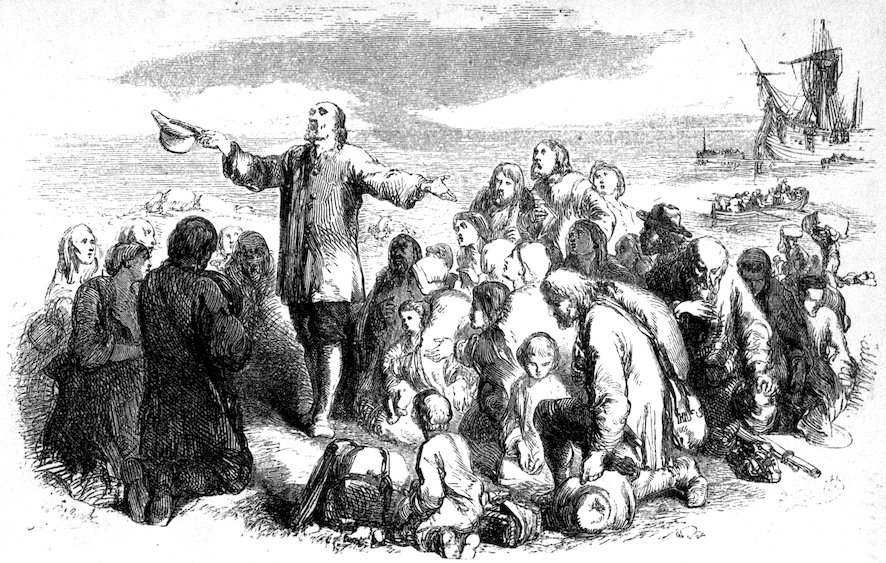
LANDING OF THE PILGRIM FATHERS.
BY MARY HOWITT.
Illustrated with Numerous Engravings.
VOL. I.
NEW YORK:
HARPER & BROTHERS, PUBLISHERS,
FRANKLIN SQUARE.
1860.
Entered, according to Act of Congress, in the year one thousand eight hundred and fifty-nine, by
Harper & Brothers,
in the Clerk’s Office of the District Court of the Southern District of New York.
CONTENTS TO VOL. I.
iii
CHAPTER I.
Discoveries—to the Year 1521.
America discovered by the Vikings.—Runic pillars of Rask and Finn Magnusen.—Christopher Columbus: his various voyages.—John and Sebastian Cabot.—The Portuguese.—Vasco de Gama and Cortereal.—John Verazzani despatched by Francis I. reaches Nova Scotia.—Jacques Cartier’s voyages.—Ponce de Leon discovers Florida.—Fernandez de Cordova discovers Yucatan.—Conquest of Mexico by Cortes
Pamphilo de Narvaez’ expedition to Florida.—Ferdinand de Soto lands with 600 men.—Their adventures in search of gold.—Sufferings and death of de Soto.—The Mississippi discovered.—Florida colonised by Huguenots.—The French settlement destroyed by Pedro Melendez.—English discovery.—Willoughby and Richard Chancellor.—Frobisher.—Sir Humphrey Gilbert.—Sir Walter Raleigh.—The colony of Virginia and its fortunes.—Sir Francis Drake
Second attempt of Raleigh to colonise Virginia.—Rupture with the natives.—Delay in the supply of necessaries to the colonists.—Misfortunes of Raleigh.—His efforts for the colony.—Bartholomew Gosnold lands at Cape Cod.—Penobscot river discovered.—The voyages of the French.—Nova Scotia, New Brunswick, Acadia.—Quebec founded in 1608.—Samuel Champlain.—Henry Hudson’s voyages to the north.—He endeavours to discover a passage to the Pacific.—His sufferings and death
ivNew motives for colonisation in the seventeenth century.—England steps into the field of enterprise.—The Plymouth and London Companies founded.—Vain effort of the Plymouth Company.—The London Company despatches a squadron, which lands in Chesapeake Bay.—The settlement of Jamestown formed.—Wingfield and Smith.—Extraordinary adventures of Smith.—His life saved by the Indian girl, Pocahontas.—Gold, mania in the colony.—Dissatisfaction of the London Company.—Lord de la Ware appointed governor.—Famine in the colony.—New settlements and new charter.—Pocahontas visits England.—Land-law in Virginia.—Written constitution.—Unexpected rising among the Indians.—New laws.—Governors of Virginia.—Democratic spirit.—Tobacco
The London Company’s second charter.—Clayborne.—Sir George Calvert, afterwards Lord Baltimore, obtains from James I. a grant of land, which is called Maryland.—Cecil Calvert sends Leonard Calvert to Maryland with emigrants.—Clayborne’s attempt to discourage the colonists.—His turbulence.—Incursions of the Indians.—Puritanism.—Toleration of the government.—Political troubles.—The dissensions compromised
Smith’s Voyage to Massachusetts Bay.—New England.—Hunt kidnaps the Indians.—King James grants the “great patent.”—Puritanism in England.—The Pilgrim Fathers.—Commencement of English Nonconformity.—Policy of James I. towards the Church of England.—Oppression, and resistance of the bigotry of James.—Struggle between established authority and the spirit of liberty
Many Puritans find refuge in Holland.—The congregation at Leyden determine to remove to America.—They obtain a patent from the Virginia Company.—The Mayflower and the Speedwell leave Leyden.—The Mayflower sails from Plymouth alone.—The emigrants land at Cape Cod.—Their sufferings.—The settlement of New Plymouth founded.—Hardship and labour.—Friendly relations established with the Indians.—The “unruly colony” at Weymouth.—Gradual rise of New Plymouth
Attempts to colonise the coast.—Portsmouth founded.—Richard Vines’ expedition.—First settlement of Maine and Nova Scotia.—New emigrants.—Settlement founded in the wilderness of Salem.—John Winthrop.—Settlement at Boston.—Fortunes of the colonists.—Bigotry creeps in among them.—Friendly disposition of the Indian chiefs.—Commencement of trade with Virginia, and with the Dutch, on the Hudson.—Representative government established at Massachusetts.—Arrival of Henry Vane
Roger Williams arrives at Massachusetts.—His liberal doctrines procure his expulsion from the colony.—His residence among the Indians.—His character.—He obtains a charter, and founds the province of Rhode Island, under the title of Providence Plantation.—The Pequods and others threaten Massachusetts.—Williams negotiates with them for his persecutors.—Anne Hutchinson and her opinions.—She is banished, and founds a new settlement in the neighbourhood of Providence.—Her melancholy death
The Connecticut river discovered.—John Winthrop obtains a commission from England to build a fort, &c., at the mouth of the Connecticut river.—Severity of the first winter, and hardships endured by the colonists.—Attempt of the Dutch to take possession.—Great emigration to the valley of the Connecticut.—Expedition against the Pequods.—Terrible massacre of the Pequods, who are annihilated as a tribe.—Theophilus Eaton and John Davenport found the settlement of Quinnipiack or New Haven
Complaints made against Massachusetts.—Laud appointed commissioner over the colonies.—Preparations for resistance.—Fearful religious persecutions in England.—The danger averted from the colonies by the breaking out of the great civil war.—Union of the states for mutual protection.—Fate of the chief Miantonomob.—Roger Williams obtains the acknowledgment of Rhode Island as a separate state.—Fundamental laws of Massachusetts.—Educational measures.—Samuel Gorton founds a settlement at Shawomet.—He is summoned by Massachusetts and put in irons.—He escapes to England.—The colonists repudiate the interference of the home government.—Cromwell’s good will towards the new Englanders.—The quakers persecuted in Massachusetts.—Their obstinacy.—John Eliot among the Indians
Hudson’s visit to New York Bay.—Indian traditions concerning the event.—Particulars of Hudson’s visit.—Dutch settlements around the Hudson.—Cornelius May.—Friendship between the Dutch settlers and the New Plymouth colonists.—Charter obtained by the “college of nineteen.”—Swedish emigration.—Settlement of Swedes in Delaware Bay.—The Dutch governor Kieft.—His massacre of the Indians.—Their vengeance.—A truce effected.—John Underhill protector of the New Netherlands
Peter Stuyvesant arrives as governor.—State of the New Netherlands.—Symptoms of weakness.—War between England and Holland.—Stuyvesant subdues the Swedish settlement.—Tolerant spirit among the Dutch.—Quarrel between governor Stuyvesant and his people.—Sir Richard Nichols takes possession of New Amsterdam.—Surinam left to the Dutch in exchange for New Netherlands
The Restoration.—Execution of Hugh Peters and of Sir Henry Vane.—Whalley and Goffe, the regicides, fly to Boston, and are sheltered by the New Englanders.—The younger Winthrop obtains a charter for Connecticut.—Happiness of the colony.—Life in Connecticut.—Educational provisions.—Rhode Island obtains a charter.—Quakerism established in Rhode Island.—Effect of the Restoration on the remaining States
Deputation to Charles II. from Massachusetts.—The charter confirmed with certain restrictions.—Struggle between the colony and the home government.—Remonstrance addressed to the king.—Collision between the constables of Massachusetts and the Royal Commissioners.—Massachusetts refuses to send deputies to England.—Prosperity of the colony.—Indian and white population of New England.—Indian warfare and disaster.—The “swamp fight.”—Destruction of the red men.—Their firmness.—Philip of Pocanoket.—Results of the war.—Escape of Anne Brackett
The London merchants jealous of Massachusetts.—Maine redeemed by Massachusetts for £1200.—New Hampshire separated from Massachusetts and constituted a royal province.—Cranfield sent out as governor.—Associations formed to resist taxes imposed by him.—Retirement of Cranfield.—The charter of Massachusetts threatened.—Efforts made by the colony to preserve it.—Vain remonstrances.—The charter annulled
viiSouth Virginia.—Carolina.—Tract of land granted by Charles I. to Sir Robert Heath.—William Drummond.—Barbadoes planters in Clarendon county.—The settlement of Albemarle.—Locke’s grand model constitution and its provisions.—Its indifferent reception among the colonists.—George Fox visits Carolina.—Dissatisfaction with the English government.—Navigation Laws.—John Culpepper’s arrest and acquittal.—Governor Sothel’s tyranny.—Emigrants at Port Royal.—Carteret county.—Charleston founded.—Prosperity of South Carolina.—Influx of emigrants.—Huguenot fugitives.—The Menigault family.—Slavery.—The buccaneers favoured in South Carolina.—Disturbances.—Return of Sothel.—The grand model constitution abrogated
The Restoration disastrous to Virginia.—Sir William Berkeley elected governor.—Loyalty of the colony.—Change in the form of government.—Slavery in Virginia.—Tobacco cultivation.—Picture of life in Virginia.—The Navigation Act enforced.—The English episcopal church becomes the state religion.—The justiciary government changed.—Exploring expedition.—Arbitrary grants of land.—Dissatisfaction in the colony.—Incursions of the Indians.—Nathaniel Bacon’s insurrection.—He obtains his commission as commander against the Indians.—Berkeley’s treachery.—Power of Bacon.—Sir William Berkeley at Jamestown.—His flight.—Jamestown taken and burnt by the insurgents.—Death of Bacon.—Cruelty of Berkeley.—His death.—Culpepper’s administration.—Slave-code.—Spirit of the Virginians in 1688
Lord Baltimore’s liberal policy.—His toleration and justice.—The Quakers and their position.—George Fox.—Adventure of John Jay.—Administration of Thomas Notley.—Lord Baltimore persecuted in England on account of his tolerance.—The liberties of Maryland threatened, but preserved by the dethronement of James II.
The land between the Hudson and Delaware made over to Lord Berkeley and Sir G. Carteret.—The Delaware Indians in New Jersey.—Philip Carteret arrives in Newark Bay.—Disorders in the colony.—Lord Lovelace’s system of government.—The Duke of York’s tyranny.—The “holy experiment” of the Quakers.—Creed of the Quakers.—Their steadfastness under oppression and persecution.—The fundamental laws of New Jersey as established by the Quakers.—Emigrating Quaker-companies.—Resignation of the territory by the Duke of York.—The Quakers firmly settled in the New World
viiiAccount of William Penn.—His reverses and constancy.—His various imprisonments.—His wish to provide for the Quakers an asylum in the New World.—He purchases land of Charles II., and founds Pennsylvania.—The constitution of the new colony.—The “holy experiment.”—The “free society of traders” formed.—Surrender of territory by the Duke of York.—The first assembly convened at Chester.—Penn’s celebrated treaty with the Indians.—The “gospel tree.”—Peace between Quakers and Indians.—Philadelphia founded.—Penn’s visit to Lord Baltimore.—His return to England and subsequent misfortunes.—His opinions on slavery
The French, settlers in Canada.—Their dealings with the Indians.—The Jesuit missionaries and their labours.—Brebeuf and Daniel live among the Indians.—The villages of St. Louis and St. Ignatius founded.—Enthusiasm awakened in France.—Missionary labours among the Indians.—Charles Raymbault and Claude Pijart.—Jogues, his sufferings and heroism.—His fate.—Indian warfare and cruelty.—Chaumonot’s labours.—Missionary enthusiasm.—Mesnard.—Allouez
Franciscan friars as missionaries.—Marquette’s design of navigating the “Great River.”—Discouraging reports among the Indians.—The expedition sets forth.—Bancroft’s account of the journey.—Indian villages.—The river Illinois.—Joliet and Robert Cavalier la Salle.—Colony planted on Lake Michigan.—Hennepin’s travels.—Tonti and his misfortunes.—French colonising expedition.—Erection of Fort St. Louis.—La Salle murdered.—Hostilities of the Iroquois.—Small extent of the French settlements
Quarrels in Carolina between dissenters and churchmen.—John Archdale, chosen proprietary, favours the dissenters.—His successor, Blake, sides with the churchmen.—Unsettled condition of North Carolina.—Disturbances in the colony.—Governorship of Nicholson and Andros.—Independent spirit of the Virginians.—Maryland.—Its condition and productions.—Pennsylvania.—The charter of privileges.—Constitution of New Jersey.—New York.—Unpopularity of James II.—Governor Dongan.—Leisler’s insurrection.—His execution.—Benjamin Fletcher governor.—Captain Kidd the pirate.—Lord Cornbury.—His duplicity and profligacy.—The conquest of Canada urged.—Robert Hunter governor of New York.—Yale college founded
The First Intercolonial War.—The Salem Witchcraft.
Andros expelled from Boston.—Massachusetts engages in war against Canada and the Indians.—Sir William Phipps’s expedition against Nova Scotia.—Indian warfare.—Prisoners sold to the French.—New charter for Massachusetts.—The witch mania.—Mather and his book.—Absurd and cruel persecution of supposed witches.—Penn’s judgment in a case of witchcraft.—Renewed Indian warfare.—Indian outrages.—Judicial code of Massachusetts
Callieres excites the Indians against the British.—Lemonie d’Ilberville’s expedition.—Arrival at Ship Island.—The settlement of Detroit.—English expedition to explore the mouth of the Mississippi.—The “English turn.”—The settlement of Natchez.—The settlers of Biloxi.—William III. declares war against France and Spain.—Combats between the settlers and the various nations.—Deerfield destroyed.—Atrocities of Indian warfare.—Port Royal taken.—Admiral Walker’s exploits.—The Tuscarora Indians.—Issues of paper money.—The two Carolinas become separate royal governments.—Enactments with regard to slaves.—The treaty of Utrecht.—Population of the colonies in 1714.—Piracy
Law’s Bubble.—Louisiana Established.—Growth of Liberty in the States.
State of the American colonies at the accession of the House of Hanover.—The “Mississippi scheme.”—John Law’s bank.—New Orleans founded.—Louisiana established.—Destruction of the Natchez race of Indians.—War with the Chicasaws.—Breaking out of the small-pox in Boston.—Inoculation.—Benjamin Franklin and the “New England covenant.”—British restrictions on colonial manufactures.—Dispute on the salary of the Governor of Massachusetts.—Liberty of the press advocated.—Acquittal of John Zenger the printer
The Settlement of Georgia, and Progress of the States.
Oglethorpe’s benevolent exertions.—He obtains a charter for Georgia.—His departure from England in 1732.—The town of Savannah laid out.—The Moravians establish themselves in Georgia.—The town of Augusta founded.—Friendly disposition of the Indians.—Progress of the colony.—John and Charles Wesley in Georgia.—Whitfield and his preaching.—The Baptists.—False alarm for a negro rising.—War between England and Spain.—Oglethorpe’s services against the Spaniards.—Character of Oglethorpe.—The boundary of Maine.—The slave-trade.—Attitude of England with regard to the slave-trade.—Hospitality of the Virginians.—General advance of the colonies
The mighty hemisphere of the West lay for countless ages shrouded
from the knowledge of the rest of the world, as by the darkness of
night, waiting for the appointed time of its revelation. That appointed
time was the close of the fifteenth century, for although upwards
of four hundred years earlier, after the reign of Alfred of England,
and Charlemagne in France, America was discovered by some of those
adventurous Scandinavian Vikings—the true ancestors of the so-called
Anglo-Saxons, who, in their stout-built little ships, traversed
all seas—still the knowledge of this discovery produced so little effect
on the rest of the world, that afterwards, when America was rediscovered,
the history of the Scandinavian colonisers was regarded
as mythical. The antiquarian researches, however, of Rafn and
others, leave no doubt of the fact. These bold adventurers, at home
on the most perilous seas, having colonised Iceland, Greenland, and
afterwards Newfoundland or Nova Scotia, came at length, in the
year 1000, to the coast of America, where a colony was formed under
the name of Vinland hin Goda, or Vineland the Good—so called from
the abundance of wild grapes which grew there, and because the
mildness of the climate and the fertility of the soil delighted the
discoverers, accustomed as they were to the savage sterility and
severe cold of Greenland and Iceland, and even of their native north.
The tract of country first explored by these earliest European
discoverers is supposed to extend down the coast from about where
2Boston is now situated to New York. According also to the antiquarians,
Rask and Finn Magnusen, boundary pillars were discovered
by them, in the year 1824, on the eastern shore of Baffin’s Bay, exhibiting
Runic inscriptions, and the date 1135. The generally uncivilised
state of the rest of Europe prevented these early Scandinavian
discoveries from producing any permanent or important effect. The
time when this great discovery of a second world could be availing
was not yet come. The precursors of knowledge had yet to be born;
society lay under a night of barbarous ignorance, and glimpses of
light, coming from whatever quarter they might, were lost in the
density of its shadow.
The important thirteenth century arrived: Roger Bacon, Duns
Scotus, Albertus Magnus, and Vicentius of Beauvais, lived. A breath
of true life awakened the general mind, and geographical, as well as
other knowledge began to be studied. In the meantime, Iceland,
which must be regarded as the mother of colonisation, had lost her
noble independent spirit with her republican form of government,
and become a fief of the crown of Norway. In consequence, however,
of her remote position, as well as her high reputation for learning,
she was made the depository of the most ancient records of Europe,
which was then agitated by internal convulsions, and here they
were carefully preserved for ages. In this remote Ultima Thule lay
sealed up, as it were, the keys of a mighty knowledge, which would
unlock a second world. Here, accordingly, in the month of February,
1477, came Christopher Columbus, “the sea,” says he, “not
being at that time covered with ice, and being resorted to by traders
from Bristol.” This is singular. Some historians doubt whether
Columbus heard any tidings here of the early discovery and colonisation
of America. No doubt he did; no doubt, in his conversations
with Bishop Skalholt and other learned men, he would hear
the extraordinary fact of a great country having been discovered
by their ancestors beyond the Western Ocean. They had found land
where he had believed it to exist, whether a part of Asia or not was
of no consequence, and this information would not be lost on a mind
like his. No doubt, also, hither came the Cabots, merchants of
Bristol, who, in their process of discovery, sailed northward, as if
following the guidance of Icelandic tradition, and arrived on the
dreary coasts of Labrador, before Columbus discovered the mainland
of America.
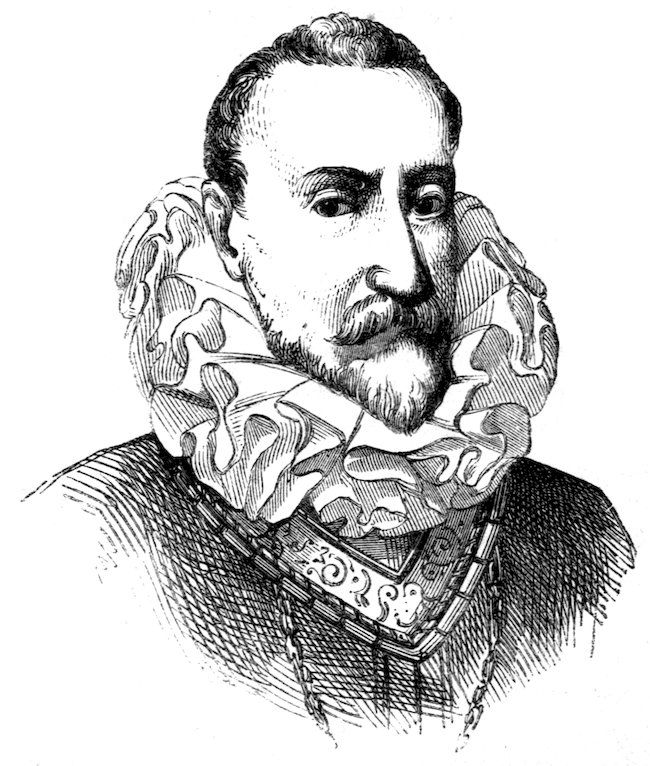
CHRISTOPHER COLUMBUS.
3Columbus having, at the age of twenty-one, sailed, as we have said,
to Iceland, “to see if it were inhabited,” returned to Spain resolved
to navigate the great Western Sea, and discover the land which lay
beyond. He was one of the elect of Providence, men of the time and
the hour, whose work is appointed them to do, and spite of impediment,
discouragement, and adversity, who must succeed in doing
it. The history of his eventful life is well known; with inflexible
resolution and deep religious ardour, he pursued his object, and
finally won the ear of Ferdinand and Isabella of Spain. On
August 3rd, 1492, he set sail as Admiral of the Seas and Lands
which he expected to discover, and on October 11, after a tedious
voyage and long anxiety, stepped on shore of one of the Bahama
Islands with tears of joy and fervent thanksgiving; and after kissing
the soil of the New World, he planted here the cross, in token of
Christian possession.
Gold dust and Japan, or Cipango, as it was called, were the objects
of search, and Columbus, after twelve days, again set sail in the
hope of finding them. He found several other of the West India
Islands, and finally the beautiful Cuba, the most beautiful island in
the world. He believed that now indeed he had found the long-sought-for
Cipango; and San Domingo, which he next discovered, he
imagined to be the ancient Ophir, the source of all the riches of
Solomon.
Columbus’s discoveries were confined principally to the West India
Islands; nor was it till his third voyage that he touched the mainland,
near the mouth of the river Oronoco.
The Cabots, as we have seen, enterprising merchants of Bristol,
which was at that time the second port in England, and accustomed
to the navigation of the northern seas, had discovered, in
1496, the coast of Labrador—a country which could neither be
mistaken for Cipango nor for Ophir—a savage arctic region, abounding
in white bears and deer of a gigantic size, and inhabited by
men clad in skins and armed with bows and clubs.
About two years afterwards, Sebastian Cabot, the son, again
sailed for Labrador, by way of Iceland, and thence proceeding southward
4along the shores of the new country advanced into a more
hospitable climate, until want of provisions compelled him to return.
On a subsequent voyage, steering still to his favourite north, in
search of a north-west passage, he entered Hudson’s Bay, but was
now compelled to return in consequence of insubordination among his
crews. In 1526, having gone to Spain, he was nominated by Charles
V. as pilot-major of the kingdom, and in the April of this year, proceeding
across the Atlantic, explored the river La Plata and some
of its tributaries, erecting forts, and endeavouring, but unsuccessfully,
to plant colonies.
“The career of Sebastian Cabot,” says Bancroft, “was in the issue
as honourable as the beginning was glorious. He conciliated
universal esteem by the placid mildness of his character. Unlike
the stern enthusiasm of Columbus, he was distinguished for serenity
and contentment. For sixty years he was renowned for his achievements
and skill.” It is, however, greatly to be regretted that, of all
his voyages and discoveries, no detailed account has been preserved.
In 1548 he was pensioned by Edward VI. as “The Great Seaman,”
and through his advice and influence it was that an expedition to
the North of Europe was undertaken, which opened to England the
important trade with Russia. He lived to extreme old age, but
the place of his death and burial is unknown.
The fame of Cabot rests less on any discovery of summer lands,
affluent in natural beauty and precious commodities, than on his
having made known rich fisheries, the wealth and value of which
remain to the present day. The immense shoals of cod in the
shallows of those new seas soon attracted the attention of other
voyagers, and within seven years of Cabot’s discovery, the hardy
fishermen of Brittany and Normandy frequented the abundant
fisheries of Newfoundland; Cape Breton remaining as a memorial
of them to this day. This fishery, on the coast and bank of
Newfoundland, formed the first link between Europe and North
America.
The Portuguese, excited by the success of England and Spain,
entered eagerly into competition with them. Emanuel, king of
Portugal, animated also by the great success of his expedition under
Vasco de Gama, who, having for the first time doubled the Cape
5of Good Hope, had reached India, thus opening to Europe all the
vast treasures of the Indian Ocean, now sent out Gaspar Cortereal
with two vessels, to follow in the course of the Cabots, and explore
the north-western seas. Accordingly, reaching the shores of North
America, he coasted for about seven hundred miles, admiring as he
went along the beauty and fertility of the country, and the grandeur
of its forests, the pines of which appeared to him admirably suited
for the masts and yards of shipping. The commerce, however, which
occupied these Portuguese was of a much less innocent kind than
that of timber, or than the cod-fishing of the French; Cortereal
freighted his vessels with a number of inoffensive natives, whom
he sold for slaves, intending to return for more. But he never
returned; he lost his life, it is said, in a contest with the natives,
whom he was endeavouring to kidnap.
The successful trade which the bold fishermen of France carried
on, and some of the natives whom they had taken into their own
country, turned the attention of Francis I. to the subject of discovery.
He fitted out a fleet under the command of John Verrazzani, a
Florentine, commissioned to explore for the French monarch these
new realms of wonder and hope. Verrazzani sailed by way of
Madeira, and after a most stormy voyage, had the satisfaction of
discovering land in a latitude which was unknown to any European
navigator. Sailing for a long time in search of harbourage,
he at length cast anchor on the coast of North Carolina. The
natives had as yet seen no white man; they were of a gentle and
peaceful character, dressed in skins, and ornamented with garlands
of feathers. Coasting northward, he relates, in his letter to Francis
I., that nothing could equal the beauty of the country; the climate
was soft and balmy, the groves full of beautiful trees and flowers
which diffused a delicious odour. The red colour of the earth, and
the fragrance of the groves, suggested at once the idea of gold dust
and the spices of the East. Still advancing northward, they
reached Nova Scotia, where natives of another character met them.
From this point he returned homeward; his narrative of this
coasting voyage being the earliest record of that part of the new
world now extant. Of Verrazzani’s further discoveries nothing is
6known, although it is said that he visited the coast of America three
times. He is believed to have perished at sea.
Ten years afterwards, the Admiral Chabot, whose duties brought
him into connexion with the Newfoundland fishermen, became
interested in the subject of discovery. Jaques Cartier, a mariner
of St. Malo, was despatched with two ships on the commission to
explore those northern coasts of the new world already so familiar
to the fishermen. Cartier made a wonderfully speedy voyage. In
twenty days from leaving St. Malo, he was on the coast of Newfoundland,
and after partly circumnavigating the island, he planted
a cross bearing the arms of France, in token of having taken possession
for that country.
Sailing within the magnificent bay on its west, he reached the
estuary of a vast river, which he ascended, until he could see land on
both sides; further he was unable to advance, being unprepared
to winter there. He turned his face homeward, therefore, and in
thirty days reached St. Malo, carrying two natives with him.
The success of this voyage caused a second expedition to be soon
fitted out. Three well-furnished vessels were provided by government,
and several of the young nobility joined in the enterprise.
Solemn preparations were made for departure, the ships’ companies
assembled in the cathedral to receive absolution and the blessing of
the bishop; and thus they set sail, full of hope and schemes for the
colonising of that splendid territory which was to be called New
France. This voyage, however, unlike the former, was stormy,
and passing the west of Newfoundland on the day of St. Lawrence,
they gave the name of that saint to the noble bay which expanded
before them, and which name not alone the gulf, but the magnificent
river which falls into it, bear to this day. Cartier again sailed up
the river, but in a boat, and as far as Hochelaga, where, ascending
a hill, he was struck by the magnificent view of woods, mountain,
and river, which lay behind him. Anticipating this as the site of the
future metropolis of a splendid empire, he called the hill Mont-Real,
and “time,” says the historian, “which has transferred the name to
the island, is realising his visions.” He and his companions spent
the winter in these seas, and in the spring departed, having basely
7kidnapped an Indian chief who had treated them with the utmost
kindness.
The report which the adventurers carried home of the severity of
the climate abated the ardour of colonisation for a few years. At
length, in an interval of peace, the remembrance of that magnificent
river, which exceeded in grandeur any river of Europe, awoke
anew the spirit of adventure, and Francis de la Roque, lord of
Robertval in Picardy, was appointed viceroy of the unknown regions
of Norimbega, that is to say, all the vast territories around the gulf
and river of St. Lawrence, with all its islands; and Cartier, on
account of his knowledge and experience, was associated in the enterprise,
as captain-general and chief pilot. Cartier was also commissioned
to take with him artisans of all kinds, that useful colonies
might be established. We must suppose that but little public enthusiasm
existed on the subject; for Cartier had to ransack the jails to
make up his complement of men. This was an ill-starred enterprise
altogether; the two leaders did not even act in concert. Cartier
set sail long before his superior, ascended the St. Lawrence, built a
fort near the present site of Quebec, where he passed the winter in
hostility with the natives, and in the spring set sail homeward, meeting
Robertval on his way out, off Newfoundland. Robertval, though
he remained a twelvemonth in his new territory of Norimbega,
effected very little, and so returned home.
For the next fifty years nothing was done by France, which
was absorbed by her own internal conflicts—feudalism against
monarchical power, Calvinism against Catholicism. In the meantime,
however, the value and importance of the northern fisheries
increased, and in 1578 no less than one hundred and fifty French
ships were employed in the Newfoundland trade.
While the French were thus vainly endeavouring to colonise the
regions of Acadia and Canada lying around the bay and along the
river of St. Lawrence, the Spaniards were occupied in the south. The
brilliant discoveries of Spain had kindled the most extraordinary
enthusiasm throughout the nation for adventure beyond the seas.
Nothing was too extravagant for their imaginations to conceive of
the new world, where it was believed “that the natives ignorantly
8wore the most precious ornaments, and the sands of every river
sparkled with gold.” Spaniards, high and low, young and old, rich
and poor, were all ready to rush to the conquest and the spoil.
Among others, Juan Ponce de Leon, an aged veteran in the wars
of Granada, a companion of Columbus in his second voyage, and some
time governor of Porto Rico, fitted out three ships at his own
expense, and resolved to go forth to seek his fortune, and more
especially to seek for that which he had been told existed in those
paradisiacal regions of the sun and the palm—a fountain whose
waters possessed the extraordinary virtues of restoring or perpetuating
youth. In search of this poetical fountain, Ponce de Leon set sail
with his three ships, in March 1512. On Easter Sunday, which
the Spaniards call Pascua Florida, the aged adventurer discovered
a glorious land, covered with woods, which were brilliant with
flowers. Spite of the marvellous beauty of the country, to which he
gave the name of Florida, it was some time before he was able to land,
in consequence of stormy weather. At length a landing was effected,
and formal possession taken of the country; but though he remained
exploring the coast for several weeks, the fountain of youth was
nowhere to be found, the natives were hostile, and Ponce de Leon
returned to Porto Rico still an old man. A new and splendid
region had, however, been discovered, and thither Ponce de Leon
returned a few years afterwards, intending to select a site for a
colony, but in a contest with the natives was mortally wounded.
Ponce de Leon’s discovery had opened a new path for Spanish
commerce through the Gulf of Florida, and in 1516 Diego Miruelo,
a bold sea captain, trafficking with the natives, brought away gold
which he had obtained in exchange for toys, and thus gave a yet
more brilliant colouring to the reports current regarding the wealth
of this new region.
In 1517, Francisco Fernandez de Cordova discovered the province
of Yucatan and the Bay of Campeachy, but soon afterwards, like
Ponce de Leon, was mortally wounded by the natives. The pilot of
Fernandez in the following year conducted another squadron to the
same shores, under the command of Grijalva. The amount of gold
which was here collected, and the costly presents of the unsuspecting
9natives together with the rumours of the magnificent empire of
Montezuma, excited the general imagination, and led to the enterprise
of Cortes.
While events were thus opening the way for the conquest of
Mexico, seven wealthy men of St. Domingo, at the head of whom
was Lucas Vasquez de Ayllon, despatched two vessels as slavers to
seek for labourers in their mines and plantations. These ships were
driven northward from the Bahamas by adverse winds upon the
coast of Carolina, which they called Chicora; they anchored at the
Cambahee river, to which they gave the name of Jordan. The
natives received them with great kindness, being new to the sight
of Europeans, and visited their ships in crowds, both with curiosity
and good faith, but when they were all below, the hatches were
suddenly closed, and the perfidious Spaniards sailed away. One
of these ships was lost, the captives in the other refused food, and died
of starvation and distress of mind.
Again de Ayllon sailed with three ships to the newly-discovered
Chicora, of which he was appointed governor, intending now to
take formal possession. But the largest of his ships was stranded
and lost at the mouth of the river Cambahee, and he himself, though
received with apparent kindness by the natives, narrowly escaped
with his life, many of his men having been killed, the friendly aspect
being merely a feint on the part of the incensed natives to get them
more completely into their power. This unsuccessful attempt preyed
so severely upon de Ayllon’s heart as to cause his death.
But now let us return to the discoveries of Francisco Fernandez
de Cordova and Grijalva on the northern coast of Yucatan. On
approaching the shore, the Spaniards had been astonished to find
no longer rude and half-clad savages, but people well dressed in
cotton garments, and dwelling apparently in edifices of stone. They
were of a bold and martial character, and received the strangers
with demonstrations of hostility. Cordova being, as we have said,
wounded, his expedition hastened back to Cuba, only however to be
followed by a second, when the southern coast of Mexico was
discovered, and Juan de Grijalva carried home with him a large
amount of treasure obtained by traffic with the natives. Valesquez,
10the governor of Cuba, highly pleased with the result of this expedition,
resolved on the conquest of this rich country, and hastily
fitted out an armament of eleven vessels for this purpose, giving
the command to Fernando Cortes.
In March, 1519, Cortes landed in Tabasco, a southern province
of Mexico, where he defeated the natives with great slaughter.
Advancing from this point westward, he reached San Juan de Ulloa,
where he was kindly received by two officers of the monarch, Montezuma,
who had been sent to inquire into the object of his visit, and
to offer him any assistance which he might require. Cortes replied
with great courtesy that his business was important, and could be
confided to no less a person than Montezuma himself. The great
monarch of Mexico, not being accustomed to such interviews, his
officers made valuable presents to Cortes, and set before him the impossibility
of his request. In vain; Cortes was determined; messengers
were sent backwards and forwards, and magnificent presents
still made to Cortes, with the request finally that he would depart.
But no; Cortes destroyed his vessels, to prevent his soldiers escaping,
and marched to the capital of Mexico. As he advanced, the disaffected
in Montezuma’s kingdom joined him. Montezuma was overcome by
alarm.
The Spaniards marched onward; and the vast plain of Mexico
opened before them. It was covered with villages and cultivated
fields, all wearing an aspect of prosperity. In the middle of the
plain, partly encompassed by a lake, and partly built on the islands
within it, towered aloft the city of Mexico, like some gorgeous
fairyland city. The Spaniards could scarcely believe their senses;
it seemed more like a splendid vision than reality. Montezuma
received the strangers with great pomp and kindness; admitted them
into the city; appropriated to their use splendid accommodations;
supplied all their wants, and presented them with gifts.
Cortes, astonished at what had befallen him, and anxious for his
own safety, thus shut up in the very heart of a city which might,
after all, be hostile, resolved on a bold expedient, which he accomplished
with wonderful success. He seized the person of Montezuma,
whom he held as a hostage for the good faith of the nation. And
11thus, having the astonished monarch in his power, so wrought upon
his mind, as to induce him to acknowledge himself a vassal of the
crown of Spain, and subject his kingdom to an annual tribute.
Cortes, after this, was compelled to return to Cuba for a short
time, and the Mexicans, incensed by the cruelties and wanton
excesses of the Spaniards, who remained in charge of the monarch
and his capital, rose in arms. Cortes returned, and at once threw
aside the mask of moderation which he had hitherto worn. He
compelled Montezuma, who was in his power, to interpose with his
exasperated people; the captive monarch did so, and an aspect of
submission was for the moment assumed. The Mexicans reverenced
their monarch almost as a divinity, and bowed their heads and
dropped their weapons at sight of him; but when, in obedience
to the commands of Cortes, he endeavoured to awaken amicable
sentiments in their breasts towards the Spaniards, their rage burst
forth in fury, and snatching up their arms, they assailed their
enemies with tenfold determination, and in this fresh onset the
unfortunate Montezuma was himself mortally wounded. The Mexicans,
seeing their king fall by their own hands, believed that the
vengeance of heaven was pursuing them, and fled; and Montezuma,
refusing all food, survived but a short time.
The position of Cortes, in the heart of an exasperated nation,
was perilous in the extreme. He commenced his retreat from the
capital, and fighting almost every yard of ground, found himself on
the sixth day in a spacious valley, hemmed in by an innumerable
army. Nothing was left but to conquer or die; and they were but
a handful of men. Multitudes thronged in upon them, sufficient
alone to trample them to dust. At that moment Cortes beheld the
great Mexican banner advancing, and recollecting to have heard that
upon its fate depended the fate of every Mexican battle, resolved, at
the head of his bravest men, to hew his way to the standard, and gain
possession of it. He did so. The Mexicans, panic-stricken, threw
down their arms and fled to the mountains.
The determination of Cortes was undaunted; he resolved to accomplish
the conquest of Mexico, and four months after his retreat, having
received fresh supplies and reinforcements, he again departed for the
interior, and after a siege of twenty-five days, the successor of
12Montezuma having fallen into his hands, the city yielded, and the
wealthy Mexico became a province of Spain. This occurred in
August, 1521.
While the conquest of Mexico was taking place, another important
event occurred in the history of Spanish discoveries. Ferdinand
Magellan, having spent several months in exploring the coast of
South America, finally passed through the strait which bears his
name, thus accomplishing the discovery so long-sought-for of a
western passage to India.
CHAPTER II. DISCOVERIES CONTINUED.
13
Florida had remained unoccupied, and almost disregarded, for
several years, when Pamphilo de Narvaez obtained permission from
the emperor Charles V. to effect its conquest; accordingly he landed
on the coast in April, 1528, with three hundred men, and, erecting
a standard, took possession for Spain. Fired by the successes of
Cortes, they advanced up the country, hoping to find a second
wealthy empire; but swamps and forests met them everywhere,
and hosts of ambushed savages attacked them. Still intimations
of a country northward abounding in gold, which they continued
to receive from captives whom they had taken, and now employed
as guides, lured them on. But they found nothing save a village
of wigwams; though the guides still persisted that still farther
north lay a region full of gold. Unwilling to adventure further to
the north, they directed their course again southward, and reached
the sea after a journey of probably 800 miles, their numbers being
then greatly diminished. They constructed five boats, but of so frail
a description that only desperate men would have ventured their
lives in them; and Narvaez and most of his companions perished.
Four of the survivors reached Mexico in the course of seven years, after
a series of wonderful adventures and hardships, having travelled
through Louisiana, Texas, and Northern Mexico, passing on from one
tribe of Indians to another, and frequently as slaves. A marvellous
story of wild adventure was theirs; and, like an earlier Robinson-Crusoe
history, calculated to allure others into the same path.
The most remarkable of the followers of these men, and the
believers of their story, was Ferdinand de Soto, a Spanish nobleman,
14and courtier of Charles V., by whom he was appointed governor of
Cuba. De Soto had been a favourite companion of Pizarro in the
conquest of Peru, and had distinguished himself in the storming of
Cusco. Believing all the wonders which were related of the golden
regions of Florida, he resolved to fit out an expedition at his own cost,
and conquer these lands which were believed to be more beautiful
and richer than those of Mexico and Peru. His own enthusiasm
excited that of others; hundreds of young men of birth and fortune
enlisted in this enterprise. Property of all kinds, vineyards, houses,
valuables, were all sold to purchase arms, horses, and equipments
for this undertaking. From the multitudes who offered themselves
for this expedition of conquest and discovery, its leader selected six
hundred young men, all adventurous and ambitious as himself.
The landing of this proud and gallant company on the shores of
the new world was a splendid spectacle. Their banners floated in
the soft breezes of Florida; the golden sun of Florida reflected
itself in their armour; and thus they galloped onward, “very
gallant,” says the old chronicle, “silk upon silk,” along the sea-shore
of that region which they believed to be full of gold and great cities,
and the destined conquerors of which they esteemed themselves
to be.
Ferdinand de Soto, who, like Cortes, wished to remove all possibility
of a retreat, either for himself or his companions, sent back all
his vessels to Cuba, where he had left his young wife as governor
during his absence. It was in the month of May, 1539, when they
set out; taking with them weapons of all kinds, work-tools and an
iron-forge, as well as chains and bloodhounds for the subjection of
their captives. They also took with them a singular accompaniment
for so gallant an army, a drove of three hundred swine,
which were intended to stock the country when the commander
should have selected his seat of government; and these swine were
driven with the expedition through nearly the whole of its route.
They advanced onward through a wilderness day after day, and
week after week, amid continual skirmishes with the natives, and
ever, as they went, mass was performed by priests with all the pomp
of Catholic ceremonial; and cruelties were practised on their captives,
whilst they amused themselves by gaming. Thus they wandered
15onward through uncultivated regions for upwards of five months,
and then established themselves in winter-quarters. In twelve
months they had advanced to the ocean—to the very spot whence
Narvaez had embarked; they had found plenty of maize, but no
gold, and no cities but only small Indian villages. Next spring they
broke up their winter camp, and set out for a remote country, of
which they had heard, lying to the north-east, abounding in gold
and silver, and the ruler of which was a woman.
They now advanced to the north-east, made a long and arduous
journey, and arrived indeed at the territory of the queen, of whose
wealth they had conceived such extravagant hopes; but the gold
proved to be copper, and the silver thin plates of mica. Still de Soto
advancing with a perseverance worthy of a better cause, came to the
spring-heads of vast rivers, and thus reached the Highlands of
Georgia, where he fell in with the peaceable and gentle Cherokee
Indians. This was the second year of his wanderings. Some of
de Soto’s companions wished to settle down here in the midst of a
beautiful region, and enjoy the riches of an abundant soil. But
no,—de Soto would not listen to such a scheme: he had promised a
second Peru and Mexico to Spain, and he would not desist from
his wanderings till they were found. He was a resolute man, of
few words, and his followers yielded themselves to his commands.
Again he heard of gold still further north, and despatched two
horsemen, with Indian guides, to visit the country; and once more
they returned with copper; gold there was none. They wandered
still further, advancing into Alabama, where was a large Indian town,
Mavilla, afterwards Mobile. The Indians rose in arms; a battle
ensued; the Spanish cavalry were victors: it was the bloodiest battle
ever known in Indian warfare. The Indians fought for nine hours,
and several thousands were slaughtered; the town was burned to
ashes, and numbers of Indians perished in the flames. The Spaniards
also lost many of their number, together with horses and the
whole of their baggage. Their situation was terrible in the extreme;
food they had none, nor medicines for the wounded—all were lost.
Fortunately for them, however, the spirit of the Indians was so completely
broken, that they could no longer molest them. Spanish
ships, from Cuba, now awaited them with supplies in Pensacola
16Bay, near Mavilla. But, fearing that his disheartened soldiers
might leave him, and as he had no tidings of gold and great glory to
send home, and was too proud to send any other, he turned away from
the sea-coast, and again advanced inland.
Winter overtook them in the northern parts of Mississippi, with
severe frost and snow, and they established themselves in an Indian
village, which the inhabitants had deserted at their approach, and in
the fields of which the maize still remained uncut. The Indians
returned in the depth of winter and in the dead of night, and set
fire to the village. All that had been saved from the fires of
Mavilla was now destroyed; they lost all their beloved swine,
many of their horses, and all their clothes. Their sufferings were
intense. De Soto ordered the chains to be taken from the captives,
and new weapons to be forged. Clothed in skins and mats of ivy-leaves,
he still advanced further west in search of the land of gold.
For seven days they wandered on through wildernesses of forest and
morass, and reached the Indian settlements in the vicinity of the
Mississippi. De Soto was the first European who beheld that mighty
river. He saw it then as the familiar trader on its banks beholds
it now, rolling its immense mass of waters through a rich alluvial
soil, more than a mile broad, and carrying trees and timber down its
turbid flood.
In May, 1541, the Spaniards, having constructed boats, crossed
the river, and proceeded westward into Arkansas. The natives,
regarding them with reverence, and believing them to be the children
of the sun, brought their blind to them, that they might receive sight.
“Pray only to God who dwells in heaven,” replied de Soto, “and He
will give you what you need.”
De Soto proceeded onward in the direction of the north-west,
and reached the mountains of the White River, two hundred miles
from the Mississippi; but there were neither gold nor precious stones
in these mountains. They took up their third winter-quarters among
peaceful Indians, who pursued agriculture rather than war; and
the young cavaliers found their pastime in practising cruelties on the
natives. In the spring, de Soto descended the White River, and
became entangled in the midst of dismal swamps; Indian settlements
there were none; the whole country was apparently interminable
17morass, forest, and cane brake. De Soto received in gloomy silence
this report from scouts whom he had sent forward. Horses and men
lay dying around him; and, to add still more to his distress, hostile
Indians were coming up on all sides. His ambitious pride was now
changed into deep melancholy, and his health gave way under the
pressure of disappointed hope. Of his gallant company, three hundred
alone remained.
Feeling the approach of death, he summoned his people round him,
and named his successor. The following day he died. “His
soldiers,” says Bancroft, “pronounced his eulogy by sorrowing
for his loss. The priests chanted over his body the first requiem that
was ever heard by the waters of the Mississippi.” His body was
wrapped in a mantle, and, in the dead of night, his soldiers bore
him to the middle of the Mississippi, and silently sunk his body in
the river.
Singular to say, this was once more the month of May, four years
from the time of his setting forth; “the spring burst forth gloriously
over the Mississippi,” says a writer on this subject, “but de
Soto rose up no more to meet it.” “The discoverer of the Mississippi,”
concludes Bancroft, “slept beneath its waters. For four years
he had wandered to and fro over a great portion of the continent in
search of gold, but he found nothing so remarkable as his place of
burial.”
The successor whom de Soto had appointed now attempted to
lead back the remnant of the party by the way of Mexico; but, after
several months’ wanderings and adventures among the hostile tribes
of the western prairies, they retraced their steps to the Mississippi, on
the banks of which they passed the winter. Here they constructed
boats, which were ready for their embarkation in the month of
July, and on the 20th of September, 1543, they arrived, half naked
and famished with hunger, at a Spanish settlement near the mouth of
the river Panuco, in Mexico.
Such was the discovery of the Mississippi.
The next adventurer on this ill-fated field was Louis Cancello, a
priest of the Dominican order, anxious to convert the nations: his
scheme, however, fared no better than those of others; the missionary
18priests were looked upon with suspicion, and Cancello and
two of his companions fell martyrs to their zeal.
A spell seemed to rest upon these shores; nevertheless the name
of Florida, as if it were full of good omen, was conferred upon the
whole extent of American territory, not only on the portion of
Florida proper on the Mexican gulf, but northward to Canada itself,
all of which vast territory was claimed by Spain; still not a fort
was erected on its shores, not a single colony was established; and
when at length a permanent settlement of the Spaniards was effected
in Florida, it was only by means of jealous and bloody bigotry.
But this will lead us back to France and French affairs. The
good Coligny, admiral of France, who had long been seeking an
asylum for the persecuted Huguenots in America, and who indulged
the hope of establishing a French protestant empire in that country,
obtained, after long perseverance, a commission from the king to
that purpose, and in 1562 a squadron sailed for Florida, under command
of John Ribault, of Dieppe, a brave man and a true protestant,
accompanied by some of the best young French nobility, together
with experienced troops. Arriving on the coast in the month of
May, 1562, he discovered St. John’s River, which he named the river
of May; the shores were covered with groves of mulberries, and the
whole scenery was of a pleasing character. He sailed northward,
giving French names to the rivers and prominent points of the
shore, until he reached Port Royal entrance, near the southern
boundary of Carolina, and here he resolved to found the colony. A
fort was erected, and called Fort Charles, or the Carolina, in honour
of Charles IX. of France, and this name, given a century before the
English took possession, became the adopted name of the country.
The site of the infant colony delighted its founders; its harbour
was capable of containing a whole navy; immense oaks, the growth of
centuries, groves of pine, abounding with game, and flowers whose
perfume filled the air, rendered the country beautiful. Ribault left
twenty-six men to keep possession, and returned to France for fresh
emigrants and supplies; but in the meantime civil war had begun to
rage in that country, and the reinforcements for which Ribault had
come were not to be had. The condition of the colonists became
19desperate; dissensions broke out among them; and the following
spring they embarked in a hastily-constructed brigantine for their
native land. Their provisions, however, were insufficient for the
voyage, and they must have perished of famine had they not fallen
in with an English vessel, which received them on board.
Again, two years later, Coligny renewed his endeavours for the
colonisation of Florida, and three ships were sent out under the
command of Laudonniere. Emigrants offered abundantly, for the
fame of the climate of Florida had awoke general enthusiasm; life
there, it was said, was extended to twice its usual limits, besides
which, it was still believed that a golden realm lay hidden in its
interior, and Coligny, who wished to obtain accurate knowledge of
the country, engaged a painter called De Morgues to accompany
the expedition, that he might make coloured drawings of all scenes
and objects which interested him.
The misfortunes of the late colonists of Port Royal deterred the
present from going thither; and after a little search they discovered
so beautiful a situation, that the most delightful anticipations were
excited. The Huguenots thanked God in hymns of praise for a glorious
home of peace, as they believed, in the wilderness. The natives
received them with the utmost kindness, rival tribes vying which
should show them most distinction. Again the new colony received
the name of Carolina.
Many of the emigrants, however, who had come out in this expedition
were dissolute adventurers; their excesses turned the hearts
of the Indians against them: the supplies were wasted, and famine
threatened them. Under pretence of desiring to escape from famine,
some of their number were permitted to embark for New Spain,
but no sooner was this liberty granted than they commenced a series
of piracies against the Spaniards. Before long their vessel was
taken. Theirs was the first aggression in the New World, and soon
brought down its punishment. The pirate vessel being seized, most
of its men were sold as slaves, and such as escaped to Carolina
were condemned to death by Laudonniere. Meantime the famine
had become extreme; for three months there seemed no prospect
but death for the little colony, and they must have perished had not
Sir John Hawkins, the famous slave-merchant, who was just returning
20from the West Indies, whither he had conveyed a cargo of unfortunate
Africans, relieved their wants, and even furnished them with
a vessel, in which they were about to return to France, when Ribault
arrived with fresh emigrants, abundant supplies, implements of
husbandry, and domestic animals of all kinds. New life was
infused into the colony; God was thanked fervently, and protestantism,
it was hoped, had now found a safe and fixed abode in the
beautiful Florida.
In the meantime news reached Spain that a company of French
protestants had established themselves in the Spanish territory.
Spain at home was inveterate against France, Catholicism against
protestantism; and Pedro Melendez de Avilès, a soldier long accustomed
to scenes of blood, a bigoted catholic, a naval commander,
who, having often been employed against pirates, was accustomed to
acts of summary vengeance, and who had been appointed to the
government of Florida on condition that he subdued it in three
years, introduced at least four Jesuit priests, and imported five
hundred negro slaves for the cultivation of the sugar-cane, which it
was intended to introduce, was now hastily despatched to his office,
with the strict injunction to extirpate all heretics. The fury in Spain
against the heretic-settlers in Florida waxed hot; between two and
three thousand persons, soldiers, sailors, priests, Jesuits, etc., engaged
in the expedition. Melendez, who considered that “celerity was the
secret of success,” lost no time in any of his movements. Early in
September he came in sight of Florida, and discovering some French
ships, gave them chase, but could not overtake them. A few days
later he reached a beautiful bay and river, and as it happened to be
the day of St. Augustine, he gave that name to both. Soon after
which, sailing northward, he discovered the French ships at anchor.
The French demanded his name, and the purport of his voyage.
“I am Melendez of Spain,” replied he, “sent with strict orders from
my king to gibbet and behead all the protestants in these regions.
The Frenchman, who is a catholic, will I spare; every heretic shall
die!”
The French ships not being prepared to fight, cut their cables
and fled, and the Spaniards, unable to overtake them, returned
to the harbour of St. Augustine. Here they took solemn possession
21of the continent in the name of the bigoted Philip II., whom they
proclaimed king of all North America, and having performed mass,
laid the foundations of St. Augustine, the oldest town, by forty years,
of any in America.
In a few days the French put out to sea, with the intention of
attacking the Spaniards within the harbour; but a furious storm
overtook them, which lasted for more than two weeks, and wrecked
every vessel; the Spaniards in the meantime lying in harbour comparatively
safe. Melendez now marched his troops across the
country, and suddenly made an attack upon the defenceless French
settlement, putting to death all whom he could seize, men, women,
and children, the aged and the sick; some few escaping, fled to
the woods and afterwards took shelter on board the only two ships
which had been spared by the tempest. The Spaniards, enraged that
even a remnant had escaped, insulted and mangled the corpses
of the dead. After these scenes of horror were completed, mass
was performed, and the site of a church was selected on the very
ground yet crimson and sodden with the blood of the inoffensive
inhabitants.
The few who had escaped to the ships were in the utmost want
of every necessary of life, worn out by fatigue, and destitute both
of food and water. Melendez, who was aware of their wretched
condition, promised them mercy if they would surrender themselves
into his hands. Being men of truth themselves, they believed his
words and capitulated. As they stepped on shore, however, their
hands were at once tied behind them, and they were marched
as prisoners into St. Augustine. A signal was given; and to the
sound of drums and trumpets they were all massacred, with the
exception of a few catholics and a few mechanics, who were reserved
for slaves; and over their mangled remains was placed the inscription,
“This is done not as unto Frenchmen, but as unto heretics.”
Nine hundred true men, worshippers of God according to their protestant
faith, are supposed to have perished on those shores, victims
of bigotry.
The French government did not trouble itself about these things;
the Huguenots and the French nation, however, resented them keenly.
A bold soldier of Gascony, Dominic de Gourgues, a man whose
22life had been a series of adventures and hardships, sold his property
to acquire the means of avenging the wrongs of his fellow-countrymen
and believers. With one hundred and fifty men and three
ships he embarked for Florida; they were but a handful against
the Spanish power, but their object was not conquest—it was retributive
justice, if not revenge. Like Melendez he came suddenly;
and surprising two Spanish forts on St. John’s river, took them at
once, together with a still larger fort on the spot where the unfortunate
French settlement had stood. He executed summary justice,
hung his prisoners on the trees, with this inscription, “I do this
not as unto Spaniards or mariners, but as unto traitors, robbers,
and murderers.” And the Indians, who had been ill-used both
by the French and the Spaniards, looked on well pleased to see their
enemies preying one on another.
Dominic de Gourgues, having avenged his countrymen, again
disappeared with his ships, and France disavowing all cognisance of
the circumstance, relinquished any claim to Florida; and Spain
remained in possession. The Spanish dominion in America was
magnificent. Cuba was the centre of the West Indian possessions.
“From the remotest south-eastern cape of the Carribean,” says the
historian. “along the whole shore, to the Cape of Florida, and
beyond it, all was hers. The Gulf of Mexico lay embosomed within
her territories.”
About the time when the impetuous Dominic de Gourgues returned
to France from his swoop of vengeance in Florida, Sir Walter Raleigh,
one of the most gallant spirits of the age, suddenly left his studies
at Oxford to take part with the Huguenots in their struggles against
the catholics. From his protestant friends he heard of the massacre
which De Gourgues had avenged, and from that brave man himself,
and his associates, learnt much also of the country where these scenes
had occurred. The imagination of Raleigh was inflamed; on his
return to England he found the same spirit afloat; a few of the
unfortunate Huguenots had escaped to England, and their tale of
wrong had interested even Queen Elizabeth herself. Hawkins, too,
the slaver, who had relieved the famishing settlement, had much
to tell of the wonderful regions where these things had been done;
so had De Morgues, the landscape painter, who had fortunately
23escaped with, many sketches of its scenery. The leading minds of
England were turned to Florida.
From the time of Cabot, England had never wholly given up her
intercourse with the New World. English mariners, as well as
French, frequented the fisheries of Newfoundland. Henry VIII.
declared that he considered the discovery of the North “to be his
charge and duty;” and Hakluyt records a wild sea-voyage, conducted
by a man named Hore, in which marvellous things are
told far outdoing those of the Ancient Mariner. The search for
the north-western passage still continued; the fleets of Willoughby
and Chancellor set sail. In the north their ships parted company.
The fate of Willoughby was an early tragedy in those mournful
and fatal seas. After a winter of great hardship, the vessels which
went in search of him the following spring found him dead in his
cabin, his journal open before him, containing a record of the ship’s
sufferings to the very day of his death, and with his faithful crew
lying dead around him. Chancellor, on the contrary, was driven
in a north-eastern direction, and reached the harbour of Archangel,
and thus the Russian nation, like another New World, emerged,
as it were, into being. Joint-stock companies, for the discovery
of unknown lands, were first formed in 1555. The marriage of
Mary with Philip of Spain brought the magnificent discoveries and
productions of that country into a closer proximity with England,
and a desire to emulate the successes of Spain in the New World
was excited.
The spirit of Elizabeth seconded that of her people. The nation
had now assumed a more determined and a prouder front in their
resentment of the attempt of Spain to render them an appendage
to the Spanish crown, and by the successful struggle of protestantism
against catholicism. England strengthened her navy; frequented
the bays and banks of Newfoundland; sent out adventurers
to Russia and Africa; endeavoured to reach Persia by land, and
enlarged her commerce with the East, whilst her privateers lay in
wait at sea for the rich galleons of Spain. The study of geography
was universally cultivated, and books of travels and adventures by
land and sea were eagerly read. Frobisher, the boldest mariner who
ever crossed the ocean, set forth to discover the long-sought-for
24north-western, passage, and Queen Elizabeth waved her hand to him
in token of favour, as he sailed down the Thames. Frobisher, like
all the rest of the world, hoped to find gold. If the Spaniards
had found gold in the south, England was confident of finding
gold in the north. Elizabeth entered enthusiastically into the scheme
of planting a colony among the wealthy mines of the polar regions,
where gold, it was said, lay on the surface of the ground. Frobisher
was followed by a second fleet, But they found only frost and
icebergs.
Whilst Frobisher and his ships were thus vainly endeavouring
to discover an el Dorado in the north, Sir Francis Drake was
acquiring immense wealth as a freebooter on the Spanish main, and
winning great glory by circumnavigating the globe, after having
explored the north-western coast of America, as far north as the
forty-third degree. Sir Humphrey Gilbert, also, a man of sound
judgment and deeply religious mind, obtained a charter from Queen
Elizabeth, in 1578, for the more rational purposes of colonisation.
He set sail with three vessels, accompanied by his step-brother, Sir
Walter Raleigh; but a series of disasters befell them; the largest
vessel was wrecked, and a hundred perished, among whom was Parmenius,
a Hungarian scholar, who had gone out as historian of
the expedition. On the homeward voyage they were overtaken
by a great storm. “We are as near to heaven on sea as on
land,” said Sir Humphrey Gilbert, sitting abaft with a book in his
hand. And the same night his little vessel went down, and all on
board perished.
The brave spirit of Sir Walter Raleigh was not discouraged, though
he deeply deplored the loss of his noble step-brother. He resolved
now to secure to England those glorious countries where the poor
French protestants had suffered so deeply; and a patent was readily
granted, constituting him Lord Proprietary, with almost unlimited
powers, according to the Christian protestant faith, of all land which
he might discover between the 33rd and 40th degrees of north
latitude. Under this patent, Raleigh despatched, as avant-courier
ships, two vessels under the command of Philip Armidas and Arthur
Barlow. In the month of July they reached the coast of North
America, having perceived while far out at sea the fragrance as of a
25delicious garden, from the odoriferous flowers of the shore. Finding,
after some search, a convenient harbour, they landed, and offering
thanks to God for their safe arrival, took formal possession in the
name of the queen of England.
The spot on which they landed was the island of Wocoken.
The shores of this part of America are peculiar, inasmuch as, during
one portion of the year, they are exposed to furious tempests, against
which the low flat shore affords no defence of harbourage; in the
summer season, on the contrary, the sea and air are alike tranquil,
the whole presenting the most paradisaical aspect, whilst the vegetation
is calculated to strike the beholder with wonder and delight.
The English strangers beheld the country under its most favourable
circumstances; the grapes being so plentiful that the surge of the
ocean, as it lazily rolled in upon the shore, dashed its spray upon the
clusters. “The forests formed themselves into wonderfully beautiful
bowers, frequented by multitudes of birds. It was like a garden
of Eden, and the gentle, friendly inhabitants appeared in unison
with the scene. On the island of Roanoke they were received by
the wife of the king, and entertained with Arcadian hospitality.”
Charmed by all that they had seen, the English voyagers returned,
after a very short stay, having laden their ships with cedar, to which
were added skins and furs obtained from the Indians, and sassafras,
which had been introduced from Florida by the Spaniards, and
was in great repute as a panacea; besides all this they carried with
them two natives of this western paradise, Manteo and Wanchese.
So glowing were the descriptions which they gave of the country
that Elizabeth, who regarded it as an honour to her reign that
during it these glorious lands had been discovered, conferred upon
them her favourite appellation of Virginia.
The report brought by these heralds of discovery excited the
utmost enthusiasm, and Raleigh, who was now knighted, made
active preparations for a second expedition, which should consist
of seven vessels, and take out one hundred and fifty colonists.
Sir Ralph Lane was appointed governor of the colony, and Sir
Richard Grenville, one of the bravest men of the age, took the command
of the fleet. They set sail on the 9th of April, 1585, reckoning
26among their company many distinguished men—Cavendish,
afterwards the circumnavigator, and Hariot, the inventor of the system
of notation in modern algebra, being of the number. After some
few disasters and narrowly escaping shipwreck on the coast of
Florida, they reached Roanoke, where it was intended to found
the colony. Manteo, one of the Indians who had accompanied the
former party to England, and had now returned, being first sent on
shore to announce their intention to the natives. Immediately
afterwards a circumstance occurred which is to be regretted. Grenville,
Lane, and others of the principal adventurers, made an excursion
up the country, being everywhere well received by the natives.
At one Indian town, however, a silver cup was stolen, and not
being immediately restored, Grenville ordered the village to be
set fire to, and the standing corn destroyed. This naturally
incensed the natives.
The colonists, however, landed, and soon afterwards the ships
returned to England; Grenville taking a rich Spanish prize by the
way. Lane and his colonists explored the country, and Lane wrote
home: “It is the goodliest soil under the cope of heaven; the most
pleasing territory in the world; the continent is of a huge and
unknown greatness, and very well peopled and towned, though
savagely. The climate is so wholesome that we have none sick. If
Virginia had but horses and kine and were inhabited by English, no
realm in Christendom were comparable to it.” Hariot’s observations
were directed to “the natural inhabitants,” and to the productions of
the colony with reference to commerce; he observed the culture of
tabacco, used it himself, and had great faith in its salutary qualities;
he paid great attention to the maize and the potatoe, “which
when boiled he found to be good eating.” He carefully studied the
manners, customs, and faith of the Indians; exhibited to them his
mathematical instruments, guns, clocks, etc., exciting in their minds
the utmost respect and reverence for the English, as pupils and favourites
of heaven. He exhibited the Bible to them wherever he went,
and explained its truths, which affected them with profound regard
and awe. The fire-arms which killed at a distance filled them
with superstitious terror. Their wise men prophesied that “more
27of the English generation would yet come, who would kill theirs
and take their places.”
In the meantime, the mass of the colonists, who were rabid for gold,
listened to wonderful tales invented by artful Indians, who wished to
be rid of these awe-inspiring strangers. The river Roanoke, they
said, gushed forth from a rock near the Pacific Ocean, that a nation
dwelt on its remote banks, skilful in refining gold, and that they occupied
a city the walls of which glittered with pearls. Even sir Richard
Lane was credulous enough to believe these tales, and ascended the river
with a party in order to reach this golden region. They advanced
onward, finding nothing, till they were reduced to the utmost
extremity of famine. The Indians, disappointed by their return,
resolved to cultivate no more corn, so that they might be driven from
the country by want, and the English, divining their views, having
invited the chief to a conference, fell upon him and slew him, with
many of his followers. Lane was unfit for his office. This act of
treachery exasperated the Indians to such a degree that they
would no longer give him supplies. The colony was about to perish
by famine, as the Indians desired, when Sir Francis Drake appeared
outside the harbour with a fleet of twenty-three ships. He was on
his way from the West Indies, and was now come to visit his friends.
No visit could have been more opportune nor more welcome.
He supplied their wants; appropriated to them a vessel of seventy
tons with pinnaces and small boats. All that they could need
for sustenance or for the pursuit of discovery, he appointed for
them. Strange however to say, a sudden storm came on; there
was no security for the fleet but to weigh anchor and go out to
sea; when the tempest was over, and Drake returned to the shore,
he found all his preparations for the colony scattered as wrecks
on the waves. The colonists were completely disheartened; and
at their entreaties Drake received them on board his ships, and conveyed
them back to England, after an absence of about twelve
months, during which time they had accustomed themselves to the
use of tobacco, which they now carried home with them.
They were gone; but scarcely had they left the shore, when a
ship despatched by Raleigh, who had not forgotten them, arrived
28with all possible supplies, but which, finding the colony had vanished,
set sail again homeward; and scarcely had it left the shore, when
Sir Richard Grenville arrived with three ships, and he, too, after
vainly searching about for the missing colony, departed, leaving
fifteen men on Roanoke to keep possession for the English.
CHAPTER III. DISCOVERIES CONTINUED.
29
Raleigh, spite of the ill-success which had attended his efforts
at colonisation, was not discouraged; and the report which Hariot
made of the capabilities and resources of the country strengthened
the public faith. Profiting by adversity, Raleigh now resolved to
attempt an agricultural colony; to send out families, men with wives
and children, so that the emigrant should take his home, as it were,
with him. He granted a charter of incorporation for the settlement,
and established, before it left the country, a municipal government
for his projected city of Raleigh; Captain John White being appointed
governor. The emigrants were embarked at the expense of Raleigh,
Queen Elizabeth declining to afford any aid. Women were now
among them, and a sufficiency of implements of husbandry seemed
to give promise of successful industry. They arrived at Roanoke
in July, expecting to find the fifteen men whom Grenville had left
there; but the fort which had been built was in ruins, the houses
were deserted; wild deer were feeding amid the rank vegetation
of the gardens, and human bones lay scattered everywhere. Spite of
all these melancholy tokens, the new-comers resolved here to build
their city of Raleigh; here to establish the seat of their future
government.
Raleigh was again unfortunate in his choice of governor; Captain
John White was no better fitted for his post than Sir Richard Lane
had been. Aggressions on the Indians were the first acts of the
colonists. The mother and relatives of Manteo welcomed the English
with the utmost cordiality, but spite of this, a party of English seeing
a company of natives sitting by their fires at night, and fearing lest
30they might be enemies, fell upon them, and after killing a considerable
number discovered that they were their friends. Manteo,
however, remained faithful, and by command of Sir Walter Raleigh
received Christian baptism and the rank of a feudal baron, as the
Lord of Roanoke.
It was soon found that many things were yet needful for the
comfort of the emigrants, and the governor sailed for England to
obtain them. A gloom overspread the little colony as the ship was
ready to depart, and women as well as men besought of him to
return speedily with reinforcements and supplies. At this moment
he would have remained with them, and shared their sufferings
and privations, but they compelled him to go. Previous to his
departure, his daughter, Eleanor Dare, the wife of one of the
emigrants, gave birth to a female child, the first offspring of English
parents born in America; the child was called Virginia Dare.
When White reached England he found the whole nation absorbed
by the threats of a Spanish invasion; Raleigh, Grenville, and Lane,
Frobisher, Drake, and Hawkins, all were employed in devising
measures of resistance. It was twelve months before Raleigh, who
had to depend almost entirely upon his own means, was able to
despatch White with supplies; this he did in two vessels. White, who
wished to profit by his voyage, instead of at once returning without
loss of time to his colony, went in chase of Spanish prizes, until at
length one of his ships was overpowered, boarded, and rifled, and
both compelled to return to England. This delay was fatal. The
great events of the Spanish Armada took place, after which Sir
Walter Raleigh found himself embarrassed with such a fearful amount
of debt, that it was no longer in his power to attempt the colonisation
of Virginia; nor was it until the following year that White was
able to return, and then also through the noble efforts of Sir Walter
Raleigh, to the unhappy colony Roanoke. Again the island was
a desert. An inscription on the bark of a tree indicated Croatan;
but the season of the year, and the danger of storms, furnished an
excuse to White for not going thither. What was the fate of the
colony never was known. It has been conjectured that through the
friendship of Manteo they had probably escaped to Croatan; perhaps
had been, when thus cruelly neglected by their countrymen,
31received into a friendly tribe of Indians, and become a portion of the
children of the forest. The Indians had, at a later day, a tradition
of this kind, and it has been thought that the physical character of
the Hatteras Indians bore out the tradition.
The kind-hearted and noble Raleigh did not soon give up all hopes
of his little colony. Five different times he sent out at his own
expense to seek for them, but in vain. The mystery which veils
the fate of the colonists of Roanoke will never be solved in this
world. “Roanoke,” says Bancroft, “is now almost uninhabited; the
intrepid pilot and the hardy wrecker, rendered bold by their familiarity
with the dangers of the ocean, and unconscious of the associations by
which they are surrounded, are the only tenants of the spot, where the
inquisitive stranger may still discern the ruins of the fort, round
which the cottages of the new settlement were erected.”
Speaking of Raleigh and his many and rare virtues, Bancroft adds—“The
judgments of the tribunal of the Old World are often reversed at
the bar of public opinion in the New. The family of the chief author
of early colonisation in the United States was reduced to beggary by
the government of England, and he himself finally beheaded. After
a lapse of nearly two centuries the State of North Carolina, by a
solemn act of legislation, revived in its capital the City of Raleigh;
and thus expressed its confidence in the integrity, and a grateful
respect for the memory, of the extraordinary man, who united in himself
as many kinds of glory as were ever combined in one individual,
and whose name is indissolubly connected with the early period of
American history.”
The fisheries of the north and the efforts of Sir Walter Raleigh
at colonisation had trained a race of men for discovery. One of
these, Bartholomew Gosnold, determined upon sailing direct from
England to America, without touching at the Canaries and the West
Indies, as had hitherto been the custom; and with the aid of Raleigh
he “well nigh secured to New England the honour of the first
permanent English colony.” He sailed in a small vessel directly
across the ocean, and in seven weeks reached the shore of Massachusetts,
but not finding a good harbour sailed southward, and discovered
and landed on a promontory which he called Cape Cod,
which name it retains to this day. Sailing thence, and still pursuing
32the coast, he discovered various islands, one of which he
called Elizabeth, after the Queen, and another Martha’s Vineyard.
The vegetation was rich; the land covered with magnificent forests;
and wild fruits and flowers burst from the earth in unimagined luxuriance—the
eglantine, the thorn, and the honeysuckle; the wild pea,
tansy, and young sassafras; strawberries, raspberries, and vines. In
the island was a little lake, and in the lake a rocky islet, and here the
colonists resolved to build their storehouse and fort, the nucleus of
the first New England colony. The natural features of the place,
the historian tells us, remain unchanged—the island, the little lake,
and the islet are all there; the forests are gone, while the flowers and
fruit are as abundant as ever. But no trace remains of the fort.
Friendly traffic with the natives of the mainland soon completed a
freight, which consisted of furs and sassafras, and Gosnold was about
to sail, when the hearts of the intending colonists failed them; they
dreaded the attack of Indians and the want of necessary supplies
from home. All, therefore, re-embarked, and in five weeks reached
England.
Gosnold and his companions brought home such favourable reports
of the country and the shortness of the voyage, that the following
year a company of Bristol merchants despatched two small vessels,
under the command of Martin Pring, for the purpose of exploring
the country and commencing a trade with the natives. They carried
out with them trinkets and merchandise suited for such traffic, and
their voyage was eminently successful. They discovered some of the
principal rivers of Maine, and examined the coast of Massachusetts
as far south as Martha’s Vineyard. The whole voyage occupied but
six months. Pring repeated his voyage in 1606, making still more
accurate surveys of the country.
English enterprises for discovery were rapidly continued. An expedition,
promoted by the Earl of Southampton and Lord Arundel
of Wardour, and commanded by George Weymouth, having explored
the coast of Labrador, discovered the Penobscot River. It left
England in March, and in six weeks reached the American continent
near Cape Cod.
We must, however, now return to the French and their colonies,
of whom we have lost sight for some time.
33In 1598, the Marquis de la Roche received a commission from
Henry IV. to found a French empire in America. But his enterprise
utterly failed. His proposed colonists were the refuse of
the jails; these he conveyed to the desolate Sable Island, on the
coast of Nova Scotia, where, after languishing twelve years, they were
allowed to return, and their offences pardoned in consideration of
their sufferings.
Five years later, in 1603, a company of merchants of Rouen resolved
to attempt a scheme of colonisation, and Samuel Champlain, a
man “marvellously delighting in such enterprises,” was placed at
its head. He proceeded to Canada, carefully studied the geography
of the country and the manners of the Indians, and selected Quebec
as a commodious situation for a settlement, near the place where,
in 1541, Cartier had passed the winter and erected a fort. Champlain
returned to France, and De Monts, an able patriot and an
honest Calvinist, obtained a patent from the French government,
which conceded to him the sovereignty of Acadia from the fortieth
to the forty-sixth degree of latitude, that is, from a degree south of
New York city to one north of Montreal, with a monopoly of the
fur trade, control and government of the soil, and freedom of religion
for the Huguenots. Wealth and honour were expected from the
expedition. He set sail with two vessels in March 1604, reached
Nova Scotia in May, and spent the summer in trading with the
natives and examining the coasts preparatory to a settlement.
The early colonists seem to have had a remarkable preference
for islands; accordingly the company of De Monts selected an island
near the mouth of the river St. Croix, in New Brunswick; here they
passed a winter of intense suffering, and in the spring removed to
a place in the Bay of Fundy, where was formed the first permanent
settlement of the French in America, three years before a cabin had
been erected in Canada. The settlement was called Port Royal, and
the whole country, including New Brunswick, Nova Scotia, and the
neighbouring islands, received the name of Acadia.
De Monts was superseded by Pourtrincourt, one of his company.
The undertaking now assumed a religious character. The pope gave
his benediction to all who went thither to evangelise the heathen;
Marie de Medici contributed money, and the Marchioness de Guercheville
34gave her support. Jesuits were sent over, and the order
itself enriched by imposts on the fishery and fur trade.
Jesuit priests commenced the conversion of the natives and the
exploration of the country at the same time. The Indians of the
Canadian territory, affected by the confiding humanity of the French
priests, listened reverently to their teachings of salvation. A French
colony within the United States was soon established, under the
safeguard of religion. “The conversion of the heathen,” says Bancroft,
“was the motive of the settlement; the natives venerated the
Jesuit Biart as a messenger from heaven, and beneath the summer
sky, round a cross in the centre of the hamlet, matins and vespers
were regularly chanted. France and the Roman religion had appropriated
the soil of Maine.”
In 1608, the company of merchants of Dieppe and St. Malo, who
had been instrumental in depriving De Monts of his monopoly,
founded Quebec, the whole undertaking, nevertheless, originating
with Samuel Champlain, in concert with De Monts. Brick cottages
were built, a few fields cleared, a few gardens laid out; the city of
Quebec was begun. The following year, Champlain, attended by
his two Europeans, joined an expedition of Indians against the
Iroquois, and advanced as far into the interior as the lake which
bears his name.
Seven years later, he once more advanced against his old enemies,
the Iroquois. Wounded and alone, he spent a winter with the
Hurons, and thus “a knight-errant in the forest, he carried his language,
religion, and influence even to the hamlets of Algonquins near
Lake Nipissing.”
The presence of Jesuits and Calvinists led to contentions; religious
animosity and commercial jealousy checked for a time the progress
of the colony; nevertheless, the wisdom and good conduct of
Champlain established successfully the dominion of the French on the
banks of the St. Lawrence. He lies buried in the land which he
colonised.
About the same time that the French adventurer Champlain advanced
inland to the lake which since then has borne his name, another discoverer,
the celebrated Henry Hudson, was penetrating in the same
direction from an opposite point. The great field for commercial
35enterprise which had been opened by traffic with the East, and the
immense profits thence accruing, still kept alive the hope of a
nearer passage than that by the Cape of Good Hope. Almost every
maritime power of Europe had sent out ships in the vain hope of discovery,
and so persevering was the quest, that no sooner was one
failure recorded, than another expedition set forth.
It was on the failure of Denmark in this respect that a company
of London merchants contributed a large sum of money for another
attempt, under the command of Henry Hudson. Sailing to the north,
with his only son as his companion, he deliberated, while coasting
Greenland, as to whether he should circumnavigate that country
or attempt to cross the pole; he discovered Spitzbergen, however,
and was then compelled to return, from the immense icebergs which
he encountered. The next year found him again amid the horrors
of the polar seas, cherishing the vain hope of advancing across the
pole into the warm, genial regions of southern Asia.
These two unsuccessful expeditions, though they could not daunt
the courage of this bold navigator, quite discouraged the rich London
merchants, and Hudson, who seems to have had a passion for the
northern seas, hastened to Holland and offered his services to the
Dutch East India Company, to explore for them this much-desired
passage. Hudson had applied in the right quarter; the Dutch at
that time took rank as one of the most maritime and commercial
nations of Europe. Commerce was the breath of their lives, maritime
adventure their occupation. The device on the first Dutch coin was
a ship labouring on a stormy sea, without oar or sails. Speaking
of the Republic of the United Netherlands, the historian Bancroft
says, “the rendezvous of its martyrs had been the sea; the musters
of its patriot emigrants had been on shipboard; they had hunted
their enemy, as the whale-ships pursue their game, in every corner of
the ocean.” Holland is but a peninsula, intersected by navigable
rivers, protruding itself into the sea. And Zealand is composed of
islands. Its inhabitants were nearly all fishermen; both provinces
were by nature a nursery of sailors; the principles of navigation
were imbibed from infancy; every house was a school for
mariners. They became affluent through commerce. They were
the connecting links between hemispheres. Their enterprising seamen
36displayed the flag of the republic from Southern Africa to the
Arctic circle. The ships of the Dutch, said Raleigh, outnumber
those of England and the other kingdoms. Amsterdam, the depôt of
the merchandise of Europe and of the East, was esteemed, beyond
dispute, the first commercial city of the world.
England and Holland had been allies in the contest with Spain;
both had sent their ships to the Indian seas; they were both
desirous of obtaining settlements in America. The Dutch, like all
other nations connected either with the commerce of Asia or inquisitive
with regard to America, turned their efforts to the discovery of
a north-west passage. The unsuccessful attempts of the English
mariners, Cabot, Frobisher, Willoughby, and others, mattered
nothing to them; with that perseverance which, if it attain not to
its object, generally wins some unlooked-for good, they, too, had
sought repeatedly for the north-west passage, coasting for this purpose
Nova Zembla and Muscovy. In 1596, one of their ships in
this quest advanced within ten degrees of the pole; during the
winter, when it was frozen in, on the shores of Nova Zembla, the
sufferings of the unfortunate crew have hardly their parallel in any
narrative of human endurance, misery, and terror at sea.
Hudson had, as we have said, offered his services in the right quarter.
A vessel of discovery, called the Crescent, was soon equipped
for him, and on the 4th of April, 1609, he set sail in search of the
north-western passage, accompanied again by his son.
Masses of ice prevented his sailing toward Nova Zembla; turning
to the south-west, therefore, and passing Greenland and Newfoundland,
he ran along the coast of Acadia, and entered Penobscot
Bay, on the southern coast of Maine, and so on southward to
Cape Cod, which, supposing himself to have first discovered, he
called New Holland, and still sailing southward, reached the
entrance of Chesapeake Bay, where he remembered that his countrymen
had a settlement. From this point he again turned northward,
having discovered Delaware Bay; on the 3rd of September, about
five months from the time of his setting sail, he anchored within
Sandy Hook; the natives being attracted to the ship from the
neighbouring shores, which he described as crowned with “goodly
oaks.” After tarrying here a week, Hudson advanced up the Narrows,
37and anchored in a safe harbour at the mouth of the river.
Every object around was worthy of admiration—the luxuriant
grass, the trees, the flowers, and the fragrance which was diffused
over all. For ten days the Crescent, the wonder of the Indians who
congregated on the shore to witness the marvellous apparition and
to welcome the strangers, ascended the river above the highlands,
and some little distance beyond where the city of Hudson now
stands, and whence he took a boat forward as far as the present city
of Albany. He descended the stream rapidly, and on the 4th of
October, set sail for Europe, “leaving,” says the eloquent historian,
“once more to its solitude the land that his imagination, anticipating
the future, described as the most beautiful in the world.”
A prosperous voyage returned Hudson to Europe. He landed
at Dartmouth, and sent a splendid report of his discoveries to his
Dutch employers; but he never revisited the country which he
so much praised, nor the river to which time has now given his
name. The Dutch East India Company declined, as he had failed
to discover the north-western passage, to employ him further.
The following spring, however, an English company was formed,
and Hudson was again abroad in search of a passage to the Pacific.
He sailed directly north, passing Iceland, and Greenland, and
Frobisher Straits, and advancing through the straits that now bear
his name, and through which Cabot had entered a century before,
emerged into an immense gulf, which he joyfully believed for some
time to be the object of his search. He was naturally very unwilling
to believe it a bay. Backwards and forwards he sailed; still
hoping for success, and determining at all hazards to winter there,
that he might be ready in the spring to pursue the important discovery.
A horrible winter succeeded; the spring was late; famine
stared him in the face; Hudson divided the last bread with his men,
and wept as he gave it them, having consented to return. He
believed that he was now on the point of success—of success, where
all other nations had failed. With a heavy heart he commenced
his homeward voyage, on June the 18th, yet still amid fields of ice.
Two days afterwards the crew broke forth into mutiny; Hudson was
seized, and, with his son, and seven others, four of whom were sick,
was put in an open boat and turned adrift. Hudson, it is said by
38some, was a severe commander, and that his stern and pitiless temper
provoked his crew to mutiny; one little circumstance, however, which
is related of this tragical event, seems to contradict the assertions,
and we are willing to believe its inference. The ship’s carpenter,
Philip Staffe—his name deserves to be remembered—seeing his
commander thus exposed, insisted upon sharing his fate. It was
on Midsummer-day, and in a latitude where the sun at that season
scarcely sets, and morning and night meet in the heavens, that
this infamous deed was perpetrated. The fate of Hudson and
his companions never was known. But his name and his memory
are preserved in those dreary polar waters, which, seeming to have
had a wonderful fascination for him in life, became in death his
tomb.
“Such,” says Bancroft, “were the men and the voyages which
led the way to the colonisation of the United States. The daring and
skill of these earliest adventurers on the ocean deserve the highest
admiration. The difficulties of crossing the Atlantic were new; the
characters of the prevalent winds and currents were unknown. The
possibility of making a direct passage was but gradually discovered.
The ships at first employed for discovery were generally of less
than one hundred tons burden. Frobisher sailed in a vessel of but
twenty-five tons; two of those of Columbus were without decks;
and so perilous were voyages considered, that the sailors were
accustomed, before embarking, to perform acts of solemn devotion.”
CHAPTER IV. COLONISATION OF VIRGINIA.
39
At the commencement of the seventeenth century a considerable
revolution had taken place in the objects of American enterprise and
discovery. As the greatness and the immense resources of the new
world opened before the European mind, the grasp of mind itself
and of human interests widened in proportion. The vain hope of
the new passage to the East Indies, which prompted Columbus and
others to sail first westward, was now becoming a secondary motive.
To this had succeeded the desire for the acquisition of gold, a rabid
appetite, whether a more bitter curse to the aborigines or the European
it is hard to say; the islands and equatorial regions had also
ministered to the luxury and indulgence of the conqueror by all their
affluence of tropical productions. Selfishness and aggrandisement
had prevailed; but gradually, as morning will succeed to night, a
nobler and better purpose had begun to operate, and these new-found
realms were regarded as a wide field on which to found states and
establish Christian colonies; they had already become the refuge of
the oppressed, they might be still more so: they had already given
an impulse to commercial enterprise, they would do so still more.
England, of all European nations, was perhaps most fitted to profit
by this enlarged sphere of operation. She had even then, apparently,
an excess of population, and “the timid character of king James
having thrown out of employment the gallant men who had served
under Elizabeth, both by sea and land, no other choice was left to
them but either to engage in the quarrels of other nations, or incur
the hazards of seeking a new world.” The expeditions sent out by
the intelligence of Sir Walter Raleigh, had turned the public mind
40to Virginia. Gosnold, a bold seaman, whose ship first sailed directly
across the Atlantic, and who entertained the highest opinion of the
capabilities of the New World for colonisation, had long endeavoured
to persuade his friends to make trial of it for that purpose. Schemes
of this kind were revolving in the minds of various people at the
same time. Sir Ferdinand Gorges, who had learned much regarding
America from George Weymouth, entertained the most favourable
ideas on the subject; Sir John Popham, the lord chief justice of
England; the assignees of Sir Walter Raleigh, and Richard Hakluyt,
the historian of maritime adventure, all favoured the establishment of
a colony in the New World.
Gosnold at length induced three persons to engage with him in the
enterprise, Edward Maria Wingfield, a merchant of the west of
England, Robert Hunt, a clergyman, and the brave and energetic
John Smith, a man of singular perseverance, indomitable courage,
and possessed of every quality necessary for the successful adventurer.
These, assisted by the influence of Popham and Gorges, succeeded, in
1606, in obtaining from James I. a patent for the establishment of a
colony in Virginia.
The English monarch claimed the whole of that portion of North
America lying between the 34th and 45th degrees of north latitude,
from Cape Fear on the coast of North Carolina to Halifax in Nova
Scotia. This territory was now divided into two portions, North
Virginia, extending from the 41st to the 45th degree, and South
Virginia, from the 34th to the 38th degree.
The first was granted to a company of “knights, gentlemen
and merchants of the west of England, incorporated as the Plymouth
Company;” the second to a company of “noblemen, gentlemen and
merchants, mostly resident in London,” and which was called the
London Company. The intermediate district, included in neither
patent, was open to both companies, yet neither were permitted to
extend their settlement within a hundred miles of the other.
The conditions of the charter were homage and rent, the rent being
one-fifth of the net produce of gold and silver, and of copper one-fifteenth.
The supreme government was vested in a council residing
in England; local government alone was permitted to the colonists
themselves. The members of the supreme council were nominated
41by the king, and even over the colonial councils the king preserved a
control, being able to nominate and remove according to his royal
pleasure. In all respects the king was the supreme head; the legislative
and executive power lay in his hands; the colonists had no power
of self-government. This first charter granted to an English-American
colony was merely a simple charter for commercial purposes.
The English government cherished through the whole scheme
the hope of a considerable revenue from its colonies in Virginia; a
duty to be levied on vessels trading to the harbours was to be applied
to the use of the colony for one and twenty years, after which time it
should lapse to the king. The code of laws also for the colony was
drawn up by the king; religion was strictly enjoined to be according
to the teachings of the English church; no emigrant might withdraw
his allegiance from the king nor dissent from the royal creed. Dangerous
tumults and seditions were punishable by death, as well as
murder, manslaughter, and adultery. All civil causes involving
corporal punishment, fine or imprisonment, were to be determined
by the president and council, who were appointed by the king.
There was not an element of popular liberty in the whole stipulated
form of government. It was, however, worthy of the peddling,
narrow policy and kingcraft of the British Solomon. The only
element of enlightenment which it contained was the injunction of
kindness to the savage, and the employment of all proper means for
his conversion.
The Plymouth company, on receiving their grant, despatched a
vessel of discovery, which, however, was taken by the Spaniards. A
second went out, and returning, made the most favourable report of
the country; the following year, therefore, 1607, a hundred colonists
were despatched under the command of George Popham. They
landed at the mouth of Kennebec River, west of the Penobscot, and
about one hundred and thirty miles north-east of where Boston now
stands. Here they erected a few rude huts, threw up slight fortifications,
and built a storehouse. The settlement was called St.
George. They had landed in the autumn, and the winter was
intensely severe; their sufferings were extreme, not only from the
severity of the climate and the season, but from want of provisions,
their storehouse having been destroyed by fire. Their president also
42died; and in the following year, disheartened by so disastrous a
beginning, they returned to England. This terminated the efforts of
the Plymouth company.
The London company despatched a little squadron of three ships,
on the 19th of December, 1606, one hundred and nine years after the
discovery of this northern portion of the New World by Cabot. The
largest vessel did not exceed one hundred tons burden; and the
number of colonists was one hundred and five men. England was as
yet new to the subject of colonisation, and the party sent out were
injudiciously selected; out of the hundred and five persons emigrating
to a wilderness where were no homes and no cultivated land, there
were only twelve labourers, very few mechanics, and only four carpenters,
the rest were gentlemen of fortune, persons with no occupation,
many of them of dissolute habits, who had joined the expedition
in the hope of gain. Neither were there any men with families. King
James had also commanded the names and instructions of the future
councillors of the government to be sealed up in a tin box, to be
opened only on their arrival in Virginia; none, therefore, on the
voyage were possessed of authority—envy and jealousy arose among
them, which produced dissension. Besides this, the voyage was long
and tedious, owing to Newport, the commander, adhering to the old
route by the Canaries and West India islands. The voyage was as
long as a slow voyage to Australia in these days. The intention of
the colonists had been to establish themselves at the old settlement
of Raleigh, but a severe storm fortunately prevented the execution of
this design, and drove them into the magnificent Bay of Chesapeake.
The headlands at the entrance of the bay were named Cape Henry
and Cape Charles, after the sons of the king, which appellation they
still retain; and the ships soon afterwards coming into deep water
“put the emigrants,” says Smith’s narrative, “into good comfort,”
and that name was bestowed on the northern point of a broad
river near the estuary of which they lay. The emigrants were
greatly pleased by the aspect of the country around them. “Heaven
and earth,” says Smith, “seemed never to have agreed better to frame
a place for man’s commodious and delightful habitation.” They
entered the noble river, which they called after King James, and
spent seventeen days in exploring the banks, during which time they
43encountered a company of hostile natives, and two of their number
were wounded. With another tribe of Indians they smoked the
calumet of peace. A fine situation, fifty miles above the mouth of the
river, was selected for their settlement, the place receiving the name
of Jamestown. Here was formed the first permanent English settlement
in the New World.
The important sealed-box was opened, and the names of Wingfield,
Newport, Gosnold, Smith, and three others, were found nominated to
the council. But the dissensions and jealousies which had broken
out on the voyage here assumed a more determined aspect. Smith,
almost the only man amongst them of superior character and powers
of mind, had become an object of jealousy to his fellows, and the
council having elected Wingfield as their president, proceeded to
exclude Smith from their council, under pretence of his harbouring a
design to murder the council, and establish himself as king of
Virginia. Smith, however, who had a sincere friend in Robert Hunt,
the clergyman, insisted on trial by jury, which he had a right to
demand, and was not only acquitted, but restored to his station.
Whilst timber was being felled, wherewith to freight the ships for
their homeward voyage, Newport, Smith, and some others, ascended
the river to the falls, and were well received by Powhatan, the great
Indian chieftain, called “the emperor of the country,” whose residence,
a village of twelve wigwams, was near the present city of Richmond,
the capital of the present State of Virginia. Powhatan, “a tall,
sour, and athletic man, about sixty years old,” was from the first
disposed to favour the English. When his people murmured at the
intrusion of the strangers, he replied, “they hurt you not; they
take but a little waste land.” Powhatan evidently did not possess
the prophetic gift of the wise Indians who, twenty years before, on the
very same shores, foretold that “there were more of the English
generation yet to come, to kill theirs and take their places!”
Newport set sail for England in June, carrying with him a
favourable report; but scarcely was he gone, when a change came over
the aspect of all things. Disease broke out among the settlers; their
provisions were not abundant, the water was bad: the glorious
country around them, in the beauty of which they had at first
rejoiced, became an appalling wilderness; the rank luxuriance of the
44soil needed clearance before new harvests could be expected, but the
colonists were unused to and disinclined for labour; discontent gave
place to despair; distress of mind added to disease of body, and
within a fortnight after the departure of the ships, it is related that
scarcely ten men out of the whole number were able to stand; the
fortifications could scarcely be completed, and no ground tilled. The
fort by autumn was filled with the groans of the sick, whose outcries
night and day for six weeks rent the hearts of those who could afford
no relief. Frequently three or four died in a night. Fifty had
perished before the close of the autumn, and among these the brave
and excellent Bartholomew Gosnold, the projector of the enterprise,
and one of the few whose influence had preserved some degree of
concord in the council.
To add to the misery of the time, Wingfield, their president, a
selfish, unprincipled man, was found to have appropriated the best
stores to his own use, himself living luxuriously, whilst the others
were starving. On his detection, he attempted to escape to the West
Indies, in a bark which had been left for the use of the colonists, but
was prevented and expelled from the council. A new president was
appointed, but one wholly inadequate to the exigencies of the colony,
and by a sort of law of necessity, rather than by general consent, the
management of all fell into the hands of Smith, the only man whose
wisdom and energy were sufficient to retrieve their desperate affairs.
Smith was possessed of a spirit of heroic daring. He had set out
on brave adventures when a boy, and though not yet thirty, had
been a champion in the service of humanity and Christianity. In
his youth he had fought for the independence of the Batavian
republic, in the wars of the Low Countries. He had travelled
through France, had visited Egypt, and returned by Italy. Again,
eager for action and glory, he had fought against the followers of
Mahomet on the borders of Hungary, and during these combats had
distinguished himself, both with the Christians and infidels, by his
magnanimity and bravery. His extraordinary courage had attracted
the notice and gained for him the favour of the unfortunate Sigismund
Bathori, Prince of Transylvania. At length, being overcome
in a sudden skirmish among the wild valleys of Wallachia, he was
left on the field of battle severely wounded. Being now taken
45captive he was sold as a slave in Constantinople. But here his
romantic fortune by no means deserted him. A Turkish lady had
compassion on his youth and sufferings, and wishing to befriend him
sent him to a fortress in the Crimea. The intentions of his protectress
were, however, defeated for some time; he fell into the hands
of a savage taskmaster, whom however he killed, and then seizing a
horse, gallopped away to freedom on the confines of Russia. Here
again, the kindness of woman aided him in his extreme need; and
thence, travelling across the country to Transylvania, he bade farewell
to his brothers in arms, resolving to return “to his own
country.” On his way home, however, tidings of civil war in
northern Africa drew his steps aside, and he had many a perilous
adventure in the realms of Morocco.
Reaching England, he heard of the projected colonisation of North
America, a scheme so entirely consonant with his nature, that he
entered into it at once, with all the energy and enthusiasm of his
character. And now here he was, as we have seen, in the autumn of
1607, the sole hope and support of the infant colony of Virginia,
which, without his integrity and force of character, his cheerful temperament
and sagacity, must have miserably perished.
Smith was equal to the difficulties of his position; his was a mind
fruitful in resources, and his high principle rendered him not only
strict in the fulfilment of his own arduous duties, but enabled him to
enforce the fulfilment of duty in others. Under the former governors
the natives had become unfriendly, he, on the contrary, conciliated
them; “he was more anxious,” says the record of the colony, “to
gather provisions than to find gold;” and before the winter commenced,
the Indians brought in voluntary supplies. The colonists
also, influenced by his spirit, now laboured earnestly to complete
their fortifications and erect huts for the winter.
As soon as the new spirit of activity and hope had given a brighter
aspect to the affairs of the colony, Smith set out to accomplish one of
the strictly-enjoined purposes of the colonists; that, namely, of seeking
for a communication with the South Sea, by ascending some river
which flowed from the north-west. A little above Jamestown, a
river called Chickahominy, and which flowed into the James river,
seemed to answer this purpose, it being supposed that the continent
46of America was narrow, and that some river unquestionably
would be found to serve as a connexion between the
two seas. Smith, who was not as ignorant as his employers, and
who entertained no expectation of reaching the Pacific Ocean by any
such means, nevertheless was well pleased, having left the colony in
a comparative state of comfort and prosperity, with abundant provisions
for the winter, to diversify his life by new adventures.
Advancing therefore up the river Chickahominy, accompanied by two
Englishmen and two Indian guides, as far as was practicable by
boat, he struck into the interior with a single Indian guide, leaving
the boat under the guardianship of the two Englishmen. Scarcely,
however, had he set forth when the English, disregarding some of
his injunctions, were attacked and killed by the Indians, and he himself
suddenly assailed by a large party. Binding his Indian guide to
his arm as a buckler, he fought manfully, killing three of his assailants;
unfortunately, however, in stepping backwards, he found
himself on the edge of a morass; his feet sank, and he was taken
prisoner. Accustomed to the views and sentiments of savage hordes
in his captivity in southern Russia, he now availed himself of that
knowledge, and acted in accordance with it. He neither begged for
his life from the Indians, nor appeared cast down. They carried him
away captive, but his self-possession never forsook him; marching
through the forest he took out his pocket-compass and explained to
them its use, and then from the globe-like figure of that instrument,
as he himself relates, instructed them regarding the roundness of the
earth, and how “the sun did chase the night about the earth continually.”
His captivity among this tribe of Indians was a more
wonderful and interesting event than any other preserved in their
traditions. He wrote to the colony at Jamestown, and his letter
increased the wonder of the savages at the miraculous power which
existed within him; he seemed to them to convey a magical intelligence
to the paper. His fame spread through all the kindred tribes,
and he was conveyed as an object of curiosity from the Indian
settlements on the Chickahominy, to those on the Rappahannock and
the Potomac, and so on to the residence of Opechancanough at
Pamunky. Here, for three days, the Indian priests or sorcerers
practised incantations and mystical ceremonies to ascertain the
designs and character of their extraordinary prisoner. He remained
perfectly calm, as if regardless of his fate or assured of his safety.
The Indians were amazed and confounded; they had never, unless
among their bravest men, seen a courage and equanimity equal to
this, they treated him with hospitality and reverence, as if to propitiate
the superior powers that dwelt within him.
POCAHONTAS INTERCEDING FOR JOHN SMITH.
47The decision of his fate was referred to Powhatan, then residing at
some little distance, and thither he was removed. The grim warriors
of the forest, arrayed in all the pomp of savage attire, received
him in solemn council. They deliberated and consulted among themselves,
and feeling him to be a superior, as well as overcome by their
fears, doomed him to death. His execution, however, was not immediate,
and in the meantime he employed himself in making hatchets
and stringing beads, which he gave to Pocahontas, the daughter of
Powhatan, a girl of ten or twelve years of age, who for beauty of
countenance and spirit, combined with gentleness, so far excelled all
the maidens of her people that she was called “the nonpareil of the
country.” At length the day of his doom was fixed; he was to die
by the blows of the hatchet; the hour was come; he knelt on the
place of execution, and already the uplifted hatchet was raised, but
at the same moment Pocahontas, obeying an impulse of mercy,
sprang to his side, threw her arms round his neck, and laying her
head upon his, interposed herself between him and death. Her
devotion and entreaties spared his life. The Indians, whom his
superiority had so long awed, now resolved to make of him a friend
and adopt him into their nation. They offered him every temptation
which lay in their power to induce him to join them in attacking the
white men who had settled at Jamestown. His firmness in resisting
their offers inspired them with still higher respect, and they dismissed
him with promises of friendship. His captivity was of great advantage
to the colony; he not only had become acquainted with the
country considerably inland, but with the Indian language and
character, and was the means of establishing a friendly intercourse
between the English colony and the tribes of Powhatan.
Returned to the colony, he found its numbers reduced to forty,
and all disheartened and disunited, and the ablest among them so
wearied by the hardships of colonial life that they were about to
48desert in the pinnace. Smith, at the hazard of his life, prevented
this; by reason and firmness he once more established order, and the
wants of the colony were relieved by the generous Pocahontas, who
not satisfied with having saved the great chief from death, came now
every few days with her companions, to bring baskets of corn for
him and his people.
Newport was re-despatched, almost immediately on his return to
the colony, with supplies and one hundred and thirty fresh emigrants
in two vessels. The hope of the old colonists, which had revived at
the sight of their new associates, soon died away again; for this reinforcement
was only a repetition of the old disastrous elements. The
new-comers were vagabond gentlemen, refiners of gold, goldsmiths,
and jewellers. Smith, for the first time, was almost disheartened
himself. They would neither build nor cultivate, but fancying that
they should discover grains of gold in the micacious sands of a stream
near Jamestown, they set to work, and, as Smith himself records,
“there was now no talk, no hope, no work, but dig gold, wash gold,
refine gold, load gold.” The whole colony was mad about gold; and
Newport having remained fourteen weeks in harbour, idling away
his time and consuming with his crew the provisions of the colony,
which were already considerably diminished by the accidental burning
of the storehouse, sailed away, having laden his ship with the
glittering earth, and, contrary to the assertions of Smith, believing
that he was conveying home vast treasures. Wingfield and some of
his partisans sailed with him. The other ship was, by the strenuous
advice of Smith, laden with cedar, skins and furs, and furnished the
first valuable remittance from Virginia to the mother-country.
Disgusted at the folly of the colonists, upon whom his better
reason had no influence, Smith left them for awhile to their own
devices, and with a few companions made two voyages during the
summer months in an open boat to explore the Bay of Chesapeake
and its affluents: and in this manner he accomplished about three
thousand miles. He surveyed the Bay of Chesapeake to the Susquehanna.
He was the first to make known to the English the fame of
the Mohawks, who dwelt upon the great water, and had many boats
and many men, and who, according to the feebler Algonquin tribes,
made war upon the whole world. He discovered and explored the
49Patapsco, and probably entered the harbour of Baltimore. He
entered the mighty Potomac, which at its outlet is seven miles broad,
which he ascended beyond the present Mount Vernon and Washington,
as far as its falls above Georgetown. Nor did he content himself
with merely exploring rivers; he penetrated into the country, and
established friendly relationships with various tribes of powerful
Indians, many of them in perpetual warfare one with another. On
his second expedition he brought back with him to Jamestown a
cargo of corn. He prepared an account of his voyage, with descriptions
of the country and the natives, accompanied by a map, which
remains extant to this time, and which is singularly correct.
Shortly after his return, Smith was made president of the colony.
Subordination and industry now began to prevail. The first corn of
their own planting was reaped. Again Newport arrived with fresh
emigrants, two of whom were women. There came also a few Poles
and Germans to teach the art of making pitch, tar, potash and glass.
The company in London wrote by this vessel in a very angry strain.
They were greatly dissatisfied that their heavy outlays produced no
return, for, of course, the shining earth which Newport carried back
with him on his voyage was found to be utterly worthless. They
now required a lump of gold; the positive discovery of a direct passage
to the South Sea, or some of the lost company planted on
Roanoke! “If,” said they, “the colonists do not send back valuable
commodities to defray the expenses of the voyage, amounting to
£2,000, they shall henceforth be left to manage for themselves, as
banished men.”
Smith very justly wrote back, “I entreat you send me but thirty
carpenters, husbandmen, gardeners, fishermen, blacksmiths, masons,
and diggers up of the roots of trees, well provided, rather than a
thousand of such as we now have.”
But for the wisdom and efficiency of this brave man, the colony
must have perished. Making the best of such as he had, the gentlemen,
whom necessity had taught the use of the axe, were employed
in cutting down timber to freight his ship. He obliged them to
work six hours a day; “he who will not work, shall not eat” was
his law. Jamestown, by the close of autumn, assumed a more
habitable appearance, but as yet only between thirty and forty acres
50of land had been brought into cultivation. Food was still so scanty
that they were obliged to seek for supplies from the Indians. Smith
went himself to Powhatan for this purpose, but found the old chief
unfriendly; nay, a scheme was even laid to take his life, and again
he was saved by Pocahontas, who came through a midnight storm
to warn him of his danger. Newport was despatched with a cargo of
timber, and specimens of tar, pitch, and potash, prepared by the
Germans.
The corporate company in London boasted of the success of the
enterprise, spite of their angry letter and threats to the colony itself,
and powerful men became its adherents; among these was Cecil, the
inveterate enemy of Raleigh, who had first called public attention to
the colonisation of these very shores, and who now, at this time, was
a prisoner in the Tower of London. This body having thus become
more important at home, without any knowledge or sanction of the
colony itself, entirely changed its constitution. The territory was
also extended by a grant of all lands on the sea-coast, within the
limits of two hundred miles north, and two hundred miles south of
old Point Comfort.
A new charter was obtained, which transferred the power formerly
vested in the king to the company. The shareholders at home were
now the legislators. A governor, in whom was vested uncontrolled
power, was to be appointed by them. The lives, liberties, fortunes
of the colonists were to be all placed in the hands of this one man;
to the colonists themselves not a single privilege was conceded.
Lord De la Ware was appointed governor, with a lieutenant-governor,
admiral, vice-admiral, high-marshal, and other officers,
with high-sounding titles under him, all of whom were appointed
for life. A general enthusiasm was awakened at home towards
this Virginian colony, and 500 emigrants offered themselves and
were accepted. Lord De la Ware, not being able immediately to
take possession of his new government, Newport, now admiral, set
sail in June, 1609, with a fleet of nine vessels, Sir Thomas Gates and
Sir George Somers being sent out to administer the government till
Lord De la Ware’s arrival. The admiral and the two deputy-governors
sailing in the same vessel, disagreed on the important
subject of precedence, and in a violent storm off the Bermudas were
51stranded on the rocks, and one vessel being lost, seven only reached
Virginia.
Smith found himself now in a difficult position. The old charter
under which he held authority was at an end; there was now, in the
absence of the stranded vessel, which had on board all the officials,
no one in the colony who could legally assume the government. The
new emigrants were, if possible, worse than any who had hitherto
arrived. “Dissolute gallants,” says the chronicle, “packed off to
escape worse destinies at home, broken tradesmen, rakes and libertines,
men fitter to breed a riot than form a colony.” “It was not
the will of God,” says Bancroft beautifully, “that the new state
should be formed of these materials—that such men should be the
fathers of a progeny born on the American soil, who were one day
to assert American liberties by their eloquence, and defend it by their
valour.”
Smith, however, with his incomparable power of organisation and
rule, contrived for some little time to bring these turbulent elements
under control, and by devising new expeditions and settlements to
give them employment. At last the explosion of a bag of gunpowder
in his boat deprived the colony of his valuable services. He was
severely injured; and as the colony furnished no surgical aid, he
was compelled to return to England to seek it in one of the latelyarrived
vessels, after having delegated his authority to Percy, brother
of the Earl of Northumberland. He left about 500 persons in
Virginia, well supplied with arms, provisions, and goods for Indian
traffic. There were about sixty dwelling-houses in the town, besides
a fort, a church, and a storehouse; there was a good stock of goats,
of hogs, sheep, and poultry, together with a few horses; with about
forty acres of land brought into cultivation. He had weathered the
storm of the early days of the colony; in all the difficulties of his situation
he had exhibited a courage and perseverance, a coolness of judgment,
a patience and wisdom, which have scarcely ever been equalled.
“He was,” says the historian, “accustomed to lead, not to send his men
into danger; he would suffer rather than borrow, starve rather than not
pay. He had nothing counterfeit in his nature; but was open, honest,
and sincere.” We have dwelt long on the deeds and character of this
brave, true man, because it is ever a pleasure to find such an one.
52No sooner was Smith gone than subordination, and industry were
at an end. The colonists abandoned themselves to idleness and
indulgence; the store of provisions was consumed. Percy, to whom
Smith had delegated his authority, had not the power to enforce it;
no one regarded him. The unoffending Indians being attacked and
murdered by the settlers, now became hostile, and refused to contribute
any further supplies. The horrors of absolute famine faced
them; a company of thirty seized a small vessel belonging to the
colony, and sailed away as pirates. In the traditions of Virginia
this horrible season of winter, famine, and crime, is known as the
starving time. By the spring of the following year, of the 490 persons
whom Smith had left in health and comparative comfort, only
sixty remained, and these so reduced and dispirited that a few days
longer would have terminated their sufferings.
This terrible time, like the flood in the days of Noah, was one of
the wise judgments of God, sent to sweep away those who were unfit
to live. It was not the will of God that the state should be formed
of such base materials; we repeat the words, as true.
A few days would have ended the lives of the remnant that was
left, but help came within the time. The ship that had been wrecked
on the Bermudas arrived without loss of life. For nine months the
shipwrecked men had remained on an uninhabited but fertile island,
where they had been well sustained. From the wreck of their own
ship and timber which they felled, they constructed two vessels, and
in these safely reached their destination. They came expecting to
be received by a prosperous and happy colony; far different was the
scene which presented itself—the extremity of distress, death by
starvation even for themselves if they remained, was that which
they found. Gates resolved at once to sail for Newfoundland, and
seek safety among the fishermen there. Four pinnaces lay in the
river belonging to the colonists, and in these they all determined to
embark; the colonists were anxious to leave for ever the scene of
their misery, determining, as a last act, to burn the town in which
they had suffered so much; this, however, Gates, who was the last
to leave the shore, prevented. They fell down the stream with the
tide, and “none,” says the chronicle, “dropped a tear, for none had
enjoyed there one day of happiness.” As they approached the mouth
53of the stream, a boat was seen advancing towards them. It was
the long-boat of Lord De la Ware, now put off to land from one of
the three ships with which he had come from England, bringing
new colonists and provisions! The hand of God surely was in this.
The disheartened fugitives bore up the helm, and with a favouring
wind entered once more the harbour of Jamestown. It was well for
them now that there were houses left to receive them.
It was on the 11th of June, and with solemn services of thanksgiving
to Heaven, the restored colonists took possession of their former
place. A deep sense of the infinite mercies of God now, for the first
time, impressed its character upon the colony. The remnant of the
original colonists who had been saved from famine, the remnant of
the former emigrants who had been saved from shipwreck, were now
restored and provided for as by a miracle, whilst they, the new-comers, who had expected joy and prosperity, and found instead
misery and want, were evidently the angels of God’s providence.
This was an occasion which could not but deeply impress all. “It
is,” said they, “the arm of the Lord of Hosts, who would have his
people pass the Red Sea and the wilderness before they could possess
the promised land.”
After solemn religious service, Lord De la Ware read his commission.
A consultation was held for the good of the colony; government
was organised with mildness but decision. The terrible crisis
through which the colony had passed, like the effect of severe fever
on the human frame, had left it at first weak perhaps, but renovated
as by a new principle of life; the disease—the moral disease—was
gone from the colony. The colonists now performed, with
obedience and alacrity, their duties in truth and piety, assembling
every morning before commencing the labours of the day in the
little church, which was kept neatly trimmed with the wild flowers
of the country, after which they returned home and received their
allowance of food. Labour went on with cheerfulness; the houses
were made warm and home-like. Comfort and prosperity returned
to the colony.
In the dawn of this better day the health of the excellent Lord De
la Ware declined. His mild virtues had been as efficient in the
milder elements now composing the colony, as the higher character
54of Smith had been on its more turbulent elements; and his loss at
this time was very great. He returned to England within less than
a year of his arrival, leaving Percy, as Smith had done before
him, as his deputy. The colony now consisted of 200 men, and the
departure of their beloved governor cast a gloom on all hearts.
Fortunately Sir Thomas Dale, a worthy and experienced soldier
in the Low Countries, had been already despatched from England
with supplies; and he arriving in the colony very soon after Lord
De la Ware’s departure, assumed the government, which he administered
well, though with severity, and more according to martial
than civil law. Dale, nevertheless, was a judicious governor; he
saw the wants of the colony, and he strenuously endeavoured to
remedy them. As regarded the small number and ill-provided condition
of the colonists, he wrote home entreating that these things
should be cared for, assuring the company that their purses and
their endeavours would never open nor travel in a more meritorious
enterprise. “Take four of the best kingdoms of Christendom,” says
he, “and put all together, they may in no way compare with this
country, either for commodities or goodness of soil.” And Lord De
la Ware in England testified to the same effect. In consequence of
these representations, really efficient aid came. Sir Thomas Gates,
now appointed governor, conducted six ships to Virginia, with 300
emigrants, 100 head of cattle, and other liberal supplies. And as
“to oblige quickly is to oblige twice,” this aid was doubly welcome,
because it was promptly given. Dale wrote his letter in May, and
on the last day of August Sir Thomas Gates and his ships were
seen advancing towards Jamestown. The colonists, who least of all
expected so ready a response to their wishes, seeing what appeared a
large fleet advancing, dreaded that an enemy might be at hand.
This was a new terror, a new misfortune. As the fleet approached,
however, they perceived, with unspeakable joy, that they were
friends.
Sir Thomas Gates assumed his government with an act of solemn
thanksgiving; and so deep was the sentiment of gratitude in the
hearts of the colonists for this real, and, as it seemed, generous aid,
that for a long time the morning and evening prayer of the colonists
was, “Lord, bless England, our sweet native country!”
55The colony now numbered 700. New settlements were formed,
one situated up the river, called Henrico, after Prince Henry; and
here, on the frontiers of the Indians, Alexander Whitaker, the
“Apostle of Virginia,” preached the word of God to the natives.
But perhaps the most efficient change which occurred in the colony
had reference to the now established law of private property. To
each man was allotted a few acres of land for a garden and orchard.
Hitherto the land had all been worked in common, and the produce
deposited in public stores. The excellent results of the new arrangement
were soon apparent in the increased industry of all. To this
shortly followed larger assignments of land, and before long the
mode of common labour in the common field, to fill the public stores,
was wholly abandoned. From this time the sanctity of private property,
at least as regarded the colonists, was recognised. The colonists
themselves still made free with the possessions of the Indians;
as regarded them, might, which was strong in their hands, was right,
as is too often the case where the civilised man deals with the
savage.
In March, 1612, a new charter was obtained by the London company
for Virginia, which produced an important change in the constitution
of the colony, and through which the first seed of democracy
was introduced into the government of Anglo-America. Hitherto,
as we have seen, all power had been vested in the council, which
under the first charter was appointed by the king; now the control
of the company’s affairs was removed from the council, and placed
in the hands of the stockholders themselves, who were empowered to
convene meetings for the transaction of the lesser business, whilst a
great and general court was held once a quarter for important business.
This charter also allowed the company to raise money by
means of lotteries; but this liberty, after a few years, was withdrawn
as a public evil.
The powers of the company were increased by the new charter,
and the affairs of the colony assumed an aspect of stable prosperity.
As in the days of Smith, the Indians entered into treaties of alliance,
nay, even went beyond it, declaring themselves tributaries of the
English.
A marriage now took place in the colony, which forms an important
56event in its annals, and the details of which we must give
somewhat at length. Captain Argall, an adventurer, who had come
to Virginia in a trading ship, being on one occasion sent up the
Potomac to trade for corn, fell in with the young Indian girl, Pocahontas,
who had at that time been absent from the colony of Jamestown
for two years. Aided by a chief of the district, whom Argall
had bribed with a brass kettle, Pocahontas was induced to go on
board his ship, when he carried her off to Jamestown. Powhatan
demanded the restoration of his daughter, which Argall refused
without ransom. The naturally indignant chief prepared for war,
when a deliverer appeared for the young Indian girl in the person
of John Rolfe, an honest and discreet young Englishman. I will
give the narrative in the words of Bancroft. “Rolfe was an amiable
enthusiast, who had emigrated to the forests of Virginia, daily,
hourly, and as it were in his very sleep, hearing a voice crying in
his ears that he should strive to make Pocahontas a Christian.
With the solicitude of a troubled soul, he reflected on the true end
of his being. ‘The Holy Spirit,’ such are his own expressions,
‘demanded of me why I was created? and conscience whispered,
that, rising above the censure of the low-minded, I should lead the
blind in the right paths.’ After a great struggle of mind, and daily
and believing prayers, he resolved to labour for the conversion of
the unregenerated maiden, and winning the favour of Pocahontas
herself, he desired her in marriage. Quick of comprehension, the
Indian girl received instruction readily, and soon, in the little church
of Jamestown, which rested on rough pine columns, fresh from the
forest, and was in a style of rugged architecture as wild, if not as
frail, as an Indian wigwam, she stood before the font which had been
hollowed from the trunk of a tree, and, renouncing her country’s
idolatry, professed the faith of Jesus Christ, and was baptized.” The
gaining of this one soul, the first-fruits of Virginian conversion, was
followed by her nuptials with Rolfe. In April, 1613, to the joy of
Sir Thomas Dale, with the approbation of her father and her friends,
Opachisco, her uncle, gave the bride away; and she stammered
before the altar her marriage-vows according to the rites of the
English church.
Every historian of Virginia commemorates the marriage of Rolfe
57to the Indian Pocahontas with approbation. In the year 1616, the
Indian wife, instructed in the English language, and bearing the
English name of Rebecca, the very first Christian of her nation, in
company with Dale, who had resigned his office of governor, sailed
with her husband for England. The daughter of the wilderness possessed
the mild elements of female loveliness, rendered still more
beautiful by the child-like simplicity with which her education in the
savannahs of the New World had invested her. In London she had
the pleasure of meeting with her old friend, John Smith, and by him
she was recommended to the notice of the Queen. She was caressed
at court, and admired in the city. Nevertheless, so absurd were the
prevailing notions at that time regarding royalty in England, that
Rolfe narrowly escaped being called to account, because he, a
commoner, had married a princess!
“As a wife and a young mother, Pocahontas was exemplary; she
had been able to contrast the magnificence of European life with the
freedom of the western forest, and now, as she was preparing to
return to America, at the age of twenty-two, she fell a victim to the
English climate, saved, as by the hand of mercy, from beholding the
extermination of the tribes whence she sprung; leaving a spotless
name, and surviving in memory under the form of perpetual youth.”
The Bollands and the Randolphs, two of the most distinguished
families of Virginia, are proud to trace their descent from this
marriage.
The portrait of Pocahontas, which is still preserved among her
descendants, represents her in the costume which was worn by the
higher class of English in the time of Elizabeth; but the stiff Indian
plaits of hair which hang down her cheeks from beneath her head-dress
betray her descent. The countenance has an affecting expression of
child-like goodness and innocence, and the eyes have a melancholy
charm. The portrait was taken in 1616, and bears the inscription,
Matoakeals. Rebecca potentiss. Princ. Powhatan Imp. Virginæ.
The consequence of this alliance was peace with the Indians, not
alone with the Powhatans, but with the powerful Chickahominies.
The Indians wished the two nations to blend in one, and proposed
more general intermarriage, but the English, who despised the
58Indians as savages, and abhorred them as heathens, would not promote
such union, and by degrees the old animosities were revived.
The same year that Pocahontas was married, her bold abductor,
Captain Samuel Argall, who had the spirit of a pirate, sailing up the
eastern coast in an armed vessel, discovered that the French had
established a little settlement called St. Savieur, near Penobscot, on
Mount Desert Island. At once he cannonaded the intrenchments
and speedily gained possession. The poor settlers clung to the cross
in the middle of the village, while their houses, and their ship lying
peacefully in harbour, were pillaged; some of the colonists he sent
off to France, others he carried to Jamestown, and among these one
of their Jesuit priests, the other being killed.
The colonists of Virginia, jealous of any French settlement on their
coasts, despatched Argall again to the north, with the Jesuit prisoner
as his pilot; and on this expedition he dispersed the settlement at
Port Royal; the place itself, he burned, and the settlers took shelter in
the woods. On his return, he entered the harbour now called New
York, and compelled the Dutch settlement on the island of Manhattan
to acknowledge the English supremacy, and this, although
England was then at peace with France and Holland. No sooner,
however, was Argall gone, than the French returned to Port Royal,
and the Dutch hoisted again their flag on Manhattan.
The prosperity and the anticipated glories of Virginia were now
themes of exultation in England; and the theatre, which had
formerly made the colony a subject of derision, rang with its praises,
and lauded King James as the patron of colonies.
In 1614, Sir Thomas Gates left the colony, appointing Sir Thomas
Dale his successor. A few words must now be said regarding the
land-law of Virginia. The original grant had allowed all persons
coming to Virginia, or sending others, one hundred acres of land for
each person so arriving in the colony. This allowance was now
reduced to fifty, and so it remained as long as Virginia was a British
colony; two shillings for each hundred acres being paid annually as
quit-rent. Such emigrants as were sent out at the expense of the
company were its servants, bound by indenture to labour for the
company, receiving three acres of land each, and being allowed one
59month’s service for themselves, with a small allowance of two bushels
of corn from the public store; the rest of their labour belonged to
their employers. This class gradually wore out. Others were tenants
of the company, and paid two barrels and a half of corn as an annual
contribution to the public store, and gave one month’s labour in
the twelve to the public service; but this, however, neither in seed
time nor harvest. Other lands were granted as rewards of real or
pretended merit, none, however, to exceed two thousand acres to one
person. And here it may be mentioned, that to John Smith, the
greatest benefactor of the infant colony, not a single acre of land was
ever awarded, and he, whose unselfishness was only equal to his
merit, never demanded it. To the governor was appointed a plantation
to be cultivated for him by the company’s servants; and the
other colonial officers were remunerated in the same manner. Twelve
pounds ten shillings paid into the company’s treasury, gave a title
also to one hundred acres, with a reserved claim for as much more.
Such were the earliest land-laws of Virginia; and imperfect and
unequal as they were, they yet enabled the cultivator to become the
proprietor of the soil. The cultivation of corn in a few years had
become so great, that the colonists, from buyers of corn, had become
sellers to the Indians. Tobacco also was cultivated with great
success; potash, soap, glass, tar, all gave place now to tobacco.
Seeking for gold was happily at an end; fields and gardens, nay, even
the public squares and streets of Jamestown, grew tobacco. Tobacco,
which was the life of Virginian industry, became its staple produce
and finally its currency.
In the midst of all this growing prosperity, the discontents of the
colony were justly raised by evils incident to their position under a
corporate body, through whom interested parties obtained posts for
which they were wholly unfitted, without the colony having a voice
in the appointment. Hence, in 1616, Sir Thomas Dale, an able
though stern governor, having returned to England, leaving George
Yeardley deputy-governor, the notorious Captain Samuel Argall,
through the influence of Lord Rich, afterwards Earl of Warwick,
was sent out, not only as deputy-governor, but admiral. A more
unfit man could not have been selected. Martial law was again the
law of the colony. The return of Lord De la Ware was petitioned
60for, and that excellent man embarked to resume his office, but died
on the voyage. Unlimited power was in the rapacious hands of
Argall; the labour of the colonists was enforced for his benefit; even
life itself was insecure against his capricious passions. The colony
appealed to the company on behalf of an innocent man, who for
merely speaking freely against his tyranny, was condemned by him
to death. Fortunately for the colony, Argall had also defrauded the
company; he was therefore deposed, and George Yeardley, a mild
and popular man, was appointed captain-general; Argall in the
meantime, disappeared from the colony, having fled with the fruits of
his peculation to the West Indies, and thence to England, where,
strange to say, his partisans, of whom he had many in the company,
prevented his being called to account.
Under the administration of Yeardley, who was now knighted, the
colony prospered greatly; martial law was abolished; the planters
were released from further service to the colony, and the first colonial
assembly ever held in Virginia took place at Jamestown, in June,
1619. The exactions and abuses of Argall had led to the concession
of law and justice by the company. A great step was gained. This
was the dawn of legislative liberty in America. “The colonists, now
become willing to regard Virginia as their future home,” says the old
chronicler, “fell to building houses and planting corn.”
Fortunately, also, the treasurer of the company in London, Sir
Edwin Sandys, a man of great judgment and firmness, investigated
the affairs of the colony, and carried out the reform of many abuses.
It was now twelve years since the foundation of Jamestown, yet the
colony consisted but of six hundred persons, men, women, and
children; and in this present year of 1620, Sir Edward Sandys sent
out twelve hundred and sixty-one persons. The character of his
emigration is also worthy of consideration. Hitherto but few persons
going to the colony had done so with the intention of settling;
their purpose had been to make money and then return home; few
women, therefore, had ventured across the ocean;—now, however,
everything was changed for the better; Virginia offered a desirable
home for families, therefore “ninety agreeable young women, of
incorrupt lives,” through the influence of Sandys, were sent out at the
expense of the company, sure of a cordial welcome in the colony, but
only to be married to men well able to support them, and who would
willingly pay the cost of their passage. This adventure answered so
well in every respect, that the next year sixty more “maids of
virtuous education, young, handsome, and well recommended,” went
out; and so great was the demand for them, that their price rose
from one hundred and twenty pounds weight of tobacco, to one
hundred and fifty each; and so much was the worth of a man
increased by his being married, that the company gave employment
by preference to men with wives. The result of this new element in
the colony was great, but not more so than was natural. Now
commenced the existence of domestic life, and with it virtuous
sentiments and habits of thrift. Within three years, so greatly
had emigration increased under these circumstances, that 3,500
persons landed in the colony, amongst whom were many Puritan
refugees.
FIRST MEETING OF THE ASSEMBLY IN VIRGINIA.
61In 1621, Sir George Yeardley was succeeded as governor by Sir
Edward Wyatt, who carried out with him a written constitution,
ratifying in the main the form of government established by
Yeardley. The form of constitution prescribed was similar to that of
England, and remained to be the model of all other Anglo-American
governments. Its purport was declared to be “the greatest comfort
and benefit to the people, and the prevention of injustice, grievances,
and oppression.” A more sound basis than this for any government
could not have been devised. A governor and permanent council
were to be appointed by the company; a general assembly was to
meet yearly, consisting of the members of the council, and delegates
chosen by the people as their representatives, two for each borough,
the colony being divided into eleven boroughs. All enactments of
the General Assembly, however, required, to become valid, the ratification
of the company in England. It was further ordained—and
this gave the greatest satisfaction perhaps of all—that after the
government of the colony had once become established, no orders of
the company in London should be valid unless ratified by the General
Assembly of the colony. The courts of justice were to be constituted
according to the laws and mode of trial established in England.
Representative government and trial by jury were established in
America; and the colonists, no longer depending on a commercial
62corporation, now became enfranchised citizens. “Henceforth,” says
Bancroft, “the supreme power was held to reside in the hands of the
colonial parliament, and of the king, as king of Virginia. This ordinance
was the basis on which Virginia erected the superstructure of
her liberties. Its influences were wide and enduring, and can be
traced through all following years of the history of the colony. It
constituted, in its infancy, a university of freemen; and succeeding
generations learned to cherish institutions which were as old as the
first period of the prosperity of their fathers. The privileges which
were now conceded could never be wrested from the Virginians, and
as new colonies arose at the south, their proprietaries could hope to
win emigrants only by bestowing franchises as large as those enjoyed
by their older rival.”
In the month of August, 1620, fourteen months before the sitting
of the first representative assembly in Virginia, about four months
before the landing of the pilgrim fathers in America, a century after
the last hereditary serfdom had been abolished in England, and six
years after the commons of France had petitioned for the emancipation
of every serf in any fief, a Dutch man-of-war entered James
River, bringing in twenty negroes for sale. The necessity for
labourers seems to have been the first cause of the introduction of
negro slaves into Virginia, and the Dutch were for many years the
principal slave traders. The cultivation of silk and of the vine had
been introduced, but scarcity of labourers caused these branches of
cultivation to languish; cotton, on the other hand, soon engaged
attention. In 1621, the first seeds were sown as an experiment, and
their “plentiful coming up” promised the most successful results.
Wyatt found the colony in a high degree of prosperity. The
English had extended their plantations considerably inland, along
the banks of the James River and the Potomac; wherever rich
ground invited, there they established themselves, no longer fearing
the solitude of the forest, because they no longer dreaded the power
of the Indians. The Indians were regarded with contempt or pity; a
single mastiff would put many to flight; seven hundred armed
savages had on one occasion been routed by fifteen armed men; no
care was taken to conciliate their good will, although in many cases
their condition was improved by the introduction of some of the arts
63of civilised life. Their simple, child-like state may be exhibited by
one small circumstance. A house had been built for the great chief
Opechancanough, successor of Powhatan, according to the English
style, and so delighted was he with the lock on the door, that he
locked and unlocked it a hundred times a day, and regarded it as a
triumph of skill.
So peaceful were all things, and so amicable appeared the relationship
with the natives, on the arrival of Wyatt, that the emigrants
needed fire-arms apparently merely for the destruction of game; and
the old law of the colony which had made it death to teach an Indian
the use of fire-arms, was now so much disregarded, that the Indians
were employed by the whites as their huntsmen. Enmity, however,
was not extinct in the heart of the savage. Powhatan, the father of
Pocahontas, the firm friend of the English, was dead, and his younger
brother, his successor, entertained different sentiments towards the
strangers, whose rapidly increasing numbers and widely extending
settlements might justly awake the fear and the jealousy of the primeval
possessors of the soil. A deep plan of extermination was laid.
In open battle the Indian knew that he had no chance, but by cunning
and guile he could accomplish much. A general attack was
determined on by the Indians, but all preparations concealed by
impenetrable secrecy. The Indians appeared as amicably disposed as
heretofore. They visited the settlements of the English, borrowed
their boats, sat at their tables, and made professions of friendship;
“sooner,” said they, “shall the sky fall than our friendship be broken
by us!” and this on the very morning of the day which was to
destroy the whole race.
At mid-day on the 22nd of March, at one and the same moment,
the Indians fell upon the whole white population scattered in
distant villages, one hundred and forty miles along each side of
the river! No suspicion of such an intention had been excited;—men,
women, and children, the missionary who had taught them and
laboured among them with unwearying kindness; those from whom
the Indian never received anything but benefits, all were murdered,
with every appalling circumstance of Indian barbarity, and so great
was their fury, that they even attacked the dead, as if to murder
them anew.
64In one hour three hundred and forty-seven persons were destroyed.
And the whole of Virginia might have slept in one bloody grave, had
not a converted Indian, the night before the massacre, revealed the
plot to an Englishman, to whom he was much attached, and whose
life he wished to save. By this means Jamestown and the nearer
settlements were fully prepared. The larger portion of the colony
was saved, but so universal was the terror which this bloody massacre
occasioned, that all public works were interrupted, and the more
remote settlements abandoned. The cultivation of the land was
almost at once given up, and of the eighty flourishing, happy settlements
which had so lately existed, now there remained but eight.
Some of the colonists fled in their terror to England, and sickness
broke out amongst those who remained.
The colonists rose up for vengeance, and in England so great was
the sympathy and compassion excited, that new supplies and arms
were immediately sent out; King James, for his part, ordering a
quantity of arms which had been thrown into the Tower as good for
nothing to be sent over, as they might be useful against the Indians!
The city of London and many private persons generously contributed
aid; and the brave John Smith, then in London, volunteered his services
to defend the colonists and chastise the Indians; but the
company declared it had no funds, and he was not rich enough to go
out at his own cost.
A deep cloud rested on Virginia, which nothing but vengeance on
the Indians would dispel. The Indians, not having fully accomplished
their scheme, and now justly dreading a tenfold retaliation, fled far
into the forest. But their land was seized upon, their open fields and
villages, all planted on the pleasantest and most fertile sites, were
soon in secure possession of the English. To pursue the natives to
the fastnesses of the wilderness was impossible, therefore the English
in their turn practised guile. They assumed an aspect of forgiveness;
the savages, by degrees losing their fear, ventured forth again, and
even approaching their old haunts, resettled themselves in the neighbourhood
of their enemies. The aspect of peace and forbearance
was, however, only vengeance deferred.
In July of the following year, the Indians were attacked by an
army under commissioned officers; a similar attack was repeated the
65next year, and for several years, it being now a colonial principle
that no peace should be concluded with the Indians.
Meantime great changes as regarded the relationships of the colony
to the mother-country were taking place. The colony of Virginia
had not been a lucrative enterprise for the London company; the
shares at the present time were as unproductive stock of little value;
the holders were numerous, and the meetings of the company in
London had, instead of being mere meetings of business, become
scenes of political debate, in which the supporters of liberty were
arrayed against the supporters of royal prerogative. Liberal opinions
here found free play. The king was displeased by this freedom of
debate. Gondemar, the Spanish envoy, warned James that “these
Virginian courts were only a seminary to a seditious parliament.”
James, who abhorred freedom of opinion, determined to nip it in the
bud, by putting an end to the hot-bed which fostered it. His first
endeavour was to control the election of officers by overawing their
assemblies; and failing of that, he determined to sequestrate their
patent, and recover to himself the authority which he had conceded
to the company. Commissioners in the interest of the king were
appointed to examine into the affairs of the corporation, although
former charges against them had been satisfactorily answered, the
records were seized; the deputy-treasurer imprisoned, and private
letters from Virginia intercepted and examined. Smith was examined,
and his straightforward, honest answers exposed the bad management
of the company, and showed that the withdrawal of the charter
would be a boon to the colony. This surprised all; commissioners,
who had been appointed to examine the affairs of the corporation and
the colony itself, reported in favour of a change. The king did not
hesitate; the London company was dissolved, and Virginia once more
became a royal government, as under its first charter.
Whilst these things were going on in England, the Virginians
were not indifferent. When the commissioners arrived in the colony,
the prayer of the colonists was that the governors might not have
absolute power; that the liberty of popular assemblies might not be
retrenched, “for nothing,” said they, “can conduce more to public
satisfaction and public utility, than the free discussion of our own
affairs.” That this subject might be efficiently urged, an agent was
66sent for that purpose to England, a tax of four pounds weight of the
best tobacco being levied on each male above the age of sixteen, and
who had been a twelvemonth in the colony, to defray the expenses.
But this agent unfortunately died on his voyage.
The spirit of liberty, however, had taken deep root on the Virginian
soil. Intimidation and promised advantage could not induce the
colony to pray for a repeal of the charter under which their first
constitutional liberty had been granted. On the contrary, the
assembly met, and laid down laws for itself. The governor said,
“they shall not lay any taxes or impositions on the colony, its lands
or commodities, other way than by the authority of the General
Assembly, to be levied and employed as the said assembly shall
appoint.” Virginia, the Old Dominion, as it is called, was the first
to set an example of just and wise legislation as regarded the use of
the public money. Others imitated the example in due time. Various
governors had endeavoured by penal enactments to compel the culture
of corn; now it was said, “for the encouragement of men to plant
store of corn, the price shall not be stinted, but it shall be free for
any man to sell it as dear as he can.” Through the whole of this disturbed
period the Virginians showed themselves admirably capable
of popular government, proving how truly, with the aid of free discussion,
men become good legislators in their own concerns; wise
legislation being the enacting of proper laws at proper times, and no
criterion being so nearly infallible as the fair representation of the
interests to be affected. Among the laws which were at this time
framed, and which reflect the manners and spirit of the age, we may
mention the following. It was enacted “that there should be a room
or house set apart in every plantation for the worship of God,
sequestered and set apart for that purpose only;” also a place of
burial “sequestered and paled in.” Absence from public worship
without allowable excuse, was punished by the fine of a pound weight
of tobacco, or fifty pounds weight, if absence continued a month.
Divine service was according to the canons of the English church.
The 22nd of March was added to the church festivals, in commemoration
of the escape from the Indian massacre. Any minister absent
from his parish above two months annually forfeited half his salary.
The falsely disparaging of a minister rendered the offender liable to
67a fine of five hundred pounds weight of tobacco, and publicly to ask
pardon of the minister. Ministers’ salaries were to be paid out of
the first-gathered and best tobacco and corn. Drunkenness and
swearing were punishable offences. Three sufficient men were to be
sworn in each parish to see that every man cultivated corn sufficient
for his family. Every settler was to fence in a garden for himself of
one acre, for the planting of vines, roots, herbs, and mulberry trees.
Weights and measures were to be sealed. Every house was to be
palisadoed for defence, and people were not to go out in such numbers
as might leave their houses undefended and liable to attack. Delinquent
persons of quality, not fit to undergo corporal punishment,
might be imprisoned at discretion, or fined by the monthly courts.
“At the beginning of July, the inhabitants of every plantation were
to fall upon their neighbouring savages, as they did last year.”
Every person wounded in this service was to be cured at the public
expense, and if permanently lamed would have maintenance for life
suitable to his quality.
The London company was at an end. “It had,” says Bancroft,
“fulfilled its high destinies; it had confirmed the colonisation of
Virginia, and had conceded a liberal form of government to Englishmen
in America. It could accomplish no more.”
The term of five years was fixed as that of the period of representative
government. Sir Thomas Wyatt was confirmed in office for
that term; and the king himself was about to frame a code of
fundamental laws for the colony, when death fortunately put an end
to his attempt.
Charles I. succeeded his father, March 27, 1625. As regarded Virginia,
he had no more interest in it than as the country producing
tobacco, and from which he hoped to derive a large revenue. His first
act with reference to the colony was an endeavour to obtain for himself
the sole monopoly of this trade. As to its constitutions and
political rights, he did not trouble himself about them, and they became
established by his very indifference.
In 1626, Wyatt having returned to Europe, Sir George Yeardley
was appointed his successor. The colony prospered; in 1627, one
thousand emigrants arrived in the country. The following year
68Yeardley died, leaving behind him a memory cherished by the colony
as the first governor who had convened a representative assembly.
Again, the king offered to contract for the whole crop of tobacco,
desiring that an assembly might be called to consider his proposal.
The assembly returned a firm negative to the royal monopolist.
On the death of Yeardley, John Harvey, who had been for several
years a member of the council, and an extremely unpopular man,
was nominated governor by the king; but as he was not then in the
colony, some time elapsed before he appeared to assume his authority.
It was at this period that Lord Baltimore visited Virginia. He
fled hither as a persecuted man, and was hospitably received; nor
must it be forgotten that, as regarded the pilgrims of Plymouth rock,
they were invited to leave that sterile and inhospitable region, and
plant themselves in the milder regions of Delaware Bay. Puritanism
was evidently at that time not persecuted in Virginia, though “needless
novelties” in worship had been prohibited by law for some
years.
In the autumn of 1629, Harvey, the new governor, arrived. He
was unwelcome from various causes; he belonged to the faction to
which Virginia ascribed her earliest sorrows; he had rendered himself
extremely unpopular as a member of the council; besides which,
it had been well pleasing to the colony that King James, on assuming
supreme authority, had entrusted the government to impartial agents;
but now the appointment of Harvey indicated a change of policy.
His arrival among them was naturally cause neither of satisfaction
nor of rejoicing, nor does he appear to have conciliated their favour.
The older historians charge him with arbitrary and tyrannical conduct;
yet it may be questionable whether he was quite deserving of
the ill-will with which he was regarded, as the revised code of laws,
which was published with consent of the governor and the council,
neither abrogated nor abridged any of the civil rights of the
colonists.
His administration, however, was disturbed by disputes respecting
land-titles under the royal grants, and principally in consequence of
the grant of Maryland to Lord Baltimore, which caused the first
European blood to be shed by Europeans on the banks of the Chesapeake.
69Harvey not seconding the claims of Virginia against the
royal grant, was considered by the colonists to have betrayed their
interests; and full of indignation against him, they “thrust him out
of his government,” says the old chronicle, and “appointed Captain
John West governor in his stead till the king’s pleasure should be
known.” Harvey consented to go to England to meet his accusers
there, but, as might have been expected, no accusations would be
received there against the man who had been merely acting according
to royal instructions. The commission of accusation could not even
obtain a hearing. Harvey returned to occupy his former post, and
remained in office till 1639, when Sir Francis Wyatt succeeded him.
Two years afterwards, Sir William Berkeley was appointed governor.
The civil condition of Virginia was greatly improved; the laws and
customs of England still further introduced; cruel punishments were
abolished; old controversies adjusted; a more equitable system of
taxation was introduced; taxes being assessed not in proportion to
numbers, but “to men’s abilities and estates;” the rights of property
and the freedom of industry were secured, so that Virginia enjoyed
all the civil liberties which a more free form of government could
have conferred. The Virginians seem early to have understood the
true elements of political economy. In a petition addressed to
England, in 1642, they asserted the necessity of the freedom of trade,
“for freedom of trade,” say they, “is the blood and life of a commonwealth.”
And as regarded self-government, they argued with the
force of truth, “there is more likelihood that such as are acquainted
with the clime and its accidents may, upon better grounds, prescribe
our advantages, than such as sit at the helm in England.”
Spite of the liberality which had been exhibited in the colony towards
diversities of religious opinion, which had led the excellent Whitaker
to say, “let neither surplice nor subscription be spoken of here;”
which had caused an invitation to the pilgrims of New Hampshire to
remove within the precincts of Virginia; a spirit of intolerance was
now manifested by the legislative assembly, and it was ordained that
“no minister preach or teach except in conformity to the Church of
England.” Whilst puritanism and republicanism were working
together for the downfall of monarchy in England, Virginia
70showed the strongest attachment to the cause of episcopacy and
royalty.
The hostility of the settlers against the natives remained year by
year unabated. Twenty-one years after the massacre, it was enacted
in the assembly that no terms of peace should be entertained with the
Indians. Now, therefore, the Indians, hearing that troubles and dissensions
were arising in England, resolved once more on a general
massacre, hoping, that by destroying the corn-fields and cattle, they
might cause any remnant who remained to perish by famine. The
eighteenth of April was fixed upon as the fatal day; the attack commenced
on the border frontiers; but the Indians themselves, filled as
it were by a consciousness of their own weakness and dread of the
consequences, had scarcely begun to shed blood when they fled. The
number of victims was again about three hundred. The colonists
roused themselves at once, and war commenced again vigorously
against the Indians. The aged Opechancanough, the successor of
Powhatan, was soon taken prisoner, and with his death peace was
secured to the English.
This fierce warrior, and implacable enemy of the whites, was now
nearly one hundred years of age, and his once stately form was wasted
with the fatigues of war and bent with the weight of years. Unable
to walk, says the historian of Virginia, he was carried from place to
place by his followers. His flesh was almost wasted away from his
bones, and his eyelids were so powerless, that he could only see when
they were lifted by his followers.
After a long and rapid march, Sir William Berkeley, with a party
of horse, surprised the aged warrior at some distance from his residence,
and took him prisoner to Jamestown, where he was exhibited
as an object of curiosity and of triumph to the victor. The old
monarch of the forest, retaining a spirit unbroken by the decrepitude
of the body, bore his calamities of fortune with a proud though
melancholy mien. Hearing footsteps in the room where he lay, he
requested his eyelids to be raised, when perceiving a crowd of spectators,
he called for the governor, and upon his appearance said with
calm dignity, “Had it been my fortune to have taken Sir William
Berkeley prisoner, I would have scorned to have made a show of
him.”
71About a fortnight after the noble old chiefs capture, one of his
guards, from private revenge, shot him in the back, and after languishing
for some time of his wound, the old man died.
The Indians were completely subdued, and a cession of land was
the terms on which peace was granted to the original possessors of
the soil. The red man began to pass away from the precincts of the
white. Within a short period, comparatively speaking, but few
memorials of their former existence remained, saving the euphonious
or sonorous names of rivers and mountains, the great imperishable
features of nature, which thus became their monuments.
Whilst civil war and political convulsions were agitating England
to the very centre of her being, peace and prosperity, security and
quiet, equal laws and general contentment, were at home in Virginia.
The population of the colony amounted to twenty thousand, and was
still increasing; the houses were filled with children, as the ports
were with ships and emigrants. At Christmas, 1648, two ships from
London traded with Virginia, two from Bristol, twelve from Holland,
and seven from New England.
The Virginians adhered faithfully to the royal cause, nor would
they, after the execution of the monarch, recognise the Commonwealth,
but still acknowledged Charles II. to be monarch, while yet
a fugitive. Virginia soon became filled with cavaliers, fugitives like
their sovereign. “Men of consideration among the nobility, gentry,
and clergy, struck with horror and despair at the execution of the
king, and desiring no reconciliation with the unrelenting rebels, made
their way to the shores of the Chesapeake, where every house was
for them a hostelry, and every planter a friend.” In the hospitable
homes of Virginia they often met to talk over their own and their
country’s sorrows, and to nourish loyalty and hope.
The Parliament, extremely displeased that this colony should thus
become the asylum and nursery of monarchical principles, sent, in
1652, a naval force to reduce them to submission. Already, in 1650,
foreign ships had been forbidden to trade with the contumacious
colony, and in 1651 the celebrated Navigation Act was passed, which,
having for its object the protection of British shipping, and the
acquisition to England of the trade of the world, greatly shackled
and restricted the commercial prosperity of her colonies.
72In March, 1652, the republican party in the mother-country determined
on obtaining the concession of obedience from Virginia. Commissioners
chosen from among the planters themselves were empowered
to act as pacificators with their country, the submission of which, if
their efforts failed, would be enforced by the severities of war. It
was the reconciliation of parent and child; the offended parent
assumed an attitude of displeasure and resentment; obedient submission
was that which was demanded, and which, if needful, would
be enforced by violence; yet, would but the child submit, the parent
would concede much; and the child, seeing the parent in earnest,
yielded at once, and obtained the offered concession. No sooner,
therefore, had the war-frigate of the Commonwealth anchored in the
Chesapeake, than all thoughts of resistance were laid aside. The
colonists, however loyal might be their inclinations, were more disposed
to establish the freedom of their own institutions than to assume
a hostile attitude against the mother-country, even on behalf of an
exiled monarch.
There is something noble in the position which Virginia now
assumed. It was not to force that she surrendered, but by “a voluntary
deed and mutual compact; and in return she obtained, that her
people should possess all the liberties of free-born people of England;
should manage their business as formerly in their own assembly, and
should have as free-trade as the people of England. No taxes nor
customs were to be levied except by her own representatives, no forts
erected nor garrisons maintained but by her consent.”
These conditions, so favourable to liberty, worthy to be granted by
the champions of political and civil liberty in England, were a cause
of great satisfaction to Virginia; and so earnest was the spirit of her
submission and her desire to establish an amicable understanding with
the mother-country, that Richard Bennett, one of the commissioners
of the Parliament, a merchant and a Roundhead, was unanimously
elected governor in the place of Sir William Berkeley.
The spirit of democratic liberty, like a strong young tree, grew
with every change of season. Hitherto the governor and the council
had sat in the General Assembly; the propriety of this was now
questioned, and only retained by a concession which made the house
of burgesses, a convention of the people, virtually possessed of supreme
73authority. Nor were these privileges at all interfered with by
Cromwell. When Bennett two years afterwards retired from office,
Edward Diggs, a steadfast Commonwealth’s man, was elected his
successor, and after him the “worthy old Samuel Matthews, a planter
of forty years, a most deserving republican, who kept a good house,
lived bravely, and was a true lover of Virginia.” Under his governorship
a single instance of the determined spirit of democracy occurred
which still more strengthened and established it. The governor and
his council having come to issue with the burgesses on a question of
prerogative, the governor yielded, reserving a right of appeal to
Cromwell. The members of the Assembly, fearing through this an
infringement of their liberty, asserted their own sovereign authority,
and deposed the governor and council; re-electing Matthews, however,
and investing him “with all the just rights and privileges as governor
and captain-general of Virginia,” and Matthews submitted, as Virginia
herself had done in her quarrel with England, that by submission he
might conquer. He acknowledged the right of the burgesses to
depose and re-elect; took the oath; and thus was popular liberty still
further strengthened in the Old Dominion—an example to all other
newer states.
In March, 1660, the very time when the resignation of Richard
Cromwell left England without a ruler, good old Samuel Matthews
died, and Virginia was in the same predicament. But the burgesses
of Virginia, unlike the people of England, stood fast by democratic
principles, and, enacting that the supreme power should still reside
in the General Assembly until there should arrive from England a
commission, which the Assembly itself should adjudge to be lawful,
proceeded to elect Sir William Berkeley as their governor; and he
in his turn acknowledged the validity of this act of the Assembly
by assuming office, “for I am,” said he, “but a servant of the Assembly.”
Virginia, in this case, however, it must be observed, recognised
covertly another authority higher than that of her own Assembly,
retaining, amid her spirit of democracy, a firm sentiment of loyalty.
She hoped at this time for the restoration of the Stuarts.
Virginia was composed of separate boroughs, and the government
organised on the basis of universal suffrage. Every freeman was
possessed of a vote. On an attempt to limit the right of voting to
74householders, it was declared to be “hard and unagreeable to reason
that every person shall pay equal taxes and yet have no vote in the
elections.”
During the Commonwealth, Virginia not only enjoyed the utmost
political liberty, but unlimited freedom of commerce also, while her
own internal state was that of peace and prosperity. “Tobacco, the
great staple product of the country, was the medium of exchange.
Theft was hardly known, and the spirit and administration of the
criminal law was mild and merciful; the cultivation of land was
carried on very successfully; and as regarded commerce, the navigation
laws were a mere dead letter. Virginia even traded with the Dutch
during the period when the Protector and Holland were desperately
contesting the sovereignty of the seas. The Virginians were the
early advocates of free trade, and invited the Dutch and all foreigners
to trade with them on the payment of no higher duty than that
which was levied on such English vessels as were bound for a foreign
port.” Proposals of peace were discussed between New Netherlands,
the Dutch colony on the North American shore, and Virginia. During
this period, also, considerable advance was made in religious liberty,
although the Quakers were banished from the colony.
At the period of the Restoration, Virginia possessed, among the
privileges which she had won for herself, freedom of commerce with
the whole world, and the universal elective franchise. The population
amounted now to 30,000, and it was esteemed an honour to
be a born Virginian. Numbers of the emigrants of late years had
been, as we have seen, royalist officers, men of family and education,
and these, though they still retained their loyalty, offered no impediment
to the free exercise of independent principles in Virginia, and
finally the newly-adopted country superseded the old, and the interests
and liberties of Virginia became to them dearer even than the monarchical
principles of which they had been the supporters in England,
and for their adherence to which they had been exiles.
“God Almighty,” says their statute-book of this time, “hath vouchsafed
myriads of children to this colony.” Young Virginians were
growing up throughout the length and breadth of the land. Virginia
was becoming the home of patriots.
“Labour,” adds Bancroft, summing up the advantages and prosperity
75of the colony, “was valuable; land was cheap; competence
promptly followed industry. There was no need of a scramble;
abundance gushed from the earth for all. It was the best poor man’s
country in the world. Yet, as the shadow-side of this bright picture,
it must be conceded that plenty encouraged indolence; everything
was imported from England. The chief branch of industry, for the
purpose of exchanges, was tobacco planting, and the spirit of invention
was enfeebled by the uniformity of pursuit.”
CHAPTER V. COLONISATION OF MARYLAND.
76
The second charter granted to the London company embraced
an extent of country 200 miles north of old Point Comfort,
thus including the whole of the present state of Maryland. The
country round the head of the Chesapeake was early explored, and a
commercial relationship established with the natives whom Smith
had been the first to visit. The hope of a good trade in furs continued
to animate adventurers into these remote parts, and in 1631,
William Clayborne, a man of a resolute and enterprising spirit, who
was destined to exercise a long-continued and disturbing influence
on the colony, obtained a royal license to trade with the Indians, and
to form a settlement on Kent Island.
Clayborne had been in the first instance sent out by the London
company as a surveyor to make a map of the country, and afterwards
was appointed by King James a member of the council, which
appointment was confirmed by Charles I. From 1627 to 1629 he was
employed by the governor of Virginia to explore the source of the
Bay of Chesapeake with the adjacent country, from the 34th to the
41st degree of latitude. By this means he became familiar with the
resources of the country and the opportunities which it afforded for
traffic; and in consequence of these representations a company was
formed in England for trading with the natives, the royal license
being granted in Clayborne’s name.
By virtue of this royal license, which was confirmed by the colonial
commission, Clayborne established a trading settlement on the island
of Kent, in the very heart of Maryland, and another near the mouth
of Susquehannah. Virginia anticipated that, as commander of the
Bay of Chesapeake and possessor of the soil on both banks of the
77Potomac, she should secure immense commercial prosperity without
the interference of a rival. But while she was thus anticipating a
brilliant future, the territory on which her hopes were founded was
snatched from her, and a new government erected on her very
threshold.
It has been the happy fortune of North America, that her states,
severally founded by men of various religious opinions, origin, and
purposes, have ever been the asylums of the persecuted. Men of
truth and high principle, suffering at home from the narrowness of
state policy and the bigotry of creeds, fled hither, and here, according
as their views approximated more nearly or more remotely with
the broad spirit of Christianity, succeeded in establishing that freedom
of action and opinion after which they had vainly sighed in the old
countries.
Among the enlightened men of the age who suffered from the
spirit of religious animosity at that time prevailing in England,
was Sir George Calvert, a graduate of Oxford, a man whose mind
had been enlarged by travel, a member of Parliament for York, his
native county, and who was even advanced by his sovereign to
the honour of secretary-of-state. All historians are agreed in commending
his knowledge of business, his industry, and his uprightness
of character. Disgusted and distressed by the divisions and
contentions of the protestant church, he conscientiously adopted the
catholic faith, and on the open avowal of his conversion resigned the
emoluments of office. King James, who was at that time on the
throne, and who was never bitter against Catholics, retained him,
however, in the Privy Council, and advanced him to the dignity of
the Irish peerage under the title of Lord Baltimore.
Lord Baltimore, who even while secretary-of-state was a member
of the Virginia company and a powerful advocate of American colonisation,
had obtained in his own name a patent for colonising the
southern promontory of Newfoundland, hoping there to establish a
refuge for the persecuted Catholics of his native country. This
settlement, which was called Avalon, on which he expended a large
amount of his own private property, and which he visited twice in
person, was finally abandoned, owing to the many difficulties against
which it had to contend, partly from the severity of the climate and
78the sterility of the soil, and partly from the hostile attacks of the
French, who were possessed of the surrounding country.
Lord Baltimore now turned his thoughts to Virginia, where the
climate was mild, the land fertile, and the country beyond the
Potomac as yet unoccupied. In 1632, therefore, on the dissolution
of the London company, and the royal resumption of prerogative, it
was not difficult for him, a favourite with the monarch, to obtain a
charter for domains in that colony, which was no doubt all the more
readily granted, as the Dutch, the Swedes, and the French were prepared
to occupy the country.
This charter, according to internal evidence and concurrent opinion,
was drawn up by Lord Baltimore himself, but owing to his
death before it received the royal assent, was ultimately made out in
the name of his son Cecil. The territory thus granted was comprised
between the ocean and the 40th degree of latitude. The meridian
of the western fountains of the Potomac, the river itself from its
source to its mouth, and a line drawn due east from Watkin’s Point to
the ocean, were the boundaries of this grant, which was erected into
a separate province, under the name of Maryland, from Henrietta
Maria, wife of Charles I. The country thus bestowed on Lord Baltimore,
his heirs and assigns, as absolute lord and proprietary, was to be
held by the tenure of fealty only, paying a yearly rent of two Indian
arrows and a fifth of all gold and silver which it might yield; and
the charter, unlike any which had hitherto obtained the royal assent,
secured to the colonists equality in religious and civil rights, and an
independent share in the legislation of the province. The laws of the
colony were to be established with the advice and approval of a
majority of the freemen or their deputies; nor could the authority of
the absolute proprietary extend to the life, freehold, or estate of any
emigrant. “These,” says Bancroft, “were the features which
endeared the proprietary government to the people of Maryland;”
and he adds, “it is a singular fact, that the only proprietary charters
productive of considerable emolument to their owners were those
which conceded popular liberty. Lord Baltimore was a Roman
Catholic; yet, far from guarding his territory against any but those
of his own persuasion, as he had taken from himself and his successors
all arbitrary power by establishing the legislative franchises of the
79people, so he took from them the means of being intolerant in religion,
inasmuch as, while Christianity was made the law of the land,
no preference whatever should be given to sect or party.”
To avoid dispute on the subject of the fisheries, all claim to these
was expressly renounced by the charter; Maryland was also carefully
separated from Virginia, the necessity of which Lord Baltimore had
clearly foreseen from his former visit to Virginia, when the oaths of
supremacy and allegiance were tendered to him in a form which he,
as a Catholic, could not subscribe; now, therefore, when about to
establish his colony within the jurisdiction of Virginia, he provided
against every possible cause of contention with the neighbour state.
He also provided, as far as was in his power, against any future
aggressions of the English monarch, who covenanted in the charter,
by an express stipulation, “that neither he, nor his heirs, nor successors,
should ever set any imposition, custom, or tax whatever, upon
the inhabitants of the province.” Maryland was by this means
exempted from English taxation for ever.
“Calvert, Lord Baltimore,” says the historian, “deserves to be
ranked among the most wise and benevolent lawgivers of all ages.
He was the first in the history of the Christian world to seek for religious
security and peace by the practice of justice and not by the
exercise of power; to plan the establishment of popular institutions
with the enjoyment of liberty of conscience; to advance the career of
civilisation by recognising the rightful equality of all Christian sects.
The asylum of Papists was the spot where, in a remote quarter of
the world, on the banks of rivers which as yet had hardly been
explored, the mild forbearance of a proprietary adopted religious
freedom as the basis of the state.”
Lord Baltimore having died, as we have said, before the charter
had passed the royal seal, his son Cecil Calvert, who succeeded not
only to his father’s title and honours, but to his liberal views and
enlightened opinions, soon succeeded in enlisting a sufficient number
of emigrants for the commencement of the colony, and these were
soon joined by gentlemen of fortune and enterprise. The second
Lord Baltimore, however, having, for reasons which are now unknown,
abandoned his original intention of going out in person with the
emigrants, appointed his brother, Leonard Calvert, as his lieutenant.
80On Friday, the 22nd of November, in the year 1633, Leonard
Calvert set sail with about 200 persons, mostly Roman Catholic
gentlemen and their servants, in a ship of large burden called the
Ark and the Dove, together with a pinnace. They sailed by way of
the West Indies, and in the early spring arrived at Point Comfort in
Virginia, where, by the express orders of King Charles, they were
courteously received by Harvey, the governor. There also they were
met by Clayborne, who had already done all in his power, through
persons of influence in England, to prevent the granting of the
charter, foreseeing that it might interfere with his settlements on
Kent Island and elsewhere. He now presented himself as a prophet
of evil, foretelling the hostility of the natives, which he had already
secretly fomented.
Disregarding all evil augury, the Ark and Dove, attended by the
pinnace, ascended the Potomac. Landing on an island, Calvert
planted a cross, claiming the country for Christ and England, and
having proceeded about 150 miles, arrived at an Indian village
on the eastern bank of the river, called Piscataqua, the chief of
which would neither bid him go nor stay, but told him he
might do as he liked. Calvert, however, decided to establish his first
settlement lower down the Potomac, which he descended, and entering
a river now called St. Mary’s, above ten miles from its junction
with the Potomac, purchased the little Indian town of Yoacomoco from
the natives, who having suffered from the superior tribe of Susquehannahs
were now about to desert it. Calvert considered this a good
situation for a settlement, and by presents of cloth, axes, hose, and
knives, secured the confidence and friendship of the natives, with
whom a treaty was entered into, by which the English immediately
obtained possession of one-half of the town, the whole of which was
surrendered to them after the getting in of harvest. Good faith was
maintained on both sides. On the 27th of March, the Catholics
came into peaceful possession; and now, at the humble village of
St. Mary, religious liberty found its first real home, its only safe
home in the whole world.
The Ark and Dove, fit emblems of their mission, anchored in the
harbour. The native chiefs came down to see the new emigrants and
to establish leagues of amity with them; all was peace and security.
81The Indian women taught the wives of the English strangers to
make bread of maize corn, and the warriors of the tribes instructed
the men in the mysteries of the chase. Corn-fields and gardens were
ready for cultivation; no sufferings had to be endured, no want was
apprehended; it seemed as if the colony of Maryland was founded on
a blessing. Within six months it had increased greatly both in
wealth and population.
Memorable as was the commencement of Maryland, still more so
was the spirit of her institutions. She was the first asserter of religious
toleration in the New World, and whilst religious persecution
had even been carried across the seas to their places of refuge by the
Puritans, the very men who had fled thither to escape from it in their
native country, Maryland bound her governor, by his oath of office,
“neither by himself nor by any other, directly or indirectly, to molest
any person professing to believe in Jesus Christ for or in respect of
religion.” Under these mild institutions and the liberal expenditure
of Lord Baltimore, who in the first two years of the settlement
expended no less a sum than £40,000 in advancing its interests, the
colony prospered wonderfully. Roman Catholics, oppressed by
the laws of England, fled hither as to their natural asylum, and
hither also came suffering Protestants, fleeing from the intolerance
of their Protestant brethren.
For some time harmony, peace, and prosperity prevailed. The
mild and wise institutions of the proprietary were conducive to the
interests of the colonists, and won in return their attachment and
gratitude. Every heart, excepting Clayborne’s, was satisfied, and
desired that things should remain as they were. Clayborne from the
first had rejected the claim of Lord Baltimore, and refused to submit
to it. Accordingly, in the sitting of the first Legislative Assembly of
Maryland, in February, 1635, at St. Mary’s, the jurisdiction of the
state was vindicated, in opposition to the claims of Clayborne.
Nothing, however, daunted by this measure, he determined to make
good his claims by force of arms. A bloody skirmish took place on
one of the rivers of Maryland; several lives were lost; Clayborne’s
men were defeated and taken prisoners, and he himself fled to
Virginia, whence, to escape being given up to the governor of Maryland,
82he was sent by Harvey, the governor of Virginia, to England
for trial.
The colony was well rid of this troublesome member, at least for a
while; he was declared by the Assembly guilty of treason, not only
by endeavouring to overthrow the government of the proprietary, but
by exciting the jealousies of the Indians against the settlers; and his
property on Kent Island was confiscated. In England he won at first
a favourable hearing from the king, Charles I.; but on the merits of
the case being more thoroughly investigated, it was decided that the
charter of Lord Baltimore superseded all earlier licences of traffic.
Clayborne was again defeated, and the claims of Lord Baltimore fully
confirmed.
Men of strong intellect, ardent champions of popular liberty, were,
as we have seen, the founders of the early American states, hence we
universally find them not more jealous for the possession and maintenance
of territory, than for the establishment of principles of
democratic liberty. In 1639, therefore, the third annual General
Assembly was convened for the purpose of establishing “a more convenient
form of representative government,” and the people were
allowed to send as many delegates to the General Assembly as they
should deem proper. A declaration of rights was also drawn up;
allegiance was declared to the English sovereign, Lord Baltimore’s
prerogatives as proprietary were defined, and the liberties of Englishmen
confirmed to the inhabitants of Maryland. “There was as yet,”
says our historian, “no jealousy of power, no strife for place.
Yet,” adds he, “while these laws prepared a frame of government
for future generations, we are reminded of the feebleness and poverty
of the state, when the whole people were at that very period obliged
to contribute to the setting up of a water-mill.”
In the year 1642, the inhabitants of Maryland, from a grateful
sense of Lord Baltimore’s “great charge and solicitude in maintaining
the government, and protecting them in their persons, rights, and
liberties, freely granted such a subsidy as the young and poor estate
could bear.” This was a subsidy of fifteen pounds weight of tobacco
for every person above twelve years of age.
In the same year the peace and prosperity of the colony was again
83interrupted; firstly, by the bordering Indian tribes, who, alarmed at
the rapid spread of the colonists, and embittered towards them by the
suspicions with which the artful Clayborne had poisoned their minds,
made divers warlike incursions, causing the death of some and the
alarm of all. A fort was built on the Patuxent as a defence against
the Susquehannahs, and peace at length re-established on the usual
terms of Indian submission. A more formidable and annoying
enemy in the meantime made his appearance, this being no other
than the contumacious Clayborne. Clayborne, on the breaking out of
civil war in England, had allied himself with the popular party, and
now, in the absence of Calvert, the governor, who was then in
England, and in connexion with one Ingle, already convicted of
treason in the colony, took the opportunity of re-asserting his claims
and exciting insubordination among the disaffected. It may appear
strange, that, under a form of government so wise and liberal as that
of Lord Baltimore, disaffection should exist; but it must be borne in
mind that the religious contentions of England had been transported
to America, and not even in the Old World did papacy and puritanism
come to closer quarters than on the soil of Maryland. Whilst
England herself was convulsed with the birth of liberty, and whilst
the popular will was standing in stout array against the power of
the monarch, it was not to be expected that the men of America,
who had fled from their native land in the very spirit of this conflict,
would abate one jot of it here. Besides this, the demand of puritanism
was fierce dogmatism, which not even the noble toleration of
Lord Baltimore’s government could appease, nay, which it was even
a virtue to oppose.
England had too much to do at home to care at this time about its
colonies beyond the Atlantic, and New England and Virginia legislated
for themselves almost without reference to the mother-country;
and with the Puritans the same independent spirit had entered
Maryland. Whilst England defied her king, Maryland began to
question what were the rights of any human proprietary, who was
in fact but a sort of petty sovereign; and this question once admitted
into the heart of the colony, served as the leaven of disaffection.
Not even the virtues of Lord Baltimore could insure his authority
and his rights against Puritanism and the spirit of democratic liberty.
84Clayborne and Ingle appeared in arms, and gained possession of the
Isle of Kent, which was then held by Giles Brent, in whose hands the
administration had been placed by Calvert on his departure. For
twelve months anarchy prevailed throughout the colony, and the
records, being seized by Clayborne and Ingle, were destroyed. At
length Calvert returned, and by means of an armed force from Virginia
subdued the insurgents, though not without considerable loss.
Peace and order were re-established, and by a wise clemency of the
government, an act of amnesty was passed, which, by cancelling
offences, allayed the irritation of rebellion.
The power of the proprietary was once more confirmed, whilst in
the mother-country monarchy was overthrown and Puritanism was
predominant. At this crisis the Roman Catholic government of
Maryland, with that sagacious spirit of Christian moderation which
marked all its proceedings, resolved to meet any approaching danger
by still further strengthening the law of toleration. A second act for
religious freedom was placed on their statute-books in the following
words: “And whereas the enforcing of the conscience in matters of
religion hath frequently fallen out to be of dangerous consequences
in those commonwealths where it has been practised, and for the
more quiet and peaceable government of this province, and the better
to preserve mutual love and amity among the inhabitants, no person
within this province professing to believe in Jesus Christ shall be in
any way troubled, molested, or discountenanced for his or her religion,
or in the free exercise thereof.” Noble words, noble spirit of religious
liberty, worthy to be spoken by the genius of the New World!
Years afterwards, when on some occasion it was necessary to defend
the measures of Lord Baltimore, it was declared that no person in
Maryland had ever been persecuted for religion, and that the colonists
ever enjoyed freedom of conscience no less than freedom of person and
estate. The persecuted both of Massachusetts and Virginia were
welcomed to equal liberty of conscience and equal political rights in
the Catholic province of Maryland.
In 1650 the legislative body was divided into an upper and lower
house, the former consisting of the governor and council, the latter of
representatives chosen by the people. The strength of the proprietary,
it was declared in the General Assembly, reposed “in the affections
85of his people,” and all taxes were forbidden, unless granted by
vote of the deputies of the freemen of the province.
In the meantime Virginia, as we have already said in the account
of that state, having asserted its adherence to Charles II. on the
execution of his father, parliament sent out commissioners to enforce
the obedience of the colonies bordering on the Chesapeake to the
commonwealth, the troublesome Clayborne being one of these very
commissioners. Maryland, which had, though Catholic, already given
in her allegiance to the commonwealth, of course was not included
among the disaffected, and Virginia, as we already know, yielded
without a blow being struck. The opportunity, however, was too
good to be lost. Clayborne, glad of any plea to carry arms into
Maryland, again put forth his claims to Kent Island, and Virginia,
which had never relished so fine a portion of her territory being
taken from her, revived also her claims to jurisdiction beyond the
Potomac; whilst Charles II., angry with Lord Baltimore for his
adhesion to the party of the commonwealth and for his religious
toleration, appointed Sir William Davenant, the dramatist, governor
in place of Stone, the deputy of Lord Baltimore. Again anarchy
prevailed; Clayborne and his commissioners assumed authority; the
governor Stone and his officers were deposed, and only reinstated on
their submission. As to Sir William Davenant, he set sail with a
body of refugee loyalists from France, but being met shortly after by
the parliamentary fleet, was taken prisoner and earned to London,
where he owed his liberation to the friendly mediation of Milton,
then in high favour with the republican party. On the dissolution of
the Long Parliament, from which Clayborne and the commissioners
had derived their power, Stone reasserted the full authority of the
proprietary, which alarming the commission then in Virginia, Clayborne
appeared once more in Maryland, and by the help of the
Puritans of Ann Arundel county again compelled Stone to resign.
One William Fuller was appointed governor, and a new council
and assembly convened. The spirit of religious asperity and bigotry
prevailed; and imitating Cromwell’s measures in England, all were
disfranchised by the assembly who differed from them in religious
opinion; Catholics were excluded not only from participation in
86government, but were declared not entitled to the protection of the
laws of Maryland.
In January of the following year, Stone, receiving a reprimand
from Lord Baltimore for so easily yielding to Clayborne and his
party, appeared in arms with, a considerable force, and marched to
“Mr. Preston’s house on the Patuxent,” where the records of the
colony were kept, which he seized, and so proceeded on to Providence,
as Ann Arundel was now called, where he found the Puritan party
fully prepared for their reception. On March 25th a battle was
fought, the Catholics advancing with the cry of “Hey for St. Mary’s!”
which was the seat of the Catholic government, and the Puritans,
whose numbers were inferior to those of their enemies, shouting, “In
the name of God, fall on! God is our strength!”
The Catholics were completely defeated, about fifty were killed or
wounded, and the rest taken prisoners; of the Puritans but very few
fell. “God did appear wonderful in the field and in the hearts of his
people; all confessing him to be the only worker of this victory and
deliverance,” wrote the Puritan Leonard Strong.
Stone and his officers were tried by court-martial, and he and ten
others condemned to death. His life, however, was spared by the
prayers of the enemies’ own soldiers and by the petitions of the
women, says Mrs. Stone, in her letter to Lord Baltimore on this sad
occasion; four, however, were shot in cold blood, “which, by all
relations that ever I did hear of,” says she, “the like barbarous act
was never done among Christians.” The Puritan party was now
dominant throughout the province. In this miserable state of affairs,
Cromwell was appealed to, that he “would condescend to settle
the country by declaring his determinate will.” But Cromwell,
though still acknowledging Lord Baltimore’s claim, was unwilling to
dispute the act of his own political party. Josiah Fendall, who, with
the approbation of Cromwell, was appointed governor by Lord
Baltimore, was immediately arrested by the Puritan party, and thus
Maryland lay for nearly two years the prey of two contending
factions.
On the death of Cromwell, in 1658, the republican party, uncertain
of the turn which affairs might take in England, agreed to a compromise,
87and the government of the province was surrendered to
Fendall. The terms, however, of their resignation show their power
in the colony. These were, the possession of their arms, an indemnity
for arrears, confirmation of the acts and orders of the late Puritan
assemblies, and, strange enough, they especially demanded that the
proprietary should maintain the act of toleration by which they had
gained a settlement in the colony, but which they had so signally
disregarded while themselves in power.
The dissensions in the colony being thus adjusted by compromise,
a circumstance occurred which proved that the democratic leaven
had leavened the whole lump. On the 12th of March, 1660, the very
day before the burgesses of Virginia asserted their right to independent
legislation, the representatives of Maryland met in the house
of one Robert Slye, and declared themselves a lawful assembly independent
of any other power, refusing even to acknowledge the rights
of the upper house; and Fendall, on this occasion acting in the spirit
of Berkeley in Virginia, bowed to the supremacy of the people; and
the supreme people, hoping thus to secure a long tranquillity, passed
an act making it felony to disturb the order which they had established.
Nor was the order disturbed. On the Restoration, Lord
Baltimore’s claims were fully confirmed, and Philip Calvert was
appointed governor. Fendall was tried for treason, and found guilty,
but with that clemency which had on former occasions been evinced
by Lord Baltimore, a general pardon was proclaimed to him and all
other political offenders, and mercy and peace once more restored to
Maryland their wonted blessings.
Spite of all her internal sorrows and dissensions, Maryland had
grown and prospered. In 1660 her population amounted to about
10,000; a strong patriotic sentiment was alive in the hearts of all—Maryland
was their country, the country and the home of their
children.
CHAPTER VI. COLONISATION OF MASSACHUSETTS.
88
The early unsuccessful attempts of the Plymouth company to obtain
a settlement in what was then called North Virginia, have already
been related. In the first instance, in 1606, the Spaniards captured
the vessel which they had sent out; in the second, the hardships of a
severe winter, with a few trying though by no means extraordinary
casualties, discouraged the colonists so far that Popham, their president,
being dead, and Gilbert having by the decease of his brother
become heir to his property, they determined to return to England
with what speed they could, and accordingly the ships, which the
following year visited the infant colony with supplies, carried them
back. Returned thus to England, they reported very unfavourably
of the country, and exaggerated their own sufferings to furnish an
excuse for their want of courage and perseverance. The Plymouth
company, though much dissatisfied, especially as the American fisheries
and fur trade were now carried on with great success, many
ships annually visiting those northern coasts, and occasionally even
wintering there, were unable, after these failures, to excite any
further public interest in their schemes.
In 1614 Captain John Smith, whom we have known already so
favourably in Virginia, and who had long asserted, with a sagacity
unusual in that age, that colonisation was the true policy of England,
entered this abandoned field of enterprise, and with two ships, the
private venture of himself and four merchants of London, set sail for
the northern coast of the lands included in the Virginia patent.
“Captain John Smith,” says the early chronicle of Charlestown, in
Massachusetts, “having made a discovery of some parts of America,
89lighted, amongst other places, upon the opening betwixt Cape
Cod and Cape Ann, situate in 71° of west longitude and 42° 20′ of
north latitude; where by sounding and making up he fell in amongst
the islands, and advanced up into the Massachusetts Bay, till he
came up into the river between Mishawum, afterwards called Charlestown,
and Shawmutt, afterwards called Boston, and having made
discovery of the land, rivers, coves, and creeks in the said bay, and
also taken some observations of the manners, dispositions, and sundry
customs of the numerous Indians, or nations inhabiting the same, he
returned to England, where on his arrival he presented a map of the
Massachusetts Bay to the king; and the prince, afterwards King
Charles I., called the river Charles River.” The name of New England,
which Smith gave to the country, was also confirmed by the
monarch, but the northern promontory of Massachusetts Bay, which
he had called Tragabigzanda, in remembrance of the Turkish lady
whose slave he had been at Constantinople, was changed by Prince
Charles into Cape Ann, from regard to his mother, and by this appellation
it is still known; the name of the Three Turks’ Heads which
he gave to three islands at the entrance of the Bay, has also been
changed, and a cluster of islands which he had called after himself is
now known as the Isle of Shoals.
Smith having successfully accomplished the purposes of his voyage,
set sail homeward, leaving the second ship, commanded by one
Thomas Hunt, to complete its lading and follow; but, as had been
so often the case before, no sooner was Smith gone than mischief
befell. Hunt, under pretence of trade, decoyed four-and-twenty
Indians on board, and carried them away to Malaga, where he sold
most of them for £20 a man as slaves, and would have sold them all,
had not, says Cotton Mather, “the friars in those parts, learning
whence they came, took away the rest of them, that so they might
nurture them in the Christian religion.” This base action so incensed
the natives, that for some time it was dangerous to the English to
touch upon the shore; nevertheless, God, who frequently allows good
to be produced from evil, overruled this outrage to the subsequent
benefit of his people. Squanto, one of the poor Indians, escaping
from bondage, fled to London; and after five years being restored to
his country, became useful to the colonists as an interpreter.
90Encouraged by the commercial success of his voyage, Smith was
sent out in the following year, still in the employment of the Plymouth
company, to establish a colony in New England; but through
the violence of tempests he was compelled to give up the endeavour.
Again he went out, but his crew mutinied, and he was finally captured
by French pirates and carried into France. But the spirit of
this brave man never forsook him; he escaped alone from Rochelle in
an open boat, and arrived in England, where he devoted himself with
all that ardour which was natural to his character to excite an enthusiasm
towards his favourite scheme of the colonisation of New
England. He published a map and description of the country, and
visited in person the gentry and merchants of the West of England,
suiting his promises of success to the character of the classes whom
he addressed; to the merchant he proposed commercial enterprise
and the establishment of cities, to the nobleman vast and wealthy
dominion, and to the lover of leisure and indulgence presented pictures
of an Arcadian life, with the pleasures of “angling and crossing
the sweet air,” as he himself words it, “from isle to isle, over the
silent streams of a calm sea;” but from all, with a blameable want of
candour, he concealed dangers and difficulties.
He succeeded in arousing a spirit of enterprise. New plans of
colonisation were formed, and Smith was appointed admiral of the
country for life. So far was comparatively easy; great difficulties,
however, arose in the obtaining a charter for the new undertaking.
The London company, jealous of a rival, threw difficulties and
impediments in the way. It was not till two years had passed that
a charter could be obtained. In November, 1620, King James
granted what is distinguished among the New England historians as
the “Great Patent,” by which the whole of North America, from the
40th to the 48th degree of north latitude, “excepting such places as
were already possessed by any other Christian prince or people,” was
granted wholly and entirely, with full rights of jurisdiction, traffic and
settlement, to forty noblemen and merchants, incorporated as “The
Council established at Plymouth, in the county of Devon, for the
planting, ruling, ordering and governing of New England, in America.”
Such a grant, which was intended to comprise everything, and secure
and hasten colonisation, defeated its own object, and led to nothing
91but disputes. The English nation itself remonstrated, through its
members in the House of Commons, on such an exercise of royal
prerogative for the benefit of private individuals; and the French,
who had already for seventeen years had possession of various
trading stations on the coast, ridiculed and defied this wholesale
appropriation.
God, however, in his marvellous providence, had other purposes in
view for New England than the profit of the merchant or the
aggrandisement of the nobleman. As he had sifted out the baser
elements by suffering, death and much sorrow before the colonisation
of Virginia was permitted to take deep root and flourish, so now,
more memorably in the case of New England, was his arm stretched
forth to prevent and counteract its appropriation by any but those
for whom it was intended, and who there might remain for ages to
become a purer and better people;—for those who, though they had
not yet attained to the glorious accomplishment of Christianity in its
perfect law of love, were yet the great and shining lights of God’s
truth at that time. Whilst therefore the national and the private
companies were disputing about the objects and spirit of the new
charter, the people of God, persecuted and trodden down as they had
been for ages, were following the guidance of a new voice sounding
from the wilderness, and, without charter or royal licence, were
taking permanent possession of the soil. The Puritans were the true
colonisers of New England.
But before the Pilgrims land on Plymouth Rock we must take a
summary view of the growth of puritanism in England.
Henry VIII., when resolved to obtain his divorce from Catharine
of Arragon, denied the supremacy of the Pope, and insisted on his
clergy doing the same, and in this measure puritanism had its rise.
A door was opened by the king for the admission of the principles of
the Reformation; and though he himself was never anything but a
Catholic in spirit, yet his marriage with Anne Boleyn and his quarrel
with the Pope gave the more intelligent portion of the English people
liberty to think and judge for themselves. The Bible was no
longer a sealed book constituting merely a portion of the church
ceremonial; Henry VIII. had caused it to circulate in its English
translation among the people. It was read by all classes with eagerness,
92and the more it was read the more was undermined the mere
traditional teaching of religion. The human mind began to think
and to ask important questions, and amid this questioning, the
rottenness and insufficiency of old systems became more and more
apparent. With a new heart and a new life, a new and simpler
mode of religious instruction was requisite; this was what the Bible
taught them to seek for, and bold in the spirit of the Bible, it was
not long before it was demanded. But it was not in Henry’s spirit
to grant what the Bible dictated; the reformed English Church
retained a hierarchical constitution and nearly the whole Romish
ceremonial. Henry in his latter years forbade the general reading of
the Scriptures, limiting the privilege to noblemen and merchants,
and died a Catholic in heart. But light had been let in—the light of
divine truth and knowledge—and no human power could henceforth
wholly obscure it.
The accession of Edward VI. favoured the establishment of protestantism
in England. He died. With Mary papacy was restored,
and all the more virulently in consequence of the hold which
protestantism had taken in the nation. John Rogers and Bishop
Hooper, both Puritans, and many other pious and enlightened men,
suffered martyrdom. Burleigh asserts that nearly 400 persons
perished by imprisonment and at the stake. The earnest, steadfast,
uncompromising spirit of puritanism showed itself early. Whilst
Cranmer and others sought by recantations and prayers to escape the
pangs of martyrdom, the Puritan made no concession, asked no
favour, but died rejoicing to be accounted worthy to suffer for Christ’s
sake. Multitudes of the married clergy and others fled, during this
terrible storm of persecution, to the continent of Europe, as many
others had already done in the previous reigns; and carrying abroad
with them their spirit of inquiry and controversy, they differed in
some points, and became split into the two sects of Lutherans and
Calvinists. At Frankfort the two parties had a public quarrel; and
when the death of Mary allowed the protestant exiles—most of whom
during her reign had taken up their abode among the Calvinists of
Geneva—to return to their native land, they brought home the
bitterness of their contention.
With Elizabeth, the Reformation, which had commenced in the
93reign of Edward VI., was in some measure re-established. Many
exiled Puritans returned full of hope, and with yet more inveterate
abhorrence of papacy and papistical vestures and ceremonial, to discover,
however, that the great queen, the champion of protestantism,
was herself only half reformed, and that every bias of her character
and inclination was in favour of royal prerogative and established
authority. A true daughter of Henry VIII., Elizabeth regarded herself
as head of the church, and ruled it with a despotic will.
In January, 1563, a convocation of the clergy drew up the Thirty-nine
Articles; which, however, were not confirmed by act of
parliament till nine years later. But the measure for the continuance
of the ceremonies, and of the square cap and the surplice, of which
the queen was a resolute supporter, was carried by one vote. The
bishops urged the clergy to subscribe the liturgy and the ceremonies
as well as the articles; Coverdale, Fox, Gilpin, and others refused,
and this was the commencement of Nonconformity.
A great number of conscientious and excellent ministers were thus
excluded from their pulpits. To them these requirements of the law
were rank papacy, and they would not conform. Some in consequence
became physicians; some were received into private families,
holding views similar to their own, as chaplains; many fled to Scotland
or the continent, and many others with their families were
reduced to beggary. “The churches,” says an historian, “were shut;
the public mind was inflamed; 600 persons repaired to a church in
London to receive the sacrament; the doors were closed, no minister
would officiate. The cries of the people reached the throne; but
the throne was inexorable, and the archbishop preferred that his flock
should perish rather than dispense with the clerical robes of the
Church of Rome.”
The violence of persecution aroused the spirit of the persecuted
tenfold; the press was resorted to as a means of defence, as well as
for the propagation of opinion, but to little purpose. Any book or
pamphlet reflecting on the present state of affairs was seized and
burnt, and the author subjected to a fine and imprisonment. On this
the suspended ministers and their party resolved on openly seceding
from the church, believing that as they were not permitted to preach
nor to officiate “without idolatrous geare, it was their duty to break
94off from the public church and to assemble in private houses and
elsewhere.” They did so; they held their meetings in private houses
and in fields and woods. One congregation was broken up in London,
and as many as could be seized were hurried to prison. In 1575,
ten men and one woman were condemned to the stake; the woman
recanted; eight of the ten were banished, and two were burnt; and
two others were put to death, after long and severe imprisonment, for
circulating the tracts of the Brownists.
The prisons were full of Nonconformists; “died,” says their
historian, “in their dungeons, like rotten sheep,” from hunger, cold
and the noisome state of the prisons; and three of their ministers,
Barrow, Greenwood, and Penry, were executed at Tyburn with
peculiar circumstances of cruelty. Nothing but the preserving power
of God could have left a remnant alive.
Still, though silenced by law and forbidden to preach or circulate
their opinions, their views operated as leaven through the whole mass
of society. Prohibitions, fines, imprisonments, ignominy, loss of property,
nay, even of life, could not extinguish their zeal. Their
works, produced at secret printing-presses, were diffused through the
whole of the land as by invisible agency. The human mind had now
risen up to do battle manfully for truth for conscience-sake, with the
weapons of powerful argument and the keen arrows of sarcasm and
wit, and no might of human oppression could overcome it.
In 1583, Grindall was succeeded by Whitgift, and with such prelates
as Whitgift and Bancroft, Elizabeth, as she grew old, grew
more and more intolerant. Whitgift, one of the fiercest of persecutors,
used to go down on his knees before the queen to implore her not to
show the slightest favour to the Nonconformists, lest it should invalidate
her own infallibility. Under his guidance she refused to listen
to the milder councils of her ministers; and the terrible Star
Chamber and High Commission Court exercised a power almost equal
to the Inquisition in Spain. Every one was compelled to answer on
oath any question proposed either against others or themselves. The
whole country groaned together; and Burleigh, remonstrating but in
vain, declared that not even the Inquisition of Spain used so many
questions to entrap their victims. Finally a law was enacted, that
whoever above the age of sixteen refused to go to church, attended a
95conventicle, or denied the queen’s supremacy, should be imprisoned
without trial till they conformed and signed an article of recantation.
Refusing to sign this, they should be banished for life, or if refusing
to quit the nation, or returning without royal licence, should be put
to death without benefit of clergy.
But not even this terrible law could wholly effect its purpose,
whatever ruin and misery it might occasion. There were already, in
the counties round London alone, 20,000 stiff-necked frequenters of
conventicles, who would not bow down to the Baal of conformity.
Great numbers again fled to Holland.
The persecutions of the Puritans, however, somewhat abated before
the death of Elizabeth, as a change of policy towards them was
looked for on the accession of James, from whom the puritan party
might even expect favour. But a very short time sufficed to prove
how mistaken were these hopes. James, though brought up in the
strictest accordance with the Calvinistic doctrines of the Scottish
kirk, and though he had thanked God, while in Scotland, that he was
at the head of the best and purest church in the world, by which he
would stand to the death, and who abused the English establishment,
“with its ill-sung mass,” as “wanting nothing of popery but the
liftings;” yet no sooner had he arrived in England, and was met by
the servile obeisance of bishops, who knelt before him and offered the
most abject flattery, than he thanked God that he was now the head
of a church where the bishops knew how to reverence a king. The
bishops rejoiced; they had dreaded that in James, England would
have had a presbyterian monarch; they found him a shallow boaster,
whom their flatteries could make the tool of their will. Within nine
months of his accession his key-note was “No bishop, no king;” and
at the desire of his favourite bishops, he called a conference between
them and the Puritans, when on the Puritans requesting permission
to hold their assemblies for worship, the king interrupted them:
“You are aiming,” said he, “at a Scotch presbytery; there Jack, and
Tom, and Will, and Dick shall meet, and at their pleasure censure me
and my council, and all our proceedings. Then Will shall stand up
and say ‘it must be;’ then Dick shall reply, ‘nay, marry, but we will
have it thus.’ And therefore I repeat my former speech, and say, the
king alone shall decide.” “I will have one doctrine,” said he, “and
96one discipline; one religion in substance and in ceremony;” adding,
“that he had lived among such sort of men as the Puritans were since
he was ten years old, but might say of himself as Christ said, ‘though
I lived among them, I was none of them;’ nor did anything make me
more detest their courses than that they disallowed of all things
which had been used in popery.” Then, turning to his bishops, he
declared that, “by his soul he believed Ecclesiasticus was a bishop,
and that a Scottish presbytery agreed as well with monarchy as God
and the devil.” And of the Puritans he said, “I will make them
conform, or I will harry them out of the land, or else worse—only
hang them, that’s all!”
Bishop Bancroft fell on his knees, and exclaimed, “I protest my
heart melteth for joy, that Almighty God, of his singular mercy, has
given such a king as has not been since the time of Christ!”
The king closed the conference by declaring “that if any would not
be quiet and show their obedience, they were worthy to be hanged.”
Bancroft was made archbishop of Canterbury. The canons of the
church now in force were revised and enlarged, and it was enacted
that whoever should speak against the Thirty-nine Articles, or the
established church, should be excommunicated, put beyond the benefit
of law, and subjected to all kinds of injury and injustice. This law
was enforced with bitter cruelty; 300 nonconformist ministers, many
of whom had been pastors of their congregations for twenty or thirty
years, were very soon silenced, while hundreds of brave and conscientious
men were imprisoned, fined, and driven into exile. Among
those who sought refuge in Holland was the well-known John
Robinson, who is generally considered to be the father of the
Puritans in New England, and thus the royal bigot and persecutor
James became, through the overruling of God’s providence, the
means of establishing puritanism on the broad, free soil of America.
Through all the oppression and bigotry of this and the preceding
reigns, the general intelligence had, however, greatly increased; the
struggle between established authority and the growing spirit of
popular liberty was becoming more and more determined. “The
Bible,” says the author of the “History of Priestcraft,” “had been
secretly making a mighty revolution in the popular mind. In the
troubles and sufferings which kings and priests had inflicted, it had
97been the secret and precious companion; its poetry the most magnificent,
its maxims the most profound, its promises the most momentous
in the world, were not lost on the human heart; its doctrines
became more clearly understood, and the spirit of man rose with its
dignifying knowledge.” Enlightened, enfranchised, ennobled by the
glorious teachings of this divine book, the victims of persecution
became the unflinching promulgators of the truth and the liberty for
which they suffered. Oppression, imprisonment, fines, spoiling of
goods, and death, all were made the means of still further creating in
the human soul a necessity for the liberty which was born through
the Gospel.
CHAPTER VII. THE PILGRIM FATHERS.
98
Holland, which had exhibited a republican character in its conflict
with catholic Spain, and the reformed church of which inclined to
the opinions of Calvin, offered a desirable retreat for the persecuted
Puritans of England; “and hither, in the fall of the year 1608,” says
Thomas Prince, the worthy chronicler of New England, “fled divers
of Mr. Robinson’s church from the north of England, which had been
extremely harassed; some cast into prison, some burnt in their
houses, some forced to leave their farms and families;” thither they
fled accordingly, for the purity of worship and liberty of conscience.
And now leaving England, we must attach ourselves to the history
of our puritan exiles, thus commencing their momentous pilgrimage;
and wherever it is possible so to do, we will take the worthy old
Thomas Prince as our guide, who, like the chronicler of a second
Acts of the Apostles, puts down all in good faith, even to the contentions
in the church itself. “This spring” (1608), says he, “more
of Mr. Robinson’s church, through great difficulties from their
pursuers, got over to Holland; and afterwards the rest, with Mr.
Robinson and Mr. Brewster, who are of the last, having tarried to
help the weakest over before them. They first settle at Amsterdam,
and stay there a year, where Mr. Smith (another minister from
England) and his church had gotten before them.
“1609. Mr. Robinson’s church having staid at Amsterdam about
a year, and seeing that Mr. Smith and his church was fallen into
contention, and that the flames there were likely to break out in that
ancient church itself, they think it best to remove in time, before they
were any way engaged with the same; and valuing peace and
99spiritual comfort above other riches, they, with Mr. Robinson, remove
to Leyden, choose Mr. Brewster assistant to him, and live in great
love and harmony both among themselves and their neighbours for
above eleven years.”
In 1617 the church in Leyden began to think of removing to
America, for several weighty reasons; the principal of which were
“the licentiousness and temptations of the place; many of their
children having left their parents to become soldiers, others taking to
foreign voyages, and others to courses leading to the danger of their
souls, to the great grief of their parents, and the fear that religion
might die among them; and also from an inward zeal and great hope
of laying some foundation for the kingdom of Christ in the remote
ends of the earth, though they should be but as stepping-stones to
others.” The Dutch, hearing of their intention, made them large
offers to emigrate to their colonies; but they, preferring to go under
the English government, after humble prayers to God, decided on so
doing, and to settle in a distinct body under the general government
in Virginia.
Robinson, in the name of the congregation, stated to the Virginia
company the wishes and feelings of the proposed emigrants, to which
they all subscribed their names. This letter comprised the whole
spirit of the Pilgrim Fathers. “1st (said they), We verily believe and
trust the Lord is with us; to whom, and to whose service, we have
given ourselves in many trials, and that he will graciously prosper
our endeavours, according to the simplicity of our hearts. 2nd, We
are weaned from the delicate milk of our mother-country, and inured
to the difficulties of a strange land. 3rd, The people are, for the body
of them, as industrious and frugal, we think we may say, as any company
of people in the world. 4th, We are knit together as a body in
a most strict and sacred bond and covenant of the Lord, of the
violation of which we make great conscience, and by virtue whereof
we hold ourselves straitly tied to all care of each other’s good, and
of the whole. 5th and lastly, It is not with us, as with other men,
whom small things can discourage, or small discontentments cause to
wish ourselves at home again.”
The Virginia company saw, as well it might, that these were men
in whom was the bone and sinew of steadfast enterprise, and they
100replied that “their desire should be forwarded in the best sort, that
might be for their own and the public good.”
Another letter was also written, stating faithfully their religious
views, which was intended to be laid before the king and privy
council, praying for the royal consent to their liberty of conscience
beyond the seas. Sir John Worstenholme, to whom the letter was
sent, reported “very good news; for the king’s majesty and the
bishops have consented; but,” says he, “for your letter I would not
show it at any hand, lest it should spoil all.” Still, spite of Sir John
Worstenholme’s very good news, the chronicler records that they
found it a harder piece of work than they expected, to obtain their
writ of the king for liberty in religion; he would only consent “to
connive at them, and not molest them, provided they would carry
themselves peaceably; but to tolerate them by the public authority of
his seal, that he would not do.”
Nearly a year after this it is recorded that, “notwithstanding the
great discouragement they met with from the king and bishops, yet
casting themselves on the care of Providence, they resolve to
venture,” and accordingly two agents were sent to London, to arrange
all things for their departure.
Many difficulties still remained to be overcome, factions and disturbances
having in the meantime occurred in the Virginia company.
At length, after long attendance, a patent was granted and confirmed
under the Virginia company’s seal, being made out to Mr. John
Wincob, “a religious gentleman, belonging to the Countess of Lincoln,
who intended at that time to go out; but Providence ordained it
otherwise.” The patent was sent over to Holland, together with proposals
for their transmigration from friends and merchants in London,
who were willing either to go or to adventure with them. “On
receiving these,” says the chronicler, “they first kept a day of solemn
prayer, Mr. Robinson preaching a very suitable sermon, strengthening
them against their fears, and encouraging them in their resolutions;
and then they decided how many, and who should go first, for all
who were willing could not be got ready quickly. The greater number
remaining required their beloved pastor to remain with them;
their elder, Mr. Brewster, accompanying those who should depart.”
And now, on June 10th, 1620, a ship of nine score tons being hired
101in London, and the ship in Holland being ready, they spent a day in
solemn prayer, for with the Pilgrim every important act of life was
an act of religion, and their beloved pastor, anticipating their high
destiny, and the sublime doctrines of liberty that would grow out of
the principles on which their religious tenets were established, gave
them a farewell address, breathing a freedom of opinion and an
independence of authority, such as then was hardly known in the
world.[1]
“I charge you,” said he, “before God and his blessed angels, that
you follow me no further than you have seen me follow the Lord
Jesus Christ. The Lord has yet more truths to break forth out of his
holy word. I cannot sufficiently bewail the condition of the reformed
churches, who are come to a period in religion, and will go no further
than the instruments of their reformation. Luther and Calvin were
great and shining lights in their times, yet they penetrated not into
the whole council of God. I beseech you, remember it; ’tis an article
of your church covenant—that you be ready to receive whatever truth
shall be made known to you, from the written word of God.”
On the 21st of July, the Pilgrims left Leyden, being accompanied
by their brethren as far as Delft harbour, where many met them from
Amsterdam, to take leave and see them depart; and early the next
morning, “after a night spent in friendly and pleasant Christian
converse, the wind being fair, they went on board, their friends
accompanying them, and Robinson and they who were with him
falling down on their knees, he commended them with watery cheeks
and most fervent prayer to God; then with mutual embraces and
many tears they took their leave, and with a prosperous wind arrived
at Southampton, where they found the larger ship from London, with
the rest of their company, waiting for them.”
On the 5th of August, the two ships, the Speedwell and Mayflower,
set sail from Southampton, but had not proceeded far before the
smaller vessel, belying her name, proved leaky, and both returned to
Dartmouth for her repair. Again they weighed anchor, and having
advanced about one hundred leagues beyond the Land’s-End, the
captain of the Speedwell, either having lost courage or the ship being
102really unseaworthy, declared that they must return or sink. They
returned to Plymouth, and however grievous and discouraging it was,
determined to part with the ship and all those whose hearts failed
them, and taking in the rest, with such provisions as they could well
stow in the larger vessel, resolved to proceed on the voyage alone.
After another sad parting the Mayflower again set sail, having on
board 101 souls, not alone resolute men, but brave-hearted women,
their wives, some far advanced in pregnancy, children and infants.
A richer freight, fraught with more momentous consequences to
humanity, never crossed the ocean.
Midway on the Atlantic they encountered fierce storms, which so
much damaged the ship, that their arrival on the other side seemed
hardly possible. “But a passenger having brought a great iron
screw from Holland, they with it raised the beam into its place, and
then, committing themselves to the Divine will, proceeded.”
On the 10th of November, after a voyage of sixty-three days, they
entered the harbour of Cape Cod, when, falling on their knees they
blessed God for having brought them safely across the great waters.
Far-seeing and prudent as well as religious in all their actions, and
in order to avoid any after dissatisfaction, they did not leave the ship
until they had formed themselves into a body-politic, by a solemn contract,
to which they set their hands. “In the name of God, amen,”
says this remarkable document, the register of the birth of popular, constitutional
liberty in the New World, “we, whose names are underwritten,
the loyal subjects of our dread sovereign King James, having
undertaken, for the glory of God and advancement of the Christian
faith, and honour of our king and country, a voyage, to plant the
first colony in the northern parts of Virginia, do, by these presents,
solemnly and mutually, in the presence of God, and one of another,
covenant and combine ourselves together into a civil body-politic, for
our better ordering and preservation, and furthering of the ends
aforesaid; and by virtue hereof, to enact, constitute and frame, such
just and equal laws, ordinances, acts, constitutions and offices, from
time to time, as shall be thought most convenient for the general
good of the colony. Unto which we promise all due submission and
obedience.”
This instrument being signed by forty-one persons as representatives
103of their families and descendants, John Carver, “a pious and
well-approved gentleman,” was chosen their governor for the first
year.
It was the original intention of the emigrants to establish themselves
in the district of Virginia, but stress of weather, or the ignorance
of the pilot, or as some say the treachery of the captain of the
Mayflower, who was bribed by the Dutch to take the vessel north of
their plantation, or more probably the overruling hand of Providence,
they now found themselves, at the commencement of winter, on a
bleak, barren and unknown coast, which the inclement season forbade
them to leave.
On Saturday, the 13th of November, the “people went ashore to
refresh themselves, the whales playing round about them; and they
being obliged to wade a bowshot or two to get to land, which was
covered with snow, and the weather being freezing, many took
grievous colds and coughs which ere long caused their death.
Death was their welcome to this dreary coast, which thus was early
hallowed by the graves of their friends. After resting on the
sabbath-day, sixteen of their company again went on shore, well
armed, to search for a convenient place of settlement. Many days
were thus spent to no purpose, during which they suffered greatly,
lodging in the woods and travelling over dreary country among
Indian graves, into which they dug, and finding several baskets full
of Indian corn, carried them away with them, and this served as
seed-corn for the next harvest.”
On the 27th they proceeded into Cape Cod Bay; again landed,
but it blew, snowed and froze all day and night; the ground was
hard frozen and covered many inches deep with snow; they were
tired with travelling up and down the steep hills and valleys; they
dug in divers places, “but found no more corn, nor any thing else
but graves.” What an omen this for the superstitious, if there were
any such among them! Two Indian wigwams they saw, but no
natives; and thus, with nothing comfortable to relate, they returned
on the 1st of December to their ship. In the midst of these dreary
prospects it is recorded that Mrs. Susanna White was delivered of a
son, the first-born of European parentage in New England. He was
called Peregrine, and lived to be eighty-four. In the meantime death
104was busy in the little company, and the next entry after this birth
records four deaths.
On the 6th of December the shallop was again sent out, with ten
of their principal men, to sail round the bay and discover, if possible,
a better place for a settlement. “The weather was still intensely
cold, and the spray of the sea froze on them till their clothes looked
as if they were glazed, and felt like coats of iron.” Reaching the
bottom of the bay, they saw at night the smoke of Indian fires at
four or five miles distance. The next day some of their number
landed, travelled along the shore, and again found graves and
deserted wigwams, but neither saw any natives nor yet any place that
they liked. The next morning they rose betimes, and their prayers
being ended, day dawning and the tide high, they heard “a great
and strange cry,” the Indian war-whoop, which was followed by a
flight of arrows; on the discharge of their muskets, however, the
Indians fled, after which, returning thanks to God, they entered their
shallop and pursued their course. In the afternoon a fearful tempest
overtook them, which increased as the day wore on, and their pilot
having mistaken his course, “they were nearly cast away, when the
providence of God showed a fair sound before them, and though it
was very dark and rained hard, they lay to, part went on shore, spite
of danger from the savages, and after much difficulty kindled a fire.”
As the morning dawned, the place was found to be a small secure
island. “And this being the last day of the week, they here dried
their stuff, fixed their pieces, rested, and returned thanks to God for
their many deliverances; and on the following day kept here their
Christian sabbath.”
Early on Monday morning they landed, their faith fixed on the
Rock of Ages, and crossed the rocky threshold of that great land
which was to receive from them an imperishable impress. And long
as America stands will its people regard the rock which then received
their footsteps as the altar and bulwark of religion and liberty. Man
is often unconscious of the sublimity of his actions; so was it now.
God had guided the Pilgrims thither; their home was not to be in
the milder climate of Virginia, where the affluent shores, laughing
with the abundance of fruit and flowers, might welcome them in the
glory of summer; they were carried northward, in the inclemency of
105winter, to an iron-bound coast; their landing was on a barren rock,
and the very harvests of their future years were reaped from corn
dug out of Indian graves. They were to be the forefathers of a race
pure in life, steadfast in principle, sincere in religion; their human
virtues were here called forth by their mutual sufferings; their
courage and perseverance tested by the severest hardships; their
faith in God assured by the overruling of his providence and the
continuance of his mercies. Such and so high was the destination of
the Pilgrims, who now marching inland, found divers corn-fields and
running brooks, and who, eight days later, the Mayflower being
safely harboured, still further examined the coast, again finding
“neither wigwam, Indian, nor navigable river, but brooks of sweet,
fresh water running into the sea, with choice land formerly possessed
and planted.”
On the 20th, after still further examination, they decided to settle
“on the mainland on a high ground facing the bay, where corn had
been planted three or four years before, a sweet brook running under
the hill, with many delicate springs.” Here they commenced building,
frequently interrupted by storms of wind and rain, many of
them “ill of grievous colds and the great and many hardships they
had endured, and amid death and terror of the Indians. And here
on the last day of the year, being Lord’s-Day, the Sabbath was kept
for the first time in the place of their building, and the name of
Plymouth given to the settlement, in grateful memory of the Christian
friends they found at Plymouth in England the last time they
left their native land.”
In March, it is recorded that “a south wind brought fine weather,
and that the birds sang in the woods most pleasantly;” but the sun
shone and the birds sang above many graves. Of the forty-one who
signed the “solemn compact” before-mentioned on board the Mayflower,
twenty alone survived; the living were scarcely sufficient to
bury the dead; the hale to attend to the sick. Among those who
died thus early, were some of the most distinguished men; the
excellent John Carver, whom they had by mutual consent appointed
to be their governor, had on his first landing lost a son, and soon
after the Mayflower took her departure for England, he himself was
carried off suddenly, and his wife, broken-hearted, did not long survive.
106As spring advanced and the general sickness abated, the hardships
of want had yet to be encountered. In the autumn of the following
year their numbers were increased by fresh emigrants, who came
unprovided with supplies, and the colony for six months had to subsist
on half allowance. “I have seen men,” says Winslow, “stagger
by reason of faintness for want of food.” In the next July we
hear that their number was about one hundred persons, all in health,
“that is to say, free from sickness, though not weakness;” they had
nearly sixty acres of corn planted, besides well-furnished gardens.
Unfortunately, however, a number of emigrants who stayed some
time with them, proved to be “an unruly company, who exceedingly
wasted and stole their corn, and secretly reviled them,” and their
crop proving scanty, a famine would have ensued but for “an unexpected
Providence” which sent a ship into their harbour, from which
they bought knives and beads, and thus were able to trade with the
Indians for corn and beaver. Nor were their sufferings from want of
short duration. In the third year of their settlement, their want of
food was so great that they “knew not at night where to find a bit
in the morning,” and for three or four months together had neither
bread nor corn, and having but one boat left, six or seven of their
company took it by turns to go out and fish, never returning without
a supply, though they might remain five or six days out; and when
the supply was short, the remainder dug shell-fish from the sands for
sustenance. And thus they lived through the summer, now and then
getting a deer from the woods, and in the winter helping out with
fowl and ground-nuts. In the midst of this season of want arrived a
ship from England, bringing out many of their old friends and
various of the wives and children of those who already were here,
“and the best dish,” writes the simple chronicler, “that we could
present them with, was a lobster or piece of fish, without bread or
anything else but a cup of fair water.” When these passengers,
says he, “saw our poor and low condition, they were dismayed and
full of sadness,” adding that the “long continuance of our spare diet,
and our labours abroad, had somewhat abated the freshness of our
complexion.” Yet through all their sufferings, their faith in the
providence of God never failed them.
At the risk of prolonging this portion of our history too far, we
107must be allowed to make two further extracts from their chronicle.
Spite of their hopes of a good harvest from the promising appearance
of their sixty acres of corn-land in May, by the month of July the
corn had withered in the blade and stalk; “their hopes were overthrown,
and their joy turned into mourning, besides which a ship,
which was expected with supplies from England, after long waiting
for, was a wreck far out at sea.” The most courageous were now
disheartened, and by public authority, a day was appointed for
humiliation and prayer, and the seeking of the Lord in their distress.
And a speedy answer, say they, “was given, to our own and the
Indians’ admiration. For though in the former part of the day it
was very close and hot, without a cloud or sign of rain, yet towards
evening, before the exercise was over, clouds gathered, and the next
morning distilled such soft and gentle showers as gave cause of joy
and praise to God. Softly fell the rain, without wind or violence for
fourteen days, and the corn and other fruits revived so as was wonderful
to see, and the Indians were astonished to behold; and there
was a joyful prospect of abundant harvest.”
Similar in spirit to this is the record in the “Charlestown Chronicle,”
seven years later. “Now, as the winter came on, provisions
began to be very scarce, and the people were necessitated to live
upon shell-fish, and ground-nuts, and acorns, and these got with much
difficulty in the winter time. Upon which people were very much
tried and discouraged, especially when they heard that the governor
himself had the last batch of bread in the oven; and it was believed
that the ship sent to Ireland for provisions was cast away or taken
by pirates. But God, who delights to appear in great straits, did
work marvellously at this time; for before the very day appointed to
seek the Lord by prayer and fasting in the month of February, the
ship came in laden with provisions.” Mather relates of this incident,
“that Winthrop, the governor, was distributing the last handful of
meal to a poor man, distressed by the wolf at the door, when at that
instant they espied a ship at the mouth of the harbour, laden with
provisions for all. Upon which occasion the day of fast was changed,
and ordered to be kept as a day of thanksgiving.” It is in beautiful
commemoration of some such remarkable incident as this that Thanksgiving
Day is still held annually throughout the New England States.
108The system of common property, which had at first been established
in the colony, not being found to work well, was discontinued; and
in the spring of 1624, a little land was apportioned to each settler,
which was soon well cultivated; for “now even women and children
worked in the field;” corn, therefore, so far from being scarce,
formed, in a short time, a profitable article of commerce with the
Indians, who bartering their beaver and other skins with the colonists
for corn, furnished them with the means of lucrative traffic with the
mother-country.
The spot to which Divine Providence guided the Pilgrims had, as
if in preparation for them, been depopulated by pestilence only a few
years before; the land had the advantage of former cultivation, and
there were no inhabitants to dispute with them possession. The distant
smoke of their fires, and occasional hostile demonstrations, indicated
that Indians were in the vicinity; and in order to be prepared
for whatever danger might occur, the settlers very soon assumed a
military organisation; Miles Standish, one of the bravest of their
company, being appointed their captain. The Indians, however, were
by no means hostilely disposed.
On the contrary, in the month of March, three months only after
their settlement, an Indian marched boldly into their little town of
Plymouth, and astonished them by exclaiming, “Welcome, Englishmen!
Welcome!” He was Samosit, chief of the tribe of Wampanoags,
who inhabited the country at about five days’ journey
from the coast, and who had learned a few words of English from
English fishermen who frequented it; and now in the name of his
nation he bade them welcome to the soil which there were no
Indian occupants to claim. Samosit was hospitably treated, and
again returned accompanied by Squanto the Indian, who, having
in 1614 been kidnapped by Hunt, had escaped from Spain to
England, where he lived some years. An amicable and easy intercourse
was thus established with the Indians. From him they
learned that Masassoit, the greatest of the Indian sachems or kings,
was at that very time advancing with his brother and a great company
to visit them.
Preparations were made to receive this great Indian chief, with
such respect as the state of the colony permitted. Two knives, a
109copper chain, with a jewel in it, were presented to him; and to his
brother a knife and a jewel, with a pot of strong water, some biscuit
and butter. Speeches were mutually made, refreshments partaken
of, and finally a league of amity formed, which was inviolably
observed for above fifty years.
The first marriage in the colony was solemnised on the 12th of
May.
Bradford, who on the death of Carver had been appointed governor
of the colony, shortly after the visit of Masassoit, sent two of the
colonists, Winslow and Hopkins, with Squanto as their guide, to
explore the country and confirm the league of amity. They found
the country still almost depopulated; they passed through fine old
corn-fields and meadows, but there were neither cattle nor inhabitants;
heaps of bones lay where had dwelt and died the former inhabitants.
They were kindly received by Masassoit, at his residence at Pokanoket,
forty miles from Plymouth.
The English having thus secured the friendship of Masassoit, other
sachems sought their alliance also, and a powerful chief, who threatened
them with hostilities, was compelled to sue for peace.
In 1622, a colony of sixty persons, the “unruly company” already
mentioned, having finally settled at Weymouth, the first colony in
Boston harbour, were soon reduced to great want; and having excited
the Indians by their injustice and violence, a plot was formed
utterly to destroy them. The execution of this was, however, prevented
by Masassoit, who being ill, and as was reported at the point
of death, recovered in consequence of medicines administered by
Winslow, who had been sent from Plymouth to visit him. In gratitude
for this kind service, he revealed the plot of the Massachusetts
Indians against the Weymouth colony; and governor Bradford sent
out Standish with eight men, to apprise them of their danger, and
to aid them in opposing it. The colony, saved by the intrepidity
of Standish, was, after this, soon dispersed, some joining the people
of Plymouth, and the rest returning to London. The victory of
Standish was very decisive, and inspired the Indians with great
terror. As a peace-offering they afterwards despatched a small boat,
laden with presents, to the governor of Plymouth, but it was wrecked
and three of its crew drowned, which still further impressed the
110minds of the savages. They recalled the prediction of one of their
older chiefs, and declared that the God of the English was angry
with them, and that the destruction of their nation was at hand.
When the good pastor Robinson heard of this slaughter of the
Indians, he wrote to his friends in great sorrow: “Oh how happy a
thing it would have been if you had converted some before you
killed any.”
The settlement of Plymouth proving but a poor investment of
capital to the London merchants, who had embarked in it as a
mercantile speculation, was soon not only disregarded by them, but a
trading vessel was sent out to their shore, the object of which was to
compete with them in their trade with the Indians. On this, Winslow
was sent over to London, to purchase for himself and seven others
the entire shares of the London adventurers. The purchase was
made, and six years’ monopoly of trade with the Indians freed the
colony of its burdens.
Plymouth now began to flourish; the land was equitably divided;
each man laboured for himself and his family, burdened neither by
debt to foreign usurers, nor having to provide for “quarter-day.”
Their government was a pure democracy; each male inhabitant had
a vote, the governor had two. Admirable and loyal as was the
conduct of the Plymouth colony, and deep root as it had immediately
taken in the soil to which the Indians themselves had made
them welcome, they found it impossible to obtain a charter from
King James. They possessed, therefore, according to English law,
no right to assume a separate jurisdiction. “It was,” says Bancroft,
“the virtues of the colonists alone which gave them stability.”
The progress of population was slow, nevertheless their enterprise
took a wide range. They were soon possessed of Cape Ann; they
had an extensive domain on the Kennebec, and a settlement on the
Connecticut. Numbers of their brethren followed them from Leyden;
but their excellent pastor Robinson, like Moses himself, was not permitted
to enter the land of promise. He died at Leyden in 1625, to
the great grief of the Pilgrims, who had not appointed a minister for
their church, Elder Brewster merely officiating until he should arrive
and assume the ministry. His wife and children, with others, afterwards
emigrated.
111Ten years from its first establishment, New Plymouth was possessed
of only 300 inhabitants. It had grown like the oak and
the teak tree, slowly, but it was firm as iron to the very core.
Religious liberty was the purpose of the first settlers, and they
desired no increase but of men like-minded with themselves. “Out
of small beginnings,” said Governor Bradford, “great things have
been produced; and as one small candle may light a thousand, so the
light here kindled hath shone to many, yea to our whole nation.”
CHAPTER VIII. MASSACHUSETTS-BAY COLONY.
112
Whilst the Pilgrims were taking deep root and extending their
borders, various attempts were being made, under grants derived from
the Great Patent, to colonise the coast. Sir Ferdinando Gorges,
whose name is already familiar to our readers, a friend of Sir Walter
Raleigh and a steadfast advocate of colonisation, obtained a grant of
territory on the north-west side of Massachusetts Bay, for his son
Robert, who was sent over by the English patentees as lieutenant of
New England, accompanied by an episcopalian clergyman as superintendent
of ecclesiastical affairs; but no success attended him; and
instead of establishing a seat of government, he was shortly compelled
to retire to Weymouth, already deserted by the “unruly company” of
Weston’s men, which he in an equally short time also abandoned.
The same year Sir Ferdinando Gorges and John Mason obtained a
grant of the whole extent of country included between the sea, the
St. Lawrence, the Merrimac and the Kennebec rivers, and great
mercantile settlements were projected on the banks of the Piscataqua;
but again these attempts failed of success. The soil of New England
was evidently not intended for the mere trader or adventurer. In
1628, Mason, alarmed at the progress already made by the Puritan
settlers, obtained a new patent for the country between the Merrimac
and the Piscataqua, which, without reference to any rights of the
natives, was ceded at once to him. This was the patent under which
New Hampshire was established. The town of Portsmouth was
founded, but neither town nor colony flourished greatly; several years
afterwards the town consisted but of about sixty families. In 1635
113Mason died, and after his death New Hampshire was left to take care
of itself.
From the year 1606, when Martin Pring and Weymouth first
discovered the northern bays of New England, the ships of fishermen
had visited their coasts, and by degrees had settled upon them permanent
stations. In 1616, Gorges sent to these northern shores a
colonising party under Richard Vines, who arrived in the country at
the time when that pestilence was raging among the natives which
depopulated so great an extent of territory, and which was regarded
by the later pious settlers as an interposition of God, who thus
“made way for his people by removing the heathen.” Vines and his
company marched to the interior, holding familiar intercourse with
the dying natives without themselves taking the infection, and finally
settled at the mouth of the Saco river, the place being called by them
Winter Harbour. The colonists pursued agriculture and fishing:
the husbandmen taking up tracts of one hundred acres on long leases
from Thomas Vines. It is said that farms are held to this day under
these old leases, written in Latin, the tenure being very light—five
shillings a year, perhaps, a few days’ work and a fat goose. Nevertheless
colonisation was slow, spite of the attractive and poetical
accounts of the beauty and desirableness of the country to emigrants,
which were circulated in Old England. In 1636, when the first duly
organised court was held within the State of Maine, the total number
of inhabitants in the five different provinces, including the islands,
amounted to about 1,500.
The first settlement of Nova Scotia was about contemporaneous
with that of Maine. Gorges, who was jealous of the French becoming
the ultimate possessors of these northern regions, invited over a number
of Scottish emigrants, King James being favourable to the design,
and these were planted in Nova Scotia.
Having thus slightly reviewed the efforts made to colonise the
northern portion of New England, we will return to the colonies of
Massachusetts Bay, which, instinct with the element of life, advanced
at once into well-organised and flourishing states.
Persecution continuing in England, voluntary exiles for conscience-sake
still cast their eyes beyond the great waters for the land of
refuge. Among these was Roger Conant, who by the aid and advice
114of his friend, a puritan minister of Dorchester, named White, left
England with a small company, and who, having endeavoured, but in
vain, to establish themselves on Cape Ann, after incredible sufferings
removed to Salem, on the Bay of Massachusetts. The scheme of this
colony was in the meantime still further perfecting itself in the mother-country.
Down in the south-west of England, and among the fens
of Lincolnshire, the suffering for conscience-sake not only discussed
it among themselves, but communicating together on the subject,
determined to purchase from the unscrupulous council for New
England a grant of territory. This was soon accommodated, and a
portion of the land already conveyed to Gorges and Mason was
assigned to them; and John Endicott, whose name alone seems to
personify the stern spirit of puritanism, was, as “a fit instrument
for this wilderness-work,” chosen leader of a company which
embraced within its ranks some of the most distinguished men of the
colony.
Endicott, with whom came his wife and family, settled down with
his company, as Conant had done, in the dreary wilderness around
Salem. Within a short time of their landing, three brothers of the
name of Sprague, and four others, penetrated the forest, to a place
called by the Indians Mishawum, where they found an Englishman,
a smith, living, and here they settled, calling the place Charlestown.
Tidings having reached England of the safe arrival of this company,
“the men of Boston, and others,” decided on following their example;
and the next year, “after much labour and great expense,” the patent
of the council of Plymouth was confirmed by the king, Charles I.,
and the powers of government conveyed to them under the name of
the Governor and Company of Massachusetts Bay, in New England.
It is a singular circumstance in this charter, that the government,
while invested with all necessary powers of legislation, yet required
no assent of the monarch to render its acts valid. Charles regarded
it merely as a trading company, whose affairs were indifferent to the
crown. Legislative and executive authority resided with the corporation
in London. The freemen of Massachusetts, like the Virginians,
were left without one valuable franchise, at the mercy of a corporation
beyond the seas. “The history of Massachusetts,” says Bancroft,
“is the counterpart to that of Virginia; the latter obtained its
115greatest liberty by the abrogation of the charter of its company. The
former by a transfer of its charter, and a daring construction of its
powers by the successors of the original patentees.”
Another remarkable fact in this patent was the strict injunction
given to Endicott, the governor, to treat with the natives for the
equitable purchase of their lands. “If any of the savages,” it is
said, “pretend right of inheritance, we pray you endeavour to purchase
their title; that no wrong or injury be done to the natives.”
This company of emigrants, amounting to about 300 persons, in
five ships, with good store of cattle, horses and all necessaries, were
accompanied by the excellent Francis Higginson, a nonconformist
preacher, whose account of the voyage and the country, immediately
sent over to England, excited a still greater enthusiasm
for emigration. The seal of the infant colony was an Indian erect,
with an arrow in his right hand, and the words, “Come over and help
us!”
“Farewell, dear England!” said the minister, with his friends and
children standing round him, as they lost sight of their native land;
“farewell, the church of God in England, and all Christian friends
there! We go not to New England as separatists from the church of
England, but from her corruptions; we go to practise church
reformation, and to propagate the Gospel in America.”
At the end of June they reached Salem, where they found about
eight or ten mud cabins, with a larger one for the governor, and a few
cultivated fields. “There are in all,” says Higginson, “of old and
new planters about three hundred; two hundred of whom are settled
at Salem, and the rest have planted themselves at Charlestown. We
at Salem make what haste we can to build houses, so that shortly we
shall have a fair town.”
This church of God in the wilderness, which had come hither to
practise reformation, soon found members within its bosom who clung
to the old forms and ceremonies; and the return of the ships which
had brought them out carried back the leaders of this faction—cast
out by the church, which would not allow them to remain within her
borders, and by Endicott, the governor, that there might not be
“spies in the camp.”
The following winter brought with it many hardships. Before the
116next spring nearly half the emigrants, the enthusiastic Higginson
among the rest, were removed by death. But not even these misfortunes,
nor yet the evil report of intolerance and persecution, which
the expelled friends of episcopacy carried back with them to England,
could damp the ardour for colonisation which filled the hearts of the
English Puritans; to them the Indian from the wilderness appealed,
“Come over and help us;” and the report of Higginson, though now
dead, testified to them of a land abundant as that of Canaan.
Emigration on a more comprehensive scale than had before been
thought of was decided upon. Men of influence and fortune embarked
in it, determining, however, to form “a peculiar government, and to
colonise only with the best.” To carry out their views fully, it was
necessary to obtain a transfer of the charter from the council in
England to the freemen now emigrating, and others inhabiting the
colony. Bold as this scheme was, it was accomplished. The patent
and the government were legally transferred to the emigrants themselves,
and the excellent John Winthrop was chosen governor before
leaving England. The calm firmness of Winthrop sustained many
timid spirits who were alarmed at the unexampled boldness of their
undertaking; others again shrank back at the last moment; there
was a winnowing out among them, and literally “the best” only
went. Years afterwards it was said of this great and good governor,
that he was as a mother to the infant colony, “parent-like, distributing
his goods and gladly bearing the infirmities of the weak, yet ever
maintaining the figure and honour of his place with the spirit of a
true gentleman.” Of him Bancroft says, “his character marks the
transition of the Reformation into avowed republicanism; when the
sentiment of loyalty, still sacredly cherished, was gradually yielding
to the irresistible spirit of civil freedom.”
Eight hundred persons, all Puritans, inclining to the Calvinistic
doctrines, accompanied Winthrop. In the course of the year, seventeen
vessels brought over 1,500 persons. It was, however, no
garden of Eden, no land of Canaan to which they had come.
“Arriving here in June and July,” says Dudley, in his letter to the
Countess of Lincoln, who, with her family, was deeply concerned in
this emigration, “we found the colony in a sad and unexpected condition,
above eighty of them being dead the winter before, and many
117of those alive, sick and weak; all the bread and corn among them
hardly sufficient to feed them a fortnight, insomuch that nearly 200
servants whom we had sent over at great cost, received their liberty,
we being wholly unable to feed them.”
Salem, at which they had arrived, not wholly pleasing the new-comers,
some time was spent in searching the coast for localities more
to their mind, and finally some of them settled at Charlestown, others
at a short distance where was an excellent spring, and to which they
gave the name of Boston; some on the Mistic at Medford; others at
Watertown and Rocksbury; “others again upon the Saugus at Lynn,
between Salem and Charlestown, and the western men four miles
south of Boston, at a place they called Dorchester; several of these
settlements being now suburbs of Boston.”
This dispersion was a great grief to the company, but it was only
as the beginning of sorrows. “They who had health,” says Dudley,
“fell to building, wherein many were interrupted by sickness and
death. Deaths were for some time of almost daily occurrence.
Dissatisfaction prevailed in many minds, and when the ships returned
to England, about a hundred returned with them; thus was the
company again winnowed of the faithless and faint-hearted. The
ships being gone,” continues Dudley, “victuals wasting, and mortality
increasing, we held divers fasts in our several congregations. But
the Lord would not be deprecated; and among many other deaths,
on the 30th of September died Mr. Johnson, the Lady Arabella, his
wife, being dead a month before. This gentleman was a prince
amongst us, zealous for religion, and the greatest furtherer of this
plantation.” The deaths of these two excellent people caused, say
some of their fellow-sufferers, “not only weeping eyes but fainting
hearts, fearing the fall of the present work.” Johnson was buried at
the upper end of his lot of land, in the faith of his rising in it. This
ground became the first burial-place in Boston, others desiring to be
laid round his grave. The Lady Arabella was daughter of the third
Earl of Lincoln; “she came,” says Hubbard, “from a paradise of
plenty and pleasure into a wilderness of wants;” “and,” adds Cotton
Mather, quaintly, “she took New England in her way to heaven.”
One of the ships who conveyed over this company of emigrants was
called, in honour of her, the Arabella. She was buried at Salem, the
118place of her interment being still respected; and a girls’ grammar-school
in Boston now bears her name. Of those who came
from England in April, 200, at least, had died by December.
Governor Winthrop, whose son was drowned the very day of his
landing, writing to his wife, says, “I have lost twelve of my family;
the Lord’s hand hath been heavy upon me;” yet he assures her, “I
would not have altered my course though I had foreseen all these
afflictions; I never had more content of mind.” They who survived
were not discouraged, but bearing God’s corrections with humility,
and trusting in his mercies, they bore in mind “how after a lower
ebb God had raised up their neighbours at Plymouth.” Through
all their afflictions and sufferings, these steadfast men and women,
who saw the hand of God in all things, never omitted the sacred
duties of the Sabbath, though they had to assemble in the open fields
or beneath the forest trees—God was ever present with them; and
little children in the hour of death became transfigured, as it were,
and testifying of their faith and their assurance of immortality,
were a marvel to all.
In the midst of their sorrows and sufferings the purpose of their
coming hither to establish a pure church in the wilderness was not
forgotten. The first measure of the Court of Assistants was to provide
for the administration of the gospel. Within two years of their
landing, seven churches were firmly established and provided with
devout ministers. Their second object was the settlement of a
government which was to secure their beloved popular liberties.
Their charter provided that laws were to be enacted in the assembly
of all the freemen of the colony, but a fear soon crept in of this being
susceptible of too wide an interpretation; already above a hundred
old planters and members of no church “were freemen equally with
themselves.” The stem, uncompromising spirit of the religionist
awoke. “Late in May, after the corn was set,” a general court
ordained that while the governor, deputy-governor, and assistants,
should be chosen by the freemen, none should be admitted to the
freedom of the body-politic but such as were members of some church
within the limits of the colony.
Thus was the door opened to bigotry and intolerance! A species of
theocratic government was established; God was the head of his
119people; his people were they who constituted the elect, and whose
names were registered in the book of eternal life. “An aristocracy,”
adds Bancroft, “was founded, but not of wealth. A servant, a bondman,
might be a member of the church and therefore a freeman of
the company. The Calvinists of Massachusetts, scrupulously refusing
to the clergy the least shadow of political favour, established the
reign of a visible church or commonwealth of the chosen people in
covenant with God.”
Sincerely religious themselves, this was nevertheless a dangerous
principle to introduce into their government, and one totally subversive
of the spirit of true religion and democratic liberty.
Among the early records, we will mention, that “the governor, in
consideration of the inconveniences which had grown in England by
drinking one to another, restrained it at his table, and wished others
to do the like.” And that the first baptisms registered in Boston
Church are those of “Joy and Recompense, daughters of brother John
Miles; and Pity, daughter of our brother William Balstone.”
Whilst a satisfactory form of government was being established,
the colony received friendly visits from the principal surrounding
Indian chiefs. The sagamore of the Mohegans from the banks of the
Connecticut, invited the English to settle in his country; the Nipmucks
besought aid against their enemies the Mohawks; the son of
the old Canonicus sent presents; Miantonomoh, the grand warrior of
the Narragansetts, the associate sachem with Canonicus, visited the
governor, and attended with him divine service; and lastly from the
river of the Pequods came the wily Uncas, who declared to the
authorities that “his heart was not his own but theirs.”
In the second year of the colony, Governor Winthrop and Wilson,
the minister of Boston, made a journey on foot to visit the brethren
of the older colony at New Plymouth. There is something apostolic
in the narrative of this visit. They arrived at Plymouth in the
evening. “Mr. William Bradford, the governor, a grave and discreet
man, with Mr. Brewster, the ruling elder, went forth to meet them
outside the town, and conducted them to the governor’s house, where
they were well entertained for several days. On Lord’s-day they
partook of the sacrament, and in the afternoon a question was propounded
by Roger Williams, which was spoken to by the pastor;
120then the preacher prophesied, and after that the governor of Plymouth,
who was skilled in Hebrew and antiquities, spoke to the
question, and after him the elder, a learned man, and others. Then
Governor Winthrop and Mr. Wilson were asked to speak, which they
did, and so the service of the Sabbath ended to the edification of all.
On the following Wednesday, before daybreak, Governor Winthrop
and his company left Plymouth, being accompanied by the governor
of Plymouth, the minister and divers others, near half a mile out of
the town in the dark.”
About the same time the colony of Virginia, now flourishing, sent
a rich cargo of corn to Boston, and trade was commenced with the
Dutch on the Hudson. The news of this increasing prosperity
reached England, where persecution remained unabated, and renewed
emigration was the consequence. The Griffin, after a long voyage,
brought hither “a noble freight, of two hundred, amongst whom
were the fathers of Connecticut, Hooker and Haynes, the latter a
man of a heavenly mind, and the pious and learned Cotton.” The
congregation to whom Hooker had ministered in England had
already preceded him, and now thronged to meet and welcome him.
“Now I live,” exclaimed he, embracing them, “if ye stand fast in
the Lord.”
Spite of the growing prosperity of the colony, serious apprehensions
were caused regarding its safety in consequence of reports made to
the English government, by persons who at various times, for discordant
sentiments or misconduct, had been expelled. The colonists
were threatened by the privy council, strengthened by Laud, with
the revocation of their charter. They resolved to defend themselves
by force of arms if necessary, and fortifications were at once commenced
in Boston harbour, at Charlestown, and Dorchester. Thus
early were they prepared to assert their own independence.
In 1634, the settlement of Massachusetts having become much more
numerous, extending thirty miles from Boston, it was found inconvenient
for all the freemen to attend the general court; hence a
change was made which altered their form of government from
simple democratic to representative. The electors of each town chose
two or three deputies to confer on public business and attend the
court, vested with the full power of the freemen whom they represented.
121The mode of voting was also changed from show of hands
to ballot. The whole body of freemen were, however, to elect the
magistrates, and to these, and the deputies sent by each town, the
legislative power was confided. A law against arbitrary taxation
followed. “With the exception of the principle of universal suffrage,”
says Bancroft, “the representative democracy was as perfect two
centuries ago as at the present day.” The criminal code was based on
the Mosaic laws. The meeting-house at Boston was at this time its
house of representatives. Religion and government were kindred.
In 1635, no less than 3,000 persons suffering under the despotism of
Charles emigrated to Massachusetts. “Godly people in England,” we
are told, “beginning to apprehend a special hand of Providence in
raising up this plantation, their hearts were stirred to go over.” The
wilderness was planted with Christian churches; the forest rang with
the sound of their psalms; “the poorest of the children of God in the
whole world were resolved to excel in holiness.”
Among the new-comers of 1635 was Henry Vane the younger, a
man of a pure and noble mind, and an ardent friend of religious
liberty. The year after his arrival, so much had the youthful suavity
and grace of his manner, his religious attainments and his political
sagacity, wrought upon the people of Massachusetts, that he was
elected governor in place of the excellent and long-tried Winthrop, a
preference which they afterwards found cause to regret.
CHAPTER IX. RHODE ISLAND; ROGER WILLIAMS AND ANNE HUTCHINSON.
122
On the 5th of February, 1631, the very ship which came like the
herald of God’s mercy to the famishing people, changing their solemn
fast and humiliation into a day of thanksgiving, brought with its
other freight “a young minister, godly and zealous, having precious
gifts,” a better freight even than bread to the famishing, but which
at the same time might be regarded as its type. This was Roger
Williams, one of the noblest spirits of an age which abounded in
great men.
Roger Williams possessed one of those rarely-gifted minds which
perceives truth at a glance. Looking beyond the advancement of his
age, he stood forth as the firm advocate and prophet of that diviner
knowledge which is compassed by Christianity, but which the highest
Christian professors, except in very rare instances, comprehend only
piecemeal.
Like the rest of his suffering brethren, Roger Williams was a
Puritan, and fled to America to escape persecution. Unlike them,
however, amid the afflictions of persecution he had attained to a profound
knowledge, either through the grasp of a great intellect, or the
single-mindedness of a child-like spirit, both of which were portions
of his character. He saw that the office of civil magistrate was to
restrain crime, not to control opinion; to punish guilt, not to violate
the freedom of the human soul.
Arrived in Massachusetts, he found the churches there not free as
the gospel would make them; and great was the excitement produced
by the doctrines which he promulgated—“the ill-egg of toleration,”
as it was now termed. Nevertheless the people of Salem invited him
123to become their minister, at which the court of Boston “marvelled,”
and before long his friends at Salem were required to give him up.
He then withdrew to Plymouth, whence after two years he was
recalled to Salem by those who could never forget his mild virtues
and his great doctrines.
Controversy on controversy succeeded; the magistrates asserted
their laws of intolerance, insisted on the presence of every man at
public worship, in the very spirit of that intolerant and legislative
religion which had driven them from their native land. Williams
stood forth as the unflinching champion of religious liberty, of the
sanctity of opinion and the freedom of the human mind, and as the
bold assailant of soul-oppression, “the removal of which yoke,” said
he, “will prove an act of righteousness to the enslaved nations.”
Besides these doctrines, he so steadfastly maintained the original right
of the Indians to their land, that he even questioned the validity of any
grant of their territory from an English monarch to his subjects.
The teachings of this apostle of liberty were considered subversive
of all good government; the ministers in a body declared “any one
worthy of banishment” who should assert, as Williams had done, that
magistrates ought not to interfere even to stop a church from heresy,
or that an English royal grant was wanting in moral validity. A
committee of divines was sent to Salem “to deal with him and the
church in a church way,” and a tract of land to which the people of
Salem laid claim was withheld from them as a punishment. Williams,
seeing his townspeople thus suffering on his account, wrote a letter
to all the churches of which these magistrates were members, asking
that they might be admonished of their injustice. This was the
finishing stroke to his offending. The general court proceeded to
disfranchise Salem until apology should be made for the letter. All
now yielded to the storm; not a voice in Salem was raised in his
behalf; even his wife reproached him as an evil-doer. But Christ,
his great master, had been deserted by all, even by the beloved
disciple. Williams could not forget this trial of his prototype; and
declared to the court before which he was arraigned that “he was
ready to be bound and banished, nay, even to die in New England,
rather than renounce the opinions which had dawned upon him in
the clearness of light.”
124The court, influenced by Cotton, pronounced against him the sentence
of exile, but as winter was at hand, he was allowed to remain
till spring. This reprieve gave time for the affection of his friends to
revive; throngs collected to hear the beloved pastor so soon to be
removed from them. Twofold value seemed now to attach to his
opinions; his views began to spread; his enemies were alarmed; and
it was resolved at once to remove him on board a pinnace and ship
him off to England. But he was already gone. It was now the
depth of winter; for fourteen weeks, he says, he was sorely tossed
in a bitter season, not knowing what bread or bed meant; often in a
stormy night he had neither food, fire, nor company, nor better lodging
than a hollow tree. But God was with him through all, and
cared for him; he was fed in the wilderness as the prophet had been
of old. The Indians were his friends; already while residing at Plymouth
he had become acquainted with their principal sachems, and
studied their language until he was able to converse with them freely.
Their simple hearts had opened to his apostolic virtues; the cruel
chiefs of the forest declared that they loved him as their son.
And now, his flight being in the winter, he came to the Indians.
Alone, and on foot, he arrived at Seekonk on the Pawtucket river,
and was kindly received by Massasoit, the sachem. Seekonk lay,
however, within the Plymouth grant, and this was not to be his
abiding place. God, rather than man, willed not that he should
remain here. In a short time he received a letter from Winslow, the
governor of Plymouth, an excellent man, who was secretly his friend,
“lovingly advising him, since he was fallen into the edge of their
bounds, to remove to the other side of the water, where the country
would be all free before him.”
ROGER WILLIAMS’ DEPARTURE FROM SALEM.
125Williams received this friendly advice as the council of God, and
directed his course to Narragansett Bay. In the month of June, he,
and five of his friends who had followed him into exile, landed from a
frail Indian canoe on a spot near the mouth of the Moshassuck river.
Tradition has hallowed the spot as being near a spring of clear water,
which remains to this day. Here he took up his abode, calling the
place Providence, in grateful commemoration of God’s merciful providence
to him in his distress. He had landed within the territory of
the Narragansett Indians, the sachems of whom were the aged
Canonicus and his nephew, the bold Miantonomoh, who received him
kindly and granted him a settlement on their borders. Here for two
years he lived, labouring not alone as a preacher of the gospel, though
his daily life was a gospel sermon, but, as he himself says, “day and
night, at home and abroad, on the land and the water, at the hoe and
the oar for bread.” During this time he was joined by many others,
and probably, also, by his wife and family. In March, 1638, he
received a free gift of territory from the associate chiefs “in consideration,”
say they, “of the many kindnesses and services he hath
continually done for us, we do freely give unto him all that land”
which is then primitively indicated by the boundary of rivers and
great hills, “with its grass and meadows and fresh waters.”
The exile Williams, like Joseph of old, was now a prince among
his brethren, but instead of assuming in his own person lordship and
dominion, this simple-minded follower of Christ divided the land into
twelve parts, one of which he gave to each of the friends who were
with him, reserving for himself only an equal portion with them, his
allotment, containing two fields, which he had on his first coming
purchased from the Indians and planted with his own hands; one of
which fields he called “What-cheer,” which being words learned from
the English, was the first Indian salutation he received in the land of
his exile; and the other, “Saxifrax Hill.” He had not come thither
to seek his own aggrandisement, but, as he says, “his soul’s desire was
to do the nation good;” and now that God had given him an opportunity
to test and establish his principles, he firmly commenced his
work, determining to “found a commonwealth, where a pure democracy
should prevail, and the magistrate should rule only in civil
things.” He desired, as he himself says, that it might be a shelter
for persons distressed for conscience; and so it in truth became.
From whatever side the character of Roger Williams is viewed, it
is equally admirable; suffering from persecution, he himself never
was a persecutor, and no sentiment of revenge found a place in
his heart; like the Great Master, whose true disciple he was, he
pitied and forgave his enemies, and sought only to do them good:
so much so, indeed, that we shall presently find him endangering
his own life to insure their safety. “Many hearts,” it is related,
“seeing the steadfast nobility of his conduct, were touched with
126relentings.” Winslow, who had always been his secret friend, visited
him on one occasion, and being affected by the poverty which surrounded
him, left a piece of gold for the supply of himself and
family; even his enemies confessed “that he had the root of the
matter in him;” and his friends declare him to have been “one of the
most disinterested of men, a most pious and heavenly-minded soul.”
Thus was established the province of Rhode Island, which was
confirmed by free charter, granted by the parliament, in 1651, to
Roger Williams and his twelve friends under the title of “Providence
Plantation, in the Narragansett Bay in New England.” A still more
liberal charter was granted to them by Charles II., which empowered
them to “rule themselves, and such as should inhabit within
their bounds, by such a form of civil government as by the
voluntary agreement of the greater number should be found most
serviceable, and to make suitable and agreeable to the laws of
England so far as the nation and constitution of the place would
admit.” In a letter from Roger Williams to Captain John Mason we
read, “our grant is crowned with the king’s extraordinary favour to
this colony, as being a banished one, in which his majesty declared
himself that he would experiment whether civil government could
consist with such liberty of conscience. This, his majesty’s grant,
startled his majesty’s high officers of state who were to view it, in
course, before the sealing, but fearing the lion’s roaring, they crouched
against their wills in obedience to his majesty’s pleasure.
“Some of yours, as I lately heard,” continues he, “told tales to the
Archbishop of Canterbury, that we are a profane people, and do not
keep the Sabbath, but some do plough, etc. But first you told him
not how we suffer freely all other persuasions, yea the Common
Prayer, which you yourselves will not suffer.”
But leaving Roger Williams established now at the head of a province,
we will return to the year after his banishment, when, as
he says, “the Lord drew the bow of the Pequod warriors against
the country.” The English had at this time extended themselves
into Connecticut, which was inhabited by Pequods, a fierce tribe
which could muster at least 700 warriors. In 1634, the Pequods
murdered the crew of a small trading vessel on the Connecticut
river, but pleading self-defence as their excuse, and making submission,
127the government of Massachusetts passed over the offence,
and a league of amity was formed between them, the Pequods being
at the same time reconciled with their old enemies, the Narragansetts.
The Pequods, however, were no sooner relieved from fear of the
Narragansetts, than, naturally false and treacherous, they resolved to
attack the English, and accordingly murdered a man with horrible
circumstances of cruelty. This outrage and breach of faith were only
inadequately punished, and the Pequods, emboldened by what
seemed the feebleness of the English, determined on forming an
alliance with the Narragansetts and Mohegans for the complete
extermination of the English. This became known to Roger Williams,
then a banished man among the Narragansetts, and with a noble
Christian spirit he informed his persecutors of the dangers which
impended. A universal terror prevailed, and there was none to help
them but Roger Williams. The governor and council of Boston
wrote beseeching him to use his speediest endeavours with his friends,
the Mohegans and Narragansetts, to prevent their league of destruction
with the bloody Pequods. “And the Lord,” says he, “helped
me to put my life into my hands;” and scarcely acquainting his wife,
he embarked, all alone, in a poor canoe, and through a violent
storm reached the dwelling of the sachem. Here he found the
Pequod ambassadors reeking as it seemed with blood; and for three
days and three nights the tardy business of mediation kept him
among them whose bloody knives he expected each night at his own
throat. The Narragansetts and Mohegans wavered, but God was
with the messenger of peace, and “wondrously preserved and helped
him.” The terrible league was broken, and the Narragansetts and
Mohegans were induced by Williams to become allies of the English.
A braver, nobler action never was performed. The banished man had
heaped coals of fire on the heads of his persecutors. After this
generous act of interference on their behalf, some of the leading
men of Massachusetts wished that, at least, the sentence of banishment
against him should be revoked; but the fear of his principles
and his influence overcame the sense of gratitude, and he remained
a banished man.
The same year that Roger Williams was expelled from Massachusetts,
Anne Hutchinson, a woman of deep religious experience
128and great powers of mind, arrived with her husband and family from
England. Religious discussion was at this time one of the occupations
of the Puritans of Boston; twice, or oftener, in the week, they
met to canvass the sermons of the preceding Sabbath, in order that
the religious life might be kept active. Men, however, were only
admitted on these occasions, and this, to the masculine intellect and
large spirit of Anne Hutchinson, seemed like doing the divine work
only by halves. She therefore opened similar meetings in her own
house, to which her own sex were invited. Twice in the week were
these meetings held, and soon attracted great numbers of the principal
women of the place. Henry Vane, the once popular governor,
who had, by this time, been discovered to hold heretical opinions,
favoured her greatly; her views were supported by her brother-in-law,
John Wheelwright, a highly respected and learned minister, and
even by the orthodox Cotton. Nevertheless, it was soon noised
abroad that this eloquent and able woman was promulgating all
kinds of new and unthought-of heresies. Her views, it was said,
threatened destruction to church and state. The utmost excitement
prevailed; sermons were preached, public discussions were held, and
finally a synod was convened, which ended by banishing her and her
friends. Vane, in the meantime, had returned to England, and
Cotton, afraid of the storm, attached himself to the persecuting
party.
Anne Hutchinson’s opinions were Antinomian; among other heretical
opinions which are charged upon her by Winthrop, are these—that
the Sabbath is but as other days, and that there is no resurrection of
the body: and as an instance of her hardened state, he records, that
“after she was excommunicated, her spirit, which seemed before
to be somewhat dejected, revived, and she gloried in her sufferings,
saying, ‘that they were the greatest happiness next to Christ that
ever befell her.’” Noble spirit this of the true martyr, which the
persecutor never understands.
As in Roger Williams’s case, the sentence of banishment was pronounced
on her at the commencement of winter, and with a faint
sentiment of mercy, she was allowed to remain close prisoner in a
private house till the inclement season should be over. In the meantime,
her husband and others of her party left Boston to seek for a
129new place of settlement, and finding one to their mind on the remote
borders of the Plymouth grant, applied for it; but, says Winthrop,
“the magistrates knowing their spirit, gave them a denial.”
Before the month of January was over, a warrant was sent to Anne
Hutchinson, to order her departure. In the meantime, those of her
family and friends who had set out to the south, intending to plant
themselves in Delaware Bay, had been welcomed on their journey
by Roger Williams, who induced them to remain in his neighbourhood;
and by his influence, Miantonomoh conferred on them the
beautiful island of Aquetneck, called by them, from an imagined
resemblance to Rhodes, Rhode Island, in Narragansett Bay, and in
the immediate neighbourhood of the Providence settlement. Here,
says Winthrop, “Anne Hutchinson broached new heresies every
year.”
The enlightened historian of the present day,[2] reviewing the past
in the calm spirit of philosophy and Christianity, speaks thus: “The
spirit of the institutions established by this band of voluntary exiles—for
the number was considerable which followed this noble woman
into banishment—on the soil which they owed to the benevolence of
the native, was derived from natural justice: by a social compact,
signed by all, the government was based on the general consent; the
forms of administration were borrowed from the Jews. Coddington
was elected judge, and three elders were chosen assistants. The
colony rested on the principle of intellectual liberty. The settlement
prospered, and in 1641 its constitution was framed. It was ordained
therefore by the whole body of freemen, ‘that the government be a
democracy, or popular government, viz., It is in the power of the body
of freemen orderly assembled, or the major part of them, to make or
constitute just laws by which they will be regulated, and to depute
from among themselves such ministers as will see them faithfully
executed between man and man.’ It was further ordained that
none be accounted a delinquent for doctrine. The little community
was held together by affection and freedom of opinion. The seal of
the state was a sheaf of arrows, and the motto Amor Vincit Omnia.
The same year a patent was obtained from England through their
friend, the now powerful Henry Vane.”
130John Wheelwright, with other of Anne Hutchinson’s disciples,
went to the north, where he purchased, in the valley of the Piscataqua,
a tract of land from a celebrated Indian sorcerer, the chief of the
Pennicook Indians, and founded the town of Exeter.
Of the remarkable woman, the head of this intellectual movement,
which still survives in America, we have but little to relate, and that
is sad as the last act of a tragedy. Leaving the state from which she
was thrust out, she travelled by land through the wilderness to Providence,
and thence joined her family and friends on their island
settlement. Banishment had not, however, destroyed her influence in
Massachusetts; she continued to draw after her such numbers that
the wise men of Massachusetts suspected her of witchcraft. Her son
and her son-in-law, both preachers, who had been in Barbadoes,
returning thence to Boston, were heavily fined and imprisoned for
preaching. Anne Hutchinson was now a widow, and as not even
Rhode Island seemed a refuge from persecution, she and her family,
the following year, removed still further south, to the borders of the
Dutch settlements. Unfortunately, the Indians were at that time in
a state of exasperation against the Dutch, and not discriminating
between nations, set fire to the house of Anne Hutchinson, and, sorrowful
to relate, she and all her family, with the exception of one child,
sixteen persons in number, perished at midnight either by the flames
or the cruel weapons of the Indians.
CHAPTER X. SETTLEMENT OF CONNECTICUT.
131
The Connecticut river was discovered about the same time both by
the Dutch and the English, who both claim the honour, which is
supposed by some writers to be due to the Dutch; the English, however,
were the first settlers on its banks. In 1651, Wahquimacut,
the sachem of one of the Indian tribes which inhabited the Connecticut
valley, being pressed by his enemies the Pequods on the east, and
the Mohawks on the west, made his appearance in Boston, and afterwards
in Plymouth, to invite a settlement in his country, the beauty
and fertility of which he described in glowing colours. The Plymouth
colony, which had declined the invitation of Lord Baltimore into
the milder region of Maryland, listened more willingly to that of
the Indian sachem, and Governor Winslow himself visited the valley,
and found it no less attractive than had been represented.
The report of this new and delightful region, lying on a river
which offered every facility for an advantageous trade with the
Indians, soon reached England, and the council for New England
granted a patent of the Connecticut valley to the Earl of Warwick, a
puritan nobleman and a friend and disciple of Hooker, who had
already emigrated. This grant, however, was soon after transferred
to Lord Say and Seal, Lord Brooke and others; and John Winthrop,
son of Governor Winthrop of Massachusetts, a man whose excellent
endowments, high religious character and great learning, made him
universally loved and respected, being at that time in England on
the business of Massachusetts, returned to the New World, as agent
of the noble patentees and their friends, with a commission to build a
fort at the mouth of the Connecticut, together with houses suitable
not only for emigrants in general, but for persons of wealth and condition.
132This grant included the whole extent of the country
“from the Narragansett river, 120 miles in a straight line near
the shore, towards the south-west, as the coast lies towards Virginia,
from the Atlantic Ocean to the South Sea;” it being still
supposed that the continent of America was narrow, and that the
South, or Pacific Sea, was easily attainable from the Atlantic shore.
But before Winthrop reached America with his commission, settlements
had already been made on the Connecticut. The people of
Plymouth, following the advice of the friendly sachem, built a trading
house at a place called Windsor, and commenced a traffic with the
Indians in furs; and the Dutch, jealous of the English, had sent
a colony from Manhattan, and established what they called the
House of Good Hope somewhat lower down the river. A more
important movement, however, than either of these had set in
towards the valley of the Connecticut, of which we must speak more
in detail.
Vast numbers of the persecuted still continuing to pour in from
England, the older settlements were presently found to be too narrow
for their occupants, and, as in the full hive at midsummer, a spirit of
diffusion urged them abroad. The people of Dorchester, New Town
and Watertown felt the first impulse, and lured by the intelligence
of fine pasture land on the banks of the Connecticut, many of them
determined to remove thither. In the month of October, 1635, a
company of sixty persons, men, women and children, set out on a
second pilgrimage through the forests, which were yet pathless save
to the Indians, driving their cattle before them, and taking with
them merely provisions for the journey, further supplies, together
with their household possessions, having been sent forward by sea.
The American autumn is generally fine and steady, and, late as it was
in the season, no danger was apprehended. But dangers and difficulties
met them; the winter set in unusually early and with unexampled
severity; and to add to their misfortunes, the vessels which were to
supply them with necessaries were, some delayed by storms, and others
wrecked. The history of their suffering is appalling; a few weathered
out the terrible season, sustained by mast and acorns, and others
reached the sea-shore, where, finding a vessel, they returned to
Massachusetts. Their cattle fared as hardly as themselves, numbers
133of them perished, and the remainder picked up a scanty subsistence
in the woods. It was a fearful beginning; but the Pilgrims, inured
to hardships, were not daunted by that which would have quailed
the courage of ordinary men. The next spring, they who had
escaped with their lives to Massachusetts were ready to return to
Connecticut, only to be followed by a much larger and more important
emigration.
In the meantime Winthrop, who had arrived from England with
his commission, commenced to build the projected fort at the mouth of
the Connecticut, when a Dutch vessel appeared to take possession,
but, as in the case of the first settlement of the English at Windsor,
the place had been held in defiance of the Dutch, so now, having two
pieces of cannon, Winthrop prevented their landing, and completed
the fort without further molestation, which he named Saybrooke,
after the two noble patentees.
And now, but not without great dissatisfaction to the colony of
Massachusetts, the great emigration commenced to the attractive
valley of Connecticut. The whole narrative reads like a chapter of
patriarchal life or a beautiful Arcadian poem. “In the month of
June,” says Bancroft, “the principal caravan began its march, led by
Thomas Hooker, ‘the light of the western churches.’ There were of
the company about one hundred souls; many of them were persons
accustomed to affluence and the ease of European life. They drove
before them numerous herds of cattle; and thus they traversed on
foot the pathless forests of Massachusetts, Mrs. Hooker, who was at
the time in delicate health, being borne in a litter; advancing merely
ten miles a day through the tangled woods, across swamps and
numerous streams and over the highlands that separated the several
intervening valleys; subsisting, as they slowly wandered along, on
the milk of the kine which browsed on the fresh leaves and early
shoots; having no guide through the nearly untrodden wilderness
but the compass, and no pillow for their nightly rest but heaps of
stones. How did the hills echo to the unwonted lowing of the herds;
how were the forests enlivened by the loud and fervent piety of
Hooker. Never again was there such a pilgrimage from the sea-side
to the delightful banks of the Connecticut.” Well might Massachusetts
oppose this “severing of the commonwealth;” well might
134she remind them that “the removing of a candlestick was a great
judgment in the church;” for this hand of Pilgrims which was
leaving her infant towns “was gathered from among the most valued
citizens, the earliest settlers and the oldest churches of the bay.”
There was John Haynes, who had been governor of Massachusetts,
and “Hooker, who had no rival in the public estimation as a preacher,
excepting Cotton, whom he far surpassed in character, together with
many others. They were in fact the civil and religious fathers of
Massachusetts who were now leaving her.” Hooker, it is said,
immediately on his arrival in the New World, where he was welcomed
by his flock, who had preceded him from England, determined on
removing them to a new ground. There were yet numbers of his
persecuted friends ready to come over for his sake, and he wished for
these, as well as for himself, more room than the older colony could
afford him. The affluent and beautiful valley of the Connecticut
promised him all that he required.
The Pilgrims reached the place of their destination in safety, and
fixed upon the locality for their town, which they called Hartford.
At once they began to build and to cultivate. The miseries of the
former year had to be guarded against, houses to be built, and the
forest felled before the land could be planted; and through that
summer and the whole of the year their labours were arduous and
unremitting. The fatigues and hardships of labour were not, however,
all that they had to contend against. They had enemies in the
Dutch, who saw with jealousy and hatred the steady advance of the
English on their borders; the country, unlike Massachusetts, was
thickly populated by native tribes of a fierce and warlike character.
The Pequods, occupying the country to the eastward, mustered 700
warriors, whilst the settlers themselves scarcely amounted to 200. It
was by this bold and relentless tribe that that league of extermination
with the Mohegans and Narragansetts was formed, which, as
we have related, was revealed and prevented by Roger Williams.
But although the Narragansetts and Mohegans gave in their adherence
to the English, the Pequods remained not the less inveterate.
Injuries and murders were of daily occurrence, and at length the
settlers of the three colonies agreed to unite together to suppress the
common enemy. Uncas, sachem of the Mohegans, was their ally,
135and after solemn prayer and religious exercises, the command was
given to John Mason, an old soldier of the Netherlands, who conducted
himself so much to the satisfaction of all, that “an inheritance
was given to him in that part of the country as a reward of his faithful
service.” “After nearly a whole night,” says Bancroft, “spent
at the request of the soldiers in importunate prayer, by the very
learned and godly Stone, who accompanied them as chaplain, about
sixty men, one-third of the whole colony, aided by John Underhill
and twenty gallant recruits, whom the forethought of Vane had sent
from Massachusetts, sailed up the Pequod river, now called the
Thames, on the banks of which dwelt the enemy; and designing to
reach the Pequod fort unobserved, entered a harbour in Narragansett
Bay. The next day was the Sabbath, sacred to religion and rest.”
Religion was mixed up in every circumstance of life among the New
England settlers, even when, to our view, the very circumstances
lacked somewhat of the Christian spirit; as, for instance, it is
recorded, probably on a Sabbath, that while Stone was earnestly praying
for some token of love which might confirm to them the fidelity of
their Indian allies, of whom they had doubts, these allies came in
with five Pequod scalps and a prisoner, which was considered as
Heaven’s answer to their prayer.
On Monday the captains of the expedition repaired to the court of
Canonicus, the patriarch and ruler of the Narragansetts, where the
young and fiery Miantonomoh, with the chief men of the tribe, about
200 in number, were solemnly assembled for consultation. The
English informed them, “that God assisting, they were going to
revenge the blood shed by their mutual enemies.” “Your design,”
said Miantonomoh, “is good, but your numbers are too weak to brave
the Pequods, who have mighty chieftains, and are skilful in battle.”
On the Tuesday they began their march toward the Pequod country,
accompanied by a considerable number of Indian allies, 200 being
furnished by Miantonomoh, who all boasted of their bravery, despising
the English as “men who would not dare to look a Pequod in the
face.” Approaching, under the guidance of a Pequod deserter, a ford
in the river where it was said these terrible Indians came to fish, a
panic fear overcame the boastful Narragansetts, and they fled; Uncas,
however, and his Indians stood true.
136The Pequods had two strongholds, both of which the English
wished to attack at the same time, but on account of the distance
between them and their own small force it was found impracticable.
They encamped, therefore, between two little hills, much wearied with
hard travel, keeping deep silence, lest the Indians in the nearest fort
should perceive their approach. “The night was still and moonlight,
and though the rocks were their pillows,” says Mason, in his quaint
narrative, “their rest was pleasant.” In the night they heard the
Indians singing at their fort, and exulting over the English, who,
having been seen to sail past them a few days before, they believed to
be afraid of them.
Long before daybreak the soldiers of Connecticut put themselves in
motion, having first commended themselves and their undertaking to
God; and as the light of morning began to dawn, they made their
attack on the principal fort, which stood in a strong position on the
summit of a hill. “Then, commending themselves to God, they divided
their men, there being two entrances into the fort which they intended
to enter at the same moment, when Mason, leading up to that on the
north-east side, a dog was heard to bark, and an Indian cried out
‘Owannox! Owannox!’ (the English! the English!)” The assailants
leaped within the fort, and the Indians, thus suddenly awoke from profound
sleep, fought desperately. The Indians were greatly superior in
number, and for a moment victory was dubious, when Mason, exclaiming
“We must burn them!” seized a flaming brand, which he held to
the mats of the Indian wigwams. The fire commenced to the windward,
and soon all the wigwams were in flames. Destruction was
now inevitable; the assailants withdrew, and encompassed the burning
village, and shot or cut down with their broadswords all who attempted
to escape. Six hundred men, women, and children, within little
more than one hour’s space, perished in that horrible conflagration
and slaughter. Of the English, two only were killed, and about
twenty wounded.
This is a horrible and lamentable story, the second blot on the
noble page of the history of the puritan settlement in New England;
the first being the spirit of bigotry and intolerance, which introduced
persecution into the haven of rest and peace which God had given
them when the despotism of persecution made them exiles from their
137native land. But deploring that bloody stains have darkened what
would otherwise have been a pure and glorious passage in the history
of humanity, we must continue this sad story of the destruction of a
whole race.
In the full light of morning 300 or more Pequod warriors were seen
in the distance advancing from the second village, anticipating the
triumphs of their people. Proudly they advanced, when at once
beholding the terrible scene, they made a stand, tore their hair,
stamped on the ground in a transport of rage, “and then,” says
Mason, “came in full career against us, who, as soon as they were
within reach, fired upon them, many being shot, and the rest, maddened
with rage and despair, kept running to and fro and shooting
their arrows at random.”
After this wholesale slaughter a portion of the troops hastened back
to the settlements to be ready for defence in case of a sudden attack,
and the rest made their way to Saybrooke, where they were received
with great triumph. The troops which had been promised by Massachusetts
to aid in this war arrived a few days after it was over, having
been detained in consequence of the excitement which just then prevailed
in the colony regarding Anne Hutchinson and her so-called
heresy. Wilson, a celebrated minister of Boston, attended the troops,
who now joining their friends completed the war of extermination.
The feeble remains of the Pequod nation were hunted from their
hiding-places, every wigwam was burned, and every settlement destroyed.
Sassacus, the chief, being reproached by his people for the misfortunes
which had come upon them, fled to the Mohawks, where he
was slain, and his scalp sent to the English. The last remnants of
this once fierce and formidable race were killed in a dismal swamp,
whither they had fled for safety at nightfall, and into which some of
their pursuers plunged also in their over-haste of slaughter. Horrible
was the struggle around the midnight bog; the old narrative reads like
a dreadful nightmare dream. But we will not relate its horrors. The
colonists, as Underhill, the leader of the Massachusetts forces, declares,
“were bereaved of pity and without compassion,” and the race of the
Pequods were annihilated as a people. Vain had been the prayer of
Roger Williams and the advice of old Canonicus, that the women
138and children, at least, should be spared. Of those who yielded,
about 200 in number, many were sent to the Bermudas, and, with
grief and shame we write it, were sold into slavery; of the remainder
some were distributed to the English settlements, and the rest incorporated
among the Narragansetts and Mohegans. The lands of the
Pequods were declared to be won by conquest, and the tribe to be
extinct for ever.
The determined spirit of vengeance which had been displayed in this
war filled the natives both with terror and respect, and a long season
of peace ensued. A general day of solemn thanksgiving was held
throughout all New England, to commemorate this event.
Peace being established, and prosperity prevailing through the
infant settlements of Connecticut, the first act of the year 1639
was to form themselves into a body-politic and frame a constitution.
“This constitution,” says Bancroft, “was of unexampled
liberality.” The elective franchise belonged to all the members of
the towns who had taken the oath of allegiance to the commonwealth,
irrespective of church membership, which was only insisted
upon in the case of the governor. The magistrates and legislature
were chosen annually by ballot, and the representatives were proportioned
to the amount of population. So wise and judicious was
the constitution then framed, that, spite of the advance which the
human mind and the social condition have made since then, there
has been no reason found to alter materially the frame of government
then formed. No jurisdiction of England or the English monarch
was acknowledged; it was a simple body-politic, formed by voluntary
association; the principle of which was, “to maintain the purity of
the gospel, the discipline of the churches, and in all civil affairs to be
governed by the constitution which should be adopted.” The legislators
of Connecticut were Hooker and Haynes.
A second puritan colony had already sprung up in Connecticut,
equally independent with that of Hartford.
In 1637, two friends, “the Moses and Aaron of New Haven,” as
they have been called, with a number of puritan associates all of the
strictly Calvinistic form, arrived at Boston. These were Theophilus
Eaton and John Davenport; the former a man of wealth, who had
been English ambassador in Denmark, and son-in-law to the Bishop
139of Chester; the latter, an eminent minister of London. Davenport,
a friend of Cotton, who had already emigrated to Massachusetts, and
who had by him been converted to puritanism, believing that the
Reformation in England had only half accomplished its purpose,
and that “it was impossible to reform an imperfect reformation,”
earnestly desired to establish a perfectly organised church. When
Cotton, therefore, wrote to him from New England that the order
there established “brought to his mind the new heavens and the new
earth wherein dwelleth righteousness,” he resolved also to remove to
the New World, where an opportunity might be afforded him of
accomplishing his long-desired purpose.
In all his plans and hopes, Davenport associated his friend Eaton;
and the two, now accompanied by a number of persons like-minded
with themselves, many of them being of the congregation of Davenport,
arrived in Massachusetts. This was an advent very welcome to the
churches there; but the new-comers, like Hooker and his party,
required more space. They had large views of a commercial station,
as well as of a select church; and after carefully exploring the coast
southward, they fixed upon Quinnipiack, afterwards called New
Haven, south of the settlement of Saybrooke, where they removed
the following year. A strict sense of justice regulated the conduct
of this excellent colony as regarded the Indians. Wishing to form
a large settlement, and to maintain peace with the natives, the land
was purchased by treaty with them, the new-comers covenanting to
protect them against their enemies the Mohawks.
A day or two after their arrival, they celebrated their first Sabbath
under a large, spreading oak. It was on the 18th of April; nature
had not yet arrayed the forests in verdure, and the preacher, suiting
his sermon to the circumstances of his hearers, took for his
subject the temptations of Christ in the wilderness.[3]
Spite of the provision which the colonists had made for their early
wants, the sufferings and anxieties for several months were great.
The winter was long and severe, and the early corn rotted in the
ground, so that the process of sowing had to be repeated several
times. They were alarmed by fears of famine; at length the warm
season came on, and the rapid and exuberant vegetation seemed like
the visible blessing of God in answer to their prayers.
140“Soon after their arrival at Quinnipiack, at the close of a day of
fasting and prayer, they entered into what they termed a plantation
covenant. By this they solemnly bound themselves ‘that, as in
matters that concerned the gathering and ordering of a church, so
also in all public offices which concerned civil order, they would all
be governed by the rules which the Scriptures held forth to them.’”
A committee of twelve persons was appointed, who chose seven
men of piety to organise the government. Eaton, Davenport, and
five others, constituted the seven pillars of the House of Wisdom;
church members were alone allowed to exercise the elective franchise;
their first constituent assembly was held in a barn.
These settlers of New Haven were the most opulent company
which had arrived in New England. Eaton had been deputy-governor
of the East India Company, and had himself been in the
East, as well as English ambassador to Denmark, and brought over
with him much money; tradition to this day speaks of his great
amount of valuable plate, and of a ewer and basin weighing sixty
pounds, double gilt and curiously wrought in gold, with which the
East India Company had presented his wife.
Thus affluent, and favoured by Providence from the commencement
of the settlement, towns sprung up around them and along
the shore, “each being, like the parent New Haven, a House of
Wisdom resting on its seven pillars, and aspiring to be illuminated
by the Eternal Light.”
CHAPTER XI. THE NEW ENGLAND UNION.
141
The establishment and progress of the New England states were
watched with deep interest in the mother-country, where the colonists
themselves had so many remaining ties, and where persecution still
continuing unabated, prepared thousands to fellow, and to become
heroes and adventurers for Christ’s sake. A letter from New England
in those days, we are told, was regarded “as a sacred script, or as the
writing of some holy prophet, and was carried many miles, when
divers came to hear it, and to such it became the prophecy of hope.”
At the time that to thousands of the nation at large these colonies
were subjects of intense interest, the government disregarded them
as too feeble and insignificant for notice, and by this disregard the
salvation of the liberties of the infant states was confirmed. By
degrees, however, the importance of the emigration which they
occasioned, and the report of dissatisfied persons, or those who for
various causes “had been thrust out” by the too exclusive and intolerant
government of Massachusetts, forced themselves upon the attention
of the ruling party at home.
In vain did the friends of Massachusetts in England—and she had
able and powerful friends—obtain from the monarch an assurance
that the people should not be interfered with; the complainants
ceased not to clamour, and the high-church party was glad enough to
listen. “Proofs were produced of marriages celebrated by civil
magistrates, of the prohibition of the English liturgy, of a form of
church discipline quite at variance with the established law in England;
nay, even that the colony was about to disavow its allegiance
to the English crown, and assume itself the sovereign power.”
142Alarm and dissatisfaction were excited, and it was determined to
bring the colony to obedience. In February, 1634, therefore, Archbishop
Laud was made the head of a commission vested with both
civil and ecclesiastical power over the American colonies, by which
punishment might be inflicted, and even any charter revoked which
he might deem derogatory to the royal prerogative. Sir Ferdinando
Gorges was appointed governor-general. We have already stated the
spirit in which these measures of the home government were viewed
by Massachusetts. Poor as the colony yet was, it resolved to
maintain, at any cost, those liberties which were dear to each
individual as life; and £600 were immediately raised for fortifications.
Restraints were now put upon emigration in England; a law was
passed, in 1634, that no one above the rank of a serving-man should
leave the country without leave from the commission, and even those
should first be compelled to take the oaths of supremacy and allegiance.
Besides the jealousy of the supreme power in England,
other causes were now operating against the colony at home. The
grand council of Plymouth having long since made grants of all the
lands included in their charter, and that two or three times over in
some cases, and unable any longer to derive benefit from it, resigned
their charter, and as a final act divided the whole coast, “from
Acadia to beyond the Hudson,” into lots, which were distributed
among the members of the defunct corporation. To divide the land
by lots on paper was easy; to gain possession, was quite a different
thing. A second strong power was, however, by this means raised
up in England against the American colonies.
“Now was the season,” says Bancroft, “of greatest peril to the
rising liberties of New England. The king and council, fearing the
unbridled spirits of the Americans, the Court of King’s Bench issued
a writ, in Trinity term, 1635, against the Massachusetts Bay Company;
and the following term judgment was pronounced against
such of the members as residing in England made their appearance,
and they and the rest of the patentees were outlawed.” At this
moment Mason, the proprietary of New Hampshire, as we have mentioned,
and one of the prime movers in these unjust proceedings,
suddenly died, and they went no further.
143From 1635 to 1637 was an awful time of persecution in England.
Fines, imprisonments, the bloody cruelties of the lash and the
shears, the pillory, the red-hot firebrand and the gallows reigned
triumphant; and the suffering were impelled “by heaps to leave
their native country.” “Nothing,” says Milton, “but the wide ocean
and the savage deserts of America could hide and shelter them from
the fury of the bishops.” But even this last resource was attempted
to be taken from them; and in 1637 the king again issued a proclamation
against emigration, and the following year a squadron of
eight ships, about to embark for New England, was forbidden to
leave the Thames. It was on board some of these ships, tradition
says, that Oliver Cromwell and Hampden were when this arbitrary
prohibition compelled them to remain in England, where a greater
work awaited them. This squadron was, however, allowed to sail
after all, on a petition to the crown from the owners and passengers.
Whilst we are on the subject of emigration, it may be mentioned, as
evidencing the discriminating and uncompromising spirit of liberty in
the New World, that when in 1635 several puritan noblemen, especially
the Earl of Warwick and the Lords Brooke and Say and Seal,
were contemplating a removal thither, they endeavoured to induce
the colonies to establish hereditary nobility, and to make the magistracy
perpetual to certain privileged families. To this proposal
Cotton, in the name of the court of Massachusetts, very pertinently
replied: “When God blesseth any branch of a noble or generous
family with gifts fit for government, it would be taking God’s name
in vain to put such a talent under a bushel, and a sin against the
honour of the magistracy to neglect such in our public elections. But
if God should not delight to furnish such of their posterity with gifts
fit for magistracy, we should expose them rather to reproach and
prejudice, and the commonwealth with them, than exalt them to
honour, if we should call them forth whom God does not to public
authority.” By these conclusive arguments New England preserved
itself from any privileged class, and the English nobility remained at
home.
But now to return to Massachusetts with the whole power of the
English government arrayed against her. In 1638, the lords of the
council wrote to Winthrop, demanding from him, by virtue of the
144writ already issued, the return of the patent, threatening that in case
of refusal the king would immediately assume the government himself.
Winthrop wrote back calmly, that the colony demanded a fair
trial before condemnation. It was a cool, manly letter, and contained
some remonstrance and some suggestions, but under all there
was a tone of determined resistance.
But before this letter reached England, the cruel Laud and his
royal master had more serious business in hand than the subjection of
a contumacious colony. The people of England, no doubt considerably
influenced by the spirit which pervaded America, had now risen in
opposition to the government; civil war raged; the Solemn League
and Covenant expressed the universal sentiment in Scotland. Liberty
overpowered despotism; public opinion was mightier than ecclesiastical
oppression; Laud in his turn was imprisoned, and a new era
was at hand. The monarch, whose throne was endangered, had now
no thoughts to spare for New England; nor if he had, need he any
longer have prohibited emigration. The tide was turned every way,
and numbers—among the rest Vane and Peters, the tragic deaths of
whom are familiar to the reader of English history, who had fled for
refuge to America—now returned to become actors in the great drama
of events.
A change had taken place in the affairs of New England with the
triumph of puritanism in the mother-country. The Long Parliament,
in which were many members favourable to the New England settlements,
“sought rather to honour than humble them.” Yet so jealous
were the colonists of their precious liberties, that they refused any,
even friendly interference in their affairs; and when in 1642 the
Westminster Assembly of Divines invited over deputies in the persons
of Hooker, Davenport, and Cotton, they declined, Hooker in
particular, who stated that he saw “no sufficient excuse to leave their
flocks in the wilderness.”
The states of New England, now freed from any anxiety from the
home government, resolved on forming a union or confederacy among
themselves, the reasons for which were, “the dispersed state of the
colonies; the dangers to be apprehended from the Dutch, the French
and the Indians; the commencement of civil discord in England;
and the difficulty of obtaining aid thence in any emergency.”
145This confederacy included Massachusetts, Connecticut, Plymouth,
and New Haven, Maine and Rhode Island being rejected, the former
because “its people ran a different course both in religion and government,
and the latter not only for the same reason, but because it
refused to become a portion of the jurisdiction of Plymouth;” and
under the name of the United Colonies this league existed for
upwards of forty years. The terms of this union assured to each
colony its separate existence, but each was bound to contribute its
proportion, both of men and money, for the common defence. All
matters relating to the common interests were to be decided in an
annual assembly, composed of two delegates from each colony;
which was to hold its meetings by rotation in each state, Massachusetts
merely having a double privilege. This measure of colonial
legislation was in fact an assumption of sovereign authority; it
was the forerunner of American independence.
The main object of the union was the security of the colonies
against the natives, who becoming now acquainted with some of the
arts of civilised life, were more and more formidable as antagonists.
The destruction of the Pequods had not secured peace to the colonies.
Unfortunately by this time, too, an idea was becoming prevalent in
New England that the Indians were of the accursed race of Ham, and
fit only to be rooted out; and hence a spirit of vengeance prevailed
against them. In vain the milder-tempered settlers of Connecticut
and Rhode Island combated such a doctrine; their pity for the heathen
was only regarded as of a piece with their heretical notions. In
proportion as the English became vindictive towards the Indian, his
savage nature became excited. To be the allies of the hated English
drew down upon the feebler tribes the vengeance of their Indian
enemies. The bold Miantonomoh hated the Mohegans for this cause.
He had been taken to Boston as a criminal on the accusation of Uncas,
the Mohegan chief, and now he thirsted for vengeance. Accordingly,
at the head of 1000 warriors, and in defiance of a treaty with the
English, he suddenly fell upon the Mohegans. He was defeated and
taken prisoner, and by the laws of Indian warfare death was his
doom. Samuel Gorton, however, and some other heretical English
settlers, on the lands of Miantonomoh, interceded for him, and his
life was spared. The unfortunate and haughty chief, being conducted
146a prisoner to Hartford, his fate was referred to the court of Boston,
the cruel Uncas, who charged him with an attempt to bewitch and
assassinate him, being his accuser; the good services of the forest
chief to the colonists, and the aid he had given in the Pequod war,
were all forgotten. Murder was one of the crimes punished by death
among the Puritans, and as they themselves had on one occasion put
to death two of their own people for the murder of one Indian, Miantonomoh,
against whom it was easy to found such an accusation, to
say nothing of his having in spite of the league of amity commenced
a bloody war, was condemned to death as a murderer. He was again
given up to his enemy Uncas, the conditions simply being that he
should be executed beyond the English boundaries, and that no torture
should accompany his death. Uncas conveyed him back to the
place whence he was taken, and then one of his men marching
behind him clove his head with a hatchet, and he fell dead with the
blow. Such was the hard fate of one of the noblest chiefs of the
wilderness, “the fast friend of the exiles of Massachusetts, the fathers
of Rhode Island.” Later and more enlightened times have attempted
in some measure to evince respect to this bold and ill-used chief;
Cooper has written of him, and a block of granite inscribed with his
name now marks the spot where he fell. It was about this time, and
in consequence of the unquiet state of the Indians, that a law was
passed, requiring all towns to be well provided with powder, “and
hence,” says Hildreth, “the origin of those powder-houses, perched
on some lonely hill, which formed in past years marked objects in
the New England landscape.”
Whilst the confederate colonies were thus strengthening themselves,
the people of Rhode Island resolved to obtain from the mother-country
an acknowledgment as a separate state. We have already mentioned
that Roger Williams succeeded in this important object, through his
powerful friend Henry Vane. But Williams, independent of any
political partizanship, was already favourably known in England from
his printed work on the Indian language, “the like whereof was not
extant in any part of America.” This, and his merits as a missionary,
induced both houses of parliament to grant to him and his friends, “a
free and absolute charter of civil government for those parts of his
abode. The places of refuge for soul-liberty on the Narragansett
147Bay were thus incorporated with full power and authority to rule
themselves.”
Williams returned triumphantly to New England, now landing in
Boston, whence he had not been allowed to sail, with letters from the
parliament, which demanded his safety and good reception. “As he
approached Seekonk the water was covered with boats; all the people
of Providence had come out to meet him. Receiving their successful
ambassador, the group of boats started for the opposite shore, and as
they paddled across the stream, Roger Williams, placed in the centre
of his grateful fellow-citizens and glowing with the purest joy, was
elevated and transported out of himself.” It is pleasant to record such
an incident in the life of a good and great man.
Again, in a moment of danger to the little state, Williams was sent
to London to negotiate for its safety, which he again did successfully.
And now came a trial of his virtue in a new form. The General
Assembly, grateful to Roger Williams for the services which he had
ever rendered the state of which he was the founder, desired that he
should obtain from England an appointment of governor of the colony.
But “he refused to sanction a measure which would have furnished
a dangerous precedent, and was content with the honour of doing
good.” The government of Rhode Island remained a pure democracy,
ever anxious, to use the words of its own records, “not to prove an
anarchy, and so a common tyranny.” To the orthodox states of New
England, Rhode Island appeared as an anarchy, and nothing but destruction
was foretold for it; the towns, it was said, “were full of
Anabaptists, Antinomians and infidels, so that, if a man chance to lose
his religious creed, he may be sure of finding it again in some village
of Rhode Island.” But all went well in the end; “good men, independent
of creeds, were chosen to administer the government, and the
spirit of mercy, liberality, and wisdom was impressed on its legislation.”
As the laws and customs of a people infallibly reflect its life, character,
and circumstances, we will here give a few examples from the
legislative books of New England. “A fundamental law of Massachusetts
enacted that all strangers professing the Christian religion
and fleeing thither should be supported at the public charge till other
provision could be made for them.” This law, however, did not apply
148to Jesuits or popish priests, who were subjected to banishment, and
death in case of their return. Defensive war only was considered
allowable; blasphemy, idolatry and witchcraft, like murder, were
capital offences; gaming was prohibited; intemperance and all
immorality was severely punished; interest was forbidden on money
lent, as well as the wearing of expensive apparel; parents were commanded
to instruct and catechise their children and servants; and
the Bible, wherever legal enactments were insufficient, was made the
ultimate tribunal of appeal. Regarding themselves as similar in circumstances
to the children of Israel who journeyed in the wilderness,
they governed themselves in many respects by the Jewish law; as for
instance, the Sabbath with them, as with the Jews, commenced on the
preceding evening, sunset being regarded as the commencement of
the day. From the same cause arose the prevalence of Scriptural and
significant names in baptism. We have already mentioned such in
the earliest recorded baptisms. Even to this day we believe that the
Christian virtues, as among their forefathers, furnish prevalent names
throughout New England. One unfortunate result of their adherence
to the Mosaic code must be mentioned from the important consequences
to which in some measure it led. It was provided by their law
“that there should be no bond-slavery, villanage, nor captivity among
them, excepting of lawful captives taken in war, and such strangers
as voluntarily sell themselves for service: none being exempted from
servitude who shall be judged thereto by authority.” Hence, Indian
captives and negroes might be held in perpetual slavery by the laws
of New England, and this before the statutes either of Virginia or
Maryland sanctioned the same. Again, the union of Church and
State in Massachusetts produced all the ill effects of such a union—bigotry
and intolerance. “Orthodoxy” and “piety,” so called, were
the rocks upon which the liberty and true greatness of Massachusetts
suffered shipwreck. We shall see more of this anon.
Having thus brought down the affairs of the New England States
to the sitting of the Long Parliament, we will hastily glance at their
condition. “The change,” say their writers, “which had been wrought
through their industry in the wilderness was the wonder of the
world.” Plenty prevailed everywhere. The wigwams and hovels,
which furnished the first shelter to the settlers, were replaced by substantial
149houses. The number of persons who had already emigrated
amounted to 21,200. “In little more than ten years, fifty towns and
villages had been planted; between thirty and forty churches built;
and strangers as they gazed could not but acknowledge God’s blessing
on the planters. Affluence was already following in the train of
industry; furs, timber, and fish were exported; and grain carried to
the West Indies.” Ship-building, in which the Americans of the
present day excel so greatly, was early commenced, the great promoter
of this branch of art being Hugh Peters, the successor of Roger
Williams in the church of Salem. Vessels of 400 tons were built
before 1640, which traded to Madeira, the Canaries, and Spain, touching
frequently, we regret to confess, on the African coast, and bringing
away cargoes of negroes, who were sold in the West Indies, there being,
it is said, but small demand for them at home.
In many respects the present New Englanders are the genuine and
praiseworthy descendants of the early colonists, and in none more so
than as regards education. It was ever the custom, and soon became
the law, of puritan New England, that “none of the brethren should
suffer so much barbarism in their families as not to teach their
children and apprentices so much learning as may enable them perfectly
to read the English tongue.” That learning might not be
hidden, as they said, in the graves of their forefathers, it was ordered
that as soon as any township contained fifty householders, a person
should be “appointed to teach all the children to read and write, and
that after the number amounted to 100, a grammar-school should be
established, in which the youth should be instructed so far as to be
fitted for the university.” In 1636, a sum equal to a year’s rate of the
whole colony was voted for the erection of a college at New Town,
the name of which was changed to Cambridge, in commemoration of
the seat of learning where most of the Massachusetts divines were
educated; and two years later, John Harvard, a man of wealth and
learning, arriving in the country only to die, nobly bequeathed one-half
of his property and his library to the infant institution. This
college was hailed as welcome by all the states; the rent of a ferry
was devoted to it as an annual revenue by Massachusetts; and Connecticut,
Plymouth and other places, were not behindhand in its
support, whilst each individual family was rated twelvepence, or a
150peck of corn, for the same purpose. “This college,” says Bancroft,
“exerted a powerful influence in forming the early character of the
country. In the laws requiring the establishment of common schools
lies the secret of the success and character of New England. Every
child, as it was born into the world, was lifted from the earth by the
genius of its country, and, in the statutes of the land, received as its
birthright a pledge of the public care for its morals and its mind.”
And as it began, so has it continued; and New England to this day
is the seat of the intellectual strength of the New World, and from
New England proceed over all the Union teachers, both men and
women, of the highest character.
The first printing-press in Massachusetts arrived in 1638. It was
purchased in England by Jesse Glover, a worthy nonconformist
minister, who was about to emigrate with his family, but who unfortunately
died on the passage. The press was welcome in the colony,
and was worked by Stephen Daye, the printer whom Glover had
engaged and taken out with him. It began to work in January, 1639,
and it is characteristic of the colony that the first works which it
produced, were the Freeman Oath and a metrical version of the
Psalms. The first newspaper was published upwards of half a century
later.
In 1641, the settlements of New Hampshire, on the banks of the
Merrimack, feeling themselves in a weak and insecure condition,
petitioned the now powerful Massachusetts to take them into its
jurisdiction. The general court granted their request, and they
became incorporated with that colony.
Although we do not hear of Massachusetts exploring beyond her
own immediate boundaries, yet this was not wholly the case with
regard to New Hampshire and Maine. In 1642, Darby Field, an
Irishman, with two Indian guides, penetrated as far as the White
Mountains, the glistening peaks of which had long been the landmark
of the mariner. And Thomas Gorges, the governor of Maine, the
same year, with an exploring party, paddled up the Saco, in birch-bark
canoes, to the same remarkable mountains, and ascending their
summits, beheld the sources of the Connecticut, the Andrascoggen,
the Merrimack, and the Saco rivers.
The colony of Connecticut, which was not included in the Massachusetts
151States Union, continued to increase. The town of Southampton,
on Long Island, acknowledged her jurisdiction, as did also
Fort Saybrooke, which had been an independent colony until 1643,
when Fenwick, who purchased the grant from the original patentees,
returning to England, where he entered the parliamentary army, sold
his interest in it to Connecticut.
Massachusetts, with all her steadfast virtues and her sterling qualities,
had, as we have seen, many sins of oppression and intolerance to
answer for; Roger Williams and Anne Hutchinson were not the only
victims, even before her more wholesale persecution began. Samuel
Gorton, who seems to have been an early transcendentalist, was banished
from Plymouth, like the other two apostles of liberty, in the winter
season, in the midst of a snow-storm, with his wife and sick child.
Like all other heretics, he took refuge at Providence, whence, after
much trouble, he and his adherents, having purchased a tract of land
called Shawomet from Miantonomoh, commenced a settlement.
Whether really Miantonomoh sold land which was not his, or whatever
the cause might be, two sachems appeared at Boston complaining
that they were wrongfully dispossessed of their land. Massachusetts
took the matter up warmly; the sachems submitted themselves and
their territory to her power, and promised obedience to the ten commandments.
The disputed land having thus come into the possession
of Massachusetts, Gorton was summoned to Boston to answer to the
charge brought against him by the sachems; he refused to obey, and
an armed force was then sent to compel him. In terror the women
and children fled to the woods, and Gorton and his men prepared to
resist force by force. The people of Providence mediated, and in the
end, Gorton and his friends agreed to go to Boston, provided they
were treated “as free men and neighbours.” But though the promise
was given, it was not kept; as prisoners of war they were marched
between soldiers to the governor. By him they were treated as criminals,
and condemned to the common prison, great rejoicing being
held in Boston that “the Lord had delivered them into their hands.”
After a month’s imprisonment, they were tried on the charge of
blasphemy and as enemies of civil and religious government, and
Gorton and seven others were found guilty. Many advocated putting
Gorton to death, but finally the seven culprits were banished to seven
152different towns, there to be kept to hard labour, in irons, under pain
of death if they attempted to broach “their abominable and blasphemous
heresies.” Their cattle were seized to pay expenses. Spite of
the threat of death, it was soon found that they made many converts,
and they were then banished, on pain of death, from Massachusetts or
Shawomet. Gorton now sailed from Manhattan to London, where
the “mystic eloquence” of his preaching won for him many friends
among the Independents, and his complaints obtained a hearing.
All this, however, spite of its arbitrariness and injustice, tended in
the end to the still further establishment of the liberties of New
England. Two years after Gorton’s removal to England, one of his
friends returned, bringing letters of safe conduct for himself, from the
parliamentary commission, and an order that Gorton’s people should
be allowed quiet possession of Shawomet. The government of Massachusetts
perceived at once the dangerous position in which this
order placed them. Independent of their disinclination to receive
again the banished heretics, such an order implied that the parliament
had a right to reverse their decisions; and to admit this was a blow
at the very life of the commonwealth. A general court was summoned
to deliberate, with closed doors, on the present critical
emergency, and the decision was, that “allegiance was due to England,
also a tenth part of all gold and silver ore,” but that the
management of their own local affairs must be kept in their own
hands. “If parliament be less inclinable to us,” was their final
resolve, in which a threat was implied, “we must wait upon Providence
for the preservation of our just liberties.” Winslow was sent
over as agent from Massachusetts to the parliament, in which he and
Massachusetts had many influential friends; and so well did he
negotiate, that the end was an assurance from parliament to this
effect: “We encourage no appeals from your justice. We leave you
with all the freedom and latitude that may in any respect be duly
claimed by you.” Thus did all things work together for the advantage
and furtherance of Massachusetts. It is a curious fact that
Massachusetts, thus nobly determined in the cause of her liberty and
independence, was nevertheless, at this very time, so poor in money,
that it was with difficulty that £100 was raised for Winslow’s
outfit.
153In 1648, a synod was held at Cambridge, for the drawing up of a
confession of faith, when a little circumstance occurred which is
worth mentioning. A sermon opened the business of the assembly,
during which “a snake came into the seat where many of the elders
sat. Divers shifted from it, but Mr. Thompson of Braintree, a man
of much faith, trod upon its head, and so held it with foot and staff
till it was killed. ‘This being so remarkable,’ says Winthrop in his
diary, ‘and nothing falling out but by Divine Providence, it is out of
doubt the Lord discovered some of his mind in it. The serpent is the
devil;’” a type, Winthrop probably thought, of the Rhode Island and
Providence heresies, “‘the synod the representative of the churches
of Christ in New England.’ The devil had formerly and lately
attempted their disturbance and dissolution, but their faith in the
seed of the woman overcame him and crushed his head.” The following
year, Winthrop, who was then in his tenth term of office of
governor, died, and Endicott succeeded him.
In 1651, Cromwell, after his successes in Ireland, wishing to show
his good will and regard for New England, offered any of its people
who chose to emigrate, estates and settlements in the conquered
island. But his offers were declined, “for the emigrants already loved
their land of refuge, where their own courage and toils had established
the liberties of the gospel, and created the peaceful abundance of
thriving republics.” When, also, four years later, he conquered
Jamaica, he offered it as a free gift to his favourites, the people of
New England.
The war between England and Holland hardly disturbed the
tranquillity of the colonies. The western settlements, who would
have suffered extreme misery from a combined attack of the Dutch
and Indians, wished to reduce New Amsterdam; but Massachusetts,
which could deliberate more coolly and wisely, answered, that “the
wars of Europe ought not to destroy the happiness of America;” and
peaceful intercourse was still preserved with Manhattan.
“The European republics had composed their strife before the
fleet which was destined to take possession of the Dutch settlements
reached America; and though peace then prevailed between England
and France, the English forces, apparently unwilling to return without
conquest in one quarter or another, turned northward and took
154possession of Acadia—an acquisition which no remonstrance or complaint
would induce Cromwell to restore, perhaps because he knew
that New England would be benefited by its possession.”
We have seen the intolerance of Massachusetts in various cases of
unorthodox opinions. Neither sincerity nor purity of life could save
the heretical believer from the merciless cruelty of her bigotry. In
1657, Clark, a “pure and tolerant baptist of Rhode Island, was fined,
with his companion Holmes, for preaching in Lynn; and Holmes,
refusing to pay his fine, was unmercifully whipped. The persecution
from which the Pilgrims had fled in England was no whit behind that
which now commenced in Massachusetts. Blasphemy was the highest
crime in their calendar, and doubt of their faith was blasphemy. To
deny that any single book of the Old or New Testament was the infallible
word of God, subjected to fines and stripes, and in case of obstinacy,
exile or death. Absence from the ministry of the word was punishable
by fine.” With reference to this strict observance of the Sabbath,
we may give an extract from Winthrop’s journal, on an occasion when
a French deputation from Acadia arrived at Boston. “The Lord’s-day
they were here,” says Winthrop, “the governor acquainted them
with our manner, that all men either come to our public worship or
keep themselves quiet in their houses; and finding the place where
they were not convenient for them, invited them to his own house,
where they continued private until sunset, and made use of such
Latin and French books as they had, with the liberty of a private
walk in his garden, and so gave no offence.” As we are on the subject
of this French embassy, which was of considerable interest to the
people of Boston, we may as well mention that Winthrop sent back
by them, as a present to M. D’Aulney, governor of Acadia, a sedan
chair, which had been given to him a few months before by a munificent
freebooter, one Captain Cromwell, who having been, the former
year, driven by stress of weather into Plymouth, came the next to
Boston; “he and all his men having much money and great store of
plate and jewels of great value.” We may suppose that buccaneering
was not offensive to the consciences of the good people of Boston, for
we find that, having taken up his lodging in a poor thatched house,
he was offered the best in the town, which he refused, alleging that
“in his mean state that poor man entertained him when others would
155not, and therefore he would not desert him now, when he might do
him good.” On leaving the place, however, he presented Winthrop
with the sedan chair we have mentioned, which had been originally
designed as a present from the viceroy of Mexico to his sister.
But to return to the persecutions of Massachusetts. “The union of
church and state,” says Bancroft justly, “was fast corrupting both; it
mingled base ambition with the former; it gave a false direction to
the legislation of the latter. The creation of a national, uncompromising
church led the congregationalists of Massachusetts to the
indulgence of the passions which had disgraced their English persecutors.
Laud was justified by the men whom he had wronged.”
If Roger Williams and Anne Hutchinson, whose views and opinions
were comparatively calm and conventional, called forth the vehemence
of reprobation from the churches of Massachusetts, what mercy or
forbearance could be expected for the fanatical, early Quakers, whose
zeal almost approached to insanity? None.
In July, 1656, two quaker preachers, whose names, to use their own
phraseology, “according to the flesh,” were Mary Fisher and Ann
Austin, arrived at Boston. No law as yet existed against the
Quakers; but under the statutes of heresy their trunks were searched,
and “though no token could be found on them, but of innocence,”
their books were burned by the hangman and their persons examined
for signs of witchcraft. After five weeks’ close imprisonment, they
were thrust out of the colony; together with eight others who arrived
during the year. Mary Fisher, nothing daunted by her reception
among the Christians, turned her views toward the Turks, and proceeded
alone to Adrianople, where she delivered to the grand Sultan
the message which she believed entrusted to her by heaven. The
Turks, more Christian than the New England Christians, deemed her
insane, and she went through their army “without hurt or scoff.”
A law was now passed forbidding the entrance of Quakers into the
colony; but such a law rather invited than deterred men and women
who, believing themselves the especial messengers of God, feared
neither the power nor the wrath of the arm of flesh. The Quakers
came, and the horrors of persecution began in earnest. One woman,
who had come to London purposely to warn the magistrates against
persecution, was whipped with twenty stripes. Some who had been
156banished, returned only to be imprisoned, fined, whipped and sent
away under penalty of severe punishment if they returned; a fine of
forty shillings was imposed for every hour’s entertainment of any “of
the accursed sect,” and a Quaker, if a man, after the first conviction
was to lose one ear, after the second the other, and after the third, his
tongue was to be bored with a red-hot iron. If a woman, she was to
be whipped with stripes proportioned to the repetition of the offence.
Plymouth, Connecticut, and New Haven adopted similar laws. The
colony, however, was soon ashamed of the statute of mutilation, and
it was repealed; but, as was sure to be the case, New England was
soon all the more actively visited by Quakers. The following year,
therefore, by the advice of the commissioners of the united colonies,
the younger Winthrop alone dissenting, a law was passed banishing
them on pain of death. In the province of Rhode Island alone were
the Quakers safe, favoured by the great principle of toleration.
Again and again the united colonies remonstrated on the privileges
which they here enjoyed, and in reply to one of their remonstrances,
the more sensible Rhode Islanders said, “in those places where these
people are most of all suffered to declare themselves freely, and are
openly opposed by argument in discourse, they least desire to come,
so that they begin to loathe this place for that they are not opposed
by the civil authority, but with all patience and meekness are suffered
to say over their pretended revelations.” But Massachusetts could
neither see nor understand the policy of forbearance; the very fines
imposed on those who attended their meetings acted only as a whet to
curiosity; and spite of finings, whippings, brandings and cropping of
ears, the Quakers came and came again, and Boston of all places, the
laws there being the severest, was the most attractive to them.
In October, 1659, under the law which made it a capital offence
for a Quaker to return to the colony, Marmaduke Stevenson of Yorkshire,
who related of himself that, while he was at plough at Skipton,
a voice called to him saying, “I have ordained thee to be a prophet
to the nations;” William Robinson of London, who had already
been whipped, and Mary Dyer, the widow of the late recorder of
Providence, and a friend of Anne Hutchinson, were all found guilty
of “rebellion, sedition, and presumptuously obtruding themselves into
the colony after banishment on pain of death.” Mary Dyer was
157carried to the gallows with the rope round her neck, where she
witnessed the execution of her friends, after which she was reprieved;
but the reprieve was hardly welcome; “Let me suffer as my brethren,”
said she, “unless you will annul your wicked law!” The government
of Massachusetts, in excuse for these extreme measures, asserted,
that “they sought not the death but the absence of the Quakers;”
and when, some months later, Mary Dyer, “impelled,” as she said,
“by the Spirit,” returned to testify against “the bloody town of
Boston,” they thought it necessary to vindicate their authority by
hanging her as they had done the others.
Vain were all these barbarities to put down quakerism, or to keep
“the accursed sect” out of the puritan borders; for as Wendlock
Christopherson, who having returned in defiance of the sentence
of death, now standing face to face with his stern and pitiless
judges, said: “for the last man that was put to death there are
five come in his room; and if you have power to take my life
from me, God can raise up the same principle of life in ten of his
servants, and send them among you in my room, that you may have
torment upon torment.” Whether it was the fear of this Hydra-headed
quakerism, or whether God prevented them from taking his
life, he too was reprieved after sentence of death, and finally set at
liberty. Little mercy, however, prevailed generally; the prisons
were full of Quakers, men, women, and even children, as in the case
of Patience Scott, a girl of eleven, and the hangman’s whip seemed
never to have done its work. At length the compassion of the people
generally was so much excited, that night and day such crowds
gathered round the prison to condole with and to hear the Quakers,
who preached through the bars, that a guard was placed round its
walls to keep the people off.
The last Quaker that suffered death was William Ledra; he too
had returned after sentence of banishment; and being again offered
his life, on condition of his leaving the country, replied that he was
willing to die; and, accordingly, in March 1660, he was executed.
Imprisonment went on, and whipping at the cart’s-tail began, but
the poor Quakers were as determined as ever; and in proportion as
the magistrates were more cruel, they became more infatuated.
Strange that the rulers did not see that the one excess was the result
158of the other! They entered the congregations during the time of
worship, and denounced the preaching to be an abomination to the
Lord. They went through the streets crying out that the day of the
Lord’s vengeance was at hand; and one woman even, otherwise
decorous, forgot the natural modesty and self-respect of her sex so
far as to appear naked in the streets. To what extent this mad zeal
might have gone on the one hand, and the bigotry of punishment and
persecution on the other, there is no saying. But the one died gradually
and naturally away, when the other ceased, in consequence of an
order from Charles II. in 1661, the report of these atrocities having
reached England, when it was ordered that a stop should be put to
all capital or corporeal punishment of the people called “Quakers.”
While persecution was thus outraging the spirit of Christianity, a
noble apostle of Christ was labouring in the divine spirit of his
Great Master, and to him we will now turn, glad to leave so hideous
an aspect of religion for another beautiful in the love of Christ. We
refer to John Eliot, the missionary of the Indians.
The first colonists hoped to have incorporated the Indians into
their own commonwealth, and their charters provided for assignments
of land to any such Indians as might become civilised. The
pilgrims entertained the wish to Christianise the natives. “Alas!”
said the good Robinson, when he heard of the first slaughter of the
Indians, “that you had not converted some before you killed any!”
Unfortunately, however, the Puritans, as we have said, regarding
themselves as typified by the chosen Israelites, soon began to regard
the natives as equally typified by the native tribes of Canaan; and
a spirit of pride taking place of the former spirit of love, it was
suggested “that the Indians might be, naturally as well as figuratively,
the children of the devil,” and by degrees, they were treated as such
with contempt and abhorrence. Before, however, this evil fruit
loaded a once goodly tree, John Eliot, the minister of Roxbury,
distinguished himself by his Christian labours among these children
of the wilderness. Eliot began to preach to the Indians in 1646,
when he was about forty years of age. “His benevolence,” says
Bancroft, “almost amounted to genius. An Indian grammar was a
pledge of his earnestness; the pledge was redeemed by his preparing
and publishing a translation of the whole Bible into the Massachusetts
dialect. His actions, his thoughts, his desires, all wore the hues of
disinterested love.
JOHN ELIOT PREACHING TO THE INDIANS.
159“Eliot mixed with the Indians; he spoke to them of God, and of
the soul, and explained the virtues of self-denial. He became their
lawgiver. He taught the women to spin, the men to dig the ground.
He established for them simple forms of government; and in spite of
menaces from their priests and chieftains, he successfully imparted to
them his own religious faith. Groups of Indians used to gather
round him as a father; and now that their minds were awakened to
reflection, often perplexed him with questions similar to those which
have perplexed the profoundest intellects of the world, and which
none are profound enough to solve, nor was the good missionary ever
tired with the importunity of their inquiring minds.”
The fame of Eliot’s pious and unremitting labours reached England,
where a society was formed for aiding and supporting them. Funds
by this means were sent over, which enabled him to educate his five
sons at college, all of whom, with the exception of one, who died
young, became preachers among the Indians; as well as to support
various Indian youths at college, one of whom took a bachelor’s
degree; and to allow small salaries to Indian preachers.
Turning again to Bancroft, whose page seems to glow whenever it
chronicles a great or noble action, he tells us that “the spirit of
humanity sustained Eliot to the last; his zeal was not wearied by
the hereditary idleness of the race; and his simplicity of life and
manners and evangelical sweetness of temper, won for him all hearts,
whether in the villages of the emigrants or the smoky cells of the
natives.
“Nor was Eliot alone. In the islands round Massachusetts,
and within the limits of the Plymouth patent, missionary zeal and
charity were active; and that New England scholar, the young
Mayhew, forgetting the pride of learning, endeavoured to win the
natives to a new religion. At a later day he took passage to England,
but the ship in which he sailed was never more heard of. Such, however,
had been the force of his example, that his father, though bowed
down by the weight of seventy years, assumed the office of the son
whom he had lost, and until beyond the age of fourscore and twelve
continued to instruct the natives of the isles with the happiest results.
160The Indians within his influence, though twenty times more numerous
than the whites in their neighbourhood, preserved an immutable
friendship with Massachusetts.
“Villages of ‘praying Indians,’ as the converted natives were
called, were established. Christianity, however, scarcely spread
beyond the Indians on Cape Cod, Martha’s Vineyard, Nantucket, and
the seven villages round Boston. The powerful Narragansetts,
situate between Connecticut and Plymouth, retained their old belief;
and Philip of Pokanoket, the fierce son of old Massasoit, the early
friend of the Pilgrims, maintained with pride the faith of his
fathers.”
CHAPTER XII. NEW NETHERLANDS; NEW SWEDEN.
161
We have already related how, in the year of our Lord 1609, Henry
Hudson, on his second voyage of discovery, coasted America from
Acadia to Delaware Bay; and how, on the 3rd of September, he
anchored within Sandy Hook; after which, passing the Narrows, he
entered New York Bay, and leaving the island of Manhattan, proceeded
up the great river. His ship entering Sandy Hook Bay, the
first European vessel which had ploughed those waters, was a
wonderful object of curiosity to the natives, who assembled on
the shore. Hudson ascended the river, still the same cause of wonder
to the natives, who treated him well, and are reported by him to be
“a very loving people.” Arriving at shallows in the river on the
19th, Hudson anchored at Schenectadea, now called Albany, and
received pumpkins and grapes, as well as otter and beaver-skins,
from the Indians, to whom, in return, he presented hatchets, beads
and knives. On this occasion, too, they tasted for the first time the
fatal fire-water, which was destined to have so disastrous an effect
on the downfall of their kindred tribes over the whole continent of
America.
The Iroquois Indians retain to this day the tradition of this
wonderful event, although they differ as to the locality, some placing
it at Albany, others at New York; but the substance of the incident
occurred, not only at these two places, but wherever the white man
set his foot. “A long time ago,” say they, “before men with white
skins had ever been seen, some Indians, fishing at a place where the
sea widens, espied something at a distance moving on the water.
They hurried ashore, called together their neighbours, and all stood
162to watch this wonderful apparition. They could not tell what it
was; some thought it was a large fish, others a large wigwam floating.
As it appeared to approach the land, runners were sent in all
directions with the news to their scattered chiefs, that they might
send off for their warriors and wise men. In a short time all were
there, and the conclusion was, that it was the Manitou, or Great
Spirit, who was about to visit them. They were not afraid that the
Great Spirit would hurt them; nevertheless a great awe fell upon
them.
“The chiefs assembled to consult how Manitou could be best received,
and meat was prepared for sacrifice. The women, in the meantime,
prepared the best of victuals, and the conjurers tried all their arts to
discover what the marvel portended. The idols were put in order,
and a grand dance was held, which, in case he might be angry, it
was hoped would please him.
“Whilst all this was going on, other runners arrived, who had
also perceived the strange apparition, and now thronged to that part
of the shore at which it appeared to be aiming. As it neared the
shore, it was declared to be a great canoe, full of living creatures, and
all were now convinced that it was indeed Manitou, ‘bringing some
new kind of game.’
“The vessel, now within ear-shot of the shore, hails the natives in
a language they had never heard before; and they answer by a yell
and a shout. The great canoe stops; a smaller canoe comes on
shore, bearing a man clothed in red, who had been observed standing
on the great canoe; the chiefs and the wise men form a circle, and
the red man and two attendants approach. He salutes them with a
friendly countenance, and they return his salutation in the same
manner. They are amazed at his appearance, and believe all the
more that it is the Great Manitou, though the white skin is a sign
which they had not expected.
“The servants of the supposed Manitou produced a large bottle,
and a liquor was poured into a small glass, which the Manitou
emptied, and which, on its being refilled, he handed to the chief
nearest to him. The chief took it, smelt it, and passed it on to the
next, who did the same; and so it went round the circle, and was
about to be returned to the Great Manitou in red, when one of their
163great warriors, feeling it was a mark of disrespect, took the glass, saying
to the Indians, that such conduct might provoke the stranger,
who meant kindly by them, and that if no one else would, he would
drink it himself, happen what might.
“He smelled again at the liquor, bade his friends adieu, and drank
it off, all eyes being fixed on him. Scarcely had he swallowed it
when he began to stagger; the women cried; he rolled on the ground,
and all bemoaned him as dying; he fell asleep, and they would have
thought him dead, but that they perceived him still to breathe. He
awoke, jumped up, declared he never felt so happy before, asked for
more, and the whole company now being eager to drink, drank, and
all became drunk.
“In the meantime the white men went to their vessel, and the next
day the man in red returned, and gave them beads, axes, hoes, and
stockings. They were soon all very good friends. They conversed by
signs, and the strangers made them understand, that the next year
they would return, and bring them more presents, but, as they could
not live without eating, they should then want a little land, on which
to grow herbs for their broth.
“The next year they came back, and they were very glad to see
each other; but the white men laughed when they saw the axes and
hoes hanging, like ornaments, round their necks, and the stockings
used as tobacco-pouches. The whites now put handles in the axes,
and cut down trees before their eyes, and showed them the use of
stockings. The strangers asked for land, and the Indians gave it,
being amazed at the cunning manner in which they obtained more
land than was expected. The white strangers and the red men lived
contentedly together for a long time, but the former were constantly
asking for more, and still more, land, which the Indians gave them.
And in this way, they gradually advanced up the Mahicannittuck,
or Hudson river, until they began to believe that they would want
all their country, which proved true in the end.”
Hudson descended the glorious river which bears his name, and,
on the 4th of October, set sail on his return to Europe. The report
which he carried back of the land he had discovered, though of the
most brilliant description, did not, as we have already said, immediately
induce the Dutch either to found a settlement or to pursue
164the discovery. Hudson never returned to these beautiful shores, but
the following year perished miserably, in the ice-bound seas of a
higher latitude, as we have already related.
Although the country around the Hudson was claimed by the Dutch
by right of Hudson’s discovery, still several years elapsed before
they took formal possession; nevertheless, in 1610, a company of
merchants of Amsterdam sent out a ship laden with merchandise, to
trade with the natives, of whom Hudson had reported so favourably;
and this first speculation proving lucrative, a regular traffic was
established, and a few huts and trading-houses erected on Manhattan,
the promontory on which New York stands. It was this early
Dutch settlement which Captain Argall, the kidnapper of Pocahontas,
compelled to acknowledge the authority of the English, when he
returned from his piratical expedition against the French at Port
Royal, and the Dutch, too weak to offer resistance, submitted, but
hoisted again their flag as soon as he had disappeared.
Unlike the early colonists of New England, the first Dutch settlers
kept no records of their movements, so that it is impossible to follow
them with any accuracy. All that is known is, that in 1614, the
States-General volunteered to any adventurous company four years’
monopoly of traffic with all newly-discovered lands; on which a
number of merchants fitted out five ships for trade and exploration.
The head of this expedition was Hendrik Christiaanse, who with
three vessels went northward as far as Cape Cod, and the other two,
commanded by Adrian Blok, advanced to New York Bay. Here his
ship accidentally taking fire, he built a yacht, and sailing through
East River, discovered the insular position of Long Island, giving his
name to an island east of the Sound, which it still retains. Blok is
supposed to have discovered the Housatonic and Connecticut rivers,
and to have explored the Narragansett Bay, after which, meeting
with Christiaanse, they returned to New York harbour, and in the
autumn of the same year, probably, a small rude fort was erected on
the southern point of Manhattan.
While Christiaanse and Blok were thus engaged, May steered southward,
and exploring the Delaware Bay, conferred his own name on
the southern cape of the present State of New Jersey. The following
year Hendrikson ascended the Schuylkill in the yacht built by
165Blok; a small fort was built at Albany on the Hudson, and Jacob
Elkins, formerly a merchant’s clerk, received from Christiaanse
the appointment of commissary of these fortified trading establishments.
Colonisation was here a slow operation. The Dutch as yet
appeared in America merely as traders, and even in 1620 the
United Provinces had put forth no claim to territory. In 1617
a treaty was concluded between the Dutch and the Iroquois, in
which, the Delawares and Mohegans were also parties. This was
the treaty with the Five Nations, which was maintained with good
faith for many years, and by opposing a barrier of friendly Indians
between themselves and the French, prevented the encroachments of
the latter.
We are now arrived at the period of the emigration of the Pilgrim
Fathers from Holland to New England; yet, although at this very
time religious controversy ran high in Holland, and liberty was outraged
in the persons of her best and noblest citizens, Grotius and Olden
Barneveld, the former of whom was imprisoned for life, and the latter
an old man of threescore and twelve, perished on the scaffold, we
do not find that any great impetus, as in England, was given to
emigration. The Dutch were traders, and nothing short of trade
could make them move. As yet their American settlements had
been formed under the auspices of the Dutch East India Company;
but in 1621 a Dutch West India Company was incorporated, which
held a charter for four-and-twenty years, conferring upon it the
exclusive privilege of trafficking and planting colonies “from the
straits of Magellan to the remotest north.” There was here scope
wide enough to satisfy the most enterprising adventurers. All who
now were disposed to leave Holland, from whatever cause it might
be, had an opportunity, and accordingly emigration began on a more
systematic plan than formerly. In 1623, a number of settlers went
out under the command of Cornelius May, who not only visited
Manhattan, but entering the Bay of Delaware, ascended the river of
that name, which was then called South River. May took possession
of the country for the Dutch, built Fort Nassau in the present State of
New Jersey, and being strictly just to the natives, left a memory behind
him which was long respected by them. The country from the southern
166shore of the Delaware to Cape Cod was now designated New
Netherlands. A colony was established on Manhattan, called New
Amsterdam; the Dutch had now homes in the New World, and in
1625, the first child of Dutch parentage was born here.
In 1625, Peter Minuits arrived at Manhattan as governor of New
Netherlands, which office he held for six years. It must not be
imagined, however, that these settlers, like those of New England,
brought with them an inborn spirit of political organisation; all power
remained in the hands of the company, and this colony was for many
years merely an establishment of trade, where European goods were
exchanged for the peltries of the Indian.
In 1627, the governor of the infant Dutch plantation, wishing to
be on friendly terms with the Pilgrim settlers of New Plymouth,
who had by that time established themselves firmly and were
extending their borders, wrote a letter of congratulation to them, on
“their prosperity, praiseworthy undertakings, and the government of
their colony; offering them good will and service in all friendly
kindness, and good neighbourhood;” and very characteristically closing
the letter by an offer of “any of their goods for any wares which
they might be pleased to deal for.” In return, the Pilgrims expressed
their thankful sense of the kindnesses they had received in Holland,
and their grateful acceptance of this offered friendship. The following
year, therefore, De Rasier, the second in command, arrived at a
trading establishment which the Plymouth people had built for their
convenience, twenty miles south of Cape Cod, bringing with him
divers commodities; and a boat was sent to fetch him to the old colony,
where he came “honourably attended by a noise of trumpeters.” A
league of friendship and commerce was proposed; but the New England
settlers, who doubted the right of the Dutch to the territory they held,
which was claimed by England by right of Cabot’s previous discovery,
demurred, recommending rather that a treaty should be entered into
by their respective nations. Still the utmost harmony prevailed;
De Rasier offered the aid of troops, if necessary, against the French;
and advised them to leave the barren soil of Plymouth for the fine
pasture land on the banks of the Connecticut. When he departed, a
number of the colonists accompanied him to his vessel and made
considerable purchases from him; and the New England chronicle
167records that they traded together for several years, to their great
mutual benefit. The greatest benefit, however, being, that the
Dutch taught the English settlers the value of the trade in wampum:
“they told us,” says this old record, “how vendible it is at their fort
Orania, and assure us we shall find it so at Kennebeck;” for the
Plymouth people had already a trading station on that river: and so
in the end it proved, they very soon being hardly able to supply the
demand, making great profit by it. The Pilgrims seem to have been
very plain-spoken on this occasion, and even while expressing all kind
of good wishes for the prosperity of their friends the Dutch, they
requested that their ships might not interfere with their trade for
beaver-skins in Narragansett Bay.
In 1629, the West India Company being desirous of promoting
colonisation, a charter was obtained by what was styled “the College
of Nineteen,” which offered to any one who would emigrate as much
land as he could cultivate; and any person who should within four
years plant a colony of fifty souls, to become lord of the manor, or
patron, with absolute possession of all land so colonised, to the
extent of sixteen miles, or if on a river, eight miles on each bank,
and as far interior as the situation might require; all lands, however,
were to be purchased from the Indians; towns and cities were to
depend upon the patron for the form of government; yet it was
recommended that a schoolmaster and minister should be provided.
No manufactures of linen, woollen, or cotton, were permitted, lest
the mother-country should suffer. The company, as a sort of boon,
engaged to furnish the manors with negroes, provided—stipulated
the wary traders—that the “traffic should prove lucrative.”
This charter favoured the appropriation of the best situations
for trade by speculative individuals, rather than colonisation.
Nevertheless, one of the patrons having purchased the southern
portion of the present state of Delaware, a colony was taken out by
De Vries, the historian of the voyage, and settled on Staten Island.
The Dutch now occupied Delaware, and their claim extended from
Cape Henlopen to Cape Cod. After a year’s residence, De Vries
returned to Holland, leaving Osset as his deputy; but the new
commandant having excited the resentment of the Algonquins, De
Vries, on his return, found the fort deserted, the scattered bones of
his murdered countrymen testifying of Indian vengeance; and De
168Vries himself would have perished, had not an Indian woman warned
him of his danger. Delaware was once more in the hands of the
natives, and before the Dutch could re-assert their claim, they found
a competitor in Lord Baltimore, who claimed it under his patent.
De Vries, leaving the melancholy scene of his former labours and
hopes, proceeded to Virginia for provisions, and the following spring,
on arriving at New Amsterdam, found Peter Minuits, in consequence
of quarrels which had broken out, superseded as governor by Wouter
van Twiller. A few months before the arrival of Van Twiller, the
Dutch had purchased land from the natives on the Connecticut, and
as we have already mentioned, established there their trading station
of the House of Good Hope. The English, however, claiming the
country, colonists from New England poured in, and in defiance of the
Dutch, settled themselves down at Windsor and Hartford. The
Dutch company retained for many years a feeble hold on the
Connecticut, but finally were overwhelmed by the New Englanders,
who, carrying with them the very principles of organisation, took
forcible and natural root wherever they planted themselves. And
now another competitor was within their borders.
As early as the year 1624, the great Gustavus Adolphus of Sweden,
the hero of his age, and the champion of the Protestant faith in
Europe, entertained a design of extended colonisation in the New
World. A commercial company, under the patronage of the king,
was incorporated in Sweden, the monarch himself pledging 400,000
dollars of the royal treasure for the purposes of its advancement.
“Men of every rank were invited to engage in the enterprise, and
colonists from all countries of Europe.” Perfectly comprehending
the soundest principles of colonisation, the scheme of this emigration
rejected slaves, “which,” said they, “cost a great deal, labour with
reluctance, and soon perish from hard usage. The Swedish nation, on
the contrary, is laborious and intelligent, and we shall gain more by
a free people with wives and children.” The thirty years war was then
raging, and the great protestant hero looked forward to his proposed
colony becoming an “asylum for the wives and daughters of those
whom wars and bigotry had made fugitives; a blessing to the common
man throughout the whole protestant world.” This noble plan occupied
almost the last thoughts of Gustavus; shortly before his death, at the
battle of Lutzen, he recommended it to the people of Germany.
169When protestantism and humanity lost at Lutzen one of their
greatest ornaments, the scheme from which he had hoped so much
was not allowed to perish. The great and good Oxenstiern extending,
as his master had desired, its benefits to Germany, the charter
was confirmed by deputies from the four upper circles at Frankfort.
In 1637, Peter Minuits, the former governor of New Amsterdam
having offered his services and his experience to Sweden, conveyed
over from that country a company of Swedes and Finns in two
vessels, the Key of Calmar and the Griffin, furnished by government
with a religious teacher, provisions and merchandise for traffic with
the natives. Early the following spring they arrived in Delaware
Bay; and so beautiful did the country appear to these natives of a
rigid clime, that they called the southern cape Paradise Point. From
this cape to the falls of the Delaware near Trenton, the whole
territory was purchased from the natives, and called New Sweden;
and Christiana Fort, so designated from the youthful queen of their
native land, was built.
The Dutch, by no means well pleased to see this new settlement of
strangers on a coast which had so lately been in their own possession,
asserted their claim, and might have proceeded to enforce it, but that
the fame of Swedish valour in Europe was yet too great for them to
venture more than a protest. The happy Scandinavians sent to their
northern friends such attractive reports of the beautiful land, with
its fine pasture grounds and affluent rivers, which was now the home
of their adoption, that the desire for emigration was kindled on all
hands, especially among the agricultural population of Sweden and
Finland. Settlement after settlement extended itself; and finally,
in order to maintain their ascendancy over the Dutch, who, to restrict
their advance, had rebuilt their fort of Nassau on the Delaware, the
Swedish governor, Printz, established himself, and built a fort on
Trinicum island, a few miles below Philadelphia. Europeans had
now planted themselves on the soil of Pennsylvania. The whole
extent of the Delaware banks from the falls to the sea formed the
province of New Sweden; and such emigrants from New England as
had already penetrated thus far, either were driven out or submitted
to the Swedish jurisdiction.
Sir William Kieft was now and had been for two years, governor
170of New Netherlands, but the country did not flourish under him
any more than it had done under his predecessor. On all hands
difficulties surrounded him, and he was not of a character to overcome
them. On the north, the English were gradually and steadily
advancing; they had usurped Connecticut, till the Dutch alone could
claim thirty acres round their trading station; the Swedes were on
the south, and even Long Island was now occupied under a grant
from an English earl. In vain did Kieft remonstrate and threaten;
nobody seemed either to regard him or to respect the province of
which he was the ruler—nay, even on one occasion, the arms of the
Dutch were overthrown, and, in a spirit of derision, a fool’s head was
placed in their stead.
Meantime a tempest of another and more formidable kind was
brooding and gathering strength over the fated New Netherlands.
Quarrels had repeatedly occurred between unprincipled Dutch traders
and intoxicated Indians. The vengeance of the Algonquins had, as we
have seen, annihilated the little settlement on Staten Island, and now
it was gathering its might for a feller swoop. An Indian boy of the
Raritan tribe, who had witnessed the murder and robbery of his
uncle by one of Peter Minuit’s people, vowed to avenge his death
when he grew to man’s estate. And now he was a man grown, and
thirsted to accomplish his vow. In 1641, the first onslaught was made,
but with little effect; the Raritans were outlawed, and ten fathoms
of wampum offered for every scalp.
Kieft summoned the people to deliberate on the public danger.
Twelve men were chosen, De Vries being at their head, but recommending
lenient measures, which not being in accordance with the
governor’s ideas, were disregarded. At this juncture, the son of a
chief having been made drunk and then robbed, shot, in revenge,
the first Dutchman he met. Alarmed at this untoward incident, a
deputation of chiefs immediately waited on Kieft, and offered, as a
fine and indemnity, two hundred fathoms of wampum; urging with
great reason, “You yourselves are the cause of this evil; you ought
not to craze the young Indians with brandy. Your own people,
when drunk, fight with knives and do foolish things; and you
cannot prevent mischief till you cease to sell strong drink to the
Indians.”
171Reasonable as was the remonstrance, Kieft would not listen to it;
nothing but the surrender of the young man would satisfy him, and
that the chiefs refused. Whilst this question was pending, a small
armed party of Mohawks, allies of the Dutch, came down from the
neighbourhood of Fort Orange, and claimed the Raritans as their
tributaries. At the approach of these formidable enemies, the weaker,
though more numerous, Raritans threw themselves at once on the mercy
of the Dutch. Kieft, considering this opportunity too favourable to be
lost, spite of the remonstrances and entreaties of De Vries and many
of the more influential inhabitants of New Amsterdam, determined
on a general massacre.
In the dead of the night on the 25th of February, 1643, two
armed parties, accompanied by an Indian guide, crossed the Hudson,
and fell upon the Indian encampments, when not the slightest
suspicion of the Dutch existed. Taken thus by surprise, amid the repose
of night, scarcely any resistance was made; the noise of musketry
and the cries of the murdered reached Manhattan. By daybreak
above a hundred were slain, nor then did the slaughter cease. No
mercy was shown—men, women, and children all perished alike.
“Infants, bound in their bark-cradles, were flung into the icy river;
and the poor frantic mothers, who had plunged into the water to their
rescue, were mercilessly forced back from the shore, and both were
drowned. This fearful massacre continued through the day.”
Kieft gloried in this detestable slaughter, and welcomed back his
troops as from a great victory; the colonists, however, with sentiments
of common humanity, held it in abhorrence, and finally
deposed their governor, and sent him back to Holland. But before
they performed this act of justice, the consequences of his barbarity
had fallen terribly on the colony. As soon as it was perceived that
the midnight slaughter was not caused by the Mohawks, but by the
Dutch, every Algonquin tribe around Manhattan joined in a league
of vengeance. They thronged in from all sides; and, making swamps
their hiding-places, rushed forth for sudden attacks, equally remorseless
and wholesale as that of the Dutch had been. Every village
was destroyed; every plantation laid waste; men and women
murdered, and children carried off captive. Long Island was a
desert; “from the shores of the Jersey to the boundaries of
172Connecticut not a bowery (farm) was safe.” It was in this awful
Indian war of reprisals that that noble woman, Anne Hutchinson
and her family, perished. Total ruin threatened New Netherlands.
Numbers fled. “Mine eyes,” says Roger Williams, “saw the flames
of their towns, the frights and hurries of men, women, and children,
and the present removal of all who could to Holland.”
Kieft, who was a coward as well as a ruffian, threw the blame of
this Indian massacre on an old freebooter named Adriensen, and he,
enraged at the accusation, drew his cutlass and would have killed the
governor, but that he was disarmed and sent prisoner to Holland.
The remains of the colonists were enrolled into service, and a solemn
fast was appointed. Happily for them the vengeance of the tribes
was satisfied, and a deputation of the Dutch, headed by De Vries,
met a convention of sixteen sachems in the woods of Rockaway, on
the 5th of March, to treat of peace. De Vries was led into the centre
of the group, when one of the chiefs arose, and holding in one hand
a bundle of sticks, thus addressed him: “When you first arrived on
our shores, you were destitute of food; we gave you our beans and
our corn; we fed you with oysters and fish; and now for our recompence
you murder our people.” This was his first accusation, and
laying down one stick he proceeded: “The traders whom your first
ships left upon our shore to traffic till your return, were cherished
by us as the apple of our eye; we gave them our daughters for their
wives; among those whom you murdered were children of your own
blood.” Here he laid down a second stick, and so continued his
accusations till the whole bundle was exhausted.
A truce was finally agreed upon; but it is doubtful if this could
have been arranged but for the fortunate presence of Roger Williams,
then on his way to England, and who not being permitted to sail
from Boston, was now at Manhattan for that purpose. Beloved and
respected by all the Indian tribes, his mediation was accepted, and a
covenant of peace with the Dutch was entered into by all the River
Indians.
But peace was only of short duration. As the Indians saw the
vacant places in their wigwams, and as one counted up his father or
mother slain, and another his sons, or when but one member was left
to deplore all the rest gone, an old chief spoke only the voice of a
173whole tribe, when he said that the price of blood had not yet been
paid.
In the autumn the war broke out afresh, and John Underhill, a
veteran soldier, the leader of the Massachusetts force in the Pequod
war, though now a fugitive from New England, was appointed
commander of the Dutch forces. But now as regards Underhill we
must say a few words, though we delay the course of the narrative,
as to the cause of his leaving Boston, which was so singularly
characteristic of puritan manners. Underhill had not only the
courage, but somewhat of the lax morality of the old soldier of those
days, and this latter circumstance brought him into trouble. Spite
of the good service which he had rendered to Massachusetts in his
martial character, he was compelled “to make his appearance before
the whole congregation of Boston on lecture day, at the close of the
sermon, and standing on a form in his worst clothes—he who was so
fond of brave apparel—without a band, and with a linen cap pulled
over his eyes, to do penance for his wicked courses, and with sighs
and tears and tokens of sorrow of heart, beseech the compassion of
the congregation for one who, like him, had yielded to the temptations
of Satan.” Having thus satisfied the offended morals of Boston,
he removed to New Netherlands, of which, at the head of 120 men,
he now became the protector. The war continued for two years, and
then the Indians sued for peace, which the Dutch—who had suffered
equally with themselves, and in which their European neighbours,
unwilling to embroil themselves, refused to aid them—were no less
willing to grant.
The Mohawks, who were friendly to the Dutch, sent an ambassador
to Manhattan to negotiate peace, and on the 30th of August, 1645,
according to the custom of the Indians, the delegates of both parties
met in the open air; and in front of New Amsterdam, the sachems
of the various tribes of River Indians, the Mohegans, and those of
Long Island, with the chiefs of the Five Nations as witnesses, and
the director and council, and the whole population of New Netherlands
standing round, signed a solemn treaty of peace; or, to use the
figurative and beautiful language of the Indians, “there, in presence
of the sun and the ocean, planted the tree of peace and buried the
tomahawk beneath its shade.”
CHAPTER XIII. NEW YORK; NEW SWEDEN.
174
The treaty with the Mohawks caused the utmost joy throughout the
settlements of New Netherlands. In May 1646, the brave and good
Peter Stuyvesant arrived as governor, and the same year Kieft
sailed for Europe, he being expelled the colony as the author of so
much misery, the West India company also resenting his barbarous
measures. But the vengeance of Heaven seemed to follow him on
the sea, as the execrations of the Dutch had followed him from land.
The large and richly laden ship in which he embarked was
wrecked on the coast of Wales, and he and eighty others perished in
the remorseless waves.
Stuyvesant, a man of good education, as well as a truehearted,
brave old soldier, who had lost a leg in the wars, introduced a much
milder line of policy into the government of New Netherlands as
regarded the natives. In comparison with the New England settlements,
New Netherlands could not be said to have flourished, nor
even had they, in a pecuniary point of view, with all their trading
engagements, proved a lucrative speculation to the Dutch West India
company; the truth was, they lacked that element of freedom, both
politically and commercially, on which true prosperity is based.
Manhattan did not flourish until its merchants “obtained freedom to
follow out their own impulses.” The merchants of Amsterdam, at
that time the first commercial city of the world, knew this when,
addressing their brethren at Manhattan, they said, “when your commerce
has become established, and your ships ride on every part of
the ocean, throngs that look towards you with eager eyes will be
allured to embark for your island.” But these words, though prophetic,
175as the historian remarks, of the future destiny of that port,
were fated not to be fulfilled by the enterprise of Dutch merchants.
At the time of Stuyvesant’s assumption of office, the settlers in New
Netherlands amounted but to about 6,000. A few huts were gathered
round Fort Orange or Beaverswyk, as the present town of Albany
was then called; Long Island was still almost wholly uncleared
forest, and “the land there was of so little account, that Stuyvesant
thought it no wrong to his employers to purchase of them, at a small
price, an extensive bowery just beyond the coppices, among which
browsed the goats and kine of the village.” Nor was New Amsterdam,
the seat of government, anything more than a rude village
of huts, protected by palisades, while the fort itself could scarcely be
considered a place of defence.
A colony so feeble could hardly be expected to preserve its borders
from the invasion of neighbours as vigorous and of as expansive a
character as those of New England, more especially as the puritan
colonists never scrupled to question the right of their weaker neighbours
to any territory at all. One of the first duties which the new
governor, therefore, undertook, was an adjustment of this disputed
question of boundary. It was a very difficult one. Restricted from
war by the West India company, he bent his efforts to negotiation;
and going himself in person to Hartford, a treaty was concluded on
the 11th of November, 1650, by which the Dutch relinquished their
claim to Connecticut, and the New Englanders consented to their
retaining possession of one-half of Long Island. Poor as these conditions
appear for the Dutch, the West India company ratified the
treaty, which the English never would do. Well might the Dutch
say, “the New England people are too powerful for us.”
In 1651, war broke out between England and Holland. We have
already seen the good sense of Massachusetts in refusing to take part
in it against their Dutch neighbours; but we have not mentioned
that Roger Williams, then in England, was the means of delaying
an armament against New Netherlands. The Dutch, on their part,
not expecting this magnanimity from their powerful neighbours, and
aware of their own incapacity for the contest, endeavoured to purchase
the aid of the Narragansetts in case of attack; but Mixam, one
of the chiefs, replied nobly; “I am poor, but no presents of goods or
176of guns, or of powder and shot, shall draw me into a conspiracy
against my friends the English.” Fortunately, as we have already
related, peace was soon established between the two European states,
and the fleet which Cromwell had sent out against New Netherlands
directed its energies against another power.
But the New England colonists were not the only cause of anxiety
to the governor of New Netherlands; on the banks of the Delaware,
the colony of New Sweden was becoming an important rival in the
tobacco trade with Virginia., and for the beaver of the Schuylkill.
Stuyvesant, therefore, built Fort Casimir, near the mouth of the Brandywine
River, as a protection of Dutch commerce in that quarter.
This fort being only five miles from Fort Christiana, was regarded as
an encroachment by the Dutch; and Rising, the Swedish governor,
making use of an unworthy stratagem, overpowered the garrison and
took possession. This was a fatal deed. Stuyvesant received orders
from the Dutch West India company to make reprisals, and in September,
1655, sailed from New Amsterdam with a force of 600, and
entering the Delaware, found his career of conquest so easy that it
was almost inglorious. One fort after another yielded; it seemed
incredible that these men were of the race who, with Gustavus at
their head, had filled Europe with the renown of their arms. But so
it was; Rising capitulated on honourable terms, and the whole
Swedish colony—600 only in number, it must, however, be remembered—acknowledged
the jurisdiction of the Dutch; and, as a separate
state, New Sweden was at an end.
Of the colony thus absorbed—the colony that connects America
with the age as well as with the noble mind of Gustavus Adolphus—we
must say yet a few words, and these shall be from Fredrika
Bremer, who, with natural patriotism, visited the site of this Swedish
settlement, and saw the few relics which remain to this day. She
says: “I was invited to meet at the house of the present minister, an
American, all the descendants of the earliest Swedish settlers whom
he knew. It was a company of from fifty to sixty; there was, however,
nothing Swedish about them but their family names. No traditions
of their emigration hither remain; language, appearance, all
have entirely merged into that of the now prevailing Anglo-Saxon
race. The church clock alone had something Swedish about it, something
177of the character of the peasant’s clock. In the church, also,
was a large book placed upon a tall stand, on the page of which
might be read in large letters, “The people who dwelt in darkness
have seen a great light.” This inscription, together with the old
church at Willington in Delaware, and a few family names, are all
that remain of this early Swedish colony on the eastern shores of the
New World. Yet no, not all. A noble, peaceful memory of its life
continues to exist on the page of history, like a lovely episode of
Idyllian purity and freshness. The pilgrims of New England stained
its soil with blood by their injustice and cruelty to the Indians. The
Swedish pilgrims, in their treatment of the natives, were so just and
wise, that during the whole time of Swedish dominion, not one drop
of Indian blood was shed by them; the Indians loved them and
called them ‘our own people.’ ‘The Swedes are a God-fearing
people,’ said William Penn; ‘they are industrious and contented,
and much attached to the customs and manners of the mother-country.
They live by agriculture, and the breeding of cattle; the
women are good housewives, spin and weave, take care of their families,
and bring up their children well.’” All historians agree that
the Swedes who thus became amalgamated into the general population
introduced into it a sound element of moral life, by which it has
been improved.
The dominion of the Dutch seemed now firmly established in the
New World; and the worth of such a colony began to be appreciated
at home; its great extent—from New England to Maryland, from the
sea to the great river of Canada and the remote north-western wilderness—was
a subject of boast. Emigration to the banks of the Hudson
was encouraged. Merchants now were beginning to be allured to
Manhattan, and all presented an aspect of promise for the future.
Stuyvesant, who, seeming to have a high idea of the prerogatives of
governor, was inclined to rule with an arbitrary hand, was kept under
control by the directors at home; who, when he took it upon himself
to inspect the merchants’ books, checked him with the reproof that
“it was an unprecedented act in Christendom, and that he must
behave well to the merchants;” and when—himself a violent Calvinist—he
inclined to persecute the Lutherans, and imitating Massachusetts,
began to imprison and banish “the abominable sect of Quakers,”
178he received the injunction, “Let every peaceful citizen enjoy freedom
of conscience; this maxim has made our city the asylum for fugitives
from every land; tread in its steps, and you shall be blessed.”
And, treading in its steps, New Netherlands became the asylum
and chosen home of the oppressed, the persecuted and the enterprising
of every European nation. Jews and Christians all crowded over, all
were united to help in building up the colony; and troops of orphans,
made so by war and persecution, were shipped to the New World; and
“a free passage was offered to mechanics, farmers and labourers,
foreigners and exiles—men inured to toil and penury.” New York
was even then laying its cosmopolitan foundations; “its settlers were
relics of the first-fruits of the Reformation, from the Belgic provinces,
from England, from France; Protestants who had escaped from the
massacre of St. Bartholomew’s-eve, from Bohemia, from Germany and
Switzerland, from Piedmont and the Italian Alps.”[4] Even Africa had
her representatives in this home of all people, though her sons were
not there by their own voluntary choice. Among the other commercial
speculations of the West India company was the traffic in slaves;
they had their trading stations on the coast of Guinea, whence cargoes
of negroes were shipped to Manhattan. Stuyvesant was required
by his employers to advance the sale of negro slaves as much as lay
in his power; these slaves were sold at public auctions, the average
price being about £12 per man. When the demand was not great
at Manhattan, they were sent on to the puritan colonies. Slaves
who continued the property of the company were, after a certain time
of bondage, settled on small farms, for which they paid a stipulated
amount of produce.
“The colony increased,” says Bancroft; “the villages were full of
children; the new year and the month of May were welcomed in with
merry frolics; New Netherlands was not an ascetic colony, like those
of New England; May-poles and dancing were allowed; the vine and
the mulberry were cultivated; the whale was pursued off the coast;
flocks and herds multiplied, and the tile, so long imported from Holland,
began to be manufactured near Fort Orange. New Amsterdam
could, in a few years, boast of stately buildings, and vied with Boston.
179‘This happily situated province,’ said its inhabitants, ‘may become
the granary of our fatherland; by God’s blessing we shall in a few
years become a mighty people.’”
With all these new elements of vitality, a bolder and freer spirit had
entered the colony. The people demanded a share of political power.
They were infected by the liberties of New England, and nothing less
would satisfy them. They assembled, and a petition, drawn up by
George Baxter, was presented by their delegates, requiring “that no
laws should be enacted without the consent of the people; that
none should be appointed to office but with the approbation of the
people.”
This was an unheard-of measure; Stuyvesant was indignant; he
had no faith, he said, in the wavering multitude; and then he taunted
them because a New England man had drawn up their petition.
“If the people chose their own officers, he said, then the thief would
vote for the thief, the smuggler for the smuggler, and fraud and vice
would become privileged. No! he and the directors would never
make themselves responsible to subjects.” The delegates attempted
to reason, and the wilful old governor dissolved the assembly on pain
of punishment.
The directors sanctioned the conduct of Stuyvesant. “Have no regard
to the consent of the people,” wrote they to him; “let them no longer
indulge the visionary dream that taxes can be imposed only by their
consent.” But the people obstinately indulged such dreams, and
refused to pay obnoxious taxes; and, even more than that, in the
determination to enjoy English liberties, saw with no unwillingness
the possibility of English jurisdiction extending even over New
Netherlands.
A tempest was again brooding. Although the Dutch still kept
possession of the country as far south as Cape Henlopen, yet their
claims were disputed by Lord Baltimore, the proprietary of Maryland;
and in 1659, that nobleman’s rights being established, Fendall, then
governor, laid formal claim to Delaware; the College of Nineteen
of the West India company firmly disavowed it; and Fendall,
being equally determined, the directors declared their resolve to
defend their rights, “even to the spilling of blood.” Nor was the
aspect of affairs more pacific on the north. Massachusetts, as well as
180New Netherlands, claimed the territory adjoining the upper waters
of the Hudson, and thence westerly as far as she pleased; whilst
Connecticut, which had just then obtained a charter, put forth her
claim to territory which the Dutch had hitherto held unquestioned.
“Where, then,” demanded the Dutch, with reference to all these
absorbing claims,—“where, then, is New Netherlands?” And the
people of Connecticut, speaking as if for all, replied, “We do not
know.”
A homely proverb may seem inconsistent with the gravity of history,
but it may nevertheless be applicable on some occasions, as in the
Dutch settlements at this juncture, when misfortune seemed not only
to rain, but to pour. These contentions with regard to territory were
carried on during a renewed Indian war, which laid waste a village
on the banks of the Esopus, many of the inhabitants being murdered
or carried into captivity. The approach of winter alone put a stop
to these horrors; and that which added still more to the misery of the
time, was the fact that New Netherlands stood alone: none of its more
powerful and fortunate neighbours came to its rescue; it had no
friends but the Mohawks, who said, “The Dutch are our brethren.
We keep with them but one council fire; we are united by a covenant
chain.” And not only were their neighbours unwilling to help them,
but there was no patriotism, no public spirit, as yet within the heart of
the state itself; New Netherlands could neither help herself, nor would
the council at home advance either men or money for her defence.
Alarmed and perplexed in this crisis, Stuyvesant was ready to concede
those privileges to the people which he had hitherto refused. In 1663,
a popular assembly was convened. In the spring of the following
year it met again, but by that time new troubles were at hand.
Rumours of an English invasion filled the colony; and the representatives,
seeing the paucity of means of defence, contemplated very
coolly the necessity of submission to this new enemy. “If you cannot
defend us,” said they, addressing the governor, “to whom shall we
turn?” And the governor, wishing to rouse a spirit of patriotism in
their souls, proposed that “every third man should enlist for the
defence of their adopted country, as had once been done in the Fatherland.”
But the people would not adopt his proposal. In vain was a
witty libeller of the magistrates fastened to a stake with a bridle in
181his mouth; people would talk rather than act. In the autumn of
1664, “Long Island had revolted, the settlements on the Esopus
wavered, and the Connecticut men had possessed themselves by purchase
from the Indians of the whole sea-coast as far as North River.”
Stuyvesant wrote these alarming tidings to Holland.
Whilst England and Holland were yet at peace, three ships, with
one hundred men, were despatched from England to take possession
of New Netherlands in the name of the Duke of York, afterwards
James II., to whom his brother, Charles II., disregarding all previous
chartered claims, had granted a vast extent of territory, called New
York, including the country between the St. Croix and the Pemaquid,
and on the east the region between the Connecticut and the Delaware,
with all the islands south and west of Cape Cod, completely swallowing
up New Netherlands, and encroaching on Massachusetts and Connecticut.
Under the conduct of Sir Richard Nichols, groom of the bedchamber
to the Duke of York, the English squadron, having first
touched at Boston, where they demanded a levy of forces for their
expedition, anchored before New Amsterdam, which was totally
unprepared for defence. In vain Stuyvesant endeavoured to rouse a
spirit of resistance in the inhabitants; the town was at the mercy of
the English, and the people were prepared for nothing but surrender.
It would have been madness to have striven against such odds.
Winthrop, now governor of Connecticut, and a true friend of the
Dutch, was on board the English fleet, and acted as mediator. Stuyvesant,
almost heart-broken, pleaded that “a surrender would be reproved
in the Fatherland;” and when the principal inhabitants, who had
assembled in the town-hall, demanded to see the letter which the
English commander had sent, he indignantly tore it to pieces; the
burghers, angry at this, drew up a protest against the governor.
The next day, a deputation waited on Nichols, but he declined the
conference, informing them that on the morrow he should be at Manhattan,
and would see them there; and on a slight show of dissatisfaction
added, “raise the white flag of peace, for I shall come with
ships of war and soldiers!”
The flag of peace was hoisted; and on September 8th, the life,
liberty, religion and property of the inhabitants being secured, New
182Amsterdam surrendered, and the people and the magistrates being all
agreed, Stuyvesant reluctantly ratified the capitulation.
New Amsterdam was no more; the Dutch dominion in America
was overthrown by a flagrant act of injustice, and yet the change
seemed to produce in the colony itself great satisfaction. Very few
of the settlers removed to Holland, and their wounded national pride
found its consolation in the enjoyment of English privileges and
liberties. On the submission of the capital, Fort Orange, now called
Albany, from the Scottish title of the Duke of York, quietly surrendered,
and the Dutch and the Swedes of Delaware shortly afterwards.
The league with the Five Nations was renewed. The whole extent
of coast, from Acadia to Florida, was now in possession of the
English.
Three years afterwards, when a treaty of peace was signed between
England and Holland, the colony of Surinam, in Guiana, which the
Dutch had captured during the war, was left in their possession as a
compensation for New Netherlands. About the same time, the province
of Acadia was restored by treaty to France, greatly to the vexation
of the people of New England.
CHAPTER XIV. THE RESTORATION.
183
In the month of May, 1660, England was almost mad with joy because
Charles II. was restored to the throne. In London, “groups of
royalists,” we are told, “gathered round buckets of wine in the streets,
and drank the king’s health on their knees. The bells of every steeple
rang, and bonfires were so numerous that the city seemed surrounded
by a halo; men shouted, women scattered flowers, and with loud
thanks to Heaven, as if he had been an angel sent down from God,
Charles II. was received at Whitehall, where so lately the tragedy of
fallen royality had been enacted.”
Republicanism was at an end; and the stern virtues of puritanism
gone quite out of fashion. The season of violent reaction was come; and
again the noblest blood in England, noblest in the truest sense of the
word, flowed from the hands of the executioner. Amongst the earliest
victims was Hugh Peters, the successor of Roger Williams as minister
at Salem. His arraignment, trial, and execution were scenes of
wanton cruelty. Any trial indeed was a mockery, because his death
was already decreed. “Go home to New England, and trust God
there,” were his last words to his daughter, the wife of the younger
Winthrop. At the gallows he was compelled to wait while his friend
Cooke, who had just been executed, was cut down. “How do you
like this?” asked the savage hangman, exultingly. “I thank God,”
replied Peters, “that I am not terrified at it. You may do your
worst;” and turning to his friends he said, with a smile, “Weep not
for me; my heart is full of comfort.” Several of the regicides perished
about the same time, with equal calmness and resignation, their faith
in the principles which brought them to the scaffold no whit abated.
184Three of the regicide judges, however, Whalley, Goffe, and Dixwell,
of whom we shall speak presently, fled to New England. Nor did the
thirst of English vengeance satisfy itself with the execution of the
living; it wreaked itself on the dead. The corpses of Cromwell,
Bradshaw and Ireton were disinterred, dragged on hurdles to Tyburn,
and hanged on three separate gallows, after which they were cut
down and beheaded! The whole horrible and disgusting scene being
considered one of great merriment.
In June, 1662, perished also on the scaffold the noblest of the advocates
of liberty in the New World, Sir Henry Vane, the former
governor of Massachusetts, the firm friend of Rhode Island, and the
supporter of liberty under all circumstances, whether religious or
political. One of the first and fastest friends of republicanism in
England, he had resisted the aggressions of Cromwell, and Cromwell
for this cause had imprisoned him. The trial of Vane has become a
noble passage in history. Though a man of a nervous temperament,
he stood before his judges with an undaunted courage which amazed
all, and there pleaded “for the liberties of England, for the interest of
all posterity in time to come.” Counsel was not allowed him, and he
stood, “not afraid,” as he said, “in that great presence, to bear witness
to the glorious cause, nor to seal it with his blood.”
“Sir Henry Vane is too dangerous a man to let live, if we can
honestly put him out of the way,” wrote the king to his counsel; and
though they could not honestly put him out of the way, yet they sentenced
him to the block, while others were hanged.
When, on the day before his execution, his friends were admitted
to visit him, they found him so serene and cheerful, that he, not they,
administered consolation, “reasoning calmly on death and immortality.”
Reviewing his political career from the day when he had
defended in New England the unitarianism of Anne Hutchinson, to
his last struggle for English liberty, he said, “I feel not the least
recoil in my heart for what I have done.” When his children
gathered round him weeping, he said, kissing and embracing them,
“The Lord will be a better father to you than I have been. Be not
troubled, for I am going home to my father;” and his last words to
them were, “Suffer anything rather than sin against God.” To his
friends he said, “I leave my life as a seal to the justness of that
185quarrel. Ten thousand deaths rather than defile the chastity of my
conscience; nor would I for a thousand worlds resign the peace and
satisfaction which I have in my heart!”
As he went to execution, prayers and tears accompanied him. So
great was the public sympathy, that people cried, “God be with you!”
On the scaffold it was his wish to address the vast multitude assembled
to witness his death, but trumpets overpowered his voice, and finding
it vain to make the attempt, he turned to his friends, reminding
them that he had foretold the dark clouds which were coming thicker
and thicker for a season, but that a better day would dawn in the
clouds; and baring his neck for the axe, he exclaimed: “Blessed be
God, I have kept a conscience void of offence; to this day I have not
deserted the righteous cause for which I suffer.” Thus perished Sir
Henry Vane; his death establishing the great principle of popular
liberty, even more than his life had done. The blood of the martyr
never flows in vain.
The ship that conveyed to Boston, in July, the first news of the
Restoration, brought with it Whalley and Goffe, two of the regicide
judges of Charles II., who now naturally fled to the only portion of
the English territories where republicanism might still be tolerated.
They were well received by Endicott, the governor, and the tidings
which they brought being hardly credited, excited but little attention.
Nor was it till the month of November that official information of
this great event arrived; of the act of indemnity for all except such
as were concerned in the death of Charles I.; of the execution of
Peters, and the imprisonment of Vane, together with the information
that many complaints of persecution and misdemeanours against the
colony were received by parliament and the crown.
More unwelcome tidings could hardly have reached Massachusetts;
and yet, a general court being summoned, addresses were prepared to the
restored monarch very little creditable to the independence and manliness
of the colony. They spoke of the execution of Charles very vaguely,
and apologetically represented themselves as “his present majesty’s
poor Mephibosheths, by reason of lameness in respect of distance, not
until now appearing in his presence, kneeling with the rest of his
subjects before his majesty as their restored king. They prayed for
a continuance, however, of civil and religious liberties; and as
186regarded the complaints which had been brought against them, they
besought the king that he would not hear men’s words, for that his
servants were true men, fearing God and the king.” At the same
time that this cringing address, and another in the same spirit to
parliament, were sent, letters were written to the now aged Lord Say
and Seal, and other puritan noblemen who might be supposed to have
interest with the new government, to bespeak their favour.
Much more creditable than these addresses was the conduct of New
England with regard to the fugitive regicides. Before a royal order
for their arrest reached Boston, by the hands of a party of royalists,
which Massachusetts was required to execute, the offenders had
escaped to New Haven. The magistrates assumed an appearance of
assiduity, and published a proclamation against them, but no intention
existed of giving them up. They were safe, and shortly afterwards
were joined by Dixwell, another of the regicide judges; and, spite of
all the efforts that were made to arrest them, all three finished their
days in New England. Dixwell lived openly, under a feigned name,
at New Haven; and the other two in concealment, sometimes in
Massachusetts, at other times in Connecticut.
It was not long before New England perceived that they had no
reason to congratulate themselves on the altered government in the
mother-country. The commercial restrictions from which they had
been exempt during the Commonwealth were now renewed; and with
some return to their former independence, the general court and
elders drew up a clear declaration of what they considered to be their
rights. These they asserted to be, “to choose their own governor,
deputy-governor, and representatives; to admit freemen on terms to
be prescribed at their own pleasure; to set up all sorts of officers,
superior and inferior, with such powers and duties as they might
appoint; to exercise, by their annually-elected magistrates and
deputies, all authority legislative, executive and judicial; to defend
themselves by force of arms against any aggression; and to reject
any and every imposition which they might judge prejudicial to the
colony, and contrary to any just act of colonial legislation.”
This declaration, which left but small prerogative to the crown, and
which asserted the navigation act to be an infringement of their
charter, was drawn up before Charles II. was publicly proclaimed in
187New England, nearly twelve months after the news had first reached
them, and then all demonstrations of extravagant joy were prohibited;
the king’s health was not even allowed to be drunk. The colonies of
Plymouth, Hartford, New Haven and Rhode Island, had, on the
contrary, immediately proclaimed the king.
Connecticut, in the person of the younger Winthrop, then in
London, applied for and obtained a favourable charter; the colonists
having beforehand carefully drawn up the document, which they
desired the king to ratify, claiming the land by purchase from the
natives—by conquest from the Pequods, who had made on them a
war of extermination—and by the sweat of their own brows, which
had changed the wilderness into a garden. Their petition for this
charter was not only seconded by the aged Lord Say and Seal, who
obtained for it also the co-operation of the Earl of Manchester, but
Winthrop, himself a man of the noblest endowments, at once a scholar,
a gentleman and a Christian, won for it general good will by his
merits alone. The son-in-law of Hugh Peters, whose execution had
so lately taken place, “God gave him, nevertheless, favour,” as his
own father Governor Winthrop, truly observed, “in the eyes of all
with whom he had to do;” and in his interviews with Charles,
whether it was by the charm of his conversation, his descriptions of
Indian warfare, and the adventurous life in the wilderness; or
whether, really, as was said, Winthrop presented a ring to the monarch,
which had been given, under peculiar circumstances, by Charles
I. to Winthrop’s grandfather, which constituted a claim on the house
of Stuart, is not known; this, however, is a fact, the charter was
obtained. Clarendon was full of good will, and certain courtiers,
having themselves, it is believed, interested views, recommended no
limitations. This charter embraced as one colony New Haven and
Hartford, the limits of the latter being extended from the Narragansett
river to the Pacific Ocean. On the colonists it conferred
unqualified power to govern themselves; to elect their own officers;
to enact their own laws; to administer justice; to exercise all power
deliberative and executive, without appeal to England, or without
reference to England under any circumstances. Connecticut was
independent in everything but name.
“After his successful negociation and efficient concert in founding
188the Royal Society,” says Bancroft, “Winthrop returned to America,
bringing with him a name which England honoured, and which his
country should never forget, and resumed his tranquil life in rural
retirement.” Some little trouble he at first met with from the two
colonies being amalgamated, without the consent of New Haven to
such a measure being first obtained. New Haven, which seemed thus
compelled to sink its own existence in that of the stronger sister-colony,
very naturally made some opposition, but the wisdom and firm
gentleness of Winthrop effected a reconciliation; the colonies were
united as by a happy marriage, and thenceforth but one interest
swayed the two. Connecticut showed her respect and affection for
Winthrop, by annually electing him for fourteen consecutive years as
her governor.
The result of this ample charter, this liberty of self-government, was
a social condition so nearly approaching to the Utopia of philosophers,
and the golden age of the poets, that we must be allowed to dwell
somewhat at length upon the beautiful and refreshing picture. It
stands almost alone in the history of man. The institutions of Connecticut
being almost perfected by this charter, nearly a century
elapsed before any event took place which demands the historian’s
notice. But its progress during this time was of healthy increase, its
population doubled every twenty years, and its history was a picture
of colonial happiness and prosperity. “To describe its condition,”
says Bancroft, “is but to enumerate the blessings of self-government
by a community of farmers who have leisure to reflect, who cherish
education, and who have neither a nobility nor a populace. Could
Charles II. have looked back upon earth, and seen what security his
gift of a charter had conferred, he might have gloried in an act which
redeemed his life from the charge of having been unproductive of
public happiness. The contentment of Connecticut was full to the
brim.”
Connecticut and Rhode Island were examples of what a truly
Christian commonwealth may become; greater than the Pilgrim
states, because they understood and practised the milder Christian
virtues of forbearance and love. Persecution had no home in these
states. Roger Williams was ever a welcome guest at Hartford, and
“that heavenly man,” John Haynes, at Providence. “I think, Mr.
189Williams,” said this modern St. John, addressing his Christian brother,
“that the most wise God hath provided and cut out this part of the
world as a refuge and receptacle for all sorts of consciences.” Happy
Connecticut! “No enemy,” we are told, “was within her borders,
tranquillity was within her gates, and the fear of God within her
heart.” Nor was this a mere poetical image; for many years the
public security was so great, that locks and bolts were unknown; the
best house had no firmer fastening to its doors than a simple latch.
At the risk of dwelling, perhaps, a little too long on this portion of
our history, we must give a picture of life which is as quaint and
beautiful as any Arcadian poem that ever was written.
“There were neither rich nor poor in the land, but all had enough.
There was venison on the hills, abundant fish in the rivers, and sugar
was gathered from the maple of the forest. The soil was originally
justly divided, or held faithfully in trust for the public, and for new-comers.
Happiness was enjoyed unconsciously; like sound health, it
was the condition of a pure and simple life. There was for a long
time hardly a lawyer in the land. The husbandman who held his
own plough, and fed his own cattle, was the great man of the age;
nor was any one superior to the matron, who, with her busy daughters,
kept the hum of the wheel incessantly alive, spinning and weaving
every article of dress. Fashion was confined within narrow limits;
and pride, which aimed at no grander equipage than a pillion, exulted
only in the common splendour of the blue and white linen gown with
sleeves reaching to the elbow, and the snow-white flaxen apron, which,
primly starched and ironed, was worn on public days by every woman
of the land. The time of sowing and the time of reaping marked the
progress of the year; and the plain dress of the working day and the
more trim attire of the Sabbath, the progress of the week.
“Every family was taught to look up to God, as the fountain of all
good. Yet life was not sombre; the spirit of frolic mingled with
innocence; religion itself assumed a garb of gaiety, and the annual
thanksgiving was as joyous as it was sincere. Frugality was the rule
of life, both private and public. Half a century after the concession
of the charter, the annual expenses of government did not exceed
£800.
“Education was always regarded as an object of deepest concern,
190and common schools existed from the first. A small college was early
established, and Yale owes its birth to ten worthy fathers, who in 1700
assembled at Branford, and each one laying a few volumes on a table,
said, ‘I give these books for the founding of a college in this colony.’
“Political education was a natural consequence of the constitution.
Every inhabitant was a citizen, and every citizen, irrespective of
wealth, condition, or any other circumstance, was possessed of the
franchise. When, therefore, the progress of society and of events
furnished a wider field of action than mere local politics afforded, the
public mind was found equal to its circumstances; emerging then
from the quiet of its origin into scenes where a new political world
was to be created, the sagacity which had regulated the affairs of the
village, gained admiration in the field and the council.”[5]
Rhode Island, as well as Connecticut, received a charter of the most
liberal character from Charles. Ever the advocate of the enfranchisement
of the mind, they had pleaded, in 1658, with the English
Commonwealth, “that they might not be compelled to exercise any
civil power over men’s consciences, which,” urged they, “we judge no
less than a point of absolute cruelty;” and again, addressing the
restored monarch, they besought that they might be enabled “to hold
forth a lively experiment that a most flourishing civil state may stand,
and best be maintained, with a full liberty of religious concernments.”
And Charles listened to their request; and Clarendon himself seconded
it, and that noble charter, more liberal even than that of Connecticut,
was granted, which Roger Williams says, “startled his majesty’s high
officers of state, who, against their will, signed it, fearing the lion’s
roaring.” And Rhode Island, as Roger Williams had prayed might
be the case, became a secure home for liberty of conscience. “No
person within the said colony,” it was enacted, “at any time hereafter
shall be anywise molested, punished, disquieted, or called in question
for any differences in opinion in matters of religion; but that all and
every person may at all times hereafter freely and fully have and
enjoy his and their own judgments and consciences, in matters of
religious concernments.” There was no restriction here as regarded
Jesuits or Pagans; the spirit of this charter was broader even than
that of Maryland, which, disregarding distinction of sect and party,
still required belief in Christ. It is a grand lesson to the narrowsouled
religionist, whether he be Episcopalian or Calvinist, who deals
damnation freely to all who differ from him, that in two states, the
one founded by a Catholic, the other by the holders of every kind of
heresy, the noblest principles of Christianity, forbearance and love,
were alone acknowledged as the true foundations of religion.
BAXTER PRESENTING THE CHARTER OF RHODE ISLAND.
191The liberty thus granted, spite of the assertion that quakerism fled
from the Rhode Island colony because it was tolerated there, caused
quakerism to have there its first home in the New World. Governor
Coddington joined the society and died a member of it. The yearly
meeting of the Quakers was held at his house till his death; and the
first meeting-house of that body was built at Newport, on Rhode
Island. George Fox himself, in 1672, visited his “Friends” there,
and committed to them “the firm support of the good of the people.”
The creative power of good in the colony he declared to be the
instruction of all the people in their rights; “you are the unworthiest
men upon earth,” added he, “if you do lose the liberty wherewith
Christ hath made you free in life and glory,”—for he and his early
Friends regarded Christianity, taken in its own broad and catholic
spirit, as the great emancipator of the human race.
The joy of the colonists, on receiving their noble charter, was
extreme. George Baxter—could it be the same who was so active
among the revolutionists of New Amsterdam?—arrived with it on
the 24th of November, 1663, and the whole body of the people
gathered together for its solemn reception. “The letters of the agent
were opened, and read with good delivery and attention; then the
charter was taken forth, from the precious box that held it, and was
read by Baxter, in the audience and view of all the people; and the
letters, with his Majesty’s royal stamp and broad seal, with much
becoming gravity were held up on high, and presented to the perfect
view of the people.”
When the gifted sons and daughters of America begin to express
their patriotism and national pride by means of the fine arts,
this noble incident will inspire a patriot artist. The scene itself,
on the shores of a beautiful island; the great sea beyond; and the
congregated people, “a very great meeting and assembly,” men,
192women, and children beholding, with deep emotion, the upheld charter,
with the broad seals, that insured to them those sacred liberties which
were dear to them as life. A more beautiful subject could scarcely
be found; and yet American history abounds with many such. One
day they must of necessity become eloquent through the arts.
As regards the other states, the effect of the Restoration was not
so favourable. In Maryland, as we already know, the claim of Lord
Baltimore being confirmed, a temporary tranquillity was established
throughout the state. Virginia was less fortunate, though she had
been the most loyal of all the states; and though her homes had
opened themselves to the exiled royalists, many of whom were now
established on her soil. In April, 1661, Sir William Berkeley, the
governor, embarked for England as agent for Virginia to obtain
relief from the Navigation Act, which office he very unworthily performed.
Instead of favour, instead of the repeal of onerous laws
imposed by the Commonwealth, commercial restrictions were multiplied,
and the reward of loyalty was dismemberment among greedy
courtiers. But to this we shall return in the order of date.
As regards New Hampshire and Maine, we have already stated
that Charles conferred upon his brother, the Duke of York, the
country between the Pemaquid and the St. Croix; yet the proprietary
claims of these provinces were revived with the intention of
obtaining them for the Duke of Monmouth, and the fine extent of
country from Connecticut River to Delaware Bay, then partly in
possession of the Dutch, and partly included in Winthrop’s patent,
was also given to the Duke of York. We now return to Massachusetts.
CHAPTER XV. MASSACHUSETTS UNDER CHARLES II.
193
Having drawn up what the people of Massachusetts considered a
declaration of their chartered liberties, and thus indemnified themselves,
as it were, by the assertion of democratic principles, John
Norton, “a fine scholar and rigid Puritan,” and the excellent Simon
Bradstreet, were sent over to convince the king of the loyalty of
Massachusetts, and to obtain from him a confirmation of her charter;
letters being at the same time sent to such English statesmen as
might be supposed to be favourable, bespeaking their co-operation.
Charles, though fully aware of the contumacious spirit of Massachusetts,
received, her envoys courteously, and confirmed the charter,
burdening it, however, with restrictions which had no place in those
granted to Connecticut and Rhode Island. He retained for himself “a
right to interfere in the domestic policy of the colony; he demanded a
repeal of all laws derogatory to his authority; the administration of the
oath of allegiance was required; justice was to be administered in his
name; complete toleration given to the Church of England; and the
elective franchise conceded to every inhabitant possessing a competent
estate.”
A struggle now commenced between Massachusetts and the government
at home. Instead of obeying the royal requisitions, they
resolved only to adopt measures “conducive to the glory of God and
the felicity of his people,” and these of course were the maintenance
of their religious and democratic independence. The news of this
opposition to authority did not tend to promote a better feeling
towards them. It was even reported that Whalley and Goffe were
at the head of an army of the four united provinces of New England,
194which were about to throw off their allegiance to the mother-country.
Clarendon wrote, assuring them of “his true love and friendship, and
that they should receive no prejudice in privileges, charter, government
or church discipline;” and yet, before long, ships of war
anchored in Boston harbour, bringing commissioners appointed “to
regulate the affairs of the country according to royal authority and
their own discretion.”
Massachusetts had prepared for their coming. Her charter was
entrusted to the safe keeping of four of her citizens; and a day of
solemn fasting and prayer was appointed, as a means of propitiating
Heaven in this fearful emergency.
The commissioners were Nichols, Carr and Cartwright, together
with Samuel Maverick, a Massachusetts man, son of the first minister
of Dorchester, and who appearing now in this character, was regarded
as a traitor. They came out in the small fleet which we have
already mentioned as destined to the attack of the Dutch possessions
in New Netherlands. At first, Massachusetts objected to take part
in this aggression on the Dutch, but on second thoughts, considering
the position in which they stood with regard to the king, a levy of
200 men was raised, which, as it happened, was not wanted, New
Netherlands yielding without force of arms.
Taking but little notice of their cold reception at Boston, the commissioners
proceeded with the fleet, touching at Connecticut, where,
the province having obtained in its charter all it desired, they were
well received; and Winthrop, the governor, proceeded with them to
New Amsterdam. New Netherlands having submitted, and Nichols
being left there as governor, the remaining commissioners returned to
Boston, after settling the boundaries of Connecticut and New York.
In the meantime the people of Massachusetts had resolved upon
their line of conduct, which was manly and straightforward. A
remonstrance was drawn up to the king, and even this some of the
sturdy democrats thought more than necessary, their compact being,
it was argued, merely one-fifth of all gold and silver ore; “which
was an obligation, any notice of the king beyond which was only by
way of civility.” This remonstrance stated to the king that the first
planters of the colony obtained a patent which empowered them to
govern themselves by men chosen from themselves, and according to
195such laws as they should enact. “A royal donation,” said they,
“under the great seal, is the greatest security that may be had in
human affairs;” having, therefore, now for more than thirty years
enjoyed the privilege of government within themselves, as their
undoubted right in the sight of God and man, they required that the
same should be left to them.
As regarded the appointment of a commission, one member of
which was a professed enemy, with power to receive and decide
complaints according to their will and pleasure, the remonstrants
state, “that if these things are to go on, his majesty’s subjects will
either be forced to seek new dwellings, or will sink under intolerable
burdens, which would be a loss to the king in the customs of exported
and imported goods.” And fearing, reasonably enough, that Charles’s
rapacious courtiers might be casting longing looks towards the now
prosperous colony, they very sagaciously observe: “If the aim should
be to gratify some particular gentlemen by livings and revenues here,
that will also fail, because of the poverty of the people. If all the
charges of the whole government by the year were put together, and
then doubled or trebled, it would not be counted by one of these
gentlemen a considerable accommodation.
“God knows,” pursue they, “our greatest ambition is to have a
quiet life in a corner of the world. We came not into this wilderness
to seek great things to ourselves; and if any come after us to
seek them here, they will be disappointed. We keep ourselves
within our line; a just dependence upon and subjection to your
majesty, according to our charter, it is far from our hearts to disacknowledge.
We would gladly do anything within our power to
purchase the continuance of your favourable aspect. But it is a great
unhappiness to have no testimony of our loyalty offered but this, to
yield up our liberties, which are far dearer to us than our lives, and
for which we have willingly ventured our lives, and passed through
many deaths to obtain.”
The conclusion is characteristic: “It was Job’s excellency, when
he sat as king among his people, that he was a father to the poor.
A poor people, destitute of outward favour, wealth and power, now
cry unto their lord the king. May your majesty regard their cause
196and maintain their right; it will stand among the marks of lasting
honour to after generations.”
This remonstrance was not well received in England. The commission
was justified and submission recommended. But the
sturdy magistrates would not yield; and the commissioners, perfect
jacks-in-office, were pompous and over-bearing. Each day increased
the mutual dislike of the two parties. In the interval, however,
between the remonstrance being sent and the answer returned,
the commissioners visited Plymouth and Rhode Island. In Rhode
Island all went smoothly. Plymouth, the weakest of all the
colonies, was offered the bribe of an independent charter, for
which she had long been urgent, if she would set an example of
compliance, and allow the king to nominate the governor. But
Plymouth was nobly true to the great principle of democratic
liberty; and, to the sound of the trumpet, to give emphasis to their
decision, the representatives declared, in the face of the commissioners,
that, “by authority of the charter, and in observance of their
duty to God, to the king, and their constituents, they would not suffer
any to abet his majesty’s honoured commissioners in their proceedings.”
“Since you will misconstrue our endeavours,” said the angry
commissioners, “we will lose no more of our labours upon you!”
And leaving Plymouth, they proceeded to the north, to establish the
boundaries and re-assert proprietary claims in New Hampshire and
Maine; and here again they came to issue with Massachusetts, which
at once forbade the towns on the Piscataqua, which had put themselves
under her jurisdiction, to obey the commissioners on their peril.
In Maine a strong party existed favourable to episcopacy and
royalty, and for some little time the commissioners had the ascendancy
there; the officers appointed by Massachusetts, under the jurisdiction
of which Maine was at this time governed, were deposed, and others,
selected by the commissioners, appointed in their stead. Two violent
parties were thus created in the province, which caused after troubles.
Leaving Maine, the commissioners returned to Boston, where they
were formally accused by the inflexible magistrates of having fomented
disturbances in Maine, and their prolonged stay in this contumacious
197city became anything but agreeable. They were accustomed to hold
every Saturday evening a social party at a tavern, and this species of
entertainment, on that evening of the week which the strict Puritans
regarded as the commencement of the Sabbath, being contrary to
their law, it was resolved to put an end to. Accordingly a constable
was sent to break up the first which was now held. The constable,
however, was soundly beaten and driven off by Sir Robert Carr and
his servant. Another and much more determined constable, named
Mason, now made his appearance, but the party had in the meantime
adjourned to a house over the way, whither he followed them,
and, entering the room where they sate, reproached them for not
setting a better example, and for beating a constable, saying, it was
well for them that they had changed their quarters, otherwise he
would have arrested every one of them. “What!” cried Carr,
“arrest the king’s commissioners!” “Yes,” replied Mason, “the
king himself had he been there.” “Treason! treason!” shouted
Maverick; “knave, thou shalt presently hang for this.”
The next day the commissioners accused the second constable of
treason, and the governor informed Sir Robert Carr that the first
constable had lodged a complaint against him for assault and battery.
The affair was brought before the court, but very little came of
the accusations either way. In the meantime, the commissioners
having sent to England a report of their general proceedings
received their recall, together with his Majesty’s approval of
their conduct, and of the conduct of all the colonies, with the
exception of Massachusetts, which was ordered to send over Bellingham,
the governor, Hawthorne, a magistrate of great influence, and
three others, to answer for the charges which were brought against
the colony.
A general court was convened to deliberate on the letter of the
king; the next day was spent in prayer and religious exercises; and
on the third they again met for deliberation, the end of which
was a refusal to comply. “We have already,” replied the court,
with dignity, “furnished our views in writing, so that the ablest
persons amongst us could not declare our case more fully.” Therefore
they declined to send over deputies.
Willing, however, to evince their loyalty, they sent provisions to
198the English fleet in the West Indies, and a cargo of masts as a
present to the English navy; “a blessing,” says Pepys, in his diary,
“mighty unexpected, and but for which we must have failed the
next year.”
Massachusetts thus in part made her peace with the mother-country;
besides which, England was not just then in a state to
compel obedience; the war with Holland was pressing heavily on
the country; and the great fire and the plague which had just ravaged
and depopulated London brought subjects of serious thought much
nearer home, which threw Massachusetts for several years completely
into the background. In the meantime she prospered.
In 1670, Sir Joshua Child, in his discourse on trade, reported of
Massachusetts, that it is “the most prejudicial plantation of Great
Britain; the frugality, industry and temperance of its people, and
the happiness of their laws and institutions, promise them long life
and a wonderful increase of people, riches, and power.” And the
promise was fulfilled. The navigation act, which pressed so heavily on
Virginia, and which was intended to be enforced with equal severity in
Massachusetts, was disregarded; not a single custom-house was established;
on the contrary, Massachusetts enjoyed all the advantages
of free-trade, “acting as carrier to most of the colonies, sending
her ships to various parts of the world, while ships from Spain,
Italy, France and Holland, might all be seen in Boston harbour.
Villages extended; prosperity was universal; beggary was unknown;
theft was rare.”
Such was the condition of Massachusetts in 1670. One internal
trouble, however, she still had, and that was, the growth of schismatics
within her borders. The Baptists, spite of all opposition, were not
only numerous, but had built themselves a meeting-house in Boston;
and the “abominable Quakers” still came, spite of flogging from
town to town out of the colony.
Half a century had now passed since the pilgrim fathers first
landed in the New World, and many of the “old worthies” had
departed on a still further pilgrimage. “Wilson, the sincere though
persecuting minister, who had mounted into a tree in his zeal to
preach against Anne Hutchinson; the mild John Davenport, the
founder of New Haven; Willoughby, the advocate of toleration;
199Bellingham, and many other patriarchs, were no more; having
closed their lives but with one regret—that they had not been
permitted to witness the fulness of New England’s glory.”
In the midst of this growing prosperity, a sudden tempest of blood
and misery broke over New England. The colonies were gradually
extending themselves; “yet the entire white population,” says Hildreth,
“did not yet exceed 60,000, occupying the sea-coast, and the
lands of the Lower Connecticut. Lancaster, about forty miles from
Boston, was the frontier town of the Bay settlements; Brookfield,
some thirty miles from the river, was the most eastern town in the
Connecticut valley. There intervened between these townships a
great space of rugged country, wholly unsettled, and occupied by a
few straggling Indian tribes.”
Excepting in the instance of the Pequods, the native tribes of New
England remained very much undiminished. The Pocanokets still
occupied the eastern, and the Narragansetts the western, side of
Narragansett Bay. In Connecticut but few natives remained, as the
various tribes had mostly ceded their land to the new-comers. Uncas,
the celebrated Mohegan chief, was now an old man. The Penacooks
still occupied the falls of the Merrimac and the heads of the Piscataqua,
their aged sachem, Passaconaway, having great respect for the
whites. “The Indians of Maine and the region eastward possessed
their ancient haunts undisturbed; but their intercourse was principally
with the French settlers. Acadia was again given up. The
New England Indians were occasionally harassed by war-parties of
Mohawks, but by the intervention of Massachusetts peace had
recently been established.”
Earnest endeavours were being made to convert the Indians to
Christianity; Eliot and his devoted coadjutors were labouring to
bring these forlorn children of the forest into the fold of Christ, and
already, as we have related, civilisation and Christianity had been
accepted by considerable numbers. Still those remained who proudly
resisted their influence, among which were the Narragansetts and
Pocanokets already mentioned, lying in the very midst of the English
settlements. These tribes, who boasted of the glory and power of
their forefathers, of their great numbers and vast extent of territory,
had been galled by the gradual and irresistible advance of the white
200intruders in their boundaries, until at length they found themselves
confined to the peninsulas formed by the northern and eastern
branches of Narragansett Bay, and began to dread that they should
be driven into the very sea itself.
None felt these humiliating circumstances more painfully than
Pometacom, or king Philip of Mount Hope, as he was called by the
colonists, chief of the Pocanokets, and son of that Massasoit who had
welcomed the pilgrim fathers, and ever shown himself their firm
friend. Already, in 1670, suspected of hostile intentions, he had
been compelled to give up his fire-arms, to pay a heavy fine, and
acknowledge the supremacy of the English. By some writers it has
been asserted, that Philip had for several years been labouring to
effect a union of the tribes for the purpose of a war of extermination
on the English; but this was never proved. Others say, so far
from having hostile designs, that he received the news of the first
Englishman who was slain with a sorrow which forced tears from his
eyes; and that the ardour of his young men alone compelled him
into the war against his own judgment. Be this as it may, however,
a converted Indian, who, on account of some misdemeanour, had fled
to Philip, returned after a while to his former friends, and perhaps
to ingratiate himself, accused Philip of a murderous plot. In June
of the following year, 1675, this man was killed, and three Indians,
taken up and tried on suspicion of the murder by a jury half English
and half Indians, were condemned and executed. This roused the whole
tribe, and Philip sending away the women and children for protection
to the Narragansetts, the chief of whom was Canonchet, the son
of Miantonomoh, who was burning yet to revenge the death of his
father, plundered some houses near Mount Hope, and shortly after
made an attack on Swanzey, where several people were killed.
Speaking of this war, Bancroft very justly says: “Frenzy
prompted the rising of the Indians. It was but the storm in which
the ancient inhabitants of the land were to vanish away. They rose
without hope, and they fought without mercy. For them as a
nation there was no to-morrow.”
The whole country was in a state of alarm, and the troops of
Plymouth and Boston marched into the enemies’ country, and advancing
to Mount Hope, the residence of Philip, who had retreated with
201his warriors or their approach, several Indians were killed. As yet,
the Narragansetts were quiet; but it being suspected that they
favoured the designs of Philip, the English forces proceeded into
their territory and compelled Canonchet to sign a treaty of peace.
And not alone was the public mind agitated by fears of the
Indians; other causes of terror prevailed. The aurora borealis lit up
the midnight sky; the moon was eclipsed; strange and awful sights
were seen in the heavens; Indian bows, and scalps and armies
careering with lightning speed; the moaning of the wind and the
howling of the wolves became also prophetic of dire calamity. The
awe-stricken people thought of the “signs in the sun, and the moon,
and the stars; and upon earth distress of nations, with perplexity;
the sea and the waves roaring; men’s hearts failing them for fear
and for looking after those things which are coming on the earth.”
The approaching war, of which these signs were supposed to be
the prognostics, caused the austere Puritans to consult through their
elders as to the sins for which these calamities were the judgment;
and a long list was drawn up, among others, “neglect in the religious
training of their children; pride in dress; long and curled hair worn
by the men; the uncovered bosoms of the women and the wearing of
superfluous ribbons; toleration of the Quakers; hurry in leaving the
meeting-houses; cursing, swearing and drinking; and the riding
from town to town of unmarried men and women, on pretence of
attending lectures”—these, and other such things, were considered to
be the cause of God’s anger, and still greater austerity of life was
required. Meantime, the Pocanokets driven from Mount Hope,
Philip and his warriors were fugitives among the Nipmucks, a tribe
in the interior of Massachusetts; the tribes in Connecticut remained
faithful, and the Narragansetts were quiet; nevertheless, the colonists
were on the alert, and in November a combined force of 1,500 men
was raised to carry on the war against the Indians, which was now
pronounced to be “just and necessary.”
“The war on the part of the Indians,” says Bancroft, “was one of
ambushes and surprises. They never once met the English in open
field. They were secret as beasts of prey, skilful marksmen and in
part provided with fire-arms, fleet of foot, conversant with all the
202paths of the forest, patient of fatigue and burning for vengeance on an
enemy whom at the same time they feared and hated. By the
rapidity of their descent, they seemed omnipresent among the scattered
villages, which they ravaged like a passing storm. The forest
that protected their ambush secured their retreat; they hung upon
the skirts of the English villages ‘like the lightning on the edge of
the cloud.’”
The English, unwilling that Philip should be sheltered among the
Nipmucks, whom they regarded as their allies, sent a force into their
territory to remonstrate with them; but the Indians, lying in
ambush, fell upon them near the appointed place, and killed most of
them. The remainder fled to the village of Brookfield, where a house
was hastily fortified, and they stood a siege for two days, when the
Indians set fire to the house; but the flames were extinguished by
violent and sudden rain, and soon after a party coming to the relief
of the besieged the Indians fled. A few days later the village of
Deerfield was burned; and on the same day, “it being Sunday, the
town of Hadley was attacked at the time of public worship, and the
people thrown into the utmost confusion, when on a sudden there
appeared in the midst of the affrighted inhabitants a man of venerable
aspect, who put himself at their head, and led them to the onset.”
The army was completely routed, but the stranger, who was almost
supposed to be an angel from heaven, had disappeared. It was the
regicide General Goffe, who was at that time concealed in the town.
About the same time, Captain Beers and his company were cut off at
Deerfield by a brook, which, running red with their blood, is called
to this day “the Bloody Brook.” Deerfield was a devoted place; the
harvests were gathered in under force of arms, and, says the old narrative,
“on September 18th, that most fatal day, the saddest that ever
befell New England, as the company under Captain Lathrop were
marching along with the carts, they were suddenly set upon, and
ninety of them killed, not above seven or eight escaping;” and thus
fell “that choice company of young men, the very flower of the
county of Essex; all culled out of the towns belonging to that
county; their dear relations at home mourning for them, like Rachel
for her children.” The village of Springfield was burned; the more
203distant settlements were deserted, and all “the pleasant residences
which had been won by hard toil in the desert, the stations of civilisation
in the wilderness, were laid waste.”
A quick alarm ran through those sylvan bowers,
All the wild tumult of approaching war:
And in the deep hush of the midnight hours
The dismal war-whoop sounded from afar,
Rousing the slumberers up with its unearthly jar.
And with the morning’s light was sadly traced,
Where those wild dwellers of the woods had gone;
Behind them lay a black and smoking waste,
As carrying fire and terror they went on.
Winter was now at hand and that season was unfavourable to
Indian warfare, the leafless trees affording them no longer ambush,
while the hardened surface of the swamps, which were the strongholds
of the savage, rendered them accessible to their enemies. It was
now resolved to include the Narragansetts in the list of enemies, and
accordingly, just before Christmas, 1,000 men, headed by Josiah
Winslow, entered the Narragansett country, then covered with deep
snow. At length they reached one of the ancient fastnesses of the
Indians, where the town of South Kingstone now stands. “It was
built on a rising ground,” says Hildreth, “in the morass, a sort of
island of five or six acres, fortified by a palisade, and surrounded by
a close hedge. There was but one entrance, quite narrow, defended
by a tree thrown across it, with a block-house of logs in front and
another at the back. It was Lord’s-day, but that did not hinder the
attack.” Desperate was the onset, and equally desperate the defence;
victory for some time was doubtful, but at length, after many lives
were lost on both sides, the English became masters of the fort. The
wigwams, amounting to 600 in number, were fired, and “all the
horrors of the Pequod massacre renewed.” “Most of their provisions,
as well as their dwellings, were consumed with fire,” says the old
narrative, “and those that were left alive were forced to hide themselves
in a cedar swamp not far off, where they had nothing to defend
themselves from the cold but boughs of spruce and pine-trees.” The
English were masters of the place, and after burning all they could
204set fire to, they retired with their dead and wounded, amounting to
between 200 and 300. This terrible contest is known as the “Swamp
Fight.”
“Our victory,” continues the chronicle, which reads like the history
of some wholesale slaughter of the heathen by the children of Israel,
“was more considerable than we at first expected. The enemy lost
many of their principal fighting men, their provisions also by the
burning of their wigwams and stores, so that it was the cause of their
total ruin, they being driven away from their habitations, and put by
from planting for the next year. Seven hundred fighting men of
the Indians died that day, besides 300 that died of their wounds.
The number of old men, women and children that perished either by
fire, or that were starved with hunger and cold, none can tell.”
“Now, indeed,” may we say with Bancroft, “was the cup of misery
full for the red men. Without shelter and without food, they hid
themselves in the cedar swamp. They prowled the forests and
pawed up the snow for ground-nuts and acorns; they ate the remnants
of horse-flesh; they sunk down and died from feebleness and
want of food.
“The spirit of Canonchet did not droop under the disasters of his
tribe. ‘We will fight to the last man,’ said he, ‘rather than become
servants to the English.’ In April, however, he was taken. His
life was offered him if he would procure a treaty of peace. He
refused with disdain; and being condemned to death, remarked, ‘I
like it well; I shall die before my heart grows soft—before I speak
anything unworthy of myself.’” Two Indians, in the employ of the
English, shot him, and his head was sent to Hartford.
The scattered remains of the Indians in the meantime pursued the
work of vengeance. “We will fight,” said they, “these twenty
years; you have houses, barns and corn; we have nothing to lose.”
And Lancaster was burned, and forty of its inhabitants killed and
taken prisoners, among the rest Mary Rolandson, the wife of the
minister, whose narrative of the fearful event is still preserved. The
towns of Medfield, Groton, Marlborough and Weymouth, only
eighteen miles from Boston, were all laid in ashes; the neighbourhood
of the Narragansett country was deserted: the towns of Rhode
Island, though they had taken no part in the war, suffered; Warwick
205was burned, and Providence partially destroyed. Roger Williams,
now an aged man, whose influence had formerly been so great with
the Narragansetts, accepted a captain’s commission for the defence of
Providence, and another governor was chosen in the place of Coddington,
whose peaceable Quaker principles would not allow him to
fight even in a war of defence.
The attack on the Narragansetts, who had always been faithful
allies of the English, was as unjustifiable as it was impolitic. The
whole country was now filled with hostile Indians; security was at
an end; every forest-path was an ambush for the day-light assault,
and the silence of night was broken by the fearful war-whoop, which
was followed by murder and fire. The sufferings of the Indians,
also, were extreme; they had no provisions, and their ammunition
was exhausted. Vain were all their attempts now to retrieve their
circumstances; the English attacked them even while attempting to
plant corn, or to fish for a subsistence.
The English pursued the war with unabated determination, and, in
the spring of 1676, were in most cases victorious. Jealousies had
also arisen among the tribes themselves, and many submitted, while
others fled to the north. Philip was like a hunted wild beast; he
fled from one tribe to another, endeavouring still to rouse them
against the whites. In vain had the Mohawks urged upon him submission;
he gave the warrior his death-blow who spoke of peace; and
now, twelve months after the war broke out, he returned to Mount
Hope, which was still held by him, by his relative Witamo, the
squaw-sachem of Pocasset. Philip was watched narrowly by Captain
Church, who at length surprised his camp, killed a considerable number
of his people, and took captive his wife and son. The elders
deliberated long on the fate of this child, the youngest branch of the
family of the friendly Massasoit; many were for putting him to death,
but finally he was sold as a slave in Bermuda, which was the hapless
fate of many another noble son of the forest. Witamo shared the
calamities of Philip; her people were killed, and she herself drowned
while crossing a river. Her body, however, was recovered, and the
head, being cut off, was set upon a pole, “amid the scoffs and jeers of
the soldiers, and the tears and lamentations of the Indians.”
Philip still lurked in the swamps, where he was now beset on all
206hands, and at length, when endeavouring to make his escape, was shot
through the heart by one of his own nation who had deserted to the
English. His dead body was beheaded and quartered. One of his
hands was given to the Indian who shot him, and five days afterwards,
on the day appointed to be kept as “a solemn thanksgiving to God,”
his head was carried in triumph to Plymouth.
Through this terrible war the Mohegans had remained faithful to
the English, and no blood had been shed in happy Connecticut. The
war was at an end, but vengeance was not yet appeased. Many chiefs,
noted warriors of their respective tribes, were executed at Boston and
Plymouth; 200 Indians, who had on one occasion come to treat of
peace, were treacherously taken prisoners and carried to Boston, where
some were hanged, and others sold as slaves. A bloodthirsty and
remorseless spirit governed the whole colony. The captives who fell
to the share of the Rhode Islanders were treated with somewhat more
mercy; they were distributed among the different families as servants
or slaves. To Roger Williams a boy was thus apportioned.
The losses of the English are thus estimated: twelve or thirteen
towns destroyed; 600 men, chiefly young men, killed; 600 houses
burned. Of the able-bodied men of the colony one in twenty had
fallen, and one family in twenty had been burnt out. Scarcely a
family existed which had not lost a member. Peace, however, was
now generally established; though in Maine and New Hampshire the
tribes remained hostile for yet two years.
The Pocanokets and the Narragansetts had shared the fate of the
Pequods; the country of the Pocanokets was annexed to Plymouth,
though sixty years afterwards it was transferred to Rhode Island;
the Narragansett territory was for long a disputed possession. The
few Indians of these tribes who still remained, removed to the west
and north. They were no longer a nation.
After this the work of conversion went on with renewed vigour.
A second edition of the Indian Old Testament, which, as if an evidence
of the spirit which influenced the whites towards them, was more in
request than the New, was published; but at this day not an individual
remains to whom it can be useful.
The converted or praying Indians, as they were called, suffered
much; by their forest brethren they were hated as Christians, by the
207Christians suspected as Indians. Four only, of their fourteen towns,
remained to them; but Eliot continued to be the “faithful shepherd
of these, his poor, despised flock in the wilderness,” and braved many
dangers and hardships on their account.
Various romantic incidents occurred in this war, two of which we
will relate. The escape of Anne Brackett, the grand-daughter of
George Cleves, the first settler of Portland, was the marvel of that
day. “Her family had been taken captive at the sack of Falmouth.
When her captors hastened forward to further ravages on the Kennebec,
she was able to loiter behind, and, discovering the wreck of a
birchen bark, she repaired it by means of needle and thread, which
she found in a deserted house. Then with her husband, a negro
servant and her infant child, she confided herself to the sea in this
frail bark, which was like a feather on the waves. And thus she
crossed Casco Bay and arrived at Black Point, where she feared to
find Indians. Indians however there were none, but to her joy
a vessel from Piscataqua, on board which she was received, together
with those so dear to her, whose lives she had saved.”
Again, on one occasion, “some fugitive Indians who had taken
refuge in Canada descended the Connecticut, and falling upon a party
assembled at Hadley, at a house-raising, carried off twenty persons.
The husbands of two of the female captives proceeded to Canada, by
way of Albany and Lakes George and Champlain, guided by a
Mohawk Indian—the first recorded journey made in this direction—and
by the intervention of the French government the captives were
redeemed.”
CHAPTER XVI. THE CHARTER OF MASSACHUSETTS ANNULLED.
208
But with the conclusion of the Indian war the troubles of Massachusetts
were not at an end. The merchants of London, jealous of
the rising commercial power of New England, complained of her
total disregard of the laws of trade, and the Navigation Act was
attempted to be enforced with renewed vigour.
In 1677, the controversy which had been so long pending between
Massachusetts and the heirs of Sir Ferdinando Gorges, relative to
Maine, was decided by Massachusetts purchasing their claim through
the agency of a wealthy Boston merchant, from the said heirs, for
£1,200; and thus, spite of Charles II.’s wish to obtain it as an
appanage for the Duke of Monmouth, Maine became a province of
the State of Massachusetts. The extent of the province, however,
was not equal to that which constitutes the present State of Maine.
France occupied the district from St. Croix to the Penobscot, and
New York that between the Penobscot and the Kennebec.
New Hampshire had now for some years submitted to the jurisdiction
of Massachusetts, under which it was greatly content; but
Mason’s claims, which had long lain dormant, having been again
revived in England, were only decided to be valid with respect to
unappropriated land; and the government, wishful to humble and
mortify Massachusetts, pronounced the towns on the Piscataqua not
to be within her limits, and, in 1679, proceeded formally to separate
New Hampshire from her jurisdiction. New Hampshire was now
erected into a royal province, the assembly to be chosen by the
people, the president and council to be appointed by the crown.
209This change was extremely unwelcome to the people of New Hampshire,
and the following year the General Assembly sorrowfully
addressed the friends from whom they were severed in these words:—“We
thankfully acknowledge your kindness while we dwelt under
your shadow, avowing ourselves deeply obliged that, on our earnest
request, you took us under your government and ruled us well. If
there be opportunity for us to be in anywise serviceable to you, we
shall show you how ready we are to embrace it. Wishing the
presence of God to be with you, we crave the benefit of your prayers
on us who are separated from our brethren.”
The colony, now a royal province, endeavoured nevertheless still
to maintain the principles of democratic liberty in the new code
which was drawn up by the General Assembly, but which was
utterly disapproved and rejected when sent to England. Mason also
found it next to impossible to establish his claims even to unappropriated
lands, and returning to England, sent over one Cranfield, a
needy adventurer, as his agent and as governor of the province, with
a mortgage on the whole for twenty-one years, the crown being a
party to the arrangement and receiving from Mason one-fifth of all
quit-rents for the support of the government, which revenue was
allowed to Cranfield as his salary. Full of the hope of speedily
making a large fortune, Cranfield arrived in the province, but only to
find that he had to deal with men of a determined and patriotic spirit,
ready in every way to oppose his aggressions under whatever form
they might appear. The people were vexed with lawsuits and the
imposition of fines from one end of the province to the other. In
vain the governor made use of every subterfuge to raise money and to
intimidate; now on the pretence of invasion, now by prosecutions
regarding church discipline, now by the terror of an approaching
Indian war. It was to no purpose; he had to deal with a people firm
as the granite mountains of their land, and from their steadfastness,
rather than from the character of these bulwarks of nature, New
Hampshire to this day retains the appellation of the Granite State.
It was impossible to gather the illegal taxes which Cranfield
imposed. Associations were formed to resist their collection. At one
town the sheriff was driven away with clubs, and his officer threatened
210with spits and scalding water by the irate and determined
farmers’ wives, whose household goods he was about to distrain upon;
in another place he was despoiled of his signs of office, and with a rope
round his neck, conveyed out of the province. Cranfield was soon
as glad to withdraw from “these unreasonable people,” as he termed
them, as Mason had been before him.
Returning now to Massachusetts, against whom not only the Tory
party, now in power, but the commercial interests of England were
placed in such hostile array, we find a question started which was
calculated to shake her to the very centre. Seeing it was impossible
to bring her to obedience by any measure which had hitherto been
tried, a question was started “as to the legal entity of her charter;”
and the crown not being able to deny the validity of the patent, a
writ of quo warranto, before which the cities and boroughs of England
had just yielded, was proposed. The colony beheld the gloomy
aspect of the future with sentiments of deep emotion, and again a religious
fervour, almost superstitious, possessed all hearts. The most
solemn religious observances were adopted; the elders took it again
into serious deliberation as to what were the sins of New England
for which Heaven visited her with such signal judgments. As before,
in the terror of the Indians, the pardonable sins of youthful levity
and love of pleasure were looked upon as offensive to God, and still
greater austerity of life was imposed. They forgot what, in truth,
were the crying sins of the colony—spiritual pride, bigotry and
intolerance—the want of charity and mercy, whether to Anabaptists,
Quakers, or Indians. The colony, like some sinful city of old, again
humbled itself as in sackcloth and ashes, but “the anger of the Lord
was not turned aside.”
English enactments, in 1678, began to be in force; high treason
became a capital offence; the oath of allegiance was required, and
the king’s arms were erected in the court-house. The colony, however,
wishful to save its charter, was willing to make some concessions;
therefore resorting to an expedient which might save their
honour, the general court gave validity to the long opposed Navigation
Laws by an act of its own. Massachusetts asserted thus the
right to govern herself; and Charles, still more exasperated, resolved
on her humiliation. A struggle ensued, during which Edward Randolph
was twice sent from England to assist in bringing the stiff-necked
colony into order.
EJECTMENT OF THE SHERIFF BY THE PEOPLE OF NEW HAMPSHIRE.
211At length, in February, 1682, affairs growing more and more
desperate, two agents, fully empowered to act for the colony, were
sent over from New England, the prayers of the whole commonwealth
accompanying them, not only for their safety, but for the
safety of the patent—their great charter of liberty. But they were
unsuccessful; perhaps because, to use the phraseology of those times,
“the anger of the Lord was against them,” they having, as it
appears to us, unworthily, in imitation of France and the whole spirit
of the English court, gone with a bribe in their hands.
But bribes or concessions were equally unavailing; there was no
hope for the charter. In vain was Massachusetts moved, from one
boundary to another, as by a public calamity, in which every household,
every individual suffered; in vain it was spoken of everywhere;
in vain deplored; in vain was it the subject of household prayer and
of the Sabbath sermon; the charter was doomed, and the unsuccessful
agents returned. Again the hated Randolph arrived in a
royal frigate, bringing with him a writ of quo warranto, which was
served by himself on the magistrates. But the king was willing to
be gracious, and would Massachusetts only submit, “as few innovations
should be made as possible, consistent with a royal government;”
such was the message of irritated majesty received by the
democratic state.
Again was there a deep deliberation throughout Massachusetts;
and from that day two parties existed in the state, “the patriots who
defended the rights of the colonies, and the prerogative men who
were in favour of complete submission to the royal authority.” For
a whole fortnight, the question was debated; “the civil liberties of
New England,” argued they nobly, “are part of the inheritance of
our fathers; shall we give that inheritance away? It is objected
that we shall be exposed to great sufferings. Better suffer than sin.
It is better to trust the God of our fathers than to put confidence in
princes. If we suffer because we dare not comply with the wills of
men against the will of God, we suffer in a good cause, and shall be
accounted martyrs in the next generation, and at the great day.”
212The decision was recorded, that “the deputies consent not, but
adhere to their former bills.” Agents again were sent to the king to
entreat his forbearance; but the charter was already annulled. On
July 2nd, 1685, a copy of the judgment was received in Boston and
sorrow and humiliation overspread the colony.
CHAPTER XVII. THE SETTLEMENT OF CAROLINA.
213
We must now leave for the present the States of New England,
austere alike in character and clime, and turn to those summer realms
of the South which excited the cupidity of the early French and
Spanish adventurers. We must become more intimately acquainted
with the region where De Soto wandered in search of the land of
gold; where the good Coligny planted his settlements of persecuted
Huguenots; where catholic bigotry dyed the soil with their blood;
and where, also, the brave Raleigh planned magnificent schemes of
colonisation, and reaped only the fruits of disappointment and
sorrow.
The vast territory of North America was, for half a century after
the English began to colonise it, divided into two districts, called
North and South Virginia; “all lands lying towards the river St.
Lawrence, from the northern boundaries of the province now called
Virginia, belonged to the northern, and all those to the southward, as
far as the Gulf of Florida, to the southern district.”
The French colonists first gave the name of Carolina to the
country which is still so designated, in honour of their worthless
monarch, Charles IX. In 1630, Charles I. of England granted a
tract of land south of Chesapeake Bay to Sir Robert Heath, his
attorney-general, under the name of Carolana; but owing to the political
agitations in England, the projected colonisation of this country
was never carried out. With the Restoration, the English reasserted
their claim to that portion of America which had been known under
the designation of South Virginia, and the fertility and desirableness
of which was now an established fact. Somewhat before the time,
214therefore, when the restored monarch made a grant to his brother of
the Dutch possessions of New Netherlands, he conferred the vast
territory comprised between Albemarle Sound, southward to the
river St. John, under the name of Carolina, upon eight proprietors,
among whom were some of his principal courtiers; that is to say,
Clarendon, the prime minister; General Monk, now Duke of Albemarle;
Lord Craven, the supposed husband of the Queen of Bohemia;
Lord Ashley Cooper, afterwards Earl of Shaftesbury; Sir John Colleton,
Lord John Berkeley, his brother, Sir William, governor of
Virginia, and Sir George Carteret. The grant made to these proprietaries
constituted them absolute sovereigns of the country. Their
right, however, was immediately disputed both by the Spaniards—whose
fort of St. Augustine was considered to establish actual possession—and
by the assigns of Sir Robert Heath; but neither claimants
could stand before the new and more powerful patentees. Besides
these, other parties of a much more sturdy and unmanageable character
had already established themselves on its coasts. New England,
which possessed within itself not only an expansive principle, but
one which took deep root on any soil which it touched, had planted
not only a little settlement on Cape Fear, which had been fostered in
its distresses by the mother-colony, but had sown the seeds of democratic
liberty, from which, in part, must be traced the resolute spirit
which distinguished the colony of North Carolina in the long struggle
through which it had to pass.
Virginia, too, was “the mother of colonies;” and in 1622, “the
adventurous Porey, then secretary of Virginia, travelled overland to
the banks of the Chowan, or South River, reporting on his return
most favourably of the kindness of the natives, the fertility of the
country, and the happy climate, which yielded two harvests in the
year.” During the succeeding forty years, his explorations were
followed up, and when religious persecution took place in Virginia,
dissenters emigrated largely. The country around Albemarle Sound
was established by Nonconformists, who had purchased a right to
their lands from the aborigines. These settlements were claimed by
the new proprietaries of Carolina, and Sir William Berkeley, governor
of Virginia and one of the joint proprietors, was ordered by his colleagues
to assume jurisdiction over them in their name.
215Berkeley, however, who knew too well the character of these
pioneer-settlers, did not venture to enforce his orders too strictly.
Instead of this, he appointed William Drummond, one of the settlers,
“a man of prudence and popularity,” to be the governor; and instituting
a simple form of government, a council of six members, and
an easy tenure of land, left the colony to take care of itself, to enjoy
liberty of conscience and the management of its own affairs. “Such,”
says Bancroft, “was the origin of fixed settlements in North Carolina.
The child of ecclesiastical oppression was swathed in independence.”
Besides these settlements of New England and Virginia, several
planters of Barbadoes had purchased from the Indians a tract of land
thirty-two miles square on Cape Fear River, where the New
Englanders had first settled themselves, and now applied to the new
proprietaries for a confirmation of their purchase and a charter of
government. All their wishes were not granted, but Sir John Yeamans,
a cavalier and the head of these Barbadoes planters, was
appointed governor, with a jurisdiction extending from Cape Fear
to the St. Matheo, the country being called Clarendon. This settlement
absorbed that of the New Englanders, who, however, were so
far respected that Yeamans was instructed to be “very tender”
towards them, to “make things easy to the people of New England,
that others might be attracted there.” The colony immediately
applied itself to the preparation of boards, shingles and staves,
to be shipped to the West Indies, and the same continues to this day
to be the staple of that region of pine forests and sterile plains.
The proprietaries in the meantime having ascertained the character
of their territory, and become better acquainted with its geography,
obtained, in 1665, a second charter, in total disregard of all other
claims, and this time their grant was extended half a degree further
north, so as to include the settlements on the Chowan, and a degree
and a half further south, including the Spanish colony of St. Augustine
and part of Florida, and from the Atlantic to the Pacific Ocean. This
vast grant in fact comprised all the present territory of North and
South Carolina, Georgia, Tennessee, Alabama, Mississippi, Louisiana,
Arkansas, a considerable portion of Florida and Missouri, nearly all
Texas and a large part of Mexico. Nor was this all; an additional
216grant shortly afterwards added the group of the Bahama Isles, then
famous as the resort of buccaneers, to the vast realms which their
charter already included.
The infant settlement of Albemarle continued to receive accessions
from Virginia and New England; and from Bermuda, already famous
for the building of fast-sailing ships, came a colony of ship-builders.
In 1669, the first laws were enacted by an assembly composed of the
governor Stevens, who had succeeded Drummond, a council of six,
and twelve delegates chosen by the people. According to the laws of
Virginia, land was offered to all new-comers, and immigrant debtors
were protected for five years, against any suit for debt contracted
beyond the colony. The governor and court constituted a court of
justice, and were entitled to a fee of thirty pounds of tobacco on every
suit; and the colony, being without any minister of religion, marriage
became a civil rite. Three years afterwards the proprietaries
solemnly confirmed the settlers in possession of their lands, and
granted to them the right of nominating six councillors in addition
to the six nominated by the patentees. The right of self-government
was thus established on the soil of North Carolina.
In the meantime the ambition of the proprietaries, extending with
the extent of their charter, a magnificent scheme of sovereignty was
conceived, which was intended not only to give them the wealth of
empires but the fame of legislators. All that philosophic intellect and
worldly sagacity could do to frame a model government was now
done. The Earl of Shaftesbury was deputed by his fellow-proprietaries
to frame for this infant empire a constitution commensurate
with its intended greatness; and he employed his friend and protégé
John Locke, afterwards so well known for his philosophical writings,
as his agent for this purpose.
Locke commenced his labours on the principle that “compact is the
true basis of government, and the protection of property its great
end.” Cold and calculating, with no generous enthusiasm of soul, no
sympathetic and aspiring impulses, guided alone by intellect and
conventionality, it is no wonder that the “Grand Model,” as the constitution
of Carolina was called, failed of practical application, and
was, finally, after the vain attempt of many years to enforce it, abandoned
as totally inapplicable to its purpose.
217It has been well remarked that “the formation of political institutions
in the United States was not effected by giant minds or
nobles after the flesh. Their truly great legislators became as little
children.”
But, futile as was this Grand Model constitution, we must give
some idea of it to our readers, to show how little intellect merely and
political wisdom can comprehend the principles of successful government
or the basis of a prosperous and happy social state.
“The interests of the proprietaries, a government most agreeable
to monarchy, and a careful avoidance of a numerous democracy,”
are the avowed threefold objects of the Carolina constitution. The
proprietaries, eight in number, were never to be increased or diminished;
their dignity was hereditary. The vast extent of territory
was to be divided into counties, each containing about seven hundred
and fifty square miles; to each county appertained two orders of
nobility, a landgrave or earl, and two caciques or barons; the land
was to be divided into five equal parts, one of which became the
inalienable right of the proprietaries, another equally inalienably
the property of the nobility, and the remaining three-fifths were reserved
for the people, and might be held by lords of manors who
were not hereditary legislators, but, like the nobility, exercised
judicial powers in their baronial courts. The number of three nobles
for each county was to remain unalterable; after the current century
no transfer of lands could take place. Each county being divided
into twenty-four parts, called colonies, were to be cultivated by a
race of hereditary leetmen, or tenants, attached to the soil, each
holding ten acres of land at a fixed rent; these tenants not being
possessed of any political franchise, but being “adscripts of the soil
under the jurisdiction of their lord, without any appeal;” and it was
added that “all the children of leetmen shall be leetmen, and so to
all generations.”
The political rights of the great body of the people being thus
disposed of, and a legislative barrier placed, as it were, against progressive
popular improvement and enlightenment, a very complicated
system of government was framed for the benefit of the privileged
classes. “Besides the Court of Proprietors, invested with supreme
executive authority, the president of which was the oldest proprietor,
218with the title of Palatine, there were seven other courts, presided
over by the remaining seven proprietors, with the titles respectively
of Admiral, Chamberlain, Chancellor, Chief Justice, High Steward,
and Treasurer; besides the president, each of these courts had six
councillors appointed for life, two-thirds, at least, of whom must be
nobles.” There is something almost childish and ludicrous in the
business of some of these supreme and pompous dignitaries of
an infant settlement, the inhabitants of which lived in log cabins
scattered through the wilderness. The Court of the Admiral had
cognisance of shipping and trade; the Chamberlain’s, of pedigrees,
festivals, sports, and ceremonies; the Chancellor’s, of state affairs
and license of printing; the Constable’s, of war; the Chief Justice’s,
of ordinary judicial questions; the High Steward’s, of public works;
the Treasurer’s, of finance.
“All these courts united,” says the excellent historian Hildreth,
“were to compose a grand council of fifty members, in whom was
vested exclusively the right of proposing laws, which required, however,
the approval of a parliament of four estates, proprietors,
landgraves, caciques, and commoners, to render them valid.
“The four estates composing the parliament were to sit in one
chamber, each landgrave and cacique being entitled to a seat, but
the proprietors, if they chose, to sit by deputy. Four commoners
for each county were the representatives of the commons; the possession
of five hundred acres being, however, requisite to qualify for
a seat, and fifty acres of land to give an elective vote. The proprietaries
in their separate courts had a veto on all acts.”
The people had thus no share whatever in the executive, judicial,
or legislative authority.
“The four-and-twenty colonies of each county were divided into four
precincts, each precinct having a local court, whence appeals were to lie
to the court of Chief Justice. Juries were to decide by majority.” To
plead for money or reward in any court was denounced as “base and
vile,” an enactment little in accordance with the interests of the lawyer.
“None could be freemen who did not acknowledge God and the
obligation of public worship. The Church of England—against the
wishes of Locke, who wished to put all sects on the same footing—was
to be supported by the state. Any seven freemen might, however,
219form a church or religious society, provided its members admitted the
rightfulness of oaths—which clause at once excluded the Quakers.
By another provision, every freeman of Carolina, of whatsoever
opinion or religion, possessed absolute power and authority over his
negro slaves.”
This “Grand Model Constitution,” which was extravagantly praised
in England, was signed in March, 1670, and Monk, Duke of Albemarle,
as the oldest of the proprietaries, was appointed Palatine.
Whilst this pompous scheme of legislature was occupying the
wisest heads in England, three vessels conveyed out emigrants, at the
expense of £12,000 to the proprietaries, under the command of
William Sayle, who established themselves on the old site of Port
Royal.
The grand aristocratical constitution was sent over in due form to
Carolina, but neither was it found more suitable at Albemarle, in the
north, than by Sayle’s colony in the south. The character of the
people of Albemarle rendered its introduction impossible; “those
sturdy dwellers in scattered log cabins of the wilderness could not be
noblemen, and would not be serfs.” This unfortunate constitution,
which made John Locke a landgrave, and the noble proprietaries in
succession palatines, led to a long and fruitless struggle of its founders
to force upon the settlers a form of government incompatible with
their circumstances, and from which they had nothing to gain, but
everything to lose. The contest continued for three-and-twenty years,
when the Grand Model, baseless as a fabric of mist, was formally
abrogated.
About the time when the new constitution was first exciting the
derision and abhorrence of the sturdy Nonconformists of Albemarle,
distinguished ministers among the Quakers travelled from Virginia
into North Carolina, and were received “tenderly” by a people
naturally religious, but among whom, at that time, was no minister
of Christ. Unlike the Puritans of Massachusetts, they warmly
welcomed these later apostles of religious and civil liberty; and
whilst they sturdily rejected a form of government which was at
variance with all their principles of social and political life, received
gladly “the authority of truth,” and so the “Society of Friends”
220were the first to organise a religious government in this portion of
America.
In the autumn of 1672, George Fox himself visited Carolina,
travelling across “the great bogs” of the Dismal Swamp, “commonly,
as he relates, wet to the knees, and lying abroad at nights in the
woods by a fire, until reaching a house where the woman had the
sense of God upon her, he was indulged in the luxury of a mat to lie
upon by the fireside.”
Carolina, like Rhode Island, was a place of refuge for schismatics of
all kinds, who now “lived lonely in the woods, with great dogs to
guard their houses;” men and women of thoughtful minds “open to
the conviction of truth,” and who received the preachings and teachings
of George Fox and his brethren with great joy; and not only
they of the poorer sort, but the richer and more influential inhabitants
of the province, heard him gladly and received him as an honoured
guest to their houses.
The plantations of that day, we are told, lay along the bay and the
rivers that flow into it, and these and the inlets were the highways of
Carolina; therefore we find George Fox and his friends taken, on one
occasion, in a boat lent them by a kind-hearted man, a captain of the
country, to the house of the governor, who, with his wife, received
them very lovingly, and the next morning accompanied them courteously
two miles through the woods to the water’s edge, and so on to
the house of Joseph Scot, one of the representatives of the county,
where they had “a sound and precious meeting, and the people were
very tender.” Again, he was at the house of the secretary, to arrive
at which, however, they had “much ado, for the water was shallow
and the boat could not come ashore, but the secretary’s wife, he being
from home, seeing their strait, put out in her little canoe and brought
them to land.” These little touches of life and character are worth
pages of laboured description; they show the spirit of the people;
they show the joy with which Fox and his friends were welcomed,
when the wife of the chief secretary herself paddled her little canoe
to bring them safely on shore. It is a genuine picture of simple
primeval life. And not alone did George Fox preach to the white
settlers of “the light of the Spirit of God which is in every one,” but
221to the natives of the wilderness also, who approved of what he said,
and “received the truth lovingly; the Indian priests themselves
sitting soberly among the people listening to the words that were
spoken.”
Willing disciples of George Fox, as the people of North Carolina
proved themselves to be, were sure to protest against and oppose a
constitution like that of Shaftesbury and Locke. The introduction of
it was not only difficult, but was soon rendered impossible, by the
accession of dissenters from England, and so-called “runaways, rogues,
and rebels” from Virginia, who, on the suppression of an insurrection
there, of which we shall speak anon, fled daily to Carolina as their
common place of refuge. Another cause of dissatisfaction with the
English government, and of constant irritation, was the enforcement
of the Navigation Laws. The population of the whole state as yet, in
1677, amounted to little more than 4,000; “a few fat cattle, a little
maize, and 800 hogsheads of tobacco, formed all their exports,” and
the few foreign articles which they required were brought to them by
the traders of Boston. Yet, small as this traffic was, it was envied by
the English merchants; the Navigation Law was ordered to be
strictly enforced, the New England trader was driven from their
harbour by unreasonable duties, and the Carolinians themselves had
no other free market for their few exports than England. Miller, a
man who had already become extremely unpopular, returned from England
to Carolina, as chief magistrate and collector of the royal customs,
empowered to levy one penny on every pound weight of tobacco
exported to New England. But spite of this, and spite of attempts
to excite ill-feeling between the two colonies, Carolina continued to
trade with Boston, and the traffic grew in defiance of imposts, which
only served to render both colonies more determined and more averse
to the parent state.
The attempts at enforcing the Navigation Laws hastened an insurrection,
which was fostered by the refugees from Virginia and the
men of New England, and which justified itself by the publication of
the first American manifesto. The threefold grievances of the colony
were stated herein to be—excessive taxation; the abridgment of
political liberty by the altered form of government, with the denial
of a free election of an assembly; and the unwise interruption of the
222natural channels of commerce. The head of this insurrection was
John Culpepper, a man stigmatised by the English party as one
“who deserved hanging, for endeavouring to set the poor to plunder
the rich.” The whole body of the settlers was insurgent; Miller,
the chief object of their hatred, and seven proprietary deputies,
were arrested and imprisoned, courts of justice established and a
parliament called. With a popular government, anarchy was at an
end; though, when the new governor Eastchurch arrived, none would
acknowledge his authority. The following year, Culpepper and
another were sent to England, to negotiate a compromise with the
proprietaries and to obtain the recal of Miller.
Miller, however, and his companions having escaped from prison,
met the deputies in England, and as the supporters of the Navigation
Laws were sustained by a powerful interest there, Culpepper
when about to embark for America was arrested in his turn on the
charge of interrupting the collection of duties and their embezzlement.
He demanded his trial in Carolina, where the act was committed.
“Let no favour be shown,” cried the adverse party; and he
was brought to trial. Shaftesbury, however, then in the zenith of
his popularity, appeared on his behalf, declaring, “that there never
had been a regular government in Albermarle; that its disorders
were only feuds among the planters, which could not amount to
treason,”—and he was acquitted.
On the acquittal of Culpepper, the proprietaries found themselves
in a difficult position. After looking at the question in every point
of view, excepting that which was simple and straightforward,
“they resolved,” says Chalmers, in his “Political Annals of Carolina,”
“to govern in future according to that portion of obedience which
the insurgents should be disposed to yield.” The wise exclaiming, in
the language of prediction, that a government actuated by such
principles cannot possibly be of long continuance.
Means were now employed to heal former disorders; and upon
members of the insurgent party high offices in the state were conferred.
The proprietaries bade them “settle order among themselves,” and
they did so, by establishing “a wise moderation in government,”
though some charge, it is true, stands against them, of a persecuting
spirit towards their political opponents.
223Mild as had appeared the temper of the proprietaries, it seemed,
however, as if they had determined severely to punish the offending
colony, when in 1683 they sent over Seth Sothel as governor.
Sothel, like Cranfield in New Hampshire, was an adventurer, whose
aim being the acquisition of wealth, he had no conscience as to the
means by which it was acquired. He appears, by the report of all
parties, to have been of that scoundrel class by which human nature
is degraded. He was himself one of the eight proprietaries, and he
accepted office merely for sordid purposes. “The annals of delegated
authority,” says Chalmers, “have not recorded a name so deserving
of infamy as that of Sothel. Bribery, extortion, injustice, rapacity,
with breach of trust and disobedience of orders, are the crimes of which
he was accused during the five years that he misruled this unhappy
colony. Driven almost to despair, the inhabitants at length seized
his person, in 1688, in order to send him to England to answer their
complaints.” On his entreaties, however, with a moderation which
is highly creditable to their Christian power of forbearance, he was
permitted to meet their accusations at the next assembly. Sothel
fled, fearing less to face the men whom he had injured, than they
whose interests he had betrayed. The assembly gave judgment
against him in all the above particulars, and compelled him to abjure
the country for twelve months and the government for ever. The
proprietaries, though they heard with indignation of the sufferings
which Sothel had inflicted on the colony, were yet displeased
that the colony through its assembly had assumed supreme power,
which act was regarded as “prejudicial to the prerogative of the
crown, and to the honour of the proprietaries.”
Well, however, was it for North Carolina that she thus took
the law into her own hands; tranquillity was restored. Mighty
changes were in the meantime taking place in England; the Revolution
of 1688 was overturning not only political parties, but
the very constitution itself. But neither the strife of parties;
nor the removal of the crown from one royal head to
another, mattered in North Carolina; where, at length, peace and
prosperity were established. “The settlers of North Carolina,”
we are told, “began now to enjoy to their hearts’ content
liberty of conscience and personal independence, the freedom
224of the forest and the river. The country of itself was of the most
agreeable character. From almost every plantation they enjoyed
the noble prospect of spacious rivers, of pleasant meadows, of primeval
forests, where the loftiest branches of the tulip-tree or magnolia
were wreathed with jessamines and honeysuckles. For them the wild
bee stored its honey in hollow trees; for them, unnumbered swine
fattened on the fruits of the forest, or the heaps of peaches; for
them, spite of their careless lives and imperfect husbandry, cattle
multiplied on the pleasant savannahs; and they desired no greater
happiness than they enjoyed. North Carolina was settled by the
freest of the free; they were not so much caged in the woods as
scattered in lonely granges. There was neither city nor township;
there was hardly even a hamlet, or one house within sight of another;
nor were there roads, except as the paths from house to house were
distinguished by notches on the trees. The settlers were gentle in
their tempers, of serene minds, enemies to violence and bloodshed.
Not all the successive revolutions had kindled vindictive feelings;
the charities of life were scattered at their feet like the flowers on
their meadows; and the spirit of humanity maintained its influence
in the Arcadia, as royalist writers will have it, of rogues and rebels in
the paradise of Quakers.”[6]
We have already related how, in 1670, the year in which the
Grand Model Constitution was signed, a company of emigrants
were sent out, at the expense of £12,000 to the proprietaries, under
the command of William Sayle, a military officer and Presbyterian,
who, twenty years before, had attempted to plant a colony in the
Bahama Isles, under the somewhat unintelligible title of an Eleutheria,
and who, mere latterly, had been employed by the proprietaries in
exploring the coasts of their province. These emigrants were accompanied
by Joseph West, as commercial agent of the proprietaries,
authorised to supply the settlers with provisions, cattle, implements
and all other necessaries; a trade being commenced for this purpose
with Virginia, Bermuda and Barbadoes.
The vessels containing the infant colony, which was intended to be
constituted according to the Grand Model, entered the harbour of
225Port Royal, on the shores of which, a century before, the Huguenots
had erected their fort—the early Carolina—and of which even yet,
some traces remained. The country around Port Royal, like that
occupied by the early New England settlers, was in a great measure
depopulated of natives, partly by an epidemic, and partly by
sanguinary wars among themselves; therefore but little apprehension
was entertained from this quarter; besides which, the good will of
the neighbouring tribes was secured by presents. Each settler was
to receive 150 acres of land, and the district thus taken possession
of was called Carteret County.
It was soon discovered, as was to be expected, that the Grand
Model was far too complex a system of government even for this
settlement sent out by the proprietaries themselves; “yet, desiring
to come as nigh to it as possible,” says Chalmers, “five persons were
immediately elected by the freeholders, and five others chosen by the
proprietaries, who were to form a grand council, and these, with the
governor and twenty delegates elected by the people, composed a
parliament which was invested with legislative power. Such was
the government which South Carolina chose for herself, coming as
nigh to the prescribed rules laid down for her as she saw convenient
and fitting.”
Scarcely had Sayle thus far fulfilled his office, when he fell a victim
to the effects of the climate, and died. Sir John Yeamans succeeded
him, and Clarendon county, in consequence, was annexed to Carteret.
The same year, 1671, the settlement removed from Port Royal to the
banks of the Ashley River, “for the convenience of pasturage and
tillage,” and upon the neck of the peninsula then called Oyster Point,
between that river and the Cooper—both thus called in honour of
Shaftesbury—the foundation of Charleston, destined to be the
capital of the Southern States, was laid by the settlement there of a
few graziers’ cabins. The situation thus chosen, though full of
natural beauty—the primeval forest, as we are told, sweeping down
to the river’s edge, laden with yellow jessamine, the perfume of which
filled the air—was not salubrious. The place for many years indeed
was considered so unhealthy during the hot months of the year, that
people fled from it at that time as from the pestilence. But the clearing
away of the woods, probably, and the draining of the soil, so far
226altered its character in this respect, that it is now rather singularly
healthy than otherwise.
Spite of the shortcomings of the settlement as regarded the Grand
Model, Governor Yeamans was created landgrave, and Albemarle
being dead, Lord Berkeley had become palatine. Yeamans introduced
negro slavery, bringing with him a cargo of slaves from Barbadoes.
The heat of the climate rendered labour difficult to the whites, and from
its first settlement, South Carolina was a slave state; besides which,
these settlers seem to have been somewhat an improvident and shiftless
set of people, deriving their supplies for several years from the
proprietaries, for which, though obtained as purchases, they appear
never to have paid; complaining bitterly when the proprietaries,
objecting naturally enough to supply them on these terms, declared
that “they would no longer continue to feed and to clothe them.”
To such men it would soon become an object to possess negro slaves,
without which, it was early said, “a planter can never do any great
matter.” The climate of South Carolina was not only congenial to
the negro, but, as we have seen, the temper of the people made
them willingly avail themselves of slave-labour, and very soon the
slave population far outnumbered the whites.
The management of Sir John, or Landgrave Yeamans not being
by any means satisfactory to the proprietaries, nor yet to the colony,
he was recalled in 1674, and Joseph West, whose conduct had been
perfectly so to all parties, was appointed governor and created
landgrave, and to him the proprietaries made over as salary their
outstanding claims against the colony—the surest means of trying his
popularity. Nevertheless, we find, at the end of ten years, that “he
received the whole product of his traffic, as the reward of his services,
without any impeachment of his morals.”
The proprietaries, seeing the character of the emigrants they had
sent over, encouraged settlers from the New England and the northern
colonies; and with a desire to promote the advantage of the
industrious, sent over further supplies, informing the colony, however,
that they must be paid, being determined “to make no more
desperate debts.”
The fame of the beautiful land of South Carolina, “the region
where every month had its succession of flowers,” soon led to the
227attempt to introduce and cultivate the olive, the orange, the mulberry
for the production of the silk-worm, and vines for the production of
wine. Charles II. himself sent over to the colony two small vessels
with these plants, and Protestants from the South of France for their
cultivation; he also exempted the province from the payment of
duties on these commodities for a limited time, which caused dissatisfaction
at home, and the remonstrance against “encouraging
people to remove to the plantations, as too many go thither
already to the unpeopling and ruin of the kingdom.” Emigrants
continued to come over from England, and these of various classes,
not only impoverished cavaliers and discontented churchmen, but
the soundest element for colonisation, sturdy dissenters, to whom
their native land no longer afforded a secure abode. Among other
companies of emigrants, were a considerable number from Somersetshire,
who accompanied Joseph Blake, the brother of the celebrated
admiral, now dead. Blake was himself no longer young, but unable
to endure the present oppressions of England, and dreading still
worse from a popish successor to the crown, devoted the whole of the
vast fortune he had inherited from his brother to the purposes of
emigration. A colony of Irish went over, under Ferguson, and soon
amalgamated with the population. Lord Cardross also took over a
company of brave Scotch exiles, who had suffered grievously at home
for their religion—men who had been thumb-screwed and tortured for
conscience-sake, but they, having established themselves at Port
Royal, fell victims to the animosity of the Spaniards, who claimed
that portion of the district as appertaining to St. Augustine, and
consequently destroyed their settlement. Many returned to Scotland;
the rest, like the Irish, became blended with the original
colonists.
From France also came great numbers of the best and noblest of
her people, men and women of whom she was not worthy, forced
from their country by the severity of laws which placed truth,
sincerity and uprightness before God and man, on a par with treason
and murder. Louis XIV., an old debauchee, sought to atone for a
life of profligacy by converting the Huguenots to the Catholic faith,
even at the point of the sword; their native land was made intolerable
to them, and they sought for peace by flight and voluntary exile.
228But flight and exile were no longer permitted to them; to leave their
native land was made felony. Tyranny however, is powerless
against the human will based on the rights of conscience; and spite
of the prohibitions of law, the persecuted Calvinists fled in thousands
to that happy land beyond the Atlantic, the noblest privilege
of which has ever been, that it furnished a safe asylum to the truehearted
and the conscientious of every European land, and where
men might worship their Maker according to the dictates of their
own souls. These refugees were warmly welcomed to New England
and New York, but the mild congenial climate of South Carolina was
more attractive to the exiles of France.
At the risk of prolonging somewhat this portion of our history, we
must be permitted to give an extract from the narrative of Judith
Manigault, the young wife of one of the exiles. It was felony, it must
be remembered, to leave their native land; therefore, says she, “we
quitted home by night, leaving the soldiers in their beds, and abandoning
the house with its furniture. We contrived to hide ourselves for
ten days at Romans, in Dauphiny, while a search was made for us, but
our faithful hostess would not betray us.” They reached the shore by
a circuitous journey through Germany and Holland, and thence to
England, in the depth of winter. “Embarking at London,” says the
narrative, “we were sadly off.” The spotted fever appeared on board
the vessel, and many died of the disease, among the rest our aged
mother. We touched at Bermuda, where the vessel was seized.
Our money was all spent; with great difficulty we procured a
passage in another vessel. After our arrival in Carolina, we suffered
every kind of evil. In eighteen months our eldest brother, unaccustomed
to the hard labour which we were obliged to undergo, died of
a fever. Since leaving France we have experienced every kind of
affliction—disease, pestilence, famine, poverty, hard labour—and have
been six months without tasting bread, working the ground like slaves;
indeed, I myself have passed three or four years without having it
when I wanted it. “Yet,” adds she, in a noble spirit of resignation,
“God has done great things in enabling us to bear up under so
many trials.”
This family of Manigault was but one of many who escaped to
Carolina, and all had the same sad story, or even worse, to tell.
229Hither came these fugitives from the most beautiful and fertile
regions of France,—“men,” says Bancroft eloquently, “who had all
the virtues of the English Puritans without their bigotry, to the land
to which the tolerant benevolence of Shaftesbury had invited the
believers of every creed. From a land, which had suffered its king
to drive half a million of its best citizens into exile, they came to the
land which was the hospitable refuge of the oppressed; where
superstition and fanaticism, infidelity and faith, cold speculation and
animated zeal, were alike admitted without question.” In this
chosen home of their exile, lands were assigned to them, on the banks
of the Cooper River, and there they soon established their homes.
Their church was in Charleston, and “thither,” says the same
historian, who so keenly feels every beautiful trait of humanity, “on
the Lord’s-day, gathered from their plantations on the banks of the
river, and taking advantage of the ebb and flow of tide, they might
regularly be seen, parents with their children, whom no bigot could
wrest from them, making their way along the river, through scenes
so tranquil that the silence was broken only by the rippling of the
oars, and the hum of the flourishing villages that gemmed the confluence
of the rivers. Other Huguenot emigrants established themselves
on the south bank of the Santee.” Thus was the original
scheme of the Huguenot colonisation on this very soil, as entertained
by Coligny, at length accomplished, although a century later.
Liberal as was the Grand Model constitution as regarded religious
toleration, the spirit of the settlers was not equal to it in this respect.
The Huguenot colonists were not cordially received by them; persecution
was impossible, but hospitality was withheld; and though they
formed the most industrious, useful and sterling portion of the population,
it was many years before they were allowed the rights of fellow-citizenship.
As a striking instance out of many showing the noble
character of these emigrants, we may mention that, “when the great
struggle for American independence took place, the son of this Judith
Manigault intrusted the large fortune he had then acquired to the
service of the country which had received his exiled family.”
The province of South Carolina was divided, in 1683, into three counties:
Colleton, including the district around Port Royal; Berkeley,
embracing Charleston and its vicinity; and Craven; the district
230formerly Clarendon, towards Cape Fear, the earliest settlement of the
whole. But Berkeley only as yet was sufficiently populous to afford
a county-court.
West, who governed to the contentment of the settlers, failed to
give satisfaction to the proprietaries, and was superseded, in 1683, by
Moreton, a relative of Blake, and who was also created landgrave;
the next year, however, West was re-elected; a new governor was
then sent from England, but he died, and West remained in office; a
second governor came over, but he was soon deposed by the proprietaries,
in consequence of favouring the buccaneers, and Moreton again
resumed office. In six years the head of the government was changed
five times.
The relationship between the colonists and the proprietaries
increased in difficulty every succeeding year. There was little that
was straightforward on either side, and where either apparently
wished to do right, they were counteracted by the other. For instance,
the proprietaries opposed and remonstrated against the practice of
the settlers, to carry on partisan war with the neighbouring Indians
for the purpose of kidnapping and selling them as slaves in the West
Indies; but the settlers persisted in it; nay, even Governor West
himself was accused of connivance at this barbarous practice. The
payment of debts which had been contracted out of the province could
not be enforced; nor would the more populous districts of Charleston,
where the members of assembly were elected, allow to the other
provinces the same privilege, when population extended, which they
themselves enjoyed. There was a lamentable want of high moral
principle among these earlier settlers of South Carolina.
Another serious charge against them is, the favour which they
showed to the buccaneers. “These remarkable freebooters,” says
Hildreth, “a mixture of French, English and Dutch, consisted originally
of adventurers in the West India seas, whose establishments
the Spaniards had broken up. Some fifty or sixty years before,
contemporaneously with the English and French settlements on
the Caribbee Islands, they had commenced as occasional cruisers
on a small scale against the Spaniards, in the intervals of the
planting season. During the long war between France and Spain,
from 1635 to 1660, they had obtained commissions to cruise against
231Spanish commerce, principally from the governors of the French
West India Islands. Almost anything, indeed, in the shape of a
commission was enough to serve their purpose. As an offset to that
Spanish arrogance which had claimed to exclude all other nations
from these West Indian seas, the Spanish commerce in those seas was
regarded by all other nations as fair plunder. The means and
number of the buccaneers gradually increased. The unquiet spirits of
all countries resorted to them. Issuing from their strongholds, the
island of Tortugo, on the west coast of St. Domingo, and Port Royal
in Jamaica, they committed such audacious and successful robberies
on the Spanish American cities, as to win almost the honours of legitimate
heroes. They were countenanced for a time by France and
England; one of their leaders was appointed governor of Jamaica, and
another was knighted by Charles II.”
Charles, spite of the favour he had shown to the buccaneer chief,
was compelled however, by treaties with his allies and by the complaints
of his own subjects, whose commerce was injured by these
illegal traders, to use his most strenuous endeavours to put an end to
them; and his successor was even still more in earnest. In 1684, a
law was passed against pirates, which was confirmed by the proprietaries
of South Carolina, and their commands issued, that it should be
rigorously enforced within their jurisdiction. But this was not an
easy matter. The colonists not only favoured the bold buccaneer, who
brought abundance of Spanish gold and silver into their country, but
they were irritated against the Spaniards, who, justly perhaps,
incensed by the English encroachments on their borders, had destroyed
the Scotch settlement at Port Royal, and were glad of any
means to make reprisals. Little attention therefore was paid by the
English to the suppression of piracy. “The pirates,” says Hewitt, in
his history of South Carolina, “had already by their money, their
gallant manners, and their freedom of intercourse with the people, so
ingratiated themselves into the public favour, that it would have been
no easy matter to bring them to trial, and dangerous even to have
punished them as they deserved. When brought to trial, the courts
of law became scenes of altercation, discord and confusion. Bold and
seditious speeches were made from the bar in contempt of the proprietaries
and their government. Since no pardons could be obtained,
232but such as they authorised the governor to grant, the assembly
violently proposed a bill of indemnity, and when the governor refused
his assent to this measure, they made a law empowering magistrates
and judges to put in force the habeas corpus act of England. Hence
it happened that several of those pirates escaped, purchased lands from
the colonists, and took up their residence in the country. While
money flowed into the colony by this channel, the authority of
government was too feeble a barrier to stem the tide and prevent
such illegal practices.” The very proprietaries themselves at length,
to gratify the people, granted an indemnity to all the pirates, excepting
in one case, where the plunder had been from the dominions of
the Great Mogul. Very justly does this historian remark, “that the
gentleness of government towards these public robbers, and the civility
and friendship with which they were treated by the people, were
evidences of the licentious spirit which prevailed in the colony.” And
not only an evidence of this, but of the enmity which existed towards
the Spaniards; so great indeed was this enmity, that but for the earnest
remonstrances of the proprietaries, which in this case were
regarded, they would have invaded Florida to drive the Spaniards
thence, and that even while the two nations were at peace.
Affairs became still more and more difficult; and in 1685, James II.
meditated a revocation of the charter itself. The Palatine Court,
wishful not to offend the king at this critical moment, and to satisfy the
English merchants who were jealous of the trade of South Carolina,
ordered the governor and council to use their diligence in collecting
the duty on tobacco transported to other colonies, and to seize all ships
that presumed to trade contrary to the acts of navigation. But vain
were these orders, which they had no power to enforce. The colonists
resisted every attempt of this kind, disregarding the dictates of the
proprietaries, and holding themselves independent almost of the
English monarch.
At a loss how to manage in these perplexed circumstances, and
imagining that the fault existed in the governor as well as in the
people, the proprietaries resolved to remedy one error at least, by
sending out James Colleton, brother of the proprietary, who, to sustain
his dignity of governor-landgrave, should be endowed with 48,000
acres of land. This was like the reasoning of the founders of the
233Grand Model, with whom “the aristocracy was the rock of English
principles,” and “the object of law the preservation of property.”
Colleton arrived, armed with all the dignity that could be conferred
upon his office, intending to awe the people into submission; and his
first act was to come into direct collision with the colonial parliament.
A majority of the members refused to obey the Grand Model constitution,
and these men were excluded by him from the house, as
“sapping the very foundations of government.” All returned to their several
homes, spreading discontent and disaffection wherever they
came. A new parliament was called, and only such members were
elected to it as “would oppose every measure of the governor.” He
next attempted to collect the quit-rents due to the proprietaries; but
here again direct opposition met him: the people, in a state of insurrection,
seized upon the public records and imprisoned the secretary of
the province. Colleton not knowing how to deal with such refractory
elements, pretended danger from the Indians or Spaniards; and
calling out the militia, declared the province under martial law. A
more unwise step could not have been taken: for men of their temper
were just as likely to use their arms against a ruler whom they at
once despised and disliked, as against the general enemy. Any further
step in folly was saved him. The English Revolution took place;
William and Mary were proclaimed, and, as if in imitation of the
mother-country, Colleton was impeached by the assembly and banished
the province.
Political convulsions, however, were not wholly at an end; for in
the midst of the ferment, the infamous Seth Sothel, whom we have
seen banished from North Carolina, suddenly made his appearance in
Charleston, and thinking, probably, that this was a people kindred to
himself, seized the reins of government, and for some little time found
actually a faction to support him. But he was too bad even for South
Carolina. After two years’ rule, he was not only deposed by the
people, but censured severely and recalled by the proprietaries, who,
though he was still a member of their own body, treated him as “a
usurper of office.”
A new governor, Philip Ludwell, was appointed, with orders to
“inquire into the grievances complained of and to inform them what
was best to be done;” and in this respect they had at last discovered
234the true dignity of the governor. A general pardon was granted, and
in April, 1693, “the Grand Model constitution” was abrogated, the
proprietaries wisely conceding, “that as the people have declared they
would rather be governed by the powers granted by the charter,
without regard to the fundamental constitutions, it will be for their
quiet, and the protection of the well-disposed, to grant their request.”
The remark of Chalmers is just, that “the Carolinian annals show
all projectors the vanity of attempting to make laws for a people whose
voice, proceeding from their principles, must be for ever the supreme
law;” adding further, “it was not till the Carolinas, North and South,
were blessed with a simple form of government, that they began to
prosper; when the one acquired the manufacture of naval stores, the
other the production of rice and indigo, which have made both, in
modern times, populous, wealthy and great.”
CHAPTER XVIII. VIRGINIA UNDER CHARLES II.
235
Of all the American colonies, Virginia, at once the most aristocratic
and the most loyal, was the one for whom the Restoration produced
a cup of unmixed sorrow. During the eight years of the Commonwealth,
the Virginians had governed themselves “with a wise moderation;”
peace and prosperity had prevailed throughout the extent
of the land; the population had rapidly increased, and the present
generation, being all born-Virginians, were distinguished by their
patriotism and pride of country.
Sir William Berkeley was elected governor by the General
Assembly of Virginia two months before the Restoration, and,
acknowledging himself as “the servant of the assembly,” he accepted
the appointment from their hands. But Virginia, speaking from the
heart of her faithful loyalist settlers, even then acknowledged a
secret hope of a restored monarchy. The Restoration took place, and
Virginia, like England, set no bounds to the expression of her joy.
An address was sent to the king, “praying his pardon for their
having yielded to a power they were unable to resist.” Forty-four
thousand pounds of tobacco were given to the two deputies who conveyed
the address. Charles transmitted a royal commission to “his
faithful adherent,” Berkeley; and Berkeley, assuming authority under
it, issued writs for the election of a new assembly, no longer as governor
elected by the people, but as commissioner under the king. The
loyal enthusiasm and aristocratic tendencies of the people elected for
this new assembly only landholders and cavaliers. The democratic
power of Virginia was at an end. Momentous changes had already
begun, not alone in her constitution, but in the social condition of
236her people. Of this social condition a few words must be allowed
us.
There has always been in the character of the southern states “an
instinctive aversion to too much government.” This showed itself
early in Virginia by the isolated manner in which the country was
colonised. Unlike the New England colonists, the spirit of whose
life was organisation and government; who, naturally forming
themselves into communities, established towns with corporate
authorities; who regarded religions instruction as the first concern,
and secular instruction as the second; who, while yet small as a
people, branched out into colonies, and impelled by the spirit of commercial
activity, traded to all parts of the world; unlike these determined,
energetic, and expansive settlers, the people of Virginia
showed from the first an aversion to congregate in towns, or to engage
in commerce. They lived on their plantations, scattered over the
colony, like the estates of the nobility in an old country, and were
themselves influenced by the spirit of feudal institutions.
At the time of the Restoration, sixty years after the first settlement,
Virginia comprehended an extent of country about half the
size of England, with a population of about 40,000, including negro
slaves and indented servants. It was divided into fifty parishes; the
plantations lay dispersed among the banks of rivers and creeks, those
on the James River extending about 100 miles into the interior.
Each parish extended many miles in length along the river’s side,
but in breadth ran back only a mile. This was the average breadth.
Many parishes were destitute of churches, or any means of religious
instruction; in fact, not more than ten parishes were supplied
with ministers, and of these some were by no means of exemplary
character. Religious worship was held but once a day, and
such families—and these were by far the greater number—as lived at
a distance from the church, did not trouble themselves to attend at
all. Religion, as evidenced by outward forms of worship, was by no
means a vital object with the Virginian planters of those days. The
general want of schools, likewise owing to the scattered state of the
population, “was most of all bewailed by parents in Virginia. The
want of schools was more deplored than the want of churches. The
children of Virginia, naturally of beautiful and comely persons, and
237of more ingenuous spirits than those of England,” grew up almost
devoid of instruction.
“The theocratic form of government in New England,” says Hildreth,
“tended to diminish the influence of wealth by introducing a
different basis of distinction, and still more so that activity of mind,
the consequence of strong religious excitement. Hence, in New
England, a constant tendency towards social equality. In Virginia
and Maryland, on the other hand, the management of provincial and
local affairs fell more and more under the control of a few wealthy
men, possessed of large tracts of land, which they cultivated by the
labour partly of slaves, but principally of indented white servants.
“Indented servants existed, indeed, in all the American colonies;
but the cultivation of tobacco created a special demand for them in
Virginia and Maryland. A regular trade was early established in
the transport of persons who, for the sake of a passage to America,
suffered themselves to be sold by the master of the vessel to serve
for a term of years after their arrival. Nor was this embarkation
always voluntary; sometimes they were entrapped by infamous arts,
sometimes even kidnapped, and sometimes they were persons sentenced
to transportation for political and other offences. Felons so
transported were known under the appellation of ‘jail-birds.’ Cromwell
in this way disposed of his English, Scotch, and Irish prisoners
of war, both in Virginia and New England. On the expiration of
their term of servitude, of four, five, or seven years, these servants
acquired all the rights of freemen, and in Virginia were entitled to
the fifty acres of land to which all immigrants had a claim.”
The plantations lay along the rivers, and trading vessels ascending
them, landed their goods and took the tobacco, the great staple production
of the country, on board at their very doors. There was no
home-manufacture of any kind in Virginia; all manufactured goods
were imported from England. Virginia herself neither exported nor
imported. She possessed not above two vessels of her own; and,
though ship-building and navigation might have been carried on
advantageously from her position, she had neither the talent nor the
turn of mind necessary for such engagements.
As a picture of Virginian life at this period, we will indulge
ourselves with a graphic extract from Bancroft, to whom we are
238already so largely obliged. “The generation now in existence was
chiefly the fruit of the soil; they were children of the woods nurtured
in the freedom of the wilderness, and dwelling in lonely
cottages scattered along the streams. No newspaper entered their
houses, no printing-press furnished them with books. They had no
recreation but such as nature provides in her wilds; no education
but such as parents in the desert could give to their offspring.
The paths were bridleways rather than roads, and it is questionable
if there was what we should call a bridge in the whole dominion.
Visits were made in boats, or on horseback, through the forests; and
the Virginian, travelling with his pouch of tobacco for currency,
swam the river where there was neither ford nor ferry. Almost
every planter was his own mechanic. The houses, for the most
part, but of one story, and made of wood, often of logs, the windows
closed by convenient shutters for want of glass, were sprinkled on
both sides of the Chesapeake, from the Potomac to the borders of
Carolina. There was hardly such a sight as a cluster of three dwellings.
Jamestown was but a place of a State-house, one church and
eighteen houses, occupied by about a dozen families. Till very lately
the legislature assembled in the hall of an ale-house. Virginia had
neither towns nor lawyers. A few of the wealthier planters, however,
lived in braver state at their large plantations, and surrounded
by indented servants and slaves, produced a new form of society that
has sometimes been likened to the manners of the patriarchs, and
sometimes to the baronial pride of feudalism.”
Such was the population of Virginia. Hospitable and luxurious
in the simplicity of their free, unconventional life; loving liberty,
not so much as a sublime principle of human elevation and enlightenment,
but as the very element of their joyous existence; cherishing a
sentiment of loyalty and attachment to the old mother-country, with
such traditional reverence as they would regard the head of an ancestral
line; enthusiastic and impulsive, quick to revenge and keen in
their sense of wrong. We shall see the effect produced on a people
of this generous and mercurial character, by the oppressions of a
monarch whom they had welcomed back to his throne with all the
enthusiasm of their traditional loyalty.
The first evidence of the Restoration perceived in Virginia was
239the rigorous enforcement of the Navigation Act, by which all foreign
vessels were excluded from the English colonies. At the expense of
200,000 pounds of tobacco, Sir William Berkeley was sent over by the
colony to remonstrate on their behalf; but Sir William employed his
time in London, not on the business of the colony, but in securing to
himself a share in the Great Carolina Charter, in which, as we have
said, he became one of the eight proprietaries.
So far from anything being done to lessen the pressure of the
Navigation Act on the Anglo-American colonies, the following parliament
increased its stringency, and the colonists were prohibited
from shipping their produce, known under the term “enumerated
articles,” to any other market than that of England; and from
importing any European commodities otherwise than through the
English merchant. This law, which pressed heavily on New
England, was fatal to Virginia, whose sole staple was tobacco, and
who depended on the New England trader, whose commercial dealings
were already of a European character, and who contrived for a
long time to set the law at defiance. It was different with Virginia,—she
had no ships of her own; custom-houses sealed her ports; her
market was restricted, and the prices of all foreign goods, coming to
her through the English merchant, were increased.
While these arbitrary and unjust laws were crippling her commerce,
a fatal change was also taking place in her constitution. The
first assembly elected after the Restoration consisted almost entirely of
the aristocratic party, whose first measures were to revise the legislative
code, and weed out those democratic tendencies which had been
introduced during the period of self-government. Under this new, or
rather this revival of the original constitution, the English episcopal
church became the religion of the state, with its canons, liturgy and
catechism. And though, as we have said, there were only about ten
ministers in the fifty parishes, yet strict conformity was required,
and every one was taxed for the support of the established church.
Glebes and parsonages were to be provided with a maintenance of
not less than fourscore pounds to each clergyman, besides fees and
perquisites; for any funeral sermon, 400 pounds weight of tobacco;
marriage published by banns, fifty pounds; by licence, two hundred
pounds. Nonconformist preachers were to be silenced or sent out of
240the country. Quakers, who “gathered together unlawful assemblies,
teaching and publishing lies and false doctrines,” were to be imprisoned
without trial till they could be sent out of the colony, and
treated as felons on their return. Among other enactments we find
that any “who, out of new-fangled conceits of their own heretical
invention, refuse to have their children baptized by the lawful
minister,” shall be subjected to a fine of 2,000 pounds weight of
tobacco. And a member of the assembly, being accused of favouring
Anabaptist and Quaker opinions, was expelled.
All this severity, however, had not so much the effect of destroying
as of diffusing these “heresies.” Men and women, to whom the
great wilderness had been as the temple of God, in which the spirit
had taught them divine things, now that bigotry and intolerance
commenced their pitiless work in Virginia, removed into the new
state of North Carolina, and took deep root there, as we have seen.
And not only was the church well provided for by the royalist
assembly, but the state also. While Virginia by her citizens elected
her governor, she had allowed him a fixed salary, which, now that he
was nominated by the crown, was insufficient. One thousand
pounds, derivable from a permanent tax on tobacco, with an additional
two hundred more than the whole annual expenditure of the government
of Connecticut, was granted as his permanent salary; but even
that did not satisfy him. He complained that he had not three times
as much, adding for his consolation, “I am, however, supported by
my hopes that his gracious majesty will one day consider me.” Such
now was the royal governor of Virginia.
The justiciary government of the province was also changed; the
magistrates were appointed by the governor and council, and held
their offices for life. The county courts, now independent of the
people, levied county-rates at their own pleasure and for their own
expenses—they being an irresponsible body. Like the county
magistrates, the newly-elected members of assembly, though nominally
chosen for two years held themselves to be equally irresponsible,
and remained in office for many years. Before long, therefore,
“the meetings of the people at the usual places of election had for
their object, not the election of burgesses, but to present their
grievances.” Indeed the power of election, if the exercise of it had
241been required, was soon limited; the elective franchise being now
restricted to freeholders and householders.
The Restoration produced in Virginia a political revolution,
opposed to the principle of popular liberty and the progress of
humanity. To sum up the changes which had taken place; we shall
find the General Assembly, which sat at the pleasure of the governor,
imposing arbitrary taxes, and deriving extravagant and exorbitant
emoluments; we shall find a constituency restricted and diminished;
religious liberty at an end, arbitrary taxation in the counties by irresponsible
magistrates; hostility to popular education and the press—regarding
which we may quote the governor’s own words: “Thank
God, there are no free schools nor printing, and I hope we shall not
have for these hundred years; for learning has brought disobedience,
and heresy, and sects into the world, and printing has divulged them
and libels against the best government. God keep us from both!”
In this artificial and unhealthy state of the colony, the cultivation
of tobacco no longer paid the planter, and in order to raise the price,
a “stint” was proposed, that is to say, that the cultivation of tobacco
should cease for one or more years, so as to raise the price. About
the time when this extraordinary measure was proposed, Sir William
Berkeley sent out an exploring party, who crossed the first ridge of
the Blue Mountains, and discovered the wonderful succession of
valleys beyond, full of the richest vegetation, and abounding “with
turkey, deer, elk, and buffalo, gentle and undisturbed as yet by the
fear of man.” These beautiful and affluent regions, which it might
have been expected would have attracted settlers immediately, were
however, owing to the sorrows which were coming upon the colony,
not penetrated again for fifty years.
About the same time also, a question was started with regard to
negro slaves, the decision of which was, as might be expected, prejudicial
to that unhappy class. The lawfulness of holding African
slaves had been supposed in part to rest upon their being “heathen;”
but now, as considerable numbers were converted and baptized Christians,
this former plea, if valid, ceased to be so. But the assembly soon
settled the question to the satisfaction of the planters, by an enactment
which made the negro, whether Christian or not, a slave; and
furthermore it was enacted that to cause the death of a slave by excess
242of punishment should not be considered as felony. As regarded
Indians being held as slaves, a new law was provided, which made all
servants, not being Christians imported by shipping, slaves for life;
and Indian slaves were imported into Virginia from the West Indies
and the Spanish main.
While the governor and the assembly were depriving the Virginian
people of their franchises, and laying burdens on them grievous to be
borne, Charles II., the monarch whom the aristocratical portion of the
state regarded with reverential affection, was preparing to invade
even their rights in no less unwelcome a manner than they had
invaded the rights of the people. In 1669, the Northern Neck, as it
is called, the district lying between the Rappahannock and Potomac
rivers, was granted to Lord Culpepper, “one of the most cunning and
covetous men in England,” the same territory having, immediately
after the execution of Charles I., been granted to a party of cavaliers
as a refuge for royalists, whose long-established settlements were thus
invaded. Nor did the invasion of rights end here. Four years afterwards,
the same lavish monarch granted to the same Lord John
Culpepper and to Henry, Earl of Arlington, one of the most extravagant
of Charles’s courtiers, the husband of the king’s favourite, Lady
Castlemaine, and esteemed to be the “best-bred man at court,” “all
the dominion of land and water called Virginia for the full term of
thirty-one years, together with all quit-rents, escheats, the power to
grant land, and all other powers of absolute sovereignty.”
The assembly was alarmed; and sent over deputies to beseech of
the king to reconsider this grant, or to purchase it for the colony; for
which purpose, as well as for the expenses of the deputies, an
enormous poll-tax was imposed. Under this new grant, Berkeley’s
commission as governor expired, but the aristocratic party voted him
an increase of salary, and solicited his reappointment as governor for
life; and he continued to hold office.
The discontent of Virginia rose to a great height. The people, who
had not their political or local gatherings, “now met in the solitude of
the forests to discuss their grievances. They were ripe for insurrection;
and, seeing the spirit that was in them, the men of wealth
and consideration, who otherwise were stung by their own and their
country’s wrongs to resistance, held aloof.”
243In the meantime, events were bringing matters to a crisis. And,
as so singularly happens at times of public calamity and excitement,
unusual natural occurrences are regarded as portentous omens, so now
a large comet was visible in the sky, the tail of which streamed westward;
flights of pigeons, such as had never been since the time of the
former Indian wars, and which darkened the whole heavens, together
with a fearful plague of flies, prepared the popular mind, as it were,
for the calamities which were at hand.
These phenomena, which excited so deeply the superstitious fears of
the Virginians, were contemporaneous with those which we have
already mentioned as exciting similar feelings in the breast of New
England at the commencement of the great Indian war. Here, also,
were they attended by the breaking out of an Indian war. The Susquehannah
Indians, being driven by the Senecas from the head of the
Chesapeake, came down upon Maryland, and the Virginian planters
of the Northern Neck aided in their expulsion. Among these planters
was John Washington, great-grandfather of the celebrated General
Washington, and who, with his brother Lawrence, had emigrated about
eighteen years before from England. Washington was colonel of the
forces employed against the Indians; and having unfortunately and
unjustifiably put to death six Indian chiefs who had come to him to
treat of peace, war broke out with tenfold violence. It was now a war of
reprisals; the savage was inflamed with vengeance, and the midnight
war-whoop was the signal of death to the peaceful and defenceless
inhabitants of the frontier. The people rose in terror and demanded
means of defence. But Berkeley, who held a monopoly of the beaver
trade in Virginia, discouraged the war and disregarded their danger.
The people, irritated by their wrongs, and now incensed at the
indifference of the governor to their immediate distress, looked round
for a leader, and one was at hand. This insurgent chief was Nathaniel
Bacon, a young man not yet thirty, of great wealth and expectations,
who had studied law in London. His uncle, of the same name, and
to whom he was presumptive heir, was a member of the council;
young Bacon also was about to be admitted, though he was suspected
by Berkeley of being “popularly inclined.”
This young man was possessed of all the qualities requisite for a
popular leader; he had a fine address, was singularly eloquent and
244persuasive, quick of apprehension, brave, yet discreet in action;
“though young, master of those endowments which constitute a
complete man; wisdom to apprehend, and discretion to execute.”
The people demanded that they should defend themselves as well as
assert their rights, and that Bacon should have a commission as their
leader. Five hundred men were ready to obey him. Bacon said that
if another white man were murdered, he would march against the
Indians with no other commission than his sword. Soon after, the
Indians fell upon his own people and slew them. This determined
him to action. But scarcely had he commenced his march against
the Indians, than Berkeley, fearing the result of a leader of Bacon’s
influence and address on the minds of an already disaffected people,
proclaimed him and his followers rebels, and hired troops to go in
pursuit of them. The wealthier portion of Bacon’s followers obeyed
the summons to disperse, but he, with a small determined band,
pursued his purpose. Meantime an insurrection in another part of
the country compelled Berkeley to return to Jamestown, where he
was met by the insurgents, who demanded the immediate dissolution
of the assembly, which they regarded as the authors of the country’s
calamities.
Alarmed by the aspect of affairs, Berkeley acquiesced; the assembly
was dissolved, and writs issued for a new election, in which Bacon,
now having returned triumphant from his expedition against the
Indians, was elected member for Henrico county. The new assembly,
spite of the disfranchisement of the freemen, was one of a popular
character, and the measures which they immediately introduced were
liberal and reformatory, and by no means calculated to please the
governor, who still continued to treat Bacon as a delinquent. Bacon,
on his part, in order to conciliate the opposite faction, and to satisfy
his aged and wealthy relative, acknowledged on one knee, at the bar
of the house, his error in having taken up arms without a commission;
and on this acknowledgment, Berkeley promised him a commission as
commander-in-chief on the following Monday, that being Saturday.
The town rang with acclamations, and he was again hailed by the
populace as the defender of Virginia.
BACON ADDRESSING THE COUNCIL.
245But when, on the Monday, the granting of the commission was
deferred by the governor, and so on for several days, Bacon began to
apprehend that treachery was intended, which apprehensions also the
elder Bacon seems to have seconded. He suddenly, therefore, withdrew
from Jamestown, and warrants were secretly issued to seize
him.
In a few days Bacon reappeared, at the head of a considerable body
of armed men, within a short distance of Jamestown. Berkeley called
up his forces to defend the town, but the soldiers were disaffected,
half of them were favourable to the popular side. Within four days
after the alarm of this second popular outbreak, Bacon, at the head of
600 men, stood before the State-house in Jamestown. Berkeley, in a
sort of tragic excitement, rushed out, and, baring his breast, exclaimed,
“Here, shoot me! ’Fore God, a fair mark! shoot.”
“No, may it please your honour,” returned Bacon, calmly, “we will
not hurt a hair of your head, nor of any other man’s. We are come
for a commission to save our lives from the Indians, which you have
so often promised, and now we will have it before we go.”
Berkeley returned to the State-house, accompanied by Bacon, whose
partisans outside, crowding round the windows, exclaimed, “We’ll
have it; we’ll have it!” “You shall have it; you shall have it!”
said one of the burgesses, addressing them from the house, and they
withdrew, pacified. Bacon, once more in the house, “harangued the
body for near an hour on the Indian disturbances; the condition of
the public revenues; the exorbitant taxes, abuses and corruptions
of the administration, and all the grievances of their miserable
country.”
“The commission was issued,” says Bancroft, “and the ameliorating
legislation of the assembly was ratified. That better legislation was
completed, according to the new style of computation, on the 4th of
July, 1676, just 100 years to a day before the Congress of the United
States adopting the declaration which had been framed by a statesman
of Virginia, who, like Bacon, was ‘popularly inclined,’ began a
new era in the history of man.” “The child is father of the man,”
may be said with equal truth of nations as of individuals. The early
history of America foretold a strong maturity.
A better day seemed now to be at hand, and the whole country
rejoiced with hope, when again the tempest gathered. Scarcely had
Bacon marched with his troops towards the frontiers, than Berkeley,
246repenting of the concession that had been made to the popular party,
again proclaimed him a traitor. This unadvised step excited the
indignation of every generous heart in Virginia, and the party of
Bacon was strengthened by the accession of many powerful names.
Drummond the late governor of North Carolina, and Richard Lawrence,
“a man of deep reflection and energy of purpose,” hastened to
the camp of Bacon. “Shall persons wholly devoted to their king and
country, men hazarding their lives against the public enemy, deserve
the appellation of rebels and traitors?” exclaimed Bacon, when the
news reached him. “But those in authority, how have they obtained
their estates? Have they not devoured the common treasury? What
arts, what sciences, what schools of learning have they promoted? I
appeal to the king and parliament, where the cause of the people will
be heard impartially.”
The purpose of Bacon was now changed; and, addressing the people
of Virginia, he invited them, by their love of country and home,
to meet him in convention at Middle Plantation, now Williamsburgh,
and “aid in rescuing the colony from the tyranny of Berkeley.” The
call was responded to, and an oath was taken by a convention composed
of the principal men of the colony, to join him against the
Indians, and to prevent, if possible, a civil war; yet still, if forces
should arrive from England—for Berkeley had appealed to the mother-country—they
would resist them, until their own appeal should reach
the king.
It was about this time that “a spy was detected in Bacon’s camp.
Being sentenced to death by court-martial, Bacon declared that if any
one in the army would speak a word to save him, he should not suffer.
Not a word was spoken, and he was put to death. Bacon’s clemency
won the admiration of the army, and this was the only instance of
capital punishment under his orders; nor did he plunder any private
house.”
Bacon was now almost omnipotent in the province. Drummond
advised the immediate deposition of Berkeley, urging from the ancient
records of Virginia that such things had already been done. Bacon
preferred rather that his retreat should be regarded as abdication, for
he had left Jamestown, and fled across Chesapeake Bay, to Accomac,
on the eastern shore; and so it was determined, the ten years for
247which he was appointed having expired. As with the Puritans of New
England, so here, in this great contest for liberty and popular rights,
were women among the active spirits. “The child that is unborn,”
said Sarah Drummond, “shall have cause to rejoice of the good that
will come by this rising of the country.” “Should we overcome the
governor,” said the cautious Ralph Weldinge, “we must expect a
greater power from England, that would certainly be our ruin.” In
reply, this spirited woman reminded them that England had much to
think of at that time, being divided herself into hostile factions, and
taking up from the ground a small stick, which she broke, she said
“I fear the power of England no more than a broken straw.” As
regarded the navigation act, she said, anticipating a future greatness
for Virginia, “We can build ships, and like New England, trade to
any part of the world.” With such women the men could not do less
than strive bravely.
Meanwhile Sir William Berkeley, who meant anything but an
abdication by his flight, collected at Accomac a large number of
adherents, men of a base and cowardly nature, allured by the passion
for plunder, among whom were great numbers of the indented
servants of the insurgents to whom he promised liberty. With these,
a number of royalists and a horde of Indians, he sailed with five
English vessels and ten sloops for Jamestown, where landing without
opposition, he fell on his knees and returned thanks to God, after
which he again proclaimed Bacon and his party traitors. As regards
these ships, we must relate how they came into the governor’s hands,
and this we will do in the words of Campbell, in his Introduction to
the History of the Old Dominion. “There was a gentleman in
Virginia, Giles Bland, only son of John Bland, an eminent merchant
of London, who was personally known to the king and had considerable
interest at court. As he was sending out his son to Virginia,
to take possession of the estate of his uncle, Theodorick Bland, he got
him appointed collector-general of the customs. In this capacity he
had a right to board any vessel he thought proper. He was a man of
talent, courage, of a haughty bearing, and having quarrelled with the
governor, now sided warmly with Bacon. There chanced to be lying
in York River, a vessel of sixteen guns, commanded by Captain
Laramore. Bland boarded her with a party of armed men, on
248pretence of searching for contraband goods, and seizing the captain
confined him to the cabin. Laramore, discovering Bland’s designs,
resolved to deceive in his turn, and entered into his measures with
such apparent sincerity, that he was restored to command. With her
and a vessel of four guns under Captain Carver, Bland, now appointed
Bacon’s lieutenant-general, sailed with 250 men for Accomac. On his
passage he was joined by another vessel, commanded by Captain
Barlow, one of Cromwell’s soldiers, and so appeared off Accomac with
four sail. The governor had not a single vessel to defend himself, and
was overwhelmed with despair. At this juncture he received a note
from Laramore, offering, if he would send him some assistance, to
deliver Bland with all his men into his hands. The governor at first
suspected a trick, but being advised by his friend Colonel Ludwell,
accepted Laramore’s offer as his only alternative, and Ludwell himself
undertook the enterprise. Accompanied by twenty-six men he
appeared alongside Laramore’s vessel, and not only boarded her without
loss of a man, but took the other vessels also soon after. Bland,
Carver and the other chiefs were sent to the governor, and the common
men secured on board the vessel.
“When Laramore waited on the governor, he clasped him in his
arms, called him his deliverer, and gave him a large share of favour.
In a few days the brave Carver and Barlow were hanged on the
Accomac shore and Bland put in irons. Captain Gardiner, sailing
from James River, now came to the governor’s relief with his own
vessel, the Adam and Eve, and several sloops. Sir William Berkeley,
by this unexpected turn of affairs, was suddenly raised from the abyss
of despair to the pinnacle of hope.”
Berkeley now took up his position in Jamestown, and was soon
besieged by Bacon and his force, which having been dispersed, was
considerably inferior in numbers to that of the governor. Jamestown
was situated on a peninsula two miles long and about a mile broad,
washed on the south by the river and encompassed on the north by a
deep creek. The situation was insalubrious, the low ground being
full of marshes and swamps of brackish waters, which created,
especially in summer, a constant malaria. Bacon commenced
intrenchments across the neck of the peninsula, and as a means of
defence against the besieged, while engaged in this work, resorted to
249an extraordinary expedient, which we will give in the words of Mrs.
Ann Cotton. “He was no sooner arrived at town, when, by several
small parties of horse, he fetched into his little league all the prime
men’s wives whose husbands were with the governor, as Colonel
Bacon’s lady, Madam Bray, Madam Page, Madam Ballard and
others, which the next morning he presents to the view of their
husbands and friends in town upon the top of the small work he had
cast up in the night, where he caused them to tarry till he had
finished his defence against his enemies’ shot, it being the only place
for those in the towns to make a sally at.
They made a sally, the ladies being removed, but to very little
purpose; and two or three days afterwards, being impatient for
plunder, the followers of the governor “embarked in the night,
secretly weighing anchor, and dropping silently down the river,”
fled from an enemy greatly inferior to themselves in number, and
who, while lying outside the walls, had been exposed to hardships
much severer than their own. Berkeley also fled, accompanied by
the inhabitants and their goods, thus leaving Jamestown open to the
insurgents.
The next morning Bacon entered; it was reported that the
governor had only fled to join a party of royalists who were advancing
from the north. He determined therefore to burn the town, to
prevent its becoming a harbour to the enemy; and Drummond and
Lawrence, who were with Bacon, not only counselled this desperate
measure, but themselves set fire to their own houses, which were the
best in the town after the governor’s. The number of houses, however,
was small, amounting to about eighteen; but the church, the
oldest in America, and the newly-erected State-house, were consumed
likewise, “the ruins of the church-tower and the memorials in the
adjoining grave yard being all that now remain to point out to the
stranger where once Jamestown stood.”
Leaving the smoking ruins of Jamestown, Bacon marched to meet
Colonel Brent, who was advancing from the Potomac with 1,200
men. No battle ensued, however, for the greater number of these
deserted the royalist cause, and Bacon, advancing to Gloucester,
called a convention and administered an oath to the people, swearing
them to the cause of popular liberty. The whole of Virginia, with
250the exception of the eastern shore, was now revolutionised. Berkeley
had again fled to Accomac.
At this important moment, Bacon, who had inhaled disease on the
marshes of Jamestown, suddenly fell sick, and on the 1st of October
died, leaving the great cause of the people without a leader. His
death wrung the popular heart; despair fell on all, for there was no
one to finish his work.
The place of his interment was never known; it was concealed even
from the body of his partisans, lest his remains should be insulted by
the vindictive Berkeley. According to one tradition his friend
Lawrence secretly buried him, laying stones upon his coffin; others
maintain that his body was sunk in the deep waters of the majestic
York River; and this is by no means improbable.
General Ingram succeeded to the command of the popular forces on
Bacon’s death; and Berkeley, rejoicing in the misfortune that had
befallen his enemies, roused himself to resistance, and sent Colonel
Beverley to meet them. The tide now set in against the insurgents;
Beverley immediately captured Thomas Hansford, an insurgent leader,
“a young, gay, and gallant man; fond of amusement, impatient of
restraint, keenly sensitive to honour, fearless of death and passionately
fond of the land that gave him birth.” Brought before Berkeley,
the choleric old cavalier ordered him to be hanged. He heard his
sentence unmoved, but asked as “a favour that he might be shot like
a soldier and not hanged like a dog.” “You die as a rebel, not as a
soldier!” was the reply. Reviewing his life, he professed repentance
of his sins, but would not admit that his so-called rebellion was a
sin; and his last words were, “I die a loyal subject and a lover of
my country.”
Hansford was the first Virginian who died on the gallows; the
first American martyr to the popular cause. He was executed on the
13th of November, 1676. Other insurgent leaders were taken;
among the rest, Edmund Cheesman and Thomas Wilford; the latter,
the second son of a royalist knight who had died fighting for Charles
I., and now a successful Virginian emigrant. He, too, was hanged.
Cheesman was brought up before the governor. “Why did you
engage in Bacon’s designs?” demanded the latter. At that instant
a young woman rushed forward, the wife of the prisoner, and replying
251before he had time to utter a word, exclaimed, “My provocations
made my husband join in Bacon’s cause. But for me he would never
have done it!” And then falling on her knees, she added, “and
seeing what has been done was through my means, I am most guilty;
let me be hanged and my husband be pardoned!”
The governor, incapable of feeling the devoted affection of this
noble woman, ordered her off, adding the grossest insult to his words.
Her husband died in prison of ill usage.
With the success of his party the vindictive passions of the governor
increased. Mercy was an unknown sentiment to his heart, and his
avarice gratified itself by fines and confiscations. Fearing the result
of trial by jury, he resorted to courts-martial, where the verdicts
were certain and severe. Four persons were thus hanged on one
occasion. Drummond was seized, in the depth of winter, in Chickahomony
Swamp, half famished, and being stripped and put in irons,
was conveyed to Berkeley. Berkeley, seeing him approach, hastened
out to meet him, and with a bow of derision, saluted him: “Mr.
Drummond, you are very welcome; I am more glad to see you than
any man in Virginia; Mr. Drummond, you shall be hanged in half
an hour!” “What your honour pleases,” replied the patriot, calmly.
He was tried by court-martial, and though he had never held any
military command, he was immediately condemned; and a ring being
forcibly torn from his finger, he was executed within three hours.
The fate of Lawrence was never known; but report said that he and
four others, in the depth of winter, when the snow was ankle-deep,
threw themselves into a river, rather than perish like Drummond.
The conduct of Berkeley had been that of a dastard in the struggle,
and now his cruelty was that of a fiend. A royal proclamation
arrived from England, promising pardon to all but Bacon. But this
was utterly disregarded, Berkeley, indeed, altered it to suit his own
temper, and excepted from mercy about fifty persons, among whom
was Sarah Grindon, the wife of the late attorney. Twenty-two were
hanged; three died from hard usage in prison; three fled before trial,
and two after conviction.
In the course of two months, trials before the governor and
council, by “juries of life and death,” were substituted instead of
courts-martial; but the result was little different. Giles Bland, who,
252we may remember, endeavoured to seize Laramore’s ship, was one of
the first victims. It was in vain that he pleaded the king’s pardon,
then in the governor’s pocket. The governor had condemned him
already, and he perished. Indeed, “none escaped being found guilty,
condemned, and hanged, who put themselves on trial.” The land
groaned with the excess of punishment. The very assembly itself
besought of the governor “to desist from sanguinary punishments,
for none could tell when or where they would cease.” And when
executions ceased, other modes of punishment began. Vast numbers,
without trial, were condemned to heavy fines and confiscation of
property. Many were banished, their property being forfeited;
others were sentenced to beg pardon on their knees for their lives,
with ropes round their necks. In some cases, where the magistrates
were inclined to leniency, a small tape, or “Manchester binding,” as
it was called, was allowed as a substitute for the rope; but this, when
it came to the knowledge of the assembly, was censured as contempt
of authority. Many of the fines went to the use of the governor.
When the news of these bloody doings reached London, Charles,
who, with all his faults, was not cruel, exclaimed with indignation,
“The old fool has taken away more lives in that naked country than
I have for the murder of my father!” There was some mercy in
England, though there was none in Virginia; for when Sarah
Drummond, on the execution of her husband and the confiscation
of his estate for the use of the governor, was driven out, with
her five small children, to starve in the woods, she, like a brave-hearted
woman, as she was, having sent to London a petition setting
forth the cruel treatment of her husband and the destitution of herself
and her children, the Lord Chancellor Finch exclaimed—Sir
William Berkeley being then dead—“I know not whether it be lawful
to wish a person alive, otherwise I could wish Sir William
Berkeley so, to see what could be answered to such barbarity; but he
has answered that before this.”
As regarded the causes of this insurrection and the true character
of its leaders, every possible means were taken to veil them in
obscurity, or to throw disrepute and infamy upon them. No printing-press
was allowed in Virginia. It was a crime punishable by fine and
whipping to speak ill of Berkeley and his friends, or to write anything
253favourable to the rebels or the rebellion. Every accurate account
remained in manuscript for more than a hundred years: so that the
struggles and sufferings of these unfortunate patriots were for so
long misunderstood and cruelly maligned.
“It was on the occasion of this rebellion,” says the historian, “that
English troops were first introduced into America. In three years,
however, they were disbanded, and became amalgamated with the people.
Sir William Berkeley returned to England with the squadron
which brought out these forces, it being necessary to justify his conduct
there, where the report of his cruelties had excited a strong feeling
against him; and, spite even of the strong faction which adhered to his
principles in Virginia, and which had restored the old order of things,
so great was the public joy at his departure, that guns were fired and
bonfires made. Arrived in England, he found the public sentiments
so violent against him that he died, it was said of a broken heart, and
before he had had an opportunity of justifying himself with the
monarch.”
Colonel Herbert Jeffreys was left by Berkeley as deputy in his
absence, and on his death he assumed the office of governor. The
results of Bacon’s rebellion were disastrous to Virginia. This
insurrection was made a plea against granting a more liberal charter,
and the restrictions and oppressions under which Virginia had
groaned became only more stringent and heavy. All those liberal
measures which were introduced by Bacon’s assembly, and which
were known under the name of “Bacon’s Acts,” were annulled and
the former abuses returned. In vain were commissioners sent over
by the monarch to redress their grievances; reports of tyranny and
rapine were received, but no amelioration of the system which
permitted them was introduced; “every measure of effectual reform
was considered void, and every aristocratic feature which had been
introduced into the legislature was perpetuated.”
When Virginia was granted to the Lords Culpepper and Arlington,
the former was appointed governor for life on the demise of Berkeley;
and now, therefore, this event having taken place, it was expected
that he should hasten to that country to assume his duties. Willing,
however, to regard his appointment as a sinecure, he fingered still in
England, until reproved by Charles himself for negligence, he
254embarked in 1680 for Virginia, where he arrived in May, and took
the oath of office in Jamestown. Culpepper carried with him what
was intended should introduce a spirit of peace and satisfaction
through the colony—an act of general pardon and indemnity under
the great seal, which remitted all forfeiture of estates in consequence
of the rebellion, excepting in ten instances. Bacon, Bland and
Lawrence being among them. So far was good; but other acts
there were which at the same time caused general dissatisfaction and
misery. The principal of these was, that the impost of two shillings
on every hogshead of tabacco should be perpetual, and instead of
being accounted for to the assembly as hitherto, should be applied
as a royal revenue for the support of government. His own
salary—as governor—of £1,000 he doubled, on the plea that, being a
nobleman, such increase was necessary; besides house-rent and
perquisites, amounting to nearly another thousand. Not satisfied
with this, “he altered the currency, and then disbanding the soldiers,
paid their arrears in the new coin, greatly to his own advantage.
But shortly afterwards, finding that, by the same rule, his own
perquisites would be deteriorated, he restored it to its former value.”
Lord Culpepper remained in Virginia from May to August, and
having in these few months sown the seed of a plentiful harvest of
sorrow and dissatisfaction for that unhappy country, returned to
England.
Virginia was now quiet, but her miseries were not at an end.
Large crops of tobacco were raised, and the price sank far below a
remunerative scale. Attempts were made to plant towns, to prescribe
new channels for commerce, and to introduce manufactures;
but these were not the natural growth of the times or the soil, and
trade was only impeded by any laws to direct it. Tobacco sank still
lower, and again the scheme of the “stint,” or the cessation of planting,
was entertained. During two sessions the assembly endeavoured
to legislate for these difficult circumstances; but in May, 1682, the
malcontents commenced to cut up the tobacco-plants, especially the
sweet-scented, which was produced nowhere else, and to this futile
procedure, Culpepper, who had now returned, put a stop by measures
of great severity—hanging the ringleaders and enacting plant-cutting
high treason. Lord Culpepper had in the interim of his absence
255purchased the share of Arlington, and he now returned to establish
his own claim to the Northern Neck. It was vain, spite of the
injustice of the case, for the holders of land in this fine district to
attempt the maintenance of their prior claims; nothing remained for
them but compromise.
A printing-press was at this time brought over into Virginia, by
John Buckner, who printed the enactments of the session; but such
publicity was dreaded. He was called to account by Culpepper, and
forbidden to print anything until his Majesty’s pleasure should be
known; and the following year any printing-press was forbidden in
Virginia, under the royal authority.
The slave-code received some alterations during Culpepper’s
government, which were worthy of the remorseless spirit of the man.
Slaves were forbidden the use of arms, or to leave their masters’
plantations without a written pass, or to lift a hand against a Christian,
even in self-defence. Runaways, who refused to give themselves
up, might be lawfully killed.
“All accounts,” says Bancroft, “agree in describing the condition
of Virginia at this time as one of extreme distress. Culpepper had
no compassion for poverty; no sympathy for a province impoverished
by perverse legislation; and the residence in Virginia was so irksome,
that in a few months he again returned to England. The council
reported the griefs and restlessness of the country, and renewed the
request that the grant to Culpepper might be recalled. The poverty
of the province rendered negotiation easy, and in the following year
Virginia was once more a royal province.”
Lord Howard of Effingham succeeded Culpepper as governor, but
the change was hardly beneficial to the unhappy province. Office
was only desirable to him as a means of making money. Nothing
could exceed the mean avarice of this man; it became almost a
proverb. It is said that, with an eye to the fees, he established a
Court of Chancery, claiming, by virtue of his office, to be sole
judge.
The accession of James II. produced no change in the state of
Virginia; but the suppression of Monmouth’s rebellion sent over to
her a number of truly noble, though involuntary exiles. These were
the men who, by sentence of the infamous judge Jefferies, were condemned
256to transportation, and sent over for sale to the labour-market
of the American colonies. The courtiers of James rejoiced in this
harvest of blood; and Virginia, smarting from her own wounds,
received the exiles with mercy. These political convicts were, many
of them, men of family and superior education, accustomed to the
conveniences and elegancies of life; and, as regarded them, the
government of Virginia received injunctions, under the signature of
the monarch; “take care,” said they, “that these convicted persons
continue to serve for ten years at least, and that they be not permitted,
in any manner, to redeem themselves by money or otherwise until
that time be fully expired. Prepare a bill for the assembly of our
colony with such clauses as shall be requisite for this purpose.” But
Virginia had suffered too much not to sympathise with her noble
transports. She had no wish to make the yoke of their suffering
any heavier. In December, 1689, the exiles were pardoned. America,
in every one of her colonies, was benefited by the intolerance and the
oppressions of Europe. Hence she derived her best population;
hence her clear instinct of liberty, and the courage and energy which
bore her through the struggle for its attainment.
In the fourth year of James II., “the Northern Neck was assigned
to Culpepper, with many privileges, on account of the loyal services
of his family. The only daughter and heiress of Lord Culpepper,
marrying Lord Fairfax, this splendid territory came into his hands.”
The state of Virginia did not improve under James II.; and so
oppressive was the government found to be, that the first assembly
convened after his accession, called in question the monarch’s right
to negative such of their proceedings as did not meet with his
approbation; the king was displeased, and censured “the disaffected
and unjust disposition of the members, and their irregular and tumultuous
proceedings.” The assembly was dissolved by royal proclamation,
and James Collins loaded with irons and imprisoned for treasonable
expressions. But the council stood firm to their principles of
obedience and conformity, and pledged themselves to bring the state
to submission. Beverley, a royalist and former adherent of Berkeley’s,
and for a long time clerk of the assembly, in whose soul the despotism
of the time seems to have called forth a germ of liberty, fell
under the strong resentment of the king; and being disfranchised,
257and a prosecution commenced against him, he died soon afterwards, a
martyr to those very principles for which Bacon had struggled, and
which he then had opposed.
The principles of Bacon indeed were, under the severity of the
present rule, becoming the principles of the whole of Virginia, as the
noblest essences are only brought out by extreme pressure. The
measures of the king for the erection of forts for the defence of the
colony were very coolly received. The spirit of the colony was shown
by the new assembly, which was now, in 1688, convened, and for
the turbulent and unmanageable disposition of which, it was very
soon dissolved by the council. Discussion, so long fettered, once
more asserted its liberty; the scattered dwellers along the river
banks passed from house to house the kindling cry of liberty. The
whole colony was about to rise once more; and Effingham, alarmed
at the position of affairs, hastened to England, followed by Philip
Ludwell, as his accuser in the name of the people. During his
absence, Nathaniel Bacon, the elder, president of the council, assumed
the temporary administration. But before either the accused or the
accuser reached the English shores, James had abdicated, and that
Revolution had taken place, which for the moment cast the affairs
of Virginia into the shade.
CHAPTER XIX. MARYLAND UNDER CHARLES II.
258
With the Restoration Maryland became once more a proprietary
government. Philip Calvert assumed the administration as deputy
of Lord Baltimore, and clemency drawing a veil over late offences,
the colony enjoyed tranquillity. The spirit of Lord Baltimore was
broad and tolerant; a large benevolence marks his legislation; and
the persecuted and the outcast had ever a secure home in his province.
“From France came Huguenots; from Germany, from Holland,
from Sweden, from Finland, from Piedmont, came the children of
misfortune, to seek protection under the tolerant sceptre of the
Roman Catholic. Bohemia itself, the country of Jerome and Huss,
sent forth its sons, who at once were made citizens of Maryland with
equal franchises.”[7]
Though Maryland in many respects resembled Virginia, yet in
others she was strikingly different. The spirit of her people was
more active and enterprising, and hence, availing herself of her sea-coast,
her traffic at this time was not inconsiderable.
In 1662, Charles, the eldest son of Lord Baltimore, took up his
residence in the colony as governor. Misunderstandings with the
Indians were adjusted, and the colony gradually extended. The
Navigation Act, however, pressed heavily upon its commerce; Dutch
vessels could no longer export its tobacco to Europe; and following
the example of Virginia, a tax of 2s. per hogshead was laid on all
exported tobacco, one-half to serve as a colonial revenue for governmental
purposes, and the other as a revenue for the proprietary—an
259arrangement which is said to have been advantageous to the colony,
while it was equally so to Lord Baltimore.
Maryland, like Virginia, under these restrictive commercial laws,
suffered from the over-production of tobacco, and black slaves, as being
cheaper, were preferred to white labourers; an act, therefore, was
passed in 1671, for encouraging the importation of negroes, which in
consequence of the interrupted trade with Holland had now almost
ceased.
Lord Baltimore, by his prudence, moderation and wisdom, had
been by far the most successful of all proprietary governors; and
now in his old age he began to reap a rich harvest, not only of
honour and respect, but of wealth, from the colony “which he had
planted in his youth, and which crowned his old age with gratitude.”
One thing only Lord Baltimore failed in, and this was an acknowledgment
of those principles of popular liberty and popular rights
which were the fundamental principles of the Anglo-American
colonies. The leaven, however, was already working in Maryland
under the paternal sway of Lord Baltimore, and nothing but his own
virtues prevented it effectually leavening the whole lump.
At the death of Lord Baltimore, after a supremacy of forty-three
years, Maryland contained ten counties, five on either side of the
Chesapeake, and about 16,000 inhabitants, the greater number of
whom were Protestants. There was no established church in Maryland,
either Catholic or Episcopal. The latter, however, had a strong
hankering after this state of privilege, and one of the clergy appealed
to the Archbishop of Canterbury regarding their forlorn condition;
“the priests,” said he, “are provided for; the Quakers take care of
their own speakers; but no care is taken to build up churches in the
protestant religion.”
Yet though the Quakers maintained their own preachers, and as a
religious sect, spite of all their “abominable heresies,” were tolerated
in Maryland, yet they were not safe even here from suffering, but
that for civil, rather than religious causes. Until the year 1688, the era
of great revolutions, the Quakers were liable to fines and imprisonment,
from their refusal to perform military duties and to take an
oath. Otherwise the Quaker was warmly welcomed. The scattered
dwellers in the wilderness, and on the hanks of the Maryland rivers,
260opened their souls to “the truth” as promulgated by George Fox and
his friends; their simple hearts were as good soil into which the
seed of the spirit fell and brought forth abundantly. Many a
“heavenly meeting” had George Fox in this friendly colony. “His
landing in the country,” he says, “was so ordered by the good providence
of God, that he arrived just in time to be present at a farewell
meeting which was held by John Burneyate, before his setting sail for
old England. And a very large meeting this was, and held four
days, to which came many of the world’s people, five or six justices
of the peace, a speaker of the assembly, a member of the council, and
divers others of note.” And not alone did “the world’s people” listen
with joy to this “minister of the truth, but the emperor or sagamore of
the Indians, and his subordinate chieftains, after a great debate with his
council, came to hear him, and listened in the evening to that which
he had to say to them from the Lord, and which he enjoined them to
convey to their people,” and “they, carrying themselves courteously
and lovingly inquired, where the next meeting would be, for that
they would attend it.” As in Carolina and Virginia, we have many
a graphic picture of the life of the settlers in the wilderness; of the
stranger travelling through woods and bogs, sleeping out at night, or
being hospitably entertained at some lonely dwelling, where “huge
dogs” gave the first notice of their approach; or after having
travelled all day through the woods, and seen “neither man nor
woman, house nor dwelling-place, of their being lovingly entertained
by some Indian king, who spread mats for them to lie on by the fire of
their wigwam, and made the strangers welcome to their small store
of provisions.” Again we see George Fox and his friends on their
way to some great meeting, rowing in boats, “there being so many
boats on the river at that time that it was almost like the Thames,
there never having been seen before so many together at one time;”
a thousand coming to the meeting at once, so that “never before was
there seen such a concourse of people together,—people of the world,
protestants of divers sorts, and some papists; and among them magistrates
and their wives, and other people of chief account in the
country, and of common people a great many.” These large meetings,
which would last for four or five days, must have resembled the
revivals and camp-meetings of later days.
261It was on an occasion of this kind, when travelling to a meeting
with his friend, “that an accident befell, which, for the time, was a
great exercise” to them. “One John Jay, a friend, of Barbadoes,
was intending to accompany us,” says George Fox, “through the
woods to Maryland; and he being to try a horse, got upon his back,
and he fell a running, and cast him down upon his head, and broke
his neck, as the people said. They that came near him took him up
for dead, and carried him a good way and laid him on a tree. I got
to him as soon as I could, and feeling of him, concluded him to be
dead. And as I stood by him, pitying him and his family, I took
hold of his hair, and his head turned anyway, his neck was so limber.
Whereupon, throwing away my stick and my gloves, I put one hand
under his chin and the other behind his head, and raised his head
two or three times with all my strength, and brought it in. I soon
perceived that the neck was right; he began to rattle in the throat,
and soon after to breathe. The people were amazed, but I bid them
have a good heart and be of good faith and carry him into the house.
They did so, and set him by the fire; but I bid them get him some
warm thing to drink and put him to bed. After he had been in the
house awhile, he began to speak, but did not know where he had
been. The next day we passed away, and he with us, about sixteen
miles, to a meeting, through woods and bogs, and over a river, where
we swam our horses, and got over ourselves upon a hollow tree; and
many hundreds of miles did he travel with us after this.”
But we must now leave George Fox and his friends, and return to
the affairs of Maryland.
On the death of Lord Baltimore, in 1676, his son and successor to
his title, who had now successfully administered the government of
the colony for fourteen years, returned to England, leaving Thomas
Notley as his deputy. During his administration the whole code of
laws had been revised, and the act of toleration, which from the first
had made Maryland so honourable, was confirmed. But spite of this
careful provision for the exercise of the broad spirit of religion,
scarcely had Lord Baltimore arrived in England when he was called
to account by the Bishop of London, in whose diocese the colonies
were supposed to lie, for the neglect of religion in his province.
The bishop was seconded by the king and his ministers, who were
262determined that the English episcopal church should be dominant in
Maryland as it was in Virginia. This party at home strengthened
the party of the ultra-Protestants in the colony, who had long been
dissatisfied with their non-privileged position. Besides this, the
recent insurrectionary movements in Virginia were not without their
influence on the neighbour state; and Fendall, the former governor,
“a man well-experienced in commotions,” headed the disaffected
Episcopalians, and the authority of Lord Baltimore, a “papist proprietary,”
was called in question. Lord Baltimore hastened back,
and order was soon re-established. Fendall was tried, found guilty
of sedition, and banished. But Baltimore now was not at liberty to
govern his province in his own way. Having been accused, though
apparently without cause, of favour towards Papists, the English
ministry soon interfered, and an order was issued, that “all offices of
government should be intrusted exclusively to Protestants.” Catholics
were excluded from office in the very colony which they had
planted.
Lord Baltimore’s hold on Maryland was being loosened now on all
hands. The colonists, among whom the doctrine of civil equality was
deep-rooted, called in question the authority of an hereditary proprietary;
and the partisans of the English church, whose monarchical
principles might otherwise have found no stumbling-block in that
circumstance, became his violent opponents as a Papist. Another
cause too existed, which affected Lord Baltimore unfortunately in
his relationship with England. In attempting “to modify the
unhappy effects of the Navigation Laws on colonial industry, he had
become involved in opposition to the commercial policy of England.
A formidable adversary was thus raised; the Governor of Virginia
was made superintendent of the custom-house officers of Maryland.
This led to great dissatisfaction; quarrels and bloodshed ensued;”
and the blame of all, one way or another, was laid on Lord Baltimore.
The accession of a catholic monarch in England might be considered
as a favourable auspice for a catholic proprietary. But no! William
Penn, the Quaker, found favour with James, when Lord Baltimore
found none. The Catholic was even obliged to relinquish to the
Dissenter half the peninsula between the Chesapeake and Delaware,
263besides “a wide strip along the northern limit of his province.”
Nor was that all. The charter of Maryland was threatened. A
writ of quo warranto was issued against it, and Lord Baltimore
hastened to England to maintain his rights. But before the legal
process by which they were invaded was ended King James himself
was dethroned.
CHAPTER XX. SETTLEMENT OF NEW JERSEY.—THE QUAKERS.
264
Two months before the surrender of New Netherlands to the English,
the Duke of York made over the land embraced by his patent, lying
between the Hudson and the Delaware, to Lord Berkeley and Sir
George Carteret, both proprietaries of Carolina. In compliment to
Sir George Carteret, who, as governor of the Isle of Jersey, had been
the last commander to lower the royal flag in the civil wars, this
territory was called New Jersey.
The proprietaries immediately published terms of colonisation, or,
as they called them, “concessions,” offering fifty acres of land to each
settler, and the same quantity for each servant or slave, at a quit-rent
of one-halfpenny per acre, and the same to all indented servants at
the expiration of their term of servitude. No quit-rent, however,
was to be demanded until 1670.
Already in 1663, before this grant to Berkeley and Carteret was
known, several puritan families from Long Island had purchased a
considerable tract of country from the Indians and formed a settlement
on Newark Bay. A few Swedish farmers also remained scattered
here and there, besides old Dutch settlers, all considering themselves
legalised possessors of their land. When, therefore, two years
afterwards, Sir Philip Carteret arrived as proprietary governor, he
found sturdy settlers ready and resolved to oppose his claims to their
portion of the soil; hence much discord and difficulty arose.
The only Indian inhabitants of New Jersey were tribes of the
Delaware, the most peaceful of all the aborigines, and who readily
conceded their claims to the country on very easy terms to the
settlers. As regards this Delaware portion of the Indian people, so
265different in character to all the other tribes, we must be allowed a
moment’s interruption to relate how, according to their own tradition,
this difference arose. It appears that, in old times, long and
grievous wars were carried on between the Iroquois and the Delawares,
until both nations were in danger of annihilation. On this
the Iroquois sent to the Delawares, saying, “it is not profitable
that all nations should be at war with each other, or this will at
length cause the ruin of the whole Indian race. We have, therefore,
considered a remedy. One nation shall be the WOMAN. She
shall make no war, but she shall speak words of peace, to heal the
disputes of those who are walking in foolish ways. The men then
shall hear and obey the woman.” The Delawares consented to this
remedy. A council was called, and again the Iroquois spoke:
“We dress you in the woman’s long habit; we give you oil and
medicines, and a plant of Indian corn, with a hoe. To your care
we commit the great belt of peace and chain of friendship.”
But even if this tradition may be fiction, it nevertheless is well
known that the Delawares were greatly respected and honoured by
many tribes, and that the term “grandfather” was applied to them,
though grandmother, one would think, would have been more appropriate.
This assumed relationship, however, may have reference to
the good Delaware sagamore, Tamenend, who lived in their tradition
as King Arthur in ours.
Philip Carteret landed at the settlement on Newark Bay, to which
the name of Elizabethtown, in honour of Lady Carteret, the wife of
the proprietary, was given, and which was established as the seat of
government. Wishing to attract steady settlers from the New
England colonies, Carteret announced that “puritan liberties were
warranted a shelter on the Raritan;” and an association of church-members
from New Haven emigrated thither immediately. “With
one heart they resolved to carry on their spiritual and town affairs
according to godly government,” and proceeded to elect officers
among themselves, excluding all from political rights who could not
claim church-membership. This, though not in accordance with the
intentions of the proprietary, was not interfered with. Emigrants
were attracted, not only from New England, but from Great Britain.
The climate was mild and salubrious; the soil fertile; and the
266vicinity of the older settlements prevented the danger of distress to
which earlier settlers were exposed; besides which, no hostility was
to be feared from the peaceful natives. A combination of circumstances
thus rendered New Jersey especially promising for colonisation.
All went well till 1670, when the demand for quit-rent would commence.
The first settlers claimed exemption on the plea of having
purchased their lands prior to the Duke of York’s grant, from the
natives, whose right to the soil was stronger than that of any English
monarch whatever. So urged the earlier settlers, and many of the
later ones set up the same plea, and the payment of quit-rent was
refused. Disorder and disaffection prevailed, and that to so great an
extent that, in 1672, Philip Carteret was deposed, and James Carteret,
a frivolous young man, the natural son of the proprietary, was elected
in his place.
Opposition was vain. Governor Carteret hastened to London,
leaving John Berry as his deputy. The proprietaries determined to
bring the colony to order, remodelled their “concessions,” and
abridged the power of the people. The Duke of York expressed his
dissatisfaction, and the king fixed a time within which the quit-rent
should be paid. But other changes were at hand, which now for the
moment turn our attention again to New York.
The settlers of New Netherlands had very willingly placed themselves
under British rule, in the hope of advantages which would
thence accrue, but the new government conceded very little to the
province. The governor, and the council of his own appointment,
were possessed of the executive and higher judicial power; of popular
rights there were none. Once only an assembly was held at Hempstead,
on Long Island; but the governor, finding that “factious
republicans” abounded, held no second.
In 1667, Nichols retired from office, and was succeeded as governor
by Lord Lovelace. If Nichols’ administration had been unsatisfactory,
that of his successor was still more so. The very Swedes and Finns,
said to be the most patient of all emigrants, were roused to resistance.
Lord Lovelace’s system of government may be comprised in his own
words: “the method for keeping the people in order is severity, and
laying on such taxes as may give them liberty for no thought but how
267to discharge them.” An arbitrary tax was therefore imposed of ten
per cent. on all exports and imports. This roused the colony, which,
by its now eight established towns, protested against the imposition
of taxes by the governor and council, they themselves having no voice
whatever in the matter; but their protest was called “scandalous,
illegal, and seditious,” and ordered to be burnt by the common hangman
before the town-house of New York.
The government of the Duke of York was hated for its despotism,
and the contempt and disregard which it ever showed towards the
popular interest; when, therefore, in 1673, war broke out again
between England and Holland, the first opportunity was taken to
surrender to its former possessors. Lovelace, who was absent at the
time of the surrender, was sent to England in the Dutch fleet. “The
colonists for the most part,” says Hildreth, “were not greatly dissatisfied
with the change. The local magistrates on Long Island mostly
swore allegiance to the Dutch. The people of New Jersey, where a
government could hardly yet be said to exist, were prompt to follow
the example, as were also the settlements on the Delaware. For a
moment the province of New Netherlands revived.” But only, as it
were, for a moment; in fifteen months the re-establishment of peace
restored the possession of New York to the English.
The duke, having obtained from his brother a new grant, sent out
Major Edmund Andros as governor; and the Dutch authorities quietly
surrendered the province once more. The inhabitants prayed to have
an assembly, but their prayer was not granted, though some concessions
were allowed. Nor was the desire of the three eastern towns of
Long Island to be permitted still to remain attached to Connecticut,
indulged. They were severed from that province, and a claim was
put forth by New York for the whole territory as far as Connecticut
River. This, however, was so stoutly resisted by the troops sent out
under Captain Bull, at Saybrook, when Andros appeared there with
several sloops of war, intending to enforce his purpose, that he finally
abandoned the attempt, remarking jocularly, that such a Bull as had
there met him deserved to have his horns tipped with gold. But
though defeated in this instance, he was more successful with regard
to the territory lying between the Kennebec and the Penobscot,
which, during the Dutch supremacy, had been held by Massachusetts,
268and now was reclaimed by Andros. “Exclusive of this district of
Sagadahoc, and of the settlements west of the Delaware, consisting of
two Dutch and two Swedish villages, and the islands of Nantucket
and Martha’s Vineyard, now called Duke’s County, the province of
New York contained twenty-four towns and villages, of which the
sixteen on Long Island were arranged in three counties. The city of
New York, at that time far inferior to Boston, had about 350 houses,
and some 3,000 inhabitants. The very centre of the present city was
a farm, which had been the company’s and was now the duke’s. The
entire population of the province amounted perhaps to 12,000 or
15,000. The value of the annual exports was about £50,000. The
exports were wheat, tobacco, beef, pork, horses, lumber, and peltry.
The mercantile fleet counted three ships, eight sloops, and seven boats.
Even on the island of Manhattan agriculture was the chief occupation.
The manners of the people were simple. There were few servants,
and very few slaves; yet the distinction of ranks, especially among the
Dutch, was very marked. There was no good will between the Dutch
inhabitants and the immigrants from New England; and the English
towns on Long Island still cherished the hope of being restored to
Connecticut, in whose popular institutions they longed to share.”[8]
We now return to New Jersey, which, on the ratification of peace
between England and Holland, again reverted to the English proprietaries.
Berkeley, however, sold his share for £1,000 to John
Fenwick and Edward Byllinge, both Quakers. The Quakers, holding
opinions in advance of their age, and carrying out those opinions into
practice, were persecuted everywhere, more or less, in the New World
as in the Old; and now, therefore, that they numbered among their
brethren men of wealth and influence, they purchased for themselves
a district where “Friends” might find a safe asylum, and the “Holy
Experiment of a Christian commonwealth might be tried.”
The “Holy Experiment” of the Quakers, and the “Grand Model
Constitution” of Locke and Shaftesbury, were two extremes. In them
intellectual pride and worldly wisdom were exhibited on the one hand,
and on the other the philosophy of Christianity. The quakerism of
Fox and Penn and Barclay was simply Christianity as Christ and
269the apostles promulgated it; it was that wisdom and truth which
ancient philosophers, sages and poets of all nations acknowledged and
sought after, and which modern philosophers and poets—Descartes and
Bacon and Coleridge and Wordsworth and Emerson—have taught,
and are teaching, and to which the present age is listening and
growing wiser by so doing. But quakerism rose in an age of excitement,
and the absurdities and extravagances of fanaticism threw a
disrepute over the grandeur and sublimity of the doctrines which it
taught, and which its disciples were ready to seal with their blood.
Of all sects who have arisen since the days of the apostles, none comprehended
the enlightening and ennobling truths of Christianity so
fully as the Quakers. None comprehended Christianity in its broad
universality as they. The “light and the truth,” which they declared
were like God’s natural gifts of air and sunshine, given to all alike,
rich or poor, bond or free, learned or unlearned, Christian or savage,
man or woman,—were the immortal prerogatives of humanity. In
this doctrine of the universality of the “inner light,” the Quaker
regarded all men as equal by creation. “God discovers himself to
every man,” says Penn;—“every mortal truth exists in every man’s
and woman’s heart as an incorruptible seed,” says Barclay. “The
Bible alone, the Quaker maintained, only enlightened those to whom
it was conveyed; but the whole human race was illumined by this
inner light. It was ever present in the human breast, to warn, to
counsel and to console. The inner light shed its blessings on woman
equally with man.” “It redeems her by the dignity of her moral
nature, and claims for her the equal culture and the free exercise of
her endowments. Woman is man’s companion, according to the
Quaker, in his intellectual and moral advancement; woman, as a
human being, has equal rights with man.”
All men, the Quaker argues, are equal; and he bows not down to
his fellow-man, but to God alone, and says thee and thou to all, nor
uncovers his head in token of obeisance to any.
“George Fox declares,” says Bancroft, in his able summary of
quakerism, “that he saw his doctrine in the pure openings of light
without the help of any man. But the spirit that made to him the
revelation was the invisible spirit of the age, rendered wise by
tradition, and in a season of revolution excited by the enthusiasm of
270liberty and religion. There is a close analogy between the popular
revolutions of France and England. In France the same symbols and
principles reappeared, but more rapidly, and on a wider theatre. The
elements of humanity are always the same. The inner light dawns
upon every nation, and is the same in every age; and the French
Revolution was a result of the same principles as these of George Fox
gaining dominion over the mind of Europe. They are expressed in
the burning and often profound eloquence of Rousseau; they reappear
in the masculine philosophy of Kant.
“Everywhere in Europe were the Quakers persecuted. In England,
the general law against Dissenters, the statute against Papists, and
special statutes against themselves, put them at the mercy of any
malignant informer. They were hated by the church and by the
Presbyterians, by the peers and by the king. During the Long Parliament,
in the time of the protectorate, at the Restoration, in England,
in New England, in the Dutch colony of New Netherlands, everywhere;
and for long wearisome years they were exposed to perpetual
dangers and griefs. They were whipped, crowded in jails among
felons, kept in dungeons foul and gloomy beyond imagination, fined,
exiled, sold into colonial bondage. Imprisoned in winter without fire,
they perished from frost. Some were victims to the barbarous cruelty
of the jailor; twice George Fox narrowly escaped death. The
despised people braved every danger to continue their assemblies.
Hauled out by violence, they returned. When their meeting-houses
were torn down, they gathered openly on the ruins. They would not
be dissolved by armed men; and when their opposers took shovels to
throw rubbish on them, they stood close together, ‘willing to have
been buried alive, witnessing to the Lord.’ They were exceeding
great sufferers for their profession, and in many cases fared worse
than the worst of their race. They seemed, indeed, to be as poor
sheep appointed to the slaughter, and as a people killed all day long,
abused and suffering, who went forth weeping and sowed in tears.”
And now this oppressed and persecuted people were about to have
a land of refuge in the wilderness. In March, 1674, shortly after
George Fox’s return to England after that visit to his friends in
America of which we have spoken, and perhaps at his suggestion,
Lord Berkeley sold his share of New Jersey to Fenwick and Byllinge;
271and the following year, Fenwick, with a large number of Friends’
families, set sail in the Griffith, and ascending the Delaware, landed
at a place which he called Salem, for it indeed seemed the “dwelling-place
of peace.”
Byllinge having become embarrassed in his circumstances, assigned
his share of the province to William Penn and two others, still
Quakers, and their earliest care was to obtain a division of the
territory between themselves and Sir George Carteret, so that they
might be able to carry out their own views of independent government.
New Jersey was therefore divided, Carteret receiving the
eastern portion, which was called East New Jersey, and Fenwick and
his friends the western, or West New Jersey.
The Quakers, like the pilgrim fathers of the Mayflower, prepared
the fundamental law of the colony even before they took possession,
so that from the first they were under the guidance of an enlightened
legislation. The quaker proprietaries, in their “Concessions,” “laid
a foundation,” to use their own words, “for after ages to understand
their liberty as Christians and as men, that they may not be brought
into bondage but by their own consent; for we put the power in the
people.”
The fundamental laws of New West Jersey were published in
March, 1677, and afford a striking contrast to “the Grand Model” of
Carolina. They insured entire freedom of conscience, enacting that no
person, at any time or in any way, should be called in question or suffer
damage or detriment on account of religious opinion. Government was
to be administered by a general assembly elected by ballot; every
citizen being capable either of electing or being elected. Every
member of the assembly was to be paid one shilling a day by his constituents,
“that he may be known as the servant of the people.” The
executive power was vested in the commissioners appointed by the
assembly, and the people themselves chose justices and constables;
the judges were to be appointed by the assembly. Trial by jury was
established; and, that “all and every person in the province, by the
help of the Lord and these fundamentals, may be free from oppression
and slavery, it was enacted, that no man could be imprisoned for
debt; courts were to be managed without attorneys or counsellors;
272the native was to be protected by the laws; and the orphan to be
educated by the state.”
Two emigrating quaker-companies were commenced in England,
one in London, the other in Yorkshire. Thomas Olive and others
went out as commissioners to superintend the colony till a permanent
government was established; and in 1677 about 400 colonists went
out, and purchasing land from the Indians, established themselves at
Burlington, on the Delaware—these being, probably, Yorkshire
Friends—and a tent covered with sail-cloth furnished them with a
place for their religious worship. The Indians, those peaceful Delawares,
received them as friends, and rejoiced in the prospect of
dwelling in perpetual amity with them. “You are our brethren,”
said the sachems, “and we will live like brothers with you. We will
have a broad path for you and us to walk in. If an Englishman shall
fall asleep in this path, the Indian shall pass him by, and say, he is
an Englishman; he is asleep, let him alone. The path shall be plain;
there shall not be in it a stump to hurt the foot.”
All went well with the colony, when a difficulty arose between
them and Andros, the agent of the Duke of York, who still possessed
Delaware, and who demanded customs of all the ships which ascended
that river to New Jersey. The Quakers refused to pay them; and
the duke, to whom they made their remonstrance, agreed to refer the
question to Sir William Jones, an eminent lawyer of that day.
We must give a few clauses from their remonstrance, to show the
straightforward and manly spirit of the quaker colonists:—
“An express grant of the powers of government,” say they, “induced
us to buy the moiety of New Jersey. If we could not assure people
of an easy, free and safe government, liberty of conscience and an
inviolable possession of their civil rights and freedoms, a mere wilderness
would be no encouragement. It were madness to leave a free
country to plant a wilderness, and give another person an absolute
title to tax us at will.
“The customs imposed by the government of New York are not
only a burden but a wrong. The King of England cannot take his
subjects’ goods without their consent. This is a home-born right,
declared to be law by divers statutes.
273“The land belongs to the natives; of the duke we buy nothing
but the right of an undisturbed colonisation, with the expectation of
some increase of the freedoms of our native country. We have not
lost English liberty by leaving England.
“The tax is a surprise to the planter; it is paying for the same
thing twice over. By this precedent we are assessed without law,
and excluded from our English right of common assent to taxes.
Such conduct has destroyed government, but never raised one to true
greatness.
“Lastly, to exact such interminable tax, and to continue it after
repeated complaints, will be the greatest evidence of a design to introduce,
if the crown should ever devolve upon the duke, an unlimited
power in England.”
Such plain speaking as this was worthy of the men who bowed
and bared the head only to God. Their arguments established their
cause. Sir William Jones decided that the duke had no claim to the
tax.
In East Jersey also, Andros attempted to exercise, on behalf of the
duke, the same arbitrary power, and here also was he opposed. But
the measures which he took to enforce obedience were of a more
violent character. He sent soldiers to seize Carteret, the governor,
who was taken in his bed, and carried prisoner to New York. He
summoned a special court for his trial, himself being judge, and
though the jury persisted in returning a verdict of acquittal, he was
still detained a prisoner.
The result of the decision in favour of the Friends of West Jersey
led to the formal relinquishment of all claim to the territory or
government by the Duke of York; and shortly afterwards a similar
release was made by him on behalf of East Jersey, when that province
also became an independent jurisdiction.
In 1681, Jennings being appointed governor of West Jersey, the
first legislative assembly was convened, and laws were enacted based
on the Quakers’ view of religion and morality. By their laws, all
distinctions of faith, wealth, or race, were rejected; it was the universal
humanity for which they legislated. For the expenses of their
government £200 were levied, to be paid in corn, skins, or money.
The salary of their governor was £20 a year; they prohibited
274the sale of ardent spirits to the Indians; and in all criminal cases,
excepting treason, murder and theft, the person aggrieved had the
power to pardon the offender.
The state of West Jersey presented a picture of a practical Utopia;
its laws were based on the broadest principles of Christianity and
faith in an improved and improvable humanity; it was an experiment
in human virtue, and bore the test. The few hundred souls
who commenced it, the little band of Friends, grew soon into thousands,
and God’s peace rested on them like a visible blessing, under
which they, the meek and longsuffering, literally began to possess
the earth with an overflowing measure of joy. A kindly and
pleasant intercourse commenced now between the Friends on each
side the Atlantic; the cup of the oppressed and persecuted ran
over with blessings!—“Friends,” wrote George Fox, and others, in
a spirit of loving admonition, “Friends that are gone to make
plantations in America, keep the plantations in your hearts, that
your own vines and lilies be not hurt. You that are governors and
judges, eyes you should be to the blind, and feet to the lame, and
fathers to the poor; that you may gain the blessing of those who are
ready to perish, and cause the widow’s heart to sing for gladness. If
you rejoice because your hand hath gotten much; if you say to fine
gold, Thou art my confidence, you will have denied the God that is
above. The Lord is ruler among nations; he will crown his people
with dominion.”
The first trouble which West Jersey knew, was that Byllinge, the
original proprietary, claimed the right to appoint the deputy-governor;
this led to some dispute, but was finally settled by such alteration
in the constitution as enabled them to choose their own governor;
after which all went well.
On the death of Sir George Carteret, the patentee of East Jersey,
this portion of his estates was offered for sale, and William Penn and
eleven others, in 1682, became the purchasers. But East Jersey,
settled principally by Puritans, presented a different character to
the western portion of the province. On the change of proprietaries,
Robert Barclay, one of twelve Scotch proprietaries, several of whom
were not Quakers, and who were now associated with the first twelve,
was appointed governor for life; but he never assumed office himself,
275appointing Rudyard as his deputy. Great numbers of Scotch emigrants,
principally from Aberdeen, Barclay’s native county, removed
to East Jersey. Rudyard was succeeded as deputy-governor, in 1684,
by Gawin Laurie, a Scotch Quaker and merchant of London, who
endeavoured, but in vain, to establish a commercial capital at Perth
Amboy, on Raritan Bay, to rival New York.
Thus were the Quakers firmly established in the New World; like
the Puritans of New England, whom they equalled in stability and
every sterling quality of character, they took deep root wherever they
fixed themselves. We must now follow them to the other side of the
Delaware, where William Penn is at this very time planting his
colony of peace.
CHAPTER XXI. THE SETTLEMENT OF PENNSYLVANIA.
276
Forty years before the grant of Pennsylvania to William Penn, the
western bank of the Delaware river was settled by Swedes, as we
have already related. Penn received a territory, the soil of which
was already broken by the European planter.
Of William Penn himself, one of the most remarkable men of his
age, and the greatest of the American legislators, we must be allowed
to say a few words. By his mother’s side he was of Dutch origin,
and his father was Admiral Penn, commander of the English fleet at
the conquest of Jamaica, and who afterwards distinguished himself
under the Duke of York in the war with the Dutch.
William Penn, born in 1644, was the only son of his parents. At
so early an age as eleven, as he himself relates, he was suddenly surprised
“with an inward comfort and an external glory in the belief
of God, and his communion with the soul.” His attention was first
turned to the Quakers by the preaching of Thomas Loe; and while
at Oxford he and other students withdrew themselves from the
established worship, and held their own private religious meetings.
They were fined for nonconformity, but to no purpose; and finally
were expelled for refusing to wear surplices, which custom was then
revived in the college, as well as for disrobing others of them, as a
relic of popery. His father, displeased by these religious excesses,
and hoping to turn his mind from them, sent him to travel for two
years on the continent, after which he studied law in Lincoln’s Inn.
Thus, in early manhood perfected by travel and study, he is described
as being of “engaging manners, of great natural vivacity and gay
good humour, and so skilled in the use of the sword, that he could
easily disarm his antagonist.” Every worldly advantage was prepared
277for him, through the influence of his father and the favour of
his sovereign. But his mind was still deeply impressed with “a
sense of the vanity of the world, and the irreligiousness of its religion.”
In 1666 he went to Ireland to manage his father’s estates, where
he became an openly professing Quaker. “God,” says he, “in his
everlasting kindness having guided my feet, in the flower of my
youth, when about two-and-twenty years of age.” Apprehended at
a Quakers’ meeting held at Cork, he and others were committed to
prison, he refusing to find bail for himself.
Admiral Penn now summoned his son home, being greatly annoyed
at this open profession of quakerism. At home, the demeanour of
his son, which exhibited all the rigid peculiarities of the sect, still
further displeased him. He tried every means; even blows, to obtain
conformity; but in vain. As regarded “hat worship,” the admiral
would have been satisfied if his son would merely have uncovered his
head in presence of the king, the Duke of York and himself; but
even that the young man would not concede. The scoffs, jeers and
wonderment of his gay London acquaintance mattered nothing to
him. He bore all meekly, steadfast to that which appeared to him the
requirements of duty; and finally his father in anger turned him out
of doors penniless.
The affection of his mother preserved him from absolute want; and
soon he became quaker preacher and author; and his “Sandy
Foundation Shaken” was published, which led to his imprisonment
in the Tower. Here he remained for seven months, during which he
wrote his “No Cross, No Crown,” the most celebrated of his works.
The steadfastness of his spirit was shown by this imprisonment. In
vain the good-natured Charles II. wished to lure him to submission; he
could not or would not gainsay his conscience. After his liberation,
in 1669, he was reconciled to his father through the intervention
of the Duke of York, but his adherence to his quaker principles
remained unshaken.
The following year, the Conventicle Act being passed, Penn was
one of the first sufferers under it. He was committed to Newgate for
preaching at what was called “a riotous and seditious assembly,”
which was merely one of those out-of-doors meetings which the resolute
278Quakers held when driven out by force from their meeting-houses.
The famous trial of Penn and Mead at the Old Bailey
followed, in which an English jury, as resolute in the right as the
Quakers themselves, asserted and maintained the prerogative of independent
judgment in defiance of the bench, though they were fined
forty marks each, and Penn was returned to prison. The same year
Admiral Penn died, testifying to his son on his death-bed, that if the
Quakers remained true to that which was in them, they would
regenerate the world.
William Penn inherited from his father property to the value of
£1,500 per annum, and a claim on government to the amount of
£16,000. The following year he was again a prisoner in Newgate,
one of the most wofully noisome prisons at that time in London,
where he lay for six months.
In 1677, in company with George Fox and Robert Barclay, he
paid a “religious visit” to Holland and Germany, distributing pamphlets
wherever they went, seeds of liberty and truth, which sprang
up into after plentiful harvest. And not alone did they address the
people, but kings and princes, palatine-princes and magistrates, promulgating
everywhere the universal principle of truth, and awakening
many souls to its consciousness. The year after his return, Penn
pleaded before a committee of the House of Commons, that the affirmation
of the Quaker might be legalised instead of an oath; and an
enactment for this purpose would have passed but for the sudden prorogation
of parliament.
The sufferings of the people to whom he was attached led William
Penn to seek for them an asylum in the New World, and his efforts
on their behalf were blessed, as we have seen, by their establishment
in West Jersey. This great and benevolent act, this planting of
“the truth” on a new and prolific soil, led to the extension of still
more magnificent plans of philanthropy; and in 1681 William Penn
applied to Charles II. for an extensive tract of land, lying on the
other side of the Delaware, in liquidation of the debt due to his
father. Had Penn demanded the amount of the debt itself from the
lavish and impoverished monarch, he would have asked in vain; but
to ask the payment of a debt by a grant of land was to make the
thing easy to the monarch, while to William Penn the land had fourfold
279the value of the money. The application was seconded by the
Duke of York, who had ever shown a friendly interest in the son of
his former naval associate. Besides which, it has been said, that
belonging to a persecuted sect himself, he had strong sympathy with a
man who, like Penn, had suffered so unflinchingly for conscience-sake.
“At length, after many waitings, watchings, solicitings and disputes
in council,” writes William Penn, “my country was confirmed
to me under the great seal of England. God will bless and make it
the seal of a nation.”
Penn, now in the thirty-seventh year of his age, became the
sovereign of a vast province, which was called by the king, Pennsylvania,
though Penn himself would have dispensed with the first
syllable of the name, as being a species of self-glorification; but the
monarch insisted upon its retention.
In April, 1681, Penn issued his proclamation as absolute proprietary,
in the following words, addressed to his subjects in the New
World:—
“My Friends,—I wish you all happiness here and hereafter. These
are to let you know that it hath pleased God in his providence to cast
you within my lot and care. It is a business that, though I never
undertook before, yet God has given me an understanding of my duty
and an honest mind to do it uprightly. I hope you will not be
troubled at your change and the king’s choice, for you are now fixed
at the mercy of no governor that comes to make his fortune great.
You shall be governed by laws of your own making, and live a free,
and if you will, an industrious people. I shall not usurp the right of
any, or oppress his person. God has furnished me with a better
resolution, and has given me his grace to keep it. In short, whatever
sober and free men can reasonably desire for the security and improvement
of their own happiness, I shall heartily comply with. I beseech
God to direct you in the way of righteousness, and therein prosper
you and your children after you.—I am, your true friend, William
Penn.”
The grant to Penn made him sovereign proprietary not only of
Pennsylvania, but of the settlements of the Swedes, Dutch and English,
280on the western bank of the Delaware and the mouth of the
Schuylkill. A royal proclamation, announcing this fact to these
settlers, accompanied by the letter to his new subjects above given,
was immediately sent over by William Penn by the hand of his young
relative, William Markham. At the same time companies were
formed in London for commercial purposes, and for the purchase of
land and emigration; lands were sold at the rate of 40s. for every 100
acres, the purchasers being entitled also to lots in the city, all land
being subject to a quit-rent of 1s. for each 100 acres. In the course of
the summer, three vessels of emigrants, with three commissioners on
board, set sail for the new land; but good fortune seemed not to
attend them; one was driven to the West Indies, another frozen up
on the Delaware.
Penn, though he inherited a considerable property from his father,
was not by any means a wealthy man. Owing to the liberality of his
expenditure on behalf of his suffering brethren, his circumstances were
straitened, and he had a growing family; yet such was the integrity
of his mind, that he refused £6,000 which were offered him by a
London trading company, for a monopoly of the Indian traffic between
the Delaware and the Susquehannah. Monopoly was contrary to his
principles of justice, and he replied, nobly, that “he would not abuse
the love of God, nor act unworthy of his providence, by defiling what
came to him clean.” No; his government in Pennsylvania was to be
“a Holy Experiment,” for which there was no room in England, and
self-aggrandisement, even though himself profited by it, could have
no place there.
In September, Penn sent out instructions regarding the laying out
of the new city. Wishing to avoid the fault of the cities of the Old
World, which, built during times of disquiet, were crowded within
narrow bounds, so as to be easily defended in case of need, he desired
that his new city should be laid out with ample space, allowing to
each house its garden, so as to form “a green country town.” He
also sent a friendly letter to the Indians, addressing them as brethren,
as children of the same Heavenly Father, “having the same law
written in their hearts, and alike bound to love and help to do one
another good.”
The “Grand Model” constitution was not the result of more
281thought than was the frame of government which the deeply religions
mind of Penn prepared for his province. According to his views,
government, like religion, was based on love, and had for its purpose
the advancement and happiness of the people, even more than the
correction of evil-doers. Although acknowledging in himself the
supreme head of the state, “yet for the matters of liberty,” said he,
“I purpose that which is extraordinary—to leave myself and successors
no power of doing mischief; that the will of one man may not
hinder the good of a whole country.” And again, “It is the great
end of government to support power in reverence with the people, and
to secure the people from the abuse of power; for liberty without
obedience is confusion, and obedience without liberty is slavery.”
Shaftesbury counselled with Locke, and the intellect of the age produced
the “Grand Model;” Penn counselled with Algernon Sidney
and his quaker brethren, who, like himself, listened to the Divine
Voice within their own souls, and a frame of government suitable to
the “Holy Experiment” was the result; and fundamental principles
of government were acknowledged, which, though too pure for that
age and for that province even, have since become not only the avowed
basis of legislature in Pennsylvania, but in Great Britain itself. Truth
is immortal, and no “Holy Experiment” is ever tried in vain.
According to the proposed constitution, the legislative and executive
authority was vested in a council of seventy-two persons, elected by
the freemen for three years, one-third to go out annually; the proprietary
or his deputy to preside and have a triple vote. Laws thus
proposed were to be submitted for approval or rejection to an
assembly of freemen. To this frame of government were subjoined
forty “fundamental laws,” agreed upon by Penn and his intending
emigrants, religious toleration being of course one of these. The
words of this provision were:—“All persons living in this province,
who confess and acknowledge the one Almighty and Eternal God to be
the creator, upholder and ruler of the world, and that hold themselves
obliged in conscience to live peaceably and justly in civil society,
shall in nowise be molested or prejudiced for their religious persuasion
or practice in matters of faith and worship.”
The proposals which Penn had published soon attracted attention;
and a “Free Society of Traders” was immediately formed, who took
282up, on his terms, 20,000 acres of land, and received in consequence
their appurtenant city lots of 100 acres, constituting an entire street
of the new city. A German emigration society was also formed, and
from the neighbourhood of Frankfort and “the highlands above
Worms,” where the simple peasantry had gladly embraced quaker
principles at the preaching of Penn, Fox, and others, great numbers
not only now, but for several years, continued to flock over to the
new land of hope and promise; and Germantown, among other
settlements, was founded.
In August, 1682, Penn obtained from the Duke of York a surrender
of all claims on his part to the province of Pennsylvania; and soon
afterwards a grant of the settlements on the western and southern
banks of the Delaware river and bay, which had hitherto been
included in the duke’s charter, and claimed as an appurtenance of
New York. These now took the title of “The Territories,” and
furnished to Pennsylvania the important advantage of an ocean-outlet.
These measures being secured, Penn prepared to embark, together
with 100 of his friends, emigrants to the new country. Penn took
leave of his wife, the noble and beautiful daughter of Isaac Pennington,
to whom he was sincerely attached, in an affecting letter,
recommending his children to her love and care, and praying her “to
live sparingly till his debts were paid;” yet, as regarded the education
of the children, to “let it be liberal; to spare in that respect no cost,
for by such parsimony all is lost,” said he, “that is saved.”
The voyage was long and disastrous, owing to the small-pox which
broke out in the ship and destroyed one-third of the passengers. On
the 27th of October, the ship arrived at Newcastle, on the Delaware,
where crowds were gathered to receive their distinguished governor.
The following day, the surrender of the Duke of York being read in
the court-house, Penn received from the duke’s agent earth and water,
in token of the solemn delivery of “the territory” into his hands.
After this, he addressed the people, recommending to them peace and
sobriety, and assuring them on his part of liberty of conscience and
civil freedom. He then proceeded up the broad majestic Delaware to
Upland, or Chester, where again crowds of rejoicing simple people,
like dwellers in Arcadia, thronged to bid him welcome.
RECEPTION OF PENN.
283He found the inhabitants of this province, Swedes, Dutch and
English, to amount already to between 2,000 and 3,000—“plain,
strong and industrious people.” There were six religious societies
established, three of Swedish Lutherans and three of the Quakers.
“The land itself,” he wrote, “was good, the air clear and sweet, the
springs plentiful, and provisions good and easy to come at; an
innumerable quantity of wild-fowl and fish; in fine, what an Abraham,
Isaac and Jacob would be well contented with.”
“Tradition,” says Bancroft, “describes the journey of Penn and his
friends from Chester, in an open boat, in the earliest days of
November, to the beautiful banks, fringed with pine-trees, on which
the city of Philadelphia was soon to rise.” Markham had already
began to build, on Pennsbury Manor, “a stately brick house” as the
proprietary residence.
After visits to East and West Jersey and to New York, in compliment
to his friend, the duke, and after a meeting with the Friends of
Long Island, Penn returned to Chester, where the first assembly was
convened. The body of freemen present amounted to seventy-two,
and these petitioning that they, “owing to the fewness of the people
and their unskilfulness in matters of government, might constitute
both assembly and council,” it was enacted that, in future, “the
assembly should consist of thirty-six members only, six from each
county, to be chosen annually, with a council composed of three
members for each county, to hold their seats for three years, one to be
chosen each year. The governor and council to possess, jointly, the
right of proposing laws.” This latter enactment, as regarded the
power of the proprietary governor, which was now made at the special
request of the assembly, gave rise to after dissatisfaction and
reproaches against Penn as a violation of his original engagement.
It was about this time, in the winter season, that Penn made his
celebrated treaty with the Indians, under the great elm-tree of Shakamaxon,
which was then leafless, and not heavy with foliage as
represented by West. Here Penn met the delegated Indians of the
Leni-Lenape, or Delaware confederacy, not for the purchase of land,
but to cement with them the covenant of friendship of which he had
written. He had written to them as to men and brethren, to whom
the same moral obligations referred; he had promised, and his agent
284Markham had carried out the same principle, that they should be
secure in their pursuits and possessions, and that all differences should
be adjusted by a peaceful tribunal, composed of an equal number of
each race. The representation of this treaty, by West, is not accurate.
Bancroft gives it to us thus:—“The delegated chiefs of the forest,
men of lofty demeanour and grave aspect, are assembled without their
weapons; the old men sit in a half-moon upon the ground; the middle-aged
are in a like figure at a little distance behind them; the
young foresters form a third semicircle in the rear. Before them
stands William Penn, graceful in the summer of life, in dress distinguishable
only from his friends, principally young men, by whom he
was surrounded, by a light blue silk sash, which was bound round his
waist.”
William Penn stood thus in the dignity of noble manhood, upright
intentions and brotherly love; and gazing around, beheld, “far as his
eye would carry,” the plumed and painted chieftains of the forest
gathering round him. It was like the realisation of Christ’s own mission
of peace and good will to man; the bow and the tomahawk of the
savage were laid aside, and the oldest sachem of the peaceful Delawares
announced to the benevolent Onas that “the nations were ready
to listen to his words, believing him to be a messenger sent to them
from the Great Spirit.”
“We meet,” said William Penn, in reply, “on the broad pathway
of good works and good will; no advantage shall be taken on either
side, but all shall be openness and love. I will not call you children,
for parents sometimes chide their children too severely; nor brothers
only, for brothers differ. The friendship between me and you I will
not compare to a chain, for that the rains might rust, or a falling tree
break. We are the same as if one man’s body were divided into two
parts; we are all one flesh and blood.”
The simple sons of the forest, believers in the “Great Spirit,” comprehended
these words in their inmost soul; and receiving in good
faith Penn’s presents, returned the wampum belt of peace. “We will
live,” said they, “in love with Father Onas and his children as long
as moon and sun shall endure;” and so saying, the treaty was formally
signed, the chieftains marking the emblems of their various
tribes. The purchases of Markham were ratified, and others made.
PENN AND THE INDIANS.
285As regards the tree which was in its prime when this group, beautiful
in the sight of heaven, stood under its branches, our readers may
have an interest in knowing that it was situate on the northern side
of Philadelphia, and was standing until March 3rd, 1810, when it was
blown down. A marble monument now marks the place where it
stood. “It was a remarkably wide-spreading rather than lofty tree,
its main branch measuring 150 feet; its age, as computed by its
circles of annual growth, was 283 years. While it stood, the Methodists
and Baptists held their summer meetings under its shade.”
It was truly a “gospel tree.”
The treaty of peace made on this occasion was never broken on
either side for seventy years—as long as the Quakers retained the
government of the province. The terrible and bloody Indian war of
New England was but a few years passed; Maryland and Virginia
were in a state of continual hostility with these very Algonquin or
Delaware Indians, who were naturally inclined for peace; so also the
Dutch. It remained alone for William Penn and his friends, who
believing God’s word implicitly—that Christ’s law was one of love,
not of violence—came in the guise of peace; and through all the
numerous records of quaker life in America, even in the midst of
Indian warfare and outrage, not one drop of quaker blood was shed.
To be a Quaker, to possess no “weapon of war,” was to be safe from
Indian danger. Many a beautiful and touching narrative is related,
in the early Friends’ books, of solitary dwellers in the great woods of
Virginia and Maryland, when, on the approach of the Indians, who
had left fire and desolation behind them, “the fierce dogs that usually
kept the place” were cowed into silence, and the pious people, to use
their own phraseology, “not having been free in their minds” to take
in the string which lifted the latch—their only means of security—lay
wakeful, listening to the coming footsteps of the foe, who, on finding
the latch-string trustfully outside the door, “spake a few Indian
words, and went on.”
Once only was the calm of peace disturbed. A rumour passed
through the province, in the year 1688, that 500 Indians were
assembled on the Brandywine to massacre the settlers. On this,
Caleb Pusey and five other Friends presented themselves unarmed
before them, to inquire the cause of this report. “The great God,”
286said the Quaker, addressing the sachem, “who made all mankind,
extends his love to Indians and English. The rains and the
dews fall alike on the ground of both; the sun shines on us equally,
and we ought to love one another.” “What you say is true,”
returned the red chieftain; “go home, and harvest the corn which
God has given you: we mean you no harm.”
In January, or the First Month, as Friends called it, of 1683, the
ground having been purchased from the Swedes, who had already a
church there, the new city was laid out on a neck of land between
the confluence of the Schuylkill and the Delaware, “a situation,” said
William Penn, “unsurpassed by any of the many places he had seen
in the world.” To the infant city, thus pleasantly situated, the name
of Philadelphia, or the City of Brotherly Love, was given. The
streets were designated from the native groves of chesnut, pine or
walnut through which they ran; and so rapid was the growth of
the city, that it contained eighty houses by the end of the year; and
in two years time it contained 2,500 inhabitants; schools were
established, and a printing-press was at work. In three years it was
larger than New York in half a century. Well might Penn observe,
that he might without vanity say that he had led the greatest
colony into America that ever man did on private credit, and that
the most prosperous beginnings which ever were are to be found
among them. Well might he say so; for in 1682 alone, the year in
which Philadelphia was founded, twenty-two vessels, bringing over
2,000 persons, arrived. Many, coming late in the autumn, took up
their temporary abode in caves dug in the river banks to receive
them; and provisions falling short, they were fed, as if by Providence,
by unusual flocks of pigeons and extraordinary “draughts of fishes,”
while the friendly Indians themselves brought them game which
they had hunted.
In March, the second legislative assembly of the province was held
in Philadelphia, though many of the inhabitants as yet lived in hollow
trees. Fifty-four representatives, nine from each of the six counties,
“Swedes, Dutch and quaker preachers,” were appointed to draw
up a charter of liberties which altered and amended the previous
laws; William Penn having liberally announced at the opening of
the assembly, that as regarded the frame of government prepared in
287England, “they might amend, alter, or add, and that he was ready to
settle such foundations as might be for their happiness.” This principle
of legislating for the happiness of the people was ever acknowledged
by Penn. To his dying day he declared, even though in this Eden of
his planting many poison growths had sprung up which embittered
his life, that if the people needed anything to make them happier, he
would grant it. The constitution now established was democratic,
with the exception of an hereditary proprietary, whose power, however,
was controlled by the people. As regarded a revenue, he was
offered a tax on all exports, as was the case in Maryland, the revenue
of Lord Baltimore being derived from a tax on tobacco; but this he
declined, unwilling to “burden his colony with taxes.” What a contrast
is this to the views taken by the Lords Culpepper, Arlington and Lovelace!
Orphan courts were established for administering the affairs of
deceased persons, and for the prevention of lawsuits three “peacemakers”
were appointed in each county, thus carrying out the quaker
principle of arbitration instead of action at law. Liberal and upright
as was Penn’s conduct as head of a government, a signal mistake was
made by the incompatible union of two opposing elements, democracy
and feudality; Penn’s principles accorded to his colony the utmost
popular liberty, but his circumstances made him absolute ruler.
Hence for ninety years Pennsylvania was distracted with the jarring
of these two discordant elements.
Penn, soon after his arrival in America, visited Lord Baltimore in
Maryland, partly as a visit of friendship, and partly for the arrangement
of boundaries, which from the very first was an intricate and
perplexing question. The defined boundaries, both of Penn’s and
Baltimore’s charter, were inconsistent with each other, more especially
as the number of miles contained in a degree was now
altered to sixty-nine from sixty, by which measurement Baltimore’s
grant had been made. This question was no way adjusted, when
Penn, in 1684, having organised, as he hoped, a satisfactory government,
entered into a treaty of lasting peace with the natives, and
seen his city and his colony flourishing in unexampled prosperity,
returned to England, “intrusting the great seal to his friend Lloyd,
one of the principal quaker settlers, and the executive power to a
committee of the council.”
288As yet not a cloud dimmed the social or civil horizon of Pennsylvania;
and leaving his mansion of Pennsbury, “the sweet quiet”
of which seems to have been delicious to his soul, he thus wrote, on
board, a farewell to the people of his land of promise, which he sent
to them before he sailed:—“My love and my life,” said he, “are to
you and with you, and no water can quench it, nor distance bring it
to an end. I have been with you, cared for you, and served you
with unfeigned love; and you are beloved of me and dear to me
beyond utterance. I bless you in the name and power of the Lord,
and may God bless you with his righteousness, peace and plenty all
the land over! You are come to a quiet land,” continued he, “and
liberty and authority are in your hands. Rule for Him under whom
the princes of this world will one day esteem it their honour to govern.”
Then, addressing the city which he had planted, he breaks forth like
an apostle to one of the churches: “And thou Philadelphia, the
virgin settlement of this province, my soul prays to God for thee that
thou mayst stand in the day of trial, and that thy children may be
blessed.”
William Penn reached London in October, 1684, after an absence
of two years; and the hot dispute between himself and Lord
Baltimore, regarding boundaries, was submitted to a Committee of
Trade and Plantations, by which it was decided that the so-called
Territories, now constituting the state of Delaware, and which Lord
Baltimore claimed, formed no part of Maryland. They were therefore
once more formally assigned to Penn, to whom was thus secured
that outlet to the ocean which he so much coveted. The northern line
of boundary was settled the following year, and that again to the disadvantage
of Baltimore.
When the Duke of York ascended the throne as James II., Penn
used his influence with him to obtain general liberty of conscience;
and through his means 1,200 Quakers alone were liberated from
imprisonment for conscience-sake. Nor did his own people only
claim his interposition of mercy; it was suffering humanity for which
he appealed, and so widely extended was the reputation of his
philanthropy and power, that all the oppressed thronged to him for
aid; even Massachusetts, just then in the agony of losing her charter,
sent to the head of “the abominable sect of Quakers” to beseech his
interference on their behalf with the king. And though he could
not save the chartered liberties of the other sister-states, yet so great
was the esteem with which the monarch regarded him, that Pennsylvania
was the only one against whose charter a quo warranto was
not issued.
PENN’S DEPARTURE.
289It has been endeavoured to throw obloquy on Penn’s name from
his political connexion with James II.; but as the tree must be known
by its fruits, Penn’s reputation may safely be left to the test of his
works. He founded a state based on the most liberal principles;
self-exaltation or self-aggrandisement never formed a part of his
plan; and the soundness of his legislative wisdom is shown by
the fundamental principles of his government remaining to be
those of Pennsylvania to the present time. Penn’s happiness in his
province was, like all human happiness, of a very mixed character.
Discontents and heart-burnings arose; a democratic assembly warred
against a feudal proprietary, each wronging the other, because they
were brought into unnatural juxtaposition. Besides the anxieties
arising from the dissatisfied condition of a province which he had
established with so much care and hope, Penn was harassed by
embarrassed circumstances. Nobly refusing a revenue from his
state, he was imprisoned for debt in his advancing years; and, to
add still further to his distress, when his friend James II. was
deposed, and an exile in France, he was imprisoned on an unsupported
charge of keeping up a treasonable correspondence with him. In
1692, the government of Pennsylvania was taken from him, and
placed in the hands of Fletcher, governor of New York. Two years
afterwards, the suspicions against him being removed, he was restored
to his rights—“the Territories,” or three lower counties on the
Delaware, which in 1691 had withdrawn from their connexion with
Pennsylvania and been indulged with a deputy-governor by Penn,
now becoming once more a portion of his jurisdiction, having been
reunited to the larger state by Fletcher, during his governorship.
The only drawback that appears in the character of the philanthropic
legislator of Pennsylvania, is at the same time so incongruous
with the spirit of his life and actions, that it seems to stand forth in
startling deformity. This refers to negro slaves, whom he held
apparently without much sense of injustice. True, he used his
290influence to insure the slave “moral and religious culture, and the
rights and comforts of domestic life,” yet, when he was unsuccessful
in so doing, he continued to hold slaves, as, indeed, did other
Friends. The poor Germans, “the little handful of Friends from
the highlands above the Rhine,” in accordance with the doctrines
of George Fox, were the only body in Pennsylvania who at that time
saw clearly that it was not lawful for Christians to keep slaves. The
unlettered Swedes, half a century before, who settled on the western
bank of the Delaware, and now were numbered among William
Penn’s people had, however, early borne their testimony against
slavery. “The Swedes,” said they, arguing from the sound principle
of human nature, “will gain more with a free people, with
wives and children, than by slaves, who labour with reluctance and
soon perish by hard usage.” The simple wisdom of these peasants
was, in this respect, superior to the wisdom of more elevated men
whether of that age or the present.
CHAPTER XXII. NEW FRANCE.—DISCOVERIES IN THE REGION OF THE GREAT LAKES.
291
We have already spoken of the early French discoveries in Canada,
or New France, the settlements on the Bay of Fundy and the St.
Lawrence, the founding of Quebec and Montreal, of Champlain’s expeditions
southward, and his discovery of the lake which still bears his
name. The English colonists, from Maine to South Carolina, whom
we have seen firmly plant themselves on the new soil, occupied as
yet, comparatively speaking, merely the sea-coast, and engaged as
they were in agriculture and maritime trade, had little time or
inclination for inland exploration. For three-quarters of a century
their knowledge of the interior was derived from the Indians and
from French discoverers.
Besides, as regarded the New England States, the formidable belt
of the Iroquois territory, or the territory of the Five Nations, which
formed their western boundary, effectually prevented them whilst in
their earlier stage from advancing far in that direction. This most
powerful of the Indian confederacies consisted of the five nations of
Senecas, Cayugas, Onondagas, Oneidas and Mohawks, who occupied
a vast extent of country between the St. Lawrence, Lake Champlain,
and the upper waters of the Hudson, including the great lakes of
Ontario and Erie, as far north as Lake Huron and the Georgian Bay.
It was this formidable barrier which, while it prevented the Dutch
from exploring the Hudson to the north, had already prevented the
French from descending the same river, when Champlain had discovered
the heads of the stream.
The French fur-traders on the St. Lawrence and its tributaries
were necessarily brought into connexion with the Indian, but not
292alone was this the case with the French trader; the French missionary
kept pace with him, and even went far a-head, and became
the great European explorer of the interior of North America.
We have seen with admiration, the zeal of Eliot and his coadjutors
in Christianising the feeble remains of the Indian tribes in New
England; and George Fox and his friends equally nobly preaching
to those of Maryland, Carolina and Virginia, as to “men and
brethren” in whose souls the Divine Voice had an utterance as well
as in their own; we have seen William Penn legislating for them
equally as for the whites, and forming with them a covenant of peace
which has obtained a world-wide reputation. But the Christian zeal
and uprightness of these men was far surpassed in intensity by the
devotedness, the constancy, and the heroism of the Jesuit missionaries
of New France, who in their earnestness to save the souls of the
heathen, died the death of martyrs and counted their loss great gain
in Christ.
Too little is known by general English readers of this affecting
portion of American history, which is unsurpassed by anything we
have yet related.
When, in 1632, Quebec was restored to the French, a hundred
associates, Richelieu, Champlain and various opulent merchants
being of the number, obtained a grant of New France from Louis
XIII., the grant including “the whole basin of the St. Lawrence, and
of such other rivers of New France as flowed into the sea, besides
Florida, which was claimed as a French province by virtue of
Coligny’s unsuccessful efforts.” Champlain, the governor of New
France, a man of a religious mind, who had already declared that the
salvation of a soul was worth more than the conquest of an empire,
was the earnest supporter of missionary labours. As missionaries
of New France, he would have selected priests of the Franciscan or
mendicant order, as being “free from ambition;” but he was overruled,
and the mission of converting the heathens of the New World
was intrusted alone to the Jesuits. They had here the monopoly of
souls. Their labours, however, were of the most apostolic character.
“They had,” says Bancroft, “the faults of ascetic superstition, but
the horrors of a Canadian life in the wilderness were resisted with
invincible passive courage and a deep internal tranquillity. The history
293of their labours is connected with the origin of every celebrated
town in the annals of French America; not a cape was turned,
no a river entered, but a Jesuit led the way.”
In 1634, two Jesuits, Brebeuf and Daniel, left Quebec in company
with a party of Huron Indians, who inhabited the wild forest
regions east of the lake which bears their name. The journey was
one of “three hundred leagues, now through the wild forest, now
ascending the Ottawa, the great western tributary of the St. Lawrence,
an impetuous river, abounding in falls, where the canoe had to
be carried for leagues on the shoulders.” Thus by day encountering
the perils and hardships of a journey through this savage country, and
at night sleeping on the earth, they at length reached the Manitoulin,
or Georgian Bay, the eastern branch of Lake Huron. On the
borders of this lake a mission was soon established, and a little chapel
erected, “built by the aid of the axe,” and consecrated to St. Joseph,
where mass was celebrated and matins and vespers chanted, and the
host administered to the Huron converts, who, touched by the doctrine
of the Saviour, promulgated by these his devoted ministers,
thronged to receive the symbols of divine love. The Christian villages
of St. Louis and St. Ignatius arose in the wilderness, and the
praises of God and Christ resounded in the Huron tongue. For
fifteen years this successful mission was continued, other missionaries
being soon attracted to this field of labour; for we are told by Bancroft,
from, whom we shall freely borrow in this portion of our history,
that “now and then one of these fathers would make a voyage to
Quebec in a canoe, with two or three savages, paddle in hand, exhausted
with rowing, his feet naked, his breviary hanging about his neck, his
shirt unwashed, his cassock half-torn off his lean body, but with a face
full of content, charmed with the life which he led, and inspiring by
his air and by his words a strong desire to join him in his mission.”
Jean de Brebeuf, the Huron missionary, was an ecstatic in his
sufferings and devotions. Not satisfied with the toil and subjection
of his body consequent on his arduous labours, he subjected himself
to the rigours of penance and self-mortification, and was rewarded
with beatific visions which exalted his pious raptures into ecstacy,—“What
shall I render to thee, Jesus, my Lord, for all thy benefits? I
294will accept thy cup and invoke thy name!” exclaimed he, and registered
a vow before God and the host of heaven, before St. Joseph and
other saints, “never to shrink from martyrdom for Christ’s sake, but
to receive the death-blow only with joy!”
The life of Brebeuf in the wilderness was like an unceasing hymn.
Now he was instructing his youthful neophytes, who regarded him
with a reverential love; now he was passing slowly through the
village and the neighbouring forest, ringing a bell as the signal for
older converts or inquirers to assemble for a religious conference;
and so great was his influence on the minds of the sages and warriors
of the forest, that he won, not only their listening ear, but inspired
many of them with a profound friendship for him. Of this class was
the great warrior Ahasistari, whose mind was of a singularly high
character. It was thus that he acknowledged his faith in Jesus,
whom, unconsciously, he had long worshipped: “Before you came,”
said he, “into this country, when I have been in the greatest perils,
and have alone escaped, I have said to myself, some powerful spirit
has the guardianship of my days.” Ahasistari was baptized, and
with a zeal kindred to that of his spiritual father and friend,
exclaimed, addressing a number of other converts, “Let us strive
to make the whole world embrace the faith in Jesus.”
These missionary labours being crowned with success, a central
station was fixed at St. Mary’s on the Matchedash, the river which
connects the Toronto and Huron lakes, and “here three thousand
Indian converts received in one year a frugal welcome.”
These joyful tidings awoke an enthusiasm in France on its behalf;
the king, the queen, the princesses, the very pope himself, vied in
their evidence of favour. Young nobles, renouncing the pleasures of
the world, joined the missionary corps and devoted their revenues to
its service. Thus “was a Jesuit college and school for Indian children
established at Quebec, about the time that the Puritan College of
Cambridge was established in Massachusetts: thus did the niece of
Cardinal Richelieu endow a public hospital open to all mankind, in
which young nuns from the hospital of Dieppe were sent over: thus
was an Ursuline convent for the education of girls founded by a
young and wealthy widow of Alençon, who went with three nuns to
295Quebec for this purpose, and who, kissing the soil of their adopted
country as they landed, were received by the governor and Indians
shouting for joy of their welcome, whence they were escorted to the
church with chanted Te Deums.
Missionary labours having now acquired a national importance,
Montreal was converted, with many religious ceremonies, into the
head-quarters of the Christianised Indians, intended to form a post
of communication between Quebec and Lake Huron. Champlain,
the governor, being now dead, was succeeded by M. de Montmagny.
There were at this time upwards of fifty missionaries employed;
twice or thrice a year they assembled at St. Mary’s, the rest of the
time they were scattered among the Indians. These adventurous men
not only carried the gospel of Christ into the wilderness, and to the
hitherto unknown inhabitants on the banks of vast lakes and rivers,
but every year extended the geographical knowledge of the interior.
Within very few years after the commencement of these labours,
a scheme was formed to carry the gospel to the south of Lake Huron,
to Lake Michigan and Green Bay, thus advancing into the immense
regions of the north-west and west. Views, as it were, were opened
up into the remote wilderness, by the occasional visits at some missionary
outpost of Indians from remote nations, who reported of
distant rivers and regions where as yet the white man was unknown.
Thus came a chief from the head-waters of the Ohio, and others from
the wandering Algonquins. The French had as yet been kept from
the Lakes Erie and Ontario, and the more southern waters of the St.
Lawrence, by the determined hostility of the Mohawks, so that their
access to the west was by the river Ottawa; although Brebeuf had
visited the neutral tribes about Niagara.
In 1641, Charles Raymbault and Claude Pijart appeared as missionaries
among the Algonquins of Lake Nipissing. It was towards the
close of summer when the Jesuits arrived, and the great festival of
the dead was about to be celebrated by these wandering tribes. To
this ceremony all the confederated nations assembled, their canoes
covering the waters of the lake as they advanced towards a bay on
the shores of which the ceremony was to take place. As the boats
approached, they were received with shouts which echoed among the
rocks. Beneath a long shed lay the bones of the dead in coffins of
296bark, incased in rich furs; all night long the mourning-song of the
war-chiefs was chanted, accompanied by the wailing of the women.
When these savage but mournful ceremonies were ended, the Jesuits
made known their wish of penetrating the more distant wilderness,
and conveying thither the light of a new and milder religion, and
by their presents and gentle words so won upon the savages, that an
invitation was given to visit the nation of the Chippewas below the
falls of St. Mary.
The invitation was gladly accepted, and Charles Raymbault, with
Isaac Jogues as his companion, set out on this long and arduous
journey. After crossing Lake Huron, which occupied seventeen days,
they arrived at the straits which connect it with Lake Superior,
where two thousand persons were met to receive them. Making
known, on their part, the religion of Christ, they heard of Indian
nations eighteen days’ journey still further to the west—the far-famed
Sioux—with fixed abodes, and who cultivated maize and
tobacco, but whose race and language were unknown.
The chiefs of the Chippewas received the envoys of Christianity
with kindness, and invited them to remain. Raymbault, after languishing
a year in consumption, returned to Quebec to die. Jogues
was ascending the St. Lawrence with Ahasistari and other Huron
chiefs, when a war-party of Mohawks, enemies alike to the French
and the Hurons, lying in wait for them, attacked them as they
approached the shore to land. Jogues might have escaped, but he
would not desert his companions, some of whom were unbaptized converts.
The brave and noble-hearted Ahasistari had already fled to a
secure covert, when seeing Jogues in the hands of the enemy, he came
forth, saying, “My brother, I made an oath to thee that I would share
thy fortune, whether life or death; here am I to keep my word.”
The captives were marched away in triumph to the Mohawk country.
In three successive villages Jogues was compelled to run the gauntlet;
on one of which dreadful occasions he rejoiced his soul by “a vision
of the glory of the Queen of Heaven.” Again, when consumed with
hunger and thirst, an ear of Indian corn on the stalk being thrown
to him, he found cause of exultation in the few drops of water contained
in the curl of the leaf, because they sufficed to baptize two
captive neophytes! The brave Ahasistari perished in the flames,
297having received absolution, “with all the courage of a Christian
martyr and the stoicism of an Indian chief.” A young Indian convert
too, having marked the sign of the cross on an infant’s brow,
was struck with a tomahawk, in the belief that he was aiming to
destroy the child by a charm.
Jogues expected a similar fate, but his life was spared; and roaming
through the forest of the Mohawk, he carved the cross and the
name of Christ on the bark of trees; and advancing thus to the confines
of the Mohawk country, was ransomed by Van Cuyler, the
Dutch commandant of Albany, on the Hudson. To reach Canada
again Jogues was obliged to return to France. He was shipwrecked
however, on the English coast near Falmouth, and falling into hands
as merciless as the Iroquois, was plundered by wreckers even of the
clothes from his back. Father Bressani, another Jesuit—who on his
way from the Hurons was taken captive by the Iroquois, and having
seen his companion furnish a cannibal feast, was stripped and ill-used
till his life only was left—was saved also by the humanity of the
Dutch.
In 1645, the French desirous of establishing peace with the Five
Nations, a great assembly took place at Three Rivers, a little above
Montreal, on the St. Lawrence, where were present the French
officers in full uniform and five Indian sachems in all their bravery.
Speeches were made in the figurative style of the Indians, with great
professions of everlasting peace, the Algonquins being a party thereto.
“We have thrown,” said the Mohawk orator, “the hatchet so high
in the air, and beyond the skies, that no arm on earth can reach to
bring it down. The shades of our braves that have fallen in war
have gone so deep into the earth, that they never can be heard calling
for revenge.”
Peace being assured, and having been preserved through one
winter, Father Jogues desirous, of establishing a mission among the
Five Nations, and being the only person who understood the language
of the Onondagas, set out as its founder in the month of June.
His mind seemed prophetic of his fate, and his last words to his
Christian brethren were, “Ibo et non redibo!” I shall go, but shall
never return. And so it was. Arrived in the Mohawk country, he
was taken prisoner, on charge of having blighted the corn. He met
298his death with composure; his head was hung on the palisade of the
Indian village, and his body thrown into the peaceful Mohawk
River. Nor did the Jesuits alone satisfy themselves with
penetrating to the east. Gabriel Dreuillettes, accompanied by an
Indian guide, crossed the St. Lawrence to the sources of the Kennebec
in Maine; and descending that river, reached a missionary
station of the Franciscans on the Penobscot, established several years
before by D’Aulney. Leaving these, his Christian brethren, he
established himself in the remoter wilderness, where a chapel was
built, and Indian converts gathered around him.
As regarded their intercourse with the Indians, the versatile
French seemed to acquire much greater influence over these children
of the forest than the stern and uncompromising settlers of New
England. The remarks of the historian Hildreth on this subject
deserve attention. “The French missionaries, better acquainted with
human nature and the philosophy of religion, were more moderate in
their demands and more tender in their treatment. Though themselves
enthusiasts of the highest pitch, they asked not so much of
their converts ecstacies and metaphysics as admiring reverence and
ceremonial observances, which ever constitute the religion of the
multitude. Themselves in the highest degree self-denying and
ascetic, surpassing in this respect even their puritan rivals, they yet
looked with fatherly indulgence on the human weaknesses and easily-besetting
sins of their converts. These converts were admitted to all
the privileges of French subjects; intermarriages became frequent—for
prejudices of caste were much less strong on the part of the
French than of the English—and thence resulted a mixed race; the
Canadian couriers of the woods, boatmen and woodsmen, combining
the hardihood and activity of the Indian, with the more docile,
manageable and persevering temper of the French. There were
dozens of Jesuit missionaries employed in New France, not less
zealous than Eliot, and far more enterprising, whose travels and
adventures show religious influences and theocratic ideas not less
operative in the first exploration of the distant West, than in the
original settlement of New England.”
After the display of Iroquois ferocity, and the murder of Jogues, of
which that seemed the signal, war was resumed. The proud Iroquois
299determined on the destruction or dispersion of the Hurons and Wyandots,
and the missionaries labouring among these nations shared
their fate. On the morning of July 4, 1648, the village of St. Joseph,
in the absence of the Indians, who were on the chase, and when only
women and children remained, was surprised by a war-party of
Mohawks. The village was fired, and the remorseless tomahawk
began its bloody work. The terrified women and children flocked
round the missionary, Father Daniel, who seeing the destruction
which was at hand, hastened through the village, speaking words of
Christian comfort and baptizing the dying. When the enemy
advanced to the chapel, the calm, devoted preacher stood before them
to oppose their entrance of the sacred building. For a moment they
were awe-stricken, and paused as if to retire; the next they discharged
against him a shower of arrows. Bleeding from many
wounds, he lifted up his hands and voice, and overpowering the
yells of the savages by his words of pity and forgiveness, he received
finally his death-blow from a hatchet. The following winter, in the
dead of night, a thousand Iroquois warriors attacked the village of
St. Ignatius and murdered its four hundred inhabitants; the same
fate befell St. Louis, in which dwelt the missionaries Brebeuf and
Lallemand. Both could have escaped, but that their Christian zeal
and love forbade them to desert converts who might need baptism in
the hour of death. Faithful to the last, these servants of Christ,
having spent their lives in works of love, died as martyrs. Brebeuf
for three hours, and Lallemand for seventeen, were subjected to
the direst Indian tortures, the stoic Indians themselves beholding with
amazement the firmness of their victims. Wonderful was the Christian
heroism of these missionaries. The history of man hardly contains
any greater. Charlevoix says truly, writing of these men, “The
Lord communicates himself without measure to those who sacrifice
themselves without reserve.” And, speaking of them personally, he
adds, “I myself knew some of them in my youth, and I found them
such as I have painted them, bending under the labour of a long
apostleship, with bodies exhausted by fatigues and broken with age,
but still preserving all the vigour of the apostolic spirit.”
It had been the desire of the missionaries, after this Huron
calamity, to have collected the scattered remains of the nation on the
300Grand Manitoulin Isle, in Lake Huron. But it was not accomplished.
The Huron nation was never again to be collected, and the
station on the Manitoulin was abandoned.
The pride of the Iroquois increased with their successes, even as
the zeal of the missionaries grew with their sufferings, and the
conversion of the formidable Five Nations became now the object of
their desire; but this object was too vast even for their accomplishment.
The Iroquois, possessed of fire-arms obtained from the Dutch,
now also their partisans, resolved on the extermination of the French,
and their war-parties triumphed at Three Rivers and advanced to
Quebec, killing the governor at the one place, and a priest at the
other. “No frightful solitude of the wilderness,” says Bancroft, “no
impenetrable recess of the frozen north, was safe against the passions
of the Five Nations. Their chiefs, animated not only by cruelty but
by pride, were resolved that no nation should role but themselves.”
In this state of terrible alarm, beset by enemies as powerful as they
were remorseless, New France despatched one of her council and
Father Dreuillettes, the missionary of the north-east, to ask aid from
the united colonies of New England against the Mohawks; but “the
story of their sufferings, and their murdered missionaries, were listened
to with indifference: no aid could be obtained from that quarter.”
Nothing was left for them but to suffer or to help themselves, and after
they had remained for about three years in this state of constant
alarm, the Iroquois consented to peace.
According to Indian custom, numbers of the vanquished Hurons
had been adopted into the nation and families of the conquerors; and
many of these carried thus with them into the bosom of the Five
Nations, affection for the French, and some knowledge of Christianity;
and when Father Le Moyne was sent as envoy to ratify the
treaty of peace, he was welcomed by a party of his old Huron friends.
This circumstance awoke in his soul the hope that those mighty
nations might be converted to Christianity, and the whole west
become subject to France. A vaster field was now open for missionary
labour than before. Le Moyne established himself on
Mohawk River, and two others, Dablon and Chaumonot, an Italian
priest and an old missionary among the Hurons, took up their quarters
at Onondaga, the village of that nation, where they were warmly
301welcomed. They were welcomed also by the Oneidas. A grand
assembly of the nations gathered, “under the open sky and among
the primeval forests,” to receive the emissaries of Christ. Chaumonot
addressed them with all the fervour and impassioned eloquence of an
Italian orator, and his Indian audience were transported out of themselves.
“Happy land!” sang the excited chiefs, “happy land, in
which the French are to dwell! Glad tidings! glad tidings! It is
well that we have spoken together; it is well that we have a
heavenly message!”
A chapel sprang, as it were, instantly into being, for the enthusiasm
of the Indians finished it in a day; and the services of the Romish
Church were chanted in the Mohawk tongue. Christianity was thus
planted among the Onondagas, who dwelling on the banks of the
Oswego, which was included within the charter of the Hundred
Associates, was claimed as a part of the French empire. Chaumonot
made his way to “the more fertile and densely-peopled land” of the
Senecas, the most powerful tribe of the confederacy, while René
Mesnard was reserved as a missionary by the Cayugas, and a chapel
erected in their village, the interior of which was hung with mats, on
which were displayed pictures of the Virgin and the Infant Saviour
which attracted the admiring gaze of the converts. While Christian
missions were thus established throughout the other nations, the
chapel of the Onondagas becoming too small for its increasing
worshippers, was enlarged, and for a moment it seemed as if the
religion of peace had taken root in the blood-stained soil of the Five
Nations. At the close of 1657, Jesuit priests published their faith
from the Mohawk to the Genesee, Onondaga remaining the central
station. A little colony of fifty Frenchman was also established on
the Oswego.[9]
But neither settlements nor missionary labours could change the
nature of the inveterate savage. A war of extermination was carried
on by them against their neighbours, the Eries; and the tortures of
the captives, even women and children, which were brought to the
villages, called forth protests from the missionaries. These excited
the displeasure of the Indians, and three Frenchmen were murdered.
In vain was aid solicited from Canada; the growing ill-will of the
302Onondagas compelled the missionaries to abandon their chapel and
the colonists their settlement. The Mohawks obliged Le Moyne to
depart; and the following year war again broke out with the Five
Nations.
The same year the first bishop of New France, the able Montigny,
arrived at Quebec, and the island of Montreal having been granted in
fief to the Seminary of St. Sulpice, at Paris, a deputation of monks
came over, and the foundation of the present city was laid, by the
establishment of a hospital, to serve in which religious women came
from France. “To the unassisted energy of Margeurite Bourgeoise,”
says Hildreth, “the institution of the Daughters of the Congregation
owes its origin. With no other resource than her courage and her
confidence in God, she undertook the establishment of a convent at
Montreal, to secure to all female children, however poor and destitute,
a useful and respectable education. The whole island of Montreal, in
fact, resembled a religious community.”
The puritanic rigidity of life in New England was equalled by that
of catholic Montreal. As a picture of the manners of those days in
that religious city, we may give the description of La Hontan:—“We
have here a misanthropical bigot of a curé, under whose spiritual despotism
play and visiting the ladies are reckoned among the deadly
sins. If you have the misfortune to be on his black list, he launches
at you publicly from the pulpit. In order to keep well with Messieurs
the priests of St. Sulpice, our temporal lords, it is necessary to communicate
once a month. No one dare be absent from great masses
and sermons. These Arguses have their eyes constantly on the conduct
of the women and the girls. Fathers and husbands may sleep
in all assurance, unless they have suspicion of these vigilant sentinels
themselves. Of all the vexation of these disturbers, I find none so
intolerable as their war upon books. None are to be found here but
books of devotion. All others are prohibited and condemned to the
flames.”
While civilisation was labouring to establish itself in the north, the
adventurous Jesuits had penetrated to the far west. In 1656, two
young fur-traders returned to St. Louis, after a two years’ travel of
500 leagues, bringing back with them a great number of Ottawas.
They related wonderful and exciting histories of vast lakes in the
303west, and numerous tribes of Indians, as yet unknown to the white
man. New fields were opened for commerce and missionary labours.
Gabriel Dreuillettes, formerly missionary in Maine, and Louis
Gareau, an old Huron missionary, were deputed to this service, and
accompanied by the Ottawas, returned with them in their canoes.
But the Mohawks, enemies of the Ottawas, attacked the little fleet
and Gareau was killed. In 1660, two other fur-traders, who had
passed the winter on the banks of Lake Superior, returned to Quebec,
again escorted by a great number of canoes rowed by Algonquins and
laden with peltry. The Mohawks and their confederate nations had
carried on a war of extermination against the Eries, and were now
advancing against other nations lying more to the south and west.
The Algonquins, therefore, besought an alliance with the French
against these powerful enemies.
Again the missionary enthusiasm was excited; the very bishop of
Quebec himself was eager to undertake the enterprise; but the
decision being by lot, René Mesnard, late missionary among the
Cayugus, was chosen. He was already advanced in years, and
experienced in missionary service. “I go,” said he, “trusting in
Providence, who feeds the little birds of the desert and clothes the
wild flowers of the forest.” “In three or four months,” wrote he to a
friend, “you may add me to the memento of deaths.” In the autumn
he reached the southern shore of Lake Superior, and the following
year, being on his way to the Bay of Chegoimegon, on the western
extremity of that great lake, he lost his way in the forest and never
more was seen; his cassock and breviary being kept for long years
afterwards as amulets among the Sioux.
Again the Mohawks made war on the French, and Montreal was
in danger; the abandonment of the country was even thought of and
might have been carried out, but that Colbert, the minister of the
young Louis XIV., who had just come to the throne, estimating at its
true value the commercial relationship of France with the Canadian
colony, was the means of its being transferred to a new West India
company, the original company of New France having resigned its
rights to the sovereign. Under this new management, “a royal
regiment, under the indefatigable Tracy as viceroy, was sent over for
its defence; Courcelles, a veteran soldier, was appointed governor,
304and Talon, a man of business and integrity, as royal representative in
civil affairs. Every omen was favourable, save the conquest of New
Netherlands by the English, which took place at this time, and which
circumstance, in a quarter of a century, made the hunting-fields of
the Iroquois the battle-grounds of these two European rivals.”
Under the better prospects which the change of administration
introduced into New France, Father Allouez, nothing daunted by the
cruel fate of Gareau and Mesnard, set out on a mission to the remote
west. His journey commenced in August, 1665, and early in September
he entered the great lake, reverenced by the Indians as a
divinity, “and sailing along the lofty banks and pictured rocks of its
southern shore, passed beyond the Bay of Keweena, obtaining knowledge
of those copper mines known immemorially to the Indians, and
for which that region is now celebrated, and so arrived at Chegoimegon,
where landing, he celebrated mass and inscribing the cross
on a lofty tree of the forest, claimed the country for the Christian
king of France.”
The great village of the Chippewas was situated on Chegoimegon
Bay, and at the moment of Allouez’ arrival a grand council of ten or
twelve nations had assembled there to prevent war between the
Chippewas and the Sioux. Into this assembly advanced the fearless
missionary, and in the names of Christ and of the monarch of France
commanded peace; offering to them the advantage of commerce,
and protection from the French against their common enemy the
Iroquois.
These Indians who had never before seen a white man, listened to
him with reverence. A chapel soon sprung up there, and the services
were chanted in a new tongue. At this mission of St. Esprit, more
than twenty different nations listened to the teacher. Hither came
scattered remnants of the Hurons and Ottawas; hither came the
Potawatamies, worshippers of the sun, who invited Allouez to their
homes still further westward; hither came the Sacs and Foxes, hunters
of the deer, the beaver and the buffalo; hither came the Illinois and
the impassive Sioux, whose food was wild rice, and who used skins
of beasts instead of bark to roof their cabins, and who excited the
missionary’s curiosity by the accounts they gave of the mighty Mesipi,
on which they dwelt, and which flowed to the south; forests they had
305not, but vast prairies where herds of deer and buffalo grazed on the
tall grasses. “They told him of their mysterious peace-pipe, and of
the welcome which they gave to strangers;” and Allouez, as he
listened, exclaimed, “Their country is the best field for the gospel.”
After a residence here of two years, Allouez returned to Quebec,
and there exciting an enthusiasm equal to his own, he, already on the
third day after his return, in company with Louis Nicolas, another
missionary, was on his way back to Chegoimegon.
CHAPTER XXIII. NEW FRANCE ( continued ). DISCOVERY OF THE MISSISSIPPI.
306
The zeal of the Jesuit missionaries received a fresh stimulant, not
only from the opening of this new field of labour, but from the
introduction by Talon of a number of Franciscan friars, who thus
broke up the Jesuit monopoly, and gave rise to a spirit of rival piety.
No time was lost in occupying the ground made known by Allouez.
Claude Dablon and James Marquette soon followed him, and the
mission of St. Mary’s, on the falls between the Lakes Superior and
Huron, was established.
“The peninsula between Lake Superior and Green Bay was soon
explored. Milwaukie, Chicago and St. Joseph’s were visited, and missions
planted among the tribes on Lake Michigan.” For several years
this indefatigable triumvirate of missionaries laboured at the work of
christianising the Indian and exploring the country. The design of
navigating “the Great River,” of which they continued to hear
reports, originated with Marquette in 1669, and the interval which
occurred between that time and its accomplishment was employed by
him in acquiring some knowledge of the Illinois language.
At length Talon, seconding Colbert’s views of extending the empire
of France and the sphere of Jesuit missions, deputed Marquette to
the welcome business of exploration. Before he set out, however, he
had collected the scattered remains of one branch of the Hurons at
the Point of St. Ignatius, on the northern shore of the peninsula of
Michigan, where a chapel was built and a mission established. This
settlement was long maintained “as a key to the west, and a convenient
rendezvous of the remote Algonquins, to whom the French
307gave protection; and Marquette thus gained a place also as one of
the founders of Michigan.”[10]
While Marquette was thus occupied, Allouez and Dablon explored
Eastern Wisconsin and the north of Illinois, preaching the religion of
the cross among the Mascoutins, Kickapoos and Miamis. Allouez
alone extended his pilgrimage among the tribes of the Fox Indians
who inhabit the region around the river of that name.
The Potawatomies, among whom Marquette dwelt, heard with
amaze of his intended exploration of the “Great River,” or the
“Father of Rivers,” as it was also poetically called, and used their
utmost efforts to discourage him. “Those distant, nations,” they
told him, “never spared the stranger; their mutual wars filled their borders
with bands of warriors; besides which the Great River
abounded in monsters, which devoured both men and canoes; while
the excessive heats caused death.” Marquette was not discouraged;
“I shall gladly lay down my life for the salvation of souls,” said he.
Marquette, accompanied by Joliet a trader of Quebec, five other
Frenchmen and two Algonquin guides, paddled up Green Bay in
birch-bark canoes; then ascending Fox River crossed the portage to the
Wisconsin, where in a beautiful region dwelt the friendly Kickapoos,
Mascoutins and Miamis, to whom Allouez had preached with success.
A council of the old men was called to receive the strangers; and the
two guides left them, from fear of the Sioux and the fabulous terrors
of the region into which they were venturing.
And now, on the tenth of June, 1673, Marquette, Joliet and their
French companions, being, as Marquette himself says, “left alone, in
this unknown land, in the hands of Providence,” embarked on the
Wisconsin, and sailed “between alternate prairies and hill-sides, without
seeing a single Indian; and for the first time beholding herds of
buffalo, the lowings of which and the splash of their oars, were the
only sounds which broke the silence of the primeval wilderness.
Thus proceeded they for seven days, when they happily entered the
Great River, with a joy that cannot be expressed.” So far the object
of their mission was accomplished. And now the two birch-bark
canoes, raising their sails, floated down the magnificent river unconscious
into what regions it would lead them.
308But we will take the eloquent and picturesque Bancroft as our
guide—we cannot take a better:—“They floated down the calm
magnificence of the ocean-stream, over the broad clear sand-bars—the
resort of innumerable water-fowl—gliding past islets that swelled
from the bosom of the streams, with their tufts of massive thickets,
and between the wide plains of Illinois and Iowa, garlanded with
majestic forests, or chequered by island groves and the open vastness
of the prairie.
“About sixty leagues below the mouth of the Wisconsin, they perceived
on the western bank of the Mississippi the trail of men; and,
leaving the canoes, Joliet and Marquette resolved alone to brave a
meeting with the savages. After walking about six miles over
beautiful prairie, they beheld one village on the banks of a river and
two others on a distant slope. This river was the Moingona, now
corrupted into Des Moines. Marquette and Joliet were the first
white men who trod the soil of Iowa. Commending themselves to
God, they raised a shout, on which four old men advanced slowly to
meet them, bearing the peace-pipe, brilliant with many-coloured
plumes. ‘We are Illinois,’ said they—that is, when translated,
‘We are men!’—and they offered the calumet. An aged chief received
the strangers with great joy at his cabin, and the whole village
gazed on them with friendly astonishment.
“At a great council Marquette published to them the One true
God, their Creator. He spoke, also, of the great captain of the
French, the governor of Canada, who had chastised the Five Nations,
and commanded peace; and he questioned them of the Mississippi and
the tribes which possessed its banks. A magnificent feast of hominy,
fish and the choicest viands from the prairies, was prepared for the
messengers, who announced the subjection of the hated Iroquois.
“After a delay of six days, the chieftain of the tribe and hundreds
of warriors attended the strangers to their canoes. A peace-pipe,
embellished with brilliant feathers—the mysterious arbiter of peace
and war, the safeguard among the nations—was hung around
Marquette as a parting gift.
“The little group proceeded down the river. They passed the
perpendicular rocks which wore the appearance of monsters; they
heard at a distance the noise of the waters of the Mississippi, known
309to them by its Algonquin name of Pekitanoni; and when they came
to the most beautiful confluence of rivers in the world, where the
swifter Missouri rushes like a conqueror into the calmer Mississippi,
dragging it, as it were, hastily to the sea, the good Marquette
resolved in his heart one day to ascend the mighty river to its source,
and then, descending a westerly flowing stream, to publish the gospel
to all the people of this New World.
“In a little less than forty leagues, the canoes floated past the confluence
of the Ohio, then called the Wabash. Its banks were tenanted
by the peaceful Shawanees, who had quailed under the incursions of
the Iroquois.
“The thick canes now began to appear so close and strong that
the buffalo could not break through them; the insects became intolerable,
and as a shelter against the sun of July, the sails were folded
into an awning. They had now left the region of prairies, and
forests of whitewood, admirable for their vastness and height, crowded
even the skirts of the pebbly shore. It was also observed, that in the
land of the Arkansas the Indians had guns.
“Near the latitude of thirty-three degrees, on the western bank of
the Mississippi, stood the village of Mitchigamea, in a region which
had not been visited by Europeans since the days of De Soto. ‘Now,’
thought Marquette, ‘we must indeed ask the aid of the Virgin.’
Armed with bows and arrows, with clubs, axes and bucklers, amid
continual whoops, the natives, bent on war, came to meet them in
vast canoes made out of hollow trees; but at sight of the mysterious
peace-pipe held aloft, God touched the hearts of the old men, who
checked the impetuosity of the young, and throwing their bows and
quivers into the canoes, as a token of peace, prepared a hospitable
welcome.
“The next day, a long wooden canoe, containing ten men, escorted
the discoverers for eight or ten leagues, to the village of Arkansea,
the limit of their voyage. They had left the region of the Algonquins,
and could now only speak by an interpreter. Half a league above
Arkansea, they were met by two boats, in one of which stood the
commander, holding in his hand the peace-pipe and singing as he
drew near. After offering the pipe, he gave bread of maize. The
310wealth, of his tribe consisted in buffalo skins; their weapons were
axes of steel, a proof of commerce with Europeans.
“Thus had our travellers descended below the entrance of the
Arkansas to the genial climes which have scarcely any winter but
rains; and so, having spoken of God, and the mysteries of the Catholic
faith; having become certain that the Father of Rivers went not to
the ocean east of Florida, nor yet to the Gulf of California, Marquette
and Joliet left Arkansea, and ascended the Mississippi.
“At the thirty-eighth degree of latitude they entered the river
Illinois, and discovered a country without its parallel for the fertility
of its beautiful prairies, covered with buffaloes and stags—for the
loveliness of its rivulets and the prodigal abundance of wild ducks
and swans, and of parrots and wild turkeys. The tribe of Illinois
that tenanted its banks entreated Marquette to come and reside
among them. One of their chiefs, with their young men, conducted
the party, by way of Chicago, to Lake Michigan, and before the end
of September all were safe in Green Bay.
“Joliet returned to Quebec to announce the discovery, of which the
fame, through Talon, quickened the ambition of Colbert. The
unaspiring Marquette remained to preach the gospel to the Miamis,
who dwelt in the north of Illinois, round Chicago. Two years afterwards,
sailing from Chicago to Mackinaw, he entered a little river in
Michigan. Erecting an altar, he said mass according to the rites of
the Catholic church, after which he begged the men who conducted
his canoe to leave him alone for half an hour. At the end of that
time they went to seek him, but he was no more. The good missionary
had fallen asleep on the margin of the stream that bears his
name. Near its mouth, the canoe-men dug his grave in the sand.
Ever after, the forest rangers, if in danger on Lake Michigan,
would invoke his name. The people of the West will build his
monument.”
A modern traveller[11] remarks, with great truth and beauty, of the
Mississippi, that the history of its discovery has two epochs, and each
a romance, the one as different to the other as day and night—the
311one a sun-bright idyll, the other a gloomy tragedy. The first belongs
to the northern district, the second to the southern; the former has
for its hero the mild pastor, Father Marquette, the other the Spanish
soldier, Ferdinand de Soto.
Joliet, returning from the West, stopped at Frontenac, now Kingston,
an outpost on Lake Ontario, of which the young Robert Cavalier
la Salle was governor. La Salle, himself of a bold and adventurous
turn of mind, had occupied his solitary leisure in reading the voyages
of Columbus and the adventures of De Soto, and a traveller such as
Joliet would not fail of being welcome. Of a good family in France,
and educated a Jesuit, though he had afterwards been absolved from his
vows, he had come over to Canada in the year 1667, and enjoying the
favour of Talon and Courcelles, had explored Lakes Ontario and Erie.
In 1675—when, on the dissolution of the West India Company, New
France had reverted to the crown, La Salle hastened to his native land
and obtained from the monarch the grant of Fort Frontenac, on condition
of maintaining the fortress. This grant gave him in fact the
exclusive traffic with the Five Nations. La Salle’s settlement here
occurred about the time of the war with King Philip in New England
and Bacon’s rebellion in Virginia.
From Joliet, who was well entertained at Frontenac, La Salle
heard of the discovery of the Mississippi; and at once conceiving
vast plans for the colonisation of the south-west, he again hastened to
France and obtained a royal commission for the perfecting the discovery
of the Mississippi, together with the monopoly of the trade in
buffalo hides. The purpose of this visit accomplished, La Salle lost
no time in returning to America, provided with men and abundant
stores, and accompanied by Chevalier Tonti, an Italian soldier, as
his lieutenant. It was autumn when he returned; and before winter,
he had built a wooden canoe of ten tons, the first that ever sailed into
Niagara River, and thus conveyed part of his company to Tonawanta
Creek, not far from the falls at the foot of Lake Erie, a spot which
he had selected for the purpose, and here he commenced building a
sailing-vessel of sixty tons burden, which he called “The Griffin.”
While the ship was building, a trading house was established at
Niagara, where La Salle collected furs from the Indian traders; and
Tonti and the Franciscan Father Hennepin, who was attached to the
312enterprise, ventured among the Senecas, with whom they formed
amicable relationships.
On August 7th, 1679, amid a salvo of cannon, the chanting of the
Te Deum, and the astonishment of the assembled Indians, “The
Griffin” was launched, the first civilised vessel that ever ploughed
the waters of Lake Erie. She bore La Salle, Tonti, and Hennepin,
besides sailors, boatmen, hunters and soldiers, amounting in all to
sixty persons.
Leaving Lake Erie, they entered the strait “Detroit,” at the head
of the lake, and passing through a little lake which they called St.
Clair, entered Lake Huron by a second strait, and navigating that
inland sea, reached Lake Michigan by the Straits of Mackinaw,
where La Salle planted a colony, and thence, after a voyage of twenty
days, to Green Bay, thus being the first to traverse that which is now
a great highway of commerce. From this point, after despatching
his vessel back to Niagara, with a valuable cargo of furs, ordering
her to return immediately to the head of Lake Michigan with provisions
and supplies, he and his company repaired in birch-bark
canoes to the appointed place of rendezvous, stopping by the way
at the mouth of the St. Joseph, then called the Miami, where Allouez
had already established a Jesuit mission, and here they built a fort
called the Post of the Miamis.
Of the Griffin came no tidings; and weary of waiting, La Salle
resolved to employ himself in exploring the Illinois. Ten men were left
to guard the fort, and La Salle, Hennepin, and the rest, it now being
the depth of winter, penetrated to the banks of Lake Peoria, where
was an Indian village. Four days’ journey below Lake Peoria, they
built a second fort, which, as expressive of their disappointment in
receiving no tidings of the Griffin, and the general depression, was
called Crevecœur.
The circumstances of La Salle “were such as either to sink the
spirit into despair, or to call forth untried energy and courage,
according to the character of the soul; La Salle’s was of the heroic class.
He resolved therefore, now that no tidings could be expected of the
Griffin, which in fact had perished with all its valuable cargo of furs, to
proceed himself alone, to hasten or obtain the necessary supplies, to
Fort Frontenac; having first however, despatched Hennepin to explore
313the Upper Mississippi, in a canoe which his courage and example had
inspired his men to build.
In the month of March, with his gun and powder and shot, a
blanket, and two skins to cut into moccassins, La Salle, with only
three attendants, set off on foot, Tonti remaining at the Illinois fort
with the main body.
When La Salle, after an arduous journey, in which he encountered
untold hardships, arrived at Fort Frontenac, he found that owing to a
report of his death, his creditors had seized his property, which however
was restored to him by help of the governor, and he was enabled
to pursue his enterprise.
During his absence Hennepin, bearing the calumet or pipe of peace,
and with two companions, followed the Illinois to the Mississippi,
ascending which he advanced as far as the falls of St. Anthony,
which he thus named in honour of his patron saint. He spent the
summer in excursions through the surrounding country, and after a
short captivity among the Sioux, returned by the Wisconsin and Fox
rivers to Green Bay, whence proceeding to Quebec, he went to France,
and, in 1682, published an account of his travels, stating incorrectly
that he had discovered the sources of the Mississippi.
Tonti, in the meantime, who was left at Rock Fort or the Post of
the Miamis, near the Illinois village, encountered many disasters.
The men left at Crevecœur deserted, and the Iroquois, enemies alike
of the Illinois and La Salle, descended the river, and compelled Tonti
and the few who remained with him, with the exception of an aged
Franciscan, Gabriel de la Ribourd, to flee to Lake Michigan, where
they were kindly received by the Potawatomies. La Salle, on his
return therefore the following year, with men and stores, and rigging
for a new vessel, had the mortification and grief of finding
the two forts abandoned. Distressed but not disheartened, the brave
adventurer set about to retrieve his fortunes; and having built
another fort on the Illinois, which he called St. Louis, set out to find
Tonti and his men, in which having succeeded, they all returned
to the Illinois. The following winter was actively employed in
building a second vessel, in which, early in the following year, 1682,
he descended the Illinois, and entering upon the waters of “the
314Father of Rivers,” was once more on the career of successful achievement.
The voyage was happy and prosperous, interrupted only to
plant a cabin on the first Chickasa bluff, to raise the cross by the
Arkansas, or to plant the arms of France near the Gulf of Mexico.
The country was formally claimed for the French monarch, and in
honour of him called Louisiana.
“The following year La Salle returned for the third time to France,
the tidings of his achievement, which had preceded him, having
awakened the utmost enthusiasm. Colbert was now dead, but his
son Seignelay, minister for maritime affairs, attached no less importance
than his father had done to the French affairs in the New
World.” Four vessels were, therefore, prepared for the colonisation
of the lands bordering the mouth of the Mississippi, on board of
which ware 280 persons, of whom 100 were soldiers; with about
thirty volunteer gentlemen, two of whom, “the young Cavalier, and
the rash passionate Maranget,” were nephews of La Salle; there
were also various mechanics and some young women, so confident
were the hopes of permanent colonisation.
Disasters and ill omens commenced early on the voyage; and
Beaujeu, the naval commander, who appears to have been a man of
dogged obstinacy, continually thwarted and annoyed La Salle. On
the 10th of January, 1685, they were near the mouth of the Mississippi,
where Tonti, already aware of the enterprise, having descended
the river from fort St. Louis with twenty Canadians and thirty
Indians, was awaiting his old commander. La Salle however, unfortunately
not recognising the land marks, or losing his reckoning,
sailed past it, and perceiving his error, would have returned; but
again he was opposed by Beaujeu, who persisted on still sailing
westward, and by this means they reached the Bay of Matagorda.
Hoping that all might yet be well, La Salle yielded to the self-will
of Beaujeu, and entered the bay, trusting that the streams which
emptied themselves into it were branches of the Mississippi. Here,
on the shore of Texas, the ill-fated company disembarked, the store-ship
being unfortunately wrecked in entering the harbour. The
people at once lost hope; La Salle alone was calm and energetic;
but Providence did not bless his efforts; endeavouring to save by
315boats some of the stores of the wrecked vessel; a storm arose and the
wreck went to pieces; nearly everything was lost, and the same
night the Indians came down and murdered two of the volunteers.
Terror and despair prevailed; La Salle alone was calm and resolute,
and by the force of his character, and the inspiration of his example,
sufficient energy remained to construct a fort on the shore of the
remains of the wreck, where about 230 persons remained, while La
Salle, with sixteen companions, ascended a stream on the west of the
bay, in the hope of reaching the Mississippi. But no Mississippi was
to be found. An elevated situation above the Bay of Matagorda was
selected by La Salle for the erection of a fortified post, which was
called St. Louis. This settlement it was which gave to France a
claim upon Texas, of which possession was taken, as a portion of
Louisiana, in the name of the French.
About six months were spent in constructing this fort, which was
built from timber felled in the neighbouring groves, and with fragments
of the wreck brought up in canoes, together with a good supply
of arms. After all, the little colony was not ill-supplied, if they had
been possessed of courage and perseverance. Whilst these necessary
works were going forward, La Salle carefully explored the neighbouring
country for “the fatal river;” on one occasion being absent
four months and returning in rags. But his presence always renewed
hope. In April of the next year he set out again with twenty companions,
and wandered into New Mexico. On his return, he found
the last of the vessels left with the colonists wrecked, and themselves
reduced to about six-and-thirty, grown desperate and cruel by despair.
He now determined, seeing that no succour was likely to reach them
from France, to proceed to Canada on foot, and with sixteen companions
set out on this terrible undertaking, their baggage laden on the
wild horses of the prairies, and with moccassins made of green buffalo
hides. The journey was full of unprecedented hardships. We
will give the concluding scene of the tragedy in the words of our
able historian Bancroft.
“In the little company of wanderers were two men, Duhaut and
l’Archevêque, who had embarked their capital in the enterprise; of
these Duhaut had long shown a spirit of mutiny. Inviting Maranget
to take charge of the fruits of a buffalo hunt, they quarrelled with
316and murdered him. Wondering at the delay of his nephew’s return,
La Salle went in search of him. At the brink of a river he observed
eagles hovering as if over carrion, and fired an alarm gun. Warned
by the sound, Duhaut and l’Archevêque crossed the river; the former
skulked in the prairie-grass; La Salle asked of the latter,
‘Where is my nephew?’ At the moment of the answer Duhaut
fired and La Salle fell dead without a word. ‘You are down now,
proud bashaw! you are down now!’ shouted one of the conspirators,
as they despoiled the body, which was left on the prairie, naked and
without burial, to be devoured by wild beasts.
“Such was the end of this daring adventurer. For force of will
and vast conceptions, for various knowledge and quick adaptation of
his genius to untried circumstances, for a sublime magnanimity, that
resigned itself to the will of Heaven and yet triumphed over affliction
by energy of purpose and unfaltering hope—he had no superior
among his countrymen.
“After beginning the colonisation of Upper Canada, he perfected
the discovery of the Mississippi from the falls of St. Anthony to its
mouth; and he will be remembered through all time as the father of
colonisation in the great central valley of the West.”
As regarded the companions of La Salle, some joined the Indians,
and the murderers were themselves murdered. Seven alone, among
whom were the other nephew of La Salle, and Joutel, the historian
of the expedition, having obtained an Indian guide, finally reached
Arkansea, on the Mississippi, where to their inexpressible joy they
beheld a large cross on an island. Here it was that Tonti had awaited
their arrival; having returned, after long and vain tarriance, to the
mouth of the river. Before leaving his station at this latter point,
he entrusted a letter for La Salle to the nearest Indians, “who faithfully
kept it for fourteen years, and then delivered it to the first
Frenchmen who made their appearance.”
While La Salle was thus employed in exploring the West, difficulties
had sprung up in the administration of the affairs of New France.
Frontenac, the governor-general, having disagreed with the Jesuits,
had even imprisoned the afterwards celebrated Abbé Fenelon, who
was for two years a missionary in Canada, for having preached
against him. Talon had been removed from office, and M. du Chesneau
317appointed intendant in his place, but only for a short time, as
both he and Frontenac were recalled, and De la Barre and Meules
succeeded them.
De la Barre found the Iroquois again in a restless state, and war
evidently at hand, to aid in which, at the solicitation of the colony,
three companies of marines were sent over from France. The terrible
Iroquois, during the interval of peace with the French, had occupied
themselves in carrying on wars of extermination against all the tribes
who had the misfortune to be settled on their borders; they had
driven the tribes of the Lower Susquehanna upon the settlements of
Maryland, as we have seen; and began “to come in contact with the
back settlers of Virginia. The tribes west of the Blue Ridge and
the Upper Ohio were exterminated or driven away. The Shawanees,
whom Marquette had heard of as inhabiting the banks of the Lower
Ohio, fled eastward before these formidable warriors, and crossed the
mountains into Carolina. The conquest of the Five Nations, to which
we shall presently find the English laying claim, embraced both banks
of the Ohio, and reached to the Mississippi.”[12]
Dongan, the governor of New York, jealous of the French discoveries
in the West, furnished the Iroquois with fire-arms and fomented
the growing ill-will between them and the French.
De la Barre made an unsuccessful expedition against the Iroquois,
and soon after was superseded in his office by the Marquis de Denonville,
who brought over 500 or 600 regular troops, whilst M. de
Champigny, who also brought additional companies of marines, was
appointed intendant in the place of Meules.
Denonville determined to conquer the Senecas, the most hostile of
the Five Nations, and “card money,” as it was called, the first paper
money of America, made payable in France, was issued to defray the
expenses of the war. A number of chiefs, decoyed into Fort Frontenac,
were treacherously taken prisoners and shipped to France to
work in the galleys. The Seneca country was ravaged by a force
of 800 regulars, 1,000 Canadians, and 300 Indians; this roused
the whole body of the Iroquois, and the invasion of the French territory
was threatened. After a short interval of peace, the Iroquois
318came down on the island of Montreal, which they surprised, killing
200 persons, and taking the same number prisoners. Quebec was
in the utmost danger. At this disastrous moment the accession of
William of Orange to the English throne having involved England
and France in war, new troubles threatened the French colonies, of
which we shall speak anon.
“Canada,” says Hildreth, “though long planted, had not flourished;
the soil and the climate were alike unfavourable. The colonial
government was a military despotism; the land was held on feudal
tenures, and the body of the colonists, unaccustomed to think or act
for themselves, had little energy or activity of spirit. If the missionaries
and fur-traders were exceptions, their number was small, and
their undertakings remote and scattered, calculated to disperse over a
vast extent a scanty population, which amounted as yet to hardly
12,000 persons.”
These missionaries and fur-traders had, however, produced wonderful
results; spite of continual hostility from the terrible Iroquois, they
had acquainted themselves with the great lakes of the West; they
had established missionary posts along the shores of the Huron,
Superior and Michigan lakes; they had explored the Mississippi
from the falls of St. Anthony to the sea; and had traced the Fox
River, the Wisconsin and the Illinois from their sources to their
confluence with the great river; and that, while the rivers Connecticut,
Delaware, Susquehanna, Potomac and the James remained
unexplored by the British settlers on their lower waters.
The settlements in Acadia had never acquired much vigour, and
the total of the French inhabitants in this portion of the French American
territory did not amount to 3,000.
CHAPTER XXIV. THE COLONIES AFTER THE REVOLUTION OF 1688.
319
We must now take a hasty glance at the colonies, which we left at the
eve of the Revolution of 1688, and discover how this great change
affected them.
We have seen the Grand Model constitution of Carolina fall before
the wishes of the people, and a more practical and popular form of
government take its place. In 1694, considerable dissatisfaction
existed in the colony owing to contentions between Dissenters and
Churchmen, who, though forming but a small minority, yet demanded
exclusive privileges. It was therefore advised by Thomas Smith, who
had succeeded Philip Ludwell as governor, that in order to give respectability
to the office, and to restore harmony between the contending
parties, one of the proprietaries himself should be sent out as governor.
The young Earl of Shaftesbury was elected to this office, but he declining
it, John Archdale, an honest Quaker proprietary, was chosen.
Archdale, as might be expected, gave the Dissenters a majority in
the council, as they formed a majority in the colony; he also appeased
the discontent which the system of quit-rents had caused, by remitting
them for three or four years, and forgiving the arrears due—a very
politic act, as it would have been next to impossible to collect them.
He was a wise and humane man, and not only succeeded in quieting
the discontents and disputes of the colonists, but established an
amicable relationship with the Indians by an act of humanity. He
protected the natives round Cape Fear from kidnappers, and they in
return engaged to befriend shipwrecked mariners on their coast.
Spite of his peace principles, he yet raised a militia-force for the
defence of the colony, excusing however all from being enrolled who
320could plead scruples of conscience against it. With the Spaniards of
St. Augustine he also established friendly relations, by ransoming
four Indian Catholic priests, prisoners among the Yamasees, and
sending them back to St. Augustine. “I shall return your kindness,”
was the reply of the Spaniard; and when an English vessel soon
afterwards was wrecked on the coast of Florida, and the crew taken
captive by Indians, they were ransomed by him.
Archdale soon brought the affairs of Carolina into a flourishing
condition; the fame of her prosperity attracted to her soil industrious
Scotch emigrants, as well as settlers from Massachusetts; she was in
fact looked upon as a sort of “American Canaan flowing with milk
and honey.”
Archdale having thus, by his wisdom, patience and labour, laid a
firm foundation for a most glorious superstructure, he appointed
Joseph Blake, son of that Joseph Blake, brother of the admiral, who
twenty years before led a colony of Dissenters into Carolina, as his
successor, and returned to England. Scarcely, however, was Archdale
gone, than Blake, to satisfy the importunate church party, endowed
the episcopal church at Charleston with a parsonage and annual
stipend; and though the Huguenots, who had suffered so long disabilities
on account of religion and country, were very properly
enfranchised, yet were Catholics excluded from liberty of conscience,
which was granted to all other Christians. Again religious, or
rather irreligious, contentions raged violently. Nathaniel Moore, the
successor of Blake, not only established the episcopal form of worship,
but excluded all Dissenters from any share in the government. The
Dissenters, indignant at this arbitrary and unjust exclusion, appealed
to the British parliament in 1706, and these acts were declared contrary
to the laws of the charter. They were repealed therefore by
the colonial assembly; but though the disabilities of the Dissenters
were removed, the Church of England remained the established
religion of the province until the American Revolution.
Party spirit and strife had entered the colony, not only as regarded
religion, but on the questions of finance and quit-rents; nevertheless
the colony continued to flourish.
Rice, of which a bag had accidentally been brought to Charleston
in a vessel from Madagascar at the time of Archdale’s government,
321and distributed among various planters, had been cultivated at first as
a matter of curiosity, but was now becoming a staple product of the
colony, and a great source of wealth. So important had it become
indeed, in 1704, that an act of parliament placed it amongst the
“enumerated articles.” The cultivation of this grain led to the large
importations of negroes which yearly took place into Carolina.
The fur-traders of Carolina adventured far into the interior; the
oak of the inland forest was cleft into staves for the West Indies, and
the pine furnished masts, boards and joists, tar and turpentine. These
naval stores, however, were rather the produce of the hardier North
Carolina, where but few negro slaves were to be found, and the
inhabitants were of a much more sturdy and independent character.
“North Carolina,” says the historian, “like ancient Rome, was famed
as the sanctuary of runaways. Seventy years after its origin, it is
described as a country where there is scarce any form of government;
and it long continued to be said, with but slight exaggeration, that in
North Carolina every one did that which was right in his own eyes,
paying tribute neither to God nor to Cæsar.” But in this lawless
state, where there was neither church nor creed, where “Quakers,
Atheists, Deists and other evil-disposed persons,” lived a life of
freedom and peace, all went well; and the stone which marks the
grave, beneath the shade of a large cedar-tree, of Henderson Walker,
the governor in 1694, records simply that “North Carolina, during
his administration, enjoyed tranquillity.”
But to this irreligious state, as it was considered, the proprietaries
determined to put an end, by establishing episcopacy as the religion
of the colony; and Robert Daniel was sent over by them as deputy-governor
for this purpose. The apple of discord was now thrown into
the colony, and long and bitter disputes followed, the Quakers being
accused as the principal fomenters of these distractions. The colony
was broken up into two factions, and each party in 1706 had their
own governor and their own house of representatives, neither of which
were able to gain the ascendancy—the one, of which Thomas Cary
was head, wanting a legal sanction; the other, led by William Glover,
popular favour. At length, Edward Hyde, a relative of Queen
Anne’s, was sent over, in the hope of restoring order; and he, as deputy-governor
of North Carolina, was to receive as usual his commission
322from Tynte, the governor of South Carolina; but Tynte was dead
when he arrived, and the turbulent people of North Carolina paid him
no respect. Affairs grew desperate; the friends of Hyde took up
arms to assert his power, and called in the aid of Spotswood, an
experienced soldier and governor of Virginia. But Spotswood, though
vehement against “the mutinous spirit of North Carolina, yet pleaded
the difficulties of marching forces into a country so cut up with
rivers;” besides which he had no troops but militia, and Virginia
herself, at least the counties bordering on Carolina, “were stocked
with Quakers;” and he only sent a party of marines from the guardship
as an evidence of his good disposition. Cary and the leaders of
his party having, however, appeared in Virginia with the intention, as
they said, of appealing to England in defence of their actions, were
compelled by Spotswood to take their passage in a man-of-war just
then returning.
Whilst all these disturbances were going forward, North Carolina
increased greatly in population. Disturbances, in fact, in these
young American states, seem to have been merely like the ebullitions
of vigorous youth, which grows in spite of them, and through which
all their powers are brought into exercise. In 1698, the first settlements
were made on Pamlico River, the Indians of that vicinity
having been nearly destroyed by fever and the ravages of war with
more powerful tribes. In 1707, a number of French Protestants
removed into Carolina from Virginia; and a few years later, a hundred
German families from the Palatinate, whence they were driven
by the devastations of war and religious persecution, found a home
there also, 250 acres of land being assigned by the proprietaries to
each family.
The Revolution produced no ill effects in Virginia. Francis
Nicholson, who in the reign of James had been expelled from New
York by the insurgents, was the first governor of Virginia under
William III.; and Andros, “fresh from imprisonment in Massachusetts,”
was the second. To Nicholson Virginia was indebted for the
establishment of the College of William and Mary, which was
endowed by a gift of quit-rents from the king and a royal domain,
and by a tax of a penny on every pound weight of tobacco exported
323to the other colonies. To Andros it owes the preservation of what
few annals of the province had escaped the destruction of neglect,
time and civil war.
Though the powers granted to the governor were exorbitant—“the
armed force, the revenue, the interpretation of the law, the administration
of justice, the church, all being under his control and guardianship”—the
spirit of independence was vigorous in Virginia; and
when, in 1691, the revenue being exhausted by the governor and his
favourites, additional supplies were demanded, the assembly claimed
the right, and maintained it too for some time, of nominating a treasurer
of their own, and when finally this right was refused, declined
to contribute their quota for the defence of the colonies against France.
Nay indeed, being aware of the revenue derived by the mother-country
from the duties on tobacco, “they made,” says old Quarry,
“a nice inquiry into the circumstances of government, and concluded
that the assembly itself was entitled to all the rights and privileges
of an English parliament.” As regarded the established church,
also, these independent colonists carried things very much in their
own way. The Bishop of London might license, and the governor
might recommend, a minister, but if the congregation did not like
him they would not have him; and by refusing, spite of all protests,
to accept a minister as an incumbent for life, but merely as a servant
of the congregation from year to year, they kept the power in their
own hands. Virginia was the opposite of Massachusetts; and though
some of the parishes were so large that in many cases the inhabitants
lived fifty miles from the church, the assembly would not be at the
expense of altering the bounds, though it was threatened with
“paganism, atheism, or sectaries.” Finally, this obstinacy with
regard to the clergy led to a collision with the crown. In the
meantime great was the liberty and great the enjoyment of Virginia.
She had no large towns, no marts of commerce; “as to outward
appearance,” it was said, “Virginia looked like a wild desert,” and in
England it was reported to be “one of the poorest, miserablest and
worst countries in all America.” Tobacco was still the general currency,
and the colony having no vessels of its own, the merchants’
ships lay for months waiting for the cargoes which their boats
picked up at the various plantations.
324The principles of liberty for which Bacon had perished were not by
any means dead. “Pernicious opinions, fatal to royal prerogative,”
says an old writer, “were improving daily;” and though the Virginians
resented any charge of republicanism, yet the colonial mind
was, in effect, strongly biased that way. From the insurrection of
Bacon, for about three-quarters of a century, Virginia enjoyed uninterrupted
peace.
In 1710, Governor Spotswood penetrated the Blue Ridge, a portion
of the Allegany chain, an enterprise which had not been attempted
since the days of Sir William Berkeley; and though settlers were
slow to advance into these new regions, yet the Indian trader, gradually
crossing the Alleganies, brought back knowledge of the country
on the Ohio and the western lakes.
The English Revolution, which destroyed the doctrine of legitimacy,
was fatal to the claims of Lord Baltimore. He had left Maryland,
to assert his rights in England, just before the deposition of James,
entrusting the administration of the colony to nine deputies; and
these having hesitated for some time to proclaim the new sovereign,
a rumour gained ground of a plot between the Catholics and Indians
for the murder of the Protestants, and an armed association was
formed for asserting the rights of King William and for the defence
of the protestant faith.
This rumour was utterly baseless, but the Catholics were compelled
to surrender all power of government, and the king proceeded, against
every claim of justice, to deprive Lord Baltimore of his charter,
though no charge existed against him but that of being a Catholic.
In 1692, Sir Lionel Copley arrived in Maryland as the royal commissioner,
and the whole system of government was arbitrarily changed.
“The first act of the new assembly recognised William and Mary;
the second established the Church of England as the religion of the
state, to be supported by general taxation.” Toleration was, however,
secured to Protestant Dissenters; the Quakers travelled about
on their “religious visits” as well as “a sort of wandering pretenders
from New England, who deluded even churchmen, we are told, by
their extempore prayers and preachments.” All were tolerated
excepting the Catholics, they who had been the founders of the province,
325and the first to acknowledge and legislate for liberty of conscience
for all; they were subjected to a system of legalised persecution;
mass was forbidden to be celebrated publicly; catholic priests
were forbidden to preach or teach, and children were basely tempted
to change their profession of religion by the offered bribe of a portion
of their parents’ property. And, pitiable to say, Benedict, the son of
Lord Baltimore, the worthy catholic proprietary, only recovered the
province by renouncing the catholic church for that of England, in
the year 1715.
Maryland, like Virginia, had no large towns, and remained undisturbed
by either Indians or French. “Its staple was tobacco, yet
hemp and flax were raised, and all were employed as currency. In
Somerset and Dorchester the manufacture of linen and even woollen
cloth was attempted. In Maryland, white labourers being found
more advantageous than negroes, the market was always well supplied
with them, the price varying from £12 to £30. Maryland
was the most southern colony which, in 1695, consented to pay its
quota towards the defence of New York, thus forming from Chesapeake
to Maine an imperfect confederacy. The union was increased
by a public post. Eight times in the year letters might be forwarded
from the Potomac to Philadelphia. Public education was
talked of, and promised by the assembly, but not carried out. The
population increased, though not rapidly. In 1710 bond and free
amounted to about 30,000; a bounty still continued to be offered for
every wolf’s head; the roads to the capital were marked by notches
on trees; and water-mills still solicited legislative encouragement.[13]
William Penn, more fortunate than his neighbour Lord Baltimore,
recovered his province without any compromise of principle. Within
two years after the Revolution, he had been three several times
arrested and tried, and openly acquitted; and now, in 1690, he determined
once more to visit his province, where, spite of all his efforts at
good and happy government, discontent existed. Numbers of emigrants
were again prepared to accompany him, “a convoy was granted,
and the fleet ready to sail, when, on his return from the funeral of
George Fox, messengers were sent to apprehend him.” “Three times
326having been tried, and three times acquitted,” says Bancroft, “he
now went into retirement. Locke would have interceded for him,
but he refused clemency, waiting rather for justice. The delay completed
the wreck of his fortunes; sorrow lowered over his family; the
wife of his youth died; his eldest son had no vigorous hold on life;
and many, even among his friends, cavilled at his conduct.” It was
a deep baptism of sorrow; but he had still powerful advocates who
interceded successfully for him. “He is my old acquaintance,” said
William of Orange, finally; “he may follow his business as freely as
ever; I have nothing to say against him.” His innocence was fully
established, and in August, 1694, he was restored to his proprietary
rights.
But for the pressure of poverty, Penn would have immediately
embarked for his province; but this he was not able to do until the
last year of the century; and in the meantime Pennsylvania was
governing itself by the members of the assembly, who acting upon
Penn’s liberal permission that “the government should be settled in a
condition to please the generality,” altered, and disputed, and altered
again, paying little regard to the men whom Penn had left in authority,
until at length all seemed settled to the public satisfaction and
nothing was wanting but concert with the proprietary.
William Penn was once more in his beloved province—no longer in
the prime of manhood, full of hope and joy, but gentle and conciliatory
as ever. “Keep to what is good in the charter and frame of
government,” said he, addressing the assembly the following spring,
“and lay aside what is burdensome, and add what may best suit the
common good.” The old charter was surrendered, which was a
much easier thing than the forming of a constitution, which should
prove, as a member of the council expressed himself, “firm and lasting
to themselves and their children.” This was a difficult undertaking,
besides which, the lower counties on the Delaware, dreading to lose
the independence which they had lately enjoyed, refused a re-union
with Pennsylvania, and hot and bitter disputes were the consequence.
In the midst of their disputes both parties were startled, and
brought again into pacific relationship, by the news that the English
parliament was about to annul every colonial charter. The occasion
327was momentous; Penn, who had come to America with the hope of
ending his days in this province of his love, found it necessary immediately
to return to England, to defend the common rights of himself
and Pennsylvania. His hopes seemed in all ways destined to disappointment.
At this moment his words to the assembly were:
“Since all men are mortal, think of some suitable expedient and provision
for your safety, as well in your privileges as your property, and
you will find me ready to comply with whatever may render us happy
by a nearer union of our interests. Review again your laws; propose
new ones that may better your circumstances; and what you do,
do quickly. Unanimity and despatch may contribute to the disappointment
of those that so long have sought the ruin of our young
country.”
The new constitution was called the “Charter of Privileges.” The
territories were allowed to separate themselves from Pennsylvania, as
they desired; and from that time Delaware has been an independent
province. Penn would gladly have legislated for the sanctity of
marriage among the slaves, but he was defeated: nor yet could he
carry out all his benevolent plans for the Indians, though he obtained
a law for the prevention of fraud in trading with them; and again
treaties of peace were renewed with the Onondagas and their tributaries
on the Susquehanna.
By the Charter of Privileges, which now became the fundamental
law as long as the proprietary government lasted, the legislative
power was vested in the governor and assembly to be annually
chosen, to sit upon its own adjournments, and to propose bills subject
only to the assent of the governor. Sheriffs and coroners were
appointed by the people; questions of property could not be brought
before the governor and council; and the justiciary was left to the
legislature, which gave occasion to after disputes. Entire religious
liberty was established.
“And now,” says Bancroft, “having divested himself and his successors
of any power to injure, Penn had founded a democracy. By the
necessities of the case, he remained the feudal sovereign; for only as
such could he grant or have maintained the charter of colonial liberties.
But time and the people would remove the inconsistency.
328Having thus given freedom and popular power to his provinces, no
strifes remaining but strifes about property, happily for himself, he
departed from the young country of his affections.”
Penn left James Logan, for many years the colonial secretary and
member of the council, the agent of his private property, who was
able, by his mild but firm character, to maintain Penn’s rights against
the encroaching, mean spirit of the colonists, whose selfish bargaining
contrasted so painfully with the broad liberality of the
proprietary.
In England, the virtue and sacrifices of William Penn were not
without acknowledgment; he retained his province. His poverty
might have induced him to part with it to the crown; but insisting
on the liberties which he had granted being unannulled, the crown
hardly set any value upon it; and when, distressed and worn out with
the angry and unworthy disputes of the province with him on questions
of property, he threatened to resign his powers to government,
the province, like a spoiled child threatened with the rod, yielded at
once and promised no further offending. The early Pennsylvanians
were in fact spoiled by the kindness and concessions of Penn; they
were incapable of comprehending the breadth of his practical Christianity;
they almost despised him for it, and treated him with no consideration.
Writs had been issued by James II. against the charters both of
East and West Jersey, and the whole province was placed under the
jurisdiction of Andros, governor of New York. The Revolution terminated
the authority of Andros; and from June, 1689, to August,
1693, New Jersey had no regular government whatever, both the
east and west portions being broken up into factions, headed by different
proprietaries, which kept the country in a very unsettled state.
At length the proprietaries, threatened by parliament, and finding no
means of settling their contending claims, as well as a great falling
off in their profits, agreed to surrender their authority to the crown;
and in the first year of Queen Anne’s reign, New Jersey became a
royal province, the claims of private property being in every case
respected.
329On the surrender of the proprietary claims to government, the two
Jerseys were united in one province, and the government conferred
on Edward Hyde, Lord Cornbury, of whom we shall hear more anon.
The commission and instructions to Lord Cornbury formed the
constitution of New Jersey. The legislative power was vested in the
governor with the consent of the royal council and representatives of
the people; the elective franchise required a property qualification;
all laws were subject to a veto of the governor and the crown. The
governor, with consent of his council, instituted courts of law and
appointed their officers; the people had no part in the justiciary.
Liberty of conscience was granted to all but Catholics; and favour
was invoked for the Church of England.[14] Two of the royal instructions
deserve notice: First, “great inconveniences,” says the queen,
“may arise by the liberty of printing in our province of New Jersey;
therefore, no book, pamphlet, or other matter whatsoever may be
printed without a licence.” Secondly, the “traffic in merchantable
negroes” was especially enjoined.
A change was come over the administration of New Jersey since
the days when honest Thomas Olive, the governor of West Jersey,
had been satisfied with a salary of £20 a year, and had administered
justice as a magistrate, sitting on the stump of a tree in his field.
New Jersey was now a royal united province, and a kinsman of the
queen was its ruler; but the change was not palatable to the sturdy
quaker and puritan spirit of the colony. The history of Lord Cornbury’s
administration was that of continual contention with the
assemblies. But through all this, as we shall find was the case in
New York, a more vigorous spirit of liberty awoke in the province.
The last meeting of Lord Cornbury with the assembly of New Jersey
is, however, worth recording. Samuel Jennings, speaker of the
assembly, a steadfast Quaker, was deputed to read a remonstrance to
him on his acceptance of bribes, his new method of government, his
encroachment on public liberties, and a long list of other offences, all
very plain-spoken, as befitted an assembly of which a fearless, uncompromising
Quaker was the speaker. “Stop!” exclaimed Lord Cornbury,
not relishing the nature of the remonstrance. Again Jennings
repeated the charges with greater emphasis than before. On this
330Lord Cornbury retorted by charging the Quakers with disloyalty and
a factious spirit; and they, in return, replied in the words of
Nehemiah to Sanballat, “There is no such thing done as thou sayest,
but thou feignest them out of thine own heart!” And finally, said
they, “to engage the affections of the people, no artifice is needful,
but to let them be unmolested in the enjoyment of what belongs to
them of right.”
As regards New York, we must take up the thread of history somewhat
before the Revolution, having last parted from it when Sir
Edmund Andros, the governor, made his ineffectual attempt on Connecticut.
The government of Andros was arbitrary and unpopular,
the people having no share in the legislation, and no voice in the
imposition of taxes, while the popular institutions of New Jersey on
the one hand, and Connecticut on the other, served but to increase
their dissatisfaction by contrast.
Thomas Dongan, a Catholic, succeeded Andros as governor; he
arrived in the province in 1683, and by the advice of ‘William Penn,
came with instructions from the duke to convene an assembly of
representatives. The first assembly, consisting of a council and
eighteen representatives, to the great joy of the colony, met the
following year, and a “Charter of Liberties” was granted, which
declared the supreme legislative power to reside in the governor,
council and people, met in general assembly; that every freeman and
freeholder should enjoy the elective franchise; that no freeman should
suffer but by judgment of his peers, and that all trials should be by a
jury of twelve men; that no tax should be assessed but with consent
of the assembly; that no seaman or soldier should be quartered on the
inhabitants against their will; that no martial law should exist; and
that no one professing faith in God by Jesus Christ, should at any
time be in any way disquieted or questioned for any difference of
opinion in matters of religion.
In 1684, the governors of New York and Virginia met the deputies
of the Five Nations at Albany, on the Hudson, and renewed with
them a treaty of peace.
On the accession of the Duke of York to the throne, the people of
his province naturally expected, if not favour, at least the continuation
331of a representative government, which, however, was in part withdrawn;
an arbitrary tax was imposed, and printing-presses forbidden.
It was soon perceived that the intention of the king was to introduce
the catholic religion into the province, and the officers appointed by
him were of that faith; this added to the general dissatisfaction.
The exiled governor, Dongan, was recalled by James II., shortly
before his abdication, and Francis Nicholson, lieutenant-general of
Andros, who was now governor of New England, succeeded him.
Dread of the establishment of Popery added to general discontent,
and the want of perfect good feeling between the Dutch and English
inhabitants of the province caused any change to be welcomed with
joy; accordingly the news of the deposition of James, and the accession
of William and Mary, was received with enthusiasm, and the
people rose in rebellion to the existing government.
Jacob Leisler, a Dutch merchant and captain of militia, whose temperament,
however, unfitted him for the command, was elected by
the insurgents as their leader. Opposed to this faction were the large
Dutch landholders, some English merchants, the friends of episcopacy,
and the government party; nevertheless, at the head of several
hundred men and a few companies of militia, and with the general
populace in his favour, Leisler, at the commencement of June, took
possession of the Fort of New York, in the name of William and Mary,
to whom an address was sent, which in due course was received without
disapprobation by King William.
Dongan, who had not yet left the harbour, was joined by Nicholson,
thus deprived of his authority, and the two hastened to England. The
magistrates in the meantime, unable to resist this popular movement,
after seeing Leisler appointed by a committee of safety as temporary
governor of the province, retired to Albany on the Hudson, where,
denying the authority of Leisler, they yet continued their administration
in the name of William and Mary. Milborne, the son-in-law of
Leisler, who had just arrived from England, was appointed by him
secretary of the province, and sent to demand the surrender of the
Fort of Albany, which of course was refused.
About this time, a letter arriving from the king, addressed to
“Francis Nicholson, or to such as, for the time being, take care for
the preserving the peace and administering the law in New York,”
332together with a royal commission; Leisler, in Nicholson’s absence,
regarded his own authority as now sanctioned by the monarch.
In the meantime, France having espoused the cause of James, war
was declared with England, and the little party at Albany, alarmed
by the hostile inroads of the French and their Indian allies on the
frontier settlements, and weakened by internal discord, yielded up the
fort to Milborne.
The horrors of intercolonial war were now beginning. As soon as
the declaration of war between France and England was known,
Count Fontenac, who had but lately arrived in Canada—a man of
extraordinary capacity and energy of character, although approaching
seventy years of age—prepared to visit, upon the English frontier,
some of the miseries which Canada herself had so lately suffered from
the hands of the Five Nations. Three several expeditions were
planned, all of which were successful. The war-parties consisted
principally of converted Indians, chiefly Mohawks; the fruits of the
self-denying perseverance of the French missionaries being made use
of for the most barbarous purposes. Religious zeal was added to
native ferocity; the English were represented not only as enemies
but as heretics, to destroy whom it was their duty as Christians, and
their glory as soldiers.
In January, 1690, whilst the province of New York was convulsed
by internal tumults, one of these war-parties, advancing in single file
through the deep snow, a track being made by the snow-shoes of the
foremost, arrived at Schenactady, a Dutch village on the Mohawk,
after twenty-two days’ march. It was midnight, and the inhabitants
were asleep, fearless of danger, when at once the awful war-whoop
roused them, and the most dreadful scenes of murder, fire and devastation
succeeded. Sixty lay dead in the street; seven-and-twenty
were taken prisoners; the rest, half naked, fled towards Albany amid
driving snow, some perishing by the way, others losing their limbs
by the intensity of the cold. The terror of this attack decided the
party who held it to give up Albany to Leisler.
The whole of the following summer was spent in fruitless preparation
and attempts, in conjunction with Connecticut, to protect their
frontiers, and invade Canada; but all ended in unsuccess, and distrust
and confusion prevailed throughout the miserable province. In
333January of 1691, Richard Ingoldsby arrived from England with a
commission as captain, and announcing the speedy arrival of Colonel
Sloughter as governor. He demanded possession of the fort, but not
producing any order from the king, nor yet from the expected
governor to that purpose, Leisler refused to yield, promising him
courteously, at the same time, aid as a military officer. Ingoldsby,
angry at opposition, and supported by the enemies of Leisler, proceeded
to land his troops, at the same time denouncing Leisler and
his garrison as traitors. The passions of the militia were roused, and,
greatly to the grief and dismay of Leisler, shots were fired, by which
several lives were lost.
On March 19th, Colonel Sloughter, “a profligate, needy, and narrow-minded
adventurer,” entered the harbour. Leisler immediately
sent messengers to receive his orders; the messengers were detained;
the next morning he wrote, inquiring to whom he should surrender
the fort. Sloughter’s only reply was an order to Ingoldsby to arrest
Leisler and his council. The following day Leisler, Milborne, and six
others, were under arrest and brought up to trial before a special
court, composed of the adverse party. Six of the prisoners were
immediately found guilty of high treason, but afterwards reprieved.
Leisler and Milborne, denying the jurisdiction of the court by which
they were tried, refused to plead, and appealed to the king. But they
were condemned of high treason as mutes, and sentenced to death.
Nevertheless, Sloughter hesitated to carry the sentence into execution,
until the will of the king should be known, writing to him “that
certainly never greater villains lived.”
The friends of Leisler boldly defended his conduct, but the opposite
party was now in power, and the execution of Leisler and his son-in-law
was demanded; still Sloughter hesitated, but nothing could allay
the bitter hatred of Leisler’s enemies. At a dinner-party, therefore,
when Sloughter was intoxicated, they obtained from him the signatures
of the death-warrants, and before he had recovered his senses,
the executions had taken place.
On the 16th of May, amid drenching rain, Leisler having taken
leave of his wife and his numerous family, he and his son-in-law were
conducted to the gallows outside the city-wall. “Guarded by troops,”
says the historian, “the sad procession moved on, thronged about by
334weeping friends and exulting enemies. More distressed for the fate
of his son-in-law than for his own, Leisler admitted that he might
have fallen into error; and turning to the sorrowing populace, said,
‘Weep not for us, we are going to our God; but weep for yourselves
that remain behind in misery and vexation.’” The handkerchief was
bound round his face, and he said, “I hope these eyes shall see our
Lord Jesus in heaven!” These were his last words. Livingstone, one
of the leaders of the adverse party, pressed forward to the prisoners
to gratify himself with the sight of their last moments. “I will
implead thee at the bar of God for this,” said Milborne. His last
words were: “I die for the king and queen and the Protestant
religion in which I was born and bred. Father, into thy hands I
commit my spirit!” The distressed people, with cries and tears,
rushed forward to receive some last memento of their favourite
leaders, a fragment of their clothes or a lock of hair.
The rain poured down in torrents; but no rain could wash away
the effect of that blood, the shedding of which was regarded by the
populace as base murder. The appeal to the king was prosecuted
by Leisler’s son; and a committee of the Lords Commissioners of
Trade ordered the estates of the deceased to be restored to their
families. But more was required; and in 1695 the attainder was
reversed, after which the bodies were disinterred, and after lying in
state, were re-buried in the old Dutch church.
The execution of these two popular leaders did more to strengthen
their cause than their lives could possibly have done. Their friends,
who were “always distinguished by their zeal for popular power, for
toleration, for their opposition to the doctrine of legitimacy,” formed
a powerful and ultimately a successful party. Leisler and Milborne
being no more, it was not long before a contest began between the
assembly, composed of aristocratic members, and the English monarch,
for their rights and privileges as British subjects; and in the
meantime the war with Canada went on.
After four months of inefficient and turbulent administration,
Governor Sloughter died, and was succeeded by Colonel Benjamin
Fletcher, a man as unprincipled and as little fitted for his post as his
predecessor. Fletcher revived the old scheme of extending the
territory of New York from Connecticut River to Delaware Bay;
335and by royal commission he had command of the militia of New
Jersey and Connecticut. The war with Canada requiring the defence
of the frontiers, an address was sent to the king requesting that the
other colonies might be compelled to furnish their quota of troops.
Parliament attempted to compel this from all the colonies north of
Carolina; but several of them refused, as we have already stated, and
it was never enforced.
Inadequate as Fletcher was for the office of governor in the then
excited state of the colony, he had the prudence to be guided in Indian
affairs by Major Schuyler, who possessed great influence over the
Iroquois, by whom he was called “Quidder,” they being unable to
pronounce his Christian name of Peter. Schuyler was a brave, intelligent,
and humane man; and having great influence over the border
tribes, was extremely useful to the governor, who had the good sense
to admit him to the council. Shortly after Fletcher’s arrival, the
French having made an incursion into the Mohawk country and
taken captive 300 of their warriors, were pursued by Schuyler from
Albany, and by Fletcher, who posted from New York with a body of
troops. They did not overtake the invaders; but the Iroquois, greatly
pleased by the promptitude of action exhibited by Fletcher, gave him
the name of Cayenguirago, or the Great Swift Arrow.
Fletcher, besides his commission for New York, was appointed
governor of Pennsylvania and Delaware, this being the time when
Penn was deprived of his charter.
In the spirit of the Revolution of 1688, Fletcher was a zealot for
the establishment of the episcopal church, and, under the plea of
introducing uniformity in the language and literature as well as the
religion of the colony, the inhabitants of which were a mixture of
Dutch and English, he introduced into the assembly a bill for the
settlement of episcopalian ministers of his own selection throughout
the province. This bill gave rise to a great deal of party spirit; and
finally it was agreed that ministers should be settled in certain
parishes, but that the choice should be left to the people.
“New York is the most northern colony which admitted by enactment
the partial establishment of the Anglican Church.” The
dissenters kept strict watch henceforth that the episcopacy, favoured
by England, made no further inroad on their rights.
336The peace of Ryswick terminated for the present the war with the
French; and the Earl of Bellamont, a man of integrity, and with warm
sympathies for popular freedom, arriving as governor in April, 1698,
the dawn of a calmer day seemed at hand. The commission of Bellamont
embraced the whole of the British northern territory from the
confines of Canada to Connecticut and Rhode Island. His kinsman,
John Nanfan, who accompanied him, was appointed lieutenant-governor
of New York. Bellamont having served on the parliamentary
committee which had inquired into the trials of Leisler and
Milborne, viewed the aggressions of the opposite party with great
disapprobation; and under his administration it was that the stigma
was removed from the memory of those injured men, and justice done
to their families.
Fletcher, “who was accused of winking at violations of the Acts of
Trade, and favouring the pirates who frequented the American
harbours,” was removed from his post on this ground, and the Earl
of Bellamont was strictly enjoined to their vigilant suppression. The
buccaneers, at the remonstrance of Spain, being no longer supported
by France and England, had now become sugar-planters, holding
large possessions of slaves in Jamaica, Hayti, and St. Domingo, which
were now thriving islands through their means. Piracy, however,
still remained to a vast and increasing extent, every sea from China
to America being infested with these profligate robbers, who were
often welcomed to the colonial harbours on account of the wealth they
brought and the freedom of their expenditure.
Before Bellamont left England, a company was formed for the suppression
of piracy; and it being supposed that great wealth would
accrue from the re-capture of the pirate vessels, the king himself, the
Earl of Bellamont, the Lord Chancellor Somers, the Earls of Shrewsbury,
Romney, and Oxford, all held shares. By the advice of Robert
Livingstone, a merchant of New York, then in England, and himself
a partner, the command of a vessel fitted out for this purpose was
given to Captain Kidd, a ship-builder of New York.
Kidd, duly commissioned, hastened to Plymouth in April, 1696;
but turning pirate himself, sailed into the eastern seas, where he
carried on great depredations. The wealth he thus amassed was
buried, tradition says, on the east end of Long Island, after which,
337according to the same source, he burned or sunk his ship, the famous
Quedah Merchant, and had the hardihood to take up his quarters at
Boston, where, in 1698, he was arrested by Bellamont, who also held
a commission as governor of Massachusetts, and sent to England for
trial. The ship being driven back by the storm, gave rise to a
rumour, that the ministry then in power were afraid of having Kidd
brought to trial, on account of so many powerful Whig names being
implicated in his piracy. This led to an impeachment of several of
the adventurers in the House of Lords; but Kidd, and nine of his
men, being easily found guilty, were condemned and executed for
piracy and murder. The adventures and fate of Captain Kidd form
the subject of one of the very few popular ballads which the history
of America has given rise to in that country; which shows what hold
the deeds of this bold sea-robber took on the public mind.[15]
338Bellamont, by his urbanity and integrity, became greatly esteemed
and beloved, both in New York and Boston. In the former place he
at once obtained the confidence of the people, by acting up to the
promise which he made in his address to the first assembly in this
mercantile colony:—“I will pocket none of the public money myself,
nor shall there be any embezzlement by others; but exact accounts
shall be given you when, and as often as, you require.” In Boston he
took the direct road to public favour, by paying attention to the ministers
and popular teachers; and while he attended the episcopal
church on Sundays, he was constant, and, by his own account, an
edified attendant of the weekly lecture. The highest salary was voted
to him in Boston that had ever been given to the governor; while in
New York, spite of his controversies with the merchants regarding the
Navigation Laws, a revenue for six years was provided for him.
Unfortunately, death soon closed the administration of this popular
governor; and after about a year of violent contentions between the
Leisler faction and the opposite party, Lord Cornbury arrived as
governor both of New York and New Jersey, as we have already
mentioned. Cornbury, though cousin of Queen Anne, was a needy
and unprincipled man, and in him the aristocratic faction immediately
found an ally. With a powerful majority in the assembly, a revenue
339was not only voted him for seven years, but £2,000 for the expense of
his voyage, and his salary raised to £1,200 per annum.
In April, 1703, war having been proclaimed in England against
France and Spain, the assembly met, and £1,500 was appropriated to
fortify the Narrows, it being strictly provided that this money should
be applied to no other purpose whatever. But the fortifications were
not built, and Cornbury, dishonest as he was extravagant, made use
of the money for his own necessities; and when the assembly, the
following year, expressed their displeasure and refused to make
further advances, Lord Cornbury said, “I know of no rights that you
have as an assembly but such as the queen is pleased to allow you.”
So zealous was Lord Cornbury for the episcopal church, that he
forbade preachers or schoolmasters to exercise their vocations without
a licence from the bishop; he commenced also to persecute dissenting
missionaries, but was obliged to desist in consequence of the general
indignation, the majority of the people being themselves dissenters.
Twice had he dissolved the assembly, and the third time “proved
only how rapidly the political education had advanced under his
administration. Dutch, English, and New England men were now
all of one spirit.” The real birth of liberty in the popular heart was
owing to the abuses and follies of Lord Cornbury. For some time, we
are informed, he endeavoured to maintain his authority by a greater
display of imperiousness; but falling deeply into debt, he suffered
himself to be humbled by the assembly, whose rights he had so
haughtily disputed, and became contemptible in the eyes of the
people by parading the fort in the dress of a woman, and by similar
acts of folly.
“Disguised alike with his antics and his knavery, the public indignation
at length vented itself in clamorous demands for his recall,
which was granted in 1709, when he was succeeded by Lord Lovelace.
No sooner was Cornbury divested of the dignity of office, than his
creditors threw him into prison, from which he was only released by
succeeding to the earldom of Clarendon on the death of his father.
Lord Lovelace found the assembly much wiser from the vices of
Cornbury, and they refused to advance more money than was necessary
for the annual expenditure; but all conflict on this or any other
subject was spared by the hand of death, which removed the new
340governor within a few weeks, Ingoldsby, the lieutenant-governor,
succeeded him. During the short time of his administration, another
attempt was made by New York and the New England provinces to
invade Canada. The design was to co-operate with the British fleet
in an attack on Quebec, and troops from Massachusetts, Rhode Island,
and New Hampshire assembled at Boston, waiting the arrival of the
squadron; while the troops of New York, New Jersey, and Connecticut,
about 1,500 in number, marched to Wood Creek, near the head
of Lake Champlain, where fortifications were erected and provisions
stored. The British fleet, however, was despatched to the aid of
Portugal instead; and, to the mortification of New York, which had
incurred for this purpose a debt of £20,000, the levies were recalled
and disbanded. Besides the regular troops, the colony had enlisted
600 Iroquois warriors, the wives and children of whom, amounting to
about 1,000, they had undertaken to support at Albany. For this
reason New York refused to join in an attack upon Acadia, which was
soon afterwards made, excusing themselves to the Queen on the plea
that their frontiers were left undefended.
The following year Colonel Schuyler proceeded to England to urge
upon parliament the conquest of Canada, accompanied by five grand
Mohawk chiefs, who produced a vast sensation wherever they
appeared. They paraded the streets of London dressed in black
clothes, over which they flung scarlet mantles trimmed with gold.
On the 19th of April they were introduced to Queen Anne, when one
of them, having referred to the scheme for the conquest of Canada,
said:—
“We were mightily pleased when we heard our great Queen had
resolved to send an army to conquer Canada; and immediately, in token
of friendship, we hung up the kettle and took up the hatchet, and, with
one consent, assisted Colonel Nicholson in making preparations on
this side the lake; but at length we heard that our great Queen was
prevented in her design at present, which made us sorrowful, lest the
French, who had hitherto dreaded us, should now think us unable to
make war against them. The reduction of Canada is of great weight
to our free hunting; so that, if our great Queen should be unmindful
of us, we must, with our families, forsake our country, or stand
neuter, either of which would be against us.”
341So saying, he presented belts of wampum, in proof of the sincerity
of the Five Nations; and having received a gracious reply from the
Queen, withdrew.
In June, 1710, Robert Hunter arrived in New York as governor.
The history of Hunter is striking. A native of Scotland, he was in
his youth apprenticed to an apothecary, but running away from his
master, he enlisted as a common soldier. Gifted with fine talents and
address, and handsome in person, he became the friend of Swift and
Addison, and the husband of Lady Hay. Military promotion followed
his marriage, and in 1707 the appointment of lieutenant-governor
of Virginia was conferred upon him. On his voyage to that
province he was captured by the French; and, now on his return to
England, received a commission as governor of New York and New
Jersey.
Three thousand Germans, who had been driven from the Palatine
by the devastations of war, and taken refuge in England, accompanied
the new governor. Many of these immigrants settled in New York;
others on the Hudson, on the manor of Livingstone; and others again
in Pennsylvania, as we have already mentioned; and there, finding
the country so much to their taste, invited their friends at home to
follow them, who accordingly flocked over in great numbers.
Hunter soon came into collision with the assembly on financial
questions. The people, now too wise not to keep some power in their
own hands, made the post anything but a sinecure. “Here,” writes
the governor to his friends, “is the finest air to live upon in the
universe; the soil bears all things, but not for me; for, according
to the custom of the country, the sachems are the poorest of the
people.” And again, after three years’ experience, “I am used like
a dog, I have spent three years in such torment and vexation, that
nothing in life can ever make amends for it.”
In 1687, Andros, governor of New York, appeared in Connecticut,
and under the commission from King James, appointing him governor
of all New England, demanded the surrender of the charter from the
assembly which was then sitting. This unwelcome demand led to
a long discussion, which lasted till night, when the court was thronged
with citizens. All at once the lights were extinguished, and though
342the utmost decorum was preserved under this extraordinary occurrence,
yet when the candles were re-lighted, the charter was nowhere
to be found. This was a scheme for its preservation. It was secreted
by Captain Wadsworth in a hollow tree, which is still standing, and
known as the Charter Oak. Andros, nevertheless, assumed the
government of the province, which he held till the Revolution.
The news of the accession of William and Mary diffused the utmost
joy throughout Connecticut. An address of the most loyal and scriptural
character was sent over; in which, however, they took care to make
known that their acquiescence to the rule of Andros was an involuntary
submission to an arbitrary power, and that, by the consent of the
major part of freemen, they had resumed the government.
The administration was restored by the royal sanction. “They
elected,” says Bancroft, “their own governor, council, and assembly
men, all their magistrates, and that annually. The government of
Connecticut was a perfect democracy. It rested on free labour, and
upheld equality; the people were the sources of all power.”
During the war which followed the Restoration, Colonel Fletcher,
governor of New York, was empowered by his commission to take command
of the militia of Connecticut; but this was resolutely resisted.
The scene is curious; and again we find that brave patriot, Captain
Wadsworth, an actor. Fletcher arrived at Hartford, and ordered out
the troops. The troops, with Captain Wadsworth at their head,
appeared. Fletcher ordered his commission to be read; Wadsworth
ordered the drums to beat. “Silence!” shouted Fletcher; and the
drums ceased. Again the reading of the commission commenced,
and again the drums beat louder than ever. Again Fletcher commanded
silence, and in the silence which ensued, Wadsworth, turning
to Fletcher, said, with great emphasis, “If we are interrupted
again, I will make the sun shine through you!” Again the drums
beat, and Fletcher made no further attempt to command the Connecticut
forces.
We have already related how Yale College was founded in 1700.
Delegates from the churches of Connecticut met at Saybrook in 1708,
and framed a system of church government called the “Saybrook
Platform,” which obliged all the clergy of the state to meet annually in
each county by rotation, for the consideration of ecclesiastical affairs.
343The colonial history of Connecticut contains from this time no
events of interest apart from the general history of the colonies. The
laws, customs, manners, and religious opinions were similar to those
prevalent in Massachusetts.
Rhode Island submitted without opposition to the authority of
Andros; but when, on the English Revolution, he was deposed in
Boston, the people assembled at Newport and resumed their former
chartered privileges, and re-elected the very officers whom Andros had
deposed.
“The government was again organised on a free basis, and the old
emblem of the state—an anchor with its motto, Hope—became
significant of the steadfast zeal and spirit with which Rhode Island
has ever cherished religious freedom and civil rights.” “Less liberal,
however, than Connecticut,” says Bancroft, “Rhode Island attached
the franchise not to the inhabitant but to the soil; and, as a wrong
principle always leads to a practical error, it fostered family pride
and a distant imitation of the English law of primogeniture.”
CHAPTER XXV. THE FIRST INTERCOLONIAL WAR, AND THE SALEM WITCHCRAFT.
344
The charter of Massachusetts being annulled in 1685, Joseph Dudley
was appointed president over the country from Narragansett to Nova
Scotia. The following year Sir Edmund Andros arrived at Boston as
royal governor of all New England. Andros was not only unpopular,
as marking by his governorship the epoch of the loss of independence,
but still more so from the arbitrary character of his proceedings; and
as an evidence of the feeling of the colony, it refused to hold the
annual thanksgiving on the day of his appointing. He was called
the tyrant of New England; and when, early in the year 1689, the
news reached Boston, by way of Virginia, of the revolution in
England, an insurrection immediately took place for his deposition.
Andros, affecting to disbelieve the first rumours of this event,
imprisoned those who had brought them to the city; and then, seeing
the determined spirit of the people, who were already organised
under their old leaders, fled with precipitation to Fort Hill, a fortified
stronghold of the city. Simon Bradstreet, now eighty-seven years of
age, was re-chosen governor, while the former magistrates and some
of the principal inhabitants formed themselves into a committee of
safety. A declaration was drawn up by Cotton Mather, and Andros
summoned to surrender, which he did shortly; when, with his principal
officers, Dudley, Randolph, and others, he was sent to England;
and William and Mary having been joyfully proclaimed, the former
mode of government was “temporarily” resumed; and Sir Henry
Ashurst and Increase Mather, father of Cotton Mather, with two
others, hastened to England as agents of the colony.
William was so much occupied in establishing himself on his new
345throne, that Massachusetts was for a while left to manage her own
affairs. In the meantime she was busy with her warfare against
Canada and the French Indian allies. In July, 1689, the Pennicook
Indians in New Hampshire, who had lost several of their number by
the treachery of the whites, were instigated by the Baron de St. Castine
to take vengeance on the British settlement at Dover in that
state. One evening, therefore, two Indian squaws, requesting the
hospitality of a night’s lodging in the house of the venerable Major
Waldron, a magistrate and Indian trader, were kindly received and
allowed to sleep by the fire. In the dead of the night they rose and
admitted a war-party, who at once filled the house. The old magistrate
started forward, exclaiming, “What now? what now?” and
defending himself with a drawn sword, was stunned by a blow from
a hatchet. Then placing him in mockery at the head of a long table
in his hall, the savage intruders bade him “judge Indians again!” and
drawing gashes across his breast with their knives, said, “Thus I
cross out my account!” till at length he died. The Indians then
burnt his house and others that stood near, and, having killed twenty-three
persons, carried away with them twenty-nine prisoners.
In August the Jesuit father Thury, having established “a perpetual
rosary” in the chapel of the Indian village of Banibas, a hundred
Indian warriors, “purified by confession,” paddled in their
birch-bark canoes from the Penobscot towards Pemaquid, and surprised
the settler Thomas Gyles, who, with his sons, was at work in
his fields at noontide, getting up his hay. The struggle was short;
the wounded father asked merely leave to pray for his children, and
then, commending them to God, sank beneath the hatchets of the
impatient Indians, who left his body in the field covered with boughs.
Hastening to Pemaquid, they took it after two days’ resistance, and
then, carrying away many prisoners, returned to Penobscot.
Alarmed by this outrage, commissioners were sent from New
England to the Mohawks at Albany, asking their assistance. “We
have burnt Montreal,” returned the proud warriors; “we are allies of
the English, and we will keep the chain unbroken;” but they refused
to march against the eastern tribes, from whom the English were
now suffering.
We have related already how a party of combined French and
346Indians in the following January surprised the village of Schenectady.
In March, a party from Three Rivers, headed by Hertelle, consisting
but of fifty-three persons, three of whom were his sons and two
his nephews, surprised the settlement at Salmon Falls on the Piscataqua,
and after a bloody encounter, in which most of the men
of the settlement were killed, burnt the place, houses, barns, and
cattle in their stalls, and carried away fifty-four prisoners, mostly
women and children. The progress of the march was marked by
outrage and murder. A more direful chronicle does not exist; but
we will not relate its horrors.
By the way, Hertelle met with another party from Quebec, which
he joined, and a successful attack was made in May on the settlement
of Casco Bay, in Maine.
Massachusetts was roused, and an expedition was hastily fitted out,
under the command of Sir William Phipps, against Nova Scotia.
Sir William Phipps was a native of Pemaquid, one of twenty-six
children by the same mother. His history, as one of the early “self-made
men” of America, is interesting and instructive. In his boyhood
he kept sheep; as he grew older, he worked as a ship-carpenter;
then he was a sailor; after which he rose to be a ship-master. He
received knighthood from the hand of James II. in consequence of
his success in raising, by means of the diving-bell, the buried treasure
of an old Spanish galleon, on the coast of St. Domingo, which produced
a large fortune to himself and several noblemen who were
partners in the enterprise. Thus become a man of rank and consequence,
he returned to Boston, and now, in May 1690, set sail against
Acadia. The conquest of Port Royal was easy, and the plunder of
the neighbouring settlements defrayed the expenses of the expedition.
This success determined the people of New York and New
England to combine for the conquest of Canada. An armament
destined for the reduction of Quebec was placed under the command
of Sir William Phipps, and the land troops in two separate bodies
marched to Montreal; but the expedition was altogether unsuccessful.
Sir William was compelled to return from before Quebec, and of the
land forces, one party was repulsed, and the other stopped by the way,
owing to small-pox having broken out among them. Canada was
triumphant, and the event was celebrated in France by a medal
347struck for the occasion. But so great, it is said, had been the fear of
the French on the rumour of this intended invasion, that the aged
Frontenac “himself placed the hatchet in the hands of his allies, and
with the tomahawk in his grasp chanted the war-song and danced the
war-dance,” to inspire them with the frenzy of war.
This unfortunate expedition involved Massachusetts in a great
amount of debt, and gave rise to the first paper money in the British
colonies, though “card money,” as we have said before, had already
been made use of by Canada.
During the summer, Colonel Church, so famous in King Philip’s
war, led a party against the eastern tribes, and attacked an Indian
settlement, at what is now Lewistown, where he burnt the corn and
killed many, not sparing women and children. But this only led to
retaliation, which the Indians understood but too well. Terror and
dismay spread through all the frontier settlements. The Indians lay
in ambush, and the ploughman was shot in the furrow by the unseen
foe; it was necessary to go armed to gather in the crop; every house
became a garrison liable to attack at any moment. The women were
taught not only to load the musket, but to fire it.
Sometimes the Indians killed all who fell into their hands, but
most generally their object was to make prisoners, especially of women
and children, who were sold as servants in Canada. These unhappy
captives, in their long and dreary travels through the woods in midwinter,
often with infants in their arms, suffered dreadfully, not
only from hunger and fatigue, but from the wanton cruelty of their
captors. Arrived in Canada, they were frequently treated with great
kindness by their French purchasers; partly from humane motives,
but more commonly from a desire to make converts of them to the
catholic faith. Many who returned, related that this was one of their
sorest trials and temptations. Some yielded; some children, captives
among the Indians, became so accustomed to the wild and adventurous
life of the woods, as to return unwillingly to civilised life when ransomed.[16]
Massachusetts continued to be governed by the aged Bradstreet
until 1692, when the king refusing to confirm the restoration of the
348former government, granted a new charter, which extended the
limits of the province, but restricted its privileges. Sir William
Phipps, who had been sent over to England to solicit aid in prosecuting
the war against Canada, as well as to second the other envoys
in obtaining the restoration of the charter, was returned to the colony
as governor under this new charter, which embraced under the title
of the Province of Massachusetts Bay, besides the former territory of
Massachusetts, Plymouth, Maine, and Nova Scotia. Plymouth, always
anxious for a separate government, was thus, contrary to her wishes,
joined to Massachusetts; and New Hampshire, which had only lately
placed herself under her protection, was forcibly dissevered, and that
in consequence of Mason’s claim to the soil having been purchased
by a London merchant of the name of Allen, who appointed as
governor, his son-in-law, Usher, the same bookseller and merchant of
Boston who had been employed to purchase Maine; and hence followed
for New Hampshire a long, uneasy time of disputed claims and lawsuits.
Almost the only privilege which the new charter allowed to the
people, was that of choosing their own representatives. The king
reserved to himself the right of appointing a governor, lieutenant-governor,
and secretary; and of repealing all laws within three years
of their passage.[17] Toleration was secured to all sects excepting
Roman Catholics, the hatred against whom was greatly increased by
the cruelties of the French and their Indian converts. Increase
Mather, who, unlike his colleagues, had yielded to the force of circumstances
in London, and accepted the charter spite of its curtailment
of liberties, was permitted to nominate the officers to be
appointed by the crown. By him Sir William Phipps, who was a
member of Mather’s church, was named as governor, and Stoughton
his lieutenant.
A dark and awful cloud was lowering over Massachusetts. Not
alone had she to deplore the ravages of her frontiers and the abridgment
of her charter privileges; a new and direr calamity was now
falling upon her, and which, like so many of her other sorrows and
all her mistakes, was mainly attributable to her spiritual pride. The
belief in witchcraft was in this century prevalent in all Christian
349countries. The laws of England, which admitted it and punished it
with death, had been adopted in Massachusetts, strengthened by the
Scriptural Judaic command, “Thou shalt not suffer a witch to live;”
and as early as 1645 the mania commenced, several persons at Boston
and other towns were taken up and tried, and one individual executed,
for this supposed crime.
“Among other evidences,” says Hildreth, “of a departure from the
ancient landmarks, and of the propagation even in New England of a
spirit of doubt, were the growing suspicions of the reality of that
every-day supernaturalism which formed so prominent a feature of
the puritan theology. Against this rising incredulity, Increase
Mather had, in 1684, published a book of ‘Remarkable Providences,’
which enumerated and testified to the truth of all the supposed cases
of witchcraft which had occurred in New England, with arguments
to prove their reality.”
As the sight of an execution for murder creates in the mind of the
debased a morbid passion for the committal of the crime, so did the
publication of this work soon give rise to a supposed case of witchcraft.
A house at Newbury was said to be haunted or bewitched,
and the wife of the occupant, a wretched old woman, was accused as
a witch. Seventeen people came forward on her trial to charge her
with misfortunes which had happened to them in the course of their
lives, and but for the firmness and good sense of Simon Bradstreet,
and the abrogation of the charter which just then took place, and
gave people something else to think of, she would have been executed
on the charge.
Mather, however, had sown seed which fell into fruitful ground,
and in due course sprang up, being fostered in the meantime by the
re-publication, in Boston, of the works of Richard Baxter and the
authority of Sir Matthew Hale. In 1688, therefore, the morbid
imaginations of the people, already predisposed, being excited by this
mental food, cases of witchcraft were discovered. The four children
of a “pious family” in Boston, the eldest a girl of thirteen, began to
be strangely affected, barking like dogs, purring like cats, being at
times deaf, dumb, or blind; having their limbs distorted, and complaining
of being pricked, pinched, pulled, and cut. A pious minister
was called in, witchcraft was suspected, and an old Irish woman, an
350indented servant of the family, who had scolded the children in Irish
because her daughter was accused of theft, was taken up on the charge.
Five ministers held a day of fasting and prayer, and the old woman
was tried, found guilty, and executed.
“Though Increase Mather,” says Hildreth, “was absent, he had a
zealous representative in his son, Cotton Mather, a young minister of
five-and-twenty, a prodigy of learning, eloquence, and piety, recently
settled as colleague with his father over Boston North Church.
Cotton Mather had an extraordinary memory, stuffed with all sorts
of learning. His application was equal to that of a German professor.
His lively imagination, trained in the school of puritan theology, and
nourished on the traditionary legends of New England, of which he
was a voracious and indiscriminate collector, was still further stimulated
by fasts, vigils, prayers, and meditations, almost equal to those
of any catholic saint. Like the Jesuit missionaries of Canada, he often
believed himself, during his devotional exercises, to have direct and
personal communication with the Deity. In every piece of good
fortune he saw an answer to his prayers; in every calamity or mortification,
the especial personal malice of the devil or his agents.”
In order to study these cases of witchcraft at his leisure, Cotton
Mather took one of the bewitched to his house, and the devil within
her flattered his religious vanity to the extreme. He preached and
prayed on the subject, calling witchcraft “a most nefandous treason
against the Majesty on High,” and wrote another book of “Memorable
Providences relating to Witchcraft and Possession,” in which he
defied the modern Sadducee any longer to doubt. Four ministers
testified to the unanswerable arguments which he thus set forth, as
did also Richard Baxter in London.
Public attention thus turned to the subject, other cases of the same
character soon occurred. Two young girls of Salem, the daughter and
niece of Samuel Parris the minister, began to be “moved by strange
caprices,” and being pronounced bewitched by a physician of Boston,
Tituba, an old Indian woman, the servant of the family, was suspected,
principally because she had volunteered to discover the witch by some
magical rites. Of course nothing was talked of but these girls; it was
quite an interesting excitement; ministers met to pray; the whole
town of Salem fasted and prayed, and a fast was ordered throughout
351the colony. The rage for notoriety, or the effects of these cases on
the imagination of others of similarly nervous temperaments, soon
produced their results, and not only were several girls affected in the
same way, but also poor old John, the Indian husband of Tituba.
The whole of Salem was agog, and the magistrates took up the
matter solemnly. Accusations spread; two women, the one crazy,
the other bed-ridden, were suspected, in addition to the others.
Parris preached the next Sunday on the subject, and the sister of one
of the accused left the church, which was enough to throw suspicion
upon her. The deputy-governor of the colony came to Salem, and a
great court was held in the meeting-house, five other magistrates and
“a great crowd being present.” Parris was the general accuser.
The accused were held with their arms extended and their hands held
open, lest by the least motion of their fingers they might inflict
torments on their victims, who sometimes appeared to be struck dumb
or knocked down by the mere glance of their eye.
“In the examinations in Salem meeting-house, some very extraordinary
scenes occurred. ‘Look there,’ cried one of the afflicted,
‘there is Goody Procter on the beam.’ (This Goody Procter’s
husband, firmly protesting the innocence of his wife, had attended her
to the court, and, in consequence, was charged by some of ‘the afflicted’
with being a wizard). At the above exclamation, many if not all the
bewitched had grievous fits. Question by the Court: ‘Ann Putnam,
who hurts you?’ Answer: ‘Goodman Procter, and his wife too.’
Then some of the afflicted cry out, ‘There is Procter going to take up
Mrs. Pope’s feet;’ and immediately her feet are taken up. Question
by the Court: ‘What do you say, Goodman Procter, to these things?’
Answer: ‘I know not, I am innocent!’ Abigail Williams, another
of the afflicted, cries out, ‘There is Goodman Procter going to Mrs.
Pope;’ and immediately the said Pope falls into a fit. A Magistrate
to Procter: ‘You see the devil will deceive you; the children (so the
afflicted were called) could see what you were going to do before the
woman was hurt. I would advise you to repentance, for you see the
devil is bringing you out!’ Abigail Williams again cries out, ‘There
is Goodman Procter going to hurt Goody Bibber;’ and immediately
Bibber falls also into a fit. And so on. But it was on evidence such
352as this that people were believed to be witches, and were hurried to
prison and tried for their lives.
“Tituba was flogged into confession; others yielded to a pressure
more stringent than blows. Weak women, astonished at the charges
and contortions of their accusers, assured that they themselves were
witches, and urged to confess as the only means of saving their lives,
were easily prevailed upon to admit any absurdities: journeys through
the air on broomsticks, to attend a witch sacrament—a sort of travesty
on the Christian ordinance—at which the devil appeared in the shape
of a ‘small black man;’ signing the devil’s book; renouncing their
former baptism, and being baptized anew by the devil in ‘Wenham
Pond,’ after the Anabaptist fashion. Called upon to tell who were
present at these sacrifices, the confessing witches wound up with
new accusations. By the time Phipps arrived in the colony, near a
hundred persons were already in prison. Nor was the mischief
limited to Salem; many persons were accused in Andover, Boston,
and other towns.”[18]
Phipps landed on the 14th of May; on the 16th the charter was
published, and he installed in office. On the 2nd of June, Stoughton
was sitting as chief judge, appointed by the governor, in a special
court at Salem, on the trial of a poor old friendless woman, one
Bridget Bishop, who was accused by Samuel Parris; another poor
woman, Deliverance Hobbs by name, among other things was accused,
as Cotton Mather relates, “of giving a look towards the great and
spacious meeting-house of Salem, and immediately a demon, invisibly
entering the house, tore down a part of it.” She protested her innocence,
but was hanged on the 10th of June.
Cotton Mather and the other ministers of Boston and Charlestown
were loud in their gratitude and praise of the zealous Phipps and
Stoughton, and the accusations and trials and condemnations proceeded.
It was a chapter out of the history of the middle ages.
It remained for the science and better knowledge of the present day
to explain these witch phenomena according to psychological and
natural laws. At that time they were believed to be nothing less
than the work of the devil, and as such were punished. “We
353recommend,” said the minister of that stern puritan religion which
had now grown rampant in severity, “the speedy and rigorous prosecution
of such as have rendered themselves obnoxious;” and the
court accordingly, on the 30th of June, condemned to death five
women, of blameless lives, all protesting their innocence. Of these
five, Rebecca Nurse, whose sister had left the church while Samuel
Parris was preaching a violent sermon against witches, was at first
acquitted on insufficient evidence, and a reprieve was granted by
Phipps. But Parris, who seems to have been a man of a virulent
disposition, could not bear that an especial object of his hatred, one
against whom he had preached, and whom he had denounced from the
pulpit, should escape. The subservient governor recalled the
reprieve, and the following communion-day she was taken in chains
to the meeting-house, excommunicated, and hanged with the rest.
The frenzy increased. On August 3rd, six more were arraigned;
and John Willard, an officer who had been employed to arrest suspected
persons, declining to serve any longer, was accused by “the
afflicted,”—afflicted indeed!—condemned and hanged. Among those
who suffered with Willard was Procter, the husband of Elizabeth
Procter, her execution having been delayed on account of her
pregnancy. He had truly and manfully maintained his wife’s
innocence, and, as we have already related, been himself accused;
others witnessed against him under the agony of torture, and he
was condemned. He was a man of firm and clear character, and
petitioned for trial in Boston, but to no purpose. The behaviour
and execution of this man sank deep into the public mind, and
offended many. Still greater was the effect produced by the execution
of George Burroughs, himself a minister, who was accused of witchcraft
because he denied its possibility. He was formerly the minister
at Salem; afterwards at Saco, whence he had been driven by the
Indian war; and was now, to his own sorrow, once more in Salem,
where he had many enemies. Among other things charged against
him was the fact, that though small of size, he was remarkably strong,
whence it was argued that his strength was the gift of the devil.
“On the ladder,” says Bancroft, “he cleared his innocence by an
earnest speech, and by repeating the Lord’s Prayer composedly
and exactly with a fervency that astonished all who heard him.
354Tears flowed to the eyes of many; it seemed as if the spectators
would rise up to hinder the execution. Cotton Mather, on horseback
among the crowd, addressed the people, cavilling at the ordination of
Burroughs as no true minister; insisting on his guilt, and hinting
that the devil could sometimes assume the appearance of an angel of
light; and the hanging proceeded.”
On September 9th, six women were found guilty and condemned;
and a few days later again eight women; while Giles Cory, an old
man of eighty, who refused to plead, was pressed to death—a
barbarous usage of the English law, which, however, was never again
followed in the colonies. On the 23rd of this month, the afflicted are
stated by Hildreth to have amounted to about fifty; fifty-five had
confessed themselves witches and turned accusers; twenty persons
had already suffered death; eight more were under sentence. The
jails were full of prisoners, and new accusations were added every
day. Such was the state of things when the court adjourned to the
first Monday in November. The interval was employed by Cotton
Mather in preparing his “Wonders of the Invisible World,” containing
a triumphant account of the trials, and vaunting the good offices
of the late executions, which he considered a cause of pious thankfulness
to God. Although the president of Harvard College approved, the
governor commended, and Stoughton expressed his thanks for the
work of Cotton Mather, yet a spirit was abroad in the colony and
becoming more demonstrative every day, which was very adverse both
to these outrages on humanity and to their promoters.
In the interim between the last executions and the sitting of the
adjourned court, the representatives of the people assembled, together
with the church of Andover, with their minister at their head, and
protested against these witch trials: “We know not,” said they,
“who can think himself safe, if the accusations of children and others
under a diabolical influence shall be received against persons of good
fame.” Very truly and reasonably did they say so; for even now
one of the Andover ministers was accused, and the wife of the minister
of Beverley; and when the son of old Governor Bradstreet
refused as a magistrate to grant any more warrants, he himself was
accused, and shortly after his brother, for bewitching a dog; and
both were obliged to flee for their lives, their property being immediately
355seized. And more than this, when Lady Phipps, in the
absence of her husband, interfered to obtain the discharge of a prisoner
from jail, accusations were whispered even against her!
The frenzy of delusion becoming weaker, Cotton Mather wrote,
and circulated in manuscript, the account of a case of witchcraft in
his own parish in Boston. This called forth a reply from Robert
Calef, a clear-headed, fearless man, who, by the weapons of reason
and ridicule, overcame and put to flight, in an astonishingly short
time, both witches and devils. It was in vain that Cotton Mather
denounced him as “a coal from hell;” the sentiment of the people
went with him; and though a circular from Harvard College signed
by the president, Increase Mather, solicited from all the ministers
of the neighbourhood a return of the apparitions, possessions,
enchantments, and all extraordinary things, wherein the existence
and agency of the invisible world is more sensibly demonstrated, the
next ten years produced scarcely five returns.[19]
The invisible world was indeed becoming really so; and as is always
the case, the superstition, when it ceased to be credited, lost its power
of delusion. Cotton Mather and his party were too self-righteous to
follow the example of William Penn and the Quakers of Pennsylvania,
or they might soon have cleared Massachusetts of its witches.
The Swedes who emigrated to the banks of the Delaware brought
with them all the terrors and superstitions which the wild and
gloomy Scandinavian mythology had engrafted upon Christianity, and
a woman was accused by them of witchcraft in 1684. The case was
brought to trial; William Penn sat as judge; and the jury, composed
principally of Quakers, found the woman “guilty of the common fame
of being a witch; but not guilty as she stood indicted.” No notoriety
could be obtained by witchcraft in Pennsylvania; it furnished the
excitement neither of preaching, praying nor fasting; and the
psychological epidemic, not finding there a moral atmosphere capable
of sustaining it, died out. There were no more cases of witchcraft
in Pennsylvania.
Scarcely was this fatal delusion at an end, when Boston was visited
by the yellow fever, brought there by troops from the West Indies on
their way to co-operate in the attack on Canada, and to which the
356recently excited state of the public mind made the city more susceptible.
In 1694 Sir William Phipps, who was a man of choleric temper,
having got into dispute with the royal collector at Boston, and afterwards
with the captain of a man-of-war, on whom he inflicted personal
chastisement and then committed to prison, was recalled to England to
account for his conduct, where he died shortly after his arrival. The
general court petitioned parliament that he might not be removed.
The Earl of Bellamont was appointed his successor; but his arrival
being delayed, Stoughton administered the government for several
years.
The treaty which had been made with the eastern Indians at
Pemaquid had not remained unbroken; during the awful witch-delusion
the horrors of Indian warfare were renewed. In 1694 a
party of Indians, again instigated by the Jesuit Thury, and led by
French officers, surprised the settlement at Oyster Bay, now Durham,
and killed or took captive about 100 of the inhabitants. Port Royal
was re-captured by Villebon; and soon after the whole of Acadia
returned to its ancient allegiance.
In the autumn of 1696 the fort of Pemaquid, being compelled to
surrender to a mixed force of French and Indians, was laid in ruins,
and the neighbouring country devastated. Colonel Church, on the
other hand, destroyed Beau Bassin, a French settlement on the Bay
of Fundy.
Still instigated by the French, who excited in the hearts of their
Indian allies the utmost hatred of the English, the remoter territory
of Massachusetts was overrun by them, and early in 1697 they
advanced as far as the towns of Andover and Haverhill, to within
twenty-five miles of Boston, killing many of the inhabitants, and
carrying others into captivity.
We must be permitted to give here an incident from this terrible
frontier life, which will serve to show the horrors of the time and the
spirit of the frontier settler. On March 15th, 1697, a party of
Indians came to Haverhill, and began to burn and slay as usual, and
so reached the house of Hannah Dustan, who had been confined
about a week, and was there with her nurse, Mary Neff. Her husband,
who was at work in the distant fields with their eight children,
357hurried home with his loaded gun for her defence. But the Indians
were on his threshold; and he, with his eight children, was in a strait
what to do; whether to rush to the rescue of his wife and leave the
children, or secure their safety and leave his wife and home to the
care of Providence. The Indians came up to him also, but he fired,
and bidding his children flee, kept them before him, until he had
reached a place of safety, about two miles off; here leaving the
children, he returned to his home, which by this time was a heap of
burning ruins. The Indians, having entered the house, compelled the
mother and her infant to rise and prepare to accompany them,
together with the nurse and about half a score other English captives.
The brains of the infant were dashed out against a tree, that the care
of it might not impede the progress of the mother. For many days
they were driven on by their savage captors, until they were about
150 miles up the wilderness country. “The good God,” says Cotton
Mather, who relates this circumstance, “heard the sighs of the prisoners,
and gave them, favour in the eyes of their enemies.” The
Indians were converts of the French Jesuits, and very zealous in their
devotions, in which they would have compelled the women to join,
ever threatening them, as they went along, with having to run the
gauntlet in the Indian village to which they were bound. With the
two women was a boy from Worcester, Samuel Leonardson by name,
and they three planned a scheme of escape. The boy, conversing
with his Indian master, inquired how the Indian smote when he
intended instant death; the savage warrior instructed him. Accordingly,
one night, when the Indians were soundly asleep, the women
and the boy arose, each armed with a tomahawk, and smote as the
Indian had taught them. Ten out of the twelve who occupied the wigwam
were slain; the other two, a boy and a squaw, escaped. After
this, embarking in a birchen canoe on the Merrimac which they had
followed, the three, with the ten scalps in a bag, and their tomahawks
as trophies, arrived at the English settlements, where they were
received by their friends as persons returned from the dead; and £50
was voted to them by the General Assembly, while the whole colony
rang with the fame of their adventure.
The peace of Ryswick caused a temporary cessation of hostilities
358and the restoration to each party of the conquests which the other
had made.
Peace being established in England, government had now leisure
to pay a little attention to the colonies, and that attention, of course,
was not of the most agreeable kind. In answer to the reiterated
complaints of the English merchants, of the violation of the Acts of
Trade, and especially of direct intercourse being carried on between
the colonies and Scotland and Ireland, the Board of Trade and Plantations
was established, which continued a rigid and jealous oversight
of the American colonies until the time of the American Revolution.
All direct trade between Ireland and the colonies was now strictly
prohibited, on the plea that, if any trade were at all permitted with
this unfortunate island, which was just then smarting under the
inflictions of the late war, it would be a cover for the smuggling of
colonial produce, known under the term “enumerated articles.” The
number of revenue officers was increased, and the unpopular Randolph
was appointed surveyor-general, and placed at their head.
In 1699 the Earl of Bellamont arrived in Boston from New York.
How popular he made himself, we have already related. Bellamont
was the first governor who opened the General Assembly by a formal
speech, and from his time it has been continued.
“Neither Usher, the lieutenant-governor of New Hampshire, who
fled to Boston in alarm for his life; nor his successor, Partridge, who,
being a ship-carpenter, had the merit of introducing into that province
a profitable timber-trade to Portugal; nor the proprietary, Allen, who
presently assumed the government, were more successful than Cranfield
had been in extorting quit-rents from the settlers of that sturdy
little province. And New Hampshire, now included under Bellamont’s
commission, continued for the next forty years to have the
same governors as Massachusetts, though generally a lieutenant-governor
was at the head of the administration.”[20]
On the death of Lord Bellamont, Massachusetts had the mortification
of receiving the “apostate” Joseph Dudley, the friend of the
hated Andros, as governor, he having obtained the appointment
359through the influence of Cotton Mather. The popular party, they
who had opposed the tyranny of Andros, now set themselves in
opposition to the new governor, and refused to comply with the royal
instructions, which required them to fix permanently the salaries of
the governor and crown officers.
Although “a spirit of latitudinarianism” was gradually narrowing
the bounds of the theocratic power in Massachusetts, still her code
retained most of its rigid enactments. It was still forbidden “to
travel, work, or play, on the Sabbath;” and constables and tithingmen
were commanded to “prevent all persons from swimming in the
waters; all unnecessary and unreasonable walking in the streets or
fields; keeping open of shops, or following secular occasions or recreations
on the evening preceding the Lord’s-day, or on any part of the
day or evening following.”
Atheism and blasphemy, under which was included the denying
that any of the canonical books of Scripture were the inspired word
of God, were punished with six months’ imprisonment; setting in the
pillory; whipping; boring through the tongue with a red-hot iron;
sitting on the gallows with a rope round the neck; or any two of
these punishments, at the discretion of the court. Adultery was
punished by the guilty parties being set on the gallows with a rope
round their necks, and on their way thence to the jail, to be severely
flogged, not exceeding forty stripes; and ever after to wear the
capital letter A, of two inches long, cut out of cloth of a contrary
colour to their clothes, and sewed upon their upper garments on the
outside of their arm or on their back in public view, and if caught
without this, to be liable to fifteen stripes.[21]
This extraordinary mode of punishment has, it will be remembered
by our readers, furnished the subject for one of Nathaniel Hawthorne’s
fine and graphic stories, “The Scarlet Letter.”
CHAPTER XXVI. SETTLEMENT OF LOUISIANA.—QUEEN ANNE’S WAR.
360
The Peace of Ryswick restored to France all the places on Hudson’s
Bay of which she had possession at the commencement of the war.
With the exception of the eastern portion of Newfoundland, she
retained the whole line of coast, with the adjacent islands, from Maine
to beyond Labrador and Hudson’s Bay, besides Canada and the valley
of the Mississippi; the boundaries, however, not being defined,
remained subjects of dispute. The boundary between New France
and New York was especially difficult of adjustment, each nation
claiming the extensive intervening territory occupied by the Five
Nations.
In the year 1700, the jealousy of the Five Nations having been
excited by the claim of Bellamont to build forts in their territory,
they began to suspect the British intentions towards them; and
Callieres, the successor of Frontenac in Canada, taking advantage
of their state of feeling, offered them either peace with the French,
or a war of extermination. They chose the former, and sent envoys
to Montreal, “to weep,” according to their phraseology, “for the
French who had died in the war.” A grand treaty of peace was formally
signed between the French and their Christianised Indian
allies, and these their ancient, formidable enemies—each nation testifying
its solemn assent by its symbol, that of the Senecas and
Onondagas being a spider; the Cayugas a calumet; the Oneidas a
forked stick; the Mohawks a bear; the Hurons a beaver; the Abenakis
a deer; and the Ottawas a hare. Peace was also established
between the French allies and the Sioux, which was to extend
beyond the Mississippi. The hold which the French had upon these
361nations being through the Jesuit missionaries, a law was passed the
same year in New York for the “hanging of every Popish priest who
should voluntarily enter the province.”
Peace being established with England, the French, in 1698,
renewed their endeavours, which the war had interrupted, to plant a
settlement at the mouth of the Mississippi; and Lemoine D’Iberville,
who had already signalised himself on the shores of Hudson’s Bay
and Newfoundland, was selected for the enterprise. By birth he was
a Canadian, one of the seven sons of Charles Lemoine, an early emigrant
from Normandy; and with his two brothers, Sauvolle and
Bienville, and 200 colonists and a few women and children, in two
frigates and two tenders, D’Iberville sailed for the mouth of the Mississippi,
which, as yet, had never been entered from the sea.
Unlike the enterprise of La Salle, good fortune attended that of
Lemoine D’Iberville from the commencement. Cordially and honourably
received by the governor of St. Domingo, his expedition was
there increased by a larger vessel, and in January, 1699, he anchored
in the Bay of Pensacola; but his landing was forbidden by a fort
erected here by Spaniards, lately come from Vera Cruz, and under
the guns of which lay two Spanish ships. Spain still claimed the
whole range of the Gulf of Mexico.
Sailing westward, D’Iberville cast anchor south-east of Mobile, and
landed February 2nd on Ship Island, where, the larger vessel having
returned to St. Domingo, the people erected huts while he explored
the opposite shore, the Bay of Biloxi, and the mouth of the river
Pascagoula. On the 27th of the same month, D’Iberville, his brother
Bienville, forty-eight men, and Athanase, a Franciscan, who had been
one of the companions of the unfortunate La Salle, set forth in search
of the mouth of the Mississippi. Floating trees and muddy waters
led them to the obscure outlet of the great Father of Rivers, which
they ascended to a village of the Bayagoulas, a tribe occupying the
western bank, just below Red River, and with whom was found to be
faithfully preserved that letter written by Tonti, and committed to
their care in 1684; which circumstance was the joyful assurance to
them that they had found the Mississippi.[22]
Returning from this point, D’Iberville, quitting the great river
362by the Manshac Pass to the eastward, sailed through the Lakes
Maurepas and Pontchartrain, so called from two of the French
ministers, and arrived safely at Ship Island. Preferring the shores
of the Bay of Biloxi to the low lands of the Mississippi, a fort was
erected there, the four bastions and twelve cannon of which were to
maintain the French authority over the territory, extending from
about the Rio del Norte to the confines of Pensacola; after which,
D’Iberville set sail for France, leaving his brothers Sauvolle and
Bienville in command of the fort, around which the huts of the
settlers had clustered.
Though the fear of Spanish interference with this first French
settlement in Mississippi was soon removed by the transfer of the
Spanish throne to a branch of the Bourbons, still no great success
could be looked for; the soil was arid sand, and the heat of the burning
sun made the settlers remember with longing the invigorating climate of
Canada. Nevertheless their settlement was not without its agreeable
circumstances, among which were the visits of missionaries from their
stations among remote tribes, and who, floating down the great river
in their birch-bark canoes, came to visit them. “Already,” says
Bancroft, “a line of communication existed between Quebec and the
Gulf of Mexico. The boundless southern region, made a part of the
French empire by lilies carved on the trees and crosses erected on
the bluffs, and occupied by French missionaries and forest rangers,
was annexed to the command of the governor of Biloxi.”
A hundred settlers, with a missionary at their head, had already
established themselves upon that beautiful strait between Lakes Erie
and St. Clair which La Salle, on his first journey, had marked out as
an advantageous post. A fort was built, and Detroit became a flourishing
settlement, as did also Kaskaskia and Cahokia, two missionary
stations on the eastern bank of the Mississippi. The ambition of
forming a vast and powerful French American empire was now
becoming stronger even than the idea of a Jesuit Theocracy.
Whilst the little settlement was establishing itself at Biloxi, a
scheme was formed in London to claim for England the territory
granted in 1630, to Robert Heath, under the name of Carolana.
William III. had taken Father Hennepin into his pay, who now pretended
to have been the first who descended the Mississippi. He
363had lately published his narrative in London, and added to his former
account that of his pretended voyage. On the plea, therefore, of
this priority of claim, an English expedition was fitted out under
Coxe, a physician of London and a proprietary of New Jersey, who
had bought up the old patent of Carolana, and now, with two
armed English vessels, set out to explore the mouth of the Mississippi.
Bienville, who had been intrusted by his brother D’Iberville
to pursue the exploration of the country, was on his return to Biloxi,
about fifty miles above the mouth of the river, when, to his great
surprise, meeting one of Coxe’s vessels, he resorted to an expedient
which soon removed the intruder. He pretended that this river was
not the Mississippi, and that the country was under the French
supremacy, on which the English captain, instantly turning his ships
about, hastened back. The reach of the river where this occurrence took
place is called the English Turn to this day. Thus ended the English
attempt to establish a claim to the old Carolana; and though
William III. declared that he would leap over “twenty stumbling-blocks
rather than not effect it,” England never gained any permanent
establishment on the Mississippi.
Coxe’s vessels had brought out a number of French Huguenot emigrants,
who were landed in Carolina; and these soon after desiring
to remove to Louisiana, where their nationality might be preserved,
wrote to Sauvolle for this purpose. Sauvolle communicated with the
French government, asking merely, on their behalf, liberty of conscience.
The reply of the king was characteristic: “He had not
driven Protestants from France to make a republic of them in
America.”
D’Iberville returned towards the end of the year with sixty Canadians,
and early the following, set out to select a situation for a new
settlement. While building a fort about fifty miles above the mouth
of the river, he was visited by the aged Tonti, the former companion
of La Salle, who had come down the Illinois with seven attendants
for that purpose. D’Iberville and his brother Bienville, in company
with Tonti, now ascended the Great River as far as the country
occupied by the Natchez, by whom they were well received; and
here, upon a high bluff, a settlement was marked out under the
name of Rosalie, now called Natchez.
364In May, D’Iberville again returned to France, and Bienville, pursuing
his explorations, crossed the Red River to Natchitoches. Gold
and mineral wealth were again the great objects of search, but nothing
was met with save swampy forests and dismal solitudes; nor could
any report of gold be obtained from the natives. La Sueur, in pursuit
of this bootless quest, spent the summer and autumn of the same
year in ascending the Mississippi as far as the falls of St. Anthony,
and then entering the St. Peter’s, reached the prairies of Missouri,
and spent the winter among the Towas, that he might in spring take
possession of a copper mine.
The settlers of Biloxi, mere hireling adventurers, were not the men
to weather through the early hardships of a colony. Whilst France
was urging them to search for the precious metals, the fevers incident
to such a soil and climate were sweeping them rapidly away. Sauvolle
was an early victim; and the command then fell upon the young and
adventurous Bienville. When D’Iberville returned from France in
1703, he found but 150 alive, and soon after the colony was removed
to the western bank of the Mobile; and this, the first European settlement
in the present state of Alabama, continued to be the head-quarters
of the colony for the next twenty years. D’Iberville,
attacked soon after by yellow fever, escaped narrowly with his life to
France, and died at Havanna in 1706. “When he left Louisiana, it
was little more than a wilderness, containing about thirty families.
The colonists were unwise in their objects. Their scanty number was
scattered on discoveries, or among the Indians in quest of furs.
There was no quiet agricultural industry. The coast of Biloxi was
sandy as the deserts of Lybia; the fort on the delta of the Mississippi
was at the mercy of the rising waters; and the buzzing and sting of
musquitoes, the hissing of the snakes, the croaking of the frogs, the
cries of alligators, seemed to claim the country still as the inheritance
of reptiles; whilst, at Mobile, the sighing of the pines and the hopeless
character of the barrens warned the emigrants to seek homes
more inland.”[23]
As regards the condition of the American provinces belonging to
the once powerful Spain, it will be sufficient to state that they shared
in a great measure the condition of the parent-country. Spain had
365now no navy, and “foreigners, by means of loans and mortgages,
gained more than seven-eighths of the wealth from America, and furnished
more than nine-tenths of the merchandise shipped for the
colonies. Spanish commerce and manufactures had almost ceased to
exist; and its dynasty had become extinct.” A Bourbon was on the
throne, and the liberties of the Netherlands being endangered, William
III. declared war both against France and Spain.
In the war which commenced with the eighteenth century, the
English colonists had for enemies, not alone the French of Canada,
but the Spaniards of Florida also. The Spanish settlements in the
neighbourhood of St. Augustine were not very extensive, it is true;
and that of Pensacola was of later date. The tribes of Appalachees,
inhabiting what is now called Middle Florida, and who had received
some rudiments of civilisation from Spanish missionaries, were
employed in agriculture, and as herdsmen. The powerful tribes of
the confederated Creek Indians occupied the territory south and south-west
of the Savannah and the Alleganies, bordering on the English
settlements of South Carolina, and forming now the State of Georgia.
The country south-west of the Alleganies was occupied by the equally
formidable Cherokees, who claimed as their hunting-ground the
whole country as far as the Kenhawa and the Ohio; between these
and the English settlements of the two Carolinas, was the territory of
Yamasees, the Catawbas, and the Tuscaroras.
The governor of South Carolina at this time was James Moore,
successor to Joseph Blake, “a needy and ambitious man,” who had
enriched himself by kidnapping Indians and selling them as slaves.
The hope of Indian and Spanish captives induced this man, as soon
as the news of the war reached Carolina, to undertake an expedition
against St. Augustine. The town was very soon taken, but the garrison
retired to the fort, which was strong and well built; and before
this could be attacked the assailants had to send for heavy artillery
from Jamaica. In the meantime an Indian runner was sent with the
tidings to Bienville at Mobile, who communicated the intelligence to
the Spanish viceroy at Havanna, and two Spanish ships of war were
immediately despatched to St. Augustine, at the sight of which
Moore abandoned his vessels and fled by land. This expedition
366burdened Carolina with debt, and caused the issue of her first paper
money.
Again, at the close of 1705, Moore, at the head of fifty white
volunteers and about 1,000 Indian allies of the Creek nation, marched
through the forests which De Soto had traversed, and surprised the
settlements near St. Mark’s, where, surrounded by their herds of
cattle, the semi-civilised Indians lived in peaceful allegiance to the
Spanish. It was the middle of December, when the unexpected
invaders came down upon the quiet villagers; and though they could
not take the fort, they plundered the villages, burning and robbing
the churches. A barefoot friar, the only white man, came forward to
beg for mercy; but about 100 women and children, and fifty warriors
were seized as slaves. The fort, however, could not be taken, and
the Indian chief purchased peace with the plate of his church and ten
horse-loads of provisions. Two thousand of these Indians removed
to the banks of the Altamaha, under the jurisdiction of Carolina, and
their country was given up to the Lower Creek Indians, allies of
the English. A century and a quarter afterwards, when General
Jackson expelled the Indians from this territory, traces were found
of these Spanish missionary villages, overgrown with forest.[24] Thus
did the English power extend itself to the Gulf of Mexico, and
obtain a claim to that region which soon after became the province
of Georgia.
The following year Charleston was invaded by a French and
Spanish squadron. But though the town was suffering at the time
from yellow fever, the colonists, aided by the Huguenots, who fought
for their old quarrel, bravely defended the place and repelled the
invaders with great loss. D’Iberville was at Havanna preparing for a
new attack on Charleston, when he died.
The consequences of the European war were terrible in Massachusetts.
The broken eastern tribes settled in two villages, Becancour
and St. Francis, were encouraged by the Jesuits priests to make continual
inroads on the English; and now that peace existed between
the Five Nations and the French, the whole force of Canada was
directed against the New England frontiers.
367In vain had a congress of chiefs assured Governor Dudley at Casco,
that “the sun was not further from the earth than were their thoughts
from war with the English;” six weeks afterwards, led on by the
French, war-parties ranged over the whole country, carrying terror
and devastation wherever they came.
It was winter, a season favourable to Indian warfare, and the
snow lay deep on the ground, when Hertelle de Rouville, with 200
French, and 142 Indians, surprised the little town of Deerfield in the
dead of night, being able to pass the palisades which defended the
place, owing to the depth of the snow. Our readers are sufficiently
familiar already with the horrors of Indian warfare; we will not,
therefore, go through the terrible details. The village, with the
exception of the church and one dwelling-house, was set on fire and
wholly destroyed; but few of the inhabitants escaped; forty-seven
were killed, and 120 carried into captivity. Among these latter were
the Rev. John Williams, the minister of the place, his wife and five
children, two being among the murdered. Eunice, the wife, who was
in delicate health, carried her Bible with her and endeavoured to find
comfort in its pages for her companions in affliction; on the second
day of their terrible march, however, being unable to keep up with
the party, she was struck dead with the tomahawk. Her body, left
at the foot of a hill, was found by some of the remnant of Deerfield,
and reverently interred in the burial-ground of that place. Her husband
was afterwards laid by her side, and their grave stones long
marked the spot. The youngest daughter, but seven years old at
the time of this domestic tragedy, was adopted into a family of praying
Indians near Montreal, and became so deeply attached to her new
friends that nothing could induce her to leave them. She afterwards
became the wife of a chief, and in later years visited her family and
friends, then restored to Deerfield, in her Indian dress; but though
every inducement was used to prolong her stay, and a fast was held
in the village, with prayer for her deliverance, she returned, after a
few days, to her own wigwam and the love of her own Mohawk children.[25]
Terror and dismay spread through New England; and the veteran
368Benjamin Church, roused by these horrors, rode seventy miles to offer
his services to Dudley, governor of Massachusetts, on behalf of his
suffering fellow-citizens. Accordingly, at the head of 500 soldiers, he
ascended the Penobscot and St. Croix rivers, and destroyed several
Indian towns and took many prisoners.
In 1705, Vaudreuil, then governor of Canada, proposed to Dudley
a treaty of neutrality, and an exchange of prisoners took place, at
which time John Williams and his family, with the exception of the
one child we have mentioned, together with the other inhabitants of
Deerfield, were restored.
War, however, soon broke out again. In 1707, Rhode Island and
New Hampshire, having raised the means by the issue of bills of
credit, joined New England in an enterprise against Acadia. A
thousand men, therefore, under Colonel March, entered the river in
an English frigate, and landed before the town of Port Royal. Not
being able to take the fort for want of cannon, they burned the town,
killed the cattle, and destroyed the harvests by cutting the dams in the
river and overflowing the land. From Port Royal they advanced along
the coast, committing all the depredations in their power. The next
year, the French retaliated. Hertelle de Rouville, descending the
Merrimac, reached the devoted village of Haverhill, not far from
Boston. We have already related the sorrows of this place, and the
heroism of some of its inhabitants, and again similar scenes were
witnessed. Haverhill stood in the midst of the primeval forest,
near the Merrimac, and a new meeting-house, the pride of the
place, stood in the centre of the village. On the night of the 29th of
August, the inhabitants resigned themselves to repose, unconscious
that in the neighbouring forest lay the savage Hertelle de Rouville and
his men, and who, an hour before daybreak, having solemnly prayed,
rushed into the village, bearing with them the terrors and horrors of
Indian warfare. The village was set on fire. Benjamin Rolfe, the
minister, and his wife and children, were cruelly murdered, as well
as about fifty others, while the same number were carried away captive.
Many instances of the heroism of the women are related.
Mrs. Swan defended her house, her husband and family, with an iron
spit three yards long. The wife of John Johnson, who had fled to
the garden with her child in her arms, after the murder of her husband
369in the house, contrived, as she fell mortally wounded, to hide
the infant, which was found alive at her breast when the massacre
was over. Mary Wainwright, whose husband was among the first
killed, unbarred her house-door, apparently willingly, at the bidding
of the savage enemy, and asking them civilly what they wanted, and
being told money, went out, as she said, to bring it to them, and
gathering up all her children, save one, succeeded in escaping.[26]
In the midst of the outrage, rapine, and bloodshed, a brave man,
named Davis, was heard shouting, as if to multitudes of people,
“Come on! come on! we will have-them!” And the enemy, believing
that a large body of troops was advancing, made a hasty retreat
soon after sunrise, carrying with them a number of prisoners, several
of whom however, were rescued by Samuel Ayer, a bold village
champion, and a few others, who pursued them, though Ayer himself
perished in the enterprise. A mound in the village grave yard
marks to this day the resting-place of the unhappy victims.
“Such,” says Bancroft, “were the sorrows of that generation.”
And the reader may say, in the words of Peter Schuyler, in his
remonstrance to the Marquis de Vaudreuil: “My heart swells with
indignation when I think that a war between Christian princes, bound
to the exactest laws of honour and generosity, which their noble
ancestors have illustrated by brilliant examples, is degenerating into
a savage and boundless butchery!”
The atrocities of this warfare inspired the English colonists with
still deeper abhorrence of the French missionaries, and led to the
design of exterminating the Indians, which otherwise might not have
been entertained. As it was not possible to carry on regular warfare
with the Indians, who shifted their abodes at the approach of the
enemy, a bounty of ten pounds for every Indian scalp was offered to
the regular troops, and to volunteers the sum was doubled, while as
much as fifty pounds per scalp was promised to parties who should
gratuitously scour the forests for Indians, that the whole land might
be cleared of them, as countries were in the old times cleared of wild
beasts.
In the meantime Nicholson led a great force against Port Royal,
370and succeeded in taking the place, the garrison being compelled by
famine to surrender. The name was changed to Annapolis, in honour
of Queen Anne, and it has remained in the hands of the English
ever since. It was on the occasion of this victory that the brave
Peter Schuyler hastened to London with his five Iroquois sachems,
as we have already related, to induce the British government to
prosecute the war thus fortunately commenced against Canada. The
witty and dissipated St. John, afterwards Viscount Bolingbroke,
entered warmly into this scheme, and a fleet of fifteen ships of war
and forty transports was placed under the command of Sir Hovenden
Walker, while the brother of Mrs. Masham, “honest Jack Hill,” as
he was called by his bottle companions, was placed at the head of
seven veteran regiments of Marlborough’s army and a battalion of
marines.
On June 25, the fleet arrived at Boston, where supplies and colonial
forces were taken on board. An army from Connecticut, New Jersey,
and New York, Palatine emigrants, and about 600 Iroquois, assembled
at Albany, preparatory to an attack on Montreal; whilst in the west,
the English having strengthened themselves by an alliance with the
Fox Indians, sought to expel the French from Detroit, their settlement
in Michigan.[27]
Nor were the French on their part negligent; by means of the
Jesuit missionaries, treaties were renewed with the natives; the fortifications
of Quebec and Montreal were strengthened, and the people
were so resolute and determined, that women even laboured voluntarily
for the common defence. The whole of New France was ready
for the enemy many weeks before he appeared. At length, after
unaccountable and inexcusable delay, the English squadron ascended
the St. Lawrence, Sir Hovenden Walker puzzling his brain the while
how his ships were to be secured during the coming winter, when the
rivers would be frozen, and concluding to “secure them on the dry
ground in frames and cradles till the thaw.” Thus forgetting the
present in the future, they slowly proceeded, and, on a dark and
stormy night, through the stupidity of Admiral Walker, who though
warned of danger, would not believe it, eight transports were wrecked
and near 1,000 men drowned.
371A council of war the next morning declared it impossible to proceed.
There is something like fatuity in the reasoning of the admiral: “Had
we,” says he, “reached Quebec, 1,000 or 1,200 men must have been
left to perish of cold and hunger; by the loss of a part, Providence
has saved all the rest:” and the fleet, turning about, sailed direct for
England, having sent back the colonial transports. Nor did the
admiral wait to attack the French post in Newfoundland, as his orders
required, so great was his impatience to remove, not only from this
inhospitable climate, but from the colonists whom he had come to
serve, and of whom he related that “their interestedness, ill-nature,
sourness, hypocrisy and canting were insupportable.”
This ignoble retreat caused great disappointment and displeasure
at New York; nor was the expedition against Detroit more successful.
This little fort, “the most beautiful spot in Canada,” was defended by
Du Buisson and only twenty men. Summoning, however, his Indian
allies, who were all strongly attached to their Jesuit teachers, they
rallied round the fort, each nation under its own ensign, and thus, by
one spokesman, addressed the commandant: “Father, behold thy
children compass thee round! We will, if need be, gladly die for our
father—only take care of our wives and our children, and spread a
little grass over our bodies to defend them from the flies!” The English
allies of the Fox nation were now in their turn besieged, and
being compelled to surrender, were either murdered or distributed
among the confederates as slaves.
Whilst the northern states were busy with their schemes of Canadian
conquest, and suffering under the horrors of Indian warfare,
North Carolina, which was then broken up into factions, as we have
already related, under a disputed governorship was thrown into a state
of universal alarm, which cast all other considerations into the shade,
by the hostilities of the Tuscaroras, by whom a plot was formed for
the extermination of the whites. Their first outbreak was on the
infant settlements of the already-mentioned German emigrants from
the Palatinate, and to whom lands had been appropriated on the
southern bank of the Roanoke, near the mouth of which was the Swiss
settlement of New Berne, all lying within the country of the Tuscaroras.
These Indians, alarmed and offended at the encroachments
of the white man, determined to take summary vengeance; and
372accordingly, Graffenburg, the German superintendent, and Lawson,
the colonial surveyor-general, who, with his chain in his hand, was
allotting out the lands to the new-comers, were seized by sixty armed
Indians, and carried up the country to the chief village of the nation,
where the assembled chiefs, after a discussion of two days, condemned
Lawson to be burned at the stake; Graffenburg, who represented
himself as “the chief of another tribe, distinct from the English, and
only recently arrived,” was allowed to return, on condition that he
occupied no more Indian lands. The poor, persecuted German
settlers, with the Huguenots their neighbours, were now exposed to
the cruelties of more pitiless enemies even than their catholic persecutors
of the Old World. For three days and nights the fierce
Tuscaroras and their allies hunted their human prey through the
woods, devastating the country with fire and blood until they paused
from weariness.
South Carolina sent a force of 600 militia and 650 Indians, under
Captain Barnwell, for their relief; and though as yet “a vast and
howling wilderness” separated North from South Carolina, they
boldly marched through it, and joining the troops of North Carolina,
attacked the Indians intrenched in a rude fort, killed 300, and took a
considerable number prisoners. The rest fled to the chief town of
their nation, where they hastily constructed means of defence; but
being pursued by Barnwell, were at length compelled to sue for peace.
After the loss of about 1,000 warriors, the Tuscaroras abandoned their
country for ever, and uniting themselves to the Iroquois, became a
sixth nation in that terrible confederacy.
But the Indian war was not yet at an end. In 1715, the Yamasees,
who occupied the country north-east of the Savannah river, secretly
instigated a combination of all the Indians, from Florida to Cape
Fear, against South Carolina. The Creeks, Apalachians, Cherokees,
Catawbas and Yamasees engaged in the enterprise, the whole force
of which was computed to be 6,000 fighting men. The southern
tribes fell suddenly on the traders settled among them, and in a few
hours ninety persons were massacred. The news was conveyed to
Charleston, where the utmost alarm prevailed.
Formidable parties also penetrating the northern frontier approached
Charleston; they were repulsed by the militia, but their route was
373marked by devastation. Charles Craven, at that time governor,
adopted the most energetic measures. At the head of 1,200 men he
marched towards the southern frontier, and overtook the strongest
body of the enemy, at a place called Saltcatchers, when an obstinate
and bloody battle was fought. The Indians were totally defeated,
and the governor pressing upon them, drove them from their territory
and pursued them over the Savannah river. Here they were hospitably
received by the Spaniards of Florida, and long afterwards
continued to make incursions into Carolina. Nearly 400 of the
Carolinians were slain in this war.
These events in their consequences heightened the dissensions already
existing between the colonists and the proprietaries. The legislature
had applied to the company for aid and protection, which was denied;
large issues of paper money were therefore resorted to as a temporary
relief, the expenses of the war being estimated at £100,000. Directions
were given by the proprietaries to reduce the quantity in
circulation. The next step of the assembly was to appropriate the
lands from which the Indians had been driven; but even this was
opposed by the proprietaries, who refused the necessary sanction.
Nor was their request for the recall of the chief justice Trott and the
receiver-general Rhett, both of whom had made themselves extremely
disliked in the province from their tyrannical measures, attended to;
on the contrary, they were not only retained in office, but thanked for
their services.[28]
It almost seemed as if the proprietary government was doing all in
its power to irritate the mind and alienate the affections of the colony;
accordingly, in 1719, a general combination was formed for its subversion.
The inhabitants bound themselves “to stand by each other
for their rights and privileges, and have nothing more to do with
the proprietaries.” All was done with the utmost secrecy and despatch.
A deputation of the people waited on Robert Johnson, their
governor, begging him “to hold the reins of government for the
king.” Johnson, true to his employers, firmly rejected their offer;
on which, choosing Arthur Middleton as president, they voted themselves
374“a convention delegated by the people,” and selected James
Moore, a very popular man, as “the fittest person” for the government
of the province.
These summary measures were not found to be displeasing to the
English crown. It was decided in London that the proprietaries had
forfeited their charter, and that both North and South Carolina
should be taken under the royal protection.
“In 1720, Francis Nicholson, known in the history of the northern
provinces, was appointed governor; and early the following year he
arrived at Charleston, where he was received with every demonstration
of joy. Peace being now made between England and Spain, Nicholson
was instructed to cultivate the friendship of the Indians, and also of the
Spaniards of Florida. He accordingly made treaties with the Cherokees
and Creeks, in which boundaries were settled, and other necessary
regulations made. Having thus secured the province from without,
Governor Nicholson, by the encouragement and support which he
gave to literary and religious institutions, soon caused its internal
affairs to assume a new aspect.”[29]
But though South Carolina had thus changed the conditions of its
own government, the change was not recognised in North Carolina
till 1729, when seven-eighths of the proprietaries sold their shares to
the crown for £22,000, Lord Carteret alone retaining his eighth share.
At this period the two Carolinas became separate royal governments,
and so remained till the Revolution.
Before leaving the subject of South Carolina, we must mention that
which Hildreth very justly calls her “bad pre-eminence on the
subject of slave-legislation,” and which remains a distinctive characteristic
to the present time.
At the commencement of the eighteenth century, Carolina received
a remonstrance from Pennsylvania on the subject of the
importation of Indian slaves into that province; and in 1712, Massachusetts
enacted that no further importation of Indian slaves into her
province should take place under pain of forfeiture to the crown.
South Carolina had a vast propensity for dealing in slaves, whether
Indian or African; and the same year that Massachusetts passed her
375prohibitory law, South Carolina enacted her first slave-law, which
premising that all her estates and plantations could only be cultivated
by the labour of negro and other slaves, and that all such negroes
and slaves “are of such barbarous, wild, and savage natures, as unfit
them to be governed by the laws, customs, and practices of the province,”
other laws shall be enacted for the good regulation of them,
and “the restraining of the disorders, rapine, and inhumanity to
which they are naturally prone and inclined.”
As a specimen of these enactments, which were instituted for the
“good regulation” of these unhappy negroes, mulattoes, mestizoes, or
Indians, we will give the following:—“Every person,” says Hildreth,
“finding a slave abroad without a pass, was to arrest him and punish
him on the spot ‘by moderate chastisement,’ under a penalty of 20s.
for neglecting it. All negro houses were to be searched once a fortnight
for arms and stolen goods. A slave guilty of petty larceny
was, for the first offence, to be ‘publicly and severely whipped; the
second, to have one of his ears cut off,’ or ‘branded on the forehead
with a hot iron, so that the mark should remain,’ for the third
offence, to ‘have his nose slit;’ for the fourth, to ‘suffer death or other
punishment,’ at the discretion of the court. Any justice of peace, on
complaint against any slave for any crime—from ‘chicken-stealing’
up to insurrection and murder—was to issue his warrant for the
slave’s arrest; and the case was to be judged by himself, another
justice, and three freeholders, whom they should summon; and if satisfactory
evidence of guilt appeared, they were to sentence the culprit
to death or other punishment as the case might be. If the punishment
were death, the ‘kind of death’ was left to the judgment and
discretion of the court; execution to be done forthwith on their
warrant; the crown to be indemnified at the public charge. This
summary form of procedure in the trial of slaves remains in force in
South Carolina to this day; and a very similar form was also adopted,
and still prevails, in North Carolina.”
Death was the punishment of any person who, by “promising
freedom in another country,” induced a slave to leave the province,
and the punishment also of the slave himself if taken. Any slave
running away for twenty days was, for the first offence, “publicly
and severely whipped;” for the second offence, the runaway was to
376be branded with the letter R on the right cheek; if the master
omitted to do this he was fined £10. For the third offence, if absent
thirty days, to be whipped, and have one of his ears cut off; the
master, for omission, to be fined £20, and so on, the punishment still
increasing in atrocity; whilst any captain or commander pursuing,
apprehending and seizing runaway slaves, and bringing them back, dead
or alive, was entitled to a premium of from £2 to £4 for each slave,
and all persons wounded or disabled in such service to be compensated
by the public; but if the unfortunate slave “should suffer in life or
member, no person whatever shall be liable to any penalty therefor.”
Any person killing his slave out of “wantonness,” “bloody-mindedness,”
or “cruel intention,” to forfeit £50. No master was to allow
his slaves to have their own time, nor “to plant for themselves any
corn, peas, or rice, or to keep any stock of hogs, cattle, or horses.”
Furthermore, this remarkable act, not contented with outraging
humanity in the person of the slaves, proceeds to insult and blaspheme
Christianity also; and “since charity and the Christian religion we
profess,” says the document, “obliges us to wish well to the souls of
men, and that religion may not be made a pretence to alter any man’s
property and right, and that no person may neglect to baptize their
negroes or slaves for fear that thereby they should be manumitted
and set free, it shall be, and is hereby declared, lawful for any negro,
or Indian slave, or any other slave or slaves whatsoever, to receive
and profess the Christian faith, and to be thereunto baptized; but
notwithstanding such slave or slaves shall receive or possess the
Christian religion and be baptized, he or they shall not thereby be
manumitted or set free.”[30]
“The treaty of Utrecht, 1713,” says the same able author, “happily
put an end to the war between the French and the North American
colonies; and by this treaty, the fur trade of Hudson’s Bay; the whole
of Newfoundland, reserving to the French some share of the fisheries;
and that portion of the island of St. Kitts in the West Indies belonging
to France, together with Acadia according to its ancient limits,
were ceded to the English,” whose sovereignty over the Five Nations
was incidentally acknowledged. But that which the English merchants
377esteemed a far more valuable concession was the transfer to the
English South Sea Company of a contract for the annual transportation
to Spanish America of not less than 4,800 negroes, or, in trade
language, “Indian pieces,” originally entered into, shortly after the
accession of the Bourbon dynasty, with a company of French merchants,
and known as the Assiento. It being expected that immense
profits would accrue from this trade, Philip V. of Spain, and Queen
Anne of England, each reserved to themselves one-quarter of the
stock of the company. Thus were the sovereigns of England and
Spain the largest slave-merchants in the world. Harley, however,
who had the good sense and the uprightness to distinguish between a
base undertaking and commercial advantage, advised Queen Anne to
assign her stock to the South Sea Company, and it was done.
“From the period of the Peace of Utrecht, Spain became intimately
connected in her commercial relations with the destinies of the British
American colonies. Like France, she was henceforth their enemy,
while they, as dependencies of Great Britain, tended to strengthen
the power of that kingdom; but from the same motives of policy, like
France, she favoured their independence.”[31]
The territory ceded to the English in the Bay of Fundy was now
erected into a new province; the old name of Nova Scotia being
restored, and which it has ever since retained. Louisiana, of which,
however, no boundaries were decided, remained in the possession of
the French, and they, under that name, comprehended a vast territory
comprising the whole basin of the Mississippi.
In 1710, the post-office system was extended by England to
America. “A chief office,” we are told by Hildreth, “was established
at New York, to which letters were to be conveyed by regular packets
across the Atlantic. The same act regulated the rates of postage in
the plantations. A line of posts was presently established, north to
the Piscataqua, and South to Philadelphia, irregularly extended, a few
years afterwards, to Williamsburg in Virginia; the post leaving
Philadelphia for the south as often as letters enough were lodged to
pay the expense. The postal communication subsequently established
with the Carolinas was still more irregular.”
378In 1718, William Penn died in England, leaving his interests in
Pennsylvania and Delaware to his sons, John, Thomas and Richard
Penn, who continued to administer the government by deputies until
the time of the Revolution, when the American Republic purchased
their claims for about £100,000.
At the time of the accession of the House of Hanover to the British
throne, the population of the English colonies is stated to have been
as under, though this statement is considered somewhat below the
truth:—
Whites.
Negroes.
Total.
New Hampshire
9,500
150
9,650
Massachusetts
94,000
2,000
96,000
Rhode Islands
8,500
500
9,000
Connecticut
46,000
1,500
47,500
New York
27,000
4,000
31,000
New Jersey
21,000
1,500
22,500
Pennsylvania and Delaware
43,300
2,500
45,800
Maryland
40,700
9,500
50,200
Virginia
72,000
23,000
95,000
North Carolina
7,500
3,700
11,200
South Carolina
6,250
10,500
16,750
375,750
58,850
434,600
The American seas were again, at the close of the war, infested
with pirates, the head-quarters of whom were the Bahama Isles and
the unfrequented creeks of the coast of the Carolinas. In 1717, a
celebrated pirate named Bellamy was wrecked on Cape Cod, where he
perished with about 100 of his men, the five or six who escaped the
sea being hung at Boston. Another, Theach, or Blackbeard as he was
called, lurked in Pamlico Bay, and was supposed to be favoured by
Cornbury and other governors of South Carolina; he, however, was
taken by two Virginian vessels sent out by Spotswood from the Chesapeake
in pursuit of him. A force from England took possession of
Providence, the chief harbour of the Bahamas, fortified the place, and
established a regular colony there, which was the first permanent
379occupation of this desolate group. A desperate body of pirates,
headed by Steed Bonnet, harboured about Cape Fear. After an
expense of about £10,000 he was taken, and with forty of his men
hung at Charleston; and in 1723, twenty-six others, natives of Rhode
Island, Connecticut, New York and Virginia, were executed for the
same crime at Newport. These summary measures cleared the
American seas of pirates.
CHAPTER XXVII. THE ACCESSION OF THE HOUSE OF HANOVER—LAW’S GREAT BUBBLE—LOUISIANA ESTABLISHED—GROWTH OF LIBERTY IN THE STATES.
380
The accession of the House of Hanover to the British throne was
hailed throughout the British American colonies as a Whig and
protestant triumph, especially welcome to the northern states.
We have already spoken of the financial difficulties into which the
late wars had in every case brought the states engaged in them—French
as well as English—and which gave rise to the emission of a
vast amount of paper money, in every case only increasing the difficulty;
while in some, as in that of Louisiana, the most disastrous
results were the consequence.
The French had at this period apparently gained firm possession of
a powerful extent of American territory. In 1713, they erected on
the banks of Lake Champlain, the whole basin of which they claimed,
the Fort at Crown Point, and soon after the fortress of Niagara.
Anthony Crozat, a wealthy French merchant, took over in 1712 a
second colony to Detroit, which was now a flourishing settlement.
He also held a patent from Louis XIV. for the exclusive trade of
Louisiana, in which De la Motte Cadillac, the governor, became his
partner.
Now in possession of the most important western routes to the
Mississippi, the French had the satisfaction of seeing their various
settlements at Chicago, Vincennes and Kaskasia, all in a flourishing
condition. It was the boast of the royal geographer of France, that
the American territory of New France “extended to the remotest
waters which flowed west to the Mississippi, south to the Mobile, and
north to the St. Lawrence;” and in order to defend as well as to
381connect this vast territory, a line of military forts was designed and
in part erected. The English were not unmoved spectators of these
ambitious designs, and eagerly awaited the time when they might
defeat them. As yet, however, the two rival powers were separated
by extensive tracts of country occupied by the most formidable savage
tribes of America, but who were destined ere long to be involved in
the great struggle between these two civilised nations.
But to return to Anthony Crozat, the merchant whose opulence
was said to be “the astonishment of the world.” The most extravagant
ideas had been circulated through France regarding the gold
and silver mines of Louisiana, and Crozat anticipated that their treasures,
and a trade which he intended to establish with Mexico, would
augment his wealth still more. But of gold and silver there were
none, and every Spanish harbour on the Gulf of Mexico was closed
against his ships. Disappointed in his hopes, after five years of vain
perseverance, he threw up his patent, only to be succeeded by other
adventurers of a much more dangerous character. The exclusive
commerce of Louisiana for twenty-five years, with a monopoly of the
Canadian fur trade, was conferred upon the “Mississippi Company,”
or “the Company of the Indies,” which soon became notorious for
the ruin which it brought on thousands. At the time when the
colony was transferred to this dangerous company it contained about
700 people.
The Mississippi Company was connected with John Law’s Bank,
one of the most gigantic financial speculations of any age. Law, a
native of Edinburgh, and controller-general of France, conceived
a plan of paying off the national debt of that country by means
of the profits arising in part from this Mississippi Company.
The French ministry fell into the scheme, and Law opened a
bank under the auspices of the Duke of Orleans, then regent
of France, and most of the people of property in that country,
deluded by the prospect of the immense gains which were promised
them, became shareholders either in the bank or in one of Law’s
companies, for he had an East India as well as a Mississippi Company.
Law’s Bank was declared a royal bank in 1718, and the shares rose
to such a value that they were soon worth eighty times the amount
of all the current specie of France. The very next year the great
382bubble burst—only one year before the bursting of the South Sea
bubble in England,—and so great was the ruin which it involved,
that the French government was almost overthrown, and tens of thousands
of families reduced to beggary and despair.
Meantime, the Mississippi Company had undertaken to introduce
6,000 white settlers and half that number of blacks into the
colony; and the enormous sums which were soon realised by the sale
of land-shares enabled both this company and private speculators to
send over great numbers. Of the grants of land which were made,
it may suffice to say that Law himself received twelve square miles
on the Arkansas, which he undertook to settle with 1,500 Germans.
Bienville, now re-appointed governor, selected, in June 1718, a site
on the banks of the Mississippi for the capital of the new empire; it
was in the middle of a swamp, which he set a party of convicts to
clear,—but no matter, a grand empire was to be founded, and in
honour of the regent the city was called New Orleans. On the 25th
of August, 1719, 800 emigrants from France chanted Te Deum as
they cast anchor near Dauphin’s Island. Here full of rejoicing hopes
they landed, and with that the joy and the hope was at an end. Disappointment
was the condition of all, despair and death that of many.
Almost the only colonists who were successful in Louisiana were
emigrants from Canada, resolute and hardy men, “who came,” says
Bancroft, “with little beyond a staff and the clothes that covered
them.”
In 1722, Charlevoix reports of this infant metropolis, which Bienville
had made the seat of government, that it consisted of a large
wooden warehouse, a shed for a church, two or three ordinary houses,
and a quantity of huts crowded together, the whole being a savage
and desert place, as yet almost entirely covered with canes and trees.
The failure of Law’s bank put a period to emigration to Louisiana,
nevertheless great numbers of new settlers were already there, many
of whom were of a more resolute character than those of New Orleans;
and it was to this very desert of cane-brake that Law’s German
settlers on the Arkansas removed, and here, receiving allotments of
land on each side of the river, they soon began to prosper; the rich
tract of land known to this day as the “German coast” testifying to
the success of their early labours.
383Louisiana was at length established; the upper and more remote
parts were placed under the care of the Jesuits, the lower under that
of the Capuchins. Eight hundred and fifty French and Swiss
troops were maintained in the country, and the administration committed
to a commandant-general, two king’s lieutenants, a senior
councillor, three other councillors, an attorney-general, and a clerk.
These, with any director of the company who might be in the province,
formed the Superior Council, which was also the supreme
tribunal in civil and criminal matters.
“Rice was the principal crop, the main resource for feeding the
population; to this were added tobacco and indigo. The bayberry,
a natural production of that remote region, was cultivated for its
wax. The fig had been introduced from Province, and the orange
from St. Domingo. As the settlements in the Illinois country were
increased by immigration from Canada, supplies of flour began to be
received from that region.”[32]
The French, however, did not establish themselves amid this vast
territory without a struggle with the aboriginal possessors, whose
blood ever crimsoned the soil as if in preparation for the harvests of
the white man. The Choctas, inhabiting the lower Mississippi, were
allies of the French. In the midst of this nation dwelt the Natchez,
a peculiar race, worshippers of the sun like the Peruvians.
Alarmed by the encroachments of the French, who had built Fort
Rosalie in the Natchez country, and instigated by the hostile
Chickasaws, they rose in 1729, and massacred nearly the whole of
the whites, about 200 in number. Terror spread through the
colony, from New Orleans into Illinois, and the French, with their
allies the Choctas, rose for vengeance. A war of extermination
began; and within two years the great chief of the tribe, the Great
Sun, as he was called, with 400 prisoners, were shipped off to
Hispaniola, and sold as slaves; the few scattered remnants of the
nation were received among the Chickasaws and the Musgogees.
The Natchez as a race were no more.
The Mississippi Company, disappointed in every hope of profit, and
still further embarrassed by the Natchez war, threw up their patent,
384and Bienville was appointed royal governor of Louisiana. His first
business was to subdue the Chickasaws, who, undaunted by the fate
of their friends, the Natchez, threatened to become as formidable
adversaries in the South as the Iroquois in the North.
We will not go into the terrible details of this war, which
lasted for about three years, during which some of the noblest men of
the province suffered the horrors of Indian martyrdom, among whom
was the brave Vincennes, whose name is preserved in the oldest
settlement in Indiana. At length in 1740, after four years of fruitless
warfare and unexampled suffering, peace was said to be concluded,
but the Chickasaws remained masters of the wilderness, and continued
as a defence to the English settlements on the west.
Half a century after the first colonisation of Louisiana by La Salle,
says Bancroft, its population probably amounted to 5,000 whites and
half that number of blacks. The valley of the Mississippi was still
nearly a wilderness. Half a century, with kings for its patrons, had
not accomplished for Louisiana one tithe of the prosperity which
within the same period had sprung naturally from the benevolence of
William Penn to the peaceful settlers on the Delaware.
The paper money put into circulation by Massachusetts to defray
her late war expenses brought her also into the extremest financial
difficulties. The attention of the colony was directed to remedy these,
and three parties were formed, each with its several plan; and the
scheme of a public bank, the government being pledged for the
value of the issues, was adopted, and bills of credit to the amount
of £50,000 put in circulation; but the scheme failed, and Governor
Shute, who succeeded Dudley in 1766, recommended a further emission
of bills of credit, which led to the issue of double the former
amount. It was but like the drunkard’s dram, to steady for a moment
the shattered nervous system, only by increasing the mischief.
The governor lost his popularity, the currency was depreciated, and
disputes arose on the question of his salary, which he demanded should
be raised, while the people, attributing to him some of the present
difficulties, insisted equally resolutely on its reduction.
Wearied at length with contention, he returned to England, to prefer
his complaints to parliament, and succeeded so far as to obtain the
introduction of two clauses in the Massachusetts charter, which controlled
385her liberties, and which, for fear of something worse, the
council was obliged to submit to.
While these violent contentions were going forward between the
governor and the colony, the utmost alarm was excited by the breaking
out of the small-pox in Boston, which led to much popular exasperation.
Cotton Mather, now a much wiser man than in the days
of the Salem witchcraft, having read in the transactions of the Royal
Society an account of the Turkish mode of inoculation for this terrible
malady, resolved to stem the present affliction by this remedy. After
applying in vain to various medical practitioners, he at length prevailed
on Zabdiel Boylston to try the experiment. Boylston, a
native of the colony, and a man of courage and enlightenment, made
the first attempt upon his own son. Inoculation was successful in
every case where it was used, but a violent opposition against it, as an
interference with the will of God, arose; pamphlets of the most
virulent character were circulated; the incensed mob, who regarded
this new-fangled mode of practice as the infusion of poison into the
blood, paraded the streets with halters in their hands to hang the
inoculators, and a lighted grenade was even thrown into the house of
Cotton Mather, as expressive of the popular exasperation. But
neither Cotton Mather, nor his enlightened friend, Zabdiel Boylston,
were men to be easily daunted. The zeal which thirty years before
had made Mather a knight-errant against witchcraft, sustained him
now, even though the general court itself seemed inclined to prohibit
inoculation by legal enactment. Fortunately, however, humanity
and science prevailed; the bill was thrown out of the council, and the
same remedy being at the very same period introduced into England,
no further opposition was made.
The popular controversies which had lately been carried on by
pamphlets on the paper money, Governor Shute’s salary, and now on
the small-pox, led James Franklin, a printer of Boston, to commence a
newspaper called the “New England Courant.” There were already
in Boston two newspapers, or rather advertising sheets, which satisfied
themselves with a bald summary of news. Franklin, however,
aimed at the discussion of public questions, and the diffusion of free
opinion. Benjamin Franklin, then a boy of fifteen, was his brother’s
assistant, not only composing the types and carrying out the paper,
386but himself writing for its columns. Strange to say, this paper was
one of the opponents of inoculation. This might have passed; but
when the hypocrisy of “religious knaves” was attacked, and the acts
of government censured, the two printers were cited before the council,
and charged with “mocking religion and bringing it into contempt;
affronting his majesty’s ministers, and disturbing the good
order of the province.” The elder Franklin was imprisoned, the
younger, the real offender, admonished. The paper was continued in
the name of Benjamin Franklin, but its credit was gone, and after
languishing some little time it expired. The elder brother blamed
the younger severely as the author of his misfortunes, and the next
year Benjamin fled to New York to escape the tyranny of his brother,
and thence on foot to the Delaware, arriving in Philadelphia with
one dollar in his pocket, but without friends or home.
Again the Indian war was carried on in the northern frontier,
and even as far west as Connecticut River, where Fort Dummer was
erected as a defence of the towns in that quarter. Fort Dummer is
now Brattleborough, the oldest town in the present state of Vermont.
Without going into the particulars of this war, it is sufficient to say,
that it was terrible and bloody, as all such former wars; that the
premium on Indian scalps rose to £100; and that Norridgewock
was taken, and the Jesuit father, Sebastian Rasles, slain, with numbers
of his Indian disciples, the chapel profaned and burned, together
with the whole village.
The English government, jealous of the growing prosperity of the
colonies, and incited by the dissatisfaction of the royal governors,
menaced the American provinces by the loss of their charters, by the
curtailment of their popular liberty, and the imposition of taxes. The
latter, however, the scheme of which originated, it is said, with Sir
William Keith, at one time governor of Pennsylvania, was rejected
by the commissioners of trade and by Sir Robert Walpole, who, foreseeing
the impolicy of such a measure, replied, “I will leave the taxing
of the British colonies to some of my successors who have more boldness
than I have, and who are less the friends of commerce than
myself.”
Every means was taken to advance the British manufacturer at
the expense of the colonies, and all competition of industry in the
387colonies was prohibited. It was soon found that hats could be made
most advantageously in the land of the beaver, but this was forbidden;
nor in any wise could the provinces he allowed to trade with
each other. In 1719, the House of Commons declared, that the erecting
of manufactories in the colonies tended to decrease their dependence
on Great Britain, and the production of iron was strictly
forbidden: “None in the plantations should manufacture iron-wares
of any kind whatsoever, nor make bar nor iron-rod.” The northern
colonies opposed this hill resolutely. Logan, the excellent governor
of Pennsylvania, justly remarked, “To prohibit our making bar-iron
for our own use, is the very way to alienate the minds of the people
of these parts, and shake their dependence on Britain.” To promote
the interests of the British sugar colonies, all intercourse was forbidden
between the northern provinces and any tropical island, except
those belonging to Britain, which put a stop to the commercial
transactions between the northern colonies and the French and
Dutch islands, whereby the provisions, horses and timber of the
north had been exchanged for rum, sugar and molasses. In 1733,
parliament having recognised the “sugar colonies of America as the
most important to the trade of England,” imposed a duty of 9d. on
every gallon of rum, 6d. on every gallon of molasses, and 5s. on every
hundred-weight of sugar, or on any of these articles imported from
foreign plantations into the British colonies. This led to extreme
dissatisfaction, to contraband trade, and, in the case of molasses, to
almost entire prohibition; for, rather than submit, the resolute
colonists gave up the use of it. In Maine, also, where a royal monopoly
of the fir-timber existed, the settlers were brought into continual
and vexatious collision with the revenue officers. If a single tree
were felled on any of the land claimed by the British Crown, the
settler was liable to punishment for trespass and for the destruction of
timber destined for the royal navy. Added to all this, were financial
difficulties and disputes about the currency. Unceasing discontent
and dissatisfaction existed between the colonies and Great Britain.
The seeds of the great approaching struggle were already sown.
In 1728, Burnet, the son of Bishop Burnet, was appointed governor
of Massachusetts and New Hampshire, in the place of Shute, and
again the controversy rose respecting salary. £1,400 were offered,
388which, he refused, and removed, on suspicion of undue influence, the
general court from Boston to Salem; but even there it was equally
refractory, when it was again adjourned, and met in four months at
Cambridge, but with no favourable result. The following month,
harassed with the difficulties of his position, Burnet sickened of fever
and died, bequeathing the old quarrel to his successor, Belcher. The
instructions of the new governor forewarned him of the temper of the
people he had to govern, and that “for some years they had been
attempting by unwarrantable practices, to weaken, if not cast off, the
obedience which they owed to the crown, and the dependence which
all colonies ought to have on the mother-country.” Belcher, therefore,
as the wisest policy, accepted such amount of salary as the
assembly chose to vote him.
During the time of Belcher’s governorship, the metaphysician
Berkeley, the advocate of the non-existence of matter, removed to
Newport, in Rhode Island, intending to become a citizen of the New
World. He had conceived the idea of establishing a college in the
Bermudas for the instruction of Indians and the education of missionaries;
and resigning his rich sinecure Irish deanery of Derry, he
proposed to become rector of this college, which was to be endowed
by the sale of lands in the portion of St. Kitts ceded to the English,
at £100 per annum. George I. took an interest in the scheme, and
the House of Commons gave the necessary assent, when Berkeley,
just married, arrived at Newport, now a “gay, thriving and commercial
city of five thousand inhabitants.” Berkeley, pleased by his
reception, bought land and built a house, intending here to wait till
all requisite arrangements were made. But George I. died, and the
requisite arrangements never were made; and after two years Berkeley
returned to England, and became Bishop of Cloyne.
In New York the people and the governor came also into collision,
and in the midst of the excitement it occasioned, a newspaper
appeared as the organ of the popular cause, which soon led to the
imprisonment of its printer, John Peter Zenger. The trial was an
important one. The aged Andrew Hamilton, a lawyer of Philadelphia,
addressed the jury for the printer. “This is not,” he said,
“the cause of a poor printer of New York alone; it is the best cause—the
cause of liberty. Every man who prefers freedom to a life of
389slavery will bless and honour you as men, who, by an impartial verdict,
lay a noble foundation for securing to ourselves, our posterity,
and our neighbours, that to which nature and the honour of our
country have given us a right—the liberty of opposing arbitrary
power by speaking and writing truth.” The jury returned a verdict
of “Not Guilty;” and not only the colony of New York, but all the
other colonies in which the struggle for the birth of liberty had commenced,
exulted as for a great triumph. At the same time, Benjamin
Franklin, through a paper which he had established in Philadelphia,
was giving a voice to the sentiment which was vital in every American
breast. “The judgment of a whole people,” declared he, “if unbiased
by faction, undeluded by the tricks of designing men, is infallible.
The people cannot, in any sense, divest themselves of the supreme
authority, inasmuch as the voice of a whole people is the voice of
God.”
“The colonies,” says Bancroft, “were forming a character of their
own, Throughout the whole continent national freedom and independence
were gaining vigour and maturity.”
CHAPTER XXVIII. THE SETTLEMENT OF GEORGIA AND THE PROGRESS OF THE STATES.
390
The settlement of Louisiana was for many years a series of unsuccessful
attempts. That of Georgia, though perhaps it cannot be called
a success from the commencement, furnishes that which is still better,
a beautiful chapter in the history of humanity.
At the period of which we are now writing, England acknowledged
the principle avowed by Locke and Shaftesbury in the Grand
Model Constitution of Carolina, that the protection of property was
the end of government; hence petty theft, whatever the incitement
might be, was punished by the gallows, and the jails were filled with
small debtors, whom the law condemned to life-long imprisonment.
The hard and hapless case of these unfortunate men attracted the
attention of the benevolent, and a commission to inquire into the
state of the jails throughout the kingdom was formed. Of this commission
was James Oglethorpe, a member of the British parliament,
“a man of an heroic mind and a merciful disposition, in the full
activity of middle life,” at once a scholar and a soldier. He had
served in the British army, and under Prince Eugene, was present
at the siege of Belgrade; his most marked characteristic, however,
was that of active philanthropy, and as founder of a state, he holds a
distinguished place in American history beside William Penn and
the pilgrim fathers.
In 1728, Oglethorpe besought the interference of parliament on
behalf of the sufferings of those whose only crimes were misfortune
and poverty; nor did he rest until “from extreme misery he had
restored to light and freedom multitudes who, by long confinement
for debt, were strangers and helpless in the land of their birth.” His
391benevolence, however, did not confine itself alone to these; he designed
to provide an asylum also for persecuted Protestants of all nations,
who might, in the New World, freely worship God according to the
dictates of their own conscience. A scheme of this kind could not
lack advocates in England. The king, George II., favoured the
design; the Society for the Propagation of the Gospel in Foreign
Parts lent it aid; and parliament advanced its objects by a grant of
£10,000. On the 9th of June, therefore, a charter was granted
to Oglethorpe and others, which constituted the country lying
between the Savannah and Altamaha and westward to the Pacific
Ocean, the province of Georgia. This country was to be held for
twenty years, under the guardianship of a corporation, “in trust for
the poor.” The seal of the corporation bore on one side a group of
silk-worms at their labour with the motto, Non sibi, sed aliis—not for
themselves, but for others—thereby expressive of the disinterested
intention of the originators, who refused to receive for their labours
any temporal advantage or emolument whatever. The reverse side
represented the genius of Georgia, with a cap of liberty on her head,
a spear in one hand and a horn of plenty in the other. The reported
wealth and beauty of this land of promise awoke the most brilliant
hopes for the future.[33]
Oglethorpe sailed from England in November, 1732, with his little
band of liberated captives and oppressed Protestants, amounting in
number to about 120 persons, and after a voyage of fifty-seven days,
reached Charleston. Immediately after his arrival in the New
World, he proceeded up the Savannah river, and landed on a high
bluff, called Yamacraw, which he at once selected as the site of his
capital, the Indians being induced to give it up to the strangers
through the agency of Mary Musgrove, an Indian woman, who had
married an English trader; and there Savannah now stands. At
the distance of half a mile dwelt the Yamacraws, a tribe of Creek
Indians, who, with their chief, Tomo-chichi, at their head, sought
alliance with the strangers. “Here is a little present,” said the red
392man, stretching out before him a buffalo-hide, painted on the inside
with an eagle’s head and feathers; “the eagle’s feathers are soft,
and betoken love; the buffalo’s hide is warm, and betokens protection.
Therefore, love and protect our little families.”
Oglethorpe received with kindness these friendly demonstrations.
It was on the first day of February, when the little band of colonists
pitched their tents on the banks of the river. Oglethorpe’s tent
stood beneath four tall pine-trees, and for twelve months he had no
other shelter. In this beautiful region was the town of Savannah
laid out, according as it stands at the present day, with its regular
streets and large squares in each quarter of the town, whilst through
the primeval woods a road was formed to the ground which was to
become a great garden, intended as a nursery-ground for European
fruits and the wonderful natural products of America.
Such was the commencement of the commonwealth of Georgia.
The province became already, in its infancy, an asylum for the
oppressed and suffering, not only among the people of Great Britain,
but in Europe itself. The fame of this asylum in the wilderness rang
through Europe. The Moravian brethren, persecuted in their native
land, received an invitation from England of a free passage to
Georgia for them and for their children, provisions for a whole season,
a grant of land to be held free for ten years, with all the privileges
and rites of native English citizens, and the freedom to worship God
in their own way. This invitation they joyfully accepted.
On the last day of October, 1733, with their Bibles and hymnbooks,
with two covered wagons, in which were conveyed their aged
and their little children, and another wagon containing their worldly
goods, the little evangelical band set forth in the name of God, after
prayers and benedictions, on their long pilgrimage. They sailed up
the stately Rhine, between its vineyards and ruined castles, and
thence forth upon the great sea in the depth of winter. When they
lost sight of land, and the majesty of ocean was revealed to them,
they burst forth into a hymn of praise. When the sea was calm and
the sun rose in his splendour, they sang, “How beautiful is creation!
how glorious the Creator!” “When the wind was adverse, they
put up prayers; when it changed, thanksgivings. When they sailed
smoothly with a favouring gale, they made holy covenants, like Jacob
393of old; when the storm raged violently, they lifted up their voices
and sang amid the storm, for to love the Lord Jesus gave great
consolation.”
Thus they arrived at the shore of the New World. Oglethorpe
met them at Charleston and bade them welcome; and five days afterwards
they pitched their tents near Savannah. Their place of
residence was to be yet further up the country. Oglethorpe provided
them with horses, and accompanied them through the wilderness.
By the aid of Indian guides and blazed trees, they proceeded
onward, till they found a suitable spot for their settlement. It was
on the banks of a little stream, and both were called by them
Ebenezer. Here they resolved to build their dwellings, and to erect
a column in token of the providence of God, which had brought them
safely to the ends of the earth.
The same year was the town of Augusta founded, which soon
became a favourite resort of the Indian trader. The fame of Oglethorpe
extended through the wilderness, and in May came the chiefs of the
eight tribes of the Musgogees, to make an alliance with him. Long-king,
the tall old civil chief of the Ocanos, was their spokesman.
“The Great Spirit, which dwells everywhere around us,” said he,
“and which gave breath to all men, has sent the Englishmen to
instruct us!” He then bade them welcome to the country south
of the Savannah, as well as to the cultivation of such lands as his
people had not used; and, in token of the sincerity of his words,
he laid eight bundles of buckskins at the feet of Oglethorpe. The
chief of the Coweta tribe arose and said: “We are come five-and-twenty
days’ journey to see you. I have never desired to go down
to Charleston, but when I heard that you were come, and that you
were good men, I came down to you that I might hear good things.”
A Cherokee appeared among the English. “Fear nothing,” said
Oglethorpe, “but speak freely.” “I always speak freely,” replied
the mountain-chief; “wherefore should I be afraid? I feared not
when I was among enemies; I am now among friends.” And the
settlers and the Cherokees became friends.
A Chocta chief, named Red-shoes, came the following year, and
proposed to trade. “We come from a great distance,” said he, “and
we are a great nation. The French built forts amongst us. We have
394long traded with them, but they are poor in goods; we desire that a
trade may be opened between ourselves and you.”
The good faith which Oglethorpe kept in his transactions with the
Indians, his noble demeanour and bearing, and the sweetness of his
temper, won for him the confidence of the red men. He was pleased
with their simple manners and customs, and endeavoured to enlighten
their minds and to instruct them in the knowledge of that God whom
they ignorantly worshipped.
The laws which Oglethorpe framed for Georgia, forbade the introduction
both of intoxicating liquor and of slavery. “Slavery,” said
he, “is contrary to the Gospel, as well as to the fundamental law
of England. We will not permit a law which allows such horrid
crimes.” And when later, various of “the better class of people”
endeavoured to introduce negro slaves, Oglethorpe resolutely opposed
it, and declared, that if slaves were introduced into Georgia, he would
no longer concern himself with the colony. He continued steadfast,
enforcing his determination by his almost arbitrary power, although
many of the planters, in the belief that they could not successfully
cultivate the land with white labourers, threatened to leave the
colony.
Oglethorpe continued to labour with unabated activity for the
well-being and prosperity of the province, extending and securing its
boundaries, establishing towns, and regulating the commonwealth.
He visited the evangelical brethren at Ebenezer, laid out the streets
of their new town, and praised their good management. Within a
few years the product of raw silk within this little settlement had
increased to ten thousand pounds annually; besides which, indigo
had become a staple article of traffic. They also opposed the introduction
of negro slaves in the most earnest manner, maintaining that
the whites could labour equally well under the sun of Georgia. Their
religion united them with each other. They settled their own disputes.
Labour was with them worship, and worship the business of
their lives. They had peace and were happy.
From the Moravian towns Oglethorpe journeyed southward, passing
through narrow inland channels, the shores of which were
covered with woods of pine, evergreen oaks, and cedars, which
grew down to the water’s edge, and which resounded with the
395melody of birds. On St. Simon’s Island, fire having cleared the
grass from an old Indian field, the streets of Frederica were laid
out, and, amid the carolling of hundreds of birds, a fort was constructed
on a bluff commanding the river.
The Highlands of Scotland had already sent a company of bold
mountaineers, who sought for a home under Oglethorpe’s banner;
and Oglethorpe, attired in the highland costume, now sailed up the
Altamaha, to visit them at Darien, near the mouth of that river, where
they had located themselves.
In 1734, Oglethorpe, after about fifteen months’ residence in his
colony, made a voyage to England, taking with him Tomo-chichi and
others of the Creeks, to do homage at the English court, and to confirm
his report of the friendly relationship with the Indians. In 1736
he returned, bringing with him 300 emigrants, whom he cared for
like a father. Reaching the shore, he ascended with his companions
a rising ground, not far from Tybee Island, where they all fell on
their knees, and returned thanks to God for having safely conducted
them to Georgia. Among these was a second company of Moravians,
men who had “a faith above fear,” and who in the simplicity of their
lives seemed to revive the primitive Christian communities where
rank and state were unknown. With this company came also John
and Charles Wesley, Charles the secretary to Oglethorpe, and both
burning with a desire to become apostles of Christ among the Indians,
and to live in the New World a life wholly and entirely consecrated
to God. They desired to make Georgia a religious colony. The
Wesleys, however, found the sting as well as the trail of the serpent
in this religious garden of Eden, and that through the guile of two
young and fair women, one of whom early compelled Charles to retire
to England, whither he was sent ostensibly as the bearer of despatches.
The preaching of John excited the utmost religious fervour,
and balls were deserted to listen to his ministry; but “a snare,” as
he relates, “was laid to entrap him,” and he became the lover of a
young lady, the wooing of whom brought him only embarrassment
and vexation. He gave her up, but that did not end his trouble;
she married another, and the husband, on the plea of her religious
character being attacked, claimed damages at law to the amount of
£1,000. The jury returned a verdict in favour of the husband, and
396Wesley, assisted by the good Moravians, prepared to flee to England.
Measures were taken to detain him; but as he himself records, he
“saw clearly that the hour was come, and as soon as evening prayer
was over, the tide serving, he shook the dust off his feet,” and left
Georgia and America for ever.
As Wesley landed in England, he encountered Whitfield just about
to embark for Georgia. The main purport of his visit was to
establish there an orphan-house, similar to that at Halle. The design
was carried out, the institution was founded in the neighbourhood of
Savannah; but though it continued to exist during his lifetime it
languished and finally was given up after his death. The permanent
work which he carried out was somewhat different. In order to collect
funds for this orphan-house, he commenced a tour through the
colonies, producing wherever he went the most extraordinary effects.
At this time a religious reaction was taking place in the New England
states. The public mind, having rushed as it were into latitudinarianism
from the asceticism and sternness of the rigid Puritan creed
and life, now with that natural and necessary reaction which follows
every extreme, was going back to the religious enthusiasm, of a former
period. The preaching of Whitfield was a spark which fell upon
this inflammable material. Crowds followed him everywhere; he
preached, and the people, with cries and tears and violent bodily
contortions, believed that the Divine grace was born in their souls.
A “great revival” took place throughout New England; and controversy,
which in Connecticut lasted for nine years, raged between
the Old and New Lights.
“During these religious excitements,” says Hildreth, “the Baptists
of New England received a new impulse; the sect began largely to
increase, and ere long many of the New Light congregations joined
the Baptist church. In the middle and southern colonies, the Scotch
and Irish Presbyterians, who were being continually increased by
additional numbers from the mother-country, kindled into zeal by the
preaching of this modern apostle, became formidable rivals to the
Episcopal church.” “From this first visit of Whitfield,” continues
the same author, “may be dated that organised system of revivals
and religious excitements which to this day are in progress of development,
and which are not without results upon the moral and
intellectual character of America.” Many distinguished schools and
colleges owe their establishment to the religious fervor of that period.
WHITFIELD PREACHING.
397Whilst this excitement was going on in the New England colonies,
New York was the scene of a cruel and terrible delusion, which almost
vied in its horrors with the witch trials of Salem. New York at this
time, 1741, contained between 7,000 and 8,000 inhabitants, 1,200 or
1,400 of whom were blacks. The robbery of a house, and the occurrence
of nine fires in rapid succession, occasioned a kind of insane
terror. The magistrates having offered a reward, pardon and freedom
to any slave who would reveal the supposed incendiaries, two women
of indifferent character gave information of a plot among the negroes
to burn the city, murder the whites, and make one of their own
party governor. Incredible as the story was, it gained belief, and
great numbers of slaves and free-blacks were arrested. “The eight
lawyers of the place assisted by turns on behalf of the prosecutors;
the prisoners, who had no counsel, were tried and convicted on insufficient
evidence; the lawyers vied with each other in heaping abuse
upon the unfortunate prisoners, and the chief justice in passing sentence
vied with the lawyers.”[34] Many confessed to save their lives,
and then appeared as witnesses against others. Thirteen were burnt
at the stake, eighteen were hanged, and seventy-one transported.
When the general terror had a little subsided, and the public mind,
looking more coolly at the whole thing, considered the base character
of the informers and witnesses, the reality of the plot was doubted,
and the shame of blood-guiltiness rested upon the city.
The same year that Oglethorpe returned from England, he fortified
the colony in anticipation of war between England and Spain. For
this purpose forts were erected at Augusta, Darien, Frederica, Cumberland
Island, near the mouth of the St. Mary’s, and even as far
south as St. John’s river, all the territory north of that river being
claimed for England. This latter erection led to complaints from the
Spanish authorities at St. Augustine; hostilities were threatened;
the fort at the mouth of the St. John’s was therefore abandoned, and
the St. Mary’s river became from that time the established southern
boundary of Georgia.
398Again, in 1737, Oglethorpe hastened to England to make there
more effectual preparations for the struggle, and returned with a
commission as brigadier-general, with a command extending over
South Carolina, and bringing with him a regiment of 600 men. He
was received with salutes and bonfires at Savannah and every demonstration
of joy.
In 1739, war being formally declared, Oglethorpe planned an expedition
against St. Augustine. In November of the same year Admiral
Vernon took Porto Bello; and the following May, Oglethorpe
entered Florida “with a select force of 400 men from his own regiment,
some troops from Carolina, and a large body of friendly
Indians.” A Spanish fort, twenty-five miles from St. Augustine,
surrendered after a short resistance; another within two miles was
abandoned; but St. Augustine, when required to surrender, sent a
bold defiance. Ships were stationed at the entrance of the harbour
to prevent supplies, and every measure was taken to reduce the place.
Oglethorpe, enduring all the fatigues and hardships of the common
soldiers, in spite of ill health consequent on exposure to perpetual
damps, was always at the head of every important action. Great
as was his courage and endurance, his conduct as a soldier in an
enemy’s country was still nobler; the few prisoners whom he took,
we are told, were treated with kindness; the cruelties of the savages
were reproved and restrained; not a field nor a house nor a garden
near St. Augustine was injured, unless by the Indians.
But St. Augustine resisted; Spanish galleys contrived to enter
with provisions; the unsuccess of the English fleet in the West Indies
prevented any assistance from that quarter; and sickness at length
breaking out among Oglethorpe’s forces, he was compelled in July to
return to Georgia.
Two years afterwards, in 1742, the Spaniards invaded Georgia. A
fleet of thirty-six sail from Havanna and St. Augustine, bearing
upwards of 3,000 troops, entered the harbour of St. Simon’s, an island
in the mouth of the Altamaha, landed a number of troops, and erected
a battery of twenty guns. Oglethorpe, who was at that time on the
island with less than 800 men, exclusive of Indians, spiked his guns
and retreated to Frederica, there to await the promised reinforcements
from Carolina. From this place he wrote to Savannah—“We will
399not suffer defeat; we will rather die like Leonidas and his Spartans,
if we can but protect Carolina and the rest of the Americans from
desolation.” The Spanish general, Monteano, however, unacquainted
with the coast and the proper points of attack, wasted his efforts and
was defeated in repeated skirmishes. Oglethorpe, still disappointed
of aid from Carolina, resolved, however, to make a night attack on
one of the enemy’s camps; but his intentions were revealed by a
French soldier who deserted. Apprehensive, says Willson, that the
enemy would now discover his weakness, he devised a plan to destroy
the credit of any information he might give. He wrote a letter to
the deserter, desiring him to urge the Spaniards to an immediate
attack, or to induce them to remain in St. Simon’s island yet three
days, as by that time several British ships would have arrived. The
letter, as Oglethorpe intended, was carried to the Spanish commander.
The deserter was arrested as a spy, and the utmost perplexity prevailed
in the Spanish camp. At that moment, fortunately for Oglethorpe,
three small vessels were perceived in the offing, which being
supposed to be a part of the expected British fleet, an attack on
Oglethorpe at Frederica was determined upon.
All turned out as Oglethorpe wished; one party of the advancing
troops were defeated by himself and his Highlanders who marched
out of the town to meet them, and another fell into an ambuscade.
The scene of destruction was terrible; the ground was covered with
dead, and the place to this day bears the name of the Bloody Marsh.
The enemy fled with precipitation to their ships, leaving their guns
and ammunition behind, and in a few days were sailing to the south,
making, however, on their way, an attack on Fort William, where
again they were repulsed with loss. The Spanish commander gained
so little credit by this expedition, that on his return to Havanna he
was tried by court-martial and dismissed the service. Oglethorpe, a
week after his deliverance, ordered a general thanksgiving.
Thus was Georgia established and defended; yet were there many
discontented and many disaffected within her borders; and scarcely
was the war at an end and peace once more within the colony, than
Oglethorpe sailed for England to meet and rebut various slanderous
charges brought against him, every one of which was disproved.
But though he lived till upwards of ninety, he never returned to the
400colony; joining soon after the army against the Pretender. After
Oglethorpe left Georgia, changes were introduced into its laws
and administration; the prohibition of rum was removed from the
statute-book; and the former somewhat military rule of government
was changed, the administration being entrusted to a president and
council, who were required to govern according to the instruction of
the trustees.
In one respect Georgia fell short of the liberality which might have
been expected from her founder; she was closed against “Papists,”
although, as regarded the Jews, Oglethorpe was more enlightened
than the English trustees of the colony. Among the earlier settlers,
a company of Jews coming over, the trustees wrote somewhat in
perplexity, that “they had no intention of making Georgia a Jews’
colony,” and requested Oglethorpe, therefore, “to give these Israelites
no encouragement.” If he did not encourage them, neither did he
discourage them, for they settled at Savannah, opened a synagogue,
and the descendants of many of them remain to this day among the
most worthy citizens of the place.
With all his noble virtues, Oglethorpe belonged more to the old
institutions than to the new; and hence somewhat of feudal usages
had been introduced, which led to long-continued discontent. Another
cause of discontent was the prohibition of slave-labour. Gradually,
therefore, this was relaxed; slavers from Africa visited Savannah, and
the laws against them were not enforced; in vain the Moravians
opposed slavery as contrary to the Gospel; their religious teachers in
Germany, as well as Whitfield, the great apostle of the colonies,
“trusted that God would overrule slavery to the Christianising of the
slave,” and the Moravians after long opposition yielded. Slaves were
at first hired from Carolina for a short period, or during life, and a
sum equal to the value of the slave paid in advance. Thus by degrees
Georgia became a planting state, with slave-labour like Carolina.[35]
In 1752, the trustees wearied with the many complaints which still
continued against even their amended form of government, resigned
their charter to the king, and Georgia became a royal government.
The liberties and privileges enjoyed by Carolina were now conferred
401on Georgia; but the colony did not assume a really flourishing condition
until the close of the French and Indian war, when Florida
was surrendered to England, and security was thus insured to her
frontiers.
In 1737, the eastern boundary of Maine was settled; so also was
the southern boundary of New Hampshire, though somewhat to the
disadvantage of Massachusetts, who not being greatly in favour with
the English parliament in consequence of her pertinacity with regard
to the salaries of Burnett and Belcher, had but little countenance to
expect from that quarter. Nor was another boundary dispute settled
more to her satisfaction in 1741, when the country conquered in the
old times from Philip and the Wampanoags, and claimed by Massachusetts
under the Plymouth grant, was ceded to Rhode Island after
having been a subject of contention between the two states for about
100 years.
We have already related that the Treaty of Utrecht conferred upon
a company of English merchants the monopoly of supplying slaves to
the Spanish colonies. Whilst this was the case on one hand, the
African company of independent traders, on the other, were conveying
over thousands of negro slaves to the British colonies. England, says
Bancroft, valued Africa as returning for her manufactures abundant
labourers for her colonies. The African coast for thirty degrees in
extent was traversed for the supply of the human cargo; Africans
above thirty and under fourteen were rejected, and very few women
in proportion were taken; the English slave-ships were laden with
the youth of Africa. Of the horrors of the middle passage we will
not speak; suffice it to say, that the loss of life on the voyage is computed
to have been, on an average, fifteen per cent.
The number of slaves in the northern provinces was small in
proportion to the whites; but in the lowlands of South Carolina and
Virginia they constituted the great majority. It is not easy to
calculate the number imported into the colonies. In the northern
and middle states the negro slaves were employed as domestic servants
and agricultural labourers. In New York they amounted to
one-sixth of the population, and the slave code of that province was
as severe as those of South Carolina and Virginia. In Georgia, as we
have said, slavery obtained powerful advocates in Whitfield and his
402associate Habersham, who, however, soon turned trader. It was on
the plea of Christianising the heathen that they founded their argument,
and the heart of the poor slaves even in those early days seems
to have been a ready recipient of the consolations of religion. There
were Uncle Toms even then; for Habersham says exultingly, “Many
of the poor slaves of America have already been made freemen of the
heavenly Jerusalem.” One circumstance must, however, be observed;
slavery was only permitted in Georgia on Whitfield’s argument, and
the masters were compelled, by fine, to oblige their slaves “to attend
at some time in the Lord’s-day for religious instruction.” And hence,
says Hildreth, may doubtless be ascribed the peculiarly religious
character of the negroes in and about Savannah. Nor has the old
humane spirit of Georgia ceased to exist. Miss Bremer, speaking of
this state, says: “I augur most favourably from the freer and happier
life of the negroes of Savannah; from the permission which is given
them to have their own churches, and where they themselves preach.
Besides this, much is done in Georgia for the instruction of the negro
slaves in Christianity, for their emancipation and their colonisation
at Liberia.”
Christianity, however, could not enfranchise the slave; he might
become a freeman of the heavenly Jerusalem, but a human thrall he
remained in the earthly America, spite of all that early philanthropists,
“enthusiasts,” and abolitionists could say and do; and as
regarded the slave-trade, the colonies had no power. England alone
must bear the burden of this shame and guilt. The English slave-trade
received its greatest impetus from the Assiento treaty. From
1680 to 1700, about 300,000 negroes were shipped from the coast of
Africa; from 1700 to 1750, about 2,000,000. The English manufacturers
advocated and supported the trade, because it opened to them
the African market. In the reign of William and Mary, parliament
legislated for the better supply of negroes to the plantations; “and
again it declared its opinion in 1695, that the slave-trade is highly beneficial
and advantageous to the kingdom and her colonies.” Queen Anne
was so decided a patron of the slave-trade, that she herself, as we have
said, became a slave-trader, and boasted to her parliament that she
had secured to Englishmen a new market for slaves in Spanish
America. George II. favoured it; and lastly, in 1749, in order to
403give the utmost activity to the trade, all monopoly was removed, and
free-trade in slaves laid open to English competition; “the slave-trade
being,” according to the words of the statute, “very advantageous
to Great Britain.” To the credit of Horace Walpole, he saw
the iniquity of this traffic, while parliament was throwing it open to
the rejoicing manufacturers and merchants; and, according to his
account, the English trader at that time conveyed 46,000 slaves every
year to the British American colonies alone. So determined was
England to thrust this trade upon the colonies, that when any of
them endeavoured to check the importation, they were severely
reproved. The reason of this was obvious. The colonies were
already becoming too independent. “The African slave-trade,” it
was asserted by a British merchant in 1745, “was the great pillar
and support of the British plantation trade in America.” “If,”
argued he, “it were possible for white men to answer the end of
negroes in planting, our colonies would interfere with the manufactures
of these kingdoms. In such case, indeed, we might have reason
to dread the prosperity of our colonies; but while we can supply them
abundantly with negroes, we need be under no such apprehension.”
And again: “Negro labour will keep our British colonies in a due
subserviency to the interests of their mother-country; for while our
plantations depend only on planting by negroes, our colonies can
never prove injurious to British manufacturers, never become independent
of their kingdom.”
So reasoned the England of that day, in the spirit of an arbitrary
and utterly selfish policy; and the colonies had no power of resistance.
Before concluding this portion of our history, which may be considered
as the early dawn of that day which saw ascend, through
suffering and blood, the sun of American independence, a few remarks
may be welcome on the life and manners of the colonies.
America could already boast of names which were an ornament to
the age. “America may look,” says Willson, “upon the scientific
discoveries of Franklin; upon Godfrey’s invention of the quadrant;
upon the researches of Bartram, a Pennsylvanian Quaker and farmer,
whom Linnæus called the greatest natural botanist in the world; upon
404the mathematical and astronomical inventions of Rittenhouse, and
upon the metaphysical and theological writings of Jonathan Edwards
with the greater pride, when it is considered that these eminent men
owed their attainments to no fostering care which Britain ever showed
for the cultivation of science and literature in her colonies; that these
men were their own instructors, and that their celebrity is wholly of
American origin.”
As regards the spirit of bigotry and intolerance which we have had
such frequent occasion to deplore in the history of New England, a
great change had now taken place. Although much puritanical strictness
and formality still pervaded New England manners, yet religious
zeal had become so tempered with charity, that explosions of frenzy
and folly like those of the early Quakers were no longer treated as
offences against religion, but as violations of public decency and order,
justice being tempered with prudence and mercy, and with a noble
justice, also, we may add; for during the administration of Governor
Belcher, the Assembly of Massachusetts passed laws making pecuniary
compensation to the descendants of those Quakers who had suffered
capital punishment in the years 1658 and 1659, and also to the descendants
of such as had been the victims of the persecutions for witchcraft
in 1693. In 1729, the legislature of Connecticut exempted
Quakers and Baptists from ecclesiastical taxes; and two years
later a similar law was enacted by the Assembly of Massachusetts.
Notwithstanding the exceeding strictness of the puritanic laws of
New England, we are told by numerous writers that the manners of
the people were distinguished by innocent hilarity and true politeness.
Lord Baltimore, it is said, was agreeably surprised by the graceful
and courteous behaviour of the gentlemen and clergy of Connecticut,
and confessed that he found the aspect and address which he thought
peculiar to nobility in a land where aristocratic distinction was
unknown. “The inhabitants of Massachusetts,” says a writer of the
time, “were distinguished in a high degree by their cheerful vivacity,
their hospitality, and a courtesy the more estimable that it was indicative
of true benevolence.” “Men devoted to the service of God,”
says another author, “like the first generation of the inhabitants of
405New England, carried throughout their lives an elevated strain of
sentiment and purpose which must have communicated some of its
grace and dignity to their manners.”
Of the state of manners and morals in Maryland, Virginia, and the
southern colonies, so gratifying an account cannot be given. While
the upper classes of the southern people were distinguished for a
luxurious and expensive hospitality, they were too generally addicted
to card-playing, gambling, and intemperance, while hunting and cockfighting
were favourite amusements of all classes. The hospitality of
Virginia was, however, a beautiful feature of its life. “The early
Virginian colonists,” says the author whom we have quoted above,
“remote from crowded haunts, unoccupied by a variety of objects and
purposes, and sequestered from the intelligence of passing events,
found the company of strangers peculiarly agreeable. All the other
circumstances of his lot contributed to the promotion of hospitality.”
The celebrated Jefferson related that, in his father’s time, it was no
uncommon thing for gentlemen to post their servants on the main
road, for the purpose of amicably waylaying and bringing to their
houses any travellers who might chance to pass. Similar bounty is
said to have prevailed among the Quakers of Pennsylvania, “where
unlimited hospitality formed a part of their regular economy.”
“But whatever diversities of manners, morals, and general condition,”
says Willson, “might have been found in the several colonies
in the early period of their history, yet a gradual assimilation of
character, and a gradual advance in wealth, population, and the means
of happiness, were observable among all as we approach the period
of the Revolution. It cannot be denied, however, that New England
colonial character and New England colonial history furnish on the
whole the most agreeable reminiscences. As we approach this period,
we behold a country of moderate fertility, occupied by an industrious,
hardy, cheerful, virtuous, and intelligent population; a country
where moderate labour earned a liberal reward; where prosperity was
connected with freedom; where a general simplicity of manners and
equality of condition prevailed, and where the future invited with promises
of an enlarging expanse of human happiness and virtue.”
Having given this picture of life and manners prevalent in the
406North American colonies at the period of the Revolution, we must
of necessity return to the course of our history, which takes us back
about a quarter of a century. At this time, that is from 1720 to 1730,
the value of exports from the mother-country to the colonies is
stated by Hildreth to have amounted to an annual average of
£471,299.
15. Yᵉ lamentable Ballad and yᵉ True Historie of Captain William Kidd,
who was Hanged in Chains at Execution Dock, for Piracie and Murder on
yᵉ High Seas.
You captains bold and brave, hear our cries, hear our cries,
You captains bold and brave, hear our cries,
You captains brave and bold, though you seem uncontroll’d,
Don’t for the sake of gold lose your souls.
Don’t for the sake of gold lose your souls.
My name was Captain Kidd, when I sail’d, when I sail’d,
My name was Captain Kidd, when I sail’d,
My name was Captain Kidd, God’s laws I did forbid,
And so wickedly I did, when I sail’d.
My parents taught me well, when I sail’d, when I sail’d,
My parents taught me well, when I sail’d,
My parents taught me well to shun the gates of hell,
But against them I rebell’d, when I sail’d.
I’d a bible in my hand, when I sail’d,
I’d a bible in my hand, when I sail’d,
I’d a bible in my hand by my father’s great command,
And I sunk it in the sand, when I sail’d.
Then, after narrating two cruel murders on the high sea, and the death of
the mate, who called him to his bedside, and warned him of the great day of
reckoning which would come, the ballad-writer, in the person of Captain
Kidd, describes his short repentance and long career of wickedness; how he
took three ships from France and three from Spain, all of which he burned;
after which he found himself possessed of “ninety bars of gold and dollars
manifold,” but finally was overtaken by fourteen ships, which being “too
many for him,” he was taken, cast into prison, and condemned to die. He
then bids a pathetic farewell to the “raging main, to Turkey, France and
Spain, which he ne’er shall see again,” and concludes—
To Execution Dock I must go, I must go,
To Execution Dock I must go,
To Execution Dock will many thousands flock,
But I must bear the shock, I must die.
Take warning all by me, for I must die, I must die,
33. This sketch of the settlement of Georgia is given principally from my
translation of Miss Bremer’s “Homes of the New World” and is derived
from Bancroft.