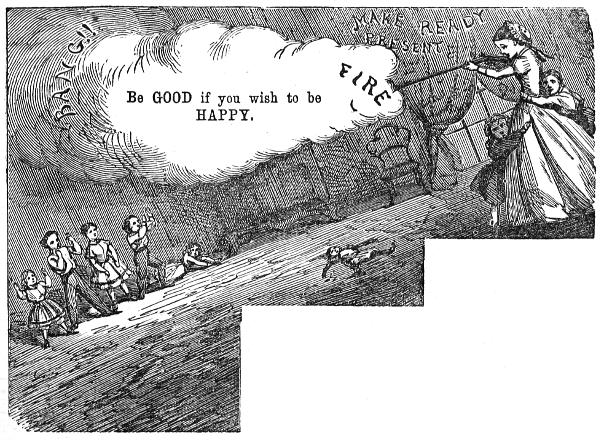
Be GOOD if you wish to be HAPPY.
Once upon
a time not
so very long
ago, there
lived a stupid,
heavy
looking boy, named
Philip, who
bore any thing but
an agreeable character;
for he was
naughty, lazy,
greedy, and impudent. His companions
all hated him, for when he appeared
among them after school hours, he was
sure to kick their marbles into the middle
of the street, knock the little boys’ caps
over their eyes, twitch balls and kites out
of their hands, and set them all fighting
and quarrelling.
One amusement in particular gave him
great delight. This was to tie a knot in
the end of his handkerchief and snap with
it at the little boys’ legs. I really hope
no one reading this has ever made a
“snapper.” If he has, and if he has gone
round snapping other boys’ legs, I am
sure his face has turned as red as a stick
of sealing-wax when he reads these lines,
and knows that I call him a cowardly tormentor;
and no better than Philip.
His whole name was Philip Wiseman,
but his companions changed it to Philip
Badboy.
His parents tried long and faithfully to
improve their wayward child; but nothing
altered him for the better—indeed,
whippings, and locking him up, only
seemed to make him worse.
Do not imagine for a moment that he
was happy. No indeed! He was discontented,
fretful, forever wishing that dinner
was ready, and oftentimes hating the sight
of every thing and everybody.
At last, quite wearied out, his father put
him at a celebrated boarding-school in
Sing Sing; but they might better perhaps
have put him in the famous prison at the
same place, for not a single button did
Philip care for lessons or punishment.
At this same school was a bright little
fellow, as full of good-nature, fun, and
mischief as he could hold. He did not always
know his lessons, and there really
seemed no end to the monkey tricks he
was constantly playing upon his school-fellows;
but somehow, when he said he
was sorry for his idleness, and his capers,
in his coaxing voice, and trying to keep
back two dimples that would come in his
cheeks, neither teachers nor comrades
could help forgiving him immediately.
Everybody loved little Kriss Luff.
He even tried to make friends with
Philip; and one bright summer morning
resolved to get him up in time for prayers.
When the first bell rang, Kriss went to
the sleeping boy’s bed, and shaking him
well, shouted out: “Come, Lazybones, it’s
time for you to be learning your A, B, C;
Get up! get up!”
Philip only snored louder, and gave a
kick with one of his legs, whereupon the
little fellow, with a tremendous push,
tilted him suddenly out on the floor, and
then had to run for his life, or he would
have got a good thrashing from the angry
boy.
Thanks to the upset, Philip was down
this morning in time for prayers; but went
sound asleep again while on his knees,
and his neighbors had to poke and pinch
him well, to get him upon his feet, when
the morning service was ended.
But you may be certain he managed to
keep awake at the breakfast table, where
he made up for having a head as empty
as a drum, by filling his stomach till he
could scarcely breathe. He never stopped
for salt or pepper; he did not waste his
time talking; and was always the very
last one at the table, getting up with his
cheeks sticking out like a balloon, from
thrusting into his mouth every thing he
could catch in a hurry.
During school hours, Master Philip went
to sleep again—and the master coming up
rapped so loudly and suddenly on the
desk, that he jumped half a yard high,
exclaiming: “Dear me, how could you
frighten me so!” while all the boys shouted
with laughter.
You may imagine that our friend Philip
did not injure himself in the least with
studying. He was always wishing that
his slate was a hot buttered pancake, so
he could eat it up, and never see it again;
he would stare at his books as if they
were scarecrows, and the idea of writing
a composition brought the tears in his eyes
quicker than red pepper. The whole of
his pocket-money was spent in buying
tough pastry; little round stale pound-cakes,
with three dead flies and two currants
stuck over the top; some oranges,
green apples, and molasses candy. Not a
suck or a bite did one of his school-fellows
ever get, for a greedy boy is always
selfish.
At last Dr. Gradus gave up in despair,
and wrote a letter to Philip’s father, informing
him very frankly that there were
no more brains in his son’s head than in a
cocoa-nut; that he would do nothing but
sleep and cram, from morning till night;
that he woke the boys in his dormitory
every night by yelling with the nightmare,
because he had eaten so much at supper;
and that he was very sorry, but Master
Philip must leave the school; and he
advised, that the very best thing to do
with him was to bind him out to a plain
country farmer, where he would have to
rise at the first peep of day—and work
hard till sunset.
Philip’s father thought long and seriously
over this letter—then he took a journey;
and on his return he brought with
him a farmer, and an intelligent-looking
country lad.
The boy’s name was John Goodfellow,
and he looked as good as his name—for
his clear blue eyes sparkled with
good-nature; his cheeks shone with good
health; and his voice had a tone of
good-breeding, notwithstanding his plain
country dress and manners. I have no
doubt his mother was a good woman,
his father a good man, and we know
the name of all three was Goodfellow—and
so much goodness in a bunch,
makes me write about it with extra goodwill.
A day or two after the return of Philip’s
father, a great clumsy farm wagon came
lumbering up the avenue of Dr. Gradus’s
seminary; driving it, was a rough-looking
man, and beside him sat a bright-faced
boy,—the same man and boy who made
their appearance, when Philip’s father
returned from his journey.
The man got down and rang a tremendous
peal upon the bell. The servant
thought the President of the United States
had arrived, and flew to answer it.
“Does Dr. Great Dust live here?” asked
the man.
“How dare you come and tear the
house down at this rate?” cried the angry
servant, seeing that it was not “grand
company.” “What do you want, you old
bear?”
The old bear, being good-natured, burst
out laughing. “Don’t spoil your pretty
face,” he said, “by getting it into a twist.
When I give a pull, I always give a strong
one; and you must a been greasing of
your bell, for it came out like a shot. Hum!
Now s’pose you tell me if Dr. Great Dust
lives here. I should think he did, by the
one you’ve kicked up about nothing.”
“Well, he does, and what of it?”
“Only I want to see him, and here’s a
letter,” holding it out.
The woman took the letter and showed
the farmer and his boy into a small room,
while she went up-stairs to the doctor’s
study.
There he sat, to be sure, a grave, learned
man, with spectacles perched on his nose,
a great frown in his forehead, rather dirty
wristbands, a pen behind his ear, and
ever so many papers before him, written
as full as they could hold of Latin and
Greek themes, which the larger boys in
the school had sent in for examination.
Of course there was no end of mistakes in
most of them; and as to Philip’s copy, it
was just one hodge-podge of farrago and
nonsense.
“Oh, that hopeless booby of a boy!”
the doctor was exclaiming to himself, as
he took up this last paper, when there
came a knock at the door.
With the permission to enter, the servant
approached, handed the letter, and
said that there were two bumpkins down
stairs waiting for the answer.
“Show them up,” said the doctor.
Then he opened his letter, took out an
envelope, read the first, stared, read again,
rang the bell, and sent for Philip, first giving
the servant an order in a low voice.
In the mean time the rough-looking farmer
and the boy, neither of whom deserved
to be called bumpkins, came in,
and, having bowed as well as they knew
how, sat down in a corner.
It was during recess in school hours
that all this happened, and our idle friend,
Master Philip, was fast asleep in the
school-room. The rind of an orange, the
cores of several apples, a grammar turned
upside down, and some very sticky paper
that had held candy, lay on the desk. In
the midst of them was Philip’s head. His
face was very sticky too, and glued fast to
the extreme end of his nose was a paper
pellet with which Kriss Luff had carefully
ornamented it, to the tittering delight of
half a dozen of his comrades. This and
his sticky face had made it the duty of
every fly in the room to invite each other
to the spot to a mass meeting on business, to
which was added a grand feast, and gymnastic
exercises; so there they all were,
as lively as you please—standing on their
heads, hanging by one leg, whisking, and
frisking, and eating, and buzzing, and
grumbling, and fighting over the spoils,
like hungry hawks or aldermen.
“Wake up, Master Philip!” cried the
servant, giving him a push. “You’re
wanted in the doctor’s study, and his face
is as long as my arm. I guess he has got
bad news for you. What’s that on the
end of your nose?”
“Bad news,” repeated Philip, tearing
off the paper pellet. “Was it worth
while disturbing my nap for that? Go to
Guinea!”
“But you must come—”
“Go to Guinea with your bad news!”
“Well, I will tell the doctor what you
say.”
This threat started Philip, and grumbling
to himself he hurried into the study.
When he entered he saw a boy of his
own age, who was now standing up studying
with great interest a large map of the
United States which hung against the wall,
a plain, good-natured looking man, and
the doctor, who was handing him a letter.
“Philip,” said the doctor, with a very
solemn face, “I am sorry to tell you that
my letter from your father informs me
that you must leave school immediately:
not to go home,” he added, for he saw
the boy’s face brightening. “Your father
and mother have just left the country on
important business; where they have gone
is to be kept a secret; and now, as you
are determined not to learn—as you have
made up your mind to grow up an ignorant,
useless creature—your father has
bound you apprentice to this worthy farmer,
whose son takes your place here. If
the good man is pleased with you, he is to
give you a small weekly allowance; but
I warn you beforehand, he will put up
with none of your lazy habits; and if he
finds that you will not obey him, why
then”—here the doctor lowered his voice—“he
has in his stable a horse-whip,
which will wake you up better than my
ferule.”
Philip stood perfectly petrified at this
sudden and most dreadful disclosure. His
knees shook—he dropped his letter—his
teeth chattered; and when the farmer, at
a sign from the doctor, approached him
with, “Come, my little man, go and get
ready; my time is money to me,” poor
Philip sprawled down on his knees, crying—
“No! no! I don’t want to go! Oh,
Dr. Gradus, pray let me stay here! I will
study! I will; indeed I will! I will sit
up all night and construe my Latin, and
work out those awful logarithms which
nearly crack my head to understand. I’ll
never say again I can’t bear the sight of
figures. Oh, I shall go distracted! Oh!
oh! oh!”
“No doubt you think you will learn
now, but by to-morrow you will have forgotten
all these fine promises”—and the
doctor gave the farmer another sign, who
grinned understandingly; then, bringing
his great fist down upon the table, and
making some glass retorts and all the
books bounce, cried in a gruff voice—
“Come, sir, this won’t answer; neither
I nor my horses can stand here doing
nothing. Make your bow to the master,
and come along.”
Philip struggled, and kicked, and tumbled
about, looking as if he was all legs
and arms—not a very graceful figure, you
may believe; and he cried and screamed,
“Let me go-o-o! let me go-o-o!” as the
farmer dragged him all the way down
stairs, and out of the house. Yes, he
screamed louder than ever out of the
house, in hopes of attracting some attention
from his school-fellows to his sad
fate; but not a single boy ran to see who
was making such a dismal howling; they
were all now in class.
When he was safely stowed away in
the wagon, amidst the empty corn-sacks,
the servant brought out his trunk of
clothes which the doctor had ordered her
to pack, and the letter which the now sobbing
boy had dropped in the study; then
she went back for a moment and returned
with some school-books fastened together
by a leather strap; and seeing how much
Philip appeared to be suffering, she forgot
how many times he had thrown her dust-cloth
out of the window, and sent her
broom and dust-pan flying after it; her
heart melted, and she said kindly—
“Never mind, Master Philip; if you
doesn’t behave, you must expect to be
punished; but it’ll do you good, like
physic. Just you try to be a first-rate
boy, and you’ll be back here in a good
deal less than no time.”
“Master Philip, indeed!” cried the farmer.
“Pretty well for a stable-boy!
You’ll be plain Phil as long as you live
with me, I can tell you. Stop that plaguy
snuffling and sighing, making such
a dismal whistling about my ears! it’s
enough to knock a sloop over. If you are
ever so good, you will never make up
for the loss of my Jack, and I’ll be bound
his poor little sister Essie is crying for him
this very moment.”
The wretched boy choked down his
sobs, and crept into a corner among the
corn-bags, where he hid himself, wiping
away the big tears that fell silently. Soon
the slow motion of the wagon soothed him.
He lay for a while drowsily watching the
trees and the wild roses growing on the
fences, that sent their faint sweet perfume
in to him with a gentle wave of their
pretty heads; and presently, as the horses
turned into a road which lay through a
cool, quiet wood, the myriad leaves of
which made a deep shade, our young
friend gave a final sigh, and, opening his
mouth and shutting his eyes, forgot all his
troubles, and snored tunefully to the end
of the journey.
After four hours’ driving, just as the
sun was setting, the farmer turned down a
crooked lane, perfectly alive with grasshoppers,
and soon came in sight of a straggling
red house, at the door of which
stood a nice-looking woman, and a little
pale, yellow-haired girl, supported by
crutches. In another moment out rushed
a very small brown dog, who fairly
“barked himself sideways,” in his intense
joy at seeing his master; then he jumped
up so high that he fell over backwards,—the
whole time wagging his ridiculous
morsel of a tail so fast, that it looked like
six tails all going round like a windmill.
The farmer jumped out of the wagon,
and, heartily kissing his wife, stooped
down and tenderly stroked the soft locks
of the little pale crippled child; then lifting
her in his arms, he kissed her five or
six times, saying between each kiss, in a
deep loving voice, “My little Essie—my
little Essie.”
“My little father,” laughed Essie, patting
the big man’s cheek, “what a dear,
good little man you are.”
At the sound of her soft, gentle voice,
and the pat of her small hand, the farmer
hugged her closer to his breast. Then he
looked down into her sweet blue eyes,
and said, “O-h, Essie!” The great love
that flowed out with these two words, no
pen can show.
“Tell me, little father,” whispered Essie,
“have you got the bad boy with
you?”
“Yes, big darling,” said the farmer.
Then he carried her to the side of the
wagon, and showed her a great, red-faced
boy, fast asleep on the corn-sacks.
“Why, he’s asleep!” she said.
“Sound as a top; but we’ll wake him
up, my little maid.” So the farmer picked
up a long straw from under the seat, and
drew it across Phil’s upper lip.
“Ow! get out,” cried the boy, rubbing
his face violently.
Essie laughed, and the farmer tickled
Phil under the nose again.
“Ow! ow!” cried Phil, kicking out
with both his legs, and butting his head
against the side of the wagon. “Hang
the old fly.” Then starting up, he opened
his eyes, and stared wildly at Essie and
her father.
“Come, Phil,” said the farmer kindly,
“we’re home; get down, and come in the
house.”
All at once the boy remembered, and
with something between an oh! and a
groan, he followed his new master.
In they all went—and what a nice little
room it was, to be sure! Great bunches
of feathery asparagus filled the fireplace;
a canary bird, in a pretty cage, hung in
the open window, through which the
sweet breaths of honeysuckles came floating;
not a speck of dust could be found
on chairs or table, and the rag carpet
was as clean as brooms could make it.
Over the mantelpiece was an engraving
of Cain and Abel, which Essie did not
like; and opposite, one of little Samuel
praying, which she did. Through the door
facing to that by which they had entered
came a sound of frying, and an appetizing
fragrance of ham.
Phil flopped sulkily down on the first
chair; then he gaped as if the top of his
head had got unhinged, and was falling
off backwards; then he stretched
out his arms till his shoulder-blades
cracked, and then he grumbled out—“I
am hungry.”
“What, already!” exclaimed the farmer.
“Why, the girl at Dr. Gradus’s said
you had eaten one orange, three apples,
and a quarter of a pound of lollipops, beside
your dinner.”
“I don’t care! I’m hungry! Oh, what
will become of me! Where can my father
be gone! Oh! how miserable I am!”
whined Phil.
“Poor boy!” said little Essie, her blue
eyes filling with compassionate tears;
“give me my crutches, please, dear father,
and I will go right in the kitchen and
hurry the tea.”
Her father did as she wished, and oh!
then, it would have done you good if you
could have seen the little thing hobbling
to the kitchen door, and crying out so
pleasantly, as she rested on the crutches,
to give a smart clap of her hands—“Hurry
up, Hannah. Let’s have tea before you
can say Jack Robinson!”
You would hardly believe how the good
woman bustled about after that! She tore
to the dresser and got a dish; she flew to
the table and caught up a fork; and in a
trice the ham was out of the frying-pan,
in the dish, and on the table, which was
already set in the kitchen; then one, two,
three, a dozen hot snowballs of potatoes—that’s
a funny idea!—were whipped out
of a pot in the corner, into a big bowl,
and those put on the table, opposite the
ham; then the tea was set to steam, and,
while that was doing, Hannah skipped
round like a crazy monkey, and thump,
thump, thump, thump, just like that, four
chairs were set to steam—no, I don’t mean
that—I mean, to the table; but I’m in
such a hurry to tell it all before you can
say Jack Robinson, you know! and then
tea was ready.
It was all done in two minutes, because
Hannah loved little Essie so dearly; but
she could not help looking rather crossly
at the greedy boy, who hardly waited for
grace to be said, before he began to eat as
if he meant to give himself half-a-dozen
stomach aches, and a horrible nightmare,
when he went to bed, by his gourmandizing.
When he could not possibly swallow
another morsel, he pushed back his chair,
and, in five minutes, was in a heavy sleep,
snoring like a trumpet.
“Wife,” said the farmer, “if that chap’s
father hadn’t promised to give our Johnny
at least three months of first-rate education,
if we would consent to this queer
experiment, I don’t think I could keep
such a lout about the place.”
“How long is he to stay?”
“Why, I tell you, it is to be for three
months, if he gives up his lazy, ugly
ways; if not, six months; and all this time
he’s not to know where his parents are;
and I’ve promised to watch him like a cat,
so that he don’t run away.”
“I tell you what, husband,” said the
good woman, “if any thing will make a
good boy of him, it will be living with our
little Essie here;” and she looked through
the kitchen door, into the sitting, or “living
room,” as country people call it, at her
darling, who was bending her golden
curls over a book called “Neighbor Nelly
Socks,” and laughing out every little
while, as if it was very amusing.
All this time Philip was snoring. The
farmer’s wife let him sleep until Hannah
had had her tea, and had washed the plates
and dishes, and made all neat; then she
shook him up and down as if he were a
big bottle of medicine, and, taking his
arm, helped him up-stairs into the garret,
where was a little cot bed in a corner,
with a straw mattress, covered with coarse,
but clean sheets.
“Is—this—my—room?” gasped Philip,
with a horror-struck countenance.
“Plenty good enough for a stable-boy,”
answered Mrs. Goodfellow, for of course
you know by this time that she was Johnny
Goodfellow’s mother.
“But I’m a-f-r-a-i-d.”
“Afraid of what?”
“I d-o-n’t know. It’s such a big, dark
place.”
“Oh, if that’s all, there’s nothing here
but dried apples and onions; two broken
chairs, which my Johnny has played
horses with many a time, and an empty
poll parrot’s cage, which has travelled
with him and his horses, all over the
world, up here in the old garret. Bless
your heart! Johnny thinks it’s great fun
to bring little Essie up here, to play, rainy
days. So you say your prayers, and go
to sleep; as it is your first night here, I’ll
leave the light. Good-night.”
She left the unhappy boy, who sat on
the side of his cot, and stared fearfully
around. The little oil lamp gave but a
feeble glimmer, and he jumped as if he
had seen a ghost, as his eye caught sight
of an old great-coat hanging from one of
the rafters; then he began slowly to undress.
As he took off his jacket a letter
fell out of the pocket. It was the one
Dr. Gradus had given him from his father,
which in his misery he had forgotten. He
opened it and read as follows:
“My dear Son—You seem to think that
the whole world is made of plum puddings
and pie-crust, and that all you have
got to do is to eat your way through it,
with as little exertion as possible. ‘There
is no royal road to learning.’ If you want
to grow up any better than a two-legged
donkey, you must study and work.
“If you won’t do this, you had better
go on all fours at once.
“I shall now make one last effort to rouse
you to diligence, and a wish to discover
what your brains were made for. At present
they are no better than calves’ brains,
only fit to be boiled and served up with
sauce; although you have been told often
enough that they were given you for your
own use, improvement, and the good of
others; that the more you study and cultivate
your faculties, the wiser, better, and
happier you will be. But this good advice
has been thrown away, and I intend to
bestow all your advantages upon Johnny
Goodfellow, the farmer’s son, who loves
learning as much as you do pastry and
cake; and you are to take his place—groom
horses, follow the plough, chop
wood, draw water, and do up generally
what farmers call ‘chores,’ which, I believe,
means a hundred and fifty different
things.
“When you have learned to execute all
these things quickly and cheerfully—mind!
I say cheerfully—if you wish to return
to your studies, and become something
more than a two-legged donkey, I shall
be very glad to take you back to your
home and my love; but until then, do not
expect to hear from your grieving mother,
or sorrowful father,
“James Wiseman.”
Here was a terrible letter indeed! and
Philip sank down on his bed, and miserably
reflected upon his bad habits, and
the happy home which now seemed lost
forever. Conscience began to be busy
with him; and all the little fellows whom
he had tormented with his “snapper” appeared
to rise up in the far gloom of the
garret, laughing inaudibly, and making
faces at him. “Oh,” he thought, “if I
could only get back to school, I would
be kind to them, I would study, I would
try to please Dr. Gradus and my parents.”
In the midst of these very sensible reflections,
the trouble of which was, that
they came a little too late, the light went
out, and, covering his head with the bed-clothes,
Philip lay shaking with foolish
fears, till he fell into a troubled sleep.
He forgot to say his prayers.
The next morning, just after daylight,
a sonorous voice resounded through the
garret, and seemed to shake the brown
rafters—“Phil-ip, Phil, wake up!”
“Yes sir,” cried the boy, springing out
of bed, and staring wildly. “Why, where
am I?”
Alas! it all came back too soon, and
Philip felt that he was indeed only a
stable-boy, when he saw that a coarse
pair of dark blue overalls and rough cow-hide
shoes had been put on the chair by
the side of the bed, in place of his own fine
broadcloth pantaloons and patent leather
boots. He put the rough clothes on with
heavy sighs, not waiting to tie the shoes,
as the farmer shouted to him to “make
haste and come to the stable.”
When he got there, he was taught how
to wash and curry the great farm horses,
put on halters, and take them to a trough
in the farmyard to water. Then he had
to bring them back and harness them, and
fasten them to the pole of the wagon, for
the farmer, who had been loading it with
vegetables and fruit to take to market to
sell, while Phil was left behind with
orders to clean the stables, and prepare the
litter for night. He was not alone in
these labors, for a man who helped in the
fields and garden, worked with him for the
present, and gave him a great deal of
good-natured advice and assistance.
Phil felt very miserable, almost desperate;
but he had the sense to perceive,
that the only way to get back to his former
station was to do his duty here. So he
worked slowly but steadily all day, with
many sighs and groans, wiping away a
great tear now and then with his shirt-sleeve.
It was certainly lonely dull work; and
some of it not very nice; for he had to
feed about fifty great pigs, and everybody
knows that pigs never use Cologne, and
had rather roll in a mud-puddle than take
a warm bath with plenty of nicely scented
soap. So all the time he was bringing
these grunting, snorting, bad-smelling animals
their food, which the farm man
very properly called “swill,” he held
his breath till he nearly burst; while the
pigs, fighting, kicking, butting, and pushing,
ate their dinner in the midst of a regular
riot. Oh! I wonder if children ever
eat in this fashion?
There was one pleasant duty which
helped to brighten the gloom of the rest.
Just before sundown, Essie came to find
him, almost skipping on her little crutches.
“Will you come and help me feed the
chickens?” she asked, in her sweet song-voice.
Philip ran to her. He did not speak,
but she saw that he was glad to come.
They both went into the kitchen, and Essie
directed him to get a great tin pan,
and fill it with rich-looking gold-colored
Indian meal. Then she poured hot water
into it from a pitcher, while he stirred the
meal with a wooden spoon, with all his
might and main. Oh, how good it smelt!
Phil almost wished he was a chicken.
They went out, and Essie called, “Chick,
chick: here, chick, chick.” In a moment
there was such a scuttling, and clucking,
and running! Up they rushed by dozens;
and as Phil threw great spoonfuls of the
meal, how they did scratch, and snatch,
and give each other sudden sly pecks!
It was very funny, Phil thought, and he
and Essie laughed merrily; but only funny,
I am sure they would say, for chickens.
I do not think any one will ever try to
teach chickens or pigs to eat with knives
and forks, and say, “If you please,” and
“Thank you,” for what they get; but you
will all agree that neatness and politeness
at the table are expected as a matter of
course from well-bred children.
And now the sun had set, like a king
gone to repose, with his crimson and gold
curtains closing round him. In the gorgeous
light little Essie stood looking at the
west, the red clouds tinging her pale
cheeks with a faint blush, and shedding
a warm glow over her yellow curling
hair.
“Oh, Phil,” she murmured, “how kind
God is to make us such a beautiful world.
Thank you, dear Father in heaven,” she
continued, folding her small hands reverently,
and looking upwards; then turning
to Philip, “You say your prayers. You
love Jesus, don’t you?”
The color rushed into his face, and
every nerve in him thrilled, as he looked
at the lovely child and heard her words.
In a hoarse, broken voice, he answered—
“I haven’t said prayers for a long
time.”
“Oh, Phil, how dreadful! when our
Saviour loves you so much, and begs you
to bring all your troubles to Him. What
made you? Did you forget?”
“I don’t know. I suppose so,” said
Phil, looking down.
She went close up to him, and leaning
on her crutches, curled her arms round his
neck, and whispered—
“Pray to-night, dear Phil, will you?”
A great sob rose in his throat. With a
terribly painful effort, he choked it down,
for he was too proud to cry before a girl,
and he managed to say, “I’ll try,” to Essie,
whom God seemed to have chosen as
His little minister to lead Phil back to
Him.
Just then a lumbering farm wagon came
in sight. In it was just the pleasantest-looking
old man that ever was seen, with
long snow-white hair and blue eyes, still,
clear, and bright.
“Well, little bonny bird,” he said to
Essie, “do you know I have promised to
catch you up, and carry you off?”
“Do you mean to lock me up in a fairy
palace?” asked Essie, laughing.
“I am to take you to a great big man,
who will snap you up, put you in his
wagon, and hold you fast, so that you cannot
escape.”
“Did the big man call me his ‘Little
Essie?’”
“This is what he said: ‘Farmer Hardy,
I’ve got to turn off about two miles from
home, on some business. You’ll be going
past my house; won’t you stop and bring
my little Essie, on your way home? I will
be at the cross-roads and meet you, and
get my white lamb, and take her back
again.’”
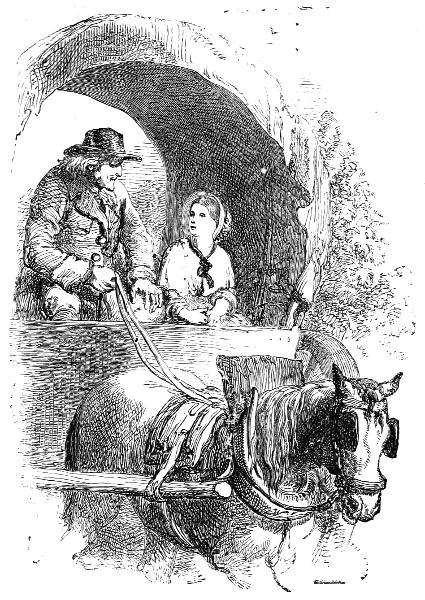
Little Essie going to meet her father.
“It’s dear father,” said Essie, and she
laid down her crutches, and was tenderly
lifted into the wagon, and bidding Phil
“good-by” for an hour, drove off with
good old Farmer Hardy, talking pleasantly
with him.
And poor Phil was left behind lamenting;
for it seemed as if it grew suddenly
dark, as the sound of the wheels got faint
and fainter, and at last died quite away.
Then he went to the end of the crooked
lane, and climbed into the fork of a tree
to watch for Essie’s return.
You may be sure, when the dear little
child was met by her father, and lovingly
placed close beside him for the pleasant
ride home, she told him how good Phil
had been all day, at which Farmer Goodfellow
looked very much pleased; and
when he and Essie got to where the tree
was in which Phil had perched himself,
he was told to jump into the wagon, and
they all came down the crooked lane, just
as the stars were peeping out, three very
happy people.
I don’t think you would have known
Phil for the same boy, had you seen how
he flew round, giving the horses their supper,
putting them in their comfortable
stalls, and dragging at the wagon, with,
the help of the farm man, to get it safely
housed. The boys at the school would
certainly have declared that it could not
be “Philip Badboy,” but a sensible, industrious
fellow called Philip Wiseman.
And the farmer showed how much he
was gratified, by giving him a seat next
his own at the table, and letting Essie help
him twice to apple-sauce.
“I dare say,” said the farmer, “you
will like farming better than Greek and
Latin; while my son John is all for books.
Learning suits him to a T.”
Phil blushed deeply, and hung down
his head.
“Never mind,” said the farmer; “you’ve
got your good points too. To-morrow is
Sunday. After you have done your stable-work,
you can go to church, and if
you listen to our good parson, you can’t
help improving.”
That night Philip knelt down in his
lonely garret, and asked God to forgive
his many sins, for Jesus’ sake. His face
was wet with penitent tears when he rose,
and God heard his prayer, and saw the
tears.
Let us go back to the school. You
would have thought that Johnny Goodfellow,
who was left in place of Philip
Badboy, wore a fairy talisman outside of
his heart, which made everybody love
him, so great a favorite did he become
almost immediately. Yes, he wore a
charm; but it was inside his heart, and
it was called Love. Do you know, darling
little reader, whom I love with all my
heart—that in that sublime chapter in
Corinthians which tells about Charity, it
is Love which is meant? The word in the
original is “Love;” but for good reasons,
and so as not to be misunderstood—because
this word “love” has not always a
divine meaning—the translator chose the
word “Charity.” And now, whenever
you read the beautiful chapter, which I
hope you do very often, and, what is
more, practise its heaven-sent lessons, always
think that “Charity” means the
purest “Love.”
How the little fellow did study! It
seemed as if he could not say his lessons
wrong if he tried; and in play hours, he
frolicked at such a rate with his particular
friend Kriss Luff, who clung to him from
the very first day, that he did not lose his
bright rosy cheeks, as his good mother had
feared. He wrote her a long letter once a
week, sending many loving messages to
his father and darling sister Essie, and not
forgetting Phil. And once, when a travelling
photographic gallery came up to
the school, he had himself taken with his
arm round his friend Kriss’s neck; and he
particularly requested that Kriss should
be looking at his watch at the moment, as
it would seem such a grand thing, he said,
for a boy to have one.
Johnny learned to construe Latin in such
a surprisingly short time, that Dr. Gradus
forgot one morning to be as pompous as
usual, and tapping his new scholar on the
back, told him he was an honor to the
school, and said he was quite a “multum
in parvo,” which, I am certain, meant a
great compliment, for Johnny colored
deeply, while an expression of delight illumined
his features. It is a very majestic
thing to praise people in Latin; but for
my part, I wish Dr. Gradus had talked
English, don’t you? If you can find out
what “multum in parvo” means, just
write it to me in a dear little letter, directed
to the care of Mr. Sheldon.
Of course Johnny told Kriss all about
his sister Essie; how pretty and good she
was, and how she had to walk with
crutches, because she had hurt her knee
when she was a little bit of a thing, and
the leg that was injured never grew any
more, at which Kriss was dreadfully sorry,
and sent his love to her, and a funny
little picture, in an envelope, of a boy who
was pulling out the nose of his sister’s
india-rubber doll, and making it at least
half a yard long. And Essie, in return,
sent him a great gingerbread cake, which
she helped to make herself, and Kriss had
what he called “a public dinner” off of
it, and made a fine speech, standing on
top of the pump in the play-ground; after
which he cut a slice of cake for every boy,
all elegantly arranged on cabbage leaves
for plates, upon receiving which they gave
him three perfectly tremendous cheers,
and in five minutes more every single
crumb had disappeared.
And Johnny kept rosy and fat, although
he really seemed to live on geography, the
multiplication table, and the Latin grammar;
but he could play too; for Kriss
declared that he could run faster, jump
higher, swim longer, and shout louder
than any other fellow in the school, which
was very remarkable, for some of the boys
could run like lamplighters, jump like
kangaroos, swim dog-fashion and crab-fashion,
dive like stones, float like feathers,
stand on their heads under water and bow,
to you with their feet, and as to shouting,
I only wish you could hear them once—that’s
all.
All the boys agreed that Johnny made
the very best back of them all at leap-frog,—so
strong and square, with his hands
firmly planted on his knees, and looking
between his legs with his round face upside
down. Then he was a capital hand
at mending broken-down drums, toy-carts,
horses, and all manner of playthings. The
little boys in the school would bring them
to him, and, first hugging him, would coax
him to “make them as good as new,” until
he declared that the little closet in
his room was a perfect hospital, of which
he was the doctor, and a jack-knife and
Spalding’s glue the medicines.
And such wonderful kites as he could
make! They quite astonished the whole
neighborhood, birds and all. A famous
one which he made was, as he declared,
a genuine portrait of a round-shouldered,
bullet-headed member of Congress he had
seen, whose brains being made of feathers,
were just the very ones to go off in a high
wind, at a tangent, and never touch any
sensible thing, or cut even a curve in the
air, much less a difficult question. So the
member of Congress was painted on an
immense sheet of tissue paper, and furnished
with an exceedingly long tail, made
of scraps of cotton-wadding tied on a
string at intervals of four inches, and so
light that it balanced his brains to perfection.
When he was finished, he was
dubbed “The Honorable Mr. Kite;” and
many a fine day did the honorable gentleman
air his feather-brains over the broad
fields, and look down with his stupid fat
face at the delighted boys, who all took
turns in giving him a “flier.”
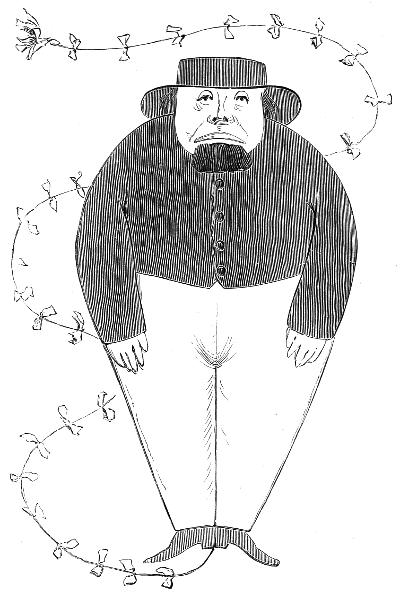
The Hon. Mr. Kite.
But perhaps the very best of Johnny’s
social accomplishments came out on rainy
days, when he told stories without end, so
excellent was his memory of what he had
read or heard; and the bright play of his
features added so much to the interest, that
the boys declared, when they came to read
the very same stories in books, as sometimes
happened, they did not seem one
quarter as good. I really feel tempted to
tell you one of them, though, like the
boys, you will lose three-quarters of the
interest because you do not get it direct
from him. Shall I.
Aunt Fanny had read thus far in her
manuscript, when she paused, looked up,
and repeated, “Shall I?”
“Oh, yes! yes! if you please,” cried all
the children.
“But it won’t seem more than a quarter
as entertaining.”
“Oh, you funny Aunt Fanny! you
know we shall like it just as well—better.
But tell us, did you hear that jolly Johnny
Goodfellow tell a story?”
“Of course I did,” she answered, “and
this is the way he did it. First, let’s all
sit down on the carpet.”
You would have thought that each of
the children had been presented with a
fine present, they received this proposition
with such delight and so many chuckles.
Down they all got in a bunch, with Aunt
Fanny in the midst. Then she clasped her
hands over her knees, made her mouth
into a button-hole, and looked up at a
corner of the ceiling, pretending to think.
She looked so long, that Fred, full of
Johnny Goodfellow and his story, quite
forgot he was speaking to Aunt Fanny,
and shouted—
“Come, old fellow! we’re all waiting;
why don’t you begin?”
Then suddenly remembering himself, he
turned as red as scarlet, and stammered
out—
“Oh, I didn’t mean—— I beg your pardon.”
The button-hole mouth broke loose, and
Aunt Fanny burst out laughing, as she
said—
“That was just what I wanted. Now,
attention, squad! Aunt Fanny has jumped
over the moon, and Johnny Goodfellow is
here in her place to tell you the wonderful
tale, a good deal altered, which he read in
an English magazine, called
“BROTHER BOB’S BEAR.”
Once upon a time, a Yankee farmer
found he had such a lot of children, that
they cost him more than they were worth.
So he concluded to emigrate out West,
where the old ones could shoot game and
plant corn and keep out of mischief, and
the young ones could laugh and grow fat
by rolling on the prairies and eating hasty-pudding.
He found that he was well enough off,
when he got to his new home, to build a
very aristocratic log-house. Very few,
you know, have more than one room,
while his had three—all elegantly ceiled
with hemlock-bark, with the smooth side
out—quite gorgeous, you may believe.
It was in May that he moved, and the
whole summer was before the children to
frolic in, and have a grand good time; and
the eldest brother, Bob, began the game
by shooting a bear who wanted to hug
him. You know a bear’s hug is a remarkably
tight squeeze, and generally takes
your breath away for good. So Bob declined
the honor, and popped a bullet in
the bear’s cranium, and carried home in
his arms a perfect little darling of a cub,
for the poor bear was a mother.
Oh, what a welcome the little cub got!
It was hugged and kissed all round; and
Bob, congratulating himself that it was too
young to mourn long for the loss of its
mother, solemnly declared that he intended
to be a mother to it for the rest of its life.
And he kept his word.
The cub, who was named Moses, slept
with Bob, always laying his nose in a sentimental
manner over Bob’s shoulder. He
grew very fast; you could almost see him
grow; and there really seemed no end to
the bread and milk and mush and butter
he would eat.
The first winter he was kind of numb
and stupid, and spent a great deal of time
in sleeping and sucking his paws. But
when the warm weather came on, he was
the happiest little bear in the world, following
Brother Bob about like a dog, and
only miserable when he lost sight of his
master. He always woke him in the morning;
and as the bear liked to get up
early, you see he was quite a blessing to
Bob in this respect, as getting up early, according
to the proverb, is one of the sure
and certain ways of becoming healthy,
wealthy, and wise. I always feel the wisdom
sprouting out all over me when I get
up very early in the morning; but I’m
afraid I should spend all the extra money
I made by early rising in buying an extra
breakfast, for it also makes me so tremendously
hungry.
Well, one day Brother Bob had to go a
long journey to buy material for building
a frame house, of a man who had a saw-mill.
Moses could not accompany him;
and this was a dreadful affliction. Bob
had to steal away; and when the bear
found he had gone, he commenced a search
for him. He went to Bob’s bed, and,
beginning at the head, poked his nose
under the sheets and blankets, and gravely
travelled down till he came out at the
foot; then he turned and slowly marched
up again. He kept this up by the hour,
never stopping till he was shut out of the
room. He then took possession of all
Bob’s clothes he could find, and got as
far as he could push into the legs of the
trousers and arms of the coats, still hoping
that his beloved master would be found
in some of the dark corners; and Bob’s
mother, half distracted at seeing the clothes
tearing with such rough usage, got them
away with great difficulty, and locked
them up in a wardrobe.
Then Moses, with tears in his eyes, and
grunting with grief, managed to climb to
the top of the wardrobe, and seized a large
Bible which rested there, and, curling
himself up into a round ball, dropped on
the floor, hugging the Bible fast. Bob’s
mother tried to get this away, but the bear
showed fight for the first time, and kicked
out his hind legs, and gave sly dabs at the
broomstick with which she was beating
him; but he held the book tight, and
Bob’s mother had to give up, and come off
second best; and what’s more, the bear
knew it, and made use of his triumph
afterward.
When Bob came back, the bear fairly
danced for joy, dropping the Bible, and
showing his contempt for Bob’s mother by
taking the butter from the tea-table and
eating it before her eyes. His master gave
him a good drubbing for stealing, and he
submitted to it with perfect indifference,
for his dear master might do as he pleased;
but when he was not present, butter and
honey, and sugar and molasses, were all
taken with the utmost coolness; and the
poor old lady could not help herself, for
he had now grown so large and strong that
she was afraid of him.
“Oh, Bob,” she said, one day, “your
bear is the plague of my life.”
“Now, mother,” he answered, “you
have only got to be resolute, and show
that you are not afraid of him.”
“But I am afraid of him, and he will do
me some dreadful harm yet.”
“Give him a taste of hot poker, mother,
and he’ll never bother you again.”
“Oh, Bob!” she exclaimed, “I would
not do that for the world!”
And so the bear had his own way,
and became a very tyrannical member of
the family, till something happened which
did more than even a mother’s remonstrances.
For Brother Bob fell in love. Just at
this time the Yankee farmer got a neighbor—a
very near one for the West, only
five miles off—and this neighbor had a
pretty daughter, seventeen years old; so
what does Bob, who, I forgot to tell you,
was nineteen years old—what does he do
but fall so head over ears in love, that he
declared she was the prettiest and best girl
in the whole universe, which I think was
saying a great deal.
But Susan (that was her name) treated
Brother Bob shamefully. She played
tricks upon him; she made fun of him
before his face, and kept him perfectly
miserable; and declared, moreover, that
she did not care half an ear of corn for
him. Here was a pretty state of things!
for even the bear could not comfort the
poor fellow.
But one day Susan and a younger sister
came to take tea with Bob’s mother. They
had never seen Moses, and did not know
of his existence. Bob shut the bear up in
his room, in compliment to the guests, and
the afternoon passed off very pleasantly;
that is, to all but Moses, who was highly
disgusted at being locked in.
When the time came for Susan and her
sister to leave, Bob prepared to see them
home through the path in the woods. He
ran into his room for his hat, never thinking
of Moses, and left the door open, and
came quickly out of the house, as Susan,
with her teazing ways, had already started.
Down rushed the bear after him, out of
the door, up to Bob, seized him in his
arms, and hugged him, in his joy, in a
way frightful to behold; and Susan, turning,
saw Bob in this terrible embrace.
She screamed; oh, how she screamed!
and instead of running away, she rushed
right up to the bear, and tried to pull him
off, crying and sobbing, “Oh, Bob! dear,
dear Bob! you will be killed!” and then
fell fainting to the ground.
Ha! ha! Miss Susan, you were found
out! But Bob behaved very well; for
he caught her in his arms, and said—
“Dear Susan, he is a tame bear; do not
be afraid.”
The poor girl looked like a broken white
lily, trembling at the bear, and ashamed
that she had showed Brother Bob how
much she cared for him; and when she
had recovered her wits, she cried out piteously—
“Oh, I will never come here again!”
“Yes, you will!” said Bob, “now that
I know you like me. I’ll banish the bear,
or put him in prison, or do any thing you
wish.”
It was wonderful how many faults Bob
discovered that the poor bear had after
this; and one day when he snatched a
pudding from the plate in the very hands
of Bob’s mother, as she was taking it to
the table, he made up his mind that Moses
must be chained.
So the bear was fastened to a surveyor’s
chain, made tight to a stake in the ground.
He immediately began walking in a circle
round the stake, at the extreme length of
the chain, always turning a somerset at
one particular point, and only stopping to
eat, or look reproachfully at Bob when he
came that way. Why he wanted to exercise
in this very peculiar fashion, tumbling
head over heels at one spot every time he
went around, is a good deal more than I
know; but I believe all bears who are
chained act in this comical way, though it
can’t be much fun to them.
This was all very well in the daytime,
but sure as night came, Moses broke his
chain, and did his best to get back into his
master’s bedroom. Poor fellow! he so
wanted to lie at the foot of Bob’s bed,
hugging an old vest. And at last they
had to build a prison for him of logs, with
a roof of boards kept on by heavy stones.
The very first night the poor bear was
put in this den, he raised the boards off
the roof in his desperate struggle to get
out and see his beloved master. He got
his head out, and then, oh! ah! alas!
hung by his neck, and was choked to
death—a martyr to his great love for
Brother Bob.
You may be sure, Bob’s mother was
rather glad, but, old as he was, Bob could
not help shedding a few tears for his
clumsy, ugly pet. He got a new and
pretty pet before long; and so it came to
pass that the farmer and all his family
soon gave up bewailing the tragical end of
Brother Bob’s Bear.
“There!” said Aunt Fanny; “what do
you think of Johnny’s story?”
“Grand!” cried the children. “We
know more about bears now than we ever
did before.”
“I wish I could have a bear,” said
Peter.
“Come here and I will give you a bear’s
hug,” cried Fred.
He jumped upon Peter and squeezed
him till both were perfectly red in the
face, and breathed in puffs. Then Fred
kindly offered to give Aunt Fanny a hug;
but she, jumping up and laughing, said
she had no breath to spare. And after a
good deal of skirmishing around, and
making believe to punch each other with
their elbows, dancing and singing—
“There was an old woman,
Who had but one spoon,
And all she wanted
Was elbow room,
Elbow room, elbow room,—
All she wanted
Was ELBOW ROOM”—
they consented to sit down quietly to hear
once more about their friend Philip.
At the farm, all this time, Phil had been
improving. Not steadily, for no one becomes
good all at once. He would have
his fits of laziness and sulkiness; but the
ministering love and sweet example of
little Essie soon made him ashamed of himself,
and try to conquer the enemy, praying
to his Father in Heaven for help.
You know very well, darling children,
that our worst enemies are our evil passions
and bad habits, and when we gain
a victory over them, all the angels in
heaven rejoice, and then God’s Holy
Spirit descends into our hearts, sending a
glow and thrill of happiness all through us.
As Phil grew good-tempered and industrious
he began bitterly to regret the advantages
he had neglected and lost while
at school, and when Johnny’s letters were
read aloud, his heart would beat violently,
and he would say to himself—“Shall I
ever be so smart? What a miserable
foolish fellow I have proved myself!”
One Saturday evening he went softly up
to Mr. Goodfellow, and asked—“Won’t
you please tell me something about my
dear father and mother?” and then burst
into tears.
“Why, Phil!” cried the farmer, “what’s
the matter? Your parents are well, and
know that you are trying to be a better
boy. Don’t cry. The time will soon pass;
and a little farm learning will not hurt you.
If you go on as you have done this two
or three weeks past, you’ll come out all
right, my boy.”
The next morning, after his work, Phil
washed and dressed himself carefully, and
went to church. His history, by this
time, was pretty well known, and the good
minister, who had become quite interested
in him, had not only been to see him, but
had always spoken to him kindly when he
waited in the churchyard after the service,
while the farmer and his wife talked
awhile to their neighbors.
On this day, Phil went up to the good
clergyman, and, blushing deeply, stammered
out, “I should like to speak to
you, sir.”
“Well, my dear boy,” he answered
kindly, “don’t be afraid; tell me what
I can do for you.”
“Oh, sir, if—if—you would only ask
Mr. Goodfellow to let me go to evening
school. I want to learn—I do indeed.”
“Well, that is quite right; but you
were at an excellent school. Why did you
not study there?”
Phil blushed more deeply than before,
but he said, truthfully and manfully, “I
neglected my opportunities, sir: I would
not learn; and all the boys hated me—because
I tormented them; and I did not
want to do any thing harder than to walk
about with my hands in my pockets—or
else to be eating.”
“But, my child, did this kind of life
make you happy?”
“No, sir. I grew tired of every thing,
and gaped till I sometimes thought the top
of my head would crack off; and I used
to wish I could sleep all day as well as all
night; but now, oh! how I wish I could
go back and study diligently—although
the farmer and his wife are very kind, and
I could hardly bear to leave dear little
Essie. And I want to see my parents, and
beg them to forgive me”—and here Phil’s
lip quivered painfully.
“Well, my son, I will speak to the farmer,
and if he consents, you shall come to
me for an hour every week-day evening
and continue your studies.”
Phil could hardly believe his ears.
“You, sir! come to you!” he exclaimed,
his whole face radiant with joy.
“Oh, thank you, thank you; how can I
ever thank you enough!”
He flew to the good farmer, the minister
coming slower, and told him the precious
good news, ending with, “Now I
shan’t grow up a dunce!”—and I am afraid
I must add that he took one or two great
joyful jumps in the air, at which the minister
looked a little grave, as it was Sunday,
but did not say one word of reproof,
because he knew that “boys would be
boys,” and sometimes jumped when they
ought to stand as still as a mouse.
It was all settled, and the next evening,
just as the stars were peeping out,
Phil shouldered his books, which, you
will remember, were sent away from the
school with him, and almost ran all the
way to the parsonage.
It is perfectly astonishing how easy a
lesson becomes, if you resolutely drive all
other thoughts out of your mind, collect
your five wits, and set to work at your
book. Phil found it so, to his great delight.
The good minister smoothed away
some of the difficulties which required a
little explanation, and excited his ambition
to conquer others; and not being near so
pompous as the great Dr. Gradus, though
knowing quite as much, he and Phil got
on capitally together. He did not learn
Greek, Latin, and all manner of hard
things, like a flash of lightning, mind you.
If I should be so absurd as to tell you this,
you would know I was writing about an
impossible boy. But his mind gradually
cleared up, because he no longer ate like
a glutton, and he slept like a top, and
took plenty of healthy exercise, and this
has every thing to do with intellect and
brain. You know, if you have a terrible
headache, or eat a great many buckwheat
cakes for breakfast, you can’t do your
sums. So, if you want to grow up a wise
man or woman, try to be a healthy child,
full of good-nature, good-temper, activity,
and courage. They will greatly increase
your ability to learn.
About a mile from Mr. Goodfellow’s
farm was a beautiful country place, which
had lately been offered for sale, and one
day, when Phil had been almost three
months in his new home, the farmer, as
he drew in his chair at the tea-table,
said—
“Wife, Woodlawn is bought, and the
owner is coming to take possession next
week.”
He gave his wife a peculiarly comical
look as he said this, and a smile broke
over her face, but she did not ask any
questions.
Phil did not care who was coming; he
was so engaged with his books, and so
happy working out in the fields all day,
that if he could only have heard from his
parents, he would have had nothing left to
wish for.
Just at this time, also, there was a public
examination at Dr. Gradus’s school, where
anybody in the company was invited to
put the most puzzling questions to the
scholars. You may be sure, Johnny was
always ready with an answer, except
once, when he and the whole school, and
all the company, burst out laughing, because
a queer old wag of a gentleman,
seeing that Johnny was so quick and
bright, came out suddenly with this—
“Look here, my fine fellow. Suppose
a canal-boat heads east-nor’-west for the
horse’s tail, and has the wind abeam, with
a flaw coming up in the south, and cats’-paws
showing themselves, would the captain
be justified in taking a reef in the
stove-pipe, without first asking the cook?”
I said everybody burst out laughing;
but I made a mistake; for Dr. Gradus rose
up majestically, and made a speech stuffed
full of Latin, in which he observed that
“problems like that the gentleman had
just given were not to be found in any
of his books;” at which everybody nearly
laughed again—he was so solemn and
pompous about a joke. I forgot to mention
that Dr. Gradus was an old bachelor,
and that accounts for it.
Of course, Johnny’s father and mother
were present at the examination, with little
Essie; and oh! what three proud and
happy people they were, when, at the end
of it, Dr. Gradus got up to present the
prizes, and among the very first names
called was Master Johannes Goodfellow.
At first they did not quite understand that
it was their Johnny, because Dr. Gradus
turned his Christian name into Latin,
which, you know, made it grander; and
as Johannes’s face,—as he walked up,
bowed, and took the splendid book presented
to him,—was perfectly radiant with
happiness, I don’t know but what the
Latin had something to do with it. But
when he saw his dear father holding out
his hand to him, his mother’s eyes full of
joyful tears, and Essie’s rosy lips trembling
with excitement and pride in her
darling brother, he very nearly burst into
tears himself; but controlling his feelings
with a strong effort, he grasped his father’s
hand for a moment, and then went back
to his seat.
Kriss, Johnny’s particular friend, obtained
a prize too; and after they were all
distributed, the company were invited to
partake of refreshments in the parlors,
which consisted of very sour lemonade,
and such thin slices of cake, that they were
all weak in the back, and fell over double
when they were taken up. Of course,
nobody ought to be hungry after such a
“feast of reason” on Latin grammars, geology,
mathematics, chemistry, and I don’t
know what besides—the very names of
which made Dr. Gradus smack his lips
with delight. He, no doubt, would have
preferred to have dined off of Greek lexicons,
with chemical sauce, instead of plum-cake,
with comical sauce (that is, plenty
of fun and laughing), which you and I
would much rather have, wouldn’t we?
Then Johnny introduced Kriss to his
sister with great pride and delight; and
Essie’s sweet smile and soft pleasant voice
won his heart, and he immediately told
Johnny, in a whisper, that his sister was
such a dear little girl, and a great deal
prettier than he expected, and her lameness
ought to make everybody as kind
and tender as possible; and moreover,
that when he grew up to be a man, he
meant to marry Essie, and watch over her,
and make her as happy as the day was
long.
“Oh, delightful!” cried Johnny; “just
fancy! then you’ll be my brother. I
always wished I had a brother. I don’t
like the thought of finding that cross Phil
at home; it will half spoil my holidays.
But we must write to each other, Kriss;
and you shall have Essie when you grow
up; and then we shall live together all
our lives.”
So they parted; for after the examination
there was to be a month’s holidays;
and Johnny had as much as he could do
to shake hands and bid good-by to the
crowd of noisy, merry boys, every one of
whom loved him. All the teachers also
shook hands, and hoped he would come
back; and Dr. Gradus, pushing up his
spectacles, and clearing his throat with a
tremendous “hem,” said that Master Goodfellow
quite fulfilled the promise of his
name; at which heavy joke everybody
nearly died of laughter, and all because it
was the great Dr. Gradus who said it.
It was beautiful autumn weather. The
leaves were just beginning to turn; the
dark green woods were flushing into gorgeous
tropical beauty; and four happy
people were riding home, their hearts full
of gratitude and peace, beyond all price.
But when they drove into the crooked
lane, didn’t the little brown dog bark himself
more sideways than ever before, in his
frantic joy at hearing Johnny’s voice, for
it was now quite dark; and didn’t Hannah,
and the farm man, and Phil, rush out and
cry, “Hurra! here they are!”—and Phil’s
voice sounded so hearty and pleasant, that
Johnny shook hands with him immediately,
and said, “How are you, old
fellow?” as if they had been friends a
year, which made Phil very happy, for he
had been quaking at heart lest Johnny
should not speak to him at all, knowing
what a bad boy he had been.
As they were sitting at the tea-table,
Phil said—
“There is a note for you, sir, on the
table in the living-room.”
“Oh, is there? Hannah, will you bring
it here? It looks like something important,”
he continued, as he took it in his
hand. “Hm—hm—hm. Well, wife, what
do you think it is? An invitation for all
of us to spend to-morrow evening at
Woodlawn.”
“Indeed!” said Mrs. Goodfellow, with
a bright but peculiar smile on her face.
“Phil is invited, of course?”
“Certainly; and I am glad and proud
to say that I know he will do himself
credit now, wherever he goes. Our good
minister is to be there too.”
“Oh, I am glad of that!” said Phil;
“he is my best earthly friend—” He
stopped, and his eyes filled with tears.
“What is the name of the family who
have bought Woodlawn?” asked Johnny.
“Such a curious chap as it is!” answered
the farmer, laughing. “Never
mind the name till to-morrow.”
That night there was another cot-bed
put in the garret, and Phil and Johnny
had a long affectionate talk together. Phil
frankly told all about himself, and what
Essie and the good minister, with God’s
blessing, had helped him to do; and
Johnny cheered and encouraged him, and
told him that he had no doubt but that
Phil’s parents had heard of his good conduct,
and might be expected at the farm
almost any day.
But the poor little fellow suffered terribly
himself while he was saying all these
kind things, for, as you know, Phil’s gain
would be his loss. If Mr. Wiseman was
convinced of his son’s reformation, Johnny
must go back to farm work, and resign his
precious hopes of growing up a learned
man. His kind father had not yet paid
all the money for his farm; he could not
afford to hire another boy in his dear son’s
place; and now a few months in winter at
the district school was all that Johnny
must expect.
But he got up the next day bright and
happy. It was something—yes, indeed, it
was a great deal—to have such a home as
his; and after he had washed, dressed, and
said his humble, thankful prayers, he was
quite ready to race eagerly out with Phil
and the little brown dog, and see which
could get to the end of the crooked lane
and back again first.
It was lucky that the little brown dog’s
tail was fast at one end, and the hair on it
not a wig, for he certainly would have
shook it off, and every single hair out, if
incessant and furious wagging would have
done it; and the boys and the dog seemed
to have each taken a dose of laughing-gas,
they flew hither and thither in such a ridiculous
way, just because they were so
happy.
Then Johnny helped Phil with the
horses and the rest of the farm work, and
the little brown dog helped too by getting
between their legs and nearly upsetting
them half a dozen times, and by riding on
one of the horse’s backs to water, barking
the whole time to make him hurry, which,
of course, was very funny, and made the
boys laugh heartily.
And when they went in to breakfast,
there was Essie, with a welcome shining in
her sweet blue eyes, and her Bible all
ready to read a chapter, before her father
asked a blessing on the labors and pleasures
of the day.
The day was soon spent in cheerful
work, and in the evening they all prepared
for their visit to Woodlawn. Phil made
himself as neat as possible in his farmer’s-boy
Sunday suit. He thought first of asking
Mr. Goodfellow to let him wear the
fine broadcloth clothes in which he came
to the farm, but he said to himself a moment
afterwards—
“No; I am only a farm-boy now; I will
make no pretence to be any better, until
my father gives me leave.”
He did not need the fine clothes to improve
his appearance, for his excellent
habits had made such a change, that he
would hardly have been known for the
same boy. His eyes were bright, his manner
animated, and he had learned to be
unselfish, industrious, polite, and kind to
all—though not without many hard struggles
and constant prayer.
As the party drove into the great gate
of Woodlawn, and up the long beautiful
avenue, they heard the sound of music,
and a hundred colored lanterns met their
eyes suspended from the trees. They had
the effect of enchantment; and Essie said
she was sure she saw little fairies dancing
in the shaded alleys on either side, and
peeping and smiling at her from the bushes.
The boys laughed, but they too felt the
strange magic of the scene; and when they
arrived at the brilliantly lighted entrance,
they were prepared, they thought, for all
manner of wonderful events.
After taking off bonnets, shawls, and
hats, they were ushered into a small room,
the walls of which were covered with
beautiful paintings, at which both the boys
gazed with delight. Two immense closed
doors, opposite the windows, led into another
room, from which sounds of laughing
and talking proceeded.
Presently the good minister came into
the small room, and it was delightful to
witness the mixture of respect and grateful
affection with which Phil hastened to meet
him, and place a comfortable arm-chair for
his use.
“Our host and hostess will be here very
soon,” he said. “Meanwhile, Philip, if
you like, I will ask you and my friend
Johnny some questions about your
studies.”
The boys were delighted, and immediately
placed themselves before him, their
arms around each other’s necks.
Question after question was poured out,
and readily answered by the boys in turn—Johnny
sometimes having to prompt
Phil, and Phil quite as often helping his
friend; while the farmer, his wife, and
Essie listened with delighted attention:
and two others listened—for a door behind
the boys had been softly opened, and a
gentleman and lady stood with the rest,
their faces beaming and radiant with love
and eagerness.
The good minister saw them, and turning
to Phil, he said—
“My dear boy, you have done so well,
not only in your studies, but in what is of
far more importance, in conquering your
bad habits, that all that there is left to
wish for is, that your parents might take
you back to their home and hearts.”
The lady gave a sudden start towards
him at this, but the gentleman laid his
hand gently on her arm.
“Oh, sir,” answered Phil, his lip quivering,
“will they ever love me again? Can
they ever forgive me?”
“Oh, yes! yes! my own darling boy!”
screamed the lady.
Philip turned quickly around, became
deadly pale, staggered towards her, and
fell nearly fainting into the outstretched
arms of his mother; while his father, seizing
his hand, cried—
“God bless you, my son! God bless
you! You have done nobly. You have
made us very, very happy.”
Then the rest went softly out of the
room, and Phil had a few moments of
blissful joy. He curled his arm around
his mother’s neck, and kissed her over and
over again. He hugged his father with
eager affection; and then darted back to
his mother—laughing, crying, now smoothing
her hair, now crumpling her beautiful
lace collar—perfectly beside himself with
ecstasy.
All at once a band of musicians struck
up a martial air, the great sliding-doors
moved back, and Phil’s father and mother,
taking his hands, went forward and introduced
him to the company, for they were
the owners of Woodlawn. All knew his
story—for you can’t keep such a thing
secret in a country place—and they looked
at him with such intense interest, that he
was becoming confused, when who should
dart forward to welcome him but Kriss
Luff and half a dozen of his old schoolmates,
all wanting to shake hands at once,
and this making him laugh, he was soon at
his ease.
Oh, what a delightful evening it was!
They played games and sang, they laughed
and frolicked—the good minister joining in
every thing, like a real Christian as he was.
They partook in moderation of all manner
of nice things which were loading down a
table in the dining-room, and each one
went home with the recollection of a delightful
evening well spent.
Of course, Phil stayed at Woodlawn,
and that was one little drop of unhappiness
to the kind people with whom he had
lived so long, and who had learned to love
him very much. They could not bear to
part with him. But Johnny was made so
happy, that I do not think he knows to
this day whether he walked home on his
head or like other people; for Mr. Wiseman,
patting his sturdy shoulders, said to
him—
“Well, my son, are you tired of school
yet?”
“Oh dear, no, sir. I love my books. I
even love Dr. Gradus.”
“Well, that last is convincing; so if
your good father, to whom I owe more
than I shall ever be able to repay, will
permit me to find him a farm-boy, you
shall go to school and through college with
Phil, and, if you like, choose a profession
afterwards, still under my care.”
“Hurra! hurra!” cried Kriss and all
the boys; “Johnny Goodfellow is coming
back to school. Philip Badboy has flown
to the moon, and Philip Wiseman is to
come in his place. It’s the jolliest thing
that ever happened. Three cheers for Mr.
Wiseman.”
They gave three cheers and a “tiger,” a
big one too, little Essie helping.
“Now,” said Kriss, who had voted himself
master of ceremonies, “three cheers
for Farmer Goodfellow.”
They were given, Phil hurraing with
such a will, that he got perfectly crimson
in the face.
“Now, three cheers for little Essie,”
said Kriss.
If Phil could have made more noise, he
would have done so this time; as it was,
in his eager desire to honor Essie, he
hurraed himself sideways, like the little
brown dog, and nearly cracked his throat.
“Now, boys, three cheers for Phil, our
new friend.”
Didn’t they give it, though! Yes, they
did, and such a royal Bengal tiger to end
with, that the very windows rattled again.
To the children who do not live in New
York, I ought to say that we have a splendid
regiment of soldiers, called the “Light
Guard,” who, whenever they cheer, always
say, “Hurra! hurra! hurra! ti-g-a-r!” I
don’t know why they do it, but this is
what is meant by “three cheers and a
tiger.”
Phil bade the farmer, his wife, and little
Essie good-night with tears in his eyes,
promising to come and see them every
day. Mr. Wiseman had invited Kriss and
the other boys to stay a week at Woodlawn,
which was a most delightful fact to
know and experience. A merry, merry
week they all had, and you may be sure
Johnny was included in every day’s
pleasure, and Essie was with them very
often.
And now, my darlings reading this, do
you think it likely that Mr. Wiseman will
ever have to send Philip away again? I
do not, and I hope you are of the same
opinion; but if you would like me to keep
one eye on his future movements, and
write to you about them, just let me
know, won’t you?
“That’s all,” said Aunt Fanny. “What
do you think of it, my merry men and
ladies? Will Philip Badboy Wiseman do
for a beginning?”
“It’s perfectly splendid!” cried the
children.
“And you don’t mean to eat greedily of
flower-pot pudding after this, or snap each
other’s legs with knots in your pocket-handkerchiefs?”
“Oh no, dear Aunt Fanny. This pop-gun
has made us better already. We
mean to be ever so kind, industrious, and
unselfish after this.”
“I wish I had a kite like Johnny’s,”
said Peter.
“Who knows, if you try to be a loving,
obedient child, but what the Honorable
Mr. Kite may call upon you next spring,
all ready for an airing. I’ll have a talk
with my friend Johnny about it.”
“Oh goody! will you?” cried Peter,
jumping straight up and down in the air.
“My! how good I’ll be! I’m going to
begin right away;” and he sat down, solemn
and stiff, twirling his thumbs one
over the other, and saying, “Look at me!
Only see how good I am!” while the rest
laughed merrily at the joke.
Then Aunt Fanny had a kind kiss from
all, and bade them good-night.
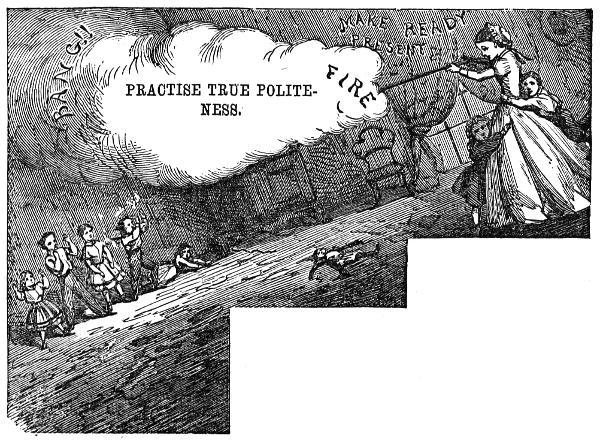
PRACTISE TRUE POLITENESS.
The next
time Aunt
Fanny came
she had a
funny and
rather mischievous
twinkle
in her eyes. She
did not say a word,
while she unfolded
her manuscript but
quietly read out
the Pop-gun printed above, and then said
her story was called by the comical title of