The first thing that I remember is a green field enclosed by a
stiff fence, where I was running about by my mother’s side. I
cannot call to mind the earliest days of my existence, but I am
sure that I was not more than a fortnight old when my mother
gave me my first lesson in life—a lesson I have never forgotten.
My mother was a fine bay mare, the property of Mr. Bayne, a
farmer, who seems to have treated her very kindly; indeed I
have never heard any horse speak better of a master than my
mother was accustomed to speak of the man who owned her.
‘He has never laid a whip upon me,’ she would say with
a proud toss of her head; ‘he has a heart far too kind for
that sort of thing, and he knows I always do my best—and
what horse can do more, I wonder.’
But to return to the lesson she gave me. I was ambling
by her side when Mr. Bayne entered the field, and my mother,
as she usually did, ran up to him to be caressed and fed with
some trifling luxury, such as a slice of carrot or bit of sugar.
I kept by her side until we reached him; then I, purely from
2playfulness, turned and kicked at him, lightly—you know—not
by any means in a way to hurt him, I assure you.
‘Woa there,’ shouted Mr. Bayne; ‘vicious are you, my
youngster? the mother’s blood don’t seem to run in you.’
He said nothing more, but having fed and stroked my
mother, he went out of the field, and left us together. Then
I received the lesson to which I have alluded.
‘How very wrong of you,’ she said, ‘to kick at so good and
kind a master.’
‘It was only in play,’ I replied, hanging my head and
feeling rather foolish.
‘I know it was so,’ she returned, ‘but it was wrong of you
nevertheless. Some men are so stupid that they do not know
play from vice, in a horse, and only few of them seem really to
understand us. They often reprove us when we endeavour to
do right, and you will be beaten if you do not curb your propensity
to play.’
‘Were you ever beaten?’ I asked.
‘Once I had a very cruel master,’ said my mother with a
sigh; ‘but I do not care to talk about it. If ever it should be
your lot to find such a man you will know enough about it then.’
‘But why did you endure it?’ I asked; ‘are you not
stronger than man? Why did you not kick?’
‘My child,’ said my mother impressively, ‘do not talk so
idly: we are created the lawful servants of man, and it is our
duty to submit. If he is kind we repay him tenfold; if he is
cruel we must do our duty still, and the sin of cruelty be upon
his head. Besides we are in his power—he has so many
things at his command, and if we disobey him he can put us to
great pain. You will learn that when you come to be broken.’
‘What is that?’ I inquired.
‘Your training so that you may be useful to man,’ returned
my mother; ‘you will have to do your work one day with the
rest of us.’
There was a pause after this, and my mother cropped the
sweet grass while I meditated. My curiosity was aroused with
regard to this creature who ruled over us, and I soon renewed
the subject.
3‘Tell me more about our master, man,’ I said; ‘I am very
anxious to learn something about him.’
‘He is a strange creature,’ said my mother—‘as much
a puzzle to himself as to the rest of the created world. He is
very clever in some things and very stupid in others; for
instance, he knows nothing of our language, although we
understand his perfectly. If Giles—that is Mr. Bayne’s foreman—bids
me go here or there, I understand him without rein
or whip; and yet when he was ploughing in the ten-acre field,
and I pulling up told him as plain as I could that we were
near a piece of hollow ground, he would not understand me,
but made me go on—and then the ground gave way and we
were almost buried alive.’
‘How did you know it was hollow?’ said I.
‘By the sound,’ said my mother; ‘I don’t think they ever
found out what the hollow was—but there it was, as the
uneven ground will testify. Giles afterwards did me the credit
to tell his master that I had pulled up, and my doing so was considered
to be remarkably clever, but I thought nothing of it.’
‘Giles must be very, very stupid,’ I remarked.
‘Not more than most men,’ said my mother; ‘but they are
very clever at some things—they build houses, make carts and
harness; but still they are inferior to us in many things. Now
there is Mr. Martin’s Boxer, who is very clever indeed; you
know Mr. Martin?’
‘The farmer who drinks so?’ I said.
‘That’s the man,’ rejoined my mother. ‘He goes every
Saturday to market, and returns home in a state of helpless
intoxication; he doesn’t know the way home a bit, but Boxer
brings him safely to the door, along the dark roads, and through
the narrow lanes, much better than any man could do, and
yet that fellow Martin—I cannot call him anything less—very
often beats Boxer most cruelly.’
‘I am sure he ought to be kicked,’ I said indignantly.
‘Duty forbids, my dear child,’ replied my mother; ‘a
proper-minded horse never kicks one who is appointed to be
his master; but some kick and bite too; many of these are
naturally bad, but I am certain that most of them are made bad
4through ignorant and cruel training. But even that is no
excuse; if man forgets his duty to the horse, the horse never
ought to forget his duty to man: remember this, my child, act
up to it, and you won’t regret it in your old age.’
I promised to remember, and although I was young and
therefore rather thoughtless, I really took this lesson to heart,
and found it of excellent service to me throughout my varied life.
It is not my intention to dwell upon my early days, but I
must say a few words more about the paddock—the dear old
paddock where I first breathed the pure air. Ah! I can see
it now, and would that I was there. I can see the narrow
peaceful stream gliding away from the water-mill, as if in calm
satisfaction of having at least for the time performed its duty.
I hear the murmur of the wheel as it turns and turns, now in
the shadow, now in the sunlight; and the lark’s song is in my
ear again, and I smell the sweet-scented clover in the field,
and the mignonette growing by the cotter’s garden gate; and I
see the sloping roof of the old farm-house peeping out from the
ivy clinging lovingly to its walls. Oh, home of the spring-time
of my life, it is all before my mind. But these eyes of
mine shall never see thee more, nor shall my ears be charmed
again with the hum of the bee, the song of the lark, or the
murmur of the water-wheel. It is all over now. But let me
not anticipate, or waste time in useless regrets, for I have a
long story before me and but a short time to tell it in.
To resume. When I was about five months old, another
mare and foal were put into the paddock. The mare was
an old acquaintance of my mother, and the two were soon
gossiping together; but the foal was of course a stranger to me.
He informed me that his name was Rip, and I told him—what
I might have told my readers before—that Mr. Bayne
had named me Blossom. This introductory business over, we
became excellent friends, and capered about the paddock in
fine style. Rip was a better looking foal than I was—he was
better bred, and had I believe something of the race-horse in
him; he told me that his great-grandfather, on his mother’s
side, had nearly won a big race once, and this Rip seemed to
be very proud of. I felt sorry for him on account of this
5weakness—it was so much like a man to be proud of such a
ridiculous thing.
Rip told me a deal of news which he seemed to have picked
up from a number of horses in farmer Martin’s meadow, where
he had been with his mother. He knew Boxer, and spoke
highly of him as a long suffering and much-enduring horse;
but he said that Boxer was getting tired of doing all he could
for the farmer at night and getting beaten in the morning.
‘I should not be surprised,’ said Rip in a whisper, ‘if he
upsets the farmer in the pond by the “Wheatsheaf,” and leaves
him there.’
A few weeks before I should have expressed my approval of
this; but my mother’s lesson had borne fruit, and I earnestly
hoped that Boxer would not so forget himself. Rip, however,
favoured the idea of the pond trick, and said that if Boxer did
not carry out his threat he should think he was but a poor,
mean-spirited thing. In all this I detected, as my readers have
doubtless done, the racing blood of Rip’s great-grandfather on
his mother’s side.
Those were very happy days in the old paddock. Rip and
I enjoyed ourselves amazingly, even when we were left alone,
which occasionally happened if our mothers were put into the
waggon; but sometimes Giles fetched them for the plough, and
then we youngsters went with our mothers and saw the earth
ripped up by the terrible implement and smelt the fresh soil as
it was turned over into the sunlight. I was always of a sober
and reflective turn, and never lost the chance of ruminating
upon anything which came under my notice; but Rip was
rather giddy—I am afraid I ought to say thoughtless too—and
gave his mother a deal of anxiety and trouble. I have heard
the poor creature declare a hundred times that he would be
the death of her; but Rip always laughed at such declarations,
and said that he would grow better some day.
‘If we don’t have some fun now,’ he would say, ‘we never
shall. It is all very well for those old fogies to talk, but they
were not always so sober as they are now, I give you my
word.’
I could not help laughing at Rip, he was so very droll; but
6I really feared that he was getting into a bad way, and it
seemed such a pity, for Rip grew handsomer and handsomer
every day, while I, although improving, was but a poor plain
animal at the best.
‘Rip will have a gentleman for a master,’ I heard Mr.
Bayne say one day to Giles.
‘And who will have Blossom, sir?’ asked Giles.
‘I think Mr. Crawshay will have him,’ replied Mr. Bayne,
and all that night I wondered what Mr. Crawshay was like,
and whether he was as good, or better, or worse than a gentleman.
Rip pretended to know him, and told me that he often
drove his horses to death; but Rip frequently said idle things
when he was in a joking mood, and I did not mind him.
We passed the winter in the farm belonging to Mr. Bayne,
and during the long evenings my mother prepared me for the
life which was now not far ahead. She told me to be tractable
when the horse-breaker took me in hand, and I should escape
a deal of punishment and pain. She also prepared me for our
parting, and told me that when it came we should probably
lose sight of each other for ever. The example of her fortitude
gave me strength, and for her sake I did my best to conceal the
pain the prospect of parting gave me. As for Rip, he seemed
to trouble his mind very little about it, but looked forward to
the new life as something to rejoice over.
One day in the spring the parting came. A tall, strong
man, clad in velveteen, made his appearance on the farm,
and Rip and I were sent with him to the paddock to be
‘broken in.’
7
CHAPTER II. ‘BROKEN.’
Resolved to be tractable, I yielded myself to the man in
velveteen, and he put some leather straps over my head, and
a piece of iron in my mouth, and then he got upon my back.
His weight was very disagreeable to me, and seemed to destroy
in a moment the sense of freedom which I had hitherto enjoyed.
My first impulse was to kick out and try to throw him, but the
warning I had received from my mother, with the addition of
the iron in my mouth, checked me. Obeying the rider’s touch,
I made the best of his weight, and ran to and fro in the field,
turning when he pulled the reins, which he did unnecessarily
hard; and obeying even the pressure of his knees—in fact,
acting in accordance with his wishes to the best of my ability.
In about half an hour Mr. Bayne came into the field, and
the man in velveteen guided me up to him.
‘This will be a capital nag for a lady,’ he said; ‘a young
lady learning to ride will be very glad of him.’
‘I have sold him to Mr. Crawshay,’ replied Mr. Bayne, ‘and
they will use him both to ride and drive.’
‘Just the very hanimal,’ said the man, and then he got off
my back and went to Rip, who all this time had remained
fretting and fuming with his head tied to a gate. Mr. Bayne
took charge of me, and the man in velveteen released Rip.
‘Woa there,’ he cried, as my friend gave a violent plunge;
8‘steady there—will you? Here’s a horse of another colour.
Quiet there!’
But Rip would not be quiet, and I was sorry for it, as I
knew what would but to surely follow.
I was spared the scene, however, for Mr. Bayne, loosening
the halter round my neck, led me back to the stable; but as
I left the field I heard the man in velveteen shouting in an
angry tone, and then I was certain that Rip had foolishly shown
resistance. By the stable door we came upon Giles the ploughman,
who inquired with an air of interest how I had behaved.
‘Like a good-tempered little fellow,’ replied Mr. Bayne,
patting me, and a thrill of satisfaction ran through my body.
I felt that I had done my duty.
They left me in the stall, and I had nearly an hour to think
over the process of breaking in. I cannot say that I liked it;
the weight of a man upon my back seemed to take away my
liberty, as I said before; and yet it was not entirely inharmonious
to my nature—it was more novel than disagreeable.
‘Man is certainly created our master,’ I thought; ‘he was
quite at ease upon my back, and sat as if it were perfectly
natural to him, and that is the reason, no doubt, why my back
is so long and broad. Man was certainly not created to carry
us. Then he has hands to drive, and we have not. Yes, man
is our master, and my mother is right—it is our duty to submit.’
Thus I reasoned until the hour was passed and Rip was
brought home. Giles and the man in velveteen led him in
and put him into the next stall to mine. The man in velveteen
looked very hot, but he was not angry—in fact he had rather
a pleased look upon his face.
‘I don’t care to have ’em all easy like this chap,’ he said,
addressing Giles and pointing at me; ‘I like to have ’em try
a trick or two on me, and then I can show who is master.
The rougher they are the more I can come out—and it was by
breaking in the rough ‘uns that I made my name.’
‘Rip is full of play,’ said Giles.
‘Is he?’ replied the other sarcastically. ‘You may call it
play, but I don’t; when a horse kicks out at all sides of the
compass, and bites at you like a fury, I calls it vice, and that’s
the thing I know how to cure. I gives them plenty of physic
for it—whip and spur without stint, and they soon gives in.’
9
BROKEN.
11He then left the stable in company with Giles, and I, knowing
that Rip had gone through a fierce fight, waited for him to
speak of it. But he was silent, and after the lapse of five
minutes I peeped over the partition to get a look at my friend.
Poor Rip! never shall I forget the change which had come
over him. His handsome head was no longer erect, but hung
low in a dejected manner; the fire had left his brilliant eye,
and his fine velvet-like mouth was bleeding; it was plain the
fight had gone against him.
‘Why did you resist?’ I asked in a sympathising tone.
‘It is cruel work,’ he replied, with a big sob which seemed
to shake his frame. ‘It is not fair—he had a whip and spurs,
and the bit cut my mouth like a knife. Look at my sides.’
I looked, and saw that the satin coat was scored and
scratched by the spurs, and broad weals of flesh stood up
where the whip had been. I was so sorry for my friend that I
could say nothing, but only shed a few quiet tears.
‘If he had been kind,’ sobbed Rip, ‘I would have obeyed
him; but he began by saying that he knew I should give him
a deal of trouble, and that he would stand none of my nonsense.
How could he expect a horse of spirit to endure such
language?’
‘Perhaps you showed that you meant resistance,’ I said
gently.
‘I may have done so a little,’ replied Rip; ‘but what could
be more natural? and when I gave in—which I was obliged
to do, for what can we do against the bit, and whip, and spur?—when
I gave in he was not easy, but continued to beat me
until liquid fire seemed to run through every vein of my body:
it was cruel—cruel.’
I did my best to console Rip, and after a time he became
calmer. We were left to ourselves during the evening, and I
took the opportunity to reason with him, and before we lay
down to rest I had the satisfaction of hearing that it was his
intention to abandon all resistance in the future.
On the morrow we were taken in hand again, and I was
12put into the shafts of a cart and driven to and fro. The rattle
of the wheels was very disagreeable at first, but I resolved not
to show any signs of fear lest my movements should be taken
for resistance, and eventually I became accustomed to it, and
received a second kind acknowledgment from my master in the
form of a patting and a piece of sugar.
Rip underwent a second course of the saddle, and wisely
gave in to the hand of his master; but the resistance of the
day before had gone against him, and nobody seemed to place
entire faith in his docility. I heard the man in the velveteen
tell Mr. Bayne that Rip was a tricky youngster, and would
require a tight hand to be kept over him for a year or two;
so much for first impressions!
About a week after this I left the farm. My going was very
sudden, and I had neither time nor opportunity to take leave
of any of those I loved. A man came for me, and I learned
that he was Mr. Crawshay’s groom. He put a saddle upon
my back, and got into it with the easy confidence of a man
who could trust the animal he was riding. My mother was
away in a team which Giles was driving to some distant town,
and Rip was in the hands of his trainer; so without a single
word of adieu I turned my back upon the farm and left it
behind me—for ever.
13
CHAPTER III. MY NEW MASTER.
Of course I had been picturing to myself the style of home
I was going to, and as might have been expected I found
it quite opposite to the creation of my mind. I had portrayed
to myself a house something like that upon the farm, but
larger and grander, and surrounded by trees and flowers all
carefully arranged, with a fine lawn in the centre; but instead
of this I found that my new master lived in the heart of a
large country town named Upton, and the ground around it,
instead of being devoted to the cultivation of flowers, was
sacrificed to the art of making beer. My new master was, in
short, a brewer, and his house adjoined his place of business.
I am not going into the question of strong drink,—a little
concerning that will be found further on; for the present I
confine myself to my master and his family. Mr. Crawshay
was a stout, florid man, with a loud voice which many people
called genial—perhaps it was, sometimes—but I have heard
that same voice address his wife and daughter in a tone anything
but genial.
Personally I had no connection with the brewery, but was
especially reserved for the use of Mrs. Crawshay and her
daughter. Mrs. Crawshay was an invalid, and only went out
in a waggonette, which I had the honour of drawing, and
when not required in that capacity, Miss Crawshay put on her
habit and used me for equestrian purposes. Both these ladies
were kind to me—I liked them very much, and used to prick
14up my ears whenever I heard their voices. The young lady
was especially fond of me, and often came to the stable to
feed me with some nicety, an apple and so on, out of her
delicate hand. Mrs. Crawshay being quite an invalid was
unable to perform the same kindness, but I have heard her,
at least fifty times, tell the servant, as I stood at the door, to
bring me a biscuit; and whenever the morning drive was ended
she was always very particular in her injunctions to the groom
to take great care of me, and he being in that respect a very
excellent fellow, certainly made me as comfortable as a horse
could be.
I cannot tell how it was, I suppose it was instinct, but from
the first moment I entered this service I felt sorry for my two
mistresses. There was a quiet, patient look on their faces
which I did not understand then, but which I thoroughly
understand now—and Mr. Crawshay and his loud, genial voice
had something to do with the look you may be sure.
I never was a great favourite with the brewer—he did not
dislike me, but, he took no interest in me. Never once did
he either ride or drive me, but he kept for his use a tall,
conceited creature, who always turned up his nose at my quiet
ways, and called me a ‘draught horse;’ and whenever we met,
as we sometimes did with Mr. Crawshay on his back, he
passed me as if he had never seen me before, although we
spent our leisure time in the same stable.
Little pitchers have large ears: so have horses, and I soon
picked up enough from the groom and the housemaid, who
were often chatting together, to learn that genial Mr. Crawshay
was a perfect brute to his wife and daughter, and he had
bought me because he had a great dislike to have anything,
even a horse, in common with them. To the outer world a
horse and chaise for his wife and daughter was an act of
liberality, but to the inner life of that wretched home it was
deliberate isolation.
Looking back, I remember with mingled joy and pain the
kindness I received from that mother and child. Never a
morning passed without the daughter visiting the stable, and
as I have declared before they always expressed a vast amount
15of anxiety respecting my condition and welfare, which was
very delightful to hear. My home, in short, apart from the
little anxiety and grief I felt for my two kind mistresses, was a
very happy one.
The groom’s name was Richards, and he was a very fair
groom in a general way, but he had a failing very common to
his class—he was fond of drink. Sometimes he would be
sober for a month, and then he would, as Mrs. Crawshay
expressed it, ‘break out’—that is, he would begin drinking
early in the morning and do little else throughout the day, and
tumble into his bed, which was in a room above the stables,
in a state which would have disgraced the very lowest order
of brutes; I am certain that even a pig would have been
ashamed of it.
Mrs. Crawshay very often reproved him in a quiet way, and
did her best to reform the man; but he was too near the
brewery—he lived in the very centre of temptation, and he
was not strong enough to resist it. From Mr. Crawshay he
received nothing but oaths and threats, which had less effect
upon the groom than the kind admonition of his mistress; and
he would go on in this sad way for about a week, and then
suddenly turn to sobriety again. I have often wondered what
possible gratification Richards could derive from this outburst,
for it always made him very ill and wretched, and for days
afterwards he would skulk about more like a criminal burdened
with crime than an honest, hard-working man.
This habit proved fatal to him, and brought a great misfortune
upon me. One night, when Richards was in the
stable putting all right for the night, Mr. Crawshay came in
with a letter in his hand.
‘Richards,’ he said, ‘put Blossom into the dog-cart and
drive over to Mr. Turner’s. You have nothing to do but
leave the letter and bring back a portmanteau which his man
will give you. Keep it in your room for the night, and bring
it into the house in the morning.’
Richards, accustomed to obey, made no demur, and quickly
harnessed me to the dog-cart, and drove to Mr. Turner’s residence,
a house about twelve miles from Upton. The letter
16was delivered, and a servant brought out a portmanteau, with
an injunction to Richards to be careful, as it contained deeds
and papers of importance. Richards replied that he knew his
business, and always took care of everything, and drove away
with a self-satisfied air.
It was now about ten o’clock, and an autumn moon was
shining brightly as I trotted briskly towards home. I was
always of a sober turn, and never cared for late hours; some
horses may like them, but they don’t suit me, so I put my best
foot foremost, resolved to get home with the least possible
delay. Richards also seemed bent upon getting back, until we
came in sight of a roadside inn, with its well-lighted windows
standing out boldly to invite him in. The unfortunate man
could not resist the temptation, but steered straight for the
beacon which decoyed him to his ruin, and pulled up at the
door. An ostler came, and Richards, before going in, told
the man that he would be out again in a minute, and that he
need not trouble about me, as I would stand perfectly quiet;
he then passed through the doorway and left me to my
reflections.
The minute passed, and other minutes were added to it, and
Richards did not return. Two other carts came up, and the
drivers went in also; and then I heard shouts and laughter,
and Richards asking them what they would have to drink, so I
concluded that he had met with some old friends—not knowing
what I know now, that men under the influence of drink
make bosom friends of all comers, and spend their money in
the wildest and most foolish manner.
I was kept waiting an hour, and then Richards reeled out
in company with the other drivers and about half a dozen
other men. They were all in a maudlin state of drunkenness,
swearing eternal friendship, and declaring that every man
there assembled was a glorious fellow without an equal in the
known world.
Two of the men were going to Upton, and Richards volunteered
to drive them home. They got up, both in front, which
was too bad, as their weight pressed very heavily upon me.
Sober, Richards would have noticed this, and shifted the body
of the cart; but being intoxicated, he neither knew nor cared
how much their weight pressed upon me, nor how great my
sufferings in consequence.
17
‘DOWN I WENT WITH A TERRIBLE CRASH.’
19We started, Richards driving with a very loose rein, and I
am sure that if ever I needed help from man I needed it that
night; a tight rein would have assisted me with all that weight
pressing upon my withers. Bad as it was, I would have taken
them home safely if Richards had let me alone. But he would
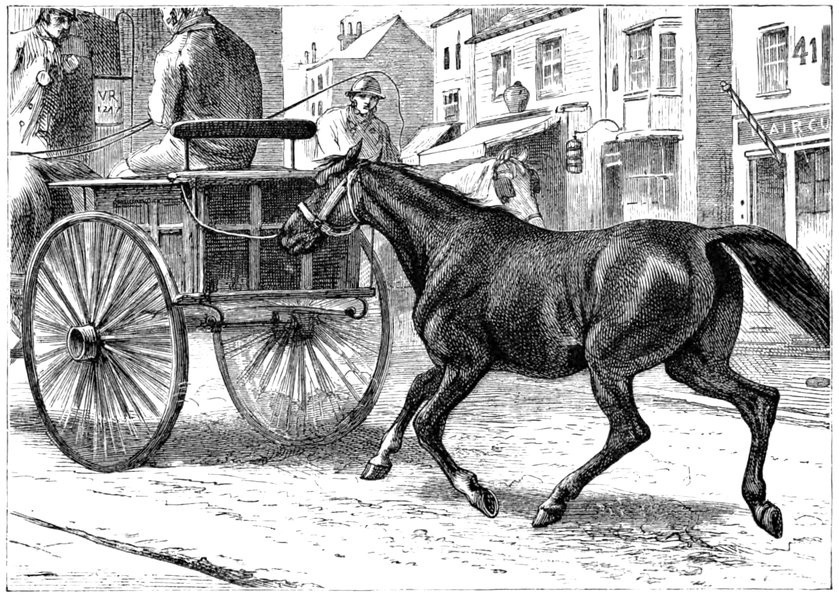
not. First he shouted to me; then he shook the rein; then
I felt the cruel whip about my loins and head, until pain
and fright bewildered me. We came to a steep hill, but I
seemed to be scarcely conscious of where I was, as Richards
beat me more furiously than ever. Maddened, I sprang forward
and tore down the hill: the weight behind was too much, I
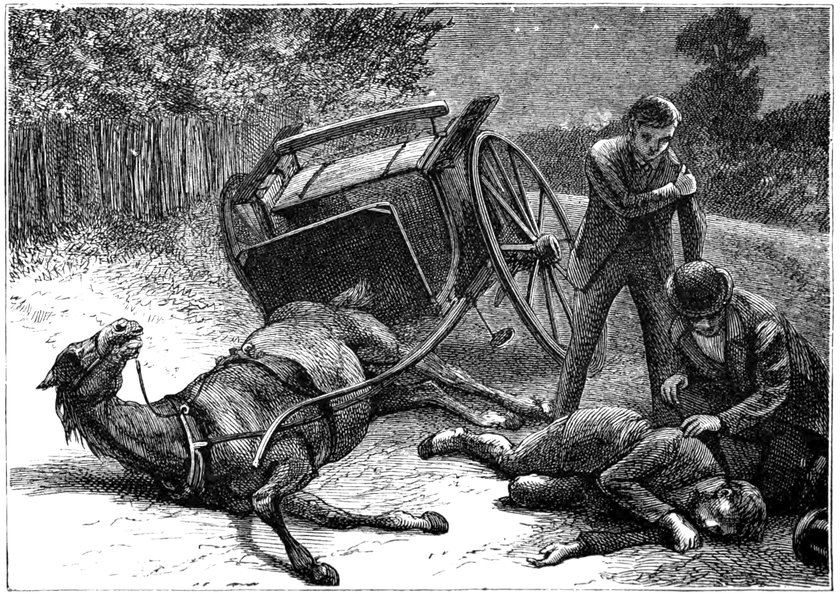
could not gather my feet, and down I went with a terrible
crash.
For a moment all was still, and I lay panting, half-dead with
fear and excitement; then I heard one of the men shouting
for help. What followed I can but dimly remember, for I
was in a state of bewilderment, like a horse in a dream; but I
can just call to mind the arrival of several persons from a
house close by, who helped the men to put something heavy
into the cart, and then I, having arisen, was led slowly home.
I was suffering very much; my knees were dreadfully cut, and
I was terribly shaken; but my thoughts were busy with the load
I was bearing home. It was poor Richards with a broken
neck, quite dead!
They rang Mr. Crawshay up and told him what had happened.
His first inquiry was for his portmanteau, which was
safe; then he expressed a few words of regret for Richards,
qualifying his sorrow by saying that it was just what he expected;
and wound up by cursing me, as a brute who was not
worth his salt. I was very tired and bruised and sore, but I
had enough spirit left in me to kick him then; I should have
done so, but I remembered the lesson of my mother, and
wisely forbore.
Mr. Crawshay did give me shelter for the night, but I heard
him declare he would have no broken-kneed beast about his
20place, and that I should be taken away on the morrow to be
sold. He carried out his threat, and early on the morrow a
small ferret-faced man came and led me away before I had
an opportunity of having a parting glance at my mistresses.
This act I have always believed to be in accordance with
Mr. Crawshay’s general conduct towards his wife and daughter;
it was one more link in the chain of unkind deeds with which
he had burdened their lives. Mr. Crawshay knew his wife
and daughter were fond of me, and would gladly have kept me
in spite of my misfortune; but the opportunity for an unkindness
offered, such as could safely be performed in the face of
the world, and he seized it. Strange it is, but true, that some
men will spend a deal and go far out of their way to give pain,
when they could bestow happiness with less trouble and half
the expense.
21
CHAPTER IV. I AM SOLD.—MR. HARKAWAY.
The ferret-faced man, before removing me, put some ointment
upon my sores, and painted my legs with something which hid
my accident from the eyes of casual observers; then he led
me through the town into the country, where we joined company
with another ferret-faced man who had several horses of
various sizes and ages under his charge. I was tied to the rest
with a halter, and then we jogged quietly along the road, the
two men smoking and chatting as we went along.
My companions were strange to me—strange in the strictest
sense of the word, for they had all been brought up in London,
a place I had heard very little of; but I was certainly not impressed
with any favourable notion of it when I saw their
flippant pert ways, and became acquainted with the style of
their conversation. Naturally I, as soon as I joined company,
wished them good day, and made some remark upon the fineness
of the weather and the excellence of the second hay crop.
To this they one and all responded with a sarcastic roll of the
eye, and one old horse most impertinently called me a
‘yokel’—an insult I resented by becoming perfectly quiet and
withdrawing as soon as possible from a company where I
could see I was not particularly wanted.
I gathered from what they said that they had been down to
some place belonging to the ferret-faced man ‘to grass,’ that
22is, to recruit their health after a season of very heavy work in
town. They all seemed to like an idle life, but some of them
really cared very little for the country, and generally expressed
themselves glad to return to town.
‘Another month here would have killed me,’ said a young
horse with a Roman nose; ‘it is so dreadfully slow, and I cannot
live without “fun.” Of course the fresh air and the green
fields and the purer water we get does us good bodily—but we
must feed the mind, you know.’
The others agreed to this, and I kept on for a long time
thinking and surmising what sort of food for the mind could
be obtained in the great city. I have learnt since, and I must
say that much better food for the mind—food more wholesome
and nourishing—can be obtained in the country than in the
town; but we must not be astonished at poor ignorant horses
expressing such an opinion, when we know that thousands of
intelligent men declare the same thing.
We did not walk the whole way to town—London was a
long way off; but on our arrival at a place much larger than
Upton, we were taken to a tremendous barn-like place roofed
in with glass, and filled with large boxes upon wheels, some of
them with chimneys to them, which puffed and snorted in such
a way that I could not help jumping about in a fright, much to
the amusement of my companions. The ferret-faced man, probably
with a view to restore my calmness, beat me about the
head with a stick, and then hustled me into one of the boxes
with another horse, and closed the door.
I found myself shut in with one of the best of my late companions—a
horse who had in snubbing me rather followed the
leadership of others than obeyed the dictation of his own
feelings. He told me not to be alarmed, that there was nothing
to fear, and that we were going to travel about a hundred
miles by railway. I asked him what a railway was, and he told
me it was something which man had made to imitate the
horse, to do its work in transmitting men and goods.
‘But it is a very poor imitation,’ he said; ‘they cannot trust
it anywhere off the particular road and rails laid down for it;
and there is no grace, no action in it, and whatever it does it
23makes a frightful noise about. I know that any horse would
blush to make half the fuss. When man first made it, he said
that he could do without the horse; but he made a great mistake.
Horses,’ added my informant with some pride, ‘have since the
establishment of railways become worth double the money.’
I asked a deal more about this railway, and my companion
gave me a very good general idea of this base but fortunately
unsuccessful attempt to supersede the horse, with which I do
not intend to trouble my readers; and just as he finished, the
train started.
Oh! the agony of that journey!—the shaking, the jolting,
the screaming, the roaring, and the noise and rattle of other
trains as they passed us—it was dreadful, especially to me who
had never undergone the ordeal before. My companion suffered
less—he had travelled upon, many occasions, and was
more composed. In about four hours we arrived in London,
and I being released, took my first peep at the big city.
The impression was not favourable. The place looked large,
and very, very dirty; the dingy courtyard of the railway station
gave me the heartache to look at it, and the promise of a most
miserable place to live in was fulfilled when the ferret-faced
man led me into the streets. Many horses I have met with,
knowing that I have a literary turn of mind, have asked me to
describe the great city; but I always decline to do so—it
defies description: volumes might be written upon every foot
of its paved way, and libraries filled with the wonders of a
street. It is at once a paradise to pleasure-seekers, a desert to
the friendless, a gold mine to the successful, a pit of destruction
to the unfortunate; it contains every vanity and every
pleasure of human existence; the poorest, the richest, the
proudest, the meekest—the lost in vice, the raised in virtue;
the very depths of vice, the highest aspiration and the noblest
thought, can alike be found within its gates. Joy, hope, love,
hatred, malice, and despair are all in the shadow of its walls,
and lie hidden in the hearts of men not scattered here and
there, but gathered close together in teeming millions.
The very thought of attempting to describe such a place
drives me to despair: I leave it for an abler horse.
24We kept on for half an hour, with nothing but houses on
either side, and then I was led into a paved yard, where I saw
a long row of stabling, all very clean and nice—more so than
I could have expected, considering the place was in the heart
of the great city. I spent ten days there, and then I, with a
number of other horses, was put up for sale; but in the meantime
my broken knees had been attended to by a very clever
veterinary surgeon, who put them right in the most astonishing
manner. I heard one of the ferret-faced men declare that it
would take a very good pair of eyes to tell that I had been
down, and as far as my sight went I was perfectly restored.
I felt a little weakness, and nothing more.
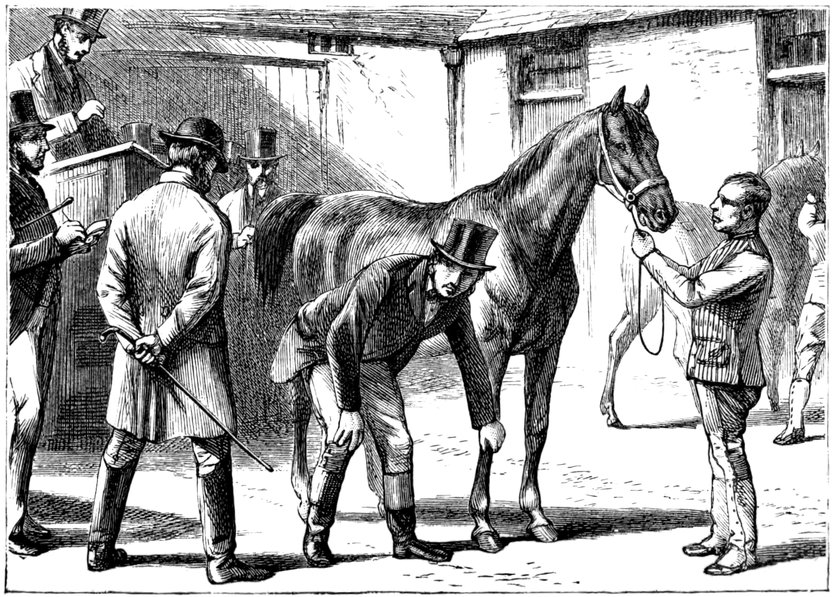
A great number of people attended the sale, and we were
all made very spruce for the occasion. The grooms trotted
us up and down, and made us show off ourselves to the best
advantage. Several of the bystanders seemed to take a great
deal of notice of us, and these I afterwards noticed were the
principal buyers.
One of the horses which accompanied me from Upton was
put up first, and the bidding began—but slowly. Neither the
auctioneer—a tall, stout, florid man—nor the public seemed to
think much of him, and after a little haggling he was knocked
down for twenty pounds. As he was led back to his stall I was
led out, and the disgust written upon his face found vent in words.
‘Twenty pounds!’ he said, with an indignant neigh; ‘there’s
a price! If I had dreamt of such a thing a month ago, I
believe I should have drowned myself in the river.’
I shook my head to express my disapproval of such light
talk, but could say nothing, as the groom who led me gave me
a thump with the halter, and bade me ‘come up’—which I
did by breaking into what was really a very pretty trot.
‘Now here, gentlemen,’ said the auctioneer, ‘is a very valuable
lot, named Blossom, reared by Bayne, of Upton, a man
who, as you are fully aware, never sends a bad lot into the
market. This horse is rising four, and has never been in
private hands, but he is thoroughly fit either to ride or drive.
Take a look at him, gentlemen. Don’t be afraid of it; he can
bear it—sound from the tip of his nose to the end of his tail.’
25
THE AUCTION.
27Oh! the falsehood of this man—to say that I had never
been out of private hands, and that I was thoroughly sound.
I really felt as if I could have kicked him—not very hard, but
in such a way as to warn him not to tell such fibs again. The
groom trotted me to and fro, then pulled up, and a number of
men proceeded to examine me.
‘He’s been down, ain’t he?’ asked a short, thick-set man,
who spoke in a husky voice, as if he had a hair or straw in his
throat.
‘I believe he knocked himself in the paddock, Mr. Harkaway,’
replied the auctioneer; ‘a mere graze, though—the skin
was barely broken.’
‘He grazed a tenner off him,’ said Mr. Harkaway, with a
short laugh; adding in a whisper to a man, apparently his
friend, who stood beside him, ‘But he is the sort of nag I
want; and I will have him.’
The bidding for me, in spite of the signs of my fall, was very
brisk, and I soon ran up to forty pounds; then a few fell
away, and I increased to fifty. At this sum all left me but Mr.
Harkaway and a man in a sort of grazier’s suit, with a face so
positively cruel, that I shudder even now when I think of it.
Mr. Harkaway had a dissipated, reckless look, which reminded
me of Richards; and if I could have had my will, I would
have chosen another master; but he was better than the grazier,
and I earnestly hoped that he would show the longer purse.
‘Fifty-five,’ said the grazier.
‘Six,’ said Mr. Harkaway.
‘Seven,’ cried the other.
‘Eight,’ returned Mr. Harkaway.
‘Nine,’ shouted the grazier.
Mr. Harkaway hesitated, and looked at me. I turned an
imploring eye upon him, but I might as well have looked at a
brick wall—he was as stupid as the rest of the men, and did
not understand me a bit; but the auctioneer came to my rescue.
‘Come, Mr. Harkaway,’ he said, ‘put another pound on—you
won’t get such another chance this season; the horse is
young, sound, good-tempered, and ready for any amount of
work. Shall I say sixty?’
28‘Sixty be it,’ said Mr. Harkaway, and the hammer to my
great joy fell. The grazier seemed to be rather disappointed—his
face expressed that feeling; but he said he was glad he had
not bought me, as I was a poor thing at the best, only fit for a
dust cart. This hurt me a little, for none of us like to be depreciated
even by those we despise; but since then I have heard
a story about a fox and some grapes, which sufficiently explains
the insulting expressions of the grazier.
As the rest of the sale has no interest to my readers, or any
connexion with my life, I will pass it over with the simple
declaration that it was a very painful thing to witness. Falsehood
and deceit were rampant; not a single horse was honestly
represented to the public, and some poor things, long past
work, were doctored and stimulated for the occasion, and then
solemnly described as horses in excellent condition—fit for any
amount of service. Most of the men collected there were too
sharp to be deceived; but I am afraid that more than one was
that day sadly swindled and deceived by the artful horse-dealer
and the glib-tongued auctioneer.
As I have since become thoroughly acquainted with London,
I may as well now call places by their proper names; such a
course will help those of my friends as know the metropolis to
a more definite idea of my wanderings, and assist me in making
my story more graphic to the rest of my readers.
Late in the afternoon Mr. Harkaway fetched me from the
horse-dealer’s yard, and tying my halter to the tail of a common
cart, drove away. There was a big brown horse in the shafts,
whom he called ‘Sam’—rather a knowing-looking animal, I
thought, and one certainly accustomed to the noisy ways of
this bewildering place. We travelled over an immense stone
bridge near the Houses of Parliament, and turning to the right
went through a maze of street, for the most part poor, dirty, and
miserable, making me wonder how any one could live in such
tumble-down houses. This was Lambeth, and Lambeth was
to be my home; for my new master halted at a house by the
corner of a street a shade better than most we had passed
through, and shouted out for Jim in such a way that I knew
the house must be his own.
29
LEAVING THE HORSE-DEALER’S YARD.
31
CHAPTER V. THE FURNITURE DEALER.
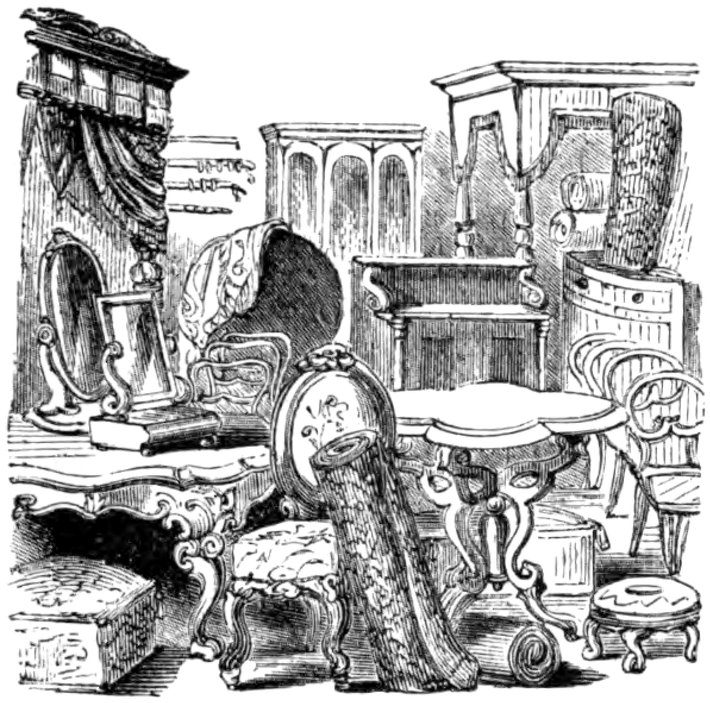
The whole of the front of my master’s house seemed to be
devoted to business. The ground floor was quite open, with
furniture of every description piled up to the ceiling; and from
the windows above hung hearth-rugs, pieces of carpet, long
strings of tinware, brushes, and so on, sufficient in my eyes to
supply the entire population of Great Britain.
He seemed to deal in every household requisite; the number
and variety of articles for sale were quite bewildering, and to
an unpractised eye appeared to be piled up anyhow on either
side, without any regard to law or order, leaving a small narrow
lane only to travel in and out.
Down this lane came the boy Jim, Mr. Harkaway’s son and
heir, a lad of twelve years, who hailed his father with a sullen
visage, and the inquiry, ‘Now, then, what do you want?’
‘Take the nags round,’ said Mr. Harkaway, ‘and give ’em
both a feed. You need not be particular with the new one,
Blossom—he’s done no work to-day.’
‘Will he kick?’ asked Jim.
‘Quiet as a lamb,’ replied his father; and the boy, with
rather a suspicious look at me, led Sam round the corner, and
I perforce followed.
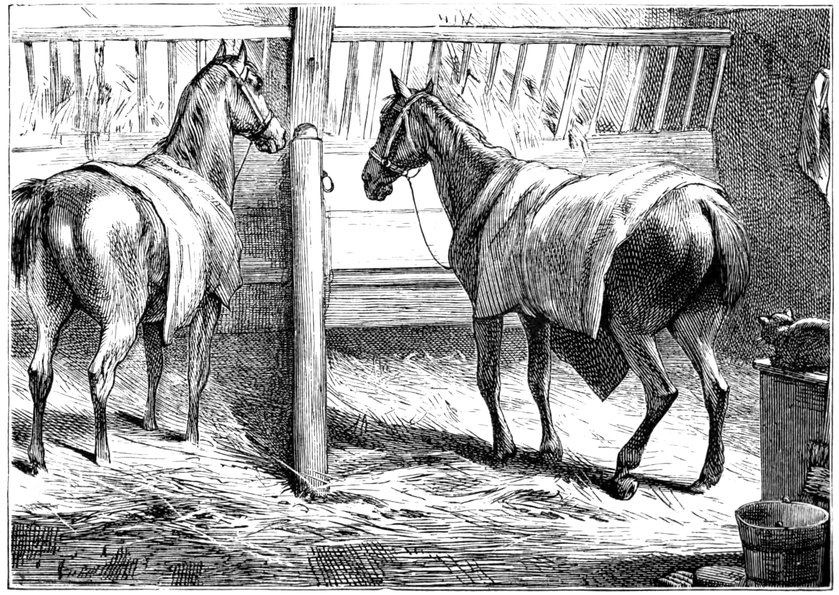
32Mr. Harkaway’s stable was certainly a most abominable hole,
bad enough to kill any horse fresh from the country with the
look of it; but as I afterwards learnt from Sam and my own
sad experience, there were hundreds of worse places, where
even man himself was glad to dwell—indeed, an entire family
lived and slept in a wretched room over our wretched stable.
Jim gave Sam a pretty good feed, and me a handful of hay;
after this he made up two slovenly beds for us, and retired for
the night. I was glad when he was gone, as I wanted to be
alone with Sam, for I was burning with curiosity to hear what
sort of life was in store for me.
Sam attacked the food given to him as if he were in need of
it, and went on munching for some time without a word; and
I kept silent, fearing that any remarks I might make would be
deemed intrusive, and thus defeat the end I had in view. We
were only divided by a pole, so that even lying down it would
be easy to converse, and I waited patiently. Sam munched
his food to the last wisp of hay and kernel of corn; then
settling down, condescended to address me.
‘Well, youngster,’ he said, with a sort of grunt, ‘where do
you hail from?’
‘Upton,’ I replied.
‘Country,’ returned Sam. ‘Ah! you will find it different here.’
‘I am afraid so,’ I replied softly, with a sigh.
‘There is a little life here,’ continued Sam, who apparently
had not heard my remark. ‘No trotting about for miles and
seeing nothing but hedgerows and trees and fields full of grass
and corn, tantalizing a hungry horse to death; no brooks to
wet your feet and legs by crossing, and not half the flies to
bother you. We have flies, of course, but they don’t seem half
so hungry as they are in the country—it’s the air, I suppose.’
‘The country air is supposed to give an appetite,’ I
remarked, not caring to say too much in praise of the country
at present.
‘That is why I hate it,’ growled Sam. ‘Harkaway goes into
the country sometimes, and brings me home so horribly sharp
that I could eat my halter, but he gives me no more corn: a
feed is a feed to him, although it may not be more than half
33a feed to me. Harkaway is wretchedly stupid; but most men
are like him.’
I coughed an assent to this, and Sam went on for awhile
grumbling about the short allowance of corn he received, until
I thought I might venture to ask for a little information about
my master. Sam, to my joy, received my inquiries in a very
amiable spirit.
‘Harkaway,’ he said, ‘is a furniture dealer, principally
second-hand. He will buy anything, from the lid of a saucepan
to an entire house of furniture, and will gladly sell the same if
he can realize a fair or an unfair profit. He calls it “turning
an honest penny;” but honest as it may be, I have heard him
tell the most abominable falsehoods while transacting the most
simple acts of business. He will declare, with all the solemnity
of a man upon oath, that he gave so-and-so for such a thing,
and that he will lose by the transaction, when he knows it did
not cost him half the money, and that he will realize a very
respectable profit.’
‘It is very sad,’ I said.
‘And it is also absurd,’ returned Sam; ‘for no man
believes him—they know as well as he does that he sells for
profit, and profit alone; as for any motive of philanthropy, you
won’t find such a thing in men of the Harkaway class.’
‘You say the furniture is second-hand,’ I said; ‘where does
he get it from?’
‘Mostly from homes where ruin has stepped in, an unwelcome
guest,’ replied Sam solemnly. ‘When a man gets into
difficulties, his landlord seizes his furniture, and sells it for rent.
Upon these occasions the goods are generally put up by auction,
and then Harkaway buys with the rest of the public. But very
often the ruined tenant is not only ruined, but a man of bad
principles; then he calls in my master, sells everything he has,
and goes away with every debt unpaid. These are very profitable
transactions, for he generally gets the goods at his own price.’
‘But are not some of these seizures oppressive?’ I asked.
‘Very,’ replied Sam. ‘Some landlords are very harsh, and
turn the widow and orphan into the streets without the least
remorse.’
34‘What becomes of them?’
‘Don’t ask me,’ said Sam, shaking his head; ‘when you have
been in London a year or two, you will have seen enough to
guess what becomes of the helpless and unfortunate.’
‘Tell me something about Mr. Harkaway’s family,’ I said;
‘give me an idea of his character.’
‘Call him Harkaway—we have no misters this side of the
water,’ replied Sam. ‘So you want an idea of his character
and family. Well, here it is. Harkaway is a sordid, grasping
man, who has not an idea beyond making money; it is never
out of his thought—he dreams pounds, shillings, and pence, I
think. His idea of everything is, what is it worth, and what
will it fetch? He would die of despair in Paradise, if there was
nothing to buy and sell. His wife is just like him, and when a
bad bargain is made, which sometimes happens, they mourn
together like parents bereaved of a promising family. Jim is
their son. Nursed and cradled upon the pounds, shillings, and
pence idea, he has no love, no sentiment, no religion—he
possesses nothing which helps to make man noble; and I
verily believe that, young as he is, he would sell his parents for
five shillings, if anybody would be rash enough to buy them.
He feels no love or gratitude towards them; he is cold, crafty,
and cruel to a terrible degree; he tortures insects, beats dogs,
and pinches children like a little ogre; and the day is not far
distant when he will prove a thorn in the side of the parents
who have made him what he is.’
‘In what way?’ I asked.
‘I cannot precisely tell,’ replied Sam. ‘But such children
mostly develop into lovers of low dissipation; they haunt music
halls and low dancing saloons, spending, in a manner quite at
variance with their sordid nature, the money accumulated by
the craft of their parents. I have known many such, and I can
see this boy is already in the downward road.’
I said I was sorry to hear it, and hoped Sam would prove to
be a false prophet for the boy’s sake. Sam grunted something
in reply, and gave out signs of falling asleep. As I had now
learned all I cared to know for the present, I said no more, and
we were soon both enjoying sound repose.
35
CHAPTER VI. SAD SCENES OF LIFE.
I was awakened in the morning by a knocking overhead, which
Sam, who was already up and stirring, told me proceeded from
the head of the family in the room above, who was a cobbler.
I also heard the tongue of a loud-talking woman, and the murmur
of the voices of several children.
‘How many up there?’ I inquired.
‘Father, mother, and six children,’ replied Sam. ‘The father
works hard, and is a patient, quiet man; but the mother drinks
and scolds, and the home is a wretched one. Home I called
it—ah! a poor home it is, and many a pig would turn up his
nose at it.’
Mr. Harkaway and his son entered and interrupted our conversation.
Jim, under the eye of his father, gave us a fairish
36grooming and a feed of corn; then I was taken out, harnessed,
and put to my first day’s work in the furniture line. Mr.
Harkaway drove me to a house in the Old Kent Road, with
the walls all plastered with bills, and leaving Jim in charge of
the cart, went in.
Everything was so novel to me that the time passed very
quickly. A street in London or the suburbs is a perfect
panorama to any observant creature, and no one need languish
for want of food for the mind. The faces alone are sufficient
to amuse and interest any thoughtful horse or man. Watch
two as they meet and salute, and you will see whether they be
friend or foe. Mark their style of greeting, their faces as they
meet and part, and you will have a very good idea of the true
nature of the feeling between them. The varieties of life are
endless, the shades of emotion numberless, and he who cares
to study the book of nature may read on throughout his days,
and find in the end that he has but imperfectly scanned a single
page.
There was much to study in the other horses I met with daily,
and the dogs too were very interesting; but my great study
was man, and I shall devote the principal part of these pages
to him. I hope my experience of our lord and master was a
very exceptional one, but I am sorry to say that I found very
little good in him.
My life with Mr. Harkaway was for the most part very
monotonous; he worked me very hard, and fed me as little as
was consistent with the amount of work required of me. Sometimes
Sam and I were taken out together in a large van to move
the goods and chattels of some tradesman; but as a rule we
were employed apart on small jobs, Mr. Harkaway driving me,
and Sam being under the guidance of that atom of vice, the
boy Jim. I do not care to speak ill of any one, but I must say
that the training of this lad was fatal to every good quality which
must have been born in him. He was cruel, crafty, and fond
of low self-indulgence; he smoked and even drank with men—some
of whom were old and grey, and ought to have checked
the boy in his evil ways.
Sometimes it happened that I fell into his hands, and his
37father took Sam, and then I had a very pretty day of it. He
would make me gallop until I flagged, and then beat me until
I galloped again, and this with a heavy load behind me too,
without the least remorse; and often I have returned to the
stable in such a condition that I did not expect to leave it again
alive.
I used to complain to Sam, but he said it was a common mode
of treatment towards horses in London, and that thousands died
yearly from overwork and neglect, or gave in with a broken
heart, the result of unnecessary cruelty.
‘A good horse does not need the whip,’ he said; ‘but there
are some people who use it upon every possible occasion. If
a horse is tired, they lash him without mercy—they must have
an idea that there is virtue in the whipcord, and that it gives
us a renewal of the strength we have expended in their service.’
‘That wretched boy, Jim,’ I remarked, ‘must use a deal of
whipcord.’
‘That boy is fond of giving pain,’ returned Sam; ‘if he is
grooming me, and wants me to stand over, he does not say so,
but to save his tongue kicks me in the ribs as if I were a log of
wood or a feather bed. I have known the day when I would
have repaid him amply, but this miserable life has taken all the
spirit out of me. Heigho!’
‘You have had a very hard life,’ I said.
‘Very,’ replied Sam. ‘I was born in the country, but left it
quite young. A dealer, Putney way, broke me in; he was
celebrated for such work, and a cruel fellow he was. The bits
he used were fearful, and I can almost feel his spurs now; as
for his whip, it used to cross my ribs like a thin band of red-hot
iron—ugh! What horse could stand it? So we all gave in;
and he was celebrated as a trainer of horses. Isn’t it disgusting!’
‘Men will be wiser some day,’ I said consolingly. ‘How
old are you, Sam?’
‘Somewhere about twelve,’ said Sam; ‘not at all old for a
horse well used—but I am almost worked out. I heard Harkaway
tell his wife to-day that I was scarcely worth my feed.
Well! the knacker may come for aught I care.’
38‘What is a knacker?’ inquired I.
‘A horse murderer,’ replied Sara. ‘When a horse gets old
and past work, this man is sent for, or we are taken to him. In
either case it is his business to kill us, and he makes very short
work of it. But we are useful to the end; they make shoes,
glue, and all sorts of useful things out of our very carcases; and
if man had any real love or gratitude in his composition, he
would treat us all well when we are alive.’
‘But all masters are not cruel, Sam.’
‘No: many are very kind, and keep their stables in better
condition than they do their cottages for the labouring poor;
and some keep both horse and labourer well, but these are the
exception, and not the rule. For my part, I do not care for a
rich master; give me a quiet family of the middle class, living,
let us say, at Finchley, Hampstead, or somewhere about eight
miles the north of London; these are the people who feed and
treat a horse well.’
‘Were you ever in such a family, Sam?’
‘No; but once I was almost bought by a gentleman of that
class, but the chance went by, and I am now too old to hope
for such a thing. I have, however, heard a deal of this life,
and I am sure nothing could be more agreeable. Now you are
a likely fellow to drop upon this sort of thing, if ever Harkaway
makes up his mind to sell you.’
The picture drawn by Sam pleased me very much, and I
earnestly hoped that such a lot might befall me.
So my life passed on. I dragged furniture about—now from
a general sale, now at midnight from a fraudulent debtor’s
house, and once from a ruined home, where the law had deprived
the widow and fatherless of the comforts of life. Sometimes
Mr. Harkaway beat me very cruelly; but he was generally
sparing of the whip, as he had an idea that it knocked some of
the value off a horse—as rubbing removes gilt from gingerbread;
still he did not hesitate to overload me, and gave me
such burdens to bear that I often felt I must die beneath them.
Yet I kept on, supported by youth, I suppose, and endured
this life for four long years.
During this time I had not forgotten my place of birth, or
39those connected with it. Of my mother I thought a great
deal; but I had no anxiety on her account, as I had often
heard Mr. Bayne declare that he intended to keep her all his
life. Rip was very often in my mind, and a thousand times I
wondered what had become of him, with a yearning such as
one true friend feels for another. I loved Rip; he was so full
of life, so spirited, so brilliant in action, that any one with an
eye for beauty must have admired him. Ah, noble Rip! I did
indeed love you, and wonder if the humble companion of your
youth, pining in the dingy stable of a furniture dealer, ever
entered your thoughts. Nor did I forget the beauty of the
scene where I was born: the paddock, the stream, the old mill,
and the rich surrounding foliage oft rose before me, and never
faded away again without leaving behind an aching heart.
Often and often I have, in fancy, smelt the sweet meadow
flowers, and heard the melodious beating of Rip’s feet upon
the soft turf, as he gaily pranced about the field; and such
memories, if they have brought pain, have had a softening
influence too, and I have lain down to sleep a sadder but a
better horse.
The four years gave me a good knowledge of the great
metropolis, as business at various times took me to every part
of it; and the more I knew, the more I wondered at the magnitude
of the place. I have learnt more since, and I have not
ceased to wonder.
About this period a very terrible thing happened. I had
been out all day with my master, and was back in the stable
quite worn-out, thankful for the prospect of rest, when Jim, now
a morose, sullen, dissipated young man, came into the stable,
and without putting any harness upon me led me away. The
act was so novel that my mind became full of vague terror, and
the terrible knackers talked of by Sam arose before my eyes;
but I dismissed the thought as a piece of folly—for I was yet
active and full of work, and Mr. Harkaway was not the man to
waste capital by useless slaughter—and looked about me for a
more reasonable solution of the mystery.
With his head down, Jim Harkaway slouched beside me,
giving no clue, and I wondered in vain as we walked the length
40of several streets, and came at last into the presence of a small
crowd of people. An opening was made for Jim, and he led
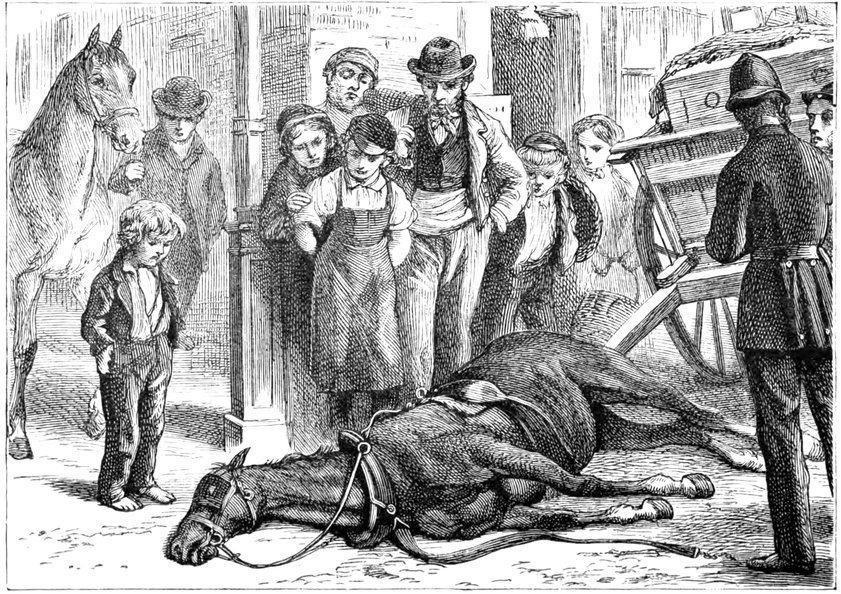
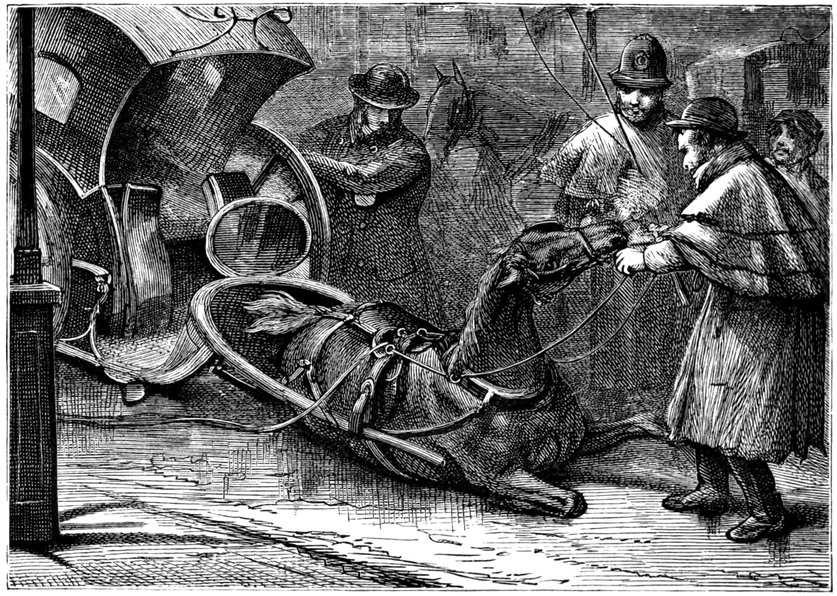
me through. The first thing I saw was a cartload of furniture
resting upon the shafts; the next, a horse lying in the road,
quite still.
The shock was dreadful. I read the truth at once. Poor
Sam was dead—had died in the midst of his daily duty. It
was indeed terrible, but I found no tears then. My sorrow was
tempered with a dawning conviction that this sudden death
was to him a merciful and happy release. In the morning
before starting he had complained of a pain in his side, but
such a form of suffering was common to us both, and I did not
dream of finding him dead that night. Jim harnessed me in,
and drove away, leaving poor Sam in charge of a man in a
very dirty blue slop—a knacker’s assistant, I have since been
informed.
That was a long night for me, and I slept but little. Sam,
and Rip, and mother, and home were alternately in my thoughts
through the long dark hours; and when the morning came, it
found me but little prepared for work. Prepared or not, there
was the work to do, and during that and many days following
I toiled early and late, until I began to give out signs of really
breaking down; and then Mr. Harkaway, still influenced by
the pounds, shillings, and pence idea, kindly sent me into the
country for a month’s rest and fresh green food.
41
DEATH OF POOR SAM.
43
CHAPTER VII. MY NEW MASTER, BENJAMIN BUNTER.
I was sent down to a place about two miles from Blackheath,
on the Forest Hill side, and spent the days of my leisure in a
field, sharing the welcome grass with half a dozen cows belonging
to a local dairyman. It was almost as bad as being alone,
having no other horse for a companion; for the cows, not very
conversational among themselves, did not care to accost a
stranger who spoke a language they did not understand.
It was not like my early home, but it was a paradise compared
to the dungeon I lived in down Lambeth way, and I
would have been well content to have spent the rest of my
days there; but I had a great amount of work left in my bones
yet, and it was not to be.
When the month was up, Jim Harkaway came to fetch me.
I am sorry to say that he was rather the worse for beer when
he arrived, and before we got home he was in a horrible state
of intoxication. We met Mr. Harkaway near home, and the
way his son addressed him was very shocking; you would not
44hear it from any creature save man—the noblest in his best
condition, in his fall the most degraded.
High words ensued between father and son, and several
people stopped one after the other; but they all went on again,
saying that it was ‘only old Harkaway and his precious son,’
so I concluded that these scenes between them were growing
common. In the end Mr. Harkaway wrenched the bridle away
from his son, and led me up a turning opposite the shop. I
was surprised at not going home, and still more surprised when
he halted before a greengrocer’s shop, and Mr. Harkaway asked
a stout woman if her husband was at home.
‘He’s round the yard,’ was the reply; ‘but he will be here
in a minute.’
In less than a minute the husband came—a short, thick-set
man, deeply pock-marked, and dressed in corduroy, with a
flaring red silk handkerchief round his throat.
‘Mornin’, Mr. Harkaway,’ he said.
‘Morning,’ replied my master. ‘I have brought Blossom to
you myself. Jim is going on worse than ever.’
‘Sorry to hear it,’ said the other. ‘But you ain’t half sharp
enough with him. If he was a son of mine, I would give him
the key of the street, as sure as my name is Benjamin Bunter.’
‘Mrs. Harkaway clings to him,’ said Mr. Harkaway nervously;
‘she is a woman, and he is an only son; but it is a
great trial—the money he wastes is enough to break one’s
heart.’
Not a word about the vice of the youth—it was still pounds,
shillings, and pence to the furniture dealer.
“Well, what are we to say for Blossom?’ said the greengrocer,
stroking my fore-leg with his hand.
‘He is worth thirty,’ replied Mr. Harkaway. ‘I am only
selling him because I was obliged to buy two horses to carry
on my business while he was away. He is worth thirty
pounds.’
‘You mean twenty,’ said Benjamin Bunter shortly.
‘No—thirty, I mean.’
‘Twenty.’
In this style they haggled for awhile, and the bargain ended
45in the usual way; I became the property of Benjamin Bunter,
greengrocer, for the sum of twenty-five pounds sterling.
In this manner I parted from the furniture dealer, and we
never met again; but I learnt his fate in a casual way, and I
may as well give it here. He was killed in a railway accident
on his way back from a country sale, and having died without
a will (he had put it off a hundred times on the ground of
the expense), the better part of his property fell into the
hands of his son, who justified his worldly training by squandering
the money like dirt, and dying, while yet in his youth,
mad with drink. What became of the mother I never knew.
Let me turn to my new master, Benjamin Bunter, and
endeavour to describe him to my reading friends as I afterwards
knew him. This master of mine was what is known as
a ‘free living man’—he made a deal of money in his business,
and spent it almost as soon as he got it. He was very fond of
eating and drinking, and delighted in such pleasure as could
be found on race-courses, at pigeon matches, and so on. His
wife had precisely similar tastes, and they jogged on very well
together; and the half-dozen children they had brought into
the world were, as far as food and clothing went, well cared for,
but all else was entirely neglected.
Let me speak of the man as I found him. Benjamin
Bunter had a kind heart, and he fed me liberally; but he was
a thoughtless man, and many a time he has, without the
slightest regard for my good or ill, kept me all day without
food at a pigeon match, and then taken up half a dozen men
with him for ‘a lift’ home. He would also drive his wife and
children to Epping for a day’s outing, and the exhaustion I
have felt after the efforts required on such occasions was very
great.
With regard to the pigeon-shooting I wish to say, without going
into the subject, that I think it a very cruel and unmanly sport.
The contest is not equal in any way. What can be more
cowardly than to box up a poor helpless thing for awhile, then
pretend to give it liberty and shoot it as soon as it shows its
head? Call that ‘sport’—I wonder men are not ashamed of it!
I was employed in the business mostly, and very often I was in
46the Borough Market as early as four o’clock, and there I met
with many horses and ponies engaged in the same trade; some
were well cared for and fed liberally, but others had cruel or
indifferent masters. Some of the men were given to bad language,
and used the most fearful oaths whenever their animals
did even the slightest thing wrong. Generally the fault lay with
the masters, who perhaps had a little difficulty in fixing their
carts among the rest, and instead of going quietly and easily to
work, out came the whip, and the horse’s head was wrenched
about, until he was quite bewildered. Who can wonder if the
poor creature backed into the wrong place, or showed a tendency
to go opposite to the direction required? Man talks a
deal about reason, but he too often forgets to act upon it,
especially when he is dealing with such poor creatures as
myself.
The scenes in the market were very exciting and amusing as
a rule, but many of them were painful. Foul language was
sometimes followed by a brutal fight, which gave amusement to a
thoughtless crowd, until the police appeared. Whenever such
a scene took place I noticed that the fighting men were invariably
the worse for drink; the sober buyers, sellers, and labourers
always did their work quickly and went away quietly.
I am now coming to an episode in my life which requires an
entire chapter to itself, for it opened up to me a new train of
thought with regard to the connection between horse and man,
and the really important influence they have upon each other.
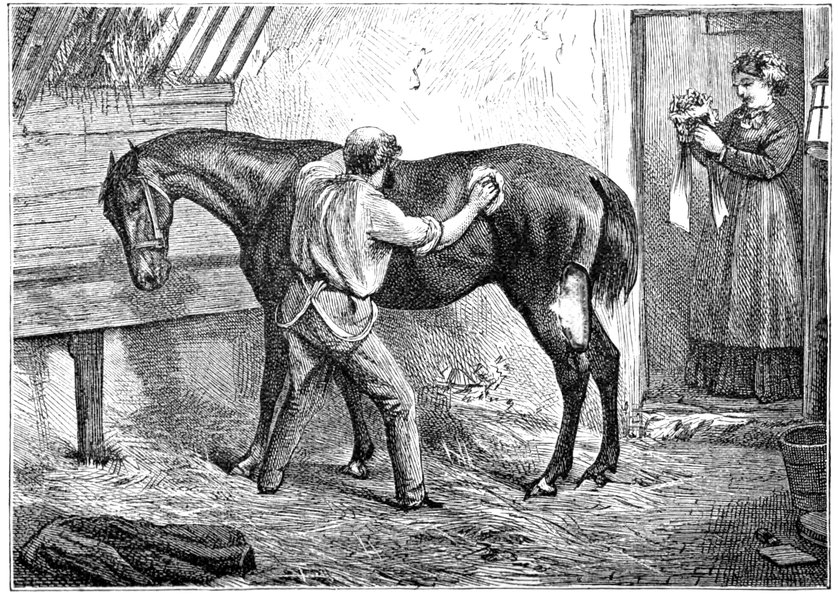
One night, late in the month of May, Benjamin Bunter came
into my stable and gave me an extra grooming, combing my
coat and plaiting my mane with wonderful care. While he was
at work Mrs. Bunter entered with a large bonnet covered with
flowers in her hand. Mrs. Bunter, by the way, had a great
love for bright colours, and was generally a walking object of
envy to her less fortunate neighbours.
‘There, Ben,’ she said, holding it up, ‘I think that will do.’
‘It’s prime,’ was his reply. ‘There won’t be many bonnets
like that upon the course. Everybody will know as we drive
along that we are going to the races. Come over, Blossom—steady
there.’
47
I AM GROOMED BY BENJAMIN BUNTER.
49So I was going to the races. Here was a prospect of something
new to me, and I immediately thought of Rip’s great-grandfather,
who had nearly won something or other many years
ago; and then I wondered what that something was, and in what
way it was contested; and then I wondered what had become
of Rip, and I continued wondering long after Benjamin Bunter
had finished work and retired to his supper in the little parlour
behind his well-stocked shop.
Sleep was almost a stranger to my eyes that night. Stimulated
by excitement, I continued to think and wonder until the
first grey light of the morning came stealing through the window
of my stable, and then I fell into a fitful doze, to dream that I
was a race-horse of the purest blood, famous for my victories
throughout the length and breadth of the land.
50
CHAPTER VIII. THE GREAT CARNIVAL.
In the morning my master was up early, but he did not go to
market, and it was quite nine o’clock when he harnessed me
to the cart and drove round to the front door. There was a
small knot of neighbours interested in our starting, and I found
that a plumber and his wife were going with us. Two chairs
were put into the back of the cart for the use of the ladies, and
the men sat in front, with the two eldest Bunter children on the
floor, making the party six in number. In addition to this was
a bag of cut hay and corn for my consumption, and a large
hamper of food and drink for the party.
I gathered from the conversation of the men that they were
both fond of betting, and that Mr. King had received overnight
a ‘tip,’ that is, information concerning a certain horse,
which would enable him to make a large sum of money that
day.
‘I am told that Melrose is sure to win,’ he whispered in a
confidential tone to my master while they were waiting for
51the ladies. ‘Wigen wrote to me to put every penny I have
upon it.’
‘I go with you,’ returned Benjamin Bunter. ‘I always
thought there was something meant with Melrose. Now then,
here is the missis; give her a hand, will you.’
Mr. King gallantly helped the ladies to their seats, then put
the children in, and we started. A few idle boys gave us a
cheer, the neighbours waved their hands, and then we went
through the streets at a smart pace.
The load behind me was rather heavy, but I did not mind
that, as there was, in addition to my curiosity being aroused,
the prospect of a peep at the green fields and a few hours’ fresh
air. In half an hour we had left the worst part of the bricks
and mortar behind us, and were travelling among the neat
suburban villas of prosperous tradesmen.
It was a bright fresh morning, and everything looked nice—villas,
trees, flowers, everything, down to the butchers’ carts
which we came upon now and then waiting at the garden gates
of the houses. My party enjoyed everything; they were all in
high spirits, and I have no doubt that Mrs. Bunter made the
most of her bonnet, which was a far superior thing to the
article worn by her friend Mrs. King. In spite of this, however,
the ladies were excellent friends.
About eight miles from town we pulled up at a roadside inn,
and my master fetched out a pot of beer. I felt this to be the
first hitch in a promising day; not that I personally object to
beer, for I do not know even the taste of it, but I have seen
the effects of it upon man, and they are anything but pleasant.
Never by any chance does it elevate or improve, and too
often it ruins and degrades—and yet men will drink it.
Here is something which I am sure man himself fails to
comprehend.
Our halt was brief, and we went on through quiet lanes and
broad, well-kept roads garnished with fragrant hedges and tall,
graceful trees, sometimes passing and at other times being
passed by other parties greater or smaller in number, and they
all seemed to be in the highest possible spirits, shouting and
laughing as if the world had nothing in it beyond going to the
52races, and they had left no sorrow or sin or shame in the
great city behind them.
By-and-by we came upon a stupendous hill, and here a boy
sitting upon a horse volunteered to help us up the hill for
sixpence. Benjamin Bunter was in an excellent humour, and
the offer was accepted; the horse was attached to the shafts of
the cart, and we moved forward.
Now I do not wish to speak ill of any of my race, but I
must out with the truth at all times—that helping horse was a
disgrace to his fellows. He was as cunning as a fox, and made
a deal of show, pretending to strain his muscles and spluttering
his feet about, but he did not pull a bit. He was as bad as the
boy upon his back, who shouted and pretended to urge him
on, while he really encouraged him to hold back. I ventured
to remonstrate in a whisper to my helper, but he only answered
with a short contemptuous laugh, which I have no doubt
Benjamin Bunter interpreted as a cough, and I had to do the
work of the hill in reality alone. At the top my master paid
the boy the sixpence, and the precious pair went back in
search of other victims.
After a brief rest we proceeded, and presently came upon
the downs where the races were held, and my master guided
me past a long line of white booths, erected for refreshment
and various purposes. In some I have been told men gamble
and fight, but I have never seen such things, and I only
pretend to give the results of my actual experience. There
was one large wooden erection which Benjamin Bunter pointed
out to his wife as the Grand Stand; it was empty then, but I
saw it later filled with ladies and gentlemen most magnificently
dressed.
We were very early, and my master secured a good place
near the ropes, after paying ten shillings for the privilege. He
and Mr. King then got down and went away, and Mrs.
Bunter brought out a bottle full of rum. She had a sip, Mrs.
King had a sip, and the children were induced to wet their
lips with it. All this seemed to me to be very shocking, but
there were many cartloads of people around doing much the
same thing, and nobody cried out against it.
53Turning from Mrs. Bunter and her friend, I took a look at
the scene around me. Like the great city, it defies description.
Early as it was thousands had already assembled, and the air
was full of shouts and laughter, and cries that some might have
thought the outburst of joy; but I could detect a wail beneath
it which told me that the joy was after all but a hollow thing.
I was now old enough and had seen enough to read man at a
glance, and as the thousands walked by I scanned their faces
and read no real satisfaction there. They were hilarious it is
true, but they lacked the contented expression which true
happiness brings. But even the apparently happy were in the
minority; the main part of this throng were eager, restless
creatures, who walked quickly up and down, and talked in low
whispers to their friends, or scanned little pocket-books with a
forlorn look, as if they read their doom therein. ‘Knave and
gamester’ were written in the looks of many—alas! too many—of
the young as well as old. Every amusement presented
by the itinerant took the gambling form—betting was the order
of the day, from pence to pounds. Some held up purses and
talked of large sums to be sold for a shilling, and the thoughtless,
untutored novice in race-course ways bought them, to find
themselves deceived, and to hear the laughter of those who
find fun in a miserable lie. Wheels of fortune, spinning
jennies, cards, dice, all were there, and vice, forgetting her
shame, walked boldly in the sunlight.
Opposite, the big wooden stand and others on either side
were filling, and a babel of voices rose from the shifting mass.
This, I was told afterwards, was the noise of betting men, who
risked their money—some all their wealth, honour, good name—on
the race to come. Some of the noblest names in our
land have been blackened in the betting ring. Some of the
richest among the people have left their all upon the race-course,
and gone home to shame and ruin. And yet men call
racing ‘pleasure;’ but who can reason with them on the subject
when they call pigeon-slaughter by the name of ‘sport’?
It was a strange motley scene, interesting in many points,
but painful in most, for I could see that there was more folly
than fun in everything around me; and folly, every thinking
54creature, horse and man, knows, is but the herald of ruin and
shame.
I was musing on the scene when my thoughts were interrupted
by a carriage which drew up beside me; it was open,
and contained two young fellows barely arrived at the
recognised age of manhood. Both were well dressed and in
the highest possible spirits. I was immediately interested in
them; but my attention was withdrawn by the horse in the
brougham, who was in front of me—we stood in fact face to face.
There was a form a little more developed than I had hitherto
known it, but quite familiar, from the tip of the well-shaped
nose to the end of the ample tail. No need for that amused
expression of face to guide me to a recognition; I knew him
at once—it was my old friend Rip, and involuntarily I uttered
a loud neigh of joyful surprise.
‘Hush! pray do,’ remonstrated Rip. ‘Don’t be so vulgar.
You really astonish me with your want of breeding.’
‘I was overcome with joy,’ I apologised. ‘Oh, Rip! how
often have I longed for such an hour as this!’
‘Dear old Blossom,’ said Rip affectionately, ‘it is just
like you to think of your old friends. No one, looking at your
quiet ways, would imagine that you had half the emotion in
you; but your sort of emotion is like still water—it runs deep.’
‘But where have you been—and what sort of masters have
you had?’ I asked.
‘I have had only one master since I knew you,’ replied
Rip. ‘Squire Tracey bought me of Mr. Bayne, and I am
with Squire Tracey still. I have brought his two eldest sons
here to-day.’
‘From Upton?’ I exclaimed.
‘Stupid old Blossom,’ said Rip, with a good-natured smile
in his eyes. ‘No, Upton is a deal too far away; we came
from town this morning. We always spend the fashionable
months in the great metropolis—West-end of course. I have
never cast eyes upon the east side of Temple Bar.’
‘And they treat you well, Rip?’
55
THE RACE-COURSE.
57‘Nobly—from the squire to the groom,’ replied Rip. ‘As
for the groom, he is so kind to me that I positively love the
fellow. He carries a whip as part of the furniture of a
brougham, but I really cannot tell you if there is a lash upon
it or not.’
‘I congratulate you upon your good fortune,’ I said, repressing
a sigh. ‘My lot has not been so pleasant as I could wish,
but I won’t complain.’
‘There never was such a horse as you to endure,’ returned
Rip; ‘and yet it’s not from want of spirit; you have a
tremendous deal of work in you, and you always did your
duty nobly.’
‘It is only right to do so, Rip,’ I said, feeling rather foolish
over this unmerited praise; and then at his request I gave him
a brief outline of my life, and just as I concluded, Benjamin
Bunter and his friend the plumber returned.
‘Melrose is first favourite,’ he said to his wife. ‘I have put
the money in, and we are safe to win. The men who ought
to know say he can’t lose;’ and the man’s face beamed as if
the race was already over and he a winner.
‘Poor fool,’ said Rip contemptuously; ‘one of the numberless
thousands who make the betting knaves of the turf rich.
He is a sporting greengrocer—earns his money with toil, gets
a tip or hint from a trainer or jockey, who perchance knows
no more than he, and risks not only his own money, but that
which is due to others in the way of business. I have seen
many like him, Blossom, and I know full well the expression
in his face—he is elated because he is hopeful; but if his
hopes in this case are foiled, he is a ruined man.’
‘I hope not,’ I said.
‘It is a fact,’ replied Rip. ‘See how he licks his lips and
nervously presses his hands together; now he takes a sip
from the bottle, as if that could help him. Poor fellow! there
are thousands like him to-day upon this course, and in an hour
more than two-thirds of them will realize their folly, and return
home dejected, ruined, miserable—unless they drink, which
but wards off the pain for the time, and brings it back tenfold
on the morrow. But hush! here come the horses—the noblest
and most graceful of our race.’
Then there filed past upon the course, which the police had
58previously cleared, a line of the most beautiful horses I had
ever seen, each with a rider in a coloured jacket and cap upon
his back. The glossy coats of the horses shone like rippling
water in the sunlight, and their light fawn-like limbs trod the
turf as if they supported creatures of air. Their appearance
was greeted with a shout. The ladies uttered little ecstatic
cries of admiration; but the men were busy looking out for
some particular horse on which their fortunes that day
depended.
‘There—there,’ I heard Benjamin Bunter cry, ‘that’s
Melrose; isn’t he a beauty? There is not another horse
in the field like him. The red jacket wins!’
Melrose’s rider wore a red jacket, and many a tongue
shouted out to him a word of encouragement as he went by;
but other horses and riders had their supporters, who were as
sanguine as Benjamin Bunter as to their success.
The horses passed on, and left the belt of turf called ‘the
course’ perfectly clear. Half an hour’s restlessness ensued—the
police moved up and down, urging the crowd to keep
quiet and not break in upon the open space. Every face was
turned to the starting point, and every eye was full of eager
hope. Then came a cry, ‘They’re off!’ and ere I had fully
realized the meaning of these words they came flashing by—a
line of panting horses, with frantic riders remorselessly using
both whip and spur. The colours of the men were mingled,
and I failed to single out the red jacket of Melrose as the
body swept past me, and the next moment the air was full of
shouts and cries, and the race was over.
Then came a brief lull, and I saw some numbers hoisted on
a board opposite. Benjamin Bunter, with a borrowed field
glass, scanned the figures for a moment, and then fell back
with a groan.
‘I thought so,’ said Rip quietly to me; ‘your master is
ruined. Melrose is not one of the first three. I saw him
bringing up the tail of the race, looking as if every bit of life
had been beaten out of him.’
I made no reply, for my thoughts were laden with sorrow:
on the whole my master had been kind to me, and his misfortune
59was mine. Under any circumstances I must have grieved
for a ruined man, but the ruin in this case was brought near
home to me, and my heart was very heavy indeed.
I was made sad too by what I saw and heard around me.
Thousands of tongues were busy with the race, and disappointment
was the general tone. It was horrible to hear the cursing
heaped upon the horses. Some cursed the winner, some
cursed the losers; but no one in my hearing spoke one kind
word for the horses who had shown such matchless powers—not
a word of their beauty, or the ease and grace of their
movements, or of the spirit they had shown in the efforts
made.
After the first excitement of the race was over, hampers were
unpacked in all directions, and both men and women began
to eat and drink—the winners to celebrate their success, the
losers to drown their grief, and the ruined to stave off thought
until the morrow. Wandering minstrels began their songs—women
and girls in tawdry finery danced upon the turf to the
music of cracked instruments—sunburnt gipsies with babies in
their arms stole from carriage to carriage and told fortunes as
truthful as the ‘tip’ my unhappy master had received; women
laughed, men shouted, children cried; the cornet, the drum,
the flute, the tambourine—one and all lent their sounds to the
general tumult, and all was riot and confusion.
My eyes ached, my ears tingled, and lifting my head above
this distracting scene, I fixed my gaze upon the clear blue
heaven above. Oh! how calm and peaceful—how glorious—how
beautiful! and far away against a patch of white cloud I
saw a speck, and knew by its fluttering movement that it was
a skylark singing; but his song was drowned in the popping
of champagne corks, the beating of drums, and the thousand
and one other noises of the worshippers of Folly. The votaries
of the race thought as little of the grateful hymn of the bird
as they did of the great Giver to whom it was instinctively
addressed. ‘Oh! man, man,’ I cried, ‘look up and read your
lesson there!’
I became so absorbed in my reflections that I had forgotten
Rip, until he gave utterance to a very indignant snort, and
60asked me if I had taken up with sulky ways. This I laughingly
denied, and Rip, after pretending for a moment to be
very angry with me, chatted on about old associations and his
present life, until his two young masters, who had been away
for awhile, came back again. They seemed to be indignant
and vexed about something, and the younger, as he put his
foot upon the step, said aloud—
‘John told me that Madcap was sure to win—and he was
not one of the first three.’
The same song my master sung, but the name was different.
Melrose was sure to win, Madcap was sure to win, and neither
of them were near it. Surely there must be roguery somewhere.
Rip’s young masters were so annoyed that they would stay
no longer, and I had barely time to say a few affectionate
words to him ere they gave their servant orders to drive away.
Rip, in obedience to a jerk of the reins, turned round, nodding
to me carelessly as he did so; but I saw a tear in his
eye, and knew that a kind and tender heart lay under his flippant
air. I am very fond of Rip, and I am sure he was fond
of me.
My party by this time were in a very bad way; all had
drunk a deal more than was good for them, and I heard Mr.
Benjamin Bunter challenge Mr. King to fight. The ladies,
however, interposed, and nothing came of it. After this they
had more drink, and my master sang a song in a loud, cracked
voice, and cut a lot of antics which made him appear very
foolish. A few thoughtless people laughed and encouraged
him, but I saw more than one man look at him with bitter
contempt.
I do not care to say any more about the race-course, the
very memory of it sickens me now—it was such a seething
mass of folly, drunkenness, and vice; but I know that I was
very glad when we turned our backs upon it, and started for
home.
61
RETURNING FROM THE RACE-COURSE.
63The road was crowded with vehicles full of men and women,
most of whom were dressed up with paper feathers, false noses,
as if the great object of the day’s holiday was to make themselves as ridiculous as possible. A great many in the garb of
gentlemen were very much the worse for drink, and amused
themselves with pelting the other wayfarers with bags of flour,
cheap pincushions, and similar acts of folly—unworthy of men.
A mile from the course we got into a quiet road; but there
were still many carts and carriages before and behind, and
every public-house we came to was full. I can see now the
number of horses waiting patiently outside for the masters who
were drinking themselves into a mad or maudlin state within;
I can hear their oaths and repetitions of their curses upon the
horses which failed to win; I can smell the smoke of the cheap
filthy tobacco which curled in great clouds from the open
doors and windows;—that hateful scene and hateful day has
haunted me ever since, and will haunt me till I die.
We stopped at many of these public-houses on our way
home, and it was late—almost dark—when we arrived at
Clapham, and then it began to rain. The clouds had been
lowering for some time—but to men who are the worse for
drink clouds and sunshine are the same. The people who
had assembled to see the holiday-makers return were dispersed
by it, and when we reached home even the streets were clear.
The rain was now falling fast; the whole of the party were
soaked with rain; and when Benjamin Bunter pulled up at his
door, his friends the Kings got out without a word. They just
nodded a good-night, and as they passed on I heard Mr. King
mutter to his wife that he hated going out in a common cart—there
was no comfort in it, and it was not fit for a respectable
tradesman.
Poor Mrs. Bunter! her bonnet was quite spoiled, and she
was crying in a weak maudlin manner as her husband helped
her out. He was in a sulky humour, and when the children
came out to greet him he asked them what they meant by
sitting up so late, and bade them go to bed at once. Mrs.
Bunter supported this rebuff, and went even farther, threatening
personal chastisement if she saw them again that night.
My master put me into the stable, tossed a feed into the
manger, raked out my bed in a careless manner, and left me
for the night. I was very wet and uncomfortable; but a horse
64has no right to complain, so I munched my food quietly, and
made the best of a bad case.
Mr. Bunter’s back parlour window was near the stable: the
night was warm, and the window was open, which enabled me
to hear a deal of what was said. When my master went in his
wife was crying still. He asked her what was the matter in a
coarse brutal tone, such as I had never heard him use before.
She replied in a querulous angry voice, bewailing the loss of
her bonnet and the bad behaviour of Mrs. King, who had said
something or other of a very personal nature on the way home.
Then there was a silence for awhile, interrupted only by the
half-stifled sobs of Mrs. Bunter. This silence was suddenly
broken by my master, who had apparently been brooding. I
heard him rise up from his seat, and kicking over the chair,
tell his wife to hold her crying about her bonnet and save her
tears for something worse, for he had that day betted with and
lost money which was not his own, and he was a bankrupt and
a ruined man.
65
CHAPTER IX. HERE AND THERE.
Five days later the bailiffs were upon the premises, and a week
afterwards I was put down in the inventory and catalogue of
an auctioneer as Lot 96. Everything was to be sold off, for
Mr. Benjamin Bunter had told the truth when he informed his
wife that he was a ruined man. Always a careless liver, he had
allowed debt to accumulate, and when the pinch came, sought
to retrieve his position by gambling. The result was what any
sane man might have expected—he made matters worse, adding
disgrace to his misfortunes.
Several of the neighbours came to look at me, and I heard
many of them speak with great censure upon the fact of my
master having so near his bankruptcy wasted his money upon
the race-course; but with all of them the sin lay with the
betting so near his bankruptcy—against betting itself they said
not a word; indeed I found this fearful evil had taken very
deep root among the people, and that most of them, both high
and low, indulged much or little in the baneful habit.
Benjamin Bunter and his wife and children disappeared. I
heard it stated that they were living in a small street near the
Borough Market, and that Bunter was working as a labourer
66there; whether it was true or not I cannot say—I never saw
them again.
The day of the sale came on, and I was knocked down to a
horse dealer—just such another man as brought me from
Upton—for fifteen pounds, and he, even while he was paying
the money, loudly declared that I was a bad bargain to any
man for eight: this is a habit of his class, and I felt in nowise
hurt by the declaration. He took me home, had my coat
trimmed, physicked me a little, and then, as before, I figured in
a general sale.
A publican named Newman bought me, but I was with him
only a week—I was too slow, he said—and then he tried to
sell me. Several men came to his stable, but none cared to
strike a bargain, so the publican got up a raffle, with forty
members at ten shillings per head. The humiliation of being
disposed of in this way has haunted me ever since, but like
other things I have learnt to bear it. A Mr. Somerfield won
me; but he was a railway clerk, without either the accommodation
for keeping or the time to use a horse, and I was sold
again at once to a chimney sweep.
He took me home, and put me into a stable with a tall
bony horse belonging to a carrier who worked between Hornsey
and London. I tried to make friends with this horse at once,
and found that I had no easy task ahead of me, for my companion,
naturally rather inclined to be grumpy, was furthermore
suffering from a very bad cold.
Kind words and patience, however, are capital things, and
within an hour we were chatting confidentially together. From
him I learned that the life of a carrier’s horse was a very hard
one—out all weathers, standing about in the cold and wet, and
journeying a long way with very heavy loads to drag, and
sometimes, especially about Christmas time, the work of the
day was not over until past midnight.
‘They don’t think much about our welfare,’ concluded my
companion with a sigh; ‘when one horse is worn-out they
buy another, and work him to death in his turn.’
‘Are worn-out carriers’ horses taken to the—the—ahem!—the
knackers?’ I inquired.
67I knew I was upon delicate ground, and tried to put the
question as pleasantly as possible. My companion answered
with perfect freedom.
‘Some go to the knacker’s,’ he replied. ‘But very few of
us are entirely worn-out; there is a little life left in us yet, and
we go to the cab proprietors generally for night work.’
‘To run in the night cabs?’
‘Just so.’
‘What sort of work is that?’ I asked.
‘Don’t ask me,’ was the reply, given with a shudder. ‘If
it ever be your lot you will know all about it; if you escape it,
better remain in ignorance of its horrible misery.’
A strange quiver ran through my frame. I did not know
then what I know now, that it was a sympathetic foreshadowing
of the life that was to be.
I remained in the stable four days, and during that time saw
many people who were looking after a horse. I was, however,
not the horse they wanted, and none of them were the style
of master I wished; so it happily fell out that I was still on
hand at the end of the four days, when an elderly gentleman
came to look at me.
I saw in an instant that this was the master for me. His
age was about sixty, and his face was radiant with love and
goodwill; there was a tenderness in the very way he looked at
me, and my heart warmed towards him the moment he entered
the stable.
A man who had charge of the stable came with him, and
expressed his readiness to trot me up and down to show off my
action or speed.
‘No, no,’ said the old gentleman; ‘there is no need for
that; I can see it is the horse I want, patient and quiet. My
daughter is a great invalid, and this is just the thing to suit her.
I know the price, and the price will suit me. What is his name?’
‘Blossom,’ replied the man.
‘Poor Blossom,’ returned the old gentleman, patting me
tenderly; ‘long passed the spring-time of life, but a good
creature, I warrant, still. Send him to Maythorn Lodge tonight.
Graham is my name.’
68As he left the stable my heart bounded with joy at the
prospect of such a master. Here at last was a hope of a long-encouraged
dream to be realized—a home where I could end
my old days in happiness and peace. I lay among the straw
revolving this bright, pleasant hope again and again within my
mind, half sleeping, half waking, with a sense of being at rest.
I pondered thus until the evening drew nigh, and a stableboy
made his appearance to take me home.
The lad bore a distant resemblance to his master; but it
was in expression and not in feature. The kindness of the
employer had set a seal upon the employed, and I read contentment
and happiness upon every feature. If any confirmation
was wanted as to the nature of the home I was going to,
this gave it to me; and with a heart fast beating with joy and
hope, I stepped out lightly close behind my guide.
69
CHAPTER X. MY GENTLE MISTRESS.
I found Maythorn Lodge all and more than I either desired
or expected. It was called a lodge, but it was in reality a very
substantial and well-built family residence, about two miles on
the Finchley Road.
The great tidal wave of bricks and mortar which has since
flooded the green fields of Finchley was yet far away, and the
country round about my new master’s home was very beautiful—almost
as beautiful as the place where I spent the first days
of my life. London was not far away it is true; but we had
green trees on one side to shut out the view of the dismal
smoke, and from the other the wind came over Hampstead
Heath, bearing on its bosom the untainted perfume of green
meadows and sweet fields. I had a small, well-kept stable for
a residence, and all my wants were attended to by a lad of
fourteen years of age, who in addition to this helped the gardener
in his work. A few words in passing respecting this boy.
I gathered from what I heard that he had been originally one
70of the ragged unfortunates of the London streets, and that Mr.
Graham had taken him home as an experiment, to see what
could be done with those wretched outcasts. The experiment
was on the whole satisfactory. The boy—who went by the
name of Roberts—was devotedly attached to his master, and
although he had bickerings with the other servants, especially
with the gardener, who most injudiciously cast reflections upon
his origin, he was on the whole a well-conducted youth. For
my own part, I must say he was an excellent lad to me, and we
became very much attached to each other.
Mr. Graham and his daughter were the only members of the
household at home; but there was a son at college, who, as
far as reports were concerned, was a very fine dashing young
fellow—an object of great interest to all in Maythorn Lodge.
Miss Graham was, as her father had declared, a great invalid.
It was in the month of May that I took up my residence at
the Lodge, and the weather, warm and balmy as it was, seemed
to be too keen for the delicate frame. I remember her appearing
at the door as I drew up, with her fragile form wrapped up
in cloaks and furs, as if there were no sun shining in the heavens,
and the keen cutting blasts of winter were sweeping up from
the adjoining heath. Her face was beautiful, and there was a
colour upon her cheeks which rivalled the blush on a May-born
rose; her eyes—blue, clear, and thoughtful—were in harmony
with the rich mass of golden hair which clustered o’er her
forehead, and fell in masses over her shoulders. But beneath
it all there lay something indefinable, something without a
name, which told me that the young life was fleeting. I read
this in her face, and I saw it plainer in the tender solicitude
of the father, and the anxious, sorrowful look he wore when
her face was turned from his. She came down, and before
getting into the carriage stroked me upon the neck. The
touch, feather-like as it was, sent a thrill through my frame—it
was different to anything I had known for years.
‘It is an old horse,’ said Mr. Graham, ‘but a very quiet one.
You want air more than exercise, Nellie dear.’
‘It is a very nice horse, and will suit me,’ she said quietly.
Then they got into the carriage.
71
MISS GRAHAM ‘STROKED ME UPON THE NECK.’
73I felt by the touch that Miss Graham was driving me—a
little experience soon tells a horse who is behind him; and we
soon entered upon a quiet part of the road, when the gentle
strain relaxed, and I was allowed to have my own way. I
trotted on, with an occasional walk, for an hour or more, and
then the reins tightened, and I was turned towards home.
All the way Nellie prattled to her father, and all her talk
was what she would do next summer. Next summer she would
be so well and happy. Archibald—that was her brother—would
take his degree and be home for a holiday; and Harry,—here
her voice quivered a little—who loved her, and was
over the sea, would be back again. Next summer was to be
everything to her;—but she had entered upon her last summer
here! To all this Mr. Graham said little; but in every word
he uttered I detected a ring of sorrow and compassion: he
knew what many others knew—that with her the day was far
spent, and the night coming on. Oh, how I pitied them both!
and I pitied them the more for the love I bore them—so kind,
so gentle, so tender to me, who had known the rough road of
life, and felt the thorns and briars which grow on every side.
This day was but the type of many. If the sun shone and
the wind was soft we invariably went out: not always the same
road, but at all times seeking quiet thoroughfares, where I was
allowed to travel as I pleased. A happy time for me—I had
indeed fallen upon pleasant places. Well fed, well cared for,
tenderly spoken to, treated as a horse should be, the days passed
like hours, and the weeks like days, and so the summer fled.
With the autumn came a change: our drives soon decreased in
number, and at last entirely stopped. This was what I had
feared—what I had looked forward to with dread and sorrow.
My young mistress’s days were numbered, and she was—to use
one of the tenderest expressions from the lips of man—going
home. Her father knew, and all around her knew, that there
was no hope; but this doctor was sent for, and that doctor
was sent for, and took their fees, until the last. The only
exercise I got was with Roberts, who took me out for a canter
two or three times a week; and it was through the neighbours,
who stopped the lad, to inquire how Miss Nellie was, that I
74learnt what I did about her. The death so long threatening
came at last. The time is scored deep upon my memory, and
the night my darling mistress passed away I shall never forget.
Her brother—who was studying hard, so they said—was kept
in ignorance of her condition almost to the last. It was her
wish, I believe—one of the many unselfish thoughts of hers to
which I could bear witness; and so when he came, the poor
flickering flame of life was nearly gone. In the afternoon of
the well-remembered day I heard Roberts tell the gardener that
Miss Nellie was not expected to live throughout the night.
This aroused my already absorbing interest, and touching with
a ruder touch than I had known before the cores of my heart,
kept me alive to every word and movement around me. The
evening passed on, and the sun set amidst a mass of wind-tossed
clouds, and with the night came storm and rain. It
raged until midnight, and then the heavens cleared, and the
stars came out with their twinkling faces looking down upon
the wondering earth, emblems of peace, and rest, and hope.
I was gazing at them through my half-open stable door, when
Roberts came in and threw himself upon the straw, weeping
bitterly; and the sorrow of the boy told me that all was over!
75
CHAPTER XI. ANOTHER LOSS AND A DISAPPOINTMENT.
What I felt that night I do not care to tell—the sorrow of the
time was too deep for words. I loved my mistress; she had
come upon me like sunshine after storm—her very touch was
balm to my wounded spirit—and she was gone! Roberts
made a deal of noise over his sorrow, and I have no doubt
he felt the loss; but his wound was not so deep as mine, I
warrant you.
They buried my mistress quietly, as she wished; and then
another misfortune came upon me. Mr. Graham was taken
ill. Mr. Archibald did not go back to college, but remained
with his father; and from this I argued that the illness was of
a very serious nature. Then came a dread upon me of what
was to come, and I was very unhappy indeed.
I saw very little of Mr. Archibald, and what I did see was
not pleasing to me. He appeared to be very proud and imperious,
and talked to everybody in a very commanding way.
As for me, he only came once into the stable, and then he
positively laughed at me, called me a ‘broken-down hack,’ and
asked Roberts why I was not sent to the knacker’s.
76‘Miss Nellie was very fond of Blossom, sir,’ replied Roberts;
‘he ain’t much to look at, but he ain’t a bad horse—he is very
willing, sir.’
This recommendation made no impression upon Mr. Archibald,
who laughed contemptuously and went away; but I felt
very grateful to the boy Roberts, who preferred speaking the
truth to toadying to the disparaging opinions of his young
master. Mr. Graham was very ill, suffering from brain fever,
the result of many months of anxiety and watchfulness over
his daughter. The illness had long been pending, and descended
upon him with terrible force. He became delirious,
raving night and day, until nature was exhausted, and a calm
settling upon him, he followed his daughter to the grave.
This second blow, following so closely upon the first, fairly
broke me down; a gloom settled upon the house, but nowhere
so darkly as upon me. I not only grieved deeply for the great
loss I had sustained, but there was the weight of a dark uncertain
future hanging over me.
I saw nobody but Roberts until the second funeral was over;
and a few days after the event, Mr. Archibald, Roberts, and
another servant in livery entered the stable. The latter person
seemed to be very deferential to Mr. Archibald, and I saw at
once that he was his own servant—a man I had heard Roberts
speak of as Mr. Archibald’s Hoskins.
‘There, that’s the nag, Hoskins,’ said Mr. Archibald; ‘I
make you a present of him, instead of a Christmas box by-and-by.
He will fetch something for cats’-meat, if for nothing else.’
This unmerited insult was received with an approving laugh
from Hoskins; but Roberts, with tears in his eyes, stepped
forward and said,—
‘If you please, Mr. Archibald, Miss Nellie always said Blossom
was not to be sold.’
‘Did she?’ returned Mr. Archibald. ‘And pray what was
to be done with him?’
‘Master said he would keep him while he lived, and leave
enough money to keep him at grass in his old days, if he died
before him.’
Oh, kind mistress and worthy master! you have the thanks
77a horse can give for the noble thought; but alas, it was never
to be!
‘There was nothing of the sort in his will,’ said Mr. Archibald;
‘and I do not feel called upon to carry out such a sentimental
scheme upon your bare assertion, my lad. Hoskins,
the animal is yours; get him out of the way as soon as you
can, for I want the stable for my own horses.’
Having thus sealed my fate, he turned upon his heel and
went his way. The cold, selfish sentence of Mr. Archibald
Graham was carried out. I will make no comment upon the
character of this young man, but leave my readers to judge his
conduct for themselves. A few hours later I left him and
Maythorn Lodge behind me.
Hoskins took me down to Smithfield, where he sold me to
the proprietor of an advertising van; and for four months I
dragged behind me a huge unsightly structure of light boarding,
whereon was pasted the advertisements my master was
employed to make known.
Sometimes we puffed a patent pill, warranted to cure every
form of suffering known to man; at another time we vaunted
the merits of some low wretched comic singer, who did his
best nightly to degrade already fallen man; and then this gave
way to a wholesale outfitter’s declaration that he was the best
of tailors; and so we went on, until an Act of Parliament swept
advertising vans from the public streets, and my master’s trade
was ruined.
This was a very wretched time for me: I was badly stabled,
badly fed; I was never once decently groomed all the time I
was with this man. Sometimes, it is true, he scratched my
back with a bit of a curry-comb, and threw a pail or two of
water over my legs; but this was all, and what with the life I
led, and the wet weather and the dirt of the streets, I sank
down very low and became a poor wretched object indeed.
I was sold again for so small a sum that I will not name it—none
who knew poor Blossom in his earliest days would have
dreamt that he could have come to such a pass. This buyer
was Mr. Crabbe, livery stable keeper and cab proprietor of
Hackney Marsh—the last master I shall ever know.
78He kept about a dozen horses—eight of them young and in
good condition; the rest were pitiable objects like myself, and
we were reserved for night work.
I need not tell you that our position in the stable was anything
but an enviable one. The young horses turned up their
noses at us, and upon the strength of being better fed and
better cared for than our wretched selves, treated us with the
greatest possible contempt. Mr. Crabbe himself seemed to
have no thought or care for us, and never once, from the hour
I became his property to the present moment, did he ever
bestow a kind word or a caress upon me.
As for my duty—my work as night cab horse—I will speak
more of that presently; but just now I must tell of an incident
which occurred in the stable, as it bears upon the fate of a
friend who is very dear to me—I mean Rip, the noble, handsome
Rip.
One day, late in the afternoon, Mr. Crabbe brought home a
new horse, a young thing about four years of age, which he put
in the stall next to mine. I just glanced at him, but made no
attempt to open a conversation, as I had endured so many
insults and snubbings from the better horses of our stable; and
after a time forgetting him, fell into a musing mood. My fancy
carried me back, as it often did, to my place of birth, and the
paddock and the surrounding scene rose up before me. For a
moment the quietude of the sweet place was upon me, and
bowing my head I murmured, ‘Oh, Upton, Upton! would that
I could take these old bones down to your green fields! Would
that I could lie down beside your sweet river and give up my
life!’
‘Who talks of Upton?’ said a voice near me; and turning
my head I saw the stranger look at me with an inquisitive face.
‘I do,’ I replied; ‘do you know the place?’
‘I ought to,’ replied the other; ‘for I have only just left it,
and a bad leave it is for me, I fear. I was reared on Mr.
Bayne’s farm, and a kinder master never lived.’
I could barely speak for the tumultuous throbbing of my
heart, but I managed to stammer out, ‘Tell me all you know;
is Mr. Bayne alive?’ And then I asked for my mother, and
the stranger told me what I expected to hear, that she had
lived to a good old age, and had died a year ago.
79
THE TALK IN THE STABLE.
81‘And Mr. Bayne?’ I asked again.
‘He is getting into years, but hale and hearty still,’ replied
my informant. ‘But just before I came away a sad accident
happened to a farmer named Martin. Boxer was his horse,
who used to bring him home from market when he had been
drinking; but Boxer was getting old and blind, I suppose, and
walked out of the road into the mill-pond. Be it as it may,
Mr. Martin and Boxer were found drowned together.’
I expressed my sorrow for both master and horse, and then
with a palpitating heart I inquired after my old friend Rip.
‘Rip, Rip, let me see,’ said my companion, thoughtfully;
‘an old horse belonging to the Tracey family, is it not?’
It seemed so odd to hear any one speaking of Rip as an old
horse: but time had flown since we met, and he, like me, was
past his prime. But he could not be so worn-out as I was—his
lot had fallen upon smoother places than mine; still he was
old, there was no disputing that.
‘A sad accident happened to this Rip,’ continued my informant;
‘a careless groom drove him against another carriage,
and a splinter entering his leg, he was lamed for life.’
‘And what has become of him?’ I asked softly, my thoughts
running upon knives and guns in an instant.
‘The family with whom he lives are very kind to horses,’
was the reply—‘especially the elder branches. Rip has served
them well, I believe, and they have rewarded him by making
arrangements for him to end his days in the paddock where he
lived when young. His leg will never be of any real service
again, but it has ceased to pain him, and he limps about as
happy and contented as a horse can be.’
Oh, Rip, my friend, this is good news of you. Long may
you live to enjoy your well-earned rest and ease! There was
a choking feeling in my throat as I thought of our different
lots, but I hope it was not the result of envy. Envy is as bad
in a horse as it is in a man.
‘Did he ever speak of a horse named Blossom?’ I ventured
to ask softly, after a pause.
82‘Very often,’ replied my companion—‘wondering what had
become of him—and always in terms of the greatest compassion.
I fancy that Blossom is rather an unfortunate horse. Do you
know him?’
I did not answer, for my heart was full, and my brain was
busy with thinking of my dear old friend, high-spirited noble
Rip—and generous too, for he could think of me—poor,
simple, vulgar Blossom. I felt very sorry for having neighed
so loudly when I met him on the race-course; but he forgave
me, and what more could I want?
I ought to have been sleeping that afternoon; but the news
concerning Rip drove all thoughts of rest from my brain, and
I had not closed my eyes when the ostler came in to harness
me for my nightly work.
83
CHAPTER XII. EXIT BLOSSOM.
No harder lot could have fallen upon a horse than that which
befell me. The night-work of cab horses is bad at the best,
but mine was worse than the ordinary lot of these unfortunate
creatures. I was driven by a man named Stevens—a coarse,
brutal fellow, who could not drive a yard without using the
whip and supplementing his cruelty with bitter oaths.
Then my work was in the night, when fallen man shows up
at his worst. Oh! the sad scenes I have witnessed! the
dreadful things I have heard! When the dark mantle has
fallen upon the earth, Vice comes out boldly and walks under
the stars as if there were no great Witness of its infamy far
above. Then man comes out of the dark alleys and robs and
plunders, and does desperate deeds of violence to others who
stagger homeward soddened with drink. Then it is we hear
the lewd song, the bitter blasphemy, the oath and curse and
shriek for help. Then it is that woman, lost to everything but
a defiant determination to live on through her shame, crawls
84about the streets, sinking lower and lower every moment of her
life. Do the shameless and vicious think that night screens
their evil deeds? Is it possible that they can think it less
sinful to act under the starlight than under the broad beams of
the midday sun; or is it that vice and folly cannot, dare not
come out and face the pure golden light in the sky? Oh,
man! have you forgotten that night was given to rest in, and
not to riot away? Better be in your graves than out and doing
the things I have seen you perform.
I shrink from any further record of this time—sad and cruel
for me from the first, and sad and cruel still; but in the darkness,
standing by the hour together in the chill fog, who could
marvel that this old body sank under it, and that I am broken
in health? I am not so old a horse in actual years; but misfortune,
neglect, and ill-usage have brought me to the end of
my life long before my time.
Last night, while dragging a fare up Ludgate Hill, my head
suddenly swam round, and I staggered and fell. When I
came to, there was a small knot of night prowlers around me,
and Stevens the driver was kicking my ribs with his heavy
boots. I got up somehow, and I staggered on, half-blind, and
every bone in my body aching most terribly. The fare left the
cab in Cannon Street, and shortly after I fell again. I did not
faint, but I lay utterly helpless and exhausted. Stevens kicked
me until he was tired; but I could not rise for half an hour or
more, and when I did scramble to my feet I could not drag the
cab, and Stevens, putting it under shelter, led me home.
I heard him tell Mr. Crabbe what had befallen me, and the
livery stable keeper positively laughed—think of it, my friends,
the man laughed at my misery and the brutality of the
driver!
‘It must have come sooner or later,’ I heard Mr. Crabbe
say; ‘he has lasted longer than I expected. As you go home
tell the knacker to give me a look up to-morrow.’
I heard my sentence almost without a quiver. I was so
worn-out, so reduced by pain, so weary of my existence, that I
had no wish to exist. Better die a thousand times than live
on as I have lived during the past six months.
85
POOR BLOSSOM’S LAST DAYS.
87I was resigned, but with my resignation came a sense of
gross injustice. I had toiled all the days of my life for man,
and when worn-out and broken, doomed to die in a knacker’s
yard! It may be just—man is wiser than I am; but it seemed
hard to end one’s days in such a place.
In the midst of my gloom a thought arose which gives me
consolation to this moment—I have done my duty. None of
my masters, from the first to the last, can accuse me of having
shirked my work or shown the least disposition to vice; and
there is a companion thought to it which gives me further
comfort—I am sure that many of those who knew me, most of
them ignorant of my fate, will speak kindly of me when I am
gone, and say a good word for poor Blossom.
I have a hope too—a hope which I hold close to my heart—and
that is of Rip, dear, noble Rip, roaming over the paddock
I know so well, with the gentle stream flowing at its base, and
the old water-mill turning in the sunlight, and the song of the
lark and the hum of the bee in his ear, and the sweet-scented
clover throwing its perfume into his grateful nostrils. As you
wander thus, oh, noble Rip, I hope—ah, know—that you will
sometimes think of your old friend, who served mankind all his
life, and died by the knacker’s hand!
PUBLICATIONS
FOR THE
PROMOTION OF KINDNESS TO ANIMALS.
Our Zoological Friends. With Illustrations.
By Harland Coultas. 6s.
Anecdotes in Natural History. By
the Rev. F. O. Morris, B.A. 5s.
Birds and their Nests. By Mary
Howitt. With Twenty-three full-page
Engravings. Cloth, 5s.
Animal Sagacity: a Selection of
Remarkable Incidents illustrative
of the Sagacity of Animals.
Edited by Mrs. S. C. Hall. Cloth,
5s.; gilt edges, 7s. 6d.
Our Feathered Companions, Neighbours,
and Visitors. By the Rev.
T. Jackson, M.A. With more
than One Hundred Engravings.
Cloth, 5s.; gilt, 7s. 6d.
Our Dumb Neighbours; or, Conversations
of a Father with his
Children on Domestic and other
Animals. By the Rev. T. Jackson,
M.A. Cloth, 5s.
Clever Dogs, Horses, etc., with
Anecdotes of other Animals. By
Shirley Hibberd, Esq. Twenty-four
Engravings. Cloth, Medallion
on side, 5s.; gilt, 7s. 6d.
Our Four-Footed Friends; or, The
History of Manor Farm, and the
People and Animals there. By
Mary Howitt. Fifty Engravings.
Cloth, 5s.
Dogs and their Doings. By the
Rev. F. O. Morris, B.A. With
Numerous Illustrations. Cloth,
5s.; gilt, 7s. 6d.
Our Dumb Companions; or, Stories
about Dogs, Horses, Cats, and
Donkeys. By the Rev. T. Jackson,
M.A. Seventy-five Engravings.
Cloth, 5s.
Animals and their Young. By
Harland Coultas. With Seventy
Engravings. 5s.
Our Duty to Animals. By Mrs. C.
Bray. Cloth, 1s. 6d.; limp, 1s.
Anecdotes of Animals. With Cover
and full of Illustrations, 1d. each.
1. Anecdotes of Horses. 2. Anecdotes of Dogs. 3. Anecdotes of Donkeys. 4. Neddy and Me.
5. Blackbird’s Nest. 6. On the Management of Horses.
A Mother’s Lesson on Kindness to
Animals. 1st, 2nd, and 3rd
series, cloth, 1s.; limp, 6d. each.
The Bird’s Nest. A Story. Translated
from the German. In large
type. 1s.
Dick and his Donkey; or, How to
pay the Rent. Edition in large
type, coloured stiff cover, 1s.
Cloth, 6d.
Old Janet’s Christmas Gift. An Interesting
Story of a Donkey. 2d.
The Natural History Picture-Roll.
With Large Engravings and
Large-type Letterpress, for each
day of the month. Price 3s. In
schools and nurseries this ‘Roll’
will be found a rich treasure of
daily interest to the young.
London: S. W. PARTRIDGE & Co., 9, PATERNOSTER ROW, E.C.
TRANSCRIBER’S NOTES
Silently corrected typographical errors and variations in spelling.
Archaic, non-standard, and uncertain spellings retained as printed.