The train bearing the Cheyenne scout corps pulled into Rapid City
somewhat late. It is possible you may think that it was a train of
Pullman palace cars, but you would be mistaken, for it was a freight
train, with the horses in tight box-cars, the bacon and
Chis-chis-chash[1] on flat gravel cars, and Lieutenants Casey and
Getty in the caboose. Evidently the element of haste was woven into
this movement. We were glad to meet again. Expansive smiles lit up the
brown features of the Indian scouts as they recognized me. Old
Wolf-Voice came around in his large, patronizing way and said,
“How?—what you do out here?” Wolf-Voice was a magnificent type of the
Indian, with a grand face, a tremendous physique, and enough
self-containment for a High-Church bishop. High-Walking nudged
Stump-Horn and whispered in his ear, and they both smiled as they
looked at me. Lieutenant Casey walked out in the road and talked with
General Miles, who sat on his beautiful sorrel horse, while two scouts
and a young “horse-pusher”[2] from St. Louis helped me to load one
strawberry-roan horse, branded “52” on the nigh front foot, into a
box-car with a scrawny lot of little ponies, who showed the hard
scouting of the last month in their lank quarters.
The quartermaster came down and asked Lieutenant Casey for a
memorandum of his outfit, which was “70 horses, 49 Indian scouts, 1
interpreter, 2 white officers, 1000 pounds of bacon, so many crackers,
2000 pounds forage, 5 Sibley tents, and 1 citizen,” all of which the
quartermaster put down in a little book. You are not allowed by United
States quartermasters to have an exaggerated estimate of your own
importance. Bacon and forage and citizens all go down in the same
column, with the only distinction that the bacon and forage outnumber
you.
We were pulled down the road a few miles to the town of Hermoso, and
there, in the moonlight, the baggage was unloaded and the wild little
ponies frightened out of the cars, down a chute, into the stock
corrals. The Sibleys were pitched, and a crowd of curious citizens,
who came down to feast their eyes on the Chis-chis-chash, were
dissipated when a rather frugal dinner was prepared. This was
Christmas night, and rather a cheerless one, since, in the haste of
departure, the Sibley stoves had been forgotten. We never had stoves
again until the gallant Leavenworth battalion came to the rescue with
their surplus, and in the cold, frosty nights in the foot-hills there
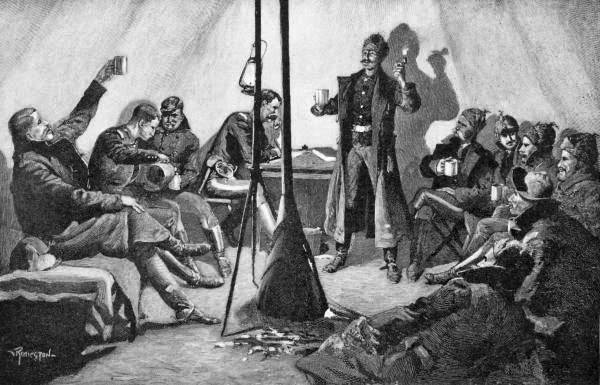
can be no personal happiness where there are no stoves. We brewed a
little mess of hot stuff in a soldier’s tin cup, and, in the words of
Private Mulvaney, we drank to the occasion, “three fingers—standing
up!”
The good that comes in the ill wind where stoves are lacking is that
you can get men up in the morning. Sun-worship must have originated in
circumstances of this kind. The feeling of thankfulness at the sight
of the golden rays permeates your soul, and your very bones are made
glad.
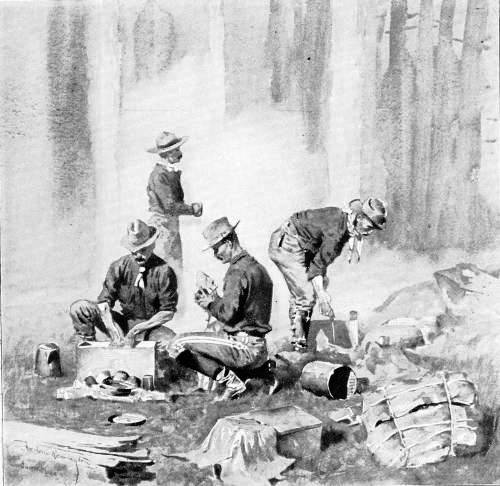
A few ounces of bacon, some of those accursed crackers which are made
to withstand fire, water, and weevil, a quart of coffee blacker than
evil, then down come the Sibleys, the blankets are rolled and the
saddles adjusted, and bidding adios to the First Infantry (which
came in during the night), we trot off down the road.
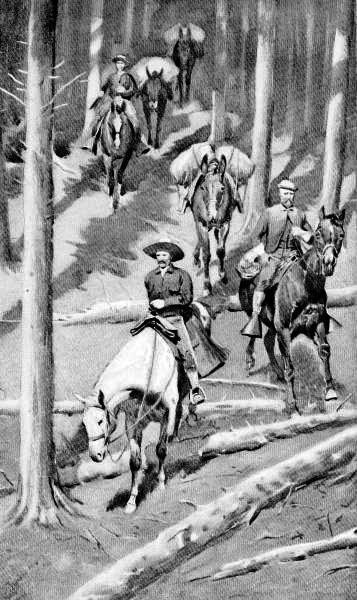
These, then, are the Cheyenne scouts. Well, I am glad I know the fact,
but I never can reconcile the trim-looking scout corps of Keogh with
these strange-looking objects. Erstwhile their ponies were fat, and
cavorted around when falling in ranks; now they paddle along in the
humblest kind of a business-like jog-trot. The new overcoats of the
corps metamorphose the scouts into something between Russian Cossacks
and Black Crooks. Saddle pockets bulge out, and a thousand and one
little alterations in accoutrement grow up in the field which are
frowned down in garrison. The men have scouted hard for a month, and
have lost two nights’ sleep, so at the halts for the wagons they lop
down in the dust of the road, and sleep, while the little ponies stand
over them, ears down, heads hanging, eyes shut, and one hind foot
drawn up on its toe. Nothing can look so dejected as a pony, and
doubtless few things have more reason to feel so. A short march of
twenty-five miles passes us through the Seventeenth Infantry camp
under Colonel Offley, and down to the Cheyenne River, where we camp
for the night. There is another corps of Cheyenne scouts somewhere
here on the river, under Lieutenant L. H. Struthers, of the First
Infantry, and we expect to join them. On the other side of the
Cheyenne rise the tangled masses of the famous Bad Lands—seamed and
serrated, gray here, the golden sunset flashing there, with dark
recesses giving back a frightful gloom—a place for stratagem and
murder, with nothing to witness its mysteries but the cold blue winter
sky. Yet we are going there. It is full of savage Sioux. The sun goes
down. I am glad to cease thinking about it.
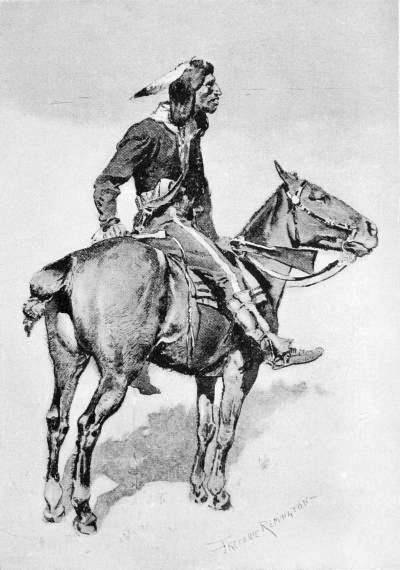
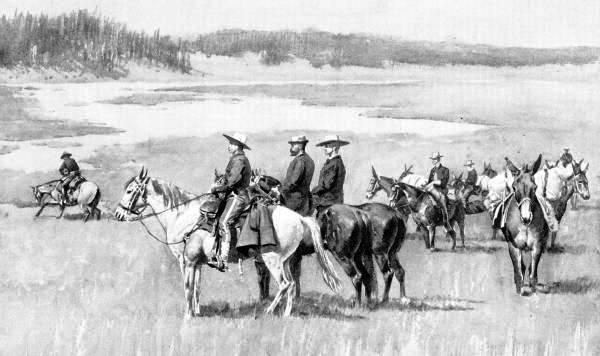
CHIS-CHIS-CHASH SCOUT ON THE FLANKS
It is such a mere detail that I will not waste time on it, but this
freezing out of your blankets four or five times every night, and this
having to go out and coax a cooking fire into a cheerful spirit, can
occupy a man’s mind so that any words not depraved do not seem of any
consequence. During one of the early hours I happened to sleep, and in
this interval Mr. Struthers came into our tepee. He had been on a
night’s ride to the colonel for orders, and in passing, dropped in for
a chat with Casey. When about to go, he said,
“Oh, by-the-way, I met Remington.”
“Do you want to renew the acquaintance?” replied Casey.
“Why—how—why—yes.”
“Well, he’s there, on the other side of this tent.” And Mr. Struthers
passed out in the gloom, and his muttered expressions of astonishment
were presently lost in the distance. I had ridden and camped with Mr.
Struthers a few days since in the up country, while on the way to “the
galloping Sixth.”
The next day we passed down the river, and soon saw what to
inexperienced eyes might be dark gray rocks on the top of yellow
hills. They were the pickets of the Cheyennes, and presently we saw
the tepees and the ponies, and then we rode into camp. The men from
Tongue River greeted the men from Pine Ridge—the relatives and
friends—with ki-yis of delight. The corps from Pine Ridge was
organized from the Cheyennes on that reservation, and was as yet only
partially disciplined, and in no way to be compared with Casey’s Old
Guard from Tongue River. Some two nights before, the Sioux had fired
into their camp, and they had skirmished with the enemy. The vermilion
of the war-path was on every countenance, and, through sympathy, I saw
that our men too had gone into this style of decorative art; for faces
which had previously been fresh and clean now passed my vision
streaked and daubed into preternatural ferocity.
It grew late and later, and yet Lieutenant Struthers did not return
from his scouting of the day. We were alarmed, and wondered and hoped;
for scouting through the Bad Lands to the stronghold was dangerous, to
state it mildly. A few shots would not be heard twelve miles away in
the hills. We pictured black objects lying prone on the sand as we
scouted next day—little masses of clay which had been men and horses,
but would then be as silent as the bare hillocks about them.
“Ki-yi-yip—a-ou!” and a patter in the gloom.
“That’s Struthers.” We fall over each other as we pile out of the hole
in the Sibley, and find Struthers and Lieutenant Byrom, of the Eighth
Cavalry, all safe and sound.
“We have been on the stronghold; they are all gone; rustle some
coffee,” are words in the darkness; and we crawl back into the tent,
where presently the big, honest, jolly eyes of Mr. Struthers look over
a quart cup, and we are happy. Byrom was a fine little cavalryman, and
I have good reason to know that for impudent daring of that
desperately quiet kind he is distinguished in places where all men are
brave.
Away goes the courier to the colonel for orders, and after a time back
he comes—a wild dash of twelve miles in the dark, and of little
moment here, but a life memory to an unaccustomed one.
“We go on the stronghold in the morning,” says Casey; “and now to
bed.” A bed consists of two blankets spread on the ground, and all the
personal property not otherwise appropriated piled on top. A luxury,
mind you, is this; later it was much more simple, consisting of earth
for a mattress and the sky for a counterpane.
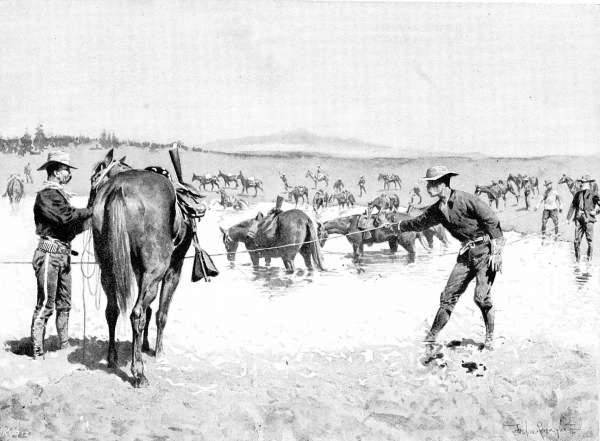
The sun is not up when in comes the horse herd. My strawberry roan
goes sneaking about in the frosty willows, and after sundry
well-studied manœuvres I get a grip on the lariat, and am lugged
and jerked over the brush until “52 on the nigh front foot” consents
to stand still. I saddle up, but have lost my gun. I entreat Mr.
Thompson, the interpreter, to help me find it. Mr. Thompson is a man
who began fighting for the Union in East Tennessee about thirty years
long gone, and he has continued to engage in that work up to date. Mr.
Thompson has formed a character which is not as round as a ball, but
much more the shape of horn-silver in its native state. He is humorous
by turns, and early in my acquaintance he undertook the cultivation of
my mind in the art of war as practised on the frontier. On this
occasion he at last found my Springfield, and handed it to me with the
admonition “that in times like these one warrior can’t look after
another warrior’s gun.”
The wagons were to go—well, I never knew where, but they went off
over the hills, and I never saw them again for some miserable days and
dreary nights. Five Pine Ridge Cheyennes and Mr. Wolf-Voice were my
party, and we filed away. At Battle Creek we watered, and crossed the
Cheyenne a mile above. My horse was smooth shod, and the river frozen
half-way over, so we slid around on the ice, and jumped into the icy
waters, got wet, crawled out, slid around some more, and finally
landed. Mr. Wolf-Voice looked me over, and smilingly said, “Me think
you no like ’em”; wherein his conclusion was eminently correct. Who
does like to have a mass of ice freeze on him when naturally the
weather is cold enough to satisfy a walrus?
It was twelve miles through the defiles of the Bad Lands to the blue
ridge of the high mesa where the hostiles had lived. The trail was
strewn with dead cattle, some of them having never been touched with a
knife. Here and there a dead pony, ridden to a stand-still and left
nerveless on the trail. No words of mine can describe these Bad Lands.
They are somewhat as Doré pictured hell. One set of buttes, with cones
and minarets, gives place in the next mile to natural freaks of a
different variety, never dreamed of by mortal man. It is the action of
water on clay; there are ashes, or what looks like them. The painter’s
whole palette is in one bluff. A year’s study of these colors by Mr.
Bierstadt, Professor Marsh, and Mr. Notman might possibly convey to
the Eastern mind an idea; so we’ll amble along after Mr. Wolf-Voice,
and leave that subject intact.
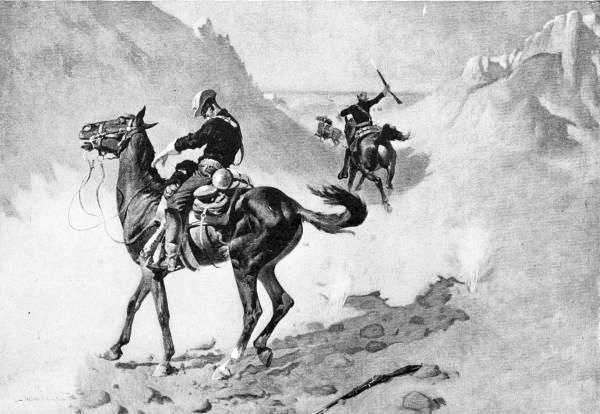
“Hark!” My little party stops suddenly, and we all listen. I feel
stupid.
“You hear ’em?” says Wolf-Voice, in a stage-whisper.
“Hear what?” I say.
“Shots.”
Then we all get out our guns and go galloping like mad. I can’t
imagine why, but I spur my horse and perform equestrian feats which in
an ordinary frame of mind I should regard as insane. Down a narrow
trail we go, with the gravel flying, and through a coulée, up a
little hill, on top of which we stop to listen, and then away we go.
The blue wall grows nearer, and at last we are under it. A few
cotton-wood trees, some frozen water, a little cleft on the bluffs,
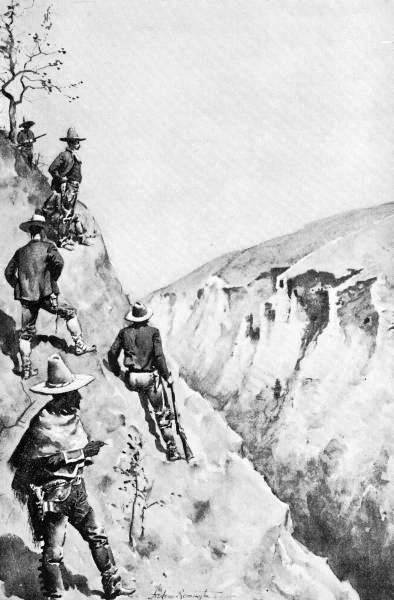
and I see a trail winding upward. I know these warriors are going
up there, but I can’t understand precisely how. It is not the first
perilous trail I have contemplated; but there are dead cattle lying at
the bottom which had fallen off and been killed in the ascent. We
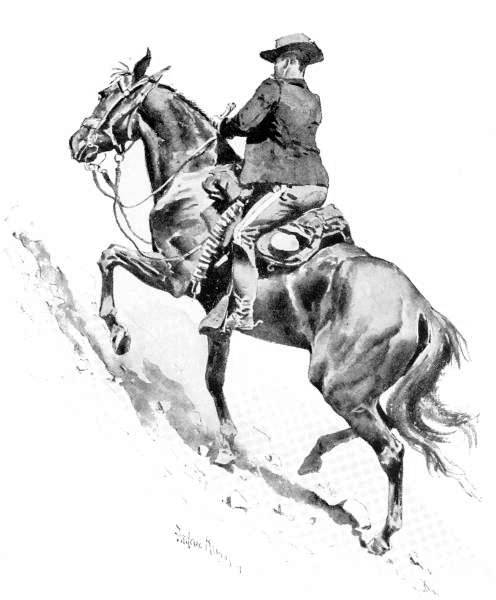
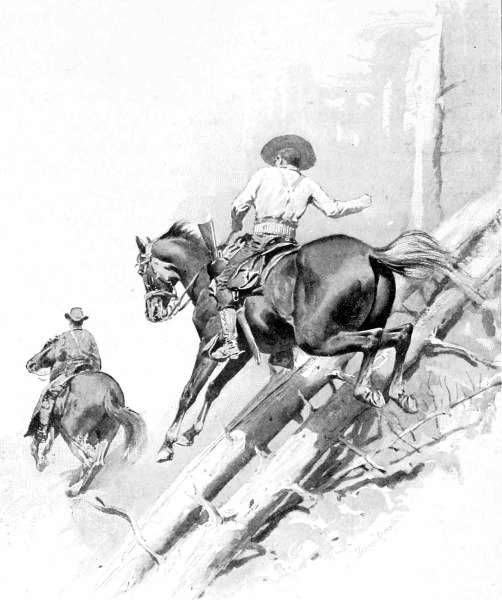
dismount and start up. It tells on your wind, and tries the leg
muscles. Up a steep place a horse wants to go fast, and you have to
keep him from running over you. A bend in the trail where the running
water has frozen seems impassable. I jump across it, and then pull the
bridle and say, “Come on, boy!” If I were the horse I would balk, but
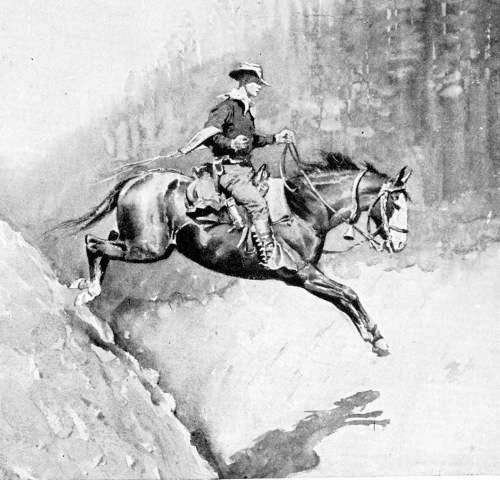
the noble animal will try it. A leap, a plunging, and with a terrible
scrabble we are all right. Farther up, and the incline is certainly
eighty-five degrees. My horse looses his front feet, but a jerk at the
headstall brings him down, and he plunges past me to be caught by an
Indian at the top of the trail. For a moment we breathe, and then
mount.
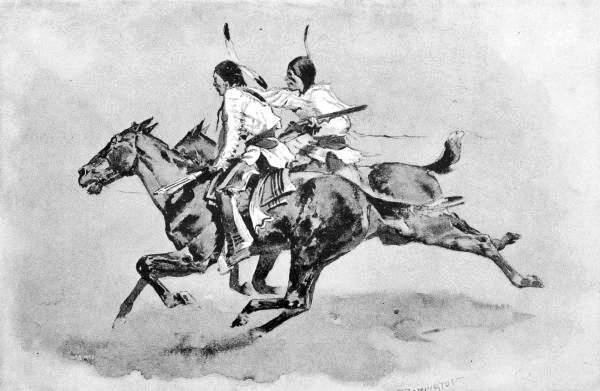
"TWO GHOSTS I SAW"
Before us is a great flat plain blackened by fire, and with the grass
still burning. Away in the distance, in the shimmer of the air waves,
are figures.
“Maybe so dey Sioux,” says Wolf-Voice. And we gallop towards them.
“What will you do if they are?” I ask.
“Stand ’em off,” replies the war-dog.
Half an hour’s ride showed them to be some of our Cheyennes. All about
the plain were strewn the remains of dead cattle (heads and horns,
half-butchered carcasses, and withal a rather impressive smell),
coyotes, and ravens—all very like war. These Brulés must have lived
well. There were lodge poles, old fires, and a series of rifle pits
across the neck of land which the Sioux had proposed to defend;
medicine poles, and near them the sacrifices, among which was food
dedicated to the Great Spirit, but eventually consumed by the less
exalted members of Casey’s command. I vandalized a stone pipe and a
rawhide stirrup.
The less curious members of our band had gone south, and Wolf-Voice
and I rode along together. We discussed war, and I remember two of
Wolf-Voice’s opinions. Speaking of infantry and their method of
fighting, he said:
“Dese walk-a-heap soldiers dey dig hole—get in—shoot heap—Injun
can’t do nothin’ wid ’em—can’t kill ’em—can’t do nothin’ but jes go
’way.”
Then, explaining why the Sioux had shown bad generalship in selecting
their position, he turned in his saddle, and said, “De big guns he
knock ’em rifle pit, den de calavy lun pas’ in column—Injun no stop
calavy—kill ’em heap, but no stop ’em—den de walk-a-heap dey come
too, and de Sioux dey go ober de bluffs.” And with wild enthusiasm he
added, “De Sioux dey go to hell!” That prospect seemed to delight Mr.
Wolf-Voice immensely.
It was a weary ride over the black and smoking plain. A queer mirage
was said by my Indian to be the Cheyenne scouts coming after us. Black
figures of animals walking slowly along were “starving bronchos
abandoned by the hostiles.”
“Cowboy he catch ’em,” said Wolf-Voice.
I explained that Colonel Offley had orders not to allow any citizens
to cross the Cheyenne River.
“Cowboy he go give um dam; he come alle samee.”
And I thought Wolf-Voice was probably right.
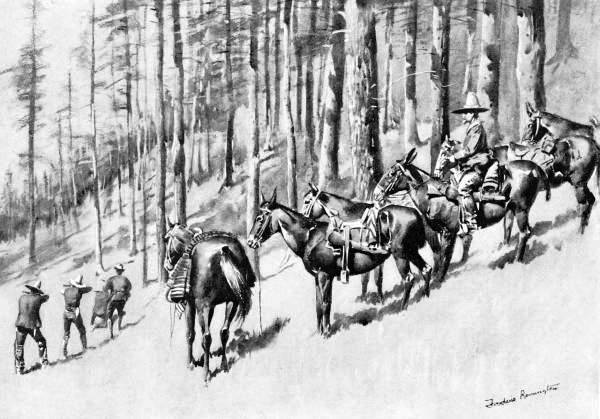
On the southern edge of the bluffs of the mesa we halted, and found
water for man and beast. The command gradually concentrated, and for
half an hour we stood on the high points scanning the great flats
below, and located the dust of the retiring hostile column and the
back lying scouts. Lieutenant Casey had positive orders not to bring
on an engagement, and only desired to hang on their flanks, so as to
keep Miles familiar with the hostile movements. A courier started on
his lonely ride back with a note for the major-general. Our scouts
were flying about far down the valley, and we filed off after them.
Presently a little column of dust follows a flying horseman towards
us. On, on he comes. The scouts grow uneasy; wild creatures they are,
with the suspicion of a red deer and the stealth of a panther.
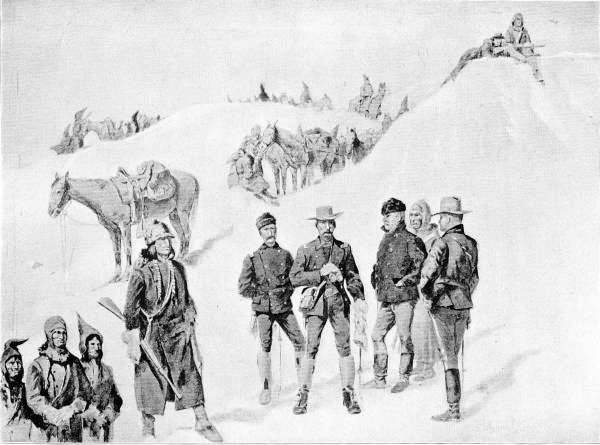
WATCHING THE DUST OF THE HOSTILES
The Sioux have fired on our scouts. Off we go at a trot, scattering
out, unslinging our guns, and the air full of fight. I ride by Casey,
and see he is troubled. The orders in his pocket do not call for a
fight. Can he hold these wild warriors?
“Struthers, we have got to hold these men,” said Casey, in a tone of
voice which was full of meaning. To shorten the story, our men were at
last gotten into ranks, and details made to cover the advance. The
hostiles were evidently much excited. Little clouds of dust whirling
hither and thither showed where the opposing scouts were shadowing
each other. The sun was waning, and yet we spurred our weary horses on
towards the enemy. Poor beasts! no food and too much exercise since
daylight.
The Cheyennes were uneasy, and not at all pleased with this scheme of
action. What could they know about the orders in Lieutenant Casey’s
pocket, prompted by a commanding general thinking of a thousand and
one interests, and with telegrams from Washington directing the
avoidance of an Indian war?
Old-soldier Thompson even, with all his intelligence and knowledge of
things, felt the wild Berserker battle valor, which he smothered with
difficulty, and confined himself to potent remarks and spurring of
old Piegan. He said: “This is a new kind of war. Them Injuns don’t
understand it, and to tell you the truth, I don’t nuther. The Injuns
say they have come all the way from Tongue River, and are going back
poor. Can’t get Sioux horses, can’t kill Sioux,” and in peroration he
confirmed his old impression that “this is a new kind of war”; and
then relapsed into reveries of what things used to be before General
Miles invented this new kind of war.
In our immediate front was a heavy body of Sioux scouts. Lieutenant
Casey was ahead. Men broke from our ranks, but were held with
difficulty by Struthers and Getty. Back comes Casey at a gallop. He
sees the crisis, and with his hand on his six-shooter, says, “I will
shoot the first man through the head who falls out of the ranks.” A
mutiny is imminent in the Pine Ridge contingent, but the diplomat
Struthers brings order at last, and we file off down the hills to the
left, and stop by a stream, while Casey goes back and meets a body of
Sioux on a high hill for a powwow. I watched through a glass, and the
sun went down as they talked. We had orders not to remove our saddles,
and stood in the line nervously expecting anything imaginable to
happen. The daring of Casey in this case is simply an instance of a
hundred such, and the last one cost him his life. By his prompt
measures with his own men, and by his courage in going among the Sioux
to powwow, he averted a bloody battle, and obeyed his orders. There
was one man between two banks of savage warriors who were fairly
frothing at the mouth—a soldier; the sun will never shine upon a
better.
At last, after an interminable time, he came away. Far away to the
right are two of our scouts driving two beeves. We see the bright
blaze of the six-shooters, the steers tumble, and hunger is no longer
one of our woes.
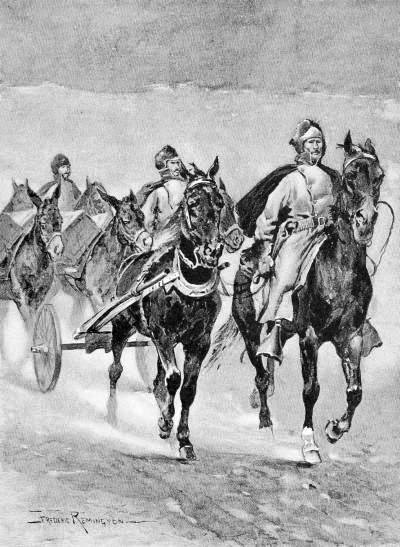
THE HOTCHKISS GUN
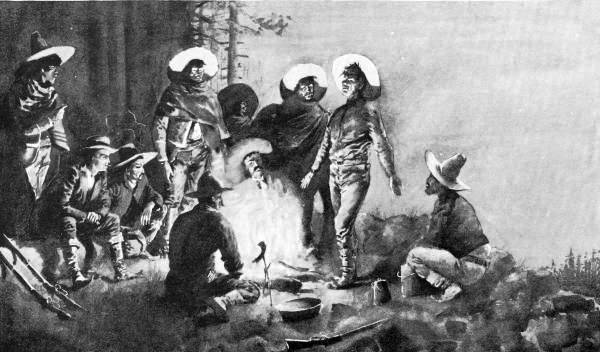
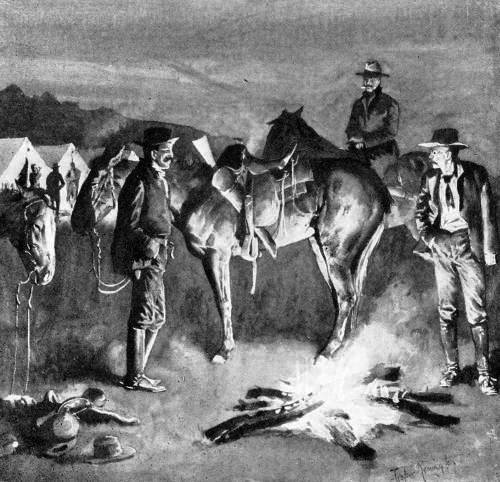
The tired horses are unsaddled, to eat and drink and roll. We lay dry
cotton-wood limbs on the fires, heavy pickets are told off, and our
“bull meat” is cooked in the primitive style. Old Wolf-Voice and
another scout are swinging six ribs on a piece of rawhide over a fire,
and later he brings me a rib and a little bit of coffee from a roll in
his handkerchief. I thought him a “brick,” and mystified him by
telling him so.
Three or four Brulés are let in through our pickets, and come “wagging
their tails,” as Two-Moons says, but adding, “Don’t you trust the
Sioux.” They protest their good intentions, borrow tobacco, and say
Lieutenant Casey can send in a wagon for commissaries to Pine Ridge,
and also that I can go through their lines with it. Were there ever
greater liars on earth?
I sat near the fire and looked intently at one human brute opposite, a
perfect animal, so far as I could see. Never was there a face so
replete with human depravity, stolid, ferocious, arrogant, and all the
rest—ghost-shirt, war-paint, feathers, and arms. As a picture,
perfect; as a reality, horrible. Presently they go away, and we
prepare for the night. This preparing for the night is a rather simple
process. I have stolen my saddle blanket from my poor horse, and, with
this laid on the ground, I try my saddle in four or five different
positions in its capacity of pillow. The inventor of the Whitman tree
never considered this possible use of his handiwork, or he might have
done better. I next button the lower three buttons of my overcoat, and
thus wrapped “I lie down to pleasant dreams”—of rheumatism.
An hour later and the fires go down. Black forms pass like uneasy
spirits, and presently you find yourself thrashing around in the
underbrush across the river after branches to feed that insatiable
fire. One comrade breaks through the ice and gets wet, and inelegant
remarks come from the shadowy blackness under the river-banks. I think
a man shouldn’t use such language even under such circumstances, but I
also think very few men wouldn’t. A chilling wind now adds to the
misery of the situation, and the heat of the fire goes off in a cloud
of sparks to the No Man’s Land across the river. After smoking a pipe
for two hours your mouth is raw and your nervous system shattered, so
nothing is left but to sit calmly down and just suffer. You can hate
the Chinese on the other side of the world, who are now enjoying the
rays of the sun.
And morning finds you in the saddle. It always does. I don’t know how
it is—a habit of life, I suppose. Mornings ought to find me cosily
ensconced in a good bed, but in retrospect they seem always to be in
the saddle, with a good prospect of all day ahead, and evening finds
me with a chunk of bull meat and without blankets, until one fine day
we come to our wagons, our Sibleys, and the little luxuries of the
mess chest.
The next morning I announced my intention of going to Pine Ridge
Agency, which is twenty-five miles away. Mr. Thompson, two scouts, and
a Swedish teamster are to go in for provisions and messages. Mr.
Thompson got in the wagon. I expressed my astonishment at this and the
fact that he had no carbines, as we expected to go through the hostile
pickets and camp. He said, “If I can’t talk them Injuns out of killin’
me, I reckon I’ll have to go.” I trotted along with Red-Bear and
Hairy-Arm, and a mile and a half ahead went the courier, Wells. Poor
man! in two hours he lay bleeding in the road, with a bullet through
the hips, and called two days for water before he “struck the long
trail to the kingdom come,” as the cowboys phrase it.
We could see two black columns of smoke, which we did not understand.
After we had gone eight or ten miles, and were just crossing a ravine,
we saw a Sioux buck on a little hill just ahead, out of pistol-shot.
He immediately rode the “danger signal.” Red-Bear turned his horse in
the “peace sign,” and advanced. We drove over the ravine, and halted.
I dismounted. Six young Brulé Sioux rose out of the ground, and rode
up to Red-Bear, and the hills were full of pickets to the right and
left. We waited to hear the result of Red-Bear’s conversation, when he
presently came back and spoke to Thompson in Cheyenne. I looked at
him; his eyes were snapping, and his facial muscles twitched
frightfully. This was unusual, and I knew that things were not well.
“Red-Bear says we will have to go back,” explained Thompson; and
turning to Red-Bear he requested that two Sioux might come closer, and
talk with us. Things looked ominous to me, not understanding Cheyenne,
which was being talked. “This is a bad hole, and I reckon our cake is
dough right here,” said Thompson.
Hairy-Arm’s face was impassive, but his dark eyes wandered from Brulé
to Brulé with devilish calculation. Two young bucks came up, and one
asked Thompson for tobacco, whereat he was handed a package of Durham
by Thompson, which was not returned.
“It’s lucky for me that tobacco ain’t a million dollars,” sighed
Thompson.
Another little buck slipped up behind me, whereat Mr. Thompson gave me
a warning look. Turning, I advanced on him quickly (I wanted to be as
near as possible, not being armed), and holding out my hand, said,
“How, colah?” He did not like to take it, but he did, and I was saved
the trouble of further action.
“We’ll never get this wagon turned around,” suggested Mr. Thompson, as
the teamster whipped up; but we did. And as we commenced our movement
on Casey’s camp, Mr. Thompson said, “Go slow now; don’t run, or
they’ll sure shoot.”
“Gemme gun,” said the little scout Red-Bear, and we all got our arms
from the wagon.
There was no suspense now. Things had begun to happen. A little
faster, yet faster, we go up the little banks of the coulée, and, ye
gods! what!—five fully armed, well-mounted cowboys—a regular rescue
scene from Buffalo Bill’s show.
“Go back!” shouted Thompson.
Bang! bang! bang! and the bullets whistle around and kick up the dust.
Away we go.
Four bucks start over the hills to our right to flank us. Red-Bear
talked loudly in Cheyenne.
Thompson repeated, “Red-Bear says if any one is hit, get off in the
grass and lie down; we must all hang together.”
We all yelled, “We will.”
A well-mounted man rode like mad ahead of the laboring team horses to
carry the news to the scout camp. The cowboys, being well mounted,
could easily have gotten away, but they stuck like true blues.
Here is where the great beauty of American character comes out.
Nothing can be taken seriously by men used to danger. Above the
pounding of the horses and the rattle of the wagon and through the
dust came the cowboy song from the lips of Mr. Thompson:
“Roll your tail,
And roll her high;
We’ll all be angels
By-and-by.”
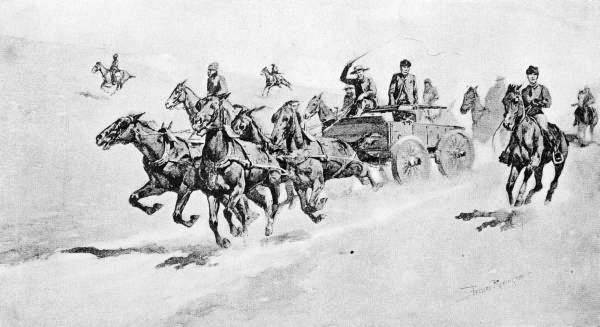
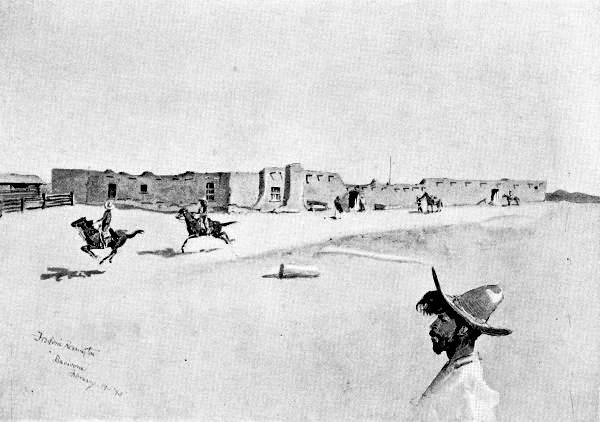
A RUN TO THE SCOUT CAMP
We deployed on the flanks of the wagon so that the team horses might
not be shot, which would have stopped the whole outfit, and we did ten
miles at a record-breaking gallop. We struck the scout camp in a blaze
of excitement. The Cheyennes were in war-paint, and the ponies’ tails
were tied up and full of feathers. Had the Sioux materialized at that
time, Mr. Casey would have had his orders broken right there.
After a lull in the proceedings, Mr. Thompson confided to me that “the
next time I go to war in a wagon it will put the drinks on me”; and he
saddled Piegan, and patted his neck in a way which showed his
gratification at the change in transport. We pulled out again for the
lower country, and as our scouts had seen the dust of Colonel
Sanford’s command, we presently joined them.
Any remarks made to Mr. Thompson on the tobacco subject are taken
seriously, and he has intimated to me a quiet yearning for a shot at
“the particular slit-mouthed Brulé who got away with that Durham.”
How we awoke next morning with the sleet freezing in our faces, and
how we made camp in the blizzard, and borrowed Sibley stoves of the
soldiers, and how we were at last comfortable, and spent New-Year’s
Eve in a proper manner, is of little interest.
I was awakened at a late hour that night by Captain Baldwin, of
General Miles’s staff, and told to saddle up for a night’s ride to
Pine Ridge. This was the end of my experience with Lieutenant Casey
and his gallant corps. We shook hands cheerily in the dim candle-light
of the tepee, and agreeing to meet in New York at some not distant
day, I stepped out from the Sibley, mounted, and rode away in the
night.
Three days later I had eaten my breakfast on the dining-car, and had
settled down to a cigar and a Chicago morning paper. The big leads at
the top of the column said, “Lieutenant E. W. Casey Shot.” Casey shot!
I look again. Yes; despatches from head-quarters—a fact beyond
question.
A nasty little Brulé Sioux had made his coup, and shot away the life
of a man who would have gained his stars in modern war as naturally as
most of his fellows would their eagles. He had shot away the life of
an accomplished man; the best friend the Indians had; a man who did
not know “fear”; a young man beloved by his comrades, respected by his
generals and by the Secretary of War. The squaws of another race will
sing the death-song of their benefactor, and woe to the Sioux if the
Northern Cheyennes get a chance to coup!
“Try to avoid bloodshed,” comes over the wires from Washington. “Poor
savages!” comes the plaintive wail of the sentimentalist from his
place of security; but who is to weep for the men who hold up a row of
brass buttons for any hater of the United States to fire a gun at? Are
the squaws of another race to do the mourning for American soldiers?
Are the men of another race to hope for vengeance? Bah!
I sometimes think Americans lack a virtue which the military races of
Europe possess. Possibly they may never need it. I hope not. American
soldiers of our frontier days have learned not to expect sympathy in
the East, but where one like Casey goes down there are many places
where Sorrow will spread her dusky pinions and the light grow dim.