The increasing attention which during the last few years has been
devoted to breeding ponies for various purposes, more especially for
polo, suggested the collection of facts relating to our half-wild races
of ponies. It will be seen from the following pages that we possess
large supplies of small but strong and sound constitutioned horses
which may be turned to far more valuable account than has been done
hitherto. The Polo Pony Society set the example of drawing attention
to the possibilities of utilising profitably the Moorland and Forest
Mares, and it is hoped that these pages may be of some interest to
those who are giving attention to pony breeding whether for polo or for
any other purpose.
Elsenham Hall, Essex,
August, 1900.
PONIES PAST AND PRESENT
INTRODUCTION.
In another volume, Horses Past and
Present, brief reference has been made to
the early subjugation of the horse in Eastern
countries by man; and it is unnecessary
here to further touch upon that phase of our
subject.
The early history of the horse in the
British Islands is obscure. The animal is
not indigenous to the country, and it is
supposed that the original stock was brought
to England many centuries before the
Christian era by the Phœnician navigators
who visited the shores of Cornwall to procure
supplies of tin. However that may be,
the first historian who rendered any account
of our islands for posterity found here horses
which he regarded as of exceptional merit.
Julius Cæsar, when he invaded Britain in
the year 55 B.C., was greatly impressed with
the strength, handiness, and docility of the
horses which the ancient Britons drove in
their war chariots; his laudatory description
of their merits includes no remark concerning
their size, and from this omission we may
infer that they were not larger than the
breeds of horses with which Cæsar’s travels
and conquests had already made him acquainted.
There can be no doubt but that these
chariot horses were small by comparison
with their descendants—the modern Shire
horses;[1] they probably did not often exceed
14 hands, and were therefore much on a par
in point of height with the horses Cæsar had
seen in Spain and elsewhere. It is unlikely
that so shrewd an observer would have
refrained from comment on the point had
the British horses been superior in size, as
they were in qualities, to the breeds he
already knew. It is doubtful indeed
whether the horses of Britain gained in
stature to any material extent until the
Saxons and Danes introduced horses from
the Continent. These being for military
purposes would have been stallions without
exception, and being larger than the British
breed must have done something to produce
increase of height when crossed with our
native mares.
[1] See “The Great Horse or War Horse.” By Sir Walter
Gilbey, Bart. 3rd edition, 1899. Vinton & Co., Ltd.
This being the case, we are confronted
with the difficulty of distinguishing between
the horses and ponies of these early times;
the chroniclers do not attempt to differentiate
between “horse” and “pony” as we understand
the terms. The process of developing
a big horse was necessarily a slow one, from
the system, or want of system, which remained
in vogue until the fifteenth century,
and was still in existence in some parts of
England in Henry VIII.’s time. During
the long period the greater portion of the
country lay under forest and waste, it was
the practice to let those mares which were
kept solely for breeding purposes run at
large in the woodlands, unbroken and unhandled.
Doomsday Book contains frequent
mention of equæ silvestres, equæ silvaticæ, or
equæ indomitæ when enumerating the live
stock on a manor; and there is evidence to
show that these animals (always mares, it will
be observed) were under a modified degree
of supervision. They were branded to
prove their ownership, and during the
summer selected mares appear to have been
“rounded up” to an enclosure in the forest
for service. Apart from this they ranged
the country at large, strangers alike to collar
and bridle. It would be unreasonable to
suppose that the mares which were employed
in agricultural work were not also used for
breeding; the surroundings of the farmer’s
mare in those days were not luxurious, but
she undoubtedly enjoyed shelter from the
rigours of winter and more nourishing food
than her woodland sister. Hence it is probable
that the first differences in size, make
and shape among English horses may be
traced to their domestic or woodland ancestry
on the dam’s side.
The life led by these equæ indomitæ made
for hardiness of constitution, soundness of
limb, surefootedness, and small stature; and
we venture to think that the half-wild ponies
England possesses to-day in the New
Forest, Exmoor, Wales and the Fell country
are (or were, until comparatively modern
endeavours were made to improve them) the
lineal descendants of the woodland stock
which is frequently referred to in ancient
records, and which in 1535 and 1541 Henry
VIII. made vigorous attempts to exterminate.
The law of 1535 (26 Henry VIII.)
declares:—
“For that in many and most places of this realm,
commonly little horses and nags of small stature and
value be suffered to depasture, and also to cover
mares and felys of very small stature, by reason
whereof the breed of good and strong horses of this
realm is now lately diminished, altered and decayed,
and further is likely to decay if speedy remedy be not
sooner provided in that behalf.
“It is provided that all owners or fermers of parks
and enclosed grounds of the extent of one mile in
compass shall keep two mares, apt and able to bear
foals of the altitude or height of 13 handfuls at least,
upon pain of 40s.
“A penalty of 40s. is imposed on the Lords,
Owners, and Fermers of all parks and grounds enclosed,
as is above rehearsed, who shall willingly
suffer any of the said mares to be covered or kept
with any Stoned Horse under the stature of 14
handfuls.”
This Act applied only to enclosed areas,
and therefore would not affect the wild
ponies in any appreciable degree: but six
years later another Act was passed (32
Henry VIII., c. 13) which provided that—
“No person shall put in any forest, chase, moor,
heath, common, or waste (where mares and fillies
are used to be kept) any stoned horse above the age
of two years, not being fifteen hands high within
the Shires and territories of Norfolk, Suffolk, Cambridge,
Buckingham, Huntingdon, Essex, Kent,
South Hampshire, North Wiltshire, Oxford, Berkshire,
Worcester, Gloucester, Somerset, South
Wales, Bedford, Warwick, Northampton, Yorkshire,
Cheshire, Staffordshire, Lancashire, Salop,
Leicester, Hereford and Lincoln. And furthermore,
be it enacted, that if in any of the said drifts there
shall be found any mare, filly, foal, or gelding that
then shall be thought not to be able nor like to grow
to be able to bear foals of reasonable stature or not
able nor like to grow to be able to do profitable
labours by the discretions of the drivers aforesaid
or of the more number of them, then the same driver
or drivers shall cause the same unprofitable beasts
... every of them to be killed, and the
bodies of them to be buried in the ground, as no
annoyance thereby shall come or grow to the people,
those near inhabiting or thither resorting.”
This enactment was of a more far-reaching
character than its forerunner. The
“shires and territories” enumerated were
those in which greatest attention was paid
to the breeding of Great Horses; “profitable
labours,” in those times, could only
mean military service, agricultural work,
and perhaps pack transport, for any of
which purposes the woodland ponies were
useless. How far the law proved effectual
is another matter: laws more nearly affecting
the welfare of the subject were less
honoured in the observance than the breach
in the remoter parts of the kingdom in
those times.
In 1566, when Elizabeth was on the
throne, Thomas Blundeville, of Newton
Flotman, wrote a book on Horses and
Riding; and prefaced it by an “Epistle
dedicatorie” to Robert Lord Dudley,
Master of the Horse, which begins:
“It would be the means that the Queen may not
only cause such statutes touching the breeding of
Horses upon Commons to be put in execution: but
also that all such parks within the Realme as be in
Her Highnesse hands and meet for that purpose
might not wholly be employed to the keeping of Deer
(which is altogether without profit), but partly to the
necessary breeding of Horses for service [i.e., military
service] whereof this Realme of all others at this
instant hath greatest need.”
It would appear, therefore, that Henry’s
laws had become a dead letter, or something
very like it, within twenty-five years of its
finding place on the Statute Book. It
was afterwards repealed in respect of certain
counties by Queen Elizabeth and James I.
(for particulars see p. 26 and p. 33, “Horses
Past and Present.”)
These various early edicts no doubt produced
some result in the more central parts
of England, though, as we gather from
Blundeville’s “Epistle,” those charged with
their administration failed to enforce them in
areas more remote. A certain amount of
driving and killing no doubt was done, but
probably no more than enough to make the
herds wilder than before and send them in
search of safety to the most inaccessible
districts. The natural result of this would
be to preserve the breeds in greater purity
than would have been the case had they
been allowed to intermingle with horses
which, after the harvest was carried, were
turned out to graze at will over the unfenced
fields and commons. It is worth
glancing at these items of horse legislation
to discover that the half-wild ponies have
survived, not by grace of man’s aid or protection,
but in defiance of his endeavours
to stamp them out.
Nearly a century later (1658) the Duke
of Newcastle published his work on the
Feeding, Dressing and Training of Horses
for the Great Saddle and therein, urged
strongly the desirability of discouraging the
breeding of ponies. The records of subsequent
reigns show occasional endeavour to
improve by legislation the breeds of horses
needed for military purposes, tournaments,
racing and sport, but until we come to the
time of George II. we find no positive
attempt to discourage the breeding of
ponies. An Act passed in 1740 was definite
enough in the purpose it sought to attain.
This was the suppression of races by
“poneys” and other small or weak horses.
Under this law matches for prizes under
£50 were forbidden, save at Newmarket
and Black Hambleton, and the weights to
be carried by horses were fixed at 10 st.
for a five-year-old, 11 st. for a six-year-old
and 12 st. for a seven-year-old horse. This
statute had two-fold intention: it was framed
“not only to prevent the encouragement of
a vile and paltry breed of horses, but likewise
to remove all temptation from the
lower class of people who constantly attend
these races, to the great loss of time and
hindrance of labour, and whose behaviour
still calls for stricter regulations to curb their
licentiousness and correct their manners.”
During the present century organised
effort to improve these breeds has followed
recognition of their possibilities for usefulness,
and in few localities, if any, does the
original stock remain pure. In Devonshire,
Hampshire, Wales, Cumberland, the
Highlands, Shetland, and in the West of
Ireland, the original strains have been intermingled
and alien blood introduced. Small
Thoroughbred, Arab and Hackney sires
have produced new and improved breeds
less fitted to withstand the rigours of winter
and the effects of scanty food contingent
on independent and useless existence, but
infinitely better calculated to serve the interests
of mankind.
Before the establishment of the Hackney
Horse Society in 1883 the dividing line
between the horse and the pony in England
was vague and undefined. It was
then found necessary to distinguish clearly
between horses and ponies, and accordingly
all animals measuring 14 hands or under
were designated “ponies,” and registered
in a separate part of the Stud Book.
This record of height, with other particulars
as to breeding, &c., serves to direct
breeders in their choice of sires and dams.
The standard of height established by the
Hackney Horse Society was accepted and
officially recognised by the Royal Agricultural
Society in 1889, when the prize list
for the Windsor Show contained pony
classes for animals not exceeding 14 hands.
The altered Polo-rule which fixes the limit
of height at 14 hands 2 inches may be productive
of some little confusion; but for all
other purposes 14 hands is the recognised
maximum height of a pony. Prior to 1883
small horses were called indifferently galloways
hobbies, cobs, or ponies, irrespective
of their height.
THE NEW FOREST PONY.
The New Forest in Hampshire now cover
some 63,000 acres of which about 42,000 acres
are common pasture, the remaining 21,000
acres having been enclosed in 1851 for the
growth of timber. The greater portion of
the common land is poor and boggy moor,
and on these areas ponies have been bred
in a semi-wild state from the earliest times.
It is considered more than probable that the
New Forest ponies are the survival of the
stock which, before the time of Canute
(1017-1035), was found in the district formerly
called Ytene, and which was afforested
in the year 1072 by the Conqueror.[2]
[2] Mr. W. J. C. Moens, in a pamphlet printed for private
circulation.
Henry III. (1216-1272), on 15th March,
1217, ordered the Warden of the pony
stud kept in the New Forest to give to
the Monks of Beaulieu all the profits
accruing from the droves from that date
till November, 1220, this donation being
for the benefit of the soul of his late
father, King John. Thus it is evident that
the New Forest ponies of the thirteenth
century were numerous enough to form a
source of revenue to the Crown.
The remote history of the breed need not
concern us; for it was not until comparatively
recent times that any endeavour was
made towards the improvement of the
“forester,” as it is called. The first infusion
of alien blood likely to be beneficial seems to
have been made about 1766; and the circumstances
under which this fresh blood
was introduced are interesting. In 1750,
H.R.H. the Duke of Cumberland acquired
by exchange a thoroughbred foal from his
breeder, Mr. John Hutton. The animal was
named Marske, and was run at Newmarket:
achieving no great success on the turf, he
was put to the stud, but up to the time of
the Duke’s death his progeny had done
nothing to win reputation for their sire.
When the Duke died, in 1765, his horses
were sold at Tattersall’s, and Marske was
knocked down “for a song” to a Dorsetshire
farmer. The farmer kept him in the New
Forest district, and here Marske the sire
of Eclipse served mares at a fee of half-a-guinea,
till his famous son achieved celebrity.
Eclipse was foaled in 1764, won his
first race on 3rd April, 1769, at Epsom,
and made his name in a single season on
the turf.
For four years at least, therefore (until
Mr. Wildman ferreted out “the sire of
Eclipse” and bought him for £20 to go to
Yorkshire), the New Forest breed of ponies
were being improved by the very best
thoroughbred blood, the effects of which
continued to be apparent for many years
after Marske had left the district.
It is at least probable that Marske ran in
the Forest during the lifetime of the Duke
of Cumberland; for that prince was Warden
of the New Forest, and evidence is forthcoming
to show that he made a systematic
attempt to better the stamp of pony.
For many decades after this infusion of
thoroughbred blood nothing was done to
maintain the improvement made. On the
contrary, the demand for New Forest ponies
increased, and the commoners took advantage
of the higher prices obtainable to sell
the best of their young stock; thus the
breed steadily degenerated, until the late
Prince Consort sent a grey Arab stallion to
stand at New Park. The effects of this
fresh strain of blood were soon evident;
but history, as exemplified by the beneficial
results of Marske’s service, repeated itself;
the commoners were too ready to sell
the pick of the young animals, whereby
the benefits which should have accrued were
heavily discounted.
It must be explained that the large
breeders have running in the Forest a hundred
ponies, or even more; many breeders
possess forty or fifty, while the small
occupiers own as many as they can keep
during the winter. Their sole responsibility
to the Crown in respect of the ponies is the
“marking fee” (raised in 1897 from eighteen
pence to two shillings per head), which
goes to the Verderer’s Court. The marking
system enables the Court to know how
many ponies are running in the Forest, and
the latest census showed about 3,000 animals,
of which it was estimated some 1,800 were
breeding mares.
From spring to autumn the droves range
the Forest at will, affecting, of course, the
best pasturage, or, in the heat of summer,
the shadiest localities; in winter about 1800
ponies are taken into pastures, the remaining
1200 being left at large.
It is to be observed that the most profitable
animals are the hardy ones, which run in
the Forest all the year round. The majority
of the young animals are handled only for
the purpose of marking, and are never, if
possible, driven off their own ground. Thus,
unless strange stallions are used, it is very
difficult to change the blood, the forest-born
stallion remaining in his own locality and
collecting his own harem around him. “In-and-in”
breeding is therefore inevitable.
Besides these 3,000 it is estimated that
about the Forest neighbourhood some 2,000
ponies are worked in light carts and other
vehicles, and, as many of these ponies are
used for breeding purposes, it will be seen
what an important source of pony supply we
have in the New Forest district.
When the influence of the Arab sire sent
by the Prince Consort ceased to be felt,
degeneration again set in, the decreased
prices brought by ponies at the fairs proving
conclusively how the breed was deteriorating.
To combat the evil the Court of Verderers
in 1885 hired four well-bred stallions, which
were kept by the “Agisters,” or markers of
ponies, for the service of commoners’ mares
at nominal fees. Two seasons’ experience
proved that funds would not bear the strain,
and the horses were sold; with the less
hesitation because it was found that in the
absence of any inducement to the breeders
to retain promising young stock, good foals
and bad were alike sent for sale to the fairs.
Moreover, the wild mares were not of
course covered by these stallions, and the
majority of the New Forest stock obtained
no benefit from their presence in the district.
The “ponies in hand,” nevertheless, were
more than sufficiently numerous to be considered,
and in 1889 it was arranged to
provide the necessary inducement to keep
promising youngsters by giving premiums at
a stallion show in April of each year, winners
of premiums to run in the Forest till the
following August; and this scheme has been
productive of very marked results in the way
of keeping good stock to reproduce their
kind. Her Majesty in 1889 lent two Arab
stallions, Abeyan and Yirassan, for use
in the district, and these, remaining for
two and three seasons respectively, did
much good. A son of the former, out of
a Welsh mare, now stands in the district.
His owner, Mr. Moens, states that his
produce show great improvement, and his
services are in eager demand among the
commoners. The general improvement in
the Forest ponies since 1890 is very striking.
Lack of funds has seriously handicapped
the New Forest Pony Association in its
work, and the burden of carrying out the
programme has fallen upon the shoulders
of a few. Conspicuous among those who
have borne the lion’s share of the task is
Lord Arthur Cecil, who now turns out no
fewer than twenty-two stallions for the
benefit of the commoners generally. For
many years past Lord Arthur has interested
himself in the improvement of the breed;
he has been using with much success
stallions of a distinct and pure breed from
the Island of Rum off the West coast of
Scotland. These are the original Black
Galloways which were found in a wild state
on the island in 1840 by the late Marquis
of Salisbury, and were always kept pure.
Lord Arthur secured the whole stock in the
year 1888. I cannot do better than give,
practically in its entirety, his interesting
letter on the subject of the ponies which for
the last ten years have been increasingly
used in the New Forest so much to the
advantage of the breed:
“The Rum ponies which were much thought of
by my father seem to be quite a type of themselves,
having characteristics which would almost enable
one to recognise them anywhere. Every one of those
I bought in 1888 had hazel, not brown eyes; and
though only a small boy in 1862, when six or seven
of those ponies came to Hatfield, I can remember that
they also had the hazel eye. They have, almost
without exception, very good hind-quarters, with the
tail well set up; and it is in this respect that I hope
they will do good in the New Forest. On the other
hand, they have big plain heads which are not liked
by the commoners. This defect, however, is rapidly
disappearing with good keep, as it does with all
breeds of ponies.
“After I bought the ponies in 1888 and began
breeding I was at a loss to know how to continue
the breed, as I could not well use the stallion which
accompanied the mares to his own progeny. I
remembered having seen at the Highland and Agricultural
Society’s Show, in 1883, a stallion which
had interested me very much, being exactly like the
ponies I remembered coming to Hatfield. I enclose
... copy of a letter[3] received from his breeder.
[3] “The pony, Highland Laddie ... was bred by us at
Coulmore, Ross-shire; being the youngest, I think, of seven foals
thrown by the black mare, Polly, to Allan Kingsburgh (Lord
Lovat’s stallion) ... and, as far as I know, Polly was
never covered by any other horse. Most of her foals, if not all,
were shown by us and won prizes at country and the Highland
Agricultural Society’s Meetings in the North. Her third foal,
Glen, a jet-black stallion, took 2nd prize in his class at the
Aberdeen Show in 1880 (I think), and again took the medal for
pony stallions at Perth in 1881 or 1882. At the same show Polly’s
second foal, Blackie, took second prize in the gelding class, and
her fourth foal (the eldest of the bay mares), shown at Inverness by
McKenzie of Kintail, would easily have taken a prize in her class
but for an accident on the railway or ferry ... which
lamed her for the meeting. Your pony has, of course, the same
pedigree as those.... The Rum ponies were always supposed
to be pure, as the Marquis of Salisbury was known to take a
great interest in the breed ... though not sure, I believe
a pony stallion of another strain, a dun with black mane and tail
(Lord Ronald) was sold by my father to go to Rum.... Allan
Kingsburgh and Polly were both bred by my father.... Allan’s
dam was a bay mare, Polly’s was a grey named Maria. I know
the stock from which both came: it was brought long ago from
Glenelg and bred and kept pure by my grandfather and ancestors
who lived in Glenelg when that Barony belonged to the MacLeod
of MacLeods. I am not sure of the sires of either Allan or Polly,
but know they were both pure Highland. One, I think, was Lord
Ronald which I formerly mentioned, and the other a pony belonging
to a Mr. Stewart in Skye (a known breeder of Highland
cattle).”
... It is curious that I should have thus dropped
on to exactly the same kind of thing that my father
is supposed to have used; he used the same blood
years ago in Lord Ronald.
“I think what first interested me so much in these
ponies was that, as long ago as I can remember anything,
I heard my father describing them to old Lord
Cowley and the Duke of Wellington. He told them
how like the Spanish horses he had thought the
ponies in 1845; and mentioned how he had turned
down a stallion on the island and a Spanish jackass—some
of the mules are still (1889) at Hatfield. He
also said that he saw no reason why they should not
be descended from some of the Spanish Armada
horses which were wrecked on that coast. When
the ponies—most of them stallions—came to Hatfield
in 1862, I remember some of them broke out of the
station; it took several days to catch them again.
They were almost unbreakable, but my brother,
Lionel, and I managed to get two of them sufficiently
quiet for us to ride, though they would not have
been considered safe conveyances for an elderly
gentleman. We were never quite sure of their age,
but they must have been nearly thirty when they
died. I believe my father had intended these ponies
to be kept entire, but they were so hopelessly savage
they had to be cut. They could trot twelve miles
in fifty-five minutes after they were twenty years old,
and could gallop and jump anything in the saddle.
“My father’s theory about the Spanish Armada
receives curious corroboration in the well-known fact
that a galleon lies sunk in Tobermory Bay; while, in
the “Armada” number of the Illustrated London News
which was published in 1888 (the same year that I
bought the ponies), there was a small map which
showed the storms off the North and West of Scotland,
which are almost exactly coincident with the
occurrence of this particular type of pony, though no
place was so favourable for breeding a type as a
remote island like Rum.
“When my mother visited Rum the people of the
adjacent island of Canna gave her a pony mare which
I also remember, very old, at Hatfield. She was a
rich cream colour; she threw a foal which had all
the characteristics, the hazel eye, long croup and big
head.
“I have noticed all the deer-stalking ponies I
could see on the look-out for some of these characteristics;
but, with the exception of the hazel eye and
a somewhat strong inclination towards blackness in
colour, I cannot say that I have seen much trace of
the same kind of pony on the mainland in Scotland.
This, however, is no doubt rather through crossing
with other strains than because they have not some
of the original blood; and I feel sure that the Galloway
of olden days was of the same type, though
that term has now come to mean something quite
different and in no way connected with the district
on the West Coast of Scotland.
“The hazel eye is not uncommon on Exmoor, and
occurs in the Welsh pony. It would be a very interesting
study to try and trace the tendency to show
that colour; it would, I think, throw light on the
ancestry of many horses and ponies; or, at least, it
would reveal many curious instances of reversion.”
Lord Arthur, in conclusion, deprecates the
susceptibility of pony breeders generally to
the influence of fashion; he is of opinion
that efforts made in some districts to increase
size, while efforts elsewhere are directed to
its reduction, cannot in the long run be
beneficial; whereas, if Nature were allowed
to determine the size of pony suitable for
each locality, valuable results might be
obtained by crossing the different breeds.
It is quite certain that the perpetuation of
a breed larger than the character of the
country and pasture can support can only be
secured by the constant introduction of alien
blood, which in course of time will completely
alter the local stamp, and not
necessarily for the better.
The Hon. Gerald Lascelles, Deputy
Surveyor of the New Forest, has said of
this locality: “You have a magnificent run
for your ponies. Your mares might breed
from ponies of almost any quality....
Ponies running out all winter in the mountains
of Ireland and of Wales, on Exmoor,
in Cornwall, and on the Cumberland and
Yorkshire fells, have a far worse climate to
face than that of the New Forest, and no
better pasture. Such ponies would laugh
at the hardships of the New Forest.” The
New Forest pony is perhaps less hardy than
some of the hill breeds, but his constitution
is quite robust enough to be one of his most
valuable attributes; and opinions are not
unnaturally divided as to the desirability of
increasing his size, if gain of inches mean
sacrifice of hardiness. Thirteen hands was
the height the Forest breeders formerly
admitted to be the maximum desirable; but
of recent years their views on this point have
been somewhat enlarged.
The close resemblance of the Rum ponies
to the native of the New Forest marks
out these stallions as peculiarly suitable for
crossing purposes. For this reason, and also
because their number must exercise strong
and speedy influence upon the wild Forest
mares, the foregoing particulars have been
given in detail.
Lord Arthur believes that the Welsh
pony stallion of about 13·1 or 13·2 would
be as good a cross for the New Forest pony
as any now obtainable.
Lord Ebrington, who bought Exmoor and
the Simonsbath stud of improved Exmoor
ponies, lent one of his stallions to the New
Forest Association in the summer of 1898,
and this sire has done good service among
the wild mares.
When broken the New Forest ponies are
generally far more spirited than the ordinary
run of British ponies. The practice of using
the “ponies in hand” for driving the wild
mobs to be branded, &c., teaches them to
turn quickly and gallop collectedly on rough
ground; they thus acquire great cleverness.
As regards their market value, the following
letter from Mr. W. J. C. Moens, a most
energetic member of the Council of the
Association, gives the best idea.
“At the last Ringwood Fair, December 11th, 1897,
there was a larger outside demand for suckers than
ever experienced; buyers coming from Kent, Sussex,
Surrey, Essex, Somersetshire and Dorsetshire. The
prices ran from £4 to £6 10s.; the larger dealers
buying about fifty to sixty each, which they trucked
(25 to 30 in a truck) away by rail. One lot of
about 55 were sold at once by auction at Brighton,
and realised £6, £7 and £8 each, one fetching £10.
The foals improve enormously on good keep. Our
Forest feed is hardly good enough; on richer lands
the ponies grow nearly a hand higher and get more
substance. Since our Association has improved the
breed, of late years, very many have gone to the Kent
Marshes, where they are highly thought of, very
much more so than the Dartmoor ponies. Yearlings
at last Lyndhurst Pony Fair, in August, fetched
£5 to £8, but the average was spoiled by two large
sales by auction of ‘lane haunters’—old mares and
other cast-offs—which realised small prices....
I have seen some of our improved ponies at Hastings
and elsewhere, broken in, and about five years old.
They are much valued and sell for about £25....
The general improvement since 1889 or 1890 is very
marked; and, though there was some opposition
to the idea of bettering ‘the real Forester’ at first,
now all admit the benefit of the work.”
For the information of those interested
in this breed, the following description, furnished
to the Polo Pony Society for their
Stud Book (vol. v.) by the New Forest
Local Committee, may be quoted:
For the New Forest pony it is difficult to give any exact
description, but the best class of them are from 12 hands to
13 hands 2 inches high according to the portion of the
Forest on which they are reared. If taken off the Forest
when they are weaned and well kept during the first two
winters, they are said very often to attain the size of 14
hands 1 inch. There is sometimes an apparent deficiency of
bone, but what there is should be of the very best quality.
The feet are wide and well formed. They are often considered
goose-rumped, but their hocks should be all that could
be desired. In colour they may be said to range through
every variety, though there are not many duns, and few if
any piebalds left. The flea-bitten greys which are still very
numerous on the Forest show strong traces of an Arab cross.
The shoulders, though not always what might be desired in
point of depth, are almost invariably fine and well laid. It
is a great characteristic of the New Forest pony to be always
gay and alert, and, though they are extremely good-tempered
and docile when fairly broken, they are quite indomitable
until they are completely cornered. The true Forester is
never sulky.
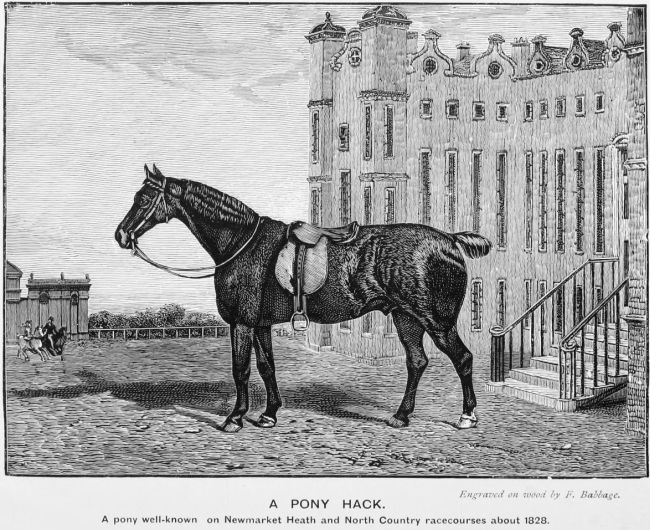
A PONY HACK.
Engraved on wood by F. Babbage.
A pony well-known on Newmarket Heath and North Country
racecourses about 1828.
THE WELSH PONY.
At the period when Wales was an independent
kingdom live stock was protected
by a singularly comprehensive series of laws.
These were originally codified by Howel
Dda (the Good), a prince who reigned
from A.D. 942 to 948, and at a somewhat
later period they were embodied in three
distinct legal codes, the Venedotian, Dimetian
and Gwentian, applicable respectively to
North, South and South-eastern Wales, conforming
to the local customs which prevailed
in each area. Under these laws no Welsh
serf was permitted to sell a stallion without
the permission of his lord. The value of a
horse (or, accurately speaking, pony, as the
hill ponies were the only equine stock the
country possessed in those days) was laid
down without regard to individual merit till
he reached his third year. A foal until a
fortnight old was worth four pence; from the
fifteenth day of his age till one year old, 24
pence; when a year and one day old he was
worth 48 pence, and stood at that value till
he began his third year when he was valued
at 60 pence. When in his third year he was
broken in, and his value depended on the
work he was fitted for. A palfrey or sumpter
horse was valued at 120 pence, and a working
horse to draw cart or harrow 60 pence. It
was not permissible to use horses, mares or
cows for ploughing for fear of injury; oxen
only might be employed for such labour.
Any entire male animal was worth three
females; thus a wild stallion was worth nine
score pence to the mare’s value of three
score pence.
If a horse were sold he was to be
warranted against staggers for three nights,
against “black strangles”[4] for three months,
and against farcy for a year. He was to
be warranted against restiveness until the
purchaser should have ridden him three
times “amid concourse of men and horses;”
and if he proved restive the seller had to
refund one third of the price he had received.
[4] The commentators believe the disease so termed to be
glanders; but inasmuch as the warranty against farcy held
good for twelve months, perhaps we should accept this
reading with reserve.
The value of each part of the horse was
strictly specified by these laws; the worth
of his foot was equal to his full value; each
eye was esteemed worth one third of his
full value. For every blemish in a horse
one third of the total worth was to be
returned, his ears and tail included: a not
obscure hint that cropping and docking were
practised in Wales at this period, and that
opinions varied concerning the desirability
of the operations. That docking was in
vogue is certain, for a special clause makes
the “tail of a filly for common work” worth
the total value of the animal. The peculiar
value of the tail of a “filly for common
work” lay in the fact that the harrow was
often secured to the tail, as was the practice
in parts of Ireland and Scotland until near
the end of the last century. In Wales, as
in other parts of Britain, the mare was
preferably used for draught and pack work,
horses being reserved for military service.
The mane and bridle were worth the same
amount, viz., four pence; the forelock and
halter were also coupled as worth one penny
each.
Howel Dda’s “Law of Borrowing” was
equally comprehensive. The man who
borrowed a horse and fretted the hair on
his back was to pay four pence; if he broke
the skin to the flesh eight pence; and if skin
and flesh were broken to the bone sixteen
pence. Borrowing without the owner’s leave
was expensive: the borrower had to pay
four pence for mounting, and four pence for
each rhandir (supposed to be a league) he
rode the horse. He also had to pay a fine
to the owner’s lord.
If a hired horse fell lame or was injured
by accident the owner had to furnish the
hirer with one equally good until the injured
horse recovered.
The laws which regulated compensation
for trespass show that it was customary to
fetter or clog the horses when they were
turned out to graze. Trespass in corn by
a clogged horse was to be compensated by
payment of one penny by day and two pence
by night. Trespass by a horse free of
restraint was recompensed by half those
sums. In this connection it must be noted
that stallions were “privileged;” and though
a broken-in entire ran at large for three
seasons (season from mid April to mid May
and the month of October), he did not lose
the privilege which relieved his owner from
fine for any damage he might do in the
standing crops.
The Welsh pony is more numerous than
any other breed. He wanders over the
hills and waste lands in all the twelve counties
of the Principality, and also on the borders
of Shropshire, Herefordshire and Monmouth;
whereas his congeners are limited to
areas insignificant by comparison. The distribution
is of course very unequal, the
strength and number of droves varying with
the character of the country; there are no
statistics in existence nor has there been
made any estimate of their number.
Many of the common lands which were
once open to the Welsh pony have been
enclosed of recent years; but in spite of his
exclusion from the better pastures and the
warfare waged against him by shepherds
and their dogs in the interests of grazing for
sheep, he thrives marvellously. There are
thousands of acres of wet and boggy lands
whose grasses “rot” sheep, but which afford
the hardy pony nourishing diet. In some
districts he is kept on the move almost as
unceasingly as are the deer in Scotland or
on Exmoor; and the life he leads has done
much to develope his instincts of self-preservation.
Accustomed from earliest foalhood
to the roughest ground, he is sure-footed as
the goat, and neither punishment nor persuasion
will induce him to venture upon
unsafe bog. He has good shoulders, strong
back, neat head and most enduring legs and
feet; he is, in short, a strong, sound and
useful animal. Some of the stoutest and
best hunters bred on the borders of Wales
trace their descent from the Welsh pony
mare crossed with the thoroughbred sire;
and the same may be said of some of the
best modern steeplechasers.
J. C. Loudon, in his work, An Encyclopedia
of Agriculture, published in 1825,
writes:—
“The Welsh horse bears a near resemblance in
point of size to the best native breed of the Highlands
of Scotland. It is too small for the two-horse
ploughs; one that I rode for many years, which, to
the last, would have gone upon a pavement by choice,
in preference to a softer road.”
Again, the celebrated sporting writer,
“Nimrod” (C. J. Appleby), in his book
The Horse and the Hound, published in
1842, writes of this breed as follows:—
“They are never lame in the feet, or become
roarers; they are also very little susceptible of
disease in comparison with other horses, and as a
proof also of their powers of crossing a country, the
fact may be stated of the late Sir Charles Turner
riding a pony ten miles in forty-seven minutes, and
taking thirty leaps in his course, for a wager of 1,000
guineas, with the late Duke of Queensberry....
The Earl of Oxford had a mare pony, got by the
Clive Arabian, her dam by the same horse, out
of a Welsh mare pony, which could beat any of his
racers four miles at a feather-weight; and during the
drawing of the Irish lottery the news was conveyed
express from Holyhead to London chiefly by ponies,
at the rate of nearly twenty miles an hour.”
Endeavours have been made from time
to time to improve the breed, but these
efforts have been made by individuals, and
the benefits, when any followed, were local
and temporary. The first recorded introduction
of superior alien blood occurred in
the first quarter of the eighteenth century,
when that famous little horse, Merlin, was
turned out to summer on the Welsh hills
after his retirement from the Turf. The
small horses which George II.’s Act (p.
8) sought to banish from the race-course
were not all worthless; “vile and
paltry” they may have been as a class, but
there were some good ones among them,
and Merlin was the best. This little horse,
who owed his name to the smallest of
British hawks, beat every animal that started
against him, and enjoyed a career of uninterrupted
success until he broke down;
he was then purchased by a Welsh gentleman,
said to have been an ancestor of Sir
Watkin Williams Wynn, and turned out
to run with the droves on the hills. So
remarkable was the improvement wrought
upon the breed by this one stallion that in
course of a few years the value of the ponies
in that locality greatly increased. The
name of the sire was applied to his stock
and their descendants, which became famous
as “Merlins”; and the certificate that
proved an animal one of the true Merlin
breed made all the difference in the market.
That usually accurate authority, Richard
Berenger, in his History and Art of Horsemanship,
says, the Welsh breed, “once so
abundant, is now [1771] nearly extinct;” but
in this he must have been mistaken, as there
is evidence from the district to show that
twenty-six years later it was very far from
extinct. “A Farmer” writes to the Gentleman’s
Magazine of July, 1797, complaining
of the “injurious increase of the smallest
breed of ponies, which are no kind of use,”
and which, he says, do an immense amount
of mischief to the growing corn. He ventured
to assert that for one cow found
trespassing ten ponies would be seen, and
strongly urged that an Act of Parliament
should be passed forbidding right of common
to horses under 14 hands high.
In the middle of the present century, when
fast-trotting animals for harness and saddle
were in great demand, it was thought desirable
to see what could be done with the
Welsh pony, and accordingly Comet, Fire-away,
Alonzo the Brave, and other fast-stepping
small-sized Hackney sires were
brought from Norfolk into Cardiganshire
and Breconshire to cross with the native
ponies. Such a cross could have hardly
failed to result in a strong, fast-trotting
and useful pony.
The Report issued by the recent Royal
Commission on Land in Wales and Monmouthshire
contains some remarks on the
subject which must be reproduced here:—
“With regard to cobs and ponies, breeding in this
direction is a much larger factor in the farming of
Wales. There is plenty of material to make use of,
and the breeding of ponies might be made much
more profitable than it is at present. In the counties
of Radnor and Brecon there has been some
systematic attempts to encourage the breeding of
cobs, with satisfactory results. On the mountains of
North Wales, which were formerly famous for wild
herds of ‘Merlins,’ little has, however, been done.
Lord Penrhyn purchased an excellent stallion,
Caradoc, who might have done much good had he
been more patronised. The fault seems to lie in the
careless treatment of the herds of ponies, which are
allowed to ramble at will, winter and summer, to
live or starve as nature may please. No attention
whatever is paid to the breeding, the herds being
wild to all intents and purposes. It seems a pity
that such waste should be allowed. The stoutness
and endurance of the Welsh pony is proverbial, and
if attention were paid to selection in breeding, separation
of the sexes, and feeding and shelter in the
winter, an exceedingly valuable addition to the
mountain farmer’s profits might be found at a small
cost.
“Turning to the evidence upon this subject: Mr.
J. E. Jones, who appeared before us at Tregaron,
gave it as his opinion that the breed of cobs was
deteriorating; while Mr. Bowen Woosnam, of Tynygraig,
near Builth, himself a successful breeder,
stated that not nearly as much attention was paid
to breeding cobs as formerly. Mr. Woosnam also
said: If Welsh farmers were to have a portion of
their money invested in ponies and cobs which are
suitable to the farms that they are occupying, they
would derive proportionately a larger income from
them than they would from the cattle or sheep that
they are rearing.... I do not mean to say
that their stock should exclusively consist of ponies
and cobs, but that they should have a few on every
suitable farm. There is the greatest difficulty at
the present time in getting good ponies and cobs.”
The Commissioners were evidently unaware
of the work which has been done
by the Church Stretton Hill Pony Improvement
Society. This society was formed
to encourage and assist the farmers in
the work of improving the ponies which
they only too generally neglect. The plan
followed was to take up the best of the
native stallions for service: those of the
truest type only were used, and the improvement
in the young stock got by these
selected sires was marked: they showed
more compactness of build, better bone and
greater spirit than their promiscuously bred
brethren of the wilds. There can be no
doubt but that continuance of work on these
lines would do much towards converting the
scarcely saleable raw material of the Hills
into profitable stock.
Mr. John Hill, of Marshbrook House,
Church Stretton, in his endeavours to breed
polo ponies has shown that a valuable riding
and harness animal can be obtained by
judicious crossings on the Welsh pony.
Running more or less wild on the hills in
the immediate neighbourhood of Church
Stretton are ponies closely allied to and
very similar to the Welsh mountain breed.
These usually range from 10 hands to 11
hands 2 inches in height, 12 hands 2 inches
being considered the outside limit. About
the year 1891 Mr. Hill purchased several of
the best and most typical mares, wild and
unbroken, from the hills: these mares, which
averaged only 10 hands, were put to an
Arab. His stock were handsome, compact
and hardy, and grew to an average height
of 13 hands. The fillies of this cross when
two years old were put to the best Welsh
pony procurable, a 14-hand 1-inch stallion
with riding shoulders and showing bone and
quality. These mares were subsequently
put to a small thoroughbred, and to him
threw foals full of quality and in every
way promising. Mr. Hill’s breeding experiments
have all been made with the
14-hand 2-inch polo pony in view: and he
has shown that Welsh ponies judiciously
crossed with suitable alien blood produce
stock for which a ready market should be
found.
Mr. W. J. Roberts, the Hon. Secretary
of the Church Stretton Hill Pony Society,
states that he has tried the Arab cross,
but “the offspring is useless on the hills.”
A half-bred Arab is not the animal to successfully
withstand the hardships and exposure
of half-wild existence on the Welsh
hills. The object sought in improving the
Welsh or any other of these breeds is not
to fit it for a life of semi-wildness but to
make it more serviceable to man.
For the information of those interested
in this breed, the following descriptions, furnished
to the Polo Pony Society for their
Stud Book (vol. v.) by the Local Committees,
may be quoted:
(NORTH WALES DIVISION.)
Height.Not to exceed 12·2 hands.Colour.Bay
or brown preferred; grey or black allowable; but dun,
chestnut, or broken colour considered objectionable.Action.Best described as that of the hunter; low “daisy-cutting”
action to be avoided. The pony should move quickly and
actively, stepping out well from the shoulder, at the same
time flexing the hocks and bringing the hind legs well under
the body when going.General Character.The pony
should show good “pony” character and evidence of robust
constitution, with the unmistakable appearance of hardiness
peculiar to mountain ponies, and at the same time have a
lively appearance.Head.Should be small, well chiselled
in its outline and well set on; forehead broad, tapering
towards nose.Nostrils.Large and expanding.Eyes.Bright, mild, intelligent and prominent.Ears.Neatly
set, well-formed and small.Throat and Jaws.Fine,
showing no signs of coarseness or throatiness.Neck.Of
proportionate length; strong, but not too heavy, with a
moderate crest in the case of the stallion.Shoulders.Good shoulders most important: should be well laid back
and sloping, but not too fine at the withers nor loaded at the
points. The pony should have a good long shoulder-blade.Back and Loins.Strong and well covered with muscle.Hind Quarters.Long, and tail well carried, as much
like the Arab as possible, springing well from the top of the
back.Hocks.Well let down, clean cut, with plenty of
bone below the joint. They should not be “sickled” or
“cow-hocked.”Forelegs.Well placed; not tied in
any way at the elbows; good muscular arm, short from the
knee to the fetlock joints; flat bone; pasterns sloping but
not too long; feet well developed and open at the heel; hoof
sound and hard.
(SOUTH WALES DIVISION.)
The South Wales hill pony seldom exceeds 13 hands, and
in a pure state is about 12 hands. His attributes are a
quick, straight action and sure-footedness; he is low in
the withers, short in his forehand, and with faulty hind
quarters as far as appearance goes, his tail being set on low
and his hocks sickled, but his forelegs and feet are good.
His head and eye show breed, courage and sense, and his
constitution is strong or he could not live where he does. Of
late years he has been crossed with the Cardiganshire cob
to some extent; and half-bred two-year-old shire colts have
been allowed access to the hills in summer in some places,
much to the detriment of the breed. In colour, bays and
brown prevail.
THE EXMOOR AND DARTMOOR PONIES.
It is certain that ponies have run in these
districts for many centuries in a practically
wild state, and probably have always supplied
the tillers of the soil with beasts of
burden. In times when these localities were
without roads of any kind and wheeled traffic
was impossible, the sled and the pack-horse
were used for transporting agricultural produce.
The sleds were drawn by oxen and
small horses; and ponies were employed to
carry corn, &c., in pots and panniers; the
ponies used for this purpose being the animals
which ran at large upon the wastes.
As recently as 1860 packhorses might still
be met with in the western and southern
districts. They were the larger ponies of
the Dartmoor and Exmoor breed, and were
indispensable to the farmers whose holdings
at that time lay beyond the region of roads
in secluded districts. The practice of taking
up a few of the best mares for breeding
purposes and keeping them in enclosed
pasture is no doubt an old one; but the
vast majority of the droves have always
been left to their own devices. They bred
and interbred without let or hindrance, and
by consequence the weakly died off, leaving
the fittest, i.e., the hardiest and the best able
to withstand the rigours of exposure.
Carew, in his History of Cornwall, which
was written in the early part of the reign
of James I. (1603-1625), says:—
“The Cornish horses are hardly bred, coarsely fed,
and so low in stature that they were liable to be
seized on as unstatutable, according to the statute of
Henry VIII., by anyone who caught them depasturing
the commons.”
In the year 1812 Exmoor was disforested
by George III., and a commission was appointed
to survey and value the lands. The
total acreage was found to be 18,810 acres,
of which 10,262 acres were adjudged the
property of the Crown. In 1820 Mr. John
Knight purchased the Crown allotment;
at a later date he acquired Sir Thomas
Acland’s portion, and Sir Arthur Chichester’s
property of Brendon which adjoined it,
the total area so acquired being over 16,000
acres. Sir Thomas Acland had bred
ponies, and when Mr. Knight bought the
land he applied himself to the task of improving
the ponies, which for some years
previously had been fetching only from £4
to £6. The low prices obtainable, we infer,
were due in a measure to the ease with
which the local shepherds “took liberal tithe”
of the ponies, which, despite the anchor-brand
they bore to prove ownership, were readily
purchased in Wiltshire.
The only pure Exmoor ponies now existing,
so far as enquiry has disclosed, are those
bred by Sir T. Dyke Acland, Bart., of Holnicote,
Taunton. When Sir Thomas Acland
sold his Exmoor property to Mr. Knight
he removed his original uncrossed stock to
Winsford Hill, near Dulverton; these ponies
alone preserve the full characteristics of the
old strain; they run from 11·2 hands to 12·2
hands, are dark-brown with black points, and
have the mealy tan muzzle. It is stated
that only about a dozen mares were left in
their old quarters.
Mr. Knight and some other gentlemen
were attracted by the accounts of the Dongola
Arab horses given by the great traveller
Bruce, and after considerable delay a number
of stallions and mares were procured
through the British Consul in Egypt. They
proved to be black, short-backed animals
with lean heads, and rather Roman noses.
Their hind quarters were good, but, unlike
the typical Arab, they had “flattish
ribs.” Mr. Knight became the owner
of two sires and three mares, which he
brought to Simonsbath. One of these Dongola
stallions was mated with a number
of 12-hand Exmoor mares; the foals generally
grew to about 14 hands 2 inches, and
though they followed their dams in the
colour of coat, the distinctive mealy muzzle
disappeared. There was a desire to retain
as much of the Exmoor character as was
compatible with improvement in the breed;
hence those half-bred mares by the Dongola
horse which did not retain as much
as possible of the native type were drafted
from the stud.
The thoroughbred horse Pandarus, a 15-hand
son of Whalebone, succeeded the
Dongola horse; foals of his get retained
the original colour, but were smaller, ranging
from 13 hands to 13·2. Another thoroughbred,
Canopus, a grandson of Velocipede,
followed Pandarus at the stud, and with
equally satisfactory results in respect of improved
size and conformation; but, as might
have been expected, these cross-bred ponies
proved incapable of enduring the hardships
of moorland life when turned out. Hence,
about 1844, Mr. Knight gave up the use of
alien blood and used his own stallion ponies;
the only exceptions being Hero, a sturdy
chestnut out of a Pandarus mare, and Lillias,
a grey of nearly pure Acland strain.
After Mr. Knight’s death, which event
occurred in 1850, the practice of selling the
ponies by private contract was abandoned
in favour of an annual auction, held at
Simonsbath. The comparative inaccessibility
of the spot, however, soon indicated the
need of change, and in 1854 the sale was
first held at Bampton fair. The system on
which the ponies were kept was also changed
in the later fifties; some 130 acres of
pasture were set apart, and on this the foals
were wintered instead of remaining at large
on the bleak hill-sides. The effect thus
produced upon the size and development of
the young stock was very marked. In 1863
the ponies mustered about four hundred
strong, nearly one hundred of which were
brood mares, young and old. Much of the
land which in former days was given up to
the droves has been reclaimed during recent
years, and improved methods of cultivation
have made it capable of growing various
crops and of grazing cattle and sheep.
Mr. Robert Smith, of Emmett’s Grange,
also devoted attention to the improvement
of the Exmoor breed. The “Druid,” who
described a visit to Devonshire about the
year 1860 or 1861, remarks that “the
original colour of the Exmoor seems to
have been a buffy bay, with a mealy nose,
and it is supposed to have preserved its
character ever since the Phœnicians brought
it over when they visited the shores of
Cornwall to trade in tin and metals.” Enquiry
into the ground for supposing that
the original stock was introduced by the
Phœnicians would perhaps produce results
hardly commensurate with the labour of
research.
When the “Druid” paid his visit to the
district in 1860 or 1861, only 250 acres of
moorland remained unenclosed, and the
breeding stock on Mr. Smith’s holding
consisted of “some twenty-five short-legged
brood mares of about 13 hands 2 inches.”
These passed the better part of the year on
the hills and were wintered in the paddocks
furnished with open sheds for shelter.
After experimenting with thoroughbreds,
Mr. Smith procured a 14-hand pony sire
named Bobby, by Round Robin out of an
Arab mare, and used him with the most encouraging
results for two seasons. Bobby’s
stock were almost invariably bays. At a sale
held at Bristol, in 1864, twenty-nine cobs
galloways and ponies, nearly all of which
were Bobby’s get, made an average price
of 23 guineas a head, several realising over
30 guineas. The highest price (figure not
recorded) was paid for a bay stallion, five
years old and 13 hands high.
Whether Youatt refers to the improved
breed or not it is impossible to say: but that
authority states that about the year 1860 a
farmer who weighed 14 stone rode an
Exmoor pony from Bristol to South Molton,
a distance of 86 miles, beating the coach
which travelled the same road. This feat
proves the pony to have been both fast and
enduring.
A most competent authority who a couple
of years ago paid a visit to Simonsbath to
inspect the ponies of the district, describes
the “Acland” as a wonderfully thoroughbred
looking and handsome pony with fine
lean head, intelligent eye and good limbs.
The only fault he had to find was in the
matter of size: he considered it a shade too
small for general purposes.
The “Knights” were described as larger
than the “Aclands”: they also retain the
thoroughbred look derived from the Arab
and other alien blood introduced by Mr.
Knight in the second quarter of the century.
My informant remarks that one of the most
interesting sights he witnessed was the display
of jealousy by the stallions when two
droves of ponies were brought up for inspection.
Each kept his harem crowded
together apart from the other, “rounding
in” his mares with the greatest fire. Needless
to say the little horses would show at
their very best under such conditions.
Among the gentlemen who have endeavoured
to improve the Exmoor pony,
mention must also be made of the Earl of
Carnarvon, Viscount Ebrington and Mr.
Nicholas Snow, of Oare, who have breeding
studs; but their strains, like those of
the farmers’ who rear a few each, are larger
than the representative “Aclands.”
Dr. Herbert Watney, of Buckhold, near
Pangbourne, until recently possessed herds
of Exmoor and Arab-Exmoor ponies; their
numbers have quite lately been greatly reduced
by the sale of mares and young stock,
Dr. Watney holding the writer’s view that
ground in time becomes staled if grazed by
numerous horses.[5] Dr. Watney laid the
foundations of his herd by the purchase of
about a dozen mares of the Knight and
Ackland strains, and to serve them he
acquired the 13·2 Exmoor stallion Katerfelto,
winner of the first prize for pony
stallions at the Devon County Show, and
first prize in his class at the “Royal” in
1890. The stallion runs with the mares, and
the herd lead on the Berkshire downs exactly
the same free life they led on Exmoor;
they are never brought under cover, and
only when snow buries the herbage in severe
winters do they receive a daily ration of
hay. The richer grazing and their exclusive
service by Katerfelto has resulted in
distinct increase of size, the ponies ranging
from 11·3 to 13·3 in height, yet retaining
all the characteristics of the Exmoor native
stock.
[5] See “Young Racehorses” (Suggestions for Rearing), by
Sir Walter Gilbey, Bart., Vinton & Co., Ltd.
Dr. Watney drafted off a number of the
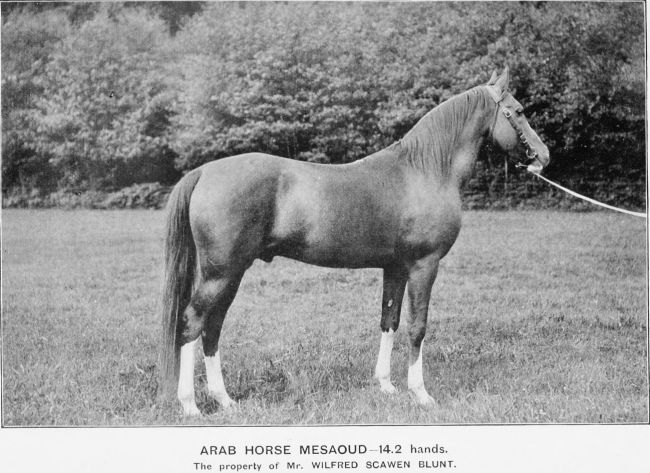
best mares to form a herd for service by the
Arab pony stallion Nejram, a bay standing
14·1, bred by Mr. Wilford Blunt at Crabbet
Park. Nejram’s stock show in marked
degree the distinctive character of their
sire in the high set and carriage of the
tail, full barrel, blood-like head and the
long pastern; but at the same time they
inherit from their dams the wonderful sure-footedness
of the Exmoor pony. These
ponies run from about 13 hands to 13·3.
Half a dozen of these Arab-Exmoors, three
years old, handled but unbroken, were sold
in the year 1898 at an average price of over
£14 14s. each. Twelve pure Exmoors by
Katerfelto, also handled but unbroken, three
years old, brought an average of over
£16 16s.
Bampton Fair, held in October, is now
the great rendezvous for Exmoor ponies.
Every fair brings several hundred animals
in from the moors for sale. Like other
horses and ponies, the Exmoors are suffering
from the competition of the bicycle, but
good prices are still obtained under the
hammer. They are much used for children,
and the less desirable find ready sale
to coster-mongers and hawkers. Newly-weaned
suckers of five or six months old
fetch from £3 to £6; exceptionally promising
youngsters command a higher figure.
The Dartmoor pony’s good points are a
strong back and loin, and substance. For
generations past the farmers appear to have
been in the habit of taking up a few mares
for riding and breeding purposes; to these
11 or 12-hand dams—they rarely reach
13 hands—a small Welsh cart stallion is
put, and the result is an animal hardy and
serviceable enough for ordinary farm work.
Even these would seem to form a small
minority. For the most part the Dartmoor
ponies still run wild, shaggy and unkempt,
on the waste lands on which they breed uncontrolled,
on which they are foaled and
live and die; often without having looked
through a bridle. Those taken up for riding
purposes or for breeding are of course the
pick of the droves, and thus we find an
active force at work which is calculated to
lower the average standard of quality among
the wild ponies.
In considering the various efforts which
from time to time have been made in the
direction of improvement by the introduction
of fresh blood, we must bear in mind
that the mares on which such experiments
have been made are those which have been
taken up by farmers and kept within fences.
We cannot find that stallions of alien blood
have ever been turned out to run on the
moors, and in view of the conditions under
which the moor ponies exist it is highly
improbable that a stallion boasting such
blood as would produce beneficial results
on the native breed would long enough
survive the exposure and scanty food to
make any appreciable mark thereon. The
endeavours, more or less continuous and
successful, to improve the breed have been
confined to the few, and have, therefore,
produced little effect or none on the main
stock.
Early in the present century Mr. Willing,
of Torpeak, made successful experiments in
crossing the Exmoor pony with the smaller
variety peculiar to the Dartmoor “tors.”
Mr. Wooton, of Woodlands, says a writer
in the Field of 9th October, 1880, was in
the habit of purchasing mares of this cross
from Mr. Willing from about the year 1820,
and possessed a considerable number of
them. He used to put these to small
thoroughbred horses standing in the district.
The names of Trap, Tim Whiffler, Rover,
and Glen Stuart are mentioned, and about
1860 he sent some of his Exmoor-Dartmoor
mares to a small Arab belonging to Mr.
Stewart Hawkins, of Ivybridge. Mr. Wooton’s
endeavours to improve the Dartmoor
breed are the first that were made on any
considerable scale, so far as it is possible
to discover.
About 1879 a resident who devoted much
attention to the improvement of the Dartmoor
breed introduced a brown stallion by
Mr. Christopher Wilson’s Sir George out
of Windsor Soarer, and as his mares—a
selected lot, 12·2 to 13 hands, either brown
or chestnut—came in use, put them to this
pony with the object of getting early foals.
The young stock thus got were carefully
weeded out, the best stallions and mares
only being retained. The colt foals were
kept apart and at two years old put to
the mares got by their sire. The experiment
was very successful, browns, black-browns
and chestnuts being the colours
of this improved breed, which sold well.
Mr. S. Lang, of Bristol, some years prior
to 1880 sent down two good stallions,
Perfection and Hereford, for use in the district,
but it is stated that these ponies were
little patronised by the farmers. Hereford,
a pure thoroughbred pony only 13 hands
high, left a few beautiful foals behind him.
A description of Exmoor and Dartmoor
ponies exhibited at the Newton Abbott
Agricultural Show in May, 1875, may have
had reference to these improved ponies.
The following is quoted from the Field of
29th May in that year:—
“Instead of deteriorating the stock improves
yearly, and the care which is now taken to infuse
pure blood without harming the essential characteristics
of the original denizen of the moor has
succeeded in producing an animal of superlative
merit, fitted for any kind of work, whether for the
field, the road, or the collar. It must be observed
that the word ‘moor’ should apply to Exmoor and
the Bodmin wastes as well as the Forest of Dartmoor,
Dartmoor Forest itself being within the precincts
of the Duchy of Cornwall. The moor pony
or galloway of 14 hands is often in reality a little
horse; and when it is stated that Tom Thumb, the
well-known hunter of Mr. Trelawny, was a direct
descendant of the celebrated Rough Tor pony of
Landue, and that Foster by Gainsborough, belonging
to the late Mr. Phillips, of Landue, carrying for
many years fifteen stone and upwards in the first
flight, was from a moor pony near Ivybridge, the
assertion is not made without bringing strong collateral
proof of the validity of the statement. Moreover,
a host of other examples could be added.
These animals possess many of the properties of the
thorough-bred—speed, activity, any amount of stay,
with legs of steel; they can jump as well as the
moor sheep, and much after the same fashion, for no
hedge fence can stop either one or the other.”
For the information of those interested
in this breed the following descriptions furnished
to the Polo Pony Society for their
Stud Book (vol. v.) by Local Committees
may be quoted:
(THE EXMOOR DIVISION.)
The Exmoor pony should average 12 hands and never be
above 13 hands; moorland bred; generally dark bay or
brown with black points, wide forehead and nostril; mealy
nose; sharp ears; good shoulders and back; short legs,
with good bone and fair action.
There are a few grey ponies in Sir Thomas Acland’s
herd, but no chestnuts.
(THE DARTMOOR DIVISION.)
The official description of points is identical
with that given for the North Wales
pony, with the following amendments and
additions:—
Height.Not exceeding 14 hands for stallions, 13·2
for mares.Colour.Brown, black, or bay preferred;
grey allowable, other colours objectionable.Head.Should
be small, well set on, and blood-like.Neck.Strong but
not too heavy, and neither long nor short; and, in case of a
stallion, with moderate crest.Back, Loins, and Hind
Quarters.Strong and well covered with muscle.
THE CUMBERLAND AND WESTMORELAND PONIES.
The ponies and galloways, for which the
waste lands of these counties have long
been known, appear to possess no distinguishing
characteristics that would permit it
to be said they form a distinct breed. An
authority resident at Harrington who gives
much information concerning the ponies of
the heafs—fell-side holdings—and moors,
states that there are several strains, and
the appearance and character of each differs
in various districts under the varying local
influences of climate, feed, &c. Little or
nothing is known of the origin of these
ponies. The resemblance to “Shelties,”
borne by those of certain localities until
about the middle of the century, suggested
that they were descended from a mixed
stock of galloways and Shetland ponies;
but some forty or fifty years ago endeavours
were made to improve them by careful
selection and mating; and the resemblance,
which did not necessarily imply possession
of the merits of the Shetland pony, has in
great measure disappeared.
They are generally good-tempered; so
sure-footed that they can gallop down the
steep hill-sides with surprising speed and
fearlessness; but their paces on level ground
are not fast. Their endurance has been
remarked by many writers. Brown’s Anecdotes
and Sketches of the Horse, published
about sixty years ago, contains an account
of an extraordinary performance by a galloway,
at Carlisle, in 1701; when Mr.
Sinclair, of Kirkby Lonsdale, for a wager
of 500 guineas, rode the animal 1000 miles
in 1000 hours.
The ponies run in “gangs” on the holdings,
the gang numbering from half a dozen
to forty or even sixty individuals. In some
cases a few ponies are taken up, broken
and worked all the year round, carrying the
farmer to market, drawing peat and hay,
and ploughing. The stony nature of the
heaf-lands requires only a light plough,
which is easily drawn by one or two of
the half-pony, half-horse nondescripts; the
extent of arable land farmed by any one
farmer is only from four to six acres. A
stallion is sometimes used for the farm-work,
and in such cases the neighbouring farmers
bring mares to be served; some such stallions
will serve from thirty to fifty mares
in the season. In the larger gangs the
stallion runs with the mares on the hills;
a good breeding mare often lives and dies
without knowing a halter, running practically
wild from the day she is dropped on
the fell-side till she dies. These unhandled
ponies pick up their living on the hills, and
during winter a little hay is brought out to
them by the shepherds.
The “Fell-siders,” as the holders of heafs
are called locally, make no attempt to improve
their wild pony stock; under the
existing conditions the wild mares drop
their foals, it may be without the knowledge
of their owner. Farmers who bring their
mares to a neighbour’s working stallion
exercise no discrimination in their choice;
the cheapest and most accessible horse
receives their preference.
Where skill and judgment have been
brought to bear upon the improvement of
the Fell ponies the result has been very
marked. Mr. Christopher W. Wilson, of
Rigmaden Park, Kirkby Lonsdale, Westmoreland,
was the pioneer of an improved
breed of ponies, and he has shown what can
be done with the material at hand, having
built upon that foundation a breed which at
the present day stands unrivalled for shape
and action. Having in the year 1872 taken
the matter in hand, Mr. Wilson selected
his breeding mares from among the best
ponies of the districts, and put them to
the pony stallion, Sir George, a Yorkshire-bred
Hackney (by Sportsman (796) by
Prickwillow, who was descended through
Phenomenon from the Original Shales),
which won for eight years the first prizes
at the Shows of the Royal Agricultural
Society. The female offspring were in due
time mated with their sire, and threw foals
which showed Hackney characteristics in
far more marked degree than did their
dams, as might be anticipated in animals
three-parts instead of one-half bred.
The chief difficulty Mr. Wilson had to
contend against was the tendency of these
ponies to exceed the 14 hands which is
the limit of the pony classes at the shows.
This was overcome by turning out the young
stock after the first winter upon the rabbit
warrens and moorlands of Rigmaden to find
their own grazing among the sheep and
rabbits as their maternal ancestors had
done. This measure not only succeeded
in its direct object, but went far to preserve
that hardiness of constitution which is by
no means the least valuable attribute of
the mountain pony.
This judicious system of breeding and
management was maintained with the best
results; the third direct cross from Sir
George produced a mare in Georgina V.
which had constitution and stamina, and also
more bone than her dam or grand-dam.
The breeder’s name has been given to the
fruits of his wisely directed efforts, and the
“Wilson pony” is now universally famous
for its hunter-like shape and action, and
for the numerous successes it has achieved
at the principal shows at home and abroad.
Mr. Wilson won the Queen’s Jubilee gold
medals for both stallions and mares at the
Royal Agricultural Society’s Show at Windsor,
and sold the stallion for a large sum
to go to America. On one occasion the
R.A.S.E. Show included three classes for
pony stallions and three prizes in each. Mr.
Wilson entered nine ponies and won all these
prizes; also 1st and 2nd prizes for pony
brood mares.
Sir Humphrey de Trafford, Bart., was
also most successful in producing ponies
from stock purchased from Mr. Christopher
Wilson. At the Flordon Sale, Norfolk,
held in September, 1895, Sir Humphrey
disposed of his large stud, when some of
the ponies realised prices which are worth
quoting: Snorer II., a brown mare, 13.3,
eight years old, by Sir George—Snorer—Sir
George, 600 gs.; Georgina V., a bay mare,
14 hands, six years old, by Sir George—Georgina
II., Sir George—Georgina—Sir
George, 700 gs.; Dorothy Derby, a
bay mare, 14 hands, eight years old, by
Lord Derby II.—Burton Agnes, 600 gs.;
Dorothy Derby II., a bay mare, 14 hands,
six years old, by Little Wonder II.—Dorothy
Derby, 720 gs.; Snorter II., bay
filly, two years old, by Cassius—Snorer II.
by Sir George—Snorer—Sir George, 700
gs., and Miss Sniff, bay yearling filly,
by Cassius—Snorer II., 900 gs.; the
average for these six lots being no less
than £756.
It is true that Sir Humphrey had spared
neither money nor labour in founding the
Flordon stud, and the ponies were animals
of exceptional merit. Their high quality
had won them prizes at all the principal
shows in England, and their fame was
literally “world-wide.”
S. Clark, Hallgarth, Photo.
LITTLE WONDER II.
Twenty years ago, the late Rev. J. M.
Lowther, rector of Boltongate, made an
attempt on a modest scale to improve the
ponies of the Caldbeck Fells by selecting
sires and dams from among the best of
them. Two or three ponies of his breeding
won prizes at Whitehaven and Carlisle; his
best sire was a 13-hand pony named
Mountain Hero. This little animal had
splendid bone and was as hardy as the
wildest of his kin. The picture here given
is a portrait of Little Wonder II., the property
of the Marquis of Londonderry. He
was bred by Mr. Christopher W. Wilson,
his sire being Little Wonder I., and his dam
Snorer by Sir George.
Mr. William Graham, of Eden Grove,
Kirkbythorpe, Penrith, writes:—
“Up to about twenty years ago great interest
seems to have been taken in pony or galloway cob
breeding throughout the whole district of the Eden
valley in the villages and hamlets that lie scattered all
along the foot of the Pennine range of hills. Previous
to the days of railway transit the ponies and small
galloway cobs were employed in droves as pack
horses, as well as for riding, and many men now
living can remember droves of from twenty to thirty
continually travelling the district, carrying panniers
of coal and other merchandise between the mines and
villages.
“The village of Dufton, in which the hill farm of
Keisley is situated, was quite a centre of pony breeding,
and for many generations the Fell-side farmers in
this district have been noted for their ponies; they
bred them to the best Fell pony stallions, most of
which were trained trotters of great speed. Each of
the three mares originally purchased to found the
stud at Keisley were got from well-known locally
bred dams and grand-dams, and all were selected to
match each other in character and style. The mare
from which two of them were bred was from a very
old strain by a stallion pony called Long Cropper, a
record trotter; and all the three mares were themselves
by a pony called Blooming Heather, another
well-known pony stallion of a few generations
younger. These mares have been put to a stallion
got by Mars from a pony mare belonging to Col.
Stirling, Kippendavie, and the present stud, with the
exception of two of the mares originally purchased,
are all by him. Last season, and this, a pony stallion
by Little Wonder II. has been in use, and five or six
of the mares have foaled to him, the end of May and
beginning of June being quite early enough for
these mares to foal, as they are never under cover
unless broken-in, especially as they very readily stand
to their service at first season after foaling.
“When safe in foal they are turned out to the higher
allotments and the open fell with their foals, where
they run from July to November; save in exceptionally
hard winters they get no hand feeding in the
shape of hay, as they thrive and do well in the rough
open allotments, to which they are generally brought
down in November to remain until the end of March.
“In height these ponies run from 12 to 13 hands,
and with the exception of two blacks all are of
uniform rich dark bay colour with black points. Just
at first, when brought in wild to break, they are a
little nervous, but if kindly treated soon become very
docile and easily handled. They are very easily
broken both for riding and driving, and ponies comparatively
quite small carry with ease men of
ordinary stature. They are the most useful means
of locomotion in crossing the mountain ranges and
traversing the hilly roads of the district. Although
of no great size these ponies are very muscular, their
bones and joints are fine, hard and clean, and,
generally speaking, they have good middles. Some
are perhaps a little short in quarter, but with a fair
shoulder, and their legs, ankles and feet are all that
can be desired. There certainly seems to be very
fair field in the district for breeding ponies, as they
are very cheaply and easily reared, and when fit to
break in can be disposed of for a very fairly good
figure.”
The Cumberland “Fell-siders” are wedded
to the customs and usages of their ancestors,
and endeavours to promote schemes for the
general improvement of the ponies have
met with small success. Colonel Green-Thompson,
of Bridekirk, Cockermouth, in
1897, offered the farmers the opportunity
of using an Arab stallion, but the chance of
thus bettering their stock appears to have
been neglected by the breeders. This is
to be regretted, for the fells and dales offer
thousands of acres of good, sound grazing
land which might be far more profitably
devoted to pony-breeding than given up to
the few scattered flocks of Herdwick sheep
which they now carry. The sheep farmers
of Caldbeck and Matterdale in Cumberland
pay some attention to the business, asserting
that the ponies are less trouble and involve
less risk than sheep. Their fillies are put
to the horse at two years old, and they
frequently obtain a second foal before sending
the dam to market. The colts command
a readier sale than the mares. The ordinary
Fell pony, outside the district, is in demand
for pit work, for which purpose suitable
animals bring from £12 to £15.
Mr. W. W. Wingate-Saul supplies the
following description of the Fell ponies:—
“A very powerful and compact cobby build, the majority
having a strong middle piece with deep chest and strong loin
characteristics, which, combined with deep sloping shoulders
and fine withers, make them essentially weight-carrying
riding ponies. The prevailing—indeed, the only—colours
are black, brown, bay, and, quite occasionally, grey. I do
not remember ever having seen a chestnut, and if I found
one I should think it due to the introduction of other blood.
The four colours prevail in the order named, the best
animals often being get black and usually without white
markings, unless it be a small white star. The head is
pony-like and intelligent, with large bright eyes and well-placed
ears. The neck in the best examples being long
enough to give a good rein to the rider. The hind quarters
are square and strong, with a well-set-on tail. The legs
have more bone than those of any of our breeds; ponies
under 14 hands often measuring 8-1/2 inches below the knee.
Their muscularity of arm, thigh and second thigh is
marvellous. Their habitat (having been bred for centuries
on the cold inhospitable Fells, where they are still to be found)
has caused a wonderful growth of hair, the winter coat
being heavy and the legs growing a good deal of fine hair,
all of which, excepting some at the point of the heel, is cast
in summer. Constitutionally they are hard as iron, with
good all-round action, and are very fast and enduring.”
IRELAND—THE CONNEMARA PONY.
Richard Berenger, Gentleman of the
Horse to King George III. in his work,
The History and Art of Horsemanship,
1771—says that—
“Ireland has for many centuries boasted a race of
horses called Hobbies, valued for their easy paces
and other pleasing and agreeable qualities, of a
middling size, strong, nimble, well moulded and
hardy.... The nobility have stallions of great
reputation belonging to them, but choose to breed for
the Turf in preference to other purposes; for which,
perhaps, their country is not so well qualified, from
the moisture of the atmosphere, and other causes,
which hinder it from improving that elastic force
and clearness of wind; and which are solely the gifts
of a dry soil, and an air more pure and refined. This
country, nevertheless, is capable of producing fine
and noble horses.”
The great stud maintained in England by
Edward III. (1327-1377) included a number
of Hobbies which were procured from Ireland.
A French chronicler named Creton,
who wrote a Metrical History of the Deposition
of Richard II.,[6] refers with great
admiration to the Irish horses of the period.
He evidently accompanied King Richard
during his expedition to Ireland in the
summer of 1399, for he says the horses of
that country “scour the hills and vallies
fleeter than deer;” and he states that the
horse ridden by Macmore, an Irish chieftain,
“without housing or saddle was worth
400 cows.”
[6] See vol. xx. of Archeologia for prose translation.
At a much later date the character of
this breed was changed by the introduction
of Spanish blood. Tradition asserts that
the ponies which inhabited the rough and
mountainous tracts of Connemara, in the
county Galway, were descended from several
animals that were saved from the wreck
of some ship of the Spanish Armada in
1588. It is, however, quite needless to
invoke the aid of a somewhat too frequently
employed tradition to explain the
character which at one period distinguished
these ponies. Spanish stallions were freely
imported into England from the fourteenth
to seventeenth centuries; and it is probable
that the character of the Connemara pony
was derived not from shipwrecked stock
but in more prosaic fashion by importation
of sires from England.
The testimony of many old writers goes
to prove the high esteem in which Spanish
horses were held. The Duke of Newcastle,
in his famous work on Horses and Horsemanship,
written in 1658, says: “I have
had Spanish horses in my own possession
which were proper to be painted after, or
fit for a king to mount on a public occasion.
Genets have a fine lofty air, trot and gallop
well. The best breed is in Andalusia,
especially that of the King of Spain at
Cordova.” The Spanish horse of those
times owed much to the Barbs, which were
originally introduced into the country by
the Moors; and if the Connemara pony
was permitted to revert to the original
type, something was done to re-establish
the Spanish—or, perhaps, it were more
accurate to go a step further back and say
the “Barb”—character in the early thirties.
Mr. Samuel Ussher Roberts, C.B., in
course of evidence given before the Royal
Commission on Horse Breeding in Ireland
(1897), stated that he lived for five-and-twenty
years in the west of Galway, and
when in that part of the country, “there
was,” he said, “an extremely hardy, wiry
class of pony in the district showing a
great deal of the Barb or Arab blood.
Without exception they were the best
animals I ever knew—good shoulders, good
hard legs, good action, and great stamina
... they were seldom over 14·2. I
never knew one of them to have a spavin
or splint, or to be in any respect unsound
in his wind.... There was a strong
trace of Arab blood which I always understood
arose from the introduction into
Connemara of the Barb or Arab by the
Martin family many years ago—you could
very easily trace it to the Connemara
ponies at the time I speak of.” In answer
to a subsequent question Mr. Ussher
Roberts fixed the date of the introduction
of the Barb or Arab blood by Colonel
Martin at about 1833.
The old stamp of Connemara pony was
described by another witness, Mr. R. B.
Begley, as “long and low with good rein,
good back, and well coupled”; but the
majority of witnesses from Galway, and
those who had personal knowledge of the
breed, shared Mr. Ussher Roberts’ opinion
that it had greatly deteriorated since the
middle of the century when the influence
of the Barb or Arab sires had died out.
The young animals, it was stated, were
collected in droves when about six months
old, and hawked about the country for sale,
bringing prices ranging from thirty shillings
to £3. Many of these were purchased for
use in the English coal pits. Evidence
was forthcoming to show that there are
still some good specimens of the breed. Mr.
John Purdon described a drove he had
recently seen in Connemara: “They were
beautiful mares, I never saw lovelier mares;
about twenty in the drove, and foals with
them. They were the perfect type of a
small thoroughbred mare.” These animals
were the property of Mr. William Lyons,
who kept a special breed for generations.
The falling off in quality was generally
attributed to promiscuous breeding and to
in-breeding. “In some parts of Connemara,”
said Mr. H. A. Robinson, “they just turn
a stallion out loose on the mountains,
mongrels of the very worst description.”
There is, however, another factor in the
loss of quality, namely, the terrible straits
to which the peasantry were reduced in
the time of the famine. A correspondent
informs me that in south-west Cork, in the
fifties, nearly all the people had mare ponies;
in west Galway in the sixties there was
scarcely an ass in Connemara west of
Spiddal and Oughterard; and the case in
west Mayo was the same. When my informant
visited the same districts fifteen
or twenty years later, he observed a remarkable
change. “Hard times” had come
upon the people in the interim, and all the
small holders had donkeys instead of ponies;
poverty had obliged them to sell their mares;
and when times improved they were too
impoverished to buy new ponies, and replaced
them with asses.
Under such circumstances, of course, the
better the mare owned by the peasant the
more likely it was to find a purchaser; and
little but the “rag, tag and bobtail” was
left to perpetuate the species. However
considerably the remainder depreciated in
quality, they still retained their characteristic
hardiness of constitution and the germs of
those qualities which under better auspices
gained the breed its reputation. Some of
the witnesses who gave evidence before the
Royal Commission mentioned experiments
in cross breeding which prove how well and
rapidly the Connemara pony responds to
endeavour to improve it by the introduction
of suitable fresh blood. Mr. Samuel Johnston
stated that he had bred one of the best
hunters he ever possessed out of a Connemara
mare; and Mr. R. B. Begley
described a mare got by the pure-bred
Hackney sire Star of the West from a
“mountainy pony.” This Hackney-Connemara
cross could cover an English mile
in three minutes; Mr. Begley had driven
her fifty-six Irish (over seventy-one statute)
miles in a day, and had repeatedly driven
her twelve Irish (over fifteen statute) miles
in an hour and ten minutes; he had won
two prizes with her for action in harness at
the Hollymount Show; and had hunted her
with ten stone on her back. With hounds as
in the shafts this really remarkable pony
proved herself able to go and stay, performing
well across country.
These Connemara ponies stand from 12
hands to 14 hands or more. Like other
breeds which run practically wild in mountainous
country, they are above all things
hardy, active and sure-footed: in response
to the climatic conditions of their habitat—the
climate of West Galway is the most
humid of any spot in Europe—they grow a
thick and shaggy coat which is very usually
chestnut in colour betraying their descent.
Although they have lost in size owing to
the conditions of their existence and are
rounder in the croup, they retain the peculiar
ambling gait which distinguished their
Spanish ancestors. Those with whose
breeding care has been taken, such as the
drove belonging to Mr. William Lyons, of
Oughterard, show the characteristics implanted
by the infusion of Barb blood in
their blood-like heads and clean limbs.
Even those which have suffered through promiscuous
breeding conform in their ugliness
and shortcomings to the original type.
For some years past systematic endeavours
to improve the breed have been
in progress. The Congested Districts
Board, under the Land Commission of
Ireland, introduced small Hackney stallions
whose substance, action and robust constitution
render them particularly well adapted
to correct the defects of weedy and ill-shaped
mares without impairing their
natural hardiness.
THE PONIES OF SCOTLAND AND THE SHETLAND ISLANDS.
The Scottish nation from early times have
possessed a breed of horses which was held
in great esteem; and, as in England, laws
were passed from time to time prohibiting
their export from the country. The second
parliament of James I. in the year 1406
enacted (cap. 31) that no horse of three
years old or under should be sent out of
Scotland. In 1567, James VI. forbade the
export of horses in an Act (Jac. VI., cap.
22) whose preface makes specific reference
to Bordeaux, from which place there was
a great demand for horses.
In a curious old book entitled The Horseman’s
Honour or the Beautie of Horsemanship,
published in the year 1620 by an
anonymous writer, we find the following
passage:—
“For the horses of Scotland they are much less
than those of England, yet not inferiour in goodnesse;
and by reason of their smallnesse they keep few
stoned but geld many by which likwise they retaine
this saying ‘That there is no gelding like those in
Scotland,’ and they, as the English, are for the most
part amblers. Also in Scotland there are a race
of small nagges which they call galloways or galloway
nagges, which for fine shape easie pace, pure
mettall and infinit toughnesse are not short of the
best nagges that are bred in any countrey whatsoever;
and for soundnesse in body they exceede the
most races that are extant, as dayly experience
shews in their continuall travels journeyings and
forehuntings.”
“This kingdom (Scotland) at present encourages
a fleet breed of horses, and the nobility and gentry
have many foreign and other stallions of great value
in their possession with which they cultivate the
breed and improve it with great knowledge and
success. Like the English they are fond of racing
and have a celebrated course at Leith which is
honoured with a royal plate given by his present
Majesty [George III.]
“The wisdom and generosity likewise of the
nobility and gentry have lately erected a riding house
in the City of Edinburgh at their own expense and
fixed a salary upon the person appointed to direct it.
“This kingdom has been famous for breeding a
peculiar sort of horses called Galloways. From the
care and attention paid at present to the culture of
horses it is to be expected that it will soon be able
to send forth numbers of valuable and generous
breeds destined to a variety of purposes and equal
to all: the country being very capable of answering
the wishes of the judicious breeder who need only
remember that colts require to be well nourished in
winter and sheltered from the severity of a rigorous
and changeable sky.”
[7] “The History and Art of Horsemanship,” by Richard
Berenger, published by Davies and Cadell, London, 1771.
The Galloway, so called from the part of
Scotland known by that name, is a diminutive
horse resembling the Welsh cob, to
which the author of an Encyclopædia of
Agriculture compares it in a passage quoted
on a former page. The breed gradually
diminished in number as the advances of
law and order deprived the mosstroopers and
other predatory border men of a method of
livelihood which involved the use of hardy
and enduring horses.
Before the commencement of the nineteenth
century and during more recent years
this animal, which cannot be described either
as a horse or a pony, has played an active
part in agricultural work on the low lands of
Scotland. In localities where no roads
existed, and wheeled traffic was impossible,
galloways were used not only for riding
but for the transport of agricultural produce;
as they lacked the weight and strength to
draw the two-horse plough, ploughing was
done by oxen, but the sledges which held
the place of carts and waggons were drawn
by the galloways, which were also used to
carry corn and general merchandise in pots
and panniers.
In height the original Galloway was
generally under 14 hands. Youatt (second
edition, 1846) describes it as from 13 to 14
hands, and sometimes more; it was a bright
bay or brown, with black legs and small
head. The purposes for which it was used
indicated the desirability of increasing its
height and strength, and with this end in
view cross breeding was commenced in the
early part of the century, and continued until
so late a date as 1850. By consequence,
the old Galloway has now almost disappeared
from all parts of the mainland and
survives only in such remote situations as
the Island of Mull.
About the end of the eighteenth century
a Mr. Gilchrist employed on his farm in
Sutherlandshire as many as ten “garrons”
to carry peats from the hills and seaweed
from the shore. These burdens were carried
in crates or panniers:
“The little creatures do wonders; they set out at
peep of day and never halt till the work of the day
be finished—going 48 miles.”[8]
[8] Husbandry in Scotland, published by Creech, Edinburgh,
1784.
At the present time the most conspicuous
field of utility open to the Scottish pony is
that offered by the grouse-moors and deer-forests,
though in the close season general
farm and draught work affords them employment.
A pony of from 13 to 14 hands may
be strong enough for a man of average
weight to ride on the grouse-moor; but for
deer-stalking a sturdy cob of from 14 to 15
hands is necessary, a smaller animal is not
equal to the task of carrying a heavy man
or a 17-stone stag over the rough hills and
valleys among which his work lies.
The origin of the “Sheltie,” like that of
the other breeds considered in the foregoing
pages, is unknown. Mr. James Goudie,
whose essay on The Early History of the
Shetland Pony is published in the first
volume of the Shetland Pony Stud Book
thinks there is every likelihood that it was
brought to the islands from Scotland at some
very early period. The “Bressay Stone,” a
sculptured slab which was discovered in
Bressay in 1864, bears, among other designs
in low relief, the figure of a horse on which
a human figure is seated. “As this monument
is admitted by authorities on the
subject to belong to a period before the
Celtic Christianity of the islands disappeared
under the shock of Norwegian
invasion [A.D. 872], it may be inferred ...
that the animal was known and probably
found in the islands at this period.” Early
writers state that the Scandinavian invaders
introduced the foundation stock some time
prior to the fifteenth century. Buchanan
makes passing reference to the Orkney
and Shetland ponies in his History of Scotland,
written three centuries ago: but the
first description which has completeness to
recommend it is that of Brand, who visited
the islands in 1700 and wrote A Brief
Description of Orkney, Zetland, Pightland,
Firth and Caithness, which was published
at Edinburgh in the following year. This
author writes:—
“They are of a less size than the Orkney Horses,
for some will be but 9, others 10 nives or hand-breadths
high, and they will be thought big Horses
there if 11, and although so small yet they are full of
vigour and life, and some not so high as others often
prove to be the strongest.... Summer or
winter they never come into an house but run upon
the mountains, in some places in flocks; and if any
time in Winter the storm be so great that they are
straitened for food they will come down from the
Hills when the ebb is in the sea and eat the sea-ware
... which Winter storms and scarcity of
fodder puts them out of ease and bringeth them so
very low that they recover not their strength till
St. John’s Mass-day, the 24th of June, when they
are at their best. They will live to a considerable
age, as twenty-six, twenty-eight or thirty years, and
they will be good riding horses in twenty-four, especially
they’le be the more vigorous and live the
longer if they be four years old before they be put to
work. Those of a black colour are judged to be the
most durable and the pyeds often prove not so good;
they have been more numerous than they now are.”
Bengie, in his Tour in Shetland (1870),
after remarking on their sure-footedness and
hardiness of constitutions, suggests that the
sagacity, spirit and activity for which they
are remarkable may be due to the freedom
of the life they live on the hills. “They are
sprightly and active as terriers, sure-footed
as mules and patient as donkeys.” They
stand, he adds, at the head of the horse
tribe as the most intelligent and faithful of
them all; and he compares the intelligence
of the Sheltie with that of the Iceland pony
much to the advantage of the former.
“Shorter in the leg than any other kind,”
says Mr. Robert Brydon, of Seaham Harbour,
“they are at the same time wider in the
body and shorter in the back, with larger
bones, thighs and arms; and therefore are
comparatively stronger and able to do with
ease as much work as average ponies of
other breeds a hand higher.” The Shetland
Stud Book Society will register no pony
whose height exceeds 10 hands 2 inches,
and the average height may be taken as
10 hands: many do not exceed 9 hands, and
a lady who wrote an account of a visit to
Shetland in 1840 speaks of one reared by
Mr. William Hay, of Hayfield, which was
only 26 inches, or 6 hands 2 inches high!
It is however, unusual to find a pony
measuring less than 8 hands at the shoulder,
and we may perhaps doubt whether the
26-inch specimen was full-grown.
In colour the Shetlander varies: bays,
browns and dullish blacks are most common:
sometimes these hues are relieved by white
markings and occasionally white specimens
occur: piebalds are rare. The coat in
winter is long, close and shaggy, fit protection
against the inclemency of the
weather the pony endures without cover
or shelter: in spring the heavy winter coat
is shed, and in the summer months the hair
is short and sleek.
In former times it was customary to
hobble the ponies; but this practice, which
must have done much to spoil their naturally
good action, has been abandoned for
many years.
It is now usual to give the ponies a
ration of hay in the winter months when
the vegetation is covered deep with snow,
and thus the losses by starvation, which
formerly were heavy in severe winters, are
obviated. Otherwise the Sheltie’s conditions
of life to-day differ little from those
that prevailed three centuries ago. Mr.
Meiklejohn, of Bressay, states that in April,
generally, the crofters turn their ponies out
upon the common pasture lands, and leave
them to their own devices. On common
pastures where there are no stallions the
mares are caught for service and tethered
until the foal is born and can follow freely,
when mother and child are turned out again.
In autumn when crops have been carried
the ponies come down from the hills to
their own townships, where they feed on the
patches of fresh grass which have been
preserved round the cultivated areas. The
nights being now cold, they remain in the
low-lying lands sheltering under the lee of
the yard walls; and “when winter has
more fully set in the pony draws nearer his
owner’s door, and in most cases is rewarded
with his morning sheaf on which, with seaweed
and what he continues to pick off
the green sward, the hardy animal manages
to eke out a living until the time rolls round
again that he is turned on the hill pasture,
never being under a roof in his life.”
At one period the ponies were apparently
regarded almost as public property; for,
among the “Acts and Statutes of the Lawting
Sheriff and Justice Courts of Orkney
and Shetland,” was one passed in the year
1612 and frequently renewed, which forbade
the “ryding ane uther manis hors without
licence and leave of the awner,” under
penalty of fine; and also provided that
“quhasoever sall be tryet or fund to stow
or cut ane uther man’s hors taill sall be
pwinischit as a theif at all rigour in exempill
of utheris to commit the lyke.”
The number of ponies on the islands has
decreased in recent years by reason of the
steadily growing demand from without. The
latest available Government returns are
those of 1891, and for the sake of comparison
the returns of 1881 are given
below:—
1881
1891
Horses (including ponies) as returned by occupiers of land
used solely for agriculture
921
787
Unbroken horses and mares kept solely for breeding
4,323
4,016
———
———
5,244
4,803
———
———
The ponies are little used for farm work
in the Shetlands; they carry loads of peat
from the hills to the crofts, and apart from
this are used only for riding; they are
beyond question the most wonderful weight-carriers
in the world, a 9-hand pony being
able to carry with the greatest ease a full-grown
man over bad ground and for long
distances.
They owe their value to the combination
of minuteness and strength, which renders
them peculiarly suitable for draught work in
the coal mines. Many ponies will travel
thirty miles a day, to and fro in the seams,
drawing a load, tilt and coals included, of
from 12 to 14 cwt. The Sheltie’s lot underground
is admittedly a hard one, but his
tractable disposition usually ensures for him
kindly treatment at the hands of the boy
who has him in charge.
These ponies, says Mr. Brydon, were first
used in the coal pits of the North of
England about the year 1850. Horse
ponies from 3 to 5 years old could then be
purchased for £4 10s. each delivered at the
collieries. Since that time prices have risen
enormously, though for the smallest animals
they fluctuate from time to time in sympathy
with the price of coal. As the cause of the
influence of the coal market upon the price
of Shetland ponies is perhaps not quite
obvious, it must be explained that the chief
value of these little animals is their ability
to work in the low galleries of thin-seamed
pits; when the price of coal sinks to a certain
point these thin seams cannot be profitably
worked, the pits are “laid in,” or temporarily
closed, and the ponies withdrawn. In 1891
the average yearling was worth £15 and a
two-year-old £18, while full-grown ponies
were scarcely procurable. In 1898 a four-year-old
could be bought at from £15 to
£21, owing to the depression in the price
of coals and the suspension of work in thin-seamed
pits.
It will be understood that only small
animals of the commoner sort suitable for
pit work are affected by the coal market.
Horse ponies of the right stamp with good
pedigree and suitable for the stud still command
from £30 to £50, and in some cases
even more. Mare ponies of good pedigree
also command high prices; at the last
Londonderry sale, the mares, Mr. R. Brydon
informs me, sold at an average of £19 per
head; but the average obtained for second-class
mares would little exceed six guineas
per head.
The docility and good temper of the
Shetland pony make him, above all, the
best and most trustworthy mount for a child.
Captain H. Hayes has remarked that “a
comparatively high degree of mental (i.e.,
reasoning) power is not desirable in a horse,
because it is apt to make him impatient of
control by man.” The Shetland pony is
the rule-proving exception; for he combines
with the highest order of equine intelligence
a disposition curiously free from vice or
trickiness. Mr. Brydon has never known
a Sheltie withdrawn from a pit as wicked
or unmanageable; withdrawal for such
reasons being very frequent with ponies of
other breeds.
Engraved by F. Babbage.
CHILD’S SHETLAND PONY.
The property of Sir WALTER GILBEY, Bart.
It may be observed that about the middle
of the century there were a number of Shelties
in Windsor Park, which were used to do
various kinds of work.
During recent years a demand for mares
for breeding purposes has grown up in
America, much to the advantage of the
crofter, who finds a market in the colliery
districts for horse ponies only.
Many attempts have been made to increase
the size of the Sheltie. About the
middle of the last century Norwegian pony
stallions were introduced into Dunrossness
with the result that a distinct variety was
established and still continues; this is called
the Sumburgh breed; in size these ponies
range from 12 hands to 13·2. Another
variety known as the Fetlar breed owes its
origin to the introduction by Sir Arthur
Nicolson of a Mustang stallion named
Bolivar over half a century ago; the
Fetlar ponies run from 11 to 13 hands, and
are described as remarkably handsome, swift
and spirited, but less tractable than the pure
Shetlander. The Sumburgh and Fetlar
varieties deserve mention only as experiments;
the result having been to increase
the height of the pony, it follows, after what
has been said on a former page, that these
cross-bred animals are of comparatively
small value.
Far more importance attaches to the
efforts which have been made to improve
the pure breed while preserving its diminutive
size. The Marquis of Londonderry,
some twenty-five years ago, acquired grazings
on Bressay and Moss Islands; and
having procured the best stock obtainable
from all over the Shetlands, began breeding
on judicious and methodical lines. Twelve
or fifteen mares with a carefully selected
stallion are placed in an enclosure, and the
young stock, after weaning, are turned out
on the hills; they are hand-fed in winter,
but are never given the protection of a roof,
whereby their natural hardiness is preserved.
The Marquis of Zetland in Unst,
and Mr. Bruce in Fair Isle, follow a somewhat
similar method of mating and rearing.
Messrs. Anderson & Sons have on Northmavine
done much to promote the interests
of the breed by purchasing good stallions,
often at Lord Londonderry’s annual Seaham
Harbour Sale, and distributing these over
the common pastures. The benefits which
have accrued from this policy are very
marked; and though the crofters yield to
the temptation of high prices, and sell their
best animals for export, the endeavours of
the gentlemen named above to maintain
the quality of the breed in its native habitat
cannot fail to largely counteract the evil
results of such sales.
Among the studs on the mainland the
best known, perhaps, is that of the Countess
of Hopetoun at Linlithgow. Her ladyship’s
success has been due in no small measure
to that beautiful little sire the Monster.
This pony is a perfect example of the Shetland
stallion, as may be gathered from his
showyard record: he was first in the class
for Shetland ponies under 10 hands 2 inches
at the Royal Agricultural Society’s Show in
1895, at Darlington, and has been preferred
by judges to Lord Londonderry’s Excellent
and the Elsenham pony, Good Friday,
Excellent having taken many first prizes,
and Good Friday five firsts at the London
shows.
Mr. James Bruce has a drove of Shetland
ponies at Inverquhomery, Longside, Aberdeenshire.
These are descended from two
mares and a stallion imported in the year
1889. Three years ago Mr. Bruce replenished
his breeding stock by the purchase
of five more mares. A noteworthy feature
of this stud is the colour, which in every
case is chestnut, Mr. Bruce’s 1889 importations
being of that rare colour among
Shelties.
Since the establishment of the Shetland
Pony Stud Book, several studs have been
founded in Scotland and England. The chief
difficulty the owners have to contend with
is the proneness towards increase of size
due to milder climate and richer feed. This
tendency can only be checked by the
periodical importation of stock from the
Shetland Isles.
Drawn by J. Doyle.Engraved on wood by F. Babbage.
H.R.H. PRINCESS VICTORIA IN HER PONY PHAETON.
USES AND CHARACTERISTICS OF THE PONY.
It would be difficult to name a class of
work in which the pony is not employed.
He is used by all, from the sovereign to the
peasant and costermonger. Pony racing has
been recently re-established as a sport after
temporary suspension, due to no shortcoming
on the pony’s side. It is rare that a meet
of hounds is not attended by a sprinkling
of ponies carrying future sportsmen and
women, and it is safe to assert that every
master of hounds and every man who takes
his own line across country served his
apprenticeship to the saddle on the back
of a pony. The reason is that few men
who do not learn to ride in early boyhood,
when a pony is the only possible mount,
completely master the art in later life; hence
we meet few good horsemen who do not
receive their first riding lessons on a steady
pony. There is no stamp of vehicle which
is not drawn by ponies. Her Majesty, for
many years, drove a pony in her garden-chair;
in double or single harness we find
the pony driven in victoria, dog-cart,
governess cart, and Irish car; in the tradesman’s
light van and in the market cart
drawing wares of every description; in the
itinerant fishmonger’s, coster’s and hawker’s
nondescript vehicle.
The country clergyman and doctor would
be in sore straits without the thirteen hand
pony, which does a horse’s work on one-half
a horse’s feed, and requires no more
stable attendance than the gardener or
handy man can spare time to give him.
As shown in the foregoing pages, his
labours are not confined to saddle and
harness; in some parts of the country he
is still used for pack-work, carrying agricultural
produce and peats from the hills
and moorlands to the farmstead; and in the
low seams of the coal-pits which the horse
cannot enter he is indispensable. Large
though our native stock of ponies is, we
do not breed them in numbers nearly sufficient
for our needs, and each year brings
thousands of small cheap ponies to our
ports from Norway, Sweden and Russia.
These, like the gangs purchased from
breeders on Exmoor and elsewhere, are
driven from one fair to another, to be sold
by twos and threes all over the country
by persons who cannot afford to keep a
horse, but are obliged to provide themselves
with a cheap and useful beast for
draught or carriage.
Engraved by F. Babbage.
THE FIRST LEAP.
From the picture by Sir EDWIN LANDSEER, R.A.
It is very generally admitted that the
intelligence of the pony is of higher degree
than that of the horse; and the fact, we
cannot doubt, is attributable to the different
conditions under which ponies and horses
are reared. The former, foaled and brought
up on the hills and wastes, develope ability,
like other wild animals, to look after themselves,
and the intelligence so evolved is
transmitted to generations born in domestication.
The horse, foaled and reared in
captivity, with every precaution taken for
his security, has no demands made upon his
intelligence, and his mental faculties remain
to a great extent undeveloped. The same
causes operate to furnish the pony’s stronger
constitution and greater soundness; greater
soundness not only in limb but also organic;
roaring and whistling are unknown in the
pony, common as they are in the horse.
This superiority of constitution accounts
for the marked superiority of the pony over
the horse in endurance. The small and
compact horse is always a better stayer than
the large, loosely-built animal, and in the
pony we find the merits of compactness at
their highest. Numberless instances of pony
endurance might be quoted, but two or three
will suffice. Reference has been made on
p. 30 to Sir Charles Turner’s achievement
of riding a pony ten miles and over thirty
leaps in forty-seven minutes, and to the conveyance
of news from Holyhead to London
by relays of ponies at the rate of twenty
miles an hour. Whyte, in his History of
the British Turf, states that in April, 1754,
a mare, 13 hands 3 inches high, belonging
to Mr. Daniel Croker, travelled 300 miles
on Newmarket Heath in 64 hours 20 minutes;
she had been backed to perform the
journey in 72 hours, and therefore completed
her task with seven hours and forty minutes
to spare. Her best day’s work was done on
Tuesday, April 23. Mr. Whyte gives the
following details of this extraordinary performance:—“24
miles and baited; 24 miles
and baited; 24 miles and baited; 36 miles
without baiting; total 108 miles. On the
Monday and Wednesday she covered 96
miles each day. She was ridden throughout
by a boy who scaled 4 stone 1 lb. without
reckoning saddle and bridle. Another performance
worth citing as proof of pony
endurance was Sir Teddy’s race with the
London mail coach to Exeter, a distance of
172 miles. Sir Teddy, a twelve hand pony,
was led between two horses all the way, and
carried no rider himself. He performed the
journey in 23 hours and 20 minutes, beating
the coach by fifty-nine minutes.”
We generally find that great feats of
endurance, involving capacity to thrive on
poor and scanty food, have generally been
performed by ponies.[9] In the Nile Campaign
of 1885 the 19th Hussars were mounted on
Syrian Arabs, averaging 14 hands, which
had been purchased in Syria and Lower
Egypt at an average price of £18. The
weight carried was reduced as much as
possible in view of the hard work required
of the ponies, but each of the 350 on which
the Hussars were mounted carried about
14 stone. Their march from Korti to
Metammeh as part of a flying column
showed what these little horses could do;
between the 8th and 20th of January, both
days included, they travelled 336 miles;
halting on the 13th. On the return March
from Dongola to Wady Halfa, 250 miles,
after nearly nine months’ hard work on poor
food they averaged 16 miles a day, with
one halt of two days. Colonel Burrow, in
reviewing the work performed by these
ponies, says: “Food was often very limited,
and during the desert march, water was
very scarce. Under these conditions I venture
to think that the performances of the regiment
on the Arab ponies will compare with
the performance of any horsemen on record.”[10]
[9] See Small Horses in Warfare. By Sir Walter Gilbey,
Bart. Vinton & Co., Ltd., 1900.
[10] The XIXth and Their Times, Colonel John Biddulph.
Murray, 1899.
Captain Fred Burnaby, in his well-known
work “A Ride to Khiva,” bears witness to
the wonderful endurance of a fourteen-hand
Tartar pony which he purchased with misgivings
for £5, in default of any better
mount. This pony, he tell us, was in such
miserable condition, his men complained
among themselves that it would not be worth
eating, they looked upon the little beast as
fore-doomed from the moment Captain
Burnaby mounted it. Yet this pony, its
ordinary diet supplemented by a few pounds
of barley daily, carried its rider, who weighed
twenty stone in his heavy sheepskin clothes,
safely and well over 900 miles of bad roads,
often through deep snow, and always in
bitterly cold weather, the thermometer being
frequently many degrees below zero. On
the concluding day of the return journey this
pony galloped the last 17 miles in 1 hour and
25 minutes. It would be easy to multiply
examples of pony endurance; but we forbear.
The greater stamina of the pony is evidenced
in another direction, namely, length
of life. Instances in which ponies have
attained to a great age are more numerous
than those recorded of horses, and further
the pony lives longer. Mr. Edmund F.
Dease, of Gaulstown, Co. Westmeath, lost a
pony in December, 1894, which had reached
the age of 39 years; in 1896, Mrs. Pratt, of
Low Pond House, Bedale, Yorks, lost a
pony mare aged 45 years; on Christmas Day,
1863, there died at Silworthy, near Clovelly
in North Devon, a pony which had arrived
within a few weeks of his sixtieth year.
Accounts of ponies which lived, and in some
cases worked, until they reached 40, 38, 37,
and 35 years also recur to mind.
There is a degree of cold beyond which
the horse cannot exist; and as he approaches
the latitude where the limit prevails, the
effect of climate is apparent in his conformation.
The frozen and ungenial country of Lapland
has its small ponies; they are employed
in drawing sledges over the snow and transporting
forage and merchandise, which in
summer are conveyed in boats. In Iceland
he is dwarfed to a Liliputian size, and
thriving in the comparatively mild climate
of the Shetlands we find a pony smaller
than any other in the British Islands.
It would seem from the facts it has been
possible to collect that the New Forest,
Welsh, Exmoor and Dartmoor, Fell and
Connemara breeds of ponies are in their
natural state of small value to man, though
they owe to the natural conditions under
which they exist qualities which may be
turned to very valuable account by judicious
crossing with breeds of a recognised stamp.
Improvement must involve partial sacrifice
of qualities such as ability to withstand
exposure and cold on insufficient food, sure-footedness,
and the sagacity which avoids
bog and treacherous ground. These qualities,
in their highest development, are indispensable
to a wild animal; but the improved
pony obtained by crossing is not
destined for a wild life on the hills and
wastes, and is less dependent upon them.
Partial loss of such attributes, therefore, is
a price well worth paying for the increased
size and better conformation which render
the produce suitable for man’s service with
the more artificial and luxurious conditions
of life inseparable from complete domesticity.
The remarkable soundness of limb and constitution,
developed by centuries of free
life on the hills, are enduring qualities
which appear in generation after generation
of stock descended on one side from
the half-wild breeds; and these are the
qualities which above all it is desirable to
breed into our horses of all sizes and for all
purposes. The advantage to be gained by
systematic improvement of these wild breeds
of ponies is therefore not by any means
advantageous to one side only.
The Polo Pony Society at their meeting
of 7th December, 1898, resolved to set
apart a section of their Stud Book for the
registration of Welsh, Exmoor, New Forest
and other breeds of ponies; and with reference
to this step Lord Arthur Cecil, in
his Introduction to the fifth (1899) volume
of the Polo Pony Stud Book, says:—
“It is in the limit of height that the greatest difficulty
of the Society lies. Could we be certain of
breeding every animal between 14 hands and 14
hands 2 inches our course would be tolerably clear....
There is always, however, the danger that
the best-looking and best-nourished of our young
stock will, if some means be not found to prevent
it, exceed this limit. The remedy is more or less
within our reach by utilising the hardy little stocks
of ponies which are to be found almost indigenous
in those districts of the British Isles where there
are large tracts of mountain or moorland ground. I
refer to such ponies as those found in North and
South Wales, the New Forest, Exmoor, Dartmoor,
and the hills of the north of England and west
coast of Scotland.... Perhaps it may not be
out of place to mention that the present is not an
inappropriate time for upholding the breeding of
ponies on hill lands. The keeping of hill sheep is
not so remunerative as of yore, the price of wool
being so low and the demand for four-year-old
mutton not being anything like what it was a few
years ago; whereas, on the other hand, the demand
for ponies, especially good ones, is likely to increase,
and if farmers will only give them a fair chance
they will amply repay them for their keep up to
three years old. It is hoped that by careful consideration
of their various characteristics, and by
registering such of them as are likely to breed
riding ponies, and by periodically going back to
this fountain head of all ponies, we may be able
to regulate the size of our higher-class riding ponies
to the desired limit, while at the same time we
shall infuse into their blood the hardiness of constitution
and endurance, combined with a fiery yet even
temper, so pre-eminently characteristic of the British
native breeds.”
The Shetland pony stands upon a different
footing. In him we have a pony whose
characteristics are equally valuable to it as
a wild animal and as one in a state of
domestication. It is the only one of our
half-wild breeds which gains nothing from
an infusion of alien blood; its value depends
upon the careful preservation of distinctive
peculiarities of size and make, which fit it
above all others for special purposes.
BREEDING POLO PONIES.
With only the limited experience in breeding
ponies for Polo possessed by all who
breed stock, remarks hazarded under this
heading must necessarily be guided by
general principles of breeding, and readers
must be left to take them for what they may
be worth.
The steadily increasing popularity of the
game of Polo has naturally produced an increased
demand for suitable ponies; and
Polo players being as a rule wealthy men, to
whom a really good animal is cheap at almost
any price, the value of first-rate ponies has
risen to a level which compels attention to
their breeding as a probably remunerative
branch of industry. It was difficult to find
ponies when an elastic 14-hand limit was the
rule; and if we may judge from the prices
which have been paid since the regulation
height was raised to 14 hands 2 inches, the
greater latitude thus afforded players in
selecting mounts has done little or nothing
towards solving the difficulty.
What is this Polo Pony for which a fancy
price is so readily forthcoming? In the first
place, it is not a pony at all, but a small horse;
we may let that pass, however. The modern
Polo Pony must be big and powerful, at once
speedy, sound, handy and docile, having also
courage, power to carry weight, and staying
power. And, as the necessary speed and
courage are rarely to be found apart from
blood, it has become an article of faith with
players that the first-class pony must have a
preponderance of racehorse blood in his veins.
Hence a serious difficulty faces the breeder
at the outset. For generations we have
devoted all our care to increasing the height
of the racehorse, and with such success that
in 200 years we have raised his average
stature by nearly 2 hands. The great
authority Admiral Rous, writing in the year
1860, said that the English racehorse had
increased in height an inch in every twenty-five
years since the year 1700. We now
regard a thoroughbred as under size if he
stand less than 15 hands 3 inches. This is
an important point to bear in mind; for if we
are to breed blood ponies of 14 hands 2 inches
to meet the demand which has recently arisen,
it is plain that we must undo most that our
fathers and ancestors have done.
A Polo Pony to command a price must be
able to carry from 12 to 14 stone, and must
be sound. Nine stone seven lb. is nowadays
considered a crushing burden for a racehorse
of 16 hands to carry a mile and a quarter.
Never are the weights for a handicap published
but the air grows thick with doubts and
forebodings as to whether this horse or that
can possibly stand the strain required by the
handicapper’s impost, or whether it is worth
risking his valuable legs under such a weight
at all. And yet, to a certain extent, it is
among small blood horses, no better endowed
with bone and no sounder than the big ones,
that we seek animals capable of carrying 12
or 14 stone in first-class Polo.
The strain of playing a single “period” in
a tournament match, in which the pony is
required to make incessant twists, turns,
sudden starts at speed, is continually being
pulled up short, and is sent short bursts of
hard galloping, takes far more out of the
pony than does a race out of a racehorse, or
an average day’s hunting out of the hunter.
The marvel is, not that fast and well-bred
ponies capable of doing this should command
fancy prices, but that such should be obtainable
at any figure.
Under existing conditions, a small blood
horse that looks like making a Polo Pony is
neither more nor less than an accidental
deviation from the normal. It is an accident
that his height at five years does not exceed
the regulation 14 hands 2 inches; it is an
accident—unhappily, a rare one—that he has
bone to carry weight; and before the trainer
can make a Polo Pony of him he must be
fast, handy, kind, and docile—another set of
accidents; we might, indeed, almost call the
first-rate Polo Pony a phenomenal chapter of
accidents. For let us bear in mind that
when we have found our 14 hands 2 inches
endowed with the needful make and shape
we have not by any means necessarily got
our Polo Pony. Only the smallest percentage
of the thousands of racehorses foaled
annually prove good enough to pay their
trainers’ bills; and when we reflect upon the
nature of the work required on the polo
ground, the sterling good qualities demanded
of a pony for first-class Polo, we should indeed
be sanguine did we look for high and uniform
merit in the race of animals we hope to found
upon a basis of pure blood! The clean
thoroughbred, except in very rare instances,
has not the power needful to enable him to
stop quickly and turn sharply at the gallop.
Speed he has, but he lacks the strong hind-quarters
essential to carry 12 or 13 stone.
The pony possessing the needful qualifications
of make and shape has yet to be
“made;” and only a trainer of experience
could tell us what proportion of the likely-looking
animals that come into his hands
turn out worth the trouble of educating.
Herein we find the reason for the vast
difference in value which exists between a
pony that is untrained and one which has
gone through the various stages of stick-and-ball
practice, the bending courses, practice
games, and has finally been proven in
matches. In the raw state the best-looking
14-hands 2-inch pony is worth £25 to £50;
when trained—when he has proved to his
exacting trainer’s satisfaction that he is a
Polo Pony, and does not merely look like
one—he is worth, as we know, any sum
up to 750 guineas, and there is no reason
to suppose that this figure marks the limit
which enthusiastic players are prepared to
pay; on the contrary, the tendency is to
go further.
Such ponies as Mr. George Miller’s Jack-in-the-Box,
Lord Kensington’s Sailor, Captain
Renton’s Matchbox, Mr. Buckmaster’s
Bendigo, the late Mr. Dryborough’s Mademoiselle,
Mr. Walter Jones’s Little Fairy,
have acquired their fancy value through their
amenability to the training which has fitted
them for the game. As to the breeding of
these ponies, it is doubtful if their respective
owners know as a certainty whether they
were got by a thoroughbred pony sire or
by an Eastern sire; in the case of many
high-class ponies nothing is known of their
breeding. All probably have a strong strain
of pure blood in them, but in the absence
of certain knowledge concerning their pedigrees
they are of comparatively little use
to us as object lessons in Polo Pony breeding.
Whether, in view of the extremely
“accidental” character of the Polo Pony
already referred to, that knowledge would
be helpful if available is another matter.
And while we make the English Turf
pony which can carry weight our ideal,
we acknowledge the difficulty of procuring
it by seeking ready-made ponies in every
corner of the horse-breeding world. Arabs
and their near allies—Egyptian, Syrian and
Barb ponies; Australian, Argentine, Canadian
and Cossack ponies; ponies from the
Tarbes district of France; ponies from
Texas, Wyoming and Montana—all these
have been imported and are played on
English Polo grounds, and though not considered
equal in speed, bottom, and courage
to the English pony, the best of them when
“made” are good enough to command high,
if not extravagant, prices.
The great object, it is granted once for
all, is to get a pony as nearly thoroughbred
as possible, for none other is good
enough to play in the best class of game.
At the same time, a large and representative
proportion of players, while heartily granting
the superiority of the well-bred pony when
it can be obtained, consider it wiser to look
the situation squarely in the face and admit
that the supply of such ponies cannot be
depended on to meet the demand.
If it be a choice between an utterly inadequate
supply of English-bred ponies with
blood, speed, stamina and weight-carrying
power, to be bought only at prices which
reserve them to the wealthiest, and a sufficiency
of ponies with a strain of alien blood,
somewhat less speedy, courageous and enduring,
the latter must be chosen; and as
already said the Polo Pony Stud Book
Society has recognised this by opening
sections of their Stud Book for suitable individuals
among our Forest and Moorland
breeds, with a view of obtaining foundation
stock.
We may take it as an axiom in our endeavour
to produce a breed of 14-hands 2-inch
Polo Ponies that the sire must be a small
thoroughbred, or, if not a thoroughbred,
an Arab. The reader may be reminded
that adoption of this alternative involves
no departure from the principle of a pure
blood basis. It was the Arab that laid
the foundation of our thoroughbreds in England,
and the best horses on the Turf of
to-day may be traced to one of the three
famous sires—the Byerly Turk, imported
in 1689, the Darley Arabian in 1706, and
the Godolphin Arabian in 1730; all of
them, it may be remarked, horses under 14
hands 1 inch.
There is, indeed, much to be said in
favour of the policy of returning to the
original Eastern stock to find suitable sires
for our proposed breed of 14-hands 2-inch
ponies. While we have been breeding the
thoroughbred for speed, and speed only,
Arab breeders have continued to breed for
stoutness, endurance, and good looks. By
going to Arab stock for our sires we might
at the beginning, sacrifice some measure of
speed; but what was lost in that respect
would be more than compensated by the
soundness of constitution and limb which
are such conspicuous traits in the Eastern
horse. Furthermore, the difficulty of size,
which first of all confronts us in the
thoroughbred sire, is much diminished if
we adopt the Arab as our foundation sire.
ARAB HORSE MESAOUD—14.2 hands.
The property of Mr. WILFRED SCAWEN BLUNT.
We need not consider the game as
played by Orientals. The Manipuris, whose
national game it is, and from whom
Europeans first learned it, use ponies which
do not often exceed 12 hands in height.
The game was introduced into India proper
in 1864,[11] and was first played in England by
the officers of the 10th Hussars in the year
1872, on their return from service in India.
[11] “Recollections of my Life.” By Sir Joseph Fayrer, Bart.
1900.
In India, where the game of Polo was
first played by Englishmen, the Arab is
thought the perfect pony, the more so
because the height of ponies played under
the Indian Polo Association’s code of rules
must not exceed 13 hands 3 inches. The
extensive operations of the Civil Veterinary
Department have proved again the truth
that no sire impresses more certainly and
more markedly his likeness upon his stock
than the Arab, a fact which is due to the
high antiquity, and therefore “fixed”
character of the breed.
If, therefore, we find the stock got by the
thoroughbred sire too prone to outgrow the
limit of height, we may, without self-reproach,
turn for assistance to the Eastern
stock, from which we have evolved the
modern racehorse, as in doing so we shall
simply be going a step farther back, and
thereby avoid in great measure the difficulty
of stature which our fathers and
ancestors have created for us in our
endeavour to breed a small compact horse
from the pure strain.
The next point that presents itself is, On
what sort of animal would it be most advisable
to cross our thoroughbred or Arab? In
the absence of any long-continued series of
experiments, which alone could have led to
definite results in the production of a fixed
type of pony, or a stamp of pony worth
trying to perpetuate as a fixed type, the
answer must be conjectural; we can only
deal in probabilities.
We may not be able to establish a breed
of which a specimen exceeding 14 hands
2 inches shall be something quite abnormal;
on the contrary, the whole course of experience
in breeding horses of whatever class
goes to prove the impossibility of ensuring
that the progeny of any given sire and dam
shall attain to a specified height, neither less
nor more. Nevertheless, there seems no
reason why skill and care in breeding
should not in course of time produce an
animal whose average height at maturity
shall be the desired 14 hands 2 inches.
There are, it must be repeated, several
essential points to be kept clearly in view in
our endeavour to develop a Polo Pony on
the foundation of Thoroughbred or Arab
blood. We have primarily to guard against
the tendency to exceed the regulation
height, and we must seek means to obtain
the bone and stamina which are so necessary.
Our Forest and Moorland mares
suggest themselves as the material at once
suitable for the purpose and easily obtainable.
In these ponies we have the small
size which will furnish the needful corrective
to overgrowth, and we have also that hardiness
of constitution and soundness of limb
which are invaluable in laying the foundation
of our proposed breed of 14-hands
2-inch ponies.
Many attempts have been made from time
to time to improve these breeds; indeed,
some have been so frequently crossed with
outside blood that the purity of the strain
has nearly disappeared; this is believed to
be the case with the Dartmoor pony. At
the same time these infusions of blood have
done nothing to impair the value of the
ponies in respect of their intrinsic qualities
of hardiness and soundness.
That small thoroughbred and Arab blood
blends well with the Forest and Moorland
strains has been abundantly proved; Marske,
the sire of Eclipse, who was under 14 hands
2 inches, as is well known, stood at service in
the New Forest district for three or four
seasons from about the year 1765, and produced
upon the New Forest breed a beneficial
effect which remained in evidence for
many years. The late Prince Consort sent
a grey Arab stallion to stand at New Park,
which did much good in improving the stamp
of pony; and in 1889 as before mentioned
Her Majesty lent two Arab sires, which
remained respectively for two and three
seasons and produced a marked effect on
the Forest breed. One of the Dongola
Arabs or Barbs which Mr. Knight used
gave the best results on the Exmoor ponies,
and the use of the thoroughbred horses,
Pandarus by Whalebone, and Canopus,
grandson of Velocipede, also improved the
breed in point of size.
Some of the best hunters in the West of
England trace their descent on the dam’s side
to the Welsh Mountain pony, the sire of
some of the best horses, however, being a
horse with a stain in his pedigree, viz., Mr.
John Hill’s Ellesmere by New Oswestry.
In this connection it may be remarked
that Bright Pearl, winner in the class for
unmade Polo Ponies at the Crystal Palace
Pony Show, held in July, 1899, was got by
the thoroughbred Pearl Diver out of a
Welsh Hill Pony mare whose wonderful
jumping powers had gained her many prizes.
The fact that the Forest and Moorland
breeds owe their small size to the rigorous
conditions of a natural free life and the spare
diet accessible must not be lost sight of, for
their tendency to increase in size when taken
up, sheltered and well fed is very marked.
The fact is of importance, because we could
not expect that foals got by a thoroughbred
or Arab sire would possess the stamina that
enables the Forest or Moorland pony to
withstand exposure. It is true that the
stock got by Marske throve under the comparatively
mild rigours of New Forest life;
but the thoroughbred of 135 years ago was
a stouter and hardier animal than is his descendant
of to-day. It would therefore be
necessary to choose between losing the young
half-bred stock altogether, and of rearing it
under more or less artificial conditions with
the certainty of rearing an animal which
would respond to those conditions by increased
stature.
The same remarks apply equally to stock
got from Forest or Moorland mares by an
Arab sire which flourishes in a high temperature,
but is not adapted to endure continuous
cold and damp.
Judgment and care might do something
to obviate the tendency to overgrowth; the
happy medium to adopt would be to allow
the dams with their half-bred youngsters as
much liberty as varying climatic conditions
indicated the well-being of the latter could
withstand.
It has been suggested that the mares
which have finished their active career of
four or five seasons on the Polo ground
might with advantage be used for breeding
purposes, being mated with a small Forest
or Moorland stallion. This suggestion does
not commend itself to the practical breeder,
who is well aware that a big mare throws a
big foal even to a small horse. Were increase
of size the object in view the worn-out
Polo Pony mares might be used thus with
every prospect of success; the reverse being
our aim, it is to be feared that experiments
conducted on these lines would lead to
failure.
From a sketch by H. F. Lucas Lucas.
POLO PONY SAILOR.
It is reasonable to think that a breed of
small horses can be established by the
judicious intermingling of our Forest or
Moorland mares with small Thoroughbred or
Arab sires, but past experience in stock-raising
has taught breeders that the creation
of a new and improved strain, whether of
horses, cattle, or other domestic animals, is
a slow process. Failures must be corrected
and errors retrieved by gradual and cautious
steps before we can hope to succeed in
creating a breed of ponies true to the required
type. That it can be done with patience
and skilled judgment there need be
no doubt; but the evolution of the animal
required, whether on the thoroughbred foundation
or on the original progenitor of the
thoroughbred, the Arab, will be a matter of
time. It may be that the present generation
will lay the foundation of a breed of 14-hands
2-inch Polo Ponies, and that posterity will
build the edifice and enjoy the benefits.
To summarise briefly what has been said
in this chapter, the position is this:—
(1) Ponies with blood, speed, courage, and
the many qualities essential to make a first-class
Polo Pony are rare.
(2) (a) They command fancy prices when
trained, but (b) it is only when trained and
proven that they command high prices.
(3) The difficulty of producing a breed of
blood ponies is due (a) to the long-maintained
and successful endeavour to increase the size
of the thoroughbred, and (b) to the fact that
racehorses are bred for speed only, whereas
speed is but one of the many qualities
essential to the Polo Pony.
(4) To avoid this difficulty—
(a) The sire chosen for the foundation
stock should be a small and compact
Thoroughbred or an Arab.
(b) The dam used for foundation stock
should be chosen from the best of our
Forest or Moorland ponies.
(5) The tendency to undue increase in
height should be counteracted—
(a) In the individual, by a free and
natural life as far as climate permits.
(b) In the breed, by recourse to further
infusion of Forest or Moorland blood
when necessary.
WORKS BY SIR WALTER GILBEY, BART.
Animal Painters of England
from the year 1650. Illustrated. Two vols., quarto, cloth
gilt, Two Guineas net on subscription. Prospectus free.
Harness Horses
The scarcity of Carriage Horses and how to breed them.
3rd Edition. Twenty-one Chapters. Seven full-page
Illustrations. Octavo, cloth gilt, 2s.; by post, 2s. 3d.
Horses Past and Present
A sketch of the History of the Horse in England from
the earliest times. Illustrated. Octavo, cloth gilt, 2s.;
by post, 2s. 3d.
Life of George Stubbs, R.A.
Ten Chapters. Twenty-six Illustrations and Head-pieces.
Quarto, whole Morocco, gilt, price £3 3s.
Ponies Past and Present
The breeds of the British Islands, New Forest, Welsh,
Exmoor, Dartmoor, Westmoreland, Cumberland,
Scottish, Shetland, Connemara. With Illustrations.
Octavo, cloth gilt, 2s.; by post, 2s. 3d.
Small Horses in Warfare
Arguments in favour of their use for light cavalry and
mounted infantry. Illustrated, 2s.; by post, 2s. 2d.
The Great Horse or War Horse
From the Roman Invasion till its development into the
Shire Horse. New and Revised Edition, 1899. Seventeen
Illustrations. Octavo, cloth gilt, price 2s.; by
post, 2s. 3d.
Young Race Horses—suggestions
for rearing, feeding and treatment. Twenty-two
Chapters. With Frontispiece and Diagrams. Octavo,
cloth gilt, price 2s.; by post, 2s. 2d.