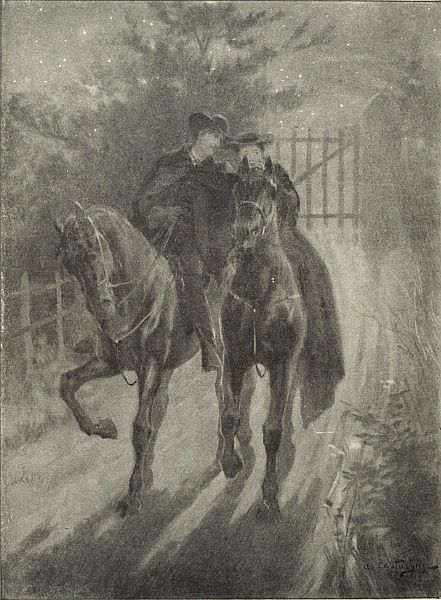
| "The young man found it necessary to lean over and throw a steadying arm around her." |
Frontispiece. |
| Vignette heading. |
Page 1. |
| "Drinkwater Torm fell sprawling on the floor." |
Page 10. |
| "'I will!' he said, throwing up his head." |
Page 22. |
| "There he was standing on the bridge just before her." |
Page 30. |
| "He made Torm, Charity, and a half-dozen younger house-servants dress him." |
Page 38. |
IT was Christmas Eve. I remember it just as if it
was yesterday. The Colonel had been pretending
not to notice it, but when Drinkwater Torm
[A]
knocked over both the great candlesticks, and in his
attempt to pick them up lurched over himself and fell
sprawling on the floor, he yelled at him. Torm pulled
himself together, and began an explanation, in which
the point was that he had not "teched a drap in Gord
knows how long," but the Colonel cut him short.
"Get out of the room, you drunken vagabond!"
he roared.
Torm was deeply offended. He made a low, grand
bow, and with as much dignity as his unsteady condition
would admit, marched very statelily from the
room, and passing out through the dining-room, where
he stopped to abstract only one more drink from the
long, heavy, cut-glass decanter on the sideboard, meandered
to his house in the back-yard, where he proceeded
to talk religion to Charity, his wife, as he always
did when he was particularly drunk. He was expounding
the vision of the golden candlestick, and the bowl
and seven lamps and two olive-trees, when he fell
asleep.
The roarer, as has been said, was the Colonel; the
meanderer was Drinkwater Torm. The Colonel gave
him the name, "because," he said, "if he were to drink
water once he would die."
As Drinkwater closed the door, the Colonel continued,
fiercely:
"Damme, Polly, I will! I'll sell him to-morrow
morning; and if I can't sell him I'll give him away."
Polly, with troubled great dark eyes, was wheedling
him vigorously.
"No; I tell you, I'll sell him.—'Misery in his
back!' the mischief! he's a drunken, trifling, good-for-nothing
nigger! and I have sworn to sell him a
thousand—yes, ten thousand times; and now I'll have
to do it to keep my word."
This was true. The Colonel swore this a dozen
times a day—every time Torm got drunk, and as that
had occurred very frequently for many years before
Polly was born, he was not outside of the limit.
Polly, however, was the only one this threat ever
troubled. The Colonel knew he could no more have
gotten on without Torm than his old open-faced watch,
which looked for all the world like a model of himself,
could have run without the mainspring. From tying
his shoes and getting his shaving-water to making his
juleps and lighting his candles, which was all he had to
do, Drinkwater Torm was necessary to him. (I think
he used to make the threat just to prove to himself that
Torm did not own him; if so, he failed in his purpose—Torm
did own him.) Torm knew it as well as he,
or better; and while Charity, for private and wifely
reasons, occasionally held the threat over him when
his expoundings passed even her endurance, she knew
it also.
Thus, Polly was the only one it deceived or frightened.
It always deceived her, and she never rested
until she had obtained Torm's reprieve "for just one
more time." So on this occasion, before she got
down from the Colonel's knees, she had given him
in bargain "just one more squeeze," and received in
return Torm's conditional pardon, "only till next
time."
Everybody in the county knew the Colonel, and
everybody knew Drinkwater Torm, and everybody
who had been to the Colonel's for several years past
(and that was nearly everybody in the county, for the
Colonel kept open house) knew Polly. She had been
placed in her chair by the Colonel's side at the club
dinner on her first birthday after her arrival, and had
been afterward placed on the table and allowed to
crawl around among and in the dishes to entertain the
gentlemen, which she did to the applause of every one,
and of herself most of all; and from that time she had
exercised in her kingdom the functions of both Vashti
and Esther, and whatever Polly ordered was done. If
the old inlaid piano in the parlor had been robbed of
strings, it was all right, for Polly had taken them.
Bob had cut them out for her, without a word of protest
from anyone but Charity. The Colonel would
have given her his heartstrings if Polly had required
them.
She had owned him body and soul from the second
he first laid eyes on her, when, on the instant he entered
the room, she had stretched out her little chubby
hands to him, and on his taking her had, after a few
infantile caresses, curled up and, with her finger in her
mouth, gone to sleep in his arms like a little white
kitten.
Bob used to wonder in a vague, boyish way where
the child got her beauty, for the Colonel weighed two
hundred and fifty pounds, and was as ugly as a red
head and thirty or forty years of Torm's mint-juleps
piled on a somewhat reckless college career could
make him; but one day, when the Colonel was away
from home, Charity showed him a daguerreotype of a
lady, which she got out of the top drawer of the
Colonel's big secretary with the brass lions on it, and
it looked exactly like Polly. It had the same great
big dark eyes and the same soft white look, though
Polly was stouter; for she was a great tomboy, and
used to run wild over the place with Bob, climbing
cherry-trees, fishing in the creek, and looking as blooming
as a rose, with her hair all tangled over her
pretty head, until she grew quite large, and the
Colonel got her a tutor. He thought of sending her
to a boarding-school, but the night he broached the
subject he raised such a storm, and Polly was in such
a tempest of tears, that he gave up the matter at once.
It was well he did so, for Polly and Charity cried all
night and Torm was so overcome that even next
morning he could not bring the Colonel his shaving-water,
and he had to shave with cold water for the
first time in twenty years. He therefore employed a
tutor. Most people said the child ought to have had
a governess, and one or two single ladies of forgotten
age in the neighborhood delicately hinted that they
would gladly teach her; but the Colonel swore that
he would have no women around him, and he would
be eternally condemned if any should interfere with
Polly; so he engaged Mr. Cranmer, and invited Bob
to come over and go to school to him also, which he
did; for his mother, who had up to that time taught
him herself, was very poor, and was unable to send
him to school, her husband, who was the Colonel's
fourth cousin, having died largely indebted, and all
of his property, except a small farm adjoining the
Colonel's, and a few negroes, having gone into the
General Court.
Bob had always been a great favorite with the
Colonel, and ever since he was a small boy he had
been used to coming over and staying with him.
He could gaff a chicken as well as Drinkwater
Torm, which was a great accomplishment in the
Colonel's eyes; for he had the best game-chickens in
the county, and used to fight them, too, matching
them against those of one or two of his neighbors who
were similarly inclined, until Polly grew up and made
him stop. He could tame a colt quicker than anybody
on the plantation. Moreover he could shoot
more partridges in a day than the Colonel, and could
beat him shooting with a pistol as well, though the
Colonel laid the fault of the former on his being so fat,
and that of the latter on his spectacles. They used to
practice with the Colonel's old pistols that hung in
their holsters over the tester of his bed, and about
which Drinkwater used to tell so many lies; for although
they were kept loaded, and their brass-mounted
butts peeping out of their leathern covers used to look
ferocious enough to give some apparent ground for
Torm's story of how "he and the Colonel had shot
Judge Cabell spang through the heart," the Colonel
always said that Cabell behaved very handsomely, and
that the matter was arranged on the field without a
shot. Even at that time some people said that Bob's
mother was trying to catch the Colonel, and that if the
Colonel did not look out she would yet be the mistress
of his big plantation. And all agreed that the
boy would come in for something handsome at the
Colonel's death; for Bob was his cousin and his nearest
male relative, if Polly was his niece, and he would
hardly leave her all his property, especially as she was
so much like her mother, with whom, as everybody
knew, the Colonel had been desperately in love, but
who had treated him badly, and, notwithstanding his
big plantation and many negroes, had run away with
his younger brother, and both of them had died in the
South of yellow fever, leaving of all their children only
this little Polly; and the Colonel had taken Drinkwater
and Charity, and had travelled in his carriage all
the way to Mississippi, to get and bring Polly back.
It was Christmas Eve when they reached home, and
the Colonel had sent Drinkwater on a day ahead to
have the fires made and the house aired for the baby;
and when the carriage drove up that night you would
have thought a queen was coming, sure enough.
Every hand on the plantation was up at the great
house waiting for them, and every room in the house
had a fire in it. (Torm had told the overseer so many
lies that he had had the men cutting wood all day, although
the regular supply was already cut.) And
when Charity stepped out of the carriage, with the
baby all bundled up in her arms, making a great show
about keeping it wrapped up, and walked up the steps
as slowly as if it were made of gold, you could have
heard a pin drop; even the Colonel fell back, and
spoke in a whisper. The great chamber was given
up to the baby, the Colonel going to the wing room,
where he always stayed after that. He spoke of sitting
up all night to watch the child, but Charity assured
him that she was not going to take her eyes off
of her during the night, and with a promise to come in
every hour and look after them, the Colonel went to
his room, where he snored until nine o'clock the next
morning.
But I was telling what people said about Bob's
mother.
When the report reached the Colonel about the
widow's designs, he took Polly on his knees and told
her all about it, and then both laughed until the tears
ran down the Colonel's face and dropped on his big
flowered vest and on Polly's little blue frock; and he
sent the widow next day a fine short-horned heifer to
show his contempt of the gossip.
And now Bob was the better shot of the two; and
they taught Polly to shoot also, and to load and unload
the pistols, at which the Colonel was as proud as if one
of his young stags had whipped an old rooster.
But they never could induce her to shoot at anything
except a mark. She was the tenderest-hearted
little thing in the world.
If her taste had been consulted she would have selected
a crossbow, for it did not make such a noise,
and she could shoot it without shutting her eyes; besides
that, she could shoot it in the house, which, indeed,
she did, until she had shot the eyes out of nearly
all the bewigged gentlemen and bare-necked, long-fingered
ladies on the walls. Once she came very near
shooting Torm's eye out also; but this was an accident,
though Drinkwater declared it was not, and tried to
make out that Bob had put her up to it. "Dat's
de mischievouses' boy Gord uver made," he said, complainingly,
to Charity. Fortunately, his eye got well,
and it gave him an excuse for staying half drunk for
nearly a week; and afterward, like a dog that has once
been lame in his hind-leg, whenever he saw Polly, and
did not forget it, he squinted up that eye and tried to
look miserable. Polly was quite a large girl then, and
was carrying the keys (except when she lost them),
though she could not have been more than twelve
years old; for it was just after this that the birthday
came when the Colonel gave her her first real silk
dress. It was blue silk, and came from Richmond,
and it was hard to tell which was the proudest, Polly,
or Charity, or Drinkwater, or the Colonel. Torm got
drunk before the dinner was over, "drinking de
healthsh to de young mistis in de sky-blue robes what
stands befo' de throne, you know," he explained to
Charity, after the Colonel had ordered him from the
dining-room, with promises of prompt sale on the
morrow.
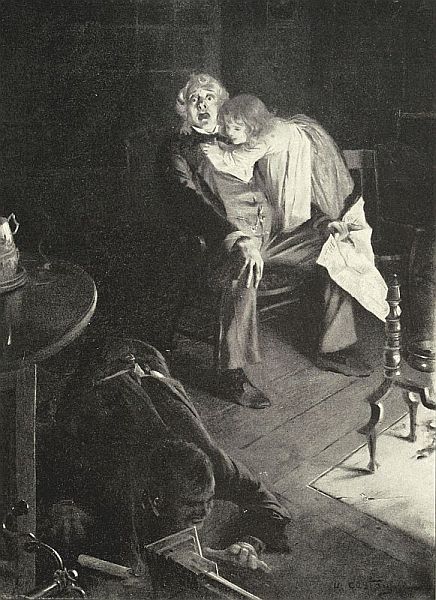
"Drinkwater Torm fell sprawling on the floor."
Bob was there, and it was the last time Polly ever
sucked her thumb. She had almost gotten out of the
habit anyhow, and it was in a moment of forgetfulness
that she let Bob see her do it. He was a great tease,
and when she was smaller had often worried her about
it until she would fly at him and try to bite him with
her little white teeth. On this occasion, however, she
stood everything until he said that about a girl who
wore a blue silk dress sucking her thumb; then she
boxed his jaws. The fire flew from his eyes, but hers
were even more sparkling. He paused for a minute,
and then caught her in his arms and kissed her violently.
She never sucked her thumb after that.
This happened out in front of her mammy's house,
within which Torm was delivering a powerful exhortation
on temperance; and, strange to say, Charity took
Bob's side, while Torm espoused Polly's, and afterward
said she ought to have "tooken a stick and knocked
Marse Bob's head spang off." This, fortunately, Polly
did not do (and when Bob went to the university afterward
he was said to have the best head in his class).
She just turned around and ran into the house, with
her face very red. But she never slapped Bob after
that. Not long after this he went off to college; for
Mr. Cranmer, the tutor, said he already knew more
than most college graduates did, and that it would be
a shame for him not to have a university education.
When the question of ways and means was mooted,
the Colonel, who was always ready to lend money if
he had it, and to borrow it if he did not, swore he
would give him all the money he wanted; but, to his
astonishment, Bob refused to accept it, and although
the Colonel abused him for it, and asked Polly if she
did not think he was a fool (which Polly did, for she
was always ready to take and spend all the money he
or any one else gave her), yet he did not like him the
less for it, and he finally persuaded Bob to take it as a
loan, and Bob gave him his bond.
The day before he left home he was over at the
Colonel's, where they had a great dinner for him, and
Polly presided in her newest silk dress (she had three
then); and when Bob said good-by she slipped something
into his hand, and ran away to her room, and
when he looked at it, it was her ten-dollar gold piece,
and he took it.
He was at college not quite three years, for his
mother was taken sick, and he had to come home and
nurse her; but he had stood first in most of his classes,
and not lower than third in any; and he had thrashed
the carpenter on Vinegar Hill, who was the bully of
the town. So that although he did not take his degree,
he had gotten the start which enabled him to
complete his studies during the time he was taking
care of his mother, which he did until her death, so
that as soon as he was admitted to the bar he made his
mark. It was his splendid defence of the man who
shot the deputy-sheriff at the court-house on election
day that brought him out as the Democratic candidate
for the Constitutional Convention, where he made such
a reputation as a speaker that the Enquirer declared him
the rising man of the State; and even the Whig admitted
that perhaps the Loco-foco party might find a
leader to redeem it. Polly was just fifteen when she
began to take an interest in politics; and although she
read the papers diligently, especially the Enquirer,
which her uncle never failed to abuse, yet she never
could exactly satisfy herself which side was right; for
the Colonel was a stanch Whig, while most people
must have been Democrats, as Bob was elected by a
big majority. She wanted to be on the Colonel's side,
and made him explain everything to her, which he did
to his own entire satisfaction, and to hers too, she tried
to think; but when Bob came over to tea, which he
very frequently did, and the Colonel and he got into a
discussion, her uncle always seemed to her to get the
worst of the argument; at any rate, he generally got
very hot. This, however, might have been because
Bob was so cool, while the Colonel was so hot-tempered.
Bob had grown up very handsome. His mouth
was strong and firm, and his eyes were splendid. He
was about six feet, and his shoulders were as broad as
the Colonel's. She did not see him now as often as
she did when he was a boy, but it was because he was
kept so busy by his practice. (He used to get cases
in three or four counties now, and big ones at that.)
She knew, however, that she was just as good a friend
of his as ever; indeed, she took the trouble to tell herself
so. A compliment to him used to give her the
greatest happiness, and would bring deeper roses into
her cheeks. He was the greatest favorite with everybody.
Torm thought that there was no one in the
world like him. He had long ago forgiven him his
many pranks, and said "he was the grettest gent'man
in the county skusin him [Torm] and the Colonel,"
and that "he al'ays handled heself to be raisin'," by
which Torm made indirect reference to regular donations
made to him by the aforesaid "gent'man," and
particularly to an especially large benefaction then
lately conferred. It happened one evening at the
Colonel's, after dinner, when several guests, including
Bob, were commenting on the perfections of various
ladies who were visiting in the neighborhood that summer.
The praises were, to Torm's mind, somewhat
too liberally bestowed, and he had attempted to console
himself by several visits to the pantry; but when
all the list was disposed of, and Polly's name had not
been mentioned, endurance could stand it no longer,
and he suddenly broke in with his judgment that they
"didn't none on 'em hol' a candle to his young mistis,
whar wuz de ve'y pink an' flow'r on 'em all."
The Colonel, immensely pleased, ordered him out,
with a promise of immediate sale on the morrow. But
that evening, as he got on his horse, Bob slipped into
his hand a five-dollar gold piece, and he told Polly
that if the Colonel really intended to sell Torm, just to
send him over to his house; he wanted the benefit of
his judgment.
Polly, of course, did not understand his allusion,
though the Colonel had told her of Torm's speech; but
Bob had a rose on his coat when he came out of the
window, and the long pin in Polly's bodice was not
fastened very securely, for it slipped, and she lost all
her other roses, and he had to stoop and pick them up
for her. Perhaps, though, Bob was simply referring to
his having saved some money, for shortly afterward he
came over one morning, and, to the Colonel's disgust,
paid him down in full the amount of his bond. He
attempted a somewhat formal speech of thanks, but
broke down in it so lamentably that two juleps were
ordered out by the Colonel to reinstate easy relations
between them—an effect which apparently was not
immediately produced—and the Colonel confided to
Polly next day that since the fellow had been taken
up so by those Loco-focos he was not altogether as he
used to be.
"Why, he don't even drink his juleps clear," the old
man asserted, as if he were charging him with, at the
least, misprision of treason. "However," he added,
softening as the excuse presented itself to his mind,
"that may be because his mother was always so opposed
to it. You know mint never would grow there,"
he pursued to Polly, who had heard him make the
same observation, with the same astonishment, a hundred
times. "Strangest thing I ever knew. But he's
a confoundedly clever fellow, though, Polly," he continued,
with a sudden reviving of the old-time affection.
"Damme! I like him." And, as Polly's face turned
a sweet carmine, added: "Oh, I forgot, Polly; didn't
mean to swear; damme! if I did. It just slipped out.
Now I haven't sworn before for a week; you know I
haven't; yes, of course, I mean except then." For
Polly, with softly fading color, was reading him the
severest of lectures on his besetting sin, and citing an
ebullition over Torm's failing of the day before.
"Come and sit down on your uncle's knee and kiss
him once as a token of forgiveness. Just one more
squeeze," as the fair girlish arms were twined about his
neck, and the sweetest of faces was pressed against his
own rough cheek. "Polly, do you remember," asked
the old man, holding her off from him and gazing at
the girlish face fondly—"do you remember how, when
you were a little scrap, you used to climb up on my
knee and squeeze me, 'just once more,' to save that
rascal Drinkwater, and how you used to say you were
'going to marry Bob' and me when you were grown
up?"
Polly's memory, apparently, was not very good.
That evening, however, it seemed much better, when,
dressed all in soft white, and with cheeks reflecting
the faint tints of the sunset clouds, she was strolling
through the old flower-garden with a tall young fellow
whose hat sat on his head with a jaunty air, and who
was so very careful to hold aside the long branches of
the rose-bushes. They had somehow gotten to recalling
each in turn some incident of the old boy-and-girl
days. Bob knew the main facts as well as she,
but Polly remembered the little details and circumstances
of each incident best, except those about the
time they were playing "knucks" together. Then,
singularly, Bob recollected most. He was positive
that when she cried because he shot so hard, he had
kissed her to make it well. Curiously, Polly's recollection
failed again, and was only distinct about very
modern matters. She remembered with remarkable
suddenness that it was tea-time.
They were away down at the end of the garden,
and her lapse of memory had a singular effect on
Bob; for he turned quite pale, and insisted that she
did remember it; and then said something about having
wanted to see the Colonel, and having waited,
and did so strangely that if that rose-bush had not
caught her dress, he might have done something else.
But the rose-bush caught her dress, and Polly, who
looked really scared at it or at something, ran away
just as the Colonel's voice was heard calling them to
tea.
Bob was very silent at the table, and when he left,
the Colonel was quite anxious about him. He asked
Polly it she had not noticed his depression. Polly
had not.
"That's just the way with you women," said the
Colonel, testily. "A man might die under your very
eyes, and you would not notice it. I noticed it, and I
tell you the fellow's sick. I say he's sick!" he reiterated,
with a little habit he had acquired since he
had begun to grow slightly deaf. "I shall advise him
to go away and have a little fling somewhere. He
works too hard, sticks too close at home. He never
goes anywhere except here, and he don't come here as
he used to do. He ought to get married. Advise
him to get married. Why don't he set up to Sally
Brent or Malviny Pegram? He's a likely fellow, and
they'd both take him—fools if they didn't;—I say they
are fools if they didn't. What say?"
"I didn't say anything," said Polly, quietly going to
the piano.
Her music often soothed the Colonel to sleep.
The next morning but one Bob rode over, and instead
of hooking his horse to the fence as he usually
did, he rode on around toward the stables. He greeted
Torm, who was in the backyard, and after extracting
some preliminary observations from him respecting the
"misery in his back," he elicited the further facts that
Miss Polly was going down the road to dine at the
Pegrams', of which he had some intimation before, and
that the Colonel was down on the river farm, but would
be back about two o'clock. He rode on.
At two o'clock promptly Bob returned. The
Colonel had not yet gotten home. He, however, dismounted,
and, tying his horse, went in. He must
have been tired of sitting down, for he now walked up
and down the portico without once taking a seat.
"Marse Bob'll walk heself to death," observed
Charity to Torm, from her door.
Presently the Colonel came in, bluff, warm, and
hearty. He ordered dinner from the front gate as he
dismounted, and juleps from the middle of the walk,
greeted Bob with a cheeriness which that gentleman in
vain tried to imitate, and was plumped down in his
great split-bottomed chair, wiping his red head with
his still redder bandana handkerchief, and abusing the
weather, the crops, the newspapers, and his overseer
before Bob could get breath to make a single remark.
When he did, he pitched in on the weather.
That is a safe topic at all times. It was astonishing
how much comfort Bob got out of it this afternoon.
He talked about it until dinner began to come in
across the yard, the blue china dishes gleaming in the
hands of Phœbe and her numerous corps of ebon and
mahogany assistants, and Torm brought out the juleps,
with the mint looking as if it were growing in the
great silver cans, with frosted work all over the sides.
Dinner was rather a failure, so far as Bob was concerned.
Perhaps he missed something that usually
graced the table; perhaps only his body was there,
while he himself was down at Miss Malviny Pegram's;
perhaps he had gone back and was unfastening an impertinent
rose-bush from a filmy white dress in the
summer twilight; perhaps—; but anyhow he was so
silent and abstracted that the Colonel rallied him good-humoredly,
which did not help matters.
They had adjourned to the porch, and had been
there for some time, when Bob broached the subject of
his visit.
"Colonel," he said, suddenly, and wholly irrelevant
to everything that had gone before, "there is a matter
I want to speak to you about—a—ah—we—a little
matter of great importance to—ah—myself." He was
getting very red and confused, and the Colonel instantly
divining the matter, and secretly flattering himself,
and determining to crow over Polly, said, to help
him out:
"Aha, you rogue, I knew it. Come up to the
scratch, sir. So you are caught at last. Ah, you sly
fox! It's the very thing you ought to do. Why, I
know half a dozen girls who'd jump at you. I knew
it. I said so the other night. Polly—"
Bob was utterly off his feet by this time. "I want
to ask your consent to marry Polly," he blurted out
desperately; "I love her."
"The devil you do!" exclaimed the Colonel. He
could say no more; he simply sat still, in speechless,
helpless, blank amazement. To him Polly was still a
little girl climbing his knees, and an emperor might
not aspire to her.
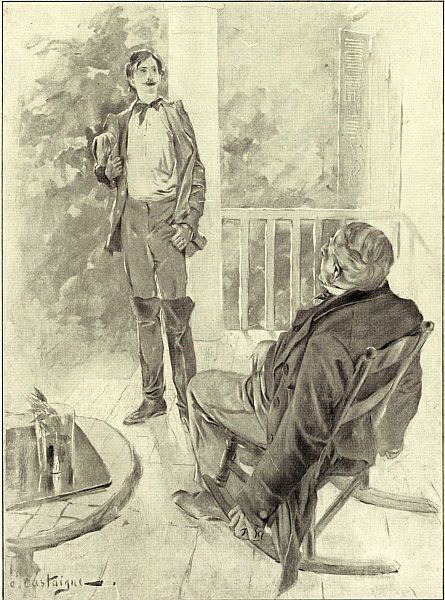
"'I will!' he said, throwing up his head."
"Yes, sir, I do," said Bob, calm enough now—growing
cool as the Colonel became excited. "I love her,
and I want her.
"Well, sir, you can't have her!" roared the Colonel,
pulling himself up from his seat in the violence of his
refusal. He looked like a tawny lion whose lair had
been invaded.
Bob's face paled, and a look came on it that the
Colonel recalled afterward, and which he did not remember
ever to have seen on it before, except once,
when, years ago, some one shot one of his dogs—a
look made up of anger and of dogged resolution. "I
will!" he said, throwing up his head and looking the
Colonel straight in the eyes, his voice perfectly calm,
but his eyes blazing, the mouth drawn close, and the
lines of his face as if they had been carved in granite.
"I'll be —— if you shall!" stormed the Colonel:
"the King of England should not have her!" and,
turning, he stamped into the house and slammed the
door behind him.
Bob walked slowly down the steps and around to
the stables, where he ordered his horse. He rode home
across the fields without a word, except, as he jumped
his horse over the line fence, "I will have her," he repeated,
between his fast-set teeth.
That evening Polly came home all unsuspecting
anything of the kind; the Colonel waited until she had
taken off her things and come down in her fresh muslin
dress. She surpassed in loveliness the rose-buds that
lay on her bosom, and the impertinence that could
dare aspire to her broke over the old man in a fresh
wave. He had nursed his wrath all the evening.
"Polly!" he blurted out, suddenly rising with a jerk
from his arm-chair, and unconsciously striking an attitude
before the astonished girl, "do you want to marry
Bob?"
"Why, no," cried Polly, utterly shaken out of her
composure by the suddenness and vehemence of the
attack.
"I knew it!" declared the Colonel, triumphantly.
"It was a piece of cursed impertinence!" and he
worked himself up to such a pitch of fury, and grew
so red in the face, that poor Polly, who had to steer
between two dangers, was compelled to employ all her
arts to soothe the old man and keep him out of a fit of
apoplexy. She learned the truth, however, and she
learned something which, until that time, she had never
known; and though, as she kissed her uncle "good-night,"
she made no answer to his final shot of, "Well,
I'm glad we are not going to have any nonsense about
the fellow; I have made up my mind, and we'll treat
his impudence as it deserves," she locked her door carefully
when she was within her own room, and the next
morning she said she had a headache.
Bob did not come that day.
If the Colonel had not been so hot-headed—that is,
if he had not been a man—things would doubtless
have straightened themselves out in some of those
mysterious ways in which the hardest knots into which
two young peoples' affairs contrive to get untangle
themselves; but being a man, he must needs, man-like,
undertake to manage according to his own plan, which
is always the wrong one.
When, therefore, he announced to Polly at the
breakfast-table that morning that she would have no
further annoyance from that fellow's impertinence; for
he had written him a note apologizing for leaving him
abruptly in his own house the day before, but forbidding
him, in both their names, to continue his addresses,
or, indeed, to put his foot on the place again;
he fully expected to see Polly's face brighten, and to
receive her approbation and thanks. What, then, was
his disappointment to see her face grow distinctly
white. All she said was, "Oh, uncle!"
It was unfortunate that the day was Sunday, and
that the Colonel went with her to church (which she
insisted on attending, notwithstanding her headache),
and was by when she met Bob. They came on each
other suddenly. Bob took off his hat and stood like
a soldier on review, erect, expectant, and a little pale.
The Colonel, who had almost forgotten his "impertinence,"
and was about to shake hands with him as
usual, suddenly remembered it, and drawing himself
up, stepped to the other side of Polly, and handed her
by the younger gentleman as if he were protecting her
from a mob. Polly, who had been looking anxiously
everywhere but in the right place, meaning to give Bob
a smile which would set things straight, caught his eye
only at that second, and felt rather than saw the change
in his attitude and manner. She tried to throw him
the smile, but it died in her eyes, and even after her
back was turned she was sensible of his defiance. She
went into church, and dropped down on her knees in
the far end of her pew, with her little heart needing all
the consolations of her religion.
The man she prayed hardest for did not come into
church that day.
Things went very badly after that, and the knots got
tighter and tighter. An attempt which Bob made to
loosen them failed disastrously, and the Colonel, who
was the best-hearted man in the world, but whose prejudices
were made of wrought iron, took it into his
head that Bob had insulted him, and Polly's indirect
efforts at pacification aroused him to such an extent
that for the first time in his life he was almost hard
with her. He conceived the absurd idea that she
was sacrificing herself for Bob on account of her
friendship for him, and that it was his duty to protect
her against herself, which, man-like, he proceeded
to do in his own fashion, to poor Polly's great distress.
She was devoted to her uncle, and knew the strength
of his affection for her. On the other hand, Bob and
she had been friends so long. She never could remember
the time when she did not have Bob. But he
had never said a word of love to her in his life. To
be sure, on that evening in the garden she had known
it just as well as if he had fallen on his knees at her
feet. She knew his silence was just because he had
owed her uncle the money; and oh! if she just hadn't
gotten frightened; and oh! if her uncle just hadn't
done it; and oh! she was so unhappy! The poor
little thing, in her own dainty, white-curtained room,
where were the books and things he had given her, and
the letters he had written her, used to—but that is a
secret. Anyhow, it was not because he was gone.
She knew that was not the reason—indeed, she very
often said so to herself; it was because he had been
treated so unjustly, and suffered so, and she had done
it all. And she used to introduce many new petitions
into her prayers, in which, if there was not any name
expressed, she felt that it would be understood, and the
blessings would reach him just the same.
The summer had gone, and the Indian summer had
come in its place, hazy, dreamy, and sad. It always
made Polly melancholy, and this year, although the
weather was perfect, she was affected, she said, by the
heat, and did not go out of doors much. So presently
her cheeks were not as blooming as they had been, and
even her great dark eyes lost some of their lustre; at
least, Charity thought so, and said so too, not only to
Polly, but to her master, whom she scared half to death;
and who, notwithstanding that Dr. Stopper was coming
over every other day to see a patient on the plantation,
and that the next day was the time for his regular visit,
put a boy on a horse that night and sent him with a
note urging him to come the next morning to breakfast.
The doctor came, and spent the day: examined
Polly's lungs and heart, prescribed out-door exercise,
and left something less than a bushel-basketful of medicines
for her to take.
Polly was, at the time of his visit, in a very excited
state, for the Colonel had, with a view of soothing her,
the night before delivered a violent philippic against
marriage in general, and in particular against marriage
with "impudent young puppies who did not know
their places;" and he had proposed an extensive tour,
embracing all the United States and Canada, and intended
to cover the entire winter and spring following.
Polly, who had stood as much as she could stand,
finally rebelled, and had with flashing eyes and mantling
cheeks espoused Bob's cause with a courage and
dash which had almost routed the old Colonel. "Not
that he was anything to her except a friend," she was
most careful to explain; but she was tired of hearing
her "friend" assailed, and she thought that it was the
highest compliment a man could pay a woman, etc.,
etc., for all of which she did a great deal of blushing
in her own room afterwards.
Thus it happened, that she was both excited and
penitent the next day, and thinking to make some
atonement, and at the same time to take the prescribed
exercise, which would excuse her from taking the
medicines, she filled a little basket with goodies to take
old Aunt Betty at the Far Quarters; and thus it happened,
that, as she was coming back along the path
which ran down the meadow on the other side of the
creek which was the dividing line between the two
plantations, and was almost at the foot-bridge that
Somebody had made for her so carefully with logs cut
out of his own woods, and the long shadows of the
willows made it gloomy, and everything was so still
that she had grown very lonely and unhappy—thus it
happened, that just as she was thinking how kind he
had been about making the bridge and hand-rail so
strong, and about everything, and how cruel he must
think her, and how she would never see him any more
as she used to do, she turned the clump of willows to
step up on the log, and there he was standing on the
bridge just before her, looking down into her eyes!
She tried to get by him—she remembered that afterwards;
but he was so mean. It was always a little
confused in her memory, and she could never recall
exactly how it was. She was sure, however, that it
was because he was so pale that she said it, and that
she did not begin to cry until afterwards, and that
it was because he would not listen to her explanation;
and that she didn't let him do it, she could not
help it, and she did not know her head was on his
shoulder.
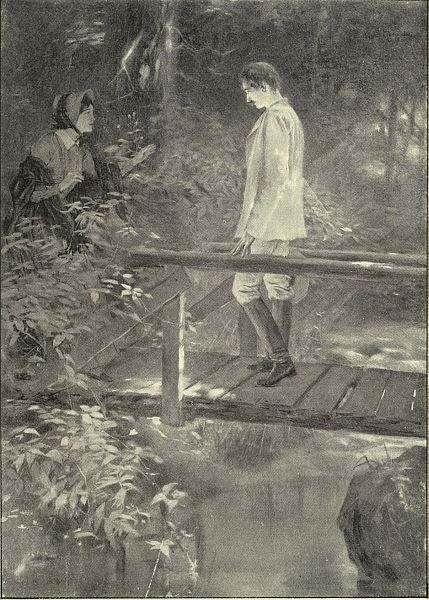
"There he was standing on the bridge just before her."
Anyhow, when she got home that evening her improvement
was so apparent that the Colonel called
Charity in to note it, and declared that Virginia country
doctors were the finest in the world, and that
Stopper was the greatest doctor in the State. The
change was wonderful, indeed; and the old gilt mirror,
with its gauze-covered frame, would never have known
for the sad-eyed Polly of the day before the bright,
happy maiden that stood before it now and smiled
at the beaming face which dimpled at its own content.
Old Betty's was a protracted pleurisy, and the good
things Polly carried her daily did not tend to shorten
the sickness. Ever afterwards she "blessed the Lord
for dat chile" whenever Polly's name was mentioned.
She would doubtless have included Bob in her benison
had she known how sympathetic he was during this
period.
But although he was inspecting that bridge every
afternoon regularly, notwithstanding Polly's oft-reiterated
wish and express orders as regularly declared, no
one knew a word of all this. And it was a bow drawn
at a venture when, on the evening that Polly had tried
to carry out her engagement to bring her uncle around,
the old man had said, "Why, hoity-toity! the young
rascal's cause seems to be thriving." She had been so
confident of her success that she was not prepared for
failure, and it struck her like a fresh blow; and though
she did not cry until she got into her own room, when
she got there she threw herself on the bed and cried
herself to sleep. "It was so cruel in him," she said to
herself, "to desire me never to speak to him again!
And, oh! if he should really catch him on the place
and shoot him!" The pronouns in our language were
probably invented by young women.
The headache Polly had the next morning was not
invented. Poor little thing! her last hope was gone.
She determined to bid Bob good-by, and never see
him again. She had made up her mind to this on her
knees, so she knew she was right. The pain it cost
her satisfied her that she was.
She was firmly resolved when she set out that afternoon
to see old Betty, who was in everybody's judgment
except her own quite convalescent, and whom
Dr. Stopper pronounced entirely well. She wavered a
little in her resolution when, descending the path along
the willows, which were leafless now, she caught sight
of a tall figure loitering easily up the meadow, and she
abandoned—that is, she forgot it altogether when, having
doubtfully suggested it, she was suddenly enfolded
in a pair of strong arms, and two gray eyes, lighting a
handsome face strong with the self-confidence which
women love, looked down into hers.
Then he proposed it!
Her heart almost stood still at his boldness. But he
was so strong, so firm, so reasonable, so self-reliant, and
yet so gentle, she could not but listen to him. Still
she refused—and she never did consent; she forbade
him ever to think of it again. Then she begged him
never to come there again, and told him of her uncle's
threats, and of her fears for him; and then, when he
laughed at them, she begged him never, never, under
any circumstances, to take any notice of what her uncle
might do or say, but rather to stand still and be shot
dead; and then, when Bob promised this, she burst
into tears, and he had to hold her and comfort her like
a little girl.
It was pretty bad after that, and but for Polly's out-door
exercise she would undoubtedly have succumbed.
It seemed as if something had come between her and
her uncle. She no longer went about singing like a
bird. She suffered under the sense of being misunderstood,
and it was so lonely! He too was oppressed
by it. Even Torm shared in it, and his expositions
assumed a cast terrific in the last degree.
It was now December.
One evening it culminated. The weather had been
too bad for Polly to go out, and she was sick. Finally
Stopper was sent for. Polly, who, to use Charity's expression,
was "pestered till she was fractious," rebelled
flatly, and refused to keep her bed or to take the medicines
prescribed. Charity backed her. Torm got
drunk. The Colonel was in a fume, and declared his
intention to sell Torm next morning, as usual, and to
take Charity and Polly and go to Europe. This was
well enough; but to Polly's consternation, when she
came to breakfast next morning, she found that the
old man's plans had ripened into a scheme to set out
on the very next day for Louisiana and New Orleans,
where he proposed to spend the winter looking after
some plantations she had, and showing her something
of the world. Polly remonstrated, rebelled, cajoled.
It was all in vain. Stopper had seriously frightened
the old man about her health, and he was adamant.
Preparations were set on foot; the brown hair trunks,
with their lines of staring brass tacks, were raked out
and dusted; the Colonel got into a fever, ordered up all
the negroes in the yard, and gave instructions from the
front door, like a major-general reviewing his troops;
got Torm, Charity, and all the others into a wild flutter;
attempted to superintend Polly's matters; made her
promises of fabulous gifts; became reminiscent, and
told marvelous stories of his old days, which Torm
corroborated; and so excited Polly and the plantation
generally, that from old Betty, who came from the Far
Quarters for the purpose of taking it in, down to the
blackest little dot on the place, there was not one who
did not get into a wild whirl, and talk as if they were
all going to New Orleans the next morning, with Joe
Rattler on the boot.
Polly had, after a stout resistance, surrendered to her
fate, and packed her modest trunk with very mingled
feelings. Under other circumstances she would have
enjoyed the trip immensely; but she felt now as if it
were parting from Bob forever. Her heart was in her
throat all day, and even the excitement of packing
could not drive away the feeling. She knew she
would never see him again. She tried to work out
what the end would be. Would he die, or would he
marry Malviny Pegram? Every one said she would
just suit him, and she'd certainly marry him if he
asked her.
The sun was shining over the western woods. Bob
rode down that way in the afternoon, even when it
was raining; he had told her so. He would think it
cruel of her to go away thus, and never even let him
know. She would at least go and tell him good-by.
So she did.
Bob's face paled suddenly when she told him all,
and that look which she had not seen often before settled
on it. Then he took her hand and began to explain
everything to her. He told her that he had
loved her all her life; showed her how she had inspired
him to work for and win every success that he had
achieved; how it had been her work even more than
his. Then he laid before her the life plans he had
formed, and proved how they were all for her, and for
her only. He made it all so clear, and his voice was
so confident, and his face so earnest, as he pleaded and
proved it step by step, that she felt, as she leaned
against him and he clasped her closely, that he was
right, and that she could not part from him.
That evening Polly was unusually silent; but the
Colonel thought she had never been so sweet. She
petted him until he swore that no man on earth was
worthy of her, and that none should ever have her.
After tea she went to his room to look over his
clothes (her especial work), and would let no one, not
even her mammy, help her; and when the Colonel insisted
on coming in to tell her some more concerning
the glories of New Orleans in his day, she finally put
him out and locked the door on him.
She was very strange all the evening. As they were
to start the next morning, the Colonel was for retiring
early; but Polly would not go; she loitered around,
hung about the old fellow, petted him, sat on his knee
and kissed him, until he was forced to insist on her
going to bed. Then she said good-night, and astonished
the Colonel by throwing herself into his arms
and bursting out crying.
The old man soothed her with caresses and baby
talk, such as he used to comfort her with when she was
a little girl, and when she became calm he handed her
to her door as if she had been a duchess.
The house was soon quiet, except that once the
Colonel heard Polly walking in her room, and mentally
determined to chide her for sitting up so late. He,
however, drifted off from the subject when he heard
some of his young mules galloping around the yard,
and he made a sleepy resolve to sell them all, or to dismiss
his overseer next day for letting them out of the
lot. Before he had quite determined which he should
do, he dropped off to sleep again.
It was possibly about this time that a young man
lifted into her saddle a dark-habited little figure, whose
face shone very white in the starlight, and whose tremulous
voice would have suggested a refusal had it not
been drowned in the deep, earnest tone of her lover.
Although she declared that she could not think of
doing it, she had on her hat and furs and riding-habit
when Bob came. She did, indeed, really beg him to
go away; but a few minutes later a pair of horses cantered
down the avenue toward the lawn gate, which
shut with a bang that so frightened the little lady on
the bay mare that the young man found it necessary
to lean over and throw a steadying arm around her.
For the first time in her life Polly saw the sun rise
in North Carolina, and a few hours later a gentle-voiced
young clergyman, whose sweet-faced wife was
wholly carried away by Polly's beauty, received under
protest Bob's only gold piece, a coin which he twisted
from his watch-chain with the promise to quadruple it
if he would preserve it until he could redeem it.
When Charity told the Colonel next morning that
Polly was gone, the old man for the first time in fifty
years turned perfectly white. Then he fell into a consuming
rage, and swore until Charity would not have
been much surprised to see the devil appear in visible
shape and claim him on the spot. He cursed Bob,
cursed himself, cursed Torm, Charity, and the entire
female sex individually and collectively, and then,
seized by a new idea, he ordered his horse, that he
might pursue the runaways, threatened an immediate
sale of his whole plantation, and the instantaneous
death of Bob, and did in fact get down his great brass-mounted
pistols, and lay them by him as he made
Torm, Charity, and a half-dozen younger house-servants
dress him.
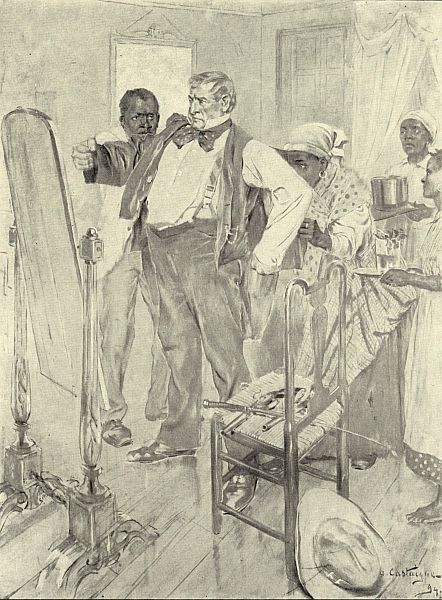
"He made Torm, Charity, and a half-dozen younger house-servants
dress him."
Dressing and shaving occupied him about an hour—he
always averred that a gentleman could not dress
like a gentleman in less time—and, still breathing out
threatenings and slaughter, he marched out of his room,
making Torm and Charity follow him, each with a
pistol. Something prompted him to stop and inspect
them in the hall. Taking first one and then the other,
he examined them curiously.
"Well, I'll be——!" he said, dryly, and flung both
of them crashing through the window. Turning, he
ordered waffles and hoe-cakes for breakfast, and called
for the books to have prayers.
Polly had utilized the knowledge she had gained as
a girl, and had unloaded both pistols the night before,
and rammed the balls down again without powder, so
as to render them harmless.
By breakfast time Torm was in a state of such
advanced intoxication that he was unable to walk
through the back yard gate, and the Colonel was forced
to content himself with sending by Charity a message
that he would get rid of him early the next morning.
He straitly enjoined Charity to tell him, and she as
solemnly promised to do so. "Yes, suh, I gwi' tell
him," she replied, with a faint tone of being wounded
at his distrust; and she did.
She needed an outlet.
Things got worse. The Colonel called up the overseer
and gave new orders, as if he proposed to change
everything. He forbade any mention of Polly's name,
and vowed that he would send for Mr. Steep, his
lawyer, and change his will to spite all creation. This
humor, instead of wearing off, seemed to grow worse
as the time stretched on, and Torm actually grew sober
in the shadow that had fallen on the plantation. The
Colonel had Polly's room nailed up and shut himself
up in the house.
The negroes discussed the condition of affairs in
awed undertones, and watched him furtively whenever
he passed. Various opinions by turns prevailed. Aunt
Betty, who was regarded with veneration, owing partly
to the interest the lost Polly had taken in her illness, and
partly to her great age (to which she annually added
three years) prophesied that he was going to die "in
torments," just like some old uncle of his whom no one
else had ever heard of until now, but who was raked
up by her to serve as a special example. The chief resemblance
seemed to be a certain "rankness in cussin'."
Things were certainly going badly, and day by day
they grew worse. The Colonel became more and
more morose.
"He don' even quoil no mo'," Torm complained
pathetically to Charity. "He jes set still and study.
I 'feard he gwine 'stracted."
It was, indeed, lamentable. It was accepted on the
plantation that Miss Polly had gone for good—some
said down to Louisiana—and would never come back
any more. The prevailing impression was that, if she
did, the Colonel would certainly kill Bob. Torm had
not a doubt of it.
Thus matters stood three days before Christmas.
The whole plantation was plunged in gloom. It
would be the first time since Miss Polly was a baby
that they had not had "a big Christmas."
Torm's lugubrious countenance one morning seemed
to shock the Colonel out of his lethargy. He asked
how many days there would be before Christmas, and
learning that there were but three, he ordered preparations
to be made for a great feast and a big time generally.
He had the wood-pile replenished as usual,
got up his presents, and superintended the Christmas
operations himself, as Polly used to do. But it was
sad work, and when Torm and Charity retired Christmas
Eve night, although Torm had imbibed plentifully,
and the tables were all spread for the great
dinner for the servants next day, there was no peace in
Torm's discourse; it was all of wrath and judgment to
come.
He had just gone to sleep when there was a knock
at the door.
"Who dat out dyah?" called Charity. "You
niggers better go 'long to bed."
The knock was repeated.
"Who dat out dyah, I say?" queried Charity,
testily. "Whyn't you go 'long 'way from dat do'?
Torm, Torm, dee's somebody at de do'," she said, as
the knocking was renewed.
Torm was hard to wake, but at length he got up
and moved slowly to the door, grumbling to himself
all the time.
When finally he undid the latch, Charity, who was
in bed, heard him exclaim, "Well, name o' Gord!
good Gord A'mighty!" and burst into a wild explosion
of laughter.
In a second she too was outside of the door, and
had Polly in her arms, laughing, jumping, hugging,
and kissing her while Torm executed a series of caracoles
around them.
"Whar Marse Bob?" asked both negroes, finally,
in a breath.
"Hello, Torm! How are you, Mam' Charity?"
called that gentleman, cheerily, coming up from where
he had been fastening the horses; and Charity, suddenly
mindful of her peculiar appearance and of the
frosty air, "scuttled" into the house, conveying her
young mistress with her.
Presently she came out dressed, and invited Bob in
too. She insisted on giving them something to eat;
but they had been to supper, and Polly was much too
excited hearing about her uncle to eat anything. She
cried a little at Charity's description of him, which she
tried to keep Bob from seeing, but he saw it, and had
to—however, when they got ready to go home, Polly
insisted on going to the yard and up on the porch, and
when there, she actually kissed the window-blind of
the room whence issued a muffled snore suggestive at
least of some degree of forgetfulness. She wanted Bob
to kiss it too, but that gentleman apparently found
something else more to his taste, and her entreaty was
drowned in another sound.
Before they remounted their horses Polly carried
Bob to the greenhouse, where she groped around in
the darkness for something, to Bob's complete mystification.
"Doesn't it smell sweet in here?" she asked.
"I don't smell anything but that mint bed you've
been walking on," he laughed.
As they rode off, leaving Torm and Charity standing
in the road, the last thing Polly said was, "Now
be sure you tell him—nine o'clock."
"Umm! I know he gwi' sell me den sho 'nough,"
said Torm, in a tone of conviction, as the horses cantered
away in the frosty night.
Once or twice, as they galloped along, Bob made
some allusion to the mint bed on which Polly had
stepped, to which she made no reply. But as he
helped her down at her own door, he asked, "What
in the world have you got there?"
"Mint," said she, with a little low, pleased laugh.
By light next morning it was known all over the
plantation that Miss Polly had returned. The rejoicing,
however, was clouded by the fear that nothing
would come of it.
In Charity's house it was decided that Torm should
break the news. Torm was doubtful on the point as
the time drew near, but Charity's mind never wavered.
Finally he went in with his master's shaving-water,
having first tried to establish his courage by sundry
pulls at a black bottle. He essayed three times to deliver
the message, but each time his courage failed, and
he hastened out under pretence of the water having gotten
cold. The last time he attracted Charity's attention.
"Name o' Gord, Torm, you gwine to scawl hawgs'?"
she asked, sarcastically.
The next time he entered the Colonel was in a
fume of impatience, so he had to fix the water. He
set down the can, and bustled about with hypocritical
industry. The Colonel, at last, was almost through;
Torm retreated to the door. As his master finished,
he put his hand on the knob, and turning it, said,
"Miss Polly come home larse night; sh' say she
breakfast at nine o'clock."
Slapbang! came the shaving-can, smashing against
the door, just as he dodged out, and the roar of the
Colonel followed him across the hall.
When finally their master appeared on the portico,
Torm and Charity were watching in some doubt
whether he would not carry out on the spot his long-threatened
purpose. He strode up and down the long
porch, evidently in great excitement.
"He's turrible dis mornin'," said Torm; "he th'owed
de whole kittle o' b'ilin' water at me."
"Pity he didn' scawl you to death," said his wife,
sympathizingly. She thought Torm's awkwardness
had destroyed Polly's last chance. Torm resorted to
his black bottle, and proceeded to talk about the lake
of brimstone and fire.
Up and down the portico strode the old Colonel.
His horse was at the rack, where he was always
brought before breakfast. (For twenty years he had
probably never missed a morning.) Finally he walked
down, and looked at the saddle; of course, it was all
wrong. He fixed it, and, mounting, rode off in the
opposite direction to that whence his invitation had
come. Charity, looking out of her door, inserted into
her diatribe against "all wuthless, drunken, fool niggers"
a pathetic parenthesis to the effect that "Ef
Marster meet Marse Bob dis mornin', de don' be a
hide nor hyah left o'nyah one on 'em; an' dat lamb
over dyah maybe got oystchers waitin' for him too."
Torm was so much impressed that he left Charity
and went out of doors.
The Colonel rode down the plantation, his great gray
horse quivering with life in the bright winter sunlight.
He gave him the rein, and he turned down a cross-road
which led out of the plantation into the main high-way.
Mechanically he opened the gate and rode out.
Before he knew where he was he was through the
wood, and his horse had stopped at the next gate.
It was the gate of Bob's place. The house stood out
bright and plain among the yard trees; lines of blue
smoke curled up almost straight from the chimneys;
and he could see two or three negroes running backward
and forward between the kitchen and the house.
The sunlight glistened on something in the hand of
one of them, and sent a ray of dazzling light all the
way to the old man. He knew it was a plate or a
dish. He took out his watch and glanced at it; it
was five minutes to nine o'clock. He started to turn
around to go home. As he did so, the memory of all
the past swept over him, and of the wrong that had
been done him. He would go in and show them his
contempt for them by riding in and straight out again;
and he actually unlatched the gate and went in. As
he rode across the field he recalled all that Polly had
been to him from the time when she had first stretched
out her arms to him; all the little ways by which she
had brought back his youth, and had made his house
home, and his heart soft again. Every scene came before
him as if to mock him. He felt once more the
touch of her little hand; heard again the sound of her
voice as it used to ring through the old house and
about the grounds; saw her and Bob as children romping
about his feet, and he gave a great gulp as he
thought how desolate the house was now. He sat up
in his saddle stiffer than ever. D—— him! he would
enter his very house, and there to his face and hers
denounce him for his baseness; he pushed his horse to
a trot. Up to the yard gate he rode, and, dismounting,
hitched his horse to the fence, and slamming the
gate fiercely behind him, stalked up the walk with
his heavy whip clutched fast in his hand. Up the
walk and up the steps, without a pause, his face
set as grim as rock, and purple with suppressed emotion;
for a deluge of memories was overwhelming
him.
The door was shut; they had locked it on him; but
he would burst it in, and—Ah! what was that?
The door flew suddenly open; there was a cry, a
spring, a vision of something swam before his eyes, and
two arms were clasped about his neck, while he was
being smothered with kisses from the sweetest mouth
in the world, and a face made up of light and laughter,
yet tearful, too, like a dew-bathed flower, was pressed
to his, and before the Colonel knew it he had, amid
laughter and sobs and caresses, been borne into the
house, and pressed down at the daintiest little breakfast-table
eyes ever saw, set for three persons, and
loaded with steaming dishes, and with a great fresh
julep by the side of his plate, and Torm standing
behind his chair, whilst Bob was helping him to
"oystchers," and Polly, with dimpling face, was attempting
the exploit of pouring out his coffee without
moving her arm from around his neck.
The first thing he said after he recovered his breath
was, "Where did you get this mint?"
Polly broke into a peal of rippling, delicious
laughter, and tightened the arm about his neck.
"Just one more squeeze," said the Colonel; and as
she gave it he said, with the light of it all breaking on
him, "Damme if I don't sell you! or, if I can't sell
you, I'll give you away—that is, if he'll come over
and live with us."
That evening, after the great dinner, at which Polly
had sat in her old place at the head of the table, and
Bob at the foot, because the Colonel insisted on sitting
where Polly could give him one more squeeze, the
whole plantation was ablaze with "Christmas," and
Drinkwater Torm, steadying himself against the sideboard,
delivered a discourse on peace on earth and
good-will to men so powerful and so eloquent that the
Colonel, delighted, rose and drank his health, and said,
"Damme if I ever sell him again!"