Finally the tourists stopped at Nantes where
the famous edict of Henri the IVth was proclaimed
in 1598. Then they drove on to Angers,
with the old Chateau d’ Angers, built by Louis
IXth, about 1250.
They stopped over night at Angers and drove
to Saumur the next day, where several pieces of
rare old tapestry were seen in the ancient church
of St. Pierre.
That night they reached Tours where they
planned to stop, in order to make an early start
for Loches with its famous chateau. Adjoining
this chateau was a thousand-year-old church of
St. Ours which Mr. Fabian desired to show the
girls.
The old keeper of the church mentioned the
Chateau of Amboise which was only a short distance
further on the road and was said to be well
worth visiting. So they drove there and saw the
268
chapel of St. Hubert which was built by Charles
the VIIth. Here lies buried the remains of
Leonardo da Vinci, the famous painter.
While at St. Hubert’s Chapel, the tourists
heard of still another ancient chateau of the 10th
century, which was but a few miles further on,
on the Loire. As this Chateau ’de Chaumont
was only open to visitors on certain days and
this day happened to be one of those days, they
visited the place.
“My gracious!” exclaimed Mr. Alexander,
when they came from the last ancient pile. “I’ll
be so glad to get back to Denver, where the oldest
house is only half a century old, that I won’t say
a word if you’ll agree to only use another precious
week lookin’ at these moldy old rocks and moss-back
roofs.”
His friends laughed, for they knew him well
by this time. Mrs. Alexander, however, was not
so thankful to go back to Denver, nor was she
willing to see any more old chateaux. So she
said: “Let’s drive on to Paris where we have so
much shopping to do.”
“Oh no, Ma. The keeper of that last chateau
told us there was the finest old place of all, a few
miles on, so we want to see that as long as we are
here,” said Dodo.
269
“All right, then! You-all go on and see it, but
I’ll stay here,” declared Mrs. Alexander.
“I don’t want to see any more ruins, Maggie,
so s’pose you and I drive in your car and let Dodo
drive the touring car to any old stone-heap they
want to visit,” said Mr. Alexander.
“All right, Ebeneezer. I honestly believe I’d
rather sit beside you, in my new car, than have to
limp around these old houses,” sighed Mrs.
Alexander.
Her words were not very gracious, but her
spouse thought that, being her guest in the new
car, was better than having to wait for hours outside
a ruin. So Dodo drove her friends on to
the Chateau de Blois, and they inspected the old
place, then saw the famous stable that was built
to accommodate twelve hundred horses at one
time.
“Here we are, but a short distance from
Orleans—why not run over there and visit the
place, then drive back to Nantes to meet your
father and mother,” suggested Mr. Fabian.
“It seems too bad that we have to go all the
way back for them, when we are so near Paris,
now,” said Dodo.
“Oh, but we haven’t finished the most interesting
section of France, yet!” exclaimed Eleanor,
270
who had been looking over Mr. Fabian’s road-map.
“In that case, I fear we will lose Ma for company,”
said Dodo, laughingly. “As we come
nearer Paris, she is more impatient to reach there.
She may suddenly take it into her head to let her
car skid along the road that leads away from us
and straight for Paris.”
From Nantes they drove straight on without
stopping until Caens was reached; Mr. Fabian
pointed out various places along the road, and
told of famous historical facts in connection with
them, but they did not visit any of the scenes.
Caen, with its old churches and quaint buildings,
was very interesting to the girls. Then at
Bayeaux they went to see the wonderful Bayeaux
tapestry which was wrought by Matilda and her
Ladies in Waiting in 1062. This tapestry is two
hundred and thirty feet long and twenty inches
wide, but it pictures the most marvellous historical
scenes ever reproduced in weaving.
From Bayeaux they went to Mont St. Michel
to see the eight hundred year-old monastery which
is so well preserved. Rouen, the capital of Normandy,
was the next stopping place on the
itinerary, and here they saw many ancient Norman
houses as well as churches. But the principal point
271
of interest for the girls, was the monument
in Rouen, erected to the memory of Joan
of Arc, who was burned to death for her faith.
The night they spent at Rouen, Mr. Alexander
had a serious talk with Mr. Fabian and his girls.
“You see, I want to please you-all, but Maggie
won’t stand for any more of this gallivantin’
around old churches. I’m gettin’ awful tired of
it, myself, but then I don’t count much, anyway.
“Maggie says she’s goin’ right on to Paris,
whether you-all do so or not; and if I let her go
there alone, she’ll buy her head off with fine
clothes, and then Dodo and me won’t know what
to do to cart them all back to the States. So I
have to go with her in self-defense, you understand!”
They laughed at the worried expression on the
little man’s face, and Mr. Fabian said: “Well,
Mr. Alex, we are through sight-seeing for this
time, anyway, so we may as well run back to Paris
when you do.”
“Oh, that’s good news! Almost as good as if
I won the first prize in the Louisanny Lottery!”
laughed Mr. Alexander, jocosely.
So they all drove to Paris, where Mr. Ashby
was to meet them, in a few days. As Mr. Alexander
deftly threaded the car in and out through
272
the congested traffic, he sighed and said: “I
never thought I’d be so glad to see this good-for-nothin’
town again. But I’ve been so tossed and
torn tourin’ worst places, that even Paris looks
good to me, now.”
His friends laughed and his wife said: “Why,
it is the most wonderful city in the world! I am
going to enjoy myself all I can in the next three
days.”
“You’d better, Maggie! ’cause we are leavin’
this wild town in just three days’ time!” declared
Mr. Alexander.
“Why—where are you going, then?” asked
Mrs. Alexander, surprised at her husband’s determined
tone.
“Straight back to Denver, as fast as a ship and
steam-cars will carry us!”
“Never! Why, Ebeneezer, I haven’t succeeded
in doing what I came over for,” argued Mrs.
Alexander.
“No, thank goodness; and Dodo says she’s
standin’ for a career now,” laughed Mr. Alexander.
“I agree with her, and she can start right
in this Fall to study Interior Decoratin’, if she
likes.”
Mrs. Alexander did not reply, and no one knew
what she thought of Dodo’s determination, but
273
when all the shopping was done, and Mr. Ashby
met them at the hotel, she seemed as anxious as
the others, to start for home.
“We are to pick up Ruth and Mrs. Ashby at
Dover, you know,” said Mr. Ashby, when he concluded
his plans for the return home.
“Well, we have had a wonderful tour out of
this summer. I never dreamed there were so
many marvellous things to see, in Europe,” said
Polly.
That evening, several letters were handed to
the Fabian party, and among them was one for
Polly and another for Eleanor. Polly’s was
stamped “Oak Creek” and the hand-writing
looked a deal like Tom Larimer’s. But Eleanor’s
was from Denver and Dodo cried teasingly:
“Oh, I recognize Paul Stewart’s writing! It hasn’t
changed one bit since he was a boy and used to
send me silly notes at school.”
Eleanor laughed at that, but why should she
blush? Polly gazed thoughtfully at her, and decided
that Nolla must have no foolish love affair,
yet—not even with Paul Stewart!
Then Eleanor caught Polly’s eye and seemed to
comprehend what was passing through her mind.
She quickly rose to the occasion.
“Polly, if I confess that my letter is from Paul,
274
will you own up that yours is from Tom—and
tell us the truth about the American Beauty
Roses?”
Polly became as crimson as the roses mentioned,
and sent her chum a look that should have annihilated
her. But Eleanor laughed.
That evening, as the merry party sat at dinner
in the gay Parisian dining-room, Mr. Alexander
suddenly sat up. His lower jaw dropped. He
was opposite a wall-mirror and in its reflection he
could see who came in at the door back of him.
He had been telling a funny incident of the tour
and had but half finished it, so his abrupt silence
caused everyone to look at him. His expression
then made the others turn and look at what had
made him forget his story.
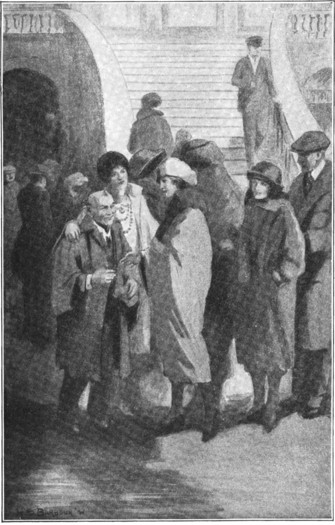
In the doorway stood Count Chalmys, looking
around the room. Now his eyes reached the
American party at the round table and he smiled
delightedly. In another moment he was across
the room and bowing before the ladies.
Mr. Alexander grunted angrily and kept his
eyes upon his plate. He never wanted to see another
man who had a title! But his wife made
amends for his apparent disregard for conventions.
She made room beside herself and insisted
that the Count sit down and dine.
275
“I never had a pleasanter surprise,” said he.
“I expected to see the Marquis here, but I find
my dear American friends, instead.”
“Humph! What play are you acting in now,
Count?” asked Mr. Alexander, shortly.
“That’s what brought me to Paris. I was to
meet the Marquis here, and we both were to sail
from Havre, day after tomorrow. We have accepted
a long engagement with a leading picture
company in California, so I am to go across, at
once,” explained the Count, nothing daunted by
Mr. Alexander’s tone and aggressive manner.
“Oh really! How perfectly lovely for us all!”
exclaimed Mrs. Alexander, clasping her hands in
joy.
Then she turned to her daughter who seemed
not to be giving as much attention to the illustrious
addition to the party, as Mrs. Alexander thought
proper.
“Dodo, must you talk such nonsense with Polly
when our dear Count is with us and, most likely,
has wonderful things to tell us of his adventures
since last we saw him at his beautiful palace?”
“Oh, I beg your pardon, Ma, but I didn’t know
the Count had said anything to me,” hastily returned
Dodo.
“I really haven’t, as yet, Miss Alexander, but
276
there is every symptom that something is being
mulled over in my brain,” was the merry retort
from the Count.
“All the same, Dodo, I want you to give attention
to the dear Count, now that he is with us,
once more,” said Mrs. Alexander, with such dignity
as would suit the mother-in-law of a Count.
“Aye, aye, Sir!” laughed the irrepressible
Dodo, bringing her right hand to her forehead in
a military salute.
“I joined the party, just now, merely to share a
very felicitous secret with you. One that I feel
sure you will all be pleased to hear. Perhaps the
three young ladies in the group will be more interested
in my secret than the matrons,” ventured
Count Chalmys, with charming self-consciousness.
Instantly, Mrs. Alexander interpreted the secret
as one that meant success to her strenuous
endeavors to find a “title” for her daughter. She
had heard that foreign nobility made no secret of
love or proposals, but spoke to interested friends
of intentions to marry, even before the young
woman had been told or had accepted a proposal
of marriage. This, then, must be what Count
Chalmys was about to tell them.
“Oh, my dear Count! Before you share that
secret with every one, especially while the children
277
are present, wouldn’t you just as soon wait and
have a private little chat with me?” gushed Mrs.
Alexander, tapping him fondly on the cheek with
her feather fan.
The Count stared at her in perplexity for he
was not following her mood, nor did he give one
fleeting thought to such foolishness as she endowed
him with entertaining.
“You know, my dear Count! I am speaking
of certain little personal matters regarding settlements
and such like, which I only can discuss with
you, satisfactorily. After that, you can confide
in the others, if you like. However, I should
think you would speak to the one most concerned,
before you mention it in public.” Mrs. Alexander
spoke in confidential tones meant only for
the Count’s ear.
“My dear lady! I haven’t the slightest idea
what you mean. I was only going to tell my
good friends, here, that——”
“Yes, yes! I know what you were going to say,
dear Count,” hastily interrupted Mrs. Alexander,
“but allow me to advise you: Say nothing until
after I have had a private talk with you. I am
sure Dodo will look at things very differently
after I have had time to get your view-points and
then tell them to her.”
278
Count Chalmys began to receive light on the
hitherto unenlightening advices from the earnest
lady. He now had difficulty in hiding a broad
smile. But Mrs. Alexander paid no heed to him.
“You see, Count dear, we shall have several
wonderful days on this trip across, in which you
can make the best of your opportunities with
Dodo, but really, I think it wise to consult with me
first.”
“My dear Mrs. Alexander! won’t you permit
me to explain myself, before you go deeper into
this problem from which you will have chagrin in
finding a pleasant way out?” asked the Count.
Mrs. Alexander gazed at him in frowning perplexity.
“What is the happy secret you wished
to share with us, if it is not your intention to propose
to one of the young ladies in our party?”
“I am to have a third member in my party,
this trip, although she is not one of the company
in California,” said the Count, smilingly. “I
mean the pretty girl who played in the picture in
Venice. We were married last week, and having
settled all matters at Chalmys and leased the place
for a term, we will remain in the United States
for a long time.”
At this unexpected information, Mrs Alexander
almost swooned, but her husband seemed to
279
change his manners as quickly as if they were old
clothes. He smiled cordially at the Count and
suggested a toast to his bride—but the toast was
given with Ginger Ale.
That evening the Count introduced his Countess,
and Mrs. Alexander gritted her teeth in impotent
rage. “Oh, how nearly had she plucked
this prize for Dodo, and now he had married a
plain little actress!” thought she.
But she never knew that the Count had been
attentive to his lady-love for three years before
Mrs. Alexander ever met him. Had it not been
for the heavy debts of his Italian Estate, he would
never have delayed his proposal. Even as it was,
he found happiness to be more important in life
than wealth and a palace.
The young countess was very pretty and
promised to be a welcome addition to the group
of young folks. Polly, Eleanor and Dodo liked
her immensely, from the moment they saw her
charming smile as she acknowledged the introductions.
Evidently she was very glad to find a number
of young Americans of her own age with
whom she could associate on the trip across the
Atlantic.
Everyone but Mrs. Alexander, made the young
couple feel very much at ease. Ebeneezer Alexander
280
saw and understood his wife’s aloofness
and straightway he decided to speak a bit of his
mind to her as soon as they were in the shelter of
their own suite at the hotel.
“Now, lem’me tell you what, Maggie! I ain’t
goin’ to have you actin’ like all get-out, just because
Chalmys went and married the gal he loved,
disappointin’ you, thereby. Even if he had gone
your way of plannin’, and ast Dodo to marry him,
I’d have to say ‘NO!’ He’s saved me from
hurtin’ his feelin’s, see?”
Mrs. Alexander tried to stare her insignificant
lord into silence, but the little man had found his
metal while traveling with appreciative people,
and he was not to be downed any more by mere
looks and empty words from his wife.
“Yeh! you kin sit there and stare all you like
but stares don’t hurt and they ain’t changin’ the
case, at all. Dodo wasn’t a-goin’ to marry no
one, not even if you cried your head off for it,
’cause she’s made up her mind to try out decoratin’
for a time. So you jest watch your p’s and
q’s when you’re mixin’ in with the Chalmys; and
don’t show your ignerence of perlite society by
actin’ upish and jealous as a cat.”
Whether this sound advice actually had its effect
281
upon Mrs. Alexander, or whether she forgot her
chagrin, it is hard to say; but at all events, she
smiled sweetly upon the Chalmys the next time she
met them.
A few days later, the steamer stopped at Dover
and Mr. Ashby was delighted to have his wife
and Ruth with him again.
They were several days out, when Mrs. Alexander
realized that Count Chalmys was only an
ordinary mortal! She thought over this revelation
for a time, and finally remarked to Dodo and
the others: “I am so glad the Count didn’t fall
in love with Dodo. The little dear would never
have been happy with him.”
“When did you discover that fact, Maggie?”
asked her husband, quizzically.
“Why, a long time ago. I was so disgusted
with folks who claim a title, and then turn out to
be factory men like that Osgood family. And
now this Count is nothing but a play-actor!
Dodo will be far better off if she falls in love with
a first-class American, say I!”
“Hurrah, Maggie! You’ve opened your eyes
at last!” cried little Mr. Alexander.
“But you will be made still happier, Ma, to hear
that I am in love, now!” declared Dodo, teasingly.
282
“What! Who is he?” demanded her mother.
“Ask Eleanor and Polly. They introduced me
to my future lord,” giggled Dodo.
“Oh, she means her career, Mrs. Alex,” said
Polly.
“Oh, Dodo!” wailed her mother. “You won’t
go to work, will you, when your father’s worth a
million dollars?”
“All the more reason for it! I’m going to
marry a profession, just as Polly and Eleanor are,
and we three are going to be the most famous
decorators in the world.”
“And I am goin’ to build a swell mansion in
New York and turn the contract for fixin’s, over
to these three partners!” declared little Mr.
Alexander.
That trip across the Atlantic was a merry one
for the girls, for the “Marquis” and his friend,
aided by the Count and the young Countess, were
a never failing source of entertainment for all.
They mimicked and acted, whenever occasion
offered, so that there was no time for dull care or
monotony.
While abroad, the Count had secured a small
motion picture outfit; this was brought out and
several amusing pictures made on the steamer.
They were hastily developed and printed and
283
shown at night, to the passengers. It proved to
be very interesting to see one’s self on the screen,
acting and looking so very differently than one
imagines himself to act and look.
After the second attempt at this form of amusement,
Polly made a suggestion.
“Wouldn’t it be heaps of fun if each one of us
were to go away, alone, and write a chapter of
a story for the Count to film. It will be a regular
hodge-podge!”
“Oh, that’s great!” exclaimed Eleanor, eagerly.
The others seemed to think it would be entertaining,
too, so the Count gave them a few important
advices to note.
“Let us decide upon the characters, the plot,
and the place, of the scenario; then each one
write out a condensed chapter, or reel, of the play.
Follow these directions. Write your story in continuity;
leave out all adjectives, but give us action
as expressed by verbs; do not write more than
two hundred words in a reel, or chapter. If you
find you have more than that in your part of the
programme, you’ll have to cut it down. And let
each one remember to keep her personal work a
profound secret. That will insure a surprise
when the whole picture is reeled off.
“Now, Miss Polly, you start the scenario, will
284
you, and give us the first act, or reel. Then Miss
Nolla will do the second act, or reel; Miss Ruth,
the third; Miss Dodo, the fourth, Miss Fabian
the fifth, and my wife can wind up the play, or
picture, by writing the final reel. Any questions?”
“Who are the characters?” asked Polly, laughingly.
“Why, ourselves, of course. Because we must
act in the photoplay, you see, in lieu of other performers.
For instance, we will choose Miss
Polly as the star lead, Janet Schuyler, in the play;
Miss Nolla will be the vamp, Lois Miller, who is
jealous of the lovely and prominent society girl;
Miss Dodo will be the reporter, Miss Johnson,
on a big daily paper who writes up the story for
her paper; Miss Ruth can be the hard-working
shop-girl, Esther Brown, who is made a scapegoat
in the case. Miss Nancy could be the head
of the department in the store, Miss Buskin, to
whom the trouble is referred for adjustment;
Alec will be the floor-walker and the Marquis can
be the young man Reginald Deane—unless Miss
Polly is too particular about her beaux.”
This brought forth a laugh at Polly’s expense.
“Mr. Ashby ought to make a good father for
the society girl, and Mr. Alexander will make a
285
good man to adjust the lighting apparatus. I will
need the artistic help of Mr. Fabian in directing
the scenes while I have charge of the camera.
Now, any more questions, before you go away to
start your writing?”
The Count was greatly interested in this plan
for fun and, finding there were too many questions
instantly poured out for him to answer, he made
a suggestion.
“Each one go and do the best you can, then
come to me if you find any snags too hard to remove
from your literary pathway. I will have to
go over each reel, anyway, when the whole is
done.”
For the rest of that morning, no one saw nor
heard of either of the young people, but at
luncheon, there was such a babel of voices that
Mr. Fabian rapped upon the table and called all
to order.
“Hear, hear! The camera-man wishes to say
a word!” laughed the Count.
There was instant silence.
“I have been handed three chapters of the
scenario and I wish to say, if the other three are
as good as the first ones, we will have a thriller.
In the words of the publicity man, we shall produce
a ‘gripping, heart-melting drama of unprecedented greatness
286
and magnificence.’ For
quintessence of perfection in pictures, this latest
production of ours promises to ‘skin ’em’ all to
the bone.’ Fellow-craftsmen! Go back to your
work as soon as this bit of sustenance for the inner
man is over, and dream of the success your pen is
bound to win!—the glory and honor about to rest
upon your noble brows for achieving such a great
thing as the breathless, throbbing, soul-moving,
passionate story of ‘Gladys the Shop-Girl’!”
The amateur play-wrights laughed merrily at
their manager’s comment upon their dramatic
work, but they lost no time in gossiping at the
table, that noon. Before the dessert had been
served, the girls excused themselves and ran back
to their work.
That evening all efforts were in Count Chalmys’
hands and he was besieged for a report on
the progress of the drama. He sent out word
that he was to be left absolutely in peace for an
hour and then he would appear with the hinged
together chapters of a six-reel play.
After dinner, that night, a curious and impatient
group of authors sat in one of the smaller
saloons, watching the Count assemble the pages
of the scenario. He had actually typed them on
his folding typewriter and now came across the
287
room, smiling encouragingly upon his company.
“Well, we haven’t such a tame play as everyone
thought we would be sure to produce. All
told, you will find the six reels fit in pretty good,
one to the other, in continuity, but I shall have to
exchange the chapters by Nolla and Dodo, as to
priority. ‘Now listen, my children, and you shall
hear’ etc.—you know the rest!” The Count
laughed as he sat down.
“A-hem!” he cleared his throat as a starter.
“The name of the play has been suggested by six
writers, so I will have to have the title chosen by
vote. A closed poll, probably, to avoid the usual
fight in politics. First title:
“‘Life’s Thorny Road.’ This was submitted
by Ruth Ashby.
“‘The Great Secret,’ is the second title, given
by Nolla.
“‘His Easy Conquest,’ is third, submitted by
Rose Chalmys.
“‘Her Friend’s Husband,’ is one suggested by
Dodo Alexander.
“‘Greatest Thing on Earth,’ is given us by
Nancy Fabian.
“‘Just a Nobody,’ is the one suggested by
Polly Brewster. Now, friends, which of these
titles do you think will draw the largest crowds
288
and make the production a certain success,—financially,
of course. That is all the corporations
care about, you know.”
Count Chalmys smiled as he noted the faces in
the semi-circle about him. Then Mr. Fabian
spoke.
“Will you have to take a vote on that? I believe
we can decide the question without going to
all the trouble of having a box and officers to
guard the voting.”
“How many are in favor of voting by a standing
vote?” called the Count. Every hand went
up.
“All right. Now, then, when I call off the
different titles as they come in order, those in
favor of said title please rise and remain standing
until we can count.”
The suggestion of there being any work attached
to the counting of one or two voters caused
a ripple of merriment from the small group.
“How many favor title one, ‘Life’s Thorny
Road’?”
Mr. and Mrs. Ashby stood up. Not even
Ruth favored her own work but her doting parents
did. This caused a general laugh at their expense
and so they seated themselves, again.
289
“Who favors the second, ‘The Great Secret’?”
asked the amateur manager.
Nolla had faith in herself, and so had Polly.
But two votes could not carry the day, and they
sat down again.
“Well, how about ‘His Easy Conquest’?
Who wants that?”
No one stood up at this title, and every one
laughed at the Countess; she laughed more merrily
than the others.
“Next comes, ‘Her Friend’s Husband’—by
Dodo Alexander.”
Dodo’s father and Polly voted for this title,
but they were over-ruled by the others.
“‘Greatest Thing on Earth,’ by Miss Fabian—how
about that?”
No one stirred at that invitation to vote, and
the Count laughingly remarked, “Your talent is
not appreciated, Miss Fabian.
“This is the last one, friends, and we have not
yet had a majority of voters decide upon one of
the others so you must be waiting for this one!
Now, who wants ‘Just a Nobody’?”
At this, everyone but Polly stood up, and without
further ado the manager acclaimed Polly’s
title as the prize-winner.
290
“All right, then; the photo-drama about to be
played will be called ‘Just a Nobody,’ title by Miss
Polly Brewster; directed by Professor Fabian; assisted
by Mr. Alexander; Camera-man, Chalmys,
etc., etc.”
The very select audience laughed at the Count’s
mimicry of all the first-snaps of a feature play, in
which every one is mentioned, even the pet cat or
canary which stood near when the reels were run
off.
“Now for the gist of this whole thing—the
story. I will open the picture by reading from
Polly Brewster’s chapter.
“‘Janet Schuyler was a regulation young debutante
in New York’s social circle—snobbish,
arrogant, vain. Young admirer worth millions,
not in love with her, but nearing that fatal crisis.
Janet’s mother, usual social aspirant for daughter,—father
reverse of such qualities. Scene in large
department store, Janet accuses meek young saleswoman
of taking her purse which had been placed
on counter a moment before. Girl, frightened,
denies the charge. Mrs. Schuyler creates scene—buyer
of the department hurries to scene to defend
girl. Mrs. S— demands floor-walker to take girl
to dressing room and search her for purse. Being
291
prominent charge-customer, Mrs S— has her
way, and weeping Esther is forced to small sideroom
to be ignominiously disrobed and carefully
searched.
“‘At counter young vamp who stood near Janet
Schuyler, leaves hurriedly and is about to make
for the door when a bright-looking young woman
placed detaining hand upon her arm. Vamp is
persuaded to step to a corner of the store and
answer questions, because she mistook woman for
private store detective. Young woman, who is a
reporter, takes notes of moment, then says peremptorily:
‘Hand over that purse or you’ll get
more than you want!’ Vamp registers personal
affront! Acts indignant. Reporter laughs, insists
upon having purse. Vamp angry, threatens
the law if she is detained. Reporter now ill at
ease and lets vamp go. Hurries back to counter
where Esther arrives, followed by gesticulating
accuser and her daughter. Floor-walker promises
to search further but insists that accused girl was
innocent of the theft.
“‘Mrs. S— and daughter turn to leave store
when reporter accosts them and hands them her
card. Says she will write up this negligence of
the authorities in a high-class shop. Mrs. S— decides
292
to punish the firm for their carelessness
and tells the reporter what she believes to be the
truth—purse was stolen by girl.
“‘Miss Johnson, the young reporter, knows
better than this, but assents with lady. She determines
to have a talk with Esther and find out
whether, or no, she saw the beaded purse claimed
to have been stolen.
“‘Esther tells how Miss S— fumbled over
many boxes of lace and then said to her mother:
‘Wait here—I’ll go across to the opposite counter
and look at that net before I decide.’ Then
the society girl turned her back and stooped over
the display of net and beaded trimming. No
clerk was near to wait on her, and the girl at the
lace-counter was called upon to serve another customer,
and that kept her from watching Janet
Schuyler.’”
This ended Polly’s allotment of words in the
scenario, and then the Count announced, “I will
proceed to read Dodo’s story because it fits in here
better than elsewhere in the script.
“‘Pretty little shop-girl, while waiting for customer,
has visions of comfortable home back on
the farm. (Show scene of girl in rural life, walking
home from district school-house with handsome
lad of fourteen—evidently admirer.)
293
Esther sighs, as she remembers the day Reggie’s
father moved from the village to go to Texas to
raise cattle. She had never heard again from
Reggie, and believes he has forgotten her entirely.
“‘Then comes Mrs. Schuyler and her daughter
to look at laces. Esther overhears society girl
plan dress for conquest of young man, then hears
mother mention name of Deane—and tells
daughter she must capture such a prize as the
heir to his father’s millions in oil-lands of the
South-west. Esther, excited, is about to ask the
two haughty ladies for Reginald Deane’s city address,
when the floor-walker frowns upon her and
thus ends her attempt to secure the desired information.
“‘A young lady, waiting for her turn, watches
the two rich customers and when they have gone
she speaks to the shop-girl. ‘Who are they?’
Esther explains by showing name of charge account
and address. ‘Well, I have my own
opinion of them. I think they are nobodies, if
you ask me. I’ve seen so many climbers that I
can spot them at once.’
“‘This opens a pleasant chat between the girl
and the young journalist, Esther speaking of Reginald
Deane, and Miss Johnson giving Esther her
card and asking her to come in some evening
294
when she has nothing better to do. Esther
promises and watches while Miss Johnson leaves.
“‘That evening, in her meagre little room,
Esther takes up the card again, and dreams of an
evening in the near future when she shall meet the
pleasant young woman, again.
“‘Few days later—Esther receives invitation to
small party at Miss Johnson’s bachelor apartment,
and is duly elated over the event. Dresses in her
best frock, which is simple voile, home-made, and
starts out. Miss Johnson has two other young
women and four young men present, when Esther
arrives and is introduced. One of the men gazes
intently at her, during the evening, then whispers
to his hostess, ‘That girl reminds me of someone I
know or have seen, and I can’t place her.’ Miss
Johnson gives him Esther’s history, and he exclaims
‘That’s it! She’s the school-girl my friend
talks about—he has a picture of her taken years
ago when he lived in the country.’
“‘Miss Johnson calls to Esther and tells her the
news and the girl is thrilled at hearing where she
can find Reginald, and then the young man
promises to bring him soon, to see Esther.
Esther walks home with William Stratford that
night, talking of nothing but Reggie and their
schooldays. But she is not aware of Reggie’s
295
inheritance of millions of dollars’ worth of oil-wells.’
“The third installment by Ruth Ashby, works
in here, all right, so I will read it,” announced the
Count, and continued his reading.
“‘Miss Schuyler was giving a ball. Her new
evening costume had not yet arrived from the exclusive
importers on Fifth Avenue and she was
storming around the house, driving everyone insane
with her complaints against the Frenchman.
“‘The doorbell rang, Miss S— waited in the
front hall to see if it might be a messenger with
the gown. When she spied a meek little face
peering over the great box, she called insolently,
‘Bring her right in here, James. I want to give
her a piece of my mind for dallying this way!’
“‘Frightened little Esther tip-toed across the rich
rug and waited to be told to open the box and
remove the gorgeous gown. She obeyed with
trembling fingers, kneeling upon the floor in order
to undo the knot of twine. As she did so, a young
man entered the front door and was told that
Miss Janet was in the small reception room. He
started for that room without waiting to be announced.
“‘The moment Janet saw the much desired
young heir of millions, standing in the doorway,
296
she hastily commanded the girl to stop removing
the gown, for she did not wish to have her caller
see the dress before the proper time that evening.
“‘Janet Schuyler went forward to speak to the
young man and Esther sat back to rest and see
who had interrupted the scene between herself
and the society girl. She was astounded to find
that the young man was no other than her old
school-mate, Reginald Deane, whom she had not
heard of since they were children at school.
“‘The moment Reginald recognized Esther, he
ran forward and showed how delighted he was to
meet her once more. He paid no heed to her
shabby dress or meek behavior, but turned to introduce
her to his young hostess. When he saw
the expression of scorn and hauteur on Janet’s face
he realized that she was not the sort of a girl he
cared to have for a wife, so he helped Esther to
her feet and said politely to Janet, ‘I will bid you
good-afternoon, as I now have to escort my dear
old friend to her home.’
“‘Then the two went out leaving the haughty
miss in a fury.’”
As the Count ended Ruth’s chapter, there were
smiles on the faces of the audience, for it sounded
exactly like Ruth—a genuine Cinderella Chapter.
“Now I will read the next installment, written
297
by Miss Fabian. I shall have to edit more of
this chapter in order to hinge it on to the preceding
one,” explained the Count.
“‘Lois Miller was not a vamp by choice but by
force of circumstances. She was so pretty that
she had found it difficult to secure a position as
saleslady in a store, for the reason that the other
girls generally got jealous of the attention paid
her. When she was offered a minor part in a
Chorus on the stage, she accepted, although the
salary was no more than enough to pay her room
rent and scanty meals. For clothes to keep up
appearances she had to rely on her wit and ability
to make over things.
“‘By chance, she happened to be in the large
store just when Janet Schuyler and her mother
were shopping there. Then she overheard Mrs.
Schuyler command the little saleslady, Esther
Brown, to send the lace for her daughter’s evening
gown with special messenger. The address
was given, and the two society ladies left the shop.
Lois really had nothing to buy but she was killing
time in the shops, hoping to gain some information
that might give her a chance to earn some
extra money.
“‘She pondered over the name and address of
the obviously rich ladies, then decided to try for a
298
position, as companion, because the wretched life
of an underpaid chorus girl was palling on her.
As she turned to leave the shop, she found a
bright-eyed young woman watching her. Instantly
she thought of the private detective, but
she was innocent of crime and she gave back the
look with interest added.
“‘As she went out she realized she was being
followed, so she turned and said: Well, what
do you want?’
“‘“Aren’t you Lois Miller? Used to be stenographer
at the office of The Earth?” asked the
woman.
“‘“Sure thing! But that was ages ago,” retorted
Lois.
“‘“I knew you there. I was just breaking in.
What are you doing, now, Lois? I’ve got something
to unravel.”
“‘Before she knew it, Lois was commandeered
to follow the shop-girl, Esther Brown, and find
out all about her, as the reporter had heard of
a reward of $500 offered for news of the girl described,
who came from New Hampshire. Miss
Johnson agreed to go fifty-fifty with Lois if the
shop-girl turned out to be the one they were looking
for.
“‘That is how Esther Brown met her rich husband and
299
how Janet Schuyler lost a rich young
admirer, and how Miss Johnson won not only the
reward Reginald paid, but also had a fine story
for her paper; and Lois Miller earned enough
money to fit herself out in decent clothes and pay
her arrears of room-rent and board.’
“Now comes the final reel, as written by Rose
Chalmys,” said the Count, waiting until the merriment
over the various phases of Janet and Esther’s
reel life had subsided; then he continued:
“‘Janet Schuyler, being under heavy obligations
to the shop-girl for having saved her life from
the hold-up men in the park, remembered how she
had snubbed the meek girl in the store, and had
caused her to be reprimanded by the head of the
department.
“‘“I want you to come home with me, and receive
my mother’s thanks and my father’s reward
for your bravery in defending me,” said Janet,
finally.
“‘“I do not wish any reward for what I did, and
your thanks are quite sufficient,” murmured Esther.
“‘The two girls walked along the street leading
to the Schuyler home, however, and just before
they reached the place, a sporty car drew up to
the curb and stopped suddenly. A young man
sprang out and ran over to greet Janet Schuyler.
300
She was delighted to see Reginald Deane, after
the long months he had been away from the city,
but Deane could not take his eyes from Janet’s
companion. It was her place to introduce the girl
with her, yet she could not humble her pride to
accept a salesgirl as her equal, and this she would
do if she introduced her. Reginald ended the
doubt.
“‘“Aren’t you Esther Brown?” And the girl
smiled as she replied, “And you are Reggie Deane,
aren’t you?”
“‘Janet was forgotten after that, for the two
who had been beaus in schooldays and had never
heard from each other since Deane went to Texas
with his family, were so engrossed with each
other.
“‘Janet made the best of a bad bargain and invited
both the young people to her home, but
Esther pleaded her lack of time, and Deane
offered to see Esther to her home. Thus ended
Janet’s dream of capturing the richest young oil-financier
in the country.’“
The young authors considered their work to be
par-excellence, but the adults in the audience forbore
to render an opinion.
“Of course, I shall have to edit, somewhat, but
I think we may look forward to having a very
301
successful run of this picture,” announced the
Count, very seriously. “One important item is
fortunate for the company—that is, we need not
have costly costumes, nor scenes of Court Life in
Europe. Our little play is simple to stage and
inexpensive in production.
“Now I will retire to the Studio and edit the
scenario, but I wish all the actors to be on time
at the casting room at ten o’clock, sharp, tomorrow.
Besides the star leads, I may need extras,
so I would suggest that any one desiring a
part in this great melodrama, to report to me
when we meet at the Studio.” The Count looked
at the adults as he spoke, and they smilingly accepted
the invitation to be on hand to act as
supers, in case of need.
Well, the six-reel production went on apace,
and on the last night of the voyage, the photo-drama
was presented to a crowded salon. It had
been suddenly decided to charge an entrance fee
of a dollar each and devote the proceeds to
charity. This detracted not a whit from the
entertainment, but rather added to it.
Many a laugh echoed through that salon, at the
pathetic scenes in the story, because of the amateur
acting of the stars. In fact, the vamp was
so full of mischief while playing the heart-stirring
302
drama of her life when she was hungry and without
a home, that the “pathos” acted upon the
audience as if it had been comedy.
The “Marquis” as Reggie Deane, made not
reel, but real, love to Esther Brown in the picture;
so much so that Mr. Ashby felt relieved to think
the two would never meet again, once the steamer
landed at the New York dock.
So with bright plans for the future, Polly and
her chums spent the last few hours on the steamer,
and were ready for their “career” before they
landed in New York City again.
AMY BELL MARLOWE’S BOOKS FOR GIRLS
Charming, Fresh and Original Stories
Illustrated. Wrappers printed in colors with individual design for each story
Miss Marlowe’s books for girls are somewhat of the
type of Miss Alcott and also Mrs. Meade; but all are
thoroughly up-to-date and wholly American in scene and
action. Good, clean absorbing tales that all girls thoroughly
enjoy.
THE OLDEST OF FOUR; Or, Natalie’s Way Out.
A sweet story of the struggles of a live girl to keep a family from want
THE GIRLS AT HILLCREST FARM; Or, The Secret of the Rocks.
Relating the trials of two girls who take boarders on an old farm.
A LITTLE MISS NOBODY; Or, With the Girls of Pinewood Hall.
Tells of a school girl who was literally a nobody until she solved the mystery of her
identity.
THE GIRL FROM SUNSET RANCH; Or, Alone in a Great City.
A ranch girl comes to New York to meet relatives she has never seen. Her adventures
make unusually good reading.
WYN’S CAMPING DAYS; Or, The Outing of the GO-AHEAD CLUB.
A tale of happy days on the water and under canvas, with a touch of mystery and considerable
excitement.
FRANCES OF THE RANGES; Or, The Old Ranchman’s Treasure.
A vivid picture of life on the great cattle ranges of the West
THE GIRLS OF RIVERCLIFF SCHOOL; Or, Beth Baldwin’s Resolve.
This is one of the most entertaining stories centering about a girl’s school that has ever
been written.
WHEN ORIOLE CAME TO HARBOR LIGHT.
The story of a young girl, cast up by the sea, and rescued by an old lighthouse keeper.
WHEN ORIOLE TRAVELED WESTWARD.
Oriole visits the family of a rich ranchman and enjoys herself immensely.
Grosset & Dunlap, Publishers, New York
THE POLLY BREWSTER SERIES
By LILLIAN ELIZABETH ROY
Durably Bound. Illustrated. Colored Wrappers.
Every Volume Complete in Itself.
A delightful series for girls in which they
will follow Polly and Eleanor through many
interesting adventures and enjoyable trips.
Polly of Pebbly Pit
Tells about a Rocky Mountain ranch girl and her many
adventures.
Polly and Eleanor
Eleanor Maynard visits Polly at the Ranch and they
have lively times.
Polly in New York
Polly and Eleanor visit New York and have a number of
very interesting experiences.
Polly and Her Friends Abroad
The girls go abroad and spend most of their time with
other American travelers.
Polly’s Business Venture
Polly and Eleanor take up interior decorating. They attend
sales of antiques and incidentally fall in love.
Polly’s Southern Cruise
A hurricane and cloud-burst threatens to swamp the vessel
in which Polly and her friends take this trip.
Polly in South America
Polly and her friends land at many funny old towns and
have several exciting adventures not altogether pleasant.
GROSSET & DUNLAP, PUBLISHERS, NEW YORK
CAROLYN WELLS BOOKS
May be had wherever books are sold. Ask for Grosset & Dunlap’s list
THE MARJORIE BOOKS
Happy Books For Happy Girls
Marjorie is a happy little girl of twelve, up to mischief, but
full of goodness and sincerity. In her and her friends every
girl reader will see much cf her own love of fun, play and
adventure.
This series is the American Girl’s very own. Each book is
attractively bound in cloth, and wrapped in a charming colored
individual wrapper.
Marjorie’s Vacation
Marjorie’s New Friend
Marjorie’s Maytime
Marjorie’s Busy Day
Marjorie in Command
Marjorie at Seacote
THE TWO LITTLE WOMEN SERIES
Miss Carolyn Wells here introduces Dorinda Fayre—a pretty
blonde, sweet, serious, timid and a little slow, and Dorothy
Rose—a sparkling brunette, quick, elf-like, high tempered, full
of mischief and always getting into scrapes.
Two Little Women
Two Little Women on a Holiday
Two Little Women and Treasure House
THE DICK AND DOLLY BOOKS
Dick and Dolly are brother and sister, and their games, their
pranks, their joys and sorrows, are told in a manner which
makes the stories “really true” to young readers.
Dick and Dolly
Dick and Dolly’s Adventures
GROSSET & DUNLAP, PUBLISHERS, NEW YORK
THE BOBBSEY TWINS BOOKS
For Little Men and Women
By LAURA LEE HOPE
Author of “The Bunny Brown Series,” Etc.
Durably Bound. Illustrated. Uniform Style of Binding.
Every Volume Complete in Itself.
These books for boys and girls between the ages of three
and ten stands among children and their parents of this
generation where the books of Louisa May Alcott stood in
former days. The haps and mishaps of this inimitable pair
of twins, their many adventures and experiences are a
source of keen delight to imaginative children everywhere.
THE BOBBSEY TWINS
THE BOBBSEY TWINS IN THE COUNTRY
THE BOBBSEY TWINS AT THE SEASHORE
THE BOBBSEY TWINS AT SCHOOL
THE BOBBSEY TWINS AT SNOW LODGE
THE BOBBSEY TWINS ON A HOUSEBOAT
THE BOBBSEY TWINS AT MEADOW BROOK
THE BOBBSEY TWINS AT HOME
THE BOBBSEY TWINS IN A GREAT CITY
THE BOBBSEY TWINS ON BLUEBERRY ISLAND
THE BOBBSEY TWINS ON THE DEEP BLUE SEA
THE BOBBSEY TWINS IN THE GREAT WEST
THE BOBBSEY TWINS AT CEDAR CAMP
THE BOBBSEY TWINS AT THE COUNTY FAIR
THE BOBBSEY TWINS CAMPING OUT
THE BOBBSEY TWINS AND BABY MAY
GROSSET & DUNLAP, PUBLISHERS, NEW YORK
THE BUNNY BROWN SERIES
By LAURA LEE HOPE
Author of the Popular “Bobbsey Twins” Books, Etc.
Durably Bound. Illustrated. Uniform Style of Binding.
Every Volume Complete in Itself.
These stories by the author of the “Bobbsey Twins”
Books are eagerly welcomed by the little folks from about
five to ten years of age. Their eyes fairly dance with delight
at the lively doings of inquisitive little Bunny Brown
and his cunning, trustful sister Sue.
BUNNY BROWN AND HIS SISTER SUE
BUNNY BROWN AND HIS SISTER SUE ON GRANDPA’S FARM
BUNNY BROWN AND HIS SISTER SUE PLAYING CIRCUS
BUNNY BROWN AND HIS SISTER SUE AT CAMP REST-A-WHILE
BUNNY BROWN AND HIS SISTER SUE AT AUNT LU’S CITY HOME
BUNNY BROWN AND HIS SISTER SUE IN THE BIG WOODS
BUNNY BROWN AND HIS SISTER SUE ON AN AUTO TOUR
BUNNY BROWN AND HIS SISTER SUE AND THEIR SHETLAND PONY
BUNNY BROWN AND HIS SISTER SUE GIVING A SHOW
BUNNY BROWN AND HIS SISTER SUE AT CHRISTMAS TREE COVE
BUNNY BROWN AND HIS SISTER SUE IN THE SUNNY SOUTH
BUNNY BROWN AND HIS SISTER SUE KEEPING STORE
BUNNY BROWN AND HIS SISTER SUE AND THEIR TRICK DOG
BUNNY BROWN AND HIS SISTER SUE AT A SUGAR CAMP
Grosset & Dunlap, Publishers, New York
THE MAKE-BELIEVE STORIES
(Trademark Registered.)
By LAURA LEE HOPE
Author of THE BOBBSEY TWINS BOOKS, ETC.
Colored Wrappers and Illustrations by HARRY L. SMITH
In this fascinating line of books Miss Hope has the
various toys come to life “when nobody is looking” and
she puts them through a series of adventures as interesting
as can possibly be imagined.
THE STORY OF A SAWDUST DOLL
How the toys held a party at the Toy Counter; how the Sawdust Doll was
taken to the home of a nice little girl, and what happened to her there.
THE STORY OF A WHITE ROCKING HORSE
He was a bold charger and a man purchased him for his son’s birthday. Once
the Horse had to go to the Toy Hospital, and my! what sights he saw there.
THE STORY OF A LAMB ON WHEELS
She was a dainty creature and a sailor bought her and took her to a little girl
relative and she had a great time.
THE STORY OF A BOLD TIN SOLDIER
He was Captain of the Company and marched up and down in the store at
night. Then he went to live with a little boy and had the time of his life.
THE STORY OF A CANDY RABBIT
He was continually in danger of losing his life by being eaten up. But he
had plenty of fun, and often saw his many friends from the Toy Counter.
THE STORY OF A MONKEY ON A STICK
He was mighty lively and could do many tricks. The boy who owned him
gave a show, and many of the Monkey’s friends were among the actors.
THE STORY OF A CALICO CLOWN
He was a truly comical chap and all the other toys loved him greatly.
THE STORY OF A NODDING DONKEY
He made happy the life of a little lame boy and did lots of other good deeds.
THE STORY OF A CHINA CAT
The China Cat had many adventures, but enjoyed herself most of the time.
THE STORY OF A PLUSH BEAR
This fellow came from the North Pole, stopped for a while at the toy store,
and was then taken to the seashore by his little master.
THE STORY OF A STUFFED ELEPHANT
He was a wise looking animal and had a great variety of adventures.
Grosset & Dunlap, Publishers, New York