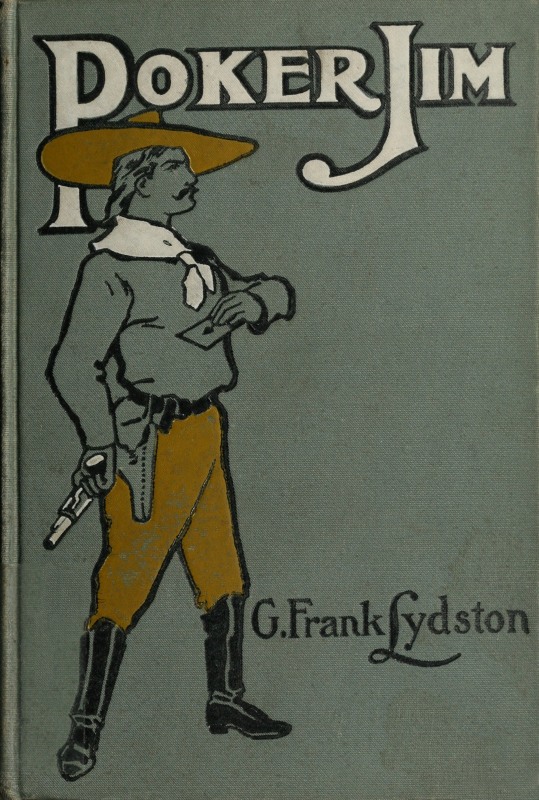
It was in the spring of 1860, that the faculty
of the University of Pennsylvania concluded to
confer the degree of Doctor of Medicine upon
your humble servant. Whether the faculty of
that now famous school allowed me to graduate
on the principle that actuated the performers in
a western band, who implored their audiences
not to shoot, as they were doing the best they
could, I cannot say, but graduate I did, and
as with all other students of medicine, it was
then that my troubles began. I was not long
in discovering that the piece of crisp parchment
which the members of the faculty had endorsed
as showing the scientific qualifications of William
Weymouth, M. D. and which entitled him to
practice medicine, was no open sesame to fame
and prosperity.
My parents were at that time living in
Kentucky, in a small town that offered little
encouragement to a young man beginning practice.
The confidence of one’s old neighbors
is of even slower growth than the beard for
which the young doctor yearns, as a badge of
wisdom and learning that he who runs may
read.
The country in which I spent my boyhood—I
was born in the state of Maine—was even less
inviting than the state of my adoption. It is
possible that I entertained a little of my mother’s
prejudice against Yankeedom in those days.
She was a native of Kentucky, and had never
become thoroughly reconciled to the country
to which my father had taken her soon after her
marriage. It was in acquiescence to her homesick
pleadings that my father finally moved to
Kentucky, and settled in the little town
wherein my parents lived for the rest of their
days in such happiness as people of modest
means can secure only among the warm hearted,
generous people south of Mason and Dixon’s
line.
Had my home surroundings offered any
inducements to the professional career I had
planned for myself, I should certainly have
returned home to practice. My parents were
living alone, and my natural impulse was to
return to them and do the best I could at
practice, as long as they should live. It was
with some twinges of conscience, therefore, that
I finally decided against going back to Kentucky
to locate.
There were but three of us children, a brother,
younger than myself, and a sister, two years
older. My sister had married a gentleman from
Memphis, and had long since gone to that city
to live. My young brother had left home some
years before I graduated, and no one knew what
had become of him, much to my regret and to
the sorrow of his parents, whose favorite, I must
admit, the boy had ever been.
Jim had always been a wild lad, and was
stamped as an incorrigible almost as soon as he
could toddle alone. It was said that a little
of the old strain of Indian blood, with which
tradition had endowed our family, had cropped
out in him. He was one of those rollicking,
handsome dare-devils; that everybody fears
and loves at the same moment. The very sight
of Jim’s curly, black head and mischievous eyes
struck the good neighbors with terror. Trouble
was expected from the moment that boy put
in an appearance—and the good folks were
seldom disappointed. Sometimes they would
acknowledge that “it might have been worse,”
but such occasions were rare.
But all who knew the curly headed little
rascal admitted that he possessed two excellent
qualities; he was as brave as a lion, and kind-hearted
to a fault. He would fight at “the drop
of the hat,” and no boy ever heard him cry
quits. He was as ready to split a cord of wood
for a poor widow, as he was to tie a tin can to her
house-dog’s tail, and that’s saying a great deal.
As the boy grew toward manhood, he fell in
with evil associates, and as is always the case
with boys of his peculiar disposition, he became
thoroughly demoralized. Cards, whisky, horses
and women—these were the unsubstantial foundation
upon which rested the new world that
his vicious companions opened up to him.
While living at the old home in Kentucky, I
had always had a great controlling influence over
little Jim, and even after I left home for college,
I maintained a certain degree of influence over
him. Gradually, however, our correspondence
became infrequent, until we heard from each
other only at very long intervals.
Knowing how much I thought of the lad, my
parents never alluded to Jim’s discrepancies in
their letters to me. I have sometimes thought
that possibly they were actuated to a certain
degree by false pride; they did not care to expose
the failings of their idol to his natural rival in
their affections—his brother. Whatever the
explanation of the reticence of my parents may
have been, I had no intimation of the true state
of affairs until after the poor boy had fled from
home, never to return.
It was the old story; a woman, a rival, a
quarrel—ostensibly the outcome of a game of
cards—the lie, a shot, and my young brother a
fugitive. What a monotonous sameness there
is in all such stories, to be sure. No one has
invented a single new character or a single new
situation in the play of passion, through all the
ages. What new phases have the romanticists
of the world added to human hopes, fears, sentiments,
passions and vices in all the centuries?
None—and yet the world demands originality
of its authors!
It will be seen that I was between two fires,
in deciding on my course after graduation—a
sense of filial duty to my sorrowing and lonely
parents, and a new-born professional ambition.
As is usually the case, ambition conquered, and
I decided to seek my fortune in new fields, far
away from the paternal roof. California was,
at that time, by no means a new sensation, but
the novelty of the gold craze had not yet worn
off. I had no particular ambition to seek my
fortune in foreign lands, and as the Pacific
coast was to ambitious Americans still the El
Dorado of all youthful dreams, I very naturally
turned my thoughts in that direction. I was
not long in coming to a decision, and after writing
my plans to my parents, I made my arrangements
to depart for San Francisco.
The choice of routes to California was a very
simple matter, for one who was within easy
access of the Atlantic sea board. There was no
railroad communication with the Pacific coast
in those days, hence I was compelled to select
from the several ocean routes that which
promised to consume the least time. With this
idea I embarked at New York City for San
Francisco, on a steamer of the Panama line, and,
after a pleasant and uneventful voyage, arrived
in San Francisco, the portals of promise through
which so many hopeful Jasons had passed before
me in search of the Golden Fleece.
* * * * *
The San Francisco gambling house was the
common ground upon which the flotsam and
jetsam of the early cosmopolitan population
of the city met. The proprietors of the gambling
hells certainly knew human nature thoroughly,
judging by the variety of excitement
which they provided. Every known game and
every variety of liquor distinguished for its
vital-reaching propensities, was at the disposal
of their patrons, day and night. The boast
of the gambling house keeper was, that he had
thrown away his front door key the day the
house was opened.
When the gambling fever struck the good citizen
or unwary visitor from the mines, he could
have his choice of a variety of remedies; monte,
faro, roulette, poker—anything he pleased,
providing he had his “dust” with him.
And do not imagine that the proprietors and
dealers of the games were low-browed, ugly
ruffians. Smooth, sleek and handsome were the
nimble fingered gentry who attended to the
wants of the fever-stricken fools who had more
ounces in their pockets than in their brain-pans—until
the fever was cured, when the loss of
balance was in the other direction. Many a
college education was wasted—or utilized, if
you please—on the dealer’s side of a “sweat-cloth”
in some of those dens. My fine gentleman
would not swing a pick—unless it were an
ivory one with which he could take away a
sturdy miner’s golden ounces much more quickly
than the hapless fool had dug them with the
implements of honest toil.
But the scene was an alluring one, nevertheless.
The rattle of chips and dice; the ringing
of silver and the clink of gold; the thud of the
buckskin bags of gold dust as they were recklessly
thrown upon the table; the duller, yet
more portentous, shuffling of the cards; the whir
of the wheel where rouge et noir was being
played, were entertaining to my ear, untrained
as it was to such sounds.
“Come up and make your bets, gentlemen!
The game is made! Five — eleven — eighteen — twenty — twenty-two — twenty-four — twenty-eight — thirty-one.
Red wins!”—and the never
ending procession of excited fools stepped up to
diversion and disaster.
There was one thing the proprietors of those
gambling houses forgot—they should have had
a suicide room and an undertaking department.
It would have saved the city fathers a deal of
trouble in the disposal of the large crop of
unknown remains that the morning light disclosed
in obscure corners of the city—poor
fugitives from self; victims of dens where Venus,
Momus, Terpsichore and Bacchus grovelled in
the dirt yet held undisputed sway.
There was a grim irony, and yet, withal, a
tinge of comedy, in the farewell treat of fiery
liquor with which the management bowed out
its ruined guests—bowed them out of the den of
iniquity and into a slough of despond from which
they oft-times never emerged—on this side of
eternity.
I was standing one evening in “The Palace”—a
gambling den with the usual appurtenances
of tributary and dependent vice—curiously
watching the movements of the dealer at one
of the numerous faro games. Every table was
crowded with players and surrounded by
spectators, some of whom, like myself, were
mere curiosity seekers, but most of them being
devotees of the shrine of the goddess, Chance,
who were impatiently awaiting the occurrence
of a vacancy at the table—when a bankrupt
player should make way for fatter victims.
Sitting just opposite the dealer was a young
lad, who could not have been more than seventeen
years of age, betting away with a recklessness
that would have done credit to a millionaire.
The youngster was evidently flushed
with liquor and laboring under the highest degree
of excitement.
Standing just behind the boy, was a woman—evidently
of the under world—who, it was
easy to see, was influencing his betting. Whether
this creature was giving direct advice and
encouragement or not, I cannot say, but the lad
was certainly trying to appear as brave and recklessly
extravagant as possible, for the apparent
purpose of impressing the woman. The furtive
glance which the dealer exchanged with his
charming “capper” now and then, was sufficient
to enable even one of my limited experience, to
form a correct conclusion as to the status of
affairs.
Just opposite me and almost directly behind
the dealer, stood a man who, I was certain, had
been studying my face from time to time ever
since I had taken my place among the spectators
of the game. A stealthy glance at my
vis à vis when he happened to be watching the
boy’s playing—which seemed to be dividing
his attention with myself—revealed a person
of most striking appearance and unique individuality.
Apparently about twenty-five years of age,
judging by his heavy black moustache and
mature development; a tall, athletic figure;
long curling locks of jet black hair hanging
loosely down over his shoulders; eyes as black
as sloes and as piercing as those of a hawk—the
stranger was indeed a handsome and most
picturesque character. His closely buttoned
coat of fashionable cut, small, neat boots, and
surmounting all, his broad-brimmed hat, made
him even more striking, if possible. I glanced at
his hands and noted that they were well formed,
and of a color that indicated bath gentility
and a life in which manual labor bore no part.
As I stole a second glance at the handsome
stranger, our eyes met, and I fancied that he
started slightly. He glanced away quickly,
but as the boy in whom he appeared to take
such an interest was apparently getting pretty
near the end of his funds, I concluded that the
unknown’s emotion—if indeed he had really
displayed any—was due to the evident bad
luck of his unconscious protegé. It was plain
to me that he was interested in the boy, for there
was an expression about the corners of his
mouth, and an almost tender gleam in his eyes,
that could not be mistaken by any one who possessed
even a fair ability in character reading.
I knew not why the picturesque stranger
interested me, but there seemed to be some
indefinable attraction about him, which caused
me to forget the game and watch him as closely
as I could without risk of giving offense. As
our eyes met, I experienced a peculiar sense of
mutual recognition, and yet it was seemingly
impossible, or at least, highly improbable, that
we had ever met before.
But the occurrences of the next few minutes
entirely diverted my mind for the time being
from the question of recognition.
The poor, foolish boy soon exhausted his
money, and vacated his place at the unholy
altar. I saw him whisper to the female, in
whose company he evidently was, and apparently
request her to step aside with him. She
did so, and they stood for some time in earnest,
confidential discussion of a subject which their
gestures made all too apparent. The bird was
plucked, his charms were gone, and he was not
only refused a “stake” wherewith to possibly
retrieve his losses, but the light of his first
romance was extinguished forever—or until he
had procured more money, which, to the
woman’s mind, probably amounted to the
same thing.
The expression on that poor boy’s face was
a horror and a sermon both in one. As the
woman coldly and haughtily swept away from
him, her tainted skirts swishing suggestively
and ominously over the floor, gathering up
tobacco and other filth which was purity itself
beside her harpy-like soul, the lad stood gazing
after her as if in a dream. He was stunned
into obliviousness to everything but the realization
of his disaster.
He stood for a moment as though incapable
of motion, then with an expression of
desperation in his eyes, and a countenance
that was the typification of utterly hopeless
despair, he passed through the green baize
doors out into the night—his first black night
of fathomless woe and absolute demoralization.
I had watched the boy from the time we
left the table, and his expression, as the hawk
that had plucked away his youthful plumage
flew away from her victim, at once appealed to
my young professional eye. I made my diagnosis
almost intuitively, and instinctively started
to follow the lad, as quickly as I could without
attracting his attention. As I turned
toward the exit, I caught a glimpse of some one
just passing out. As the doors swung back before
him, I recognized the stalwart form of
the picturesque unknown.
I breathed a sigh of relief, and strolled leisurely
along after the stranger. I do not know
why, but I felt that the boy was safe. I was
sure I could not be mistaken in my interpretation
of the play of emotions that had animated
the stranger’s face, as he watched the game
which had ruined the poor lad whom he was
evidently following.
I soon saw that I was right. The stranger
caught up with the boy just as he stepped into
the brilliant light that illuminated the sidewalk
in front of the gambling den. Placing one
hand upon the boy’s shoulder, he gently but
firmly halted him, I meanwhile drawing back
into the shadow of the outer door of the Palace,
determined, with the best of motives, to see
the thing through.
“Don’t be frightened, my lad,” said the man,
“I just want to say a word to you, that’s all.”
The boy looked at him as though dazed for
a moment, and then replied slowly:
“I’m not frightened, sir. You’re not apt to
do anything worse to me than I’ve already done
to myself. My money is all gone, and you can’t
do any more than kill me, if you don’t want
money. As for killing me,—well, I have more
lead than gold left, and I’ve not forgotten how
my father taught me to die, like a gentleman.”
I fancied that the boy looked quite the hero
as he spoke. There was a little touch of the
southron born about him that brought my
Kentucky home back to me. I had seen such
boys there, and I knew—well, there was one
who was something like that, whom I would
have given the world to see, and my heart went
out to that poor, unfortunate lad. And, yet,
for some reason, I had an even kinder feeling
for the man who was evidently going to act
the friend and adviser of our mutual protegé.
“Pardon me for even suggesting that you
might be frightened,” said the unknown, “but
you are young; San Francisco has some queer
ways and still queerer people, and it’s not
every man who gets the drop on you who means
well. I am free to say that I should be uneasy
myself, were I to be similarly accosted, and
they say I am—well, that I’m ‘no chicken’,
you know. Where are you from, my boy?”
“I’m from Virginia, sir,” replied the boy,
straightening up with a little of the Old Dominion
pride, I thought.
“Ah!” exclaimed his new-found friend, “I
was sure I detected a little of the old cavalier
strain in your face. What is your name, may
I ask?”
“Gordon Cabell, sir.”
“Well, Master Cabell, I know your breed
pretty well; I’m from—well, I’ve met southern
boys before. Now, I’m going to talk plainly
to you, and you mustn’t be offended. I’m
going to be your friend, for to-night, at least,
and you must listen to me.
“I’m not going to give you a moral lecture
on gambling or liquor drinking. I presume that
the Gordons, Cabells, and many more of your
ancestors, have played cards, drunk whisky,
raced horses, attended cock fights, and fought
duels, and have done many other things that
people with colder blood object to, but they did
all these things like gentlemen, I’ll warrant
you. Now, tell me, young fellow, did you ever
know of a Cabell doing what you have done,
and still worse, what you were going to do
to-night?”
“Sir!” said the boy indignantly, reaching
toward his pistol, “I will—”
“Oh, no you won’t, Master Cabell. Look me
in the eye, please!” and the boy gazed at the
stranger wonderingly, as he drew his tall form
up to its full height, calmly folded his arms, and
looked down upon him.
“I have already told you that I am your friend,
Gordon, and the Cabells do not make targets
of their friends. Give me your pistol, sir!”
The boy almost mechanically drew his pistol
from the holster beneath his loose-fitting coat,
and obeying the mandate of a will more powerful
than his own, handed it to his companion.
“Thank you, Gordon,” said the stranger,
“I’ll return it to you presently.
“Now, my boy, let us get to business. You
have fallen among thieves, and have been
plucked, like the unsuspecting, foolish pigeon
that you are. I don’t want to know your
past history; life is too short, but I do want
a hand in your future.
“You are the scion of aristocratic stock.
Your ancestors before you were worshippers
at the shrine of beauty, but it was the beauty
of purity and virtue. You have been dragging
your family pride down into the dirt, and offering
up your young soul upon an altar which
a true son of the Old Dominion should loathe.
You have squandered your money trying to
beat a game that’s a ‘dead-open-and-shut’
against you. You are listening to one who
knows whereof he speaks, I assure you, my boy.
“Not satisfied with what you had already
done, which after all is easily remedied, you
were about to stain your family name and
record with a crime that nothing on earth
could ever wipe out. You were about to kill—a
fool, Gordon, who may yet be made a wise
man.
“I once knew a boy who played the fool—much
as you have done—and who is still expiating
his folly. He might eventually have
done as you were about to do, only he happened
to be compelled to—well, he didn’t shoot himself,
that’s one thing to his credit, although his
family, and not himself, was perhaps the gainer
by it, or will be sometime, if the truth is
ever known. He couldn’t avoid the other—there
was nothing about that of which he had
cause to be ashamed, although the world, that
knows not the circumstances, thinks differently.
“Now, Gordon, I’m going to stake you.
Don’t say no—it is a loan if you please, or anything
you choose to call it. Take this, and get
out of this hell-hole of a town as quick as the
Lord will let you.”
The boy stood for a moment with the
tears streaming down his cheeks, and then
hesitatingly took the proffered bag of dust.
“And you will really let me pay it back
to you, sir, when I am able?”
“I certainly will, if we ever meet again,”
replied the man. “As I have already told you,
my boy, I know your breed; it is not the kind
that likes to remain under obligations to one
who is an entire stranger. But, after all,
your honorable intention clears the obligation.
“And, Gordon, here’s your pistol. I think
it will be safer in your hands than it was a
short time ago. And now I am going to give
you a few parting words of advice.
“In the first place, young fellow, don’t gamble.
If your blood is too red to heed this admonition,
learn to play poker. It’s a scientific
game and a square one, usually—always so
among gentlemen. Never bet against another
man’s game, nor play against a percentage.
Gambling games of that kind are like the
play of life, the percentage is in favor of the
dealer, and it fetches you sooner or later.
“In the second place, young man, set up a
shrine in your heart, and worship female purity
and virtue; then you are safe. If you have a
mother or sisters, don’t forget that a woman
who is not fit for their society is not worthy of
your regard.
“Youthful affection, my boy, is not inexhaustible.
Keep it for future reference—and
worthy objects. You may yet live to wish
that the worldly heart of to-morrow were the
young and fresh one of yesterday.
“And now, I must leave you. Good-night,
my boy, and don’t forget what I have said to
you.”
“But, sir,” cried the lad, “your name, who
shall I—?”
His benefactor had disappeared in the darkness.
The boy stood for a time gazing blankly
into the night in the direction in which the
stranger had disappeared; then, drawing
himself up proudly, as became a son of fair
Virginia, he placed the bag of gold in his pocket
and his pistol in its holster, cast a scornful
glance toward the windows of the Palace and
strode resolutely away.
* * * * *
A few days after the scene at the gaming
house, I chanced to meet an old time friend
of my father’s, hailing from Maine. Mr. Allen,
it seemed, had “struck it rich” and was on his
way back to the “States.” From this gentleman
I received a glowing account of the wealth
of the placer mining region in Tuolumne county,
which at once determined my future course.
When he informed me that the country where
he had made his “pile” was not only rich in
gold, but badly in need of doctors, I decided
that Tuolumne should have at least one medical
celebrity.
Investing some of my greatly diminished
capital in an outfit which I thought might harmonize
to a certain extent with the new field
for which I was about to depart, I bade farewell
to San Francisco and set my face toward
the fame and the pot of gold that lay at the
foot of the rainbow of my dreams.
* * * * *
It was a calm sultry evening in the month
of July, 1860, that I embarked on board a
steamboat plying between San Francisco and
Stockton, the latter city being the gateway
to the wonderful country distinguished by its
wealth and scarcity of doctors, so graphically
described by my friend, Mr. Allen.
The trip up the Sacramento river, although
pleasant enough, had very little novelty about
it, and I confess that I at first experienced a
feeling of disappointment at the lack of entertainment
which the scenery afforded.
Our route lay for a comparatively short distance
up the Sacramento, the major portion of
my journey being comprised by one of its
tributaries—the San Joaquin—a stream that
is insignificant enough during the dry season,
but which in the early spring is formidable
enough to those who live sufficiently near the
river to get the benefit of its overflow during
the spring freshets.
The San Joaquin river is, without doubt, the
crookedest navigable stream in the world. There
was never a snake that could contort himself
into so fantastic an outline as presented by
that lazily meandering branch of the Sacramento.
So crooked is it, that one entertains a
constant dread of running ashore; the bank
is always dead ahead and unpleasantly near.
This serpentine river traverses a perfectly
level plain throughout the navigable part of
its course, its banks being flanked by tule beds
which extend farther than the eye can see. Indeed,
the valley of the San Joaquin is one vast
bed of tules, extending fully one hundred and
fifty miles. When, as sometimes happens during
the dry season, the tule beds take fire, the spectacle,
especially at night, is at once grand and
terribly impressive. I remember on one occasion
taking a night trip up the river during one
of these fires. The scene in the vicinity of
Monte Diablo, was one of the most majestic
and awe inspiring I have ever witnessed. The
name of “Devil’s Mountain” seemed singularly
appropriate.
It was nearly three in the morning when I
arrived at Stockton, and, as there was nothing
to be gained by going ashore, I remained on
board the boat, determined to get the full
benefit of a morning nap. It seemed to me that
I had just closed my eyes, when I was awakened
by the yelling of the roustabouts and stage
agents on the wharf. I had barely time to dress,
hustle ashore and hurriedly swallow a cup of
coffee, before my stage was ready to start, and
I was off for Jacksonville—the particular town
of Tuolumne county that I had determined to
favor with my medical skill and fortune-hunting
ambition.
There was nothing pleasant about that stage
ride—it was memorable only for its inconveniences
and its motley load pf passengers. A
hot, dusty, bumping journey in the old time
California stage makes pretty reading as Bret
Harte has described it but I am free to say that
the reality was not so enjoyable. The red dust
of the California stage road gets into a fellow’s
system so deeply that his ideas are likely to be
of a practical or even profane sort, even though
he be normally quite sentimental.
Picturesque, however, the ride certainly was.
Several red-shirted, rough-bearded miners, lent
just the right touch of local color, while the
imitation frontiersman—of whom I was the
type—was sufficiently well represented to afford
a suitable foil for the genuine article, as typified
by my brawny-chested, be-pistoled, unkempt
fellow passengers.
In one corner of the stage was a little chap
who was evidently what we would call a dude
nowadays. This young gentleman had done his
level best to put a bold front on matters, by
rigging himself out like a cowboy. The result
was somewhat ludicrous, as may be imagined.
Nor was the poor little idiot by any means unconscious
of his features of incongruity—he
realized most keenly the absurdity of his position
and the fact that he was being guyed. The
miners, however, seemed to enjoy the situation
immensely.
“Say, pardner,” said one tawny-bearded
giant, leaning toward the innocent, and startling
him so that his eye glasses nearly dropped
off his nose—“Gimme a pull at yer pistol, wont
ye?”
“Ah, beg pawdon, sir, what did you say?”
stammered the dude.
“W’y I s’posed you could understan’ th’
English langwidge,” replied the miner, “but
seein’ ez how ye don’t, I’ll translate her to ye.
I asked ye ter give me a pull at yer whisky
bottle.”
“Ah, really,” said the innocent, “I’d be
chawmed, you know, doncher know, but I
don’t carry the article. In fact, sir, I nevah
drink.”
“Ye don’t say so? Well, I want ter know!”
answered the miner. “Now, see hyar, sonny,
seein’ ez how you aint got no whisky, jest
gimme a chaw uv terbacker an’ we’ll call it
squar’.”
“I—aw—I’m sorry to say that I don’t use
tobacco, sir.”
“Sho! g’long, young feller! Is—that—so?
How the h—l d’ye keep a goin’? Whut d’ye do
fer excitement—p’raps ye plays poker, eh?”
said the stalwart son of the pick.
“Oh no!” exclaimed the tenderfoot in dismay,
“I nevah play cards!”
“Ye don’t tell me!” replied the miner. “Well,
well, well! By the way, young feller; be keerful
not ter lose ’em—ye mout need ’em ter git
home with.”
“Need what, sir?” asked the victim.
“Yer wings!”—and the miners broke out in
a huge guffaw that bade fair to dislocate a
wheel of the stage, and impelled the driver to
look anxiously and inquiringly at his passengers.
The tenderfoot collapsed and remained in
a state of complete innocuousness until he
arrived at his destination, which, fortunately
for his sensitive organization, happened to be
the first town where we changed horses. As he
minced gingerly away toward the hotel, the
miners winked at each other most prodigiously.
Happening to catch the big fellow’s eye, by a
happy inspiration I was impelled to wink also.
This at once established me on a friendly footing
with my rough companions, and, as I
happened to have a bottle of fairly good liquor
with me, the rest of the way into the regard of
those simple miners was easily traversed.
During the conversation that naturally followed
the unconventional formation of our acquaintance,
the big-bearded fellow, who appeared
to be the leader of the little party of miners,
following the blunt fashion of the country,
suddenly remarked:
“By the way, stranger, whut might yer name
be, an’ whut part uv the diggin’s might yer be
headin’ fer?”
“Well,” I replied smilingly, “it is about time
we introduced ourselves, isn’t, it? My name is
William Weymouth, recently of Kentucky, a
doctor by profession, and bound for Jacksonville,
where I contemplate digging gold when
the weather will permit, and practicing medicine
when it will not.”
“A doctor, an’ bound fer Jacksonville, eh?
Well, Doc,” said my new acquaintance, reaching
out his grimy paw with a cordiality that
could not be mistaken, “I’m d—d glad ter know
ye! Jacksonville is our town, an’ a h—l uv a
good town she is at that, y’u bet! We’re jest
gittin’ back from Frisco, an’ doin’ it on tick, too.
We’ve been doin’ the sport racket down yonder,
an’ I reckon the sports hev done us, eh, pards?”
His “pards” having acquiesced, my brawny
friend cut off a huge chew of “nigger heel,”
stowed it away in his capacious cheek, and after
a few preliminary expectorations that resembled
geysers, continued:
“If it hadn’t been fer ole Tom McDougal
up thar on the box, we’d a took Walker’s line
back ter our claims”—and the big miner
glanced gratefully in the direction of the generous
Mr. McDougal.
“And now that I have found that you are
to be my fellow townsmen,” I said pleasantly,
“permit me to remind you that the introduction
has been one-sided. What are your names,
may I ask?”
The miner winked at his companions, laughed
a little deep down in his huge red beard, and
replied:
“D—d if I didn’t fergit that ther was two
sides to the interdoocin’ bizness. Ye see, stranger,
we aint payin’ much attention ter feller’s
handles in the mines. Most enny ole thing’ll
do fer a name. That’s why we sometimes
fergits our manners. This yere gang is purty
well supplied with names, but ye mightn’t hev
sich good luck ev’ry time, ’specially in Tuolumne
county, eh, pards?”
His “pards” having again nodded and winked
their approval, my brawny friend proceeded
with his introductions.
“I’m called in the diggin’s by sev’ral names
an’ y’u kin do like the rest uv my fren’s—take
yer pick. I’m mostly known as Big Brown,
tho’ some folks calls me Big Sandy. When
I was in the states, I b’lieve they used to call
me Daniel W. Brown, but I wouldn’t swar to it.
This feller nex’ ter me hyar, is the hon’able
Mr. Dixie,’ or Snub-nose Dixie fer short, who
aint never hed much ter say about his other
name, if he ever had enny, eh, Dixie? That
lantern-jawed cuss a settin’ long side uv y’u,
is Deacon Jersey, utherwise an’ more favor’bly
known ez Link Spears. We calls him Deacon,
cuz he never was inside of a church in his hull
life. He’s the only genooine deacon this side
of the Sierras. Thar aint none uv the hypercrit’
erbout him, neither, I kin tell ye. Ye’ll
find us fellers’ tastes kinder runs erlike, f’r
instance,”—and Big Brown looked longingly in
the direction of my “pistol” pocket.
“In the matter of thirst,” I suggested.
“Right y’u air, Doc! I kin see yer goin ter
be a valooable addition to our diggin’s. We
need a doctor ez kin tell whut’s the matter
with a feller ’thout cuttin’ him wide open.
Ye see, we likes ter keep our own han’s in,
an’ don’t calkerlate ter leave much of the
cuttin’ ter the doctor—ennyhow, ’till we’ve
had our little innin’s, eh, boys?”
Once again the boys agreed, with, I thought,
just a slight suspicion of gratified vanity in
their expressions.
It was a long weary way to Jacksonville,
but my time was well spent. Thanks to the
kindness and garrulity of my new-found yet
none the less sincere, friends, and the confidence
engendered by my rapidly diminishing
supply of stimulants, I found myself, by the
time I arrived at my destination, fairly well
acquainted with the town, its ways and its citizens.
Jacksonville, at the time I landed in the then
thriving place, was one of the most noted mining
centers in the placer country. Its location
was most picturesque. Nestled among the
foot-hills of the glorious Sierras on the banks
of the Tuolumne river, and peopled by as cosmopolitan
and heterogeneous a population as
was ever gathered within the confines of one
small town, my new home was attractive because
of its novelty, if nothing more.
Ages and ages of alternately falling and
receding waters, centuries of snow and enormous
rainfalls, had washed down from the
mountains into the valley of the Tuolumne,
those auriferous particles, the great abundance
of which had made Jacksonville spring
into busy life and thriving prosperity, almost
in a single day.
But the very elements which had laid the
alluring foundation of the valley’s wealth, were
even then conspiring to avenge the rifling of
the rich deposits of the valley by the irreverent
hands of the modern Argonauts.
The Tuolumne river was a variable stream.
During the dry season, it was but a thin, disjointed,
silvery ribbon, across which one could
walk dry-shod, in places. But in the early
spring, the little stream at which the wayfarer
was wont to laugh, and in whose bed the eager
miner delved with impunity and profit, took
revenge upon the disturbers of its ancient
course. It became a raging torrent, resistlessly
carrying all before it and sometimes severely
punishing for his temerity the unwary miner
who had pitched his tent or built his rude cabin
too near the river bank. But all the revenge
which the Tuolumne had taken in all the years
since the settlement of the valley, was as nothing
to that which was yet to come. That vale
of thrift, industry and smiling prosperity was
destined to become a valley of death, destruction,
desolation and ruin.
But were not Pompeii and Herculaneum,
and in later days, our own San Francisco,
joyful and unsuspecting to the last? And
why should the people of Tuolumne dread a
danger of which familiarity and fancied security
had made them forgetful, or possibly
even contemptuous. The average citizen of
Jacksonville could calmly face death in a material
form, and why should he concern himself
with that which passed by upon the other
side with each succeeding spring?
By no means the least attractive feature
of Jacksonville was the rugged self-confidence
and honesty of the majority of its people. Even
the Chinese, who composed a large part of the
population, seemed to be a better variety of
the almond-eyed heathen than I had supposed
could possibly exist. The hair-triggered sensibility
and powder-and-ball ethics of the dominant
race seemed to be most effective civilizers.
I am far from claiming that Jacksonville
presented an ideal state of civilization, but
this I do say, in justice to my old town; life
and property were safer there than they are
to-day in many more pretentious communities,
that claim to rank as centers from which civilization
radiates like the rays of a star. A
sense of personal responsibility made the French
the politest nation on the face of the earth;
it was the foundation upon which the spirit
of the “Old South” was builded firmer than
a rock; it was the soul that beat back the
furious waves of shot and shell that so often
hailed upon the southern chivalry on many
a hard fought field. A similar spirit of self-assertion
and personal responsibility pervaded
the Tuolumne valley, and raised its average
moral standard to a height far beyond that of
many a metropolis of a more vicious and effete
civilization.
Warm-hearted, impulsive, honest, courageous,
fiery-tempered, quick-triggered Argonauts of the
Tuolumne valley—a health to those of you who
still live, and peace to those who have laid
down the pick and pan forever and have inspected
their sluice-boxes for the last time!
When the final “clean-up” comes, may the
“find” be full of nuggets—“sixteen dollars to
the ounce.”
There was no better opportunity of becoming
intimately acquainted with the town of
Jacksonville, its people and its customs, than
was afforded by the Tuolumne House, where I
made my headquarters. There may be better
hotels in the world than that primitive one,
but it had outgrown its canvas period and had
become a pretentious frame structure, and this
fact alone made it famous. It had no rival, for
the old “Empire,” so long presided over by
that honest, sturdy old Scot, Rob McCoun, had
long since been converted into a Chinese
grocery, while its erstwhile owner had been dead
for several years. As for the only other hotel,
McGinnis, its proprietor, had never been in the
race since his cook, one unlucky day, brewed
the coffee and tea simultaneously in the same
pot. The hundred and seventy-odd boarders
who fed at McGinnis’ “festive” rack were not to
be consoled—they “quit him cold” and went over
to the enemy. Tradition says that “Mac.”
half killed the luckless cook, one Mike Corcoran,
“Fer puttin’ coffee in the tay pot, ther d—d
scoundrel!” but the boarders were not to be
placated.A My fellow citizens of Jacksonville
were very particular, and quite sensitive, with
respect to the quality and quantity of liquids
that entered their stomachs.
The material comforts of the Tuolumne
House aside, there was never a cheerier, heartier,
pluckier boniface than George Keyse. He
was to the manner born, and could take a gun
or a knife away from an excited boarder quite
as gracefully and quickly as he could, if necessary,
turn his own flapjacks.
Mr. Keyse had an invaluable assistant in
one Dave Smuggins, who officiated alternately
as barkeeper, porter and hotel clerk. Smuggins
was a well-bred man, and, it was said, was
originally educated for the ministry. The only
evidence at hand, however, was certain oratorical
propensities that overcame him and made
him forget his real position when he awakened
the boarders early o’ mornings. I can hear him
now, as he stood at the top of the stairway,
yelling in stentorian tones—“Arouse all ye
sleepers, an’ listen to the purty little airly
birds singin’ praises tew the Lord! D—n yer
bloody eyes! Git up!” saying which the modern
psalmist discreetly went below and took his
position behind the bar, ready to dispense
“eye-openers” to the early caller.
Jacksonville proved to be not only a pleasant
place of residence but an excellent field for my
professional work. The climate was almost germ-proof,
and it was a real pleasure to practice the
semi-military surgery characteristic of my field
of labor. Primary union was my speciality in
those days, and I used to get results the memory
of which sometimes makes me blush for
those I occasionally get with our modern aseptic
and antiseptic methods. No matter how
much my patients might shoot or carve each
other, any fellow who had life enough left in
him to crawl or be carried off the field of battle,
usually got well.
Beyond accompanying an occasional prospecting
party, largely for recreation but partly in
my professional capacity, I did but little in the
way of mining. My practice gave me plenty to
do, and was lucrative enough as practices go, so
I soon settled down to as routine a life as my
curious and lively surroundings would permit.
I was sitting in that portion of the Tuolumne
House yclept by courtesy “the office,” quite late
one evening, listening to the quaint talk of
my miner friends and marvelling on the quantity
of fluid the human body could lose by way
of expectoration and still live, when I was recalled
to a realization of the fact that I was a
practitioner of medicine, by a voice at the
hotel door.
“Say, Doc, kin I see y’u a minute?”
Looking up I saw standing in the doorway
one of the boys, who was familiarly known as
Toppy, his States’ name being Ike Dexter.
Toppy motioned for me to come out on the
porch, and impressed by his gravity of manner
and earnestness of gesticulation, I hastened to
comply.
“What is it, Toppy?” I asked.
“Well,” he said, “thar’s one uv my friends
whut’s bin an’ got hisself hurt, an’ I want y’u
ter come an’ fix him up. He’s a very parti’cler
friend, an’ I’d like ter hev yer do yer best on
him. Ye needn’t say nuthin’ ter the boys
about it, jes’ now, Doc.”
“Very well, Toppy, I’ll go with you, but
what kind of an accident has befallen your
friend?” I asked.
“Oh, I dunno ez ye could jes’ call it a accident,
Doc. It’s jest a little shootin’ scrape,
that’s all, an’ I reckon ye’d better take some
’stracters erlong.”
In accordance with the honest miner’s suggestion
I did take some bullet extractors with
me.
“Ye see, Doc,” said Toppy, by way of preparatory
explanation of the case I was about
to see, “this yere friend of mine hez bin down
in ’Frisco fer a spell, an’ might hev staid thar
a good while longer, only some feller picked a
row with him. Thar wuz a duel, an’ duels
ain’t so pop’lar down ’Frisco way ez they useter
wuz, ’specially when somebody gits hurt. A
real bad accident happened ter th’ uther feller,
an’ he passed in his checks. Jim—that’s
my friend—got a ball in his thigh, whut stuck
thar, and ez he didn’t hev much time to hunt
fer a doctor, he jest come up hyar, whar its
kinder quiet like, an’ we thort we’d hev y’u
sorter look arter the thing. Ye see, Jim won’t
keer to git ’round much fer a few weeks—not
’till that little accident gits blowed over”—and
Toppy’s eyes gleamed humorously.
My friend led me down to the river bank,
and pushing aside a clump of willows revealed
a small, rudely constructed row-boat.
“Ah!” I said, as I took my seat in the somewhat
insecure-looking and cranky little craft,
“It is evident that you have taken your friend
to your own cabin.”
Toppy, as I well knew, had the only abode
on the opposite bank of the river, where,
high up on the hillside, in full though somewhat
distant view of the little town, he had
built a small but neat cabin, which nestled in
the bosom of the hill, looking not unlike a
child’s playhouse as seen from the town proper.
“Yep,” replied the miner, “thar’s whar
he is. It aint best ter depen’ too much on
pop’larity, ye know, Doc, an’ Jim’ll be a little
safer over thar than in town. Nobody goes
ter my place—less’n I invite ’em,” and Toppy
grinned sardonically.
I recalled the fate of a poor devil who did
go to his cabin without an invitation—from
Toppy—in the early days of his housekeeping
on the hillside, when a more or less charming
little Mexican half-breed damsel was said to
have presided over Toppy’s domestic affairs.
Being averse to the discussion of other people’s
family matters, I had never conversed
with my miner friend on that delicate subject.
To tell the truth, there seemed to be very little
encouragement for gossip in Jacksonville—town-talk
was too direct a cut to the little collection
of white head-boards that decorated a
small plateau just outside the town. All my
information on such subjects, was therefore
derived from more subtle and less dangerous
airy rumor.
The river was quite low, and a few vigorous
pulls from Toppy’s stalwart arms brought us
to the opposite shore, from which I could see,
far up the hillside, the gleaming white walls
of the miner’s rude little home, where lay my
prospective patient.
Toppy was notoriously careless in his personal
grooming, but the little half-breed had
evidently inspired a coat of whitewash for the
cabin, that endured longer than the sentiment
with which its owner had inspired that swarthy
little traitress. Possibly that gleaming white
cabin was her monument—who knows? The
river ran dangerously and temptingly near,
considering how short a time it takes to fall
a few hundred feet down a steep and rocky
hillside, and rumor whispered that Pepita—well,
no one knew where she was, and women
were not so plentiful in the Tuolumne valley
that hiding was easy.
But the Tuolumne kept its secret well, if
secret there was. Its quick-sands told no
tales. They could hide the precious gold of
the river bottom; why not a mouldering skeleton?
On entering Toppy’s cabin, completely
winded after my climb up the hill that constituted
his front yard, I found my new patient
lying on a cot in the middle of the room.
He turned inquiringly toward the door as his
host and I entered, and what was my amazement
to see reflected in the dim light of the
candle with which the cabin was illuminated,
the features of the handsome unknown of the
San Francisco gambling-house, whose adventure
with the unfortunate young southerner
I have already related. The recognition
was evidently mutual, but I fancied that
my patient looked at me with an expression
slightly suggestive of annoyance.
Toppy’s introduction was laconic, and as
characteristic as was he himself:
“Doc, this is Jim—Jim, this yer’s Doc Weymouth,
an’ he’s all right, y’u bet, ’specially on
bullets an’ sich things.”
I was used to California customs, hence the
cognomen, “Jim” was sufficiently comprehensive
and perfectly satisfactory to me, and after
the brief introduction that my miner friend
gave me, I proceeded to investigate the case.
As Toppy had already informed me of the
circumstances that led to the reception of my
patient’s wound, I made no inquiry in that direction.
I found also, that Toppy was correct
as to the location of the injury—as he had said,
the ball had entered his friend’s thigh.
The wound had been inflicted several days
before I saw my patient, and would probably
have healed promptly enough if it had not been
for the weary ride he had taken immediately
after the shooting—-he had come to Jacksonville
on horse back. The result of the necessary
movement in the saddle, together with the hot
sun and dust of the roads, had been to produce
considerable inflammation of the injured part.
I presume that nowadays the surgeon would
seek for no other cause than germ infection for
such a condition as followed the wound which my
patient had received—but at that time things
were different; the various sources of irritation
to which he had been exposed were a reasonable
explanation of the state in which I found
his wound.
The wound was merely muscular, neither
important vessels nor bone having been injured,
and, much to my gratification, I almost immediately
succeeded in finding and extracting
the ball.
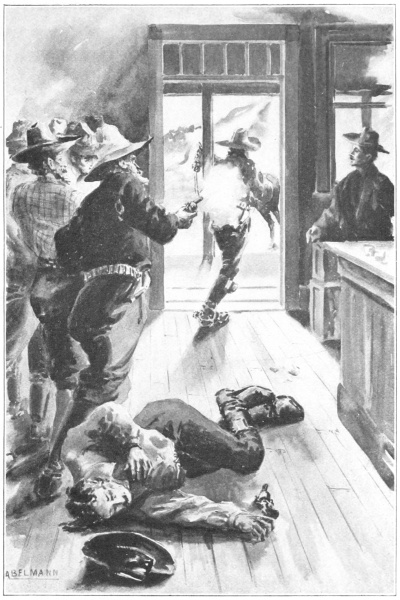
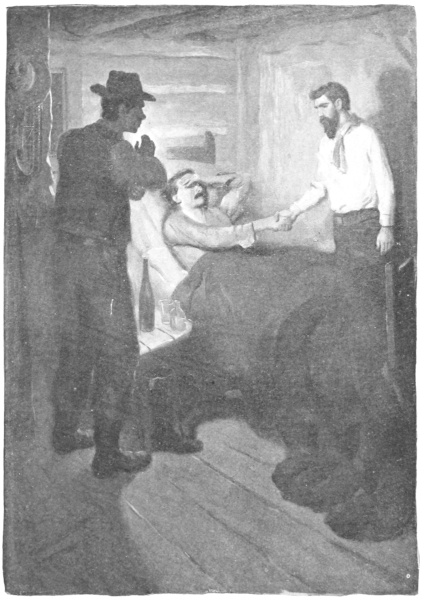
“JIM WAS BOUNDING TOWARD THE OPEN DOOR,
LEAVING HIS INSULTER LYING UPON THE
FLOOR WITH A CLEAN CUT IN HIS CHEST”
Jim, as I will now call him, stood my manipulations
and the cutting necessary for the
extraction of the bullet without the slightest
indication that such operations were not an
every-day experience with him. This was not
without its effect upon Toppy, who looked upon
his heroic friend with all the pride and tenderness
imaginable.
When I was first introduced to the wounded
man, he had merely nodded his head in greeting.
He did not speak thereafter, until I had
finished dressing the wound, Toppy meanwhile
answering all necessary questions. It seemed to
me, also, that my patient rather avoided scrutiny
of his countenance. He either averted his
face or shaded it with his hand, under the
pretense that the flickering light of the candle
which Toppy held for me affected his eyes,
during the entire time of my surgical attention.
I gave this circumstance hardly a second
thought; nothing seemed more natural than
that my patient should desire to conceal any
little involuntary expression of suffering that
might have disturbed his features during my
exceedingly painful manipulations. I was struck,
however, by his conduct as I was preparing to
leave.
“Doctor,” he said, “I am very sorry that my
old friend, Toppy, insisted upon calling you
to-night. I could have stood the racket till
morning, and your rest was much more important
than my worthless existence. I appreciate
your kindness, sir, and wish that I could reciprocate
in some more fitting manner than by
mere financial compensation. However that’s
the best I can do now;” saying which, my
patient reached beneath the rude mattress upon
which he was lying, drew out a bag of gold,
and without further ceremony handed it to me.
“I wish it might have been more, doctor,” said
Jim, “but I came away from ’Frisco in a deuce
of a hurry, and without heeling myself properly.
However, I have divided evenly with you, and
I believe such a rate of compensation is usually
considered fair by professional men,” and he
smiled somewhat mischievously, his black eyes
twinkling with humor.
My heart warmed toward my patient, I knew
not why. It certainly was not because of his
liberality, for that was common enough in that
rude mining town, where the people were so
crude as to believe that a physician’s services
should be liberally compensated. I kept no
books in those days, my patients were so wild
and uncivilized that I did not find it necessary.
“I will see you again to-morrow, sir,” I said, as
I nodded in recognition of the liberal fee that
my interesting patient had given me, and extended
my hand to bid him good-morning—for
it was then long past midnight.
“Oh, no,” replied Jim, hastily, “it will probably
not be necessary, and my friend, Toppy,
here, who is an exceptionally good nurse, can
give me all the attention I require. Be assured,
sir, that you shall be called in again if anything
unfavorable arises. There’s something healing
in the California air. The bullet is out and as I
can rest quietly in Toppy’s cabin, there will be
no further trouble, I am sure. I have been
there before, Doctor,” and he smiled grimly.
“Very well then,” I said, “if you insist on
assuming the responsibility of your own case,
I suppose I have no right to protest. Remember
your promise, however, and call me at the
slightest intimation of trouble. I will learn how
you are, from time to time, through Toppy, and
if I should at any time hear an unfavorable
report, I might be discourteous enough to call
without an invitation.”
“I think we understand each other, Doctor,”
replied Jim, “and now I believe I’ll take a nap;
sleep has been a scarce commodity with me
for a few days past.”
As I left the cabin I could not rid myself
of the impression that there was something
strangely familiar about my patient. My first
acquaintance with him was certainly the night of
the affair at the Palace in San Francisco, and yet,
he impressed me differently from what might
have been expected in meeting an entire stranger.
I had an ill defined impression that Jim had been
a factor in my life before. But when, and where?
My mind was a blank upon this point, nor was
I likely to become enlightened, considering the
lack of encouragement with which inquiries into
the personal histories of the early California
citizen were usually met.
When we arrived at the bank of the river on
our return to the town, Toppy safely secured
his little boat to the overhanging willows and
insisted on escorting me back to the hotel. Although
this was unnecessary, I was very glad
to have the kind-hearted fellow’s company, the
more especially as I desired to learn something
of my new and interesting patient.
Arriving at the Tuolumne House, I said—“Toppy,
you have furnished me the opportunity
of losing my sleep, and I propose to get
even. It is almost daylight, and we may as well
make a full night of it. I want to know more
of your friend Jim. I don’t know why, but he
greatly interests me. Not but that I am always
interested in my patients, but my feeling toward
your friend is rather a peculiar one. Suppose we
find a quiet seat somewhere and talk a little
about him?”
Toppy acquiesced, and having declined the
cigar I proffered him, in favor of a stubby black
pipe that he produced and lighted, we seated
ourselves upon an old stump, a little way from
the hotel.
“Well, Doc, I don’t s’pose it’s ness’ary fer
me ter tell y’u that Jim’s my best friend. He’s
the best I ever hed, since—well, since I come
from the States. I’ve got good reasons fer likin’
him, ez you’ll obsarve.
“I fust met Jim at Angel’s Camp, about three
years ago. I was prospectin’ round in Calaveras
county, an’ used ter make my headquarters at
Angel’s.
“I used ter booze a lot in them days—mor’n
I do now, Doc. I guess my hide was stretchier
then, an’ used ter hold more. I was allus a
leetle bit excitable when I was drunk, an’ everlastin’ly
gittin’ inter trouble. That’s how I fell
in with Jim.
“I happened to be raisin’ partickler h—l
round town one night, an’ drifted inter Ned
Griffiths place. I’d been thar lots uv times, an’
ez everybody in Angel’s knowed me, an’ I
was purty poplar, I’d never hed no trouble, till
this night I’m tellin’ y’u about.
“It jest happened that a crowd uv fellers hed
come down from Murphy’s camp ter have a
little fun on ther own account, an’ it was jes’
my d—d luck ter run agin the gang ’bout the
time they was beginnin’ ter feel ther oats purty
lively, an’ of course, I hed ter git into a muss
with ’em.
“Ez I didn’t hev no friends in the place at
the time, an’ folks don’t mix in other fellers’
rows much in the diggin’s, I was buckin’ agin
a dead tough game. Ez luck’d hev it, I happened
ter git mixed up with the toughest cuss in the
crowd—Three Fingered Jack, a feller what’ll
ornyment a tree yit, y’u see if he don’t!B
“I got my gun out, all right, but the d—d
thing was outer fix, an’ if it hadn’t been, I was
too bilin’ drunk ter hit a cow at three paces.
“Well, Jack jest played with me with his
knife, kinder carvin’ me up on the installment
plan, ye know. He’d socked a few purty good
sized holes inter my ole carkiss, an’ was gittin’
ready ter finish up the job in good shape, when
Jim come in an’ took a han’ in the game with
his own little bowie.
“I was too full er booze ter ’preciate the show,
but they do say ez how Jim did a purty neat
job. Jack got well arter a while, but he didn’t
act very sosherble with the folks at Angel’s
enny more.”
“When I found out how Jim had saved my
life, y’u kin bet I didn’t lose no time a looking
him up an’ squarin’ myself. I’d heard er Jim
afore, an’ I knowed he was a gambler by perfession,
but he played a game that night, that
made a big winnin’ fer yores trooly, an’ I’ve
jest bin layin’ fer a chance ter do him a good
turn ever since. He may be a gambler, but
he plays a squar’ game—an’ poker at that—that’s
why they call him ‘Poker Jim.’ He’s
a gentleman born an’ bred, that’s dead sartin,
an’ he’s got more eddication an’ squar’ness
than a hull lot er people whut never gambled
in ther lives. When Poker Jim makes a promise,
it’s kept. If he shud borrer a thousan’
dollars uv me—an’ he could hev it too, if I hed
it, you bet! an’ he shud say, ‘Lookee hyar,
Toppy, I’ll give this back to yer nex’ Monday
et five o’clock,’ an’ he wasn’t on han’ with the
stuff, w’y, then I’d know that suthin had happened
to him. Poker Jim’ll keep enny promise
that he makes, if he’s alive when the time
fer squar’in things comes.”
“You have excellent reasons for loyalty to
your friend Jim,” I said. “He certainly deserves
your friendship and respect, no matter
what his occupation may be. I have met him
before, and under circumstances that proved
him to be a truly noble character. But tell
me, Toppy, how does it happen that you and
Jim drifted apart?”
“Well, ye see, Doc, ’twas this way. The
folks up at Angel’s got so virtoous arter a while,
that gamblers was too rich fer ’em, an’ they
ordered all the gams ter vamoose. Jim got
ketched in the round-up ’long with the rest,
an’ hed ter git out ’twixt the light uv two days.
He couldn’t lick ’em all, less’n they’d come
on one at a time, so he jest played git up an’
git with t’other sports. He went to Frisco
ter play higher stakes than Angel’s Camp
could put up, an’ I came down hyar. Ye see,
I wasn’t none too pop’lar, on account er standin’
up fer Jim, an’ ez I don’t gin’rally fergit ter say
my say, I got inter a little argyment with one
uv the prominent citizens uv Angel’s one day.
I was sober on that erkasyun an’, well—I come
down ter Jacksonville fer my health. I writ
ter Jim ez soon ez I got hyar, an’ told him whar
I was, an’ ez soon ez he got inter trouble he
knowed whar ter find a fren’ whut’ll stan’ by
him ez long ez ther’s a shot in ther locker—savvy?”
“Well,” I said, “Poker Jim will soon be able
to take care of himself again, and I hope he
will not experience any annoyance from his
recent duelling experience. He certainly is
possessed of great courage, and I should dislike
to see his bravery get him into further
trouble.”
“Y’u kin jest bet Jim’s got sand! Y’u air
all right on that pint, Doc. Thar ain’t no
braver man livin’. D’ye know whut I seed
him do one night up ter Sonora? Well, thar
was eight of us fellers went up thar ter a fandango,
an’ Jim went along ter kinder give the
thing a little tone, ye know.
“‘Mericans aint none too pop’lar with the
greasers nohow, ’cept with their women folks,
an’ them fellers up thar was jes’ bilin’, when
they seed us come inter ther ole fandango.
When we got ter cuttin’ ’em out with their
black eyed senoritas, they was ugly enough
ter slit our throats, en it was jest our blind
luck that fin’ly kep’ ’em from doin’ it.
“Jim don’t often drink enny licker, but he
was a feelin’ purty good that night, an’ jest
spilin’ fer a row with the d—d greasers. Things
was goin’ too slow fer him, so he takes a piece
er chalk, goes out inter the middle of the hall
an’ draws a great big ’Merican eagle on the
floor. Then he pulled his gun an’ called for
some d—d greaser ter step on the bird! We
seed he was in for it, an’ gathered ’round him
ready fer the music ter begin. Each side
was waitin’ fer t’other ter open the ball, when
the feller what run the hall blowed the lights
out. We grabbed Jim an’ hustled him out,
an’ made him take leg bail ’long with the rest
uv us. He wanted ter go back, but we wouldn’t
hev it—the game was jest a little too stiff fer us,
y’u bet! Oh, yes, Poker Jim is dead game,
all right.
“An’ now, Doc, I’m goin’ ter tell ye suthin’
on the dead quiet. Jim’s got a wife an’ child
down in Frisco. He married a little Spanish
gal about two years ago, an’ she was a bute, I
kin tell ye! They’ve got a little baby a year
ole, an’ Jim’s the proudes’ feller y’u ever seed.
Ez soon ez that Frisco scrape is through with,
he’s goin’ ter send fer his family, an’ I’m goin’
ter quit my cabin an’ let Jim an’ his folks hev
it. My place is kinder outer the way an’ private
like, an’ that’ll jest suit Jim.”
“Well, Toppy,” I said, “I am more interested
in your friend than ever, and I hope
that you may soon consummate your plans to
domicile him and his family among us.”
Day was now breaking, and the voice of the
devout Dave Smuggins could be heard ringing
through the halls and vibrating the very roof
of the hotel, as he hoarsely shouted his pious
appeal to the slumbering boarders.
Toppy accompanied me to the hotel bar
and joined me in an “eye-opener,” after which
he bade me good morning and returned home,
while I prepared to do full justice to Keyse’s
immortal flapjacks.
* * * * *
As Toppy had planned, Poker Jim subsequently
became a citizen of Jacksonville. Advices
from San Francisco showed the excitement
caused by the duel to be practically over after
a few weeks, and, his wound having healed, my
patient quietly installed himself among the
sporting element of our population, resuming
the occupation that had earned for him the sobriquet
of “Poker Jim.”
The inhabitants of Jacksonville had often
heard of the cool, quiet gentleman who had
called down and cut up Three Fingered Jack.
Many of his fellow townsmen knew him personally.
No questions were asked therefore, when
Poker Jim quietly and unostentatiously identified
himself with our thriving town. Nor did
the citizens become more inquisitive, when,
a short time afterward, Jim’s family arrived
and took possession of Toppy’s cabin. A few
curious looks were bestowed on Toppy, when
it was learned that he had given up his cabin to
the gambler and his family and had taken quarters
at the Tuolumne House. Curiosity being at
a discount in our little burg, however, and Toppy
being inclined to keep his own counsel, there
was no disposition to press matters to the point
of disturbing his serenity.
The same conservative tendency with which
the towns-people regarded the arrangement
between Toppy and his friend Jim, also protected
the family of the latter from intrusion.
Jim never alluded to his domestic affairs, and,
as Toppy did all of the necessary chores and
errands for his friend’s family, the personnel
of the latter was entirely a matter of speculation.
Despite the social prejudice which even a
mining town entertains against the professional
gambler, however leniently his occupation may
be regarded, Poker Jim became very popular.
His squareness and undisputed courage, associated
with his quiet, unobtrusive demeanor and
the never-failing accuracy with which he handled
his revolver, gained for him an esteem which, if
it was not respect, had about the same market
value as that sentimental commodity.
Jim’s field of operation was necessarily such
that I did not often come in contact with him.
I had endeavored to cultivate him at first, but
he seemed to be decidedly averse to continuing
my acquaintance and even appeared to avoid
me, much to my bewilderment. I often wondered
why he should have conducted himself so
strangely, and also why his appearance and
ways seemed so familiar. I sometimes wished
I might have the opportunity of conversing
with him, but he so persistently avoided me
that I finally gave up all hope of ever learning
more about him.
Time passed quickly in Jacksonville, and in
the pressure of work that was forced upon me
by numerous cases of rheumatism and other
effects of exposure during the stormy weather
of the winter season, I found plenty to occupy
my attention, hence I heard very little of the
affairs of our people at large, for some time. I
was therefore quite surprised one evening to
find that my fellow citizens were in a state of
rather pronounced excitement, and, incidentally,
greatly concerned about the moral status
of our community.
It seemed that a wave of moral purification
had been gradually passing through the mining
region from one town and camp to another and
the fever of moral reaction had finally struck
Jacksonville.
At a more or less informal meeting held at
the Tuolumne House, at which Tennessee Dick
presided with more enthusiasm than knowledge
of parliamentary law, it was finally decided
that the gambling element of Jacksonville was
a superfluous and dangerous quantity in the
body social, and must therefore be removed—and
that quickly. With the gambling fraternity
there was included in a sweepingly condemnatory
resolution, certain other unwholesome
elements in our primitive social system—of
the feminine persuasion.
It was noticeable that those of our citizens
whose losses at the gambling table were largest
and most recent, or whose morals in other directions
were least worthy of commendation,
were the noisiest champions of social reform. As
is usually the case with meetings where the dominant
impulse is to pretend a virtue though
one has it not, the party of reform—and noise—carried
the day.
The meeting was well timed, for the only
man who might have interposed an objection
to the sweeping tone of the final resolution
was absent from town—Toppy had been in
Stockton for several weeks. Poor fellow! He
remained in blissful ignorance of the social
revolution that menaced the safety of Poker
Jim, until long after it was too late to defend
his friend—in this world at least.
Public opinion developed into concerted popular
action very quickly in California mining
towns, and by the following morning, due
notice had been served on every individual who
was in any way identified with the undesirable
element of the population, to leave town within
twenty-four hours.
Most of the persons who were ordered to
move on, had been in similar straits before,
and were constantly on the qui vive of expectation
of some such emergency. As practice
makes perfect, and delay is not healthful after
one has been told to leave a mining town for the
good of its morals, the majority of the tabooed
ones took time by the forelock and decamped
early. Indeed, by nightfall, everybody who
had been given the ultimatum by the citizens,
had departed—with one exception.
* * * * *
It was nearly midnight of the day of the
exodus. A large party of our citizens were
congregated in the bar-room of the Tuolumne
House, discussing the important event that had
so effectually cleared the moral atmosphere
of our town. The subtle essence of sanctity
apparently had already pervaded our social
fabric.
Mutual congratulations had been in order for
some time, and the resultant libations had
considerably disturbed the equilibrium of the
crowd. Each man, however, felt that he was a
thoroughly good fellow, and that everybody
else present was pretty good. There was not
a man in the crowd who did not feel that he was
a modern Hercules, jubilating after the successful
accomplishment of a task beside which his
ancient prototype’s experience as chambermaid
in the Augean Stables, was but a trifling thing
indeed. Commingled with the self-congratulations
of these moral reformers, were boastful
remarks expressive of the awful things the
speakers would have done, had not the persons
who had contaminated the very air of our little
burg, opportunely left in good season after
having received their “notice to quit.”
The proceedings of the extempore mutual-admiration
society-of-social-purists were at their
height, and our citizens were fast becoming
inflated to a superlative degree, when a step
was heard on the hotel porch, the door opened,
and there on the threshold, with a smile of
mocking gravity upon his handsome face, stood—Poker
Jim!
He had evidently been riding hard, for his
boots and clothing were covered with the red
dust of the Tuolumne roads, and his long curly
hair was in a condition of dusty confusion that
was totally unlike his usual immaculateness.
The sudden quiet that fell upon the noisy
crowd was something phenomenal, and as a
disinterested observer I was duly impressed by
it. My fellow townsmen were not cowards, but
they were now face to face with a quality of
bravery which was more than physical indifference
to danger. Poker Jim was a man
whose presence conveyed the impression of
great intellectual and moral power—and it was
not without pronounced effect upon those
rude miners.
“Good evening, gentlemen,” said Jim, blandly,
“I hope I’m not intruding on this scene of
festivity and rejoicing”—and he looked about
him somewhat sarcastically. “As you do not
seem at all disturbed by my presence,” he
continued, “I conclude that my company is
at least unobjectionable, and with your permission
I will join your party,” and Jim strode
up to the Bar, his huge spurs clinking a merry
defiance as he walked.
“You see, gentlemen,” he continued, “I
have a very important engagement which will
temporarily necessitate my absence from town,
and as I start early in the morning, I thought
I would drop in and bid my fellow citizens
good bye. It will save you the trouble of
sending a committee to see me off—I prefer
that you should not give yourselves any trouble
on my account. Should you, however, appoint
a committee to escort me back to town again, I
shall not object. Indeed, I should feel obliged
to you if you would turn out en masse and greet
me with a brass band. And, now, fellow
townsmen, friends and former patrons, have a
parting drink with me. I see your hand but
cannot call you.”
Whether it was because liquor was just then
en régle, the spontaneous revival of Jim’s popularity,
or his cool, sarcastic assurance, is an
open question, but the crowd fell to with a will,
and everybody, with the exception of one man,
drank with him. For the moment it seemed
as though our citizens had forgotten that Jim
was under the ban.
Among the party which had been celebrating
the reform movement of our enterprising town,
was a fellow by the name of Jeff Hosking, a
comparatively recent addition to our population,
who hailed from Murphy’s Camp. Whether
Hosking had an old time grudge to settle with
Poker Jim, no one ever knew, but it was afterward
rumored that a feud of long standing
had existed between them.
From whatever cause, however, the gentleman
from Calaveras remained conspicuously
apart from his sociable companions, insolently
shaking his head in refusal of Jim’s proffered
hospitality. To accentuate his discourtesy—for
such conduct was considered the acme of
rudeness in our little community—he smiled
in a manner that was an unpleasant combination
of superciliousness and contempt.
The assembled company looked at Jeff in
open mouthed astonishment for a few seconds,
but Jim affected not to notice the implied
insult, much to the bewilderment of the rest
of the party.
The situation was, to say the least, embarrassing,
and Dixie, with a pardonable desire
to smooth things over, said—
“Well, Jeff, what’s the matter; hev y’u lost
yer appetite fer licker?”
“No sirree, Mister Dixie!” replied Hosking,
“but I ain’t drinkin’ with no gamblers jest now,
’specially them that ain’t on the squar’, an’
some folks that I knows of, hain’t improved
much since they was chased outer Murphy’s.”
“Drink your liquor, gentlemen,” said Jim,
quietly, “and then we will investigate this
very interesting affair!”
The liquor having been disposed of, Jim
lounged leisurely toward his insulter, looked
him steadily in the eye for a moment and then
said—
“And some people’s manners have not greatly
improved since they left Murphy’s. As for my
squareness, that’s a matter for argument, but
one which you are hardly competent to pass an
opinion upon, unless you have changed greatly
in the last few years. Now, Mr. Hosking,
I’m going to tell you something that may
interest you.
“At nine o’clock this morning, I was notified
to change my location within twenty-four
hours. I propose to get away from town as
quietly and pleasantly as possible. Let me
inform you, however, that until nine o’clock
to-morrow morning, I am a citizen of Jacksonville,
and shall stand for my rights and self-respect
accordingly.”
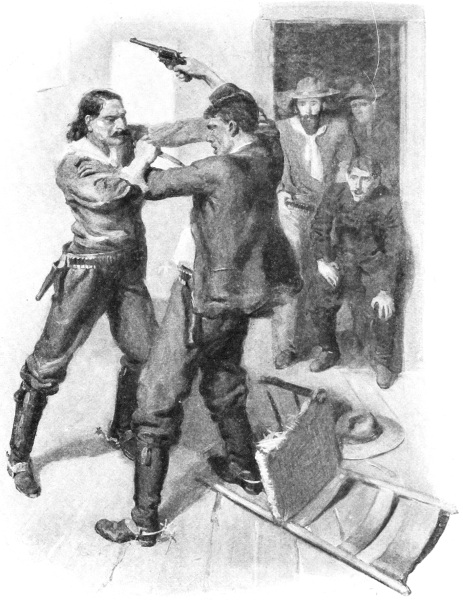
“THERE WAS A SHORT, SHARP STRUGGLE, A HARMLESS
SHOT, AND JIM’S INSULTER WAS LYING
ON THE FLOOR WITH A CLEAN CUT IN HIS CHEST”
Emboldened by Jim’s apparent indisposition
to begin a row, and, like all bullies, mistaking
conservatism for cowardice, Hosking replied:
“Y’u make a mighty purty speech, mister
man, but y’u aint on the squar’ jest the same,
an’ I—”
We never knew what Hosking was going to
say; his mouth was slapped so quickly that his
intentions became a matter for conjecture.
It was impossible to see exactly what happened
next—the two men sprang at each other
so fiercely. There was a short, sharp struggle,
a shot from Hosking’s revolver, that sped
harmlessly over the heads of the crowd, lodging
in the wall, and Jim, bowie in hand, was bounding
toward the open door, leaving his insulter
lying upon the floor with a clean cut in his
chest through which his life was ebbing away
as fast as the escaping blood could carry it!
As Jim ran, some one in the crowd fired a
shot after him. Everybody rushed to the door,
but he was in the saddle and away, amid a
shower of pistol balls, which, much to my
relief, apparently flew wide of their mark.
I was so interested in the safety of the fugitive
that I forgot poor Jeff, and, with a pang of
remorse, I hastened back to his side, only to
find that Poker Jim’s work had been too skillful
for any surgeon to undo. The man was dead!
* * * * *
With the killing of Hosking, well deserved
though it may have been, Poker Jim’s popularity
was a thing of the past. While under the
ban of public sentiment, he had killed a reputable
citizen of Jacksonville in a quarrel—he was
now an outlaw, upon whose head a price was
set. But he was not to be caught.
No one supposed that Jim would be mad
enough to venture near his cabin, even to see
his wife and child, yet the citizens set a watch
over the place as a matter of ordinary precaution,
and for the purpose of learning her
destination whenever his wife should undertake
to follow and join her husband. I, meanwhile,
saw that Jim’s family wanted for nothing, a
duty in which the sentiment of the town duly
supported me, for, rude as they were, our
people were tender-hearted to a fault. With
uncouth yet delicate discernment the boys
kept away from the little cabin, hence no
visitor but myself ever crossed the threshold.
Toppy’s description of Jim’s wife had not
been overdrawn—she was indeed beautiful,
and as charming a woman as I ever met. She
was plucky too—she was apparently not at all
uneasy about her husband, and seemed to have
perfect confidence in his ability to take care of
himself. The child, a boy, resembled his
father, and was such a sweet, pretty little
fellow that I fell quite in love with him. The
little one vaguely recalled to my mind a little
curly-headed boy baby that I used to tote about
when I was a lad, and who, I thought, was the
cutest little brother that a boy ever had. I
resolved that Jim’s family should not want a
friend as long as I could care for them. Toppy’s
loyalty I well knew, and I was therefore sure
of being ably seconded on his return from
Stockton.
But our towns-people were soon to have
more important matters to think about than
the capture of Poker Jim.
* * * * *
The latter part of the winter of 1860, and
the early spring of 1861, will never be forgotten
by the inhabitants of the Tuolumne valley.
I certainly have reason to remember it as long
as I may live.
As I have already intimated, the spring
freshets of the California valleys were a matter
of yearly experience. The inhabitants had
become accustomed to them and had usually
been able to escape serious disaster, hence they
had never quite realized what the elements
could do at their worst.
The winter had been a hard one; there had
been an excessive rainfall, and reports from the
mountain towns showed a greater amount of
snow than had ever before been experienced
in that region. When the mountain snows
began to melt, therefore, and the terrific storms
characteristic of the breaking up of the winter
season came on, an enormous volume of water
began pouring down into the valleys, which
was as alarming as it was unprecedented.
We had heard vague rumors of serious
trouble in the valleys of the Sacramento and
San Joaquin, and, as the Tuolumne had risen to
a point hitherto unheard of, the oldest settlers
became somewhat uneasy.
Fearing lest the Tuolumne—which was fast
becoming a raging torrent—might eventually
become impassable, I saw that “Mrs. Jim,” as
I used to call her, was well supplied with
necessaries. I knew that the water rise would
be of short duration—for so tradition had it—hence
I was not uneasy about my interesting
charges.
The river had finally risen to a point nearly
two feet beyond the highest water mark ever
known; it then began to subside and we felt
much easier—the end was apparently in sight.
But we deceived ourselves most thoroughly.
The people of Jacksonville, congratulating
themselves on the beginning of the end of the
greatest freshet in their experience, retired one
night to sleep in fancied security, only to be
rudely awakened the following morning by
the surging of the waters of the Tuolumne
against the very beds on which they slept.
The water was seeking its revenge—a revenge
that was soon to be fully accomplished.
Within twenty-four hours there was but one
safe point in the entire town—the high ground
upon which stood the Tuolumne House. Practically
every other building in town, save one,
was washed away. One sturdy miner upon
whom fortune had smiled, had built himself a
pretty little cottage, which he determined to
save. He passed a cable through a door and
a window at the corner of the house, and guyed
it to a huge tree upon a hill opposite. The
cottage swung about at the end of the rope
until the waters subsided, when the triumphant
miner anchored it in a new location, this time
on higher ground—the original site of his home
having gently slipped into the river. But Nelson
was an exception; his brother miners were not so
fortunate.
The hotel was full to overflowing and tents
were at a premium. Mining was a forgotten
industry. The chief occupation of the citizens
was counting noses to see who was missing,
and fishing up such articles of value as they
could from amid the debris of the flood. For
entertainment they counted the buildings and
studied the wreckage that the waters brought
down from the towns and camps higher up the
valley. An occasional corpse was seen floating
along among the flotsam and jetsam carried
past by the raging river—a ghastly reminder
of the seriousness of the situation.
Almost directly opposite the Tuolumne House
was a dam in the river. There were times
during the dry season when the Tuolumne
was so low that one could walk across via this
dam. Now, however, it was a veritable Niagara.
It was interesting, as well as harrowing,
to watch the destruction of the buildings as
they toppled over the brink and broke up.
Occasionally a house, larger than the rest,
would lodge at the dam for some time before
going over. At one point quite a mass of
debris had collected and bade fair to remain
indefinitely blocked up against a projecting
part of the dam.
Just beyond the further end of the dam I
could see Toppy’s little cabin, gleaming white
and clearly cut against the dark green background
of the hillside whereon it stood, far out
of the way of all possible danger from the
rising waters.
A group of our citizens was standing on safe
ground near the hotel, quietly discussing the
apparently hopeless misery and total destruction
that had befallen our industrious little
town, when our attention was attracted by a
house, larger than any we had yet seen, which
came drifting rapidly down the stream in full
view.
As the house came nearer, Dixie called out—“By
G—d, boys! thar’s a man in the winder!”
And so there was, and a badly frightened
one at that! As he came well within sight, he
could be seen waving a garment of some kind
in wild and emphatic signals of distress. His
voice could soon be heard, calling for assistance
in a series of wild yells that would have done
credit to an Indian war-dance.
There was great excitement among my fellow
citizens for a few moments, and groans of
despair at our inability to rescue the stranger
were plentiful, when suddenly some one in the
crowd yelled—
“Oh, h—l! It’s a d—d Chinaman, ez sure ez
shootin’!”
And so it proved to be.
I trust that the philanthropy of my fellow
townsmen will not be underestimated, if I
frankly state that an unmistakable sigh of relief
went up from the crowd when it was discovered
that the poor devil whose fate it had
just been bewailing, was a despised Mongolian.
The nationality of the hapless passenger in
the floating house and the hopelessness of an
attempt at rescue, even, if our citizens had been
so disposed, served to silence the spectators of
the Chinaman’s fate. In justice to my old
friends, I will state that I have never doubted
that an effort to save the luckless Mongolian
would have been made, had any means of rescue
been at hand. Not a boat was left in town, and
even had there been a hundred at our disposal,
it looked like certain death to attempt to
traverse the terrific torrent that confronted us.
The Chinaman was apparently clearly doomed,
and the end was only a question of minutes,
a fact which the poor fellow himself appreciated
even more keenly than we did, as was
shown by the renewed vigor of his frantic cries
for assistance, as he caught sight of the dam
that his strange craft was so rapidly nearing.
But, as Big Brown was wont to say, “Nobody
hez sich good luck ez er fool, ’ceptin’ a
d—d Chinaman.” The house in which the
luckless voyager was making his unwilling
and terrible journey, caught upon the debris
that had accumulated near the center of the
dam! Here it remained poised for an instant,
almost upon the very verge of destruction,
then swinging squarely about in the rushing
current, it lodged broad-side to, in such a
manner that it came to a full stop and remained
motionless.
The unfortunate Chinaman now redoubled
his cries for assistance, and the crowd, in silent
awe, awaited the giving way of the temporary
obstruction and the inevitable destruction of
the house and its unhappy tenant.
A moment later, a man was seen to
emerge from the scrub pines near the water’s
edge upon the opposite side of the river, some
distance below Toppy’s cabin. He was dragging
a small boat, that had evidently been
concealed among the trees.
The man pushed his little craft into the
swift running water, sprang in, and pulled
boldly away from the bank! As he did so, he
stood upright for a moment and turned his
features squarely toward us. Even at that
distance there was no mistaking that magnificent
physique and fearless bearing!
“It’s Poker Jim, by G—d!” cried a number
of men simultaneously. Almost automatically,
several among the crowd drew their pistols
and fired at the far-distant figure—a useless
feat of bravery, as their target was probably
beyond rifle-shot, to say nothing of trying to
hit a man at that distance with a six-shooter.
“Hold on, boys!” cried Big Brown, in astonishment.
“If he aint goin’ arter that d—d
Chinaman I’ll eat my hat! Well, I’ll be kerflummuxed!
If that don’t beat h—l!”
If there was anything the early settlers of the
diggings worshipped, it was reckless, fool-hardy
bravery. From that moment Jim was a hero,
a Bayard, sans peur et sans reproche, before
whose chivalry every man who saw his courageous
act was ready to bow down to the very
earth.
The crowd silently watched Jim for a moment,
and then broke out in a chorus of “bravos!”
and hand clappings which, although they
impressed the object of their admiration not
at all—even if he noticed them, which is doubtful—expressed
in unmistakable language a
sudden change in the sentiment of our towns-people
toward him whom they had so recently
outlawed.
The first burst of applause over with, we
watched the brave fellow in almost breathless
anxiety, as he skilfully directed his little boat
toward the house, the Chinaman meanwhile
having stopped his yelling for the moment,
in anticipation of the approach of his rescuer.
Whether Jim had intended to bring up
against the side of the house that lay up-stream,
as seemed wisest, would be difficult to say;
if such was his intention however, he certainly
miscalculated, for his boat disappeared behind
the end of the house which was farthest away
from us.
The rest of the tragedy we could not see, for
we had hardly lost sight of Jim before the
obstructing debris gave way and the house
shot over the dam, sweeping everything before
it!
So died a hero!
A searching party went out a short time
afterward, and, at great risk, found and secured
the body of Poker Jim, battered and bruised,
but still classically handsome and debonair,
even in death. As the boys were sorrowfully
returning to town with the body of the man
whom a few hours before they had tried to kill,
they spied upon a mass of wreckage that had
lodged in a partially submerged tree-top a few
feet from shore, a badly frightened but still
yelling individual, at the sight of whom Big
Brown almost collapsed.
It was the Chinaman!
* * * * *
Early the next morning, a cortége composed
of every citizen who was able to walk, climbed
slowly and sorrowfully up the road leading
to the little cemetery, just back of town. At
the head of the solemn procession were six
stout miners, hat in hand, bearing upon a rude
stretcher the body of Poker Jim. Just behind
the body, another party was carrying a rough
coffin, composed of pieces of wreckage, hastily
thrown together.
By no means the least sorrowful feature of
the funeral was the fact that we had no means
of communication with the dead man’s wife,
nor did we indeed, even know whether or not
she had witnessed his death.
The cemetery reached, and the body having
been laid in the clumsy coffin beside the grave
which the kind-hearted miners had already
dug, there was an embarrassing pause—
I had been asked to say a few words, in lieu
of a clergyman, and had agreed to do so, on
condition that some one else was selected to
say something in behalf of the mining population
proper. Dixie was selected to coöperate
with me, but was evidently waiting for me to
give him his cue, so I was obliged to open the
services as well as I could.
I was so overcome with emotion that I could
hardly find voice to say a word. I finally
managed, however, to give a brief eulogy of the
dead man, revolving chiefly around the incident
that happened in the San Francisco gambling-house
on the occasion when I met Jim for the
first time. My remarks were received with a
running fire of muttered eulogies of the deceased
hero, which were as sincere as they were inelegant.
Dixie now mustered up the necessary courage,
mounted a stump and began:
“Feller citizens, we air hyar ter do a solemn
dooty. One uv our most prom’nent an’ respected
citizens is a lyin’ hyar dead, an’ we,
ez his fren’s, air hyar ter give him a good send
off. Poker Jim hez passed in his checks; he
hez cashed in fer the las’ time, an’ thar aint
nobody hyar whut’ll say that his last deal
wasn’t a squar one. Sum mout say ez how
Jim was a d—d fool, ter play agin sich a dead
open-an’-shut game, with a d—d Chinaman fer
stakes, but, my feller citizens, Jim cut the cards
on the squar’, an’ he died ez squar’ ez enny
man that ever stepped in shoe leather.
“An’ Jim died game, an’ with his boots on.
He wasn’t no white-livered coyote, Jim wasn’t.
Ef thar was enny yaller streaks in him, w’y nobody
ever knowed it. He wuz a sandy man
frum way up the creek, y’u bet! He wuz a
dead-game cock fer fair.
“I wish we knowed whut Jim’s States’ name
was, but thar aint nobody hyar ter tell us, an’
ez we hev allus knowed him as Poker Jim, w’y
that’s the name we’ll bury him by. It was
good ’nuff fer him, livin’, an’ it’s good ’nuff fer
us, now that he’s dead.
“I aint no speechifier, ez y’u all know, an’
Doc, hyar, hez done the hansum thing by Jim
in that line, so I aint a goin’ ter spile a good
thing, but I’m jes’ goin’ ter say one thing, an’
say it plain. We all made mistakes on the
diseased. He mout hev been a gambler—I
don’t say ez he wasn’t—but, my fren’s, Poker
Jim was a gentleman, an’ he died like one,
d—d ef he didn’t!” And Dixie looked about
him defiantly, as though challenging dissent
and stamping it as hazardous.
A white head-board, rather more pretentious
than was the prevailing fashion in Jacksonville,
was erected at Jim’s grave. I was consulted
regarding an epitaph, but could find no fault
with the rudely carved inscription suggested
by Dixie—
“HERE LIES THE BODY
OF
POKER JIM—GENTLEMAN.”
A few days later, the flood had subsided
sufficiently to warrant an attempt at crossing
the river. Having succeeded in procuring a
large boat from one of the neighboring towns,
a party of us crossed over to Toppy’s cabin in
quest of Jim’s family.
There had been no sign of life about the
place since the day of Jim’s death, hence I was
not surprised to find the cabin empty. Not a
trace of the dead man’s wife or child could be
found! Nor were they ever heard of again.
Whether the poor little woman had witnessed
the disaster that made her a widow, and the
raging Tuolumne had received the sorrowing,
despairing mother and her innocent child,
we never knew. I have always entertained
a vague hope that Jim had already conveyed
them to a place of safety when he met his death.
As our party was searching the cabin for
clews to the disappearance of Jim’s family,
Big Brown found upon a shelf in the little
cupboard where Toppy’s rather primitive supply
of dishes was kept, a letter, carefully sealed,
and addressed to me. He handed me the
letter, and I fancied his voice trembled a little
as he said—
“Well, Doc, Jim never forgot his fren’s. I
don’t know what Toppy’ll say when he gits
back ter town.”
“Poor Toppy,” I said, “It will grieve him
sorely, when he learns that the gallant Jim is
gone forever.”
The burly miner watched me curiously as
I opened and read the letter. The expression of
my face as I read must have startled him, for he
grasped me by the arm and exclaimed, “What’s
the matter, Doc; air y’u sick?” I handed
him the letter and staggered to a chair.
Big Brown laboriously read the letter through
to the end; When he came to the signature
he put his huge hand gently on my shoulder
and said:
“Doc, ye needn’t be ashamed uv relations
like him, even if he was a gambler. Who was
he, anyhow?”
And I was not ashamed as I answered—
“My brother—little Jim.”