Poison-ivy[2] can be killed either by mechanical means, such as digging,
or by applying chemical herbicides. The best modern herbicides
are so deadly to plants that a single treatment kills all the
leaves and 90 percent or more of the roots. This is the easiest and
least dangerous way to destroy these poisonous pests. There are
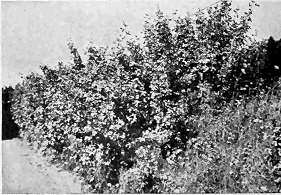
places, however, where chemicals cannot be used, as in hedges and
shrubbery where the poison-ivy is closely mixed with the valuable
plants. In such situations, hand-pulling is the only satisfactory
method. At times also chemicals and spraying equipment are not
available, and then the mattock, scythe, or plow must be resorted to.
Even with these simple tools some timing and handling methods are
better than others.
By using care poison-ivy can be destroyed with chemicals without
danger of poisoning to the operator. Except in very heavy growth,
one may stand at a distance from the plants and apply the herbicide
without touching the leaves. Most chemicals are applied as a
spray solution, and many sprayers can be equipped with extension
nozzles 2 feet or more in length. The greatest danger of ivy poisoning
occurs from careless handling of gloves, shoes, and clothing after
finishing the work. Garments should be worn that can either be
destroyed after use or washed thoroughly in hot soda solution and
soapsuds.
The chemicals thus far found most satisfactory on poison-ivy are,
in approximate order of effectiveness, ammonium sulfamate, 2,4-D
(2,4-dichlorophenoxyacetic acid), ammonium thiocyanate, borax,
carbon disulfide, coal-tar creosote oil, fuel oil and similar petroleum
distillates, sodium chlorate, and sodium arsenite. Less effective
chemicals include common salt, kerosene, gasoline, calcium cyanamide,
ammonium sulfate, and iron sulfate.
Chemicals other than borax are best applied as a spray to the
foliage. Borax is scattered dry on the soil around the plants. Any
field or garden spray machine or even a sprinkling can is useful for
applying the liquids, but a common knapsack sprayer holding about
2 gallons is convenient and does not waste the solution, application
should be as a fine spray under moderate pressure rather than a driving
mist, since the object is to wet the leaves of the poison-ivy and
avoid wetting the leaves of desirable plants.
Most chemicals used on poison-ivy are injurious to the foliage of
all kinds of plants and must be applied with caution if the surrounding
vegetation is valuable. During the early part of the growing
season the leaves of the poisonous plants usually tend to stand conspicuously
apart from those of adjacent plants and can be treated
separately if sprayed with care. Later the leaves become intermingled
and injury to adjacent species is unavoidable. Chemicals
other than oil are not injurious to the thick bark of an old tree, and
poison-ivy clinging to the trunk can be safely sprayed with them.
Chemical sprays can be used at any time when poison-ivy is in
full leaf, June and July being perhaps the best months. Ordinarily
treatments should begin not later than August 15, as poison-ivy
then begins to go dormant and sprays are ineffective.
Best results are obtained both with sprays and with dry chemicals
when the soil is moist but not wet at time of treatment. Borax can
well be applied just before a rain, but sprayed chemicals are likely
to be washed off if rain falls within 24 hours. One gallon of spray
solution is sufficient to cover all the leaves on 1 square rod (272 square
feet) of dense poison-ivy, or 2 to 4 square rods of a scattered stand.
Sprays give best results when applied in early morning or late
afternoon when the air is cool and moist. Spraying in the middle
of a dry, hot day is likely to be disappointing unless the plants are
in deep shade.
No method of chemical eradication can be depended upon to kill
all the plants in a stand of poison-ivy with one application. Three
to four light retreatments made as soon as the new leaves are fully
expanded are always necessary (1) to destroy plants missed the first
time, (2) to treat new growth from the old roots, and (3) to destroy
seedlings. At least three and sometimes four treatments at intervals
of 2 to 8 weeks are necessary before all plants are dead. These followup
treatments do not require much time or material, but neglect of
them may easily lead to serious reinfestation.
Poison-ivy has an annoying habit of “playing possum.” Plants
believed dead sometimes revive after many months. Thus an area
under treatment must be watched closely for at least a year if complete
eradication is to be assured.
Dead foliage and steins remaining after the plants have been killed
with chemicals are only slightly poisonous, but to avoid difficulty the
dead stems should be cut off and burned.
Ammonium sulfamate.—This chemical, under a proprietory name,
has come on the market recently as a weed killer and has proved
especially useful against poison-ivy. Ammonium sulfamate is not
dangerous to use under ordinary conditions, is not harmful to the soil,
and is not flammable. It is slowly corrosive to metals, and spray
equipment should be washed thoroughly with a solution of lime
or soda immediately after use. Like salt, ammonium sulfamate absorbs
moisture from the air and must be stored in a dry place.
Ammonium sulfamate is dissolved in water at the rate of 12 ounces
per gallon and sprayed on the leaves until they are wet but not dripping.
The foliage begins to wilt within 21 hours, but the action is
slow, and a week or more may elapse before the leaves die. Some
new growth may be expected after 4 to 8 weeks, and this should be
sprayed as soon as the new leaves are fully expanded. Two or occasionally
three such retreatments are needed before the kill is complete.
2,4-D (2,4-dichlorophenoxyacetic acid).—This chemical under the
abbreviated name 2,4-D, or DCP, is a recent addition to the list of
effective weed killers and may become an important weapon for use
against poison-ivy. It should not be confused with DDT or DD, two
other new agricultural chemicals, the first an insecticide and the
second used as a soil fumigant. Under wartime restrictions the use
of 2,4-D was very limited, but its prospective value is so great that
those interested in the control of poison-ivy should be informed
about it.
The chemical 2,4-D is one of the so-called “plant hormones,” or
“growth regulators.” In minute quantities it stimulates some of the
plant functions, but in slightly larger dosage it is toxic. A solution
consisting of one-seventh ounce in 1 gallon of water sprayed on
poison-ivy foliage kills all leaves hit and may kill the roots. In the
concentration used in weed killing 2,4-D is not believed to be harmful
to animal life, but until this point can be thoroughly clarified the
chemical should be used with reasonable caution to avoid poisoning.
2,4-D is not flammable and is not corrosive to spray machinery. If
the sprayer is used also for insecticides and fungicides it must be
washed very thoroughly to remove the slightest trace of the 2,4-D.
This is very difficult, however; it is safer to use another sprayer.
To make a spray solution 2,4-D must be combined with other
chemicals, as it is not soluble in water. A number of substances, including
polyethelene glycols and naphthenic soaps, have been used
for this purpose, but the best solvent has not yet been determined.
Commercial weed killers containing 2,4-D are of varying composition.
Ammonium thiocyanate.—This byproduct of the coal-gas industry
is one of the newer herbicides. The crude commercial chemical is
a pink or reddish salt, very soluble in water. It does not keep well,
tends to disintegrate into a red, sludgy mass, and is difficult and
disagreeable to handle. A purer form in clean white crystals is
available and is well worth the slight extra cost. In either form
ammonium thiocyanate is injurious to the skin and to leather articles,
and in time it corrodes metals. The spray solution is made by dissolving
1 to 1½ pounds of ammonium thiocyanate in 1 gallon of
water.
Most annual, plants and some perennials are killed by a single
application of ammonium thiocyanate. Poison-ivy usually requires
three or four treatments. Ammonium thiocyanate has a high content
of nitrogen, much of which remains in the soil and eventually
becomes a fertilizer. Thus an area treated with this chemical is
likely to produce a profuse growth of annual weeds a month or two
after treatment.
Borax.—Common borax scattered on the soil is deadly to the roots
of many plants. Spread dry at the rate of 10 to 15 pounds per square
rod, it kills poison-ivy slowly over a period of 6 to 8 weeks. A second
somewhat lighter treatment 3 to 5 months later is usually necessary to
kill all plants completely.
Borax is easy to handle, nonpoisonous, and nonflammable, readily
obtainable, and not expensive. It is one of the best chemicals to use
around stone walls, rocky ledges, fences, and other inaccessible places.
Plants differ greatly in their resistance to borax. Some species,
as Virginia creeper and deep-rooted trees, do not seem to be injured,
but others, notably dogwood, are very sensitive to it. Until more
complete information is available as to the effect of borax on other
plants, it should be employed on poison-ivy only where possible
damage to surrounding vegetation is not objectionable.
Carbon disulfide.—The fumes of this pungent, volatile liquid are
very poisonous to plants, and the chemical is widely used in the
West to kill deep-rooted perennial weeds. When poison-oak, particularly,
is growing in a mixture with wild morning-glory (bind-weed)
or similar noxious weeds, both plants may often be killed
at one operation by treating the soil with carbon disulfide. Holes
ordinarily 6 inches deep and 18 inches apart in all directions are
punched in the soil with a 1-inch iron bar, and 2 ounces of carbon
disulfide are poured in each hole. The openings are closed immediately
with a wooden club. This dosage equals 20 pounds of the
chemical per square rod. Carbon disulfide is likely to be less effective
on shallow-rooted than on deep-rooted plants and is therefore
of limited value against poison-ivy, which is surface-rooted.
Carbon disulfide is poisonous, and as it is also highly
flammable it should be handled as carefully as gasoline.
Coal-tar creosote oil.—In the fractional distillation of coal, many
oils and oillike substances are obtained, some of which are very toxic
to plants. The most common and usually the cheapest is the creosote
used for wood preservation. This substance has great penetrating
power and is an excellent herbicide on woody plants like poison-ivy.
Ordinarily creosote oil is too expensive to use alone and is therefore
mixed with some kind of petroleum oil. A mixture of 75 percent
fuel oil and 25 percent creosote oil is almost as effective as straight
creosote and is made at one-third the cost. Two applications of this
mixture at an interval of about 6 weeks usually kill a high percentage
of poison-ivy. Creosote is not selective and kills all plants
alike.
Fuel oil (Diesel and similar oils).—Crude petroleum is refined into
many kinds of oil, and those corresponding to fuel oil. Diesel
oil, stovetop oil, and orchard-heating oil are more injurious to plants
than crude oil itself or the higher distillates, such as gasoline and
kerosene. Fuel oils are widely used for destroying vegetation, particularly
by highway departments in States having oil resources.
When sprayed on poison-ivy, fuel oil brings about a slow but fairly
sure death of the plants. Two or three applications may be necessary
before the roots are killed. Fuel oil, like creosote, must be used with
care around valuable trees and shrubs because it penetrates the bark
and kills or injures all species. As used for poison-ivy spraying
there is no injury to the soil. The oil-soaked vegetation is flammable.
Sodium chlorate.—Sodium chlorate is the standard herbicide for
killing deep-rooted perennial weeds like bindweed, but when used
as a spray, it is a dangerous fire hazard, and when applied dry, it
sterilizes the soil for 2 to 4 years. Where sterilization of the soil is
desirable or not objectionable, one application of the dry chemical,
evenly at the rate of 3 to 4 pounds per square rod, is sufficient for a
complete kill.
If used as a foliage spray on poison-ivy, the chemical is dissolved
in water at the rate of 8 to 12 ounces per gallon. The leaves are
killed within a few hours, but the plants are likely to make a strong
new growth and may require as many as six treatments before they
cease to produce new leaves.
Sodium chlorate mixed with wood, cloth, or other
organic materials is highly combustible and easily
ignited. Shoes and clothing on which chlorate solution
has been allowed to dry are especially dangerous, for they
will ignite and burn with explosive fury. Contaminated
clothing should be kept wet until thoroughly washed in
a large volume of water. Chlorate should be stored only
in original metal containers, as any admixture of chlorate,
wet or dry, with straw, wood, dust, cloth, or leather has
properties similar to those of gunpowder or matches.
Sodium arsenite.—Sodium arsenite is one of the most powerful
plant poisons known and is widely used for sterilizing soil on railroads,
roadways, and other places where no vegetation of any kind
is desired. It is relatively inexpensive. In normal times sodium
arsenite is obtainable in both powder and liquid form. In weak
solution (4 to 6 ounces per gallon of water) the chemical can be
used as a spray to destroy poison-ivy. Like sodium chlorate spray,
it kills the leaves but not the roots, and five or six treatments may be
required. The solution kills the leaves of all plants impartially and
will also kill the young tender bark of shrubs and trees. This may
be either an advantage or a disadvantage, depending upon circumstances.
All compounds containing arsenic are deadly poisons
if taken internally. Arsenical sprays and chemicals
should not be used where there is any possibility that
materials sprayed with them will be eaten by animals or
man. In some communities special permission must be
obtained before arsenical weed killers may be used.
Poison-ivy can be grubbed out by hand quite readily early in
spring and late in fall. When the ground is soft after rains the roots
come out in long pieces. Grubbing when the soil is dry and hard is
almost futile, since the roots break off in the ground, leaving large
pieces that later sprout vigorously. Eradication by grubbing is permanent
if well done. Because of his close contact with the plants,
the person doing the grubbing should have a high degree of immunity
to ivy-poisoning. Many people are not so immune as they believe,
and it is common sense to wear leather gloves with gauntlets and a
shirt with long sleeves. If care is taken to prevent the poison-ivy
from touching the face, and if the clothes, including the gloves, are
burned or thoroughly washed after use, severe poisoning may be
avoided.
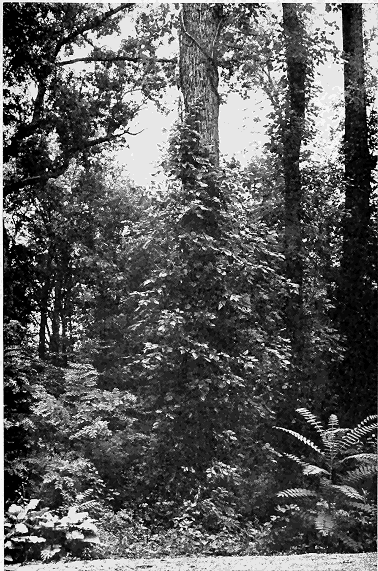
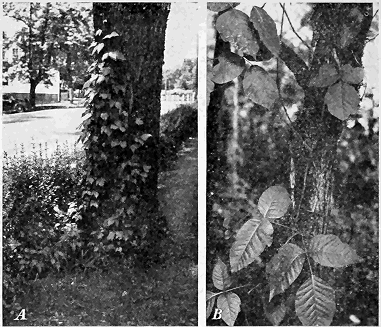
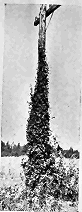
Poison-ivy vines climbing on trees should be severed at the base
and as much of the vine as possible pulled away from the tree. Often
the roots of the tree and weed are so intertwined that grubbing is
impossible without injury to the tree. Close mowing of the poison-ivy
shoots at frequent intervals is the only remedy. Roots and stems
removed in grubbing should be burned or otherwise destroyed, since
the dry material is almost as poisonous as the fresh. Care must be
taken to keep out of the smoke.
Old plants of poison-ivy produce an abundance of seeds, and these
are freely disseminated, especially by birds. A poison-ivy seedling
2 months old usually has a root that one mowing will not kill. Seedling
plants at the end of the first year have well-established underground
runners that only grubbing or chemicals will kill. Seedlings
are a constant threat as long as old poison-ivy is in the neighborhood.
Plowing is of little value in combating poison-ivy unless followed
by persistent stirring with a cultivator or harrow, to keep all roots
loosened from the soil. Otherwise plowing merely propagates the
weed.
Mowing with a scythe or sickle is a common method of attacking
poison-ivy, but it has little effect on the roots unless frequently repeated.
The number of cuttings required to kill depends upon the
age of the plants and the size of the roots, but is seldom less than
four. New shoots should be cut as soon as the first leaf on each stem
is full size. Cutting either earlier or later delays eradication.
Weed burners are implements resembling oversize blowtorches.
Two types are manufactured, one producing a short, hot, blue flame
and the other a long smoky-yellow flame. Both are useful for destroying
foliage. Neither is likely to kill perennial plants like poison-ivy
at one operation, even though the flame is held on the weeds for
a minute or more until leaves and stems are completely incinerated.
The roots are not injured by this, and new leafy shoots soon develop.
A better plan is to “sear” the plants by passing the flame slowly
over the vines just long enough to sear or wilt the leaves, but not
long enough to burn them. The roots appear to be injured more by
“searing” than completely burning the leaves, and the operation
is quicker and cheaper. Three to four searings when the leaves reach
full size usually kill the roots.
☆ U. S. Government Printing Office: 1945—652512
For sale by the Superintendent of Documents, U. S. Government Printing Office,
Washington 25, D. C.
Transcriber Notes
All illustrations were moved so as to not split paragraphs.