SUMMER DAYS IN POGANUC.
So passed Dolly's Fourth of July; a confused
dream of glory and patriotism, of
wonderful sights and surprises—but,
like a dream, it all melted away.
New England life was too practical and laborious
to give more than one day to holiday performances,
and with the night of the Fourth the
whole pageant vanished. Hiel's uniform, with its
gold lace and feathers, returned to the obscurity
of Mother Jones's pillow-cases and camphor-gum,
and was locked away in secret places; and
Hiel was only a simple stage-driver, going forth
on his route as aforetime. So with the trappings
of the Poganuc Rangers—who the day before had
glittered like so many knights-errant in the front
of battle—all were laid by in silent waiting, and
the Poganuc Rangers rose at four o'clock and
put on their working clothes and cow-hide shoes,
and were abroad with their oxen. The shoe-maker
and the carpenter, who yesterday were
transfigured in blue and gold, to-day were hammering
shoe-soles and planing boards as if no
such thing had happened. In the shadows of the
night the cannon had vanished from the village
green and gone where it came from; the flag on
the Court-house was furled, and the world of
Poganuc Center was again the same busy, literal,
work-a-day world as ever. Only Liph Kingsbury,
who had burned his hand with gunpowder
in consequence of carrying too much New England
rum in his head, and one or two boys, who
had met with a sprain or bruise in the excitement
of the day, retained any lasting memorials
of the celebration.
It is difficult in this our era of railroads and
steam to give any idea of the depths of absolute
stillness and repose that brooded in the summer
skies over the wooded hills of Poganuc. No
daily paper told the news of distant cities. Summer
traveling was done in stages, and was long
and wearisome, and therefore there was little of
that. Everybody staid at home, and expected to
stay there the year through. A journey from
Poganuc to Boston or New York was more of
an undertaking in those days than a journey to
Europe is in ours. Now and then some of the
great square houses on the street of Poganuc
Center received a summer visitor, and then
everybody in town knew it and knew all about
it. The visitor's family, rank, position in life,
probable amount of property, and genealogy to
remote ancestors, were freely discussed and settled,
till all Poganuc was fully informed. The
elect circle of Poganuc called on them, and made
stately tea-parties in their honor, and these entertainments
pleasantly rippled the placid surface of
society. But life went on there with a sort of
dreamy stillness. The different summer flowers
came out in their successive ranks in the neatly-kept
garden; roses followed peonies, and white
lilies came and went, and crimson and white
phloxes stood ranged in midsummer ranks, and the
yellow tribes of marigolds brought up the autumnal
season. And over on the woody hills around
the town the spring tints deepened and grew
dark in summer richness, and then began breaking
here and there into streaks and flecks of gold and
crimson, foretelling autumn. And there were
wonderful golden sunsets, and moonlight nights
when the street of Poganuc seemed overshot
with a silver network of tracery like the arches
of some cathedral. The doors and windows of
the houses stood innocently open all night for the
moon to shine in, and youths and maidens walked
and wandered and sentimentalized up and down
the long, dewy street, and nobody seemed to
know how fast the short, beautiful summer of
those regions was passing away.
As to Dolly, summer was her time of life and
joy; but it was not by any means a joy unmixed.
Dolly's education was conducted on the good
old-fashioned principle that everyone must do
his little part in the battle of life, and that nobody
was pretty enough or good enough to be
kept merely for ornamental purposes.
She was no curled darling, to be kept on
exhibition in white dresses and broad sashes,
and she had been sedulously instructed in the
orthodoxy of Dr. Watts, that
"Satan finds some mischief still
For idle hands to do."
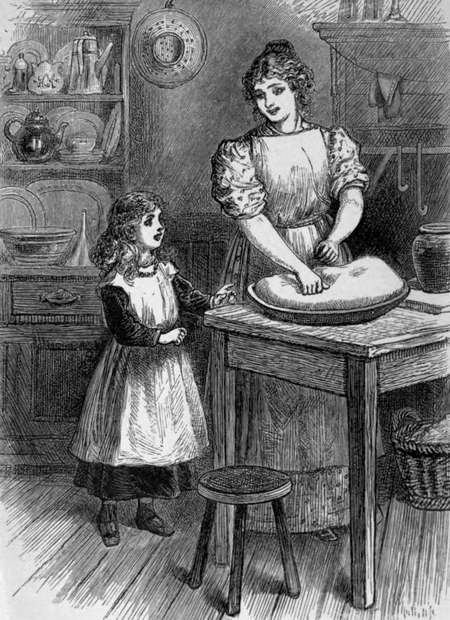
It was the duty of the good house-mother of
those days to be so much in advance of this unpleasant
personage that there should be no room
for his temptations. Accordingly, any part of the
numerous household tasks of the Parsonage that
could be trusted to a little pair of hands were
turned over to Dolly. In those days were none
of the thousand conveniences which now abridge
the labors of the housekeeper. Everything came
in the rough, and had to be reduced to a usable
form in the household.
The delicate, smooth white salt which filled
the cellars at the table was prepared by Dolly's
manipulation from coarse rock-salt crystals, which
she was taught to wash and dry, and pound and
sift, till it became of snowy fineness; and quite
a long process it was. Then there were spices
to be ground, and there was coffee to be browned
to the exact and beautiful shade dear to household
ideality; and Dolly could do that.
Being a bright, enterprising little body, she
did not so much object to these processes, which
rather interested her, but her very soul was
wearied within her at the drill of the long and
varied sewing lessons that were deemed indispensable
to her complete education. Pounding
salt, or grinding spice, or beating eggs, or roasting
coffee, were endurable; but darning stockings
and stitching wristbands, and "scratching"
gathers, were a weariness unto her spirit. And
yet it was only at the price of penances like these,
well and truly performed, that Dolly's golden
own hours of leisure were given.
Most of her household tasks could be performed
in the early morning hours before school,
and after school Dolly measured the height of
the afternoon sun with an avaricious eye. Would
there be time enough to explore the woody
hills beyond Poganuc River before sundown?
and would they let her go?
For oh, those woods! What a world of fairyland,
what a world of pure, untold joy was there
to Dolly! When she found her face fairly set
towards them, with leave to stay till sundown,
and with Spring at her heels, Dolly was as blissful,
as perfectly happy, as a child can ever be
made by any one thing.
The sense of perfect freedom, the wonder, the
curiosity, the vague expectation of what she
might find or see, made her heart beat with pleasure.
First came the race down through the
tall, swaying meadow-grass and white-hatted
daisies to the Poganuc River—a brown, clear,
gurgling stream, wide, shallow, and garrulous,
that might be easily crossed on mossy stepping-stones.
Here was a world of delight to Dolly.
Skipping from stone to stone, or reclining athwart
some great rock around which the brown waters
rippled, she watched the little fishes come and
go, darting hither and thither like flecks of silver.
Down under the shade of dark hemlocks
the river had worn a deep pool where the translucent
water lay dark and still; and Dolly,
climbing carefully and quietly to the rocky side,
could lean over and watch the slim, straight
pickerel, holding themselves so still in the water
that the play of their gossamer fins made no
ripple,—so still, so apparently unwatchful and
drowsy, that Dolly again and again fancied she
might slily reach down her little hand and take
one out of the water; but the moment the rosy
finger-tips touched the wave, with a flash, like
a ray of light, the coveted prize was gone.
There was no catching a pickerel asleep, however
quiet he might appear. Yet, time after
time, Dolly tried the experiment, burning with
the desire to win glory among the boys by
bringing home an actual and veritable pickerel
of her own catching.
But there were other beauties, dryad treasures,
more accessible. The woods along the
moist margin of the river were full of the pink
and white azalea, and she gathered besides the
fragrant blossoms stores of what were called
"honeysuckle apples" that grew upon them—fleshy
exudations not particularly nice in flavor, but
crisp, cool, and much valued among children.
There, too, were crimson wintergreen berries,
spicy in their sweetness, and the young, tender
leaves of the wintergreen, ranking high as an
eatable dainty among little folk. Dolly's basket
was sure to fill rapidly when she set herself to
gathering these treasures, and the sun would be
almost down before she could leave the enchanted
shades of the wood and come back to
real life again.
But Saturday afternoon was a sort of child's
Paradise. No school was kept, and even household
disciplinarians recognized a reasonably well-behaved
child's right to a Saturday afternoon
play-spell.
"Now, Dolly," had Nabby said to her the
week before, "you be sure and be a good girl,
and do up all your stitching and get the stockings
mended afore Saturday comes, and then we'll
take Saturday afternoon to go a-huckleberrying
up to Pequannock Rock; and we'll stop and see
Mis' Persis."
This, let it be known, was a programme to
awaken Dolly's ambition. Pequannock Rock was
a distance which she never would be permitted to
explore alone, and Mis' Persis was to her imagination
a most interesting and stimulating personage.
She was a widow, and the story ran that
her deceased husband had been an Indian—a
story which caused Dolly to regard her with a
sort of awe, connecting her with Cotton Mather's
stories of war-whoops and scalping-knives, and
midnight horrors when houses were burned and
children carried off to Canada.
Nevertheless, Mis' Persis was an inoffensive
and quite useful member of society. She had her
little house and garden, which she cultivated with
energy and skill. She kept her cow, her pig, her
chickens, and contrived always to have something
to sell when she needed an extra bit of coin. She
was versed in all the Indian lore of roots and
herbs, and her preparations of these for medicinal
purposes were much in request. Among the
farming population around, Mis' Persis was held
in respect as a medical authority, and her opinions
were quoted with confidence. She was also
of considerable repute among the best families of
Poganuc as a filler of gaps such as may often
occur in household economy. There was nothing
wanted to be done that Mis' Persis could not
do. She could wash, or iron, or bake, or brew, or
nurse the sick, as the case might require. She
was, in fact, one of the reserved forces of Poganuc
society. She was a member of Dr. Cushing's
church, in good and regular standing, and, in her
way, quite devoted to her minister and church,
and always specially affable and gracious to Dolly.
This particular Saturday afternoon all the constellations
were favorable. Dolly was pronounced
a good girl, her week's tasks well performed; and
never were dinner-dishes more rapidly whirled
into place than were Nabby's on that same afternoon;
so that before three o'clock the pair were
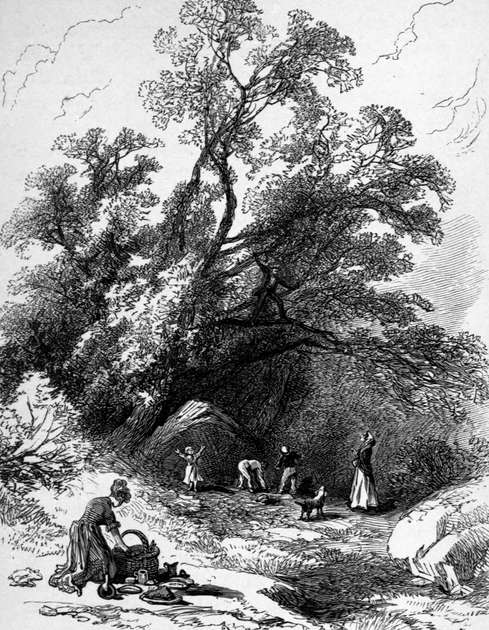
well on their way to the huckleberry-field. There,
under the burning August sun, the ground shot
up those ardent flower-flames well called fire-lilies,
and the wild roses showered their deep pink
petals as they pushed through the thickets, and
the huckleberry-bushes bent low under the weight
of the great sweet berries; and Dolly's cheeks
were all a-flame, like the fire-lilies themselves,
with heat and enthusiasm as she gathered the
purple harvest into her basket. When the baskets
were filled and Dolly had gathered fire-lilies
and wild roses more than she knew how to carry,
it was proposed to stop a little and rest, on the
homeward route, at Mis' Persis's cottage.
They found her sitting on her door-step, knitting.
A little wiry, swart, thin woman was she,
alert in her movements, and quick and decided of
speech. Her black eyes had in them a latent
fiery gleam that suggested all the while that
though pleased and pleasant at the present moment
Mis' Persis might be dangerous if roused,
and Dolly was always especially conciliatory and
polite in her addresses to her.
On the present occasion Mis' Persis was delightfully
hospitable. She installed Dolly in a
small splint-bottomed rocking-chair at the door,
and treated her to a cup of milk and a crisp
cooky.
"Why, what a little girl you are to be so far
from home!" she said.
"Oh, I don't mind," said Dolly; "I am never
tired. I could pick berries all day."
"But, sakes alive! ain't you afraid of snakes?"
said Mis' Persis. "Why, my sister got dreadfully
bit by a rattlesnake when she wa'n't much
older 'n you," and Mis' Persis shook her head
weirdly.
"Oh, dear me! Did it kill her?" said Dolly,
in horror.
"No; she lived many a year after," said Mis'
Persis, with a reticent air, as one who could say
more if properly approached.
"Do, do tell us all about it; do, Mis' Persis. I
never saw a rattlesnake. I never heard one. I
shouldn't know what it was if I saw one."
"You wouldn't ever forget it if you did," said
Mis' Persis, oracularly.
"Oh, please, Mis' Persis, do tell about it," said
Dolly, eagerly. "Where were you, and how did
it happen?"
"Well," said Mis' Persis, "it was when I was a
girl and lived over in Danbury. There's where I
come from. My sister Polly and me, we went out
to High Ledge one afternoon after huckleberries,
and as we was makin' our way through some
low bushes we heard the sharpest noise, jest like
a locust screechin', right under foot, and jest
then Polly she screams out, 'Oh, Sally,' says she,
'somethin's bit me!' and I looked down and saw
a great rattlesnake crawlin' off through the
bushes—a great big fellow, as big as my wrist.
"'Well,' says I, 'Polly, I must get you home
quick as I can;' and we set down our pails and
started for home. It was a broilin' hot day, and
we hed a'most a mile to walk, and afore we
got home I hed to carry her. Her tongue was
swelled so that it hung out of her mouth; her
neck and throat was all swelled, and spotted like
the snake. Oh, it was dreadful! We got her
into the house, and on the bed, and sent for the
Indian doctor—there ain't nobody knows about
them snake-bites but Indians. Well, he come and
brought a bag of rattlesnake-weed with him,
and he made poultices of it and laid all over her
stomach and breast and hands and feet, and he
made a tea of it and got some down her throat,
and kep' a feedin' on it to her till she got so
she could swallow. That's the way she got
well."
"Oh, Mis' Persis," said Dolly, after a pause of
awe and horror, "what is rattlesnake-weed?"
"Why, it's a worse poison than the snake-bite,
and it kills the snake-poison 'cause it's stronger.
Wherever the snakes grow, there the rattlesnake-weed
grows. The snakes know it themselves,
and when they fight and bite each other they go
and eat the weed and it cures 'em. Here's some
of it," she said, going to the wall of the room
which was all hung round with dried bunches
of various herbs—"here's some I got over on
Poganuc Mountain, if you ever should want any."
"Oh, I hope I never shall," said Dolly. "Nabby,
only think! What if there had been a snake
in those bushes!"
"Well, you can always know," said Mis' Persis,
"if you hear somethin' in the bushes jest like
a locust, sharp and sudden—why, you'd better
look afore you set your foot down. But we don't
hev no rattlesnakes round this way. I've beat
all these lots through and never seen tail of one.
This 'ere ain't one o' their places; over to Poganuc
Mountain, now, a body has to take care how
they step."
"Do you suppose, Mis' Persis," said Dolly,
after a few moments of grave thought, "do you
suppose God made that weed grow on purpose
to cure rattlesnake bites?"
"Of course he did," said Mis' Persis, as decidedly
as if she had been a trained theologian,
"that's what rattlesnake-weed was made fer;
any fool can see that."
"It seems to me," said Dolly, "that it would
have been better not to have the snakes, and
then people wouldn't be bit at all—wouldn't it?"
"Oh, we don't know everything," said Mis'
Persis; "come to that, there's a good many things
that nobody knows what they's made fer. But
the Indians used to say there was some cure
grew for every sickness if only our eyes was
opened to see it, and I expect it's so."
"Come, Dolly," said Nabby, "the sun is gettin'
pretty low; I must hurry home to get supper."
Just then the bell of the distant meeting-house
gave three tolling strokes, whereat all the three
stopped talking and listened intently.
Of all the old Puritan customs none was more
thrillingly impressive than this solemn announcement
of a death, and this deliberate tolling out
of the years of a finished life.
It was a sound to which every one, whether
alone or in company, at work or in play, stopped
to listen, and listened with a nervous thrill of
sympathy.
"I wonder who that is?" said Nabby.
"Perhaps it's Lyddy Bascom," said Mis' Persis,
"she's been down with typhus fever."
The bell now was rapidly tolling one, two,
three, four, and all the company counted eagerly
up to sixteen, seventeen, when Mis' Persis interposed.
"No, 'taint Lyddy; it's goin' on," and they
counted and counted, and still the bell kept tolling
till it had numbered eighty. "It's old Granny
Moss," said Mis' Persis decisively; "she's ben
lyin' low some time. Well, she's in heaven now;
the better for her."
"Ah, I'm glad she's in heaven," said Dolly,
with a shivering sigh; "she's all safe now."
"Oh, yes, she's better off," said Nabby, getting
up and shaking her dress as if to shake off the
very thought of death. A warm, strong, glowing
creature she was, as full of earth-life as the fire-lilies
they had been gathering. She seemed a
creature made for this world and its present uses,
and felt an animal repulsion to the very thought
of death.
"Come, Dolly," she said, briskly, as she counted
the last toll, "we can't wait another minute."
"Well, Dolly," said Mis' Persis, "tell your
mother I'm a comin' this year to make up her
candles for her, and the work sha'n't cost her a
cent. I've been tryin' out a lot o' bayberry wax
to put in 'em and make 'em good and firm."
"I'm sure you are very good," said Dolly, with
instinctive politeness.
"I want to do my part towards supportin' my
minister," said Mis' Persis, "and that's what I
hev to give."
"I'll tell my mother, and I know she'll thank
you," answered Dolly, as they turned homeward.
The sun was falling lower and lower toward
the west. The long shadows of the two danced
before them on the dusty road.
After walking half a mile they came to a stone
culvert, where a little brawling stream crossed
the road. The edges of the brook were fringed
with sweet-flag blades waving in the afternoon
light, and the water gurgled and tinkled pleasantly
among the stones.
"There, Dolly," said Nabby, seating herself on
a flat stone by the brook, "I'm goin' to rest a
minute, and you can find some of them sweet-flag
'graters' if you want." This was the blossom-bud
of the sweet flag, which when young and
tender was reckoned a delicacy among omnivorous
children.
"Why, Nabby, I thought you were in such a
hurry to get home," said Dolly, gathering the
blades of sweet-flag and looking for the "graters."
"No need of hurry," said Nabby, "the sun's
an hour and a half high," and she leaned over
the curb of the bridge and looked at herself in
the brook. She took off her sun-bonnet and
fanned herself with it. Then she put a bright
spotted fire-lily in her hair and watched the effect
in the water. It certainly was a brilliant picture,
framed by the brown stones and green rushes of
the brook.
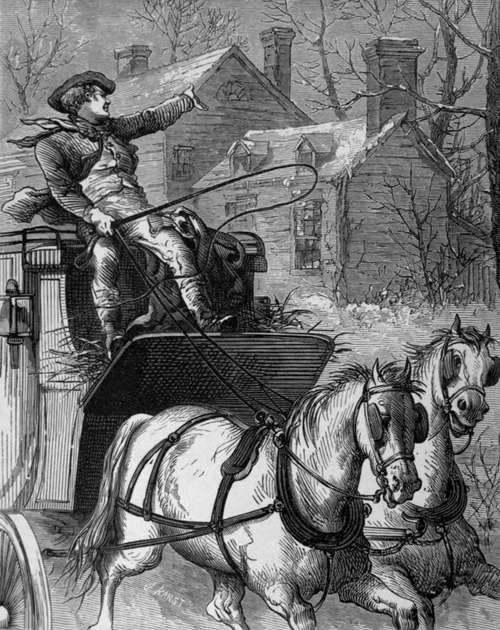
"Oh, Nabby," cried Dolly, "look! There's the
stage and Hiel coming down the hill!"
"Sure e-nough!" said Nabby, in a tone of
proper surprise, as if she had expected anything
else to happen on that road at that time of the
afternoon. "As true as I live and breathe it is
Hiel and the stage," she added, "and not a creature
in it. Now, we'll get a ride home."
Nabby's sun-bonnet hung on her arm; her hair
fell in a tangle of curls around her flushed cheeks
as she stood waiting for Hiel to come up. Altogether
she was a picture.
That young man took in the points of the view
at once and vowed in his heart that Nabby was
the handsomest girl upon his beat.
"Waitin' for me to come along?" he said as
he drew up.
"Well, you're sort o' handy now and then,"
said Nabby. "We've been huckleberrying all
the afternoon, and are tired."
Hiel got down and opened the stage door
and helped the two to get in with their berries
and flowers.
"You owe me one for this," said Hiel when
he handed in Nabby's things.
"Well, there's one," said Nabby, laughing and
striking him across the eyes with her bunch of
lilies.
"Never mind, miss. I shall keep the account,"
said Hiel; and he gathered up the reins, resumed
his high seat, made his grand entrance into Poganuc,
and drew up at the parson's door.
For a week thereafter it was anxiously discussed
in various circles how Nabby and Dolly
came to be in that stage. Where had they been?
How did it happen? The obscurity of the event
kept Hiel on the brain of several damsels who
had nothing better to talk about.
And the day closed with a royal supper of
huckleberries and milk. So went a specimen
number of Dolly's Saturday afternoons.