POETRY OF THE ANTI-JACOBIN: COMPRISING THE CELEBRATED POLITICAL AND SATIRICAL POEMS, OF The Rt. Hons. G. Canning, John Hookham Frere, W. Pitt, The Marquis Wellesley, G. Ellis, W. Gifford, The Earl of Carlisle, and Others.
Transcriber’s Note:
The cover image was created by the transcriber and is placed in the public domain.
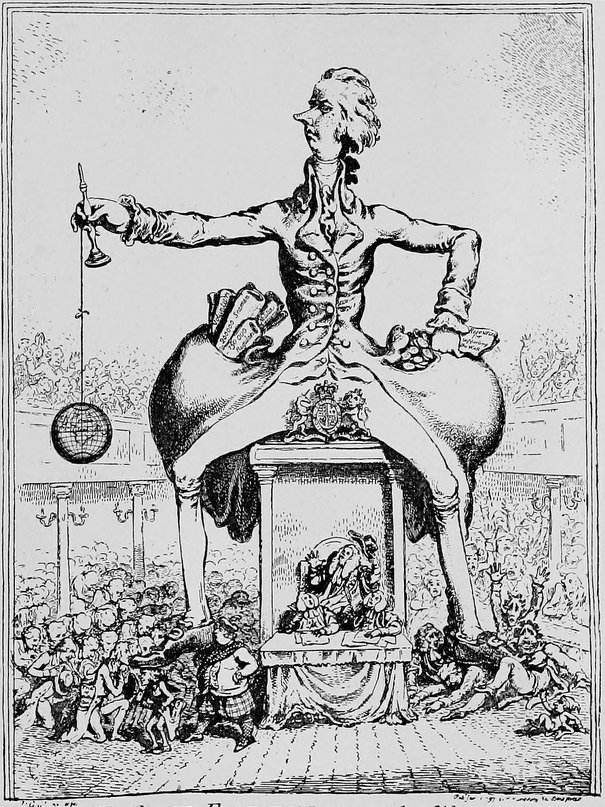
The Giant Factotum amusing himself
EDITED, WITH EXPLANATORY NOTES, ETC.
BY
CHARLES EDMONDS,
EDITOR OF THE “PYTCHLEY HUNT, PAST AND PRESENT,” ETC., ETC.
THIRD EDITION, CONSIDERABLY ENLARGED, WITH SIX ILLUSTRATIONS BY JAMES GILLRAY.
New York: G. P. PUTNAM’S SONS.
London: SAMPSON LOW & CO., Limited.
1890.
EDITOR’S PREFACE.
v
The fate which usually attends political and satirical
writings that owe their origin to passing events, has in
no way affected the Poetry of the Anti-Jacobin, which,
after a lapse of more than ninety years, still continues to
interest and amuse. Public opinion never fails, sooner
or later, to arrive at a just conclusion as to the merits
both of individuals and actions; and though it may often
neglect to preserve a meritorious work, never perpetuates
a worthless one. Poetry which lashed with so remorseless
a hand the patriotic proceedings, and held up to
ridicule the persons and habits, of the most distinguished
Whig leaders, must have possessed no common merit to
have won the encomiums of such liberal politicians and
such critics as Mackintosh and Jeffrey, Moore and
Byron.
Moore, in his Life of Sheridan, observes: “The Rolliad
and The Anti-Jacobin may, on their respective sides of the
question, be considered as models of that style of political
satire whose lightness and vivacity give it the appearance
of proceeding rather from the wantonness of wit than of
ill-nature, and whose very malice, from the fancy with
which it is mixed up, like certain kinds of fire-works,
explodes in sparkles”. This criticism might be applied
to some of his own political squibs.
viAs the poems refer to occurrences long since past, a
rapid glance at the state of events at that time (1797–8)
may render them more intelligible to the generality of
readers.
The affairs of England were then in a critical position.
The ministry of Pitt was carrying on a fierce war with
republican France, the necessity for which had split the
public into two great parties. The liberal party alleged,
that “the whole misfortunes of Europe and all the crimes
of France had arisen from the iniquitous coalition of
kings to overturn its infant freedom;—that, if its government
had been left alone, it would neither have stained
its hands with innocent blood at home nor pursued plans
of aggrandizement abroad; and that the Republic, relieved
from the pressure of external danger, and no longer
roused by the call of patriotic duty, would have quietly
turned its swords into pruning-hooks, and, renouncing
the allurements of foreign conquests, thought only of
promoting the internal felicity of its citizens”.
These sentiments, though supported by the extraordinary
eloquence of Fox, Sheridan, Erskine, and
others, had but little weight with the minister or the
great body of the public. It was impossible to deny
that the power of the French Republic was daily increasing,
and threatened the subjugation of the greater part
of Europe. Buonaparte had overrun Italy, and broken
the power of Austria, which, by the treaty of Leoben,
was compelled to cede the Netherlands to France, allow
the free navigation of the Rhine, and recognise the independence
of the newly-erected Italian republics.
viiSpain, also, had declared war against Britain, which
was thus left to contend singly against the power of
France; for the Directory had refused the basis of peace
proposed by Lord Malmesbury, that of a mutual restitution
of conquests. To add to these embarrassments, during
the year 1797 credit became affected, and the Bank
of England suspended cash payments; mutinies broke
out in the fleets at Spithead and the Nore; and Ireland
was on the verge of rebellion. But the talents of Pitt
were equal to the occasion, and his power rose higher
than ever, when his prognostications were shortly after
(in December, 1797) confirmed by the unprovoked attack
upon Switzerland by the French. The impolicy of this
proceeding was equal to its infamy; for nothing ever
done by the revolutionary government contributed so
powerfully to cool the ardour of its partisans in Europe,
and to open the eyes of the intelligent and respectable
classes in every other country to its ultimate designs.
Its effect on the friends of freedom in England may be
judged of from the indignant protest of Sir James
Mackintosh, himself once a warm admirer of the French
Revolution, who, in his defence of Jean Peltier, in 1803,
for a libel on Buonaparte, declared, “the invasion and
destruction of Switzerland an act, in comparison with
which all the deeds of rapine and blood perpetrated in
the world are innocence itself”. Even before this, the
true character of the revolution had been detected by
the democratic Coleridge, who gave public utterance
to his feelings of horror and disgust in that noble Ode to
France written in February, 1797. In a word, to say
viiinothing of her other conquests, France, at the beginning
of 1798, had three affiliated republics at her side, the
Batavian, Cisalpine, and the Ligurian; before its close
she had organized three more, the Helvetic, the Roman,
and the Parthenopeian.
Pitt’s influence was further increased by the threatened
invasion of Great Britain by the French, a proceeding
which, as it affected every class in the country, raised
the national enthusiasm to the highest pitch, inflamed
as it already was by the recent glorious victories off Cape
St. Vincent and Camperdown. That they were likely
to be in earnest had been already shown by their expeditions
to Bantry Bay and Pembrokeshire, and Buonaparte’s
boast at Geneva, that “he would democratize
England in three months,” proved how much he relied
upon the support of the malcontents both in Great
Britain and Ireland. The estimates and preparations for
defence were, enormous; taxes, to an extent utterly unknown
before, were laid on; the Volunteer Bill was
passed (Sheridan assisting), by which, in addition to the
regular army, a hundred and fifty thousand volunteers
were, in a few weeks, in arms; The King was authorized
by another bill, in the event of an invasion, to call out the
levy, en masse, of the population; the Alien Bill was reenacted;
and the suspension of the Habeas Corpus Act
continued for another year.
But the genius of one man, however great, can effect
but little, unless suitably supported by others. The sagacious
mind of Pitt had long seen that his party in
Parliament were, with very few exceptions, no match for
ixhis numerous opponents, powerful both in talent and
social position; among whom were Fox, Sheridan,
Erskine, Horne Tooke, Whitbread, Nicholls, Courtenay,
Fitzpatrick, the Dukes of Norfolk and Bedford,
Lord Stanhope, the Duchess of Devonshire, and others.
He was always anxious, therefore, to secure whatever
available talent presented itself, and immediately on their
appearance enlisted under his banners Canning, Jenkinson,
Huskisson, and Castlereagh, all men of the same
standing, for the first three were born in 1770, and the
last in 1769.
The important assistance of Canning was immediately
felt, for he was, in the words of Byron, “a genius—almost
a universal one; an orator, a wit, a poet, a statesman”.
Though he entered Parliament at the early age
of 23 (in 1793), and attained the post of Under-Secretary
of State for the Foreign Department two years after, he
was by no means inexperienced either as a writer or as an
orator; for while a student at Eton he had won distinction
by his contributions to The Microcosm, a weekly paper
published by the more advanced Etonians, and also in
the discussions of their Debating Society, which were
conducted with strict regard to parliamentary usages.
And afterwards, while studying for the law, he took an
active part in the proceedings of the debating societies of
the metropolis, in which he achieved so much reputation
as to lead to his introduction to Pitt, whose party he
unhesitatingly joined.
Canning early saw the necessity of the Government’s
possessing some literary engine, which, like the Whig
xRolliad, published some years before, should carry confusion
into the ranks of its enemies. In a lucky hour he
conceived the idea of The Anti-Jacobin, a weekly newspaper,
interspersed with poetry, the avowed object of
which was to expose the vicious doctrines of the French
Revolution, and to turn into ridicule and contempt the
advocates of that event, and the sticklers for peace and
parliamentary reform. The editor was William Gifford,
whose vigorous and unscrupulous pen had been already
shown in his Baviad and Mæviad; and among the regular
writers were: John Hookham Frere, Jenkinson (afterwards
Earl of Liverpool), George Ellis (who had
previously contributed to the Whig Rolliad), Lord Clare,
Lord Mornington (afterwards Marquis Wellesley),
Lord Morpeth (afterwards Earl of Carlisle), Baron
Macdonald, and others. These gentlemen entered upon
their task with no common spirit. Their purpose was
to blacken their adversaries, and they spared no means,
fair or foul, in the attempt. Their most distinguished
countrymen, whose only fault was their being opposed to
government, were treated with no more respect than their
foreign adversaries, and were held up to public execration
as traitors, blasphemers, and debauchees. So alarmed,
however, became Wilberforce and others of the more
moderate supporters of ministers at the boldness of the
language employed, that Pitt was induced to interfere,
and, after an existence of eight months, The Anti-Jacobin
(in its original form) ceased to exist.
The Poetry of the Anti-Jacobin is not exclusively political.
The Loves of the Triangles, a parody on Dr. Darwin’s Loves
xiof the Plants, is, in the opinion of a celebrated critic (Lord
Jeffrey) of the highest degree of merit; as is also The
Progress of Man, a parody on Payne Knight’s Progress of
Civil Society; and The Rovers, a burlesque on the German
dramas then in vogue, the extraordinary plots of which,
as well as their language, alternately ultrasentimental
and domestically bathotic, well marked them out for
ridicule, is distinguished by sharp wit and broad humour
of the happiest kind. Canning and his coadjutors in this
piece did a real service to literature, and assisted in a
purification which Gifford, by his demolition of the Della
Cruscan school of poetry, had so well begun. Of The
Friend of Humanity and the Knife-grinder it is unnecessary
to speak; perhaps no lines in the English language have
been more effective, or oftener quoted.
But Canning’s greatest power is shown in New Morality,
which, being the last of the series, seems to have been
reserved as a concentrating medium for his pent-up scorn
and contempt of the Whigs and their adherents. So that
their blows fall thick (for he was powerfully seconded by
Frere, Gifford, and Ellis), they care little who suffer from
them, and the modern reader is surprised to find Charles
Lamb and other non-intruders into politics, figuring as
congenial conspirators with Tom Paine!
It is somewhat difficult to regard Pitt in the character
of a Wit and a Poet, as from the narrative of most of his
biographers, he might be considered as uniformly cold,
stiff, and unbending; but his intimate friend Wilberforce,
in his Memoirs, thus describes him: “Pitt, when
free from shyness, and amongst his intimate companions,
xiiwas the very soul of merriment and conversation. He
was the wittiest man I ever knew, and what was quite
peculiar to himself, had at all times his wit under entire
controul. Others appeared struck by the unwonted
association of brilliant images; but every possible combination
of ideas seemed always present to his mind, and
he could at once produce whatever he desired. I was one
of those who met to spend an evening in memory of
Shakespeare, at the Boar’s Head, Eastcheap. Many
professed wits were present, but Pitt was the most
amusing of the party, the readiest and most apt in the
required allusions.” It is not, therefore, at all unlikely,
that he now and then contributed witty verses to The
Anti-Jacobin, in addition to those which the Editor has,
on probable grounds, ascribed to him in the present
volume.
“Critical commentary,” says a critic of the previous
edition, “on the merits of The Anti-Jacobin, would be
superfluous. Its satire is distinguished for the terse
language of its poignant personality, which was often
excessively stinging, but seldom offensively coarse. Its
best contributors, Canning and Frere, were not mere
pamphleteers in verse, like the writers for The Rolliad.
They had poetical inspiration and a sprightly joyousness
springing from a genial play of the mental faculties.
They were ‘Conservatives’ not only in their politics but
in their loyal adherence to the ordinances and traditions
of classical English literature. False sentiment, tumid
diction, mawkish cant, were chastised by them with
exemplary efficacy. On the fourth edition of the complete
xiiiwork (1799, 2 Vols. 8vo, containing both prose and
poetry), they placed the epigraph, Sparsosque recolligit
ignes; and in the very last paper (No. 36), the motto on
discontinuance was exquisitely happy:—
“‘We shall miss thee;
But yet thou shalt have freedom.
So to the elements
Be free; and fare thou well!’
“And these lines, taken from The Tempest (probably by
Canning), have been prophetic of the popularity of their
witty verse, still quoted and admired by all lovers of the
genius that is airily elegant and strong.”
CHARLES EDMONDS.
Water Orton, Birmingham.
ADDITIONS TO THE PRESENT EDITION.
xv
Numerous new Biographical and other Notes.
Additions and Corrections to the List of presumed Authors of
“The Poetry”.
Selections from the Prose portion of the work, written by the
Rt. Hon. G. Canning and his coadjutors.
Account of the various Editions of The Anti-Jacobin, and its successors.
Enlarged articles on the opposition Newspapers abused by The
Anti-Jacobin writers.
The curious Abusive and Satirical Index to The Anti-Jacobin;
and specimens of a similar Index to The Anti-Jacobin Review
and Magazine.
Selections from The Anti-Jacobin Review and Magazine—the successor
to The Anti-Jacobin—showing that though written by
a different body of Authors, both works were animated by the
same spirit.
EDITIONS OF THE ANTI-JACOBIN; AND ITS SUCCESSORS.
xvii
The Anti-Jacobin, or Weekly Examiner. Sparsosque recolligit ignes.
From Nov. 20, 1797, to July 9, 1798. 4to.
London.
Nos. 1 to 36; with a Prospectus (complete).
—— The Same. Second and third editions, in 4to.
—— The Same. Fourth edition, revised and corrected. 2 vols. 8vo.
London, 1799.
Every Number contained Poetry, the presumed Names of the Authors of
which will be found in the Table of Contents of the present volume.
The Poetry of the Anti-Jacobin. 4to.
London, 1801.
This volume includes the whole of the Poetry contained in the original
Anti-Jacobin, with a few verbal corrections. Previous to its publication, it was
announced that it would be illustrated by 40 plates expressly designed by
Gillray; but they never appeared. Numerous editions in 12mo subsequently
appeared, but without any additions, till those mentioned below.
The Poetry of the Anti-Jacobin. A New Edition, with Explanatory Notes
by Charles Edmonds. 12mo.
London, 1852.
—— The Same. Second edition, by Charles Edmonds; with additional
Notes, the original Prospectus (by the Rt. Hon. G. Canning), and a complete
List of the Authors. Illustrated by six etchings after the designs
of Jas. Gillray. 12mo.
London, 1854.
The Anti-Jacobin Review and Magazine; or Monthly Political and Literary
Censor. From the commencement in July, 1798, to its close in 1821.
(The first few vols. contain engravings by Gillray and others, and muchPoetryis scattered through the volumes.) 61 vols. 8vo.
London, 1798–1821.
For reasons stated on a previous page, Canning and other political friends
of Pitt thought it prudent to withdraw themselves from the original Anti-Jacobin,
but by a preconcerted arrangement it was determined that the spirit
which had pervaded that work, and which had had so powerful an effect on the
popular mind, and thereby, in connection with Gillray’s caricatures, so undoubtedly
strengthened the hands of the Ministry, should not die, if it could be
kept alive by other and congenial writers. In the words of Mr. Fox Bourne
(in his valuable work on English Newspapers, 1887): “Though The Anti-Jacobin
made its last appearance on July 9, 1798, there was started a few days before a
monthly Anti-Jacobin Review and Magazine of the same politics, but much less
brilliant, and more ponderous. Strange to say, it also was edited by a Gifford,
or one who so called himself. John Richards Green was a bold and versatile
adventurer, who, having to fly from his creditors in 1782, returned from France
in 1788, as John Gifford, and was connected with several newspapers [including
the establishment of The British Critic], besides editing The Anti-Jacobin
Review. [He also wrote a History of France, and other works.] Befriended in
xviiimany ways by Pitt, he wrote a four-volume pamphlet [3 vols. 4to, and also
6 vols. 8vo, both dated 1809], styled the Life of William Pitt, after his patron’s
death. James Mill, the friend and associate of Jeremy Bentham, was glad
to earn money in his struggling days by writing non-political articles for The
Anti-Jacobin Review. William Gifford, it is hardly necessary to state, besides
editing Ben Jonson’s Works, and other useful occupations, was the first editor
of The Quarterly Review in 1809.”
In the British Museum are two copies of The Anti-Jacobin Review and
Magazine. In one of them the first six vols. contain the Names of the Authors
of most of the articles, among whom are the Rev. John Whitaker, author of
The History of Manchester, the Rev. Sam. Henshall, author of works on Domesday
Book, the Rev. C. E. Stewart, a copious poetaster, etc., and many other
clergymen.
The New Anti-Jacobin Review.Delenda est Carthago.
Nos. 1 to 3 seem to be all that were published, and appeared May 6, June 9,
and June 23, 1827; price two shillings each.
No. 2 includes what is called a Patriot Portrait Exhibition, which is continued
in No. 3. In the latter No. is also an article entitled Canningiana. Published
by Saunders and Otley.
The New Anti-Jacobin; a Monthly Magazine of Politics, Commerce, Science,
Literature, Art, Music, and the Drama.
Consists of only Nos. 1 and 2. Published by Smith, Elder, & Co., and
Carpenter & Son; dated respectively April and May, 1833.
No. 2 contains Horace in Parliament; an Ode to William Cobbett; being a
Parody on Horace—In Barinen, Ode 4, Lib. 2. It is accompanied by a full-length
portrait of Cobbett.
The above two works, in accordance with their titles, advocate high Tory
principles; but though written with great spirit they had but a very short
existence. Copies of both will be found in the British Museum.
English Actors in the French Revolution, and Eye-witnesses of the
same.
The most complete details hitherto furnished on these interesting subjects
will be found in the Nos. for October, 1887, and July, 1888, of The Edinburgh
Review, the work of Mr. John G. Alger, the Paris correspondent of The Times.
They have since been published in a volume. (Englishmen in the French Revolution:
Low & Co., 1889.)
CONTENTS OF THE POETRY OF THE ANTI-JACOBIN, WITH THE NAMES OF THE AUTHORS.
xix
The following notices of the writers of the Poetry of the Anti-Jacobin are
derived from the copies mentioned below, and each name is authenticated by
the initials of the authority upon which each piece is ascribed to particular
persons:—
C.
Canning’s own copy of the Poetry.
B.
Lord Burghersh’s copy.
W.
Wright the publisher’s copy.
U.
Information of W. Upcott, amanuensis.
[Although many of the pieces in the following list are attributed to wrong
authors, it has been thought more convenient to reprint them as they stood in
the previous edition, in order to insert any corrections, as far as Frere is concerned.
These are derived from the information of Frere himself given to his
nephews, who afterwards edited his works in 1872. They are therefore placed
beneath the Title of the piece—between brackets.
The pieces, printed in Italics—between brackets—appear for the first time in
an edition of The Poetry.—Ed.]
[This Epistle is now known to have been written by the Hon. Wm. Lamb, (afterwards second Viscount Melbourne, and Prime Minister). He was then only in his nineteenth year.]
To the Author of the Epistle to the Editors of the Anti-Jacobin
[Jas. Boswell, jun., asserts, on the authority of the nephew of the great statesman, that the above lines were written by Pitt. This is not improbable: see Note on page 101.]
[Down to “Twine round his struggling heart,” by Ellis. From “Thus, happy France,” to “And folds the parent-monarch,” by Canning, Ellis, and Frere. The next twelve lines, which were not in the first edition, 1798, were added by Canning.]
[Act 1, Sc. 1 and 2, by Frere—Song by Canning and Ellis; Act 2, Sc. 1 and 3, and Act 3, by Canning; Act 2, Sc. 2, and Act 4, by Frere. The preliminary prose by Frere and Canning.]
“Wright, the publisher of the Anti-Jacobin, lived at 169, Piccadilly, and
his shop was the general morning resort of the friends of the ministry, as
Debrett’s was of the oppositionists. About the time when the Anti-Jacobin
was contemplated, Owen, who had been the publisher of Burke’s pamphlets,
failed. The editors of the Anti-Jacobin took his house, paying the rent, taxes,
&c., and gave it up to Wright, reserving to themselves the first floor, to which
a communication was opened through Wright’s house. Being thus enabled to
pass to their own rooms through Wright’s shop, where their frequent visits
did not excite any remarks, they contrived to escape particular observation.”
“Their meetings were most regular on Sundays, but they not unfrequently
met on other days of the week, and in their rooms were chiefly written the
poetical portions of the work. What was written was generally left open upon the
table, and as others of the party dropped in, hints or suggestions were made;
sometimes whole passages were contributed by some of the parties present, and
afterwards altered by others, so that it is almost impossible to ascertain the
names of the authors. Where, in the above notes, a piece is ascribed to different
authors, the conflicting statements may arise from incorrect information, but
sometimes they arise from the whole authorship being assigned to one person,
when, in fact, both may have contributed. If we look at the references, 167,
185, we shall see Canning naming several authors, whereas Lord Burghersh
assigns all to one author. Canning’s authority is here more to be relied upon.
New Morality Canning assigns generally to the four contributors. Wright has
given some interesting particulars by appropriating to each his peculiar portion.”
“Gifford was the working editor, and wrote most of the refutations and
corrections of the Lies, Mistakes, and Misrepresentations.”
“The papers on finance were chiefly by Pitt: the first column was frequently
kept for what he might send; but his contributions were uncertain, and generally
very late, so that the space reserved for him was sometimes filled up by other
matter. He only once met the editors at Wright’s.”
“W. Upcott, who was at the time assistant in Wright’s shop, was employed
as amanuensis, to copy out for the printer the various contributions, that
the author’s handwriting might not be detected.”—E. Hawkins.
“THE RIGHT HON. GEORGE CANNING AS A MAN OF LETTERS.”
xxiv
[The following is part of a review, under the above title, of the present editor’s
previous edition of The Poetry of the Anti-Jacobin, and appeared in The Edinburgh
Review of July, 1858. It is reprinted in the Biographical and Critical Essays of
A. Hayward, Esq., Q.C., 2 vols., 8vo., 1873. It is introduced here as throwing
some additional light on the Writers of the various pieces.]
“... We can hardly say of Canning’s satire what was said of Sheridan’s,
that—
“‘His wit in the combat, as gentle as bright,
Never carried a heart-stain away on its blade’.
But its severity was redeemed by its buoyancy and geniality, whilst the subjects
against which it was principally aimed gave it a healthy tone and a sound
foundation. Its happiest effusions will be found in The Anti-Jacobin, set on foot
to refute or ridicule the democratic rulers of revolutionary France and their
admirers or apologists in England, who, it must be owned, were occasionally
hurried into a culpable degree of extravagance and laxity by their enthusiasm....”
“We learn from Mr. Edmonds that almost all his authorities practically
resolve themselves into one, the late Mr. W. Upcott, and that he never saw
either of the alleged copies on which his informant relied. As regards the
principal one, Canning’s own, after the fullest inquiries amongst his surviving
relatives and friends, we cannot discover a trace of its existence at any period.
Lord Burghersh (the late Earl of Westmoreland) was under fourteen
years of age during the publication of The Anti-Jacobin; and we very much
doubt whether either the publisher or the amanuensis (be he who he may) was
admitted to the complete confidence of the contributors, or whether either the
prose or poetry was composed as stated. In a letter to the late Madame de
Girardin, à propos of her play, L’École des Journalistes, Jules Janin happily
exposes the assumption that good leading articles ever were, or ever could be,
produced over punch and broiled bones, amidst intoxication and revelry.
Equally untenable is the belief that poetical pieces, like the best of The Anti-Jacobin,
were written in the common rooms of the confraternity, open to
constant intrusion, and left upon the table to be corrected or completed by the
first comer. The unity of design discernible in each, the glowing harmony of
the thoughts and images, and the exquisite finish of the versification, tell of
silent and solitary hours spent in brooding over, maturing, and polishing a
cherished conception; and young authors, still unknown to fame, are least of
all likely to sink their individuality in this fashion. We suspect that their
main object in going to Wright’s was to correct their proofs and see one
another’s articles in the more finished state. Their meetings, if for these
purposes, would be most regular on Sundays, because the paper appeared
every Monday morning. The extent to which they aided one another may be
collected from a well-authenticated anecdote. When Frere had completed
the first part of The Loves of the Triangles, he exultingly read over the following
lines to Canning, and defied him to improve upon them:—
“‘Lo, where the chimney’s sooty tube ascends,
The fair Trochais from the corner bends!
Her coal-black eyes upturned, incessant mark
The eddying smoke, quick flame, and volant spark;
Mark with quick ken, where flashing in between,
Her much-loved Smoke-Jack glimmers through the scene;
xxvMark, how his various parts together tend,
Point to one purpose,—in one object end;
The spiral grooves in smooth meanders flow,
Drags the long chain, the polished axles glow,
While slowly circumvolves the piece of beef below:’
“Canning took the pen and added—
“‘The conscious fire with bickering radiance burns,
Eyes the rich joint, and roasts it as it turns’.
“These two lines are now blended with the original text, and constitute, we
are informed on the best authority, the only flaw in Frere’s title to the sole
authorship of the First Part. The Second and Third Parts were by Canning.
“By the kindness of [the late] Lord Hatherton, we have now before us a
bound volume containing all the numbers of The Anti-Jacobin as they originally
appeared, eight pages quarto, with double columns, price sixpence. On the
fly-leaf is inscribed: ‘This copy belonged to the Marquess Wellesley, and was
purchased at the sale of his library after his death, January, 1842. H.’ On
the cover is pasted an engraved label of the arms and name of a former
proprietor, Charles William Flint, with the pencilled addition of ‘Confidential
Amanuensis’. In this copy Canning’s name is subscribed to (amongst
others) the following pieces, which are also assigned to him (along with a large
share in the most popular of the rest) by the most trustworthy rumours and
traditions:—Inscription for the Door of the Cell in Newgate where Mrs. Brownrigg,
the Prenticide, was confined previous to her execution; The Friend of Humanity and
the Knife-Grinder; the lines addressed To the Author of the Epistle to the Editors
of The Anti-Jacobin; The Progress of Man (all three parts); and New Morality.[1]
“With the single exception of The Friend of Humanity and the Knife-Grinder,
no piece in the collection is more freshly remembered than the Inscription for
the Cell of Mrs. Brownrigg, who
“‘Whipp’d two female ’prentices to death,
And hid them in the coal-hole’.
“The Answer to The Author of the Epistle to the Editors of The Anti-Jacobin is less
known, and it derives a fresh interest from the fact, recently [c. 1854] made
public, that The Epistle (which appeared in The Morning Chronicle of January
17, 1798) was the composition of William Lord Melbourne. The beginning
shows that the veil of incognito had been already penetrated.
“‘Whoe’er ye are, all hail!—whether the skill
Of youthful Canning guides the ranc’rous quill;
With powers mechanic far above his age,
Adapts the paragraph and fills the page;
Measures the column, mends whate’er’s amiss,
Rejects THAT letter, and accepts of THIS;
Or Hammond, leaving his official toil,
O’er this great work consume the midnight oil—
Bills, passports, letters, for the Muses quit,
And change dull business for amusing wit.’
“After referring to ‘the poetic sage, who sung of Gallia in a headlong rage,’
The Epistle proceeds:—
“‘I swear by all the youths that Malmesbury chose,[2]
By Ellis’ sapient prominence of nose—
xxviBy Morpeth’s gait, important, proud and big—
By Leveson Gower’s crop-imitating wig,
That, could the pow’rs which in those numbers shine,
Could that warm spirit animate my line,
Your glorious deeds which humbly I rehearse—
Your deeds should live immortal as my verse;
And, while they wonder’d whence I caught my flame,
Your sons should blush to read their fathers’ shame’.
“Happily the eminent and accomplished sons of these fathers will smile,
rather than blush, at this allusion to their sires, and smile the more when they
remember from which side the attack proceeded. It is clear from the Answer,
that, whilst the band were not a little ruffled, they had not the remotest suspicion
that their assailant was a youth in his nineteenth year. Amongst other prefatory
remarks they say:—
“‘We assure the author of the epistle, that the answer which we have here
the honour to address to him, contains our genuine and undisguised sentiments
upon the merits of the poem.
“‘Our conjectures respecting the authors and abettors of this performance
may possibly be as vague and unfounded as theirs are with regard to the
Editors of The Anti-Jacobin. We are sorry that we cannot satisfy their
curiosity upon this subject—but we have little anxiety for the gratification of
our own.
“‘It is only necessary to add, what is most conscientiously the truth, that this
production, such as it is, is by far the best of all the attacks that the combined
wits of the cause have been able to muster against The Anti-Jacobin.’
“The Answer opens thus:—
“‘Bard of the borrow’d lyre! to whom belong
The shreds and remnants of each hackney’d song;
Whose verse thy friends in vain for wit explore,
And count but one good line, in eighty-four!
Whoe’er thou art, all hail! Thy bitter smile
Gilds our dull page, and cheers our humble toil!’
“The ‘one good line’ was ‘By Leveson Gower’s crop-imitating wig,’ but the
Epistle contains many equally good and some better. The speculations as to
its authorship afforded no slight amusement to the writer and his friends....
“New Morality is commonly regarded as the master-piece of The Anti-Jacobin;
and, with the exception of a few lines, the whole of it is by Canning. It appeared
in the last number, and he is said to have concentrated all his energies
for a parting blow. The reader who comes fresh from Dryden or Pope, or even
Churchill, will be disappointed on finding far less variety of images, sparkling
antithesis, or condensed brilliancy of expression. The author exhibits abundant
humour and eloquence, but comparatively little wit; i.e., if there be any truth
in Sydney Smith’s doctrine ‘that the feeling of wit is occasioned by those
relations of ideas which excite surprise, and surprise alone’. We are commonly
prepared for what is coming, and our admiration is excited rather by the justness
of the observations, the elevation of the thoughts, and the vigour of the
style, than by a startling succession of flashes of fancy. If, as we believe, the
same might be said of Juvenal, and the best of his English imitators, Johnson,
we leave ample scope for praise; and New Morality contains passages which have
been preserved to our time and bid fair to reach posterity. How often are the
lines on Candour quoted in entire ignorance or forgetfulness of their author....
“The drama of The Rovers, or Double Arrangement, was written to ridicule the
German Drama, then hardly known in this country, except through the medium
of bad translations of some of the least meritorious of Schiller’s, Goethe’s,
and Kotzebue’s productions. The parody is now principally remembered by
Rogero’s song, of which, Mr. Edmonds states, the first five stanzas were by
Canning. “Having been accidentally seen, previously to its publication, by
Pitt, he was so amused with it that he took a pen and composed the last stanza
on the spot....”
xxvii“Canning’s reputed share in The Rovers excited the unreasoning indignation,
and provoked the exaggerated censure, of a man who has obtained a world-wide
reputation by his historical researches, most especially by his skill in separating
the true from the fabulous, and in filling up chasms in national annals by a process
near akin to that by which Cuvier inferred the entire form and structure
of an extinct species from a bone. The following passage is taken from
Niebuhr’s History of the Period of the Revolution (published from his Lectures, in
two volumes, in 1845):—
“‘Canning was at that time (1807) at the head of foreign affairs in England.
History will not form the same judgment of him as that formed by contemporaries.
He had great talents, but was not a great Statesman; he was one of
those persons who distinguish themselves as the squires of political heroes.
He was highly accomplished in the two classical languages, but without being
a learned scholar. He was especially conversant with Greek writers. He had
likewise poetical talent, but only for Satire. At first he had joined the leaders
of opposition against Pitt’s ministry: Lord Grey, who perceived his ambition,
advised him, half in joke, to join the ministers, as he would make his fortune.
He did so, and was employed to write articles for the newspapers and satirical
verses, which were often directed against his former benefactors.
“‘Through the influence of the ministers he came into Parliament. So long
as the great eloquence of former times lasted, and the great men were alive, his
talent was admired; but older persons had no great pleasure in his petulant,
epigrammatic eloquence and his jokes, which were often in bad taste. He
joined the Society of the Anti-Jacobins, which defended everything connected
with existing institutions. This society published a journal, in which the most
honoured names of foreign countries were attacked in the most scandalous
manner. German literature was at that time little known in England, and it
was associated there with the ideas of Jacobinism and revolution. Canning
then published in The Anti-Jacobin the most shameful pasquinade which was
ever written against Germany, under the title of Matilda Pottingen. Göttingen
is described in it as the sink of all infamy; professors and students as a gang of
miscreants; licentiousness, incest, and atheism as the character of the German
people. Such was Canning’s beginning: he was at all events useful, a sort of
political Cossack’ (Geschichte des Zeitalters der Revolution, vol. ii., p. 242).
“‘Here am I,’ exclaimed Raleigh, after vainly trying to get at the rights of
a squabble in the courtyard of the Tower, ‘employed in writing a true history
of the world, when I cannot ascertain the truth of what happens under my
own window.’ Here is the great restorer of Roman history—who, by the way,
prided himself on his knowledge of England—hurried into the strangest
misconception of contemporary events and personages, and giving vent to a series
of depreciatory misstatements, without pausing to verify the assumed groundwork
of his patriotic wrath. His description of ‘the most shameful pasquinade,’
and his ignorance of the very title, prove that he had never seen it. If he had,
he would also have known that the scene is laid at Weimar, not at Göttingen,
and that the satire is almost exclusively directed against a portion of the
dramatic literature of his country, which all rational admirers must admit to be
indefensible. The scene in The Rovers, in which the rival heroines, meeting for
the first time at an inn, swear eternal friendship and embrace, is positively a
feeble reflection of a scene in Goethe’sStella; and no anachronism can exceed
that in Schiller’s Cabal und Liebe, when Lady Milford, after declaring herself
the daughter of the Duke of Norfolk who rebelled against Queen Elizabeth, is
horrified on finding that the jewels sent her by the Grand Duke have been
purchased by the sale of 7000 of his subjects to be employed in the American
war.[3]
xxviii“Amongst the prose contributions to The Anti-Jacobin, there is one in which,
independently of direct evidence, the peculiar humour of Canning is discernible,—the
pretended report of the meeting of the Friends of Freedom at the Crown
and Anchor Tavern.[4] The plan was evidently suggested by Tickell’s Anticipation,
in which the debate on the Address at the opening of the Session was
reported beforehand with such surprising foresight, that some of the speakers,
who were thus forestalled, declined to deliver their meditated orations.
“At the meeting of the Friends of Freedom, Erskine, whose habitual
egotism could hardly be caricatured, is made to perorate as follows, &c....
A long speech is given to Mackintosh, who, under the name of Macfungus,
after a fervid sketch of the Temple of Freedom which he proposes to construct
on the ruins of ancient establishments, proceeds with kindling animation,
&c....[5]
“The wit and fun of these imitations are undeniable, and their injustice is
equally so. Erskine, with all his egotism, was, and remains, the greatest of
English advocates. He stemmed and turned the tide which threatened to
sweep away the most valued of our free institutions in 1794; and (we say
with Lord Brougham) ‘Before such a precious service as this, well may the
lustre of statesmen and orators grow pale’. Mackintosh was pre-eminently
distinguished by the comprehensiveness and moderation of his views; nor could
any man be less disposed by temper, habits, or pursuits towards revolutionary
courses. His lectures on The Law of Nature and Nations were especially directed
against the new morality in general, and Godwin’s Political Justice in particular.
“At a long subsequent period (1807) Canning, when attacked in Parliament
for his share in The Anti-Jacobin, declared that ‘he felt no shame for its
character or principles, nor any other sorrow for the share he had had in it
than that which the imperfection of his pieces was calculated to inspire’. Still,
it is one of the inevitable inconveniences of a connection with the Press that
the best known writers should be made answerable for the errors of their
associates; and the license of The Anti-Jacobin gave serious and well-founded
offence to many who shared its opinions and wished well to its professed object.
In Wilberforce’s Diary for May 18, 1799, we find ‘Pitt, Canning, and Pepper
Arden came in late to dinner. I attacked Canning on indecency of Anti-Jacobin.’
Coleridge, in his Biographia Literaria, complains bitterly of the
calumnious accounts given by The Anti-Jacobin of his early life, and asks with
reason, ‘Is it surprising that many good men remained longer than perhaps
they otherwise would have done adverse to a party which encouraged and
openly rewarded the authors of such atrocious calumnies?’
“Mr. Edmonds says that Pitt got frightened, and that the publication was
discontinued at the suggestion of the Prime Minister. It is not unlikely that
Canning, now a member of the House of Commons and Under-Secretary of
State for Foreign Affairs, found his connection with it embarrassing, as his
hopes rose and his political prospects expanded. Indeed, it may be questioned
whether a Parliamentary career can ever be united with that of the daily or
weekly journalist without compromising one or both. At all events, the
original Anti-Jacobin closed with the number containing New Morality, and
Canning had nothing to do with the monthly review started under the same
name.”
THE ANTI-JACOBIN AS AN AID TO GOVERNMENT.
xxix
[Considering The Anti-Jacobin from a national as well as a literary point of
view, we cannot do better than use a portion of an Essay on English Political
Satires by the late Jas. Hannay, in the Quarterly Review, April, 1857.]
“... In the case of The Anti-Jacobin, what are we to say? A hundred
opinions may be adopted respecting the French Revolution. Some hate it with
unmitigated hatred. Some regret it, but accept its consequences as beneficial
to mankind on the whole. Some cherish its memory as a new political revelation
of which they hope to see still further results. But a candid man of any
of these persuasions must remember that the aim of The Anti-Jacobin was to
keep Britain from revolution during 1797–8. It was therefore necessary to fight
as our soldiers afterwards did in Spain—to wage such a literary war as suited
the agitated spirit of Europe. While we blame Canning, therefore, for speaking
as he did of Madame Roland, we must not forget the indecorum of her
Memoirs, or that it was from persons of her party that vile aspersions were cast
upon the character of Marie Antoinette. There were men quite ready to
begin the same work over here that had been done in France, and that in a
spirit of vulgar imitation, and under quite different circumstances. They had
to be shot down like mad dogs; for a cur, though contemptible in ordinary
cases, becomes tragic when he has hydrophobia.
“For The Anti-Jacobin must be claimed an honour which can be claimed for
scarce one of the works we have passed under review. Let us waive the
question how much we may have owed it for helping to inspire that unity and
stout insular self-confidence which carried us through the great war,—whole
within and impervious without. Let us consider it only in a literary point of
view, and we shall find it enjoying the rare distinction that its best Satires live
in real popular remembrance. The Knife-Grinder, with his
“‘Story! God bless you, I have none to tell, sir,’
is almost as widely known as our nursery rhymes.
“But if The Anti-Jacobin excels all similar works in popularity, and in the
eminence of its contributors, it also excels them in another important particular.
It contains on the whole a greater number of really good things than any one
of them. The Loves of the Triangles, in which,
“‘Th’ obedient Pulley strong Mechanics ply,
And wanton Optics roll the melting eye!’
is an irresistible parody, and likely to keep the original of Darwin [Loves of the
Plants] in remembrance. Gray’s Odes have survived the burlesques of Colman;
and the Country and City Mouse of Prior and Montague is neglected by nine-tenths
of those who read with admiration the Hind and the Panther. But
Darwin’s case is peculiar. Other poems live in spite of ridicule; and his Loves
of the Plants in consequence of it. The Attic salt of his enemies has preserved
his reputation.
“There is always a purpose in The Anti-Jacobin’s view something more
important than the mere persiflage that teases individuals. Like the blade of
Damascus, which has a verse of the Koran engraved on it, its fine wit glitters
terribly in the cause of sacred tradition.”
Pitt, with his right hand is playing at cup and ball; the latter being a globe to denote his influence over foreign countries as well as at home. His right foot is supported by Dundas and Wilberforce, and is extended to be submissively kissed by his ministerial followers, foremost of whom is Canning. With his left foot he has crushed the Opposition. On the same side is a document labelled “Resources for supporting the War,” with a collection of coin, evidently destined for foreign subsidies. On his right side are various official returns of volunteers, seamen, regulars, and militia. He is thus prepared to carry on the war abroad, and maintain tranquillity at home.
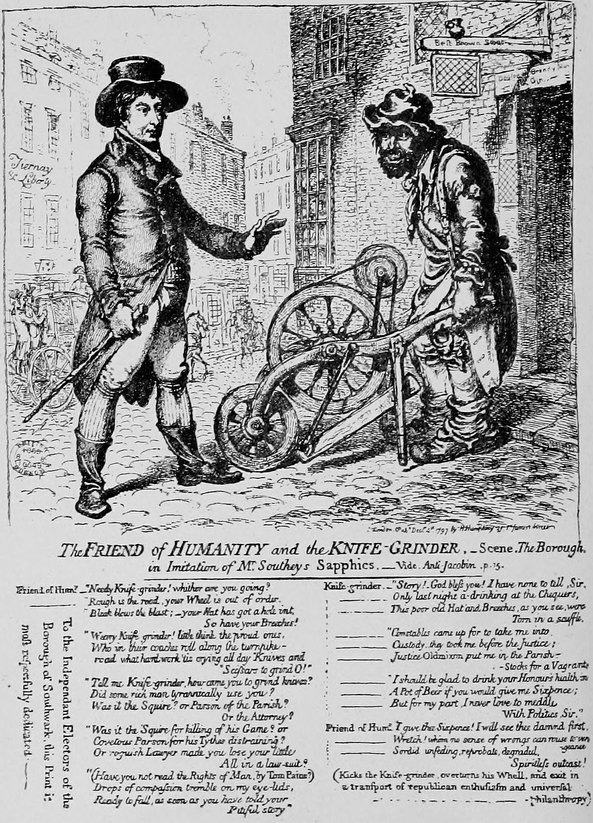
Scene, the Borough of Southwark, with a portrait of George Tierney, its able and radical representative. Published Dec. 4, 1797, as a graphic illustration of the Parody of Southey’s poem, The Widow.
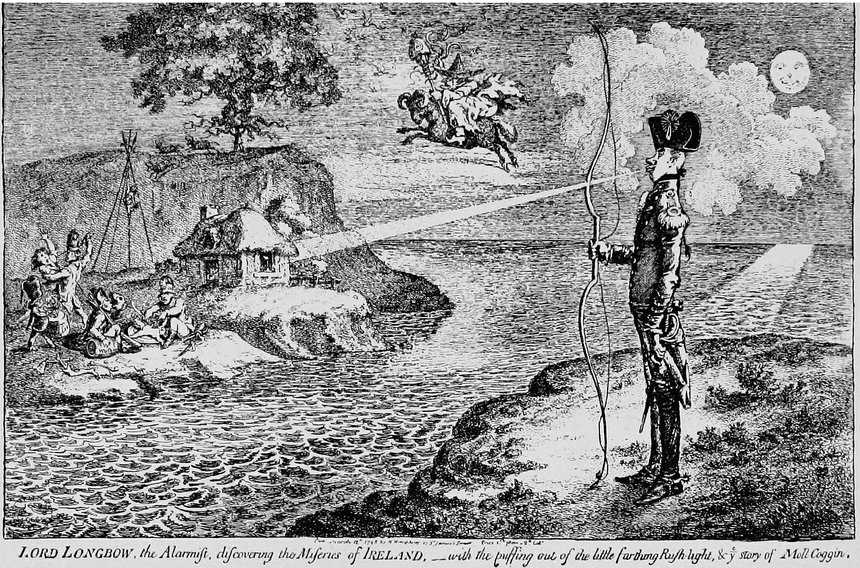
LORD LONGBOW, THE ALARMIST, DISCOVERING THE MISERIES OF IRELAND.
A characteristic portrait of the gallant and excellent Earl of Moira, afterwards Marquis of Hastings, and Governor-General of India. The engraving is in ridicule of his complaint, in the House of Lords, of the cruelties exercised by the Government troops on the Irish Rebels. In the distance is seen Moll Coggin, an Irish witch, mounted on a black Ram with a blue tail, and on the hill an Oak-boy, carrying an uprooted oak, on the branches of which are numerous swans—in allusion to the unfounded nature of his charges.
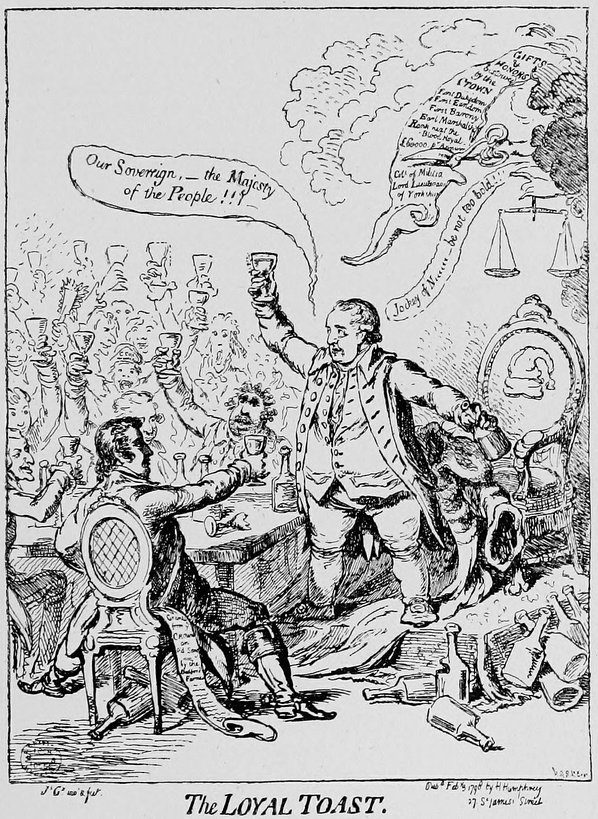
Representing the Duke of Norfolk giving at a dinner at the Crown and Anchor Tavern in honour of the birth-day of Fox his famous toast, “Our Sovereign’s Health—The Majesty of the People”. On the left is John Nicholls, Member for Tregony; next to him is the Duke of Bedford; on the other side of the table are Sheridan and Fox.
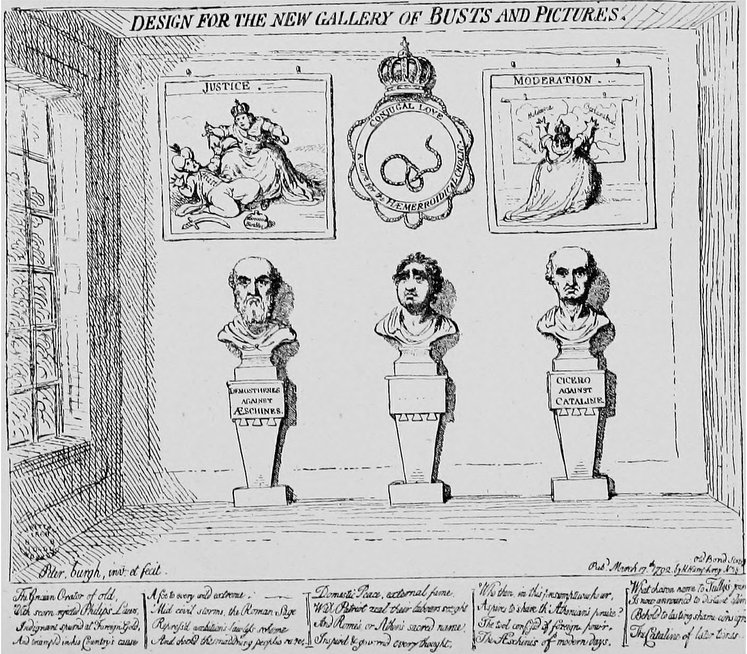
The statue of Fox was placed between those of Demosthenes and Cicero, by the Empress Catherine of Russia, as a compliment to him for having successfully opposed the sending of the armament prepared by Pitt, in conjunction with Prussia and Holland, to compel her to give up Ockzakow which she had seized. As this caricature, including the verses, was originally published in March, 1793, the latter in The Anti-Jacobin must have been suggested by them.
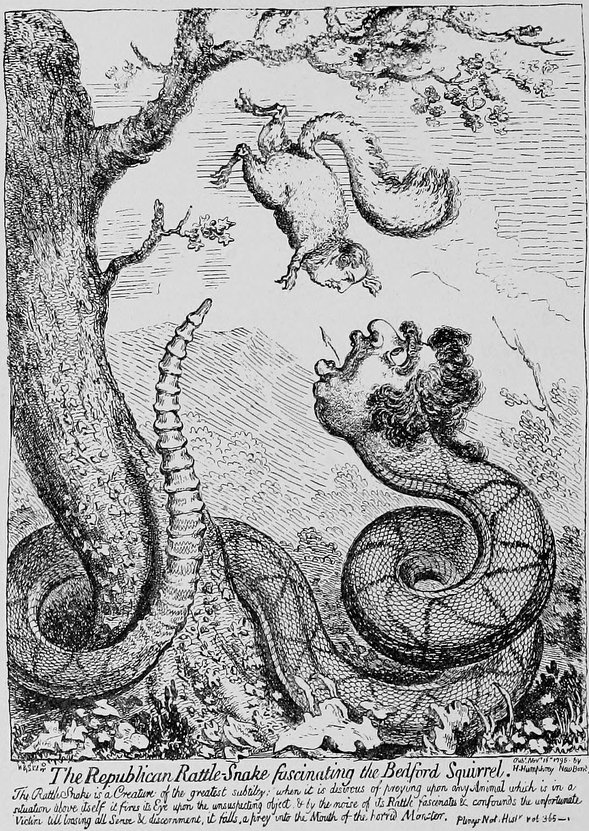
THE REPUBLICAN RATTLESNAKE FASCINATING THE BEDFORD SQUIRREL.
In allusion to the influence exercised by Fox over Francis, fifth Duke of Bedford, who had become one of the most zealous of the popular party.
PROSPECTUS OF THE ANTI-JACOBIN; OR, WEEKLY EXAMINER, — No. I. — INTRODUCTION. — INSCRIPTION [8] For the Apartment in Chepstow Castle, where Henry Marten, the Regicide, was imprisoned thirty years. — IMITATION. INSCRIPTION For the Door of the Cell in Newgate, where Mrs. Brownrigg, the ’Prentice-cide, was confined previous to her Execution.
1
The First Number of which will be published on Monday,
the 20th of November, 1797, to be continued every Monday
during the sitting of Parliament. Price 6d.
——Possit quid vivida virtus
Experiare, licet: nec longe scilicet hostes
Quærendi.
At a moment, when whatever may be the habits of
inquiry and the anxiety for information upon subjects
of public concern diffused among all ranks of people, the
vehicles of intelligence are already multiplied in a proportion
nearly equal to this encreased demand, and to
the encreased importance and variety of matter, some
apology may perhaps be necessary for the obtrusion of a
new Paper upon the World; and some account may
reasonably be expected of the views and principles on
which it founds its pretensions to notice, before it can
hope to make its way through the crowd of competitors
which have gotten the start of it in the race for public
favour.
[As this Prospectus was written by Mr. Canning, and it has been prefixed
only to the former edition of the Poetry by the present Editor, it is again considered
an interesting addition to the present one.]
2The grounds upon which such pretensions have
usually been rested by those who have engaged in
undertakings of this kind, are accuracy, variety, and
priority of Intelligence, connections at home, correspondence
abroad, and, above all, a profession of
impartial and unprejudiced attention to all opinions,
and to all parties and descriptions of men.
On none of these Topicks is it Our intention to enlarge.
Of Our means of information, and of the use which
We make of them, our readers will, after a very short
trial, be enabled to form their own opinion. And to
that trial We confidently commit ourselves: professing,
however, at the same time, that if the only advantage
which We were desirous of holding out to our Readers,
were that of having it in our power to apprize them an
hour or a day sooner than those Journals, which are
already in their hands, of any event however important—We
should bring to the undertaking much less anxiety
for success, and should state our claims on public attention
with much less boldness, than We are disposed to
do in the consciousness of higher purposes, and more
beneficial views.
Novelty indeed We have to announce. For what so
new in the present state of the daily and weekly Press
(We speak generally, though there are undoubtedly
exceptions which we may have occasion to point out
hereafter) as the Truth? To this object alone it is
that Our labours are dedicated. It is the constant violation,
the disguise, the perversion of the Truth, whether
in narrative or in argument, that will form the principal
subject of our Weekly Examination: and it is by a
diligent and faithful discharge of this duty—by detecting
3falsehood, and rectifying error, by correcting misrepresentation,
and exposing and chastising malignity—that We
hope to deserve the reception which We solicit, and to
obtain not only the approbation of the Country to our
attempt, but its thanks for the motives which have given
birth to it.
These are strong words. But We are conscious of
intending in earnest what they profess. How far the
execution of our purpose may correspond with the design,
it is for others to determine. It is ours to state that
design fairly, and in the spirit in which we conceive it.
Of the utility of such a purpose, if even tolerably
executed, there can be little doubt, among those persons
(a very large part of the community) who must have
found themselves, during the course of the last few years,
perplexed by the multiplicity of contradictory accounts of
almost every material event that has occurred in that
eventful and tremendous period; and who must anxiously
have wished for some public channel of information on
which they could confidently rely for forming their
opinion.
But before We can expect sufficient credit from persons
of this description, to enable us to supply such a defect,
and to assume an office so important, it is natural that
they should require some profession of our principles as
well as of our purposes; in order that they may judge
not only of our ability to communicate the information
which We promise, but of our intention to inform them
aright.
To that freedom from partiality and prejudice, of which
We have spoken above, by the profession of which so
many of our Contemporaries recommend themselves, We
4make little pretension—at least in the sense in which
those terms appear now too often to be used.
We have not arrived (to our shame perhaps we avow
it) at that wild and unshackled freedom of thought,
which rejects all habit, all wisdom of former times, all
restraints of ancient usage, and of local attachment;
and which judges upon each subject, whether of politicks
or morals, as it arises, by lights entirely its own, without
reference to recognized principle, or established practice.
We confess, whatever disgrace may attend such a confession,
that We have not so far gotten the better of the
influence of long habits and early education, not so far
imbibed that spirit of liberal indifference, of diffused and
comprehensive philanthropy, which distinguishes the
candid character of the present age, but that We have
our feelings, our preferences, and our affections, attaching
on particular places, manners, and institutions, and
even on particular portions of the human race.
It may be thought a narrow and illiberal distinction—but
We avow ourselves to be partial to the Countryin
which we live, notwithstanding the daily panegyricks
which we read and hear on the superior virtues and
endowments of its rival and hostile neighbours. We are
prejudiced in favour of her Establishments, civil and
religious; though without claiming for either that ideal
perfection, which modern philosophy professes to discover
in the other more luminous systems which are arising
on all sides of us.
The safety and prosperity of these kingdoms, however
unimportant they may seem in abstract contemplation
when compared with the more extensive, more beautiful,
and more productive parts of the world, do yet excite in
5our minds a peculiar interest and anxiety; and will probably
continue to occupy a share of our attention by no
means justified by the proportional consequence which
speculative reasoners may think proper to assign to them
in the scale of the universe.
We should be averse to hazarding the smallest part of
the practical happiness of this Country; though the
sacrifice should be recommended as necessary for accomplishing
throughout the world an uniform and beautiful
system of theoretical liberty: and We should at all times
exert our best endeavours for upholding its constitution,
even with all the human imperfections which may belong
to it, though We were assured that on its ruins might be
erected the only pillar that is yet wanting to complete
the “most glorious fabrick which the Integrity and Wisdom
of man have raised since the Creation”.
If, as Philosopher Monge[6] avers, in his eloquent and
instructive address to the Directory, “The Government
of England and the French Republick cannot exist together,”
We do not hesitate in our choice; though well aware
that in that choice we may be much liable, in the opinion
of many critics of the present day, to the imputation of a
want of candour or of discernment.
6Admirers of military heroism, and dazzled by military
success in common with other men, We are yet even here
conscious of some qualification and distinction in our
feelings: We acknowledge ourselves apt to look with
more complacency on bravery and skill, when displayed
in the service of our Country, than when We see them
directed against its interests or its safety; and, however
equal the claims to admiration in either case may be, We
feel our hearts grow warmer at the recital of what has
been atchieved by Howe, by Jervis, or by Duncan, than
at the “glorious victory of Jemappe,” or “the immortal
battle of the bridge of Lodi”.
In Morals We are equally old-fashioned. We have
not yet learned the modern refinement of referring in all
considerations upon human conduct, not to any settled
and preconceived principles of right and wrong, not to
any general and fundamental rules which experience, and
wisdom, and justice, and the common consent of mankind
have established, but to the internal admonitions of
every man’s judgment or conscience in his own particular
instance.
We do not dissemble,—that We reverence Law,—We
acknowledge Usage,—We look even upon Prescription
without hatred or horror. And we do not think these,
or any of them, less safe guides for the moral actions of
men, than that new and liberal system of Ethics, whose
operation is not to bind but to loosen the bands of social
order; whose doctrine is formed not on a system of reciprocal
duties, but on the supposition of individual, independent,
and unconnected rights; which teaches that all
men are pretty equally honest, but that some have
different notions of honesty from others, and that the
7most received notions are for the greater part the most
faulty.
We do not subscribe to the opinion, that a sincere conviction
of the truth of no matter what principle, is a sufficient
defence for no matter what action; and that the
only business of moral enquiry with human conduct is to
ascertain that in each case the principle and the action
agree. We have not yet persuaded ourselves to think it
a sound, or a safe doctrine, that every man who can
divest himself of a moral sense in theory, has a right to
be with impunity and without disguise a scoundrel in
practice. It is not in our creed, that Atheism is
as good a faith as Christianity, provided it be professed
with equal sincerity; nor could We admit it
as an excuse for Murder, that the murderer was in
his own mind conscientiously persuaded that the
murdered might for many good reasons be better out
of the way.
Of all these and the like principles, in one word, of
JACOBINISM in all its shapes, and in all its degrees,
political and moral, public and private, whether as it
openly threatens the subversion of States, or gradually
saps the foundations of domestic happiness, We are the
avowed, determined, and irreconcileable enemies. We
have no desire to divest ourselves of these inveterate
prejudices; but shall remain stubborn and incorrigible in
resisting every attempt which may be made either by
argument or (what is more in the charitable spirit of
modern reformers) by force, to convert us to a different
opinion.
It remains only to speak of the details of our Plan.
8It is our intention to publish Weekly, during the Session
of Parliament, a Paper, containing,
First, An Abstract of the important events of the
week, both at home and abroad.
Secondly, Such Reflections as may naturally arise
out of them: and,
Thirdly, A contradiction and confutation of the falsehoods
and misrepresentations concerning these events,
their causes, and their consequences, which may be found
in the Papers devoted to the cause of Sedition and
Irreligion, to the pay or principles of France.
This last, as it is by far the most important, will in all
probability be the most copious of the three heads; and
is that to which, above all others, We wish to direct the
attention of our Readers.
We propose diligently to collect, as far as the range of
our own daily reading will enable us, and We promise
willingly to receive, from whatever quarter they may
come, the several articles of this kind which require to
be thus contradicted or confuted; which will naturally
divide themselves into different classes, according to their
different degrees of stupidity or malignity.
There are, for instance (to begin with those of the
highest order), the Lies of the Week; the downright,
direct, unblushing falsehoods, which have no colour or
foundation whatever, and which must at the very moment
of their being written, have been known to the writer to
be wholly destitute of truth.
Next in rank come Misrepresentations which,
taking for their groundwork facts in substance true, do
so colour and distort them in description, as to take away
all semblance of their real nature and character.
9Lastly, The most venial, though by no means the least
mischievous class, are Mistakes; under which description
are included all those Hints, Conjectures, and Apprehensions,
those Anticipations of Sorrow and Deprecations
of Calamity, in which Writers who labour under
too great an anxiety for the Public Welfare are apt to
indulge; and which, when falsified by the event, they are
generally too much occupied to find leisure to retract or
disavow:—A trouble which We shall have great pleasure
in taking off these Gentlemen’s hands.
To each of these several articles We shall carefully
affix the name and date of the Publication from which
We may take the liberty of borrowing it.
With regard to the Proceedings in Parliament,
We shall not fail to mark to Our Readers the progress of
the public business; though it does not enter into our
Plan to give a regular detail of the Debates: nor would
the limits of our Paper allow of it.
We have a further reason for not occupying this province,
which will equally account for our determination,
not to receive Advertisements—our earnest desire not to
lessen the circulation of any existing Public Print.
It is obvious upon every ground of fairness and of
policy, that We must entertain this desire very strongly
with regard to the respectable Papers which are directed
by principles and attachments like our own: an attachment
(We have no wish to disguise it) to the cause of a
Government, with whose support, whose popularity and
consequent means of exertion, the circumstances of the
present times have essentially connected the existence of
this Country as an independent Nation.
10As little should we wish to circumscribe the sale of
those Journals, upon whose errors or perverseness, upon
whose false statements and pernicious doctrines We
reckon for the main support, as they have been the
principal cause of our undertaking. These We would
entreat to proceed with fresh vigour and increased
activity. It is our wish to be seen together, and to be
compared with them. Every week of misrepresentation
will be followed by its weekly comment; and with this
corrective faithfully administered, the longest course of
Morning Chronicles or Morning Posts, of Stars or
Couriers, may become not only innocent but beneficial.
With these views then We commence our undertaking.
Whatever may be the success or the merit of its execution
in our hands, the want of something like it has so long been
felt and deplored by all thinking and honest men, that
We cannot doubt of the approbation and encouragement
with which the attempt will be received.
We claim the support, and We invite the assistance,
of ALL, who think with US that the circumstances and
character of the age in which We live require every exertion
of every man, who loves his COUNTRY in the old way,
in which till of late years the LOVE of one’s COUNTRY was
professed by most men, and by none disclaimed or
reviled; of ALL who think that the Press has been long
enough employed principally as an engine of destruction,
and who wish to see the experiment fairly tried whether
that engine, by which many of the States which surround
us have been overthrown, and others shaken to their
foundations, may not be turned into an instrument of
defence for the one remaining Country which has Establishments
to protect, and a Government with the spirit,
11and the power, and the wisdom to protect them; of ALL
who look with respect to public honour, and with attachment
to the decencies of private life; of ALL who have so
little deference for the arrogant intolerance of Jacobinism
as still to contemplate the OFFICE and the PERSON of a
King with veneration, and to speak reverently of Religion,
without apologizing for the singularity of their
opinions; of ALL who think the blessings which we enjoy
valuable, and who think them in danger; and who, while
they detest and despise the principles and the professors
of that NEW FAITH by which the foundations of all those
blessings are threatened to be undermined, lament the
lukewarmness with which its propagation has hitherto
been resisted, and are anxious, while there is yet time,
to make every effort in the cause of their COUNTRY.
Published by J. Wright, No. 169, opposite Old Bond Street, Piccadilly: by
whom Orders for the Papers, and all Communications of Correspondents,
addressed to the Editor of the Anti-Jacobin, or Weekly Examiner, will be
received. Sold also by all the Booksellers and Newsmen in Town and Country.
12
POETRY
OF
THE ANTI-JACOBIN.
Nov. 20, 1797.
In our anxiety to provide for the amusement as well as
information of our readers, we have not omitted to
make all the inquiries in our power for ascertaining the
means of procuring poetical assistance. And it would
give us no small satisfaction to be able to report that we
had succeeded in this point precisely in the manner which
would best have suited our own taste and feelings, as
well as those which we wish to cultivate in our readers.
But whether it be that good Morals, and what we
should call good Politics, are inconsistent with the spirit
of true Poetry—whether “the Muses still with freedom
found” have an aversion to regular governments, and
require a frame and system of protection less complicated
than king, lords, and commons:—
and there only—or for whatever other reason it may be,
whether physical, or moral, or philosophical (which last
13is understood to mean something more than the other
two, though exactly what, it is difficult to say), we have
not been able to find one good and true Poet, of sound
principles and sober practice, upon whom we could rely
for furnishing us with a handsome quantity of sufficient
and approved verse—such verse as our readers might be
expected to get by heart, and to sing; as the worthy
philosopher Monge describes the little children of Sparta
and Athens singing the songs of Freedom, in expectation
of the coming of the Great Nation.
In this difficulty we have had no choice but either to
provide no poetry at all—a shabby expedient—or to go
to the only market where it is to be had good and ready
made, that of the Jacobins—an expedient full of danger,
and not to be used but with the utmost caution and
delicacy.
To this latter expedient, however, after mature
deliberation, we have determined to have recourse;
qualifying it at the same time with such precautions as
may conduce at once to the safety of our readers’
principles, and to the improvement of our own poetry.
For this double purpose, we shall select from time to
time from among those effusions of the Jacobin Muse
which happen to fall in our way, such pieces as may
serve to illustrate some one of the principles on which
the poetical as well as the political doctrine of the New
School is established—prefacing each of them, for our
readers’ sake, with a short disquisition on the particular
tenet intended to be enforced or insinuated in the production
before them—and accompanying it with an humble
effort of our own, in imitation of the poem itself, and in
further illustration of its principle.
14By these means, though we cannot hope to catch “the
wood-notes wild” of the Bards of Freedom, we may yet
acquire, by dint of repeating after them, a more complete
knowledge of the secret in which their greatness lies than
we could by mere prosaic admiration; and if we cannot
become poets ourselves, we at least shall have collected
the elements of a Jacobin Art of Poetry for the use of
those whose genius may be more capable of turning them
to advantage.
It might not be unamusing to trace the springs and
principles of this species of poetry, which are to be found,
some in the exaggeration, and others in the direct inversion
of the sentiments and passions which have in all
ages animated the breast of the favourite of the Muses,
and distinguished him from the “vulgar throng”.
The poet in all ages has despised riches and grandeur.
The Jacobin poet improves this sentiment into a hatred
of the rich and the great.
The poet of other times has been an enthusiast in the
love of his native soil.
The Jacobin poet rejects all restriction in his feelings.
His love is enlarged and expanded so as to comprehend
all human kind. The love of all human kind is without
doubt a noble passion: it can hardly be necessary to
mention that its operation extends to freemen, and them
only, all over the world.
The old poet was a warrior, at least in imagination;
and sung the actions of the heroes of his country in
strains which “made Ambition Virtue,” and which overwhelmed
the horrors of war in its glory.
The Jacobin poet would have no objection to sing
battles too—but he would take a distinction. The
15prowess of Buonaparte, indeed, he might chant in his
loftiest strain of exultation. There we should find nothing
but trophies and triumphs and branches of laurel
and olive, phalanxes of Republicans shouting victory,
satellites of despotism biting the ground, and geniuses of
Liberty planting standards on mountain-tops.
But let his own country triumph, or her allies obtain
an advantage: straightway the “beauteous face of war”
is changed; the “pride, pomp, and circumstance” of
victory are kept carefully out of sight, and we are
presented with nothing but contusions and amputations,
plundered peasants, and deserted looms. Our poet
points the thunder of his blank verse at the head of the
recruiting serjeant, or roars in dithyrambics against the
lieutenants of pressgangs.
But it would be endless to chase the coy Muse of
Jacobinism through all her characters. Mille habet ornatus.
The Mille decenter habet is perhaps more questionable.
For in whatever disguise she appears, whether of
mirth or of melancholy, of piety or of tenderness; under
all disguises, like Sir John Brute in woman’s clothes, she
is betrayed by her drunken swagger and ruffian tone.
In the poem which we have selected for the edification
of our readers and our own imitation this day, the
principles which are meant to be inculcated speak so
plainly for themselves, that they need no previous
introduction.
16
For thirty years secluded from mankind
Here Marten lingered. Often have these walls
Echoed his footsteps, as with even tread
He paced around his prison: not to him
Did Nature’s fair varieties exist;
He never saw the sun’s delightful beams,
Save when through yon high bars he pour’d a sad
And broken splendour. Dost thou ask his crime?
He had rebell’d against the King, and sat
In judgment on him; for his ardent mind
Shaped goodliest plans of happiness on earth,
And peace and liberty. Wild dreams! but such
As Plato loved; such as with holy zeal
Our Milton worshipp’d. Blessed hopes! awhile
From man withheld, even to the latter days
When Christ shall come, and all things be fulfill’d!
For one long term, or e’er her trial came,
Here Brownrigg linger’d. Often have these cells
Echoed her blasphemies, as with shrill voice
She screamed for fresh Geneva. Not to her
Did the blithe fields of Tothill, or thy street,
17St. Giles, its fair varieties expand;
Till at the last, in slow-drawn cart she went
To execution. Dost thou ask her crime?
She whipp’d two female ’prentices to death,
And hid them in the coal-hole. For her mind
Shaped strictest plans of discipline. Sage schemes!
Such as Lycurgus taught, when at the shrine
Of the Orthyan goddess he bade flog
The little Spartans; such as erst chastised
Our Milton when at college. For this act
Did Brownrigg swing. Harsh laws! But time shall come
When France shall reign, and laws be all repeal’d!
[Henry Marten was one of the most interesting and remarkable of the
Regicides, not only from his abilities and consistent honesty, but from the
elegance of his manners, his wit, and the fascinating gaiety of his conversation;
and, moreover, from his humane disposition and generosity to fallen foes.
His private life, however, was disgraced by the most reckless debauchery,
which might seem more appropriate in such libertines as Rochester and Sedley
than in a coadjutor of the strict Puritan party. But from a note in Grey’s
edition of Hudibras, pt. ii., ch. i., p. 313, it would appear that the general
opinion at that time was that profligacy of a pronounced character was indulged
in privately by more than a few of that sanctimonious sect.
He was the son of Sir Henry Marten, LL.D., a loyal Judge of the
Admiralty. After receiving a learned education at Oxford, he entered one of
the Inns of Court, and travelled in France. Having a stake in Berkshire—for he
inherited a property of £3000 a year, besides several thousand pounds in money—he
was elected, 1640, one of the members for the county in the last two Parliaments
of King Charles I. His chief seat was at Becket, in the parish of Shrivenham.
He afterwards obtained a grant of £1000 a year to him and his heirs out
of the forfeited estates of the Duke of Buckingham. His early marriage with a
rich widow, selected by his father, but not affected by himself, also benefited
his finances.
From the commencement of the Civil Wars he was a violent Republican;
and as early as 1643 openly expressed his opinion of the desirability of the
destruction of the King and his children, for which rather premature advice
he was expelled from the House of Commons, and underwent a short imprisonment
in the Tower. He was appointed by the House of Commons a Colonel of
Horse and Governor of Reading, but made less mark as a soldier than as a
rapacious spoiler of the adherents of the King, which earned him the opprobrious
nickname of “Plunder-master General”.
Being empowered to dispose of the Regalia and royal trappings, he once
invested George Wither—who had been made one of Cromwell’s Major-Generals—with
them, and so accoutred induced the old Poet to strut up and
down Westminster Abbey to the scandal of right-thinking people.
18To him also were referred the alterations in the public arms, the Great
Seal, and the legends upon the money. Upon the latter was a shield bearing
the cross of St. George, encircled by a palm and olive branch, and inscribed
The Commonwealth of England, and on the reverse, God with us, 1648; which
occasioned the remark “that God and the Commonwealth were not on the
same side”.
Nothing apparently could damp the ill-timed jocosity too often prevalent in
those troublous times, for at Marten’s trial, 16th October, 1660, Ewer, who
had been his servant, swore that “at the signing of the warrant for the
King’s execution he did see a pen in Mr. Cromwell’s hand, and he marked
Mr. Marten in the face with it, and Mr. Marten did the like to him”. But
many of his excesses were condoned in the eyes of both his friends and enemies
by his generous and humane spirit.
D’Israeli, in his Commentaries on the life and Reign of Charles I., describes
the ingenious way in which Marten saved the life of David Jenkins, a loyal
and obstinate Welsh judge, who, when brought to the bar of the House of
Commons to answer for imprisoning several persons for bearing arms against
the King, peremptorily disowned their jurisdiction, and defied them in the
following bold terms: “‘But, Mr. Speaker, since you and this House have
renounced your allegiance to your Sovereign, and are become a den of thieves,
should I bow myself in this House of Rimmon the Lord would not pardon me’.
The whole House were electrified.... He was voted guilty of high treason
without any trial. The day of execution was then debated. Harry Marten,
who had not yet spoken, rose, not to dissent from the vote of the House, he
observed, but he had something to say about the time of the execution.
‘Mr. Speaker,’ said he, ‘everyone must believe that this old gentleman here
is fully possessed in his head resolved to die a martyr in his cause, for otherwise
he would never have provoked the House by such biting expressions. If
you execute him, you do precisely that which he hopes for, and his execution
will have a great influence over the people, since he is condemned without a
jury. I therefore move that we should suspend the day of execution, and in
meantime force him to live in spite of his teeth.’ The drollery of the motion
put the House into better humour, and he was reprieved. After being kept in
various prisons for eleven years, he was released by Cromwell, and died in 1663,
aged eighty-one.”
Another instance may be given of Marten’s felicitous humour and humane
temper. When the Commons had rid themselves of the Sovereign, they voted
the Lords to be dangerous and useless. But Marten proposed an amendment in
their favour; namely, that they were useless, but not dangerous.
His speeches in the House were represented to have been not long, “but
wondrous poynant, pertinent, and witty. He was exceedingly apt in apt
instances; he alone hath sometimes turned the whole House.”
He wrote several tracts on parliamentary subjects, and Verses on the Death
of his Nephew, Charles Edmonds, 7th July, 1661, æt. 30. But the most amusing of
the publications bearing his name is one entitled Familiar Letters to his Lady of
Delight; also her kinde Returnes: with his Rivall R. Pettingall’s Heroicall Epistles.
Printed by Edmundus de Speciosâ Villâ [i.e., Edmund Gayton]. Bellositi
Dobunorum [Oxford], 1662 and 1663, 4to. Another edition, with additions, appeared
in 1685. “These epistles,” says D’Israeli, “paint to the life the loose habits
and espiègleries of this witty profligate; and I think they have been referred to
by some inconsiderate writers as a genuine correspondence.” They were probably
altogether concocted by Gayton. He was severely attacked in various
scurrilous lampoons, some of which are printed among the Rump Songs, 1662.
On his trial he was found guilty and sentenced to death; but the good
feeling created among many who had in his prosperous days enjoyed his
society and hospitality, and even among many of his former opponents by his
generous treatment of them when in danger, stood him in good stead, and it
was by a well-timed and humorous appeal to the Judges—such as he himself
might have used—that his life was saved. Henry, fourth Viscount Falkland,
whose virtuous and heroic father fell at the first Battle of Newbury while
fighting for the King, said to the Judges: “Gentlemen, ye talk here of making
a sacrifice: it was old law that all sacrifices were to be without spot or blemish;
19and now you are going to make an old rotten rascal a sacrifice”. This piece of
wit pleased his Judges, and his sentence was commuted to imprisonment for
life. He was confined in Chepstow Castle, Monmouthshire, for twenty years,
and died in September, 1680, aged seventy-eight.
He must have felt some contrition for his vicious life, for some time before
his death he made this epitaph, by way of acrostic, on himself:
H ere, or elsewhere (all’s one to you, to me),
E arth, air, or water gripes my ghostly dust,
N one knowing when brave fire shall set it free.
R eader, if you an oft tryed rule will trust,
Y ou’ll gladly do and suffer what you must.
M y life was worn with serving you and you,
A nd now death’s my pay, it seems, and welcome too.
R evenge destroying but itself, while I
T o birds of prey leave my old cage, and fly.
E xamples preach to the eye, care (then mine says)
N ot how you end, but how you spend your days.
“In Cromwell’s time Chepstow Castle served as a place of imprisonment
for Jeremy Taylor; and, after the Restoration, it received a less illustrious
occupant in the person of Harry Marten, the Regicide, whose imprisonment
here has attracted more than its share of notice in consequence of the foolish
lines written by Southey in his days of republicanism and pantisocracy, but
which are as untrue in fact as they are mischievous in sentiment. As to the fact,
it is notorious that Marten—at all events after the first few years of his
imprisonment—was little more than a prisoner on parole; allowed to visit the
neighbouring gentry, and occupying at Chepstow Castle, with his family and
servants, spacious and comfortable apartments in the tower which still bears
his name. As to the sentiment, the lines received their best antidote in the
clever parody of Canning and Frere in The Anti-Jacobin.”—Annals of Chepstow
Castle, by J. F. Marsh, 1883; 4to.]
[Mrs. Elizabeth Brownrigg was executed at Tyburn on Monday, 14th Sept.,
1767, for murdering one of her apprentices, Mary Clifford.—Ed.]
No. II. — SAPPHICS. THE FRIEND OF HUMANITY AND THE KNIFE-GRINDER.
20
Nov. 27, 1797.
In the specimen of Jacobin Poetry which we gave in
our last number was developed a principle, perhaps one
of the most universally recognised in the Jacobin creed;
namely, “that the animadversion of human law upon
human actions is for the most part nothing but gross
oppression; and that, in all cases of the administration of
criminal justice, the truly benevolent mind will consider
only the severity of the punishment, without any reference
to the malignity of the crime”. This principle has of late
years been laboured with extraordinary industry, and
brought forward in a variety of shapes, for the edification
of the public. It has been inculcated in bulky quartos,
and illustrated in popular novels. It remained only to
fit it with a poetical dress, which had been attempted in
the Inscription for Chepstow Castle, and which (we
flatter ourselves) was accomplished in that for Mrs.
Brownrigg’s Cell.
Another principle, no less devoutly entertained, and no
less sedulously disseminated, is the natural and eternal
warfare of thePOORand theRICH. In those orders and
gradations of society, which are the natural result of the
original difference of talents and of industry among mankind,
the Jacobin sees nothing but a graduated scale of
violence and cruelty. He considers every rich man as
an oppressor, and every person in a lower situation as
the victim of avarice, and the slave of aristocratical
insolence and contempt. These truths he declares
21loudly, not to excite compassion, or to soften the consciousness
of superiority in the higher, but for the purpose
of aggravating discontent in the inferior orders.
A human being, in the lowest state of penury and distress,
is a treasure to the reasoner of this cast. He contemplates,
he examines, he turns him in every possible
light, with a view of extracting from the variety of his
wretchedness new topics of invective against the pride of
property. He, indeed (if he is a true Jacobin), refrains
from relieving the object of his compassionate contemplation;
as well knowing that every diminution from the
general mass of human misery must proportionably
diminish the force of his argument.
This principle is treated at large by many authors. It
is versified in sonnets and elegies without end. We
trace it particularly in a poem by the same author
[Southey] from whom we borrowed our former illustration
of the Jacobin doctrine of crimes and punishments.
In this poem, the pathos of the matter is not a little
relieved by the absurdity of the metre. We shall not
think it necessary to transcribe the whole of it, as our
imitation does not pretend to be so literal as in the last
instance, but merely aspires to convey some idea of the
manner and sentiment of the original. One stanza, however,
we must give, lest we should be suspected of painting
from fancy, and not from life.
The learned reader will perceive that the metre is
Sapphic, and affords a fine opportunity for his scanning
and proving, if he has not forgotten them.
Bleak blows the blast; your hat has got a hole in’t,
So have your breeches!
“Weary Knife-grinder! little think the proud ones,
Who in their coaches roll along the turnpike-
-road what hard work ’tis crying all day “Knives and
Scissars to grind O!”
“Tell me, Knife-grinder, how you came to grind knives?
Did some rich man tyrannically use you?
24Was it the squire? or parson of the parish?
Or the attorney?
“Was it the squire, for killing of his game? or
Covetous parson, for his tithes distraining?
Or roguish lawyer, made you lose your little
All in a lawsuit?
“(Have you not read the Rights of Man, by Tom Paine?)
Drops of compassion tremble on my eyelids,
Ready to fall, as soon as you have told your
Pitiful story.”
Knife-Grinder.
“Story! God bless you! I have none to tell, sir,
Only last night a-drinking at the Chequers,
This poor old hat and breeches, as you see, were
Torn in a scuffle.
“Constables came up for to take me into
Custody; they took me before the justice;
Justice Oldmixon put me in the parish-
-Stocks for a vagrant.
“I should be glad to drink your Honour’s health in
A pot of beer, if you will give me sixpence;
But for my part, I never love to meddle
With politics, sir.”
Friend of Humanity.
“I give thee sixpence! I will see thee damned first—
Wretch! whom no sense of wrongs can rouse to vengeance—
Sordid, unfeeling, reprobate, degraded,
Spiritless outcast!”
[Kicks the Knife-grinder, overturns his wheel, and exit in a transport of Republican enthusiasm and universal philanthropy.]
No. III. — THE INVASION; [11] OR, THE BRITISH WAR SONG.
25
Nov. 30, 1797.
We have received the following from a loyal correspondent,
and we shall be very happy at any time to be
relieved, by communications of a similar tendency, from
the drudgery of Jacobinical imitations.
To the Tune of “Whilst happy in my native land”.
I.
Whilst happy in our native land,
So great, so famed in story,
Let’s join, my friends, with heart and hand
To raise our country’s glory:
When Britain calls, her valiant sons
Will rush in crowds to aid her—
Snatch, snatch your muskets, prime your guns,
And crush the fierce invader!
Whilst every Briton’s song shall be,
“O give us Death—or Victory!”
26II.
Long had this favour’d isle enjoy’d
True comforts, past expressing,
When France her hellish arts employ’d
To rob us of each blessing:
These from our hearths by force to tear
(Which long we’ve learned to cherish)
Our frantic foes shall vainly dare;
We’ll keep ’em or we’ll perish—
And every day our song shall be,
“O give us Death—or Victory!”
III.
Let France in savage accents sing
Her bloody Revolution;
We prize our country, love our king,
Adore our constitution;
For these we’ll every danger face,
And quit our rustic labours;
Our ploughs to firelocks shall give place;
Our scythes be changed to sabres;
And clad in arms, our song shall be,
“O give us Death—or Victory!”
IV.
Soon shall the proud invaders learn,
When bent on blood and plunder,
That British bosoms nobly burn
To brave their cannon’s thunder:
Low lie those heads, whose wily arts
Have plann’d the world’s undoing!
27Our vengeful blades shall reach those hearts
Which seek our country’s ruin;
And night and morn our song shall be,
“O give us Death—or Victory!”
V.
When, with French blood our fields manured,
The glorious struggle’s ended,
We’ll sing the dangers we’ve endured,
The blessings we’ve defended:
O’er the full bowl our feats we’ll tell,
Each gallant deed reciting;
And weep o’er those who nobly fell
Their country’s battle fighting—
And ever thence our song shall be,
“’Tis Valour leads to Victory”.
[The following Song which furnished the hints for the one
above was written by Miles Peter Andrews, M.P. for
Bewdley, and a dealer in gunpowder; but his Plays, Prologues,
Verses, &c., by no means resemble so active a composition.
He, with other members of the “Della Crusca,” was savagely
attacked and extinguished by W. Gifford in “The Baviad”.
His song was set to music by Sir Henry Bishop. He died in
1814.
I.
Whilst happy in my native land
I boast my country’s charter,
I’ll never basely lend my hand
Her liberties to barter.
The noble mind is not at all
By poverty degraded;
’Tis guilt alone can make us fall,
And well am I persuaded,
Each free-born Briton’s song should be,
“Oh! give me Death or Liberty!”
28II.
Though small the pow’r which Fortune grants,
And few the gifts she sends us,
The lordly hireling often wants
That freedom which defends us.
By law secur’d from lawless strife,
Our house is our castellum;
Thus, blessed with all that’s dear in life,
For lucre shall we sell ’em?
No,—ev’ry Briton’s song should be,
“Oh! give me Death or Liberty!”
Ed.]
No. IV. — LA SAINTE GUILLOTINE. A New Song. ATTEMPTED FROM THE FRENCH. — LINES. — MEETING OF THE FRIENDS OF FREEDOM.
29
Dec. 4, 1797.
We have been favoured with the following specimen
of Jacobin Poetry, which we give to the world without
any comment or imitation. We are informed (we know
not how truly) that it will be sung at the meeting of the
Friends of Freedom; an account of which is anticipated
in our present paper.[12]
Tune—“O’er the vine-covered hills and gay regions of France”.
I.
From the blood-bedew’d valleys and mountains of France,
See the Genius of Gallic INVASION advance!
Old ocean shall waft her, unruffled by storm,
While our shores are all lined with the “Friends of Reform”.[13]
Confiscation and Murder attend in her train,
With meek-eyed Sedition, the daughter of Paine;[14]
While her sportive Poissardes with light footsteps are seen
To London, “the rich, the defenceless”[16] she comes—
Hark! my boys, to the sound of the Jacobin drums!
See Corruption, Prescription, and Privilege fly,
Pierced through by the glance of her blood-darting eye.
While patriots, from prison and prejudice freed,
In soft accents shall lisp the Republican creed,
And with tri-colour’d fillets, and cravats of green,
Shall crowd round the altar of Saint Guillotine.
III.
See the level of Freedom sweeps over the land—
The vile Aristocracy’s doom is at hand!
Not a seat shall be left in a House that we know,
But for EarlBuonaparte and BaronMoreau.
But the rights of the Commons shall still be respected,
Buonaparte himself shall approve the elected;
And the Speaker shall march with majestical mien,
And make his three bows to the grave Guillotine.
IV.
Two heads, says the proverb, are better than one,
But the Jacobin choice is for Five Heads or none.
By Directories only can Liberty thrive;
Then down with the One, Boys! and up with the Five!
How our bishops and judges will stare with amazement,
When their heads are thrust out at the National Casement![17]
When the National Razor[17] has shaved them quite clean,
What a handsome oblation to Saint Guillotine!
31[The following Lines were written by an ardent reformer, W. Roscoe, the
accomplished author of the “Life of Leo X.,” and other works, to commemorate
the taking of the Bastille (14th July, 1789), and the publication by the National
Assembly (on 20th August following) of the famous “Declaration of Rights”—a
manifesto which became the creed of the Revolution, and which promulgated,
as the basis of social government, the specious but impracticable doctrines of
liberty, equality, and the sovereignty of the people exercised by universal suffrage.
How the hopes and anticipations of moderate reformers, as embodied in these
lines, were falsified by the spoliations and massacres which rapidly followed
are but too well known.
When, therefore, the Anti-Jacobin was established to combat the principles
of the Revolution, these Lines were, for party purposes, maliciously referred to,
and significantly recommended to be “recited on the anniversary of the 14th
August”. To make this allusion more clear, it must be remembered that on the
10th August, 1792, after frightful massacres, the Hotel de Ville was seized and
the Tuileries stormed. On the 13th the king and family were imprisoned in the
Temple. His deposition, the dismissal of the Ministers, and the formation of a
National Convention, on more popular principles than the Legislative Assembly,
were decreed by the victors. On the 14th Le Brun became Minister for Foreign
Affairs, Danton for Justice, and Monge for Marine; while the Girondist Ministers,
Roland, Servan, and Clavière, resumed their former functions as Ministers
of the Interior, War, and Finance respectively.
The Song, La Sainte Guillotine, was evidently written as a Contrast, and
not as a Parody—a few lines at the beginning only excepted, which serve as an
introduction to verses on another promised phase of the Revolution, the invasion
of England.—Ed.]
Written for the purpose of being recited on the Anniversary of the 14th of August. By William Roscoe, Esq.
O’er the vine-covered hills and gay regions of France,
See the day-star of liberty rise;
Through the clouds of detraction unsullied advance,
And hold its new course through the skies!
An effulgence so mild, with a lustre so bright,
All Europe with wonder surveys;
And, from deserts of darkness and dungeons of night,
Contends for a share of the blaze.
Ah! who ’midst the horrors of night would abide,
That can breathe the pure breezes of morn?
Or who, that has drunk the pure crystalline tide,
To the feculent flood would return?
When the bosom of Beauty the throbbing heart meets,
Ah, who can the transport decline?
Or who, that has tasted of Liberty’s sweets,
The prize but with life would resign?
32Let Burke like a bat from its splendour retire,
A splendour too strong for his eyes;
Let pedants and fools his effusions admire,
Entrapt in his cobwebs like flies.
Shall insolent Sophistry hope to prevail
Where Reason opposes her weight,
When the welfare of millions is hung in the scale,
And the balance yet trembles with fate?
But ’tis over—high Heaven the decision approves,
Oppression has struggled in vain,
To the hell she has form’d Superstition removes,
And Tyranny bites his own chain.
In the records of Time a new era unfolds,
All nature exults in its birth;
His creation benign the Creator beholds,
And gives a new charter to earth.
Oh! catch the high import, ye winds, as ye blow;
Oh! hear it, ye waves, as ye roll,
From regions that feel the sun’s vertical glow,
To the farthest extremes of the Pole.
Equal rights, equal laws, to the nations around,
Peace and friendship its precepts impart,
And wherever the footsteps of man shall be found,
He shall bind the decree on his heart.
[The Account of what was “anticipated to take place at the Meeting of the
Friends of Freedom”—alluded to on page 29—duly appeared in The Anti-Jacobin,
but has never hitherto formed a part of the collection of its Poetry. As
it is marked by much ability, and has been often quoted, it appears to the
editor desirable to introduce some portion of it into the present edition of the
Poetry.
The House of Russell being given, Lord John and Lord William both rose
at once.
Lord John made a very neat, and Lord William a very appropriate speech.
Alderman Coombe made a very impressive speech.
Mr. Tierney made a very pointed speech.
Mr. Grey made a very fine speech. He described the ministers as “bold
bad men”—their measures he repeatedly declared to be not only “weak, but
wicked”.
Mr. Byng said a few words.
General Tarleton and the Electors of Liverpool being given, the General,
after an eulogium on Mr. Fox, begged to anticipate their favourite concluding
toast, and to give “The Cause of Freedom all over the World”. This toast unfortunately
gave rise to an altercation which threatened to disturb the harmony
of the evening. Olaudah Equiano, the African, and Henry Yorke, the mulatto,
insisted upon being heard; but as it appeared that they were entering upon a
subject which would have entirely altered the complexion of the Meeting, they
were, though not without some difficulty, withheld from proceeding further.
33Mr. Erskine rose, in consequence of some allusions which had been made
to Trial by Jury. He professed himself to be highly flattered by the encomiums
which had been lavished upon him; at the same time he was conscious that he
could not, without some degree of reserve, consent to arrogate to himself those
qualities which the partiality of his friends had attributed to him. He had, on
former occasions, declared himself to be clothed with the infirmities of man’s
nature; and he now begged leave in all humility to reiterate that confession;
he should never cease to consider himself as a feeble, and with respect to the
extent of his faculties in many respects, a finite being—he had ever borne in
mind, and he hoped he should ever continue to bear in mind, those words of the
inspired Penman, “Thou hast made him less than the angels, to crown him
with glory and honour”. These lines were indeed applicable to the state of man
in general, but of no man more than himself; they appeared to him pointed and
personal, and little less than prophetic; they were always present to his mind;
he could wish to wear them in his breast as a sort of amulet against the enchantment
of public applause, and the witcheries of vanity and self-delusion;
yet if he were indeed possessed of those superhuman powers—all pretensions
to which he again begged leave most earnestly to disclaim—if he were endowed
with the eloquence of an angel, and with all those other faculties which we
attribute to angelic natures, it would be impossible for him to do justice to the
eloquence with which the Honourable Gentleman who opened the meeting had
defended the Cause of Freedom, identified as he conceived it to be with the
persons and government of the Directory. In his present terrestrial state he
could only address it as a prayer to God and as counsel to Man that the words
which they had heard from that Honourable Gentleman might work inwardly
in their hearts, and in due time, produce the fruit of Liberty and Revolution.
He had not the advantage of being personally acquainted with any of the
Gentlemen of the Directory; he understood, however, that one of them (Mr.
Merlin) previous to the last change, had stood in a situation similar to his own—he
was, in fact, nothing less than a leading Advocate and Barrister in the
midst of a free, powerful and enlightened people.
The conduct of the Directory with regard to the exiled Deputies had been
objected to by some persons on the score of a pretended rigour. For his part he
should only say that having been, as he had been, both a Soldier and a
Sailor, if it had been his fortune to have stood in either of those two relations
to the Directory—as a Man and as a Major-General he should not have scrupled
to direct his artillery against the National Representation:—as a Naval Officer
he would undoubtedly have undertaken for the removal of the Exiled Deputies;
admitting the exigency, under all its relations, as it appeared to him to exist,
and the then circumstances of the times, with all their bearings and dependencies,
branching out into an infinity of collateral considerations, and involving
in each a variety of objects political, physical, and moral; and these
again under their distinct and separate heads, ramifying into endless subdivisions
which it was foreign to his purpose to consider.
Having thus disposed of this part of his subject, Mr. Erskine passed in a
strain of rapid and brilliant allusions over a variety of points characteristic of
the conduct and disposition of the present Ministry; Mr. Burke’s metaphor of
“the Swinish Multitude,” Mr. Reeves’ metaphor of the “Tree of Monarchy,”
“the Battle of Tranent,” “the March to Paris,” the phrase of “Acquitted
Felons,” and the exclamation of “Perish Commerce”—which last expression
he declared he should never cease to attribute to Mr. Windham; so long, at
least, as it should please the Sovereign Dispenser to continue to him the power
of utterance and the enjoyment of his present faculties. He condemned the expedition
to Quiberon, he regretted the “Fate of Messrs. Muir and Palmer,” he
exulted in the “Acquittal of Citizens Tooke, Hardy, Thelwall, Holcroft and
others,” and he blessed that Providence to which (as it had been originally
allotted to him (Mr. Erskine) the talents which had been exerted in their defence)
the preservation of those Citizens might perhaps be indirectly attributed.
He then descanted on the captivity of La Fayette, and the Dividend on the
Imperial Loan.
After fully exhausting these subjects, Mr. Erskine resumed a topic on which
he had only slightly glanced before. In a most delicate and sportive vein of
34humour he contended, that if the people were a Swinish Multitude, those who
represented them must necessarily be a Swinish Representation. It would be
in vain to attempt to do justice to the polite and easy pleasantry which pervaded
this part of Mr. Erskine’s speech. Suffice it to say that the taste of the
Audience showed itself in complete unison with the genius of the Orator, and
the whole of this passage was crowned with loud and reiterated plaudits. After
a speech of unexampled exertion, Mr. Erskine now began to enter much at
length into a recital of select passages from our most approved English authors,
concluding with a copious extract from the several Publications of the late Mr.
Burke; but such were the variety and richness of his quotations which he continued
to an extent far exceeding the limits of this paper, that we found ourselves
under the necessity, either of considerably abridging our original matter,
or omitting them altogether, which latter alternative we adopted the more
readily as the greater part of these brilliant citations have already passed
through the ordeal of a public and patriotic auditory; and as there is every
probability that the circumstances of the times will again call them forth on
some future emergency.
Mr. Erskine concluded by recapitulating, in a strain of agonizing and impressive
eloquence, the several more prominent heads of his speech:—He had
been a Soldier and a Sailor, and had a son at Winchester school—He had been
called by Special Retainers, during the summer, into many different and distant
parts of the country—travelling chiefly in Post-chaises—He felt himself called
upon to declare that his poor faculties were at the service of his Country—of the
free and enlightened part of it at least—He stood here as a Man—He stood in
the Eye, indeed in the Hand of GOD—to whom (in the presence of the Company
and Waiters) he solemnly appealed—He was of Noble, perhaps, Royal Blood—He
had a house at Hampstead—was convinced of the necessity of a thorough
and radical Reform—His Pamphlet had gone through Thirty Editions—skipping
alternately the odd and even numbers—He loved the Constitution, to which
he would cling and grapple—And he was clothed with the infirmities of man’s
nature—He would apply to the present French Rulers (particularly Barras and
Reubel) the words of the poet:—
“Be to their Faults a little blind;
“Be to their Virtues very kind,
“Let all their ways be unconfin’d,
“And clap the Padlock on their mind!”
And for these reasons, thanking the Gentlemen who had done him the honour
to drink his Health, he should propose “Merlin, the late Minister of Justice, and
Trial by Jury!” Mr. Erskine here concluded a speech which had occupied
the attention and excited the applause of his Audience during a space of little
less than three hours, allowing for about three quarters of an hour, which were
occupied by successive fits of fainting, between the principal subdivisions of
his discourse.—Mr. Erskine descended from the Table, and was conveyed down
stairs by the assistance of his friends. On arriving at the corner of the Piazzas,
they were surprized by a very unexpected embarrassment. Mr. Erskine’s
horses had been taken from the carriage, and a number of able Chairmen engaged
to supply their place; but these fellows having contrived to intoxicate
themselves with the money which the Coachman had advanced to them on
account, were become so restive and unruly, so exorbitant in their demands
(positively refusing to abide by their former engagement) that Mr. Erskine
deemed it unsafe to trust himself in their hands, and determined to wait the
return of his own more tractable and less chargeable animals. This unpleasant
scene continued for above an hour.
Mr. Sheridan’s health was now drunk in his absence and received with an
appearance of general approbation;—when in the midst of the applause Mr.
Fox arose, in apparent agitation, and directed the attention of the Company
to the rising, manly virtues of Mr. Macfungus.
Mr. Macfungus declared that to pretend he was not elated by the encomiums
with which Mr. Fox had honoured him was an affectation which he
disdained;—such encomiums would ever form the proudest recompense of his
35patriotic labours—he confessed they were cheering to him—he felt them warm at
his heart—and while a single fibre of his frame preserved its vibration, it would
throb in unison to the approbation of that Honourable Gentleman. The applause
of the Company was no less flattering to him—he felt his faculties invigorated
by it, and stimulated to the exertion of new energies in the race of mind. Every
other sensation was obliterated and absorbed by it; for the present, however,
he would endeavour to suppress his feelings, and concentre his energies for the
purpose of explaining to the Company why he assisted now for the first time at
the celebration of the Fifth Revolution which had been effected in regenerated
France. The various and extraordinary talents of the Right Hon. Gentleman—his
vehement and overpowering perception, his vigorous and splendid intuition
would for ever attract the admiration of all those who were in any degree endowed
with those faculties themselves or capable of estimating them in others;
as such, he had ever been among the most ardent admirers, and on many occasions,
among the most ardent supporters of the Right Hon. Gentleman—he
agreed with him in many points—in his general love of Liberty and Revolution;
in his execration of the War; in his detestation of Ministers; but he entertained
his doubts, and till those doubts were cleared up, he could not, consistently with
his principles, attend at the celebration of any Revolution whatever.
These doubts, however, were now satisfactorily done away. A pledge had
been entered into for accomplishing an effectual radical Revolution; not for the
mere overthrow of the present System, nor for the establishment of any other
in its place; but for the effecting such a series of Revolutions as might be
sufficient for the establishment of a Free System.
Mr. Macfungus continued he was incapable of compromising with first
principles, of acquiescing in short-sighted temporary palliative expedients: if
such had been his temper he should assuredly have rested satisfied with the
pledge which that Right Hon. Gentleman had entered into about six months
ago on the subject of Parliamentary Reform, in which pledge he considered the
promise of that previous and preliminary Revolution, to which he had before
alluded, as essentially implicated.
“Whenever this Reform takes place,” exclaimed Mr. Macfungus, “the
present degraded and degrading system must fall into dissolution; it must sink
and perish with the corruptions which have supported it. The national
energies will awake, and shaking off their lethargy as their fetters drop from
them, they will follow the Angel of their Revolution, while the Genius of Freedom
soaring aloft beneath the orb of Gallic Illumination will brush away as
with the wing of an Eagle all the cobwebs of Aristocracy. But before the
Temple of Freedom can be erected in their place, the surface which they have
occupied must be smoothed and levelled—it must be cleared by repeated Revolutionary
Explosions from all the lumber and rubbish with which Aristocracy
and Fanaticism will endeavour to encumber it, and to impede the progress
of the holy work.—The sacred level, the symbol of Fraternal Equality, must be
passed over the whole.—The completion of the Edifice will indeed be the more
tardy, but it will not be the less durable for having been longer delayed—Cemented
with the blood of tyrants, and the tears of the Aristocracy, it will
rise a monument for the astonishment and veneration of future ages. The
remotest posterity, with our children yet unborn, and the most distant portions
of the Globe, will crowd around its Gates and demand admission into its
Sanctuary.—The Tree of Liberty will be planted in the midst of it, and its
branches will extend to the ends of the Earth, while the Friends of Freedom
meet and fraternize and amalgamate under its consolatory shade. There our
Infants shall be taught to lisp in tender accents the Revolutionary Hymn—there
with wreaths of myrtle, and oak, and poplar, and vine and olive and
cypress and ivy; with violets and roses and daffodils and dandelions in our
hands we will swear respect to childhood and manhood and old age, and
virginity and womanhood and widowhood; but above all to the Supreme Being.—There
we will decree and sanction the Immortality of the Soul.—There pillars
and obelisks, and arches and pyramids, will awaken the love of Glory and of
our Country.—There Painters and Statuaries, with their chisels and colours,
and Engravers with their engraving tools will perpetuate the interesting
features of our Revolutionary Heroes; while our Poets and Musicians, with an
36honourable emulation, strive to immortalize their memory. Their bones will
be entombed in the Vault below, while their sacred Shades continue hovering
over our Heads—those venerated Manes which from time to time will require
to be appeased by the blood of the remaining Aristocrats.—Then Peace and
Freedom, and Fraternity and Equality will pervade the whole Earth—while the
Vows of Republicanism, the Alter of Patriotism, and the Revolutionary Pontiff,
with the thrilling volcanic Sympathies, whether of Holy Fury or of ardent Fraternal
Civism, uniting and identifying, produce as it were an electric Energy.”
Mr. Macfungus here paused for a few moments, seemingly overpowered by
the excess of Sensibility, and the force of the ideas which he was labouring to
convey.—The whole Company appeared to sympathize with his unaffected emotions.
After a short interval, he recovered himself from a very impressive
silence, and continued as follows:
“These prospects, Fellow-Citizens, may possibly be deferred. The Machiavelism
of Governments may for the time prevail, and this unnatural and
execrable contest may yet be prolonged; but the hour is not far distant;
Persecution will only serve to accelerate it, and the blood of Patriotism streaming
from the severing axe will call down vengeance on our oppressors in a voice
of Thunder. I expect the contest, and I am prepared for it.—I hope I shall
never shrink nor swerve nor start aside wherever duty and inclination may
place me. My services, my life itself, are at your disposal—Whether to act or to
suffer, I am yours—With Hampden in the field, or with Sidney on the scaffold.
My example may be more useful to you than my talents: and this head may
perhaps serve your cause more effectually, if placed on a pole on Temple Bar,
than if it was occupied in organizing your Committees, in preparing your Revolutionary
Explosions, and conducting your Correspondence.”
Mr. Macfungus said he should give, as an unequivocal test of his sentiments,
“Buonaparte and a Radical Reform”.
The conclusion of Mr. Macfungus’s speech was followed by a simultaneous
burst of rapturous approbation from every part of the room. The applause continued
for several minutes, during which Mr. Macfungus repeatedly rose to
express his feelings.
The conversation now became more mixed and animated; several excellent
Songs were sung, and Toasts drank, while the progressive and patriotic festivity
of the evening was heightened by the vocal powers of several of the most
popular Singers. A new Song written by Captain Morris received its
sanction in the warmest expression of applause. The whole company joined
with enthusiasm in their old favourite Chorus of Bow! Wow!! Wow!!!]
[Macfungus stands for Sir James Mackintosh, who, after studying
medicine in Edinburgh, settled in London, and wrote for the opposition newspapers,
particularly the Morning Post, Daniel Stuart, the proprietor, being his
father-in-law. The first work that brought him into notice was his Vindiciæ
Gallicæ (1791), in reply to Burke’s Reflections on the French Revolution, which
splendid philippic it greatly surpassed in philosophic thought, sound feeling,
and common sense. It was enthusiastically received by the Liberal party,
whose leaders eagerly sought his acquaintance and co-operation; and when the
Association of the Friends of the People was formed, he was appointed Secretary.
His subsequent successful career as an Advocate, Indian Judge, Member of
Parliament, Minister under Lord Grey, and as an English historian, bore out
the promise of his youth. He was born in 1765 and died in 1832.—Ed.]
No. V. — THE SOLDIER’S WIFE. — THE SOLDIER’S FRIEND. DACTYLICS. — SONNET.—TO LIBERTY.
37
Dec. 11, 1797.
We have already hinted at the principle by which the
followers of the Jacobinical sect are restrained from the
exercise of their own favourite virtue of charity. The
force of this prohibition, and the strictness with which it
is observed, are strongly exemplified in the following
poem. It is the production of the same author [Southey]
whose happy effort in English Sapphics we presumed to
imitate; the present effusion is in Dactylics, and equally
subject to the laws of Latin Prosody.
Wēāry̆ wăy-wāndĕrĕr, lānguĭd ănd sĭck ăt hĕart,
Trāvĕllĭng pāinfŭlly̆ ōvĕr thĕ rūggĕd roăd;
Wīld vĭsăg’d wāndĕrĕr—āh fŏr thy̆ hēavy̆ chănce.
We think that we see him fumbling in the pocket of
his blue pantaloons; that the splendid shilling is about
to make its appearance, and to glitter in the eyes, and
glad the heart of the poor sufferer. But no such thing—the
bard very calmly contemplates her situation, which
he describes in a pair of very pathetical stanzas; and
after the following well-imagined topic of consolation,
concludes by leaving her to Providence.
Thy husband will never return from the war again;
Cold is thy hopeless heart, even as charity;
Cold are thy famished babes—God help thee, widow’d one!
38We conceived that it would be necessary to follow up
this general rule with the particular exception, and to
point out one of those cases in which the embargo upon
Jacobin bounty is sometimes suspended;[18] with this view
we have subjoined the poem of
Come, little Drummer Boy, lay down your knapsack here:
I am the soldier’s friend—here are some books for you;
Nice clever books by Tom Paine, the philanthropist.[19]
39Here’s half-a-crown for you—here are some handbills too—
Go to the barracks, and give all the soldiers some.
Tell them the sailors are all in a mutiny.
Exit Drummer Boy, with handbills and half-a-crown.—Manet Soldier’s Friend.
Liberty’s friends thus all learn to amalgamate,
Freedom’s volcanic explosion prepares itself,
Despots shall bow to the fasces of liberty.
Reason, philosophy, “fiddledum diddledum,”
Peace and fraternity, higgledy, piggledy,
Higgledy, piggledy, “fiddledum diddledum”.
Et cetera, et cetera, et cetera.
Just Guardian of man’s social bliss! for thee
The paths of danger gladly would I tread:
For thee! contented, join the glorious dead,
Who nobly scorn’d a life that was not free!
But worse than death it pains my soul to see
The Lord of Ruin, by wild Uproar led,
Hell’s first-born, Anarchy, exalt his head,
And seize thy throne, and bid us bow the knee!
What though his iron sceptre, blood-imbrued,
Crush half the nations with resistless might;
Never shall this firm spirit be subdued:
In chains, in exile, still the chanted rite,
O Liberty! to thee shall be renew’d:
O still be sea-girt Albion thy delight! D.
No. VI. — THE SOLDIER’S WIFE. [20] — THE COLLECTOR AND THE HOUSEHOLDER. — LATIN VERSES Written immediately after the Revolution of the 4th of September.
40
Dec. 18, 1797.
We cannot enough congratulate ourselves on having
been so fortunate as to fall upon the curious specimens of
classical metre and correct sentiment which we have
made the subject of our late Jacobinical imitations.
The fashion of admiring and imitating these productions
has spread in a surprising degree. Even those who
sympathise with the principles of the writer selected as
our model, seem to have been struck with the ridicule of
his poetry.
There appeared in the Morning Chronicle of Monday a
Sapphic Ode, apparently written by a friend and associate
of our author, in which he is however travestied most
unmercifully. And to make the joke the more pointed,
the learned and judicious editor contrived to print the
ode en masse, without any order of lines, or division of
stanza; so that it was not discovered to be verse till the
next day, when it was explained in a hobbling erratum.
We hardly know which to consider as the greater
object of compassion in this case—the original Odist,
thus parodied by his friend, or the mortified Parodist
thus mutilated by his printer. “Et tu, Brute!” has
probably been echoed from each of these worthies to his
murderer, in a tone that might melt the hardest heart to
pity.
We cordially wish them joy of each other, and we
resign the modern Lesbian lyre into their hands without
envy or repining.
Our author’s Dactylics have produced a second
41imitation (conveyed to us from an unknown hand), with
which we take our leave of this species of poetry also.
DACTYLICS.
“Wēāry̆ wăy-wāndĕrĕr,” &c. &c.
IMITATION.
DACTYLICS.
Being the quintessence of all the Dactylics that ever were, or ever will be written.
HUMBLY ADDRESSED TO THE AUTHOR OF THE ABOVE.
Wearisome Sonnetteer, feeble and querulous,
Painfully dragging out thy demo-cratic lays—
Moon-stricken Sonnetteer, “ah! for thy heavy chance!”
Sorely thy Dactylics lag on uneven feet:
Slow is the syllable which thou wouldst urge to speed,
Lame and o’erburthen’d, and “screaming its wretchedness!”
Ne’er talk of ears again! look at thy spelling-book;
Dilworth and Dyche[22] are both mad at thy quantities—
Dactylics, call’st thou ’em—“God help thee, silly one!”
42[The following is the Sapphic Ode alluded to above, which
was intended by the poet of the Morning Chronicle as a “retort
courteous” to the Friend of Humanity. The printer of that
paper, unfortunately, being new to “such branches of learning,”
and not dreaming it could be intended for poetry, printed it as
below. The mistake seems to have been immediately discovered,
for it re-appeared next day (Dec. 12) in the guise of verse.—Ed.]
The Hint taken from the Anti-Jacobin, “Needy Knife-Grinders”
H.
Greedy Collector, whither are you going, thus with your inkhorn in your buttonhole, and
ledger so snugly underneath your coat? Say, greedy Collector.
C.
Much I rejoice that I have met you here, friend: turn back, I pri’thee, ’tis with you I
want to speak; I am come on business of importance—gentle Householder.
H.
Greedy Collector, well I know your business, ’tis for my taxes you are come to dun me;
well! ’tis the last time you will have a right to ask me for money. Buggy, no longer do I
drive a smart one; smash went my gig, as long [ago] as Easter; down Highgate hill we
tumbled altogether, horse, wife, and I, Sir. One broke his knees, and[23] another broke his
collar-bone; there’s an end of pleasuring on Sundays. Take my last payment; there is your
two pounds twelve shillings and ninepence.
C.
Gentle householder, much are you mistaken; Order, Religion, Constitution, Laws, and
rational freedom, all demand from you a—triple assessment.
H.
Triple Assessment! What beside the old tax?
C.
Certainly: come, deposit, I’m a waiting.
H.
Wait and be damned. What is it you are after?
C.
Ten pounds eleven.
H.
Ten pounds eleven! have I not informed thee gig I have none? I’ve sent it to the hammer;
Pay for a gig and not [to] have it!
C.
But you had one at Easter!
H.
Easter is past and gone. I’ll never pay thee.
C.
Gentle Householder, then I must proceed to shew thee a little bit of parchment, called a
writ of distringer [for distringas].
[Exit Collector to take possession of the Householder’s bed and furniture.
43The verses which we here present to the public were
written immediately after the Revolution of the 4th of
September. We should be much obliged to any of our
classical and loyal correspondents for an English translation
of them.
Ipsa mali Hortatrix scelerumque uberrima Mater
In se prima suos vertit lymphata furores,
Luctaturque diù secum, et conatibus ægris
Fessa cadit, proprioque jacet labefacta veneno.
Mox tamen ipsius rursúm violentia morbi
Erigit ardentem furiis, ultróque minantem
Spargere bella procul, vastæque incendia cladis,
Civilesque agitare faces, totumque per orbem
Sceptra super Regum et Populorum subdita colla
Ferre pedem, et sanctas Regnorum evertere sedes.
Aspicis! Ipsa sui bacchatur sanguine Regis,
Barbaraque ostentans feralis signa triumphi,
Mole giganteâ campis prorumpit apertis,
Successu scelerum, atque insanis viribus audax.
At quà Pestis atrox rapido se turbine vertit,
Cernis ibi, priscâ morum compage solutâ,
Procubuisse solo civilis fœdera vitæ,
Et quodcunque Fides, quodcunque habet alma verendi
Religio, Pietasque et Legum fræna sacrarum.
Nec spes Pacis adhuc—necdum exsaturata rapinis
Effera Bellatrix, fusove expleta cruore.
Crescit inextinctus Furor, atque exæstuat ingens
44Ambitio, immanisque irâ Vindicta renatâ
Reliquias Soliorum et adhuc restantia Regna
Flagitat excidio, prædæque incumbit opimæ.
Una etenim in mediis Gens intemerata ruinis
Libertate probâ, et justo libramine rerum,
Securum faustis degit sub legibus ævum;
Antiquosque colit mores, et jura Parentum
Ordine firma suo, sanoque intacta vigore,
Servat adhuc, hominumque fidem, curamque Deorum.
Eheu! quanta odiis avidoque alimenta furori!
Quanta profanatas inter spoliabitur aras
Victima! si quando versis Victoria fatis
Annuerit scelus extremum, terrâque subactâ
Impius Oceani sceptrum fædaverit Hostis!
No. VII.
45
Dec. 25, 1797.
We have been favoured with a translation of the Latin
verses inserted in our last Number. We have little doubt
that our readers will agree with us, in hoping that this
may not be the last contribution which we shall receive
from the same hand.[24]
Parent of countless crimes, in headlong rage,
War with herself see frantic Gallia wage,
Till worn and wasted by intestine strife,
She falls—her languid pulse scarce quick with life.
But soon she feels through every trembling vein,
New strength collected from convulsive pain:
Onward she moves, and sounds the dire alarm,
And bids insulted nations haste to arm;
Spreads wide the waste of war, and hurls the brand
Of civil discord o’er each troubled land,
While desolation marks her furious course,
And thrones subverted bow beneath her force.
Behold! she pours her Monarch’s guiltless blood,
And quaffs with savage joy the crimson flood;
Then, proud the deadly trophies to display
46Of her foul crimes, resistless bursts away,
Unaw’d by justice, unappall’d by fear,
And runs with giant strength her mad career.
Where’er her banners float in barbarous pride,
Where’er her conquest rolls its sanguine tide,
There, the fair fabric of establish’d law,
There social order, and religious awe,
Sink in the general wreck; indignant there
Honour and Virtue fly the tainted air;
Fly the mild duties of domestic life
That cheer the parent, that endear the wife,
The lingering pangs of kindred grief assuage,
Or soothe the sorrows of declining age.
Nor yet can Hope presage th’ auspicious hour,
When Peace shall check the rage of lawless Power;
Nor yet th’ insatiate thirst of blood is o’er,
Nor yet has Rapine ravaged every shore.
Exhaustless Passion feeds th’ augmented flame,
And wild Ambition mocks the voice of Shame;
Revenge, with haggard look and scowling eyes,
Surveys with horrid joy th’ expected prize;
Broods o’er each remnant of monarchic sway,
And dooms to certain death his fancied prey.
For midst the ruins of each falling state,
One favour’d nation braves the general fate—
One favour’d nation, whose impartial laws
Of sober Freedom vindicate the cause;
Her simple manners, midst surrounding crimes,
Proclaim the genuine worth of ancient times;
47True to herself, unconquerably bold,
The rights her valour gain’d she dares uphold;
Still with pure faith her promise dares fulfil,
Still bows submission to th’ Almighty will.
Just Heav’n! how Envy kindles at the sight!
How mad Ambition plans the desperate fight!
With what new fury Vengeance hastes to pour
Her tribes of rapine from yon crowded shore!
Just Heav’n! how fair a victim at the shrine
Of injured Freedom shall her life resign,
If e’er, propitious to the vows of hate,
Unsteady Conquest stamp our mournful fate,
If e’er proud France usurp our ancient reign,
And ride triumphant o’er th’ insulted main!
· · · · ·
Far hence th’ unmanly thought—the voice of Fame
Wafts o’er th’ applauding deep her Duncan’s name.
What though the Conqueror of th’ Italian plains
Deem nothing gain’d, while this fair isle remains;
Though his young breast with rash presumption glow,
He braves the vengeance of no vulgar foe:
Conqueror no more, full soon his laurel’d pride
Shall perish—whelm’d in Ocean’s angry tide;
His broken bands shall rue the fatal day,
And scatter’d fleets proclaim Britannia’s sway.
No. VIII. — THE CHOICE. (FROM THE BATTLE OF SABLA, BY JAAFER BEN ALBA.) — THE DUKE AND THE TAXING-MAN. [27] — EPIGRAM ON THE PARIS LOAN, [32] CALLED THE LOAN UPON ENGLAND.
48
Jan. 1, 1798.
A correspondent has adapted the beautiful poem of the
Battle of Sabla, in “Carlyle’s Specimens of Arabian
Poetry,” to the circumstances of the present moment.
We shall always be happy to see the poetry of other
times and nations so successfully engaged in the service
of our country, and of the present order of society.
51The following poem has been transmitted to us,
without preface or introduction, by a gentleman of the
name of Ireland.[26] We apprehend from the peculiarities
of the style, that it must be the production of a remote
period. We are likewise inclined to imagine, that it may
contain allusions to some former event in English history.
What that event may have been, we must submit
to the better judgment and superior information of our
readers, from whom we impatiently expect a solution of
this interesting question. The editor has been influenced
solely by a sense of its poetical merit.
[Ja’far son of ’Ulbah, of the Banu-l-Hârith.
The Poet, with two companions, went forth to plunder the
herds of ’Ukail, a neighbour-tribe, and was beset on his way
back by detached parties of that tribe in the valley of Sahbal,
whom he overcame and reached home safely.
That even when under Sahbal’s twin peaks upon us drave
the horsemen troop after troop, and the foemen pressed us sore—
They said to us—“Two things lie before you: now must ye choose—
the points of the spears couched at you, or, if ye will not, chains”.
We answered them—“Yea, this thing may fall to you after fight,
when men shall be left on ground, and none shall arise again;
But we know not, if we quail before the assault of Death,
how much may be left of life: the goal is too dim to see”.
We strode to the strait of battle: there cleared us a space around
the white swords in our right hands which the smiths had furbished fair.
To them fell the edge of my blade on that day of Sahbal dale,
and mine was the share thereof whereover my fingers closed.
They’ve bought the skin, but who’s to kill the bear?
No. IX. — ODE TO ANARCHY.
55
Jan. 8, 1798.
BY A JACOBIN.
(BEING AN IMITATION OF HORACE, ODE XXXV. BOOK I.)
O Diva, gratum quæ regis Antium!
Goddess, whose dire terrific power
Spreads from thy much-loved Gallia’s plains
Where’er her blood-stain’d ensigns lower,
Where’er fell Rapine stalks, or barb’rous Discord reigns!
Thou, who canst lift to fortune’s height
The wretch by truth and virtue scorn’d,
And crush with insolent delight,
All whom true merit rais’d, or noble birth adorn’d!
Thee, oft the murd’rous band implores,
Swift darting on its hapless prey:
Thee, wafted from fierce Afric’s shores,
The Corsair Chief invokes to speed him on his way.
Thee, the wild Indian Tribes revere;
Thy charms the roving Arab owns;
Thee, kings, thee tranquil nations fear,
The bane of social bliss, the foe to peaceful thrones.
For, soon as thy loud trumpet calls
To deadly rage, to fierce alarms,
Just Order’s goodly fabric falls,
Whilst the mad people cries, “To arms! to arms!”
56With thee Proscription, child of strife,
With Death’s choice implements, is seen,
Her Murderer’s gun, Assassin’s knife,
And, “last not least in love,” her darling Guillotine.
Fond Hope is thine,—the hope of Spoil,
And Faith,—such faith as ruffians keep:
They prosper thy destructive toil,
That makes the Widow mourn, the helpless Orphan weep.
Then false and hollow friends retire,
Nor yield one sigh to soothe despair;
Whilst crowds triumphant Vice admire,
Whilst Harlots shine in robes that deck’d the Great and Fair.
Guard our famed Chief to Britain’s strand!
Britain, our last, our deadliest foe:
Oh, guard his brave associate band!
A band to slaughter train’d, and “nursed in scenes of woe”.
What shame, alas! one little Isle
Should dare its native laws maintain!
At Gallia’s threats serenely smile,
And, scorning her dread power, triumphant rule the main.
For this have guiltless victims died
In crowds at thy ensanguined shrine!
For this has recreant Gallia’s pride
O’erturned Religion’s Fanes, and braved the Wrath Divine!
What Throne, what Altar, have we spared
To spread thy power, thy joys impart?
Ah! then, our faithful toils reward!
And let each falchion pierce some loyal Briton’s heart.
57[THE FOLLOWING IS A TRANSLATION, BY DUNCOMBE, OF
HORACE’S ODE TO FORTUNE,
Of which the above Ode is a parody.
O Goddess, whose propitious sway
Thy Antium’s favourite sons obey;
Whose voice from depth of woe recalls
The wretch, and triumphs turns to funerals;
From Thee, rich crops the needy swain
Implores. Thee, sovereign of the main,
The mariner invokes, who braves
In a Bithynian bark the Cretan waves;
Thee, Scythians, wandering far and near,
And unrelenting Dacians, fear:
The warlike sons of Italy;
Cities, and realms, and empires, worship Thee.
Mothers of barbarous monarchs dread,
And purple tyrants, lest thou tread
With spurning foot, and scatter round
The sculptured column on th’ encumbered ground;
And lest the fickle crowd should break
Their bonds; and with loud clamours wake
The peaceful to assert their right
By force of arms, and quell usurping might.
Ruthless necessity prepares
The way for Thee; and ever bears
Huge nails in her strong hands of brass
The wedge, the hook, and lead’s hot molten mass.
Thee Hope and white robed Faith, adore,
So rarely found!—She, when no more
Thou smil’st, attends the fallen great
Stript of his gay attire and stately seat.
But venal crowds and harlots fly:
And, if the flowing casks are dry,
When to the dregs the wine they drink,
From friendship’s yoke the false associates shrink.
Thy aid for Cæsar Rome implores,
Conduct him safe to Britain’s shores,
The limits of the world; and lead
Our new-raised bands against the trembling Mede.
58Alas! we mourn our crimes, our scar
And brethren slain in civil wars:
How oft have Roman youth embrued
Their savage hands in streams of social blood!
What has this Iron Age not dared?
What Gods revered? What Altars spared?
O! point again the blunted steel,
And let the Massagete our vengeance feel!—Ed.]
The following Song is recommended to be sung at all
Convivial Meetings, convened for the purpose of opposing
the Assessed-Tax Bill. The correspondent who has transmitted
it to us informs us that he has tried it with great
success among many of his well-disposed neighbours, who
had been at first led to apprehend that the 1–20th part of
their income was too great a sacrifice for the preservation
of the remainder of their property from French Confiscation.
No. X. — LINES, WRITTEN AT THE CLOSE OF THE YEAR 1797. — TRANSLATION OF THE NEW SONG OF THE “ARMY OF ENGLAND”.
61
Jan. 15, 1798.
For the two following poems we are indebted to unknown
correspondents. They could not have reached us
at a more seasonable period.
The former, we trust, describes the feelings common
to every inhabitant of this country. The second, we
know too well, is expressive of the sentiments of our
enemies.
Loud howls the storm along the neighbouring shore;
Britain indignant hears the frantic roar:
Her generous sons pour forth on every side,
Firm in their country’s cause—their country’s pride!
No. XI. — EPISTLE TO THE EDITORS OF THE ANTI-JACOBIN. [40] — TO THE AUTHOR OF THE EPISTLE TO THE EDITORS OF THE ANTI-JACOBIN. — ODE TO LORD MOIRA.
67
Jan. 22, 1798.
We have said in another part of our paper of this day,
“that though we shall never begin an attack, we shall
always be prompt to repel it”.
On this principle, we could not pass over in silence the
Epistle to the Editors of the Anti-Jacobin, which appeared
in the Morning Chronicle of Wednesday, and from
which we have fortunately been furnished with a motto
for this day’s paper.
We assure the author of the epistle, that the answer
which we have here the honour to address to him, contains
our genuine and undisguised sentiments upon the
merits of the poem.
Our conjectures respecting the authors and abettors of
this performance may possibly be as vague and unfounded
as theirs are with regard to the Editors of the Anti-Jacobin.
We are sorry that we cannot satisfy their curiosity
upon this subject—but we have little anxiety for the gratification
of our own.
It is hardly to be expected, that the character of the
epistle should be taken on trust from the editors of this
volume; it is thought best, therefore, to subjoin the
whole performance as it originally appeared—a mode of
hostility obviously the most fair, and in respect to the
combatants in the cause of Jacobinism, by much the
most effectual. They are always best opposed by the
arms which they themselves furnish. Jacobinism shines
by its own light.
68To the respectable names which the author of the following
address has thought proper to connect with the
“Anti-Jacobin,” no apology is made for thus preserving
this otherwise perishable specimen of dulness and defamation.
He who has been reviled by the enemies of the
“Anti-Jacobin,” must feel that principles are attributed
to him, of which he need not be ashamed: and when the
abuse is conveyed in such a strain of feebleness and folly,
he must see that those principles excite animosity only
in quarters of which he need not be afraid.
It is only necessary to add, what is most conscientiously
the truth, that this production, such as it is, is by far the
best of all the attacks that the combined wits of the cause
have been able to muster against the “Anti-Jacobin”.
Hic Niger est; hunc tu, Romane, caveto!
To tell what gen’rals did, or statesmen spoke,
To teach the world by truths, or please by joke;
To make mankind grow bold as they peruse,
Judge on existing things, and—weigh the news;
For this a PAPER first display’d its page,
Commanding tears and smiles through ev’ry age!
Hail, justly famous! who in modern days
With nobler flight aspire to higher praise;
Hail, justly famous! whose discerning eyes
At once detect MISTAKES, MIS-STATEMENTS, LIES;[41]
[This Ode, written by George Ellis, refers to the wish of a “Third Party”
in the House of Commons, who were dissatisfied with the conduct of the war,
the embarrassed state of the finances, and the alarming situation of the country,
to have an interview with Lord Moira, with a view to effect a change of
Ministry. The following extracts from a letter from his Lordship to Col.
M‘Mahon, dated June 15, 1797, will throw some light on this negotiation.
“They requested that I would endeavour, on the assurance of their support, to
form an administration, on the principle of excluding persons, who had on
either side made themselves obnoxious to the public. I strenuously recommended
them to form an alliance with Mr. Fox’s party, that might be satisfactory
to themselves, and reduce to strict engagement the extent of the measures,
which Mr. Fox, when brought into office by themselves, would propose.
Hitherto nobody has been designated to any particular office but Sir William
Pulteney. The gentleman had said that he was the person whom they should
be most gratified in seeing Chancellor of the Exchequer, and I had professed
to them and to him that there was not any person with whom I could
act more confidently. I added, the introduction of Lord Thurlow, Sir W.
Pulteney, and myself, into the Cabinet, would not assure the public of a
change of system.”—Ed.]
82
No. XII. — A BIT OF AN ODE TO MR. FOX. [82]
83
Jan. 29, 1798.
The following Ode[A] was dropped into the letterbox in
our Publisher’s window. From its title—“A Bit of an
Ode to Mr. Fox”—we were led to imagine there was
some mistake in the business, and that it was meant
to have been conveyed to Mr. Wright’s neighbour, Mr.
Debrett, whom we recollected to have been the Publisher
of the “Half of a Letter” to the same gentleman, which
occasioned so much noise (of horse-laughing) in the world.
Our politics certainly do not entitle us to the honourable
distinction of being made the channel for communicating
such a production to the public. But, for our parts, as
we are “not at war with genius,” on whatever side we
find it, we are happy to give this Poem the earliest place
in our Paper; and shall be equally ready to pay the same
attention to any future favours of the same kind, and
from the same quarter.
The Poem is a free translation, or rather, perhaps,
imitation, of the twentieth Ode of the second Book of
Horace. We have taken the liberty to subjoin the passages
of which the parallel is the most striking.
[The charge of Fox’s having sent Adair to St. Petersburg, to counteract
the measures of Pitt’s government, first broached in Mr. Burke’s “Letter on
the Conduct of the Minority,” has been vigorously contradicted, yet so late as
April, 1854, it was alluded to as a fact by Lord Malmesbury in the House of
Peers. It was, however, on this occasion again authoritatively denied by Lord
Campbell, who took occasion to observe that Sir Robert Adair was “now in
his 90th year, and for many years had served his country with great assiduity
and fidelity. He had been sent by successive ministers [Mr. Fox, Lord Grey,
Mr. Canning (who assisted in libelling him so often in the pages of the present
work), Lord Wellesley, Lord Palmerston, the Duke of Wellington] to Vienna,
to Constantinople, to Brussels, and to Berlin, and had represented the Crown
of England upon some occasions of very great importance, in which he had uniformly
acquitted himself to the satisfaction of the Government and for the
benefit of his country. He believed a more honourable man had not lived in
this country at any time.”
The following denial by Sir Robert Adair himself is copied from his autograph
statement, prefixed to the Life of Wilberforce, published in 1838:—“This
idle story is here accredited by Mr. Wilberforce, and inserted by his sons,
without due examination. It was grounded on a journey I made to Vienna and
St. Petersburg in 1791. Doctor Prettyman [sic], Bishop of Winchester, in a
work entitled The Life of the Right Hon. William Pitt, published by him in 1823,
brought forward the fact of my having gone upon this journey as a criminal
charge against Mr. Fox, who, as he pretends, sent me upon it with the intent
of counteracting some negociations then carrying on between Great Britain and
Russia at St. Petersburg. I answered his accusation, I trust successfully, in
two letters published by Longman & Co. [Two Letters from Mr. Adair to the
Bp. of Winchester, in answer to the charge of a High Treasonable Misdemeanour
brought by his Lordship against Mr. Fox and himself in his Life of the Rt. Hon. W.
Pitt, 8vo., 1821], and explained the circumstances which induced me in my
travels in 1791 to visit the two capitals above mentioned.—Robert Adair:
1838.”
87The “Mission” was, however, firmly believed in, and Pitt was urged, but
in vain, by the Duke of Richmond and others of the Government, to arrest Fox
for high treason.
The following extract from the Political Memoranda of Francis, fifth Duke of
Leeds, now first printed from the Originals in the British Museum; edited by Oscar
Browning, for the Camden Society, 1884, is an illustration of the rumours current
at the time, and many years after.
“Saty. 24 Novr. 1792. Lord St. Helens dined with me. After the Ladies
were gone upstairs we conversed, for some time on Foreign affairs.... Speaking
of the Russian business of last year he reprobated in the strongest terms
the conduct of Fox in sending an agent, Mr. Adair, to Petersburg to counteract
the negociations of this Court at that of Russia. He told me he knew for
certain that Mr. Adair had shewn to some English merchants at Petersburg
the Empress’ Picture set in diamonds which had been given to him. That it
was not one of the sort usually given, but of much greater value, being set
round with large Brilliants, and the whole Picture covered with a Table
Diamond instead of Chrystal. That this was a present seldom made but on
some very particular occasion or to some great favorite (I remember to have
seen such a one in the possession of P. Orlow). Ld. St. H. thought it must
have been worth six or seven thousand pounds, and of too much value probably
to have been meant for Mr. Adair. The conclusion we both very naturally
drew from this circumstance was not very favorable to Mr. Fox.”
The following additional particulars relating to the connection between
Fox and Adair may not be thought out of place here. They are extracted
from the highly interesting and important Croker Papers, being the Correspondence
and Diaries, 1809–1830, of the Rt. Hon. J. W. Croker, M.P., Edited by Louis J.
Jennings. M.P., 3 vols., 8vo., 1884.
The first is in these terms: “When Adair, whose father was a surgeon,
went as Fox’s Ambassador to Russia, Lord Whitworth, then the King’s
Minister, made a good joke, which tended not a little to lower Adair, and
defeat his object. ‘Est-ce un homme très considérable, ce M. d’Adair?’
asked the Empress. ‘Pas trop, Madame,’ replied Lord Whitworth, ‘quoique
son père était grand seigneur [saigneur].’” The other is taken from a very long
statement on various matters, made by K. George IV., when Prince of Wales,
to Croker personally. Adair’s wife, the Prince said, was a Frenchwoman with
whom Andreossi, when here as Buonaparte’s Minister, intrigued. The Duchess
of Devonshire told him—the Prince of Wales—that Mrs. Adair had offered
her a bribe of £10,000 down, and as much more whenever she might want it,
if she would communicate the Cabinet secrets, with which the French thought
she could not fail to be acquainted, through her intimacy with all the leaders
of the Government. This caused a breach between Fox and Adair. But the
former could only tell Adair that an obstacle—which he could neither reveal
nor overcome, but which did not affect or alter Fox’s personal regard for him—prevented
his appointment to be Fox’s Under-Secretary of State.—Croker
Papers, i. 293.—Ed.]
No. XIII. — ACME AND SEPTIMIUS; OR, THE HAPPY UNION CELEBRATED AT THE CROWN AND ANCHOR TAVERN. — MR. FOX’S BIRTH-DAY.
[The following account of the celebration of Fox’s Birth-day, printed in the
Anti-Jacobin, has not hitherto appeared in the editions of the Poetry. The Song
by Mr. Fox refers to the Subscription raised, after a meeting at the Crown and
Anchor, in the summer of 1793, for relieving him in his then present need, and
purchasing an Annuity for him. A Caricature by Gillray on this meeting
was published on the 12th June, 1793.
The public, distracted with the various accounts of the celebration of Mr.
Fox’s Birth-day, naturally turn to us for an authentic detail of that important
event—from a recollection of the correct and impartial statement we gave in a
former Number, of what passed at a Meeting of the Friends of Freedom
[page 32].
To justify their confidence, we have had recourse to the Morning Post and
Morning Chronicle (the Courier being too stupid for our purpose), whose statements
we have carefully read, and corrected from the information of several
gentlemen who were present. We are thus enabled to lay before our readers a
genuine narrative of the whole proceeding, which we defy the tongue of Slander
to controvert in any material point.
As Mr. Fox’s reputation had been for some time on the decline, it was
thought necessary by the party (who are in great want of a Head) to make as
respectable an appearance as possible on the present occasion. It was therefore
suggested (at a previous meeting of confidential friends) that if the unfortunate
shyness which subsisted between the Whig Club and the Corresponding Society
could be opportunely removed by a few unimportant concessions on the part of
the former, such a number of citizens might be readily procured from that
respectable body as would serve to give the day an éclat it had not experienced
since the fatal schism of 1792.
This hint, so reasonable in itself, was immediately adopted, and Sir Francis
Burdett, who was well acquainted with their haunts, was ordered into the
neighbourhood of Smithfield with a competent number of tickets. He was on
the point of setting out, when the Editor of the Morning Post observed, that
forgery[106] was so common at present, that he hardly thought it prudent to admit
all who might come with a bit of scribbled paper: on this it was determined to
distribute the price of admission amongst a certain number of people to be
selected by the Envoy:—these, it was rightly concluded, would not fail to
appear, from motives of vanity, as they could have no other possible chance of
dining with the Premier Dupe, we would say Duke, in England. It now remained
to determine the sum: this, after a short discussion, was fixed at Eight
Shillings and Sixpence per head, “which,” said the Editor of the Morning Post,
“will shew we cannot he persons of mean rank, since we can afford, in hard
times, to give so much for a dinner”;[107] and Citizen Bosville was desired to
advance the money upon the credit of the Whig Fund.
Previous to the meeting, the chairman dispatched a note to Sir William
Addington, requesting that the Crown and Anchor might be exempted from
the visitation of his runners during the morning of the 24th [Jan., 1798]. To
this Sir William assented, on condition that it should be recommended to the
91gentlemen, to leave their pocket-books and watches at home, that there might
be as little temptation as possible to break the peace. Thus everything was
arranged with a precaution that seemed to set accident at defiance.
Before four o’clock the passage to the LARGE ROOM was crammed, when,
on a hint that dinner was on the point of being served, one of the head waiters
advanced to the great door, and opened a wicket for the admission of the company,
as fast as they paid down their money. Two or three had already passed
in good order, when Mr. John Nicholls advanced, and instead of 8s. 6d., produced
to the astonished receiver, seventeen of his PRINTED SPEECHES, which, valuing
them at sixpence a-piece, he contended would make up the sum required.
These “assets” however, were absolutely rejected; and a violent dispute was
on the point of commencing, when Sir Christopher Hawkins stept forward,
and whispering a few words, which we did not hear, obtained leave for his
friend to pass. The Speeches were therefore deposited, and Mr. Nicholls was
already got within the wicket, when the man suddenly pulled him back by the
coat, and the dispute recommenced with more violence than ever. Upon inquiry
into the cause of this new tumult, we found that a wag (whom we afterwards
discovered to be Mr. Jekyll) had played the member for Tregony a trick;
having taken an opportunity, in the crowd, of extracting the genuine speeches
from the pocket of the Honourable Member, and replacing them by the same
number of the spurious ones, printed for Mr. Wright, the publisher of this
Paper. These the waiter very properly refused to receive, alleging, and indeed
truly, that instead of six pence a-piece, the whole seventeen were not worth six
farthings.
This altercation continued so long, that the company grew impatient; and
Mr. Bryan Edwards, a little ashamed of his friend, who still continued obstinate,
offered to furnish his quota. Harmony now seemed to be restored, when
all at once a cry of astonishment broke forth that beggars all description. On
putting his hand into his pocket for the price of admission, Mr. E. suddenly
turned pale, and exclaimed, “by G—, gentlemen, some of you have picked my
pockets!” A hundred voices instantly repeated the same cry, and a dreadful
scene of confusion and uproar took place.
Ardebant cuncta et fracta compage ruebant.
What the consequence would have been, it is impossible to say, had not the
waiter, with an air of authority, commanded the doors to be shut at each end of
the passage, and every man to exhibit the contents of his pocket. A faint cry of
No! No! was over-ruled; and Sir Francis Burdett produced an old Red Cap
from the bosom of his shirt, which he put into the hands of the Duke of Bedford,
who was appointed collector-general by acclamation. With this his Grace went,
from man to man, executing his duty with the utmost fairness and impartiality;
and when he had finished, poured out the contents of the cap before them all.
These, it must be confessed, were a little heterogeneous, consisting, besides a
large sum of money, of a brass knocker (this was immediately claimed by the
landlord), a pewter pot squeezed together, a pair of pattens, a pint decanter, a
duck ready trussed for dressing, a great quantity of potatoes, and a vinegar
cruet. What was most extraordinary was, that though, as his Grace afterwards
declared, the money was found in very unequal portions, yet the total sum,
which was £222, 5s. 6d., being divided among the company, amounting to 523
persons, produced 8s. 6d. for each individual, with the exception of the Member
for Tregony, who brought nothing but his speech, and Capt. Morris, who pays
for everything with a Song.
Nothing material occurred during the Dinner, which was allowed to be excellent
of its kind, and where no such dish as Cow-heel (as maliciously reported
in The True Briton) made its appearance.
As soon as the cloth was removed, the Duke of Norfolk took the Chair
amidst repeated plaudits,[108] and addressed the Company in these words:
“Three virtuous Men, Citizens, have stood up in defence of Liberty—Maximilian
Robespierre, Collot D’Herbois, and Charles James Fox:—The first
is guillotined; the second transported to Cayenne; and the third”——Here
92all eyes were immediately upon Mr. Fox, who now entered the room, supported
by Citizens John Gale Jones and John Horne Tooke—“As the Right
Hon. Gentleman (resumed the Duke, a little peevishly) has mistaken his cue,
and appeared sooner than he ought, I shall spare his modesty the panegyric I
was preparing, and shortly conclude with proposing the health of Charles
James Fox.”—This was drank with three times three.
As soon as the clamour had subsided, Mr. Fox arose and said, “That
language, at least any which he could boast, was inadequate to the exquisite
feelings of gratitude which at once delighted and oppressed him, at the sight
of so numerous and so respectable a body of free and independent Citizens,
met for a purpose which would make this the proudest and the happiest day of
his life”. Having dwelt a little on this idea, Mr. Fox observed, “that he would
not interrupt the conviviality of the day by a long Speech: he knew there were
several present who came to hear him make a long Speech, but he would not
make a long Speech—to what purpose should he do it?—what could he add to
the Speech lately delivered by him, and so faithfully recorded in the Anti-Jacobin,
a contemptible Publication, but one to which the praise of Accuracy
could not be denied. The new and extraordinary circumstances of the times
called for new and extraordinary measures: he would, therefore, if they pleased,
compress what he had to say into a Song—(loud applauses)—One word only.—He
owed both the burden and the idea of this Song to the Morning Chronicle. He
had yesterday, the 23rd, found there A begging Address to the Nation, with
Date Obolum Belisario prefixed to it as a Motto. This had pleased him
much, and this morning at breakfast he had endeavoured to adapt it, mutatis
mutandis, to his own circumstances: he should now have the honour of
giving it.”
Song by Mr. Fox.
To the Tune of
“Good People of England, and all who love Ale.”
Good People of England, of every degree,
Lords, Commoners, listen, O! listen to me;
Republicans, Royalists, all—mark my ditty—
You’ll find I’ve a number of claims on your pity—
Date Obolum Belisario.
Ye who heard me assert that Lord North, now so mourn’d,
Was a beast to be shunn’d, was a fool to be scorn’d,
Yet who saw me, with real or fancied alarms,
Take the fool to my councils, the beast to my arms,
Date Obolum Belisario.
Ye who heard me declare the Subscribers of Reeves
Were a scoundrel collection of cut-throats and thieves,
Yet who saw me immediately after repair,
And SUBSCRIBE at the Long-Room in Hanover Square,
Date Obolum Belisario.
Ye who heard—when Invasion was close at our door,
And Parker and Liberty rul’d at the Nore—
Ye who heard—no; I mean, who DID NOT HEAR me speak,
While Sheridan,[109] damn him! affected to squeak,
Date Obolum Belisario.
Ye who heard me repeat that Resistance, at length,
Was reduc’d, by Pitt’s Bill, to a question of Strength,
And that prudence alone——
We know not how far Mr. Fox might have proceeded, had he not been interrupted
by a jangling of bells from the Side-table which immediately drew all
eyes that way. This proceeded from Capt. Morris, who had fallen asleep
93during Mr. Fox’s Song, and was now nodding on his chair, with a large paper
Cap on his head, ornamented with gilt tassels and bells, which one of the
company had dexterously whipped on unperceived. The first motion was that
of indignation; but the stupid stare of the unconscious Captain, who half
opened his eyes at every sound of the bells as his head rose or fell, and immediately
closed them again, somno vinoque gravatus, had such a powerful effect
on the risible faculties of the Company, that they broke, as if by consent, into
the most violent and convulsive fits of laughter; Mr. Fox himself not being
exempt from the general contagion.
As soon as the Captain was made sensible of the cause of this uproar, he
attempted to pull off the Cap, but was prevented by a Citizen from the Corresponding
Society, who maintained that the Company had a right to be amused
by the Captain in what manner they pleased; and that, as he seemed to amuse
them more effectually in that state than in any other, he insisted, for one, on his
continuing to wear the Cap. This was universally agreed to, with the exception
of the Duke of Norfolk. The Captain was therefore led to the upper table,
with all his “jangling honours loud upon him!” Here, as soon as he was
seated, his Noble Friend called upon him for a Song.
The Captain sang the “Plenipo” in his best manner.
This was received with great applause; and then the Duke gave “The
Defenders—of Ireland”—(three times three).
Captain Morris then began
“And all the Books of Moses”;—
but was interrupted, before he had finished the first line, by Mr. Tierney, who
declared he would not sit there and hear anything like ridicule on the Bible.[110]—(Much
coughing and scraping.)—Mr. Erskine took God to witness, that he thought
the Captain meant no harm;—and a gentleman from Cambridge, whose name
we could not learn, said, with great naïveté, that it was no more than was done
every day by his acquaintance. Mr. Tierney, however, persisted in his opposition
to the Song, and Captain Morris was obliged to substitute “Jenny Sutton”
in the place of it.
But the good humour of the company was already broken in upon, and Mr.
Tierney soon after left the room (to which he did not return) with greater marks
of displeasure in his face than we ever remember to have seen there.
The Duke now gave Radical Reform (three times three, followed by continued
shouts of applause).
A Counsellor Jackson attempted to sing “Paddy Whack,” but was soon
silenced, on account of his stupid perversion of the words, and his bad voice.
Citizen Gale Jones then rose and said—that he was no Orator, though he
got his living by oratory, being Chairman of a Debating Society. He had also
written a book—which he was told had some merit. He did not rise to recommend
it, but he thought it right to hint, that those who wished for Constitutional
information might be supplied with it at the Bar; the price was trifling—Eighteen-pence
was nothing to the majority of the Company;—to himself,
indeed—(here Mr. Horne Tooke called out Order! Order! with some marks of
impatience)—He begged pardon, he would say no more—there was no one whom
he valued like Mr. Tooke, there was no one indeed to whom he was under such
obligations; the very shoes he had on were charged by Citizen Hardy to Mr.
Tooke’s account—Mr. Tooke was also a great friend to a Radical Reform—he
loved a Radical Reform himself; the Poor must always love Radical Reforms—he
should therefore beg leave to propose the health of Mr. John Horne Tooke.—(Three
times three.)
Mr. Tooke rose, and spoke nearly as follows: “You all know, Citizens, in
what detestation I once held the Man whose Birth-day we are now met to
commemorate. You cannot yet have forgot the ‘Two Pair of Portraits’ I
formerly published, nor the glaring light in which I hung up him and his
father to the execration of an indignant posterity. You must also be apprized
of the charges of Corruption, Insurrection, and Murder (much hissing and applause,
94the latter predominant) which I brought against him, justly, as I must still think,
at a former Election for Westminster. How happens it then, you will say, that I
now come forward to do him honour? I will tell you. At the last Election for
Westminster, I had still my suspicions of his sincerity; he appeared too anxious
to preserve measures with the spruce and powdered Aristocrats who usually
attended him to the Hustings; nor was it till the fourth or fifth day before the
close of the Poll, that those suspicions were removed. Aware that he was
losing ground among the People, he determined to make one great effort to
re-establish his popularity. He therefore came forward, and addressed the
free and independent Electors in front of the Hustings, in a Speech, of which
the remembrance yet warms my heart. From that moment, I marked him as
my own! Retractation was impossible; and the panegyric he lately delivered
on a Radical Reform, in a House which I despise too much to name, was the
natural and inevitable consequence of that day’s declaration. You may remember,
that when I addressed my Friends, I only said, ‘Gentlemen, Mr. Fox has
spoken my sentiments; he has even gone beyond them—but I thank him’.—What
I then said I now repeat, with regard to his Speech on a late occasion—‘I
am most perfectly satisfied with his conduct; nor do I wish to
advance one step in the cause of reform, beyond what Mr. Fox has
pledged himself to go!!!’”[111]
Mr. Tooke then begged leave to propose Mr. Fox’s health for the second
time, and sat down amidst a thunder of applause.[112]
The Duke of Norfolk observed to the Company, that as they had drunk the
health of a Man dear to the People, he would now call upon them to drink the
health of their Sovereign[113]—here a hiccup interrupted his Grace, and a most violent
cry of “No Sovereign! no Sovereign!” resounded through the room, and continued
for several minutes, notwithstanding the earnest entreaties of the Duke to
be heard. Order was, however, restored at length, when his Grace gently chid
the Company for taking advantage of a slight infirmity of nature, to impute a
design to him which was wholly foreign from his heart—(loud applause). He
augured well, however, of their patriotism, and would now afford them an opportunity
of repairing the injury they had done him, by giving the Toast as he
intended—“The Health of our Sovereign—the Majesty of the People”.[114]—(Loud
and incessant shouts of applause.)
A disgusting scene of uproar and confusion followed, which we shall not
attempt to detail. The Chairman sank under the table in a state of stupefaction,
and the rest of the Company, maddened alike with noise and wine, committed
a thousand outrages, till they were literally turned into the streets by the
Waiters. As many of them as could speak were conducted home by the watchmen;
others were conveyed “in silent majesty” to the Round-house; and not
a few of them slept out the remainder of the night upon the steps of the neighbouring
houses. The Reporters of the Jacobin Papers were sought out, and
conveyed home by the pressmen, devils, &c., and one poor youth, whom we afterwards
found to be a Writer in the Morning Chronicle (hired for the day by The
True Briton)[115] had his pockets picked of a clean white Handkerchief and a
Notebook, after being severely beaten for deserting his former Employers.
No. XIV. — TO THE AUTHOR OF THE ANTI-JACOBIN. — LINES. Written under the Bust of Charles Fox at the Crown and Anchor. — LINES. Written by a Traveller at Czarco-zelo under the Bust of a certain Orator, once placed between those of Demosthenes and Cicero.
95
Feb. 12, 1798.
It has been our invariable custom to suppress such of
our correspondents’ favours as conveyed any compliments
to ourselves; and we have deviated from it in the present
instance, not so much out of respect to the uncommon
excellence of the Poem before us, as because it agrees so
intimately with the general design of our paper—to expose
the deformity of the French Revolution, to counteract
the detestable arts of those who are seeking to introduce
it here, and above all, to invigorate the exertions of
our countrymen against every Foe, foreign and domestic,
by showing them the immense and inexhaustible resources
they yet possess in British Courage and British Virtue!
Foe to thy country’s foes! ’tis THINE to claim
From Britain’s genuine sons a British fame—
Too long French manners our fair isle disgraced;
Too long French fashions shamed our native taste.
Still prone to change, we half-resolved to try
The proffered charms of French fraternity.
Fair was her form, and Freedom’s honour’d name
Conceal’d the horrors of her secret shame:
She claim’d some kindred with that guardian pow’r,
Long worshipp’d here in Britain’s happier hour:
Virtue and Peace, she said, were in her train,
The long-lost blessings of Astræa’s reign—
But soon the vizor dropp’d—her haggard face
Betray’d the Fury lurking in the Grace—
96The false attendants that behind her press’d,
In vain disguised, the latent guilt confess’d:
Peace dropt her snow-white robe, and shudd’ring show’d
Ambition’s mantle reeking fresh with blood;
Presumptuous Folly stood in Reason’s form,
Pleased with the power to ruin,—not reform;
Philosophy, proud phantom, undismay’d,
With cold regard the ghastly train survey’d;
Saw Persecution gnash her iron teeth,
While Atheists preach’d the eternal sleep of death;
98’Tis THINE, with Truth’s fair shield to ward the blow,
And turn the weapon back upon the foe:
To trace the skulking fraud, the candid cheat,
That can retract the falsehood, yet repeat;
To wake the listless, slumb’ring as they lie,
Lapt in th’ embrace of soft security;
To rouse the cold, re-animate the brave,
And shew the cautious all they have to save.
Erect that standard Alfred first unfurl’d,
Britain’s just pride, the wonder of the world;
Whose staff is Freedom’s spear, whose blazon’d field
Beams with the Christian Cross, the Regal Shield;
That standard which the Patriot Barons bore,
Restored, from Runimede’s resounding shore;
Which since consign’d to William’s guardian hand,
Waved in new splendour o’er a grateful land;
Which oft in vain by force or fraud assail’d,
Has stood the shock of ages—and prevail’d.
Yes! the bright sun of Britain yet shall shine—
The clouds are earth-born, but his fire divine;
That temperate splendour, and that genial heat,
Shall still illume, and cherish Empire’s Seat;
While the red Meteor, whose portentous glare
Shot plagues infectious through the troubled air;
Admired, or fear’d no more, shall melt away,
Lost in the radiance of HIS BRIGHTER DAY!
99
I’ll not sell Uncle Noll, Charles Surface cries;—
I’ll not sell Charley Fox, John Bull replies:
Sell him, indeed! who’ll find me such another?—
Fox is above all price; so hold your pother.
Morning Post, Feb. 6.
To make our readers some amends for this miserable
doggrel, we will present them, in our turn, with some
lines written under a bust, NOTat the Crown and Anchor,
by an English traveller just returned from Petersburgh.
We believe they are more just; we are certain
they are more poetical.
No. XV. — THE PROGRESS OF MAN. [121] — CANTO FIRST.
102
Feb. 19, 1798.
A Didactic Poem,
IN FORTY CANTOS, WITH NOTES CRITICAL AND EXPLANATORY: CHIEFLY OF A PHILOSOPHICAL TENDENCY.
DEDICATED TO R. P. KNIGHT, ESQ.
Contents.—The Subject proposed.—Doubts and Waverings.—Queries
not to be answered.—Formation of the stupendous
Whole.—Cosmogony; or the Creation of the World:—the
Devil—Man—Various Classes of Being:—Animated Beings—Birds—Fish—Beasts—the
Influence of the Sexual Appetite—on
Tigers—on Whales—On Crimpt Cod—on Perch—on
Shrimps—on Oysters.—Various Stations assigned to different
Animals:—Birds—Bears—Mackerel.—Bears remarkable
for their fur—Mackerel cried on a Sunday—Birds do
not graze—nor Fishes fly—nor Beasts live in the Water.—Plants
equally contented with their lot:—Potatoes—Cabbage—Lettuce—Leeks—Cucumbers.—Man
only discontented—born
a Savage; not choosing to continue so, becomes
polished—resigns his Liberty—Priest-craft—King-craft—Tyranny
of Laws and Institutions.—Savage Life—description
thereof:—The Savage free—roaming Woods—feeds
on Hips and Haws—Animal Food—first notion of it from
seeing a Tiger tearing his prey—wonders if it is good—resolves
to try—makes a Bow and Arrow—kills a Pig—resolves
to roast a part of it—lights a fire—Apostrophe to
fires—Spits and Jacks not yet invented.—Digression.—Corinth—Sheffield.—Love,
the most natural desire after
Food.—Savage Courtship.—Concubinage recommended.—Satirical
Reflections on Parents and Children—Husbands
103and Wives—against collateral Consanguinity.—Freedom the
only Morality, &c. &c. &c.
Whether some great, supreme o’er-ruling Power
Stretch’d forth its arm at Nature’s natal hour,
Composed this mighty whole with plastic skill,[122]
Wielding the jarring elements at will?
Or whether, sprung from Chaos’ mingling storm,
5
The mass of matter started into form?
Or Chance o’er earth’s green lap spontaneous fling
The fruits of autumn and the flowers of spring?
Whether material substance unrefined,
Owns the strong impulse of instructive mind,
10
Which to one centre points diverging lines,
Confounds, refracts, invig’rates, and combines?[123]
105This, slain by hunters, yields his shaggy hide;[133]
That, caught by fishers, is on Sundays cried.—[134]
But each contented with his humble sphere,
40
Moves unambitious through the circling year;
Nor e’er forgets the fortune of his race,
Nor pines to quit, or strives to change his place.
Ah! who has seen the mailed lobster rise,
Clap her broad wings, and soaring claim the skies?[135]
45
When did the owl, descending from her bow’r,
Crop, ’midst the fleecy flocks, the tender flow’r;
Or the young heifer plunge, with pliant limb,
In the salt wave,[136] and fish-like strive to swim?
The same with plants[137]—potatoes ’tatoes breed—[138]
50
Uncostly cabbage springs from cabbage seed;
Lettuce to lettuce, leeks to leeks succeed;
Nor e’er did cooling cucumbers presume
To flow’r like myrtle, or like violets bloom.
—Man, only,—rash, refined, presumptuous man,
55
Starts from his rank, and mars creation’s plan.
106Born the free heir of nature’s wide domain,
To art’s strict limits bounds his narrow’d reign;
Resigns his native rights for meaner things,
For faith and fetters—laws, and priests, and kings.
60
(To be continued.)
We are sorry to be obliged to break off here. The
remainder of this admirable and instructive Poem is in
the press, and will be continued the first opportunity.
THE EDITOR.
[The following is the commencement of Knight’s poem:—
Whether primordial motion sprang to life
From the wild war of elemental strife;
In central chains the mass inert confined,
And sublimated matter into mind:
Or, whether one great all-pervading soul
Moves in each part and animates the whole;
Unnumbered worlds to one great centre draws,
And governs all by pre-established laws:
Whether in fates’ eternal fetters bound,
Mechanic nature goes her endless round:
Or ever varying, acts but to fulfil
The sovereign mandates of Almighty will;—
Let learned folly seek, or foolish pride,
Rash in presumptuous ignorance, decide.—Ed.]
[Eminent as Richard Payne Knight was as a classical scholar and archæologist,
his poetical powers were not highly appreciated by his literary contemporaries,
as is amusingly shown in a letter from Horace Walpole, dated 22nd
March, 1796, to the Rev. W. Mason, in which he declares how much he is
“offended and disgusted by Mr. Knight’s new, insolent, and self-conceited
poem”. He winds up thus: “I send you a parody on two lines of Mr. Knight,
which will show you that his poem is seen in its true light by a young man of
allowed parts, Mr. Canning, whom I never saw. The originals are the two
first lines at the top of page 5:”—
“Some fainter irritations seem to feel,
Which o’er its languid fibres gently steal”.—Knight.
“Cools the crimp’d cod, to pond-perch pangs imparts,
Thrills the shelled shrimps, and opens oysters’ hearts.”—Canning.
It is evident from this that Canning had thought of parodying the poem immediately
after its publication, and that Walpole had seen a specimen in manuscript,
nearly two years before its publication in the Anti-Jacobin, in which the
two lines (28, 29) are thus altered:—
“Cools the crimpt cod, fierce pangs to perch imparts,
Shrinks shrivell’d shrimps, but opens oysters’ hearts”.
By an oversight, Peter Cunningham, in his edition of Walpole’s Letters, attributes
the latter’s attack to a previous production of Knight’s, published in
1794, entitled The Landscape: a didactic Poem in three Books, a work which had
excited Walpole’s high indignation by expressing opinions opposed to his
own.—Ed.]
No. XVI. — PROGRESS OF MAN.
107
Feb. 26, 1798.
The specimen of the poem on the “Progress of Man,”
with which we favoured our Readers in our last Number,
has occasioned a variety of letters, which we confess have
not a little surprised us, from the unfounded, and even
contradictory charges they contain. In one, we are
accused of Malevolence, in bringing back to notice a
work that had been quietly consigned to oblivion;—in
another, of Plagiarism, in copying its most beautiful
passages;—in a third, of Vanity, in striving to imitate
what was in itself inimitable, &c., &c. But why this
alarm? has the author of the “Progress of Civil Society”
an exclusive patent for fabricating Didactic poems? or
can we not write against Order and Government without
incurring the guilt of Imitation? We trust we were not
so ignorant of the nature of a didactic poem (so called
from didaskein, to teach, and poema, a poem; because it
teaches nothing, and is not poetical) even before the
“Progress of Civil Society” appeared, but that we were
capable of such an undertaking.
We shall only say further, that we do not intend to
proceed regularly with our Poem; but having the remaining
thirty-nine Cantos by us, shall content ourselves
with giving, from time to time, such extracts as may
happen to suit our purpose.
The following passage, which, as the reader will see
by turning to the Contents prefixed to the head of the
Poem, is part of the First Canto, contains so happy a
108deduction of Man’s present state of Depravity, from
the first slips and failings of his Original State, and
inculcates so forcibly the mischievous consequences of
social or civilized, as opposed to natural society, that
no dread of imputed imitation can prevent us from giving
it to our readers.
Urged by the statesman’s craft, the tyrant’s rage,
Embattled nations endless wars shall wage,
Vast seas of blood the ravaged field shall stain,
And millions perish—that a king may reign!
105
For blood once shed, new wants and wishes rise;[151]
Each rising want invention quick supplies.
To roast his victuals is man’s next desire,
So two dry sticks he rubs, and lights a fire.
Hail fire, &c. &c.
No. XVII. — IMITATION, &c. [152] — THE NEW COALITION. [157] — The Honey-Moon of Fox and Tooke.
111
March 5, 1798.
We are obliged to a learned correspondent for the
following ingenious imitation of Bion.—We will not
shock the eyes of our fair readers with the original
Greek, but the following Argument will give them some
idea of the nature of the Poem here imitated.
ARGUMENT.
Venus is represented as bringing to the Poet, while sleeping,
her son Cupid, with a request that he would teach him
Pastoral Poetry—Bion complies, and endeavours to teach
him the rise and progress of that art:—Cupid laughs at
his instructions, and in his turn teaches his master the
Loves of Men and Gods, the Wiles of his Mother, &c.—“Pleased
with his lessons,” says Bion, “I forgot what I
lately taught Cupid and recollect in its stead only what
Cupid taught me.”
Something like the same idea seems to have dictated
the following Stanzas, which appear to be a loose imitation
of the beautiful Dialogue of Horace and Lydia, and
for which, though confessedly in a lower style of poetry,
and conceived rather in the slang, or Brentford dialect,
than in the classical Doric of the foregoing Poem, we
have many thanks to return to an ingenious academical
correspondent.
Tooke.—Charles, for a shuffler long I’ve known thee:
But come—for once, I’ll not disown thee;
And since with patriot zeal thou burnest,
With thee I’ll live—or hang in earnest.
[HORACE. BOOK III., ODE IX.
Horace.—Whilst I was fond, and you were kind,
Nor any dearer youth, reclined
On your soft bosom, sought to rest,
Not Persia’s monarch was so blest.
Lydia.—Whilst you adored no other face,
Nor loved me in the second place,
Your Lydia’s celebrated fame
Outshone the Roman Ilia’s name.
Horace.—Me Chloe now possesses whole;
Her voice and lyre command my soul:
Nor would I death itself decline,
Could I redeem her life with mine.
116Lydia.—For me young lovely Calaïs burns,
And warmth for warmth my heart returns.
Twice would I life for him resign,
Could his be ransomed thus with mine.
Horace.—What if the God, whose bands we broke,
Again should tame us to the yoke!
What if my Chloe cease to reign,
And Lydia her lost power regain!
Lydia.—Though Phosphor be less fair than he;
Thou wilder than the raging sea;
Lighter than down; yet gladly I
With thee would live, with thee would die.—Ed.]
[Another version of this Ode published in the Anti-Jacobin
Review, vol. 1, pp. 597–8 (the successor to the Anti-Jacobin),
may perhaps not be considered out of place here. It was
written by the Rev. C. E. Stewart, a constant contributor to
the former journal.
Donec gratus eram tibi.
Fox.—Since Fox of his Tooke is possest,
No sorrows my bosom can harass;
What Director was ever so blest?
I’m greater, far greater than Barras.
Tooke.—If Fox to his consort is true,
And this blest Coalition sincere,
I’ll engage as a private with you,
Nor envy thy fame, Robespierre.
Fox.—You once were the worst of my foes,
E’en Pitt I detested not more,
When you dar’d my Election oppose,
And eternal antipathy swore.
Tooke.—Not to you was my hatred confin’d,
Your father I styled “The Defaulter,”
Drew a portrait of both, and consign’d
Both father and son to the halter.
117Fox.—Drive these hated reflections away;
For you I would gladly resign.
Jockey Norfolk, big Bedford, and Grey;
But they answer your purpose and mine.
Tooke.—Whate’er you attempt or intend,
I am yours, and will bring at your call,
Binns, Gurney, Scott, Ferguson, Frend,
Corresponding Society—all.
Both.—Thus reconcil’d, fond, and delighted,
Together we’ll ride in the storm,
While Jacobin Clubs, all united,
Make a radical, perfect Reform.—Ed.]
118
No. XVIII. — ODE.
119
March 12, 1798.
We are indebted for the following exquisite imitation of
one of the most beautiful Odes of Horace, to an unknown
hand. All that we can say is, that it came to us in a
blank cover sealed with a ducal coronet, and that it
appears evidently to be the production of a mind not
more classical than convivial.
Starting from sleep, thy priestess takes her flight:
Amazed, behold the Thracian snows,
With languid streams where icy Heber flows
Or Rhodopé’s high-towering head,
122Where frantic choirs barbarian measures tread.
O’er pathless rocks, through lonely groves,
With what delight my raptured spirit roves!
O thou, who rul’st the Naiad’s breast;
By whom the Bacchanalian maids, possessed
With sacred rage inspired by thee,
Tear from the bursting glebe th’ uprooted tree;
Nothing or low, or mean, I sing,
No mortal sound shall shake the swelling string.
The venturous theme my soul alarms;
But warmed by thee the thought of danger charms.
When vine-crowned Bacchus leads the way,
What can his daring votaries dismay?—Ed.]
[The preceding Ode, written in the character of Charles Howard, eleventh
Duke of Norfolk, refers to the famous toast, “Our Sovereign’s health—the
Majesty of the People,” proposed by his Grace at a Banquet at the “Crown
and Anchor Tavern,” Strand, on the 24th January, 1798, given to celebrate the
birth-day of C. J. Fox. For this toast and other sentiments promulgated at
the meeting, his Grace a few days after received notice of his dismissal from
the Lord-Lieutenancy of the West Riding of Yorkshire and his Colonelcy in
the Militia, and on the 6th of February Earl Fitzwilliam was gazetted to the
former office, vice the Duke of Norfolk, resigned. But sixteen years earlier, this
Toast was not considered seditious; for in the General Advertiser of the 13th of
April, 1782, then edited by Perry (afterwards the eminent proprietor of the
Morning Chronicle), we find an account of a dinner of the electors of Westminster
held the preceding day at the Shakespeare Tavern, Earl Fitzwilliam in the
chair. The first toast given by his Lordship was, “The Majesty of the
People”. It was drunk by the Earl of Effingham, the Earl of Surrey (afterwards
Duke of Norfolk, and the subject of the present remarks), Mr. Secretary
Fox, Burke, Windham, Dean Jebb, J. Churchill, Brand Hollis, Dr. Brocklesby,
&c. Thus the identical toast was proposed and drunk by the Earl of Fitzwilliam,
to whom the Lord-Lieutenancy now taken from the Duke of Norfolk
was given. It is not a little remarkable that Lord Fitzwilliam himself was
dismissed by his new Tory allies, Oct. 23, 1819, from the same Lord-Lieutenancy
of the West Riding of Yorkshire, having signed the requisition for the York
meeting, at which resolutions were passed condemning the measures of Ministers
(Lords Liverpool, Eldon, Bathurst, Castlereagh, Palmerston, &c.), respecting
the Manchester Reform Meeting, called by Henry Hunt, on 16th August, at
which occurred what is known as the “Peterloo Massacre”.—Ed.]
[“The Majesty of the People,” as given on Fox’s Birth-day.
The company was a very large one, but the estimated number of 2000 diners
is surely an error. The Duke of Norfolk presided, supported by the Duke of
Bedford, the Earls of Lauderdale and Oxford, Sheridan, Tierney, Erskine,
Capt. Morris (who produced three new songs for the occasion), and Horne
Tooke; the latter became reconciled to Fox by the explanation the latter gave
of his sentiments on parliamentary reform. On the cloth being removed, he
rose and said, “We are met in a moment of most serious difficulty to celebrate
the birth of a man dear to the friend of freedom. I shall only recall to your
memory that not twenty years ago, the illustrious George Washington
had not more than two thousand men to rally round him when his country
was attacked. America is now free. This day full two thousand men are
assembled in this place. I leave the application to you. I propose to you the
health of Charles James Fox.”
In the course of the evening the Duke’s health was drunk with great enthusiasm.
123He returned thanks, and concluded his speech with these words,
“Give me leave to call on you to drink, Our Sovereign’s health,
“The Majesty of the People”.
After this toast had been drunk and warmly applauded, the Duke gave successively,
“The Rights of the People,” “Constitutional Redress of the Wrongs of the
People,” “A speedy and effectual Reform in the Representation of the People
in Parliament,” “The genuine Principles of the British Constitution,” “The
People of Ireland, and may they be speedily restored to the Blessings of Law
and Liberty”.
On the 6th of February, the next monthly meeting of the Whig Club was held
at the London Tavern, Ludgate Hill. The Duke of Norfolk presided. He
gave as a toast, “The Man who dares be honest in the worst of times—
“Charles James Fox”.
Fox returned thanks, and then toasted
“The Sovereignty of the People”.
He subsequently proposed the health of the Duke of Norfolk in a most
powerful speech. He adverted to the dismissal of the Duke. “No reason had
been officially assigned; it was, however, generally understood that it had arisen
from the eulogium pronounced on General Washington. Was it to be
wondered at, that the noble Duke, who had uniformly opposed the American
war, should have done so? What Englishman, what man of any country, whose
heart was animated with a love of freedom, did not venerate the name of that
illustrious patriot? It seems also “a toast” has given offence—the Majesty of
the People. I do not know upon what times we are fallen, but the sovereignty
of the people of Great Britain is surely a thing not new to the language, to the
feelings, nor the hearts of Englishmen. It is the basis of the whole system of
our Government. It is an opinion, which if it be not true, King William was
an usurper. By what right did the glorious and immortal King William the
Third, whose portrait is placed on our chair, come to the throne of these realms,
if not by that of the sovereignty of the people?... The King holds his
title by an Act of Parliament. Who called that Parliament? King William
the Third. By what right did he obtain it? By a Convention representing the
sovereignty of the people. The Convention of Representatives in fact did the
thing. It is whimsical enough to deprive the noble Duke of his appointments for
an offence which, if he had not committed during the reigns of George I. and
George II., would have subjected him to the charge of being a Jacobite, and an
adherent of the exiled family.... Of the persons of his Majesty’s Ministers
I will not say a word. There are several of them to whom I may fairly say this
sentiment is not new. One member of the Cabinet (the Duke of Portland) is
still a member of this club; another (Mr. Windham) was a member; and a
third (Earl Spencer) long gloried in holding the same tenets. How often with
the two first have we drunk the sentiment in this room! What did they mean
when they drank the Sovereignty of the People? What, but that they recognised
by this approved and customary method a truth which belongs to all
people in reality, but is the avowed basis of the Government of England, that
the people of every country are its legitimate Sovereign, and that all authority
is delegated from and for them? I should be ashamed, on account of my old
respect for those persons, if they did not honestly avow this to be their sense of
the sentiment.”
While adverting, on this occasion, to the dismissal of the Duke of Norfolk
from his Lord-Lieutenancy and Colonelcy of Militia, Fox remarked, “I have
nothing the Ministers can take from me. I am still indeed a Privy Councillor,
at least I know nothing to the contrary; and if this sentiment entitles the
Noble Duke to this animadversion, I shall certainly feel that I am equally
entitled to this mark of his Majesty’s displeasure.” This anticipation was
verified shortly afterwards.
On the 1st of May following, at the Freemasons’ Tavern, another dinner of
the Whig Club took place. Fox was in the chair, and gave, as the first toast—
“The Sovereignty of the People of Great Britain”.
124The Duke of Norfolk proposed “The Health of the Man who dares be
Honest in the worst of Times—
“Charles James Fox”.
Fox responded in a most impressive speech. He said: “On any other occasion,
he should have contented himself with returning thanks, but in the very
peculiar embarrassments in which the country was now plunged, he thought it
necessary to say a few words in the only place in which he thought it might be
useful for him to deliver his sentiments. The circumstances and events of
public affairs of late had induced him and many of his friends to abstain from
their usual assiduous attendance in Parliament. Their exertions for the preservation
of the Constitution had been of no avail; two years ago they had seen
the repeal of the Bill of Rights carried by a triumphant majority; they had
seen the functions of the Constitutional Law suspended, on alarm created by
the Ministers themselves; and however well-founded the alarm might now be,
he scorned the idea that it was necessary for him to attend in his place in the
House of Commons, for the purpose only of vindicating himself from the vulgar
calumny that he was not an enemy to a foreign invasion. It would be an insult
on his whole life if such a declaration could be expected from him. He believed
there was not a voice in the assembly he addressed which was not in unison
with his own—namely, that every man who heard him was both ready and
willing to stand forth in defence of his country, with the spirit that belongs to
Englishmen. He found no fault with those who thought it necessary to make
these professions elsewhere. Thus much only would he say in this place for
himself. The present Government of the country, he had no hesitation in saying, was
a Government of Tyranny. They had adopted the principles of Robespierre, and their
object was to establish tyranny in England. Look at the situation of the Sister
Kingdom; our own will soon be the same. He had no remedy to recommend
but that the friends of freedom should be united and firm, and wait for better
times. Tyranny was now the order of the day in every country in Europe.
Notwithstanding the arbitrary proceedings of our own Ministers, he was persuaded
the unanimous feeling of the country, the universal determination of
every man in it was to be ready to take the field against a foreign foe; and,
indeed, they had a powerful motive to do so, for if they were united, they had
a better chance to get rid of the tyranny of their own Ministers than they could
possibly have by the success of a foreign invasion. Even in his present retirement
he should be ready to come forward, in every constitutional effort, to regain
our lost liberties; and he should be in the foremost of the ranks to repel
the invasion of a daring enemy.”
This speech led to a most important consequence—the erasing from the
Privy Council Book the name of one of the most illustrious statesmen which
had ever adorned it. Fox’s name was struck out by the King on the 9th of
May.
On the 6th of June, after the dinner at the Whig Club, the Duke of Bedford
proposed “The Health of Charles Fox,” and remarked in severe terms on
Ministers having caused the King to strike his name out of the list of the Privy
Council. Fox said: “It would be most unfit for him to say a word respecting
the Noble Duke’s allusion to a circumstance personal to himself. Would to God
the time of the Ministers had been always employed in such frivolous fooleries as
settling who should be Honourable and who Right Honourable, and deliberating
on the titles most befitting their friends and supporters.” Fox, with some of
his supporters, seceded from Parliament in 1797, and returned to the House of
Commons in 1802 to defend the Peace of Amiens, and he was persuaded to continue
his parliamentary attendance by the urgent request of friends, with whose
wishes he felt himself bound to comply.—Ed.]
No. XIX. — CHEVY CHASE. [171]
125
March 19, 1798.
For the authenticity of the enclosed Ballad we refer
our readers to a volume of MS. Poems discovered upon
the removal of some papers, during the late alterations
which have taken place at the Tax-office, in consequence
of the Reports of the Finance Committee.
It has been communicated to our printer by an ingenious
friend of his, who occasionally acts for the
Deputy Collector of the Parish of St. Martin in the
Fields; but without date, or any other mark, by which
we are enabled to guess at the particular subject of the
composition.
And statesmen, princes, leagued with their invet’rate foe.
III.
Scared at thy frown terrific, fly
The morals (antiquated brood);
Domestic Virtue, social Joy,
And Faith that has for ages stood:
Swift they disperse, and with them go
The friend sincere, the gen’rous foe.—
130Traitors to God and man avow’d,
By thee now rais’d aloft, now crush’d beneath the crowd.
IV.
Revenge, in blood-stain’d robe arrayed,
Immersed in gloomy joy profound;
Ingratitude, by guilt dismay’d,
With anxious eye wild glancing round,
Still on thy frantic steps attend:
With Death, thy victim’s only friend,
Injustice, to the truth severe,
And Anguish, dropping still the life-consuming tear.
V.
Oh swiftly on my country’s head,
Destroyer, lay thy ruthless hand;
Nor yet in Gallic terrors clad,
Nor circled by the Marseilles band,
(As by th’ initiate thou art seen),
With thund’ring cannon, guillotine,
With screaming Horror’s funeral cry,
Fire, Rapine, sword, and chains, and ghastly Poverty.
VI.
Thy sophist veil, dread goddess, wear,
Falsehood insidiously impart;
Thy philosophic train, be there,
To taint the mind, corrupt the heart;
The gen’rous virtues of our isle,
Teach us to hate and to revile;
Our glorious Charter’s faults to scan,
Time-sanction’d truths despise, and preach thy Rights of Man.
An English Jacobin.
131[The original poem, of which the above is an imitation, is
subjoined:—
HYMN TO ADVERSITY.
BY THOMAS GRAY.
Daughter of Jove, relentless power,
Thou tamer of the human breast,
Whose iron scourge, and torturing hour,
The bad affright, afflict the best!
Bound in thy adamantine chain,
The proud are taught to taste of pain,
And purple tyrants vainly groan,
With pangs unfelt before, unpitied and alone.
When first thy sire to send on earth
Virtue, his darling child, designed,
To thee he gave the heavenly birth,
And bade thee form her infant mind,
Stern, rugged nurse! thy rigid lore
With patience many a year she bore:
What sorrow was, thou bad’st her know,
And from her own she learnt to melt at others’ woe.
Scared at thy frown terrific, fly
Self-pleasing Folly’s idle brood,
Wild Laughter, Noise, and thoughtless Joy,
And leave us leisure to be good.
Light they disperse, and with them go
The summer friend, the flattering foe;
By vain prosperity received,
To her they vow their truth, and are again believed.
Wisdom, in sable garb arrayed,
Immersed in rapturous thought profound,
And Melancholy, silent maid,
With leaden eye that loves the ground,
Still on thy solemn steps attend:
Warm Charity, the general friend,
With Justice, to herself severe,
And Pity, dropping soft the sadly-pleasing tear.
O, gently on thy suppliant’s head,
Dread goddess, lay thy chastening hand!
Not in thy Gorgon terrors clad,
Nor circled with the vengeful band
132(As by the impious thou art seen),
With thundering voice, and threatening mien,
With screaming Horror’s funeral cry,
Despair, and fell Disease, and ghastly Poverty.
Thy form benign, O goddess! wear,
Thy milder influence impart,
Thy philosophic train be there,
To soften not to wound my heart.
The generous spark extinct revive;
Teach me to love and to forgive;
Exact my own defects to scan,
What others are, to feel, and know myself a man.—Ed.]
No. XXI. — THE PROGRESS OF MAN. CANTO TWENTY-THIRD. CONTENTS. — PROGRESS OF MAN. EXTRACT.
133
April 2, 1798.
We promised in our Sixteenth Number, that though
we should not proceed regularly with the publication
of the Didactic Poem, the Progress of Man,—a work
which, indeed, both from its bulk, and from the erudite
nature of the subject, would hardly suit with the purposes
of a Weekly Paper,—we should, nevertheless,
give from time to time such extracts from it as we
thought were likely to be useful to our readers, and
as were in any degree connected with the topics or
events of the times.
The following extract is from the 23rd Canto of this
admirable and instructive Poem;—in which the author
(whom, by a series of accidents, which we have neither
the space, nor indeed the liberty, to enumerate at
present, we have discovered to be Mr. Higgins, of
St. Mary Axe) describes the vicious refinement of what
is called civilized society, in respect to marriage; contends
with infinite spirit and philosophy against the
factitious sacredness and indissolubility of that institution;
and paints in glowing colours the happiness and
utility (in a moral as well as political view) of an arrangement
of an opposite sort, such as prevails in
countries which are yet under the influence of pure
and unsophisticated nature.
In illustration of his principles upon this subject, the
author alludes to a popular production of the German
Drama, the title of which is the “Reformed Housekeeper”
134[The Stranger], which he expresses a hope of
seeing transfused into the language of this country.
On Marriage.—Marriage being indissoluble the cause of its
being so often unhappy.—Nature’s laws not consulted in
this point.—Civilized nations mistaken.—Otaheite: Happiness
of the natives thereof—visited by Captain Cook, in
his Majesty’s Ship Endeavour—Character of Captain Cook.—Address
to Circumnavigation.—Description of His Majesty’s
Ship Endeavour—Mast, rigging, sea-sickness, prow, poop,
mess-room, surgeon’s mate—History of one.—Episode concerning
naval chirurgery.—Catching a Thunny Fish.—Arrival
at Otaheite—cast anchor—land—Natives astonished.—Love—Liberty—Moral—Natural—Religious—Contrasted
with
European manners.—Strictness—License—Doctor’s Commons.—Dissolubility
of Marriage recommended—Illustrated
by a game at Cards—Whist—Cribbage—Partners changed—Why
not the same in Marriage?—Illustrated by a River.—Love
free.—Priests, Kings.—German Drama.—Kotzebue’s
“Housekeeper Reformed”.—Moral employments of Housekeeping
described—Hottentots sit and stare at each other—Query,
WHY?—Address to the Hottentots—History of the
Cape of Good Hope.—Resumé of the Arguments against
Marriage.—Conclusion.
Hail! beauteous lands[174] that crown the Southern Seas;
Dear happy seats of Liberty and Ease!
Hail! whose green coasts the peaceful ocean laves,
Sole cordial of her heart, sole solace of her woe!
While, still responsive to each mournful moan,
The saucepan simmers in a softer tone.
· · · · ·
138[The following extracts will give some idea of Payne Knight’s poem.
Hail! happy States, that fresh in vigour rise
From Europe’s wrecks beneath Atlantic skies!
Long may ye feel the blessings ye bestow;
Nor e’er your parents’ sickly symptoms know!
But when that parent, crush’d beneath the weight
Of debts and taxes, yields herself to fate;
May you her hapless fugitives receive,
Comfort their sorrows, and their wants relieve!
For come it will—th’ inevitable day,
When Britain must corruption’s forfeit pay,
Beneath a despot’s, or a rabble’s sway.
After a glowing description of the amours of a shepherd and shepherdess,
he thus speaks of Marriage:—
Bless’d days of youth, of liberty, and love!
How short, alas! your transient pleasures prove!
Just as we think the sweet delights our own,
We strive to fix them, and we find them flown:—
For fix’d by laws, and limited by rules,
Affection stagnates and love’s fervour cools;
Shrinks like the gather’d flower, which, when possess’d,
Droops in the hand, or withers on the breast:
Feels all its native bloom and fragrance fly,
And death’s pale shadows close its purple dye.
While mutual wishes form love’s only vows,
By mutual interests nursed, the union grows;
Respectful fear its rising power maintains,
And both preserve, when each may break, its chains.
But when in bands indissoluble join’d,
Securely torpid sleeps the sated mind;
No anxious hopes or fears arise, to move
The flagging wings, or stir the fires of love:
Benumb’d, the soul’s best energies repose,
And life in dull unvaried torpor flows;
Or only shakes off lethargy to teaze
Whom once its only pleasure was to please.—Ed.]
In illustration of these peculiar doctrines of Love and Marriage, the authors
of the present Parody introduced into the first twenty lines of the preceding
“Extract,” the very free statements on these subjects which appear in Chapters
8, 12, 14, 16, 17, of the narrative of Cook’s First Voyage to the Pacific in the
“Endeavour,” in 1768, derived, by the editor, Dr. John Hawkesworth, from the
Diary of Mr. (afterwards Sir Joseph) Banks, who accompanied Captain Cook.—Ed.]
[Lord Erskine, after dinner, inveighed bitterly against Marriage; and
smarting, I suppose, under the recollection of his own unsuccessful choice, concluded
by saying that a wife was a tin canister tied to a man’s tail, which very
much excited the indignation of Lady Ann Culling Smith, who was of the
party. “Monk” Lewis took a sheet of paper, and wrote the following neat
epigram on the subject, which he presented to Her Royal Highness [the Duchess
of York]:—
“Lord Erskine at marriage presuming to rail,
Says, a wife’s a tin canister tied to ones tail;
And the fair Lady Ann, while the subject he carries on,
Feels hurt at his Lordship’s degrading comparison.
But wherefore degrading? if taken aright,
A tin canister’s useful, and polished, and bright,
And if dirt its original purity hide,
’Tis the fault of the puppy to whom it is tied.”
—Journal of T. Raikes, ii. 56.—Ed.]
139[Richard Payne Knight, eminent as he was as a classical scholar and
archæologist, was not successful as a poet or moralist, and this is shown in an
amusing manner in a letter from Horace Walpole to the Rev. W. Mason, dated
22nd March, 1796, in which he declares how much he is offended and disgusted
by Knight’s “new insolent and self-conceited poem,” alluding to his Progress of
Civil Society,—the former one being “The Landscape, a didactic poem in three
books,” 4to, pub. 1794, of which mention has already been made.
In 1816 he was examined before a Select Committee of the House of Commons
on the proposed purchase by the Government of the Elgin Marbles; but his
estimate of their value as works of the highest art was much below that of other
artistic witnesses, such as Flaxman, Westmacott, Chantrey, B. West, and others.
For these statements he was severely criticised in vol. 14 of the Quarterly Review,
and in a squib, reprinted in the New Whig Guide in 1819. He valued the collection
at £25,000; Gavin Hamilton’s estimate was £60,800, and Lord Aberdeen’s
£35,000; for which latter sum they were obtained by the Government. He
bequeathed his collection of ancient Bronzes, Greek Coins, &c.—valued at
£50,000—to the British Museum.
He represented Ludlow till 1806. He was a supporter of Fox, upon whom
he wrote a Monody. He was never married, and he was succeeded in his fine
property, including Downton Castle, near Ludlow, &c., on his death in 1824,
by his brother, Thomas Andrew Knight, one of the most scientific of horticulturists,
and he in turn was succeeded by his grandson, Andrew Johnes Rouse
Boughton, second son of the late Sir W. E. Rouse Boughton, Bart., who added
by royal license in 1856 the name of Knight to his patronymic.—Ed.]
[The drama (here nicknamed The Reformed Housekeeper), but entitled by the
author “Misanthropy and Repentance,” was produced at Drury Lane Theatre,
Sheridan being then lessee, as “The Stranger,” on the 24th March, 1798. The
following was the cast:—The Stranger, J. P. Kemble; Baron Steinfort, John
Palmer; Francis, R. Palmer; Peter, Suett; Tobias, J. Aikin; Solomon, Wewitzer;
Count Wintersen, Barrymore; Mrs. Haller, Mrs. Siddons; Countess Wintersen,
Mrs. Goodall; Charlotte, Miss Stuart. It was considered by competent
authorities as one of Kemble’s finest efforts, and was performed on twenty-six
successive nights. Some of our most eminent actors and actresses have essayed
the principal parts. Miss O’Neill made her last appearance on the stage in the
character of Mrs. Haller, 13th of July, 1818.
The acting version purported to be altered from the German by Benj.
Thompson (afterwards Count Rumford), but it is likely that all or most of
the alterations came from the skilful hands of Sheridan, assisted by Kemble.
The pathetic song introduced, “I have a silent sorrow here,” was written
by the former. Two other versions of the drama appeared in the year
1798—one by A. Schinck, and the other by G. Papendick—but neither has
been acted.
Kotzebue tells us in his Autobiography that this play of his was acted at the
Imperial Palace of The Hermitage, St. Petersburg, under his superintendence
while manager of the Imperial Company of German Comedians, and excited
visible emotion in the Emperor Paul. He himself saw it acted at Tobolsk
during his exile in Siberia. The vast and splendid palace of The Hermitage
is now given up to the Arts. It contains the enormous collection of Pictures
accumulated by the Russian sovereigns (including the Houghton Gallery formed
by Sir Robert Walpole), together with a Gallery of Sculpture, one of the finest
assortments of Antique Gems in the world, a museum of Grecian and Etruscan
Antiquities, and a library of rare Books and Manuscripts.
An awful event took place during the performance of this play a short time
after its production. John Palmer, an eminent comedian, while acting the
principal character, at Liverpool, on the 2nd of August, 1798, expired on the
stage. He had recently suffered severe domestic bereavements, which are supposed
to have given a painful application to some passages in the third act in
which he had to utter the words: “There is another and a better world”. In
the first scene of the fourth act, his agitation increased; he fell into the arms of
the performer of the part of Baron Steinfort, and died without a groan. A narrative
of this shocking event, published immediately afterwards, by the same
performer, disposes of the generally-received but more emotional tradition that
140Palmer’s earthly career was terminated while pronouncing the above words.
He was in his fifty-seventh year.
This is not the only instance of so impressive an end, for a similar death-stroke
overtook Joseph Peterson, an excellent actor, in October, 1758, while representing
The Duke in Measure for Measure. In act 3, sc. 1, in reciting the
words—
“—Reason thus with life:
If I do lose thee, I do lose a thing
That none but fools would keep: a breath thou art—”
he dropped into the arms of Moody, who personated Claudio, and never spoke
more!—Ed.]
[“One other noted character we visited—the one who, according to William
Taylor of Norwich, was the greatest of all. This was August von Kotzebue,
the very popular dramatist, whose singular fate it was to live at variance with
the great poets of his country, while he was the idol of the mob. He was at one
time (about this time (1801) and a little later) a favourite in all Europe. One of
his plays, The Stranger, I have seen acted in German, English, Spanish, French,
and, I believe, also Italian. He was the pensioner of Prussia, Austria, and
Russia. The odium produced by this circumstance, and the imputation of being
a spy, are assigned as the cause of his assassination by [C. L. Sand] a student
of Jena, a few years after our visit [March 3, 1819]. He was living, like Goethe,
in a large house and in style. I drank tea with him, and found him a lively
little man, with small black eyes. He had the manners of a petit-maître.”—Crabb
Robinson’s Diary (1801), i. 115.—Ed.]
No. XXII. — TO THE EDITOR OF THE ANTI-JACOBIN. — THE JACOBIN.
141
April 9, 1798.
Sir,—I saw, with strong approbation, your specimen
of ancient Sapphic measure in English, which I think
far surpasses all that Abraham Fraunce, Richard Stanyhurst,
or Sir Philip Sidney himself, have produced in
that style—I mean, of course, your sublime and beautiful
Knife-Grinder, of which it is not too high an encomium
to say, that it even rivals the efforts of the fine-eared
democratic poet, Mr. Southey. But you seem not to
be aware, that we have a genuine Sapphic measure belonging
to our own language, of which I now send you
a short specimen.
No. XXIII. — LOVES OF THE TRIANGLES. [196] ARGUMENT OF THE FIRST CANTO. — THE LOVES OF THE TRIANGLES. A Mathematical and Philosophical Poem, INSCRIBED TO DR. DARWIN.
145
April 16, 1798.
We cannot better explain to our readers the design
of the poem from which the following extracts are
taken, than by borrowing the expressions of the author,
Mr. Higgins, of St. Mary Axe, in the letter which accompanied
the manuscript.
We must premise, that we had found ourselves called
upon to remonstrate with Mr. H. on the freedom of
some of the positions laid down in his other didactic
poem, the “Progress of Man”; and had in the course
of our remonstrance hinted something to the disadvantage
of the new principles which are now afloat in the
world, and which are, in our opinion, working so much
prejudice to the happiness of mankind. To this Mr. H.
takes occasion to reply—[195]
“What you call the new principles are, in fact, nothing
less than new. They are the principles of primeval nature,
the system of original and unadulterated man.
146“If you mean by my addiction to new principles that
the object which I have in view in my larger work
[meaning the ‘Progress of Man’] and in the several
other concomitant and subsidiary didactic poems which are
necessary to complete my plan, is to restore this first,
and pure simplicity; to rescue and to recover the interesting
nakedness of human nature, by ridding her
of the cumbrous establishments which the folly, and
pride, and self-interest of the worst part of our species
have heaped upon her;—you are right. Such is my
object. I do not disavow it. Nor is it mine alone.
There are abundance of abler hands at work upon it.
Encyclopedias, Treatises, Novels, Magazines, Reviews, and
New Annual Registers, have, as you are well aware,
done their part with activity and with effect. It remained
to bring the heavy artillery of a didactic poem
to bear upon the same object.
“If I have selected your paper as the channel for
conveying my labours to the public, it was not because
I was unaware of the hostility of your principles to
mine, of the bigotry of your attachment to ‘things as
they are,’ but because, I will fairly own, I found some
sort of cover and disguise necessary for securing the
favourable reception of my sentiments; the usual pretexts
of humanity, and philanthropy, and fine feeling,
by which we have for some time obtained a passport
to the hearts and understandings of men, being now
worn out or exploded. I could not choose but smile
at my success in the first instance, in inducing you to
adopt my poem as your own.
“But you have called for an explanation of these
principles of ours, and you have a right to obtain it.
147Our first principle is, then—the reverse of the trite
and dull maxim of Pope—‘Whatever is, is right’. We
contend, that ‘Whatever is, is wrong’; that institutions,
civil and religious, that social order (as it is called
in your cant) and regular government, and law, and I
know not what other fantastic inventions, are but so
many cramps and fetters on the free agency of man’s
natural intellect and moral sensibility; so many badges
of his degradation from the primal purity and excellence
of his nature.
“Our second principle is, the ‘eternal and absolute
perfectibility of man’. We contend, that if, as is demonstrable,
we have risen from a level with the cabbages
of the field to our present comparatively intelligent and
dignified state of existence, by the mere exertion of
our own energies; we should, if these energies were not repressed
and subdued by the operation of prejudice,
and folly, by King-Craft and Priest-Craft, and the
other evils incident to what is called civilized society,
continue to exert and expand ourselves in a proportion
infinitely greater than anything of which we yet have
any notion:—in a ratio hardly capable of being calculated
by any science of which we are now masters:
but which would in time raise man from his present
biped state to a rank more worthy of his endowments
and aspirations; to a rank in which he would be, as it
were, allMind; would enjoy unclouded perspicacity and
perpetual vitality; feed on oxygene, and never die, but
by his own consent.
“But though the poem of the Progress of Man
alone would be sufficient to teach this system and
enforce these doctrines, the whole practical effect of
148them cannot be expected to be produced, but by the
gradual perfecting of each of the sublimer sciences;—at
the husk and shell of which we are now nibbling and
at the kernel whereof, in our present state, we cannot
hope to arrive. These several sciences will be the
subjects of the several auxiliaryDidactic Poems which
I have now in hand (one of which, entitled The Loves
of the Triangles, I herewith transmit to you), and for
the better arrangement and execution of which, I
beseech you to direct your bookseller to furnish me with
a handsome Chambers’s Dictionary; in order that I may
be enabled to go through the several articles alphabetically,
beginning with Abracadabra, under the first letter,
and going down to Zodiac, which is to be found under
the last.
“I am persuaded that there is no science, however
abstruse, nay, no trade or manufacture, which may not
be taught by a didactic poem. In that before you, an
attempt is made (not unsuccessfully, I hope) to enlist the
imagination under the banners of Geometry. Botany I found
done to my hands. And though the more rigid and unbending
stiffness of a mathematical subject does not
admit of the same appeals to the warmer passions,
which naturally arise out of the sexual (or, as I have
heard several worthy gentlewomen of my acquaintance,
who delight much in the poem to which I allude, term
it, by a slight misnomer no way difficult to be accounted
for—the sensual) system of Linnæus;—yet I trust that
the range and variety of illustration with which I have
endeavoured to ornament and enlighten the arid truths
of Euclid and Algebra, will be found to have smoothed
the road of Demonstration, to have softened the rugged
149features of Elementary Propositions, and, as it were, to
have strewed the Asses’ Bridge with flowers.”
Such is the account which Mr. Higgins gives of his
own undertaking, and of the motives which have led him
to it. For our parts, though we have not the same
sanguine persuasion of the absolute perfectibility of our
species, and are in truth liable to the imputation of being
more satisfied with things as they are, than Mr. Higgins
and his associates;—yet, as we are, in at least the same
proportion, less convinced of the practical influence of
didactic poems, we apprehend little danger to our
readers’ morals from laying before them Mr. Higgins’s
doctrine in its most fascinating shape. The poem
abounds, indeed, with beauties of the most striking kind,—various
and vivid imagery, bold and unsparing impersonifications;
and similitudes and illustrations brought
from the most ordinary and the most extraordinary
occurrences of nature—from history and fable—appealing
equally to the heart and to the understanding, and
calculated to make the subject of which the poem
professes to treat rather amusing than intelligible. We
shall be agreeably surprised to hear that it has assisted
any young student at either University in his mathematical
studies.
We need hardly add, that the plates illustrative of this
poem (the engravings of which would have been too
expensive for our publication) are to be found in Euclid’s
Elements, and other books of a similar tendency.
150
Warning to the profane not to approach—Nymphs and Deities
of Mathematical Mythology—Cyclois of a pensive turn—Pendulums,
on the contrary, playful—and why?—Sentimental
Union of the Naiads and Hydrostatics—Marriage of
Euclid and Algebra.—Pulley the emblem of Mechanics—Optics
of a licentious disposition—distinguished by her telescope
and green spectacles.—Hyde-Park Gate on a Sunday
morning—Cockneys—Coaches.—Didactic Poetry—Nonsensia—Love
delights in Angles or Corners—Theory of Fluxions
explained—Trochais, the Nymph of the Wheel—Smoke-Jack
described—Personification of elementary or culinary Fire.—Little
Jack Horner—Story of Cinderella—Rectangle, a Magician,
educated by Plato and Menecmus—in love with Three
Curves at the same time—served by Gins, or Genii—transforms
himself into a Cone—the Three Curves requite his
passion—Description of them—Parabola, Hyperbola, and
Ellipsis—Asymptotes—Conjugated Axes.—Illustrations—Rewbell,
Barras, and Lepaux, the three virtuous Directors—Macbeth
and the Three Witches—the Three Fates—the
Three Graces—King Lear and his Three Daughters—Derby
Diligence—Catherine Wheel.—Catastrophe of Mr. Gingham,
with his Wife and Three Daughters overturned in a One-horse
Chaise—Dislocation and Contusion two kindred Fiends—Mail
Coaches—Exhortation to Drivers to be careful—Genius of the
Post-Office—Invention of Letters—Digamma—Double
Letters—Remarkable Direction of one—Hippona the Goddess
of Hack-horses—Parameter and Abscissa unite to overpower
the Ordinate, who retreats down the Axis-Major, and
forms himself in a Square—Isosceles, a Giant—Dr. Rhomboides—Fifth
Proposition, or Asses’ Bridge—Bridge of Lodi—Buonaparte—Raft
and Windmills—Exhortation to the
recovery of our Freedom—Conclusion.
151
CANTO I.
Stay your rude steps, or e’er your feet invade[197]
[The preceding ballad is parodied from the one by Glover,
entitled—
ADMIRAL HOSIER’S GHOST.
As near Porto-Bello lying
On the gently swelling flood,
At midnight with streamers flying,
Our triumphant navy rode:
There while Vernon sat all-glorious
From the Spaniard’s late defeat,
And his crews, with shouts victorious,
Drank success to England’s fleet:
On a sudden, shrilly sounding,
Hideous yells and shrieks were heard,
Then each heart with fear confounding,
A sad troop of ghosts appeared:
All in dreary hammocks shrouded,
Which for winding-sheets they wore,
And with looks by sorrow clouded,
Frowning on that hostile shore.
On them gleam’d the moon’s wan lustre,
When the shade of Hosier brave
His pale bands was seen to muster,
Rising from their wat’ry grave:
O’er the glimmering wave he hied him,
Where the Burford rear’d her sail,
With three thousand ghosts beside him,
And in groans did Vernon hail.
Heed, O heed, our fatal story,
I am Hosier’s injured ghost.
You who now have purchas’d glory,
At this place where I was lost;
Though in Porto-Bello’s ruin
You now triumph free from fears,
169When you think on our undoing,
You will mix your joy with tears.
See these mournful spectres sweeping
Ghastly o’er this hated wave,
Whose wan cheeks are stain’d with weeping,
These were English Captains brave.
Mark those numbers pale and horrid,
Those were once my sailors bold,
See each hangs his drooping forehead,
While his dismal tale is told.
I by twenty sail attended
Did this Spanish town affright,
Nothing then its wealth defended
But my orders not to fight.
O! that in this rolling ocean
I had cast them with disdain,
And obey’d my heart’s warm motion
To have quell’d the pride of Spain.
For resistance I could fear none,
But with twenty ships had done
What thou, brave and happy Vernon,
Hast achiev’d with six alone.
Then the Bastimentos never
Had our foul dishonour seen,
Nor the sea the sad receiver
Of this gallant train had been.
Thus, like thee, proud Spain dismaying,
And her galleons leading home,
Though condemned for disobeying,
I had met a traitor’s doom:
To have fallen, my country crying
He has play’d an English part,
Had been better far than dying
Of a griev’d and broken heart.
Unrepining at thy glory,
Thy successful arms we hail;
But remember our sad story,
And let Hosier’s wrongs prevail.
Sent in this foul clime to languish,
Think what thousands fell in vain,
Wasted with disease and anguish,
Not in glorious battle slain.
Hence with all my train attending
From their oozy tombs below,
Through the hoary foam ascending,
Here I feed my constant woe.
Here the Bastimentos viewing,
We recal our shameful doom,
And our plaintive cries renewing,
Wander through the midnight gloom.
O’er these waves for ever mourning,
Shall we roam deprived of rest,
If to Britain’s shores returning,
You neglect my just request;
After this proud foe subduing,
When your patriot friends you see,
Think on Vengeance for my ruin,
And for England sham’d in me.]
No. XXVI. — LOVES OF THE TRIANGLES.
170
May 7, 1798.
The frequent solicitations which we have received for
a continuation of the Loves of the Triangles have
induced us to lay before the public (with Mr. Higgins’s
permission) the concluding lines of the Canto. The
catastrophe of Mr. and Mrs. Gingham, and the episode
of Hippona, contained, in our apprehension, several reflections
of too free a nature. The conspiracy of Parameter
and Abscissa against the Ordinate is written in a strain
of poetry so very splendid and dazzling as not to suit the
more tranquil majesty of diction which our readers
admire in Mr. Higgins. We have therefore begun our
extract with the Loves of the Giant Isosceles, and the
Picture of the Asses-Bridge, and its several illustrations.
[The following lines of Dr. Darwin’s, in Canto ii., gave great
offence to the Government:—
So, borne on sounding pinions to the west,
When tyrant-power had built his eagle nest;
While from his eyry shriek’d the famish’d brood,
Clench’d their sharp claws, and champ’d their beaks for blood,
Immortal Franklin watch’d the callow crew,
And stabb’d the struggling vampires, ere they flew.
—The patriot-flame with quick contagion ran,
Hill lighted hill, and man electris’d man:
Her heroes slain awhile Columbia mourn’d,
And crown’d with laurels Liberty return’d.
The warrior, Liberty, with bending sails,
Helm’d his bold course to fair Hibernia’s vales;
Firm as he steps along the shouting lands,
Lo! Truth and Virtue range their radiant bands;
Sad Superstition wails her empire torn,
Art plies his oar, and Commerce pours her horn.
Long had the giant-form on Gallia’s plains
Inglorious slept, unconscious of his chains;
Round his large limbs were wound a thousand strings
By the weak hands of confessors and kings;
O’er his closed eyes a triple veil was bound,
And steely rivets lock’d him to the ground;
While stern Bastile with iron-cage inthralls
His folded limbs, and hems in marble walls.—Ed.]
177NOTES TO LOVES OF THE TRIANGLES.
[The general features of Dr. Darwin’s extraordinary poems, the “Loves of the
Plants,” and the “Economy of Vegetation,” which are so admirably ridiculed in
the preceding pages, may be gathered from the following specimens:—
ARGUMENT.
The Genius of the place invites the Goddess of Botany—She descends—is received
by Spring and the Elements—Addresses the Nymphs of Fire—Love created
the Universe—Chaos explodes—All the Stars revolve—Colours of the Morning
and Evening Skies—Exterior Atmosphere of inflammable Air—Fires at the
Earth’s Centre—Animal Incubation—Venus visits the Cyclops—Phosphoric
Lights in the Evening—Bolognian Stone—Ignis fatuus—Eagle armed with
Lightning—Discovery of Fire—Medusa—The Chemical Properties of Fire—Lady
in Love—Gunpowder—Steam-engine—Labours of Hercules—Halo round
the Heads of Saints—Fairy rings—Death of Professor Richman—Cupid snatches
the thunderbolt from Jupiter—The great Egg of Night—Naiad released—Frost
assailed—Whale attacked—Ice-Islands navigated into the Tropic Seas—Rainy
Monsoons—Elijah on Mount Carmel—Departure of the Nymphs of Fire like
sparks from Artificial Fireworks, &c.
“Nymphs! you disjoin, unite, condense, expand,
And give new wonders to the Chemist’s hand;
On tepid clouds of rising steam aspire,
Or fix in sulphur all its solid fire;
With boundless spring elastic airs unfold,
Or fill the fine vacuities of gold;
With sudden flash vitrescent sparks reveal,
By fierce collision from the flint and steel;
Or mark with shining letters Kunkel’s name
In the pale phosphor’s self-consuming flame.
So the chaste heart of some enchanted maid
Shines with insidious light, by love betray’d;
Round her pale bosom plays the young desire,
And slow she wastes by self-consuming fire.”
These poems, produced in that dreary time for English poetry which elapsed
between the disappearance of Cowper and Burns and the advent of Scott and
Byron, had, in spite of their glaring absurdities, no lack of warm admirers.
Miss Seward, in her Life of Dr. Darwin, published in 1804, sets no limits to her
admiration:—“We are presented,” she says, “with an highly imaginative and
splendidly descriptive poem, whose successive pictures alternately possess the
sublimity of Michael Angelo, the correctness and elegance of Raphael, with the
glow of Titian; whose landscapes have, at times, the strength of Salvator, and
at others the softness of Claude; whose numbers are of stately grace, and artful
harmony; while its allusions to ancient and modern history and fable, and its
interspersion of recent and extraordinary anecdotes, render it extremely entertaining. * * * Each part is enriched by a number of philosophical notes.
They state a great variety of theories and experiments in Botany, Chemistry,
Electricity, Mechanics, and in the various species of Air, salubrious, noxious,
and deadly,” &c.]
THE SCOTTISH “POLITICAL MARTYRS”.
[Thomas Muir, the younger, of Hunter’s Hill, a promising young advocate
of the Scottish Bar, and of nigh respectability, was tried at Edinburgh, 30th
and 31st of August, 1793, before Lord Justice Clerk (Braxfield), Lords Henderland,
178Swinton, Dunsinnan, and Abercromby, for Sedition. The weightiest
charge against him was that of “lending” a copy of Paine’s Rights of Man to a
person who begged a reading of that popular book. He was found guilty, and
sentenced to fourteen years’ transportation. On the 17th of the ensuing
month, the Rev. Thos. Fyshe Palmer, a Unitarian Minister of Dundee, and an
ex-fellow of Queen’s College, Cambridge, was tried at Perth for publishing a
seditious Address, and sentenced to seven years’ transportation. On their
arrival at Woolwich, in a revenue cutter, they were put on board separate
hulks, and assisted at the common labour on the banks of the river. Muir,
soon after his arrival in New South Wales, effected his escape, in an American
vessel, to South America, whence he proceeded to Spain. During this voyage,
in an action with a British frigate, he received a wound in the head, from
which he recovered; but on his arrival at his destination, he was imprisoned
by the Spanish authorities, until, on the application of M. de Talleyrand in the
name of the then government of France, he obtained his release. He then
went to France, and died at Bourdeaux [or Chantilly] in 1799; aged 33.
Palmer served out his seven years, but died on the homeward voyage.
Other Trials soon followed. At the close of December, 1793, Mr. Skirving,
Mr. Gerrald, and Mr. Margarot were tried at Edinburgh on similar charges
of seditious practices, and were all sentenced to fourteen years’ transportation.
The former two died soon after reaching New South Wales. Maurice Margarot,
who appears to have conducted himself throughout with the most
abandoned and shameless profligacy, was the only one of these convicts—his
fourteen years over—who ever set foot again in Britain.
Gerrald was a man of very superior ability, and a favourite pupil of Dr.
Parr’s, as is mentioned by De Quincey in his famous essay on that noted Whig
pedagogue.
On the Scottish “political martyrs” Lord Cockburn, in his posthumous
Examination of the Trials for Sedition in Scotland, published in 1888, which deals
with the twenty-five trials of the above-named five and of thirty-two others, between
1793 and 1849, passes his deliberate verdict, that, with the exception of
Muir, not one of them was guiltless. But, like ordinary criminals, they were
entitled to a fair and impartial trial; and their trials were, one and all, iniquitous.
Of the six judges who presided in the first fourteen (1793–94), five were
dull, timid nonentities; the sixth, Lord Justice Clerk Braxfield, was, says
Lord Cockburn, “a profound practical lawyer, and a powerful man; coarse
and illiterate ... utterly devoid of judicial decorum, and though pure in the
administration of civil justice, when he was exposed to no temptation, with no
other conception of principle in any political case except that the upholding of
his party was a duty attaching to his position. Over the five weak men who sat
beside him, this coarse and dexterous ruffian predominated as he chose.” But
Jedburgh—no, nor the Bloody Assize itself—could scarcely match one scene in
Gerrald’s trial:—“‘After all,’ he was urging in his defence, ‘the most useful
discoveries in philosophy, the most important changes in the moral history of
man, have been innovations. The Revolution was an innovation, Christianity
itself was an innovation.’ Instantly upon this, the following interruption took
place:—Lord Braxfield: ‘You would have been stopped long before this, if
you had not been a stranger. All that you have been saying is sedition. And
now, my Lords, he is attacking Christianity.’ Lord Henderland: ‘I allow him
all the benefit of his defence. But ... I cannot sit here as a judge without
saying that it is a most indecent defence....’ The juries were packed as
never, surely, before, or afterwards.”
With such judges, such juries, and, at least, in two cases, false witnesses, it
might seem easy to anticipate the result; but the result transcends anticipation.
In almost every case a light sentence would have amply met the requirements
of justice; but the judges all shared Lord Swinton’s opinion that “it is impossible
to punish Sedition adequately, now that torture has been abolished”. So
they strove to supply the deficiency by Transportation, a punishment unwarranted
by precedent.
With respect to Margarot’s trial at Edinburgh, the following is a vivid
memory of Lord Cockburn’s boyhood:—
“Margarot came from the Black Bull [in Leith Street] to be tried, attended
179by a procession of the populace and his Convention friends, with banners and
what was called a tree of liberty. This tree was in the shape of the letter M,
about twenty feet high and ten wide. The honour of bearing it up by carrying
the two upright poles was assigned to two eminent Conventionalists, and the
little culprit walked beneath the circular placard in the centre, which proclaimed
liberty and equality, &c. I was looking out of a window in the old Post-Office,
which was then the northmost house on the west side of the North Bridge.
I think I see the scene yet. The whole North Bridge, from the Tron Church to
the Register Office, was quite empty at first; not a single creature venturing on
that bit of sand, over which the waves were so soon to break from both ends.
The Post-Office and the adjoining houses had been secretly filled with constables,
and sailors from a frigate in the roads (I think The Hind, Capt. Cochrane), all
armed with sticks and batons. No soldier appeared, it being determined that
this civic insurrection should be put down by the civil force, unaided, at least,
by scarlet. As soon as the tree, which led the van, emerged from Leith Street,
and appeared at the north end of the bridge, Provost Elder and the Magistrates
issued from some place they had retired to (I believe the Tron Church), and appeared,
all robed, at the south end. The day was good. There was still not
one person—I doubt if there was even a dog—on any part of the space, being the
whole length of the bridge, between the two parties. But the rear of
each was crammed with people, who filled up every inch as those in front
moved on. The Magistrates were in a line across the street, with the Provost
in the centre, the city officers behind this line, and probably a hundred loyal
gentlemen in the rear of the officers. The two parties advanced steadily
towards each other, and in perfect silence, till they met just about the Post-Office.
The Provost stepped forward about a pace, so that he almost touched
the front line of the rebels, when, advancing his cane, he commanded them to
retire. This order probably would not have been obeyed; but, at any rate, it
could not have been obeyed speedily, from the crowd behind. However, all
this was immaterial; for, without waiting one instant to see whether they
meant to retire or not, the houses vomited forth their bludgeoned contents, and
in almost two minutes the tree was demolished and thrown over the bridge, the
street covered with the knocked down, the accused dragged to the bar, and the
insurrection was over.”
On February 20th, 1837, a meeting took place at the Crown and Anchor
Tavern, Strand, for commencing a subscription to erect monuments in London
and Edinburgh to the memory of the above five Reformers. Joseph Hume,
M.P. was in the chair; Colonel Perronet Thompson, Mr. Dan. Whittle Harvey,
and fifteen other members of Parliament were present. A lofty obelisk was
erected on the Calton Hill to the memory of the “Scottish Martyrs,” but
London did not sympathize with the movement.—Ed.]
JOEL BARLOW.
[Joel Barlow, born in 1756 in Connecticut, was educated as a Presbyterian
minister, but afterwards turned Deist. Before this change he translated the
Psalms into metre, and his version is still used in the churches of New England.
He now adopted the Law, and engaged in periodicals—one, The Anarchist,
which was political in its character, and exercised great influence. In 1788,
after visiting England, he went to Paris, where he joined the Girondists. In
1791, he returned to England, where he published the first part of his Advice to
the Privileged Orders, in which he assails the whole system of Government
pursued in monarchical Europe, the Church establishments, the standing
armies, the judicial organisations, and the financial systems which belong to
the old governments. In February, 1792, he published a political poem, which
he entitled The Conspiracy of Kings; also a Letter to the Convention advising
the separation of Church and State. So great did his reputation become that
he was fixed on by the London Constitutional Society to present their Address
to the Convention. After various political transactions in the interest of France,
and also in commercial speculations which made him a rich man, he left Paris
in 1805, living on his estate in America till 1811, when he was sent as Minister
180Plenipotentiary to Paris. But Napoleon being on his Russian Expedition, he
followed him to Wilna; but the fatiguing journey proved fatal: he died 26th
December, 1812. He wrote at an early age a poem, The Vision of Columbus, which
acquired great popularity, and which he afterwards enlarged as The Columbiad.
Among other works he published (in 1796) a mock-heroic poem, Hasty Pudding,
which is generally considered his best work.—Ed.]
THEOBALD WOLFE TONE.
[Theobald Wolfe Tone, the founder of the Association of United Irishmen,
was born in Dublin in 1764, and, after passing through Trinity College,
came to London to prosecute his legal studies, which he soon forsook for
politics, being induced thereto by the indignation excited in his breast by the
persecution of the Irish Catholics, whose cause, although himself a Protestant,
he warmly advocated. With the view of getting their grievances redressed, he
founded the society of United Irishmen, which gave great alarm to the English
Government. His liberty being menaced, he went to America, and thence to
France, where he arranged with Gen. Hoche the expeditions to Bantry Bay and
the Texel. Being appointed Adjutant-General, he served in several of the
French armies, and lastly in Gen. Hardi’s expedition to Ireland in October,
1798. The vessel he was aboard of was captured by the English, and he was
conveyed to Dublin, tried by a Court-Martial, and sentenced to be hanged.
He anticipated his execution, however, by committing suicide in prison, 19th
November, 1798.—Ed.]
ARTHUR O’CONNOR.
[On the 21st and 22nd May, 1798, Arthur O’Connor (proprietor of a Dublin
newspaper, The Press), John Binns (an active member of the London Corresponding
Society), John Allen, Jeremiah Leary, and Jas. O’Coigly, alias Jas.
Quigley, alias Jas. John Fivey (a Priest), were tried at Maidstone for High
Treason. Robert Fergusson was counsel for Allen. O’Coigly only was found
Guilty, and was executed 7th June, on Pennenden Heath. After being suspended
for ten minutes, he was cut down and his head severed from his body:
the disgusting remainder of his sentence was remitted. He met his death with
great fortitude, and denying to the last the charge of treasonable correspondence
abroad. In the State Trials, vols. 26 and 27, are included the Life of the
prisoner; Observations on his Trial; Address to the People of Ireland; and
Letters, all written by himself during his confinement in Maidstone Gaol. His
real name, he says, was the Rev. Jas. Coigly, and his age 36. “Can you
imagine a man more treacherous and profligate than O’Coigly?” said Sir James
Mackintosh to Dr. Parr. “Yes, Sir, he might have been worse: he was a
parson—he might have been a lawyer; he was a traitor—he might have been
an apostate; he was an Irishman—he might have been a Scotchman.” When
it is recollected that Mackintosh was a Scotchman and a lawyer, and that he
had written in defence of the French Revolution against Burke, these observations
of Dr. Parr were both insolent and uncalled for.
A Portrait of “Arthur O’Connor, late Member in the Irish Parliament for
Borough of Philipstown, painted by J. Dowling, engraved by W. Ward,” was
published in London, 18th April, 1798. Another Portrait in military uniform is
to be found in Barrington’s Memoirs of the Union. He figures also in several
of Gillray’s Caricatures.
In the Birmingham Daily Post of April 2, 1888, it is stated that The Hon. R.
E. O’Connor, M.A., barrister-at-law, the latest addition to the Legislative
Council of New South Wales, is a grandson of Arthur O’Connor, one of the
leaders of the United Irishmen, who died a General in the service of France.
When O’Connor was acquitted by the Jury, on the above-named occasion,
but before the Judge had given orders for his release, a strange scene occurred
in court, an attempt being made, as it was alleged, by Sackville, Earl of
Thanet, Robert Fergusson (in after years known as Cutlar Fergusson,
Judge-Advocate-General), and others to facilitate his escape in order to avoid
further charges about to be preferred against him, Binns also being implicated
for this exploit, which was unsuccessful, but attended with violence. These
181confederates were tried at the Bar of the Court of King’s Bench, 25th
April, 1799. The Counsel for the Crown were Sir John Scott [Lord Eldon],
Law [Lord Ellenborough], Sir W. Garrow, Sir C. Abbot, &c., while the
defendants had the powerful advocacy of Erskine and others. His
Lordship and Mr. Fergusson were found guilty after a long and ingenious
defence by the latter, which presaged his future eminence as a Counsel. Lord
Thanet was ordered to pay a fine of £1000; to be imprisoned in the Tower for a
year; and to give security for good behaviour for seven years on the expiration
of the sentence; himself in £10,000, and two sureties in £5000 each. Fergusson
was ordered to pay a fine of £100; to be imprisoned in the King’s Bench
prison for one year; to give security for good behaviour for seven years from
the expiration of the sentence; himself in £500, and two sureties in £250 each.—See
State Trials, vols. 26 and 27.—Ed.]
JAMES NAPPER TANDY.
[“A person who afterwards made a considerable figure in the local affairs
of Ireland raised himself about this time into considerable notoriety by his
patriotic exertions. This was Mr. James Napper Tandy, a gentleman in
the middle station of life, without talent or natural influence, had become a
warm advocate in the corporation of Dublin; he debated zealously in public,
he argued strenuously in private, and persevered in both with indefatigable
ardour. His person was ungracious—his language neither eloquent nor
argumentative—his address neither graceful nor impressive—but he was
sincere and persevering—and though in many instances erroneous and violent,
he was considered to be honest. His private character furnished no ground to
doubt the integrity of his public one—and, like many of those persons who
occasionally spring up in revolutionary periods, he acquired celebrity without
being able to account for it, and possessed influence without rank or capacity.
In 1796, Mr. Tandy lost all his popularity, and nearly his life, by his apparent
want of courage in an affair between him and Mr. Toler, then Solicitor-General,
afterwards Lord Norbury, and Chief Justice of the Common Pleas. Mr. Tandy
having signified to Mr. Toler his desire to fight him, the Chief Justice readily
accepted the offer. Both parties manœuvred very skilfully; but Mr. Tandy
delaying his ultimatum too long for the impatience of the Solicitor-General, he
brought him before the House of Commons for a breach of privilege, and prosecuted
him for sedition. Mr. Tandy escaped to the Continent, entered the
French Service, invaded Ireland, was, with his confederates, arrested by the
British Envoy at Hamburg, 24 Nov., 1798, contrary to the law of nations: the
Minister of France claimed them as French citizens, and the Senate, unwilling
to offend either power, came to no decision on the subject. Tandy was
thereupon taken to Ireland and condemned to be hanged—was pardoned by
Lord Cornwallis, and sent back to France, where he died a French General.”—Barrington’s
Memoirs of the Union, vol. 1, where is a portrait of Tandy.—Ed.]
No. XXVII. — A CONSOLATORY ADDRESS TO HIS GUN-BOATS. — ELEGY ON THE DEATH OF JEAN BON ST. ANDRÉ. — ELEGY; OR, DIRGE.
182
May 14, 1798.
The gallant defence of the Isles of St. Marcou would
justify a more serious celebration than is attempted in
the following poem; and the modest and unassuming
manner in which Lieutenant Price gives the account
of services so highly meritorious, adds to the hope which
we entertain that he will meet a more solid reward than
any verse of ours or of our correspondent’s could bestow.
Citizen Muskein, if he understands Horace, and can
read English, will be amply rewarded for the victory of
which he has, no doubt, by this time, made a pompous
report to the Directory, by the perusal of the 14th Ode
of the 1st Book, for which we have to return our thanks
to a classical correspondent.
[Muskein was an inhabitant of Antwerp, whom the Directory not only
appointed to superintend the construction of the flat-bottomed boats for the
invasion of Great Britain (usually called by the French sailors “bateaux à la
Muskein”), but made a “capitaine de vaisseau”. An attack was ordered to be
made upon the two small islands of Saint Marcouf (each not more than 200
yards in length), of which, in July, 1795, Sir Sidney Smith, with the Diamond
frigate, had taken unobstructed possession, and which were considered to give
to the English great facility in intercepting between the ports of Havre and
Cherbourg. The islands are situated off the river Isigny, on the coast of Normandy,
and about four miles distant from the French shore. After being
garrisoned with about 500 seamen and marines, including a great proportion of
invalids, these small islands were placed under the command of Lieut.
Charles Papps Price, of The Badger, a cruiser-converted Dutch hoy, mounting
four, or at most six, guns.
On the 8th April, 1798, Muskein, with 33 flat-bottomed boats, with a body
of troops on board, and a few gun-brigs, was about to make a combined attack
on the two islands, but was driven off by two British frigates, The Diamond,
Capt. Sir R. J. Strachan, and The Hydra, Capt. Sir Francis Laforey, and stood
into Caen river. While there for three weeks, repairing damages, he was joined
by seven heavy gun-brigs, and about 40 flat-boats and armed fishing vessels,
bringing with them additional troops.
On the 6th May, Lieut. Price received information that an attack was
meditated during the night. By 10 p.m., owing to the prevailing calm, the
small naval force on the station, consisting of the 50–gun ship, Adamant, Capt.
Wm. Hotham, 24–gun ship, Eurydice, Capt. John Talbot, and 18–gun brig-sloop,
Orestes, Capt. W. Haggitt, had not been able to approach nearer to the islands
than six miles—precisely what the assailants wanted. The attacking force
consisted of 52–gun brigs and flat-bottomed boats, having on board, as was reported,
about 6000 men. At day-break, on the 7th, the flotilla was seen drawn
up in a line opposite to the south-west front of the western redoubt; and
instantly was opened, upon the brigs and flats composing it, a fire from 17
pieces of cannon, consisting of four 4, two 6, and six 24 pounder long guns, and
three 24 and two 32–pounder carronades, being all the guns that would bear.
The brigs remained at a distance of from 300 to 400 yards, in order to batter the
redoubt with their heavy long guns, while the boats, with great resolution,
rowed up until within musket-shot of the battery. But the guns of the latter,
loaded with round, grape, and canister, soon poured destruction amongst these,
cutting several of the boats “into chips,” and compelling all that could keep
afloat to seek their safety in flight. Six or seven boats were seen to go down,
and one small flat, No. 13, was afterwards towed in, bottom upwards. She
appeared, by some pieces of paper found in her, to have had 144 persons on
board, including 129 of the second company of the Boulogne battalion.
The loss sustained by the British garrison amounted to one private-marine
185killed, and two private-marines and two seamen wounded. According to one
French account, the invaders lost about 900 in killed or drowned, and between
300 and 400 wounded. As a reward for their conduct on this occasion, Lieutenants
Price and Bourne were each promoted to the rank of Commander. The
former died a Post Captain, at Hereford, in 1813, aged 62.—James’s Naval History,
vol. ii., pp. 128–131: ed. 1886.—Ed.]
[M. Pléville was Minister of Marine, and, shortly after this unsuccessful
début of the famous flotilla, was succeeded by Rear-Adm. Bruix, who directed
Rear-Adm. La Crosse to take the command, and to make a second attack upon
the islands. This, however, the French Government declined to make.—Ed.]
HELEN MARIA WILLIAMS.
Helen Maria Williams.—[“Among the literary celebrities of the French
Revolution was Helen Maria Williams, at whose house were wont to assemble
the most distinguished of the liberal writers of France, her own reputation
giving considerable éclat to these meetings. She wrote some of the most
beautiful hymns in our language, was a prisoner under the reign of terror, and
published a work on the French Revolution which is full of the most touching
incidents, and adorned with specimens of the ardent and pathetic poetry, the
product of French genius under the excitement of those most mysterious days.
A. Humboldt was much attached to her, and committed to her care the translation
and publication of some of his most elaborate works.
“She had two nephews, Athanas and Charles Coquerel, whom she
educated, and who both attained considerable fame, one in the theological and
the other in the political field. Athanas was for some time the preacher in the
Protestant Church at Amsterdam, and married the daughter of a Swiss gentleman,
the only person I have ever known on the Continent to adopt the dress and
profess the opinions of an English Quaker. Miss Williams maintained intimate
relations with her English friends, was familiar with the great lights of the
Revolution, and her conversation was most instructive, entertaining, and
varied. All her sympathies were on the side of freedom, and though she was
not so prominent as to be persecuted by the Emperor, like Madame de Staël,
she was the object of a good deal of suspicion and narrowly watched by the
police.”—Autobr. Recollections by Sir John Bowring, pp. 353–4.—Ed.]
[Miss Williams, for some years, wrote that portion of the New Annual Register
which relates to France. Among many other productions she was the author
of the song Evan Banks (to the tune of Savourna Delish), which has often been
attributed to Burns; a novel called Julia, and a Tour in Switzerland. Horace
Walpole called her in his Correspondence a “scribbling trollop”.
She lived for many years, and until the death of that gentleman—in Paris,
1818—under the protection of John Hurford Stone, a man of letters, who in
the early part of the French Revolution had removed with his wife to Paris,
where he formed an intimacy with Miss Williams. She was born about 1762,
and died in Paris in 1827 as a friend to the Bourbons, and the enemy of the
Revolution!
This Mr. Stone was born at Tiverton in 1763. While in Paris he was in the
confidence of the Directory, and became one of the chief printers there. In
1805, he brought out an edition of the Geneva Bible, and published several
English reprints; also Miss Williams’s translation of Humboldt’s Travels. His
brother, Wm. Stone, was tried in 1796 for High Treason, for holding treasonable
correspondence with him.—Ed.]
The following exquisite tribute to the memory of an
unfortunate republican is written with such a touching
186sensibility, that those who can command salt tears must
prepare to shed them. The narrative is simple and unaffected;
the event in itself interesting; the moral
obvious and awful.—We have only to observe, that as
this account of the transaction is taken from the French
papers, it may possibly be somewhat partial.—The
Dey’s own statement of the affair has not yet been
received. Every friend of humanity will join with us in
expressing a candid and benevolent hope, that this business
may not tend to kindle the flames of war between
these two unchristian powers; but that, by mutual concession
and accommodation, they may come to some
point (short of the restoration of Jean Bon’s head on his
shoulders, which in this stage of the discussion is hardly
practicable) by which the peace of the Pagan world may
be preserved. For our part, we pretend not to decide
from which quarter the concessions ought principally to
be made. It is but candid to allow that there are probably
faults on both sides, in this, as in most other cases.
For the character of the Dey we profess a sincere respect
on the one hand; and on the other, we naturally
wish that the head of Jean Bon St. André should be
reserved for his own guillotine.
On recurring to the French papers to verify our Correspondent’s
statement of this singular adventure of
Jean Bon St. André, we discovered, to our great mortification,
that it happened at Algiers, and not at Tunis.
We should have corrected this mistake, but for two
reasons—first, that Algiers would not stand in the
verse; and, secondly, that we are informed by the young
man who conducts the Geographical Department of the
Morning Chronicle, that both the towns are in Africa, or
190Asia (he is not quite certain which), and, what is more
to the purpose, that both are peopled by Moors. Tunis,
therefore, may stand.
[Marshal Bernadotté, the French Prince of Monté Corvo, died as Charles
John XIV., King of Sweden, 8th March, 1844, in his eighty-first year. He
married, in 1798, Eugenia-Bernardina-Désirée de Clary, daughter of a
Marseilles merchant, and sister of Madame Joseph Buonaparte (Queen of
Spain). “She, who was not a common-place person,” says Madame de
Rémusat, in her valuable Memoirs, “had before her marriage been very much
in love with Napoleon, and appears to have always preserved the memory of
that feeling! It has been supposed that her hardly extinguished passion
caused her obstinate refusal to leave France.” She survived her husband
many years, and died in Paris, in the Rue d’Anjou Saint Honoré. Her husband
was succeeded on the throne of Sweden by their son, Oscar I., who married
Joséphine, daughter ofEugène Beauharnais, Duc de Leuchtenberg, and
granddaughter of theEmpress Josephine.
Bernadotté owed his elevation to the throne to the misgovernment of
Gustavus IV., who had brought the nation to the verge of ruin, and who was deposed
in 1809, when his uncle, the Duke of Sudermania, became king as Charles
XIII.; and the next year, Bernadotté was elected Crown Prince, and successor
to the throne.
In 1813, he rendered great assistance to the Allies, for, as Crown Prince, he
joined the confederacy against France with 30,000 men; and, after defeating
Marshal Ney, with great loss, on the 6th September, he, on the 18th October,
with the co-operation of Blücher, again defeated him at the decisive Battle of
Leipsic; and, on the 19th, the Emperor Alexander, the King of Prussia, and
the Crown Prince, entered the great square of Leipsic, amidst the acclamations
of the inhabitants. He was a decided democrat, and hated by Napoleon, but
was the only sovereign of the revolutionary branch who was permitted to retain
his dominions after the great reaction in 1814. The choice made of this
great soldier of fortune excited the surprise of all Europe at the time, but the
wisdom of it was soon demonstrated by his prudent conduct. He had
distinguished himself from all Napoleon’s other marshals by his clemency
in victory. For half a century before his accession, Sweden had not known the
peace and prosperity in which he left the country on his death.
In T. Raikes’s Diary will be found some interesting anecdotes of Bernadotté’s
gratitude for services rendered him while a young subaltern. But one
is of a more startling nature, as it records his narrow escape from the death
intended for him by the widow of the late king, who had purposely prepared a
poisoned cup of coffee for him, which she herself presented to him at her own
table. Having been suddenly warned, he succeeded in forcing it upon her.
She resolutely accepted her fate, and died during the night.—Ed.]
No. XXVIII. — TO THE EDITOR OF THE “ANTI-JACOBIN”. — ODE TO MY COUNTRY. MDCCXCVIII.
191
May 21, 1798.
We have received the following letter, with the poem
that accompanies it, from a gentleman whose political
opinions have hitherto differed from our own; but who
appears to feel, as every man who loves his country
must, that there can be but one sentiment entertained
by Englishmen at the present moment.
Were we at liberty, we should be happy to do justice
to the author, and credit to ourselves, by mentioning his
name.
Sir,—However men may have differed on the political
or constitutional questions which have of late been
brought into discussion—whatever opinions they may
have held on the system or conduct of administration—there
can surely be now but one sentiment as to the
instant necessity of firm and strenuous union for the
preservation of our very existence as a people; and if
degrees of obligation could be admitted, where the
utmost is required from all, it should seem that in this
cause the opposers of administration stand doubly
pledged; for with what face of consistency can men pretend
to stickle for points of constitutional liberty at
home, who will not be found amongst the foremost at
their posts to defend their country from the yoke of
foreign slavery?
That there should be any set of men so infatuated as
not to be convinced that the object of the enemy must
192be the utter destruction of these countries, after making
the largest allowance for the effects of prejudice and
passion, it is not easy to conceive. Such, however, we
are told, there are. They believe, then, that after a long
series of outrage, insult, and injury, in the height of
their animosity and presumption, these moderate, mild,
disinterested conquerors will invade us in arms, out of
pure love and kindness, merely for our good, only to
make us wiser, and better, and happier, and more prosperous
than before!
Future events lie hid in the volume of Fate, but the
intentions of men may be known by almost infallible
indications. Passion and interest, the two mighty
motives of human action, determine the Government of
France to attempt the abolition of the British Empire!
and if, abandoned by God and our right arm, we should
flinch in the conflict, that destruction will be operative
to the full of their gigantic and monstrous imaginations!—Harbours
filled up with the ruins of their towns and
arsenals, the Thames rendered a vast morass, by burying
the Imperial City in her bosom—but I will not proceed
in the horrible picture.
Are we then, it may be asked, to wage eternal war?—No;
a glorious resistance leads to an honourable peace.
The French people have been long weary of the war;
their spirit has been forced by a system which must end
in the failure of the engagement to give them the plunder
of this country. They will awake from their dream, and
raise a cry for peace, which their government will not
dare to resist. The monarchs of Europe must now begin
clearly to perceive that their fate hangs on the destiny
of England; they will unite to compel a satisfactory
193peace on a broad foundation; and peace, when war has
been tried to the utmost, will probably be permanent.
A few years of wise economy and redoubled industry
will place us again on the rising scale; and if the pressure
of the times may have rendered it necessary sometimes
to have cast a temporary veil over the statue of
Liberty, she may again safely be shown in an unimpaired
lustre.
Of the following verses I have nothing to say: if it
should be decided that the greatness of the object cannot
bear out the mediocrity of the execution, I will not appeal
from the decision.
S. 1.
Britons! hands and hearts prepare:
The angry tempest threatens nigh,
Deep-toned thunders roll in air,
Lightnings thwart the livid sky;
Throned upon the wingéd storm,
Fell Desolation rears her ghastly form,
Waves her black signal to her Hell-born brood,
And lures them thus with promised blood:
A. 1.
“Drive, my sons, the storm amain!
Lo, the hated, envied land,
Where Piety and Order reign,
And Freedom dares maintain her stand.
Have ye not sworn, by night and hell,
These from the earth for ever to expel?
194Rush on, resistless, to your destined prey,
Death and rapine point the way.”
E. 1.
Britons! stand firm! with stout and dauntless heart
Meet unappall’d the threatening boaster’s rage;
Yours is the great, the unconquerable part,
For your loved hearths and altars to engage,
And sacred Liberty, more dear than life—
Yours be the triumph in the glorious strife.
Shall theft and murder braver deeds excite
Than honest scorn of shame and heavenly love of right?
S. 2.
Turn the bright historic page!
Still in glory’s tented field,
Albion’s arms, for many an age,
Have taught proud Gallia’s bands to yield.
Are not WE the sons of those
Whose steel-clad sires pursued the insulting foes,
Fly with repulse and shame old Calpe’s hopeless shore.
S. 5.
Heirs or partners of their toils,
Matchless heroes still we own;
Crowned with honourable spoils
From the leagued nations won.
On their high prows they proudly stand,
The godlike guardians of their native land;
Lords of the mighty deep triumphant ride,
Wealth and victory at their side.
A. 5.
Loyal, bold, and generous bands,
Strenuous in their country’s cause,
Guard their cultivated lands,
Their altars, liberties, and laws.
On his firm, deep-founded throne,
Great Brunswick sits—a name to fear unknown,
With brow erect commands the glorious strife,
Unawed, and prodigal of life.
198E. 5.
Sons of fair Freedom’s long-descended line,
To Gallia’s yoke shall Britons bend the neck?—
No; in her cause though fate and hell combine
To bury all in universal wreck,
Of this fair Isle to make one dreary waste,
Her greatness in her ruins only traced,—
Arts, commerce, arms, sunk in one common grave—
The man who dares to die will never live a slave.
No. XXIX. — ODE TO THE DIRECTOR MERLIN. HORACE, B. I., O. V.
199
May 28, 1798.
In a former number, we were enabled, by the communication
of a classical correspondent, to compliment
Citizen Muskein with an Address to his Gun-boats,
imitated from a favourite Ode of Horace. Another (or
perhaps the same) hand has obligingly furnished us
with a composition, which we have no doubt will be
equally acceptable to the citizen to whom it is addressed.
Who now from Naples, Rome, or Berlin,
Creeps to thy blood-stained den, O Merlin,
With diplomatic gold?—to whom
Dost thou give audience en costume?
King Citizen!—How sure each state
That bribes thy love shall feel thy hate;
Shall see the democratic storm
Her commerce, laws, and arts deform.
How credulous, to hope the bribe
Could purchase peace from Merlin’s tribe!
Whom, faithless as the waves or wind,
No oaths restrain, no treaties bind.
For us—beneath yon SACRED ROOF,
The Naval Flags and arms of proof,
By British valour nobly bought,
Show how true safety must be sought!
200[Thiers, in his History of the French Revolution, frequently
asserts the incorruptibility (with the exception of Barras) of
the French Directory. But Alison, in his History, exposes the
extraordinary conduct of M. de Talleyrand, then Minister of
Foreign Affairs, towards the Envoys from the United States of
America, who complained that an immense number of American
vessels had been seized by the French Government under a
decree of Jan., 1798, which directed that all ships having for
their cargoes, in whole or in part, any English merchandise,
should be held lawful prize, whoever was the proprietor thereof,
from the single circumstance of its coming from England or its
foreign settlements. The Envoys were told that nothing could
be done till their Government had advanced a sum equal to
1,280,000l. as a loan, and 50,000l. as a douceur to the Directors.
These terms were, of course, indignantly rejected. The Hanse
Towns, too, only obtained licenses to navigate the high seas by
the secret payment of 150,000l. to the Republican rulers.—Ed.]
[LYRICS OF HORACE. BOOK I., ODE V.
TRANSLATED BY ARCHDEACON WRANGHAM.
What slender youth, all essenced o’er,
In sweet alcove or rosy bower,
Now woos thee, Pyrrha, to be kind?
For whom these tresses dost thou bind,
Thus simply neat? O how shall he,
Poor youth! bewail the boisterous sea,
Rough with black tempests! How accuse
Capricious Gods, and broken vows!
Fond dupe! he hopes—so sweet that kiss—
Thou’lt still be witching, still be his!
What treacherous gales beset his way,
Ah! little knows he! Hapless they,
Who ne’er thy faithless smiles have tried!
—That I have ’scaped the whelming tide,
A tablet and my dripping vest,
Hung up in Neptune’s fane, attest.—Ed.]
No. XXX. — THE ROVERS; OR, THE DOUBLE ARRANGEMENT. — PROLOGUE. [268] — THE ROVERS; OR, THE DOUBLE ARRANGEMENT. — ACT I. SCENE I. — SONG.
201
June 4, 1798.
Our ingenious correspondent, Mr. Higgins, has not
been idle. The deserved popularity of the extracts which
we have been enabled to give from his two didactic
poems, the Progress of Man, and the Loves of the Triangles,
has obtained for us the communications of several other
works which he has in hand, all framed upon the same
principle, and directed to the same end. The propagation
of the New System of Philosophy forms, as he has
himself candidly avowed to us, the main object of all his
writings. A system, comprehending not politics only
and religion, but morals and manners, and generally
whatever goes to the composition or holding together of
human society; in all of which a total change and revolution
is absolutely necessary (as he contends) for the
advancement of our common nature to its true dignity,
and to the summit of that perfection which the combination
of matter, called Man, is by its innate energies
capable of attaining.
Of this system, while the sublimer and more scientific
branches are to be taught by the splendid and striking
medium of didactic poetry, or ratiocination in rhyme,
illustrated with such paintings and portraitures of
essences and their attributes as may lay hold of the
imagination while they perplex the judgment;—the
more ordinary parts, such as relate to the conduct of
common life and the regulation of social feelings, are
naturally the subject of a less elevated style of writing;
202of a style which speaks to the eye as well as to the ear,—in
short, of dramatic poetry and scenic representation.
“With this view,” says Mr. Higgins (for we love to
quote the very words of this extraordinary and indefatigable
writer),—“with this view,” says he, in a letter
dated from his study in St. Mary Axe, the window of
which looks upon the parish pump,—“with this view I
have turned my thoughts more particularly to the
German stage, and have composed—in imitation of the
most popular pieces of that country, which have already
met with so general reception and admiration in this—a
Play; which, if it has a proper run, will, I think, do
much to unhinge the present notions of men with regard
to the obligations of civil society, and to substitute, in
lieu of a sober contentment, and regular discharge of the
duties incident to each man’s particular situation, a wild
desire of undefinable latitude and extravagance,—an
aspiration after shapeless somethings that can neither be
described nor understood,—a contemptuous disgust at
all that is, and a persuasion that nothing is as it ought
to be;—to operate, in short, a general discharge of every
man (in his own estimation) from every tie which laws,
divine or human, which local customs, immemorial
habits, and multiplied examples, impose upon him; and
to set them about doing what they like, where they like,
when they like, and how they like,—without reference to
any law but their own will, or to any consideration of
how others may be affected by their conduct.
“When this is done, my dear sir,” continues Mr. H.
(for he writes very confidentially)—“you see that a great
step is gained towards the dissolution of the frame of
every existing community. I say nothing of Governments,
203as their fall is of course implicated in that of the social
system;—and you have long known that I hold every
Government (that acts by coercion and restriction—by
laws made by the few to bind the many) as a malum in
se,—an evil to be eradicated,—a nuisance to be abated,—by
force, if force be practicable; if not, by the artillery
of reason, by pamphlets, speeches, toasts at club-dinners,
and though last, not least, by didactic poems.
“But where would be the advantage of the destruction
of this or that Government, if the form of Society itself
were to be suffered to continue such as that another
must necessarily arise out of it and over it?—Society,
my dear sir, in its present state, is a hydra. Cut off one
head,—another presently sprouts out, and your labour
is to begin again. At best you can only hope to find it a
polypus;—where, by cutting off the head, you are sometimes
fortunate enough to find a tail (which answers all
the same purposes) spring up in its place. This, we
know, has been the case in France; the only country in
which the great experiment of regeneration has been
tried with anything like a fair chance of success.
“Destroy the frame of society,—decompose its parts,—and
see the elements fighting one against another,—insulated
and individual,—every man for himself (stripped
of prejudice, of bigotry, and of feeling for others) against
the remainder of his species;—and there is then some
hope of a totally new order of things,—of a Radical Reform
in the present corrupt system of the world.
“The German Theatre appears to proceed on this
judicious plan. And I have endeavoured to contribute
my mite towards extending its effect and its popularity.
There is one obvious advantage attending this mode of
204teaching;—that it can proportion the infractions of law,
religion, or morality, which it recommends, to the
capacity of a reader or spectator. If you tell a student,
or an apprentice, or a merchant’s clerk, of the virtue of a
Brutus, or of the splendour of a La Fayette, you may
excite his desire to be equally conspicuous; but how is
he to set about it? Where is he to find the tyrant to
murder? How is he to provide the monarch to be imprisoned,
and the national guards to be reviewed on a
white horse?—But paint the beauties of forgery to him
in glowing colours;—show him that the presumption of
virtue is in favour of rapine and occasional murder on
the highway—and he presently understands you. The
highway is at hand—the till or the counter is within
reach. These haberdashers’ heroics come home to the
business and the bosoms of men.—And you may readily
make ten footpads, where you would not have materials
nor opportunity for a single tyrannicide.
“The subject of the piece which I herewith transmit
to you is taken from common or middling life; and its
merit is that of teaching the most lofty truths in the
most humble style, and deducing them from the most
ordinary occurrences. Its moral is obvious and easy;
and is one frequently inculcated by the German dramas
which I have had the good fortune to see; being no other
than ‘the reciprocal duties of one or more husbands to one or
more wives, and to the children who may happen to arise out
of this complicated and endearing connection’. The plot,
indeed, is formed by the combination of the plots of two
of the most popular of these plays (in the same way as
Terence was wont to combine two stories of Menander’s).
The characters are such as the admirers of these plays
205will recognise for their familiar acquaintances. There
are the usual ingredients of imprisonments, post-houses
and horns, and appeals to angels and devils. I have
omitted only the swearing, to which English ears are not
yet sufficiently accustomed.
“I transmit at the same time a Prologue, which in
some degree breaks the matter to the audience. About
the song of Rogero, at the end of the first Act, I am less
anxious than about any other part of the performance,
as it is, in fact, literally translated from the composition
of a young German friend of mine, an Illuminé, of whom
I bought the original for three-and-sixpence. It will be
a satisfaction to those of your readers who may not at
first sight hit upon the tune, to learn that it is setting by
a hand of the first eminence.—I send also a rough sketch
of the plot, and a few occasional notes.—The geography
is by the young gentleman of the Morning Chronicle.”
Dramatis Personæ.
Prior of the Abbey of Quedlinburgh, very corpulent and
cruel.
Rogero, a prisoner in the Abbey, in love with Matilda
Pottingen.
Casimere, a Polish emigrant, in Dembrowsky’s legion, married
to Cecilia, but having several children by Matilda.
Puddingfield and Beefington, English noblemen, exiled by
the tyranny of King John, previous to the signature of
Magna Charta.
Roderic, Count of Saxe Weimar, a bloody tyrant, with red
hair, and an amorous complexion.
Gaspar, the minister of the Count—author of Rogero’s confinement.
206Young Pottingen, brother to Matilda.
Matilda Pottingen, in love with Rogero, and mother to
Casimere’s children.
For U twice dotted is pronounced like I;[272] [Applause.
Yet oft the scene shall nature’s fire impart,
Warm from the breast, and glowing to the heart!
Ye travell’d few, attend!—On you our bard
Builds his fond hope! Do you his genius guard!
[Applause.
Nor let succeeding generations say
A British audience damn’d a German play!
[Loud and continued Applauses.
Flash of lightning.—The ghost ofPrologue’s Grandmotherby the Father’s side, appears to soft music, in a white tiffany
riding-hood.Prologuekneels to receive her blessing, which
she gives in a solemn and affecting manner, the audience clapping
and crying all the while.—Flash of lightning.—Prologueand hisGrandmothersink through the trap-doors.
Scene represents a room at an inn, at Weimar—On one side of
the stage the bar-room, with jellies, lemons in nets, syllabubs,
209and part of a cold roast fowl, &c.—On the opposite side, a window
looking into the street, through which persons (inhabitants of
Weimar) are seen passing to and fro in apparent agitation—Matildaappears in a great coat and riding-habit, seated at
the corner of the dinner-table, which is covered with a clean
huckaback cloth; plates and napkins, with buck’s-horn-handled
knives and forks, are laid as if for four persons.
Mat. Is it impossible for me to have dinner sooner?
Land. Madam, the Brunswick post-waggon is not yet
come in, and the ordinary is never before two o’clock.
Mat. [With a look expressive of disappointment, but immediately
recomposing herself.] Well, then, I must have
patience. [Exit Landlady.] Oh Casimere!—How often
have the thoughts of thee served to amuse these moments
of expectation!—What a difference, alas!—Dinner—it is
taken away as soon as over, and we regret it not!—It
returns again with the return of appetite.—The beef of
to-morrow will succeed to the mutton of to-day, as the
mutton of to-day succeeded to the veal of yesterday.
But when once the heart has been occupied by a beloved
object, in vain would we attempt to supply the chasm by
another. How easily are our desires transferred from
dish to dish!—Love only, dear, delusive, delightful love,
restrains our wandering appetites, and confines them to
a particular gratification!...
Post-horn blows; re-enterLandlady.
Land. Madam, the post-waggon is just come in with
only a single gentlewoman.
Mat. Then show her up—and let us have dinner
instantly; [Landlady going] and remember—[after a
moment’s recollection, and with great earnestness]—remember
the toasted cheese.
[Exit Landlady.
210Ceciliaenters, in a brown cloth riding-dress, as if just alighted from the post-waggon.
Mat. Madam, you seem to have had an unpleasant
journey, if I may judge from the dust on your riding-habit.
Cec. The way was dusty, madam, but the weather
was delightful. It recalled to me those blissful moments
when the rays of desire first vibrated through my soul.
Mat. [Aside.] Thank Heaven! I have at last found
a heart which is in unison with my own. [To Cecilia]—Yes,
I understand you—the first pulsation of sentiment—the
silver tones upon the yet unsounded harp....
Cec. The dawn of life—when this blossom [putting her
hand upon her heart] first expanded its petals to the penetrating
dart of love!
Mat. Yes—the time—the golden time, when the first
beams of the morning meet and embrace one another!—The
blooming blue upon the yet unplucked plum!...
Cec. Your countenance grows animated, my dear
madam.
Mat. And yours too is glowing with illumination.
Cec. I had long been looking out for a congenial
spirit!—my heart was withered—but the beams of yours
have rekindled it.
Mat. A sudden thought strikes me—Let us swear an
eternal friendship.
Cec. Let us agree to live together!
Mat. Willingly.
[With rapidity and earnestness.
Cec. Let us embrace.
[They embrace.
Mat. Yes; I too have loved!—you, too, like me, have
been forsaken.
[Doubtingly, and as if with a desire to be informed.
211Cec. Too true!
Both. Ah these men! these men!
Landladyenters, and places a leg of mutton on the table, with sour
krout and prune sauce; then a small dish of black puddings—CeciliaandMatildaappear to take no notice of her.
Mat. Oh, Casimere!
Cec. [Aside.] Casimere! that name!—Oh, my heart,
how it is distracted with anxiety.
Mat. Heavens! Madam, you turn pale.
Cec. Nothing—a slight megrim—with your leave, I
will retire—
Mat. I will attend you.
[ExeuntMatildaandCecilia; ManentLandladyandWaiter,
with the dinner on the table.
Land. Have you carried the dinner to the prisoner in
the vaults of the abbey?
Waiter. Yes—Pease soup, as usual—with the scrag
end of a neck of mutton. The emissary of the Count
was here again this morning, and offered me a large sum
of money if I would consent to poison him.
Land. Which you refused?
[With hesitation and anxiety.
Waiter. Can you doubt it?
[With indignation.
Land. [Recovering herself, and drawing up with an expression
of dignity.] The conscience of a poor man is as
valuable to him as that of a prince....
Waiter. It ought to be still more so, in proportion as
it is generally more pure.
Land. Thou say’st truly, Job.
Waiter. [With enthusiasm.] He who can spurn at
wealth when proffered as the price of crime, is greater
than a prince.
212Post-horn blows.—EnterCasimere(in a travelling dress, a light
blue great coat with large metal buttons, his hair in a long queue,
but twisted at the end; a large Kevenhuller hat; a cane in his
hand).
Cas. Here, Waiter, pull off my boots, and bring me a
pair of slippers. [Exit Waiter.] And hark’ye, my lad,
a basin of water [rubbing his hands] and a bit of soap. I
have not washed since I began my journey.
Waiter. [Answering from behind the door.] Yes, Sir.
Cas. Well, Landlady, what company are we to have?
Land. Only two gentlewomen, Sir.—They are just
stept into the next room—they will be back again in a
minute.
Cas. Where do they come from?
[All this while theWaiterre-enters with the basin and water;Casimerepulls off his boots, takes a napkin from the table,
and washes his face and hands.
Land. There is one of them, I think, comes from
Nuremburgh.
Cas. [Aside.] From Nuremburgh! [with eagerness] her
name!
Land. Matilda.
Cas. [Aside.] How does this idiot woman torment me!—What
else?
Land. I can’t recollect.
Cas. Oh, agony!
[In a paroxysm of agitation.
Waiter. See here, her name upon the travelling trunk—Matilda
Pottingen.
Cas. Ecstasy! ecstasy!
[Embracing the Waiter.
Land. You seem to be acquainted with the lady—shall
I call her?
213Cas. Instantly—instantly—tell her her loved, her long-lost—tell
her——
Land. Shall I tell her dinner is ready?
Cas. Do so—and in the meanwhile I will look after
my portmanteau.
[Exeunt severally.
Scene changes to a subterranean vault in the Abbey of Quedlinburgh,
with coffins, ’scutcheons, death’s heads and crossbones—toads and
other loathsome reptiles are seen traversing the obscurer parts of the
stage.—Rogeroappears, in chains, in a suit of rusty armour, with
his beard grown, and a cap of a grotesque form upon his head—beside
him a crock, or pitcher, supposed to contain his daily allowance
of sustenance.—A long silence, during which the wind is
heard to whistle through the caverns.—Rogerorises, and comes
slowly forward, with his arms folded.
Rog. Eleven years! it is now eleven years since I was
first immured in this living sepulchre—the cruelty of a
Minister—the perfidy of a Monk—yes, Matilda! for thy
sake—alive amidst the dead—chained—coffined—confined—cut
off from the converse of my fellow-men. Soft!—what
have we here! [stumbles over a bundle of sticks.]
This cavern is so dark that I can scarcely distinguish the
objects under my feet. Oh—the register of my captivity.
Let me see; how stands the account? [Takes up the sticks,
and turns them over with a melancholy air; then stands silent
for a few minutes, as if absorbed in calculation.]—Eleven
years and fifteen days!—Hah! the twenty-eighth of
August! How does the recollection of it vibrate on my
heart! It was on this day that I took my last leave of
my Matilda. It was a summer evening; her melting
hand seemed to dissolve in mine, as I prest it to my
bosom. Some demon whispered me that I should never
see her more. I stood gazing on the hated vehicle which
214was conveying her away for ever. The tears were petrified
under my eyelids. My heart was crystallized with
agony. Anon—I looked along the road. The diligence
seemed to diminish every instant; I felt my heart beat
against its prison, as if anxious to leap out and overtake
it. My soul whirled round as I watched the rotation of
the hinder wheels. A long trail of glory followed after
her, and mingled with the dust; it was the emanation of
Divinity, luminous with love and beauty, like the splendour
of the setting sun; but it told me that the sun of
my joys was sunk for ever. Yes, here in the depths of
an eternal dungeon, in the nursing cradle of hell, the
suburbs of perdition, in a nest of demons, where despair
in vain sits brooding over the putrid eggs of hope; where
agony woos the embrace of death; where patience, beside
the bottomless pool of despondency, sits angling for
impossibilities. Yet, even here, to behold her, to embrace
her! Yes, Matilda, whether in this dark abode, amidst
toads and spiders, or in a royal palace, amidst the more
loathsome reptiles of a court, would be indifferent to me;
angels would shower down their hymns of gratulation
upon our heads, while fiends would envy the eternity of
suffering love.... Soft, what air was that? it
seemed a sound of more than human warblings. Again!
[listens attentively for some minutes.] Only the wind; it is
well, however; it reminds me of that melancholy air,
which has so often solaced the hours of my captivity.
Let me see whether the damps of this dungeon have not
yet injured my guitar. [Takes his guitar, tunes it, and
begins the following air, with a full accompaniment of violins
from the orchestra.
215[Air, Lanterna Magica.]
BY ROGERO.
I.
Whene’er with haggard eyes I view
This dungeon that I’m rotting in,
I think of those companions true
Who studied with me at the U—
—niversity of Gottingen—
—niversity of Gottingen.
[Weeps, and pulls out a blue kerchief, with which he
wipes his eyes; gazing tenderly at it, he proceeds—
II.
Sweet kerchief, check’d with heavenly blue,
Which once my love sat knotting in!—
Alas! Matilda then was true!
At least I thought so at the U—
—niversity of Gottingen—
—niversity of Gottingen.
[At the repetition of this lineRogeroclanks his
chains in cadence.
[During the last stanzaRogerodashes his head repeatedly
against the walls of his prison; and,
finally, so hard as to produce a visible contusion;
he then throws himself on the floor in an agony.
The curtain drops; the music still continuing to
play till it is wholly fallen.
[The character of Rogero is a quiz upon Sir Robert Adair,
217who received his education at Göttingen, and fell in love with
his tutor’s daughter. His relative, Lord Albemarle, says in
his Reminiscences: “Throughout life my kinsman was an enthusiastic
admirer of the fair sex, which he generally ‘loved, not
wisely, but too well’”. He married, in 1805, Mdlle. Angélique
Gabrielle, daughter of the Marquis d’Hazincourt and the Comtesse
de Champagne.
Adair was the son of Mr. Robert Adair, sergeant-surgeon to
K. George III., by his wife Lady Caroline Keppel, daughter
of Wm. Anne, second Earl of Albemarle. He was educated at
Westminster School and Göttingen University; called to the
Bar, but never practised. He contested Camelford in 1796;
and was M.P. for Appleby, 1799–1802, for Camelford, 1802–1812.
He was sent by Fox as Minister Plenipotentiary to Vienna in
1806; and by his old adversary Canning to Constantinople in
1808; and also to Berlin. He was Ambassador to Constantinople,
1809–11, and to Belgium, 1831–5. He was a facile writer,
and wrote several spirited pamphlets, including defences of his
relatives, Francis, Duke of Bedford, and Admiral Keppel, Fox,
and other Whigs. He contributed to the Political Eclogues a
poem called Margaret Nicholson, in which George III., Pitt,
Jenkinson, &c., were ridiculed, and the Song of Scrutina (on the
“Westminster Scrutiny”), in the style of Ossian, in the Probationary
Odes for the Laureateship. He was the author also of an
account of his Mission to the Court of Vienna; and his Negotiations
for the Peace of the Dardanelles: 3 vols., 8vo. For his services
in the latter business he was made G.C.B. He was born
24th May, 1763, and died 3rd Oct., 1855.
There is a curious circumstance connected with the composition
of this song, the first five stanzas of which were written
by Canning. Having been accidentally seen, previous to its
publication, by Pitt, who was cognisant of the proceedings of
the “Anti-Jacobin” writers, he was so amused with it, that he
took up a pen and composed the last stanza on the spot.—Ed.]
[This drama was produced at the Haymarket Theatre, July
26, 1811, with alterations and additions, and some introductory
matter, which contained smart hits at the Quadrupeds, which
then desecrated the stage of Covent Garden Theatre. Liston
performed Rogero; Munden, Casimere; Mrs. Glover, Matilda;
Mrs. Gibbs, Cecilia. The following Prologue, written by George
Colman the younger, in imitation of Pope’s prologue to Cato,
was spoken by Elliston:—
Hail to such schools! Oh, fine false feeling, hail!
Thou badst non-natural nature to prevail;
Through thee, soft super-sentiment arose,
Musk to the mind like civet to the nose;
Till fainting taste (as invalids do wrong),
Snuff’d the sick perfume, and grew weakly strong.
Dear Johnny Bull! you boast much resolution,
With, thanks to Heaven! a glorious Constitution:
Your taste, recovered half from foreign quacks,
Takes airings, now, on English horses’ backs;
While every modern bard may raise his name,
If not on lasting praise, on stable fame.
Think that to Germans you have given no check,
Think how each actor hors’d has risk’d his neck;
You’ve shewn them favour: Oh, then, once more shew it
To this night’s Anglo-German, Horse-Play Poet!—Ed.]
No. XXXI. — PLOT. — THE ROVERS; OR, THE DOUBLE ARRANGEMENT. — ACT II. — ACT IV.
219
June 11, 1798.
We have received, in the course of the last week,
several long, and to say the truth, dull letters, from
unknown hands, reflecting in very severe terms on Mr.
Higgins, for having, as it is affirmed, attempted to pass
upon the world, as a faithful sample of the productions
of the German theatre, a performance no way resembling
any of those pieces which have so late excited, and
which bid fair to engross, the admiration of the British
public.
As we cannot but consider ourselves as the guardians
of Mr. Higgins’s literary reputation, in respect to every
work of his which is conveyed to the world through the
medium of our paper (though, what we think of the
danger of his principles we have already sufficiently
explained for ourselves, and have, we trust, succeeded in
putting our readers upon their guard against them)—we
hold ourselves bound not only to justify the fidelity of
the imitation, but (contrary to our original intention)
to give a further specimen of it in our present number, in
order to bring the question more fairly to issue between
our author and his calumniators.
In the first place we are to observe, that Mr. Higgins
professes to have taken his notion of German plays
wholly from the translations which have appeared in our
language. If they are totally dissimilar from the originals,
Mr. H. may undoubtedly have been led into error; but
the fault is in the translators, not in him. That he does
not differ widely from the models which he proposed to
220himself, we have it in our power to prove satisfactorily,
and might have done so in our last number, by subjoining
to each particular passage of his play the scene in
some one or other of the German plays which he had in
view when he wrote it. These parallel passages were
faithfully pointed out to us by Mr. H. with that candour
which marks his character; and if they were suppressed
by us (as in truth they were), on our heads be the blame,
whatever it may be. Little, indeed, did we think of the
imputation which the omission would bring upon Mr. H.,
as in fact our principal reason for it was the apprehension
that, from the extreme closeness of the imitation in most
instances, he would lose in praise for invention more than
he would gain in credit for fidelity.
The meeting between Matilda and Cecilia, for example,
in the first act of The Rovers, and their sudden intimacy,
has been censured as unnatural. Be it so. It is taken,
almost word for word, from Stella, a German (or professedly
a German) piece now much in vogue; from which also the
catastrophe of Mr. Higgins’s play is in part borrowed,
so far as relates to the agreement to which the ladies
come, as the reader will see by and bye, to share Casimere
between them.
The dinner-scene is copied partly from the published
translation of The Stranger, and partly from the first
scene of Stella. The song of Rogero, with which the
first act concludes, is admitted on all hands to be in the
very first taste; and if no German original is to be
found for it, so much the worse for the credit of German
literature.
An objection has been made by one anonymous letter-writer
to the names of Puddingfield and Beefington, as
221little likely to have been assigned to English characters
by any author of taste or discernment. In answer to
this objection we have, in the first place, to admit, that
a small, and we hope not an unwarrantable, alteration
has been made by us since the MS. has been in our
hands. These names stood originally Puddincrantz and
Beefinstern, which sounded to our ears as being liable,
especially the latter, to a ridiculous inflection—a difficulty
that could only be removed by furnishing them
with English terminations. With regard to the more
substantial syllables of the names, our author proceeded,
in all probability, on the authority of Goldoni, who,
though not a German, is an Italian writer of considerable
reputation; and who, having heard that the English
were distinguished for their love of liberty and beef, has
judiciously compounded the two words Runnymede and
Beef, and thereby produced an English nobleman, whom
he styles Lord Runnybeef.
To dwell no longer on particular passages, the best
way perhaps of explaining the whole scope and view of
Mr. H.’s imitation will be to transcribe the short sketch
of the plot which that gentleman transmitted to us,
together with his drama, and which it is perhaps the
more necessary to give at length, as, the limits of our
paper not allowing of the publication of the whole piece,
some general knowledge of its main design may be
acceptable to our readers, in order to enable them to
judge of the several extracts which we lay before them.
Rogero, son of the late minister of the Count of Saxe Weimar,
having while he was at college, fallen desperately in love
with Matilda Pottingen, daughter of his tutor, Doctor Engelbertus
222Pottingen, Professor of Civil Law; and Matilda evidently
returning his passion, the Doctor, to prevent ill consequences,
sends his daughter on a visit to her aunt in Wetteravia, where
she becomes acquainted with Casimere, a Polish Officer, who
happens to be quartered near her aunt’s, and has several children
by him.
Roderic, Count of Saxe Weimar, a prince of a tyrannical and
licentious disposition, has for his Prime Minister and favourite
Gaspar, a crafty villain, who had risen to his post by first ruining,
and then putting to death, Rogero’s father. Gaspar,
apprehensive of the power and popularity which the young
Rogero may enjoy at his return to Court, seizes the occasion of
his intrigue with Matilda (of which he is apprized officially by
Doctor Pottingen) to procure from his master an order for the
recall of Rogero from college, and for committing him to the
care of the Prior of the Abbey of Quedlinburgh, a priest,
rapacious, savage, and sensual, and devoted to Gaspar’s interests—sending
at the same time private orders to the Prior to confine
him in a dungeon.
Here Rogero languishes many years. His daily sustenance
is administered to him through a grated opening at the top of
a cavern, by the landlady of the Golden Eagle at Weimar, with
whom Gaspar contracts, in the prince’s name, for his support;
intending, and more than once endeavouring, to corrupt the
waiter to mingle poison with the food, in order that he may get
rid of Rogero for ever.
In the meantime, Casimere, having been called away from
the neighbourhood of Matilda’s residence to other quarters,
becomes enamoured of and marries Cecilia, by whom he has
a family; and whom he likewise deserts after a few years’ cohabitation,
on pretence of business which calls him to Kamtschatka.
Doctor Pottingen, now grown old and infirm, and feeling the
want of his daughter’s society, sends young Pottingen in search
of her, with strict injunctions not to return without her; and
to bring with her either her present lover Casimere, or, should
223that not be possible, Rogero himself, if he can find him; the
Doctor having set his heart upon seeing his children comfortably
settled before his death. Matilda, about the same period,
quits her aunt’s in search of Casimere; and Cecilia, having been
advertised (by an anonymous letter) of the falsehood of his
Kamtschatka journey, sets out in the post-waggon on a similar
pursuit.
It is at this point of time the Play opens—with the accidental
meeting of Cecilia and Matilda at the Inn at Weimar. Casimere
arrives there soon after, and falls in first with Matilda, and then
with Cecilia. Successive éclaircissements take place, and an
arrangement is finally made, by which the two ladies are to live
jointly with Casimere.
Young Pottingen, wearied with a few weeks’ search, during
which he has not been able to find either of the objects of it,
resolves to stop at Weimar, and wait events there. It so
happens that he takes up his lodgings in the same house with
Puddingfield and Beefington, two English noblemen, whom the
tyranny of King John has obliged to fly from their country;
and who, after wandering about the continent for some time,
have fixed their residence at Weimar.
The news of the signature of Magna Charta arriving, determines
Puddingfield and Beefington to return to England.
Young Pottingen opens his case to them, and entreats them to
stay to assist him in the object of his search.—This they refuse;
but coming to the Inn where they are to set off for Hamburgh,
they meet Casimere, from whom they had both received many
civilities in Poland.
Casimere, by this time tired of his “Double Arrangement,”
and having learnt from the waiter that Rogero is confined in
the vaults of the neighbouring abbey for love, resolves to attempt
his rescue, and to make over Matilda to him as the price of his
deliverance. He communicates his scheme to Puddingfield and
Beefington, who agree to assist him; as also does young Pottingen.
The Waiter of the Inn, proving to be a Knight Templar
in disguise, is appointed leader of the expedition. A band of
224Troubadours, who happen to be returning from the Crusades,
and a company of Austrian and Prussian Grenadiers returning
from the Seven Years’ War, are engaged as troops.
The attack on the Abbey is made with success. The Count
of Weimar and Gaspar, who are feasting with the Prior, are
seized and beheaded in the refectory. The Prior is thrown into
the dungeon from which Rogero is rescued. Matilda and
Cecilia rush in. The former recognises Rogero, and agrees to
live with him. The children are produced on all sides—and
young Pottingen is commissioned to write to his father, the
Doctor, to detail the joyful events which have taken place, and
to invite him to Weimar to partake of the general felicity.
Scene, a Room in an ordinary Lodging-house at Weimar—PuddingfieldandBeefingtondiscovered sitting at a small
deal table, and playing at All-fours—YoungPottingen, at
another table in the corner of the room, with a pipe in his mouth,
and a Saxon mug of a singular shape beside him, which he repeatedly
applies to his lips, turning back his head, and casting his
eyes towards the firmament—at the last trial he holds the mug for
some moments in a directly inverted position; then replaces it on
the table with an air of dejection, and gradually sinks into a profound
slumber—the pipe falls from his hand, and is broken.
Beef. I beg.
Pudd. [Deals three cards toBeefington.] Are you
satisfied?
Beef. Enough; what have you?
Pudd. High, low, and the game.
Beef. D——n! ’Tis my deal. [Deals; turns up a
knave.] One for his heels!
[Triumphantly.
Pudd. Is king highest?
225Beef. No. [Sternly] The game is mine. The knave
gives it me.
Pudd. Are knaves so prosperous?
Beef. Aye, marry are they in this world. They have
the game in their hands. Your kings are but noddies[276] to
them.
Pudd. Ha! ha! ha! Still the same proud spirit,
Beefington, which procured thee thine exile from
England.
Beef. England! my native land! when shall I revisit
thee?
[During this timePuddingfielddeals, and
begins to arrange his hand.
Beef. [Continues.] Phoo, hang All-fours; what are they
to a mind ill at ease? Can they cure the heartache?
Can they soothe banishment? Can they lighten
ignominy? Can All-fours do this? O, my Puddingfield!
thy limber and lightsome spirit bounds up against affliction
with the elasticity of a well-bent bow; but mine—O!
mine—
[Falls into an agony, and sinks back in his chair. YoungPottingen, awakened by the noise, rises, and advances with
a grave demeanour towardsBeefingtonandPuddingfield.
The former begins to recover.
226Y. Pot. What is the matter, comrades,[277] you seem
agitated. Have you lost or won?
Beef. Lost! I have lost my country.
Y. Pot. And I my sister. I came hither in search of her.
Beef. O, England!
Y. Pot. O, Matilda!
Beef. Exiled by the tyranny of an usurper, I seek the
means of revenge, and of restoration to my country.
Y. Pot. Oppressed by the tyranny of an Abbot, persecuted
by the jealousy of a Count, the betrothed husband
of my sister languishes in a loathsome captivity; her
lover is fled no one knows whither, and I, her brother,
am torn from my parental roof, and from my studies in
chirurgery, to seek him and her, I know not where—to
rescue Rogero, I know not how. Comrades, your counsel.
My search fruitless—my money gone—my baggage stolen!
what am I to do? In yonder Abbey—in these dark,
dank vaults, there, my friends, there lies Rogero—there
Matilda’s heart.
SCENE II.
EnterWaiter.
Waiter. Sir, here is a person who desires to speak
with you.
Beef. [Goes to the door and returns with a letter, which
he opens. On perusing it his countenance becomes illuminated,
and expands prodigiously.] Ah, my friend, what joy!
[Turning toPuddingfield.
227Pudd. What? tell me—let your Puddingfield partake it.
Beef. See here.
[Produces a printed paper.
Pudd. What?
[With impatience.
Beef. [In a significant tone.] A newspaper!
Pudd. Ah, what sayst thou?—A newspaper!
Beef. Yes, Puddingfield, and see here [shows it partially],
from England.
Pudd. [With extreme earnestness.] Its name?
Beef. The Daily Advertiser.
Pudd. Oh, ecstasy!
Beef. [With a dignified severity.] Puddingfield, calm
yourself—repress those transports—remember that you
are a man.
Pudd. [After a pause, with suppressed emotion.] Well, I
will be—I am calm—yet tell me, Beefington, does it
contain any news?
Beef. Glorious news, my dear Puddingfield—the
Barons are victorious—King John has been defeated—Magna
Charta, that venerable immemorial inheritance
of Britons, was signed last Friday was three weeks, the
third of July, Old Style.
Pudd. I can scarce believe my ears—but let me satisfy
my eyes—show me the paragraph.
Beef. Here it is, just above the advertisements.
Pudd. [Reads.] “The great demand for Packwood’s
Razor Straps”—
Beef. Pshaw!—what, ever blundering!—you drive
me from my patience. See here, at the head of the
column.
Pudd. [Reads.]
“A hireling print, devoted to the court,
Has dared to question our veracity
228Respecting the events of yesterday;
But by to-day’s accounts, our information
Appears to have been perfectly correct.
The Charter of our Liberties received
The royal signature at five o’clock,
When messengers were instantly dispatched
To Cardinal Pandulfo; and their majesties,
After partaking of a cold collation,
Returned to Windsor.”—I am satisfied.
Beef. Yet here again—there are some further particulars
[turns to another part of the paper]. “Extract of
a letter from Egham—My dear friend, we are all here in
high spirits—the interesting event which took place this
morning at Runnymede, in the neighbourhood of this
town”—
Pudd. Ah, Runnymede! enough—no more—my
doubts are vanished—then are we free indeed!
Beef. I have, besides, a letter in my pocket from our
friend, the immortal Bacon, who has been appointed
Chancellor. Our outlawry is reversed!—What says my
friend—shall we return by the next packet?
Pudd. Instantly, instantly!
Both. Liberty! Adelaide! revenge!
[Exeunt—YoungPottingenfollowing and waving his
hat, but obviously without much consciousness of the
meaning of what has passed.
Scene changes to the outside of the Abbey.—A Summer’s Evening;
Moonlight.
Companies of Austrian and Prussian Grenadiers march across the
stage confusedly, as if returning from the Seven Years War.—Shouts
and martial music.
The Abbey Gates are opened; the Monks are seen passing in procession,
with thePriorat their head; the choir is heard chanting
229vespers.—After which a pause; then a bell is heard, as if ringing
for supper; soon after, a noise of singing and jollity.
Enter from the Abbey, pushed out of the gates by thePorter, aTroubadour, with a bundle under his cloak, and a Lady under
his arm; Troubadourseems much in liquor, but caresses theFemale Minstrel.
Fem. Min. Trust me, Gieronimo, thou seemest melancholy.
What hast thou got under thy cloak?
Trou. Pshaw! women will be inquiring. Melancholy!
not I. I will sing thee a song, and the subject of it shall
be the question—“What have I got under my cloak?”
It is a riddle, Margaret—I learnt it of an almanac-maker
at Gotha—if thou guessest it after the first stanza,
thou shalt have never a drop for thy pains. Hear me—and,
d’ye mark! twirl thy thingumbob while I sing.
230Fem. Min. [Interrupting him.] I’ll be hang’d if you
don’t mean the bottle of cherry-brandy that you stole
out of the vaults in the abbey cellar.
Trou. I mean!—Peace, wench; thou disturbest the
current of my feelings—
[Fem. Min.attempts to lay hold on the bottle;
Troubadourpushes her aside, and continues
singing without interruption.
This cherry-bounce, this loved noyau,
My drink for ever be;
But, sweet my love, thy wish forego;
I’ll give no drop to thee!
[Both together.]
Trou.
{ This }
cherry-bounce
{ this }
loved noyau,
F. M.
{ That }
{ that }
Trou.
{ My }
drink for ever be;
F. M.
{ Thy }
Trou. }
But, sweet my love,
{ thy wish forgo!
F. M. }
{ one drop bestow,
Trou.
{ I }
keep it all for
{ me!
F. M.
{ Nor }
{ thee!
[Exeunt struggling for the bottle, but without anger
or animosity, theFem. Min.appearing by degrees
to obtain a superiority in the contest.
END OF ACT II.
231Act the Third—contains the éclaircissements and
final arrangement between Casimere, Matilda, and
Cecilia; which so nearly resemble the concluding act
of Stella, that we forbear to lay it before our
readers.
Scene, the Inn door; Diligence drawn up.—Casimereappears superintending
the package of his portmanteaus, and giving directions to
thePorters.
EnterBeefingtonandPuddingfield.
Pudd. Well, Coachey, have you got two inside
places?
Coach. Yes, your Honour.
Pudd. [seems to be struck withCasimere’sappearance.
He surveys him earnestly without paying any attention to theCoachman, then doubtingly pronounces] Casimere!
Cas. [turning round rapidly, recognizesPuddingfield,
and embraces him.] My Puddingfield!
Pudd. My Casimere!
Cas. What, Beefington too! [discovering him]—then is
my joy complete.
Beef. Our fellow-traveller, as it seems!
Cas. Yes, Beefington—but wherefore to Hamburgh?
Beef. Oh, Casimere[279]—to fly—to fly—to return—England—our
country—Magna Charta—it is liberated—a
232new æra—House of Commons—Crown and Anchor—Opposition—
Cas. What a contrast! you are flying to liberty and
your home—I, driven from my home by tyranny, and
exposed to domestic slavery in a foreign country.
Beef. How domestic slavery?
Cas. Too true—two wives—[slowly, and with a dejected
air—then after a pause]—you knew my Cecilia?
Pudd. Yes, five years ago.
Cas. Soon after that period I went upon a visit to a
lady in Wetteravia—my Matilda was under her protection.
Alighting at a peasant’s cabin, I saw her on a
charitable visit, spreading bread-and-butter for the
children, in a light-blue riding-habit. The simplicity of
her appearance—the fineness of the weather—all conspired
to interest me—my heart moved to hers—as if by
magnetic sympathy. We wept, embraced, and went
home together: she became the mother of my Pantalowsky.
But five years of enjoyment have not stifled the
reproaches of my conscience—her Rogero is languishing
in captivity—if I could restore her to him!
Beef. Let us rescue him.
Cas. Will without power[280] is like children playing at
soldiers.
Beef. Courage without power[281] is like a consumptive
running footman.
Cas. Courage without power is a contradiction.[282] Ten
brave men might set all Quedlinburgh at defiance.
233Beef. Ten brave men—but where are they to be
found?
Cas. I will tell you—marked you the waiter?
Beef. The waiter?
[doubtingly.
Cas. [in a confidential tone]. No waiter, but a Knight
Templar. Returning from the Crusade, he found his
Order dissolved, and his person proscribed. He dissembled
his rank, and embraced the profession of a
waiter. I have made sure of him already. There are,
besides, an Austrian, and a Prussian grenadier. I have
made them abjure their national enmity, and they have
sworn to fight henceforth in the cause of freedom. These
with young Pottingen, the waiter, and ourselves, make
seven—the Troubadour, with his two attendant minstrels,
will complete the ten.
234Gren. } And Conscience start, when she shall view
Thou. } The mighty deed we mean to do!
GENERAL CHORUS—Con spirito.
Then friendship swear, ye faithful bands,
Swear to save a shackled hero!
See where yon abbey frowning stands!
Rescue, rescue, brave Rogero!
Cas. Thrall’d in a monkish tyrant’s fetters
Shall great Rogero hopeless lie?
Y. Pot. In my pocket I have letters,
Saying, “Help me, or I die!”
Allegro Allegretto.
Cas. Beef. Pudd. Gren. Trou. Waiter, and Pot.with enthusiasm.
} Let us fly, let us fly, } Let us help, ere he die!
[Exeunt omnes, waving their hats.
Scene, the Abbey Gate, with Ditches, Drawbridges, and Spikes; Time,
about an hour before Sunrise.—The conspirators appear as if in
ambuscade, whispering and consulting together, in expectation of
the signal for attack.—TheWaiteris habited as a Knight Templar,
in the dress of his Order, with the Cross on his breast, and the
scallop on his shoulder.—PuddingfieldandBeefingtonarmed
with blunderbusses and pocket-pistols; theGrenadiersin their
proper uniforms.—TheTroubadourwith his attendant minstrels
bring up the rear; martial music: the conspirators come forward,
and present themselves before the Gate of the Abbey.—Alarum;
firing of pistols; the Convent appear in Arms upon the Walls;
the Drawbridge is let down; a body of choristers and lay-brothers
attempt a sally, but are beaten back, and the Verger killed.—The
besieged attempt to raise the Drawbridge; PuddingfieldandBeefingtonpress forward with alacrity, throw themselves upon
the Drawbridge, and by the exertion of their weight preserve it in a
state of depression; the other besiegers join them, and attempt to
235force the entrance, but without effect.—Puddingfieldmakes the
signal for the battering-ram.—EnterQuintus CurtiusandMarcus Curius Dentatusin their military habits, preceded by
the Roman Eagle; the rest of their Legion are employed in bringing
forward a battering-ram, which plays for a few minutes to slow
time, till the entrance is forced.—After a short resistance, the
besiegers rush in with shouts of Victory.
Scene changes to the interior of the Abbey.—The inhabitants of the
Convent are seen flying in all directions.
TheCount of Weimarand thePrior, who had been found
feasting in the Refectory, are brought in manacled. TheCountappears transported with rage, and gnaws his chains.—ThePriorremains insensible, as if stupefied with grief.—Beefingtontakes
the keys of the Dungeon, which are hanging at thePrior’sgirdle,
and makes a sign for them both to be led away into confinement.—ExeuntPriorandCount, properly guarded.—The rest of the
conspirators disperse in search of the Dungeon whereRogerois
confined.
END OF ACT THE FOURTH.
No. XXXII. — AN AFFECTIONATE EFFUSION OF CITIZEN MUSKEIN TO HAVRE-DE-GRACE. — [TO THE PENINSULA OF SIRMIO. UPON THE RETURN OF THE POET TO HIS COUNTRY HOUSE THERE.
236
June 18, 1798.
We are indebted for the following imitation of Catullus
to a literary correspondent. Whether it will remove the
doubts we formerly expressed, of Citizen Muskein’s
acquaintance with the classics, from the minds of our
readers, we cannot pretend to say. It is given to us as
a faithful translation from the French—as such, we present
it to our readers; premising only, that though the
Citizen Imitator seems to have Sans-culottized the original
in two or three places, yet he everywhere expresses himself
with a naïveté and truth in his verse that we seek for
in vain in many of his countrymen who have recorded
their victories and defeats in very vulgar prose.
No. XXXIII. [291] — TRANSLATION OF A LETTER, (IN ORIENTAL CHARACTERS) FROM BAWBA-DARA-ADUL-PHOOLA, [295] DRAGOMAN TO THE EXPEDITION, TO NEEK-AWL-ARETCHID-KOOEZ, SECRETARY TO THE TUNISIAN EMBASSY. — FOREIGN INTELLIGENCE EXTRAORDINARY. [299] — COPY OF A LETTER FROM GENERAL BUONAPARTÉ TO THE COMMANDANT AT ZANTÉ.
239
June 25, 1798.
After the splendid account of Buonaparte’s successes
in the East, which our readers will find in another part
of this paper,[292] and which they will peruse with equal
wonder and apprehension, it is some consolation to us to
have to state, not only from authority, but in verse, that
our government has not been behindhand with that of
France; but that aware of the wise and enterprising
spirit of the enemy, and of the danger which might arise
to our distant possessions from the export of learning and
learned men being entirely in their hands, ministers have
long ago determined on an expedition of a similar nature,
and have actually embarked at Portsmouth on board one
of the East India Company’s ships taken up for that
purpose (the ship Capricorn, Mr. Thomas Truman, Commander),
several tons of savans, the growth of this
country. The whole was conducted with the utmost
secrecy and dispatch, and it was not till we were favoured
with the following copy of a letter (obligingly communicated
to us by the Tunisian gentleman to whom it is
addressed) that we had any suspicion of the extent and
nature of the design, or indeed of any such design being
in contemplation.
240The several great names which are combined to render
this Expedition the most surprising and splendid ever
undertaken, could not indeed have been spared from the
country to which they are an ornament for any other
purpose than one the most obviously connected with
the interests of the empire, and the most widely beneficial
to mankind.
The secrecy with which they have been withdrawn
from the British public, without being so much as missed
or enquired after, reflects the highest honour on the
planners of the enterprise. Even the celebrity of Doctor
Parr has not led to any discovery or investigation: the
silent admirers of that great man have never once
thought of asking what was become of him; till it is now
all at once come to light, that he has been for weeks past
on shipboard, the brightest star in the bright constellation
of talents which stud the quarter-deck of the Capricorn,
Mr. T. Truman (as before mentioned), Commander.
The resignation of the late worthy President of a
certain Agricultural Board[293] might indeed have taught
mankind to look for some extraordinary event in the
world of science and adventure; and those who had the
good fortune to see the deportation from his house, of the
several wonderful anomalies which had for years formed
its most distinguished inmates,—the stuffed ram, the
dried boar, the cow with three horns, and other fanciful
productions of a like nature, could not but speculate with
some degree of seriousness on the purpose of their removal,
and on the place of their destination.
241It now appears that there was in truth no light object
in view. They were destined, with the rest of the savans,
on whom this country prides itself (and long may it have
reason to indulge the honest exultation), to undertake a
voyage of no less grandeur than peril; to counteract the
designs of the Directory, and to frustrate or forestal the
conquests of Buonaparte.
The young gentleman who writes the following letter
to his friend in London is, as may be seen, interpreter to
the Expedition. We have understood, further, that he is
connected with the young man who writes for the
Morning Chronicle, and conducts the Critical, Argumentative,
and Geographical departments. Some say it is the
young man himself, who has assumed a feigned name,
and, under the disguise of a Turkish dress and circumcision,
is gone, at the express instigation of his employers,
to improve himself in geographical knowledge.
We have our doubts upon this subject, as we think we
recognise the style of this deplorable young man in an
article of last week’s Morning Chronicle, which we have
had occasion to answer in a preceding column of our
present paper. Be that as it may, the information contained
in the following letter may be depended upon.
We cannot take leave of the subject without remarking
what a fine contrast and companion the vessel and cargo
described in the following poem affords [sic] to the “Navis
Stultifera,” the “Shippe of Fooles” of the celebrated
Barclay; and we cannot forbear hoping that the Argenis
of an author of the same name may furnish a hint for an
account of this stupendous Expedition in a learned
language, from the only pen which in modern days is
capable of writing Latin with a purity and elegance
242worthy of so exalted a theme, and that the author of a
classical preface[294] may become the writer of a no less
celebrated voyage.
Dear Neek-awl,
You’ll rejoice, that at length I am able,
To date these few lines from the captain’s own table.
Mr. Truman himself, of his proper suggestion,
Has in favour of science decided the question;
So we walk the main-deck, and are mess’d with the captain,
I leave you to judge of the joys we are wrapt in.
At Spithead they embark’d us, how precious a cargo!
And we sail’d before day to escape the embargo.
There was Shuckborough,[296] the wonderful mathematician;
And Darwin, the poet, the sage, and physician;
There was Beddoes, and Bruin, and Godwin, whose trust is,
243He may part with his work on Political Justice
To some Iman or Bonze, or Judaical Rabbin;
So with huge quarto volumes he piles up the cabin.
There was great Dr. Parr whom we style Bellendenus,
The Doctor and I have a hammock between us.
’Tis a little unpleasant thus crowding together,
On account of the motion and heat of the weather;
Two souls in one berth they oblige us to cram,
And Sir John[297]will insist on a place for his ram.
Though the Doctor, I find, is determined to think
’Tis the animal’s hide that occasions the stink;
In spite of th’ experienced opinion of Truman,
Who contends that the scent is exclusively human.
But Beddoes and Darwin engage to repair
This slight inconvenience with oxygen air.
Whither bound? (you will ask). ’Tis a question, my friend,
On which I long doubted; my doubt’s at an end.
To Arabia the Stony, Sabæa the gummy,
To the land where each man that you meet is a mummy;
To the mouths of the Nile, to the banks of Araxes,
To the Red and the Yellow, the White and the Black seas,
With telescopes, globes, and a quadrant and sextant,
And the works of all authors whose writings are extant;
With surveys and plans, topographical maps,
Theodolites, watches, spring-guns and steel-traps,
Phials, crucibles, air-pumps, electric machinery,
And pencils for painting the natives and scenery.
In short, we are sent to oppose all we know
To the knowledge and mischievous arts of the foe,
244Who, though placing in arms a well-grounded reliance,
Go to war with a flying artillery of science.
The French savans, it seems, recommended this measure,
With a view to replenish the national treasure.
First, the true Rights of Man they will preach in all places,
But chief (when ’tis found) in the Egyptian Oasis:
And this doctrine, ’tis hoped, in a very few weeks
Will persuade the wild Arabs to murder their cheiks,
And, to aid the Great Nation’s beneficent plans,
Plunder pyramids, catacombs, towns, caravans,
Then enlist under Arcolé’s gallant commander,
Who will conquer the world like his model Iskander.
His army each day growing bolder and finer,
With the Turcoman tribes he subdues Asia Minor,
Beats Paul and his Scythians, his journey pursues
Cross the Indus, with tribes of Armenians and Jews,
And Bucharians, and Affghans, and Persians, and Tartars,—
Chokes the wretched Mogul in his grandmother’s garters,
And will hang him to dry in the Luxembourg hall,
’Midst the plunder of Carthage and spoils of Bengal.
Such, we hear, was the plan; but I trust, if we meet ’em,
That savant to savant, our cargo will beat ’em.
Our plan of proceeding I’ll presently tell;—
But soft—I am call’d—I must bid you farewell:
To attend on our savans my pen I resign,
For, it seems, that they duck them on crossing the Line.
We deeply regret this interruption of our oriental poet,
245and the more so, as the prose letters which we have received
from a less learned correspondent do not enable
us to explain the tactics of our belligerent philosophers
so distinctly as we could have wished. It appears, in
general, that the learned Doctor who has the honour of
sharing the hammock of the amiable oriental, trusted
principally to his superior knowledge in the Greek
language, by means of which he hoped to entangle his
antagonists in inextricable confusion. Dr. Darwin proposed
(as might be expected) his celebrated experiment
of the Ice-island,[298] which, being towed on the coast of
Africa, could not fail of spoiling the climate, and immediately
terrifying and embarrassing the sailors of
Buonaparte’s fleet, accustomed to the mild temperature
and gentle gales of the Mediterranean, and therefore ill
qualified to struggle with this new importation of
tempests. Dr. Beddoes was satisfied with the project
of communicating to Buonaparte a consumption, of the
same nature with that which he formerly tried on himself,
but superior in virulence, and therefore calculated to
make the most rapid and fatal ravages in the hectic constitution
of the Gallic hero. The rest of the plan is quite
unintelligible, excepting a hint about Sir J. S.’s intention
of proceeding with his ram to the celebrated Oasis, and
of bringing away, for the convenience of the Bank, the
treasures contained in the temple of Jupiter Ammon.
248
The Priority of Intelligence which has ever distinguished Our Paper will,
We trust, receive additional lustre from the extraordinary News which We now
lay before the Public. We received it by a Neutral Ship, which arrived in the
River last night; and feel ourselves much indebted to the attention of our
Correspondent, a Currant Merchant at Zanté, for its early communication.
Without arrogating to ourselves that merit which is (perhaps) justly our due,
We think ourselves justified in asserting that it is not only the earliest, but,
if We are not much mistaken, the only account which will appear in the Prints
of this Day respecting the Successes of Buonaparté.
“Athens, 18 Prairial.
“Citizen general,
“Victory still attends us. I inclose you a Copy of a Letter which I
have this day written to the Directory. Health and Fraternity.
“BUONAPARTÉ.”
“Head-Quarters, Salamis, 18 Prairial.
“Citizens directors,
“The brave Soldiers, who conferred Liberty on Rome, have continued
to deserve well of their Country. Greece has joyfully received her
Deliverers. The Tree of Liberty is planted on the Piræus. Thirty thousand
Janizaries, the Slaves of Despotism, had taken possession of the Isthmus of
Corinth. Two Demi-brigades opened us a passage. After ten days’ fighting,
we have driven the Turks from the Morea. The Peloponnesus is now free.
Every step in my power has been taken to revive the antient spirit of Sparta.
The Inhabitants of that celebrated City, seeing black broth of my Troops, and
the scarcity of specie to which we have been long accustomed, will, I doubt not,
soon acquire the frugal virtues of their Ancestors. As a proper measure of
precaution, I have removed all Pitt’s gold from the Country.
“Off this Island we encountered the Fleet of the Sultan. The Mahometan
Crescent soon fled before the three-coloured flag. Nine Sail of the
Line are the fruits of this Victory. The Captain Pacha’s Ship, a second rate,
struck to a National Corvette. My Aide-de-Camp will present you with the
model of a Trireme, which was found among the Archives of Athens. Vessels of
this description draw so little water, that our Naval Architects may perhaps
think them more eligible than Rafts, for the conveyance of the Army of England.
Liberty will be sufficiently avenged, if the ruins of a Grecian City furnish us
with the means of transporting the Conquerors of Rome to Britain.
“On landing at this Island, I participated in a Scene highly interesting
to Humanity. A poor Fisherman, of the family of Themistocles, attended by
his Wife, a descendant of the virtuous Phryne, fell at my feet. I received him
249with the Fraternal embrace, and promised him the protection of the Republic.
He invited me to supper at his Hut, and in gratitude to his Deliverer presented
me with a memorable Oyster Shell, inscribed with the Name of his illustrious
Ancestor. As this curious piece of antiquity may be of service to some of the
Directory, I have inclosed it in my Dispatches, together with a Marble Tablet,
containing the proper form for pronouncing the Sentence of Ostracism on
Royalist Athenians.
“Kléber, whom I had ordered to Constantinople, informs me that the
Capital of Turkey has proved an easy conquest. Santa-Sophia has been converted
into a Temple of Reason; the Seraglio has been purified by Theo-Philanthropists,
and the liberated Circassians are learning from our Sailors the lessons
of Equality and Fraternity. A Detachment has been sent to Troy, for the
purpose pf organizing the Department of Mount Ida. The Tomb of Achilles
has been repaired, and the Bust of Briseis (which formed part of the Pedestal)
restored to its original state, at the expense of the Female Citizen Buonaparté.
“The Division of the Fleet destined for Egypt has anchored in the Port of
Alexandria. Berthier, who commands this Expedition, informs me that this
Port will soon be restored to its ancient pre-eminence; and that its celebrated
Pharos will soon be fit to receive the Reverbères which have been sent from the
Rue St. Honoré.
“Baraguay D’Hilliers, with the Left Wing of the Army of Egypt, has
fixed his Head-quarters at Jerusalem. He is charged to restore the Jews to
their ancient Rights. Citizens Jacob Jacobs, Simon Levi, and Benjamin
Solomons, of Amsterdam, have been provisionally appointed Directors. The
Palace of Pontius Pilate is re-building for their residence. All the vestiges of
Superstition in Palestine have been carefully destroyed.
“I beg you will ratify a grant which I have made of the Temple of the Sun
at Palmyra to a Society of Illuminati from Bavaria. They may be of service in
extending our future conquests.
“I have received very satisfactory accounts from Desaix, who had been
sent by Berthier with a Demi-brigade into the interior of Africa. That fine
Country has been too long neglected by Europeans. In manners and civilization
it much resembles France, and will soon emulate our virtues. Already
does the Torrid Zone glow with the ardour of Freedom. Already has the Altar
of Liberty been reared in the Caffrarian and Equinoctial Republics. Their
regenerated inhabitants have sworn eternal amity to us at a Civic Feast, to
which a detachment of our Army was invited. This memorable day would
have terminated with the utmost harmony, if the Caffrarian Council of
Ancients had not devoured the greatest part of General Desaix’s État-Major
for their supper. I hope our Ambassador will be instructed to require that
Civic Feasts of this nature be omitted for the future. The Directory of the
Equinoctial Republic regret that the scarcity of British Cloth in Africa, and the
great heat of the climate, prevent them from adopting our costume.
“We hope soon to liberate the Hottentots, and to drive the perfidious
English from the extremities of Africa and of Europe. Asia, too, will soon be
free. The three-coloured flag floats on the summit of Caucasus; the Tigrine
Republic is established; the Cis and Trans-Euphratean Conventions are assembled;
and soon shall Arabia, under the mild influence of French Principles, resume
her ancient appellation, and be again denominated ‘the Happy’.
“In the course of the next Decade I shall sail to the Canal which is now
cutting across the Isthmus of Suez. The Polytechnic School and Corps of
Geographical Engineers are employed in devising means for conveying my
heavy artillery across the great Desert. Soon shall India hail us as her
Deliverers, and those proud islanders, the Tyrants of Calcutta, fall before the
Heroes of Arcola.
“The Members of the National Institute who accompanied the Squadron to
Egypt, have made a large collection of Antiquities for the use of the Republic.
Among the scattered remains of the Alexandrine Library, they have found a
250curious Treatise, in Arabic, respecting Camels, from which it appears that
Human Beings, by proper treatment, may, like those useful animals, be trained
to support thirst and hunger without complaining. Many reams of papyrus
have been collected, as it is thought that during the present scarcity of linen
and old rags in France, it may answer all the purposes of paper. Cleopatra’s
celebrated Obelisk has been shipped on board the Admiral’s Ship L’Orient,
cidevant Sans Culottes: Another man-of-war has been freighted with the Sphinx,
which our Engineers removed from Grand Cairo, and which, I trust, will be
thought a proper ornament for the Hall of Audience of the Directory.—The
cage in which Bajazet was confined, has been long preserved at Bassora; it will
be transmitted to Paris as a proper model for a new Cayenne Diligence.—I beg
leave to present to the Director Merlin, a very curious book, bound in Morocco
leather, from Algiers. It is finely illuminated with gold; and contains lists of
the various fees usually received by Deys and their Ministers from Foreign
Ambassadors. A broken Column will be sent from Carthage. It records the
downfall of that Commercial City; and is sufficiently large for an Inscription
(if the Directory should think proper to place it on the Banks of the Thames), to
inform posterity that it marks the spot where London once stood.
“Health and Respect,
“BUONAPARTÉ.”
No. XXXIV. — ODE TO A JACOBIN. FROM SUCKLING’S ODE TO A LOVER. — ODE TO A LOVER,
251
July 2, 1798.
I.
Unchristian Jacobin whoever,
If, of thy God thou cherish ever
One wavering thought; if e’er HIS word
Has from one crime thy soul deterr’d,—
Know this,
Thou think’st amiss;
And to think true,
Thou must renounce Him all, and think anew.
II.
If, startled at the guillotine,
Trembling thou touch the dread machine;
If, leading sainted Louis to it,
Thy steps drew back, thy heart did rue it,—
Know this,
Thou think’st amiss;
And to think true,
Must rise ’bove weak remorse, and think anew.
III.
If, callous, thou dost not mistake,
And murder for mild Mercy’s sake;
And think thou followest Pity’s call,
When slaughtered thousands round thee fall,—
252Know this,
Thou think’st amiss;
And to think true,
Must conquer prejudice, and think anew.
IV.
If, when good men are to be slain,
Thou hear’st them plead, nor plead in vain;
Or, when thou answerest, if it be
With one jot of humanity,—
Know this,
Thou think’st amiss;
And to think true,
Must pardon leave to fools, and think anew.
V.
If, when all kings, priests, nobles hated,
Lie headless, thy revenge is sated,
Nor thirsts to load the reeking block
With heads from thine own murd’rous flock,—
Know this,
Thou think’st amiss;
And to think true,
Thou must go on in blood, and think anew.
VI.
If, thus, by love of executions,
Thou provest thee fit for revolutions;
Yet one achieved, to that art true,
Nor wouldst begin to change anew,—
Know this,
Thou think’st amiss;
Deem, to think true,
All constitutions bad, but those bran new.
253[The preceding “Ode to a Jacobin” is parodied from the following
BY SIR JOHN SUCKLING.
I.
Honest lover whosoever,
If in all thy love was ever
One wav’ring thought; if e’er thy flame
Were not still even, still the same,—
Know this,
Thou lov’st amiss;
And to love true,
Thou must begin again, and love anew.
II.
If, when she appears i’ th’ room,
Thou dost not quake, and art struck dumb;
And, in striving this to cover,
Dost not speak thy words twice over,—
Know this,
Thou lov’st amiss;
And to love true,
Thou must begin again, and love anew.
III.
If, fondly, thou dost not mistake,
And all defects for graces take,
Persuad’st thyself that jests are broken,
When she has little or nothing spoken,—
Know this,
Thou lov’st amiss;
And to love true,
Thou must begin again, and love anew.
254IV.
If, when thou appear’st to be within,
Thou let’st not men ask and ask again;
And when thou answer’st, if it be
To what was ask’d thee, properly,—
Know this,
Thou lov’st amiss;
And to love true,
Thou must begin again, and love anew.
V.
If, when thy stomach calls to eat,
Thou cut’st not fingers ’stead of meat;
And with much gazing on her face,
Dost not rise hungry from the place,—
Know this,
Thou lov’st amiss;
And to love true,
Thou must begin again, and love anew.
VI.
If, by this thou dost discover
That thou art no perfect lover;
And desiring to love true,
Thou dost begin to love anew,—
Know this,
Thou lov’st amiss;
And to love true,
Thou must begin again, and love anew.—Ed.]
No. XXXV. — BALLYNAHINCH. [300] A NEW SONG. — DE NAVALI LAUDE BRITANNIÆ. — [TRANSLATION OF THE PRECEDING POEM. [303]
255
July 9, 1798.
The following popular song is said to be in great vogue
among the loyal troops in the North of Ireland. The
air and the turn of the composition are highly original.
It is attributed (as our correspondent informs us) to a
fifer in the Drumballyroney Volunteers.
I.
A certain great Statesman[301] whom all of us know,
In a certain assembly, no long while ago,
256Declared from this maxim he never would flinch,
“That no town was so loyal as Ballynahinch”.
II.
The great statesman, it seems, had perused all their faces,
And been mightily struck with their loyal grimaces;
While each townsman had sung, like a throstle or finch,
“We are all of us loyal at Ballynahinch”.
III.
The great statesman return’d to his speeches and readings;
And the Ballynahinchers resumed their proceedings;
They had most of them sworn, “We’ll be true to the Frinch,”[302]
So loyal a town was this Ballynahinch!
IV.
Determined their landlord’s fine words to make good,
They hid pikes in his haggard, cut staves in his wood;
And attack’d the king’s troops—the assertion to clinch,
That no town is so loyal as Ballynahinch.
V.
O! had we but trusted the rebels’ professions,
Met their cannon with smiles, and their pikes with concessions;
Tho’ they still took an ell when we gave them an inch,
They would all have been loyal—like Ballynahinch.
257Viri Eruditi,
Si vobis hocce poematium, de navali laude Britanniæ,
paucis annis ante conscriptum, nuperrimè recensitum
atque emendatum, forté arrideat, quærite in proximis
vestris tabulis locum quendam secretum atque securum,
ubi repositum suâ sorte perfruatur. Quod si in me hanc
gratiam contuleritis, devinctus vobis ero et astrictus
beneficio.
Ardua se attollit super æquora; quam neque fluctûs
Spumosi attenuat furor, aut violentia venti
Frangere, et in medio potis est disrumpere ponto.
Viribus his innixa, saloque accincta frementi,
Tu media inter bella sedes; ignara malorum,
Quæ tolerant obsessæ urbes, cúm jam hostica clausas
Fulminat ad portas acies, vallataque circúm
Castra locat, sævisque aditus circumsidet armis.
Talia sunt tibi perpetuæ fundamina famæ,
Ante alias diis cara, Britannia! Prælia cerno
Inclyta, perpetuos testes quid maxima victrix,
Quid possis preclara tuo, maris arbitra, ponto.
Hæc inter, sanctas æternâ laude calendas
Servandas recolo, quibus illa, immane minata
Gentibus excidium, totum grassata per orbem
Ausaque jam imperiis intactum amplectier æquor,
259Illa odiis lymphata, et libertate recenti
Gallia, disjectam ferali funere classem
Indoluit devicta, et non reparabile vulnus.
Tempore quo instructas vidit longo ordine puppes
Rostratâ certare acie, et concurrere ad arma,
Ætheraque impulsu tremere, Uxantisque per undas
Lugubre lumen agi, atque rubentem fulgere fumum.
Cerno triumphatas acies, quo tempore Iberûm
Disjectos fastus, lacerisque aplustria velis
Horruit Oceanus:—quali formidine Gades
Intremere, ut fractâ classem se mole moventem
Hospitium petere, et portus videre relictos!
Quid referam, nobis quæ nuper adorea risit,
Te rursús superante, die quo decolor ibat
Sanguine Belgarum Rhenus, fluctusque minores
Volvebat, frustra indignans polluta cruore
Ostia, et Angliaco tremefactas fulmine rupes.
Cerno pias ædes procúl, et regalia quondam
Atria, cæruleis quæ preterlabitur undis
Velivolus Thamesis; materno ubi denique nautas
Excipis amplexu, virtus quoscumque virilis
Per pelagi impulerit discrimina, quælibet ausos
Pro Patriâ. Híc rude donantur, dulcique senescunt
Hospitio emeriti, placidâque quiete potiti
Vulnera præteritos jactant testantia casus.
Macte ideó decus Oceani! macte omne per ævum
Victrix, æquoreo stabilita Britannia regno!
Litoribusque tuis ne propugnacula tantúm
Præsidio fore, nec saxi munimina credas,
Nec tantúm quæ mille acies in utrumque parantur,
Aut patriam tutari, aut non superesse cadenti;
260Invictæ quantúm metuenda tonitrua Classis,
Angliacæ Classis;—quæ majestate verendâ
Ultrix, inconcussa, diú dominabitur orbi,
Hostibus invidiosa tuis, et sæpe triumphis
Nobilitata novis, pelagi Regina subacti.
By the late A. F. Westmacott, Esq.
Men of Learning,
If by chance the following little poem, on the naval glory
of Britain, written a few years since, and very lately revised
and corrected, please you, look in your nearest tablets for some
private and secure place, where it may be placed to enjoy its
good fortune. Should you confer on me this favour, I shall be
bound to you by the obligation of your kindness.
Etonian.
ON THE NAVAL GLORY OF BRITAIN.
If buoy’d by short success and fav’ring chance,
Wide Europe’s peace-destroyer, restless France,
Each day still onward rush with fresh alarms,
And threaten ruin with her furious arms;
Ruin to all whereon is based the throne
That life’s sweet charities have made their own;
Fearest thou, Britain, for thy rock-girt realm,
With seas that foam around and whirlpools to o’erwhelm?
Still in the midst of ocean firmly placed,
Circled by mighty waves thy seat is based!
Not by a strait enclosed, as that fair soil
Where Fabled Vulcan plies his fiery toil;
Within no narrow bay thy waters roll,
No yawning gulf, no barrier rocks control.
Wider thy space, thy realm no limit knows,
Not Tyre so rich, not Tyrian Carthage rose.
261Wilt thou yet fear, lest here the haughty foe,
Thy fields o’er-run, and still unpunished go!
Is it then nought to view th’ extended strand
O’er which stern crags like beetling turrets stand,
And with fierce arms enclose the leaguered ground.
Such is to thee the base of lasting fame,
To Heav’n Britannia still the dearest name!
Gladly I view the glories of the fight,
Perpetual witnesses of deathless might,
To show, bright conqueress, nations yet to be,
What dared, what did the mistress of the sea.
’Mid these the day with praise eternal blest
Earns memory’s tribute most, when, direful pest,
Denouncing ruin to the world, while she
Dared grasp the sceptre of the unconquer’d sea,
Wild with new license, mad with hatred’s heat
France, grieved and humbled, viewed her ruined fleet!
262Saw how all hopes one fatal wound could mar
When well-manned squadrons armed their prows for war!
When the sky trembled, and o’er Ushant’s tide
Red glared the smoke and sickly light supplied.
I see the conquered lines, what time proud Spain
With tattered sailcloths thickly strewed the main;
How Cadiz quailed when back the shattered fleet
Sought, in the port it left, a safe retreat.
Why should I tell what smile of Vict’ry beamed,
When Rhine’s fair wave with Belgic slaughter gleamed;
When humbled waters tow’rds the sea it sped,
Mad that its mouths with native blood were red,
While England’s thunders rolled above its rocky bed?
I see afar the domes that crown the tide,
Where Thames uncounted sails in triumph glide:
Here, the brave souls whom manly courage drove
Through the deep’s perils in a holy love
Of country, find in thy maternal breast
Their toil rewarded and their daring blest!
Dismissed at length from duty nobly done
They wane in quiet ’neath the noontide sun,
Recal the dangers of their byegone wars,
And boast appealing to their manhood’s scars.
On in thy race of glory, conqueress, on!
For every age thy sea-girt realm is won!
Think not the fortress which thy shores uprear,
Nor thy rock bulwarks shall inspire such fear,
Nor the brave thousands who obey thy call,
With thee to rise, or not survive thy fall,
As the dread thunders of that untamed host:
Thy fleet, Britannia, is thy proudest boast;
Awful, majestic, firm; its flag unfurl’d
Shall long wave lordly o’er the conquered world;
Hateful to foes for triumphs yet to be,
The rightful Sovereign of the subject sea.—Ed.]
No. XXXVI. [305] — POETRY. New Morality. — FOREIGN INTELLIGENCE.
263
Monday, July 9, 1798.
We shall miss thee;
But yet thou shalt have freedom—
—So! to the Elements
Be free, and fare thou well.
—The Tempest.
We have now completed our Engagement with the
Public. The Anti-Jacobin has been conducted
to the close of the Session in strict conformity with the
Principles upon which it was first undertaken.
Its reception with the Public has been highly favourable:—it
certainly has been out of proportion to any
merit which has appeared in the execution of the Work.
This is not said in the mere cant of Authorship. We
are sensible that much of our success has been owing to
the improved state of the Public mind;—an improvement
existing from other causes, and to which, if We
have in any degree contributed, it has in return operated
to our advantage, by a reaction more than equal to any
impression which our exertions could have produced.
There is, however, one species of merit to which We lay
claim without hesitation:—We mean that of the Spirit
and Principles upon which We have acted. That Spirit,
We trust We shall leave behind us. The SPELL of Jacobin
invulnerability is now broken.[306]
264We know from better authority than that of Camille
Jordan, that one of our Daily Papers was, early in the
French Revolution, purchased by France, and devoted to
the dissemination of tenets, which, at the period to which
We allude, seemed necessary to the success of the Ruling
Party.
For some time matters went on swimmingly. The
Editors of the favoured Prints divided their time and
their attention between London and Paris; and the
superiority of the governing Party in France, over its
Opponents, was as duly, and as strenuously maintained
in the English Papers, as in the “Journal du Père de
Chène,”[307] “Journal par L’Ami du Peuple,”[308] or any other
Journal that issued from the Presses of the Jacobin
Society.
As the principles of the Revolution, however, acquired
consistency in France, the struggle between the Governing
Party and its Opponents became an object of less
moment, and the Jacobins had leisure, as they long had
had inclination, to turn their views to this Country.
A State, enjoying under a Government which they had
proscribed as utterly incapable of producing either, as
much freedom and happiness as comport with the nature
of Man, was too bitter a satire on the decision of these
new Solons, to be regarded with patience; and the pens
which had been so industriously employed in celebrating
the plunderers and perturbators of France, were now
265engaged in the benevolent design of recommending their
principles, and their plans of ameliorating the condition
of the human race by Atheism and Plunder, to the serious
notice of the People of Great Britain.
Affairs seemed rapidly hastening to a crisis: France
saw with delight the numbers seduced by the sophistry
of her Writers, and by the alluring prospects of proscription
and plunder; and her Agents, who snuffed the scent
of blood like Vultures, already anticipated the Revolution
which they now believed inevitable; when the Ministry,
who had viewed the progress of the evil with an anxious
but unterrified eye, roused themselves into unexampled
energy, and called on the Nation to rally round the Constitution
which they had received from their Forefathers.
The call was gloriously answered;—Thousands and
tens of thousands sprung forth in its defence; and the
barbarous hordes which so lately threatened its destruction,
overawed by their numbers, shrunk from the contest
without a struggle, and vanished from the field.
But the nature of a Jacobin is restless. His hatred of
all subordination is unbounded, and his thirst of plunder
and blood urgent and insatiable. In arms he found
himself infinitely too weak to obtain his purpose; he
must, therefore, have recourse again to artifice; and by
fallacies and lies, endeavoured to subvert and betray the
judgment of those he could not openly hope to subdue.
For this purpose, the Press was engaged, and almost
monopolized in all its branches: Reviews, Registers,
Monthly Magazines, and Morning and Evening Prints,
sprung forth in abundance.
Of these last (the only Publications with which We
have any immediate concern), it is not too much to say,
266that they have laboured in the cause of infamy, with a
perseverance which no sense of shame could repress, and
no dread of punishment overcome. The objects committed
to their charge were multifarious. They were to revile
all Religions, but particularly the Christian, whose
DIVINE FOUNDER was to be blasphemously compared to
Bacchus, and represented as equally ideal, or, if real,
more bestial and besotted! They were to magnify the
power of France, on all occasions; to deny her murders;
to palliate her robberies; to suppress all mention of her
miseries, and to hold her forth to the unenlightened
Englishman as the mirror of justice, and truth, and
generosity, and meekness, and humanity, and moderation,
and tender forbearance:—and, on the other hand,
they were to depreciate the spirit, and the courage, and
the resources of England: they were to impede, if
possible, and if not, to ridicule and revile, every measure
which the honour, the prosperity, or the safety of the
Country might imperiously require; they were to represent
the Government as insidiously aiming to enslave the
Nation, by every attempt to maintain its Independence;
and the majority of both Houses, the great body of Proprietors,
as anxious to scatter and confound that wealth,
which their Patrons alone, the respectable sweepings of
Craven-House, and the Crown and Anchor Tavern, were
solicitous to augment and preserve.
These, our readers will allow, were no common objects,
and if they have looked into the Morning Chronicle, Morning
Post, and Courier Journals to which our attention
has been chiefly directed, they must have seen that their
attainment was sought by no common means; by an
invariable course of Falsehood and Misrepresentation—such,
267at least, was our idea on the first perusal of these
Papers, an idea which every succeeding one served to
strengthen and confirm.
To detect and expose this Falsehood, and to correct
this Misrepresentation, became at length an object of
indispensable necessity: a variety of applications of the
most malignant nature had obtained currency and credit,
from the unblushing impudence with which they were
first obtruded on the Public by the Agents of Sedition,
and the apathy with which they were suffered to pass
uncontradicted by those who despised them for their
atrocity, or ridiculed them for their folly:—these were
unfortunately operating on the less enlightened part of
the Nation; and it was from a full conviction of the
pernicious effects they were calculated to produce, that
we finally determined to step forth (after patiently
waiting to see whether the business would not be
taken up by abler hands), and to oppose such antidotes
to the evil, as a regard for truth, and a sincere
love and veneration for the Constitution under which
we have flourished for ages, could supply.
How we have succeeded must be left to the judgment
of the Public. If we might venture, indeed, to conjecture
from the support which we have experienced, the result
would be flattering in an unusual degree. Three complete
Editions of our Paper (a circumstance, we believe,
as yet without a precedent) have been disposed of, and
the demand for them still increases.
But the motives of Profit, as will readily, we believe,
be granted to us, have little influence on our minds: we
contemplate the extensive circulation of our Paper with
pleasure, solely from the consideration of the VAST
268NUMBERS of our Countrymen whom we have fortified
by our animadversions against the profligate attacks of
the Agents of Sedition, whether furnished by the Whig
Club, the Corresponding Society, or the Directory of France.
Calculation was not originally our delight. Nor was it
till after we saw the wonderful effects which it produced
in the pages of the Jacobinical Arithmeticians that we
were tempted to adopt it. Our first Essay, however,
was crowned with the most complete success. In our
Seventh Number, we gave (still following the laudable
example of the Jacobins, who, when a Ship is to be
fitted out, or a Regiment raised, for the purpose of
defending our Country from an insolent and barbarous
foe, nicely calculate how many idle mouths might be
fed by the sums required)—We gave, we say, as accurate
a statement as we could form, of the number of People
that might be supplied with wholesome food for one day,
by the SURCHARGE levied on the Duke of Bedford—a
statement which, we are happy to add, placed the
matter in so clear a light that we have since had no
occasion to repeat it.
Our Readers will not now be surprised if we again have
recourse to Calculation to prove the advantages which (we
love to flatter ourselves) have been derived from our Paper.
Our Sale (to say nothing of the new Editions which have
been disposed of) has regularly amounted to Two Thousand
Five Hundred a week; on an average of several Papers,
we find the Lies which have been detected to amount to
six, and the Misrepresentations and Mistakes to an equal
number. This furnishes a total of twelve, which, multiplied
by thirty-five, the number of the last Anti-Jacobin,
gives a total of four hundred and twenty.
269If we now take the number of Subscribers (2500) and
multiply them by seven, a number of which every one’s
family may be reasonably supposed to consist, we shall
have a product of 17,500; but as many of these have
made a practice, which we highly approve, and cannot
too earnestly recommend, of lending our Papers to their
poorer Neighbours, We must make our addition to the
sum which We evidently take too low at 32,500. We
have thus an aggregate of 50,000 People, a most respectable
minority of the Readers of the whole Kingdom,
who have been put effectually on their guard, by our
humble though earnest endeavours, against the artifices
of the seditious, and the more open attacks of the profligate
and abandoned Foes of their Constitution, their
Country, and their God.
Further, if we multiply 50,000, the number of Readers,
by 420, the exact number of Falsehoods detected—say 500—for
We ought to take in bye-blows, and odd refutations
in notes, &c.—the total of Twenty-five Millions will represent
the aggregate of Falsehood which We have sent
out of the World.
We have more than once repeated that we entered
upon this part of our task, not from any vain hope of
convincing the Writers themselves. We knew this to
be impossible; the forehead of a Jacobin, like the shield
of Ajax, is formed of seven bull-hides, and utterly incapable
of any impression of shame or remorse—but we
are convinced that we have rescued, as we stated above,
Fifty Thousand persons from their machinations, and
taught them not only a salutary distrust, but a contempt
and disbelief, of every laboured article which
appears in the Papers of this description.
270Nor can We be accused of presumption in this declaration,
when it is considered that the conviction on which
We so confidently rely is not the effect of a solitary
impression on our Readers’ minds, but of one four
hundred and twenty times repeated (this being the fair
amount of the number of Lies, &c., We have detected)—an
agglomeration of impulse which no prejudice could
resist and no preconceived partialities weaken or remove.
Here then We rest. We trust We have “done the
State some service”;—We have driven the Jacobins
from many strongholds to which they most tenaciously
held.[309] We have exposed their Principles, detected their
Motives, weakened their Authority, and overthrown
their Credit. We have shewn them in every instance,
ignorant, and designing, and false, and wicked, and
turbulent, and anarchical—various in their language,
but united in their plans, and steadily pursuing through
hatred and contempt, the destruction of their Country.
With this impression on the Minds of our Readers We
take our leave of them. Their welfare is in their own
hands; if they suffer the Jacobins to regain any of the
influence of which We have deprived them, they will
compromise their own Safety; but We shall be blameless—Liberavimus
animas nostras.—We have done our
DUTY.
271
From mental mists to purge a nation’s eyes;
To animate the weak, unite the wise;
To trace the deep infection that pervades
The crowded town, and taints the rural shades;
To mark how wide extends the mighty waste
O’er the fair realms of Science, Learning, Taste;
To drive and scatter all the brood of lies,
And chase the varying falsehood as it flies;
The long arrears of ridicule to pay,
To drag reluctant dulness back to day;
10
Much yet remains.—To you these themes belong,
Ye favoured sons of virtue and of song!
Say, is the field too narrow? are the times
Barren of folly, and devoid of crimes?
Yet, venial vices, in a milder age,
Could rouse the warmth of Pope’s satiric rage:
The doating miser, and the lavish heir,
The follies and the foibles of the fair,
Sir Job, Sir Balaam, and old Euclio’s thrift,
And Sappho’s diamonds with her dirty shift,
20
Blunt, Charteris, Hopkins,—meaner subjects fired
The keen-eyed Poet; while the Muse inspired
Her ardent child—entwining, as he sate,
His laurel’d chaplet with the thorns of hate.
But say,—indignant does the Muse retire,
Her shrine deserted, and extinct its fire?
No pious hand to feed the sacred flame,
No raptured soul a poet’s charge to claim?
272Bethink thee, Gifford; when some future age
Shall trace the promise of thy playful page;—
30
“[310]The hand which brushed a swarm of fools away
Should rouse to grasp a more reluctant prey!”—
Think then, will pleaded indolence excuse
The tame secession of thy languid Muse?
Ah! where is now that promise? why so long
Sleep the keen shafts of satire and of song?
Oh! come, with taste and virtue at thy side,
With ardent zeal inflamed, and patriot pride;
With keen poetic glance direct the blow,
And empty all thy quiver on the foe:—
40
No pause—no rest—till weltering on the ground
The poisonous hydra lies, and pierced with many a wound.
Should tell, how wise each half-fledged pedant prates
Of weightiest matters, grave distinctions states,
That rules of policy, and public good,
In Saxon times were rightly understood;
That kings are proper, may be useful things,
430
But then, some gentlemen object to kings;
That in all times the minister’s to blame;
That British liberty’s an empty name,
Till each fair burgh, numerically free,
Shall choose its members by the Rule of Three.
So should the Muse, with verse in thunder clothed,
Proclaim the crimes by God and Nature loathed.
Which—when fell poison revels in the veins—
(That poison fell, which frantic Gallia drains
From the crude fruit of Freedom’s blasted tree)
440
Blot the fair records of Humanity.
To feebler nations let proud France afford
Her damning choice,—the chalice or the sword,
To drink or die;—O fraud! O specious lie!
Delusive choice! for if they drink, they die.
289The Sword we dread not:—of ourselves secure,
Firm were our strength, our peace and freedom sure.
Let all the world confederate all its powers,
“Be they not backed by those that should be ours,”
High on his rock shall Britain’s Genius stand,
450
Scatter the crowded hosts, and vindicate the land.
Guard we but our own Hearts: with constant view
To ancient morals, ancient manners true;
True to the manlier virtues, such as nerv’d
Our fathers’ breasts, and this proud Isle preserv’d
For many a rugged age: and scorn the while
Each philosophic atheist’s specious guile;
The soft seductions, the refinements nice,
Of gay Morality, and easy Vice;
So shall we brave the storm; our ’stablish’d pow’r
Thy refuge, Europe, in some happier hour.
461
But, Frenchin heart, though Victory crown our brow,
Low at our feet though prostrate Nations bow,
Wealth gild our Cities, Commerce crowd our shore,
London may shine, but England is NO MORE!
In the last Address which We shall have to make to
the Public, We would willingly review the whole of
what has been advanced by Us under the different Heads
of our Paper, and leave behind us a Summary of our
Opinions upon the state of each subject as We found it,
and as We conceive it to stand at the moment when our
labours are concluded.
Upon no point, if We are to speak our sincere opinion,
290is the task more easily to be executed, or in a less compass,
than in what relates to Foreign Politics.
In other times, the relations of States to each other
have been matter of great study, and difficulty; have
been embarrassed with a diversity of views, and a complication
of interests, which it might require much experience
to calculate, and much political sagacity to
reconcile.
At present, there is but one relation among all the
States of Europe:—one, at least, there is so paramount,
as to confound and swallow up all inferior considerations.
France is bent on the conquest and ruin of them
all. To repel this Conquest, to ward off this ruin, various
means are tried, according to the power or the prudence
of the different Nations. War, Treaty, Supplication,
Bribery, timid Neutrality, implicit Submission, and,
finally, an Incorporation into the Map of the Great Republic,
are all at this moment exemplified in the conduct
of the Countries which surround us.
Our lot, a lot imposed upon us by necessity, but which
if it were not so imposed upon us, whoever is not blind,
judicially blind to the conduct of France towards us, and
every other Country, would claim by choice, is War.
The relation in which we may stand to the other States
of Europe, or they to each other, is comparatively of
little moment. They may reciprocate Missions, and
propose Treaties,—the Ligurian Republic may make Peace
or War with the Cisalpine; the Cisalpine with the Roman;—either
of them with the King of Sardinia, with Tuscany,
or with Naples; and the greater Powers may mediate, or
embroil the quarrel, may offer their protection, and talk
of their Dignity:—But the question does not lie there.—France291has the power and the will to controul, to oppress
them altogether; to limit or extend their Boundaries,
as she sees good; to approve or annul their Internal
Regulations, as well as their stipulations with each other:
And while she has that power, whether it be by strength
in herself, or by the sufferance of others; whether she
may choose to vex and harass them in mass, or detail;
to keep peace between them, or to set them at variance;
to work their revolutions by her own arms, or to delegate
that sacred office to their neighbours; or, finally, to
insist upon their performing it each for themselves;—the
result to us is the same. The People of Europe are
equally enslaved;—it matters not whether they are
manacled separately, or bolted to the links of a long
chain which connects and coerces them in a fellowship
of misery.
Mortalia corda
Per gentes humilis stravit pavor.
To Us, the relation of these unhappy Powers, is either
that of Friends forced into a Foreign Army to fight
against us, or placed, hand-cuffed, on the Deck of a Line
of Battle Ship to receive our fire—or it is that of a
Captive languishing in a Dungeon against which We
are making an attack, and who does not dare to acknowledge
his Friend, till he can hail him as his Deliverer.
The Contest between Great Britain and France, then,
is not for the existence of the former only, but for the
Freedom of the World. To look to partial Interests, to
talk of partial Successes, as bearing upon the main object
and general issue of the War, is to take a narrow and
pitiful view of the most momentous and most tremendous
292subject that ever was brought under the consideration of
mankind.
If Great Britain, insensible of what she owes to herself
and to the World, flinches (for she cannot fall), in the
Contest;—she throws away not herself alone, but the
peace and happiness of Nations. If she maintain herself
stoutly;—to speculate on the mode, the time, the
means by which success adequate to the immensity of
the object at stake is to be attained, were, indeed, presumptuous;—but
We risk, without apprehension of
being thought sanguine in our hopes and expectations, or
of being contradicted by the event, the sentiment of the
greatest Orator of ancient times—“It is not, it cannot
be possible, that an Empire founded on injustice, on
rapacity, on perfidy, on the contempt and disregard of
everything sacred towards God, or among Men;—it is
not possible that such an Empire should endure.”
NOTES TO “NEW MORALITY”. — Joseph Priestley , LL.D. (page 278 ). — Madame de Stael (page 282 ). — The Rev. Gilbert Wakefield (page 284 ). — John Thelwall (page 284 ). — Jean Paul Marat (page 284 ). — Jean Paul Marat’s Sister. — Laréveillère-Lepaux (page 283 ). — THE THEOPHILANTHROPISTS. — Wordsworth, Coleridge, Southey (page 284 ). — Edmund Burke (page 286 ). — THE COURIER. — THE STAR. — THE MORNING CHRONICLE. — THE MORNING POST.
293
“I have read a communication from George III. to one of his ministers, on
the subject of the riots in which Priestley’s house was burned. His Majesty
says, in his short emphatic way, that the riots must be stopped immediately;
that no man’s house must be left in peril; and then he orders the march of
certain troops, &c., to restore peace; and concludes with saying that, as the
mischief did occur, it was impossible not to be pleased at its having fallen on
Priestley rather than another, that he might feel the wickedness of the doctrines
of democracy which he was propagating.”—J. W. Croker (MS.).—[Ed.]
“Madame de Stael was at Mickleham, in Surrey, in 1793, with Talleyrand,
Narbonne, Jaucourt, Guibert (who proposed to her), and others. There was
not a little scandal about her relations with Narbonne (see Fanny Burney’s
Letters). Narbonne’s place was supplied by Benjamin Constant, who had a
very great influence over her, as in return she had over him. At Coppet, she
found consolation in a young officer of Swiss origin, named Rocca, twenty-three
years her junior, whom she married privately in 1811. She had married Baron
de Stael in 1786, and in 1797 they separated. He died in 1802; and she in 1817.”—Life
of Mad. de Stael, by A. Stevens, 1880.
“On the 28th of January” (says Crabb Robinson in his Diary, 1804), “I first
waited on Madame de Stael. I was shown into her bedroom, for which, not
knowing Parisian customs, I was unprepared. She was sitting, most decorously,
in her bed, and writing. She had her night-cap on, and her face was not made
up for the day. It was by no means a captivating spectacle, but I had a very
cordial reception, and two bright black eyes smiled benignantly on me. After
a warm expression of her pleasure at making my acquaintance, she dismissed
me till three o’clock. On my return then I found a very different person——the
accomplished Frenchwoman surrounded by admirers, some of whom were
themselves distinguished. Among them was the aged Wieland. There was
on this, and, I believe, on almost every other, occasion, but one lady among
the guests: in this instance Frau von Kalb. Madame de Stael did not affect
to conceal her preference for the society of men to that of her own sex.”
Count d’Orsay related of Madame de Stael, whose character was discussed,
that one day, being on a sofa with Madame de Récamier, one who
placed himself between them exclaimed: “Me voilà entre la beauté et l’esprit!”
She replied: “That is the first time I was ever complimented for beauty!”
Madame de Récamier was thought the handsomest woman in Paris, but was
by no means famed for esprit.—Crabb Robinson’s Diary.
“Madame de Stael was a perfect aristocrat, and her sympathies were
wholly with the great and prosperous. She saw nothing in England but the
luxury, stupidity, and pride of the Tory aristocracy, and the intelligence and
magnificence of the Whig aristocracy. The latter talked about truth and
liberty and herself, and she supposed it was all as it should be. As to the
millions, the people, she never enquired into their situation. She had a
294horror of the canaille, but anything of sangre azul had a charm for her. When
she was dying she said; ‘Let me die in peace; let my last moments be undisturbed’.
Yet she ordered the cards of every visitor to be brought to her.
Among them was one from the Duc de Richelieu. ‘What!’ exclaimed she,
indignantly; ‘what! have you sent away the Duke? Hurry. Fly after him.
Bring him back. Tell him that though I die for all the world, I live for him.’”—Bowring’s
Autobr. Recollections, pp. 375–6.
Madame de Stael prepared her bons-mots with elaborate care, some being
borrowed.... She was ugly, and not of an intellectual ugliness. Her
features were coarse, and the ordinary expression rather vulgar. She had an
ugly mouth, and one or two irregularly prominent teeth, which perhaps gave
her countenance an habitual gaiety. Her eye was full, dark, and expressive;
and when she declaimed, which was almost whenever she spoke, she looked
eloquent, and one forgot that she was plain. On the whole, she was singularly
unfeminine; and if, in conversation, one forgot she was ugly, one forgot also
that she was a woman.—J. W. Croker’s Note-Books.—[Ed.]
“It is well known that the French Revolution turned the brains of many of
the noblest youths in England. Indeed when such men as Coleridge, Wordsworth,
Southey, caught the infection, no wonder that those who partook of
their sensibility, but had a very small portion of their intellect, were carried
away. Many were ruined by the errors into which they were betrayed; many
also lived to smile at the follies of their youth. ‘I am no more ashamed of
having been a Republican,’ said Southey, ‘than I am of having been a child.’
The opinions held led to many political prosecutions, and I naturally had
much sympathy with the sufferers. I find in my journal, Feb. 21, 1799 (says
Crabb Robinson): ‘An interesting and memorable day. It was the day on
which Gilbert Wakefield was convicted of a seditious libel, and sentenced
to two years’ imprisonment. This he suffered in Dorchester Gaol, which he
left only to die. Originally of the Established Church, he became a Unitarian,
and Professor at the Hackney College. By profession he was a scholar. His
best known work was an edition of Lucretius. He had written against Porson’s
edition of the Hecuba of Euripides.’ It is said that Porson was at a dinner-party
at which toasts were going round, and a name, accompanied by an appropriate
sentence from Shakespeare, was required from each of the guests in succession.
Before Porson’s turn came, he had disappeared beneath the table,
and was supposed to be insensible to what was going on. This, however, was
not the case, for when a toast was required of him, he staggered up and gave:
‘Gilbert Wakefield—what’s Hecuba to him, or he to Hecuba?’ Wakefield was
a political fanatic. He had the pale complexion and mild features of a Saint,
was a most gentle creature in domestic life, and a very amiable man; but when
he took part in any religious or political controversy, his pen was dipped in
gall. The occasion of the imprisonment before alluded to was a letter in reply
to Watson, Bishop of Llandaff, who had written a pamphlet exhorting the
people to loyalty. Wakefield asserted that the poor, the labouring classes;
could lose nothing by French conquest. Referring to the fable of the Ass and
the Trumpeter, he said: ‘Will the enemy make me carry two panniers?’ and
declared that, if the French came, they would find him at his post with the
illustrious dead.”—[Ed.]
“Coleridge and Southey spoke of Thelwall, calling him merely ‘John’:
Southey said: ‘He is a good-hearted man; besides we ought never to forget
that he was once as near as possible being hanged, as there is some merit in
that’.”—Crabb Robinson’s Diary.—[Ed.]
295
The following remarkable account of this scientific monster is given in an
“Historical Account of the Warrington Academy, an institution in Lancashire,”
published in the Monthly Repository, by the Rev. W. Turner, of Wakefield.
“After the departure of Dr. Reinhold Forster, various unsuccessful
attempts were made to engage a foreigner in the capacity of teacher of the
modern languages—a M. Fantin la Tour, a M. le Maitre, aliasMara, and a
Mr. Lewis Guery; but none of them continued for any length of time....
There is great reason to believe that le Maitre, aliasMara, was the infamous
Marat.... It is known that he was in England about this time [1774], and
published in London “A Philosophical Essay on the connection between the
Body and the Soul of Man,” and, somewhere in the country, had a principal
hand in printing, in quarto, a work of considerable ability, but of a seditious
tendency, entitled—‘The Chains of Slavery: a work wherein the clandestine and
villainous Attempts of Princes to ruin Liberty are pointed out, and the dreadful
Scenes of Despotism disclosed, etc.; London, sold by J. Almon.... T. Payne,
and Richardson and Urquhart, 1774.’ Mara, as his name is spelt in the
Minutes of the Academy, very soon left Warrington, whence he went to Oxford,
robbed the Ashmolean Museum, escaped to Ireland, was apprehended in
Dublin, tried and convicted in Oxford, under the name of le Maitre, and
sentenced to the hulks at Woolwich. Here one of his old pupils at Warrington,
a native of Bristol, saw him. He was afterwards a Bookseller in Bristol, and
failed; was confined in the gaol of that city, but released by the Society there
for the relief of prisoners confined for small sums. One of that society, who
had previously relieved him in Bristol Gaol, afterwards saw him in the National
Assembly in Paris in 1792.”
Grave doubts have, however, been thrown upon the accuracy of the above
statement by Henry A. Bright, B.A., in a paper published in the Transactions
of the Historic Society of Lancashire and Cheshire, 8vo, vol. xi., session 1858–9. Yet
it was an establishment that might have attracted such a mind as Marat’s.
“At Warrington Academy (says Mr. Bright), were collected some of the
noblest literati of their day. Here the free thought of the English Presbyterians
first began to crystallize into the Unitarian theology which they have
since maintained. Here, for a time, was the centre of the liberal politics and
the literary taste of the entire county.... The Academy was founded in
1757, and was closed in 1786. It was visited by John Howard, W. Roscoe, T.
Pennant, Currie, the biographer of Burns, &c. The first Tutors appointed
were Dr. John Taylor of Norwich, Tutor in Divinity, Mr. Holt of Kirkdale,
Tutor in Natural Philosophy, Mr. Dyer of London, Tutor in Languages and
Polite Literature, whose duties, however, were taken by Mr. (afterwards the
Rev. Dr.) Aikin, father of the celebrated Physician and Mrs. Barbauld. Dr.
Priestley succeeded Dr. Aikin.”
Dr. Priestley, who is addressed by Coleridge as “Patriot, and Saint, and
Sage,” was succeeded by John Reinhold Forster, a German Scholar and
Naturalist, who accompanied Captain Cook in his second voyage, Dr. Enfield,
author of The Speaker, and the Rev. Gilbert Wakefield, were Tutors. Among
the students were Mr. Serjeant Heywood; Archibald Hamilton Rowan,
the Irish rebel; the Rev. H. Malthus; Lord Ennismore; Sir James
Carnegie of Southesk; Mr. Henry Beaufoy, etc., all strong Whigs. The
name of neither Mara nor Le Maitre appears on the Minutes of the Academy.
For the latest contribution to the history of Marat’s sojourn in England we
are indebted to the researches of Mr. H. Morse Stephens, of Balliol College,
Oxford, who, in his elaborate and painstaking History of the French Revolution
(1886), which includes facts unknown to Carlyle and earlier historians, gives the
following account of that “arch-destroyer”; but, as he calls him, “a much
maligned individual”:—
“Jean Paul Marat,” says he, “was born at Boudry, near Neufchatel, in
Switzerland, on April 13, 1742. His father, who spelt his name ‘Mara,’ was a
physician of some ability, and on being exiled from his native island of Sardinia
for abandoning the Roman Catholic religion, had taken up his residence in
Switzerland; and married a Swiss Protestant. Jean Paul was the eldest of
296three sons; his next brother settled down as a watchmaker at Geneva, and his
youngest brother entered the service of the Empress Catherine, and distinguished
himself in the Russian army under the title of the Chevalier de
Boudry. Jean Paul was from his childhood of an intensely sensitive and
excitable disposition, and also so quick at his books that he became a good
classical scholar, and acquainted with most modern languages. As his chief
taste, however, seemed to be for natural science, he was intended to follow his
father’s profession, and was, at the age of eighteen, sent to study medicine at
the University of Bordeaux. He there obtained a thorough knowledge of his
profession, but devoted himself particularly to the sciences of optics and electricity.
From Bordeaux he went to Paris, where he effected a remarkable cure
of a disease of the eyes, which had been abandoned as hopeless both by
physicians and quacks, by means of electricity. From Paris he went to Amsterdam,
and, finally, to London, where he set up in practice in Church Street, Soho,
then one of the most fashionable districts in London. He must soon have
formed a good practice, for he stopped in London, with occasional visits to
Dublin and Edinburgh, for ten years, and only left it to take up an appointment
at the French court. While in London he wrote his first book, and in
1772 and 1773, he published the first two volumes of a philosophical and physiological
Essay on Man. The point he discussed was the old problem of the relation
between body and mind, and he treated it in a very interesting manner
from the physiological point of view. He held some extraordinary theory
about the existence of some fluid in the veins which acted on the mind; which,
however, does not impair the interest of his inquiries into the cause of dreams,
or diminish the respect felt for his wide reading and extensive knowledge both
of ancient and modern philosophical and medical authors. He shows a wide
knowledge of Latin and Greek literature, and while writing in good English
freely quotes French, German, Italian, and Spanish writers. In one part of his
book he declared that it was ridiculous for any one to make psychical researches
without having some knowledge of anatomy and physiology, and openly attacked
Helvétius for despising scientific knowledge in his famous De l’Esprit.
Voltaire naturally took the side of Helvétius, and did the young author the
honour of noticing, and very severely criticising, his book. Marat himself
translated it into French, and published it at Amsterdam in 1775. His next
work was of a political character. He had got mixed up with some of the
popular societies in England, which were striving to obtain a thorough reform
of the representation of the people in the House of Commons, and, in 1774,
published a work, which he entitled The Chains of Slavery. In this book, which
is partly historical and partly political, he begs the electors to take more care in
the choice of their representatives. It is written in a very declamatory style,
and strikes the note of the responsibility of representatives to their constituents,
which is the key-note of all his political ideas. The book is published in quarto,
and is printed on fine paper, so that it can hardly have been meant to appeal to
the populace, but it, nevertheless, procured him the honorary membership of
the popular societies of Newcastle and other great northern cities. Subsequently
he again returned to his profession, and after publishing a medical tract in
1775, of which no copy is known to exist, he published An Inquiry into the
Nature, Cause, and Cure of a singular Disease of the Eyes, in 1776. [See Academy of
September 23, 1882.] In this little pamphlet there is no violent language;
it describes the disease and the cases he had cured in perfectly simple language,
and shows, at least, that he was no mere quack, but a scientific physician. On
June 30, 1775, he had, while on a visit to Scotland, received the honorary degree
of M.D. from the University of St. Andrews for his eminence as a doctor, and had
probably received similar compliments from other Universities, because, on
June 24, 1777, Jean Paul Marat, ‘médecin de plusieurs facultés d’Angleterre,’
was appointed, for his good character and high reputation as a doctor, physician
to the body-guard of the Comte d’Artois, with a salary of a thousand livres a
year and allowances. To take up this court appointment he moved to Paris,
and soon acquired a large practice there, and the name of ‘physician of the
incurables,’ from the number of hopeless cases he was successful in treating.
He also moved in the best society about the court, and won the affections of
the Marquise de l’Aubespine for saving her life. For some reason or other, most
297probably because he had obtained a competent fortune, and desired to satisfy
his ambition, he resigned his court appointment in 1783, and devoted himself to
science. He had long observed the phenomena of Heat, Light, and Electricity,
and in the course of the next five years published the result of his experiments,
and presented them to the Academy of Sciences. His hard work won him the
friendship of Benjamin Franklin, but the violence with which he attacked his
adversaries, and his audacity in doubting the conclusions of Newton, prevented
him from obtaining a seat in the Academy of Sciences. When he recognised
that this hostility to himself prevented due recognition of his work, he determined
to win the approbation of the Academy by concealing his name; and his
translation of the Optics of Newton, which was covered by the name of M. de
Beauzée, and published in 1788, was at once crowned by the very Academy which
had rejected him.
“His political work during these years was confined to a treatise, in imitation
of Beccaria, on the subject of Punishments. The approach of the States-General,
however, revived his political enthusiasm, and in the March of 1789,
when he believed himself to be dying, he published his Offrande à la Patrie,
which was followed in quick succession by a supplement and other pamphlets.
Of these, distinctly the most able is the Tableau des Vices de la Constitution
Anglaise, which he presented to the Assembly in September, 1789. In it he
points out what he had learnt in the popular societies of England, that the
English people was by no means so well governed as it was supposed to be;
that the influence of the king and the ministry was overwhelming through the
extent of patronage, and that the rich there bought seats in the House of Commons
as they bought estates.
“Marat then felt that he could not express himself frequently enough in
pamphlets, and on September 12 appeared the first number of a journal written
entirely by himself, called the Journal du Peuple, which title was changed to
that of Ami du Peuple, or The People’s Friend, with the fourth number.
“To understand the man, it is necessary to get rid of preconceived ideas.
Suspicious and irritable, excitable and sensitive to an extreme, he attacked
everybody, and attacked them all with unaccustomed violence; but with all
this, he was in private life a highly educated gentleman. The extent of his
attainments appears from his numerous works, and it must be remembered that
he could not for years have been a fashionable physician and held a court
appointment without being perfectly polite and well-bred. His faults arose
from his irritable and suspicious nature, and years of persecution made him
half-insane towards the end of his life; but in September, 1789, he was in perfect
possession of his senses, and the very popularity of his journal showed how congenial
his gospel of suspicion was to the Parisians.”—[Ed.]
The Right Hon. J. W. Croker, in a letter to John Winter Jones, dated 23rd
October, 1854, says that Colin, who had been Marat’s printer or publisher,
“introduced him to Marat’s sister, who was as like her brother, he said—and
as from all pictures and busts I readily believed—as ‘deux gouttes
d’eau’. She was very small, very ugly, very sharp, and a great politician.
Her ostensible livelihood was making watch-springs, but she told me she was
pretty easy in her circumstances, and I either gathered from her, or saw cause
to suspect, that she had some secret charitable help.”—[Ed.]
Laréveillère-Lepaux left orders in his will that his Memoirs were to be
printed and published. His heirs were not proud of the part the Director
had played, so, after complying with the terms of his will and printing the
Memoirs, they destroyed the whole issue at once; and the only copy extant is the
one which, in accordance with the law of France, was sent to the Bibliothèque
Nationale at Paris.
298
These (Gr. “Lovers of Gods and Men”) were a sect of Deists which appeared
in France amid the confusion and disorder of the first Revolution. While the
State was indifferent to all forms of Religion, and the Republican Directory was
afraid of the Christianity which prevailed in the Church, a felt consciousness
of the necessity of some religion led many to adopt a form of worship adapted
to Natural Religion.
“This Sect” (says Southey, in the Quarterly Review, vol. xxviii.) “began with
more circumstances in their favour than ever occurred to facilitate the establishment
of a religion or of a sect. Many persons of considerable influence and
reputation engaged in the project with zeal, and it was patronised by La
Réveillère Lêpaux, one of the Directory.... His motives for putting himself
at the head of the Theophilanthropists are said to have been twofold: if
the scheme succeeded, he intended to become their High Priest; and he hated
Christianity. Through his means the Theophilanthropists obtained a decree
from the Government giving them a right of holding their meetings in the
Churches, as national buildings, which were open to any religion, but belonged
to none.
“Nearly twenty Churches in Paris were taken possession of; but by occupying
so many, they injured themselves.... They took up too extended a position,
and had neither numbers nor means answerable to the scale upon which they
set out.... Their Service began at noon, and lasted about an hour and a half.
It was, they said, a worship for those who had no other, and a moral society
for those who had. The Ritual consisted of Prayers, Hymns original or selected
from the best French Poets, readings from their Manual, and Discourses. The
Hymns were, in general, judicious, and set to good music, and the Prayers well
composed; but had their books been stript of all that they had borrowed from
the Gospel, and from the works of Christian writers, they would have been
meagre indeed. In one part of the Service there was a short pause, during
which the congregation were expected to consider each in silence what his own
conduct had been since the last of these meetings. A basket of fruit or
flowers, according to the season, was placed upon the altar, as a mark of acknowledgment
for the bounties of the Creator; and over the altar was the
inscription, Nous croyons à l’existence de Dieu, et à l’immortalité de l’âme.... La
Réveillère, in a speech at the Institute, declaiming against Christianity, as
being opposed to the liberty of mankind, expressed his wish that a form of
religion were adopted, which should have only a couple of articles. He wished
also for a religion without priests; and this, it was pleasantly observed, would
be like a Directory without a Director.
“This was the Creed of the Theophilanthropists. And on each side of it, the
following sentences were inscribed in their temples, to take place of the
Decalogue:—
“‘Adore God, cherish your fellow-creatures; render yourselves useful to your
country.
Good is whatever tends to preserve man, or to perfectionate him.
Evil is whatever tends to destroy him, or to deteriorate him.
Children, honour your fathers and mothers; obey them with affection, solace
their old age. Fathers and mothers, instruct your children.
Wives, behold in your husbands the heads of your houses. Husbands, love
your wives, and render yourselves mutually happy.’
“At Marriage the bride and bridegroom were to be coupled with ribands, or
garlands of flowers, the ends of which were to be held on each side by the
elders of their respective families. The Bride received a ring from her husband,
and a medal of union from the head of the family. There was a rite also for
infants.... When a member died, the other members of the Society were
invited to place a flower upon the urn, and pray the Creator to receive the
deceased into his bosom. The Decades and National Holidays were observed
by these Anti-Christians, and they had four Holidays of their own, for Socrates,
St. Vincent de Paule, Jean Jacques Rousseau, and Washington,—oddly
299assorted names! Two of them, however, stand well together in this kalendar,
for the one, who was a Christian, established the Foundling Hospital at Paris;
and the other, who was a sentimentalist, a philosopher, and a Theophilanthropist,
sent his own children to it....
“La Réveillère used to take praise to himself for having, in his Directorial
character, humbled the Pope and the great Turk. The Anti-Christian
language of the Directory, and its persecution of the Clergy, are imputed to
him; so far his colleagues were willing to go with him; but his zeal for
Deism they regarded as ridiculous.... In the way of pecuniary aid, he
could obtain little:—beaucoup d’argent was what the Directory were accustomed
to demand, not to give....
“Their Service at Paris was numerously attended while it was a new
spectacle, and the subject of conversation; but more than two-thirds of the
persons thus assembled were idlers. But this concourse soon abated; there
was nothing attractive in the ceremonies, nothing to impose upon the
imagination or the senses. A propagandist reported from Montreuil that
the readings and orations had been heard by an audience avide de morale,
but he had observed with pain that the matériel of the worship was not
what it should have been.... It was got up at Bourges in better style;
the orator there officiated in a white sash ornamented with blue flowers,
before an altar upon which an orange tree was placed: and at the fête des
époux, the Theophilanthropists carried two pigeons in procession, as an
emblem of conjugal tenderness, and placed them upon the altar of the country!”
[The literary association of Lamb with Coleridge and Southey [says
Sir T. N. Talfourd, in his life of Lamb,] drew upon him the hostility of the
young scorners of The Anti-Jacobin, who, luxuriating in boyish pride and aristocratic
patronage, tossed the arrows of their wit against all charged with innovation,
whether in politics or poetry, and cared little whom they wounded.
No one could be more innocent than Lamb of political heresy; no one more
strongly opposed to new theories in morality—which he always regarded with
disgust. The very first number of The Anti-Jacobin Review and Magazine [this
was, however, a new work, by different hands, but imbued with the same spirit
as The Anti-Jacobin] was adorned by a caricature of Gillray’s, in which Coleridge
and Southey were introduced with asses’ heads, and Lloyd and Lamb
as toad and frog. In the number of July, 1798 [of the original Anti-Jacobin]
appeared the well-known poem of New Morality, in which all the prominent
objects of the hatred of these champions of religion and order were introduced
as offering homage to Lepaux, a French charlatan,—of whose existence Lamb
had never even heard. Not content with thus confounding persons of the most
opposite opinions and the most various characters in one common libel, the
party returned to the charge in their number for September [of The Anti-Jacobin
Review], and denounced the young poets in a parody on the Ode to the Passions,
under the title of The Anarchists. They are reprinted in the present volume.—Ed.]
[The cause of Coleridge, Southey, Lloyd, and Lamb, being thus satirized as
persons of the same politics, was the conjoint publication of their works. In
the spring of 1796, Coleridge published vol. i. of his Juvenile Poems, including
three Sonnets by Lamb; in May, 1797, there appeared a new edition, with many
poems by Lloyd and Lamb. The Fall of Robespierre, an historic drama, was
published Sept. 22, 1794: the first act written by Coleridge, the second and
third by Southey. It is not difficult to understand why Coleridge was so
severely attacked by the Government writers. In 1795, at the early age of 23,
he delivered, at Bristol, some public lectures, reflecting in warm terms on the
measures of Pitt. Three of them were published at Bristol at the end of 1795—the
first two together, with the title of Conciones ad Populum; the third as
The Plot Discovered. The eloquent passage in conclusion of the first of these
addresses was written by Southey. That he was considered by ministers a
dangerous character is proved by his having been for some months watched by
a Government spy while residing at Stowey, providing for his scanty maintenance
by writing verses for The Morning Post. It was his fortune also to excite
300the ire of Buonaparte, by his anti-gallican writings in the same paper; and a
benevolent intimation of his danger by Baron von Humboldt and Cardinal
Fesch alone prevented his being arrested while in Italy. (See p. 284.)
Southey thus alludes to the attack upon him (by Gillray, in his famous
caricature), in a letter addressed to C. W. W. Wynn, dated Hereford, August
15, 1798:—“I have seen myself Bedfordized, and it has been a subject of much
amusement. Holcroft’s likeness is admirably preserved. I know not what
poor Lamb has done to be croaking there. What I think the worst part of The
Anti-Jacobin abuse is the lumping together men of such opposite principles;
this was stupid. We should have all been welcoming the Director, not the Theophilanthrope.
The conductors of The Anti-Jacobin will have much to answer for
in thus inflaming the animosities of this country. They are labouring to produce
the deadly hatred of Irish faction; perhaps to produce the same end.
Such an address as you mention might probably be of great use; that I could
assist you in it is less certain. I do not feel myself at all calculated for anything
that requires methodical reasoning; and though you and I should agree in the
main object of the pamphlet, our opinions are at root different. The old systems
of government, I think, must fall; but in this country the immediate danger is
on the other hand,—from an unconstitutional and unlimited power. Burleigh
saw how a Parliament might be employed against the people, and Montesquieu
prophesied the fall of English liberty when the Legislature should become corrupt.
You will not agree with me in thinking his prophecy fulfilled. Violent
men there undoubtedly are among the democrats, as they are always called;
but is there any one among them whom the ministerialists will allow to be
moderate?” The Anti-Jacobin certainly speaks the sentiments of Government.’—Ed.]
[“The passionate verdicts given, both pro and con, in reference to Wordsworth,
Coleridge, and Southey, may now be looked back upon with some
wonder, but all three had made themselves obnoxious to the charge of renegadism.
Wordsworth had accepted the office of stamp-distributor from Lord
Lonsdale; Southey, after attempting to suppress his demagogical drama of
Wat Tyler, became a violent Tory, bringing a hot partisanship into the ranks to
which he fled; and Coleridge, a Tom-Paineite in politics and a preaching
Unitarian, ended by adopting all the doctrines of orthodoxy.”—Sir John Bowring.—Ed.]
“Adair told me a great many things about Burke, and Fox, and Fitzpatrick,
and all the eminent men of that time with whom he lived when he was
young. He said ... that Fitzpatrick was the most agreeable of them
all, but Hare the most brilliant. Burke’s conversation was delightful, so
luminous and instructive. He was very passionate; and Adair said that the
first time he ever saw him he unluckily asked him some question about the wild
parts of Ireland, when Burke broke out: ‘You are a fool and a blockhead.
There are no wild parts in Ireland.’ ... There was an attempt to bring
about a reconciliation between him and Fox, and a meeting for that purpose
took place of all the leading men, at Burlington House. Burke was on the
point of yielding when his son suddenly made his appearance unbidden, and,
on being told what was going on, he said: ‘My father shall be no party to such
a compromise,’ took Burke aside, and persuaded him to reject the overtures.
That son Adair described as the most disagreeable, violent, and wrong-headed
of men, but the idol of his father, who used to say that he united all his own
talents and acquirements with those of Fox and everybody else, &c.”—See The
Greville Memoirs, i. 136–7.—[Ed.]
301[The following remarkable passage occurs in a pamphlet written by Tom
Paine, entitled: Thomas Paine to the People of England, on the Invasion of England;
Philadelphia, printed at the Temple of Reason Press, Arch Street, 1804.
“The original plan, formed in the time of the Directory (but now much more
extensive) was to build one thousand boats, each sixty feet long, sixteen feet
broad, to draw about two feet water, to carry a twenty-four or thirty-six pounder
in the head and a field-piece in the stern, to be run out as soon as they touched
ground. Each boat was to carry a hundred men, making in the whole one
hundred thousand, and to row with twenty or twenty-five oars on a side.
Bonaparte was appointed to the command, and by an agreement between him
and me, I was to accompany him, as the intention of the expedition was to give
the people of England an opportunity of forming a government for themselves,
and thereby bring about peace.”—Ed.]
The Courier, in the time of the war, was the great paper; it obtained a large
circulation, and consequently exercised considerable influence. It was started
by John Parry in 1792, and he carried it on for some years with tolerable
success, till he was ruined in 1799 by a government prosecution for a libel on the
Emperor of Russia. It was bought by Daniel Stuart, who left The Morning
Post for The Courier in 1803. During three years, says he, at the time of the
overthrow of Buonaparte, The Courier, by the able management of Peter
Street, who was editor and half-proprietor, sold steadily upwards of 8000 per
day; during one fortnight it sold upwards of 10,000 daily. At the end of 1809,
S. T. Coleridge contributed to it some Essays on the Spaniards; and in 1811
he wrote for it on a salary. At this time the paper was much under ministerial
direction. From about the year 1818 till 1829 The Courier was conducted by W.
Mudford, with whom William Stewart was a proprietor. After 1819 D.
Stuart took no interest in it, and parted with his last share in it in 1822.
After the year 1825, James Stuart, a Scotch gentleman of great talent and
respectability—the same that unfortunately killed Sir Alexander Boswell
in a duel, and was author of Travels in the United States—became editor. True
to his principles, he gave in this capacity every support in his power to the
Whig or Liberal party. He was appointed by Lord Melbourne to the situation
of Factory Inspector, which he held till his death, at the age of 74, in 1849.
When Jas. Stuart obtained his factory appointment, Sam. Laman Blanchard
became editor. The paper having become, like other evening papers, less profitable
than of old, the proprietors sold it to the party they had so long opposed.
It took Tory politics; Laman Blanchard, of course, resigned; and a few short
years were sufficient to destroy a journal which had once been the most valuable
newspaper property in England. Its last number appeared 6th July, 1842.
It is a curious, but not creditable, circumstance that The Courier was in the
habit of re-printing, from year to year, without acknowledgment, the able leading
articles from The Liverpool Courier, written by the Rev. Richard Watson,
secretary to the Wesleyan Missionary Society, by whom, in conjunction with
his friend, Mr. Kaye, this newspaper was established upon loyal and constitutional
principles.
“The Courier, in 1814, was supplied by R. Peel, Lord Palmerston, and J. W.
Croker, with political squibs and lyrics, resembling in general features The Anti-Jacobin
and The Rolliad. The verses are chiefly parodies of Moore’s Irish
Melodies, or of Byron’s songs, and are far above the ordinary level of such compositions....
The various pieces were collected and published in 1815, under
the title of The New Whig Guide.”—Croker Papers, vol. i., p. 58.
This statement contains several inaccuracies. The pieces forming The New
Whig Guide were first collected and published in 1819, and not in 1815, for
Byron’s Fare thee well was not written till April, 1816. The parody on it was
entitled The Leader’s Lament. By the Right Hon. George Ponsonby. A. Hayward
says in his review of The Poetry of the Anti-Jacobin, in The Edinburgh Review,
1858—that “Canning has been traditionally credited with the parody of Moore’s.
302Believe me, if all those endearing young charms, the gentleman addressed being a
distinguished commoner afterwards ennobled (the first Lord Methuen), who
was far from meriting the character [of a foolish fop] thereby fastened on him”.
The other parodies were by John Calcraft, the Hon. W. H. Lyttelton,
Dudley North, M.P., Kirkman Finlay, M.P. for Glasgow, &c. Mr.
Methuen, in return, wrote many clever squibs and parodies against the
Tories, which were collected, under the title of The New Tory Guide, and reproduced,
like its rivals in 1819. “Talking of The Morning Chronicle,” says T.
Moore (Diary, 19th March, 1831), “Paul Methuen told us he was the author
of almost all those about The Rat Club; which are certainly some of the best.”
The Star, the first London daily Evening Newspaper, was started in 1788 by
Peter Stuart, brother to Daniel Stuart, of The Morning Post. Its first
editor was Andrew Macdonald, author of Vimonda, a tragedy, and other
works: and after him another Scottish poet, John Mayne, author of The Siller
Gun, was editor. Robert Burns was offered an engagement to write poetry
for it, at the rate of one guinea an article per week. The arrangement was not
completed. It was to Peter Stuart that Burns addressed his “Poem,
written to a gentleman who had sent him a Newspaper, and offered to continue it
free of expense”. The facetious Bob Allen, of whom Charles Lamb has such
pleasant reminiscences, was for many years a contributor to this paper. Subsequently,
Dr. A. Tilloch, editor of The Philosophical Magazine, was for many
years editor of The Star. After Oct. 15, 1831, The Star became incorporated
with The Albion newspaper, under the title of The Albion and Evening Star.
The Star was during many years the leading newspaper on the Whig side,
Campbell the poet being one of its writers after 1804, when he was engaged at
a salary of four guineas a week. The clear profits of this paper in 1820 were
said, on apparently good authority, to amount to £6000.
The Morning Chronicle was, with one exception (The Public Ledger, which
started in 1760), the oldest of the daily papers up to the period of its discontinuance
March 19, 1862. The latest number in the British Museum is dated
Dec. 31, 1861.
It was established on Whig principles, 28th June, 1769, by William Woodfall,
who carried it on with great success till 1789.
Woodfall, in addition to other talents requisite to the success of a newspaper,
possessed two, which were of essential service to it, namely, his prodigious
memory, which enabled him to report Parliamentary Debates without the aid
of notes, and the excellence of his Theatrical Criticisms, which, as Mr. Fox
Bourne, in his copious and valuable work on English Newspapers, 2 vols., 8vo., 1887—one
to which the editor of the present publication has been under frequent
obligations—says, “are a neglected mine of wealth for students of Theatrical
History”.
On Woodfall’s death, in 1803, it was sold to James Perry, who borrowed
£500 from Ransome & Co., the bankers, and some more from Bellamy, the
wine merchant—who was also caterer and doorkeeper to the House of Commons—and
entered into partnership with a Charterhouse schoolmaster named
Gray, who had just received a legacy of £500. With that joint capital, the two
bought The Chronicle, the Duke of Norfolk making Perry a present of a
house in the Strand, which he converted into a new publishing office. A few
other influential Whigs, also, contributed a further sum, which, as the late Sir
Robert Adair, who is so often satirized in The Anti-Jacobin, and who was a
subscriber to the fund, informed the editor of the present work, was £300.
Perry was on good terms with his contributors, and made The Morning
Chronicle a more prosperous and influential journal than had ever before been
known in England. Gray provided the heavy articles, Perry those of lighter
sort; and after Gray’s death, which happened when he had been part proprietor
for only a few years, other writers were employed, among them Jas. Mackintosh303and Sheridan, and in later times T. Campbell and T. Moore, who contributed
verse, and John Campbell, then a young barrister, who was the
Theatrical Critic, and was still so in 1810. T. Campbell, on coming to London
in 1802, was engaged as a political writer, but this not being his forte, he, with
great judgment, confined himself to poetical pieces, among which were Ye
Mariners of England, and The Exile of Erin. Perry had another and equally
famous contributor. In Sept., 1793, S. T. Coleridge, then aged nineteen, “sent
a poem of a few lines to Perry, soliciting a loan of a guinea for a distressed
author,” which prayer was immediately granted. In 1796, he accepted an offer
of Perry’s to write in it, but the arrangement was never carried out. In later
years, Coleridge wrote some other poems for The Morning Chronicle, and his
friend Charles Lamb was an occasional writer of prose for it.
Perry continued as the general manager of the paper till his death on 6th
Dec., 1821; but before this he had left much of the editing to others, his first assistant
after Gray’s death being Robert Spankie, ultimately attorney-general
of Bengal. The next was John Black, who had joined him in 1810; and upon
him, when Perry died, the entire management devolved.
After Perry’s death the paper was purchased for £42,000, by William
Clement, by whom it was held till 1834, when it was sold to Sir John Easthope
for £16,500.
In 1843, John Black was dismissed to make way for Andrew Doyle, who
had been Foreign Editor, and had married Sir John’s daughter. Black died in
1855.
On 26th July, 1847, Sir John Easthope, who had been carrying on the paper
at a loss for some time, sold it to the Duke of Newcastle, W. E. Gladstone,
Sidney Herbert, and other influential Peelites. Its new Editor was John
Douglas Cook, who had for some time been one of the reporters of The Times,
and who gathered round him a brilliant staff of contributors, including George
Sydney Smythe, afterwards Lord Strangford, Gilbert Venables, Abraham Hayward,
William Vernon Harcourt, and Thackeray. Its business manager was
William Delane, the father of the clever young editor of The Times, John
Thaddeus Delane.
The Chronicle lingered on as a would-be Peelite organ till the autumn of 1854,
when by a curious arrangement, the paper, with all its plant, was sold to Serjeant
Glover, for £7500, on the understanding that, if he continued to support in it
the Peelite policy, he should have the money back with interest, being paid
£3000 a year for three years. That contract soon fell through, as Glover
preferred to draw a subsidy from Louis Napoleon, and to make other experiments.
At the close of 1854, the circulation of The Morning Chronicle averaged
only about 2500, while that of The Morning Post was about 3000, that of The
Morning Herald about 3500, that of The Daily News about 5300, that of The
Morning Advertiser about 6600, and that of The Times about 55,000.
The last number of The Morning Chronicle appeared March 19, 1862, when
what at one time had been the most influential journal in the country altogether
ceased to exist.
Of this paper Sheridan speaks in The Critic, and to it Byron addressed a
Familiar Epistle. For its columns W. Hazlitt wrote some of the finest criticisms
in our own or any other language. Some of the early Sketches by Boz
appeared in it, but they were really commenced in the old Monthly Magazine.
Dickens’s father was one of the staff. Hazlitt also contributed to it Parliamentary
Reports, as at a later period did C. Dickens.
Among other distinguished writers in The Morning Chronicle were Lord
Brougham, the Duke of Sussex, David Ricardo, Cyrus Redding, Albany Fonblanque,
James and John Stuart Mill, John Payne Collier, Eyre Evans Crowe,
Charles Buller, Lord Holland, Joseph Parkes, Michael Joseph Quin, George
Hogarth, James Fraser, W. Hazlitt, secundus, Lord Melbourne, W. Johnson
Fox, Henry Mayhew, Lord Palmerston, A. B. Reach, Alex. and Charles Mackay,
Tom Taylor.
The Morning Post, the next daily paper in order of date to The Chronicle,
first appeared in 1772, and was probably projected by John Bell. Three years
304subsequently the Rev. Henry Bate (who took in 1784 the name of Dudley, and
was created a baronet in 1816) joined it, and was connected with it till the end
of 1780, when he quarrelled with his colleagues, and set up The Morning Herald,
the first number of which appeared on Nov. 1 in the same year. In June, 1781,
he was sentenced to a year’s imprisonment for an atrocious libel on the Duke of
Richmond. He was (says Horace Walpole, in his Journal of the Reign of George
III.), the worst of all the scandalous libellers that had appeared, both on private
persons as well as public. His life was dissolute, and he had fought more than
one duel. Yet Lord Sandwich had procured for him a good Crown living, and
he was believed to be pensioned by the Court. He died in 1824.
After Bate, as editor, came the Rev. W. Jackman (or Jackson)—an equally
discreditable clergyman,—and he was succeeded by John Taylor (author of
Monsieur Tonson), for whom Peter Pindar (Dr. John Wolcot) wrote whimsical
verses.
In 1792, Mr. Tattersall was the responsible proprietor, who, knowing more
about horses and sport than about the elegancies of literature, Dr. Wolcot
continued to be the chief writer; and who, besides his clever verses, gave much
information upon affairs of the prize-ring and kindred amusements. In 1795,
Tattersall sold the entire copyright, with house and printing materials, for
£600. The circulation then was only 350 daily.
The purchaser was Mr. Daniel Stuart; and Mr. Christie, the auctioneer,
was also a proprietor. Previous to this time, Robert Burns was applied to, to
supply poetry, but none was ever sent. Daniel Stuart was not twenty-nine
when he bought The Morning Post; and James (afterwards Sir Jas.) Mackintosh,
who was his brother-in-law, and was a regular contributor, was his senior
only by a year.
After 1790, the same Andrew Macdonald, who had been editor of The Star,
furnished poems, as did Wordsworth, Southey, C. Lloyd, and other verse
writers. At the commencement of 1798, S. T. Coleridge—then only twenty-five—was
engaged to contribute poetry. The Odes, Fire, Famine, and Slaughter;
France; Dejection; and that on The Departing Year; with twenty or thirty other
pieces, since included in his Poetical Works, among which was Love—one of the
most popular poems of this age—were first published in The Morning Post. To
these must be added the first draught of The Devil’s Thoughts, a piece afterwards
much altered. About 1800, the paper was supplied with some excellent pieces,
in prose, including Fashionable Intelligence, short pungent articles, and jokes,
by Charles Lamb.
In 1798 its sale was over 2000; and so well had Daniel Stuart managed his
property—being exceedingly well served by his principal assistant, George
Lane—that when he left The Morning Post for The Courier, in 1803, the circulation
amounted to 4,500. It, therefore, stood higher in point of sale than any
other morning paper, the order in respect of numbers from high to low being
this: Morning Post, Morning Herald, Morning Advertiser, Times. The amount
received for it was about £25,000. According to John Taylor, editor of The
Sun, in his Records of my Life, The Morning Post was afterwards purchased by
Government to silence attacks on the Prince Regent.
Much of the success of The Morning Post was undoubtedly owing to the
writings of Coleridge. He afterwards declared that he had wasted the prime
and manhood of his intellect in writing for The Morning Post and Courier.
Among his contributions to the former (March 19, 1800) was his famous
character of William Pitt. The last time he wrote in it was in August, 1802.
A very competent judge, Thomas De Quincey, thus alludes to Coleridge’s
political writings:—“Worlds of fine thinking,” he says of the daily press, “lie
buried in that vast abyss, never to be disentombed, or restored to human
admiration. Like the sea, it has swallowed treasures without end, that no
diving-bell will bring up again. But nowhere throughout its shoreless magazines
of wealth does there lie such a bed of pearls, confounded with the rubbish
and ‘purgamenta’ of ages, as in the political papers of Coleridge. No more
appreciable monument could be raised to the memory of Coleridge, than a
re-publication of his Essays in The Morning Post, but still more of those afterwards
published in The Courier.” These have since been reprinted under the
title of Essays on his own Times.
APPENDIX. — THE ANARCHISTS.—An Ode. — THE PASSIONS.
305
[A Parody on Collins’s Ode to the Passions.]
—Numero plures, virtute et honore minores,
Indocti stolidique et depugnare parati.—Hor.
When Anarchy, sworn foe to Kings,
O’er Gallia wav’d her crimson wings,
Ere yet she spoil’d with iron hand
Fair Europe’s desolated land;
Her offspring here, a spurious brood,
In faction nurs’d, inur’d to blood,
Elate with Hope, perplex’d with Fear,
Would often raise the listening ear;
And all their mother’s wonders tell,
And throng around her secret cell,
Ranting, bribing, whispering, trembling,
Urging, boasting, and dissembling.
By turns they felt the Gallic mind
Enlarg’d, unprejudic’d, refin’d;
Till once, by all the goddess fir’d,
Beyond Discretion rapt, inspir’d;
Seditious, false, and prone to ill,
They eager snatch’d the grey-goose quill.
And as they oft had heard apart
The wonders of Sedition’s art,
Each, for Madness rul’d the hour,
Would prove his own subversive power.
First Paine his Rights of Man display’d,
But could no more—for falsely cross’d
Ev’n by the friends himself had made,
Enraged he fled to Gallia’s coast.
Next Priestley tried, to whom ’twas given
Mankind’s free-agency to tell;
Ordain’d to point the road to heaven,
In pure free will he points—to hell!
With meagre visage Thelwall came,
In lectures told his sufferings sore;
Till purple tyrants blush’d with shame
And crowds the suffering saint adore.
But thou, O Godwin! meek and mild;
Speak thy metaphysic page:
Now it cheer’d a laggard age,
306And bade new scenes of joy at distance hail;
When tyrant Kings shall be no more,
When human wants and wars shall fail,
And sleep and death shall quit the hallow’d shore.
’Twas thus he strove to sap the throne.
With borrow’d arts and weapons not his own,
While Gallia clapp’d her hands, and hail’d her favourite child.
And longer had he sung—but, strange to say,
Wakefield, the dragon-fly, rush’d on;
Eager he sought the bold rebellious fray,
And burst with anger and disdain
The web of sophistry in twain
Which Godwin, patient sage! had spread
To catch the fluttering insects of the land.
Treason upreared her arm to strike,
Rebellion grasped the murd’rous pike,
And though, sometimes, each maddening pause between,
Soft Discretion, joined with Fear,
Whisper’d her councils in his ear,
Still Anarchy upheld the busy scene,
And raised her shield of brass to guard her vot’ry’s head.
Next Holcroft vowed in doleful tone
No more to fire a thankless age,
Oblivion marked his labours for her own,
Neglected from the press and damn’d upon the stage.
See! faithful to their mighty dam,
Coleridge, Southey, Lloyd, and Lamb,
In splay-foot madrigals of love.
Soft moaning like the widowed dove,
Pour side by side their sympathetic notes.
Of equal rights and civic feasts
And tyrant Kings and knavish Priests
Swift through the land the tuneful mischief floats.
And now to softer strains they struck the lyre,
They sung the beetle, or the mole,
The dying kid, or ass’s foal,
By cruel man permitted to expire.
But O, how altered was the sprightlier hour!
When Fox, the Parthian hero, rose to view;
He o’er the rest high-towering like a steeple
Leagued with a “Corresponding” crew,
Pledged in large floods of wine “their Majesties—the People”.
The royal tribe accept the proffered power.
Kings from the forge, dictators from the plough,
Peeping from forth their allies low,
Before the fallen arch-seceder bow;
Lepaux bade Gallia hail his name,
But old St. Stephen bowed his head for shame.
See Norfolk last, with Bedford roll,
He of Bacchus’ favours proud,
The sovereign mob most eloquent addressed;
But soon he spied the mirth-inspiring bowl,
Whose ruby treasures charmed his soul the best;
They would have thought who heard him speak,
’Twas Falstaff, with his minions at his back,
High primed with valour, turbulence, and sack,
Aping the monarch to a wondr’ing crowd.
307While Bedford proud his lesson to rehearse,
With studious labours urged the bold reply:
Shouts of applause ran rattling through the sky:
And he, the hero of the day,
Right glad their servile suffrage to repay,
Shook golden bounty from his swelling purse.
O, England! heav’n-defended land!
With power to “threaten and command,”
Say, is thy former spirit broke,
To crouch beneath a foreign yoke,
And listen to the idiot strains
Of slaves thy better sense disdains,
As erst, in many an ardent hour,
You awed an adverse haughty power.
Thy lofty mind, to Freedom true,
May well retain what then it knew.
Where is thy former patriot soul,
Above deceit, above controul?
Arise! as in that happier time
United, fearless, bold, sublime.
’Tis said, and I believe the tale,
Thy efforts then could more avail,
Could more true happiness dispense,
With Order, Morals, virtue, Sense,
Than all that fires with party rage
This boastful philosophic age.
Arise! with manly zeal advance,
To curb the lawless power of France;
O, bid her mad endeavours cease,
And give the willing nations PEACE!
—Fabricius.
308
An Ode for Music.
William Collins.
When Music, heavenly maid, was young,
While yet in early Greece she sung,
The Passions oft, to hear her shell,
Throng’d around her magic cell,
Exulting, trembling, raging, fainting,
Possess’d beyond the Muse’s painting;
By turns they felt the glowing mind,
Disturb’d, delighted, rais’d, refin’d,
Till once, ’tis said, when all were fir’d,
Fill’d with fury, rapt, inspir’d,
From the supporting myrtles round
They snatch’d her instruments of sound,
And, as they oft had heard apart
Sweet lessons of her forceful art,
Each, for Madness ruled the hour,
Would prove his own expressive power.
First Fear, his hand, its skill to try,
Amid the chords bewilder’d laid,
And back recoil’d, he knew not why,
Even at the sound himself had made.
Next Anger rush’d his eyes on fire,
In lightnings own’d his secret stings,
In one rude clash he struck the lyre,
And swept with hurried hand the strings.
With woful measures wan Despair
Low sullen sounds his grief beguil’d,
A sullen, strange, and mingled air,
’Twas sad by fits, by starts ’twas wild.
But thou, O Hope! with eyes so fair,
What was thy delighted measure?
Still it whisper’d promis’d pleasure,
And bade the lovely scenes at distance hail!
Still would her touch the strain prolong,
And from the rocks, the woods, the vale,
She call’d on Echo still through all the song;
And where her sweetest theme she chose,
A soft responsive voice was heard at every close,
And Hope enchanted smil’d, and wav’d her golden hair.
309And longer had she sung,—but, with a frown,
Revenge impatient rose,
He threw his blood-stained sword in thunder down,
And, with a withering look,
The war-denouncing trumpet took,
And blew a blast so loud and dread,
Were ne’er prophetic sounds so full of woe.
And ever and anon he beat
The doubling drum with furious heat;
And though sometimes, each dreary pause between,
Dejected Pity at his side
Her soul-subduing voice applied;
Yet still he kept his wild unalter’d mien,
While each strain’d ball of sight seem’d bursting from his head,
Thy numbers, Jealousy, to nought were fix’d,
Sad proof of thy distressful state!
Of differing themes the veering song was mix’d,
And now it courted Love, now raving call’d on Hate.
With eyes upraised, as one inspir’d,
Pale Melancholy sat retir’d,
And from her wild sequester’d seat,
In notes by distance made more sweet,
Pour’d through the mellow horn her pensive soul:
And dashing soft from rocks around,
Bubbling runnels join’d the sound;
Through glades and glooms the mingled measure stole,
Or o’er some haunted streams with fond delay,
Round a holy calm diffusing,
Love of peace and lonely musing,
In hollow murmurs died away.
But oh! how alter’d was its sprightlier tone!
When Cheerfulness, a nymph of healthiest hue,
Her bow across her shoulders flung,
Her buskins gemm’d with morning dew,
Blew an inspiring air that dale and thicket rung,
The hunter’s call to Faun and Dryad known;
The oak-crown’d Sisters, and their chaste-eyed Queen,
Satyrs and Sylvan boys were seen,
Peeping from forth their alleys green;
Brown Exercise rejoic’d to hear,
And Sport leapt up, and seized his beechen spear.
Last came Joy’s ecstatic trial;
He with viny crown advancing,
First to the lively pipe his hand address’d;
But soon he saw the brisk awakening viol,
Whose sweet entrancing voice he lov’d the best.
They would have thought who heard the strain,
They saw in Tempe’s vale her native maids,
Amidst the festal sounding shades,
To some unwearied minstrel dancing:
While, as his flying fingers kiss’d the strings,
Love framed with Mirth a gay fantastic round,
Loose were her tresses seen, her zone unbound:
And he, amidst his frolic play.
As if he would the charming air repay,
Shook thousand odours from his dewy wings.
310O Music! sphere-descended maid,
Friend of Pleasure, Wisdom’s aid,
Why, goddess, why to us denied,
Lay’st thou thy ancient lyre aside?
As in that lov’d Athenian bower,
You learn’d an all-commanding power,
Thy mimic soul, O nymph endear’d,
Can well recall what then it heard.
Where is thy native simple heart,
Devote to virtue, fancy, art?
Arise, as in that elder time,
Warm, energetic, chaste, sublime!
Thy wonders, in that god-like age,
Fill thy recording Sister’s page.
’Tis said, and I believe the tale,
Thy humblest reed could more prevail,
Had more of strength, diviner rage,
Than all which charms this laggard age,
E’en all at once together found
Cecilia’s mingled world of sound.
O bid our vain endeavours cease,
Revive the just designs of Greece;
Return in all thy simple state!
Confirm the tales her sons relate.
THE ANTI-JACOBIN REVIEW AND MAGAZINE
311
FOR JULY, 1798.
MAGNA EST VERITAS ET PRÆVALEBIT.
Art. 1. The Republican Judge, or the American Liberty of the Press, as exhibited,
explained, and exposed, in the base and partial Prosecution of William Cobbett,
for a pretended Libel against the King of Spain and his Embassador, before the
Supreme Court of Pennsylvania. With an Address to the People of England.
By Peter Porcupine. 8vo., pp. 96. Price 2s. Wright, London.
The past writings of Mr. William Cobbett, who has assumed the appellation
of Peter Porcupine, are too well known in England to require any
explanation from us, either of their tendency, or of the author’s principles.
Were any doubt entertained on the subject, nothing more would be requisite to
dispel it than a mere reference to the comments of all the Jacobin Reviewers;
who have, without exception, in defiance alike of decency and of truth, lavished
on them the most indiscriminate censure and the most scurrilous abuse.
Strange as it may appear, it is indisputably true that the individual exertions
of Mr. Cobbett have more essentially contributed to give a proper tone to the
public spirit in America than all the efforts of the well-disposed part of the
native Americans: for a considerable length of time he combated alone a host
of foes, “himself a host”; stemmed the impetuous tide of democracy; and
checked the irruptions of French anarchy and atheism, which threatened to
overwhelm the American States, and, with the ruins of their confliction, to
crush everything for which the Americans, at the period of their revolution,
professed to fight, and which they have ever since professed to cherish. The
adoption of such a line of conduct was alone sufficient to draw down upon our
author the vengeance of all whose treasonable designs his manly efforts were
intended to defeat. Accordingly, nothing was spared by the infuriated advocates
of anarchy to injure him in the public mind, and, by blasting his reputation,
to deprive him of that credit which was indispensably necessary to secure
the success of his works. No imputation however base, no lie however
atrocious, none of those black and diabolical arts, in short, which, issuing from
the bubbling cauldron of democracy, were so skilfully employed to blacken the
first and fairest character in France, as a necessary prelude to the establishment
of the virtuous republic of the Great Nation, were neglected in the
glorious attempt to achieve the ruin of this worthy individual. When these
were found to fail of producing the desired effect, recourse was had to personal
threats—the coward’s weapon—with the hope of inducing him, by the means of
intimidation, to quit a country in which his enemies endeavoured to convince
him that his life was daily exposed to most imminent danger. But neither
the dread of calumny, nor the fear of assassination, could lead the object of
their persecution to forego his laudable design. He manfully persevered, and
has at length, though not without infinite difficulty, succeeded in opening the
eyes of the Americans to their own interest, and in the infamous machinations
of France, and of American traitors in the pay of France—for England is not the
ONLY country in which foreign gold is employed as a stimulus to domestic
treason.[330] In the course of his exertions to produce this desirable end, honest
312Peter had occasion to comment on the pusillanimous conduct of the Spanish
monarch, in bending the knee to, and forming an alliance with, the base
plunderers and assassins of his family, and on the insidious and criminal efforts
of the Spanish ambassador to strengthen the hands of the French faction in
America. These comments, it seems, excited the indignation of Don Carlos
Martinez de Trojo, who determined to bring the author to condign punishment;
and it was the very unwarrantable conduct which the latter experienced on the
occasion that gave rise to the publication before us.
Peter begins his tract by stating the dangers to which he knew himself
exposed, on account of his political principles, when he established his
residence in the state of Pennsylvania, “where the government, generally
speaking, was in the hands of those who had (and sometimes with great
indecency) manifested an uniform partiality for the sans-culotte French, and as
uniform an opposition to the ministers and measures of the federal government”.
That men should ever be placed in situations of trust and importance, whose
principles are avowedly adverse to the constitution whence they derive their
subsistence, and which it is their bounden duty to protect, is a circumstance
that would excite universal astonishment if it did not, unhappily, so often
occur. Still the frequency of its occurrence does not alter its nature, nor
should it be allowed to diminish that ample portion of censure which must ever
attach to the authors of such appointments. It is such conduct as this that
justifies one of the wisest observations that ever fell from the pen of Voltaire—“A
GOVERNMENT CAN ONLY PERISH BY SUICIDE”—an observation confirmed
by the fate of every country that has been recently reduced beneath the iron
yoke of republican France.
Aware of his danger, our author thought the best means of averting it was,
by seeking for some standard, as a safe rule for his conduct in respect to the
liberty of this press. “The English press was said to be enslaved; but, when I
came to consult the practice of this enslaved press, I found it still to be far too
free for me to attempt to follow its example. Finally, it appeared to me to be
the safest way, to form to myself some rule founded on the liberty exercised by
the American press. I concluded that I might without danger go as great
lengths in attacking the enemies of the country as others went in attacking its
friends: that as much zeal might be shown in defending the general government
and administration as in accusing and traducing them: and that as great
warmth would be admissible in the cause of virtue, order, and religion, as had
been tolerated in the wicked cause of villainy, insurrection, and blasphemy”
(p. 21). Alas! Peter, at this time, knew but little of the “spirit and temper,”
as Mr. Barrister Erskine would express it, of democracy and Jacobinism.
He knew not that the men who profess those principles are for the most part
vindictive, malignant, oppressive, and intolerant; and that under the mask of
liberty they exercise the most insupportable tyranny over their families and
dependents, and that in their general conduct to their inferiors—unless when
impelled by interest or urged by ambition, they irritate their passions with
toasts and flattery, from a tavern-chair, or influence their minds by seditious
discourses and treasonable insinuations, from a tribune or a scaffold—they are
supercilious, arrogant, insolent, and overbearing. He knew not, it would seem,
that those whose whole duty is to defend the laws often sleep on their posts, while
their enemies are ever vigilant, active, and alert; that when the former are
attacked, a tardiness of zeal, amounting nearly to torpor, secures, with few
exceptions, impunity to the assailant; whereas any exposure of the latter draws
forth a malignity of revenge which is the certain fore-runner of persecution.
313Indeed, the inveteracy of the discontented, of that class which includes all
those who aspire to the possession of place and power, and are little scrupulous
about the means of attaining them; and all the determined revolutionists or
subverters of established institutions, may be traced to a natural source. Unable
to support by reason a cause which reason disavows, unable to strengthen
by arguments positions which set all argument at defiance, it becomes their
business to inflame by passion and to dazzle with sophistry. Hence arises an
extreme facility of exposing their weakness and detecting their infamy, and
not having the means of resisting such exposure, being wholly destitute of the
sentiments which are necessary for a successful reply, they are reduced to the
degrading alternative of abandoning the field to a triumphant adversary, or of
seeking, by the adoption of violent measures, to punish the opponent whom they
did not dare to encounter. This it is that renders revenge an active principle in
their minds.
The first step taken by the Spanish ambassador was an application to the
federal government to prosecute our author “for certain matters published in
his Gazette against himself and that poor, unfortunate, and humbled mortal,
Charles IV., King of Spain”. The government consented, and Peter was
accordingly bound over to appear in the federal district court before Judge
Peters. Don Carlos, however, soon found that his prosecution would be more
likely to succeed, if brought in a district where the defendant had more
personal enemies, and where the people were more generally disposed to the
adoption of revolutionary principles. A memorial was, accordingly, “delivered
in to the federal government, requesting that the trial might come on before the
Supreme Court of Pennsylvania, of which Court McKean is Chief Justice”. Of
this republican Judge our author gives such an account as must convey to
English minds a strange idea of the administration of republican Justice. It is
to be found in P. 22—When Britons contemplate the character here delineated,
and contrast it with the characters of their own Judges to which even the
licentious tongue of faction has not dared to impute the smallest stain, their
bosoms must glow with satisfaction of the most exalted kind; they must exult
in the superior excellence of that form of government and of those laws which
effectually secure them from the evils of a vicious, corrupt, or partial distribution
of justice. After giving an historical detail of the proceedings against him,
accompanied by copies of the warrant to apprehend him, the imputed libels, the
bill of indictment, and the Judge’s charge, Peter exclaims—“This, when it
comes to be served up in Britain, will be a dish for a king. The royalists will
lick their lips, and the republicans will cry, God bless us! The emigrations
for liberty’s sake will cease, and we shall have nothing but the pure unadulterated
dregs of Newgate and the Fleet, the candidates for Tyburn and Botany Bay—Blessed
cargo! All patriots to the backbone: true philanthropists and universal
citizens: fit for any place but England in this world and heaven in the next!”
But, notwithstanding the Judge’s charge, the most partial and scandalous
charge, we conceive, that ever was delivered out of France, the Grand Jury refused
to find the bill, and the prosecution of course ceased. The Judge, not
less disappointed than the prosecutor, on this occasion, took an early opportunity—to
his infamy be it recorded!—of declaring from the Bench that the
Grand Jury would not do their duty. What would the disaffected in this country
say were any British Judge to use such language? The gross imputations cast
upon the character of our author by this impartial Judge, have extorted from
Peter a tribute of justice to himself which the occasion most amply justifies.
As the account here given perfectly accords with all the information we have
received from persons of undoubted veracity who know him well, and as it
fully corroborates the opinion we ourselves have formed of him, from an attentive
perusal of his publications, we shall extract it for the satisfaction of our
readers:—“It hardly ever becomes a man to say much of his private character
or concerns; but on this occasion I trust I shall be indulged for a moment. I
will say, and I will make that saying good, whosoever shall oppose it, that I
never attacked any one, whose private character is not, in every light in which
it can possibly be viewed as far beneath mine as infamy is beneath honour.
Nay, I defy the city of Philadelphia, populous as it is, and respectable as are
many of its inhabitants, to produce me a single man who is more sober, industrious,
314or honest; who is a kinder husband, a tenderer father, a better
master, a fonder friend, or (though last not least) a more zealous and faithful
subject.
“Most certainly it is unseemly in any one to say this much of himself unless
compelled to it by some public outrage on his character; but when the accusation
is made notorious so ought the defence; and I do again and again repeat,
that I fear not a comparison between my character and that of any man in this
city: no, not even with that of the very Judge, who held me as the worst of
miscreants. His Honour is welcome, if he please, to carry this comparison into
all the actions of our lives, public and domestic, and to extend it beyond ourselves
to every branch of our families.
“As to my writing, I never did slander any one, if the promulgation of useful
truths be not slander. Innocence and virtue I have often endeavoured to defend,
but I never defamed either. I have, indeed, stripped the close-drawn veil of
hypocrisy; I have ridiculed the follies, and lashed the vices of thousands, and
have done it sometimes perhaps with a rude and violent hand. But these are
not the days for gentleness and mercy. Such as is the temper of the foe, such
must be that of his opponent. Seeing myself published as a rogue, and my wife
a whore; being persecuted with such infamous, such base and hellish calumny
in the philanthropic city of Philadelphia, merely for asserting the truth respecting
others, was not calculated, I assure you, to sweeten my temper, and turn my
ink into honey-dew.
“My attachment to order and good government, nothing but the impudence
of Jacobinism can deny. The object not only of my own publications, but also
of all those which I have introduced or encouraged, from the first moment that
I appeared on the public scene to the present day, has been to lend some aid in
stemming the torrent of anarchy and confusion. To undeceive the misguided,
by tearing the mask from the artful and ferocious villains who owing to the
infatuation of the poor, and the supineness of the rich, have made such fearful
progress in the destruction of all that is amiable and good and sacred among
men. To the government of this country in particular it has been my constant
study to yield all the support in my power. When that government, or the
worthy men who administer it have been traduced and vilified, I have stood
forward in their defence, and that too, in times when its friends were some of
them locked up in silence, and others giving way to the audacious violence of
its foes. Not that I am so foolishly vain as to attribute to my illiterate voter a
thousandth part of the merit my friends are inclined to allow it. As I wrote
the other day to a gentleman who had paid me some compliments on this score,
‘I should never look on my family with a dry eye if I did not hope to outlive my
works’. They are mere transitory beings to which the revolutionary storm has
given life, and which with that storm will expire. But, what I contend for and
what nobody can deny, I have done all that laid in my power, all that I was
able by any means to accomplish in order to counteract the nefarious effects of
the enemies of the American government and nation.
“With respect to religion, altho’ Mr. M’Kean was pleased to number it among
the things that were in danger from the licentiousness of the press, and of
course from poor me, I think it would puzzle the devil himself to produce from
my writings, a single passage, which could, by all the powers of perversion be
twisted into an attack upon it. But it would on the contrary be extremely easy
to prove, that I have at all times, when an opportunity offered, repelled the
attacks of its enemies, the abominable battalions of Deists and Atheists, with
all my heart, with all my mind, with all my soul, and with all my strength.
The bitterest drop in my pen has ever been bestowed upon them; because, of
all the foes of the human race, I look upon them, after the devil, as being the
greatest and most dreadful. Not a sacrilegious plunderer from Henry VIII. to
Condorcet, and from Condorcet to the impious Sans-culottes of France, has
escaped my censure. All those, who have attempted to degrade religion whether
by open insults and cruelties to the clergy, by blasphemous publications or by
the more dangerous poison of the malignant modern philosophy, I have ranked
amongst the most infamous of mankind, and have treated them accordingly.”
In the concluding part of his tract the author clearly convicts the Judge of
the most decided and most flagrant partiality. He quotes a number of infamous
315libels, on religious and political subjects, which had never roused the indignation,
nor even excited the censure, of those whose duty it is to preserve the
public peace and to enforce a due observance of the laws. If, indeed, we were
to judge, from this specimen, of the mode of administring justice in America, in
matters of libel, we should conclude, that every degree of licentiousness is allowed
to those who seek to debauch the minds of the people, to seduce them from
their allegiance, and to dissolve every tie which religion and morality have
formed for the happiness of men in a social state, while the upright supporters
of virtue, whose labours are directed to the prevention of anarchy and rebellion,
by detecting the views and exposing the machinations of their abettors, are the
sole objects not merely of prosecution but of persecution.
The abuse bestowed on the mild and beneficent sovereigns of these realms
by the Democratic factions in the American Congress, is almost equal in severity
to the censures lavished by some members of opposition during the last parliament
in the British Senate, on the Kings of Prussia and Hungary, before those
monarchs had become allies of France.
The following extracts will, at once, afford a criterion of the political principles
of public men, in the State of Pennsylvania, and a curious specimen of
republican morality.
“The Governor (Mifflin) attended at a civic festival, when the following
toasts were drunk, which were published in most of the newspapers.[331]
“‘Those illustrious citizens sent to Botany Bay. May they be speedily
recalled by their country in the day of her regeneration.’
“‘May the spirit of parliamentary reform in Britain and Ireland burst
the bonds of corruption, and overwhelm the foes of liberty.’
“‘The sans-culottes of France. May the robes of all the Emperors, Kings,
Princes, and Potentates [not excepting the King of Spain] now employed in
suppressing the flame of liberty, be cut up to make breeches.’
“This is pretty ‘decent’ in a Governor; but without stopping to remark on
the peculiar decency of his toasting a gang of convicts, let us come to another
instance of his conduct, full as ‘decent’ as this.
“At the civic festival, held in this city in 1794, to celebrate the dethronement
of ‘our great and good ally, Louis XVI.’ there were ‘assembled,’ according
to the ‘procès verbal’ which was sent to the Paris convention, ‘the CHIEFS,
civil and military’. This procès verbal contains a letter to the convention, in
which the following honourable mention is made of the governor. ‘The
Governor of Pennsylvania, that ardent friend of the French republic, was present,
and partook of all our enthusiasm and all our sentiments.’[332]
“I believe they spoke truth; for the cannons of the State were fired, and
military companies, with drums beating and colours flying, attended the
execrable fête, one of the ceremonies of which was burning the English flag; and
as to the sentiments contained in the oaths and speeches (for there were both)
they abounded in insults towards almost all the princes of the earth, but
particularly the King of Great Britain.
“A Judge of Pennsylvania, Redman, was, in November, 1795, caught
thieving in the shop of Mr. Folwell, the dry-goods merchant in Front Street.
Mr. Folwell detected him, took the money ($300) from him, and kicked him
into the street. His friends, among the most intimate of whom was His
Excellency the Governor, advised him to retire; and he is still living at his ease
about 20 miles from the city. No justice was ever done to him; he was never
censured, not even in the newspapers! Such is the cowardly, base, and worthless
press of America. Such are republican judges, and such is republican morality!
316But this is not the worst. I know a Judge who committed murder! wilful murder,
and that, too, previous to his appointment by this our republican Governor!
“I only give a sort of hint here. One day or other if it pleases God to spare
my life, I will publish such a collection of facts as will shock the universe.
“A Pennsylvania Judge’s wife had, a little while ago, a child, by a man who
kept a livery stable. The lady says, the stableman is the best of the two and so
has married him, though his Honour is still living. I need not name the parties,
for though the cowardly newspapers have never noticed the affair it is notorious
enough.
“There are more bastards born annually in the single state of Pennsylvania, than
in all the British dominions: and as to cuckoldom, I will only say that every
paper teems with advertisements of wives eloped from the bed and board of their
husbands. I do not hence insinuate that there are no good people here. There
are many. As many as in most countries; but then people will, and do allow,
that the morals of the country are approaching fast to that state, which has
never yet failed to prove the ruin of every thing held in esteem amongst men.”
In proving the falsehood of the assertion so frequently repeated, as well on this
as on the other side of the Atlantic, that “in America the press is free and truth
is not a libel,” our author adverts to a letter of Dr. Priestley’s on that subject
which he promises hereafter to expose more fully (a promise which we trust
he will not forget); and then introduces the following curious anecdote, which
we extract for the benefit of the Doctor’s political friends and admirers in
Europe. “But since the Doctor wrote that letter it seems experience has changed
his opinion. He has suffered the just punishment of his malignancy against his
country; he has been cheated, neglected, and scorned. He is now in an obscurity
hardly penetrable; he is reduced to poverty and bursting with vexation” (may
a restless spirit of innovation, springing from, and nourished by, a bigotted
vanity and a turbulent pride ever experience a similar fate)! All this has had
an effect; and I will state as a fact, which I call upon him to deny if he can,
that he has lately declared “that Republican governments are the most arbitrary in
the world”! This Machiavel had said before, and this all unprejudiced men of
reading and observation had long since admitted; but, we confess we little expected
to hear Doctor Priestley subscribe to the creed of the one, or to the
acknowledgments of the other. Adversity, however, is an able advocate in the
cause of TRUTH.
The Address to the People of England, which is prefixed to the publication,
is short, but pointed and expressive. It breathes the true spirit of a Briton.
Of the literary merit of the work, after the ample analysis which we have given
of its contents, and the extracts which we have made, little remains to be said.
We agree with the publisher, who in the Advertisement says: “The author
has been more anxious to strengthen his arguments than to polish his style, to
convince the judgment than to flatter the taste,” but those critics must be more
“delicate” or fastidious who can reject substantial advantages for fanciful defects.
Though Peter aim not at embellishments, he possesses great strength
and energy of language, and generally writes with more accuracy than most of
the American authors, who, be it observed, have a phraseology peculiar to
themselves. This tract contains much important information, and we strenuously
recommend it to the serious perusal of our countrymen; particularly to such
of them as are disposed to question the superior advantages which they enjoy,
over ALL republican states under our own well-poised and limited MONARCHY.
The following admonitions with which the author concludes, will, we trust,
have a due effect on the minds of those to whom they are addressed. “Such,
Britons, is the fruit of republican government here; not among the apish and
wolfish French, but among a people descended from the same ancestors as yourselves.
When your monarchial government bears such fruits, let it, I say, be
hewn down and cast into the fire; but till that disgraceful and dreadful day
comes, watch over it with care and defend it to the last drop of your blood,
preserve it as you would a golden casket, the apple of your eye, or the last dear
gift of your dying parents. With this I conclude, praying the God of our fathers
to lead you in the practice of all their virtues, to give wisdom to your minds and
strength to your arms, to keep you firm and united, honest and generous, loyal,
brave, and free; but above all, to preserve you from the desolating and degrading
curse of revolutionary madness and modern republicanism.”
PETER PORCUPINE’S WILL.
317
[By William Cobbett. Published in The Anti-Jacobin Review and Magazine;
or Monthly Political and Literary Censor: from July to December, 1798. Vol.
i., pp. 725–8.—Ed.]
In the name of Fun, Amen. I Peter Porcupine, Pamphleteer and Newsmonger,
being (as yet) sound both in body and in mind, do, this fifteenth day of
April, in the Year of our Lord, one thousand seven hundred and ninety-seven,
make, declare, and publish, this my Last Will and Testament, in manner,
form, and substance following; to wit:
In Primis,
I leave my body to Doctor Michael Lieb, a member of the Legislature of
Pennsylvania, to be by him dissected (if he knows how to do it) in presence of
the Rump of the Democratic Society. In it they will find a heart that held them
in abhorrence, that never palpitated at their threats, and that, to its last beat,
bade them defiance. But my chief motive for making this bequest is, that my
spirit may look down with contempt on their cannibal-like triumph over a
breathless corpse.
Item. As I make no doubt that the above said Doctor Lieb (and some other
Doctors that I could mention) would like very well to skin me, I request that
they, or one of them may do it, and that the said Lieb’s father may tan my
skin; after which I desire my Executors to have seven copies of my Works complete,
bound in it, one copy to be presented to the Five Sultans of France, one to
each of their Divans, one to the Governor of Pennsylvania, to Citizens Maddison,
Giles, and Gallatin one each, and the remaining one to the Democratic Society of
Philadelphia, to be carefully preserved among their archives.
Item. To the Mayor, Aldermen, and Councils of the City of Philadelphia, I
bequeath all the sturdy young hucksters, who infest the market, and who to
maintain their bastards, tax the honest inhabitants many thousand pounds
annually. I request them to take them into their worshipful keeping; to chasten
their bodies for the good of their souls; and moreover to keep a sharp look-out
after their gallants; and remind the latter of the old proverb: Touch pot, touch
penny.
Item. To T—— J——son, Philosopher, I leave a curious Norway Spider, with
a hundred legs and nine pair of eyes; likewise the first black cut-throat general
he can catch hold of, to be flead alive, in order to determine with more certainty
the real cause of the dark colour of his skin; and should the said T—— J——son
survive Banneker the Almanack Maker; I request he will get the brains of said
Philomath carefully dissected, to satisfy the world in what respects they differ
from those of a white man.
Item. To the Philosophical Society of Philadelphia, I will and bequeath a
correct copy of Thornton’s plan for abolishing the use of the English language,
and for introducing in its stead a republican one, the representative characters of
which bear a strong resemblance to pot-hooks and hangers; and for the discovery
of which plan, the said society did, in the year 1793, grant to the said
language maker 500 dollars premium. It is my earnest desire, that the copy of
this valuable performance, which I hereby present, may be shown to all the
travelling literati, as a proof of the ingenuity of the author and of the wisdom of
the society.
Item. To Doctor Benjamin Rush, I will and bequeath a copy of The Censor
for January, 1797; but, upon the express condition, that he does not in anywise
318or guise, either at the time of my death, or Six months after, pretend to speak,
write, or publish an eulogium on me, my calling or character, either literary,
military, civil, or political.
Item. To my dear fellow labourer Noah Webster, “gentleman-citizen,”
Esq. and News-man, I will and bequeath a prognosticating barometer of curious
construction and great utility, by which, at a single glance, the said Noah will
be able to discern the exact state that the public mind will be in in the ensuing
year, and will thereby be enabled to trim by degrees and not expose himself to
detection, as he now does by his sudden lee-shore tacks. I likewise bequeath to
the said “gentleman-citizen,” six Spanish milled dollars, to be expended on a
new plate of his portrait at the head of his spelling book, that which graces it at
present being so ugly that it scares the children from their lessons; but this
legacy is to be paid him only upon condition that he leave out the title of
’Squire, at the bottom of said picture, which is extremely odious in an American
school-book, and must inevitably tend to corrupt the political principles of the
republican babies that behold it. And I do most earnestly desire, exhort and
conjure the said ’Squire news-man, to change the title of his paper, The Minerva,
for that of The Political Centaur.
Item. To F. A. Mughlenburg, Esq., Speaker of a late house of Representatives
of the United States, I leave a most superbly finished statue of Janus.
Item. To Tom the Tinker, I leave a liberty-cap, a tricoloured cockade, a
wheel-barrow full of oysters, and a hogshead of grog: I also leave him three
blank checks on the bank of Pennsylvania, leaving to him the task of filling
them up; requesting him, however, to be rather more merciful than he has
shown himself heretofore.
Item. To the Governor of Pennsylvania, and to the late President and
Cashier of the Bank of the said State, as to joint Legatees, I will and bequeath
that good old proverb: Honesty is the best policy. And this legacy I have chosen
for these worthy gentlemen, as the only thing about which I am sure they will
never disagree.
Item. To T—— Coxe, of Philadelphia, citizen, I will and bequeath a crown
of hemlock, as a recompense for his attempt to throw an odium on the
administration of General Washington; and I most positively enjoin my
Executors, to see that the said crown be shaped exactly like that which this
spindle-shanked legatee wore before Gen. Howe, when he made his triumphal
entry into Philadelphia.
Item. To Thomas Lord Bradford (otherwise called Goosy Tom), Bookseller,
Printer, News-man, and member of the Philosophical Society of Philadelphia,
I will and bequeath a copy of the peerage of Great Britain, in order that the
said Lord Thomas may the more exactly ascertain what probability there is of
his succeeding to the seat, which his noble relation now fills in the House of Lords.
Item. To all and singular the authors in the United States, whether they
write verse or prose, I will and bequeath a copy of my Life and Adventures; and
I advise the said authors to study with particular care the 40th and 41st pages
thereof; more especially and above all things, I exhort and conjure them never
to publish it together, though the bookseller should be a saint.
Item. To Edmund Randolph, Esq., late Secretary of State, to Mr. J. A.
Dallas, Secretary of the State of Pennsylvania, and to His Excellency, Thomas
Miffin, Governor of the said unfortunate State, I will and bequeath, to each of
them, a copy of the sixteenth paragraph of Fauchet’s intercepted letter.
Item. To Citizen John Swanwick, member of Congress, by the will and
consent of the sovereign people, I leave bills of Exchange on London to an
enormous amount; they are all protested, indeed, but if properly managed, may be
turned to good account. I likewise bequeath to the said John a small treatise
by an Italian author, wherein the secret of pleasing the ladies is developed,
and reduced to a mere mechanical operation, without the least dependence on
the precarious aid of the passions. Hoping that these instances of my liberality
will produce, in the mind of the little legislature, effects quite different from
those produced therein by the King of Great Britain’s pension to his parents.
Item. To the Editors of the Boston Chronicle, the New York Argus, and the
Philadelphia Merchants’ Advertiser, I will and bequeath one ounce of modesty and
love of truth, to be equally divided between them.
319I should have been more liberal in this bequest, were I not well assured,
that one ounce is more than they will ever make use of.
Item. To Franklin Bache, Editor of the Aurora of Philadelphia, I will and
bequeath a small bundle of French assignats, which I brought with me from
the country of equality. If these should be too light in value for his pressing
exigencies, I desire my executors, or any one of them, to bestow on him a
second part to what he has lately received in Southwark: and as a further
proof of my good will and affection, I request him to accept of a gag and a
brand new pair of fetters, which, if he should refuse, I will and bequeath him
in lieu thereof—my malediction.
Item. To my beloved countrymen, the people of Old England, I will and
bequeath a copy of Doctor Priestley’s Charity Sermon for the benefit of poor Emigrants;
and to the said preaching philosopher himself, I bequeath a heart full
of disappointment, grief, and despair.
Item. To the good people of France, who remain attached to their sovereign,
particularly to those among whom I was hospitably received, I bequeath each a
good strong dagger: hoping most sincerely that they may yet find courage
enough to carry them to the hearts of their abominable tyrants.
Item. To Citizen M——oe, I will and bequeath my chamber looking-glass.
It is a plain but exceeding true mirror; in it he will see the exact likeness of a
traitor, who has bartered the honour and interest of his country to a perfidious
and savage enemy.
Item. To the Republican Britons, who have fled from the hands of justice
in their own country, and who are a scandal, a nuisance, and a disgrace to this,
I bequeath hunger and nakedness, scorn and reproach; and I do hereby positively
enjoin on my executors to contribute five hundred dollars towards the
erection of gallowses and gibbets, for the accommodation of the said imported
patriots, when the legislators of this unhappy state shall have the wisdom to
countenance such useful establishments.
Item. My friend, J. T. Callender, the runaway from Scotland, is, of course,
a partaker in the last mentioned legacy; but as a particular mark of my attention,
I will and bequeath him twenty feet of pine plank, which I request my
executors to see made into a pillory, to be kept for his particular use, till a
gibbet can be prepared.
Item. To Tom Paine, the author of Common Sense, Rights of Man, Age of
Reason, and a Letter to General Washington, I bequeath a strong hempen collar,
as the only legacy I can think of that is worthy of him as well as best adapted
to render his death in some measure as infamous as his life: and I do hereby
direct and order my Executors to send it to him by the first safe conveyance
with my compliments, and request that he would make use of it without delay,
that the national razor may not be disgraced by the head of such a monster.
Item. To the gaunt outlandish orator, vulgarly called the Political Sinner,
who in the just order of things follows next after the last mentioned legatee,
I bequeath the honour of partaking in his catastrophe; that in their deaths, as
well as in their lives, all the world may exclaim: “See how rogues hang together”.
Item. To all and singular the good people of these States, I leave peace,
union, abundance, happiness, untarnished honour, and an unconquerable everlasting
hatred to the French Revolutionists and their destructive abominable
principles.
Item. To each of my Subscribers I leave a quill, hoping that in their hands
it may become a sword against every thing that is hostile to the government
and independence of their country.
Lastly. To my three brothers, Paul, Simon, and Dick, I leave my whole
estate, as well real as personal (first paying the foregoing legacies) to be equally
divided between them, share and share alike. And I do hereby make and constitute
my said three brothers the Executors of this my LAST WILL; to see the
same performed, according to its true intent and meaning, as far as in their
power lies.
PETER PORCUPINE.
Witnesses present,
Philo Fun, }
Jack Jockus. }
THE VISION OF LIBERTY.
320
Written in the manner of Spenser.
[As the virulent style of political writing prevalent ninety years ago is now
but little known, the present edition of The Poetry of the Anti-Jacobin seemed a
convenient medium for giving some specimens of it which appeared in The Anti-Jacobin
Review and Magazine, a work conducted on the same principles, but by
different writers, and with the cognizance of the government. Two of them
were by W. Cobbett, who, had he been less arrogant and contentious, and more
consistent, would have been, in the words of Lord Dalling, “a very great man
in the world; as it was he made a great noise in it”. (See pp. 311–319.)
The Vision of Liberty is by C. Kirkpatrick Sharpe, an author and artist
much esteemed by Scottish antiquarians, of which specimens only need be
given. Of The Anarchists, the author is not known.]
I.
O wretched man, how long wilt thou refuse
Thy Maker’s favour, and His mercy great?
How long thy worldly happiness abuse,
And growl and grumble at thy present state?
Seeking accursed change both soon and late,
And newest modes allured still to try—
England, beware God’s wrath to aggravate,
For foreign magic blinds thy charmed eye,
And Liberty, sweet Liberty, is now the constant cry.
II.
As on my couch in slumber’s arms I lay,
A vision did my senses entertain;
Of late, me thought in France I miss’d my way,
Amid a columnless deserted plain;
No man or beast upon it did remain,
Swept off by Discord’s wide destroying strife:
Ne planted fence, ne field of waving grain,
Marking the toiling farmer’s busy life,
But ruined huts and castles, brent, were wondrous rife.
III.
Yet on this plain, most goodly to behold,
Saw I a temple tow’ring to the sky,
The dome where of was made of basest gold,
Most false, but yet most lovely to the eye;
And rotting pillars reareth it on high,
Of ghastly human heads, and clotted gore,
With dust, y’mixt the mortar doth supply,
While foulest birds still round this temple soar,
And filthy serpents hiss, and giant hyenas roar.
321IV.
Among the heads that did the mass compose,
Three royal skulls were there—one of a king—
Meek saint, who never once revil’d his foes,
His bloody foes that him to scaffold bring;
One of a maid; O heaven! that I could sing
With Spenser’s tongue, her spotless purity,
Her holy zeal, in courts so rare a thing,
By lawless fiends condemn’d she was to die,
And sent, untimely sent, to seek her native sky.
V.
The third I marked with melancholy eyes,
A female head, that once a crown did wear,
Cut off in life’s full bloom, now low she lies,
The loose loves weeping o’er her early bier,
Nor Virtue’s self denies a tender tear;
So young a creature, wonder not she fell,
And left the paths of chastity severe,
Debauched by a court where lust did dwell
Like treach’rous Circe, skill’d in many a witching spell.
VI.
Ah! where are now her gorgeous robes of state,
The glitt’ring gems that did her fairness deck?
The cringing nobles that on her did wait,
The high-born dames that kneeled at her beck?
Alas! a ghastly face, a bloody neck,
A simple winding-sheet is now her share;
Look here, ye proud ones, on this mighty wreck,
And learn what perishable stuff ye are,
From her poor mangled carcase, once so sweet and fair.
VII.
And on the ground there lay a murder’d child,
A piteous sight it was, and full of woe,
Who, when alive, by every art defil’d,
With poison, they at last did overthrow,
Wretches, who never ruth or conscience know;
O lovely flowret cropt by villain hands,
How will thy butchers dread th’ almighty brow,
Arm’d with frowns, when each at judgment stands,
And God the meed of murder from His throne commands.
VIII.
Then o’er the portal was this motto plac’d,
“The house of liberty,” in gold y’writ,
And, vent’ring in, I stood like one amaz’d
Such sights of horror on my heart-strings smit.
There Infidelity, in moody fit,
Hugg’d Suicide—there Rage, and deadly Fears,
There Lechery, with goatish leer did sit,
And Murder, quaffing up his victim’s tears,
With thousand other crimes, too foul for human ears.
IX.
In ’mid the house an image stood in state,
Like to Voltaire in visage and in shape,
Wither’d his heart with fellest rage and hate
Shrivell’d and lean his carcase like an ape
322And numerous crowds upon the same did gape,
As he all-naked stood to every eye;
Above an altar covered with crape,
And formed of his books one might descry,
Profane and lewd it was, and cramm’d with many a lie.
X.
And still from ’neath the altar roared he,
As from a bull lowing in cavern deep,
“Come worship me, O men, come worship me;
Spit on the cross, of Jesus take no keep,
I promise you an everlasting sleep;
The soul and body both shall turn to clay;
Ye penitents, why do ye sigh and weep?
Let not damnation’s terrors you affray,
Come learn my lore that drives all foolish fears away”.
· · · · ·
XIV.
Next came that cursed felon Thomas Paine,
Mounted upon a tiger fierce and fell;
And still a shower of blood on him doth rain,
With tears that from the eyes of widows well;
Loud in his ears the cries of orphans yell;
The axe impending o’er his head alway
While devils wait to catch his soul to hell,
The knave is fill’d with anguish and dismay—
And anxious round he looks, even straws do him affray.
And shouts with all the strength that in him lies;
The Citizets exclaim, “He’s sans pareilly O”;
The Citizens in raptures roll their eyes,
And drink with leathern ears, the fool’s lewd ribaldries.
324XXV.
On came these wights, and many more beside,
Thick as the grains of sand upon the shore,
Thick as a swarm of flies in summer tide,
That on a dunghill hive and hover o’er;
Most had their hides all scall’d, their trousers tore;
Many sans breeches, shameless trudg’d along,
And many a noble knave and titled w——e,
With Irish bog-trotters would crowd and throng,
Carolling catches base, and filthy French chanson.
XXVI.
Like roaring waves they cover’d all the plain;
And tho’ equality they still requir’d,
Each cudgell’d sore his breast with might and main,
Each to get foremost ardently desir’d.
Some fell into the dirt, and foul were mir’d,
The rest rode over them and took no heed.
Their yells, with patriotic ardour fired,
So made my flesh to quake with very dread,
That Morpheus left my couch, and all the vision fled.
The insertion of the foregoing poem (which was never printed) into your
entertaining and useful publication, will much oblige,
Your humble servant,
C. K.
INDEX TO THE ANTI-JACOBIN .
325
4th Edition, 1799; 2 vols., 8vo.
A.
Abuse, a new and approved method of conveying, vol. i., p. 502.
Acme and Septimius, or the Happy Union, vol. i., p. 452.
Advertisements: Government strenuously advised to withdraw them from the
Jacobin Papers, vol. ii., p. 119.
Advertisements, Government, withdrawn from the Jacobin Papers, vol. ii., pp.
308, 490.
Address of City of Londonderry to Lord Camden, vol. i., p. 356; His Lordship’s
Reply, 358.
Ad—r, Mr. Robert, tries to imitate Mr. Burke’s style, vol. i., p. 377—fails egregiously—mistakes
a coffin for a corpse—transmutes the head of the house of Russell into lead, p. 378—writes half a letter to Mr. Fox—and puts the
world in high good humour, p. 422.
Agricola: his letter on the advantages of a well-regulated economy, vol. i., p. 583.
Anecdotes respecting Lord Duncan’s victory, vol. i., pp. 38, 107.
Appropriate Speech—See Lord William Russell.
Assessed Taxes: benefits arising from trebling them, vol. i., p. 16—horrible effects
of, vol. i., pp. 347, 503.
Assessed Taxes evaded by the Duke of Bedford—See Bedford, Duke of.
B.
Bachelor: his letter, vol. i., p. 258—his definition of a patriot, vol. i., p. 261.
Bacchus: a life of him forged by the Morning Chronicle for the diabolical purpose
of burlesquing the life and death, and resurrection and ascension of Our
Blessed Saviour, vol. i., p. 220, &c.
Ballynahinch, a loyal town of Lord Moira’s—a meeting of rebel delegates held
there, vol. i., p. 83.
Ballynahinch, a new song, vol. ii., p. 603.
Ballynahinchers: loyal countenances of, read by Lord Moira, vol. ii., p. 507—loyal
professions of, heard by ditto—rob the king’s stores—debauch his
troops—attack them, and are cut to pieces, vol. ii., p. 519.
Bedford, Duke of: his Surcharge of 25 Servants and 17 Horses, vol i., pp. 230, 254.
Bedford, Duke of: justified for evading the Assessed Taxes, by the Morning
Post, vol. i., p. 255—and by the Morning Chronicle, p. 297—proved to have
gained much honour by evading the Assessed Taxes, by the Morning Post,
vol. i., p. 256—cleared from any attempt to evade the Assessed Taxes, by a
note of admiration, by the Courier, p. 350.
Beresford, Mr., character of him, vol. ii., p. 556.
Bit of an Ode to Mr. Fox, vol. i., p. 422.
Blockade of the Seine, vol. i., pp. 571, 616.
326Blasphemy attempted without success by the Morning Post, vol. i., p. 505—and
by the Courier—fully succeeded in by the Morning Chronicle, vol. i., p. 325,
&c.
Bosville, Mr., Banker to the Corresponding Society, vol. i., p. 409.
Brownrigg, Mrs.: Inscription for the Door of her Cell in Newgate, vol. i., p. 35.
British Merchant, his Letter on the misrepresentations of the Party, with respect
to the continuance of the War, vol. i., p. 593.
Brissot’s Ghost, vol. ii., p. 236.
Burdett, Sir Something: his affectionate mention of Mr. Paine at the Shakespeare
Tavern, vol. i., p. 136.
Burdett, Sir Francis, runner to the Corresponding Society, vol. i., p. 408.
Buonaparté: his health given by Mr. Macfungus, vol. i., p. 35—his Letter to the
Commandant at Zanté, vol. ii., p. 535.
C.
Camille Jordan, asserts that one of our Jacobin Newspapers is in the pay of
France, vol. i., pp. 507, 622; vol. ii., pp. 17, 51, 86, 488.
Cambridge Intelligencer, detected and exposed, vol. ii., pp. 263, 296.
Chevy Chase; a Ballad to the Tune of, vol. ii., p. 21.
Choice, The: an Ode, vol. i., p. 263.
Clare, The Earl of, Character of, vol. ii., p. 544.
Clare, Earl of: proposes a question respecting the extent of Lord Moira’s
DUPERY, vol. ii., p. 518.
Clever: See Mr. Robert Ad—r, vol. i., p. 422.
Coughing and laughing: See Mr. John Nicholls, vol. i., p. 186.
Courtney, Mr., fully convicted of kidnapping—rhymes, vol. i., p. 376.
Coalition, The New: an Ode, vol. i., p. 599.
Coalition of Kings, vol. ii., p. 546.
Constant Reader: his Letter on the Designs of our foreign and domestic Enemies,
vol. i., pp. 544, 597.
Courier, The; a mad—and foolish—and odious—and contemptible paper, passim.
Picked up by a Gentleman in the streets, for the sake of its superior information!!!
vol. ii., p. 230.
D.
Detector: his Letter on the pretended Treaty of Pavia, vol. i., p. 474—On the
Treaty of Pilnitz, vol. ii., p. 37—On the Coalition of Kings, vol. ii., p. 546.
Description of a very extraordinary Plant now growing at Paris, vol. ii., p. 573.
Description of Mr. Fox’s Radical Reform, vol. i., p. 396.
Description of a Scribbler for the Jacobin Papers, vol. i., p. 613.
Description of the Jacobin Prints, vol. ii., p. 119.
Decius Mus: his account of the Secessions in the Roman Common Wealth, vol.
i., p. 261.
Dismissal of the Duke of Norfolk, vol. i., p. 429.
Duncan, Lord: Anecdotes relative to his Victory, vol. i., pp. 38, 107.
Duke, The, and the Taxing Man, vol. i., p. 265.
Dupery of Lord Moira, vol. ii., pp. 36, 518, &c., &c.
E.
Edwards, Mr. Bryan: offers to pay for Mr. Nicholls’ dinner at the Crown and
Anchor—finds his pockets pick’d—his exclamation thereat, vol. i., p. 410.
Elegy on the Death of Jean Bon Saint André, vol. ii., p. 314.
Epigram on the Loan upon England, vol. i., p. 267.
Epistle, Poetical, to the Editors of the Anti-Jacobin, vol. i., p. 371. Reply to
ditto, vol. i., p. 371.
Epistle, Poetical, to the Author of the Anti-Jacobin, vol. i., p. 486.
327Erskine, Mr.: his definition of Himself at the Meeting of the Friends of Freedom—clothed
with the infirmities of man’s nature—in many respects a finite
being—disclaims all pretensions to superhuman powers—has been both a
soldier and a sailor—has a son at Winchester school—has been called by
special retainers into many parts of the country, travelling chiefly in post-chaises—is
of Noble, perhaps, Royal Blood—has a house at Hampstead—faints
between the subdivisions of his discourse—is conveyed to his carriage—tricked
by the chairmen who were hired to draw it—and finally
taken home by his own horses, vol. i., p. 125, &c.
Expedition against Ostend, vol. ii., pp. 367, 377, 442, 486, 596.
F.
Finance, vol. i., pp. 16, 44, 85, 143, 212, 244, 313, 391, 607; vol. ii., p. 224.
Foreign Intelligence Extraordinary, vol. ii., p. 535.
Fox, Mr.: his Speech at the Meeting of the Friends of Freedom, vol. i., p. 92—his
Radical Reform described, 396—Celebration of his Nativity at the Crown
and Anchor, 408—his Speech, 412—his Song, 413—A Bit of an Ode to, 422—Lines
written under a Bust of him, 489—his dismissal from the Privy Council,
vol. ii., p. 293.
French Revolution, origin and progress of, vol. i., p. 22.
French Revolution, not to be defended or illustrated by a comparison with the
civil wars of this country, vol. ii., p. 17.
Friend of Humanity and the Knife-Grinder, vol. i., p. 71.
Friends of Freedom, Meeting of the, vol. i., pp. 91, 125.
Freemason’s observations on the Duke of Norfolk’s toast, vol. i., p. 587.
Francis, Mr.: his Novel of a Pamphlet grievously abused by the Morning
Chronicle, vol. ii., p. 338.
G.
German Stage: see the “Rovers”.
Government Advertisements: see Advertisements.
Guillotine, la Sainte: a new Song attempted from the French, vol. i., p. 136.
H.
Head of the Russells, transmuted into lead, vol. i., p. 377.
Higgins, Mr., of Saint Mary Axe—see “Progress of Man,” “Loves of the Triangles,”
the “Rovers,” &c.
How to praise one’s friends, vol. i., p. 397.
Horrible Effects of the Assessed Taxes, vol. i., pp. 347, 503.
Hoche, General: his Instructions to Colonel Tate, vol. i., pp. 480, 498.
I.
Imitation of Horace, lib. iii. carm. xxv., vol. i., p. 627.
Instructions for Colonel Tate, vol. i., pp. 480, 498.
Introduction, The, vol. i., p. 11.
Introduction to the Poetry, vol. i., p. 31.
Invasion, The; or, The British War Song, vol. i., p. 103.
Ingratitude, the characteristic vice of Jacobinism, vol. i., p. 579.
Italicus: his letter on the plunder of the French in Italy, vol. i., p. 367.
J.
Jacobin, The, vol. ii., p. 133.
Jacobin Papers, an epidemic malady among them, vol. ii., p. 120.
328L.
Latin Verses, De Navali Laude Britanniæ, vol. ii., p. 604.
Lead—see Head of the Russells.
Letter to Earl Moira on the state of Ireland, vol. i., p. 77, 109, 161.
Letter from Letitia Sourby, vol. i., p. 195—from a Bachelor, p. 258—from Decius
Mus, p. 261—from an Irishman, 299—from Italicus, 367—from Monitor, 370—from
Adolphus Hicks, 380—from a Constant Reader, 534—from Agricola,
583—from Speculator, 586—from a Freemason, 587—from a Symposiast, 589—from
a British Merchant, 593—from a Constant Reader, 597—from Mucius,
623—from Historicus, vol. ii., p. 17—from an Irishman, 35—from a Sucking
Whig, 53—from a British Seaman, 93—from an Anti-Catiline, 128—from
Samuel Shallow—from a Friend to the Landed Interest, 269—from Historicus,
491—from A. Z., on Original Principles with respect to the French
Revolution, 499—from a Calm Observer, 525—from Hibernicus, 554—from
Perseus, 558—from a Church of England Man, 561—from Cato, 564—from
Hortensius, 573.
Letter from General Buonaparte to the Governor of Zanté, vol. ii., p. 535.
Lies, vol. i., pp. 46, 115, 156, 178, 217, 248, 322, 346, 395, 453, 460, 499, 538, 573, 612;
vol. ii., pp. 2, 4, 43, 78, 116, 151, 193, 227, 304, 330, 377, 440, 481, 512.
Lille, translation of a letter from, vol. i., p. 26.
Lines written at the close of the year 1797, vol. i., p. 330.
Lines written under the Bust of Charles Fox at the Crown and Anchor, vol. i.,
p. 489.
Lines written under the Bust of a certain Orator, not at the Crown and Anchor,
vol. i., p. 490.
List of ships and vessels belonging to France, Spain, and Holland, taken, &c.,
since the commencement of the war, vol. ii., p. 120.
Loves of the Triangles: a Mathematical and Philosophical Poem, vol. ii., pp. 162,
200, 274.
M.
Manners and Character of the Age, vol. ii., p. 564.
Marten, Henry: inscription for his apartment in Chepstow Castle, vol. i., p. 35.
Macfungus, Mr.: his speech at the meeting of the Friends of Freedom, vol. i.,
p. 131.
Meeting of the Friends of Freedom, vol. i., pp. 91, 125.
Misrepresentations, vol. i., pp. 19, 47, 117, 157, 180, 218, 252, 293, 324, 347, 396, 436,
470, 501, 541, 577, 615; vol. ii., pp. 8, 46, 79, 121, 154, 195, 231, 307, 333, 441, 484,
515 597.
Mistakes, vol. i., pp. 56, 124, 159, 188, 221, 257, 351, 397, 439, 473, 504, 543, 581, 620;
vol. ii., pp. 12, 48, 84, 126, 154, 199, 235, 308, 338, 385, 443, 484, 519.
Misapprehension on the subject of the proposed Increase of the Assessed Taxes,
vol. i., p. 190.
Moira, Lord: the singularity of his conduct, vol. i., p. 58—his story of the Child
and the Rush Light contradicted, p. 188—his weakness, p. 252—lays it down
as a general principle, that the liberty of the press is destroyed in Ireland,
p. 274—is referred to the Press and the Dublin Evening Post, p. 275—famous
for acting a bull, vol. ii., p. 14—duped to an extraordinary degree,
p. 86—a great physiognomist, p. 517—a great dupe, p. 518, &c., &c., &c.
Moira, Lord: Letter to, on the State of Ireland, vol. i., pp. 77, 109, 161.
Moira, Lord: Ode to, vol. i., p. 380.
Moira, the late Earl of: his account of the celebrated enchantress, Moll Coggin,
vol. i., p. 299.
Moll Coggin: the late Earl of Moira’s account of her, vol. i., p. 299.
Morning Chronicle, calls the Thanksgiving for Lord Duncan’s Victory a Frenchified
Farce, vol. i., p. 157—insults the King—maligns the Parliament—belies
the Resources—ridicules and reviles the spirit of the Nation—advises unconditional
submission to France—declares that our arms are without energy,
our hearts without courage, and our sword at the service of every puny
whipster, vol. ii., p. 85, &c.
329Morning Chronicle: its impiety—its blasphemy—its falsehood—its historical,
geographical, and political ignorance—its insolence, baseness, and stupidity—passim,
passim.
Morning Chronicle, the editor of: why called the Père du Chène, vol. ii., p. 471.
Muskein, Citizen: his Consolatory Address to his Gun-boats, vol. ii., p. 312—his
Affectionate Address to Hâvre de Grace, vol. ii., p. 498.
N.
Narrative of the Riot at Tranent, vol. i., p. 59.
Naval History, vol. i., p. 222.
Neutral Navigation, vol. i., pp. 398, 505.
New Morality, a Poem, vol. ii., p. 623.
New and approved method of conveying abuse, vol. i., p. 502.
Neat Speech—see Lord John Russell.
Nicholls, Mr. John: his faculties confounded by Mr. Pitt’s speech, vol. i., p. 47—treated
very unkindly by his associates, vol. i., p. 186—has his pockets
picked by Mr. Jekyl of his genuine speech at the Crown and Anchor—offers
seventeen of the spurious ones in payment for his dinner at ditto—is refused
admittance, vol. i., p. 410.
Nicholls, Mr. John: a great Parliament man, but thought to be very tart and
sour by Mrs. Deborah Wigmore, Mr. Wright’s housekeeper, vol. i., p. 553.
Norfolk, Duke of: his speech at the Crown and Anchor, vol. i., pp. 412, 418—his
dismissal, vol. i., p. 429—observations on his toast, by a Freemason, vol. i.,
p. 587—defended by a Symposiast, vol. i., p. 589—curious account of his dismissal
from the French Papers, vol. i., p. 614; vol. ii., p. 16.
O.
Ode to Anarchy, by a Jacobin, vol. i., p. 301.
Ode to Lord Moira, vol. i., p. 380.
Ode, a bit of an, to Mr. Fox, vol. i., p. 422.
Ode to Jacobinism, vol. ii., p. 53.
Ode to my Country, 1798, vol. ii., p. 342.
Ode to the Director Merlin, vol. ii., p. 388.
Ode to a Jacobin, vol. ii., p. 576.
Origin and Progress of the French Revolution, vol. i., p. 22.
P.
Pavia, Treaty of, proved to be a Jacobin forgery, vol. i., p. 474.
Père du Chène, appellation of: why given to the editor of The Morning Chronicle,
vol. ii., p. 471.
Pilnitz, Treaty of, proved to be a Jacobin forgery, vol. ii., p. 37.
Wickham, Mr.: his note to the Helvetic Body on his recal, vol. i., p. 388—answer
to ditto, vol. i., p. 426.
Wigmore, Deborah, housekeeper to Mr. Wright, awards the Prize of Dullness,
vol. i., p. 552.
INDEX TO VOL. I. OF THE ANTI-JACOBIN REVIEW AND MAGAZINE .
331
[This Index and the two preceding articles (by W. Cobbett, pp. 311–319)
are reprinted in order to show that the same spirit which pervaded The Anti-Jacobin
was continued in its successor, The Anti-Jacobin Review and Magazine,
although the Editor and Contributors were different.]
A.
Alfred—Letters of Ghost of, reviewed, No. 1, p. 62;
object of, 63;
opinion concerning Erskine;
ditto, concerning the acquittals, 1794;
Letters, Monthly Review of, reviewed, 68.
Algernon Sidney, an enthusiast in Republicanism, 451;
illegally condemned, 452.
Almanack of revolutions, 789;
illustrates the wild system of innovation, ib.;
account of Switzerland, 792.
America, 4;
infected by French principles;
Congress of, democratic members abuse our sovereign, 14;
buildings described, 222.
American Annual Register, 829;
composed by Calender, a refugee Scotch democrat;
assertions, false;
reasoning, trivial;
language and manner, coarse and vulgar, 830;
author tries to be witty on Burke, 833;
praises Jefferson, Tom Paine, and the French Revolutionists, ib.
Analytical Review analysed, 3;
Review of Wakefield’s reply, reviewed, 75;
idea of the constituents of independence, 76;
consistently with itself ridicules prayer, 77;
Analytical Reviewers, not critics, but partisans, 83;
endeavour to influence juries, 84;
enraged for the prosecution of Johnson, 85;
give no account of the books they censure, 86;
Analytical Reviewer of Godwin’s Memoirs, illustrates his own morals, politics, and religion, 99;
expects a time when Mrs. Wollstonecraft’s conduct will be admired, ib.;
asserts the proceedings of the French Directory and English Government to be the same, 182;
abuses due laws and government, ib.;
declamatory abuse of Mr. Gifford’s address, 185;
whom the Analytical think the friends of liberty, 186;
praises Charlotte Smith’s Delmont, 190;
attacks Murphy’s Arminius, 193;
Abuses Bowdler’s Reform of Ruin, 195;
Invective of, against Peter Porcupine, ib.;
tries wit, 197;
blasphemous comparison by, of Godwin, to the Supreme Being, 335;
God of, not the God of Christians, ib.;
abuses Peter Porcupine, 342;
principles of, 344;
praises of Jones, the itinerant lecturer, 345;
Gerald, ib.;
enraged at an allusion to the French faction at home, 448;
abuses Mr. Noble for praising the gospel, and censuring the English regicides, 449;
exclaims against the punishment of regicides, 450;
defends Ludlow, the murderer of his king, 451;
styles a conspirator the fairest character in English history, 452;
defends the United Irishmen, 464;
abuses Mr. Budworth, for praising the answerer of Paine, 465.
Anarchists, ode to, 365.
Anecdotes of Republican judges, 15;
political, 212.
Annual Register, New, principles of, 150;
patronised by H. M. Williams, ib.;
conducted by a dignitary of the Church, hostile to our established institution, 348;
anecdote of that conductor, 349;
praise of Oldfield’s Defence of Universal Suffrage, 456;
high praise of Erskine on the War, 697;
exposed, 698;
character of, ib.;
remarks on, 700.
Anti-Gallican Spirit commended, 107.
332Anti-Jacobin newspaper praised, 55.
Anti-Jacobin Review, reason of adopting that title, 1;
plan of, 3;
proposes to counteract Jacobinical criticism, 5;
preface of, to reviewers reviewed, 55;
object, 56;
observations of, on the constitution, 60;
prophesies the destruction of the French fleet by Nelson, 123;
opinion of, on obedience to constituted authorities, 61;
opinion of duelling, 153;
declaration of political principles, 166;
discusses Locke’s Opinions on Government, 167;
explains the duty of obedience, 169;
defines the constitution to be what is actually constituted, 170;
opinion of, on pulpit politics, 304;
political creed of, 314;
illustrated and enforced, ib.;
states the reciprocal duties of sovereign and subject, ib.;
principles of, 315;
exposes the Anti-Christian doctrines of the Monthly Reviewers, 316;
canvasses the opinions of Dr. Geddes, 318;
character of La Fayette, 345;
declares the Letter to the Church of England the text book of its principles, 402;
recommends to the Bishops to suppress schism among the established clergy, ib.;
admonishes Mr. Wansey, on his insolent and foolish letter to the Bishop of Salisbury, 415;
admonishes fathers of families to discountenance Jacobinical writings, 434;
proves the authenticity of Scriptures against Socinians and Deists, 439;
abused by the Literary Census, 667;
reason of the abuse, its support of the Constitution, ib.
friendship of, with Brissot and his coadjutors, 513.
Lavater’s Address to the Directory, 280;
a mixture of adulation and abuse, ib.;
praises the French Revolution, 282;
reprobates the invasion of Switzerland, ib.
Lecturers, Pulpit, in London, often methodistical and ignorant, 399.
Letter to the Bishop of Salisbury, 409;
petulant insolence of, 410;
elegant extracts from, ib.;
refined phraseology, 411;
abuse of, 412;
scandalous insinuation of, against an eminent prelate, 413.
Letter to The Anti-Jacobin Review on modern Catilines, and the evidence at Maidstone, 593;
to Mr. Fox, reviewed, 530 (see Fox);
to the Bishop of Rochester from Mr. Rhys, reviewed, 534;
position that war is, in all cases, unchristian disproved, ib.;
no precepts against it delivered by our Saviour, 533.
Liberality, real, an excellent quality, 440;
term often misapplied by Jacobins, ib.
Licentiousness of the press, 1.
Lloyd’s Edmund Oliver, declamatory abuse of the military profession, 177;
censures the war with the regicides, 178;
proposes to level rank and property, 179;
doctrines praised. See Critical and Analytical.
Loan of wives, a practice among Jacobins. See Fraunces.
Louis XVI., Cléry’s journal of confinement and sufferings of, 42;
persecution of, 43;
brutal treatment of, 45;
audacious insolence to, 46;
abused by newspapers, 47;
exemplary conduct of, 48;
monstrous trial of, 49;
execution of, 50.
Lovers’ Vows reviewed, 479;
object, tendency, and character, 480.
M.
Mallet du Pan, British Mercury of, reviewed, 403;
object of the work, ib.;
throws light on French principles, ib.;
able and useful advice in the preface, 404;
gratitude to the British nation, 405;
analysis and extracts, 406;
account of Swiss cantons, 407;
description of a Swiss wedding, 408;
account of affairs in Italy, 493;
account of the destruction of Helvetic liberty, 501;
character of the French Revolutionists, 502;
effects on other nations, 503;
state of resources of Switzerland, 504;
character of Weiss the French partisan, 506;
conduct of, 507;
pathetic description of the last efforts of Berne, 509;
reflections, 511;
character of Buonaparte, 513;
British Mercury recommended to all crowned heads, ib.;
general character of the work, 515.
Maria, or the Wrongs of Woman, reviewed, 91;
fable, object, and principles of, 92;
asserts that her friend Jemima’s understanding was sharpened and invigorated by her occupations as a thief and a prostitute, ib.;
particular description of Maria and her lover, 93;
restraints on adultery, according to Maria, a flagrant wrong to women, ib.
See Godwin and Wollstonecraft.
Martinez’ persecution of Peter Porcupine, 9;
proceedings of, 10.
Menard, infamous pretext of, for invading Switzerland, 511.
Meyers, De, Fragments on Paris, 268;
criterion of the state of a nation, ib.;
dress and amusements at Paris, 269;
extracts from, 270;
strictures on, 271;
state of the arts and sciences at Paris, 272;
his account recommended to votaries of innovation, 273;
character of his work, 279.
Mifflin, Governor, republican morality of, 14;
celebrates the dethronement of Louis XVI., ib.;
praises the Botany Bay citizens, ib.
Ministry, proposed plan of, by Mr. Fox, 20.
Moira, Earl of, patronises the Courier, 204;
338his letter to Colonel Mahon discussed, 206;
censured, 207;
unfounded account of Ireland, 294;
speech in the Irish Parliament, considered, discussed, and censured, 461.
Monboddo’s Ancient Metaphysics, review of, reviewed, 565.
See Monthly and Critical Reviews.
Monroe’s View of the Conduct of the Executive, considered, 824;
Monroe, of the French faction in America, 825;
a promoter of Jacobin doctrines, 826.
Monthly Magazine detected, 198;
published by a French citizen, ib.;
patronised by the Directory, 199;
dialogue from, 327;
praises book clubs, 476 (see R. Phillips and Jacobin Prints);
detection of, 570;
John Thelwall a contributor to, ib.;
sneers at loyalty, 572;
abuses Lord Auckland, ib.;
reviles Lord Carlisle, 573;
inveighs against Mallet du Pan, ib.;
reprobates Peter Porcupine, ib.;
slanders Mr. Harper, ib.;
all because enemies to Jacobinism, ib.
Monthly Review, to be reviewed by The Anti-Jacobin, 3;
dangerous tendency of, 56;
character and operations of, 58;
unfriendly to the constitution as actually constituted, 60;
review of, 68;
arts of, to prevent the circulation of constitutional works, 71;
reviewed, 171;
false statement by, 172;
curious observation of, ib.;
examined, 173;
false and absurd remark of, on Switzerland, 174;
ignorance of, 175;
praises the Spirit of the Public Journals, 331;
asserts Oldfield’s Abuse of Parliament to be demonstration, 453;
praises his support of universal suffrage, 456;
praises Lord Moira for apologising for our officers (see Spirit of Public Journals and Jacobin Prints);
quotes the most exceptionable passages of Monboddo’s Metaphysics, 567;
ridicules David and Solomon because kings and Scripture characters, 569.
Moore, Dr., a friend of Brissot, 513.
Morning Chronicle resembles the Monthly Review, 58;
dialogue from, 326;
account of Tierney’s speech, 377;
extracts from, 378;
continues its virulence, 379;
invectives against the saviours of Ireland, 497;
idea of rebellion, 498.
See Spirit of Public Journals and Jacobin Prints.
Morning Post, invectives of, against ministers, 497.
See Jacobin Prints and Spirit of Public Journals.
Murphy, venerable literary character of, 191.
See Arminius.
N.
Naples, loyalty and patriotism of, 493.
See History.
Nelson, splendid victory of, 483;
momentous consequences from, 484.
See History.
Noble’s Lives of English Regicides, 445;
extracts from, 446;
matter excellent, composition reprehensible, 448.
Norfolk, Duke of, evidence at Maidstone, 289;
assertions respecting the British constitution refuted, 470;
doctrine of the sovereignty of the people erroneous, 473.
P.
Paine, Thomas, letter of, to the people of France, 21;
examined, 22;
praises the French Revolution, 23;
supposes extraordinary virtues in the number five, 24;
doctrines of, propagated by the Corresponding Society, 111;
praises the French Directory, 141;
reasons like the Analytical Reviewers, ib.;
a flatterer of tyrants, 142;
his Rights of Man lead to ruin, 143;
a member of tyrannical clubs, 145.
Paris, state of, 272;
a scene of theft and robbery, 273;
people of, disaffected to the government, 275;
corrupted morals of, 277;
former happiness of, ib.
Parliament, Irish, report of Committee of, contains an historical sketch of Irish rebellion, 292;
of means of diffusion, ib.;
treasonable newspapers, ib.;
general result of, 295.
Parry threatens to prosecute The Anti-Jacobin for attacking the Courier, 376;
challenged to do so, ib.
Pennsylvania, court of, 11;
famous for bastards and cuckoldom, 15;
civic feast in Philadelphia, ib.
Perry, a brisk, bouncing liquor, wants strength, 248.
Phillips, R., editor of the Monthly Magazine, 200;
history of, ib.;
conduct at Leicester, ib.;
confined two years for sedition, ib.;
establishes the Monthly Magazine, ib.;
other labours of, in the cause, 201;
praised by the Analytical, ib.;
the friend of Holcroft, Wakefield, and Godwin, ib.;
purveyor-general to Jacobins, 325;
undertakes to TEACH our King, who, of his subjects, deserve reward, 635;
339supposed to be sprung from Paul Phillips, clerk of the parish, and president of an ale-house club for managing the nation in the reign of Queen Anne, ib.
Pitt, the Right Hon. William, contrasted with Mr. Fox, 575;
education and juvenile studies, 576;
honourable election of, ib.;
addicted neither to gaming nor debauchery, 577;
political principles and conduct of, ib.;
risks popularity for the good of his country, 578;
measures and success of, 579;
farther contrasted with Mr. Fox, 702.
Poetry, explanation of the print, 115;
Progress of Liberty, 116;
Congratulatory Ode, 117;
United Irishmen, 118;
Wanderings of Iapis, 228;
Address to the Premier Peer in imitation of Horace, 233;
Jacobin Council, 235;
sent with a Shilling, 236;
Ages of Reason, ib.;
Epistle from Miss Seward to Mr. Lister, 237;
Anarchists, an Ode, 365;
Honey Moon of Fox and Tooke in Imitation of Horace and Lydia, 597;
Lines to Lady Nelson, ib.;
song on Admiral Nelson’s Victory, 599.
Polybius, admirable, general principles of government, thinks a mixed constitution the best, 521.
See Gillies.
Porcupine, Peter, efforts of, in America, 7;
Republican Judge, ib.;
attempts of Spanish Ambassador against, 9;
examines the justice of the REPUBLICAN JUDGE, 11;
characterizes republican justice, 12;
Jacobinism, ib.;
Bone to Gnaw for the Democrats, 342;
abused by the Analytical Review, ib.;
will of, 725;
Diplomatic Blunderbuss of, ib.;
excellent tendency and able execution, 836;
Political Censor of, for January, 1797, 836;
ditto, for March, 1797, 839;
eloquence and ability of both, ib.
Porcupiniana, 479;
strictures on the Whig Club, ib.;
on Volney the Atheist, 592;
on Priestley, ib.
Portland, Duke of, junction with Mr. Pitt justified, 206;
obligations of the country to him and friends, 474.
Price. See Jacobinism and Dissenters.
Priestley, Dr., reduced state of, 16;
declares Republican governments to be most arbitrary, ib.;
Original Letters to, reviewed, 146;
authority of, referred to, to sanction the abuse of the Church, 476;
misrepresentations of, 555;
the firebrand philosopher, 592;
declared intention to blow up the Church, 626.
Prints, Jacobin, concur in asserting that the facts, reported by the Secret Committee, were before known to them, 247;
accuse the Navy Board of inactivity, 377;
misrepresentations and falsehoods of, noted, 379;
ditto, 496.
Prospectus of the Anti-Jacobin Review, 1;
of the old Englishman, 601.
Prostitution. See Mary Wollstonecraft.
Q.
Quakers, contributed nothing voluntarily to the State, 136;
pretence of conscience unfounded, 137;
loyalty of, exposed, 356;
origin and principles of the sect, 357;
farther exposed, 709;
ten commandments of, 711.
R.
Reform, a veil for the most dangerous conspiracies, 139.
Reformers, in unison of counsels with France, 66;
coincidence traced, ib.
Regicides, English, Lives of (see Noble);
French have sworn hatred to the Monarchy, even of the Supreme Being, 446.
Reviews, democratical, the mere instruments of faction, 2.
Revolution, French, three classes of friends of, 741;
proposes to establish universal Pyrrhonism, 743;
germs, principles, and causes of, 746;
expressions built upon, 747.
Rivers’s History and Conduct of the Dissenters, reviewed, 626;
character of John Knox, 627;
dissenters inimical to our establishment, ib.;
character of Price, 629.
Robespierre praised by republicans and levellers, 22.
Robinson’s (Mrs.) Walsingham, reviewed, 160;
literary character of, 161;
political principles, ib.;
misrepresents the manners of the great, and state of the poor, 162;
admonished to read Blair’s Lectures, 163;
not to go beyond her depth, 164.
Robinson’s, Anthony, View of the English Wars, 613;
life and character of the author, 614;
apprenticed to a dissenting linen-draper, ib.;
a sectarian preacher, 615;
an orator in debating societies, ib.;
his work a mere vehicle of Jacobinism, 617.
Rousseau, character of, 360;
doctrine of, 748;
political, 749.
S.
340Saint Lambert, principles of morality, 796;
new catechism, 797.
Sallust, remarks of, on false moderation towards conspirators, 442.
Scriptures defended against Socinians and Deists, 439;
attacks on, give them new force, ib.;
revilers of (see Geddes).
Secession. See Fox.
Seditious meetings, Bill for restraining, praised, 66.
Shears, Report of Trial of, reviewed, 540.
Sheridan’s testimony at Maidstone, 286.
Smith’s (Charlotte) Young Philosopher reviewed, 187;
she has talents for novel-writing, ib.;
defects, egotism, and repetition of the same story, ib.;
politics beyond her reach, 188;
abuse of kings, ib.;
blunder about Roman demagogues, ib.;
frivolous and false remarks, 189;
praised by the Analytical, 190.
Social order defended against the principles of the French revolution, by Abbé de Voisin, 772;
ability of the work, 773;
principles of Government, 775;
confutation of the Rights of Man doctrines, 776;
confutation of the Abbé Sièyes, 779.
Society, Corresponding, object of, 111 (see Thomas Paine);
account of. See Lawrence Lashknave.
Societies, Debating. See Police Magistrates.
Spirit of the public journals, 324;
contains the quintessence of Jacobinism, ib.;
extracts from the most Jacobinical publications, 325;
address of, to the soldiers, 328.
See Monthly, Critical, and Analytical Reviews; Courier, Post, Chronicle, Monthly Magazine, and R. Phillips.
Stiguer, the Swiss patriot, high character of, 503.
Stonehouse’s Letters to Priestley, 146;
predict the downfal of every government, 148;
exhibit every feature of the Jacobin character, ib.;
praise the new Annual Register, 150.
Switzerland and Swiss. See Mallet du Pan and History.
T.
Talleyrand, Perigord, a friend of Opposition Members, 151.
Taxation, plan of, on income justified, 487.
Thanet, Earl of, evidence of, at Maidstone, 290.
Theatre, 114–248–479.
See Cambro Britons, Lovers’ Vows, &c.
Thomas’s Consequences of an English Invasion, reviewed, 459;
sermon on public worship, 672.
Toasts, seditious, 69;
standing of the Corresponding Society and Whig Club, 80.
See Fox and the Duke of Norfolk.
Tooke, John Horne—Diversions of Purley considered, 385;
political anecdotes of, ib.;
literary merit ascertained, 386 (see Henshall);
Diversions of Purley, reviewed, 655;
Portraits by (see Pitt and Fox).
Turenne, different from Hoche, 32.
U.
Underwald, Fall of, reviewed, 663;
tyranny of the Directory, 664;
perfidy of, 665.
V.
Vaurien, review of, reviewed, 685;
merit as a satirical performance, ib.;
exhibits the consequences of Godwin’s Political Justice, 686;
describes the various modes of seizing on property, 687.
asserts all human governments to be incorrigibly profligate, 154;
pretends to control legislature, magistracy, and administration, 155;
character and motives of, examined, 156;
letter of, to Mr. Wilberforce, 551.
Wansey, Letter of, to the Bishop of Salisbury, answered, 542;
deplorable malady of, 544.
War, causes of, the French doctrines and revolution, 27.
Whig Club tends to the subversion of the Constitution, 60 (see Fox and the Duke of Norfolk);
proceedings of, versified, 303;
Erskine’s speech at, 609.
341See Fox, Jacobinism, and Corresponding Society.
Whitbread, evidence of, at Maidstone, 290.
Williams, Helen Maria, Jacobinical principles of, 146;
patronizes the New Annual Register, 158.
Wollstonecraft, Godwin, Mary, Memoirs of, 94;
keeps her father in awe, ib.;
lively fancy without knowledge and habits of reasoning, ib.;
so qualified becomes one of the Analytical Reviewers, ib.;
undertakes to answer Burke, 95;
answer such as might have been expected, ib.;
her constitution testified by her husband to have been amorous, ib.;
Rights of Woman characterised, ib.;
her passions inflamed by celibacy, 96;
falls in love with a married man, ib.;
at the breaking out of the war betakes herself to our enemies, ib.;
intimate with the French leaders under Robespierre, 97;
with Thomas Paine, ib.;
taken by Imlay into keeping, ib.;
her husband declares that her soul had panted for that connection, ib.;
her doctrines, illustrated by her example, not new, ib.;
as old as prostitution, ib.;
proposes to elude her creditors, ib.;
deserted by her keeper, ib.;
derives particular gratification from Hamilton Rowan, ib.;
pursues her keeper to England, ib.;
her great aversion to this country, ib.;
being without a lover attempts to drown herself, 98;
appointed kept mistress to the philosopher Godwin, ib.;
married to the philosopher, ib.;
does not believe in future punishments, 99;
from the time she became enlightened discontinued public worship, ib.;
her life illustrates Jacobin morality and religion, ib.;
high praises of her life, doctrines, and conduct by the Analytical Reviewers, 101;
prophetic apostrophe to her by them, 402.
See Maria, Godwin, Prostitution, and Analytical Review.
342The End.
1. On the subject of the respective authorship of the contributions to The
Anti-Jacobin, see The Works of John Hookham Frere, in verse and prose, with
Prefatory Memoir. Edited by his Nephews, H. and Sir Bartle Frere, and The Edinburgh
Review for April, 1872, p. 476.
2. It will be remembered that these eminent persons were chosen by Lord
Malmesbury to accompany him on his mission to Lille and were associated with
him in the abortive negotiations for peace.
3. It is surprising that the satirist’s attention was not attracted to the scene
in Stella, in which one of the heroines describes the rapid growth of her passion
to its object: “I know not if you observed that you had enchained my interest
from the first moment of our first meeting. I at least soon became aware that
your eyes sought mine. Ah, Fernando, then my uncle brought the music, you
took your violin, and, as you played, my eyes rested upon you free from care. I
studied every feature of your face; and, during an unexpected pause, you fixed
your eyes upon—upon me! They met mine! How I blushed, how I looked
away! You observed it, Fernando; for from that moment I felt that you
looked oftener over your music-book, often played out of tune, to the disturbance
of my uncle. Every false note, Fernando, went to my heart. It was
the sweetest confusion I ever felt in my life.”
4. The whole of this jeu d’esprit has been claimed for Frere, but on unsatisfactory
evidence. It is much more in Canning’s way as a student of oratory,
which Frere was not.
6. [A very eminent Mathematician and Physicist, and the
inventor of descriptive geometry; born in 1746. In 1792 he
was appointed Minister of Marine; and afterwards took an
active part in the equipment of the Army. After founding the
École Polytechnique, he was sent into Italy to receive the
pictures and statues seized by Buonaparte. He then joined
the expedition to Egypt, and rendered great service both in the
war operations and in the labours of the Egyptian Institute,
the results of which were published by command of Napoleon
in that magnificent and extensive work the Description de
l’Égypte. He died in 1818.—Ed.]
7. [Parodied from Payne Knight’s poem, “The Progress of
Civil Society,” which is admirably ridiculed in No. XV. post.—Ed.]
9. [The original poem, by Southey, is here subjoined:—
THE WIDOW.
SAPPHICS.
Cold was the night wind; drifting fast the snows fell;
Wide were the downs, and shelterless and naked;
When a poor wand’rer struggled on her journey,
Weary and way-sore.
Drear were the downs, more dreary her reflections;
Cold was the night wind, colder was her bosom:
She had no home, the world was all before her,
She had no shelter.
Fast o’er the heath a chariot rattled by her:
“Pity me!” feebly cried the poor night wanderer.
“Pity me, strangers! lest with cold and hunger
Here I should perish.
“Once I had friends—but they have all forsook me!
Once I had parents—they are now in heaven!
I had a home once—I had once a husband—
Pity me, strangers!
“I had a home once—I had once a husband—
I am a widow, poor and broken-hearted!”
Loud blew the wind, unheard was her complaining;
On drove the chariot.
Then on the snow she laid her down to rest her;
She heard a horseman: “Pity me!” she groaned out.
Loud was the wind, unheard was her complaining;
On went the horseman.
Worn out with anguish, toil, and cold and hunger,
Down sunk the wanderer; sleep had seized her senses:
There did the traveller find her in the morning—
God had released her.]
1796.
10. [George Tierney, M.P. for Southwark, who in early times
was among the more forward of the Reformers. “He was,”
says Lord Brougham, “an assiduous member of the Society of
Friends of the People, and drew up the much and justly celebrated
Petition in which that useful body laid before the House of
Commons all the more striking particulars of its defective title
to the office of representing the people, which that House then,
as now, but with far less reason, assumed.” Notwithstanding
the above severe verses, Tierney served under Canning as
Master of the Mint, during the latter’s short administration in
1827.—Ed.]
11. [In Feb., 1797, about 1400 Frenchmen landed at Pembroke,
but surrendered without resistance to the country people, whom
Lord Cawdor (who had been elevated to the Peerage in the
preceding year) had armed with scythes and pitchforks. He
was succeeded by his elder son, who was created Earl Cawdor
in 1827, and died 1860.—Ed.]
12. [This account will be found on p. 32, et seq.—Ed.]
14. The “too long calumniated author of the Rights of Man”.—See
a Sir Something Burdett’s speech at the Shakspeare, as
referred to in the Courier of Nov. 30.
15. The Guillotine at Arras was, as is well known to every
Jacobin, painted “Couleur de Rose”.
16. See Weekly Examiner, No. 11. Extract from the Courier.
17. La petite Fenétre, and la Razoire Nationale, fondling expressions
applied to the Guillotine by the Jacobins in France, and
their pupils here.
As over thy shoulder thou lookest to hush the babe,
Bleakly the blinding snow beats in thy haggard face.
Thy husband will never return from the war again;
Cold is thy hopeless heart, even as charity—
Cold are thy famished babes—God help thee, widowed one!]
1795.
19. [“Walked to the Old Bailey to see David Isaac Eaton in
the pillory. The mob was decidedly friendly to him. His
having published Paine’s Age of Reason was not an intelligible
offence to them.”—Crabb Robinson’s Diary, i. 386.
The Proclamation against Seditious Writings, however, was
supported by some influential Whigs. “Pitt had previously
sent copies of it to several members of the Opposition in both
Houses, requesting their advice,” says Lord Malmesbury.
Whether Pitt desired it or not, no measure could have been
more effectual for dividing the Whig party.—Ed.]
21. My worthy friend the bellman had promised to supply an
additional stanza; but the business of assisting the lamplighter,
chimney-sweeper, &c., with complimentary verses for
their worthy masters and mistresses, pressing on him at this
season, he was obliged to decline it. [A quiz at the third
stanza, which was contributed by Coleridge.—Ed.]
22. [Thomas Dyche was a clergyman, and kept a school at
Stratford-le-Bow. He was the author of an English dictionary,
a spelling-book, a Latin vocabulary, &c. He died about 1750.
Thomas Dilworth, whose educational works were long popular,
was for some time his assistant, and then set up a school for
himself at Wapping. He died in 1781.—Ed.]
24. [The Latin Verses, much admired at the time, were written
by the Marquis Wellesley at Walmer Castle, in 1797, at the
desire of Pitt, and were published after the author’s departure
for India, in the Anti-Jacobin. The beautiful translation of
them was by Lord Morpeth, afterwards sixth Earl of Carlisle,
whose mother was the daughter of Granville Leveson Gower,
first Marquis of Stafford. He died in 1848.]
25. The original poem as translated, or rather paraphrased, by
Prof. J. D. Carlyle, is here subjoined:—
THE CHOICE.
Sabla! thou saw’st th’ exulting foe
In fancied triumphs crown’d:
Thou heard’st their frantic females throw
These galling taunts around:
“Make now YOUR CHOICE—the terms we give,
Desponding victims, hear!
These fetters on your hands receive,
Or in your hearts the spear.”
“And is the conflict o’er,” we cried,
And lie we at your feet,
“And dare you vauntingly decide
The fortune we must meet?
“A brighter day we soon shall see,
Tho’ now the prospect lowers,
And Conquest, Peace, and Liberty
Shall gild our future hours.”
The foe advanc’d—in firm array
We rush’d o’er Sabla’s sands,
And the red sabre mark’d our way
Amidst their yielding bands.
Then as they writh’d in death’s cold grasp,
We cried, “Our choice is made!
These hands the sabre’s hilt shall clasp,
Your hearts shall have the blade!”
As Carlyle’s version is although a spirited not a faithful
one, the Editor is induced to present a literal translation,
from Translations of Ancient Arabian Poetry, by C. J. Lyall, 1885,
8vo., p. 10. The contest was not a battle but one of the frequent
skirmishes between neighbouring clans. Sabla is Carlyle’s
rendering of Sahbal a Wady, in Arabia, overlooked by
twin peaks.
27. [The above ballad refers to an attempt by Francis, fifth
Duke of Bedford, to escape the payment of the Assessed
Taxes upon twenty-five of his servants, on the plea that as
the Helpers did not wear a Livery, and were engaged by the
week, they were not liable to the duty. This defence was,
however, unsuccessful.—Ed.]
28. Twaie coneynge Clerks.—Coneynge is the participle of the verb
to ken or know. It by no means imports what we now denominate
a knowing one: on the contrary, twaie coneynge clerks means
two intelligent and disinterested clergymen.
29. Seely is evidently the original of the modern word silly. A
seely wight, however, by no means imports what is now called a
silly fellow, but means a man of simplicity of character, devoid
of all vanity, and of any strange, ill-conducted ambition, which,
if successful, would immediately be fatal to the man who indulged
it.
31. [Francis, fifth Duke of Bedford, died after a severe surgical
operation, March 2, 1802, at the early age of thirty-six.
“The Duke of Bedford’s energetic and capacious mind,” says
Lord Ossory, “his enlarged way of thinking, and elevated sentiments,
together with the habits and pursuits of his life, peculiarly
qualified him for his high station and princely fortune. He was
superior to bad education and disadvantages for forming his
character, and turned out certainly a first-rate man, though not
free from imperfections. His uprightness and truth were unequalled;
his magnanimity, fortitude and consideration, in his
last moments, taken so unprepared as he was, were astonishing.”
On the 16th March, C. J. Fox, in moving for a new writ for
the borough of Tavistock, vacated by Lord John Russell, who
had succeeded to the titles and estates of his deceased brother,
took occasion to pronounce a beautiful and glowing eulogium
on his departed friend and firm supporter.—Ed.]
32. [The Anti-Jacobin (in No. 8) thus speaks of the threatened
invasion of this country, for which “they have publicly formed,
and (as they term it) organized their Army of England. Its
Advanced Guard is to be formed from a chosen Corps of Banditti,
the most distinguished for Massacre and Plunder. It is
to be preceded, as it naturally ought, by the Genius of French
Revolutionary Liberty, and it will be welcomed, as they tell us,
‘on the ensanguined shores of Britain, by the generous friends
of Parliamentary Reform’. In the interval, however, till these
golden dreams are realized, it is necessary that this ‘Army of
England,’ while it yet remains in France, should be fed, paid,
and clothed. For this purpose a new and separate fund is
provided (in the same spirit with the rest of their measures),
and is to be termed ‘The Loan of England,’ to be raised by
anticipation on the security and mortgage of all the Lands and
Property of this Country. This gasconade, which sounds too
extravagant for reality, is nevertheless seriously announced by
a message from the Executive Directory; and we are told that
the Merchants of Paris are eagerly offering to advance, on such
a security, the money which is to defray the expenses of the
Expedition against this country.”—Ed.]
33. [The above verses refer to the memorable events of the
18th Fructidor, Sept. 4, 1797 (the model of Prince Louis
Napoléon’s coup d’état, Dec. 2, 1851), when Rewbell, Barras,
and Laréveillère-Lepaux, on the plea that the Republic was in
danger, got rid of their fellow-directors, Carnot (grandfather to
the present President of the French Republic) and Barthélemy,
who were replaced by Merlin and François de Neufchateau,
dispersed by military force the members of the Five Hundred
and the Ancients, fifty-three of whom were condemned to
transportation—banished the editors, &c., of forty-two newspapers—annulled
the elections of forty-eight departments—and
effected other arbitrary measures without opposition. The
springs of the movement were throughout directed by Buonaparte,
seconded by Hoche and Augereau. This event was the
true era of the commencement of military despotism in France.
But Thiers considers “the Directory by these means prevented
civil war, and substituted an arbitrary but necessary
act of power, carried out with energy, but with all the mildness
and moderation that revolutionary times would allow”.—Ed.]
34. [Alluding to the National Thanksgiving for the three great
naval victories achieved by Lords Howe, St. Vincent, and
Duncan. On this occasion the King and Queen, with their
family, the Houses of Lords and Commons, &c., went in procession
to St. Paul’s, where Divine Service was performed.
The Government Papers attributed to the Opposition Press a
desire to throw discredit on this proceeding. “The consequence
of the Procession to St. Paul’s” (says the Morning Post,
of Dec. 25) “was, that one man returned thanks to the Almighty,
and one woman was kickedTO DEATH.”—Ed.]
35. [Mary Frampton, in her journal (Dec. 20, 1797), gives a
lively account of the King’s attendance at St. Paul’s for
Duncan’s Victory on the 11th Oct. “The King,” she says,
“stopped under the dome, and conversed for some time with
Lord Duncan and the sailors; and, to the great scandal of good
church-goers, did not hold his tongue for any considerable time
together during the service.... Pitt was attacked at Temple
Bar by three ruffians, who rushed from the mob and seized
upon the door of his carriage undoubtedly with an intent to
drag him out, but three of the Light Horse Volunteers rode up,
and backing their horses against them, sent them head over
heels to the place from whence they came, rather faster than
they ventured out.” Page 99.—Ed.]
37. General Danican, in his Memoirs, tells us, that while he
was in command, a felon, who had assumed the name of Brutus,
chief of a revolutionary tribunal at Rennes, said to his colleagues,
on Good Friday, “Brothers, we must put to death this day, at
the same hour the counter-revolutionist Christ died, that young
devotee who was lately arrested”: and this young lady was
guillotined accordingly, and her corpse treated with every
possible species of indecent insult, to the infinite amusement of a
vast multitude of spectators.
38. The reader will find in the works of Peter Porcupine [W.
Cobbett] (a spirited and instructive writer) an ample and
satisfactory commentary on this and the following stanza.
The French themselves inform us, that by the several modes
of destruction here alluded to, upwards of 30,000 persons were
butchered at Lyons, and this once magnificent city almost
levelled to the ground, by the command of a wretched actor
(Collot d’Herbois), whom they had formerly hissed from the
stage. From the same authorities we learn, that at Nantz
27,000 persons, of both sexes, were murdered; chiefly by
drowning them in plugged boats. The waters of the Loire
became putrid, and were forbidden to be drunk, by the savages
who conducted the massacre:—that at Paris 150,000, and in
La Vendée 300,000 persons were destroyed.—Upon the whole,
the French themselves acknowledge, that TWO MILLIONS of
human beings (exclusive of the military) have been sacrificed
to the principles of Equality and the Rights of Man: 250,000
of these are stated to be WOMEN, and 30,000 CHILDREN. In this
last number, however, they do not include the unborn; nor
those who started from the bodies of their agonizing parents,
and were stuck upon the bayonets of those very men who are
now to compose the “Army of England,” amidst the most
savage acclamations.
[At the beginning of the revolution, some companies of
children, called Bonsbons, were dressed and drilled as National
Guards, as a compliment to the Dauphin, who to please the
Parisians sometimes donned that uniform. Similar companies
were afterwards formed in Brittany, and employed to shoot
those poor wretches whom the two guillotines could not
dispatch in sufficient numbers!—Biog. Univ., art. St. André.—Ed.]
39. At Lyons, Jabogues, the second murderer (the Actor being
the first), in his speech to the Democratic Society, used these
words—“Down with the edifices raised for the profit or the
pleasure of the rich; down with them ALL. Commerce and
ARTS are useless to a warlike people, and are the destruction of
that sublime Equality which France is determined to spread
over the globe.” Such are the consequences of Radical Reform!
Let any merchant, farmer, or landlord; let any husband or
father consider this, and then say, “Shall we or shall we not
contribute a moderate sum, IN PROPORTION TO OUR ANNUAL EXPENDITURE,
for the purpose of preserving ourselves from the fate of Lyons,
La Vendée, and Nantz?”
Styptic.
40. [Probably written by the Rt. Hon. John Courtnay.]
41. Line 10.—[One of the distinguishing features of the “Anti-Jacobin” was
their articles devoted to an exposure of the “Lies, Misrepresentations, and
Mistakes” of the Opposition Press.—Ed.]
42. Line 23.—[George Hammond, at this time Canning’s colleague as Under-Secretary
of State; the latter being succeeded by John Hookham Frere.—Ed.]
43. Line 30.—[Lord Morpeth, son of the (fifth) Earl of Carlisle who was satirized
by Byron in “English Bards and Scotch Reviewers”.—Ed.]
44. Line 32.—[George Granville Leveson Gower, eldest son of the first Marquis
of Stafford, born in 1758, became second Marquis in 1803, and created Duke of
Sutherland in 1833. He was one of Canning’s intimate college companions.—Ed.]
45. Line 41.—[James Harris, first Earl of Malmesbury, one of the most distinguished
of English diplomatists. His “Diaries and Correspondence,” published
by his grandson, the third Earl, throw much light on the transactions of
the eventful period to which they refer.—Ed.]
46. Line 42.—[George Ellis, the accomplished editor of the “Specimens of the
Early English Poets, and of Early English Metrical Romances,” &c. In early
life he contributed to the Rolliad, being the author of Nos. 1 and 2, in Part I.,
and Nos. 1 and 2, in Part II. Of the Political Eclogues he wrote the one entitled
“Charles Jenkinson”. In the Probationary Odes, he wrote No. II. “Ode on the
New Year, by Lord Mulgrave,” and No. XX. “Irregular Ode for the King’s
Birth Day, by Sir G. Howard”. Afterwards, however, he became much attached
to Pitt, and acted as Secretary to Lord Malmesbury during his unsuccessful
negotiations with the French for peace, at Lisle, 1797. Horace Walpole thus
alludes to him, in a letter of 24th June, 1783: “English people are in fashion at
Versailles. A Mr. Ellis, who wrote some pretty verses at Bath two or three
years ago, is a favourite there.” Sir Walter Scott addressed to him Canto V. of
“Marmion”. He died in 1815, aged 70.—Ed.]
47. Line 71.—[The Rt. Hon. Henry Dundas (afterwards created Viscount Melville),
in the Commons, and Lord Grenville in the Lords, were Pitt’s most
efficient supporters.—Ed.]
48. Line 16.—[Brookes’s Club was the grand rendezvous of the Whigs.—Ed.]
49. Line 17.—[Jas. Hare was M.P. for Knaresborough, and one of the most
brilliant wits of the Whig Party. At Eton his verses were hung up as specimens
of excellence. Great expectations were raised as to his eloquence in the
House of Commons. But his timidity was so great that he broke down in his
first speech, and this failure, joined with delicate health, prevented a second
attempt. Horace Walpole speaks of his “brilliancy and fire,” and of his own
inferiority to him. His bons mots were innumerable. He died in 1804. The
following is Lord Ossory’s opinion of the social talents of some of the best
talkers of his day:—“Horace Walpole was an agreeable, lively man, very
affected, always aiming at wit, in which he fell very short of his old friend,
George Selwyn, who possessed it in the most genuine but indescribable degree.
Hare’s conversation abounded with wit, and perhaps of a more lively kind; so
did Burke’s, though with much alloy of bad taste; but, upon the whole, my
brother the General [Fitzpatrick] was the most agreeable man in society of
any of them.”—MS., R. Vernon Smith.—Ed.]
50. Line 19.—[General Fitzpatrick was one of Fox’s most attached friends
and political supporters. Boswell, speaking of a dinner at Beauclerk’s, 24th
April, 1779, says, on a celebrated wit being mentioned (believed to be Fitzpatrick),
“Johnson replied, ‘I have been several times in company with him, but never
perceived any strong power of wit. He produces a general effect by various
means; he has a cheerful countenance and a gay voice. Besides his trade is
wit. It would be as wild in him to come into company without merriment, as
for a highwayman to take the road without his pistols.’” Walpole (in his
Journal of the Reign of George III., i. 167, and ii. 560) describes him as “an agreeable
young man of parts,” and mentions his “genteel irony and badinage”. He was
Lord Shelburne’s brother-in-law, at whose house Johnson might have met him,
as well as in Fox’s company. Rogers (Table Talk, p. 104) said that Fitzpatrick
was at one time nearly as famous for his wit as Hare. He possessed no mean
poetic talents, particularly for compositions of wit, fancy, and satire. To the
Rolliad he contributed “Extract from the Dedication”; Nos. v., ix. and xii., in
Part I.; and No. v. in Part II. In the Political Eclogues, he wrote “The Liars”;
and “Pindaric Ode” (No. xv.)—also, “Incantation for raising a Phantom,
imitated from Macbeth,” in the Political Miscellanies.
GENERAL RICHARD FITZPATRICK’S EPITAPH ON HIMSELF.
“My own Epitaph.
“Whose turn is next? This monitory Stone
Replies, vain Passenger, perhaps thy own.
If, idly curious, thou wilt seek to know
Whose relics mingle with the dust below,
Enough to tell thee, that his destin’d span
On Earth he dwelt,—and, like thyself, a Man.
Nor distant far th’ inevitable day
When thou, poor mortal, shalt like him be clay.
Through life he walk’d unemulous of fame,
Nor wish’d beyond it to preserve a name.
Content, if Friendship, o’er his humble bier,
Drop but the heartfelt tribute of a tear;
Though countless ages should unconscious glide,
Nor learn that ever he had liv’d, or died.
“R. F.”
Such is the epitaph placed on a stone sarcophagus in the usual form, in the
churchyard at Sunninghill, close to the house where Gen. Fitzpatrick’s friend,
G. Ellis, died.—Nichols, Lit. Illustr., vol. vii., pp. 633–4.—Ed.]
51. Line 19.—[Lord John Townshend, the second son of the first Marquis
Townshend. He represented Cambridge till ousted by Pitt at the general
election in 1784. In 1788 he became the colleague of Fox for Westminster. He
afterwards represented Knaresborough for twenty-five years: his colleague in
1797 was Hare. He had great powers of wit and satire. In the Political
Eclogues (subjoined to The Rolliad), he wrote the one entitled “Jekyll”. To
the Probationary Odes for the Laureatship he contributed No. xii., in ridicule of
Warren Hastings’s agent, Major John Scott, M.P. Also, the “Dialogue
between a certain personage and his Minister,” in imitation of the Ninth Ode
of Horace, Book III.—Ed.]
52. Line 20.—[Sir Francis Burdett, then M.P. for Boroughbridge.—Ed.]
53. Line 23.—[John Richardson, M.P. for Newport, Cornwall, and one of the
proprietors of Drury Lane Theatre. In the Rolliad he was the author, in Part
I., of Nos. iv., x., and xi.; and in Part II. of Nos. iii. and iv. He wrote No. iv.
of Probationary Odes, in ridicule of Sir R. Hill, Bart.; No. xix. on Viscount
Mountmorres, and the concluding prose portion. To the Political Miscellanies
he contributed, “This is the House that George Built,” and in conjunction
with Tickell, the “Epigrams by Sir Cecil Wray,” “Pretymaniana,” and
“Foreign Epigrams”. In the latter Dr. Laurence assisted them. Also “A
Tale: At Brookes’s once it so fell out”. “Theatrical Intelligence Extraordinary.”
“Epigram: Who shall Expect the Country’s Friend?” “A new Ballad: Billy
Eden,” in conjunction with Tickell. “Proclamation.” He died in 1803.—Ed.]
54. Line 25.—[The Rev. Samuel Parr, LL.D., was not only a great scholar, but
an uncompromising Whig, and one of Fox’s most enthusiastic supporters. His
conversational powers were great, and his arguments were enforced by boldness,
dogmatism, and arrogance, which qualities, however, did not always
exempt him from stinging retorts even from the fair sex. The following,
among other attacks, appears in Crabb Robinson’s interesting Diary, ii. 457:—
A RECIPE.
To half of Busby’s skill in mood and tense
Add Bentley’s pleasantry, without his sense:
Of Warburton take all the spleen you find,
And leave his genius and his wit behind.
Squeeze Churchill’s rancour from the verse it flows in,
And knead it stiff with Johnson’s heavy prosing.
Add all the piety of St. Voltaire,
Mix the gross compound—Fiat Dr. Parr.
His person, in full canonicals, with capacious wig, unfailing tobacco pipe and
tankard, is, with the effigies of many other noted politicians of the period, introduced
into a spirited bacchanalian scene by Gillray, published in 1801, entitled
The Union Club.]
55. Buzz Prose.—The learned reader will perceive that this is
an elegant metonymy, by which the quality belonging to the
outside of the head is transferred to the inside. Buzz is an
epithet usually applied to a large wig. It is here used for
swelling, burly, bombastic writing.
There is a picture of Hogarth’s (the Election Ball, we
believe), in which there are a number of Hats thrown together
in one corner of the room; and it is remarked as a peculiar
excellence that there is not a Hat among them of which you
cannot to a certainty point out the owner among the figures
dancing, or otherwise distributed through the picture.
We remember to have seen an experiment of this kind tried
at one of the Universities with the wig and writings here alluded
to. A page taken from the most happy and elaborate part of
the writings was laid upon a table in a barber’s shop, round
which a number of wigs of different descriptions and dimensions
were suspended, and among them that of the Author in question.
It was required of a young student, after reading a few sentences
in the page, to point out among the wigs that which must of
necessity belong to the Head in which such sentences had been
engendered. The experiment succeeded to a miracle. The
learned reader will now see all the beauty and propriety of the
metonymy.
56. Line 25.—[John Courtenay was for many years one of the men of mark in
the House of Commons for his ability, independent spirit, erudition, and coarse
sarcastic wit. He was born at Carlingford, Ireland, in 1738. Having obtained
the patronage of George, Viscount Townshend, Lord-Lieutenant (1767–72), he
became the principal writer in the “Batchelor,” a government paper, distinguished
by genuine wit and humour, conducted by Simcox, a clergyman;
Richard Marlay, afterwards Bishop of Waterford and Lismore; Robert Jephson,
a dramatic poet of note; the Rev. Mr. Boroughs, and others. The chief task of
these advocates of the Castle was to counteract the “Baratarian Letters,” an
Irish imitation of Junius, which, attacking the Lord-Lieutenant’s government,
received contributions from Flood, and first published Grattan’s character of
Chatham. At the “Coalition,” 1783, he was appointed Surveyor-general of the
Ordnance, and henceforward attached himself to Fox. He wrote, among other
works, A Poetical Review of the Literary and Moral Character of the late Samuel
Johnson, LL.D., 1786; The Rape of Pomona, an Elegiac Epistle from the Waiter at
Hockrel to the Hon. Mr. Lyttelton, 1773; Philosophical Reflections on the late Revolution
in France; and a Biographical Sketch of his own Life. In his Epistles in Rhyme
he thus ridicules Horace Walpole’s Strawberry Verses on the two Misses Berry:—
“Who to love tunes his note, with the fire of old age,
And chirps the trim lay in a trim Gothic cage.”
Walpole, however (Correspondence, ix. 434–5), good-naturedly laughed at them,
saying that these verses on himself were really some of the best in the whole
set. Courtenay was a member of The Literary Club, founded by Sir Joshua Reynolds,
and figures in several of Gillray’s caricatures. He it was who, referring
to Gay’s Beggars’ Opera, designated the author the Orpheus of Highwaymen. He
died 24th March, 1816.—Ed.]
57. Kidnapp’d Rhymes.—Kidnapp’d implies something more
than stolen. It is, according to an expression of Mr. Sheridan’s
(in the “Critic”), using other people’s “thoughts as gipsies do stolen
children—disfiguring them, to make them pass for their own”.
This is a serious charge against an author, and ought to be
well supported. To the proof then!
In an Ode of the late Lord Nugent’s are the following
spirited lines:
The author above mentioned saw these lines, and liked them—as
well he might; and as he had a mind to write about Rome
himself, he did not scruple to enlist them into his service; but
he thought it right to make a small alteration in their appearance,
which he managed thus. Speaking of Rome, he says it is
the place
“WhereCato liv’d”:—
A sober truth! which gets rid at once of all the poetry and
spirit of the original, and reduces the sentiment from an
example of manners, virtue, patriotism, from the vitæ exemplar
dedit of Lord Nugent, to a mere question of inhabitancy. Ubi
habitavit Cato—where he was an inhabitant-householder, paying
scot and lot, and had a house on the right-hand side of the way,
as you go down Esquiline Hill, just opposite to the poulterer’s.
But to proceed—
“WhereCato liv’d; where Tully spoke,
Where Brutus dealt the godlike stroke—
—By which his glory rose!!!”
The last line is not borrowed.
We question whether the history of modern literature can
produce an instance of a theft so shameless, and turned to so
little advantage.]
58. [Horace Walpole, in a letter to Hannah More, quotes one word of these
verses incorrectly, writing:—“Though Cato died,” an error which P. Cunningham
allows to pass, as also another, that Mr.—instead of Lord—Nugent wrote
them.—Ed.]
59. Line 26.—[Sir Robert Adair. Some observations on his alleged mission to
St. Petersburgh to counteract the measures of Government will be found on a
subsequent page. The publication here satirized is entitled “Part of a Letter
from Robert Adair, Esq., to the Rt. Hon. C. J. Fox; occasioned by Mr. Burke’s
mention of Lord Keppel in a recent publication,” London, Debrett, 1796, and is
by no means a contemptible composition. It is called “Part of a Letter,” because
it is a portion of a longer one, being only the part devoted to a
vindication of the writer’s uncle, Admiral Lord Keppel, and of Fox; with
characteristic delineations of Sir G. Saville, the Marquis of Rockingham, Lord
North, and George Byng, M.P., on all of whom he passes great compliments.—Ed.]
60. And loads the blunderbuss withBedford’sbrains.—This line
is wholly unintelligible without a note. And we are afraid the
note will be wholly incredible, unless the reader can fortunately
procure the book to which it refers.
In the “Part of a Letter,” which was published by Mr. Robt.
Adair, in answer to Mr. Burke’s “Letter to the D. of B.,”
nothing is so remarkable as the studious imitation of Mr.
Burke’s style.
His vehemence, and his passion, and his irony, his wild
imagery, his far-sought illustrations, his rolling and lengthened
periods, and the short quick pointed sentences in which he
often condenses as much wisdom and wit as others would expand
through pages, or through volumes,—all these are carefully
kept in view by his opponent, though not always very
artificially copied or applied.
But imitators are liable to be led strangely astray; and never
was there an instance of a more complete mistake of a plain
meaning, than that which this line is intended to illustrate—a
mistake no less than that of a coffin for a corpse. This is hard
to believe or to comprehend—but you shall hear.
Mr. Burke, in one of his publications, had talked of the
French “unplumbing the dead in order to destroy the living,”—by
which he intended, without doubt, not metaphorically, but
literally, “stripping the dead of theirLEADEN COFFINS, and then
making them (not theDEADbut theCOFFINS) into bullets”. A
circumstance perfectly notorious at the time the book was
written.
But this does not satisfy our author. He determines to
retort Mr. Burke’s own words upon him; and unfortunately
“reaching at a metaphor,” where Mr. Burke only intended a
fact, he falls into the little mistake above mentioned, and by a
stroke of his pen transmutes the illustrious Head of the house
of Russell into a metal, to which it is not for us to say how
near or how remote his affinity may possibly have been. He
writes thus—“IfMr. Burkehad been content with ‘unplumbing’
a dead Russell, and hewing HIM (observe—not the coffin, but
HIM—the old dead Russell himself) into grape and canister, to
sweep down the whole generation of his descendants,” &c., &c.
The thing is scarcely credible; but IT IS SO! We write
with the book open before us.
63. Line 3.—[Referring to Lord Moira’s complaints against the Government
agents, for unnecessary cruelty to the Irish rebels.—Ed.]
65. Line 13.—[The following attack upon Lord Moira, “for his patriotic zeal,
and the correctness and propriety with which he gave, in the upper House of
Parliament, an account of the insurrection upon his estates, and in other parts
of Ireland,” is extracted from the “Batchelor”. These observations were there
pointed at the father of Lord Moira, but have been adapted by the Author of
the Ode and the Artist to the son.
Lord Moira.—“My Lords, I rise to return my thanks to the Noble Lord who
spoke last. I can testify the truth of all he has asserted. At the time of the
Insurrection in the North, I had frequent and intimate conversations with that
celebrated enchanter, Moll Coggin. I have often seen her riding on a black ram
with a blue tail. Once I endeavoured to fire at her, but my gun melted in my
hand into a clear jelly. This jelly I tasted, and if it had been a little more acid,
it would have been most excellent. The Noble Lords may laugh; but I declare
the fact upon my veracity, which has never been doubted. Once I pursued this
fiend into my ale cellar: she rode instantly out of my sight into the bung-hole
of a beer barrel. She was at that time mounted on her black ram with the
blue tail. Some time after, my servants were much surprised to find their ale
full of blue hairs. I was not surprised, as I knew the blue hairs were the hairs
of the ram’s blue tail. Noble Lords may stare, but the fact is as I relate it.
This Moll Coggin was the fiend who raised the Oak-boys to rebellion. I was also
well acquainted with the two Cow-boys mentioned by the Noble Lord; they
were my tenants, and were certainly endowed with supernatural powers. I
have known one of them tear up by the roots an Oak two hundred feet high,
and bear it upright on his head four miles! his party were on that account
called Oak-boys. Noble Lords may laugh, but I speak from certain knowledge.
The Oak-tree grew in my garden, and I have often seen five hundred Swans
perching on its boughs; these swans were remarkable for destroying all the
snipes in the country—they flew faster than any snipe I ever saw, and you may
imagine a small bird could make but a feeble resistance in the talons of a swan.
I hope, my Lords, you will pardon my wandering a little from the present subject,”
&c.—Ed.]
68. Line 17.—[“One night after nine o’clock, a party of Soldiers saw a light in a
house by the road-side—they went and ordered it to be extinguished immediately:
the people of the house begged that the light might be suffered to remain
because there was a child belonging to the family in convulsion fits, who must
expire for want of help if the people were to be without fire and candle; but this
requestHAD NO EFFECT.” Lord Moira’s Speech in the House of Lords, November 22,
1797. This statement was, however, satisfactorily disproved. The incident
forms a feature in the accompanying engraving. Notwithstanding official
denials, it has long been admitted that the conduct of the Soldiery in Ireland
was simply infamous. Billeting on Catholics and reputed malcontents of the
better class appears to have been invariably as an unlimited licence for robbery,
devastation, ravishment, and, in case of resistance, murder. Sir Ralph Abercromby,
on assuming the command of the army in Ireland, declared, in general
orders, that their habits and discipline were such as to render them “formidable
to everybody but the enemy”. The just severity of this phrase was confirmed
by the subsequent experience of Lord Cornwallis.—Ed.]
70. Line 19.—[Sir George Augustus William Shuckburgh, distinguished by his
scientific researches, married the daughter and sole heiress of Jas. Evelyn, Esq.
of Felbridge, Surrey, by whom he had an only daughter, Julia, who became, in
1810, the wife of the Earl of Liverpool. Sir George, on the decease of his father-in-law
in 1793, assumed the additional surname of Evelyn. He died in 1804,
having been five times returned to Parliament for the county of Warwick.—Ed.]
71. Line 20.—[Sir John Macpherson, Bart. was M.P. for Horsham, and for a short
period Governor-General of India.—Ed.]
72. Line 21.—[Col. Bastard was M.P. for Devon. He was returned with Mr.
Rolle, the hero of “The Rolliad,” on the Pitt interest.—Ed.]
78. Line 31.—[Sir William Pulteney was M.P. for Shrewsbury, and no Member in
the House was more looked up to. He was the second son of Sir James Johnstone,
Bart., of Westerhall, and brother of Governor Johnstone. He married
the cousin of Lt.-Gen. Henry Pulteney, surviving brother of William Pulteney,
Earl of Bath, assuming the name of Pulteney. The General left immense
wealth, “the fruits of his brother’s virtues!” as Horace Walpole sarcastically
phrases it. The greater part of it he bequeathed to the said cousin. Sir William
Johnstone Pulteney died in 1805. His daughter was created Countess of
Bath.—Ed.]
79. The trepidation of Mr. Tooke, though natural, was not
necessary; as it appeared from the ever-memorable “Letter to
Mr. M‘Mahon” (which was published about this time in the
Morning Chronicle, and threw the whole town into paroxysms
of laughter), that in the Administration which his Lordship
was so gravely employed in forming, Mr. Fox was to have no
place!
81. Line 36.—[Of M‘Mahon it is said in T. Raikes’s Journal (November, 1836):—“George
IV. never had any private friends: he selected his confidants from his
minions. M‘Mahon was an Irishman of low birth and obsequious manners:
he was a little man, his face red, covered with pimples; always dressed in the
blue and buff uniform, with his hat on one side, copying the air of his master,
to whom he was a prodigious foil, and ready to execute any commissions, which
in those days were somewhat complicated.” He was private secretary and
keeper of the privy purse to King George IV. when Prince Regent, was sworn
of the Privy Council, and created a Baronet, 7th August, 1817, with remainder,
in default of male issue, to his brother. Sir John died 12th September, 1817,
the title devolving on his brother Thomas, a distinguished military officer, who
was Adjutant-General of Her Majesty’s forces in India, Lieut.-Gov. of Portsmouth,
Commander-in-Chief of the Bombay Army, &c.
Sir John M‘Mahon left a large personal property, amounting to £90,000.
One of his bequests is thus worded: “To Thomas Marrable, a dear and
esteemed friend, £2000; and with my last prayers for the glory and happiness
of the best-hearted man in the world, the Prince Regent, I bequeath him the
said Thomas Marrable, an invaluable servant”. The latter was a member of
the household of King George IV., and one of his confidential agents. A full-length
portrait of him as one of the procession is given in Sir G. Nayler’s history
of the coronation of that monarch.
Among Gillray’s Caricatures is an amusing one, engraved but not designed by
him, published in 1804, representing the Heir-Apparent, mounted on a tall horse,
with the much smaller person of M‘Mahon consequentially riding on a diminutive
steed at his side, passing the gates of Carlton House. The quotation from
Burns engraved on it suggests that the Prince might still prove a worthy occupant
of the throne.—Ed.]
82. [As if written by Robert Adair, who had previously indited
“Half a Letter to Mr. Fox”.]
88. [Mr. Pitt’s Tax upon Hair-powder proved a failure;
many of the public declining its use. Those who continued it
were called “guinea-pigs,” the tax being a guinea per head.—Ed.]
97. [For an explanation of this allusion, see Note at p. 74.—Ed.]
105. I.e., The Clerkship of the Pells in Ireland, and Auditorship
of South Wales.
106. [On 7th Feb., 1796, a forged French newspaper called L’Eclair, containing
false intelligence, was circulated in London for stock-jobbing purposes. On 3rd
July a verdict of £100 was given against D. Stuart, proprietor of The Morning
Post, for sending the above paper to the proprietors of The Telegraph, by which
it was discredited; and on the following day, a verdict of £1500 was given
against Mr. Dickinson, for falsely accusing Mr. Goldsmid, the money-broker, of
forging the above. It announced a peace between Austria and France.—Ed.]
109. This appears to allude to Mr. Sheridan’s conduct during the Mutiny.
110. This is not the first time that we have heard of Mr. Tierney’s discouragement
of impiety. However we may disapprove of this gentleman’s political
principles, we are not insensible to the merit of such conduct.
113. Morning Chronicle, Morning Post, Morning Herald, &c.
114. The Company seem to have recollected (had his Grace forgotten?) that the
Duke of Norfolk has anotherSovereign, to whom he has recently, more
than once, sworn Allegiance; and under whom he now holds the Lieutenancy
of the West Riding of the County of York, and the Command of a Regiment
of Militia.
116. Conjuravere Cives nobilissimi Patriam incendere—Gallorum
gentem infestissimam nomini Romano in bellum arcessunt—Dux
Hostium cum exercitu supra caput est.—Orat. Caton. ap.
Sallust.
117. Tum Catilina polliceri tabulas novas, proscriptionem locupletium,
Magistrates, Sacerdotia, rapinas, alia omnia quæ
bellum atque lubido Victorum fert.—Sallust.
118. [“A Correspondent cautions us against making a profane
use of Mr. Wilberforce’s appearance on Sunday; that gentleman
would not have been so ungodly as to gallop there without
a sufficient reason—it was the fulfilment of some Prophecy;
and the horse he rode might be related to the White Horse of
the Revelations.”—Morning Chronicle, Jan. 11, 1798.—Ed.]
119. [This refers to Charles Howard, eleventh Duke of Norfolk,
(who gave, at a public dinner, the famous toast of “Our Sovereign’s
health, the Majesty of the People,”) and to John Horne
Tooke, who was a regularly ordained clergyman, and had been
tried for High Treason and acquitted.—Ed.]
120. [These lines allude to the Empress Catherine’s placing
in her gallery the bust of Fox between those of Demosthenes
and Cicero, as a token of gratitude for his exertions in defeating
the project of Pitt, who, in conjunction with Prussia
and Holland, had, in 1791, prepared a powerful armament
to compel her to give up Ockzakow, which she had seized.
The Court party delighted in stigmatizing Fox as the modern
Catiline. “But the part which he took in parliament subsequent
to 1793, (says Sir N. W. Wraxall), and the eulogiums
lavished by him on the French Revolution, soon changed the
Empress’s tone. She caused the bust to be removed; and
when reproached with such a change in her conduct, she replied,
‘C’étoit Monsieur Fox de Quatre-vingt-onze que j’ai placé dans
mon cabinet’.”—Wraxall’s Posthumous Memoirs, vol. 1, pp. 435,
436.
“It seems to have escaped general notice, (says Sir James
Prior in his Life of Burke), that the misfortunes of Poland in
her final partition may be, in some degree, attributed, however
undesignedly on their part, to Mr. Fox and the Opposition,
in the strong and unusual means made use of to thwart Mr.
Pitt in the business of Ockzakow. They lay claim, it is true,
to the merit of having prevented war on that occasion. But
if war had then taken place with England for one act of violence
comparatively trivial, Russia, in all probability, would
not have ventured upon a second and still greater aggression,
involving the existence of a nation, with the certainty of a
second war. Nothing, after all, might have saved Poland from
the combination then on foot against her; but it is certain
that Mr. Pitt, from recent experience, had little encouragement
to make the attempt.”
It is a curious circumstance that, though the plate illustrating
these Lines was published, according to its inscription,
on the 17th March, 1792, the five stanzas engraved on it are
identical with those which appeared in the Anti-Jacobin of
12th Feb., 1798, though these were introduced as written “by
an English Traveller just [sic] returned from Petersburgh”.
Assuming the date on the engraving to be correct, we might
account for the parachronism on the supposition that the author
of the earlier plate-stanzas availed himself of the appearance
of the Lines written under the Bust of Charles Fox at the Crown
and Anchor to reproduce them—six years afterwards—with a few
verbal alterations, to adapt them to a later period—and with an
equivocal statement as to the period of their first production.
The following are the alterations in the reprinted version:—
Stanza
2
line
3, frantic for lawless.
„
3
„
1, their country’s for domestic.
„
3
„
1, and wealth and for external.
„
3
„
3, honoured for sacred.
„
4
„
1, now for then.
„
4
„
3, advocate for tool confessed.
„
4
„
4, later for modern.
„
5
„
2, thus for now.
„
5
„
4, Catiline for Cataline.
„
5
„
4, modern for later.—Ed.]
121. [Written to ridicule Richard Payne Knight’s Progress of
Civil Society, a Didactic Poem, in Six Books. London, 1796,
4to.—Ed.]
122. Ver. 3. A modern author of great penetration and judgment
observes very shrewdly, that “the cosmogony of the world
has puzzled the philosophers of all ages. What a medley of
opinions have they not broached upon the creation of the
world. Sanconiathon, Manetho, Berosus, and Ocellus Lucanus
have all attempted it in vain. The latter has these words—Anarchon
ara kai ateleutaion to pan—which imply, that all things
have neither beginning nor end.” See Goldsmith’s Vicar of
Wakefield; see also Mr. Knight’s Poem on the Progress of Civil
Society.
123. Ver. 12. The influence of Mind upon Matter, comprehending
the whole question of the Existence of Mind as independent
of Matter, or as co-existent with it, and of Matter considered
as an intelligent and self-dependent Essence, will make the
subject of a larger Poem in 127 Books, now preparing under
the same auspices.
124. Ver. 14. See Godwin’s Enquirer; Darwin’s Zoonomia; Paine;
Priestley, &c. &c.; also all the French Encyclopædists.
132. Ver. 37. The mackerel—there are also hard-roed mackerel.
Sed de his alio loco.
133. Ver. 38. Bear’s grease, or fat, is also in great request; being
supposed to have a criniparous, or hair-producing quality.
134. Ver. 39. There is a special Act of Parliament which permits
mackerel to be cried on Sundays.
135. Ver. 45 to 49. Every animal contented with the lot which
it has drawn in life. A fine contrast to man, who is always
discontented.
136. Ver. 49. Salt wave—wave of the sea—“briny wave”.—Poetæ
passim.
137. Ver. 50. A still stronger contrast, and a greater shame to
man, is found in plants;—they too are contented—he restless
and changing. Mens agitat mihi, nec placida contenta quiete est.
138. Ver. 50. Potatoes ’tatoes breed. Elision for the sake of verse,
not meant to imply that the root degenerates.—Not so with man—
Mox daturus
Progeniem vitiosiorem.
139. Ver. 61–66. Simple state of savage life—previous to the
pastoral, or even the hunter state.
140. Ver. 66. First savages disciples of Pythagoras.
141. Ver. 67, &c. Desire of animal food natural only to beasts,
or to man in a state of civilized society. First suggested by
the circumstances here related.
142. Ver. 71. Pigs of the Chinese breed most in request.
143. Ver. 76. First formation of a bow. Introduction of the
science of archery.
144. Ver. 79. Grass twisted, used for a string, owing to the want,
of other materials not yet invented.
145. Ver. 83. Bone—fish’s bone found on the sea-shore, shark’s
teeth, &c. &c.
146. Ver. 90. Ah! what avails, &c.—See Pope’s Description of the
death of a Pheasant.
147. Ver. 93. “With leaden eye that loves the ground.”
148. Ver. 94. The first effusion of blood attended with the most
dreadful consequences to mankind.
149. Ver. 97. Social Man’s wickedness opposed to the simplicity
of savage life.
150. Ver. 100, 101. Different causes of war among men.
151. Ver. 106. Invention of fire—first employed in cookery, and
produced by rubbing dry sticks together.
152. [Written in the character of C. J. Fox, at his seat, St.
Anne’s Hill, near Chertsey, during his secession from Parliament
from 1797 to 1802. His fondness for the Greek Poets
is well known.—Ed.]
154. [Erskine was noted for his intense vanity, which procured
him the nickname of Ego. Sir John Bowring, who knew him well,
gives in his Autobiography several instances of this peculiarity,
one of which is here inserted. “The master-string of his mind
was vanity; its vibrations trembling to the very end of his
existence. He said, ‘When the Emperor Alexander came to
England, Lord Granville told me that the Emperor wished to
see me. I went. He received me with particular attention,
and said he was very anxious to make my acquaintance. He
spoke English as well as you do. “You are a friend and correspondent,”
he said, “of my most valued friend La Harpe?”
“Yes, sire.” “Is he a regular correspondent?” “Yes, a very
kind one.” “Has he been so of late?” “Well, if your Majesty
will cross-examine me, I must own he owes me a letter.” He
put his hand into his pocket, and drew forth a letter addressed
to me. “Yes, there is his answer. I intercepted it that I
might have the pleasure of knowing Lord Erskine.” I gave
Alexander all my writings and speeches, which he received
with many expressions of satisfaction.’”—Ed.]
155. [On April 3, 1797, an open-air meeting of the inhabitants
of Westminster was held in Palace Yard, during very inclement
weather (Westminster Hall having been shut against them by
order of the keeper), to consider of an address to his Majesty
to dismiss Pitt’s ministry. Fox and the Duke of Bedford took
part in the proceedings. Meetings were held about the same
time all over the country for the same object.—Ed.]
156. [After Lord Shelburne’s resignation of the office of Prime
Minister, consequent on the coalition of Fox and Lord North,
he was created Marquis of Lansdowne, and withdrew almost
entirely from public life, passing his time principally at his
magnificent seat, Bowood, near Calne, Wiltshire.—Ed.]
[The Secret History of Fox’s coalition with Lord North,
his former adversary,—a proceeding which entailed on him
much odium,—was first brought to light by the publication of
the “Memorials and Correspondence of Charles James Fox,”
begun by the late Lord Holland, and edited by Earl Russell.
It was occasioned by his disgust at the conduct of the Earl of
Shelburne, for while Fox as one of the Secretaries of State
under the Rockingham Administration was treating with Dr.
Franklin for peace with the United States through the agent of
the Cabinet (Thomas Grenville) Lord Shelburne, the other
Secretary of State, was, through his agent Oswald, privately
thwarting his measures, and that with the concurrence of the
King! The consequence of the Coalition was the fall of Lord
Shelburne’s ministry, and Fox and Lord North’s “taking the
Treasury by storm”.—Ed.]
158. [The India Bill brought in by Fox, shortly after his accession
to office, was the signal for his downfall. The Bill passed
the House of Commons by large majorities, but when it reached
the Lords, the King, who hated Fox, empowered Earl Temple
to declare that he would consider everyone who supported the
measure as personally his enemy. The Bill was consequently
lost on the second reading by a majority of eighty-seven against
twenty-nine. The Coalition Ministry resigned, and Pitt, then
in his 23rd year, became Prime Minister.]
159. [John Nicholls, M.P. for Tregony, was blind of one eye,
and altogether remarkably ugly. His delivery was ungraceful,
and his action generally much too vehement. He wrote Recollections
and Reflections during the Reign of George III., 2 vols. 8vo.,
1822. His hostile pamphlet on the Income Tax is marked by
great ability.—Ed.]
160. [On the 14th April, 1794, Thelwall was in the chair at a
supper of one of the Divisions of the Reformers, and blowing
off the head of a pot of porter said, “This is the way I would
have all kings served”.—Ed.]
161. [John Horne Tooke was educated for the Church, and in
1760 became vicar of New Brentford. Resigning this he studied
the Law, but being a clergyman was refused admission to the
Bar. At first he supported Pitt, then a promising Reformer,
publishing in 1788 his “Two Pair of Portraits,” disadvantageously
contrasting Fox and his father with Pitt and his
father. But Pitt not fulfilling his hopes, he became his bitter
opponent and softened his animosity towards Fox. In 1775 he
was imprisoned for a libel on the king’s troops in America. In
1790 he was an unsuccessful candidate for Westminster; the
other candidates being Fox and Admiral Sir Alan Gardner. In
1794 he was tried, in company with Thelwall and others, for
high treason, when all were acquitted. In 1796 he again stood
for Westminster, and failed; but in 1801 he obtained a seat in
Parliament for Old Sarum, on the nomination of Lord Camelford.
A remarkable memoir of him was contributed to the
Quarterly Review, vol. 7, by Lord Dudley, Secretary for Foreign
Affairs in Canning’s administration, 1827–8.—Ed.]
167. There appears to have been some little mistake in the
Translator here—Rhodope is not, as he seems to imagine, the
name of a woman, but of a mountain, and not in Russia. Possibly,
however, the Translator may have been misled by the
inaccuracy of the traveller here alluded to.
171. [This clever parody has reference to the attempt made by
the Duke of Northumberland to evade payment of Pitt’s
Income-tax. To mitigate the severity of the pressure on
persons with large families, a deduction of ten per cent. was
allowed to persons who had above a certain number of
children. Among others the Duke was not ashamed to avail
himself of this clause.—Ed.]
172. [See Note at p. 84 in “A Bit of an Ode to Mr. Fox,” line
18.—Ed.]
173. [Sir Hugh Smithson married Lady Eliz. Seymour, great-granddaughter
of Joceline, eleventh Earl of Northumberland,
who was the last of the male Percies. He was created Duke
of Northumberland in 1766. The hero of this Ballad was his
son, who died in 1817.—Ed.]
174. The ceremony of invocation (in didactic poems especially)
is in some measure analogous to the custom of drinking toasts;
the corporeal representatives of which are always supposed to
be absent, and unconscious of the irrigation bestowed upon
their names. Hence it is, that our Author addresses himself to
the natives of an island who are not likely to hear, and who,
if they did, would not understand him.
176. In justice to our Author we must observe, that there is a
delicacy in this picture, which the words, in their common
acceptation, do not convey. The amours of an English shepherd
would probably be preparatory to marriage (which is contrary
to our Author’s principles), or they might disgust us by
the vulgarity of their object. But in Otaheite, where the
place of a shepherd is a perfect sinecure (there being no sheep
on the island), the mind of the reader is not offended by any
disagreeable allusion.
178. Customs voted or imposed by ditto, not the customs here
alluded to.
179. M. Bailly and other astronomers have observed, that in
consequence of the varying obliquity of the Ecliptic, the
climates of the circumpolar and tropical climates may, in process
of time, be materially changed. Perhaps it is not very
likely that even by these means Britain may ever become a
small island in the South Seas. But this is not the meaning
of the verse—the similarity here proposed relates to manners,
not to local situation.
180. The word one here, means all the inhabitants of Europe
(excepting the French, who have remedied this inconvenience),
not any particular individual. The Author begs leave to disclaim
every allusion that can be construed as personal.
181. As a stream—simile of dissimilitude, a mode of illustration
familiar to the ancients.
182. Walks of polished life, see “Kensington Gardens,” a poem.
183. Germania—Germany; a country in Europe, peopled by
the Germani: alluded to in Cæsar’s Commentaries, page 1, vol.
ii. edit. prin. See also several Didactic Poems.
184. A beautiful figure of German literature. The Hottentots
remarkable for staring at each other—God knows why.
185. This delightful and instructive picture of domestic life is
recommended to all keepers of boarding-schools, and other
seminaries of the same nature.
186. It is a singular quality of brandied cherries that they
exchange their flavour for that of the liquor in which they are
immersed.—See Knight’s Progress of Civil Society.
187. This division of the word is in the true spirit of the English
as well as the ancient Sapphic. See the “Counter-Scuffle,”
“Counter-Rat,” and other poems in this style.
188. [The Rev. Gilbert Wakefield wrote several pamphlets against government,
of which no notice was taken, until his Letter to the Bishop of Llandaff appeared,
when the Attorney-General instituted a prosecution against him. He was found
guilty and imprisoned; during which imprisonment a subscription of £3000 among
his friends supported his wife and family very comfortably.—Ed.]
189. [John Gale Jones was an active political agitator for many years. In 1810,
he was the conductor of the debating club, denominated the “British Forum,”
which at one of its meetings discussed the propriety of the exclusion of strangers
from the House of Commons during the debates on the Walcheren Expedition.
For his observations the House, disregarding his apology, committed him to
Newgate.—Ed.]
190. [“John Thelwall left his shop (that of a silk mercer) to be one of the Reformers
of the age. After his acquittal he went about the country lecturing.
Sometimes he was attended by numerous admirers, but more frequently hooted
and pelted by the mob. In order to escape prosecution for sedition, he took as
his subject Greek and Roman history, and had ingenuity enough to give such a
colouring to events and characters, as to render the application to living persons
and present events an exciting mental exercise. I heard one or two of these
lectures, and thought very differently of him then from what I thought afterwards.
When, however, he found his popularity on the wane, and more stringent
laws had been passed, to which he individually gave occasion, he came to
the prudent resolution of abandoning his vagrant habits, and leading a farmer’s
life in a beautiful place near Brecon.... He was an amiable man in private
life, an affectionate husband, and a fond father. He altogether mistook his
talents—he told me without reserve that he believed he should establish his
name among the epic poets of England; and it is a curious thing considering
his own view’s that he thought the establishment of Christianity, and the British
Constitution, very appropriate subjects for his poem.... Thelwall, unlike
Hardy, had the weakness of vanity; but he was a perfectly honest man, and
had a power of declamation which qualified him to be a mob orator. He used
to say that if he were at the gallows with liberty to address the people for half-an-hour,
he should not fear the result; he was sure he could excite them to a
rescue. I became acquainted with him soon after his acquittal, and never ceased
to respect him for his sincerity, though I did not think highly of his understanding.”—Crabb
Robinson’s Diary, 1790 and 1799.—Ed.]
191. [These “Gagging Bills,” of 1796, required that notice should be given to
the magistrate of any public meeting to be held on political subjects; he was
authorized to be present, and empowered to seize those guilty of sedition on the
spot; and a second offence against the act was punishable with transportation.
So exasperated were the Opposition with this measure that Fox and a large
part of the minority withdrew altogether for a considerable time from the
House.—Ed.]
192. There is a doubt, whether this word should not have been
written liar.
193. These words, of conviction and hanging, have so ominous a
sound, it is rather odd they were chosen.
194. [The hero of the above song was Charles Howard, eleventh Duke of Norfolk,
who both as a member of the House of Commons (while Earl of Surrey),
and afterwards as a peer, was one of Fox’s most strenuous supporters. Sir
N. Wraxall thus describes him: “Nature, which cast him in her coarsest
mould, had not bestowed on him any of the external insignia of high descent.
His person, large, muscular, and clumsy, was destitute of grace or dignity,
though he possessed much activity. At a time when men of every description
wore hair-powder and a queue, he had the courage to cut his hair short, and to
renounce powder, which he never used except when going to court. In his
youth he led a most licentious life, having frequently passed the whole night in
excesses of every kind, and even lain down, when intoxicated, occasionally to
sleep in the streets, or on a block of wood. In cleanliness he was negligent to
so great a degree that he rarely made use of water for the purpose of bodily refreshment
and comfort.” Complaining one day to Dudley North that he was a
martyr to the rheumatism, and had ineffectually tried every remedy for its
relief, “Pray, my lord,” said he, “did you ever try a clean shirt?” It must not
be forgotten, however, that he was a munificent patron of literature, for he
defrayed the entire expense of printing Taylor’s Translation of Plato, 5 vols.
4to.; Dallaway’s History of Sussex, 2 vols. 4to.; and Duncumb’s History of Herefordshire,
2 vols. The initials B. O. B. refer to Mr. (afterwards Sir Robert) Adair,
who is often alluded to in these pages.—Ed.]
195. [These observations are directed against Godwin’s work
on “Political Justice,” which, on its first appearance, excited
extraordinary attention. His aim was to represent the whole
system of society as radically and essentially wrong, and to
extirpate all those principles which uphold its present constitution.
The existence of the Deity is spoken of as an hypothesis,
and the ethics are worthy of the religion. Holcroft reviewed
it in the “Monthly Review,” but was doubtful whether to
praise or blame it.—Ed.]
[“I noticed (says Crabb Robinson in 1811) the infinite
superiority of Godwin over the French writers in moral feeling
and tendency. I had learned to hate Helvetius and Mirabeau,
and yet retained my love for Godwin. This was agreed
to as a just sentiment.”—Ed.]
196. [Written in ridicule of Dr. Darwin’s Loves of the Plants.]
197. Ver. 1–4. Imitated from the introductory couplet to the
Economy of Vegetation:
“Stay your rude steps, whose throbbing breasts infold
The legion fiends of glory and of gold”
This sentiment is here expanded into four lines.
198. Ver. 6. Definition—A distinct notion explaining the genesis
of a thing.—Wolfius.
203. Ver. 10. Osculation—For the osculation, or kissing of circles
and other curves, see Huygens, who has veiled this delicate
and inflammatory subject in the decent obscurity of a learned
language.
204. Ver. 11. Cissois—A curve supposed to resemble the sprig of
ivy, from which it has its name, and therefore peculiarly
adapted to poetry.
205. Ver. 12. Conchois, or Conchylis—A most beautiful and picturesque curve; it bears a fanciful resemblance to a conch shell.
The conchois is capable of infinite extension, and presents a
striking analogy between the animal and mathematical creation—every
individual of this species containing within itself a
series of young conchoids for several generations, in the same
manner as the Aphides and other insect tribes are observed to do.
206. Ver. 15. Hydrostatics—Water has been supposed, by several
of our philosophers, to be capable of the passion of love. Some
later experiments appear to favour this idea. Water, when
pressed by a moderate degree of heat, has been observed to
simper, or simmer, as it is more usually called. The same does
not hold true of any other element.
207. Ver. 17. Acoustics—The doctrine or theory of sound.
208. Ver. 18. Euclid and Algebra—The loves and nuptials of these
two interesting personages, forming a considerable episode in
the third canto, are purposely omitted here.
209. Ver. 19. Pulley—So called from our Saxon word to PULL,
signifying to pull or draw.
210. Ver. 23. Fair sylphish forms—Vide modern prints of nymphs
and shepherds dancing to nothing at all.
211. Ver. 27. Such rich confusion—Imitated from the following
genteel and sprightly lines in the first canto of the “Loves of
the Plants”:
“So bright its folding canopy withdrawn,
Glides the gilt landau o’er the velvet lawn,
Of beaux and belles displays the glittering throng,
And soft airs fan them as they glide along”.
212. Ver. 38. Angle—Gratus puellæ risus ab Angulo.—Hor.
213. Ver. 39. How slow progressive Points—The Author has reserved
the picturesque imagery which the theory of fluxions naturally
suggested for his “Algebraic Garden,” where the fluents are
described as rolling with an even current between a margin of
curves of the higher order over a pebbly channel, inlaid with
differential calculi.
In the following six lines he has confined himself to a strict
explanation of the theory, according to which lines are supposed
to be generated by the motion of points, planes by the lateral
motion of lines, and solids from planes, by a similar process.
Quære—Whether a practical application of this theory would
not enable us to account for the genesis or original formation of
space itself, in the same manner in which Dr. Darwin has
traced the whole of the organized creation to his six filaments—Vide
Zoonomia. We may conceive the whole of our present
universe to have been originally concentred in a single point;
we may conceive this primeval point, or punctum saliens of the
universe, evolving itself by its own energies, to have moved
forward in a right line, ad infinitum, till it grew tired; after
which the right line which it had generated would begin to put
itself in motion in a lateral direction, describing an area of
infinite extent. This area, as soon as it became conscious of
its own existence, would begin to ascend or descend, according
as its specific gravity might determine it, forming an immense
solid space filled with vacuum, and capable of containing the
present existing universe.
Space being thus obtained, and presenting a suitable nidus,
or receptacle for the generation of chaotic matter, an immense
deposit of it would gradually be accumulated; after which, the
filament of fire being produced in the chaotic mass by an idiosyncrasy,
or self-formed habit, analogous to fermentation, explosion
would take place; suns would be shot from the central
chaos; planets from suns; and satellites from planets. In this
state of things the filament of organization would begin to exert
itself in those independent masses which, in proportion to their
bulk, exposed the greatest surface to the action of light and heat.
This filament, after an infinite series of ages, would begin to
ramify, and its viviparous offspring would diversify their forms
and habits, so as to accommodate themselves to the various
incunabula which Nature had prepared for them. Upon this
view of things it seems highly probable that the first effort of
Nature terminated in the production of vegetables, and that
these, being abandoned to their own energies, by degrees
detached themselves from the surface of the earth, and supplied
themselves with wings or feet, according as their different propensities
determined them in favour of aerial and terrestrial
existence. Others, by an inherent disposition to society and
civilization, and by a stronger effort of volition, would become
men. These, in time, would restrict themselves to the use of
their hind feet; their tails would gradually rub off by sitting
in their caves or huts, as soon as they arrived at a domesticated
state; they would invent language and the use of fire,
with our present and hitherto imperfect system of society.
In the meanwhile, the Fuci and Algæ, with the Corallines
and Madrepores, would transform themselves into fish, and
would gradually populate all the submarine portion of the
globe.
214. Ver. 46. Trochais—The Nymph of the Wheel, supposed to be
in love with Smoke-Jack.
215. Ver. 56. The conscious fire—The sylphs and genii of the
different elements have a variety of innocent occupations
assigned them; those of fire are supposed to divert themselves
with writing Kunkel in phosphorus.—See Economy of Vegetation:
“Or mark, with shining letters, Kunkel’s name
In the pale phosphor’s self-consuming flame”.
216. Ver. 68. Listening ears—Listening, and therefore peculiarly
suited to a pair of diamond ear-rings. See the description of
Nebuchadnezzar in his transformed state—
“Nor flattery’s self can pierce his pendent ears”.
In poetical diction, a person is said to “breathe theBLUEair,”
and to “drink theHOARSEwave!”—not that the colour of the
sky or the noise of the water has any reference to drinking or
breathing, but because the poet obtains the advantage of thus
describing his subject under a double relation, in the same
manner in which material objects present themselves to our
different senses at the same time.
217. Ver. 73. Cock-tailed mice—Coctilibus Muris. Ovid.—There
is reason to believe that the murine, or mouse species, were
anciently much more numerous than at the present day. It
appears from the sequel of the line, that Semiramis surrounded
the city of Babylon with a number of these animals.
Dicitur altam
Coctilibus Muris cinxisse Semiramis urbem.
It is not easy at present to form any conjecture with respect
to the end, whether of ornament or defence, which they could
be supposed to answer. I should be inclined to believe, that in
this instance the mice were dead, and that so vast a collection
of them must have been furnished by way of tribute, to free the
country from these destructive animals. This superabundance
of the murine race must have been owing to their immense
fecundity, and to the comparatively tardy reproduction of the
feline species. The traces of this disproportion are to be found
in the early history of every country.—The ancient laws of
Wales estimate a cat at the price of as much corn as would be
sufficient to cover her, if she were suspended by the tail with
her fore-feet touching the ground.—See Howel Dha.—In Germany,
it is recorded that an army of rats, a larger animal of the
mus tribe, was employed as the ministers of divine vengeance
against a feudal tyrant; and the commercial legend of our own
Whittington might probably be traced to an equally authentic
origin.
218. Ver. 76. Rectangle—“A figure which has one angle, or more,
of ninety degrees”. Johnson’s Dictionary.—It here means a right-angled
triangle, which is therefore incapable of having more
than one angle of ninety degrees, but which may, according to
our author’s Prosopopœia, be supposed to be in love with three,
or any greater number of nymphs.
219. Ver. 80. Plato’s and Menecmus’ lore—Proclus attributes the
discovery of the conic sections to Plato, but obscurely. Eratosthenes
seems to adjudge it to Menecmus. “Neque Menecmeos
necesse erit in cono secare ternarios.” (Vide Montucla.) From
Greece they were carried to Alexandria, where (according to
our author’s beautiful fiction) Rectangle either did or might
learn magic.
220. Ver. 86. Zatanai—Supposed to be the same with Satan.—Vide
the New Arabian Nights, translated by Cazotte, author of
“Le Diable amoureux”.
221. Ver. 87. Gins—the Eastern name for Genii.—Vide Tales of
ditto.
222. Ver. 87. Dom-Daniel—a submarine palace near Tunis, where
Zatanai usually held his court.—Vide New Arabian Nights.
223. Ver. 88. Sulphur—A substance which, when cold, reflects
the yellow rays, and is therefore said to be yellow. When
raised to a temperature at which it attracts oxygene (a process
usually called burning), it emits a blue flame. This may be
beautifully exemplified, and at a moderate expense, by igniting
those fasciculi of brimstone matches, frequently sold (so frequently,
indeed, as to form one of the London cries) by women
of an advanced age, in this metropolis. They will be found to
yield an azure, or blue light.
224. Ver. 90. Caf—the Indian Caucasus.—Vide Bailly’s Lettres sur
l’Atlantide, in which he proves that this was the native country
of Gog and Magog (now resident in Guildhall), as well as of the
Peris, or fairies, of the Asiatic romances.
225. Ver. 91. Judæa’s fabled king—Mr. Higgins does not mean to
deny that Solomon was really king of Judæa. The epithet
fabled applies to that empire over the Genii, which the retrospective
generosity of the Arabian fabulists has bestowed upon
this monarch.
226. Ver. 96. Young volcanoes—The genesis of burning mountains
was never, till lately, well explained. Those with which we are
best acquainted are certainly not viviparous; it is therefore
probable, that there exists, in the centre of the earth, a considerable
reservoir of their eggs, which, during the obstetrical
convulsions of general earthquakes, produce new volcanoes.
227. Ver. 100. Far-extended heel—The personification of Rectangle,
besides answering a poetical purpose, was necessary to illustrate
Mr. Higgins’s philosophical opinions. The ancient
mathematicians conceived that a cone was generated by the
revolution of a triangle; but this, as our author justly observes,
would be impossible, without supposing in the triangle that
expansive nisus, discovered by Blumenbach, and improved by
Darwin, which is peculiar to animated matter, and which alone
explains the whole mystery of organization. Our enchanter sits
on the ground, with his heels stretched out, his head erect, his
wand (or hypothenuse) resting on the extremities of his feet and
the tip of his nose (as is finely expressed in the engraving in the
original work), and revolves upon his bottom with great velocity.
His skin, by magical means, has acquired an indefinite power of
expansion, as well as that of assimilating to itself all the azote
of the air, which he decomposes by expiration from his lungs—an
immense quantity, and which, in our present unimproved
and uneconomical mode of breathing, is quite thrown away.
By this simple process the transformation is very naturally
accounted for.
228. Ver. 104. Phœnician Cone—It was under this shape that
Venus was worshipped in Phœnicia. Mr. Higgins thinks it
was the Venus Urania, or Celestial Venus; in allusion to which,
the Phœnician grocers first introduced the practice of preserving
sugar-loaves in blue or sky-coloured paper—he also believes
that the conical form of the original grenadier’s cap was typical
of the loves of Mars and Venus.
229. Ver. 107. Parabola—The curve described by projectiles of
all sorts, as bombs, shuttlecocks, &c.
230. Ver. 115. Hyperbola—Not figuratively speaking, as in rhetoric,
but mathematically; and therefore blue-eyed.
231. Ver. 122. Asymptotes—“Lines, which though they may approach
still nearer together till they are nearer than the least
assignable distance, yet being still produced infinitely, will never
meet”.—Johnson’s Dictionary.
232. Ver. 124. Ellipsis—A curve, the revolution of which on its
axis produces an ellipsoid, or solid resembling the eggs of birds,
particularly those of the gallinaceous tribe. Ellipsis is the only
curve that embraces the cone.
233. [“Romantic Ashbourn.” The road down Ashbourn Hill
winds in front of Ashbourn Hall, then the residence of the Rev.
Mr. Leigh, who married a relation of Canning’s, and to whom
the latter was a frequent visitor. A clever parodical application
of this couplet was made by O’Connell to Lord Stanley’s section
of a party of six, who wished to hold the balance of power,
during Peel’s short administration in 1835. He altered it to
“The Derby Dilly,” carrying six insides.—See the Greville
Memoirs, vol. 3, pp. 236, &c.—Ed.]
234. [Thus sings Dr. Darwin of the Loves of the Plants:
“Two brother swains, of Collins’ gentle name,
The same their features, and their forms the same,
With rival love for fair Collinia sigh,
Knit the dark brow, and roll the unsteady eye.
With sweet concern the pitying beauty mourns,
And soothes with smiles the jealous pair by turns.
“Woo’d with long care, Curcuma, cold and shy,
Meets her fond husband with averted eye.
Four beardless youths the obdurate beauty move
With soft attentions of Platonic love.”—Ed.]
235. [Brissot was one of the first movers in the outbreak of the
French Revolution, and with twenty other Girondists suffered
death under the guillotine, October 30, 1793. He was one of
the most virtuous as well as most accomplished littérateurs of
the time.—Ed.]
236. Such was the end of these worthies. They were found
starved to death in a cave in Languedoc. Vide Barrère’s Rep.
[Charles Barbaroux was one of the most distinguished and
energetic of the Girondists. As he opposed the party of Marat
and Robespierre, he was, in 1793, proscribed as a Royalist and
an enemy of the Republic. He wandered about the country,
hiding himself as he best could for thirteen months, when he
was taken, and perished by the guillotine, June 25, 1794.—Ed.]
[Jérome Pétion de Villeneuve was a prominent member
of the Jacobin Club, and a great ally of Robespierre. Being
elected Maire de Paris in Bailly’s stead, he encouraged the
demonstrations of the lowest classes, and the arming of the
populace. He then joined the Girondists. On their defeat by
the army of the Convention, he fled in July, 1793, into Bretagne.
A short time after the corpses of himself and Buzot were found
in a corn-field near St. Emilion, partly devoured by wolves.
They were supposed to have died by their own hands. He was
extremely virtuous in all his domestic relations; but his public
career shows him to have been weak, shallow, ostentatious, and
vain.—Ed.]
238. This philosophic coxcomb is the idol of those who admire
the French Revolution up to a certain point.
239. This little anecdote is not generally known.—It is strikingly
pathetic.—Garat has recorded this circumstance in a very
eloquent sentence—“O toi, qui arrêtas la main avec laquelle tu
traçais le progrès de l’esprit humain, pour porter sur tes lèvres
le breuvage mortel, d’autres pensées et d’autres sentimens out
incliné ta volonté vers le tombeau, dans ta dernière délibération.—(Garat,
it seems, did not choose to poison himself.)—Tu
as rendu à la liberté éternelle ton âme Républicaine par ce
poison qui avait été partagé entre nous comme le pain entre des
frères.”
“Oh you, who stayed the hand with which you were tracing
the progress of the human mind, to carry the mortal mixture
to your lips—it was by other thoughts and other sentiments
that your judgment was at length determined in that last deliberated
act. You restored your republican spirit to an eternal
freedom, by that poison which we had shared together, like a
morsel of bread between two brothers.”
240. Isosceles—An equi-crural triangle—It is represented as a
Giant, because Mr. Higgins says he has observed that procerity
is much promoted by the equal length of the legs, more
especially when they are long legs.
241. Mathesis—The doctrine of mathematics—Pope calls her
mad Mathesis.—Vide Johnson’s Dictionary.
242. Hallucinating—The disorder with which Mathesis is affected
is a disease of increased volition, called erotomania, or sentimental
love. It is the fourth species of the second genus of the first
order and third class; in consequence of which, Mr. Hackman
shot Miss Reay in the lobby of the playhouse.—Vide Zoonomia,
vol. ii., pp. 363, 365.
243. Galvanic fires—Dr. Galvani is a celebrated philosopher at
Turin. He has proved that the electric fluid is the proximate
cause of nervous sensibility; and Mr. Higgins is of opinion
that by means of this discovery, the sphere of our disagreeable
sensations may be, in future, considerably enlarged. “Since
dead frogs (says he) are awakened by this fluid to such a degree
of posthumous sensibility as to jump out of the glass in which
they are placed, why not men, who are sometimes so much more
sensible when alive? And if so, why not employ this new
stimulus to deter mankind from dying (which they so pertinaciously
continue to do) of various old-fashioned diseases, notwithstanding
all the brilliant discoveries of modern philosophy,
and the example of Count Cagliostro?”
244. Internal Angles, &c.—This is an exact versification of
Euclid’s fifth theorem.—Vide Euclid in loco.
245. Asses-Bridge—Pons Asinorum—The name usually given to
the before-mentioned theorem—though, as Mr. Higgins thinks,
absurdly. He says, that having frequently watched companies
of asses during their passage of a bridge, he never discovered in
them any symptoms of geometrical instinct upon the occasion.
But he thinks that with Spanish asses, which are much larger
(vide Townsend’s Travels through Spain), the case may possibly be
different.
246. Fare—A person, or a number of persons, conveyed in a
hired vehicle by land or water.
247. Badged boatman—Boatmen sometimes wear a badge, to
distinguish them, especially those who belong to the Watermen’s
Company.
248. Alp, or Alps—A ridge of mountains which separate the
North of Italy from the South of Germany. They are evidently
primeval and volcanic, consisting of granite, toadstone, and
basalt, and several other substances, containing animal and
vegetable recrements, and affording numberless undoubted
proofs of the infinite antiquity of the earth, and of the consequent
falsehood of the Mosaic chronology.
249. Turn the stiff screw, &c.—The harmony and imagery of these
lines are imperfectly imitated from the following exquisite
passage in the Economy of Vegetation:
“Gnomes, as you now dissect, with hammers fine,
The granite rock, the noduled flint calcine;
Grind with strong arm the circling Chertz betwixt,
Your pure Ka—o—lins and Pe—tunt—ses mixt.”
Canto ii. line 297.
250. [The windmill, &c.—This line affords a striking instance of the
sound conveying an echo to the sense. I would defy the most
unfeeling reader to repeat it over without accompanying it by
some corresponding gesture imitative of the action described.—Editor.]
251. Sweet Enthusiast, &c.—A term usually applied in allegoric
or technical poetry to any person or object to which no other
qualifications can be assigned.—Chambers’s Dictionary.
252. [Anne Plumptre, who made herself known as one of the
first introducers of German plays, said: “People are talking
about an Invasion. I am not afraid of an Invasion; I believe the
country would be all the happier ifBuonapartewere to effect a
landing and overturn the Government. He would destroy the Church
and the Aristocracy, and his government would be better than the
one we have”. Crabb Robinson’s Diary (1810), i. 298.—Ed.]
253. The smiling infant—Infancy is particularly interested in
the diffusion of the new principles. See the “Bloody Buoy”.
See also the following description and prediction:
“Here Time’s huge fingers grasp his giant mace,
And dash proud Superstition from her base;
Rend her strong towers and gorgeous fanes, &c.
· · · · ·
While each light moment, as it passes by,
With feathery foot and pleasure-twinkling eye,
Feeds from its baby-hand with many a kiss
The callow-nestlings of domestic bliss.”—Botanic Garden.
254. The monster’s back—Le Monstre Pitt, l’ennemi du genre humain.
See Debates of the legislators of the Great Nation, passim.
255. Atque illud prono præceps agitur decursus.—Catullus.
257. We decline printing this rhyme at length, from obvious
reasons of delicacy; at the same time that it is so accurate a
translation of pictis puppibus, that we know not how to suppress
it, without doing the utmost injustice to the general
spirit of the poem.
258. [Jean Bon St. André, deputy to the Convention for the
Department of Lot, during the reign of Terror, rivalled Marat
and Robespierre in cruelty. Having been appointed to remodel
the Republican Navy, he was present at the action of
June 1, 1794, in which he shewed excessive cowardice. He
was afterwards Consul at Smyrna, where he was arrested by
the Turks, but released on the peace. Napoleon subsequently
commissioned him to organise the four departments of the
Rhine, in which he succeeded. He was created a Baron, a
Chevalier of the Legion of Honour and Prefect of Maure. He
died in 1813 of a contagious malady caught while performing
charitable offices for the sick!—Ed.]
269. See The Robbers, a German tragedy [by Schiller], in which
robbery is put in so fascinating a light, that the whole of a
German University went upon the highway in consequence of it.
270. See Cabal and Love, a German tragedy [by Schiller], very
severe against prime ministers and reigning Dukes of Brunswick.
This admirable performance very judiciously reprobates
the hire of German troops for the American war in the reign of
Queen Elizabeth, a practice which would undoubtedly have
been highly discreditable to that wise and patriotic princess,
not to say wholly unnecessary—there being no American war
at that particular time.
271. See The Stranger; or, Reformed Housekeeper, in which the
former of these morals is beautifully illustrated; and Stella, a
genteel German comedy [by Goethe], which ends with placing
a man bodkin between two wives, like Thames between his two
banks in The Critic. Nothing can be more edifying than these
two dramas. I am shocked to hear that there are some people
who think them ridiculous.
272. These are the warnings very properly given to readers, to
beware how they judge of what they cannot understand. Thus
if the translation runs, “lightning of my soul, fulgation of angels,
sulphur of hell,” we should recollect that this is not coarse or
strange in the German language when applied by a lover to his
mistress; but the English has nothing precisely parallel to the
original Mulychause Archangelichen, which means rather emanation
of the archangelic nature—or to Smellmynkern Vankelfer, which,
if literally rendered, would signify made of stuff of the same odour
whereof the devil makes flambeaux. See Schüttenbrüch on the
German idiom.
273. A manifest error, since it appears from the Waiter’s conversation
(p. 211) that Rogero was not doomed to starve on water-gruel,
but on pease-soup, which is a much better thing. Possibly
the length of Rogero’s imprisonment had impaired his
memory; or he might wish to make things appear worse than
they really were; which is very natural, I think, in such a case
as this poor unfortunate gentleman’s.—Printer’s Devil.
276. This is an excellent joke in German; the point and spirit
of which is but ill-Rendered in a translation. A Noddy, the
reader will observe, has two significations, the one a knave at
All-fours, the other a fool or booby. See the translation by Mr.
Render of Count Benyowsky, or the Conspiracy of Kamschatka, a
German Tragi-Comi-Comi-Tragedy, where the play opens with
a scene of a game at chess (from which the whole of this scene
is copied), and a joke of the same point, and merriment about
pawns, i.e., boors being a match for kings.
277. This word in the original is strictly fellow-lodgers—“Co-occupants
of the same room, in a house let out at a small rent by the
week”. There is no single word in English which expresses so
complicated a relation, except perhaps the cant term of chum,
formerly in use in our Universities.
278. [The above song is a parody on that pathetic one—given
below—written by Sheridan, and introduced into Kotzebue’s
drama of The Stranger, to be overheard by the latter. It was
sung by Mrs. Bland—as Annetta—to a melody by the Duchess
of Devonshire, in a manner, it is said, that thrilled every heart.
“I have a silent sorrow here,
A grief I’ll ne’er impart;
It breathes no sigh, it sheds no tear,
But it consumes my heart.
This cherish’d woe, this lov’d despair,
My lot for ever be;
So my soul’s lord, the pangs I bear
Be never known by thee!
“And when pale characters of death
Shall mark this alter’d cheek;
When my poor wasted trembling breath
My life’s last hope would speak;
I shall not raise my eyes to heaven,
Nor mercy ask for me,
My soul despairs to be forgiv’n,
Unpardon’d, love, by thee!”—Ed.]
279. See Count Benyowsky; where Crustiew, an old gentleman
of much sagacity, talks the following nonsense:
Crustiew [with youthful energy, and an air of secrecy and confidence].
“To fly, to fly, to the isles of Marian—the island of
Tinian—a terrestrial paradise. Free—free—a mild climate—a
new-created sun—wholesome fruits—harmless inhabitants—and
liberty—tranquillity.”
282. See Count Benyowsky again; from which play this and the
preceding references are taken word for word. We acquit the
Germans of such reprobate silly stuff. It must be the translator’s.
283. We believe this song to be copied, with a small variation in
metre and meaning, from a song in Count Benyowsky; or, the
Conspiracy of Kamschatka, where the conspirators join in a chorus,
for fear of being overheard.
291. [The following Letter probably alludes to the Association for
promoting the Discovery of the interior parts of Africa, of which Sir
John Sinclair was the presiding genius. “The result of their
labours,” says Hugh Murray, in his Account of African Discoveries,
“has thrown new lustre on the British name, and
widely extended the boundaries of human knowledge.”—Ed.]
293. [Sir John Sinclair, the celebrated author of the History
of the Public Revenue, the Statistical Account of Scotland, and
many useful agricultural and other works.—Ed.]
294. [Dr. Parr’s noted Latin Preface to his edition of Bellendenus
de Statu. T. De Quincey, in his famous dissection of
Dr. Parr and his writings, beseeches the “gentle reader” of
Bellendenus to pronounce the penultimate syllable short, and
not long, as is usually done.—Ed.]
295. [I.e., from Bob Adair, a dull fool, to Nicholl [Nicholls], a
wretched goose.—Ed.]
296. [Sir Geo. Aug. Wm. Shuckburgh, M.P., F.R.S., author of
papers in the Phil. Trans.—Ed.]
298. [The following are Dr. Darwin’s instructions for the transportation
of Ice Islands:—
“There, Nymphs! alight, array your dazzling powers,
With sudden march alarm the torpid hours;
On ice-built isles expand a thousand sails,
Hinge the strong helms, and catch the frozen gales.
The winged rocks to feverish climates guide,
Where fainting zephyrs pant upon the tide;
Pass, where to Ceuta Calpé’s thunder roars,
And answering echoes shake the kindred shores;
Pass, where with palmy plumes, Canary smiles,
And in her silver girdle binds her isles;
Onward, where Niger’s dusky Naiad laves
A thousand kingdoms with prolific waves,
Or leads o’er golden sands her threefold train
In steamy channels to the fervid main;
While swarthy nations crowd the sultry coast,
Drink the fresh breeze, and hail the floating frost:
Nymphs! veil’d in mist, the melting treasure steer,
And cool with arctic snows the tropic year.”
“If the nations who inhabit this hemisphere of the globe, instead of destroying
their seamen and exhausting their wealth in unnecessary wars, could
be induced to unite their labours to navigate these immense masses of ice into
the more southern oceans, two great advantages would result to mankind, the
tropic countries would be much cooled by their solution, and our winters in
this altitude would be rendered much milder, for perhaps a century or two, till
the masses of ice became again enormous.”—Ed.]
[Dr. Thomas Beddoes, born at Shiffnal in 1760, was a scientific Physician
far in advance of his age; his Popular Essay on Consumption, 1779, his tracts
entitled Hygeia, 1801, &c., may still be studied with profit. He paid particular
attention to the medical use of the permanently Elastic Fluids, and avows that
as “one rash experiment on a patient would demolish a plan on which the hope
of relieving mankind from much of their misery is founded,” he made preliminary
experiments on himself in the case of Oxygene and Consumption, as
alluded to in the text, À propos of the artificial distribution of disease, it may
be mentioned that in The Batchelor, p. 189, is a method for “discharging the
Plague”.
He wrote much on the political topics of the day, always taking the liberal
side, and attacking Pitt with great virulence and eloquence. The principles of
the French Revolution were at first advocated by him with the utmost
enthusiasm, but he was soon disgusted by the excesses committed. He was a
student of German literature, and much admired by Immanuel Kant. He was
also an intimate friend of Darwin’s, whose political opinions he shared, and
whose works were intrusted to his revision in manuscript. A few months after
the publication of Darwin’s Botanic Garden, its magnificent imagery and harmonious
versification inspired some admirers to say that the style of this work
was a style sui generis, and that it defied imitation. Dr. Beddoes maintained
an opposite opinion. Much as he admired the poem in question, he thought
that the Darwinian structure of verse might be imitated by a writer possessed
of inferior poetical powers, and in a few days he produced in the same circle
part of the manuscript of Alexander’s Expedition to the Indian Ocean as an unpublished
work of the author of the Botanic Garden. The deception completely
succeeded, and some enthusiastic admirers of the latter work pointed out with
triumph “certain passages as proofs of the position that the author in his happier
efforts defied imitation”. Beddoes’s success was the more extraordinary, as
in the “Introduction” to a considerable extract from his poem which he printed
in the Annual Anthology for 1796, he states that he had never before written
twice as many lines of verse as the composition under notice consisted of.
As Beddoes’s imitation of Darwin is seldom met with, it may not be out of
character in a work of the present nature to give a specimen of it.
AN IMITATION OF DARWIN.
“Now the new Lord of Persia’s wide domain,
Down fierce Hydaspes seeks the Indian main;
High on the leading prow the Conqueror stands,
Eyes purer skies and marks diverging strands.
A thousand sails attendant catch the wind,
And yet a thousand press the wave behind;
Two veteran hosts, outstretched on either hand,
Wide wave their wings and sweep the trembling land.
Each serried phalanx Terror stalks beside,
And shakes o’er crested helms his blazing pride;
While Victory, still companion of his way,
Sounds her loud trump and flaunts her banners gay.”
Further on, the Hero’s attention is attracted to the surrounding landscape,
which he thus apostrophizes:—
“Ye fields for ever fair! Thou mighty stream!
Bright regions! blessed beyond the muse’s dream!
Thou fruitful womb of ever-teeming earth!
Ye fostering skies that rear each beauteous birth!
Trees, that aloft uprear your stately height,
Whose sombrous branches shed a noontide night!
Groves, that for ever wear the smile of spring!
Gay birds that wave the many-tinted wing!
Of reptiles, fishes, brutes, stupendous forms!
And ye, of nameless insects glittering swarms!
Sons of soft toil, whose shuttle beauty throws,
Whose tints the Graces’ earnest hands dispose,
Whose guileless bosom Care avoid and Crime,
Gay as your groves, and cloudless as your clime!
Primæval piles, that rose in massive pride,
Ere Western Art her first faint efforts tried!
Ye Brachmans old, whom purer æras bore,
Ere Western Science lisped her infant lore!
How will your wonders flush the Athenian sage?
How ray with glory my historic page?”
In a letter to Hannah More, Horace Walpole says: “The poetry is most admirable;
the similes beautiful, fine, and sometimes sublime; the author is a great
poet, and could raise the passions, and possesses all the requisites of the art.” In
another lively epistle to the Misses Berry (28th April, 1789), he says: “I send
you the most delicious poem upon earth. I can read this Second Part over and
over again for ever; for though it is so excellent, it is impossible to remember
anything so disjointed, except you consider it as a collection of short enchanting
Poems. ‘The Triumph of Flora,’ beginning at the fifty-ninth line, is most
beautifully and enchantingly imagined, and the twelve verses that by miracle
describe and comprehend the creation of the universe out of chaos, are, in my
opinion, the most sublime passage in any author, or in any of the few languages
with which I am acquainted.”—Ed.]
[Darwin was acquainted with Rousseau. He was a man of great bodily and
intellectual vigour, irascible and imperious, a strong advocate of temperance, and
for many years an almost total abstainer. His professional fame was such that
George III. said he would take him as his physician if he would come to London.
He formed a botanical garden at Lichfield, about which Miss Seward wrote
some verses which suggested his Botanic Garden. The Loves of the Plants had a
singular success, and was praised in a joint poem by Cowper and Hayley.
It was translated into French, Portuguese, and Italian. Darwin himself is said
by Edgeworth to have admired the parody (Monthly Magazine, June and Sept.,
1802, p. 115). Coleridge (Biographia Literaria, 1817, p. 19) speaks of the impression
which it made even upon good judges.
In the Anti-Jacobin Review, vol. i. (1799), pp. 718–721, appear some Latin verses
[by Ben. Frere] which are thus introduced: “Among the copies of verses which
are annually produced as a public exercise called Tripos, at Cambridge, we
have selected the following as a beautiful composition. The subject is Dr.
Beddoes’s Factitious Air applied to the Case of Consumptions.”—Ed.]
299. [This piece has not hitherto formed a portion of the editions of The Poetry.—Ed.]
300. [This spirited song refers to Lord Moira’s motion in the
Irish House of Commons, 19th of February, 1798, for an
address to the Lord Lieutenant, complaining of the excesses
committed by the government authorities, civil and military,
and recommending that conciliatory measures should be devised.
He took occasion to praise the loyalty of his own tenants at
Ballynahinch; but, unfortunately for him, shortly after, an
insurrection broke out at this very place, and a large number
of pikes were found secreted by the peasantry in his own woods.
On June 12, General Nugent attacked the rebels, 5000 strong,
commanded by Munro, near Ballynahinch, and routed them
with great slaughter. This victory quelled the rebellion in the
north.—Ed.]
301. [The Earl of Moira was a gallant soldier, an eloquent
orator, and a sagacious as well as honest statesman. Having
early in life achieved much reputation for skill and courage
during the American War, and afterwards in Flanders, he subsequently
turned his attention to politics, particularly those of
Ireland, his native country, which drew on him repeated
attacks from the Ministerial press. In 1812 he was appointed
Governor-General of India, and created Marquis of Hastings.
He was the patron of Thomas Moore on his arrival in London.
He died in 1825.—Ed.]
303. [A quite literal translation of this poem would be out of the question. The
fact is, the sentiment is superior to the execution. Canning could write much
better if he chose. He might wish to fabricate an ultra-patriotic schoolboy,
and so wrote like one; but it is certain that as a schoolboy he has written far
better things. Either he wrote in a hurry, or cooked up a school exercise; the
introduction looks like it, and the Latin Prose is as prosy as the verse is common-place.—A.
F. W.]
305. [This valedictory Address, and the portion entitled Foreign
Intelligence which follows the Poem, have never hitherto
formed a part of editions of the Poetry.—Ed.]
306. We see with some pleasure, that what we anticipated is
beginning to take effect. A New Magazine and Review is
already advertised, under the same Name which We had
adopted, and professedly on the same Principles. We have no
knowledge of the undertaking, but from report, which speaks
favourably of it; but We heartily wish this, and every work of
a similar kind, a full and happy success.
309. See the Remarks on the Treaties of Pilnitz and Pavia, &c.;
on Tate’s Manifesto; on Neutral Navigation; on the Treatment
of Prisoners; on the Continuation of the War for a Spice Island,
&c., &c., &c.
310. See the motto prefixed to The Baviad, a satirical poem,
by W. Gifford, Esq., unquestionably the best of its kind since
the days of Pope:
Nunc in ovilia
Mox in reluctantes dracones.
311. The author of The Pursuits of Literature. [Now known
to be T. J. Mathias, editor of various Italian works, and teacher
of Italian to the family of K. George III.—Ed.]
312. The Manes of Vercengetorix are supposed to have been
very much gratified by the invasion of Italy and the plunder of
the Roman territory. The defeat of the Burgundians is to be
revenged on the modern inhabitants of Switzerland. But the
Swiss were a free people, defending their liberties against a
tyrant. Moreover, they happened to be in alliance with
France at the time. No matter; Burgundy is since become
a province of France, and the French have acquired a property
in all the injuries and defeats which the people of that country
may have sustained, together with a title to revenge and retaliation
to be exercised in the present or any future centuries, as
may be found most glorious and convenient.
313. The speech of General Fitzpatrick, on his motion for
an Address of the House of Commons to the Emperor of Germany,
to demand the deliverance of M. La Fayette from the
prison of Olmütz, was one of the most dainty pieces of oratory
that ever drew tears from a crowded gallery, and the clerks at
the table. It was really quite moving to hear the General talk
of religion, conjugal fidelity, and “such branches of learning”.
There were a few who laughed indeed, but that was thought
hard-hearted, and immoral, and irreligious, and God knows
what. Crying was the order of the day. Why will not the
Opposition try these topics again? La Fayette indeed (the
more’s the pity) is out. But why not a motion for a general
gaol-delivery of all state prisoners throughout Europe? [This
was Fitzpatrick’s master-speech, and extorted the applauses of
Pitt himself, who nevertheless resisted its arguments. Burke
said that La Fayette, “instead of being termed an ‘illustrious
exile,’ ought always to be considered, as he now was, an outcast
of society; who, having no talents to guide or influence the storm
which he had laboured to raise, fled like a dastard from the bloodshed
and massacre in which he had involved so many thousands
of unoffending persons and families”.—Ed.]
314. “Now all the while did not this stony-hearted CUR shed one
tear.”—Merchant of Venice. [John Curwen—member for the
city of Carlisle, from 1786 till 1812. He was a skilful agriculturist,
and his operations may be said to have given a new
character to the business of farming. He died in 1828, aged
73.—Ed.]
315. See page 72, in the note, for a theft more shameless, and
an application of the thing stolen more stupid, than any of
those recorded of Irish story-tellers by Joe Miller.
316. See Récit de mes Périls, by Louvet; Mémoires d’un Détenu,
by Riouffe, &c. The avidity with which these productions
were read, might, we should hope, be accounted for upon
principles of mere curiosity (as we read the Newgate Calendar,
and the history of the Buccaneers), not from any interest in
favour of a set of wretches infinitely more detestable than all
the robbers and pirates that ever existed.
317. Every lover of modern French literature, and admirer of
modern French characters, must remember the rout which was
made about Louvet’s death and Lodoiska’s poison. The attempt
at self-slaughter, and the process of the recovery, the
arsenic and the castor oil, were served up in daily messes from
the French papers, till the public absolutely sickened.
320. Such was the strictness of this minister’s principles, that
he positively refused to go to Court in shoe-buckles. See
Dumouriez’s Memoirs.
321. See Madame Roland’s Memoirs.—“Rigide Ministre,” Brissot
à ses Commettans.
322. The “pumple” nosed attorney of Furnival’s Inn.—“Congreve’s
Way of the World.” [... When you liv’d with honest
Pumple Nose, the attorney of Furnival’s Inn. Act 3, sc. 1.—Ed.]
323. These lines contain the Secret History of Quatremer’s
deportation. He presumed in the Council of Five Hundred
to arraign Madame De Stael’s conduct, and even to hint a
doubt of her sex. He was sent to Guyana. The transaction
naturally brings to one’s mind the dialogue between Falstaff
and Hostess Quickly in Shakespeare’s Henry IV.
Fal. Thou art neither fish nor flesh—a man cannot tell where
to have thee.
Quick. Thou art an unjust man for saying so—thou or any
man knows where to have me.
324. For instance, in the course of a political discussion Rewbell
observed to the ex-bishop [Talleyrand], “that his understanding
was as crooked as his legs”—“Vil Emigré, tu n’as pas le
sens plus droit que les pieds”—and therewith threw an ink-stand
at him. It whizzed along, as we have been informed,
like the fragment of a rock from the hand of one of Ossian’s
heroes; but the wily apostate shrunk beneath the table, and
the weapon passed over him innocuous, and guiltless of his
blood or brains.
325. See Homer’s description of Vulcan. First Iliad.
Inextinguibilis vero exoriebatur risus beatis numinibus
Ut viderunt Vulcanum per domos ministrantem.
326. The Men without a God—one of the new sects. Their religion
is intended to consist in the adoration of a Great Book,
in which all the virtuous actions of the society are to be entered
and registered. “In times of civil commotion they are to come
forward to exhort the citizens to unanimity, and to read them a
chapter out of the Great Book. When oppressed or proscribed,
they are to retire to a burying-ground, to wrap themselves up in
their great-coats, and wait the approach of death,” &c.
327. The Reader is at liberty to fill up the blanks according to
his own opinion, and after the chances and changes of the times.
It would be highly unfair to hand down to posterity as followers
of Leviathan, the names of men who may, and probably will
soon, grow ashamed of their leader.
329. i.e. Perhaps a member of theWhig Club—a society that has
presumed to monopolize to itself a title to which it never had
any claim, but from the character of those who have now withdrawn
themselves from it. “Perhaps” signifies that even the
Whig Clubsometimes rejects a candidate whose PRINCIPLES
(risum teneatis) it affects to disapprove. [Referring to the
secession of the Duke of Portland and others from the Whig
Club in consequence of their not approving of all the proceedings
of Fox and his more violent adherents. Sheridan met
with so much opposition to his entrance into the Whig Club,
that he succeeded in getting admitted only by stratagem.—Ed.]
330. “It is notorious that the French Directory have newspapers in their pay, not
only in America, but in every country in Europe. That there should exist such
MERCENARY TRAITORS AS TO RECEIVE THE PAY OF REGICIDES AND ASSASSINS
is still less astonishing than that there should be found men in the different
countries, and men of rank, too, so base, so degenerate, and so foolish, as to give
encouragement to their treasonable productions” (p. 57). The author speaks
truth; there is at least one newspaper of this description in London, which is
encouraged—to their shame be it spoken!—by men of rank, and by members of
the Legislature—Representans du Peuple Souverain!—who even degrade themselves
so far as to associate with the profligate miscreants who compose its
inflammatory pages.—Reviewer.
332. The reader will not be surprised to hear that this is the identical governor
who wanted a few thousands of dollars from the French minister, Fauchet,
and who drew secretly 15,000 dollars out of the Bank of Pennsylvania!! This
man brought a whole litter of bastards home to his virtuous wife. He is a
shameless blackguard, a drunkard, and everything that can be named that is
vile. Such is a republican governor; a chief magistrate of state, who has
infinitely greater powers over life and property than King George has!! And
this I have already pointed out on sundry occasions.