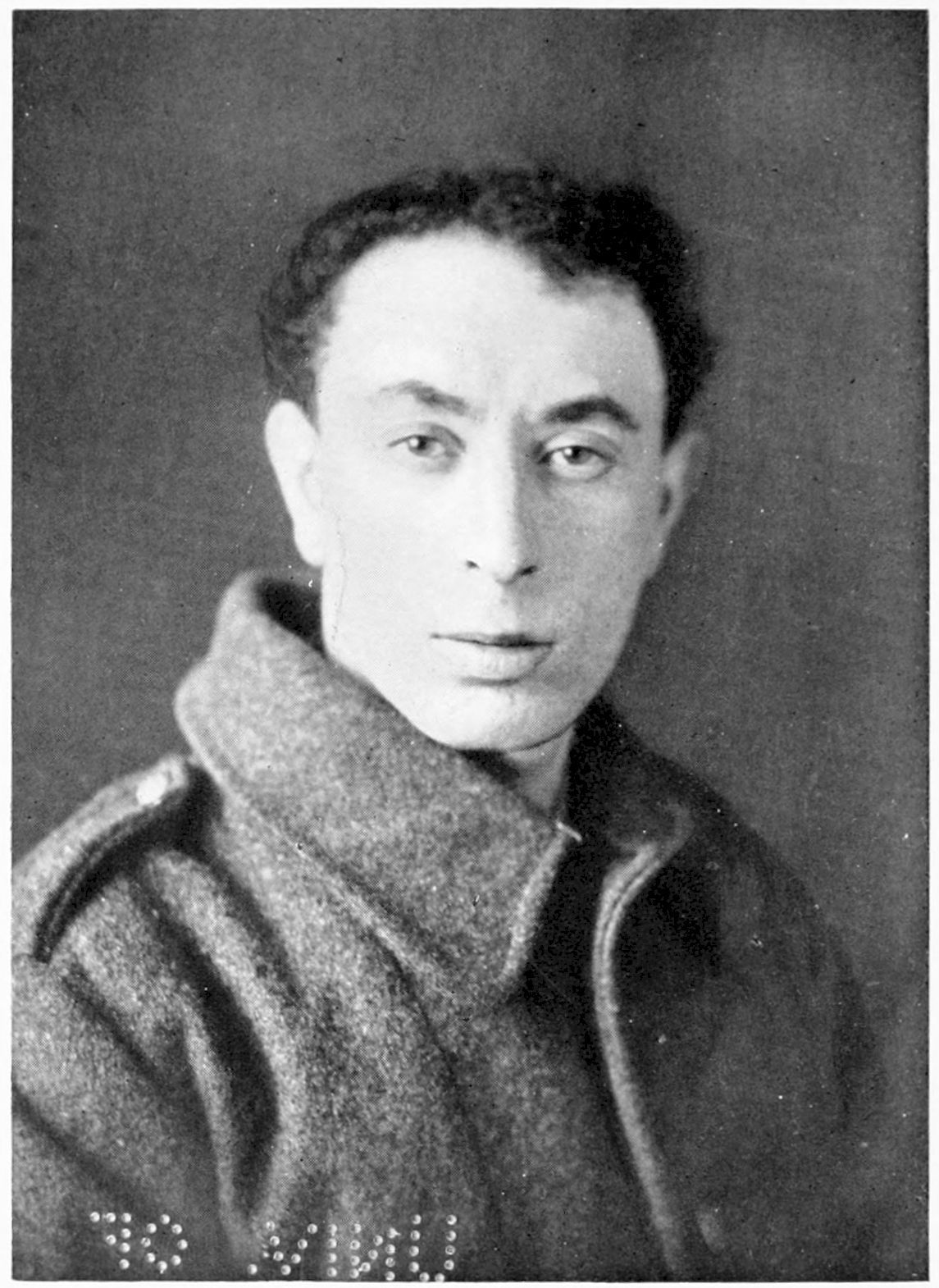
INTRODUCTORY MEMOIR — I — II — To Miss Seaton. — To Miss Seaton. — To Miss Seaton. — To Edward Marsh (1914). — To Edward Marsh (1914). — To Miss Seaton. — To Miss Seaton. — To Edward Marsh (1915). — To Edward Marsh. — To Edward Marsh (from Bury St. Edmunds). — To Miss Seaton (from Bury St. Edmunds). — To Edward Marsh (from Bury St. Edmunds). — To Miss Seaton (from Blackdown Camp, Farnborough). — To Miss Seaton (1916). — To Gordon Bottomley (Postmark, June 12, 1916). — To Gordon Bottomley (Postmark, July 23, 1916). — To Miss Seaton (written in Hospital, 1916). — To Miss Seaton (November 15, 1916; written in Hospital). — To Edward Marsh (Postmark, January 30, 1917). — To Miss Seaton (1916). — To Laurence Binyon (1916). — To Gordon Bottomley (February, 1917). — To Gordon Bottomley (Postmark, April 8, 1917). — To Edward Marsh (Postmark, May, 1917). — To Edward Marsh (1917). — To Edward Marsh (1917). — To Gordon Bottomley (Postmark, July 20, 1917). — To Gordon Bottomley (1917). — To Gordon Bottomley (Postmark, August 3, 1917). — To Gordon Bottomley (dated September 21, 1917). — To Miss Seaton (dated February 14, 1918). — To Gordon Bottomley (Postmark, February 26, 1918). — To Gordon Bottomley (Dated, March 7, 1918). — To Miss Seaton (March 8, 1918). — To Edward Marsh (dated March 28, 1918).
1
Of the many young poets who gave their lives in
the war, Isaac Rosenberg was not the least gifted.
Adverse circumstances, imperfect education, want
of opportunity, impeded and obscured his genius;
but whatever criticism be made of his poetry, its
faults are plainly those of excess rather than
deficiency. His writing was often difficult and
obscure, because he instinctively thought in images
and did not sufficiently appreciate the limitations
of language. Also, a continual fear of being empty
or thin led him to an over-intricate complexity.
But there was no incoherence in his mind. And
the main object of these notes, beyond recording
the facts of his life, is to illustrate the growth and
workings of his mind from his own letters, which
will be the best commentary on his poems.
I cannot precisely fix the date, but it must have
been some time in 1912, when one morning there
came to me a letter in an untidy hand from an
2address in Whitechapel, enclosing some pages of
verse on which criticism was asked, and signed
“Isaac Rosenberg.” It was impossible not to be
struck by something unusual in the quality of the
poems. Thoughts and emotions of no common
nature struggled for expression, and at times
there gushed forth a pure song which haunted
the memory.
I answered at once, and the next day received
another letter which told me something about my
unknown correspondent. In this letter, which,
like nearly all his letters, is undated, he wrote:
“I must thank you very much for your encouraging
reply to my poetical efforts.... As you
are kind enough to ask about myself, I am sending
a sort of autobiography I wrote about a
year ago.... You will see from that that my
circumstances have not been very favourable for
artistic production; but generally I am optimistic,
I suppose because I am young and do not properly
realize the difficulties. I am now attending the
Slade, being sent there by some wealthy Jews who
are kindly interested in me, and, of course, I spend
most of my time drawing. I find writing interferes
with drawing a good deal, and is far more
exhausting.”
3He went on to tell of his admirations, Rossetti
coming first for him among modern artists. He
had seen very little of early Italian art, but divined
that theirs was the type of art which he thought
the only kind worth having—“expression through
passionate colour and definite design”—not “a
moment frozen on to canvas,” but “the spontaneity
of un-selfconscious and childlike nature—infinity
of suggestion—that is as much part and voice of
the artist’s soul as the song to the bird.” As to
modern poets, they were “difficult to get hold of”
(their volumes being expensive), but he had an
immense admiration for Francis Thompson—“that
is the sort of poetry that appeals most to me.” He
had done nothing yet in painting which he would
care to show. He aspired to do imaginative work,
but at present was practising portraiture, as it was
necessary to earn a living.
At my invitation Rosenberg came to see me.
Small in stature, dark, bright-eyed, thoroughly
Jewish in type, he seemed a boy with an unusual
mixture of self-reliance and modesty. Indeed, no
one could have had a more independent nature.
Obviously sensitive, he was not touchy or aggressive.
Possessed of vivid enthusiasms, he was shy
in speech. One found in talk how strangely little
4of second-hand (in one of his age) there was in his
opinions, how fresh a mind he brought to what he
saw and read. There was an odd kind of charm
in his manner which came from his earnest, transparent
sincerity.
The “sort of autobiography,” which I have
never seen since I returned it to him, and has
perhaps been destroyed, was the story of a youth,
mentally ambitious, introspective, dissatisfied with
his surroundings, consumed by secret desires for
liberation and self-expression.
The external facts of his life are briefly told.
For these I am mainly indebted to his sister, Mrs.
Wynick, whose devotion to her brother and his
work was at all times unwearied. She gave much
of a scanty leisure-time to typing copies of his
poems, and many of them would have been lost
but for her care in preserving them.
Isaac Rosenberg was born at Bristol on the 25th
of November, 1890. When he was seven he came
to London with his parents. The family settled
in the East End. The boy was sent to the Board
School of St. George’s in the East, and afterwards
to the Stepney Board School. From childhood he
showed a natural gift both for drawing and for
writing. While at the Stepney school his promise
5appeared so remarkable that the headmaster
allowed him to spend all his time in these pursuits.
Out of school he would draw with chalks on the
street pavement. Reading poetry was a passion
with him. At the age of fourteen he was reluctantly
obliged to leave school. His parents were
poor; and though they took great pride in his gifts,
he was one of a family of eight, and he must now
earn his living. He was apprenticed, therefore, to
the firm of Carl Hentschel, in Fleet Street. A
trade connected with art was chosen for him as a
stepping-stone to a painter’s career, and as something
to fall back upon in case his resources failed
him. But he hated trade, and felt in bondage.
In his meal-times he consoled himself by writing
poems; in the evenings he went to classes at the
Art School of Birkbeck College. He worked hard
and won many prizes. Mr. Frank Emanuel, the
painter, who befriended and encouraged him at
this time, describes him as having been made
“bitter and despondent by his circumstances”;
and his letters reveal fits of the deepest dejection
against which his will contended.
The uncongenial work came at last to an end.
The sense of liberation was at first intoxicating.
Yet work had to be found, and Isaac was determined
6to pursue art and nothing else. He met at
first with disappointment, and endured many privations.
But before long he found good friends.
Mr. Amschewitz, an artist, and Mr. Samuels
warmly interested themselves in his behalf.
Through them he made the acquaintance of three
ladies, Mrs. Josephs, Mrs. Herbert Cohen, and
Mrs. Lowy, who undertook to provide the means
for his training at the Slade School.
Through Mr. Emanuel’s friendship he had become
a member of “The Limners,” a club of artists
and art teachers, which met at Mr. Emanuel’s
studio. Here he had the opportunity of meeting
other artists and exchanging ideas. Prizes were
given, which young Rosenberg occasionally won.
In spite, therefore, of his poverty and unpropitious
surroundings, he had now won sympathetic friends,
and received both encouragement and material
help from discerning compatriots. But with his
sensitive artist’s pride and jealous independence
of spirit, he was not always easy to understand;
and those who, with the sole desire to help him,
advanced his circumstances sometimes felt that
their efforts did not seem to be appreciated.
The case is not unfamiliar to readers of artists’
biographies.
7Rosenberg went to the Slade School in October,
1911, and remained till March, 1914. He won
prizes at the school and praise from his teachers.
Thrown among contemporaries, all occupied with
the problems of art and the discussion of them, he
became tinged with the temper and the prevalent
ideas of his own generation of students. His
natural bent, I think, was in another direction. He
showed me drawings and studies from time to time,
and I saw a few of his paintings when they were
exhibited one summer at the Whitechapel Gallery.
He was full of ideas, was a capable draughtsman,
and could conceive an interesting design. Yet, to
judge from what I have seen of his work, it did
not seem to be for him the inevitable means of
expression. He once showed me at his studio
a large, ambitious composition—an oil-painting—which
I fancy was never completed. I cannot recall
the nominal subject, but it was saturated with
symbolism and required a good deal of explanation.
I liked the mysteriousness of it, and the ideas which
inspired the painting had suggested figures and
groups and visionary glimpses of landscape which
had passages of real beauty, though the whole
work had grown impossibly complex with its convolutions
of symbolic meaning. It reminded me
8of his poetry; and I think that represented his
natural bent in art. Had he been born half a century
earlier, he would have been an ardent disciple
of Rossetti. But he could not escape from the
mental atmosphere of his own generation, in which
so “literary” a conception of painting was bound to
wither in discouragement. Later, he showed me
some studies of landscape and portrait which he
had made in South Africa. These were in a more
“modern” vein of realism, but they seemed to fail
in the quality of force, to which all other qualities
had been, in intention, sacrificed. They had
no personal savour. Like every generous and
ambitious youth, Rosenberg wished his own
generation to do glorious things, and wished to
belong to it as a comrade. Whether he would
have emerged and found himself as a painter is a
doubtful conjecture. I think it possible that he
would have abandoned painting. For his true
vocation was poetry, and he thought of himself as
a poet rather than as a painter.
He had begun to write verse at a very early
age. Mr. Morley Dainow, who was at the time
librarian in the Whitechapel Public Library, was
approached one day by a Jewish girl who wanted
advice and help for her young brother. His aim
9in life, she said, was to be a poet. The next day
the boy was brought to the library. Isaac then
seemed to be between ten and twelve years of age.
He had already determined to be a poet and a
painter. He interested and impressed Mr. Dainow,
and in return for his friendly encouragement sent
him a poem called “David’s Harp.” These are
the earliest verses of Rosenberg’s that Mr.
Bottomley or I have seen. They are not printed
in this book, but they are interesting because
they show how, even as a young boy, Rosenberg
cherished the traditions of his race and aspired to
become a representative poet of his own nation.
Moses and Judas Maccabæus were intended to be
themes of his maturer poetry. “David’s Harp”
is in fluent stanzas, and shows the passing influence
of Byron.
The pamphlet called “Night and Day,” printed
in 1912, contains probably all that Rosenberg cared
to preserve of his early verse, though no doubt it
represented but a small selection from what he
had written.
After leaving the Slade School, he found himself
faced with a harder struggle than ever. But
he never admitted defeat. He sold a few pictures
and got a few poems into print, but his health
10was now a cause for anxiety. His lungs were
thought to be affected, and he was advised to try
a warmer climate. Having a married sister in
Cape Town, he thought of South Africa, and in
June, 1914, he sailed for the Cape. Here he
made one or two friends, painted some pictures,
taught a little, gave a few lectures, and published
some poems and articles. But the visit was not a
material success, and he returned disappointed and
despondent. Soon after his return, in 1915, he
printed a second pamphlet of verse, “Youth.”
But he was restless and unhappy, and could not
work. It was now that he enlisted in the Army.
From this date onward he had practically no time
for painting, but he continued to write till the
end. “Moses” was printed in 1916. He was first
in a Bantam regiment, then in the King’s Own
Royal Lancasters, and after a period of training
at Bury St. Edmunds and at Farnborough went
out, early in 1916, to France. No one could have
been less fitted for a military life. He suffered not
only from physical disability, bad health, and
sensitiveness, but from the absent-mindedness of
one whose imagination was possessed by his poetic
schemes. “My mind will not relinquish its
poetical yearnings,” he wrote, “and concentration
11on alien things and dull has strained my memory.”
But he endured the inhuman horror of modern
war with a great heart; he would not have liked
to be called a hero, but his fortitude was truly
heroic. On the first of April, 1918, he was killed
in action.
The poems collected in this volume speak for
themselves. The obscurities, the straining and
tormenting of language in the effort to find right
expression, the immaturities of style and taste, are
apparent on the surface. The imaginative conceptions
and the frequent gleam of imaginative
phrasing should be equally apparent. But what
does not appear on the surface is the fine intention,
the ardent toil, and the continual self-criticism
which underlay his work. Rosenberg’s aim was,
in his own words, a kind of poetry “where an
interesting complexity of thought is kept in tone
and right value to the dominating idea so that it
is understandable and still ungraspable.” The
sentence occurs in one of his letters, and from
this point on I wish to let Rosenberg speak for himself.
His letters give a picture both of his mind
and character, far more vivid than anything one
12could write about him. He very rarely dated a
letter, but the address and internal evidence give
a clue to the date. The first extract is from a
letter written, while he was still an apprentice,
to Miss Winifreda Seaton, a friend to whom
Mr. Amschewitz introduced him. Miss Seaton
lent him books, encouraged him to write, discussed
art and literature with him, and criticized his
poems.
“It is horrible to think that all these hours,
when my days are full of vigour and my hands
and soul craving for self-expression, I am bound,
chained to this fiendish mangling-machine, without
hope and almost desire of deliverance, and the
days of youth go by.... I have tried to make
some sort of self-adjustment to circumstances by
saying, ‘It is all experience’; but, good God! it is
all experience, and nothing else.... I really
would like to take up painting seriously; I think
I might do something at that; but poetry—I
despair of ever writing excellent poetry. I can’t
look at things in the simple, large way that great
poets do. My mind is so cramped and dulled and
fevered, there is no consistency of purpose, no
oneness of aim; the very fibres are torn apart, and
13application deadened by the fiendish persistence
of the coil of circumstance.”
At last the apprenticeship is over and Rosenberg
writes[1] exulting:
“Congratulate me! I’ve cleared out of the —— shop,
I hope for good and all. I’m free—free to do
anything, hang myself or anything except work....
I’m very optimistic, now that I don’t know
what to do, and everything seems topsy-turvy.”
A little later comes the reaction:
“I am out of work. I doubt if I feel the better
for it, much as the work was distasteful, though I
expect it’s the hankering thought of the consequences,
pecuniary, etc., that bothers me....
All one’s thoughts seem to revolve round to one
point—death. It is horrible, especially at night,
‘in the silence of the midnight’; it seems to clutch
at your thought—you can’t breathe. Oh, I think,
work, work, any work, only to stop one thinking.”
But such moods are resisted. At another time
he is writing:
“One conceives one’s lot (I suppose it’s the
14same with all people, no matter what their condition)
to be terribly tragic. You are the victim
of a horrible conspiracy; everything is unfair.
The gods have either forgotten you or made you
a sort of scapegoat to bear all the punishment.
I believe, however hard one’s lot is, one ought to
try and accommodate oneself to the conditions;
and except in a case of purely physical pain, I
think it can be done. Why not make the very
utmost of our lives?... I’m a practical economist
in this respect. I endeavour to waste nothing....
Waste words! Not to talk is to waste
words....
“To most people life is a musical instrument
on which they are unable to play: but in the
musician’s hands it becomes a living thing....
The artist can see beauty everywhere, anywhere....”
In what is perhaps an earlier letter he excuses
his neglect of serious reading by his lack of
leisure and the worries that make him crave for
amusing books as an antidote:
“You mustn’t forget the circumstances I have
been brought up in, the little education I have
15had. Nobody ever told me what to read, or ever
put poetry in my way. I don’t think I knew
what real poetry was till I read Keats a couple of
years ago. True, I galloped through Byron when
I was about fourteen, but I fancy I read him more
for the story than for the poetry. I used to try
to imitate him. Anyway, if I didn’t quite take to
Donne at first, you understand why. Poetical
appreciation is only newly bursting on me.
I always enjoyed Shelley and Keats. The
‘Hyperion’ ravished me....
“Whenever I read anything in a great man’s
life that pulls him down to me, my heart always
pleads for him, and my mind pictures extenuating
circumstances.
“Have you ever picked up a book that looks
like a Bible on the outside, but is full of poetry
or comic within? My Hood is like that, and, I
am afraid, so am I. Whenever I feel inclined to
laugh, my visage assumes the longitude and
gravity of a church spire.
“I can’t say I have ever experienced the power
of one spirit over another, except in books, of
16course, at least in any intense way that you mean.
Unless you mean the interest one awakes in us,
and we long to know more, and none other. I
suppose we are all influenced by everybody we
come in contact with, in a subconscious way, if
not direct, and everything that happens to us is
experience; but only the few know it. Most
people can only see and hear the noisy sunsets,
mountains and waterfalls; but the delicate greys
and hues, the star in the puddle, the quiet sailing
cloud, is nothing to them. Of course, I only mean
this metaphorically, as distinguishing between
obvious experiences and the almost imperceptible.
I still have no work to do. I think, if nothing
turns up here, I will go to Africa. I could not
endure to live upon my people; and up till now
I have been giving them from what I had managed
to save up when I was at work. It is nearly run
out now, and if I am to do nothing, I would
rather do it somewhere else. Besides, I feel so
cramped up here, I can do no drawing, reading, or
anything....
“Create our own experience! We can, but we
don’t. Very often it’s only the trouble of a word,
and who knows what we miss through not having
spoken? It’s the man with impudence who has
17more experience than anybody. He not only
varies his own, but makes other people’s his own.
“Do I like music, and what music I like best?
I know nothing whatever about music. Once I
heard Schubert’s ‘Unfinished Symphony’ at the
band; and—well, I was in heaven. It was a blur
of sounds—sweet, fading and blending. It seemed
to draw the sky down, the whole spirit out of me;
it was articulate feeling. The inexpressible in
poetry, in painting, was there expressed. But I
have not heard much, and the sensation that gave
me I never had again. I should like very much
to be one of the initiated.
“Some more confidences. I’ve discovered I’m
a very bad talker: I find it difficult to make myself
intelligible at times; I can’t remember the exact
word I want, and I think I leave the impression
of being a rambling idiot.”
In 1910 he went to see the wonderful collection
of Japanese paintings lent by Japan to the
Exhibition at Shepherd’s Bush.
“The thoroughness is astounding. No slipshod,
18tricky slickness, trusting to chance effects, but a
subtle suggestiveness, and accident that is the
consequence of intention.”
Here are a few sentences from some “Notes
on Art”:
“Life stales and dulls; the mind demands noble
excitement, half-apprehended surmises, the eternal
desire, the beautiful. It is a vain belief that Art
and Life go hand-in-hand; Art is, as it were,
another planet.
“Mere representation is unreal, is fragmentary.
The bone taken from Adam remains a bone. To
create is to apply pulsating rhythmic principles to
the part; a unity, another nature, is created.”
“Thanks so much for the Donne. I had just
been reading Ben Jonson again, and from his poem
to Donne he must have thought him a giant. I
have read some of the Donne; I have certainly
never come across anything so choke-full of profound
meaningful ideas. It would have been very
difficult for him to express something commonplace,
if he had to.”
19
“I forgot to ask you to return my poetry, as I
mean to work on some [of the poems]. I agree the
emotions are not worth expressing, but I thought
the things had some force, and an idea or so I
rather liked. Of course, I know poetry is a far
finer thing than that, but I don’t think the failure
was due to the subject—I had nothing to say
about it, that’s all. Crashaw, I think, is sometimes
very sexual in his religious poems, but it is always
new and beautiful. I believe we are apt to fix a
standard (of subject) in poetry. We acknowledge
the poetry in subjects not generally taken as
material, but I think we all (at least I do) prefer
the poetical subject—“Kubla Khan,” “The
Mistress of Vision,” “Dream-Tryst”; Poe,
Verlaine. Here feeling is separated from intellect;
our senses are not interfered with by what we know
of facts: we know infinity through melody.”
After leaving the Slade School, at a loss for work
and anxious about his health, Rosenberg thought
for a time of going to Russia. But it was difficult
for a Jew to get a passport, and he reverted to
the African journey which he had contemplated
already some years before.
20
“So I’ve decided on Africa, the climate being
very good, and I believe plenty to do.... I won’t
be quite lost in Africa.... I dislike London for
the selfishness it instils into one, which is a reason
of the peculiar feeling of isolation I believe most
people have in London. I hardly know anybody
whom I would regret leaving (except, of course, the
natural ties of sentiment with one’s own people);
but whether it is that my nature distrusts people,
or is intolerant, or whether my pride or my backwardness
cools people, I have always been alone.
Forgive this little excursion into the forbidden
lands of egotism.”
The next letter was written to Mr. Edward
Marsh, in the midst of packing for the voyage to
the Cape. Mr. Marsh was interested in Rosenberg
both as an artist and as a poet; he printed one of
his poems in “Georgian Poetry, 1916–1917,” and
befriended him in many ways. The letter throws
light on Rosenberg’s use of language in poetry. As
the piece referred to—“Midsummer Frost”—is not
in the present selection, it may be given here:
A July ghost, aghast at the strange winter,
Wonders, at burning noon, all summer-seeming,
21How, like a sad thought buried in light [woven] words,
Winter, an alien presence, is ambushed here.
See from the fire-fountained noon there creep
Lazy yellow ardours towards pale evening,
Dragging the sun across the shell of thought;
A web threaded with fading fire;
Futile and fragile lure, a July ghost
Standing with feet of fire on banks of ice,
My frozen heart, the summer cannot reach—
Hidden as a root from air, or star from day,
A frozen pool whereon mirth dances,
Where the shining boys would fish.
“I believe that all poets who are personal see
things genuinely—have their place. One needn’t
be a Shakespeare and yet be quite as interesting.
I have moods when Rossetti satisfies me more than
Shakespeare, and I am sure I have enjoyed some
things of Francis Thompson more than the best of
Shakespeare. Yet I never meant to go as high as
these. I know I’ve come across things by people
of far inferior vision that were as important in
their results to me. I am not going to refute your
criticisms; in literature I have no judgment, at
least for style. If in reading a thought has expressed
itself to me in beautiful words, my
ignorance of grammar, etc., makes me accept that,
22I should think you are right mostly, and I may
yet work away your chief objections. You are
quite right in the way you read my poems, but I
thought I could use the ‘July Ghost’ to mean the
summer, and also an ambassador of the summer,
without interfering with the sense. The ‘shell of
thought’ is man; you realize a shell has an opening,
the ‘ardours’; the sense of heat forms a web; this
signifies a sense of summer; the web again becomes
another metaphor, a July Ghost. But, of course, I
mean it for summer right through. I think your
suggestion of taking out ‘woven’ is very good.”
The next letter is from Cape Town.
“I should like you to do me a favour if it’s not
putting you to too much bother. I am in an
infernal city by the sea. This city has men in it—and
these men have souls in them—or at least
have the passages to souls. Though they are
millions of years behind time, they have yet reached
the stage of evolution that knows ears and eyes.
But these passages are dreadfully clogged up: gold
dust, diamond dust, stocks and shares, and Heaven
knows what other flinty muck. Well, I’ve made up
23my mind to clear through all this rubbish, but I
want your help. Now, I’m going to give a series of
lectures on modern art (I’m sending you the first,
which I gave in great style. I was asked whether
the Futurists exhibited at the Royal Academy).
But I want to make the lectures interesting and
intelligible by reproductions or slides. Now, I
wonder whether you have reproductions which you
could lend me till I returned or was finished with
them. I want to talk about John, Cézanne, Van
Gogh, Innes, the early Picasso (not the cubistic
one), Spencer, Gertler, Lamb, Puvis de Chavannes,
Degas. A book of reproductions of the P.-Impressionists
would do, and I could get them
transferred on slides. I hope this would not put
you to any great trouble, but if you could manage
to do it you don’t know how you would help me.
Stanley gave me a little job to paint two babies,
which helped me to pay my way for a bit. I
expect to get pupils and kick up a row with my
lectures. But nobody seems to have money here,
and not an ounce of interest in Art. The climate’s
fine, but the Sun is a very changeable creature and
I can’t come to any sort of understanding with
this golden beast. He pretends to keep quiet for
half an hour, and just as I think, ‘Now I’ve got it,’
24the damned thing has frisked about. There’s a lot
of splendid stuff to paint. We are walled in by the
sharp upright mountain and the bay. Across the
bay the piled-up mountains of Africa look lovely
and dangerous. It makes one think of savagery
and earthquakes—the elemental lawlessness.”
The next extract is from a letter written in
1915, just after hearing the news of Rupert
Brooke’s death.
“Do you know Emerson’s poems? I think
they are wonderful. ‘Each and All’ I think is
deep and beautiful. There is always a kind of
beaminess, like a dancing of light in light, in his
poems. I do think, though, that he depends too
much on inspiration; and though they always have
a solid texture of thought, they sometimes seem
thin in colour or sensuousness.”
“I saw Olive Schreiner last night. She’s an extraordinary
woman—full of life. I had a little picture
for her from a dear friend of hers in Africa I stayed
with while I was there. She was so pleased with
my pictures of Kaffirs. Who is your best living
25English poet? I’ve found somebody miles and
miles above everybody—a young man, Lascelles
Abercrombie—a mighty poet and brother to
Browning.”
Other references in letters show how deep at this
time Mr. Abercrombie’s influence was. Rosenberg
calls his “Hymn of Love” the finest poem of our
time.
He has now joined the Army, and writes from
Bury St. Edmunds.
“I have just joined the Bantams, and am down
here amongst a horrible rabble. Falstaff’s scarecrows
were nothing to these. Three out of every
four have been scavengers, the fourth is a ticket-of-leave.
But that is nothing; though while I’m
waiting for my kit I’m roughing it a bit, having
come down without even a towel. I dry myself with
my pocket-handkerchief. I don’t know whether
I will be shifted as soon as I get my rig-out.”
The next was written in hospital at Bury.
“First, not to alarm you by this heading, I must
tell you that while running before the Colonel I
26started rather excitedly and tripped myself, coming
down pretty heavily in the wet grit, and am in
hospital with both my hands cut. I’ve been here
since last Saturday, and expect to be out by about
the beginning of the week. It is a dull kind of life
in the hospital, and I’m very anxious to get out and
be doing some rough kind of work. Mr. Shiff sent
me some water-colours, and I amuse myself with
drawing the other invalids. Of course, I must give
them what I do, but I can see heaps of material
for pictures here. The landscape, too, seems decent,
though I haven’t seen anything but from the
barracks, as this accident happened pretty near at
the start. I hope you were not annoyed at that
fib of mine, but I never dreamt they would trouble
to find out at home. I have managed to persuade
my mother that I am for home service only,
though, of course, I have signed on for general
service. I left without saying anything because I
was afraid it would kill my mother or I would be
too weak and not go. She seems to have got over
it, though, and as soon as I can get leave I’ll see
her, and I hope it will be well. It is very hard to
write here, so you must not expect interesting
letters; there is always behind or through my
object some pressing sense of foreign matter,
27immediate and not personal, which hinders and
disjoints what would otherwise have coherence and
perhaps weight. I have left all my poems, including
a short drama, with a friend, and I will write
to him for them, when I shall send them either
direct to Abercrombie or to you first. I believe in
myself more as a poet than a painter; I think I get
more depth into my writing. I have only taken
Donne with me, and don’t feel for poetry much in
this wretched place. There is not a book or paper
here; we are not allowed to stir from the gate,
have little to eat, and are not allowed to buy any
if we have money, and are utterly wretched. (I
mean the hospital.) If you could send me some
novel or chocolates, you would make me very
happy.”
“I received a letter to-day (sent over a week
ago) from Abercrombie, and I feel very flushed
about it. He says no one who tries to write
poetry would help envying some of my writing.
Since I wrote you I have had more mishaps. My
feet now are the trouble. Do you know what
privates’ military boots are? You are given a
whole armourer’s shop to wear; but, by God! in a
28few hours my heels were all blistered, and I’ve been
marching and drilling in most horrible pain. I drew
three weeks’ pay and had some money sent me
from home, and bought a pair of boots three or
four sizes too large for me, my feet had swelled so.
Besides this trouble I have a little impudent
schoolboy pup for an officer, and he has me marked;
he has taken a dislike to me: I don’t know why.”
“Thanks for your letter and your books which
they sent me from home. It is impossible to read
as we are, and I don’t expect to get proper leisure
for reading till this rotten affair is over. My feet
are pretty nigh better, and my hands, and I am
put down for a Lance-Corporal. The advantage
is, though you have a more responsible position,
you are less likely to be interfered with by the
men, and you become an authority. I expect to
be home for four days shortly. I don’t know
whether I told you Lascelles Abercrombie sent me
a fine letter about my work, which made me very
bucked. There is nobody living whose praise
could have pleased me so much. I have some
pictures at the N.E.A.C., one of which is likely to
be sold.”
29
“I suppose my troubles are really laughable,
but they do irritate at the moment. Doing coal
fatigues and cookhouse work with a torn hand, and
marching ten miles with a clean hole about an inch
round in your heel, and bullies swearing at you, is
not very natural. I think when my hands and feet
get better I’ll enjoy it. Nobody thinks of helping
you—I mean those who could. Not till I had
been made a thorough cripple an officer said it was
absurd to think of wearing those boots, and told
me to soak them thoroughly in oil to soften them.
Thank you for your note; we get little enough, you
know, and I allow half of that to my mother (I
rather fancy she is going to be swindled in this
rat-trap affair), so it will do to get to London
with. You must now be the busiest man in
England, and I am sure would hardly have time to
read my things; besides, you won’t like the formlessness
of the play. If you like you can send
them to Abercrombie, and read them when you
have more time. I don’t think I told you what
he said: ‘A good many of your poems strike me
as experimental and not quite certain of themselves.
But, on the other hand, I always find a
vivid and original impulse; and what I like most
30in your songs is your ability to make the concealed
poetic power in words come flashing out. Some
of your phrases are remarkable; no one who tries
to write poetry would help envying some of them.’
I have asked him to sit for me—a poet to paint a
poet. All this must seem to you like a blur on
the window, or hearing sounds without listening
while you are thinking.”
“Thanks very much for the bread and biscuits,
which I enjoyed very much. I am in another
regiment now, as the old one was smashed up on
account of most of the men being unfit. We that
were left have been transferred here. The food
is much better, but conditions are most unsettling.
Every other person is a thief, and in the end you
become one yourself, when you see all your most
essential belongings go, which you must replace
somehow. I also got into trouble here the first
day. It’s not worth while detailing what happened
and exposing how ridiculous, idiotic, and meaningless
the Army is, and its dreadful bullyisms, and
what puny minds control it. I am trying to get
our Passover off, which falls Easter. If I do I’ll let
31you know. The bother is that we will be on our
ball-firing then, and also this before-mentioned
affair may mess it up. This ball-firing implies we
will be ready for the front. I have been working
on ‘Moses’—in my mind, I mean—and it was
through my absent-mindedness while full of that
that I forgot certain orders, and am now undergoing
a rotten and unjust punishment. I’m working
a curious plot into it, and of course, as I can’t
work here, I jot little scraps down and will piece
it together the first chance I get.”
The remaining letters are all from France.
“We made straight for the trenches, but we’ve
had vile weather, and I’ve been wet through for
four days and nights. I lost all my socks and
things before I left England, and hadn’t the chance
to make it up again, so I’ve been in trouble,
particularly with bad heels; you can’t have the
slightest conception of what such an apparently
trivial thing means. We’ve had shells bursting
two yards off, bullets whizzing all over the show,
but all you are aware of is the agony of your
heels.... I had a letter from R. C. Trevelyan,
32the poet.... He writes: ‘It is a long time
since I have read anything that has impressed me
so much as your “Moses” and some of your short
poems....’ He confesses parts are difficult, and
he is not sure whether it’s my fault or his.”
The next letter is the first of a series to Mr.
Bottomley, whom he was only to know by correspondence.
He was now for a time working with
the Salvage Corps.
“If you really mean what you say in your letter,
there is no need to tell you how proud I am. I
had to read your letter many times before I could
convince myself you were not ‘pulling my leg.’
People are always telling me my work is promising—incomprehensible,
but promising, and all that
sort of thing, and my meekness subsides before the
patronizing knowingness. The first thing I saw
of yours was last year in the Georgian Book, ‘The
End of the World.’ I must have worried all
London about it—certainly everybody I know. I
had never seen anything like it. After that I got
hold of ‘Chambers of Imagery.’ Mr. Marsh told
me of your plays, but I joined the Army and have
33never been able to get at them. It is a great
thing to me to be able to tell you now in this
way what marvellous pleasure your work has
given me, and what pride that my work pleases
you. I had ideas for a play called ‘Adam and
Lilith’ before I came to France, but I must wait
now.”
“Your letter came to-day with Mr. Trevelyan’s,
like two friends to take me for a picnic. Or rather
like friends come to release the convict from his
chains with his innocence in their hands, as one
sees in the twopenny picture palace. You might
say, friends come to take you to church, or the
priest to the prisoner. Simple poetry,—that is
where an interesting complexity of thought is
kept in tone and right value to the dominating
idea so that it is understandable and still ungraspable.
I know it is beyond my reach just
now, except, perhaps, in bits. I am always afraid
of being empty. When I get more leisure in more
settled times I will work on a larger scale and give
myself room; then I may be less frustrated in my
efforts to be clear, and satisfy myself too. I think
what you say about getting beauty by phrasing of
34passages rather than the placing of individual
words very fine and very true.”
“I was very glad to have your letter and know
there is no longer a mix-up about letters and suchlike.
Always the best thing to do is to answer at
once, that is the likeliest way of catching one, for
we shift about so quickly; how long I will stay
here I cannot say: it may be a while or just a bit.
I have some Shakespeare: the Comedies and also
‘Macbeth.’ Now I see your argument and cannot
deny my treatment of your criticisms, but have
you ever asked yourself why I always am rude to
your criticisms? Now, I intended to show you
——’s letters and why I value his criticisms. I
think anybody can pick holes and find unsound
parts in any work of art; anyone can say Christ’s
creed is a slave’s creed, the Mosaic is a vindictive,
savage creed, and so on. It is the unique and
superior, the illuminating qualities one wants to
find—discover the direction of the impulse.
Whatever anybody thinks of a poet he will always
know himself: he knows that the most marvellously
expressed idea is still nothing; and it is
stupid to think that praise can do him harm. I
35know sometimes one cannot exactly define one’s
feelings nor explain reasons for liking and disliking;
but there is then the right of a suspicion that the
thing has not been properly understood or one is
prejudiced. It is much my fault if I am not
understood, I know; but I also feel a kind of injustice
if my idea is not grasped and is ignored,
and only petty cavilling at form, which I had
known all along was so, is continually knocked
into me. I feel quite sure that form is only a
question of time. I am afraid I am more rude
than ever, but I have exaggerated here the difference
between your criticisms and ——’s. Ideas of
poetry can be very different too. Tennyson
thought Burns’ love-songs important, but the
‘Cottar’s S. N.’ poor. Wordsworth thought the
opposite.”
“London may not be the place for poetry to
keep healthy in, but Shakespeare did most of his
work there, and Donne, Keats, Milton, Blake—I
think nearly all our big poets. But, after all,
that is a matter of personal likings or otherwise.
Most of the French country I have seen has been
36devastated by war, torn up—even the woods look
ghastly with their shell-shattered trees; our only
recollections of warm and comfortable feelings are
the rare times amongst human villages, which
happened about twice in a year; but who can tell
what one will like or do after the war? If the
twentieth century is so awful, tell me what period
you believe most enviable. Even Pater points out
the Renaissance was not an outburst—it was no
simultaneous marked impulse of minds living
in a certain period of time—but scattered and
isolated.”
“I think with you that poetry should be
definite thought and clear expressions, however
subtle; I don’t think there should be any vagueness
at all, but a sense of something hidden and
felt to be there. Now, when my things fail to be
clear, I am sure it is because of the luckless choice
of a word or the failure to introduce a word that
would flash my idea plain, as it is to my own
mind. I believe my Amazon poem to be my best
poem. If there is any difficulty, it must be in
words here and there, the changing or elimination
of which may make the poem clear. It has taken
37me about a year to write; for I have changed and
rechanged it and thought hard over that poem, and
striven to get that sense of inexorableness the
human (or unhuman) side of this war has. It
even penetrates behind human life; for the
‘Amazon’ who speaks in the second half of the
poem is imagined to be without her lover yet,
while all her sisters have theirs, the released spirits
of the slain earth-men; her lover yet remains to
be released.”
“Many thanks for book and chocolate. Both
are being devoured with equal pleasure. I can’t
get quite the delight in Whitman as from one
poem of his I know—‘Captain, my Captain.’ I
admire the vigour and independence of his mind,
but his diction is so diffused. Emerson and not
Whitman is America’s poet. You will persist in
refusing to see my side of our little debate on
criticism. Everybody has agreed with you about
the faults, and the reason is obvious; the faults
are so glaring that nobody can fail to see them.
But how many have seen the beauties? And it is
here more than the other that the true critic
shows himself. And I absolutely disagree that it
38is blindness or carelessness; it is the brain succumbing
to the herculean attempt to enrich the
world of ideas.”
“It is far, very far, to the British Museum from
here (situated as I am, Siberia is no further and
certainly no colder), but not too far for that tiny
mite of myself, my letter, to reach there. Winter
has found its way into the trenches at last, but I
will assure you, and leave to your imagination, the
transport of delight with which we welcomed its
coming. Winter is not the least of the horrors of
war. I am determined that this war, with all its
powers for devastation, shall not master my
poeting; that is, if I am lucky enough to come
through all right. I will not leave a corner of my
consciousness covered up, but saturate myself with
the strange and extraordinary new conditions of
this life, and it will all refine itself into poetry
later on. I have thoughts of a play round our
Jewish hero, Judas Maccabeus. I have much real
material here, and also there is some parallel in
the savagery of the invaders then to this war. I
am not decided whether truth of period is a good
quality or a negative one. Flaubert’s ‘Salambo’
39proves, perhaps, that it is good. It decides the tone
of the work, though it makes it hard to give the
human side and make it more living. However,
it is impossible now to work and difficult even to
think of poetry, one is so cramped intellectually.”
“Your letters always give me a strange and
large pleasure; and I shall never think I have
written poetry in vain, since it has brought your
friendliness in my way. Now, feeling as I am,
cast away and used up, you don’t know what a
letter like yours is to me. Ever since November,
when we first started on our long marches, I have
felt weak; but it seems to be some inscrutable
mysterious quality of weakness that defies all
doctors. I have been examined most thoroughly
several times by our doctor, and there seems to be
nothing at all wrong with my lungs. I believe I
have strained my abdomen in some way, and I shall
know of it later on. We have had desperate
weather, but the poor fellows in the trenches where
there are no dug-outs are the chaps to pity. I
am sending a very slight sketch of a louse-hunt.
It may be a bit vague, as I could not work it out
here, but if you can keep it till I get back I can
40work on it then. I do believe I could make a
fine thing of Judas. Judas as a character is more
magnanimous than Moses, and I believe I could
make it very intense and write a lot from material
out here. Thanks very much for your joining in
with me to rout the pest out, but I have tried all
kinds of stuff; if you can think of any preparation
you believe effective I’d be most grateful for it.”
The “louse-hunt” refers to a night scene in which
Rosenberg took part, and which forcibly struck his
imagination as a subject for a Goya picture or for
a poem like the “Jolly Beggars”: a barn full of
naked soldiers—Scottish and others—singing,
swearing, and laughing, in mad antics as they
pursued the chase.
“All through this winter I have felt most
crotchety, all kinds of small things interfering
with my fitness. My hands would get chilblains
or bad boots would make my feet sore; and this
aggravating a general run-down-ness, I have not
felt too happy. I have gone less warmly clad
during the winter than through the summer,
because of the increased liveliness on my clothes.
I’ve been stung to what we call ‘dumping’ a great
41part of my clothing, as I thought it wisest to go
cold than lousy. It may have been this that caused
all the crotchetiness. However, we’ve been in no
danger—that is, from shell-fire—for a good long
while, though so very close to most terrible
fighting. But as far as houses or sign of ordinary
human living is concerned, we might as well be in
the Sahara Desert. I think I could give some
blood-curdling touches if I wished to tell all I see,
of dead buried men blown out of their graves, and
more, but I will spare you all this.”
“Regular rhythms I do not like much, but, of
course, it depends on where the stress and accent
are laid. I think there is nothing finer than the
vigorous opening to ‘Lycidas’ for music; yet it is
regular.... It is only when we get a bit of a rest
and the others might be gambling or squabbling
I do a line or two and continue this way. The
weather is gorgeous now, and we are bivouacked in
the fields.”
“I hope you have not yet got my poem, ‘The
Amulet,’ I’ve asked my sister to send you. If you
42get it, please don’t read it, because it’s the merest
sketch and the best is yet to come. If I am able
to carry on with it, I’ll send you it in a more
presentable fashion. I believe I have a good idea
at bottom. It’s a kind of ‘Rape of the Sabine
Women’ idea: some strange race of wanderers
have settled in some wild place and are perishing
out for lack of women. The prince of these
explores some country near where the women are
most fair. But the natives will not hear of foreign
marriages; and he plots another Rape of the
Sabines, but is trapped in the act.”
“I am now fearfully rushed, but find energy
enough to scribble this in the minute I plunder
from my work. I believe I can see the obscurities
in the ‘Daughters,’ but hardly hope to clear them
up in France. The first part, the picture of the
Daughters dancing and calling to the spirits of
the slain before their last ones have ceased among
the boughs of the tree of life, I must still work
on. In that part obscure the description of the
voice of the Daughter I have not made clear, I see;
I have tried to suggest the wonderful sound of her
voice, spiritual and voluptuous at the same time.
43The end is an attempt to imagine the severance of
all human relationship and the fading away of
human love. Later on I will try and work on
it, because I think it a pity if the ideas are to
be lost for want of work. My ‘Unicorn’ play is
stopped because of my increased toil, and I forget
how much or little I told you of it. I want to do
it in one Act, although I think I have a subject
here that could make a gigantic play. I have not
the time to write out the sketch of it as far as it’s
gone, though I’d like to know your criticism of it
very much. The most difficult part I shrink from;
I think even Shakespeare might:—the first time
Tel, the chief of the decaying race, sees a woman
(who is Lilith, Saul’s wife), and he is called upon
to talk. Saul and Lilith are ordinary folk into
whose ordinary lives the Unicorn bursts. It is to
be a play of terror—terror of hidden things and
the fear of the supernatural. But I see no hope
of doing the play while out here. I have a way,
when I write, to try and put myself in the situation,
and I make gestures and grimaces.”
“My sister wrote me of your note, and it made me
very glad to feel you thought in that way about my
44poem, because I liked it myself above anything I
have yet done. I know my letters are not what
they should be; but I must take any chance I get
of writing for fear another chance does not come,
so I write hastily and leave out most I should
write about. I wished to say last time a lot about
your poem, but I could think of nothing that
would properly express my great pleasure in it;
and I can think of nothing now. If anything, I
think it is too brief—although it is so rare and
compressed and full of hinted matter. I wish I
could get back and read your plays; and if my
luck still continues, I shall. Leaves have commenced
with us, but it may be a good while before
I get mine. We are more busy now than when I
last wrote, but I generally manage to knock something
up if my brain means to, and I am sketching
out a little play. My great fear is that I may
lose what I’ve written, which can happen here so
easily. I send home any bit I write, for safety,
but that can easily get lost in transmission.
However, I live in an immense trust that things
will turn out well.”
“The other poems I have not yet read, but I will
45follow on with letters and shall send the bits of—or
rather the bit of—a play I’ve written. Just
now it is interfered with by a punishment I am
undergoing for the offence of being endowed with
a poor memory, which continually causes me
trouble and often punishment. I forgot to wear
my gas-helmet one day; in fact, I’ve often forgotten
it, but I was noticed one day, and seven
days’ pack drill is the consequence, which I do
between the hours of going up the line and sleep.
My memory, always weak, has become worse since
I’ve been out here.”
“I don’t think I’ll get my play complete for it
in time, though it will hardly take much space,
it’s so slight. If I could get home on leave I’d
work at it and get it done, no doubt, but leaves
are so chancy. It’s called ‘The Unicorn.’ Now,
it’s about a decaying race who have never seen a
woman; animals take the place of women, but
they yearn for continuity. The chief’s Unicorn
breaks away and he goes in chase. The Unicorn is
found by boys outside a city and brought in, and
breaks away again. Saul, who has seen the Unicorn
on his way to the city for the week’s victuals,
46gives chase in his cart. A storm comes on, the
mules break down, and by the lightning he sees
the Unicorn race by; a naked black like an
apparition rises up and easily lifts the wheels from
the rut, and together they ride to Saul’s hut.
There Lilith is in great consternation, having seen
the Unicorn and knowing the legend of this race
of men. The emotions of the black (the Chief)
are the really difficult part of my story. Afterwards
a host of blacks on horses, like centaurs and
buffaloes, come rushing up, the Unicorn in front.
On every horse is clasped a woman. Lilith faints,
Saul stabs himself, the Chief places Lilith on the
Unicorn, and they all race away.”
In the late summer of this year (1917) Rosenberg
came to England on leave.
“The greatest thing of my leave after seeing
my mother was your letter which has just arrived....
I wish I could have seen you, but now I
must go on and hope that things will turn out
well, and some happy day will give me the chance
of meeting you.... I am afraid I can do no
writing or reading; I feel so restless here and unanchored.
47We have lived in such an elemental
way so long, things here don’t look quite right to
me somehow; or it may be the consciousness of
my so limited time here for freedom—so little
time to do so many things bewilders me. ‘The
Unicorn,’ as will be obvious, is just a basis; its
final form will be very different, I hope.”
On returning to France he was taken ill and
sent down the line. The time in hospital was a
relief, especially as his restlessness in England had
prevented writing or reading.
“We had a rough time in the trenches with
the mud, but now we’re out for a bit of a rest,
and I will try and write longer letters. You
must know by now what a rest behind the line
means. I can call the evenings—that is, from tea
to lights out—my own; but there is no chance
whatever for seclusion or any hope of writing
poetry now. Sometimes I give way and am appalled
at the devastation this life seems to have
made in my nature. It seems to have blunted
me. I seem to be powerless to compel my will to
any direction, and all I do is without energy and
interest.”
48
“I wanted to send some bits I wrote for the
‘Unicorn’ while I was in hospital, and if I find
them I’ll enclose them. I tried to work on your
suggestion and divided it into four acts, but since
I left the hospital all the poetry has gone quite
out of me. I seem even to forget words, and I
believe if I met anybody with ideas I’d be dumb.
No drug could be more stupefying than our work
(to me anyway), and this goes on like that old
torture of water trickling, drop by drop unendingly,
on one’s helplessness.”
“I believe our interlude is nearly over, and we
may go up the line any moment now, so I answer
your letter straightaway. If only this war were
over our eyes would not be on death so much: it
seems to underlie even our underthoughts. Yet
when I have been so near to it as anybody could
be, the idea has never crossed my mind, certainly
not so much as when some lying doctor told me I
had consumption. I like to think of myself as a
poet; so what you say, though I know it to be
extravagant, gives me immense pleasure.”
49
“I do not feel that I have much to say, but I
do know that unless I write now it will be a long
time before you hear from me again, without
something exceptional happens. It is not very
cold now, but I dread the wet weather, which is
keeping off while we are out, and, I fear, saving
itself up for us. We will become like mummies—look
warm and lifelike, but a touch and we
crumble to pieces. Did I send you a little poem,
‘The Burning of the Temple’? I thought it was
poor, or rather, difficult in expression, but G.
Bottomley thinks it fine. Was it clear to you?
If I am lucky, and come off undamaged, I mean to
put all my innermost experiences into the ‘Unicorn.’
I want it to symbolize the war and all the
devastating forces let loose by an ambitious and
unscrupulous will. Last summer I wrote pieces
for it and had the whole of it planned out, but
since then I’ve had no chance of working on it
and it may have gone quite out of my mind.”
“I think I wrote you I was about to go up the
line again after our little rest. We are now in
50the trenches again, and though I feel very sleepy, I
just have a chance to answer your letter, so I will
while I may. It’s really my being lucky enough
to bag an inch of candle that incites me to this
pitch of punctual epistolary. I must measure my
letter by the light....”
The date of the postmark on this letter is
April 2, when the writer was already dead.
LAURENCE BINYON.