Plutarch’s Essays And Miscellanies — Comprising all his Works Collected under the Title of “Morals” · Translated from the Greek by Several Hands Corrected and Revised by WILLIAM W. GOODWIN, Ph.D., Professor of Greek Literature in Harvard University In Five Volumes · Volume Two
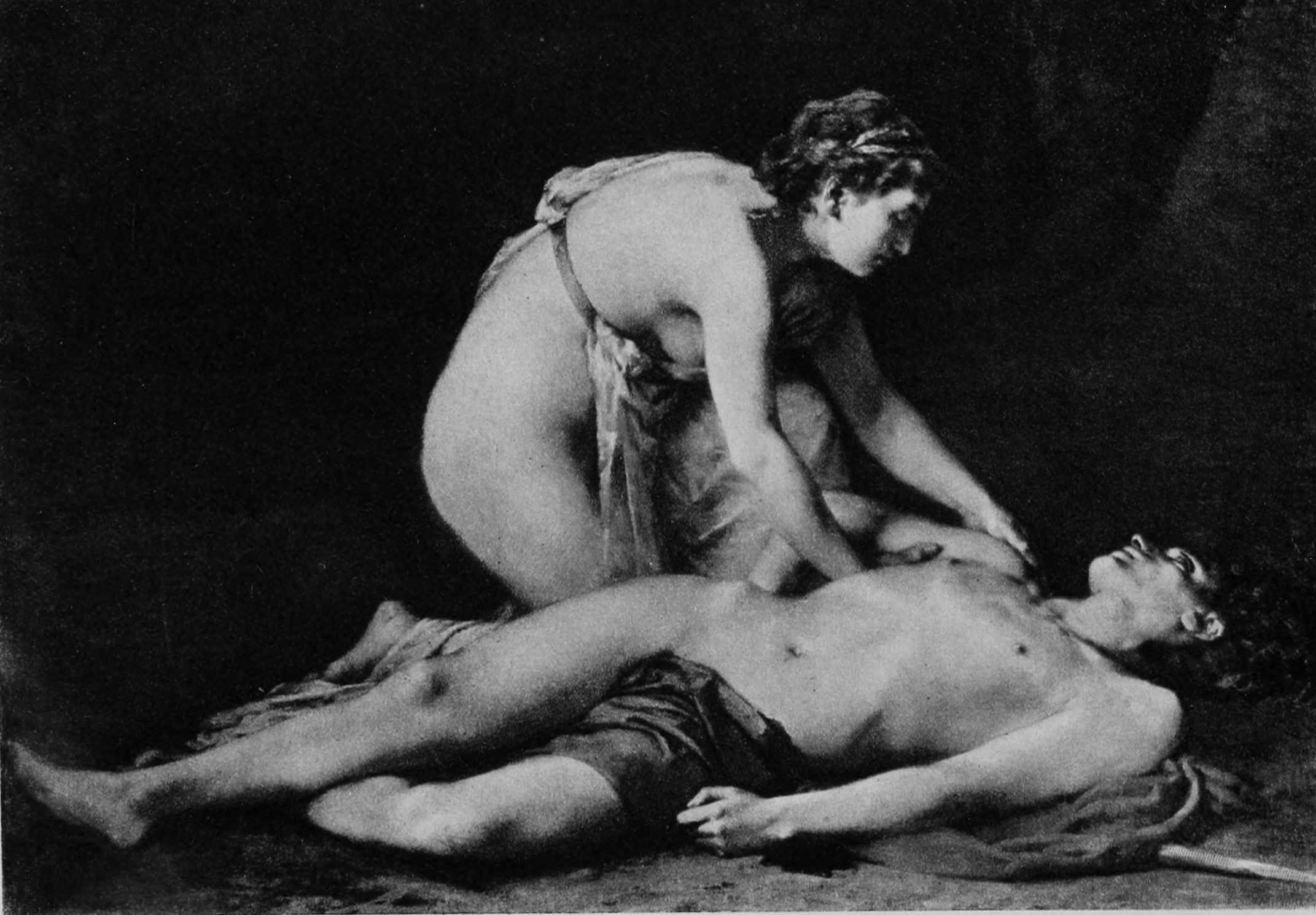
Venus weeping over the body of Adonis. From the painting by Emanuel Benner.
BOSTON · LITTLE, BROWN
AND COMPANY · MCMXI
Entered according to Act of Congress, in the year 1870,
By Little, Brown, and Company,
In the office of the Librarian of Congress at Washington.
Copyright, 1898, 1905,
By Little, Brown, and Company.
Printers S. J. Parkhill & Co., Boston, U. S. A.
CONTENTS OF VOLUME SECOND. WITH THE TRANSLATORS’ NAMES.
Periander prepares the banquet, 4. A question proposed to Bias of
Priene, 4. Thales ascertained the height of one of the pyramids, and
how, 5. Need of preparation for an entertainment, 6. Conversation by
the way, 6, 7. Arrival of the company, 7. Anacharsis the Scythian;
Eumetis, 8. The seat assigned to a person a frivolous consideration,
9. A prodigy: a child born of a mare, 10. The explanation, 11. Esop
relates the fable of the Lydian mule, 11. The frugality of Periander,
12. Anacharsis is questioned respecting the Scythians, 12. A letter
is read from Amasis, king of Egypt, proposing a question, 13. Bias
suggests an answer to the question, 14. The seven wise men, in turn,
reply to the question how a people should be governed, 15. The
discussion continued, 16, 17. Answers to other questions, 17, 18.
Riddles and their solutions, 19, 20. How should a state be governed?
20. How to govern a house, 21, 22. Talk about drinking wine, 23.
The end is worth more than the means, 24. The end of drinking is to
nourish and increase friendship, 24. What measure of outward good
should be regarded as sufficient, 26. A spare diet, as recommended
by Hesiod, 27. Extremes to be avoided, 28. Enjoy freely what we
have, but with moderation, 29. A necessity for eating and drinking,
31. But fatal distempers often ensue, 32. The story of Arion and
the dolphins, 33-36. The story of Hesiod and the dolphins, 36, 37.
Another story about dolphins, 38. The creatures obey the impulse of
God, 39. Μηδὲν ἄγαν, “Do not overdo,” 40,
41.
Young people are fond of fiction, 42. The danger hence arising,
42, 43. We would not interdict to them the reading of poetry, 44.
But give them wholesome advice touching the matter, 45. Poets deal
much in fiction: it belongs to the very essence of poetry, 46. This
contributes greatly to the entertainment of the reader, 46. Evident
absurdities must be rejected, 47. Do not receive as literal truth
what the poets say of the gods or of the departed, 48. Poetry is
an imitative art: the exactness of the imitation, even of a foul
action, gives pleasure, 50. If odious and abominable conduct is
to be represented in poetry, the expression must correspond, 51.
But the poets, especially Homer, signify their disapproval of such
conduct, 52, 53. They often introduce evil examples to promote
moral improvement, 55. The contradictions among poets lessen the
credit of what they say, and thus diminish the possible danger, 55.
The poets often furnish antidotes to the poison they deal out, 57,
58. We may also quote the philosophers against the poets, 59. In
using the names of the gods, the poets often mean only the powers
of nature, or fortune, or some second cause, 61, 62. They often use
words tropically, and then are not to be taken in the literal sense,
64, 65. Poetry requires variety, hence it never represents the same
persons, not even the gods, as uniformly virtuous or prosperous, 66,
67. Therefore the young man must not approve or admire every thing
which is said of the heroes of poetry, 68. Instance, Achilles and
Agamemnon, 69. Several passages in Homer criticised, 69-72. Criticism
on Sophocles, 72. More criticisms and explanations of the Iliad,
74-84, 89, 90. Young men may be taught good morals, and how they
differ from bad, by the poets, _ib._ Boys may learn something
useful even from passages wicked and absurd, 83. We may show young
persons how passages in the poets, of good tendency, are confirmed by
the language of philosophers, 91. Plato and the poets sometimes speak
alike, 92. Thus may poetry and philosophy be reconciled, 93, 94.
Envy and Hatred are alike opposed to Benevolence, 95. Yet they are
distinct passions, 95. Their points of difference, 95, _et seq._
Hatred regards the hated person as evil; envy regards only the
felicity of others, 95. Hatred may be directed against brutes; envy
is directed only against man, 96. Brutes may hate but never envy
brutes, 96. Envy is always unjust; hatred is often just, 96. Hatred
increases as the object grows worse; envy rises higher as the object
increases in virtue, 97. Envy often ceases when the object has risen
to supreme power; hatred never ceases, 98.
Self-love and self-admiration expose a man to the attempts of
flatterers, 100. Mean, poor, and worthless people are not flattered,
but those of a generous and noble nature, 101. In the choice of
friends, let us be wary, yet not over scrupulous, 102. A parasite
who is cringing and obsequious is not difficult of detection, 103.
The great danger is from those who personate the true friend, yet
are selfish and insincere, 104. True friendship arises from a
conformity of tempers and dispositions, 105. The flatterer attempts
such a conformity, 106. It is not natural and uniform, but a mere
disguise, 107. The flatterer is mutable and inconstant, 109. He only
reflects the humors of other men, 109. The true friend imitates
and commends only what is worthy, 110. The flatterer copies the
faults and blemishes of friends, 110, 111. He pretends to have the
same diseases, 111. And to suffer the same ill-treatment, 112.
Counterfeiting the good qualities of a friend, he yields him the
pre-eminence, 112. The flatterer often overdoes, in the effort to
make himself agreeable, 114. The true friend is sometimes under the
necessity of giving pain, 115. The flatterer deals out undeserved
encomium, against which our own conscience protests, 116. Sometimes
he utters praise as if he heard it from a third person, 119.
Sometimes he flatters men in their vices by deriding the contrary
virtues, 119, 120. There is a silent flattery, as when a man yields
his place to another, 121. The parasite praises the man of money,
122. His censures, if he deliver any, fall upon venial faults, not
on real crimes, 124. He flatters, even while pretending to blame,
125. Men, are flattered when reproved for faults directly the
reverse of their real ones, 126. The friend aims at the improvement
of our character; the flatterer works on our weak spots, 128, 129.
The friend is open-hearted and natural; the flatterer ceremonious
and obsequious, 130. The real friend will assist in no dishonest
endeavor: the flatterer has no scruples about the proposal, 131,
132, 134, 135. The kindness of a friend is without parade; that of
a flatterer is attended with bustle and show, 133. The flatterer
reminds us of his past services; the true friend never, 134. An
accurate self-knowledge defends against flattery, 137, 138. We
have no need of flattery, 138. Causeless censure may be equally
mischievous with causeless praise, 138. How to avoid causeless
reprehension of others, 139, et seq. Eliminate from the affair
all self-interest, 140. Free our speech from reproachful words,
141. Deliver ourselves with seriousness and dignity, 142. Make our
reproofs seasonable, 143. The prosperous need reproof rather than the
afflicted, 144. When is severe reproof allowable? 145. Reprove not
in presence of another, 148; especially not before inferiors, 149. A
reprover should not himself need reproof, 150. In reproving, confess
our own fault, 150. Mix with the reproof a little praise, 151. If
reproved, do not retort on your monitor, 152. Reprove only on weighty
occasions, 152. Avoid a fault-finding, captious habit, 153. Reproof
is not offensive, when kindly administered, 154. Reprove with caution
and moderation, 155. Care should be used to leave with the reproof a
salutary impression, 156.
Four interlocutors discourse respecting this doctrine, 157-203. What
had been said by a favorer of Epicurus, 157, 158. What the Epicurean
doctrine is, 159. It recognizes no pleasure but that which is derived
from the senses, 160. Objections to this doctrine, 160, _et
seq._ Pains, as well as pleasures, enter through the senses, and
these are keenly felt, 161. Bodily pleasure is feeble and soon over,
161. The remembrance of past pleasure only stimulates desire for
more, 163; and this produces a restless habit, 164. No man can safely
count on a continuance of what he now enjoys, 165. Hence there must
be constant disquiet, 166. A wicked course contributes nothing to
assurance of continual enjoyment, 166. Our very bodily constitution
places us in constant peril, 167. To escape evil, the Epicureans
say, is the supreme good; but this is simply impossible, 167. If it
were possible, it would not raise us above the brutes, 168, 169.
Freedom from bodily pain is a trivial affair, 169. The Epicurean
philosophy rejects the idea of God and of future retribution; this
costs effort; the brutes who never had this idea have advantage over
the followers of Epicurus, 170. Intellectual enjoyments greatly
superior to sensual pleasures, 171. There is great enjoyment in
knowledge, 171. An acquaintance with works of genius affords great
pleasure, 172. The mathematics afford unspeakable delight, 173.
Instances of this in the cases of Eudoxus, Pythagoras, Archimedes,
and others, 174. Such pleasures are far superior and more intense
than sensual enjoyments, 174. The Epicurean philosophy eschews these
higher and purer delights, 175; and in old age it has nothing left,
176. Epicurus disallows music, 177, 178. He would deprive the mind
of its own proper good, and drag it down to the level of the body,
179. The highest good consists in action, 180; especially beneficent
action, 180, 181. The pleasures recognized by Epicureans are base
and ignoble, 182. They make the stomach the centre, 183. A noble
nature despises such pleasures, 184, 185. Great and generous actions
are never forgotten, 186; but the memory of sensual gratification
is transient, 186. A good reputation affords high satisfaction,
187. This cannot be enjoyed by idle and debauched persons, 188. The
Epicureans leave us no hope from God, 189. The fear and worship of
God, even when joined with superstition, keep down wickedness and
afford much pleasure, 190. This pleasure is shared alike by rich and
poor, 191; but Epicureans deny it to themselves, 191. The Deity can
neither do nor suffer wrong, 192. Therefore a friend of God must
be happy, 193. Of such a satisfaction the followers of Epicurus
would deprive us, 194. According to them, death is the extinction
of our being,—a gloomy prospect, 195. All men shrink at the idea
of annihilation, 197. A dark hereafter is better than none, 198.
Epicureanism extinguishes hope and virtue, 199. The hope of another
and better life gives additional comfort to the present, 200. Of all
this hope and enjoyment the Epicurean doctrine deprives us, and thus
debases and contracts our nature, 202, 203.
By Isaac Chauncy, of the College of Physicians, London.
1. Why do the Romans require a new-married woman to touch fire and
water? 204. 2. Why do they light, at nuptials, five torches? 204. 3,
4. Questions about Diana’s temples, 205. 5. Why do persons falsely
reported as dead, on their return home from foreign parts, not enter
by the door? 206. 6. Why do women kiss their relations? 207. 7.
Why are husbands and wives forbidden to receive presents from each
other? 208. 8. Why may they not receive a gift from a son-in-law or
father-in-law? 209. 9. Why do husbands returning from remote parts
send to acquaint their wives of their approach? 209. 10. Why do
men in divine service cover their heads, &c.? 209. 11. Why do they
sacrifice to Saturn with head uncovered? 210. 12. Why do they esteem
Saturn the father of truth? 211. 13. Why do they sacrifice to Honor
bareheaded? 211. 14. Why do sons appear at their parents’ funerals
with covered heads, &c.? 211. 15. Why do Romans not sacrifice to the
god Terminus? 212. 16. Why must not maid-servants enter the temple of
Matuta? 212. 17. Why do not women supplicate this goddess in behalf
of their children? 213. 18. Why do the rich pay tithes to Hercules?
213. 19. Why does the Roman year begin in January? 213. 20. Why is
not myrtle brought into the temple of Bona Dea? 214. 21. Why is
worship paid to the woodpecker? 215. 22. Why is Janus described as
double-faced? 215. 23. Why are funeral things sold in the temple of
Venus Libitina? 216. 24. Explain the Kalends, Nones, and Ides, 216.
25. Why are the days after the Kalends, Nones, and Ides, considered
unlucky? 217. 26. Why is white sometimes worn as a sign of mourning?
219. 27. Why are walls reputed sacred but not the gates? 219. 28.
Why are children forbidden to swear by Hercules within doors? 220.
29. Why must not the new-married woman step over the threshold but
be carried? 221. 30. Why is she to say, “Where thou art Caius, I am
Caia”? 221. 31. Why is the name Thalassius sung at nuptials? 221.
32. Why are effigies of men, in some cases, called Argives? 222.
33. Why did not men in ancient times sup abroad without their sons?
222. 34. Why were funeral rites performed in December instead of
February? 223. 35. Why is worship paid to the harlot Laurentia? 223.
36. Why is one gate at Rome known as the Window? 224. 37. Why are
spoils taken in war allowed to decay? 225. 38. Why was divination
prohibited after the month of August? 225. 39. Why is it unlawful
for a man not yet mustered into the army to slay an enemy? 226. 40.
Why was it unlawful to anoint a priest of Jupiter in the open air?
226. 41. Why on the ancient coin was Janus stamped, with a ship on
the reverse? 228. 42. Why is the temple of Saturn used as the public
treasury? 228. 43. Why must ambassadors go to Saturn’s temple, and
be there registered? 229. 44. Why must not priests of Jupiter swear?
229. 45. Why at the feast of Venus is wine so freely used? 230. 46.
Why would the ancients have the temple of Horta to stand always open?
230. 47. Why did Romulus build the temple of Vulcan without the city?
231. 48. Why were garlands used in the Consualia? 231. 49. Why did
candidates for office appear without tunics? 232. 50. Why did the
priest of Jupiter, on the death of his wife, resign his office? 232.
51. Why is a dog set before the Lares, and why are the Lares covered
with dogs’ skins? 233. 52. Why is a dog sacrificed to Geneta, &c.?
233. 53. Why, at the Capitoline games, are Sardians offered for
sale by a crier? 234. 54. Why is the flesh-market called Macellum?
234. 55. Why do the minstrels wear women’s apparel on the Ides of
January? 234. 56. Why is it supposed that matrons built the temple
of Carmenta? 235. 57. Why is milk plentifully used in the women’s
sacrifice to Rumina? 236. 58. Why are some senators called Patres,
and others Patres Conscripti? 236. 59. Why was one altar common to
Hercules and the Muses? 236. 60. Why, of the two altars of Hercules,
do the women not partake of the greater? 237. 61. Why is the name
of the tutelary god of Rome not allowed to be mentioned? 237. 62.
Why of the Feciales was the Pater Patratus accounted the chief? 238.
63. Why is the Rex Sacrorum forbidden to bear civil office? 238. 64.
Why after eating must something always be left on the table? 239.
65. The first congress with a wife, why must it be in the dark? 239.
66. Why was a horse-race round called Flaminia? 239. 67. Whence the
name _lictors_? 239. 68. Why do the Luperci sacrifice a dog?
240. 69. Why upon the Septimontium are chariots not drawn by a pair
of horses? 240. 70. Why are convicted thieves called Furciferi? 241.
71. Why is hay bound to the horns of unruly oxen? 241. 72. Why must
the lanterns of soothsayers be open at the top? 242. 73. Why were
priests, afflicted with sores, forbidden to use divination? 242. 74.
Why did Servius Tullius build a temple of Small Fortune? 243. 75.
Why did the Romans not extinguish a candle? 243. 76. Why were little
moons worn on the shoes? 244. 77. Why was the year Jupiter’s, but
the month Juno’s? 244. 78. Why in soothsaying is _sinister_
fortunate? 245. 79. Why might the bones of one who had triumphed be
brought into the city? 246. 80. Why were the consuls requested not to
come to the supper of the triumpher? 246. 81. Why did not the tribune
wear purple? 246. 82. Why, before the chief officers, were the axes
carried bound up in rods? 247. 83. Why did the Romans forbid a human
sacrifice to barbarians, and offer one themselves? 248. 84. Why does
the Roman day begin at midnight? 249. 85. Why of old were women not
suffered to grind or to cook? 250. 86. Why are there no marriages in
May? 250. 87. Why is the hair of a bride parted with a spear? 251.
88. Why is the money for public plays called _lucar_? 251. 89.
Why is the Quirinalia called the Feast of Fools? 251. 90. Why, at
a sacrifice to Hercules, was no other god mentioned, &c.? 252. 91.
Why might not patricians dwell about the Capitol? 252. 92. Why is
a garland of oak-leaves put on him who saves a citizen in battle?
252. 93. Why are vultures used in soothsaying? 253. 94. Why is the
temple of Aesculapius placed without the city? 254. 95. Why must
chaste people abstain from pulse? 254. 96. Why are Vestal Virgins,
when unchaste, buried alive? 254. 97. Why, at a horse-race, is the
winning horse sacrificed to Mars, &c.? 255. 98. Why do the censors
begin their official work by feeding the sacred geese? 255. 99. Why
are augurs never deprived of office? 256. 100. Why, at the Ides of
August, do the servants feast and the free-women wait on them? 257.
101. Why are boys decorated with the necklace called _bulla_?
257. 102. Why do boys receive names at nine days old, and girls at
eight? 258. 103. Why are those whose fathers are not known called
_Spurius_? 258. 104. Why was Bacchus called Liber Pater? 259.
105. Why are widows married on holidays, but not virgins? 259. 106.
Why do the Romans worship Fortuna Primigenia? 260. 107. Whence the
term _histriones_? 260. 108. Why are marriages between persons
near akin not practised? 260. 109. Why must not the chief priest of
Jupiter touch meal or leaven? 261. 110. Why is he forbidden to touch
raw flesh? 261. 111. Why is he forbidden to touch or name dog or
goat? 262. 112. Why is he forbidden to touch ivy, or to pass under
vine branches? 263. 113. Why is he forbidden to bear civil office?
264.
1. Who are they at Epidaurus called Κονίποδες and Ἄρτυνοι? 265. 2.
What woman did the Cumans call Onobatis? 265. 3. Who is the
Ὑπεκκαύστρια among the Solenses? 266. 4. Who
are the Ἀμνήμονες among the Cnidians, and who is the Ἀφεστήρ? 266.
5. Who were the Χρηστοί among the Arcadians and Lacedaemonians?
266. 6. Who is Κριθολόγος among the Opuntians? 266. 7. What sort of
clouds are the Ploiades? 266. 8. Who is called Platychaetas among the
Boeotians? 267. 9. Who at Delphi is called Ὁσιωτήρ? 267. 10. What is
Phyxemelum? 268. 11. Who are the Ἀποσφενδόνητοι? 268. 12. What was
Charila among the Delphians? 268. 13. What is the beggars’ meat among
the Aenianes? 270. 14. Who were the Coliads among the Ithacans? what
was a φάγιλος? 271. 15. What is the wooden dog among the Locrians?
271. 16. What thing do the Megarians call ἀφάβρωμα? 272. 17. Who was
called δορύξενος? 272. 18. What is παλιντοκία? 273. 19. What is the
Anthedon of which Pythia speaks? 273. 20. What is meant at Priene by
darkness at the Oak? 274. 21. Who in Crete were called Κατακαῦται?
274. 22. What was the Sepulchre of the Boys at Chalcedon? 275. 23.
Who at Argos are Μιξαρχαγέτας and Ἐλάσιοι? 276. 24. What at Argos
is ἔγκνισμα? 276. 25. Who are Ἀλάστωρ, Ἀλιτήριος, and Παλαμναῖος?
276. 26. What is the meaning of a verse sung by certain virgins of
Aenos? 276. 27. Why at Rhodes does the crier never enter the chapel
of Ocridion? 277. 28. Why at Tenedos does no piper enter the temple,
nor must Achilles be named there? 277. 29. Who was the πωλήτης at
Epidamnus? 278. 30. What is the shore of Araenus, in Thrace? 278.
31. Why at the feast of Ceres do the women of Eretria roast meat by
the sun? 279. 32. Who at Miletus were the Ἀειναῦται? 279. 33. Why
do the Chalcidians call a certain place Ἀκμαίων Λέσχη? 279. 34. Who
was he that sacrificed an ox to his benefactor? 280. 35. Why did the
Bottiaean maids sing, “Let us go to Athens”? 280. 36. Why do the
Eleian women in their hymns say, “O Bacchus, come with an ox foot”?
281. 37. Why is a place at Tanagra called Achilleum? 281. 38. Who
among the Boeotians were the Ψολόεις, and the Ὀλεῖαι? 282. 39. Why
do the Arcadians stone those who go willingly into the Lycaeum, &c.?
282. 40. Who is Eunostus, the hero of Tanagra, and why may not women
enter his grove? 283. 41. How came there to be a river in Boeotia
called Scamander? 284. 42. Whence the saying, “Let this prevail”?
285. 43. Why is the city of the Ithacans called Alalcomenae? 285.
44. Who are the Monophagi in Aegina? 286. 45. Why does a statue of
Jupiter in Caria carry an axe and not a thunderbolt? 286. 46. Why
do the Trallians call the pulse ὄροβος καθαρτής? 287. 47. Why do
the Eleans say, “worse than Sambicus”? 287. 48. Why is the temple
of Ulysses at Lacedaemon near the monument of Leucippides? 287. 49.
Why do the women of Chalcedon, on meeting other women’s husbands,
cover one cheek? 288. 50. Why do the Argives bring their sheep to the
grove of Agenor, &c.? 289. 51. Why did the Argive boys in sport call
themselves Ballacrades? 289. 52. Why do the men of Elis lead their
mares out of their borders, &c.? 289. 53. Why was it a custom amongst
the Gnossians that they who borrowed money upon usury should snatch
it up and run away? 289. 54. Why in Samos do they call upon Venus of
Dexicreon? 289. 55. Why in Samos, when they sacrifice to Mercury, do
they allow stealing? 290. 56. Why in Samos is there a place called
Πάναιμα? 290. 57. Why in Samos was the Andron called Pedetes? 290.
58. Why is the priest of Hercules in Cos clothed in women’s apparel?
291. 59. Whence the race of Hamaxocylists in Megara? 292.
True happiness is not to be bought and sold; wealth will not procure
it, 294. The love of money does not cease on the acquisition of
money, 295. A man who has much is intent on getting more, 296. He
does not need more, but to be relieved of some part of what he has,
296. To possess money, and not to use it, is a distemper of the
mind, 297. The love of wealth is never satisfied, 298. It makes of a
man a miserable slave, 299. Such men are always in want, 297, _et
seq._ They excite aversion in the beholders, 299. They lay up
wealth for their children, 300; who impatiently expect their decease,
301. What is the use of riches? 302. Riches need not be coveted,
since our real wants are easily supplied, 303. If there were nobody
to see a display of riches besides their possessor, their chief value
would cease, 304. When nobody looks on, riches signify nothing, 305.
By Mr. Lancaster, Fellow of Baliol College in Oxford.
An arrogant boaster is universally condemned, 306. Yet there are
times when a man may fitly praise himself, 307. A man may vindicate
his worthy acts when maligned by others, 309. Instances of this
in Pericles, Pelopidas, Epaminondas, 309. A man grappling with
ill-fortune may vindicate himself, 310. A man may do it, if treated
ungratefully, 311. Or if unjustly accused of evil acts, 312. A man
may indirectly praise himself by praising others who are of similar
character, 313. Envy may be forestalled by giving the credit of our
good actions to Fortune or to God, 314; and by admissions of partial
wrong in our character or conduct, 316, 317. We may praise ourselves
when it seems to be for the advantage of others, 318; and when by so
doing we may silence an insolent and blustering man, 319. When evil
conduct is praised, and we may attract the attention of the company
to a worthier example, 320. In general we should avoid talking about
ourselves, 321. This habit engenders boasting and vain-glory, 322. It
leads to the disparagement of others, 323. We should hear our praises
uttered with modesty and caution, 324; otherwise we incur disgrace,
325.
Opinion of Plato concerning the soul, 326. Quotation from the Timaeus
of Plato, 326. Opinions of Xenocrates and Crantor, 327. Plato held
the eternity of matter, 328, 353. Nature of the soul, according
to Plato, 329, 330. The material of which the world was formed,
originally a shapeless mass existing from eternity, 331. It was
arranged in perfect and beautiful forms by God, 331, 336. The soul
of the world, 332, 351. Origin of evil, 333, 334. Reconciliation of
Plato with himself, 335-337. His real meaning, 337. The four original
elements of all created, corporeal things, 337. The soul is both
created and uncreated, 338. The subject illustrated by geometry and
the doctrine of ratios, 339-345. And by the musical scale, 345-349.
Relation of spirit to matter, 350. The opinion of those philosophers
refuted who make the soul a compound of both, 351. The soul of the
world, what? 352. The divisible and the indivisible: the Other and
the Same, 326, 350, 354, _et seq._ The four elements, how
related, 355. Generation, what? 356. Two discordant principles rule
the world,—Fate or Necessity, and Intelligence or Wisdom, 357, 358.
The soul is not altogether the workmanship of the Deity, 359. Another
illustration from geometry, 360. Illustration from the planetary
system, 361, 362. And from musical science, 361, 367.
Instruction in philosophy not to be denied to men of quality, 368.
The true idea of philosophy, 369. If useful to any, it may be
especially useful to men who lead and govern, 370. Absurdity of the
contrary supposition, 371. Great value of true philosophy, 372.
Reputation valuable to a philosopher as a means of usefulness, 373. A
philosopher will delight in giving his instructions where they will
have the widest influence, 374, 375. Even an ordinary mechanic would
be pleased if he knew his machine would be put to a noble use, 376.
Introduction, 378. Supposed conversation among some friends
respecting affairs at Thebes, at the period of the return of the
exiles, 379-382. About Pelopidas, Epaminondas, Charon, Archias,
Leontidas, Lysanoridas, 381, 382. Plan for liberating Thebes from
the Spartan rule, 382. Strange portents and omens, 383-385. Recourse
to Egypt for the interpretation of a strange, antiquated writing,
383-385. The writing interpreted, 386. Folly of superstition, 387.
Socrates pursued a more rational method, 387. What shall we think
of his Daemon? 388. Was it some trifling thing, as an omen or a
sneeze? 389, 391. It could be nothing but sound judgment, 390. A
stranger from Italy introduced, 392. His account of affairs at
Metapontum, 393. Lysis had escaped from massacre at Metapontum, and
been hospitably received at Thebes, 394. Theanor, the stranger,
offers money in requital for the kindness bestowed on Lysis, 394.
The offer refused, and why, 395. Discourse of Epaminondas thereon,
396-398. Epaminondas has a good Daemon, 399. The conversation turns
on the liberation of Thebes from the Spartan garrison, 400. Fear that
the plot is discovered, 401. Dreams and omens, 401, 402. The Daemon
of Socrates again, 403, 404. A strong impression made on the mind
of some extraordinary man is from a Daemon, like that of Socrates,
406. A romantic dream related, 407-411. A descent into the infernal
regions, 409. Daemons are seen there; their connection with human
beings on earth, 410, 411. The Pythagorean philosophy respecting
dreams, daemons, and sacred impulses, 412, 413. Epaminondas refuses
to kill any citizen without process of law, 414. Slaughter of the
Spartan commanders and liberation of Thebes, 414-423.
Uncomfortable houses may be so altered as to be made comfortable,
424. In like manner, we may so change our personal habits as to
become agreeable to ourselves and others, 425. One habit needing
to be changed may be that of a vain curiosity, 425. Let us make a
thorough self-inspection, 426. Those who eagerly pry into the affairs
of others are apt to be ignorant of themselves, 427, 428. It is rude
and indecent to intrude into the private concerns of others, 429. It
is also attended with danger, 430. Curiosity may be wisely and safely
indulged by inquiries into the phenomena of nature and the history
of great events, 431. But such things do not satisfy a perverse
and prurient curiosity, 432. Such curiosity proceeds from spite or
envy, 432. People so inclined search into matters which men wish to
keep secret, 433. Such people cannot endure the quiet of a country
life, 434. They eagerly inquire for news, 434. We carefully guard
ourselves against inquisitive persons, 435. The practice procures
its own punishment, 437. To cure ourselves of the habit of idle
curiosity, forbear to notice little things, 438. Do not peep in at
doors and windows, 439. Do not mix with low people, 441. Do not look
at beautiful women, 442. Restrain the impulse of curiosity, even in
lawful things, 443. Spies and informers, even when employed by the
government, are always hated, 444.
There can be no progress in virtue while habits of wrong-doing
continue unchanged, 446. A change from vice to virtue is not
instantaneous, it must be progressive, 447. The opinion of the
Stoics confuted that all men are equally vicious, 448. As there are
degrees of moral improvement, they are easily discernible, 449.
Constant endeavors to be good may inspire confidence of success, 450.
It is a good sign if our efforts after moral improvement become more
intense and constant, 451. And if difficulties gradually disappear,
452. Examples given, 453. It is a good sign if the ridicule or
opposition of friends do not induce us to leave our studies, 454.
What may evince proficiency in virtue, 455. Many fail of advantage
from the study of philosophy, 456. In hearing lectures or reading,
attend to things spoken rather than the words, 457. Do not read
merely to admire the style, 457. Be more ready to hear than to
speak, 459. Maintain an unruffled temper, 459. Cultivate presence of
mind, 460. Be guided by truth rather than ostentation, 461. Exercise
self-restraint, 461; and moderation, 462. Cultivate a serious spirit,
463. Be willing to receive admonition, 464, 465. When in the wrong,
willingly acknowledge it, 466. Effects of careful and persistent
training, 468. Pleasant dreams indicate proficiency in virtue, 469.
Not only love and admire but imitate virtuous examples, 470. Let
some virtuous example ever be in our thoughts, 472. Cultivate the
acquaintance of the wise and good, 473. Carefully avoid every fault,
474.
Does Fortune rule the affairs of men? 475. What influence could
it have in the affairs of Aristides, Scipio, Alexander, and men
like them? 475. Are there not such things as wisdom, justice,
moderation, and fortitude? 476. And are not these qualities of
supreme importance? 477. Were it not for our reason, we should be far
inferior to the brutes, 478. What place has Fortune in the affairs of
carpenters, artists, and painters? 479. If reason and good counsel
are of service in the mechanic arts, why not in affairs of state? 480.
As our clothing does not impart heat to our bodies, so ample
possessions cannot make us happy, 482. Virtue can make any condition
in life pleasant and delightful, 483. A man’s vices inflict on him
misery which he cannot avoid, 483. They allow him no rest, day or
night, 484. Worldly abundance only aggravates the disorders of the
mind, 484. Virtue makes a man happy anywhere, 485.
Introduction, 486. Avoid the first occasions of discord, 487.
There should be a conformity of tastes and manners, 488. The wife
must prefer the society of her husband to that of all others, 488.
The husband must avoid a morose, imperious behavior, 489. Let all
things be managed with the consent of both parties, 489. The wife,
if limited in expenses, must cheerfully submit, 490. She must not
chide her husband before others, 490. She should study to reflect
his character, 490. She should share his recreations and his cares,
491. If the husband takes another woman on an excursion of pleasure,
let not the wife show anger, 491. The caresses of conjugal life
should be proffered by the husband only, 492. A wife must have no
private friendships, 492. _Meum et tuum_ must have no place
in married life, 493. The petty altercations of man and wife, if
of daily occurrence, render the connection insupportable, 494. The
parties immediately concerned can best tell where the shoe pinches,
494. A wife wins her husband’s affection most readily by sweetness
of disposition, 494. The wife should make a proper use of her
mirror, 495. A woman is adorned more by discretion, humility, and
modesty, than by gold or diamonds, 495. Anger and reproach should be
banished from the household, 496. A wife must not be a slut, 496. She
should avoid affectation and being over nice, 497. She should avoid
extravagance in dress, 497. She should guard her lips in the hearing
of strangers, 498. She must not attempt to control her husband,
498. The husband’s government must be that of love, 498. The wife
should so gain her husband’s love as not to lessen his affection
for his mother, 499. When the husband is in a passion, it is best
for the wife to hold her peace, 500. Women are rarely jealous of
their husbands when other women let them alone, 501. Let the husband
abstain from unlawful embraces, 503. Let him respect and honor his
wife, 504. Concluding counsels 505-507.
1. No wonder, my friend Nicarchus, to find old truths so
disguised, and the words and actions of men so grossly
misrepresented and lamely delivered, seeing people are so
disposed to give ear and credit to fictions of yesterday’s
standing. For there were not merely seven present at
that feast, as you were informed; there were more than
double the number. I was there myself in person and
familiarly acquainted with Periander (my art had gained
me his acquaintance); and Thales boarded at my house, at
the request and upon the recommendation of Periander.
Whoever then gave you that account of our feast did it
very badly; it is plain he did it upon hearsay, and that he
was not there among us. Now, since we are together and
at leisure, and possibly we may not live to find an opportunity
so convenient another time, I will (seeing you desire it)
give you a faithful account of the whole proceedings at
that meeting.
2. Periander had prepared a dinner for us, not in the
town, but in a dining-hall at Lechaeum which stands close to
the temple of Venus, to whom there was a sacrifice that day.
For having neglected the duty ever since his mother died
for love, he was resolved now to atone for the omission,
being warned so to do by the dreams of Melissa. In
order thereunto, there was provided a rich chariot for
every one of the guests. It was summer-time, and every
part of the way quite to the seaside was hardly passable,
by reason of throngs of people and whole clouds of dust.
As soon as Thales espied the chariot waiting at the door,
he smilingly discharged it, and we walked through the
fields to avoid the press and noise. There was in our
company a third person, Niloxenus a Naucratian, an eminent
man, who was very intimately acquainted with Solon
and Thales in Egypt; he had a message to deliver to Bias,
and a letter sealed, the contents whereof he knew not;
only he guessed it contained a second question to be
resolved by Bias, and in case Bias undertook not to answer
it, he had in commission to impart it to the wisest
men in Greece. What a fortune is this (quoth Niloxenus)
to find you all together! This paper (showing it us)
I am bringing to the banquet. Thales replied, after his
wonted smiling way, If it contains any hard question,
away with it to Priene. Bias will resolve it with the
same readiness he did your former problem. What problem
was that? quoth he. Why, saith Thales, a certain
person sent him a beast for sacrifice with this command,
that he should return him that part of his flesh which was
best and worst; our philosopher very gravely and wisely
pulled out the tongue of the beast, and sent it to the
donor;—which single act procured him the name and
reputation of a very wise man. It was not this act
alone that advanced him in the estimation of the world,
quoth Niloxenus; but he joyfully embraces what you so
carefully shun, the acquaintance and friendship of kings
and great men; and whereas he honors you for divers
great accomplishments, he particularly admires you for
this invention, that with little labor and no help of any
mathematical instrument you took so truly the height of
one of the pyramids; for fixing your staff erect at the
point of the shadow which the pyramid cast, two triangles
being thus made by the tangent rays of the sun, you
demonstrated that what proportion one shadow had to
the other, such the pyramid bore to the stick.
But, as I said, you are accused of being a hater of kings,
and certain back friends of yours have presented Amasis
with a paper of yours stuffed with sentences reproachful
to majesty; as for instance, being at a certain time asked
by Molpagoras the Ionian, what the most absurd thing was
you had observed in your notice, you replied, An old king.
Another time, in a dispute that happened in your company
about the nature of beasts, you affirmed that of wild beasts,
a king, of tame, a flatterer was the worst. Such apophthegms
must needs be unacceptable to kings, who pretend
there is vast difference between them and tyrants. This
was Pittacus’s reply to Myrsilus, and it was spoken in jest,
quoth Thales; nor was it an old king I said I should marvel
at, but an old pilot. In this mistake, however, I am
much of the youth’s mind who, throwing a stone at a
bitch, hit his stepmother, adding, Not so bad. I therefore
esteemed Solon a very wise and good man, when I understood
he refused empire; and if Pittacus had not taken
upon himself a monarchy, he had never exclaimed, O ye
Gods! how hard a matter it is to be good! And Periander,
however he seems to be sick of his father’s disease, is yet
to be commended that he gives ear to wholesome discourses
and converses only with wise and good men, rejecting the
advice of Thrasybulus my countryman, who would have
persuaded him to chop off the heads of his nobility. For
a prince that chooses rather to govern slaves than freemen
is like a foolish farmer, who throws his wheat and barley
in the streets, to fill his barns with swarms of locusts and
whole cages of birds. For government has one good
thing to make amends for the many evils attending it,
namely, honor and glory, provided the ruler rules good
men because he is better than they, and great men seeming
to be greater than they. But he that having ascended
the throne minds only his own interest and ease, remitting
all care and concern for the welfare of the subject, is fitter
to tend sheep or to drive horses or to feed cattle than to
govern men of reason.
But this stranger (continues he) has engaged us in a deal
of impertinent chat, for we have neglected to speak or offer
any discourse suitable to the occasion and end of our meeting;
for doubtless it becomes the guest, as well as the host,
to make preparation beforehand. It is reported that the
Sybarites used to invite their neighbors’ wives a whole
twelve-month before to their entertainments, that they
might have convenient time to trim and adorn themselves;
for my part, I am of opinion, that he who would
feast as he should ought to allow himself more time for
preparation than they, it being a more difficult matter to
compose the mind into an agreeable temper than to fit
one’s clothes for the outward ornament of the body. For
a prudent man comes not hither only to fill his belly, as if he
were to fill a bottle, but to be sometimes grave and serious,
sometimes pleasant, sometimes to listen to others, and sometimes
to speak himself what may benefit or divert the company,
if the meeting is intended for any good use or
purpose. For if the victuals be not good, men may let
them alone, or if the wine be bad, men may use water;
but for a weak-headed, impertinent, unmannerly, shallow
fellow-commoner there is no cure; he mars all the mirth
and music, and spoils the best entertainment in the world.
And it will be no easy business to rid one’s self of a sullen
temper when once entertained; since we find divers men,
affronted in their debauches, have yet remembered the
provocation to their dying day, the spite remaining like a
surfeit arising from wrong done or anger conceived in
drinking wine. Wherefore Chilo did very well and wisely;
for when he was invited yesterday, he would not promise
to come till he had a particular given him of all their
names who were to meet him. For, quoth he, if my
business calls me to sea or I am pressed to serve my
prince in his wars, there is a necessity upon me to rest
contented with whatever company I fall into, though never
so unsuitable to my quality or disagreeable to my nature
and humor; but voluntarily and needlessly to associate
myself with any riffraff rabble would ill become any man
pretending to but common discretion.
The Egyptian skeleton which they brought into their
feasts and exposed to the view of their guests, with this
advice, that they should not in their merriment forget they
would shortly be themselves such as that was,—though it
was a sight not so acceptable (as may be supposed),—had
yet this conveniency and use, to incite the spectators not
to luxury and drunkenness but to mutual love and friendship,
persuading them not to protract a life in itself short and
uncertain by a tedious course of wickedness.
3. In discourses of this kind we spent our time by the
way, and were now come to the house. Here Thales
would not be washed, for he had but a while before
anointed himself; wherefore he took a round to view the
horse-race and the wrestling-place, and the grove upon the
water-side, which was neatly trimmed and beautified by
Periander; this he did, not so much to satisfy his own
curiosity (for he seldom or never admired any thing he saw),
but that he might not disoblige Periander or seem to overlook
or despise the glory and magnificence of our host.
Of the rest every one, after he had anointed and washed
himself, the servants introduced into a particular room,
purposely fitted and prepared for the men; they were
guided thither through a porch, in which Anacharsis sat,
and there was a certain young lady with him arranging his
hair. This lady stepping forward to welcome Thales, he
saluted her most courteously, and smiling said: Madam,
make the stranger fair and pleasant, so that, being (as he
is) the mildest man in the world, he may not be fearful and
hideous for us to look on. When I was curious to enquire
who this lady was whom Thales thus complimented, he
said, Do you not yet know the wise and famous Eumetis?—for
so her father calls her, though others call her after
her father’s name Cleobulina. Doubtless, saith Niloxenus,
they call her by this name to commend her judgment and
wit, and her reach into the more abstruse and recondite
part of learning; for I have myself in Egypt seen and
read some problems first started and discussed by her.
Not so, saith Thales, for she plays with these as men do
with cockal-bones, and encounters boldly all she meets,
without study or premeditation; she is a person of an
admirable understanding, of a politic capacious mind, of a
very obliging conversation, and one that by her rhetoric
and the sweetness of her temper prevails upon her father
to govern his subjects with the greatest mildness in the
world. How popular she is appears, saith Niloxenus, plainly
to any that observes her pleasant innocent garb. But
pray, continues he, wherefore is it that she shows such
tenderness and affection to Anacharsis? Because, replied
Thales, he is a temperate and learned man, who fully and
freely makes known to her those mysterious ways of dieting
and physicing the sick which are now in use among
the Scythians; and I doubt not she now coaxes and courts
the old gentleman at the rate you see, taking this opportunity
to discourse with him and learn something of him.
As we were come near the dining-room, Alexidemus the
Milesian, a bastard son of Thrasybulus the Tyrant, met us.
He seemed to be disturbed, and in an angry tone muttered
to himself some words which we could not distinctly hear;
but espying Thales, and recovering himself out of his
disorder, he complained how Periander had put an insufferable
affront upon him. He would not permit me, saith
he, to go to sea, though I earnestly importuned him, but
he would press me to dine with him. And when I came
as invited, he assigned me a seat unbecoming my person
and character, Aeolians and islanders and others of inferior
rank being placed above me; whence it is easy to infer
how meanly he thinks of my father, and it is undeniable
how this affront put upon me rebounds disgracefully in my
parent’s face. Say you so? quoth Thales, are you afraid
lest the place lessen or diminish your honor and worth, as
the Egyptians commonly hold the stars are magnified or
lessened according to their higher or lower place and position?
And are you more foolish than that Spartan who,
when the prefect of the music had appointed him to sit in
the lowest seat in the choir, replied, This is prudently done,
for this is the ready way to bring this seat into repute and
esteem? It is a frivolous consideration, where or below
whom we sit; and it is a wiser part to adapt ourselves to
the judgment and humor of our right and left hand man
and the rest of the company, that we may approve ourselves
worthy of their friendship, when they find we take no pet
at our host, but are rather pleased to be placed near such
good company. And whosoever is disturbed upon the
account of his place seems to be more angry with his
neighbor than with his host, but certainly is very troublesome
and nauseous to both.
These are fine words, and no more, quoth Alexidemus,
for I observe you, the wisest of men, as ambitious as other
men; and having said thus, he passed by us doggedly and
trooped off. Thales, seeing us admiring the innocence of
the man, declared he was a fellow naturally of a blockish,
stupid disposition; for when he was a boy, he took a parcel
of rich perfume that was presented to Thrasybulus
and poured it into a large bowl, and mixing it with a
quantity of wine, he drank it off and was ever hated for it.
As Thales was talking after this fashion, in comes a servant
and tells us it was Periander’s pleasure we would
come in and inform him what we thought of a certain
creature brought into his presence that instant, whether it
were so born by chance or were a prodigy and omen;—himself
seeming mightily affected and concerned, for he
judged his sacrifice polluted by it. At the same time he
walked before us into a certain house adjoining to his garden-wall,
where we found a young beardless shepherd,
tolerably handsome, who having opened a leathern bag
produced and showed us a child born (as he averred) of a
mare. His upper part, as far as his neck and his hands,
was of human shape, and the rest of his body resembled
a perfect horse; his cry was like that of a child newly
born. As soon as Niloxenus saw it, he cried out, The
Gods deliver us; and away he fled as one sadly affrighted.
But Thales eyed the shepherd a considerable while, and
then smiling (for it was his way to jeer me perpetually
about my art) says he, I doubt not, Diocles, but you have
been all this time seeking for some expiatory offering, and
intending to call to your aid those Gods whose province
and work it is to avert evils from men, as if some great
and grievous thing had happened. Why not? quoth I,
for undoubtedly this prodigy portends sedition and war,
and I fear the dire portents thereof may extend to myself,
my wife, and my children, and prove all our ruin;
since, before I have atoned for my former fault, the Goddess
gives us this second evidence and proof of her displeasure.
Thales replied never a word, but laughing went
out of the house. Periander, meeting him at the door,
enquired what we thought of that creature; he dismissed
me, and taking Periander by the hand, said, Whatsoever
Diodes shall persuade you to do, do it at your best leisure;
but I advise you either not to have such young men to
keep your mares, or to give them leave to marry. When
Periander heard him out, he seemed infinitely pleased, for
he laughed outright, and hugging Thales in his arms he
kissed him; then saith he, O Diocles, I am apt to think the
worst is over, and what this prodigy portended is now
at an end; for do you not apprehend what a loss we have
sustained in the want of Alexidemus’s good company at
supper?
4. When we entered into the house, Thales raising his
voice enquired where it was his worship refused to be placed;
which being shown him, he sat himself in that very place,
and prayed us to sit down by him, and said, I would gladly
give any money to have an opportunity to sit and eat with Ardalus.
This Ardalus was a Troezenian by birth, by profession
a minstrel, and a priest of the Ardalian Muses, whose
temple old Ardalus had founded and dedicated. Here
Esop, who was sent from Croesus to visit Periander, and
withal to consult the oracle at Delphi, sitting by and beneath
Solon upon a low stool, told the company this fable:
A Lydian mule, viewing his own picture in a river, and
admiring the bigness and beauty of his body, raises his
crest; he waxes proud, resolving to imitate the horse in
his gait and running; but presently, recollecting his extraction,
how that his father was but an ass at best, he stops
his career and checks his own haughtiness and bravery.
Chilo replied, after his short laconic way, You are slow and
yet try to run, in imitation of your mule.
Amidst these discourses in comes Melissa and sits her
down by Periander; Eumetis followed and came in as we
were at supper; then Thales calls to me (I sat me down
above Bias), Why do you not make Bias acquainted with
the problems sent him from the King by Niloxenus this
second time, that he may soberly and warily weigh them?
Bias answered, I have been already scared with that news.
I have known that Bacchus is otherwise a powerful God,
and for his wisdom is termed λύσιος, that is, the interpreter;
therefore I shall undertake it when my belly is full of wine.
Thus they jested and reparteed and played one upon another
all the while they sat at table. Observing the unwonted
frugality of Periander at this time, I considered
with myself that the entertainment of wise and good men
is a piece of good husbandry, and that so far from enhancing
a man’s expenses in truth it serves to save charge, the
charge (to wit) of costly foreign unguents and junkets, and
the waste of the richest wines, which Periander’s state and
greatness required him every day in his ordinary treats to
expend. Such costly provisions were useless here, and
Periander’s wisdom appeared in his frugality. Moreover, his
lady had laid aside her richer habit, and appeared in an
ordinary, but a very becoming dress.
5. Supper now ended, and Melissa having distributed
the garlands, we offered sacrifice; and when the minstrel
had played us a tune or two, she withdrew. Then Ardalus
enquired of Anacharsis, if there were women fiddlers at
Scythia. He suddenly and smartly replied, There are no
vines there. Ardalus asked a second question, whether the
Scythians had any Gods among them. Yes, quoth Anacharsis,
and they understand what men say to them; nor
are the Scythians of the Grecian opinion (however these
last may be the better orators), that the Gods are better
pleased with the sounds of flutes and pipes than with the
voice of men. My friend, saith Esop, what would you say
if you saw our present pipe-makers throw away the bones
of fawns and hind-calves, to use those of asses, affirming
they yield the sweeter and more melodious sound? Whereupon
Cleobulina made one of her riddles about the Phrygian
flute, ... in regard to the sound, and wondered that
an ass, a gross animal and no lover of music, should yet
afford bones so fit for harmony. Therefore it is doubtless,
quoth Niloxenus, that the people of Busiris accuse us Naucratians
of folly for using pipes made of asses’ bones, it
being an insufferable fault in any of them to listen to the
flute or cornet, the sound thereof being (as they esteem it)
so like the braying of an ass; and you know an ass is
hateful to the Egyptians on account of Typhon.
6. There happening here a short silence, Periander,
observing Niloxenus willing but not daring to speak, said:
I cannot but commend the civility of those magistrates who
give audience first to strangers and afterwards to their own
citizens; wherefore I judge it convenient that we inhabitants
and neighbors should proceed no farther at present
in our discourse, and that now attention be given to those
royal propositions sent us from Egypt, which the worthy
Niloxenus is commissioned to deliver to Bias, who desires
that he and we may scan and examine them together. And
Bias said: For where or in what company would a man
more joyfully adventure to give his opinion than here in
this? And since it is his Majesty’s pleasure that I should
give my judgment first, in obedience to his commands I will
do so, and afterwards they shall come to every one of you
in order.
Then Niloxenus delivered the paper to Bias, who broke
up the seal and commanded it to be read in all their hearing.
The contents were these:—
Amasis the king of Egypt, to Bias, the wisest of the
Grecians, greeting. There is a contest between my brother
of Ethiopia and myself about wisdom; and being baffled
in divers other particulars, he now demands of me a thing
absurd and impracticable; for he requires me to drink up
the ocean dry. If I be able to read this his riddle, divers
cities and towns now in his possession are to be annexed
to my kingdom; but if I cannot resolve this hard sentence,
and give him the right meaning thereof, he requires of me
my right to all the towns bordering upon Elephantina.
Consider with speed the premises, and let me receive your
thoughts by Niloxenus. Pray lose no time. If in any
thing I can be serviceable to your city or friends, you may
command me. Farewell.
Bias, having perused and for a little time meditated upon
the letter, and whispering Cleobulus in the ear (he sat by
him), exclaimed: What a narration is here, O Niloxenus!
Will Amasis, who governs so many men and is seized of so
many flourishing territories, drink up the ocean for the
gain of a few paltry, beggarly villages? Niloxenus replied
with a smile: Consider, good sir, what is to be done, if he
will obey. Why then, said Bias, let Amasis require the
Ethiopian king to stop the streams which from all parts
flow and empty themselves in the ocean, until he have
drunk out the whole remainder; for I conceive he means
the present waters, not those which shall flow into it hereafter.
Niloxenus was so overjoyed at this answer, that he
could not contain himself. He hugged and kissed the
author, and the whole company liked his opinion admirably
well; and Chilo laughing desired Niloxenus to get aboard
immediately before the sea was consumed, and tell his
master he should mind more how to render his government
sweet and potable to his people, than how to swallow such
a quantity of salt water. For Bias, he told him, understands
these things very well, and knows how to oblige
your lord with very useful instructions, which if he vouchsafe
to attend, he shall no more need a golden basin to wash
his feet, to gain respect from his subjects; all will love and
honor him for his virtue, though he were ten thousand
times more hateful to them than he is. It were well and
worthily done, quoth Periander, if all of us did pay him
our first-fruits in this kind by the poll (as Homer said).
Such a course would bring him an accession of profit greater
than the whole profit of the voyage, besides being of no
little use to ourselves.
7. To this point it is fit that Solon should first speak,
quoth Chilo, not only because he is the eldest in the company
and therefore sits uppermost at table, but because he
governs and gives laws to the amplest and most complete
and flourishing republic in the world, that of Athens.
Here Niloxenus whispered me in the ear: O Diocles, saith
he, how many reports fly about and are believed, and how
some men delight in lies which they either feign of their
own heads or most greedily swallow from the mouths of
others. In Egypt I heard it reported how Chilo had renounced
all friendship and correspondence with Solon,
because he maintained the mutability of laws. A ridiculous
fiction, quoth I, for then he and we must have renounced
Lycurgus, who changed the laws and indeed the
whole government of Sparta.
Solon, pausing awhile, gave his opinion in these words:
I conceive that monarch, whether king or tyrant, were infinitely
to be commended, who would exchange his monarchy
for a commonwealth. Bias subjoined, And who would be
first and foremost in conforming to the laws of his country.
Thales added, I reckon that prince happy, who, being old,
dies in his bed a natural death. Fourthly, Anacharsis, If
he alone be a wise man. Fifthly, Cleobulus said, If he
trust none of his courtiers. Sixthly, Pittacus spake thus,
If he could cause his subjects to have fear not of him but
for him. Lastly, Chilo concluded thus, A magistrate ought
to have thoughts, purposes, and resolutions not mean and
earthly, but divine and immortal.
When all had given in their judgments upon this point,
we requested Periander he would condescend to give the
company the satisfaction to let them know his thoughts
upon the same head. Disorder and discontent appearing
in his countenance, he said, These opinions are enough to
scare any wise man from affecting empire. These things,
saith Esop after his fault-finding way, ought rather to have
been discussed privately among ourselves, lest we be accounted
antimonarchical while we desire to be esteemed
friends and loyal counsellors. Solon, gently clapping him
upon the shoulder and smiling, answered: Do you not perceive
that any one would make a king more moderate and
a tyrant more favorable, who should persuade him that it
is better not to reign than to reign? Then we must believe
you before the oracle delivered unto you, quoth
Esop, which pronounced that city happy that heard but one
crier. Yes, quoth Solon, and Athens, though now a commonwealth,
hath but one crier and one magistrate, and that
is the law, though the government be democratical; but
you, my friend, have been so accustomed to the croaking
of ravens and the prating of jays, that you do not hear
your own voice. For you maintain it to be the happiness
of a city to be under the command of one man, and yet
account it the praise of a feast if liberty is allowed every
man to speak his mind freely upon what subject he pleases.
But you have not prohibited your servants’ drunkenness,
as you have forbidden them to love or to use dry ointments.
Solon laughed at this; but Cleodorus the physician said: To
use dry ointment is like talking when a man is drenched
with wine; both are very pleasant. Therefore, saith Chilo,
it concerns men the more carefully to avoid it. Esop proceeds,
Thales seemed to imply that he should soon grow old.
8. Periander said laughing: We suffer deservedly, for,
before we have perfected our animadversions and remarks
upon the letter, we are fallen upon disputes so strangely
foreign to the matter under consideration; and therefore I
pray, Niloxenus, read out the remainder of your lord’s
letter, and slip not this opportunity to receive what satisfaction
all that are present shall be able to give you. The
command of the king of Ethiopia, says Niloxenus, is no
more and no less than (to use Archilochus’s phrase) a
broken scytale; that is, the meaning is inscrutable and
cannot be found out. But your friend Amasis was more
gentle and civil in his queries; for he commanded him
only to resolve him what was most ancient, most beautiful,
greatest, wisest, most common, and withal, what was
most profitable, most pernicious, most strong, and most
easy. Did he resolve and answer every one of these questions?
He did, quoth Niloxenus, and do you judge of his
answers and the soundness thereof: and it is my prince’s
purpose not to misrepresent his responses and condemn
unjustly what he saith well, so, where he finds him under
a mistake, not to suffer that to pass without correction.
His answers to the foresaid questions I will read to you.—What
is most ancient? Time. What is greatest? The
World. What is wisest? Truth. What is most beautiful?
The light. What is most common? Death.
What is most profitable? God. What is most pernicious?
An evil genius. What is strongest? Fortune.
What is most easy? That which is pleasant.
9. When Niloxenus had read out these answers, there
was a short silence among them; by and by Thales desires
Niloxenus to inform him if Amasis approved of these answers.
Niloxenus said, he liked some and disliked others.
There is not one of them right and sound, quoth Thales,
but all are full of wretched folly and ignorance. As for instance,
how can that be most ancient whereof part is past,
part is now present, and part is yet to come; every man
knows it is younger than ourselves and our actions. As
to his answer that truth is the most wise thing, it is as incongruous
as if he had affirmed the light to be an eye; if
he judged the light to be the most beautiful, how could he
overlook the sun; as to his solutions concerning the Gods
and evil geniuses, they are full of presumption and peril.
What he saith of Fortune is void of sense, for her inconstancy
and fickleness proceeds from want of strength and
power. Nor is death the most common thing; the living
are still at liberty, it hath not arrested them. But lest we
be censured as having a faculty to find fault only, we will
lay down our opinions of these things, and compare them
with those of the Ethiopian; and I offer myself first, if
Niloxenus pleases, to deliver my opinion on every one
singly, and I will relate both questions and answers in that
method and order in which they were sent to Ethiopia and
read to us. What is most ancient? Thales answered,
God, for he had no beginning. What is greatest? Place;
the world contains all other things, this surrounds and contains
the world. What is most beautiful? The world;
for whatever is framed artificially and methodically is a
part of it. What is most wise? Time; for it has found out
some things already, it will find out the rest in due time.
What is most common? Hope; for they that want other
things are masters of this. What is most profitable? Virtue;
for by a right managery of other things she makes
them all beneficial and advantageous. What is most pernicious?
Vice; for it depraves the best things we enjoy.
What is the most strong? Necessity; for this alone is insuperable.
What is most easy? That which is most agreeable
to nature; for pleasures themselves are sometimes
tedious and nauseating.
10. All the consult approved of Thales’s solutions. Then
Cleodemus said: My friend Niloxenus, it becomes kings to
propound and resolve such questions; but the insolence of
that barbarian who would have Amasis drink the sea would
have been better fitted by such a smart reprimand as Pittacus
gave Alyattes, who sent an imperious letter to the
Lesbians. He made him no answer, except to bid him spend
his time in eating his hot bread and onions.
Periander here assumed the discourse, and said: It was
the manner of the ancient Grecians heretofore, O Cleodemus,
to propound doubts to one another; and it hath been
told us, that the most famous and eminent poets once met
at the grave of Amphidamas in Chalcis. This Amphidamas
was a leading citizen, one that had perpetual wars
with the Eretrians, and at last lost his life in one of the
battles fought for the possession of the Lelantine plain.
Now, because the writings of those poets were composed
in verse, and so made the argument more knotty and the
decision more difficult, and the great names of the antagonists,
Homer and Hesiod, whose excellence was so well
known, made the umpires timorous and shy to determine;
they therefore betook themselves to these sorts of questions,
and Homer, says Lesches, propounded this riddle:—
Tell me, O Muse, what never was
And never yet shall be.
Hesiod answered readily and extempore in this wise:—
When steeds with sounding hoof, to win
The prize, shall run amain;
And at the tomb of mighty Jove
Their chariots break in twain.
For this reply he was infinitely commended and won the
tripod. Pray tell me, quoth Cleodemus, what difference
there is between these riddles and those of Eumetis, which
she frames and invents to recreate herself with as much
pleasure as other virgins make nets and girdles? They
may be fit to offer and puzzle women withal; but for men
to beat their brains to find out their mystery would be
mighty ridiculous. Eumetis looked like one that had a
great mind to reply; but her modesty would not permit
her, for her face was filled with blushes. But Esop in her
vindication asked: Is it not much more ridiculous that
all present cannot resolve the riddle she propounded to us
before supper? This was as follows:—
A man I saw, who by his fire
Did set a piece of brass
Fast to a man, so that it seemed
To him it welded was.
Can you tell me, said he, how to construe this, and what
the sense of it may be? No, said Cleodemus, nor do I
care to know what it means. And yet, quoth Esop, no man
understands this thing better and practises it more judiciously
and successfully than yourself. If you deny it, I have
my witnesses ready; for there are your cupping-glasses.
Cleodemus laughed outright; for of all the physicians
in his time, none used cupping-glasses like him, he being
a person that by his frequent and fortunate application
thereof brought them first into request in the world.
11. Mnesiphilus the Athenian, a friend and favorite of
Solon’s, said: O Periander, our discourse, as our wine,
ought to be distributed not according to our power or priority,
but freely and equally, as in a popular state; for what
hath been already discoursed concerning kingdoms and
empires signifies little to us who live in a democracy.
Wherefore I judge it convenient that every one of you
beginning with Solon, should freely and impartially declare
his sense of a popular state. The motion pleased all the
company; then saith Solon: My friend Mnesiphilus, you
heard, together with the rest of this good company, my
opinion concerning republics; but since you are willing to
hear it again, I hold that city or state happy and most likely
to remain democratic, in which those that are not personally
injured are yet as forward to question and correct wrong-doers
as that person who is more immediately wronged.
Bias added, Where all fear the law as they fear a tyrant.
Thirdly, Thales said, Where the citizens are neither too
rich nor too poor. Fourthly, Anacharsis said, Where,
though in all other respects they are equal, yet virtuous
men are advanced and vicious persons degraded. Fifthly,
Cleobulus said, Where the rulers fear reproof and shame
more than the law. Sixthly, Pittacus said, Where bad
men are prohibited from ruling, and good men from not ruling.
Chilo, pausing a little while, determined that the best
and most durable state was where the subject minded the
law most and the orators least. Periander concluded with
his opinion, that all of them would best approve that democracy
which came next and was likest to an aristocracy.
12. When they had ended this discourse, I begged they
would condescend to direct me how to govern a house; for
they were few who had cities and kingdoms to govern,
compared with those who had houses and families to manage.
Esop laughed and said: I hope you except Anacharsis
out of your number; for having no house, he glories because
he can be contented with a chariot only, as they say
the sun is whirled about from one end of the heavens to
the other in his chariot. Therefore, saith Anacharsis, he
alone, or he principally, is most free among the Gods, and
ever at his own liberty and dispose. He governs all, and
is governed and subject to none, but he rides and reigns;
and you know not how magnificent and capacious his chariot
is; if you did, you would not thus floutingly compare it
with our Scythian chariots. For you seem in my apprehension
to call these coverings made of wood and mud
houses, as if you should call the shell and not the living
creature a snail. Therefore you laughed when Solon told
you how, when he viewed Croesus’s palace and found it
richly and gloriously furnished, he yet could not yield he
lived happily until he had tried the inward and invisible
state of his mind; for a man’s felicity consists not in the
outward and visible favors and blessings of Fortune, but in
the inward and unseen perfections and riches of the mind.
And you seem to have forgot your own fable of the fox,
who, contending with the leopard as to which was beset
with more colors and spots, and having referred the matter
in controversy to the arbitration of an umpire, desired
him to consider not so much the outside as the inside; for,
saith he, I have more various and different fetches and
tricks in my mind than he has marks or spots in his body.
You regard only the handiwork of carpenters and masons
and stone-cutters, and call this a house; not what one hath
within, his children, his wife, his friends and attendants,
with whom if a man lived in an emmet’s bed or a bird’s
nest, enjoying in common the ordinary comforts of life, this
man may be affirmed to live a happy and a fortunate life.
This is the answer I purpose to return Esop, quoth Anacharsis,
and I tender it to Diocles as my share in this discourse;
only let the rest give in their opinions, if they
please. Solon thought that house most happy where the
estate was got without injustice, kept without distrust, and
spent without repentance. Bias said, That house is happy
where the master does freely and voluntarily at home what
the law compels him to do abroad. Thales held that house
most happy where the master had most leisure and respite
from business. Cleobulus said, That in which the master
is more beloved than feared. Pittacus said, That is most
happy where superfluities are not required and necessaries
are not wanting. Chilo added, That house is most
happy where the master rules as a monarch in his kingdom.
And he proceeded, When a certain Lacedaemonian desired
Lycurgus to establish a democracy in the city, Go you,
friend, replied he, and try the experiment first in your own
house.
13. When they had all given in their opinions upon this
point, Eumetis and Melissa withdrew. Then Periander
called for a large bowl full of wine, and drank to Chilo;
and Chilo likewise drank to Bias. Ardalus then standing
up called to Esop, and said: Will you not hand the cup to
your friends at this end of the table, when you behold
those persons there swilling up all that good liquor, and
imparting none to us here, as if the cup were that of
Bathycles. But this cup, quoth Esop, is no public cup,
it hath stood so long by Solon’s trenchard. Then Pittacus
called to Mnesiphilus: Why, saith he, does not Solon
drink, but act in contradiction to his own verses?—
I love that ruby God, whose blessings flow
In tides, to recreate my thirsty maw;
Venus I court, the Muses I adore,
Who give us wine and pleasures evermore.
Anacharsis subjoined: He fears your severe law, my friend
Pittacus, wherein you decreed the drunkard a double punishment.
You seem, said Pittacus, a little to fear the penalty,
who have adventured heretofore, and now again before
my face, to break that law and to demand a crown for the
reward of your debauch. Why not, quoth Anacharsis,
when there is a reward promised to the hardest drinker?
Why should I not demand my reward, having drunk down
all my fellows?—or inform me of any other end men drive
at in drinking much wine, but to be drunk. Pittacus laughed
at this reply, and Esop told them this fable: The wolf,
seeing a parcel of shepherds in their booth feeding upon
a lamb, approaching near them,—What a bustle and noise
and uproar would you have made, saith he, if I had but
done what you do! Chilo said: Esop hath very justly
revenged himself upon us, who awhile ago stopped his
mouth; now he observes how we prevented Mnesiphilus’s
discourse, when the question was put why Solon did not
drink up his wine.
Mnesiphilus then spake to this effect: I know this to be
the opinion of Solon, that in every art and faculty, divine
and human, the work which is done is more desired than
the instrument wherewith it is done, and the end than the
means conducing to that end; as, for instance, a weaver
thinks a cloak or coat more properly his work than the
ordering of his shuttles or the divers motions of his beams.
A smith minds the soldering of his irons and the sharpening
of the axe more than those little things preparatory to
these main matters, as the kindling of the coals and getting
ready the stone-dust. Yet farther, a carpenter would justly
blame us, if we should affirm it is not his work to build
houses or ships but to bore holes or to make mortar; and
the Muses would be implacably incensed with him that
should say their business is only to make harps, pipes, and
such musical instruments, not the institution and correction
of manners and the government of those men’s passions
who are lovers of singing and masters of music. And
agreeably copulation is not the work of Venus, nor is
drunkenness that of Bacchus; but love and friendship,
affection and familiarity, which are begot and improved by
the means of these. Solon terms these works divine, and
he professes he loves and now prosecutes them in his declining
years as vigorously as ever in his youthful days.
That mutual love between man and wife is the work of
Venus, the greatness of the pleasure affecting their bodies
mixes and melts their very souls; divers others, having
little or no acquaintance before, have yet contracted a firm
and lasting friendship over a glass of wine, which like fire
softened and melted their tempers, and disposed them for a
happy union. But in such a company, and of such men
as Periander hath invited, there is no need of can and
chalice, but the Muses themselves throwing a subject of
discourse among you, as it were a sober cup, wherein is
contained much of delight and drollery and seriousness too,
do hereby provoke, nourish, and increase friendship among
you, suffering the can to rest quietly upon the bowl, contrary
to the rule which Hesiod2 gives for those who have
more skill for carousing than for discoursing,
for it was the old Greek way, as Homer here tells us, to
drink one to another in course and order. So Ajax gave a
share of his meat to his next neighbor.
When Mnesiphilus had discoursed after this manner, in
comes Chersias the poet, whom Periander had lately pardoned
and received into favor upon Chilo’s mediation.
Saith Chersias: Does not Jupiter distribute to the Gods
their proportion and dividend sparingly and severally, as
Agamemnon did to his commanders when his guests drank
to one another? If, O Chersias, quoth Cleodemus, as you
narrate, certain doves bring him his ambrosia every meal,
flying with a world of hardship through the rocks called
Planctae (or wandering), can you blame him for his sparingness
and frugality and dealing out to his guests by
measure?
14. I am satisfied, quoth Chersias, and since we are fallen
upon our old discourse of housekeeping, which of the
company can remember what remains to be said thereof?
There remains, if I mistake not, to show what that measure
is which may content any man. Cleobulus answered:
The law has prescribed a measure for wise men; but as
touching fools, I will tell you a story I once heard my
mother relate to my brother. On a certain time the moon
begged of her mother a coat that would fit her. How can
that be done, quoth the mother, for sometimes you are full,
sometimes the one-half of you seems lost and perished,
sometimes only a pair of horns appear. So, my Chersias,
to the desires of a foolish immoderate man no certain measure
can be fitted; for, according to the ebbings and flowings
of his lust and appetite, and the frequent or seldom
casualties that befall him, accordingly his necessities ebb
or flow, not unlike Esop’s dog, who, being pinched and
ready to starve with cold in winter, was of mind to build
himself a house; but when summer came on, he lay all
along upon the ground, and stretching himself in the sun
thought himself monstrous big, and thought it a needless
thing and besides no small piece of work to build him a
house proportionable to that bulk and bigness. And do
you not observe, O Chersias, continues he, many poor men,—how
one while they pinch their bellies, upon what short
commons they live, how sparing and niggardly and miserable
they are; and another while you may observe the same
men as distrustful and covetous withal, as if the plenty of
city and country, the riches of king and kingdom were not
sufficient to preserve them from want and beggary.
When Chersias had concluded this discourse, Cleodemus
began thus: We see you that are wise men possessing these
outward goods after an unequal manner. Good sweet sir,
answered Cleobulus, the law weaver-like hath distributed to
every man a fitting, decent, adequate portion, and in your
profession your reason does what the law does here,—when
you feed, or diet, or physic your patient, you give not
an equal quantity to all, but what you judge to be convenient
for each in his circumstances. Ardalus enquires:
I pray what law compels our friend and Solon’s host,
Epimenides, to abstain from all other victuals, and to content
himself with a little composition of his own, which the
Greeks call ἄλιμος (hunger-relieving)? This he takes into his
mouth and chews, and eats neither dinner nor supper. This
instance obliged the whole company to be a little while
silent, until Thales in a jesting way replied, that Epimenides
did very wisely, for hereby he saved the trouble and
charge of grinding and boiling his food, as Pittacus did.
I myself sojourning at Lesbos overheard my landlady, as
she was very busy at her hand-mill, singing as she used to
do at her work, “Grind mill; grind mill; for even Pittacus,
the prince of great Mitylene, grinds.”4 Quoth Solon:
Ardalus, I wonder you have not read the law of Epimenides’s
frugality in Hesiod’s writings, who prescribes
him and others this spare diet; for he was the person that
gratified Epimenides with the seeds of this nutriment, when
he directed him to enquire how great benefit a man might
receive by mallows and asphodel.5 Do you believe, said
Periander, that Hesiod meant this literally; or rather that,
being himself a great admirer of parsimony, he hereby intended
to exhort men to use a mean and spare diet, as most
healthful and pleasant? For the chewing of mallows is
very wholesome, and the stalk of asphodel is very luscious;
but this “expeller of hunger and thirst” I take to be rather
physic than natural food, consisting of honey and I know
not what barbarian cheese, and of many and costly seeds
fetched from foreign parts. If to make up this composition
so many ingredients were requisite, and so difficult to
come by and so expensive, Hesiod might as well have kept
his breath to cool his pottage, and never blessed the world
with the discovery. And yet I admire how your host, when
he went to perform the great purification for the Delians
not long since, could overlook the monuments and patterns
of the first aliment which the people brought into the temple,—and,
among other cheap fruits such as grow of themselves,
the mallows and the asphodel; the usefulness and
innocency whereof Hesiod seemed in his work to magnify.
Not only that, quoth Anacharsis, but he affirms both plants
to be great restoratives. You are in the right, quoth Cleodemus;
for it is evident Hesiod was no ordinary physician,
who could discourse so learnedly and judiciously of diet,
of the nature of wines, and of the virtue of waters and
baths, and of women, the proper times for procreation, and
the site and position of infants in the womb; insomuch,
that (as I take it) Esop deserves much more the name of
Hesiod’s scholar and disciple than Epimenides, whose great
and excellent wisdom the fable of the nightingale and
hawk demonstrates. But I would gladly hear Solon’s opinion
in this matter; for having sojourned long at Athens
and being familiarly acquainted with Epimenides, it is more
than probable he might learn of him the grounds upon
which he accustomed himself to so spare a diet.
15. To what purpose, said Solon, should I trouble him
or myself to make enquiry in a matter so plain? For if
it be a blessing next to the greatest to need little victuals,
then it is the greatest felicity to need none at all. If I may
have leave to deliver my opinion, quoth Cleodemus, I must
profess myself of a different judgment, especially now we
sit at table; for as soon as the meat is taken away, we
have removed what belongs to those Gods that are the
patrons of friendship and hospitality. As upon the removal of
the earth, quoth Thales, there must needs follow
an universal confusion of all things, so in forbidding men
meat, there must needs follow the dispersion and dissolution
of the family, the sacred fire, the cups, the feasts and
entertainments, which are the principal and most innocent
diversions of mankind; and so all the comforts of society are
at end. For to men of business some recreation is necessary, and
the preparation and use of victuals conduces
much thereunto. Again, to be without victuals would
tend to the destruction of husbandry, for want whereof
the earth would soon be overgrown with weeds, and through
the sloth of men overflowed with waters. And together
with this, all arts would fail which are supported and
encouraged hereby; nay, more, take away hospitality and the
use of victuals, and the worship and honor of the Gods will
sink and perish; the sun will have but small and the moon
yet smaller reverence, if they afford men only light and heat.
And who will build an altar or offer sacrifice to Jupiter
Pluvius, or to Ceres the patroness of husbandmen, or to
Neptune the preserver of plants and trees? Or how can
Bacchus be any longer termed the donor of all good things,
if men make no further use of the good things he gives?
What shall men sacrifice? What first-fruits shall they offer?
In short, the subversion and confusion of the greatest
blessings attend this opinion. Promiscuously and indefatigably
to pursue all sorts of pleasures I own to be brutish,
and to avoid all with a suitable aversion equally blockish;
let the mind then freely enjoy such pleasures as are agreeable
to its nature and temper. But for the body, there is
certainly no pleasure more harmless and commendable and
fitting than that which springs from a plentiful table,—which
is granted by all men; for, placing this in the middle,
men converse with one another and share in the provision.
As to the pleasures of the bed, men use these in
the dark, reputing the use thereof no less shameful and
beastly than the total disuse of the pleasures of the table.
Cleodemus having finished this long harangue, I began
to this effect. You omit one thing, my friend, how they
that decry food decry sleep too, and they that declaim
against sleep declaim against dreams in the same breath,
and so destroy the primitive and ancient way of divination.
Add to this, that our whole life will be of one form and
fashion, and our soul enclosed in a body to no purpose;
many and those the principal parts thereof are naturally
so formed and fashioned as to be organs of nutriment; so
the tongue, the teeth, the stomach, and the liver, whereof
none are idle, none framed for other use, so that whosoever
hath no need of nutriment has no need of his body; that
is, in other words, no man hath any need of himself, for
every man hath a body of his own. This I have thought
fit to offer in vindication of our bellies; if Solon or any
other has any thing to object to what I have said, I am
willing to hear him.
16. Yea, doubtless, replies Solon, or we may be reputed
more injudicious than the Egyptians. For when any person
dies among them, they open him and show him so
dissected to the sun; his guts they throw into the river, to
the remaining parts they allow a decent burial, for they
think the body now pure and clean; and to speak truly,
they are the foulest parts of the body, and like that lower
hell crammed with dead carcasses and at the same time
flowing with offensive rivers, such as flame with fire and
are disturbed with tempests. No live creature feeds upon
another living creature, but we first take away their lives,
and in that action we do them great wrong; forasmuch as
whatsoever is transmuted and turned into another loseth
the nature which it had before, and is corrupted that it
may become nourishment to the others. Now the very
plants have life in them,—that is clear and manifest, for
we perceive they grow and spread. But to abstain from
eating flesh (as they say Orpheus of old did) is more a
pretence than a real avoiding of an injury proceeding from
the just use of meat. One way there is, and but one way,
whereby a man may avoid offence, namely by being contented
with his own, not coveting what belongs to his
neighbor. But if a man’s circumstances be such and so
hard that he cannot subsist without wronging another man,
the fault is God’s, not his. The case being such with
some persons, I would fain learn if it be not advisable to
destroy, at the same time with injustice, these instruments
of injustice, the belly, stomach, and liver, which have no
sense of justice or appetite to honesty, and therefore may
be fitly compared to your cook’s implements, his knives
and his caldrons, or to a baker’s chimney and bins and
kneading-tubs. Verily one may observe the souls of some
men confined to their bodies, as to a house of correction,
barely to do the drudgery and to serve the necessities
thereof. It was our own case but even now. While we
minded our meat and our bellies, we had neither eyes to
see nor ears to hear; but now the table is taken away, we
are free to discourse among ourselves and to enjoy one
another; and now our bellies are full, we have nothing
else to do or care for. And if this condition and state
wherein we at present are would last our whole life, we
having no wants to fear nor riches to covet (for a desire of
superfluities attends a desire of necessaries), would not
our lives be much more comfortable and life itself much
more desirable?
Yea, but Cleodemus stiffly maintains the necessity of
eating and drinking, else we shall want tables and cups,
and shall not be able to sacrifice to Ceres and Proserpina.
By a parity of reason there is a necessity there
should be contentions and wars, that men may have bulwarks
and citadels and fortifications by land, fleets and
navies abroad at sea, and that having slain hundreds,
we may offer sacrifices (called Hecatomphonia) after the
Messenian manner. By this reason we shall find men
grudging their own health, for (they will say) there will be
no need of down or feather beds unless they are sick; and
so those healing Gods, and particularly Esculapius, will be
vast sufferers, for they will infallibly lose so many fat and
rich sacrifices yearly. Nay, the art of chirurgery will perish,
and all those ingenious instruments that have been invented
for the cure of man will lie by useless and insignificant.
And what great difference is there between this and that?
For meat is a medicine against hunger, and such as keep a
regular diet are said to cure themselves,—I mean such as
use meat not for wantonness but of necessity. For it is
plain, the prejudices we receive by feeding far surmount
the pleasures. And the pleasure of eating fills a very
little place in our bodies and very little time. But why
should I trouble you or myself with a catalogue of the many
vexations which attend that man who is necessitated to
provide for a family, and the many difficulties which distract
him in his undertaking? For my part, I verily
believe Homer had an eye to this very thing, when, to prove
the immortality of the Gods, he made use of this very argument,
that they were such because they used no victuals;
intimating meat to be the cause of death as well as the
means of sustaining and supporting life. From hence proceed
divers fatal distempers caused much more by fulness
than by fasting; and to digest what we have eaten proves
frequently a harder matter than to provide and procure
what we eat. And when we solicitously enquire beforehand
what we should do or how we should employ ourselves
if we had not such care and business to take up our
time, this is as if Danaus’s daughters should trouble their
heads to know what they should do if they had no sieves
to fill with water. We drudge and toil for necessaries, for
want of better and nobler business. As slaves then who
have gained their freedom do now and then those drudgeries
and discharge those servile employments and offices
for their own benefit which they undertook heretofore for
their masters’ advantage, so the mind of man, which at
present is enslaved to the body and the service thereof,
when once it becomes free from this slavery, will take care
of itself, and spend its time in contemplation of truth
without distraction or disturbance. Such were our discourses
upon this head, O Nicarchus.
17. And before Solon had fully finished, in came Gorvias,
Periander’s brother, who was just returned from
Taenarum, whither he had been sent by the advice of the
oracle to sacrifice to Neptune and to conduct a deputation.
Upon his entrance we welcomed him home; and Periander
having among the rest saluted him, Gorgias sat by
him upon a bed, and privately whispered something to
his brother which we could not hear. Periander by his
various gestures and motions discovered different affections;
sometimes he seemed sad and melancholic, by and by disturbed
and angry; frequently he looked as doubtful and
distrustful men use to do; awhile after he lifts up his eyes
as is usual with men in a maze. At last recovering himself,
saith he, I have a mind to impart to you the contents
of this embassy; but I scarce dare do it, remembering
Thales’s aphorism, how things impossible or incredible are
to be concealed and only things credible and probable are
to be related. Bias answered, I crave leave to explain
Thales’s saying, We may distrust enemies, even though
they speak things credible, and trust friends, even though
they relate things incredible; and I suppose by enemies
he meant vicious men and foolish, and by friends, wise and
good men. Then, brother Gorgias, quoth Periander, I pray
relate the whole story particularly.
18. Gorgias in obedience to his brother’s command
began his story thus:—
When we had fasted now for three days and offered sacrifice
upon each of those days, we were all resolved to sit
up the third night and spend it in pastime and dancing.
The moon shone very bright upon the water, and the sea
was exceeding calm and still; this we saw, for we sported
ourselves upon the shore. Being thus taken up, all of a
sudden we espied a wonderful spectacle off at sea, making
with incredible expedition to the adjoining promontory.
The violence of the motion made the sea foam again, and
the noise was so loud, that the whole company forsook
their sport and ran together toward the place, admiring
what the matter should be. Before we could make a full
discovery of the whole, the motion was so rapid, we perceived
divers dolphins, some swimming in a ring or circle,
others hastening amain to that part of the shore which was
most smooth, and others following after and (as it were)
bringing up the rear. In the middle there was a certain
heap which we could perceive above the water; but we
could not distinctly apprehend what it was, till drawing
near the shore we saw all the dolphins flocking together,
and having made near the land they safely surrendered
their charge, and left out of danger a man breathing and
shaking himself. They returned to the promontory, and
there seemed to rejoice more than before for this their fortunate
undertaking. Divers in the company were affrighted
and ran away; myself and a few more took courage, and
went on to see and satisfy ourselves what this unusual matter
might be; there we found and instantly knew our old
acquaintance Arion the musician, who told us his name.
He wore that very garment he used when he strove for
mastery. We brought him into our tent and found he had
received no damage in his passage, save only a little lassitude
by the violence of the motion. He told us the whole
story of his adventure,—a story incredible to all but such
as saw it with their eyes. He told us how, when he had
determined to leave Italy, being hastened away by Periander’s
letters, he went aboard a Corinthian merchantman
then in port and ready to sail; being off at sea with the
winds favorable, he observed the seamen bent to ruin him,
and the master of the vessel told him as much, and that they
purposed to execute their design upon him that very night.
In this distress, the poor man (as if inspired by his good
Genius) girds about him his heretofore victorious, now his
funeral cloak, with a brave resolution to compose and sing
his own epitaph, as the swans when they apprehend the approaches
of death are reported to do. Being thus habited, he
told the seamen he was minded to commit the protection of
himself and his fellow-passengers to the providence of the
Gods in a Pythian song; then standing upon the poop near
the side of the vessel, and having invoked the help and
assistance of all the sea Gods, he strikes up briskly and
sings to his harp. Before he had half finished his carol,
the sun set, and he could discern Peloponnesus before him.
The seamen thought it tedious to tarry for the night, wherefore
they resolved to murder him immediately, to which
purpose they unsheathed their swords. Seeing this, and
beholding the master standing with his face covered, he
leaped into the sea as far as he could; but before his body
sunk he found himself supported by dolphins. At first he
was surprised with care and trouble; but by and by, finding
himself marching forward with much ease and security,
and observing a whole shoal of dolphins flocking about
him and joyfully contending which should appear most forward
and serviceable in his preservation, and discerning the
vessel at a considerable distance behind, he apprehended
the nimbleness of his porters; then, and not till then, his
fears forsook him, and he professed he was neither so fearful
of death nor desirous of life as he was full of ambitious
desire to reach the haven of safety, that he might
show to all men that he stood in the grace and favor of the
Gods, and that he might himself believe more firmly than
ever before in their being and goodness. In his passage,
as he lifted up his eyes toward heaven, and beheld the stars
glittering and twinkling and the moon full and glorious,
and the sea calm all about her as she seemed to rise out of
it, and yielding him (as it were) a beaten track; he declared,
he thought God’s justice had more eyes than one,
and that with these many eyes the Gods beheld what was
acted here below both by sea and land. With such contemplations
he performed his voyage less anxiously, which
much abated the tediousness thereof and was a comfort
and refreshment to him in his solitude and danger. At
last, arriving near the promontory which was both steep
and high, and fearing danger in a straight course and
direct line, they unanimously veered about, and making to
shore with a little compass for security, they delivered Arion
to us in safety, so that he plainly perceived and with thanks
acknowledged a Providence.
When Arion had finished this narrative of his escape,
I asked him (quoth Gorgias) whither the ship was bound;
he told me for Corinth, but it would not be there very
suddenly, for when he leaped out of the ship and was
carried (as he conceived) about five hundred furlongs, he
perceived a calm, which must needs much retard their
arrival who were aboard. Gorgias added that, having
learned the names of the pilot and master and the colors
of the ship, he immediately despatched out ships and soldiers
to examine all the ports, all this while keeping Arion
concealed, lest the criminals should upon notice of his
deliverance escape the pursuit of justice. This action
happened very luckily, as if it were directed by the power
of the Gods; for as soon as he arrived at Corinth, news
was brought him that the same ship was in port, and that
his party had seized it and secured all the men, merchants
and others. Whereupon Periander commended Gorgias’s
discretion and zeal, desiring him to proceed and lose no
time, but immediately to clap them in close prison, and
to suffer none to come at them to give the least notice of
Arion’s miraculous escape.
19. Gentlemen, quoth Esop, I remember you derided
my dialogue of the daws and crows; and now you can
admire and believe as improbable a story of dolphins.
You are mightily out, said I, for this is no new story
which we believe, but it is recorded in the annals of Ino
and Athamas above a thousand years ago. These passages
are supernatural, quoth Solon, and much above our
reason; what befell Hesiod is of a lower kind, and more
proper for our discourse, and if you have not heard of it
before, it is worth your hearing.
Hesiod was once entertained at the same house in
Locris with a certain Milesian. In this his sojourning
time it happened the gentleman’s daughter was got with
child by the Milesian; which being discovered, the whole
family concluded Hesiod, if not guilty, must be privy to
the fact. His innocence was but a weak fence against
their jealousy and aspersions; and therefore, rashly censuring
him guilty, the brothers of the woman waylaid him
in his return home, and slew him and his companion
Troilus near the temple of Nemean Jove in Locris. Their
carcasses they threw into the sea; that of Troilus was
carried into the river Daphnus, and rested upon a certain
rock compassed with waters, just above the surface of
the sea, which rock bears his name to this day. The
body of Hesiod was no sooner fallen upon the surface
of the water, but a company of dolphins received it,
and conveyed it to Rhium and Molycria. It happened
the Locrians were assembled at Rhium that day to
feast and make merry, according to the custom which
continues still among them. As soon as they perceived a
carcass floating or rather swimming towards them, they
hastened, not without admiration, to see what it was; and
knowing the body to be Hesiod’s, they instantly resolved
to find out the murderers. It proved an easy discovery.
After conviction they threw them headlong alive into the
sea, and ordered their houses to be demolished to the very
foundations. The body they buried in the grove of the
temple of Jove, that no foreigner might find it out; the
reason of this act was that the Orchomenians had searched
far and near for it at the instigation of the oracle, who
promised them the greatest felicity if they could get the
bones of Hesiod and bury them in their city. Now if
dolphins are so favorable to dead men, it is very probable
they have a strong affection for the living, especially
for such as delight in music, whether vocal or instrumental.
And this we know undoubtedly, that these creatures delight
infinitely in music; they love it, and if any man
sings or plays as he sails along in fair weather, they will
quietly swim by the side of the ship, and listen till the
music is ended. When children bathe in the water and
sport themselves, you shall have a parcel of them flock
together and sport and swim by them; and they may do
it the more securely, since it is a breach of the law of
Nature to hurt them. You never heard of any man that
fishes for them purposely or hurts them wilfully, unless
falling into the nets they spoil the sport, and so, like
naughty children, are corrected for their misdemeanors.
I very well remember the Lesbians told me how a maid
of their town was preserved from drowning by them.
20. It was a very true story, quoth Pittacus, and there
are divers still alive who will attest it, if need be. The
builders or founders of Lesbos were commanded by the
oracle to sail till they came to a haven called Mesogaeum,
there they should sacrifice a bull to Neptune, and for the
honor of Amphitrite and the sea-nymphs they should offer
a virgin. The principal persons in this colony were seven
in number; the eighth was one Echelaus by name, and
appointed head of the rest by the oracle himself; and he
was a bachelor. A daughter of one of these seven was to
be sacrificed, but who it should be was to be decided by
lot, and the lot fell upon Smintheus’s sister. Her they
dressed most richly, and so apparelled they conveyed her
in abundance of state to the water-side, and having composed
a prayer for her, they were now ready to throw her
overboard. There was in the company a certain ingenuous
young gentleman whose name was Enalus; he was desperately
in love with this young lady, and his love prompted
him to endeavor all he could for her preservation, or at
least to perish in the attempt. In the very moment she
was to be cast away, he clasps her in his arms and throws
himself and her together into the sea. Shortly after there
was a flying report they were both conveyed safe to land.
A while after Enalus was seen at Lesbos, who gave out
they were preserved by dolphins. I could tell you stories
more incredible than these, such as would amuse some and
please others; but it is impossible to command men’s
faith. The sea was so tempestuous and rough, the people
were afraid to come too near the waters, when Enalus
arrived. A number of polypuses followed him even to
Neptune’s temple, the biggest and strongest of which
carried a great stone. This Enalus dedicated, and this
stone is therefore called Enalus to this day. To be short
and to speak all in a few words,—he that knows how
to distinguish between the impossible and the unusual, to
make a difference between the unlikely and the absurd,
to be neither too credulous nor too distrustful,—he hath
learned your lesson, Do not overdo.7
21. Anacharsis after all this discourse spake to this
purpose: Since Thales has asserted the being of a soul in
all the principal and most noble parts of the universe, it
is no wonder that the most commendable acts are governed
by an over-ruling Power; for, as the body is the organ of
the soul, so the soul is an instrument in the hand of God.
Now as the body has many motions of its own proceeding
from itself, but the best and most from the soul, so the
soul acts some things by its own power, but in most things
it is subordinate to the will and power of God, whose
glorious instrument it is. To me it seems highly unreasonable—and
I should be but too apt to censure the
wisdom of the Gods, if I were convinced—that they use
fire, and water, and wind, and clouds, and rain for the
preservation and welfare of some and for the detriment
and destruction of others, while at the same time they
make no use of living creatures that are doubtless more
serviceable to their ends than bows are to the Scythians
or harps or pipes to the Greeks.
Chersias the poet broke off this discourse, and told the
company of divers that were miraculously preserved to his
certain knowledge, and more particularly of Cypselus, Periander’s
father, who being newly born, his adversary sent
a party of bloody fellows to murder him. They found the
child in his nurse’s arms, and seeing him smile innocently
upon them, they had not the heart to hurt him, and so
departed; but presently recalling themselves and considering
the peremptoriness of their orders, they returned and
searched for him, but could not find him, for his mother
had hid him very carefully in a chest.8 When he came to
years of discretion, and understood the greatness of his
former danger and deliverance, he consecrated a chapel at
Delphi to Apollo, by whose care he conceived himself preserved
from crying in that critical time, and by his cries
from betraying his own life. Pittacus, addressing his discourse
to Periander, said: It is well done of Chersias to
make mention of that chapel, for this brings to my mind a
question I several times purposed to ask you but still forgot,
namely,—To what intent all those frogs were carved upon
the palm-tree before the door, and how they affect either
the Deity or the dedicator? Periander remitted him to
Chersias for answer, as a person better versed in these
matters, for he was present when Cypselus consecrated the
chapel. But Chersias smiling would not satisfy them, until
they resolved him the meaning of these aphorisms; “Do not
overdo,” “Know thyself,” but particularly and principally
this,—which had scared divers from wedlock and others from
suretyship and others from speaking at all,—“Promise,
and you are ruined.” What need we to explain to you
these, when you yourself have so mightily magnified Esop’s
comment upon each of them. Esop replied: When Chersias
is disposed to jest with me upon these subjects, and to jest
in earnest, he is pleased to father such sayings and sentences
upon Homer, who, bringing in Hector furiously flying
upon others, yet at another time represents him as flying
from Ajax son of Telamon,9—an argument that Hector
knew himself. And Homer made Ulysses approve the
saying “Do not overdo,” when he besought his friend Diomedes
not to commend him too much nor yet to censure
him too much. And for suretyship he exposes it as a matter
unsafe, nay highly dangerous, saying that to be bound
for idle and wicked men is full of hazard.10 To confirm
this, Chersias reported how Jupiter had thrown Ate headlong
out of heaven, because she was by when he made the
promise about the birth of Hercules whereby he was circumvented.
Here Solon interrupted: I am of this mind, that we now
give ear to the most wise Homer,—
If it please the company then, let us sacrifice to the Muses,
to Neptune, and to Amphitrite, and so bid each adieu for
this night.
This was the conclusion of that meeting, my dear Nicarchus.
HOW A YOUNG MAN OUGHT TO HEAR POEMS.
1. It may be allowed to be a question fit for the determination
of those concerning whom Cato said, Their
palates are more sensitive than their hearts, whether that
saying of Philoxenus the poet be true or no. The most
savory flesh is that which is no flesh, and fish that is no fish.
Yet this to me, Marcus Sedatus, is out of question, that
those precepts of philosophy which seem not to be delivered
with a designed gravity, such as becomes philosophers,
take most with persons that are very young, and meet
with a more ready acceptance and compliance from them.
Whence it is that they do not only read through Esop’s
fables and the fictions of poets and the Abaris of Heraclides
and Ariston’s Lyco; but they also read such doctrines
as relate to the souls of men, if something fabulous be
mixed with them, with an excess of pleasure that borders on
enthusiasm. Wherefore we are not only to govern their
appetites in the delights of eating and drinking, but also
(and much more) to inure them to a like temperance in
reading and hearing, that, while they make use of pleasure
as a sauce, they may pursue that which is wholesome and
profitable in those things which they read. For neither
can a city be secure if but one gate be left open to receive
the enemy, though all the rest be shut; nor a young man
safe, though he be sufficiently fortified against the assaults
of all other pleasures, whilst he is without any guard against
those of the ear. Yea, the nearer the commerce is betwixt
the delights of that sense and those of the mind and reason,
by so much the more, when he lies open on that side, is he
apt to be debauched and corrupted thereby. Seeing therefore
we cannot (and perhaps would not if we could) debar
young men of the size of my Soclarus and thy Cleander
altogether from the reading of poets, yet let us keep the
stricter guard upon them, as those who need a guide to
direct them in their reading more than in their walks.
Upon which consideration, I find myself disposed to send
thee at present in writing that discourse concerning Poetry
which I had lately an occasion to deliver by word of mouth;
that, when thou hast read it over thyself, thou mayst also
make such use of it, if thou judgest it may be serviceable
to that purpose, as those which are engaged to drink hard
do of amethysts (or preservatives against drunkenness),—that
is, that thou mayst communicate it to Cleander, to
prepossess him therewith; seeing he is naturally endowed
with a brisk, piercing, and daring wit, and therefore more
prone to be inveigled by that sort of study.
They say of the fish called polypus that
His head in one respect is very good,
But in another very naughty food;
because, though it be very luscious to eat, yet it is thought
to disturb the fancy with frightful and confused dreams.
And the like observation may be made concerning poetry,
that it affords sweet and withal wholesome nourishment to
the minds of young men, but yet it contains likewise no
less matter of disturbance and emotion to them that want
a right conduct in the study thereof. For of it also, as well
as of Egypt, may it be said that (to those who will use it)
Its over-fertile and luxuriant field
Medicines and poisons intermixt doth yield;
for therein
Love with soft passions and rich language drest
Oft steals the heart out of th’ ingenuous breast.12
And indeed such only are endangered thereby, for the
charms of that art ordinarily affect not those that are
downright sots and naturally incapable of learning. Wherefore,
when Simonides was asked why of all men he could
not deceive the Thessalians, his answer was, Because they
are not so well bred as to be capable of being cajoled by
me. And Gorgias used to call tragical poems cheats,
wherein he that did cheat was juster than he that did not
cheat, and he that was cheated was wiser than he that was
not cheated.
It deserves therefore our consideration, whether we shall
put young men into Epicurus’s boat,—wherein, having
their ears stopped with wax, as those of the men of Ithaca
were, they shall be obliged to sail by and not so much as
touch at poetry,—or rather keep a guard on them, so as
to oblige their judgments by principles of right reason to
use it aright, and preserve them from being seduced to
their hurt by that which affords them so much delight.
For neither did Lycurgus, the valiant son of Dryas (as
Homer13 calls him) act like a man of sound reason in the
course which he took to reform his people that were much
inclined to drunkenness, by travelling up and down to destroy
all the vines in the country; whereas he should have
ordered that every vine should have a well of water near it,
that (as Plato saith) the drunken deity might be reduced to
temperance by a sober one. For water mixed with wine
takes away the hurtful spirits, while it leaves the useful
ones in it. Neither should we cut down or destroy the
Muses’ vine, poetry; but where we perceive it luxuriates
and grows wild through an ungoverned appetite of applause,
there ought we to prune away or keep under the
fabulous and theatrical branches thereof; and where we
find any of the Graces linked to any of the Muses,—that
is, where the lusciousness and tempting charms of language
are not altogether barren and unprofitable,—there
let us bring in philosophy to incorporate with it.
For as, where the mandrake grows near the vine and so
communicates something of its force thereto, the wine that
is made of its grapes makes the sleep of those that drink
it more refreshing; so doth the tempering poetry with the
principles of philosophy and allaying their roughness with
its fictions render the study of them more easy and the
relish of them more grateful to young learners. Wherefore
those that would give their minds to philosophical
studies are not obliged to avoid poetry altogether, but
rather to prepare themselves for philosophy by poems,
accustoming themselves to search for and embrace that
which may profit in that which pleaseth them, and rejecting
and discarding that wherein they find nothing of this
nature. For this discrimination is the first step to learning;
and when this is attained, then, according to what
Sophocles saith,—
To have begun well what we do intend
Gives hope and prospect of as good an end.
2. Let us therefore in the first place possess those whom
we initiate in the study of poetry with this notion (as one
which they ought always to have at hand), that
’Tis frequently the poet’s guise
To intermingle truth with lies;—
which they do sometimes with and sometimes against
their wills. They do it with their wills, because they find
strict truth too rigid to comply with that sweetness and
gracefulness of expression, which most are taken with, so
readily as fiction doth. For real truth, though it disgust
never so much, must be told as it is, without alteration;
but that which is feigned in a discourse can easily yield
and shift its garb from the distasteful to that which is more
pleasing. And indeed, neither the measures nor the tropes
nor the grandeur of words nor the aptness of metaphors
nor the harmony of the composition gives such a degree
of elegance and gracefulness to a poem as a well-ordered
and artificial fiction doth. But as in pictures the colors
are more delightful to the eye than the lines, because
those give them a nearer resemblance to the persons they
were made for, and render them the more apt to deceive
the beholder; so in poems we are more apt to be smitten
and fall in love with a probable fiction than with the greatest
accuracy that can be observed in measures and phrases,
where there is nothing fabulous or fictitious joined with it.
Wherefore Socrates, being induced by some dreams to attempt
something in poetry, and finding himself unapt, by
reason that he had all his lifetime been the champion of
severe truth, to hammer out of his own invention a likely
fiction, made choice of Esop’s fables to turn into verse; as
judging nothing to be true poetry that had in it nothing
of falsehood. For though we have known some sacrifices
performed without pipes and dances, yet we own no poetry
which is utterly destitute of fable and fiction. Whence the
verses of Empedocles and Parmenides, the Theriaca of
Nicander, and the sentences of Theognis, are rather to be
accounted speeches than poems, which, that they might not
walk contemptibly on foot, have borrowed from poetry the
chariot of verse, to convey them the more creditably through
the world. Whensoever therefore any thing is spoken in
poems by any noted and eminently famous man, concerning
Gods or Daemons or virtue, that is absurd or harsh, he that
takes such sayings for truths is thereby misled in his apprehension
and corrupted with an erroneous opinion. But
he that constantly keeps in his mind and maintains as his
principle that the witchcraft of poetry consists in fiction,
he that can at all turns accost it in this language,—
Riddle of art! like which no sphinx beguiles;
Whose face on one side frowns while th’ other smiles!
Why cheat’st thou, with pretence to make us wise,
And bid’st sage precepts in a fool’s disguise?—
such a one, I say, will take no harm by it, nor admit from
it any absurd thing into his belief. But when he meets in
poetry with expressions of Neptune’s rending the earth to
pieces and discovering the infernal regions,14 he will be
able to check his fears of the reality of any such accident;
and he will rebuke himself for his anger against Apollo for
the chief commander of the Greeks,—
Whom at a banquet, whiles he sings his praise
And speaks him fair, yet treacherously he slays.15
Yea, he will repress his tears for Achilles and Agamemnon,
while they are represented as mourning after their death,
and stretching forth their limber and feeble hands to express
their desire to live again. And if at any time the
charms of poetry transport him into any disquieting passions,
he will quickly say to himself, as Homer very elegantly
(considering the propension of women to listen after
fables) says in his Necyia, or relation of the state of
the dead,—
Such things as I have touched upon are those which the
poets willingly feign. But more there are which they do
not feign, but believing them themselves as their own
proper judgments, they put fictitious colors upon them to
ingratiate them to us. As when Homer says of Jupiter,—
Jove lifts the golden balances, that show
The fates of mortal men, and things below.
Here each contending hero’s lot he tries,
And weighs with equal hand their destinies.
Low sinks the scale surcharged with Hector’s fate;
Heavy with death it sinks, and hell receives the weight.17
To this fable Aeschylus hath accommodated a whole tragedy
which he calls Psychostasia, wherein he introduceth
Thetis and Aurora standing by Jupiter’s balances, and
deprecating each of them the death of her son engaged
in a duel. Now there is no man but sees that this fable is
a creature of the poet’s fancy, designed to delight or scare
the reader. But this other passage,—
these passages, I say, express the judgment and belief of
poets who thereby discover and suggest to us the ignorant
or mistaken apprehensions they had of the Deities. Moreover,
almost every one knows nowadays, that the portentous
fancies and contrivances of stories concerning the state
of the dead are accommodated to popular apprehensions,—that
the spectres and phantasms of burning rivers and
horrid regions and terrible tortures expressed by frightful
names are all mixed with fable and fiction, as poison with
food; and that neither Homer nor Pindar nor Sophocles
ever believed themselves when they wrote at this rate:—
There endless floods of shady darkness stream
From the vast caves, where mother Night doth teem;
and,
There ghosts o’er the vast ocean’s waves did glide,
And yet, as many of them as deplore death as a lamentable
thing, or the want of burial after death as a calamitous
condition, are wont to break out into expressions of this
nature:—
These, I say, are the speeches of men persuaded of these
things, as being possessed by erroneous opinions; and
therefore they touch us the more nearly and torment us
inwardly, because we ourselves are full of the same impotent
passion from which they were uttered. To fortify us
therefore against expressions of this nature, let this principle
continually ring in our ears, that poetry is not at all
solicitous to keep to the strict measure of truth. And
indeed, as to what that truth in these matters is, even
those men themselves who make it their only study to
learn and search it out confess that they can hardly discover
any certain footsteps to guide them in that enquiry.
Let us therefore have these verses of Empedocles, in this
case, at hand:—
No sight of man’s so clear, no ear so quick,
No mind so piercing, that’s not here to seek;
as also those of Xenophanes:—
The truth about the Gods and world, no man
E’er was or shall be that determine can;
and lastly, that passage concerning Socrates, in Plato,
where he by the solemnity of an oath disclaims all knowledge
of those things. For those who perceive that the
searching into such matters makes the heads of philosophers
themselves giddy cannot but be the less inclined to
regard what poets say concerning them.
3. And we shall fix our young man yet the more if,
when we enter him in the poets, we first describe poetry
to him, and tell him that it is an imitating art and doth in
many respects correspond to painting; not only acquainting
him with that common saying, that poetry is vocal painting
and painting silent poetry, but teaching him, moreover,
that when we see a lizard or an ape or the face of
a Thersites in a picture, we are surprised with pleasure
and wonder at it, not because of any beauty in the things,
but for the likeness of the draught. For it is repugnant
to the nature of that which is itself foul to be at the same
time fair; and therefore it is the imitation—be the thing
imitated beautiful or ugly—that, in case it do express it
to the life, is commended; and on the contrary, if the
imitation make a foul thing to appear fair, it is dispraised
because it observes not decency and likeness. Now some
painters there are that paint uncomely actions; as Timotheus
drew Medea killing her children; Theon, Orestes
murdering his mother; and Parrhasius, Ulysses counterfeiting
madness; yea, Chaerephanes expressed in picture
the unchaste converse of women with men. Now in such
cases a young man is to be familiarly acquainted with this
notion, that, when men praise such pictures, they praise
not the actions represented but only the painter’s art,
which doth so lively express what was designed in them.
Wherefore, in like manner, seeing poetry many times describes
by imitation foul actions and unseemly passions
and manners, the young student must not in such descriptions
(although performed never so artificially and commendably)
believe all that is said as true or embrace it as
good, but give its due commendation so far only as it suits
the subject treated of. For as, when we hear the grunting
of hogs and the shrieking of pulleys and the rustling of
wind and the roaring of seas, we are, it may be, disturbed
and displeased, and yet when we hear any one imitating
these or the like noises handsomely (as Parmenio did that
of an hog, and Theodorus that of a pulley), we are well
pleased; and as we avoid (as an unpleasing spectacle) the
sight of sick persons and of a lazar full of ulcers, and yet
are delighted to be spectators of the Philoctetes of Aristophon
and the Jocasta of Silanion, wherein such wasting
and dying persons are well acted; so must the young
scholar, when he reads in a poem of Thersites the buffoon
or Sisyphus the whoremaster or Batrachus the bawd
speaking or doing any thing, so praise the artificial managery
of the poet, adapting the expressions to the persons,
as withal to look on the discourses and actions so expressed
as odious and abominable. For the goodness of
things themselves differs much from the goodness of the
imitation of them; the goodness of the latter consisting
only in propriety and aptness to represent the former.
Whence to foul actions foul expressions are most suitable
and proper. As the shoes of Demonides the cripple
(which, when he had lost them, he wished might suit the
feet of him that stole them) were but unhandsome shoes,
but yet fit for the man they were made for; so we may
say of such expressions as these:—
These, it is true, are wicked as well as false speeches, but
yet are decent enough in the mouth of an Eteocles, an
Ixion, and an old griping usurer. If therefore we mind
our children that the poets write not such things as praising
and approving them, but do really account them base
and vicious and therefore accommodate such speeches to
base and vicious persons, they will never be damnified by
them from the esteem they have of the poets in whom they
meet with them. But, on the contrary, the suspicions insinuated
into them of the persons will render the words
and actions ascribed to them suspected for evil, because
proceeding from such evil men. And of this nature is
Homer’s representation of Paris, when he describes him
running out of the battle into Helen’s bed. For in that he
attributes no such indecent act to any other, but only to
that incontinent and adulterous person, he evidently declares
that he intends that relation to import a disgrace
and reproach to such intemperance.
4. In such passages therefore we are carefully to observe
whether or not the poet himself do anywhere give
any intimation that he dislikes the things he makes such
persons say; which, in the prologue to his Thais Menander
does, in these words:—
Therefore, my Muse, describe me now a whore,
Fair, bold, and furnished with a nimble tongue;
One that ne’er scruples to do lovers wrong;
That always craves, and denied shuts her door;
That truly loves no man, yet, for her ends,
Affection true to every man pretends.
But Homer of all the poets does it best. For he doth
beforehand, as it were, bespeak dislike of the evil things
and approbation of the good things he utters. Of the
latter take these instances:—
And for the former, he so performs it as in a manner
solemnly to forbid us to use or heed such speeches as
those he mentions, as being foolish and wicked. For example,
being to tell us how uncivilly Agamemnon treated
the priest, he premises these words of his own,—
And in like manner he doth very decently shut up relations
of things said or done, by adding some sentence
wherein he declares his judgment of them. As when he
personates some of the Gods saying, on the occasion of
the adultery of Mars and Venus discovered by Vulcan’s
artifice,—
Now these verbal intimations of the minds and judgments
of poets are not difficult to be understood by any one that
will heedfully observe them. But besides these, they give
us other hints from actions. As Euripides is reported,
when some blamed him for bringing such an impious and
flagitious villain as Ixion upon the stage, to have given
this answer: But yet I brought him not off till I had fastened
him to a torturing wheel. This same way of teaching
by mute actions is to be found in Homer also, affording
us useful contemplations upon those very fables which
are usually most disliked in him. These some men offer
force to, that they may reduce them to allegories (which
the ancients called ὑπόνοιαι), and tell us that Venus committing
adultery with Mars, discovered by the Sun, is to be
understood thus: that when the star called Venus is in
conjunction with that which hath the name of Mars, bastardly
births are produced, and by the Sun’s rising and
discovering them they are not concealed. So will they
have Juno’s dressing herself so accurately to tempt Jupiter,
and her making use of the girdle of Venus to inflame his
love, to be nothing else but the purification of that part of
the air which draweth nearest to the nature of fire. As
if we were not told the meaning of those fables far better
by the poet himself. For he teacheth us in that of Venus,
if we heed it, that light music and wanton songs and discourses
which suggest to men obscene fancies debauch
their manners, and incline them to an unmanly way of
living in luxury and wantonness, of continually haunting
the company of women, and of being
Given to fashions, that their garb may please,
Hot baths, and couches where they loll at ease.
And therefore also he brings in Ulysses directing the musician
thus,—
Leave this, and sing the horse, out of whose womb
The gallant knights that conquered Troy did come;35
evidently teaching us that poets and musicians ought to
receive the arguments of their songs from sober and understanding
men. And in the other fable of Juno he excellently
shows that the conversation of women with men,
and the favors they receive from them procured by sorcery,
witchcraft, or other unlawful arts, are not only short, unstable,
and soon cloying, but also in the issue easily turned
to loathing and displeasure, when once the pleasure is
over. For so Jupiter there threatens Juno, when he tells
her,—
For the fiction and representation of evil acts, when it
withal acquaints us with the shame and damage befalling
the doers, hurts not but rather profits him that reads them.
For which end philosophers make use of examples for our
instruction and correction out of historical collections;
and poets do the very same thing, but with this difference,
that they invent fabulous examples themselves. There
was one Melanthius, who (whether in jest or earnest he
said it, it matters not much) affirmed that the city of
Athens owed its preservation to the dissensions and factions
that were among the orators, giving withal this
reason for his assertion, that thereby they were kept from
inclining all of them to one side, so that by means of the
differences among those statesmen there were always some
that drew the saw the right way for the defeating of destructive
counsels. And thus it is too in the contradictions
among poets, which, by lessening the credit of what they
say, render them the less powerful to do mischief; and
therefore, when comparing one saying with another we
discover their contrariety, we ought to adhere to the better
side. As in these instances:—
The Gods, my son, deceive poor men oft-times.
Ans. ’Tis easy, sir, on God to lay our crimes.
’Tis comfort to thee to be rich, is’t not!
Ans. No, sir, ’tis bad to be a wealthy sot.
Die rather than such toilsome pains to take.
Ans. To call God’s service toil’s a foul mistake.
Such contrarieties as these are easily solved, if (as I said)
we teach youth to judge aright and to give the better saying
preference. But if we chance to meet with any absurd
passages without any others at their heels to confute them,
we are then to overthrow them with such others as elsewhere
are to be found in the author. Nor must we be
offended with the poet or grieved at him, but only at the
speeches themselves, which he utters either according to
the vulgar manner of speaking or, it may be, but in drollery.
So, when thou readest in Homer of Gods thrown
out of heaven headlong one by another, or Gods wounded
by men and quarrelling and brawling with each other, thou
mayest readily, if thou wilt, say to him,—
For these argue sound and true opinions of the Gods; but
those other were only feigned to raise passions in men.
Again, when Euripides speaks at this rate,—
The Gods are better than we men by far,
And yet by them we oft deceived are,—
we may do well to quote him elsewhere against himself,
where he says better,—
tell him: But we have heard thee say far otherwise,
When the account’s cast up, the gain’s but poor
Which by a lying tongue augments the store.
And as to what he saith of riches, to wit
Wealth, where it minds to go, meets with no stay;
For where it finds not, it can make a way;
Many fair offers doth the poor let go,
And lose his prize because his purse is low;
The fair tongue makes, where wealth can purchase it,
The foul face beautiful, the fool a wit:—
here the reader may set in opposition divers other sayings
of the same author. For example,
From honor poverty doth not debar,
Where poor men virtuous and deserving are.
Whate’er fools think, a man is ne’er the worse
If he be wise, though with an empty purse
The comfort which he gets who wealth enjoys,
The vexing care by which ’tis kept destroys.
And Menander also somewhere magnifies a voluptuous
life, and inflames the minds of vain persons with these
amorous strains,
The glorious sun no living thing doth see,
But what’s a slave to love as well as we.
But yet elsewhere, on the other side, he fastens on us and
pulls us back to the love of virtue, and checks the rage
of lust, when he says thus,
The life that is dishonorably spent,
Be it ne’er so pleasant, yields no true content.
For these lines are contrary to the former, as they are also
better and more profitable; so that by comparing them
considerately one cannot but either be inclined to the better
side, or at least flag in the belief of the worse.
But now, supposing that any of the poets themselves
afford no such correcting passages to solve what they have
said amiss, it will then be advisable to confront them with
the contrary sayings of other famous men, and therewith to
sway the scales of our judgment to the better side. As,
when Alexis tempts to debauchery in these verses,
The wise man knows what of all things is best,
Whilst choosing pleasure he slights all the rest.
He thinks life’s joys complete in these three sorts,
To drink and eat, and follow wanton sports;
And what besides seems to pretend to pleasure,
If it betide him, counts it over measure,
we must remember that Socrates said the contrary, to wit:
Bad men live that they may eat and drink, whereas good
men eat and drink that they may live. And against the
man that wrote in this manner,
He that designs to encounter with a knave,
An equal stock of knavery must have,
seeing he herein advises us to follow other vicious examples,
that of Diogenes may well be returned, who being
asked by what means a man might revenge himself upon
his enemy, answered, By becoming himself a good and
honest man. And the same Diogenes may be quoted also
against Sophocles, who, writing thus of the sacred mysteries,
caused great grief and despair to multitudes of
men:
Most happy they whose eyes are blest to see
The mysteries which here contained be,
Before they die! For only they have joy
In th’ other world; the rest all ills annoy.
This passage being read to Diogenes, What then! says
he, shall the condition of Pataecion, the notorious robber,
after death be better than that of Epaminondas, merely for
his being initiated in these mysteries? In like manner,
when one Timotheus on the theatre, in the praise of the
Goddess Diana, called her furious, raging, possessed,
mad, Cinesias presently cried out to him aloud, May thy
daughter, Timotheus, be such a Goddess! And witty
also was that of Bion to Theognis, who said,—
One can not say nor do, if poor he be;
His tongue is bound to th’ peace, as well as he.39
How comes it to pass then, said he, Theognis, that thou
thyself being so poor pratest and gratest our ears in this
manner?
5. Nor are we to omit in our reading those hints which,
from some other words or phrases bordering on those that
offend us, may help to rectify our apprehensions. But as
physicians use cantharides, believing that, though their
bodies be deadly poison, yet their feet and wings are medicinal
and can even kill the poison of the flies themselves,
so must we deal with poems. If any noun or verb near at
hand may assist to the correction of any such saying, and
preserve us from putting a bad construction upon it, we
should take hold of it and employ it to assist a more favorable
interpretation. As some do in reference to those
verses of Homer,—
For, they say, he says not of men simply, or of all men,
that the Gods weave for them the fatal web of a sorrowful
life; but he affirms it only of foolish and imprudent men,
whom, because their vices make them such, he therefore
calls wretched and miserable.
6. Another way whereby those passages which are suspicious
in poets may be transferred to a better sense may
be taken from the common use of words, which a young
man ought indeed to be more exercised in than in the use
of strange and obscure terms. For it will be a point of
philology which it will not be unpleasant to him to understand,
that when he meets with ῥιγεδανή in a poet, that word
signifies an evil death; for the Macedonians use the word
δάνος to signify death. So the Aeolians call victory gotten
by patient endurance of hardships καμμονίη; and the Dryopians
call daemons πόποι.
But of all things it is most necessary, and no less profitable
if we design to receive profit and not hurt from the
poets, that we understand how they make use of the names
of Gods, as also of the terms of Evil and Good; and what
they mean by Fortune and Fate; and whether these words
be always taken by them in one and the same sense or
rather in various senses, as also many other words are.
For so the word οἶκος sometimes signifies a material house,
as, Into the high-roofed house; and sometimes estate, as,
My house is devoured. So the word βίοτος sometimes signifies
life, and sometimes wealth. And ἀλύειν is sometimes
taken for being uneasy and disquieted in mind, as in
It is elegant also when they adapt to the present matter,
as grammarians teach, the use of words which are commonly
of another signification. As here:—
Νῆ’ ὀλίγην αἰνεῖν, μεγάλῃ δ’ ἐνὶ φορτία θέσθαι.
For here αἰνεῖν signifies to praise (instead of ἐπαινεῖν), and to
praise is used for to refuse. So in conversation it is common
with us to say, καλῶς ἔχει, it is well (i.e., No, I thank
you), and to bid any thing fare well (χαίρειν); by which forms
of speech we refuse a thing which we do not want, or receive
it not, but still with a civil compliment. So also
some say that Proserpina is called ἐπαινή in the notion of
παραιτητή, to be deprecated, because death is by all men
shunned.
And the like distinction of words we ought to observe
also in things more weighty and serious. To begin with
the Gods, we should teach our youth that poets, when they
use the names of Gods, sometimes mean properly the
Divine Beings so called, but otherwhiles understand by
those names certain powers of which the Gods are the
donors and authors, they having first led us into the use of
them by their own practice. As when Archilochus prays,
King Vulcan, hear thy suppliant, and grant
That which thou’rt wont to give and I to want,
it is plain that he means the God himself whom he invokes.
But when elsewhere he bewails the drowning of
his sister’s husband, who had not obtained lawful burial,
and says,
Had Vulcan his fair limbs to ashes turned,
I for his loss had with less passion mourned,
he gives the name of Vulcan to the fire and not to the
Deity. Again, Euripides, when he says,
means the Gods themselves who bare those names. But
when Sophocles saith,
Blind Mars doth mortal men’s affairs confound,
As the swine’s snout doth quite deface the ground,
we are to understand the word Mars to denote not the God
so called, but war. And by the same word we are to understand
also weapons made of hardened brass, in those verses
of Homer,
These are the gallant men whose noble blood
Keen Mars did shed near swift Scamander’s flood.45
Wherefore, in conformity to the instances given, we must
conceive and bear in mind that by the names of Jupiter
also sometimes they mean the God himself, sometimes Fortune,
and oftentimes also Fate. For when they say,—
Such was the sovereign doom, and such the will of Jove;47
For who (but who himself too fondly loves)
Dares lay his wisdom in the scale with Jove’s?—
they understand Jupiter himself. But when they ascribe
the event of all things done to Jupiter as the cause, saying
of him,—
Many brave souls to hell Achilles sent,
And Jove’s design accomplished in th’ event,—
they mean by Jove no more but Fate. For the poet doth
not conceive that God contrives mischief against mankind,
but he soundly declares the mere necessity of the things
themselves, to wit, that prosperity and victory are destined
by Fate to cities and armies and commanders who govern
themselves with sobriety, but if they give way to passions
and commit errors, thereby dividing and crumbling themselves
into factions, as those of whom the poet speaks did,
they do unhandsome actions, and thereby create great disturbances,
such as are attended with sad consequences.
But when Hesiod brings in Prometheus thus counselling
his brother Epimetheus,
Brother, if Jove to thee a present make,
Take heed that from his hands thou nothing take,49
he useth the name of Jove to express Fortune; for he calls
the good things which come by her (such as riches, and
marriages, and empires, and indeed all external things the
enjoyment whereof is unprofitable to them who know not
how to use them well) the gifts of Jove. And therefore he
adviseth Epimetheus (an ill man, and a fool withal) to stand
in fear of and to guard himself from prosperity, as that
which would be hurtful and destructive to him.
he calls that which befalls men by Fortune God’s gift, and
intimates that it is an unworthy thing to reproach any man
for that poverty which he falls into by Fortune, whereas
poverty is then only a matter of disgrace and reproach
when it is attendant on sloth and idleness, or wantonness
and prodigality. For, before the name of Fortune was
used, they knew there was a powerful cause, which moved
irregularly and unlimitedly and with such a force that no
human reason could avoid it; and this cause they called by
the names of Gods. So we are wont to call divers things
and qualities and discourses, and even men themselves,
divine. And thus may we rectify many such sayings concerning
Jupiter as would otherwise seem very absurd. As
these, for instance:—
These passages we are to interpret as spoken concerning
Fortune or Fate, of the causality of both which no account
can be given by us, nor do their effects fall under our power.
But where any thing is said of Jupiter that is suitable,
rational, and probable, there we are to conceive that the
names of that God is used properly. As in these instances:—
And other words there are which the poets remove and
translate from their proper sense by accommodation to
various things, which deserve also our serious notice. Such
a one, for instance, is ἀρετή, virtue. For because virtue
does not only render men prudent, just, and good, both in
their words and deeds, but also oftentimes purchaseth to
them honor and power, therefore they call likewise these
by that name. So we are wont to call both the olive-tree
and the fruit ἐλαία, and the oak-tree and its acorn φηγός,
communicating the name of the one to the other. Therefore,
when our young man reads in the poets such passages
as these,—
let him presently conceive that these things are spoken of
that most excellent and divine habit in us which we understand
to be no other than right reason, or the highest
attainment of the reasonable nature, and most agreeable
to the constitution thereof. And again, when he reads
this.
let him not sit down in an astonishing admiration of rich
men, as if they were enabled by their wealth to purchase
virtue, nor let him imagine that it is in the power of Fortune
to increase or lessen his own wisdom; but let him
conceive that the poet by virtue meant either glory or power
or prosperity or something of like import. For poets use
the same ambiguity also in the word κακότης, evil, which
sometimes in them properly signifies a wicked and malicious
disposition of mind, as in that of Hesiod,
Evil is soon acquired; for everywhere
There’s plenty on’t and t’all men’s dwellings near;56
and sometimes some evil accident or misfortune, as when
Homer says,
So also in the word εὐδαιμονία, he would be sorely deceived
who should imagine that, wheresoever he meets with it in
poets, it means (as it does in philosophy) a perfect habitual
enjoyment of all good things or the leading a life every
way agreeable to Nature, and that they do not withal by
the abuse of such words call rich men happy or blessed,
and power or glory felicity. For, though Homer rightly
useth terms of that nature in this passage,—
except, as I said, we allow him the use of these words in a
metaphorical and abusive sense. But enough hath been
spoken of these matters.
7. Nevertheless, this principle is not once only but often
to be inculcated and pressed on young men, that poetry,
when it undertakes a fictitious argument by way of imitation,
though it make use of such ornament and illustration
as suit the actions and manners treated of, yet disclaims not
all likelihood of truth, seeing the force of imitation, in
order to the persuading of men, lies in probability. Wherefore
such imitation as does not altogether shake hands with
truth carries along with it certain signs of virtue and vice
mixed together in the actions which it doth represent. And
of this nature is Homer’s poetry, which totally bids adieu
to Stoicism, the principles whereof will not admit any vice
to come near where virtue is, nor virtue to have any thing to
do where any vice lodgeth, but affirms that he that is not
a wise man can do nothing well, and he that is so can do
nothing amiss. Thus they determine in the schools. But
in human actions and the affairs of common life the judgment
of Euripides is verified, that
Next, it is to be observed that poetry, waiving the truth of
things, does most labor to beautify its fictions with variety and
multiplicity of contrivance. For variety bestows upon fable
all that is pathetical, unusual, and surprising, and thereby
makes it more taking and graceful; whereas what is void of
variety is unsuitable to the nature of fable, and so raiseth no
passions at all. Upon which design of variety it is, that the
poets never represent the same persons always victorious or
prosperous or acting with the same constant tenor of virtue;—yea,
even the Gods themselves, when they engage
in human actions, are not represented as free from passions
and errors;—lest, for the want of some difficulties and
cross passages, their poems should be destitute of that
briskness which is requisite to move and astonish the minds
of men.
8. These things therefore so standing, we should, when
we enter a young man into the study of the poets, endeavor
to free his mind from that degree of esteem of the
good and great personages in them described as may incline
him to think them to be mirrors of wisdom and justice, the
chief of princes, and the exemplary measures of all virtue
and goodness. For he will receive much prejudice, if he
shall approve and admire all that comes from such persons
as great, if he dislike nothing in them himself, nor will
endure to hear others blame them, though for such words
and actions as the following passages import:—
Our young man is to be taught not to commend such
things as these, no, nor to show the nimbleness of his wit
or subtlety in maintaining an argument by finding out plausible
colors and pretences to varnish over a bad matter. But
we should teach him rather to judge that poetry is an
imitation of the manners and lives of such men as are not
perfectly pure and unblamable, but such as are tinctured
with passions, misled by false opinions, and muffled with
ignorance; though oftentimes they may, by the help of a
good natural temper, change them for better qualities.
For the young man’s mind, being thus prepared and disposed,
will receive no damage by such passages when he
meets with them in poems, but will on the one side be
elevated with rapture at those things which are well said
or done, and on the other, will not entertain but dislike
those which are of a contrary character. But he that admires
and is transported with every thing, as having his
judgment enslaved by the esteem he hath for the names of
heroes, will be unawares wheedled into many evil things,
and be guilty of the same folly with those who imitate the
crookedness of Plato or the lisping of Aristotle. Neither
must he carry himself timorously herein, nor, like a superstitious
person in a temple, tremblingly adore all he meets
with; but use himself to such confidence as may enable
him openly to pronounce, This was ill or incongruously
said, and, That was bravely and gallantly spoken. For example,
Achilles in Homer, being offended at the spinning
out that war by delays, wherein he was desirous by feats
of arms to purchase to himself glory, calls the soldiers together
when there was an epidemical disease among them.
But having himself some smattering skill in physic, and
perceiving after the ninth day, which useth to be decretory
in such cases, that the disease was no usual one nor proceeding
from ordinary causes, when he stands up to speak,
he waives applying himself to the soldiers, and addresseth
himself as a councillor to the general, thus:—
And he spake well, and with due moderation and decorum.
But when the soothsayer Chalcas had told him that he
feared the wrath of the most potent among the Grecians,
after an oath that while he lived no man should lay violent
hands on him, he adds, but not with like wisdom and
moderation,
Not e’en the chief by whom our hosts are led,
The king of kings, shall touch that sacred head;
in which speech he declares his low opinion or rather his
contempt of his chief commander. And then, being farther
provoked, he drew his weapon with a design to kill him,
which attempt was neither good nor expedient. And therefore
by and by he repented his rashness,—
He said, observant of the blue-eyed maid;
Then in the sheath returned the shining blade;
wherein again he did rightly and worthily, in that, though
he could not altogether quell his passion, yet he restrained
and reduced it under the command of reason, before it
brake forth into such an irreparable act of mischief. Again,
even Agamemnon himself talks in that assembly ridiculously,
but carries himself more gravely and more like a
prince in the matter of Chryseis. For whereas Achilles,
when his Briseis was taken away from him,
In sullenness withdraws from all his friends,
And in his tent his time lamenting spends;
Agamemnon himself hands into the ship, delivers to her
friends, and so sends from him, the woman concerning
whom a little before he declared that he loved her better
than his wife; and in that action did nothing unbecoming
or savoring of fond affection. Also Phoenix, when
his father bitterly cursed him for having to do with one
that was his own harlot, says,
Him in my rage I purposed to have killed,
But that my hand some God in kindness held;
And minded me that Greeks would taunting say,
Lo, here’s the man that did his father slay.
It is true that Aristarchus was afraid to permit these verses
to stand in the poet, and therefore censured them to be
expunged. But they were inserted by Homer very aptly
to the occasion of Phoenix’s instructing Achilles what a
pernicious thing anger is, and what foul acts men do by its
instigation, while they are capable neither of making use
of their own reason nor of hearing the counsel of others.
To which end he also introduceth Meleager at first highly
offended with his citizens, and afterwards pacified; justly
therein reprehending disordered passions, and praising it
as a good and profitable thing not to yield to them, but to
resist and overcome them, and to repent when one hath
been overcome by them.
Now in these instances the difference is manifest. But
where a like clear judgment cannot be passed, there we
are to settle the young man’s mind thus, by way of distinction.
If Nausicaa, having cast her eyes upon Ulysses,
a stranger, and feeling the same passion for him as Calypso
had before, did (as one that was ripe for a husband) out
of wantonness talk with her maidens at this foolish rate,—
she is blameworthy for her impudence and incontinence.
But if, perceiving the man’s breeding by his discourse, and
admiring the prudence of his addresses, she rather wisheth
to have such a one for a husband than a merchant or a
dancing gallant of her fellow-citizens, she is to be commended.
And when Ulysses is represented as rejoicing at
Penelope’s jocular conversation with her wooers, and
at their presenting her with rich garments and other ornaments,
if that joy were occasioned by greediness and covetousness,
he discovers himself to be a more sordid prostituter
of his own wife than Poliager is wont to be represented on
the stage to have been, of whom it is said,—
Happy man he, whose wife, like Capricorn,
Stores him with riches from a golden horn!
But if through foresight he thought thereby to get them
the more within his power, as being lulled asleep in security
for the future by the hopes she gave them at present,
this rejoicing, joined with confidence in his wife, was rational.
Again, when he is brought in numbering the goods
which the Phaeacians had set on shore together with himself
and departed; if indeed, being himself left in such a
solitude, so ignorant where he was, and having no security
there for his own person, he is yet solicitous for his
goods, lest
the covetousness of the man deserved in truth to be pitied,
or rather abhorred. But if, as some say in his defence,
being doubtful whether or no the place where he was
landed were Ithaca, he made use of the just tale of his
goods to infer thence the honesty of the Phaeacians,—because
it was not likely they would expose him in a strange
place and leave him there with his goods by him untouched,
so as to get nothing by their dishonesty,—then he makes
use of a very fit test for this purpose, and deserves commendation
for his wisdom in that action. Some also there
are who find fault with that passage of the putting him on
shore when he was asleep, if it really so happened, and
they tell us that the people of Tuscany have still a traditional
story among them concerning Ulysses, that he was
naturally sleepy, and therefore a man whom many men
could not freely converse with. But if his sleep was but
feigned, and he made use of this pretence only of a natural
infirmity, by counterfeiting a nap, to hide the strait he was
in at that time in his thoughts, betwixt the shame of sending
away the Phaeacians without giving them a friendly
collation and hospitable gifts, and the fear he had of being
discovered to his enemies by the treating such a company
of men together, they then approve it.
Now, by showing young men these things, we shall preserve
them from being carried away to any corruption in
their manners, and dispose them to the election and imitation
of those that are good, as being before instructed
readily to disapprove those and commend these. But this
ought with the most care to be done in the reading of
tragedies wherein probable and subtle speeches are made
use of in the most foul and wicked actions. For that is
not always true which Sophocles saith, that
From naughty acts good words can ne’er proceed.
For even he himself is wont to apply pleasant reasonings
and plausible arguments to those manners and actions
which are wicked or unbecoming. And in another of
his fellow-tragedians, we may see even Phaedra herself
represented as justifying her unlawful affection for Hippolytus
by accusing Theseus of ill-carriage towards her. And
in his Troades, he allows Helen the same liberty of speech
against Hecuba, whom she judgeth to be more worthy of
punishment than herself for her adultery, because she was
the mother of Paris that tempted her thereto. A young
man therefore must not be accustomed to think any thing
of that nature handsomely or wittily spoken, nor to be
pleased with such colorable inventions; but rather more to
abhor such words as tend to the defence of wanton acts
than the very acts themselves.
9. And lastly, it will be useful likewise to enquire into
the cause why each thing is said. For so Cato, when he
was a boy, though he was wont to be very observant of all
his master’s commands, yet withal used to ask the cause
or reason why he so commanded. But poets are not to be
obeyed as pedagogues and lawgivers are, except they have
reason to back what they say. And that they will not
want, when they speak well; and if they speak ill, what
they say will appear vain and frivolous. But nowadays
most young men very briskly demand the reason of such
trivial speeches as these, and enquire in what sense they
are spoken:
But to those of greater moment they give credence without
examination, as to those that follow:
The boldest men are daunted oftentimes,
When they’re reproached with their parents’ crimes:67
When any man is crushed by adverse fate,
His spirit should be low as his estate.
And yet such speeches relate to manners, and disquiet
men’s lives by begetting in them evil opinions and unworthy
sentiments, except they have learned to return
answer to each of them thus: “Wherefore is it necessary
that a man who is crushed by adverse fate should have a
dejected spirit? Yea, why rather should he not struggle
against Fortune, and raise himself above the pressures of
his low circumstances? Why, if I myself be a good and
wise son of an evil and foolish father, does it not rather
become me to bear myself confidently upon the account of
my own virtue, than to be dejected and dispirited because
of my father’s defects?” For he that can encounter such
speeches and oppose them after this manner, not yielding
himself up to be overset with the blast of every saying,
but approving that speech of Heraclitus, that
Whate’er is said, though void of sense and wit,
The size of a fool’s intellect doth fit,
will reject many such things as falsely and idly spoken.
10. These things therefore may be of use to preserve
us from the hurt we might get by the study of poems.
Now, as on a vine the fruit oftentimes lies shadowed and
hidden under its large leaves and luxuriant branches, so
in the poet’s phrases and fictions that encompass them
there are also many profitable and useful things concealed
from the view of young men. This, however, ought not to
be suffered; nor should we be led away from things themselves
thus, but rather adhere to such of them as tend to
the promoting of virtue and the well forming of our manners.
It will not be altogether useless therefore, to treat
briefly in the next place of passages of that nature.
Wherein I intend to touch only at some particulars, leaving
all longer discourses, and the trimming up and furnishing
them with a multitude of instances, to those who write
more for show and ostentation.
First, therefore, let our young man be taught to understand
good and bad manners and persons, and from thence
apply his mind to the words and deeds which the poet
decently assigns to either of them. For example, Achilles,
though in some wrath, speaks to Agamemnon thus decently:
whereas Thersites to the same person speaks reproachfully
in this manner:—
’Tis thine whate’er the warrior’s breast inflames,
The golden spoil, and thine the lovely dames.
With all the wealth our wars and blood bestow,
Thy tents are crowded and thy chests o’erflow.
Again, Achilles thus:—
Whene’er, by Jove’s decree, our conquering powers
Shall humble to the dust Troy’s lofty towers;
but Thersites thus:—
Whom I or some Greek else as captive bring.
Again, Diomedes, when Agamemnon taking a view of the
army spoke reproachfully to him,
To his hard words forbore to make reply,
For the respect he bare to majesty;
whereas Sthenelus, a man of small note, replies on him
thus:—
Sir, when you know the truth, what need to lie?
For with our fathers we for valor vie.
Now the observation of such difference will teach the
young man the decency of a modest and moderate temper,
and the unbecoming nauseousness of the contrary vices of
boasting and cracking of a man’s own worth. And it is
worth while also to take notice of the demeanor of Agamemnon
in the same passage. For he passeth by Sthenelus
unspoken to; but perceiving Ulysses to be offended,
he neglects not him, but applies himself to answer him:—
Struck with his generous wrath, the king replies.69
For to have apologized to every one had been too servile
and misbecoming the dignity of his person; whereas
equally to have neglected every one had been an act of
insolence and imprudence. And very handsome it is that
Diomedes, though in the heat of the battle he answers the
king only with silence, yet after the battle was over useth
more liberty towards him, speaking thus:—
You called me coward, sir, before the Greeks.
It is expedient also to take notice of the different carriage
of a wise man and of a soothsayer popularly courting the
multitude. For Chalcas very unseasonably makes no scruple
to traduce the king before the people, as having been
the cause of the pestilence that was befallen them. But
Nestor, intending to bring in a discourse concerning the
reconciling Achilles to him, that he might not seem to
charge Agamemnon before the multitude with the miscarriage
his passion had occasioned, only adviseth him
thus:—
But thou, O king, to council call the old....
Wise weighty counsels aid a state distress’d,
And such a monarch as can choose the best;
which done, accordingly after supper he sends his ambassadors.
Now this speech of Nestor tended to the rectifying
of what he had before done amiss; but that of Chalcas,
only to accuse and disparage him.
There is likewise consideration to be had of the different
manners of nations, such as these. The Trojans enter into
battle with loud outcries and great fierceness; but in the
army of the Greeks,
Sedate and silent move the numerous bands;
No sound, no whisper, but the chief’s commands;
Those only heard, with awe the rest obey.
For when soldiers are about to engage an enemy, the awe
they stand in of their officers is an argument both of courage
and obedience. For which purpose Plato teacheth us
that we ought to inure ourselves to fear blame and disgrace
more than labor and danger. And Cato was wont to say
that he liked men that were apt to blush better than those
that looked pale.
Moreover, there is a particular character to be noted of
the men who undertake for any action. For Dolon thus
promiseth:—
I’ll pass through all their host in a disguise
To their flag-ship, where she at anchor lies.
But Diomedes promiseth nothing, but only tells them he
shall fear the less if they send a companion with him;
whereby is intimated, that discreet foresight is Grecian and
civil, but rash confidence is barbarous and evil; and the
former is therefore to be imitated, and the latter to be
avoided.
It is a matter too of no unprofitable consideration, how
the minds of the Trojans and of Hector too were affected
when he and Ajax were about to engage in a single combat.
For Aeschylus, when, upon one of the fighters at fisticuffs
in the Isthmian games receiving a blow on the face, there
was made a great outcry among the people, said: “What a
thing is practice! See how the lookers-on only cry out,
but the man that received the stroke is silent.” But when
the poet tells us, that the Greeks rejoiced when they saw
Ajax in his glistering armor, but
who is there that wonders not at this difference,—when
the heart of him that was to run the risk of the combat
only beats inwardly, as if he were to undertake a mere
wrestling or running match, but the very bodies of the
spectators tremble and shake, out of the kindness and fear
which they had for their king?
In the same poet also we may observe the difference
betwixt the humor of a coward and a valiant man. For
Thersites
Against Achilles a great malice had,
And wise Ulysses he did hate as bad;
but Ajax is always represented as friendly to Achilles; and
particularly he speaks thus to Hector concerning him:—
Hector! approach my arm, and singly know
What strength thou hast, and what the Grecian foe.
Achilles shuns the fight; yet some there are
Not void of soul, and not unskill’d in war:
wherein he insinuates the high commendation of that valiant
man. And in what follows, he speaks like handsome
things of his fellow-soldiers in general, thus:—
Whole troops of heroes Greece has yet to boast,
And sends thee one, a sample of her host;
wherein he doth not boast himself to be the only or the
best champion, but one of those, among many others, who
were fit to undertake that combat.
What hath been said is sufficient upon the point of dissimilitudes;
except we think fit to add this, that many of
the Trojans came into the enemy’s power alive, but none
of the Grecians; and that many of the Trojans supplicated
to their enemies,—as (for instance) Adrastus, the sons of
Antimachus, Lycaon,—and even Hector himself entreats
Achilles for a sepulture; but not one of these doth so, as
judging it barbarous to supplicate to a foe in the field, and
more Greek-like either to conquer or die.
11. But as, in the same plant, the bee feeds on the flower,
the goat on the bud, the hog on the root, and other living
creatures on the seed and the fruit; so in reading of poems,
one man singleth out the historical part, another dwells
upon the elegancy and fit disposal of words, as Aristophanes
says of Euripides,—
but others, to whom this part of my discourse is directed,
mind only such things as are useful to the bettering of
manners. And such we are to put in mind that it is an
absurd thing, that those who delight in fables should not
let any thing slip them of the vain and extravagant stories
they find in poets, and that those who affect language should
pass by nothing that is elegantly and floridly expressed;
and that only the lovers of honor and virtue, who apply
themselves to the study of poems not for delight but for
instruction’s sake, should slightly and negligently observe
what is spoken in them relating to valor, temperance, or
justice. Of this nature is the following:—
For to see a man of the greatest wisdom in danger of being
totally cut off with all those that take part with him, and
yet affected less with fear of death than of shame and dishonor,
must needs excite in a young man a passionate
affection for virtue. And this,
Joyed was the Goddess, for she much did prize
A man that was alike both just and wise,
teacheth us to infer that the Deity delights not in a rich or
a proper or a strong man, but in one that is furnished with
wisdom and justice. Again, when the same Goddess (Minerva)
saith that the reason why she did not desert or neglect
Ulysses was that he was
Gentle, of ready wit, of prudent mind,
she therein tells us that, of all things pertaining to us,
nothing is dear to the Gods and divine but our virtue, seeing
like naturally delights in like.
And seeing, moreover, that it both seemeth and really is
a great thing to be able to moderate a man’s anger, but a
greater by far to guard a man’s self beforehand by prudence,
that he fall not into it nor be surprised by it, therefore
also such passages as tend that way are not slightly to
be represented to the readers; for example, that Achilles
himself—who was a man of no great forbearance, nor inclined
to such meekness—yet warns Priam to be calm and
not to provoke him, thus,
Move me no more (Achilles thus replies,
While kindling anger sparkled in his eyes),
Nor seek by tears my steady soul to bend:
To yield thy Hector I myself intend:
Cease; lest, neglectful of high Jove’s command,
I show thee, king, thou tread’st on hostile land;
and that he himself first washeth and decently covereth the
body of Hector and then puts it into a chariot, to prevent
his father’s seeing it so unworthily mangled as it was,—
Lest the unhappy sire,
Provoked to passion, once more rouse to ire
The stern Pelides; and nor sacred age,
Nor Jove’s command, should check the rising rage.
For it is a piece of admirable prudence for a man so prone
to anger, as being by nature hasty and furious, to understand
himself so well as to set a guard upon his own
inclinations, and by avoiding provocations to keep his passion
at due distance by the use of reason, lest he should
be unawares surprised by it. And after the same manner
must the man that is apt to be drunken forearm himself
against that vice; and he that is given to wantonness,
against lust, as Agesilaus refused to receive a kiss from
a beautiful person addressing to him, and Cyrus would not
so much as endure to see Panthea. Whereas, on the contrary,
those that are not virtuously bred are wont to gather
fuel to inflame their passions, and voluntarily to abandon
themselves to those temptations to which of themselves they
are endangered. But Ulysses does not only restrain his own
anger, but (perceiving by the discourse of his son Telemachus,
that through indignation conceived against such evil
men he was greatly provoked) he blunts his passion too
beforehand, and composeth him to calmness and patience,
thus:—
There, if base scorn insult my reverend age,
Bear it, my son! repress thy rising rage.
If outraged, cease that outrage to repel;
Bear it, my son! howe’er thy heart rebel.
For as men are not wont to put bridles on their horses
when they are running in full speed, but bring them bridled
beforehand to the race; so do they use to preoccupy and
predispose the minds of those persons with rational considerations
to enable them to encounter passion, whom they
perceive to be too mettlesome and unmanageable upon the
sight of provoking objects.
Furthermore, the young man is not altogether to neglect
names themselves when he meets with them; though he is
not obliged to give much heed to such idle descants as those
of Cleanthes, who, while he professeth himself an interpreter,
plays the trifler, as in these passages of Homer:
Ζεῦ πάτερ Ἴδηθεν μεδέων, and Ζεῦ ἄνα Δωδωναῖε.73 For he will needs
read the last two of these words joined into one, and make
them ἀναδωδωναῖε; for that the air evaporated from the earth
by exhalation (ἀνάδοσις) is so called. Yea, and Chrysippus
too, though he does not so trifle, yet is very jejune,
while he hunts after improbable etymologies. As when
he will need force the words εὐρύοπα Κρονίδην to import Jupiter’s
excellent faculty in speaking and powerfulness to
persuade thereby.
But such things as these are fitter to be left to the examination
of grammarians; and we are rather to insist upon
such passages as are both profitable and persuasive. Such,
for instance, as these:—
For while the author tells us that fortitude may be taught,
and that an obliging and graceful way of conversing with
others is to be gotten by art and the use of reason, he exhorts
us not to neglect the improvement of ourselves, but
by observing our teachers’ instructions to learn a becoming
carriage, as knowing that clownishness and cowardice
argue ill-breeding and ignorance. And very suitable to
what hath been said is that which is said of Jupiter and
Neptune:—
For the poet therein pronounceth wisdom to be the most
divine and royal quality of all; as placing therein the
greatest excellency of Jupiter himself, and judging all
virtues else to be necessarily consequent thereunto. We
are also to accustom a young man attentively to hear such
things as these:—
These speeches teach us that it is beneath wise men to lie
or to deal otherwise than fairly, even in games, or to blame
other men without just cause. And when the poet attributes
Pindarus’s violation of the truce to his folly, he
withal declares his judgment that a wise man will not be
guilty of an unjust action. The like may we also infer
concerning continence, taking our ground for it from these
passages:—
in which speeches the poet assigns wisdom to be the cause
of continence. And when in exhortations made to encourage
soldiers to fight, he speaks in this manner:—
What mean you, Lycians? Stand! O stand, for shame!
Yet each reflect who prizes fame or breath,
On endless infamy, on instant death;
For, lo! the fated time, the appointed shore;
Hark! the gates burst, the brazen barriers roar!78
he seems to intimate that continent men are valiant men;
because they fear the shame of base actions, and can
trample on pleasures and stand their ground in the greatest
hazards. Whence Timotheus, in the play called Persae,
takes occasion handsomely to exhort the Grecians thus:—
Brave soldiers of just shame in awe should stand;
For the blushing face oft helps the fighting hand.
And Aeschylus also makes it a point of wisdom not to be
blown up with pride when a man is honored, nor to be
moved or elevated with the acclamations of a multitude,
writing thus of Amphiaraus:—
For it is the part of a wise man to value himself upon the
consciousness of his own true worth and excellency.
Whereas, therefore, all inward perfections are reducible
to wisdom, it appears that all sorts of virtue and learning
are included in it.
12. Again, boys may be instructed, by reading the poets
as they ought, to draw something that is useful and profitable
even from those passages that are most suspected as
wicked and absurd; as the bee is taught by Nature to
gather the sweetest and most pleasant honey from the
harshest flowers and sharpest thorns. It does indeed at
the first blush cast a shrewd suspicion on Agamemnon of
taking a bribe, when Homer tells us that he discharged
that rich man from the wars who presented him with his
fleet mare Aethe:—
Yet, as saith Aristotle, it was well done of him to prefer a
good beast before such a man. For, the truth is, a dog or
ass is of more value than a timorous and cowardly man
that wallows in wealth and luxury. Again, Thetis seems
to do indecently, when she exhorts her son to follow his
pleasures and minds him of companying with women. But
even here, on the other side, the continency of Achilles is
worthy to be considered; who, though he dearly loved
Briseis—newly returned to him too,—yet, when he
knew his life to be near its end, does not hasten to the
fruition of pleasures, nor, when he mourns for his friend
Patroclus, does he (as most men are wont) shut himself up
from all business and neglect his duty, but only bars himself
from recreations for his sorrow’s sake, while yet he
gives himself up to action and military employments.
And Archilochus is not praiseworthy either, who, in the
midst of his mourning for his sister’s husband drowned
in the sea, contrives to dispel his grief by drinking and
merriment. And yet he gives this plausible reason to
justify that practice of his,
To drink and dance, rather than mourn, I choose;
Nor wrong I him, whom mourning can’t reduce.
For, if he judged himself to do nothing amiss when he
followed sports and banquets, sure, we shall not do worse,
if in whatever circumstances we follow the study of philosophy,
or manage public affairs, or go to the market or
to the Academy, or follow our husbandry. Wherefore
those corrections also are not to be rejected which
Cleanthes and Antisthenes have made use of. For Antisthenes,
seeing the Athenians all in a tumult in the theatre,
and justly, upon the pronunciation of this verse,—
Except what men think base, there’s nothing ill,81
presently subjoined this corrective,
What’s base is base,—believe men what they will.
And Cleanthes, hearing this passage concerning wealth:
meaning by a free man one that is undaunted and magnanimous,
and one of a spirit too great to stoop beneath
itself. And why may not we also, by some such acclamations
as those, call off young men to the better side, by
using some things spoken by poets after the same manner?
For example, it is said,
’Tis all that in this life one can require,
To hit the mark he aims at in desire.
To which we may reply thus:
’Tis false; except one level his desire
At what’s expedient, and no more require.
For it is an unhappy thing and not to be wished, for a
man to obtain and be master of what he desires if it be
inexpedient. Again this saying,
Yea, rather, say we, it is a brutish and irrational and
wretched fault of ours, that when we understand better
things, we are carried away to the pursuit of those which
are worse, through our intemperance and effeminacy.
Again, one says,
’Tis not the teacher’s speech but practice moves.85
Yea, rather, say we, both the speech and practice,—or
the practice by the means of speech,—as the horse is
managed with the bridle, and the ship with the helm.
For virtue hath no instrument so suitable and agreeable to
human nature to work on men withal, as that of rational
discourse. Again, we meet with this character of some
person:
A. Is he more prone to male or female loves?
B. He’s flexible both ways, where beauty moves.
But it had been better said thus:
He’s flexible to both, where virtue moves.
For it is no commendation of a man’s dexterity to be
tossed up and down as pleasure and beauty move him,
but an argument rather of a weak and unstable disposition.
Once more, this speech,
Religion damps the courage of our minds,
And ev’n wise men to cowardice inclines,
is by no means to be allowed; but rather the contrary,
Religion truly fortifies men’s minds,
And a wise man to valiant acts inclines,
and gives not occasion of fear to any but weak and foolish
persons and such as are ungrateful to the Deity, who are
apt to look on that divine power and principle which is
the cause of all good with suspicion and jealousy, as being
hurtful unto them. And so much for that which I call
correction of poets’ sayings.
13. There is yet another way of improving poems,
taught us well by Chrysippus; which is, by accommodation
of any saying, to transfer that which is useful and
serviceable in it to divers things of the same kind. For
whereas Hesiod saith,
the same may be applied to a man’s dog or ass or any
other beast of his which is liable to the like mischance.
Again, Euripides saith,
How can that man be called a slave, who slights
Ev’n death itself, which servile spirits frights?
the like whereof may be said of hard labor or painful
sickness. For as physicians, finding by experience the
force of any medicine in the cure of some one disease,
make use of it by accommodation, proportionably to every
other disease of affinity thereto, so are we to deal with
such speeches as are of a common import and apt to communicate
their value to other things; we must not confine
them to that one thing only to which they were at first
adapted, but transfer them to all other of like nature, and
accustom young men by many parallel instances to see
the communicableness of them, and exercise the promptness
of their wits in such applications. So that when
Menander says,
Happy is he who wealth and wisdom hath,
they may be able to judge that the same is fitly applicable
to glory and authority and eloquence also. And the reproof
which Ulysses gives Achilles, when he found him
sitting in Scyrus in the apartment of the young ladies,
Thou, who from noblest Greeks deriv’st thy race,
Dost thou with spinning wool thy birth disgrace?
may be as well given to the prodigal, to him that undertakes
any dishonest way of living, yea, to the slothful and
unlearned person, thus:
Thou, who from noblest Greeks deriv’st thy race,
Dost thou with fuddling thy great birth disgrace?
or dost thou spend thy time in dicing, or quail-striking,87 or
deal in adulterate wares or griping usury, not minding any
thing that is great and worthy thy noble extraction? So
when they read,
they may be able to infer, therefore, as little regard is to be
had to glory and bodily beauty and princely robes and
priestly garlands, all which also we see to be the enjoyments
of very bad men. Again, when they read this
passage,
A coward father propagates his vice,
And gets a son heir to his cowardice,
they may in truth apply the same to intemperance, to
superstition, to envy, and all other diseases of men’s minds.
Again, whereas it is handsomely said of Homer,
for herein he shows that a man who hath no greater excellency
than that of beauty to commend him deserves to
have it mentioned with contempt and ignominy,—such expressions
we should make use of in like cases to repress the
insolence of such as bear themselves high upon the account
of such things as are of no real value, and to teach
young men to look upon such compellations as “O thou
richest of men,” and “O thou that excellest in feasting, in
multitudes of attendants, in herds of cattle, yea, and in
eloquent speaking itself,” to be (as they are indeed) expressions
that import reproach and infamy. For, in truth, a
man that designs to excel ought to endeavor it in those
things that are in themselves most excellent, and to become
chief in the chiefest, and great in the greatest things.
Whereas glory that ariseth from things in themselves small
and inconsiderable is inglorious and contemptible. To
mind us whereof we shall never be at a loss for instances,
if, in reading Homer especially, we observe how he applieth
the expressions that import praise or disgrace;
wherein we have clear proof that he makes small account
of the good things either of the body or Fortune. And
first of all, in meetings and salutations, men do not call
others fair or rich or strong, but use such terms of commendation
as these:
Son of Laertes, from great Jove deriving
Thy pedigree, and skilled in wise contriving;
Hector, thou son of Priam, whose advice
With wisest Jove’s men count of equal price;
Achilles, son of Peleus, whom all story
Shall mention as the Grecians’ greatest glory;
Divine Patroclus, for thy worth thou art,
Of all the friends I have, lodged next my heart.90
And moreover, when they speak disgracefully of any person,
they touch not at bodily defects, but direct all their reproaches
to vicious actions; as for instance.
Lastly, when Ulysses reproacheth Thersites, he objecteth
not to him his lameness nor his baldness nor his hunched
back, but the vicious quality of indiscreet babbling. On
the other side, when Juno means to express a dalliance or
motherly fondness to her son Vulcan, she courts him with
an epithet taken from his halting, thus,
In this instance, Homer does (as it were) deride those
who are ashamed of their lameness or blindness, as not
thinking any thing a disgrace that is not in itself disgraceful,
nor any person liable to a reproach for that which is
not imputable to himself but to Fortune. These two great
advantages may be made by those who frequently study
poets;—the learning moderation, to keep them from unseasonable
and foolish reproaching others with their misfortunes,
when they themselves enjoy a constant current of
prosperity; and magnanimity, that under variety of accidents
they be not dejected nor disturbed, but meekly bear
the being scoffed at, reproached, and drolled upon. Especially,
let them have that saying of Philemon ready at
hand in such cases:
That spirit’s well in tune, whose sweet repose
No railer’s tongue can ever discompose.
And yet, if one that so rails do himself deserve reprehension,
thou mayst take occasion to retort upon him his
own vices and inordinate passions; as when Adrastus in
the tragedy is assaulted thus by Alcmaeon.
Thy sister’s one that did her husband kill,
he returns him this answer,
But thou thyself thy mother’s blood did spill.
For as they who scourge a man’s garments do not touch
the body, so those that turn other men’s evil fortunes or
mean births to matter of reproach do only with vanity and
folly enough lash their external circumstances, but touch
not their internal part, the soul, nor those things which
truly need correction and reproof.
14. Moreover, as we have above taught you to abate and
lessen the credit of evil and hurtful poems by setting in
opposition to them the famous speeches and sentences of
such worthy men as have managed public affairs, so will it
be useful to us, where we find any things in them of civil
and profitable import, to improve and strengthen them by
testimonies and proofs taken from philosophers, withal giving
these the credit of being the first inventors of them.
For this is both just and profitable to be done, seeing by
this means such sayings receive an additional strength and
esteem, when it appears that what is spoken on the stage
or sung to the harp or occurs in a scholar’s lesson is
agreeable to the doctrines of Pythagoras and Plato, and
that the sentences of Chilo and Bias tend to the same issue
with those that are found in the authors which children
read. Therefore must we industriously show them that
these poetical sentences,
Not these, O daughter, are thy proper cares,
Thee milder arts befit, and softer wars;
Sweet smiles are thine, and kind endearing charms;
are of near kin to what we find in the determination of
Plato, in his books entitled Gorgias and Concerning the
Commonwealth, to wit, that it is worse to do than to
suffer injury, and that a man more endamageth himself,
when he hurts another, than he would be damnified if he
were the sufferer. And that of Aeschylus,
Cheer up, friend; sorrows, when they highest climb,
What they exceed in measure want in time,
we must inform them, is but the same famous sentence
which is so much admired in Epicurus, that great griefs
are but short, and those that are of long continuance are
but small. The former clause whereof is that which Aeschylus
here saith expressly, and the latter but the consequent
of that. For if a great and intense sorrow do not
last, then that which doth last is not great nor hard to be
borne. And those words of Thespis,
Seest not how Jove,—because he cannot lie
Nor vaunt nor laugh at impious drollery,
And pleasure’s charms are things to him unknown,—
Among the Gods wears the imperial crown?
wherein differ they from what Plato says, that the divine
nature is seated far from both joy and grief? And that
saying of Bacchylides,
Virtue alone doth lasting honor gain,
But men of wretched souls oft wealth attain;
and those of Euripides much of the same import.
Hence temperance in my esteem excels,
Because it constantly with good men dwells;
How much soe’er to honor thou aspire,
And strive by riches virtue to acquire,
Still shall thy lot to good men wretched seem;
do they not evidently confirm to us what the philosophers
say of riches and other external good things, that without
virtue they are fruitless and unprofitable enjoyments?
Now thus to accommodate and reconcile poetry to the
doctrines of philosophy strips it of its fabulous and personated
parts, and makes those things which it delivers
usefully to acquire also the reputation of gravity; and over
and above, it inclines the soul of a young man to receive the
impressions of philosophical precepts. For he will hereby
be enabled to come to them not altogether destitute of some
sort of relish of them, not as to things that he has heard
nothing of before, nor with an head confusedly full of the
false notions which he hath sucked in from the daily tattle
of his mother and nurse,—yea, sometimes too of his
father and pedant,—who have been wont to speak of rich
men as the happy men and mention them always with
honor, and to express themselves concerning death and
pain with horror, and to look on virtue without riches
and glory as a thing of nought and not to be desired.
Whence it comes to pass, that when such youths first do
hear things of a quite contrary nature from philosophers,
they are surprised with a kind of amazement, trouble, and
stupid astonishment, which makes them afraid to entertain
or endure them, except they be dealt with as those who
come out of very great darkness into the light of the bright
sun, that is, be first accustomed for a while to behold those
doctrines in fabulous authors, as in a kind of false light, which
hath but a moderate brightness and is easy to be looked on
and borne without disturbance to the weak sight. For
having before heard or read from poets such things as
these are,—
Mourn at one’s birth, as th’ inlet t’ all that grieves;
But joy at death, as that which man relieves;
Of worldly things a mortal needs but twain;
The spring supplies his drink, the earth his grain:
they are the less disturbed and offended when they hear
from philosophers that no man ought to be much concerned
about death; that the riches of nature are defined and
limited; that the happiness of man’s life doth not consist in
the abundance of wealth or vastness of employments or
height of authority and power, but in freedom from sorrow,
in moderation of passions, and in such a temper of mind as
measures all things by the use of Nature.
Wherefore, upon all these accounts, as well as for all
the reasons before mentioned, youth stands in need of good
government to manage it in the reading of poetry, that being
free from all prejudicate opinions, and rather instructed
beforehand in conformity thereunto, it may with more calmness,
friendliness, and familiarity pass from thence to the
study of philosophy.
OF ENVY AND HATRED.
1. Envy and hatred are passions so like each other that
they are often taken for the same. And generally, vice has
(as it were) many hooks, whereby it gives unto those passions
that hang thereto many opportunities to be twisted
and entangled with one another; for as differing diseases
of the body agree in many like causes and effects, so do the
disturbances of the mind. He who is in prosperity is
equally an occasion of grief to the envious and to the malicious
man; therefore we look upon benevolence, which is
a willing our neighbor’s good, as an opposite to both envy
and hatred, and fancy these two to be the same because
they have a contrary purpose to that of love. But their
resemblances make them not so much one as their unlikeness
makes them distinct. Therefore we endeavor to describe
each of them apart, beginning at the original of either
passion.
2. Hatred proceeds from an opinion that the person we
hate is evil, if not generally so, at least in particular to us.
For they who think themselves injured are apt to hate the
author of their wrong; yea, even those who are reputed
injurious or malicious to others than ourselves we usually
nauseate and abhor. But envy has only one sort of object,
the felicity of others. Whence it becomes infinite, and,
like an evil or diseased eye, is offended with every thing
that is bright. On the other hand, hatred is always determined
by the subject it adheres to.
3. Secondly, hatred may be conceived even against brutes;
for there are some men who have an antipathy to cats or
beetles or toads or serpents. Germanicus could endure
neither the crowing nor the sight of a cock; and the Persian
Magi were killers of mice, as creatures which they
both hated themselves and accounted odious to God. In
like manner also all the Arabians and Ethiopians abhor
them. But envy is purely a human passion, and directed
only against man.
4. Envy is not likely to be found among brutes, whose
fancies are not moved by the apprehensions of each other’s
good or evil; neither can they be spirited with the notions
of glorious or dishonorable, by which envy is chiefly stirred
up. Yet they have mutual hatred; they kill each other,
and wage most incredible wars. The eagles and the
dragons fight, the crows and the owls, yea, the little titmouse
and linnet; insomuch that it is said, the very blood
of these creatures, when slain, will by no means be mixed;
but though you would temper them together, they will
immediately separate again. The lion also vehemently
hates the cock, and the elephant the hog; but this probably
proceeds from fear; for what they fear, the same are
they inclined to hate.
We see then herein a great difference betwixt envy and
hate, that the one is natural to brutes, but they are not at
all capable of the other.
5. Further, envy is always unjust; for none wrong by
being happy, and upon this sole account they are envied.
But hatred is often just; for there are some men so much
to be avoided and disliked, that we should judge those
worthy to be hated themselves who do not shun and detest
them. And of this it is no weak evidence, that many will
acknowledge they hate, but none will confess they envy;
and hatred of the evil is registered amongst laudable
things.
Therefore, as some were commending Charillus, the
nephew of Lycurgus and king of Sparta, for his universally
mild and gentle disposition,—How, answered his
colleague, can Charillus be a virtuous person, who is pleasing
even to the vicious? So the poet too, when he had
variously and with an infinite curiosity described the deformities
of Thersites’s body, easily couched all the baseness
of his manners in a word,—
Most hateful to Achilles and Ulysses too;
for to be an enemy to the good is the greatest extravagance
of vice.
Men will deny the envy; and when it is alleged, will
feign a thousand excuses, pretending they were angry, or
that they feared or hated the person, cloaking envy with
the name of any passion they can think of, and concealing
it as the most loathsome sickness of the soul.
6. Moreover, these disturbances of the mind, like plants,
must be nourished and augmented by the same roots from
which they spring; therefore hatred increases as the persons
hated grow worse, while envy swells bigger as the
envied rise higher in the true braveries of virtue. Upon
this consideration Themistocles, whilst he was yet young,
said that he had done nothing gallant, for he was not yet
envied. And we know that, as the cantharis is most busy
with ripe fruits and roses in their beauty, so envy is most
employed about the eminently good and those who are
glorious in their places and esteem.
Again, extreme badness makes hatred more vehement
and bitter. The Athenians therefore had so utter an abhorrence
of those who accused Socrates, that they would
neither lend them fire, nor answer them any question, nor
wash with them in the same water, but commanded the
servants to pour it out as polluted; till these sycophants,
no longer able to bear up under the pressure of this hatred,
put an end to their own lives.
Yet envy often gives place to the splendor of a matchless
prosperity. For it is not likely that any envied Alexander
or Cyrus, when they arrived at the height of their conquests
and became lords of all. But as the sun, where he passes
highest and sends down his beams most directly, has none
or very little shadow, so they who are exalted to the meridian
of fortune, shining aloof over the head of envy, have
scarce any thing of their brightness eclipsed, while envy
retires, being driven away by the brightness overspreading
it.
On the contrary, hatred is not vanquished by the greatness
and glory of its objects. For though Alexander had
not one to envy him, yet he had many haters, by whose
treacheries at last he fell. So, on the other side, misfortunes
cause envy to cease, but take not enmity away; for
men will be malicious even toward abject enemies, but none
envy the distressed. However, what was said by one of
our Sophists, that the envious are tenderly inclinable to
pity, is true; and in this appears a great unlikeness of
these passions, that hatred leaves neither the happy nor
the miserable, but envy becomes languid when its object
has either prosperity or adversity in excess.
7. We shall better understand this from the poising
them together.
Men let go their enmity and hatred, when either they
are persuaded they were not injured at all, or if they now
believe them to be good whom before they hated as evil,
or, lastly, when they are appeased by the insinuations of a
benefit received. For as Thucydides saith, A later service
or good turn, if it be done at the right moment, will take
away the ill resenting of a former fault, though this was
greater than the recompense.96
Yet the first of these removes not envy, for men will
persist in this vice, though they know they are not wronged;
and the two latter (the esteem or credit of a person, and
the bestowing a favor) do exasperate it more. For they
most envy the virtuous, as those who are in possession of
the chiefest good; and when they receive a kindness from
any in prosperity, it is with reluctance, as though they
grudged them not only the power but the will of conferring
it; the one of which comes from their happy fortune, the
other from their virtue. Both are good. Therefore envy
is an entirely distinct affection from hatred, since, as we see,
the very things that appease the one only rouse and exasperate
the other.
8. Now let us consider a little the inclination and bent
of either passion.
The design of hatred is to endamage; and hence they
define it, an insidious desire and purpose of doing hurt.
But envy aims not at this. Many envy their familiars and
kinsfolk, but have no thoughts of their ruin nor of so much
as bringing any troubles upon them; only their felicity is
a burden. Though they will perhaps diminish their glory
and splendor what they can, yet they endeavor not their
utter subversion; being, as it were, content to pull down
so much only of an high stately house as hindered the
light and obscured them with too great a shade.
HOW TO KNOW A FLATTERER FROM A FRIEND.
To Antiochus Philopappus.
1. Plato is of opinion that it is very pardonable in a
man to acknowledge that he has any extraordinary passion
for himself; and yet the humor is attended with this ill
consequent, besides several others, that it renders us incapable
of making a right judgment of ourselves. For our
affections usually blind our discerning faculties, unless we
have learned to raise them above the sordid level of things
congenial and familiar to us, to those which are truly noble
and excellent in themselves. And hence it is that we are
so frequently exposed to the attempts of a parasite, under
the disguise and vizard of a friend. For self-love, that
grand flatterer within, willingly entertains another from
without, who will but soothe up and second the man in
the good opinions he has conceived of himself. For he
who deservedly lies under the character of one that loves
to be flattered is doubtless sufficiently fond of himself; and
through abundance of complaisance to his own person, not
only wishes but thinks himself master of all those perfections
which may recommend him to others. And though
indeed it be laudable enough to covet such accomplishments,
yet is it altogether unsafe for any man to fancy
them inherent in him.
Now, if truth be a ray of the divinity, as Plato says it
is, and the source of all the good that derives upon either
Gods or men, then certainly the flatterer must be looked
upon as a public enemy to all the Gods, and especially to
Apollo; for he always acts counter to that celebrated
oracle of his, Know thyself, endeavoring to make every
man his own cheat, by keeping him ignorant of the good
and ill qualities that are in him; whereupon the good
never arrive at perfection, and the ill grow incorrigible.
2. Did flattery, indeed, as most other misfortunes do,
generally or altogether wait on the debauched and ignoble
part of mankind, the mischief were of less consequence,
and might admit of an easier prevention. But, as worms
breed most in sweet and tender woods, so usually the most
obliging, the most brave and generous tempers readiliest
receive and longest entertain the flattering insect that
hangs and grows upon them. And since, to use Simonides’s
expression, it is not for persons of a narrow fortune,
but for gentlemen of estates, to keep a good stable of
horses; so never saw we flattery the attendant of the poor,
the inglorious and inconsiderable plebeian, but of the grandees
of the world, the distemper and bane of great families
and affairs, the plague in kings’ chambers, and the ruin of
their kingdoms. Therefore it is a business of no small
importance, and one which requires no ordinary circumspection,
so to be able to know a flatterer in every shape
he assumes, that the counterfeit resemblance some time or
other bring not true friendship itself into suspicion and disrepute.
For parasites,—like lice, which desert a dying man,
whose palled and vapid blood can feed them no longer,—never
intermix in dry and insipid business where there is
nothing to be got; but prey upon a noble quarry, the ministers
of state and potentates of the earth, and afterwards
lousily shirk off, if the greatness of their fortune chance to
leave them. But it will not be wisdom in us to stay till
such fatal junctures, and then try the experiment, which
will not only be useless but dangerous and hurtful; for it
is a deplorable thing for a man to find himself then destitute
of friends, when he most wants them, and has no opportunity
either of exchanging his false and faithless friend for a fast
and honest one. And therefore we should rather try our
friend, as we do our money, whether or not he be passable
and current, before we need him. For it is not enough to
discover the cheat to our cost, but we must so understand
the flatterer, that he put no cheat upon us; otherwise we
should act like those who must needs take poison to know
its strength, and foolishly hazard their lives to inform their
judgment. And as we cannot approve of this carelessness,
so neither can we of that too scrupulous humor of those
who, taking the measures of true friendship only from the
bare honesty and usefulness of the man, immediately suspect
a pleasant and easy conversation for a cheat. For a
friend is not a dull tasteless thing, nor does the decorum
of friendship consist in sourness and austerity of temper,
but its very port and gravity is soft and amiable,—
as Euripides speaks; but friendship extends itself to both
fortunes, as well brightens and adorns prosperity as allays
the sorrows that attend adversity. And as Evenus used to
say that fire makes the best sauce, so friendship, wherewith
God has seasoned the circumstances of our mortality, gives
a relish to every condition, renders them all easy, sweet,
and agreeable enough. And indeed, did not the laws of
friendship admit of a little pleasantry and good humor, why
should the parasite insinuate himself under that disguise?
And yet he, as counterfeit gold imitates the brightness and
lustre of the true, always puts on the easiness and freedom
of a friend, is always pleasant and obliging, and ready to
comply with the humor of his company. And therefore it
is no way reasonable either, to look upon every just character
that is given us as a piece of flattery; for certainly a
due and seasonable commendation is as much the duty of
one friend to another as a pertinent and serious reprehension;
nay indeed, a sour querulous temper is perfectly
repugnant to the laws of friendship and conversation;
whereas a man takes a chiding patiently from a friend who
is as ready to praise his virtues as to animadvert upon his
vices, willingly persuading himself that mere necessity
obliged him to reprimand, whom kindness had first moved
to commend.
3. Why then, some may say, it is infinitely difficult at
this rate to distinguish a flatterer from a friend, since there
is no apparent difference either betwixt the satisfaction
they create or the praises they bestow. Nay, it is observable,
that a parasite is frequently more obsequious and
obliging than a friend himself. Well, the way then to
discover the disparity? Why, I will tell you; if you
would learn the character of a true subtle flatterer, who
nicks his point secundum artem, you must not, with the
vulgar, mistake those sordid smell-feasts and poor trencher-slaves
for your men, who begin to prate as soon as they
have washed their hands in order to dinner, as one says
of them, and ere they are well warmed with a good cut
of the first dish and a glass of wine, betray the narrow
soul that acts them by the nauseous and fulsome buffoonery
they vent at table. For sure it needed no great sagacity
to detect the flattery of Melanthius, the parasite of
Alexander of Pherae, who, being asked how his master
was murdered, made answer, With a thrust which went
in at his side, but into my belly. Nor must we, again,
confine our notions of flatterers to those sharping fellows
who ply about rich men’s tables, whom neither fire nor
sword nor porter can keep from supper; nor yet to such
as were those female parasites of Cyprus, who going into
Syria were nick-named Steps, because they cringed so to
the great ladies of that country that they mounted their
chariots on their backs.
4. Well, but after all, who is this flatterer then, whom
we ought so industriously to avoid?
I answer: He who neither professes nor seems to flatter;
who never haunts your kitchen, is never observed to watch
the dial that he may nick your supper-time; who won’t
drink to excess, but will keep his brains about him; who
is prying and inquisitive, would mix in your business, and
wind himself into your secrets: in short, he who acts the
friend, not with the air of a comedian or a satirist, but
with the port and gravity of a tragedian. For, as Plato
says, It is the height of injustice to appear just and be
really a knave. So are we to look upon those flatterers
as most dangerous who walk not barefaced but in disguise,
who make no sport but mind their business; for
these often personate the true and sincere friend so exactly,
that it is enough to make him fall under the like
suspicion of a cheat, unless we be extremely curious in
remarking the difference betwixt them. It is storied of
Gobryas (one of the Persian nobility, who joined with
Darius against the Magi), that he pursued one of them
into a dark room, and there fell upon him; during the
scuffle Darius came in and drew upon the enemy, but durst
not push at him, lest perhaps he might wound his confederate
Gobryas with the thrust; whereupon Gobryas
bade him, rather than fail, run both through together.
But since we can by no means admit of that vulgar saying,
Let my friend perish, so my enemy perish with him, but
had rather still endeavor at the discovery of a parasite
from a friend, notwithstanding the nearness of the resemblance,
we ought to use our utmost care, lest at any time
we indifferently reject the good with the bad, or unadvisedly
retain the bad with the good, the friend and flatterer
together. For as those wild grains which usually
grow up with wheat, and are of the same figure and bigness
with it, are not easily winnowed from it,—for they
either cannot pass through the holes of the sieve, if narrow,
or pass together with the wheat, if larger,—so is it
infinitely difficult to distinguish flattery from friendship,
because the one so exquisitely mixes with all the passions,
humors, interests, and inclinations of the other.
5. Now because the enjoyment of a friend is attended
with the greatest satisfaction incident to humanity, therefore
the flatterer always endeavors to entrap us by rendering
his conversation highly pleasant and agreeable.
Again, because all acts of kindness and mutual beneficence
are the constant attendants upon true friendship (on
which account we usually say, A friend is more necessary
than fire or water), therefore the flatterer is ready upon
every occasion to obtrude his service upon you, and will
with an indefatigable bustle and zeal seek to oblige you
if he can.
In the next place, the parasite observes that all true
friendship takes its origin from a concurrence of like humors
and inclinations, and that the same passions, the
same aversions and desires, are the first cement of a true
and lasting friendship. He therefore composes his nature,
like unformed matter, striving to fit and adapt it by imitation
to the person on whom he designs, that it may be
pliant and yielding to any impression that he shall think
fit to stamp upon it; and, in fine, he so neatly resembles
the original, that one would swear,—
Sure thou the very Achilles art, and not his son.
But the most exquisite fineness of a flatterer consists in
his imitation of that freedom of discourse which friends
particularly use in mutually reprehending each other. For
finding that men usually take it for what it really is, the
natural language of friendship, as peculiar to it as certain
notes or voices are to certain animals, and that, on the
contrary, a shy sheepish reservedness looks both rude and
unfriendly, he lets not even this proper character of a
friend escape his imitation. But as skilful cooks use to
correct luscious meats with sharp and poignant sauce, that
they may not be so apt to overcharge the stomach; so he
seasons his flattery now and then with a little smartness
and severity, lest the fulsomeness of repeated dissimulation
should pall and cloy the company. And yet his reprehensions
always carry something in them that looks not
true and genuine; he seems to do it, but with a kind of
a sneering and grinning countenance at the best; and
though his reproofs may possibly tickle the ear, yet they
never strike effectually upon the heart. On these accounts
then it is as difficult to discern a flatterer from a friend, as
to know those animals again which always wear the livery
of the last thing they touch upon. And therefore, since
he puts so easily upon us under the disguise and appearance
of a friend, it will be our business at present to unmask
the hypocrite, and show him in other men’s shapes
and colors, as Plato speaks, since he has none properly his
own.
6. Well then, let us enquire regularly into this affair.
We have already asserted, that friendship generally takes
its rise from a conformity of tempers and dispositions,
whereby different persons come to have the same taste of
the like humors, customs, studies, exercises, and employs,
as these following verses import:—
Old men with old, and boys with boys agree;
And women’s clack with women’s company.
Men that are crazy, full of sores and pain,
Love to diseased persons to complain.
And they who labor under adverse fate,
Tell their sad stories to th’ unfortunate.
The flatterer then, observing how congenial it is to our
natures to delight in the conversation of those who are, as
it were, the counterpart of ourselves, makes his first approaches
to our affections at this avenue, where he gradually
advances (like one making towards a wild beast in a
pasture, with a design to tame and bring it to hand) by
accommodating himself to the same studies, business, and
color of life with the person upon whom he designs, till
at last the latter gives him an opportunity to catch him,
and becomes tractable by the man who strokes him. All
this while the flatterer falls foul upon those courses of
life, persons, and things he perceives his cully to disapprove,
and again as extravagantly commends those he is
pleased to honor with his approbation, still persuading
him that his choice and dislike are the results of a solid
and discerning judgment and not of passion.
7. Well, then, by what signs or tokens shall we be able
to know this counterfeit copy of ourselves from a true and
genuine likeness?
In the first place, we must accurately remark upon the
whole tenor of his life and conversation, whether or not
the resemblance he pretends to the original be of any continuance,
natural and easy, and all of a piece; whether he
square his actions according to any one steady and uniform
model, as becomes an ingenuous lover of conversation and
friendship, which is all of one thread, and still like itself;
for this is a true friend indeed. But the flatterer, who has
no principles in him, and leads not a life properly his own,
but forms and moulds it according to the various humors
and caprices of those he designs to bubble, is never one
and the same man, but a mere dapple or trimmer, who
changes shapes with his company, like water that always
turns and winds itself into the figure of the channel
through which it flows. Apes, it seems, are usually
caught by their antic mimicry of the motions and gesticulations
of men; and yet the men themselves are
trepanned by the same craft of imitation in a flatterer,
who adapts himself to their several humors, fencing and
wrestling with one, singing and dancing with another. If
he is in chase of a spark that delights in a pack of dogs,
he follows him at the heels, hollowing almost like Phaedra,
O what a pleasure ’tis, ye Gods, to wind
The shrill-mouthed horn and chase the dappled hind;99
and yet the hunter himself is the game he designs for the
toils. If he be in pursuit of some bookish young gentleman,
then he is always a poring, he nourishes his reverend
beard down to his heels, wears a tattered cloak, affects the
careless indifference of a philosopher, and can now discourse
of nothing under Plato’s triangles and rectangles.
If he chance to fall into the acquaintance of a drunken,
idle debauchee who has got an estate,
puts off his long robe, mows down his fruitless crop of
beard, drinks briskly, laughs modishly on the walks, and
drolls handsomely upon the philosophical fops of the town.
And thus, they say, it happened at Syracuse; for when
Plato first arrived there and Dionysius was wonderfully hot
upon the study of philosophy, all the areas in the king’s
palace were full of nothing but dust and sand, by reason
of the great concourse of geometricians who came to draw
their figures and demonstrate there. But no sooner was
Plato in disgrace at court, and Dionysius finally fallen from
philosophy to wine and women, trifles and intemperance,
than learning fell into a general disrepute, and the whole
body of the people, as if bewitched by some Circe or other,
became universally stupid, idle, and infatuated. Besides
this, I appeal to the practices of men notorious for flattery
and popularity to back my observation. Witness he who
topped them all, Alcibiades, who, when he dwelt at Athens,
was as arch and witty as any Athenian of them all, kept
his stable of horses, played the good fellow, and was universally
obliging; and yet the same man at Sparta shaved
close to the skin, wore his cloak, and never bathed but in
cold water. When he sojourned in Thrace, he drank and
fought like a Thracian; and again, in Tissaphernes’s company
in Asia, he acted the part of a soft, arrogant, and
voluptuous Asiatic. And thus, by an easy compliance with
the humors and customs of the people amongst whom he
conversed, he made himself master of their affections and
interests. So did not the brave Epaminondas nor Agesilaus,
who, though they had to do with great variety of men
and manners, and cities of vastly different politics, were
still the same men, and everywhere, through the whole
circle of their conversation, maintained a port and character
worthy of themselves. And so was Plato the same
man at Syracuse that he was in the Academy, the same in
Dionysius’s court that he was in Dion’s.
8. But he who will take the pains to act the dissembler
himself, by interchangeably decrying and extolling the same
things, discourses, and ways of living, will easily perceive
that the opinions of a flatterer are as mutable and inconstant
as the colors of a polypus, that he is never consonant
to himself nor properly his own man; that all his passions,
his love and hatred, his joy and sorrow, are borrowed and
counterfeit; and that, in a word, like a mirror, he only receives
and represents the several faces or images of other
men’s affections and humors. Do but discommend one of
your acquaintance a little in his company, and he will tell
you it is a wonder you never found him out all this while,
for his part he never fancied him in his life. Change but
your style and commend him, he presently swears you oblige
him in it, gives you a thousand thanks for the gentleman’s
sake, and believes your character of him to be just. Tell
him you have thoughts of altering your course of life, as
for instance, to retire from all public employs to privacy and
ease; he immediately wishes that he had retreated long
ago from the hurry and drudgery of business and the
odium that attends it. Seem but again inclinable to an
active life; Why now, says he, you speak like yourself;
leisure and ease are sweet, it is true, but withal mean and
inglorious. When you have thus trepanned him, it would
be proper to cashier him with some such reply as this:—
I abhor a fellow who servilely complies with whatsoever
I propose, and keeps pace with me in all my motions,—my
shadow can do that better than yourself,—but my friend
must deal plainly and impartially, and assist me faithfully
with his judgment. And thus you see one way of discerning
a flatterer from a friend.
9. Another difference observable betwixt them in the
resemblance they bear to each other is, that a true friend
will not rashly commend nor imitate every thing, but only
what really deserves it; for, as Sophocles says,
He shares with him his loves, but not his hates,102
and will scorn to bear any part with him in any base and
dishonorable actions, unless, as people sometimes catch
blear eyes, he may chance insensibly to contract some ill
habit or other by the very contagion of familiarity and conversation.
Thus they say Plato’s acquaintance learned his
stoop, Aristotle’s his lisp, and Alexander’s the inclination of
his neck and the rapidity of his speech. For some persons,
ere they are aware, get a touch of the humors and
infirmities of those with whom they converse. But now as
a true friend endeavors only to copy the fairest originals, so,
on the contrary, the flatterer, like the chameleon, which puts
on all colors but the innocent white, being unable to reach
those strokes of virtue which are worth his imitation, takes
care that no failure or imperfection escape him. As unskilful
painters, when they cannot hit the features and air
of a face, content themselves with the faint resemblance in
a wrinkle, a wart, or a scar, so he takes up with his friend’s
intemperance, superstition, cholericness, severity to his servants,
distrust of his relations and domestics or the like.
For, besides that a natural propensity to evil inclines him
always to follow the worst examples, he imagines his assuming
other men’s vices will best secure him from the
suspicion of being disaffected towards them; for their
fidelity is often suspected who seem dissatisfied with
faults and wish a reformation. Which very thing lost
Dion in the good opinion of Dionysius, Samius in Philip’s,
Cleomenes in Ptolemy’s, and at last proved the occasion of
their ruin. And therefore the flatterer pretends not only
to the good humor of a companion, but to the faithfulness
of a friend too, and would be thought to have so great a
respect for you that he cannot be disgusted at the very
worst of your actions, being indeed of the same make and
constitution with yourself. Hence you shall have him pretend
a share in the most common casualties that befall
another, nay, in complaisance, feign even diseases themselves.
In company of those who are thick of hearing,
he is presently half deaf, and with the dim-sighted can
see no more than they do. So the parasites about Dionysius
at an entertainment, to humor his blindness, stumbled
one upon another and jostled the dishes off his table.
But there are others who refine upon the former by a
pretended fellow-suffering in the more private concernments
of life, whereby they wriggle themselves deeper into the
affections of those they flatter; as, if they find a man unhappily
married, or distrustful of his children or domestics,
they spare not their own family, but immediately entertain
you with some lamentable story of the hard fortune they
have met with in their children, their wife, their servants,
or relations. For, by the parallel circumstances they pretend
to, they seem more passionately concerned for the
misfortunes of their friends, who, as if they had already
received some pawn and assurance of their fidelity, blab
forth those secrets which they cannot afterwards handsomely
retract, and dare not betray the least distrust of
their new confidant for the future. I myself knew a man
who turned his wife out of doors because a gentleman of
his acquaintance divorced his, though the latter lady smelt
the intrigue afterwards by the messages the flatterer sent to
his wife after the pretended divorce and the private visits
he was observed to make her. So little did he understand
the flatterer who took these following verses for the description
of a crab rather than his:—
The shapeless thing’s all over paunch and gut:
Who can the monster’s mighty hunger glut?
It crawls on teeth, and with a watchful eye
Does into every secret corner pry.
For this is the true portraiture of those sharpers, who, as
Eupolis speaks, sponge upon their acquaintance for a
dinner.
10. But we will reserve these remarks for a more proper
place. In the mean time I must not omit the other artifice
observable in his imitation, which is this: that if at any
time he counterfeit the good qualities of his friend, he immediately
yields him the pre-eminence; whereas there is
no competition, no emulation or envy amongst true friends,
but whether they are equally accomplished or not, they
bear the same even unconcerned temper of mind towards
each other. But the flatterer, remembering that he is but
to act another’s part, pretends only to such strokes as fall
short of the original, and is willing to confess himself outdone
in any thing but his vices, wherein alone he claims
the precedency to himself; as, if the man he is to wheedle
be difficult and morose, he is quite overrun with choler; if
something superstitious, he is a perfect enthusiast; if a
little in love, for his part he is most desperately smitten.
I laughed heartily at such a passage, says one; But I had
like to have died with laughter, says the other. But now
in speaking of any laudable qualities, he inverts his style;
as, I can run fast enough, says he, but you perfectly fly. I
can sit an horse tolerably well, but alas! what’s that to
this Hippocentaur for good horsemanship? I have a tolerable
good genius for poetry, and am none of the worst
versifiers of the age;
But thunder is the language of you Gods, not mine.
And thus at the same time he obliges his friend both in
approving of his abilities by his owning of them, and in
confessing him incomparable in his way by himself coming
short of his example. These then are the distinguishing
characters of a friend and flatterer, as far as concerns the
counterfeit resemblance betwixt them.
11. But because, as we have before observed, it is common
to them both to please (for a good man is no less taken
with the company of his friends than an ill one is with a
flatterer’s), let us discriminate them here too. And the
way will be to have an eye to the end to which they direct
the satisfaction they create, which may be thus illustrated.
Your perfumed oils have a fine odoriferous scent, and so, it
may be, have some medicines too; but with this difference,
that the former are prepared barely for the gratification of
the sense, whilst the other, besides their odor, purge, heal,
and fatten. Again, the colors used by painters are certainly
very florid and the mixture agreeable; and yet so it is in
some medicinal compositions too. Wherein then lies the
difference? Why, in the end or use for which they are
designed, the one purely for pleasure the other for profit.
In like manner the civilities of one friend to another, besides
the main point of their honesty and mutual advantage,
are always attended with an overplus of delight and satisfaction.
Nay, they can now and then indulge themselves
the liberty of an innocent diversion, a collation, or a glass
of wine, and, believe me, can be as cheerful and jocund as
the best; all which they use only as sauce, to give a relish
to the more serious and weighty concernments of life. To
which purpose was that of the poet,
But the whole business and design of a flatterer is continually
to entertain the company with some pastime or
other, a little jest, a story well told, or a comical action;
and, in a word, he thinks he can never overact the diverting
part of conversation. Whereas the true friend, proposing
no other end to himself than the bare discharge of his duty,
is sometimes pleasant, and as often, it may be, disagreeable,
neither solicitously coveting the one, nor industriously avoiding
the other, if he judge it the more seasonable and
expedient. For as a physician, if need require, will throw
in a little saffron or spikenard to qualify his patient’s dose,
and will now and then bathe him and feed him up curiously,
and yet again another time will prescribe him castor,
Or poley, which the strongest scent doth yield
Of all the physic plants which clothe the field,
or perhaps will oblige him to drink an infusion of hellebore,—proposing
neither the deliciousness of the one nor
the nauseousness of the other as his scope and design, but
only conducting him by these different methods to one and
the same end, the recovery of his health,—in like manner
the real friend sometimes leads his man gently on to virtue by
kindness, by pleasing and extolling him, as he in Homer,
Dear Teucer, thou who art in high command
Thus draw the bow with thy unerring hand;
and as another speaking of Ulysses,
How can I doubt, while great Ulysses stands
To lend his counsel and assist our hands?
and again, when he sees correction requisite, he will check
him severely, as,
Whither, O Menelaus, wouldst thou run,
And tempt a fate which prudence bids thee shun?104
and perhaps he is forced another time to second his words
with actions, as Menedemus reclaimed his friend Asclepiades’s
son, a dissolute and debauched young gentleman, by
shutting his doors upon him and not vouchsafing to speak
to him. And Arcesilaus forbade Battus his school for
having abused Cleanthes in a comedy of his, but after he
had made satisfaction and an acknowledgment of his fault,
took him into favor again. For we ought to grieve and
afflict our friend with design merely of serving him, not of
making a rupture betwixt us, and must apply our reprehensions
only as pungent and acute medicines, with no other
intent than the recovery of the patient. And therefore a
friend—like a skilful musician who, to tune his instrument,
winds up one string and lets down another—grants
some things and refuses others according as their honesty
or usefulness prompt him, whereby he often pleases, but is
sure always to profit; whereas the parasite, who is continually
upon the same humoring string, knows not how to let
fall a cross word or commit a disobliging action, but servilely
complies with all your desires, and is always in the
tune you ask for. And therefore, as Xenophon reports of
Agesilaus that he took some delight in being praised by
those who would upon occasion dispraise him too, so ought
we to judge that only he rejoices and pleases us really as a
friend, who will, when need requires, thwart and contradict
us; we must suspect their conversation who aim at nothing
but our gratification, without the least intermixture of reprehension;
and indeed we ought to have ready upon such
occasions that repartee of a Lacedaemonian who, hearing
King Charillus highly extolled for an excellent person,
asked, How he could be so good a man, who was never
severe to an ill one?
12. They tell us that gad-flies creep into the ears of
bulls, and ticks into those of dogs. But I am sure the
parasite lays so close siege and sticks so fast to the ears
of the ambitious with the repeated praises of their worth,
that it is no easy matter to shake him off again. And
therefore it highly concerns them to have their apprehensions
awake and upon the guard, critically to remark
whether the high characters such men lavish out are intended
for the person or the thing they would be thought
to commend. And we may indeed suppose them more
peculiarly designed for the things themselves, if they bestow
them on persons absent rather than present; if they
covet and aspire after the same qualities themselves which
they magnify in others; if they admire the same perfections
in the rest of mankind as well as in us, and are never
found to falter and belie, either in word or action, the
sentiments they have owned. And, what is the surest
criterion in this case, we are to examine whether or no we
are not really troubled at or ashamed of the commission
of those very things for which they applaud us, and could
not wish that we had said or acted the quite contrary; for
our own consciences, which are above the reach of passion
and will not be put upon by all the sly artifices of flattery,
will witness against us and spurn at an undeserved commendation.
But I know not how it comes to pass, that
several persons had rather be pitied than comforted in
adversity; and when they have committed a fault, look
upon those as enemies and informers who endeavor to
chide and lecture them into a sense of their guilt, but
caress and embrace them as friends who soothe them up in
their vices. Indeed they who continue their applauses to
so inconsiderable a thing as a single action, a wise saying,
or a smart jest, do only a little present mischief; but they
who from single acts proceed to debauch even the habits
of the mind with their immoderate praises are like those
treacherous servants who, not content to rob the common
heap in the granary, filch even that which was chosen and
reserved for seed. For, whilst they entitle vice to the
name of virtue, they corrupt that prolific principle of action,
the genius and disposition of the soul, and poison the
fountain whence the whole stream of life derives. Thucydides
observes, that in the time of war and sedition the
names of good and evil are wont to be confounded according
to men’s judgment of circumstances; as, fool-hardiness
is called a generous espousal of a friend’s quarrel, a
provident delay is nicknamed cowardice, modesty a mere
pretext for unmanliness, a prudent slow inspection into
things downright laziness.105 In like manner, if you observe
it, a flatterer terms a profuse man liberal, a timorous man
wary, a mad fellow quick and prompt, a stingy miser
frugal, an amorous youngster kind and good-natured, a
passionate proud fool stout, and a mean-spirited slave
courteous and observing. As Plato somewhere remarks,
that a lover who is always a flatterer of his beloved object
styles a flat nose lovely and graceful, an hawk nose
princely, the black manly, and the fair the offspring of the
Gods; and observes particularly that the appellation of
honey-pale is nothing but the daub of a gallant who is
willing to set off his mistress’s pale complexion.106 Now
indeed an ugly fellow bantered into an opinion that he is
handsome, or a little man magnified into tall and portly,
cannot lie long under the mistake nor receive any great
injury by the cheat; but when vice is extolled by the
name of virtue, so that a man is induced to sin not only
without regret but with joy and triumph, and is hardened
beyond the modesty of a blush for his enormities, this sort
of flattery, I say, has been fatal even to whole kingdoms.
It was this that ruined Sicily, by styling the tyranny of
Dionysius and Phalaris nothing but justice and a hatred
of villanous practices. It was this that overthrew Egypt,
by palliating the king’s effeminacy, his yellings, his enthusiastic
rants, and his beating of drums, with the more
plausible names of true religion and the worship of the
Gods. It was this that had very nigh ruined the stanch
Roman temper, by extenuating the voluptuousness, the
luxury, the sumptuous shows, and public profuseness of
Antony, into the softer terms of humanity, good nature,
and the generosity of a gentleman who knew how to use
the greatness of his fortune. What but the charms of
flattery made Ptolemy turn piper and fiddler? What else
put on Nero’s buskins and brought him on the stage?
Have we not known several princes, if they sung a tolerable
treble, termed Apollos; when they drank stoutly,
styled Bacchuses; and upon wrestling, fencing, or the
like, immediately dubbed by the name of Hercules, and
hurried on by those empty titles to the commission of those
acts which were infinitely beneath the dignity of their
character?
13. And therefore it will be then more especially our
concern to look about us when a flatterer is upon the
strain of praising; which he is sensible enough of, and
accordingly avoids all occasion of suspicion when he attacks
us on that side. If indeed he meets with a tawdry
fop, or a dull country clown in a leathern jacket, he plays
upon him with all the liberty imaginable; as Struthias by
way of flattery insulted and triumphed over the sottishness
of Bias, when he told him that he had out-drunk King
Alexander himself, and that he was ready to die of laughter
at his encounter with the Cyprian. But if he chance
to fall upon an apprehensive man, who can presently
smoke a design, especially if he thinks he has an eye
upon him and stands upon his guard, he does not immediately
assault him with an open panegyric, but first fetches
a compass, and softly winds about him, till he has in some
measure tamed the untractable creature and brought it to
his hand. For he either tells him what high characters
he has heard of him abroad (introducing, as the rhetoricians
do, some third person), how upon the exchange the
other day he happily overheard some strangers and persons
of great gravity and worth, who spake extreme honorably
of him and professed themselves much his admirers;
or else he forges some frivolous and false accusation
of him, and then coming in all haste, as if he had heard
it really reported, asks him seriously, if he can call to
mind where he said or did such a thing. And immediately
upon his denial of the matter of fact, which he has reason
enough to expect, he takes occasion to fall upon the subject
of his commendation; I wondered indeed, says he, to
hear that you should calumniate your friend, who never
used to speak ill of your enemies; that you should endeavor
to rob another man of his estate, who so generously
spend your own.
14. Others again, like painters who enhance the lustre
and beauty of a curious piece by the shades which surround
it, slyly extol and encourage men in their vices by
deriding and railing at their contrary virtues. Thus, in
the company of the debauched, the covetous, and the extortioner,
they run down temperance and modesty as mere
rusticity; and justice and contentment with our present
condition argue nothing in their phrase but a dastardly
spirit and an impotence to action. If they fall into the
acquaintance of lubbers who love laziness and ease, they
stick not to explode the necessary administration of public
affairs as a troublesome intermeddling in other men’s business,
and a desire to bear office as an useless empty thirst
after a name. To wheedle in with an orator, they scout
a philosopher; and who so gracious as they with the jilts
of the town, by laughing at wives who are faithful to their
husbands’ beds as impotent and country-bred? And, what
is the most egregious stratagem of all the rest, the flatterer
shall traduce himself rather than want a fair opportunity
to commend another; as wrestlers put their body
in a low posture, that they may the better worst their adversaries.
I am a very coward at sea, says he, impatient
of any fatigue, and cannot digest the least ill language;
but my good friend here fears no colors, can endure all
hardness, is an admirable good man, bears all things with
great patience and evenness of temper. If he meets with
one who abounds in his own sense and affects to appear
rigid and singular in his judgment, and, as an argument
of the rectitude and steadiness thereof, is always telling
you of that of Homer,
he applies a new engine to move this great weight. To
such a one he imparts some of his private concerns, as
being willing to advise with the ablest counsel: he has indeed
a more intimate acquaintance with others, but he was
forced to trouble him at present: for to whom should we
poor witless men have recourse (says he) when we stand
in need of advice? Or whom else should we trust? And
as soon as he has delivered his opinion, whether it be to
the purpose or not, he takes his leave of him with a seeming
satisfaction, as if he had received an answer from an
oracle. Again, if he perceives a man pretends to be master
of a style, he presently presents him with something
of his own composing, requesting him to peruse and correct
it. Thus Mithridates could no sooner set up for a
physician, than some of his acquaintance desired to be cut
and cauterized by him,—a piece of flattery that extended
beyond the fallacy of bare words,—they imagining that he
must needs take it as an argument of their great opinion
of his skill, that they durst trust themselves in his hands.
Now to discover the cheat which these insinuations of our
own worth might put upon us (a thing that requires no ordinary
circumspection), the best way will be to give him a
very absurd advice, and to animadvert as impertinently as
may be upon his works when he submits them to your censure.
For if he makes no reply, but grants and approves
of all you assert, and applauds every period with the
eulogy of Very right! Incomparably well!—then you have
trepanned him, and it is plain that, though
He counsel asked, he played another game,
To swell you with the opinion of a name.
15. But to proceed. As some have defined painting to
be mute poetry, so there is a sort of silent flattery which
has its peculiar commendation. For as hunters are then
surest of their game when they pass under the disguise of
travellers, shepherds or husbandmen, and seem not at all
intent upon their sport; so the eulogies of a parasite never
take more effectually than when he seems least of all to
commend you. For he who rises up to a rich man when
he comes in company, or who, having begun a motion in
the Senate, suddenly breaks off and gives some leading
man the liberty of speaking his sense first in the point,
such a man’s silence more effectually shows the deference
he pays the other’s judgment than if he had avowedly proclaimed
it. And hereupon you shall have them always
placed in the boxes at the play-house, and perched upon
the highest seats at other public entertainments; not that
they think them suitable to their quality, but merely for
the opportunity of gratifying great men by giving them
place. Hence it is likewise, that they open first in all
solemn and public assemblies, only that they may give
place to another as an abler speaker, and they retract their
opinion immediately, if any person of authority, riches, or
quality contradict them. So that you may perceive all their
concessions, cringes, and respects to be but mere courtship
and complaisance, by this easy observation, that they are
usually paid to riches, honor, or the like, rather than to age,
art, virtue, or other personal endowments.
Thus dealt not Apelles with Megabyzus (one of the Persian
nobility), who pretending once to talk I know not
what about lines, shades, and other things peculiar to his
art, the painter could not but take him up, telling him
that his apprentices yonder, who were grinding colors,
gazed strangely upon him, admiring his gold and purple
ornaments, while he held his tongue, but now could not
choose but titter to hear him offer at a discourse upon an
argument so much out of his sphere. And when Croesus
asked Solon his opinion of felicity, he told him flatly, that
he looked upon Tellus, an honest though obscure Athenian,
and Biton and Cleobis, as happier than he. But the flatterer
will have kings, governors, and men of estates, not
only the most signally happy, but the most eminently
knowing, the most virtuous, and the most prudent of
mankind.
16. And now some cannot endure to hear the Stoics,
who centre all true riches, generosity, nobility, and royalty
itself in the person of a wise man; but with the flatterer
it is the man of money that is both orator and poet, and,
if he pleases, painter and fiddler too, a good wrestler, an
excellent footman, or any thing, for they never stand with
him for the victory in those engagements; as Crisson, who
had the honor to run with Alexander, let him designedly
win the race, which the king being told of afterwards was
highly disgusted at him. And therefore I like the observation
of Carneades, who used to say that young princes and
noblemen never arrived to a tolerable perfection in any
thing they learned, except riding; for their preceptors
spoil them at school by extolling all their performances,
and their wrestling-masters by always taking the foil;
whereas the horse, who knows no distinction betwixt a
private man and a magistrate, betwixt the rich and the
poor, will certainly throw his rider if he knows not how
to sit him, let him be of what quality he pleases. And
therefore it was but impertinently said of Bion upon this
subject, that he who could praise his ground into a good
crop were to blame if he bestowed any other tillage upon
it. ’Tis granted: nor is it improper to commend a man,
if you do him any real kindness thereby. But here is the
disparity: that a field cannot be made worse by any commendations
bestowed upon it, whereas a man immoderately
praised is puffed up, burst, and ruined by it.
17. Thus much then for the point of praising; proceed
we in the next place to treat of freedom in their reprehensions.
And indeed, it were but reasonable that,—as Patroclus
put on Achilles’s armor and led his war-horse out into the
field, yet durst not for all that venture to wield his spear,—so,
though the flatterer wear all the other badges and ensigns
of a friend, he should not dare to counterfeit the
plain frankness of his discourse, as being “a great, massy,
and substantial weapon,” peculiar to him.109
But because, to avoid that scandal and offence which
their drunken bouts, their little jests, and ludicrous babling
humor might otherwise create, they sometimes put on
the face of gravity, and flatter under the vizard of a frown,
dropping in now and then a word of correction and reproof,
let us examine this cheat too amongst the rest.
And indeed I can compare that trifling insignificant liberty
of speech to which he pretends to nothing better than
that sham Hercules which Menander introduces in one
of his comedies, with a light hollow club upon his shoulder;
for, as women’s pillows, which seem sufficiently stuffed to
bear up their heads, yield and sink under their weight, so
this counterfeit freedom in a flatterer’s conversation swells
big and promises fair, that when it shrinks and contracts
itself it may draw those in with it who lay any stress upon
its outward appearance. Whereas the genuine and friendly
reprehension fixes upon real criminals, causing them grief
and trouble indeed, but only what is wholesome and salutary;
like honey that corrodes but yet cleanses the ulcerous
parts of the body, and is otherwise both pleasant and
profitable. But of this in its proper place. We shall discourse
at present of the flatterer who affects a morose,
angry, and inexorable behavior towards all but those upon
whom he designs, is peevish and difficult towards his servants,
animadverts severely upon the failures of his relations
and domestics, neither admires nor respects a stranger
but superciliously contemns him, pardons no man, but by
stories and complaints exasperates one against another,
thinking by these means to acquire the character of an irreconcilable
enemy to all manner of vice, that he may be
thought one who would not spare his favorites themselves
upon occasion, and would neither act nor speak any thing
out of a mean and dastardly complaisance.
And if at any time he undertakes his friend, he feigns
himself a mere stranger to his real and considerable
crimes; but if he catch him in some petty trifling peccadillo,
there he takes his occasion to rant him terribly and
thunder him severely off; as, if he see any of his goods
out of order, if his house be not very convenient, if his
beard be not shaven or his clothes unfashionable, if his
dog or his horse be not well looked after. But if he
slight his parents, neglect his children, treat his wife
scornfully, his friends and acquaintance disrespectfully,
and squander away his estate, here he dares not open his
mouth, and it is the safest way to hold his tongue. Just
as if the master of a wrestling-school should indulge his
young champion scholar in drinking and wenching, and
yet rattle him about his oil-cruise and body-brush; or as
if a schoolmaster should severely reprove a boy for some
little fault in his pen or writing-book, but take no notice
of the barbarisms and solecisms in his language. For the
parasite is like him who hearing a ridiculous impertinent
orator finds no fault with his discourse but delivery, blaming
him only for having hurt his throat with drinking cold
water; or like one who, being to peruse and correct some
pitiful scribble, falls foul only upon the coarseness of the
paper and the blots and negligence of the transcriber.
Thus the parasites about Ptolemy, when he pretended to
learning, would wrangle with him till midnight about the
propriety of an expression, a verse, or a story; but not a
word all this while of his cruelty, insults, superstition, and
oppressions of the people. Just as if a chirurgeon should
pare a man’s nails or cut his hair, to cure him of a fistula,
wen, or other carnous excrescence.
18. But there are others behind, who outdo all the subtlety
of the former, such as can claw and please, even
whilst they seem to reprehend. Thus when Alexander
had bestowed some considerable reward upon a jester,
Agis the Argive, through mere envy and vexation, cried
out upon it as a most absurd action; which the king
overhearing, he turned him about in great indignation at
the insolence, saying, What’s that you prate, sirrah? Why
truly, replied the man, I must confess, I am not a little
troubled to observe, that all you great men who are descended
from Jupiter take a strange delight in flatterers
and buffoons; for as Hercules had his Cercopians and
Bacchus his Silenuses about him, so I see your majesty is
pleased to have a regard for such pleasant fellows too.
And one time when Tiberius Caesar was present at the
senate, there stood up a certain fawning counsellor, asserting
that all free-born subjects ought to have the liberty of
speaking their sense freely, and should not dissemble or
conceal any thing that they might conceive beneficial to
the public; who, having thus awakened the attention of
his audience, silence being made, and Tiberius impatient
to hear the sequel of the man’s discourse, pursued it in
this manner: I must tell you of a fault, Caesar, said he,
for which we universally blame you, though no man yet
has taken the confidence to speak it openly. You neglect
yourself, endanger your sacred person by your too much
labor and care, night and day, for the public. And he
having harangued several things to the same effect, it is
reported that Cassius Severus the orator subjoined: This
man’s freedom of speech will ruin him.
19. Such artifices as these, I confess, are not very pernicious,
but there remains one of a most dangerous consequence
to weak men; and that is when a flatterer fastens
those vices upon them which are directly contrary to those
they are really guilty of. As Himerius, an Athenian parasite,
upbraided one of the most miserable and stingy misers
of the whole town with carelessness and prodigality, telling
him he was afraid he should live to see the day when
both he and his children should go a begging. Or, on
the contrary, when they object niggardliness and parsimony
to one that is lavish and profuse, as Titus Petronius
did to Nero. Or when they advise arbitrary and tyrannical
princes to lay aside their too much moderation and
their unprofitable and unseasonable clemency. And like
to these are they who shall pretend to be afraid of a
half-witted idiot, as of some notable shrewd fellow; and
shall tax an ill-natured censorious man, if at any time he
speak honorably of a person of worth, of being too lavish
in his commendations. You are always, say they, praising
men that deserve it not; for who is he, or what remarkable
thing did he ever say or do? But they have yet a more
signal opportunity of exercising their talent, when they
meet with any difference betwixt lovers or friends; for if
they see brothers quarrel, or children despise their parents,
or husbands jealous of their wives, they neither admonish
them nor blame them for it, but inflame the difference.
You don’t understand yourself, say they; you are the occasion
of all this clutter by your own soft and submissive
behavior. If there chance to have happened some little
love-skirmish betwixt a miss and her gallant, then the flatterer
interposes boldly and adds fresh fuel to the expiring
flame, taking the gentleman to task, and telling him how
many things he has done which looked a little hard, were
not kind, and deserved a chiding.
Thus Antony’s friends persuaded him, when he was
smitten with his beloved Cleopatra, that she doted on him,
still calling him haughty and hard-hearted man. She,
said they, has stripped herself of the glories of a crown and
former grandeur, and now languishes with the love of you,
attending the motion of your camp in the poor sordid
figure of a concubine.
Now he was strangely pleased to hear of his little unkindness
to his mistress, and was more taken with such
a chiding than with the highest character they could have
given him; but was not sensible that, under the color of
a friendly admonition, they really corrupted and debauched
him. For such a rebuke as this is just like the bites of
a lecherous woman, for it only tickles and provokes, and
pleases even whilst it pains you. And as pure wine taken
singly is an excellent antidote against hemlock, but if
mixed with it renders the poison incurable, because the heat
of the wine quickens its circulation to the heart; so some
rascally fellows, knowing very well that the liberty of reproving
a friend is a quality very hardly compatible with
flattery, and, as I may say, the best remedy against it, mix
them both together, and flatter you under the very color
and pretext of reprimanding you.
Upon the whole thereof, Bias seems not to have answered
him very pertinently, who asked him which he
thought was the most hurtful animal, when he replied,
Of wild creatures a tyrant, and of tame ones a flatterer.
For he might have answered more accurately, that some
flatterers indeed are tame creatures, those shirks who ply
about your bath and your table; but they whose calumnies,
malignity, and inquisitive meddling humor, like so
many gins and snares, reach the ladies’ very closets and
bed-chambers, are wild, savage, and untractable.
20. Now one way of arming ourselves against these
assaults will be always to remember that,—since our
souls are made up of two different parts, the one sincere,
honest, and reasonable, the other brutish, false, and governed
by passion,—the friend always adapts his advice
and admonitions to the improvement of the better part
(like a good physician, who preserves and advances an
healthful constitution where he finds it), whilst the flatterer
claws and tickles the irrational part of the man only,
debauching it from the rules of right reason by the repeated
suggestion of soft and sensual delights. For as
there are some sorts of meat which assimilate neither
with the blood nor with the spirits, and invigorate neither
the nerves nor the marrow, but only provoke lust, swell
the paunch, and breed putrid flabby flesh; so he who
shall give himself the labor to observe will find that the
discourses of a flatterer contribute nothing to the improvement
of our prudence and understanding, but either only
entertain us with the pleasure of some love-intrigue, or
make us indiscreetly angry or envious, or blow us up into
an empty troublesome opinion of ourselves, or increase
our sorrows by pretending to share in them; or else they
exasperate any inbred naughtiness that is in us, or our
illiberality or distrustfulness, making them harsh, timorous,
and jealous, with idle malicious stories, hints, and conjectures
of his own. For he always fastens upon and pampers
some distemper of the mind, growing, like a botch or
bile, upon its inflamed or putrid part only. Are you
angry? Revenge yourself, says he. Covet you any thing?
Have it. Are you afraid? Fly. Suspect you this or
that? Believe it.
But if we find it something difficult to discover him in
these attempts upon our passions, because they often violently
overpower all the forces of our reason to the contrary,
we may then trace him in other instances of his
knavery; for he always acts consonant to himself. As, if
you are afraid of a surfeit and thereupon are in suspense
about your bath and diet, a friend indeed will advise you to
act cautiously and take care of your health; but the flatterer
persuades you to the bath, bids you feed freely and
not starve yourself with mortification. If he observes you
want briskness and spirit for action, as being unwilling to
undergo the fatigue of a journey or a voyage, he will tell
you presently, there is no haste; the business may be well
enough deferred, or else transacted by proxy. If at any
time you have promised to lend or give a friend a sum of
money, and upon second thoughts gladly would, and yet
are ashamed to retract your word, the flatterer puts his
advice in the worse scale, and inclines the balance to the
saving side, and strips you of your squeamish modesty,
telling you that you ought not to be so prodigal, who live
at great expense and have others to relieve besides him.
And therefore, unless we be mere strangers to ourselves,—to
our own covetousness, shamelessness, or timidity,—the
flatterer cannot easily escape our discovery;
for he is the great patron of these disorderly passions,
endeavoring always to wind us up to excesses of this
kind. But enough of this.
21. Let us in the next place discourse of the useful and
kind offices which the flatterer seems cheerfully ready upon
every occasion to perform, thereby rendering the disparity
betwixt him and the true friend extremely perplexed and
intricate.
For the temper of a friend, like the language of truth,
is (as Euripides says) sincere, natural, without paint or varnish;
but that of a flatterer, as it is corrupt and diseased in
itself, so stands in need of many curious and exquisite remedies
to correct it.112 And therefore you shall have friends
upon an accidental rencounter, without either giving or
receiving a formal salute, content themselves to speak their
mutual kindness and familiarity in a nod and a smile; but
the flatterer pursues you, runs to meet you, and extends his
hand long before he comes at you; and if you chance but
to see and salute him first, he swears you must excuse his
rudeness, and will produce you witness that he did not see
you, if you please. Thus again, a friend dwells not upon
every trifling punctilio, is not ceremonious and punctual in
the transacting of business, is not inquisitive, and does not
intrude into every piece of service; but the parasite is all
obedience, all perpetual indefatigable industry, admits no
rival in his services, but will wait your commands, which if
you lay not upon him, he seems mightily afflicted, the unhappiest
man in the world!
22. Now these observations are argument enough to convince
a man of any tolerable sense, that the friendship such
men pretend to is not really virtuous and chaste, but rather
a sort of impudent whorish love that obtrudes its embraces
upon you.
But, to be more particular, let us first examine the disparity
betwixt their promises. For our forefathers well
observed, that the offers of a friend run in such terms
as these:
For the comedians introduce such brave promises as
these:
Come, sir, let me but fight that fellow there;
I’ll beat him soft as sponge or jellies are.
Besides, no real friend will assist in the execution of a
design, unless, being first advised with, he approve of it as
either honest or useful. Whereas the flatterer, though
permitted to consult and give his opinion about an undertaking,
not only out of a paltry desire to comply with and
gratify his friend at any rate, but lest he should be looked
upon as disaffected to the business, servilely closes with and
advances his proposal, how unreasonable soever. For there
are few rich men or princes of this mind:
for they, like actors in a tragedy, must have a chorus of
their friends to join with them in the concert, or else the
claps of the pit to encourage them. Whereupon Merope
in the tragedy speaks thus:
But alas! they invert the counsel, and abominate those who
deal freely with them and advise them obstinately for the
best, whilst pitiful cringing cheats and impostors are
admitted not only into their houses, but into their affections
and the nearest concernments of their life. You
shall have some of them indeed more plain and simple
than the rest, who confess themselves unworthy to consult
about such weighty affairs, but are ready to serve you in
the executive part of a design. But the more subtle hypocrite
comes in at the consult, knits his brows, declares his
consent by the gravity of a look or a nod, but speaks never
a word, unless perchance, when the great man delivers his
opinion, he cries, Lord! sir, you prevented me; I was just
going to say so. For, as the mathematicians tell us that
surfaces and lines, which are incorporeal and creatures of
the understanding only, are neither bended nor moved nor
extended of themselves, but are so affected together with
the bodies whose extremities they are; so you shall observe
the flatterer attends only the motion of another’s
sense, opinion, or passion, without any principle of action
in himself. So that the disparity betwixt them thus far is
easily discernible.
And yet more easily in the manner they perform their
good offices. For the kindnesses of a friend, like an animate
creature, have their most proper virtues deep within,
without any parade or pageantry on the outside. Nay,
many times, as a faithful physician cures his patient when
he least knows of it, so a true friend, either present or
absent, as occasion serves, is solicitous about your concerns,
when perhaps you know nothing of it. Such was
the excellent Arcesilaus, as in his other actions, so particularly
in his kindness to Apelles, native of Chios, whom
finding extremely indigent in his sickness, he repeated his
visit to him with twenty drachms in his pocket; and sitting
by his bedside, You have got nothing here, said he,
but Empedocles’s elements, fire, water, earth, and the surrounding
air; neither, methinks, do you lie easily. And
with that, stirring up his pillow, he put the money privately
under his head; which when the good old woman his nurse
found and in great wonder acquainted Apelles with, Aye,
says he, smiling a little, this is a piece of Arcesilaus’s
thievery. And the saying that children resemble their
parents is found true also in philosophy. For when
Cephisocrates was impeached of high treason, and Lacydes,
an intimate acquaintance of Arcesilaus, with several
others of his friends, stood by him at his trial, the counsel
for the state desired that the prisoner’s ring, wherein lay
the principal evidence against him, might be produced in
court; which Cephisocrates hearing dropped it softly off
his finger, and Lacydes observing it set his foot upon it and
buried it in the ground. Whereupon being acquitted, and
going afterwards to pay his respects and thanks to his
judges, one of them (who, it seems, had taken notice of the
passages) told him that his thanks were owing to Lacydes,
and so related the whole story, when yet Lacydes had never
mentioned it.
Thus I am verily persuaded the Gods confer several
benefits upon us which we are not sensible of, upon no
other motive in the world than the mere pleasure and satisfaction
they take in acts of kindness and beneficence.
But on the contrary, the seemingly good offices of a flatterer
have nothing of that sincerity and integrity, that simplicity
and ingenuousness, which recommend a kindness, but
are always attended with bustle and noise, hurry, sweat and
contracting the brow, to enhance your opinion of the great
pains he has taken for you; like a picture drawn in gaudy
colors, with folded torn garments, and full of angles and
wrinkles, to make us believe it an elaborate piece and done
to the life.
Besides, the flatterer is so extremely troublesome in recounting
the weary steps he has taken, the cares he has
had upon him, the persons he has been forced to disoblige,
with a thousand other inconveniencies he has labored
under upon your account, that you will be apt to say,
The business was never worth all this din and clutter
about it.
For a kindness once upbraided loses its grace, turns a
burden, and becomes intolerable. But the flatterer not
only reproaches us with his services already past, but at the
very instant of their performance; whereas, if a friend be
obliged to speak of any civility done another, he modestly
mentions it indeed, but attributes nothing to himself.
Thus, when the Lacedaemonians supplied the people of
Smyrna in great scarcity of provisions, and they gratefully
resented and extolled the kindness; Why, replied the
Spartans, it was no such great matter, we only robbed ourselves
and our cattle of a dinner. For a favor thus bestowed
is not only free and ingenuous, but more acceptable to the
receiver, because he imagines his benefactor conferred it
on him without any great prejudice to himself.
23. But the temper of a flatterer is discernible from that
of a friend not only in the easiness of his promises and the
troublesome impertinence that attends his good offices, but
more signally in this, that the one is ready to promote any
base and unworthy action, the other those only which are
fair and honest. The one labors to please, the other to
profit you. For a friend must not, as Gorgias would have
him, beg another’s assistance in a just undertaking, and
then think to compensate the civility by contributing to
several that are unjust.
In wisdom, not in folly, should they join.
And if, after all, he cannot prevail upon him, he may disengage
himself with the reply of Phocion to Antipater;
Sir, I cannot be both your friend and your flatterer,—that
is, Your friend and not your friend at the same time. For
we ought to be assistant to him in his honest endeavors
indeed, but not in his knaveries; in his counsels, not in his
tricks; in appearing as evidence for him, but not in a
cheat; and must bear a share in his misfortunes, but not
in his acts of injustice. For if a man ought not to be as
much as conscious of any unworthiness in his friend, how
much less will it become him to partake in it? Therefore,
as the Lacedaemonians, defeated and treating of articles of
peace with Antipater, prayed him to command them any
thing, howsoever grievous and burthensome to the subject,
provided it were not base and dishonorable; so a friend, if
you want his assistance in a chargeable, dangerous, and
laborious enterprise, embarks in the design cheerfully and
without reserve; but if such as will not stand with his
reputation and honor, he fairly desires to be excused.
Whereas, on the contrary, if you offer to put a flatterer
upon a difficult or hazardous employment, he shuffles you
off and begs your pardon. For but sound him, as you rap
a vessel to try whether it be whole or cracked, full or
empty; and he shams you off with the noise of some paltry,
frivolous excuses. But engage him in any mean, sordid,
and inglorious service, abuse him, kick him, trample on
him, he bears all patiently and knows no affront. For as
the ape, who cannot keep the house like a dog or bear a
burden like an horse or plough like an ox, serves to be
abused, to play the buffoon, and to make sport; so the
parasite, who can neither plead your cause nor be your
counsel nor espouse your quarrel, as being averse from all
painful and good offices, denies you in nothing that may
contribute to your pleasure, turns pander to your lust,
pimps for a whore, provides you an handsome entertainment,
looks that your bill be reasonable, and sneaks to
your miss; but he shall treat your relations with disrespect
and impudently turn your wife out of doors, if you commission
him. So that you may easily discover him in this
particular. For put him upon the most base and dirty actions;
he will not spare his own pains, provided he can
but gratify you.
24. There remains yet another way to discover him by
his inclinations towards your intimates and familiars. For
there is nothing more agreeable to a true and cordial acquaintance
than to love and to be beloved with many; and
therefore he always sedulously endeavors to gain his friend
the affections and esteem of other men. For being of
opinion that all things ought to be in common amongst
friends, he thinks nothing ought to be more so than they
themselves. But the faithless, the adulterate friend of base
alloy, who is conscious to himself of the disservice he does
true friendship by that false coin of it which he puts upon
us, is naturally full of emulation and envy, even towards
those of his own profession, endeavoring to outdo them in
their common talent of babbling and buffoonery, whilst he
reveres and cringes to his betters, whom he dares no more
vie with than a footman with a Lydian chariot, or lead (to
use Simonides’s expression) with refined gold. Therefore
this light and empty counterfeit, finding he wants weight
when put into the balance against a solid and substantial
friend, endeavors to remove him as far as he can, like
him who, having painted a cock extremely ill, commanded
his servant to take the original out of sight; and if he
cannot compass his design, then he proceeds to compliment
and ceremony, pretending outwardly to admire him as a
person far beyond himself, whilst by secret calumnies he
blackens and undermines him. And if these chance to
have galled and fretted him only and have not thoroughly
done their work, then he betakes himself to the advice of
Medius, that arch parasite and enemy to the Macedonian
nobility, and chief of all that numerous train which Alexander
entertained in his court. This man taught his disciples
to slander boldly and push home their calumnies;
for, though the wound might probably be cured and skinned
over again, yet the teeth of slander would be sure to leave
a scar behind them. By these scars, or (to speak more
properly) gangrenes and cancers of false accusations, fell
the brave Callisthenes, Parmenio, and Philotas; whilst Alexander
himself became an easy prey to an Agnon, Bagoas,
Agesias, and Demetrius, who tricked him up like a barbarian
statue, and paid the mortal the adoration due to a God.
So great a charm is flattery, and, as it seems, the greatest
with those we think the greatest men; for the exalted
thoughts they entertain of themselves, and the desire of a
universal concurrence in the same opinion from others, both
add courage to the flatterer and credit to his impostures.
Hills and mountains indeed are not easily taken by stratagem
or ambuscade; but a weak mind, swollen big and lofty
by fortune, birth, or the like, lies naked to the assaults of
every mean and petty aggressor.
25. And therefore we repeat here what we advised at
our entrance into this discourse, that we cashier every vain
opinion of ourselves and all self-love. For their inbred
flattery only disposes and prepares us to a more favorable
reception of that from without. For, if we did but square out
actions according to the famous oracular precept of knowing
ourselves, rate things according to their true intrinsic
value, and withal, reflecting upon our own nature and education,
consider what gross imperfections and failures mix
with our words, actions, and affections, we should not lie so
open to the attempts of every flatterer who designs upon us.
For even Alexander himself, being reminded of his mortality
by two things especially, the necessity of sleep and the
use of women, began to stagger in the opinion they had
made him conceive of his godhead. And did we in like
manner but take an impartial survey of those troubles,
lapses, and infirmities incident to our nature, we should
find we stood in no need of a friend to praise and extol
our virtues, but of one rather that would chide and reprimand
us for our vices. For first, there are but few who
will venture to deal thus roundly and impartially with their
friends, and fewer yet who know the art of it, men generally
mistaking railing and ill language for a decent and
friendly reproof. And then a chiding, like any other physic,
if ill-timed, racks and torments you to no purpose, and
works in a manner the same effect with pain that flattery
does with pleasure. For an unseasonable reprehension
may be equally mischievous with an unseasonable commendation,
and force your friend to throw himself upon
the flatterer; like water which, leaving the too precipitous
and rugged hills, rolls down upon the humble valleys
below. And therefore we ought to qualify and allay
the sharpness of our reproofs with a due temper of candor
and moderation,—as we would soften light which is too
powerful for a distempered eye,—lest our friends, being
plagued and ranted upon every trivial occasion, should
at last fly to the flatterer’s shade for their ease and quiet.
For all vice, Philopappus, is to be corrected by an intermediate
virtue, and not by its contrary extreme, as some
do who, to shake off that sheepish bashfulness which hangs
upon their natures, learn to be impudent; to lay aside their
country breeding, endeavor to be comical; to avoid the
imputation of softness and cowardice, turn bullies; out of
an abhorrence of superstition, commence atheists; and
rather than be reputed fools, play the knave; forcing their
inclinations, like a crooked stick, to the opposite extreme
for want of skill to set them straight.
But it is highly rude to endeavor to avoid the suspicion
of flattery by only being insignificantly troublesome, and it
argues an ungenteel, unconversable temper in a man to
show his just abhorrency of mean and servile ends in his
friendship only by a sour and disagreeable behavior; like
the freedman in the comedy, who would needs persuade
himself that his railing accusation fell within the limits of
that freedom in discourse which every one had right to
with his equals. Since therefore it is absurd to incur the
suspicion of a flatterer by an over-obliging and obsequious
humor, and as absurd, on the other hand, in endeavoring to
decline it by an immoderate latitude in our apprehensions,
to lose the enjoyments and salutary admonitions of a friendly
conversation, and since the measures of what is just and
proper in this, as in other things, are to be taken from
decency and moderation; the nature of the argument seems
to require me to conclude it with a discourse upon this
subject.
26. Now seeing this liberty of animadverting on other
men’s failures is liable to so many exceptions, let us in the
first place carefully purge it from all mixture of self-love
and interest, lest any private motive, injury, grudge, or dissatisfaction
of our own should seem to incite us to the
undertaking. For such a chiding as this would not pass
for an effect of kindness but of passion, and looks more
like complaint than an admonition; for the latter has
always something in it that sounds kind and yet awful,
whereas the other betrays only a selfish and narrow disposition.
And therefore we usually honor and revere our
monitor, but contemn and recriminate upon a querulous
accuser. As Agamemnon could by no means digest the
moderate censures of Achilles, yet bore well enough with
the severer reprimand of Ulysses,
being satisfied of his wisdom and good intentions; for he
rated him purely upon the account of the public, the
other upon his own. And Achilles himself, though of a
rough and untractable disposition and ready enough to find
faults where there were none,117 yet heard Patroclus patiently
when he ranted him thus:
For as Hyperides the orator desired the Athenians to consider
not only whether his reflections were sharp, but also
whether his sharpness was disinterested and incorrupt; so
the reproofs of a friend, if they proceed from a sincere and
disinterested affection, create veneration, awe, and confusion
in the criminal to whom they are addressed. And if he
once perceive that his friend, waiving all offences against
himself, chides him purely for those committed against
others, he can never hold out against the force of so powerful
a rebuke; for the sweet and obliging temper of his
monitor gives a keener edge to his admonitions. And
therefore it has been wisely said, that especially in heats
and differences with our friends we ought to have a peculiar
regard to their honor and interest. Nor is it a less
argument of friendship, for a man who is laid aside and
out of favor himself to turn advocate in behalf of another
equally despised and neglected; as Plato being in disgrace
with Dionysius begged audience of him, which he
readily granting in expectation of being entertained with
an account of his grievances, Plato addressed himself to
him after this manner: Sir, said he, if you were informed
there were a certain ruffian come over into your island of
Sicily with design to attempt upon your majesty’s person,
but for want of an opportunity could not execute the villany,
would you suffer him to go off unpunished? No, by no
means, Plato, replied the king; for we ought to detest and
revenge not only the overt acts but the malicious intentions
of our enemies. Well then, on the other hand, said
Plato, if there should come a person to court out of pure
kindness and ambition to serve your majesty, and you would
not give him an opportunity of expressing it, were it reasonable
to dismiss him with scorn and disrespect? Whom
do you mean, said Dionysius? Why, Aeschines, replied
Plato, as honest and excellent a person as any in the school
of Socrates, and of a very edifying conversation; who, having
exposed himself to the difficulties of a tedious voyage
that he might enjoy the happiness of a philosophical converse
with your majesty, has met with nothing but contempt
in return to the kindness he intended. This friendly
and generous temper of mind so strangely affected Dionysius,
that he hugged and embraced Plato, and treated
Aeschines with a great deal of honor and magnificence.
27. In the next place, let us free our discourse from all
contumelious language, all laughter, mockery, and scurrility,
which spoil the relish of our reprehensions. For,
as when a chirurgeon makes an incision in the flesh he
uses decent neatness and dexterity in the operation, without
the affected and superfluous gesticulations of a quack
or mountebank, so the lancing the sores of a friend may
admit indeed of a little humor and urbanity, but that so
qualified that it spoil not the seriousness and gravity requisite
to the work. For boldness, insolence, and ill language
destroy its force and efficacy. And therefore the fiddler
reparteed handsomely enough upon Philip, when he undertook
to dispute with him about the touch upon his
instrument: God forbid that your majesty should be so
unhappy as to understand a fiddle better than I do. But
Epicharmus was too blunt upon Hiero, who invited him to
supper a little after he had put some of his acquaintance
to death, when he replied, Aye, but you could not invite
me the other day to the sacrifice of my friends. And so
was Antiphon too rude in his reflection upon Dionysius,
when, on occasion of a discourse about the best sort of
bronze, he told him that was the best in his opinion of
which the Athenians made statues of Harmodius and
Aristogeiton. For these scurrilous abusive jests are most
certainly disagreeable and pain to no purpose, being but
the product of an intemperate wit, and betraying the
enmity and ill-nature of him who takes the liberty to use
them; and whosoever allows himself in them does but
wantonly sport about the brink of that pit which one day
will swallow him up. For Antiphon was afterward executed
under Dionysius; and Timagenes was in disgrace
with Augustus Caesar, not for any extravagant freedom in
his discourse, but only because he had taken up a foolish
custom of never talking seriously but always scurrilously
at every entertainment and walk where the emperor desired
his company,—
alleging the pleasantness of his humor as the cause of his
favor at court.
Thus you shall meet with several smart and satirical
reflections in a comedy; but the mixture of jest and fool
in the play, like ill sauce to good meat, abates their poignancy
and renders them insignificant; so that, upon the
whole, the poet acquires only the character of a saucy and
foul-mouthed buffoon, and the auditors lose that advantage
which they might otherwise reap from remarks of that
nature.
We may do well therefore to reserve our jollity and
mirth for more suitable occasions, but we must by all
means be serious and candid in our admonitions; which,
if they be upon important points, must be so animated
with our gestures, passion, and eagerness of voice, as to
give them weight and credit and so awaken a tender concern
in the persons to whom they are addressed.
We are again to time our reproofs as seasonably as we
can; for a mistake in the opportunities, as it is of ill consequence
in all other things, is so peculiarly in our reprehensions.
And therefore, I presume, it is manifest, we
ought not to fall foul upon men in their drink. For first,
he who broaches any sour disagreeable discourse amidst
the pleasantry and good humor of friends casts a cloud
over the serenity of the company, and acts counter to the
God Lysius,120 who, as Pindar words it, unties the band of
all our cares. Besides, such unseasonable remonstrances
are not without danger; for wine is apt to warm men into
passion, and make them quarrel at the freedom you take.
And in short, it is no argument of any brave and generous,
but rather of an unmanly temper, not to dare to
speak one’s sense when men are sober, but to keep barking
like a cowardly cur at table. And therefore we need
not enlarge any further upon this topic.
28. But because several persons neither will nor dare
take their friends to task whilst they thrive and flourish in
the world, looking upon prosperity as a state above the
reach of a rebuke, but pour forth their invectives like a
river that has overflown its banks, insulting and trampling
upon them, when Fortune has already laid them at their
feet, out of a sort of satisfaction to see their former state
and grandeur reduced to the same level of fortune with
themselves; it may not be improper to discourse a little
upon this argument, and make some reply to that question
of Euripides,—
What need is there of friends when Fortune smiles?121
I answer, to lower those lofty and extravagant thoughts
which are usually incident to that condition; for wisdom
in conjunction with prosperity is a rare talent and the lot
of but few. Therefore most men stand in need of a borrowed
prudence, to depress the tumors that attend an
exuberant felicity; but when the turn of Fortune itself has
abated the swelling, a man’s very circumstances are sufficient
of themselves to read him a lecture of repentance,
so that all other grave and austere corrections are then
superfluous and impertinent; and it is on the contrary
more proper in such traverses of Fortune to enjoy the company
of a compassionate friend,122 who will administer some
comfort to the afflicted and buoy him up under the pressure
of his affairs. So Xenophon relates that the presence
of Clearchus, a person of a courteous and obliging aspect,
gave new life and courage to his soldiers in the heat of
a battle or any other difficult rencounter. But he who
chides and upbraids a man in distress, like him who applies
a medicine for clearing the sight to a distempered and inflamed
eye, neither works a cure nor allays the pain, but
only adds anger to his sorrows and exasperates the patient.
A man in health indeed will digest a friendly lecture for
his wenching, drinking, idleness, continual recreations and
bathing, or unseasonable eating; but for a sick man to be
told that all this comes of his intemperance, voluptuousness,
high feeding, or whoring, is utterly insupportable
and worse than the disease itself. O impertinent man!
will such a one say, the physicians prescribe me castor and
scammony, and I am just making my last will and testament,
and do you lie railing and preaching to me lectures
of philosophy? And thus men in adversity stand more in
need of our humanity and relief than of sharp and sententious
reprimands. For neither will a nurse immediately
scold at her child that is fallen, but first help him up,
wash him, and put him in order again, and then chide
and whip him. They tell us a story to this purpose of
Demetrius Phalereus, that, when he dwelt an exile at
Thebes in mean beggarly circumstances, he was once extremely
concerned to observe the philosopher Crates making
towards him, expecting to be treated by him with all
the roughness of a cynical behavior. But when Crates
had addressed himself courteously to him, and discoursed
him upon the point of exile, endeavoring to convince him
that it had nothing miserable or uneasy in it, but on the
contrary rather rescued him from the nice and hazardous
management of public affairs,—advising him withal to repose
his confidence in himself and his own conscience,—Demetrius
was so taken and encouraged by his discourse,
that he is reported to have said to his friends, Cursed be
those employs which robbed me so long of the acquaintance
of such an excellent person. For
Soft, friendly words revive th’ afflicted soul;
But sharp rebukes are only for a fool.
And this is the way of generous and ingenuous friends.
But they who servilely admire you in prosperity,—like
old fractures and sprains, which (as Demosthenes123 speaks)
always ache and pain us when some fresh disease has befallen
the body,—stick close to you in the revolution of
your fortune, and rejoice and enjoy the change. Whereas,
if a man must needs have a remembrancer of a calamity
which his own indiscretion hath pulled upon him, it is
enough you put him in mind that he owes it not to your
advice, for you often dissuaded him from the undertaking.124
29. Well then, you say, when is a keen reprehension
allowable, and when may we chide a friend severely
indeed? I answer, when some important occasion requires
it, as the stopping him in the career of his voluptuousness,
anger, or insolence, the repressing his covetous humor or
any other foolish habit. Thus dealt Solon with Croesus,
puffed up and debauched with the uncertain greatness of
his fortune, when he bade him look to the end. Thus Socrates
humbled Alcibiades, forced him into unfeigned tears,
and turned his heart, when he argued the case with him.
Such, again, were the remonstrances and admonitions of
Cyrus to Cyaxares, and of Plato to Dion, who, when the
lustre and greatness of his achievements had fixed all men’s
eyes upon him, wished him to beware of arrogance and self-conceit,
as the readiest way to make all men abandon him.
And Speusippus wrote to him, not to pride himself in the
little applauses of women and children, but to take care to
adorn Sicily with religion, justice, and wholesome laws,
that he might render the Academy great and illustrious.
So did not Euctus and Eulaeus, two of Perseus’s favorites;
who fawned upon and complied with him as obsequiously
as any courtier of them all during the success of his arms,
but after his defeat at Pydna by the Romans inveighed bitterly
against him, reminding him of his past faults, till the
man out of mere anger and vexation stabbed them both on
the spot. And so much concerning the timing our reproofs
in general.
30. Now there are several other accidental occasions
administered by our friends themselves, which a person
heartily solicitous for their interest will lay hold of. Thus
some have taken an opportunity of censuring them freely
from a question they have asked, from the relation of a
story, or the praise or dispraise of the same actions in
other men which they themselves have committed.
Thus, they tell us, Demaratus coming from Corinth into
Macedonia when Philip and his queen and son were at
odds, and being after a gracious reception asked by the
king what good understanding there was among the Grecians,
replied, as being an old friend and acquaintance of
his, Aye, by all means, sir, it highly becomes your majesty
to enquire about the concord betwixt the Athenians and
Peloponnesians, when you suffer your own family to be the
scene of so much discord and contention. And as pert
was that of Diogenes, who, entering Philip’s camp as he
was going to make war upon the Grecians, was seized upon
and brought before the king, who not knowing him asked
him if he was a spy. Why, yes truly, said he, I am a spy
upon your folly and imprudence, who without any necessity
upon you are come hither to expose your kingdoms and
your life to the uncertain decision of the cast of a die.
This may perhaps seem a little too biting and satirical.
31. Another seasonable opportunity of reproving your
friend for his vices is when some third person has already
mortified him upon the same account. For a courteous
and obliging man will dexterously silence his accuser, and
then take him privately to task himself, advising him—if
for no other reason, yet to abate the insolence of his enemies—to
manage himself more prudently for the future.
For how could they open their mouths against you, what
could they have to reproach you with, if you would but
reform such and such vices which render you obnoxious to
their censure? And by this means the offence that was
given lies at his door who roughly upbraided him; whilst
the advantage he reaps is attributed to the person who candidly
advised him. But there are some who have got yet a
genteeler way of chiding, and that is, by chastising others
for faults which they know their friends really stand guilty
of. As my master Ammonius, perceiving once at his afternoon
lecture that some of his scholars had dined more
plentifully than became the moderation of students, immediately
commanded one of his freedmen to take his own
son and whip him. For what? says he. The youngster,
forsooth, must needs have vinegar sauce to his meat; and
with that casting his eye upon us, he gave us to understand
that we likewise were concerned in the reprehension.
32. Again, we must be cautious how we rebuke a friend
in company, always remembering the repartee made upon
Plato on that account. For Socrates having fallen one day
very severely upon an acquaintance of his at table, Plato
could not forbear to take him up, saying, Had it not been
more proper, sir, to have spoken these things in private?
To which Socrates instantly replied, And had it not been
more proper for you to have told me so in private too?
And they say, Pythagoras one time ranted a friend of his so
terribly before company, that the poor young man went and
hanged himself; from which time the philosopher would
never chide any man in the presence of another. For the
discovery and cure of a vice, like that of a scandalous disease,
ought to be in secret, and not like a public show
transacted upon the theatre; for it is no way the part of a
friend, but a mere cheat and trick, for one man to recommend
himself to the standers-by and seek for reputation
from the failures of another, like mountebank chirurgeons,
who perform their operations on a stage to gain the greater
practice. But besides the disgrace that attends a reproof
of this nature (a thing that will never work any cure),
we are likewise to consider that vice is naturally obstinate
and loves to dispute its ground. For what Euripides says
is true not only of love,
The more ’tis checked, the more it presses on,
but of any other imperfection. If you lay a man open
publicly for it and tell all, you are so far from reforming
him that you force him to brave it out. And therefore, as
Plato advises that old men who would teach the younger
fry reverence should learn to revere them first, so certainly
modestly to reprimand is the way to meet with a modest
return. For he who warily attacks the criminal works
upon his good nature by his own, and so insensibly undermines
his vices. And therefore it would be much more
proper to observe the rule in Homer
But above all, we ought not to discover the imperfections
of an husband before his wife, nor of a father before his
children, nor of a lover in company of his mistress, nor of
masters in presence of their scholars, or the like; for it
touches a man to the quick to be rebuked before those
whom he would have think honorably of him. And I verily
believe that it was not so much the heat of the wine as
the sting of too public a reprehension, that enraged Alexander
against Clitus. And Aristomenes, Ptolemy’s preceptor,
lost himself by awaking the king, who had dropped
asleep one time at an audience of foreign embassadors; for
the court parasites immediately took this occasion to express
their pretendedly deep resentments of the disgrace done his
majesty, suggesting that, if indeed the cares of the government
had brought a little seasonable drowsiness upon him,
he might have been told of it in private, but should not
have had rude hands laid upon his person before so great
an assembly; which so affected the king, that he presently
sent the poor man a draught of poison, and made him drink
it up. And Aristophanes says, Cleon blamed him for railing
at Athens before strangers,126 whereby he incensed the
Athenians against him. And therefore they who aim at
the interest and reformation of their friends rather than
ostentation and popularity, ought amongst other things to
beware of exposing them too publicly.
Again, what Thucydides127 makes the Corinthians say of
themselves, that they were persons every way qualified for
the reprehension of other men, ought to be the character
of every one who sets up for a monitor. For, as Lysander
replied upon a certain Megarian, who in a council of allies
and confederates had spoken boldly in behalf of Greece,
This style of yours, sir, needs a state to back it; so he who
takes upon him the liberty of a censor must be a man of a
regular conversation himself,—one like Plato, whose life
was a continued lecture to Speusippus, or Xenocrates,
who, casting his eye one time upon the dissolute Polemon
at a disputation, reformed him with the very awfulness of
his looks. Whereas the remonstrance of a lewd whiffling
fellow will certainly meet with no better entertainment than
that of the old proverbial repartee,
33. But because several accidental emergencies in conversation
will now and then invite a man, though bad
enough himself, to correct others, the most dexterous way
of doing it will be to involve ourselves in the same guilt
with those we reprehend; as in this passage of Homer,
Thus Socrates would handsomely twit the young men with
their ignorance by professing his own, pretending for his
part he had need with them to study morality and make
more accurate enquiries into the truth of things. For a
confession of the same guilt, and a seeming endeavor to
reform ourselves as well as our friends, gives credit to the
reprimand and recommends it to their affections. But he
who gravely magnifies himself, whilst he imperiously detracts
from others, as being a man forsooth of no imperfections,
unless his age or a celebrated reputation indeed
commands our attention, is only impertinent and troublesome
to no purpose. And therefore it was not without reason
that Phoenix, checking Achilles for his intemperate anger,
confessed his own unhappiness in that particular, how he
had like once to have slain his own father through a transport
of passion had not the scandalous name of parricide
held his hands;130 that the hero might not imagine he took
that liberty with him because he had never offended in the
like kind himself. For such inoffensive reproofs leave a
deeper impress behind them, when they seem the result
of sympathy rather than contempt.
But because a mind subject to the disorders of passion,
like an inflamed eye that cannot bear a great and glaring
light, is impatient of a rebuke, without some temperament
to qualify and allay its poignancy, therefore the best
remedy in this case will be to dash it with a little praise,
as in the following:
For a mixture of both together not only abates and takes
off from that roughness and command which a blunt reprehension
seems to carry along with it, but raises in a man a
generous emulation of himself, whilst the remembrance of
his past virtues shames him out of his present vices and
makes him propose his former actions for his future example.
But if you compare him with other men, as with his
fellow-citizens, his contemporaries, or relations, then vice,
which loves to dispute the victory, renders him uneasy
and impatient under the comparison, and will be apt to
make him grumble, and in an huff bid you be gone then
to his betters and not trouble him any longer. And therefore
we ought not to fall upon other men’s commendations
before him whom we take the liberty to rebuke, unless indeed
they be his parents; as Agamemnon in Homer,—
and Ulysses in the tragedy called the Scyrians, speaking to
Achilles,—
Dost thou, who sprang from a brave Grecian race
By spinning thy great ancestors disgrace?
34. It is in the next place very improper for a man
immediately to retort or recriminate upon his monitor;
for this is the way to occasion heats and animosities
betwixt them, and will speak him rather impatient of
any reproof at all than desirous to recompensate the
kindness of one with another. And therefore it is better
to take his chiding patiently for the present; and if he
chance afterwards to commit a fault worth your remarking
upon, you have then an opportunity of repaying him
in his own coin. For being reminded, without the least
intimation of a former pique or dissatisfaction, that he himself
did not use to overlook the slips of his friend, he
will receive the remonstrance favorably at your hands, as
being the return of kindness rather than of anger and
resentment.
35. Moreover, as Thucydides134 says that he is a wise
man who will not venture to incur odium except for matters
of the highest concernment, so, when we do undertake
the ungrateful office of censor, it ought to be only upon
weighty and important occasions. For he who is peevish
and angry at everybody and upon every trivial fault, acting
rather with the imperious pedantry of a schoolmaster than
the discretion of a friend, blunts the edge of his reprehensions
in matters of an higher nature, by squandering, like
an unskilful physician, that keen and bitter but necessary
and sovereign remedy of his reproofs upon many slight
distempers that require not so exquisite a cure. And therefore
a wise man will industriously avoid the character of
being a person who is always chiding and delights in finding
faults. Besides that, whosoever is of that little humor
that animadverts upon every trifling peccadillo only affords
his friend a fairer occasion of being even with him one
time or another for his grosser immoralities. As Philotimus
the physician, visiting a patient of his who was
troubled with an inflammation in his liver, but showed
him his forefinger, told him: Sir, your distemper is not a
whitlow. In like manner we may take occasion now and
then to reply upon a man who carps at trifles in another,—his
diversions, pleasantries, or a glass of wine,—Let
the gentleman rather, sir, turn off his whore and leave off
his dicing; for otherwise he is an admirable person. For
he who is dispensed with in smaller matters more willingly
gives his friend the liberty of reprimanding him for greater.
But there is neither child nor brother nor servant himself
able to endure a man of a busy inquisitive humor, who
brawls perpetually, and is sour and unpleasant upon every
inconsiderable occasion.
36. But since a weak and foolish friend, as Euripides
says of old age, has its strong as well as its feeble part, we
ought to observe both, and cheerfully extol the one before
we fall foul upon the other. For as we first soften iron in
the fire and then dip it in water, to harden it into a due
consistence; so, after we have warmed and mollified our
friend by a just commendation of his virtues, we may then
safely temper him with a moderate reprehension of his
vices. We may then say, Are these actions comparable to
the other? Do you not perceive the advantages of a virtuous
life? This is what we who are your friends require
of you. These are properly your own actions, for which
nature designed you; but for the other,
For as a prudent physician had rather recover his patient
with sleep and good diet than with castor and scammony,
so a candid friend, a good father or schoolmaster,
will choose to reform men’s manners by commendations
rather than reproofs. For nothing in the world renders
our corrections so inoffensive and withal so useful as to
address ourselves to the delinquent in a kind, affectionate
manner. And therefore we ought not to deal roughly
with him upon his denial of the matter of fact, nor
hinder him from making his just vindication; but we
should rather handsomely help him out in his apology and
mollify the matter. As Hector to his brother Paris,
suggesting that he did not quit the field, in his encounter
with Menelaus, out of cowardice, but mere anger and indignation.
And Nestor speaks thus to Agamemnon.
For to tell a man that he did such a thing through ignorance
or inadvertency is, in my opinion, a much more
genteel expression than bluntly to say, “You have dealt unjustly
or acted basely by me.” And to advise a man not to
quarrel with his brother is more civil than to say, “Don’t
you envy and malign him.” And “Keep not company with
that woman who debauches you” is softer language than
“Don’t you debauch her.”
And thus you see with what caution and moderation we
must reprehend our friends in reclaiming them from vices
to which they are already subjected; whilst the prevention
of them doth require a clear contrary method. For when
we are to divert them from the commission of a crime, or
to check a violent and headstrong passion, or to push on
and excite a phlegmatic lazy humor to great things, we
may then ascribe their failings to as dishonorable causes as
we please.
Thus Ulysses, when he would awaken the courage of
Achilles, in one of the tragedies of Sophocles, tells him,
that it was not the business of a supper that put him
in such a fret, as he pretended, but because he was now
arrived within sight of the walls of Troy. And when
Achilles, in a great chafe at the affront, swore he would
sail back again with his squadron and leave him to himself,
Ulysses came upon him again with this rejoinder
Come, sir, ’tis not for this you’d sail away;
But Hector’s near, it is not safe to stay
And thus, by representing to the bold and valiant the
danger of being reputed a coward, to the temperate and
sober that of being thought a debauchee, and to the liberal
and magnificent the chance of being called stingy and sordid,
we spur them on to brave actions and divert them from base
and ignominious ones.
Indeed, when a thing is once done and past remedy, we
ought to qualify and attemperate our reproofs, and commiserate
rather than reprimand. But if it be a business of
pure prevention, of stopping a friend in the career of his
irregularities, our applications must be vehement, inexorable,
and indefatigable; for this is the proper season for a
man to show himself a true monitor and a friend indeed.
But we see that even enemies reprove each other for faults
already committed. As Diogenes said pertinently enough
to this purpose, that he who would act wisely ought to be
surrounded either with good friends or flagrant enemies;
for the one always teach us well, and the other as constantly
accuse us if we do ill.
But certainly it is much more eligible to forbear the
commission of a fault by hearkening to the good advice of
our friends, than afterwards to repent of it by reason of the
obloquy of our enemies. And therefore, if for no other
reason, we ought to apply our reprehensions with a great
deal of art and dexterity, because they are the most sovereign
physic that a friend can prescribe, and require not
only a due mixture of ingredients in the preparation of
them but a seasonable juncture for the patient to take
them in.
37. But because, as it has been before observed, reproofs
usually carry something of trouble and vexation along with
them, we must imitate skilful physicians, who, when they
have made an incision in the flesh, leave it not open to the
smart and torment that attends it, but chafe and foment it
to assuage the pain. So he who would admonish dexterously
must not immediately give a man over to the sting
and anguish of his reprehensions, but endeavor to skin
over the sore with a more mild and diverting converse;
like stone-cutters, who, when they have made a fracture in
their statues, polish and brighten them afterwards. But if
we leave them in pain with their wounds and resentments,
and (as it were) with the scars of our reproofs yet green
upon them, they will hardly be brought to admit of any
lenitive we shall offer for the future. And therefore they
who will take upon them to admonish their friends ought
especially to observe this main point, not to leave them
immediately upon it, nor abruptly break off the conference
with disobliging and bitter expressions.
THAT IT IS NOT POSSIBLE TO LIVE PLEASURABLY ACCORDING TO THE DOCTRINE OF EPICURUS. PLUTARCH, ZEUXIPPUS, THEON, ARISTODEMUS.
1. Epicurus’s great confidant and familiar, Colotes, set
forth a book with this title to it, that according to the tenets
of the other philosophers it is impossible to live. Now
what occurred to me then to say against him, in the defence
of those philosophers, hath been already put into
writing by me. But since upon breaking up of our lecture
several things have happened to be spoken afterwards
in the walks in further opposition to his party, I thought
it not amiss to recollect them also, if for no other reason,
yet for this one, that those who will needs be contradicting
other men may see that they ought not to run cursorily
over the discourses and writings of those they would disprove,
nor by tearing out one word here and another there,
or by falling foul upon particular passages without the
books, to impose upon the ignorant and unlearned.
2. Now as we were leaving the school to take a walk
(as our manner is) in the place of exercise, Zeuxippus
began to us: In my opinion, said he, the debate was managed
on our side with more softness and less freedom than
was fitting. I am sure, Heraclides sufficiently signified
his disgust at us at parting, for handling Epicurus and
Metrodorus more roughly than they deserved. Yet you
may remember, replied Theon, how you told them that
Colotes himself, compared with the rhetoric of those two
gentlemen, would appear the complaisantest man alive;
for when they have raked together the lewdest terms of
ignominy the tongue of man ever used, as buffooneries,
trollings, arrogancies, whorings, assassinations, whining
counterfeits, vile seducers, and blockheads, they faintly
throw them in the faces of Aristotle, Socrates, Pythagoras,
Protagoras, Theophrastus, Heraclides, Hipparchus, and
which not, even of the best and most celebrated authorities.
So that, should they pass for very knowing men upon all
other accounts, yet their very calumnies and reviling language
would bespeak them at the greatest distance from
philosophy imaginable. For emulation can never enter
that God-like consort, nor such fretfulness as wants resolution
to conceal its own resentments. Aristodemus then
subjoined: Heraclides, you know, is a great philologist;
and that may be the reason why he made Epicurus those
amends for the poetic din (so that party style poetry) and
for the fooleries of Homer; or else, it may be, it was because
Metrodorus had libelled that poet in so many books.
But let us let these gentlemen pass at present, Zeuxippus, and
rather return to what was charged upon the philosophers
in the beginning of our discourse, that it is impossible to
live according to their tenets. And I see not why we two
may not despatch this affair betwixt us, with the good assistance
of Theon; for I find this gentleman (meaning me) is
already tired. Then Theon said to him,
We will even prosecute them at the suit of the philosophers,
in the following form: We’ll prove, if we can, that
it is impossible to live a pleasurable life according to their
tenets. Bless me! said I to him, smiling, you seem to me
to level your foot at the very bellies of the men, and to
design to enter the list with them for their lives, whilst you
go about to rob them thus of their pleasure, and they cry
out to you,
“Forbear, we’re no good boxers, sir;
no, nor good pleaders, nor good senators, nor good magistrates
either;
and to excite such tender and delicate motions in our
bodies as may chafe our imaginations to some jolly delight
or gayety.” And therefore you seem to me not so much to
take off (as I may say) the pleasurable part, as to deprive
the men of their very lives, while you will not leave them
to live pleasurably. Nay then, said Theon, if you think
so well of this subject-matter, why do you not set in hand
to it? By all means, said I, I am for this, and shall not
only hear but answer you too, if you shall require it. But
I must leave it to you to take the lead.
Then, after Theon had spoken something to excuse
himself, Aristodemus said: When we had so short and
fair a cut to our design, how have you blocked up the way
before us, by preventing us from joining issue with the
faction at the very first upon the single point of honesty!
For you must grant, it can be no easy matter to drive men
already possessed that pleasure is their utmost good yet to
believe a life of pleasure impossible to be attained. But
now the truth is, that just when they failed of living honestly
they failed also of living pleasurably; for to live
pleasurably without living honestly is even by themselves
allowed inconsistent.
3. Theon then said: We may probably resume the consideration
of that in the process of our discourse; in the
interim we will make use of their concessions. Now they
suppose their last good to lie about the belly and such
other conveyances of the body as let in pleasure and not
pain; and are of opinion, that all the brave and ingenious
inventions that ever have been were contrived at first for
the pleasure of the belly, or the good hope of compassing
such pleasure,—as the sage Metrodorus informs us. By
which, my good friend, it is very plain, they found their
pleasure in a poor, rotten, and unsure thing, and one that
is equally perforated for pains, by the very passages they
receive their pleasures by; or rather indeed, that admits
pleasure but by a few, but pain by all its parts. For the
whole of pleasure is in a manner in the joints, nerves, feet,
and hands; and these are oft the seats of very grievous
and lamentable distempers, as gouts, corroding rheums,
gangrenes, and putrid ulcers. And if you apply to yourself
the exquisitest of perfumes or gusts, you will find but
some one small part of your body is finely and delicately
touched, while the rest are many times filled with anguish
and complaints. Besides, there is no part of us proof
against fire, sword, teeth, or scourges, or insensible of
dolors and aches; yea, heats, colds, and fevers sink into
all our parts alike. But pleasures, like gales of soft wind,
move simpering, one towards one extreme of the body and
another towards another, and then go off in a vapor. Nor
are they of any long durance, but, as so many glancing
meteors, they are no sooner kindled in the body than they
are quenched by it. As to pain, Aeschylus’s Philoctetes
affords us a sufficient testimony:
The cruel viper ne’er will quit my foot;
Her dire envenomed teeth have there ta’en root.
For pain will not troll off as pleasure doth, nor imitate it
in its pleasing and tickling touches. But as the clover
twists its perplexed and winding roots into the earth, and
through its coarseness abides there a long time; so pain
disperses and entangles its hooks and roots in the body,
and continues there, not for a day or a night, but for several
seasons of years, if not for some revolutions of Olympiads,
nor scarce ever departs unless struck out by other
pains, as by stronger nails. For who ever drank so long as
those that are in a fever are adry? Or who was ever so
long eating as those that are besieged suffer hunger? Or
where are there any that are so long solaced with the conversation
of friends as tyrants are racking and tormenting?
Now all this is owing to the baseness of the body and its
natural incapacity for a pleasurable life; for it bears pains
better than it doth pleasures, and with respect to those is
firm and hardy, but with respect to these is feeble and soon
palled. To which add, that if we are minded to discourse
on a life of pleasure, these men won’t give us leave to go
on, but will presently confess themselves that the pleasures
of the body are but short, or rather indeed but of a moment’s
continuance; if they do not design to banter us or
else speak out of vanity, when Metrodorus tells us, We
many times spit at the pleasures of the body, and Epicurus
saith, A wise man, when he is sick, many times laughs at
the very extremity of his distemper.
With what consistence then can those that account the
pains of the body so light and easy think so highly of its
pleasures? For should we allow them not to come behind
its pains either in duration or magnitude, they would not
yet have their being without them. For Epicurus hath
made the removal of all that pains the common definition
of all pleasure; as if Nature had intended to advance the
pleasurable part only to the destruction of the painful, but
would not have it improved any further in magnitude,
and as if she only diverted herself with certain useless diversifications
after she hath once arrived to an abolition
of pain. But now the passage to this, conjoined with an
appetence which is the measure of pleasure, is extremely
short and soon over. And therefore the sense of their
narrow entertainment here hath obliged them to transplant
their last end from the body, as from a poor and lean soil,
to the mind, in hopes of enjoying there, as it were, large
pastures and fair meadows of delights and satisfactions.
Neither can the joys of our poor bodies be smooth and
equal; but on the contrary they must be coarse and harsh,
and immixed with much that is displeasing and inflamed.
4. Zeuxippus then said: And do you not think then
they take the right course to begin at the body, where
they observe pleasure to have its first rise, and thence to
pass to the mind as the more stable and sure part, there to
complete and crown the whole?
They do, by Jove, I said; and if, after removing thither,
they have indeed found something more consummate than
before, they take a course too as well agreeing with nature
as becoming men adorned with both contemplative and
civil knowledge. But if after all this you still hear them
cry out, and protest that the mind of man can receive no
satisfaction or tranquillity from any thing under Heaven
but the pleasures of the body either in possession or expectance,
and that these are its proper and only good, can
you forbear thinking they make use of the soul but as a
funnel for the body, while they mellow their pleasure by
shifting it from one vessel to another, as they rack wine
out of an old and leaky vessel into a new one and there
let it grow old, and then imagine they have performed
some extraordinary and very fine thing? True indeed,
time may both keep and recover wine that hath thus been
drawn off; but the mind, receiving but the remembrance
only of past pleasure, like a kind of scent, retains that
and no more. For as soon as it hath given one hiss in
the body, it immediately expires, and that little of it that
stays behind in the memory is but flat and like a queasy
fume; as if a man should lay up and treasure in his fancy
what he either ate or drank yesterday, that he may have
recourse to that when he wants fresh fare. See now how
much more temperate the Cyrenaics are, who, though they
have drunk out of the same bottle with Epicurus, yet will
not allow men so much as to practise their amours by
candle-light, but only under the covert of the dark, for
fear seeing should fasten too quick an impression of the
images of such actions upon the fancy and thereby too
frequently inflame the desire. But these gentlemen account
it the highest accomplishment of a philosopher to
have a clear and retentive memory of all the various
figures, passions, and touches of past pleasure. We will
not now say, they present us with nothing worthy the
name of philosophy, while they leave the refuse of pleasure
in their wise man’s mind, as if it could be a lodging
for bodies; but that it is impossible such things as these
should make a man live pleasurably, I think is abundantly
manifest from hence.
For it will not perhaps seem strange if I assert, that the
memory of pleasure past brings no pleasure with it if it
seemed but little in the very enjoyment, or to men of such abstinence
as to account it for their benefit to retire from its
first approaches; when even the most amazed and sensual
admirers of corporeal delights remain no longer in their
gaudy and pleasant humor than their pleasure lasts them.
What remains is but an empty shadow and dream of that
pleasure that hath now taken wing and is fled from them
and that serves but for fuel to foment their untamed desires.
Like as in those that dream they are adry or in love, their
unaccomplished pleasures and enjoyments do but excite the
inclination to a greater keenness. Nor indeed can the
remembrance of past enjoyments afford them any real contentment
at all, but must serve only, with the help of a
quick desire, to raise up very much of outrage and stinging
pain out of the remains of a feeble and befooling pleasure.
Neither doth it befit men of continence and sobriety to exercise
their thoughts about such poor things, or to do what
one twitted Carneades with, to reckon, as out of a diurnal,
how oft they have lain with Hedia or Leontion, or where
they last drank Thasian wine, or at what twentieth-day
feast they had a costly supper. For such transport and
captivatedness of the mind to its own remembrances as
this is would show a deplorable and bestial restlessness and
raving towards the present and hoped-for acts of pleasure.
And therefore I cannot but look upon the sense of these
inconveniences as the true cause of their retiring at last to
a freedom from pain and a firm state of body; as if living
pleasurably could lie in bare imagining this either past or
future to some persons. True indeed it is, “that a sound
state of body and a good assurance of its continuing must
needs afford a most transcending and solid satisfaction to
all men capable of reasoning.”
5. But yet look first what work they make, while they
course this same thing—whether it be pleasure, exemption
from pain, or good health—up and down, first from
the body to the mind, and then back again from the mind
to the body, being compelled to return it to its first origin,
lest it should run out and so give them the slip. Thus
they pitch the pleasure of the body (as Epicurus says)
upon the complacent joy in the mind, and yet conclude
again with the good hopes that complacent joy hath in
bodily pleasure. Indeed what wonder is it if, when the
foundation shakes, the superstructure totter? Or that there
should be no sure hope nor unshaken joy in a matter that
suffers so great concussion and changes as continually attend
a body exposed to so many violences and strokes from
without, and having within it the origins of such evils as
human reason cannot avert? For if it could, no understanding
man would ever fall under stranguries, gripes,
consumptions, or dropsies; with some of which Epicurus
himself did conflict and Polyaenus with others, while
others of them were the deaths of Neocles and Agathobulus.
And this we mention not to disparage them, knowing
very well that Pherecydes and Heraclitus, both very excellent
persons, labored under very uncouth and calamitous
distempers. We only beg of them, if they will own their
own diseases and not by noisy rants and popular harangues
incur the imputation of false bravery, either not to take the
health of the whole body for the ground of their content,
or else not to say that men under the extremities of dolors
and diseases can yet rally and be pleasant. For a sound
and hale constitution of body is indeed a thing that often
happens, but a firm and steadfast assurance of its continuance
can never befall any intelligent mind. But as at sea
(according to Aeschylus)
and so will a calm too, for no man knows what will be,—so
likewise is it impossible for a soul that dwells in a healthful
body, and that places her good in the hopes she hath of
that body, to perfect her voyage here without frights or
waves. For man’s mind hath not, like the sea, its tempests
and storms only from without it, but it also raises up from
within far more and greater disturbances. And a man may
with more reason look for constant fair weather in the midst
of winter than for perpetual exemption from afflictions in
his body. For what else hath given the poets occasion to
term us creatures of a day, uncertain and unfixed, and
to liken our lives to leaves that both spring and fall in the
compass of a summer, but the unhappy, calamitous, and
sickly condition of the body, whose very utmost good we
are warned to dread and prevent? For an exquisite habit,
Hippocrates saith, is slippery and hazardous. And
He that but now looked jolly, plump, and stout,
Like a star shot by Jove, is now gone out;
as it is in Euripides. And it is a vulgar persuasion, that
very handsome persons, when looked upon, oft suffer damage
by envy and an evil eye; for (it is said) a body at its
utmost vigor will through delicacy very soon admit of
changes.
6. But now that these men are miserably unprovided for
an undisturbed life, you may discern even from what they
themselves advance against others. For they say that those
who commit wickedness and incur the displeasure of the
laws live in constant misery and fear, for, though they may
perhaps attain to privacy, yet it is impossible they should
ever be well assured of that privacy; whence the ever-impending
fear of the future will not permit them to have
either complacency or assurance in their present circumstances.
But they consider not how they speak all this
against themselves. For a sound and healthy state of body
they may indeed oftentimes possess, but that they should
ever be well assured of its continuance is impossible; and
they must of necessity be in constant disquiet and pain for
the body with respect to futurity, never succeeding in attaining
to that firm and steadfast assurance from it which
they expect. But to do no wickedness will contribute nothing
to our assurance; for it is not suffering justly but
suffering in itself that is dismaying. Nor can it be a matter
of trouble to be engaged in villanies one’s self, and not
afflictive to suffer by the villanies of others. Neither can
it be said that the tyranny of Lachares was less, if it was
not more, calamitous to the Athenians, and that of Dionysius
to the Syracusans, than they were to the tyrants themselves;
for it was disturbing that made them be disturbed;
and their first oppressing and pestering of others gave them
occasion to expect to suffer ill themselves. Why should a
man recount the outrages of rabbles, the barbarities of
thieves, or the villanies of inheritors, or yet the contagions
of airs and the concursions of seas, by which Epicurus (as
himself writeth) was in his voyage to Lampsacus within
very little of drowning? The very composition of the
body—it containing in it the matter of all diseases, and
(to use a pleasantry of the vulgar) cutting thongs for the
beast out of its own hide, I mean pains out of the body—is
sufficient to render life perilous and uneasy, and that to
the good as well as to the bad, if they have learned to place
their complacence and assurance in the body and the hopes
they have of it, and in nothing else; as Epicurus hath
written, as well in many other of his discourses as in that
of Man’s End.
7. They therefore assign not only a treacherous and unsure
ground of their pleasurable living, but also one in all
respects despicable and little, if the escaping of evils be
the matter of their complacence and last good. But now
they tell us, nothing else can be so much as imagined, and
nature hath no other place to bestow her good in but only
that out of which her evil hath been driven; as Metrodorus
speaks in his book against the Sophists. So that this single
thing, to escape evil, he says, is the supreme good; for
there is no room to lodge this good in where nothing of
what is painful and afflicting goes out. Like unto this is
that of Epicurus, where he saith: The very essence of
good arises from the escaping of bad, and a man’s recollecting,
considering, and rejoicing within himself that this hath
befallen him. For what occasions transcending joy (he
saith) is some great impending evil escaped; and in this
lies the very nature and essence of good, if a man attain
unto it aright, and contain himself when he hath done, and
not ramble and prate idly about it. Oh the rare satisfaction
and felicity these men enjoy, that can thus rejoice for having
undergone no evil and endured neither sorrow nor pain!
Have they not reason, think you, to value themselves for
such things as these, and to talk as they are wont when
they style themselves immortals and equals to Gods?—and
when, through the excessiveness and transcendency of the
blessed things they enjoy, they rave even to the degree of
whooping and hollowing for very satisfaction that, to the
shame of all mortals, they have been the only men that could
find out this celestial and divine good that lies in an exemption
from all evil? So that their beatitude differs little
from that of swine and sheep, while they place it in a mere
tolerable and contented state, either of the body, or of the
mind upon the body’s account. For even the wiser and
more ingenious sort of brutes do not esteem escaping of
evil their last end; but when they have taken their repast,
they are disposed next by fulness to singing, and they divert
themselves with swimming and flying; and their gayety
and sprightliness prompt them to entertain themselves with
attempting to counterfeit all sorts of voices and notes; and
then they make their caresses to one another, by skipping
and dancing one towards another; nature inciting them,
after they have escaped evil, to look after some good, or
rather to shake off what they find uneasy and disagreeing,
as an impediment to their pursuit of something better and
more congenial.
8. For what we cannot be without deserves not the name
of good; but that which claims our desire and preference
must be something beyond a bare escape from evil. And
so, by Jove, must that be too that is either agreeing or congenial
to us, according to Plato, who will not allow us to
give the name of pleasures to the bare departures of sorrows
and pains, but would have us look upon them rather as
obscure draughts and mixtures of agreeing and disagreeing,
as of black and white, while the extremes would advance
themselves to a middle temperament. But oftentimes unskilfulness
and ignorance of the true nature of the extreme
occasions some to mistake the middle temperament for the
extreme and outmost part. Thus do Epicurus and Metrodorus,
while they make avoiding of evil to be the very
essence and consummation of good, and so receive but as
it were the satisfaction of slaves or of rogues newly discharged
the gaol, who are well enough contented if they
may but wash and supple their sores and the stripes they
received by whipping, but never in their lives had one taste
or sight of a generous, clean, unmixed, and unulcerated
joy. For it follows not that, if it be vexatious to have
one’s body itch or one’s eyes to run, it must be therefore a
blessing to scratch one’s self, and to wipe one’s eye with a
rag; nor that, if it be bad to be dejected or dismayed at
divine matters or to be discomposed with the relations
of hell, therefore the bare avoiding of all this must be
some happy and amiable thing. The truth is, these men’s
opinion, though it pretends so far to outgo that of the vulgar,
allows their joy but a straight and narrow compass to
toss and tumble in, while it extends it but to an exemption
from the fear of hell, and so makes that the top of acquired
wisdom which is doubtless natural to the brutes. For if
freedom from bodily pain be still the same, whether it come
by endeavor or by nature, neither then is an undisturbed
state of mind the greater for being attained to by industry
than if it came by nature. Though a man may with good
reason maintain that to be the more confirmed habit of the
mind which naturally admits of no disorder, than that which
by application and judgment eschews it.
But let us suppose them both equal; they will yet appear
not one jot superior to the beasts for being unconcerned
at the stories of hell and the legends of the Gods,
and for not expecting endless sorrows and everlasting torments
hereafter. For it is Epicurus himself that tells us that,
had our surmises about celestial things and our foolish apprehensions
of death and the pains that ensue it given us no
disquiet, we had not then needed to contemplate nature for
our relief. For neither have the brutes any weak surmises of
the Gods or fond opinions about things after death to disorder
themselves with; nor have they as much as imagination
or notion that there is any thing in these to be
dreaded. I confess, had they left us the benign providence
of God as a presumption, wise men might then
seem, by reason of their good hopes from thence, to have
something towards a pleasurable life that beasts have not.
But now, since they have made it the scope of all their
discourses of God that they may not fear him, but may be
eased of all concern about him, I much question whether
those that never thought at all of him have not this in a
more confirmed degree than they that have learned to think
he can do no harm. For if they were never freed from
superstition, they never fell into it; and if they never laid
aside a disturbing conceit of God, they never took one up.
The like may be said as to hell and the future state. For
though neither the Epicurean nor the brute can hope for
any good thence; yet such as have no forethought of death
at all cannot but be less amused and scared with what
comes after it than they that betake themselves to the principle
that death is nothing to us. But something to them
it must be, at least so far as they concern themselves to
reason about it and contemplate it; but the beasts are
wholly exempted from thinking of what appertains not to
them; and if they fly from blows, wounds, and slaughters,
they fear no more in death than is dismaying to the Epicurean
himself.
9. Such then are the things they boast to have attained
by their philosophy. Let us now see what those
are they deprive themselves of and chase away from them.
For those diffusions of the mind that arise from the body,
and the pleasing condition of the body, if they be but
moderate, appear to have nothing in them that is either
great or considerable; but if they be excessive, besides
their being vain and uncertain, they are also importune
and petulant; nor should a man term them either mental
satisfactions or gayeties, but rather corporeal gratifications,
they being at best but the simperings and effeminacies
of the mind. But now such as justly deserve the names of
complacencies and joys are wholly refined from their contraries,
and are immixed with neither vexation, remorse,
nor repentance; and their good is congenial to the mind
and truly mental and genuine, and not superinduced. Nor
is it devoid of reason, but most rational, as springing either
from that in the mind that is contemplative and enquiring,
or else from that part of it that is active and heroic. How
many and how great satisfactions either of these affords
us, he that would can never relate. But to hint briefly at
some of them. We have the historians before us, which,
though they find us many and delightful exercises, still
leave our desire after truth insatiate and uncloyed with
pleasure, through which even lies are not without their
grace. Yea, tales and poetic fictions, while they cannot
gain upon our belief, have something in them that is
charming to us.
10. For do but think with yourself, with what a sting
we read Plato’s Atlantic and the conclusion of the Iliad,
and how we hanker and gape after the rest of the tale, as
when some beautiful temple or theatre is shut up. But
now the informing of ourselves with the truth herself is
a thing so delectable and lovely as if our very life and
being were for the sake of knowing. And the darkest and
grimmest things in death are its oblivion, ignorance, and
obscurity. Whence, by Jove, it is that almost all mankind
encounter with those that would destroy the sense of the
departed, as placing the very whole of their life, being,
and satisfaction solely in the sensible and knowing part of
the mind. For even the things that grieve and afflict us
yet afford us a sort of pleasure in the hearing. And it is
often seen that those that are disordered by what is told
them, even to the degree of weeping, notwithstanding
require the telling of it. So he in the tragedy who is
told,
But this may seem perhaps a sort of intemperateness of
delight in knowing every thing, and as it were a stream
violently bearing down the reasoning faculty. But now,
when a story that hath in it nothing that is troubling and
afflictive treats of great and heroic enterprises with a potency
and grace of style such as we find in Herodotus’s
Grecian and in Xenophon’s Persian history, or in what,
Inspired by heavenly Gods, sage Homer sung,
or in the Travels of Eudoxus, the Foundations and Republics
of Aristotle, and the Lives of Famous Men compiled
by Aristoxenus;—these will not only bring us exceeding
much and great contentment, but such also as is clean and
secure from repentance. And who could take greater satisfaction
either in eating when a-hungry or drinking when
a-dry amongst the Phaeacians, than in going over Ulysses’s
relation of his own voyage and rambles? And what man
could be better pleased with the embraces of the most
exquisite beauty, than with sitting up all night to read
over what Xenophon hath written of Panthea, or Aristobulus
of Timoclea, or Theopompus of Thebe?
11. But now these appertain all solely to the mind. But
they chase away from them the delights that accrue from
the mathematics also. Though the satisfactions we receive
from history have in them something simple and equal;
but those that come from geometry, astronomy, and music
inveigle and allure us with a sort of nimbleness and variety,
and want nothing that is tempting and engaging; their
figures attracting us as so many charms, whereof whoever
hath once tasted, if he be but competently skilled, will
run about singing that in Sophocles,
I’m mad; the Muses with new rage inspire me.
I’ll mount the hill; my lyre, my numbers fire me.143
Nor doth Thamyras break out into poetic raptures upon
any other score; nor, by Jove, Eudoxus, Aristarchus, or
Archimedes. And when the lovers of the art of painting
are so enamored with the charmingness of their own performances,
that Nicias, as he was drawing the Evocation
of Ghosts in Homer, often asked his servants whether he
had dined or no, and when King Ptolemy had sent him
threescore talents for his piece, after it was finished, he
neither would accept the money nor part with his work;
what and how great satisfactions may we then suppose to
have been reaped from geometry and astronomy by Euclid
when he wrote his Dioptrics, by Philippus when he had
perfected his demonstration of the figure of the moon, by
Archimedes when with the help of a certain angle he had
found the sun’s diameter to make the same part of the
largest circle that that angle made of four right angles,
and by Apollonius and Aristarchus who were the inventors
of some other things of the like nature? The bare contemplating
and comprehending of these now engender in
the learners both unspeakable delights and a marvellous
height of spirit. And it doth in no wise beseem me, by
comparing with these the fulsome debauchees of victualling-houses
and stews, to contaminate Helicon and the
Muses,—
But these are the verdant and untrampled pastures of ingenious
bees; but those are more like the mange of lecherous
boars and he-goats. And though a voluptuous
temper of mind be naturally fantastic and precipitate, yet
never any yet sacrificed an ox for joy that he had gained
his will of his mistress; nor did any ever wish to die immediately,
might he but once satiate himself with the
costly dishes and comfits at the table of his prince. But
now Eudoxus wished he might stand by the sun, and inform
himself of the figure, magnitude, and beauty of that
luminary, though he were, like Phaethon, consumed by it.
And Pythagoras offered an ox in sacrifice for having completed
the lines of a certain geometric diagram; as Apollodotus
tells us,
When the famed lines Pythagoras devised,
For which a splendid ox he sacrificed.
Whether it was that by which he showed that the [square of
the] line that regards the right angle in a triangle is equivalent
to the [squares of the] two lines that contain that angle,
or the problem about the area of the parabolic section of a
cone. And Archimedes’s servants were forced to hale him
away from his draughts, to be anointed in the bath; but
he notwithstanding drew the lines upon his belly with his
strigil. And when, as he was washing (as the story goes
of him), he thought of a manner of computing the proportion
of gold in King Hiero’s crown by seeing the water
flowing over the bathing-stool, he leaped up as one possessed
or inspired, crying, “I have found it” (εὕρηκα); which
after he had several times repeated, he went his way. But
we never yet heard of a glutton that exclaimed with such
vehemence, “I have eaten,” or of an amorous gallant that
ever cried, “I have kissed,” among the many millions of dissolute
debauchees that both this and preceding ages have
produced. Yea, we abominate those that make mention
of their great suppers with too luscious a gust, as men
overmuch taken with mean and abject delights. But we
find ourselves in one and the same ecstasy with Eudoxus,
Archimedes, and Hipparchus; and we readily give assent
to Plato when he saith of the mathematics, that while ignorance
and unskilledness make men despise them, they
still thrive notwithstanding by reason of their charmingness,
in despite of contempt.
12. These then so great and so many pleasures, that
run like perpetual springs and rills, these men decline and
avoid; nor will they permit those that put in among them
so much as to take a taste of them, but bid them hoist up
the little sails of their paltry cock-boats and fly from them.
Nay, they all, both he and she philosophers, beg and entreat
Pythocles, for dear Epicurus’s sake, not to affect or
make such account of the sciences called liberal. And
when they cry up and defend one Apelles, they write of
him that he kept himself clean by refraining himself all
along from the mathematics. But as to history—to pass
over their aversedness to other kinds of compositions—I
shall only present you with the words of Metrodorus, who
in his treatise of the Poets writes thus: Wherefore let it
never disturb you, if you know not either what side Hector
was of, or the first verses in Homer’s Poem, or again what
is in its middle. But that the pleasures of the body
spend themselves like the winds called Etesian or Anniversary,
and utterly determine when once age is past its
vigor, Epicurus himself was not insensible; and therefore
he makes it a problematic question, whether a sage
philosopher, when he is an old man and disabled for enjoyment,
may not still be recreated with having handsome
girls to feel and grope him, being not, it seems, of the
mind of old Sophocles, who thanked God he had at length
escaped from this kind of pleasure, as from an untame and
furious master. But, in my opinion, it would be more advisable
for these sensual lechers, when they see that age
will dry up so many of their pleasures, and that, as Euripides
saith,
Dame Venus is to ancient men a foe,145
in the first place to collect and lay up in store, as against a
siege, these other pleasures, as a sort of provision that will
not impair and decay; that then, after they have celebrated
the venereal festivals of life, they may spend a cleanly after-feast
in reading over the historians and poets, or else in
problems of music and geometry. For it would never have
come into their minds so much as to think of these purblind
and toothless gropings and spurtings of lechery, had
they but learned, if nothing more, to write comments upon
Homer or Euripides, as Aristotle, Heraclides, and Dicaearchus
did. But I verily persuade myself that their neglecting
to take care for such provisions as these, and finding
all the other things they employed themselves in (as they
use to say of virtue) but insipid and dry, and being wholly
set upon pleasure, and the body no longer supplying them
with it, give them occasion to stoop to do things both mean
and shameful in themselves and unbecoming their age; as
well when they refresh their memories with their former
pleasures and serve themselves of old ones (as it were)
long since dead and laid up in pickle for the purpose,
when they cannot have fresh ones, as when again they
offer violence to nature by suscitating and kindling in their
decayed bodies, as in cold embers, other new ones equally
senseless, they having not, it seems, their minds stored
with any congenial pleasure that is worth the rejoicing at.
13. As to the other delights of the mind, we have already
treated of them, as they occurred to us. But their aversedness
and dislike to music, that affords us so great delights
and such charming satisfactions, a man could not
forget if he would, by reason of the inconsistency of what
Epicurus saith, when he pronounceth in his book called
his Doubts that his wise man ought to be a lover of public
spectacles and to delight above any other man in the
music and shows of the Bacchanals; and yet he will not
admit of music problems or of the critical enquiries of
philologists, no, not so much as at a compotation. Yea,
he advises such princes as are lovers of the Muses rather
to entertain themselves at their feasts either with some
narration of military adventures or with the importune
scurrilities of drolls and buffoons, than to engage in disputes
about music or in questions of poetry. For this
very thing he had the face to write in his treatise of
Monarchy, as if he were writing to Sardanapalus, or to
Nanarus satrap of Babylon. For neither would a Hiero
nor an Attalus nor an Archelaus be persuaded to make a
Euripides, a Simonides, a Melanippides, a Crates, or a
Diodotus rise up from their tables, and to place such
scaramuchios in their rooms as a Cardax, an Agrias, or
a Callias, or fellows like Thrasonides and Thrasyleon, to
make people disorder the house with hollowing and clapping.
Had the great Ptolemy, who was the first that
formed a consort of musicians, but met with these excellent
and royal admonitions, would he not, think you, have
thus addressed himself to the Samians:
O Muse, whence art thou thus maligned?
For certainly it can never belong to any Athenian to be
in such enmity and hostility with the Muses. But
What sayest thou now, Epicurus? Wilt thou get thee up
betimes in the morning, and go to the theatre to hear the
harpers and flutists play? But if a Theophrastus discourse
at the table of Concords, or an Aristoxenus of
Varieties, or if an Aristophanes play the critic upon Homer,
wilt thou presently, for very dislike and abhorrence,
clap both thy hands upon thy ears? And do they not
hereby make the Scythian king Ateas more musical than
this comes to, who, when he heard that admirable flutist
Ismenias, detained then by him as a prisoner of war, playing
upon the flute at a compotation, swore he had rather
hear his own horse neigh? And do they not also profess
themselves to stand at an implacable and irreconcilable
defiance with whatever is generous and becoming? And
indeed what do they ever embrace or affect that is either
genteel or regardable, when it hath nothing of pleasure
to accompany it? And would it not far less affect a pleasurable
way of living, to be disgusted with perfumes and
odors, like beetles and vultures, than to shun and abhor
the conversation of learned critics and musicians? For
what flute or harp ready tuned for a lesson, or
What sweetest consort e’er with artful noise,
Warbled by softest tongue and best tuned voice,
ever gave Epicurus and Metrodorus such content as the
disputes and precepts about consorts gave Aristotle, Theophrastus,
Hieronymus, and Dicaearchus? And also the
problems about flutes, rhythms, and harmonies; as, for
instance, why the slenderer of two flutes of the same
longitude should speak flatter?—why, if you raise the
pipe, will all its notes be sharp; and flat again, if you
lower it?—and why, when clapped to another, will it
sound flatter; and sharper again, when taken from it?—why
also, if you scatter chaff or dust about the orchestra
of a theatre, will the sound be softened?—and why,
when one would have set up a bronze Alexander for a
frontispiece to a stage at Pella, did the architect advise to
the contrary, because it would spoil the actors’ voices?—and
why, of the several kinds of music, will the chromatic
diffuse and the harmonic compose the mind? But now
the several humors of poets, their differing turns and
forms of style, and the solutions of their difficult places,
have conjoined with a sort of dignity and politeness somewhat
also that is extremely agreeable and charming; insomuch
that to me they seem to do what was once said
by Xenophon, to make a man even forget the joys of
love, so powerful and overcoming is the pleasure they
bring us.
14. Of all this these gentlemen have not the least
share, nor do they so much as pretend or desire to have
any. But while they are sinking and depressing their
contemplative part into the body, and dragging it down
by their sensual and intemperate appetites, as by so many
weights of lead, they make themselves appear little better
than hostlers or graziers that still ply their cattle with
hay, straw, or grass, looking upon such provender as the
properest and meetest food for them. And is it not even
thus they would swill the mind with the pleasures of the
body, as hogherds do their swine, while they will not
allow it can be gay any longer than it is hoping, feeling,
or remembering something that refers to the body; but
will not have it either to receive or seek for any congenial
joy or satisfaction from within itself? Though what
can be more absurd and unreasonable than—when there
are two things that go to make up the man, a body and
a soul, and the soul besides hath the prerogative of governing—that
the body should have its peculiar, natural,
and proper good, and the soul none at all, but must sit
gazing at the body and simper at its passions, as if she
were pleased and affected with them, though indeed she
be all the while wholly untouched and unconcerned, as
having nothing of her own to choose, desire, or take delight
in? For they should either pull off the vizor quite,
and say plainly that man is all body (as some of them do,
that take away all mental being), or, if they will allow us
to have two distinct natures, they should then leave to
each its proper good and evil, agreeable and disagreeable;
as we find it to be with our senses, each of which is peculiarly
adapted to its own sensible, though they all very
strangely intercommune one with another. Now the intellect
is the proper sense of the mind; and therefore
that it should have no congenial speculation, movement,
or affection of its own, the attaining to which should be
matter of complacency to it, is the most irrational thing
in the world, if I have not, by Jove, unwittingly done the
men wrong, and been myself imposed upon by some that
may perhaps have calumniated them.
15. Then I said to him: If we may be your judges, you
have not; yea, we must acquit you of having offered them
the least indignity; and therefore pray despatch the rest
of your discourse with assurance. How! said he, and
shall not Aristodemus then succeed me, if you are tired
out yourself? Aristodemus said: With all my heart,
when you are as much tired as he is; but since you are
yet in your vigor, pray make use of yourself, my noble
friend, and don’t think to pretend weariness. Theon then
replied: What is yet behind, I must confess, is very easy;
it being but to go over the several pleasures contained in
that part of life that consists in action. Now themselves
somewhere say that there is far more satisfaction in doing
than in receiving good; and good may be done many times,
it is true, by words, but the most and greatest part of
good consists in action, as the very name of beneficence
tells us and they themselves also attest. For you may
remember, continued he, we heard this gentleman tell us
but now what words Epicurus uttered, and what letters
he sent to his friends, applauding and magnifying Metrodorus,—how
bravely and like a spark he quitted the
city and went down to the port to relieve Mithrus the
Syrian,—and this, though Metrodorus did not then do
any thing at all. What and how great then may we presume
the pleasures of Plato to have been, when Dion by
the measures he gave him deposed the tyrant Dionysius
and set Sicily at liberty? And what the pleasures of
Aristotle, when he rebuilt his native city Stagira, then
levelled with the ground, and brought back its exiled inhabitants?
And what the pleasures of Theophrastus and
of Phidias, when they cut off the tyrants of their respective
countries? For what need a man recount to you,
who so well know it, how many particular persons they
relieved, not by sending them a little wheat or a measure
of meal (as Epicurus did to some of his friends), but by
procuring restoration to the banished, liberty to the imprisoned,
and restitution of wives and children to those
that had been bereft of them? But a man could not, if
he would, pass by the sottish stupidity of the man who,
though he tramples under foot and vilifies the great and
generous actions of Themistocles and Miltiades, yet writes
these very words to his friends about himself: “You have
given a very gallant and noble testimony of your care of
me in the provision of corn you have made for me, and
have declared your affection to me by signs that mount
to the very skies.” So that, should a man but take that
poor parcel of corn out of the great philosopher’s epistle,
it might seem to be the recital of some letter of thanks
for the delivery or preservation of all Greece or of the
commons of Athens.
16. We will now forbear to mention that Nature requires
very large and chargeable provisions to be made for accomplishing
the pleasures of the body; nor can the height
of delicacy be had in barley bread and lentil pottage. But
voluptuous and sensual appetites expect costly dishes, Thasian
wines, perfumed unguents, and varieties of pastry
works,
And cakes by female hands wrought artfully,
Well steep’d in th’ liquor of the gold-wing’d bee;147
and besides all this, handsome young lassies too, such as
Leontion, Boidion, Hedia, and Nicedion, that were wont
to roam about in Epicurus’s philosophic garden. But now
such joys as suit the mind must undoubtedly be grounded
upon a grandeur of actions and a splendor of worthy deeds,
if men would not seem little, ungenerous, and puerile, but
on the contrary, bulky, firm, and brave. But for a man to
be elated with pleasures, as Epicurus is, like tarpaulins
upon the festivals of Venus, and to vaunt himself that,
when he was sick of an ascites, he notwithstanding called
his friends together to certain collations and grudged not
his dropsy the satisfaction of good liquors, and that, when
he called to remembrance the last words of Neocles, he
was melted with a peculiar sort of joy intermixed with
tears,—no man in his right senses would call these true
joys or satisfactions. Nay, I will be bold to say that, if
such a thing as that they call a sardonic or grinning laughter
can happen to the mind, it is to be found in these forcings
and crying laughters. But if any will needs have them
still called by the name of joys and satisfactions, let him
but yet think how far they are exceeded by the pleasures
that here ensue:
Our counsels have proud Sparta’s glory clipt;
and
Stranger, this is his country Rome’s great star;
and again this,
I know not which to guess thee, man or God.
Now when I set before my eyes the brave achievements of
Thrasybulus and Pelopidas, of Aristides engaged at Plataea
and Miltiades at Marathon, I am here constrained with
Herodotus to declare it my opinion, that in an active state
of life the pleasure far exceeds the glory. And Epaminondas
herein bears me witness also, when he saith (as is
reported of him), that the greatest satisfaction he ever received
in his life was that his father and mother had lived
to see the trophy set up at Leuctra when himself was general.
Let us then compare with Epaminondas’s Epicurus’s
mother, rejoicing that she had lived to see her son cooping
himself up in a little garden, and getting children in common
with Polyaenus upon the strumpet of Cyzicus. As
for Metrodorus’s mother and sister, how extravagantly rejoiced
they were at his nuptials appears by the letters he
wrote to his brother in answer to his; that is, out of his own
books. Nay, they tell us bellowing that they have not
only lived a life of pleasure, but also exult and sing hymns
in the praise of their own living. Now, when our servants
celebrate the festivals of Saturn or go in procession at the
time of the rural bacchanals, you would scarcely brook the
hollowing and din they make, should the intemperateness
of their joy and their insensibleness of decorum make them
act and speak such things as these:
Lean down, boy! why dost sit! let’s tope like mad!
Here’s belly-timber store; ne’er spare it, lad.
Straight these huzza like wild. One fills up drink;
Another plaits a wreath, and crowns the brink
O’ th’ teeming bowl. Then to the verdant bays
All chant rude carols in Apollo’s praise;
While one his door with drunken fury smites,
Till he from bed his pretty consort frights.
And are not Metrodorus’s words something like to these
when he writes to his brother thus: It is none of our business
to preserve the Greeks, or to get them to bestow garlands
upon us for our wit, but to eat well and drink good
wine, Timocrates, so as not to offend but pleasure our
stomachs. And he saith again, in some other place in the
same epistles: How gay and how assured was I, when I
had once learned of Epicurus the true way of gratifying
my stomach; for, believe me, philosopher Timocrates, our
prime good lies at the stomach.
17. In brief, these men draw out the dimensions of their
pleasures like a circle, about the stomach as a centre.
And the truth is, it is impossible for those men ever to
participate of generous and princely joy, such as enkindles
a height of spirit in us and sends forth to all mankind an
unmade hilarity and calm serenity, that have taken up a
sort of life that is confined, unsocial, inhuman, and uninspired
towards the esteem of the world and the love of
mankind. For the soul of man is not an abject, little, and
ungenerous thing, nor doth it extend its desires (as polyps
do their claws) unto eatables only,—yea, these are in
an instant of time taken off by the least plenitude,—but
when its efforts towards what is brave and generous
and the honors and caresses that accrue therefrom
are now in their consummate vigor, this life’s duration
cannot limit them, but the desire of glory and
the love of mankind grasp at whole eternity, and wrestle
with such actions and charms as bring with them an
ineffable pleasure, and such as good men, though never so
fain, cannot decline, they meeting and accosting them on
all sides and surrounding them about, while their being
beneficial to many occasions joy to themselves.
For he that can so affect and move other men as to fill
them with joy and rapture, and to make them long to
touch him and salute him, cannot but appear even to a
blind man to possess and enjoy very extraordinary satisfactions
in himself. And hence it comes that such men are
both indefatigable and undaunted in serving the public,
and we still hear some such words from them:
Thy father got thee for the common good;
and
Let’s not give off to benefit mankind.
But what need I instance in those that are consummately
good? For if to one of the middling rank of bad men,
when he is just a dying, he that hath the power over him
(whether his God or prince) should but allow one hour
more, upon condition that, after he hath spent that either
in some generous action or in sensual enjoyment, he should
then presently die, who would in this time choose rather to
accompany with Lais or drink Ariusian wine, than to despatch
Archias and restore the Thebans to their liberties?
For my part I believe none would. For I see that even
common sword-players, if they are not utter brutes and savages,
but Greek born, when they are to enter the list,
though there be many and very costly dishes set before
them, yet take more content in employing their time in
commending their poor wives to some of their friends, yea,
and in conferring freedom on their slaves, than in gratifying
their stomachs. But should the pleasures of the body be
allowed to have some extraordinary matter in them, this
would yet be common to men of action and business.
For they can eat good meat, and red wine drink,149
aye, and entertain themselves with their friends, and perhaps
with a greater relish too, after their engagements and
hard services,—as did Alexander and Agesilaus, and (by
Jove) Phocion and Epaminondas too,—than these gentlemen
who anoint themselves by the fireside, and are gingerly
rocked about the streets in sedans. Yea, those make
but small account of such pleasures as these, as being
comprised in those greater ones. For why should a man
mention Epaminondas’s denying to sup with one, when he
saw the preparations made were above the man’s estate,
but frankly telling his friend, “I thought you had intended
a sacrifice and not a debauch,” when Alexander himself
refused Queen Ada’s cooks, telling her he had better ones
of his own, to wit, travelling by night for his dinner, and
a light dinner for his supper, and when Philoxenus writing
to him about some handsome boys, and desiring to
know of him whether he would have him buy them for
him, was within a small matter of being discharged his
office for it? And yet who might better have them than
he? But as Hippocrates saith that of two pains the lesser
is obscured by the greater, so the pleasures that accrue
from action and the love of glory, while they cheer and refresh
the mind, do by their transcendency and grandeur obliterate
and extinguish the inferior satisfactions of the body.
18. If then the remembering of former good things (as
they affirm) be that which most contributes to a pleasurable
living, not one of us will then credit Epicurus when
he tells us that, while he was dying away in the midst of
the strongest agonies and distempers, he yet bore himself
up with the memory of the pleasures he formerly enjoyed.
For a man may better see the resemblance of his own face
in a troubled deep or a storm, than a smooth and smiling
remembrance of past pleasure in a body tortured with
such lancing and rending pains. But now the memories
of past actions no man can put from him that would.
For did Alexander, think you, (or indeed could he possibly)
forget the fight at Arbela? Or Pelopidas the tyrant
Leontiadas? Or Themistocles the engagement at Salamis?
For the Athenians to this very day keep an annual festival
for the battle at Marathon, and the Thebans for that at
Leuctra; and so, by Jove, do we ourselves (as you very
well know) for that which Daiphantus gained at Hyampolis,
and all Phocis is filled with sacrifices and public
honors. Nor is there any of us that is better satisfied
with what himself hath either eaten or drunk than he
is with what they have achieved. It is very easy then to
imagine what great content, satisfaction, and joy accompanied
the authors of these actions in their lifetime, when
the very memory of them hath not yet after five hundred
years and more lost its rejoicing power. The truth is,
Epicurus himself allows there are some pleasures derived
from fame. And indeed why should he not, when he himself
had such a furious lechery and wriggling after glory
as made him not only to disown his masters and scuffle
about syllables and accents with his fellow-pedant Democritus
(whose doctrines he stole verbatim), and to tell his
disciples there never was a wise man in the world besides
himself, but also to put it in writing how Colotes performed
adoration to him, as he was one day philosophizing,
by touching his knees, and that his own brother Neocles
was used from a child to say, “There neither is, nor ever
was in the world, a wiser man than Epicurus,” and that
his mother had just so many atoms within her as, when
they came together, must have produced a complete wise
man? May not a man then—as Callicratidas once said
of the Athenian admiral Conon, that he whored the sea—as
well say of Epicurus that he basely and covertly forces
and ravishes Fame, by not enjoying her publicly but ruffling
and debauching her in a corner? For as men’s bodies
are oft necessitated by famine, for want of other food, to
prey against nature upon themselves, a like mischief to this
does vain-glory create in men’s minds, forcing them, when
they hunger after praise and cannot obtain it from other
men, at last to commend themselves.
19. And do not they then that stand so well affected
towards applause and fame themselves own they cast away
very extraordinary pleasures, when they decline magistrature,
public offices, and the favor and confidences of princes,
from whom Democritus once said the grandest blessings of
human life are derived? For he will never induce any mortal
to believe, that he that could so highly value and please
himself with the attestation of his brother Neocles and the
adoration of his friend Colotes would not, were he clapped
by all the Greeks at the Olympiads, go quite out of his
wits and even hollow for joy, or rather indeed be elated
in the manner spoken of by Sophocles,
Puffed like the down of a gray-headed thistle.
If it be a pleasing thing then to be of a good fame, it is on
the contrary afflictive to be of an ill one; and it is most
certain that nothing in the world can be more infamous
than want of friendship, idleness, atheism, debauchery,
and negligence. Now these are looked upon by all men
except themselves as inseparable companions of their
party. But unjustly, some one may say. Be it so then;
for we consider not now the truth of the charge, but what
fame and reputation they are of in the world. And we
shall forbear at present to mention the many books that
have been written to defame them, and the blackening
decrees made against them by several republics; for that
would look like bitterness. But if the answers of oracles,
the providence of the Gods, and the tenderness and affection
of parents to their issue,—if civil policy, military
order, and the office of magistracy be things to be looked
upon as deservedly esteemed and celebrated, it must of
necessity then be allowed also, that they that tell us it is
none of their business to preserve the Greeks, but they
must eat and drink so as not to offend but pleasure their
stomachs, are base and ignominious persons, and that their
being reputed such must needs extremely humble them
and make their lives untoward to them, if they take honor
and a good name for any part of their satisfaction.
20. When Theon had thus spoken, we thought good to
break up our walk to rest us awhile (as we were wont
to do) upon the benches. Nor did we continue any long
space in our silence at what was spoken; for Zeuxippus,
taking his hint from what had been said, spake to us:
Who will make up that of the discourse which is yet behind?
For it hath not yet received its due conclusion;
and this gentleman, by mentioning divination and providence,
did in my opinion suggest as much to us; for these
people boast that these very things contribute in no small
degree to the providing of their lives with pleasure, serenity,
and assurance; so that there must be something said
to these too. Aristodemus subjoined then and said: As to
pleasure, I think there hath been enough said already
to evince that, supposing their doctrine to be successful
and to attain its own design, it yet doth but ease us of fear
and a certain superstitious persuasion, but helps us not to
any comfort or joy from the Gods at all; nay, while it
brings us to such a state as to be neither disquieted nor
pleased with them, it doth but render us in the same
manner affected towards them as we are towards the
Scythians or Hyrcanians, from whom we expect neither
good nor harm. But if something more must yet be
added to what hath been already spoken, I think I may
very well take it from themselves. And in the first place,
they quarrel extremely with those that would take away
all sorrowing, weeping, and sighing for the death of
friends, and tell them that such unconcernedness as arrives
to an insensibility proceeds from some other worse cause,
to wit, inhumanity, excessive vain-glory, or prodigious
fierceness, and that therefore it would be better to be a
little concerned and affected, yea, and to liquor one’s eyes
and be melted, with other pretty things of the like kind,
which they use foppishly to affect and counterfeit, that
they may be thought tender and loving-hearted people.
For just in this manner Epicurus expressed himself upon
the occasion of the death of Hegesianax, when he wrote
to Dositheus the father and to Pyrson the brother of the
deceased person; for I fortuned very lately to run over his
epistles. And I say, in imitation of them, that atheism is
no less an evil than inhumanity and vain-glory, and into
this they would lead us who take away with God’s anger
the comfort we might derive from him. For it would be
much better for us to have something of the unsuiting
passion of dauntedness and fear conjoined and intermixed
with our sentiments of a Deity, than while we fly from it,
to leave ourselves neither hope, comfort, nor assurance in
the enjoyment of our good things, nor any recourse to
God in our adversity and misfortunes.
21. We ought, it is true, to remove superstition from the
persuasion we have of the Gods, as we would the gum
from our eyes; but if that be impossible, we must not
root out and extinguish with it the belief which the most
have of the Gods; nor is that a dismaying and sour one
either, as these gentlemen feign, while they libel and
abuse the blessed Providence, representing her as a hobgoblin
or as some fell and tragic fury. Yea, I must tell
you, there are some in the world that fear God in an excess,
for whom yet it would not be better not so to fear
him. For, while they dread him as a governor that is
gentle to the good and severe to the bad, and are by this
one fear, which makes them not to need many others,
freed from doing ill and brought to keep their wickedness
with them in quiet and (as it were) in an enfeebled
languor, they come hereby to have less disquiet than those
that indulge the practice of it and are rash and daring in
it, and then presently after fear and repent of it. Now
that disposition of mind which the greater and ignorant
part of mankind, that are not utterly bad, are of towards
God, hath, it is very true, conjoined with the regard and
honor they pay him, a kind of anguish and astonished
dread, which is also called superstition; but ten thousand
times more and greater than this are the good hope and
true joy that attend it, which both implore and receive
the whole benefit of prosperity and good success from
the Gods only. And this is manifest by the greatest
tokens that can be; for neither do the discourses of those
that wait at the temples, nor the good times of our
solemn festivals, nor any other actions or sights more
recreate and delight us than what we see and do about the
Gods ourselves, while we assist at the public ceremonies,
and join in the sacred balls, and attend at the sacrifices
and initiations. For the mind is not then sorrowful, demiss,
and heavy, as she would be if she were addressing
to certain tyrants or cruel torturers; but on the contrary,
where she is most apprehensive and fullest persuaded the
Divinity is present, there she most of all throws off sorrows,
tears, and pensiveness, and lets herself loose to
what is pleasing and agreeable, to the very degree of tipsiness,
frolic, and laughter. In amorous concerns, as the
poet said once,
When old man and old wife think of love’s fires,
Their frozen breasts will swell with new desires;
but now in the public processions and sacrifices not only
the old man and the old wife, nor yet the poor and mean
man only, but also
The dusty thick-legged drab that turns the mill,
and household-slaves and day-laborers, are strangely elevated
and transported with mirth and jovialty. Rich men
as well as princes are used at certain times to make public
entertainments and to keep open houses; but the
feasts they make at the solemnities and sacrifices, when
they now apprehend their minds to approach nearest the
Divinity, have conjoined with the honor and veneration
which they pay him a much more transcending pleasure
and satisfaction. Of this, he that hath renounced God’s
providence hath not the least share; for what recreates
and cheers us at the festivals is not the store of good
wine and roast meat, but the good hope and persuasion
that God is there present and propitious to us, and kindly
accepts of what we do. From some of our festivals we
exclude the flute and garland; but if God be not present
at the sacrifice, as the solemnity of the banquet, the rest
is but unhallowed, unfeast-like, and uninspired. Indeed
the whole is but ungrateful and irksome to such a man;
for he asks for nothing at all, but only acts his prayers
and adorations for fear of the public, and utters expressions
contradictory to his philosophy. And when he sacrifices,
he stands by and looks upon the priest as he kills
the offering but as he doth upon a butcher; and when
he hath done, he goes his way, saying with Menander,
To bribe the Gods I sacrificed my best,
But they ne’er minded me nor my request.
For such a mien Epicurus would have us to put on, and
neither to envy nor to incur the hatred of the common
sort by doing ourselves with displeasure what others do
with delight. For, as Evenus saith,
No man can love what he is made to do.
For which very reason they think the superstitious are
not pleased in their minds but in fear while they attend
at the sacrifices and mysteries; though they themselves are
in no better condition, if they do the same things out of
fear, and partake not either of as great good hope as the
others do, but are only fearful and uneasy lest they should
come to be discovered cheating and abusing the public,
upon whose account it is that they compose the books
they write about the Gods and the Divine Nature,
Involved, with nothing truly said,
But all around enveloped;
hiding out of fear the real opinions they contain.
22. And now, after the two former ranks of ill and
common men, we will in the third place consider the best
sort and most beloved of the Gods, and what great satisfactions
they receive from their clean and generous sentiments
of the Deity, to wit, that he is the Prince of all
good things and the Parent of all things brave, and can
no more do an unworthy thing than he can be made to
suffer it. For he is good, and he that is good can upon
no account fall into envy, fear, anger, or hatred; for it is
not proper to a hot thing to cool, but to heat; nor to a
good thing to do harm. Now anger is by nature at the
farthest distance imaginable from complacency, and spleenishness
from placidness, and animosity and turbulence from
humanity and kindness. For the latter of these proceed
from generosity and fortitude, but the former from impotency
and baseness. The Deity is not therefore constrained
by either anger or kindnesses; but that is because
it is natural to it to be kind and aiding, and
unnatural to be angry and hurtful. But the great Jove,
whose mansion is in heaven and who drives his winged
chariot, is the first that descends downwards and orders
all things and takes the care of them. But of the other
Gods one is surnamed the Distributer, and another the
Mild, and a third the Averter of Evil. And according to
Pindar,
Apollo was by mighty Jove designed
Of all the Gods to be to man most kind.
And Diogenes saith, that all things are the Gods’, and
friends have all things common, and good men are the
Gods’ friends; and therefore it is impossible either that a
man beloved of the Gods should not be happy, or that a
wise and a just man should not be beloved of the Gods.
Can you think then that they that take away Providence
need any other chastisement, or that they have not a sufficient
one already, when they root out of themselves such
vast satisfaction and joy as we that stand thus affected
towards the Deity have? Metrodorus, Polyaenus, and
Aristobulus were the confidence and rejoicing of Epicurus;
the better part of whom he all his lifetime either
attended upon in their sicknesses or lamented at their
deaths. So did Lycurgus, when he was saluted by the
Delphic prophetess,
Dear friend to heavenly Jove and all the Gods.
And did Socrates when he believed that a certain Divinity
was used out of kindness to discourse him, and Pindar
when he heard Pan sing one of the sonnets he had composed,
but a little rejoice, think you? Or Phormio, when
he thought he had treated Castor and Pollux at his
house? Or Sophocles, when he entertained Aesculapius,
as both he himself believed, and others too, that thought
the same with him by reason of the apparition that then
happened? What opinion Hermogenes had of the Gods
is well worth the recounting in his very own words.
“For these Gods,” saith he, “who know all things and
can do all things, are so friendly and loving to me that,
because they take care of me, I never escape them either
by night or by day, wherever I go or whatever I am
about. And because they know beforehand what issue
every thing will have, they signify it to me by sending
angels, voices, dreams, and presages.”
23. Very amiable things must those be that come to us
from the Gods; but when these very things come by the
Gods too, this is what occasions vast satisfaction and unspeakable
assurance, a sublimity of mind and a joy that,
like a smiling brightness, doth as it were gild over our
good things with a glory. But now those that are persuaded
otherwise obstruct the very sweetest part of their
prosperity, and leave themselves nothing to turn to in their
adversity; but when they are in distress, look only to this
one refuge and port, dissolution and insensibility; just as
if in a storm or tempest at sea, some one should, to hearten
the rest, stand up and say to them: Gentlemen, the ship
hath never a pilot in it, nor will Castor and Pollux come
themselves to assuage the violence of the beating waves or
to lay the swift careers of the winds; yet I can assure you
there is nothing at all to be dreaded in all this, for the
vessel will be immediately swallowed up by the sea, or else
will very quickly fall off and be dashed in pieces against
the rocks. For this is Epicurus’s way of discourse to persons
under grievous distempers and excessive pains. Dost
thou hope for any good from the Gods for thy piety? It
is thy vanity; for the blessed and incorruptible Being is
not constrained by either angers or kindnesses. Dost thou
fancy something better after this life than what thou hast
here? Thou dost but deceive thyself; for what is dissolved
hath no sense, and that which hath no sense is nothing to
us. Aye; but how comes it then, my good friend, that
you bid me eat and be merry? Why, by Jove, because he
that is in a great storm cannot be far off a shipwreck; and
your extreme peril will soon land you upon Death’s strand.
Though yet a passenger at sea, when he is got off from a
shattered ship, will still buoy himself up with some little
hope that he may drive his body to some shore and get out
by swimming; but now the poor soul, according to these
men’s philosophy.
Yea, she presently evaporates, disperses, and perishes, even
before the body itself; so that it seems her great and excessive
rejoicing must be only for having learned this one
sage and divine maxim, that all her misfortunes will at
last determine in her own destruction, dissolution, and annihilation.
24. But (said he, looking upon me) I should be impertinent,
should I say any thing upon this subject, when we have
heard you but now discourse so fully against those that
would persuade us that Epicurus’s doctrine about the soul
renders men more disposed and better pleased to die than
Plato’s doth. Zeuxippus therefore subjoined and said:
And must our present debate be left then unfinished because
of that? Or shall we be afraid to oppose that
divine oracle to Epicurus? No, by no means, I said;
and Empedocles tells us that
What’s very good claims to be heard twice.
Therefore we must apply ourselves again to Theon; for I
think he was present at our former discourse; and moreover,
he is a young man, and needs not fear being charged
by these young gentlemen with having a bad memory.
25. Then Theon, like one constrained, said: Well then,
if you will needs have me to go on with the discourse, I
will not do as you did, Aristodemus. For you were shy
of repeating what this gentleman spoke, but I shall not
scruple to make use of what you have said; for I think
indeed you did very well divide mankind into three ranks;
the first of wicked and very bad men, the second of the
vulgar and common sort, and the third of good and wise
men. The wicked and bad sort then, while they dread
any kind of divine vengeance and punishment at all,
and are by this deterred from doing mischief, and thereby
enjoy the greater quiet, will live both in more pleasure
and in less disturbance for it. And Epicurus is of
opinion that the only proper means to keep men from
doing ill is the fear of punishments. So that we should
cram them with more and more superstition still, and
raise up against them terrors, chasms, frights, and surmises,
both from heaven and earth, if their being amazed
with such things as these will make them become the more
tame and gentle. For it is more for their benefit to be restrained
from criminal actions by the fear of what comes
after death, than to commit them and then to live in perpetual
danger and fear.
26. As to the vulgar sort, besides their fear of what is
in hell, the hope they have conceived of an eternity from
the tales and fictions of the ancients, and their great desire
of being, which is both the earliest and the strongest of
all, exceed in pleasure and sweet content of mind that
childish dread. And therefore, when they lose their children,
wives or friends, they would rather have them be
somewhere and still remain, though in misery, than that
they should be quite destroyed, dissolved, and reduced to
nothing. And they are pleased when they hear it said of
a dying person, that he goes away or departs, and such
other words as intimate death to be the soul’s remove and
not destruction. And they sometimes speak thus:
But I’ll even there think on my dearest friend;151
And (there arising hereupon an erroneous deviation) they
are the better pleased when they bury with their departed
friends such arms, implements, or clothes as were most
familiar to them in their lifetime; as Minos did the Cretan
flutes with Glaucus,
Made of the shanks of a dead brindled fawn
And if they do but imagine they either ask or desire any
thing of them, they are glad when they give it them. Thus
Periander burnt his queen’s attire with her, because he
thought she had asked for it and complained she was a-cold.
Nor doth an Aeacus, an Ascalaphus, or an Acheron
much disorder them whom they have often gratified with
balls, shows, and music of every sort. But now all men
shrink from that face of death which carries with it insensibility,
oblivion, and extinction of knowledge, as being dismal,
grim, and dark. And they are discomposed when
they hear it said of any one, he is perished, or he is gone, or
he is no more; and they show great uneasiness when
they hear such words as these:
27. Wherefore they must needs cut the very throats of
them that shall with Epicurus tell them, We men were
born once for all, and we cannot be born twice, but our not
being must last for ever. For this will bring them to slight
their present good as little, or rather indeed as nothing at
all compared with everlastingness, and therefore to let it
pass unenjoyed and to become wholly negligent of virtue
and action, as men disheartened and brought to a contempt
of themselves, as being but as it were of one day’s continuance
and uncertain, and born for no considerable purpose.
For insensibility, dissolution, and the conceit that
what hath no sense is nothing to us, do not at all abate the
fear of death, but rather help to confirm it; for this very
thing is it that nature most dreads,—
to wit, the dissolution of the soul into what is without
knowledge or sense. Now, while Epicurus would have
this to be a separation into atoms and void, he doth but
further cut off all hope of immortality; to compass which
(I can scarce refrain from saying) all men and women
would be well contented to be worried by Cerberus, and to
carry water into the tub full of holes, so they might but
continue in being and not be exterminated. Though (as I
said before) there are not very many that stand in fear of
these things, they being but the tenets of old women and the
fabulous stories of mothers and nurses,—and even they
that do fear them yet believe that certain rites of initiation
and purgation will relieve them, by which being cleansed
they shall play and dance in hell for ever, in company with
those that have the privilege of a bright light, clear air,
and the use of speech,—still to be deprived of living disturbs
all both young and old. For it seems that we
as Euripides saith. Nor are we easy or without regret
when we hear this:
Him speaking thus th’ eternal brightness leaves,
Where night the wearied steeds of day receives.
28. And therefore it is very plain that with the belief
of immortality they take away the sweetest and greatest
hopes the vulgar sort have. And what shall we then
think they take away from the good and those that have
led pious and just lives, who expect no ill after death, but
on the contrary most glorious and divine things? For,
in the first place, champions are not used to receive the
garland before they have performed their exercises, but
after they have contested and proved victorious; in like
manner is it with those that are persuaded that good men
have the prize of their conquests after this life is ended;
it is marvellous to think to what a pitch of grandeur their
virtue raises their spirits upon the contemplation of those
hopes, among the which this is one, that they shall one
day see those men that are now insolent by reason of their
wealth and power, and that foolishly flout at their betters,
undergo just punishment. In the next place, none of the
lovers of truth and the contemplation of being have here
their fill of them; they having but a watery and puddled
reason to speculate with, as it were, through the fog and
mist of the body; and yet they still look upwards like
birds, as ready to take their flight to the spacious and
bright region, and endeavor to make their souls expedite
and light from things mortal, using philosophy as a study
and preparation for death. Thus I account death a truly
great and accomplished good thing; the soul being to live
there a real life, which here lives not a waking life, but
suffers things most resembling dreams. If then (as Epicurus
saith) the remembrance of a dead friend be a thing
every way complacent; we may easily from thence imagine
how great a joy they deprive themselves of who
think they do but embrace and pursue the phantoms and
shades of their deceased familiars, that have in them
neither knowledge nor sense, but who never expect to be
with them again, or to see their dear father and dear
mother and sweet wife, nor have any hopes of that familiarity
and dear converse they have that think of the soul
with Pythagoras, Plato, and Homer. Now what their
sort of passion is like to was hinted at by Homer,
when he threw into the midst of the soldiers, as they
were engaged, the shade of Aeneas, as if he had been
dead, and afterwards again presented his friends with him
himself,
And should not we then,—when reason shows us that a
real converse with persons departed this life may be had,
and that he that loves may both feel and be with the
party that affects and loves him,—relinquish these men
that cannot so much as cast off all those airy shades and
outside barks for which they are all their time in lamentation
and fresh afflictions?
29. Moreover, they that look upon death as the commencement
of another and better life, if they enjoy good
things, are the better pleased with them, as expecting
much greater hereafter; but if they have not things here
to their minds, they do not much grumble at it, but the
hopes of those good and excellent things that are after
death contain in them such ineffable pleasures and expectances,
that they wipe off and wholly obliterate every
defect and every offence from the mind, which, as on a
road or rather indeed in a short deviation out of the road,
bears whatever befalls it with great ease and moderation.
But now, as to those to whom life ends in insensibility
and dissolution,—since death brings to them no removal
of evils, though it is afflicting in both conditions, yet is it
more so to those that live prosperously than to such as
undergo adversity. For it cuts the latter but from an
uncertain hope of doing better hereafter; but it deprives
the former of a certain good, to wit, their pleasurable
living. And as those medicinal potions that are not grateful
to the palate but yet necessary give sick men ease, but
rake and hurt the well; just so, in my opinion, doth the
philosophy of Epicurus, which promises to those that live
miserably no happiness in death, and to those that do well
an utter extinction and dissolution of the mind, while it
quite obstructs the comfort and solace of the grave and
wise and those that abound with good things, by throwing
them down from a happy living into a deprivation of both
life and being. From hence then it is manifest, that the
contemplation of the loss of good things will afflict us in
as great a measure as either the firm hope or present
enjoyment of them delights us.
30. Yea, themselves tell us, that the contemplation of
future dissolution leaves them one most assured and complacent
good, to wit, freedom from anxious surmises of
incessant and endless evils, and that Epicurus’s doctrine
effects this by stopping the fear of death by the belief in
the soul’s dissolution. If then deliverance from the expectation
of infinite evils be a matter of greatest complacence,
how comes it not to be afflictive to be bereft of
eternal good things and to miss of the highest and most
consummate felicity? For not to be can be good for
neither condition, but is on the contrary both against
nature and ungrateful to all that have a being. But those
it eases of the evils of life through the evils of death
have, it is very true, the want of sense to comfort them,
while they, as it were, make their escape from life. But,
on the other hand, they that change from good things to
nothing seem to me to have the most dismaying end of
all, it putting a period to their happiness. For Nature
doth not fear insensibility as the entrance upon some new
thing, but because it is the privation of our present good
things. For to say that the destruction of all that we call
ours toucheth us not is absurd, for it toucheth us already
by the very apprehension. And insensibility afflicts not
those that are not, but those that are, when they think
what damage they shall sustain by it in the loss of their
beings and in being suffered never to emerge from annihilation.
Wherefore it is neither the dog Cerberus nor
the river Cocytus that has made our fear of death boundless;
but the threatened danger of not being, representing
it as impossible for such as are once extinct to shift
back again into being. For we cannot be born twice, and
our not being must last for ever; as Epicurus speaks.
For if our end be in not being, and that be infinite and
unalterable, then hath privation of good found out an
eternal evil, to wit, a never ending insensibleness. Herodotus
was much wiser, when he said that God, having
given men a taste of the sweets of life, seems to be envious
in this regard,157 and especially to those that conceit
themselves happy, to whom pleasure is but a bait for sorrow,
they being but permitted to taste of what they must
be deprived of. For what solace or fruition or exultation
would not the perpetual injected thought of the soul’s
being dispersed into infinity, as into a certain huge and
vast ocean, extinguish and quell in those that found their
amiable good and beatitude in pleasure? But if it be
true (as Epicurus thinks it is) that most men die in very
acute pain, then is the fear of death in all respects inconsolable;
it bringing us through evils unto a deprivation
of good.
31. And yet they are never wearied with their brawling
and dunning of all persons to take the escape of evil for
a good, and yet not to repute privation of good for an
evil. But they still confess what we have asserted, that
death hath in it nothing of either good hope or solace,
but that all that is complacent and good is then wholly
extinguished; at which time those men look for many
amiable, great, and divine things, that conceive the minds
of men to be unperishable and immortal, or at least to go
about in certain long revolutions of times, being one
while upon earth and another while in heaven, until they
are at last dissolved with the universe and then, together
with the sun and moon, sublimed into an intellective fire.
So large a field and one of so great pleasures Epicurus
wholly cuts off, when he destroys (as hath been said) the
hopes and graces we should derive from the Gods, and by
that extinguishes both in our speculative capacity the
desire of knowledge, and in our active the love of glory,
and confines and abases our nature to a poor narrow
thing, and that not cleanly neither, to wit, the content the
mind receives by the body, as if it were capable of no
higher good than the escape of evil.
ROMAN QUESTIONS.
Question 1. Wherefore do the Romans require a new-married
woman to touch fire and water?
Solution. Is it not for one of these reasons; amongst
elements and principles, one is masculine and the other
feminine;—one (fire) hath in it the principles of motion,
the other (water) hath the faculty of a subject and matter?
Or is it because fire refines and water cleanseth, and a
married wife ought to continue pure and chaste? Or is it
because fire without moisture doth not nourish, but is
adust, and water destitute of heat is barren and sluggish;
so both the male and female apart are of no force, but
a conjunction of both in marriage completes society? Or
is the meaning that they must never forsake each other,
but must communicate in every fortune, and although
there be no goods, yet they may participate with each
other in fire and water?
Question 2. Why do they light at nuptials five torches,
neither more nor less, which they call waxen tapers?
Solution. Whether it be (as Varro saith) that the
Praetors use three, but more are permitted to the Aediles,
and married persons do light the fire at the Aediles’
torches? Or is it that, having use of many numbers, the
odd number was reckoned better and perfecter upon other
accounts, and therefore more adapted to matrimony? For
the even number admits of division, and the equal parts
of opposition and repugnancy, whenas the odd cannot be
divided, but being divided into parts leaves always an
inequality. The number five is most matrimonial of
odd numbers, for three is the first odd and two is the first
even, of which five is compounded, as of male and
female.
Or rather, because light is a sign of generation, and it
is natural to a woman, for the most part, to bring forth so
far as five successively, and therefore they use five torches?
Or is it because they suppose that married persons have
occasion for five Gods, Nuptial Jupiter, Nuptial Juno,
Venus, Suada, and above all the rest Diana, whom women
invocate in their travail and child-bed sickness?
Question 3. What is the reason that, seeing there are
so many of Diana’s temples in Rome, the men refrain going
into that only which stands in Patrician Street?
Solution. Is it upon the account of the fabulous story,
that a certain man, ravishing a woman that was there
worshipping the Goddess, was torn in pieces by dogs;
and hence this superstitious practice arose, that men enter
not in?
Question 4. Why do they in all other temples of
Diana ordinarily nail up stags’ horns against the wall,
whenas in that of the Aventine they nail up the horns of
cattle?
Solution. Was it to put them in mind of an old casualty?
For it is said, that among the Sabines one Antro
Coratius had a very comely cow, far excelling all others in
handsomeness and largeness, and was told by a certain
diviner that whoever should offer up that cow in sacrifice
to Diana on the Aventine, his city was determined by fate
to be the greatest in the world and have dominion over all
Italy. This man came to Rome, with an intention to sacrifice
his cow there; but a servant acquainted King Servius
privately with this privacy, and the king making it
known to Cornelius the priest, Cornelius strictly commands
Antro to wash in Tiber before he sacrificed, for the law
requires men so to do who would sacrifice acceptably.
Wherefore, whilst Antro went to wash, Servius took the
opportunity to sacrifice the cow to the Goddess, and nailed
up the horns to the wall in the temple. These things
are storied by Juba and Varro, only Varro hath not
described Antro by that name, neither doth he say that
the Sabine was choused by Cornelius the priest, but by the
sexton.
Question 5. Wherefore is it that those that are falsely
reported to be dead in foreign countries, when they return,
they receive not by the doors, but getting up to the roof
of the house, they let them in that way?
Solution. Verily the account which Varro gives of this
matter is altogether fabulous. For he saith, in the Sicilian
war, when there was a great naval fight, and a very false
report was rumored concerning many as if they were
slain, all of them returning home in a little time died.
But as one of them was going to enter in at his doors,
they shut together against him of their own accord, neither
could they be opened by any that attempted it. This man,
falling in a sleep before the doors, saw an apparition in
his sleep advising him to let himself down from the roof
into the house, and doing so, he lived happily and became
an old man; and hence the custom was confirmed to after
ages. But consider if these things be not conformable to
some usages of the Greeks. For they do not esteem those
pure nor keep them company nor suffer them to approach
their sacrifices, for whom any funeral was carried forth or
sepulchre made as if they were dead; and they say that
Aristinus, being one that was become an object of this sort
of superstition, sent to Delphi to beg and beseech of the
God a resolution of the anxieties and troubles which he
had by reason of the custom then in force. Pythia answered
thus;—
The sacred rites t’ which child-bed folks conform,
See that thou do to blessed Gods perform.
Aristinus, well understanding the meaning of the oracle,
puts himself into the women’s hands, to be washed and
wrapped in swaddling clouts, and sucks the breasts, in the
same manner as when he was newly born; and thus all
others do, and such are called Hysteropotmi (i.e. those for
whom a funeral was made while living). But some say
that these ceremonies were before Aristinus, and that the
custom was ancient. Wherefore it is not to be wondered
at, if the Romans, when once they suppose a man buried
and to have his lot among the dead, do not think it lawful
for him to go in at the door whereat they that are about
to sacrifice do go out or those that have sacrificed do enter
in, but bid them ascend aloft into the air, and thence descend
into the open court of the house. For they constantly
offer their sacrifices of purification in this open
court.
Question 6. Wherefore do women salute their relations
with their mouth?
Solution. What if it should be (as many suppose) that
women were forbid to drink wine; therefore that those
that drank it might not be undiscovered, but convicted
when they met with their acquaintance, kissing became
a custom? Or is it for the reason which Aristotle the philosopher
hath told us? Even that thing which was commonly
reported and said to be done in many places, it
seems, was enterprised by the Trojan women in the confines
of Italy. For after the men arrived and went ashore,
the women set the ships on fire, earnestly longing to be
discharged of their roving and seafaring condition; but
dreading their husbands’ displeasure, they fell on saluting
their kindred and acquaintance that met them, by kissing
and embracing; whereupon the husbands’ anger being
appeased and they reconciled, they used for the future this
kind of compliment towards them. Or rather might this
usage be granted to women as a thing that gained them
reputation and interest, if they appeared hereby to have
many and good kindred and acquaintance? Or was it that,
it being unlawful to marry kinswomen, a courteous behavior
might proceed so far as a kiss, and this was retained only
as a significant sign of kindred and a note of a familiar
converse among them? For in former time they did not
marry women nigh by blood,—as now they marry not
aunts or sisters,—but of late they allowed the marrying
of cousins for the following reason. A certain man, mean
in estate, but on the other hand an honest and a popular
man among the citizens, designed to marry his cousin
being an heiress, and to get an estate by her. Upon this
account he was accused; but the people took little notice
of the accusation, and absolved him of the fault, enacting
by vote that it might be lawful for any man to marry so far
as cousins, but prohibited it to all higher degrees of consanguinity.
Question 7. Why is a husband forbid to receive a gift
from his wife, and a wife from her husband?
Solution. What if the reason be as Solon writes it,—describing
gifts to be peculiar to dying persons, unless a
man being entangled by necessity or wheedled by a woman
be enslaved to force which constrains him, or to pleasure
which persuades him,—that thus the gifts of husbands
and wives became suspected? Or is it that they reputed
a gift the basest sign of benevolence (for strangers and
they that have no love for us do give us presents), and so
took away such a piece of flattery from marriage, that to
love and be beloved should be devoid of mercenariness,
should be spontaneous and for its own sake, and not for
any thing else? Or because women, being corrupted by
receiving gifts, are thereby especially brought to admit
strangers, did it seem to be a weighty thing to require
them to love their own husbands that give them nothing?
Or was it because all things ought to be common between
them, the husbands’ goods being the wives’, and the wives’
goods the husbands’? For he that accepts that which is
given learns thereby to esteem that which is not given the
property of another; so that, by giving but a little to each
other, they strip each other of all.
Question 8. Why were they prohibited from taking a
gift of a son-in-law or of a father-in-law?
Solution. Is it not of a son-in-law, that a man may not
seem to convey a gift to his wife by his father’s hands? and
of a father-in-law, because it seems just that he that doth
not give should not receive?
Question 9. Wherefore is it that they that have wives
at home, if they be returning out of the country or from any
remote parts, do send a messenger before, to acquaint them
that they be at hand?
Solution. Is not this an argument that a man believes
his wife to be no idle gossip, whereas to come upon her
suddenly and unexpectedly has a show as though he came
hastily to catch her and observe her behavior? Or do they
send the good tidings of their coming beforehand, as to
them that are desirous of them and expect them? Or rather
is it that they desire to enquire concerning their wives
whether they are in health, and that they may find them at
home looking for them? Or because, when the husbands
are wanting, the women have more family concerns and
business upon their hands, and there are more dissensions
and hurly-burly among those that are within doors; therefore,
that the wife may free herself from these things and
give a calm and pleasant reception to her husband, she hath
forewarning of his coming?
Question 10. Wherefore do men in divine service cover
their heads; but if they meet any honorable personages
when they have their cloaks on their heads, they are uncovered?
Solution. The latter part of the question seems to augment
the difficulty of the former. If now the story told of
Aeneas be true, that whilst Diomedes was passing by he
offered a sacrifice with his head covered, it is rational and
consequent that, while we cover our heads before our enemies,
when we meet our friends and good men we should
be uncovered. This behavior before the Gods therefore is
not their peculiar right, but accidental, continuing to be
observed since that example of Aeneas.
If there is any thing further to be said, consider whether
we ought not to enquire only after the reason why men in
divine service are covered, the other being the consequence
of it. For they that are uncovered before men of greater
power do not thereby ascribe honor unto them, but rather
remove envy from them, that they might not seem to demand
or to endure the same kind of reverence which the
Gods have, or to rejoice that they are served in the same
manner as they. But they worship the Gods in this manner,
either showing their unworthiness in all humility by
the covering of the head, or rather fearing that some unlucky
and ominous voice should come to them from abroad
whilst they are praying; therefore they pluck up their
cloaks about their ears. That they strictly observed these
things is manifest in this, that when they went to consult
the oracle, they made a great din all about by the tinkling
of brass kettles. Or is it as Castor saith, that the Roman
usages were conformable to the Pythagoric notion that the
daemon within us stands in need of the Gods without us,
and we make supplication to them with a covered head,
intimating the body’s hiding and absconding of the soul?
Question 11. Why do they sacrifice to Saturn with an
uncovered head?
Solution. Is this the reason, that, whereas Aeneas hath
instituted the covering of the head in divine service, Saturn’s
sacrifice was much more ancient? Or is it that they
are covered before celestial Gods, but reckon Saturn an
infernal and terrestrial God? Or is it that nothing of the
truth ought to be obscure and darkened, and the Romans
repute Saturn to be the father of truth?
Question 12. Why do they esteem Saturn the father of
truth?
Solution. Is it not the reason that some philosophers
believe that Κρόνος (Saturn) is the same with Χρόνος (time),
and time finds out truth? Or is it for that which was fabled
of Saturn’s age, that it was most just and most likely to
participate of truth?
Question 13. Why do they sacrifice to Honor (a God
so-called) with a bare head?
Solution. Is it because glory is splendid, illustrious, and
unveiled, for which cause men are uncovered before good
and honorable persons; and for this reason they thus worship
the God that bears the name of honor?
Question 14. Why do sons carry forth their parents at
funerals with covered heads, but the daughters with uncovered
and dishevelled hair?
Solution. Is the reason because fathers ought to be
honored by their sons as Gods, but be lamented by their
daughters as dead, and so the law hath distributed to both
their proper part? Or is it that what is not the fashion is
fit for mourning? For it is more customary for women to
appear publicly with covered heads, and for men with uncovered.
Yea, among the Greeks, when any sad calamity
befalls them, the women are polled close but the men wear
their hair long, because the usual fashion for men is to be
polled and for women to wear their hair long. Or was it
enacted that sons should be covered, for the reason we have
above mentioned (for verily, saith Varro, they surround their
fathers’ sepulchres at funerals, reverencing them as the temples
of the Gods; and having burnt their parents, when
they first meet with a bone, they say the deceased person
is deified), but for women was it not lawful to cover their
heads at funerals? History now tells us that the first that
put away his wife was Spurius Carbilius, by reason of barrenness;
the second was Sulpicius Gallus, seeing her pluck
up her garments to cover her head; the third was Publius
Sempronius, because she looked upon the funeral games.
Question 15. What is the reason that, esteeming Terminus
a God (to whom they offer their Terminalia), they
sacrifice no living creature to him?
Solution. Was it that Romulus set no bounds to the
country, that it might be lawful for a man to make excursions,
to rob, and to reckon every part of the country his
own (as the Spartan said) wherever he should pitch his
spear; but Numa Pompilius, being a just man and a good
commonwealthsman and a philosopher, set the boundaries
towards the neighboring countries, and dedicated those
boundaries to Terminus as the bishop and protector both
of friendship and of peace, and it was his opinion that it
ought to be preserved pure and undefiled from blood and
slaughter?
Question 16. Why is it that the temple of Matuta is
not to be gone into by maid-servants; but the ladies bring
in one only, and her they box and cuff?
Solution. If to baste this maid be a sign that they ought
not to enter, then they prohibit others according to the
fable. For Ino, being jealous of her husband’s loving the
servant-maid, is reported to have fell outrageously upon
her son. The Grecians say the maid was of an Aetolian
family, and was called Antiphera. Therefore with us also
in Chaeronea the sexton, standing before the temple of
Leucothea (Matuta) holding a wand in his hand, makes
proclamation that no man-servant nor maid-servant, neither
man nor woman Aetolian, should enter in.
Question 17. Why do they not supplicate this Goddess
for good things for their own children, but for their brethren’s
and sisters’ children?
Solution. Was it because Ino was a lover of her sister
and nursed up her children, but had hard fortune in her
own children? Or otherwise, in that it is a moral and good
custom, and makes provision of much benevolence towards
relations?
Question 18. Why do many of the richer sort pay tithe
of their estates to Hercules?
Solution. Is this the reason, that Hercules sacrificed the
tenth part of Geryon’s oxen at Rome? Or that he freed
the Romans from the decimation under the Etrurians? Or
that these things have no sufficient ground of credit from
history, but that they sacrificed bountifully to Hercules, as
to a certain monstrous glutton and gormandizer of good
cheer? Or did they rather do it, restraining extravagant
riches as a nuisance to the commonwealth, as it were to
diminish something of that thriving constitution that grows
up to the highest pitch of corpulency; being of opinion
that Hercules was most of all honored with and rejoiced in
these frugalities and contractions of abundance, and that he
himself was frugal, content with a little, and every way
sparing in his way of living?
Question 19. Why do they take the month of January
for the beginning of the new year?
Solution. Anciently March was reckoned the first, as
is plain by many other marks and especially by this, that
the fifth month from March was called Quintilis, and the
sixth Sextilis, and so forward to the last. December was
so called, being reckoned the tenth from March; hence it
came to pass that some are of opinion and do affirm that
the Romans formerly did not complete the year with twelve
months, but with ten only, allotting to some of the months
above thirty days. But others give us an account that, as
December is the tenth from March, January is the eleventh
and February the twelfth; in which month they use purifications,
and perform funeral rites for the deceased upon the
finishing of the year; but this order of the months being
changed, they now make January the first, because on the
first day of this month (which day they call the Kalends of
January) the first consuls were constituted, the kings being
deposed. But some speak with a greater probability, which
say that Romulus, being a warlike and martial man and reputing
himself the son of Mars, set March in the front of
all the months, and named it from Mars; but Numa again,
being a peaceable prince and ambitious to bring off the citizens
from warlike achievements, set them upon husbandry,
gave the pre-eminence to January, and brought Janus into
a great reputation, as he was more addicted to civil government
and husbandry than to warlike affairs. Now consider
whether Numa hath not pitched upon a beginning of
the year most suitable to our natural disposition. For there
is nothing at all in the whole circumvolution of things naturally
first or last, but by law or custom some appoint one
beginning of time, some another; but they do best who
take this beginning from after the winter solstice, when the
sun, ceasing to make any further progress, returns and converts
his course again to us. For there is then a kind of
tropic in nature itself, which verily increaseth the time of
light to us and shortens the time of darkness, and makes
the Lord and Ruler of the whole current of nature to
approach nearer to us.
Question 20. When the women beautify the temple of
the Goddess appropriate to women, which they call Bona,
why do they bring no myrtle into the house, although they
be zealous of using all budding and flowering vegetables?
Solution. Is not the reason (as the fabulous write the
story) this, that the wife of Faulius a diviner, having drunk
wine secretly and being discovered, was whipped by her
husband with myrtle rods; hence the women bring in no
myrtle, but offer to her a drink-offering of wine, which they
call milk? Or is it this, that, as they abstain from many
things, so especially they reserve themselves chaste from all
things that appertain to venery when they perform that
divine service; for they do not only turn their husbands
out of doors but banish from the house every male kind,
when they exercise this canonical obedience to their Goddess.
They therefore reject myrtle as an abomination, it
being consecrated to Venus; and the Venus whom at this
day they call Murcia they anciently called Myrtia, as it
would seem.
Question 21. Why do the Latins worship a woodpecker,
and all of them abstain strictly from this bird?
Solution. Is it because one Picus by the enchantments
of his wife transformed himself, and becoming a woodpecker
uttered oracles, and gave oraculous answers to them
that enquired? Or, if this be altogether incredible and monstrous,
there is another of the romantic stories more probable,
about Romulus and Remus, when they were exposed
in the open field, that not only a she-wolf gave them suck,
but a certain woodpecker flying to them fed them; for even
now it is very usual that in meads and groves where a
woodpecker is found there is also a wolf, as Nigidius writes.
Or rather, as they deem other birds sacred to various Gods,
so do they deem this sacred to Mars? For it is a daring and
fierce bird, and hath so strong a beak as to drill an oak to
the heart by pecking, and cause it to fall.
Question 22. Why are they of opinion that Janus was
double-faced, and do describe and paint him so?
Solution. Was it because he was a native Greek of
Perrhaebia (as they story it), and going down into Italy
and cohabiting with the barbarians of the country, changed
his language and way of living? Or rather because he persuaded
those people of Italy that were savage and lawless
to a civil life, in that he converted them to husbandry and
formed them into commonwealths?
Question 23. Why do they sell things which pertain
to funerals in the temple of Libitina, seeing they are of
opinion that Libitina is Venus?
Solution. Was it that this was one of the wise institutions
of King Numa, that they might learn not to esteem
these things irksome nor fly from them as a defilement?
Or rather is it to put us in mind that whatever is born must
die, there being one Goddess that presides over them that
are born and those that die? And at Delphi there is the
statue of Venus Epitymbia (on a tomb), to which at their
drink-offerings they call forth the ghosts of the deceased.
Question 24. Why have they three beginnings and appointed
periods in the months which have not the same
interval of days between?
Solution. What if it be this (as Juba writes), that on
the Kalends the magistrates called (καλεῖν) the people, and
proclaimed the Nones for the fifth, while the Ides they esteemed
an holy day? Or rather that they who define time
by the variations of the moon have observed that the moon
comes under three greatest variations monthly; the first is
when it is obscured, making a conjunction with the sun;
the second is when it gets out of the rays of the sun and
makes her first appearance after the sun is down; the
third is at her fulness, when it is full moon. They call
her disappearance and obscurity the Kalends, for every
thing hid and privy they call clam, and celare is to hide.
The first appearance they call the Nones, by a most fit notation
of names, it being the new moon (novilunium); for
they call it new moon as we do. Ides are so called either
by reason of the fairness and clear form (εἶδος) of the moon
standing forth in her complete splendor, or from the name
of Jupiter (Διός). But in this matter we are not to search
for the exact number of days, nor to abuse this approximate
mode of reckoning; seeing that even at this day, when the
science of astronomy has made so great increase, the inequality
of the motion and course of the moon surpasseth
all experience of mathematicians and cannot be reduced to
any certain rule of reason.
Question 25. Why do they determine that the days
after the Kalends, Nones, and Ides are unfit to travel or go
a long journey in?
Solution. Was it (as most men think, and Livy tells us)
because on the next day after the Ides of Quintilis (which
they now call July), the tribunes of the soldiery marching
forth, the army was conquered by the Gauls in a battle
about the river Allia and lost the city, whereupon this day
was reckoned unlucky; and superstition (as it loves to do)
extended this observation further, and subjected the next
days after the Nones and Kalends to the same scrupulosity?
Or what if this notion meet with much contradiction? For
it was on another day they were defeated in battle, which
they call Alliensis (from the river) and greatly abominate
is unsuccessful; and whereas there be many unlucky days,
they do not observe them in all the months alike, but every
one in the month it happens in, and it is most improbable
that all the next days after the Nones and Kalends simply
considered should contract this superstition. Consider now
whether—as they consecrated the first of the months to
the Olympic Gods, and the second to the infernals, wherein
they solemnize some purifications and funeral rites to the
ghosts of the deceased—they have so constituted the
three which have been spoken of, as it were, the chief and
principal days for festival and holy days, designating the next
following these to daemons and deceased persons, which
days they esteemed unfortunate and unfit for action. And
also the Grecians, worshipping their Gods at the new of the
moon, dedicated the next day to heroes and daemons, and
the second of the cups was mingled on the behalf of the
male and female heroes. Moreover, time is altogether a
number; and unity, which is the foundation of a number, is
of a divine nature. The number next is two, opposite to
the first, and is the first of even numbers. But an even
number is defective, imperfect, and indefinite; as again an
odd number is determinate, definite, and complete. Therefore
the Nones succeed the Kalends on the fifth day, the Ides
follow the Nones on the ninth, for odd numbers do determine
the beginnings. But those even numbers which are
next after the beginnings have not that pre-eminence nor
influence; hence on such days they take not any actions
or journey in hand. Wherefore that of Themistocles hath
reason in it. “The Day after the feast contended with the
Feast-day, saying that the Feast-day had much labor and
toil, but she (the Day after the feast) afforded the fruition
of the provision made for the Feast-day, with much leisure
and quietness. The Feast-day answered after this wise:
Thou speakest truth; but if I had not been, neither hadst
thou been.” These things spake Themistocles to the Athenian
officers of the army, who succeeded him, signifying
that they could never have made any figure in the world
had not he saved the city.
Since therefore every action and journey worth our diligent
management requires necessary provision and preparation,
but the Romans of old made no family provision
on feast-days, nor were careful for any thing but that they
might attend divine service,—and this they did with all
their might, as even now the priests enjoin them in their
proclamations when they proceed to the sacrifices,—in
like manner they did not rush presently after their
festival solemnities upon a journey or any enterprise (because
they were unprovided), but finished that day in
contriving domestic affairs and fitting themselves for the
intended occasion abroad. And as even at this day, after
they have said their prayers and finished their devotion,
they are wont to stay and sit still in the temples, so they
did not join working days immediately to holy days, but
made some interval and distance between them, secular
affairs bringing many troubles and distractions along with
them.
Question 26. Why do women wear for mourning white
mantles and white kerchiefs?
Solution. What if they do this in conformity to the
Magi, who, as they say, standing in defiance of death and
darkness, do fortify themselves with bright and splendid
robes? Or, as the dead corpse is wrapped in white, so do
they judge it meet that the relations should be conformable
thereto? For they beautify the body so, since they cannot
the soul; wherefore they wish to follow it as having gone
before, pure and white, being dismissed after it hath
fought a great and various warfare. Or is it that what is
very mean and plain is most becoming in these things?
For garments dyed of a color argue either luxury or vanity.
Neither may we say less of black than of sea-green or
purple, “Verily garments are deceitful, and so are colors.”
And a thing that is naturally black is not dyed by art but
by nature, and is blended with an intermixed shade. It is
white only therefore that is sincere, unmixed, free from the
impurity of a dye, and inimitable; therefore most proper
to those that are buried. For one that is dead is become
simple, unmixed, and pure, freed from the body no otherwise
than from a tingeing poison. In Argos they wear
white in mourning, as Socrates saith, vestments rinsed in
water.
Question 27. Why do they repute every wall immaculate
and sacred, but the gates not so?
Solution. Is it (as Varro hath wrote) that the wall is to
be accounted sacred, that they might defend it cheerfully
and even lay down their lives for it? Upon this very
account it appears that Romulus slew his brother, because
he attempted to leap over a sacred and inaccessible place,
and to render it transcendible and profane; but it could
not possibly be that the gates should be kept sacred,
through which they carried many things that necessity
required, even dead corpses. When they built a city from
the foundation, they marked out with a plough the place
on which they intended to build it, yoking a bull and a
cow together; but when they did set out the bounds of
the walls, measuring the space of the gates, they lifted
up the ploughshare and carried the plough over it, believing
that all the ploughed part should be sacred and
inviolable.
Question 28. Why do they prohibit the children to
swear by Hercules within doors, but command them to go
out of doors to do it?
Solution. Is the reason (as some say) that they are of
opinion that Hercules was not delighted in a domestic life,
but chose rather to live abroad in the fields? Or rather
because he was none of their native country Gods, but a
foreigner? For neither do they swear by Bacchus within
doors, he being a foreigner, if it be he whom the Greeks
call Dionysus. Or what if these things are uttered in
sport to amuse children; and is this, on the contrary, for
a restraint of a frivolous and rash oath, as Favorinus
saith? For that which is done, as it were, with preparation
causes delay and deliberation. If a man judges as
Favorinus doth of the things recorded about Hercules, it
would seem that this was not common to other Gods, but
peculiar to him; for history tells us that he had such a
religious veneration for an oath, that he swore but once
only to Phyleus, son of Augeas. Wherefore the Pythia
upbraids the Lacedaemonians with such swearing, as though
it would be more laudable and better to pay their vows
than to swear.
Question 29. Why do they not permit the new married
woman herself to step over the threshold of the house,
but the bridemen lift her over?
Solution. What if the reason be that they, taking their
first wives by force, brought them thus into their houses,
when they went not in of their own accord? Or is it that
they will have them seem to enter into that place as by
force, not willingly, where they are about to lose their
virginity? Or is it a significant ceremony to show that
she is not to go out or leave her dwelling-place till she is
forced, even as she goes in by force? For with us also in
Boeotia they burn the axletree of a cart before the doors,
intimating that the spouse is bound to remain there, the
instrument of carriage being destroyed.
Question 30. Why do the bridemen that bring in the
bride require her to say, “Where thou Caius art, there am
I Caia”?
Solution. What if the reason be that by mutual agreement
she enters presently upon participation of all things,
even to share in the government, and that this is the
meaning of it, Where thou art lord and master of the
family, there am I also dame and mistress of the family;
while these common names they use promiscuously, as the
lawyers do Caius, Seius, Lucius, Titius, and the philosophers
use the names of Dion and Theon? Or is it
from Caia Secilia, an honest and good woman, married to
one of Tarquinius’s sons, who had her statue of brass
erected in the temple of Sancus? On this statue were
anciently hanged sandals and spindles, as significant memorials
of her housewifery and industry.
Question 31. Why is that so much celebrated name
Thalassius sung at nuptials?
Solution. Is it not from wool-spinning? For the Romans
call the Greek τάλαρος (wool-basket) talasus. Moreover,
when they have introduced the bride, they spread a
fleece under her; and she, having brought in with her a
distaff and a spindle, all behangs her husband’s door with
woollen yarn? Or it may be true, as historians report, that
there was a certain young man famous in military achievements,
and also an honest man, whose name was Thalassius;
now when the Romans seized by force on the Sabine
daughters coming to see the theatric shows, a comely
virgin for beauty was brought to Thalassius by some of
the common sort of people and retainers to him, crying
out aloud (that they might go the more securely, and that
none might stop them or take the wench from them) that
she was carried as a wife to Thalassius; upon which the
rest of the rabble, greatly honoring Thalassius, followed
on and accompanied them with their loud acclamations,
praying for and praising Thalassius; that proving a fortunate
match, it became a custom to others at nuptials to
call over Thalassius, as the Greeks do Hymenaeus.158
Question 32. Why do they that throw the effigies of
men from a wooden bridge into the river, in the month
of May, about the full moon, call those images Argives?
Solution. Was it that the barbarians that of old inhabited
about that place did in this manner destroy the
Grecians which they took? Or did their so much admired
Hercules reform their practice of killing strangers,
and teach them this custom of representing their devilish
practice by casting in of images? The ancients have
usually called all Grecians Argives. Or else it may be
that, since the Arcadians esteemed the Argives open enemies
by reason of neighborhood, they that belonged to
Evander, flying from Greece and taking up their situation
in Italy, kept up that malignity and enmity.
Question 33. Why would they not in ancient times sup
abroad without their sons, whilst they were in nonage?
Solution. Was not this custom brought in by Lycurgus,
when he introduced the boys to the public mess, that they
might be inured to use of pleasures modestly, not savagely
and rudely, having their superiors by them as overseers
and observers? Verily it is of no small concernment that
parents should carry themselves with all gravity and sobriety
in the presence of their children. For when old
men are debauched, it will necessarily follow (as Plato
saith) that young men will be most debauched.
Question 34. What is the reason that, when the other
Romans did offer their offerings and libations to the dead
in the month of February, Decimus Brutus (as Cicero
saith) did it in December? He verily was the first who,
entering upon Lusitania, passed from thence with his
army over the river Lethe.
Solution. May it not be that, as many were wont to
perform funeral rites in the latter part of the day and end
of the month, it is rational to believe that at the return
of the year and end of the month also he would honor
the dead? For December is the last month. Or were
those adorations paid to the infernal Gods, and was it the
season of the year to honor them when all sorts of fruits
had attained ripeness? Or is it because they move the
earth at the beginning of seed-time, and it is most meet
then to remember the ghosts below? Or is it that this
month is by the Romans consecrated to Saturn, whom
they reckon to be one of the infernal Gods and not of the
supernal? Or that whilst the great feast of Saturnals did
last, thought to be attended with the greatest feasting and
voluptuous enjoyments, it was judged meet to crop off
some first-fruits of these for the dead? Or what if it be
a mere lie that only Brutus did sacrifice to the dead in
this month, since they solemnize funeral rites for Laurentia
and offer drink-offerings at her tomb in the month
of December?
Question 35. Why do they adore Laurentia so much,
seeing she was a strumpet?
Solution. They say that Acca Laurentia, the nurse of
Romulus, was diverse from this, and her they ascribe
honor to in the month of April. But this other Laurentia,
they say, was surnamed Fabula, and she became
noted on this occasion. A certain sexton that belonged
to Hercules, as it seems, leading an idle life, used to spend
most of his days at draughts and dice; and on a certain
time, when it happened that none of those that were
wont to play with him and partake of his sport were
present, being very uneasy in himself, he challenged the
God to play a game at dice with him for this wager, that
if he got the game he should receive some boon from the
God, if he lost it he would provide a supper for the God
and a pretty wench for him to lie with. Whereupon choosing
two dice, one for himself and the other for the God,
and throwing them, he lost the game; upon which, abiding
by his challenge, he prepared a very splendid table
for the God, and picking up Laurentia, a notorious harlot,
he set her down to the good cheer; and when he had made
a bed for her in the temple, he departed and shut the doors
after him. The report went that Hercules came, but had
not to do with her after the usual manner of men, and
commanded her to go forth early in the morning into the
market-place, and whomsoever she first happened to meet
with, him she should especially set her heart upon and
procure him to be her copemate. Laurentia accordingly
arising and going forth happened to meet with a certain
rich man, a stale bachelor, whose name was Taruntius.
He lying with her made her whilst he lived the governess
of his house, and his heiress when he died; some time
after, she died and left her estate to the city, and therefore
they have her in so great a reputation.
Question 36. Why do they call one gate at Rome the
Window, just by which is the bed-chamber of Fortune,
so called?
Solution. Was it because Servius, who became the
most successful king, was believed to have conversed with
Fortune, who came in to him at a window? Or may this
be but a fable; and was it that Tarquinius Priscus the
king dying, his wife Tanaquil, being a discreet and royal
woman, putting her head out at a window, propounded
Servius to the citizens, and persuaded them to proclaim
him king; and that this place had the name of it?
Question 37. Why is it that, of the things dedicated to
the Gods, the law permits only the spoils taken in war to
be neglected and by time to fall into decay, and permits
them not to have any veneration nor reparation?
Solution. Is this the reason, that men may be of
opinion that the renown of ancestors fades away, and may
always be seeking after some fresh monument of fortitude?
Or rather because time wears out the marks of contention
with our enemies, and to restore and renew them were
invidious and malicious? Neither among the Greeks are
those men renowned who were the first erectors of stone
or brass trophies.
Question 38. Why did Q. Metellus, being a high priest
and otherwise reputed a wise man and a statesman, prohibit
the use of divination from birds after the Sextile
month, now called August?
Solution. Is it not that—as we make such observations
about noon or early in the day, and also in the beginning
or middle of the month (when the moon is new
or increasing), but beware of the times of the days or
month’s decline as unlucky—so he also was of opinion
that the time of year after eight months was, as it were,
the evening of the year, when it declined and hastened
towards an end? Or is it because they must use thriving
and full-grown birds? For such are in summer; but
towards autumn some are moulting and sickly, others
chickens and unfledged, others altogether vanished and
fled out of the country by reason of the season of the
year.
Question 39. Why is it unlawful for such as are not
mustered (although they be otherwise conversant in the
army) to slay an enemy or wound him?
Solution. This thing Cato Senior hath made clear in a
certain epistle, writing to his son and commanding him, if
he be discharged of the army having fulfilled his time
there, to return; but if he stay, to take commission from
the general to march forth in order to wounding and
slaying the enemy. Is it the reason, that necessity alone
can give warrant for the killing of a man, while he that
doth this illegally and without commission is a murderer?
Therefore Cyrus commended Chrysantas that, when he
was about to slay an enemy and had lifted up his scimitar
to take his blow, hearing a retreat sounded, he let the
man alone and smote him not, as being prohibited. Or is
it that, if a man conflicts and fights with his enemies and
falls under a consternation, he ought to be liable to answer
for it, and not escape punishment? For verily he doth
not advantage his side so much by smiting and wounding
him, as he doth mischief by turning his back and flying.
Therefore he that is disbanded is freed from martial laws;
but when he doth petition to perform the office of a soldier,
he doth again subject himself to military discipline
and put himself under the command of his general.
Question 40. Wherefore was it unlawful for a priest
of Jupiter to be anointed abroad in the air?
Solution. Was it not because it was neither honest nor
decent to strip the sons naked whilst the father looked on,
nor the son-in-law whilst the father-in-law looked on?
Neither in ancient times did they wash together. Verily
Jupiter is the father, and that which is abroad in the open
air may be especially said to be as it were in the sight of
Jupiter. Or is it thus? As it is a profane thing for him
to strip himself naked in the temple or holy place, so did
they reverence the open air and firmament, as being full
of Gods and Daemons? Wherefore we do many necessary
things within doors, hiding and covering ourselves in our
houses from the sight of the Gods. Or is it that some
things are enjoined to the priest only, other things to all
by a law delivered by the priest? With us (in Boeotia)
to wear a crown, to wear long hair, to carry iron arms,
and not to enter the Phocian borders are peculiar, proper
pieces of the magistrate’s service; but not to taste autumnal
fruits before the autumnal equinox, and not to
cut a vine before the spring equinox, are things required
of all by the magistrate. For each of these has its season.
After the same manner (as it appears) among the
Romans it is peculiar to the priest neither to make use of
a horse, nor to be absent from home in a journey more
than three nights, nor to put off his cap, on which account
he is called Flamen.159 Many other things are enjoined to
all sorts of men by the priest; of which one is not to be
anointed abroad in the open air. For the Romans have
a great prejudice against dry unction; and they are of
opinion that nothing hath been so great a cause to the
Grecians of slavery and effeminacy as their fencing and
wrestling schools, insinuating so much debauchery and
idleness into the citizens, yea, vicious sloth and buggery;
yea, that they destroyed the very bodies of youths with
sleeping, perambulations, dancing, and delicious feeding,
whereby they insensibly fell from the use of arms, and
instead of being good soldiers and horsemen, loved to be
called nimble, good wrestlers, and pretty men. It is
hard for them to avoid these mischiefs who are unclothed
in the open air; but they that are anointed within doors
and cure themselves at home do commit none of these
vices.
Question 41. Why had the ancient coin on one side the
image of double-faced Janus stamped, and on the other
side the stern or stem of a ship?
Solution. What if it be (as they commonly say) in
honor of Saturn, that sailed over into Italy in a ship? Or,
if this be no more than what may be said of many others
besides (for Janus, Evander, and Aeneas all came by sea
into Italy), a man may take this to be more probable:
whereas some things serve for the beauty of a city, some
things for necessary accommodation, the greatest part of
the things that beautify a city is a good constitution of government,
and the greatest part for necessary accommodation
is good trading; whereas now Janus had erected a
good frame of government among them, reducing them to
a sober manner of life, and the river being navigable afforded
plenty of all necessary commodities, bringing them
in partly from the sea and partly from the out-borders of
the country, their coin had a significant stamp, on one side
the double-faced head of the legislator (as hath been said)
by reason of the change made by him in their affairs, and
on the other a small ship because of the river. They used
also another sort of coin, having engraven on it an ox, a
sheep, and a sow, to show that they traded most in such
cattle, and got their riches from these; hence were many
of the names among the ancients derived, as Suillii, Bubulci,
and Porcii, as Fenestella tells us.
Question 42. Why do they use the temple of Saturn
for a chamber of public treasury, as also an office of record
for contracts?
Solution. Is not this the reason, because this saying
hath obtained credit, that there was no avarice or injustice
among men while Saturn ruled, but faith and righteousness?
Or was it that this God presided over the fruits
of the field and husbandry? For the sickle signified as
much, and not, as Antimachus was persuaded and wrote
with Hesiod,—
With crooked falk Saturn ’gainst heavens fought,
Cut off his father’s privities, foul bout.
Money is produced from plenty of fruit and the vent
of them, therefore they make Saturn the author and preserver
of their felicity. That which confirms this is that
the conventions assembled every ninth day in the market-place
(which they call Nundinae) they reckon sacred to
Saturn, because the abundance of fruit gave the first occasion
of buying and selling. Or are these things far-fetched,
and was the first that contrived this Saturnine
chamber of bank Valerius Publicola, upon the suppression
of the kings, being persuaded it was a strong place, conspicuous,
and not easily undermined by treachery?
Question 43. Wherefore did ambassadors, from whencesoever
they came to Rome, go to Saturn’s temple, and
there have their names recorded before the treasurers?
Solution. Was this the cause, that Saturn was a foreigner,
and therefore much rejoiced in strangers? Or is
this better resolved by history? Anciently (as it seems)
the quaestors sent entertainment to the ambassadors (they
called the present lautia), they took care also of the sick,
and buried their dead out of their public stock; but now
of late, because of the multitude of ambassadors that come,
that expense is left off; yet it remains still in use to bring
the ambassadors unto the treasurers, that their names may
be recorded.
Question 44. Why is it not lawful for Jupiter’s priests
to swear?
Solution. Is it not the reason, that an oath is a kind of
test imposed on a free people, but the body and mind of a
priest ought to be free from imposition? Or is it not unlikely
that he will be disbelieved in smaller matters, who is
entrusted with divine and greater? Or is it that every
oath concludes with an execration of perjury? And an
execration is a fearful and a grievous thing. Hence neither
is it thought fit that priests should curse others. Wherefore
the priestess at Athens was commended for refusing
to curse Alcibiades, when the people required her to do it;
for she said, I am a praying not a cursing priestess. Or is
it that the danger of perjury is of a public nature, if a perjured
and impious person presides in offering up prayers and
sacrifices on the behalf of the city?
Question 45. Why is it that in the solemn feast called
Veneralia they let wine run so freely out of the temple of
Venus?
Solution. Is this the reason (as some say), that Mezentius
the Etrurian general sent to make a league with
Aeneas, upon the condition that he might have a yearly
tribute of wine; Aeneas refusing, Mezentius engaged to
the Etrurians that he would take the wine by force of
arms and give it to them; Aeneas, hearing of his promise,
devoted his wine to the Gods, and after the victory he
gathered in the vintage, and poured it forth before the
temple of Venus? Or is this a teaching ceremony, that
we should feast with sobriety and not excess, as if the
Gods were better pleased with the spillers of wine than
with the drinkers of it?
Question 46. Wherefore would the ancients have the
temple of Horta to stand always open?
Solution. Is this the reason (as Antistius Labeo hath
told us), that hortari signifies to quicken one to an action,
that Horta is such a Goddess as exhorts and excites to
good things, and that they suppose therefore that she
ought always to be in business, never procrastinate, therefore
not to be shut up or locked? Or is it rather that Hora,
as now they call her (the first syllable pronounced long), being
a kind of an active and busy Goddess, very circumspect
and careful, they were of opinion that she was never lazy
nor neglectful of human affairs? Or is it that this is a
Greek name, as many others of them are, and signifies a
Goddess that always oversees and inspects affairs; and
that therefore she has her temple always open, as one that
never slumbers nor sleeps? But if Labeo deduceth Hora
aright from hortari, consider whether orator may not
rather be said to be derived from thence,—since the orator,
being an exhorting and exciting person, is a counsellor
or leader of the people,—and not from imprecation and
prayer (orando), as some say.
Question 47. Why did Romulus build the temple of
Vulcan without the city?
Solution. What if it were by reason of that fabled
grudge which Vulcan had against Mars for the sake of
Venus, that Romulus, being reputed the son of Mars, would
not make Vulcan a cohabitant of the same house or city
with him? Or may this be a silly reason; and was that
temple at first built by Romulus for a senate house and a
privy council, for him to consult on state affairs together
with Tatius, where they might be retired with the senators,
and sit in consultation about matters quietly without interruption
from the multitude? Or was it that Rome was
formerly in danger of being burnt from heaven; and he
thought good to adore that God, but to place his habitation
without the city?
Question 48. Wherefore did they, in the feasts called
Consualia, put garlands on the horses and asses, and take
these beasts off from all work?
Solution. Was it not because they celebrated that feast
to Neptune the cavalier, who was called Consus, and the
ass takes part and share with the horse in his rest from
labor? Or was it that, after navigation came in and traffic
by sea, there succeeded a kind of ease and leisure to the
cattle in some kind or other?
Question 49. Wherefore was it a custom among the
candidates for magistracy to present themselves in their
togas without tunics, as Cato tells us?
Solution. Was it not that they should not carry money
in their bosoms to buy votes with? Or is it that they preferred
no man as fit for the magistracy for the sake of his
birth, riches, or honors, but for his wounds and scars; and
that these might be visible to them that came about them,
they came without tunics to the elections? Or, as by courteous
behavior, supplication, and submission, so by humbling
themselves in nakedness did they gain on the affections
of the common people?
Question 50. Why did the Flamen Dialis (Jupiter’s
priest), when his wife died, lay down his priestly dignity,
as Ateius tells us?
Solution. Is it not for this reason, because he that marries
a wife and loses her after marriage is more unfortunate
than he that never took a wife; for the family of a married
man is completed, but the family of him that is married
and loseth his wife is not only incomplete but mutilated?
Or is it because his wife joins with the husband in consecration
(as there are many sacred rites that ought not to be
performed unless the wife be present), but to marry another
immediately after he hath lost the former wife is not perhaps
easy to do, and besides is not convenient? Hence it
was not lawful formerly to put away a wife, nor is it at this
present lawful; except that Domitian in our remembrance,
being petitioned, granted it. The priests were present at
this dissolution of marriage, doing many terrible, strange,
and uncouth actions. But thou wilt wonder less, if thou
art informed by history that, when one of the censors died,
his partner was required to lay down his place. When
Livius Drusus died, Aemilius Scaurus his colleague would
not abandon his government before one of the tribunes of
the people committed him to prison.
Question 51. Why is a dog set before the Lares, whom
they properly call Praestites, while the Lares themselves
are covered with dogs’ skins?
Solution. Is it that Praestites are they that preside, and
it is fit that presidents should be keepers, and should be
frightful to strangers (as dogs are) but mild and gentle to
those of the family? Or is it rather what some Romans
assert, that—as some philosophers who follow Chrysippus
are of the opinion that evil spirits wander up and down,
which the Gods do use as public executioners of unholy
and wicked men—so the Lares are a certain sort of furious
and revengeful daemons, that are observers of men’s lives
and families, and are here clothed with dogs’ skins and
have a dog sitting by them, as being sagacious to hunt upon
the foot and to prosecute wicked men?
Question 52. Why do they sacrifice a dog to Mana
Geneta, and pray that no home-born should become
good?
Solution. Is the reason that Geneta is a deity that is
employed about the generation and purgation of corruptible
things? For this word signifies a certain flux (i.e. Mana
from manare) and generation, or a flowing generation; for
as the Greeks do sacrifice a dog to Hecate, so do the Romans
to Geneta on the behalf of the natives of the house.
Moreover, Socrates saith that the Argives do sacrifice a dog
to Eilioneia (Lucina) to procure a facility of delivery. But
what if the prayer be not made for men, but for dogs puppied
at home, that none of them should be good; for
dogs ought to be currish and fierce? Or is it that they
that are deceased are pleasantly called good; and hence,
speaking mystically in their prayer, they signify their desire
that no home-born should die? Neither ought this to seem
strange; for Aristotle says that it is written in the treaty of
the Arcadians with the Lacedaemonians that none of the
Tegeates should be “made good” on account of aid rendered
to the party of the Lacedaemonians, i.e. that none
should be slain.
Question 53. Why is it that to this very day, while they
hold the games at the Capitol, they set Sardians to sale by a
crier, and a certain old man goes before in way of derision,
carrying a child’s bauble about his neck, which they call
bulla?
Solution. Was it because a people of the Tuscans called
Veientes maintained a fight a long time with Romulus, and
he took this city last of all, and exposed them and their
king to sale by an outcry, upbraiding him with his madness
and folly? And since the Tuscans were Lydians at first,
and Sardis was the metropolis of the Lydians, so they set
the Veientes to sale under the name of Sardians, and to
this day they keep up the custom in a way of pastime.
Question 54. Why do they call the flesh-market Macellum?
Solution. Was it not by corrupting the word μάγειρος, a
cook, as with many other words, that the custom hath prevailed?
For c and g are nigh akin to one another, and
g came more lately into use, being inserted among the
other letters by Sp. Carbilius; and now by lispers and
stammerers l is pronounced instead of r. Or this matter
may be made clear by a story. It is reported, that at Rome
there was a stout man, a robber, who had robbed many,
and being taken with much difficulty, was brought to condign
punishment: his name was Macellus, out of whose
riches a public meat-market was built, which bare his
name.
Question 55. Why are the minstrels allowed to go
about the city on the Ides of January, wearing women’s
apparel?
Solution. Is it for the reason here rehearsed? This
sort of men (as it seems) had great privileges accruing to
them from the grant of King Numa, by reason of his
godly devotion; which things afterward being taken from
them when the Decemviri managed the government, they
forsook the city. Whereupon there was a search made
for them, and one of the priests, offering sacrifice without
music, made a superstitious scruple of so doing. And
when they returned not upon invitation, but led their lives
in Tibur, a certain freedman told the magistrates privately
that he would undertake to bring them. And providing a
plentiful feast, as if he had sacrificed to the Gods, he invited
the minstrels; women-kind was present also, with
whom they revelled all night, sporting and dancing. There
on a sudden the man began a speech, and being surprised
with a fright, as if his patron had come in upon him, persuaded
the pipers to ascend the caravans that were covered
all over with skins, saying he would carry them back to
Tibur. But this whole business was but a trepan; for he
wheeling about the caravan, and they perceiving nothing
by reason of wine and darkness, he very cunningly brought
them all into Rome by the morning. Most of them, by
reason of the night-revel and the drink that they were in,
happened to be clothed in flowered women’s robes; whereupon,
being prevailed upon by the magistrates and reconciled,
it was decreed that they should go up and down the
city on that day, habited after this manner.
Question 56. Why are they of opinion that matrons
first built the temple of Carmenta, and at this day do they
worship her most?
Solution. There is a certain tradition that, when the
women were prohibited by the senate from the use of chariots
drawn by a pair of horses, they conspired together not
to be got with child and breed children, and in this manner
to be revenged on their husbands until they revoked the
decree and gratified them; which being done, children
were begot, and the women, becoming good breeders and
very fruitful, built the temple of Carmenta. Some say
that Carmenta was Evander’s mother, and going into Italy
was called Themis, but as some say, Nicostrata; who, when
she sang forth oracles in verse, was called Carmenta by the
Latins; for they call verses carmina. There are some of
opinion that Carmenta was a Destiny, therefore the matrons
sacrifice to her. But the etymology of the word is from
carens mente (beside herself), by reason of divine raptures.
Hence Carmenta had not her name from carmina; but contrariwise,
her verses were called carmina from her, because
being inspired she sang her oracles in verse.
Question 57. What is the reason that, when the women
do sacrifice to Rumina, they pour forth milk plentifully on
the sacrifices, but offer no wine?
Solution. Is it because the Latins call a breast ruma,
and that tree (as they say) is called ruminalis under which
the she-wolf drew forth her breast to Romulus? And as
we call those women that bring up children with milk
from the breast breast-women, so did Rumina—who was a
wet nurse, a dry nurse, and a rearer of children—not
permit wine, as being hurtful to the infants.
Question 58. Why do they call some senators Patres
Conscripti, and others only Patres?
Solution. Is not this the reason, that those that were
first constituted by Romulus they called Patres and Patricians,
as being gentlemen who could show their pedigree;
but those that were elected afterwards from among the
commonalty they called Patres Conscripti?
Question 59. Why was one altar common to Hercules
and the Muses?
Solution. Was it because Hercules taught letters first to
Evander’s people, as Juba tells us? And it was esteemed an
honorable action of those that taught their friends and relations;
for it was but of late that they began to teach for hire.
The first that opened a grammar school was Spurius Carbilius,
a freeman of Carbilius, the first that divorced his wife.
Question 60. What is the reason that, of Hercules’s
two altars, the women do not partake or taste of the things
offered on the greater?
Solution. Is it not because Carmenta’s women came too
late for the sacrifices? The same thing happened also to
the Pinarii; whence they were excluded from the sacrificial
feast, and fasting while others were feasting, they were
called Pinarii (from πεινάω). Or is it upon the account of
that fabulous story of the coat and Dejaneira?
Question 61. What is the reason that it’s forbidden to
mention, enquire after, or name the chief tutelary and
guardian God of Rome, whether male or female?—which
prohibition they confirm with a superstitious tradition,
reporting that Valerius Soranus perished miserably for
uttering that name.
Solution. Is this the reason (as some Roman histories
tell us), that there are certain kinds of evocations and
enchantments, with which they are wont to entice away
the Gods of their enemies, and to cause theirs to come and
dwell with them; and they feared lest this mischief should
befall them from others? As the Tyrians are said to bind
fast their images with cords, but others, when they will
send any of them to washing or purifying, require sureties
for their return; so did the Romans reckon they had their
God in most safe and secure custody, he being unexpressible
and unknown? Or, as Homer hath versified,
that men might worship and reverence all Gods that have
the earth in common, so did the ancient Romans obscure the
Lord of their Salvation, requiring that not only this but
all Gods should be reverenced by the citizens?
Question 62. Why among them that were called Feciales
(in Greek, peace-makers) was he that was named
Pater Patratus accounted the chiefest? But this must be
one who hath his father living, and children of his own;
and he hath even at this time a certain privilege and trust,
for the Praetors commit to those men’s trust the persons of
those who, by reason of comeliness and beauty, stand in
need of an exact and chaste guardianship.
Solution. Is this the reason, that they must be such
whose children reverence them, and who reverence their
parents? Or doth the name itself suggest a reason? For
patratum will have a thing to be complete and finished;
for he whose lot it is to be a father whilst his father liveth
is (as it were) perfecter than others. Or is it that he
ought to be overseer of oaths and peace, and (according to
Homer) to see before and behind? He is such a one
especially, who hath a son for whom he consults, and a
father with whom he consults.
Question 63. Why is he that is called Rex Sacrorum
(who is king of priests) forbid either to take upon him a
civil office or to make an oration to the people?
Solution. Was it that of old the kings did perform the
most and greatest sacred rites and offered sacrifices together
with the priests; but when they kept not within
the bounds of moderation and became proud and insolent,
most of the Grecians, depriving them of their authority,
left to them only this part of their office, to sacrifice to the
Gods; but the Romans, casting out kings altogether, gave
the charge of the sacrifice to another, enjoining him
neither to meddle with public affairs nor to hold office,
so that they might seem to be subject to royalty only in
their sacrifices, and to endure the name of king only with
respect to the Gods? Hence there is a certain sacrifice
kept by tradition in the market-place near the Comitia,
which as soon as the king (i.e. the chief priest) hath
offered, he immediately withdraws himself by flight out of
the market-place.
Question 64. Why do they not suffer the table to be
quite voided when it’s taken away, but will have something
always to remain upon it?
Solution. What if it be that they would intimate that
something of our present enjoyments should be left for
the future, and that to-day we should be mindful of to-morrow?
Or that they reckon it a piece of manners to
repress and restrain the appetite in our present fruitions?
For they less desire absent things, who are accustomed to
abstain from those that are present. Or was it a custom
of courtesy towards household servants? For they do not
love so much to take as to partake, deeming that they hold
a kind of communion with their masters at the table. Or
is it that no sacred thing ought to be suffered to be empty?
And the table is a sacred thing.
Question 65. Why doth not a man lie at first with a
bride in the light, but when it is dark?
Solution. Is it not for modesty’s sake, for at the first
congress he looks upon her as a stranger to him? Or is
it that he may be inured to go into his own wife with
modesty? Or, as Solon hath written, “Let the bride go
into the bed-chamber gnawing a quince, that the first salutation
be not harsh and ungrateful.” So did the Roman
lawgiver command that, if there should be any thing
absurd and unpleasant in her body, she should hide it?
Or was it intended to cast infamy upon the unlawful use
of venery by causing that the lawful should have certain
signs of modesty attending it?
Question 66. Why was one of the horse-race rounds
called Flaminia?
Solution. Is it because, when Flaminius, one of the
ancients, bestowed a field on the city, they employed its
revenue on the horse-races, and with the overplus money
built the way which they call Flaminia?
Question 67. Why do they call the rod-bearers lictors?
Solution. Is this the reason, because these men were
wont to bind desperate bullies, and they followed Romulus
carrying thongs in their bosoms? The vulgar Romans
say alligare, to bind, when the more refined in speech say
ligare. Or is now c inserted, when formerly they called
them litores, being liturgi, ministers for public service;
for λῇτον until this day is writ for public in many of the
Grecian laws, which scarce any is ignorant of.
Question 68. Why do the Luperci sacrifice a dog?
The Luperci are they that run up and down naked (saving
only their girdles) in the Lupercal plays, and slash all that
they meet with a whip.
Solution. Is it not because these feats are done for the
purification of the city? For they call the month February,
and indeed the very day Februatus, and the habit of whipping
with thongs they call februare, the word signifying to
cleanse. And to speak the truth, all the Grecians have
used, and some do use to this very day, a slain dog for an
expiatory sacrifice; and among other sacrifices of purification,
they offer whelps to Hecate, and sprinkle those that
need cleansing with the puppy’s blood, calling this kind of
purifying puppification. Or is it that lupus is λύκος, a
wolf, and Lupercalia are Lycaea; but a dog is at enmity
with a wolf, therefore is sacrificed on the Lycaean festivals?
Or is it because the dogs do bark at and perplex the
Luperci as they scout about the city? Or is it that this
sacrifice is offered to Pan, and Pan loves dogs because of
his herds of goats.
Question 69. Why, upon the festival called Septimontium,
did they observe to abstain from the use of chariots
drawn by a pair of horses; and even until now, do they
that regard antiquity still abstain? They do observe the
Septimontium feast in honor of the addition of the seventh
hill to the city, upon which it became Septicollis, seven-hilled
Rome.
Solution. What if it be (as some of the Romans conjecture)
because the parts of the city are not as yet everywhere
connected? Or if this conceit be nothing to the purpose,
what if it be that, when the great work of building
the city was finished and they determined to cease the increasing
of the city any further, they rested themselves
and rested the cattle that bore a share in the labor with
them, and provided accordingly that they might participate
of the holiday by rest from labor? Or was it that they
would have all the citizens always present for the solemnity
and return of a festival, especially that which was observed
in remembrance of the compact uniting the parts of the
city; and that none should desert the city for whose sake
the feast is kept, they were not allowed to use their yoke
chariots that day?
Question 70. Why do they call those Furciferi which
are convict of thefts or any other of those slavish crimes?
Solution. Was it this (which was an argument of the
severity of the ancients), that whenever any convicted his
servant of any villany, he enjoined him to carry the forked
piece of timber that is under the cart (the tongue of the
cart), and to go with it through the next villages and neighborhood,
to be seen of all, that they might distrust him and
be aware of him for the future? This piece of wood we
call a prop, the Romans call it furca, a fork; hence he
that carries it about is called furcifer, a fork-bearer.
Question 71. Why do they bind hay about the horns of
oxen that are wont to push, that they may be shunned by
him that meets them?
Solution. It is that by reason of gormandizing and stuffing
their guts oxen, asses, horses, and men become mischievous,
as Sophocles somewhere saith.
Like full-fed colt thou kickest up heels,
From stuffed paunch, cheeks, and full meals?
Therefore the Romans say that M. Crassus had hay about
his horns, for they that were turbulent men in the commonwealth
were wont to stand in awe of him as a revengeful
man and one scarce to be meddled with; although afterwards
it was said again, that Caesar had taken away Crassus’s
hay, being the first man of the republic that withstood
and affronted him.
Question 72. Why would they have the lanthorns of
the soothsaying priests (which formerly they called Auspices,
and now Augures) to be always open at top, and no
cover to be put upon them?
Solution. Is it as the Pythagoreans do, who make little
things symbols of great matters,—as forbidding to sit down
upon a bushel and to stir up the fire with a sword,—so
that the ancients used many enigmatical ceremonies, especially
about their priests, and such was this of the lanthorn?
For the lanthorn is like the body encompassing the soul,
the soul being the light withinside, and the understanding
and judgment ought to be always open and quick-sighted,
and never to be shut up or blown out. And when the
winds blow, the birds are unsettled and do not afford sound
prognostics, by reason of their wandering and irregularity
in flying; by this usage therefore they teach that their
soothsayers must not prognosticate when there are high
winds, but in still and calm weather, when they can use
their open lanthorns.
Question 73. Why were priests that had sores about
them forbid to use divination.
Solution. Is not this a significant sign that, whilst
they are employed about divine matters, they ought not to
be in any pain, nor have any sore or passion in their minds,
but to be cheerful, sincere, and without distraction? Or it
is but rational, if no man may offer a victim that hath a
sore, nor use such birds for soothsaying, that much more
they should themselves be free from these blemishes, and
be clean, sincere, and sound, when they go about to inspect
divine prodigies; for an ulcer seems to be a mutilation and
defilement of the body.
Question 74. Why did Servius Tullius build a temple
of Small Fortune, whom they call Brevis?
Solution. Was it because he was of a mean original
and in a low condition, being born of a captive woman, and
by fortune came to be king of Rome? Or did not that
change of his condition manifest the greatness rather than
the smallness of his fortune? But Servius most of all
of them seems to ascribe divine influence to Fortune, giving
thereby a reputation to all his enterprises. For he did
not only build temples of Hopeful Fortune, of Fortune that
averteth evil, of Mild, Primogenial, and Masculine Fortune;
but there is a temple also of Private Fortune, another of
Regardful Fortune, another of Hopeful Fortune, and the
fourth of Virgin Fortune. But why should any one mention
any more names, seeing there is a temple also of
Ensnaring Fortune, which they name Viscata, as it were
ensnaring us when we are as yet afar off, and enforcing us
upon business.161 Consider this now, whether it be that
Servius found that great matters are effected by a small
piece of Fortune, and that it often falls out that great things
are effected by some or do come to nought by a small thing
being done or not done. He built therefore a temple of
Small Fortune, teaching us to take care of our business,
and not contemn things that happen by reason of their
smallness.
Question 75. Why did they not extinguish a candle,
but suffer it to burn out of its own accord.
Solution. Is this the reason, that they adored it as being
related and akin to unquenchable and eternal fire? Or
is it a significant ceremony, teaching us that we are not to
kill and destroy any animated creature that is harmless, fire
being as it were an animal? For it both needs nourishment
and moves itself, and when it is extinguished it
makes a noise as if it were then slain? Or doth this usage
instruct us that we ought not to make waste of fire or
water, or any other necessary thing that we have a super-abundance
of, but suffer those that have need to use them,
leaving them to others when we ourselves have no further
use for them?
Question 76. Why do they that would be preferred before
others in gentility wear little moons on their shoes?
Solution. Is this the reason (as Castor saith), that this
is a symbol of the place of habitation that is said to be in
the moon, signifying that after death souls should have the
moon under their feet again? Or was this a fashion of
renown among families of greatest antiquity, as were the
Arcadians of Evander’s posterity, that were called men
born before the moon (προσέληνοι)? Or is this, like many
other customs, to put men who are lofty and high-minded
in mind of the mutability of human affairs to either side,
setting the moon before them as an example,
Or was this for a doctrine of obedience to authority,—that
they would have us not discontented under it; but, as
the moon doth willingly obey her superior and conform
unto him, always vamping after the rays of the sun (as
Parmenides hath it), so they that are subjects to any prince
should be contented with their lower station, in the enjoyment
of power and dignity derived from him?
Question 77. Why are they of an opinion that the year
is Jupiter’s, but the months Juno’s?
Solution. Is it because Jupiter and Juno reign over the
invisible Gods, who are no otherwise seen but by the eyes
of our understanding, but the Sun and Moon over the
visible? And the Sun verily causeth the year, and the
Moon the months. Neither ought we to think that they
are bare images of them, but the Sun is Jupiter himself
materially, and the Moon Juno herself materially. Therefore
they name her Juno (a juvenescendo, the name signifying
a thing that is new or grows young) from the nature
of the Moon; and they call her Lucina (as it were bright
or shining), and they are of opinion that she helps women
in their travail-pains. Whence is that of the poets:
By azure heaven beset with stars,
By th’ moon that hastens births;
for they suppose that women have the easiest travail at the
full of the moon.
Question 78. What is the reason that a bird called sinister
in soothsaying is fortunate?
Solution. What if this be not true, but the dialect deludes
so many? For they render ἀριστερόνsinistrum; but
to permit a thing is sinere, and they say sine when they
desire a thing to be permitted; therefore a prognostic permitting
an action (being sinisterium) the vulgar do understand
and call amiss sinistrum. Or is it as Dionysius saith,
that when Ascanius, the son of Aeneas, had pitched battle
against Mezentius, a flash of lightning portending victory
(as they prognosticated) came on his left hand, and for the
future they observed it so; or, as some others say, that this
happened to Aeneas? Moreover, the Thebans routing and
conquering their enemies by the left wing of the army at
Leuctra, they continued in all battles to give the left wing
the pre-eminence. Or is it rather as Juba thinks, that to
those that look toward the east the north is on the left
hand, which verily some make the right hand and superior
part of the world? Consider whether the soothsayers do
not, as it were, corroborate left-hand things, as the weaker
by nature, and do intimate as if they introduced a supply
of that defect of power that is in them. Or is it that they
think that things terrestrial and mortal stand directly over
against heavenly and divine things, and do conjecture that
the things which to us are on the left hand the Gods send
down from their right hand?
Question 79. Why was it lawful to bring the bones of
one that had triumphed (after he was dead and burnt) into
the city and lay them there, as Pyrrho the Liparaean hath
told us?
Solution. Was it for the honor they had for the deceased?
For they granted that not only generals and other
eminent persons, but also their offspring, should be buried
in the market-place, for example, Valerius and Fabricius.
And they say, when the posterity of these persons died,
they were brought into the market-place, and a burning
firebrand was put under them and immediately
taken away; and thus all that might have caused envy
was avoided, and the right to the honor was fully confirmed.
Question 80. Why did they that publicly feasted the
triumphers humbly request the consuls, and by messengers
sent beseech them, not to come to their supper?
Solution. Was it that it was necessary to give the supreme
place and most honorable entertainment to the triumpher,
and wait upon him home after supper; whereas,
the consuls being present, they might do such things to
none other but them?
Question 81. Why did not the tribune of the people
wear a purple garment, whenas each of the other magistrates
wore one?
Solution. What if the tribune is not a magistrate at
all? For he neither hath lictors, nor sitting in tribunal
doth he determine causes; neither do the tribunes, as the
rest, enter upon their office at the beginning of the year,
nor do they cease when a dictator is chosen; but as if
they translated all magistratic power to themselves, they
continue still, being (as it were) no magistrates, but holding
another kind of rank. And as some rhetoricians will
not have a prohibition to be judicial proceeding, seeing it
doth something contrary to judicial proceeding,—for the
one brings in an action at law and gives judgment upon
it, but the other nonsuits it and dismisseth the cause,—after
the like manner they are of opinion that tribuneship
is rather a curb to magistracy, and that it is an order
standing in opposition to government rather than a piece
of government itself; for the tribune’s office and authority
is to withstand the magistrate’s authority, even to curtail
his extravagant power. Perhaps these and similar reasons
may be mere ingenious devices; but in truth, since
tribuneship takes its original from the people, popularity
is its stronghold, and it is a great thing not to carry it
above the rest of the people, but to be like the citizens
they have to do with in gesture, habit, and diet. State
indeed becomes a consul and a praetor; but as for a tribune
(as Caius Curio saith), he must be one that even is
trampled upon, not grave in countenance, nor difficult of
access, nor harsh to the rabble, but more tractable to them
than to others. Hence it was decreed that the tribune’s
doors should not be shut, but be open night and day as
a haven and place of refuge for distressed people. And
the more condescending his outward deportment is, by so
much the more doth he increase in his power; for they
dignify him as one of public use, and to be resorted to of
all sorts even as an altar; therefore by the reverence they
give him, he is sacred, holy, and inviolable; and when he
makes a public progress, it is a law that every one should
cleanse and purify the body as defiled.
Question 82. Why before the chief officers are rods
carried bound together, with the axes fastened to them?
Solution. What if it be a significant ceremony, to show
that a magistrate’s anger ought not to be rash and ungrounded?
Or is it that, while the rods are leisurely unloosing,
they make deliberation and delay in their anger,
so that oftentimes they change their sentence as to the
punishment? Now, whereas some sort of crimes are
curable, some incurable, rods correct the corrigible, but
the axes are to cut off the incorrigible.
Question 83. What is the reason that the Romans,
when they were informed that the barbarians called Bletonesians
had sacrificed a man to the Gods, sent for their
magistrates to punish them; but when they made it appear
that they did it in obedience to a certain law, they
dismissed them, but prohibited the like action for the
future; whenas they themselves, not many years preceding,
buried two men and two women alive in the Forum
Boarium, two of whom were Greeks and two Gauls? For
it seems absurd to do this themselves, and yet to reprimand
the barbarians as if they were committing profaneness.
Solution. What if this be the reason, that they reckoned
it profane to sacrifice a man to the Gods, but necessary
to do so to the Daemons? Or were they of opinion
that they sinned that did such things by custom or law;
but as for themselves, they did it being enjoined to it by
the Sibylline books? For it is reported that one Elvia, a
virgin, riding on horseback was struck with lightning and
cast from her horse, and the horse was found lying uncovered
and she naked, as if on set purpose; her clothes had
been turned up from her secret parts, also her shoes, rings,
and head-gear all lay scattered up and down, here and
there; her tongue also was hanging out of her mouth.
And when the diviners declared that it was an intolerable
disgrace to the holy virgins that it should be published,
and that some part of the abuse did touch the cavaliers, a
servant of a certain barbarian cavalier informed, that three
vestal virgins, Aemilia, Licinia, and Martia, about the same
time had been deflowered, and for a long time played the
whores with some men, among whom was Butetius, the
said informer’s master. The virgins being convict were punished;
and the fact appearing heinous, it was thought meet
that the priest should consult the Sibylline books, where
there were oracles found foretelling these things would
come to pass for mischief to the republic, and enjoining
them—in order to avert the impending calamity—to provide
two Grecians and two Gauls, and bury them alive in
that place, in order to the appeasing some alien and foreign
Daemons.
Question 84. Why do they take the beginning of the
day from the midnight?
Solution. Is the reason that the commonweal had a
military constitution at the first? For many matters of
concern on military expeditions are managed by night. Or
did they make sunrising the beginning of business, and
the night the preparation for it? For men ought to come
prepared to action, and not to be in preparation when they
should be doing,—as Myso is reported to have said to
Chilo the Wise, when he was making a fan in winter. Or
as the noontide to many is the time for finishing public
and weighty affairs, so did it seem meet to make midnight
the beginning? This hath this confirmation, that a Roman
governor would make no league or confederation in the
afternoon. Or is it impossible to take the beginning and
end of the day from sunrising to sunsetting? For, as the
vulgar measure the beginning of the day by sense to be
the first appearance of the sun, and take the first beginning
of the night to be the complete withdrawment of the sun
from sight, we shall thus have no equinoctial day; but the
night which we suppose comes nearest in equality to the
day will be manifestly shorter than the day by the diameter
of the sun. Which absurdity the mathematicians, going
about to solve, have determined that, where the centre
of the sun toucheth the horizon, there is the true parting
point between day and night. But this contradicts sense;
for it must follow that whilst there is much light above the
earth, yea, the sun illuminating us, we will not for all this
confess it to be day, but must say that it is still night.
Whereas then it is hard to take the beginning of the day
from the rising and setting of the sun, by reason of the
forementioned absurdities, it remains to take the zenith and
the nadir for the beginning. The last is best, for the sun’s
course from noon is by way of declination from us; but
from midnight he takes his course towards us, as sunrising
comes on.
Question 85. Wherefore did they not in ancient times
suffer women to grind or play the cook?
Solution. Haply, because they remembered the covenant
that they made with the Sabines; for after they had robbed
them of their daughters, and fighting many battles became
reconciled, among other articles of agreement this was recorded,
that a wife was not to grind nor play the cook for
a Roman husband.
Question 86. Why do they not marry wives in the
month of May?
Solution. Is this the reason, that because May is between
April and June,—concerning which months they have an
opinion that that is sacred to Venus, this to Juno, both of
them being nuptial Gods,—they either take an opportunity
a little before May, or tarry till it be over? Or is it that
in this month they offer the greatest expiatory sacrifice,
now casting the images of men from a bridge into the
river, and formerly men themselves? Moreover, it is by
law required that the Flaminica, the reputed priestess of
Juno, should be most sourly sullen during the time, and
neither wash nor trim up herself. Or is it because many
of the Latins in this month offer oblations unto the dead?
And therefore perhaps they worship Mercury in this
month, which from Maia derives its name? Or, as some
say, is May derived from elder age (maior) and Juno from
younger (iunior)? For youth is more suitable to matrimony,
as Euripides hath said,
Old age the Cyprian queen must ever shun,
And Venus from old men in scorn doth run.
Therefore they marry not in May, but tarry till June, which
is presently after May.
Question 87. Why do they part the hair of women
when they are married with the point of a spear?
Solution. What if it be a significant ceremony, showing
that they took their first wives in marriage by force of arms
and war? Or is it that they may instruct them that they
are to dwell with husbands that are soldiers and warriors,
and that they should put on such ornamental attire as is
not luxurious or lascivious, but plain? So Lycurgus commanded
that all the gates and tops of houses should be
built with saw and hatchet, and no other sort of workmen’s
instrument should be used about them; yea, he rejected
all gayety and superfluity. Or doth this action parabolically
intimate divorce, as that marriage can be dissolved
only by the sword? Or is it that most of these nuptial
ceremonies relate to Juno? For a spear is decreed sacred
to Juno, and most of her statues are supported by a spear,
and she is surnamed Quiritis, and a spear of old was called
quiris, wherefore they surname Mars Quirinus?
Question 88. Why do they call the money that is laid
out upon the public plays lucar?
Solution. Is it because there are many groves consecrated
to the Gods about the city, which they call luci, and
the revenue of these they expend upon the said plays?
Question 89. Why do they call the Quirinalia the Feast
of Fools?
Solution. Was it because they set apart that day for
those that were unacquainted with their own curiae, as
Juba saith? Or was it for them that did not sacrifice with
their tribes, as the rest did, in the Fornicalia, by reason of
business or long journeys or ignorance, so that it was
allowed to them to solemnize that feast upon this day?
Question 90. What is the reason that, when there is
a sacrifice to Hercules, they mention no other God and no
dog appears within the enclosure, as Varro saith?
Solution. Is the reason of their naming no other God,
because they are of opinion that Hercules was but a half
God? And, as some say, Evander built an altar to him and
brought him a sacrifice, whilst he was yet here among men.
And of all creatures he had most enmity to a dog, for this
creature always held him hard to it, as did Cerberus; and
that which most of all prejudiced him was that, when
Oeonus, the son of Licymnius, was slain for a dog’s sake
by the Hippocoontidae, he was necessitated to take up the
cudgels, and lost many of his friends and his brother
Iphicles.
Question 91. Why was it unlawful for the patricians
to dwell about the Capitol?
Solution. Was it because M. Manlius, whilst he dwelt
there, affected arbitrary government; upon whose account
the family came under an oath of abjuration that no Manlius
should for the future bear the name of Marcus? Or
was this an ancient suspicion? For the potent men would
never leave calumniating Publicola, a most popular man,
nor would the common people leave fearing him till he
had plucked down his house, which seemed to hang over
the market-place.
Question 92. Why do they put on a garland of oaken
leaves on him that saves a citizen in battle?
Solution. Is it because it is easy to find an oak everywhere
in the military expeditions? Or is it because a
crown is sacred to Jupiter and Juno, who in their opinion
are the city guardians? Or was it an ancient custom
among the Arcadians, who are something akin to the oak?
For they repute themselves the first men produced of the
earth, as the oak among the vegetables.
Question 93. Why do they for the most part use vultures
for soothsaying?
Solution. Was this the reason, because twelve vultures
appeared to Romulus upon the building of Rome? Or
because of all birds this is least frequent and familiar?
For it is not easy to meet with young vultures, but they fly
to us unexpectedly from some remote parts; therefore the
sight of them is portentous. Or haply they learned this
from Hercules, if Herodotus speak true that Hercules rejoiced
most in the beginning of an enterprise at the sight
of a vulture, being of opinion that a vulture was the justest
of all birds of prey. For first, he meddles not with
any living creature, neither doth he destroy any thing that
hath breath in it, as eagles, hawks, and other fowls do
that prey by night, but lives only upon dead carcasses; and
next, he passeth by all those of his kind, for none ever saw
a vulture feeding on a bird, as eagles and hawks do, which
for the most part pursue birds like themselves, and slay
them, even as Aeschylus hath it,
A bird that preys on birds, how can’t be clean?
And verily this bird is not pernicious to men, for it neither
destroys fruits nor plants, nor is hurtful to any tame animal.
Moreover if it be (as the Egyptians fabulously pretend)
that the whole kind of them is of the female sex, and that
they conceive by the reception of the east wind into their
bodies, as the trees do by receiving the west wind, it is
most probable that very certain and sound prognostics may
be made from them; whereas in other birds (there being
so many rapines, flights, and pursuits about copulation)
there are great disturbances and uncertainties attending
them.
Question 94. For what reason is the temple of Aesculapius
placed without the city?
Solution. Was it because they reckoned it a wholesomer
kind of living without the city than within? For the
Greeks have placed the edifices belonging to Aesculapius
for the most part on high places, where the air is pure and
clear. Or is it that they suppose this God was fetched
from Epidaurus? For the temple of Aesculapius is not
close by that city, but at a great distance from it. Or is it
that, by a serpent that went on shore out of a trireme galley
into the island and disappeared, they think the God
himself intimated to them the place of building his temple?
Question 95. Why was it ordained that they that were
to live chaste should abstain from pulse?
Solution. Did they, like the Pythagoreans, abominate
beans for the causes which are alleged, and the lathyrus
and erebinthus as being named from Lethe and Erebus?
Or was it because they used pulse for the most part in
their funeral feasts and invocations of the dead? Or rather
was it because they should bring empty and slender bodies
to their purifications and expiations? For pulse are windy,
and cause a great deal of excrements that require purging
off. Or is it because they irritate lechery, by reason of
their flatulent and windy nature?
Question 96. Why do they inflict no other punishment
on Vestal Virgins, when they are defiled, than burying them
alive?
Solution. Is this the reason, because they burn the
dead, and to bury her by fire who hath not preserved
sacred the divine fire would be unjust? Or was it that
they judged it a wicked act to cut off a person sanctified
by the greatest ceremonial purification, and to lay hands
on a holy woman; and therefore they contrived a machine
for her to die in of herself, and let her down into a vault
made under ground, where was placed a candle burning,
also some bread and milk and water, and then the den was
covered with earth on top? Neither by this execrable
manner of devoting them are they exempt from superstition;
but to this day the priests going to the place perform
purgatory rites.
Question 97. What is the reason that, at the horse-race
on the Ides of December, the lucky horse that beats is
sacrificed as sacred to Mars; and a certain man, cutting off
his tail, brings it to a place called Regia, and besmears the
altar with the blood of it; but for the head, one party
coming down from the way called Sacred, and others from
the Suburra, do fight?
Solution. Whether was it (as some say) that, reckoning
that Troy was taken by a horse, they punish a horse, as
being the
Renowned Trojan race commixt with Latin boys?
Or is it because a horse is a fierce, warlike, and martial
beast, therefore they do sacrifice to the Gods the things
that are most acceptable and suitable; and he that conquers
is offered, because victory and prowess doth belong
to that God? Or is it rather because to stand in battle is
the work of God, and they that keep their ranks and files
do conquer those that do not keep them but fly, and swiftness
of foot is punished as the maintenance of cowardice;
so that hereby it is significantly taught that there is no
safety to them that run away?
Question 98. What is the reason that the censors entering
upon their office do nothing before they have contracted
for providing meat for the sacred geese, and for polishing
the statue?
Solution. Is this the reason, that they begin with those
things that savor of most frugality, and such things as want
not much charge and trouble? Or is it in grateful commemoration
of what these creatures did of old, when the
Gauls invaded Rome and the barbarians scaled the walls
of the Capitol by night? For the geese were sensible of
it when the dogs were asleep, and they with their gaggling
awaked the watch? Or, seeing the censors are the conservers
of such things as are of greatest and most necessary
concern,—to oversee and narrowly inspect the public sacrifices,
and the lives, manners, and diet of men,—do they
presently set before their consideration the most vigilant
creature, and by the watchfulness of these instruct the
citizens not to disregard or neglect sacred things? As
for the polishing of the statue, it is necessary, for the
minium (wherewith they of old colored the statues) soon
fades.
Question 99. What is the reason that of the other priests
they depose any one that is condemned or banished, and
substitute another in his room; but remove not the augur
from his priesthood so long as he lives, though he be convicted
of the greatest crimes? They call them augurs who
are employed in soothsaying.
Solution. Is the reason (as some say) that they will
have none to know the mysteries of the priests who is not
a priest? Or that the augur is bound by oath to discover
to none the management of sacred things; therefore they
refuse to absolve him from his oath, when he is reduced to
a private capacity? Or is it that the name of augur is not
a title of honor and dignity, but of skill and art? It would
therefore be the like case to depose a musician from being
a musician or a physician from being a physician, with that
of prohibiting a diviner from being a diviner; seeing they
cannot take away his faculty, though they deprive him of
the title. Moreover they do not substitute augurs, because
they will keep to the number of augurs that were at the
beginning.
Question 100. What is the reason that in the Ides of
August (which at first they called Sextilis) all the men-servants
and maid-servants do feast, but the free women
make it most of their business to wash and purge their
heads?
Solution. Was it that King Servius about this day was
born of a captive maid-servant, and hence the servants have
a vacation time from work; and that rinsing the head was
a thing that took its original from a custom of the maid-servants
upon the account of the feast, and finally passed
also into the free women?
Question 101. Why do they finify their boys with necklaces,
which they call bullae?
Solution. What if this were for the honor of the wives
which were taken by force? For as many other things, so
this might be one of the injunctions laid on their posterity.
Or did they it in honor of Tarquin’s manhood? For it is
reported of him that, whilst he was but a boy, being engaged
in a battle against the Latins and Tuscans, charging
his enemies, he fell from his horse; yet animating those
Romans which were engaged in the charge, he led them on
courageously. The enemies were put to a remarkable
rout, and sixteen thousand were slain; whereupon he had
this badge of honor bestowed upon him by his father the
king. Or was it that by the ancients it was neither lewd
nor dishonorable to love beautiful slaves (as now the comedies
testify), but that they resolvedly abstained from free-born
servants; and lest, by coming accidentally on naked
boys, they should ignorantly transgress, the free boys wore
this mark of distinction? Or was this a protector of good
order, and after a manner a curb of incontinency; they
being ashamed to pretend to manhood before they have
put off the badge of children? That which they say who
follow Varro is not probable, that boule by the Aeolians is
called bolla, and this is put about children as a teaching
sign of good counsel. But consider whether they do not
wear it for the moon’s sake. For the visible face of the
moon, when it is halved, is not spherical, but shaped like
a lentil or a quoit; and (as Empedocles supposeth) so is
also the side that is turned away from us.
Question 102. Why do they name boys when they are
nine days old, and girls when they are eight?
Solution. Perhaps it’s a natural reason, that girls are
forwarder, for the female grows up and comes to full stature
and perfection before the male. But they take the day
after the seventh, because the seventh is dangerous to infants
by reason of the navel-string; for with many it falls
off at seven days, and until it falls off, an infant is more
like a plant than an animal. Or is it, as the Pythagoreans
reckon, that the even number is the feminine, and the odd
number the masculine? For it is a fruitful number, and
excels the even in respect of its composition. And if these
numbers be divided into units, the even, like a female, hath
an empty space in the middle; the odd number always
leaves a segment full in the middle, wherefore this is fit
to be compared to the male, that to the female. Or is it
thus, that of all numbers nine is the first square number
made of three, which is an odd and perfect number, but
eight is the first cube made of two, an even number;
whence a male ought to be square, superexcelling, and
complete; but a woman, like a cube, constant, a good
housewife, and no gadding gossip? This also may be
added that, as eight is a cube from the root two, and nine
a square from the root three, so the female makes use of
two names, and the males of three.
Question 103. Why do they call those whose fathers
are not known Spurius?
Solution. It is not verily—as the Grecians suppose
and as the rhetoricians say in their determinations—because
they are begot of some promiscuous and common
seed (as the Greeks say σπόρος). But Spurius is found
among first names, as Sextus, Decimus, Caius. But the
Romans do not write all the letters of the first name; but
either one letter, as T. for Titus, L. for Lucius, M. for
Marcus; or two letters, as Ti. for Tiberius, Cn. for Cnaeus;
or three, as Sex. for Sextus, and Ser. for Servius. Now
Spurius is of those that are written with two letters, Sp.
But with these same letters they write without father, S.
for sine, and P. for patre, which truly hath caused the mistake.
Moreover, we may meet with another reason, but it
is more absurd. They say, that the Sabines called the privities
of a woman spurius; and therefore they call him so,
by way of reproach, who is born of a woman unmarried
and unespoused.
Question 104. Why did they call Bacchus Liber
Pater?
Solution. Was the reason because they make him, as
it were, the father of liberty to tipplers? For most men
become very audacious and are filled with too much licentious
prattle, by reason of too much drink. Or is this it,
that he hath supplied them with a libamen, a drink-offering?
Or is it, as Alexander hath said, that Bacchus is called
Eleutherius from his having his abode about Eleutherae, a
city of Boeotia?
Question 105. For what cause was it, that on high holidays
it was not a custom for virgins to marry, but widows
did marry then?
Solution. Is the reason, as Varro saith, that virgins,
forsooth, are married weeping, but women with joyful
glee, and people are to do nothing of a holiday with a
heavy heart nor by compulsion? Or rather is it because
it is decent for virgins to marry with more than a few present,
but for widows to marry with a great many present is
indecent? For the first marriage is zealously affected, the
second to be deprecated; yea, they are ashamed to marry
a second husband while their first husband lives, and they
grieve at doing so even when he is dead. Hence they are
pleased more with silence than with tumults and pompous
doings; and the feasts do attract the generality of people
to them, so that they cannot be at leisure on holidays for
such wedding solemnities. Or was it that they that robbed
the Sabines of their daughters that were virgins on the
feast-day raised thereby a war, and looked therefore upon
it as unlucky to marry virgins on holidays?
Question 106. Why do the Romans worship Fortuna
Primigenia?
Solution. Was it because Servius, being by Fortune
born of a servant-maid, came to rule king in Rome with
great splendor? And this is the supposition of most
Romans. Or rather is it that Fortune hath bestowed on
Rome itself its very original and birth? Or may not this
matter require a more natural and philosophical reason,
even that Fortune is the original of all things and that
Nature itself is produced out of things that come by Fortune,
when events that come by chance fall into an order
among themselves?
Question 107. Why do the Romans call the artists who
appear in the worship of Bacchus histriones?
Solution. Is it for the reason which C. Rufus tells us?
For he says, that in ancient time, C. Sulpicius and Licinius
Stolo, being consuls, a pestilence raging in Rome, all the
actors upon the stage were cut off; wherefore, upon the
request of the Romans, many and good artists came from
Etruria, among whom he that excelled in fame and had
been longest experienced on the public stages was called
Histrus, and from him they named all the stage-players.
Question 108. Why do not men marry women that are
near akin?
Solution. Is this the reason, that they design by marriage
to augment their family concerns and to procure
many relations, by giving wives to strangers and marrying
wives out of other families? Or do they suspect that the
contentions that would happen among relations upon marriage
would destroy even natural rights? Or is it that,
considering that wives by reason of weakness stand in need
of many helpers, they would not have near akin marry
together, that their own kindred might stand by them
when their husbands wrong them?
Question 109. Why is it not lawful for the high priest
of Jupiter, which they call Flamen Dialis, to touch meal
or leaven?
Solution. Is it because meal is imperfect and crude
nourishment? For the wheat neither hath continued what
it was, neither is it made into bread as it must be; but it
hath lost the faculty of seed, and hath not attained to usefulness
for food. Wherefore the poet hath named meal,
by a metaphor, mill-murdered (μυλήφατον), as if the corn
were spoiled and destroyed by grinding. Leaven, as it is
made by corruption, corrupts the mass that it is mingled
with, for it is made thereby looser and weaker; and fermentation
is a kind of corruption, which, if it be over
much, makes the bread sour and spoils it.
Question 110. Why is the same high priest forbid to
touch raw flesh?
Solution. Is it because custom makes them averse
enough to raw flesh? Or is it that the same reason that
makes them averse to meal doth also make them averse to
flesh; for it is neither a living creature nor dressed food?
Roasting or boiling, being an alteration and change, doth
change its form; but fresh and raw flesh offers not a pure
and unpolluted object to the eye, but such as is offensive
to the eye, and like that of a raw wound.
Question 111. Why do they require the priest to abstain
from a dog and a goat, and neither to touch or name
them?
Solution. Was it that they abominated the lasciviousness
and stink of a goat, or that they suspected it to be a
diseased creature? For it seems this animal is more seized
with the falling sickness than other creatures, and is contagious
to them that eat or touch it while it hath this disease;
they say, the cause is the straightness of the windpipe,
often intercepting the breath, a sign of which they
make the smallness of their voice to be; for it happens to
men that are epileptical, that they utter a voice sounding
much like the bleat of a goat. Now in a dog there may
be less of lasciviousness and of an ill scent; although
some say that dogs are not permitted to go into the high
streets of Athens—no, not into the island Delos—by
reason of their open coition; as if kine, swine, and horses
did use coition in bed-chambers, and not openly and lawlessly.
They do not know the true reason,—that, because
a dog is a quarrelsome creature, they therefore expel dogs
out of sanctuaries and sacred temples, giving safe access
to suppliants for refuge. Wherefore it is very likely that
the priest of Jupiter, being (as it were) an animated and
sacred image, granted for refuge to petitioners and suppliants,
doth banish or fright away none. For which
cause a couch was set for him in the porch of the house,
and they that fell on their knees before him had indemnity
from stripes or punishment that day; and if one in
fetters came and addressed him, he was unloosed, and his
fetters were not laid down by the door but thrown from
the roof. It would be therefore no advantage that he
should carry himself so mild and courteous, if there were
a dog at the door, scaring and frighting them that petitioned
for sanctuary. Neither did the ancients at all repute
this creature clean; for he is offered in sacrifice to
none of the celestial Gods, but being sent to Hecate, an
infernal Goddess, at the three cross-ways for a supper,
takes a share in averting calamities and in expiations. In
Lacedaemon they cut puppies in pieces to Mars, that
most cruel God. In Boeotia public expiation is made by
passing between the parts of a dog divided in twain.
But the Romans sacrifice a dog in the cleansing month, on
the festival which they call Lupercalia. Hence it was not
without cause, to prohibit them whose charge it was to
worship the highest and holiest God from making a dog
familiar and customed to them.
Question 112. What is the reason that the priest of
Jupiter is forbid to touch an ivy, or to pass over that way
that is overspread with vine branches?
Solution. Is it not of the like nature with those precepts
of Pythagoras, not to eat in a chair, not to sit upon
a measure called a choenix, and not to step over a broom?
For the Pythagoreans do not dread and refrain from these
things, but they prohibit other things by these. Now to
go under a vine hath reference to wine, because it is not
lawful for a priest to be drunk. For the wine is above
the heads of those that are drunk, and they are depraved
and debased thereby; whereas it is requisite that they
should be above pleasure and conquer it, but not be subdued
by it. As for the ivy,—it being unfruitful and useless
to men, as also infirm, and by reason of its infirmity
standing in need of other trees to climb upon, though by
its shadow and sight of its greenness it doth bewitch the
vulgar,—what if they judge it not convenient to nourish
it about a house because it bringeth no profit, or to suffer
it to clasp about any thing, seeing it is so hurtful to
plants that bear it up, while it sticketh fast in the ground?
Hence ivy is forbidden at the Olympic festivals, and neither
at Athens in Juno’s sacrifices, nor at Thebes in those belonging
to Venus, can any wild ivy be seen; though in
the Agrionia and Nyctelia (which are services to Bacchus
for the most part performed in the dark) it is to be found.
Or was this a symbol of the prohibition of revels and sports
of Bacchus? For women that were addicted to Bacchanal
sports presently ran to the ivy and plucked it off, tearing
it in pieces with their hands and gnawing it with their
mouths, so that they are not altogether to be disbelieved
that say it hath a spirit in it that stirreth and moveth to
madness, transporting and bereaving of the senses, and
that alone by itself it introduceth drunkenness without
wine to those that have an easy inclination to enthusiasm.
Question 113. Why are not these priests allowed to
take upon them or attempt civil authority, while they have
a lictor and a curule chair for honor’s sake, and in some
sort of consolation for their being excluded from magistracies?
Solution. Was it because in some places of Greece
the dignity of priesthood was equal with kingship, and
therefore they designated not ordinary persons to be priests?
Or was it rather,—since they have appointed office-employments,
whereas the charge of kings is unmethodical
and indefinite,—that it would not be possible, if both fell
out at the same time, that he should be able to attend both,
but he must of necessity neglect one (both pressing together
upon him), sometimes neglecting the worship of
God, and sometimes injuring the subjects? Or else, seeing
that there is no less necessity than power attending
the administration of civil government, and that the ruler
of the people (as Hippocrates saith of the physician) doth
see weighty matters and hath to do with weighty matters,
and from other men’s calamities procures troubles peculiar
to himself, did they think him not sacred enough to sacrifice
to the Gods and manage the sacrifices who had been
present at the condemnation and execution of citizens, and
often of some of his own kindred and family, as happened
to Brutus?
GREEK QUESTIONS.
Question 1. Who are they at Epidaurus called Κονίποδες
and Ἄρτυνοι?
Solution. The managers of the affairs of the commonwealth
were one hundred and eighty men; out of these
they elected senators, which they called ἄρτυνοι. The most
part of the common people were conversant in husbandry;
these they called κονίποδες, because (as may be supposed)
they were known by their dirty feet when they came into
the city.
Question 2. What woman was that among the Cumans
called Onobatis?
Solution. This was one of the women taken in adultery,
which they brought into the market-place, and set
her upon a certain stone to be seen of all; from thence
they took her and set her on ass-back, and led her round
about the city, and afterwards set her up again upon the
stone; the rest of her life she led under disgrace. Her
they called Onobatis (the woman that rode upon an ass);
hence they abominated the stone as unclean. There was
also a certain magistrate among them, called Phylactes
(a conservator); he that had this office kept the prison for
the rest of his time; but at the nocturnal convention of the
senators he came into the council, and laying hands on the
kings led them forth, and detained them in custody until
the senate had determined concerning them, by a vote
given in private, whether they had acted unrighteously
or not.
Question 3. Who is the Ὑπεκκαύστρια among the Solenses?
Solution. They call the she-priest of Minerva so, because
she offers certain sacrifices and oblations for the
averting of impending calamities.
Question 4. Who are the Ἀμνήμονες among the Cnidians,
and who is the Ἀφεστήρ?
Solution. The sixty select men chosen from among the
nobles, whom they used as overseers and principal counsellors
for life in matters of greatest concern, they called
Amnemones (as a man may suppose) because they were
not accountable to any for what they did, or verily (in my
opinion) rather because they were men carrying much
business in their memories. And he that put questions to
vote was called Aphester.
Question 5. Who were the Χρηστοί among the Arcadians
and Lacedaemonians?
Solution. When the Lacedaemonians were agreed with
the Tegeats, they made a league with them, and set up a
common pillar on the river Alpheus, upon which this is
written, among other things, “Drive out the Messenians
from your borders, and make none of them χρηστοί, good.”
Aristotle interpreting this saith, that none of the Tegeats
ought to be slain that endeavored to bring aid to the
Lacedaemonians.
Question 6. Who is Κριθολόγος among the Opuntians?
Solution. The most of the Greeks did use barley at
their ancient sacrifices, when the citizens offered their first-fruits;
now they called him Crithologus who presided over
the sacrifices and received the first-fruits. They had two
priests, one that had the chief charge of the divine things,
the other of daemonic affairs.
Question 7. What sort of clouds are the Ploiades?
Solution. Showering clouds which were carried up and
down were, for the most part, called Ploiades, as Theophrastus
hath said expressly in his fourth book of Meteors:
“Whereas indeed the Ploiades are those clouds which
have a consistency and are not so movable, but as to color
white, which discover a kind of different matter, neither
very watery nor very windy.”
Question 8. Who is called Platychaetas among the
Boeotians?
Solution. They that had many neighboring houses or
bordering fields were so called in the Aeolic dialect, as
having wide domains.163 I will add one saying out of the
Thesmophylacian law, seeing there are many....
Question 9. Who is he among the people of Delphi
who is called Ὁσιωτήρ? And why do they call one of the
months Bysius?
Solution. They call the slain sacrifice Ὁσιωτήρ when the
ὅσιος (the holy one) is declared. There are five of these
holy ones for life, and these transact many things with the
prophets, and sacrifice together with them, supposing that
they are descended from Deucalion. The month Bysius,
as many think, is the same as Φύσιος (natural), for it is in
the beginning of the spring, when most things do sprout
and put forth buds. But this is not the true reason. For
the Delphians do not use b for ph (as the Macedonians,
who say Bilippus, Balacrus, and Beronica, for Philippus,
Phalacrus, and Pheronica), but instead of p; they for the
most part saying βατεῖν for πατεῖν, and βικρόν for πικρόν. Therefore
they say Bysius for Pysius, because in that month they
enquire of and consult their God Apollo. This is their
genuine and country way of speaking. For in that month
an oracle is given forth, and they call that week the nativity
of Apollo, and the name is Polythous, not because of
their baking a sort of cakes called Pthides, but because
then their oracle is full of answers and prophecies. For
it is but of late that oraculous answers were given to the
enquirers every month. In former times Pythia gave answers
only once a year, which was on this day, as Callisthenes
and Anaxandridas have told us.
Question 10. What is Phyxemelum?
Solution. It is one of the small plants that creep upon
the ground, upon whose branches the cattle treading do
hinder, hurt, and spoil their growth. Where therefore
they have attained some considerable bigness by growth,
and escaped the injury of those that use to feed upon
them, they are called φυξίμηλα (i.e. that have escaped the
danger of cattle), of which Aeschylus is witness.
Question 11. Who are the Ἀποσφενδόνητοι?
Solution. The Eretrians inhabited the island of Corcyra.
But when Charicrates set sail from Corinth with a
considerable strength and overcame them in battle, the
Eretrians took shipping and sailed to their native country;
of which thing the inhabitants of that country having
timely notice, gave them a repulse, and by slinging stones
at them impeded their landing. Now being not able either
to persuade or force their way, seeing the multitude was
implacably bent against them, they sailed into Thrace and
took possession of that country, where they say Metho
first inhabited, of whose offspring Orpheus was. The city
therefore they call Methone, and of the neighboring inhabitants
the men are called Aposphendoneti, i.e. they that
were repulsed with sling-stones.
Question 12. What was Charila among the Delphians?
Solution. The Delphians solemnized three nonennial
feasts in regular order, of which they call one Stepterium,
another Herois, and the third Charila. The Stepterium
represents by imitation the fight which Apollo had with
Python, and both his flight and pursuit after the fight unto
Tempe. For some say that he fled, as needing purification
by reason of the slaughter; others say that he pursued
Python wounded, and flying along the highway which
they now call Sacred, he just missed of being present at
his death; for he found him just dead of his wound, and
buried by his son, whose name was Aix, as they say.
Stepterium therefore is the representation of these or some
such things. But as to Herois, it hath for the most part a
mysterious reason which the Thyades are acquainted with;
but by the things that are publicly acted one may conjecture
it to be the calling up of Semele from the lower
world. Concerning Charila, they fable some such things
as these. A famine by reason of drought seized the Delphians,
who came with their wives and children as suppliants
to the king’s gate, whereupon he distributed meal
and pulse to the better known among them, for there was
not sufficient for all. A little orphan girl yet coming and
importuning him, he beat her with his shoe, and threw
his shoe in her face. She indeed was a poor wandering
beggar-wench, but was not of an ignoble disposition;
therefore withdrawing herself, she untied her girdle and
hanged herself. The famine hereupon increasing and
many diseases accompanying it, Pythia gives answer to
the king, that the maid Charila who slew herself must be
expiated. They with much ado at last discovering that
this was the maid’s name which was smitten with a shoe,
they instituted a certain sacrifice mixed with expiatory
rites, which they yet solemnize to this day every ninth
year. Whereat the king presides, distributing meal and
pulse to all strangers and citizens (for they introduce a
kind of an effigy of the wench Charila); and when all
have received their doles, the king smites the idol with his
shoe. Upon this the governess of the Thyades takes up the
image and carries it away to some rocky place, and there
putting a halter about its neck, they bury it in the place
where they buried Charila when she had strangled herself.
Question 13. What is the beggars’ meat among the
Aenianes?
Solution. Many have been the removes of the Aenianes.
First they inhabited the plain of Dotion; thence they were
expelled by the Lapithae to the Aethices; from thence
they betook themselves to a region of Molossia about the
Aous, where they were called Paravaeans; afterward they
took possession of Cirrha; they had no sooner landed at
Cirrha (Apollo so commanding their king Oenoclus) but
they went down to the country bordering on the river
Inachus, inhabited by the Inachians and Achaeans. There
was an oracle given to the latter, that they would lose all
their country if they should part with any of it,—and to
the Aenianes, that they would hold it if they should take
it of such as freely resigned it. Temo, a noted man among
the Aenianes, putting on rags and a scrip, like a beggar,
addressed himself to the Inachians; the king, in a way of
reproach and scorn, gave him a clod of earth. He receives
it and puts it up into his scrip, and absconds himself,
making much of his dole; for he presently forsakes
the country, begging no more. The old men wondering
at this, the oracle came fresh to their remembrance; and
going to the king, they told him that he ought not to slight
this man, nor suffer him to escape. Temo well perceiving
their designs, hastens his flight, and as he fled, vowed
a hecatomb to Apollo. Upon this occasion the kings
fought hand to hand; and when Phemius, the king of
the Aenianes, saw Hyperochus, the king of the Inachians,
charging him with a dog at his heels, he said he dealt not
fairly to bring a second with him to fight him; whereupon
Hyperochus going to drive away the dog, and turning
himself about in order to throw a stone at the dog, Phemius
slays him. Thus the Aenianes possessed themselves
of that region, expelling the Inachians and Achaeans;
but they reverence that stone as sacred, and sacrifice to it,
wrapping it in the fat of the victim. And when they offer
a hecatomb to Apollo, they sacrifice an ox to Jupiter, a
choice part of which they distribute to Temo’s posterity,
and call it the beggars’ flesh.
Question 14. Who were the Coliads among the Ithacans?
And what was a φάγιλος?
Solution. After the slaughter of the suitors, some near
related to the deceased made head against Ulysses. Neoptolemus,
being introduced by both parties as an arbitrator,
determined that Ulysses should remove and hasten out of
Cephalenia, Zacynthus, and Ithaca, because of the blood
that he had shed there; but that the friends and relations
of the suitors should pay a yearly mulct to Ulysses, for the
wrong done to his family. Ulysses therefore passed over
into Italy; the mulct he devoted to his son, and commanded
the Ithacans to pay it. The mulct was meal,
wine, honey-combs, oil, salt, and for victims the better
grown of the phagili. Aristotle saith phagilus was a lamb.
And Telemachus, setting Eumaeus and his people at liberty,
placed them among the citizens; and the family of
the Coliads is descended from Eumaeus, and that of the
Bucolians from Philoetius.
Question 15. What is the wooden dog among the
Locrians?
Solution. Locrus was the son of Fuscius, the son of
Amphictyon. Of him and Cabya came Locrus, with whom
his father falling into contention, and gathering after him
a great number of citizens, consulted the oracle about
transplanting a colony. The oracle told him that there he
should build a city, where he should happen to be bit by
a wooden dog. He, wafting over the sea unto the next
shore, trod upon a cynosbatus (a sweet brier), and being
sorely pained with the prick, he spent many days there;
in which time considering the nature of the country, he
built Physcus and Hyantheia, and other towns which the
Ozolian Locrians inhabited. Some say that the Locrians
were called Ozolians (strong-scented people) from Nessus—others
again from Python the serpent—cast up there
by the surf of the sea, and putrefying upon the shore. And
some say that the men wore pelts and ram-goat skins, living
for the most part among the herds of goats, and therefore
were strong-scented. Others contrariwise say that the
country brought forth many flowers, and that this name
was from their sweet odor; among them that assert this is
Archytas the Amphissean, who hath wrote thus:
Macyna crowned with vines fragrant and sweet.
Question 16. What manner of thing is that among
the Megarians called ἀφάβρωμα?
Solution. Nisus, of whom Nisaea had its name, in the
time of his reign married Abrota of Boeotia, the daughter
of Onchestus and sister of Megareus, a woman (as it
seems) excelling in prudence and singularly modest.
When she died, the Megarians cordially lamented her; and
Nisus, willing to perpetuate her memory and renown, gave
command that the Megarian women should dress in apparel
like unto that which she wore, and that dress they called
for her sake aphabroma. And verily it is manifest that
the oracle countenanced the veneration of this woman; for
when the Megarian women would often have altered their
garments, the oracle prohibited it.
Question 17. Who was called δορύξενος?
Solution. The country of Megaris was anciently settled
in villages, the inhabitants being divided into five parts;
and they were called Heraenians, Piraenians, Megarians,
Cynosurians, and Tripodiscaeans. These the Corinthians
drew into a civil war, for they always contrived to bring the
Megarians into their power. Yet they waged war with
much moderation and neighborly designs; for no man did
at all injure the husbandman, and there was a stated ransom
determined for all that were taken captives. And this
they received after the release of the prisoner, and not before;
but he that took the captive prisoner brought him
home, gave him entertainment, and then gave him liberty
to depart to his own house. Wherefore he that brought
in the price of his ransom was applauded, and remained
the friend of him that received it, and was called doryxenus,
from his being a captive by the spear; but he that
dealt fraudulently was reputed an unjust and unfaithful
person, not only by the enemy but by his fellow-citizens
also.
Question 18. What is παλιντοκία?
Solution. When the Megarians had expelled Theagenes
the tyrant, they managed the commonweal for some time with
moderation. But then (to speak with Plato), when their orators
had filled out to them, even to excess, the pure strong
wine of liberty, they became altogether corrupt, and the
poor carried themselves insolently toward the richer sort
in this among other things, that they entered into their
houses and demanded that they might be feasted and
sumptuously treated. But where they prevailed not, they
used violence and abusive behavior, and at last enacted a
law to enable them to fetch back from the usurers the use-money
which at any time they had paid, calling the execution
thereof palintocia, i.e. the returning of use-money.
Question 19. What is the Anthedon of which Pythia
speaks,
Drink wine on th’ lees, Anthedon’s not thy home?
For Anthedon in Boeotia did not produce much wine.
Solution. Of old they called Calauria Irene from a
woman Irene, which they fable to be the daughter of Neptune
and Melanthea, the daughter of Alpheus. Afterwards,
when the people of Anthes and Hyperes planted
there, they called the island Anthedonia and Hyperia. The
oracle, as Aristotle saith, was this:
Drink wine on th’ lees, Anthedon’s not thy home,
Nor sacred Hypera where thou drank’st pure wine.
Thus Aristotle; but Mnasigeiton saith that Anthus, who
was brother to Hypera, was lost when he was an infant,
and Hypera rambling about to find him, came at Pherae to
Acastus (or Adrastus), where by chance he found Anthus
serving as a wine-drawer. There while they were feasting,
the boy bringing a cup of wine to his sister, he knew her,
and said to her softly,
Drink wine on th’ lees, Anthedon’s not thy home.
Question 20. What is that darkness at the oak, spoken
of in Priene?
Solution. The Samians and Prienians waging war with
each other, as at other times they sufficiently injured
each other, so at a certain great fight the Prienians slew
a thousand of the Samians. Seven years after, fighting
with the Milesians at the said oak, they lost all the principal
and chief of their citizens together, at the time when
Bias the Wise (who was sent ambassador from Priene to
Samos) was famous. This grievous and sad calamity befalling
the women, there was established an execration
and oath—to be taken about matters of the greatest concern—by
“the Darkness at the Oak,” because their children,
fathers, and husbands were there slain.
Question 21. Who were they among the Cretans called
Κατακαῦται?
Solution. They say that the Tyrrhenians took away by
force from Brauron the daughters and wives of the Athenians,
at the time when they inhabited Lemnos and Imbros;
from whence being driven they came to Laconia, and fell
into a commixture with that people, even so far as to beget
children on the native women. Thus, by reason of jealousy
and calumnies, they were again constrained to leave Laconia,
and with their wives and children to waft over into
Crete, having Pollis and his brother their governors. There
waging war with the inhabitants of Crete, they were fain
to permit many of them that were slain in battle to lie unburied;
in that at first they had no leisure, by reason of
the war and peril they were in, and afterwards they shunned
the touching of the dead corpses, being corrupted by time
and putrefied. Therefore Pollis contrived to bestow certain
dignities, privileges, and immunities, some on the
priests of the Gods, and some on the buriers of the dead,
consecrating their honors to the infernal Deities, that they
should remain perpetual to them. Then he divided to his
brother a share by lot. The first he named priests, the
others catacautae (burners). But as to the government,
each of them managed it apart, and had, among other tranquillities,
an immunity from those injurious practices which
other Cretans were wont to exercise towards one another
privily; for they neither wronged them, nor filched or
robbed any thing from them.
Question 22. What was the Sepulchre of the Boys at
Chalcedon?
Solution. Cothus and Arclus the sons of Zuthus came
to Euboea to dwell, the Aeolians possessing the greatest
part of the island at that time. The oracle told Cothus,
that he should prosper and conquer his enemies if he
bought the country. Therefore, going on shore a little
after, he happened to meet with some children playing by
the seaside; whereupon he fell to play with them, conforming
himself to their humors and showing them many
outlandish toys. Seeing the children very desirous to have
these, he refused to give them any upon any other terms
than to receive land for them. The boys, taking up some
earth from the ground, gave it to him, receiving the toys,
and departed. The Aeolians perceiving what was done,—and
the enemies sailing in upon them,—moved by indignation
and grief, slew the children and buried them near the
wayside that goes from the city to the Euripus; and that
place is called the Sepulchre of the Boys.
Question 23. Who is Μιξαρχαγέτας in Argos? And who
are the Ἐλάσιοι?
Solution. They call Castor Mixarchagetas, and are of
opinion that he was buried in the country; but they worship
Pollux as one of the celestial Deities. Those which
they supposed were able to drive away the falling sickness,
they called Elasii (expellers), esteeming them to be of the
posterity of Alexida the daughter of Amphiaraus.
Question 24. What is that which is called ἔγκνισμα by
the Argives?
Solution. It was a custom among those that lost any of
their kindred or acquaintance, presently after mourning to
sacrifice to Apollo, and thirty days after to Mercury. For
they are of opinion that, as the earth receives the bodies
of the deceased, so Mercury receives their souls. Giving
then barley to Apollo’s minister, they take the flesh of the
sacrifice, and extinguishing the fire as polluted but kindling
it again afresh, they boil this flesh, calling it ἔγκνισμα.
Question 25. Who are Ἀλάστωρ, Ἀλιτήριος, and Παλαμναῖος?
Solution. For we must not give credit to those that say
that such are called aliterii who, in the time of dearth,
watch the miller (ἀλοῦντα ἐπιτηροῦντες) and steal the corn. But
he was called Alastor who did exploits not to be forgotten
(ἄληστα) but to be had in remembrance for a long time.
Aliterius is he whom we should avoid (ἀλεύασθαι) and observe
upon the account of his knavery. Such things (saith
Socrates) were engraven in plates of brass.
Question 26. What is the meaning of this, that the
virgins that follow those that lead the ox from Aenos to
Cassiopaea sing, till they approach the borders, in this
manner,
To native country dear O may ye ne’er return?
Solution. The Aenianes, being first driven out by the
Lapithae, took up their habitation about Aethacia, and then
about Molossis and Cassiopaea. But the country affording
no staple commodity, and being ill bestead with troublesome
neighbors, they went into the Cirraean plain, under
the conduct of Oenoclus their king. And when there were
great droughts there, by warning from an oracle (as they
say) they stoned Oenoclus; and betaking themselves to
ramble again, they came into this country which they now
possess, being very pleasant and fruitful. Whence with
good reason they pray to the Gods that they may never
return again to their ancient native country, but may abide
where they are in prosperity.
Question 27. What is the reason that at Rhodes the
crier never enters into the chapel of Ocridion?
Solution. Was it because Ochimus espoused his daughter
Cydippe to Ocridion? But Cercaphus, who was brother
to Ochimus, falling in love with the maid, persuaded the
crier (for it was the custom to fetch the brides by the crier)
to bring her to him when she should be delivered to him.
This being accordingly done, Cercaphus got the maid and
fled; afterwards, when Ochimus was grown old, he returned.
Wherefore it was enacted by the Rhodians that a
crier should not enter into the chapel of Ocridion, because
of the injustice done by him.
Question 28. What is the reason that at Tenedos a
piper might not go into the temple of Tenes, and that no
mention might be made of Achilles in that temple?
Solution. Was it because, when his step-mother accused
Tenes that he would have lain with her, Molpus a piper
bore false witness against him; whereupon Tenes took occasion
to fly into Tenedos with his sister? And they say
that Achilles was strictly charged by Thetis his mother not
to slay Tenes, as one that was much respected by Apollo,
and that the Goddess committed the trust to one of the
household servants that he should take special care and
put him in mind of it, lest Achilles should kill Tenes at
unawares. But when Achilles made an incursion into
Tenedos and pursued the sister of Tenes, being very fair,
Tenes met him and defended his sister; whereupon she
escaped, but Tenes was slain. Achilles, knowing him as
he fell down dead, slew his own servant, because he being
present did not admonish him to the contrary. He buried
Tenes, whose temple now remains, into which no piper
enters, nor is Achilles named there.
Question 29. Who was the πωλήτης amongst the Epidamnians?
Solution. The Epidamnians, who were neighboring to
the Illyrians, perceiving that the citizens that had frequent
commerce with them were debauched, and fearing an innovation,
made choice of an approved man yearly from
amongst them, who should deal as a factor with the barbarians
in all matters of trade and traffic, managing the
whole business of dealing and commerce on the behalf of
all the citizens; and this man was called poletes, or the
seller.
Question 30. What is the shore of Araenus in Thrace?
Solution. The Andrians and Chalcidians sailing into
Thrace to get them a seat, the city Sane being betrayed was
delivered up to them both in common; and being told that
Acanthus was deserted by the barbarians, they sent two
spies thither. These approaching the city and perceiving
all the enemies to be fled, the Chalcidian outruns the other,
intending to seize the city for the Chalcidians; but the
Andrian, finding himself not able to overtake him, darts his
lance and fixeth it exactly in the gates, and saith that he
had first seized the city for the Andrians. Hence a great
contention arising, they agreed together without a war to
make the Erythraeans, Samians, and Parians umpires in all
matters of controversy between them. The Erythraeans and
Samians brought in the verdict for the Andrians, but the
Parians for the Chalcidians; hence the Andrians about
this place bound themselves under a curse, that they would
not give wives in marriage to the Parians nor take wives
of them. Therefore they called the place the Shore of
Araenus (i.e. of the curse), whereas before it was called
the Shore of the Dragon.
Question 31. In the solemn feasts to the honor of
Ceres, why do the Eretrian women roast their meat not at
the fire, but by the sun; and why do they not call upon
Kalligeneia?
Solution. Was it because it came in course to the
women which Agamemnon carried captive from Troy to
solemnize a feast to Ceres in this place, and while they
were so doing, a fair wind arose, and they suddenly made
sail, leaving the sacrifices imperfect.
Question 32. Who were the Ἀειναῦται amongst the Milesians?
Solution. The tyrants Thoas and Damasenor being
deposed, two factions got the government of the city, one
of which was called Ploutis, the other Cheiromacha, and
the potent men prevailing, they settled the state affairs in
the association. And when they would sit in council about
matters of greatest concern, they went on ship-board and
launched out to a great distance from the shore; and when
they were agreed upon a point in debate, they sailed back
again, and upon this account were called ἀειναῦται (perpetual
mariners).
Question 33. Why do the Chalcidians call a certain
place about Pyrsopius the Ἀκμαίων Λέσχη, the Youth’s Conventicle?
Solution. They say that Nauplius, being persecuted by
the Achaeans, addressed himself to the Chalcidians for
redress, making his defence against the accusation and
recriminating on the Achaeans. Whereupon the Chalcidians,
refusing to deliver him into their hands lest he should
be slain by treachery, granted him a guard of lusty young
men, and appointed their post in that place where they
had mutual society together and guarded Nauplius.
Question 34. Who was he that sacrificed an ox to his
benefactor?
Solution. In a haven of Ithaca there was a pirate ship,
in which happened to be an old man who had earthen pots
holding pitch. It fell out that an Ithacan skipper named
Pyrrhias put into this port, who ransomed the old man
upon free cost, only upon his supplication and out of commiseration
towards him, and at the request of the old
man he purchased also some of his tar-pots. The pirates
departing and all fear of danger over, the old fellow brings
Pyrrhias to his earthen pots, and shows him a great deal
of gold and silver blended amongst the pitch; whereupon
Pyrrhias attaining to great riches treated the old man well
in all respects, and sacrificed an ox to him. Hence they
say proverbially that none hath sacrificed an ox to his
benefactor but Pyrrhias.
Question 35. Why was there a custom amongst the
Bottiaean maids, as they danced, to sing, “Let us go to
Athens”?
Solution. It is reported that the Cretans (in payment
of a vow) sent the firstlings of men to Delphi; but when
such as were sent found no plentiful provision there, they
departed from thence in search of a plantation, and first
sat down at Japygia. From thence they went and possessed
that part of Thrace which now they have, Athenians
being mixed with them; for it is probable that Minos
did not destroy those young men which the Athenians sent
in a way of tribute, but only detained them in servitude.
Some that were descended from these and were accounted
Cretans were sent with others to Delphi; so the Bottiaean
daughters, in remembrance of their pedigree, sing on their
feast-days, “Let us go to Athens.”
Question 36. Why do the Eleian women in their hymns
beseech Bacchus that he will come to their help with an
ox’s foot? The hymns run thus: “Come, O hero Bacchus,
to thy holy temple placed by the sea; hasten with the
Graces to thy temple with a neat’s foot.” Then they re-double
this, “O worthy Bull”!
Solution. Was it because some call Bacchus Bull-begot,
and some Bull? Or as some say ox-foot for a great
foot; as the poet saith ox-eye for a great eye, and βουλάϊος
for haughty? Or is it rather, because the foot of an ox
is innocent and his bearing horns on his head is pernicious,
that so they desire the God may come to them mild and
harmless? Or is it because many men are of opinion that
this God presides over ploughing and sowing?
Question 37. What is the meaning of that place at
Tanagra, before the city, called Achilleum? For it is
reported that the city had rather enmity than kindness for
Achilles, in that he took Stratonice, the mother of Poemander,
by force of arms, and slew Acestor the son of
Ephippus.
Solution. Now Poemander the father of Ephippus
(whilst the region of Tanagra was still inhabited by villagers),
being besieged in Stephon (a village so called) by the
Achaeans because he refused to aid them in the wars,
left that country the same night, and fortified Poemandria.
Policrithus the architect coming in, disparaging his works
and making a ridicule of them, leaped over the ditch;
Poemander, falling into a rage, catched up a great stone
suddenly to throw at him, which had been hid there a
great while, lying over some sacred nocturnal relics. This
Poemander hurling rashly slung, and missing Policrithus,
slew his own son Leucippus. He was then forced by law
to depart out of Boeotia and become a wandering and
begging pilgrim; neither was that easy for him to do,
because of the incursions which the Achaeans made into
the region of Tanagra. Wherefore he sent Ephippus his
son to beg aid of Achilles. He by persuasion prevailed
with Achilles to come, with Tlepolemus the son of Hercules,
and with Peneleos the son of Hippalcmus, all of
them their kindred. By these Poemander was introduced
into Chalcis, and was absolved by Elephenor from the
murder; he ascribed great honor to these men, and assigned
groves to each of them, of which this kept the
name of Achilles’s Grove.
Question 38. Who amongst the Boeotians were the
Ψολόεις, and who the Ὀλεῖαι?
Solution. They say that Minos’s daughters—Leucippe,
Arsinoe, and Alcathoe—falling mad, had a greedy
appetite for man’s flesh, and accordingly cast lots for their
children. Whereupon it fell to Leucippe’s lot to produce
her son Hippasus to be cut in pieces. The husbands of
these women, that were clothed in coarse apparel by
reason of sorrow and grief, were called Psoloeis, the
women Ὀλεῖαι, that is ὀλοαί (destructive). And to this day
the Orchomenians call their posterity so. And it is so
ordered that, in the yearly feast called Agrionia, there is
a flight and pursuit of them by the priest of Bacchus,
with a drawn sword in his hand. It is lawful for him to
slay any of them that he takes, and Zoilus a priest of
our time slew one. This thing proved unlucky to them;
for Zoilus, sickening upon a wound that he got, wasted
away for a long time and died; whereupon the Orchomenians,
falling under public accusations and condemnations,
removed the priesthood from their family, and made
choice of the best man in the whole multitude.
Question 39. Why do the Arcadians stone those that
go willingly into the Lycaeum, while those that go in ignorantly
they carry forth to Eleutherae?
Solution. Is it on the ground that they gained their
liberty by being thus absolved, that the story has gained
credit? And is this saying “to Eleutherae” the same
as “into the region of security,” or “thou shalt come
to the seat of pleasure”? Or is the reason to be rendered
according to that fabulous story, that of all the
sons of Lycaon Eleuther and Lebadus alone were free
from that conspiracy against Jupiter, and fled into Boeotia,
where the Lebadenses use the like civil polity to that of
the Arcadians, and therefore they send them to Eleutherae
that enter unwittingly into the inaccessible temple of Jupiter?
Or is it (as Architimus saith in his remarks on
Arcadia) that some that went into the Lycaeum unawares
were delivered up to the Phliasians by the Arcadians, and
by the Phliasians to the Megarians, and by the Megarians
to the Thebans which inhabit about Eleutherae, where
they are detained under rain, thunder, and other direful
judgments from Heaven; and upon this account some say
this place was called Eleutherae. But the report is not
true that he that enters into the Lycaeum casts no shadow,
though it hath had a firm belief. And what if this be the
reason of that report, that the air converted into clouds
looks darkly on them that go in? Or that he that goes
in falls down dead?—for the Pythagoreans say that the
souls of the deceased do neither give a shadow nor wink.
Or is it that the sun only makes a shadow, and the law
bereaveth him that entereth here of the sight of the
sun? Though this they speak enigmatically; for verily
he that goes in is called Elaphus, a stag. Hence the Lacedaemonians
delivered up to the Arcadians Cantharion the
Arcadian, who went over to the Eleans whilst they waged
war with the Arcadians, passing with his booty through
the inaccessible temple, and fled to Sparta when the war
was ended; the oracle requiring them to restore the stag.
Question 40. Who is Eunostus, the hero of Tanagra;
and what is the reason that women may not enter into his
grove?
Solution. Eunostus was the son of Elieus who came
of Cephisus and Scias, but they say received his name
from Eunosta, the nymph that brought him up. This
man was honest and just, and no less temperate and austere.
They say that Ochna his niece fell in love with
him, who was one of the daughters of Colonus; and when
he perceived that she tempted him to lie with her, manifesting
his indignation he went and accused her to her
brethren. But she had cried Whore first and provoked
her brethren, Echimus, Leon, and Bucolus, to kill Eunostus,
by her false suggestion that he would have forced
her; wherefore these laid wait for the young man and
slew him, upon which Elieus secured them. Now Ochna
growing penitent and full of terror, as well to discharge
the grief she had for her beloved as out of commiseration
towards her brethren, confesses the whole truth to Elieus,
and he declares it to Colonus, who condemned them.
Whereupon Ochna’s brethren fled, but she broke her neck
from some high place, as Myrtis the Anthedonian poetess
hath told us. Therefore he kept the tomb and grove of
Eunostus from the access and approach of women, insomuch
that upon earthquakes, droughts, and other portents
that often there happened, the Tanagrians made diligent
search whether any woman had not by stealth got nigh to
that place. And there are some (of whom Clidamus, a
man of great fame, is one) who report that Eunostus met
them as he was going to the sea to wash himself because
a woman had entered into his grove. Diocles also, in his
Treatise concerning Shrines, relates the edict of the Tanagrians
upon the things that Clidamus declared.
Question 41. Whence is it that in Boeotia there is a
river at Eleon called Scamander?
Solution. Deimachus, the son of Eleon and intimate
friend of Hercules, bore his part in the siege of Troy.
But the war proving long (as it seems), he took to him
Glaucia the daughter of Scamander who had fallen in
love with him, and got her with child: soon after, fighting
against the Trojans, he was slain. Glaucia, fearing
that she might be apprehended, fled to Hercules, and acquainted
him with her late affection towards Deimachus,
and the familiarity she had with him. Hercules, both out
of commiseration to the woman, as also for joy that there
was an offspring left of so good a man and his intimate
acquaintance, took Glaucia on shipboard; and when she
was delivered of a son, brought her into Boeotia, and committed
her and her child to the care of Eleon. The son
was named Scamander, and came to reign over that country.
He called the river Inachus by his own name Scamander,
and the next rivulet he named from his mother
Glaucia; but the fountain he called Acidusa by his own
wife’s name, by whom he had three daughters, which they
have a veneration for to this day, styling them virgins.
Question 42. Whence was that proverbial speech,
“Let this prevail”?
Solution. Dinon the Tarentine general, being a man
well skilled in military affairs, when the citizens manifested
their dislike of a certain opinion of his by lifting up of
hands, as the crier was declaring the majority of votes,
stretched forth his right hand and said, This is better.
Thus Theophrastus hath told the story; and Apollodorus
in his Rhytinus adds this: When the crier had said,
‘These are the most suffrages;’ ‘Aye, but,’ saith Dinon,
‘these are the best,’ and ratifies the suffrages of the minority.
Question 43. Why is the city of the Ithacans called
Alalcomenae?
Solution. It is affirmed by most, that it was because
Anticlea in the time of her virginity was forcibly seized
upon by Sisyphus, and brought forth Ulysses. But Ister
the Alexandrian hath acquainted us in his memoirs, that
Anticlea was married to Laertes, and being brought to a
place about the Alalcomeneum in Boeotia, was delivered
of Ulysses; and therefore Ulysses called the city of Ithaca
by the same name, to renew the memory of the place in
which he had been born.
Question 44. Who are the Monophagi in Aegina?
Solution. Many of the Aeginetans that fought against
Troy were slain in those wars, but more of them by
storm in the voyaging by sea. The relations therefore
receiving those few that were left, and observing the other
citizens overwhelmed with sorrow and grief, thought it not
convenient to make any public appearances of joy or to
sacrifice to the Gods; but every one entertained privately
in his own house his relations that were escaped with
feasts and entertainments, they themselves giving attendance
to their fathers, kinsfolks, brethren, and acquaintance,
none of other families being admitted thereto.
Hence in imitation of these they celebrate a sacrifice to
Neptune, which is called the Thiasi, in which they revel
without any noise, each family apart by itself, for the
space of sixteen days, without any servant attending them;
then offering sacrifices to Venus, they finish this solemn
feast. Upon this account they are called Monophagi, i.e.
such as feed apart by themselves.
Question 45. What is the reason that the statue of
Labradean Jupiter in Caria is made so as to hold an axe
lifted up, and not a sceptre or thunderbolt.
Solution. Because Hercules slaying Hippolyta, and
taking away from her amongst other weapons her pole-axe,
presented it to Omphale. After Omphale the kings
of the Lydians carried it, as part of the sacred regalities
which they took by succession, until Candaules, disdaining
it, gave it to one of his favorites to carry. But afterwards
Gyges revolting waged war against him; Arselis also
came to the aid of Gyges from the Mylassians with a great
strength, slew Candaules with his favorite, and carried
away the pole-axe into Caria with other spoils; where
furbishing up the statue of Jupiter, he put the axe into
his hand and called it the Labradean God,—for the Lydians
call an axe labra.
Question 46. What is the reason that the Trallians
call the pulse ὄροβος by the name καθαρτής (i.e. purifying),
and use it especially in expiations and purifications.
Solution. Was it because the Leleges and Minyae, in
former times driving out the Trallians, possessed themselves
of the city and that country, and afterwards the
Trallians returned and conquered them; and as many of
the Leleges as were not slain or fled, but by reason of indigency
and weakness were left there, they made no account
of whether they lived or died, and therefore enacted a
law that any Trallian that slew one of the Minyae or
Leleges should be guiltless, provided only that he paid
a measure of this pulse to the relatives of the slain
person?
Question 47. Why is it spoken by way of proverb
amongst the Eleans, “Thou sufferest worse things than
Sambicus”?
Solution. It is said that one Sambicus an Elean, having
many comrades with him, did break off many of the devoted
bronze offerings placed in Olympia and disposed of
them, and at length robbed the temple of Diana the Bishopess
(which temple is in Elis, and is called Aristarchaeum].
Presently after the committing of this sacrilege, he was
taken and tormented the space of a year, being examined
concerning all his accessories, and so died; hence this
proverb arose from his suffering.
Question 48. Why is the temple of Ulysses in
Lacedaemon built hard by the monument of the Leucippides?
Solution. One Ergiaeus, of the posterity of Diomedes,
by the persuasion of Temenus stole the Palladium from
Argos, Leager being conscious of and accessory to the
felony, for he was one of the intimates of Temenus.
Afterward Leager, by reason of a feud betwixt him and
Temenus, went over into Lacedaemon and transported the
Palladium thither. The kings receive him readily, and
place the Palladium next to the temple of the Leucippides,
and sending to Delphi consult the oracle about its
safety and preservation. The oracle answered that they
must make one of them that stole it the keeper of it. So
they erected there the monument of Ulysses, especially
since they supposed that hero was related to the city by
the marriage of Penelope.
Question 49. What is the reason that it is a custom
amongst the Chalcedonian women, that, if at any time they
happen to meet with other women’s husbands, especially
magistrates, they cover one cheek?
Solution. The Chalcedonians warred against the Bithynians,
being provoked thereto by every kind of injury.
And Zipoetus being king of the Bithynians, they brought
out all their forces, with the addition of Thracian auxiliaries,
and were wasting the country with fire and sword.
Zipoetus then pitching his camp against them at a place
called Phalium, the Chalcedonians, fighting ill through
desperateness and disorder, lost about eight thousand soldiers,
but were not all cut off, Zipoetus in favor of the
Byzantines yielding to a cessation of arms. Now, there
being a great scarcity of men in the city of Chalcedon,
most of the women were necessitated to marry their freedmen
and aliens; others that chose widowhood rather than
marriage to such, if they had any occasion to go before
judges or magistrates, managed their own affairs, only
withdrawing their veil from one side of their face. Then
the married women, imitating these as their betters, for
modesty’s sake took up the same custom.
Question 50. Why do the Argives bring their sheep to
the grove of Agenor to take ram?
Solution. Was it because Agenor took care to have the
fairest sheep, and of all kings possessed the most flocks
of sheep?
Question 51. Why did the Argive boys on a certain
feast-day call themselves Ballacrades in sport?
Solution. Was it because they report that the first
people that were brought by Inachus out of the countries
into the plains, lived upon ἀχράδες, i.e. wild pears? But
wild pears were first discovered by the Grecians in Peloponnesus,
while that country was called Apia, whence wild
pears came afterwards to be called ἄπιοι.
Question 52. For what reason do the men of Elis lead
their mares out of their borders when they would have
them leaped by their horses?
Solution. Was it that of all kings Oenomaus was the
greatest lover of horses, and being most fond of this
creature, imprecated many and great curses upon horses
that should leap mares in Elis; wherefore the people,
fearing his curse, do abominate this thing?
Question 53. What was the reason of the custom
amongst the Gnossians, that those who borrowed money
upon usury should snatch it and run away?
Solution. Was it that, in case they should attempt to
defraud the usurers, they might be liable for the violence,
and thereby receive further punishment?
Question 54. What is the cause that in Samos they call
upon Venus of Dexicreon?
Solution. Was this the reason, that the women of
Samos, by lasciviousness and bawdry falling into great
debauchery, were reformed by Dexicreon, a mountebank,
using some charms towards them? Or was it because
Dexicreon, being the master of a ship, and sailing to
Cyprus on a trading voyage, and being about to take in
his lading, was commanded by Venus to lade with water
and nothing else, and sail back with all possible speed?
Being persuaded hereto, he took in much water and set
sail immediately; still winds and a calm detaining him, he
sold his water to merchants and seamen distressed with
thirst, whereby he gathered up much money; from which
he erected a statue to Venus, and called it by his own
name. If this story be true, it is manifest that the Goddess
intended not only the enriching of one man, but the
saving of many alive by one man.
Question 55. What is the reason that amongst the
Samians, when they sacrifice to Mercury the munificent,
they suffer a man to filch and steal garments if he will?
Solution. Because, when at the command of the oracle
they transplanted themselves from that island into Mycale,
they lived ten years upon robbery; and after this, sailing
back again into their island, they conquered their enemies.
Question 56. Whence is that place in the island Samos
called Panaema (Πάναιμα)?
Solution. Was it because the Amazons, flying before
Bacchus from the coasts of Ephesus, fell upon Samos, and
thereupon Bacchus rigging up his ships wafted over, and
joining battle slew abundance of them about that place,
which, by reason of the plenty of blood spilled there, the
beholders by way of admiration called Panaema? Some
say that this slaughter was about Phloeum, and show their
bones there; but others say also that Phloeum was rent
off from Samos by the dreadful and hideous cry that was
uttered at their death.
Question 57. Upon what account was the Andron in
Samos called Pedetes?
Solution. The Geomori got the government into their
hands, after Demoteles was slain, and after the dissolution
of his monarchial constitution. At this time the Megarians
waged war with the Perinthians, being a Samian colony,
and brought fetters with them (as they say) to put on the
captives. When the Geomori were acquainted with these
proceedings, they immediately sent aid, sending forth nine
commanders and manning thirty ships, two of which,
launching forth and lying before the haven, were destroyed
with lightning. The commanders, proceeding on their
voyage in the rest, subdued the Megarians, and took six
hundred of them alive. They were so elevated with this
victory, that they meditated the subversion of this Geomoran
oligarchy; but the occasion was given by the states
themselves writing to them that they should bring the
Megarian captives bound in their own fetters. When they
received these letters, they showed them privately to the
Megarians, persuading them to concur with them in a conspiracy
to procure the people’s liberty. A consult was
held in common between them about this matter, and they
decided that the best way was to beat off the rings from
the fetters, and put them on the legs of the Megarians,
and fasten them with thongs to their girdles, that they
might not fall off nor being loose hinder them in their
going. Accordingly they accoutred the men in this manner,
and giving each of them a scimitar, they soon sailed
back to Samos and landed, and accordingly led the Megarians
through the market-place to the council-house,
where all the Geomori were sitting together. Then, the
sign being given, the Megarians fell on and slew those
men. Whereupon, the city being set at liberty, they admitted
the Megarians (as many as would) into the number
of citizens, and erecting a magnificent edifice, hung up
the fetters (πέδαι) in it. From this the house was named
Πεδήτης.
Question 58. What is the reason that the chief priest
of Hercules in Antimachia at Cos, when he manageth the
sacrifice, is clothed in women’s apparel, and wears a mitre
upon his head?
Solution. Hercules, setting sail from Troy with six
ships, was attacked by a storm, and lost all his ships but
one, with which only he was forced by the wind upon the
coast of Cos, and fell upon a place called Laceter, saving
nothing besides his men and armor. There happening to
meet with a flock of sheep, he requested one ram of the
shepherd (the man was called Antagoras), who, being a
robust-bodied young man, challenged Hercules to fight
with him; and if he were worsted, Hercules should carry
away the ram. As soon as this fellow engaged with Hercules,
the Meropes came in to the aid of Antagoras; and
the Grecians coming in to assist Hercules, a great fight
ensued. Whereat (they say) Hercules, overpowered by the
multitude, betook himself for refuge to a Thracian woman,
and was concealed by disguising himself in woman’s apparel.
But when afterwards, conquering the Meropes and
passing under purification, he married the daughter of
Alciopus, he put on a flowery robe. Hence the priests
offer sacrifices in the place where the battle was fought,
and the bridegrooms are clothed in women’s apparel when
they receive their brides.
Question 59. Whence was the race of Hamaxocylists
in Megara?
Solution. In that licentious democracy under which
the demanding back of interest money paid to usurers164
was introduced and sacrilege was permitted, the Peloponnesians
went on a pilgrimage to Delphi through the borders
of Megara, and lodged in Aegira by the lake-side
with their wives and children, in their caravans, as they
best could. There a resolute drunken company of the
Megarians in a riotous and cruel manner overturned their
wagons, and overwhelmed them in the lake; so that many
of the pilgrims were drowned. The Megarians indeed, by
reason of the disorder of the government, neglected the
punishment of this wickedness; but the Amphictyons,
taking into consideration the sanctity of this pilgrimage,
punished the actors of this villany, some with banishment,
some with death. Hence the posterity of
these villains were called Ἁμαξοκυλισταί, i.e. overturners
of wagons.
OF THE LOVE OF WEALTH.
1. Hippomachus, a master of the exercises, when some
were commending a tall man that had long hands as one
that promised fair to be good at fisticuffs, replied, A fit man
indeed, if the victor’s laurel were to be hanged up aloft,
and should be his that could best reach it and take it down.
We may say the same to those that esteem so extravagantly
and repute it so great a felicity to possess fair fields, stately
mansion-houses, and a great deal of money lying by them,—that
they were in the right, if happiness were to be
bought and sold. You may see indeed many persons that
choose rather to be rich and at the same time very miserable,
than to part with their money and become happy.
But, alas! indolency and repose of spirit, magnanimity,
constancy, resolution, and contentment of mind,—these
are not a money-purchase. Being wealthy is not despising
wealth; nor is possessing things superfluous the same as
not needing things superfluous.
2. From what other evils then can riches free us, if they
deliver us not even from an inordinate desire of them? It
is true, indeed, that by drinking men allay their thirst after
drink, and by eating they satisfy their longings after food,
and he that said,
Bestow a coat, of your good will,
On poor Hipponax cold and chill
if more clothes had been heaped on than he needed,
would have thrown them off, as being ill at ease. But the
love of money is not abated by having silver and gold;
neither do covetous desires cease by possessing still more.
But one may say to wealth, as to an insolent quack,
Thy physic’s nought, and makes my illness worse.
When this distemper seizes a man that wants only bread
and a house to put his head in, ordinary raiment and such
victuals as come first to hand, it fills him with eager desires
after gold and silver, ivory and emeralds, hounds and
horses; thus taking off the appetite, and carrying it from
things that are necessary after things that are troublesome
and unusual, hard to come by, and unprofitable when obtained.
For no man is poor as to what nature requires
and what suffices it; no man takes up money on use to
buy meal or cheese, bread or olives; but you may see one
man run into debt for the purchase of a sumptuous house,
another for an adjoining olive-yard, another for corn-fields
or vineyards, another for Galatian mules, and another by a
vain expense,
has been plunged over head and ears into contracts and
use-money, pawns and mortgages. Moreover, as they that
use to drink after they have quenched their thirst, and
to eat after their hunger is satisfied, vomit up even what
they took when they were athirst or hungry; so they
that covet things useless and superfluous, enjoy not even
those that are necessary. This is the character of these
men.
3. As for those that spend nothing although they possess
much, and yet are always craving more, they may still more
increase our wonder at their folly, especially when one calls
to mind that of Aristippus, who was wont to say, that when
a man eats and drinks liberally and yet is never the nearer
being filled, he presently goes to the physician and enquires
what is his disease and his indisposition and how
he may get rid of it; but if one that has five beds desires
ten, and having ten tables is for purchasing as many more,
and having land and money in good store is not at all filled,
but still is bent, even breaking his natural rest, upon getting
more, and when he has never so much never has
enough, this man thinks he has no need of a physician to
cure him and to show him from what cause his distemper
arises. Indeed, when a man is athirst that hath not drunk
at all, we expect that upon his drinking his thirstiness
should cease; but as for him that drinks and drinks and
so goes on without giving over, we do not think such a one
needs further repletion, but evacuation; and we advise him
by all means to vomit, as knowing that his trouble proceeds
not from the want of any thing, but from some sharp
humor or preternatural heat that is within him.
Among those persons, therefore, that are for increasing
their substance and getting more, he that is poor and indigent
may perhaps give over his cares when he has got a
house or found a treasure, or, by a friend’s help, has paid
his debts and his creditors have discharged him. But as
for him that, having more than enough, yet still desires to
have more, it is not gold nor silver, not horses, sheep, or
oxen, that can cure him of this disease, but he needs evacuation
and purgation. For his distemper is not penury
and want, but an insatiable desire and thirst after riches,
proceeding from a depraved and inconsiderate judgment of
things, which if it be not plucked out of men’s minds, like
a thing twisting across and contracting them, they will
always be in want of superfluities, that is, be craving things
they have no need of.
4. When a physician visits a patient that has thrown
himself upon his bed and lies there groaning and refusing
to eat, he feels his pulse and asks him some questions;
and finding that he is not at all feverish, he tells him it
is his mind that is distempered, and goes his way. When
we see therefore a man pining away for more means and
sighing sadly at any expenses, forbearing no sordid or
painful course that brings him gain, when yet he hath
houses and lands, herds and slaves, and clothes enough,
what shall we call this man’s disease but poverty of mind?
For as for want of money, one friend, as Menander says,
by being a benefactor to him can cure it; but as to this
other of the mind, all a man’s friends, living or dead, cannot
satisfy it. It was therefore a good saying of Solon
concerning such persons:
Those men that after wealth aspire
Set no fixed bounds to their desire.
To those indeed that are wise, the riches that Nature
requires are limited, and confined within the compass of
their real needs, as within a circle drawn from a centre
at a certain distance.
There is also this particular mischief in the love of
wealth, that this desire hinders and opposes its own satisfaction,
which other desires do procure. For no man
abstains from a good morsel because he loves dainties,
nor from wine because he thirsts after wine, as these men
abstain from using money because they love money. Does
it not look like madness and a piteous distemper, for a
man not to make use of a garment because he shakes with
cold, to refuse to eat bread because he is ready to famish
with hunger, and not to use wealth because he is greedy
of getting it? This is the evil case that Thrasonides describes:
“I have such a thing within by me, I have it in
my power, and I will this thing (like those that are madly
in love), but I do it not. When I have locked and sealed
up all, or have told out so much to the usurers and tradesmen,
I scrape together and hunt after more; I quarrel
and contend with the servants, the ploughmen and debtors.
O Apollo, hast thou ever seen a more wretched man,
or any lover more miserable?”
5. Sophocles being asked by one whether he was able
yet to company with a woman; Heavens defend, said he,
I have got my liberty, and by means of my old age have
escaped those mad and furious masters. For it is very fit
and becoming that, when our pleasures leave us, those
desires should do so too, which, as Alcaeus says,
’Twas never any man’s good hap
Nor woman’s wholly to escape.
But it is otherwise in the love of wealth, which, like a
hard and severe mistress, compels us to get what it forbids
us to enjoy, and excites an appetite but denies the
pleasure of its gratification. Stratonicus wittily abused
the Rhodians for their profuseness, when he said that they
builded their houses as if they were immortal, but provided
for their tables as if they were to live but a little
while. So covetous men seem to be profuse by what they
possess, when they are sordid wretches if you consider
what they use and enjoy; for they endure labor, but taste
no pleasure.
Demades once came to Phocion’s house and surprised
him as he was at dinner; and when he saw his frugal
and slender diet, I much wonder, Phocion, says he, that
you should manage state affairs, and can dine as you do.
For this orator himself pleaded causes and harangued the
people only for his gut; and looking upon Athens as affording
too little a supply for his luxury, he fetched his
provisions from Macedonia. For which cause Antipater,
seeing him when he was an old man, compared him to a
sacrifice when all was over and there remained nothing of
the beast but only the tongue and the stomach. But who
would not wonder at thee, O wretched man, who, being
able to live as thou dost,—so sordidly, so unlike a man,
bestowing nothing on anybody, being currish to thy
friends, and without any ambition to serve the public,—yet
afflictest thyself and watchest whole nights, hirest out
thy labors, liest at catch for inheritances, crouchest to
every one, when thou art so well provided by thy sordid
parsimony to live at ease?
It is reported of a certain Byzantine, that, surprising a
whoremaster with his wife that was very hard-favored, he
cried out, O wretch, what compelled thee to do this?—for
her dowry is my solace. It is necessary for kings, for procurators
under them, for those that covet pre-eminence and
rule over cities, that they should heap up treasure; they
are forced through ambition, pride, and vain-glory to make
feasts, to gratify friends, to maintain a retinue, to send
presents, to feed armies, to purchase gladiators. But thou
hast so much business lying upon thy hand, tormentest
thyself, tumblest up and down, and all this while livest
the life of a snail in thy shell through parsimony, and
endurest all hardships, receiving no advantage at all; just
like the bath-keeper’s ass, that carries the wood and fuel
for the fires and is always filled with the smoke and ashes
of the stove, but itself is neither bathed nor warmed,
washed nor cleansed there.
6. I have said enough of this sort of covetousness, which
makes a man live the life of an ass or ant. But there is
another sort of it which is more savage, that calumniates
and gets inheritance by bad arts, that pries into other
men’s affairs, that is full of thoughtfulness and cares,
counting how many of their friends are yet alive, and
after all enjoying nothing of what by all these arts has
been heaped up.
As therefore we have a greater aversion and hatred
against vipers, poisonous flies, and spiders than against
bears and lions, because they kill and destroy men, but
serve themselves no farther of their carcasses, which they
do not feed upon as those other wild beasts do; so they
that become bad and ill men through sordidness and parsimony
deserve more of our abhorrence than those that
prove such by luxurious living and excess, for they deprive
others of what they are neither able nor inclined to
make use of themselves. Hence it is that the luxurious,
when they are rich and well provided, give some truce to
their debaucheries; as Demosthenes said to some that
were of opinion that Demades ceased to be an ill man.
Now, says he, you see him full and glutted, like lions,
that then hunt not after prey. But as for the others,
who in the management of affairs propose no end to
themselves either of pleasure or profit, their covetous desires
have no truce or cessation, they being always empty
and standing in need of all things.
7. But some perhaps may plead on their behalf, that
these men keep and hoard up their wealth for their children
and heirs,—to whom they part with nothing whilst
they are alive; but, like those mice that live in mines and
pick up and eat the golden sands and ore, you cannot
come by any of that gold, till you anatomize them to find
it after they are dead. But to what end, I pray, would
they leave such a deal of money and a great estate to
their children and heirs? That they forsooth may preserve
it also for others, and those others in like manner
shall hand it down to their children (just like those
earthen pipes the potters make for a water-course, which
retain none of the water themselves, but one pipe only
conveys it to the next), till some informing false accuser or
tyrant appears and cuts off this keeper in trust, and when
his breath is stopped, derives and diverts the course of
his wealth into another channel; or, as they say, till some
one that is the most wicked of the race devours and consumes
all that those who went before him had preserved.
For not only, as Euripides says,
Children from slaves derived and baser blood
Prove prodigal and lewd, none come to good;
but it is as true of the children of the parsimonious; as
Diogenes wittily abused this sort of men, when he said
that it was better to be a certain Megarian’s ram than his
son. For, under the pretence of training them up and instructing
them, they undo and pervert them, implanting in
them their own love of money and meanness of spirit, and
erecting as it were a fortress for the securing their inheritance
in the minds of their heirs.
For the instructions and lessons they give them are such
as these: Gain as much and spend as little as may be;
value yourself according to what you are worth. But certainly
this is not to instruct, but to contract and sew them
up, just like a purse, the better to conceal and keep what
is put into it. The purse indeed becomes foul and musty
after money is put up in it; but the children of the covetous,
before they are enriched by their parents, are replenished
with covetous desires which they derive from them.
And indeed they pay them a deserved reward for their
instructions, not loving them because they shall receive a
great estate from them, but hating them because they have
it not so soon as they fain would. For being taught to
admire nothing but wealth, nor knowing any other end of
living but to get a great estate, they account the life of
their parents to be a hindrance to that of their own, and
fancy so much time is taken from their own age as is added
to theirs. Wherefore, whilst their parents are yet living,
they secretly always steal their pleasures; and what they
bestow upon their friends or spend upon their lusts, and
even what they give to their teachers, is fetched as it were
from another’s estate, not from their own.
But when their parents are dead and they are once
possessed of their keys and seals, then their way of living
is of another fashion, and they put on another face and
aspect, grave, severe, and morose. You hear no more of
their former pastimes, nor of exercises with the ball and
in wrestling, nor of the Academy or the Lyceum; but they
are wholly taken up in examining the servants, looking
over writings, in debating matters with those that receive or
owe them money. Their hurry of business and thoughtfulness
will not give them leave to dine, and they are forced
to make the night their time of bathing; the gymnastic
schools in which they were educated and the water of Dirce
are neglected. If any man ask him, Will you not go and
hear the philosopher? How can I, says he, now that my
father is dead? I am not at leisure. O miserable wretch!
What has thy father left thee to be compared with what he
has taken from thee, thy leisure and thy liberty? And
yet it is not so much he that hath done it, as the wealth
that flows round thee and overpowers thee, which, like the
women Hesiod speaks of,
bringing on thy soul those cares—like untimely wrinkles
and old age—that spring from covetous desires and multiplicity
of business, that shrivel up all thy vigor and
gayety, all sense of honor, all kindness and humanity
within thee.
8. But some will say, Do you not see rich men live
splendidly and spend high? To whom we answer: Dost
thou not hear what Aristotle says, that some there are that
do not use wealth, and some that abuse it? For neither
sort do what is fit and becoming; but what the one sort
possess does neither advantage nor adorn them, and what
the other sort have does both hurt and dishonor them.
But let us further consider, What is the use of riches,
for which men so much admire them? Is it the enjoyment
of what suffices nature? Alas! in this respect the
wealthy have no advantage of those that are of a meaner
fortune; but wealth (as Theophrastus says) is really no
wealth and need not be coveted, if Callias, the richest man
of Athens, and Ismenias, the wealthiest of Thebes, made
use but of the same things that Socrates and Epaminondas
did. For as Agathon sent away the music from the room
where he feasted to the women’s apartment, contenting
himself with the discourses of his guests, so you would
reject and send away the purple beds and the high prized
tables and all other superfluous things, should you see that
the rich make use of the same things with the poor.
but much rather the impertinent labor of goldsmiths, turners,
perfumers, and cooks, when thou resolvest wisely and
soberly to banish all useless things.
But if the things that suffice nature lie in common
among those that have and those that want riches,—if
rich men pride themselves only in things superfluous, and
thou art ready to praise Scopas of Thessaly, who, when one
begged somewhat of him he had in his house, as a superfluous
thing he had no use for, made answer, “But we rich
men count our felicity and happiness to lie in these superfluities,
and not in those necessary things,”—if your case
be thus, have a care you do not seem like one that magnifies
and prefers a pomp and public show at a festival
before life itself.
Our country’s feast of Bacchus was in old time celebrated
in a more homely manner, though with great mirth
and jollity. One carried in procession a vessel of wine and
a branch of a vine, afterwards followed one leading a goat,
another followed him bearing a basket of dried figs, and
after all came a phallus. But all these are now despised
and out of date, the procession being made with golden
vessels and costly garments, driving of chariots and persons
in masquerade. And just thus the things that are necessary
and useful in riches are swallowed up by those that
are unprofitable and superfluous.
9. The most of us commit the mistake of Telemachus.
For he through inexperience, or rather want of good taste,
when he saw Nestor’s house furnished with beds and tables,
garments and carpets, and well stored with sweet and
pleasant wine, did not look upon him as so happy a man
in being thus well provided with things necessary and
useful; but when he beheld the ivory, gold, and amber
in Menelaus’s house, he cried out in amazement:—
Whereas Socrates or Diogenes would have said rather:—
What vain, vexatious, useless things I’ve seen,
And good for nothing but to move one’s spleen.
Thou fool, what is it thou sayest? When thou oughtest to
have stripped thy wife of her purple and gaudy attire, that
she might cease to live luxuriously and to run mad after
strangers and their fashions, instead of this, dost thou
adorn and beautify thy house, that it may appear like a
theatre or a stage to all comers?
10. The happiness riches pretend to is such that it depends
upon spectators and witnesses; else it would signify
nothing at all. But it is quite otherwise when we consider
temperance or philosophy, or such knowledge of the Gods
as is requisite. For these, though unknown to all other
mortals, communicate a peculiar light and great splendor
within the soul, and cause a joy that dwells with it as an
inmate, whilst it enjoys the chiefest good, though neither
Gods nor men may be privy to it. Such a thing is truth, virtue,
or the beauty of geometrical and astrological sciences;
and do riches, with their bravery and necklaces and all that
gaudery that pleases girls, deserve to be compared with any
of these? When nobody observes and looks on, riches are
truly blind and deprived of light. For if a rich man makes
a meal with his wife or familiars alone, he makes no stir
about magnificent tables to eat on or golden cups to drink
in, but uses those that come next to hand; and his wife,
without any gold or purple to adorn her, presents herself
in a plain dress. But when he makes a feast,—that is,
when the pomp and theatre is to be fitted and prepared,
and the scene of riches is to enter,—
Then from the ships, with costly goods full fraught,
The trevets and the caldrons straight are brought;169
then they provide lamps, and much ado is made about the
drinking-cups, they put the cup-bearers into a new dress,
they bring forth whatever is made of gold and silver or set
with precious stones, thus plainly declaring that they would
be looked upon by all for rich men. But even though he
should eat his meal alone, he wants hilarity of mind and
that contentment which alone makes a feast.
HOW A MAN MAY INOFFENSIVELY PRAISE HIMSELF WITHOUT BEING LIABLE TO ENVY.
1. He that talks big and arrogantly of himself, Herculanus,
is universally condemned as a troublesome and ill-bred
companion. But the most, even of those who in
words mightily declaim against him, seem to applaud him
in their actions. Euripides could say,
If speech grew scarce, and at great rates were sold,
Commend himself what lavish fellow would?
But since the infinite treasure of the air
Praise gratis yields, none truth or falsehood spare;
Suffering no damage, though they give their ware.
Yet he often brings in his heroes intolerably boasting, and
stuffs their most tragical adventures and passions with improper
discourses of themselves. So Pindar declares,
but he forbears not to extol his own raptures, which indeed,
by the confession of all men, are worthy of the noblest
praise.
But those who are crowned for mastery in the games or
in the learned combats have others to celebrate their victories,
that the people’s ears be not grated with the harsh
noises of self-applause. And Timotheus is justly censured
as unskilfully and irregularly setting forth his conquest of
Phrynis, when he thus proudly boasted it in writing: Happy
man wast thou, Timotheus, when the crier proclaimed,
‘The Milesian Timotheus hath vanquished the son of Carbo,
the soft Ionian poet.’
It is true then, as Xenophon says, The most pleasant
sound that a man can hear is his own praise in another’s
mouth; but the most odious thing unto others is a man
commending himself. For we brand them as impudent
who commend themselves, it becoming them to be modest
though they were praised by others; and we account them
unjust in arrogating that to themselves which another has
the sole propriety of bestowing on them. Besides, if we
then are silent, we seem either angry or envious; but if
we second their discourse, we are presently entangled and
forced to contribute more than we intended, speaking to
men’s faces what sounds well only behind their backs;
and so we undertake rather the base work of drudging
flattery than any real offices of true honor.
2. Yet, however, there is a time when a statesman may
be the subject of his own discourse, and give a free relation
of things he has worthily done or said, as well as
other truths; taking care that it be not merely for favor
or reputation, but upon some emergent occasion, and especially,
when the deeds achieved by him or the parts that be
in him be good and honest, then he is not to forbear and
say merely that he hath done so or else much like. There
is indeed a praise of this kind which bears very excellent and
lovely fruit, from whose seeds arise many of the same
species very much meliorated and improved. And therefore
it is that the wise statesman seeks glory not as the
reward or solace of his virtue, nor embraces it merely as
the companion of his achievements, but because the being
accounted an honorable person and gallant man affords a
thousand opportunities of compassing many and more desirable
things. For it is easy and delightful to be of use
to those who are apt to believe and love us; whereas, if a
man lie under calumnies and suspicions, he cannot exert
his virtue to the benefit of others without committing a kind
of violence upon them.
There may also be more reasons than these, which we
must enquire into, that, while we endeavor to avert a frivolous
and nauseous applauding of ourselves, we chance not
to omit that sort which may be truly useful.
3. The praise therefore is vain which a man heaps on
himself to provoke others also to praise him, and is chiefly
contemptible, as proceeding from an importunate and unseasonable
affectation of esteem.
For as they who are ready to die for food are compelled
against nature to gnaw off their own flesh, and thus put a
miserable end to their famine; so they who mortally hunger
after praise, unless some one afford them a little scantling
alms of commendation, do violate the laws of decency,
shamelessly endeavoring to supply those wants by an unnatural
extolling of themselves.
But when they do not on the bare consideration of themselves
hunt applause, but strive to obscure the worth of
others, by fighting against their praises and opposing their
own works and practices to theirs, they add to their vanity
an envious and abhorred baseness. He who thrusts his
foot into another’s dance is stigmatized with a proverb as a
ridiculous and pragmatical clown; but upon envy and jealousy
to thrust ourselves between the praises of others, or
to interrupt the same with our own self praise, is a thing
that we ought equally to beware of. Neither should we
allow others to praise us at such a time, but frankly yield
the honor to those who are then celebrated, if their merit
be real; and though the persons be vicious or unworthy,
yet must we not take from them by setting up ourselves;
but rather on the other hand we must reprove the unskilful
applauders, and demonstrate their encomiums to be
improperly and dangerously conferred. It is plain that
these errors must be avoided.
4. But self-praise is not liable to disgrace or blame when
it is delicately handled by way of apology to remove a calumny
or accusation. Thus Pericles: But ye are angry at
me, a man inferior to none, whether it be in the understanding
or interpreting of necessary things; a man who am a
lover of my country, and above the meannesses of bribes.
For, in speaking with this gallantry of himself, he was not
only free from arrogance, vanity, and ambition, but he
demonstrated the greatness and spirit of that virtue which
could not be dejected itself, and even humbled and tamed
the haughtiness of envy. Such men as these will hardly
be condemned; but those who would vote against them
are won over to their cause, do receive infinite satisfaction,
and are agreeably inspirited with this noble boasting, especially
if that bravery be steady, and the ground firm on
which it stands. This history does frequently discover.
For, when the Theban generals accused Pelopidas and
Epaminondas that, the time for their office as Boeotarchs
being expired, they did not forthwith give up their power,
but made an incursion into Laconia and repaired and re-peopled
Messene, Pelopidas, submitting himself and making
many lowly entreaties, very hardly obtained his absolution;
but Epaminondas loftily glorying in those actions, and at
last declaring he would willingly be put to death so that
they would set up his accusation, “Epaminondas hath wasted
Laconia, hath settled Messene, and happily united Arcadia
into one state, against our will,” they admired him, and
the citizens, wondering at the cheerful greatness of his
courage, dismissed him with unspeakable pleasantness and
satisfaction.
Therefore, when Agamemnon thus reproached Diomedes,
for Sthenelus had not been calumniated himself, but he
only patronized his abused friend; and so the cause excused
that freedom of speech, which seemed otherwise to
have something of the glorioso.
But Cicero’s magnifying his diligence and prudence in
Catiline’s trial was not very pleasing to the Romans; yet
when Scipio said, they ought not to judge Scipio, who had
enstated them in the power of judging all men, they ascended
crowned to the Capitol, and sacrificed with him.
For Cicero was not necessitated to this, but merely spurred
by the desire of glory; while the danger wherein Scipio
stood delivered him from envy.
5. Now talking after an high and glorious manner proves
advantageous, not only to persons in danger of the law or
such like eminent distress, but to those also who are clouded
in a dull series of misfortunes; and that more properly
than when they appear splendid in the world. For what
addition can words make to those who already seem possessed
of real glory, and do lie indulging and basking in
her beams? But those who at present are incapable of
ambition, if they express themselves loftily, seem only to
bear up against the storms of Fortune, to undergird the
greatness of their souls, and to shun that pity and commiseration
which supposes a shipwrecked and forlorn condition.
As therefore those who in walking affect a stiffness of body
and a stretched-out neck are accounted effeminate and foppish,
but are commended if in fencing and fighting they
keep themselves erect and steady; so the man grappling
with ill fortune, if he raise himself to resist her,
and by a bravery of speech transform himself from abject
and miserable to bold and noble, is not to be censured as
obstinate and audacious, but honored as invincible and great.
So, although Homer described Patroclus in the happinesses
of his life as smooth and without envy, yet in death he
makes him have something of the bravo, and a soldier’s
gallant roughness:
So Phocion, though otherwise very mild, after the sentence
passed on him, showed the greatness of his mind in
many respects; particularly to one of his fellow-sufferers,
who miserably cried out and bewailed his misfortune, What,
says he, is it not a pleasure to thee to die with Phocion?
6. Further, a man of state has not less but greater liberty
to speak any thing of himself when his merits are
rewarded with injurious and unkind returns. Achilles
usually gave the Gods their glory, and spoke modestly in
this manner:
Whene’er, by Jove’s decree, our conquering powers
Shall humble to the dust Troy’s lofty towers.
But when he was unhandsomely reproached and aspersed
with contumelies, he added swelling words to his anger,
and these in his own applause:
For apologies claim a great liberty of speech and boasting,
as considerable parts of their defence.
Themistocles also, having been guilty of nothing distasteful
either in his words or actions, yet perceiving the
Athenians glutted with him and beginning to neglect him,
forbore not to say: Why, O ye happy people, do ye weary
out yourselves by still receiving benefits from the same
hands? Upon every storm you fly to the same tree for
shelter; yet, when it is fair again, you despoil it of its leaves
as you go away.
7. They therefore who are injured usually recount their
good actions to the ingrate. And, if they also praise those
excellences which others are pleased to condemn, they are
not only pardonable but altogether without blame. For it
is evident they do not reproach others, but apologize for
themselves.
This gave Demosthenes a glorious freedom, yet allayed
the offensive brightness of his own praises, which almost
everywhere shine through his whole Oration on the Crown,
in which he extols those embassies and decrees which were
so much objected against him.
8. Not much unlike this is the insinuating delicacy of an
antithesis, when a person, being accused for any thing as
a crime, demonstrates its opposite to be base and vicious.
So Lycurgus, being upbraided by the Athenians for stopping
a sycophant’s mouth with money, said: And what kind
of citizen do you then take me to be, who, having so long
managed the affairs of the republic amongst you, am at last
found rather to have given than to have received money
unjustly? And Cicero, Metellus objecting he had cast
more by his evidence against them than ever he had acquitted
by his pleading for them, replies: Who therefore
will not freely declare that Cicero has more honesty and
faith than eloquence? Many expressions of this nature
are in Demosthenes; particularly, But who might not justly
have slain me, if I had endeavored in word only to sully
the honors and glorious titles which the city hath? Or,
What, think you, would those vile fellows have said, if,
whilst I had been curiously poring on other things, the
cities had rejected our alliance?175 And all his forementioned
oration ingeniously dresses these antitheses and solutions
of cases with the subtle ornaments of his own praise.
9. But this may very profitably be learned therein, that,
delicately tempering the encomiums of his auditors with
the things relating to himself, he secures himself from
being liable to envy, nor becomes suspected of self-love.
There he relates in what manner the Athenians behaved
themselves to the Euboeans, in what manner to the Thebans,
and what benefits they conferred upon those of
Byzantium and Chersonesus; in all which he confesses his
part was only that of their minister or steward. Thus by
a rhetorical deceit, he finely and insensibly instils his own
praises into his hearers, who pleasingly hang upon his
words, and rejoice at the commemoration of those worthy
deeds. Now this joy is immediately seconded by admiration,
and admiration is succeeded by a liking and love of
that person who so wisely administered the affairs. This
Epaminondas seems to have considered, when reviled by
Meneclidas, as though he had an higher opinion of himself
than ever Agamemnon had. If it be so, says he,
Thebans, ’tis you have puffed me up; you, by whose help
alone I overthrew the Lacedaemonian empire in one day.
10. But since for the most part men are exceedingly
displeased with those who are the trumpeters of their own
fame, but if they sound forth another’s, are delighted and
give them cheerful acclamations; it is hence grown a frequent
custom amongst orators, by a seasonable extolling
those who have like purposes, actions, and manner of
life with theirs, to assure and wheedle over the auditory
to themselves. For the hearers know that, though the
panegyrist solemnizes another’s worth, he has yet the same
endowments of virtue, so that his encomiums will redound
to himself. For as he who reproaches any man for
faults of which he himself is guilty cannot but perceive
he principally upbraids himself, so the virtuous, by giving
applauses to the virtuous, offer their own praises to the
apprehensive, who will presently cry out, And are not you
one of these? Therefore Alexander honoring Hercules,
and Androcottus again honoring Alexander, in effect proposed
themselves to be in like manner honored by
others. So Dionysius scoffing Gelon, and calling him the
Gelos (or laughing-stock) of Sicily, was not aware that
through envy he had happened to infringe the greatness
of his own authority and power.
11. These things the man of state must know and observe.
Now those who are forced upon their own praises
are the more excusable, if they arrogate not the causes
wholly to themselves, but ascribe them in part to Fortune
and in part to God. Achilles therefore said:
And Timoleon did well, who erected a fane to Fortune,
and dedicated his house to the Good Genius, to whom he
referred the felicity of his attempts. But best of all, Python
of Aenos, after he had slain Cotys, coming to Athens
and perceiving the orators very busy in applauding him to
the people, which displeased many and stirred them up
to envy, thus speaks: These things, ye Athenians, some of
the Gods have done; our hands were only the instruments
of their work. Sylla also prevented envy by perpetually
praising Fortune, not his own prowess; and at last surnamed
himself Epaphroditus, in acknowledgment that his
success proceeded from the care of Venus. For men will
more readily impute a defeat to chance or the pleasure of
some God than to the virtue of the conqueror; for the one
they think to be a good not pertinent to the conqueror, but
the other to be a proper defect of their own, which proceedeth
from themselves. The laws therefore of Zaleucus
were received by the Locrians with the more willingness
and delight, because he had told them Minerva constantly
appeared to him and dictated and instructed him in those
laws, and that they were none of them his own inventions.
12. This kind of excuses may be framed as convenient
remedies or preventions when we have to do with persons
of a difficult or envious humor. But it is not amiss to use
some little revocations or corrections of what may seem
spoken to our praise, before those who are of a sedate and
composed temper. If any commend us as those who have
learning, riches, or authority, we should hinder them from
choosing such topics, and rather desire of them, if they
can, to take notice of us as innocent, good, and useful.
Thus we do not so much confer as transfer praises, and
seem not to be puffed up with our applauders, but rather
to be offended that they have not praised conveniently and
for truly meritorious things. We hide also inferior with
better qualifications; yet not as desiring to be commended,
but as teaching to commend aright. Such forms as these
may be referred hither: It is true, I have not walled the
city with stones or brick; but if you will view my fortifications,
you shall find armor, and horses, and confederates.177
But more apt is that of Pericles. When his friends bewailed
him in the extremities of death, they put him in
mind of his authority and the great offices he had discharged,
as also what victories, trophies, and cities he had
left the Athenians; but he, raising himself a little, reproved
them as fixing only upon common encomiums, and enlarging
rather on those of fortune than on those of virtue,
whereas they neglected the greatest matter, which was
more peculiar to himself,—that he had never been the
occasion of any Athenian’s wearing black. And hence
the orator may learn, if he be a good man, to transfer the
eulogiums of his eloquence to his virtuous life and manners;
and the commander who is admired and applauded
for his conduct and happy fortune in the wars may freely
propose his clemency or justice as more worthy to be
praised. Nay, further, it becomes even an emperor, upon
a profusion of such glutting praises as flatterers are commonly
guilty of, to say something of this nature:
If you know me well, let my justice or temperance, my
equanimity or humanity, be rather spoken of. For even
envy herself can easily concede the lesser honors to him
who refuses the greater; nor will it rob any of true encomiums,
not to expect false and vain ones. Therefore
several princes, who permitted not themselves to be called
Gods or the offspring of the Gods, have yet assumed the
titles Philadelphus, Philometor, Evergetes, or Theophilus;
and were never offended when they were honored with
those glorious yet human appellations.
Again, they who in their writings and sayings are absolute
votaries to wisdom by no means will be called σοφοί (or
wise men), but can presently swallow the epithet of philosophers
(or lovers of wisdom), or that of proficients, or any
other easy name which sounds not big nor exposes them to
envy; and so they beget and preserve a good esteem. But
your rhetorical sophisters, whilst in their orations they
gape for the extraordinary acclamations of divine, angelical,
wonderful, lose even those common ones of manly or
pretty well.
13. Now as skilful painters, that they may not offend
those that have weak eyes, allay their over-bright and
gaudy colors by tempering them with darker; so there are
some who will not represent their own praises altogether
glaring and immoderately splendid, but cast in some defects,
some scapes or slight faults, to take away the danger
of displeasure or envy. Epeus intolerably brags of his
skill in boxing.
But, to say truth, to excuse his arrogance with so base a
confession is ridiculous. He then who would be an exact
man corrects himself for his forgetfulness, ignorance, ambition,
or eagerness for certain knowledge and discourses.
So does Ulysses when he says of the Sirens,
Thus the sweet charmers warbled o’er the main,
My soul takes wing to meet the heavenly strain;
I give the sign, and struggle to be free;
and again, when he sang of his visit to the Cyclops,
And for the most part it is a good antidote against envy,
to mix amongst our praises those faults that are not altogether
ungenerous and base. Therefore many temper
them not only with confessions of poverty or unskilfulness,
but even of vile descent. So Agathocles, carousing amongst
the Sicilian youth in golden bowls very curiously wrought,
commanded earthen pots to be brought in. See (says he)
what diligence, laboriousness, and fortitude can do! Once
we made muggen jugs, but now vessels of gold. For his
original was so mean and contemptible, that it was thought
he had served in a potter’s shop who at last governed
almost all Sicily.
14. These are the outward preventions or remedies
against diseases that may arise from the speaking of one’s
self. There are some others inward, which Cato has recourse
to when he tells us he was envied for neglecting
his domestic affairs and being vigilant whole nights in those
of his country. So with this:
For as they who obtain great possessions of houses or
lands gratis and with little difficulty are under the eye of
envy, but not if their purchases were troublesome and dear,
so it is with them who arrive at honor and applause.
15. Well then, since it is evident we may praise ourselves
not only inoffensively and without being liable to
envy, but with great advantage too; that we may seem not
to do this for itself, but for a further and better end, first
consider whether it may prove for the instruction of the
company, by exciting them to a virtuous emulation. For
so Nestor’s relation of his own achievements inflamed
Patroclus and nine others with a vehement desire of single
combat; and we know the counsel that brings persuasive
deeds as well as words, a lively exemplar, and an immediate
familiar incentive, insouls a man with courage,
moves, yea, vehemently spurs him up to such a resolution
of mind as cannot doubt the possibility and success of
the attempt. This was the reason of that chorus in Lacedaemon
consisting of boys, young men, and old men, which
thus sang in parts:—
Old Men. Once we were young, and bold and strong.
Boys. And we shall be no less ere long.
Young Men. We now are such; behold us, if you will.182
Well and politicly in this public entertainment did the
legislator propose to the youth obvious and domestic examples
of such as had already performed the things he
exhorted them to.
16. Moreover, it is not only available for the exciting of
a generous emulation, but sometimes requisite for the
silencing and taming an insolent and audacious man, to
talk a little gloriously of one’s self. As Nestor in this:
I have conversed with men more gallant far
Than you; much your superiors they in all things were,
And Aristotle writes to Alexander, that not only those
who have mighty empires may think highly of themselves,
but they also who have worthy thoughts and notions of the
Gods. Such a remark as this is also profitable against
enemies, and recalls the spirits:
And such a reflection as that of Agesilaus, who said
concerning the king of Persia, when he heard him called
the Great: And who is greater than I, unless he be more
just? So Epaminondas answered the Lacedaemonians,
when they had spun out a long accusation against the
Thebans: I see then we have forced you out of your wonted
humor of short speech.
The like to these are proper against adversaries; but
amongst our friends and fellow-citizens a seasonable glorying
is good not only to humble and throw down their
haughtiness, but if they be fearful or astonished, to fetch
back their courage and teach them to rally up themselves
again. Therefore Cyrus in perils and battles talked at a
thundering rate, but otherwise was mild and gentle in discourse.
And Antigonus the Second generally was modest
and free from blustering; but at the sea-fight at Cos,—one
of his friends saying, See you not how much greater
the number of the enemy’s ships is than ours?—he answers,
And for how many ships dost thou reckon me?
This Homer seems to have considered, who makes
Ulysses, when his friends were dismayed at the noise and
horrible waves of Charybdis, immind them of his former
stratagems and valor:
For this kind of praise is not such as the haranguers to
the people or sophistical beggars use, nor those who affect
popular humming and applause; but a necessary pledge
of that courage and conduct which must be given to
hearten up our friends. For we know that opinion and
confidence in him whom we esteem endued with the fortitude
and experience of a complete captain is, in the crisis
of a battle, no small advantage to the obtaining of the
day.
17. We have before declared the opposing of himself to
the reputation and credit of another to be altogether unbefitting
a worthy man; but where a vicious praise becomes
hurtful and corruptive, creating an earnestness after evil
things or an evil purpose in great matters, it is not unprofitable
to refuse it; but it becomes us to direct the
minds of the company towards better sentiments of things,
showing them the difference. For certainly any one will
be pleased when he sees many voluntarily abstaining from
the vices they heard cried down and reproved; but if baseness
be well accounted of, and honor be made to attend on
him who pursues pleasure or avarice, where is the nature
so happily strong that can resist, much less conquer, the
temptation? Therefore a generous and discreet person
must set himself against the praises, not of evil men, but
of evil actions; for this kind of commendation perverts
the judgments of men, and miserably leads them to imitate
and emulate unworthy practices as laudable. But they
may be easily bewrayed by confronting them with opposite
truths. Theodorus the tragedian is reported to have said
to Satyrus the comedian, It is not so wonderful an art to
move the theatre’s laughter as to force its tears. But if
some philosopher should have retorted, Aye; but, friend,
it is not so fit and seemly to make men weep, as to remove
and free them from their sorrows, it is likely by this odd
way of commending himself he would have delighted his
hearer, and endeavored to alter or secure his judgment.
So Zeno knew how to speak for himself, when the great
number of Theophrastus’s scholars was opposed to the
fewness of his, saying, His chorus is indeed greater than
mine, but mine is sweeter. And Phocion, while Leosthenes
yet prospered, being asked by the orators what good he
had done the city, replies: Nothing but this, that in my
government of you there have been no funeral orations,
but all the deceased were buried in the sepulchres of their
ancestors. So Crates, by way of antithesis to this epitaph
of the glutton,
What I have eat is mine; in words my will
I’ve had, and of my lust have took my fill,
well opposes these,
What I have learnt is mine; I’ve had my thought,
And me the Muses noble truths have taught.
This kind of praise is amiable and advantageous, teaching
to admire and love convenient and profitable things
instead of the superfluous and vain. Thus much for the
stating of the question, in what cases and how far self-praise
may be inoffensive.
18. Now the order of the discourse requires to show
how an uncomely and unseasonable affectation of praise
may be avoided. Discourse of a man’s self usually sallies
from self-love, as from its fort, and is there observed to
lay wait, even in those who are vulgarly thought free
enough from ambition. Therefore, as it is one of the
rules of health to avoid dangerous and unwholesome
places, or being in them to take the greater care, so
ought there to be a like rule concerning converse and
speaking of one’s self. For this kind of talk has slippery
occasions, into which we unawares and indiscernibly
are apt to fall.
For first (as is above said), ambition usually intrudes
into the praises of others with some flourishing remarks
to adorn herself. For let a person be commended by his
equal or inferior, the mind of the ambitious is tickled and
rubbed at the hearing of his praise, and immediately he
is hurried by an intemperate desire and precipitation after
the like; as the appetite of the hungry is sharpened by
seeing others eat.
19. In the second place, the story of men’s prosperous
actions naturally carries them into the humor of boasting;
and joy so far transports them, that they swell with their
own words when they would give you a relation of their
victories or their success in the business of the state, or
of their other publicly applauded actions or orations, and
find it difficult to contain themselves and preserve a mean.
In which kind of error it is observable that soldiers and
mariners are most entangled. Nor is it infrequent with
those who return from the government of provinces and
the management of great affairs. Such as these, when
mention is once made of illustrious and royal personages,
presently thrust in some eulogies of themselves, as proceeding
from the favor and kind opinion of those princes:
and then they fancy they seem not at all to have praised
themselves, but to have given only a bare account what
great men have said honorably of them. So another sort,
little different from these, think they are not discerned
when they tell you all the familiarities of kings and emperors
with them and their particular applying themselves
to them in discourse, and appear to recount them, not as
thereby intending their own honor, but as bringing in considerable
evidences of singular affability and humanity in
persons so exceeding great.
We see then what reason we have to look narrowly to
ourselves, that, whilst we confer praises on others, we
give no ground for suspicion that we make them but the
vehicles of our own, and that, “in pretending to celebrate
Patroclus,” under his name we mean romantically ourselves.
20. Further, that kind of discourse which consists in
dispraising and finding fault is dangerous, and yields opportunity
to those that watch it for the magnifying their
own little worth. Of this old men are inclinable to be
guilty, when, by chastising and debasing others for their
vices, they exalt themselves as wonderfully great in the
opposite virtues. Indeed to these there must be a very
large concession, if they be reverend not only in age, but
in virtue and place; for it is not altogether an unprofitable
way, since it may sometimes create an extraordinary
zeal and emulation of honor in those who are thus spurred
up. But otherwise that sort of humor is carefully to be
shunned; for reproof is often bitter, and wants a great
deal of caution to sweeten and correct it. Now this is
not done by the tempering our own praises with the reprehension
of another; for he is an unworthy and odious
fellow who seeks his own credit through any man’s disgrace,
basely endeavoring to build a slight reputation of
his virtue upon the discovery of another’s crimes.
21. Lastly, as they who are naturally inclined to a dangerous
sort of laughter,—which is a kind of violent passion
or disease,—must preserve especially the smooth
parts of the body from tickling incentives, which cause
these parts to yield and relent, thus provoking the passion;
so they whose minds are soft and propense to the
desires of reputation must carefully beware that they be
not precipitated by the ticklings of another’s praises into
a vaporing of themselves. They ought rather to blush,
if they hear themselves commended, and not put on a
brazen face. They ought modestly and handsomely to
reprove their applauders as having honored them too
much, and not chide them for having been too sparing in
their praise. Yet in this many offend, putting those who
speak advantageously of them in mind of more things of
the same nature; endeavoring to make a huge heap of
creditable actions, till by what they themselves add they
spoil all that their friends have conferred to the promoting
their esteem.
Some there are who flatter themselves, till they are stupidly
puffed up; others allure a man to talk of himself,
and take him by casting some little gilded temptation in
his way; and another sort for a little sport will be putting
questions, as those in Menander to the silly braggadocio
soldier:
How did you get this wound?
By a furious dart.
For heaven’s sake, how?
As from my scaling ladder
I mounted the proud walls. See here! Behold!
Then I proceed to show my wound
With earnest look; but they spoiled all with laughter.
22. We must be watchful in all these cases, that we
neither of ourselves drop into our own inconvenient
praises, nor be hooked into them by others. Now the
best and most certain way of security is to look back
upon such as we can remember guilty of this fault, and
to consider how absurd and ugly it is accounted by all
men, and that hardly any thing is in converse a greater
disturbance than this.
Hence it is that, though there be no other quality in
such persons unpleasing, yet, as if Nature had taught us
to abhor and fly it, we hasten out to get a little fresh air;
and even the very parasite and indigent flatterers are uneasy,
when the wealthy and great men by whose scraps
they live begin to admire and extol themselves; nay,
they give out that they pay the greatest portion of the
shot, when they must give ear to such vanities. Therefore
he in Menander cries out,
They kill me—I am a macerated guest—
With their wise sayings and their soldier’s brags;
How base these gloriosos are!
But these faults are not only to be objected against
common soldiers and upstarts who detain others with
gaudy and proud relations of their own actions, but also
against sophists, philosophers, and commanders who grow
full of themselves and talk at a fastuous rate. Therefore
it is fit we still remember that another’s dispraise always
accompanies the indiscreet praises of ourselves; that the
end of vain-glory is disgrace; and that, as Demosthenes
tells us, the company will both be offended and judge
otherwise of us than we would have them.186 Let us then
forbear to talk of ourselves, unless the profit that we or
our hearers may thence probably reap be considerably
great.
CONCERNING THE PROCREATION OF THE SOUL AS DISCOURSED IN TIMAEUS. 187
THE FATHER TO AUTOBULUS AND PLUTARCH WISHETH
HEALTH.
1. Since it is your opinion that it would be requisite for
me to collect together what I have discoursed and written
dispersedly in several treatises explaining, as we apprehended
his sense and meaning, what opinion Plato had
concerning the soul, as requiring a particular commentary
by itself; therefore I have compiled this discourse, which
asks for your consideration and pardon not only because
the matter itself is by no means easy to be handled, but
also because the doctrines herein contained are somewhat
contrary to those held by most of the Platonic philosophers.
And I will first rehearse the words as they run originally
in the text itself of Timaeus.188
“There being one substance not admitting of division, but
continuing still the same, and another liable to be divided
among several bodies, out of both these he produced for a middle
mixture a third sort of Substance, partaking of the nature
of the Same and of the nature of the Other, and placed it
in the midst between that which was indivisible and that
which was subject to be corporeally divided. Then taking
all three, he blended them into one form, forcibly adapting
to the Same the nature of the Other, not readily condescending
to a mixture. Now when he had thus mixed
them with the Substance, and reduced the three into one,
he again divided this whole matter into so many parts as
were thought to be necessary; every one of these parts
being composed of the Same, the Other, and the Substance.
And thus he began his division.”
By the way, it would be an endless toil to recite the contentions
and disputes that have from hence arisen among
his interpreters, and to you indeed superfluous, who are not
ignorant yourselves of the greatest part.
But seeing that Xenocrates won to his opinions several
of the most eminent philosophers, while he defined the
substance of the soul to be number moved by itself; and
that many adhered to Crantor the Solian, who affirmed the
soul to consist partly of an essence perceptible to the mind,
partly of a nature concerned with sensible things and subject
to opinions; I am apt to believe that the perspicuity
of these matters clearly dilucidated will afford you a fair
entrance into the knowledge of the rest.
2. Nor does either of the two conjectures require many
words of explanation. For the one side pretends that by
the mixture of the divisible and indivisible substance no
other thing is meant than the generation or original of
number, seeing that the unit is undividable but multitude
is subject to division; however, that out of these is begot
number, unity terminating plurality and putting a period to
infinity, which they call the unlimited binary. This binary
Zaratas, the scholar of Pythagoras, named the mother, but
the unit the father of number; and therefore he believed
those numbers were the best which approached nearest in
resemblance to the unit. Nevertheless, this number cannot
be said to be the soul; for it neither has the power to
move, neither can it be moved. But the Same and the
Other being blended together, of which one is the original
of motion and mutation, the other of rest and stability,
from these two springs the soul, which is no less active or
passive itself to stay or to be stayed, than to move or to
be moved.
But the followers of Crantor, supposing the proper function
of the soul to consist in judging of those things which
are discernible to the understanding and those which are
liable to sense, as also of the differences and similitudes of
these things, as well in themselves as in reference one to
another, allege the soul to be composed of all, to the end
she may have a true knowledge of the whole. Now the
things of which the All is composed are fourfold,—the
intelligible nature, always immutable and still the same,
and the sensitive nature, which is passive and subject to
alteration; and also the nature of the Same, and the nature
of the Other, in regard the two former in some measure
participate also of diversity and identity.
3. All these philosophers likewise equally hold that the
soul neither derives its beginning from time nor is the product
of generation, but that it is endued with several faculties
and virtues, into which Plato, as it were, melting and
dissolving its substance for contemplation’s sake, supposes
it in his discourse to have had its original from procreation
and mixture.
The same was his opinion concerning the world; for he
knew it to be uncreated and without end, but not perceiving
it so easy to apprehend how the structure was reared,
or by what order and government supported, unless by admitting
its beginning and the causes thereto concurring, he
followed that method to instruct himself. These things
being thus generally by them laid down, Eudorus will
allow to neither side any share of probability; and indeed
to me they both seem to have wandered from the opinion
of Plato, if we intend to make the most likely rule our
guide,—which is not to advance our own conceits, but to
come as close as we can to his sense and meaning. Now
as to this same mixture (as they call it) of the intelligible
and sensitive substance, no reason appears why it should be
more the original of the soul than of any other thing that
ye can name. For the whole world itself and every one of
its parts pretend to no other composition than of a sensitive
and an intelligible substance, of which the one affords matter
and foundation, the other form and figure to the whole
mass. And then again, whate’er there is of material substance,
framed and structured by participation and assimilation
of the intelligible nature is not only to be felt but
visible to the eye; whenas the soul still soars above the
reach of all natural apprehension. Neither did Plato ever
assert the soul to be number, but a perpetually self-moving
nature, the fountain and principle of motion. Only he
embellished and adorned the substance of it with number,
proportion, and harmony; as being a subject capable of
receiving the most goodly form which those ornaments
could produce. So that I cannot believe it to be the same
thing to compose the soul according to number, and to affirm
the soul to be number itself. Nor can it be said to be
harmony because harmoniously composed, as he has clearly
demonstrated in his Treatise of the Soul. But plain it is,
that those philosophers understood not the meaning of the
Same and the Other. For they tell us how the Same contributes
rest, the Other motion toward the generation of
the soul. Though Plato himself, in his treatise entitled the
Sophist, disposes and distinguishes Essence, the Same, the
Other, together with Motion and Rest, as being five things
altogether differing one from another and void of mutual
affinity.
4. But these men are generally, as the most part of
Plato’s readers, timorous and vainly perplexed, using all
their endeavors by wresting and tormenting his sense to
conceal and hide what he has written, as if it were some
terrible novelty not fit for public view, that the world and
the soul neither had their beginning and composition from
eternity, nor had their essence from a boundless immensity
of time,—of which we have particularly spoken already.
So that now it shall suffice to say no more than this, that
these writers confound and smother (if they do not rather
utterly abolish) his eager contest and dispute in behalf of
the Gods, wherein Plato confesses himself to have been
transported with an ambitious zeal, even beyond the
strength of his years, against the atheists of his time.
For if the world had no beginning, Plato’s opinion vanishes,—that
the soul, much elder than the body, is the
principle of all motion and alteration, or (to use his own
words) their chieftain and first efficient cause, whose mansion
is in Nature’s secret retirements. But what the soul is
what the body, and why the soul is said to have been elder
than the body, shall be made appear in the progress of this
discourse. The ignorance of this seems to have been the
occasion of much doubt and incredulity in reference to the
true opinion.
5. First therefore, I shall propose my own sentiments
concerning these things, desiring to gain credit no otherwise
than by the most probable strength of arguments,
explaining and reconciling to the utmost of my ability
truth and paradox together; after which I shall apply
both the explication and demonstration to the words of
the text. In my opinion then the business lies thus.
The world, saith Heraclitus, neither did any one of all
the Gods nor any mortal man create,—as if he had been
afraid that, not being able to make out the creation by a
Deity, we should be constrained to acknowledge some man
to have been the architect of the universe. But certainly
far better it is, in submission to Plato’s judgment, to avow,
both in discourse and in our songs of praise, that the
glory of the structure belongs to God,—for the frame
itself is the most beautiful of all masterpieces, and God
the most illustrious of all causes,—but that the substance
and materials were not created, but always ready at the
ordering and disposal of the Omnipotent Builder, to give
it form and figure, as near as might be, approaching to
his own resemblance. For the creation was not out of
nothing, but out of matter wanting beauty and perfection,
like the rude materials of a house, a garment, or a statue,
lying first in shapeless confusion. For before the creation
of the world there was nothing but a confused heap;
yet was that confused heap neither without a body, without
motion, nor without a soul. The corporeal part was
without form or consistence, and the moving part stupid
and headlong; and this was the disorder of a soul not
guided by reason. God neither incorporated that which
is incorporeal, nor conveyed a soul into that which had
none before; like a person either musical or poetical, who
does not make either the voice or the movement, but only
reduces the voice with harmony, and graces the movement
with proper measures. Thus God did not make the tangible
and resistant solidity of the corporeal substance, nor
the imaginative or moving faculties of the soul; but taking
these two principles as they lay ready at hand,—the
one obscure and dark, the other turbulent and senseless,
both imperfect without the bounds of order and decency,—he
disposed, digested, and embellished the confused
mass, so that he brought to perfection a most absolute and
glorious creature. Therefore the substance of the body
is no other than that all-receiving Nature, the seat and
nurse of all created beings.
6. But the substance of the soul, in Philebus, he called
an infinite being, the privation of number and proportion;
having neither period nor measure either of diminution
or excess or distinction or dissimilitude. But as to that
order which he alleges in Timaeus to be the mixture of
nature with the indivisible substance, but which being
applied to bodies becomes liable to division,—he would
not have it thought to be a bulk made up by units or
points, nor longitude and breadth, which are qualities more
consentaneous to bodies than to the soul, but that disorderly
unlimited principle, moving both itself and other
substances, that which he frequently calls necessity, and
which within his treatise of laws he openly styles the disorderly,
ill-acting, or harm-doing soul. For such was this
soul of herself; but at length she came to partake of understanding,
ratiocination, and harmony, that she might
be the soul of the world. Now that all-receiving principle
of matter enjoyed both magnitude, space, and distance;
but beauty, form, and measure of proportion it
had none. However, all these it obtained, to the end
that, when it came to be thus embellished and adorned,
it might assume the form of all the various bodies and
organs of the earth, the sea, the heavens, the stars, and
of all those infinite varieties of plants and living creatures.
Now as for those who attribute to this matter, and
not to the soul, that which in Timaeus is called necessity,
in Philebus vast disproportion and unlimited exorbitancy
of diminution and excess,—they can never maintain it
to be the cause of disorder, since Plato always alleges
that same matter to be without any form or figures, and
altogether destitute of any quality or effectual virtue properly
belonging to it; comparing it to such oils as have no
scent at all, which the perfumers mix in their tinctures.
For there is no likelihood that Plato would suppose that
to be the cause and principle of evil which is altogether
void of quality in itself, sluggish, and never to be roused
on to action, and yet at the same time brand this immensity
with the harsh epithets of base and mischievous,
and call it necessity repugnant and contumaciously rebellious
against God. For this same necessity, which renverses
heaven (to use his own phrase in his Politicus) and
turns it the quite contrary way from decency and symmetry,
together with innate concupiscence, and that inbred
confusion of ancient nature, hurly-burly’d with all manner
of disorder, before they were wrought and kneaded
into the graceful decorum of the world,—whence came
they to be conveyed into several varieties of forms and
beings, if the subject, which is the first matter, were void
of all quality whatsoever and deprived of all efficient
cause; more especially the Architect being so good of
himself, and intending a frame the nearest approaching to
his own perfections? For besides these there is no third
principle. And indeed, we should stumble into the perplexed
intricacies of the Stoics, should we advance evil
into the world out of nonentity, without either any preceding
cause or effect of generation, in regard that among
those principles that have a being, it is not probable that
either real good or that which is destitute of all manner
of quality should afford birth or substance to evil. But
Plato escaped those pitfalls into which they blundered
who came after him; who, neglecting what he carefully
embraced, the third principle and energetic virtue in the
middle between God and the first matter, maintain the
most absurd of arguments, affirming the nature of evils to
have crept in spontaneously and adventitiously, I know
not how nor by what strange accidents. And yet they
will not allow an atom of Epicurus so much as a moment’s
liberty to shift in its station, which, as they say,
would infer motion out of nonentity without any impulsive
cause; nevertheless themselves presuming all this
while to affirm that vice and wickedness, together with a
thousand other incongruities and vexations afflicting the
body, of which no cause can be ascribed to any of the
principles, came into being (as it were) “by consequence.”
7. Plato however does not so; who, despoiling the first
matter of all manner of distinction, and separating from
God, as far as it is possible, the causes of evil, has thus
delivered himself concerning the world, in his Politicus.
“The world,” saith he, “received from the Illustrious
Builder all things beautiful and lovely; but whatsoever
happens to be noxious and irregular in heaven, it derives
from its ancient habit and disposition, and conveys them
into the several creatures.” And a little farther in the
same treatise he saith: “In process of time, when oblivion
had encroached upon the world, the distemper of its
ancient confusion more prevailed, and the hazard is, lest
being dissolved it should again be sunk and plunged into
the immense abyss of its former irregularity.” But there
can be no dissimilitude in the first matter, as being void
of quality and distinction.
Of which when Eudemus with several others was altogether
ignorant, he seems deridingly to cavil with Plato,
and taxes him with asserting the first matter to be the
cause, the root, and principle of all evil, which he had at
other times so frequently dignified with the tender appellations
of mother and nurse. Whereas Plato gives to matter
only the titles of the mother and nurse; but the cause
of evil he makes to be the moving force residing within
it, not governed by order and reason, though not without
a soul neither, which, in his treatise of the Laws, he calls
expressly the soul repugnant and in hostility with that
other propitiously and kindly acting. For though the soul
be the principle of motion, yet is it the understanding
and intelligence which measures that motion by order and
harmony, and is the cause of both. For God could not
have brought to rest mere sleepy and sluggish matter, but
he brought it to rest when it had been troubled and disquieted
by a senseless and stupid cause. Neither did he
infuse into nature the principles of alteration and affections;
but when it was under the pressure of those
unruly disorders and alterations, he discharged it of its
manifold enormities and irregularities, making use of
symmetry, proportion, and number. For these are the
most proper instruments, not by alteration and lawless
motion to distract the several beings with passions and
distinctions, but rather to render them fixed and stable,
and nearest in their composition to those things that in
themselves continue still the same upon the equal poise
of diuturnity. And this, in my judgment, is the sense
and meaning of Plato.
8. Of which the easy reconciliation of his seeming
incongruities and contradiction of himself may serve for
the first proof. For indeed no men of judgment would
have objected to the most Bacchanalian sophister, more
especially to Plato, the guilt of so much inconvenience and
impudent rashness in a discourse by him so elaborately
studied, as to affirm the same nature in one place never to
have been created, in another to have been the effects of
generation;—in Phaedrus to assert the soul eternal, in
Timaeus to subject it to procreation. The words in Phaedrus
need no repetition, as being familiar to nearly every
one, wherein he proves the soul to be incorruptible in regard
it never had a beginning, and to have never had a
beginning because it moves itself. But in Timaeus, “God,”
saith he, “did not make the soul a junior to the body, as
now we labor to prove it to have been subsequent to the
body. For he would never have suffered the more ancient,
because linked and coupled with the younger, to have been
governed by it; only we, guided I know not how by chance
and inconsiderate rashness, frame odd kind of notions to
ourselves. But God most certainly composed the soul excelling
the body both in seniority of origin and in power,
to be mistress and governess of her inferior servant.”189
And then again he adds, how that the soul, being turned
upon herself, began the divine beginning of an eternal and
prudent life. “Now,” saith he, “the body of heaven
became visible; but the soul being invisible, nevertheless
participating of ratiocination and harmony, by the best of
intelligible and eternal beings she was made the best of
things created.”190 Here then he determines God to be the
best of sempiternal beings, the soul to be the most excellent
of temporal existences. By which apparent distinction
and antithesis he denies that the soul is eternal, and that
it never had a beginning.
9. And now what other or better reconciliation of these
seeming contrarieties than his own explanation, to those
that are willing to apprehend it? For he declares to have
been without beginning the never procreated soul, that
moved all things confusedly and in an irregular manner
before the creation of the world. But as for that which
God composed out of this and that other permanent and
choicest substance, making it both prudent and orderly,
and adding of his own, as if it were for form and beauty’s
sake, intellect to sense, and order to motion, and which he
constituted prince and chieftain of the whole,—that he
acknowledges to have had a beginning and to have proceeded
from generation. Thus he likewise pronounces the
body of the world in one respect to be eternal and without
beginning, in another sense to be the work of creation. To
which purpose, where he says that the visible structure,
never in repose at first but restless in a confused and tempestuous
motion, was at length by the hand of God disposed
and ranged into majestic order,—where he says that the
four elements, fire and water, earth and air, before the
stately pile was by them embellished and adorned, caused
a prodigious fever and shivering ague in the whole mass of
matter, that labored under the combats of their unequal
mixtures, by his urging these things, he gives those
bodies room in the vast abyss before the fabric of the
universe.
Again, when he says that the body was younger than
the soul, and that the world was created, as being of a
corporeal substance that may be seen and felt,—which sort
of substances must necessarily have a beginning and be
created,—it is evidently demonstrable from thence that he
ascribes original creation to the nature of bodies. But he
is far from being repugnant or contradictory to himself in
these sublimest mysteries. For he does not contend, that
the same body was created by God or after the same manner,
and yet that it was before it had a being,—which
would have been to act the part of a juggler; but he instructs
us what we ought to understand by generations and
creation. Therefore, says he, at first all these things were
void of measure and proportion; but when God first
began to beautify the whole, the fire and water, earth and
air, having perhaps some prints and footsteps of their
forms, lay in a huddle jumbled all together,—as probable
it is that all things are, where God is absent,—which then
he reduced to a comely perfection varied by number and
order. Moreover, having told us before that it was a work
not of one but of a twofold proportion to bind and fasten
the bulky immensity of the whole, which was both solid
and of a prodigious profundity, he then comes to declare
how God, after he had placed the water and the earth in
the midst between the fire and the air, incontinently closed
up the heavens into a circular form. Out of these materials,
saith he, being four in number, was the body of the
world created, agreeing in proportion, and so amicably corresponding
together, that being thus embodied and confined
within their proper bounds, it is impossible that any
dissolution should happen from their own contending force,
unless he that riveted the whole frame should go about
again to rend it in pieces;—most apparently teaching us,
that God was not the parent and architect of the corporeal
substance only, or of the bulk and matter, but of the
beauty and symmetry and similitude that adorned and graced
the whole. The same we are to believe, he thought, concerning
the soul; that there is one which neither was
created by God nor is the soul of the world, but a certain
self-moving and restless efficacy of a giddy and disorderly
agitation and impetuosity, irrational and subject to opinion;
while the other is that which God himself, having accoutred
and adorned it with suitable numbers and proportions,
has made queen regent of the created world, herself the
product of creation also.
10. Now that Plato had this belief concerning these
things, and did not for contemplation’s sake lay down these
suppositions concerning the creation of the world and the
soul,—this, among many others, seems to be an evident
signification that, as to the soul, he avers it to be both
created and not created, but as to the world, he always
maintains that it had a beginning and was created, never
that it was uncreated and eternal. What necessity therefore
of bringing any testimonies out of Timaeus? For the
whole treatise, from the beginning to the end, discourses of
nothing else but of the creation of the world. As for the
rest, we find that Timaeus, in his Atlantic, addressing himself
in prayer to the Deity, calls God that being which of
old existed in his works, but now was apparent to reason.
In his Politicus, his Parmenidean guest acknowledges that
the world, which was the handiwork of God, is replenished
with several good things, and that, if there be any thing
in it which is vicious and offensive, it comes by mixture of its
former incongruous and irrational habit. But Socrates, in
the Politics, beginning to discourse of number, which some
call by the name of wedlock, says: “The created Divinity
has a circular period, which is, as it were, enchased and
involved in a certain perfect number;” meaning in that
place by created Divinity no other than the world itself.
11. The first pair of these numbers consists of one and
two, the second of three and four, the third of five and
six; neither of which pairs make a tetragonal
number, either by themselves or joined with any
other figures. The fourth consists of seven and
eight, which, being added all together, produce
a tetragonal number of thirty-six. But the quaternary of
numbers set down by Plato have a more perfect generation,
of even numbers multiplied
by even distances, and
of odd by uneven distances.
This quaternary contains the
unit, the common original of
all even and odd numbers.
Subsequent to which are two
and three, the first plane
numbers; then four and nine, the first squares; and next
eight and twenty-seven, the first cubical numbers (not
counting the unit). Whence it is apparent, that his intention
was not that the numbers should be placed in a
direct line one above another, but apart and oppositely
one against the other, the even by themselves, and the odd
by themselves, according to the scheme here given. In
this manner similar numbers will be joined together, which
will produce other remarkable numbers, as well by addition
as by multiplication.
1 2
3 4
5 6
7 8
12. By addition thus: two and three make five, four
and nine make thirteen, eight and twenty-seven make thirty-five.
Of all which numbers the Pythagoreans called
five the nourisher, that is to say, the breeding or fostering
sound, believing a fifth to be the first of all the intervals
of tones which could be sounded. But as for thirteen,
they called it the remainder, despairing, as Plato himself
did, of being ever able to divide a tone into equal parts.
Then five and thirty they named harmony, as consisting
of the two cubes eight and twenty-seven, the first that rise
from an odd and an even number, as also of the four numbers,
six, eight, nine, and twelve, comprehending both harmonical
and arithmetical proportion. Which nevertheless
will be more conspicuous, being made out in a scheme to
the eye.
Admit a right-angled parallelogram, A B C D, the
lesser side of which A B consists of five, the longer side
A C contains seven squares. Let the
lesser division be unequally divided
into two and three squares, marked by
E; and the larger division in two unequal
divisions more of three and four
squares, marked by F. Thus A E F
G comprehends six, E B G I nine, F
G C H eight, and G I H D twelve.
By this means the whole parallelogram,
containing thirty-five little square areas, comprehends
all the proportions of the first concords of music
in the number of these little squares. For six is exceeded
by eight in a sesquiterce proportion (3: 4), wherein the
diatessaron is comprehended. And six is exceeded by nine
in a sesquialter proportion (2: 3), wherein also is included
the fifth. Six is exceeded by twelve in duple proportion
(1: 2), containing the octave; and then lastly, there is the
sesquioctave proportion of a tone in eight to nine. And
therefore they call that number which comprehends all
these proportions harmony. This number is 35, which
being multiplied by 6, the product is 210, which is the
number of days, they say, which brings those infants to
perfection that are born at the seventh month’s end.
13. To proceed by way of multiplication,—twice 3
make 6, and 4 times 9 thirty-six, and 8 times 27 produce
216. Thus six appears to be a perfect number, as
being equal in its parts; and it is called matrimony, by
reason of the mixture of the first even and odd. Moreover
it is composed of the original number, which is one,
of the first even number, which is two, and the first
odd number, which is three. Then for 36, it is the first
number which is as well quadrangular as triangular, being
quadrangular from 6, and triangular from 8.191 The same
number arises from the multiplication of the first two
square numbers, 4 and 9; as also from the addition of
the three cubical numbers, 1, 8, and 27, which being put
together make up 36. Lastly, you have a parallelogram
with unequal sides, by the multiplication of 12 by 3, or 9
by 4. Take then the numbers of the sides of all these
figures, the 6 of the square, the 8 of the triangle, the 9
for the one parallelogram, and the 12 for the other; and
there you will find the proportions of all the concords.
For 12 to 9 will be a fourth, as nete to paramese. To
eight it will prove a fifth, as nete to mese. To six it will
be an octave, as nete to hypate. And the two hundred
and sixteen is the cubical number proceeding from six
which is its root, and so equal to its own perimeter.
14. Now these numbers aforesaid being endued with all
these properties, the last of them, which is 27, has this
peculiar to itself, that it is equal to all those that precede
together; besides, that it is the periodical number of the
days wherein the moon finishes her monthly course; the
Pythagoreans make it to be the tone of all the harmonical
intervals. On the other side, they call thirteen the remainder,
in regard it misses a unit to be half of twenty-seven.
Now that these numbers comprehend the proportions of
harmonical concord, is easily made apparent. For the
proportion of 2 to 1 is duple, which contains the diapason;
as the proportion of 3 to 2 sesquialter, which embraces
the fifth; and the proportion of 4 to 3 sesquiterce,
which comprehends the diatessaron; the proportion of 9
to 3 triple, including the diapason and diapente; and that
of 8 to 2 quadruple, comprehending the double diapason.
Lastly, there is the sesquioctave in 8 to 9, which makes
the interval of a single tone. If then the unit, which is
common, be counted as well to the even as the odd numbers,
the whole series will be equal to the sum of the
decade. For the even numbers192 (1 + 2 + 4 + 8) give 15,
the triangular number of five. On the other side, take the
odd numbers, 1, 3, 9, and 27, and the sum is 40; by
which numbers the skilful measure all musical intervals,
of which they call one a diesis, and the other a tone.
Which number of 40 proceeds from the force of the
quaternary number by multiplication. For every one of
the first four numbers being by itself multiplied by four,
the products will be 4, 8, 12, 16, which being added
all together make 40, comprehending all the proportions
of harmony. For 16 is a sesquiterce to 12, duple to 8,
and quadruple to 4. Again, 12 holds a sesquialter proportion
to 8, and triple to 4. In these proportions are
contained the intervals of the diatessaron, diapente, diapason,
and double diapason. Moreover, the number 40 is
equal to the two first tetragons and the two first cubes
being taken both together. For the first tetragons are 1
and 4, the first cubes are 8 and 27, which being added
together make 40. Whence it appears that the Platonic
quaternary is much more perfect and fuller of variety than
the Pythagoric.
15. But since the numbers proposed did not afford space
sufficient for the middle intervals, therefore there was a
necessity to allow larger bounds for the proportions. And
now we are to tell you what those bounds and middle
spaces are. And first, concerning the medieties (or mean
terms); of which that which equally exceeds and is exceeded
by the same number is called arithmetical; the
other, which exceeds and is exceeded by the same proportional
part of the extremes, is called sub-contrary. Now
the extremes and the middle of an arithmetical mediety
are 6, 9, 12. For 9 exceeds 6 as it is exceeded by 12,
that is to say, by the number three. The extremes and
middle of the sub-contrary are 6, 8, 12, where 8 exceeds
6 by 2, and 12 exceeds 8 by 4; yet 2 is equally the third
of 6, as 4 is the third of 12. So that in the arithmetical
mediety the middle exceeds and is exceeded by the same
number; but in the sub contrary mediety, the middle term
wants of one of the extremes, and exceeds the other by
the same part of each extreme; for in the first 3 is the
third part of the mean; but in the latter 4 and 2 are third
parts each of a different extreme. Whence it is called
sub-contrary. This they also call harmonic, as being that
whose middle and extremes afford the first concords;
that is to say, between the highest and lowermost lies the
diapason, between the highest and the middle lies the diapente,
and between the middle and lowermost lies the
fourth or diatessaron. For suppose the highest extreme
to be placed at nete and the lowermost at hypate, the
middle will fall upon mese, making a fifth to the uppermost
extreme, but a fourth to the lowermost. So that
nete answers to 12, mese to 8, and hypate to 6.
16. Now the more readily to find out these means Eudorus
hath taught us an easy method. For after you have proposed
the extremities, if you take the half part of each and
add them together, the product shall be the middle, alike in
both duple and triple proportions, in arithmetical mediety.
But as for sub-contrary mediety, in duple proportion, first
having fixed the extremes, take the third part of the lesser
and the half of the larger extreme, and the addition of
both together shall be the middle; in triple proportion,
the half of the lesser and the third part of the larger extreme
shall be the mean. As for example, in triple proportion,
let 6 be the least extreme, and 18 the biggest; if
you take 3 which is the half of 6, and 6 which is the third
part of 18, the product by addition will be 9, exceeding
and exceeded by the same proportional parts of the extremes.
In this manner the mediums are found out; and
these are so to be disposed and placed as to fill up the duple
and triple intervals. Now of these proposed numbers,
some have no middle space, others have not sufficient.
Being therefore so augmented that the same proportions
may remain, they will afford sufficient space for the aforesaid
mediums. To which purpose, instead of a unit they
choose the six, as being the first number including in itself
a half and third part, and so multiplying all the figures
below it and above it by 6, they make sufficient room to
receive the mediums, both in double and triple distances,
as in the example below:—
Now Plato laid down this for a position, that the intervals
of sesquialters, sesquiterces, and sesquioctaves having
once arisen from these connections in the first spaces, the
Deity filled up all the sesquiterce intervals with sesquioctaves,
leaving a part of each, so that the interval left of the
part should bear the numerical proportion of 256 to 243.193
From these words of Plato they were constrained to enlarge
their numbers and make them bigger. Now there must be
two numbers following in order in sesquioctave proportion.
But the six does not contain a sesquioctave; and if it
should be cut up into parts and the units bruised into fractions,
this would strangely perplex the study of these things.
Therefore the occasion itself advised multiplication; so
that, as in changes in the musical scale, the whole scheme
was extended in agreement with the first (or base) number.
Eudorus therefore, imitating Crantor, made choice of 384
for his first number, being the product of 64 multiplied by
6; which way of proceeding the number 64 led them to,
having for its sesquioctave 72. But it is more agreeable
to the words of Plato to introduce the half of 384. For
the remainder of that will bear a sesquioctave proportion
in those numbers which Plato mentions, 256 and 243, if we
make use of 192 for the first number. But if the same
number be made choice of doubled, the remainder (or
leimma) will have the same proportion, but the numbers
will be doubled, i.e. 512 and 486. For 256 is in sesquiterce
proportion to 192, as 512 to 384. Neither was
Crantor’s reduction of the proportions to this number without
reason, which made his followers willing to pursue it;
in regard that 64 is both the square of the first cube, and
the cube of the first square; and being multiplied by 3,
the first odd and trigonal, and the first perfect and sesquialter
number, it produces 192, which also has its sesquioctave,
as we shall demonstrate.
17. But first of all, we shall better understand what this
leimma or remainder is and what was the opinion of Plato,
if we do but call to mind what was frequently bandied in
the Pythagorean schools. For interval in music is all that
space which is comprehended by two sounds varied in pitch.
Of which intervals, that which is called a tone is the full
excess of diapente above diatessaron; and this being divided
into two parts, according to the opinion of the musicians,
makes two intervals, both which they call a semitone. But
the Pythagoreans, despairing to divide a tone into equal
parts, and therefore perceiving the two divisions to be unequal,
called the lesser leimma (or defect), as being lesser
than the half. Therefore some there are who make the
diatessaron, which is one of the concords, to consist of two
tones and a half; others, of two tones and leimma. In
which case sense seems to govern the musicians, and
demonstration the mathematicians. The proof by demonstration
is thus made out. For it is certain from the
observation of instruments that the diapason has double
proportion, the diapente a sesquialter, the diatessaron a
sesquiterce, and the tone a sesquioctave proportion. Now
the truth of this will easily appear upon examination, by
hanging two weights double in proportion to two strings,
or by making two pipes of equal hollowness double in
length, the one to the other. For the bigger of the pipes
will yield the deep sound, as hypate to nete; and of the
two strings, that which is extended by the double weight
will be acuter than the other, as nete to hypate; and this
is a diapason. In the same manner two longitudes or ponderosities,
being taken in the proportion of 3: 2, will produce
a diapente; and three to four will yield a diatessaron;
of which the latter carries a sesquiterce, the former a sesquialter
proportion. But if the same inequality of weight
or length be so ordered as nine to eight, it will produce a
tonic interval, no perfect concord, but harmonical enough;
in regard the strings being struck one after another will
yield so many musical and pleasing sounds, but all together
a dull and ungrateful noise. But if they are touched in
consort, either single or together, thence a delightful melody
will charm the ear. Nor is all this less demonstrable
by reason. For in music, the diapason is composed of the
diapente and diatessaron. But in numbers, the duple is
compounded of the sesquialter and sesquiterce. For 12
is a sesquiterce to 9, but a sesquialter to 8, and a duple to
6. Therefore is the duple proportion composed of the
sesquialter and sesquiterce, as the diapason of the diapente
and diatessaron. For here the diapente exceeds the diatessaron
by a tone; there the sesquialter exceeds the sesquiterce
by a sesquioctave. Whence it is apparent that
the diapason carries a double proportion, the diapente a
sesquialter, the diatessaron a sesquiterce, and the tone a
sesquioctave.
18. This being thus demonstrated, let us see whether
the sesquioctave will admit a division into two equal parts;
which if it will not do, neither will a tone. However, in
regard that 9 and 8, which make the first sesquioctave,
have no middle interval, but both being doubled, the space
that falls between causes two intervals, thence it is apparent
that, if those distances were equal, the sesquioctave
also might be divided into equal parts. Now the double
of 9 is 18, that of 8 is 16, the intermedium 17; by which
means one of the intervals becomes larger, the other lesser;
for the first is that of 18 to 17, the second that of 17 to
16. Thus the sesquioctave proportion not being to be
otherwise than unequally divided, consequently neither will
the tone admit of an equal division. So that neither of
these two sections of a divided tone is to be called a semitone,
but according as the mathematicians name it, the
remainder. And this is that which Plato means, when he
says, that God, having filled up the sesquiterces with sesquioctaves,
left a part of each; of which the proportion is
the same as of 256 to 243. For admit a diatessaron in two
numbers comprehending sesquiterce proportion, that is to
say, in 256 and 192; of which two numbers, let the lesser
192 be applied to the lowermost extreme, and the bigger
number 256 to the uppermost extreme of the tetrachord.
Whence we shall demonstrate that, this space being filled
up by two sesquioctaves, such an interval remains as lies
between the numbers 256 and 243. For the lower string
being forced a full tone upward, which is a sesquioctave, it
makes 216; and being screwed another tone upward it
makes 243. Which 243 exceeds 216 by 27, and 216 exceeds
192 by 24. And then again of these two numbers,
27 is the eighth of 216, and 24 the eighth of 192. So
the biggest of these two numbers is a sesquioctave to
the middle, and the middle to the least; and the distance
from the least to the biggest, that is from 192 to 243, consists
of two tones filled up with two sesquioctaves. Which
being subtracted, the remaining interval of the whole between
243 and 256 is 13, for which reason they called
this number the remainder. And thus I am apt to believe
the meaning and opinion of Plato to be most exactly explained
in these numbers.
19. Others, placing the two extremes of the diatessaron,
the acute part in 288, and the lower sound in 216,
in all the rest observe the same proportions, only that
they take the remainder between the two middle intervals.
For the base, being forced up a whole tone, makes 243;
and the upper note, screwed downward a full tone, begets
256. Moreover 243 carries a sesquioctave proportion
to 216, and 288 to 256; so that each of the intervals
contains a full tone, and the residue is that which remains
between 243 and 256, which is not a semitone, but something
less. For 288 exceeds 256 by 32, and 243 exceeds
216 by 27; but 256 exceeds 243 by 13. Now this excess
is less than half of the former. So it is plain that the
diatessaron consists of two tones and the residue, not
of two tones and a half. Let this suffice for the demonstration
of these things. Nor is it a difficult thing to
believe, by what has been already said, wherefore Plato,
after he had asserted that the intervals of sesquialter,
sesquiterce, and sesquioctave had arisen, when he comes
to fill up the intervals of sesquiterces with sesquioctaves,
makes not the least mention of sesquialters; for that
the sesquialter is soon filled up, by adding the sesquiterce
to the sesquioctave, or the sesquioctave to the sesquiterce.
20. Having therefore shown the manner how to fill up
the intervals, and to place and dispose the medieties, had
never any person taken the same pains before, I should
have recommended the further consideration of it to the
recreation of your fancies; but in regard that several
most excellent musicians have made it their business to
unfold these mysteries with a diligence more than usually
exact,—more especially Crantor, Clearchus, and Theodorus,
all born in Soli,—it shall suffice only to show how
these men differed among themselves. For Theodorus,
varying from the other two, and not observing two distinct
files or rows of numbers, but placing the duples and triples
in a direct line one before another, grounds himself upon
that division of the substance which Plato calls the division
in length, making two parts (as it were) out of one, not
four out of two. Then he says, that the interposition
of the mediums ought to take place in that manner, to
avoid the trouble and confusion which must arise from
transferring out of the first duple into the first triple the
intervals which are ordained for the supplement of both....
But as for those who take Crantor’s part, they so
dispose their numbers as to place planes with planes,
tetragons with tetragons, cubes with cubes, opposite to
one another, not taking them in file, but alternatively odd
to even. [Here is some great defect in the original.]
21. ... Which, being in themselves permanently the
same, afford the form and species; but being subject to
corporeal division, they become the matter and subject to
receive the other’s impression, the common mixture being
completed out of both. Now the indivisible substance,
which is always one and the same, is not to be thought to
be incapable of division by reason of its smallness, like
the most minute of bodies, called atoms. But as it is unmixed,
and not to be any way affected, but pure and altogether
of one sort, it is said not to consist of parts, but
to be indivisible. By means of which purity, when it
comes in any manner whatsoever to approach and gently
touch compounded divisible and differing substances, all
their variety ceases and they crowd together into one habit
by sympathy and similitude. If now any one will call
that substance which admits corporeal separation matter,
as a nature subject to the former and partaking of it,
the use of that equivocal term will nothing disadvantage
our discourse. But they are under a mistake that believe
the corporeal to be blended with the indivisible matter.
First, for that Plato does not here make use of any one of
its names; whereas in other places he calls it the receptacle
and nurse, capable of both receiving and fostering the
vast infinity of created beings; not divisible among bodies,
but rather the body itself parted and divided into single
individuals. Then again, what difference would there be
between the creation of the world and that of the soul, if
the composition of each proceeded from both matter and
the intelligible essence? Certainly Plato, as endeavoring
to separate the generation of the body from that of
the soul, tells us that the corporeal part was by God seated
and deposited within it, and that it was outwardly covered
and enveloped by it; and after he had thus wrought the
soul to its perfection out of proportion, he then proceeds
to this argument concerning matter, of which he had no
occasion to make mention before when he was producing
the soul, as being that which had not its existence from
matter.
22. The same may be said against the followers of Posidonius.
For they seem not altogether to separate the soul
from matter; but imagining the essence of limitations to
be divisible in reference to bodies, and intermixing it with
the intelligible essence, they defined the soul to be an idea
(or essential form) of that which has extension in every
direction, subsisting in an harmonical proportion of numbers.
For (they say) all mathematical objects are disposed
between the first intelligible and sensible beings;
and since the soul contains the sempiternal nature of
things intelligible and the pathetic nature of things subjected
to sense, it seems but rational that it should consist
of a substance between both. But they were ignorant
that God, when the soul was already brought to perfection,
afterwards making use of the limitations of bodies to form
and shape the matter, confined and environed the dissipated
and fleeting substance within the compass of certain
surfaces composed of triangles adapted together. And it
is even more absurd to make the soul an idea. For the
soul is always in motion; the idea is incapable of motion;
the one never to be mixed with that which is subjected to
sense, the other wrought into the substance of the body.
Moreover, God could be said only to imitate an idea, as his
pattern; but he was the artificer of the soul, as of a work of
perfection. Now enough has been already said to show that
Plato does not assert number to be the substance of the
soul, only that it is ordered and proportioned by number.
23. However this is a common argument against both the
former opinions, that neither in corporeal limits nor in
numbers there is the least footstep or appearance of that
power by which the soul assumes to itself to judge of what
is subject to sense. For it was the participation of the
intelligible principle that endued it with understanding and
the perceiving faculty. But as for opinion, belief, imagination,
and its being affected with qualities relating to the
body, no man could ever dream that they proceeded simply
either from units, or lines, or surfaces. For not only the
souls of mortals have a power to judge of what is subject
to sense; but the soul of the world also, says Plato, “when
it revolves upon itself, and happens once to touch upon any
fluid and roving substance or upon any thing indivisible,
then being moved throughout its whole self, it gives notice
with what this or that thing is identical, to what heterogeneal,
and in what relations especially and in what manner
it happens to be and to be affected towards each created
thing.”194 Here he gives at the same time an intimation of
the ten Categories or Predicaments; but afterwards he
gives us a clearer manifestation of these things. “For
when true reason,” says he, “is fixed upon what is subject
to sense, and the circle of the Other, observing a just and
equal motion, conveys its intelligence to the whole soul,
then both opinion and belief become steadfast and certain;
on the other side, when it is settled upon ratiocination, and
the circle of the Same, turning readily and easily, furnishes
its intimations, then of necessity knowledge arrives to perfection.
And indeed, whoever shall affirm that any thing in
which these two operations take place is any thing besides
a soul, may deservedly be thought to speak any thing rather
than the truth.”
From whence then does the soul enjoy this motion
whereby it comprehends what is subject to sense, different
from that other intelligible motion which ends in knowledge?
This is a difficult task to resolve, unless we steadfastly
assert that Plato here did not compose the soul, so
singly considered, but the soul of the world also, of the
parts above mentioned,—of the more worthy indivisible
substance, and of the less worthy divisible in reference
to bodies. And this soul of the world is no other than
that motion which gives heat and vigor to thought and
fancy, and sympathizes with what is subject to sense, not
created, but existing from eternity, like the other soul. For
Nature, which had the power of understanding, had also
the power of opining. But the intelligible power is subject
neither to motion nor affection, being established upon
a substance that is still the same. The other is movable
and fleeting, as being engaged to an unstable, fluctuating,
and disunited matter. In regard the sensible substance
was so far from any order, that it was without shape and
boundless. So that the power which is fixed in this was
capable of producing no clear and well-grounded notions
and no certain or well-ordered movements, but only sleepy
dreams and deliriums, which amuse and trouble corporeal
stupidity; unless by accident they lighted upon the more
worthy substance. For it was in the middle between the
sensible and discerning faculty, and had a nature conformable
and agreeable to both; from the sensible apprehending
substance, and borrowing from judgment its power of discerning
things intelligible.
24. And this the express words of Plato declare.
“For this is my opinion,” saith he, “in short, that
being, place, and generation were three distinct things
even before the heavens were created.”195 By place he
means matter, as being the seat and receptacle; by being
or existence, the intelligible nature; and by generation,
the world not being yet created, he designs only that
substance which was subject to change and motion, disposed
between the forming cause and the thing formed,
transmitting hither those shapes and figures which were
there contrived and moulded. For which reason it was
called divisible; there being a necessity of distributing
sense to the sensitive, and imagination to the imaginative
faculty. For the sensitive motion, being proper to the
soul, directs itself to that which is outwardly sensible. As
for the understanding, it was fixed and immovable of itself,
but being settled in the soul and becoming its lord and
governor, it turns upon itself, and accomplishes a circular
motion about that which is always permanent, chiefly laboring
to apply itself to the eternally durable substance.
With great difficulty therefore did they admit a conjunction,
till the divisible at length intermixing with the indivisible,
and the restlessly hurried with the sleepy and motionless,
constrained the Other to meet and join with the Same.
Yet the Other was not motion, as neither was the Same
stability, but the principle of distinction and diversity.
For both the one and the other proceed from a different
principle; the Same from the unit, the Other from the
duad; and these were first intermixed with the soul, being
fastened and bound together by number, proportion, and
harmonical mediums; so that the Other being riveted into
the Same begets diversity and disagreement; and the
Same being fermented into the Other produces order.
And this is apparent from the first powers of the soul,
which are judgment and motion. Motion immediately
shows itself in the heavens, giving us an example of
diversity in identity by the circumvolution of the fixed
stars, and of identity in diversity by the order of the
planets. For in them the Same bears the chiefest sway;
in terrestrial bodies, the contrary principle. Judgment
has two principles,—understanding from the Same, to
judge of things in general, and sense from the Other, to
judge of things in particular. Reason is a mixture of
both, becoming intellect in reference to things intelligible,
and opinion in things subject to sense; making use of the
interdisposed organs of imagination and memory, of which
these in the Same produce the Other, and those in the
Other make the Same. For understanding is the motion
of the considerative faculty about that which is permanent
and stable. Opinion is a continuance of the perceptive
faculty upon that which is continually in motion. But as
for fancy or imagination, being a connection of opinion
with sense, the Same has placed it in the memory; and
the Other moves it again in the difference between past
and present, touching at the same time upon diversity
and identity.
25. But now let us take a draught of the corresponding
composition of the soul from the structure of the body of
the universe. There we find fire and earth, whose nature
is such as not to admit of mixture one with another but
with great difficulty, or rather is altogether obstinately
refractory to mixture and constancy. God therefore, placing
air and water in the middle between both,—the air
next the fire, the water next the earth,—first of all tempered
the middlemost one with another, and next, by the
assistance of these two, he brought the two extreme elements
not only to mix with the middlemost, but also to a
mutual closure or conjunction between themselves. Then
he drew together those contrary powers and opposing extremes,
the Same and the Other, not immediately, the one
adjoining to the other, but placing other substances between;
the indivisible next the Same, and the divisible
next the Other, disposing each to each in convenient order,
and mixing the extremes with the middlemost. After
which manner he interweaved and tissued the whole into
the form and composition of the soul, completing, as far as
it was possible, similitude out of things different and various,
and one out of many. Therefore it is alleged by some,
that Plato erroneously affirmed the nature of the Other to
be an enemy to mixture, as being not only capable to receive
it, but a friend of change. Whereas that should
have been rather said of the nature of the Same; which,
being stable and an utter adversary to mutability, is so far
from an easy and willing condescension to mixture, that it
flies and abhors it, to the end it may preserve itself pure
and free from alteration. But they who make these objections
against Plato betray their own ignorance, not
understanding that the Same is the idea (or essential form)
of those things that always continue in the same state and
condition, and that the Other is the idea of those things
which are subject to be variously affected; and that it is the
peculiar nature of the one to disjoin and separate into
many parts whatever it happens to lay hold upon, and of
the other to cement and assimilate scattered substances, till
they resume one particular form and efficacy.
26. And these are the powers and virtues of the soul
of the universe. And when they once enter into the organs
of corruptible bodies, being themselves incorruptible,
there the form of the binary and boundless principle
shows itself most briskly, while that of the unmixed and
purer principle lies as it were dormant in obscurity. And
thus it happens, that a man shall rarely observe any human
passion or motion of the understanding, void of
reason, where there shall not something appear either
of desire or emulation, joy or grief. Several philosophers
therefore will have the passions to be so many sorts of
reasonings, seeing that desire, grief, and anger are all the
effects of judgment. Others allege the virtues themselves
to be derived from passions; fortitude depending on fear,
temperance on voluptuousness, and justice on love of gain.
Now the soul being both speculative and practical, contemplating
as well generals as particulars, and seeming to
comprehend the one by the assistance of the intellect and
the other by the aid of sense, common reason, which encounters
the Same in the Other and the Other in the Same,
endeavors by certain limits and distinctions to separate one
from many and the divisible from the indivisible; but she
cannot accomplish her design nor be purely in one or the
other, in regard the principles are so oddly interwoven and
intermixed and confusedly huddled together.
For this reason did God constitute a receptacle for the
Same and the Other, out of the indivisible and divisible
substance, to the end there might be order in variety.
Now this was generation. For without this the Same could
have no variety, and therefore no motion or generation;
and the Other could have no order, and therefore no consistence
or generation. For should we grant the Same to
be different from the Other, and the Other to be the Same
with itself, such a commixture would produce nothing
generative, but would want a third something, like matter,
to receive both and be disposed of by both. And this
is that matter which God first composed, when he bounded
the movable nature of bodies by the steadfastness of
things intelligible.
27. Now then, as voice, merely voice, is only an insignificant
and brutish noise, but speech is the expression
of the mind by significant utterance; as harmony consists
of sounds and intervals,—a sound being always one and
the same, and an interval being the difference and diversity
of sounds, while both being mixed together produce
air and melody;—thus the passive nature of the
soul was without limits and unstable, but afterwards became
determinate, when limits were set and a certain form
was given to the divisible and manifold variety of motion.
Thus having comprised the Same and the Other, by the
similitudes and dissimilitudes of numbers which produce
concord out of disagreement, it becomes the life of the
world, sober and prudent, harmony itself, and reason
overruling necessity mixed with persuasion. This necessity
is by most men called fate or destiny, by Empedocles
friendship and discord, by Heraclitus the opposite straining
harmony of the world, as of a bow or harp, by Parmenides
light and darkness, by Anaxagoras mind and
infinity, by Zoroaster God and Daemon, naming one Oromasdes,
the other Arimanius. Though as for Euripides,
he makes use of the disjunctive erroneously for the copulative,
where he says,
Jove, whether he be
Necessity, that Nature’s force controls,
Or the intelligence of human souls
For, indeed, the powers which bear dominion over the
universe are necessity and wisdom. This is that therefore
which the Egyptians intimate in their fables, feigning that,
when Horus was punished and dismembered, he bequeathed
his spirit and blood to his father, but his flesh and his fat
to his mother. There is no part of the soul which remains
pure and unmixed, or separate from the rest; for, according
to the opinion of Heraclitus, “harmony latent is of
greater value than that which is visible,” as being that
wherein the blending Deity concealed and sunk all varieties
and dissimilitudes. Nevertheless, there appears in
the irrational part a turbulent and boisterous temerity;
in the rational part, an orderly and well-marshalled prudence;
in the sensitive part, the constraint of necessity;
but in the understanding, entire and perfect command of
itself. The limiting and bounding power sympathizes
with the whole and the indivisible, by reason of the nearness
of their relations; on the other side, the dividing
power fixes itself upon particulars, by virtue of the divisible
substance; and the whole rejoices at the mutation of
the Same by means of the Other, as occasion requires. In
the like manner, the various inclinations of men to virtue
and vice, to pleasure and toil, as also the enthusiasms and
raptures of lovers, the combats of honor with lustful desires,
plainly demonstrate the mixture of the divine and
impassible with the moral and corporeal part; of which
Plato himself calls the one concupiscence of pleasures,
natural to ourselves; the other an opinion introduced from
without, aspiring to the chiefest good. For passible qualities
of the soul arise from herself; but she participates
of understanding, as being infused from without, by the
more worthy principle.
28. Nor is the celestial nature privileged from this
double society and communion. For sometimes it is seen
to incline one way or the other, but it is set right again
by the more powerful revolution of the Same, and governs
the world. Nay, there shall come a time, as it has happened
already, when the world’s moving wisdom shall
grow dull and drowsy, drowned in oblivion of its own
duty; while that which is familiar and agreeable to the
body from the beginning draws and winds back the right-hand
motion of the universe, causing the wheels to go
slow and heavy. Yet shall it not be able to dash in pieces
the whole movement, for that the better part, rousing and
recollecting herself and observing the pattern and exemplar
of God, shall with his aid reduce all things again
into their former order. Thus it is demonstrable by many
proofs, that the soul was not altogether the workmanship
of the Deity, but that having in itself a certain portion of
innate evil, it was by him digested and beautified who
limited infinity by unity, to the end it might be a substance
within the compass of certain limits; intermixing
order and mutation, variety and resemblance, by the force
of the Same and the Other; and lastly working into all
these, as far as it was possible, a mutual community and
friendship by the assistance of numbers and harmony.
29. Concerning which things, although you have heard
frequent discourses, and have likewise read several arguments
and disputes committed to writing upon the same
subjects, it will not be amiss for me also to give a short
account, after a brief repetition of Plato’s own words.
“God,” said he, “in the first place withdrew one part
from the whole; which done, he took away the double of
that; then a third part, sesquialter in proportion to the
second, and triple to the first; then a fourth part, double
to the second; next a fifth part, being the triple of the
third; then a sixth, eight times the first; and lastly a
seventh, being twenty-seven times the first. This done,
he filled up the duple and triple intervals, retrenching
also from thence certain other particles, and placing them
in the midst of those intervals; so that in every interval
there might be two medieties, the one exceeding and being
exceeded by one and the same part of the extremes, the
other exceeding and being exceeded by the same number.
Now in regard that from these connections in the first
spaces there arose the intervals of sesquialters, sesquiterces,
and sesquioctaves, he filled up all the sesquiterce
intervals with sesquioctaves, leaving a part of each, so
that the interval left of the part might bear the numerical
proportion of 256 to 243.”196
Here the question will be first concerning the quantity,
next concerning the order, and in the third place concerning
the force and virtue of the numbers. As to the quantity,
we are to consider which he takes in the double and
triple intervals. As to the order, whether they are to be
placed in one row, according to the direction of Theodorus,
or (as Crantor will have them) in the form of a Λ, placing
the unit at the top, and the duples and triples apart by
themselves in two several files. Lastly, we are to examine
of what use and virtue they are in the structure and composition
of the soul.
30. As to the first, we shall relinquish the opinion of
those who affirm that it is enough, in proportions, to consider
the nature of the intervals, and of the medieties
which fill up their vacancies; and that the demonstration
can be made out for any numbers whatsoever that have
spaces sufficient to receive the aforesaid proportions. For
this being granted, it makes the demonstration obscure,
without the help of schemes, and drives us from another
theory, which carries with it a delight not unbecoming
philosophy.
1
2 3
4 9
8 27
Beginning therefore from the unit, let us place
the duples and triples apart; and there will be
on the one side, 2, 4, 8; on the other 3, 9, 27;—seven
numbers in all, proceeding forward by
multiplication four steps from the unit, which is assumed
as the common base.... For not only here, but upon
other occasions, the sympathy of the quaternary number
with the septenary is apparent. There is this peculiar to
that tetractys or quaternary number thirty six, so much
celebrated by the Pythagoreans, which is more particularly
worthy admiration,—that it is composed of the first four
even numbers and the first four odd numbers; and it is the
fourth connection made of numbers put together in order.
The first connection is of one and two; the second of odd
numbers.... For placing the unit, which is common to
both, before, he first takes eight and then twenty-seven, as
it were pointing out with the finger where to place each
particular sort.
[These places are so depraved in the original, that the
sense is lost.]
But it belongs to others to explain these things more accurately
and distinctly; while we content ourselves with only
what remains, as peculiarly proper to the subject in hand.
31. For it was not out of vain-glory, to boast his skill in
the mathematical sciences, that Plato inserted in a treatise
of natural philosophy this discourse of harmonical and
arithmetical medieties, but believing them both apt and
convenient to demonstrate the structure and composition
of the soul. For some there are who seek these proportions
in the swift motions of the spheres of the planets;
others rather in the distances, others in the magnitude of
the stars; others, more accurate and nice in their enquiry,
seek for the same proportions in the diameters of the
epicycles; as if the Supreme Architect, for the sake of
these, had adapted the soul, divided into seven parts, to
the celestial bodies. Many also there are, who hither
transfer the inventions of the Pythagoreans, tripling the
distances of bodies from the middle. This is done by
placing the unit next the fire; three next the Antichthon,
or earth which is opposite to our earth; nine next the
Earth; 27 next the Moon; 81 next to Mercury; 243 upon
Venus; and 729 upon the Sun. The last (729) is both a
tetragonal and cubical number, whence it is, that they also
call the sun a tetragon and a cube. By this way of tripling
they also reduce the other stars to proportion. But
these people may be thought to dote and to wander very
much from reason, if there be any use of geometrical
demonstration, since by their mistakes we find that the
most probable proofs proceed from thence; and although
geometers do not always make out their positions exactly,
yet they approach the nearest to truth when they say that
the diameter of the sun, compared with the diameter of
the earth, bears the proportion of 12 to 1; while the diameter
of the earth to that of the moon carries a triple proportion.
And for that which appears to be the least of the
fixed stars, the diameter of it is no less than the third part
of the diameter of the earth, and the whole globe of the earth
to the whole globe of the moon is as twenty-seven to one.
The diameters of Venus and the earth bear a duple, the
globes or spheres of both an octave proportion. The
width of the shadow which causes an eclipse holds a triple
proportion to the diameter of the moon; and the deviation
of the moon from the middle of the signs, either to the
one or the other side, is a twelfth part. Her positions as to
the sun, either in triangular or quadrangular distances, give
her the form when she appears as in the first quarter and
gibbous; but when she comes to be quite round, that is,
when she has run through half the signs, she then makes
(as it were) a kind of diapason harmony with six notes. But
in regard the motions of the sun are slowest when he arrives
at the solstices, and swiftest when he comes to the equinoxes,
by which he takes from the day or adds to the
night, the proportion holds thus. For the first thirty days
after the winter solstice, he adds to the day a sixth part of
the length whereby the longest night exceeds the shortest;
the next thirty days he adds a third part; to all the rest
till the equinox he adds a half; and so by sextuple and
triple distances he makes even the irregularity of time.
Moreover, the Chaldaeans make the spring to hold the
proportion of a diatessaron to autumn; of a diapente to
the winter, and of a diapason to the summer. But if
Euripides rightly divides the year, where he says,
Four months the parching heats of summer reign,
And four of hoary winter’s cold complain;
Two months doth vernal pride the fields array,
And two months more to autumn tribute pay,
then the seasons shall be said to change in octave proportion.
Others there are, who fancy the earth to be in the lowest
string of the harp, called proslambanomenos; and so
proceeding, they place the moon in hypate, Mercury and
Venus in the diatoni and lichani; the sun they likewise
place in mese, as in the midst of the diapason, a fifth
above the earth and a fourth from the sphere of the fixed
stars.
32. But neither doth this pleasant conceit of the latter
come near the truth, neither do the former attain perfect
accuracy. However, they who will not allow the latter to
depend upon Plato’s sentiments will yet grant the former
to partake of musical proportions; so that, there being five
tetrachords, called ὑπάτων, μέσων, συνημμένων, διεζευγμένων, and
ὑπερβολαίων, in these five distances they place all the planets;
making the first tetrachord from the Moon to the Sun and
the planets which move with the Sun, that is, Mercury and
Venus; the next from the Sun to the fiery planet of Mars;
the third between this and Jupiter; the fourth from thence
to Saturn; and the fifth from Saturn to the sphere of the
fixed stars. So that the sounds and notes which bound the
five tetrachords bear the same proportion with the intervals
of the planets. Still further, we know that the
ancient musicians had two notes called hypate, three called
nete, one mese, and one paramese, thus confining their
scale to seven standing notes, equal in number to the number
of the planets. But the moderns, adding the proslambanomenos,
which is a full tone in descent from hypate,
have multiplied the scheme into the double diapason, and
thereby confounded the natural order of the concords; for
the diapente happens to be before the diatessaron, with the
addition of the whole tone in the bass. Whereas Plato
makes his addition in the upper part; for in his Republic197
he says, that every one of the eight spheres rolls about a
Siren which is fixed upon each of the tuneful globes, and
that they all sing one counterpoint without diversity of
modulation, taking every one their peculiar concords,
which together complete a melodious consort.
These Sirens sing for their pleasure divine and heavenly
tunes, and accompany their sacred circuit and dance with
an harmonious song of eight notes. Nor was there necessity
of a fuller chorus, in regard that within the confines
of eight notes lay the first bounds and limits of all duple
and triple proportions; the unit being added to both the
even and odd numbers. And certainly from hence it was
that the ancients raised their invention of nine Muses; of
which eight were employed in celestial affairs, as Plato
said; the ninth was to take care of things terrestrial, and
to reduce and reform the inequality and confusion of error
and jarring variance.
33. Now then consider whether the soul does not roll
and turn and manage the heavens and the celestial bodies
by means of those harmonious concords and equal motions
that are wrought and fermented within her, being herself
most wise and most just. And such she became by virtue
of harmonical proportions, whose images representing
things incorporeal are imprinted into the discernible and
visible parts and bodies of the world. But the chief and
most predominating power is visibly mixed in the soul,
which renders her harmonious and obedient to herself, the
other parts unanimously yielding to her as the most supreme
and the divinest part of all. For the Sovereign
Artificer and Creator finding a strange disorder and erroneous
confusion in the motions of the decomposed and
unruly soul, which was still at variance with herself, some
things he divided and separated, others he brought together
and reconciled to a mutual sympathy, making use
of harmony and numbers. By virtue of which, the slightest
and meanest of insensible substances, even stocks and
stones, the rinds of trees, and sometimes even the rennets
of beasts, by various mixtures, compositions, and temperatures,
may become the charming objects of the sight, or
afford most pleasing perfumes and wholesome medicaments
for the relief of mankind, or be wrought and hollowed to
send forth pleasing musical sounds. And for this reason
it was that Zeno of Citium encouraged and persuaded
youth to frequent the theatres, there to observe the variety
of melodious sounds that proceeded from horns or cornets,
wooden hautboys, flutes and reeds, or any other musical
instruments to which the contrivance of art had rightly
applied the reason of number and proportion. Not that
we will here maintain, with the Pythagoreans, that all
things resemble number, for that requires a long discourse
to prove it. But where mutual society and sympathy arise
out of discord and dissimilitude, that the cause of this is
moderation and order, produced by the power of harmony
and number, was a thing not concealed even from the
poets. And these give to what is friendly and kind the
epithet “evenly fitted;” while, on the other side, men of
rugged and malicious dispositions they called “unevenly
tempered,” as if enmity and discord were nothing but a
sort of a disproportion. For this reason, he who writes
Pindar’s elegy gives him this encomium,
the poet plainly inferring complacency of humor and the
aptitude of a person to fit himself to all tempers to be an
excellency aspiring to virtue itself. Which Pindar himself
also testifies, saying of Cadmus, that he listened to
true music from Apollo himself.199 Nor must we believe
that the theologists, who were the most ancient philosophers,
ordered the pictures and statues of the Gods to be
made with musical instruments in their hands because they
thought the Gods no better than pipers or harpers, but to
signify that no work was so becoming to the Gods as
accord and harmony.
Now then, as it would be absurd and ridiculous for any
man to search for sesquiterces, sesquialters, and duples in
the neck, or belly, or sides of a lute or harp,—though
every one of these must also be allowed their symmetry
of length and thickness,—the harmony and proportion of
concords being to be sought for in the sound; so it is most
probable that the bodies of the stars, the distances of
spheres, and the swiftness of the motions and revolutions,
have their sundry proportions, as well one to another as to
the whole fabric, like instruments of music well set and
tuned, though the measure of the quantity be unknown to
us. However, we are to imagine that the principal effect
and efficacy of these numbers and proportions, which the
Supreme Architect made use of, is that same agreement,
harmony, and consent of the soul with itself, by means of
which she replenished the heavens themselves, when she
came to actuate and perform her office there, with so
many infinite beauties, and by which she governs the
earth by virtue of the several seasons, and other alterations
wisely and artificially measured and varied as well
for the generation as preservation of all terrestrial productions.
THAT A PHILOSOPHER OUGHT CHIEFLY TO CONVERSE WITH GREAT MEN. 200
1. The resolution which you have taken to enter into
the friendship and familiarity of Sorcanus, that by the
frequent opportunities of conversing with him you may
cultivate and improve a soil which gives such early promises
of a plentiful harvest, is an undertaking which will
not only oblige his relations and friends, but redound very
much to the advantage of the public; and (notwithstanding
the peevish censures of some morose or ignorant
people) it is so far from being an argument of an aspiring
and vain-glorious temper, that it shows you to be a lover
of virtue and good manners, and a zealous promoter of
the common interest of mankind.
They themselves are rather to be accused of an indirect
but more vehement sort of ambition, who would not upon
any terms be found in the company or so much as be seen
to give a civil salute to a person of quality. For how unreasonable
would it be to enforce a well-disposed young
gentleman, and one who needs the direction of a wise governor,
to such complaints as these: “Would that I might
change myself from a Pericles or a Cato to a cobbler like
Simon or a grammarian like Dionysius, that I might like
them have the conversation of such a man as Socrates,
enjoy his company, and hear his instructive lessons of
morality.”
So far, I am sure, was Aristo of Chios from being of
their humor, that when he was censured for exposing and
prostituting the dignity of philosophy by his freedom to
all comers, he answered, that he could wish that Nature
had given understanding to wild beasts, that they too
might be capable of being his hearers. Shall we then
deny that privilege to men of interest and power, which
this good man would have communicated (if it had been
possible) to the brute beasts? But these men have taken
a false notion of philosophy, they make it much like the
art of statuary, whose business it is to carve out a lifeless
image in the most exact figure and proportions, and then
to raise it upon its pedestal, where it is to continue for
ever. The true philosophy is of a quite different nature;
it is a spring and principle of motion wherever it comes;
it makes men active and industrious, it sets every wheel
and faculty a going, it stores our minds with axioms and
rules by which to make a sound judgment, it determines
the will to the choice of what is honorable and just; and
it wings all our faculties to the swiftest prosecution of it.
It is accompanied with an elevation and nobleness of mind,
joined with a coolness and sweetness of behavior, and
backed with a becoming assurance and inflexible resolution.
And from this diffusiveness of the nature of good
it follows, that the best and most accomplished men are
inclined to converse with persons of the highest condition.
Indeed a physician, if he have any good nature
and sense of honor, would be more ready to cure an eye
which is to see and watch for a great many thousands,
than that of a private person; how much more then
ought a philosopher to form and fashion, to rectify and
cure the soul of such a one, who is (if I may so express
it) to inform the body politic,—who is to think and understand
for so many others, to be in so great measure
the rule of reason, the standard of law, and model of behavior,
by which all the rest will square and direct their
actions? Suppose a man to have a talent at finding out
springs and contriving of aqueducts (a piece of skill for
which Hercules and other of the ancients are much celebrated
in history), surely he could not so satisfactorily
employ himself in sinking a well or deriving water to
some private seat or contemptible cottage, as in supplying
conduits to some fair and populous city, in relieving an army
just perishing with thirst, or in refreshing and adorning
with fountains and cool streams the beautiful gardens of
some glorious monarch. There is a passage of Homer
very pertinent to this purpose, in which he calls Minos
Διὸς μεγάλου ὀαριστήν, which, as Plato interprets it, signifies
the disciple and companion of Jupiter. For it were beneath
his dignity indeed to teach private men, such as
care only for a family or indulge their useless speculations;
but kings are scholars worthy the tuition of a God,
who, when they are well advised, just, good, and magnanimous,
never fail to procure the peace and prosperity of
all their subjects. The naturalists tell us that the eryngium
hath such a property with it, that if one of the
flock do but taste it, all the rest will stand stock still in
the same place till the shepherd hath taken it out of its
mouth. Such quickness of action does it have, pervading
and spreading itself over every thing that is near it,
as if it were fire. The effects of philosophy, however,
are different according to the difference of inclinations in
men. If indeed it lights on one who loves a dull and
inactive sort of life, that makes himself the centre and
the little conveniences of life the circumference of all his
thoughts, such a one does contract the sphere of her activity,
so that having only made easy and comfortable the
life of a single person, it fails and dies with him; but
when it finds a man of a ruling genius, one fitted for conversation
and able to grapple with the difficulties of public
business, if it once possess him with principles of
honesty, honor, and religion, it takes a compendious
method, by doing good to one, to oblige a great part
of mankind. Such was the effect of the conversation
of Anaxagoras with Pericles, of Plato with Dion, and
of Pythagoras with the principal statesmen of all Italy.
Cato himself took a voyage, when he had the concern
of an expedition lying upon him, to see and hear Athenodorus;
and Scipio sent for Panaetius, when he was
commissioned by the senate “to take a survey alike of
the outrages and the good order which were practised in
their provinces,”201 as Posidonius observes. Now what a
pretty sort of return would it have been in Panaetius to
send word back,—“If indeed you were in a private capacity,
John a Nokes or John a Stiles, that had a mind
to get into some obscure corner or cell, to state cases and
resolve syllogisms, I should very gladly have accepted
your invitation; but now, because you are the son of
Paulus Aemilius who was twice consul, and grandson of
that Scipio who was surnamed from his conquest of Hannibal
and Africa, I cannot with honor hold any conversation
with you!”
2. The objections which they bring from the two kinds
of discourse, one of which is mental, the other expressed
in words or interpretative of the former, are so stale and
pedantical, that they are best answered by laughter or
silence; and we merely quote the old saying, “I knew
this before Theognis was born.” However, thus much
shall be said, that the end of them both is friendship,—in
the first case with ourselves, in the second case with
another. For he that hath attained to virtue by the
methods of philosophy hath his mind all in tune and
good temper; he is not struck with those reproaches of
conscience, which cause the acutest sense of pain and are
the natural punishments of our follies; but he enjoys (the
great prerogative of a good man) to be always easy and
in amity with himself.
No factious lusts reason’s just power control,
Nor kindle civil discord in his soul.
His passion does not stand in defiance to his reason, nor
do his reasonings cross and thwart one the other, but
he is always consistent with himself. But the very joys
of wicked men are tumultuary and confused, like those
who dwell in the borders of two great empires at variance,
always insecure, and in perpetual alarms; whilst a
good man enjoys an uninterrupted peace and serenity of
mind, which excels the other not only in duration, but in
sense of pleasure too. As for the other sort of discourse,
that which consists in expression of itself to others, Pindar
says very well, that it was not mercenary in old time,
nor indeed is it so now; but by the baseness and ambition
of a few it is made use of to serve their poor secular
interests. For if the poets represent Venus herself as
much offended with those who make a trade and traffic
of the passion of love, how much more reasonably may
we suppose that Urania and Clio and Calliope have an
indignation against those who set learning and philosophy
to sale? Certainly the gifts and endowments of the Muses
ought to be privileged from such mean considerations.
If indeed some have made fame and reputation one of
the ends of their studies, they used it only as an instrument
to get friends; since we find by common observation that
men praise only those whom they love. If they sought its
own praise, they were as much mistaken as Ixion when he
embraced a cloud instead of Juno; for there is nothing so
fleeting, so changeable, and so inconstant as popular applause;
it is but a pompous shadow, and hath no manner
of solidity and duration in it. But a wise man, if he design
to engage in business and matters of state, will so far
aim at fame and popularity as that he may be better enabled
to benefit others; for it is a difficult and very unpleasant
task to do good to those who are disaffected to our
persons. It is the good opinion men have of us which
disposes men to give credit to our doctrine. As light is a
greater good to those who see others by it than to those
who only are seen, so is honor of a greater benefit to those
who behold it than to those whose glory is beheld. But
even one who withdraws himself from the noise of the
world, who loves privacy and indulges his own thoughts,
will show that respect to the good word of the people which
Hippolytus did to Venus,—though he abstain from her
mysteries, he will pay his devotions at a distance;202 but he
will not be so cynical and sullen as not to hear with gladness
the commendations of virtuous men like himself; he
will neither engage himself in a restless pursuit of wealth,
interest, or honor, nor will he on the other hand be so rustic
and insensible as to refuse them in a moderate degree,
when they fairly come in his way; in like manner he will
not court and follow handsome and beautiful youth, but
will rather choose such as are of a teachable disposition,
of a gentle behavior, and lovers of learning. The charms
and graces of youth will not make a philosopher shy of
their conversation, when the endowments of their minds
are answerable to the features of their bodies. The case
is the same when greatness of place and fortune concur
with a well-disposed mind in the same person; he will not
therefore forbear loving and respecting such a one, nor be
afraid of the name of a courtier, nor think it a curse that
such attendance and dependence should be his fate.
A philosopher therefore, if he is of a retired humor, will
not shun such persons; while one who generously designs
his studies for the public advantage will cheerfully embrace
their advances of friendship, will not force them after a
troublesome manner to hear him, will lay aside his scholastical
terms and distinctions, and will rejoice to discourse and
pass his time with them when they are willing and disposed.
says one boastingly in the poet; the same man, if he were
as much a lover of mankind as of husbandry, would much
rather bestow his pains on such a farm, the fruits of which
would serve a great number, than to be always dressing
the olive-yard of some cynical malecontent, which, when
all was done, would scarce yield oil enough to dress a salad
or to supply his lamp in the long winter evenings. Epicurus
himself, who places happiness in the profoundest quiet
and sluggish inactivity, as the only secure harbor from the
storms of this troublesome world, could not but confess
that it is both more noble and delightful to do than to receive
a kindness;205 for there is nothing which produces so
humane and genuine a sort of pleasure as that of doing
good. He who first gave the names to the three Graces well
understood this, for they all signify delectation and joy,206
and these surely are far greater and purer in him who does
the good turn. This is so evidently true, that we all receive
good turns blushing and with some confusion, but
we are always gay and well pleased when we are conferring
one.
If then it is so pleasant to do good to a few, how are
their hearts dilated with joy who are benefactors to whole
cities, provinces, and kingdoms? And such benefactors
are they who instil good principles into those upon whom
so many millions do depend. On the other hand, those
who debauch the minds of great men—as sycophants,
false informers, and flatterers, worse than both, manifestly
do—are the centre of all the curses of a nation, as men
who do not only infuse deadly poison into the cistern of a
private house, but into the public springs of which so many
thousands are to drink. The people therefore laughed at
the hangers-on of Callias, whom, as Eupolis says, neither
fire nor brass nor steel could keep from supping with him;
but as for the favorites of those execrable tyrants Apollodorus,
Phalaris, and Dionysius, they racked them, they
flayed them alive, they roasted them at slow fires, they
looked on them as the very pests of society and disgraces
of human nature; for to debauch a simple person is indeed
an ill thing, but to corrupt a prince is an infinite mischief.
In like manner, he who instructs an ordinary man makes him
to pass his life decently and with comfort; but he who
instructs a prince, by correcting his errors and clearing his
understanding, is a philosopher for the public, by rectifying
the very mould and model by which whole nations are
formed and regulated. It is the custom of all nations to
pay a peculiar honor and deference to their priests; and
the reason of it is, because they do not only pray for good
things for themselves, their own families and friends, but
for whole communities, for the whole state of mankind.
Yet we are not so fond as to think that the priests cause
the Gods to be givers of good things, or inspire a vein of
beneficence into them; but they only make their supplications
to a being which of itself is inclinable to answer
their requests. But in this a good tutor hath the privilege
above the priests,—he effectually renders a prince more
disposed to actions of justice, moderation, and mercy, and
therefore hath a greater satisfaction of mind when he reflects
upon it.
4. For my own part, I cannot but think that an ordinary
mechanic—for instance, a maker of musical instruments—would
be much more attentive and pleased at his work,
if he knew that his harp would be touched by the famous
Amphion, and in his hand serve for the builder of Thebes,
or if that Thales had bespoke it, who was so great a master
that by the force of his music he pacified a popular tumult
amongst the Lacedaemonians. A good-natured shipwright
would ply his work more heartily, if he were making the
steerage for the admiral galley of Themistocles when he
fought for the liberty of Greece, or of Pompey when he
went on his expedition against the pirates: what ecstasy
of delight then must a philosopher be in, when he reflects
that his scholar is a man of authority, a prince or great
potentate, that he is employed in so public a work, giving
laws to him who is to give laws to a whole nation, who is
to punish vice, and to reward the virtuous with riches and
honor? The builder of the Argo certainly would have
been mightily pleased, if he had known what noble mariners
were to row in his ship, and that at last she should be
translated into heaven; and a carpenter would not be half
so much pleased to make a coach or plough, as to make
the tablets on which Solon’s laws were to be engraved. In
like manner the discourses and rules of philosophy, being
once deeply stamped and imprinted on the minds of great
personages, will stick so close, that the prince shall seem
no other than justice incarnate and animated law. This
was the design of Plato’s voyage into Sicily,—he hoped
that the lectures of his philosophy would serve for laws to
Dionysius, and bring his affairs again into a good posture.
But the soul of that unfortunate prince was like paper
scribbled all over with the characters of vice; its piercing
and corroding quality had stained quite through, and sunk
into the very substance of his soul. Whereas, if such
persons are to profit by sage lessons, they must be taken
when they are at full speed.
A DISCOURSE CONCERNING SOCRATES’S DAEMON.
CAPHISIAS, TIMOTHEUS, ARCHIDAMUS, CHILDREN OF ARCHINUS,
LYSITHIDES, OTHER COMPANIONS.
1. I heard lately, Caphisias, a neat saying of a painter,
comprised in a similitude upon those that came to view his
pictures. For he said, the ignorant and unskilful were like
those that saluted a whole company together, but the
curious and knowing like those that complimented each
single person; for the former take no exact, but only one
general view of the performance; but those that with
judgment examine part by part take notice of every stroke
that is either well or ill done in the whole picture. The
duller and lazy sort are abundantly satisfied with a short
account and upshot of any business. But he that is of a
generous and noble temper, that is fitted to be a spectator
of virtue, as of a curious piece of art, is more delighted
with the particulars. For, upon a general view, much of
fortune is discovered; but when the particulars are examined,
then appear the art and contrivance, the boldness
in conquering intervening accidents, and the reason that
was mixed with and tempered the heat and fury of the
undertakers. Suppose us to be of this sort, and give us
an account of the whole design, how from the very beginning
it was carried on, what company you kept, and what
particular discourse you had that day;—a thing so much
desired, that I protest I would willingly go to Thebes to be
informed, did not the Athenians already suspect me to lean
too much to the Boeotian interest.
Caphisias. Indeed Archidamus, your kind eagerness
after this story is so obliging, that, putting myself above all
business (as Pindar says), I should have come on purpose
to give you a relation. But since I am now come upon an
embassy, and have nothing to do until I receive an answer
to my memorial, to be uncivil and not to satisfy the request
of an obliging friend would revive the old reproach that
hath been cast upon the Boeotians for morose sullenness and
hating good discourse, a reproach which began to die in
the time of Socrates. But as for the rest of the company,
pray sir, are they at leisure to hear such a story?—for I
must be very long, since you enjoin me to add the particular
discourses that passed between us.
Arch. You do not know the men, Caphisias, though
they are worthy your acquaintance; men of good families,
and no enemies to you. This is Lysithides, Thrasybulus’s
nephew; this Timotheus, the son of Conon; these
Archinus’s sons; and all the rest my very good acquaintance,
so that you need not doubt a favorable and obliging
audience.
Caph. Very well; but where shall I begin the story?
How much of these affairs are you acquainted with
already?
Arch. We know, Caphisias, how matters stood at
Thebes before the exiles returned,—how Archias, Leontidas,
and their associates, having persuaded Phoebidas the
Spartan in the time of peace to surprise that castle, banished
some of the citizens, awed others, took the power
into their own hands, and tyrannized against all equity and
law. We understood Melon’s and Pelopidas’s designs,
having (as you know) entertained them, and having conversed
with them ever since they were banished. We
knew likewise that the Spartans fined Phoebidas for taking
the Cadmea, and in their expedition to Olynthus cashiered
him; but sent a stronger garrison, under Lysinoridas and
two more, to command the castle; and further, that Ismenias
presently after his trial was basely murdered. For
Gorgidas wrote constantly to the exiles, and sent them all
the news; so that you have nothing to do but only to inform
us in the particulars of your friends’ return and the
seizing of the tyrants.
2. Caph. In those days, Archidamus, all that were concerned
in the design, as often as our business required,
used to meet at Simmias’s house, who then lay lame of a
blow upon his shin. This we covered with a pretence of
meeting for improvement and philosophical discourse, and,
to take off all suspicion, we many times invited Archias
and Leontidas, who were not altogether averse to such conversation.
Besides, Simmias, having been a long time
abroad and conversant with different nations, was lately
returned to Thebes, full of all sorts of stories and strange
relations. To him Archias, when free from business,
would resort with the youth of Thebes, and sit and hear
with a great deal of delight; being better pleased to see
us mind philosophy and learning than their illegal actions.
Now the same day in which it was agreed that about night
the exiles should come privately to town, a messenger,
whom none of us all but Charon knew, came from them
by Pherenicus’s order, and told us that twelve of the
youngest of the exiles were now hunting on the mountain
Cithaeron, and designed to come at night, and that he was
sent to deliver this and to know in whose house they should
be received, that as soon as they entered they might go directly
thither. This startling us, Charon put an end to all
our doubts by offering to receive them in his house. With
this answer the messenger returned.
3. But Theocritus the soothsayer, grasping me by the
hand, and looking on Charon that went just before us, said:
That Charon, Caphisias, is no philosopher, nor so general
nor so acute a scholar as thy brother Epaminondas, and yet
you see that, Nature leading him, under the direction of
the law, to noble actions, he willingly ventures on the greatest
danger for the benefit of his country; but Epaminondas,
who thinks he knows more of virtue than any of
the Boeotians, is dull and inactive; and though opportunity
presents, though there cannot be a fairer occasion, and
though he is fitted to embrace it, yet he refuseth to join,
and will not make one in this generous attempt. And I
replied: Courageous Theocritus, we do what upon mature
deliberation we have approved, but Epaminondas, being of
a contrary opinion and thinking it better not to take this
course, rationally complies with his judgment, whilst he
refuseth to meddle in those matters which his reason upon
our desire cannot approve, and to which his nature is
averse. Nor can I think it prudent to force a physician to
use fire and a lancet, that promiseth to cure the disease
without them. What, said Theocritus, doth he not approve
of our method? No, I replied, he would have no
citizens put to death without a trial at law; but if we
would endeavor to free our country without slaughter and
bloodshed, none would more readily comply; but since we
slight his reasons and follow our own course, he desires to
be excused, to be guiltless of the blood and slaughter of
his citizens, and to be permitted to watch an opportunity
when he may deliver his country according to equity and
right. For this action may go too far, Pherenicus, it is
true, and Pelopidas may assault the bad men and the oppressors
of the people; but Eumolpidas and Samidas, men
of extraordinary heat and violence, prevailing in the night,
will hardly sheathe their swords until they have filled the
whole city with slaughter and cut in pieces many of the
chief men.
4. Anaxidorus, overhearing this discourse of mine to
Theocritus (for he was just by), bade us be cautious, for
Archias with Lysanoridas the Spartan were coming from
the castle directly towards us. Upon this advice we left
off; and Archias, calling Theocritus aside together with
Lysanoridas, privately discoursed him a long while, so that
we were very much afraid lest they had some suspicion or
notice of our design, and examined Theocritus about it.
In the mean time Phyllidas (you know him, Archidamus)
who was then secretary to Archias the general, who knew
of the exiles coming and was one of the associates, taking
me by the hand, as he used to do, before the company,
found fault with the late exercises and wrestling he had
seen; but afterwards leading me aside, he enquired after
the exiles, and asked whether they were resolved to be
punctual to the day. And upon my assuring that they
were, then he replied, I have very luckily provided a feast
to-day to treat Archias, make him drunk, and then deliver
him an easy prey to the invaders. Excellently contrived,
Phyllidas, said I, and prithee endeavor to draw all or most
of our enemies together. That, said he, is very hard, nay,
rather impossible; for Archias, being in hopes of the company
of some noble women there, will not yield that
Leontidas should be present, so that it will be necessary to
divide the associates into two companies, that we may surprise
both the houses. For, Archias and Leontidas being
taken off, I suppose the others will presently fly, or staying
make no stir, being very well satisfied if they can be permitted
to be safe and quiet. So, said I, we will order it;
but about what, I wonder, are they discoursing with Theocritus?
And Phyllidas replied, I cannot certainly tell, but
I have heard that some omens and oracles portend great
disasters and calamities to Sparta; and perhaps they consult
him about those matters. Theocritus had just left
them, when Phidolaus the Haliartian meeting us said:
Simmias would have you stay here a little while, for he is
interceding with Leontidas for Amphitheus, and begs that
instead of dying, according to the sentence, he may be
banished.
5. Well, said Theocritus, this happens very opportunely,
for I had a mind to ask what was seen and what
found in Alcmena’s tomb lately opened amongst you, for
perhaps, sir, you were present when Agesilaus sent to
fetch the relics to Sparta. And Phidolaus replied: Indeed
I was not present at the opening of the grave, for I was
not delegated, being extremely concerned and very angry
with my fellow-citizens for permitting it to be done. There
were found no relics of a body; but a small brazen bracelet,
and two earthen pipkins full of earth, which now by
length of time was grown very hard and petrified. Upon
the monument there was a brazen plate full of strange,
because very ancient, letters; for though, when the plate
was washed, all the strokes were very easily perceived,
yet nobody could make any thing of them; for they were
a particular, barbarous, and very like the Egyptian character.
And therefore Agesilaus, as the story goes, sent a
transcript of them to the king of Egypt, desiring him to
show them to the priests, and if they understood them, to
send him the meaning and interpretation. But perhaps
in this matter Simmias can inform us, for at that time he
studied their philosophy and frequently conversed with
the priests upon that account. The Haliartii believe the
great scarcity and overflowing of the pool that followed
were not effects of chance, but a particular judgment upon
them for permitting the grave to be opened. And Theocritus,
after a little pause, said: Nay, there seem some
judgments to hang over the Lacedaemonians themselves,
as those omens about which Lysanoridas just now discoursed
me portend. And now he is gone to Haliartus to
fill up the grave again, and, as the oracle directs, to make
some oblations to Alcmena and Aleus; but who this Aleus
is, he cannot tell. And as soon as he returns, he must
endeavor to find the sepulchre of Dirce, which not one of
the Thebans themselves, besides the captains of the horse,
knows; for he that goes out of his office leads his successor
to the place alone, and in the dark; there they offer some
sacrifices, but without fire, and leaving no mark behind
them, they separate from one another, and come home
again in the dark. So that I believe, Phidolaus, it will be
no easy matter for him to discover it. For most of those
that have been duly elected to that office are now in exile;
nay, all besides Gorgidas and Plato; and they will never
ask those, for they are afraid of them. And our present
officers are invested in the castle with the spear only and
the seal, but know nothing of the tomb, and cannot direct
him.
6. Whilst Theocritus was speaking, Leontidas and his
friends went out; and we going in saluted Simmias, sitting
upon his couch, very much troubled because his petition
was denied. He, looking up upon us, cried out: Good
God! The savage barbarity of these men! And was it
not an excellent remark of Thales, who, when his friends
asked him, upon his return from his long travels, what
strange news he brought home, replied, “I have seen a
tyrant an old man.” For even he that hath received no
particular injury, yet disliking their stiff pride and haughty
carriage, becomes an enemy to all lawless and unaccountable
powers. But Heaven perhaps will take these things
into consideration. But, Caphisias, do you know that
stranger that came lately hither, who he is? And I replied,
I do not know whom you mean. Why, said he,
Leontidas told me that there was a man at night seen to
rise out of Lysis’s tomb, with great pomp and a long train
of attendants, and that he had lodged there all night upon
beds made of leaves and boughs; for the next morning
such were discovered there, with some relics of burnt
sacrifices and some milk-oblations; and that in the morning
he enquired of every one he met, whether he should
find Polymnis’s sons at home. I wonder, said I, who it is,
for by your description I guess him to be no mean man.
7. Well, said Phidolaus, when he comes we will entertain
him; but at the present, Simmias, if you know any
thing more of those letters about which we were talking,
pray let us have it; for it is said that the Egyptian priests
took into consideration the writing of a certain table which
Agesilaus had from us when he opened Alcmena’s tomb.
As for the table, replied Simmias, I know nothing of it;
but Agetoridas the Spartan came to Memphis with letters
from Agesilaus to Chonouphis the priest, whilst I, Plato,
and Ellopio the Peparethian, studied together at his house.
He came by order of the king, who enjoined Chonouphis,
if he understood the writing, to send him the interpretation
with all speed. And he in three days’ study, having
collected all the different sorts of characters that could be
found in the old books, wrote back to the king and likewise
told us, that the writing enjoined the Greeks to
institute games in honor of the Muses; that the characters
were such as were used in the time of Proteus, and
that Hercules, the son of Amphitryo, then learned them;
and that the Gods by this admonished the Greeks to live
peaceably and at quiet, to contend in philosophy to the
honor of the Muses, and, laying aside their arms, to determine
what is right and just by reason and discourse.
We then thought that Chonouphis spoke right; and that
opinion was confirmed when, as we were sailing from
Egypt, about Caria some Delians met us, who desired
Plato, being well skilled in geometry, to solve an odd
oracle lately delivered by Apollo. The oracle was this:
“Then the Delians and all the other Greeks should enjoy
some respite from their present evils, when they had
doubled the altar at Delos.” They, not comprehending
the meaning of the words, after many ridiculous endeavors
(for each of the sides being doubled, they had framed a
body, instead of twice, eight times as big) made application
to Plato to clear the difficulty. He, calling to mind
what the Egyptian had told him, said that the God was
merry upon the Greeks, who despised learning; that he
severely reflected on their ignorance, and admonished them
to apply themselves to the deepest parts of geometry; for
this was not to be done by a dull short-sighted intellect,
but one exactly skilled in the natures and properties of
lines; it required skill to find the true proportion by
which alone a body of a cubic figure can be doubled,
all its dimensions being equally increased. He said that
Eudoxus the Cnidian or Helico the Cyzicenian might do
this for them; but that was not the thing desired by the
God; for by this oracle he enjoined all the Greeks to
leave off war and contention, and apply themselves to
study, and, by learning and arts moderating the passions,
to live peaceably with one another, and profit the community.
8. Whilst Simmias was speaking, my father Polymnis
came in, and sitting down by him said: Epaminondas desires
you and the rest of the company, unless some urgent
business requires your attendance, to stay for him here a
little while, designing to bring you acquainted with this
stranger, who is a very worthy man; and the design upon
which he comes is very genteel and honorable. He is a
Pythagorean of the Italian sect, and comes hither to make
some offerings to old Lysis at his tomb, according to divers
dreams and very notable appearances that he hath seen.
He hath brought a good sum of money with him, and
thinks himself bound to satisfy Epaminondas for keeping
Lysis in his old age; and is very eager, though we are
neither willing nor desire him, to relieve his poverty.
And Simmias, glad at this news, replied: You tell me, sir,
of a wonderful man and worthy professor of philosophy;
but why doth he not come directly to us? I think, said my
father, he lay all night at Lysis’s tomb; and therefore
Epaminondas hath now led him to the Ismenus to wash;
and when that is done, they will be here. For before he
came to our house, he lodged at the tomb, intending to
take up the relics of the body and transport them into
Italy, if some genius at night should not advise him
to forbear.
9. As soon as my father had ended this discourse, Galaxidorus
cried out: Good Gods! how hard a matter is it to
find a man pure from vanity and superstition! For some
are betrayed into those fooleries by their ignorance and
weakness; others, that they may be thought extraordinary
men and favorites of Heaven, refer all their actions to some
divine admonition pretending dreams, visions, and the like
surprising fooleries for every thing they do. This method
indeed is advantageous to those that intend to settle a commonwealth,
or are forced to keep themselves up against a
rude and ungovernable multitude; for by this bridle of
superstition they might manage and reform the vulgar;
but these pretences seem not only unbecoming philosophy,
but quite opposite to all those fine promises she makes.
For having promised to teach us by reason what is good
and profitable, falling back again to the Gods as the principle
of all our actions, she seems to despise reason, and disgrace
that demonstration which is her peculiar glory; and
she relies on dreams and visions, in which the worst of
men are oftentimes as happy as the best. And therefore
your Socrates, Simmias, in my opinion followed the most
philosophical and rational method of instructions, choosing
that plain and easy way as the most genteel and friendly
unto truth, and scattering to the sophisters of the age all
those vain pretences which are as it were the smoke of
philosophy. And Theocritus taking him up said: What,
Galaxidorus, and hath Meletus persuaded you that Socrates
contemned all divine things?—for that was part of his
accusation. Divine things! by no means, replied Galaxidorus;
but having received philosophy from Pythagoras
and Empedocles, full of dreams, fables, superstitions, and
perfect raving, he endeavored to bring wisdom and things
together, and make truth consist with sober sense.
10. Be it so, rejoined Theocritus, but what shall we
think of his Daemon? Was it a mere juggle? Indeed,
nothing that is told of Pythagoras regarding divination
seems to me so great and divine. For, in my mind, as
Homer makes Minerva to stand by Ulysses in all dangers,
so the Daemon joined to Socrates even from his cradle
some vision to guide him in all the actions of his life;
which going before him, shed a light upon hidden and
obscure matters and such as could not be discovered by
unassisted human understanding; of such things the Daemon
often discoursed with him, presiding over and by
divine instinct directing his intentions. More and greater
things perhaps you may learn from Simmias and other
companions of Socrates; but once when I was present, as
I went to Euthyphron the soothsayer’s, it happened, Simmias,—for
you remember it,—that Socrates walked up
to Symbolum and the house of Andocides, all the way asking
questions and jocosely perplexing Euthyphron. When
standing still upon a sudden and persuading us to do the
like, he mused a pretty while, and then turning about
walked through Trunk-makers’ Street, calling back his
friends that walked before him, affirming that it was his
Daemon’s will and admonition. Many turned back, amongst
whom I, holding Euthyphron, was one; but some of the
youths keeping on the straight way, on purpose (as it were)
to confute Socrates’s Daemon, took along with them Charillus
the piper, who came in my company to Athens to see
Cebes. Now as they were walking through Gravers’ Row,
near the court-houses, a herd of dirty swine met them;
and being too many for the street and running against one
another, they overthrew some that could not get out of the
way, and dirted others; and Charillus came home with his
legs and clothes very dirty; so that now and then in merriment
they would think on Socrates’s Daemon, wondering
that it never forsook the man, and that Heaven took such
particular care of him.
11. Then Galaxidorus: And do you think, Theocritus,
that Socrates’s Daemon had some peculiar and extraordinary
power? And was it not that this man had by experience
confirmed some part of the common necessity which
made him, in all obscure and inevident matters, add some
weight to the reason that was on one side? For as one
grain doth not incline the balance by itself, yet added to
one of two weights that are of equal poise, makes the
whole incline to that part; thus an omen or the like sign
may of itself be too light to draw a grave and settled resolution
to any action, yet when two equal reasons draw on
either side, if that is added to one, the doubt together with
the equality is taken off, so that a motion and inclination
to that side is presently produced. Then my father continuing
the discourse said: You yourself, Galaxidorus, have heard
a Megarian, who had it from Terpsion, say that Socrates’s
Daemon was nothing else but the sneezing either of himself
or others; for if another sneezed, either before, behind
him, or on his right hand, then he pursued his design and
went on to action; but if on the left hand, he desisted.
One sort of sneezing confirmed him whilst deliberating
and not fully resolved; another stopped him when already
upon action. But indeed it seems strange that, if
sneezing was his only sign, he should not acquaint his familiars
with it, but pretend that it was a Daemon that encouraged
or forbade him. For that this should proceed
from vanity or conceit is not agreeable to the veracity and
simplicity of the man; for in those we knew him to be
truly great, and far above the generality of mankind. Nor
is it likely so grave and wise a man should be disturbed at
a casual sound or sneezing, and upon that account leave
off what he was about, and give over his premeditated resolutions.
Besides all, Socrates’s resolution seems to be
altogether vigorous and steady, as begun upon right principles
and mature judgment. Thus he voluntarily lived poor
all his life, though he had friends that would have been
very glad and very willing to relieve him; he still kept
close to philosophy, notwithstanding all the discouragements
he met with; and at last, when his friends endeavored
and very ingeniously contrived his escape, he would
not yield to their entreaties, but met death with mirth and
cheerfulness, and appeared a man of a steady reason in the
greatest extremity. And sure these are not the actions of
a man whose designs, when once fixed, could be altered by
an omen or a sneeze; but of one who, by some more considerable
guidance and impulse, is directed to practise
things good and excellent. Besides, I have heard that to
some of his friends he foretold the overthrow of the
Athenians in Sicily. And before that time, Perilampes
the son of Antiphon, being wounded and taken prisoner by
us in that pursuit at Delium, as soon as he heard from the
ambassadors who came from Athens that Socrates with
Alcibiades and Laches fled by Rhegiste and returned safe,
blamed himself very much, and blamed also some of his
friends and captains of the companies—who together
with him were overtaken in their flight about Parnes by
our cavalry and slain there—for not obeying Socrates’s
Daemon and retreating that way which he led. And this
I believe Simmias hath heard as well as I. Yes, replied
Simmias, many times, and from many persons; for upon
this, Socrates’s Daemon was very much talked of at
Athens.
12. Why then, pray, Simmias, said Phidolaus, shall we
suffer Galaxidorus drollingly to degrade so considerable
a prophetic spirit into an omen or a sneeze; which the
vulgar and ignorant, it is true, merrily use about small
matters; but when any danger appears, then we find that
of Euripides verified,—
None near the edge of swords will mind such toys.207
To this Galaxidorus rejoined: Sir, if Simmias hath
heard Socrates himself speak any thing about this matter,
I am very ready to hear and believe it with you; but yet
what you and Polymnis have delivered I could easily
demonstrate to be weak and insignificant. For as in
physic the pulse or a whelk is itself but a small thing,
yet is a sign of no small things to the physicians; and as
the murmuring of the waves or of a bird, or the driving
of a thin cloud, is a sign to the pilot of a stormy heaven
and troubled sea; thus to a prophetic soul, a sneeze or an
omen, though no great matter simply considered in itself,
yet may be the sign and token of considerable impending
accidents. For every art and science takes care to collect
many things from few, and great from small. And as if
one that doth not know the power of letters, when he
sees a few ill-shapen strokes, should not believe that a
man skilled in letters could read in them the famous
battles of the ancients, the rise of cities, the acts and
calamities of kings, and should assert that some divine
power told him the particulars, he would by this ignorance
of his raise a great deal of mirth and laughter in
the company; so let us consider whether or no we ourselves,
being altogether ignorant of every one’s power
of divination by which he guesseth at what is to come,
are not foolishly concerned when it is asserted that a wise
man by that discovers some things obscure and inevident
in themselves, and moreover himself declares that it is not
a sneeze or voice, but a Daemon, that leads him on to
action. This, Polymnis, particularly respects you, who
cannot but wonder that Socrates, who by his meekness
and humility hath humanized philosophy, should not call
this sign a sneeze or a voice, but very pretendingly a
Daemon; when, on the contrary, I should have wondered
if a man so critical and exact in discourse, and so good at
names as Socrates, should have said that it was a sneeze,
and not a Daemon, that gave him intimation; as much as
if any one should say that he is wounded by a dart, and
not with a dart by him that threw it; or as if any one
should say that a weight was weighed by the balance,
and not with the balance by the one who holds it. For
any effect is not the effect of the instrument, but of him
whose the instrument is, and who useth it to that effect;
and a sign is an instrument, which he that signifies any
thing thereby useth to that effect. But, as I said before,
if Simmias hath any thing about this matter, let us quietly
attend; for no doubt he must have a more perfect knowledge
of the thing.
13. Content, said Theocritus; but let us first see who
these are that are coming, for I think I see Epaminondas
bringing in the stranger. Upon this motion, looking
toward the door, we saw Epaminondas with his friends
Ismenidorus and Bacchylidas and Melissus the musician
leading the way, and the stranger following, a man of no
mean presence; his meekness and good-nature appeared
in his looks, and his dress was grave and becoming. He
being seated next Simmias, my brother next me, and the
rest as they pleased, and all silent, Simmias speaking to
my brother said: Well, Epaminondas, by what name and
title must I salute this stranger?—for those are commonly
our first compliments, and the beginning of our better
acquaintance. And my brother replied: His name, Simmias,
is Theanor; by birth he is a Crotonian, a philosopher
by profession, no disgrace to Pythagoras’s fame; for
he hath taken a long voyage from Italy hither, to evidence
by generous actions his eminent proficiency in that
school.
The stranger subjoined: But you, Epaminondas, hinder
the performance of the best action; for if it is commendable
to oblige friends, it is not discommendable to be
obliged; for a benefit requires a receiver as well as a
giver; by both it is perfected, and becomes a good work.
For he that refuseth to receive a favor, as a ball that is
struck fairly to him, disgraceth it by letting it fall short of
the designed mark; and what mark are we so much
pleased to hit or vexed to miss, as our kind intentions
of obliging a person that deserves a favor? It is true,
when the mark is fixed, he that misseth can blame nobody
but himself; but he that refuseth or flies a kindness is
injurious to the favor in not letting it attain the desired
end. I have told you already what was the occasion of
my voyage; the same I would discover to all present, and
make them judges in the case. For after the opposite
faction had expelled the Pythagoreans, and the Cylonians
had burned the remains of that society in their school at
Metapontum, and destroyed all but Philolaus and Lysis,—who
being young and nimble escaped the flame,—Philolaus
flying to the Lucanians was there protected by his
friends, who rose for his defence and overpowered the
Cylonians; but where Lysis was, for a long time nobody
could tell; at last Gorgias the Leontine, sailing from
Greece to Italy, seriously told Arcesus that he met and
discoursed Lysis at Thebes. Arcesus, being very desirous
to see the man, as soon as he could get a passage, designed
to put to sea himself; but age and weakness coming on,
he took care that Lysis should be brought to Italy alive, if
possible; but if not, the relics of his body. The intervening
wars, usurpations, and seditions hindered his friends
from doing it whilst he lived; but since his death, Lysis’s
Daemon hath made very frequent and very plain discoveries
to us of his death; and many that were very well
acquainted with the matter have told us how courteously
you received and civilly entertained him, how in your poor
family he was allowed a plentiful subsistence for his age,
counted a father of your sons, and died in peace. I therefore,
although a young man and but one single person,
have been sent by many who are my elders, and who,
having store of money, offer it gladly to you who need it,
in return for the gracious friendship bestowed upon Lysis.
Lysis, it is true, is buried nobly, and your respect, which
is more honorable than a monument, must be acknowledged
and requited by his familiars and his friends.
14. When the stranger had said this, my father wept a
considerable time, in memory of Lysis; but my brother,
smiling upon me, as he used to do, said: What do we do,
Caphisias? Are we to give up our poverty to wealth, and yet
be silent? By no means, I replied, let us part with our
old friend and the excellent breeder of our youth; but
defend her cause, for you are to manage it. My dear
father, said he, I have never feared that wealth would
take possession of our house, except on account of Caphisias’s
body; for that wants fine attire, that he may appear
gay and gaudy to his numerous company of lovers, and
great supplies of food, that he may be strong to endure
wrestling and other exercises of the ring. But since he
doth not give up poverty, since he holds fast his hereditary
want, like a color, since he, a youth, prides himself in
frugality, and is very well content with his present state,
what need have we, and what shall we do with wealth?
Shall we gild our arms? Shall we, like Nicias the Athenian,
adorn our shield with gold, purple, and other gaudy
variety of colors, and buy for you, sir, a Milesian cloak,
and for my mother a purple gown? For I suppose we
shall not consume any upon our belly, or feast more sumptuously
than we did before, treating this wealth as a guest
of quality and honor! Away, away, son, replied my father;
let me never see such a change in our course of living.
Well, said my brother, we would not lie lazily at home,
and watch over our unemployed riches; for then the
bestower’s kindness would be a trouble, and the possession
infamous. What need then, said my father, have we of
wealth? Upon this account, said Epaminondas, when
Jason, the Thessalian general, lately sent me a great
sum of money and desired me to accept it, I was thought
rude and unmannerly for telling him that he was a knave
for endeavoring, whilst he himself loved monarchy, to
bribe one of democratical principles and a member of
a free state. Your good will, sir (addressing the stranger),
which is generous and worthy a philosopher, I accept and
passionately admire; but you offer physic to your friends
who are in perfect health! If, upon a report that we
were distressed and overpowered, you had brought men
and arms to our assistance, but being arrived had found
all in quietness and peace, I am certain you would not
have thought it necessary to leave those supplies which
we did not then stand in need of. Thus, since now you
came to assist us against poverty as if we had been distressed
by it, and find it very peaceable and our familiar
inmate, there is no need to leave any money or arms to
suppress that which gives us no trouble or disturbance.
But tell your acquaintance that they use riches well, and
have friends here that use poverty as well. What was
spent in keeping and burying Lysis, Lysis himself hath
sufficiently repaid, by many profitable instructions, and by
teaching us not to think poverty a grievance.
15. What then, said Theanor, is it mean to think poverty
a grievance? Is it not absurd to fly and be afraid of
riches, if no reason, but an hypocritical pretence, narrowness
of mind, or pride, prompts one to reject the offer?
And what reason, I wonder, would refuse such advantageous
and creditable enjoyments as Epaminondas now
doth? But, sir,—for your answer to the Thessalian about
this matter shows you very ready,—pray answer me, do
you think it commendable in some cases to give money,
but always unlawful to receive it? Or are the givers and
receivers equally guilty of a fault? By no means, replied
Epaminondas; but, as of any thing else, so the giving and
receiving of money is sometimes commendable and sometimes
base. Well then, said Theanor, if a man, gives
willingly what he ought to give, is not that action commendable
in him? Yes. And when it is commendable
in one to give, is it not as commendable in another to
receive? Or can a man more honestly accept a gift from
any one, than from him that honestly bestows? No. Well
then, Epaminondas, suppose of two friends, one hath a
mind to present, the other must accept. It is true, in a
battle we should avoid that enemy who is skilful in hurling
his weapon; but in civilities we should neither fly nor
thrust back that friend that makes a kind and genteel
offer. And though poverty is not so grievous, yet on the
other side, wealth is not so mean and despicable a thing.
Very true, replied Epaminondas; but you must consider
that sometimes, even when a gift is honestly bestowed, he
is more commendable who refuses it. For we have many
lusts and desires, and the objects of those desires are many.
Some are called natural; these proceed from the very constitution
of our body, and tend to natural pleasures; others
are acquired, and rise from vain opinions and mistaken
notions; yet these by the length of time, ill habits, and
bad education are usually improved, get strength, and
debase the soul more than the other natural and necessary
passions. By custom and care any one, with the assistance
of reason, may free himself from many of his natural
desires. But, sir, all our arts, all our force of discipline,
must be employed against the superfluous and acquired
appetites; and they must be restrained or cut off by the
guidance or edge of reason. For if the contrary applications
of reason can make us forbear meat and drink,
when hungry or thirsty, how much more easy is it to
conquer covetousness or ambition, which will be destroyed
by a bare restraint from their proper objects, and a non-attainment
of their desired end? And pray, sir, are you
not of the same opinion? Yes, replied the stranger. Then,
sir, continued Epaminondas, do you not perceive a difference
between the exercise itself and the work to which
the exercise relates? For instance, in a wrestler, the
work is the striving with his adversary for the crown, the
exercise is the preparation of his body by diet, wrestling,
or the like. So in virtue, you must confess the work to
be one thing and the exercise another. Very well, replied
the stranger. Then, continued Epaminondas, let us first
examine whether to abstain from the base unlawful pleasures
is the exercise of continence, or the work and evidence
of that exercise? The work and evidence, replied
the stranger. But is not the exercise of it such as you
practise, when after wrestling, where you have raised your
appetites like ravenous beasts, you stand a long while at a
table covered with plenty and variety of meats, and then
give it to your servants to feast on, whilst you offer mean
and spare diet to your subdued appetites? For abstinence
from lawful pleasure is exercise against unlawful. Very
well, replied the stranger. So, continued Epaminondas,
justice is exercise against covetousness and love of money;
but so is not a mere cessation from stealing or robbing
our neighbor. So he that doth not betray his country or
friends for gold doth not exercise against covetousness,
for the law perhaps deters, and fear restrains him; but he
that refuseth just gain and such as the law allows, voluntarily
exercises, and secures himself from being bribed or
receiving any unlawful present. For when great, hurtful,
and base pleasures are proposed, it is very hard for any
one to contain himself, who hath not often despised those
which he had power and opportunity to enjoy. Thus,
when base bribes and considerable advantages are offered,
it will be difficult to refuse, unless he hath long ago rooted
out all thoughts of gain and love of money; for other
desires will nourish and increase that appetite, and he will
easily be drawn to any unjust action who can scarce forbear
reaching out his hand to a proffered present. But
he that will not lay himself open to the favors of friends
and the gifts of kings, but refuseth even what Fortune proffers,
and keeps off his appetite, that is eager after and (as
it were) leaps forward to an appearing treasure, is never
disturbed or tempted to unlawful actions, but hath great
and brave thoughts, and hath command over himself, being
conscious of none but generous designs. I and Caphisias,
dear Simmias, being passionate admirers of such men, beg
the stranger to suffer us to be taught and exercised by
poverty to attain that height of virtue and perfection.
16. My brother having finished this discourse, Simmias,
nodding twice or thrice, said: Epaminondas is a great
man, but this Polymnis is the cause of his greatness, who
gave his children the best education, and bred them philosophers.
But, sir, you may end this dispute at leisure
among yourselves. As for Lysis (if it is lawful to discover
it), pray, sir, do you design to take him out of his tomb
and transport him into Italy, or leave him here amongst
his friends and acquaintance, who shall be glad to lie by
him in the grave? And Theanor with a smile answered:
Lysis, good Simmias, no doubt is very well pleased with
the place, for Epaminondas supplied him with all things
necessary and fitting. But the Pythagoreans have some
particular funeral ceremonies, which if any one wants,
we conclude he did not make a proper and happy exit.
Therefore, as soon as we learned from some dreams that
Lysis was dead (for we have certain marks to know the
apparitions of the living from images of the dead), most
began to think that Lysis, dying in a strange country, was
not interred with the due ceremonies, and therefore ought
to be removed to Italy that he might receive them there.
I coming upon this design, and being by the people of
the country directed to the tomb, in the evening poured
out my oblations, and called upon the soul of Lysis to
come out and direct me in this affair. The night drawing
on, I saw nothing indeed, but thought I heard a voice
saying: Move not those relics that ought not to be moved,
for Lysis’s body was duly and religiously interred; and his
soul is sent to inform another body, and committed to the
care of another Daemon. And early this morning, asking
Epaminondas about the manner of Lysis’s burial, I found
that Lysis had taught him as far as the incommunicable
mysteries of our sect; and that the same Daemon that
waited on Lysis presided over him, if I can guess at the
pilot from the sailing of the ship. The paths of life are
large, but in few are men directed by the Daemons.
When Theanor had said this, he looked attentively on
Epaminondas, as if he designed a fresh search into his
nature and inclinations.
17. At the same instant the chirurgeon coming in unbound
Simmias’s leg and prepared to dress it; and Phyllidas
entering with Hipposthenides, extremely concerned,
as his very countenance discovered, desired me, Charon,
and Theocritus to withdraw into a private corner of the
porch. And I asking, Phyllidas, hath any new thing happened?—Nothing
new to me, he replied, for I knew and
told you that Hipposthenides was a coward, and therefore
begged you not to communicate the matter to him or
make him an associate. We seeming all surprised, Hipposthenides
cried out: For Heaven’s sake, Phyllidas, don’t
say so, don’t think rashness to be bravery, and blinded by
that mistake ruin both us and the commonwealth; but, if
it must be so, let the exiles return again in peace. And
Phyllidas in a passion replied, How many, Hipposthenides,
do you think are privy to this design? Thirty I
know engaged. And why then, continued Phyllidas,
would you singly oppose your judgment to them all, and
ruin those measures they have all taken and agreed to?
What had you to do to send a messenger to desire them
to return and not approach to-day, when even chance
encouraged and all things conspired to promote the
design?
These words of Phyllidas troubled every one; and Charon,
looking very angrily upon Hipposthenides, said:
Thou coward! what hast thou done? No harm, replied
Hipposthenides, as I will make appear if you will moderate
your passion and hear what your gray-headed equal
can allege. If, Phyllidas, we were minded to show our
citizens a bravery that sought danger, and a heart that
contemned life, there is day enough before us; why should
we wait till the evening? Let us take our swords presently,
and assault the tyrants. Let us kill, let us be
killed, and be prodigal of our blood. If this may be
easily performed or endured, and if it is no easy matter
by the loss of two or three men to free Thebes from so
great an armed power as possesses it, and to beat out the
Spartan garrison,—for I suppose Phyllidas hath not provided
wine enough at his entertainment to make all Archias’s
guard of fifteen hundred men drunk; or if we
despatch him, yet Arcesus and Herippidas will be sober,
and upon the watch,—why are we so eager to bring our
friends and families into certain destruction, especially
since the enemy hath some notice of their return? For
why else should the Thespians for these three days be
commanded to be in arms and follow the orders of the
Spartan general? And I hear that to-day, after examination
before Archias when he returns, they design to put
Amphitheus to death; and are not these strong proofs
that our conspiracy is discovered? Is it not the best way
to stay a little, until an atonement is made and the Gods
reconciled? For the diviners, having sacrificed an ox to
Ceres, said that the burnt offering portended a great sedition
and danger to the commonwealth. And besides,
Charon, there is another thing which particularly concerns
you; for yesterday Hypatodorus, the son of Erianthes, a
very honest man and my good acquaintance, but altogether
ignorant of our design, coming out of the country in my
company, accosted me thus: Charon is an acquaintance
of yours, Hipposthenides, but no great crony of mine;
yet, if you please, advise him to take heed of some imminent
danger, for I had a very odd dream relating to some
such matter. Last night methought I saw his house in
travail; and he and his friends, extremely perplexed, fell
to their prayers round about the house. The house
groaned, and sent out some inarticulate sounds; at last a
raging fire broke out of it, and consumed the greatest part
of the city; and the castle Cadmea was covered all over
with smoke, but not fired. This was the dream, Charon,
that he told me. I was startled at the present, and that
fear increased when I heard that the exiles intended to
come to-day to your house, and I am very much afraid
that we shall bring mighty mischiefs on ourselves, yet do
our enemies no proportionable harm, but only give them
a little disturbance; for I think the city signifies us, and
the castle (as it is now in their power) them.
18. Then Theocritus putting in, and enjoining silence
on Charon, who was eager to reply, said: As for my part,
Hipposthenides, though all my sacrifices were of good
omen to the exiles, yet I never found any greater inducement
to go on than the dream you mentioned; for you say
that a great and bright fire, rising out of a friend’s house,
caught the city, and that the habitation of the enemies
was blackened with smoke, which never brings any thing
better than tears and disturbance; that inarticulate sounds
broke out from us shows that none shall make any clear
and full discovery; only a blind suspicion shall arise, and
our design shall appear and have its desired effect at the
same time. And it is very natural that the diviners should
find the sacrifices ill-omened; for both their office and
their victims belong not to the public, but to the men in
power. Whilst Theocritus was speaking, I said to Hipposthenides,
Whom did you send with this message? for
if it was not long ago, we will follow him. Indeed, Caphisias,
he replied, it is unlikely (for I must tell the truth)
that you should overtake him, for he is upon the best
horse in Thebes. You all know the man, he is master of
the horse to Melon, and Melon from the very beginning
hath made him privy to the design. And I, observing
him to be at the door, said: What, Hipposthenides, is
it Clido, he that last year at Juno’s feast won the single
horse-race? Yes, the very same. Who then, continued
I, is he that hath stood a pretty while at the court-gate
and gazed upon us? At this Hipposthenides turning
about cried out: Clido, by Hercules! I’ll lay my life some
unlucky accident hath happened. Clido, observing that
we took notice of him, came softly from the gate towards
us; and Hipposthenides giving him a nod and bidding
him deliver his message to the company, for they were all
sure friends and privy to the whole plot, he began: Sir,
I know the men very well, and not finding you either at
home or in the market-place, I guessed you were with
them, and came directly hither to give you a full account
of the present posture of affairs. You commanded me
with all possible speed to meet the exiles upon the mountain,
and accordingly I went home to take horse, and
called for my bridle; my wife said it was mislaid, and
stayed a long time in the hostry, tumbling about the things
and pretending to look carefully after it; at last, when she
had tired my patience, she confessed that her neighbor’s
wife had borrowed it last night; this raised my passion
and I chid her, and she began to curse, and wished me a
bad journey and as bad a return; all which curses, pray
God, may fall upon her own head. At last my passion
grew high, and I began to cudgel her, and presently the
neighbors and women coming in, there was fine work; I
am so bruised that it was as much as I could do to come
hither to desire you to employ another man, for I protest
I am amazed and in a very bad condition.
19. Upon this news we were strangely altered. Just
before we were angry with the man that endeavored to put
it off; and now the time approaching, the very minute just
upon us, and it being impossible to defer the matter, we
found ourselves in great anxiety and perplexity. But I,
speaking to Hipposthenides and taking him by the hand,
bade him be of good courage, for the Gods themselves
seemed to invite us to action. Presently we parted. Phyllidas
went home to prepare his entertainment, and to make
Archias drunk as soon as conveniently he could; Charon
went to his house to receive the exiles; and I and Theocritus
went back to Simmias again, that having now a good
opportunity, we might discourse with Epaminondas.
20. We found them engaged in a notable dispute, which
Galaxidorus and Phidolaus had touched upon before; the
subject of the enquiry was this,—What kind of substance
or power was the famed Daemon of Socrates? Simmias’s
reply to Galaxidorus’s discourse we did not hear; but he
said that, having once asked Socrates about it and received
no answer, he never repeated the same question; but he
had often heard him declare those to be vain pretenders
who said they had seen any divine apparition, while to
those who affirmed that they heard a voice he would
gladly hearken, and would eagerly enquire into the particulars.
And this upon consideration gave us probable
reasons to conjecture that this Daemon of Socrates was not
an apparition, but rather a sensible perception of a voice,
or an apprehension of some words, which after an unaccountable
manner affected him; as in a dream there is no
real voice, yet we have fancies and apprehensions of words
which make us imagine that we hear some speak. This
perception in dreams is usual, because the body whilst we
are asleep is quiet and undisturbed; but when we are
awake, meaner thoughts creep in, and we can hardly bring
our souls to observe better advertisements. For being in
a hurry of tumultuous passions and distracting business,
we cannot compose our mind or make it listen to the discoveries.
But Socrates’s understanding being pure, free
from passion, and mixing itself with the body no more than
necessity required, was easy to be moved and apt to take
an impression from every thing that was applied to it; now
that which was applied was not a voice, but more probably a
declaration of a Daemon, by which the very thing that it
would declare was immediately and without audible voice
represented to his mind. Voice is like a stroke given to
the soul, which receives speech forcibly entering at the
ears whilst we discourse; but the understanding of a more
excellent nature affects a capable soul, by applying the very
thing to be understood to it, so that there is no need of
another stroke. And the soul obeys, as it stretches or
slackens her affections, not forcibly, as if it wrought by
contrary passions, but smoothly and gently, as if it moved
flexible and loose reins. And sure nobody can wonder at
this, that hath observed what great ships of burden are
turned by a small helm, or seen a potter’s wheel move
round by the gentle touch of one finger. These are lifeless
things, it is true; but being of a frame fit for motion,
by reason of their smoothness, they yield to the least impulse.
The soul of man, being stretched with a thousand
inclinations, as with cords, is the most tractable instrument
that is, and if once rationally excited, easy to be moved to
the object that is to be conceived; for here the beginnings
of the passions and appetites spread to the understanding
mind, and that being once agitated, they are drawn back
again, and so stretch and raise the whole man. Hence
you may guess how great is the force of a conception when
it hath entered the mind; for the bones that are insensible,
the nerves, the flesh that is full of humors, and the heavy
mass composed of all these, lying quiet and at rest, as
soon as the soul gives the impulse and raiseth an appetite
to move towards any object, are all roused and invigorated,
and every member seems a wing to carry it forward to
action. Nor is it impossible or even very difficult to conceive
the manner of this motion and stirring, by which the
soul having conceived any thing draweth after her, by means
of appetites, the whole mass of the body. But inasmuch
as language, apprehended without any sensible voice, easily
excites; so, in my opinion, the understanding of a superior
nature and a more divine soul may excite an inferior
soul, touching it from without, like as one speech may
touch and rouse another, and as light causes its own reflection.
We, it is true, as it were groping in the dark,
find out one another’s conceptions by the voice; but the
conceptions of the Daemons carry a light with them, and
shine to those that are able to perceive them, so that there
is no need of words such as men use as signs to one
another, seeing thereby only the images of the conceptions,
and being unable to see the conceptions themselves
unless they enjoy a peculiar and (as I said before) a divine
light. This may be illustrated from the nature and effect
of voice; for the air being formed into articulate sounds,
and made all voice, transmits the conception of the soul
to the hearer; so that it is no wonder if the air, that is
very apt to take impressions, being fashioned according to
the object conceived by a more excellent nature, signifies
that conception to some divine and extraordinary men.
For as a stroke upon a brazen shield, when the noise
ariseth out of a hollow, is heard only by those who are in
a convenient position, and is not perceived by others; so
the speeches of the Daemon, though indifferently applied
to all, yet sound only to those who are of a quiet temper
and sedate mind, and such as we call holy and divine men.
Most believe that Daemons communicate some illuminations
to men asleep, but think it strange and incredible
that they should communicate the like to them whilst they
are awake and have their senses and reason vigorous; as
wise a fancy as it is to imagine that a musician can use his
harp when the strings are slack, but cannot play when
they are screwed up and in tune. For they do not consider
that the effect is hindered by the unquietness and
incapacity of their own minds; from which inconveniences
our friend Socrates was free, as the oracle assured his
father whilst he was a boy. For that commanded him to
let young Socrates do what he would, not to force or draw
him from his inclinations, but let the boy’s humor have its
free course; to beg Jupiter’s and the Muses’ blessing upon
him, and take no farther care, intimating that he had a
good guide to direct him, that was better than ten thousand
tutors and instructors.
21. This, Phidolaus, was my notion of Socrates’s Daemon,
whilst he lived and since his death; and I look upon all
they mention about omens, sneezings, or the like, to be
dreams and fooleries. But what I heard Timarchus discourse
upon the same subject, lest some should think I
delight in fables, perhaps it is best to conceal. By no
means, cried Theocritus, let’s have it; for though they do
not perfectly agree with it, yet I know many fables that
border upon truth; but pray first tell us who this Timarchus
was, for I never was acquainted with the man. Very
likely, Theocritus, said Simmias; for he died when he was
very young, and desired Socrates to bury him by Lampocles,
the son of Socrates, who was his dear friend, of the
same age, and died not many days before him. He being
eager to know (for he was a fine youth, and a beginner in
philosophy) what Socrates’s Daemon was, acquainting none
but Cebes and me with his design, went down into Trophonius’s
cave, and performed all the ceremonies that were
requisite to gain an oracle. There he stayed two nights
and one day, so that his friends despaired of his return
and lamented him as lost; but the next morning he came
out with a very cheerful countenance, and having adored
the God, and freed himself from the thronging inquisitive
crowd, he told us many wonderful things that he had seen
and heard; for this was his relation.
22. As soon as he entered, a thick darkness surrounded
him; then, after he had prayed, he lay a long while upon
the ground, but was not certain whether awake or in a
dream, only he imagined that a smart stroke fell upon his
head, and that through the parted sutures of his skull his
soul fled out; which being now loose, and mixed with a
purer and more lightsome air, was very jocund and well
pleased; it seemed to begin to breathe, as if till then it
had been almost choked, and grew bigger than before, like
a sail swollen by the wind; then he heard a small noise
whirling round his head, very sweet and ravishing, and
looking up he saw no earth, but certain islands shining with
a gentle fire, which interchanged colors according to the
different variation of the light, innumerable and very large,
unequal, but all round. These whirling, it is likely, agitated
the ether, and made that sound; for the ravishing softness
of it was very agreeable to their even motions. Between
these islands there was a large sea or lake which
shone very gloriously, being adorned with a gay variety of
colors mixed with blue; some few of the islands swam in
this sea, and were carried to the other side of the current;
others, and those the most, were carried up and down,
tossed, whirled, and almost overwhelmed.
The sea in some places seemed very deep, especially
toward the south, in other parts very shallow; it ebbed and
flowed, but the tides were neither high nor strong; in some
parts its color was pure and sea-green, in others it looked
muddy and as troubled as a pool. The current brings
those islands that were carried over to the other side back
again; but not to the same point, so that their motions are
not exactly circular, but winding. About the middle of
these islands, the ambient sea seemed to bend into a hollow,
a little less, as it appeared to him, than eight parts
of the whole. Into this sea were two entrances, by which
it received two opposite fiery rivers, running in with so
strong a current, that it spread a fiery white over a great
part of the blue sea. This sight pleased him very much;
but when he looked downward, there appeared a vast
chasm, round, as if he had looked into a divided sphere,
very deep and frightful, full of thick darkness, which was
every now and then troubled and disturbed. Thence a
thousand howlings and bellowings of beasts, cries of children,
groans of men and women, and all sorts of terrible
noises reached his ears; but faintly, as being far off and
rising through the vast hollow; and this terrified him exceedingly.
A little while after, an invisible thing spoke thus to him:
Timarchus, what dost thou desire to understand? And
he replied, Every thing; for what is there that is not wonderful
and surprising? We have little to do with those
things above, they belong to other Gods; but as for Proserpina’s
quarter, which is one of the four (as Styx divides
them) that we govern, you may visit it if you please.
But what is Styx? The way to hell, which reaches to the
contrary quarter, and with its head divides the light; for,
as you see, it rises from hell below, and as it rolls on
touches also the light, and is the limit of the extremest
part of the universe. There are four divisions of all
things; the first is of life, the second of motion, the third
of generation, and the fourth of corruption. The first is
coupled to the second by a unit, in the substance invisible;
the second to the third by understanding, in the Sun; and
the third to the fourth by nature, in the Moon. Over every
one of these ties a Fate, daughter of Necessity, presides;
over the first, Atropos; over the second, Clotho; and
Lachesis over the third, which is in the Moon, and about
which is the whole whirl of generation. All the other
islands have Gods in them; but the Moon, belonging to
earthly Daemons, is raised but a little above Styx. Styx
seizes on her once in a hundred and seventy-seven second
revolutions; and when it approaches, the souls are startled,
and cry out for fear; for hell swallows up a great many,
and the Moon receives some swimming up from below
which have run through their whole course of generation,
unless they are wicked and impure. For against such she
throws flashes of lightning, makes horrible noises, and
frights them away; so that, missing their desired happiness
and bewailing their condition, they are carried down again
(as you see) to undergo another generation. But, said
Timarchus, I see nothing but stars leaping about the hollow,
some carried into it, and some darting out of it again.
These, said the voice, are Daemons; for thus it is. Every
soul hath some portion of reason; a man cannot be a man
without it; but as much of each soul as is mixed with flesh
and appetite is changed, and through pain or pleasure
becomes irrational. Every soul doth not mix herself after
one sort; for some plunge themselves into the body, and
so in this life their whole frame is corrupted by appetite
and passion; others are mixed as to some part, but the
purer part still remains without the body,—it is not drawn
down into it, but it swims above, and touches the extremest
part of the man’s head; it is like a cord to hold up and
direct the subsiding part of the soul, as long as it proves
obedient and is not overcome by the appetites of the flesh.
That part that is plunged into the body is called the soul,
but the uncorrupted part is called the mind, and the vulgar
think it is within them, as likewise they imagine the image
reflected from a glass to be in that. But the more intelligent,
who know it to be without, call it a Daemon. Therefore
those stars which you see extinguished imagine to be
souls whose whole substances are plunged into bodies; and
those that recover their light and rise from below, that
shake off the ambient mist and darkness, as if it were
clay and dirt, to be such as retire from their bodies after
death; and those that are carried up on high are the
Daemons of wise men and philosophers. But pray pry
narrowly, and endeavor to discover the tie by which every
one is united to a soul. Upon this, Timarchus looked as
steadfastly as he could, and saw some of the stars very
much agitated, and some less, as the corks upon a net;
and some whirled round like a spindle, having a very irregular
and uneven motion, and not being able to run in a
straight line. And thus the voice said: Those that have a
straight and regular motion belong to souls which are very
manageable, by reason of their genteel breeding and philosophical
education, and which upon earth do not plunge
themselves into the foul clay and become irrational.
But those that move irregularly, sometimes upwards, sometimes
downwards, as striving to break loose from a vexing
chain, are yoked to and strive with very untractable conditions,
which ignorance and want of learning make headstrong
and ungovernable. Sometimes they get the better
of the passions, and draw them to the right side; sometimes
they are drawn away by them, and sink into sin and
folly, and then again endeavor to get out. For the tie, as
it were a bridle on the irrational part of the soul, when it
is pulled back, draws in repentance for past sins, and
shame for loose and unlawful pleasures, which is a pain
and stroke inflicted on the soul by a governing and prevailing
power; till by this means it becomes gentle and
manageable, and like a tamed beast, without blows or torment,
it understands the minutest direction of the Daemon.
Such indeed are but very slowly and very hardly brought to a
right temper; but of that sort which from the very beginning
are governable and obedient to the direction of the
Daemon, are those prophetic souls, those intimates of the
Gods. Such was the soul of Hermodorus the Clazomenian,
of which it is reported that for several nights and days it
would leave his body, travel over many countries, and return
after it had viewed things and discoursed with persons
at a great distance; till at last, by the treachery of his
wife, his body was delivered to his enemies, and they burnt
the house while the inhabitant was abroad. It is certain,
this is a mere fable. The soul never went out of the
body, but it loosened the tie that held the Daemon, and
permitted it to wander; so that this, seeing and hearing
the various external occurrences, brought in the news to
it; yet those that burnt his body are even till this time
severely tormented in the deepest pit of hell. But this,
youth, you shall more clearly perceive three months hence;
now depart. The voice continuing no longer, Timarchus
(as he said) turned about to discover who it was that spoke;
but a violent pain, as if his skull had been pressed together,
seized his head, so that he lost all sense and understanding;
but in a little while recovering, he found himself in the
entrance of the cave, where he at first lay down.
23. This was Timarchus’s story; and when at Athens,
in the third month after he had heard the voice, he died.
We, amazed at the event, told Socrates the whole tale.
Socrates was angry with us for not discovering it whilst
Timarchus was alive; for he would very gladly have had
a more full discovery from his own mouth. I have done,
Theocritus, with the story and discourse; but pray, shall
we not entreat the stranger to discuss this point? For it is
a very proper subject for excellent and divine men. What
then, said Theanor, shall we not have the opinion of Epaminondas,
who is of the same school, and as well learned
as myself in these matters? But my father with a smile
said: Sir, that is his humor; he loves to be silent, he is
very cautious how he proposeth any thing, but will hear
eternally, and is never weary of an instructive story; so
that Spintharus the Tarentine, who lived with him a long
time, would often say that he never met a man that knew
more, or spake less. Therefore, pray sir, let us have your
thoughts.
24. Then, said Theanor, in my opinion, that story of
Timarchus should be accounted sacred and inviolable, and
consecrated to God; and I wonder that any one should
disbelieve his report, as Simmias has related it. Swans,
horses, dogs, and dragons we sometimes call sacred; and
yet we cannot believe that men are sacred and favorites of
Heaven, though we confess the love of man and not the
love of birds to be an attribute of the Deity. Now as one
that loves horses doth not take an equal care of the whole
kind, but always choosing out some one excellent, rides,
trains, feeds, and loves him above the rest; so amongst
men, the superior powers, choosing, as it were, the best out
of the whole herd, breed them more carefully and nicely;
not directing them, it is true, by reins and bridles, but by
reason imparted by certain notices and signs, which the
vulgar and common sort do not understand. For neither
do all dogs know the huntsman’s, nor all horses the jockey’s
signs; but those that are bred to it are easily directed by a
whistle or a hollow, and very readily obey. And Homer
seems to have understood the difference I mention; for
some of the prophets he calls augurs, some priests, some
such as understood the voice of the very Gods, were of the
same mind with them, and could foretell things; thus,
For as those that are not near the persons of kings or commanders
understand their minds by fire-signals, proclamation,
sound of trumpet, or the like, but their favorites receive it
from their own mouth; so the Deity converses immediately
but with very few, and very seldom; but to most he gives
signs, from which the art of divination is gathered. So
that the Gods direct the lives of very few, and of such only
whom they intend to raise to the highest degree of perfection
and happiness. Those souls (as Hesiod sings) that
are not to be put into another body, but are freed from all
union with flesh, turn guardian Daemons and preside over
others. For as wrestlers, when old age makes them unfit
for exercise, have some love for it still left, delight to see
others wrestle, and encourage them; so souls that have
passed all the stages of life, and by their virtue are exalted
into Daemons, do not slight the endeavors of man, but being
kind to those that strive for the same attainments, and
in some sort banding and siding with them, encourage and
help them on, when they see them near their hope and ready
to catch the desired prize. For the Daemon doth not go
along with every one; but as in a shipwreck, those that
are far from land their friends standing on the shore only
look upon and pity, but those that are near they encourage
and wade in to save; so the Daemon deals with mankind.
Whilst we are immersed in worldly affairs, and are changing
bodies, as fit vehicles for our conveyance, he lets us alone
to try our strength, patiently to stem the tide and get into
the haven by ourselves; but if a soul hath gone through
the trials of a thousand generations, and now, when her
course is almost finished, strives bravely, and with a great
deal of labor endeavors to ascend, the Deity permits her
proper Genius to aid her, and even gives leave to any other
that is willing to assist. The Daemon, thus permitted,
presently sets about the work; and upon his approach, if
the soul obeys and hearkens to his directions, she is saved;
if not, the Daemon leaves her, and she lies in a miserable
condition.
25. This discourse was just ended, when Epaminondas
looking upon me, said: Caphisias, it is time for you to be
at the ring, your usual company will expect you; we, as
soon as we break company, will take care of Theanor.
And I replied: Sir, I’ll go presently, but I think Theocritus
here hath something to say to you and me and Galaxidorus.
Let’s hear it in God’s name, said he; and rising up, he led
us into a corner of the porch. When we had him in the
midst of us, we all began to desire him to make one in the
conspiracy. He replied that he knew the day appointed
for the exiles’ return, and that he and Gorgidas had their
friends ready upon occasion; but that he was not for killing
any of the citizens without due process of law, unless some
grave necessity seemed to warrant the execution. Besides,
it was requisite that there should be some unconcerned in
the design; for such the multitude would not be jealous
of, but would think what they advised was for the good of
the commonwealth, that their counsels proceeded from the
love they had for their country, and not from any design of
procuring their own safety. This motion we liked; he
returned to Simmias and his company, and we went to the
ring, where we met our friends, and as we wrestled together,
communicated our thoughts to one another, and put things
in order for action. There we saw Philip and Archias very
spruce, anointed and perfumed, going away to the prepared
feast; for Phyllidas, fearing they would execute Amphitheus
before supper, as soon as he had brought Lysanoridas
going, went to Archias, and putting him in hopes of the
woman’s company he desired, and assuring him she would
be at the place appointed, soon trepanned him into stupid
carelessness and sensuality with his fellow-wantons.
26. About the night, the wind rising, the sharpness of
the weather increased, and that forced most to keep within
doors; we meeting with Damoclides, Pelopidas, and Theopompus
received them, and others met other of the exiles;
for as soon as they were come over Cithaeron, they separated,
and the stormy weather obliged them to walk with their
faces covered, so that without any fear or danger they passed
through the city. Some as they entered had a flash of
lightning on their right-hand, without a clap of thunder,
and that portended safety and glory; intimating that their
actions should be splendid and without danger.
27. When we were all together in the house (eight and
forty in number), and Theocritus in a little room by himself
offering sacrifice, there was heard on a sudden a loud
knocking at the gate; and presently one came and told us
that two of Archias’s guard, who had some earnest business
with Charon, knocked at the gate, demanding entrance,
and were very angry that they were not admitted sooner.
Charon surprised commanded the doors to be opened presently,
and going to meet them with a garland on his head,
as if he had been sacrificing or making merry, asked their
business. One of them replied, Philip and Archias sent
us to tell you that you must come before them presently.
And Charon demanding why they sent for him in such
haste, and if all was well; We know nothing more, the
messenger returned, but what answer shall we carry back?
That, replied Charon, putting off his garland and putting
on his cloak, I follow you; for should I go along with you,
my friends would be concerned, imagining that I am taken
into custody. Do so, said they, for we must go and carry
the governor’s orders to the city guard. With this they
departed, but Charon coming in and telling us the story,
we were all very much surprised, imagining the design had
been discovered; and most suspected Hipposthenides, and
thought that he, having endeavored to hinder their coming
through Chido and failed, now the time for the dangerous
attempt unavoidably approached, grew faint-hearted and
made a discovery of the plot. And this seemed probable,
for he did not appear at Charon’s house with the rest, and
so was looked upon by every one to be a rascal and a turncoat;
yet we all were of opinion that Charon ought to
obey the governor’s orders and go to them. Then he,
commanding his son to be brought to him,—the prettiest
youth, Archidamus, in all Thebes, skilled in most exercises,
scarce fifteen years old, but very strong and lusty for his
age,—thus said: Friends, this is my only and my beloved
son, and him I put into your hands, conjuring you by all
that’s good, if you find me treacherous, to kill him and
have no mercy upon him for my sake; but as for your
parts, sirs, be provided against the worst that can come; do
not yield your bodies tamely to be butchered by base fellows,
but behave yourselves bravely, and preserve your
souls invincible for the good and glory of your country.
When Charon had ended, we admired the honesty and
bravery of the man, but were angry at his suspicion, and
bade him take away his son. Charon, said Pelopidas, we
should have taken it more kindly, if you had removed your
son into another house, for why should he suffer for being
in our company? Nay, let us send him away now, that,
if we fall, he may live, and grow up to punish the tyrants
and be a brave revenger of our deaths. By no means, replied
Charon, he shall stay here, and run the same danger
with you all, for it is not best that he should fall into the
power of his enemies; and you, my boy, be daring above
thy age, and with these brave citizens venture upon necessary
dangers for the defence of liberty and virtue; for we
have good hopes still left, and perhaps some God will protect
us in this just and generous undertaking.
28. These words of his, Archidamus, drew tears from
many; but he not shedding so much as one, and delivering
his son to Pelopidas, went out of the door, saluting
and encouraging every one as he went. But you would
have been exceedingly surprised at the serene and fearless
temper of the boy, with a soul as great as that of Achilles’s
son; for he did not change color or seem concerned,
but drew out and tried the goodness of Pelopidas’s sword.
In the mean time Diotonus, one of Cephisodorus’s friends,
came to us with his sword girt and breastplate on; and
understanding that Archias had sent for Charon, he chid
our delay, and urged us to go and set upon the house
presently; for so we should be too quick for them, and
take them unprovided. Or, if we did not like that proposal,
he said, it was better to go out and fall upon them
while they were scattered and in confusion, than to coop
ourselves up altogether in one room, and like a hive of
bees be taken off by our enemies. Theocritus likewise
pressed us to go on, affirming that the sacrifices were
lucky, and promised safety and success.
29. Upon this, whilst we were arming and setting ourselves
in order, Charon came in, looking very merrily and
jocund, and with a smile said: Courage, sirs, there is no
danger, but the design goes on very well; for Archias
and Philip, as soon as they heard that according to their
order I was come, being very drunk and weakened in
body and understanding, with much ado came out to me;
and Archias said, I hear that the exiles are returned, and
lurk privately in town. At this I was very much surprised,
but recovering myself asked, Who are they, sir, and where?
We don’t know, said Archias, and therefore sent for you,
to enquire whether you had heard any clear discovery;
and I, as it were surprised, considering a little with myself,
imagined that what they heard was only uncertain
report, and that none of the associates had made this discovery
(for then they would have known the house), but
that it was a groundless suspicion and rumor about town
that came to their ears, and therefore said: I remember,
whilst Androclidas was alive, that a great many idle lying
stories were spread abroad, to trouble and amuse us;
but, sir, I have not heard one word of this, yet if you
please, I will enquire what ground there is for it, and if I
find any thing considerable, I shall give you notice. Yes,
pray, said Phyllidas, examine this matter very narrowly;
slight no particular, be very diligent and careful, foresight
is very commendable and safe. When he had said this,
he led back Archias into the room, where they are now
drinking. But, sirs, let us not delay, but begging the
God’s assistance, put ourselves presently upon action.
Upon this, we went to prayers, and encouraged one another.
30. It was now full supper-time, the wind was high,
and snow and small rain fell, so that the streets and narrow
lanes we passed were all empty. They that were to
assault Leontidas and Hypates, whose houses joined, went
out in their usual clothes, having no arms besides their
swords; amongst those were Pelopidas, Democlides, and
Cephisodorus. Charon, Melon, and the rest that were to
set upon Archias, put on breastplates, and shady fir or
pine garlands upon their heads; some dressed themselves in
women’s clothes, so that they looked like a drunken company
of mummers. But our enemies’ unlucky Fortune,
Archidamus, resolving to make their folly and carelessness
as conspicuous as our eagerness and courage, and having,
as in a play, intermixed a great many dangerous underplots
into our plan, now, at the very point of its execution,
presented to us a most unexpected and hazardous adventure.
For whilst Charon, as soon as ever he parted from
Archias and Philip, was come back and was setting us
forward to execute the design, a letter from Archias, the
chief-priest of Athens, was sent to Archias our governor,
which contained a full discovery of the plot, in what
house the exiles met, and who were the associates. Archias
being now dead drunk, and quite beside himself
with expectation of the desired women, took the letter;
and the bearer saying, “Sir, it contains matter of concern,”
“Matters of concern to-morrow,” he replied, and clapped it
under his cushion; and calling for the glass, he bade the
servant fill a brimmer, and sent Phyllidas often to the
door to see if the women were coming.
31. The hopes of this company made them sit long; and
we coming opportunely quickly forced our way through
the servants to the hall, and stood a little at the door, to
take notice of every one at table; our shady garlands and
apparel disguising our intentions, all sat silent, in expectation
of what would follow. But as soon as Melon, laying
his hand upon his sword, was making through the midst
of them, Cabirichus (who was the archon chosen by lot)
catching him by the arm cried out to Phyllidas, Is not this
Melon? Melon loosed his hold presently, and drawing
out his sword, made at staggering Archias, and laid him
dead on the floor; Charon wounded Philip in the neck,
and whilst he endeavored to defend himself with the cups
that were about him, Lysitheus threw him off his seat,
and ran him through. We persuaded Cabirichus to be
quiet, not to assist the tyrants, but to join with us to free
his country, for whose good he was consecrated governor
and devoted to the Gods. But when being drunk he
would not harken to reason, but grew high, began to
bustle, and turned the point of his spear upon us (for
our governors always carry a spear with them), I catching
it in the midst, and raising it higher than my head, desired
him to let it go and consult his own safety, for else
he would be killed. But Theopompus, standing on his
right side and smiting him with his sword, said: Lie
there, with those whose interest you espoused; thou shalt
not wear the garland in freed Thebes, nor sacrifice to the
Gods any more, by whom thou hast so often curst thy
country, by making prayers so many times for the prosperity
of her enemies. Cabirichus falling, Theocritus
standing by snatched up the sacred spear, and kept it
from being stained; and some few of the servants that
dared to resist we presently despatched; the others that
were quiet we shut up in the hall, being very unwilling
that they should get abroad and make any discovery, till
we knew whether the other company had succeeded in
their attempt.
32. They managed their business thus: Pelopidas and
those with him went softly and knocked at Leontidas’s gate;
and a servant coming to demand their business, they said,
they came from Athens, and brought a letter from Callistratus
to Leontidas. The servant went and acquainted his
master, and was ordered to open the door; as soon as it
was unbarred, they all violently rushed in, and overturning
the servant ran through the hall directly to Leontidas’s
chamber. He, presently suspecting what was the matter,
drew his dagger and stood upon his guard; an unjust man,
it is true, and a tyrant, but courageous and strong of his
hands; but he forgot to put out the candle and get
amongst the invaders in the dark, and so appearing in the
light, as soon as they opened the door, he ran Cephisodorus
through the belly. Next he engaged Pelopidas, and cried out
to the servants to come and help; but those Samidas and
his men secured, nor did they dare to come to handy blows
with the strongest and most valiant of the citizens. There
was a smart encounter between Pelopidas and Leontidas,
for the passage was very narrow, and Cephisodorus falling
and dying in the midst, nobody else could come to strike
one blow. At last Pelopidas, receiving a slight wound in
the head, with repeated thrusts overthrew Leontidas, and
killed him upon Cephisodorus, who was yet breathing; for
he saw his enemy fall, and shaking Pelopidas by the hand,
and saluting all the rest, he died with a smile upon his
face. This done, they went to the house of Hypates, and
entering after the same manner, they pursued Hypates,
flying over the roof into a neighbor’s house, and caught
and killed him.
33. From thence they marched directly to us, and
we met in the piazza; and having saluted and told one
another our success, we went all to the prison. And
Phyllidas, calling out the keeper, said: Philip and Archias
command you to bring Amphitheus presently before them.
But he, considering the unseasonableness of the time, and
that Phyllidas, as being yet hot and out of breath, spoke
with more than ordinary concern, suspected the cheat, and
replied to Phyllidas: Pray, sir, did ever the governors send
for a prisoner at such a time before? Or ever by you?
What warrant do you bring? As he was prating thus,
Phyllidas ran him through,—a base fellow, upon whose
carcass the next day many women spat and trampled. We,
breaking open the prison door, first called out Amphitheus
by name, and then others, as every one had a mind; they,
knowing our voice, jocundly leaped out of their straw in
which they lay, with their chains upon their legs. The
others that were in the stocks held out their hands, and
begged us not to leave them behind. These being set
free, many of the neighbors came in to us, understanding
and rejoicing for what was done. The women too, as soon
as they were acquainted with the flying report, unmindful
of the Boeotian strictness, ran out to one another, and
enquired of every one they met how things went. Those
that found their fathers or their husbands followed them;
for the tears and prayers of the modest women were a very
great incitement to all they met.
34. Our affairs being in this condition, understanding
that Epaminondas, Gorgidas, and their friends were drawing
into a body about Minerva’s temple, I went to them.
Many honest worthy citizens at first joined, and their number
continually increased. When I had informed them
in the particulars of what was done, and desired them to
march into the market-place to assist their friends, they
proclaimed liberty; and the multitude were furnished with,
arms out of the piazzas, that were stuffed with spoil, and
the neighboring armorers’ shops. Then Hipposthenides
with his friends and servants appeared, having by chance
joined the trumpeters that were coming to Thebes, against
the feast of Hercules. Straight some gave the alarm in
the market-place, others in other parts of the city, distracting
their enemies on all sides, as if the whole city was in
arms. Some, lighting smoky fire, concealed themselves in
the cloud and fled to the castle, drawing to them the select
band which used to keep guard about the castle all night.
The garrison of the castle, when these poured in among
them scattered and in disorder, though they saw us all in
confusion, and knew we had no standing compact body,
yet would not venture to make a descent, though they were
above five thousand strong. They were really afraid, but
pretended they dared not move without Lysanoridas’s orders,
who, contrary to his usual custom, was absent from
the castle that day. For which neglect, the Spartans (as I
was told), having got Lysanoridas into their hands, fined
him heavily; and having taken Hermippidas and Arcesus
at Corinth, they put them both to death without delay.
And surrendering the castle to us upon articles, they
marched out with their garrison.
OF CURIOSITY, OR AN OVER-BUSY INQUISITIVENESS INTO THINGS IMPERTINENT.
1. If a dwelling-house, by reason of its ill situation or
contrivance, be not commodiously light and airy, or too much
exposed to ill weather and unhealthy, it is most advisable
entirely to quit such a habitation, unless perhaps, through
continuance of time, neighborhood of friends, or any other
endearing circumstance, a man should become much wedded
to the place; in which case it may be possible, by the
alteration of windows and new placing of doors and staircases,
either to remove or to lessen these inconveniences.
By such like remedies, even whole cities have been much
amended and improved both as to health and pleasantness;
and it is said of the place of my nativity particularly, that,
while it once lay open to the western winds, and to the
beams of the declining sun streaming over the top of Parnassus,
it was by Chaeron turned toward the east; but it
is thought that Empedocles the naturalist secured that
whole region round about from the pestilence, by closing
up the rift of a certain mountain, from whence a contagious
southerly damp breathed forth upon the flat of that country.
And now, since there are several noxious qualities
and distempered passions that lurk within the body too,
which is the more immediate habitation of the soul,—and
which, like the dark and tempestuous weather that is without,
do cloud and disturb it,—therefore the like method
which has been observed in curing the defects and annoyances
of an ill-contrived and unhealthy dwelling may be
followed here, in rendering the body a more commodious,
serviceable, and delightful mansion for the soul. Wherein
that it may enjoy its desired calmness and serenity, it will
conduce beyond all other expedients whatsoever, that those
blind, tumultuous, and extravagant passions should be expelled
or extinguished utterly; or, if that cannot be, yet
that they be so far reduced and moderated, and so prudently
applied and accommodated to their proper objects,
that the mischief and disorder of them (at least) may be
removed.
Among these may deservedly be accounted that sort of
curiosity, which, by its studious prying into the evils of mankind,
seems to be a distemper of envy and ill-nature.
Why envious wretch, with such a piercing ray,
Blind to thine own, dost others’ faults survey?
If the knowledge of ill can reward the industrious search
with so much delight and pleasure, turn the point of thy
curiosity upon thyself and thine own affairs, and thou shalt
within doors find matter enough for the most laborious
enquiries, plentiful as
Water in Aliso’s stream, or leaves about the oak.
So vast a heap of offences shalt thou find in thy own conversation,
such variety of perturbations in thy soul, and
manifold failures in thy duty. To take a distinct and orderly
survey of all which, that of Xenophon will be good
direction, who said, that it was the manner of discreet
housekeepers to place their weapons of war, utensils for
the kitchen, instruments of husbandry, and furniture for
religious and sacred services, each in several and proper repositories.
So every man that would make an exact enquiry
into and take a just account of himself, should first make
a particular search into the several mischiefs that proceed
from each passion within him, whether it be envy or
jealousy, covetousness or cowardice, or any other vicious
inclination; and then distribute and range them all (as it
were) into distinct apartments.
This done, make thy reviews upon them with the most
accurate inspection, so that nothing may divert thee from
the severest scrutiny; obstruct every prospect that looks
towards thy neighbors’ quarters, and close up all those
avenues which may lead thee to any foreign curiosity;
become an eavesdropper to thine own house, listen to the
whispers of thine own walls, and observe those secret arts
of the female closet, the close intrigues of the parlor, and
the treacherous practices of thy servants, which thy own
windows will discover to thee. Here this inquisitive and
busy disposition may find an employment that will be of
use and advantage, and is neither ill-natured nor impertinent;
while every man shall call himself to this strict
examination.
Where have I err’d? What have I said, or done?
What duty, when, and how have I foregone?
2. But now, as the poets feign concerning Lamia, that
upon her going to bed she lays aside her eyes among the
attirements of her dressing-box, and is at home for the
most part blind and drowsy too, and puts on her eyes only
when she goes abroad a gadding; so it is with most men,
who, through a kind of an affected ignorance and artificial
blindness, commonly blunder and stumble at their own
threshold, are the greatest strangers to their own personal
defects, and of all others least familiarly acquainted with
their own domestic ills and follies. But when they look
abroad, their sight is sharpened with all the watchful and
laborious curiosity imaginable, which serves as deforming
spectacles to an evil eye, that is already envenomed by the
malignity of a worse nature.
And hence it is, that a person of this busy meddlesome
disposition is a greater friend to them he hates than to
himself; for overlooking his own concerns, through his
being so heedfully intent on those of other men, he reproves
and exposes their miscarriages, admonishes them
of the errors and follies they ought to correct, and affrights
them into greater caution for the future; so that not only
the careless and unwary, but even the more sober and prudent
persons, may gain no small advantage from the impertinence
and ill-nature of inquisitive people.
It was a remarkable instance of the prudence of Ulysses,
that, going into the regions of departed souls, he would
not exchange so much as one word with his mother there
till he had first obtained an answer from the oracle and
despatched the business he came about; and then, turning
to her, he afforded some small time for a few impertinent
questions about the other women upon the place, asking
which was Tyro, and which the fair Chloris, and concerning
the unfortunate Epicasta, why,
Noosed to a lofty beam, she would suspended die.209
But we through extreme sloth and ignorance, being stupidly
careless of our own affairs, must be idly spending
our time and talk either about our neighbor’s pedigree,
how that such a one had a tapster for his grandfather, and
that his grandmother was a laundress; or that another
owes three or four talents, and is not able to pay the
interest. Nay, and such trivial stuff as this we busy ourselves
about,—where such a man’s wife has been all this
while; and what it was, that this and the other fellow
have been talking of in a corner. But the wise Socrates
employed his curiosity to better purpose, when he went
about enquiring by what excellent precepts Pythagoras
obtained so great authority among his followers; and Aristippus,
meeting Ischomachus at the Olympic games, asked
him what those notions were with which Socrates had so
powerfully charmed the minds of his young scholars;
upon the slight information whereof, he was so passionately
inflamed with a desire of going to Athens, that he
grew pale and lean, and almost languished till he came to
drink of the fountain itself, and had been acquainted with
the person of Socrates, and more fully learned that philosophy
of his, the design of which was to teach men how
to discover their own ills and apply proper remedies to
them.
3. But to some sort of men their own life and actions
would appear the most unpleasant spectacle in the world,
and therefore they fly from the light of their conscience,
and cannot bear the torture of one reflecting thought upon
themselves; for when the soul, being once defiled with all
manner of wickedness, is scared at its own hideous deformity,
it endeavors to run from itself, and ranging here and
there, it pampers its own malignity with malicious speculations
on the ills of others.
It is observed of the hen that, loathing the plenty of
meat that is cast before her on a clean floor, she will be
scratching in a hole or spurning the dunghill, in search
of one single musty grain. So these over-busy people,
neglecting such obvious and common things into which
any man may enquire and talk of without offence, cannot
be satisfied unless they rake into the private and concealed
evils of every family in the neighborhood. It was
smartly said by the Egyptian, who, being asked what it
was he carried so closely, replied, it was therefore covered
that it might be secret. Which answer will serve to
check the curiosity of those impertinent men who will be
always peeping into the privacies of others; for assuredly
there is nothing usually more concealed than what is too
foul to be seen; nor would it be kept so close, were it
either fit or safe it should be known. Without knocking
at the door, it is great rudeness to enter another’s house,
and therefore in former times were rappers fitted to the
gates, that by the noise thereof notice might be given to
the family; for the same purpose are porters appointed
now, lest, a stranger coming in unawares, the mistress or
daughter of the family might be surprised busy or undressed,
or a servant be seen under correction, or the
maids be overheard in the heat of their scolding. But a
person of this prying busy temper, who would disdain the
being invited to a sober and well-governed house, will yet
even forcibly intrude himself as a spy into the indecencies
of private families; and he pries into those very things
which locks, bolts, and doors were intended to secure from
common view, for no other end but to discover them to all
the world. Aristo said that those winds were the most
troublesome which blew up one’s garments and exposed
one’s nakedness; but these inquisitive people deprive us
of all the shelter or security of walls and doors, and like
the wanton air, which pervades the veil and steals through
the closest guards of virgin modesty, they insinuate into
those divertisements which are hidden in the retirements
of the night, and strip men even to their very skin.
4. So that—as it is merrily said by the comedian concerning
Cleon, that “his hands were in Aetolia, and his soul
in Thieftown”210—the hands and feet, eyes and thoughts
of inquisitive persons are straggling about in many places
at once. Neither the mansions of the great, nor the cottages
of the poor, nor the privy chambers of princes, nor
the recesses of the nuptial alcove, can escape the search
of their curiosity; they are familiar to the affairs of
strangers, and will be prying into the darkest mysteries
of state, although it be to the manifest peril of their being
ruined by it. For as to him that will be curiously examining
the virtues of medicinal herbs, the unwary taste
of a venomous plant conveys a deleterious impression
upon the brain, before its noxious quality can be discerned
by the palate; so they that boldly pry into the
ills of great persons usually meet with their own destruction,
sooner than they can discover the dangerous secret
they enquire after. And so it happens that, when the
rashly curious eye, not contented to expatiate in the free
and boundless region of reflected light, will be gazing at
the imperial seat of brightness, it becomes a sacrifice to the
burning rays, and straight sinks down in penal darkness.
It was therefore well said by Philippides the comedian,
who, being asked by King Lysimachus what he desired
might be imparted to him, replied, Any thing but a secret.
And indeed, those things in the courts of princes that are
most pleasant in themselves and most delightful to be
known,—such as balls, magnificent entertainments, and
all the shows of pomp and greatness,—are exposed to
common view, nor do they ever hide those divertisements
and enjoyments which are the attendants of a prosperous
estate; but in what cases soever they seem reserved,—as
when they are conceiving some high displeasure, or contriving
the methods of a revenge, or raging under a fit of
jealousy, or suspicious of the disloyal practices of their
children, or dubious concerning the treachery of a favorite,—come
not near nor intermeddle, for every thing is
of a dreadful aspect and of very dangerous access that is
thus concealed. Fly from so black a cloud, whose darkness
condenses into a tempest; and it will be time enough,
when its fury breaks forth with flash and thunder, for thee
to observe upon whose head the mischief falls.
5. But to avoid the danger of this curiosity, divert thy
thoughts to more safe and delightful enquiries; survey the
wonders of nature in the heavens, earth, the sea, and air;
in which thou hast a copious choice of materials for the
more sublime, as well as the more easy and obvious contemplations.
If thy more piercing wit aspires to the
noblest enquiries, consider the greater luminary in its
diurnal motion, in what part of heaven its morning beams
are kindled, and where those chambers of the night are
placed which entertain its declining lustre. View the
moon in all her changes, the just representation of human
vicissitudes, and learn the causes that destroy and then
restore her brightness:—
These are indeed the great secrets of Nature, whose
depth may perhaps amaze and discourage thy enquiries.
Search therefore into things more obvious,—why the fruits
of plants are shaped into such variety of figures; why
some are clothed with the verdure of a perennial spring,
and others, which sometime were no less fresh and fair,
like hasty spendthrifts, lavish away the bounty of Heaven
in one summer’s gayety, and stand naked to the succeeding
frosts. But such harmless speculations will perchance
affect thee little, and it may be thou hast that malignity in
thy temper which, like venomous beasts that cannot live
out of stink and putrefaction, must be ever preying upon
the follies and miseries of mankind. Peruse therefore the
histories of the world, wherein thou shalt find such vast
heaps of wickedness and mischiefs, made up of the downfalls
and sudden deaths of great men,212 the rapes and
defilements of women, the treacheries of servants, the
falseness of friends, the arts of poisoning, the fatal effects
of envy and jealousy, the ruin of families, dethroning of
princes, with many other such direful occurrences as may
not only delight and satisfy, but even cloy and nauseate
thy ill-natured curiosity.
6. But neither (as it appears) are such antiquated evils
any agreeable entertainment to people of this perverse
disposition; they hearken most to modern tragedies, and
such doleful accidents as may be grateful as well for the
novelty as the horror of the relation. All pleasant and
cheerful converse is irksome to them; so that if they happen
into a company that are talking of weddings, the
solemnities of sacred rites, or pompous processions, they
make as though they heard not, or, to divert and shorten
the discourse, will pretend they knew as much before.
Yet, if any one should relate how such a wench had a
child before the time, or that a fellow was caught with
another man’s wife, or that certain people were at law
with each other, or that there was an unhappy difference
between near relations, he no longer sits unconcerned or
minds other things, but
With ears pricked up, he listens. What, and when,
And how, he asks; pray say, let’s hear’t again!
And indeed, that proverbial saying, “Ill news goes quick
and far,” was occasioned chiefly by these busy ill-natured
men, who very unwillingly hear or talk of any thing else.
For their ears, like cupping-glasses that attract the most
noxious humors in the body, are ever sucking in the most
spiteful and malicious reports; and, as in some cities there
are certain ominous gates through which nothing passes
but scavenger’s carts or the sledges of malefactors, so
nothing goes in at their ears or out of their mouths but
obscene, tragical, and horrid relations.
Howling and woe, as in a jail or hell,
Always infest the places where they dwell.
This noise is to them like the Sirens’ song and the sweetest
melody, the most pleasant hearing in the world.
Now this curiosity, being an affectation of knowledge in
things concealed, must needs proceed from a great degree
of spite and envy. For men do not usually hide, but ambitiously
proclaim whatever is for their honor or interest to
be known; and therefore to pry into what is industriously
covered can be for no other purpose than that secret delight
curious persons enjoy in the discovery of other men’s
ills,—which is spite,—and the relief they gather thence,
to ease themselves under their tormenting resentment at
another’s prosperity,—which is envy;—both which spring
from that savage and brutal disposition which we call
ill-nature.
7. But how ungrateful it is to mankind to have their
evils enquired into appears from hence; that some have
chosen rather to die than disclose a secret disease to their
physician. Suppose then that Herophilus or Erasistratus,
or Aesculapius himself when he was upon earth, should
have gone about from house to house, enquiring whether
any there had a fistula in ano or cancer in utero to be
cured. Although such a curiosity as this might in them
seem much more tolerable, from the charity of their design
and the benefit intended by their art; yet who would
not rebuke the saucy officiousness of that quack who should,
unsent for, thus impudently pry into those privy distempers
which the modesty or perhaps the guilt of the patient would
blush or abhor to discover, though it were for the sake of
a cure? But those that are of this curious and busy humor
cannot forbear searching into these, and other ills too
that are of a more secret nature; and—what makes the
practice the more exceedingly odious and detestable—the
intent is not to remedy, but expose them to the world. It
is not ill taken, if the searchers and officers of the customs
do inspect goods openly imported, but only when, with a
design of being vexatious and troublesome, they rip up the
unsuspected packets of private passengers; and yet even
this they are by law authorized to do, and it is sometimes
to their loss, if they do not. But curious and meddlesome
people will be ever enquiring into other men’s affairs, without
leave or commission, though it be to the great neglect
and damage of their own.
It is farther observable concerning this sort of men, how
averse they are to living long in the country, as being not
able to endure the quiet and calm of a retired solitude.
But if by chance they take a short ramble to their country-house,
the main of their business there is more to enquire
into their neighbors’ concerns than their own; that they
may know how other men’s fruit-trees are blasted, the
number of cattle they have lost, and what a scanty harvest
they are like to have, and how well their wine keeps; with
which impertinent remarks having filled their giddy brains,
the worm wags, and away they must to the town again.
Now a true bred rustic, if he by chance meet with any
news from the city, presently turns his head another way,
and in his blunt language thus reflects upon the impertinence
of it:
One can’t at quiet eat, nor plough one’s lond;
Zo much us country-voke they bear in hond
With tales, which idle rascals blow about,
How kings (and well, vhat then?) vall in and out.
8. But the busy cit hates the country, as a dull unfashionable
thing, and void of mischief; and therefore keeps
himself to the town, that he may be among the crowds that
throng the courts, exchange, and wharfs, and pick up all
the idle stories. Here he goes about pumping, What news
d’ye hear? Were not you upon the exchange to-day, sir?
The city’s in a very ticklish posture, what d’ye think on’t?
In two or three hours’ time we may be altogether by the
ears. If he’s riding post, he will light off his horse, and even
hug and kiss a fellow that has a story to tell him; and stay
never so long, till he hears it out. But if any one upon
demand shall answer, No news! he replies, as in a passion,
What, have you been neither at the exchange or market
to-day? Have you not been towards the court lately?
Have you not heard any thing from those gentlemen that
newly came out of Italy? It was (methinks) a good piece
of policy among the Locrians, that if any person coming
from abroad but once asked concerning news, he was presently
confined for his curiosity; for as cooks and fishmongers
wish for plenty in the commodities they trade
with, so inquisitive people that deal much in news are
ever longing for innovations, alterations, variety of action,
or any thing that is mischievous and unlucky, that they
may find store of game for their restless ill-nature to hunt
and prey upon. Charondas also did well in prohibiting
comedians by law from exposing any citizen upon the stage,
unless it were for adultery or this malignant sort of curiosity.
And indeed there is a near affinity between these
two vices, for adultery is nothing else but the curiosity of
discovering another man’s secret pleasures, and the itch of
knowing what is hidden; and curiosity is (as it were) a
rape and violence committed upon other people’s privacies.
9. And now as the accumulation of notions in the head
usually begets multiplicity of words,—for which reason
Pythagoras thought fit to check the too early loquacity of
his scholars, by imposing on them five years’ silence from
their first admission,—so the same curiosity that is thus
inquisitive to know is no less intemperate in talking too,
and must needs be as ill-spoken as it is ill-natured. And
hence it is that curiosity does not only become a restraint
to the vices and follies of others, but is a disappointment
also to itself. For all mankind are exceeding shy of inquisitive
persons: no serious business is consulted of where
they are; and if they chance to surprise men in the negotiation
of any affair, it is presently laid aside as carefully
as the housewife locks up her fish from the cat; nor (if it
be possible to avoid it) is any thing of moment said or done
in their company. But whatever is freely permitted to any
other people to see, hear, or talk of, is kept as a great
secret from persons of this busy impertinent disposition;
and there is no man but would commit his letters, papers,
and writings to the care of a servant or a stranger, rather
than to an acquaintance or relation of this busy and blabbing
humor.
By the great command which Bellerophon had over his
curiosity, he resisted the solicitations of a lustful woman,
and (though it were to the hazard of his life) abstained
from opening the letters wherein he was designed to be the
messenger of his own destruction. For curiosity and adultery
(as was intimated before) are both vices of incontinence;
only they are aggravated by a peculiar degree of
madness and folly, beyond what is found in most other vices
of this nature. And can there any thing be more sottish,
than for a man to pass by the doors of so many common
prostitutes that are ready to seize him in the streets, and to
beleaguer the lodgings of some coy and recluse female that
is far more costly, and perhaps far less comely too, than a
hackney three-penny strumpet? But such is plainly the
frensy of curious persons, who, despising all those
things that are of easy access and unenvied enjoyment,—such
as are the divertisements of the theatre, the conversation
of the ingenious, and the discourses of the learned,—must
be breaking open other men’s letters, listening at their
neighbors’ doors, peeping in at their windows, or whispering
with their servants; a practice which (as it deserves)
is commonly dangerous, but ever extremely base and ignominious.
10. Now to dissuade inquisitive persons (as much as
possible) from this sneaking and most despicable humor,
it would contribute much, if they would but recollect and
review all their past observations. For as Simonides,
using at certain times to open two chests he kept by him,
found that wherein he put rewards ever full, and the other
appointed for thanks always empty; so, if inquisitive people
did but now and then look into their bag of news,
they would certainly be ashamed of that vain and foolish
curiosity which, with so much hazard and trouble to themselves,
had been gathering together such a confused heap
of worthless and loathsome trash. If a man, in reading
over the writings of the ancients, should rake together all
the dross he could meet with, and collect into one volume
all the unfinished scraps of verse in Homer, the incongruous
expressions in the tragedians, or those obscenities of
smutty Archilochus for which he was scorned and pointed
at, would not such a filthy scavenger of books well deserve
that curse of the tragedian,
Pox on your taste! Must you, like lice and fleas,
Be always fed with scabs and nastiness?
But without this imprecation, the practice itself becomes
its own punishment, in the dishonest and unprofitable
drudgery of amassing together such a noisome heap of
other men’s vices and follies; a treasure much resembling
the city Poneropolis (or Rogue-town), so called by King
Philip after he had peopled it with a crew of rogues and
vagabonds. For curious people do so load their dirty brains
with the ribaldry and solecisms of other men’s writings,
as well as the defects and blemishes of their lives, that
there is not the least room left in their heads for one witty,
graceful, or ingenious thought.
There is a sort of people at Rome who, being unaffected
with any thing that is beautiful and pretty, either in the
works of art or nature, despise the most curious pieces in
painting or sculpture, and the fairest boys and girls that
are there exposed to sale, as not worth their money; therefore
they much frequent the monster-market, looking after
people of distorted limbs and preternatural shapes, of
three eyes and pointed heads, and mongrels
All which are sights so loathsome, that they themselves
would abhor them were they compelled often to behold
them. And if they who curiously enquire into those vicious
deformities and unlucky accidents that may be observed
in the lives of other men would only bind themselves to
a frequent recollection of what they had seen and heard,
there would be found very little delight or advantage in
such ungrateful and melancholy reflections.
11. Now since it is from the use and custom of intermeddling
in the affairs of other men that this perverse
practice grows up into such a vicious habit, therefore the
best remedy thereof is, that beginning (as it were) at a
distance, and with such things as do less excite the itch
of our curiosity, we gradually bring ourselves to an utter
desuetude of enquiring into or being concerned at any of
those things that do not pertain unto us. Therefore let
men first make trial of themselves in smaller and less considerable
matters. As for the purpose, why should it be
thought such a severe piece of self-denial for any man, as
he passes by, to forbear reading the inscriptions that are
upon a monument or gravestone, or the letters that are
drawn on walls and sign-posts, if it were but considered
that there is nothing more, either for delight or benefit, to
be learned thereby, but that certain people had a desire
to preserve the memory of their friends and relations by
engraving their names on brass or marble, or that some
impudent quack or rooking tradesman wants money, and
knows no other way to draw men to their shop or lodgings,
but by decoying billets and the invitation of a show-board?
The taking notice of which and such like things
may seem for the present harmless; yet there is really a
secret mischief wrought by it, while men, suffering their
minds to rove so inconsiderately at every thing they see,
are inured to a foolish curiosity in busying themselves
about things impertinent. For as skilful huntsmen do not
permit their beagles to fling or change, but lead them forth
in couples, that their noses may be kept sharp for their
proper game,
With scent most quick of nostrils after kind,
The tracks of beast so wild in chase to find;
so ought persons of an inquisitive temper to restrain the
wanton excursions of their curiosity, and confine it to observations
of prudence and sobriety. Thus the lion and
eagle, which walk with their claws sheathed to keep them
always pointed for their prey, are an example of that discretion
which curious persons should imitate, by carefully
preserving those noble faculties of wit and understanding,
which were made for useful and excellent enquiries, from
being dulled and debauched with low and sottish speculations.
12. The second remedy of this curiosity is that we accustom
ourselves in passing by not to peep in at other
men’s doors or windows, for in this case the hand and eye
are much alike guilty; and Xenocrates said, “One may
as well go as look into another man’s house,” because the
eye may reach what the hand cannot, and wander where
the foot does not come. And besides, it is neither genteel
nor civil thus to gaze about. A well-bred person will commonly
discover very little that is either meet or delightful
to look on; but foul dishes perhaps lying about the floor,
or wenches in lazy or immodest postures, and nothing that
is decent or in good order; but as one said upon this occasion,
For ought that’s here worth seeing, friend, you may
Ev’n turn your prying look another way.
And yet laying aside this consideration of uncomely sights,
this very staring and glancing of the eyes to and fro implies
such a levity of mind and so great a defect in good
manners, as must needs render the practice in itself very
clownish and contemptible. When Diogenes observed Dioxippus,
a victor in the Olympic games, twisting his neck
as he sat in his chariot, that he might take the better view
of a fair damsel that came to see the sport, Look (says
he) what a worthy gamester goes there, that even a woman
can turn him which way she lists. But these busy-brained
people do so twist and turn themselves to every frivolous
show, as if they had acquired a verticity in their heads
by their custom of gazing at all things round about them.
Now (methinks) it is by no means seemly, that the sense
which ought to behave itself as a handmaid to the soul
(in doing its errands faithfully, returning speedily, and
keeping at home with submissive and reserved modesty)
should be suffered, like a wanton and ungovernable servant,
to be gadding abroad from her mistress, and straying
about at her pleasure. But this happens according to that
of Sophocles,
For so the senses, not exercised and well managed, will
at every turn break loose into wild excursions, and hurry
reason along with them into the same extravagance.
It is said of Democritus, that he voluntarily put out his
eyes by the reflection of a burning-glass, that (as by the
darkening of windows, sometimes done for the same purpose)
he might not by the allurements of sense be called
off from attending to his purely intellectual contemplations.
Although the story be false, yet this at least is
true, that those men who are most addicted to profound
speculations do least of all converse with impressions of
sense. And therefore, to prevent that interruption and disturbance
which either noise or impertinent visits might
be to their philosophical enquiries, they placed their
studies at some distance from cities, and called the night
Euphrone (from εὔφρων, of good understanding), thinking
that its quiet and stillness from all disturbances made it
the fittest season for meditation.
13. Farther, to forbear mixing with a crowd of fellows
that are quarrelling in the market-place, or to sit still
while the mad rabble are rioting in the streets, or at least
to get out of hearing of it, will not be very difficult to any
man that considers how little there is to be gained by intermeddling
with busy and unquiet people, and how great
the certain advantage is of bridling our curiosity, and
bringing it under subjection to the commands of reason.
And thus, when by this more easy discipline a man hath
acquired some power over himself, exercises of greater
difficulty are to be attempted; as, for instance, to forbear
the theatre upon the tempting fame of some new and
much applauded play; to resist the importunity of a friend
that invites thee to a ball, an entertainment at the tavern,
or a concert of music; and not to be transported if thou
chance at a distance to hear the din at a race-course,
or the noise at the circus. For as Socrates advises
well, that men should abstain from tasting those meats
and drinks which, by their exquisite pleasantness, tempt
the palate to exceed the sober measures of thirst and
hunger, so are all those oblectations of the ear and eye
to be avoided which are apt to entice men into impertinence
or extravagance. When Araspes had commended
the fair Panthea to Cyrus, as a beauty worth his admiration,
he replied: For that very reason I will not see her,
lest, if by thy persuasion I should see her but once, she
herself might persuade me to see her often, and spend
more time with her than would be for the advantage of
my own affairs. So Alexander, upon like consideration,
would not trust his eyes in the presence of the beautiful
queen of Persia, but kept himself out of the reach of her
charms, and treated only with her aged mother. But
we, alas! (that no opportunity may be lost of doing ourselves
all the mischief we can by our curiosity) cannot
forbear prying into sedans and coaches, or gazing at the
windows or peeping under the balconies, where women
are; nay, we must be staring about from the house-top, to
spy out all occasions of our ruin, and are all the while so
sottishly inconsiderate as to apprehend no danger from
giving such a boundless license to our wandering eyes.
14. Now as, in point of justice and honesty, it conduces
much to prevent our defrauding and overreaching
other men if we now and then in smaller matters
voluntarily abate somewhat of our strict dues, and as it
is a means to keep men chaste and continent to all other
women if they sometimes forbear the lawful enjoyment
of their own wives, so will these excesses of curiosity be
cured by the same restraints, if, instead of enquiring into
what concerns other men, we can prevail with ourselves
so far as not to hear or see all that is done in our own
houses, nor to listen to every thing that may be told us
concerning ourselves or our private affairs. Oedipus by
his curiosity fell into great mischief; for, being of a parentage
to himself unknown and now at Corinth where he
was a stranger, he went about asking questions concerning
himself, and lighting on Laius he slew him; and then
by the marriage of the queen, who was his own mother,
he obtained the government. Not contented with the
thoughts of being thus happy, he must needs once more
(against all the persuasions of his wife) be enquiring concerning
himself; when, meeting with an old man that
was privy to the whole contrivance, he pressed him earnestly
to reveal the secret. And when he now began to
suspect the worst, the old man cried out,
Alas! So sad a tale to tell I dread;
but he, burning with impatience of knowing all, replied,
Thus oddly mixed with pain and pleasure is this restless
itch of curiosity, that, like a healing wound, will hazard
the loss of blood rather than want the seeming ease of
being rubbed and scratched. But such as either by good
nature or good discipline are free from this disease, and
have experienced the invaluable felicity of a calm and
undisturbed spirit, will rather rejoice in being ignorant
than desire to be informed of the wickedness and the miseries
that are in the world, and will sit down well satisfied
in this opinion,
15. Wherefore, as a farther help to check the impatience
of our curiosity, it will contribute much to practise such
acts of abstinence as these. If a letter be brought thee,
lay it aside for some time before thou read it; and do not
(as many do) eagerly fall upon the seal with tooth and nail,
as soon as ever it comes to thy hands, as if it were scarce
possible to open it with sufficient speed; when a messenger
returns, do not hastily rise up and run towards him,
as if thou couldst not hear what he had to say time enough;
and if any one makes an offer to tell thee something that
is new, say that thou hadst rather it were good and useful.
When, at a public dissertation I sometime made at Rome,
Rusticus (who afterwards perished by the mere envy of
Domitian) was one of my auditors, a messenger comes suddenly
in with an express from Caesar; upon which, when
I offered to be silent till he had perused the paper, he desired
me to proceed, nor would so much as look into it till
the discourse was ended and the audience dismissed; all
that were present much admiring the gravity of the man.
In great persons, whose power encourages them to greater
licentiousness, this vicious curiosity is hardly curable; for
when it is arrived in them to the consistence of an inveterate
habit, they will never undergo those previous restraints
upon their outward actions which are necessary to destroy
the evil habit within them. For such as are thus inured
will be breaking up other men’s letters, intruding upon the
privacies of their friends, making bold enquiries into the
unfathomable mysteries of religion, profaning sacred places
and holy offices by their coming where and doing what
they ought not, and even prying into the most secret acts
and discourses of princes; all or any of which odious practices
it will be hard for any one after long custom to forbear,
but especially for great persons.
16. And indeed princes themselves—who are concerned
to have as particular knowledge of all things as
they can, and to whom it is in some sort necessary for the
ends of government to maintain spies and intelligencers
about them—are yet usually hated for nothing more than
their retaining this lewd sort of people in quality of eavesdroppers
of state and public informers. The first that employed
this kind of officers was Darius in his younger years,
when he could not confide in himself nor durst trust any one
else. The Sicilian tyrants afterwards planted them in Syracuse;
but upon a revolution that happened there, the people
first fell upon these informers, and destroyed them without
mercy. Of near affinity with these are common accusers,
which, from a particular occasion imported in the word, were
called sycophants, fig-blabbers; because, upon the prohibited
exportation of that fruit, they became informers against
those that broke this order. Much the like sort of people
were those at Athens, where a dearth of grain happened
and the corn-sellers were commanded to bring out their
stores for public sale; and those that went about listening
at the mills and prying into granaries, that they might
find matter of information against offenders, were thence
called aliterians or (if you please) mill-clackers. Which
consideration, superadded to the rest that has been said, is
enough to render this sort of malignant curiosity extremely
execrable, and to be highly abhorred and most carefully
avoided by every man who would desire, for mere reputation’s
sake, not to be ranked among that profligate crew of
villains which are looked upon as the most detestable of
all mankind.
HOW A MAN MAY BE SENSIBLE OF HIS PROGRESS IN VIRTUE.
My Friend Sossius Senecio,
1. Is it possible, do you think, that all the arguments in
the world can make a man sensibly assured that he is a
proficient in virtue, upon this supposition, that his proceedings
do not in the least alleviate and abate his folly,
but that the vice in him, weighing in equal balance against
his good inclinations, holds him down, as
Heavy lead pulls down the yielding net?
In the study of music or grammar, I am sure, such a
conclusion would be very absurd; for the scholar could
never be certain that he had made any improvement in
those sciences, if all the while he is a learning he did not
exhaust by little and little his former ignorance about them,
but remained during the whole progress of his application
under the same degree of unskilfulness as at first setting
out.
The like may be said of those that are under the hands
of a physician. According to this assertion, if the patient
take physic which does not recruit his strength or give
him ease by abating the severity of the distemper, it is
absolutely impossible that he should discern any alteration
in himself, before the contrary habit is perfectly and in the
highest degree induced, and his body thoroughly sound and
well. As in these instances you cannot say the persons
have advanced any thing, so long as they perceive no sensible
change in themselves by the abatement of the contrary
weight, and do not find that their minds are elevated,
as it were, in the opposite scale; just so, in truth, is it with
those that profess philosophy. They cannot be assured of
any progress or improvement, if the soul do not gradually
advance and purge off the rest of its former imperfections,
but still lie under the like equal pressure and grievance of
pure, absolute, unmixed evil, till it have attained the state
of perfect, supreme good; for the truth of it is, a wise man
cannot in a moment of time change from the lowest degree
of vice imaginable to the most heroic perfection of virtue,
if he only make a brisk attempt to throw off vice all at
once, and do not constantly and resolutely endeavor by little
and little to lighten the burthen and dispossess the evil
habit of it.
You know very well how much trouble those give themselves
who maintain this assertion, and what strange questions
they raise with regard to it,—for instance, why a wise
virtuous man should never perceive how he became such,
but should either be quite ignorant, or at least doubt, that
ever by little and little, now adding something, now subtracting
and removing others, he advanced to the aggregate
perfection of virtue. Now if (as they affirm) the
change from bad to good were either so quick and sudden,
as that he that was extremely vicious in the morning may
become eminently virtuous at night, or that any one going
to bed wicked might chance to rise a virtuous man next
morning, and, having all the former day’s errors and imperfections
absolutely removed out of his mind, might say
to them, as it is in the poet,
do you think that any one in the world could be ignorant
of so extraordinary a conversion, and perfectly shut his
eyes upon the beams of virtue and wisdom so fully and
manifestly breaking in upon his soul? In my opinion, if
any person should have Caeneus’s foolish wish, and be
changed (as it is reported he was) from one sex to the
other, it is more probable that such a one should be altogether
ignorant of the metamorphosis, than that any should,
from a lazy, unthinking, debauched fellow, commence a
wise, prudent, and valiant hero, and from a sottish bestiality
advance to the perfection of divine life, and yet know
nothing at all of the change.
2. It is very good advice, Measure the stone by your
rule, and not your rule by the stone. But the Stoics have
not observed it; for they, not applying principles to things,
but forcing things which have no foundation of agreement
in nature to agree to their principles, have filled philosophy
with a number of difficulties. One of the hardest to be
solved is this, that all men whatsoever (except him who
is absolutely perfect) are equally vicious. Hence is that
enigma, called progress or proficiency, which, though it has
puzzled the learned to solve, is in my opinion very foolish;
for it represents those that have advanced a little, and are
partly free from inordinate passions and distempers of mind,
to be as unhappy as those that are guilty of the most heinous
enormities. And indeed the assertion is so absurd,
that their own actions are enough to confute it; for while
they maintain in their schools that Aristides and Phalaris
are equally unjust, that Brasidas and Dolon are equal cowards,
and that Plato and Meletus are equally senseless, still
in all affairs of life they seem to reject and avoid the latter
of these, as too harsh and severe to be softened into compliance,
but credit and quote the former in all their writings,
as persons of extraordinary worth and esteem. This is
what the Stoics assert.
3. But we, who can better agree with Plato in this point,
finding by observation that in all kinds of evils, especially
that of a weak and unmanaged disposition of mind, there
are several degrees of more and less (for herein one advance
differs from another, that the miserable darkness
which the soul lies under begins more sensibly to abate,
when reason by little and little illuminates and purges the
soul), may be bold to affirm that the change from bad to
good is very easily and manifestly discernible; not as if
one were drawn out of a pit on a sudden, and could give
no account of the degrees of the ascent, but so plain that
the several steps and advances may be computed.
The first argument that comes in my mind is this, by
way of simile; pray examine it. You know the art of
navigation; when the seamen hoist sail for the main ocean,
they give judgment of their voyage by observing together
the space of time and the force of the wind that driveth
them, and compute that, in all probability, in so many
months, with such a gale, they have gone forward to such
or such a place. Just so it is in the study of philosophy;
one may, if he mind it, give a probable conjecture of a
scholar’s proceedings. He that is always at his business,
constantly upon the road, never makes any steps or halts,
nor meets with obstacles and lets in the way, but under
the conduct of right reason travels smoothly, securely, and
quietly along, may be assured that he has one true sign of
a proficient. This of the poet,
not only holds true as to the increase of money, but also
may serve as a rule to the knowledge of the advance of
every thing else, especially of proficiency in virtue. Reason,
besides its ordinary influence, requires the constancy
of application and address which is necessary and usual
in all other affairs. Whereas, on the contrary, the irregular
proceedings and inconsistent silly assertions of some
philosophers do not only lay rubs in the way, and break
the measures of a virtuous improvement, but seem to give
great advantage to vice, during their lingering and idling
upon their journey, to tempt them into by-paths, or over-persuade
them to return whence they set out.
Astronomers tell us that planets, after they have finished
their progressive motion, for some small time acquiesce
and become stationary, as they term it. Now in the study
of philosophy it is not so; there is no point of rest or acquiescence
during the whole procedure, for the nature of
progress is to be always advancing, more or less. The
scales in which our actions are, as it were, weighed cannot
at all stand in equilibrio, but our soul is continually
either raised by the addition of good, or cast with the
counterpoise of evil.
Therefore, as the oracle told the Cirrhaeans that they
ought to fight continually, day and night; so you and
every wise man ought to be perpetually upon your guard,
and if you can be assured that you maintain a constant
combat with vice, that you are always at enmity with it
and never so much as come to terms, or receive any diversions,
applications, or avocations, as so many heralds from
the enemies’ camp, in order to a treaty with it; then you
may, with a great deal of confidence and alacrity, go on
with the management of your warlike expedition, and very
reasonably at last expect a conquest, and enjoy a crown of
righteousness for your reward.
4. It is another very good argument to prove that by
labor and exercise you have shaken off all stupidity and
sluggishness of temper, and that you are arrived at a
perfection of virtue, if for the future your resolutions be
more firm and your application more intense than they were
when you first set out. This appears true, if you but observe
its contrary; for it is a very bad sign if, after a small
time spent in trial, you find many and repeated intermissions,
or your affections yielding or cool in the pursuit.
This may be illustrated by what is observable in the growth
of a cane. At first it appears above ground with a full
and pleasing sprout, which by little and little, taper-wise,
by a continued and equal distribution of matter, rises to a
very great height. Towards the root you may observe that
there are formed certain steps and joints, which are at a
considerable distance from one another, because (there)
the juice is plentiful and strong. But toward the top the
nutrimentive particles vibrate and palpitate, as if they were
quite spent with the length of their journey, and thereupon,
you see, they form themselves many small, weak, and
tender joints, as so many supports and breathing-places.
So it happens with those that study philosophy: at first
setting out they take long steps and make great advances;
but if, after some attempts, they perceive not in themselves
any alteration for the better, but meet with frequent checks
and avocations the further they go, ordinarily they faint,
make any excuses to be off from their engagement,
despond of ever going through with it, and thereupon
proceed no farther. But, on the contrary, he that is
winged with desire flies at the proposed advantage, and by
a stout and vigorous pursuit cuts off all pretences of
delay from crowding in upon him or hindering his
journey.
In love, it is a sign the passion is predominant, if the
lover be not only pleased in the enjoyment of the beloved
object (for that’s ordinary), but also troubled and grieved
at the absence of it. After a manner not unlike this, many
youngsters (as I’ve observed) stand affected at the study of
philosophy. At first, they buckle to their work with the
greatest concern and emulation imaginable; but as soon as
ever they are diverted, either by business or any little pretences,
the heat of their affection immediately flies off, and
they sit down ignorant and very well content. But
He that perceives the pleasing sting of love,
Whose poignant joy his trembling heart doth move,219
will not only show that he is a proficient by his virtuous
demeanor and agreeableness in all company and
discourse; but if he be called from his business, you may
perceive him all on fire, in pain, and uneasy in whatsoever
he does, whether alone or in company, and so concerned
that he is unmindful of his best friends till he is restored
to the quest of his beloved philosophy. All of us ought
to imitate such a noble example in all our studies. We
must not be affected with good discourse only while we are
in place, as we are with rich fragrant perfumes (which we
never mind, but while we are a smelling to them); but if
by chance marriage, an estate, love, or a campaign take us
from our business, we must still hunger and thirst after virtue;
and the more our proficiency is advanced, by so much
the more ought our desire to know what we have not attained
disquiet and excite us to the further pursuit and
knowledge of it.
5. The grave account which Hesiod gives of proficiency
is, in my judgment, either the very same, or comes very
near to this which I have now set down. Proficiency is
(says he) when all difficulties are removed, all unevenness
smoothed and cleared, and the way made easy and passable.
It must be smoothed by frequent exercise, cleared by
beams of divine light that guide the way to true philosophy,
nothing at all of the clouds of doubt, error, or
inconstancy in good resolutions remaining, which are as
usually incident to learners in their first attempts upon
philosophy, as distraction and solicitudes are to those who,
sailing from a known land, cannot yet discover the place
whither they are bound. Thus I have known impatient
sophisters skip over common and ordinary notions, before
they have learned or attained better, and lose themselves
in the middle of their journey in so troublesome a maze,
that they would be willing to return (if they could) to
their primitive state of quiet, inactive ignorance. Sextius,
a nobleman of Rome, may serve for an instance of this.
He quitted all offices and places of honor, that he might
more freely and undisturbedly apply himself to the study
of philosophy. At first he met with many difficulties; and
finding himself unable to encounter or conquer them, out
of very despair and despondency, he had thoughts of
throwing himself out of a little boat into the river Tiber.
Parallel to this is a merry story told of Diogenes of Sinope;
when he first put on his gown, it happened to be at a time
when the Athenians celebrated a festival with extraordinary
banquets, night-drinking, sports, and pageantry usual at
great solemnities. The philosopher, as he lay in the holidays
in the corner of the street, muffled up in his clothes,
to try if he could take a nap, had some running thoughts
in his head, which checked the resolutions he had taken as
to a philosophical life, and troubled him extremely. He
reasoned with himself, that there was no necessity for his
entering into so troublesome and singular a way of living,
that he thereby deprived himself of all the sweets and
pleasures of life, and the like. While he was thinking
thus with himself, he espied (as the story goes) a mouse
venturing toward him, and now and then nibbling at a
mouldy crust that he had in his pouch. This sight (which
is much) turned his thoughts, and made him vexed and
troubled at himself as much on the other side. What
(says he) is the matter with thee, Diogenes? Thou seest
this tiny mouse lives well, and is very glad of thy scraps;
but thou, who must needs be a person of quality, forsooth,
art extremely sorry and out of humor, because thou dost
not feast upon down-beds, and canst not have the genteel
privilege at this merry time to be drunk as well as
others.
Another rational argument of gradual proficiency is when
avocations are not frequent upon us, and when they happen,
very short; while the substantial rules and precepts of
wisdom, as if they had been violently driven out, presently
return upon our minds, and dispossess all empty trouble
and disconsolate thoughts.
6. And because scholars do not only fancy to themselves
difficulties big enough to divert their weak resolutions, but
also often meet with serious persuasions from their friends
to leave their studies, and because sometimes such smart
jests and drolls are put upon them as have often discouraged,
frequently quite converted, the endeavors of some; it
may seem to you a very good argument of a proficient, if
you find yourself indifferent and unconcerned in that point.
As, for example, not to be cut to the heart and repine,
when you are told that such and such persons by name,
your equals once, live splendidly at court, have married
great fortunes, or have appeared publicly at the head of
a great many freeholders, that are ready to vote for them
for some great office or representative’s place. He that is
neither discomposed nor very much affected by such news
as this is manifestly in the right, and has philosophy by the
surer handle. For it is impossible we should leave admiring
things which most men esteem, if the habit of virtue
were not deeply rooted in us. To avoid passionately what
every one cries down may be in some persons the effect of
anger and ignorance; but utterly to despise what is admired
abroad is a certain sign of true and solid wisdom and
resolution. With what satisfaction and complacency many
persons advanced to such a height of virtue compare
themselves with others, and break out in these verses of
Solon!
We will not change Virtue’s immortal crown
For a whole mine of gold.
Gold is uncertain; but what we possess
Is still our own, and never can be less.
None can deny but that it was very great in Diogenes to
compare his shifting from the city of Corinth to Athens,
and from Thebes to Corinth, to the king of Persia’s taking
his progress in the spring to Susa, in winter to Babylon,
and to Media in summer. Nor was it an argument of a
much less spirit in Agesilaus, who, hearing this same king
of Persia styled the Great, presently asked, In what is he
greater than I, if he be not juster than I am? Aristotle
himself had exactly such notions in the like case; for,
writing to Antipater about his scholar Alexander, he says
of him, that he ought not to value himself in this respect,
that he was advanced above others; for whoever had a
true notion of God was really as great as he. And Zeno
too deserves to be mentioned, who, hearing Theophrastus
commended above any of the philosophers for his number
of scholars, put it off thus: His choir is indeed larger
than mine, but mine has the sweeter voices.
7. From all these instances you may collect this great
truth, that whenever you do, by setting the comforts of virtue
and the difficulties and errors of study one against the
other, perceive that you have utterly expelled all emulation,
jealousy, and every thing else that uses to disturb or discourage
young men, you may then assuredly conclude with
yourself that you have made very laudable progress.
Another argument of proficiency in virtue is the alteration
of your very style of writing, and of your way of
managing any argument or discourse. Most of those that
nowadays design for scholars (in ordinary speaking) do
prosecute almost none but popular studies; to furnish out
discourse, and make themselves, as the phrase is, plausible
men; some few of them there are who, like silly larks,
are taken with the glaring light of natural philosophy, and,
measuring themselves by their own levity and conceit, think
they are able presently to attain the height of that science.
Others like young whelps (’tis Plato’s simile) love to snap
and bite at one another, only to gratify a contentious, sceptical,
and sophistical humor, which they at first got by bad
tuition and ill-managed studies. Some again, as soon as
ever they are initiated in the principles of logic, presently
commence sophisters. Others spend their whole time in
collecting sentences and historical narrations. These (as
Anacharsis said of the Grecians, that he saw no occasion
they had for money, but only to count and tell it over) have
nothing at all to do, but go about singing and repeating
what they have collected into commonplace books, without
any other benefit or satisfaction from their labors. To
these you may apply that of Antiphanes, which one ingeniously
turned to Plato’s scholars. This Antiphanes said
merrily, that in a certain city the cold was so intense that
words were congealed as soon as spoken, but that after
some time they thawed and became audible, so that the
words spoken in winter were articulated next summer.
Even so, the many excellent precepts of Plato, which he
instilled into the tender ears of his scholars, were scarce
perceived and distinguished by many of them, till they
grew men and attained the warm vigorous summer of their
age.
Such a cool disposition to virtue and philosophy, as that
philosopher said was in Plato’s scholars when young, often
lasts in the most of us (as was hinted before) till our judgments
grow to a solid firmness and maturity, and we begin
to value those precepts that are able to beget a composure
and greatness of mind, and diligently to trace and follow
those discourses and precepts whose tracks (as it is in
Aesop’s fables) rather look inward than outward, to ourselves
rather than others. Sophocles said of himself, that
in writing his tragedies he first of all abated and pricked
the tumor of Aeschylus’s invention, then corrected the
harshness and over artifice of his composition, and, last
of all, changed his very style and elocution, the thing
which is most considerably persuasive, and which most of
all conduces to good manners. Even so, young students,
when they pass from the fulness and luxuriancy of panegyric
and declamation to that more solid part of philosophy
that regulates manners and smooths all rugged and disorderly
passions, then begin really to attain true and solid
proficiency.
8. Hereupon let me advise you this,—whenever you
read the writings or hear the orations of the philosophers,
attend always things more than words, and be not taken
with what is curious and of a delicate thread and contexture,
more than that which is strong, nervous, and beneficial.
So also, in perusing poems or histories, be sure that
nothing escape you that is appositely said, in relation to
the cultivating of manners or the calming turbulent, immoderate
passions; but always give it a note, and make it
surely your own. Simonides said that a student in philosophy
should be like a bee. That laborious creature, when
it is amongst flowers, makes it its business industriously to
extract the yellow honey out of them all; while others
care and seek for nothing else except the smell and the
color. So, while some others employ their time in reading
the poets only for diversion, or for the wit and fancy which
usually adorn their works, you (my dear friend) like a bee
amongst a swarm of drones, observe and collect what is
sweet, palatable, and worthy your pains, and seem already,
by your constant custom and application, to have attained a
perfect knowledge of what is eminently good and proper.
As to those that peruse the works of Plato and Xenophon
only for the style’s sake, and do cull out what is
elegant and Attic, as the cream and flower of those authors,
pray what do they do but as it were admire the fragrancy
and flavor of medicinal drugs, yet, at the same time,
neither understand nor enquire after their healing and
purgative qualities? Whereas, those that have advanced
to a higher degree of perfection can extract benefit, not
only from philosophical discourses, but also from every
thing they see or do, and thence draw something that may
be proper and fit for their purpose. I will give you some
examples of Aeschylus and other very eminent men, which
may be very pat to this purpose. Aeschylus chanced to
be a spectator at the Isthmian games, where some were
engaged at sword play; seeing one of the combatants
wounded, and observing that the theatre immediately made
a great shouting and hollowing upon it, he jogged one
Ion, an inhabitant of the island Chios, who sat next to
him, and whispered him thus, Do you see what exercise
can do? He that is wounded holds his peace, and the
spectators cry out.
Brasidas, the Lacedaemonian captain, by chance caught
a mouse among some dry figs; and, being bit by her, let
her go, with this exclamation, By Hercules! there is no
creature so little or so weak, that it cannot preserve its life
if it dares but defend it.
Diogenes may serve for a thousand instances; when he
saw a boy drink out of the palm of his hand, he threw
away his dish, which he used to carry always with him
in his wallet. Thus sedulity and application have a
singular virtue to make us knowing and able to extract
motives to virtue from every thing that we meet with.
Nor is it a difficult matter to attain such a temper of
mind, if the candidates for virtue intermix discourse and
reading with their actions; not only “exercising themselves
amidst dangers” (as Thucydides220 said to some), but
also engaging pleasures, disputing hard questions, examining
precedents, pleading causes, and so (to try themselves
thoroughly) undertaking some magistracy or public office,
giving thereby demonstration of their opinions and resolution,
or rather establishing their resolution by exercise.
Whereas, those that are not bred to it, but like novices spy
out and catch at any thing that is curious in books, and
pragmatically run away with it either to the Exchange,
the College, or some club or tavern, deserve no more the
name of philosophers, than those quacks that only truck
off vile drugs and potions merit the character and value
of physicians. Those sophisters seem to me not unlike
the bird mentioned in Homer, and to have something of
its quality. Whatsoever they catch abroad they presently
bring home with them, and cram it into their unfledged
chicks, their illiterate scholars, starving their own empty
crops the while, as the poet has it; for they neither digest
nor convert what they take into true nourishment.
9. It is then indispensably our duty so to manage our
discourse, that it may be beneficial both to ourselves and
others, we not incurring the censure of being thought
vain-glorious or arrogant by any; to be always readier to
hear than to teach; and, especially, so to abate and moderate
all vehemency and passionate quarrelling about trivial
questions, as that we may cease to attend and manage
disputations with the same indifferency as you may have
seen some exercise hurlbats and cudgelling,—that is, so
as to leave the stage with more satisfaction for having had
a true hit or coming off conqueror, than for having either
learned ourselves or taught our antagonist any manner of
skill by the engagement.
An evenness and mildness of temper in all such affairs,
which never will suffer us to enter the lists with vehemency
and passion, nor to be hot and concerned in settling
an argument, nor to scold and give bad words when we
have vanquished our adversary, nor to be very much dejected
if we chance to be quite baffled, is (I think) a true
sign of a great proficient in virtue. Aristippus was a
great example of this; for when in a set disputation he
was baffled by the sophistry and forehead of an impudent,
wild, and ignorant disputant, and observed him to be
flushed and high with the conquest; Well! says the
philosopher, I am certain, I shall sleep quieter to-night
than my antagonist.
Not only upon the close and event of our philosophical
contests, but even in the midst of disputation, we may
(privately) take an estimate of this good quality in us,
which is a sign of a true proficient; for example, if, upon
a greater appearance of auditors than was expected, we
be not afraid nor in confusion; if, at the thinness of the
congregation, when there are but a few to hear us, we be
not dejected and troubled; and lastly, if, when we are to
speak before a numerous or honorable assembly, we do
not, for want of fitting preparation, miss the opportunity
for ever.
It is reported that two as famous orators as ever were,
Demosthenes and Alcibiades, were somewhat weak and
faulty in this point. The timorousness of the former is
known to every school-boy; and as for Alcibiades, though
he was (as must be confessed) as sagacious and happy in
his thoughts as any man whatever, yet, for want of a little
assurance in speaking a thing, he very often miserably lost
himself in his pleadings; for he would falter and make
pauses in the very middle of his orations, purely for want
of a single word or some neat expression, that he had in
his papers but could not presently remember. To give
you another instance of the prince of poets, Homer; he
was so blinded with an over-confidence of his abilities in
poetry, that he has slipped a false quantity, and left it on
record, in the very first verse of his Iliads.
Seeing then the learnedest men and greatest artists have
failed and may fail for want of caution or confidence, it
ought more nearly to concern those that earnestly follow
virtue, not to slip the least opportunity of improvement,
either by company or otherwise; and not overmuch to
regard the throng or applause of the theatre, when they
do exercise or make any solemn harangue.
10. Nor is it enough that one take care of all his discourses
and orations; but he ought also to observe that
the whole tenor of his actions be guided by profit rather
than vain pomp, and by truth rather than ostentation.
For if a passionate lover who has placed his affection
upon any beloved object seeks no witnesses to attest its
sincerity, but has such an eager desire when alone and in
private, that, like a covered flame, it burns more vigorously
and insensibly for being shut up; much more ought
a moralist and a philosopher who has attained both the
habit and exercise of virtue sit down self-contented, and
applaud himself in private, neither needing nor desiring
encomiasts or auditors from abroad.
There is an humor in some of the poets, of an old peevish
housekeeper, that calls to his maid aloud: Do you see,
Dionysia (that is his maid’s name), I am now pleased, and
have laid by all choler and passion. Just such like is the
practice of some, who, as soon as they have done any thing
which is obliging and civil, presently blaze it abroad, and
turn their own heralds. Such men show plainly that they
look beyond themselves for satisfaction; that they are desirous
of praise and applause; and that they never were
admitted near spectators of virtue, never saw her in her
noble, royal dress, but only had some transient sight of her
in a dream or an empty airy phantasm; and indeed, that
they expose their actions to the public, as painters do their
pictures, to be gazed at and admired by the gaping multitude.
Another sign of a proficient in virtue is, when the proficient
has given any thing to his friend or done any kindness
for any one, if he keeps it to himself and does not
blab it to anybody; and (which is more) if he hath voted
right against a majority of biassed suffragans, withstood
the dishonest attempts of some rich and powerful man,
generously rejected bribes when offered, abstained from
inordinate drinking when athirst and alone, or at night,
when none sees or knows what he does, lastly, if he hath
conquered the briskest attempts of love (as is said of
Agesilaus); if (I say) he contain himself from speaking
of such actions, and do not in company boast of his performances.
This I affirm,—such a one as can prove and
try himself by himself, and be fully satisfied in the verdict
of his conscience, as of an unexceptionable witness and
spectator of what is right and good, shows plainly that
his reason looks inward and is well rooted within him, and
that the man (as Democritus said) is accustomed to take
satisfaction from himself.
To borrow a simile from husbandmen and those that are
concerned in the business of the fields, they are always
best pleased to see those ears of corn which decline and
by reason of their fulness bend downwards to the earth,
but look upon those as empty, deceitful, and insignificant,
which, because they have nothing in them, grow bolt upright
and appear above the rest. So it is amongst students
in philosophy; those that are most empty-headed, and
have least firmness and solidity, have always the greatest
share of confidence, formality, and stiffness in their address,
look biggest, walk with the most state, and top upon
and condemn others, with the highest arrogance and severity
of any living. But when once their brains begin to
fill and become well poised with solid notions, they look
down into themselves, and quite lay aside that insolent and
arrogant humor, which is proper only to youngsters.
Give me leave to illustrate this by one simile more.
When you pour water into bottles or any other vessels,
upon its being instilled into them, the air that was in them
before presently flies out and gives place to the more substantial
body. Even so it is with those that have had many
good precepts instilled into them, and their minds replenished
with solid truths. They presently find that all empty
vanity flies off; that the imposthume of pride breaks; that
they do not value themselves for beard and gown only, but
bend their actions and endeavors to the bettering of their
rational faculties; and, lastly, that when they reprove they
begin at home, turning the edge of their satire and invective
upon themselves, even when at the same time they are
civil and complaisant to all others beside. It is indeed an
argument of a generous and truly brave disposition in a
scholar, not to assume the name and character of one, and,
as some use to do, to put the philosopher amongst his
titles; but if any out of respect chance to give him that
compellation, to be surprised, blush, and with a modest
smile answer him in that of the poet,
You compliment your friend; he whom you so commend
Must needs be more than man,—far more than I pretend.221
Aeschylus says of a young woman that, if ever she have
played the wanton, you may discover it in her eyes, and
read her affections in amorous glances which she cannot
conceal; so a young scholar, if he be once entered in
the mysteries and have tasted the sweets of philosophy,
cannot possibly suppress the passion and concern for it;
as Sappho says, his tongue falters when he would speak
its praise; his heart is warm with affection;
A secret flame does run through every part.
You would admire and love the assurance and composedness
of his looks, the affectionateness of his eyes, and
especially the winning decency and agreeableness of his
words and expressions.
Those that are to be initiated in the ceremonies of the
Gods run to their temples at first with a great deal of
noise, clamor, and rudeness; but as soon as the solemnity
is seen and over, they attend with a profound silence and
religious fear. So it is with the candidates in philosophy;
you may perceive a throng, noise, and pother about the
school-doors, by reason that several press thither eagerly,
rudely, and violently for reputation, more than learning;
but when you are once in, and manifestly see the great
light, as if some royal shrine were opened unto you, you
are presently possessed with a quite different notion of
things; are struck with silence and admiration, and begin,
with humility and a reverend composure, to comply with
and follow the divine oracle. That which Menedemus
said in another case is very apposite to this sort of men.
Those that went to the school of Athens were first of
all (σοφοί) wise, next (φιλόσοφοι) lovers of wisdom, then orators,
and at last, in course of time, plain common men;
for the longer they applied themselves to study and philosophy,
so much the more all vanity, pride, and pedantry
abated in them, and the nearer they came to plain, downright,
honest men.
11. Again, as it is with those that are indisposed and
out of order,—some, if a tooth or finger do but ache,
presently run to a physician; others send for one to their
houses, if they find themselves but the least feverish and
desire his advice and assistance; but those that are either
melancholical, or but any ways crazed in their heads, can
not endure so much as the looks of a physician, but either
keep out of sight when he comes or command him to be
gone, being altogether insensible of their condition,—so,
in persons that commit any heinous crime or fall into
any error, I look upon those as perfectly incurable, who
take it ill to be admonished of their fault and look upon
reproof and admonition as the greatest rudeness and incivility
in the world, whereas those that can quietly hearken
and submit to the advice of friends and superiors deserve
a more favorable opinion, and may be thought to be of a
much better disposition. But the greatest character of
hopeful men, and such as may be probably excellent proficients
in time, belongs to those who, upon a commission
of a fault, immediately apply themselves to such as will
reprove and correct them; who plainly disclose their grief
and open their malady; who do not rejoice in concealing
their distemper, and are not content to have their troubles
unknown; lastly, who make a full confession of what they
have done amiss, and desire the help of a friend to examine
and direct them for the future. Diogenes, I am
sure, was of this opinion. He said, that whosoever would
be certainly and constantly in the right must get either a
virtuous good friend or an incensed ill-natured enemy to
his monitor; the one by gentle admonition to reprove and
persuade him, the other to work upon him by severity, and
awe him into a virtuous course of life.
There is a sort of men in the world, that are so vain and
foolish as to take a pride in being the first discoverers of
their own imperfections; if they have but a rent or spot
in their clothes, or have got a torn pair of shoes on, they
are the most forward of any to tell it in company; and
(which is more) they are very apt, out of a silly, empty,
arrogant humor, to make themselves the subject of their
drollery, if they are of a dwarfish stature or any way deformed;
yet (which is strange) these very men, at the very
same time, endeavor to excuse and palliate the internal imperfections
of the mind and the more ugly deformities of
the soul, as envy, evil-custom, detraction, voluptuousness,
&c., and will not suffer any one either to see or probe them.
These are, as it were, so many sore places, and they cannot
endure to have them touched and meddled with. Such
men as these (I may be bold to say) have very few signs
of proficiency, or rather none at all.
Now, on the contrary, he that examines his own failings
with the greatest severity, that impartially blames or corrects
himself as often as he does amiss, or (which is almost
as commendable) grows firmer and better by present advice,
as well as more able and ready to endure a reprimand
for the future, seems to me truly and sincerely to
have rejected and forsaken vice.
It is certainly our duty to avoid all appearance of evil,
and to be ashamed to give occasion even to be reputed
vicious; yet evil reports are so inconsiderable to a wise
man, that, if he have a greater aversion to the nature of
evil than to the infamy that attends it, he will not fear what
is said of him abroad, nor what calumnies are raised, if so
be he be made the better by them. It was handsomely
said of Diogenes, when he saw a young spark coming out
of a tavern, who at the sight of him drew back: Do not
retire, says he, for the more you go backward, the more
you will be in the tavern. Even so every vicious person,
the more he denies and palliates vice, the more aggravates
and confirms it, and with surer footing goes farther into
wickedness; like some persons of ordinary rank and quality,
who, while they assume above themselves, and out of arrogance
would be thought rich, are made really poor and
necessitous, by pretending to be otherwise.
Hippocrates, a man of wonderful skill in physic, was
very ingenuous in this point, and fit to be imitated by the
greatest proficients in philosophy. He confessed publicly,
that he had mistaken the nature of the sutures in the skull,
and has left an acknowledgment of his ignorance upon
record, under his own hand; for he thought it very unworthy
a man of his profession not to discover where he
was in the wrong, seeing others might suffer and err by
his authority. And, indeed, it had been very unreasonable,
if he, whose business and concern it was to save others
and to set them right, should not have had the courage to
cure himself, and to discover his weakness and imperfections
in his own faculty.
Pyrrhon and Bion (two eminent philosophers) have given
rules of proficiency; but they seem rather signs of a complete
habit of virtue, than a progressive disposition to it.
Bion told his friend, that they then might be assured of
their proficiency, when they could endure a reproof from
anybody with the same indifferency and unconcernedness
as they could hear the highest encomiums, even such a
one as this of the poet:
The other, to wit, Pyrrhon, being at sea and in great
danger, by reason of a tempest that arose, took particular
notice (as the story goes) of a hog that was on board,
which all the while very unconcernedly fed upon some corn
which lay scattered about; he showed it to his companions,
and told them that they ought to acquire by reading and
philosophy such an apathy and unconcernedness in all
accidents and dangers as they saw that poor creature naturally
have.
12. The opinion which is said to be Zeno’s may deserve
our consideration. He said that any one might give a
guess at his proficiency from the observation of his dreams,
if when asleep he fancied nothing that was immodest, nor
seemed to consent to any wicked actions or dishonest intentions,
but found his fancy and passions of his mind
undisturbed, in a constant calm, as it were, always serene,
and enlightened with the beams of divine reason. This
very notion was hinted by Plato223 (as I interpret his words),
where he is describing and delineating the soul which is
tyrannical in its nature, and showing what manner of operations
its fantasy and irrational appetite exert. When a
man is asleep, he says, a vicious person designs the satisfying
incestuous lust, has a longing for all sorts of meat indifferently,
whether allowed or prohibited, and satisfies his
appetite and desire in all manner of intemperance which
is loose and unregarded, which, in the day-time, either the
laws shame him out of, or fear to offend restrains.
As now those brute beasts that are accustomed to labor
will not, if the reins be let loose, either turn aside or offer
to leave the track or stumble in it, so it is with the brutal
faculty of the mind; when it is once made tame and manageable
by the strength of reason, then it is unwilling carelessly
to transgress or saucily to disobey its sovereign’s
commands or to comply with any inordinate lusts, either
in sleep or sickness; but it carefully observes and maintains
its dictates to which it is accustomed, and by frequent
exercise advances to perfect strength and intention
of virtue.
We find even in our own nature the strange effects of
custom. Man is naturally able, by much exercise and the
use of a stoical apathy, to bring the body and all its members
into subjection, so that not one organ shall perform its
operation,—the eyes shall not burst out with tears upon
the sight of a lamentable object, the heart shall not palpitate
upon the apprehension of fear, and the passions shall
not be roused at the sight of any beautiful person, whether
man or woman. Now it is much more probable that the
faculties of the sense may be so brought in subjection by
undergoing such exercise as we speak of, that all its imaginations
and motions may be smoothed and made agreeable
to right reason, even when we are asleep and keep not sentry.
It is reported of Stilpo the philosopher, that he
thought he saw Neptune in his sleep, and that he seemed
very much displeased with him, because he had not (as was
usual with his priests) sacrificed an ox in honor of him.
Not in the least daunted at the apparition, he thus boldly
accosted it: Neptune! what’s this business you here complain
of? You come hither like a child, and are angry with
me, because I did not borrow money and run in debt to
please you, and fill the city with costly odors, but privately
sacrificed to you in my own house such ordinary victims as
I could get. At this confident reply, Neptune smiled, and
(as the story goes) reached him his hand, as an assurance
of his good-will to him, and told him that for his sake he
would send the Megarians abundance of fish that season.
In the main we may conclude thus much, that those that
have clear and pleasant dreams, and are not troubled with
any frightful, strange, vicious, or irregular apparitions in
their sleep, may assure themselves that they have some
indications and dawnings of proficiency; whereas, on the
contrary, those dreams which are mixed with any pain,
fear, cowardly aversions from good, childish exultation, or
silly grief, so that they are both frightful and unaccountable,
are like the breaking waves or the billows of the
sea; for the soul, not having attained a perfect evenness of
temper, but being under the formation of laws and precepts
from whose guidance and discovery it is free in time of
sleep, is then slacked from its usual intenseness, and laid
open to all passions whatever.
Whether this temper we speak of be an argument of
proficiency, or an indication of some other habit which has
taken deep root in the soul, grown strong and immovable
by all the power of reason, I leave to you to consider and
determine.
13. Seeing then an absolute apathy or freedom from all
passions whatsoever is a great and divine perfection, and,
withal, considering that progress seems to consist in a certain
remission and moderation of those very passions we
carry about us, it unavoidably follows, that if we will observe
our passions, with relation to one another and also to
themselves, we may easily find out their differences. For
example, first, we may observe from the passions compared
with themselves whether our desires be now more moderate
than they used to be, fear and anger less and more
calm, and whether or no we are more able to quench the
heat and flame of our passions than we used to be.
Secondly, by comparing them with one another, we may
observe whether we now have a greater share of shame
than of fear, whether emulation be without any mixture of
envy, whether we have greater desire of glory than of
riches, whether we offend (as the musicians term it) in the
Dorian or base or in the Lydian or treble notes,—that is,
whether we are more inured to abstinence and hardship
than otherwise,—whether we are unwilling rather than
forward to appear in public, and, lastly, whether we are
undue admirers of the persons or performances of others,
or despisers both of them and what they can do.
As it is a good sign of recovery of a sick person if the
distemper lie in the less principal parts of the body; so in
proficiency, if vicious habits be changed into more tolerable
passions, it is a symptom that they are going off and
ready to be quenched. Phrynis the musician, to his seven
strings adding two more, was asked by the magistrates,
whether he had rather they should cut the upper or lower
of them, the base or treble. Now it is our business to cut
off (as it were) both what is above and below, if we would
attain to the true medium and equality; for proficiency in
the first place remits the excess, and sweetens the harmony
of the evil affections, which is (according to Sophocles)
The madman’s greatest pleasure and disease.
14. We have already said that we ought to transfer our
judgment to action, and not to suffer our words to remain
bare and naked words, but to reduce them to deeds; and
that this is the chiefest sign of a proficient. Now another
manifest indication is a desire of those things we commend,
and a readiness to perform those things which we admire,
but whatsoever we discommend, neither to will or endure
it. It is probable that all the Athenians highly extolled
the courage and valor of Miltiades. But Themistocles
(who professed that the trophies of Miltiades broke his
sleep, and often forced him out of his bed) did not only
praise and admire what he had done, but was manifestly
struck with a zeal and emulation of his performances.
Therefore we may be assured that we have profited little,
while we think it a vanity to admire those that have done
well, and cannot possibly be raised to an imitation of
them.
To love the person of any man is not sufficient, except
it have a mixture of emulation; no more is that love of
virtue ardent and exciting, which does not put us forward,
and create in our breasts (instead of envy to them) a zealous
affection for all good men, and a desire of equal perfection
with them. For it is not enough (as Alcibiades
was wont to say) that the heart should be turned upside
down by hearing the discourses of a philosopher, and that
the tears should gush from the eyes; but he that is a proficient
indeed, comparing himself with the designs and
actions of a good perfect man, is pricked at the same with
the consciousness of his own weakness, and transported
with hope and desire, and big with irresistible assurance;
and indeed such a one is (as Simonides says) like a little
sucking foal running by the mother’s side, and desires to
be incorporated into the very same nature with a good
man. For this is an especial sign of true proficiency, to
love and affect their way of life whose actions we emulate,
and, upon account of an honorable opinion we always entertain
for them, to do as they do. But whosoever he is
that entertains a contentious or malicious design against
his betters, let him be assured that he is possessed with a
greedy desire of honor or greatness, but has neither a
true respect nor admiration for virtue.
15. When therefore we once begin so to love good
men, as not only (according to Plato) to esteem the wise
man himself happy, and him who hears his discourses
sharer in his felicity, but also to admire and love his
habit, gait, look, and very smile, so as to wish ourselves
to be that very person, then we may be assured that we
have made very good proficiency.
This assurance will be advanced, if we do not only admire
good men in prosperity, but like lovers, who are
taken ever with the lisping and pale looks of their mistresses
(as Araspes is said to have been smitten with the
tears and dejected looks of a mournful and afflicted Panthea),
have an affection for virtue in its most mournful
dress, so as not at all to dread the banishment of Aristides,
the imprisonment of Anaxagoras, the poverty of
Socrates, nor the hard fate of Phocion, but to embrace and
respect their virtues, even under such injustice, and upon
thoughts of it, to repeat this verse of Euripides,—
How do all fortunes decently become
A generous, well-tuned soul!
This is certain, if any one addresses himself to virtue
with this resolution, not to be dejected at the appearance
of difficulty, but heartily admires and prosecutes its divine
perfection, none of the evil we have spoken of can divert
his good intentions. To what I have said I may add this,
that when we go upon any business, undertake any office,
or chance upon any affair whatever, we must set before
our eyes some excellent person, either alive or dead; and
consider with ourselves what Plato for the purpose would
have done in this affair, what Epaminondas would have
said, how Lycurgus or Agesilaus would have behaved
themselves, that, addressing ourselves and adorning our
minds at these mirrors, we may correct every disagreeing
word and irregular passion. It is commonly said, that
those that have got by heart the names of the Idaei Dactyli
make use of them as charms to drive away fear, if they
can but confidently repeat them one by one; so the consideration
and remembrance of good men, being present
and entertained in our minds, do preserve our proficiency
in all affections and doubts regular and immovable; wherefore
you may judge that this is also a token of a proficient
in virtue.
16. You may observe further, that not to be in a confusion,
not to blush, not to hide or correct your clothes or
any thing about you, at the unexpected appearance of an
honorable and wise person, but to have an assurance as if
you were often conversant with such, is almost a perfect
demonstration of a very intelligent person.
It is reported of Alexander, that one night seeing a
messenger joyfully running towards him and stretching
out his hand, as if he had something to deliver to him,
he said to the apparition, Friend, what news do you bring
me? Is Homer risen from the dead? That admirable
monarch thought that nothing was wanting to his great
exploits but such a herald as Homer.
Consider this, if a young man thrive in the world, it is
customary for him to desire nothing more than to be seen
in the company of virtuous and good men, to show them
his whole furniture, his table, his wife and children, his
study, his diary or collections; and he is so pleased
with himself, that he wishes his father or tutor were alive,
that they might see him in so good a way of living; and
he could heartily pray that they were alive, to be spectators
of his life and actions. But, on the contrary, those
that have neglected their business, or lost themselves in
the world, cannot endure the sight or company of their
relations without a great deal of fear and confusion.
17. Join this, if you please, to what we said before;
for it is no small sign, if the proficient thus esteem every
little fault a great one, and studiously observe and avoid
all. For, as those persons who despair of ever being rich
make little account of small expenses, thinking that little
added to a little will never make any great sum, but when
they come once to have got a competency, and hope to be
at last very rich, it advances their desires, so it happens
in the affairs of virtue;—he that does not quiet his mind
by saying with himself, “What matters it what comes
after? if for the present it be so and so, yet better days
will come,” but who attends every thing, and is not careless
if the least vice pass uncondemned, but is troubled
and concerned at it, such a one makes it appear that he
has attained something that is pure, which he brightens
by use and will not suffer to corrupt. For a preconceived
opinion that nothing we have is valuable (according to
Aeschylus) makes us careless and indifferent about every
thing.
If any one be to make a dry wall or an ordinary hedge,
it matters not much if he makes use of ordinary wood
or common stone, any old gravestones, or the like; so
wicked persons, who confusedly mix and blend all their
designs and actions in one heap, care not what materials
they put together. But the proficients in virtue, who
have already laid the golden solid foundation of a virtuous
life, as of a sacred and royal building, take especial
care of the whole work, examine and model every part
of it according to the rule of reason, believing that it was
well said by Polycletus, that the hardest work remained
for them to do whose nails must touch the clay;—that is,
to lay the top stone is the great business and masterpiece
of the work. The last stroke gives beauty and perfection
to the whole piece.
1. And does not justice rule the affairs of mortals,—nor
impartiality, nor moderation, nor decorum? But was it
of Fortune and long of Fortune that Aristides remained
obstinate in his poverty, although he could have made
himself master of much wealth? And that Scipio, when
he had taken Carthage, neither received nor so much as
saw any part of the booty? Was it of Fortune and long
of Fortune that Philocrates, having received a sum of
gold of King Philip, laid it out in whores and fish? And
that Lasthenes and Euthycrates, by measuring their happiness
by their bellies and the most abject of follies, lost
Olynthus? Was it of Fortune that Alexander son of
Philip refrained from the captive women himself, and
punished those that offered them any indignity; while
Alexander, son of Priam, long of an evil Daemon and
Fortune, first vitiated his host’s wife and then took
her away with him, and filled both the continents
with war and calamities? And if such things as these
can come by Fortune, what hinders but that we may
as well plead that cats, goats, and monkeys are constrained
by Fortune to be ravenous, lustful, and ridiculous?
2. But if there be such things to be found as moderation,
justice, and fortitude, how can it stand with reason
there should not be such a thing as wisdom also? And
if there be wisdom, how can it be but there must be good
counsel? For moderation is (as they are used to say) a
certain sort of wisdom; and justice cannot subsist without
wisdom. Certainly we call that good counsel and
wisdom that render us manful in pleasures continence
and moderation; in dangers and hardships, endurance
and resolution; and in communities and public business,
equality and justice. And therefore if we will needs have
it that the effects of conduct belong to Fortune, let then
both the effects of justice and moderation belong to Fortune
also. Nay, by Jove, let stealing be ascribed to Fortune
too, and cutting of purses, and a lustful lewd life; and let
us quit our reasoning quite, and turn ourselves loose to
Fortune, to be carried and driven, like filth and dust, before
an impetuous wind. If there be no such thing as
conduct, it must of necessity follow, that there should be
no such thing as advising about our affairs, nor any consultation
or enquiry about utility; and that Sophocles did
talk idly when he said:
and when elsewhere he made this distribution of things:
I learn what’s to be taught,
I seek what’s to be sought;
I beg the rest of Heaven.
For what is to be sought or what is to be learned by
mortals, if all things go by Fortune? And what senate
of a republic is not overthrown, or what council of a
prince is not dissolved, if all things are subject to
Fortune?—which we use to upbraid with blindness because
we blindly fall into it. And indeed how can we
otherwise choose, when we first pluck good counsel like
our eyes out of our heads, and then take us a blind guide
of our lives?
3. Imagine that now some one of us should say,
Seers’ affairs Fortune not eyesight rules,
nor yet the eyes, which Plato calls light-bearers; and
again,
Hearers’ affairs are by blind Fortune ruled,
and not by a certain power receptive of the strokes of the
air, conveyed to it through the organ of the ear and brain.
It would beseem us then, doubtless, to pay a due respect
to our sense. But our sight, hearing, and smelling, with
the other parts of our bodies’ faculties, were bestowed
upon us by nature to minister unto good conduct and discretion.
And “It is the mind that sees, and the mind that
hears; the rest are deaf and blind.” And as, were there
not a sun, we might, for all the other stars, pass our
days in darkness (as Heraclitus says); so had man
neither mind nor reason, his life would be, for all his
senses, nothing better than that of brutes. But it is by
neither Fortune nor chance that we exceed them and bear
sway over them; but Prometheus (that is, reason) is the
cause,
as Aeschylus speaks. For the greater part of brutes are
much happier than we, as to the fortune and form of their
constitution; for some of them are armed with horns, some
with teeth, and some with stings; and the urchin’s back,
(saith Empedocles) bristles with prickly thorns; others
again are shod, others are clad with scales, others with
shaggy hair, and others with hard claws and hoofs;
but man alone (as Plato speaks) was left by Nature
naked, unarmed, unshod, and uncovered. But all those
ills she sweetened with one gift,—reason, care, and
forecast.
Small is the strength of poor frail man;
Yet by his shifting wit he can
Enslave the arts and properties
Of all on land, in sea and skies.
The lightest and swiftest things are horses; but they
run for man. A dog is a fierce and an angry animal; but
it guards man. Fish is the sweetest thing, and swine the
fattest; but they are man’s nourishment and cheer. What
is bigger than an elephant? But this also is become man’s
plaything, and a spectacle at public solemnities, and it
learns to skip, dance, and kneel. Such things as these
are not introduced in vain, but that we may learn by them
whither knowledge advances man, and above what things
it sets him, and how he comes to be master, and exceed
all other things.
Yea, in all these we are far more unhappy than the
brutes. But by our experience, memory, wit, and dexterity
(as Anaxagoras speaks) we make use of what is
theirs; we press out their honey, we milk them, we catch
them, and drive them up and down as we please. So that
in all this there is nothing that depends on Fortune, but all
on counsel and forecast.
4. Moreover, the affairs of carpenters are affairs of mortals,
and so are those of copper-founders, builders, and
statuaries; amongst whom yet we can see nothing brought
to perfection by chance or at random. For that there falls in
but little of Fortune to an expert artist, whether founder
or builder, but that the most and greatest part of their
workmanship is performed by mere art, hath been thus
insinuated by a certain poet:
Go forth into the street, ye craftsmen all,
Who on grim-visaged Ergana do call,
That’s stuck with sacred baskets all around.
For the trades have Ergana and Minerva for their patroness,
and not Fortune. It is indeed reported of one that, as he
was drawing a horse and had hit right in all the rest, both
shapes and colors, but was not well satisfied with the
draught he had made of a puff of froth that was tempered
by the bit and wrought out with the horse’s breathing,
he therefore had often wiped it off; but that at length
he in a great fume struck his sponge full of colors, as it
was, against the board, and that this, as it lighted, to admiration
made a most lively impress, and so filled up what was
defective in the piece. This is the only artificial work of
Fortune that history mentions. Artists everywhere make
use of rules, lines, measures, and arithmetical proportions,
that their works may nowhere have in them any thing that
is casual or fortuitous. And the truth is, arts are styled a
sort of petty wisdoms, though they might be much better
called certain sheddings or filings of it sprinkled upon the
several needful services of human life; as is obscurely riddled
to us in the fire feigned to have been first divided by
Prometheus, and then scattered up and down the world.
For just so, certain little particles and fragments of wisdom
as it were crumbled and broken small fell into ranks and
methods.
5. It seems therefore very strange how it came to pass
that arts should stand in no need of Fortune to compass
their proper end, but that which is the greatest and most
complete of all arts, and which is the very sum of man’s
worth and commendation, should prove to be nothing at
all. But there is a kind of good counsel in stretching and
slackening of strings, which they call the art of music; and
in dressing of meats, which we call cookery; and in washing
of clothes, which we call the art of fulling; and we
teach our children how to put on their shoes and clothes,
and to take their meat in their right hand, and hold their
bread in their left; as being sensible that even such common
things as these do not come by Fortune, but require
attention and heed. But do the greatest things and the most
important to a happy state require no wisdom, and have
no share in rational proceeding and forecast? Yet no
man ever wetted clay and then left it, as if there would
be bricks by chance and Fortune; nor, having provided
wool and leather, sat him down and prayed to Fortune that
they might be made clothes and shoes for him; nor can
any man, when he hath amassed together much gold and
silver, and furnished himself with a multitude of slaves
and attendants, and enclosed himself in a great palace with
many gates, and set out costly couches and tables, fancy to
himself that, if he have not wisdom with them, these things
will be his happiness, and an undisturbed, blissful, and unchangeable
life. One asked Iphicrates the general, by way
of taunt, what he was? For he was neither spearman nor
archer, nor yet bore light armor. I am (replied he) one
that commands and uses all these.
6. In like manner wisdom is itself neither gold nor
silver nor fame nor wealth nor health nor strength nor
beauty. What then is it? It is what can use all these
with decorum, and by means of which every one of these
is made pleasant, commendable, and useful, and without
which they become useless, unprofitable, and prejudicial,
and the burthen and shame of their possessors. Hesiod’s
Prometheus therefore gives very good advice to Epimetheus:
meaning things of Fortune and external. For, as if he
had bid him not to play on a flute if ignorant of music,
nor to read a book if he knew not his letters, nor to ride if
he understood not a horse, so it would be if he advised
him not to govern if a fool, nor to be a rich man if a miser,
and not to marry if apt to be ruled by a woman. For success
above desert is to fools an occasion of misthinking, as
Demosthenes229 saith; yes, and good fortune above desert
is to the unwise an occasion of misdoing.
OF VIRTUE AND VICE.
1. It is apparent that clothes make a man warm, not by
warming him themselves or by imparting heat to him (for
every garment is of itself cold, which is the reason that we
see those that are very hot and in a fever often shifting and
changing one thing for another), but what heat a man exhales
out of himself, that the garment lying close to his
body keeps together and contracts, and when it hath driven
it inward, it will not suffer it again to dissipate. This
being the very case of external affairs too, it is this that
cheats vulgar heads, by making them think that, if they
might but enclose themselves in great houses and heap
together abundance of slaves and riches, they might then
live to their own minds. But an agreeable and gay life is
not to be found without us; on the contrary, it is man that
out of his own temper, as out of a spring, adds pleasure
and gayety to the things about him:
The house looks merrier when the fire burns.
And wealth is the more agreeable, and fame and power the
more resplendent, when they have the joy of the mind to
accompany them; since we see how that through a mild
and tame disposition men can bear poverty, banishment,
and old age easily and sweetly.
2. For as odors perfume threadbare coats and poor rags,
while Prince Anchises’s ulcer sent forth a loathsome purulence,
When the foul tent dript on his purple robe,
even so every state and condition of life, if accompanied
with virtue, is undisturbed and delightful. But when vice
is intermixed, it renders even the things that appear splendid,
sumptuous, and magnificent most distasteful, nauseous,
and unacceptable to the possessors.
This man’s thought happy in the market-place,
But when he ope’s his doors, hell is his case;
The woman governs all, commands and brawls.
Though one may without any great difficulty get rid of a
wicked cross-grained wife, if he be but a man and not a
slave. But a man cannot write a bill of divorce to his
vice, and thereby free himself from further trouble, and
procure his own repose by living apart; but it still cohabits
with him, and dwells in his very bowels, and cleaves to him
both by night and by day;
It burns without a torch, and hastens crude old age,230
being through its vain glory a burthensome fellow-traveller,
and through its voracity a chargeable table-companion, and
a troublesome bed-fellow by breaking and spoiling one’s
sleep at night with cares, anxieties, and surmises. For
when he does sleep his body is indeed at rest and quiet,
but his mind is through superstition in terrors, dreams,
and frights.
When in my slumbers sorrows fill me,
Then frightful dreams and visions kill me,
saith one; just thus envy, fear, anger, and lust affect us.
For by day-time our vice, by looking abroad and fashioning
herself to the manner of others, grows shamefaced, and
finds herself obliged to mask her own disorders, and does
not yield herself up wholly to her appetites, but oftentimes
resists and struggles with them. But in times of sleep,
when it escapes both the opinions of men and the laws,
and is at the remotest distance from awe and respect, it
stirs every desire, and raises up its malignity and lewdness.
For it attempts (as Plato speaks) the embraces of a mother,
it purveys unlawful meats, and refrains from no sort of
action, enjoying villany, as far as it is practicable, in shades
and phantoms, that end in no real pleasure or accomplishment
of desire, but have only power to stir up and enrage
disorders and distempers.
3. Where then is the pleasure of vice, if there be nowhere
to be found either freedom from care or exemption
from trouble, or satisfaction or undisturbedness or repose?
A sound complexion and good health of body give indeed
both place and birth to the flesh’s pleasures; but there
cannot be engendered a gayety and cheerfulness in the
mind, unless undauntedness, assurance, or an immovable
serenity be the foundation. Nay, if some hope or satisfaction
should simper a little, this would be soon puddled and
disturbed by some sudden eruption of care, like a smooth
sea by a rock.
4. Heap up gold, gather together silver, raise up walks,
fill your house with slaves and the town with debtors; if
you do not appease the disorders of your own mind, and
stint your unsatiable desire, and deliver yourself from fears
and cares, you do but rack wine for a man in a fever, and
administer honey to a man disturbed with bile, and prepare
meat and good cheer for people that have the flux or
gripes, who can neither retain it nor be strengthened by it,
but are over and above spoiled by it. Do you not see how
sick persons loathe, spit out, and refuse the finest and most
costly meats, though they be proffered and forced upon
them; and how again, when their complexion alters, and
good spirits, sweet blood, and a connatural heat are engendered,
they get up and gladly and willingly eat brown bread,
cheese, and cresses? Such a disposition as this is it that
reason works in the mind. And you will have sufficiency,
if you will but learn what a notable and generous mind is.
You will live luxuriously in poverty, and be a prince; and
you will be as much in love with a vacant and private life
as with that of a general or king. If you once apply to
philosophy, you will never live without pleasure, but you
will learn to be everywhere pleased, and with every thing.
You will be pleased with wealth for making you beneficial
to many, and with poverty for not having much to care for;
with fame for being honored, and with obscurity for being
unenvied.
CONJUGAL PRECEPTS. — FOOTNOTES:
plutarch to pollianus and eurydice sendeth greeting.
Now that the nuptial ceremonies are over, and that the
priestess of Ceres has joined you both together in the bands
of matrimony according to the custom of the country, I
thought a short discourse of this nature might not be either
unacceptable or unseasonable, but rather serve as a kind
epithalamium to congratulate your happy conjunction;
more especially, since there can be nothing more useful in
conjugal society than the observance of wise and wholesome
precepts, suitable to the harmony of matrimonial converse.
For among the variety of musical moods and measures
there is one which is called Hippothoros, a sort of composition
to the flute and hautboy, made use of to encourage
and provoke stallions to cover mares. But philosophy
being furnished with many noble and profitable discourses,
there is not any one subject that deserves a more serious
study than that of wedlock, whereby they who are engaged
in a long community of bed and board are more steadfastly
united in affection, and made more pliable one to another
in humor and condition. To this purpose, having reduced
under several short heads and similes some certain instructions
and admonitions which you, as tutored up in philosophy,
have frequently already heard, I send you the collection
as a present, beseeching the Muses so with their presence
to assist the Goddess Venus, that the harmony of your
mutual society and complacency in domestic diligences may
outcry the melodious concords of lute or harp, while you
live united together by reason and philosophy. Therefore
it was that the ancients placed the statue of Venus by that
of Mercury, to signify that the pleasures of matrimony
chiefly consist in the sweetness of conversation. They also
set the Graces and Suadela, the Goddess of Eloquence, together,
to show that the married couple were to act only
by persuasion, and not to use the violences of wrangling
and contention.
1. Solon advised that the bride should eat a quince before
she entered the nuptial sheets; intimating thereby, in
my opinion, that the man was to expect his first pleasures
from the breath and speech of his new-married bed-fellow.
2. In Boeotia it is the custom, when they veil the virgin
bride, to set upon her head a chaplet of wild asparagus,
which from a thorny stalk affords a most delicious fruit,
to let us understand that a new-married woman, discreetly
brooking at the beginning the first distastes of marriage
restraints, grows yieldingly complaisant at length, and
makes conforming wedlock a happiness to each. And indeed
such husbands who cannot bear with the little disdains
and first froppishness of imprudent youth are like to those
that choose the sour grapes and leave to others the ripe
delicious clusters. On the other side, those young ladies
that take a disdain to their husbands by reason of their
first debates and encounters may be well compared to those
that patiently endure the sting but fling away the honey.
3. It especially behooves those people who are newly
married to avoid the first occasions of discord and dissension;
considering that vessels newly formed are subject to
be bruised and put out of shape by many slight accidents,
but when the materials come once to be settled and hardened
by time, nor fire nor sword will hardly prejudice the
solid substance.
4. Fire takes speedy hold of straw or hare’s fur, but
soon goes out again, unless fed with an addition of more
fuel. Thus that same love, whose flames are nourished
only by heat of youth and looser charms of beauty, seldom
proves of long continuance or grows to wedlock
maturity, unless it have taken a deep root in conformity
of manners, and mutual affection be enlivened by the
intermixture of souls as well as bodies, while prudence
and discretion feed the noble flame.
5. They who bait their hooks with intoxicated drugs
with little pains surprise the hungry fish, but then they
prove unsavory to the taste and dangerous to eat. Thus
women that by the force of charms and philters endeavor
to subdue their husbands to the satisfaction of their pleasure
become at length the wives of madmen, sots, and
fools. For they whom the sorceress Circe had enchanted,
being then no better than swine and asses, were no longer
able to please or do her service. But she loved Ulysses
entirely, whose prudence avoided her venomous intoxications
and rendered his conversation highly grateful.
6. They who rather choose to be the mistresses of senseless
fools than the obedient wives of wise and sober husbands
are like those people that prefer misguidance of the
blind before the conduct of them that can see and know
the way.
7. They will not believe that Pasiphae, the consort of
a prince, could ever be enamored of a bull, and yet
themselves are so extravagant as to abandon the society
of their husbands,—men of wisdom, temperance, and
gravity,—and betake themselves to the bestial embraces
of those who are given wholly to riot and debauchery as
if they were dogs or goats.
8. Some men, either unable or unwilling to mount
themselves into their saddles through infirmity or laziness,
teach their horses to fall upon their knees, and in that
posture to receive their riders. In like manner there are
some persons who, having married young ladies not less
considerable for the nobility of their birth than their wealthy
dowries, take little care themselves to improve the advantages
of such a splendid conjunction, but with a severe
moroseness labor to depress and degrade their wives,
proud of the mastery and vaunting in domestic tyranny.
Whereas in this case it becomes a man to use the reins of
government with as equal regard to the quality and dignity
of the woman as to the stature of the horse.
9. We behold the moon then shining with a full and
glorious orb, when farthest distant from the sun; but, as
she warps back again to meet her illustrious mate, the
nearer she makes her approach, the more she is eclipsed
until no longer seen. Quite otherwise, a woman ought to
display the charms of her virtue and the sweetness of her
disposition in her husband’s presence, but in his absence
to retire to silence and reservedness at home.
10. Nor can we approve the saying of Herodotus, that
a woman lays aside her modesty with her shift. For
surely then it is that a chaste woman chiefly vails herself
with bashfulness, when, in the privacies of matrimonial
duties, excess of love and maiden reverence become the
secret signals and testimonies of mutual affection.
11. As in musical concords, when the upper strings are
so tuned as exactly to accord, the base always gives the
tone; so in well-regulated and well-ordered families, all
things are carried on with the harmonious consent and
agreement of both parties, but the conduct and contrivance
chiefly redounds to the reputation and management of the
husband.
12. It is a common proverb, that the sun is too strong
for the north wind; for the more the wind ruffles and
strives to force a man’s upper garment from his back, the
faster he holds it, and the closer he wraps it about his
shoulders. But he who so briskly defended himself from
being plundered by the wind, when once the sun begins to
scald the air, all in a dropping sweat is then constrained
to throw away not only his flowing garment but his tunic
also. This puts us in mind of the practice of most women,
who, being limited by their husbands in their extravagances
of feasting and superfluities of habit, presently fill
the house with noise and uproar; whereas, if they would
but suffer themselves to be convinced by reason and soft
persuasion, they would of themselves acknowledge their
vanity and submit to moderation.
13. Cato ejected a certain Roman out of the senate for
kissing his wife in the presence of his daughter. It is
true, the punishment was somewhat too severe; but if
kissing and colling and hugging in the sight of others be
so unseemly, as indeed it is, how much more indecent is it
to chide and brawl and maunder one at another while
strangers are in company? If lawful familiarity and
caresses between man and wife are not to be allowed
but in their private retirements, shall the bitter interchanges
and loud discoveries of invective and inconsiderate
passion be thought an entertainment pleasingly proper
for unconcerned and public ears?
14. As there is little or no use to be made of a mirror,
though in a frame of gold enchased with all the sparkling
variety of the richest gems, unless it render back the true
similitude of the image it receives; so is there nothing of
profit in a wealthy dowry, unless the conditions, the temper,
the humor of the wife be conformable to the natural
disposition and inclination of the husband, and he sees
the virtues of his own mind exactly represented in hers.
Or, if a fair and beautiful mirror that makes a sad and
pensive visage look jocund and gay, or a wanton or smiling
countenance show pensive and mournful, is therefore
presently rejected as of no value; thus may not she be
thought an angry, peevish, and importunate woman, that
louts and lowers upon the caresses of a husband, and
when he courts the pastime of her affections, entertains
him with frumps and taunts, but when she finds him
serious in business, allures him then with her unseasonable
toyings to pleasure and enjoyment? For the one is
an offence of impertinency, the other a contempt of her
husband’s kindness. But, as geometricians affirm that
lines and surfaces are not moved of themselves, but according
to the motions of the bodies to which they belong,
so it behooves a woman to challenge no peculiar passion
or affection as her own, but to share with her husband
in business, in his recreations, in his cares, and in his
mirth.
15. As they who are offended to see their wives eat and
drink freely in their company do but whet their appetites
to glut and gormandize in corners by themselves; so they
who refuse to frolic in retirement with their wives, or to
let them participate of their private pastimes and dalliances,
do but instruct them to cater for their own pleasures
and delights.
16. The Persian kings, when they contain themselves
within the limits of their usual banquets, suffer their married
wives to sit down at their tables; but when they once
design to indulge the provocations of amorous heats and
wine, then they send away their wives, and call for their
concubines, their gypsies, and their songstresses, with their
lascivious tunes and wanton galliards. Wherein they do
well, not thinking it proper to debauch their wives with
the tipsy frolics and dissolute extravagances of their intemperance.
If therefore any private person, swayed by the unruly
motions of his incontinency, happen at any time to make
a trip with a kind she-friend or his wife’s chambermaid, it
becomes not the wife presently to lower and take pepper
in the nose, but rather to believe that it was his respect to
her which made him unwilling she should behold the follies
of ebriety and foul intemperance.
17. Princes that be addicted to music increase the number
of excellent musicians; if they be lovers of learning,
all men strive to excel in reading and in eloquence; if
given to martial exercises, a military ardor rouses straight
the drowsy sloth of all their subjects. Thus husbands
effeminately finical only teach their wives to paint and polish
themselves with borrowed lustre. The studious of
pleasure render them immodest and whorish. On the other
side, men of serious, honest, and virtuous conversations
make sober, chaste, and prudent wives.
18. A young Lacedaemonian lass, being asked by an
acquaintance of hers whether she had yet embraced her
husband, made answer, No; but that he had embraced her.
And after this manner, in my opinion, it behooves an honest
woman to behave herself toward her husband, never to
shun nor to disdain the caresses and dalliances of his
amorous inclinations, when he himself begins; but never
herself to offer the first occasion of provocation. For the
one savors of impudent harlotry, the other displays a female
pride and imperiousness void of conjugal affection.
19. It behooves a woman not to make peculiar and private
friendships of her own, but to esteem only her husband’s
acquaintance and familiars as hers. Now as the
Gods are our chiefest and most beneficial friends, it behooves
her to worship and adore only those Deities which
her husband reputes and reverences for such. But as for
quaint opinions and superstitious innovations, let them be
exterminated from her outermost threshold. For no sacrifices
or services can be acceptable to the Gods, performed
by women, as it were, by stealth and in secret, without the
knowledge of the husband.
20. Plato asserts those cities to be the most happy and
best regulated where these expressions, “This is mine,”
“This is not mine,” are seldomest made use of. For that
then the citizens enjoy in common, so far as is convenient,
those things that are of greatest importance. But in wedlock
those expressions are utterly to be abolished. For
as the physicians say that the right side being bruised or
beaten communicates its pain to the left; so indeed the
husband ought to sympathize in the sorrows and afflictions
of the woman, and much more does it become the wife to
be sensible of the miseries and calamities of the husband;
to the intent that, as knots are made fast by knitting the
bows of a thread one within another, so the ligaments of
conjugal society may be strengthened by the mutual interchange
of kindness and affection. This Nature herself
instructs us, by mixing us in our bodies; while she takes
a part from each, and then blending the whole together
produces a being common to both, to the end that neither
may be able to discern or distinguish what was belonging
to another, or lay claim to assured propriety. Therefore
is community of estate and purses chiefly requisite among
married couples, whose principal aim it ought to be to mix
and incorporate their purchases and disbursements into one
substance, neither pretending to call this hers or that his,
but accounting all inseparably peculiar to both. However,
as in a goblet where the proportion of water exceeds the
juice of the grape, yet still we call the mixture wine; in
like manner the house and estate must be reputed the
possession of the husband, although the woman brought
the chiefest part.
21. Helen was covetous, Paris luxurious. On the other
side, Ulysses was prudent, Penelope chaste. Happy therefore
was the match between the latter; but the nuptials
of the former brought an Iliad of miseries as well upon
the Greeks as barbarians.
22. The question being put by some of his friends to a
certain Roman, why he had put away his wife, both sober
beautiful, chaste, and rich, the gentleman, putting forth
his foot and showing his buskin, said: Is not this a new,
handsome, complete shoe?—yet no man but myself knows
where it pinches me. Therefore ought not a woman to
boast either of her dower, her parentage, or beauty; but
in such things as most delight a husband, pleasantness of
converse, sweetness of disposition, and briskness of humor,
there to show nothing of harshness, nothing distasteful,
nothing offensive, but from day to day to study behavior
jocund, blithe, and conformable to his temper. For as
physicians are much more afraid of fevers that proceed
from hidden causes, which have been by little and little
contracting for a long time together, than those that receive
their nourishment from apparent and manifest unconcoctions;
thus, if daily continued, the petty snubs and
frumps between man and wife, though perhaps unknown
to others, are of that force that above all things else they
canker conjugal affection, and destroy the pleasure of cohabitation.
23. King Philip so far doted on a fair Thessalian lady,
that she was suspected to have used some private arts of
fascination towards him. Wherefore Olympias labored to
get the supposed sorceress into her power. But when the
queen had viewed her well, and duly examined her beauty,
beheld the graces of her deportment, and considered her
discourse bespake her no less than a person of noble descent
and education; Hence, fond suspicions, hence vainer
calumnies! said she, for I plainly find the charms which
thou makest use of are in thyself. Certainly therefore a
lawful wife surpasses the common acceptation of happiness
when, without enhancing the advantages of her
wealth, nobility, and form, or vaunting the possession of
Venus’s cestus itself, she makes it her business to win her
husband’s affection by her virtue and sweetness of disposition.
24. Another time the same Olympias, understanding that
a young courtier had married a lady, beautiful indeed, but
of no good report, said: Sure, the Hotspur had little brains,
otherwise he would never have married with his eyes. For
they are fools who in the choice of a wife believe the report
of their sight or fingers; like those who telling out
the portion in their thoughts take the woman upon content,
never examining what her conditions are, or whether
she is proper to make him a fit wife or no?
25. Socrates was wont to give this advice to young men
that accustomed themselves to their mirrors:—if ill-favored,
to correct their deformity by the practice of virtue;
if handsome, not to blemish their outward form with inward
vice. In like manner, it would not be amiss for
a mistress of a family, when she holds her mirror in her
hands, to discourse her own thoughts:—if deformed, thus,
Should I prove lewd and wicked too?—on the other side,
thus the fair one, What if chaste beside? For it adds a
kind of veneration to a woman not so handsome, that she
is more beloved for the perfections of her mind than the
outside graces of her body.
26. Dionysius, the tyrant of Sicily, sent several costly
presents of rich apparel, necklaces, and bracelets to the
daughters of Lysander, which however the father would
never permit the virgins to accept, saying: These gaudy
presents will procure more infamy than honor to my
daughters. And indeed, before Lysander, Sophocles in
one of his tragedies had uttered the following sentence to
the same effect:
Mistake not, silly wretch; this pompous trim
Rather disgraces than proclaims thee great,
And shows the rage of thy lascivious heat.
For, as Crates said, that is ornament which adorns; and
that adorns a woman which renders her more comely and
decent. This is an honor conferred upon her, not by the
lustre of gold, the sparkling of emeralds and diamonds,
nor splendor of the purple tincture, but by the real embellishments
of gravity, discretion, humility, and modesty.
27. They who offer to Juno as the Goddess of Wedlock
never consecrate the gall with the other parts of the sacrifice,
but having drawn it forth, they cast it behind the
altar. Which constitution of the lawgiver fairly implies
that all manner of passionate anger and bitterness of reproach
should be exterminated from the thresholds of
nuptial cohabitation. Not but that a certain kind of
austerity becomes the mistress of a family; which however
should be like that of wine, profitable and delightful,
not like aloes, biting and medicinally ungrateful to the
palate.
28. Plato observing the morose and sour humor of
Xenocrates, otherwise a person of great virtue and worth,
admonished him to sacrifice to the Graces. In like manner,
I am of opinion that it behooves a woman of moderation
to crave the assistance of the Graces in her behavior
towards her husband, thereby (according to the saying of
Metrodorus) to render their society mutually harmonious
to each other, and to preserve her from being waspishly
proud, out of a conceit of her fidelity and virtue. For it
becomes not a frugal woman to be neglectful of decent
neatness, nor one who has great respect to her husband to
refrain complacency in her conversation; seeing that, as
the over-rigid humor of a wife renders her honesty irksome,
so sluttery begets a hatred of her sparing and pinching
housewifery.
29. She who is afraid to laugh or to appear merry and
gay before her husband, for fear of waking his jealousy,
may be said to resemble one that forbears to anoint herself
at all, lest she should be thought to use unnecessary
or harlotry perfumes, or that neglects to wash her face, to
avoid the suspicion of painting. Thus we find that poets
and orators, who desire to shun the tiring tediousness of
a low, vulgar, and drowsy style, ingeniously labor to detain
and move both their readers and their auditors by the
quaintness of their invention, grandeur of the subject, and
lively representation of the humors and conditions which
they bring upon the stage. From whence a discreet mistress
of a family may likewise learn to avoid all manner
of over-nice curiosity and squeamish affectation, all excess of
jollity savoring of the courtesan, and every thing tending
to profuse pomp; but she will rather employ all her wit
and art in exhibiting to her husband all the graces of life
and character, accustoming him to honesty and decency
joined with pleasure and delight. Nevertheless, if there
be any woman so severe and reserved by nature that no
means can be found to make her blithe and sportive, it
behooves her husband to give way to her temper; and, as
Phocion answered Antipater, who commanded him to do an
ill thing that misbecame his quality, I cannot be thy friend
and flatter thee at one and the same time, in like manner
ought a man to rest satisfied with the virtues of a chaste
wife, though her serious disposition will not permit her to
act the airy part of a mistress.
30. The Egyptian women were anciently never wont to
wear shoes, to the end they might accustom themselves to
stay at home. But altogether different is the humor of
our women; for they, unless allowed their jewels, their
bracelets, and necklaces, their gaudy vestments, gowns, and
petticoats, all bespangled with gold, and their embroidered
buskins, will never stir abroad.
31. Theano, as she was dressing herself one morning in
her chamber, by chance discovered some part of her naked
arm. Upon which, one of the company crying out, Oh,
what a lovely arm is there!—’Tis very true, said she, but
yet not common. Thus ought a chaste and virtuous woman
not only to keep her naked arms from open view, but
to lock up her very words and set a guard upon her lips,
especially in the company of strangers, since there is nothing
which sooner discovers the qualities and conditions of
a woman than her discourse.
32. Phidias made the statue of Venus at Elis with one
foot upon the shell of a tortoise, to signify two great duties
of a virtuous woman, which are to keep at home and be
silent. For she is only to speak to her husband, or by
her husband. Nor is she to take amiss the uttering
her mind in that manner, through another more proper
organ.
33. Princes and kings honor themselves in giving honor
to philosophers and learned men. On the other side,
great personages admired and courted by philosophers are
no way honored by their flatteries, which are rather a prejudice
and stain to the reputation of those that use them.
Thus it is with women, who in honoring and submitting to
their husbands win for themselves honor and respect, but
when they strive to get the mastery, they become a greater
reproach to themselves than to those that are so ignominiously
henpecked. But then again, it behooves a husband
to control his wife, not as a master does his vassal,
but as the soul governs the body, with the gentle hand
of mutual friendship and reciprocal affection. For as
the soul commands the body, without being subject to
its pleasures and inordinate desires, in like manner should
a man so exercise his authority over his wife, as to soften it
with complaisance and kind requital of her loving submission.
34. Philosophers assert that, of bodies which consist of
several parts, some are composed of parts distinct and
separate, as a navy or army royal; others of contiguous
parts, as a house or a ship; and others of parts united at
the first conception, equally partaking of life and motion
and growing together, as are the bodies of all living creatures.
Thus, where people wed for pure affection, that
marriage may be said to resemble those bodies whose parts
are solidly fixed together. They who marry for the sake
of great portions, or else desirous of offspring, are like to
bodies whose parts are contiguous and cleave close to one
another; and they who only bed together, if there be any
such, resemble bodies whose parts are distinct and without
dependency. Now, as physicians say that liquids are the
only bodies which most easily intermix without any difference
of propriety or respect one with another; so should
it be said of people joined together in matrimony, that
there is a perfect mixture of bodies and estates, of friends
and relations. Therefore the Roman law prohibits new
married people from giving and receiving mutual presents
one from another; not that they should not participate
one with another, but to show that they were not to enjoy
any thing but what they possess in common.
35. In Leptis, a city of Libya, it was an ancient custom
for the bride, the next day after the nuptial solemnity, to
send home to the mother of the bridegroom to borrow a
boiler, which she not only refused to lend, but sent back
word that she had none to spare; to the end that the new
married woman, having by that means tried the disposition
of her mother-in-law, if afterwards she found her humor
peevish and perverse, might with more patience brook her
unkindness, as being no more than what she expected.
Rather it becomes the daughter to avoid all occasions of
distaste. For it is natural to some mothers to be jealous
that the wife deprives her of that filial tenderness which
she expects from her son. For which there is no better
cure than for a wife so to contrive the gaining of her husband’s
love as not to lessen or withdraw his affection from
his mother.
36. It is generally observed that mothers are fondest of
their sons, as expecting from them their future assistance
when they grow into years, and that fathers are kindest to
their daughters, as standing most in need of their paternal
succor. And perhaps, out of that mutual respect which
the man and his wife bear one to another, either of them
would seem to carry greater affection for that which is
proper and familiar to the other. But this pleasing controversy
is easily reconciled. For it becomes a woman to
show the choicest of her respects and to be more complaisant
to the kindred of her husband than to her own;
to make her complaints to them, and conceal her discontents
from her own relations. For the trust which she
reposes in them causes them to confide in her, and her esteem
of them increases their respects to her.
37. The commanders of the Grecian auxiliaries that
marched in aid of Cyrus gave these instructions to their
soldiers, that, if their enemies advanced whooping and hallowing
to the combat, they should receive the charge,
observing an exact silence; but on the other side, if they
came on silently, then to rend the air with their martial
shouts. Thus prudent wives, when their husbands in the
heat of their passion rant and tear the house down, should
make no returns, but quietly hold their peace; but if they
only frown out their discontents in moody anger, then, with
soft language and gently reasoning the case, they may endeavor
to appease and qualify their fury.
38. Rightly therefore are they reprehended by Euripides,
who introduce the harp and other instruments of music at
their compotations. For music ought rather to be made
use of for the mitigation of wrath and to allay the sorrows
of mourning, not to heighten the voluptuousness of those
that are already drowned in jollity and delight. Believe
yourselves then to be in an error that sleep together for
pleasure, but when angry and at variance make two
beds, and that never at that time call to your assistance
the Goddess Venus, who better than any other knows
how to apply a proper remedy to such distempers; as
Homer teaches us, where he brings in Juno using this expression:
Your deadly feuds will I myself appease,
And th’ amorous bed shall be the charming place
Where all your strife shall in embracing cease.231
39. Though it becomes a man and his wife at all times
to avoid all occasions of quarrelling one with another, yet
is there no time so unseasonable for contention as when
they are between the same sheets. As the woman in difficult
labor said to those that were about to lay her upon her
bed; How, said she, can this bed cure these pains, since it
was in this very bed that my pleasures were the cause of
all my throes? And still less will those reproaches and
contests which the bed produces be reconciled at any other
time or place.
40. Hermione seems to be in the right, speaking to this
effect in one of the tragedies of Euripides:
However, these mischiefs rarely happen but where women
at variance and jealous of their husbands open not only
their door but their ears to whole swarms of twattling gossips,
that widen the difference. For then it behooves a
prudent woman to shut her ears and beware of listening to
such enchanting tattlers, calling to mind the answer of
Philip, when he was exasperated by his friends against the
Greeks for cursing and reviling him, notwithstanding all
the benefits they had received at his hands: What would
they have done, said he, had we used them with unkindness
and severity? The same should be the reply of a prudent
woman to those she-devils, when they bewail her condition,
and cry, A woman so loving, so chaste and modest, and yet
abused by her husband! For then should she make answer,
What would he do, should I begin to hate him and to do
him wrong?
41. A certain master, whose slave had been run away
from him for several months together, after a long search
at length found him suddenly in a workhouse, and said,
Where could I have desired to meet with thee more to my
wish than in such a place as this? Thus, when a woman
is grown jealous of her husband and meditates nothing but
present divorce, before she be too hasty, let her reason
with herself in this manner: In what condition would
my rival choose to see me with greater satisfaction than as
I am, all in a fret and fume, enraged against my husband,
and ready to abandon both my house and marriage-bed
together?
42. The Athenians yearly solemnized three sacred seed-times:
the first in Scirus, in memory of the first invention
by their ancestors of ploughing and sowing; the second at
a place called Rharia; and the third under Pelis, which
they call Βουζύγιον in commemoration of the first spanning
of oxen to the plough. But more sacred than all these is
the nuptial ploughing and sowing, in order to the procreation
of children. And therefore Sophocles rightly calls
Venus the fruitful Cytherea. For which reason it highly
imports both the man and the woman, when bound together
by the holy tie of wedlock, to abstain from all unlawful and
forbidden copulation, and from ploughing and sowing
where they never desire to reap any fruit of their labor,
or, if the harvest come to perfection, they conceal and are
ashamed to own it.
43. The orator Gorgias, in a full assembly of the Grecians,
resorting from all parts to the Olympic games, making
an oration to the people, wherein he exhorted them to
live in peace, unity, and concord among one another, Melanthus
cried out aloud: This man pretends to give us advice,
and preaches here in public nothing but love and union,
who in his own private family is not able to keep his wife
and his maid from being continually together by the ears,
and yet there are only they three in the house. For it
seems that Gorgias had a kindness for his servant, which
made her mistress jealous. And therefore it behooves that
man to have his family in exquisite order who will undertake
to regulate the failing of his friends or the public
miscarriages, especially since the misbehavior of men
toward their wives is far sooner divulged among the
people than the transgressions of women against their
husbands.
44. It is reported that the scent of sweet perfumes will
make a cat grow mad. Now, supposing those strong perfumes
which are used by many men should prove offensive
to their wives, would it not be a great piece of unnatural
unkindness to discompose a woman with continual fits
rather than deny himself a pleasure so trivial? But when
it is not their husbands’ perfuming themselves, but their
lascivious wandering after lewd and extravagant women,
that disturbs and disorders their wives, it is a great piece
of injustice, for the tickling pleasure of a few minutes, to
afflict and disquiet a virtuous woman. For since they who
are conversant with bees will often abstain from women,
to prevent the persecution of those little but implacable
enemies of unclean dalliance, much rather ought a man to
be pure from the pollutions of harlotry, when he approaches
his chaste and lawful wife.
45. They whose business it is to manage elephants
never put on white frocks, nor dare they that govern wild
bulls appear in red, those creatures being scared and exasperated
by those colors. And some report that tigers, when
they hear a drum beat afar off, grow mad and exercise
their savage fury upon themselves. If then there are
some men that are offended at the gay and sumptuous
habit of their wives, and others that brook as ill their gadding
to plays and balls, what reason is there that women
should not refrain those vanities rather than perplex and
discontent their husbands, with whom it becomes their
modesty to live with patience and sobriety.
46. What said a woman to King Philip, that pulled
and hauled her to him by violence against her will? Let
me go, said she, for when the candles are out, all women
are alike. This is aptly applied to men addicted to adultery
and lust. But a virtuous wife, when the candle is
taken away, ought then chiefly to differ from all other
women. For when her body is not to be seen, her chastity,
her modesty, and her peculiar affection to her husband
ought then to shine with their brightest lustre.
47. Plato admonishes old men to carry themselves with
most gravity in the presence of young people, to the end
the awe of their example may imprint in youth the greater
respect and reverence of age. For the loose and vain
behavior of men stricken in years breeds a contempt of
gray hairs, and never can expect veneration from juvenility.
Which sober admonition should instruct the husband
to bear a greater respect to his wife than to all other
women in the world, seeing that the nuptial chamber must
be to her either the school of honor and chastity or that
of incontinency and wantonness. For he that allows himself
those pleasures that he forbids his wife, acts like a
man that would enjoin his wife to oppose those enemies to
which he has himself already surrendered.
48. As to what remains, in reference to superfluity of
habit and decent household furniture, remember, dear
Eurydice, what Timoxenas has written to Aristylla.
And do you, Pollianus, never believe that women will
be weaned from those toys and curiosities wherein they
take a kind of pride, and which serve for an alleviation
of their domestic solitude, while you yourself admire the
same things in other women, and are taken with the gayety
of golden beakers, magnificent pictures for your houses,
and rich trappings for your mules and horses. For it
were a strange moroseness to debar a woman those ornamental
vanities which naturally her sex admire, nor will it
easily be endured without regret, where she sees the man
much more indulgent to his own humor.
Since then thou art arrived at those years which are
proper for the study of such sciences as are attained
by reason and demonstration, endeavor to complete this
knowledge by conversing with persons that may be serviceable
to thee in such a generous design. And as for
thy wife, like the industrious bee, gather everywhere from
the fragrant flowers of good instruction, replenish thyself
with whatever may be of advantage to her, and impart
the same to her again in loving and familiar discourse,
both for thy own and her improvement.
Nor is it less to thy commendation to hear what she
returns:
And you, my honored husband, are my guide
And tutor in philosophy beside,
From whose instructions I at once improve
The fruits of knowledge and the sweets of love
For such studies as these fix the contemplations of
women upon what is laudable and serious, and prevent
their wasting time upon impertinent and pernicious vanity.
For that lady that is studious in geometry will never affect
the dissolute motions of dancing. And she that is taken
with the sublime notions of Plato and Xenophon will look
with disdain upon the charms and enchantments of witches
and sorcerers; and if any ridiculous astrologer promises to
pull the moon down from the sky, she will laugh at the
ignorance and folly of the women who believe in him,
being herself well grounded in astronomy, and having
heard about Aganice, the daughter of Hegetor, a Thessalian
lord, who understanding the reason of the eclipses of
the moon, and knowing beforehand the time of her being
obscured by the shadow of the earth, made the credulous
women believe that it was she who at those times unhinged
the moon and removed her from the sky.
True it is, that never any woman brought forth a perfect
child without the assistance and society of man, but there
are many whose imaginations are so strongly wrought upon
by the sight or bare relation of monstrous spectacles, that
they bring into the world several sorts of immature and
shapeless productions. Thus, unless great care be taken
by men to manure and cultivate the inclinations of their
wives with wholesome and virtuous precepts, they often
breed among themselves the false conceptions of extravagant
and loose desires. But do thou, Eurydice, make it
thy business to be familiar with the learned proverbs of
wise and learned men, and always to embellish thy discourse
with their profitable sentences, to the end thou
mayst be the admiration of other women, that shall behold
thee so richly adorned without the expense or assistance
of jewels or embroideries. For pearls and diamonds are
not the purchase of an ordinary purse; but the ornaments
of Theano, Cleobuline, Gorgo the wife of King Leonidas,
Timoclea the sister of Theagenes, the ancient Roman
Claudia, or Cornelia the daughter of Scipio,—already
so celebrated and renowned for their virtues,—will cost
but little, yet nothing will set thee out more glorious or
illustrious to the world, or render thy life more comfortable
and happy. For if Sappho, only because she could compose
an elegant verse, had the confidence to write to a
haughty and wealthy dame in her time
why may it not be much more lawful for thee to boast
those great perfections that give thee a greater privilege,
not only to gather the flowers, but to reap the fruits themselves,
which the Muses bestow upon the lovers and real
owners of learning and philosophy?
END OF VOL. II.
1 See Section 7, where the form of the dialogue shows that Plutarch counted
Anacharsis among the Seven, and left out Periander. (G.)
87 The word here used (ὀρτυγοκοπεῖν) denotes a game among the Grecians, which
Suidas describes to be the setting of quails in a round compass or ring, and striking
at the heads of them; and he that in the ring struck down one had liberty to strike
at the rest in order, but he that missed was obliged to set up quails for others; and
this they did by turns.
159 See Varro, Ling. Lat. V. 84: Quod in Latio capite velato erant semper, ac
caput cinctum habebant filo, flamines dicti. Festus, s. v. Flamen Dialis: Flamen,
quasi filamen. (G.)
161 For an account of the various titles of Fortune at Rome, see Preller, Römische
Mythologie, X. § 1; and Plutarch on the Fortune of the Romans, §§ 5, 10. (G.)
187 See Boeckh’s dissertation Ueber die Bildung der Weltseele im Timaeos des Platon,
now reprinted in his Kleine Schriften, III. pp. 109-180. For the passages relating
to music, see Westphal’s Harmonik und Melopöie der Griechen, pp. 134-136. See also
the note prefixed to Plutarch on Music, vol. I. p. 102. (G.).
See note on Platonic Questions, No. V. § 2. Thirty-six
is called the triangular of eight, because a triangle thus
made of thirty-six points will have eight points on each
side. (G.)
192 That is, in the quaternary, § 11. See the diagram, p. 339. (G.)
199 See Boeckh’s note on Pindar, Frag. 8. The quotation from Pindar is corrupt;
but the sense given above is derived from other quotations of the same
passage. (G.)
200 This epistolary discourse was wrote against an ill-bred sort of philosophers
who neither would take the charge of education of great persons themselves, nor
would suffer others to do it. Tho’ the author seems here only to vindicate his
friend, it is in truth an apology for himself, who bred up an emperor, and spent
most part of his time (to good purpose) in the greatest court in the world. This
and several other of his moral discourses seems to be hastily dictated, so that there
is no great choice in his words or measure in his periods, or strict method in the
whole. However, the treasure of ancient learning and good sense which is to be
found in him, as it was frequently made use of by the most eloquent Greek Fathers,
so is it sufficient to recommend his works to all lovers of learning and good manners.
(K. C.)
205 Almost the same words with those of our Saviour, It is more blessed to give
than to receive. So that a man can scarcely be a true Epicurean without practising
some of the maxims of Christianity.
Daemon of Socrates, Discourse concerning the, ii. 378-423.
Daemons, their nature, attributes, and actions, iv. 14 et seq.;
some of them are malignant and cruel, 19;
they are mortal, 15, 23, 24;
vainglorious, 28;
have the care of oracles, 21, 27;
sometimes have quarrels and combats with one another, 27;
our souls are by nature endued with similar powers, 50 et seq.;
in the Moon, v. 289;
will of the, 304;
providence of the, 307, 308.
Damindas, apothegm of, i. 407.
Damis, apothegm of, i. 406.
Damonidas, apothegm of, i. 406.
Darius, his sayings, i. 186, 502; v. 458.
Darkness, whether visible, iii. 169.
Datis, a Persian commander, his invasion of Attica, v. 450.
Daughters who had carnal knowledge of their fathers, v. 464.
Death appertains to soul or body, iii. 189.
Death a reward for distinguished piety; illustrated by the cases of
Biton and Cleobis, of Agamedes and Trophonius, of Pindar and
Euthynous, i. 313, 314.
Death of fire is the generation of air, v. 316.
Death the brother of sleep, i. 311.
Debates at entertainments, iii. 394.
Debt, Evils of. Against running in Debt, or Taking up Money upon
Usury, v. 412-424.
Debt of nature, i. 309.
Decius of Rome, v. 462.
Decrees proposed to the Athenians, v. 58.
Deity, knowledge of a, whence derived, iii. 115.
Delay of Providence in Punishing the Wicked. De sera Numinis
Vindicta, iv. 140-188.
Delight in hearing the passions of men represented, iii. 314.
Delphi, a walk in, iii. 69;
the statues there, 70;
atmosphere of, 72;
ancient oracles of, 73;
Corinthian Hall at, 80-82;
statue of Phryne, 83.
Delphic Oracle, inscription on the, Know thyself, and Nothing too
much, i. 328.
Demades and Phocion, anecdotes of, ii. 298; v. 108, 141.